


Perfect Little World
Kevin Wilson, 2017
HarperCollins
352 pp.
ISBN-13: 9780062450326
Summary
When Isabelle Poole meets Dr. Preston Grind, she’s fresh out of high school, pregnant with her art teacher's baby, and totally on her own. Izzy knows she can be a good mother but without any money or relatives to help, she’s left searching.
Dr. Grind, an awkwardly charming child psychologist, has spent his life studying family, even after tragedy struck his own. Now, with the help of an eccentric billionaire, he has the chance to create a “perfect little world”—to study what would happen when ten children are raised collectively, without knowing who their biological parents are.
He calls it The Infinite Family Project and he wants Izzy and her son to join.
This attempt at a utopian ideal starts off promising, but soon the gentle equilibrium among the families disintegrates: unspoken resentments between the couples begin to fester; the project's funding becomes tenuous; and Izzy’s growing feelings for Dr. Grind make her question her participation in this strange experiment in the first place.
Written with the same compassion and charm that won over legions of readers with The Family Fang (2011), Kevin Wilson shows us with grace and humor that the best families are the ones we make for ourselves. (From the publisher.)
Author Bio
• Birth—1978
• Where—Winchester, Tennessee, USA
• Education—B.A., Vanderbilt University; M.F.A., University of Florida
• Awards—Shirley Jackson Award
• Currently—lives in Swanee, Tennessee
Kevin Wilson is the author of the novels Family Fang (2011) and Perfect Little World (2017). His short story collection, Tunneling to the Center of the Earth (2009), received an Alex Award from the American Library Association and the Shirley Jackson Award.
Wilson's fiction has appeared in Ploughshares, Tin House, One Story, A Public Space, and elsewhere, and has appeared in four volumes of the New Stories from the South: The Year’s Best anthology as well as The PEN/O. Henry Prize Stories 2012. He has received fellowships from the MacDowell Colony, Yaddo, Rivendell, and the KHN Center for the Arts.
Born and raised in Tennessee, Wilson now lives in Sewanee, Tennessee, with his wife, the poet Leigh Anne Couch, and his sons, Griff and Patch. He is an Associate Professor in the English Department at Sewanee: The University of the South. (Adapted from the author's website.)
Book Reviews
Kevin Wilson…knows how to construct a story.… Like Vonnegut, like Atwood, Wilson is up to serious business—like them, he's also very funny.… [Perfect Little World is] a novel you keep reading for old-fashioned reasons—because it's a good story, and you need to know what happens. But you also keep reading because you want to know what a good family is. Everyone wants to know that.
John Irving - New York Times Book Review
Charming.… Wilson pulls off his sweet-and-tart tone.… The novel delights in the project’s Willy Wonkaesque sense of antic chaos.
Lisa Zeldner - Washington Post
The sheer energy of imagination in Wilson’s work makes other writers of realistic fiction look lazy.… The novel’s grand finale…reminds us that not everything unpredictable is painful or bad, and that conventional arrangements have no monopoly on the profound connections that make family.
Newsday
Family is far more than a biological bond; that’s not a groundbreaking idea. But Wilson has found a lovely new way of telling readers something they know by heart.
Houston Chronicle
Delicious.… Wilson is such an inventive and witty writer.… [His] "perfect little world" of a novel pretty much lives up to its title.
NPR
Persistently compassionate.… Wilson’s best moments are funny and earnest.… [His] crisp language and smart plotting make Perfect Little World immensely likable and absolutely enjoyable.
GQ
Quirky.… Wilson’s Perfect Little World finds its bliss in the vast disconnect between people’s best intentions and where they land.
Entertainment Weekly
[Kevin Wilson's] sweet and thoroughly satisfying second novel.… Wilson grounds his premise in credible human motivations and behavior, resulting in a memorable cast of characters. He uses his intriguing premise to explore the meaning of family and the limits of rational decision making.
Publishers Weekly
It takes a village, or in this case a well-meaning, utopian parenting study, to create the ingredients for this almost farcical yet moving novel about love, parenting, and the families we create for ourselves. —Lauren Gilbert, Sachem P.L., Holbrook, NY
Library Journal
(Starred review.) Stellar.… Compelling.… Realer and wiser and sadder and eventually reassuring about human nature than dozens of other novels.
Booklist
(Starred review.) This is another bittersweet story about messed-up families from the talented Wilson.… [The novel] checks in on the "Infinite Family Project" every year or two…[and] delves into the drama and tensions inherent in this strange aquarium.… A moving and sincere reflection on what it truly means to become a family.
Kirkus Reviews
Discussion Questions
We'll add publisher questions if and when they're available; in the meantime, please use our LitLovers talking points to start a discussion for Perfect Little World...then take off on your own:
1. What was your initial impression of Dr. Preston Grind when he is first introduced in the novel? Do you find him—or his goals—sympathetic? Did your views of him change during the course of the novel?
2. How did Grind's childhood affect his adult life, the kind of person he is? Discuss the "Constant Friction Method." What were the goals of his that experiment? Were his parents crazy?
3. Talk about Izzy. How would you describe her character?
4. Follow-up to Question 3: Given Izzy's lack of family support (or shall we say the horror that is her family), what do you make of her decision to sign her child over to Grind—does she have other viable options?
5. What is Mrs. Jackson's motives? Were you suspicious of her? How does her background as an orphan shape her decisions?
6. Kevin Wilson asks us to consider the definition and make-up, of family. What is family? What forms does it take in this book? Do you think there is an ideal family constellation—or is it possible for a solid and effective family structure to take different shapes?
7. The characters, Izzy, Grind, and Mrs. Jackson, all products of broken or nonexistent families, long for community and a sense of belonging. How does that trait evidence itself in each of these characters?
8. Talk about the breast feeding assembly line, which makes Izzy feel as if she...
had ended a shift in a factory that had been imagined by Walt Disney, the bright colors and happy music overriding the weird fact that you were working on an assembly line that created superbabies.
9. Kevin Wilson is both clever and perceptive, writing often with humor. What parts of this novel did you find humorous? Consider, for instance, the Stanford marshmallow experiment. (Do you know that it is a real-life experiment?)
10. Talk, of course, about the irony inherent in the novel's title. Can you come up with any other titles that might be appropriate?
(Questions by LitLovers. Please feel free to use them, online or off, with attribution. Thanks.)
top of page (summary)


The Perfect Mother
Nina Darnton, 2014
Penguin/Plume
240 pp.
ISBN-13: 9780142196731
Summary
When a beloved daughter acts against her privileged upbringing, her devoted mother’s worst fears play out, as their American family is pulled into the international spotlight.
Inspired by the infamous Amanda Knox case, and reminiscent of William Landay’s Defending Jacob, novelist Nina Darnton examines the complex questions of how well do we know our children—and how far would we go to protect them—in the riveting novel The Perfect Mother.
A midnight phone call shatters Jennifer Lewis’s carefully orchestrated life. Her daughter, Emma, who’s studying abroad in Spain, has been arrested after the brutal murder of another student. Jennifer rushes to her side, certain the arrest is a terrible mistake and determined to do whatever necessary to bring Emma home.
As details of the crime emerge, an examination of Emma’s lifestyle reveals risqué photos and a drug-dealing boyfriend. The police formally charge Emma and the press leaps on the story, drawing its own conclusions. One by one, Emma’s defense team, her father, and finally even Jennifer begin to question her innocence. How well did she truly know her daughter? Was Emma capable of doing the unthinkable? Can Jennifer shake off her doubts and stand by her daughter?
The Perfect Mother is a darkly imaginative thriller that probes the dark side of parenthood and the complicated bond between mothers and daughters. (From the publisher.)
Author Bio
• Birth—July 23, 1943
• Where—New York, New York, USA
• Education—B.A., University of Wisconsin-Madison, M.F.A., Columbia University;
M.S. New School for Social Research
• Currently—lives in New York City and New Paltz, New York
A journalist for thirty years, Nina Darnton wrote her first novel, An African Affair, in 2011 and never looked back. “After all those years struggling to get it right, it’s a great liberation to be able to make it up,” she says. Her second novel, The Perfect Mother was published in 2014.
As a journalist, Nina has written extensively for the New York Times, mostly about the arts. She wrote the “At the Movies” Column, and frequent celebrity profiles for the "Arts and Leisure" section as well as movie reviews, Sunday book reviews and longer articles for the Times Sunday Magazine. She has also published in Elle, More, Mirabella, Family Circle, House and Garden and Travel, and Leisure.
She was chief movie writer for the New York Post and a fashion reporter at Newsweek, travelling to London, Paris and Milan twice a year to cover the shows. She was also a contributor to National Public Radio and an essayist for the McNeill-Lehrer News Hour on public television.
With her husband, she has lived and worked in Nigeria, Kenya, Poland, Spain and England and used those experiences and some of those settings in each of her novels: the first takes place in Lagos, Nigeria, the second in Seville, Spain. She continues to travel frequently.
Nina has a BA from the University of Wisconsin with a major in Comparative Literature. She also has an MS in Psychology with a specialty in Child Development from the New School of Social Research and an MFA in Acting from Columbia University.
Nina is married to the journalist and novelist John Darnton. They have three children and four grandchildren and live in New York City and New Paltz, New York. (From the publisher .)
Visit the author's website.
Follow Nina on Facebook.
Book Reviews
Bringing real events to a suspenseful story, this book will fascinate readers. With a plot hinging on the relationship between a mother and daughter, and exactly how much of a child’s accomplishments a mother can and will take credit for, the twists and turns of the tale are memorable....A fictionalized tale reminding one quickly of the Amanda Knox case, this is a fast-paced thriller.
Suspense Magazine
Journalist Darnton’s second novel...fails to live up to its dramatic premise. Jennifer Lewis is compelled to travel from Philadelphia to Spain because her 20-year-old daughter, Emma...has been arrested in connection to another student’s murder..... Because Jennifer and Emma are two-dimensional, their choices and their conflicts are, oddly, both baffling and predictable.
Publishers Weekly
In this fictionalized account of the Amanda Knox case, journalist Darnton asks the question any parent would dread: Is my child capable of murder?... Jennifer considers other aspects of her daughter’s past...that reveal more than she can admit about her daughter and herself. A fast-paced thriller with the kind of emotional impact that transcends a simple whodunit.
Kirkus Reviews
Discussion Questions
1. Do you think Jennifer is a perfect mother? Does she think so? Do her children?
2. How do society and the media encourage women to strive for the chimera of being “perfect” mothers? How would you define a good mother?
3. Is there a difference between unconditional love and blind faith in your child? What is unconditional love and is it really ever possible?
4. What is a mother’s responsibility in the face of a possible serious crime by her child? What would you do?
5. Jennifer has given up her career to raise her children. Her own self worth is tied up in her children’s success. How much does this affect her refusal to see any flaws in Emma? In her marriage? In herself?
6. Jennifer is learning that she never knew her daughter as well as she thought she did. Do any of us really know our children when they are adults? Do they know us? Do they want to?
7. There are multiple versions of what happened to the murdered Spanish student. By the end of the book, whose story do you believe? Do you think the whole story still hasn’t come out? What does Jennifer finally believe?
8. Do you see parallels in this story with the true story of Amanda Knox? What is your opinion of that case? Do you think she is guilty? Why do we care?
9. Do you like Mark’s character and role in the story? What responsibility does he bear for Emma’s problems? What responsibility does he bear for his marital problems?
10. What do you think of the relationship between Jennifer and Roberto? Did you hope they would stay together or did you want to see Jennifer go back to Mark and her family?
11. What is your prediction of what will happen next in this family? What will become of Emma? Will Mark and Jennifer stay together?
(Questions issued by the publisher.)
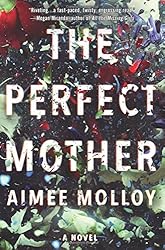
The Perfect Mother
Aimee Molloy, 2018
HarperCollins
336 pp.
ISBN-13: 9780062696793
Summary
A night out — a few hours of fun…
What could possibly go wrong?…
Some people are so good at making perfect look easy.
They call themselves the May Mothers—a collection of new moms who gave birth in the same month. Twice a week, with strollers in tow, they get together in Prospect Park, seeking refuge from the isolation of new motherhood; sharing the fears, joys, and anxieties of their new child-centered lives.
When the group’s members agree to meet for drinks at a hip local bar, they have in mind a casual evening of fun, a brief break from their daily routine. But on this sultry Fourth of July night during the hottest summer in Brooklyn’s history, something goes terrifyingly wrong: one of the babies is taken from his crib.
Winnie, a single mom, was reluctant to leave six-week-old Midas with a babysitter, but the May Mothers insisted that everything would be fine. Now Midas is missing, the police are asking disturbing questions, and Winnie’s very private life has become fodder for a ravenous media.
Though none of the other members in the group is close to the reserved Winnie, three of them will go to increasingly risky lengths to help her find her son.
And as the police bungle the investigation and the media begin to scrutinize the mothers in the days after Midas goes missing, damaging secrets are exposed, marriages are tested, and friendships are formed and fractured.
Unfolding over the course of thirteen fraught days and culminating in an exquisite and unexpected twist, The Perfect Mother is the perfect book for our times—a nuanced and addictively readable story that exposes the truth of modern mothers’ lives as it explores the power of an ideal that is based on a lie. (From the publisher.)
Kerry Washington of TV's Scandal fame has purchased the film rights.
Author Bio
• Birth—ca. 1971-72
• Raised—Buffalo, New York, USA
• Education—B.A., Duke University; M.A., New York University
• Currently—lives in Brooklyn, New York City, New York
Aimee Molloy has collaborated on seven books, including Maziar Bahari's Then They Came for Me: A Family's Story of Love, Captivity, and Survival and Pam Cope's Jantsen's Gift: A True Story of Grief, Rescue, and Grace. She lives in Brooklyn, New York, with her husband and two daughters. The Perfect Wife is her first novel. (From the publisher.)
Book Reviews
Like most characters in thrillers, many of the May Mothers have secrets, some of which dilute the urgency of the investigation’s timeline. And Molloy repeatedly generates suspense by depriving the reader of information (as opposed to, say, having actually suspenseful stuff happen). But I was hooked anyway and stayed up late to finish. What do you call a book like that? Oh yeah: a page-turner. And it’s a rare and wonderful thing.
Katherine Heiny - New York Times Book Review
An electrifying thriller—and a subtle, savvy skewering of the endless expectations of modern motherhood (Book of the Week).
People
A desperate, thrilling mystery that you’ll think you have all figured out—until you realize you don’t.
Marie Claire
[It's Molloy's] characters’ anxieties that give the story life and substance. Molloy doesn’t fully earn her book’s big twist, but her clever narrative… heightens tension… while spotlighting the solitary struggles of motherhood.
Publishers Weekly
Impressive and satisfying.… This gripping and fresh novel will provoke as much thought as it does excitement.
BookPage
As the investigation gets underway, it seems that every member of the group has some pretty big secrets to hide.… Readers who can’t get enough of suburban suspense …will want to give this a try. —Rebecca Vnuk
Booklist
(Starred review) Molloy, a master of clever misdirection, deftly explores the expectations, insecurities, and endless judgement that accompany motherhood in this fast-paced thriller…. Mesmerizing.
Kirkus Reviews
Discussion Questions
We'll add publisher questions if and when they're available; in the meantime, use our LitLovers talking points to help start a discussion for THE PERFECT WIFE … then take off on your own:
1. How well does Aimee Molloy describe the issues of first-time motherhood—exhaustion and isolation, to name only two? If you're a mother do you relate to (even remember?) all the concerns and anxieties talked about in The Perfect Mother?
2. What do we learn about the various members of the May Mothers early on, before Midas goes missing? As chapters shift among various perpsectives, what else is revealed about each of them? How would you describe the individual characters? Is there a particular one you admire more than others …or find more interesting ...or more problematic?
3. Talk about the way the police bungle the investigation.
4. In an online interview, Aimee Molloy talks about her own, real-life support group, September Babies, and her belief that if something happened to one of the children, "all the women [would be] smearing our faces with war paint and lighting our torches and going out into the streets of Brooklyn.… We would not rest." Do you have a devoted group of friends like that—whose members have each other's backs?
5. Whom did you first suspect? How does Molloy use misdirection to put readers off the scent? Were you surprised by the twist at the end?
6. What's the significance of the book's title? Who is "the perfect mother"?
(Questions by LitLovers. Please feel free to use them, online and off, with attribution. Thanks.)

The Perfect Nanny
Leila Slimani, 2016 (U.S. transl., 2018)
Penguin Publishing
240 pp.
ISBN-13: 9780143132172
Summary
Winner - 2017, Prix Goncourt (France)
She has the keys to their apartment. She knows everything. She has embedded herself so deeply in their lives that it now seems impossible to remove her.
When Myriam, a French-Moroccan lawyer, decides to return to work after having children, she and her husband look for the perfect nanny for their two young children.
They never dreamed they would find Louise: a quiet, polite, devoted woman who sings to the children, cleans the family’s chic apartment in Paris’s upscale tenth arrondissement, stays late without complaint, and hosts enviable kiddie parties.
But as the couple and the nanny become more dependent on one another, jealousy, resentment, and suspicions mount, shattering the idyllic tableau. Building tension with every page, The Perfect Nanny is a compulsive, riveting, bravely observed exploration of power, class, race, domesticity, and motherhood—and the American debut of an immensely talented writer. (From the publisher.)
Author Bio
• Birth—1981
• Where—Rabat, Morocco
• Education—Ecole superieure de commerce de Paris-Europe
• Awards—Prix Goncourt (France); La Mamounia (Moroccan)
• Currently—lives in Paris, France
Leïla Slimani is a Franco-Moroccan writer and journalist, who was awarded the 2016 Prix Goncourt for her novel Chanson douce. The novel was published in 2018 in the U.S. as The Perfect Nanny.
Life and work
Slimani was born in Rabat, Morocco, and left at the age of 17 for Paris to study political science and media studies at the Sciences Po and Ecole superieure de commerce de Paris-Europe (ESCP). After her graduation she began to work as a journalist for the magazine Jeune Afrique.
Slimani's first novel, Dans le jardin de l’ogre ("In the Garden of the Ogre"), published in 2014, won the Moroccan La Mamounia literary award. Two years later, Chanson douce was released, becoming a bestseller even before it was awarded the Prix Goncourt. That novel made Slimina the most-read author in France in 2016.
Slimani holds French and Moroccan citizenships. (Adapted from Wikipedia. Retrieved 1/31/2018.)
Book Reviews
[An] unnerving cautionary tale.… Pretty radical for a domestic thriller, but what’s more remarkable about this unconventional novel is the author’s intimate analysis of the special relationship between a mother and a nanny.… Slimani writes devastatingly perceptive character studies.
Marilyn Stasio - New York Times Book Review
Brilliantly observed.… Slimani is brilliantly insightful about the peculiar station nannies assume within the households of working families.
Wall Street Journal
A slim page-turner, The Perfect Nanny can be read in a single, shivery sitting.… A chilling domestic thriller.… It will make a great film.
Economist
This brutal chiller has the same compulsive readability as Emma Donoghue’s Room.
Guardian
A year ago, I picked up a book … that I’ve thought about pretty much every day since.… [It] felt less like an entertainment, or even a work of art, than like a compulsion. I found it extraordinary.… If you are a mother, whatever kind of mother you aspire to be, you’ll know what kind of mother you are after reading Slimani. If you are not a mother, the insights that she administers can be no less jolting.… Like Jenny Offill, Slimani can write ravishingly of female bodies, even postpartum ones.… The novelist Rachel Cusk has chronicled what motherhood did to her; Slimani examines what mothering is doing to society.
Lauren Collins - New Yorker
I think this might be one of the most important books of the year. You can’t unread it.… If you’ve ever taken care of a kid, even if, just on a bus, someone has handed you a child for five seconds as they rummage through their purse, this will do something to you.… At the end of reading this book, I was so devastated, but I really felt like I was looking at the world through new eyes.
Barrie Hardymon - NPR’s Weekend Edition
[A] slim dagger of a novel.… You won't move until you reach the last page.
People
[An] unsettling tale of a nanny who insinuates herself into every aspect of her employers’ lives, with tragic results.… Those seeking a thought-provoking character study will appreciate this gripping anatomy of a crime.
Publishers Weekly
[A] spare domestic thriller.… What initially feels like routine, unremarkable women's fiction morphs into a darkly propulsive nail-biter overlain with a vivid and piercing study of class tensions.
Library Journal
A devastating, entrancing, literary psychological drama supported by absorbing character studies.… Readers won’t be able to look away.
Booklist
Since the book opens with the murders, leaving no doubt as to the culprit, the reader quickly gathers that the inquiry here is not who did it but why.… [But] the why…remains unfathomable, rendering it all the more frightening.
Kirkus Reviews
Discussion Questions
We'll add publisher questions if and when they're available; in the meantime, use our LitLovers talking points to help start a discussion for The Perfect Nanny … then take off on your own:
1. Do you see this this novel as a guilt trip for working moms—inspiring a sense of maternal inadequacy?
2. What do you think of Myriam and her husband Paul? In what way would you call them needy?
3. Why doesn't Myriam, who is Moroccan-French, want to hire a North African nanny? She admits that she would worry about "immigrant solidarity." What does she mean?
4. Myriam tells friends, "My nanny is a miracle worker." What does that statement suggest a) about Myriam and … b) about her relation with Louise?
5. What do you think of the fact that when Myriam goes shopping "she hides the new clothes in an old cloth bag and only opens them once Louise has gone." Paul praises her for being "tactful." What is your take on Myriam's tactfulness?
6. How are mothers in general portrayed in this novel? Consider the description of mothers sitting on park benches "starring into space" or the mother who has just given birth and who still carries around "her body of pain and secretions.… This flesh that she drags around with her, which she gives no care or rest."
7. Follow-up to Question 6: If you are a mother, do the narrator's depictions of motherhood resonate with you—the desire to continue a career outside the home, the feeling of guilt … or perhaps the opposite: the feeling that you shouldn't stay at home, that you should pursue a career?
8. How do you feel about Louise (absent the fact that we know she has a murdered two children)? What do we learn about her background: why she's so obsessive, for instance, about her own mothering skills?
9. Follow-up to Question 8: Talk about this observation of Louise by Myriam: I had the feeling that she was like a plate that you put every day on the table, and she breaks every day a little bit. And one day you put it on the table and she breaks into pieces." What does Myriam mean? Is it a fair assessment of Louise?
10. Talk about the first sentence of the novel, even the first paragraph. How did it make you feel as you read it?
11. How would you describe the narrative voice in The Perfect Nanny? In what way does it contribute to a sense of dread...or horror?
12. Does knowing that this novel is based on a real case of child murder by a nanny (in New York City) affect your reading experience?
13. This isn't a whodunnit. It's a whydunnit. Why does Louise murder the children? Is her motivation ever fully explained?
(Questions by LitLovers. Please feel free to use them, online and off, with attribution. Thanks.)

The Perfect Neighbors
Sarah Pekkanen, 2016
Washington Square Press
352 pp.
ISBN-13: 9781501106491
Summary
How well do you ever really know the family next door?
Bucolic Newport Cove, where spontaneous block parties occur on balmy nights and all of the streets are named for flowers, is proud of its distinction of being named one the top twenty safest neighborhoods in the US.
It’s also one of the most secret-filled.
Kellie Scott has just returned to work after a decade of being a stay-at-home mom. She’s adjusting to high heels, scrambling to cook dinner for her family after a day at the office—and soaking in the dangerous attention of a very handsome, very married male colleague.
Kellie’s neighbor Susan Barrett begins every day with fresh resolutions: she won’t eat any carbs, she’ll go to bed at a reasonable hour, and she’ll stop stalking her ex-husband and his new girlfriend.
Gigi Kennedy seems to have it all together—except her teenage daughter has turned into a hostile stranger and her husband is running for Congress, which means her old skeletons are in danger of being brought into the light.
Then a new family moves to this quiet, tree-lined cul-de-sac. Tessa Campbell seems friendly enough to the other mothers, if a bit reserved. Then the neighbors notice that no one is ever invited to Tessa’s house.
And soon, it becomes clear that Tessa is hiding the biggest secret of all. (From the publisher.)
Author Bio
• Birth—1967
• Where—New York, New York, USA
• Raised—Bethesda, Maryland
• Education—University of Wisconsin; University of Maryland
• Currently—lives in Chevy Chase, Maryland
Sarah Pekkanen was born in New York City, arriving so quickly that doctors had no time to give her mother painkillers. This was the last time Sarah ever arrived for anything earlier than expected. Her mother still harbors a slight grudge.
Sarah’s family moved to Bethesda, Maryland, where Sarah, along with a co-author, wrote a book entitled “Miscellaneous Tales and Poems.” Shockingly, publishers did not leap upon this literary masterpiece. Sarah sent a sternly-worded letter to publishers asking them to respond to her manuscript. Sarah no longer favors Raggedy Ann stationery, although she is sure it impressed top New York publishers.
Sarah’s parents were hauled into her elementary school to see first-hand the shocking condition of her desk. Sarah’s parents stared, open-mouthed, at the crumpled pieces of paper, broken pencils, and old notebooks crowding Sarah’s desk. Sarah’s organization skills have since improved. Slightly.
After college, Sarah began work as a journalist, covering Capitol Hill. Unfortunately, Sarah could not understand the thick drawls of the U.S. Senators from Alabama, resulting in many unintentional misquotes. Sarah was groped by one octogenarian politician, sumo-bumped off a subway car by Ted Kennedy, and unsuccessfully sued by the chief of staff to a corrupt U.S. Congresswoman. Sarah also worked briefly as an on-air correspondent for e! Entertainment Network, until the e! producers realized that Capitol Hill wasn’t, by any stretch of the imagination, what one might call sexy.
Sarah married Glenn Reynolds, completing her rebellion against her father, who told her never to become a writer or marry a lawyer.
Sarah took a job at Gannett New Service/USAToday, covering Capitol Hill. Sarah was assigned to cover the White House Correspondents Dinner and rode in the Presidential motorcade to the dinner. Sarah convinced a White House aide to let her stick her head out of the limousine moon-roof during the ride and wave to onlookers. Later, her triumph was tempered by the fact that bouncers would not allow her into the Vanity Fair after-party. Sarah attempted entry three times in case the bouncers were just kidding.
Sarah took a job writing features for the Baltimore Sun, and interviewed the actor who played Greg Brady. She refrained from asking if he really made out with Marcia, but just barely.
Sarah and Glenn’s son Jackson was born. He arrived too quickly for Sarah to receive painkillers, and Sarah was pretty sure she saw her mother smirking. When Glenn put a loving hand on Sarah’s shoulder during the throes of labor, Sarah decided the most expedient way to get Glenn to remove his hand was to bite it, hard. She was proved right.
Twenty months later, Sarah and Glenn’s son Will was born. Three weeks later, Sarah and Glenn moved into a new home and renovated the kitchen. Two weeks later, Glenn caught pneumonia and simultaneously started a new job. Ten days after the kitchen renovation was complete, the kitchen caught on fire, and Sarah, Glenn and family moved to a hotel while renovation began anew. Sarah and Glenn decided to work on their "timing" issues.
Having left her journalism job to chase around the ever-active Jack and Will, Sarah started writing a column for Bethesda Magazine and began work on a novel. She did not write it on Raggedy Ann stationery.
Her first book, The Opposite of Me, came out in 2010 and her second, Skiping, a Beat in 2011. Those were followed by These Girls in 2012, The Best of Me in 2013, and Catching Air in 2014.
Sarah gave birth to a bouncing baby boy, Dylan, and gets a little weepy every time she contemplates her good luck. (Adapted from the author's website.)
Book Reviews
Pekkanen uncovers the hopes, heartbreaks, and indiscretions that lurk behind a community’s carefully maintained façade in this engrossing novel reminiscent of Liane Moriarty’s suburban-set mysteries. Women’s fiction star Pekkanen’s latest novel will be energetically promoted as the perfect summer read.
Booklist
Pekkanen deftly intertwines four stories into a tapestry depicting the frayed seams underlying small-town American domesticity. A mistress of women's fiction, Pekkanen transforms clichéd suburban troubles—from adolescent drama to infidelity—into a compelling, suspenseful tale.
Kirkus Reviews
Discussion Questions
1. Throughout the novel, Newport Cove’s residents hold their status as one of the twenty safest neighborhoods in the United States as a point of pride. Yet each of the four female narrators feels unsafe in some way, due to the secrets she is holding. Do you think people need to feel emotionally safe in order to feel physically safe, and vice versa?
2. In a series of flashbacks, we observe that Tessa “tried to do everything right” after her baby Bree was born, but quickly “felt as if she was failing her daughter” (p. 22). How does her anxiety about the “right” way to be a mother impact her children and/or her marriage? How have you observed this pressure in your own life, or in the lives of your friends or family? If you have children, how have your beliefs about how to best raise them been affected by the opinions of “experts”?
3. When it comes to her children’s safety, Tessa grows to believe she is paranoid or too sensitive, to the point where she becomes wary of raising an alarm when she thinks something is seriously wrong. Do you think it is generally better to be overly suspicious or overly cautious? What are the drawbacks of each, as portrayed in the novel?
4. Kellie initially thinks that because she and Miller have never kissed, she is not cheating on her husband. Is “emotional cheating” really cheating? Why or why not? How would you respond if a significant other acted as Kellie did? Have you ever been tempted to slip into emotional infidelity, and if so, how did you deal with the situation?
5. “Facebook stalking wasn’t something she was proud of” (p. 280). Was Susan’s Facebook stalking relatable or an invasion of privacy? Is Facebook stalking a normal part of having a crush/getting over a breakup, or is it self-destructive?
6. For much of the novel, Susan feels incapable of letting go of the past, at one point despairing that “sometimes, though, people didn’t adjust” (p. 233) to an ex moving on. In what ways does Susan’s struggle with her divorce mirror the issues her friends are dealing with? What keeps people from moving forward? Looking at these protagonists, where do you see them ultimately exhibiting personal growth?
7. Susan begins dating only after realizing that her son recognizes that she misses his father. To what extent should the desires of someone’s children impact their dating choices—and should a parent end a relationship if her children don’t like it? Furthermore, do you think falling for someone new is a prerequisite to getting over a past love?
8. What did you initially suspect had happened to Tessa and Harry before they moved to Newport Cove? What did you think of the ultimate revelation, and how did it affect your feelings toward these characters? Why do you think the author ended that story line the way she did?
9. “She’d been waiting for it to come, but she still felt zero guilt” (p. 332). Reread this scene as a group and discuss your reactions to this line. Do you think you would have felt the same in Tessa’s shoes?
10. Besides injecting doses of humor into the narrative, what role does the Newport Cove listserv fill? What sense of the community, or of the individual characters, does it provide? Were there any messages in the listserv digests that echoed larger themes from the novel? Discuss a few of your favorite emails.
(Questions issued by the publisher.)


Perfect Peace
Daniel Black, 2010
St. Martin's Press
352 pp.
ISBN-13: 9780312582678
Summary
The heartbreaking portrait of a large, rural southern family’s attempt to grapple with their mother’s desperate decision to make her newborn son into the daughter she will never have...
When the seventh child of the Peace family, named Perfect, turns eight, her mother Emma Jean tells her bewildered daughter, "You was born a boy. I made you a girl. But that ain’t what you was supposed to be. So, from now on, you gon’ be a boy. It’ll be a little strange at first, but you’ll get used to it, and this’ll be over after while."
From this point forward, his life becomes a bizarre kaleidoscope of events. Meanwhile, the Peace family is forced to question everything they thought they knew about gender, sexuality, unconditional love, and fulfillment. Chance is a mixed breed Pit Bull. He’s been born and raised to fight and seldom leaves the dirty basement where he is kept between fights.
But Chance is not a victim or a monster. It is Chance’s unique spirit that helps him escape and puts him in the path of Adam. What transpires is the story of one man, one dog, and how they save each other—in ways they ever could have expected. (From the publisher.)
Author Bio
• Birth—N/A
• Where—Kansas Ctiy, Missouri, USA
• Raised—Blackwell, Arkansas
• Education—B.A., Clark College; Ph.D., Temple University
• Currently—lives in Atlanta, Georgia.
Daniel Omotosho Black is a native of Kansas City, Missouri, yet spent the majority of his childhood years in Blackwell, Arkansas. He was granted a full scholarship to Clark College in Atlanta, Georgia, where he majored in English. He was awarded the Oxford Modern British Studies Scholarship and studied abroad at Oxford University, Oxford, England.
Upon graduation from Clark College (magna cum laude in 1988), he was granted a full graduate fellowship to Temple University in pursuit of a Ph.D. in African-American Studies. Completing this phase of his academic career in 1993, with Sonia Sanchez as one of his dissertation advisers, Dr. Black returned to his alma mater in order to help establish the tradition of top-notch scholars who publish and remain at historically Black institutions.
As a tenured associate professor, he now aims to provide an example of young African Americans of the importance of self-knowledge and communal commitment.
Omotosho, as he prefers to be called, is the founder of the Nzinga-Ndugu rites of passage (or initiation) society — a group whose focus is instilling principle and character in the lives of African-American youth.
Novels
Black is the author of four novels, including They Tell Me of a Home (2005), The Sacred Place (2007), Perfect Peace (2010), and Twelve Gates to the City (2014). (Adapted from the author's website.)
Book Reviews
A high-spirited, compassionate look at everyone's longings for perfection, both inside and out.
Atlanta Journal-Constitution
Black effortlessly conveys Paul's agony over his inner shame and what the world sees on the outside. It's painful to see how his father also struggles to accept as a son the child he had once adored as a girl. For the Peace family, the end of Perfect is akin to the death of a loved one.
San Antonio Express-News
Black explores the fateful decision of Emma Jean Peace to raise her seventh son, Perfect, as the daughter she has always wanted.... While the rural South backdrop is overly familiar and the dialogue is painfully hoary, Black manages a nuanced exploration of sexual identity and social structures without elevating his characters to angels or martyrs.
Publishers Weekly
Black courageously delves into such sensitive issues such as sexuality, racism, and family dynamics and enchants readers with strong pacing and Southern imagery. Those who enjoy rich and complex works of literary fiction will be provoked to discuss this novel's many layers. —Lisa Jones, Birmingham P.L., AL
Library Journal
Black builds toward the point when Perfect discovers that she's a boy, but seems confused about what to do with his character after this astonishing revelation. At the same time, the author offers a nuanced portrait of an insular community's capacity to absorb difference, and it's a cold reader who will be unmoved by his depictions. Original and earnest, informed both by human limitation and human potential.
Kirkus Reviews
Discussion Questions
1. Emma Jean’s decision seems to be unjustifiable. However, is it possible to understand why Emma Jean does what she does? Who is really to blame? Without having healed from her own childhood abuse, can she really be held responsible for her current psychological well-being?
2. How does Gus’s emotional fragility contribute unto his abuse of Paul? How is he contradictory in this respect?
3. How do Perfect’s brothers both help and hinder his transform into malehood/masculinity?
4. What is the role Sugar Baby plays in Paul’s spiritual evolution? Although they speak infrequently, Sugar Baby’s impact on Perfect Paul is indelible. Why?
5. What are the places in the novel where Emma Jean’s love for her children is made obvious? Cite examples of her being a dedicated, nurturing mother.
6. What role does the church play in the social construction of gender in Swamp Creek? How does the church/church rhetoric "enslave" its members around issues of gender/sexuality?
7. Most readers are surprised by the revelation of Mister’s sexuality. Why do you think readers don’t suspect him?
8. Eva Mae loves Perfect Paul, regardless of his gender identification. Why isn’t Paul attracted to her, especially with all she’s done to love and protect him?
9. The Jordan River is personified, such that it assumes a life of its own. How does the Jordan assist Swamp Creek residents in dealing with their communal and personal issues? Is it a "kind" character or a "mean, wrathful" one?
10. When Emma Jean begins to hear The Voice, it sounds like her own conscience at one point and, at other times, it sounds like her mother, and at other times it sounds like something Omniscient. What is the role of The Voice and how does it lead to Emma Jean’s ultimate cleansing?
(Questions issued by the publisher.)

The Perfect Son
Barbara Claypole White, 2015
Lake Union Publishing
386 pp.
ISBN-13: 9781477830048
Summary
From a distance, Felix Fitzwilliam, the son of an old English family, is a good husband and father.
But, obsessed with order and routine, he’s a prisoner to perfection. Disengaged from the emotional life of his North Carolina family, Felix has let his wife, Ella, deal with their special-needs son by herself.
A talented jewelry designer turned full-time mother, Ella is the family rock…until her heart attack shatters their carefully structured existence. Now Harry, a gifted teen grappling with the chaos of Tourette’s syndrome, confronts a world outside his parents’ control, one that tests his desire for independence.
As Harry searches for his future, and Ella adapts to the limits of her failing health, Felix struggles with his past and present roles. To prevent the family from being ripped apart, they must each bend with the inevitability of change and reinforce the ties that bind. (From the publisher.)
Author Bio
• Birth—N/A
• Where—Turvey, Bedfordshire, England, UK
• Education—B.A., York University
• Awards—Golden Quill's First Book Award (more below)
• Currently—lives in Hillsborough, North Carolina, USA
English born and educated, Barbara Claypole White is the author of five novels. She lives in North Carolina, in the U.S., with her family.
Barbara writes hopeful stories about troubled families with a healthy dose of mental illness. Much of her work has been inspired by her poet/musician son’s courageous battles against obsessive-compulsive disorder.
Her debut novel, The Unfinished Garden, won the 2013 Golden Quill Contest for Best First Book, and The In-Between Hour was chosen by SIBA (the Southern Independent Booksellers Alliance) as a Winter 2014 Okra Pick. Her third novel, The Perfect Son, was picked for Amazon’s Kindle First Program and became a Goodreads Choice Awards 2015 Nominee for Best Fiction. Echoes of Family, another darkly quirky tale, was published in 2016 (Adapted from Amazon and the author's website.)
Discussion Questions
1. No one in the novel is quite as he or she seems at first. Ella, for example, appears to be the perfect mother, but is filled with hidden doubts and insecurities; Felix appears to be a rigid control freak, and yet every decision he makes for the family pushes him beyond his comfort zone. As the story unfolds, did any of the other characters surprise you, and if so, in what ways? Do you agree that we are often too quick to pigeonhole a person based on one aspect of his or her personality?
2. Felix is a dark, unlikely hero. Even as Katherine warms to him, she calls him an antihero. How do you feel about Felix, and did those feelings change while you were reading the novel? Is Felix his own worst critic?
3. Were you shocked by Felix's flashback scene? Do you think we ever truly know what goes on in a family?
4. Harry does not have coprolalia—the involuntary and repetitive use of obscene language. Coprolalia is, however, the most common popular image of Tourette's, even though it affects only a small percentage of people with the syndrome. Do you agree that fictional characters struggling with neurological or mental disorders are often depicted using stereotypes? Do any of your family members battle an invisible disability, and if so, what have you found to be the most challenging part of explaining quirky behavior to the outside world?
5. When parenting a high-maintenance child, do the lines blur between being a helicopter parent and being a child advocate? Does Ella's health crisis speed up the natural process of separation and boundary setting that she and Harry must experience?
6. How do Harry's relationships with both his parents change during the novel?
7. How did you react to Ella's attempts to distance herself from Harry while she was in the hospital? What would you have done in her situation?
8. Harry and Max have a unique bond. What did you like most about their relationship? Do you think they will be BFFs forever, despite taking such different life paths?
9. What do you think is the emotional core of Ella and Felix's marriage? Are they well matched or an unlikely couple? Do you agree with Felix that the two months following the heart attack are a gift—a second chance for them?
10. In chapter one, Ella refers to the stranger sitting next to her as the good father, and throughout the novel, both she and Felix question what it means to be a good parent. What do you think it means? Do you agree with them that the hardest lesson of parenthood is learning to let go?
11. Do you have a favorite secondary character? If so, who and why?
12. One of the novel's themes is that a person can find clarity and empathy in a moment of unbearable darkness. Does the Fitzwilliam family crisis bring out the best in all the characters, including the secondary ones?
13. Ella's journey is a solitary one, whereas Felix is drawn increasingly into a community of support, something he's never experienced before. What do you think about that?
14. Why doesn't Ella die on the plane? Do you think she ever believed she would get better?
15. We see various settings in historic Durham, North Carolina, from Felix's perspective. What did you learn about Felix through the different settings—especially the scenes at Duke Gardens and the Nasher Museum of Art? Why do you think Felix, a Londoner who loves the afternoon sun, was drawn to a house hidden in shade at the edge of Duke Forest? Do you think Felix will stay in the house?
16. How did you react to the ending?
(Questions courtesy of the author.)


The Perfect Summer
Luanne Rice, 2003
Bantam Press
464 pp.
ISBN-13: 9780553584042
Summary
Old friendships--and love--make all things new again.
The acclaimed author of Safe Harbor and other bestsellers returns to the seaside, delving into the heart of a once happy family facing troubled waters.
Bay McCabe relishes life’s simple pleasures, her children, her home by the sea. She has never forgotten the values of her Irish granny--the everyday happiness of family, good friends, and hard work. Bay and her husband, Sean, have weathered rough spells and moved on. Now a perfect summer, filled with the scent of beach roses, lies before them.
Charming and ambitious, Sean splits his energy between the town bank, his old fishing boat, and the family he seems to adore—until he leaves his young daughter stranded after school. As troubling memories resurface, a phone call confirms that Sean is missing.
So begins a season that will change everything. As the door to all Bay cherishes seems to close forever, another opens, and an old love steps through. Embraced by enduring friendships, Bay will discover the truth of who she is—what love is—and how life’s deepest mysteries are often those closest to home (From the publisher.)
Author Bio
• Birth—1955
• Where—New Britain, Connecticut, USA
• Education—N/A
• Awards—(see below)
• Currently—lives in New York City and Old Lyme, Connecticut
Luanne Rice is the New York Times bestselling American author of more than 30 novels that have been translated into 24 languages. She often writes about nature and the sea, and many of her novels deal with love and family.
Born in New Britain, Connecticut, Rice's first published poem appeared in the Hartford Courant when she was eleven, and her first short story was published in American Girl when she was fifteen. Her debut novel, Angels All Over Town, was published in 1985.
Rice is an avid environmentalist and advocate for families affected by domestic violence.
Several of Rice's novels have been adapted for television, including Crazy in Love for TNT, Blue Moon for CBS, Follow the Stars Home and Silver Bells for the Hallmark Hall of Fame, and Beach Girls for a Summer 2005 mini-series on Lifetime.
Rice contributed a monologue to Motherhood Out Loud a play that premiered at Hartford Stage Company and was performed Off-Broadway and at the Geffen Playhouse in Los Angeles.
Honors
In 2002, Connecticut College awarded Rice an honorary degree and invited her to donate her papers to the college's Special Collections Library. She has also received an honorary doctorate of humane letters from St. Joseph College in West Hartford, Conn. In June 2014, she received the 2014 Connecticut Governor’s Arts Award in the Literary Arts category for excellence and lifetime achievement as a literary artist.
Rice divides her time between New York City, Old Lyme, Connecticut, and Southern California. (From Wikipedia. Retrieved 7/12/2016.)
Read an interview with Luanne Rice.
Book Reviews
Heartwarming and assured, Rice's latest novel addresses timeless themes and will linger with readers long after the reading is done.... Rice's ability to evoke the lyricism of the seaside lifestyle without over-sentimentalizing contemporary issues... is just one of the many gifts that make this a perfect summer read.
Publishers Weekly
Rice revisits the small Connecticut town of Hubbard's Point, adding another family to the long list of residents from her previous books.... A loving look at family and the issues that must be faced when a crisis threatens its cohesion. —Patty Engelman
Booklist
Discussion Questions
These questions were created and generously offered to LitLovers by Rena DeBerry of Salem, Virginia. Thank you, Rena!
1. Did the book description meet your expectations?
2. Ms. Rice presents multiple, well developed characters. Which one(s) did you most relate too? Which did you least relate too?
3. Infidelity is a subtle character throughout The Perfect Summer. Bay and Augusta accept their husband’s infidelity, both handling it differently. Dan ignores it. What do you think of their reactions? How would you react?
4. Whether consciously or subconsciously Sean brings Dan and Bay together. Which do you think it was? Do you think this was his way of making amends to Bay for his affairs?
5. At first Augusta tries to be a better person and give Bay a job. On the first day, Augusta takes all her anger of Sean out of Bay. Was Augusta justified to do so? Should a family be held accountable for the illegal actions of one member? How would you have reacted?
6. On the way to the Pumpkin Ball, Tara teases Joe about a Yeats poem, "The Wild Swans of Coole." What are your thoughts on mating for life? Is it possible? Not? Can you find it, lose it, then find it again like Bay and Dan?
7. When did you realize the Boland’s were behind everything? What clues did Ms. Rice give to implicate them?
8. Joe discovers that the banking embezzlement was considered a game, with nothing but greed as a motivation. How (or did) looking at embezzlement as a game help ease the participants conscious? Does it make the crime and criminals seem more or less "evil"?
9. Sean writes Annie a confession letter that she finds in the model boat she made for her father. What symbolism is there in Sean putting the letter in a boat? By writing the note to Annie, he puts a lot of responsibility on a young adult. What do you think of Sean’s character for making Annie so responsible? Was it a copout on Sean’s part? What do you think was his motivation?
10. Bay insists that Charlie and Sean’s spirit helped her save Eliza. Do you believe in guardian angels? Was it possible for Charlie and Sean to help Bay?
11. When the story breaks, media surrounds the McCabe house. At one point they harass and scare Billy, Annie and Peg. Is it fair for the media to "attack" children for an adult crime just to get answers?
12. Tara and Bay. Eliza and Annie. How are the relationships similar? Different? Do you believe that BFF could stand the test of time like Tara and Bay?
13. On a scale of 1 to 5, how would you rate The Perfect Summer? Would you recommend The Perfect Summer? Why or why not?
(Questions courtesy of Rena DeBerry. Please feel free to use them, online or off, with attribution to Rena and LitLovers. Thanks.)


Perfidia
James Ellroy, 2014
Knopf Doubleday
722 pp.
ISBN-13: 9780307956996
Summary
It is December 6, 1941. America stands at the brink of World War II. Last hopes for peace are shattered when Japanese squadrons bomb Pearl Harbor. Los Angeles has been a haven for loyal Japanese-Americans—but now, war fever and race hate grip the city and the Japanese internment begins.
The hellish murder of a Japanese family summons three men and one woman. William H. Parker is a captain on the Los Angeles Police Department. He’s superbly gifted, corrosively ambitious, liquored-up, and consumed by dubious ideology. He is bitterly at odds with Sergeant Dudley Smith—Irish émigré, ex-IRA killer, fledgling war profiteer. Hideo Ashida is a police chemist and the only Japanese on the L.A. cop payroll.
Kay Lake is a twenty-one-year-old dilettante looking for adventure. The investigation throws them together and rips them apart. The crime becomes a political storm center that brilliantly illuminates these four driven souls—comrades, rivals, lovers, history’s pawns.
Perfidia is a novel of astonishments. It is World War II as you have never seen it, and Los Angeles as James Ellroy has never written it before. Here, he gives us the party at the edge of the abyss and the precipice of America’s ascendance.
Perfidia is that moment, spellbindingly captured. It beckons us to solve a great crime that, in its turn, explicates the crime of war itself. It is a great American novel. (From the publisher.)
Author Bio
• Birth—March 4, 1948
• Where— Los Angeles, California, USA
• Education—N/A
• Currently—lives in Los Angeles, California
Lee Earle "James" Ellroy is an American crime fiction writer and essayist. Ellroy has become known for a telegrammatic prose style in his most recent work, wherein he frequently omits connecting words and uses only short, staccato sentences, and in particular for the novels The Black Dahlia (1987), The Big Nowhere (1988), L.A. Confidential (1990), White Jazz (1992), American Tabloid (1995), The Cold Six Thousand (2001), and Blood's a Rover (2009)
Life and career
Ellroy was born in Los Angeles, California, the son of Geneva Odelia (nee Hilliker) Ellroy, a nurse, and Armand "Lee" Ellroy, an accountant and, according to Ellroy, onetime business manager of Rita Hayworth.
After his parents' divorce, Ellroy and his mother relocated to El Monte, California. In 1958, Ellroy's mother was murdered. The police never found the perpetrator, and the case remains unsolved. The murder, along with reading The Badge by Jack Webb (a book composed of sensational cases from the files of the Los Angeles Police Department, a birthday gift from his father), were important events of Ellroy's youth.
Ellroy's inability to come to terms with the emotions surrounding his mother's murder led him to transfer them onto another murder victim, Elizabeth Short, the "Black Dahlia"; throughout his youth, Ellroy used Short as a surrogate for his conflicting emotions and desires. His confusion and trauma led to a period of intense clinical depression, from which he recovered only gradually.
Ellroy dropped out of school. He joined the army for a short while. During his teens and twenties, he drank heavily and abused Benzedrex inhalers. He was engaged in minor crimes (especially shoplifting, house-breaking, and burglary) and was often homeless.
After serving some time in jail and suffering a bout of pneumonia, during which he developed an abscess on his lung "the size of a large man's fist," Ellroy stopped drinking and began working as a golf caddy while pursuing writing. He later said, "Caddying was good tax-free cash and allowed me to get home by 2 p.m. and write books.... I caddied right up to the sale of my fifth book."
Ellroy is a self-described hermit who possesses very few technological amenities, including television, and claims never to read contemporary books by other authors, aside from Joseph Wambaugh's The Onion Field, for fear that they might influence his own. However, this does not mean that Ellroy does not read at all, as he claims in his 1996 autobiography, My Dark Places, to have read at least two books a week growing up, eventually shoplifting more to satisfy his love of reading. He says that he read works by Dashiell Hammett and Raymond Chandler accompanied by abuse of alcohol and Benzedrex inhalers.
Literary career
Ellroy published his first novel in 1981, Brown's Requiem, a detective story drawing on his experiences as a caddy. He then published two more, Clandestine and Killer on the Road, and followed with his Lloyd Hopkins Trilogy, centered on a police officer.
While his early novels earned him a cult following, Ellroy earned much greater success and critical acclaim with the L.A. Quartet—The Black Dahlia, The Big Nowhere, L.A. Confidential, and White Jazz. The four novels represent Ellroy's change of style from classic modernist noir fiction to so-called postmodern historiographic metafiction. The Black Dahlia, for example, fused the real-life murder of Elizabeth Short with a fictional story of two police officers investigating the crime.
In 1995, Ellroy published American Tabloid, the first novel in a series informally dubbed the "Underworld USA Trilogy," which Ellroy describes as a "secret history" of the mid-to-late 20th century. Tabloid was named Time's fiction book of year for 1995. Its follow-up, The Cold Six Thousand, became a bestseller. The final novel, Blood's a Rover, was released on September 22, 2009.
Ellroy is currently writing a "Second L.A. Quartet" taking place during the Second World War, with some characters from the first L.A. Quartet and the Underworld USA Trilogy returning younger. Perfidia, the first book, iwas released in 2014. Because many fictional and real life characters appear in Perfidia, many from his prior novels, Ellroy added a Dramatis personae, which notes the previous appearances of characters and includes short summaries for some.
Writing style
Hallmarks of his work include dense plotting and a relentlessly pessimistic—albeit moral—worldview. His work has earned Ellroy the nickname "Demon dog of American crime fiction."
He writes in longhand and on legal pads, rather than on a computer, and prepares elaborate outlines for his books, most of which are several hundred pages long.
Dialog and narration in Ellroy novels often consists of a "heightened pastiche of jazz slang, cop patois, creative profanity and drug vernacular" with a particular use of period-appropriate slang. He often employs stripped-down staccato sentence structures, a style that reaches its apex in The Cold Six Thousand and which Ellroy describes as a "direct, shorter-rather-than-longer sentence style that's declarative and ugly and right there, punching you in the nards."
The signature style is not the result of a conscious experimentation but of chance and came about when he was asked by his editor to shorten his novel L.A. Confidential by more than a hundred pages. Rather than removing any subplots, Ellroy achieved this by cutting every unnecessary word from every sentence, creating a unique style of prose.
Public life and views
In media appearances, Ellroy has adopted an outsized, stylized public persona of hard-boiled nihilism and self-reflexive subversiveness. He frequently begins public appearances with a monologue such as:
Good evening peepers, prowlers, pederasts, panty-sniffers, punks and pimps. I'm James Ellroy, the demon dog, the foul owl with the death growl, the white knight of the far right, and the slick trick with the donkey dick. I'm the author of 16 books, masterpieces all; they precede all my future masterpieces. These books will leave you reamed, steamed and drycleaned, tie-dyed, swept to the side, true-blued, tattooed and bah fongooed. These are books for the whole fuckin' family, if the name of your family is Manson.
Another aspect of his public persona involves an almost comically grand assessment of his work and his place in literature. He once told the New York Times, "I am a master of fiction. I am also the greatest crime novelist who ever lived. I am to the crime novel in specific what Tolstoy is to the Russian novel and what Beethoven is to music." (Adated from a longer article in Wikipedia. Retrieved 10/15/201.)
Book Reviews
In Dudley Smith, Ellroy has found the hellhound guide for his neon-noir Los Angeles underbelly…Smith casts the same shadow over Perfidia that Judge Holden cast over Cormac McCarthy's Blood Meridian. He's writ large and writ evil, a monolith of corruption and utilitarian expediency. But unlike what Ellroy did with Smith's previous appearances, here he sets his sights, to varying degrees of success, on the devil's heart and the ways in which satanic charms often coexist with paternal benevolence. For Smith engenders loyalty as much as he does fear. In a world as sordid and chaotic as the one Ellroy depicts, the simple purity of Smith's evil attains a kind of nobility.
Denis Lehane - New york Times Book Review
Compelling.... A triumphant return to the violent fictional world where he started—1940s Los Angeles.
Andrew Neather - Evening Standard (UK)
Perfidia brings the two sides of his work together: the period crime-writing of LA Quartet, with its highlighting of police misdemeanours, and the wider politico-historical concerns of his subsequent Underworld USA trilogy.
Guardian (UK)
There has never been a writer like James Ellroy. Since the Eighties, in novels such as L.A. Confidential and The Cold Six Thousand, he has been making real a secret world behind the official history of America, where bad girls mingle with very bad men, and the designs of murderers, cops, mobsters, movie stars and politicians can be equally callous, equally deadly. He melds racial invective, street slang, hepcat jazz talk, junkie jive and scandal-rag rants into prose of controlled intensity, and to enter it is to experience a vivid eyeball rush of recognition.
Chris Harvey - Telegraph (UK)
A great read.... Perfidia is a murder mystery, a subversive historical novel, and a dark meditation on power, politics, race and justice.
Mark Lindquist - Seattle Times
If Ellroy’s bitter visions entice you, Perfidia will take you once again to the underbelly of American history.... You will dive into Perfidia with a shiver that is equal parts anticipation and fear—because you know it's going to get very dark very fast.... Ellroy’s singular style has been described as jazzlike or telegraphic; here it is insomniac, hallucinogenic, nightmarish.
Colette Bancroft - Tampa Bay Times
[The L.A. Quartet] may be the ne plus ultra of noir, grittier than Chandler, more operatic than Hammett, and more violent even than Cain.... Ellroy whittles [his characters’] thoughts and actions into sentences the way others do shivs—lean, brutalist, and intended to puncture, to penetrate.
Chris Wallace - Interview
Ellroy launches his second L.A. Quartet with a sprawling, uncompromising epic of crime and depravity, with admirable characters few and far between.... This is as good a sample of Ellroy as any for newcomers, and old hands will find new perspectives on old characters intriguing.
Publishers Weekly
(Starred review.) A return to the scene of Ellroy’s greatest success and a triumphant return to form.... His character portrayals have never been more nuanced or—dare we say it—sympathetic.... A disturbing, unforgettable, and inflammatory vision of how the men in charge respond to the threat of war. It’s an ugly picture, but just try looking away.
Booklist
(Starred review.) [A] war novel like no other. It’s complicated, and the author wouldn’t have it any other way. There's no telling the good guys from the bad in Ellroy’s Los Angeles, because there are no good guys.... Ellroy is not only back in form—he’s raised the stakes.
Kirkus Reviews
Discussion Questions
Use our LitLovers Book Club Resources; they can help with discussions for any book:
• How to Discuss a Book (helpful discussion tips)
• Generic Discussion Questions—Fiction and Nonfiction
• Read-Think-Talk (a guided reading chart)
(We'll add specific questions if and when they're made available by the publisher. In the meantime, use our generic mystery questions.)
GENERIC DISCUSSION QUESTIONS
Mystery / Crime / Suspense Thrillers
1. Talk about the characters, both good and bad. Describe their personalities and motivations. Are they fully developed and emotionally complex? Or are they more one-dimensional heroes and villains?
2. What do you know...and when do you know it? At what point in the book do you, the reader, begin to piece together what happened?
3. Good crime writers are skillful at hiding clues in plain sight. How well does the author hide the clues in this work?
4. Does the author use red-herrings—false clues—to purposely lead readers astray?
5. Talk about plot's twists & turns—those surprising developments that throw everything you think you've figured out into disarray. Do they enhance the story, add complexity, and build suspense? Are they plausible? Or do the twists & turns feel forced and preposterous—inserted only to extend the story.
6. Does the author ratchet up the story's suspense? Did you find yourself anxious—quickly turning pages to learn what happened? How does the author build suspense?
7. What about the ending—is it satisfying? Is it probable or believable? Does it grow out of clues previously laid out by the author (see Question 2). Or does the ending come out of the blue? Does it feel forced...tacked-on...or a cop-out? Or perhaps it's too predictable. Can you envision a better, or different, ending?
8. Are there certain passages in the book—ideas, descriptions, or dialogue—that you found interesting or revealing...or that somehow struck you? What lines, if any, made you stop and think?
9. Overall, does the book satisfy? Does it live up to the standards of a good crime story or suspense thriller? Why or why not?
(Generic Mystery Questions by LitLovers. Please feel free to use them, online or off, with attribution. Thanks.)
top of page (summary)
{jcomments off}Perfume: The Story of a Murderer
Patrick Suskind, 1985; (trans., John E. Woods)
Random House
272 pp.
ISBN-13: 9780375725845
Summary
An acclaimed bestseller and international sensation, Patrick Suskind's classic novel provokes a terrifying examination of what happens when one man's indulgence in his greatest passion—his sense of smell—leads to murder.
In the slums of eighteenth-century France, the infant Jean-Baptiste Grenouille is born with one sublime gift—an absolute sense of smell. As a boy, he lives to decipher the odors of Paris, and apprentices himself to a prominent perfumer who teaches him the ancient art of mixing precious oils and herbs. But Grenouille's genius is such that he is not satisfied to stop there, and he becomes obsessed with capturing the smells of objects such as brass doorknobs and frest-cut wood.
Then one day he catches a hint of a scent that will drive him on an ever-more-terrifying quest to create the "ultimate perfume"—the scent of a beautiful young virgin. Told with dazzling narrative brillance, Perfume is a hauntingly powerful tale of murder and sensual depravity. (From the publisher.)
Perfume was adapted into film in 2006.
Author Bio
• Birth—March 26, 1949
• Where—Ambach, Germany
• Education—Universities of Munich and Aix-en-Provence
• Awards—has refused to receive awards
• Currently—lives in Munich, Germany
Patrick Süskind was born in Ambach, near Munich, in 1949. He studied medieval and modern history at the University of Munich. His first play, The Double Bass, was written in 1980 and became an international success. It was performed in Germany, in Switzerland, at the Edinburgh Festival, in London, and at the New Theatre in Brooklyn. His first novel, Perfume became an internationally acclaimed bestseller. He is also the author of The Pigeon and Mr. Summer's Story, and a coauthor of the enormously successful German television series Kir Royal. Mr. Süskind lives and writes in Munich. (From the publisher.)
Book Reviews
One of the first attractions of Patrick Suskind's remarkable fable is simply to watch the pieces of the puzzle fit together.... It is a parable of the rise and fall of Hitler and a thinly disguised anatomy of Germany's collective guilt. It mocks by implication every sort of charismatic figure from the religious guru to the rock star.... And yet Mr. Suskind's tour de force never groans beneath the weight of its meaning. Its logic is so surprising yet inevitable that it toys with our expectations at every twist and turn of its plot. Its point of view is so balanced and controlled that we are perfectly divided in our sympathy between the murderer and his victims. Even when Mr. Suskind runs out of tricks and is forced to wind up his parable of evil, he remains resourceful. We are almost sorry to see Jean-Baptiste Grenouille leave the pages of Perfume, for we have come begrudgingly to admire the perversity of his genius.
Christopher Lehmann-Haupt - New York Times
An astonishing performance, a masterwork of artistic conception and execution. A totally gripping page-turner.
San Francisco Chronicle
An ingenious story...about a most exotic monster.... Suspense build up steadily.
Los Angeles Times
Upon its publication last year in Germany Suskind's first novel Perfume immediately became an international best seller. Set in 18th-century France, Perfume relates the fascinating and horrifying tale of Jean-Baptiste Grenouille, a person as gifted as he was abominable. Born without a smell of his own but endowed with an extraordinary sense of smell, Grenouille becomes obsessed with procuring the perfect scent that will make him fully human. With brilliant narrative skill Suskind exposes the dark underside of the society through which Grenouille moves and explores the disquieting inner universe of this singularly possessed man. The translation is superb. Essential for literature collections. —Ulrike S. Rettig, German Dept., Wellesley Coll., Wellesley, Mass.
Library Journal
Discussion Questions
1. Jean-Baptiste Grenouille is born in a food market that had been erected above the Cimetiere des Innocents, the "most putrid spot in the whole kingdom" [p. 4]. He barely escapes death at his birth; his mother would have let him die among the fish guts as she had her four other children. But Grenouille miraculously survives. How would you relate the circumstances of his birth to the life he grows up to live?
2. When the wet nurse refuses to keep Grenouille because he has no smell and therefore must be a "child of the devil" [p. 11], Father Terrier takes him in. But he is exasperated. He has tried to combat "the superstitious notions of the simple folk: witches and fortune-telling cards, the wearing of amulets, the evil eye, exorcisms, hocus-pocus at full moon, and all the other acts they performed" [p. 14]. In what ways can Perfume be read as a critique of the eighteenth century's conception of itself as the Age of Reason? Where else in the novel do you find rationality being overcome by baser human instincts?
3. Throughout the novel, Grenouille is likened to a tick. Why do you think Süskind chose this analogy? In what ways does Grenouille behave like a tick? What does this analogy reveal about his character that a more straightforward description would not?
4. Grenouille is born with a supernaturally developed sense of smell. He can smell the approach of a thunderstorm when there's not a cloud in the sky and wonders why there is only one word for smoke when "from minute to minute, second to second, the amalgam of hundreds of odors mixed iridescently into ever new and changing unities as the smoke rose fromthe fire" [p. 25]. He can store and synthesize thousands of odors within himself and re-create them at will. How do you interpret this extraordinary ability? Do you think such a sensitivity to odor is physically possible? Do you feel Süskind wants us to read his novel as a kind of fable or allegory? Why do you think Süskind chose to build his novel around the sense of smell instead of one of the other senses?
5. What motivates Grenouille to commit his first murder? What does he discover about himself and his destiny after he has killed the red-haired girl?
6. Do the descriptions of life in eighteenth-century France—the crowded quarters, the unsanitary conditions, the treatment of orphans, the punishment of criminals, etc.—surprise you? How are these conditions related to the ideals of enlightenment, reason, and progress that figure so prominently in eighteenth-century thinking?
7. The perfumer Baldini initially regards Grenouille with contempt. He explains, "Whatever the art or whatever the craft—and make a note of this before you go!—talent means next to nothing, while experience, acquired in humility and with hard work, means everything" [p. 74]. And yet Grenouille is able to concoct the most glorious perfumes effortlessly and with no previous experience or training. What do you think the novel as a whole conveys about the relationship between genius and convention, creativity and destruction, chaos and order?
8. The narrator remarks, "Odors have a power of persuasion stronger than that of words, appearances, emotions, or will. The persuasive power of an odor cannot be fended off, it enters into us like breath into our lungs, it fills us up, imbues us totally. There is no remedy for it" [p. 82]. Do you think this is true? Why would an odor have such power? In what ways does Grenouille use this power to his advantage?
9. Some reviewers have claimed that the Süskind's writing in Perfume is "verbose and theatrical, " while others have described it as "sensuous and supple." Clearly, the writing is more extravagantly imaginative than the pared down minimalism of much recent American fiction. How do you respond to Süskind's prose? How do you respond to the critical reactions outlined above?
10. Grenouille is introduced as "one of the most gifted and abominable personages in an era that knew no lack of gifted and abominable personages" [p. 3]. Does Süskind manage to make him a sympathetic character, in spite of his murders and obsessions? Or do you find him wholly repellent? How might you explain Grenouille's actions? To what extent do his experiences shape his behavior? Do you think he is inherently evil?
11. When Grenouille emerges from his self-imposed seven-year exile, he is brought to the attention of the marquis de La Taillade-Espinasse, whose theory that "life could develop only at a certain distance from the earth, since the earth itself constantly emits a corrupting gas, a so-called fluidum letale, which lames vital energies and sooner or later totally extinguishes them" [pp. 139 - 140] seems to explain Grenouille's sad condition. This theory also contends that all living creatures therefore "endeavor to distance themselves from the earth by growing" upwards and away from the earth [p. 140]. What attitudes and beliefs is Süskind satirizing through the character of Taillade-Espinasse?
12. Grenouille becomes, toward the end of the novel, a kind of olfactory vampire, killing young women to rob them of their scents. "What he coveted was the odor of certain human beings: that is, those rare humans who inspire love. These were his victims" [p. 188]. Why does he need the scents of these people?
13. In the novel's climatic scene, just as Grenouille is about to be executed, he uses the perfume he's created to turn the townspeople's hatred for him into love and to inspire an orgy which collapses class distinctions and pairs "grandfather with virgin, odd-jobber with lawyer's spouse, apprentice with nun, Jesuit with Freemason's wife—all topsy-turvy, just as opportunity presented" [p. 239]. Grenouille is revered and regards himself as godlike in this triumph. Does he enjoy this moment, or is it a hollow victory? What is the novel suggesting about the nature of human love? About order and disorder?
14. After Grenouille leaves the town of Grasse, where he has caused so much death and suffering, his case is officially closed and we're told, "The town had forgotten it in any event, forgotten it so totally that travelers who passed through in the days that followed and casually inquired about Grasse's infamous murderer of young maidens found not a single sane person who could give them any information" [p. 247]. Why do the townspeople react this way? Why isn't it possible for them to integrate what has happened into their daily consciousness?
15. How do you interpret the novel's ending, as Grenouille returns to the Cimetiere des Innocents and allows himself to be murdered and eaten by the criminals who loiter there? What ironies are suggested by the narrator's assertion that Grenouille's killers had just done something, for the first time, "out of love" [p. 255]?
16. Perfume is set in eighteenth-century France and tells an extravagant story of a man possessed with a magical sense of smell and a bizarrely destructive obsession. Do its historical setting and fantastic elements make it harder or easier to identify with? What contemporary issues and anxieties does the story illuminate?
(Questions issued by publisher.)
top of page (summary)


The Perfume Collector
Kathleen Tessaro, 2013
HarperCollins
464 pp.
ISBN-13: 9780062257833
Summary
An inheritance from a mysterious stranger . . . an abandoned perfume shop on the Left Bank of Paris . . . three exquisite perfumes that hold a memory . . . and a secret.
London, 1955: Grace Monroe is a fortunate young woman. Despite her sheltered upbringing in Oxford, her recent marriage has thrust her into the heart of London's most refined and ambitious social circles. However, playing the role of the sophisticated socialite her husband would like her to be doesn't come easily to her—and perhaps never will.
Then one evening a letter arrives from France that will change everything. Grace has received an inheritance. There's only one problem: she has never heard of her benefactor, the mysterious Eva d'Orsey.
So begins a journey that takes Grace to Paris in search of Eva. There, in a long-abandoned perfume shop on the Left Bank, she discovers the seductive world of perfumers and their muses, and a surprising, complex love story. Told by invoking the three distinctive perfumes she inspired, Eva d'Orsey's story weaves through the decades, from 1920s New York to Monte Carlo, Paris, and London.
But these three perfumes hold secrets. And as Eva's past and Grace's future intersect, Grace realizes she must choose between the life she thinks she should live and the person she is truly meant to be.
Illuminating the lives and challenging times of two fascinating women, The Perfume Collector weaves a haunting, imaginative, and beautifully written tale filled with passion and possibility, heartbreak and hope. (From the publisher.)
Author Bio
• Birth—N/A
• Where—Pitts burgh, Pennsylvania, USA
• Education—attended University of Pittsburgh
and Carnegie Mellon University
• Currently—lives in Pittsburgh, Pennsylvania
2008)
Born in Pittsburgh, Pennsylvania, Kathleen attended the University of Pittsburgh before entering the drama program of Carnegie Mellon University. In the middle of her sophomore year, she went to study in London for three months and stayed for the next twenty-three years.
She began writing at the suggestion of a friend and was an early member of the Wimpole Street Writer’s Workshop. Her debut novel, Elegance (2003), became a bestseller. All of Kathleen's novels including Innocence (2005), The Flirt (2008), The Debutante (2011), and The Perfume Collector (2013) have been translated into many languages and sold all over the world. She returned to Pittsburgh in 2009, where she now lives with her husband and son. (From the author's website.)
Book Reviews
Tessaro dazzles the senses in this novel about a reluctant British socialite who receives a mysterious inheritance from an unknown Frenchwoman in 1950s Europe. Tessaro’s flashback-layered narrative concerns the mildly cliched Grace Munroe, a London housewife yearning for a sense of purpose, and Eva d’Orsey, an older Frenchwoman “living between memory and regret."... Predictably, Tessaro cycles between narratives....but [n]uanced observations soften the blow of the contrived banter [and] familiar form.
Publishers Weekly
A compelling plot in a truly magical Parisian setting, fascinating information about the way perfume is made, and great secondary characters make this a charming read. Tessaro does a marvelous job of conveying the atmosphere of a fairytale trip to 1950s Paris by a woman who finds herself, and romance, in the City of Light. Readers of the works of Emily Giffin and Laura Florand will enjoy. —Elizabeth Mellett, Brookline P.L., MA
Library Journal
A bewitching, compelling novel, full of dark desires, long-buried secrets, revisited memories, and new opportunities.
Booklist
Grace Munroe, a young woman in London in 1955, receives a letter from Paris informing her that a woman she has never heard of has just died and left her an apartment and an investment portfolio.... The story then moves back in time and...from continent to continent and...reveals the sometimes-tragic, sometimes-exhilarating life journey of Eva D'Orsey.... Eva's story, told from her perspective, is interspersed with her story as told by Madame Zed to Grace Munroe, who has followed a clue to the old perfume shop. A colorful, stimulating journey through time.
Kirkus Reviews
Discussion Questions
1. The book is described as a secret history told in scent. The three perfumes Andre Valmont creates for Eva mark significant turning points in her life and changes in her identity. Do you have a secret history in perfume? What three perfumes best describe different turning points in your life? Discuss the significance that perfume plays in your own life to alter mood or trigger a memory.
2. Each of the main characters is not quite what they seem to be upon first meeting. How do they appear originally, and how do they change? What do you consider to be the significance of this in the story and how does it alter your opinion of them?
3. Should perfume always be pleasing?
4. Grace’s story is based on a real woman’s story. She was born into a wealthy, aristocratic family and only discovered she was actually the child of another man in adulthood, when he left his Paris apartment to her in his will. This woman was never able to reconcile her true history. In the novel, Grace’s discovery profoundly alters who she is and, more importantly, who she might become. Discuss how she’s affected, how it changes her view of herself and what possibilities are open to her now that weren’t before.
5. Do you think Eva a good mother? Point to examples as to why or why not.
6. In the novel, it’s not clear if Grace’s husband has been unfaithful or not. Why do you believe this is kept ambiguous?
7. Imagine you discovered that your parents were not biologically related to you. What part of your identity would change as a result? What personal backstory about who you are and who you ought to be would you feel free to let go of? Would it alter your values or place in the world? Or would it not make any difference to you?
8. Again and again, the phrase "le droit de choisir" or the right to choose is echoed through the book. It forms the principal legacy that Grace inherits. Why is choice so important to Eva d’Orsay? How does she pass on that legacy?
(Questions from author's website.)


Perky's Books and Gifts
Evelyn Rainey, 2013
Bedlam Press
223 pp.
ISBN-13: 9781939065377
Summary
Welcome to Perky's Books & Gifts where gardening books blossom into bouquets, cookbooks sizzle with succulent juices, and military history books can be lethal. Don't mind the mutilated body behind the werewolf display, or the fact that the cafe manager is an egregore; Frankenstein was one, too.
The story of Perky's Books and Gifts begins with murder and ends with true love. It is told by Madison, Perky's Night Manager. She must band with her quirky (maybe just plain crazy) staff to figure out just what is making the books spring to life terrorizing the store and its customers. Does it have something to do with the new café worker, the possible new tribe of owners, the no-nonsense Colonel or the mysterious lady who just suddenly appears at a cafe table only to disappear just as suddenly with only a feather remaining?
Perky's Books & Gifts…a place where you can find murder, mystery, love, monsters, demons and giant festive hats. All of that, and books too!
Author Bio
• Birth—May 23, 1960
• Raised—on military posts around the world
• Education—B.S., Florida Southern College
• Currently—lives in central Florida, USA
Evelyn Rainey lives very quietly in a small southern town with her dog, three cats, and thousands of home-grown tadpoles and frogs (don't ask). She spends her time in this incarnation teaching, writing, and belly dancing.
Her first novel Minna Pegeen was published in 2011 and was followed by Bedina's War in 2012. Perky’s Books & Gifts, her third novel, began to take form during the six years she worked at Books-a-Million as a part-time paperback specialist and Red Badge. The Island Remains, her fourth book, is due out in July, 2014. Evelyn's guest-author appearances have have included the 2012 Carolina Renaissance Festival and upcoming ALT*Con and Necronomicon. She has also been published in anthologies, magazines, columns, and newspapers.
Rainey facilitates Writers for All Seasons. She has been an educator for thirty-one years with certifications in Early Childhood Education, Elementary Education, Middle School Integrated Curriculum, English for Speakers of Other Languages, Gifted Education, and Journalism.
Outside of the school system, she is an herbalist, a singer, belly-dancer and she loves to do book-signings. Her online presence includes Evelyn-Rainey.com, WritingRainey.blogspot.com, Twitter (EvelynRainey), MySpace, Delicious, Digg, Stumbleupon, Reddit, and Facebook as (WritingRainey), and Goodreads as (Evelyn_Rainey). She also writes the weekly Science Fiction/Fantasy Books column for BellaOnline (From the author.)
Visit the author's website.
Visit the author's blog.
Book Reviews
Madison Jefferson is the night manager at Percival’s Books & Gifts...and tells us the story of a interesting period where everything goes more weird than normal when a mutilated body is found behind an in-store werewolf display.... Evelyn Rainey has created a wonderful world that is completely centered on one location, Percival’s Books & Gifts...and the employees that work there and in doing so creates a world that would seem small but instead makes a environment that seems as if it doesn’t end.... Perky’s Books & Gifts is a fast paced interesting read that is littered with characters that all have something to offer in the story whether it be a somewhat major conversation to just a small nudge. And it is the characters that moves the story always forward and keeps it fun and magical.
Jason Bonton - Mass Movement Magazine
Discussion Questions
1. Compare and contrast the descriptions of Jeremy and Calvin. Now, using the same criteria and style, describe yourself and your best friend/worst enemy.
2. Several classic Science Fiction novels were given literary “nudges” in this book. Name three of them. Identify which book each alludes to.
3. Before the prevalence of the internet, there were certain books which were not allowed to be sold in “brick & mortar stores” without documenting the buyer’s identification. How do you feel about this?
4. Following the procedures in the book, deal a simple (Past, Present, Future, Fortune, Fate) tarot reading for yourself. If you don’t have a tarot deck, use a “normal” deck of playing cards and add 4 Jokers to represent the Pages. Evaluate the cards and write them down. In one week, return to your reading and describe any responses to it you may have. (If you would like assistance in interpreting the spread of cards, email the author with exactly what cards were laid in which position:
5. Identify as many Star Trek episodes as you can which were alluded to. Match the Perky’s event to the episode.
6. Compose a conversation with a Tobogatan with whom you are stuck in an elevator.
7. The relationship between Maddie and the Colonel drives the story from the beginning to the end. What other relationships (real or fictional) can you describe which are similar?
8. Seth Green and Michael Landon are mentioned as portraying the same kind of character. What was that character? Name three other actors who have played the same type of role.
9. Admit it—have you ever walked into a book store and told the clerk you were looking for a book? What was his/her reaction?
10. Uncle Billy gave one classic hint that he was illiterate while being questioned by Jack. What was it?
11. Maddie doesn’t actually speak in Latin when she babbles. What language is it?
12. This book puts forth the idea that Lazarus might still be alive because once Jesus brings someone back to life, that person can never die. Discuss your feelings and beliefs about this idea.
13. What classic comedy is alluded to during Norman’s funeral? (hint: starring Danny Kaye)
14. What classic fantasy movie is alluded to when Henry gives Kwichatklnds back the betrothal bracelet? (hint: starring Rutger Hauer)
15. The marriage scene does go on and on. Of all the opinions presented by the attendees, with whom would you most agree? With whom would you disagree?
16. Abstinence outside of marriage is advocated throughout this novel (Sam Wayne, Henry and Norman, Maddie and Thomas, and the spritephage demon-bait team). What are your opinions about abstinence outside of marriage?
17. Have you ever fallen prey to a swindler? How did he/she bamboozle you? What was the result?
18. Tell about your most recent experience with a book signing. How did you feel about the author? How did the author feel about being there? Did you buy a book?
19. All of the Cold Case Missing Person/Murder files listed in Perky’s are factual. Choose one and write or discuss a possible solution to the case.
20. One of the creatures described and prevalent in Perky’s is painted on the walls of a 14th century European chapel. What is the creature? What is your stance on the existence of such creatures?
21. If you were a character in Perky’s, would you be a customer or an ambassador? Describe what character you would portray.
22. Billy’s cussing is done symbolically in this book. How do you feel about curse words in novels?
23. You have bought an outfit from Jeremy’s Jresses. Describe the clothing and the event to which you will wear it.
24. Each character changes during the story. Choose one character and describe how friendship in the light of overwhelming differences helped or hurt that one character’s personal path.
25. In the sequel to Perky’s Books & Gifts, Thomas’ twin is going to show up, the Ancient spritephage demoness will return, and true love will again wing its way through the store. What else would you like to see happen?
(Questions courtesy of the author.)
The Persian Pickle Club
Sandra Dallas, 1995
St. Martin's Press
208 pp.
ISBN-13: 9780312147013
Summary
It is the 1930s, and hard times have hit Harveyville, Kansas, where the crops are burning up, and there's not a job to be found. For Queenie Bean, a young farm wife, a highlight of each week is the gathering of the Persian Pickle Club, a group of local ladies dedicated to improving their minds, exchanging gossip, and putting their quilting skills to good use.
When a new member of the club stirs up a dark secret, the women must band together to support and protect one another. In her magical, memorable novel, Sandra Dallas explores the ties that unite women through good times and bad. (From the publisher.)
Author Bio
• Birth—June 11, 1939
• Where—N/A
• Education—B.A., University of Denver
• Awards—numerous, see below
• Currently—lives in Denver, Colorado, USA
Award-winning author Sandra Dallas was dubbed “a quintessential American voice” by Jane Smiley, in Vogue magazine. Sandra’s novels with their themes of loyalty, friendship, and human dignity have been translated into a dozen foreign languages and have been optioned for films.
A journalism graduate of the University of Denver, Sandra began her writing career as a reporter with Business Week. A staff member for twenty-five years (and the magazine’s first female bureau chief,) she covered the Rocky Mountain region, writing about everything from penny-stock scandals to hard-rock mining, western energy development to contemporary polygamy. Many of her experiences have been incorporated into her novels.
While a reporter, she began writing the first of ten nonfiction books. They include Sacred Paint, which won the National Cowboy Hall of Fame Western Heritage Wrangler Award, and The Quilt That Walked to Golden, recipient of the Independent Publishers Assn. Benjamin Franklin Award.
Turning to fiction in 1990, Sandra has published eight novels. She is the recipient of the Women Writing the West Willa Award for New Mercies, and two-time winner of the Western Writers of America Spur Award, for The Chili Queen and Tallgrass. In addition, she was a finalist for the Colorado Book Award, the Mountain and Plains Booksellers Assn. Award, and a four-time finalist for the Women Writing the West Willa Award.
The mother of two daughters—Dana is an attorney in New Orleans and Povy is a photographer in Golden, Colorado— Sandra lives in Denver with her husband, Bob.
Her Own Words:
• Because of my interest in the West—I wrote nine nonfiction books about the West before I turned to fiction—I’m a sucker for women’s journals of the westward movement. I wanted The Diary of Mattie Spenser to have the elements of a novel but to read as much like a 19th century journal as possible. Mattie is a woman of her time, not a current-day heroine dressed in a long skirt, and the language is faithful to the Civil War era.
• I added dialogue to keep the diary entries from being too stilted for contemporary readers. Making the diary believable has had an unforeseen consequence: Many readers believe it is an actual journal. They’ve asked where the diary is kept and what happened to the characters after the journal ended. One reader accused me of rewriting some of Mattie’s entries because she recognized my style. Another sent me a copy of an early Denver photograph, asking if the man in the picture was one of the characters in the book. (Author bio from the author's website.)
Book Reviews
Out of [a] rather threadbare plot, Sandra Dallas manages to assemble a colorful exploration of Depression-era Kansas and the meaning of friendship.... [T]he members of the Persian Pickle Club turn out to be an engaging bunch, especially given Ms. Dallas's knack for capturing the quirky details of their lives.
New York Times Book Review
Affecting.... A book about how times can never be so hard that they can't be eased when people come together.
Denver Post
This entertaining second novel from the author of the well-received Buster Midnight's Cafe could be a sleeper. Set in Depression-era Kansas and made vivid with the narrator's humorous down-home voice, it's a story of loyalty and friendship in a women's quilting circle. Young farm wife Queenie Bean tells about the brief membership of a city girl named Rita, whose boredom with country living and aspirations to be an investigative reporter lead her to unearth secrets in the close-knit group, called the Persian Pickle Club after a coveted paisley print. Queenie's desire to win Rita's friendship ("We were chickens...and Rita was a hummingbird'') clashes with her loyalty to the Pickles when Rita tries to solve the murder of a member's husband, in the process unearthing complicated relationships among the women who meet each week to quilt and read aloud to each other. The result is a simple but endearing story that depicts small-town eccentricities with affection and adds dazzle with some late-breaking surprises. Dallas hits all the right notes, combining an authentic look at the social fabric of Depression-era life with a homespun suspense story.
Publishers Weekly
Hard times in Depression-era Harveyville, Kansas, are softened by the conviviality of a weekly quilting circle called the Persian Pickle Club. Queenie Bean, the "talkingest" member of the group, narrates the novel with snappy style. Over the course of a year, during which the club experiences more sorrow than sewing, Queenie and her pals depend on one another more than ever. When Queenie forms a fast friendship with the newest "Pickle," a flashy, big-city gal named Rita, the equilibrium of the group changes, for Rita is a novice newspaper reporter intent on making a name for herself. The story Rita most wants to crack involves the mysterious death of one of the club ladies' husbands. Will secrets long stitched into the collective fabric of friendship hold? This and other suspenseful questions of small-town life will entertain readers who enjoyed Fannie Flag's Fried Green Tomatoes at the Whistle Stop Cafe (Random, 1987), Olive Ann Burns's Cold Sassy Tree, or Dallas's first novel, Buster Midnight's Cafe. —Keddy Ann Outlaw, Harris Cty. P.L., Houston
Library Journal
Discussion Questions
1. The Denver Post called this "A book about how times can never be so hard that they can't be eased when people come together." How do the gatherings of the Persian Pickle Club ease its member's troubles?
2. Queenie says, "It was marrying that made women appreciate other women." Grover is a nice man who listens to Queenie's fears and shares his own. What do women characters provide each other?
3. Does Rita think she is a good friend to Queenie? Is she aware of the trouble her insensitive questions cause?
4. Tom bends down and tests the dryness of the dirt, realizing that there's no way of growing crops in it, but then turns up the road, apparently happy. How is this ability to ignore disaster echoed elsewhere in the book?
5. Quilting is central to this story. How is Harveyville like a quilt? What are the patterns? What is the stitching that holds it together?
6. Tyrone, the Reverend, and his sister are the only characters in the book who loudly profess devotion to God, yet they are the most disliked members of the community How else does this book turn morality and religion on its head?
7. Rita is a different kind of woman from the other members of the club-she doesn't seem to want to empathize with anyone. Discuss how her goals and feelings differ from those of the members.
8. At the end, Rita sends a "Friendship Forever" quilt to Queenie and the club. What is Rita trying to tell the club?
9. Rita includes a card that says, "If you wonder who's responsible, I did it." Who really did do it? Does it
matter?
(Questions issued by publisher.)
top of page (summary)


Persuasion
Jane Austen, 1817 (posthumously)
Penguin Random House
272 pp.
ISBN-13: 9780141439686
Summary
Twenty-seven-year old Anne Elliot is Austen's most adult heroine.
Eight years before the story proper begins, she is happily betrothed to a naval officer, Frederick Wentworth, but she precipitously breaks off the engagement when persuaded by her friend Lady Russell that such a match is unworthy.
The breakup produces in Anne a deep and long-lasting regret. When later Wentworth returns from sea a rich and successful captain, he finds Anne's family on the brink of financial ruin and his own sister a tenant in Kellynch Hall, the Elliot estate. All the tension of the novel revolves around one question: Will Anne and Wentworth be reunited in their love?
Jane Austin once compared her writing to painting on a little bit of ivory, 2 inches square. Readers of Persuasion will discover that neither her skill for delicate, ironic observations on social custom, love, and marriage nor her ability to apply a sharp focus lens to English manners and morals has deserted her in her final finished work. (From the publisher.)
Persuasion has yielded three film adaptations: a 1995 version starring Amanda Root and Ciaran Hinds (a LitLovers favorite!), a 2007 TV miniseries with Sally Hawkins and Rupert Penry-Jones, and a 1971 miniseries with Ann Firbank and Bryan Marshall.
Author Bio
• Born—December 16, 1775
• Where—Steventon in Hampshire, UK
• Death—July 18, 1817
• Where—Winchester, Hampshire
• Education—taught at home by her father
In 1801, George Austen retired from the clergy, and Jane, Cassandra, and their parents took up residence in Bath, a fashionable town Jane liked far less than her native village. Jane seems to have written little during this period. When Mr. Austen died in 1805, the three women, Mrs. Austen and her daughters, moved first to Southampton and then, partly subsidized by Jane's brothers, occupied a house in Chawton, a village not unlike Jane's first home. There she began to work on writing and pursued publishing once more, leading to the anonymous publication of Sense and Sensibility in 1811 and Pride and Prejudice in 1813, to modestly good reviews.
Known for her cheerful, modest, and witty character, Jane Austen had a busy family and social life, but as far as we know very little direct romantic experience. There were early flirtations, a quickly retracted agreement to marry the wealthy brother of a friend, and a rumored short-lived attachment—while she was traveling—that has not been verified. Her last years were quiet and devoted to family, friends, and writing her final novels. In 1817 she had to interrupt work on her last and unfinished novel, Sanditon, because she fell ill. She died on July 18, 1817, in Winchester, where she had been taken for medical treatment. After her death, her novels Northanger Abbey and Persuasion were published, together with a biographical notice, due to the efforts of her brother Henry. Austen is buried in Winchester Cathedral.
Jane Austen's delightful, carefully wrought novels of manners remain surprisingly relevant, nearly 200 years after they were first published. Her novels—Pride and Prejudice and Emma among them—are those rare books that offer us a glimpse at the mores of a specific period while addressing the complexities of love, honor, and responsibility that still intrigue us today. (From Barnes & Noble.)
Book Reviews
(Older books have few, if any, mainstream press reviews online. See Amazon and Barnes & Noble for helpful customer reviews.)
Critics, especially [recently], value Persuasion highly, as the author’s most deeply felt fiction, the novel which in the end the experienced reader of Jane Austen puts at the head of the list.... Anne wins back Wentworth and wins over the reader; we may, like him, end up thinking Anne’s character "perfection itself."
Judith Terry - Modern Library Ed. (cover image—top-right)
On the most basic level Persuasion is a love story, both interesting and entertaining. On a deeper level it examines human foibles and societal flaws. The question of the importance of propriety is raised frequently as is the issue of appearance vs. reality.... Family relationships and duty to family are both foci of the story. Within this family context relationships between men and women are examined...
Diana Mitchell - Penguin Group USA (From the Teacher's Guide)
Discussion Questions
Use our LitLovers Book Club Resources; they can help with discussions for any book:
• How to Discuss a Book (helpful discussion tips)
• Generic Discussion Questions—Fiction and Nonfiction
• Read-Think-Talk (a guided reading chart)
Also consider these LitLovers talking points to help get a discussion started for Persuasion:
1. First, talk about Sir Elliot. What matters most in his view of life? What does his reaction to Lady Russell's proposals suggest about the kind of man he is?
2. What do we come to learn (and when do we learn it) about Sir Walter's three daughters—Elizabeth, Anne, and Mary? Describe them. How does Sir Walter treat each of them, especially the two eldest, Elizabeth and Anne?
3. How would you describe Lady Russell? Does her—or did her—influence over Anne work toward Anne's betterment or detriment?
4. When younger, was Anne right to have followed Lady Russell's advice? Did it show passivity on Anne's part or good judgment to have allowed herself to be guided by her elders? Contrast her with Louisa Croft's assertion later in the book that she would never be dissuaded from following her own desires.
5. Talk about the Musgrove family and their affection for and interactions with one another. How do they feel about Mary Elliot Musgrove as their daughter- and sister-in-law? How do they receive Anne? What do you make of Anne's first visit when all complain to her, behind the others' backs, about how the two boys are raised?
6. Do you find Mary's hypochondria funny...or irritating...or what? Consider, also, the scene where Mary manipulates Anne into looking after young Charles so that she, Mary, can go dinner at the Musgrove's and meet Captain Wentworth!
7. Describe the kind of marriage that Admiral and Mrs. Croft seem to have. How do they view one another? How does their marriage differ from, say, Charles and Mary Musgrove's? Is the Croft's relationship typical of that era, do you suppose?
8. With their newfound wealth, both Captain Wentworth and Admiral Croft are able to join the upper ranks of English society. How have sailors such as Captain Wentworth and Admiral Croft made their fortunes? What is Austen's opinion of this? What is yours? What other options are available for social mobility in the early 19th century?
9. What kind person is Captain Wentworth? What kind of woman does he say he admires? What is the impact on him when he learns that Anne turned down Charles Musgrove in marriage?
10. Why does Mary disparage Charles Hayter? What is his economic and social standing with respect to her own?
11. When Anne meets Captain Benwick in Lyme, what drew the two together? Were you expecting a romance to develop between the two? Why...or why not?
12. How does Wentworth react to Louisa's fall? Whom does he blame—himself or Louisa? What does he begin to realize about Anne...and Louisa?
13. When Anne first reaches Bath, at first sge believes Mr. Elliot is interested in her sister, Elizabeth. Yet Anne hopes that he might not be "to nice, or too observant, if Elizabeth were his object." What does she mean?
14. When it becomes apparent that Mr. Elliot has turned his attentions toward Anne, what makes her uncertain of his sincerity? In the end, what does Anne learn about Elliot's motivations?
15. In all of her novels, Austen casts a gentle, satirical eye on English society. In Persuasion, her gaze seems more critical: what might she be saying in this work about rank and property—and about the possible rise of a middle class?
16. In a letter, Austen described Anne Elliot as "almost too good for me." Do you find Anne "too good" to be true? Is her goodness cloying and sentimental? Or is her goodness something different—an integrity combined with strength and acceptance? How do you see the heroine of this novel?
(Questions by LitLovers. Please feel free to use them, online or off, with attribution. Thanks.)
top of page (summary)


Philida
Andre Brink, 2012
Knopf Doubleday
320 pp.
ISBN-13: 9780345805034
Summary
This is what it is to be a slave: that everything is decided for you from out there. You just got to listen and do as they tell you. You don’t say no. You don’t ask questions. You just do what they tell you. But far at the back of your head you think: Soon there must come a day when I can say for myself: This and that I shall do, this and that I shall not.
In Philida, longlisted for the Man Booker Prize, Andre Brink—“one of South Africa's greatest novelists” (The Telegraph)—gives us his most powerful novel yet; the truly unforgettable story of a female slave, and her fierce determination to survive and to be free.
It is 1832 in South Africa, the year before slavery is abolished and the slaves are emancipated. Philida is the mother of four children by Francois Brink, the son of her master. When Francois’s father orders him to marry a woman from a prominent Cape Town family, Francois reneges on his promise to give Philida her freedom, threatening instead to sell her to new owners in the harsh country up north.
Here is the remarkable story—based on individuals connected to the author’s family—of a fiercely independent woman who will settle for nothing and for no one. Unwilling to accept the future that lies ahead of her, Philida continues to test the limits and lodges a complaint against the Brink family. Then she sets off on a journey—from the southernmost reaches of the Cape, across a great wilderness, to the far north of the country—in order to reclaim her soul. (From the publisher.)
Author Bio
• Birth—May 29, 1935
• Where—Vrede, South Africa
• Education—N/A
• Currently—lives in Cape Town, South Africa
Andre Philippus Brink, OIS, is a South African novelist. He writes in Afrikaans and English and is a Professor of English at the University of Cape Town. He has written more than 20 novels. His latest Philida (2012) was on the longlist for the ManBooker Prize.
In the 1960s he, along with Ingrid Jonker and Breyten Breytenbach, was a key figure in the Afrikaans literary movement known as Die Sestigers ("The Sixty-ers"). These writers sought to use Afrikaans as a language to speak against the apartheid government, and also to bring into Afrikaans literature the influence of contemporary English and French trends.
His novel Kennis van die aand (1973) was the first Afrikaans book to be banned by the South African government. Brink translated Kennis van die aand into English and published it abroad as Looking on Darkness. This was his first self-translation. Since then Brink writes his works simultaneously in English and Afrikaans.
While Brink's early novels were especially concerned with apartheid, his more recent work engages the new range issues posed by life in a democratic South Africa. Brink's son, Anton Brink, is an artist. (From Wikipedia.)
Book Reviews
[Philida] combines an unflinching examination of the cruelties inflicted on the African people by their Afrikaner masters with an attempt to give voice to the tradition that sustained them.... [A] rich and complex novel... A deep love of the South African countryside shines through, woven together with creation myths and earthy folks tales.
Times (London)
A moving story of one woman's struggle against hierarchies of race and gender that seek her absolute subjugation, Philida vividly dramatises the courage required to lay claim to the protections of the law, to speak out for one's rights even in the moment in which the law is on the wrong side of history. While this is a familiar story, it is one that must continue to be told, not least by white writers willing, as Brink is, to disinter the histories of complicity buried in their own ancestries.
Daily Telegraph (London)
We are clearly and wholeheartedly on Philida's side—and, indeed, we remain so throughout. But Brink's achievement is to invoke a measure of sympathy for the fading Dutch colonialists as well. There is, it transpires, a profound and substantial relationship between Philida and Frans; and its passing is, arguably, more painful for him than her.... There is much, particularly relating to the separation of women slaves from their children, and to the punishments meted out to runaway slaves, that is extremely harrowing. But the light and shade that Brink has skillfully introduced into his augmented family history make for a compelling and memorable novel.
Guardian (London)
In the hands of Mr. Brink, one of South Africa's most famous novelists, the land breathes; it feels alive... Books about slaves, especially the female kind, risk straying into worthiness and sentimentality. Mr. Brink steers well clear. Philida is bawdy and brave. She is pragmatic but sure in her faith that a new day is coming. When that time comes, it will be blue, blue as all other days are blue, and yet, it will be completely different.... [Philida] is based on fact. The woman existed. Cornelis was the brother of one of the author's ancestors. Zandvliet is a wine estate, though under another name. They are characters of long ago and far away. But such ghosts forever loom, and Mr. Brink pulls them close.
Economist
As much a biography and autobiography as it is a novel.... Brink tells this grand-guignol tale in harrowing style. The book's opening 100 pages or so offer his first successful inhabitation of a genuinely female sensibility. That he inhabits it while also writing in the loose-limbed patois of a 19th-century slave makes the achievement all the more astonishing."
Daily Express (London)
Words, and the act of recording the truth, lie at the very heart of Brink's novel, from the necessity of Philida's complaint being written down 'very precisely,' to a spill of ink that obliterates the names inscribed in the back of the Brink family bible. In giving a voice to Philida, Brink isn't just rewriting the sins of the fathers—her consciousness is joined by that of Frans, Cornelis, and a freed slave, Petronella, in a cacophony that indicates the shift in the power balance happening in the Cape during this period.... Philida's body may not be her own, but her voice certainly is. Her complaint sets in motion a series of events that sends shock waves through the lives of everyone around her: "One day there must come a time when you got to say for yourself: This and that I shall do, this and that I shall not."
Daily Beast.com
Powerful.... Heartrending... [Brink is] a writer of remarkable compassion and insight. His deeply emotional, complex mix of history and fiction will haunt readers long after the final page is turned.
BookPage
Eminent white Afrikaans writer Brink tells a story that is rooted in his own family's ancestry and set in the Cape in the early nineteenth century, before the abolition of slavery..... This stirring novel opens up the horror, seldom addressed, of the oppression long before apartheid was the law.
Booklist
Understatement: this book is complicated. It's set on South Africa's Cape ("Caab") in the 1830s as slavery is being abolished, and four characters and one outsider narrate the action. Philida is the most sympathetic, seeking justice when a promise of freedom from her "baas" with whom she bore four children is reneged on, and she is put to auction..... It's a nuanced book of twists and turns, and Brink manages to generate sympathy for his ancestors, although not much (not that they deserve a lot). —Robert E. Brown, Oswego, NY
Library Journal
(Starred review.) Longlisted for the Man Booker Prize, this tale of slavery, identity and the wages of sin is based in part on Brink's family history. An impossible love story, it is not impossible in the traditional sense of love between mismatched partners, but because it shows how no love is possible between persons fundamentally unequal.... The book traces the lacerating trajectory of the sins of parents, parents' scars like open wounds on their children's bodies. There is an astonishing frankness about the facts of life and a visionary lyricism in relation to these cruel facts. The "Acknowledgements" section details the genesis of the novel. In its way, it is as thrilling as the book itself. Extraordinary.
Kirkus Reviews
Discussion Questions
1. The author Andre Brink begins each chapter of Philida with a synopsis of what’s going to happen. How does this affect your reading experience—does it spoil what is coming, or does it pique your interest?
2. What does Philida’s experience talking with the government official “Grootbaas Lindenberg” reveal about the way blacks and whites were treated in South Africa in the 1830s?
3. Although Philida is the title character, she is not the only narrator in the novel. Why do you think Brink includes other voices? How does it shape the story?
4. How does this representation of slavery in South Africa compare to what you know about slavery in the United States? And how does the novel compare to books you might have read about the experiences of American slaves?
5. Philida spends much of the novel traveling, usually on foot. How does her physical journey mirror her personal journey toward freedom?
6. Cornelis Brink, Frans’s father says, “We Brinks are a boat that has always hugged the coast, no matter what storms have come, but Philida has now cut a hole into it and we may sink if we don’t watch out” (p.75). What does he mean by this and what influence has Philida had on each member of the family?
7. When they are children, Frans and Philida play a game in which he pretends to sell her, until she decides “that’s now enough. Now it’s your turn to be the slave and I’ll be the Baas” (p.103). How does this foreshadow later events?
8. Cornelis says of his slaves that he “looked after them and cared for them like children” (p.127). He also claims that “if I hadn’t saved [the children Janna brought with her from her first marriage] they would all have gone straight to hell” (p. 213). Do these two statements support each other? Does Cornelis really treat his slaves and his children in ways that are at all similar?
9. Throughout the novel, Philida is regularly seen knitting. What is the significance of this?
10. “If I can write his name, I can send him to hell. Otherwise he’ll keep on haunting me” (p. 189), Philida says about Frans. What is the importance of her being able to write? How does this relate to the power dynamic between masters and slaves?
11. How do Labyn’s efforts to convert, and perhaps woo, Philida differ from Frans’s? Is her decision to be with him really her own?
12. Frans tells his father that what he “wanted from Philida was what I want from a woman who is my wife” (p. 200). Do you believe him? What specific actions suggest that he is either lying or that he is telling the truth?
13. The promise of emancipation looms throughout the novel. Philida tells Cornelis that after leaving his family that “they say that next year in December I’ll be free. But here inside me I’m already free” (p.229). What does being “free” mean to Philida? What does it mean to you?
14. Philida is a book with one woman at its heart, but what do you make of the other female characters? How are Janna, Mrs. de la Bat, Ouma Nella, Maria Berrangé, and the others, presented? How are they like or unlike Philida herself?
15. When she is a child, Philida asks Ouma Nella, “Where am I not?” (p. 116). What does she mean by this, and how does this relate to her decision to travel to the Gariep at the end of the book?
16. The novel concludes with the word “I” (p. 304). What do you think Brink is indicating by ending on this note? What do you think it means that the author chose to end the book with no period after the word?
17. The Brinks in this novel were relatives of the author’s. In his acknowledgements, Andre Brink writes that “the discovery that [Philida’s] master Cornelis Brink was a brother of one of my own direct ancestors, and that he sold her at auction after his son Francois Gerhard Jacob Brink had made four children with her, triggered this novel” (p. 305). Were you shocked by this revelation? How does the fact that Brink has personal ties to Philida’s owners affect the way you think about the novel? (Questions issued by publisher.)
top of page (summary)
The Physick Book of Deliverance Dane
Katherine Howe, 2009
Hyperion
384 pp.
ISBN-13: 9781401341336
Summary
A spellbinding, beautifully written novel that moves between contemporary times and one of the most fascinating and disturbing periods in American history—the Salem witch trials.
Harvard graduate student Connie Goodwin needs to spend her summer doing research for her doctoral dissertation. But when her mother asks her to handle the sale of Connie's grandmother's abandoned home near Salem, she can't refuse. As she is drawn deeper into the mysteries of the family house, Connie discovers an ancient key secreted within a seventeenth-century Bible. The key contains a yellowing fragment of parchment with a name written upon it: Deliverance Dane. This discovery launches Connie on a quest to find out who this woman was, and to unearth a rare colonial artifact of singular power: a physick book, its pages a secret repository for lost knowledge of herbs and other, stranger things.
As the pieces of Deliverance's harrowing story begin to fall into place, Connie is haunted by visions of the long-ago witch trials, and begins to fear that she is more tied to Salem's dark past then she could have ever imagined.
Written with astonishing conviction and grace, The Physick Book of Deliverance Dane travels seamlessly between the trials in the 1690s, and a modern woman's story of mystery, intrigue, and revelation. (From the publisher.)
Author Bio
• Birth—ca. 1977-78
• Where—Houston, Texas, USA
• Education—B.A., Columbia University; M.A., Boston
University (completing Ph.D. at Boston U.)
• Currently—lives in Marblehead, Massachusetts
Katherine Howe's ancestors settled Essex County, Massachusetts, in the 1620s and stayed there through the 20th century. Family members included Elizabeth Proctor, who survived the Salem witch trials, and Elizabeth Howe, who did not.
Katherine is completing a Ph.D. in American and New England Studies at Boston University, which included teaching a research seminar on New England witchcraft. The idea for her debut novel, The Physick Book of Deliverance Dane, developed while she was studying for her doctoral qualifying exams, walking her dog through the woods between Marblehead and Salem. She lives in Marblehead, Massachusetts with her husband and assorted animals.
Extras
From a 2009 Barnes & Noble interview:
• I had a diverse array of pre-academia jobs, including late-night experimental music disc jockey, teaching assistant at a science museum, Madison Avenue shop girl, and researcher at the Museum of Modern Art. This means that at various moments in time I have, for professional reasons, fed dead mice to a corn snake, have handled world class artwork, have been asked to please stop playing so much Captain Beefheart, and have tried to fit fragile silk chiffon over too-perky breast implants. It also means that I have learned that children love corn snakes, that art museums do a vital service to our culture, that sale shopping is terrifying for everyone involved, and that the hour from three to four AM is the hardest.
• I often play a game with myself that I have started to call "time travel tourism." I will be walking along in Boston or Cambridge, and I will imagine what would happen if, all of a sudden, I stepped through some kind of time fabric rip and found myself on the exact spot where I was standing—but in, say, 1877. How would people react to seeing a woman suddenly appear in blue jeans and a pea coat? Would anyone accept the cash I was carrying? Where could I go for help? Would the hologram on my driver's license prove that I was from the future? If I couldn't get back, how would I support myself? A lot of my writing grows out of these kinds of thought experiments.
• A few years ago my husband and I adopted a shaggy orange mutt, who is the rather transparent inspiration for Arlo in Physick Book. Like Arlo, he is of indeterminate size and color, depending on his mood, and like Arlo, he is both brave and noble while also being kind of a wimp. He also tends to show up unexpectedly under my desk or in the armchair that I have just left to get something to eat. I take him walking in the woods with me, and when I sit on my favorite rock to think, he will sit with his back to mine, keeping watch.
• A few years ago Douglas Coupland wrote an essay called "Harolding in West Vancouver," about his habit of poking around in graveyards ("Harolding" comes from the cult film Harold and Maude, in which the morbid title character likes to hang out in graveyards). I also enjoy Harolding, especially in the very old graveyards and burying grounds scattered around New England. The iconography on colonial headstones has been the subject of a good amount of scholarship—weeping willows, cherubic angel faces, skulls and crossbones. I enjoy the quiet in graveyards, and in wondering about the back stories of the people who are buried there.
• This past summer my husband and I bought our first house, and so, whether I want to or not, I have discovered gardening. We planted a few tomato plants, just to see what would happen, and to our surprise the tomatoes entirely took over one whole wall of the kitchen. We had so many tomatoes that we started bringing plastic bags of them, unsolicited, whenever we went to friends' houses for dinner. Big tomatoes, small tomatoes, pink tomatoes, yellow tomatoes—and the passage describing the tomato plants in Physick Book had been written a year earlier! Physick Book also features a character who is a steeplejack, or someone who restores antique church steeples. We live across the street from a meeting house, and one afternoon I was working in the garden and heard scraping coming from some indeterminate place. I looked up and saw a man on a scaffold around the steeple, scraping off all the old paint: a steeplejack at work. I think living here is going to make me superstitious.
• When asked what book most influenced her career as a writer here is her response:
When I was about 13, a friend of my parents gave me a copy of he Writing Life by Annie Dillard. It was, quite frankly, way over my head at the time, but I already thought of myself as a writer by then, had already learned that writing was an activity on which I absolutely depended, and so I was determined to absorb from it what I could. What struck me first was the spareness of Dillard's language; like a lot of people I have to force myself not to use too many adjectives or adverbs, and as a teenager that problem was especially acute. Dillard writes with a clarity and precision that astonishes me, and I still spend time with her sentences to see how she is able to accomplish so much in such an efficient space.
Of course, the book itself is also a meditation on the act of being a writer, or on writing as an activity in everyday life. She captures the fear that undergirds the practice of writing, which is something I did not fully understand until recently. Revision, Dillard says, is the rebuilding of a house; at times, a supporting wall must come down, and there is nothing that you can do about it but grab a sledgehammer, swing, and duck. It takes courage to throw out bad work, she is saying, and seeing another writer name and confront that fear helps me to confront my own. Bio and interview from Barnes & Noble.)
Book Reviews
This charming novel is both a tale of New England grad-student life in 1991 and the Salem witch hunts in 1692.... I liked this book very much, but I want to ask the author's editor to please, in the future, keep her from wrapping or folding her characters' arms around their middles. And also point out that Connie's shoulder bag gets dropped on the floor so often it begins to sound like a character itself. But these are minor complaints. And by the end of this book, as any graduate student should, Katherine Howe has filled us in on much more than we used to know about that group of unfortunate women who paid the price of their lives due to a town's irrational fears.
Carolyn See - Washington Post
Set in Cambridge and Marblehead, Mass., Howe's propulsive if derivative novel alternates between the 1991 story of college student Connie Goodwin and a group of 17th-century outcasts. After moving into her grandmother's crumbling house to get it in shape for sale, Connie comes across a small key and piece of paper reading only "Deliverance Dane." The Salem witch trials, contemporary Wicca and women's roles in early American history figure prominently as Connie does her academic detective work. What follows is a breezy read in which Connie must uncover the mystery of a shadowy book written by the enigmatic Deliverance Dane. During Connie's investigation, she relies on a handsome steeplejack for romance and her mother and an expert on American colonial history for clues and support. While the twisty plot and Howe's habit of ending chapters with cliffhangers are straight out of the thriller playbook, the writing is solid overall, and Howe's depiction of early American life and the witch trials should appeal to readers who enjoyed The Heretic's Daughter. The witchcraft angle and frenetic pacing beg for a screen adaptation.
Publishers Weekly
Howe's debut novel explores the Salem witch trials from the perspective of Connie Goodwin, a Ph.D. candidate in history at Harvard. While cleaning out her grandmother's house near Salem in the summer of 1991, Connie discovers an old key along with a fragment of paper bearing only the words Deliverance Dane. At the urging of her adviser, Connie embarks upon a frenzy of research in local archives. Evidence mounts that Deliverance was a local herbalist and wise woman who became a victim of the witch trials. Finding Deliverance's "physick book" of recipes becomes a priority for Connie, particularly when she realizes that it may hold the key to curing her new boyfriend of his mysterious ailment. Howe inserts short interludes featuring Deliverance and her descendants, adding depth to the story. Howe's own connection to Salem (two of her ancestors were accused of witchcraft) adds a welcome personal touch. This enjoyable novel is too slow-paced to be considered a thriller, but it's a solid selection that may appeal to readers who enjoyed recent novels about Salem's witches (i.e., Brunonia Barry's The Lace Reader and Kathleen Kent's The Heretic's Daughter).
Laura Bliss - Library Journal
(Starred review.) Historian Howe’s spellbinding, vividly detailed, witty, and astutely plotted debut is deeply rooted in her family connection to accused seventeenth-century witches Elizabeth Howe and Elizabeth Proctor and propelled by an illuminating view of witchcraft. In all a keen and magical historical mystery laced with romance and sly digs at society’s persistent underestimation of women. —Donna Seaman
Booklist
A first novel about alchemy, magic and witchcraft, set unsurprisingly in Salem, Mass., in the late 17th century and also, perhaps surprisingly, in Marblehead, Mass., in 1991. Connie Goodwin has just passed her doctoral oral exam in colonial American history at Harvard, and she looks forward to working with her mentor, Professor Manning Chilton, on breaking new ground in her dissertation. Then Connie gets an unexpected call from her New Age-y mother Grace, who is about to lose the house in Marblehead she inherited from her own mother because she's neglected for 20 years to pay the taxes on it-can Connie get it cleaned up and on the market for her? The house is, of course, eerie as well as abandoned. As Connie begins to look through Granna's house, she picks up an old Bible that gives her both an otherworldly feeling and an electric charge. Out of the Bible falls an antique key with a tiny scroll bearing the cryptic words "Deliverance Dane." Ever the good historian, Connie begins to track down the name. Eventually she finds allusions to a "Physick Book": a manual of medicine used by knowledgeable women in the colonial era, but also a book of spells. The volume seems ever more elusive as Connie's desire grows stronger to track it down. She's also feeling some uncomfortable pressure from Professor Chilton, who wants the book as badly as Connie, ostensibly because he thinks it will be helpful in a scholarly presentation he plans to make but more overtly because he seems to have some sinister agenda of his own. Howe alternates her narrative between Connie's groping attempts to track down the truth about the past and flashbacks to the real story of Deliverance Dane. We learn that she was a witch condemned in the 17th century, desperate for good reasons to keep her book hidden from ecclesiastical authorities. Informative, though not as creepy as it purports to be.
Kirkus Reviews
Discussion Questions
1. The story follows several sets of mothers and daughters: Connie and Grace, Grace and Sophia, Deliverance and Mercy, Mercy and Prudence. How do these mother/daughter relationships differ from one another? How are they the same? Did you identify with one set more than the others?
2. Most of the main characters in the novel are women. How have women’s roles changed from the 17th century to the 20th century? What about their obligations and opportunities?
3. As an historian, Connie likes to interpret the past in light of the present. Sam, however, is a preservationist: he likes to keep the past intact, sometimes at the expense of the present. How are their opposing feelings about the past made apparent? Would you classify yourself as an historian or a preservationist?
4. How do some of the buildings, such as Saltonstall Court, the Harvard Faculty Club, and the Milk Street House, function as characters in the story?
5. Discuss the role of Arlo in the novel. Does he share characteristics with the "cunning folk" in Connie’s past?
6. What role does religion play in the novel? Is Christianity contradictory or complementary to magic in this story?
7. Do you think magic, as represented in this book, exists in the real world? If so, how does it manifest itself? Do we use different terms to describe it today?
8. Deliverance has a chance to escape with her daughter the night before she is put to death. Why does she make the choice she does?
9. The Physick Book of Deliverance Dane is the latest in a long line of books about witchcraft in Salem. Why do you think we’re still so enthralled by this moment in history? What does Salem have to teach us about our culture today?
(Questions issued by publisher.)
top of page (summary)


The Piano Teacher
Janice Y.K. Lee, 2009
Penguin Group USA
336 pp.
ISBN-13: 9780143116530
Summary
Demure and unsophisticated, Claire Pendleton is the quintessential English rose when she first arrives in Hong Kong.
The year is 1952 and, as the wife of an English engineer overseeing the construction of a new reservoir, Claire seems destined to lead an insulated life, socializing with the other expatriate wives.
But when she takes a position giving piano lessons to Locket Chen, the daughter of a wealthy and powerful local family, she enters a world of deceit, passion, and dark secrets that will deeply shock Hong Kong society and change Claire forever.
At first glance, the British colony seems to have recovered from the ravages of the Japanese occupation a decade earlier. Yet memories and reminders of those brutal times are everywhere. The British themselves are divided into recent arrivals, like Claire, and those who survived the war, like Will Truesdale, the Chens’ English chauffeur. Will is handsome and darkly charismatic—everything Claire’s husband, the stolid and reliable Martin, is not.
After meeting Will at a cocktail party, Claire begins to see him everywhere. In Will’s company, she finally feels alive but she is infuriated by his aloofness. He seems to understand her better than anyone else, but he reveals little of his own past or emotions.
His gaunt figure and pronounced limp are grim souvenirs from the Japanese invaders and the time he was imprisoned in Stanley, the squalid prison camp where most British subjects—including women and children—spent the war abused, humiliated, and virtually starved. What little Claire learns is in fragments and often from gossip rather than Will himself.
Unexpectedly, Claire receives hints about Will’s former lover from two unlikely sources—Locket’s father, Victor, and Edwina Storch, a matriarch of the expatriate community. Trudy Liang, it seems, was everything Claire is not—a worldly-wise Eurasian heiress celebrated for her dazzling beauty and willful personality who disappeared mysteriously at the end of the war.
Claire spies a photograph capturing a night of revelry shared by Will, Trudy, her employers, and an unknown Chinese man. How, she wonders, did Will come to be the Chens’ employee after having been so intimate with them socially?
As her affair with Will unfolds, Claire realizes that Trudy’s memory is a greater rival for his affections than any flesh-and-blood woman. But the past holds others in its thrall as well and—as the coronation of Britain’s young Princess Elizabeth nears—murmurs about the Crown Collection, which had gone missing during the war, grow into angry accusations of collaboration with the Japanese occupiers.
Suddenly, Claire finds herself an unwitting pawn in a revenge plot when her affair with Will is manipulated to expose a trove of devastating secrets.
The Piano Teacher is a spellbinding tale of human frailty and passions reminiscent of The English Patient and Empire of the Sun. In alternating narratives, debut novelist Janice Y. K. Lee, brilliantly evokes Trudy, Will, and Claire’s tragic love triangle against the relative calm of 1950s Hong Kong and the glittering pre-war era’s decline into chaos and ruin. (From the publisher.)
Author Bio
• Birth—1972
• Where—Hong Kong, China
• Education—Harvard University
• Currently—lives in Hong Kong
Janice Y. K. Lee was born and raised in Hong Kong and graduated from Harvard College. A former features editor at Elle and Mirabella magazines, she currently lives in Hong Kong with her husband and children. (From the publisher.)
More
Janice Lee was born in Hong Kong to Korean parents and lived there until she was fifteen, attending the international school. She then left for boarding school in New Hampshire, where she learned the true meaning of winter.
From there, she moved south to Cambridge, MA, where she spent four years at Harvard, developing a taste for excellent coffee, Au Bon Pain pastries, and staying up all night, sometimes indulging in all three at the same time. She also pleased her parents by meeting, on the very first day of school, the man who would become her husband.
After graduating with a degree in English and American Literature and Language, she relocated down to New York where she got her first post-college job fetching coffee as an assistant to the beauty editor at Elle magazine. After a few months booking massages learning about the cosmetics industry, she heard about a job in the features section and was able to switch departments and return to her true roots, being happily inundated with books on a daily basis.
She then moved to Mirabella magazine where she did more of the same. As much as she enjoyed her job, she eventually came to realize that if she stayed on this career track, she would have no time to write her own book, something that had been a goal of hers since elementary school. Taking a deep breath, she quit to freelance, think about writing, and eventually ended up at the Hunter College MFA Program, which at the time was headed up by the wonderful Chang-Rae Lee. She spent most of her time in grad school writing short stories, some of which got published, but most of which are still languishing in various states of completion on her computer.
She was about to graduate with no definite plans when she received a letter from Yaddo, the artists’ colony, saying that her application for a summer residency had been approved. She also found out she was pregnant with her first child.
At Yaddo, she started to organize her thoughts into what would become The Piano Teacher. After she had her first child, she put away the book for a year, adjusting to her new life as a mother. Then she had another child and picked it up again. Then she moved to Hong Kong. When she found out she was pregnant with her third and fourth (twins!) she had all the incentive she needed to finish the book, seeing as how she might not have any time to do anything ever again.
Five years after she started it, she had a good first draft and sold The Piano Teacher two months before she gave birth to the twins. When she told her mother she had sold her first novel, her mother asked whether Janice's husband had been the buyer. Really. (From the author's website.)
Book Review
The Piano Teacher is laced with intrigue concerning a hoard of Chinese artifacts called the Crown Collection that went missing during the war (like the artworks owned by the real-life Hong Kong businessman Paul Chater). But while the inevitable "who did what and when and why" that dominates the last third of the novel is satisfying because it answers all those questions, readers will be more enthralled by Lee's depiction of Will's relationships with his two lovers—"Claire, with her blond and familiar femininity, English rose to Trudy's exotic scorpion"—and the unsparing way Lee unravels them.
Lisa Fugard - New York Times
There is something altogether haunting here. Perhaps it's the way the story advances, peeling its way from layer to layer until the truth of each character lies bare. Perhaps it's the way Lee shows us that war can make monsters of us all. Most memorably, however, it's her portrait of Hong Kong, which having witnessed so much cupidity, moves on with splendid indifference. Like a piano under different fingers. Or a siren with another song.
Marie Arana - Washington Post
Evocative, poignant and skillfully crafted, The Piano Teacher is more than an epic tale of war and a tangled, tortured love story. It is the kind of novel one consumes in great, greedy gulps, pausing (grudgingly) only when absolutely necessary.... If we measure the skill of a fiction writer by her ability to create characters and atmosphere so effortlessly real, so alive on the page, that the reader feels a sense of participatory anxiety—as if the act of reading gives one the power to somehow influence the outcome of purely imaginary events—then Lee should be counted among the very best in recent memory.
Chicago Tribune
The novel is sustained by elegant prose and a terrific sense of place. As Graham Greene evoked Vietnam in The Quiet American, Lee, born and raised in Hong Kong long after the war, captures the city as it was during World War II, its glittering veneer barely masking the panic and corruption beneath.
Miami Herald
This cinematic tale of two love affairs in mid-century Hong Kong shows colonial pretensions tainted by wartime truths. Will Truesdale, a rootless, handsome Briton, arrives in the colony in 1941, and is swept up by Trudy Liang, the blithe and glamorous daughter of a Shanghai millionaire and a Portuguese beauty. They quickly become inseparable, their days spent in a whirl of parties and champagne, but when the Japanese invade, Will is interned and Trudy resorts to increasingly Faustian methods to survive. After the war, Claire Pendleton, the naive wife of a British civil servant, arrives. She begins giving piano lessons to the daughter of a rich Chinese couple, and falls in love with their wounded and inscrutable driver: Will. Lee unfolds each story, and flits between them, with the brisk grace and discretion of the society she describes a world in which horrors are adumbrated but seldom told.
The New Yorker
Lee has created the sort of interesting, complex characters, especially in Trudy, that drive a rich and intimate look at what happens to people under extraordinary circumstances. —Carolyn Kubisz
Booklist
(Starred review) Former Elle editor Lee delivers a standout debut dealing with the rigors of love and survival during a time of war, and the consequences of choices made under duress. Claire Pendleton, newly married and arrived in Hong Kong in 1952, finds work giving piano lessons to the daughter of Melody and Victor Chen, a wealthy Chinese couple. While the girl is less than interested in music, the Chens' flinty British expat driver, Will Truesdale, is certainly interested in Claire, and vice versa. Their fast-blossoming affair is juxtaposed against a plot line beginning in 1941 when Will gets swept up by the beautiful and tempestuous Trudy Liang, and then follows through his life during the Japanese occupation. As Claire and Will's affair becomes common knowledge, so do the specifics of Will's murky past, Trudy's motivations and Victor's role in past events. The rippling of past actions through to the present lends the narrative layers of intrigue and more than a few unexpected twists. Lee covers a little-known time in Chinese history without melodrama, and deconstructs without judgment the choices people make in order to live one more day under torturous circumstances.
Publishers Weekly
In 1952 Hong Kong, Claire Pendleton, newly married to a bland postwar British government official, lucks into a job as piano teacher to the untalented young daughter of the powerful and wealthy Victor and Melody Chen. It's not long before she enters into a passionate, albeit emotionally thwarted affair with the Chens' driver, Will Truesdale. Lee then takes her readers back to 1941 Hong Kong, where Will's fiery love affair with the mysterious, fearless, provocative Trudy Liang (her mother was Portuguese, her father from Shanghai) dominates the run-up to disaster. In her fiction debut, Lee uses the snobbish insulation of British high society in Hong Kong to show the unraveling of a way of life that implodes with the invasion of the Japanese during World War II. Thrust from privilege into imprisonment virtually overnight, Lee's characters are caught up in the intrigue and collusion that were part of wartime survival. Her adept pacing slowly exposes the inevitability of tragedy that engulfs her characters. Highly recommended.
Beth E. Andersen - Library Journal
Discussion Questions
1. Why does Claire steal from the Chens? Why does she stop doing it?
2. Part of Claire’s attraction to Will is that he allows her to be someone different than she had always been. Have you ever been drawn to a person or a situation because it offered you the opportunity to reinvent yourself?
3. The amahs are a steady but silent presence throughout the book. Imagine Trudy and Will’s relationship and then Claire and Will’s affair from their point of view and discuss.
4. Trudy was initially drawn to Will because of his quiet equanimity and Will to Claire because of her innocence. Yet those are precisely the qualities each loses in the course of their love affairs. What does this say about the nature of these relationships? Would Will have been attracted to a woman like Claire before Trudy?
5. What is the irony behind Claire’s adoration of the young Princess Elizabeth?
6. Were Dominick and Trudy guilty of collaboration, or were they simply trying to survive? Do their circumstances absolve them of their actions?
7. Mary, Tobias’s mother, and one of Will’s fellow prisoners in Stanley, does not take advantage of her job in the kitchen to steal more food for her son. Yet she prostitutes herself to preserve him. Is Tobias’s physical survival worth the psychological damage she’s inflicting?
8. Did Trudy give her emerald ring and Locket to Melody? How much did Melody really know?
9. How do Ned Young’s experiences parallel Trudy’s?
10. Did Will fail Trudy? Was his decision to remain in Stanley rather than be with her on the outside—as he believes—an act of cowardice?
11. Would Locket be better off knowing the truth about her parentage?
12. What would happen if Trudy somehow survived and came back to Will? Could they find happiness together?
(Questions issued by publisher.)
top of page (summary)
The Piano Tuner
Daniel Mason, 2002
Knopf Doubleday
336 pp.
ISBN-13: 9781400030385
Summary
An extraordinary first novel that tells the story of a British piano tuner sent deep into Burma in the nineteenth century.
In October 1886, Edgar Drake receives a strange request from the British War Office: he must leave his wife and his quiet life in London to travel to the jungles of Burma, where a rare Erard grand piano is in need of repair. The piano belongs to an army surgeon-major whose unorthodox peacemaking methods—poetry, medicine, and now music—have brought a tentative quiet to the southern Shan States but have elicited questions from his superiors.
On his journey through Europe, the Red Sea, India, and into Burma, Edgar meets soldiers, mystics, bandits, and tale-spinners, as well as an enchanting woman as elusive as the surgeon-major. And at the doctor’s fort on a remote Burmese river, Edgar encounters a world more mysterious and dangerous than he ever could have imagined.
Sensuous, lyrical, rich with passion and adventure, this is a hypnotic tale of myth, romance, and self-discovery: an unforgettable novel. (From the publisher.)
Author Bio
• Birth—N/A
• Where—Northern California, USA
• Education—Harvard University; University of California,
Medical School
• Currently—lives in San Francisco, California
Daniel Mason was born and raised in Northern California. He studied Biology at Harvard, and Medicine at the University of California, in San Francisco. His first novel, The Piano Tuner, published in 2002, was a national bestseller and has since been published in 27 countries. A Far Country, his second novel, was published in 2007. Daniel has also published a short story in Harper's, on the life of the artist Arthur Bispo de Rosario. Currently, he lives in the San Francisco Bay Area. (From the publisher.)
Book Reviews
Confidently weaving historical fact together with his own imaginative constructions, Mr. Mason creates a riveting narrative.... He has written a seductive and lyrical novel that probes the brutalities and compromises of colonization, even as it celebrates the elusive powers of music and the imagination.
Michiko Kakutani - New York Times
Forty-one-year-old Edgar Drake seems an unlikely protagonist for a bildungsroman. Happy with his wife of eighteen years and his reputation as one of the finest piano tuners in late-nineteenth-century London, he is "a man whose life is defined by creating order so that others may make beauty." Transformation comes in the form of a summons to a remote outpost in Burma: a maverick British officer there has imported a vintage Erard grand into the jungle, where the humidity has caused it to lose its temperament. Drake's journey to the Far East is a kind of anti-Heart of Darkness, as he opens himself up to the uncertainty and wonder of human experience. In this début novel, Mason proves himself equally adept at scenes of wry humor and moments of rapture; most remarkable, he has written a profound adventure story with an unexpected climax, as the mild piano tuner finally becomes the hero of his own life.
The New Yorker
Richly imagined, The Piano Tuner winds like a lazy river, carrying the reader into the mythic land of Kipling and Conrad.
People
Set in Burma in 1886—a place of gilded temples, warring chieftains and duplicitous imperial powers struggling for dominance of Mandalay—this debut novel sparkles with exoticism. Unfortunately, the story can't conceal its inherent improbability nor the pedestrian nature of its title character, London piano tuner Edgar Drake, summoned from half a world away to tune the instrument of a brilliant, reclusive English officer, Anthony Carroll. In the first chapter, Carroll—botanist, diplomat, physician, linguist—is implausibly described as having won the heart of a warlord by reciting to him Shelley's "Ozymandias." Since Shelley's poem mocks the futility of power and military might, it seems like the least likely sonnet in the English language to win a warrior's heart. Certainly the choice belies Carroll's supposed reputation as a diplomat. As the piano tuner, a banal fellow capable of noting that "the camera is a wonderful invention indeed," inches his way toward the brilliant eccentric in the heart of the jungle, it is impossible not to think of this book as a sort of Heart of Darkness lite.
Book Magazine
Twenty-six-year-old Mason has penned a satisfying, if at times rather slow, debut historical. Edgar Drake lives a quiet life in late 19th-century London as a tuner of rare pianos. When he's summoned to Burma to repair the instrument of an eccentric major, Anthony Carroll, Edgar bids his wife good-bye and begins the months-long journey east. The first half of the book details his trip, and while Mason's descriptions of the steamships and trains of Europe and India are entertaining, the narrative tends to drag; Edgar is the only real character readers have met, and any conflicts he might encounter are unclear. Things pick up when Edgar meets the unconventional Carroll, who has built a paradise of sorts in the Burmese jungle. Edgar ably tunes the piano, but this turns out to be the least of his duties, as Carroll seeks his services on a mission to make peace between the British and the local Shan people. During his stay at Carroll's camp, Edgar falls for a local beauty, learns to appreciate the magnificence of Burma's landscape and customs and realizes the absurdity of the war between the British and the Burmese. While Mason's writing smoothly evokes Burma's beauty, and the idea that music can foster peace is compelling, his work features so many familiar literary pieces—the nerdy Englishman; the steamy locale; the unjust war; the surprisingly cultured locals—that readers may find themselves wishing they were turning the pages of Orwell's Burmese Days or E.M. Forster's A Passage to India instead.
Publishers Weekly
In October 1886, piano tuner Edgar Drake receives an astonishing request from the War Office. He is asked to go to Burma to tune the Erard piano of Surgeon—Major Anthony Carroll, to whom the office is much indebted for keeping the peace in the remote and restless Shan States. Drake accepts the assignment and launches on a journey of self-discovery that takes him from London to Calcutta to Rangoon and, with the help of a mysterious Burmese woman named Khin Myo, to the compound of the formidable Dr. Carroll himself. Yes, he successfully tunes the piano and even plays a concert for visiting dignitaries he chooses Bach's immortal Well-Tempered Clavier, reasoning that it has universal application but Drake finds that he cannot leave. He is altered by the beauty of the place, slowly opening himself to Khin Myo, and caught up in Carroll's machinations, which may or may not be seditious. It ends, inevitably, in tragedy, but the reader will regret that it ends at all. This is an utterly involving first novel, rich in historical detail and as lulling as Burma itself. Mason's language is at once tropically lush and as precise as a Bach prelude. A novel for readers of literary and popular fiction alike; highly recommended. —Barbara Hoffert, Library Journal
Library Journal
A rattling good story, complex characterizations, and a brilliantly realized portrayal of an alien culture—all combine to dazzling effect in this first by a California medical student who has worked and studied in the Far East. Piano tuner Edgar Drake undertakes his journey (thrillingly described), arriving at the inland fortress where the suave Dr. Anthony Carroll—part Albert Schweitzer, part Mistah Kurtz of Heart of Darkness—rules as a benevolent despot, aided by a beautiful Burmese woman to whom Edgar finds himself increasingly attracted. A wealth of information-musical, medical, historical, political—and numerous colorfully detailed vignettes of life in Burma's teeming cities and jungle villages provide a solid context for the intricate plot, which brings Drake into 'complicity' with Carroll's visionary dream...until the powerful denouement [and the] deeply ironic climactic action. (One keeps thinking of what a marvelous movie The Piano Tuner might make.).... An irresistible amalgam of Kipling, Rider Haggard, and Conrad at their very best. Masterful.
Kirkus Reviews
Discussion Questions
1. In briefing Edgar Drake about Anthony Carroll, Colonel Killian tells him, “there are men who get lost in the rhetoric of our imperial destiny, that we conquer not to gain land and wealth but to spread culture and civilization” [p. 18]. Is this true of Carroll? Is he motivated to spread Western culture, via music, to the East? Is it true of Edgar? What does the novel suggest about the purpose of imperialism?
2. Why does Edgar decide to accept a mission to travel thousands of miles to tune a piano in a remote and dangerous jungle at the furthest outreaches of the British Empire? Why does his wife, Katherine, encourage him to go?
3. Why is Anthony Carroll viewed with such a mixture of reverence and suspicion by the British military? In what ways does his behavior defy convention?
4. As he contemplates his voyage to Burma, Edgar views London on a foggy night: “He could see the vague line of the shore, the vast, heavy architecture that crowded the river. Like animals at a waterhole, he thought, and he liked the comparison” [p. 23]. Why is this a particularly apt simile for Edgar to use at this moment? Where else in the novel does Mason reveal the depth of Edgar’s consciousness through his impressions?
5. Edgar writes to Katherine that the “entire trip has already coated itself in a veneer of seeming, a dreamlikeness” [p. 146]. In what ways is this true? What gives Edgar’s experiences an otherworldly quality? What role do his dreams play in the novel?
6. During the tiger hunt, Captain Witherspoon spots some egrets and asks if he can shoot them. “Not here,” Captain Dalton tells him. “The egrets are part of the founding myths of Pegu. Bad luck to shoot them, my friend.” To which Witherspoon replies, “Superstitious nonsense. . . . I thought we were educating them to abandon such beliefs” [p. 94]. What does this exchange suggest about the British attitude toward colonial subjects in Burma? About the cultural differences between the British and Burmese?
7. What is the significance of the boy to whom Edgar gives a coin being accidentally shot by Captain Witherspoon? Why does Edgar refer to the coin as “a symbol of responsibility, of misplaced munificence, a reminder of mistakes, and so a talisman” [p. 104]? In what sense does Edgar inherit the boy’s “fortune”?
8. How is Edgar perfectly suited to the task set for him by Anthony Carroll? How do his dreaminess, his propensity for getting lost, his clumsiness, and his political naïveté all serve Carroll’s ends?
9. After he’s been away from London for several months, Edgar writes to Katherine that he has changed, although, he admits “What this change means I don’t know, just as I don’t know if I am happier or sadder than I have ever been.” He also says, “There is a purpose in all of this...although I do not know yet what it is” [p. 252]. How has Edgar changed? What has changed him? What is his real purpose in Burma?
10. What kind of woman is Khin Myo? Is her attraction to Edgar real or feigned? What is her relationship to Anthony Carroll? How is she related to the woman with the parasol at the beginning and end of the story? Is she, as Nash-Burnham suggests in the ghostly conversation in the guardhouse, Edgar’s “creation,” a part of his “imaginings” [p.302]?
11. Music is a recurring theme in The Piano Tuner, from the hauntingly beautiful song the Man with One Story hears in the desert, to the love ditty Anthony Carroll plays on a flute to fend off attackers in the jungle, to the Bach fugue Edgar plays for the sawbwa, to the call of insects scraping their wings in the jungle. What roles does music play in the novel? How does it affect its listeners? What is its ultimate importance in the story?
12. After Edgar escapes from the guardhouse, he reads the note that Carroll had given him—a passage from his translation of The Odyssey about the Lotus-Eaters who “forget the way home” [p. 310]. In what ways has Edgar “tasted” of the lotus? Why does he find Burma so alluring? What does the lotus signify in this context?
13. Why does Edgar cut the piano loose from its moorings and send it down the Salween River in a rainstorm? In what way is this striking image—a grand piano floating downriver on an unmanned raft and being “played” by the rain—suggestive of the novel’s larger themes?
14. What accounts for The Piano Tuner’s elusive, hard-to-pin-down quality? What remains mysterious after the book is finished? How does Mason’s prose style contribute to the sense of ambiguity that pervades the novel?
15. At the end of the novel, Captain Nash-Burnham tells Edgar that Anthony Carroll is a traitor to England and suggests a number of possible roles for the Doctor: “Anthony Carroll is an agent working for Russia, He is a Shan nationalist, He is a French spy, Anthony Carroll wants to build his own kingdom in the jungles of Burma” [p. 301]. Edgar thinks Carroll is a genius and a peacemaker. Which of these interpretations is correct? Does the novel present enough evidence to decide?
16. Why does Mason begin and end the novel with the image of the sun and a parasol? What symbolic or cultural values might these images represent?
17. What does the novel as a whole suggest about the British Empire—its effects on colonized peoples and on those who try to rule them—in the late nineteenth century? How is this historical portrait relevant to our own time and the political and cultural conflicts between the West and the Middle East?
18. The Piano Tuner participates in a tradition of literary works that try to fathom colonized cultures vastly different from the author’s own. What features does Daniel Mason’s novel share with such predecessors as E. M. Forster’s A Passage to India, Joseph Conrad’s Heart of Darkness, or George Orwell’s “Shooting an Elephant”? How is it different from these works?
(Questions issued by publisher.)
top of page (summary)

Piazza Carousel: A Florence Love Story
Jule Selbo, 2017
Dakota, Inc.
317 pp.
ISBN-13: 9780692919255
Summary
Lyn Bennett has arrived in historic Florence, Italy to discover details of her mother’s past as one of the city’s beloved Mud Angels — a group of volunteers who helped save Florence’s art during the 1966 flood.
When Lyn is shocked by a betrayal of those closest to her, she takes a hard look at her expectations of love and fidelity — and how she has made decisions in her life.
New friend, Matteo, a curator in the restoration office of the Uffizi Museum, becomes a conduit to uncovering secrets of her mother’s past. He, along with the city of Florence, with its pride, strength and beauty, inspire her to step past the "should do this" in her life, be true to herself and open her heart. (From the publisher.)
Author Bio
• Birth—N/A
• Where—Fargo, North Dakota, USA
• Education—N/A
• Currently—lives in Portland, Maine
Jule Selbo loves stories in all shapes and forms. She started her career as a playwright in New York City. That led to working in television and film. She has written feature films for Disney, Paramount, Columbia and Universal Pictures. She has also written and produced televisions series for major networks; favorite jobs including working for George Lucas, George Romero, Roland Joffe and Aaron Spelling.
In addition, Selbo has written books on screenwriting and film history including Film Genre for the Screenwriter (2015), Women Screenwriters, An International Guide (with Jill Nelmes, 2016), Screenplay: Building Story Through Character (2007-2015). She was instrumental in building the Masters of Fine Arts in Screenwriting program at California State University, Fullerton, where she is a professor.
Piazza Carousel: A Florence Love Story (2017) is her first fiction novel; it grew out of her time living in — and falling in love with — the wonderful city of Florence, Italy. She now lives in Portland, Maine. (From the author.)
Visit the author's website.
Follow Jule on Twitter.
Book Reviews
…There is a wonderful underlying theme in this book of disaster or hardship being overcome and then rebuilding from the ruins. Whether this is after a natural disaster like the flood, or from an emotional disaster such as a betrayal of a friend or loved one. It’s not an overly emphasised theme which makes it all the more appealing.
The love interest also fits in well with the flow of the story. It never feels forced, as it sometimes does in a story, and the relationship develops naturally with everyday ups and downs adding to its realistic portrayal.
There is very little I could find to criticise in this book, it was a thoroughly enjoyable read. I found reading it was like curling up with a hot chocolate on a rainy day…. Classified as other fiction, it could almost fall into the romance genre, but there is something about it which adds an extra quality. This is a book for a wide audience, especially those who like to travel or want to fall in love with the beauty and history of Florence. A well-deserved congratulations to the author (4 out of 4 stars).
REVDATA - Official Online BookClub.org
Love and betrayal, mud angels, secrets unearthed from the flood waters of Italy — what more could a reader want? Jule Selbo has painted a picture worth seeing in her debut novel, Piazza Carousel — a merry-go-round of romance and intrigue, set to the beautiful backdrop of historic Florence.
Kathy Aspden - author, Baklava, Biscotti and An Irishman
Reading this book is like taking an Italian vacation — intoxicating, fascinating and hard to leave. The author's style is so easy, her skill so apparent and her familiarity with the city so obvious that it's impossible to resist the book's charms. Not every twist comes as a surprise, but the story is rich and satisfying, and the characters are complex and convincing. Altogether a wonderful debut novel (5 out of 5 stars).
DD - Amazon Customer Review
Discussion Questions
1. In 1966, the Arno River in Florence Italy flooded to catastrophic proportions and some of the world’s most well-known art was in danger. The important Uffizi Museum was flooded, many of the great churches and libraries. Volunteers from around the world came to help save what they could — art and books from the Middle Ages, the Renaissance and more. Art is often a reflection of the time period in which it was created and can tell us about day-to-day life, censorship, beliefs, and hopes and dreams. Losing art can be like losing insights into history. What painting or sculptures or other artwork has affected you and/or makes you think of a certain period in history? If we didn’t have these sources of insight, what could we be missing?
2. Friendship is built on trust. Female friendships can be very strong and true. In Piazza Carousel, Lyn believes her relationship with her best girlfriend is solid. But she learns otherwise. When a romantic liaison with a man comes between two women, is friendship relegated to second place? Does romantic love trump all? Does a betrayal of deep friendship sting longer and more deeply that a break up of romantic love?
3. There was competition between the richest people of Florence during the Renaissance to see who could commission the most/largest/best art. Because painting and sculpture and architecture were supported in this way, many artists thrived. What would our culture be like if artists were supported in that way today?
4. In Piazza Carousel, Lyn’s mother, Jenny, was drawn to a fellow Mud Angel in Florence during the aftermath of the 1966 flood. He fell in love with her and wanted her to choose him above the promises and home she had in America. Is it possible to love two people at one time? How does one choose the "life" that will, ultimately, be a better fit? Can "love" be decided rationally? Is it always an emotional decision?
5. Sometimes we lose a person that is close to us and then realize that his or her stories have not been fully told. In Piazza Carousel, Lyn feels the loss of not hearing all her mother’s stories before she passed. How important is it to make the time to hear those stories before they are lost forever?
6. Italian families — parents and grown children — often live together much longer than American families. In the Italian culture, this is expected. In Piazza Carousel, Matteo and Valentina live in the same small apartment building in Florence. In America, many families are spread out, often in different states or areas of the country. What is it about the two variant cultures that make for this difference?
7. In Piazza Carousel, Lyn works with writers who have come to Florence for a seminar. She learns something from each of them and their opinions and comments reflect on her story. What characters in the writing group stand out as ones that affected Lyn’s thinking and her dealing with her feelings concerning the dissolution of the marriage?
8. Piazza Carousel is about Lyn’s struggle to get in touch with what she truly wants to do, not what she thinks she should do. Is that a common problem?
(Questions courtesy of the author.)


The Picture of Dorian Gray
Oscar Wilde, 1890
~ 176 pp. (Varies by publisher.)
Summary
The Picture of Dorian Gray was a succes de scandale. Early readers were shocked by its hints at unspeakable sins and the book was later used as evidence against Wilde at the Old Bailey in 1895.
Enthralled by his own exquisite portrait, Dorian Gray makes a Faustian bargain to sell his soul in exchange for eternal youth and beauty. Under the influence of Lord Henry Wotton, he is drawn into a corrupt double life, where he is able to indulge his desires while remaining a gentleman in the eyes of polite society. Only Dorian's picture bears the traces of his decadence.
A knowing account of a secret life and an analysis of the darker side of late Victorian society. The Picture of Dorian Gray offers a disturbing portrait of an individual coming face to face with the reality of his soul. (From the Penguin edition.)
Author Bio
• Birth—October 16, 1854
• Where—Dublin, Ireland, UK
• Death—November 30, 1900
• Where—Paris, France
• Education—Trinity College, Dublin; Oxford University
Oscar Fingal O'Flahertie Wills Wilde was born on October 16, 1854, to an intellectually prominent Dublin family. His father, Sir William Wilde, was a renowned physician who was knighted for his work as medical adviser to the 1841 and 1851 Irish censuses; his mother, Lady Jane Francesca Elgee, was a poet and journalist. Wilde showed himself to be an exceptional student. While at the Royal School in Enniskillen, he took First Prize in Classics. He continued his studies at Trinity College, Dublin, on scholarship, where he won high honors, including the Demyship Scholarship to Magdalen College, Oxford.
At Oxford, Wilde engaged in self-discovery, through both intellectual and personal pursuits. He fell under the influence of the aesthetic philosophy of Walter Pater, a tutor and author who inspired Wilde to create art for the sake of art alone. It was during these years that Wilde developed a reputation as an eccentric and a foppish dresser who always had a flower in his lapel. Wilde won his first recognition as a writer when the university awarded him the Newdigate Prize for his poem "Ravenna."
Wilde went from Oxford to London, where he published his first volume of verse, Poems, in 1881. From 1882 to 1884, he toured the United States, Ireland, and England, giving a series of lectures on Aestheticism. In America, between speaking engagements, he met some of the great literary minds of the day, including Henry Wadsworth Longfellow, Oliver Wendell Holmes, and Walt Whitman. His first play, Vera, was staged in New York but did poorly.
After his marriage to Constance Lloyd in 1884 and the birth of his two sons, Wilde began to make his way into London's theatrical, literary, and homosexual scenes. He published Intentions, a collection of dialogues on aesthetic philosophy, in 1891, the year he met Lord Alfred Douglas, who became his lover and his ultimate downfall. Wilde soon produced several successful plays, including Lady Windermere's Fan (1892) and A Woman of No Importance (1893).
Scandal
Wilde's popularity was short-lived, however. In 1894, during the concurrent runs of his plays An Ideal Husband and The Importance of Being Earnest, he became the subject of a homosexual scandal that led him to withdraw all theater engagements and declare bankruptcy. Urged by many to flee the country rather than face a trial in which he would surely be found guilty, Wilde chose instead to remain in England. Arrested in 1895 and found guilty of "homosexual offenses," Wilde was sentenced to two years hard labor and began serving time in Wandsworth prison. He was later transferred to the detention center in Reading Gaol, where he composed De Profundis, a dramatic monologue written as a letter to Lord Alfred Douglas that was published in 1905. Upon his release, Wilde retreated to the Continent, where he lived out the rest of his life under a pseudonym. He published his last work, The Ballad of Reading Gaol, in 1898 while living in exile.
During his lifetime, Wilde was most often the center of controversy. The Picture of Dorian Gray, which was serialized in Lippincott's Monthly Magazine in 1890 and published in book form the next year, is considered to be Wilde's most personal work. Scrutinized by critics who questioned its morality, the novel portrays the author's internal battles and arrives at the disturbing possibility that "ugliness is the only reality." Oscar Wilde died penniless, of cerebral meningitis, in Paris on November 30, 1900. He is buried in Paris's Père Lachaise Cemetery.
Extras
• To make ends meet, Wilde edited the popular ladies' periodical Woman's Day from 1887 to 1889.
• When in exile on the Continent, Wilde was forced to live under the alias Sebastian Melmoth.
• It is rumored that Wilde's last written words were found in his journal, left behind in the Left Bank flophouse where he died: "My wallpaper and I are fighting a duel to the death. One or the other of us has got to go."
• Wilde is buried in the Paris cemetery of Père Lachaise; there, he keeps company with other famous artists, including Jim Morrison and Edith Piaf. (From Barnes & Noble.)
Book Reviews
Oscar Wilde's story of a fashionable young man who sells his soul for eternal youth and beauty is one of his most popular works. Written in Wilde's characteristically dazzling manner, full of stinging epigrams and shrewd observations, the tale of Dorian Gray's moral disintegration caused something of a scandal when it first appeared in 1890. Wilde was attacked for his decadence and corrupting influence, and a few years later the book and the aesthetic/moral dilemma it presented became issues in the trials occasioned by Wilde's homosexual liaisons, trials that resulted in his imprisonment. Of the book's value as autobiography, Wilde noted in a letter, "Basil Hallward is what I think I am: Lord Henry what the world thinks me: Dorian what I would like to be—in other ages, perhaps."
Random House
Taking the reader in and out of London drawing rooms, to the heights of aestheticism, and to the depths of decadence, The Picture of Dorian Gray is not only a melodrama about moral corruption. Laced with bon mots and vivid depictions of upper-class refinement, it is also a fascinating look at the milieu of Wilde’s fin-de-siecle world and a manifesto of the creed “Art for Art’s Sake.”
Oscar Wilde brings his enormous gifts for astute social observation and sparkling prose to The Picture of Dorian Gray, his dreamlike story of a young man who sells his soul for eternal youth and beauty. This dandy, who remains forever unchanged—petulant, hedonistic, vain, and amoral—while a painting of himages and grows increasingly hideous with the years, has been horrifying, enchanting, obsessing, even corrupting readers for more than a hundred years.
The ever-quotable Wilde, who once delighted London with his scintillating plays, scandalized readers with this, his only novel. Upon publication, Dorian was condemned as dangerous, poisonous, stupid, vulgar, and immoral, and Wilde as a “driveling pedant.” The novel, in fact, was used against Wilde at his much-publicized trials for “gross indecency,” which led to his imprisonment and exile on the European continent. Even so, The Picture of Dorian Gray firmly established Wilde as one of the great voices of the Aesthetic movement, and endures as a classic that is as timeless as its hero.
Camille Cauti, Ph.D. (editor and literary critic)
Discussion Questions
Use our LitLovers Book Club Resources; they can help with discussions for any book:
• How to Discuss a Book (helpful discussion tips)
• Generic Discussion Questions—Fiction and Nonfiction
• Read-Think-Talk (a guided reading chart)
Also consider these LitLovers talking points to help get a discussion started for The Picture of Dorian Gray:
1. In the preface (be sure to read this), Wilde writes that "there is no such thing as a moral or immoral book." In other words, art has no effect, other than aesthetic, on individuals or society. Do you agree with Wilde's premise? Does this novel adhere to his statement?
2. What is the relationship between Basil and Dorian...from beginning to end?
3. Talk about Lord Henry: what code or set of beliefs does he live by? How does he view conventional morality and in what ways does he challenge it? Why, for instance, does he believe it is futile and wrong for the individual to resist temptation?
4. In what way does Lord Henry affect Dorian's character? Why does Lord Henry choose Dorian as his disciple? And what impels Dorian to follow his guidance? What is it that Dorian fears?
5. Is Lord Henry's belief in the freedom of the individual truly evil? Or does Dorian misconstrue it? Does Lord Henry actually practice the ideas he espouses? Does he understand the real life consequences his ideas would have, or does he exhibit a sort of naivete?
6. Talk about the role of the yellow book. (Although Wilde never gives it a title, critics believe it is based on Joris-Karl Huysman's novel, A Rebours, meaning "Against the Grain" or "Against Nature.")
7. Why does Sibyl commit suicide and what impact does her death have on Dorian?
8. Discuss Dorian's portrait. What does it represent? What does it suggest about the effect of experience on the soul? Why does Dorian hide it in the attic?
9. Dorian's scandalous behavior shocks his peers, yet he remains welcome in social circles? Why? What is Wilde suggesting about "polite" London society?
10. Dorian desires to reform his life after the death of James Vane. Why doesn't he succeed?
11. Discuss the ending: what does it mean?
12. Do you find any of these characters believable? Why or why not? (If not, do you think Wilde might have purposely drawn them as such?)
13. If you know the story of Faust, what parallels do you find in Wilde's novel?
(Questions by LitLovers. Please feel free to use them, online or off, with attribution. Thanks.)
top of page (summary)


Picture This (Peaks Island Novel 2)
Jacqueline Sheehan, 2012
HarperCollins
400 pp.
ISBN-13: 9780062008121
Summary
Jacqueline Sheehan made serious waves with her much beloved runaway bestseller, Lost and Found (“The best book I’ve read in a long time” —Susan Elizabeth Phillips). Now she treats readers to a sequel, Picture This—a story of rebirth and personal redemption that is as moving, funny, and heart-soaring as its predecessor.
Whip-smart contemporary women’s fiction with heart and soul, in Picture This, Rocky Pelligrino is back on Peaks Island off the coast of Maine, along with Cooper the dog, the beautiful black Labrador retriever who gave her a new “leash” on life.
But this time a new wrinkle warps the fabric of her world when a young girl shows up on Rocky’s doorstep claiming to be the long-lost daughter of her late husband. (From the publisher.)
Lost & Found (2007) is the first of Jacqueline Sheehan's two Peaks Island novels. Picture This is the sequel.
Author Bio
Jacqueline Sheehan, Ph.D., is a fiction writer and essayist. She is a New Englander through and through, but spent twenty years living in the western states of Oregon, California, and New Mexico doing a variety of things, including house painting, freelance photography, newspaper writing, clerking in a health food store, and directing a traveling troupe of high school puppeteers.
Currently on the faculty of Writers in Progress and Grub Street in Massachusetts, she also offers international workshops on the combination of yoga and writing. She writes travel articles about lesser-known destinations and lives in Massachusetts.
Novels
Sheehan's books include Truth (2003), reissued as The Comet's Tale: A Novel About Sojurner Truth (2011); Now & Then (2009); two Peaks Island novels, Lost & Found (2007) and Picture This (2012); and, most recently, The Center of the World (2015). (Adapted from the publisher.)
Book Reviews
Surrounded by her Peaks Island friends, widow Rocky Pelligrino's emotional journey continues in Sheehan's sequel to Lost & Found (2007).... Sheehan uses her skills as both a psychologist and a writer to create a solid, insightful story that will leave fans eagerly awaiting another visit from the strong heroine, her dog and her friends.
Kirkus Reviews
Discussion Questions
1. Rocky is caught between wanting to start a new relationship with Hill and grieving the sudden death of her husband. Does it seem unimaginable to fall in love again after the death of a spouse, or would it feel like a second chance?
2. Rocky is instantly drawn to Natalie in a way that seems to defy her psychological knowledge. What is it that pulls Rockey to the wayward girl?
3. How does Natalie's background influence her behaviors with Rocky and with others on Peaks Island?
4. The house that Rocky buys is brimming with personality. The house makes a wish when Rockey first stands in front of it. "Give me one more go at it." How does Rocky's decision at the end of the book answer this wish?
5. How does Cooper respond to Natalie? If not for Melissa's photo, would anyone be able to detect his hesitation with Natalie? How is the micro detection of the camera like Cooper's perception of the world? What can the camera see that the naked eye cannot?
6. Tess and her granddaughter Daniel are extremely close. Aside from sharing synesthesia (even though Tess losers hers after surgery), how else are their sensibilities similar?
7. Natalie picks Daniel, the most tender spirit on the island, to include in her plan of revenge. Are there any other reasons why Natalie picks the child?
8. Melissa is immediately suspicious of Natalie? How can teenagers see each other so clearly?
9. In this story, who are the Tzadikum nistarim?
(Questions issued by the publisher.)
A Piece of the World
Christina Baker Kline, 2017
HarperCollins
320 pp.
ISBN-13: 9780062356260
Summary
Later he told me that he’d been afraid to show me the painting. He thought I wouldn’t like the way he portrayed me: dragging myself across the field, fingers clutching dirt, my legs twisted behind. The arid moonscape of wheatgrass and timothy. That dilapidated house in the distance, looming up like a secret that won’t stay hidden.
To Christina Olson, the entire world was her family’s remote farm in the small coastal town of Cushing, Maine. Born in the home her family had lived in for generations, and increasingly incapacitated by illness, Christina seemed destined for a small life.
Instead, for more than twenty years, she was host and inspiration for the artist Andrew Wyeth, and became the subject of one of the best known American paintings of the twentieth century.
As she did in her beloved smash bestseller Orphan Train, Christina Baker Kline interweaves fact and fiction in a powerful novel that illuminates a little-known part of America’s history. Bringing into focus the flesh-and-blood woman behind the portrait, she vividly imagines the life of a woman with a complicated relationship to her family and her past, and a special bond with one of our greatest modern artists.
Told in evocative and lucid prose, A Piece of the World is a story about the burdens and blessings of family history, and how artist and muse can come together to forge a new and timeless legacy.
This edition includes a four-color reproduction of Andrew Wyeth's Christina's World. (From the publisher.)
Author Bio
• Birth—1964
• Raised—in Maine and Tennessee, USA, and the UK
• Education—B.A., Yale University; M.B., Cambridge University; M.F.A., University of Virginia
• Currently—lives in Montclair, New Jersey
Christina Baker Kline is a novelist, nonfiction writer, and editor. She is perhaps best known for her most recent novels, The Exiles (2020) A Piece of the World (2017) and Orphan Train (2013).
Kline also commissioned and edited two widely praised collections of original essays on the first year of parenthood and raising young children, Child of Mine and Room to Grow. She coauthored a book on feminist mothers and daughters, The Conversation Begins, with her mother, Christina L. Baker, and she coedited About Face: Women Write About What They See When They Look in the Mirror with Anne Burt.
Kline grew up in Maine, England, and Tennessee, and has spent a lot of time in Minnesota and North Dakota, where here husband grew up. She is a graduate of Yale, Cambridge, and the University of Virginia, where she was a Hoyns Fellow in Fiction Writing.
She has taught creative writing and literature at Fordham and Yale, among other places, and is a recent recipient of a Geraldine R. Dodge Foundation fellowship. She lives in Montclair, New Jersey, with her family. (From the pubisher.)
Book Reviews
[I]n expanding on Christina’s story, Kline defies what some might see as the strength of Wyeth’s work, its undercurrent of mystery.… Despite the naturalism of his style, Wyeth asks viewers to exercise their own imaginations. In contrast, Kline sometimes over-explains.… This approach serves readers who want to fill in the blanks, to experience the daily grind of a way of life that often has been burnished by the passage of time, to honor the rectitude of people who stoically shoulder their burdens and get on with their chores. A Piece of the World is a story for those who want the mysterious made real.
Becky Aikman - New York Times Book Review
Like Wyeth’s paintings, this is a vivid novel about hardscrabble lives and prairie grit and the seemingly small but significant beauties found there.
Christine Brunkhorst - Minneapolis Star Tribune
Kline’s gift is to dispense with the fustiness and fact-clogged drama that can weigh down some historical novels to tell a pure, powerful story of suffering met with a fight. In fiction, in her quiet way, Christina triumphs—and so does this novel.
Oprah Magazine
A gorgeous read.
Real Simple
Artfully (pun intended) inspired by the Andrew Wyeth painting Christina’s World.
Marie Claire
[I]ntriguing.… The story is told from Christina’s point of view, from the moment she reflects on the painting; it then goes back and forth through her history.… Through it all, the author’s insightful, evocative prose brings Christina’s singular perspective and indomitable spirit to life.
Publishers Weekly
(Starred review.) [A] finely drawn novel.… Kline expertly captures the essence of Wyeth's iconic masterpiece and its real-life subject, crafting a moving work of historical fiction. [See Prepub Alert, 8/15/16.]—Christine Perkins, Whatcom Cty. Lib. Syst., Bellingham, WA
Library Journal
f
Readers will savor the quotidian details that compose Christina’s "quiet country life." Orphan Train was a best-seller and popular book-discussion choice, so expect demand.
Booklist
The real-life subject of an iconic work of art is given her own version of a canvas—space in which to reveal her tough personality, bruised heart, and "artist's soul."… It's thin on plot, but Kline's reading group-friendly novel delivers a character portrait that is painterly, sensuous, and sympathetic.
Kirkus Reviews
Discussion Questions
We'll add publisher questions if and when they're available; in the meantime, please use our LitLovers talking points to start a discussion for A Piece of the World...then take off on your own:
1. A good place to start a discussion of A Piece of the World is by considering Wyeth's painting, Christina's World. What does the painting exude, how would you describe its mood? Why might Wyeth have chosen not to reveal Christina's face? Observing the painting how does Christine strike you?
2. Now consider the novel. Do you think Christina Baker Kline captures the essence of Wyeth's painting? Is her own "drawing" of Christine what you might expect from the painting? More...or less than? Different?
3. Follow-up to Question 2: Describe Christine and the hardships she faces in her life. Talk about her debilitating disease. No one seems to pity her; is she deserving of pity in your eyes? Is she deserving of pity in her own eyes?
4. What was life like in Maine for Christine and her family in Cushing, Maine? Does Kline's portrayal detract at all from the nostalgic sheen which bygone eras sometimes create in us? Was there once an idyllic rural past?
5. In what way does Andrew Wyeth open up Christine's life? What does he show her about her surroundings? How does Kline portray Christine and Andy's attachment to one another?
6. Emily Dickinson's poetry and life seem to loom large in Christine's imagination. What does Christine find in the poet's work that inspires her?
(Questions by LitLovers. Please feel free to use them, online or off, with attribution. Thanks.)
top of page (summary)


The Pieces We Keep
Kristina McMorris, 2013
Kensington Books
464 pp.
ISBN-13: 9780758281166
Summary
In this richly emotional novel, Kristina McMorris evokes the depth of a mother's bond with her child, and the power of personal histories to echo through generations...
Two years have done little to ease veterinarian Audra Hughes's grief over her husband's untimely death. Eager for a fresh start, Audra plans to leave Portland for a new job in Philadelphia. Her seven-year-old son, Jack, seems apprehensive about flying—but it's just the beginning of an anxiety that grows to consume him.
As Jack's fears continue to surface in recurring and violent nightmares, Audra hardly recognizes the introverted boy he has become. Desperate, she traces snippets of information unearthed in Jack's dreams, leading her to Sean Malloy, a struggling US Army veteran wounded in Afghanistan. Together they unravel a mystery dating back to World War II, and uncover old family secrets that still have the strength to wound—and perhaps, at last, to heal.
Intricate and beautifully written, The Pieces We Keep illuminates those moments when life asks us to reach beyond what we know and embrace what was once unthinkable. Deftly weaving together past and present, herein lies a story that is at once poignant and thought-provoking, and as unpredictable as the human heart. (From the publisher.)
Author Bio
• Birth—ca. 1975
• Raised—Portland, Oregon, USA
• Education—B.S., Pepperdine University
• Currently—lives near Portland, Oregon
Kristina McMorris is a bestselling author and recipient of more than twenty national literary awards, as well as a nomination for the prestigious RITA® Award.
At age nine, she began creatively expressing herself when she embarked on a five-year stint as the host of an Emmy® and Ollie award-winning kids' television program. Being half Japanese, Kristina jokes that she discovered a genetic kinship with the camera early in life and continued to nurture that relationship by acting in many independent and major films while living in Los Angeles. Later, as the owner of a wedding/event planning company, she served as the six-year host of the WB's weekly program Weddings Portland Style.
Kristina's extensive experience in media and events led her to becoming a professional emcee and contributing writer for Portland Bride & Groom magazine. Her previous writing background also includes ten years of directing public relations for an international conglomerate.
Just a handful of years ago, deciding sleep was highly overrated, she compiled hundreds of her grandmother's favorite recipes for a holiday gift that quickly evolved into a self-published cookbook. With proceeds benefiting the Food Bank, Grandma Jean's Rainy Day Recipes sold at such stores as Borders and was featured in a variety of regional media. It was while gathering information for the book's biographical section when Kristina happened across the letters her grandfather mailed to his "sweetheart" during his wartime naval service - a collection that later inspired McMorris to pen her first novel, a WWII love story titled Letters from Home.
Praised by Woman's Day and hailed by Publishers Weekly as "a sweeping debut," Letters from Home was published in 2011 by Kensington Books and Avon/HarperCollins UK, followed in 2012 by her novel Bridge of Scarlet Leaves and novella "The Christmas Collector, which appeared in the anthology A Winter Wonderland. Kristina's latest novel, The Pieces We Keep, was released in December 2013 to wide and critical acclaim. Rights to her books have been sold to numerous foreign publishers, Readers Digest, Doubleday, the Literary Guild, and more. Her forthcoming novella, "The Reunion," will be featured in the anthology Grand Central (Berkley/Penguin, July 2014).
A frequent guest speaker and workshop presenter, McMorris holds a B.S. in International Marketing from Pepperdine University. For her diverse achievements, she has been named one of Portland's "Forty Under 40" by The Business Journal. She lives with her husband and two sons in the Pacific Northwest, where she is currently working on her next novel. (From .)
Book Reviews
An expertly woven and richly satisfying work of historical fiction that will touch any reader who has experienced love, loss, tragedy, or the impact of family secrets.
Boston Globe
Two narratives, one concerning Nazi spies and the other a troubled boy in contemporary Oregon, begin to converge at the halfway point in this novel of espionage, reincarnation and doomed romance. For the first 100 pages, there is little to connect the two stories, told in alternating chapters....[but] McMorris' strong pacing keeps the two stories zipping along and all its many strings connected for a gratifying conclusion.
Kirkus Reviews
Discussion Questions
1. While reading The Pieces We Keep, did your interpretation of the title change over the course of the story? Discuss the symbolism of the cover image in the same regard.
2. What does “faith” mean to you? How did you come to arrive at that conclusion? Has a personal tragedy ever caused you to reexamine and/or alter your core beliefs?
3. When comparing the novel’s dual timelines, how do the past- and present-day stories parallel? How do they contrast?
4. Memories—cherished and burdensome, lost and recovered—are major elements of the book. Which memories in your life have played a distinct role in shaping your personality? If given a choice, would you erase any from your mind? How different might you be without them?
5. Of the various parental relationships in the book, which are the most interesting to you? Do you identify with any of them? How has your view of your own parents, or your relationship with them, developed over time?
6. Connections between the past and present were interpreted by characters in different ways throughout the story. Early on, what did you perceive as the source of Jack’s issues? Did that change by the book’s end?
7. Do you believe in the possibility of past lives? In your opinion, does such a theory complement or contradict contemporary religious and/or Christian principles? Did the story reaffirm your existing beliefs or expand your thoughts about what might or might not be possible?
8. Vivian’s view of love and marriage greatly change by the book’s conclusion. Upon reflection of your life, how has your perspective on these topics developed and why? How did Isaak and Gene both contribute to Vivian’s growth as a person?
9. Every major character in the book wrestles with grief in some form. Discuss the range of ways in which each person deals with this emotion. Have you or your loved ones ever reacted to loss in a similar manner?
10. At several points in the novel, Audra questions her skeptical and spiritual beliefs. What is your personal view of coincidence versus fate or predestination?
11. How do secrets, whether kept or revealed, affect characters in the story? Do you agree with the reasons they were withheld from others? If you have ever concealed a major truth from a loved one, do you now regret it or feel it was justified?
12. Army Private Ian Downing, whom Vivian encounters at the cafe, first appeared in Kristina McMorris’s debut novel, Letters from Home. If you were previously familiar with his character, how does his personality differ in The Pieces We Keep?
13. Audra spends a great deal of time doubting her parental abilities. The petition she reviews with Russ reflects and amplifies what could easily be deemed her shortcomings as a mother. How would you rate your own parenting skills, or that of your parents? What ruling might a stranger make based solely on documented incidents?
14. Who was your favorite character early in the book, and why? Did your opinion change as the story progressed? Who was your favorite character by the end?
(Questions issued by the publisher.)
A Pigeon and a Boy
Meir Shalev, 2006; trans., 2007
Knopf Doubleday
320 pp.
ISBN-13: 9780805212143
Summary
From the internationally acclaimed Israeli writer Meir Shalev comes a mesmerizing novel of two love stories, separated by half a century but connected by one enchanting act of devotion.
During the 1948 War of Independence—a time when pigeons are still used to deliver battlefield messages—a gifted young pigeon handler is mortally wounded. In the moments before his death, he dispatches one last pigeon. The bird is carrying his extraordinary gift to the girl he has loved since adolescence. Intertwined with this story is the contemporary tale of Yair Mendelsohn, who has his own legacy from the 1948 war. Yair is a tour guide specializing in bird-watching trips who, in middle age, falls in love again with a childhood girlfriend. His growing passion for her, along with a gift from his mother on her deathbed, becomes the key to a life he thought no longer possible.
Unforgettable in both its particulars and its sweep, A Pigeon and A Boy is a tale of lovers then and now—of how deeply we love, of what home is, and why we, like pigeons trained to fly in one direction only, must eventually return to it. In a voice that is at once playful, wise, and altogether beguiling, Meir Shalev tells a story as universal as war and as intimate as a winged declaration of love. (From the publisher.)
Author Bio
• Birth—1948
• Where—Israel
• Education—Hebrew University
• Awards—Juliet Club and the Chiavari Prizes (Italy); Prime
Minister's, Entomological, and Brenner Prizes (Israel); WIZO
Prize (France, Israel, Italy)
• Currently—lives in Jerusalem, Israel
Meir Shalev was born in 1948 on Nahalal, Israel’s first moshav, and is one of Israel’s most celebrated novelists. His books have been translated into more than twenty languages and have been best sellers in Israel, Holland, and Germany.
In 1999 the author was awarded the Juliet Club Prize (Italy). He has also received the Prime Minister’s Prize (Israel), the Chiavari (Italy), the Entomological Prize (Israel), the WIZO Prize (France, Israel, and Italy), and for A Pigeon and a Boy, the Brenner Prize, Israel’s highest literary recognition. A columnist for the Israeli daily Yedioth Ahronoth, Shalev lives in Jerusalem and in northern Israel with his wife and children. (From the publisher.)
Book Reviews
In this stunning tale, Shalev masterfully interweaves two remarkable personal stories. Yair Mendelsohn, a middle-aged Israeli tour guide favored with bird watchers, learns that one of his new American clients fought in the Palmach, a clandestine military force in Israel's 1948 war of independence. The American recounts a day when a homing pigeon handler, nicknamed "the Baby" for his childlike features, was killed in that war and, in his final moments, sent off one last pigeon. Yair is familiar with the American's story and listens with wistfulness. As Yair slowly tells of his present and his past, Shalev patiently builds tension around the Baby's final dispatch, giving vivid detail on homing pigeons and conveying the unique relationship between the birds and their keepers—which echoes the touching care with which the Baby and his true love, "the Girl," treat one another. The dark, stocky Yair, whose marriage is threatened by his burgeoning relationship with childhood friend Tirzah, makes a sympathetic protagonist. This gem of a story about the power of love, which won Israel's Brenner Prize, brims with luminous originality.
Publishers Weekly
Images of home in its many guises permeate Israeli novelist Shalev's latest work to be translated into English, following Blue Mountain, The Loves of Judith, and Esau. With the land of Israel in the background and frequently the foreground, the intertwined stories introduce two teenage handlers of messenger homing pigeons whose love blooms in the 1940s through the War of Independence and the battle for Jerusalem, as well as narrator Yair Mendelson, his unusual conception, his unhappy marriage, and his longing for a home of his own. Yair achieves his wish: he builds his new home with the help of his female contractor, with whom he falls in love. All the characters and their families are linked, homing pigeons make their nests, and the characters whose lives come together all have "homing" stories as well. Magical realism works beautifully in this powerfully suffused novel of love, loss, and the need for home. Highly recommended.
Molly Abramowitz - Library Journal
Romance between two pigeon handlers has unexpected consequences in this award-winning novel from Israeli author Shalev. Yair, a tour guide in Jerusalem and occasional chauffeur for his wealthy wife's clients, meets a veteran of the 1948 War of Independence who recalls the bloody death of a young, pudgy homing-pigeon trainer known to the troops only as "the Baby." Baby's last act is to dispatch a pigeon. The message the bird carries and its intended recipient form one narrative thread of this rambling novel. Alternating with Baby's story is Yair's midlife crisis. His beautiful wife Liora is an ice queen. He makes constant internal conversation with his mother, Raya, whose quirks (endearing to Yair, annoying to the rest of the family) include never deciding anything without a "for and against" chart. Baby grows up on a kibbutz, learning his way around a pigeon loft early. He meets "the Girl," a pigeon handler at the Tel Aviv zoo, and they fall in love. But before the two virgins can consummate their passion, war intervenes. Raya (after weighing "for and against") left Yair's pediatrician father-the children call him Yourdad because that's how she refers to him—breaking his heart. Yourdad, suffering from dementia, imagines he sees Raya, who by now has died of cancer. Yair, who resembles no one else in his family—Raya, Yourdad and brother Benjamin are all tall blondes; he's short and swarthy—is similarly mismatched to willowy Liora, and has always loved Tirzah, a contractor and daughter of the family's closest friend, Meshulam Fried. The fact that Yair resembles the Frieds proves to be a giant red herring. When Raya gives Yair a parting gift of money, he is determined to build a house of his own, with Tirzah's help. The "homing" symbolism is overdone, and the convergence of the two story lines is not exactly a surprise. Forklift-loads of extraneous material dilute the drama.
Kirkus Reviews
Discussion Questions
1. We enter A Pigeon and a Boy in the middle of a story. First we hear the words of the old Palmach fighter, who speaks as a witness to a historical moment, and then Yair, the narrator, adds to the story the emotional experience of the pigeon. Did you find this an effective opening? How did it draw you into the story, or keep you distanced from it?
2. What is the importance of occupations in the novel: Liora's business, Tirzah's contractor work, Yordad's doctoring, Yair's role as a tour guide and driver? What does their work say about how each character approaches his or her life?
3. The act of naming is essential to how we see one another and to the relationships we claim for ourselves. Yair's family calls Yaacov "Yordad"; Yordad calls Yair "Yairi," meaning "my Yair"; Tirzah calls her father "Meshulam"; Meshulam calls Yair and Tirzah "Iraleh and Tiraleh." How do you think these choices affect both those who are named and those who are naming?
4. . What do you make of Meshulam's role in the novel? How is his presence like and unlike that of Dr. Laufer, whose actions help direct the fate of the Girl and the Baby—as Meshulam attempts to encourage Tirzah and Yair to have a life together?
5. The necessity of a house that responds and belongs to the person inside it is essential to Raya and, in turn, to Yair. How important is the idea of home to the other character—to Benjamin, Yordad, Tirzah, Meshulam, Dr. Laufer? What is your own definition of home?
6. There are elements of magical realism in the novel, specifically when the pigeons speak—once to Raya and once to Yair. What is the effect ofthese conversations? What is the significance of the pigeons' words? Why do you think Raya and Yair react in such dramatically different ways? Yair's experiences of the world are so tied to his mother's—when she is pregnant, he gets sick as well—yet he cannot bear to have pigeons in his house or to deal with them in any way. What does his violence against the pigeon in the end suggest about his connection to his mother?
7. The presence of cranes creates a contrast to the homing pigeons. For Yair, cranes mark the beginning and the return of Liora to his life; while for Raya, pigeons define the beginning and the end of the Baby's life. What do you make of the role of the different birds in the novel, and what do they symbolize?
8. To make decisions, Raya and Yair both compile lists FOR and AGAINST. Yordad classifies the world, dividing it up into parts and working to fix what is broken. What does this difference suggest about the divide between Raya and Yordad? Do you recognize your own way of making decisions in either approach?
9. Why do you think Raya chose to marry Yordad, and why do you think she chose to leave him when she did?
10. The novel explores in intricate and moving passages the ways in which faith and destiny determine our lives—from the pigeon landing on the Girl's balcony to Meshulam bringing his sick son to Yordad's offices. Yair speaks often about fate and how others predict his story, and also speaks of his own passive character traits: "I am a kite whose string has severed.... I settle for hopes and wishes, in the manner of the devout in prayer; like a hammer that pounds again and again on the same spot." What do you think the novel suggests about the role of destiny, and about the importance of our own choices to determine our fate?
11. Speaking to Yordad after he returns from medical school, and after the Baby's death, Raya says to him: "Funny, how Dr. Laufer determined all of our fates. Yours, mine, my baby that lives, and my Baby who died." Dr. Laufer, like Meshulam, is a figure of utmost importance, yet one who remains in the background of the story. What do you make of his character, and of his role in the fate of Raya, her love, and her family?
12. Yair often remarks on how different he is from his brother, though both were raised by Yordad as his sons. What does the novel suggest about what is inherited and what can be given?
13. How does the novel explore the ways in which we mourn our dead? Is Yair's narration a way of mourning his mother? What do you make of Meshulam sleeping in his son, Gershon's, bed after his death?
14. When Yordad returns to Raya, he states that he believes souls can be fixed. What does the novel suggest about the ability of people to fix their souls and their lives? Do you think Raya is ever able to love Yordad?
15. At the heart of the novel is the idea of story: that we exist as part of a story, both our own and that of others. Raya asks her son, "Do you understand what every person needs?" and Yair replies, "A story." What do you think the novel says about why stories are essential to our existence and about what it means to claim a story as your own—and, additionally, that every story we tell is more about us than it can be about any other person figuring in the story?
16. This question of story relates very intimately to the act of writing and reading. In creating this novel, the author had an array of narrative choices. What do you think of Shalev's choice of a first-person narrator who speaks to "you" (his mother), as well as to us, the readers? Is Yair a trustworthy narrator? And how do our own personal experiences—of love, family, loss—affect our reaction to the novel?
17. Yair remarks frequently how his mother greets houses: "Hello, house." Liora, lying with Yair at his house, says, "Hello, you," and Yair's "body breathes and responds." What do you think is similar and different about Yair's love and connection to the women and houses in his life: his mother and their home; Tirzah and the house she builds for him; and Liora and the apartment they own? Why do you think Yair chooses to go back to Liora in the end, to show her the house that has been created wholly without her?
18. Only the last chapter in the novel is named, instead of numbered. Why do you think the author chose to name it, and to include a summary of what happens to the characters after Yair's narration ends? How does the inclusion of this final chapter relate to your experience of the novel as a whole? Do you appreciate hearing what happens to the characters, or is it disruptive to the narrative voice?
(Questions issued by publisher.)
top of page (summary)
Pigs in Heaven
Barbara Kingsolver, 1993
HarperCollins
368 pp.
ISBN-13: 9780060922535
Summary
When 6-year-old Turtle Greer witnesses a freak accident at the Hoover Dam, her insistence on what she has seen leads to a man's dramatic rescue. But Turtle's moment of celebrity soon draws her and everyone in her life into a conflict of historic proportions. (From Barnes & Noble.)
Author Bio
• Birth—April 8, 1955
• Where—Annapolis, Maryland, USA
• Education—B.A., DePauw University; M.S., University of
Arizona
• Awards—Orange Prize
• Currently—lives on a farm in Virginia
Barbara Kingsolver was born on April 8, 1955. She grew up "in the middle of an alfalfa field," in the part of eastern Kentucky that lies between the opulent horse farms and the impoverished coal fields. While her family has deep roots in the region, she never imagined staying there herself. "The options were limited--grow up to be a farmer or a farmer's wife."
Kingsolver has always been a storyteller: "I used to beg my mother to let me tell her a bedtime story." As a child, she wrote stories and essays and, beginning at the age of eight, kept a journal religiously. Still, it never occurred to Kingsolver that she could become a professional writer. Growing up in a rural place, where work centered mainly on survival, writing didn't seem to be a practical career choice. Besides, the writers she read, she once explained, "were mostly old, dead men. It was inconceivable that I might grow up to be one of those myself..."
Kingsolver left Kentucky to attend DePauw University in Indiana, where she majored in biology. She also took one creative writing course, and became active in the last anti-Vietnam War protests. After graduating in 1977, Kingsolver lived and worked in widely scattered places. In the early eighties, she pursued graduate studies in biology and ecology at the University of Arizona in Tucson, where she received a Masters of Science degree. She also enrolled in a writing class taught by author Francine Prose, whose work Kingsolver admires.
Kingsolver's fiction is rich with the language and imagery of her native Kentucky. But when she first left home, she says, "I lost my accent.... [P]eople made terrible fun of me for the way I used to talk, so I gave it upslowly and became something else." During her years in school and two years spent living in Greece and France she supported herself in a variety of jobs: as an archaeologist, copy editor, X-ray technician, housecleaner, biological researcher and translator of medical documents.
After graduate school, a position as a science writer for the University of Arizona soon led her into feature writing for journals and newspapers. Her numerous articles have appeared in a variety of publications, including The Nation, the New York Times, and Smithsonian, and many of them are included in the collection, High Tide in Tucson: Essays from Now or Never. In 1986 she won an Arizona Press Club award for outstanding feature writing, and in 1995, after the publication of High Tide in Tucson, Kingsolver was awarded an Honorary Doctorate of Letters from her alma mater, DePauw University.
Kingsolver credits her careers in scientific writing and journalism with instilling in her a writer's discipline and broadening her "fictional possiblities." Describing herself as a shy person who would generally prefer to stay at home with her computer, she explains that "journalism forces me to meet and talk with people I would never run across otherwise."
From 1985 through 1987, Kingsolver was a freelance journalist by day, but she was writing fiction by night. Married to a chemist in 1985, she suffered from insomnia after becoming pregnant the following year. Instead of following her doctor's recommendation to scrub the bathroom tiles with a toothbrush, Kingsolver sat in a closet and began to write The Bean Trees, a novel about a young woman who leaves rural Kentucky (accent intact) and finds herself living in urban Tucson.
The Bean Trees, originally published in 1988 and reissued in a special ten-year anniversary edition in 1998, was enthusiastically received by critics. But, perhaps more important to Kingsolver, the novel was read with delight and, even, passion by ordinary readers. "A novel can educate to some extent," she told Publishers Weekly. "But first, a novel has to entertain—that's the contract with the reader: you give me ten hours and I'll give you a reason to turn every page. I have a commitment to accessiblity. I believe in plot. I want an English professor to understand the symbolism while at the same time I want the people I grew up with—who may not often read anything but the Sears catalogue—to read my books."
For Kingsolver, writing is a form of political activism. When she was in her twenties she discovered Doris Lessing. "I read the Children of Violence novels and began to understand how a person could write about the problems of the world in a compelling and beautiful way. And it seemed to me that was the most important thing I could ever do, if I could ever do that."
The Bean Trees was followed by the collection, Homeland and Other Stories (1989), the novels Animal Dreams (1990), and Pigs in Heaven (1993), and the bestselling High Tide in Tucson: Essays from Now and Never (1995). Kingsolver has also published a collection of poetry, Another America: Otra America (Seal Press, 1992, 1998), and a nonfiction book, Holding the Line: Women in the Great Arizona Mine Strike of l983 (ILR Press/Cornell University Press, 1989, 1996). The Poisonwood Bible (1998) earned accolades at home and abroad, and was an Oprah's Book Club selection.
Barbara's Prodigal Summer (2000), is a novel set in a rural farming community in southern Appalachia. Small Wonder, April 2002, presents 23 wonderfully articulate essays. Here Barbara raises her voice in praise of nature, family, literature, and the joys of everyday life while examining the genesis of war, violence, and poverty in our world.
Two additional books became best sellers. Animal, Vegetable, Miracle came in 2007, again to great acclaim. Non-fiction, the book recounts a year in the life of Kingsolver's family as they grew all their own food. The Lacuna, published two years later, is a fictional account of historical events in Mexico during the 1930, and moving into the U.S. during the McCarthy era of the 1950's.
Extras
• Barbara Kingsolver lives in Southern Applachia with her husband Steven Hopp, and her two daughters, Camille from a previous marriage, and Lily, who was born in 1996. When not writing or spending time with her family, Barbara gardens, cooks, hikes, and works as an environmental activist and human-rights advocate.
• Given that Barbara Kingsolver's work covers the psychic and geographical territories that she knows firsthand, readers often assume that her work is autobiographical. "There are little things that people who know me might recognize in my novels," she acknowledges. "But my work is not about me...
• If you want a slice of life, look out the window. An artist has to look out that window, isolate one or two suggestive things, and embroider them together with poetry and fabrication, to create a revelation. If we can't, as artists, improve on real life, we should put down our pencils and go bake bread. (Adapted from Barnes & Noble.)
Book Reviews
Possessed of an extravagantly gifted narrative voice, Kingsolver blends a fierce and abiding moral vision with benevolent concise humor. Her medicine is meant for the head, the heart and the soul.
New York Times Book Review
There is no one quite like Barbara Kingsolver in contemporary literature. Her dialogue sparkles with sassy wit and the earthy poetry of ordinary folks' talk; her descriptions have a magical lyricism rooted in daily life but also on familiar terms with the eternal.
Washington Post Book World
That rare combination of a dynamic story told in dramatic language, combined with issues that are serious, debatable and painful.... [It's] about the human heart in all its shapes and ramifications.
Los Angeles Times Book Review
Taylor Greer and her adopted Cherokee daughter Turtle, first met in The Bean Trees, will captivate readers anew in Kingsolver's assured and eloquent sequel, which mixes wit, wisdom and the expert skills of a born raconteur into a powerfully affecting narrative. Now six years old and still bearing psychological marks of the abuse that occured before she was rescued by Taylor, Turtle is discovered by formidable Indian lawyer Annawake Fourkiller, who insists that the child be returned to the Cherokee Nation. Taylor reacts by fleeing her Tucson home with Turtle to begin a precarious existence on the road; skirting the edge of poverty and despair, she eventually realizes that Turtle has become emotionally unmoored. In taking a fresh look at the Solomonic dilemma of choosing between two equally valid claims on a child's life, Kingsolver achieves the admirable feat of making the reader understand and sympathize with both sides of the controversy, as she contrasts Taylor's inalterable mother's love with Annawake's determination to save Turtle from the stigmatization she can expect from white society. The chronicle acquires depth and humor when Kingsolver integrates the story of Taylor's mother Alice, a woman who believes that the Greers are "doomed to be a family with no men in it" (that she is proven wrong adds a delicious element of romance to the story). Alice's resolve to help her daughter takes her into the heart of the Cherokee Nation and results in an astonishing but credible meshing of lives. In the end, both justice and compassion are served. Kingsolver's intelligent consideration of issues of family and culture—both in her evocation of Native American society and in her depiction of the plight of a single mother—brims with insight and empathy. Every page of this beautifully controlled narrative offers prose shimmering with imagery and honed to simple lyric intensity. In short, the delights of superior fiction can be experienced here.
Publishers Weekly
It takes an insightful writer like Kingsolver to tackle the complicated, emotional issue of dysfunctional families, but she does it well (again), making this development of characters first introduced in The Bean Trees as enjoyable to read as its predecessor—and better. Taylor Greer and her kindergarten-aged adopted daughter, Turtle, unwittingly place themselves at the center of a controversy involving Turtle's Native American heritage. Their love for each other—an unspoken, unquestioning bond—helps them cope with family, friends, and lovers as they try to tie the loose ends of their lives into a strong, tidy knot. Maybe this novel will help readers understand the meaning of life or simply provide them with some good entertainment. But as Kingsolver brilliantly reveals from the first pages of this novel, the answers to our questions aren't delivered easily but must come from the heart. Recommended for all general collections. —Marlene McCormack-Lee, Reedsport Branch Lib., Ore.
Library Journal
When a young Cherokee tribal lawyer comes to the door to claim Taylor's illegally adopted Indian daughter, the white woman must face the fact that her stable life is about to be torn apart. The story follows her and six-year-old Turtle across the West as they flee from the threat of separation and exist on minimum-wage earnings. Meanwhile, Taylor's mother, Alice, leaves her second husband and goes to stay with her cousin in Heaven, Oklahoma. There she meets Cash, a full-blooded Cherokee, who has been living outside the reservation, but yearns to return to his roots. The richness of Indian tribal life is seen through the eyes of Cash, Alice, and Annawake Fourkiller, the lawyer. There are some wonderful scenes revealing Cherokee customs and lifestyles. The stories of the different characters are woven together with humor and sensitivity. When Taylor and Turtle come to the reservation to face their future, readers will feel the adoptive mother's helplessness as she admits that she, too, might have let the child down. The characters are ordinary, yet noble and memorable, and the ending is just and gratifying. The issue of Indian children being adopted outside the tribe is addressed with respect from all sides. —Penny Stevens, Fairfax County Public Library, VA
School Library Journal
For what's hoped to be a "break-out book," a greatly gifted storyteller returns to the characters and settings of her celebrated first novel (The Bean Trees, 1987). Kingsolver previously tracked plucky ex-Kentuckian Taylor Greer as she made her way west to Tucson, struggling to earn a living and to deal with the frightened, wounded toddler Turtle, who had been abandoned in Taylor's care in Oklahoma. Now it's three years later. Settled Tucsoners Taylor and Turtle are on vacation at the Hoover Dam when six-year-old Turtle witnesses an accident—a retarded man has fallen into a spillway. When the man is rescued, Turtle becomes a celebrity—which brings self-confidence but also the attention of Cherokee Nation authorities in Heaven, Oklahoma—especially that of Indian-activist lawyer Annawake Fourkiller, who recognizes Turtle as a missing Cherokee child called Lacey Stillwater; Lacey, it turns out, is the daughter of a deceased Cherokee woman whose alcoholic sister's abusive boyfriend broke both of Turtle's arms before the sister and boyfriend ditched her and disappeared. When Fourkiller pays an ominous visit to Taylor, whose adoption of Turtle may have been illegal, Taylor packs up the child and goes on the lam. As their flight becomes more punishing, Turtle regresses severely. Meanwhile, Taylor's spirited mother Alice Greer, remembering she has a Cherokee cousin in the town of Heaven, pays a visit, snoops around, and falls in love—with Cash Stillwater, Lacey/Turtle's grandfather and only living relative. Soon Taylor (no mother, not even those in the Indian myth of the odd title, is more loving) shows up to spare Turtle the trials of flight. All will be amicably,hilariously, and heartwarmingly settled to everybody's satisfaction. Not the truly wonderful book it might have been—characters who seem important disappear; carefully marked trails turn out to be merely picaresque, leading nowhere—but a terrific read nonetheless.
Kirkus Reviews
Discussion Questions
1. When Annawake first meets Taylor, she states the book's central problem this way: "There's the child's best interest and the tribe's best interest, and I'm trying to think of both things." What is Turtle's best interest—in Taylor's view? in the tribe's view? in your view? Did the book change the way you might respond to such a case if you read about it in the newspaper? Do you think the events of the novel relate at all to the complexities of interethnic adoptions in general? Particularly in a racist society?
2. What motivates Taylor when she runs away? What motivates Annawake's pursuit of Taylor? How do you feel about these two women? In what ways are they similar? How do they change, and why?
3. Talking to Annawake, Jax poses the question: "How can you belong to a tribe, and be your own person, at the same time? You can't. If you're verifiably one, you're not the other." (chp. 15, "Communion"). Are there ways to reconcile the claims of individuality and those of the group? Does the novel suggest any of them? What does Alice discover, for instance, during the stomp dance (in Chp. 26, "Old Flame")? How do the values of the Cherokee community described here differ from those of dominant U.S. culture, particularly around this question of community vs. individualism?
4. The novel seems to suggest that cultural emphasis on independence, mobility, and self-reliance can lead to loneliness and alienation. How do individual characters—Alice, Barbie, Rose, Cash, Taylor, Jax—reflect this view of independence as isolation? Do you agree with the novel's judgement? How have you, or people you know about, been affected by the cultural celebration of "self-reliance?" Do you think men and women relate differently to this cultural value?
5. In explaining why it's important for the tribe to get Turtle back, Annawake tells Alice, "We've been through a holocaust as devastating as what happened to the Jews, and we need to keep what's left of our family together" (Chp. 27, "Family Stories"). How does the novel go about demonstrating the validity of this comparison? How do you feel about it? How should people living today deal with histories of oppression?
6. The title, Pigs in Heaven , refers to the Cherokee legend about the six bad boys that got turned into pigs before their mother's eyes. Annawake tells this story—in two entirely different ways—on page 87 and again on page 313. How does this story, in its two versions, demonstrate the book's theme, and Annawake's growth? In what other ways do pigs enter the story, as symbols of renegade individualism and community spirit?
7. How—physically and spiritually—does povery affect people's lives? How does poverty affect Taylor? Does this novel offer a judgement on poor people? On our society's attitudes towards poor people?
8. The novel is divided into three sections: Spring, Summer, and Fall, written in English and Cherokee. What significance for you is there in the fact that the novel is structured according to the cycles of nature, ending during harvest, just short of winter?
9. When Cash shoots his TV at the end, it's a rather complex image. If you think about the other scenes in which TVs and TV-watching figure, or how TV may be said to function in the U.S. culture at large, what possible meanings might his gesture have?
10. Occasionally, readers have felt that Kingsolver's heroines and endings are idealized—that is, too good to be true. How do you feel about this criticism? First of all, would you agree that this is so in Pigs in Heaven? Second, do you think that good fiction ought not to idealize its characters or situations? (Questions provided by publisher.)
top of page (summary)

The Pillars of the Earth
Ken Follett, 1989
Penguin Group USA
973 pp.
ISBN-13: 9780451225245
Summary
Ken Follett's most beloved and bestselling book tells the magnificent tale of a 12th-century monk driven to do the seemingly impossible: build the greatest Gothic cathedral the world has ever known.
But what makes The Pillars of the Earth extraordinary is the time—the 12th century; the place—feudal England; and the subject—the building of a glorious cathedral. Follett has re-created the crude, flamboyant England of the Middle Ages in every detail. The vast forests, the walled towns, the castles, and the monasteries become a familiar landscape. Against this richly imagined and intricately interwoven backdrop, filled with the ravages of war and the rhythms of daily life, the master storyteller draws the reader irresistibly into the intertwined lives of his characters—into their dreams, their labors, and their loves: Tom, the master builder; Aliena, the ravishingly beautiful noblewoman; Philip, the prior of Kingsbridge; Jack, the artist in stone; and Ellen, the woman of the forest who casts a terrifying curse. From humble stonemason to imperious monarch, each character is brought vividly to life.
The building of the cathedral, with the almost eerie artistry of the unschooled stonemasons, is the center of the drama. Around the site of the construction, Follett weaves a story of betrayal, revenge, and love, which begins with the public hanging of an innocent man and ends with the humiliation of a king.
At once a sensuous and endearing love story andan epic that shines with the fierce spirit of a passionate age, The Pillars of the Earth is without a doubt Ken Follett's masterpiece. (From the publisher.)
Author Bio
• Birth—June 5, 1949
• Where—Cardiff, Wales, UK
• Education—B.A., University College, London
• Awards—(see below)
• Currently—lives in Hertfordshire, England
Kenneth Martin Follett is a Welsh author of thrillers and historical novels who has sold more than 150 million copies of his works. Many of his books have reached number 1 on the New York Times Best Seller list, including Edge of Eternity, Fall of Giants, A Dangerous Fortune, The Key to Rebecca, Lie Down with Lions, Triple, Winter of the World, and World Without End.
Early years
Follett was born in Cardiff, Wales, the first child of four children, to Martin Follett, a tax inspector, and Lavinia (Veenie) Follett. Barred from watching films and television by his Plymouth Brethren parents, he developed an early interest in reading but remained an indifferent student until he entered his teens. His family moved to London when he was ten years old, and he began applying himself to his studies at Harrow Weald Grammar School and Poole Technical College.
He won admission in 1967 to University College London, where he studied philosophy and became involved in center-left politics. He married his wife Mary in 1968, and their son was born in the same year. After graduating in the autumn of 1970, Follett took a three-month post-graduate course in journalism, working as a trainee reporter in Cardiff on the South Wales Echo. A daughter was born in 1973.
Career
After three years in Cardiff, Follett returned to London as a general-assignment reporter for the Evening News. He eventually left journalism for publishing, having found it unchallenging, and by the late 1970s became deputy managing director of the small London publisher Everest Books.
During that time, Follett began writing fiction as a hobby during evenings and weekends. Later, he said he began writing books when he needed extra money to fix his car, and the publisher's advance a fellow journalist had been paid for a thriller was the sum required for the repairs. Success came gradually at first, but the 1978 publication of Eye of the Needle, became an international bestseller and sold over 10 million copies, earning Follett wealth and international fame.
Each of Follett's subsequent novels, some 30, has become a best-seller, ranking high on the New York Times Best Seller list. The first five best sellers were fictional spy thrillers. Another bestseller, On Wings of Eagles (1983), is a true story based on the rescue of two of Ross Perot's employees from Iran during the 1979 revolution.
Kingsbridge series
For the most part, Follett continued writing spy thrillers, interspersed with historical novels. But he usually returned to espionage. Then in 1989, Follett surprised his readers with his first non-spy thriller, The Pillars of the Earth (1989), a novel about building a cathedral in a small English village during the Anarchy in the 12th century.
Pillars was wildly successful, received positive reviews, and stayed on the New York Times Best Seller list for 18 weeks. All told, (internationally and domestically), it has sold 26 million copies and even inspired a 2017 computer game by Daedalic Entertainment of Germany.
Two sequels followed a number of years later — in 2007 and 2017. World Without End (2007) returns to Kingsbridge 200 years after Pillars and focuses on lives devastated by the Black Death. A Column of Fire (2017), a romance and novel of political intrigue, is set in the mid-16th century — a time when Queen Elizabeth finds herself beset by plots to dethrone her.
Century trilogy
Follett initiated his Century trilogy in 2010. The series traces five interrelated families — American, German, Russian, English and Welsh — as they move through world-shaking events, beginning with World War I and the Russian Revolution, up through the rise of the Third Reich and World War II, and into the Cold War era and civil-rights movements.
Adaptations
A number of Follett's novels have been made into movies and TV mini series. Eye of the Needle was made into an acclaimed film, starring Donald Sutherland. Seven novels have been adapted as mini-series: The Key to Rebecca, Lie Down with Lions, On Wings of Eagles, The Third Twin (rights were sold for a then-record price of $1,400,000), The Pillars of the Earth, World Without End, and A Dangerous Fortune.
Follett also had a cameo role as the valet in The Third Twin and later as a merchant in The Pillars of the Earth.
Awards
2013 - Grand Master at the Edgar Awards (New York)
2012 - Que Leer Prize-Best Translation (Spain) - Winter of the World
2010 - Libri Golden Book Award-Best Fiction (Hungary) - Fall of Giants
2010 - Grand Master, Thrillerfest (New York)
2008 - Honorary Doctor of Literature - University of Exeter
2007 - Honorary Doctor of Literature - University of Glamorgan
2007 - Honorary Doctor of Literature - Saginaw Valley State University
2003 - Corine Literature Prize (Bavaria) - Jackdaws
1999 - Premio Bancarella Literary Prize (Italy) - Hammer of Eden
1979 - Edgar Award-Best Novel - Eye of the Needle
Personal life
During the late 1970s, Follett became involved in the activities of Britain's Labour Party when he met the former Barbara Broer, a Labour Party official. Broer became his second wife in 1984.
Follett, an amateur musician, plays bass guitar for Damn Right I Got the Blues. He occasionally plays a bass balalaika with the folk group Clog Iron. (Adapted from Wikipedia. Retrieved 10/4/2017.)
Book Reviews
For roughly 500 pages, half the book, cathedrals and rapine are enough. Mr. Follett's male characters are chess pieces, clearly labeled Good Guy and Bad Guy. There is a saintly churchman and a bad one; the saint plays politics just as much as the sinner, but we know which one is the villain because he wears black. Mr. Follett's female characters are virtually indistinguishable from one another, plucky types whom men must nonetheless rescue from any real danger.... Like a cathedral built too high, Mr. Follett's story develops cracks, and chunks of it fall into the crypt. The plot, which theoretically centers on the building of a cathedral, spills off into too many different directions, including a whirlwind tour of Europe and a completely obvious mystery. The characters never grow, and without some deepening emotional discovery, the world of the novel becomes trite, the incidentsThe vigor and intensity of the first half of the book may bring The Pillars of the Earth popular success. But half a book isn't good enough, especially at these prices. Repetitious.
Cecilla Holland - New York Times
With this book, Follett risks all and comes out a clear winner, escaping the narrow genre of suspense thrillers to take credit for a historical novel of gripping readability, authentic atmosphere and detail and memorable characterization. Set in 12th-century England, the narrative concerns the building of a cathedral in the fictional town of Kingsbridge. The ambitions of three men merge, conflict and collide through four decades during which social and political upheaval and the internal politics of the church affect the progress of the cathedral and the fortunes of the protagonists. The insightful portrayals of an idealistic master builder, a pious, dogmatic but compassionate prior and an unscrupulous, ruthless bishop are balanced by those of a trio of independent, resourceful women (one of them quite loathesome) who can stand on their own as memorable characters in any genre. Beginning with a mystery that casts its shadow on ensuing events, the narrative is a seesaw of tension in which circumstances change with shocking but true-to-life unpredictability. Follett's impeccable pacing builds suspense in a balanced narrative that offers action, intrigue, violence and passion as well as the step-by-step description of an edifice rising in slow stages, its progress tied to the vicissitudes of fortune and the permutations of evolving architectural style. Follett's depiction of the precarious balance of power between monarchy and religion in the Middle Ages, and of the effects of social upheavals and the forces of nature (storms, famines) on political events; his ability to convey the fine points of architecture so that the cathedral becomes clearly visualized in the reader's mind; and above all, his portrayals of the enduring human emotions of ambition, greed, bravery, dedication, revenge and love, result in a highly engrossing narrative. Manipulating a complex plot in which the characters interact against a broad canvas of medieval life, Follett has written a novel that entertains, instructs and satisfies on a grand scale.
Publishers Weekly
A radical departure from Follett's novels of international suspense and intrigue, this chronicles the vicissitudes of a prior, his master builder, and their community as they struggle to build a cathedral and protect themselves during the tumultuous 12th century, when the empress Maud and Stephen are fighting for the crown of England after the death of Henry I. The plot is less tightly controlled than those in Follett's contemporary works, and despite the wealth of historical detail, especially concerning architecture and construction, much of the language as well as the psychology of the characters and their relationships remains firmly rooted in the 20th century. This will appeal more to lovers of exciting adventure stories than true devotees of historical fiction. Literary Guild dual main selection. —Cynthia Johnson Whealler, Cary Memorial Lib., Lexington, Mass.
Library Journal
Discussion Questions
1. How does the building of the cathedral satisfy the ambitions of the main characters—Tom Builder, Prior Philip, Aliena and Jack? How does it affect the lives of other important characters in the story?
2. Read the first scene in Chapter 10 and think about the prose style. Why do you think the author writes this way? Compare the last scene of the same chapter.
3. The number of words of one syllable; the length of sentences; the length of paragraphs; the adjectives used. What is different about the author’s purpose in these two scenes?
4. Although The Pillars of the Earth is fiction, it includes some real-life characters and incidents from history, such as King Stephen at the battle of Lincoln, and the murder of Thomas Becket. Why does the author mix fact and fiction like this?
5. Are the factual scenes told from the point of view of the real-life characters, or the fictional ones? Are the fictional characters major or minor players in the big historical events of the time?
6. Women were second-class citizens in medieval society and the church. Is this accurately reflected in The Pillars of the Earth?
7. What attitudes to women are shown by Prior Philip and William Hamleigh? How do Agnes, Ellen and Aliena respond to society’s expectations?
8. Some readers have said that they look at medieval churches with new eyes after reading The Pillars of the Earth. Do you think you will do the same?
9. In the book, churches are usually viewed through the eyes of a builder. How does this affect your understanding of the architecture?
10. Ken Follett has said: “I’m not a very spiritual person. I’m more interested in the material problems of building a cathedral.” Is The Pillars of the Earth a spiritual book?
11. What motivates Prior Philip? What does Tom say at the beginning of Chapter 5, when Philip asks him why he wants to be master builder? In Chapter 16, why does Philip ask Remigius to come back to the priory?
12. Ken Follett has said: “When I started to look at cathedrals, I wondered: Who built them, and why? The book is my answer to that question.” Why do you think the great medieval cathedrals were built?
(Questions from Penguin Publishers.)
top of page (summary)
The Pilot's Wife
Anita Shreve, 1999
Litlte, Brown & Company
304 pp.
ISBN-13: 9780316601955
Summary
Until now, Kathryn Lyons's life has been peaceful if unextraordinary: a satisfying job teaching high school in the New England mill town of her childhood; a picture-perfect home by the ocean; a precocious, independent-minded fifteen-year-old daughter; and a happy marriage whose occasional dull passages she attributes to the unavoidable deadening of time.
As a pilot's wife, Kathryn has learned to expect both intense exhilaration and long periods alone—but nothing has prepared her for the late-night knock that lets her know her husband has died in a crash. As Kathryn struggles with her grief, she descends into a maelstrom of publicity stirred up by the modern hunger for the details of tragedy.
Even before the plane is located in waters off the Irish coast, the relentless scrutiny of her husband's life begins to bring a bizarre personal mystery into focus. Could there be any truth to the increasingly disturbing rumors that he had a secret life? (From the publisher.)
Author Bio
• Birth—1946
• Raised—Dedham, Massachusetts, USA
• Education—B.A. Tufts University
• Awards—PEN/L.L. Winship Award; O. Henry Prize
• Currently—lives in Longmeadow, Massachusetts
Anita Shreve is the acclaimed author of nearly 20 books—including two works of nonfiction and 17 of fiction. Her novels include, most recently, Stella Bain (2013), as well as The Weight of Water (1997), a finalist for England's Orange prize; The Pilot's Wife (1998), a selection of Oprah's Book Club; All He Even Wanted (2003), Body Surfing (2007); Testimony (2008); A Change in Altitude (2010). She lives in Massachusetts. (From the publisher.)
More
For many readers, the appeal of Anita Shreve’s novels is their ability to combine all of the escapist elements of a good beach read with the kind of thoughtful complexity not generally associated with romantic fiction. Shreve’s books are loaded with enough adultery, eroticism, and passion to make anyone keep flipping the pages, but the writer whom People magazine once dubbed a “master storyteller” is also concerned with the complexities of her characters’ motivations, relationships, and lives.
Shreve’s novels draw on her diverse experiences as a teacher and journalist: she began writing fiction while teaching high school, and was awarded an O. Henry Prize in 1975 for her story, "Past the Island, Drifting." She then spent several years working as a journalist in Africa, and later returned to the States to raise her children. In the 1980s, she wrote about women’s issues, which resulted in two nonfiction books—Remaking Motherhood and Women Together, Women Alone—before breaking into mainstream fiction with Eden Close in 1989.
This interest in women’s lives—their struggles and success, families and friendships—informs all of Shreve’s fiction. The combination of her journalist’s eye for detail and her literary ear for the telling turn of phrase mean that Shreve can spin a story that is dense, atmospheric, and believable. Shreve incorporates the pull of the sea—the inexorable tides, the unpredictable surf—into her characters’ lives the way Willa Cather worked the beauty and wildness of the Midwestern plains into her fiction. In Fortune’s Rocks and The Weight of Water, the sea becomes a character itself, evocative and ultimately consuming. In Sea Glass, Shreve takes the metaphor as far as she can, where characters are tested again and again, only to emerge stronger by surviving the ravages of life.
A domestic sensualist, Shreve makes use of the emblems of household life to a high degree, letting a home tell its stories just as much as its inhabitants do, and even recycling the same house through different books and periods of time, giving it a sort of palimpsest effect, in which old stories burn through the newer ones, creating a historical montage. "A house with any kind of age will have dozens of stories to tell," she says. "I suppose if a novelist could live long enough, one could base an entire oeuvre on the lives that weave in and out of an antique house."
Shreve’s work is sometimes categorized as "women’s fiction," because of her focus on women’s sensibilties and plights. But her evocative and precise language and imagery take her beyond category fiction, and moderate the vein of sentimen-tality which threads through her books. Moreover, her kaleidoscopic view of history, her iron grip on the details and detritus of 19th-century life (which she sometimes inter-sperses with a 20th-century story), and her uncanny ability to replicate 19th-century dialogue without sounding fusty or fussy, make for novels that that are always absorbing and often riveting. If she has a flaw, it is that her imagery is sometimes too cinematic, but one can hardly fault her for that: after all, the call of Hollywood is surely as strong as the call of the sea for a writer as talented as Shreve. (Adapted from Barnes & Noble.)
Book Reviews
Highly readable.... Shreve is extremely skillful at showing the stages by which someone learns to live with the unthinkable.
Rebecca Radner - San Francisco Chronicle
Compulsively readable.... To create both sympathetic characters and an enticing plot is no small feat, but Shreve does it seamlessly.
Susan Hubbard - Orlando Sentinel
Though sacrificing depth and credibility for speed, Shreve's sixth (The Weight of Water, 1997, etc.) is another suspenseful portrait of a modern marriage rent by betrayal and loss. After her pilot husband's plane blows up off the coast of Ireland, Kathryn discovers bit by bit how little she knew Jack Lyons. First, she faces a media frenzy when the flight recorder makes clear that Jack was carrying a bomb in his flight bag. Her illusions of her so-called good marriage crumble, despite her belief in the love she and Jack had and the need to keep Jack's memory pure for teenage daughter Mattie. As she navigates the dark days with the priest-like assistance of Robert, the pilot union's grievance expert, Kathryn increasingly feels compelled to come to grips with Jack's hidden life. Following up on a phone number she discovers among his papers, she and Robert go to London, where she finds Jack's other family: Muire, an unrepentant Irish beauty and former flight attendant, and her two young children. By now the plot is fairly screaming IRA bombers!, but instead of guns and M15 surveillance teams we get Kathryn's long, sad walk in the rain and an attempt at consolation by a now-doting Robert. The next morning, Kathryn, still lagging two beats behind the reader, has the whole thing explained to her at breakfast by a remorseful Muire, who's now forced to go on the run. Then Kathryn's staggered by Robert's revelation that he didn't come along just to keep her company but that he's part of the investigation (though he makes no move to detain Muire). Kathryn sulks, but by story's end Robert is back in her good graces, his seeming betrayal well on its way to being forgotten. An evocative but obvious thriller, rather like a domesticated Patricia Highsmith, that keeps you reading—even as you're regretting the opportunities for intrigue and angst that the narrative consistently ignores.
Kirkus Reviews
Discussion Questions
1. The complex relationship between secrecy and intimacy is an important theme of The Pilot's Wife. Consider the secrets kept by the following characters: Kathryn, Jack, Mattie, Robert, Muire. In each case, what motivates the deceiver? Who is protected and who is harmed by the secret? Can deception ever be an expression of love? Examine the conversation between Kathryn and Mattie on pages 118-119, especially Mattie's question: "But how do you ever know that you know a person?" Is there a more satisfactory answer to this question than the one Kathryn offers?
2. Does Shreve's use of flashbacks to Jack and Kathryn's marriage reveal the changes occurring between Jack and Kathryn? In what way did Jack and in what way did Kathryn each contribute to the marital problems? How did they each react to the difficulties?
3. Was Robert's betrayal the worst of all, as Kathryn thinks to herself? Who betrayed whom in this novel? Can you ever love someone who has betrayed you?
4. When Kathryn throws her wedding ring into the ocean, she thinks to herself: To be relieved of love is to give up a terrible burden. Do you agree?
5. Regarding Jack's religion or lack of it, he appeared to be quite divided. Was he assuming religious beliefs just to please the women he was with? How does his religious division give us clues to his character?
6. How do the memories and thoughts Jack and Kathryn each have about their respective mothers influence their views of marriage?
7. The theme of disaster is central to the story. Not just the physical disaster of the crash, or even the disaster to the family that Jack's death produces; but the disaster that unfolds as Kathryn learns the truth of Jack's double life and many secrets. How does the passage from the bottom of page 13 relate to the disasters?
8. "and she thought then....such a thing of beauty." Could this passage also be used at the end of the book? Is there beauty in disaster?
9. What devices does Shreve use to make her novel such a compelling read? Consider the flashbacks, the action, the style of language and word choice, and character painting.
10. Do you think the reason Jack couldn't be honest with Kathryn about his mother and his life with Muire was not so much because of his love for Kathryn, but more because he didn't want to repeat what his mother did and subject his child to what he went through? In what ways do Kathryn and Jack repeat their respective mother's mistakes?
11. Muire revealed the whole truth to Kathryn about Jack's secret life. How did this confession help Kathryn find the answers to her questions about how "real" her marriage was? Who is the "real wife?" (p. 275) What constitutes a 'real wife'? Do we continue to think that Kathryn is the 'real' wife, because this is her story, or Muire for accepting the truth about Kathryn?
12. As the story progresses Kathryn gradually pieces together mysteries of her husband's life from the facts that come to light following Jack's death. At the same time she is trying to understand the pieces of her own life. Does Kathryn and Jack's house, originally inhabited by nuns retreating from the world, play a significant part in this story? In what way was the house that Kathryn and Jack lived in for 11 years a metaphor for their relationship? Discuss the significance of Kathryn's discovery of the site of the Sisters' Chapel at the end of the book.
13. At what point in the story did you figure out that Jack was having an affair? Were you suspicious when Kathryn found the receipt for the bath robe, or the note in his pocket? Did you want to believe Kathryn's suspicions?
14. Discuss the differences between Kathryn's relationship to Jack and Mattie's to him. Which relationship seemed more honest? Which relationship seemed stronger? As a mother, is Kathryn obligated, at some future time, to share full knowledge of Jack with Mattie?
15. Do you think The Pilot's Wife would make a good film? If so, why? Who would you cast as the major characters in the film version? Why?
(Questions issued by publisher.)
top of page (summary)


The Pink Suit
Nicole Mary Kelby, 2014
Little, Brown & Co.
288 pp.
ISBN-13: 9780316235655
Summary
A novel based on the true story behind Jacqueline Kennedy's iconic pink suit.
On November 22, 1963, the First Lady accompanied her husband to Dallas, Texas dressed in a pink Chanel-style suit that was his favorite. Much of her wardrobe, including the pink suit, came from the New York boutique Chez Ninon where a young seamstress, an Irish immigrant named Kate, worked behind the scenes to meticulously craft the memorable outfits.
While the two never met, Kate knew every tuck and pleat needed to create the illusion of the First Lady's perfection. And when the pink suit becomes infamous, Kate's already fragile world—divided between the excess and artistry of Chez Ninon and the traditional values of her insular neighborhood—threatens to rip apart.
The Pink Suit is a fascinating look at politics, fashion, and some of the most glamorous women in history, seen through the eyes of a young woman caught in the midst of an American breed of upstairs/downstairs class drama. (From the publisher.)
Author Bio
• Birth—ca. 1955-56
• Raised—Tampa, Florida, USA
• Education—N/A
• Currently—lives in St. Paul, Minnesota
N. M.Kelby (Nicole Mary Kelby) is an American short-story and novel writer. She was born in Toledo, Ohio, to a Polish-American father and French-born mother. When they divorced, her mother moved the family to Tampa, Florida. At 17 she begain interning at the St. Petersburg Times, saying years later in an interview...
I knew I wanted to be a writer, but the job market wasn’t great down there. I’d also been writing poetry, and you know what a fabulous, lucrative job that is. Somehow I heard about...the lively arts community in Minneapolis [Minn.]. I moved up here, got involved with The Loft, and that’s how my writing career started. I got jobs in PR, I worked as a food journalist, wrote for Skyway News, Where Magazine, I was a reporter and anchor for Fox 9 News, I was executive director of the cable access station in St. Paul.
Writing
She began her writing career as a playwright but later turned to novels and short stories. She is the author of The Pink Suit (2014), White Truffles in Winter (2011), Murder at the Bad Girl’s Bar and Grill (2008), Whale Season (2006), Theater of the Stars (2005), and In the Company of Angels (2001).
Her short stories have appeared in many publications including Zoetrope All-Story Extra, One Story, Minnesota Monthly, Verb, and Mississippi Review. One was recorded by actress Joanne Woodward for the NPR CD Travel Tales, and included in New Stories from the South: Best of 2006.
Kelby has been the recipient of a Bush Artist Fellowship in Literature, the Heekin Group Foundation’s James Fellowship for the Novel, both a Florida and Minnesota State Arts Board Fellowship in fiction, two Jerome Travel Study Grants, and a Jewish Arts Endowment Fellowship. She was named "Outstanding Southern Artist" by The Southern Arts Federation and her work has been translated into several languages. She has been a Pirate’s Alley Faulkner Award finalist for fiction three times and placed twice in the Nelson Algren Award for the Short Story.
Kelby took part in a month-long cultural exchange at Tyrone Guthrie Centre in County Monaghan, Ireland and will be the Artist-in-Residence at the Santa Fe Art Institute in May 2008. (From .)
Book Reviews
Kelby’s brilliant idea for a novel is inspired by history but is not a mirror image of it, and much like off-the-rack clothing, The Pink Suit won’t fit everyone’s taste. Part of the problem is that the author has trouble balancing the two aspects of the story. Although her prose is runway ready when she’s talking about couture, the book stumbles when it roams into Kate’s life in Upper Manhattan. Kelby captures the "Mad Men"-era struggles of women torn between marriage and work, but her description of Kate’s life simply isn’t as elegant as her deconstruction of the suit.
Carol Memmott - Washington Post
The Pink Suit, built around the Garment District back story of that now-famous outfit, is sure to catapult the writer's career straight from pret-a-porter to haute couture.... Kate gets an insider's glimpse into the rarefied world of high-society matrons and wealthy socialites so often cloaked in mystery to outsiders. So do we... The Minnesota author herself seems poised to reach rosy new career heights with the publication of this carefully tailored novel.
Minneapolis Star Tribune
While the novel is filled with politics, history and lots of insider views of designer fashion, Kate remains grounded... It's a look at an ordinary woman and how she played a small role in an extraordinary time.
Fort Worth Star Telegram
Terrific!
Entertainment Weekly
An engaging and moving work of historical fiction.
Harper’s Bazaar (UK)
Kelby cleverly combines historical fact with fiction in this engaging tale of a talented seamstress and her quest to find love and happiness. Kate is an Irish immigrant living in 1960s New York and working as a seamstress at Chez Ninon.... Kelby excels brilliantly at imbuing the reader with the ability to see the beauty of fabric and design... [and] feel the depths of emotion in Kate's difficult life choices.
Publishers Weekly
Discussion Questions
Use our LitLovers Book Club Resources; they can help with discussions for any book:
• How to Discuss a Book (helpful discussion tips)
• Generic Discussion Questions—Fiction and Nonfiction
• Read-Think-Talk (a guided reading chart)
(We'll add specific questions if and when they're made available by the publisher.)

Piranesi
Susanna Clarke, 2020
Bloomberg USA
272 pp.
ISBN-13: 9781635575637
Summary
From the bestselling author of Jonathan Strange & Mr Norrell, an intoxicating, hypnotic new novel set in a dreamlike alternative reality.
Piranesi's house is no ordinary building: its rooms are infinite, its corridors endless, its walls are lined with thousands upon thousands of statues, each one different from all the others.
Within the labyrinth of halls an ocean is imprisoned; waves thunder up staircases, rooms are flooded in an instant.
But Piranesi is not afraid; he understands the tides as he understands the pattern of the labyrinth itself. He lives to explore the house.
There is one other person in the house-a man called The Other, who visits Piranesi twice a week and asks for help with research into A Great and Secret Knowledge.
But as Piranesi explores, evidence emerges of another person, and a terrible truth begins to unravel, revealing a world beyond the one Piranesi has always known.
For readers of Neil Gaiman's The Ocean at the End of the Lane and fans of Madeline Miller's Circe, Piranesi introduces an astonishing new world, an infinite labyrinth, full of startling images and surreal beauty, haunted by the tides and the clouds. (From the publisher.)
Author Bio
• Birth—November 1, 1959
• Where—Nottingham, England, UK
• Education—B.A., Oxford University
• Awards—(see below)
• Currently—lives in England
Susanna Mary Clarke is an English author best known for her debut novel Jonathan Strange & Mr Norrell (2004), a Hugo Award-winning alternative history. Her second novel, Parenesi, was published in 2020.
Clarke is the eldest daughter of a Methodist minister and his wife. Although she was born in Nottingham, because of her father's ministerial posts, she spent her childhood in various towns across Northern England and Scotland. Reading became one of her main pleasures, especially the works of Sir Arthur Conan Doyle, Charles Dickens, and Jane Austen.
Clarke received a Bachelor of Arts degree in philosophy, politics, and economics from St Hilda's College, Oxford in 1981. For eight years, she worked in publishing at Quarto and Gordon Fraser, then spent two years teaching English as a foreign language in Turin, Italy and Bilbao, Spain.
Returning to County Durham in 1992, Clarke spent the rest of that year in a house overlooking the North Sea. There she began working on her first novel in 1993 and also took a position as a cookbook editor for Simon & Schuster in Cambridge. She remained in that job for the next ten years.
In 2003, Bloomsbury began working on the publication of Jonathan Strange & Mr Norrell, which became a bestseller when released in 2004.
Two years later, Clarke published a collection of her short stories, The Ladies of Grace Adieu and Other Stories (2006). The novel and short stories are set in a magical England and written in a pastiche of the styles of 19th-century writers such as Jane Austen and Charles Dickens. Piranesi, Clarke's second novel came out in September, 2020 to excellent reviews.
Awards
2005—Jonathan Strange & Mr. Norrell
• Hugo Award for Best Novel
• Locus Award for Best First Novel
• Mythopoeic Award
• British Book Awards Newcomer of the Year Award
(Author bio adapted from Wikipedia. Retrieved 9/24/2020.)
Book Reviews
Piranesi is a high-quality page-turner-even the most leisurely reader will probably finish it off in a day-but its chief pleasure is immersion in its strange and uncannily attractive setting.… Establishing that sense of totality—and the feeling of peacefulness that accompanies it—is Ms. Clarke's standout feat.
Sam Sacks - Wall Street Journal
Infinitely clever…. [N]one of [Clarke's] enchantment has worn off—it's evolved.… to abide in these pages is to find oneself happily detained in awe.
Washington Post
Could Piranesi match [the hype]? I'm delighted to say it has, with Clarke's singular wit and imagination still intact in a far more compressed yet still captivating tale you'll want to delve into again right after you read its sublime last sentence.
Boston Globe
The long-awaited followup to Jonathan Strange is even more magically immersive.… Here is a protagonist with no guile, no greed, no envy, no cruelty, and yet still intriguing.
Los Angeles Times
Enthralling [and] transcendent…. [T]he sweetness, the innocence of Piranesi's love for this world is devastating to read. Clarke's writing is clear, sharp—she can cleave your heart in a few short words.… The mystery of Piranesi unwinds at a tantalizing yet lightening-like pace—it's hard not to rush ahead, even when each sentence, each revelation makes you want to linger.
NPR.org
(Starred review) Clarke wraps a twisty mystery inside a metaphysical fantasy in her extraordinary new novel…. Sure to be recognized as one of the year's most inventive.
Publishers Weekly
(Starred review) Clarke creates an immersive world that readers can almost believe exists. This is a solid crossover pick for readers whose appreciation of magical fantasy leans toward V.E. Schwab or Erin Morgenstern. —Lucy Roehrig, Ann Arbor Dist. Lib., MI
Library Journal
(Starred review) As questions multiply and suspense mounts in this spellbinding, occult puzzle of a fable, one begins to wonder if perhaps the reverence, kindness, and gratitude practiced by Clarke's enchanting and resilient hero aren't all the wisdom one truly needs.
Booklist
(Starred review) Readers who accompany [Piranesi] as he learns to understand himself will see magic returning to our world. Weird and haunting and excellent.
Kirkus Reviews
Discussion Questions
We'll add publisher questions if and when they're available; in the meantime, use our LitLovers Book Club Resources. They can help with discussions for any book:
• How to Discuss a Book (helpful discussion tips)
• Generic Discussion Questions—Fiction and Nonfiction
• Read-Think-Talk (a guided reading chart)
(Resources by LitLovers. Please feel free to use them, online and off, with attribution. Thanks.)
A Place in the Sun
Kola King, 2016
Verity Publishers
249 pp.
ISBN-13:
Summary
This is a tale of friendship, love and tragedy set against the mystery and magic realism of colonial Africa. In this epic tale, love is set to clash with tradition.
Zakka, the lead character falls in love with Matta, but the lovebirds cannot consumate their love on account of the fact that Matta's family is still beholden to her estranged husband, Gora. By tradition, dowry paid on Matta's head is expected to be returned to the husband when the marriage breaks up; but this was not done.
In the eyes of tradition, Matta is still Gora's wife. What's more, Gora still nurses the hope of reclaiming her hand in marriage. but in the end, love triumphs over tradition. (From the publisher.)
Author Bio
• Birth—August 3, 1958
• Where—Ibadan, Nigeria
• Education—B.S. University of Lagos
• Currently—lives in Ibadan
Kola King writes short stories, novels and essays. He obtained a degree in Mass Communication from the University of Lagos in 1981. He served as the Editor, Epic Newspaper and Managing Editor, Greenbough Communications Limited, Lagos.
He was Editor, Nigerian Book of Great People (Who’s Who). He was at one-time Part-Time lecturer at the International Institute of Journalism, Abuja. He later founded Newscomm magazine in 2011 and served as Publisher and Editor-in-Chief. The magazine is temporarily rested.
His writings have also appeared in international literary journals such as Kalahari Review, The Missing Slate Journal, Litro Magazine and The New Black Magazine. His works are also forthcoming from Mosaic Literary Magazine. He writes and lives in Ibadan. (From the publisher.)
Book Reviews
Reviewed in
Peoples Daily Newspaper Nigeria
Blueprint Newspaper Nigeria
A Place in the Sun is a racy novel; rich in history and suspense. Written by Kola King, who is a veteran journalist, it is a love story based in the fictional country of Songha, which in reality looks like life in the early days of colonial conquest in Northern Nigeria where the author hails from.
A Place in the Sun stands out of the crowd not only because it is a beautifully crafted work of art, mixed with history and culture. The intriguing thing about it is the ability of the author to hold the reader spellbound and to educate him until he gets to the very last page.
The New Black Magazine (UK)
Discussion Questions
1. What do you think of Berber. Is it possible to feel sympathy for her when her husband marries another wife. In what way might you say she is a product of her time?
When Shingu decides to take another wife Berber is confronted with the stark reality of tradition, since that is the norm in the society. A prosperous farmer is expected to take more wives. Being single-minded and a successful farmer in her own right Berber resists this move by her husband. But she fights a battle she cannot win. When the deed is done, Berber acquices so that peace will reign in her home. Generally women were reared to believe that it was a form of entitlement for a man to marry more wives. Even though reared along this line, still Berber resisted the move by her husband to take another wife.
2. Consider Gora. Yes, he is the village drunk. But later he came clean with alcohol. How does Gora represent a tragic hero?
Gora is the tragic hero in this story. A notorious village drunk. He impregnates one of his pupils, Matta. But he shows no interest in marrying her. Meanwhile Matta has been expelled from school because of her pregnancy. She faces shame and disgrace because the society frowns at this type of thing. Girls were considered priceless pearls and they were expected to enter into matrimony with dignity and respect, not through the backdoor and by accident. Later Gora takes up his responsibility and asks for Matta's hand in marriage. He stays clean. But Matta has a stillbirth and the marriage eventually breaks up. Gora returns to his old ways. He is dismissed from the school. Thereafter he leaves the village and seeks his fortune in the township. While in the township he gets a job in the railways.Meanwhile Matta has returned to school. She falls in love with Zakka. But they cannot consumate their love because Matta's family has not returned Gora's dowry. In the eyes of tradition, Matta is still Gora's wife. Therefore once Gora settles down to work he decides to make up with Matta. While on his way to the village to seek Matta's hand in marriage he dies in a canoe mishap. Now the coast is clear for Matta and Zakka to marry.
3.How does World War1 impact Zakka?
Although far from the theatre of war, British colonial possessions like Songha were in the thick of the war effort. While a student at the Teacher's College some of Zakka's mates had joined the Songha Frontier Force, the colonial army and were mobilised for the war. Zakka had toyed with the idea of joining the army, but his Principal, Mr Wood had counselled him against joining the army, saying as a brilliant student he should concentrate his effort on his job, because he was of the impression that the likes of Zakka were likely to form the cream of indigenous leaders in the near future.
4.What do Matta and Zakka see in one another?
Both Matta and Zakka are young. They belong to the same milieu. As they were coming up great changes had occured in their society with the British invasion of Songha. Besides they form the first set of Songhans to seek Western education. Their parents even though not educated want their children to seek the white man's ways. Again both of them are ambitious. Besides they have both given up their traditional religion and embraced the new-fangled religion, that is, Christianity brought by the white man. They are both soldier and Amazon for Christ. Thus they share many things in common.
5.Describe the era itself in which King sets his story.
This is the advent of colonial rule in Africa. European powers had parcelled out different parts of Africa as their spheres of influence. Thus Songhaland was now within the ambit of British colonial rule. Having defeated the many kingdoms and empires that make up Songhaland, the British later established their power, authority and control over Songhaland. Being a commercial colony the British were busy expropiating and exploiting both its natural and mineral resources.
6. Why does King keep the reader guessing until the end of the story?
King has applied the technique of suspense and drama, drawing the reader into the story with several detours and twists and turns, keeping the meat of the story till the tail end as the reader gasps with baited breath turning every page until the last page of the story which ends in tragedy. In the end love triumphs over tradition, aided by the hand of Providence.
(Questions courtesy of the author.)


The Plague of Doves
Louise Erdrich, 2008
HarperCollins
336 pp.
ISBN-13: 9780060515133
Summary
Louise Erdrich's mesmerizing new novel, her first in almost three years, centers on a compelling mystery. The unsolved murder of a farm family haunts the small, white, off-reservation town of Pluto, North Dakota.
The vengeance exacted for this crime and the subsequent distortions of truth transform the lives of Ojibwe living on the nearby reservation and shape the passions of both communities for the next generation.
The descendants of Ojibwe and white intermarry, their lives intertwine; only the youngest generation, of mixed blood, remains unaware of the role the past continues to play in their lives.
Evelina Harp is a witty, ambitious young girl, part Ojibwe, part white, who is prone to falling hopelessly in love. Mooshum, Evelina's grandfather, is a seductive storyteller, a repository of family and tribal history with an all-too-intimate knowledge of the violent past.
Nobody understands the weight of historical injustice better than Judge Antone Bazil Coutts, a thoughtful mixed blood who witnesses the lives of those who appear before him, and whose own love life reflects the entire history of the territory.
In distinct and winning voices, Erdrich's narrators unravel the stories of different generations and families in this corner of North Dakota. Bound by love, torn by history, the two communities' collective stories finally come together in a wrenching truth revealed in the novel's final pages.
The Plague of Doves is one of the major achievements of Louise Erdrich's considerable oeuvre, a quintessentially American story and the most complex and original of her books. (From the publisher.)
Author Bio
• Birth—June 7, 1954
• Where—Little Falls, Minnesota, USA
• Education—A.B., Dartmouth College; M.A., Johns Hopkins
• Awards—National Book Award; National Book Critics Circle Award; Nelson Algren Prize
• Currently—lives in Minnesota
Karen Louise Erdrich is an author of some 20 novels, as well as poetry, short stories, and children's books. She has some Native American ancestry and is widely acclaimed as one of the most significant writers of the second wave of what critic Kenneth Lincoln has called the Native American Renaissance.
In 1984, Erdrich won the National Book Critics Circle Award for her debut novel, Love Medicine. In 2009, her novel The Plague of Doves was named a finalist for the Pulitzer Prize in Fiction, and three years later, in 2012, she won the National Book Award for Round House.
Erdrich is the owner of Birchbark Books, a small independent bookstore in Minneapolis, Minnesota. The eldest of seven children, Erdrich was born to Ralph and Rita Erdrich in Little Falls, Minnesota. Her father was German-American while her mother was French and Anishinaabe (Ojibwa). Her grandfather Patrick Gourneau served as a tribal chairman for the Turtle Mountain Band of Chippewa Indians. Erdrich grew up in Wahpeton, North Dakota where her parents taught at the Bureau of Indian Affairs school.
She attended Dartmouth College in 1972-1976, earning an AB degree and meeting her future husband, the Modoc anthropologist and writer Michael Dorris. He was then director of the college’s Native American Studies program. Subsequently, Erdrich worked in a wide variety of jobs, including as a lifeguard, waitress, poetry teacher at prisons, and construction flag signaler. She also became an editor for The Circle, a newspaper produced by and for the urban Native population in Boston. Erdrich graduated with a Master of Arts degree in creative writing from Johns Hopkins University in 1979.
In the period 1978-1982, Erdrich published many poems and short stories. It was also during this period that she began collaborating with Dorris, initially working through the mail while Dorris was working in New Zealand. The relationship progressed, and the two were married in 1981. During this time, Erdrich assembled the material that would eventually be published as the poetry collection Jacklight.
In 1982, Erdrich's story "The World’s Greatest Fisherman" was awarded the $5,000 Nelson Algren Prize for short fiction. This convinced Erdrich and Dorris, who continued to work collaboratively, that they should embark on writing a novel.
Early Novels
In 1984, Erdrich published the novel Love Medicine. Made up of a disjointed but interconnected series of short narratives, each told from the perspective of a different character, and moving backwards and forward in time through every decade between the 1930s and the present day, the book told the stories of several families living near each other on a North Dakota Ojibwe reservation.
The innovative techniques of the book, which owed a great deal to the works of William Faulkner but have little precedent in Native-authored fiction, allowed Erdrich to build up a picture of a community in a way entirely suited to the reservation setting. She received immediate praise from author/critics such as N. Scott Momaday and Gerald Vizenor, and the book was awarded the 1984 National Book Critics Circle Award. It has never subsequently been out of print.
Erdrich followed Love Medicine with The Beet Queen, which continued her technique of using multiple narrators, but surprised many critics by expanding the fictional reservation universe of Love Medicine to include the nearby town of Argus, North Dakota. Native characters are very much kept in the background in this novel, while Erdrich concentrates on the German-American community. The action of the novel takes place mostly before World War II.
The Beet Queen was subject to a bitter attack from Native novelist Leslie Marmon Silko, who accused Erdrich of being more concerned with postmodern technique than with the political struggles of Native peoples.
Erdrich and Dorris’ collaborations continued through the 1980s and into the 1990s, always occupying the same fictional universe.
Tracks goes back to the early 20th century at the formation of the reservation and introduces the trickster figure of Nanapush, who owes a clear debt to Nanabozho. Erdrich’s novel most rooted in Anishinaabe culture (at least until Four Souls), it shows early clashes between traditional ways and the Roman Catholic Church.
The Bingo Palace updates but does not resolve various conflicts from Love Medicine: set in the 1980s, it shows the effects both good and bad of a casino and a factory being set up among the reservation community. Finally, Tales of Burning Love finishes the story of Sister Leopolda, a recurring character from all the former books, and introduces a new set of white people to the reservation universe.
Erdrich and Dorris wrote The Crown of Columbus, the only novel to which both writers put their names, and A Yellow Raft in Blue Water, credited to Dorris. Both of these were set away from the Argus reservation.
Domestic Life
The couple had six children, three of them adopted. Dorris had adopted the children when he was single. After their marriage, Erdrich also adopted them, and the couple had three daughters together. Some of the children had difficulties.
In 1989 Dorris published The Broken Cord, a book about fetal alcohol syndrome, from which their adopted son Reynold Abel suffered. Dorris had found it was a widespread and until then relatively undiagnosed problem among Native American children because of mothers' alcohol issues. In 1991, Reynold Abel was hit by a car and killed at age 23.
In 1995 their son Jeffrey Sava accused them both of child abuse. Dorris and Erdrich unsuccessfully pursued an extortion case against him. Shortly afterward, Dorris and Erdrich separated and began divorce proceedings. Erdrich claimed that Dorris had been depressed since the second year of their marriage.
On April 11, 1997, Michael Dorris committed suicide in Concord, New Hampshire.
Later Writings
Erdrich’s first novel after divorce, The Antelope Wife, was the first to be set outside the continuity of the previous books. She has subsequently returned to the reservation and nearby towns, and has produced five novels since 1998 dealing with events in that fictional area. Among these are The Master Butchers Singing Club, a macabre mystery which again draws on Erdrich's Native American and German-American heritage, and The Last Report on the Miracles at Little No Horse. Both have geographic and character connections with The Beet Queen.
Together with several of her previous works, these have drawn comparisons with William Faulkner’s Yoknapatawpha novels. The successive novels have created multiple narratives in the same fictional area and combined the tapestry of local history with current themes and modern consciousness.
In The Plague of Doves, Erdrich has continued the multi-ethnic dimension of her writing, weaving together the layered relationships among residents of farms, towns and reservations; their shared histories, secrets, relationships and antipathies; and the complexities for later generations of re-imagining their ancestors' overlapping pasts. The novel was a finalist for the Pulitzer Prize in 2009.
Erdrich's 2010 book, Shadow Tag, was a departure for her, as she focuses on a failed marriage.
Erdrich is an enrolled member of the Anishinaabe nation (also known as Ojibwa and Chippewa). Erdrich also has German, French and American ancestry. One sister, Heidi, publishes under the name Heid E. Erdrich; she is a poet who also resides in Minnesota. Another sister, Lise Erdrich, has written children's books and collections of fiction and essays. For the past few years, the three Erdrich sisters have hosted annual writers workshops on the Turtle Mountain Indian Reservation in North Dakota.
The award-winning photographer Ronald W. Erdrich is one of their cousins. He lives and works in Abilene, Texas. He was named "Star Photojournalist of the Year" in 2004 by the Texas Associated Press Managing Editors association. (Adapted from Wikipedia.)
Book Reviews
In The Plague of Doves, Erdrich has created an often gorgeous, sometimes maddeningly opaque portrait of a community strangled by its own history. Pluto is one of those places we read about now and then when big-city papers run features about the death of small-town America. When you grow up in such a place, people know that your mother was a wild child back in high school. They know why your uncle talks to himself in the grocery store. What Erdrich knows is that this history, built up over generations, yields a kind of claustrophobia that has only one cure: Leave.
Bruce Barcott - New York Times Review
Writing in prose that combines the magical sleight of hand of Gabriel Garcia Marquez with the earthy, American rhythms of Faulkner, Ms. Erdrich traces the connections between these characters and their many friends and relatives with sympathy, humor and the unsentimental ardor of a writer who sees that the tragedy and comedy in her people's lives are ineluctably commingled.... Her storytelling here is supple and assured, easily navigating the wavering line between a recognizable, psychological world and the more arcane world of legend and fable...arguably her most ambitious—and in many ways, her most deeply affecting—work yet.
Michiko Kakutani - New York Times
What marks these stories—some of which appeared in the New Yorker and the Atlantic—is what has always set Erdrich apart and made her work seem miraculous: the jostling of pathos and comedy, tragedy and slapstick in a peculiar dance. As horrific as the crimes at the heart of this novel are, other sections remind us that Erdrich is a great comic writer. When Mooshum isn't leading Eve through the history of her family, he's daring the local Catholic priest to save him or pursuing alcohol and romance with dogged, hilarious determination. Some of the funniest moments take place during a funeral, and even the murders and lynchings that bleed so much heartache are heightened by incongruous notes of humor.
Ron Charles - Washington Post
Erdrich's 13th novel, a multigenerational tour de force of sin, redemption, murder and vengeance, finds its roots in the 1911 slaughter of a farming family near Pluto, N. Dak. The family's infant daughter is spared, and a posse forms, incorrectly blames three Indians and lynches them. One, Mooshum Milk, miraculously survives. Over the next century, descendants of both the hanged men and the lynch mob develop relationships that become deeply entangled, and their disparate stories are held together via principal narrator Evelina, Mooshum Milk's granddaughter, who comes of age on an Indian reservation near Pluto in the 1960s and '70s and forms two fateful adolescent crushes: one on bad-boy schoolmate Corwin Peace and one on a nun. Though Evelina doesn't know it, both are descendants of lynch mob members. The plot splinters as Evelina enrolls in college and finds work at a mental asylum; Corwin spirals into a life of crime; and a long-lost violin (its backstory is another beautiful piece of the mosaic) takes on massive significance. Erdrich plays individual narratives off one another, dropping apparently insignificant clues that build to head-slapping revelations as fates intertwine and the person responsible for the 1911 killing is identified.
Publishers Weekly
Erdrich adds more layers of history to her community centered on an Ojibwe reservation in rural North Dakota, and as her loyal readers understand, she is going to make us work for it. This latest novel (after The Game of Silence, a novel for children) begins with a mysterious killing. As the people of the town of Pluto get the chance to tell their stories, they are attempting to reconcile the tangible with the spiritual, the native with the Eurocentric, and the reason behind the murders is hidden within the struggle. Be it the power of nature, the power of the holy, or the power of one's ancestry, the people that populate these linked tales are at the mercy of unseen forces. Erdrich's stories require our patience, as we are offered bits and scraps that we must somehow arrange in order to get to the sum of their parts. She gives us credit for being smart enough to see the big picture, and the end result is always worth the effort. This work serves to bolster her body of work, and we are fortunate that such a gifted storyteller continues to focus her gaze on this region of the continent. Highly recommended for all fiction collections.
Susanne Wells - Library Journal
The latest Erdrich novel about the Ojibwes and the whites they live among in North Dakota spirals around a terrible multiple murder that reverberates down through generations of a community. In the 1960s, Evelina Harp's Ojibwe grandfather, Mooshum, tells mesmerizing stories of his past. Having found a murdered family and saved the surviving baby, Mooshum and three Ojibwe friends were blamed for the killings and lynched by a mob of local whites in 1911. For reasons not immediately apparent, Mooshum was spared at the last moment, but his friends died. Evelina's first boyfriend is Corwin Peace, whose ancestor was one of those lynched. Her favorite teacher, a nun, descends from one of the mob leaders. And Evelina's middle-class parents of mixed heritage straddle the two cultures. Aunt Neve Harp sent her banker husband, who is Corwin's father, to prison after he arranged Neve's kidnapping by Corwin's then teenage uncle Billy in a phony ransom subplot (a little reminiscent of the movie Fargo). Spiritual Billy evolves into the tyrannical leader of a religious cult until his wife Marn Wolde, the daughter of farmers whose land he's taken over, kills him to save her children. While in college Evelina ends up briefly in a mental hospital where she gets to know Marn's lunatic uncle Warren. Corwin, under the positive influence of Judge Coutts and his new wife, Evelina's Aunt Geraldine, becomes a musician playing the same violin that once belonged to his ancestors. Judge Coutts's previous lover Cordelia, an older woman and a doctor who won't treat Indians, was once saved by Mooshum and his friends. Guilt and redemption pepper these self-sufficient, intertwining stories,and readers who can keep track of the characters will find their efforts rewarded. The magic lies in the details of Erdrich's ever-replenishing mythology, whether of a lost stamp collection or a boy's salvation. A lush, multilayered book.
Kirkus Reviews
Discussion Questions
Use our LitLovers Book Club Resources; they can help with discussions for any book:
• How to Discuss a Book (helpful discussion tips)
• Generic Discussion Questions—Fiction and Nonfiction
• Read-Think-Talk (a guided reading chart)
Also consider these LitLovers talking points to help get a discussion started for The Plague of Doves:
1. Spirituality is a powerful theme in the book. What might be the symbolic meaning of the doves? (See also LitCourse 9 on symbolism.) Do you see them as Christian messengers, or (given that they're not white) do they represent a Chippewa heaven?
2. You might talk about the different kinds of spirituality as they compete for the human soul. Also, think about how sexuality is treated differently in the Chippewa and Christian religious traditions.
3. Another theme is the land—the Chippewa's ties to and identification with the land and their dispossession from it. Despite her dreams of Paris, Evelina comes to understand that her identity is tied up with her tribe's loss of their land.
4. Storytelling is a structural device Erdrich uses in the novel as a way to bind past and present—as well as a way to evoke Chippewa traditions and way of life. Do the stories enlarge your understanding of the novel or do you feel they are a distraction? Or what?
5. How does your understanding of Mooshum change by the end of the book?
(Questions by LitLovers. Please feel free to use them, online or off, with attribution. Thanks.)


Plain Truth
Jodi Picoult, 2000
Washington Square Press
432 pp.
ISBN-13: 9781416547815
Summary
Not one to shy away from the tough issues that makes her novels so compelling, Jodi Picoult’s recent bestsellers tackled themes from sexual abuse to stem cell research to intense parent-child relationships. Her eager fans have come to expect hard-hitting topics, and Picoult never disappoints.
In Plain Truth, a shocking murder shatters the picturesque calm of Pennsylvania's Amish country—and tests the heart and soul of the lawyer who steps in to defend the young woman at the center of the storm.…
Moving seamlessly from psychological drama to courtroom suspense, Plain Truth is a triumph of contemporary storytelling. Jodi Picoult presents a fascinating portrait of Amish life rarely witnessed by those outside the faith—and discovers a place where circumstances are not always what they seem, where love meets lies, and where relationships grow so strong they can transcend death. (From the publisher.)
Author Bio
• Birth—May 19, 1966
• Where—Nesconset (Long Island), New York, USA
• Education—B.A., Princeton University; M.Ed., Harvard University
• Currently—lives in Hanover, New Hampshire
Jodi Lynn Picoult is an American author. She was awarded the New England Bookseller Award for fiction in 2003. Picoult currently has approximately 14 million copies of her books in print worldwide.
Early life and education
Picoult was born and raised in Nesconset on Long Island in New York State; when she was 13, her family moved to New Hampshire. Even as a child, Picoult had a penchant for writing stories: she wrote her first story— "The Lobster Which Misunderstood"—when she was five.
While still in college—she studied writing at Princeton University—Picoult published two short stories in Seventeen magazine. To pay the bills, after graduation she worked at a variety of jobs, including copy writing and editing textbooks; she even taught eighth-grade English and attained a Masters in Education from Harvard University.
In 1989, Picoult married Timothy Warren Van Leer, whom she met in college, and while pregnant with their first child, wrote her first book. Song of the Humpbacked Whale, her literary debut, came out in 1992. Two more children followed, as did a string of bestseller novels. All told, Picoult has more than 20 books to her name.
Writing
At an earlier time in her life, Picoult believed the tranquility of family life in small-town New England offered little fodder for writing; the truly interesting stuff of fiction happened elsewhere. Ironically, it is small-town life that has ended up providing the settings for Picoult's novels. Within the cozy surroundings of family and friends, Picoult weaves complex webs of relationships that strain, even tear apart, under stress. She excels at portraying ordinary people who find themselves in extraordinary circumstances. Disoriented by some accident of chance, they stumble, whirl, and attempt to regain a footing in what was once their calm, ordered world.
Nor has Picoult ever shied from tackling difficult, controversial issues: school shooting, domestic violence, sexual abuse, teen suicide, and racism. She approaches painful topics with sympathy—and her characters with respect—while shining a light on individual struggles. Her legions of readers have loved and rewarded her for that compassion—and her novels have been consistent bestsellers.
Personal life
Picoult and her husband Timothy live in Hanover, New Hampshire. They have three children and a handful of pets. (Adapted from a 2003 Barnes and Noble interview and from Wikipedia. Retrieved 9/28/2016.)
Book Reviews
Though it begins as the quietly electrifying story of an unmarried Amish teenager who gives birth to a baby she is accused of then smothering, Picoult's latest (after Keeping Faith) settles into an ordinary trial epic, albeit one centered intriguingly on an Amish dairy farm near Lancaster, Pa. Katie Fisher, 18, denies not only having committed the murder but even having borne the baby, whose body is found in the Fishers' calving pen, and she sticks to her story, even when she is quizzed by Ellie Hathaway, the high-powered Philadelphia attorney who undertakes Katie's defense as a favor to Leda, an aunt she and the young woman share. Ellie, who has retreated to Leda's farm in Paradise to reconsider her life—she successfully defends guilty clients—embarks on the case reluctantly: at 39, she wants nothing more than to have a child. However, to meet bail stipulations, she volunteers as Katie's guardian (since Kate's strict parents reject her) and moves in with the Fishers. Living with the Amish necessitates some adjustments for both parties, but Katie and Ellie become fast friends in spite of their differences. Very little action occurs beyond the initial setup, though the questions remain: Who was the father of Katie's child? And did she smother the newborn? Told from both third-person omniscient and first-person (Ellie's) vantages, the story rolls leisurely through the trial preparations, the results of which are repeated, tediously, in the courtroom. Perhaps the story's quietude is appropriate, given its magnificently painted backdrop and distinctive characters, but one can't help wishing that the spark igniting the book's opening pages had built into a full-fledged blaze.
Publishers Weekly
(Audio version.) In the middle of a summer night, Amish teenager Katie Fischer goes out to the barn on her family's Lancaster County, PA, farm and gives birth to a son. Exhausted by the ordeal, she falls asleep. When she wakes up, the baby is gone. It is found hours later, covered by hay, dead. Katie is then charged with murder, which she vehemently denies. Philadelphia defense attorney Ellie Hathaway is burned out; she's had one too many sleazy clients. Her eight-year relationship with another attorney has ended, so Ellie retreats to her friend's home in Lancaster County. The friend, a former Amish church member and a cousin to the Fischers, persuades Ellie to take Katie's case. The bail bargain is that Ellie must live at the Fischer farm, where she gains an understanding of their culture, in which God is first, the community is second, and the individual is third. The book is written from both Katie's and Ellie's point of view, so the use of two narrators (Christina Moore and Suzanne Toren) emphasizes the different voices very effectively. The Pennsylvania German dialect and accented English are convincing; recommended. —Nann Blaine Hilyar
Library Journal
An uneven reworking of tabloid headlines: a young woman is charged with infanticide, and a hard-boiled attorney agrees to defend her. With one crucial distinction: the defendant is Amish.... All, of course, will be tidily resolved by trial's end. Despite a provocative and topical premise, and a strong opening, Picoult fails this time, her seventh, to rise above paint-by-numbers formula.
Kirkus Reviews
Discussion Questions
1. Must "like the patches that make up a quilt," Picoult deliberately brings together in a single narrative two starkly different and often clashing cultures and ideologies; she highlights the tensions between them, and also underscores their inherent similarities. Discuss Picoult's writing style. What techniques does she use to establish the novel's tone, to develop her characters' oft-concealed motives, and to achieve this overall "quilt"-like effect?
2. Critics have suggested that what makes Picoult such a unique and effective novelist among contemporary writers is her firm grasp of the delicacy and complexity of human relationships. How is this quality particularly apparent in Plain Truth?
3. Furthermore, like precious few novels today, Picoult's books thoughtfully contend with the significance and mechanics of spirituality in an increasingly secular culture. In fact, USA Today observed that what makes Keeping Faith [a previous Picoult bestseller] especially remarkable is the way it "makes you wonder about God. And that is a rare moment, indeed, in modern fiction." Could the same be said of Plain Truth? Explain. What aspects of this novel particularly resonated with you?
4. How would you describe this novel to a friend? Is it a suspense novel? A love story? A legal thriller? An exploration of modern culture and morality? A study of human psychology and character motivation? What makes Plain Truth stand out among contemporary novels? To what degree does Picoult refresh or even redefine the various fictional genres with which this novel might be associated?
5. Identify the narrative techniques Picoult employs to draw you into Katie Fisher's plight. Why do we care so much about her? How does her specific situation come to touch upon such timeless and universal issues as community estrangement and forbidden love?
6. How accurate is it to say that, as readers, we approach this novel in much the same way Ellie approaches Katie's case: as aliens to the Amish lifestyle, and as onlookers painfully unsettled by the horrendous crime with which Katie is charged?
7. What kind of man is Aaron Fisher? As you were reading, what were your reactions to his choices? What motivates him? If we had to, how could we make a case for defending Aaron's code of life, his propensity to put the community above the individual? What compels him to adhere so strictly to the laws and traditions of the Amish faith, even when it means severing all ties with his only son?
8. On the face of things, Sarah Fisher appears to be a woman willing to submit wholly to her husband's word and will. Does this assessment bear out in the end? Looking back through the novel, identify the subtle clues and telling bits of dialogue which Picoult lays out to lead us toward Sarah's astonishing revelation at the end of the novel. What does motherhood finally mean to Sarah Fisher?
9. "You know how a mother would do anything, if it meant saving her child," Sarah tells Ellie. And earlier on, ostensibly referring to her ability to butcher chickens without remorse, Sarah pointedly tells Ellie, "I do what I have to do. You of all people should understand." What is Picoult up to here? Why would Ellie in particular understand this?
10. With which characters in Plain Truth do you most closely identity? Why?
11. Reread the epigraph that opens the books. Why do you suppose Jodi Picoult chose to begin with this particular Amish school verse? In what ways does it speak to the central tension which drives Plain Truth—the tension between the strictures and codes of Amish life and those of the American justice system (and, by proxy, of American culture writ large)?
12. How does Ellie's role as Katie's defense attorney become blurred with her role as a sort of surrogate mother to Katie? And what is being intimated when Ellie, after insisting that Katie's case "isn't about me," privately admits that she "wasn't telling the truth"? Is Katie's case, in a certain sense, very much about Ellie? Explain. What bearing does Ellie's childlessness initially have on her relationship with Katie, and on her approach to the case? How does the dynamic between these two women shift once Ellie discovers she is pregnant with Coop's child?
13. "We all have things that come back to haunt us," Adam Sinclair tells Katie at one point. "Some of us juts see them more clearly than others." Discuss the ways in which the ghosts of past events come to haunt the present action in Plain Truth. Of all the book's characters, who would you say finally come to "see" things most clearly? Ellie? Jacob? Sarah? Explain.
14. One of the primary "ghosts" of Picoult's storyline is the specter of Ellie and Coop's ill-fated affair back in college. What happened back then? How has the experience colored and complicated Ellie's life choices, whether personal or professional, ever since?
15. In continuation with the previous two questions, consider other "ghosts" from the past which haunt and presage the novel's present action. For instance, how does Jacob's decision to leave the farm and family to pursue life as a secular scholar bear directly upon Katie's plight, particularly in light of her estrangement from her father and community? And what is the legacy, brought to bear during her stay in Paradise, of Ellie's previous track record as a defense attorney committed to attacking her cases with a sort of "by-any-means-necessary" ethos, regardless of guilt or innocence? To what degree would you say Jacob and Ellie, in the course of this novel, are liberated from their pasts?
16. Imagine an alternate telling of this story in which instead of Ellie, it was Katie or Sarah relating her experiences to us in the first person. How would it have colored our perception of events?
17. What are the central themes of Plain Truth? What does Picoult seem to be saying about notions of tradition, family, religion, and community in modern life?
18. What did you learn about Amish life in reading this novel?
19. Ellie Hathaway is a protagonist who finds she must come to painful terms with the choices she has made in life. Even when we meet her at the start of Plain Truth, she appears to be in the throes of a mid-life crisis. Unpack the emotional baggage underlying her ordeal. Describe the extreme change Ellie undergoes in the course of her stay on the Fisher farm. What effect does the intimate relationship she forges with Katie have on her sense of self, and on the way she approaches her role as a defense attorney?
20. How do Ellie's perceptions of faith and prayer evolve during her stay at the Fisher farm? Discuss the scene that finds Ellie kneeling with the family to recite the Lord's Prayer. What is going on here? In a community "where sameness was so highly valued," where submission to a higher power is paramount, what happens to Ellie's previously unquestioned ideas and/or hang-ups about professional success, motherhood, commitment, and emotional dependence?
21. What kind of future so you see for Ellie and Coop? For Katie and Samuel? Jacob and his Plain heritage? Sketch out a hypothetical epilogue that takes place five years after Ellie's final conversation with Sarah at the close of the book.
22. Discuss the significance and layered meanings behind the title of Picoult's novel. For instance, in the realm of this story, is "Plain truth" a different sort of truth than "plain truth"?
(Questions issued by publisher.)


Plainsong
Kent Haruf, 1999
Knopf Doubleday
320 pp.
ISBN-13: 9780375724794
Summary
Plainsong is set in Holt, Colorado, a rural community well outside Denver; the setting is timeless, with only the occasional, fleeting reference to VCRs or pop culture indicating that the book takes place closer to "now" than "then."
Tom Guthrie is a high—school teacher left raising two young sons after his depressed and disappointed wife moves to the city. His children bake cookies, ride horses, and run a paper route, but at the same time they almost consciously seek out a cool, hardened, cowboy sense of maturity.
Meanwhile, another teacher helps a pregnant teen disowned by her mother find love and acceptance in two hilariously well-intentioned elderly brothers. The two tentatively take the girl on as a boarder on their cattle farm even though they barely know how to communicate with anyone but each other.
These seven characters form the core of Plainsong, which switches vantages from chapter to chapter like a more direct Faulkner, though the prose is no less poetic and evocative. Through this device, Haruf illustrates how relationships are formed and what makes them last, how responsibility and accountability make people good, and how cooperation can make a small town strong in times of conflict.
A fast, encouraging, enlightening read, Plainsong is beautiful, real, and wise: a true great American novel. (By Joshua Klein, Barnes & Noble.)
Author Bio
• Birth—February 24, 1943
• Where—Pueblo, Colorado, USA
• Died—November 30, 2014
• Where—Salida, Colorado
• Education—B.A., Nebraska Wesleyan University; M.F.A., Iowa Writers' Workshop
• Awards—(see below)
Alan Kent Haruf was an American novelist and author of six novels, all set in the fictional town of Holt, Colorado.
Life
Haruf was born in Pueblo, Colorado, the son of a Methodist minister. He graduated with a BA from Nebraska Wesleyan University in 1965, where he would later teach, and earned an MFA from the Iowa Writers' Workshop at the University of Iowa in 1973.
Before becoming a writer, Haruf worked in a variety of places, including a chicken farm in Colorado, a construction site in Wyoming, a rehabilitation hospital in Denver, a hospital in Phoenix, a presidential library in Iowa, an alternative high school in Wisconsin, as an English teacher with the Peace Corps in Turkey, and colleges in Nebraska and Illinois.
He lived with his wife, Cathy, in Salida, Colorado until his death in 2014. He had three daughters from his first marriage.
Works
All of Haruf's novels take place in the fictional town of Holt, in eastern Colorado, a town based on Yuma, Colorado, one of Haruf's residences in the early 1980s. His first novel, The Tie That Binds (1984), received a Whiting Award and a special Hemingway Foundation/PEN citation. Where You Once Belonged followed in 1990. A number of his short stories have appeared in literary magazines.
Plainsong was published in 1999 and became a U.S. bestseller. The New York Times' Verlyn Klinkenborg called it "a novel so foursquare, so delicate and lovely, that it has the power to exalt the reader." Plainsong won the Mountains & Plains Booksellers Award and the Maria Thomas Award in Fiction and was a finalist for the National Book Award for Fiction.
Eventide, a sequel to Plainsong, was published in 2004. Library Journal described the writing as "honest storytelling that is compelling and rings true." Jonathan Miles saw it as a "repeat performance" and "too goodhearted."
On November 30, 2014, at the age of 71, Kent Haruf died at his home in Salida, Colorado, of interstitial lung disease.
Our Souls at Night, his final work, was published posthumously in 2015 and received wide praise. Ron Charles of the Washington Post called it "a tender, carefully polished work that it seems like a blessing we had no right to expect."
Recognition
1986 - Whiting Award for fiction
1999 - Finalist for the 1999 National Book Award for Plainsong
2005 - Colorado Book Award for Eventide
2005 - Finalist for the Book Sense Award for Eventide
2009 - Dos Passos Prize for Literature
2012 - Wallace Stegner Award
2014 - Folio Prize shortlist for Benediction
(Author bio adapted from Wikipedia. Retrieved 8/26/2015.)
Book Reviews
Plainsong is a hymn of praise—a paean to the power of place and to the capacity of individuals to transcend loneliness and despair, coming together in community. Haruf's writing has a graininess that lingers on tiny details as characters move from place to place.
A LitLovers LitPick (Dec. 07)
Haruf has made a novel so foursquare, so delicate and lovely, that it has the power to exalt the reader.... At times, a sentence almost suggests Flannery O'Connor.... But the prose and the outlook are always Haruf's own.
Verlyn Klinkenborg - New York Times Book Review
Although the intersection of these three sets of lonely lives might normally have all the melodramatic makings of a provincial soap opera, Mr. Haruf orchestrates their convergence with such authority and grace that their stories materialize before the reader's eyes without a shred of contrivance. As his critically acclaimed first novel, The Tie That Binds (1985), demonstrated, he possesses an intimate knowledge of farm and small town life, and in this novel, he uses that knowledge to immerse the reader in the daily rhythms of life in Holt, Colo. His language borrows the spareness and measured cadences of Hemingway, but it has a folksy, down-home inflection, the sound of the prairies and great plains.
Michiko Kakutani - New York Times
Handled by a lesser writer, some of these plots would be predictable, but Haruf's prose transcends any formula. The writing is simple and understated, with no quotation marks around the dialogue. The novel has a timeless quality to it. This gentle book is a beautiful read, appropriate for high school collections and public library young adult collections. Hard to imagine it being any better written; Broad general YA appeal.
VOYA
In the same way that the plains define the American landscape, small-town life in the heartlands is a quintessentially American experience. Holt, Colo., a tiny prairie community near Denver, is both the setting for and the psychological matrix of Haruf's beautifully executed new novel. Alternating chapters focus on eight compassionately imagined characters whose lives undergo radical change during the course of one year. High school teacher Tom Guthrie's depressed wife moves out of their house, leaving him to care for their young sons. Ike, 10, and Bobby, nine, are polite, sensitive boys who mature as they observe the puzzling behavior of adults they love. At school, Guthrie must deal with a vicious student bully whose violent behavior eventually menaces Ike and Bobby, in a scene that will leave readers with palpitating hearts. Meanwhile, pregnant teenager Victoria Roubideaux, evicted by her mother, seeks help from kindhearted, pragmatic teacher Maggie Jones, who convinces the elderly McPheron brothers, Raymond and Harold, to let Victoria live with them in their old farmhouse. After many decades of bachelor existence, these gruff, unpolished cattle farmers must relearn the art of conversation when Victoria enters their lives. The touching humor of their awkward interaction endows the story with a heartwarming dimensionality. Haruf's (The Tie That Binds) descriptions of rural existence are a richly nuanced mixture of stark details and poetic evocations of the natural world. Weather and landscape are integral to tone and mood, serving as backdrop to every scene. His plain, Hemingwayesque prose takes flight in lyrical descriptions of sunsets and birdsong, and condenses to the matter-of-fact in describing the routines of animal husbandry. In one scene, a rancher's ungloved hand repeatedly reaches though fecal matter to check cows for pregnancy; in another, readers follow the step-by-step procedure of an autopsy on a horse. Walking a tightrope of restrained design, Haruf steers clear of sentimentality and melodrama while constructing a taut narrative in which revelations of character and rising emotional tensions are held in perfect balance. This is a compelling story of grief, bereavement, loneliness and anger, but also of kindness, benevolence, love and the making of a strange new family. In depicting the stalwart courage of decent, troubled people going on with their lives, Haruf's quietly eloquent account illumines the possibilities of grace.
Publishers Weekly
Two bachelor farmer brothers, a pregnant high school girl, two young brothers, and two devoted high school teachers—this is the interesting group of people, some related by blood but most not, featured in the award-winning Haruf's touching new novel. Set in the plains of Colorado, east of Denver, the novel comprises several story lines that flow into one. Tom Guthrie, a high school history teacher, is having problems with his wife and with an unruly student at school—problems that affect his young sons, Ike and Bob, as well. Meanwhile, the pregnant Victoria Roubideaux has been abandoned by her family. With the assistance of another teacher, Maggie Jones, she finds refuge with the McPheron brothers—who seem to know more about cows than people. Lyrical and well crafted, the tight narrative about how families can be made between folks who are not necessarily blood relatives makes for enjoyable reading. Highly recommended for public libraries.
Library Journal
A stirring meditation on the true nature and necessity of the family. Among the several damaged families in this beautifully cadenced and understated tale is that of Tom Guthrie, a high-school history teacher in small Holt, Colorado, who's left to raise his two young sons, Ike and Bobby, alone when his troubled wife first withdraws from them and then, without explanation, abandons them altogether. Victoria Roubideaux, a high-school senior, is thrown out of her house when her mother discovers she's pregnant. Harold and Raymond McPheron, two aging but self-reliant cattle ranchers, are haunted by their imaginings of what they may have missed in life by electing never to get married, never to strike out on their own. Haruf (Where You Once Belonged, 1989, etc.) believably draws these various incomplete or troubled figures together. Victoria, pretty, insecure, uncertain of her own worth, has allowed herself to be seduced by a weak, spoiled lout who quickly disappears. When her bitter mother locks her out, she turns to Maggie Jones, a compassionate teacher and a neighbor, for help. Maggie places Victoria with the McPheron brothers, an arrangement that Guthrie, a friend of both Maggie and the McPherons, supports. Some of Haruf's best passages trace with precision and delicacy the ways in which, gradually, the gentle, the lonely brothers and Victoria begin to adapt to each other and then, over the course of Victoria's pregnancy, to form a resilient family unit. Harold and Raymond's growing affection for Victoria gives her a sense of self-worth, which proves crucial when her vanished (and abusive) boyfriend, comes briefly back into her life. Haruf is equally good at catching the ways inwhich Tom and his sons must quietly struggle to deal with their differing feelings of loss, guilt, and abandonment. Everyone is struggling here, and it's their decency, and their determination to care for one another, Haruf suggests, that gets them through. A touching work, as honest and precise as the McPheron brothers themselves.
Kirkus Reviews
Discussion Questions
1. Why might Kent Haruf have chosen "Plainsong" as the title for this novel? What meaning, or meanings, does the title have in relation to Haruf's story and characters?
2. How does the small town of Holt figure as a character in each novel? How are the characters in each of the novels completely believable and different? How does Haruf repeat some character traits in his novels and to what effect? How do the characters and the image of the town change from book to book?
3. Few hints are given in the novel about what life might have been like for the Guthrie family before Ella left. What do you imagine that life to have been like? What sort of a marriage did Tom and Ella have, and what made it go wrong? What might account for Ella's nearly total withdrawal even from the children she seems to love?
4. How do the three teenagers having sex in the abandoned house inform and affect Ike and Bobby? What does this sight tell them about sex? About love? About the relationships and power struggle between men and women?
5. Do you believe there are marked differences between Raymond and Harold McPheron? If so, what are they?
6. Why do you think the McPheron brothers have chosen to spend their lives together rather than start families of their own? Are they lonely or unhappy before Victoria's arrival, or do they feel sufficient in themselves? What does Maggie mean when she tells them, "This is your chance" [p. 110]?
7. What parallels can you draw between the McPheron brothers and the young Guthrie boys? Why is the relationship so close in each case? What sort of a future do you see for the Guthrie boys? Do you think they will marry and have families?
8. The McPheron brothers think they know nothing about young girls. Is that the case? Has their solitary life close to the earth handicapped them so far as human relations go, or has it, in fact, provided them with hidden advantages?
9. What examples of parents abandoning children—either by desertion, emotional withdrawal, or death—can be found in this novel? What do these incidents have in common? How does abandonment affect children, and how does it shape their lives and relationships?
10. It is usually women who are portrayed as nurturers, but in this novel, men--Tom Guthrie and the McPheron brothers—provide shelter and comfort. How do men differ from women in this respect? What do these men offer that a woman might not be able to?
11. "These are crazy times," Maggie Jones says. "I sometimes believe these must be the craziest times ever" [p. 124]. What does she mean by this? In what way are our times "crazier" than earlier eras? How does such "craziness" affect the lives of young people such as Victoria, Ike, and Bobby?
12. What motives and feelings might have driven Tom to sleep with Judy when it was really Maggie he was interested in? Why might Maggie have seemed momentarily frightening or intimidating to him?
13. Why do the Guthrie boys befriend Iva Stearns? What are they looking for in this tentative friendship? Do they find what they are seeking?
14. Why do the Guthrie boys go to the McPheron brothers after Iva's death rather than to someone closer to home, like their father or Maggie? Is there any indication that they connect Iva's death with their mother's abandonment? Why do they place their mother's bracelet on the train tracks, then bury it?
15. The inhabitants of Holt and its surroundings are extremely laconic: they speak only sparingly, as though they mistrust words. What might cause this? In what way does it affect the characters' relationships with one another?
16. How would you describe Holt, Colorado? What are its limitations, its disadvantages, and what are its strengths? In what ways is it typical of any American small town, and in what ways is it different? What help does it provide for people who need healing, like the characters in this book?
17. Plainsong depicts some unusual "family" groups. How might Kent Haruf define family?
18. For general discussion of Kent Haruf's works—
a. How does Kent Haruf's writing style change from his first novel to the National Book Award finalist Plainsong? What is the effect of Haruf's style in each and use of language on the reader?
b. How does the small town of Holt figure as a character in each novel? How are the characters in each of the novels completely believable and different? How does Haruf repeat some character traits in his novels and to what effect? How do the characters and the image of the town change from book to book?
(Questions issued by publisher.)
top of page (summary)
Playing for Pizza
John Grisham, 2007
Random House
304 pp.
ISBN-13: 9780440244714
Summary
Rick Dockery was the third-string quarterback for the Cleveland Browns. In the AFC Championship game, to the surprise and dismay of virtually everyone, Rick actually got into the game. With a 17-point lead and just minutes to go, Rick provided what was arguably the worst single performance in the history of the NFL. Overnight, he became a national laughingstock—and was immediately cut by the Browns and shunned by all other teams.
But all Rick knows is football, and he insists that his agent find a team that needs him. Against enormous odds, Rick finally gets a job—as the starting quarterback for the Mighty Panthers...of Parma, Italy. The Parma Panthers desperately want a former NFL player—any former NFL player—at their helm. And now they’ve got Rick, who knows nothing about Parma (not even where it is) and doesn’t speak a word of Italian.
To say that Italy—the land of fine wines, extremely small cars, and football americano—holds a few surprises for Rick Dockery would be something of an understatement. (From the publisher.)
Author Bio
• Birth—February 8, 1955
• Where—Jonesboro, Arkansas, USA
• Education—B.S., Mississippi State; J.D., University of Mississippi
• Currently—lives in Oxford, Mississippi and Albermarle, Virginia
John Ray Grisham, Jr. is an American lawyer, politician, and author, best known for his popular legal thrillers. He has written more than 25 novels, a short story collection (Ford County), two works of nonfiction, and a children's series.
Grisham's first bestseller was The Firm. Released in 1991, it sold more than seven million copies. The book was later adapted into a feature film, of the same name starring Tom Cruise in 1993, and a TV series in 2012 which "continues the story of attorney Mitchell McDeere and his family 10 years after the events of the film and novel." Eight of his other novels have also been adapted into films: The Chamber, The Client, A Painted House, The Pelican Brief, Skipping Christmas, The Rainmaker, The Runaway Jury, and his first novel, A Time to Kill. His books have been translated into 29 languages and published worldwide.
As of 2008, his books had sold over 250 million copies worldwide. Grisham is one of only three authors to sell two million copies on a first printing; the others are Tom Clancy and J.K. Rowling.
Early life and education
Grisham, the second oldest of five siblings, was born in Jonesboro, Arkansas, to Wanda Skidmore Grisham and John Grisham. His father was a construction worker and cotton farmer; his mother a homemaker. When Grisham was four years old, his family started traveling around the South, until they finally settled in Southaven in DeSoto County, Mississippi. As a child, Grisham wanted to be a baseball player. neither of his parents had advanced education, he was encouraged to read and prepare for college.
As a teenager, Grisham worked for a nursery watering bushes for $1.00 an hour. He was soon promoted to a fence crew for $1.50 an hour. At 16, Grisham took a job with a plumbing contractor. Through a contact of his father, he managed to find work on a highway asphalt crew in Mississippi at the age of 17.
It was during this time that an unfortunate incident made him think more seriously about college. A fight broke out among the crew with gunfire, and Grisham ran to the restroom for safety. He did not come out until after the police had "hauled away rednecks." He hitchhiked home and started thinking about college.
His next work was in retail, as a salesclerk in a department store men's underwear section, which he described as "humiliating." He decided to quit but stayed when he was offered a raise. He was given another raise after asking to be transferred to toys and then to appliances. A confrontation with a company spy posing as a customer convinced him to leave the store. By this time, Grisham was halfway through college.
He went to the Northwest Mississippi Community College in Senatobia, Mississippi and later attended Delta State University in Cleveland. Grisham drifted so much during his time at the college that he changed colleges three times before completing a degree. He graduated from Mississippi State University in 1977, receiving a BS degree in accounting.
He later enrolled in the University of Mississippi School of Law planning to become a tax lawyer. But he was soon overcome by "the complexity and lunacy" of it. He decided to return to his hometown as a trial lawyer, but his interest shifted to general civil litigation. He graduated in 1983 with a JD degree.
Law and politics
Grisham practiced law for about a decade and also won election as a Democrat in the Mississippi House of Representatives from 1983 to 1990 at an annual salary of $8,000. By his second term at the Mississippi state legislature, he was the vice-chairman of the Apportionment and Elections Committee and a member of several other committees.
With the success of his second book The Firm, published in 1991, Grisham gave up practicing law. He returned briefly in 1996 to fight for the family of a railroad worker who had been killed on the job. It was a commitment made to the family before leaving law to become a full-time writer. Grisham successfully argued his clients' case, earning them a jury award of $683,500—the biggest verdict of his career.
Writing
Grisham said that, sometime in the mid-1980s, he had been hanging around the court one day when he overheard a 12-year-old girl telling the jury how she been beaten and raped. Her story intrigued Grisham, so he began to watch the trial, noting how members of the jury wept during her testimony. It was then, Grisham later wrote in the New York Times, that a story was born. Musing over "what would have happened if the girl's father had murdered her assailants," Grisham took three years to complete his first book, A Time to Kill.
Finding a publisher was not easy. The book was rejected by 28 publishers before Wynwood Press, an unknown publisher, agreed to give it a modest 5,000-copy printing. It was published in June 1989. The day after Grisham completed A Time to Kill, he began work on his second novel, the story of an ambitious young attorney "lured to an apparently perfect law firm that was not what it appeared." The Firm remained on the the New York Times' bestseller list for 47 weeks and became the bestselling novel of 1991.
Beginning with A Painted House in 2001, the author broadened his focus from law to the more general rural South, but continued to write legal thrillers. He has also written sports fiction and comedy fiction.
In 2005, Grisham received the Peggy V. Helmerich Distinguished Author Award. The award is presented annually by the Tulsa Library Trust.
In 2010, Grisham started writing legal thrillers for children 9-12 years old. The books featured Theodore Boone, a 13-year-old boy, who gives his classmates legal advice—everything from rescuing impounded dogs to helping their parents prevent their house from being repossessed. His daughter, Shea, inspired him to write the Boone series.
Marriage and family
Grisham married Renee Jones in 1981, and the couple have two grown children together, Shea and Ty. The family spends their time in their Victorian home on a farm outside Oxford, Mississippi, and their other home near Charlottesville, Virginia.
The Innocence Project
Grisham is a member of the Board of Directors of The Innocence Project, which campaigns to free unjustly convicted people on the basis of DNA evidence. The Innocence Project argues that wrongful convictions are not isolated or rare events but instead arise from systemic defects. Grisham has testified before Congress on behalf of the Project and appeared on Dateline on NBC, Bill Moyers Journal on PBS, and other programs. He also wrote for the New York Times in 2013 about an unjustly held prisoner at Guantanamo.
Libel suit
In 2007, former legal officials from Oklahoma filed a civil suit for libel against Grisham and two other authors. They claimed that Grisham and the others critical of Peterson and his prosecution of murder cases conspired to commit libel and generate publicity for themselves by portraying the plaintiffs in a false light and intentionally inflicting emotional distress. Grisham was named due to his publication of the non-fiction book, The Innocent Man. He examined the faults in the investigation and trial of defendants in the murder of a cocktail waitress in Ada, Oklahoma, and the exoneration by DNA evidence more than 12 years later of wrongfully convicted defendants Ron Williamson and Dennis Fritz. The judge dismissed the libel case after a year, saying, "The wrongful convictions of Ron Williamson and Dennis Fritz must be discussed openly and with great vigor."
Misc.
The Mississippi State University Libraries maintains the John Grisham Room, an archive containing materials related to his writings and to his tenure as Mississippi State Representative.
Grisham has a lifelong passion for baseball demonstrated partly by his support of Little League activities in both Oxford, Mississippi, and Charlottesville, Virginia. He wrote the original screenplay for and produced the 2004 baseball movie Mickey, starring Harry Connick, Jr. He remains a fan of Mississippi State University's baseball team and wrote about his ties to the university and the Left Field Lounge in the introduction for the book Dudy Noble Field: A Celebration of MSU Baseball.
In an October 2006 interview on the Charlie Rose Show, Grisham stated that he usually takes only six months to write a book and that his favorite author is John le Carre. (Adapted from Wikipedia. Retrieved 10/6/2013.)
Book Reviews
Grisham is a storyteller who keeps the narrative flowing at a swift pace. He also has a penchant for humorous dialogue.... What could have been a painful exile for a disgraced American quarterback becomes a delightfully unexpected homecoming.
Boston Globe
Unfortunately, [John Grisham] neglected the primary duty of the storyteller, which is to tell a story. The suspense builds as the veteran Grisham reader waits for the surprising plot turn, or the overlooked character detail on which the story will pivot, or the unveiling of a mystery begging to be solved. He waits in vain. The book rumbles straight ahead, as simple and direct and unadorned as a fullback pushing up the middle for a three-yard gain.... The contrived, game-by-game (and even play-by-play) adventures of a real team in a real league that even the Italians don't care about. Its dramatic arc roughly resembles that of Coach Clair Bee's adolescent Chip Hilton stories—the early defeat that teaches a lesson, the loss of an injured star, the coming together against adversity, the improbable upset victory—while its lead character, Rick Dockery, is the sort of implausible American boor usually seen in dopey television commercials. That he finds true happiness after he picks up a Georgia cheerleader at a sidewalk cafe is only fitting, I suppose. But it doesn't exactly make for thrill-a-minute reading.
Bruce Schoenfeld - Washington Post
Fans of John Grisham live for his legal thrillers, but now and then he serves up something unexpected. That's exactly what he does, with great success, in his new novel.... This is a feel-good story, a tale of maturing and finding your way in the world, but it's not a book of predictable game plays.
USA Today
Reads like part Frances Mayes' Under the Tuscan Sun, part Mario Batali culinary diary and part Fodor guidebook.
Los Angeles Times
Third-string Cleveland Browns quarterback Rick Dockery becomes the greatest goat ever by throwing three interceptions in the closing minutes of the AFC championship game. Fleeing vengeful fans, he finds refuge in the grungiest corner of professional football, the Italian National Football League, as quarterback of the inept but full-of-heart Parma Panthers. What ensues is a winsome football fable, replete with team bonding and character building as the underdog Panthers challenge the powerhouse Bergamo Lions for a shot at the Italian Superbowl. The book is also the author’s love letter to Italy. Rick is first baffled and then enchanted by all things Italian—tiny cars! opera! benign corruption!—and through him Grisham instructs his readers in the art of gracious living, featuring sumptuous four-hour, umpteen-course meals. The writing sometimes lapses into travel guide (“most Italian cities are sort of configured around a central square, called a piazza”) and food porn (“the veal cutlets are beaten with a small bat, then dipped in eggs, fried in a skillet, and then baked in the oven with a mix of parmigiano cheese and stock until the cheese melts”), but it’s invigorated by appealing characters and lively play-by-play. The result is a charming fish-out-of-water story.
Publishers Weekly
Discussion Questions
Use our LitLovers Book Club Resources; they can help with discussions for any book:
• How to Discuss a Book (helpful discussion tips)
• Generic Discussion Questions—Fiction and Nonfiction
• Read-Think-Talk (a guided reading chart)
Also consider these LitLovers talking points to help get a discussion started for Playing for Pizza:
1. Do you find the book's plot "contrived" as one critic puts it—another triumph-of-the-underdog story? Or do you find it humorous and face-paced as others have said? Could it be both?
2. One reviewer refers to it as a fable? What might that mean? In other words, what is a fable, and what elements of it fable can be found in Playing for Pizza?
3. Do you feel the descriptions of Italian culture add to or detract from the the story?
(Questions by LitLovers. Please feel free to use them, online or off, with attribution. Thanks.)
top of page
Playing from Memory
David Milofsky, 1999
University Press of Colorado
270 pp.
ISBN-13: 9780870815263
Author Bio
Playing From Memory is a deeply moving, compassionate novel about the power of marriage to survive under stress, a love story that tells of a musician's courageous battle against a degenerative illness and his wife's struggle to face the end of their life together
Ben Seidler, an intense, passionately committed violist, is at the height of his career as a member of the Casa Bella Quartet, one of the foremost string quartets in the nation. His gifts as a concert artist had always been intuitive, but love did not come so easily. It took determination to win the hand of his wife, Dory, who was reluctant to set aside her ambitions of becoming an artist.
Their marriage is at once complex and ordinary, balancing the rigors of long rehearsal sessions against the daily round of family life with their two sons. Then suddenly the rhythm of their lives is shattered when Ben falls victim to multiple sclerosis. Stubbornly independent, Ben refuses to rely on others until necessity forces him to see that there are things beyond his control. Through a new closeness with his aging father, his older son, and, most importantly, Dory, he learns to accept help and to appreciate human frailty and affection.
As Ben's health declines, Dory is forced to resume her career and compete in a world dominated by men, and to re-examine her feelings and commitment to her husband. As their lives change, so does their marriage, and Ben and Dory forge a new kind of love, a fierce love that sustains them through everything.
Playing From Memory is a rich and touching story, a novel that charts the landscape of despair but ultimately celebrates the triumph of the human heart. David Milofsky has written a powerful novel that carries all the weight and authority of lives truly lived. It is as much about loving as about dying, leading us back to our deepest selves. (From the publisher.)
Author Bio
• Birth—1946
• Where—reared in Wisconsin, USA
• Education—B.A., University of Wisconsin;M.F.A., University of
Massachusetts
• Awards—Fellowship, National Endowment for the Arts;
Colorado Book Award; Short Fiction Award from Prairie
Schooner.
• Currently—lives in Denver, Colorado
David Milofsky is the author of A Friend of Kissinger, Color of Law, Eternal People and Playing from Memory. His short stories, articles, and reviews have appeared in a variety of publications, including Prairie Schooner, New York Times Magazine, and elsewhere. He has twice won grants from the NEA and is currently a professor of English at Colorado State University, where he edits the Colorado Review and serves as Director of the Center for Literary Publishing. He lives in Colorado with his wife and children. (From the publisher.)
Book Reviews
As a glimpse of humanity, this etching of a fragmented life is perfect.... Milofsky, with love, goads us, compells us to read on, to be drawn in, and to care.
Philadelphia Inquirer
Milofsky is an insightful novelist, and the story he presents is compelling and very moving
Publishers Weekly
Milofsky is an insightful novelist, and the story he presents is compelling and very moving.
Library Journal
Discussion Questions
Use our LitLovers Book Club Resources; they can help with discussions for any book:
• How to Discuss a Book (helpful discussion tips)
• Generic Discussion Questions—Fiction and Nonfiction
• Read-Think-Talk (a guided reading chart)
top of page


Playing Mrs. Kingston
Tony Lee Moral, 2014
Zharmae
378 pp.
ISBN-13: 9781937365677
Summary
It’s the '50s in New York City, and Catriona Benedict has big dreams, but when her first promising gig as an actress is a flop, she has to figure out some other way to make a living in the big city.
Enter Miles Kingston, a rich and influential playboy who, for reasons of his own, asks Catriona to take on the biggest role of her life. . . as his wife. Despite her boyfriend’s misgivings about the arrangement, Catriona knows that this could easily be the most lucrative acting job she’s ever had.
All she has to do is keep up the act for a few weeks, and she’ll walk away with thousands. When tragedy strikes, the whole arrangement threatens to strangle Catriona.
She quickly realizes that living with the Kingston family is a much more delicate and dangerous affair than she ever could have guessed. And if she isn’t convincing in the role of Mrs. Kingston, much more than just her acting career will be at stake.
Author Bio
• Birth—May 5, 1971
• Where—Hastings, England, UK
• Education—BSc, University of Reading
• Currently—lives in London, England
Tony Lee Moral is an author and documentary film maker who has written three books on Alfred Hitchcock: Alfred Hitchcock's Movie Making Masterclass (2013) published by MWP books; The Making of Hitchcock's The Birds (2013) published by Kamera Books, and Hitchcock and the Making of Marnie (2005) published by Scarecrow Press.
Visit the author's website.
Follow Tony on Facebook.
Book Reviews
Playing Mrs. Kingston is a suspense thriller filled with intrigue and sizzling tension. The plot was solid and the unexpected twists and turns throughout the book will keep you on the edge of your seat. Enjoyable read!
Stephanie Lasley - The Kindle Book Review
I thoroughly enjoyed this clever and engrossing read. I highly recommend Playing Mrs. Kingston to mystery fans as well as anyone looking for a well-written and entertaining escape.
Jennifer Leigh Wells, Author of "Rebecca: The Making of a Hollywood Classic"
An entertaining romp. There is a touch of high society and a dash of the criminal underworld which all come together to provide an enjoyable few hours of escapism.
Crimesquad.com
Discussion Questions
1. What are the themes in Playing Mrs. Kingston? eg; disguise, duplicity, imitation. Consider the title of the book, what does it mean?
2. How does the art world background mirror the moods of the central characters?
3. How do you see the influence of Alfred Hitchcock in this work? In characterisation or suspense building?
4. Describe the main character of Catriona. What personality traits do you like/dislike about her?
5. What character types do you recognise in the book? eg; heroine, wrongfully accused man, psychopath
6. Has Catriona learned anything or changed by the end of the book?
7. How did the author create suspense?
8. How did the author use New York as an integral part of the plot?
(Questions courtesy of the author.)


Playing St. Barbara
Marian Szczepanski, 2013
High Hill Press
385 pp.
ISBN-13: 9781606530771
Summary
In the Depression-era coal patch known as The Hive, miner’s wife Clare Sweeney keeps secrets to survive. Stripped of her real name, she hides her friendship with a town pariah, haunting guilt around the deaths of her three infant sons, and determination never to bear another. She defies her abusive husband and the town’s rigid caste system to ensure a better future for her daughters, who harbor secrets of their own.
Deirdre conceals her attraction to a member of the despised Company police. Katie withholds her plans for a college education—and the convent—from her high school sweetheart. And Norah suppresses the cause of her mother’s frequent miscarriages, the devastating memory of one brother’s death, and her love for a married man.
Each is cast as St. Barbara in the town’s annual pageant, but scandal and tragedy intervene, allowing just one to play the coveted role. In turn, they depart from The Hive, leaving Clare to endure her difficult marriage—till a mine explosion rocks the town. Forced to confront the ghosts of her past, she faces a life-changing choice. Her decision will test her capacity to forgive and challenge her to begin a courageous journey to self-redemption. (From the publisher.)
Author Bio
• Birth—N/A
• Raised—Greensburg, Pennsylvania, USA
• Education—B.A., University of Notre Dame; M.F.A, Warren Wilson College
• Awards—Clackamas Literary Review Award (Emerging Writer in Fiction); Houston Press
Club Magazine Feature Prize
• Currently—lives in Houston, Texas
The granddaughter of immigrant coal miners, Marian Szczepanski grew up in southwestern Pennsylvania and lived as a young child in the Jamison Coal Company house where her mother and aunts were raised.
She holds an MFA in fiction from the Program for Writers at Warren Wilson College. Her short fiction has appeared in Clackamas Literary Review and won the magazine's Peter and Jean de Maine Award for an Emerging Writer. A Houston Press Club award recipient for magazine feature writing, Szczepanski also has published articles in University of Houston’s Collegium magazine and Houston Woman Magazine. Playing St. Barbara is her first novel. (From the author.)
Visit the author's webpage.
Follow Marian on Facebook.
Book Reviews
Playing St. Barbara by Marian Szczepanski is a great book, a stunning debut novel that shimmers with unforgettable characters while casting necessary light on a dark chapter in American history. Drawn to the social and political history of coal mining in southwestern Pennsylvania because of her personal connection (her grandparents were immigrant miners), Szczepanski focuses on the lives of the mothers, daughters, and wives of coal miners. Telling their stories, she illuminates the terrible burdens forced on coal mining families and the immense spirit required to endure, much less thrive, in such an environment...Szczepanski made a believer out of me—I believe in the possibility of light and grace, even in the darkest of times, and I am more enthralled than ever by the powerful stories of women: sisters, mothers, daughters, and friends.
Nina Sankovitch - Huffington Post
Playing St. Barbara is a beautifully written piece of historical fiction set in a 1930s Pennsylvania mining town...Szczepanski brilliantly weaves in the legend of St. Barbara, patroness of miners, through an annual town pageant. Her four main characters' lives also eerily mirror the seventh-century legend...Themes of poverty, alcoholism, women's liberation, family loyalty, heritage, sacrifice, race and more play out, while each woman narrates her own story of living in the unsettled Great Depression era...Though this story takes place 80 years ago, some of the same themes haunt our news headlines today. Book clubs across the country can read Playing St. Barbara and discuss the historical novel on a wider scale, comparing and contrasting to our world today, while using these four strong female characters to give us hope in a world that is still often confused.
Margo L. Dill - The News-Gazette
Clare and each of her daughters are the little people caught up in the sweep of history, but Szczepanski brings their fictional voices to a larger audience.... Playing St. Barbara equally pays tribute to Szczepanski's grandmothers and all the women who call a hotline hoping for a little hope of their own.
Tarra Gaines - Culture Map Houston
Discussion Questions
1. What are Clare’s secrets? What does she gain by keeping them? What does she lose?
2. How would you describe the caste system in The Hive? In what ways is it controlled by the Company? The Klan? How do Clare and her daughters attempt to subvert this system? Do they succeed? If so, at what cost?
3. What is the Company’s motivation to initiate the St. Barbara Festival? Why does every girl in The Hive—other than Norah—want to play St. Barbara?
4. What role does religion play in the characters’ lives? Is it a comfort or constraint? Do you agree with Clare’s belief that she is damned?
5. Fin is both idolized and feared in The Hive. How would you describe his character? Do you ever sympathize with him?
6. Would you describe Clare as a victim? What about her daughters?
7. What attracts Deirdre to Billy? How does Clare overcome her hatred of Cossacks to endorse the match?
8. Katie changes her mind twice about entering the convent. Should she have followed through with her original plan?
9. Why does Mary Clare reject Paul? Do you think she made the right decision?
10. Was your initial response to the mine explosion similar to or different from Clare’s and Norah’s?
11. How does St. Barbara’s story mirror the lives of Clare and her daughters?
12. How do different languages and customs affect women’s relationships in The Hive?
13. Why does Clare wait so long to leave Fin? Do you believe the reason she gives in Chapter 4—“How could a worn-out woman with no skills beyond housework possibly do otherwise?”—or is there a deeper reason?
14. What will Clare’s life be like in Pittsburgh? Do you think she’ll remarry? Will she ever revisit The Hive?
(Questions courtesy of the author.)


Please Look After Mom
Kyung-sook Shin, 2011
Knopf Doubleday
256 pp.
ISBN-13: 978-0307593917
Summary
A million-plus-copy best seller in Korea—a magnificent English-language debut poised to become an international sensation—this is the stunning, deeply moving story of a family’s search for their mother, who goes missing one afternoon amid the crowds of the Seoul Station subway.
Told through the piercing voices and urgent perspectives of a daughter, son, husband, and mother, Please Look After Mom is at once an authentic picture of contemporary life in Korea and a universal story of family love.
You will never think of your mother the same way again after you read this book. (From the publisher.)
Author Bio
• Birth—January 12, 1963
• Where—Jeolla Province, South Korea
• Education—N/A
• Awards—many (see below)
• Currently—lives in Seoul, South Korea
Shin Kyung-sook was born in 1963 in a village near Jeongeup in Jeolla Province in southern Korea. She was the fourth child and oldest daughter of six. Her parents were farmers who could not afford to send her to high school, so at sixteen she moved to Seoul, where her older brother lived. She worked in an electronics plant while attending night school. She made her literary debut in 1985 with the novella Winter’s Fable after graduating from the Seoul Institute of the Arts as a creative writing major. Shin is along with Kim In-suk and Gong Ji-young, one of the prominent new wave of female writers from the so-called 386 Generation.
Shin emerged as the new voice of her generation with the publication of her second collection, Where the Harmonium Once Stood, in 1993, which won wide recognition for the elegant lyricism and psychological depth of the stories. The book marked a major turning point in Korean fiction, which had been dominated for decades by political novels faithful to the aesthetics of social realism.
She won the prestigious Munye Joongang New Author Prize for her novella, Winter Fables. Her other works, which include Where the Organ Lays, Deep Sorrow, A Lone Room and others, have been recognized as vital parts of Korean literature, vaulting Shin to literary stardom. Her rise in popularity has been given the name of the “Shin Kyung-sook Syndrome”.
Shin has won a wide variety of literary prizes including the Today’s Young Artist Award from the Korean Ministry of Culture, Sports and Tourism, Hankook Ilbo Literature Prize, Hyundae Literary Award, Manhae Literature Prize, Dong-in Literary Award, Yi Sang Literary Award, and the Oh Yeongsu Literature Prize. In 2009, the French translation of her work, A Lone Room (La Chambre Solitaire) was one of the winners of the Prix de l'Inapercu, which recognizes excellent literary works which have not yet reached a wide audience. The international rights to the million-copy bestseller Please Look After Mom were sold in 19 countries including the United States and various countries in Europe and Asia, beginning with China. (From Wikipedia.)
Book Reviews
Shin’s novel, her first to be translated into English, embraces multiplicity. It is told from the perspectives of four members of [a missing woman’s] family; from their memories emerges a portrait of a heroically industrious woman. [Mom] runs their rural home ‘like a factory,’ sews and knits and tills the fields. The family is poor, but she sees to it that her children’s bellies are filled.... Only after her children grow up and leave their home in [the countryside] does Mom’s strength and purposefulness begin to flag. Questions punctuate [the] narrative and lead to a cascade of revelations, discoveries that come gradually.... Shin’s prose, intimate, and hauntingly spare, powerfully conveys grief’s bewildering immediacy. [Daughter] Chi-hon’s voice is the novel’s most distinct, but Father’s is the most devastating.... And yet this book isn’t as interested in emotional manipulation as it is in the invisible chasms that open up between people who know one another best.... A raw tribute to the mysteries of motherhood.
Mythili G. Rao - New York Times Book Review
Intimate.... Reflective meditations on motherhood and a ruminative quest to confront mysteries... [The novel’s] accumulating voices form a kind of instrumental suite, each segment joined by the same melody of family nostalgia, guilt and apology, and each occasionally plucking away at several larger motifs: country vs. city living, illiteracy vs. education, arranged marriages vs. modern dating, traditions vs. new freedoms.... [Please Look After Mom] will strike a chord with many readers, stimulating their own recollections or regrets. Truth be told, I called my mom well before the book’s final page, feeling the need to look after her a little myself.
Art Tyler - Washington Post
Haunting.... Ferven...but also sinuous and elusive.... Details, unembellished and unsentimental, are the individual cells that form this novel’s beating heart.... [Shin] re-create[s] a life through fragmented family recollections [and] leads the reader on a switchback journey to the past, historical and personal.... The novel’s language—so formal in its simplicity—bestows a grace and solemnity on childhood scenes.... The rhythms of agrarian life and labor that Shin deftly conveys have a subtle, cumulative power. With each description, the relentless tide of the past erodes the yielding ground of the present to reveal the contours of one woman’s life. . . . Memory is the only guide and the least reliable one.... Revelation arrives quietly, but truth remains the sole property of the lost.
Anna Mundow - Boston Globe
Quite apart from the universal sentiment it expresses so well, Please Look After Mom is intriguing for its X-ray insight into the mind and experience of an uneducated woman born to generations of subsistence farmers in a remote, mountainous region of the old Hermit Kingdom. It is a cultural leap that most modern readers could scarcely imagine, but it occurs with miraculous ease over the book’s 237 pages.... Shin uses the remorseful memories of the lost mother’s loved ones to personalize the cultural chasm that separates modern Koreans from their immediate, pre-industrial past.
Globe and Mail (Canada)
[Shin's novel] can be read on several levels, as a metaphor for the impressions of the past as they linger in the present, as a story of mothers and children, husbands and wives. It describes one woman’s self-sacrifice so that the next generation may realize their dreams, instead of putting them to the side as she had to.... It reveals the emergence of a post-war metropolitan society in the twentieth century.... A captivating story, written with an understanding of the shortcomings of traditional ways and modern life. It is nostalgic but unsentimental, brutally well observed and, in this flawlessly smooth translation, it offers a sobering account of a vanished past. It is the seventh novel by the much-praised Kyung-sook Shin and the first to be translated into English after a best-selling 1.5 million print run that changed the face of publishing in Korea in 2008. We must hope there will be more translations to follow.
Kelly Falconer - Times Literary Supplement (UK)
Please Look After Mom is a suspenseful, haunting, achingly lovely novel about the hidden lives, wishes, struggles and dreams of those we think we know best.... Shin’s deft use of second person lends this story an instant intimacy.... There are few ways to describe this story that don’t involve the word "devastating."
Seattle Times
Shin's affecting English-language debut centers on the life of a hardworking, uncomplaining woman who goes missing in a bustling Seoul subway station. After Park So-nyo's disappearance, her grown children and her husband are filled with guilt and remorse at having taken So-nyo for granted and reflect, in a round-robin of narration, on her life and role in their lives. Having, through Mom's unstinting dedication, achieved professional success, her children understand for the first time the hardships she endured. Her irresponsible and harshly critical husband, meanwhile, finally acknowledges the depth of his love and the seriousness of her sacrifices for him. Narrating in her own voice late in the book, the spirit of Mom watches her family and finally voices her lifelong loneliness and depression and recalls the one secret in her life. As memories accrue, the narrative becomes increasingly poignant and psychologically revealing of all the characters, and though it does sometimes go soggy with pathos, most readers should find resonance in this family story, a runaway bestseller in Korea poised for a similar run here.
Publishers Weekly
Discussion Questions
1. While second-person (“you”) narration is an uncommon mode, it is used throughout the novel’s first section (the tale of the daughter, Chi-hon) and third section (the tale of the husband). What is the effect of this choice? How does it reflect these characters’ feelings about Mom? Why do you think Mom is the only character who tells her story in the first person?
2. What do we learn about the relationship between Chi-hon and her mother? What are the particular sources of tension or resentment between them? Why does Chi-hon say to her brother, “Maybe I’m being punished...” (p. 68)?
3. Why is it significant that Chi-hon is a successful writer, and how does her career affect her position in the family? What does this mean for her relationship to her mother, who is illiterate? How does it happen that her mother begins to treat Chi-hon like “a guest” when she visits home (p. 17)?
4. Mom’s life has been defined by her relationships to others and the needs of her family. When her daughter asks her, “Did you like to cook?” how does Mom’s reply summarize the divide between her own and her daughter’s generations (p. 57)? How is the generational gap between you and your parents, and/or you and your children, at all similar to, or different from, this one?
5. What are some of the reasons for the special bond between the eldest son, Hyong-chol, and his mother?
6. Why does Hyong-chol feel that he has disappointed his mother? Why does she apologize to him when she brings Chi-hon to live with him (p. 89)? Why do you think he hasn’t achieved his goals (p. 112)?
7. Why is food such a powerful element in Hyong-chol’s memories of his mother?
8. How do you explain the fact that Mom has been seen by various people wearing blue plastic sandals, with her foot badly injured, although when she disappeared she was wearing low-heeled beige sandals (pp. 64, 72, 73, 90, 91)? What do you make of the pharmacist’s story of treating her wounded foot and calling the police (pp. 99–101)? Does Mom’s own narrative solve this mystery?
9. The Full Moon Harvest is a festival in which Koreans traditionally return to their family home to honor their ancestors. Hyong-chol reflects that people are now beginning to take holidays out of the country instead, saying, “Ancestors, I’ll be back” (p. 92). What feelings do memories of their mother’s preparations for the festival stir up in Chi-hon, Hyong-chol, and their father (pp. 92–98)?
10. Weeks after his wife disappears, her husband discovers that for ten years she has been giving a substantial amount of money—money their children send her each month—to an orphanage where she has taken on many responsibilities (pp. 116–21). How does the husband react to this and other surprising discoveries about her life?
11. After Mom has gone missing, her husband says to himself, “Your wife, whom you’d forgotten about for fifty years, was present in your heart” (p. 122). Discuss the pain and regret Mom’s family feels, including in the context of the book’s epigraph from Franz Liszt, “O love, as long as you can love.” Have they followed this edict successfully? Why do you think Kyung-sook Shin chose this quote to open her story?
12. Taking out the burial shrouds his wife had made for the two of them, her husband remembers her wish that he die first: “Since you’re three years older than me, you should leave three years earlier” (p. 135). What is the effect of the way this passage moves from poignancy to humor and back again? Similarly, how do grief and warmth, even happiness, intertwine as he recalls his wife’s generosity and her hands applying a warm towel to his arthritic knee (p. 140)?
13. Do you think Mom’s husband and children would have been able to help her if they had paid her and her illness more attention? Or, given her aversion to the hospital and the way she hid her sickness, was what happens to her inevitable?
14. Discuss the return of Mom as storyteller and narrator in the fourth section. What is inventive about this choice on the author’s part? What surprised you—and what remained a mystery?
15. How does Mom’s feeling for her younger daughter differ from her feeling for Chi-hon? Why was she able to be more attached to the younger daughter than the elder one (pp. 180-85)? How is the use of the second person here—Mom addressing her daughter as “you”—different from the use of second person in chapters 1 and 3?
16. What do her children and husband discover about Mom’s life only after she disappears? How do her actions express her generosity and benevolence? Do you see some of her activities as ways of seeking self-fulfillment? Was she, through giving to others, taking care of herself?
17. What are we to understand of the fact of Mom’s possibly being spotted, in chapter 2 (“I’m Sorry, Hyong-chol”), in the various neighborhoods where Hyong-chol has lived in Seoul? In Mom’s own narrative (chapter 4, “Another Woman”), what is the connection between herself and the bird her daughter sees “sitting on the quince tree” (p. 175; see also p. 170).
18. At the end of the father’s section, he says to his older daughter, “Please...please look after your mom” (p. 164). How does Chi-hon carry out this directive? How is it related to her feelings about the Pietà and her purchase of “rose rosary beads” at the Vatican (pp. 234–37)?
19. What are the details and cultural references that make this story particularly Korean? What elements make it universal?
(Questions issued by publisher.)


A Pleasure and a Calling
Phil Hogan, 2014
Picador
288 pp.
ISBN-13: 9781250060631
Summary
A deliciously unsettling tale of psychological suspense that delves into the mind of a man with a chilling double life.
Mr. Heming loves the leafy English village where he lives. As a local real estate agent, he knows every square inch of the town and sees himself as its protector, diligent in enforcing its quaint charm. Most people don't pay much attention to Mr. Heming; he is someone who fades easily into the background.
But Mr. Heming pays attention to them. You see, he has the keys to their homes. In fact, he has the keys to every home he's ever sold in town. Over the years, he has kept them all so that he can observe his neighbors, not just on the street, but behind locked doors.
Mr. Heming considers himself a connoisseur of the private lives of others. He is witness to the minutiae of their daily lives, the objects they care about, the secrets they keep. As details emerge about a troubled childhood, Mr. Heming's disturbing hobby begins to form a clear pattern, and the reasons behind it come into focus.
But when the quiet routine of the village is disrupted by strange occurrences, including a dead body found in the backyard of a client's home, Mr. Heming realizes it may only be a matter of time before his secrets are found out.
A brilliant portrait of one man's obsession, A Pleasure and a Calling by Phil Hogan is a darkly funny and utterly transfixing tale that will hold you under its spell. (From the publisher.)
Author Bio
• Birth—N/A
• Where—Yorkshire, England, UK
• Education—Middlesex Polytechnic; M.A., Queen Mary College
• Currently—lives in Herferdshire, England
Phil Hogan was born in Yorkshire and now lives in Hertfordshire. He is married with four children and has been a journalist and columnist on The Observer for over 20 years. He is also the author of three previous novels and a book of collected columns about family life. (From the publisher .)
Book Reviews
The word "creepy" (attached to descriptive adverbs like "insanely" and "diabolically" or even "deliciously") immediately comes to mind after a quick dip into A Pleasure and a Calling.
Marilyn Stasio - New York Times Book Review
Hugely engrossing.... Hogan captures perfectly [Heming’s] mix of rationality and madness—the sense of logical means applied to deranged ends. The result is that we sympathize with Heming, embrace his plight—which only heightens our discomfort.
Guardian (UK)
William Heming is cut from the same cloth as Barbara Covett in Zoë Heller’s Notes On A Scandal, another unreliable narrator with whom we really should not be siding, but who proves so engaging that we can’t help but go along for the ride.... [A] gripping, thrilling novel.
Independent on Sunday (UK)
There is a delicious feeling of complicity in his misdemeanors. Heming gets inside your head as easily as he gets into his neighbors' houses. Indeed you cannot help asking as you finish this superbly plotted and genuinely creepy novel: wouldn't we all pry into our neighbors' lives like this if we could get away with it?
Sunday Express (UK)
A Pleasure and a Calling starts out slowly, meticulously building the first-person portrait of a sociopath. But, 70 pages in, the novel takes a sharp turn into Patricia Highsmith country, and the deliberately bland, purposely forgettable Heming stands revealed as Tom Ripley with a real estate license….This is [Phil Hogan’s] first book to be published in the United States. Here’s hoping for more to come.
Dallas Morning News
Hogan avoids cliches as he delivers one surprise after another. Heming at first seems harmless, but Hogan shows bit by bit how Heming has been scheming and diabolical, making this complex character both a villain and a hero. A Pleasure and a Calling brims with wry wit and taut tension, and will make readers think about changing the locks on their doors, just to be cautious.
Associated Press
How mesmerizing is this book? I started it at lunch one day and finished it after dinner the same night….Reminiscent of Patricia Highsmith’s Ripley books.
Charlotte Observer
Beware, readers. Heming descends from a long line of dangerously seductive, alienated narcissists that includes Patricia Highsmith’s Tom Ripley and Charles Anthony-Strangers on a Train-Bruno.…Hogan is an especially agile storyteller, and he has assembled an admirably intricate back-story that explains (if not excuses) how Heming has come to be who he is. It’s an exhilarating performance. Plan on having your locks changed soon after you finish reading the book.
Richmond Times-Dispatch
Engagingly written and compulsively readable…Readers will find themselves wondering just how secure their own homes are, and, at the same time, uncomfortably beguiled by the often charming Mr. Heming, whose heart is in the right place—except when it is decidedly not.
Columbus Dispatch
(Starred review.) A gripping psychological thriller that pegs out the creep-o-meter with its chilling, original plot…Hogan’s Mr. Heming is a monumentally diabolical character—the fact that he narrates the story further ups both the stakes and the tension. Readers won’t soon forget this first-rate, white-knuckle suspense novel.
Publishers Weekly
(Starred review.) Delicious and addicting. William Heming joins the ranks of unforgettable, unreliable narrators in this gloriously creepy novel of psychological suspense.
Booklist
In Heming's character, Hogan has created a memorably creepy sociopath.... Hogan skillfully builds a character...[with d]eft characterization, but reading about someone this relentlessly unconscionable will make most readers lunge for the shower as soon as they've reached the final page.
Kirkus Reviews
Discussion Questions
1. Did you think that Mr. Heming’s problems and decisions were believable or realistic?
2. Talk about the secondary characters. Were they important to the story? Did any stand out for you?
3. Do you think that the unsettling nature of this novel stems from the fact that the crimes and trickery take place in the home, so are more believable than an unfamiliar location?
4. Talk about the location. Was it important to the story? Was the author's description of the landscape/community a good one?
5. What events in the story stand out for you as memorable?
6. What was more important, the characters or the plot?
7. Did you ever sympathize with Mr. Heming?
8. Did anything make you laugh?
9. Do you feel Mr. Heming’s actions are justified revenge or just vindictive and malicious? Why?
10. Do you think A Pleasure and a Calling is a fitting title for the content of this novel?
11. Critics have said that A Pleasure and a Calling is reminiscent of Highsmith's The Talented Mr Ripley, do you agree?
12. What do you think about the female characters in this novel? Were they portrayed in a positive way?
13. The author used the structural device of flashbacks; how did this affect the story and your appreciation of the book?
14. Was the ending what you expected? Did you feel it tied up all the loose ends? Would you have changed anything?
15. Finally, what else struck you about the book as good or bad? Were you glad you read this book? Would you recommend it to a friend? Did this book make you want to read more work by this author?
(Questions issued by the publisher.)
The Plot Against America
Philip Roth, 2004
Knopf Doubleday
416 pp.
ISBN-13: 9781400079490
Summary
When the renowned aviation hero and rabid isolationist Charles A. Lindbergh defeated Franklin Roosevelt by a landslide in the 1940 presidential election, fear invaded every Jewish household in America.
Not only had Lindbergh, in a nationwide radio address, publicly blamed the Jews for selfishly pushing America toward a pointless war with Nazi Germany, but upon taking office as the thirty-third president of the United States, he negotiated a cordial "understanding" with Adolf Hitler, whose conquest of Europe and virulent anti-Semitic policies he appeared to accept without difficulty.
What then followed in America is the historical setting for this startling new book by Pulitzer Prize–winner Philip Roth, who recounts what it was like for his Newark family—and for a million such families all over the country—during the menacing years of the Lindbergh presidency, when American citizens who happened to be Jews had every reason to expect the worst. (From the publisher.)
Author Bio
• Birth—March 19, 1933
• Where—Newark, New Jersey, USA
• Education—B.A., Bucknell University; M.A., University of
Chicago
• Awards—the most awarded US writer—see below
• Currently—lives in Connecticut
After many years of teaching comparative literature—mostly at the University of Pennsylvania—Philip Roth retired from teaching as Distinguished Professor of Literature at Hunter College in 1992. Until 1989, he was general editor of the Penguin book series Writers from the Other Europe, which he inaugurated in 1974 and which introduced the work of Bruno Schultz and Milan Kundera to an American audience.
His lengthy interviews with foreign authors—among them Primo Levi, Ivan Klima, and Aharon Appelfeld—have appeared in the New York Review of Books, the London Review of Books, and the New York Times Book Review. Roth was born in Newark, New Jersey, in 1933 and has lived in Rome, London, Chicago, and New York. He now resides in Connecticut. (From the publisher.)
More
Philip Roth's long and celebrated career has been something of a thorn in the side of the writer. As it is for so many, fame has been the proverbial double-edged sword, bringing his trenchant tragic-comedies to a wide audience, but also making him a prisoner of expectations and perceptions. Still, since 1959, Roth has forged along, crafting gorgeous variations of the Great American Novel and producing, in addition, an autobiography (The Facts) and a non-fictional account of his father's death (Patrimony: A True Story).
Roth's novels have been oft characterized as "Jewish literature," a stifling distinction that irks Roth to no end. Having grown up in a Jewish household in a lower-middle-class sub-section of Newark, New Jersey, he is incessantly being asked where his seemingly autobiographical characters end and the author begins, another irritant for Roth. He approaches interviewers with an unsettling combination of stoicism, defensiveness, and black wit, qualities that are reflected in his work. For such a high-profile writer, Roth remains enigmatic, seeming to have laid his life out plainly in his writing, but refusing to specify who the real Philip Roth is.
Roth's debut Goodbye, Columbus instantly established him as a significant writer. This National Book Award winner was a curious compendium of a novella that explored class conflict and romantic relationships and five short stories. Here, fully formed in Roth's first outing, was his signature wit, his unflinching insightfulness, and his uncanny ability to satirize his character's situations while also presenting them with humanity. The only missing element of his early work was the outrageousness he would not begin to cultivate until his third full-length novel Portnoy's Complaint—an unquestionably daring and funny post-sexual revolution comedy that tipped Roth over the line from critically acclaimed writer to literary celebrity.
Even as Roth's personal relationships and his relationship to writing were severely shaken following the success of Portnoy's Complaint, he continued publishing outrageous novels in the vein of his commercial breakthrough. There was Our Gang, a parodic attack on the Nixon administration, and The Breast, a truly bizarre take on Kafka's Metamorphosis, and My Life as a Man, the pivotal novel that introduced Roth's literary alter ego, Nathan Zuckerman.
Zuckerman would soon be the subject of his very own series, which followed the writer's journey from aspiring young artist with lofty goals to a bestselling author, constantly bombarded by idiotic questions, to a man whose most important relationships have all but crumbled in the wake of his success. The Zuckerman Trilogy (The Ghost Writer, Zuckerman Unbound, and The Counterlife) directly parallels Roth's career and unfolds with aching poignancy and unforgiving humor.
Zuckerman would later reemerge in another trilogy, although this time he would largely be relegated to the role of narrator. Roth's American Trilogy (I Married a Communist, the PEN/Faulkner Award winning The Human Stain, and The Plot Against America), shifts the focus to key moments in the history of late-20th–century American history.
In Everyman (2006), Roth reaches further back into history. Taking its name from a line of 15th-century English allegorical plays, Everyman is classic Roth—funny, tragic, and above all else, human. It is also yet another in a seemingly unbreakable line of critical favorites, praised by Kirkus Reviews, Booklist, Publishers Weekly, and The Library Journal.
In 2007's highly anticipated Exit Ghost, Roth returned Nathan Zuckerman to his native Manhattan for one final adventure, thus bringing to a rueful, satisfying conclusion one of the most acclaimed literary series of our day. While this may (or may not) be Zuckerman's swan song, it seems unlikely that we have seen the last Philip Roth. Long may he roar. (Author bio from Barnes & Noble.)
Literary Awards
Philip Roth is one of the most celebrated living American writers. Two of his works of fiction have won the National Book Award (Goodbye, Columbus; Sabbath's Theater); two others were finalists. Two have won National Book Critics Circle awards (Patrimony; Counterlife); again, another two were finalists. He has also won three PEN/Faulkner Awards (Operation Shylock, The Human Stain, and Everyman) and a Pulitzer Prize for Fiction for his 1997 novel, American Pastoral. In 2001, The Human Stain was awarded the United Kingdom's WH Smith Literary Award for the best book of the year. In 2002, he was awarded the National Book Foundation's Award for Distinguished Contribution to American Letters. Literary critic Harold Bloom has named him as one of the four major American novelists still at work, along with Thomas Pynchon, Don DeLillo, and Cormac McCarthy. In May 2006, he was given the PEN/Nabokov Award, and in 2007 the first PEN/Saul Bellow Award — both for lifetime achievement.
The May 21, 2006 issue of the New York Times Book Review announced the results of a letter that was sent to what the publication described as "a couple of hundred prominent writers, critics, editors and other literary sages, asking them to please identify 'the single best work of American fiction published in the last 25 years." Of the 22 books cited, six of Roth's novels were selected: American Pastoral, The Counterlife, Operation Shylock, Sabbath's Theater, The Human Stain, and The Plot Against America. The accompanying essay, written by critic A.O. Scott, stated, "If we had asked for the single best writer of fiction of the past 25 years, [Roth] would have won." ("More" and "Awards" from Wikipedia.)
Book Reviews
Philip Roth has written a terrific political novel, though in a style his readers might never have predicted...a fable of an alternative universe, in which America has gone fascist and ordinary life has been flattened under a steamroller of national politics and mass hatreds. Hitler's allies rule the White House. Anti-Semitic mobs roam the streets. The lower-middle-class Jews of Weequahic, in Newark, N.J., cower in a second-floor apartment, trying to figure out how to use a gun to defend themselves. (''You pulla the trig,'' a kindly neighbor explains.) The novel is sinister, vivid, dreamlike, preposterous and, at the same time, creepily plausible.
Paul Berman - New York Times Book Review
Philip Roth's huge, inflammatory, painfully moving new novel draws upon a persistent theme in American life: "It can't happen here.".... The Plot Against America brings the sum of Roth's books to more than two dozen. It may well be his best, and it may well arouse more controversy than all the rest combined.
Jonathan Yardley - Washington Post
Roth goes back to 1940 and creates a chillingly believable novel based on Roosevelt's failure to win a third term; instead, Charles Lindbergh, a known isolationist and anti-Semite, is elected president. Roth describes the events that lead up to Lindbergh's election and the first years of his presidency. Through the young Philip, the reader is transported to life as it was in the early years of WW II, the fictional sequence of events that create irrevocable rifts among family and friends, and the tragedies that result. The tension is relieved by some of Philip's more humorous recollections. The listener is drawn so thoroughly into the story that fact and fiction merge into a seamless "history." Exceptional book, recommended for senior high school students, advanced students, and adults.
Sue Rosenzweig - KLIATT
During his long career, Roth has shown himself a master at creating fictional doppelgangers. In this stunning novel, he creates a mesmerizing alternate world as well, in which Charles A. Lindbergh defeats FDR in the 1940 presidential election, and Philip, his parents and his brother weather the storm in Newark, N.J. Incorporating Lindbergh's actual radio address in which he accused the British and the Jews of trying to force America into a foreign war, Roth builds an eerily logical narrative that shows how isolationists in and out of government, emboldened by Lindbergh's blatant anti-Semitism (he invites von Rippentrop to the White House, etc.), enact new laws and create an atmosphere of religious hatred that culminates in nationwide pogroms. Historical figures such as Walter Winchell, Fiorello La Guardia and Henry Ford inhabit this chillingly plausible fiction, which is as suspenseful as the best thrillers and illustrates how easily people can be persuaded by self-interest to abandon morality. The novel is, in addition, a moving family drama, in which Philip's fiercely ethical father, Herman, finds himself unable to protect his loved ones, and a family schism develops between those who understand the eventual outcome of Lindbergh's policies and those who are co-opted into abetting their own potential destruction. Many episodes are touching and hilarious: young Philip experiences the usual fears and misapprehensions of a pre-adolescent; locks himself into a neighbor's bathroom; gets into dangerous mischief with a friend; watches his cousin masturbating with no comprehension of the act. In the balance of personal, domestic and national events, the novel is one of Roth's most deft creations, and if the lollapalooza of an ending is bizarre with its revisionist theory about the motives behind Lindbergh's anti-Semitism, it's the subtext about what can happen when government limits religious liberties in the name of the national interest that gives the novel moral authority. Roth's writing has never been so direct and accessible while retaining its stylistic precision and acute insights into human foibles and follies. Forecast: With its intriguing premise and thriller-tense plot, it's likely that this novel will broaden Roth's readership while instigating provocative debate.
Publishers Weekly
(Adult/High School) When Charles Lindbergh, Republican candidate in the 1940 presidential race, defeats popular FDR in a landslide, pollsters scramble for explanations-among them that, to a country weary of crisis and fearful of becoming involved in another European war, the aviator represents "normalcy raised to heroic proportions." For the Roth family, however, the situation is anything but normal, and heroism has a different meaning. As the anti-Semitic new president cozies up to the Third Reich, right-wing activists throughout the nation seize the moment. Most citizens, enamored of isolationism and lost in hero worship, see no evil-but in the Roths' once secure and stable Jewish neighborhood in New Jersey, the world is descending into a nightmare of confusion, fear, and unpredictability. The young narrator, Phil, views the developing crisis through the lens of his family life and his own boyish concerns. His father, clinging tenaciously to his trust in America, loses his confidence painfully and incrementally. His mother tries to shield the children from her own growing fear. An aunt, brother, and cousin respond in different ways, and the family is divided. But though the situation is grim, this is not a despairing tale; suspenseful, poignant, and often humorous, it engages readers in many ways. It prompts them to consider the nature of history, present times, and possible futures, and can lead to good discussions among thoughtful readers and teachers. Bibliographic sources, notes on historical figures, and documentation are included. —Christine C. Menefee, Fairfax County Public Library, VA
School Library Journal
A politically charged alternate history in which Aryan supremacist hero Charles Lindbergh unseats FDR in 1940-with catastrophic consequences for America's Jews. Roth's latest (and one of his most audacious) is narrated by a fictional character named Philip Roth, who describes the impact of Lindbergh's presidency (linked ominously to "Lindy's" cordial relationship with fellow statesman Adolf Hitler) on Newark insurance salesman Herman Roth, his stoical wife Bess, and their sons Philip and Sanford ("Sandy"). Novelist Roth skillfully constructs a thickly detailed panorama of urban Jewish life, featuring such vividly developed characters as Philip's truculent cousin Alvin (wounded in a "Jewish" European war, and permanently damaged), his suggestible maternal aunt Evelyn (who adores Lindbergh), and Evelyn's influential fiance, silver-tongued conservative apologist Rabbi Lionel Bengelsdorf. The latter two pay dearly for their naively placed allegiances. But so do the passionately skeptical Roths: first, when Sandy's summer on a Kentucky farm imbues him with "American" (in fact anti-Semitic) values; and later, following the 1942 Homestead Act, purportedly conceived to relocate eastern seaboard Jews throughout Middle America, actually an ominous harbinger of how Lindbergh plans to solve "the Jewish problem." The tight focus on the Roths itself shifts when Lindbergh-hating columnist Walter Winchell announces his presidential candidacy, violence escalates alarmingly, martial law is imposed, war with Canada (whence many Jewish families flee) is anticipated, and a savagely ironic turn of events returns FDR to the national spotlight-but doesn't assuage Herman Roth'sall-too-justifiable fears. The story gathers breakneck velocity and intensity, ending perhaps too abruptly (and, perhaps, pointing the way to a sequel). But hilarious and terrifying by turns, it's a sumptuous interweaving of narrative, characterization, speculation, and argument that joins The Ghost Writer (1979) and Operation Shylock (1993) at the summit of Roth's achievement. An almost unbelievably rich book, and another likely major prizewinner.
Kirkus Reviews
Discussion Questions
1. In what ways does The Plot Against America differ from conventional historical fiction? What effects does Roth achieve by blending personal history, historical fact, and an alternative history?
2. The novel begins "Fear presides over these memories, a perpetual fear" [p. 1]. With this sentence Roth establishes that his story is being told from an adult point of view by an adult narrator who is remembering what befell his family, over sixty years earlier, when he was a boy between the ages of seven and nine. Why else does Roth open the novel this way? What role does fear play throughout the book?
3. How plausible is the alternative history that Roth imagines? How would the world be different if America had not entered the war, or entered it on the side of Germany?
4. When the Roth family plans to go to Washington, young Philip wants to take his stamp collection with him because he fears that, since he did not remove the ten-cent Lindbergh stamp, "a malignant transformation would occur in my absence, causing my unguarded Washingtons to turn into Hitlers, and swastikas to be imprinted on my National Parks" [p. 57]. What does this passage suggest about how the Lindbergh election has affected the boy? Where else does this kind of magical thinking occur in the novel?
5. Herman Roth asserts, "History is everything that happens everywhere. Even here in Newark. Even here on Summit Avenue. Even what happens in this house to an ordinary man—that'll be history too someday" [p. 180]. How does this conception of history differ from traditional definitions? In what ways does the novel support this claim? How is the history of the Roth family relevant to the history of America?
6. After Mrs. Wishnow is murdered, young Philip thinks, "And now she was inside a casket, and I was the one who put her there" [p. 336]. Is he to some degree responsible for her death? How did his desire to save his own family endanger hers?
7. Observing his mother's anguished confusion, Philip discovers that "one could do nothing right without also doing something wrong" [p. 340]. Where in the novel does the attempt to do something right also result in doing something wrong? What is Roth suggesting here about the moral complexities of actions and their consequences?
8. When Herman Roth is explaining the deals Hitler has made with Lindbergh, Roth comments, "The pressure of what was happening was accelerating everyone's education, my own included" [p. 101]. What is Philip learning? In what ways is history robbing him of a normal childhood? Why does he want to run away?
9. What motivates Rabbi Bengelsdorf, Aunt Evelyn, and Sandy to embrace Lindbergh and dismiss Herman Roth's fears as paranoia? Are they right to do so? In what ways do their personal aspirations affect their perceptions of what is happening?
10. In what ways are Bess and Herman Roth heroic? How do they respond to the crises that befall them? How are they able to hold their family together?
11. Roth observes that violence, when it's in a house, is heartbreaking: "like seeing the clothes in a tree after an explosion. You may be prepared to see death but not the clothes in a tree" [p. 296]. What causes Herman Roth and Alvin to fight each other so viciously? What is it that brings the violence swirling around them off the streets and into the house? Why is violence in a home so much more disturbing than on the street or the battlefield?
12. Much is at stake in The Plot Against America—the fate of America's Jews, the larger fate of Europe and indeed of Western civilization, but also how America will define itself. What does the novel suggest about what it means to be an American, and to be a Jewish American? How are the Roths a thoroughly American family?
13. What does the postscript, particularly "A True Chronology of the Major Figures," add to the novel?
(Questions issued by publisher.)
top of page (summary)


The Ploughmen
Kim Zupan, 2014
Henry, Holt & Co.
272 pp.
ISBN-13: 9780805099515
Summary
Steeped in a lonesome Montana landscape as unyielding and raw as it is beautiful, Kim Zupan's The Ploughmen is a new classic in the literature of the American West.
At the center of this searing, fever dream of a novel are two men—a killer awaiting trial, and a troubled young deputy—sitting across from each other in the dark, talking through the bars of a county jail cell: John Gload, so brutally adept at his craft that only now, at the age of 77, has he faced the prospect of long-term incarceration and Valentine Millimaki, low man in the Copper County sheriff’s department, who draws the overnight shift after Gload’s arrest. With a disintegrating marriage further collapsing under the strain of his night duty, Millimaki finds himself seeking counsel from a man whose troubled past shares something essential with his own.
Their uneasy friendship takes a startling turn with a brazen act of violence that yokes together two haunted souls by the secrets they share, and by the rugged country that keeps them. (From the publisher.)
Author Bio
• Birth—March 25, 1953
• Raised—near Great Falls, Montana, USA
• Education—M.F.A., University of Montana
• Currently—lives in Missoula, Montana
Kim Zupan, a native Montanan, lives in Missoula and grew up in and around Great Falls, where much of The Ploughmen is set. For twenty-five years Zupan made a living as a carpenter while pursuing his writing. He has also worked as a smelterman, pro rodeo bareback rider, ranch hand, Alaska salmon fisherman and presently teaches carpentry at Missoula College. He holds an MFA from the University of Montana. (From the author's website.)
Book Reviews
Set in northern Montana, the novel presents a powerful and implacable landscape, all dry soil and fractured river breaks…Zupan is also a carpenter, and he writes with the precision of his trade. He does not shy away from themes of innocence or guilt. Neither does he exploit those themes in the service of melodrama. Riffing on the rhythms of Cormac McCarthy, he composes vivid scenes of tenderness and manipulation between the two men. Millimaki and Gload develop a jailhouse relationship that is convincing, and harrowing…The book features plenty of suspense. What it offers in addition are Zupan's considerable skills with description and mood…The Ploughmen is a dark and imaginative debut.
Alyson Hagy - New York Times Book Review
Mr. Zupan produces pleasurably lush and baroque prose, especially when describing his setting’s awesome and unforgiving topography.
Wall Street Journal
Passionately arresting… Even though Zupan’s novel deals with grim topics, he plows the depths of grief and numbness with such a concentrated dedication that the prose is a character in itself. His sentences are unleashed in a furious splendor… bleak and brilliant—the best kind of book.
Minneapolis Star Tribune
Stunning…A remarkable novel... It's almost hard to believe that it’s a debut…. It's a portrait of the West as a sometimes desolate and cold place, full of possibility, maybe, but also full of danger from every corner. It's a modern West, caught between the romance of the frontier and the mundane, harsh realities of living in the present day United States. And it’s absolutely beautiful, from its tragic opening scene to its tough, necessary end. Zupan is an unsparing writer, but also a generous, deeply compassionate one.
NPR
The expansive, indifferent and lonely landscapes that populate the book are as vital as the two main characters and elevate Mr. Zupan’s work from a story about an unlikely friendship to a solemn exploration of the human soul—and how it is formed by the space that surrounds it.
Pittsburg Post-Gazette
Gripping… a strong debut for a talented wordsmith…. Zupan has that rare skill and we as readers are better off for it.
Montana Magazine
We know we are in the hands of a master storyteller from the very first pages of Kim Zupan’s powerful, beautifully crafted debut novel The Ploughmen…. The searing, lyrical prose, relentless violence, and tenuous moments of reprieve are reminiscent of Cormac McCarthy and Flannery O’Connor…. The disturbing yet quietly redemptive finale to this gripping and psychologically nuanced tale leaves the reader satisfied. Bravo, Mr. Zupan.
Montana Quarterly
Nuanced…fascinating…What Zupan offers is a superb, retro prose style, channeling William Faulkner in long passages engorged with vocabulary, and meditations on what it means to be alive, if barely, in rural Montana circa 1980…a rich, morose meditation on death, law enforcement, and friendship.
BookPage
It would be too simple to say The Ploughmen centers on the idea of good and evil; it is not so black and white as that. The story is perpetually gray, with pockets of light and dark, not just in its morality but in its scenery…. [Zupan] writes with a kind of straightforwardness reminiscent of Kerouac. This memorable debut is at times strikingly beautiful, while at others quite bleak, but it is always poignant.
Booklist
[A] riveting debut….A fascinating first novel that examines the complexities of two men, opposites in every way, whose lives nevertheless intertwine. With such a strong debut, Zupan’s literary future looks exceptionally promising.
Library Journal
Serial killer bonds with cop in a first novel with a high body count.... Val Millimaki...has been given the graveyard shift to guard [Gload] and pry loose details of old crimes. The two discover they were both farm kids, plowing the fields.... It's not the paucity of action but the flawed characterizations that hurt this oppressive work the most.
Kirkus Reviews
Discussion Questions
1. The lonely, expansive Montanan countryside looms large in The Ploughmen. What does North American rural life represent to John and Valentine? How does it affect their relationship?
2. Deputy Valentine’s guilty conscience over the victims he has not been able to save weighs heavily on him. How is this related to Valentine finding his mother’s body after her suicide? What do you think he’s really looking for as he searches for the victims?
3. When talking to Valentine, the sheriff wonders aloud why John opens up to him: “Just hates cops like all get-out. But he talks to you.” Valentine answers, “We talk about farming.” What other reasons do you think John opened up to Valentine and not to any other officers who were on duty?
4. What is the significance of the book’s title?
5. To combat insomnia, John would revisit his past, thinking of his favorite plowing field and his fond, monotonous memories from the tractor seat. Sometimes in this dream he would envision gulls coming to feast on infant mice. He could not parse them out, try as he might, and their screaming would keep him from sleep. What might the seagulls symbolize?
6. In chapter four John told Valentine that there are not many things he regrets. And he’s not exactly eaten up by the few things he does regret. Do you find this to be true? Why or why not?
7. John admitted to Valentine that though he had many opportunities to kill him, he spared him for the sake of their friendship. Why do you think John spared Valentine’s life?
8. Near the novel’s end, John is languishing in prison. How do you think he perceives death at this point in his life?
9. Valentine and John both have troubled relationships with women. Valentine’s marriage to Glenda is on the rocks, he’s distant from his sister, and he is still haunted by his mother’s suicide. John, as well, has complicated feelings about Francie. Discuss the roles of female characters in the book and how they’ve affected these men.
10. In her letters to Val, his sister saves questions about their mother for the post script. Each question hits Val like a gut punch. Why do you think it’s so hard for him to connect with his sister?
11. The female characters in the novel constantly search for something more or feel their current world is not enough—whether it was Valentine’s mother looking for a way out, or Glenda’s yearning for something outside her marriage and the house she and Valentine shared, to Francie seeking companionship that John couldn’t provide. What are your thoughts about the isolation these women felt in a predominantly male, rural environment? What do you think the author is trying to say about gender roles in this particular world?
12. In chapter one when Francie is introduced, John imagined Francie’s spirit fluttering among moths as they battered themselves against the window screen, which he identified as small souls seeking the freedom of the greater world. Do you think he envisioned a normal life with her? Do you think John always knew Francie’s fate, or was this something he had recently decided?
13. Discuss the end of The Ploughmen. Do you feel more or less empathetic towards John now that you know his story? Why or why not?
(Questions issued by the publisher.)


The Plum Tree
Ellen Marie Wiseman, 2012
Kensington
400 pp.
ISBN-13: 9780758278432
Summary
"Bloom where you're planted," is the advice Christine Bolz receives from her beloved Oma.
But seventeen-year-old domestic Christine knows there is a whole world waiting beyond her small German village. It's a world she's begun to glimpse through music, books—and through Isaac Bauerman, the cultured son of the wealthy Jewish family she works for.
Yet the future she and Isaac dream of sharing faces greater challenges than their difference in stations. In the fall of 1938, Germany is changing rapidly under Hitler's regime. Anti-Jewish posters are everywhere, dissenting talk is silenced, and a new law forbids Christine from returning to her job—and from having any relationship with Isaac.
In the months and years that follow, Christine will confront the Gestapo's wrath and the horrors of Dachau, desperate to be with the man she loves, to survive—and finally, to speak out.
Set against the backdrop of the German homefront, this is an unforgettable novel of courage and resolve, of the inhumanity of war, and the heartbreak and hope left in its wake. (From the publisher.)
Author Bio
• Birth—ca. 1961-62
• Where—Three Mile Bay, New York, USA
• Education—Lyme Central School
• Currently—lives on Lake Ontario in upstate New York
Ellen Marie Wiseman discovered her love of reading and writing while attending first grade in one of the last one-room schoolhouses in upper New York State.
Her debut novel The Plum Tree—a WWII story about a young German woman trying to save the love of her life, a Jewish man—was inspired by her mother's childhood in Germany during the Second World War. The book was published in 2013.
Wiseman's second novel, What She Left Behind, published in 2014, centers on the now-shuttered Willard Asylum for the Insane in Ovid, near Seneca Lake, New York, and involves a woman wrongly committed.
Coal River, Wiseman's 2016 novel, revolves around the efforts of a young woman to help at-risk workers in the Pennsylvania col mines.
The Life She Was Given, released in 2017, tells the story of two sisters: Lilly who is sold to the circus in 1931, and the other, years later, who inherits the family farm.
Originally from Three Mile Bay, New York, Wiseman lives on Lake Ontario with her husband. (Adapted from the publisher.)
Visit the author's website.
Book Reviews
This title is an extraordinary debut novel in which the author's childhood trips visiting family in Germany impart a heartbreaking realism. A Holocaust story told from the unlikely perspective of a German teenage girl in love with a Jewish boy, it explores the horrors and fears of innocent citizens on the homefront, as well as the risks they were willing to take to do the right thing. Ultimately a story of human survival and enduring love despite insurmountable odds, it's an original and important addition to the World War II canon. (4.5 stars, TOP PICK!)
RT Book Reviews
The Plum Tree is a beautifully written first novel. Not every non-Jew in Germany in the 1930s was a Nazis; far from it. The Plum Tree follows a family torn by feelings of patriotism for their country and the growing Nazi terror darkening their doorstep...
Ellen Marie Wiseman weaves a story of intrigue, terror, and love from a perspective not often seen in Holocaust novels.
Jewish Book World
The Plum Tree will find good company on the literal or electronic shelves of those who appreciated Skeletons at the Feast by Chris Bohjalian, Sarah's Key by Tatiana de Rosnay, and Night by Elie Wiesel. Though in the same picture frame as these great classics, Ms. Wiseman's story stands firmly on its own two feet and deserves a bright spotlight on the literary stage.
New York Journal of Books
Christine Bölz is living in a German village at the beginning of the Third Reich, where she and her family work as domestics for the Jewish Bauermans.... Wiseman eschews the genre’s usual military conflicts in favor of the slow, inexorable pressure of daily life during wartime, lending an intimate and compelling poignancy to this intriguing debut.
Publishers Weekly
Christine Bolz bask[s] in her new relationship with Isaac Bauerman, son of the wealthy Jewish family in whose house she works as a domestic servant. The glow of their new love is quickly tested as...restrictions are placed on interactions between Jews and non-Jews.... Readers who like slower-paced sentimental novels set during WWII will enjoy this novel. —Eve Gaus
Booklist
Discussion Questions
1. Christine and her family were not members of the Nazi Party. When the war started in 1939, the population of Germany was over 80 million, with 5.3 million being members of the Nazi Party. The party reached its peak in 1945 with 8 million members. Many of these were nominal members who joined for careerist reasons, but the party had an active membership of at least a million, including virtually all the holders of senior positions in the national government. Not all Germans or all military were party members. Does this surprise you? Did you think all Germans were members of the Nazi Party? What do you think most people believe? Why?
2. Christine works as a domestic for a Jewish family, where she falls in love with Isaac. What brings them together? What do you think it was like the first time they met? Do you think they fell in love instantly or over time? How do you think Isaac felt about her family, knowing how the Nazis felt about Jews? Do you think Christine was envious of his family’s wealth, or did she give it little thought?
3. The first anti-Jewish poster Christine sees explains who is a Jew and who isn’t, and forbids Jews to enter public places like banks and post offices. It is said that Hitler drew his first ideas about how to treat the Jews from blacks being denied civil rights in the South. What do you think are the differences? Why was the KKK kept in check while the Nazis were not?
4. Christine offers to hide Isaac before the Nazis take him and his family away. Would you have taken the opportunity to go with her, or would you have stayed with your family? Do you think Isaac’s decision was based on loyalty to his parents and sister, or was it made because he thought they’d be okay since he had no idea how bad it was going to get?
5. The Nazis said they were going to “relocate” the Jews. What if this was happening where you live? How far would you be willing to go to protect your friends and neighbors? Would you risk your life or the lives of your children to save someone else?
6. We live in a world where global news and information is instant. During WWII in Nazi Germany, public information was manipulated and limited. Propaganda was used to sway public opinion. There were only two Nazi-run newspapers available, and the Nazis controlled the radio. Listening to foreign broadcasts was a crime punishable by death. After the Nazis were defeated, most Germans found out by word of mouth that Roosevelt had died, that the Wehrmacht had unconditionally surrendered, and that the atom bomb had been dropped on Japan. How do you think the availability of information affects the way people think and act? Do you think the Holocaust could have been stopped if information had been more readily available? Do you think the war would have ended sooner? What differences would better access to information have made?
7. Lagerkommandant Grünstein is loosely based on a real SS officer, Kurt Gerstein, who tried to tell the world what the Nazis were doing. After the war, Gerstein turned himself over to the French and gave them a detailed account of what had happened in the camps. Before his trial, he was found dead. There is some speculation that other imprisoned SS might have killed him. If he’d been given the chance to go to trial, should he have been punished with the rest of the SS or set free?
8. Christine thinks of her mother as key to their survival and the last thread to anything familiar and normal. From food in their stomachs to clean clothes and warm baths, Mutti provided the only bits of comfort to be had. During the war, Germany was made up of women, children, and old people struggling to survive food shortages and air raids while the men were off fighting. What do you think it was like in Germany for the women left behind? What differences would there have been between single women and those with children to take care of? At one point Christine mentions that some women sell themselves to feed their children. How far would you go to keep yourself and your children alive?
9. How do you think Christine changed over the course of the novel? What about Isaac, Maria, Heinrich, and Karl? Even though siblings are raised together, sometimes they turn out differently. What differences do you see in Christine and Maria? Heinrich and Karl?
10. Christine and the Lagerkommandant talk about what the prisoners will do to stay alive, from spying on each other to pushing their fellow Jews into the ovens to burn. How far would you go to stay alive in a place like Dachau? Do you think you would be strong enough to keep going like Hanna and Christine, or do you think you’d give up?
11. The Americans bombed Christine’s village and shot at her and her little brother. How do you think she felt when they occupied her village? Do you think she saw them as saviors or monsters? Why?
12. When Christine and Isaac are sent to Dachau, she worries that he has lost his will to live. Discuss the will to live. Do you think it’s the same for everyone, or is it stronger in some than others?
13. Discuss the significance of the plum tree. What does it symbolize, both as a pit when it’s first planted and later, as a blossoming sapling at the end of the book?
14. Do you think Christine and Isaac’s secret meetings are romantic or frightening? Do you think fear of the future made their love stronger and more passionate? They didn’t have sex because they were afraid she would become pregnant. Do you think that is realistic, or do you think the author used it to add more tension to the story? When Isaac puts an end to their meetings, Christine only tries to see him twice. Would you have agreed to wait and see what happened, or would you have gone to his house more often, Gestapo or no Gestapo?
15. Mutti agrees to put food out for the passing Jewish prisoners even though it’s dangerous and she can barely feed her family. Why do you think she does it? Would you have done the same thing? 16. When the Gestapo finds Isaac in Christine’s attic, they spare the rest of her family out of respect for her father’s military service. Do you think that would have happened, or do you think they would have shot her family or taken them all away?
17. After the war, Christine’s friend Kate doesn’t believe her when Christine tells her about the camps and Stefan’s role as an SS guard. Do you think Kate is in denial because she is in love and wants to get married, or do you think she really doesn’t believe Christine? When Christine tries to expose Stefan in church, again no one wants to believe her. Do you think people were in denial, were too busy with their own problems, or just didn’t want to talk about it? Do you think they felt guilty?
18. When Christine gets off the train from Dachau, she doesn’t realize where she is. How do you think Christine felt when she realized she was already home? How do you think she felt when she saw her house was still standing and her family was alive? How do you think it feels to survive something so horrific when so many others didn’t? She tastes the grass in the goat’s milk and thinks even chickens are beautiful. Do you think almost dying makes a person more aware and grateful for the little things?
19. Maria hates herself because the Russians raped her. She thinks no one will ever love her. When she finds out she is pregnant, she is devastated. Do you think she died by accident trying to get rid of the baby, or do you think she killed herself? What would you have done in her situation?
20. If Christine hadn’t found out Isaac was alive, do you think she would have ended up with Jake? Do you think she would have left her family to go to America? What would Christine’s and Jake’s future have looked like?
(Questions issued by the publisher.)
The Poe Shadow
Matthew Pearl, 2006
Random House
400 pp.
ISBN-13: 9780812970128
Summary
I present to you...the truth about this man’s death and my life.
Baltimore, 1849. The body of Edgar Allan Poe has been buried in an unmarked grave. The public, the press, and even Poe’s own family and friends accept the conclusion that Poe was a second-rate writer who met a disgraceful end as a drunkard. Everyone, in fact, seems to believe this except a young Baltimore lawyer named Quentin Clark, an ardent admirer who puts his own career and reputation at risk in a passionate crusade to salvage Poe’s.
As Quentin explores the puzzling circumstances of Poe’s demise, he discovers that the writer’s last days are riddled with unanswered questions the police are possibly willfully ignoring. Just when Poe’s death seems destined to remain a mystery, and forever sealing his ignominy, inspiration strikes Quentin–in the form of Poe’s own stories. The young attorney realizes that he must find the one person who can solve the strange case of Poe’s death: the real-life model for Poe’s brilliant fictional detective character, C. Auguste Dupin, the hero of ingenious tales of crime and detection.
In short order, Quentin finds himself enmeshed in sinister machinations involving political agents, a female assassin, the corrupt Baltimore slave trade, and the lost secrets of Poe’s final hours. With his own future hanging in the balance, Quentin Clark must turn master investigator himself to unchain his now imperiled fate from that of Poe’s.
Following his phenomenal debut novel, The Dante Club, Matthew Pearl has once again crossed pitch-perfect literary history with innovative mystery to createa beautifully detailed, ingeniously plotted tale of suspense. Pearl’s groundbreaking research–featuring documented material never published before–opens a new window on the truth behind Poe’s demise, literary history’s most persistent enigma.
The resulting novel is a publishing event that, through sublime craftsmanship, subtle wit, and devious twists, does honor to Poe himself. (From the publisher.)
Author Bio
• Birth—October 2, 1976
• Where—New York, New York, USA;
• Education—B.A. Harvard University; Yale Law School
• Currently—lives in Cambridge, Massachusetts
Matthew Pearl is the New York Times bestselling author of The Last Dickens, The Dante Club, and The Poe Shadow, and is the editor of the Modern Library editions of Dante’s Inferno (translated by Henry Wadsworth Longfellow) and Edgar Allan Poe’s The Murders in the Rue Morgue: The Dupin Tales. The Dante Club has been published in more than thirty languages and forty countries around the world.
Pearl is a graduate of Harvard University and Yale Law School and has taught literature at Harvard and at Emerson College. He lives in Cambridge, Massachusetts. (From the publisher.)
More
Matthew Pearl's novels achieve the seemingly unachievable. They manage to be both informative and entertaining, utilizing historically accurate details about some very famous literary figures to fashion fictional thrillers that rival the works of Pearl's idols. While Pearl's work is indeed ambitious, he has the credentials to tackle such challenging projects that place immortals like Dante Alighieri, Henry Wadsworth Longfellow, and Edgar Alan Poe in the middle of mysteries of his own creation.
In 1997, Pearl graduated from Harvard University summa cum laude in English and American literature. He went on to teach literature and creative writing at both Harvard and Emerson College. Pearl's impressive background in literature and research provided him with the necessary tools for making history come alive in a most unique way. He is also bolstered by a genuine fascination with the theme of literary stardom. "I am very interested by literary celebrity, and both Dante and Poe experienced it in some degree," Pearl explained to litkicks.com. "Or, in Poe's case, he aimed for literary celebrity and never quite achieved it... Longfellow was more genuinely a celebrity. People would stop him in the streets, particularly in his later years. Imagine that today, a poet stopped in the streets! It was also common for writers like Longfellow to have their autographs cut out of letters and sold, or even their signatures forged and sold."
Writing
Pearl published The Dante Club, his debut novel in 2003. The novel concerns a small group of Harvard professors and poets (including Longfellow and Oliver Wendell Holmes) who must track down a killer before he derails their efforts to complete the first American translation of The Divine Comedy. The novel became an international sensation. Pearl's attention to historical facts, his imagination, his vivid descriptions and fine characterizations awed critics and delighted readers. Esquire magazine chose The Dante Club as its "Big Important Book of the Month." Since its 2003 publication, it has become an international bestseller, translated into 30 languages.
Pearl followed The Dante Club with another cagey combination of historical fact and mysterious fiction. The Poe Shadow takes place during the aftermath of the death of Edgar Alan Poe. In a labyrinthine plot that would surely have made the master of the macabre proud, an attorney named Quentin Hobson Clark seeks to uncover the exact details that lead up to the peculiar death of his favorite writer. The Poe Shadow was another major feat from Matthew Pearl. If anything, it is even richer and more intriguing than its predecessor. Poe's status as a great purveyor of mystery and the mystery which Pearl conjures within his plot makes for a most provocative mixture. Critics from all corners of the globe agreed. From Entertainment Weekly to The Spectator to The Independent, The Globe and Mail, Booklist, Bookpage, and countless others, The Poe Shadow is being hailed as another major achievement for Matthew Pearl. The novel has also become yet another international bestseller.
So, is Matthew Pearl heading for the kind of literary celebrity that so fascinates him? Well, Details magazine named the writer as one of its "Next Big Things," and Dan "The Da Vinci Code" Brown called him "the new shining star of literary fiction." Who knows? Maybe one day an aspiring young writer may see fit to place Matthew Pearl in the center of some fictional puzzler.
Extras
• Pearl was placed on the 2003 edition of Boston Magazine's annual "Hot List."
• His fascination with Edgar Alan Poe does not end with Poe's presence in The Poe Shadow. Pearl also edited a 2006 collection of Poe's C. Auguste Dupin mysteries titled Murders in the Rue Morgue: The Dupin Tales. (Author bio from Barnes & Noble.)
Book Reviews
The Poe Shadow is best understood as a franchise follow-up to a very clever debut novel... The Dante Club....Naturally, Mr. Pearl's second book attempts to replicate this feat. Using Edgar Allan Poe as its literary catnip, the new novel tries to use Poe-related ratiocination as a means of generating Poe fever....The first and most difficult task for Mr. Pearl is to hook his reader into a Poe obsession....[But] the book's fulsome Poe-worship remains more peculiar than persuasive, to the point where the story's benighted skeptics begin to sound reasonable. "Talking of Poe, Poe, Poe!" one complains. "What is all this about Poe anyway?"
Janet Maslin - New York Times
Pearl's narrative is distinguished by a genuine appreciation for Poe's ongoing influence... Blending scrupulous research with his own fictional flourishes, Pearl invents a young lawyer, Quentin Clark, who becomes obsessed with rescuing Poe's reputation after witnessing the author's hasty, ill-attended funeral. Neglecting both his law practice and his fiancee, Clark travels to Paris to find the detective who served as the model for Poe's "Murder in the Rue Morgue" sleuth, C. Auguste Dupin — the only man, Clark believes, who can solve the puzzle of Poe's untimely death. What follows is a satisfyingly Poe-like tale of psychological intrigue, villainy and murder, all dressed up in rich period detail and locution.
Baltimore Sun
The novel is a homage to its subject: Clark has many of the characteristics of Poe's protagonists - he is a man in the grip of obsession, acting under strange compulsions; a man whom neither the reader nor other characters can entirely trust; whose very existence has a dreamlike quality…The homage extends to the plot as well. In Dupin and Duponte, for example, Pearl revisits the doppelganger theme that so fascinated Poe. In terms of research, some of it original, Pearl has covered the ground with admirable thoroughness. The great advantage of this book, however, is that it will send many readers back to Poe's stories — innovative, hugely influential and as readable now as the day they were written.
London Spectator
Tangled literary tale would have pleased Poe. The Dante Club was a spinoff from Pearl's senior thesis at Harvard about Dante's reputation in 19th-century America. His new novel, The Poe Shadow, is similarly informed by literary research: He has dug up some intriguing facts about the death of Edgar Allan Poe and wrapped them in an intricately tangled tale... Pearl does a meticulous, finely detailed and convincing job of re-creating the texture of life in mid-19th-century Baltimore, from the herds of pigs scavenging in the streets to the tensions over slavery... Poe would have liked it.
Milwaukee Journal-Sentinel
This is similar to Pearl's Dante Club (2002), which portrayed renowned authors trailing a serial killer, in its masterful blend of historical and fictional figures, meticulous research, and nineteenth-century literary style. Whether interest in Poe will make this book equally popular remains to be seen.
Booklist
Fans of Pearl's bestselling debut, The Dante Club (2003), will eagerly embrace his second novel, a compelling thriller centered on the mysterious end of Edgar Allan Poe, who perished in Baltimore in 1849. Poe's ignominious funeral catches the notice of Quentin Clark, a young, idealistic attorney, who finds himself obsessed with rescuing Poe's reputation amid rumors that the writer died from an excess of drink. Clark's preoccupation soon becomes all-consuming, imperiling his practice and his engagement, especially after he learns that Poe's legendary master sleuth, the Chevalier Auguste Dupin, was modeled after a real person. The lawyer journeys to France to track down the real Dupin, in the hopes that the detective can help him solve the puzzle of Poe's death. Pearl masterfully combines fact with fiction and presents some genuinely new historical clues that help reconstruct Poe's final days. While Clark remains a little enigmatic, the exciting plot, numerous twists and convincing period detail could help land this on bestseller lists as well.
Publishers Weekly
Mild-mannered Baltimore lawyer Quentin Clark enjoys reading stories and poetry by Edgar Allan Poe. On hearing of Poe's sudden demise in the fall of 1849, Clark, shocked by the vilification of his beloved author in the popular press, decides to restore Poe's literary reputation. But he soon realizes that his investigation needs some professional help, and who better than the hero of "The Murders in the Rue Morgue," C. Auguste Dupin, to assist? But who was the role model for Poe's fictional detective? Several candidates present themselves, and Clark is hard-pressed to deduce the identity of the real Dupin. As his obsession grows, he endangers his career, alienates his family and friends, and runs afoul of a gang of French thugs. In his second novel, Pearl (The Dante Club) demonstrates a clear mastery of Poe mythology and uses his knowledge of 1850s Baltimore to excellent effect. Clark is a bit of a bumbler, and the various denouements tend to be ponderous. Still, this literary historical mystery should please fans; highly recommended for all fiction collections.
Library Journal
The still-unexplained death of Edgar Allan Poe (1809-49) is the subject of the Cambridge, Mass., author's follow-up to his popular debut historical thriller, The Dante Club (2003). Its premise is irresistible: an investigation by young Baltimore attorney Quentin Clark into the tragic fate of his recently deceased favorite author-to whom, furthermore, Quentin had written, precipitating a friendly correspondence heightened by Clark's impassioned "commitment to represent ... [the] interests" of the perpetually impecunious, wrathful and doubtless alcoholic genius. Refusing to believe his idol had drunk himself to death, Quentin abandons his eternally patient fiancee, judgmental law partner and his career, traveling to Paris to seek the freelance problem-solver known to be the model for Poe's ratiocinative genius Auguste Dupin (solver of "The Murders in the Rue Morgue," among other fictional enigmas). Quentin is repeatedly interrogated, sidetracked, physically assaulted and misled as he eventually encounters both a retired amateur sleuth (Auguste Duponte) uninterested in Poe's story and "special constable for the English" Baron Claude Dupin, who's rather too eager to prove that he is "the real Dupin." All three men journey to Baltimore, where the game of proving how Poe died (or was murdered) is afoot-or nearly so, in a sluggish narrative that staggers under the weight of Pearl's considerable (and just barely effectively dramatized) researches. Interesting use is made of Poe's stories and poems, and Pearl whets our interest with tantalizing clues (the whereabouts of the woman Poe was to have taken as his second wife; the man's last name he uttered on his deathbed; the reason he remained in Baltimore rather than completing a planned journey from Virginia to New York). A few surprises aside, however, too little of substance happens, and Pearl's virtually bloodless characters never engage our interest. A disappointing successor to Pearl's terrific first novel.
Kirkus Reviews
Discussion Questions
1. Aside from Quentin, most of the novel’s characters in this 1849 setting do not appreciate or read Edgar Allan Poe's works, and this fact in part provokes Quentin to try and rescue Poe's name. Why do you think Poe means so much to Quentin?
2. If you have read Poe, what are your thoughts about his work? Is there any author, from past or present, whom you would "fight" for as much as Quentin does for Poe?
3. In addition to serving as physical locales, Baltimore and Paris may be said to serve as "characters" in the book. What do the cities add to the novel, and what kinds of details bring alive their histories?
4. As the historical note at the back of the novel explains, the book uses authentic details about Poe's strange death. Had you heard anything about Poe's death before reading The Poe Shadow? After reading the evidence and theories throughout the novel, do you agree with all of the conclusions presented by the characters in the final chapters, or do you have any of your own theories?
5. Auguste Duponte and Baron Claude Dupin can be seen as doubles or doppelgangers, and the book discusses Poe's use of doubles in works such as "William Wilson," a tale that features two identical characters with the same names. Discuss the use of doubles and doubling in The Poe Shadow. Are there any other doubles besides Duponte and Dupin? Does Quentin have any doubles? Does Edgar Allan Poe?
6. The word "shadow" is used in many different ways in the novel. Quentin tells us, "Poe once wrote in a tale about the conflict between the substance and the shadow inside of us. The substance, what we know we should do, and the shadow, the dangerous and giggling Imp of the Perverse, the dark knowledge of what we must or will do or secretly want. The shadow always prevails." What are possible meanings of the title The Poe Shadow?
7. If you had been in Quentin's position at the end of the novel, would you have made the information on Poe's death public, or kept it private?
8. What do you think would have happened if Quentin had met Poe before Poe died? Do you think this would have made his personal quest more or less important to him?
(Questions issued by publisher.)
top of page


The Poet Prince (The Magdalene Line, 3)
Kathleen McGowan, 2010
Simon & Schuster
432 pp.
ISBN-13: 9781416531715
Summary
The Son of Man shall choose
When the time returns for the Poet Prince.
He will inspire the hearts and minds of the people
So as to illuminate the path of service
And show them the Way.
This is his legacy,
This, and to know a very great love.
Worldwide controversy surrounds author Maureen Paschal as she promotes her new bestseller—the explosive account of her discovery of a gospel written in Jesus’ own hand. But a scandalous headline about her lover, Berenger Sinclair, shatters Maureen’s plans and sends her to Florence.
In Tuscany, Maureen and Berenger seek out their spiritual teacher Destino, who insists the besieged couple study one of history’s great Poet Princes: Lorenzo de Medici, the godfather of the Italian Renaissance. Berenger is a Poet Prince of the ancient bloodline prophecy, and even across the centuries, his fate is intertwined with Lorenzo de Medici’s.
Berenger must uncover the heretical secrets of the Medici family—and the shocking truth behind the birth of the Renaissance—if he is to fulfill his own destiny. These heretical secrets were hidden for a reason, and there are those who would stop at nothing to prevent Berenger’s assumption of his rightful role.
The Renaissance comes vividly to life as Maureen decodes the clues contained within the great masterpieces of Lorenzo the Magnificent’s friends: Donatello, Botticelli, and Michelangelo. Maureen uncovers truths connected to the legend of Longinus Gaius, the Roman centurion who used pierced the crucified Jesus with his spear. Could Longinus Gaius, doomed to live forever, be someone she knows? Could his infamous Spear of Destiny, sought even by Hitler, be the key to Bérenger’s fate? As Maureen and Bérenger race to find the answers, someone is after them, hell-bent on settling a five-hundred-year old blood feud and destroying the heresy once and for all.
Rich in Kathleen McGowan’s signature insights into art, architecture, and history and set in the beauty of Renaissance and present-day Italy, this is a spiritual detective story of the highest order.
The Truth Against the World! (From the publisher.)
Author Bio
Kathleen McGowan is an American author. Her novel The Expected One sold over a million copies worldwide and has appeared in over fifty languages. She claims to be a descendant of Jesus Christ and Mary Magdalene.
The Magdalene Line is a series of novels, featuring both fictitious and historical female characters which the author believes history has either misrepresented or obliterated.
McGowan began working on the first novel The Expected One in 1989. Focusing on the role of Mary Magdalene, it was self-published in 2005, selling 2,500 copies. In 2006, the book was re-published by Simon & Schuster. The second novel of the series is The Book of Love, published in 2009, focusing on the life of Saint Mathilda of Canossa. The third novel of the series, The Poet Prince, was published in 2010 and focuses on the life of Lorenzo de Medici.
Each novel of the series features the fictitious heroine Maureen Paschal, who is tasked with uncovering alleged historical and Christian enigmas. Other fictitious characters include Berenger Sinclair and Tamara Wisdom, as well as the enigmatic character Destino.
McGowan lives in Los Angeles with her husband and three sons. (From Wikipedia.)
Book Reviews
In bestseller McGowan's breathless, at times overly melodramatic third Magdalene Line novel (after The Book of Love), researcher Maureen Paschal, who's been feverishly investigating the Confraternity of Saint Mary Magdalen, uncovers juicy information about the gospel known as the Libro Rosso and the Order of the Holy Sepulcher. She heads for Florence, where her preternaturally ancient mentor, Destino, reveals the arcane past of Lorenzo de' Medici, the great Poet Prince and father of the Renaissance. Apparently, Lorenzo secretly married Lucrezia Donati, the Colombina or little dove featured in a number of Botticelli paintings. Maureen must also confront problems with her soul mate, Scottish oil mogul Bérenger Sinclair, after a glamorous ex claims he's fathered her son. This quasi-Christian historical fantasy confection slips back and forth in time with seamless ease. Mary Magdalene fans who enjoy wildly romantic conspiracy theories will be thrilled.
Publishers Weekly
The author ensures all the pieces fit together…the religious lessons may well be comforting in our increasingly grim time.
Library Journal
Discussion Questions
1. Felicity is portrayed as a fanatic Catholic who believes Maureen usurped her role as the prophetess. Father Giralomo faced arguments with other fanatics in the confraternity when he spared Maureen’s life. Discuss religious extremism in the novel. How do the extreme views of Felicity move the plot? Can you identify examples of similar behavior seen today?
2. Did you know the story of Saint Felicity? What are your reactions to her view on faith? What did Lady Petronella say to anger her? How do these two women represent different paths in Christianity?
3. Father Giralomo and the Confraternity were threatened by Maureen’s views regarding sacred sexuality, or Hieros Gamos. How does the concept of Hieros Gamos fit into the novel? Peter wrestles with the idea of celibacy and what he found in the teachings of the Libro Rosso. What are your own views on sexuality and celibacy in regards to your faith? Do you know of other groups that have adopted the idea of Hieros Gamos for their beliefs? What other examples from literature or film have you encountered that explore this topic?
4. Immaculate Conception is explained as "‘the conscious conception of a much-desired child." How do the teachings of the Libro Rosso support this definition? Does this definition support or refute your beliefs of Immaculate Conception? Do your views stem from historical or religious teachings? Discuss the social impact of challenging the idea of Immaculate Conception.
5. Petra says, "There is only one way to find your twin soul, and that is to find yourself first." Twin souls, or soulmates, are a key part to the story. Discuss the concept of soulmates in relation to Berenger and Maureen. What are some of the ways they show the strength of their bond? Who are some other examples of soulmates in the book? Do you believe in soulmates?
6. In her quest for power, Vittoria tells Berenger he is the father of her child. How does this complicate the plot? How does Berenger reconcile his place in society with his spiritual beliefs and love for Maureen?
7. Berenger lies to Maureen about his relationship with Vittoria. Did you find this incongruous with his character? How does he rationalize the affair and his lying? How does this affect Maureen and what is her reaction? Do you think that if the roles were reversed, the outcome would have been the same? Do you think that Maureen was right to forgive him?
8. The Angelics are referred to as "geniuses possessed by divine inspiration." Discuss how the author identifies some of the Angelics as gifted artists because of their spirituality. How is creating art through the process of infusion important to the teachings of The Way? What examples of this are in the book? What were your first thoughts when Donatello presented the statue of Mary Magdalene as a beggar?
9. The author outlines the destiny of the Poet Prince as having been handed through some of history’s most notable characters. Which characters did you recognize and can you imagine their story as a Poet Prince? Discuss the meaning of this destiny as described through the various Poet Princes in the book. Can you identify other historical figures who may have fulfilled this prophecy?
10. Re-read the prophecy as recited by Rene d’ Anjou. Discuss the specific ways the story unfolds in relation to the prophecy. Discuss the concept of time in the prophecies, the plotline, and the book itself. Where else in the story is time a force?
11. Berenger faces the choice of pursuing duty with Vittoria versus happiness with Maureen. Destino explains that Berenger must past this test or he will have to remain on earth to keep teaching the lessons of The Way. What kept Destino alive all of these years?
12. Discuss the parallels in the characters of Lorenzo and Berenger and the notable plot points. Do they relate to their loved ones in similar or different manners? What choices do they make to uphold the teachings of The Way?
13. Are you sympathetic to the character of Clairice? How does the author portray her? What were your reactions to this portrayal?
14. Pope Sixtus IV says "Under no circumstance have I, the heir to the throne of Saint Peter, condoned murder. I have only said that a change in government to remove the poisonous Medici family from power would be extremely pleasing to your Holy Mother Church." Discuss the circumstances surrounding the murder of Giuliano de Medici. Who is responsible and what is the significance of where and when it takes place? Beyond power, what are some of the driving factors behind the attempted overthrow? How does the Florentine community react to the violence?
15. Spend a moment and discuss the characters of Colombina and Maureen. Do you think that Maureen and Colombina are alike? Do you relate to any of the characters in the book? What other novels have you read with courageous or memorable female characters?
16. Did you read The Expected One and The Book of Love? How does The Poet Prince compare? Do you identify with any of the characters? How are the characters in each time period alike? Do you see a pattern of “time returning” as you view these characters together, as all connected by “The Magdalene Line?”
(Questions by publisher.)
top of page (summary)
The Poisonwood Bible
Barbara Kingsolver, 1998
HarperCollins
546 pp.
ISBN-13: 9780060786502
Summary
The Poisonwood Bible is a story told by the wife and four daughters of Nathan Price, a fierce, evangelical Baptist who takes his family and mission to the Belgian Congo in 1959. They carry with them everything they believe they will need from home, but soon find that all of it—from garden seeds to Scripture—is calamitously transformed on African soil.
What follows is a suspenseful epic of one family's tragic undoing and remarkable reconstruction over the course of three decades in postcolonial Africa. (From the publisher.)
Author Bio
• Birth—April 8, 1955
• Where—Annapolis, Maryland, USA
• Education—B.A., DePauw University; M.S., University of
Arizona
• Awards—Orange Prize
• Currently—lives on a farm in Virginia
Barbara Kingsolver was born on April 8, 1955. She grew up "in the middle of an alfalfa field," in the part of eastern Kentucky that lies between the opulent horse farms and the impoverished coal fields. While her family has deep roots in the region, she never imagined staying there herself. "The options were limited--grow up to be a farmer or a farmer's wife."
Kingsolver has always been a storyteller: "I used to beg my mother to let me tell her a bedtime story." As a child, she wrote stories and essays and, beginning at the age of eight, kept a journal religiously. Still, it never occurred to Kingsolver that she could become a professional writer. Growing up in a rural place, where work centered mainly on survival, writing didn't seem to be a practical career choice. Besides, the writers she read, she once explained, "were mostly old, dead men. It was inconceivable that I might grow up to be one of those myself..."
Kingsolver left Kentucky to attend DePauw University in Indiana, where she majored in biology. She also took one creative writing course, and became active in the last anti-Vietnam War protests. After graduating in 1977, Kingsolver lived and worked in widely scattered places. In the early eighties, she pursued graduate studies in biology and ecology at the University of Arizona in Tucson, where she received a Masters of Science degree. She also enrolled in a writing class taught by author Francine Prose, whose work Kingsolver admires.
Kingsolver's fiction is rich with the language and imagery of her native Kentucky. But when she first left home, she says, "I lost my accent.... [P]eople made terrible fun of me for the way I used to talk, so I gave it upslowly and became something else." During her years in school and two years spent living in Greece and France she supported herself in a variety of jobs: as an archaeologist, copy editor, X-ray technician, housecleaner, biological researcher and translator of medical documents.
After graduate school, a position as a science writer for the University of Arizona soon led her into feature writing for journals and newspapers. Her numerous articles have appeared in a variety of publications, including The Nation, the New York Times, and Smithsonian, and many of them are included in the collection, High Tide in Tucson: Essays from Now or Never. In 1986 she won an Arizona Press Club award for outstanding feature writing, and in 1995, after the publication of High Tide in Tucson, Kingsolver was awarded an Honorary Doctorate of Letters from her alma mater, DePauw University.
Kingsolver credits her careers in scientific writing and journalism with instilling in her a writer's discipline and broadening her "fictional possiblities." Describing herself as a shy person who would generally prefer to stay at home with her computer, she explains that "journalism forces me to meet and talk with people I would never run across otherwise."
From 1985 through 1987, Kingsolver was a freelance journalist by day, but she was writing fiction by night. Married to a chemist in 1985, she suffered from insomnia after becoming pregnant the following year. Instead of following her doctor's recommendation to scrub the bathroom tiles with a toothbrush, Kingsolver sat in a closet and began to write The Bean Trees, a novel about a young woman who leaves rural Kentucky (accent intact) and finds herself living in urban Tucson.
The Bean Trees, originally published in 1988 and reissued in a special ten-year anniversary edition in 1998, was enthusiastically received by critics. But, perhaps more important to Kingsolver, the novel was read with delight and, even, passion by ordinary readers. "A novel can educate to some extent," she told Publishers Weekly. "But first, a novel has to entertain—that's the contract with the reader: you give me ten hours and I'll give you a reason to turn every page. I have a commitment to accessiblity. I believe in plot. I want an English professor to understand the symbolism while at the same time I want the people I grew up with—who may not often read anything but the Sears catalogue—to read my books."
For Kingsolver, writing is a form of political activism. When she was in her twenties she discovered Doris Lessing. "I read the Children of Violence novels and began to understand how a person could write about the problems of the world in a compelling and beautiful way. And it seemed to me that was the most important thing I could ever do, if I could ever do that."
The Bean Trees was followed by the collection, Homeland and Other Stories (1989), the novels Animal Dreams (1990), and Pigs in Heaven (1993), and the bestselling High Tide in Tucson: Essays from Now and Never (1995). Kingsolver has also published a collection of poetry, Another America: Otra America (Seal Press, 1992, 1998), and a nonfiction book, Holding the Line: Women in the Great Arizona Mine Strike of l983 (ILR Press/Cornell University Press, 1989, 1996). The Poisonwood Bible (1998) earned accolades at home and abroad, and was an Oprah's Book Club selection.
Barbara's Prodigal Summer (2000), is a novel set in a rural farming community in southern Appalachia. Small Wonder, April 2002, presents 23 wonderfully articulate essays. Here Barbara raises her voice in praise of nature, family, literature, and the joys of everyday life while examining the genesis of war, violence, and poverty in our world.
Two additional books became best sellers. Animal, Vegetable, Miracle came in 2007, again to great acclaim. Non-fiction, the book recounts a year in the life of Kingsolver's family as they grew all their own food. The Lacuna, published two years later, is a fictional account of historical events in Mexico during the 1930, and moving into the U.S. during the McCarthy era of the 1950's.
Extras
• Barbara Kingsolver lives in Southern Applachia with her husband Steven Hopp, and her two daughters, Camille from a previous marriage, and Lily, who was born in 1996. When not writing or spending time with her family, Barbara gardens, cooks, hikes, and works as an environmental activist and human-rights advocate.
• Given that Barbara Kingsolver's work covers the psychic and geographical territories that she knows firsthand, readers often assume that her work is autobiographical. "There are little things that people who know me might recognize in my novels," she acknowledges. "But my work is not about me....
• If you want a slice of life, look out the window. An artist has to look out that window, isolate one or two suggestive things, and embroider them together with poetry and fabrication, to create a revelation. If we can't, as artists, improve on real life, we should put down our pencils and go bake bread. (Adapted from Barnes & Noble.)
Book Reviews
Kingsolver's powerful new book is actually an old-fashioned 19th-century novel, a Hawthornian tale of sin and redemption and the "dark necessity" of history.
Michiko Kakutani - The New York Times
A powerful new epic.... She has with infinitely steady hands worked the prickly threads of religion, politics, race, sin and redemption into a thing of terrible beauty. In her most complex novel to date, Kingsolver presents her five narrators—the wife and daughters of a Baptist missionary sent to the Belgian Congo in 1959. The characters are fully developed and their compassionate telling of their story is truly memorable.
Los Angeles Times Book Review
Kingsolver's work is a magnum opus, a parable encompassing a biblical structure and a bibliography, and a believable cast of African characters.
Atlanta Journal-Constitution
Beautifully written.... Kingsolver's tale of domestic tragedy is more than just a well-told yarn.... Played out against the bloody backdrop of political struggles in Congo that continue to this day, it is also particularly timely.
People
Tragic, and remarkable.... A novel that blends outlandish experience with Old Testament rhythms of prophecy and doom.
USA Today
Most impressive are the humor and insight with which Kingsolver describes a global epic, proving just how personal the political can be.
Glamour
In this risky but resoundingly successful novel, Kingsolver leaves the Southwest, the setting of most of her work (The Bean Trees; Animal Dreams) and follows an evangelical Baptist minister's family to the Congo in the late 1950s, entwining their fate with that of the country during three turbulent decades. Nathan Price's determination to convert the natives of the Congo to Christianity is, we gradually discover, both foolhardy and dangerous, unsanctioned by the church administration and doomed from the start by Nathan's self-righteousness. Fanatic and sanctimonious, Nathan is a domestic monster, too, a physically and emotionally abusive, misogynistic husband and father. He refuses to understand how his obsession with river baptism affronts the traditions of the villagers of Kalinga, and his stubborn concept of religious rectitude brings misery and destruction to all. Cleverly, Kingsolver never brings us inside Nathan's head but instead unfolds the tragic story of the Price family through the alternating points of view of Orleanna Price and her four daughters. Cast with her young children into primitive conditions but trained to be obedient to her husband, Orleanna is powerless to mitigate their situation. Meanwhile, each of the four Price daughters reveals herself through first-person narration, and their rich and clearly differentiated self-portraits are small triumphs. Rachel, the eldest, is a self-absorbed teenager who will never outgrow her selfish view of the world or her tendency to commit hilarious malapropisms. Twins Leah and Adah are gifted intellectually but are physically and emotionally separated by Adah's birth injury, which has rendered her hemiplagic. Leah adores her father; Adah, who does not speak, is a shrewd observer of his monumental ego. The musings of five-year-old Ruth May reflect a child's humorous misunderstanding of the exotic world to which she has been transported. By revealing the story through the female victims of Reverend Price's hubris, Kingsolver also charts their maturation as they confront or evade moral and existential issues and, at great cost, accrue wisdom in the crucible of an alien land. It is through their eyes that we come to experience the life of the villagers in an isolated community and the particular ways in which American and African cultures collide. As the girls become acquainted with the villagers, especially the young teacher Anatole, they begin to understand the political situation in the Congo: the brutality of Belgian rule, the nascent nationalism briefly fulfilled in the election of the short-lived Patrice Lumumba government, and the secret involvement of the Eisenhower administration in Lumumba's assassination and the installation of the villainous dictator Mobutu. In the end, Kingsolver delivers a compelling family saga, a sobering picture of the horrors of fanatic fundamentalism and an insightful view of an exploited country crushed by the heel of colonialism and then ruthlessly manipulated by a bastion of democracy. The book is also a marvelous mix of trenchant character portrayal, unflagging narrative thrust and authoritative background detail. The disastrous outcome of the forceful imposition of Christian theology on indigenous natural faith gives the novel its pervasive irony; but humor is pervasive, too, artfully integrated into the children's misapprehensions of their world; and suspense rises inexorably as the Price family's peril and that of the newly independent country of Zaire intersect. Kingsolver moves into new moral terrain in this powerful, convincing and emotionally resonant novel.
Publishers Weekly
It's been five years since Kingsolver's last novel (Pigs in Heaven), and she has used her time well. This intense family drama is set in an Africa on the verge of independence and upheaval. In 1959, evangelical preacher Nathan Price moves his wife and four daughters from Georgia to a village in the Belgian Congo, later Zaire. Their dysfunction and cultural arrogance proves disastrous as the family is nearly destroyed by war, Nathan's tyranny, and Africa itself. Told in the voices of the mother and daughters, the novel spans 30 years as the women seek to understand each other and the continent that tore them apart. Kingsolver has a keen understanding of the inevitable, often violent clashes between white and indigenous cultures, yet she lets the women tell their own stories without being judgmental. An excellent novel that was worth the wait and will win the author new fans. —Ellen Flexman, Indianapolis-Marion Cty. P.L.
Library Journal
The first novel in five years from the ever-popular Kingsolver (Pigs in Heaven) is a large-scale saga of an American family's enlightening and disillusioning African adventure. It begins with a stunningly written backward look: Orleanna Price's embittered memory of the uncompromising zeal that impelled her husband, Baptist missionary Nathan Price, to take her and their four daughters to the (then) Belgian Congo in 1959, and remain there despite dangerous evidence of the country's instability under Patrice Lumumba's ill-starred independence movement, Belgian and American interference and condescension, and Joseph Mobutu's murderous military dictatorship. The bulk of the story, which is set in the superbly realized native village of Kilanga, is narrated in turn by the four Price girls: Leah, the 'smart' twin, whose worshipful respect for her father will undergo a rigorous trial by fire; her 'retarded' counterpart Adah, disabled and mute (though in the depths of her mind articulate and playfully intelligent); eldest sister Rachel, a self-important whiner given to hilarious malapropisms ('feminine tuition'; 'I prefer to remain anomalous'); and youngest sister Ruth May, whose childish fantasies of union with the surrounding, smothering landscape are cruelly fulfilled. Kingsolver skillfully orchestrates her characters' varied responses to Africa into a consistently absorbing narrative that reaches climax after climax, and that, even after you're sure it must be nearing its end, continues for a wrenching hundred pages or more, spelling out in unforgettable dramatic and lyric terms the fates of the surviving Prices. Little recent fiction has so successfully fused the personal with the political. Better even than Robert Stone in his otherwise brilliant Damascus Gate, Kingsolver convinces us that her characters are, first and foremost, breathing, fallible human beings and only secondarily conduits for her book's vigorously expressed and argued social and political ideas. A triumph.
Kirkus Reviews
Discussion Questions
1. What are the implications of the novel's title phrase, the poisonwood bible, particularly in connection with the main characters' lives and the novel's main themes? How important are the circumstances in which the phrase comes into being?
2. How does Kingsolver differentiate among the Price sisters, particularly in terms of their voices? What does each sister reveal about herself and the other three, their relationships, their mother and father, and their lives in Africa? What is the effect of our learning about events and people through the sisters' eyes
3. What is the significance of the Kikongo word nommo and its attendant concepts of being and naming? Are there Christian parallels to the constellation of meanings and beliefs attached to nommo? How do the Price daughters' Christian names and their acquired Kikongo names reflect their personalities and behavior?
4. The sisters refer repeatedly to balance (and, by implication, imbalance). What kinds of balance—including historical, political, and social—emerge as important? Are individual characters associated with specific kinds of balance or imbalance? Do any of the sisters have a final say on the importance of balance?
5. What do we learn about cultural, social, religious, and other differences between Africa and America? To what degree do Orleanna and her daughters come to an understanding of those differences? Do you agree with what you take to be Kingsolver's message concerning such differences?
6. Why do you suppose that Reverend Nathan Price is not given a voice of his own? Do we learn from his wife and daughters enough information to formulate an adequate explanation for his beliefs and behavior? Does such an explanation matter?
7. What differences and similarities are there among Nathan Price's relationship with his family, Tata Ndu's relationship with his people, and the relationship of the Belgian and American authorities with the Congo? Are the novel's political details—both imagined and historical—appropriate?
8. How does Kingsolver present the double themes of captivity and freedom and of love and betrayal? What kinds of captivity and freedom does she explore? What kinds of love and betrayal? What are the causes and consequences of each kind of captivity, freedom, love, and betrayal?
9. At Bikoki Station, in 1965, Leah reflects, "I still know what justice is." Does she? What concept of justice does each member of the Price family and other characters (Anatole, for example) hold? Do you have a sense, by the novel's end, that any true justice has occurred?
10. In Book Six, Adah proclaims, "This is the story I believe in..." What is that story? Do Rachel and Leah also have stories in which they believe? How would you characterize the philosophies of life at which Adah, Leah, and Rachel arrive? What story do you believe in?
11. At the novel's end, the carved-animal woman in the African market is sure that "There has never been any village on the road past Bulungu," that "There is no such village" as Kilanga. What do you make of this?
(Questions issued by publisher.)
top of page (summary)

Pond
Claire-Louise Bennett, 2015 (U.S., 2016)
Penguin Publishing
208 pp.
ISBN-13: 9780399575891
Summary
Immediately upon its publication in Ireland, Claire-Louise Bennett’s debut began to attract attention well beyond the expectations of the tiny Irish press that published it.
A deceptively slender volume, it captures with utterly mesmerizing virtuosity the interior reality of its unnamed protagonist, a young woman living a singular and mostly solitary existence on the outskirts of a small coastal village.
Sidestepping the usual conventions of narrative, it focuses on the details of her daily experience—from the best way to eat porridge or bananas to an encounter with cows, rendered sometimes in story-length, story-like stretches of narrative, sometimes in fragments no longer than a page—but always suffused with the hypersaturated, almost synesthetic intensity of the physical world that we remember from childhood.
The effect is of character refracted and ventriloquized by environment, catching as it bounces her longings, frustrations, and disappointments—the ending of an affair, or the ambivalent beginning with a new lover. As the narrator’s persona emerges in all its eccentricity, sometimes painfully and often hilariously, we cannot help but see mirrored there our own fraught desires and limitations, and our own fugitive desire, despite everything, to be known.
Shimmering and unusual, Pond demands to be devoured in a single sitting that will linger long after the last page. (From the publisher.)
Author Bio
• Birth—N/A
• Where—Wiltshire, England, UK
• Education—B.A., University of Roehampton
• Currently—lives in Galway, Ireland
Claire-Louise Bennett grew up in Wiltshire in the southwest of England. After studying literature and drama at the University of Roehampton in London, she settled in Galway, Ireland.
Her short fiction and essays have been published in The Stinging Fly, Penny Dreadful, The Moth, Colony, Irish Times, White Review and gorse. She was awarded the inaugural White Review Short Story Prize in 2013 and has received bursaries from the Arts Council and Galway City Council. This is her first collection of stories. (From Stinging Fly Press.)
Book Reviews
Pond is a slim novel, told in chapters of varying lengths that resemble short stories. There's little in the way of conventional plot. But Ms. Bennett has a voice that leans over the bar and plucks a button off your shirt. It delivers the sensations of Edna O'Brien's rural Irish world by way of Harold Pinter's clipped dictums…Pond is filled with short intellectual junkets into many topics. At other times it drifts, sensually, into chapters that resemble prose poems. You swim through this novel as you do through a lake in midsummer, pushing through both warm eddies and the occasional surprisingly chilly draft from below…As a writer, Ms. Bennett seems to know exactly what to take seriously. She puts us inside a complicated, teeming mind, and she doesn't dabble in forced epiphanies…Ms. Bennett's sensibility here feels like the tip of a deep iceberg, and I'll be in line to read whatever she publishes next. Her witty misanthropy is here to ward off mental scurvy.
Dwight Garner - New York Times
Pond, a sharp, funny and eccentric debut from Claire-Louise Bennett, is one of those books so odd and vivid that they make your own life feel strangely remote…the book's preoccupation with a kind of studied ridding oneself of the superego/organized social self that comes with being an adult works on you, slowly, making you question why so many of our everyday experiences go undescribed…. More than anything this book reminded me of the kind of old-fashioned British children's books I read growing up—books steeped in contrarianism and magic, delicious scones and inviting ponds, otherworldly yet bracingly real. Somehow, Bennett has written a fantasy novel for grown-ups that is a kind of extended case for living an existence that threatens to slip out of time…. Pond makes the case for Bennett as an innovative writer of real talent. In the United States, we love the maximalist work, the sprawling Great American Novel. But Pond reminds us that small things have great depths. Unlike the pond the narrator lives beside within its pages, Bennett's Pond is anything but shallow.
Mehgan O'Rourke - New York Times Book Review
[A] smart, funny, elliptical debut…. Reminiscent of Joyce and Beckett in its unmistakably Irish blend of earthy wit and existential unease. Yet Bennett does much more than emulate literary forebears. Pond expressed her unique sensibility in deceptively simply, delightfully unsettled prose. We’ll be hearing more from this formidably gifted young writer.
Boston Globe
[Pond] contains no story, no action and...one describable character and is defined as much by these absences as by the material that remains. What’s left on the page are the gleanings of a “mind in motion,” to borrow Ms. Bennett’s phrase—reflections on everyday objects, philosophical digressions, daydreams and stirred-up memories and associations.... The book is reminiscent of a country diary, with entries that dwell on the narrator’s breakfast routine or her vegetable garden.... Hers is a mind in attentive communion with itself, building baroque and beautiful cloud castles of thought to distract from the storms of the real.
Wall Street Journal
An elegant and intoxicating debut novel…rich with strange, sensuous and exhilarating moods and textures…we are captivated by the narrator’s sharply illuminated interior reality and her lyrical depictions of the nature about her. Boldly defying convention, Pond is an exceptional debut with beautiful hidden depths.
Minneapolis Star-Tribune
A fascinating and utterly immersive reading experience that speaks volumes about the author’s creative process and delivers insights in droves...compulsively readable and wacky…. [Bennett has] diffused our often confusing and chaotic world into something more manageable, yet all the while making itty-bitty molehills into mountains
San Francisco Chronicle
(Starred review.) [F]ascinating.... Never do we glean [the narrator's] name, or occupation, or appearance. She is a physical blank slate, there for the reader's imagination to round out. Bennett has achieved something strange, unique, and undeniably wonderful.
Publishers Weekly
(Starred review.) Innovative and elegant...In her celebration of minutiae, Bennett recreates the experience of a believable, uniquely captivating persona. Pond deserves to be discovered and dived into, so thoroughly does Bennett submerge readers into her meticulously dazzling world.
Booklist
Short as it is, this is a demanding read: with its sharp, winding sentences, it's not a book that washes over you but a book that you work for. But the attention pays off: quietly striking, Bennett's debut lingers long after the last page. Strange and lyrical with an acute sense of humor.
Kirkus Reviews
Discussion Questions
We'll add publisher questions if and when they're available; in the meantime, consider these LitLovers talking points to help start a discussion for Pond...then take off on your own:
1. As reader, how well do you feel you know the narrator of Pond. She is never named, nor does any other voice describe her to us except for the final chapter. What do we learn about her? Choose any, or all, of the book's 20 chapters and talk about what each tells us about her.
2. What is the narrator doing in her cottage by the sea? She talks about her lack of ambition and says that "real events don't make much difference to me." Is she hiding? Escaping? If so, from what? Is she seeking solace in solitude (.except that she interacts with others and his wi-fi)?
3. Think about the first story's little girl who climbs over a wall into a garden and falls asleep, suggesting an Alice in Wonderland quality to the stories. What are the instances in which the narrator finds enchantment in the smallest or most basic and ordinary things.
4. The stories are infused with a sense of loss, personal and professional. How does she frame those experiences, "the essential brutality of love," and what we come to learn about the various episodes in her life and how they affect her?
5. The narrator tells us that childhood is when one should...
develop the facility to really notice things so that, over time, and with enough practice, one ...can experience the enriching joy of moving about in deep and direct accordance with things." What does she mean to live in "deep accordance with things?
Is it possible to engage in the practice of "noticing things" in adulthood, or in adulthood do schuedels, duties, and egos take over our lives?
6. What is the narrator's relationship with men and sex. Consider, for instance, her attitude toward rape in the story titled, "Morning 1908."
7. Where do you find humor in the book? What about "Oh, Tomato Puree" or "Stir-Fry"?
8. In "Control Knobs" the narator wonders what it would feel like to be the last woman alive. Referring to a such character in a novel, the narrator claims she would like "to be undone in just the way she is being undone." What does she mean?
9. What are some of the comparisons you see with Thoreau's Walden Pond, which Bennett might be nodding to in her book's title?
(Questions by LitLovers. Please feel free to use them, online or off, with attribution. Thanks.)
Pontoon: A Novel of Lake Woebegon
Garrison Keillor, 2007
Penguin Group USA
256 pp.
ISBN-13: 9780143114109
Summary
In this novel, Keillor's first Wobegon fiction since Lake Wobegon Summer 1956 was published in 2001, we meet Evelyn, a good church-going Lutheran, a devoted mother, a serious quilter. Only after she dies in her sleep as she always wished she would, do we find out that she has been living a secret life. She's been in love with Raoul, a Las Vegas man who took her dancing and showed her the joys of life outside Lake Wobegon.
Then, there's her daughter, Barbara, who struggles with her drinking and, inspired by her mother's unconventional life, decides to dry out and thumb her nose at the Wobegon establishment by carrying out Evelyn's final wish: to be cremated and have her ashes scattered over Lake Wobegon from a pontoon boat.
We also meet Debbie Detmer, a veterinary aromatherapy millionaire, who has returned home to Wobegon from California with her troubled, uncommitted fiancé in the hope that a lavish wedding with Moet and shrimp shishkebab will save them. But the plans for a Pontoon boat wedding, with the hot air balloon hauling a singing Elvis in for the finale, go terribly wrong. (From the publisher.)
Author Bio
• Birth—August 7, 1942
• Where—Anoka, Minnesota, USA
• Education—B. A., University of Minnesota
• Awards—Radio Hall of Fame; Grammy Award for Best
Spoken-Word Album; National Humanities Medal
• Currently—lives in St. Paul, Minnesota
Garrison Keillor is an American author, storyteller, humorist, columnist, musician, satirist, and radio personality. He is known as host of the Minnesota Public Radio show A Prairie Home Companion (also known as Garrison Keillor's Radio Show on United Kingdom's BBC 7, as well as on RTE in Ireland and Australia's ABC).
Keillor was born in Anoka, Minnesota, the son of Grace Ruth (nee Denham) and John Philip Keillor, who was a carpenter and postal worker. He was raised in a family belonging to the Plymouth Brethren, a fundamentalist Christian denomination he has since left. He is six feet, three inches (1.9 m) tall and has Scottish ancestry. Keillor is a member of the Democratic-Farmer-Labor Party. He is currently an Episcopalian, but has been a Lutheran. His religious roots are frequently worked into his material: he often remarks that most Minnesotans, being of Scandinavian descent, are Lutherans. He graduated from the University of Minnesota with a bachelor's degree in English in 1966. While there, he began his broadcasting career on the student-operated radio station known today as Radio K.
Garrison Keillor started his radio career in November 1969 with Minnesota Educational Radio (MER), now Minnesota Public Radio (MPR), and distributing programs under the American Public Media (APM) brand. He hosted The Morning Program in the weekday drive time-slot of eclectic music (a major divergence from the station's classical music format), 6 am to 9 am, on KSJR 90.1 FM at St. John's University in Collegeville, which the station called A Prairie Home Entertainment. During this time he also began submitting fiction to The New Yorker, where his first story, "Local Family Keeps Son Happy," appeared September 19, 1970.
Keillor resigned from The Morning Program in February 1971 to protest what he considered an attempt to interfere with his musical programming. The show became A Prairie Home Companion when he returned in October. Keillor has attributed the idea for the live Saturday night radio program to his 1973 assignment to write about the Grand Ole Opry for The New Yorker, but he had already begun showcasing local musicians on the morning show, despite limited studio space for them, and in August 1973 the Minneapolis Tribune reported MER's plans for a Saturday night version of A Prairie Home Companion with live musicians.
A Prairie Home Companion debuted as an old-style variety show before a live audience on July 6, 1974, featuring guest musicians and a cadre cast doing musical numbers and comic skits replete with elaborate live sound effects. The show was punctuated by spoof commercial spots from such fictitious sponsors as Jack's Auto Repair ("All tracks lead to Jack's where the bright shining lights lead the way to complete satisfaction") and Powdermilk Biscuits, which "give shy persons the strength to get up and do what needs to be done." Later imaginary sponsors have included Ralph's Pretty Good Grocery ("If you can't find it at Ralph's, you can probably get along Pretty Good without it"), Bertha's Kitty Boutique, the Catchup Advisory Board (which touted "the natural mellowing agents of ketchup"), the American Duct Tape Council, and Bebop-A-Reebop Rhubarb Pie ("sweetening the sour taste of failure through the generations"). The show also contains parodic serial melodramas, such as The Adventures of Guy Noir, Private Eye and The Lives of the Cowboys. After the show's intermission, Keillor reads clever and often humorous greetings to friends and family at home submitted by members of the theater audience, in exchange for an honorarium.
Also in the second half of the show, the broadcasts showcase a weekly monologue by Keillor entitled News from Lake Wobegon. The town is based in part on Keillor's own hometown of Anoka, Minnesota, and in part on small towns near Holdingford, Minnesota where he lived in the early 1970s. Lake Wobegon is a quintessential but fictional Midwestern small town "where all the women are strong, all the men are good-looking, and all the children are above average." A Prairie Home Companion ran until 1987, when Keillor decided to end it; he worked on other projects, including another live radio program, The American Radio Company of the Air— which was virtually identical in format to A Prairie Home Companion—for several years.
In 1993 he began producing A Prairie Home Companion again, with nearly identically formatted programs, and has done so since. On A Prairie Home Companion, Keillor receives no billing or credit (except "written by Sarah Bellum," a joking reference to his own brain); his name is not mentioned unless a guest addresses him by his first name or the initials "G. K." However, some sketches do feature Keillor as his alter ego, Carson Wyler, which is a play on his name. At some point Keillor took A Prairie Home Companion on the road; today, the show is broadcast live or taped for broadcast at popular venues around the United States, often featuring local celebrities and skits slanted at local color.
Keillor is also the host of The Writer's Almanac which, like A Prairie Home Companion, is produced and distributed by American Public Media. The Writer's Almanac is also available online and via daily e-mail installments by subscription. Keillor has written many magazine and newspaper articles, and nearly a dozen books for adults as well as children. In addition to his time as a writer for The New Yorker, he has written for The Atlantic Monthly and Salon.com.
He also authored an advice column at Salon.com under the name "Mr. Blue." Following a heart operation, he resigned on September 4, 2001. In 2004 Keillor published a collection of political essays called Homegrown Democrat, and in June 2005 he began a syndicated newspaper column called "The Old Scout," which often addresses political issues. That column also runs at Salon.com. Keillor wrote the screenplay for the 2006 movie A Prairie Home Companion, directed by Robert Altman. (Keillor also appears in the movie.)
Keillor splits his time between his home in St. Paul, Minnesota, and an apartment in New York City. He has been married three times. (From Wikipedia.)
Book Reviews
At bottom this is a tough-minded book, as aware of life's betrayals and griefs as it is of the grace notes and buffooneries that leaven everyday existence.... With all their familiar elements, Keillor's "Lake Wobegon" books have become a set of synoptic gospels, full of wistfulness and futility yet somehow spangled with hope. This one even contains an epilogue, the closest thing to an afterlife that fiction can offer.
Thomas Mallon - New York Times
Pontoon, Garrison Keillor's first "Lake Wobegon" novel in six years, abounds with good-humored satire, lyrical evocations of Keillor's beloved Midwestern community and characters as believable as your next-door neighbors.... In these parlous latter days, contemporary fiction isn't, heaven forbid, supposed to be entertaining and funny. I hope I'm not tolling the death knell for Pontoon by admitting that I don't recall laughing out loud over a novel so frequently since the last time I read A Confederacy of Dunces. For my money, that's a tribute to Keillor's highly skilled storytelling.
Howard Frank Mosher - Washington Post
Only comedian of horrors Christopher Moore, in his tales of Pine Cove, California, rivals Keillor as a provincial farceur. —Ray Olson
Booklist
Keillor's delightful latest addition to the "Lake Wobegon" series, set in the fictional Minnesota town known to legions of A Prairie Home Companion radio show fans, opens with a typically laconic musing: Evelyn was an insomniac, so when they say she died in her sleep, you have to question that. The author's storytelling skills come to the fore as he describes Evelyn Peterson, a sprightly 82-year-old whose secret life of romance and adventure is revealed after her death. Her daughter, Barbara, a please-everyone type with a fondness for chocolate liqueur, finds Evelyn dead in bed, and things snowball from there. Debbie Detmer, who made her fortune as an animal therapist for the rich and famous, is planning a grand commitment ceremony (on a pontoon boat in Lake Wobegon) to celebrate her relationship with a private jet time-share salesman. Meanwhile, Barbara plans to carry out her mother's wishes for a cremation ceremony involving a bowling ball filled with her ashes, and then there's the group of Danish Lutheran ministers stopping by Lake Wobegon on their tour of the U.S. Keillor's longtime fans may find some of the material familiar (he notes he's told this story several hundred times...with many variations), but there's plenty of fun to be had with the well-timed deadpans and homespun wit.
Publishers Weekly
The life and loves of a spirited woman cast a beguiling shadow over the good citizens of Lake Wobegon in Keillor's warmhearted latest comic romp. It opens with a killer sentence ("Evelyn was an insomniac so when they say she died in her sleep, you have to question that") and follows it with a gem-like introductory paragraph summarizing Evelyn Peterson's vigorous life and introduction to the afterlife. We then learn that Evelyn—a leggy, energetic beauty with a mind of her own—kicked up her heels after divorcing her morose husband of 40 years, traveled and raised hell and took up with old boyfriend Raoul (aka TV's "Yonny Yonson of the Yungle"), thus setting a free-spirited example that scandalized her Lutheran neighbors and challenged her 50-something daughter Barbara. The latter, herself divorced, the mother of an adult retarded daughter and a son in college desperate to know how to live his life, is bedeviled by a drinking problem and a decision over whether to honor Evelyn's directions for a rather unconventional burial service. These problems are compounded by the return of local "bad girl" Debbie Detmer, who has made a fortune as a California aromatherapist and is back for a "commitment ceremony" yoking her to her noncommittal boyfriend. None of this quite amounts to a plot, as Keillor (Homegrown Democrat: A Few Plain Thoughts From the Heart of America, 2004, etc.) frequently strays away from linear narrative to write about who or whatever happens to interest him. Still, events proceed with amiable illogic, peaking in a farcical scene featuring Evelyn's grandson Kyle on water skis, 24 apostate Danish pastors who happen to be visiting, a "fish-catching" dog named Bruno and residual disturbances related to Debbie's ill-fated commitment ceremony. The family and community ties are strong, the people are good looking and the belly-laugh quotient is above average. Tune in. You won't be disappointed.
Kirkus Reviews
Discussion Questions
Use our LitLovers Book Club Resources; they can help with discussions for any book:
• How to Discuss a Book (helpful discussion tips)
• Generic Discussion Questions—Fiction and Nonfiction
• Read-Think-Talk (a guided reading chart)
Also consider these LitLovers talking points to help get a discussion started for Pontoon:
1. What do you think of Evelyn and her secret life? Did she live a truncated life with Lloyd, a life full of regrets with only brief respites spent with a man she truly loved? Or do you believe she lived her life to the fullest? Do you find her secrecy admirable...or duplicious...or what?
2. What does Evelyn mean in her letter to Barbara about the need to "get away from the killers"? Who are the killers and what is Evelyn's objection to some of her neighbors?
3. How would you describe Barbara...and what was her relationship with her mother? If you were Barbara, discovering your mother's secret life after her death, how would you feel? How does Barbara react...at first.
4. Talk about the quality of Barbara's life? How does the knowledge of her mother's secret affair gradually change Barbara—and her understanding of her own life? Why does she decide to go along with Evelyn's wish to be cremated?
5. What do you think of Debbie's plan for her commitment ceremony with her boyfriend? Good idea..bad idea? Good guy...not so good?
6. What parts of the book did you find particularly funny? Read them out loud.
7. Keillor, despite his gentle and often rollicking humor, never lets us forget that sadness and hardship are just around the corner—it 's just the way life is, for all of us. How does Keillor portray life's disappointments in Pontoon? And how does he portray life's simple pleasures—those small things that bring us moments of joy? Point out some of those passages.
8. What was your reaction to the ending—did you see it coming, and was it worth the wait? Was Keillor able, in your judgment, to pull of a hilarious farce at the end, or were you let down?
9. How would you describe the community and communal ties of Lake Wobegon? Would you like to live in Lake Wobegon ... or somewhere like it? Or do you already live in a similar town? What would be pleasurable about living in such a place? And what would be difficult?
10. Do you listen to Keillor's Lake Wobegon radio show? If so, how does this book compare to his monlogue in the second half of the show? If you've never listened to the show, does Pontoon inspire you to do so?
(Questions by LitLovers. Please feel free to use them, online or off, with attribution. Thanks.)
top of page
Pope Joan
Donna Woolfolk Cross, 1996
Crown Publishing
448 pp.
ISBN-13: 9780307452368
Summary
For a thousand years men have denied her existence—Pope Joan, the woman who disguised herself as a man and rose to rule Christianity for two years. Now this compelling novel animates the legend with a portrait of an unforgettable woman who struggles against restrictions her soul cannot accept.
When her older brother dies in a Viking attack, the brilliant young Joan assumes his identity and enters a Benedictine monastery where, as Brother John Anglicus, she distinguishes herself as a scholar and healer.
Eventually drawn to Rome, she soon becomes enmeshed in a dangerous mix of powerful passion and explosive politics that threatens her life even as it elevates her to the highest throne in the Western world. (From the publisher.)
Author Bio
• Birth—1947
• Where—N/A
• Education—B.A., University of Pennsylvania; M.A., University
of California, Los Angeles
• Currently—N/A
Donna Woolfolk Cross graduated cum laude, Phi Beta Kappa, from the University of Pennsylvania in 1969 with a B.A. in English. She moved to London, England, after graduation and worked as an editorial assistant for a small publishing house on Fleet Street, W.H. Allen and Company. Upon her return to the United States, Cross worked at Young and Rubicam, a Madison Avenue advertising firm, before going on to graduate school at UCLA where she earned a master's degree in Literature and Writing in 1972. (From the publisher.)
See interesting New York Times article, 5/28/2001, about how Cross has been reaching out to book clubs on her own (bypassing publishers) to talk about Pope Joan. Also see her Pope Joan website.
Book Reviews
Engaging.... Pope Joan has all the elements: love, sex, violence, duplicity, and long-buried secrets.
Los Angeles Times Book Review
Cross makes an excellent, entertaining case in her work of historical fiction that, in the Dark Ages, a woman sat on the papal throne for two years. Born in Ingelheim in A.D. 814 to a tyrannical English canon and the once-heathen Saxon he made his wife, Joan shows intelligence and persistence from an early age. One of her two older brothers teaches her to read and write, and her education is furthered by a Greek scholar who instructs her in languages and the classics. Her mother, however, sings her the songs of her pagan gods, creating a dichotomy within her daughter that will last throughout her life. The Greek scholar arranges for the continuation of her education at the palace school of the Lord Bishop of Dorstadt, where she meets the red-haired knight Gerold, who is to become the love of her life. After a savage attack by Norsemen destroys the village, Joan adopts the identity of her older brother, slain in the raid, and makes her way to Fulda, to become the learned scholar and healer Brother John Anglicus. After surviving the plague, Joan goes to Rome, where her wisdom and medical skills gain her entrance into papal circles. Lavishly plotted, the book brims with fairs, weddings and stupendous banquets, famine, plague and brutal battles. Joan is always central to the vivid action as she wars with the two sides of herself, "mind and heart, faith and doubt, will and desire." Ultimately, though she leads a man's life, Joan dies a woman's death, losing her life in childbirth. In this colorful, richly imagined novel, Cross ably inspires a suspension of disbelief, pulling off the improbable feat of writing a romance starring a pregnant pope.
Publishers Weekly
Cross's first novel, based on the life of the controversial historical figure Pope Joan, is a fascinating and moving account of a woman's determination to learn despite the opposition of family and society. Born in 9th-century Frankland, Joan demonstrates her brilliance early but must hide her learning from her missionary father, who considers the education of women sacrilegious and dangerous. Tutored first by her older brother and then a Greek scholar, Joan eventually secures a place at the schola in Dorstadt. To protect herself after a Viking raid, Joan dons her dead brother's clothing and assumes a man's identity. Suddenly the intelligence that once brought her ridicule and punishment results in respect and authority. From the monastery in Fulda to Vatican politics in Rome, Joan eventually secures the church's highest office. Cross vividly creates the 9th-century world, fraught with dangers from Vikings and Saracens, bloody warfare between brothers for political power, and palace intrigue for political favors. Above all, she brings to life a brilliant, compassionate woman who has to deny her gender to satisfy her desire for learning. Highly recommended. —Kathy Piehl, Mankato State Univ., Minn.
Library Journal
A longstanding tradition has insisted that there was a female Pope in the ninth century. The author's version of that story imagines Joan as the daughter of a village canon. Singled out for tutoring by a wise Greek, she learns quickly, but her father sees her knowledge as an abomination and blocks further progress. She runs away to join her brother at school, but is reviled by fellow students and her schoolmaster alike, even though she has the support of Gerold, the local count. Gerold falls in love with her, so his wife plots to marry her off while he is away; a Viking raid intervenes, however, leaving Joan the sole survivor. Determined never again to be betrayed by being female, she dresses as a man and enters a Benedictine monastery, where her aptitude for learning and healing propels her rapidly into the priesthood. Years pass; Joan makes a remarkable recovery from the plague and decides to go to Rome. There, she saves the life of Pope Sergius, and in her new role as papal physician again meets Gerold, rekindling the spark between them. When Sergius dies, and intrigue leads to the poisoning of his successor, Joan is elected Pope as the people's choice. Together, she and Gerold work to help the poor, but when a flood gives them the opportunity to be truly alone, passion reasserts itself. Joan learns that she is pregnant just as plotters act against her, leaving a bloody finale to be played out on the streets of Rome. No lack of action here, but also not much food for thought. Still, what seems a too facile rendering of a complex story might certainly appeal as light summer reading.
School Library Journal
Discussion Questions
1. Donna Woolfolk Cross wrote the story of Pope Joan as a work of fiction. Do you think there really was a Pope Joan?
2. How important is it that Pope Joan actually existed? Are there lessons to be learned from this story whether it's true or not? What do you think those lessons are?
3. One reviewer said, "After finishing Donna Cross' novelization of Joan's life, one may want her to be a real person, only because it is so gratifying to read about those rare heroes whose strength of vision enables them to ignore the almost overpowering messages of their own historical periods." In contrast, a professor of history said, "I think we shouldn't even think about [Pope Joan] at all. It's bunk." Referring to Joan's pregnancy, the professor also said, "The whole point of the story is 'If you let a woman in as pope, she'll goof up.' The story was invented for the purpose of saying, 'Women can't be trusted.'" Which interpretation do you agree with? Why?
4. Many priests and nuns, in recent years, have urged the Vatican to ease restrictions on how far women may advance in the Church hierarchy. Women, they say, should be allowed to be ordained as priests. What are the implications of Pope Joan's story with regard to the limitations placed on women by the Church?
5. One reviewer wrote, "Pope Joan—is a reminder that some things never change, only the stage and the players do." Although the position of women in society haschanged dramatically since the middle ages, do you feel there are similarities between the way women live in various societies today and the way they lived in society then?
6. According to the author, Joan's story was universally known and accepted until the seventeenth century. Why do you think that changed?
7. Why do you think medieval society considered it unnatural and a sin for women to educate themselves or be educated?
8. Why might medieval society have believed so strongly that education hampered a woman's ability to bear children? What purpose might that belief have served?
9. One reviewer wrote, "Joan's ascendancy might not have been unusual in political spheres—many females in ancient and medieval times attained absolute or shared power. Joan earned disapproval because her intelligence and competence challenged prevailing male opinion that women lacked the ability for scholarly or clerical pursuits." Were there other females of ancient or medieval times who challenged this prevailing opinion? Do their stories give you insight into Joan's?
10. What other strong female characters have you encountered in books? What are the similarities and differences between those characters and Joan?
11. Did Joan make the right choice at that moment when she decided to disguise herself as her dead brother following the Viking attack? What would her life have been like had she chosen differently?
12. What do we learn about medieval medicine, and the logic of the learned medieval mind, in Pope Joan?
13. What happens to Joan when she tries to improve the lives of women and the poor? Why do you think Church and civic leaders were so resistant to such improvements?
14. Discuss the inner conflicts Joan faces—between the pagan beliefs taught by her mother and the Christian beliefs she learns from religious instructors; between her mind and her heart; between faith and doubt. How do these conflicts affect the decisions she makes? Does she ever truly resolve those inner conflicts?
15. Do you think Joan's secret would ever have been discovered had she not miscarried during the Papal procession or had she not become pregnant?
16. According to one reviewer, "Joan has the kind of vices—stubbornness and outspokenness, for example—that turn out to be virtues." Do you agree? If so, why? If not, why not?
(Questions issued by publishers.)
top of page (summary)
LitLovers Popular Classics
|
Age of Innocence
Edith Wharton Animal Farm George Orwell Anne Frank: Diary of a Young Girl Anne Frank Beloved Toni Morrison Catcher in the Rye J. D. Salinger Color Purple Alice Walker Ethan Frome Edith Wharton Fahrenheit 451 Ray Bradbury Farewell to Arms Ernest Hemingway French Lieutenant's Woman John Fowles Good Earth Pearl S. Buck Grapes of Wrath John Steinbeck Great Gatsby F. Scott Fitzgerald Hitchhiker's Guide to the Galaxy Douglas Adams I Know Why the Caged Bird Sings Maya Angelou |
Jane Eyre Charlotte Bronte Love in the Time of Cholera Gabriel Garcia Marquez Midnight's Children Salman Rushdie My Antonia Willa Cather 1984 George Orwell Night Eli Wiesel Of Mice and Men John Steinbeck One Hundred Years of Solitude Gabriel Garcia Marquez Pride and Prejudice Jane Austen Room with a View E.M. Forster Their Eyes Were Watching God Zora Neale Hurston To Kill a Mockingbird Harper Lee Tortilla Flat John Steinbeck Tree Grows in Brooklyn Betty Smith Wide Sargasso Sea Jean Rhys |


Porch Lights
Dorothea Benton Frank, 2012
HarperCollins
336 pp.
ISBN-13: 9780061961298
Summary
When Jimmy McMullen, a fireman with the NYFD, is killed in the line of duty, his wife, Jackie, and ten-year-old son, Charlie, are devastated. Charlie idolized his dad, and now the outgoing, curious boy has become quiet and reserved. Trusting in the healing power of family, Jackie decides to return to her childhood home on Sullivans Island.
Crossing the bridge from the mainland, Jackie and Charlie enter a world full of wonder and magic—lush green and chocolate grasslands and dazzling red, orange, and magenta evening skies; the heady pungency of Lowcountry Pluff mud and fresh seafood on the grill; bare toes snuggled in warm sand and palmetto fronds swaying in gentle ocean winds.
Awaiting them is Annie Britt, the family matriarch who has kept the porch lights on to welcome them home. Thrilled to have her family back again, Annie promises to make their visit perfect—even though relations between mother and daughter have never been what you'd call smooth. Over the years, Jackie and Annie, like all mothers and daughters, have been known to have frequent and notorious differences of opinion. But her estranged and wise husband, Buster, and her flamboyant and funny best friend Deb are sure to keep Annie in line. She's also got Steven Plofker, the flirtatious and devilishly tasty widowed physician next door, to keep her distracted as well.
Captivated by the island's alluring natural charms and inspired by colorful Lowcountry lore—lively stories of Blackbeard and his pirates who once sailed the waterssurrounding the Carolinas and of former resident Edgar Allan Poe—mother, daughter, and grandson will share a memorable, illuminating summer. Told in Annie's and Jackie's alternating voices, and filled with Dorothea Benton Frank's charming wit, indelible poignancy, and hallmark themes—the bonds of family, the heart's resilience, and the strength of love—Porch Lights is another triumph from "the queen of Southern fiction." (From the publisher.)
Author Bio
• Birth—1951
• Where—Sullivan's Island, North Carolina, USA
• Education—Fashion Institute of America
• Currently—lives in New Jersey and on Sullivan Island
An author who has helped to put the South Carolina Lowcountry on the literary map, Dorothea Benton Frank hasn't always lived near the ocean, but the Sullivan's Island native has a powerful sense of connection to her birthplace. Even after marrying a New Yorker and settling in New Jersey, she returned to South Carolina regularly for visits, until her mother died and she and her siblings had to sell their family home. "It was very upsetting," she told the Raleigh News & Observer. "Suddenly, I couldn't come back and walk into my mother's house. I was grieving."
After her mother's death, writing down her memories of home was a private, therapeutic act for Frank. But as her stack of computer printouts grew, she began to try to shape them into a novel. Eventually a friend introduced her to the novelist Fern Michaels, who helped her polish her manuscript and find an agent for it.
Published in 2000, Frank's first "Lowcountry tale," Sullivan's Island made it to the New York Times bestseller list. Its quirky characters and tangled family relationships drew comparisons to the works of fellow southerners Anne Rivers Siddons and Pat Conroy (both of whom have provided blurbs for Frank's books). But while Conroy's novels are heavily angst-ridden, Frank sweetens her dysfunctional family tea with humor and a gabby, just-between-us-girls tone. To her way of thinking, there's a gap between serious literary fiction and standard beach-blanket fare that needs to be filled.
"I don't always want to read serious fiction," Frank explained to The Sun News of Myrtle Beach, South Carolina. "But when I read fiction that's not serious, I don't want to read brain candy. Entertain me, for God's sake." Since her debut, she has faithfully followed her own advice, entertaining thousands of readers with books Pat Conroy calls "hilarious and wise" and characters Booklist describes as "sassy and smart,."
These days, Frank has a house of her own on Sullivan's Island, where she spends part of each year. "The first thing I do when I get there is take a walk on the beach," she admits. Evidently, this transplanted Lowcountry gal is staying in touch with her soul.
Extras
From a Barnes & Noble interview:
• Before she started writing, Frank worked as a fashion buyer in New York City. She is also a nationally recognized volunteer fundraiser for the arts and education, and an advocate of literacy programs and women's issues.
• Her definition of a great beach read—"a fabulous story that sucks me in like a black hole and when it's over, it jettisons my bones across the galaxy with a hair on fire mission to convince everyone I know that they must read that book or they will die."
• When asked about her favorite books, here is what she said:
After working your way through all of F. Scott Fitzgerald, Jane Austen, Eudora Welty, Tennessee Williams, Flannery O'Connor, of course, you have to read Gone with the Wind a billion times, then [tackle these authors].
The Water is Wide by Pat Conroy; To Kill a Mockingbird by Harper Lee; The Handmaid's Tale by Margaret Atwood; A Thousand Acres by Jane Smiley; The Red Tent by Anita Diamant; Ladder of Years by Anne Tyler; Brunelleschi's Dome by Ross King; Making Waves and The Sunday Wife by Cassandra King; Islands by Anne Rivers Siddons; Rich in Love, Fireman's Fair, Dreams of Sleep, and Nowhere Else on Earth (all three) by Josephine Humphrey. (Author bio and interview from Barnes and Noble.)
Book Reviews
Frank's latest is her usual warmhearted look at grief, healing and South Carolina coastal life. Jackie McMullen, an Army nurse, is relieved from her deployment in Afghanistan when she becomes the sole support of her 10-year-old son, Charlie. Her husband, Jimmy, a New York City firefighter, was killed in the line of duty.... Although leavened with wry humor...the story stumbles under the weight of too many cliches. Moreover, Frank's target demographic may be put off by the portrayal of Annie and other aging Boomers as positively geriatric. Happy families are all alike, which is why, even on the beach, they can be a bore.
Kirkus Reviews
Discussion Questions
1. Porch Lights opens with an epigraph, a poem written by Edgar Allan Poe, and each chapter begins with a snippet from Poe's short story, "The Gold-Bug." How does the poem set the tone for the story that follows? What is the significance of the excerpts from the short story? How do these excerpts tie into the novel?
2. Porch Lights is a story of family—of mothers and children. Compare and contrast Jackie and Annie. What is the source of friction between them—their differences, or their similarities? What are they like as mothers? How do mother and daughter change as the summer progresses?
3. Dorothea Benton Frank beautifully captures the simple and enduring pleasures of family life. In our stressed out, too busy, overextended culture, do you think we've lost sight of these joyous moments? What are some of your favorite moments from the novel?
4. Porch Lights is also a story of friendship. Talk about the bond between Annie and Deb. What draws these women together? How do their different personalities complement each other?
5. Would you call Annie a romantic? Early on in the novel she admits, "Maybe I was too old for romance or a new love. But I refused to completely believe such a depressing thought because of Deb. She says that on the day you stop believing in love you may as well lie down and die. I think she may be right." Is love—or the hope of it—essential to living?
6. Annie and her estranged husband, Buster were separated for eleven years. Why didn't they divorce? Was it jealousy over the handsome neighbor, Dr. Steve Profker, that brought Buster back to Sullivans Island, or do you think he was looking for a way to reunite with Annie? What does Jackie learn about her mother, her father, and their relationship?
7. How have Jackie's experiences as an army nurse shape how she views the world around her—the people and the events that unfold? Is it unfair of her to compare America with Afghanistan, or do her comparisons help keep her grounded? How does Annie's understanding of her daughter's experiences influence her viewpoint?
8. As the summer winds down, Jackie is determined to go back to Brooklyn. Why? What makes her change her mind? What role does Steve play in her decision? What is it about Steve that earns Jackie's trust?
9. Food is also central to the story. Annie loves to cook and entertain. For Jackie, "it seemed like people who cooked like mad just made work for themselves." Do you agree with her? How does the act of making a meal reinforce bonds of family and friendship? Is it work—or a labor of love? By the end of the novel, do you think Jackie still thinks this way?
10. Sullivans Island is both the novel's setting and a character in its own right. What does the island mean to Annie, Deb, and Buster? What about Jackie and Charlie? Describe the island you discovered in the pages of Porch Lights. How does this special place help heal the characters' emotional wounds? Does a cottage on the beach like the Salty Dog sound like an inviting place to visit or live?
11. When Jackie arrives she wonders, "What is it about this crazy little island? What did it always feel so far away from the rest of the world?" Based on your impressions while reading Porch Lights, how would you answer her? What does Sullivans Island offer her and Charlie that Brooklyn does not?
12. Annie is proud of Sullivans Island's rich history and lore. What about the place you call home? Do you know any historical facts about the town in which you live?
(Questions issued by publisher.)