
My Enemy's Cradle
Sara Young, 2008
Houghton Mifflin Harcourt
384 pp.
ISBN-13: 9780156034333
Summary
Cyrla's neighbors have begun to whisper. Her cousin, Anneke, is pregnant and has passed the rigorous exams for admission to the Lebensborn, a maternity home for girls carrying German babies. But Anneke's soldier has disappeared, and Lebensborn babies are only ever released to their father's custody—or taken away.
A note is left under the mat. Someone knows that Cyrla, sent from Poland years before for safekeeping with her Dutch relatives, is Jewish. The Nazis are imposing more and more restrictions; she won't be safe there for long.
And then in the space of an afternoon, life falls apart. Cyrla must choose between certain discovery in her cousin's home and taking Anneke's place in the Lebensborn—Cyrla and Anneke are nearly identical. If she takes refuge in the enemy's lair, can Cyrla fool the doctors, nurses, guards, and other mothers-to-be? Can she escape before they discover she is not who she claims?
Mining a lost piece of history, Sara Young takes us deep into the lives of women living in the worst of times. Part love story and part elegy for the terrible choices we must often make to survive, My Enemy's Cradle keens for what we lose in war and sings for the hope we sometimes find. (From the publisher.)
Author Bio
• Aka—Sara Pennypacker
• Birth—1951
• Where—Massachusetts, USA
• Education—B.A., Marietta College (Ohio)
• Awards—Golden Kite Award (for Pierre in Love)
• Currently—Cape Cod, Massachusetts, USA
Under the name Sara Pennypacker, Sara Young has written seven books for children, including the acclaimed "Stuart" series (Stuart’s Cape) and the "Clementine" series. She lives on Cape Cod. (From the publisher and Wikipedia.)
Book Reviews
Young's youthful characters—especially her heroine, Cyrla—are utterly believable, their longings, fears and hopes etched with an authenticity and sense of urgency that make this story vibrate on the page.... Intensely romantic in a way that only wartime fiction can be. And it invokes, with a bit of an ache, Anne Frank's optimistic belief in happy endings.
USA Today
Children's-book author Young (who, as Sara Pennypacker, penned the celebrated "Stuart" series) makes a stunning adult debut with this beautifully told and heart-wrenching novel set in WWII Europe. Cyrla, half-Jewish, is no longer safe hiding in the home of her Dutch relatives under the increasingly harsh Nazi occupation. When cousin Annika, whom Cyrla closely resembles, becomes pregnant by a German soldier, Annika's father enrolls her in a Lebensborn, a birthing center for Aryan children, where the slogan is "Have one baby for the Führer." In a tragic turn of events, Cyrla discovers her only chance of survival is to hide in plain sight: she must assume Annika's identity and live in the German Lebensborn until rescued. Within the Lebensborn's walls, mothers-to-be receive proper nutrition and medical care until their children are taken from them for adoption into Aryan families The horrors Cyrla witnesses are softened only by her resounding optimism and strength.
Publishers Weekly
One of the lesser-known aspects of the Nazi regime was the Lebensborn program, which promoted the expansion of the "master race" by encouraging German women and those who were racially "pure" in its occupied countries to bear as many children as possible. Young explores the experiences of these women in her fictional story of Cyrla, a young Polish/Dutch woman who enters a Lebensborn maternity home in place of her cousin Annika, who died tragically. Unbeknown to the officials, Cyrla is half Jewish and must walk a tightrope as she plots her escape. Despite a few too many far-fetched plot contrivances, the subject matter is of immediate interest and sympathy. At the book's outset, Cyrla is strident, idealistic, and foolishly outspoken, but as she matures she begins to understand the complexity of the world around her and the people she has known. An unexpected development midway through the novel helps make this a real page-turner. Recommended for most public libraries.
Christine DeZelar-Tiedman - Library Journal
Secrets of betrayal, love, and honor drive the plot in this riveting historical novel about a young woman caught up in the Nazi Lebensborn program.... Cyrla's intimate, first-person narrative reveals the horrific history through unforgettable individual experience of guilt and sacrifice. Readers will be haunted by the intricacies of friends and enemies in a story that has been seldom told.
Booklist
In children's author Young's first novel for adults, a Polish Jew in World War II Holland finds temporary safety in the Lebensborn, a maternity home the Nazis set up to breed Aryan babies. Cyrla's deceased mother was a Dutch Christian, and in the late 1930s Cyrla's Jewish father sends her from Poland to live in Holland with her Christian aunt's family. When the novel opens in 1941, Cyrla's cousin and best friend, Annika, has fallen in love with a handsome young German officer, Karl, and become pregnant. To avoid disgrace she agrees to enter a nearby Lebensborn, but she commits suicide before she can go because Karl has refused to take responsibility for the pregnancy. By now Germans have begun rounding up Jews. Although distraught, Annika's mother plots to save Cyrla by having her take Annika's place at the Lebensborn. Cyrla goes to Isaac, the Jewish activist she's been in love with for years. He claims he's incapable of love but agrees to impregnate her, then arrange for her safe exodus. Eleven days later, a pregnant Cyrla-her easy fecundity is the novel's first but not last credibility stretch-leaves for the Lebensborn though not before she is savagely (and gratuitously) raped by an SS soldier. In the Lebensborn, Cyrla carries on her charade as Annika while waiting to hear from Isaac. Then Karl shows up. It seems Annika never told him she was pregnant; he broke up with her first because he was already in love with Cyrla. Karl, who hates the Nazis, takes great risks to help Cyrla. Despite her initial distrust, she eventually acknowledges she loves him. Their far-fetched romance is at odds with the well-researched description of the Nazi maternity program, and although Young tries toavoid stereotyping, many of the supporting characters are two-dimensional at best. Earnest but ultimately sentimental rather than profound.
Kirkus Reviews
Discussion Questions
1. Cyrla is half Jewish and half Dutch, and grew up in Poland, but she often feels out of place no matter where she is. Does her sense of identity and nationality change throughout the novel? How does her personal struggle reflect the broader issues of identity that Europeans faced as the Germans continued to invade other nations and worked to replace each country’s sense of nationalism and heritage with their own?
2. Cyrla states that when she moved to Holland her family members “denied the Jewish half” of her. How does this affect Cyrla’s own attitude toward her religion? How does she retain this part of her heritage even though she can no longer observe religious holidays? How does the fact that Cyrla needs to hide her religion affect her relationship with Isaak?
3. Cyrla’s father tells her that he is sending her to Holland so that she can find her late mother’s place in her life. What distinction does the novel draw between families drawn together via their maternal relations versus the single-sided importance of the paternal bloodlines in the Lebensborn? Compare and contrast the different models of motherhood exemplified by Anneke, Cyrla, Aunt Mies, and the women at the Lebensborn. How does the attitude of the mothers from occupied countries differ from that of the German mothers?
4. Cyrla and Anneke look so alike that Cyrla can pass for her cousin at the Lebensborn. What other traits do the girls have in common? What is different about them?
5. When she tries to convince Isaak one last time to flee to England with her, Cyrla accuses him of being heroic to avoid being brave. Do you think there is a difference between heroism and bravery? Why or why not? Give examples of each from the novel.
6. The author offers the meanings of the names of several characters in the novel. How well do these names suit the characters to whom they are given?
7. As her departure date for the Lebensborn approaches, Cyrla observes that joy is something to steal. How do the characters in this novel steal joy despite the dark realities of World War II?
8. On page 26, Cyrla reflects on the stark contrast between boy soldiers who miss their sisters and long to sit in cafés with girls and the men who force young Jewish girls to wrap filthy latrine-stained blouses around their heads. The roles that men play in times of war are complicated, and the roles of men in this novel are no different. Compare and contrast the different models of manhood exemplified by these characters.
9. The Germans are portrayed as being as methodical about reproduction and birthing as they are about everything else in the war. Describe life at the Lebensborn—how does it compare to methods of animal husbandry or the operation of factories? What purpose does this serve for the Germans? For the novel?
10. On page 221, Cyrla wishes that her friend Leona’s infant son—and all the infants, by implication—will somehow escape “the poison of abandonment that tightens hearts into knots.” Which characters in this novel have been abandoned? How has abandonment affected them? How does the historical information given in the Author’s Note affect your understanding of this theme?
11. Cyrla finds herself torn between two men, both of whom seem unavailable to her, at least at first. What does it take for Cyrla to finally let go of one and give her heart to the other? How does wartime influence Cyrla’s realization and expression of sexuality? How does it affect the other female characters?
12. As an occupied people, the Dutch must choose to what extent they will compromise their own consciences in order to abide German laws. To what degree do Cyrla’s uncle and Karl collaborate with the Nazis? Does toeing the line necessarily make one a collaborator? By contrast, what do several characters in this novel risk by defying the Germans in order to help one another? Why do they do it?
13. This story is told from Cyrla’s point of view. Do you think Cyrla is a reliable narrator? Identify moments where Cyrla’s interpretation of events does or does not match your own opinion of what is happening or what has happened.
14. During World War II, millions of men and women were shuffled from place to place by the Germans, or were forced to flee their homes for safesty. Define Cyrla’s concept of home and describe how she carries this feeling with her in each new place she finds herself. Where does she ultimately decide “home” is, and why?
(Questions issued by publisher.)
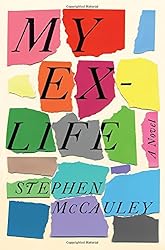

My Ex-Life
Stephen McCauley, 2018
Flatiron Books
336 pp.
ISBN-13: 9781250122438
Summary
David Hedges’s life is coming apart at the seams.
His job helping San Francisco rich kids get into the colleges of their (parents’) choice is exasperating; his younger boyfriend has left him; and the beloved carriage house he rents is being sold. His solace is a Thai takeout joint that delivers 24/7.
The last person he expects to hear from is Julie Fiske. It’s been decades since they’ve spoken, and he’s relieved to hear she’s recovered from her brief, misguided first marriage. To him.
Julie definitely doesn’t have a problem with marijuana (she’s given it up completely, so it doesn’t matter if she gets stoned almost daily) and the Airbnb she’s running out of her seaside house north of Boston is neither shabby nor illegal
And she has two whole months to come up with the money to buy said house from her second husband before their divorce is finalized. She’d just like David’s help organizing college plans for her 17-year-old daughter.
That would be Mandy. To quote Barry Manilow, Oh Mandy. While she knows she’s smarter than most of the kids in her school, she can’t figure out why she’s making so many incredibly dumb and increasingly dangerous choices?
When David flies east, they find themselves living under the same roof (one David needs to repair). David and Julie pick up exactly where they left off thirty years ago—they’re still best friends who can finish each other’s sentences.
But there’s one broken bit between them that no amount of home renovations will fix.
In prose filled with hilarious and heartbreakingly accurate one-liners, Stephen McCauley has written a novel that examines how we define home, family, and love. Be prepared to laugh, shed a few tears, and have thoughts of your own ex-life triggered. (Throw pillows optional.) (From the publisher.)
Author Bio
• Birth—June 26, 1955
• Raised—near Boston, Massachusetts, USA
• Education—B,A., University of Vermont; M.F.A., Columbia University
• Awards—Chevalier of the Order of Arts and Letters (France)
• Currently—lives near Boston, Massachusetts
Stephen McCauley is the American author of several novels, three of which have been adapted into film: one American and two French.
Life and career
McCauley was raised outside of Boston and went to public schools for his education. As an undergraduate, he attended the University of Vermont and then spent a year in France at the University of Nice.
McCauley worked a series of unrelated jobs including teaching yoga, working at a hotel, a kindergarten, and manning an ice cream stand. He worked as a travel agent for many years before moving to Brooklyn in the 1980s. There he attended adult learning centers to take some writing classes before enrolling in Columbia University's writing program. The writer Stephen Koch gave him the idea to begin work on his first novel.
That first novel, The Object of My Affection was published in 1987 and became a Hollywood film starring Jennifer Aniston and Paul Rudd. Both his second and fouth novels were adapted into French films: The Easy Way Out, released in 1992, became L'Art de la fugue and True Enough, published in 2001, became La Verite ou Presque.
McCauley's stories, articles and reviews have appeared in Gay Community News, Bay Windows, Boston Phoenix, New York Times Book Review, Vogue, House & Garden, Details, Vanity Fair, Harper's, and Travel and Leisure, among others.
McCauley is an alumnus of the Ragdale Foundation.
Today, McCauley serves as the Co-Director of the Creative Writing program at Brandeis University. He is a Professor of the Practice of English Fiction. (From Wikipedia. Retrieved 5/9/2018.)
Book Reviews
An irresistible doozy of a plot. With My Ex-Life, a heartwarming comedy of manners about second chances and starting afresh, he has pretty much outdone himself…. McCauley fires off witticisms like a tennis ace practicing serves…. Warm but snappy, light but smart—and just plain enjoyable.
Helen McAlpin - NPR.org
Wickedly funny…. For all the idiosyncrasies of McCauley’s creations, it’s likely many readers will see aspects of their own lives reflected in these pages.
BookPage
Sweet-but-unsentimental paean to altruism and friendship that gets to the heart of people, be they nice or nasty.… A tender, strikingly ‘true’ story that is warm, clear, and nuanced.
Library Journal
(Starred review) McCauley delights with intimately, often hilariously observed characters and a winking wit that lets plenty of honest tenderness shine through. Readers will love spending time in these pages.
Booklist
When midlife woes descend, a long-divorced couple find their paths merging again.… As always, McCauley's effervescent prose is full of wit and wisdom on every topic.… A gin and tonic for the soul.
Kirkus Reviews
Discussion Questions
1. Did you read the book in print or on an e-reader? Did you listen to the audiobook? How might the experience of this novel have been different if you had chosen otherwise?
2. Which character was your favorite? Least favorite? Which character changed the most?
3.Who does “my”refer to in the title My Ex-Life?
4. In chapter 4, Mandy says “This was a bad idea and she knew it, but...she was pulled into it by an urge to find out what would happen that was stronger than the urge to listen to the voice telling her not to.” At times, Mandy and other characters seem to be acting out of step with their truest selves. Can you think of examples from the novel? What, if anything, sets them right? Do you see any parallels to your own life?
5. Julie’s neighbor Amira doesn’t hide her husband’s aim to take over the Fiske house to make a pool, while David’s flame, Kenneth, isn’t completely forthcoming about the Airbnb petition. And then there’s Renata and Mandy’s friend Lindsay. Would you rather have an honestly disloyal friend or a dishonestly loyal one? Who’s the best friend in the novel? Who is the worst?
6. McCauley has been praised for his (characters’) sometimes caustic witticisms, such as “Leonard doesn’t have friends. He has financial opportunities wearing socks.” (chapter 2) Did you have a favorite one-liner in this novel?
7. David reads E. F. Benson’s Mapp and Lucia novels aloud to Julie both in their past life and their current one, and the book means different things then and now, but illuminates both times equally. Are there any books that provide such a touchstone for you?
8. David seems to object to his student Nancy’s stretching of the truth for her college application essay, but Nancy’s mom, Janine, shrugs it off. Should the truth ever get in the way of a good story?
9. In chapter 18, David presents Mandy with three essay prompts to sharpen her college application. Pick one and answer it from your own experience. What do you think the novel’s answer to each questions is?
- Tell us about the relationship between you and your arch-nemesis, real or imagined.
- Dog and cat. Coffee and tea. Everyone knows there are two types of people in the world. What are they?
- What is Square One and can you really go back to it?
10. Do you agree with Julie’s decision not to tell David she was going to have an abortion? Did he have a right to know? Or did David cede that right by hiding his own secret from Julie?
11. Toward the end of the novel, in chapter40, David and Julie have a long-deferred reckoning on the stairs. What do you think has greater power, the said or the unsaid? Does timing matter?
12. How has Mandy’s life changed as a result of what happened with Craig Crespo? Will she be able to get beyond it?
13. Does David save Julie or does Julie save David? Neither? Both?
14. “All couples start off as Romeo and Juliet and end up as Laurel and Hardy.” (chapter 25) True or false?
15. We can always deceive ourselves better than others can deceive us. Do you agree? What might the novel argue? (Consider: David’s sexual orientation; Julie’s marijuana habit; etc.)
16. In the past, McCauley has said he’s fascinated by the idea of chosen (as opposed to birth) families. Which family in the novel strikes you as most true? What might your answer say about the family in our times?
(Questions issued by the publisher.)


My Father's Daughter, From Rome to Sicily
Gilda Morina Syverson, 2014
Divine Phoenix and Pegasus Books
277 pp.
ISBN-13: 9781941859100
Summary
In this multigenerational memoir, My Father's Daughter, From Rome to Sicily, Gilda Morina Syverson travels with her Italian-born father, Italian-American mother, and very-American husband to the villages of her ancestors. This trilogy tale leads the reader through ancient sites of Rome, landscapes of a picturesque countryside, seaside villages of Sicily, olive trees in the valley of Mount Etna, while contrasting an emotional journey between a father and daughter.
Former North Carolina Poet Laureate, Joseph Bathanti, says, My Father's Daughter, From Rome to Sicily, is a travel book in every sense. Syverson—a savvy, funny, elegant tour guide—expertly escorts us through the gorgeous time-locked terrain of Italy, but also along the often precarious byways of the heart. This book risks everything: its humanity, its courage, its sheer unbridled candor, the moving sweep of its poetic language and its refusal to turn away from the breathtaking mystery of love and ancestry."
William Martin, New York Times bestselling author of Cape Cod and The Lincoln Letter says, "Travel south from Rome with Gilda Morina Syverson. Let her show you her ancestral land through the eyes of her closest ancestors, her parents, who travel with her and her husband. It's a trip well worth taking...vividly observed, richly detailed, gently humorous, and deeply poignant. The only thing better would be a trip to Italy."
This Novello Literary Award Finalist exudes passion, eloquence, heartfelt language, and ancestral roots. With love, humor, angst and a quest to uncover a heritage, our author is about to experience the journey of a lifetime.
Author Bio
• Birth—February 25, 1949
• Where—Syracuse, New York, USA
• Education—B.S., State University of New York College, Buffalo; M.F.A., Southern Illinois University
• Currently—lives in Cornelius, North Carolina
Gilda Morina Syverson, artist, poet, writer and teacher, was born and raised in a large, Italian-American family in Upstate, New York. Her heritage is the impetus for her memoir, My Father's Daughter, From Rome to Sicily.
Syverson's award winning poems and prose have appeared in literary journals, magazines and anthologies in the United States and Canada. Her writing has been published in Conspicuous Accents, Accenti Magazine’s Finest Stories of the First 10 Years, Italian Americana, Sweet Lemons 1 & 2, International Writings with a Sicilian Accent, Descant, Philadelphia Poets, Charlotte Viewpoint, Cold Mountain Review, VIA (Voices In Italian Americana), Main Street Rag, Iodine Poetry Journal, among others.
Gilda is also the author of the full-length poetry book, Facing the Dragon, and the chapbook, In This Dream Everything Remains Inside. Her commentaries have been aired on WFAE, Charlotte, N.C.’s public radio station.
Gilda has taught in the Creative Arts for over 35 years and is a long-time memoir instructor, including 15 years at Queens University of Charlotte. Her fine art has been exhibited regionally, nationally and internationally. Her angel drawings and prints are in a number of collections throughout the United States, Canada and Italy. (From the author.)
Visit the author's website.
Follow Gilda on Facebook.
Book Reviews
Dannye Romine Powell - Charlotte Observer, Raleigh News & Observer
Thanks to a note from Susan Walker, a fellow Antiquity resident, Around Davidson learned of Gilda’s many talents, not the least of which is her newly published memoir, My Father’s Daughter: From Rome to Sicily, published by Divine Phoenix in conjunction with Pegasus Books. Gilda’s story was a Novello Literary Award Finalist and for the first 5 weeks after its release in December of 2014, it was on Amazon’s No. 1 Hot Best Releases for Sicily Tour Guides.
Brenda Barger - Around Davidson, Davidsonnews.net
To read this book is to know that the places we’ve lived, the places we’ve known, the places and people we come from stick with us in ways we don’t always understand. [Syverson's] work is the stuff of houses and homes and the fixtures they contain, a mapping of experience and how we share it, a way of, as Syverson herself has put it in her poetry, "seeking our own kind" from wherever we happen to be. (From Introduction at Southern Recitations.)
Bryce Emley - Raleigh Review
Syverson’s latest creative work, a Novello Literary Award Finalist, is her book, My Father’s Daughter, From Rome to Sicily. The idea for the book started when Syverson and her husband traveled with her elderly parents to Italy. "I never imagined in a million years I’d go there," she said …"When I came back from Italy, all that was on my mind was the trip. I went to a writer’s group, brought in essays and poems I’d written, and all I could think about was I had to get this story down...."
Lisa Daidone - Charlotte Observer
Discussion Questions
1. As the reader sits alongside our author on the cross-Atlantic flight to Rome, what emotions are evident? What does this adventure of a lifetime potentially entail?
2. Some of Gilda's strengths as well as her challenges came from a more traditional Italian-Catholic upbringing. Were you raised in a culture that did not always fit the new beliefs that you discovered on your life's path?
3. When Gilda sits in St. Peter's piazza, she has glimpses of appreciation for her religious upbringing, despite her feminist leanings. Are there aspects of your spiritual upbringing, or lack of one, that give you strength despite the differences you may now have as an adult?
4. For years, our author had asked her father to travel to his hometown roots, in Sicily. Has there been any country or part of the world associated with your own heritage that you've had a desire to visit? Is there anything about your past that you would like to discover?
5. A psychic once told Gilda that, in a past life, she lived as an ancient, aristocratic woman in Rome. Is there a city, country or certain area of the world that you have a yearning to visit, even if you have no idea what is calling you there?
6. On the train from Rome to Sicily, Gilda, her parents, and her husband find themselves in a compartment with a German couple. Watching them, Gilda feels that there are cultural differences. Have there been times in your life where you have encountered someone speaking another language or participating in a tradition foreign to you? How did it make you feel? How did you respond?
7. On the ferry from the mainland of Italy over to Messina, Sicily, Gilda is aware of a quiet that overcomes both her parents—especially her father, when he sees his homeland again after 30 years. Is this silence in any way an indication of what may lie ahead as they step onto the island of Sicily? What kind of mood do you find yourself in when you're about to step into a new place, or step back to an old one?
8. When all four travelers arrive in the small town of Gualtieri Sicaminò, the cousins—who haven't seen Gilda's father in decades—receive them with open arms. How do we, as a culture, receive unexpected guests that knock at our doors? Have you ever shown up at someone's door and realized, Uh-oh, I should have called first?
9. When Gilda's father says good-bye to his cousins, Pasqua and then Pasqualino—probably for the last time—the feelings expressed by those present run a gamut of emotions. What is it like for you to say goodbye to a close friend or relative, a child who is leaving home for the first time, or a parent or partner who is dying?
10. When our travelers leave Linguaglossa, Gilda's mother mentions that there were still things that she wished she could have seen or found. Are there questions that Gilda's mother had that you still want to know about? If you are a mother or grandmother, what wisdom do you want to impart?
11. Both Gilda's parents had a chance to say farewell to their regions—her mother, when standing in the ancient ruins of Taormina, and her father, when on the ferryboat from Messina back to the mainland. This pivotal scene provides the backdrop for us to ponder our family roots and travel adventures. Share any thoughts that surface from reading about this experience.
12. Back in Rome, Gilda's father wanted to see the balcony where Mussolini, while still in power during World War II, addressed Italy. Are there any historical figures—positive or negative—you would like to meet or see in action?
13. How do you think Gilda and her father's relationship changed over the course of the trip, from the United States through Rome, Italy, Sicily and back home?
(Questions courtesy of the author.)


My Grandmother Asked Me to Tell You She's Sorry
Fredrik Backman, 2013 (U.S., 2015)
Washington Square Books
384 pp.
ISBN-13: 9781501115073
Summary
Elsa is seven years old and different. Her grandmother is seventy-seven years old and crazy—as in standing-on-the-balcony-firing-paintball-guns-at-strangers crazy.
She is also Elsa’s best, and only, friend. At night Elsa takes refuge in her grandmother’s stories, in the Land-of-Almost-Awake and the Kingdom of Miamas, where everybody is different and nobody needs to be normal.
When Elsa’s grandmother dies and leaves behind a series of letters apologizing to people she has wronged, Elsa’s greatest adventure begins. Her grandmother’s instructions lead her to an apartment building full of drunks, monsters, attack dogs, and old crones but also to the truth about fairy tales and kingdoms and a grandmother like no other.
My Grandmother Asked Me to Tell You She’s Sorry is told with the same comic accuracy and beating heart as Fredrik Backman’s bestselling debut novel, A Man Called Ove. It is a story about life and death and one of the most important human rights: the right to be different. (From the publisher.)
Author Bio
• Birth—June 2, 1981
• Raised—Helsingborg, Sweden
• Education—no degree
• Currently—Stockholm
Fredrik Backman, Swedish author, journalist, and blogger, was voted Sweden's most successful author in 2013.
Backman grew up in Helsingborg, studied comparative religion but dropped out and became a truck driver instead. When the free newspaper Xtra was launched in 2006, the owner reached out to Backman, then still a truck driver, to write for the paper. After a test article, he continued to write columns for Xtra
In spring 2007, he began writing for Moore Magazine in Stockholm, a year-and-a-half later he began freelancing, and in 2012 he became a writer for the Metro. About his move to writing, Backman said...
I write things. Before I did that I had a real job, but then I happened to come across some information saying there were people out there willing to pay people just to write things about other people, and I thought "surely this must be better than working." And it was, it really was. Not to mention the fact that I can sit down for a living now, which has been great for my major interest in cheese-eating. (From his literary agent's website.)
Backman married in 2009 and became a father the following year. He blogged about preparations for his wedding in "The Wedding Blog" and about becoming a father on "Someone's Dad" blog. During the 2010 Winter Olympics, he wrote the Olympic blog for the Magazine Cafe website and has continued as a permanent blogger for the site.
In 2012, Backman debuted as an author, publishing two books on the same day: a novel, A Man Called Ove (U.S. release in 2014), and a work of nonfiction, Things My Son Needs to Know About the World. His second novel, My Grandmother Sent Me to Tell You She's Sorry, came out in 2013 (U.S. release in 2015). (Adapted from Wikipedia and the publisher. Retrieved 7/23/2014.)
Book Reviews
Fredrik Backman has a knack for weaving tales that are believable and fanciful. Backman’s smooth storytelling infuses his characters with charm and wit… a delightful story.
St. Louis Dispatch
Bring tissues when you start My Grandmother Asked Me to Tell You She’s Sorry, but bring your funnybone, too. It’s that kind of book – one that, if you miss it, you’ll never forgive yourself.
Business Insider
In his second offering, Backman (A Man Called Ove) continues to write with the same whimsical charm and warm heart as in his debut. Though it’s certainly entertaining, Elsa’s narrative—with several subplots to juggle and an overabundance of quirkiness—doesn’t succeed quite as well as Backman’s previous work. Still, fans of the author will find more to like here.
Publishers Weekly
Full of heart, hope, forgiveness, and the embracing of differences, Elsa’s story is one that sticks with you long after you’ve turned the last page.
Library Journal
(Starred review.) [P]recocious Elsa will easily work her way into the hearts of readers who like characters with spunk to spare. A delectable homage to the power of stories to comfort and heal, Backman’s tender tale of the touching relationship between a grandmother and granddaughter is a tribute to the everlasting bonds of deep family ties.
Booklist
A contemporary fairy tale from the whimsical author of A Man Called Ove.... This is a more complex tale than Backman’s debut, and it is intricately, if not impeccably, woven.... [with] heartfelt, innocent observations.... [T]here are clear themes here, nominally: the importance of stories; the honesty of children; and the obtuseness of most adults,
Kirkus Reviews
Discussion Questions
1. My Grandmother Asked Me to Tell You She’s Sorry begins with the pronouncement, "Every seven-year-old deserves a superhero." (page 1) Do you agree? Why is it so important that children have heroes? Who were your heroes when you were a child?
2. Names play a significant part in Elsa’s grandmother’s stories. How do the various kingdom and heroine names from the Land-of-Almost-Awake (Miamas, Miploris, Mimovas, Wolfheart, the Chosen One, the sea-angel, etc.) inform your understanding of Granny’s stories? Did you agree with how their real world counterparts were portrayed in the stories?
3. Elsa’s mother grew up in a nontraditional family environment. Do you think this influenced her parenting style with Elsa? In what ways?
4. Were you surprised by the ways in which each of the apartment tenants were connected to the others? Which relationship surprised you the most? Why?
5. Granny is a polarizing figure in My Grandmother Asked Me to Tell You She’s Sorry. Describe the way each of the characters reacts to her. Do you think their opinions of her are justified? Why or why not? What did you think of Granny? Do you know anyone like her?
6. Discuss the role that books, especially the Harry Potter novels, play in Elsa’s life. Why do you think Elsa relates to the Harry Potter books more than other novels? When you were growing up, were there books you particularly loved? Which ones and why?
7. What did you think of Britt-Marie when you first encountered her? Did she remind you of anyone in your life? Where do you think Britt-Marie goes at the end of the novel?
8. Elsa believes that her "teachers are wrong. [She] has no problems concentrating. She just concentrates on the right things." (page 47) What kinds of things does Elsa concentrate on? How does this create problems for her? Do you think that Elsa is a good student? Why or why not?
9. Which of the characters in My Grandmother Asked Me to Tell You She’s Sorry surprised you the most? Why?
10. Discuss Britt-Marie’s marriage to Kent. Did you think they were well suited for each other? Do you think the marriage changed Britt-Marie? How can being in a bad relationship affect someone’s personality?
11. Fairy tales can provide a way to teach children some fundamental truths about the world. How do Granny’s fairy tales help Elsa understand the world around her? What lessons does Elsa take away from the tales her Granny tells her about life in the land of Miamas?
12. When her grandmother dies, Elsa is of course sad, but she also experiences a wide range of other emotions, including anger. Can you name some of the others? Consider how the loss of a loved one can lead us to have feelings that are much more complicated than sadness.
13. In this book, as in his previous novel A Man Called Ove, Fredrik Backman paints a vivid portrait of the relationship between an older person nearing the end of his or her life, and a young child. What can people at the opposite ends of life learn from one another? How are the very old and the very young alike? How are they different? When you were very young, was there an elderly person who played a significant role in your life? What did you learn from them?
(Questions issued by the publisher.)
My Latest Grievance
Elinor Lipman, 2006
Houghton Mifflin Harcourt
256 pp.
ISBN-13: 9780618872350
Summary
My Latest Grievance introduces us to Frederica Hatch. Sixteen years old and accustomed to being the center of attention, Frederica has been raised in a dorm on the campus of Dewing, a women's college just outside Boston. It's 1978, and her parents are intensely PC (before the term was coined)—two bleeding hearts that beat as one. Aviva Ginsburg Hatch is a union grievance commitee chairperson and perennial professor of the year, and, to Frederica's frustration, she's the only mother around who doesn't own a jewelry box and makeup. Frederica's father, David Hatch, shares his wife's political passions and agrees with her about almost everything. Chafing under the care of the "most annoyingly evenhanded parental team in the history of civilization," Frederica is starting to feel that her life is stiflingly snug.
But then Frederica's path crosses that of the glamorous new dorm mother at Dewing, Laura Lee French, the antithesis of the Hatches. And with Laura Lee comes the best gossip in the history of the college—she is David Hatch's ex-wife. When Frederica learns the surprising news, she can't stop imagining the maternal road not taken, wondering if she was born into the wrong side of the divorce. Fearing scandal, the three Hatches and Laura Lee are forced to keep their history a secret, and havoc and hilarity ensue. The New York Times Book Review compared Lipman to "an inspired alchemist," and the magic continues with My Latest Grievance. (From the publisher.)
Author Bio
• Birth—October 16, 1950
• Where—Lowell, Massachusetts, USA
• Education—A.B. Simmons College
• Awards—New England Books Award For Fiction
• Currently—lives in North Hampton, Massachusetts, and New York, New York
Elinor Lipman is an American novelist, short story writer, and essayist, known for her humor and societal observations. In his review of her 2019 novel, Good Riddance, Sam Sacks of the Wall Street Journal wrote that Lipman "has long been one of our wittiest chroniclers of modern-day romance."
The author was born and raised in Lowell, Massachusetts. She graduated from Simmons College in Boston where she studied journalism. While at Simon, Lipman began her writing career, working as a college intern with the Lowell Sun. Throughout the rest of the 1970s, she wrote press releases for WGBH, Boston's public radio station.
Writing
Lipman turned to fiction writing in 1979; her first short story, "Catering," was published in Yankee Magazine. In 1987 she published a volume of stories, Into Love and Out Again, and in 1990 she came out with her first novel, Then She Found Me. Her second novel, The Inn at Lake Devine, appeared in 1998, earning Lipman the 2001 New England Book Award three years later.
Lipman's first novel, Then She Found Me, was adapted into a 2008 feature film—directed by and starring Helen Hunt, along with Bette Midler, Colin Firth, and Matthew Broderick.
In addition to her fiction, Lipman released a 2012 book of rhyming political tweets, Tweet Land of Liberty: Irreverent Rhymes from the Political Circus. Two other books—a 10th novel, The View from Penthouse B, and a collection of essays, I Can't Complain: (all too) Personal Essays—were both published in 2013. The latter deals in part with the death of her husband at age 60. A knitting devotee, Lipman's poem, "I Bought This Pattern Book Last Spring," was included in the 2013 anthology Knitting Yarns: Writers on Knitting.
Lipman was the Elizabeth Drew Professor of Creative Writing at Smith College from 2011-12, and she continues to write the column, "I Might Complain," for Parade.com. Smith spends her time between North Hampton, Massachusetts, and New York City.
Works
1988 - Into Love and Out Again: Stories
1990 - Then She Found Me
1992 - The Way Men Act
1995 - Isabel's Bed
1998 - The Inn at Lake Devine
1999 - The Ladies' Man
2001 - The Dearly Departed
2003 - The Pursuit of Alice Thrift
2006 - My Latest Grievance
2009 - The Family Man
2012 - Tweet Land of Liberty: Irreverent Rhymes from the Political Circus
2013 - I Can't Complain: (All Too) Personal Essays
2013 - The View From Penthouse B
2017 - On Turpentine Lane
2019 - Good Riddance
(Author bio adapted from Wikipedia. Retrieved 2/27/2019.)
Book Reviews
A lovable, psychologically intricate novel.... As Lipman's bittersweet farce unfolds, she uncovers a family romance of an unusual kind, delving into the stories parents tell each other about child-rearing—and the stories children tell themselves about parenting. Digging still deeper, her spade hits something hard. What is the root that links the parents? How solid is the bond joining one parent to another, and both parents to their daughter? Lovable, psychologically intricate...
Janet Maslin - New York Times
May be Lipman's best work so far.... Every page offers laugh-out-loud dialogue.... So entertaining you're sorry to see it end.
Seattle Times
Frederica Hatch—the articulate, curious, and naive narrator of Lipman's eighth novel—proves the perfect vehicle for this satiric yet compassionate family portrait. It's 1976, and psych professors David and Aviva Hatch are honest with their daughter to the point of anatomically correcting Frederica's Barbie dolls. In all their years as a dorm family at a small women's college outside Boston, though, no one mentioned Laura Lee French, David's first wife (and distant cousin). Frederica, now 15 and ready for rebellion, delights in Laura's arrival on campus as a new dorm mother; David and Aviva look on nervously as the two become fast friends. In contrast with Frederica's right-thinking, '60s radical parents, Laura Lee becomes the delicious embodiment of all the moral and psychological complexities of a flawed world beyond campus. Meanwhile, campus itself looks very little like an ivory tower as major scandal brews amid petty gossip. As in previous novels, Lipman addresses sensitive issues (anti-Semitism, adultery, dementia) with delicacy and acerbity. She also nails the shifts and moods of an angry teenager, a grandmother in denial, a philanderer in hiding and a campus in shock. By the end, a smart young girl learns compassion for a world that can be grotesquely, hilariously, disturbingly unfair.
Publishers Weekly
In the late 1970s, Frederica Hatch is the enchantingly outspoken daughter of brilliant college professors at a minor all-girls college in Massachusetts. Her temperate, mildly eccentric, and lovely parents, also union activists for the faculty of Dewing College, serve as houseparents at one of the dorms, where Frederica has lived her whole life. Wise beyond her years, Frederica takes it in stride when she discovers that her father was married once before and that Laura Lee French, the smashingly solipsistic first wife of Dr. David Hatch, has just been hired as housemother of one of the other dorms. Within hours of her arrival, French seduces the new president of Dewing in a flagrant affair that provides rich fuel for Frederica's hilariously dry wit and searing analysis of adult foibles. Lipman (The Pursuit of Alice Thrift) creates that rare blend of no-nonsense compassion and believable, offbeat innocence that is completely irresistible. Expect demand for this novel and renewed interest in Lipman's previous seven. Highly recommended.
Library Journal
All hell breaks loose when a new dorm mother arrives at a second-rate New England girl's college in Lipman's eighth romantic comedy (The Pursuit of Alice Thrift, 2003, etc). In 1977, 16-year-old narrator Frederica Hatch lives on the campus of Dewing College with her mother and father, David and Aviva, who serve as houseparents as well as professors of psychology and sociology. Frederica's only friend on campus, sort of, is Marietta Woodbury, daughter of Dewing's new president; the girls have formed an uneasy relationship encouraged by Mrs. Woodbury, who gives Frederica rides to the public high school they both attend. David and Aviva are stereotypical academics: dowdy, painstakingly rational, and committed to liberal causes, particularly those related to employee-management relations on campus. So their daughter is shocked to discover that David was previously married to his distant cousin, Laura Lee French, whom he left for Aviva, his soulmate. Thanks to Frederica's conveniently (if unconvincingly) interfering grandmother, Laura Lee takes a job at Dewing as a dorm mother. Frederica, already chafing at being raised as a kind of college mascot, is initially enchanted by the new arrival's flamboyant style, but Laura Lee is clearly a troublemaker, if not a sociopath. She enjoys making David and especially Aviva uncomfortable. After Frederica introduces her to the college president (in the cafeteria, where the Hatches eat all their meals), Laura Lee and Dr. Woodbury carry on a brazenly open affair, which so humiliates his wife that she attempts suicide by carbon-monoxide poisoning. She survives, but with brain damage—a decidedly unfunny situation for a supposedly comic novel. Lipman ties up the rest of the plot in typical sprightly fashion: David becomes college president; Laura Lee has a baby who grows up to be a delight; Frederica returns to work at Dewing as an adult. It's as though Mrs. Woodbury's ruined life is just a minor contrivance. Not one of this popular author's best.
Kirkus Reviews
Discussion Questions
1. The book is narrated by the adult Frederica Hatch as she looks back at a tumultuous teenage year. Does the author make the combined sensibility—age sixteen viewed through the eyes of the narrator's present self—work?
2. Why do you think the author made Dewing a lackluster institution rather than a top-notch college?
3. Frederica asks on page 1, "Were they types, my parents-to-be? From a distance and for a long time, it appeared to be so." Does this serve as a warning? A prediction? A wink from the author? An apology?
4. Laura Lee French's ex-husband is a distant cousin. Would the story have unfolded in the same way if she had not been a relative?
5. Marietta Woodbury and her mother are rude to Laura Lee upon first speaking to her on campus. Did this meeting resonate with you and signal trouble ahead?
6. The affair between Laura Lee and President Woodbury is anything but discreet. Did their public carrying on amuse or offend you?
7. The professors Hatch are passionately committed to righting wrongs and to each other. In what ways do they let their daughter down?
8. What turning point triggers Frederica's more sympathetic and respectful view of her parents?
9. One could say that the Blizzard of '78 is a character in My Latest Grievance. Did the author succeed in conveying the power of that historic storm and effectively put you there?
10. Did you find any character less than fully developed? What else did you want to know about him or her?
11. Laura Lee French, narcissist extraordinaire: is it possible to feel sympathy for this character?
12. Chapter 33, "Emeriti," the epilogue, brings the reader to the present. How well does the jump forward in time wrap up the story?
(Questions issued by publisher.)
top of page
My Mistress's Sparrow is Dead: Great Love Stories, from Chekhov to Munro
Jeffrey Eugenides, Ed., 2008
HarperCollins
608 pp.
ISBN-13: 9780061240386
Summary
"When it comes to love, there are a million theories to explain it. But when it comes to love stories, things are simpler. A love story can never be about full possession. Love stories depend on disappointment, on unequal births and feuding families, on matrimonial boredom and at least one cold heart. Love stories, nearly without exception, give love a bad name.... It is perhaps only in reading a love story (or in writing one) that we can simultaneously partake of the ecstasy and agony of being in love without paying a crippling emotional price. I offer this book, then, as a cure for lovesickness and an antidote to adultery. Read these love stories in the safety of your single bed. Let everybody else suffer."—Jeffrey Eugenides, from the introduction to My Mistress's Sparrow Is Dead.
All proceeds from My Mistress's Sparrow Is Dead will go directly to fund the free youth writing programs offered by 826 Chicago. 826 Chicago is part of the network of seven writing centers across the United States affiliated with 826 National, a non-profit organization dedicated to supporting students ages 6 to 18 with their creative and expository writing skills, and to helping teachers inspire their students to write. (From the publisher.)
Author Bio
• Birth—March 8, 1960
• Where—Detroit, Michigan, USA
• Education—B.A., Brown University; M.A., Stanford
University
• Awards—Whiting Writer's Award; Guggenheim
Fellowship; Pulitzer Prize
• Currently—lives in Princeton, New Jersey
Jeffrey Kent Eugenides is an American Pulitzer Prize-winning novelist and short story writer. Eugenides is most known for his three acclaimed novels, The Virgin Suicides (1993), Middlesex (2002), and The Marriage Plot (2011).
Eugenides was born in Detroit, Michigan, of Greek and Irish descent. He attended Grosse Pointe's private University Liggett School. He took his undergraduate degree at Brown University, graduating in 1983. He later earned an M.A. in Creative Writing from Stanford University.
In 1986 he received the Academy of Motion Picture Arts and Sciences Nicholl Fellowship for his story "Here Comes Winston, Full of the Holy Spirit." His 1993 novel, The Virgin Suicides, gained mainstream interest with the 1999 film adaptation directed by Sofia Coppola. The novel was reissued in 2009.
Eugenides is reluctant to disclose details about his private life, except through Michigan-area book signings in which he details the influence of Detroit and his high-school experiences on his writings. He has said that he has "a perverse love" of his birthplace. "I think most of the major elements of American history are exemplified in Detroit, from the triumph of the automobile and the assembly line to the blight of racism, not to mention the music, Motown, the MC5, house, techno." He also says he has been haunted by the decline of Detroit.
He lives in Princeton, New Jersey, with his wife, Karen Yamauchi, and their daughter, Georgia. In the fall of 2007, Eugenides joined the faculty of Princeton University's Program in Creative Writing.
His 2002 novel, Middlesex, won the Pulitzer Prize for fiction and the Ambassador Book Award. Part of it was set in Berlin, Germany, where Eugenides lived from 1999 to 2004, but it was chiefly concerned with the Greek-American immigrant experience in the United States, against the rise and fall of Detroit. It explores the experience of the intersexed in the USA. Eugenides has also published short stories, primarily in The New Yorker. His 1996 "Baster" became the basis for the 2010 romantic comedy The Switch (with Jennifer Aniston and Jason Bateman).
His third novel, The Marriage Plot (2011), has been called by Carlin Romano in the Chronicle of Higher Education" the most entertaining campus novel since Wolfe's I Am Charlotte Simmons. The plot is based on graduation day at Brown University in 1982.
Eugenides is the editor of the collection of short stories titled My Mistress's Sparrow is Dead. The proceeds of the collection go to the writing center 826 Chicago, established to encourage young people's writing. (From Wikipedia.)
Book Reviews
When it comes to love," writes Jeffrey Eugenides in this wonderful, if upsetting, collection of stories, "there are a million theories to explain it. But when it comes to love stories, things are simpler. A love story can never be about full possession. The happy marriage, the requited love, the desire that never dims—these are lucky eventualities but they aren't love stories. Love stories depend on disappointment, on unequal births and feuding families, on matrimonial boredom and at least one cold heart. Love stories, nearly without exception, give love a bad name".... Though every reader will grouse about overlooked favorites...Eugenides has chosen splendid work.
Michael Dirda - Washington Post
Pulitzer Prize winner Eugenides (Middlesex) has assembled something quite extraordinary here: a fascinating, consistently compelling, and superbly edited collection of short stories about romantic love. Part of the collection's appeal is its range and depth: at 600 pages, it offers gems and new discoveries at every turn. Readers move, for example, from Harold Brodkey's bawdy tribute to young love and orgasm in "Innocence" to Alice Munro's sober study of an aging philanderer's late-blooming love for his ailing wife in "The Bear Came Over the Mountain." There are classic love stories, e.g., James Joyce's "The Dead" and Anton Chekhov's "The Lady with the Little Dog," as well as more experimental, contemporary tales, e.g., Lorrie Moore's self-help-styled "How To Be an Other Woman" and George Saunders's dizzying, futuristic A Clockwork Orange-inflected world of trendsetters and tastemakers in "Jon." Some of the best moments come from younger writers, who somehow manage to match the masters here step for step. An essential acquisition.
Patrick Sullivan - Library Journal
The sparrow in the title of this anthology was one prong of an inconvenient love triangle described by the Latin poet Gaius Catullus in 84 B.C. The pet bird belonged to a girl who was loved by the poet and, unfortunately, her own husband. The sparrow takes the brunt of the lover's displaced jealousy, until it dies, taking his girl's happiness along with it. According to author Jeffrey Eugenides, all love stories since have followed the same template: "there is either a sparrow or the sparrow is dead." Frequently in these 26 stories, that sparrow takes the form of an inconvenient spouse, though it becomes apparent that the sparrow's presence is what makes the song so sweet. William Trevor provides a glimpse of the ordinary happiness that eludes a pair of lovers who take the unorthodox path of making a workaday love out of an illicit one, while Lorrie Moore gives a welcome take from the perspective of the mistress herself ("When you were six you thought mistress meant to put your shoes on the wrong feet. Now you are older and know it can mean many things but essentially it means to put your shoes on the wrong feet"). The selection is well packed with classics—stories from Faulkner, Chekhov, Joyce, Nabokov, and Carver among them—which speaks for Eugenides' comprehensive scope but may feel remedial to some. Contemporary tales by Deborah Eisenberg, Denis Johnson, Miranda July, and others pack more surprise. Though all the entries illuminate the amatory state, none are much of an advertisement for its wholesome pleasures. Warns Eugenides: "Read these love stories in the safety of your own twin bed. Let everyone else suffer. —Amy Benfer
Barnes & Noble Review
Discussion Questions
Use our LitLovers Book Club Resources; they can help with discussions for any book:
• How to Discuss a Book (helpful discussion tips)
• Generic Discussion Questions—Fiction and Nonfiction
• Read-Think-Talk (a guided reading chart)
Also consider these LitLovers talking points to help get a discussion started for My Mistress's Sparrow is Dead:
Start with general questions:
1. Eugenides warns in his introduction that these stories aren't for the faint-of-heart—they end on sad, bittersweet notes. Of those stories you read, did the endings disappoint you? Choose one or two stories and talk about the mood and the endings.
2. Here is Eugenides' definition of love stories, which he has used to select the stories in this volume:
A love story can never be about full possession. The happy marriage, the requited love, the desire that never dims—these are eventualities but they aren't love stories. Love stories depend on disappointment, on unequal births and feuding families, on matrimonial boredom and at least one cold heart. Love stories, nearly without exception, give love a bad name.
Is his definition to somber for you, too narrow? Completely wrong?
3. Talk about the title of this collection, "My Mistress's Sparrow is Dead," from the Latin Poet Catullus. As Eugenides says, "In each of the twenty-six love stories, either there is a sparrow or the sparrow is dead." Can you identify the sparrow in the stories you've read...and determine whether it's alive or dead?
4. Which stories were your favorites...and why? Which were your least favorites...and why?
5. Don't be afraid to draw some comparisons among stories. For instance:
• "The Lady with the Dog" and "Spring in Fialta."
• Either of the above with "Moonlight in Flight" and "Lovers in Their Time."
• Perhaps the self-sacrifice of "Mouche" and "The Bear Came Over the Mountian."
• Perhaps the accusatory lovers in "The Hitchhiking Game" and "Tonka."
Questions on selected stories:
6. FIRST LOVE AND OTHER SORROWS
a). What is the significance of the story's title—why is "first love" a sorrow?
b). This story pits the head against heart, rationalism against emotion. Which wins out...and for whom? Which is ultimately more important in a relationship?
c) What do you predict for the marriage of the boy's sister and Sonny? Why does the sister agree to marry Sonny? Does she love him?
7. THE LADY WITH THE LITTLE DOG
a) Why does Gurov realize (or decide?) he loves Anna? Does he love her?
b) Given the last line: "the end was still far, far off, and that the most complicated and difficult part was just beginning," what do you predict for Gurov and Anna?
8. LOVE
a) Who is Dotty Wasserman...and what does she have to do with this story? Is she real...or a make-believe character in couple's life?
b) Notice the slippery role time plays in this story: characters recall the past—but there is also a reference to how the future plays out. Why is time so "slippery"...what has time to do with love?
9. A ROSE FOR EMILY
a) To what extent is the "we" of the community responsible for Miss Emily's demise?
b) Why did Emily poison Homer? Was she a cold-blooded murderess...or insane?
c) Talk about Faulkner's unusual timeline. See our LitCourse Study Guide for "Miss Emily."
10. THE DEAD
a) What is the significance of this title? Who/what is dead?
b) How would you describe Gabriel? After Gretta tells him the story of Michael Furey, Gabriel realizes that he "had never felt like that himself towards any woman but he knew that such a feeling must be love." Is Gabriel capable of any depth of feeling...for his country or for his wife?
11. THE HITCHHIKING GAME
a) Who is the young woman—what is her true personae:: the aggressively flirtatious "hitchhiker" or the shy woman at the beginning and end of the story? What about the young man— what is his real identity: promiscuous or faithful and loving?
12. MOUCHE
a) Is "Mouche," the boaters' name for the young woman, meant to be derogatory or affectionate or playful or...what?
b) N'a Qu-un Oeil, "who perhaps loved her more than any of us" agrees to share Mouche with all the others to give her another baby. All agree and exclaim, "Honest." What do you think of the agreement?
c) Notice that this is a story within a story, in which the narrator, an older man reminiscing, may be pulling the reader's leg. Consider how that might affect the meaning of the story's last word.
13. LOVERS OF THEIR TIME
a) Why does Norman wonder at the beginning of this story whether his and Marie's affair could have happened "at any other time except the 1960's"? What is the significance of that decade?
b) Could he and Marie have had a future...or was their love inevitably doomed—as much, say, as Anna Karenina's?
14. THE MOON IN FLIGHT
a) In what way does the narrator intrude in this story? What tone is used—is it sincere, ironic, sarcastic...? And why might the author have invented such a narrator? The narrator seems to be playing with the entire convention of storytelling: we could do this for the couple...we could do that for them.
b) What is the last line about—"art cannot rescue anybody from anything?" Or is this story just too hard to understand?
15. SPRINGTIME IN FIALTA
a) We learn early on (third page) that this will be the last time the narrator will meet Nina: "for I cannot imagine" fate consenting t "a meeting with her beyond the grave." How does that knowledge color your reading of the entire story?
b) The narrator admits that through his constant meetings with Nina, he "grew more and more apprehensive...because some-thing lovely, delicate, and unrepeatable was being wasted: something which I abused by...neglecting the modest but true core which perhaps it kept offering me in a pitiful whisper." He rationalizes that "any practical chance of life together with Nina.... was absurd" (p. 245). Was Nina, in fact, "offering" something? Was she in love with our narrator?
16. HOW TO BE AN OTHER WOMAN
a) The 2nd-person perspective "you" is quite unusual in fiction. Why does Lorrie Moore use it...what effect is she hoping to achieve...and is she successful?
b) Notice the title: Moore doesn't use the typical "the" other woman...or "another" woman, but "an other" woman. Any ideas?
c) Really, in the end, does the lover's surprise revelation make any difference? He's already proved himself dishonest. Why was that the breaking point?
17. YOURS
a) Why are these two people, of such differing ages, together?
b) What does the "yours" of the title ultimately mean?
18. TONKA
a) Was Tonka not good enough—or too good—for the narrator of this story? Was the baby his...or was Tonka unfaithful?
b) What does the narrator come to learn in the last three paragraphs of the story? What is "the bandage that had blindfolded him" refer to? And how did it make him "better than other people"—that "small warm shadow that had fallen across his brilliant life"?
19. RED ROSE, WHITE ROSE
a) Is there anyone you like in this story?!
b) What is the significance of the yellow slippers at the end? Why does Zhenbao reform? And what does "reform" mean? Does he come to love with Yanli? What is her future?
20. FIREWORKS
a) This story starts and ends with fireworks...of very different kinds. How do they differ...and what is their meaning to the story, especially given the story's title?
b) What is the significance of the collect phone call from Jeff? Later, Starling wishes he had accepted the call. Why...what do you think?
21. WHAT WE TALK ABOUT WHEN WE TALK ABOUT LOVE
a) Did Terri's first husband "love" her as she insists, even though he tried to kill her? What does it mean to love someone?
b) Is Mel right—that love is absolute? If so, then as Mel wonders, how can you love one person...then come to hate that person...and fall in love with another?
22. THE BEAR CAME OVER THE MOUNTAIN
a) What is the magnificent central irony of this story?
b) What does the title mean in the context of the story?
(Questions by LitLovers. Please feel free to use them, online or off, with attribution. Thanks.)
top of page (summary)


My Mrs. Brown
William Norwich, 2016
Simon & Schuster
304 pp.
ISBN-13: 9781442386075
Summary
From William Norwich, the well-known fashion writer and editor, an unforgettable novel about a woman with a secret who travels to New York City on a determined quest to buy a special dress that represents everything she wants to say about that secret…and herself.
Sometimes a dress isn’t just a dress.
Emilia Brown is a woman of a certain age. She has spent a frugal, useful, and wholly restrained life in Ashville, a small town in Rhode Island.
Overlooked especially by the industries of fashion and media, Mrs. Brown is one of today’s silent generations of women whose quiet no-frills existences would make them seem invisible.
She is a genteel woman who has known her share of personal sorrows and quietly carried on, who makes a modest living cleaning and running errands at the local beauty parlor, who delights in evening chats with her much younger neighbor, twenty-three-year-old Alice Danvers.
When the grand dame of Ashville passes away, Mrs. Brown is called upon to inventory her estate and comes across a dress that changes everything. This isn’t a Cinderella confection; it’s a simple yet exquisitely tailored Oscar de la Renta sheath and jacket—a suit that Mrs. Brown realizes, with startling clarity, will say everything she has ever wished to convey.
She must have it.
And so Mrs. Brown begins her odyssey to purchase the dress. For not only is the owning of the Oscar de la Renta a must, the intimidating trip to purchase it on Madison Avenue is essential as well. If the dress is to give Mrs. Brown a voice, then she must prepare by making the daunting journey—both to the emerald city and within herself.
Timeless, poignant, and appealing, My Mrs. Brown is a novel for every mother in the world, every woman who ever wanted the perfect dress, and every child who wanted to give it to her. (From the publisher.)
Author Bio
• Birth—ca. 1955-56
• Where—Norwich, Connecticut, USA
• Education—B.A., Hampshire College; M.F.A., Columbia University
• Currently—lives in New York City, New York
William Norwich is a writer, editor, and video and television reporter. He is the author of the novels My Mrs. Brown (2016) and Learning to Drive (1996), as well as the children’s book Molly and the Magic Dress (2006).
Norwich was born William Goldberg in Norwich, Connecticut. He changed his name after an article proposal he submitted to a magazine was rejected. He resubmitted it, this time under the WASPy sounding nom de plume, William Norwich, and it was accepted. "So," he said, "we changed our name. I became William Norwich from Goldberg, Connecticut."
Norwich earned his Bachelor's from Hampshire College and after graduation briefly taught grade school. He then enrolled at Columbia University, earning an MFA. Although he wanted to be a poet, he ended up working in New York City—first in public relations, then writing profiles for Earl Blackwell's Celebrity Register, and eventually, in 1985, as a protege to famed celebrity columnist Suzy Smith at the Daily News.
Over the years, he has written and edited for the New York Times Magazine, Vogue, Town & Country, Architectural Digest, and New York magazine. He is currently the editor for fashion and interior design at Phaidon Press. (Adapted from New York magazine and from the publisher.)
Book Reviews
Modest, mannerly, and well-behaved Mrs. Emilia Brown is a widow of a certain age. She lives in small town Rhode Island, owns her own home and rents out half of it. She also works as the cleaner at a beauty shop and tends to dress in shades of brown and gray. How then, does this quiet soul end up zooming around Manhattan in a red Mercedes convertible? Don’t worry, she is not driving the car! She has never been to the city before and wouldn’t know how to cope with the traffic. But she is there on a mission. READ MORE.
Keddy Ann Outlaw - LitLovers
Meet a delightfully old-fashioned heroine in My Mrs. Brown…Even if you find Mrs. Brown anachronistic, with a gentle conservatism of an age long-gone, you come to like and respect her. Then, you come to love her…Goodness really is its own reward, says Norwich’s gentle-hearted book. Better yet, sometimes goodness is rewarded.
BookPage
An unassuming yet magnetic older woman becomes possessed by the notion of acquiring an Oscar de la Renta dress.... What remains a mystery until the very end of the novel is the occasion for which she needs such a thing.... Like its main character, appealing, sweet, old-fashioned—and, at heart, very sad.
Kirkus Reviews
Discussion Questions
We'll add the publisher's questions if and when they're available. In the meantime, use these LitLovers talking points to kick off a discussion for My Mrs. Brown...then take off on your own:
1. In what ways would you say Mrs. Brown is an anachronism in today's world? Do you know anyone like her?
2. In what way can this book be described as a modern fable? Or...a fairy tale (minus the fairies)?
3. What is it about the black dress that makes Mrs. Brown "have to have it"? Have you ever encountered something—a dress or other object—that completely captivated you?
4. Did you figure out (or suspect) the reason Emilia desires the dress? Or were you surprised?
5. Of all the kind souls who aid Mrs. Brown in her quest, who is your favorite and why? Who is the most important in helping her?
6. Here is what author William Norwich says he wants his take away to be for My Mrs. Brown:
...that being an American grown-up is actually an honorable thing, that balance is OK, that loneliness is inevitable and that underneath the superficial there is a life for all people. And it’s not going to be what you see or what they say. Quiet people are the ones you want to love and know. Quietude is good after all the noise we’ve gone through culturally.
Do you think Norwich succeeds in what he wants his readers to come away with?
(Questions by LitLovers. Please feel free to use them, online or off, with attribution. Thanks.)

My Name Is Lucy Barton
Elizabeth Strout, 2016
Random House
208 pp.
ISBN-13: 9780812979527
Summary
A simple hospital visit becomes a portal to the most tender relationship of all—the one between mother and daughter.
Lucy Barton is recovering slowly from what should have been a simple operation. Her mother, to whom she hasn’t spoken for many years, comes to see her.
Gentle gossip about people from Lucy’s childhood in Amgash, Illinois, seems to reconnect them, but just below the surface lie the tension and longing that have informed every aspect of Lucy’s life: her escape from her troubled family, her desire to become a writer, her marriage, her love for her two daughters.
Knitting this powerful narrative together is the brilliant storytelling voice of Lucy herself: keenly observant, deeply human, and truly unforgettable. (From the publisher.)
Author Bio
• Birth—January 6, 1956
• Where—Portland, Maine, USA
• Education—B.A., Bates College; J.D. and Certificate of Gerontology, Syracuse University
• Awards—Pulitzer Prize
• Currently—lives in Brooklyn, New York, and in Maine.
Elizabeth Strout is an American writer of fiction. She was born in Portland, Maine, and raised in small towns in Maine and New Hampshire. Her father was a science professor, and her mother taught high school.
After graduating from Bates College, Strout spent a year in Oxford, England, followed by studies at law school for another year. In 1982 she graduated with honors, and received both a law degree from the Syracuse University College of Law and a Certificate of Gerontology from the Syracuse School of Social Work. That year her first story was published in New Letters magazine.
Strout moved to New York City, and continued to write stories that were published in literary magazines, as well as in Redbook and Seventeen. It took her six or seven years to write Amy and Isabelle, which when published was shortlisted for the 2000 Orange Prize and nominated for the 2000 PEN/Faulkner Award for fiction. The novel was made into a television movie starring Elisabeth Shue and produced by Oprah Winfrey's studio, Harpo Films.
During the fall semsester of 2007, Strout was a NEH (National Endowment for the Humanities) professor at Colgate University, where she taught creative writing at both the introductory and advanced level. She was also on the faculty of the MFA program at Queens University of Charlotte in Charlotte, North Carolina.
In 2009 Strout was honored with a Pulitzer Prize for Fiction for Olive Kitteridge (2008), a collection of connected short stories about a woman and her immediate family and friends on the coast of Maine. In 2010, Italian booksellers voted Olive Kitteridge and Strout as the winner of the Premio Bancarella award in the medieval Piazza della Repubblica in Pontremoli, Italy. Her new book, The Burgess Boys, was published in 2013.
Strout is married to former Maine Attorney General James Tierney, who currently serves as the Director of the National State Attorney General Program at Columbia Law School. She divides her time between New York and Maine. (From Wikipedia.)
Extras
From a 2006 Barnes & Noble interview:
• My first job was when I was about 12, cleaning houses in the afternoons for different elderly women in town. I hated it. I would be so bored scrubbing at some kitchen tile, that my mind would finally float all over the place, to the beach, to a friend's house...all this happened in my mind as I scrubbed those tiles, so it was certainly good for my imagination. But I did hate it."
• Without a doubt my mother was an inspiration for my writing. This is true in many ways, but mostly because she is a wonderful storyteller, without even knowing it. I would listen, as a child, when some friend of hers came to visit, and they would gossip about the different people they knew. My mother had the most fascinating stories about people's families, murderers, mental illnesses, babies abandoned, and she delivered it all in a matter-of-fact way that was terribly compelling. It made me believe that there was nothing more interesting than the lives of people, their real hidden lives, and this of course can lead one down the path of becoming a fiction writer.
• Later, in college, one of my favorite things was to go into town and sit at the counter at Woolworth's (so tragic to have them gone!) and listen to people talking; the waitresses and the customers — I loved it. I still love to eavesdrop, but mostly I like the idea of being around people who are right in the middle of their lives, revealing certain details to each other — leaving the rest for me to make up.
• I love theater. I love sitting in an audience and having the actors right there, playing out what it means to be a human being. There is something about the actual relationship that is going on between the audience and the actors that I just love. I love seeing the sets and costumes, the decisions that have been made about the staging...it's a place for the eye and the ear to be fully involved. I have always loved theater."
• I also like cell phones. What I mean by that is I hear many people complain about cell phones; they can't go anywhere without hearing someone on a cell phone, etc. But I love that chance to hear half a conversation, even if the person is just saying, ‘Hi honey, I'll be home in ten minutes, do you want me to bring some milk?' And I'm also grateful to have a cell phone, just to know it's there if I need it when I'm out and about. So I'm a cell phone fan.
• I don't especially like to travel, not the way many people do. I know many people that love to go to far-off and different places, and I've never been like that. I seem to get homesick as quickly as a child. I may like being in some new place for a few days, but then I want to go home and return to my routine and my familiar corner stores. I am a real creature of habit, without a doubt.
• When asked what book most influenced her life as a writer, she answered:
Perhaps the book that had the greatest influence on my career as a writer was The Journals of John Cheever. Of course many, many books had influenced me before I read that, but there was something about the honesty found in Cheever's journals that gave me courage as a writer. And his ability to turn a phrase, to describe in a breath the beauty of a rainstorm or the fog rising off the river... all this arrived in my life as a writer at a time when I seemed ready to absorb his examples of what a sentence can do when written with the integrity of emotion and felicity of language.
Book Reviews
[R]ead slowly, to savor the depths beneath what at first seems a simple story of a mother-daughter reconciliation.... Strout develops the story in short chapters in which the reader intuits the emotional complexity of Lucy’s life.... This masterly novel’s message, made clear in the moving denouement, is that sometimes in order to express love, one has to forgive.
Publishers Weekly
The book does feel a bit abbreviated, but that's only because the characters and ideas are so compelling we want to hear more from the author who has limned them so sensitively. Fiction with the condensed power of poetry: Strout deepens her mastery with each new work, and her psychological acuity has never required improvement.
Kirkus Reviews
Discussion Questions
Use our LitLovers Book Club Resources; they can help with discussions for any book:
• How to Discuss a Book (helpful discussion tips)
• Generic Discussion Questions—Fiction and Nonfiction
• Read-Think-Talk (a guided reading chart)
Also, consider these LitLovers talking points to help start a discussion for My Name Is Lucy Barton:
1. What happened to Lucy that estranged her from her parents? When did you first begin to suspect, then to fully understand Lucy's demons?
2. Describe each of the two women, Lucy and her mother. What is their relationship with one another, and how does the relationship change during the course of the novel?
3. Why is Lucy's mother unable to be emotionally open to her daughter? How different is Lucy's relationship with her own daughters?
4. What is the state of Lucy's marriage? How do the couple's divergent upbringings, one impoverished and the other comfortable, affect their relationship? Talk about the role that class plays in this book.
5. How did you feel, later in the book, when Lucy's dying mother tells her, "I need you to leave" and the father who brutalized her says, "What a good girl you've always been"?
6. What does Strout's book suggest about the pull of family and the power of redemption? What makes forgiveness possible? Do all things deserve forgiveness?
(Questions by LitLovers. Please feel free to use them, online or off, with attribution. Thanks.)


My Name Is Mary Sutter
Robin Oliveira, 2010
Penguin Group (USA)
384 pp.
ISBN-13: 9780143119135
Summary
An enthralling historical novel about a young woman's struggle to become a doctor during the Civil War
In this stunning first novel, Mary Sutter is a brilliant, headstrong midwife from Albany, New York, who dreams of becoming a surgeon. Determined to overcome the prejudices against women in medicine-and eager to run away from her recent heartbreak- Mary leaves home and travels to Washington, D.C. to help tend the legions of Civil War wounded. Under the guidance of William Stipp and James Blevens-two surgeons who fall unwittingly in love with Mary's courage, will, and stubbornness in the face of suffering-and resisting her mother's pleas to return home to help with the birth of her twin sister's baby, Mary pursues her medical career in the desperately overwhelmed hospitals of the capital.
Like Charles Frazier's Cold Mountain and Robert Hicks's The Widow of the South, My Name Is Mary Sutter powerfully evokes the atmosphere of the period. Rich with historical detail (including marvelous depictions of Lincoln, Dorothea Dix, General McClellan, and John Hay among others), and full of the tragedies and challenges of wartime, My Name Is Mary Sutter is an exceptional novel.
And in Mary herself, Robin Oliveira has created a truly unforgettable heroine whose unwavering determination and vulnerability will resonate with readers everywhere. (From the publisher.)
Author Bio
• Birth—1954
• Raised—Loudonville, New York, USA
• Education—B.A., Universityof Montana; M.F.A., Vermont College
• Awards—Michael Shaara Prize; James Jones First Novel Award
• Currently—lives outside Seattle, Washington
Robin Oliveira is an American author, former literary editor, and nurse, who is known for her 2010 debut novel, My Name is Mary Sutter. Her second novel is I Always Loved You was issued in 2014.
Background
Robin Frazier Oliveira was born in Albany, New York, in 1954 and grew up in nearby Loudonville, graduating from Shaker High School. She earned a Bachelor of Arts in Russian from the University of Montana in 1976, and continued her study at the Pushkin House Institute of Russian Literature in Moscow. After finding this wasn't a viable career path, she studied nursing, earning a living as registered nurse specializing in critical care and bone marrow transplant, in Seattle.
Writing
Oliveira worked in nursing until the birth of her children, when she left work to stay home with them, but when her youngest son entered kindergarten, she decided to try to write a book instead of returning. She went back to school to earn a Master of Fine Arts in Writing from the Vermont College of Fine Arts in 2006. She served as assistant editor at Narrative Magazine and from 2007 through 2011 as fiction editor for the annual literary magazine Upstreet.
In 2002 Oliveira began writing the novel that became My Name is Mary Sutter. It tells the story of an Albany midwife trying to become a surgeon during the American Civil War. At first, Oliveira admits, the writing wasn't very good, and her writing teacher doubted it could succeed. Rewriting took years, including traveling to Washington D.C. for extensive research at the National Archives and the Library of Congress. In 2007, while still in progress, it won the James Jones First Novel Award under the working title The Last Beautiful Day.
My Name is Mary Sutter was finally published in 2010. It was widely reviewed, mostly favorably, with reviewers commenting on the detailed research and the determined heroine. It won an honorable mention for the 2010 Langum Prize for American Historical Fiction and won the 2011 Michael Shaara Award for Excellence in Civil War Fiction.
Her 2013 novel, I Always Loved You imagines a love affair between Mary Cassat and Edgar Degas. Kikus Reviews cited the "accomplished" research, which will enable readers to "gain a better understanding of impressionism."
Personal
Oliveira lives just outside Seattle, Washington, with her husband Andrew. They have a daughter, Noelle, and a son, Miles. (Adapted from Wikipedia. Retrieved 2/19/2014.)
Book Reviews
The Civil War offers a 20-year-old midwife, who dreams of becoming a doctor, the medical experience she craves...in this rich debut that takes readers from a small upstate New York doctor's office to a Union hospital overflowing with the wounded and dying.... The focus on often horrific medicine and the women who practiced it against all odds makes for compelling reading.
Publishers Weekly
Despite her skill as a midwife, Mary Sutter cannot overcome the obstacle that bars her from further medical training: her gender. The Civil War changes everything. After her brother enlists in the Union Army, Mary follows him from Albany to Washington, DC, to volunteer as a nurse.... This well-written and compelling debut will engage all readers of historical fiction, especially those interested in the Civil War. —Kathy Piehl, Minnestoa State Univ. Lib., Mankato
Library Journal
Oliveira’s graceful, assured portrayal of a courageous woman shines through in her outstanding debut novel. Mary Sutter’s expert midwifery skills are renowned throughout Albany, New York, in 1861, yet she yearns for more.... Oliveira has a firm grasp on the finer details of the era and lets readers form their own judgments about the painful decisions made by her appealingly vulnerable characters. [An] impressive historical epic. —Sarah Johnson
Booklist
Discussion Questions
1. The end of My Name Is Mary Sutter is both satisfying and surprising. What was your response to the conclusion of each character's story?
2. Women's rights have greatly expanded since Mary's time, but do you believe that women are still limited by prejudice as to what they can or should do professionally? Do you believe men and women should have different roles or responsibilities within society?
3. Beyond Mary, which character did you find the most interesting? Why? Which character did you find the least interesting?
4. Blevens explains that he cannot accept Mary as an apprentice because of the Civil War. Do you believe he would have taken her on had the the war not begun? Why?
5. As a woman and midwife, Mary has a particular kind of medical knowledge; Blevens and Stipp have another. What are the values and limitations of each? How does Mary eventually blend the two?
6. Describe Mary and Jenny's relationship. What type of tensions exist? Consider the relationship from both women's perspectives.
7. "From labor to death, she thought, despite every moment at the breast, every reprimand, every tender tousle of hair, every fever fought, every night spent worrying, it came to this: you couldn't protect your children from anything, not even from each other" (p. 43). Do you believe Amelia is right? What experiences from your own life make you feel this way?
8. How is Dr. Blevens affected by his experiences during the Civil War?
9. From Jake to Thomas to William Stipp, there is a wide range of male characters in the novel. What type of masculinity does each demonstrate?
10. Have you ever struggled with the same kind of professional or personal obstacles that Mary does? How did you handle it? What did you learn from the experience?
(Questions issued by the publisher.)


My Name Is Resolute
Nancy E. Turner, 2014
St. Martin's Press
608 pp.
ISBN-13: 9781250060976
Summary
Nancy Turner burst onto the literary scene with her hugely popular novels These Is My Words, Sarah's Quilt, and The Star Garden. Now, Turner has written the novel she was born to write, this exciting and heartfelt story of a woman struggling to find herself during the tumultuous years preceding the American Revolution.
The year is 1729, and Resolute Talbot and her siblings are captured by pirates, taken from their family in Jamaica, and brought to the New World. Resolute and her sister are sold into slavery in colonial New England and taught the trade of spinning and weaving.
When Resolute finds herself alone in Lexington, Massachusetts, she struggles to find her way in a society that is quick to judge a young woman without a family. As the seeds of rebellion against England grow, Resolute is torn between following the rules and breaking free.
Resolute's talent at the loom places her at the center of an incredible web of secrecy that helped drive the American Revolution. Heart-wrenching, brilliantly written, and packed to the brim with adventure, My Name is Resolute is destined to be an instant classic. (From the publisher.)
Author Bio
• Birth—1959
• Where—Dallas, Texas, USA
• Reared—in Southern California and Arizona
• Education—B.F. A., University of Arizona
• Currently—lives in Tuscon, Arizona
Nancy E. Turner is the author of several works of fiction, including My Name is Resolute (2014), Star Garden (2006), Sarah's Quilt (2004), The Water and the Blood (2001), and These is My Words (1998). She has been a seam snipper in a clothing factory, a church piano player, a paleontologist's aide, and an executive secretary.
She lives in Tucson, Arizona, with her husband and dog Snickers. She has two married children and three grandchildren. (From the publisher and author's website.)
Book Reviews
Turner has drawn a character whose trials, loves, losses and achievements Turner fans will happily follow.
Tuscon Weekly
Every page of Turner's engrossing and fascinating work is better than the last. Not only historical fiction fans will love this beautifully written and compelling novel.
Library Journal
[T]he author convincingly conveys a pivotal time in American history and provides a rewarding reading experience. A fitting story about resiliency, ingenuity and heroism.
Kirkus Reviews
Discussion Questions
1. What are the major themes of the story and how are they used in the context of women’s role in any war?
2. How is the beginning of the book mirrored in the ending?
3. Why would Patience hide her suffering from Resolute while they are onboard the ships?
4. With the exception of the actions of fictional characters, what elements of American History did you learn that you had not known before?
5. What use of Resolute’s house do you see for the future?
6. Could you have understood Resolute’s convictions as a woman without knowing her life as a child, assuming the author had made the story begin farther along in her life?
7. Since the history of America is so interwoven with the history of Great Britain in that time, what hints do you find in the story that a separation from the "mother country" was inevitable in the eyes of many Colonials? Why would some have preferred to remain subjects of the Crown?
8. Throughout the novel, Resolute faced dangers, sometimes unaware. Discuss how the different aspects of her life were at risk and how it changed over time.
9. Why would Resolute have sought out the help of Lady Spencer when she had no place to turn?
10. Why do you think Resolute made Cullah return the chairs to the Governor?
11. Without speaking a word about it, Alice became an accomplice to Resolute’s treason. What drew the two women together?
12. What elements of Resolute’s life caused her to be both stubborn and open-minded?
(Questions issued by the publisher.)
top of page (summary)
My New American Life
Francine Prose, 2011
HarperCollins
320 pp.
ISBN-13:
Summary
Lula, a twenty-six-year-old Albanian woman living surreptitiously in New York City on an expiring tourist visa, hopes to make a better life for herself in America.
When she lands a job as caretaker to Zeke, a rebellious high school senior in suburban New Jersey, it seems that the security, comfort, and happiness of the American dream may finally be within reach. Her new boss, Mister Stanley, an idealistic college professor turned Wall Street executive, assumes that Lula is a destitute refugee of the Balkan wars. He enlists his childhood friend Don Settebello, a hotshot lawyer who prides himself on defending political underdogs, to straighten out Lula's legal situation. In true American fashion, everyone gets what he wants and feels good about it.
But things take a more sinister turn when Lula's Albanian "brothers" show up in a brand-new black Lexus SUV. Hoodie, Leather Jacket, and the Cute One remind her that all Albanians are family, but what they ask of her is no small favor. Lula's new American life suddenly becomes more complicated as she struggles to find her footing as a stranger in a strange new land. Is it possible that her new American life is not so different from her old Albanian one?
Set in the aftermath of 9/11, My New American Life offers a vivid, darkly humorous, bitingly real portrait of a particular moment in history, when a nation's dreams and ideals gave way to a culture of cynicism, lies, and fear. Beneath its high comic surface, the novel is a more serious consideration of immigration, of what it was like to live through the Bush-Cheney years, and of what it means to be an American. (From the publisher.)
Author Bio
• Birth—1947
• Where—Brooklyn, New York, USA
• Education—B.A., Radcliffe College
• Awards—Pushcart Prize; PEN-America prize for translation; Guggenheim Fellowship
• Currently—lives in Brooklyn, New York
When it comes to an author as eclectic as Francine Prose, it's difficult to find the unifying thread in her work. But, if one were to examine her entire oeuvre—from novels and short stories to essays and criticism—a love of reading would seem to be the animating force.
That may not seem extraordinary, especially for a writer, but Prose is uncommonly passionate about the link between reading and writing. "I've always read," she confessed in a 1998 interview with Atlantic Unbound. "I started when I was four years old and just didn't stop.... The only reason I wanted to be a writer was because I was such an avid reader." (In 2006, she produced an entire book on the subject—a nuts-and-bolts primer entitled Reading Like a Writer, in which she uses excerpts from classic and contemporary literature to illustrate her personal notions of literary excellence.)
If Prose is specific about the kind of writing she, herself, likes to read, she's equally voluble about what puts her off. She is particularly vexed by "obvious, tired clichés; lazy, ungrammatical writing; implausible plot turns." Unsurprisingly, all of these are notably absent in her own work. Even when she explores tried-and-true literary conventions—such as the illicit romantic relationship at the heart of her best known novel, Blue Angel—she livens them with wit and irony. She even borrowed her title from the famous Josef von Sternberg film dealing with a similar subject.
As biting and clever as she is, Prose cringes whenever her work is referred to as satire. She explained to Barnes & Noble editors, "Satirical to me means one-dimensional characters...whereas, I think of myself as a novelist who happens to be funny—who's writing characters that are as rounded and artfully developed as the writers of tragic novels."
Prose's assessment of her own work is pretty accurate. Although her subject matter is often ripe for satire (religious fanaticism in Household Saints, tabloid journalism in Bigfoot Dreams, upper-class pretensions in Primitive People), etc.), she takes care to invest her characters with humanity and approaches them with respect. "I really do love my characters," she says, "but I feel that I want to take a very hard look at them. I don't find them guilty of anything I'm not guilty of myself."
Best known for her fiction, Prose has also written literary criticism for the New York Times, art criticism for the Wall Street Journal, and children's books based on Jewish folklore, all of it infused with her alchemic blend of humor, insight,and intelligence.
Extras
• Prose rarely wastes an idea. In Blue Angel, the novel that the character Angela is writing is actually a discarded novel that Prose started before stopping because, in her own words, "it seemed so juvenile to me."
• While she once had no problem slamming a book in one of her literary critiques, these days Prose has resolved to only review books that she actually likes. The ones that don't adhere to her high standards are simply returned to the senders.
• Prose's novel Household Saints was adapted into an excellent film starring Tracey Ullman, Vincent D'Onofrio, and Lili Taylor in 1993.
• Another novel, The Glorious Ones, was adapted into a musical.
• In 2002 Prose published The Lives of the Muses, an intriguing hybrid of biography, philosophy, and gender studies that examines nine women who inspired famous artists and thinkers—from John Lennon's wife Yoko Ono to Alice Liddell, the child who inspired Alice in Wonderland. (From Barnes & Noble.)
Book Reviews
[A] book that brims with smart surprises.... Lula is alert and full of longing and beautifully out of place. Like many newcomers, she's more aware of American vibes and American history than the family that eventually takes her in. Lula's droll observations, as she navigates between her new life and her Albanian friends, give Prose's novel the verve we've seen in her previous fiction.... Throughout this witty novel, she demonstrates an affecting hunger for an American life, even if she often finds that life plenty weird.
Ron Carlson - New York Times Book Review
The story of a good-hearted immigrant doubles as a snapshot of America during Bush II's second term in Prose's uneven latest. Lula is a 26-year-old Albanian working an undemanding au pair gig in New Jersey. Her employer, Stanley, is a forlorn Wall Street exec recently abandoned by his mentally disturbed wife. He asks only that Lula see to the simple needs of his son, Zeke, a disaffected high school senior. Soon, Stanley and one of his friends, a high-profile immigration lawyer, are taken with the tale-telling, mildly exotic Lula (who speaks English flawlessly) and get to work on securing her citizenship. Lula's gig is cushy if dull, a condition relieved when three Albanian criminals, led by the charming Alvo, arrive at Stanley's house with a quiet demand that Lula harbor a (Chekhovian) gun for them. Prose seeks to show America through the fresh eyes of an outsider with a deeply ingrained, comic pessimism born of life under dictatorship, yet also capable of exuberant optimism, and the results, like Lula, are agreeable enough but not terribly profound.
Publishers Weekly
Desperate to stay in America—she's in New York on a tourist visa that's close to giving out—26-year-old Albanian Lula accepts a job in suburban New Jersey as caretaker to woebegone teenager Zach, whose crazy mother upped and left on Christmas Eve. He and his father have since lived in mutually befuddled silence, though Mister Stanley, as Lula calls Zach's dad, is doing his best. The kindly Mister Stanley even arranges for a lawyer friend to assure Lula's legal status. Then, the day after she's got her papers, a black SUV pulls up in front of the house, and the three young men who pile out lay claim to Lula's attention because they're Albanian, too. Lula goes along with their request to hide a gun, then goes along for a ride and falls for the ringleader, Alvo. Soon she's doing what's she's done all along to survive, fabricating at will to explain her relationship to Alvo while trying to steer Zach away from the abyss. Her hopefulness and initiative contrast sharply with the lassitude and utter cluelessness of her host family. Verdict: Does Lula get the new American life she wants so badly? In this sparkling new work by Prose (Blue Angel), she's on her way. An illuminating and ultimately upbeat look at America's immigrant situation that all fiction readers will enjoy. —Barbara Hoffert
Library Journal
(Starred review.) Prose is dazzling in her sixteenth book of spiky fiction, a fast-flowing, bittersweet, brilliantly satirical immigrant story that subtly embodies the cultural complexity and political horrors of the Balkans and Bush-Cheney America. Best-selling Prose continues to ascend in popularity and acclaim, having just been honored with the prestigious Washington University International Humanities Medal. —Donna Seaman
Booklist
Discussion Questions
Use our LitLovers Book Club Resources; they can help with discussions for any book:
• How to Discuss a Book (helpful discussion tips)
• Generic Discussion Questions—Fiction and Nonfiction
• Read-Think-Talk (a guided reading chart)
Also consider these LitLovers talking points to help get a discussion started for My New American Life:
1. Does this book shed any light on how US immigration works—its politics and process? How in have the events of 9/11 changed the climate for people like Lula?
2. Francine Prose's novel follows a time-honored literary device: an outsider who views the prevailing culture with new eyes—often holding up societal conventions for re-examination. How does Lula see the US—and what cultural assumptions does she offer up for satire? Are her observations funny...or not? What in particular struck you?
3. Follow-up to Questions #2: What does Lula admire most about the US? What puzzles her?
4. What was Lula's life like in Albania?
5. Follow-up to Question #4: How does Lula's background affect her view of America (e.g., the game of musical chairs)?
6. Lula draws astute comparisons between the US and the Balkans. What are some of the differences she comments on? Do those comparisons suggest any similarities (metaphorically or literally?) between the US and the Balkan countries?
7. At one point, Mr. Stanley refers to Lula as "our little Albanian pessimist." No, she quickly corrects him: she's simply a "realist." Who's right...and what is the difference between the two attitudes? How would you describe your attitude toward life?
8. Talk about the folk tales Lula passes off as true. Why does she do so?
9. What about Lula and Alvo—how does she rationalize her relationship with him?
10. How do Lula's feelings toward Mr. Stanley and Zeke change? How does she come to view the idea of family and what it means to be part of one?
(Questions by LitLovers. Please feel free to use them, online or off, with attribution. Thanks.)

My Not So Perfect Life
Sophie Kinsella, 2016
Random House
448 pp.
ISBN-13: 9780812998269
Summary
Part love story, part workplace drama, this sharply observed novel is a witty critique of the false judgments we make in a social-media-obsessed world. Sophie Kinsella has written her most timely novel yet.
Everywhere Katie Brenner looks, someone else is living the life she longs for, particularly her boss, Demeter Farlowe. Demeter is brilliant and creative, lives with her perfect family in a posh townhouse, and wears the coolest clothes.
Katie’s life, meanwhile, is a daily struggle—from her dismal rental to her oddball flatmates to the tense office politics she’s trying to negotiate. No wonder Katie takes refuge in not-quite-true Instagram posts, especially as she's desperate to make her dad proud.
Then, just as she’s finding her feet—not to mention a possible new romance—the worst happens. Demeter fires Katie. Shattered but determined to stay positive, Katie retreats to her family’s farm in Somerset to help them set up a vacation business.
London has never seemed so far away—until Demeter unexpectedly turns up as a guest. Secrets are spilled and relationships rejiggered, and as the stakes for Katie’s future get higher, she must question her own assumptions about what makes for a truly meaningful life.
Sophie Kinsella is celebrated for her vibrant, relatable characters and her great storytelling gifts. Now she returns with all of the wit, warmth, and wisdom that are the hallmarks of her bestsellers to spin this fresh, modern story about presenting the perfect life when the reality is far from the truth. (From the publisher.)
Author Bio
• Aka—Madeleine Wickham
• Birth—December 12, 1969
• Where—London, England, UK
• Education—B.A., Oxford University, M.Mus., King's College, London
• Currently—lives in London, England
Madeleine Sophie Wickham (born Madeleine Sophie Townley) is an English author of chick lit who is most known for her work under the pen name Sophie Kinsella.
Madeleine Wickham was born in London. She did her schooling in Putney High School and Sherborne School for Girls. She studied music at New College, Oxford, but after a year switched to Politics, Philosophy and Economics. She then worked as a financial journalist (including for Pensions World) before turning to fiction.
While working as a financial journalist, at the age of 24, she wrote her first novel. The Tennis Party (1995) was immediately hailed as a success by critics and the public alike and became a top ten bestseller. She went on to publish six more novels as Madeleine Wickham: A Desirable Residence (1996), Swimming Pool Sunday (1997), The Gatecrasher (1998), The Wedding Girl (1999), Cocktails for Three (2000), and Sleeping Arrangements (2001).
Her first novel under the pseudonym Sophie Kinsella (taken from her middle name and her mother's maiden name) was submitted to her existing publishers anonymously and was enthusiastically received. She revealed her real identity for the first time when Can You Keep a Secret? was published in 2005.
Sophie Kinsella is best known for writing the Shopaholic novels series, which focus on the misadventures of Becky Bloomwood, a financial journalist who cannot manage her own finances. The series focuses on her obsession with shopping and its resulting complications for her life. The first two Shopaholic books—Confessions of a Shopaholic (2000) and Shopaholic Takes Manhattan (2001) were adapted into a film in February 2009, with Isla Fisher playing an American Becky and Hugh Dancy as Luke Brandon. The latest addition to the Shopaholic series, Mini shopaholic came out in 2010.
Can you Keep a Secret (2004), was also published under the name Sophie Kinsella, as were The Undomestic Goddess (2006), Remember Me (2008), Twenties Girl (2009), I've Got Your Number (2012), and Wedding Night (2013). All are stand-alone novels (not part of the Shopaholic series).
A new musical adaptation by Chris Burgess of her 2001 novel Sleeping Arrangements premiered in 2013 in London at The Landor Theatre.
Personal life
Wickham lives in London with her husband, Henry Wickham (whom she met in Oxford), the headmaster of a boys' preparatory school. They have been married for 17 years and have five children. She is the sister of fellow writer, Gemma Townley. (From Wikipedia.)
Extras
Excerpts from a 2004 Barnes & Noble interview:
• "I am a serial house mover: I have moved house five times in the last eight years! But I'm hoping I might stay put in this latest one for a while.
• "I've never written a children's book, but when people meet me for the first time and I say I write books, they invariably reply, 'Children's books?' Maybe it's something about my face. Or maybe they think I'm J. K. Rowling!
• "If my writing comes to a halt, I head to the shops: I find them very inspirational. And if I get into real trouble with my plot, I go out for a pizza with my husband. We order a pitcher of Long Island Iced Tea and start talking—and basically keep drinking and talking till we've figured the glitch out. Never fails!"
• Favorite leisure pursuits: a nice hot bath, watching The Simpsons, playing table tennis after dinner, shopping, playing the piano, sitting on the floor with my two small boys, and playing building blocks and Legos.
• Least favorite leisure pursuit: tidying away the building blocks and Legos.
• When asked what book most influenced her career as a writer, here is her answer:
My earliest, most impactful encounter with a book was when I was seven and awoke early on Christmas morning to find Roald Dahl's Charlie and the Chocolate Factory in my stocking. I had never been so excited by the sight of a book—and have possibly never been since! I switched on the light and read the whole thing before the rest of my family even woke up. I think that's when my love affair with books began. (Interview from Barnes & Noble.)
Book Reviews
Katie Brennan is proof that you really can take the "country out of the girl." Born on a generations-old farm in England’s Somerset County, Katie has chucked country life for her dream life in the big city. True, she eventually returns to the farm, tail between her legs, but she’s still got her marketing savvy and design smarts—remnants of her time in London—skills that are clearly urban. Katie’s still a city girl. READ MORE.
Molly Lundquist - LitLovers
With her signature humor, bestselling author Kinsella explores the frequent disconnect between perception and reality in modern life.... [With] witty observations...this novel is smartly satirical and entertaining.
Publishers Weekly
Struggling with cranky flatmates and office politics, Katie Brenner indulges in falsely bright Instagram posts while secretly envying posh, perfect boss Demeter. Then Demeter fires her, and Katie flees London for the family farm in Somerset. The hugely best-selling Kinsella not in shopping mode.
Library Journal
Another outstanding novel...a perfect combination of fun, laughable moments rounded out with some deep-seated family and relationship issues.'
Booklist
(Starred review.) The romance is charming, but the main strength of the story is Katie and Demeter's evolving relationship. Kinsella creates characters that are well-rounded, quirky, and a complete joy to read. A delightful and charming story that will appeal to Shopaholic fans.
Kirkus Reviews
Discussion Questions
We'll add publisher questions if and when they're available; in the meantime, use our LitLovers talking points to start a discussion for My Not So Perfect Life...then take off on your own:
1. Describe Katie Brenner. Are there aspects of her life you relate to…as someone unsure in her job…or worried about social acceptance…or dissatisfied with the path her life has taken?
2. When Katie moves to London, she tries to erase her not so posh background, which includes altering both her name and accent. Would you describe her actions as those of a phony? Or is she a pragmatist, doing what it takes to make it in a class-conscious society?
3. What does the title suggest in terms of one of the book's central themes. How is life never quite so perfect as we would wish? Whose life is not so perfect in the novel?
4. Describe Demeter. What do you think of her? Does she remind you, say, of Miranda Priestly in The Devil Wears Prada? Is she overly stereotyped, or have you known people like her?
5. When Katie leaves Cooper Clemmow, she accuses Demeter and Alex of entitlement, making the point that the trajectory of their careers was made easier by their life circumstances. Is that a fair accusation to make? Does what Katie learn later about the two of them dispell the charge of "entitlement"? Have you ever thought about your own entitlement…or your lack of it? Is there such a thing as entitlement?
6, Alex. Discuss.
7. What does Katie learn about Demeter when she comes to Anster Farm? How do her husband and children seem to relate to her…and she to them? Why does she cry as she nuzzles Carlo the horse—what are those tears about?
8. Consider the "big-sister" talk that Katie has with Coco. What do both Coco and Hal learn about their mother. What, in fact, does Katie learn about Demeter?
9. Ultimately, what does Katie learn about herself and the things that matter most in life?
10. Is My Not So Perfect Life funny? If so, what passages are particularly humorous or display Katie's witty insights?
(Questions by LitLovers. Please feel free to use them, online or off, with attribution. Thanks.)


My Notorious Life
Kate Manning, 2013
Scribner
448 pp.
ISBN-13: 9781451698060
Summary
A brilliant rendering of a scandalous historical figure, Kate Manning’s My Notorious Life is an ambitious, thrilling novel introducing Axie Muldoon, a fiery heroine for the ages.
Axie’s story begins on the streets of 1860s New York. The impoverished child of Irish immigrants, she grows up to become one of the wealthiest and most controversial women of her day.
In vivid prose, Axie recounts how she is forcibly separated from her mother and siblings, apprenticed to a doctor, and how she and her husband parlay the sale of a few bottles of "Lunar Tablets for Female Complaint" into a thriving midwifery business. Flouting convention and defying the law in the name of women’s reproductive rights, Axie rises from grim tenement rooms to the splendor of a mansion on Fifth Avenue, amassing wealth while learning over and over never to trust a man who says "trust me."
When her services attract outraged headlines, Axie finds herself on a collision course with a crusading official—Anthony Comstock, founder of the Society for the Suppression of Vice. It will take all of Axie’s cunning and power to outwit him in the fight to preserve her freedom and everything she holds dear.
Inspired by the true history of an infamous female physician who was once called "the Wickedest Woman in New York," My Notorious Life is a mystery, a family saga, a love story, and an exquisitely detailed portrait of nineteenth-century America. Axie Muldoon’s inimitable voice brings the past alive, and her story haunts and enlightens the present. (From the publisher.)
Author Bio
• Birth—N/A
• Where—Syracuse, New York, USA
• Education—N/A
• Awards—two Emmy Awards
• Currently—lives in New York City, New York
Kate Manning is the author of Whitegirl, a novel (2002) and My Notorious Life (2013). A former documentary television producer for public television, she has won two New York Emmy Awards, and also written for the New York Times and the Los Angeles Times Book Review, among others. She has taught creative writing at Bard High School Early College in Manhattan, where she lives with her boisterous family, including a dog named Moon, who walks her regularly. (From the publisher.)
Book Reviews
[I]ts historical setting and language [are] densely and effectively styled. Manning is best when writing about the wretched squalor of 19th-century urban childhood and the orphan trains that transported children from city streets to willing foster homes across the country. In places, you can even squint and pretend you're reading Angela's Ashes.
Alex Kuczynski - New York Times Book Review
Manning’s sophisticated, intelligent novel is brought to life by the vivid voice in which her central character tells her own story.
Sunday Times (London)
Paint[s] a landscape of old New York that’s both quaint and terrifying, where love can be bartered over a back-stoop picnic and slander awaits around cobblestoned corners. Come for the notoriety, stay for the sympathy.
Daily Beast
(Starred review.) Loosely based on the life of Ann Trow Lohman (aka Madame Restell), the infamous abortionist who became known as "the Wickedest Woman in New York," Manning’s second rags-to-riches novel (after Whitegirl) nimbly resurrects the bold woman behind the scandalous headlines.... [T]he details of Madame X’s private life, told in her thick Irish brogue—about the search for her long-lost siblings, her fiery relationship with her devoted husband, and her growth as a mother...lend a human face to a this sensational figure.
Publishers Weekly
[A] compelling and tragic (in its way) success story. Manning convincingly presents willful nineteenth-century child Axie Muldoon, based on an actual person.... [W]itnessing her mother’s unnecessary death inflamed a coal in Axie’s heart that burned for every woman she encountered who faced uniquely feminine perils. Manning’s fascinating dramatization of the hazards of her protagonist’s pillar-to-post childhood and slave-labor apprenticeship...vividly and movingly portray an unsympathetic world for women. —Donna Chavez
Booklist
A rollicking romp through 19th-century American contraception inspired by the true story of a Manhattan midwife.... The ensuing events highlight controversies regarding "reproductive health" that are still raging today. Axie's profane Irish brogue is vividly recreated with virtually no anachronistic slips, and though a certain degree of polemical crusading is unavoidable given Axie's proclivities, her voice never fails to entertain.
Kirkus Reviews
Discussion Questions
1. Discuss the structure of My Notorious Life. Why do you think the author chose to present the story as long lost memoir, discovered by Axie’s great-great-granddaughter, Teresa Smithhurst-O’Rourke? How does Teresa’s introduction to the memoir help frame the story? Did it influence the way that you read it? If so, how?
2. Axie’s narration in My Notorious Life begins with the description of a suicide. When you finally learned whose body is in the tub, were you surprised? Why or why not? What did you think of Axie’s decision to switch identities with the deceased?
3. Compare the experiences of Axie, Dutch, and Joe after their journy on the Orphan Train. How do you imagine Joe’s and Dutchie’s stories differed from Axie’s experience with Mrs. Temple? Discuss ninteenth century attitudes toward children as illustrated by My Notorious Life.
4. When Axie returns to 127 Cherry Street, she says, "I was home, with a taste of dread like chalk in my mouth." (p. 54). Why do you think Axie is worried about coming home? How do the changes at 127 Cherry Street while Axie has been away also change Axie?
5. When Adelaide, one of Mrs. Evans’ patients, tells Axie, "Don’t ever trust a man who says trust me" (p. 89) Axie takes her advice as a personal motto. Discuss instances in Axie’s life where the motto is proven to be sound–or fails her. Why is the question of trust so important to Axie? What moral values does she live by?
6. When Axie is a child, her mother corrects her "savage grammar." Axie says, "We children had poor mouths, she was forever telling us." (p. 14) Later, when Axie is older, Charlie also corrects Axie, telling her, "ISn’t not AIN’T. Listen to me, Student, speak like the upper crust." (p. 121) How does Axie’s language change as she recounts her story? What does language mean to Axie and Charlie in terms of social class and American self-invention?
7. Mrs. Browder says of the adult Charlie, "He’s a bounder…. Once a man of the streets, always a man of the streets," (p. 170) and Greta says he’s "He’s one of those danglers and he’ll dangle you." (p. 119) Do you agree with Mrs. Browder and Greta about Charlie’s character? What are your initial impressions of him? Do they change during the course of My Notorious Life?
8. Mrs. Evans tells Axie "till you have a child of your own, no woman will accept you for a midwife." (p. 157) How do Axie’s own experiences as a woman and mother inform her work and attitudes toward the women she helps?
9. When Axie and Charlie are first married, she says, "Before we had wanted the same thing, to not be orphans no more." (p. 169) Discuss their relationship. How does their shared background affect the way they relate to each other?
10. During an argument, Axie tells Charlie, "Free Love?... For sure, it’s not free at all." (p. 171) What are the costs of love, as illustrated by Adelaide, Frances, Beatrice, Greta and Cordelia?
11. When Axie is put on trial, Dr. Gunning testifies against her. (p. 324) What are his motivations? How is his testimony indicative of the medical profession’s attitude toward midwifery?
12. Axie notes that the majority of the women who order Madame DeBeausacq’s Female Remedy "seemed to be married, mothers already, anxious to prevent another confinement. They was all of them desperate." (p. 202). Were you surprised to learn that many of Axie’s clients were married? Why? Discuss the letters that Axie receives from these women.
13. Mrs. Evans tells Axie, "a midwife must also keep comfortable with the complexities. What I call the lesser evil. You will learn not to judge too harsh on others. If you don’t learn this, you’re not suited to the work." (p. 153) What does Mrs. Evans mean by "complexities"? What are her reasons for assisting with "premature deliveries" and why does she call them the "lesser evil"?
14. Axie says, "What is a name? It’s nothing," (p. 412). But is it? During the course of My Notorious Life, Axie is also called Annie, Mrs. Jones, "Chickenheart," Mother, Mme. DeBeausacq, Madame X. "Hag of Misery," and "Modern Thug of Civilized Society." What do each of these names indicate about Axie and how she is seen by others, and by herself?
15. Anthony Comstock is a crusader against "vice." Is Axie a crusader? Discuss and compare their apparent motivations. Comstock invites reporters along when he arrests Axie, and the press is also involved in organizing a riot against her, as well as policing that protest. How does Axie respond to the press? What was the role of the press in her life?
16. Mrs. Browder tells Axie, "Men have war to bring them their sorrows and pain…we females have our own physiology." (p. 137) Explain what Mrs. Browder means by this statement. Do you think that Mrs. Browder’s statement helps Axie to understand Mrs. Evans’s work?
(Questions issued by the publisher.)
top of page (summary)
My Old True Love
Shelia Kay Adams, 2004
Random House
307 pp.
ISBN-13: 9780345476951
Summary
Sheila Kay Adams brings us a novel inspired by the ballads of the English, Scottish, and Irish. These long, sad stories of heartbreak and betrayal, violence and love, have been sung for generations by the descendents of those who settled the Appalachian mountains in the 1700s. As they raised their children, they taught them first to sing, for the songs told the children everything they needed to know about life.
So it was with the Stanton family living in Marshall, North Carolina, during the 1800s. Even Larkin Stanton, just a baby when his parents die and he's taken in by his cousin Arty, starts humming before he starts talking. As he grows up, he hungrily learns every song he can, and goes head-to-head with his cousin Hackley for the best voice, and, of course, the best attentions of the women. It's not long before the two boys find themselves pursuing the affections of the same lovely girl, Mary, who eventually chooses Hackley for her husband.
But, just as in the most tragic ballads, there is no stowing away of emotions. And when Hackley leaves his wife under his cousin's care in the midst of the Civil War, Larkin finds himself drawn back to the woman who's held his heart for years. What he does about that love defies all his learning of family and loyalty and reminds us that those mournful ballads didn't just come from the imagination, but from the imperfections of the heart. (From the publisher.)
Author Bio
• Birth—N/A
• Where—Madison County, North Carolina, USA
• Currently—lives in Madison County, North Carolina
Sheila Kay Adams is an acclaimed performer of Appalachian ballads passed down for seven generations through her own ancestors. She has been a featured performer in several documentary films, served as Technical Director for the film Songcatcher, contributed to The Last of the Mohicans, and was cohost and coproducer of Public Radio's Over Home. She performs year-round at major festivals throughout the United States, as well as in the U.K. She has three children and lives with her husband, Jim Taylor, in Madison County, North Carolina, where she was born. (From the publisher.)
Book Reviews
Celebrated Appalachian folk singer Sheila Kay Adams distinguishes an otherwise tired Civil War love story with the tragic ballads and backwoods rhythm passed down through generations of her family in her first novel, My Old True Love. Hackley and Larkin are rivalrous cousins raised as brothers in the North Carolina mountains and bred on the songs of their ancestors. Predictably, they both fall for Mary, a singular Appalachian beauty. Hackley soon wins her affections and marries, only to be whisked away by the Confederate draft. Left in Larkin's care, Mary swoons for the other cousin, inviting tragedy into their country lives.
Publishers Weekly
Loosely based on the author's family history, a fine first novel about doomed love and hardscrabble lives in a 19th-century Appalachian mountain community. Narrator Arty Norton begins her tale in 1845 with her widowed aunt's death in childbirth. The extended family takes in orphaned Larkin; nine-year-old Arty becomes his beloved surrogate mother, her scapegrace younger brother Hackley his closest friend. Later, the two young men fall in love with Mary Chandler, who marries Hackley but fails to stop his womanizing. Larkin is still yearning for her when the inhabitants of Sodom, North Carolina, are swept up in the Civil War, scathingly depicted by Arty as a brutal conflict with no meaning for the poor people who are forced to fight and suffer in it anyway. Hackley dies, and Mary marries Larkin, but the wounds of the past cannot be healed so easily. Adams (stories: Come Go Home with Me, 1995) is a well-known performer of the traditional ballads brought by settlers from the British Isles to Appalachia, and her text is permeated with the same tragic vision and keening rhythms. She has an equally faultless ear for the cadences of ordinary folks' speech, particularly as voiced by her narrator. In contrast to her religious Mommie (their contentious yet loving relationship is one of the many richly nuanced portrayals here), Arty is salty, sexy, and sharp-tongued. Marriage at 14 and a subsequent flock of babies don't smooth her edges or dull her intelligence as she observes the intertwined lives of her kin and neighbors. Looking back from the vantage point of 1919 ("I am older than God's dog"), she remembers hunger and hardship, good deeds and bad, jealousy and hatred but most of all love, "the greatest of all...it ain't always been easy, but Lord has it been worth it." Deeply satisfying storytelling propelled by the desires of full-bodied, prickly characters, set against a landscape rendered in all its beauty and harshness.
Kirkus Reviews
Discussion Questions
In tones as warm and rich as the sun shinging on his Appalachian home, Larkin Stanton sings the country ballads of his heritage. Even before he could talk, Larkin would hum along with his Granny as she warbled. And though orphaned at birth, Larkin was never alone—born as he was into the clannish, protective Scottish community of the North Carolina mountains in the 1840s and placed under the care of his silver-tongued cousin Arty.
As he grows, Larkin feeds on the subtleties of singing. When he goes head-to-head with his cousin Hackley, their ballad contests produce songs that bring a lump to the throat. And as the boys mature, their competition spreads to the wooing of Mary, the prettiest girl around. But shortly after Hackley wins her hand, he must fight in the Civil War. Left behind, Larkin finds himself inexorably drawn to the woman he has always loved. And what he does next will live on in the mournful ballads of his hills forever.
1. In My Old True Love, Sheila Kay Adams uses the dialect of her Appalachian home. Did Arty's dialect and informal way of speaking pull you into the story immediately or did you find it distracting? How would the telling of this story been different if Arty's speech had been more conventional?
2. What does the first paragraph tell you about the narrator? What does it reveal about Arty's personality?
3. How did Arty know her aunt had died? Did you find the exchange between Arty and the midwife believable? What symbolic
meaning does swapping the buckets have?
4. The oral tradition of ballad singing is an important and integral part of My Old True Love. It makes an early appearance during the deathbed scene when Arty says, "Crazy-like, the words to an old love song run through my head." Over twenty-five songs were written in part or in entirety throughout the book. Did the songs seem a natural occurrence and appropriately placed? How do they provide insight into Arty's culture? How did this tradition influence Hackley and Larkin's relationship?
5. Why do you think Granny allowed Arty to take over Larkin's care? What did Arty mean when she said, "From the day he was
born, my arms had carried him, but that very day was when my heart claimed him for my own"?
6. Did you find the custom of "hanging" someone with a name odd? What customs do you practice in your own family that outsiders might think odd?
7. Why do you think so many of the important scenes in My Old True Love take place on the porch? What are some examples?
8. Arty relates many fond memories of childhood. When do you think Arty realizes she has moved beyond these carefree days? Do you think she wishes she had chosen a different path than that of wife and mother? Explain.
9. Why did Larkin live with Zeke and Arty only for a short time? What happened between Larkin and Hackley when Larkin moved back in with Granny? Do you think this would've happened if Larkin had continued to live with Arty? How would this have changed the story?
10. What does Arty do that reveals her superstitious nature? Where else in the book is this revealed? Do you think Arty may be clairvoyant and have what mountain people refer to as "second sight"? Explain.
11. Did the bawdy humor of the women surprise you? The story is peopled with flawed but strong women. Did you most identify with one particular woman? If you could choose to be like one of the women, which would you choose? Why?
12. When Arty says Hackley might have been little but had that way of moving that women just loved, what kind of picture does that statement paint of him in your mind? Do her expressions and sayings help you visualize other characters in the story? Give some examples.
13. What does Granny mean when she tells Larkin, "You got nothing to lay forever out next to, nothing to measure it against"? Death has always been an accepted part of life in the Appalachian culture and is an important aspect of the book. How does this compare with our attitudes today? What are Arty's religious beliefs, and how do they differ from her mother and those of Granny?
14. How does Arty describe Mary, and when does she realize the extent of Larkin's feelings for her? Is there any indication that Mary is encouraging Larkin? Explain.
15. There are so many complex relationships in the book that resolve in one way or another. Do you think there was a relationship between Larkin and Julie and how (or was it) ever resolved?
16. There are so many opportunities for Arty to tell Mary about Hackley's womanizing. Why do you think she chooses not to tell and advises Larkin to do the same? How might the story have been different if Arty had told Mary about Hackley and Maggie at the political gathering on Shelton Laurel? What would've changed had Larkin told her?
17. A large part of the population in western North Carolina was pro-Union during the Civil War. Often it was truly brother against
brother. What were Arty's feelings about the war? Was she ever in support of either side? Explain.
18. When Zeke leaves for the war, Arty is expecting her seventh child. Why do you think she struggled to hide how she really felt from Zeke? What does this say about Arty? How do the war years change Arty?
19. Arty often says there are situations in our lives that change us forever. In your opinion, what single event in the story brings about a profound change in Arty? Explain your choice.
20. How does Arty cope with the deepening relationship between Larkin and Mary? What decision does she finally make? How does this affect the outcome of the story?
21. Arty has such conflicted feelings for her brother, Hackley. She obviously loves him but strongly disapproves of his behavior. Give some examples of this. How does she react to his death?
22. Why do you think Larkin avoids Arty when he returns from the war? When he tells her he's no longer a boy, she responds with, "Don't wind up being a stupid man." Why does she say this? What happens after their conversation?
23. After Mary and Larkin marry, Mary tells Arty that she feels that she has somehow betrayed Hackley. Arty replies, "Life is not for the dead and gone. It is just for the living." After the birth of Roxyann, Arty is troubled by Larkin's behavior at the spring. How are the two connected? Explain.
24. How does Arty try to intervene as Larkin changes? What does she mean when she says that Larkin's sickness was "the greater sick of his soul?" What happens that seems to cure this? What was Larkin searching for?
25. How did Mary change when Larkin left? Why wouldn't she share Larkin's letters with Arty? How does Arty's final letter from
Larkin set the scene for Larkin's homecoming?
26. Were you surprised by Larkin's story about Hackley's death, or did you suspect it all along? Did you believe Larkin when he said he loved Hackley? What were Arty's feelings?
27. Did your opinion of Mary change in the last few pages of the book? Explain.
28. Arty's growth and development were irrevocably connected to nature and the land. How does the summing up of her life support this? Do you think the last sentence is an appropriate ending for the book?
(Questions issued by publisher.)
My Sister, the Serial Killer
Oyinkan Braithwaite, 2018
Knopf Doubleday
240 pp.
ISBN-13: 9780385544238
Summary
A short, darkly funny, hand grenade of a novel about a Nigerian woman whose younger sister has a very inconvenient habit of killing her boyfriends
"Femi makes three, you know. Three and they label you a serial killer."
Korede is bitter. How could she not be? Her sister, Ayoola, is many things: the favorite child, the beautiful one, possibly sociopathic. And now Ayoola's third boyfriend in a row is dead.
Korede's practicality is the sisters' saving grace.
She knows the best solutions for cleaning blood, the trunk of her car is big enough for a body, and she keeps Ayoola from posting pictures of her dinner to Instagram when she should be mourning her "missing" boyfriend. Not that she gets any credit.
Korede has long been in love with a kind, handsome doctor at the hospital where she works. She dreams of the day when he will realize that she's exactly what he needs. But when he asks Korede for Ayoola's phone number, she must reckon with what her sister has become and how far she's willing to go to protect her.
Sharp as nails and full of deadpan wit, Oyinkan Braithwaite's deliciously deadly debut is as fun as it is frightening. (From the publisher.)
Author Bio
• Birth—ca. 1987-88
• Where—Nigeria ?
• Education—Kingston University (UK)
• Currently—lives in Lagos, Nigeria
Oyinkan Braithwaite is a graduate of Creative Writing and Law from Kingston University in London. Following her degree, she worked as an assistant editor at Kachifo, a Nigerian publishing house, and as a production manager at Ajapaworld, a children’s educational and entertainment company. She now works as a freelance writer and editor.
In 2014, she was shortlisted as a top-ten spoken-word artist in the Eko Poetry Slam, and in 2016 she was a finalist for the Commonwealth Short Story Prize. She lives in Lagos, Nigeria. (From the publisher.)
Book Reviews
It's Lagos noir—pulpy, peppery and sinister, served up in a comic deadpan courtesy of the narrator…The chapters are brisk…The narration is clean and efficient; the characters lightly sketched. Psychologizing is kept to a minimum…This book is, above all, built to move, to hurtle forward—and it does so, dizzyingly. There's a seditious pleasure in its momentum. At a time when there are such wholesome and dull claims on fiction—on its duty to ennoble or train us in empathy—there's a relief in encountering a novel faithful to art's first imperative: to catch and keep our attention.… This scorpion-tailed little thriller leaves… a sting you will remember.
Parul Sehgal - New York Times
A rich, dark debut.… Evocative of the murderously eccentric Brewster sisters from the classic play and film “Arsenic and Old Lace,…Braithwaite doesn’t mock the murders as comic fodder, and that’s just one of the unexpected pleasures of her quirky novel.… A clever, affecting examination of siblings bound by a secret with a body count.
Boston Globe
A taut, rapidly paced thriller that pleasurably subverts serial killer and sisterhood tropes for a guaranteed fun afternoon.
Huffington Post
Campy and delightfully naughty.… A taut and darkly funny contemporary noir that moves at lightning speed, it’s the wittiest and most fun murder party you’ve ever been invited to.
Sam Irby - Marie Claire
Braithwaite’s writing pulses with the fast, slick heartbeat of a YA thriller, cut through by a dry noir wit. That aridity is startling, a trait we might expect from someone older, more jaded.… But Braithwaite finds in young womanhood a reason to be bitter. At the center of these women’s lives is a knot of pain, and when it springs apart, it bloodies the world.
New Republic
(Starred review) [B]lazing…sharp as [a] knife…The reveal at the end isn’t so much a “gotcha” moment as the dawning of an inevitable, creeping feeling… expertly craft[ed] over the course of the novel. [B]itingly funny and brilliantly executed.
Publishers Weekly
Nigerian nurse Korede's younger sister Ayoola has a bad habit of killing her boyfriend.… A portrait of a dysfunctional family at its finest, this novel shows just how far one woman will go to keep her family safe, even if it costs her everything. —Elisabeth Clark, West Florida P.L., Pensacola
Library Journal
[D]ryly funny and wickedly crafty… psychological suspense.… Even your most extravagant speculations about what's really going on with these wildly contrasting yet oddly simpatico siblings will be trumped in this skillful, sardonic debut.
Kirkus Reviews
Discussion Questions
We'll add publisher questions if and when they're available; in the meantime, use our LitLovers Talking Points to help start a discussion for MY SISTER, THE SERIAL KILLER … then take off on your own:
1. Why does Korede continue cover up for her sister, to protect her? What are the justifications she uses to convince herself that Ayoola isn't a serial killer or a monster? Given the sisters' closeness, what would you do in Korede's place?
2. Why does Ayoola kill? Korede wonders whether the knife she carries has somehow cursed her with a violent streak. Is Ayoola cursed? Does she carry the knife for self-defense, as she claims, to protect her against the men to hurt her? Or are Ayoola's murders a product of something else entirely?
3. (Follow-up to Question 2) The girls' father was a violent man—it's his knife Ayoola carries. How might the knife stand as a symbol of the girls' family legacy of abuse and violence?
4. (Follow-up to Question 2 & 3) What are the family dynamics? To what extent have the girls' parents shaped their daughters' different behaviors?
5. How would you describe Korede? As she tells us, "There never seemed to be much point in masking my imperfections. It's as futile as using air freshener when you leave the toilet." What does this comment suggest about Korede's self-identity: her sense of herself and her place in the world?
6. Korede, who lacks the beauty her sister possesses, believes that "love is only for the beautiful." What does the novel suggest about the power of beauty: the privileges and authority it commands, both on a personal level and in the wider society? How do you see the role of beauty in real life—our lives, our society?
7. Talk about the menace and corruption that permeates Lagos, as well as the daily humiliations or sense of entitlement to which its residents are subjected.
8. (Follow-up to Question 7) Consider the incident when the policeman bribes a frightened Korede; she knows that "Educated women anger men of his ilk." How would you describe the place of women in Nigerian society as depicted in the novel?
9. One of Ayoola's boyfriends challenges Korede about her sister: "There's something wrong with her, he says. "But you? What's your excuse?" What specifically prompts his query? And how does, or how should, Korede respond?
10. What was your overall experience reading My Sister, the Serial Killer? The book is considered by most critics/reviewers as "darkly humorous." Do you find it funny; if so, where do you find the humor?
(Questions by LitLovers. Please feel free to use them, online and off, with attribution. Thanks.)

My Sister's Child
Caroline Finnerty, 2015
Poolbeg Press
380 pp.
ISBN-13: 9781781999448
Summary
My Sister's Child is the story of two sisters, and one huge question.
Jo is the elder sister, responsible and hardworking. Isla is carefree and has always avoided being tied down. The sisters have always had a strained relationship, but when Isla asks Jo for something that rocks the very foundations of the family that Jo has worked so hard to have, she is horrified.
And, as Isla persists in her pleas, Jo fears she will lose the one thing she holds most dearly.
Thought-provoking and compelling, this is a layered and moving story of sisterhood, love and lies and the finely-woven link between nature and nurture that will challenge the way you think about motherhood.
Author Bio
• Birth—November 6, 1980
• Where—Kildare, Ireland
• Education—N/A
• Currently—Kildare, Ireland
Caroline Finnerty is an Irish author and freelance writer living on the banks of the Grand Canal in the County Kildare countryside with her husband, their three young children and their dog.
She is the author of In a Moment, The Last Goodbye, Into the Night Sky and My Sister’s Child. She also compiled the charity anthology If I Was a Child Again in aid of Barnardos.
Caroline has written articles for The Irish Daily Mail, The Star, Woman’s Way Magazine, as well as several parenting magazines. (From the author.)
Visit the author's website.
Follow Caroline of Facebook.
Book Reviews
My Sister's Child is a clever and layered story of love, lies and sisterhood that shines a bright light on the emotional fallout of assisted conception
Irish Independent
Full of suspense, heartbreaking at times, yet uplifting at others, I'd highly recommend this excellent book
Chicklit Club
Discussion Questions
1. Do you think that Isla gave enough consideration to her offer to donate eggs to her sister?
2. Whose "side," if any, were you on?
3. Did you feel empathy for Jo's stance initially? What about afterwards?
4. Jo argues that by virtue of the fact that Isla was the younger of the two of them, that she lived a carefree existence whereas she was burdened down with the weight of expectation. Do you think the position you are born in a family impacts on how you are raised?
5. Isla and Jo have very different attitudes to their mother’s choice to end her own life. Isla is almost ambivalent towards her whereas Jo is angry. Why do you think this is?
6. Do you think Jo is more similar to her mother than she would like to admit? What characteristics do they share?
7. Jo firmly believes that 'nurture' is what matters more so than 'nature'. What is your opinion on the nature versus nurture debate?
8. Modern reproductive techniques throw up a lot of ethical dilemmas for today's society. Do you agree with using a donor to conceive a child?
9. If you were a single woman nearing forty desperate to have a child, would you consider "going it alone" like Isla?
10. Which character do you think grew most over the course of the story?
(Questions courtesy of the author.)


My Sister's Keeper
Jodi Picoult, 2004
Simon & Schuster
448 pp.
ISBN-13: 9781439157381
Summary
New York Times bestselling author Jodi Picoult is widely acclaimed for her keen insights into the hearts and minds of real people. Now she tells the emotionally riveting story of a family torn apart by conflicting needs and a passionate love that triumphs over human weakness.
Anna is not sick, but she might as well be. By age thirteen, she has undergone countless surgeries, transfusions, and shots so that her older sister, Kate, can somehow fight the leukemia that has plagued her since childhood.
The product of preimplantation genetic diagnosis, Anna was conceived as a bone marrow match for Kate—a life and a role that she has never challenged...until now. Like most teenagers, Anna is beginning to question who she truly is. But unlike most teenagers, she has always been defined in terms of her sister—and so Anna makes a decision that for most would be unthinkable, a decision that will tear her family apart and have perhaps fatal consequences for the sister she loves.
My Sister's Keeper examines what it means to be a good parent, a good sister, a good person. Is it morally correct to do whatever it takes to save a child's life, even if that means infringing upon the rights of another? Is it worth trying to discover who you really are, if that quest makes you like yourself less? Should you follow your own heart, or let others lead you? Once again, in My Sister's Keeper, Jodi Picoult tackles a controversial real-life subject with grace, wisdom, and sensitivity. (From the publisher.)
Author Bio
• Birth—May 19, 1966
• Where—Nesconset (Long Island), New York, USA
• Education—B.A., Princeton University; M.Ed., Harvard University
• Currently—lives in Hanover, New Hampshire
Jodi Lynn Picoult is an American author. She was awarded the New England Bookseller Award for fiction in 2003. Picoult currently has approximately 14 million copies of her books in print worldwide.
Early life and education
Picoult was born and raised in Nesconset on Long Island in New York State; when she was 13, her family moved to New Hampshire. Even as a child, Picoult had a penchant for writing stories: she wrote her first story— "The Lobster Which Misunderstood"—when she was five.
While still in college—she studied writing at Princeton University—Picoult published two short stories in Seventeen magazine. To pay the bills, after graduation she worked at a variety of jobs, including copy writing and editing textbooks; she even taught eighth-grade English and attained a Masters in Education from Harvard University.
In 1989, Picoult married Timothy Warren Van Leer, whom she met in college, and while pregnant with their first child, wrote her first book. Song of the Humpbacked Whale, her literary debut, came out in 1992. Two more children followed, as did a string of bestseller novels. All told, Picoult has more than 20 books to her name.
Writing
At an earlier time in her life, Picoult believed the tranquility of family life in small-town New England offered little fodder for writing; the truly interesting stuff of fiction happened elsewhere. Ironically, it is small-town life that has ended up providing the settings for Picoult's novels. Within the cozy surroundings of family and friends, Picoult weaves complex webs of relationships that strain, even tear apart, under stress. She excels at portraying ordinary people who find themselves in extraordinary circumstances. Disoriented by some accident of chance, they stumble, whirl, and attempt to regain a footing in what was once their calm, ordered world.
Nor has Picoult ever shied from tackling difficult, controversial issues: school shooting, domestic violence, sexual abuse, teen suicide, and racism. She approaches painful topics with sympathy—and her characters with respect—while shining a light on individual struggles. Her legions of readers have loved and rewarded her for that compassion—and her novels have been consistent bestsellers.
Personal life
Picoult and her husband Timothy live in Hanover, New Hampshire. They have three children and a handful of pets. (Adapted from a 2003 Barnes and Noble interview and from Wikipedia. Retrieved 9/28/2016.)
Book Reviews
Picoult is at her best, and most moving, when writing from the perspective of Anna's mother, Sara. Exhausted by Kate's recurrent illness, Sara is often on edge and overwhelmed. But she is also focused: Her tenacity, her vigilance and her support during Kate's aggressive cancer treatments all give Kate a reason to live. Mothering takes on new meaning, and the mundane becomes surreal: Kate's goldfish, according to the oceanologist Sara consults in a desperate effort to save the pet's life, requires bottled water, and the mere thought of buying Jesse a new pair of soccer cleats after Kate relapses seems "downright obscene."
Katherine Arie - The Washington Post
The difficult choices a family must make when a child is diagnosed with a serious disease are explored with pathos and understanding in this 11th novel by Picoult (Second Glance, etc.). The author, who has taken on such controversial subjects as euthanasia (Mercy), teen suicide (The Pact) and sterilization laws (Second Glance), turns her gaze on genetic planning, the prospect of creating babies for health purposes and the ethical and moral fallout that results. Kate Fitzgerald has a rare form of leukemia. Her sister, Anna, was conceived to provide a donor match for procedures that become increasingly invasive. At 13, Anna hires a lawyer so that she can sue her parents for the right to make her own decisions about how her body is used when a kidney transplant is planned. Meanwhile, Jesse, the neglected oldest child of the family, is out setting fires, which his firefighter father, Brian, inevitably puts out. Picoult uses multiple viewpoints to reveal each character's intentions and observations, but she doesn't manage her transitions as gracefully as usual; a series of flashbacks are abrupt. Nor is Sara, the children's mother, as well developed and three-dimensional as previous Picoult protagonists. Her devotion to Kate is understandable, but her complete lack of sympathy for Anna's predicament until the trial does not ring true, nor can we buy that Sara would dust off her law degree and represent herself in such a complicated case. Nevertheless, Picoult ably explores a complex subject with bravado and clarity, and comes up with a heart-wrenching, unexpected plot twist at the book's conclusion.
Publishers Weekly
Imagine that you were conceived to be the donor of bone marrow and platelets for your older sister, who has a rare form of cancer. Imagine what it would be like to grow up in a family where everyone is constantly aware of one child's deadly illness, so that all decisions must be filtered through what will work for her treatment or her most recent medical emergency. How can a 12-year-old decide against donating a kidney to her older sister? By having this story narrated by each character in turn, Picoult (Second Glance) shows readers the dilemmas facing everyone involved: from Anna, the child who sues her parents for medical emancipation; to Sara, the mother who loves all three of her children but must devote continual attention to the daughter with cancer; and to Jesse, the son who has abandoned hope of ever being noticed by his parents. Picoult's timely and compelling novel will appeal to anyone who has thought about the morality of medical decision making and any parent who must balance the needs of different children. Highly recommended. —Kim Uden Rutter, Lake Villa Dist. Lib., IL
Library Journal
Picoult's latest chronicle of family travail (Second Glance, 2003, etc.) highlights the consequences of deliberately conceiving a child genetically compatible with a mortally ill sibling. The author vividly evokes the physical and psychic toll a desperately sick child imposes on a family, even a close and loving one like the Fitzgeralds. Picoult's plotting, though, is less sure, as an inherently somber tale morphs into a melodrama with a too-neat twist. Anna Fitzgerald, the 13-year-old who begins the story, was conceived in vitro, and her embryo's genetic makeup closely matched that of her sister Kate. Now 16, Kate was diagnosed at 2 with acute promyelocytic leukemia. In the years that followed she has suffered numerous relapses, despite the infusion of Anna's platelets and bone marrow, even stem cells from her sister's umbilical cord. Their parents, Sara and Brian, now want Anna to give Kate one of her kidneys; compromised by her drastic treatments, Kate's organs are shutting down. Instead, Anna contacts attorney Campbell Alexander and asks him to represent her; she wants her parents to stop using her body to help Kate. Like elder brother Jesse, who's turned his angst into arson and general bad-boy behavior, she has spent her life in the shadow of her sister's illness-one year Kate had to be hospitalized on every holiday. Sara, who has made keeping Kate alive her life's mission, is very angry, but Brian initially takes Anna's side, feeling too much has been asked of her. A hearing is scheduled, though Anna is torn between her affection for Kate and what she feels must be done. As the hearing begins Kate is hospitalized, Jesse's arson is discovered, and Anna initially refuses to testify.There can be no easy outcomes in a tale about individual autonomy clashing with a sibling's right to life, but Picoult thwarts our expectations in unexpected ways. Despite overplotting, then, a telling portrait of a profoundly stressed family.
Kirkus Reviews
Discussion Questions
1. One of this novel's strengths is the way it skillfully demonstrates the subjectivity people bring to their interactions with others. The motivations of individual characters, the emotions that pull them one way or another, and the personal feelings that they inject into professional situations becomes achingly clear as we explore many different viewpoints. For example, despite Julia and Campbell's attempts to remain calm, unemotional and businesslike when they deal with one another, the past keeps seeping in, clouding their interaction. The same goes for the interaction between Sara and Anna during the trial. Is there such a thing as an objective decision in the world of this story? Is anyone capable of being totally rational, or do emotions always come into play?
2. What do you think of this story's representation of the justice system? What was your opinion of the final outcome of the trial?
3. What is your opinion of Sara? With her life focused on saving Kate, she sometimes neglects her other children. Jesse is rapidly becoming a juvenile delinquent, and Anna is invisible — a fact that the little girl knows only too well. What does this say about Sara's role as a mother? What would you have done in her shoes? Has she unwittingly forgotten Jesse and Anna, or do you think she has consciously chosen to neglect them — either as an attempt to save a little energy for herself, or as some kind of punishment? Does Sara resent her other children for being healthy? Did you find yourself criticizing Sara, empathizing with her, or both?
4. During a conversation about Kate, Zanne tells Sara, "No one has to be a martyr 24/7." When she mistakenly hears the word "mother" not "martyr" and is corrected by Zanne, Sara smiles and asks, "Is there a difference?" In what ways does this moment provide insight into Sara's state of mind? Do you think it strange that she sees no difference between motherhood and martyrhood?
5. Campbell is certainly a fascinating character: guarded, intelligent, caring and yet selfish at the same time. Due to these seemingly contradictory traits, it can be difficult to figure him out. As he himself admits, "motivations are not what they seem to be." At one point he states, "Out of necessity -- medical and emotional -- I have gotten rather skilled at being an escape artist." Why do you think Campbell feels that he needs to hide his illness? Is it significant that Anna is the first to break down his barriers and hear the truth? Why, for example, does he flippantly dismiss all questions regarding Judge with sarcastic remarks?
6. At one point, Campbell thinks to himself: "There are two reasons not to tell the truth -- because lying will get you what you want, and because lying will keep someone from getting hurt." With this kind of thinking, Campbell gives himself an amazingly wide berth; he effectively frees himself from speaking any semblance of the truth as long as the lie will somehow benefit himself or anyone else. Did it concern you that a lawyer would express an opinion like this? Do you think, by the end of the story, that Campbell still thinks this moral flexibility is okay? In what ways might this kind of thinking actually wind up hurting Campbell?
7. It is interesting that Campbell suffers seizures that only his dog can foresee. How might this unique relationship mirror some of the relationships between humans in this novel? In what ways does Judge introduce important ideas about loyalty and instinct?
8. On page 149, Brian is talking to Julia about astronomy and says, "Dark matter has a gravitational effect on other objects. You can't see it, you can't feel it, but you can watch something being pulled in its direction." How is this symbolic of Kate's illness? What might be a possible reason for Brian's fascination with astronomy?
9. Near the end of the novel, Anna describes "Ifspeak" — the language that all children know, but abandon as they grow older — remarking that "Kids think with their brains cracked wide open; becoming an adult, I've decided, is only a slow sewing shut." Do you believe this to be true? What might children teach the adults in this novel? Which adults need lessons most?
10. "It's more like we're astronauts, each wearing a separate helmet, each sustained by our own source of air." This quote comes from Anna, as she and her parents sit in silence in the hospital cafeteria. Besides being a powerful image of the family members' isolation, this observation shows Anna to be one of the wisest, most perceptive characters in this novel. Discuss the alienation affecting these characters. While it is obvious that Anna's decision to sue her parents increases that sense of alienation throughout the novel (especially for Anna herself), do you think that she has permanently harmed the family dynamic?
11. During the trial, when Dr. Campbell takes the stand, he describes the rules by which the medical ethics committee, of which he is a part, rules their cases. Out of these six principles (autonomy, veracity, fidelity, beneficence, non-maleficence, and justice), which apply to Anna's lawsuit? Moreover, which of these should be applied to Anna's home situation? In other words, do you think a parent might have anything to learn from the guidelines that the doctors follow? Are there family ethics that ought to be put into place to ensure positive family dynamics? I so, what should they be?
12. Early in the legal proceedings, Anna makes a striking observation as she watches her mother slip back into her lawyer role, noting, "It is hard to believe that my mother used to do this for a living. She used to be someone else, once. I suppose we all were." Discuss the concept of change as it is presented in this story. While most of the characters seem to undergo a metamorphosis of sorts -- either emotionally or even physically (in the case of Kate), some seem more adept at it than others. Who do you think is ultimately the most capable of undergoing change and why?
13. Discuss the symbolic role that Jesse's pyromania plays in this novel, keeping in mind the following quote from Brian: "How does someone go from thinking that if he cannot rescue, he must destroy?" Why is it significant that Jesse has, in many respects, become the polar opposite of his father? But despite this, why is Jesse often finding himself in the reluctant hero position (saving Rat, delivering the baby at boot camp)? Brian himself comes to realize, in the scene where he confronts Jesse, that he and his son aren't so different. Talk about the traits that they share and the new understanding that they gain for each other by the end of the story.
14. My Sister's Keeper explores the moral, practical and emotional complications of putting one human being in pain or in danger for the well being of another. Discuss the different kinds of ethical problems that Anna, as the "designer baby," presents in this story? Did your view change as the story progressed? Why or why not? Has this novel changed any of your opinions about other conflicts in bioethics like stem cell research or genetically manipulated offspring?
(Questions issued by publisher.)
My Soul to Keep (Immortal Brethren series #1)
Tananarive Due, 1997
HarperCollins
352 pp.
ISBN-13: 9780061053665
Summary
When Jessica marries David, he is everything she wants in a family man: brilliant, attentive, ever youthful. Yet she still feels something about him is just out of reach. Soon, as people close to Jessica begin to meet violent, mysterious deaths, David makes an unimaginable confession: More than 400 years ago, he and other members of an Ethiopian sect traded their humanity so they would never die, a secret he must protect at any cost. Now, his immortal brethren have decided David must return and leave his family in Miami. Instead, David vows to invoke a forbidden ritual to keep Jessica and his daughter with him forever.
Harrowing, engrossing and skillfully rendered, My Soul to Keep traps Jessica between the desperation of immortals who want to rob her of her life and a husband who wants to rob her of her soul. With deft plotting and an unforgettable climax, this tour de force reminiscent of early Anne Rice will win Due a new legion of fans. (From the publisher.)
This is the first book in Due's African Immortals series, followed by The Living Blood (2002) and Blood Colony (2008).
Author Bio
• Birth—N/A
• Education—B.A., Northwestern (USA); M.A., University of
Leeds (UK)
• Awards—American Book Award, 2002
• Currently—lives in Southern California, USA
Tananarive Due—pronounced tah-nah-nah-REEVE doo—is the American Book Award-winning author of nine books, ranging from supernatural thrillers to a mystery to a civil rights memoir.
Her most recent novel, Blood Colony (2008), is the long-awaited sequel to her 2001 thriller The Living Blood and 1997’s My Soul to Keep, a reader favorite that Stephen King said "bears favorable comparison to Interview with the Vampire."
Due also collaborates with her husband, novelist and screen-writer Steven Barnes. Due and Barnes published Casanegra: A Tennyson Hardwick Novel, which they wrote in collaboration with actor Blair Underwood. Publishers Weekly called Casanegra "seamlessly entertaining." In the Night of the Heat, is the second in the series.
The Living Blood, which received a 2002 American Book Award, "should set the standard for supernatural thrillers of the new millennium," said Publishers Weekly, which named The Living Blood and My Soul to Keep among the best novels of the year. The Good House was nominated as Best Novel by the International Horror Guild. The Black Rose, based on the life of business pioneer Madam C.J. Walker, was nominated for an NAACP Image Award. My Soul to Keep and The Good House are both in film development at Fox Searchlight.
Due’s novel Joplin’s Ghost blends the supernatural, history and the present-day music scene as a rising R&B singer’s life is changed forever by encounters with the ghost of Ragtime King Scott Joplin. Due also brought history to life in The Black Rose, a historical novel based on the research of Alex Haley—and Freedom in the Family: A Mother-Daughter Memoir of the Fight for Civil Rights, which she co-authored with her mother, civil rights activist Patricia Stephens Due. Freedom in the Family was named 2003's Best Civil Rights Memoir by Black Issues Book Review. (Patricia Stephens Due took part in the nation’s first “Jail-In” in 1960, spending 49 days in jail in Tallahassee, Florida, after a sit-in at a Woolworth lunch counter). In 2004, alongside such luminaries as Nobel Prize-winner Toni Morrison, Due received the "New Voice in Literature Award”" at the Yari Yari Pamberi conference co-sponsored by New York University’s Institute of African-American Affairs and African Studies Program and the Organization of Women Writers of Africa.
Due has a B.S. in journalism from Northwestern University and an M.A. in English literature from the University of Leeds, England, where she specialized in Nigerian literature as a Rotary Foundation Scholar. Due currently teaches creative writing in the MFA program at Antioch University Los Angeles. Due has also taught at the Hurston-Wright Foundation’s Writers’ Week, the Clarion Science Fiction and Fantasy Writers’ Workshop, and the summer Imagination conference at Cleveland State University. She is a former feature writer and columnist for the Miami Herald.
Due lives in Southern California with her husband, Steven Barnes; their son, Jason; and her stepdaughter, Nicki. (From www.tananarivedue.com.)
Book Reviews
From the beginning, Jessica knows that David is different, but life with him seems perfect. With the birth of their daughter, life should be blissful. However, his ageless face and his perfect skin cause her investigative-reporter instincts to start questioning. Also, his lack of interest in the events of her life and work cause her to doubt the completeness of their marriage. By chance, a newspaper story Jessica writes on elder care evolves into a book proposal. Research into one of the cases leads mysteriously to David—her David. As the story develops, Jessica learns the truth about her husband and the choice he made so many centuries ago. David sold his soul for eternal life on Earth. He tells her he is not David, but Dawit, an immortal. Now he is offering her the same choice, against the doctrine of this secret society of believers. Readers are introduced to their world before Jessica discovers the truth. Present-day human interaction and the ways of the immortals are woven together with imagination and suspense. Traditional religious values, exhibited by Jessica's family, add another dimension to the plot and impact on the woman's reaction when she learns the truth. Those familiar with Anne Rice's novels will be instantly drawn into the world of Dawit and the society created by the immortals. — Beth Devers, Elmhurst Public Library, IL
School Library Journal
Due's second novel is more compelling than her first, The Between (1995). In the spirit of Octavia Butler's novel, Kindred, the supernatural elements are rooted in an African and African American heritage and culture. Dawit's story spans 400 years and several countries. Yet, it is his current life, with wife Jessica and daughter Kira, that he wants to hold on to forever. His lives as a warrior, slave, jazz musician, teacher, husband, and father have all ended amid sorrow and extreme human conditions. He seeks to balance his mortality and immortality, yet with each mortal experience his perceptions of life are more human than wizardly. He is summoned to return to the house of his Life Blood brothers. This order, complicated by his love for his family, causes him to disobey and jeopardize the existence of the brotherhood. Due has written an incredible story about eternal life and succeeds in inducing the reader to suspend disbelief until the very end of the book. — Lillian Lewis
Booklist
Some 500 years ago, young Dawit of Lalibela, in Abyssinia, was inducted into the 52-member group called The Immortals by the master Khaldun, who had drunk the blood of Christ. Still looking 30, Dawit (now known as David) lives in Miami, his Khaldun-transfused blood so filled with T-cells that no disease or injury can kill him. He is, for all practical purposes, immortal. He's had many careers. He's also had many lovers, wives, and children, and watched age overtake them while he remained young. Today, his daughter Rosalie, from a liaison in New Orleans in the 1920s, lies infirm in a Chicago nursing home. David stops off to administer euthanasia. Then he returns to Jessica, his wife of six years, a Miami reporter who's just started research on a book about disgraceful conditions in nursing homes. The Immortals think themselves above humans, so when David feels threatened by Jessica's research he kills her fellow researcher, Peter. Although he's killed before to protect his identity, his love of Jessica makes him feel, for the first time, guilty for what he's done. David realizes that he doesn't, for once, want to outlive and, to protect his secret, abandon his human family. Will Jessica discover that her husband's immortal? Will he give his blood to her and their five-year-old daughter, Kira, so that they can always be with him? Suspense tightens neatly with modest melodrama but with a big sense of family life. Due is careful to portray David as both hero (he's charming and talented, polylingual, and a published author) and threat. He is, essentially, an alien trying to mimic a life that can never really be his. Top-flight soft-horror novel.
Kirkus Reviews
Discussion Questions
1. Ultimately, in your view, what is this novel really about?
2. Would immortality be a blessing or a curse?
3. What was Jessica’s biggest mistake in the course of this novel?
4. What was David’s biggest mistake in the course of this novel?
5. How are real-life relationships mirrored in the relationship between Jessica and David? How often do we ignore what we don’t want to see?
6. Is David capable of true love as we know it?
7. What role, if any, does Jessica’s Christian faith play in this novel?
8. At one point, the ghost of Jessica’s father tells her, “There are no good monsters.” Is this true? Is David a monster?
9. Are there any evil characters in this novel? In what ways does this novel make you question your concepts of “good” and “evil”?
10. Discuss the use of Christ’s blood in the mythology of the immortal Life Brothers. Should this notion trouble Christians? Why/why not?
11. How would you be living your life differently if you were an immortal?
12. What do you think of the separatist philosophy of the Life Colony? Is the Living Blood being wasted?
13. Who is most responsible for the tragic death in the Louisiana motel room?
14. Should Jessica have given Kira the injection of blood? Why/why not? Why didn’t she?
15. If you were Jessica, how would you have behaved when David arrived in South Africa at the end of the book? What, if anything, should she have done differently?
16. In what ways, if any, had Jessica changed by the end of this book?
17. In what ways, if any, had David changed by the end of this book?
(Questions from www.tananarivedue.com.)


My Sunshine Away
M.O. Walsh, 2015
Penguin Group (USA)
320 pp.
ISBN-13: 9780399169526
Summary
It was the summer everything changed.
My Sunshine Away unfolds in a Baton Rouge neighborhood best known for cookouts on sweltering summer afternoons, cauldrons of spicy crawfish, and passionate football fandom.
But in the summer of 1989, when fifteen-year-old Lindy Simpson—free spirit, track star, and belle of the block—experiences a horrible crime late one evening near her home, it becomes apparent that this idyllic stretch of Southern suburbia has a dark side, too.
In My Sunshine Away, M.O. Walsh brilliantly juxtaposes the enchantment of a charmed childhood with the gripping story of a violent crime, unraveling families, and consuming adolescent love. Acutely wise and deeply honest, it is an astonishing and page-turning debut about the meaning of family, the power of memory, and our ability to forgive. (From the publisher.)
Author Bio
• Birth—N/A
• Where—Baton Rouge, Louisiana, USA
• Education—M.F.A., University of Mississippi
• Currently—lives in New Orleans, Louisiana
M.O. Walsh was born and raised in Baton Rouge, Louisiana. His stories and essays have appeared in publications such as the New York Times, Southern Review, American Short Fiction, Epoch, and Greensboro Review. His short stories have also been anthologized in Best New American Voices, Bar Stories, Best of the Net and Louisiana in Words.
He is a graduate of the Ole Miss MFA program and currently lives in New Orleans, LA, where he is the Director of the Creative Writing Workshop at The University of New Orleans. He also directs the The Yokshop Writers Conference in Oxford, Mississippi. (From the publisher.)
Book Reviews
"There are so many books out there," Walsh told Publishers Weekly. "I just got really lucky with this one." Lucky, yes. Talented, definitely. Walsh's choices of setting, plot, character development, narrative voice and structure make My Sunshine Away a rich, unexpected, exceptional book.
Chicago Tribune
My Sunshine Away is also simply, like [Harper] Lee’s novel, a great work of fiction. It’s a page-turning thriller with a heartbreaking crime and an intriguing cast of suspects. But it’s also a love story to Louisiana, with passages that force the reader to pause and contemplate the ‘wrong-ended telescoping’ that gives the state a bad reputation…. It’s a book about love and forgiveness and family and hope….Turning the pages with be a necessary treat.… [Walsh’s] haunting, lyrical novel will compel you to look back on your own life’s mysteries, your own childhood fog.
Fort Worth Star Telegram
Walsh’s novel is both tenderly nostalgic and a window into a unique and specific corner of America. The narration moves seamlessly.... Despite the dark subject matter, this book is often charming, and thoroughly immersive.
Publishers Weekly
Much more than a simple coming-of-age story; it is a rumination on how events in one’s life can appear differently depending on where and when they are experienced and recalled.... Rarely does a new author display the skill to develop a page-turner with such a literary tone. Readers of both popular and literary fiction will get their fixes from this novel.
Library Journal
(Starred review.) Suspenseful, compassionate, and absorbing, Walsh’s word-perfect rendering of the doubts, insecurities, bravado, and idealism of teens deserves to be placed in the hands of readers of Tom Franklin, Hannah Pittard, and Jeffrey Eugenides
Booklist
(Starred review.) Recalls the best of Pat Conroy: the rich Southern atmosphere, the interplay of darkness and light in adolescence, the combination of brisk narrative suspense with philosophical musings on memory, manhood, and truth.... Celebrate, fiction lovers: The gods of Southern gothic storytelling have inducted a junior member.
Kirkus Reviews
Discussion Questions
1. The narrator recounts the story out of chronological order. Why did the author choose to tell the story this way? How does this narrative structure allow him to explore the ways that events in our youth shape our lives as adults?
2. The book begins with the story of a rape. It also deals with child and animal abuse, as well as death and divorce. Yet the book does not feel bleak. Could My Sunshine Away be described as an optimistic book? If so, how?
3. The narrator feels that people have preconceived notions or stereotypes about both Baton Rouge, where he is from, and the South in general. In what ways does this book try to subvert those stereotypes? In what ways does it reinforce them? Is the place where you grew up stereotyped? How do you feel connected to that place? How do you feel separated from it?
4. Although this novel is intensely personal, it also touches on moments of national importance, such as the Challenger disaster and the serial killer Jeffrey Dahmer. How have world events affected you personally? At a time of constant news coverage, is there a difference between local and global?
6. At the end of the book, we realize the narrator is telling this story to his unborn son. Were you surprised? Did this discovery change your perception of the book and why he was telling the story? Do you think this “audience” affects the way it is told? Is it more honest, or less so?
7. The title of the book is the last line of the Louisiana state song, “You Are My Sunshine.” In what ways does it play into the themes of the book?
8. Chapter 28 is devoted entirely to the differences between Baton Rouge and New Orleans. How is this important to understanding the relationship between Lindy and the narrator?
9. Look back to the discussion of whiteflies on page 47. These insects reappear several times later in the book. How might they serve as a metaphor for memory in the novel?
10. Although the narrator spends years of his life thinking about Lindy Simpson, he comes to the realization that he never really knew her. What mistakes was he making in his attempts to understand her, both before and after the crime?
11. When the narrator begins the story of what he discovered in Jacques Landry’s private room, he has to stop himself and recount a good memory first. He says that doing this helps “keep darkness from winning.” Is it cowardly or perhaps dishonest for him to shuffle his memories around in this way, or is it wise? In what ways do you use your own memories to construct the type of person you want to be?
12. During one of the narrator’s lowest points, he gets great comfort from his uncle Barry. However, Uncle Barry is far from a typical role model. Why is he such a great help for the narrator? Can people to serve as role models or counselors even when they are deeply flawed?
13. The narrator is never named in the book. Why do you think the author decided to leave him unnamed? How does this affect the reading experience?
14. At one point, Julie tells the narrator that it would be up to her if she wanted to share painful moments in her past with him. Should partners share everything with each other, or are some secrets important to keep? Does anyone really know everything about someone else? How do we navigate our own secrets with the people we love?
15. At the end of the novel, the narrator tells his son that he wants the two of them to be “good men.” What does that mean to the narrator? Does the novel suggest a way of becoming a good man? Is the idea of being a “good” person wholly subjective, or are there moral touchstones to goodness that we all agree on?
(Questions issued by the publisher.)
My Year of Meats
Ruth Ozeki, 1998
Penguin Group (USA)
400 pp.
ISBN-13: 9780140280463
Summary
My Year of Meats. It changed my life. You know when that happens—when something rocks your world, and nothing is ever the same after?
When Jane Takagi-Little, an unemployed Japanese-American documentary filmmaker, answers the phone at two in the morning, her life is forever altered. She accepts a job working on My American Wife!, a Japanese television show sponsored by an American national lobby organization that represents American meats of all kinds—beef, pork, lamb, goat, and horse, just to name a few.
In the early-morning hours, wrapped in a blanket and huddled over her computer keyboard, Jane writes a pitch for the new program: “Meat is the Message. . . .It’s the meat (not the Mrs.) who’s the star of our show! She must be attractive, appetizing, and all-American. She is the Meat Made Manifest: ample, robust, yet never tough or hard to digest.” And so Jane, a self-described polyracial prototype, embarks on her year of meats, zigzagging across the country in search of healthy American wives.
Akiko Ueno, the bulimic Japanese wife of the executive who hatched the My American Wife! concept, lives an ocean away. She is thin, so thin that her bones hurt, so thin that her periods have stopped. If only she would eat more meat, her husband thinks, surely she would become “ample, robust, yet never tough or hard to digest,” much like the Texas women that he is so fond of. And so Akiko Ueno tunes in to My American Wife! every week, trying desperately to cook and consume delicious dishes, like Coca Cola Roast and Beef Fudge, that she learns from watching the American wives.
Although Jane and Akiko are brilliant counterpoints—Jane’s first-person narrative lends the novel its funny and candid tone while Akiko’s eventual triumph is a poignant reminder that a frail body can house the fiercest of spirits—Jane encounters a host of other extraordinary characters as she scours our nation’s freezer sections and Wal-Marts in search of subjects for her programs. She learns to two-step from Alberto and Catalina Martinez, who emigrated to Texas so that their son could be born an American citizen.
She joins Vern and Grace Beaudroux at the annual pig festival in Askew, Louisiana, and meets their family of twelve—ten of whom are adopted Asian children. Miss Helen Dawes invites her to a rousing prayer service in Harmony, Mississippi, where she learns that chicken can be a dangerous delicacy. In Quarry, Indiana, the male members of Jane’s video crew are enchanted by an ethereal and radiantly beautiful teenager named Christina Bukowsky, whose legs were crushed by a container truck. While in Massachusetts, Lara and Dyann, a lesbian vegetarian couple living with their children—perhaps the unlikeliest candidates for My American Wife!—create the most honest installment of Jane’s program.
All of these characters are embedded in the terrain of America—and the text of the novel—like unique jewels. Each is different, yet none is less captivating than another. And as Jane, much to the chagrin of the Japanese production company, detonates stereotypes by incorporating these quirky, unforgettable characters into My American Wife!, a central theme of the novel begins to crystallize—that of authenticity.
Are “authentic” American wives really the “ample, robust, yet never tough or hard to digest” middle-class white Americans that Beef-Ex wants to offer up to the Japanese TV audience? Ruth Ozeki paints a world where wives are “meat made manifest,” where, according to the Beef-Ex hierarchy of meats, “pork is possible but beef is best,” and with this type of metaphorical play, she deftly yet relentlessly teases out our own preconceptions and misconceptions about culture, gender, and race.
With the roving, probing eye of a filmmaker, Ozeki brings into sharp focus a myriad of other issues that have defined this decade: spousal abuse, eating disorders, and safe sex, to name just a few. Jane’s affair with the enigmatic saxophonist Sloan provides a lens through which to explore the often ambiguous, confounding nature of modern-day relationships. When Jane realizes that she wants Sloan at the center of her life, rather than “orbiting its periphery like a spare moon,” even the stealthiest emotional navigating cannot prevent her from allowing fear of intimacy and a series of misunderstandings to railroad—if only temporarily—their relationship.
Of course, no discussion of My Year of Meats would be complete without a word about food safety and the use of hormones in the meat industry. We learn that ninety-five percent of American cattle are routinely fed “growth-enhancing” drugs, and that trace residues of these drugs, as well as herbicides, pesticides, and insecticides, end up in the beef that we eat. This information is as integral to the plot as it is to Jane’s well-being, and here the story unfolds like an industrial thriller as these larger social issues start to dovetail and resonate with the most intimate parts of the women’s lives.
Jane discovers that in her mother’s womb she was exposed to DES, a hormone mistakenly prescribed to prevent miscarriages, and now she suffers reproductive disorders as a result. She subsequently realizes that she is pregnant, and ironically, as her fetus grows, she craves more beef.
Determined to learn more, Jane visits Dunn & Son, Custom Cattle Feeders, where she meets the family: Bunny, a former stripper and rodeo queen; her elderly husband, John, who proposed to Bunny during a lap dance; Gale, his “pale, flaccid” son from a previous marriage; and John and Bunny’s five-year-old daughter, Rose.
The tour that Jane takes of a neighboring slaughterhouse, and the subsequent revelation that Rose—so poisoned by growth hormones that at five years old her body has matured into that of a grown woman—represent the darkest regions of the novel. Perhaps the secret poisoning of our food supply is one of the true evils of the world, but even more frightening is this: How can citizens of America, and of the world, address evils of which they may not be aware?
In My Year of Meats, Ruth Ozeki does not presume to have the answer to this question, nor does she attempt to shepherd readers through the rough terrain of love and happiness at the cusp of the millennium. Rather, she invites them to revel in the fumbling, imperfect—yet endearing—qualities of human nature.
And as for coping with the evils lurking not only within the human heart, but also beneath the cellophane packing of beef in the freezer section, one might best look to Jane Takagi-Little for guidance: “I don’t think I can change my future simply by writing a happy ending,” she says. “That’s too easy and not so interesting. I will certainly do my best to imagine one.” (From the publisher.)

Author Bio
• Birth—March 12, 1956
• Where—New Haven, Connecticut, USA
• Education—Smith College; Hara University
• Awards—Kiriyama Prize; American Book Award
• Currently—lives in New York City, New York, and British Columbia
Ruth Ozeki is a Canadian-American novelist, filmmaker and Zen Buddhist priest. She worked in commercial television and media production for over a decade and made several independent films before turning to writing fiction.
She was born in New Haven, Connecticut of American father and a Japanese mother. She studied English and Asian Studies at Smith College and traveled extensively in Asia. She received a Japanese Ministry of Education Fellowship to do graduate work in classical Japanese literature at Nara University. During her years in Japan, she worked in Kyoto’s entertainment or “water” district as a bar hostess, studied flower arrangement as well as Noh drama and mask carving, founded a language school, and taught in the English Department at Kyoto Sangyo University.
Film and novels
Ozeki returned to New York in 1985 and began a film career as an art director, designing sets and props for low budget horror movies. She switched to television production, and after several years directing documentary-style programs for a Japanese company, she started making her own films. Body of Correspondence (1994) won the New Visions Award at the San Francisco Film Festival and was aired on PBS. Halving the Bones (1995), an award-winning autobiographical film, tells the story of Ozeki’s journey as she brings her grandmother’s remains home from Japan. It has been screened at the Sundance Film Festival, the Museum of Modern Art, the Montreal World Film Festival, and the Margaret Mead Film Festival, among others. Ozeki’s films, now in educational distribution, are shown at universities, museums and arts venues around the world.
Ozeki’s two earlier novels, My Year of Meats (1998) and All Over Creation (2003), were both recognized as Notable Books by The New York Times.
Ozeki currently divides her time between New York City and British Columbia, where she writes, knits socks, and raises ducks with her husband, artist Oliver Kellhammer. She practices Zen Buddhism with Zoketsu Norman Fischer, and is the editor of the Everyday Zen website. She was ordained as a priest in June, 2010. (Adapted from Wikipedia.)
Book Reviews
Ozeki skillfully tackles hard-pressing issues such as the use and effects of hormones in the beef industry and topics such as cultural differences, gender roles, and sexual exploitation. Her work is unique in presentation yet moving and entertaining. —Shirley N. Quan, Orange Cty. P.L., Stanton, CA
Library Journal
[A] tale both heartwarming and horrific of two women, one American, one Japanese, curiously allied in a struggle against the determination of the meat industry to make the world safe for hormone-laced American beef.... Character gems and exquisite plotting make this a treasure to read, but the real sizzle is in the take on beef...every burger now deserves a long, hard look.
Kirkus Reviews
Discussion Questions
1. Each chapter of My Year of Meats opens with an excerpt from Sei Shonagon’s The Pillow Book. Consider the interplay between these quotes and the narrative’s trajectory. How does this interjection from the past enrich the novel? How does the Shonagon voice shape your relationship to the characters?
2. On the surface, Jane and Akiko appear to be opposites. Jane is physically strong while Akiko is frail. Jane is fiercely independent while Akiko is submissive to her husband. Are there any similarities between the two? How do they complement each other?
3. In the beginning of chapter 3, Jane makes this comment: “One requisite for a good documentarian: you must shamelessly take what is available.” What does this assertion tell you about Jane? At the end of Jane’s year of meats, do you think that she still believes it? If not, at what point in the novel do you think she changed her mind? Do you think that “shamelessly taking what is available” is a necessary part of being a documentarian or a journalist?
4. Our exposure to the media has reached a fever pitch. Increasingly, we are bombarded by instant information via television, print, radio, and the Internet. Is this a positive development? What is your own “screen” for judging information received in the media? Has your reading of My Year of Meats suggested any new possibilities for your own relationship with media sources?
5. How does this novel treat the question of cultural, ethnic, and gender stereotypes? Did it challenge any of your own perceptions or biases? Consider, too, how the media perpetuates and/or dismantles stereotypes.
6. Chapter 2 begins with this quote from The Pillow Book: “When I make myself imagine what it is like to be one of those women who live at home, faithfully serving their husbands, women who have not a single exciting prospect in life yet who believe they are happy, I am filled with scorn.” Akiko and Jane, as well as the women featured on My American Wife!, reflect the different roles women play both in Japan and within America. Of all of the women featured in the novel, with whom did you most identify? Were there any that you upheld as models for what women should aspire to be?
7. Think about some of the male characters in My Year of Meats. There is Suzuki, who has a “passion for Jack Daniel’s, Wal-Mart, and American hard-core pornography”; Oh, who is Suzuki’s drinking companion; and Joichi Ueno, Akiko’s violent husband with a fondness for Texas strippers. Do these characters’ affinity for pornography reflect the way that they relate to women?
8. Early in the novel, Jane says, “All over the world, native species are migrating, if not disappearing, and in the next millennium the idea of an indigenous person or plant or culture will just seem quaint.” Do you believe that this is true? If so, do you perceive it as a step toward a more peaceful, accepting world, or as a step away from a diverse, well-textured world? Is it possible to maintain cultural diversity without prejudice?
9. Consider Jane and Sloan’s relationship. It seems that the same qualities that make Jane successful in her career—strength and control—become obstacles in developing an intimate relationship with Sloan. Have you encountered this problem in your own relationships? At any point did you find yourself impatient with Jane or Sloan? Were you surprised to see them together in the end? Do you think that the novel is optimistic about intimacy? Are you?
10. “Truth lies in layers, each one thin and barely opaque, like skin, resisting the tug to be told. As a documentarian I think about this a lot. In the edit, timing is everything. There is a time to peel back.” Consider the way the novel plays with the notions of “truth” and “authenticity.” What do these words mean to Jane? To Akiko? To John Ueno? To the Wives? To the author? What forms of denial of truth do the various characters practice, and how do they “peel back”? What does the novel imply about denial in our world today?
(Questions provided by the publisher.)
My Year of Rest and Relaxation
Ottessa Moshfegh, 2018
Penguin Publising
304 pp.
ISBN-13: 9780525522119
Summary
A novel about a young woman's efforts to duck the ills of the world by embarking on an extended hibernation with the help of one of the worst psychiatrists in the annals of literature and the battery of medicines she prescribes.
Our narrator should be happy, shouldn't she?
She's young, thin, pretty, a recent Columbia graduate, works an easy job at a hip art gallery, lives in an apartment on the Upper East Side of Manhattan paid for, like the rest of her needs, by her inheritance.
But there is a dark and vacuous hole in her heart, and it isn't just the loss of her parents, or the way her Wall Street boyfriend treats her, or her sadomasochistic relationship with her best friend, Reva.
It's the year 2000 in a city aglitter with wealth and possibility; what could be so terribly wrong?
My Year of Rest and Relaxation is a powerful answer to that question. Through the story of a year spent under the influence of a truly mad combination of drugs designed to heal our heroine from her alienation from this world, Moshfegh shows us how reasonable, even necessary, alienation can be.
Both tender and blackly funny, merciless and compassionate, it is a showcase for the gifts of one of our major writers working at the height of her powers. (From the publisher.)
Author Bio
• Birth—May 20, 1981
• Where—Boston, Massachusetts, USA
• Education—B.A., Barnard College; M.F.A., Brown University
• Awards—Hemingway Foundation/PEN Award (more below)
• Currently—lives in New England
Ottessa Moshfegh is an American author and novelist who was born in Boston, Massachusetts, to a Croatian mother and Jewish-Iranian father. Both parents were musicians, who taught at the New England Conservatory of Music. Moshfegh herself learned to play piano and clarinet as a child.
Education and Career
Moshfegh received her B.A. from Barnard College in 2002. After graduation, she moved to China where she taught English and worked in a punk bar. In her mid-twenties, she moved to New York City where she worked for Overlook Press and then as an assistant to the author Jean Stein. After contracting cat-scratch fever, she left the city and earned an M.F.A. from Brown University.
Ottessa's first work of fiction was the novella "McGlue," published in 2014. Her debut novel Eileen was released in 2015 and won the Hemingway Foundation/PEN Award. The novel was also shortlisted for the 2016 Man Booker Prize and selected as a finalist for the National Book Critics Circle Award.
In 2017 Moshfega published a collection of stories, Homesick for Another World. Her second novel, My Year of Rest and Relaxation, was published in 2018, and Death in Her Hands, her third, came out in 2020.
Moshfegh is a frequent contributor to the Paris Review; she has published numerous stories in the journal since 2012.
Awards and honors
2013–15 Wallace Stegner Fellowship at Stanford University
2013 Plimpton Prize for Fiction (Paris Review) - "Bettering Myself" (story)
2014 Fence Modern Prize in Prose - "McGlue"
2014 Believer Book Award winner - "McGlue"
2016 Hemingway Foundation/PEN Award - Eileen
2016 Man Booker Prize (shortlist) - Eileen
2018 The Story Prize finalist for Homesick for Another World
(Author bio adapted from Wikipedia. Retrieved 8/29/2018.)
Book Reviews
Because this is a novel by the superabundantly talented Moshfegh—she’s an American writer of Croatian and Iranian descent with a name like that of an avant-garde London restaurant—we know in advance that it will be cool, strange, aloof and disciplined. The sentences will be snipped as if the writer has an extra row of teeth.… Moshfegh is an inspired literary witch doctor. She invents many of the drugs her heroine ingests, [which] …have serio-comic names like Valdignore and Prognosticrone and Maxiphenphen and Silencior.… If she’s on downers, the prose in My Year of Rest and Relaxation is mostly on uppers. Like its narrator, this is a remorseless little machine. Moshfegh’s sentences are piercing and vixenish, each one a kind of orphan. She plays interestingly with substance and illusion, with dread and solace on the installment plan. This book builds subtly toward the events of Sept. 11.… Moshfegh writes with so much misanthropic aplomb, however, that she is always a deep pleasure to read.
Dwight Garner - New York Times
This book isn’t just buzzy and maniacally entertaining—it’s a mean-spirited, tenderhearted masterpiece.
New York Post
My Year of Rest and Relaxation is the most poignant, vulnerable, mature, and—dare I say it?—sincere work that its gifted author has yet produced.
Boston Globe
One of the pleasures of reading Ottessa Moshfegh is that—unusually, these days—she rarely writes in the present tense. Instead, the sense of immediacy, the sense of being inside a character, the sense of things happening and having psychic value, both to the writer and her reader, is provided by the structure and content of her sentences. Matter of fact, full of bravado yet always wryly observational, these stack up steadily to construct the brisk interior landscape of her third novel, My Year of Rest and Relaxation.… One of the other pleasures of reading Moshfegh is her relentless savagery. All this is delivered as comic—it is comic—but it’s not exactly funny, though of course we laugh.
Guardian
Ottessa Moshfegh is easily the most interesting contemporary American writer on the subject of being alive when being alive feels terrible. She has a freaky and pure way of accessing existential alienation, as if her mind were tapped directly into the sap of some gnarled, secret tree.… Watching Moshfegh turn her withering attention to the gleaming absurdities of pre-9/11 New York City, an environment where everyone except the narrator seems beset with delusional optimism, horrifically carefree, feels like eating bright, slick candy—candy that might also poison you.
The New Yorker
[A] strange, exhilarating triumph.… Moshfegh writes with a singular wit and clarity that, on its own, would be more than enough.…. But the cumulative power of her narrative—and the sharp turn she takes in its last 30 pages—becomes nothing less than a revelation: sad, funny, astonishing, and unforgettable.
Entertainment Weekly
Darkly hilarious.… [Moshfegh’s] the kind of provocateur who makes you laugh out loud while drawing blood.
Vogue
You’ll emerge from this darkly hilarious novel not necessarily rested or relaxed but more finely attuned to how delicately fraught the human condition can be.
Marie Claire
Electrifying.… Moshfegh’s narrator’s final gesture, transforming herself into a piece of half-living art, echoes the odd and combative passivity of Herman Melville’s Bartleby, a scrivener who suddenly, inexplicably, refuses to perform his duties.… In a country that celebrates doers, such a preference is grotesque, an inversion of the American ideal of prospering through hard work. But it also serves as a reminder that there is something to life outside the economic exchange of time for money and money for goods, even if that unnamed thing is obscure and perplexing and just a bit monstrous—particularly as a woman. Literature may not have the all the answers, but it can show us the power and allure of saying no.
Vanity Fair
[C]aptivating and disquieting.… Though the novel drags a bit in the middle… ,it showcases Moshfegh's …mix of provocation…. Following the narrator's dire trajectory is challenging but… fascinating, likely to incite strong reactions and… discussion among readers.
Publishers Weekly
Interest in the narrator's long-lasting sleep trial may diminish before the novel ends…, but this work is not nearly as dark[ as her previous Eileen], though it's certainly as provocative and even occasionally funny. —Faye Chadwell, Oregon State Univ., Corvallis
Library Journal
(Starred review) Moshfegh concocts [her haze] with delirious clarity…. Readers might have trouble “getting” her, but there is one thing they’ll know that she doesn’t, given the time and place. Propulsive, both disturbing and funny, and smart as hell. — Annie Bostrom
Booklist
(Starred review) Checking out of society the way the narrator does isn't advisable, but there's still a peculiar kind of uplift to the story…. A nervy modern-day rebellion tale that isn't afraid to get dark or find humor in the darkness.
Kirkus Reviews
Discussion Questions
We'll add publisher questions if and when they're available; in the meantime, use our LitLovers talking points to start a discussion of MY YEAR OF REST AND RELAXATION … then take off on your own:
1. What do you think of our narrator? Is she mentally ill? Or is she the sanest character you've ever come across in literature? Perhaps she's something in between.
2. On the surface, our narrator seems to have it all—good looks, money, education, and a Manhattan apartment. What then is her reason for wanting to sleep the year away? Her motive isn't suicide, so what is she trying to escape … or find?
3. Follow-up to Question 2: The narrator says she's seeking "great transformation." But what kind of transformation—from what … into what?
4. Talk about the state of the world (at least in the U.S) during the year the narrator is checking out; how does the author portray the era? We know that 9/11 is around the corner. Why might the author have chosen to set her story in this particular time, in New York City, and right before the World Trade Center cataclysm? In what way does your knowledge of what is to come (9/11) affect your reading experience or your understanding of the book?
5. Did some (many?) of the narrator's observations and quips ("Caffeine was my exercise") get you laughing? How would you describe her type of humor?
6. If you were Reva, the narrator's friend, what would you do or say to the narrator? What do you make of Reva?
7. Why does the narrator decide that if she can't make art (she tells Reva she has no talent), then she'll become art. What about her project makes it "art"? Once the public sees the completed film, what is their reaction? How would you have reacted?
8. Why does Png Xi want to film the narrator as she burns her birth certificate? The narrator thinks, "He needed fodder for analysis. But the project was beyond issues of 'identity' and 'society' and 'institutions.' Mine was a quest for a new spirit." What does the narrator mean—and why is her "project beyond" identity and society, etc.?
9. Toward the end, the narrator does experience a transformation. She attends the Metropolitan Museum of Art and begins to re-engage. Talk about the nature of that change. How has she been altered?
10. Follow-up to Question 9: As she looks at the paintings of great artists hanging in the museum, the narrator wonders about the artists' lives and whether "they understood …that beauty and meaning had nothing to do with one another." She wonders if the painters would have preferred spending their days walking through fields of grass or being in love. What do those notions mean? Are these thoughts the transformation she hoped to achieve? Do her thoughts suggest a new understanding of life or of consciousness …or of what?
11. Despite the museum guard's warning to step back, the narrator reaches out to touch the canvass of a painting. Why is touching so important?
(Questions by LitLovers. Please feel free to use them, online and off, with attribution. Thanks.)

The Mysteries of Pittsburgh
Michael Chabon, 1988
HarperCollins
320 pp.
ISBN-13: 9780060790592
Summary
The enthralling debut from bestselling novelist Michael Chabon is a penetrating narrative of complex friendships, father-son conflicts, and the awakening of a young man’s sexual identity.
Chabon masterfully renders the funny, tender, and captivating first-person narrative of Art Bechstein, whose confusion and heartache echo the tones of literary forebears like The Catcher in the Rye’s Holden Caulfield and The Great Gatsby’s Nick Carraway.
The Mysteries of Pittsburgh incontrovertibly established Chabon as a powerful force in contemporary fiction, even before his Pulitzer Prize-winning novel The Amazing Adventures of Kavalier & Clay set the literary world spinning.
An unforgettable story of coming of age in America, it is also an essential milestone in the movement of American fiction, from a novelist who has since become one of the most important and enduring voices of this generation. (From the publisher.)
Author Bio
• Birth—May 24, 1963
• Where—Washington, D.C.
• Education—B.A., University of Pittsburgh; M.F.A., University of California-Irvine
• Awards—Pulitzer Prize
• Currently—lives in Berkeley, California
Michael Chabon (SHAY-bon) is an American novelist and short story writer. His first novel, The Mysteries of Pittsburgh, was published in 1988 when he was still a graduate student. In 2000, Chabon published The Amazing Adventures of Kavalier & Clay, a novel that New York Times's John Leonard, once referred to as Chabon's magnum opus. It received the Pulitzer Prize for Fiction in 2001. All told, Chabon has published nearly 10 novels, including a Young Adult novel, a children's book, two collection of short stories, and two collections of essays.
Early years
Michael Chabon was born in Washington, DC to Robert Chabon, a physician and lawyer, and Sharon Chabon, a lawyer. Chabon said he knew he wanted to be a writer when, at the age of ten, he wrote his first short story for a class assignment. When the story received an A, Chabon recalls, "I thought to myself, 'That's it. That's what I want to do.... And I never had any second thoughts or doubts."
His parents divorced when Chabon was 11, and he lived in Columbia, Maryland, with his mother nine months of the year and with his father in Pittsburgh, Pennsylvania, during the summertime. He has written of his mother's marijuana use, recalling her "sometime around 1977 or so, sitting in the front seat of her friend Kathy's car, passing a little metal pipe back and forth before we went in to see a movie." He grew up hearing Yiddish spoken by his mother's parents and siblings.
Chabon attended the University of Pittsburgh, where he studied under Chuck Kinder and received a Bachelor of Arts in 1984. He then went to graduate school at the University of California-Irvine, where he received a Master of Fine Arts in creative writing.
Initial success
While he was at UC, his Master's thesis was published as a novel. Unbeknownst to Chabon, his professor sent it to a literary agent—the result was a publishing contract for The Mysteries of Pittsburgh and an impressive $155,000 advance. Mysteries appeared in 1988, becoming a bestseller and catapulting Chabon to literary stardom.
Chabon was ambivalent about his new-found fame. He turned down offers to appear in a Gap ad and to be featured as one of People's "50 Most Beautiful People." Years later, he reflected on the success of his first novel:
The upside was that I was published and I got a readership.... [The] downside...was that, emotionally, this stuff started happening and I was still like, "Wait a minute, is my thesis done yet?" It took me a few years to catch up.
Personal
His success had other adverse affects: it caused an imbalance between his and his wife's careers. He was married at the time to poet Lollie Groth, and they ended up divorcing in 1991. Two years later he married the writer Ayelet Waldman; the couple lives in Berkeley, California, with their four children.
Chabon has said that the "creative free-flow" he has with Waldman inspired the relationship between Sammy Clay and Rosa Saks in The Amazing Adventures of Kavalier & Clay. Entertainment Weekly declared the couple "a famous—and famously in love—writing pair, like Nick and Nora Charles with word processors and not so much booze."
In a 2012 NPR interview, Chabon told Guy Raz that he writes from 10 p.m. to 3 a.m. each day, Sunday through Thursday. He attempts 1,000 words a day. Commenting on the rigidity of his routine, Chabon said,
There have been plenty of self-destructive rebel-angel novelists over the years, but writing is about getting your work done and getting your work done every day. If you want to write novels, they take a long time, and they're big, and they have a lot of words in them.... The best environment, at least for me, is a very stable, structured kind of life.
Novels
1988 - The Mysteries of Pittsburgh
1995 - The Wonder Boys
2000 - The Amazing Adventures of Kavalier & Clay
2002 - Summerland (Young Adult)
2004 - The Final Solution
2007 - The Yiddish Policemen's Union
2007 - Gentlemen of the Road
2012 - Telegraph Avenue
2016 - Moonglow
(Author bio adapted from Wikipedia. Retrieved 10/2/2016.)
Book Reviews
Here is a first novel by a talented young writer that is full of all the delights, and not a few of the disappointments, inherent in any early work of serious fiction. There is the pleasure of a fresh voice and a keen eye, of watching a writer clearly in love with language and literature, youth and wit, expound and embellish upon the world as he sees it, balanced by a scarcity of well-developed characters and a voice so willing to please that it seldom goes beyond the story's surface. As is the case in so many first novels, 'The Mysteries of Pittsburgh is a coming-of-age story, the chronicle of a single summer in which a young man confronts both his family and his sexuality and thus finds them forever changed.
Alice McDermott - New York Times
First-novelist Chabon, with...distinctive vision...an elegiac, graceful style, spins a story about alienated youth that, while serving up some familiar details of sex, alcohol and drugs,... fully engages the reader in the lives of an appealing cast of characters.
Publishers Weekly
Heavy pre-pub hype...ill serves the modest achievement of this competent first novel about the difficulties of being a mobster's son.... While the gangster's giddy child dithers through his soap-operatic dilemma...his father reveals his true mobster ways, with tragic results. Broadly-drawn characters, patches of careless writing, and improbable plot twists should make for a fine film.
Kirkus Reviews
Discussion Questions
1. Arthur Lecomte and Art share the same name. What is the significance of this?
2. As their friendship blossoms, Art even begins to "affect an over grammatical, precious manner toward people,"(page 57) following Arthur's example. Does Art want to be Arthur? Why?
3. "I had the impression that as far as Arthur and Jane were concerned, Cleveland flew, or had flown, as far above their twin blond heads as I saw them flying above me–but he had fallen, or was falling, or they were all on their way down." (Page 38-39). Art meets up with his newfound friends at the end of college. What draws them all together?
4. Do Jane, Arthur, and Art unrealistically idolize Cleveland? What does Cleveland represent to the three friends? Is his death the inevitable severing of their fragile friendships?
5. Describe Art's relationship with his father. Does he resent his father more for his mob connection or for the death of his mother?
6. Art's mother's death is a mystery up until Art blurts out in the hospital, "Ever since what, Lenny? They killed my mother instead of him?" (Page 290). How does that explain Art's uncertainty throughout the story, his childlike behavior around his father, his reluctance to talk about his mother to Phlox, and/or his insecurity about his masculinity?
7. After Art introduces Cleveland to his father, Art realizes he has lost any remaining respect his father may have had for him. What makes Art turn to Arthur for solace?
8. What does the Cloud Factory represent to these characters?
9. Is Cleveland a genuine friend of Art's, or an opportunist?
10. Aside from Art's troubled relationship with his father, explain Jane's, Cleveland's, and Arthur's relationships with their parents, and how these relationships shaped the characters.
(Questions issued by the publisher.)


Mysterium I: Rome
Mitchel Fidel, 2016
Portals Publishing
159 pp.
ISBN-13: 9780997051230
Summary
Jesus of Nazareth has been dead for some 65 years. The eyewitnesses to this extraordinary life have died, often as martyrs, and only a scattered handful remain.
Might anyone have resolved to interview those last few before it was too late, it being a matter of mind-boggling importance? What if someone had?
Mysterium I: Rome presents the story of a young Roman scholar who determines to do precisely that. This sleuth who has the will and the means to comb the Roman Empire for answers is Theophilus, "Lover of God." Opening his very first scroll of Christian scripture, and finding his own name there, catalyzes a series of events that seemingly promises a life mission full of heroic discovery.
But soon Theophilus has cause to wonder about the advisability of his investigation. Danger looms, while he is on the scent of the unfathomable in ominous cavities of a city where so very much is hidden. Catacombs. Forbidden archives. "Witches Hill," a.k.a. the Vatican.
In Rome, life is stupendously raw. Theophilus' adventures put him in congress with gladiators, prostitutes, torturers, crucifiers, conquerors, sorcerers, swindlers, schemers, and an aristocratic matron who insists that she is a daughter of the Beast. Pulled relentlessly toward ever more mystifying mysteries, Theophilus comes to realize that he has undertaken a quest after the secret of secrets. (From the publisher.)
Mysterium: I Rome is internationally available as Kindle and trade paperback through Amazon and as an Audible book in 2016, narrated by Phillip J Mather.
For discounted bulk purchases of 10 copies or more, or for a free pdf for Literary Review, please contact
Author Bio
• Birth—August 21, 1953
• Where—Newark, New Jersey, USA
• Education—M.A., US Army Russian Institute, Garmisch, Germany
• Currently—Tampa, Florida
Mitchel Fidel has traveled to nearly all parts of the world, experiencing a full immersion in foreign languages and cultures. He was employed at the Multiversity for Personal Development in India, and his teaching experience has ranged from the Defense Department’s National Cryptologic School to the Nizhoni School for Global Consciousness in Santa Fe.
With writing experience behind him that included Top Secret intelligence analysis for the National Security Agency and developmental work for two Hollywood internet firms, he undertook the Great Puzzle of first century A.D. spirituality, because so much information in that regard had come to light that it was practically begging to be put into the entertaining configuration of a novel. He lives in Tampa, where he surveys an Egyptic scene of palm trees, lotuses, ibises, and alligators, all from a balcony that is visited by falcons.
Fidel has been to all of the locales that form the backdrop to the Mysterium series, and has studied the relevant historical materials not for years but for decades, making him uniquely qualified to carry out such a project. His colorful lifetime travelogue is available on Facebook (Mitchel Fidel 1), and he welcomes discussion of the innately controversial material presented in his books, on Facebook, on the Goodreads author site "Mitchel Fidel", on Twitter @gnostalogue, and on the website mitchelfidel.com. The Mysterium series will continue with Mysterium II Greece, Mysterium III Asia, Mysterium IV Judea, and Mysterium V Egypt and Beyond.
Narrator bio – Phillip J. Mather
Phillip J Mather, long-time USA resident yet steadfastly retaining his olde worlde Britishness and accent resides on Dysfunctional Farm in South Texas with his delightful American wife and a motley herd of largely adopted / rescued animals, including donkeys, ducks, geese, guinea fowl etc. Currently the semi-resident alligator [Algernon] is decimating the catfish population. Agnes [Algernon’s predecessor] was successfully wrangled and now lives in a proper wild life rescue facility, where Algernon will be sent as soon as he is large enough to warrant capture.
Phillip has been providing his voice to commercials, animations, video games, eLearning projects from his purpose-built studio for 10+ years, and has enjoyed producing audiobooks for the past two years. He is an "Audible Approved" narrator and specializes in historical non-fiction, biography, and business & personal development titles.
"It's not just that Mr. Mather is British; he is ultra-British—by turns dramatic, jovial, sinister, soothing, and matter-of-fact. He is a bit Olivier, a bit Rathbone, a bit Attenborough, with touches of Sebastian Cabot, Patrick Stewart, and Darth Vader in the mix."
(Author bios from the publisher.)
Book Reviews
Well-researched historical mystery set in the 1st century. [This book] grabbed my interest, and I almost couldn’t put it down. It’s a historical mystery novel, told from the viewpoint of a 1st century Roman scholar sleuthing after the facts about Jesus of Nazareth. And this is exactly what the reader gets—facts.
In the 1st century AD, Jesus had been heard of in Rome, but Christianity was still a minority religion considered to be a weird cult by most Romans. It’s plausible that a Roman amateur historian at that time would have been curious enough about Jesus to delve into the facts of his life while there were still people alive who had met the gospel writers or Jesus’s apostles, and it’s a fascinating premise for a mystery. In fact, it’s a most important mystery for our time. This book aims to separate the facts from the fiction.
Scrupulously researched, the book is simply crammed with information about daily life and historical events in ancient Rome. Although the conversations and relationships are interesting, and the scholar’s quest for information keeps you turning the pages to find out the truth, the bonus of this book is how much it teaches about Roman culture and history. Nearly every page is sprinkled with tidbits such as the layout and furnishings of a typical Roman house, the recent memory of the destruction of Pompeii, how scrolls were stored, the roles of women, prostitutes and slaves, and even how the Romans handled sanitation (an amusing segment). It’s an entertaining learning experience that I recommend to anyone who enjoys a mystery and especially to anyone with an interest in history. There will be more titles in this series, and I look forward to reading them as soon as they’re released.
Roberta in Tampa, Amazon Customer Review
Discussion Questions
1. Nearly all ancient books have disappeared. If you were given a week to peruse an ancient library, plus the services of a translator, what information, what "mysterium," would you investigate?
2. What is the meaning of the name "Theophilus"? Was this name an intriguing hook for the opening of a novel? Who do you suppose the actual Theophilus was?
3. What visual images of first century Rome stand out for you in Mysterium: I Rome? Were there any that did not match your expectations?
4. Were you able to spot any anachronisms, or any items or attitudes that did not seem correct for the time and place?
5. Can you describe the important character who never appears, Paul? His appearance, attitudes, writings, entourage, experiences, and demise?
6. Another important character who never appears is Emperor Augustus. Can you remember the important points at which he is mentioned? Was your opinion of him favorable or otherwise?
7. What did you learn about the nature of the Vatican in ancient times?
8. Can you name some good deeds and some evil deeds that were performed by various Roman emperors? What do you think of Roman imperial government?
9. What was the importance of the fact that the Colosseum was constructed using funds looted from the Temple of Jerusalem. What is your own feeling about each of these buildings?
10. Floralia claimed that Nero’s time was a time of novels, and mentioned one novel that was written at this time for Jews, and one novel that was written at this time for Romans. What do you know about, and think about, the literature of this period?
11. What clues existed that Luke and Paul were in league with Roman "insiders," and that they were endeavoring to make Christianity more palatable to the Roman establishment?
12. Who, in the novel, though not identified as such, was the fourth pope? What was the nature of his character and his teachings?
13. What is a codex and what are its advantages over a scroll? How was the world different when a major published work would be available in fifty copies? How has printing changed the world?
14. What shortcomings did many people see in the Book of Mark? What was his unflattering nickname? What evidence is there that he was unfamiliar with Judea?
15. What made Theophilus dislike Hadrian at first, and what made him change his mind? Did he seem to you to be a positive figure? Do you know what ultimately happened to him?
16. Pater Patrum, alias Papa, and his "peter stone," formed the beginnings of what institution? Does this scenario that is claimed by the novel seem convincing?
17. What are the major differences between the four New Testament gospels described in Mysterium:I Rome?
18. Compare and contrast the people of first century Rome with your contemporaries and peers.
19. Rank in order of importance three facts presented in this book. Rank and discuss the validity of three of the theories presented in the book.
20. What things which were commonly done during the first century in Rome are now considered offensive, barbaric, cruel, or immoral?
21. If you lived in the first century in Rome, what would a normal day be like? Expand on this: Discuss where you would fit in, in society. What might your life expectancy be? What politics would you espouse? What religion would you follow?
22. What are your spiritual beliefs? How do they compare to the spiritual beliefs of early Christians as portrayed in this book?
23. Describe the three main characters in this book. What else you you like to know about them?
24. What do you believe Theophilus will discover during his later journeying, to Greece, Asia, and Judea?
(Questions issued by the publisher.)


Mystic River
Dennis Lehane, 2001
HarperCollins
416 pp.
ISBN-13: 9780380731855
Summary
When they were children, Sean Devine, Jimmy Marcus, and Dave Boyle were friends. But then a strange car drove up their street. One boy got in the car, two did not, and something terrible happened—something that ended their friendship and changed the boys forever. Twenty-five years later, Sean is a homicide detective. Jimmy is an ex-con. And Dave is trying to hold his marriage together and keep his demons at bay—demons that urge him to do horrific things.
When Jimmy's daughter is murdered, Sean is assigned to the case. His investigation brings him into conflict with Jimmy, who finds his old criminal impulses tempt him to solve the crime with brutal justice. And then there is Dave, who came home the night Jimmy's daughter died covered in someone else's blood. While Sean attempts to use the law to return peace and order to the neighborhood, Jimmy finds his need for vengeance pushing him ever closer to a moral abyss from which he won't be able to return. (From the publisher.)
Mystic River became a 2003 film, starring Sean Penn, Tim Robbins, Kevin Bacon and Laurence Fishburne. It was directed by Clint Eastwood.
Author Bio
• Birth—August 4, 1965
• Where—Dorchester, Massachusetts, USA
• Education—B.A., Eckerd College; M.F.A., Florida International University
• Awards—Shamus Award, Best First Novel; Anthony Award; Dilys Award
• Currently—lives in Boston, Massachusetts
Dennis Lehane is an American author. He has written several award-winning novels, including A Drink Before the War and the New York Times bestseller Mystic River, which was later made into an Academy Award-winning film.
Another novel, Gone, Baby, Gone, was also adapted into an Academy Award-nominated film. His novel Shutter Island was adapted into a film by Martin Scorsese in 2010. Lehane is a graduate of Florida International University in Miami, Florida.
Personal Life
Lehane was born and reared in the Dorchester neighborhood of Boston, Massachusetts, and continues to live in the Boston area, which provides the setting for most of his books. He spent summers on Fieldston Beach in Marshfield. Lehane is the youngest of five children. His father was a foreman for Sears & Roebuck, and his mother worked in a Boston public school cafeteria. Both of his parents emigrated from Ireland. His brother, Gerry Lehane, who is two and a half years older than Dennis, is a veteran actor who trained at the Trinity Repertory Company in Providence before heading to New York in 1990. Gerry is currently a member of the Invisible City Theatre Company.
He was previously married to Sheila Lawn, formerly an advocate for the elderly for the city of Boston but now working with the Suffolk County District Attorney's Office as an Assistant District Attorney. Currently, he is married to Dr. Angela Bernardo, with whom he has one daughter.
He is a graduate of Boston College High School (a Boston Jesuit prep school), Eckerd College (where he found his passion for writing), and the graduate program in creative writing at Florida International University in Miami, Florida. He occasionally makes guest appearances as himself in the ABC comedy/drama TV series Castle.
Literary Career
His first book, A Drink Before the War, which introduced the recurring characters Patrick Kenzie and Angela Gennaro, won the 1995 Shamus Award for Best First P.I. Novel. The fourth book in the series, Gone, Baby, Gone, was adapted to a film of the same title in 2007; it was directed by Ben Affleck and starred Casey Affleck and Michelle Monaghan as Kenzie and Gennaro. Reportedly, Lehane "has never wanted to write the screenplays for the films [based on his own books], because he says he has 'no desire to operate on my own child.'"
Lehane's Mystic River was made into a film in 2003; directed by Clint Eastwood, it starred Sean Penn, Tim Robbins, and Kevin Bacon. The novel itself was a finalist for the PEN/Winship Award and won the Anthony Award and the Barry Award for Best Novel, the Massachusetts Book Award in Fiction, and France's Prix Mystère de la Critique.
Lehane's first play, Coronado, debuted in New York in December 2005. Coronado is based on his acclaimed short story "Until Gwen," which was originally published in The Atlantic Monthly and was selected for both The Best American Short Stories and The Best Mystery Short Stories of 2005.
Lehane described working on his historical novel, The Given Day, as "a five- or six-year project" with the novel beginning in 1918 and encompassing the 1919 Boston Police Strike and its aftermath. The novel was published in October, 2008.
On October 22, 2007 Paramount Pictures announced that they had optioned Shutter Island with Martin Scorsese attached as director. The Laeta Kalogridis-scripted adaptation has Leonardo DiCaprio playing U.S. Marshal Teddy Daniels, "who is investigating the disappearance of a murderess who escaped from a hospital for the criminally insane and is presumed to be hiding on the remote Shutter Island." Mark Ruffalo played opposite DiCaprio as U.S. Marshal Chuck Aule. Shutter Island was released on February 19, 2010.
Teaching Career
Since becoming a literary success after the broad appeal of his Kenzie and Gennaro novels, as well as the success of Mystic River, Lehane has taught at several colleges. He taught fiction writing and serves as a member of the board of directors for a low-residency MFA program sponsored by Pine Manor College in Chestnut Hill, Massachusetts. He has also been involved with the Solstice Summer Writers' Conference at Boston's Pine Manor College and taught advanced fiction writing at Harvard University, where his classes quickly filled up.
In May 2005, Lehane was presented with an honorary Doctor of Humane Letters degree from Eckerd College and was appointed to Eckerd's Board of Trustees later that year. In Spring 2009, Lehane became a Joseph E. Connor Award recipient and honorary brother of Phi Alpha Tau professional fraternity at Emerson College in Boston, MA. Other brothers and Connor Award recipients include Robert Frost, Elia Kazan, Jack Lemmon, Red Skelton, Edward R. Murrow, Yul Brynner, and Walter Cronkite. Also in Spring 2009, Lehane presented the commencement speech at Emmanuel College in Boston, Massachusetts, and was awarded an honorary degree.
Film Career
Lehane wrote and directed an independent film called Neighborhoods in the mid 1990s. He joined the writing staff of the HBO drama series The Wire in 2004. Lehane returned as a writer for the fourth season in 2006 Lehane and the writing staff won the Writers Guild of America (WGA) Award for Best Dramatic Series at the February 2008 ceremony and the 2007 Edgar Award for Best Television Feature/Mini-Series Teleplay for their work on the fourth season. Lehane remained a writer for the fifth and final season in 2008. Lehane and the writing staff were nominated for the WGA Award award for Best Dramatic Series again at the February 2009 ceremony.He served as an executive producer for Shutter Island. (Adapted from Wikipedia.)
Bibliography
The Kenzie-Gennaro Novels
1994 - A Drink Before the War
1996 - Darkness, Take My Hand
1997 - Sacred
1998 - Gone, Baby, Gone
1999 - Prayers for Rain
2010 - Moonlight Mile
Joe Coughlin Novels
2008 - The Given Day
2012 - Live by Night
2015 - World Gone By
Stand-alones
2001 - Mystic River
2003 - Shutter Island
2006 - Coronado
Book Reviews
A powerhouse of a...novel...heart-scorching...penetrating.... Lehane's deeply scored characterizations of the three former friends carries the soul of this story...if you really want to know when innocence dies, just look these people in the eye.
The New York Times Book Review
Mystic River is the novel most writers can only dream of writing. Both a thrilling suspense story and a compassionate study of the human heart, it also manages to be funny, heartbreaking and pensive. And Dennis Lehane accomplishes all this in prose so dazzling in its deceptive simplicity that readers will find something to appreciate on almost every page.
The Cleveland Plain Dealer
After publishing five books in the popular series featuring Patrick Kenzie and Angela Gennaro, Dennis Lehane (A Drink Before the War, Prayers for Rain) has finally come into his own. With Mystic River, a passionate, ambitious novel of crime, punishment, and misplaced revenge, Lehane fulfills his early promise and takes his place as an important American writer.
Mystic River begins in 1975 in the blue-collar Boston community of East Buckingham. The defining event of the novel occurs when three young boys—Sean Devine, Jimmy Marcus, and Dave Boyle—encounter a pair of roving child molesters who pass themselves off as policemen. Two of the boys—Jimmy and Sean—escape, but ten-year-old Dave Boyle is not so fortunate and finds himself trapped in a four-day ordeal that changes his life forever.
Lehane then moves the narrative forward to a critical week in the summer of 2000. Sean Devine is now a homicide investigator for the Massachusetts State Police. His marriage has recently ended, and both his personal and professional lives are in disarray. The charismatic Jimmy Marcus is an ex-con who has opted for the straight life and is raising a family and working as the proprietor of a local mom-and-pop grocery. Dave Boyle, whose life peaked during his glory days as a high school baseball star, is a husband and father who has drifted through a series of dead-end jobs and is struggling continuously with the poisonous impulses that are the primary legacy of his abduction.
The lives of these men converge once again when Katie Marcus, Jimmy's oldest daughter, is murdered. As Jimmy grieves and plots revenge, Sean initiates a wide-ranging investigation that gradually illuminates the entire social structure of East Buckingham, a working-class neighborhood with its own peculiar history, myths, and tribal rituals. The investigation also raises troubling questions about the possible involvement of the deeply damaged Dave Boyle, whose path crossed Katie's on the night of her death. Dave's mysterious behavior and contradictory accounts of his actions make him a highly plausible suspect and set the stage for a violent—and ironic—denouement.
Mystic River is both a murder mystery and a novel of character. Like the very best fiction, it is, in the end, about many things: grief, sin, karma, hope and the lack of hope, the inevitability of change, the primal importance of family ties, the vulnerability of children, and the countless ways in which past events continue to influence the present. However you choose to read it, Mystic River is a deeply felt, beautifully composed novel by a gifted young writer who keeps getting better and who is helping to set the standards by which 21st-century crime fiction will ultimately be judged.
Bill Sheenan - Barnes and Noble Editors
Lehane's new novel is about secrets: the people who keep secrets and those who fall victim to them. In this book, the first not to feature private investigators Patrick Kenzie and Angela Gennaro, everyone has something to hide.
The book revolves around the lives of three Irish kids, Sean Devine, Jimmy Marcus and Dave Boyle, living in the East Buckingham area of Boston. Predominantly inhabited by poor Irish-Americans, East Buckingham is divided into two sections, the Point and the Flats. Devine lives in the Point section of East Buckingham, and Marcus and Boyle live twelve blocks south, in the Flats. For the most part, the Point and the Flats had little to do with each other; those who live in the Flats view those who live in the Point as low-lives—as the kind of Irish who deserve their bad-boy reputation. The story opens in 1975 when Devine, Marcus and Boyle are accosted by two pedophiles who pass themselves off as police officers. Boyle, unaware of the men's real motivations, gets into the car and disappears. When he returns four days later, having escaped, nothing is the same. Devin and Marcus, unable to overcome feeling of guilt for allowing Boyle to get into the car, quickly drift apart and retreat to their respective neighborhoods.
Twenty-five years later their story resumes. Marcus is now an ex-con gone straight who raised his young daughter, Katie, after the death of his first wife; Devine is a homicide detective with the State Police; and the still-tormented Boyle is married with a son. Now nineteen-year-old Katie has been murdered, and Devine has been assigned to investigate the case. Boyle, who was one of the last people to see Katie alive, arrives home late the same night with his clothing covered in blood. Boyle tells his wife that he had to defend himself in a mugging, but his story has more holes than a golf course. His suffering wife jumps to his aid, cleaning his clothes, bleaching out the drains to destroy any incriminating evidence, throwing herself into what she perceives is her duty to protect her husband. It is as though she has waited her entire life for this opportunity to rise to the occasion; she both embraces it and is repelled by its implications.
Meanwhile, Boyle still has not talked to anyone about what happened to him twenty-five years earlier, and the secret is eating away at him. Boyle feels himself slowly being replaced by what he calls the Wolf Boy, and the Wolf Boy has desires that scare the hell out of Boyle. Devine and Marcus are harboring corrosive secrets of their own. Twenty-five years after that fateful day in 1975, Devine is still riddled with survivor's guilt. One of Devine's secrets is that he knew better, but that did nothing to stop it from happening. Marcus, for his part, shares that same guilt but has other, deadly secrets of his own, stemming from his days as the ringleader of a successful gang of thieves.
The characters in this book exist in a claustrophobic world where everyone knows everyone else or is related to everyone else—Boyle's wife and Marcus's wife are cousins; and Marcus's wife's brothers, the Savages, are widely known as the neighborhood's dim-witted thugs. This is a world that is both completely familiar and unfamiliar to its inhabitants. Yuppies are moving into the Point, gentrifying everything they can lay deed to, and everywhere there seems to be an air of desperation and anger as one world is being swallowed up by another.
In many important ways, this is Lehane's best book. It possesses a sustained sense of urgency (except for the 1975 prelude, the whole of the story takes place over just a few days) and is a huge step up in its subject matter. Where it falters, oddly, is also in its storytelling. Information that the reader is given but is not supposed to have paid attention to stands out glaringly. When a crucial piece of the puzzle is laid on the table, I knew in a heart beat who the murderer was and what the whole setup was and who the red herring was—all this with another one hundred-fifty pages to go. That kind of blunder is especially maddening in a book that is otherwise so darn good. Sure, it makes the reader feel bright, putting it all together, but it also undermines the payoff. It's a tradeoff that I hope Lehane has gotten out of his system.
Book Magazine
Lehane ventures beyond his acclaimed private eye series with this emotionally wrenching crime drama about the effects of a savage killing on a tightly knit, blue-collar Boston neighborhood. Written with a sensitivity toward character that exceeds his previous efforts, the story tracks the friendship of three boys from a defining moment in their childhood, when 11-year-old Dave Boyle was abducted off the streets of East Buckingham and sexually molested by two men before managing to escape. Boyle, Jimmy Marcus and Sean Devine grow apart as the years pass, but a quarter century later they are thrust back together when Marcus's 19-year-old daughter, Katie, is murdered in a local park. Marcus, a reformed master thief turned family man, goes through a period of intense grief, followed by a thirst for revenge. Devine, now a homicide cop assigned to the murder, tries to control his old friend while working to make sense of the baffling case, which involves turning over the past as much as it does sifting through new evidence. In time, Devine begins to suspect Boyle, a man of many ghoulish secrets who has led a double life ever since the molestation. Lehane's story slams the reader with uncomfortable images, a beautifully rendered setting and an unnerving finale. With his sixth novel, the author has replaced the graphic descriptions of crime and violence found in his Patrick Kenzie-Angela Gennaro series (Prayers for Rain; Gone, Baby, Gone) with a more pensive, inward view of life's dark corners. It's a change that garners his themes—regret over life choices, the psychological imprints of childhood, personal and professional compromise—a richer context and his characters a deeper exploration.
Publishers Weekly
In his fifth novel, and his first not involving P.I. Patrick Kenzie (Prayers for Rain), Lehane once again proves himself nonpareil in writing about the dark side of the human character. Sean Devine, Jimmy Marcus, and Dave Boyle are childhood friends until Dave's abduction by, and subsequent escape from, a couple of child molesters. Twenty-five years later, having grown apart, they are thrown together again by the murder of Jimmy's daughter, Katie. Jimmy is the grieving father out for vengeance, Sean the investigating officer, and Dave a possible suspect. The investigation forces each man to face his past and to examine the paths they have followed since the fateful day when Dave was abducted. What separates Lehane's work from standard noir fare is his ability to endow his characters with such complexity that the reader may understand their actions, even while not necessarily agreeing with them. He has crafted another winner this time around, one certain to move quickly off public library shelves. — Craig Shufelt, Gladwin Cty. Lib., MI
Library Journal
After five adventures for Boston shamus Patrick Kenzie and his off-again lover Angela Gennaro (Prayers for Rain, 1999, etc.), Lehane tries his hand at a crossover novel that's as dark as any of Patrick's cases. Even the 1975 prologue is bleak. Sean Devine and Jimmy Marcus are playing, or fighting, outside Sean's parents' house in the Point neighborhood of East Buckingham when a car pulls up, one of the two men inside flashes a badge, and Sean and Jimmy's friend Dave Boyle gets bundled inside, allegedly to be driven home to his mother for a scolding but actually to get kidnapped. Though Dave escapes after a few days, he never really outlives his ordeal, and 25 years later it's Jimmy's turn to join him in hell when his daughter Katie is shot and beaten to death in the wilds of Pen Park, and State Trooper Sean, just returned from suspension, gets assigned to the case. Sean knows that both Dave and Jimmy have been in more than their share of trouble in the past. And he's got an especially close eye on Jimmy, whose marriage brought him close to the aptly named Savage family and who's done hard time for robbery. It would be just like Jimmy, Sean knows, to ignore his friend's official efforts and go after the killer himself. But Sean would be a lot more worried if he knew what Dave's wife Celeste knows: that hours after catching sight of Katie in the last bar she visited on the night of her death, Dave staggered home covered with somebody else's blood. Burrowing deep into his three sorry heroes and the hundred ties that bind them unbearably close, Lehane weaves such a spellbinding tale that it's easy to overlook the ramshackle mystery behind it all. An undisciplined but powerfully lacerating story, by an author who knows every block of the neighborhood and every hair on his characters' heads.
Kirkus Reviews
Discussion Questions
Use our LitLovers Book Club Resources; they can help with discussions for any book:
• How to Discuss a Book (helpful discussion tips)
• Generic Discussion Questions—Fiction and Nonfiction
• Read-Think-Talk (a guided reading chart)
top of page


The Myth of You and Me
Leah Stewart, 2005
Crown Publishing
320 pp.
ISBN-13: 9781400098071
Summary
When Cameron was fifteen, she and Sonia were best friends—so close it seemed nothing would ever come between them. Now Cameron is a twenty-nine-year-old research assistant with no meaningful ties to anyone except her aging boss, noted historian Oliver Doucet.
Nearly a decade after the incident that ended their friendship, Cameron receives an unexpected letter from her old friend. Despite Oliver’s urging, she doesn’t reply. But when he passes away, Cameron discovers that he has left her with one final task: to track down Sonia and hand-deliver a mysterious package to her.
The Myth of You and Me captures the intensity of a friendship as well as the real sense of loss that lingers after the end of one. Searingly honest and beautiful, it is a celebration and portrait of a friendship that will appeal to anyone who still feels the absence of that first true friend. (From the publisher.)
Author Bio
• Birth—1973
• Where—Laughlin Air Force Base, Texas, USA
• Raised—Virginia, Idaho, Kansas, New Mexico (USA); England, UK
• Education—B.A., Vanderbilt University; M.F.A., University of
Michigan
• Awards—National Endowment for the Arts Fellowship
• Currently—lives in Cincinnati, Ohio
Leah Stewart was born in 1973 at Laughlin Air Force Base in Texas, where her father was stationed. As a child, she lived in Virginia, Idaho, England, Kansas, and Virginia again. She went to high school in Clovis, New Mexico, a town featured in her second novel, The Myth of You and Me. She always wanted to be a writer, as evidenced by her college application essay.
At Vanderbilt University Leah was the editor of the student newspaper, the Vanderbilt Hustler, and spent summers interning for the Tennessean in Nashville and the Commercial Appeal in Memphis. The latter experience inspired her first novel, Body of a Girl. After college, Leah went to the MFA program at the University of Michigan, and then moved to Boston, where she put her master’s degree to work by taking a job as a secretary for the Harvard Graduate School of Education. She had an office with a door, and she wrote most of her first novel there.
Since then, Leah has worked as a secretary at Duke, a cataloguer in a used bookstore, a magazine editor, a copyeditor, and a staff member at the Sewanee Writers’ Conference. She has been a visiting professor at Vanderbilt University, Sewanee, and Murray State University. The recipient of a 2010 NEA Literature Fellowship, Leah teaches in the University of Cincinnati’s creative writing program, and lives in Cincinnati with her husband and two children. (From the author's website.)
Book Reviews
The Myth of You and Me is an intricately constructed, heartfelt story about the death of an intense friendship.
Boston Globe
A smart, exceedingly well-written story about the mysteries at the heart of even the most intimate friendships between women. You’ll be reading into the wee hours.
People
Stewart peers into the complicated heart of friendship in a moving second novel (after 2000's Body of a Girl). Ever since a cataclysmic falling out with her best friend, Sonia, after college, Cameron's closest companion has been Oliver, the 92-year-old historian she lives with and cares for in Oxford, Miss. Oliver's death leaves Cameron alone and adrift, until she discovers that he has given her one last task: she must track down her estranged best friend (whose letter announcing her engagement Cameron had so recently ignored) and deliver a mysterious present to her. Cameron's journey leads her back to the people, places and memories of their shared past, when they called themselves "Cameronia" and swore to be friends forever. It was a relationship more powerful than romantic love—yet romantic love (or sex, anyway) could still wreck it. Stewart lures the reader forward with two unanswered questions: What was the disaster that ended their friendship, and what will be revealed when Cameron and Sonia are together again and Oliver's package is finally opened? The book is heartfelt and its characters believable jigsaw puzzles of insecurities, talents and secrets, and if Cameron's carefully guarded anger makes her occasionally disagreeable, readers will nevertheless welcome her happy ending.
Publishers Weekly
Cameron Wilson, 14, is an overly tall army brat and a new kid in town. She begins an intense friendship with classmate Sonia Gray after the two meet while literally saving one another from disastrous situations. The friendship blows up in college.... Then a letter arrives from Sonia.... Cameron chooses to do nothing until Oliver dies and leaves a package for her to deliver personally to Sonia. So begins Camerons journey to find and understand her lost friend and, ultimately, herself. The novel unfolds at an unhurried, graceful pace, moving through flashbacks and memories...and Stewarts notion that friendship can define a life. A poignant and bittersweet story of love. —Jane Halsall, McHenry Public Library District, IL
School Library Journal
(Starred review.) At 30, Cameron Wilson lives in virtual seclusion with Oliver Doucet, an elderly historian who can't understand why the bright, beautiful young woman seems to be hiding from the world. When...Sonia Grey, sends Cameron a letter out of the blue,...Cameron refuses to answer.... Oliver passes away two months later, [and] he leaves behind a...package [Cameron] must deliver to Sonia.... Stewart's writing is sharp and observant, making this tale of the complexities of friendship affecting and genuine. Kristine Huntley
Booklist
Discussion Questions
1. How would you describe the relationship between Oliver and Cameron? Is it purely a familial one, or are there romantic undertones? What creates such a tight bond between them?
2. What do you think made Sonia write to Cameron? Can you imagine writing such a letter? What does Sonia mean when she says, “Sometimes without you to confirm these memories I feel like I’ve invented them”?
3. Oliver believes that “all times exist simultaneously,” a concept Cameron returns to several times over the course of the novel. What does Oliver mean by this? How is this notion at odds with Cameron’s statement, on page 215, that “once you know the end of the story, every part of the story contains that end, and is only a way of reaching it”? Which of these ideas strikes you as most true?
4. Why does Oliver force Cameron to seek out Sonia? What does he want for Cameron’s life?
5. On page 51, Cameron says, “To belong nowhere is a blessing and a curse, like any kind of freedom.” What do you make of this? How have her frequent moves shaped her? How have they affected her worldview? How might she be different if she’d lived her entire life in one place?
6. What connection does Cameron make between her personality and her height? How does she imagine her height causes others to see her?
7. What role does Sonia’s dyscalculia play in her life? How has it affected her idea of her herself? Her approach to the world? Why do you think she chooses to let Cameron in on this secret, and what’s the effect on Cameron when she tells her?
8. How are Cameron and Sonia shaped by their relationships with their parents?
9. Do you think that what Sonia did to end her friendship with Cameron is forgivable? Why or why not? Why do you think she did it? Why does Cameron find it so difficult to forgive? Is what Cameron did in response forgivable?
10. What draws Cameron to Will? Should Cameron be held responsible for her feelings for Will when he was Sonia’s boyfriend, even though she didn’t act on them? When she meets him again as an adult, why are her feelings so hard for her to express?
11. Sonia tells Cameron on page 205: “You’re a dreamer who doesn’t believe in the dream.” What does she mean by this? How do you see this play out in Cameron’s behavior?
12. Which of the two friends do you sympathize with more, Cameron or Sonia? At which points in the novel do you most sympathize with Sonia? With Cameron? At which points do you sympathize with them the least? Why?
13. In the prologue, Sonia tells Cameron that every decision we make affects the rest of our lives. Do you think this is true? What are the crucial decisions in Cameron’s life? Sonia’s? Oliver’s? Why did they make them?
14. Why are friendships between teenage girls so intense? What brings Cameron and Sonia together? What does each bring to the friendship? What does each get out of it?
15. On page 114, Cameron says that these intense teenage friendships can’t last. Is this true? Why or why not?
16. What kind of relationship do you imagine Sonia and Cameron having after the end of the novel? Have they begun a new phase of their friendship, or simply achieved closure?
(Questions issued by publisher.)
top of page (summary)


Nadia's Obsession
Charles D. Martin, 2013
Chaney Hall Publishing
245 pp.
ISBN-13: 9780985198435
Summary
Nadia’s Obsession continues the story of a young Russian woman as told in Charles Martin’s first novel, Provocateur. A brief prologue enables readers to jump right into this second novel, if they have not read the first.
Martin’s fascinating protagonist was born an orphan and had a troubled, desperate early life, but was blessed with superior intelligence and beauty. She escaped her impoverished circumstances, coming to America through a mail-order-bride program. In America she became involved with an ex-CIA agent named Olga and, as part of her unique enterprise, is catapulted into a thrilling and dangerous life filled with suspense, intrigue and sexual tension.
This second novel steps up the pace of intrigue and sexual tension as Nadia and Russoff, the Russian oligarch, clash again in a battle of wits. A new romance emerges and takes its twists and turns and the reader experiences new aspects of the gamesmanship between the sexes. Charles Martin once again holds us spellbound and leaves us wanting more. (From the publisher.)
Author Bio
Martin grew up in a small town in Ohio. His parents were poor, but he was able to put himself through college by working two jobs. Martin later had a highly successful career in venture capital and private equity. He founded a pair of investment firms that he managed for two decades.
He runs a thriving hedge fund, Mont Pelerin Capital LLC, and serves on investment committees for prominent universities. His wealth of knowledge about people, finance and technology translates well in his novels.
Martin’s first book, Provocateur (2012), invited readers into the intriguing world of Nadia Borodina, a Russian orphan who comes to America, is thrust into the high life of powerful men and transforms into a crafty femme fatale. Nadia’s Obsession (2013) continues her story with bold twists and turns.
Martin and his wife, Twyla, live in Newport Beach, a picturesque coastal town south of
Los Angeles (From the publisher.)
Book Reviews
Martin has crafted another engrossing tale of seduction, cyber mischief and international intrigue, featuring Nadia Borodina of ‘Provocateur’ fame, a woman other women want to be, and all men want to have, but only the reader truly wins.
David Ward, Academy Award-winning screenwriter for The Sting and nominee for Sleepless in Seattle
Pounding suspense strikes again in Chuck Martin’s new thriller! I got totally pulled into Nadia’s Obsession…and you will, too. Great for your summer escape!
Harvey Karp, M.D., best-selling author of “The Happiest Baby” series
Charles Martin has created a contemporary version of Lilith. His new novel sizzles with intrigue and sexual tension.
Nancy Nigrosh, consulting editor, literary-business.com
Nadia’s Obsession creates a journey that follows her through many worlds of danger as she moves like a tornado through a maze of intrigue…. Nadia’s journey involves emotional development even as it revolves around intrigue, dangerous wealthy men, and high-stakes international schemes.
Diane Donovan - Midwest Book Review
[A] fast-paced plot packed with twists, turns and international intrigue, ‘Nadia’s Obsession’ lies in not just the protagonist, but a host of powerful female women.
Midwest Book Review
Discussion Questions
1. What is the basic theme that runs throughout this story?
2. The author’s protagonist, Nadia, had a childhood with no loving mother and cold orphanage proctors. She experienced no affection during her developmental years. How does this affect her psychological and emotional development and her relationships as an adult?
3. Nadia is blessed with brilliant intelligence. What challenges does this present in her life? How can she have normal friendships and relationships with others?
4. What special issues might a brilliant woman, like Nadia, face in developing a viable love relationship with a man?
5. What issues might a woman who is blessed with the combination of beauty and brilliant intelligence face as she confronts powerful alpha males?
(Questions issued by publisher.)


The Namesake
Jhumpa Lahiri, 2003
Houghton Mifflin Harcourt
304 pp.
ISBN-13: 9780618485222
Summary
Jhumpa Lahiri enriches the themes that made her collection an international bestseller—the immigrant experience, the clash of cultures, the conflicts of assimilation, and, most poignantly, the tangled ties between generations. Here again Lahiri displays her deft touch for the perfect detail—the fleeting moment, the turn of phrase—that opens whole worlds of emotion.
The Namesake takes the Ganguli family from their tradition-bound life in Calcutta through their fraught transformation into Americans.
On the heels of their arranged marriage, Ashoke and Ashima Ganguli settle together in Cambridge, Massachusetts. An engineer by training, Ashoke adapts far less warily than his wife, who resists all things American and pines for her family. When their son is born, the task of naming him betrays the vexed results of bringing old ways to the new world.
Named for a Russian writer by his Indian parents in memory of a catastrophe years before, Gogol Ganguli knows only that he suffers the burden of his heritage as well as his odd, antic name. Lahiri brings great empathy to Gogol as he stumbles along a first-generation path strewn with conflicting loyalties, comic detours, and wrenching love affairs.
With penetrating insight, she reveals not only the defining power of the names and expectations bestowed upon us by our parents, but also the means by which we slowly, sometimes painfully, come to define ourselves.
The New York Times has praised Lahiri as "a writer of uncommon elegance and poise." The Namesake is a fine-tuned, intimate, and deeply felt novel of identity. (From the publisher.)
Author Bio
• Birth—July 11, 1967
• Where—London, England, UK
• Raised—Kingston, Rhode Island, USA
• Education—B.A., Barnard College; 2 M.A's., M.F.A., and
Ph.D., Boston University
• Awards—Pulitizer Prize (see more below)
• Currently—lives in Rome, Italy
Jhumpa Lahiri is an Indian American author. Lahiri's debut short story collection, Interpreter of Maladies (1999), won the 2000 Pulitzer Prize for Fiction, and her first novel, The Namesake (2003), was adapted into the popular film of the same name.She was born Nilanjana Sudeshna but goes by her nickname Jhumpa. Lahiri is a member of the President's Committee on the Arts and Humanities, appointed by U.S. President Barack Obama.
Biography
Lahiri was born in London, the daughter of Indian immigrants from the state of West Bengal. Her family moved to the United States when she was two; Lahiri considers herself an American, having said, "I wasn't born here, but I might as well have been." Lahiri grew up in Kingston, Rhode Island, where her father Amar Lahiri works as a librarian at the University of Rhode Island; he is the basis for the protagonist in "The Third and Final Continent," the closing story from Interpreter of Maladies. Lahiri's mother wanted her children to grow up knowing their Bengali heritage, and her family often visited relatives in Calcutta (now Kolkata).
When she began kindergarten in Kingston, Rhode Island, Lahiri's teacher decided to call her by her pet name, Jhumpa, because it was easier to pronounce than her "proper names". Lahiri recalled, "I always felt so embarrassed by my name.... You feel like you're causing someone pain just by being who you are." Lahiri's ambivalence over her identity was the inspiration for the ambivalence of Gogol, the protagonist of her novel The Namesake, over his unusual name. Lahiri graduated from South Kingstown High School and received her B.A. in English literature from Barnard College in 1989.
Lahiri then received multiple degrees from Boston University: an M.A. in English, M.F.A. in Creative Writing, M.A. in Comparative Literature, and a Ph.D. in Renaissance Studies. She took a fellowship at Provincetown's Fine Arts Work Center, which lasted for the next two years (1997–1998). Lahiri has taught creative writing at Boston University and the Rhode Island School of Design.
In 2001, Lahiri married Alberto Vourvoulias-Bush, a journalist who was then Deputy Editor and now Senior Editor of Time Latin America. The couple lives in Rome, Italy with their two children.
Literary career
Lahiri's early short stories faced rejection from publishers "for years." Her debut short story collection, Interpreter of Maladies, was finally released in 1999. The stories address sensitive dilemmas in the lives of Indians or Indian immigrants, with themes such as marital difficulties, miscarriages, and the disconnection between first and second generation United States immigrants. Lahiri later wrote,
When I first started writing I was not conscious that my subject was the Indian-American experience. What drew me to my craft was the desire to force the two worlds I occupied to mingle on the page as I was not brave enough, or mature enough, to allow in life.
The collection was praised by American critics, but received mixed reviews in India, where reviewers were alternately enthusiastic and upset Lahiri had "not paint[ed] Indians in a more positive light." However, according to Md. Ziaul Haque, a poet, columnist, scholar, researcher and a faculty member at Sylhet International University, Bangladesh,
But, it is really painful for any writer living far away in a new state, leaving his/her own homeland behind; the motherland, the environment, people, culture etc. constantly echo in the writer’s (and of course anybody else’s) mind. So, the manner of trying to imagine and describe about the motherland and its people deserves esteem. I think that we should coin a new term, i.e. “distant-author” and add it to Lahiri’s name since she, being a part of another country, has taken the help of "imagination" and depicted her India the way she has wanted to; the writer must have every possible right to paint the world the way he/she thinks appropriate.
Interpreter of Maladies sold 600,000 copies and received the 2000 Pulitzer Prize for Fiction (only the seventh time a story collection had won the award).
In 2003, Lahiri published The Namesake, her first novel. The story spans over thirty years in the life of the Ganguli family. The Calcutta-born parents emigrated as young adults to the United States, where their children, Gogol and Sonia, grow up experiencing the constant generational and cultural gap with their parents. A film adaptation of The Namesake was released in 2007, directed by Mira Nair and starring Kal Penn as Gogol and Bollywood stars Tabu and Irrfan Khan as his parents. Lahiri herself made a cameo as "Aunt Jhumpa".
Lahiri's second collection of short stories, Unaccustomed Earth, was released in 2008. Upon its publication, Unaccustomed Earth achieved the rare distinction of debuting at number 1 on the New York Times best seller list. The Times Book Review editor, Dwight Garner, wrote, "It’s hard to remember the last genuinely serious, well-written work of fiction — particularly a book of stories — that leapt straight to No. 1; it’s a powerful demonstration of Lahiri’s newfound commercial clout."
Her fourth book and second movel, The Lowland, was published in 2013, again to wide acclaim. The story of two Indian born brothers who take different paths in life, it was placed on the shortlist for the Man Booker Prize.
Lahiri has also had a distinguished relationship with The New Yorker magazine in which she has published a number of her short stories, mostly fiction, and a few non-fiction including "The Long Way Home; Cooking Lessons," a story about the importance of food in Lahiri's relationship with her mother.
Since 2005, Lahiri has been a Vice President of the PEN American Center, an organization designed to promote friendship and intellectual cooperation among writers. In 2010, she was appointed a member of the Committee on the Arts and Humanities, along with five others.
Literary focus
Lahiri's writing is characterized by her "plain" language and her characters, often Indian immigrants to America who must navigate between the cultural values of their homeland and their adopted home. Lahiri's fiction is autobiographical and frequently draws upon her own experiences as well as those of her parents, friends, acquaintances, and others in the Bengali communities with which she is familiar. Lahiri examines her characters' struggles, anxieties, and biases to chronicle the nuances and details of immigrant psychology and behavior.
Unaccustomed Earth departs from this earlier original ethos as Lahiri's characters embark on new stages of development. These stories scrutinize the fate of the second and third generations. As succeeding generations become increasingly assimilated into American culture and are comfortable in constructing perspectives outside of their country of origin, Lahiri's fiction shifts to the needs of the individual. She shows how later generations depart from the constraints of their immigrant parents, who are often devoted to their community and their responsibility to other immigrants.
Television
Lahiri worked on the third season of the HBO television program In Treatment. That season featured a character named Sunil, a widower who moves to the United States from Bangladesh and struggles with grief and with culture shock. Although she is credited as a writer on these episodes, her role was more as a consultant on how a Bengali man might perceive Brooklyn.
Awards
• 1993 – TransAtlantic Award from the Henfield Foundation
• 1999 – O. Henry Award for short story "Interpreter of Maladies"
• 1999 – PEN/Hemingway Award (Best Fiction Debut of the Year) for "Interpreter of Maladies"
• 1999 – "Interpreter of Maladies" selected as one of Best American Short Stories
• 2000 – Addison Metcalf Award from the American Academy of Arts and Letters
• 2000 – "The Third and Final Continent" selected as one of Best American Short Stories
• 2000 – The New Yorker's Best Debut of the Year for "Interpreter of Maladies"
• 2000 – Pulitzer Prize for Fiction for her debut "Interpreter of Maladies"
• 2002 – Guggenheim Fellowship
• 2002 – "Nobody's Business" selected as one of Best American Short Stories
• 2008 – Frank O'Connor International Short Story Award for "Unaccustomed Earth"
• 2009 – Asian American Literary Award for "Unaccustomed Earth"
(Author bio from Wikipedia. Retrieved 9/12/13.)
Book Reviews
Jhumpa Lahiri's quietly dazzling new novel, The Namesake, is that rare thing: an intimate, closely observed family portrait that effortlessly and discreetly unfolds to disclose a capacious social vision.... In chronicling more than three decades in the Gangulis' lives, Ms. Lahiri has not only given us a wonderfully intimate and knowing family portrait, she has also taken the haunting chamber music of her first collection of stories and reorchestrated its themes of exile and identity to create a symphonic work, a debut novel that is as assured and eloquent as the work of a longtime master of the craft.
Michiku Kakutani - New York Times
This is a fine novel from a superb writer.... In the end, this quiet book makes a very large statement about courage, determination, and above all, the majestic ability of the human animal to endure and prosper.
Christopher Tilghman - The Washington Post
[Jhumpa] Lahiri's deeply knowing, avidly descriptive, and luxuriously paced first novel is...triumphant.... [Her] Lahiri's keen and zealous attention as she painstakingly considers the viability of transplanted traditions, the many shades of otherness, and the lifelong work of defining and accepting oneself.
Donna Seaman - Booklist
This first novel is an Indian American saga, covering several generations of the Ganguli family across three decades. Newlyweds Ashoke and Ashima leave India for the Boston area shortly after their traditional arranged marriage. The young husband, an engineering graduate student, is ready to be part of U.S. culture, but Ashima, disoriented and homesick, is less taken with late-Sixties America. She develops ties with other Bengali expatriates, forming lifelong friendships that help preserve the old ways in a new country. When the first Ganguli baby arrives, he is named Gogol in commemoration of a strange, life-saving encounter with the Russian writer's oeuvre. As Gogol matures, his unusual name proves to be a burden, though no more than the tensions and confusions of growing up as a first-generation American. This poignant treatment of the immigrant experience is a rich, stimulating fusion of authentic emotion, ironic observation, and revealing details. Readers who enjoyed the author's Pulitzer Prize-winning short story collection, Interpreter of Maladies, will not be disappointed. Recommended for public and academic libraries. —Starr E. Smith, Fairfax Cty. P.L., VA
Library Journal
A first novel from Pulitzer-winner Lahiri (stories: Interpreter of Maladies, 1999) focuses on the divide between Indian immigrants and their Americanized children. The action takes place in and around Boston and New York between 1968 and 2000. As it begins, Ashoke Ganguli and his pregnant young wife Ashima are living in Cambridge while he does research at MIT. Their marriage was arranged in Calcutta: no problem. What is a problem is naming their son. Years before in India, a book by Gogol had saved Ashoke’s life in a train wreck, so he wants to name the boy Gogol. The matter becomes contentious and is hashed out at tedious length. Gogol grows to hate his name, and at 18 the Beatles-loving Yale freshman changes it officially to Nikhil. His father is now a professor outside Boston; his parents socialize exclusively with other middle-class Bengalis. The outward-looking Gogol, however, mixes easily with non-Indian Americans like his first girlfriend Ruth, another Yalie. Though Lahiri writes with painstaking care, her dry synoptic style fails to capture the quirkiness of relationships. Many scenes cry out for dialogue that would enable her characters to cut loose from a buttoned-down world in which much is documented but little revealed. After an unspecified quarrel, Ruth exits. Gogol goes to work as an architect in New York and meets Maxine, a book editor who seems his perfect match. Then his father dies unexpectedly—the kind of death that fills in for lack of plot—and he breaks up with Maxine, who like Ruth departs after a reported altercation (nothing verbatim). Girlfriend number three is an ultrasophisticated Indian academic with as little interest in Bengali culture as Gogol;these kindred spirits marry, but the restless Moushumi proves unfaithful. The ending finds the namesake alone, about to read the Russian Gogol for the first time. A disappointingly bland follow-up to a stellar story collection.
Kirkus Reviews
Discussion Questions
1. The Namesake opens with Ashima Ganguli trying to make a spicy Indian snack from American ingredients—Rice Krispies and Planters peanuts—but "as usual, there's something missing." How does Ashima try and make over her home in Cambridge to remind her of what she's left behind in Calcutta? Throughout The Namesake, how does Jhumpa Lahiri use food and clothing to explore cultural transitions—especially through rituals, like the annaprasan, the rice ceremony? Some readers have said that Lahiri's writing makes them crave the meals she evokes so beautifully. What memories or desires does Lahiri bring up for you? Does her writing ever make you "hunger"?
2. The title The Namesake reflects the struggles Gogol Ganguli goes through to identify with his unusual names. How does Gogol lose first his public name, his bhalonam, and then his private pet name, his daknam? How does he try to remake his identity, after choosing to rename himself, and what is the result? How do our names precede us in society, and how do they define us? Do you have a pet name, or a secret name—and has that name ever become publicly known? Do you have different names with different people? Did you ever wish for a new name? How are names chosen in your family?
3. Newsweek said of Lahiri's Pulitzer Prize-winning collection of short stories, Interpreter of Maladies, "Jhumpa Lahiri writes such direct, translucent prose you almost forget you're reading." The Namesake is also subtle in style, elegant, and paced realistically. How are the events of the novel simultaneously dramatic and commonplace? What details made the characters real to you? Did you ever lose yourself in the story?
4. When Gogol is born, the Gangulis meet other Bengali families with small children, and Ashima finds with the new baby that "perfect strangers, all Americans, suddenly take notice of her, smiling, congratulating her for what she's done." How, for all of us, do children change our place in the community, and what we expect from it? Have you ever connected with someone you may have otherwise never spoken with—of a different ethnic background or economic class—through their children or your own?
5. In his youth, Ashoke Ganguli is saved from a massive train wreck in India. When his son Gogol is born, Ashoke thinks, "Being rescued from that shattered train had been the first miracle of his life. But here, now, reposing in his arms, weighing next to nothing but changing everything, is the second." Is Ashoke's love for his family more poignant because of his brush with death? Why do you think he hides his past from Gogol? What moments define us more—accidents or achievements, mourning or celebration?
6. Lahiri has said, "The question of identity is always a difficult one, but especially for those who are culturally displaced, as immigrants are...who grow up in two worlds simultaneously." What do you think Gogol wants most from his life? How is it different from what his family wants for him, and what they wanted when they first came to America to start a family? How have expectations changed between generations in your own family? Do you want something different for your own children from what your parents wanted for you?
7. Jhumpa Lahiri has said of The Namesake, "America is a real presence in the book; the characters must struggle and come to terms with what it means to live here, to be brought up here, to belong and not belong here." Did The Namesake allow you to think of America in a new way? Do you agree that "America is a real presence" in The Namesake? How is India also a "presence" in the book?
8. The marriage of Ashima and Ashoke is arranged by their families. The closest intimacy they share before their wedding is when Ashima steps briefly, secretly, into Ashoke's shoes. Gogol's romantic encounters are very different from what his parents experienced or expected for their son. What draws Gogol to his many lovers, especially to Ruth, Maxine, and eventually Moushumi? What draws them to him? From where do you think we take our notions of romantic love—from our family and friends, or from society and the media? How much does your cultural heritage define your ideas and experience of love?
9. Lahiri explores in several ways the difficulty of reconciling cross-cultural rituals around death and dying. For instance, Ashima refuses to display the rubbings of gravestones young Gogol makes with his classmates. And when Gogol's father suddenly dies, Gogol's relationship with Maxine is strained and quickly ends. Why do you think their love affair can't survive Gogol's grief? How does the loss of Gogol's father turn him back toward his family? How does it also change Sonia and Ashima's relationship?
10. Did you find the ending of The Namesake surprising? What did you expect from Moushumi and Gogol's marriage? Do you think Moushumi is entirely to blame for her infidelity? Is Gogol a victim at the end of the book? In the last few pages of The Namesake, Gogol begins to read The Overcoat for the first time—the book his father gave him, by his "namesake." Where do you imagine Gogol will go from here?
(Questions issued by publisher.)
top of page (summary)


Nanjing Requiem
Ha Jin, 2012
Knopf Doubleday
320 pp.
ISBN-13: 9780307743732
Summary
It’s 1937, and the Japanese are poised to invade Nanjing. Minnie Vautrin, an American missionary and the dean of Jinling Women’s College, decides to remain at the school, convinced that her American citizenship will help her safeguard the welfare of the Chinese men and women who work there. She is painfully mistaken.
In the aftermath of the invasion, the school becomes a refugee camp for more than ten thousand homeless women and children, and Vautrin must struggle, day after day, to intercede on the behalf of the hapless victims. Yet even when order and civility are restored, she remains deeply embattled, always haunted by the lives she could not save.
At once a searing story that unfurls during one of the darkest moments of the twentieth century and an indelible portrait of a singular and brave woman, Nanjing Requiem is another tour de force from the National Book Award-winning author of Waiting. (From the publisher.)
Author Bio
• Birth—February 21, 1956
• Where—Liaoning, China
• Education—B.A., Heilonjjiang University, M.F.A.,
Shandong University
• Awards—Pen/Faulkner Award (2), National Book
Award, Hemingway Foundation/PEN Award
• Currently—teaches at Boston University in
Massachusetts, USA
Jin Xuefei is a contemporary Chinese-American writer and novelist using the pen name Ha Jin. Ha comes from his favorite city, Harbin.
Early Life
Ha Jin was born in Liaoning, China. His father was a military officer; at thirteen, Jin joined the People's Liberation Army during the Cultural Revolution. Jin began to educate himself in Chinese literature and high school curriculum at sixteen. He left the army when he was nineteen, as he entered Heilongjiang University and earned a bachelor's degree in English studies. This was followed by a master's degree in Anglo-American literature at Shandong University.
Jin grew up in the chaos of early communist China. He was on a scholarship at Brandeis University when the 1989 Tiananmen incident occurred. The Chinese government's forcible put-down hastened his decision to emigrate to the United States, and was the cause of his choice to write in English "to preserve the integrity of his work." He eventually obtained a Ph.D.
Career
Jin sets many of his stories and novels in China, in the fictional Muji City. He has won the National Book Award for Fiction and the PEN/Faulkner Award for his novel, Waiting (1999). He has received three Pushcart Prizes for fiction and a Kenyon Review Prize. Many of his short stories have appeared in The Best American Short Stories anthologies. His collection Under The Red Flag (1997) won the Flannery O'Connor Award for Short Fiction, while Ocean of Words (1996) has been awarded the PEN/Hemingway Award. The novel War Trash (2004), set during the Korean War, won a second PEN/Faulkner Award for Jin, thus ranking him with Philip Roth, John Edgar Wideman and E. L. Doctorow who are the only other authors to have won the prize more than once. War Trash was also a finalist for the Pulitzer Prize.
Jin currently teaches at Boston University in Boston, Massachusetts. He formerly taught at Emory University in Atlanta, Georgia.
Jin was a Mary Ellen von der Heyden Fellow for Fiction at the American Academy in Berlin, Germany, in the fall of 2008. (Adapted from Wikipedia.)
Book Reviews
As a novelist, Ha Jin brings a cool, spare documentary approach to this…book that renders a subtle and powerful vision of one of the 20th century's most monstrous interludes.
Isabel Hilton - New York Times Book Review
[Minnie’s] humanizing voice and struggling perspective personalize the story and provide an element of reasonableness and decency amid so much savagery....Harrowing.
Wall Street Journal
Haunting.... He has honed a distinctively dry, laconic prose style.
Financial Times
Nanjing Requiem is both plainspoken and revelatory, the saddest of Ha Jin’s novels. After this past decade of armed conflict, which has put millions of civilians at risk, his reminder of the human costs of war is also, unfortunately, timely.
Boston Globe
Crushingly beautiful, achingly sad.... What you most remember, once you put down the book, is not agony and hopelessness, not darkness and blood, but rather the reach of human goodness.
Philadelphia Inquirer
Delivers glimpses of the massacre in all its reeling madness: the young woman who is driven insane by her manifold violations; the ways violence can smite the spirit, even when the body is spared; the sight of ‘shells bursting in the air like black blossoms.
Washington Post
For his sixth novel, Jin (Waiting) focuses on the atrocities committed by the Japanese occupiers in 1937 Nanjing. Jin describes horrible acts in a style bordering on reportage, lending bitter realism to his chronicle of violence and privation. While much will be familiar to readers of Iris Chang's The Rape of Nanjing, Jin anchors his tale on two characters: the middle-aged narrator, Anling Gao, and real-life American missionary Minnie Vautrin, dean of Jinling Women's College. Anling assists Minnie, and through her eyes we follow the missionary's heroic decision to open the college to homeless refugees, creating a safety zone that the Japanese can't penetrate. Jin wants to celebrate this "Goddess of Mercy" who sheltered more than 10,000 women and children, endured near daily menace from the Japanese, and literally worked herself to death. Anling too makes a heartbreaking sacrifice, although her torment is secret, since she cannot acknowledge her son's Japanese wife nor the child they bear. Jin's dialogue includes some unfortunate anachronisms ("cut to the chase"; "pain in the ass"), contemporary phrases that wouldn't have been part of a pious Chinese or American woman's vocabulary in the 1930s. Despite these minor lapses, Jin paints a convincing, harrowing portrait of heroism in the face of brutality.
Publishers Weekly
In an introductory galley letter, National Book Award winner Jin (Waiting, 1999) announces his intent to reclaim American missionary Minnie Vautrin's heroism during the 1937 Nanjing massacre: "She suffered and ruined herself helping others, but she became a legend. At least her story has moved me to write a novel about her. If I succeed, my book might put her soul at peace." While many were fleeing the city as it came under Japanese attack, Vautrin opened Jinling Women's College to 10,000 mostly women and children and repeatedly risked her life to save refugees from the atrocities the Japanese military inflicted on Chinese civilians during the Sino-Japanese War. Vautrin's experiences are filtered through the perspective of her fictional Chinese assistant, who records both Vautrin's courage and her agonizing demise over the victims she couldn't save. Verdict: Requiem is necessary testimony, but as with Iris Chang's groundbreaking The Rape of Nanking, readers should be aware of the book's relentless, graphic horror. Jin's loyal readers will notice a bluntness—jarringly effective here—different from his previous works, as if Jin, too, must guard himself against the horror, the horror. —Terry Hong, Smithsonian BookDragon, Washington, DC
Library Journal
A historical novel with a timeless theme—the inhumanly human brutality of war and the attempt to sustain a life of compassion and grace in response to it.... There's a real person and a real atrocity at the heart of the latest fiction by the award-winning Ha Jin (A Free Life, 2007, etc.).... A matter-of-fact, plainspoken narrative that has a profound impact.
Kirkus Reviews
Discussion Questions
1. Why does Ha Jin tell the story of Nanjing and Minnie Vautrin in Anling’s eyes and voice? What does her voice bring to the novel and to Minnie’s story? What are Anling’s strengths and weaknesses as a character and a narrator? Is her version of the events believable? Does her voice change over the course of the novel?
2. In what ways is this novel about power relationships—between the Japanese and Chinese, between soldiers and civilians; between Dr. Dennison and Minnie; between the foreigners living in Nanjing and the Chinese citizens; between teachers and students; between those living in the dormitories and those not; between men and women? Does any one person or group emerge victorious over another?
3. What does the word “requiem” in the title refer to? What does it imply? Why do you think Ha Jin chose this as the title for this novel?
4. Why has Ha Jin chosen American Minnie Vautrin’s story to tell within the larger framework of the Rape of Nanjing? Why not choose a Chinese woman’s story? Or a Chinese man’s?
5. Discuss the role of religion in the novel, especially Christianity. How are Minnie’s views of God and Christianity different from that of the local Chinese Christians? Explain the difference between the American and the Chinese views on divinity and humanity. Why is Minnie so embarrassed that the local Chinese view her as a living goddess?
6. Gardens and the natural landscape play a part in this novel, despite its taking place in a large Chinese city. Describe some of the trees and flowers in the novel. Why do Minnie, Anling, and the gardener go to great lengths to keep the college garden flourishing regardless of the chaos and destruction occurring all around them?
7. Reviewers have commented that the language of this novel is different from other Ha Jin novels: “a matter-of-fact, plainspoken narrative” (Kirkus Reviews); “bluntness—jarringly effective—different from his previous works” (Library Journal); “writing with unnerving austerity” (Booklist). Do you agree with his reviewers that the language is more direct, blunter and more plainspoken? Why do you think Ha Jin decided to use this tone?
8. Why do you think Ha Jin begins his novel with a young boy’s graphic, horrific story of what he saw as he ran from the college to the Safety Zone Committee headquarters in the early days of the occupation? How does this set the tone for the rest of the novel?
9. When Anling comments that “most people are good at forgetting. That’s a way of survival,” Minnie responds, “History should be recorded as it happened so it can be remembered with little room for doubt and controversy” (p. 97). Describe their conflicting views of the way to deal with history, memory, and national atrocities.
10. “What this country needed was Christianity, [Minnie] often told me, and I shared her belief.” (p. 97), says Anling. Why do you think Minnie and Anling believe this?
11. Describe the “madwoman” in Nanjing Requiem. Why does Minnie feel so guilty about her and take her under her wing?
12. Why does Minnie let the Japanese soldiers take a number of women refugees? What do you think you would have done in the same circumstances?
13. “We Chinese were obsessed with food and face, so even in a time of distress like now, we’d still make the best use of the pleasure life could offer, turning a meal into a small feast,” (p. 188) comments Anling. Describe other instances of this obsession in the novel. Is it positive or negative?
14. Describe Anling’s relationship with her son. Why is it complicated? How does Anling feel about her half-Japanese grandchild?
15. Describe Minnie’s relationship with Dr. Dennison. Why is it so fraught with tension and competition? Given that they both love China and the college, why can’t they work together toward shared goals?
16. Describe Minnie and Anling’s friendship. Do they understand each other intimately? How do they look out for and protect each other? Why do they trust each other?
17. How is the school able to survive the Rape of Nanjing and the subsequent occupation by the Japanese soldiers? How is Minnie able to orchestrate the housing and feeding of the refugees and institute various programs?
18. What happens to Minnie in the end? Did you see the ending coming? Why or why not? What ultimately happens to the college, and to the city of Nanjing?
(Questions issued by publisher.)


The Napoleon Connection (Jewel Trilogy 1)
Claude Brickell, 2008
Bricbooks
210 pp.
ISBN-13: 9780557139064 (Kindle)
Summary
The Napoleon Connection—the first installment in The Jewel Trilogy:
Set in the French Quarter of present-day New Orleans, young, accomplished art historian Michael Bennington is hired by one of that city’s prominent denizens to search for the whereabouts of a priceless artifact—purported to be a rare jewel—curiously missing from the city’s Cabildo historical museum.
Bennington dives into the assignment with an uncanny passion—his specialty is 19th century jewels—and ends up taking a virtual roller coaster ride through the city’s fascinating historical past uncovering both real and purported, if not positively bizarre local legends, descends into the city’s eclectic alternative underground and even encounters a quasi-religious, homoerotic Roman Catholic cult. It is an introduction into the colorful escapades of the likable Bennington character in the mystery trilogy.
This is the first book in the Jewel Trilogy; the second is Carlota's Legacy (2014), and The Brotherhood Wars (2014) is the third.
Author Bio
Claude Brickell is a New York-based writer of art history adventure mysteries. His Jewel Trilogy introduces readers to young, likable and accomplished art historian Michael Bennington as he searches the world for rare and missing artifacts in three thrilling installments: The Napoleon Connection, Carlota's Legacy and The Brotherhood Wars.
Claude's formal education was with the American University and the Sorbonne in Paris, Oxford University in England and graduate of New York University. He is a world-traveler, a certified fine arts appraiser, a filmmaker, a former ice hockey league player and an equestrian enthusiast. He is currently an instructor at New York University. (From the author.)
Visit the author's book website — and his art blog.
Visit Claude on Facebook.
Discussion Questions
1. What is Michael Bennington all about? What drives this artifact enthusiast to the ends of the world to discover their whereabouts?
2. How does Bennington compare with other artifact hunters such as Robert Langdon? Does his age-difference add to or hinder his success?
3. How does Bennington add up in the area of love and intimate relationships? Is he struggling or hopeless? (most discernible after reading all three installments).
4. How convincing are the author's depictions and descriptions of the various locales Bennington visits?
5. How would you define exactly the genre of The Napoleon Connection?
6. What age range and reader group do you feel The Napoleon Connection is best suited for?
(Questions courtesy of the author.)
Nappily Ever After
Trisha R. Thomas
Random House
320 pp.
ISBN-13: 9780609808986
Summary
Venus Johnston has a great job, a beautiful home, and a loving live-in boyfriend named Clint, who happens to be a drop-dead gorgeous doctor. She has a weekly beauty-parlor date with Tina, who keeps Venus's long, processed hair slick and straight. Ever since childhood, the tedious hours in the salon and the harsh, burning chemicals have grated on Venus, and increasingly she dreams of cutting off her beautiful "good" hair.
When her boyfriend keeps balking at commitment, and the thought of another hour at the salon is just too much, Venus decides to give it up— all of it. She trades in the long hair for a dramatically short, natural cut and sends Clint packing. It's a bold declaration of independence—and one that has effects she never could have imagined. Reactions from friends and coworkers range from concern to contempt to outright condemnation.
When Clint moves on and starts dating a voluptuous, long-haired beauty, Venus is forced to question what she really wants out of life. With wit, resilience, and a lot of determination, she finally learns what true happiness is...on her own terms. (From the publisher.)
Author Bio
• Birth—ca. 1966
• Where—San Diego, California, USA
• Education—California State University, Los Angeles
• Awards—Finalist: Gold Pen Best New Fiction Writer; NAACP
Image Award; Essence Magazine Story Teller of the Year
• Currently—lives in Riverside, California
Trisha R. Thomas was born in San Diego, California, and now lives in Riverside, happily ever after, with her husband and two children. She is the author of six novels, including Nappily Ever After (2000), Roadrunner (2002), Would I Lie to You? (2004) Nappily Married (2007), Nappily Faithful (2008), and Nappily in Bloom (2009). (From the publisher.)
Book Reviews
Nappily Ever After is a vibrant tale of a young woman's journey to independence. The characters are real and emerge from this novel as people you actually know. It's an exquisitely passionate novel from an immensely gifted new author.
Pamela Walker-Williams - Page-Turner Network
Venus Johnson's cry for freedom echoes throughout this gripping page-turner as a series of self-revealing choices. Defying the pleas of her perm-toting hairdresser, Venus shaves off her long hair after years of chemical straightening. Her shockingly sparse Afro screams, "affirm me as I am—a beautiful sistah inside and out.
Black Issues Book Review
African-American advertising agency executive Venus Johnston has had enough. Enough of the painful, expensive hours spent relaxing her "good" hair and enough of her four-year relationship with medical intern Clint Fairchild, which has lasted too long without a ring. She shaves her hair to a quarter-inch stubble, tells Clint to pack his bags and spends the rest of Thomas's empowering debut novel building a new life to match the new woman she's become. Clint, on the rebound, meets beautiful, longhaired and marriage-ready Kandi Treboe and proposes on an impulse, despite evidence that he's not over Venus. Meanwhile, Venus confronts issues of sexual harassment and racism in her predominantly white Washington, D.C., firm, where she begins to receive threatening notes. The crisis at work fuels Venus's fears that she's not strong enough to survive her new freedom. Has she made a mistake by abandoning the security of her boyfriend and her long, straight hair? Kandi develops into a complex character, with her own set of concerns and a sense of humor about the lovers' triangle. Her perspective provides an interesting counterpoint to Venus's obsession with the consuming culture surrounding black women's hair. Clint's confusion over his choice between the two women is treated honestly, and Venus's discovery that she has moved to new psychological territory carries emotional weight. This exploration of an African-American woman's journey to self-acceptance is not without flaws (spotty writing and loose ends tied up too fast), but Thomas refuses to let her characters slide into stereotype, and she keeps the pace fast and funny.
Publishers Weekly
Thomas offers painful but amusing insights into the politics of beauty, black culture, and male-female relationships; her first novel places her in a league with Terry MacMillan and Bebe Moore Campbell. —Vanessa Bush
Booklist
A young black woman decides to stop fussing with her hair, and changes her life in the process. Venus Johnson has a successful career in cosmetics advertising, some great girlfriends, and a live-in love who's (yes!) a doctor. But pediatrician Clint has been content with their relationship just as it is and doesn't seem any too interested in ever making a real commitment. He likes her just as she is, too, including her long, straight, processed hair. Fed up, Venus asks her very surprised hairdresser to cut it all off—and promptly kicks Clint out, just like that. The handsome doctor is baffled, but there's another woman ready and waiting, of course: Kandi, whose hair is equally long, soft, and processed. Venus has second thoughts about her impulsive action, but she's got a few other things on her mind at the moment: a lecherous colleague and the poison-pen letters someone's been sending her at the office. Her friends, family, and coworkers weigh in with comments, mostly negative, about her very short hair, but Venus is thrilled to have put an end to her tedious hours in beauty salons and her general obsession with her appearance. Let Clint marry his sweet Kandi, Venus decides; she's found herself—and freedom. Irresistibly cheerful, feel-good feminism underpins this pleasant little tale, although the men are in no way villainous, and the talented author writes just as sympathetically from a male point of view. Lively dialogue and fresh characterization enrich the barely-there plot, which is all Thomas needs to make her point: It's what inside that counts. A slight but winning debut.
Kirkus Reviews
Discussion Questions
Use our LitLovers Book Club Resources; they can help with discussions for any book:
• How to Discuss a Book (helpful discussion tips)
• Generic Discussion Questions—Fiction and Nonfiction
• Read-Think-Talk (a guided reading chart)
Also consider these LitLovers talking points to help get a discussion started for Nappily Ever After:
1. Talk about the significance for the African-American culture of so-called "good" hair. Why does Venus decide to cut it off? How do you feel about the reactions of her lover, friends and family to her shorn hair?
2. What does all this (in #1, above) say about the role of female beauty in the African-American culture? Is the emphasis on appearance different from the larger US (or world) culture?
3. Discuss the rivalry between Venus and Kandi, Venus's replacement in Clint's affections. You might even talk about the two names and what they could suggest about the women.
4. How do you feel about the main characters? We are meant, of course, to sympathsize with Venus, but is there sympathy for Kandi...or Clint?
5. What does Venus learn by the end of the book? And the others—what, if anything, do they learn?
(Questions by LitLovers. Please feel free to use them, online or off, with attribution. Thanks.)
top of page


The Narrow Road to the Deep North
Richard Flanagan, 2013
Knopf Doubleday
352 pp.
ISBN-13: 9780385352857
Summary
Winner, 2014 Man Booker Prize
August, 1943. In the despair of a Japanese POW camp on the Thai-Burma Death Railway, Australian surgeon Dorrigo Evans is haunted by his affair with his uncle’s young wife two years earlier.
His life is a daily struggle to save the men under his command from starvation, from cholera, from pitiless beatings. Until he receives a letter that will change him forever.
Moving deftly from the POW camp to contemporary Australia, from the experiences of Dorrigo and his comrades to those of the Japanese guards, this savagely beautiful novel tells a story of love, death, and family, exploring the many forms of good and evil, war and truth, guilt and transcendence, as one man comes of age, prospers, only to discover all that he has lost. (From the publisher.)
Author Bio
• Birth—1961
• Where—Longford, Tasmania, Australia
• Education—B.A., Tasmania University; M.L. Oxford University
• Awards—Man Booker Prize; Commonwealth Writers' Prize
• Currently—lives in Hobart, Tasmania
Richard Miller Flanagan is an Australian novelist, "Considered by many to be the finest Australian novelist of his generation," according to The Economist. Each of his novels has attracted major praise and received numerous awards and honours, including the 2014 Man Booker Prize for The Narrow Road to the Deep North. He also has written and directed feature films.
Flanagan is the fifth of six children, descended from Irish convicts transported to Van Diemen's Land in the 1840s. His father is a survivor of the Burma Death Railway. One of his three brothers is Australian rules football journalist Martin Flanagan. He grew up in the remote mining town of Rosebery on Tasmania's western coast.
Flanagan left school at the age of 16 but returned to study at the University of Tasmania, where he became president of the Tasmania University Union in 1983. He graduated with a B.A. with first-class honours. The following year, he was awarded a Rhodes Scholarship to Worcester College, Oxford, where he earned a Master of Letters in History.
Flanagan wrote four non-fiction works before moving to fiction, works he has called "his apprenticeship." One of these was an autobiography of "Australia's greatest con man," John Friedrich. Flanagan ghost-wrote the book in six weeks to make money so he could write his first novel. Friedrich killed himself in the middle of the book's writing and it was published posthumously. Simon Caterson, writing in The Australian, described it as "one of the least reliable but most fascinating memoirs in the annals of Australian publishing."
Novels
His first novel, Death of a River Guide (1994), is the tale of Aljaz Cosini, river guide, who lies drowning, reliving his life and the lives of his family and forebears. It was described by The Times Literary Supplement as "one of the most auspicious debuts in Australian writing."
His next book, The Sound of One Hand Clapping (1997), which tells the story of Slovenian immigrants, was a major bestseller. Those first two novels, according to Kirkus Reviews, "rank with the finest fiction out of Australia since the heyday of Patrick White."
Gould's Book of Fish (2001), Flanagan’s third novel, is based on the life of William Buelow Gould, a convict artist, and tells the tale of his love affair with a young black woman in 1828. It went on to win the 2002 Commonwealth Writers' Prize.
His fourth novel was The Unknown Terrorist (2006), which the New York Times called a "stunning...brilliant meditation upon the post-9/11 world."
His fifth novel, Wanting (2008) tells two parallel stories: about the novelist Charles Dickens in England, and Mathinna, an Aboriginal orphan adopted by Sir John Franklin, the colonial governor of Van Diemen's Land, and his wife, Lady Jane Franklin. As well as being a Book of the Year for both The New Yorker and The Observer, it won the Queensland Premier's Prize, the Western Australian Premier's Prize and the Tasmania Book Prize.
The Narrow Road to the Deep North (2013) is Flanagan's sixth novel. The life story of Dorrigo Evans, a flawed war hero and survivor of the Death Railway, it won the 2014 Man Booker Prize.
Journalism
Richard Flanagan has written on literature, the environment, art and politics for The Australian and international press including Le Monde, Daily Telegraph (London), Suddeutsche Zeitung, New York Times, and The New Yorker. Some of his writings have proved controversial. "The Selling-out of Tasmania," published after the death of former Premier Jim Bacon in 2004, criticized his government's relationship with corporate interests in the state. Premier Paul Lennon declared, "Richard Flanagan and his fictions are not welcome in the new Tasmania."
"Gunns Out of Control," Flanagan's 2007 essay on logging company Gunns, then the biggest hardwood woodchipper in the world, inspired Sydney businessman Geoffrey Cousins' high profile campaign to stop the building of a two billion dollar Bell Bay Pulp Mill. Gunns subsequently collapsed with huge debt, and its CEO John Gay was found guilty of insider trading. Flanagan's essay won the 2008 John Curtin Prize for Journalism.
And What Do You Do, Mr Gable?, a collection of his non-fiction works, was published in 2011.
Film
The 1998 film of The Sound of One Hand Clapping, written and directed by Flanagan, was nominated for the Golden Bear at that year's Berlin Film Festival. He worked with Baz Luhrmann as a writer on the 2008 film Australia.
Personal
Flanagan lives in Hobart, Tasmania, with his wife, Majda (nee Smolej) and has three daughters. (Adapted from Wikipedia. Retrieved 10/14/2014.)
Book Reviews
[Flanagan] manages to convey with stomach-churning power the sheer awfulness of this chapter in World War II history…It is the story of Dorrigo, as one man among many P.O.W.'s in the Asian jungle, that is the beating heart of this book: an excruciating, terrifying, life-altering story that is an indelible fictional testament to the prisoners there. Taken by themselves, these chapters create a slim, compelling story: Odysseus's perseverance through a bloody war and his return home at last to Penelope (in this case, Ella) and his efforts, like his fellow soldiers', to see if he can put the horrors and suffering of war in the rearview mirror, and somehow construct a fulfilling Act II to a broken life.
Michiko Kakutani - New York Times
Flanagan has done something difficult here, creating a character [Dorrigo] who is at once vivid and shadowy…Flanagan manages…shifts in time and perspective with extraordinary skill. They're never confusing but they are dizzying, and demand the reader's full attention in a way that reminds me of Conrad. I suspect that on rereading, this magnificent novel will seem even more intricate, more carefully and beautifully constructed…Basho wrote that "Days and months are travelers of eternity," and Flanagan's book, like the poet's own, will push us far down that path. This Narrow Road to the Deep North is both unforgiving and generous, a paradox that should earn it some fame of its own.
Michael Gorra - New York Times Book Review
Nothing since Cormac McCarthy’s The Road has shaken me like this.... This is a classic work of war fiction from a world-class writer.
Ron Charles - Washington Post
An unforgettable story of men at war.... Flanagan’s prose is richly innovative and captures perfectly the Australian demotic of tough blokes, with their love of nicknames and excellent swearing. He evokes Evans’s affair with Amy, and his subsequent soulless wanderings, with an intensity and beauty that is as poetic as the classical Japanese literature that peppers this novel.
Times (London)
A devastatingly beautiful novel.
Sunday Times (London)
A novel of extraordinary power, deftly told and hugely affecting. A classic in the making.
Observer (UK)
A masterpiece.... A symphony of tenderness and love, a moving and powerful story that captures the weight and breadth of a life.
Guardian (UK)
Elegantly wrought, measured, and without an ounce of melodrama, Flanagan’s novel is nothing short of a masterpiece.
Financial Times
A moving and necessary work of devastating humanity and lasting significance.
Seattle Times
Nothing could have prepared us for this immense achievement.... The Narrow Road to the Deep North is beyond comparison.
Australian
The book Richard Flanagan was born to write.
Economist (UK)
[A] supple meditation on memory, trauma, and empathy that is also a sublime war novel. Initially, it is related through the reminiscences of Dorrigo Evans.... Yet it is Dorrigo’s Japanese adversary, Major Nakamura, Flanagan’s most conflicted and fully realized character, whose view of the war...comes to overshadow Dorrigo’s story.
Publishers Weekly
A literary war novel with a split personality, about a protagonist who loathes his dual character.... But the novel's deep flaw is a pivotal plot development that aims at the literary heights of Anna Karenina and Madame Bovary but sounds too often like a swoon-worthy bodice ripper.... [T]here's too much "her body was a poem beyond memorising" for the novel to fulfill its considerable ambition.
Kirkus Reviews
Discussion Questions
1. What is the significance of the name of the novel, The Narrow Road to the Deep North? Why might Flanagan have chosen to name his book after Basho’s well-known travelogue by the same name?
2. Consider the structure of the novel. How does the division and organization of the passages help to underscore the themes of time and memory that are revisited throughout the book? Likewise, consider how the structure allows the author to present a variety of points of view. What common themes does this help to uncover and what does it reveal about the common experiences of the characters? Does this form allow us to make any generalizations about the common human experience? Alternatively, how does the structure of the novel help to inform us about the difficulties and loneliness of the personal human experience?
3. How does the author’s "visual" portrait of the characters and the places they inhabit inform us about the state of the characters and shape our reaction to their story? Evaluate Flanagan’s choice of imagery and language. What type of imagery and language is most prevalent in the book? Does Flanagan employ much symbolism? How does this ultimately shape our experience of the book and our understanding of the major themes addressed therein?
4. The POWs are put to work—often to their deaths—as slaves building a railway for the Japanese emperor. What does this railway represent to the Japanese people and their leader? Why are they so devoted to its construction that they can be driven to violence and murder to ensure its completion? Nakamura says that the English also utilized "non-freedom" in order to ensure progress in their own country. What does this seem to indicate about the nature of progress and how do his comments change our perception of both the European and the Asian characters and what is happening on the Line?
5. Which of the characters believe that they are "good men"? How do they each define "goodness"? Does their self-analysis remain consistent throughout the story? If not, what seems to affect this? Is their self-perception in line with how we, as readers, perceive them? Does Flanagan provide us with a clear sense of who is "right" and who is "wrong" in the story—or who is "good" and who is "evil"? What does this seem to reveal about ethics and the matter of good and evil? Can we draw any conclusions at the book’s end about what it ultimately means to be a "good" person?
6. Evaluate Flanagan’s depiction of the dual nature of man. Consider representations of good and evil, of man as philosopher-poet and man as animal, of the public and private self. Does it seem to be possible for man to resist this dual nature? Does the novel indicate whether man can choose which side of his dual nature prevails over the other or is this beyond man’s control?
7. Early in the novel, Dorrigo in his old age recalls a saying: "A happy man has no past, while an unhappy man has nothing else" (4). What does this saying mean? What message does the book ultimately seem to impart about memory and remembrance? Upon deciding whether to keep Rabbit’s illustrations of the war, Bonox Baker says that "memory is the true justice" (183) while Dorrigo, at this point in the story, believes it can be "the creator of new horrors" (183). Is it better to remember and even speak about one’s past or to remain silent and try to forget? What examples of this from the novel support your point of view?
8. The passages that feature Nakamura after the war reveal his struggle to understand himself and his past actions. Does he believe that the violence he committed or ordered was justified? What conclusion does he come to at the end of his life? How does his viewpoint evolve over the course of his lifetime and what influences this thought process and his understanding of himself and his actions during the war? Do any other characters also submit themselves to this process of self-analysis and philosophical inquisition? Are their experiences very similar?
9. Does The Narrow Road to the Deep North ultimately answer the question "What is a hero?" Who in the novel can be defined as a hero and what are some of the heroic actions depicted in the book? Are some of the characters more naturally suited to be leaders or is the role of leader or hero one they assume only because it is demanded of them? What proof do we find of this throughout the novel?
10. Flanagan writes: "Horror can be contained within a book, given form and meaning. But in life horror has no more form than it does meaning" (19). Does Flanagan’s novel give form and meaning to horror and suffering or does he resist this in his own work? Consider the places in the text where the themes of futility and the meaninglessness of suffering and horror surface. What does the description of the death of Darky Gardiner seem to contribute to this dialogue? Do the Europeans and the Japanese share similar views of death and suffering? If not, how do they differ and what seems to cause these differences in philosophy?
11. Evaluate the relationship between Dorrigo Evans and Amy Mulvaney. Why do they initially seem to be drawn to each other? What obstacles do they face as a couple? Could any of these obstacles have been overcome? While they are playing cards, one of Amy’s friends says, "Love is public...or it’s not love" (119). Do you agree with this statement? Can Dorrigo and Amy’s relationship be defined as love? If not, how would you categorize their relationship? When Dorrigo and Amy see each other on the bridge many years after their affair, why do they walk past each other?
12. Consider the many representations and definitions of love in the novel: love as duty, as romance, as magnetism, as friendship, as devotion, as annihilation, etc. Does one form of love seem to prevail over all of the others in the book? What can readers learn about love through their understanding of the characters’ varied experiences with love or its lack?
13. Are there any representations of faith in the novel? If so, to what are the characters faithful? There are also many examples of faithlessness and unfaithfulness to be found in the book. What causes the characters to lose their faith or to be unfaithful?
14. Many of the characters in the book share a love of poetry and literature. How does our knowledge of their love of literature alter our perception of their character? What might their interest in the arts reveal about the common human experience? Flanagan also chose to incorporate poetry by Basho, Issa, Tennyson, and others throughout the text in epigraphs and excerpts. Why might he have chosen to utilize poetry in this way?
15. Evaluate Dorrigo’s relationship with Ella. Why does Dorrigo choose to marry Ella? How does their relationship evolve—or not—over the course of the story? What does their relationship seem to indicate about love and family? Can we conclude whether or not Dorrigo truly loved Ella?
16. Keith and Ella both choose to lie to their partners. Why? How do these lies affect their lives thereafter? Do you believe that their actions were justified? Is anything gained by their dishonesty?
17. What messages does the novel impart about war and its aftermath? How do the former POWs respond to their new lives after the war is over? What are the lives of the Japanese soldiers like after the war? How has the war changed them and how has it changed life at home in each of their countries? What does this seem to imply about war and what the various characters endured throughout the war?
18. The Narrow Road to the Deep North begins with Dorrigo’s recollection of a church hall flooded with light. This image is recalled again at the story’s conclusion. Do you believe that this imagery is meant to represent some prevalent positive force—hope, faith, or optimism, for example?—or is it simply meant to provide a stark contrast to the dark material that fills the book?
19. What is the significance of Charon’s circle death poem at the start and the conclusion of the story? What does the circle represent and how does Dorrigo come to understand its meaning?
20. At the conclusion of the story, Flanagan presents us with the image of Dorrigo opening a book only to find out that the final pages have been torn out. Why do you think that the author chooses to employ this image at the story’s end?
(Questions issued by the publisher.)


Natchez Burning (Natchez Burning Series, 1)
Greg Iles, 2014
William Morrow, Inc.
800 pp.
ISBN-13: 9780062311078
Summary
Natchez Burning weaves crimes, lies, and secrets past and present into a mesmerizing thriller featuring southern mayor and former prosecutor Penn Cage.
Raised in the historic southern splendor of Natchez, Mississippi, Penn Cage learned all he knows of honor and duty from his father, Dr. Tom Cage. But now the beloved family doctor and pillar of the community has been accused of murdering Viola Turner, the African-American nurse with whom he worked in the dark days of the 1960s. Once a crusading prosecutor, Penn is determined to save his father, but Tom, stubbornly invoking doctor-patient privilege, refuses to even speak in his own defense.
Penn's quest for the truth sends him deep into his father's past, where a sexually charged secret lies waiting to tear their family apart. More chilling, this long-buried sin is only a single thread in a conspiracy of greed and murder involving the vicious Double Eagles, an offshoot of the KKK controlled by some of the wealthiest and most powerful men in the state.
Aided by a dedicated reporter privy to Natchez's oldest secrets and by his fiancée, Caitlin Masters, Penn uncovers a trail of corruption and brutality that places his family squarely in the Double Eagles' crosshairs. With every step costing blood and faith, Penn is forced to confront the most wrenching dilemma of his life: Does a man of honor choose his father or the truth?
Drenched in southern atmosphere, Natchez Burning marks the brilliant return of a genuine American master of suspense. Tense, disturbing, and filled with electrifying plot twists, this novel commences the most explosive and ambitious story Greg Iles has ever written. (From the publisher.)
Although this is the fourth Penn Cage novel, it is the first in a planned trilogy. The second volume is The Bone Tree (2015).
Author Bio
• Birth—1960
• Where—Stuttgart, Germany
• Raised—Natchez, Mississippi, USA
• Education—B.A., University of Mississippi
• Currently—lives in in Natchez, Mississippi
Greg Ilesis an American novelist who was born in Stuttgart, Germany, where his physician father ran the U.S. Embassy Medical Clinic. He was raised in Natchez, Mississippi, in the US, the setting of many of his novels. After attending Trinity Episcopal Day School, he graduated from the University of Mississippi in 1983. Iles spent several years as a guitarist, singer, and songwriter in the band Frankly Scarlet.
He quit the band after he was married and began working on his first novel, Spandau Phoenix, a thriller about Nazi war criminal Rudolf Hess. The book was published in 1993 and became the first of twelve New York Times best sellers. In 2010, The Devil's Punchbowl reached #1 on the Times list.
Iles has published fourteen novels in a variety of genres. His books have been translated into more than twenty-five languages and published in more than thirty-five countries worldwide.
In 2002, he wrote the script 24 Hours from his novel of the same name. It was rewritten by director Don Roos and renamed Trapped (to avoid confusion with the then-current television series, 24), which Iles then rewrote during the shoot, at the request of the producers and actors. Iles has mixed feelings about the film, but he enjoyed working with the actors, including Charlize Theron, Kevin Bacon, Courtney Love, and Dakota Fanning.
In 2011, Iles sustained life-threatening injuries in a traffic accident and ultimately lost part of his right leg. He has since recovered and is now working on a trilogy of novels featuring Penn Cage, which is set in Natchez, Mississippi, Iles's hometown. The first volume, Natchez Burning, was published in 2014. His second, The Burning Tree, picks up immediately where the first leaves off and was released in 2015. The third volume, Mississippi Blood, published in 2017, brings the trilogy (supposedly) to its conclusion.
Iles is a member of the literary musical group The Rock Bottom Remainders, which includes authors Dave Barry, Ridley Pearson, Stephen King, Scott Turow, Amy Tan, Mitch Albom, Roy Blount, Jr., Matt Groening, and James McBride.
In July 2013, Greg co-authored Hard Listening (2013) with the rest of the Rock Bottom Remainders. The ebook combines essays, fiction, musings, candid email exchanges and conversations, compromising photographs, audio and video clips, and interactive quizzes to give readers a view into the private lives of the authors/musicians. (Adapted from Wikipedia. Retrieved 4/15/2014.)
Book Reviews
(Starred review.) Much more than a thriller, Iles’s deftly plotted fourth Penn Cage novel doesn’t flag...despite its length. In 2005, the ghosts of the past come back to haunt Cage—[whose father]...faces the prospect of being arrested for murder.... This superlative novel’s main strength comes from the lead’s struggle to balance family and honor.
Publishers Weekly
(Starred review.) The murder of retired nurse Viola Turner in the small Mississippi town of Natchez sets off a firestorm of vicious attacks to prevent the unearthing of long-buried secrets. Penn Cage...becomes personally involved when his father, Dr. Tom Cage, is arrested for Viola's death.... [A]n absorbing and electrifying tale. —Joy Gunn, Paseo Verde Lib., Henderson, NV
Library Journal
(Starred review.) It’s been half a decade since Iles' last Penn Cage novel, but, oh boy, was it worth the wait!... This beautifully written novel represents some of the author’s finest work, with sharper characterizations and a story of especially deep emotional resonance, and we eagerly await volume two.
Booklist
(Starred review.) A searing tale of racial hatreds and redemption in the modern South, courtesy of Southern storyteller extraordinaire Iles.... [L]ong in the telling...the pages scoot right along without missing a beat. Iles is a master of regional literature, though he's dealing with universals here, one being our endless thirst to right wrongs. A memorable, harrowing tale.
Kirkus Reviews
Discussion Questions
Use our LitLovers Book Club Resources; they can help with discussions for any book:
• How to Discuss a Book (helpful discussion tips)
• Generic Discussion Questions—Fiction and Nonfiction
• Read-Think-Talk (a guided reading chart)
(We'll add specific questions if and when they're made available by the publisher.)


Native Son
Richard Wright, 1940
HarperCollins
504 pp.
ISBN-13: 9780060837563
In Brief
A New York Times "Book of the Century"
Impoverished, angry, and poorly educated, Bigger Thomas drifts around the seedy South Side of Chicago until he finds work chauffeuring a wealthy, liberal white family named the Daltons. On his first evening of work, Bigger drives the Daltons' college-age daughter Mary and her Communist boyfriend Jan Erlone around town while the two of them get drunk. Bigger carries the intoxicated Mary to her bedroom and becomes sexually aroused while putting her to bed; when Mrs. Dalton, who is blind, comes to the door, Bigger silences Mary by covering her face with a pillow and inadvertently smothers her to death. He burns her corpse in the furnace and desperately tries to destroy evidence of the crime and frame Erlone for it, but when a reporter discovers Mary's bones in the furnace, the police quickly close in on Bigger and take him to jail.
The final section of the book recounts Bigger's trial. His lawyer, a Jewish-American Communist named Boris Max, pleads that Bigger is not responsible for his violent actions because social forces drove him to crime, and he urges the judge to spare Bigger the death penalty. The state's prosecutor responds that Bigger is a cold-hearted, depraved criminal and must die as the law requires. The judge rules for the prosecution and sentences Bigger to death. In the final scene, Max attempts to console Bigger, but Bigger rebuffs him. "What I killed for, I am!" Bigger insists, and Max leaves him to his fate. (From the publisher.)
Author Bio
• Birth—September 4, 1908
• Where—Near Natchez, Mississippi, USA
• Death—November 28, 1960
• Where—Paris, France
• Education—Smith-Robertson Junior High, Jackson, Mississippi
The first 20th century African-American writer to command both critical acclaim and broad popular success, Richard Wright was born on a plantation outside of Roxie, Mississippi in 1908. In 1937 he moved to New York to make his way as a professional writer and in 1938 he published Uncle Tom's Children, a collection of four short novels about the violent persecution of black men in the South. Harper and Brothers published Native Son two years later to immediate acclaim and phenomenal sales. Black Boy was even more successful when it appeared in 1945, selling more than 500,000 copies in its first year.
Despite his success, Wright continued to feel stifled by racial prejudice. Convinced that he could find greater freedom abroad, Wright moved to Paris in 1947 with his wife, an American woman of Polish-Jewish descent, and their young daughter. He quickly made contact with leading French existentialists and began reading deeply in the works of Sartre, Camus, and Heidegger. In the fiction he composed in France, Wright tried to view racial issues from an existentialist perspective.
When he died suddenly of a heart attack in Paris in 1960, Wright was considered a marginal figure—an expatriate novelist whose works had lost favor with a younger generation of African-American intellectuals. But the emergence of the black power movement in the 1960s sparked a major reassessment of Wright as both an innovative prose stylist and militant social critic. Today Richard Wright is widely recognized as one of the great American writers of the 20th century. (From the publisher.)
Book Reviews
The story is a strong and powerful one and it alone will force the Negro issue to our attention. Certainly, Native Son declares Richard Wright's importance, not merely as the best Negro writer, but as an American author as distinctive as any of those now writing.
Peter Monro Jack - The New York Times Book Review (1940)
This new edition gives us a Native Son in which the key line in the key scene is restored to the great good fortune of American letters. The scene as we now have it is central both to an ongoing conversation among African-American writers and critics and to the consciousness among all American readers of what it means to live in a multi-racial society in which power splits along racial lines.
Jack Miles - Los Angeles Times
Richard Wright was born in 1908, thc first of two sons of a sharecropper. After publishing his first novel, Uncle Tom's Children, in 1938, Wright discovered to his alarm that "he had written a book which even bankers" daughters could read and feel good about. He swore that his next novel would be different. That book was Native Son, the story of Bigger Thomas's short and tragic life, which plumbs the blackest depths of human experience.
Native Son is told in three parts—Fear, Flight, and Fate—which sum up, perfectly, Bigger Thomas's life. Badly in need of a job to help support his family, the ne'er-do-well Bigger goes to work as a driver for the Daltons, a rich white family. As he is pulled every which way by his mother, who wanted him to do the things she wanted him to do; by Mrs. Dalton, who wanted him to do the things she felt that he should have wanted to do; by Mary Dalton, the young mistress of the house, who challenged him to stand up for things he didn't understand; and by his need for independence and autonomy in the midst of a dependent situation—he missteps, accidentally killing Mary.
Native Son is not an uplifting book with a happy Hollywood resolution. It has been criticized for its cardboard portrayal of black pathology and heavy-handed Marxist message. But the book is an absolutely gripping potboiler that is also intellectually provocative. It is on one level a seedy, simple story of an unsympathetic character meeting his fate at his own hands, and on another an illuminating drama of an individual consciousness that challenges traditional definitions of heroism, character, and integrity. Bigger was less a character caught in a specific criminal activity than he was a crime waiting to happen.
Sacred Fire
Discussion Questions
1. Wright writes of Bigger Thomas: "These were the rhythms of his life: indifference and violence; periods of abstract brooding and periods of intense desire; moments of silence and momentsof anger—like water ebbing and flowing from the tug of a far-away, invisible force." Does Wright intend us to relate to Bigger as a human being—or has he deliberately made him an unconscious embodiment of oppressive social and political forces? Is there anything admirable about Bigger? Does he change by the end of the book?
2. James Baldwin, an early protege of Wright's, later attacked the older writer for his self-righteousness and reliance on stereotypes, especially in the character of Bigger. In his famous essay "Everybody's Protest Novel," Baldwin compared Bigger to Harriet Beecher Stowe's Uncle Tom and dismissed Native Son as "protest" fiction with a naked and simplistic political agenda. Do you agree?
3. When Bigger stands confronted with his family in jail, he thinks to himself that they ought to be glad that he was a murderer: "Had he not taken fully upon himself the crime of being black?" Talk about Bigger as a victim and sacrificial figure. If Wright wanted us to pity Bigger, why did he portray him as so brutal?
4. Bigger repeatedly says to himself that the accidental killing holds "the hidden meaning of his life": "He had murdered and had created a new life for himself. It was something that was all his own, and it was the first time in his life he had anything that others could not take from him." Discuss the disturbing concept of killing as a "supreme and meaningful act." Is this Wright's own view of the killing--or are we meant to see it only as Bigger's internal conclusion?
5. When first confronted with the accusation that he raped Mary, Bigger thinks: "rape was not what one did to women. Rape was what one felt when one's back was against a wall and one had to strike out." Discuss the group's reactions to this controversial passage. Does this redefinition of rape reveal an insensitivity on Wright's part to women and the oppressions that they experience in American society? 6. How dated does this book seem in its depiction of racial hatred and guilt? Have we as a society moved beyond the rage and hostility that Wright depicts between blacks and whites? Or are we still living in a culture that could produce a figure like Bigger Thomas?
(Questions issued by publisher.)


The Natural
Bernard Malamud, 1952
Macmillan : Farrar, Straus and Giroux
231 pp.
ISBN-13: 9780374502003
Summary
The Natural, Bernard Malamud’s first novel, published in 1952, is also the first—and some would say still the best—novel ever written about baseball. In it Malamud, usually appreciated for his unerring portrayals of postwar Jewish life, took on very different material—the story of a superbly gifted “natural” at play in the fields of the old daylight baseball era—and invested it with the hardscrabble poetry, at once grand and altogether believable, that runs through all his best work.
Decades later, Alfred Kazin’s comment still holds true: “Malamud has done something which—now that he has done it!—looks as if we have been waiting for it all our lives. He has really raised the whole passion and craziness and fanaticism of baseball as a popular spectacle to its ordained place in mythology.” (From the publisher.)
Author Bio
• Birth—April 26, 1914
• Where—Brooklyn, New York (USA)
• Death—March 18, 1986
• Where—New York City, New York
• Education—B.A., City University of New York; M.A.,
Columbia University
• Awards—National Book Award (twice); Pulitizer Prize
Bernard Malamud was an author of novels and short stories. Along with Saul Bellow and Philip Roth, he was one of the great American Jewish authors of the 20th century. His baseball novel, The Natural, was adapted into a 1984 film starring Robert Redford. His 1966 novel The Fixer, about antisemitism in Tsarist Russia, won both the National Book Award and the Pulitzer Prize for Fiction.
Biography
Bernard Malamud was born in Brooklyn, New York, the son of Max and Bertha (Fidelman) Malamud, Russian Jewish immigrants. A brother, Eugene, was born in 1917. Malamud entered adolescence at the start of the Great Depression. From 1928 to 1932, Bernard attended Erasmus Hall High School in Brooklyn. During his youth, he saw many films and enjoyed relating their plots to his school friends. He was especially fond of Charlie Chaplin's comedies.
Malamud worked for a year at $4.50 a day as a teacher-in-training, before attending college on a government loan. He received his B.A. degree from City College of New York in 1936. In 1942, he obtained a Master's degree from Columbia University, writing a thesis on Thomas Hardy. He was excused from military service in World War II because he was the sole support of his widowed mother. He first worked for the Bureau of the Census in Washington D.C., then taught English in New York, mostly high school night classes for adults.
Starting in 1949, Malamud taught four sections of freshman composition each semester at Oregon State University (OSU), an experience fictionalized in his 1961 novel A New Life. Because he lacked the Ph.D., he was not allowed to teach literature courses, and for a number of years his rank was that of instructor. In those days, OSU, a land grant university, placed little emphasis on the teaching of humanities or the writing of fiction. While at OSU, he devoted 3 days out of every week to his writing, and gradually emerged as a major American author. In 1961, he left OSU to teach creative writing at Bennington College, a position he held until retirement. In 1967, he was made a member of the American Academy of Arts and Sciences.
In 1942, Malamud met Ann De Chiara, an Italian-American Roman Catholic, and a 1939 Cornell University graduate. They married on November 6, 1945, despite the opposition of their respective parents. Ann typed his manuscripts and reviewed his writing. Ann and Bernard had two children, Paul (b. 1947) and Janna (b. 1952). Janna Malamud Smith is the author of a memoir about her father, titled My Father is a Book.
Malamud died in Manhattan in 1986, at the age of 71.
Writing career
Malamud wrote slowly and carefully; he was not especially prolific. He is the author of eight novels and 65 short stories, and his 1997 Collected Stories is 629 pages long. Maxim Lieber served as his literary agent in 1942 and 1945.
He completed his first novel in 1948, but later burned the manuscript. His first published novel was The Natural (1952), which has become one of his best remembered and most symbolic works. The story traces the life of Roy Hobbs, an unknown middle-aged baseball player who achieves legendary status with his stellar talent. The Natural also focuses upon a recurring writing technique that marked much of his work. This novel was made into a 1984 movie starring Robert Redford (described by the film writer David Thomson as "poor baseball and worse Malamud").
Malamud’s second novel, The Assistant (1957), set in New York and drawing on Malamud's own childhood, is an account of the life of Morris Bober, a Jewish immigrant who owns a grocery store in Brooklyn. Although he is struggling financially, Bober takes in a drifter of dubious character.
In 1967, his novel The Fixer, about anti-semitism in Tsarist Russia, won the both the National Book Award and the Pulitzer Prize for Fiction. His other novels include Dubin's Lives, a powerful evocation of middle age which uses biography to recreate the narrative richness of its protagonists' lives, and The Tenants, an arguably meta-narrative on Malamud's own writing and creative struggles, which, set in New York, deals with racial issues and the emergence of black/African American literature in the American 1970s landscape.
Malamud is also renowned for his short stories, often oblique allegories set in a dreamlike urban ghetto of immigrant Jews. Of Malamud the short story writer, Flannery O'Connor wrote: "I have discovered a short-story writer who is better than any of them, including myself." He published his first stories in 1943, "Benefit Performance" in Threshold and "The Place Is Different Now" in American Preface. In the early 1950s, his stories began appearing in Harper's Bazaar, Partisan Review, and Commentary.
Most of the stories in his first collection, like The Magic Barrel (1958), depict the search for hope and meaning within the bleak enclosures of poor urban settings. Much of Malamud’s fiction touches lightly upon mythic elements and explores themes like isolation, class, and the conflict between bourgeois and artistic values. His prose, like his settings, is an artful pastiche of Yiddish-English locutions, punctuated by sudden lyricism.
Writing in the second half of the twentieth century, Malamud was well aware of the social problems of his day: rootlessness, infidelity, abuse, divorce, and more. But he also depicted love as redemptive and sacrifice as uplifting. In his writings, success often depends on cooperation between antagonists.
Posthumous tributes
Philip Roth: "A man of stern morality," Malamud was driven by "the need to consider long and seriously every last demand of an overtaxed, overtaxing conscience torturously exacerbated by the pathos of human need unabated."
Saul Bellow's 1986 eulogy (in which he also quotes Anthony Burgess):
Well, we were here, first-generation Americans, our language was English and a language is a spiritual mansion from which no one can evict us. Malamud in his novels and stories discovered a sort of communicative genius in the impoverished, harsh jargon of immigrant New York. He was a myth maker, a fabulist, a writer of exquisite parables.
The English novelist Anthony Burgess said of him that he "never forgets that he is an American Jew, and he is at his best when posing the situation of a Jew in urban American society." "A remarkably consistent writer," he goes on, "who has never produced a mediocre novel .... He is devoid of either conventional piety or sentimentality ... always profoundly convincing."
Let me add on my own behalf that the accent of hard-won and individual emotional truth is always heard in Malamud's words. He is a rich original of the first rank. (From Wikipedia.)
Book Reviews
An unusually fine novel...Malamud’s interests go far beyond baseball. What he has done is to contrive a sustained and elaborate allegory in which the ‘natural’ player, who operates with ease and the greatest skill without having been taught, is equated with the natural man who, left alone by, say, politicians and advertising agencies, might achieve real fulfillment.... Malamud has made a brilliant and unusual book.
New York Times
What gives the novel its liveliness is Malamud’s inspired mixture of everyday American vernacular (it’s reminiscent of Ring Lardner) with suggestions of the magical and the mythic. He tucked a lot into that mixture, [including] a sense of mystery—the kind that charms you and you don’t need explained. And he makes it all seem easy. The novel is in the pink—it’s fresh.
Pauline Kael - The New Yorker
[Malamud is] one of our greatest prose writers—and one of our keenest and most disturbing moralists.
Philadelphia Inquirer
A preposterously readable story about life.
Time
Malamud has done something which—now that he has done it!—looks as if we have been waiting for it all our lives. He has really raised the whole passion and craziness and fanaticism of baseball as a popular spectacle to its ordained place in mythology.
Alfred Kazin - Author and Critic
Discussion Questions
1. Why is The Natural is divided into two sections (“Pre-Game” and “Batter Up!”). What sets the two sections apart, and what has occurred between them?
2. What do we learn about Roy Hobbs in the book’s opening pages? What is he carrying in his bassoon case? What do learn about Hobbs’ past—his boyhood and background—over the course of the narrative? And what aspects of Hobbs remain mysterious throughout the book?
3. Why does Hobbs reject the locker-room lecture and accompanying hypnotism of Doc Knobb, the pop-psych guru who “pacifies” the New York Knights? How do the other Knights regard Doc Knobb? (p. 66)
4. When Hobbs replaces Bump Baily as the premier hitter for the Knights—if not in the entire league—some of his teammates start wondering (and, behind his back, talking) about “whether [Hobbs is] for the team or for himself.” (p. 85) Which is it, in your view? Is Hobbs ultimately playing for the Knights or himself? Or does his allegiance change over the course of the book? Defend your answers by citing key passages from throughout the text.
5. Some time after Bump’s accidental death while chasing a fly ball in the outfield, Memo tells Hobbs that Bump “made you think you had been waiting for a thing to happen for a long time and then he made it happen.” (p. 112) Could the same be said of Hobbs himself? If so, who might say it? And where else in the book do we see ballplayers rendered in a majestic, larger-than-life, or deity-like manner?
6. When Memo and Hobbs take a long night’s drive out to Long Island in his new Mercedes-Benz, Hobbs is at one point certain that they have hit a boy or his dog. He wants to turn back and investigate. Memo, who is driving, refuses. But later Hobbs thinks differently, as we read: “It did not appear that there ever was any kid in those woods, except in his mind.” (p. 123) Is this boy-and-his-dog image merely a figment of Hobbs’ imagination? Or is it real? Discuss.
7. What link(s) do you recognize in Hobbs’ disastrous hitting slump and his decision to visit Lola, the fortune teller in Jersey City? What does Lola predict for Hobbs? Is she accurate? Also, what other baseball-oriented superstitions are depicted in The Natural? How do such rites and practices get started? Why do they remain popular?
8. On his first and only date with Iris, Hobbs tells her a secret. What is it? What does Iris mean when she says, shortly thereafter, that people have “two lives” to live? (p. 152) Identify the “two lives” at the core of this narrative. Finally, why does Hobbs eventually dismiss his affection for Iris? Do you think his dismissal is fair, given Hobbs’ own age and background? Discuss.
9. When Hobbs eventually regains his hitting ability, winning games for the Knights anew and reviving their chances in the pennant race, we gain various insights into what Hobbs the slugger thinks and feels. We read, for example: “Sometimes as he watched the ball soar, it seemed to him all circles, and he was mystified at his devotion to hacking at it, for he had never really liked the sight of a circle. They got you nowhere but back to the place where you were to begin with.” (p. 163) Looking at our protagonist in a more personal or philosophical way, explain why Hobbs dislikes circles. Also, who or what causes him to start hitting again in the first place? (And if possible, talk about how and why this
happens.)
10. What is a “Rube Goldberg contraption”? (p. 170)
(Questions issued by publisher.)


The Nature of the Beast (Inspector Gamache series, 11)
Louise Penny, 2015
St. Martin's Press
416 pp.
ISBN-13: 9781250022080
Summary
Hardly a day goes by when nine year old Laurent Lepage doesn't cry wolf. From alien invasions, to walking trees, to winged beasts in the woods, to dinosaurs spotted in the village of Three Pines, his tales are so extraordinary no one can possibly believe him.
Including Armand and Reine-Marie Gamache, who now live in the little Quebec village.
But when the boy disappears, the villagers are faced with the possibility that one of his tall tales might have been true.
And so begins a frantic search for the boy and the truth. What they uncover deep in the forest sets off a sequence of events that leads to murder, leads to an old crime, leads to an old betrayal. Leads right to the door of an old poet.
And now it is now, writes Ruth Zardo. And the dark thing is here.
A monster once visited Three Pines. And put down deep roots. And now, Ruth knows, it is back.
Armand Gamache, the former head of homicide for the Surete du Quebec, must face the possibility that, in not believing the boy, he himself played a terrible part in what happens next. (From the publisher.)
Author Bio
• Birth—1958
• Where—Toronto, Canada
• Education—B.A, Ryerson University
• Awards—Agatha Award (4 times) "New Blood" Dagger Award;
Arthur Ellis Award; Barry Award, Anthony Award; Dilys Award.
• Currently—lives in Knowlton, Canada (outside of Montreal)
In her words
I live outside a small village south of Montreal, quite close to the American border. I'd like to tell you a little bit about myself. I was born in Toronto in 1958 and became a journalist and radio host with the Canadian Broadcasting Corporation, specializing in hard news and current affairs. My first job was in Toronto and then moved to Thunder Bay at the far tip of Lake Superior, in Ontario. It was a great place to learn the art and craft of radio and interviewing, and listening. That was the key. A good interviewer rarely speaks, she listens. Closely and carefully. I think the same is true of writers.
From Thunder Bay I moved to Winnipeg to produce documentaries and host the CBC afternoon show. It was a hugely creative time with amazingly creative people. But I decided I needed to host a morning show, and so accepted a job in Quebec City. The advantage of a morning show is that it has the largest audience, the disadvantage is having to rise at 4am.
But Quebec City offered other advantages that far outweighed the ungodly hour. It's staggeringly beautiful and almost totally French and I wanted to learn. Within weeks I'd called Quebecers "good pumpkins", ordered flaming mice in a restaurant, for dessert naturally, and asked a taxi driver to "take me to the war, please." He turned around and asked "Which war exactly, Madame?" Fortunately elegant and venerable Quebec City has a very tolerant and gentle nature and simply smiled at me.
From there the job took me to Montreal, where I ended my career on CBC Radio's noon programme.
In my mid-thirties the most remarkable thing happened. I fell in love with Michael, the head of hematology at the Montreal Children's Hospital. He'd go on to hold the first named chair in pediatric hematology in Canada, something I take full credit for, out of his hearing.
It's an amazing and blessed thing to find love later in life. It was my first marriage and his second. He'd lost his first wife to cancer a few years earlier and that had just about killed him. Sad and grieving we met and began a gentle and tentative courtship, both of us slightly fearful, but overcome with the rightness of it. And overcome with gratitude that this should happen to us and deeply grateful to the family and friends who supported us.
Fifteen years later we live in an old United Empire Loyalist brick home in the country, surrounded by maple woods and mountains and smelly dogs.
Since I was a child I've dreamed of writing and now I am. Beyond my wildest dreams (and I can dream pretty wild) the Chief Inspector Gamache books have found a world-wide audience, won awards and ended up on bestseller lists including the New York Times. Even more satisfying, I have found a group of friends in the writing community. Other authors, booksellers, readers—who have become important parts of our lives. I thought writing might provide me with an income—I had no idea the real riches were more precious but less substantial. Friendships.
There are times when I'm in tears writing. Not because I'm so moved by my own writing, but out of gratitude that I get to do this. In my life as a journalist I covered deaths and accidents and horrible events, as well as the quieter disasters of despair and poverty. Now, every morning I go to my office, put the coffee on, fire up the computer and visit my imaginary friends, Gamache and Beauvoir and Clara and Peter. What a privilege it is to write. I hope you enjoy reading the books as much as I enjoy writing them.
Chief Inspector Gamache was inspired by a number of people, and one main inspiration was this man holding a copy of En plein coeur. Jean Gamache, a tailor in Granby. He looks slightly as I picture Gamache, but mostly it was his courtesy and dignity and kind eyes that really caught my imagination. What a pleasure to be able to give him a copy of En plein coeur! (From the author's website with permission.)
Book Reviews
Penny sustains her high-wire act, creating characters of remarkable depth in an exhilarating whodunit.
People
Louise Penny is unsurpassed at building a sense of heart-stopping urgency. Sometimes the stakes are personal: a marriage, a character's sanity. Sometimes the threat is to the village, a culture or even to the province of Quebec. This time Penny manages to create a threat that could truly be worldwide, and to place its future in the hands of our friends in Three Pines.
Salem Macknee - Raleigh News & Observer
(Starred review.) Three Pines again proves no refuge in Penny's stellar [The Nature of the Beast]...fans will delight in [her] continued complex fleshing out of characters they have come to love.
Publishers Weekly
(Starred review.) A strong sense of place, a multilayered plot, and well-crafted (and for Penny's fans, familiar) characters combine for a thoughtful, intriguing tale. More than a simple mystery, Penny's novel peels away the emotional and psychological layers of the inhabitants of Three Pines.
Library Journal
(Starred review.) [A] compelling mystery that leads to an exciting but tantalizingly open-ended finale.
Booklist
(Starred review.) [M]agical....[T]he perfect reminder of the dark side of human nature, but that side does not always win out. Penny is an expert at pulling away the surface of her characters to expose their deeper-and often ugly-layers, always doing so with a direct but compassionate hand.
Kirkus Reviews
Discussion Questions
Use our LitLovers Book Club Resources; they can help with discussions for any book:
• How to Discuss a Book (helpful discussion tips)
• Generic Discussion Questions—Fiction and Nonfiction
• Read-Think-Talk (a guided reading chart)
(We'll add specific questions if and when they're made available by the publisher. In the meantime, use our generic mystery questions.)
GENERIC DISCUSSION QUESTIONS
Mystery / Crime / Suspense Thrillers
1. Talk about the characters, both good and bad. Describe their personalities and motivations. Are they fully developed and emotionally complex? Or are they more one-dimensional heroes and villains?
2. What do you know...and when do you know it? At what point in the book do you, the reader, begin to piece together what happened?
3. Good crime writers are skillful at hiding clues in plain sight. How well does the author hide the clues in this work?
4. Does the author use red-herrings—false clues—to purposely lead readers astray?
5. Talk about plot's twists & turns—those surprising developments that throw everything you think you've figured out into disarray. Do they enhance the story, add complexity, and build suspense? Are they plausible? Or do the twists & turns feel forced and preposterous—inserted only to extend the story.
6. Does the author ratchet up the story's suspense? Did you find yourself anxious—quickly turning pages to learn what happened? How does the author build suspense?
7. What about the ending—is it satisfying? Is it probable or believable? Does it grow out of clues previously laid out by the author (see Question 2). Or does the ending come out of the blue? Does it feel forced...tacked-on...or a cop-out? Or perhaps it's too predictable. Can you envision a better, or different, ending?
8. Are there certain passages in the book—ideas, descriptions, or dialogue—that you found interesting or revealing...or that somehow struck you? What lines, if any, made you stop and think?
9. Overall, does the book satisfy? Does it live up to the standards of a good crime story or suspense thriller? Why or why not?
(Generic Mystery Questions by LitLovers. Please feel free to use them, online or off, with attribution. Thanks.)
top of page (summary)


The Nazi Officer's Wife: How One Jewish Woman Survived the Holocaust
Edith Hahn Beer, 1999
HarperCollins
336 pp.
ISBN-13: 9780688177768
Summary
Edith Hahn was an outspoken young woman in Vienna when the Gestapo forced her into a ghetto and then into a labor camp. When she returned home months later, she knew she would become a hunted woman and went underground. With the help of a Christian friend, she emerged in Munich as Grete Denner. There she met Werner Vetter, a Nazi Party member who fell in love with her. Despite Edith's protests and even her eventual confession that she was Jewish, he married her and kept her identity a secret.
In wrenching detail, Edith recalls a life of constant, almost paralyzing fear. She tells of German officials who casually questioned the lineage of her parents; of how, when giving birth to her daughter, she refused all painkillers, afraid that in an altered state of mind she might reveal something of her past; and of how, after her husband was captured by the Soviet army, she was bombed out of her house and had to hide while drunken Russian soldiers raped women on the street.
Yet despite the risk it posed to her life, Edith created a remarkable record of survival. She saved every document and set of papers issued to her, as well as photographs she managed to take inside labor camps. Now part of the permanent collection at the Holocaust Memorial Museum in Washington, D.C., these hundreds of documents, several of which are included in this volume, form the fabric of a gripping new chapter in the history of the Holocaust—complex, troubling, and ultimately triumphant. (From the publisher.)
Author Bio
• Birth—January 24, 1914
• Where—Vienna, Austria
• Education—University of Vienna (studies interrupted)
• Death—March 17, 2009
• Where—London, England, UK
Edith Hahn Beer was an Austrian Jewish woman who survived the Holocaust by hiding her Jewish identity and marrying a Nazi officer.Her memoir in 2000: The Nazi Officer's Wife: How a Jewish Woman Survived the Holocaust.
Early life
Hahn was one of three daughters born to Klothilde and Leopold Hahn. Her parents owned and ran a restaurant (in June 1936, Leopold Hahn died while working at a famous Hotel as the restaurant manager in the Alps).
Although it was uncommon for a girl of that time to attend high school, her professor persuaded her father to give in and he sent her to high school. She continued her studies at university and was studying law at the time of the Anschluss, when she was forced to leave the university because she was Jewish.
World War II
In 1939, Hahn and her mother were sent to the ghetto in Vienna. They were separated in April 1941, when Hahn was sent to an asparagus plantation in Osterburg, Germany and then to the Bestehorn box factory in Aschersleben. Her mother had been deported to Poland two weeks before Hahn was able to return to Vienna in 1942. With duplicate copies of the identity papers of a Christian friend, Christa Beran, aka Christl Denner Beran, she went to Munich.
In Munich, she met Werner Vetter, a Nazi party member who sought her hand in marriage, and she volunteered as a German Red Cross nurse. The couple lived together in Brandenburg an der Havel and married to legitimize the impending birth of their daughter, Angelika, born in 1944. Vetter became a prisoner-of-war and was sent to a Siberian labour camp in March 1945.
Later life
Following the war, she used her long-hidden Jewish identity card to reclaim her true identity. The Allies' need for jurists called her law education into use and she was appointed as a judge in Brandenburg. Hahn pleaded with the Soviet occupation authorities to free Vetter and he was released in 1947, but their marriage ended shortly afterward. Vetter died in 2002.
Pressed by the authorities to work as an informer, she fled with her daughter to London, where her sisters settled after they had sought refuge in Palestine at the onset of the war. Hahn worked as a housemaid and a corset designer. She married Fred Beer, a Jewish jewellery merchant, in 1957 and they remained married until his death in 1984. After his death, she moved to Netanya, Israel.
In December 1997, a collection of Hahn's personal papers was sold at auction for $169,250. The collection, known as the Edith Hahn Archive, was donated to the United States Holocaust Memorial Museum. (From Wikiepdia. Retrieved 1/17/2014.)
Book Reviews
Born to a middle-class, nonobservant Jewish family, Beer was a popular teenager and successful law student when the Nazis moved into Austria. In a well-written narrative that reads like a novel, she relates the escalating fear and humiliating indignities she and others endured, as well as the anti-Semitism of friends and neighbors..... Her story is important both as a personal testament and as an inspiring example of perseverance in the face of terrible adversity.
Publishers Weekly
A well-written, tense, and intimate Holocaust memoir by an author with a remarkable war experience. Young Beer (nee Hahn) was a promising Viennese Jewish law student until the German Anschluss annexing Austria.... Beer took on an Austrian friend's documents... [even] marrying one Nazi.... She admitted her Jewishness to him but lived outwardly as a normal Hausfrau..... This engaging book goes deep...in explaining how the survival instinct allows one to sleep with the enemy. (Author tour)
Kirkus Reviews
Discussion Questions
1. The author describes Viennese Jews: "We had all the burdens of being Jewish in an anti-Semitic country, but none of the strengths—the Torah learning, the prayers, the welded community. We spoke no Yiddish or Hebrew. We had no deep faith in God. We were not Polish Chasidim or Lithuanian yeshiva scholars. We were not bold free Americans…" (page 26). Does this effect your empathy for Edith and her family? Why or why not?
2. It's always surprising to see moments of beauty in wartime accounts. Did you see any of these moments in this book? If so, what?
3. "That was the only reason I stayed in Austria, you see. I was in love, and I couldn't imagine life without my Pepi," says the author (page 75). And yet, Pepi refuses to marry her. Do you think it is because he wants to stay and protect his Aryan mother or because he doesn't want to marry a Jew?
4. "Frau Fleschner and the overseer assured us that as long as we worked here, our families would not be deported. I had the feeling that they tried to look out for us more and more as time went on" (page 93). How did you feel about the owners of the labor camp in Osterburg? Do you think they were slave owners or do you see them as the worker's saviors?
5. "We all thought about converting to Christianity. What would have once seemed unthinkable, a shameful betrayal of our parents and our culture, now seemed like a perfectly reasonable ploy" (page 98). Do you think that if you had been a Jew at that time you would have converted in order to save your life?
6. The men in this book—Pepi and Werner—come across as weak and cowardly compared to the strength of the women, both Jewish and Christian—Edith, her mother, Frau Docktor Maria Niderall, Christl Denner Beran, even Werner's ex-wife Elisabeth. Would you describe this as a feminist book as well as a Holocaust memoir?
7. There are many degrees of heroism in this story—from the Bestehorn forewoman's advice on how to make Edith's impossible work quota to Christl's gift of her identity. Discuss other acts of kindness in the book and whether or not you regard them as heroic deeds.
8. Edith's husband Werner is a complex man. While he knowingly marries a Jew, he does not want to have a Jewish child. Although Edith is able to use her connections to get him out of prison, he does not like his wife's new job or status. What do you think of Werner? Do you forgive him his flaws as the author seems to?
9. As Edith lives her life as Grete, an ordinary Hausfrau, she is in constant fear that her Jewish identity will be discovered. Is there a particular incident in the book where you share her fear?
10. "For the first time it occurred to me that maybe my life as a U-boat did not weigh heavily on the scales of suffering, that the hideous experiences which had transformed the men in the transit camp might make it impossible for them ever to accept me as one of their own" (page 278). Discuss other groups or people throughout history who might also suffer from survivor guilt.
(Questions issued by the publisher.)


A Nearly Perfect Copy
Allison Amend, 2013
Knopf Doubleday
304 pp.
ISBN-13: 9780385536691
Summary
Elm Howells has a loving family and a distinguished career at an elite Manhattan auction house. But after a tragic loss throws her into an emotional crisis, she pursues a reckless course of action that jeopardizes her personal and professional success.
Meanwhile, talented artist Gabriel Connois wearies of remaining at the margins of the capricious Parisian art scene, and, desperate for recognition, he embarks on a scheme that threatens his burgeoning reputation. As these narratives converge, with disastrous consequences, A Nearly Perfect Copy boldly challenges our presumptions about originality and authenticity, loss and replacement, and the perilous pursuit of perfection. (From the publisher.)
Author Bio
• Birth—September 04, 1972 (guesstimate)
• Where—Chicago, Illinois, USA
• Education—B.A., Stanford Uiversity; M.F.A., Iowa
Writers' Workshop
• Currently—lives in New York City, New York
Allison Amend was born in Chicago, Illinois, on a day when the Cubs beat the Mets 2-0. In high school, she lived for a year with a Spanish family in Barcelona and now speaks fluent Catalan. She attended Stanford University, and, though she dropped out three times, managed to graduate with honors in Comparative Literature. She spent her junior year pretending to attend the Sorbonne in Paris.
After college, she returned to France on a Fulbright Teaching Fellowship in Lyon, where she taught high school English and mistranslated documents for the Lyon Opera. Allison then attended the University of Iowa Writers’ Workshop, receiving a Maytag and a Teaching/Writing Fellowship. While there, she learned never to live downwind from a pig farm and how to put English on the cue ball.
Allison’s debut short story collection, Things That Pass for Love (2008) won a bronze Independent Publisher’s award. Stations West, a historical novel, was published by Louisiana State University Press as part of its Yellow Shoe Fiction series in March 2010 and was a finalist for the Sami Rohr Prize for Jewish Literature and the Oklahoma Book Award.
Her second novel, A Nearly Perfect Copy was published in 2013.
Allison lives in New York City, where she teaches creative writing at Lehman College in the Bronx and for Red Earth MFA. (From the author's website .)
Book Reviews
(Starred review.) [C]lever, wry.... American art expert Elm Howells enjoys her work at Tinsley’s, the auction house her great-grandfather founded, but the recent loss of her young son has become an obsession she can’t shake. When she learns at a party that the hosts plan to clone their dead dog in Europe, Elm sets off on an unlikely path to get her precious son back—literally....but cloning isn’t cheap and she enters into a complicated moral dilemma. Amend makes her characters immediately real, depicting their complicated desires and decisions in a highly enjoyable, nearly perfect novel.
Publishers Weekly
Amend presents a tangled tale of two unrelated characters under grave emotional duress whose actions affect each other indelibly, though they remain strangers for the duration of the novel.... Verdict: Although the story line is provocative and intriguing, and some fine characterization develops, eventually, this book will appeal more to readers in the know regarding the art world than to a more general audience. —Joyce Townsend, Pittsburg, CA
Library Journal
[Written] with supple command, caustic wit, and a deep fascination with decent people who lose their moral compass ... As Amend tracks the descent of her two wounded and alienated innocents into lies, desperation, and crime, her visual acuity, fluent psychology, venture into the shadow side of the art world, and storytelling verve make for a blue-chip novel of substance and suspense.
Booklist
Gabriel--a gifted copyist and mimic who owes his start in the art world to his perfect replica of a painting by his famous forebear that hung in his childhood house--gets tempted, bit by bit, into a scheme that seems simultaneously to lay waste to and to fulfill his ambitions...and Elm, too, is swept into the conspiracy, at the other end, by her desperation to replace the son she lost. Amend provides a fizzy, entertaining insider's look at the conjunction of visual art and commerce—especially the world of art auctions.... A few preposterous plot points, but overall, this is a quick, provocative and likable read
Kirkus Reviews
Discussion Questions
1. What role does provenance play in the novel, in terms of both art and people? What are Elm and Gabriel’s origins and how do their family legacies affect them? How do wealth and/or birthright contribute to Elm and Gabriel’s feelings of entitlement?
2. Family can be, by turns, a blessing and a burden. How do the characters reflect these attitudes?
3. The novel is told in alternating narratives. How do the two stories mirror each other? How are they different?
4. When Gabriel suggests to his mother that they sell the Febrer painting, his mother likens the painting to “a part of our family,” while Gabriel counters that it’s “a piece of cloth with some decorative oil.” Which sentiment do you agree with? Does art have intrinsic value, or only the value we assign it?
5. On page 134, Klinman says to Gabriel, “Say you borrow twenty euros from someone. Then you pay them back. Does it have to be the same twenty euros? Of course not.” How does this analogy hold up when applied to fine art?
6. How does Gabriel’s sense of alienation affect him? When people are marginalized—whether by choice or circumstance—do you think they’re more likely to behave dishonorably?
7. As a society, we are increasingly concerned with authenticity, and yet advancements in technology and science have made duplication easier than ever. What are some examples of this? When is copying objectionable and when is it beneficial?
8. Deception is a recurring motif in the novel. Which characters commit deceit and which characters are deceived? Did Colin’s admission to Elm change your feelings about him? About her own duplicity?
9. Klinman justifies his dishonesty by sharing the proceeds of his forgeries with victims of the Nazis. Does this make his crime morally defensible?
(Questions issued by publisher.)


Necessary Lies
Diane Chamberlain, 2013
St. Martin's Press
384 pp.
ISBN-13: 978-1250054517
Summary
A small southern town fifty years ago, and the darkest—and most hopeful—places in the human heart.
After losing her parents, fifteen-year-old Ivy Hart is left to care for her grandmother, older sister and nephew as tenants on a small tobacco farm. As she struggles with her grandmother’s aging, her sister’s mental illness and her own epilepsy, she realizes they might need more than she can give.
When Jane Forrester takes a position as Grace County’s newest social worker, she doesn’t realize just how much her help is needed. She quickly becomes emotionally invested in her clients' lives, causing tension with her boss and her new husband. But as Jane is drawn in by the Hart women, she begins to discover the secrets of the small farm—secrets much darker than she would have guessed. Soon, she must decide whether to take drastic action to help them, or risk losing the battle against everything she believes is wrong.
Set in rural Grace County, North Carolina in a time of state-mandated sterilizations and racial tension, Necessary Lies tells the story of these two young women, seemingly worlds apart, but both haunted by tragedy. Jane and Ivy are thrown together and must ask themselves: how can you know what you believe is right, when everyone is telling you it’s wrong? (From the publisher.)
Author Bio
• Birth—1950
• Where—Plainfield, New Jersey, USA
• Education—B.A., M.A., San Diego State University
• Awards—RITA Award
• Currently—lives in North Carolina
Diane Chamberlain is the bestselling American author of some 30 novels, primarily surrounding family relationships, love, and forgiveness. Her works have been published in 20 languages. Her best-known books include The Silent Sister (2014), Necessary Lies (2013), and The Secret Life of CeeCee Wilkes (2006).
In her own words:
I was an insatiable reader as a child, and that fact, combined with a vivid imagination, inspired me to write. I penned a few truly terrible "novellas" at age twelve, then put fiction aside for many years as I pursued my education.
I grew up in Plainfield, New Jersey and spent my summers at the Jersey Shore, two settings that have found their way into my novels.
In high school, my favorite authors were the unlikely combination of Victoria Holt and Sinclair Lewis. I loved Holt's flair for romantic suspense and Lewis's character studies as well as his exploration of social values, and both those authors influenced the writer I am today.
I attended Glassboro State College in New Jersey as a special education major before moving to San Diego, where I received both my bachelor's and master's degrees in social work from San Diego State University. After graduating, I worked in a couple of youth counseling agencies and then focused on medical social work, which I adored. I worked at Sharp Hospital in San Diego and Children's Hospital in Washington, D.C. before opening a private psychotherapy practice in Alexandria, Virginia, specializing in adolescents. I reluctantly closed my practice in 1992 when I realized that I could no longer split my time between two careers and be effective at both of them.
It was while I was working in San Diego that I started writing. I'd had a story in my mind since I was a young adolescent about a group of people living together at the Jersey Shore. While waiting for a doctor's appointment one day, I pulled out a pen and pad began putting that story on paper. Once I started, I couldn't stop. I took a class in fiction writing, but for the most part, I "learned by doing." That story, Private Relations, took me four years to complete. I sold it in 1986, but it wasn't published until 1989 (three very long years!), when it earned me the RITA award for Best Single Title Contemporary Novel. Except for a brief stint writing for daytime TV (One Life to Live) and a few miscellaneous articles for newspapers and magazines, I've focused my efforts on book-length fiction and am currently working on my nineteenth novel.
My stories are often filled with mystery and suspense, and–I hope–they also tug at the emotions. Relationships – between men and women, parents and children, sisters and brothers – are always the primary focus of my books. I can't think of anything more fascinating than the way people struggle with life's trials and tribulations, both together and alone.
In the mid-nineties, I was diagnosed with rheumatoid arthritis, a challenging disease to live with. Although my RA is under good control with medication and I can usually type for many hours a day, I sometimes rely on voice recognition technology to get words on paper. I’m very grateful to the inventor of that software! I lived in Northern Virginia until the summer of 2005, when I moved to North Carolina, the state that inspired so many of my stories and where I live with my significant other, photographer John Pagliuca. I have three grown stepdaughters, three sons-in-law, three grandbabies, and two shelties named Keeper and Jet.
For me, the real joy of writing is having the opportunity to touch readers with my words. I hope that my stories move you in some way and give you hours of enjoyable reading. (With permission from the author's website. Retrieved 6/6/2014.)
Book Reviews
Jane...discovers that part of her job is deciding whether young girls...should be sterilized, in order to keep them from having babies that depend on the state. A captivating look at the little-discussed eugenics program that was responsible for sterilizing more than 7,000 American citizens—some without their knowledge—this engrossing novel digs deep into the moral complexity of a dark period in history and brings it to life.
Publishers Weekly
Chamberlain brings to light the horrors inflicted for years on victims of the eugenics sterilization program. By allowing Ivy and Jane to tell their stories, Chamberlain humanizes the survivors. This is a troubling account, considering how recently involuntary sterilization occurred in this country. —Lesa Holstine, Evansville Vanderburgh P.L., IN
Library Journal
An idealistic North Carolina social worker defies her employers to save impoverished children from overzealous social engineering in Chamberlain's well-researched page-turner. Chamberlain's....novel, set in 1960, examines the impact of such interventions on a tiny, almost feudal enclave of tobacco farmers. Two narrators represent opposite poles of Southern society.
Kirkus Reviews
Discussion Questions
1. Did the truth about Mr. Gardiner’s involvement with Mary Ella surprise you? If not, at what point did you begin to suspect it?
2. Charlotte gives Jane a lot of reasons for why the Eugenics Sterilization Program is a good thing for both individuals and society. What are the reasons she gives and what were your reactions to them?
3. Various people throughout the story tell Jane that she is too emotionally invested in her clients, and Fred refers to her as "a loose cannon." Have you ever been in a situation where you had to balance emotional investment with professionalism?
4. Jane picks up on a lot of subtle but important details about the Harts during the extra time she spends with them. What key pieces of information does she glean from these interactions that she doesn’t get from her formal interviews?
5. At one point Ivy observes that, "It was like the whole world was moving forward, taking Henry Allen with it, while I was holding still." How are the lives and actions of the various female characters influenced or restricted by their role in society as women?
6. Jane knows Lois for a short time, but it is a time when Jane most needs a friend, and Lois has a profound effect on her. Has there been someone who was only in your life briefly, but had a big impact on you?
7. How much of a role do you think the loss of Jane’s sister played in her determination to help Ivy?
8. Jane’s mother tells her, "Sometimes coloring outside the lines can cost you. Only you can figure out if it’s worth it." Can you think of a situation from your own life to which this applies? Did coloring outside the lines cost you, and was it worth it?
9. How did you feel about the way the different characters lives turned out, as revealed by Ivy at the end of the story?
10. What do you think you would have done if you were in Jane’s position? Would you have put Baby William in foster care sooner, or not at all? Would you have told Mary Ella about her sterilization? Would you have gone as far as hiding Ivy in your home?
11. What would you have done in Ivy’s position? Would you have gone with Jane? Would you have taken a different path?
12. Jane realizes that whether or not a person is perceived as intelligent has a lot to do with whether or not he/she is in a familiar environment. What examples of this do we see?
13. How do racial prejudices play a role in different people’s assumptions, including Jane’s, about what is happening between the residents at the Gardiner’s farm?
14. Ivy realizes that she and Jane have more in common than she ever imagined. What are some similarities between them?
15. The social services system as depicted in this novel displays a hierarchy of power that trickles all the way from Jane’s boss, Fred, through the different levels in the office and the different people on the Gardiner’s farm all the way down to Baby William. What different levels of power do we see, and how are people at each level restricted in the power they have over their own actions and the actions of others?
(Questions issued by publisher.)

Need to Know
Karen Cleveland, 2018
Random House
304 pp.
ISBN-13: 9781524797027
Summary
Perfect husband. Perfect father. Perfect liar?
In pursuit of a Russian sleeper cell on American soil, CIA analyst Vivian Miller uncovers a dangerous secret that will threaten her job, her family—and her life. On track for a much-needed promotion, she’s developed a system for identifying Russian agents, seemingly normal people living in plain sight.
After accessing the computer of a potential Russian operative, Vivian stumbles on a secret dossier of deep-cover agents within America’s borders. A few clicks later, everything that matters to her—her job, her husband, even her four children—is threatened.
Vivian has vowed to defend her country against all enemies, foreign and domestic. But now she’s facing impossible choices. Torn between loyalty and betrayal, allegiance and treason, love and suspicion, who can she trust? (From the publisher.)
Author Bio
Karen Cleveland spent eight years as a CIA analyst, focusing on counterterrorism and working briefly on rotation to the FBI. She has master’s degrees from Trinity College-Dublin (international peace studies) and Harvard University (public policy). Cleveland lives in northern Virginia with her husband and two young sons. This is her first novel. (From the publishers.)
Book Reviews
The Russia page-turner that should be on everyone’s list.
New York Post
Cleveland’s assured if thinly plotted debut is an unusual mix of family drama and spy thriller.… The deep backstory may attract readers not usually drawn to espionage novels, but thriller fans who like tradecraft and action will have to look elsewhere.
Publishers Weekly
(Starred review.) This pulse-hammering first novel plays fiendishly with interagency cooperation between the CIA and the FBI.… Having worked for the FBI and CIA, debut author Cleveland peppers her book with apparently impeccable tradecraft details. —Barbara Conaty, Falls Church, VA
Library Journal
(Starred review.) This is a compelling debut about a timely issue.… Perfect for fans of Shari Lapena’s thrillers and Chris Pavone’s The Expats (2012), and for just about everyone who loves the thrill of finding themselves in a book that can’t be put down.
Booklist
Cleveland was herself a CIA analyst, so she knows her way around secrets…. The problem is that the characters lack human development.… If you don't expect a deeply thoughtful thriller, you'll get carried away by the action enough to enjoy it.
Kirkus Reviews
Discussion Questions
We'll add publisher questions if and when they're available; in the meantime, please use our GENERIC MYSTERY QUESTIONS to start a discussion for Need to Know … then take off on your own:
GENERIC DISCUSSION QUESTIONS
Mystery / Crime / Suspense Thrillers
1. Talk about the characters, both good and bad. Describe their personalities and motivations. Are they fully developed and emotionally complex? Or are they flat, one-dimensional heroes and villains?
2. What do you know...and when do you know it? At what point in the book do you begin to piece together what happened?
3. Good crime writers embed hidden clues in plain sight, slipping them in casually, almost in passing. Did you pick them out, or were you...clueless? Once you've finished the book, go back to locate the clues hidden in plain sight. How skillful was the author in burying them?
4. Good crime writers also tease us with red-herrings—false clues—to purposely lead readers astray? Does your author try to throw you off track? If so, were you tripped up?
5. Talk about the twists & turns—those surprising plot developments that throw everything you think you've figured out into disarray.
- Do they enhance the story, add complexity, and build suspense?
- Are they plausible or implausible?
- Do they feel forced and gratuitous—inserted merely to extend the story?
6. Does the author ratchet up the suspense? Did you find yourself anxious—quickly turning pages to learn what happened? A what point does the suspense start to build? Where does it climax...then perhaps start rising again?
7. A good ending is essential in any mystery or crime thriller: it should ease up on tension, answer questions, and tidy up loose ends. Does the ending accomplish those goals?
- Is the conclusion probable or believable?
- Is it organic, growing out of clues previously laid out by the author (see Question 3)?
- Or does the ending come out of the blue, feeling forced or tacked-on?
- Perhaps it's too predictable.
- Can you envision a different or better ending?
8. Are there certain passages in the book—ideas, descriptions, or dialogue—that you found interesting or revealing...or that somehow struck you? What lines, if any, made you stop and think?
9. Overall, does the book satisfy? Does it live up to the standards of a good crime story or suspense thriller? Why or why not?
(Generic Mystery Questions by LitLovers. Please feel free to use them, online or off, with attribution. Thanks.)
(Resources by LitLovers. Please feel free to use them, online and off, with attribution. Thanks.)


Nefertiti
Michelle Moran, 2007
Three Rivers (Random House)
480 pp.
ISBN-13: 9780307381743
Summary
Nefertiti and her younger sister, Mutnodjmet, have been raised in a powerful family that has provided wives to the rulers of Egypt for centuries.
Ambitious, charismatic, and beautiful, Nefertiti is destined to marry Amunhotep, an unstable young pharaoh. It is hoped that her strong personality will temper the young ruler’s heretical desire to forsake Egypt’s ancient gods.
From the moment of her arrival in Thebes, Nefertiti is beloved by the people but fails to see that powerful priests are plotting against her husband’s rule. The only person brave enough to warn the queen is her younger sister, yet remaining loyal to Nefertiti will force Mutnodjmet into a dangerous political game; one that could cost her everything she holds dear. (From the publisher.)
Author Bio
• Birth—August 11, 1980
• Where—San Fernando Valley of California, USA
• Education—B.A., Pomona College; M.A., Claremont Graduate University
• Currently—lives in southern California
Michelle Moran, an American novelist, was born in California's San Fernando Valley. She took an interest in writing from an early age, purchasing Writer's Market and submitting her stories and novellas to publishers from the time she was twelve. She majored in literature at Pomona College. Following a summer in Israel where she worked as a volunteer archaeologist, she earned an MA from the Claremont Graduate University.
Her experiences at archaeological sites were what inspired her to write historical fiction. A public high school teacher for six years, Moran is currently a full-time writer living in California
Novels
Moran's novels have been published in both the UK and the US, and have been translated and sold in more than 20 countries, including France, Bulgaria, Portugal, Brazil, Greece, Poland, Russia, China, and Taiwan.
2016 - Mata Hari's Last Dance
2015 - Rebel Queen
2012 - The Second Empress
2011 - Madame Tussaud
2009 - Cleopatra's Daughter
2008 - The Heretic Queen
2007 - Nefertiti
(Author bio adapted from Wikipedia. Retrieved 7/18/2016.)
Visit the author's website.
Follow Michelle's on History Buff.
Book Reviews
Almost every character in the book is based on a historical figure, and Moran fleshes out their personalities beautifully, highlighting the teenage pharaoh's arrogance and paranoia, underscoring his queen's ambition and insecurity...Inspired by the distinctive bust of Nefertiti at the Altes Museum, in Berlin, Moran has created an engrossing tribute to one of the most powerful and alluring women in history.
Boston Globe
Nefertiti is a gem of a novel—the atmosphere positively seethes with intrigue, passion, betrayal and, above all, the searing and oppressive heat of sibling rivalry. Posh and Becks have nothing on the shenanigans of this ancient pair of celebrities!
Daily Telegraph (Britain)
Before there was Cleopatra there was the notorious Nefertiti, Queen of the Nile. Moran recreates her story with a vibrancy, drama and compassion that would make the queen proud. As in The Other Boleyn Girl, the relationship between sisters sets this novel apart and makes Nefertiti's story powerful and memorable. It belongs alongside the finest fictional biographies.
Romantic Times Book Review
This fictionalized life of the notorious queen is told from the point of view of her younger sister.... Though sometimes big events are telegraphed, Moran...gets the details just right, and there are still plenty of surprises in an epic that brings an ancient world to life.
Publishers Weekly
Mutnodjmet as narrator is a stroke of genius.... Beautifully written and completely engrossing, this first novel should enjoy wide readership.
Library Journal
Discussion Questions
1. Thousands of years after the Pharaoh's ruled Egypt; this ancient civilization continues to fascinate the world. Were you drawn to Nefertiti by an interest in Egyptology? What aspects of Egyptian life are of interest to you?
2. History remembers Nefertiti as a great beauty. What other aspects of her personality are highlighted in Nefertiti? How does she use her stunning good looks to her advantage? How do they hurt her? Have you ever known a woman like Nefertiti? Overall, is this a positive portrayal of her as a Queen? As a sister?
3. Is Mutnodjmet jealous of her sister? Is Nefertiti jealous of Mutny? How are the sisters different? What makes two people who are raised together turn out so differently? What do they have in common?
4. Nefertiti knows she must convince Amunhotep that she is more than his mother's choice of bride. How does she do it? How does Kiya attempt to keep him? How do their powerful fathers make the rivalry between these two women worse?
5. How are Nefertiti and Kiya alike? What is the nature of the Pharaoh's relationship with each? If you put his ambitions aside, which of them do you think Amunhotep loved more? Why does Nefertiti try so hard to outshine Kiya at every turn? Are her reasons personal or political?
6. What is your impression of Amunhotep? Do you think he was responsible for the death of his older brother? His father? Is he a tragic figure in Nefertiti or a villain?
7. General Nakhtmin is taken by Mutnodjmet from their first meeting while she pretends to be uninterested in him. Why? What is the attraction between them? Why does Mutny deny it? What finally convinces her to admit her love for him?
8. Do you think Nefertiti's father, Vizier Ay, was a wise man or was he a slave to his ambitions just as his daughter was? Do you think he asks for an unfair level of loyalty from Mutnodjmet? Does she disappoint him?
9. When the Elder dies Amunhotep becomes Pharaoh of both Upper and Lower Egypt, meaning he is free to do as he wishes. Nefertiti is entitled to the dowager queen's crown but doesn't take it. What does she do instead? Why doesn't Nefertiti demand this symbol of all she has worked to attain?
10. Why do Nefertiti and Amunhotep oppose Mutnodjmet's marriage to the general? When Mutny lost her baby, did you think Nefertiti was to blame? How would a child of Nakhtmim and Mutnodjmet be a threat to Pharaoh?
11. What effect does the intrigue and politics and positioning of court life have on Nefertiti and Mutnodjmet's relationship? What makes the sister's close? Would you say they are bound by love or obligation? Why does Nefertiti want to keep Mutny so close?
12. Unwilling to call on the army, Amunhotep makes a treaty with the Hittites. What is the result of this treaty? Why is Amunhotep so afraid of the army?
13. Desperate for a son, Nefertiti asks Mutnodjmet to take her to visit a shrine to Tawaret, the hippo goddess of birth. What does the fact that Neferetiti calls on the old gods in times of trouble say about her belief in Aten? Why does she ask her sister to pray for her? Considering how powerful the Egyptians considered their gods, do you think Nefertiti had any concerns about denying the gods to advance herself and her family?
14. Why does Nefertiti banish Mutnodjmet?
15. What does Mutnodjmet learn about herself when Ipu marries and takes a long journey away? How does this help her resolve any anger towards Nefertiti?
16. Nefertiti tells Pharaoh that she dreamed the scheming Panahesi would be High Priest of Aten to get him out of her own father's way. On page 386, Panahesi tries to use the same ruse to assure his grandson the throne. Is it a success?
17. How does declaring Nefertiti co-regent change Amunhotep's position? What does this mean for Nefertiti? For her daughters and family? Is this the ultimate victory it appears to be?
18. When the plague comes to Amarna (page 404) Mutnodjmet decides to stay instead of leaving for the safety of Thebes. Why? What would you have done in her position?
19. What happens to Amunhotep? Do you think he deserved this fate? Does Nefertiti deserve what happens to her?
(Questions issued by the publisher.)
top of page


The Nest
Cynthia D'Aprix Sweeney, 2016
HarperCollins
368 pp.
ISBN-13: 9780062414212
Summary
A warm, funny and acutely perceptive debut novel about four adult siblings and the fate of the shared inheritance that has shaped their choices and their lives.
Every family has its problems. But even among the most troubled, the Plumb family stands out as spectacularly dysfunctional.
Years of simmering tensions finally reach a breaking point on an unseasonably cold afternoon in New York City as Melody, Beatrice, and Jack Plumb gather to confront their charismatic and reckless older brother, Leo, freshly released from rehab. Months earlier, an inebriated Leo got behind the wheel of a car with a nineteen-year-old waitress as his passenger.
The ensuing accident has endangered the Plumbs' joint trust fund, “The Nest,” which they are months away from finally receiving. Meant by their deceased father to be a modest mid-life supplement, the Plumb siblings have watched The Nest’s value soar along with the stock market and have been counting on the money to solve a number of self-inflicted problems.
Melody, a wife and mother in an upscale suburb, has an unwieldy mortgage and looming college tuition for her twin teenage daughters. Jack, an antiques dealer, has secretly borrowed against the beach cottage he shares with his husband, Walker, to keep his store open. And Bea, a once-promising short-story writer, just can’t seem to finish her overdue novel.
Can Leo rescue his siblings and, by extension, the people they love? Or will everyone need to reimagine the futures they’ve envisioned?
Brought together as never before, Leo, Melody, Jack, and Beatrice must grapple with old resentments, present-day truths, and the significant emotional and financial toll of the accident, as well as finally acknowledge the choices they have made in their own lives.
This is a story about the power of family, the possibilities of friendship, the ways we depend upon one another and the ways we let one another down.
In this tender, entertaining, and deftly written debut, Cynthia D'Aprix Sweeney brings a remarkable cast of characters to life to illuminate what money does to relationships, what happens to our ambitions over the course of time, and the fraught yet unbreakable ties we share with those we love. (From the publisher.)
Author Bio
• Birth—ca. 1960
• Raised—Rochester, New York, USA
• Education—B.A., St. Bonaventure University; M.F.A., Bennington Writing Seminars
• Currently—lives in Los Angeles, California
Cynthia D'Aprix Sweeney lives in Los Angeles with her husband and two sons. She has an MFA from The Bennington Writing Seminars.
Previously, she lived and worked in New York City for more than two decades, writing copy for a variety of clients, including American Express, McDonald’s and more defunct Internet start-ups than she cares to count. Her non-fiction essays have been published in the New York Times Magazine and Martha Stewart Living. The Nest is her first novel. (From the publisher.)
Book Reviews
[f]our middle-aged Plumb siblings...await the distribution of the trust fund their father had established for them.... [Sweeney's] writing is assured, energetic, and adroitly plotted, sweeping the reader along through an engrossing narrative that endears readers to the Plumb family for their essential humanity.
Publishers Weekly
This anticipated debut novel...typifies the Internet meme "white people problems"..... Anyone with siblings will appreciate the character dynamics at play here, although they may not care much for each character individually. A fun, quick read recommended for fans of Emma Straub and Meg Wolitzer. —Kate Gray, Boston P.L., MA
Library Journal
(Starred review.) Dysfunctional siblings in New York wig out when the eldest blows their shared inheritance.... A fetching debut from an author who knows her city, its people, and their hearts.
Kirkus Reviews
Discussion Questions
Use our LitLovers Book Club Resources; they can help with discussions for any book:
• How to Discuss a Book (helpful discussion tips)
• Generic Discussion Questions—Fiction and Nonfiction
• Read-Think-Talk (a guided reading chart)
Also, consider these LitLovers talking points to helps start a discussion for The Nest...then take off on your own:
1. Just how dysfunctional is the Plumb family...and why? Why do the siblings allow Leo to have such power over them? If you could advise any or all four of them, how would you counsel them about living their lives?
2. At the beginning of the book, each of the siblings has a drink at a Manhattan watering hole before meeting the others. What do those moments reveal about them?
3. Melodie, Beatrice, Jack and Leo all have behaved somewhat (or very) irresponsibly. Is there one of them with whom you sympathize more than the others? Or are they all caught up in a sense of their own entitlement?
4. How would you live your life if you knew you were to receive a fair amount of money down the line?
5. Talk, too, about the secondary characters and the roles they play in the story: grandchildren, Jack’s husband, Melody’s husband, Leo’s girlfriend, and Bea’s boss.
6. Ultimately, this book is about defining ourselves as individuals within a family (or even a career). How does each character learn who he or she is and what ultimately makes for a fulfilling life?
(Questions by LitLovers. Please feel free to use them, online or off, with attribution. Thanks.)
Netherland
Joseph O'Neill, 2008
Knopf Doubleday
272 pp.
ISBN-13: 9780307388773
Summary
In a New York City made phantasmagorical by the events of 9/11, Hans—a banker originally from the Netherlands—finds himself marooned among the strange occupants of the Chelsea Hotel after his English wife and son return to London. Alone and untethered, feeling lost in the country he had come to regard as home, Hans stumbles upon the vibrant New York subculture of cricket, where he revisits his lost childhood and, thanks to a friendship with a charismatic and charming Trinidadian named Chuck Ramkissoon, begins to reconnect with his life and his adopted country.
Ramkissoon, a Gatsby-like figure who is part idealist and part operator, introduces Hans to an “other” New York populated by immigrants and strivers of every race and nationality. Hans is alternately seduced and instructed by Chuck’s particular brand of naivete and chutzpah—by his ability to a hold fast to a sense of American and human possibility in which Hans has come to lose faith.
Netherland gives us both a flawlessly drawn picture of a little-known New York and a story of much larger, and brilliantly achieved ambition: the grand strangeness and fading promise of 21st century America from an outsider’s vantage point, and the complicated relationship between the American dream and the particular dreamers. Most immediately, though, it is the story of one man—of a marriage foundering and recuperating in its mystery and ordinariness, of the shallows and depths of male friendship, of mourning and memory. Joseph O’Neill’s prose, in its conscientiousness and beauty, involves us utterly in the struggle for meaning that governs any single life. (From the publisher.)
Author Bio
• Birth—1964
• Where—Cork, Ireland
• Raised—primarily in Holland
• Awards—PEN/Faulkner Award
• Education—LL. B., Cambridge University
• Currently—New York, New York, USA
Joseph O'Neill is an Irish novelist and non-fiction writer. His 2008 novel Netherland was awarded the 2009 PEN/Faulkner Award for Fiction, and The Dog, published in 2014, was longlisted for the Man Booker Prize for Fiction.
Early life
O'Neill was born in Cork Ireland, in 1964. He is of half-Irish and half-Assyrian (his mother's family belonged to the Syrian Catholic Church in Mersin) ancestry. His parents moved around much in O'Neill's youth: he spent time in Mozambique as a toddler and in Turkey until the age of four, and he also lived in Iran. From the age of six, O'Neill lived in The Netherlands, where he attended the Lycee francais de La Haye and the British School in the Netherlands.
He read law at Girton College, Cambridge, preferring it over English because "literature was too precious" and he wanted it to remain a hobby. O'Neill started off his literary career in poetry but had turned away from it by the age of 24. After a year off to write his first novel, O'Neill became a barrister at the English Bar, where he practiced for ten years at a barristers chambers in the Temple, principally in the field of business law. Since 1998 he has lived in New York City. He teaches at Bard College.
Writing
O'Neill is the author of four novels, including This Is the Life (1991), The Breezes (1996), Netherland (2008), and The Dog (2014).
His 2008 Netherland was featured on the cover of the New York Times Book Review, where it was called "the wittiest, angriest, most exacting and most desolate work of fiction we've yet had about life in New York and London after the World Trade Center fell." It was also included in the New York Times list of the 10 Best Books of 2008.
His fourth novel The Dog, published in 2014, was long-listed for the Man Booker Prize.
In addition to fiction, he is also the author of a non-fiction book, Blood-Dark Track: A Family History, which was a New York Times Notable Book for 2002 and a book of the year for the Economist and the Irish Times.
Additionally, O'Neill writes literary and cultural criticism, most regularly for the Atlantic Monthly. (Adapted from Wikipedia. Retrieved 10/16/2014.)
Book Reviews
Joseph O'Neill's stunning new novel, Netherland, provides a resonant meditation on the American Dream…[he] does a magical job of conjuring up the many New Yorks Hans gets to know. He captures the city's myriad moods, its anomalous neighborhoods jostling up against one another, its cacophony and stillness, its strivers, seekers, scam artists and scoundrels.... Most memorably, he gives us New York as a place where the unlikeliest of people can become friends and change one another's lives, a place where immigrants like Chuck can nurture—and potentially lose—their dreams, and where others like Hans can find the promise of renewal.
Michiko Kakutani - New York Times
Here's what Netherland surely is: the wittiest, angriest, most exacting and most desolate work of fiction we've yet had about life in New York and London after the World Trade Center fell. On a micro level, it's about a couple and their young son living in Lower Manhattan when the planes hit, and about the event's rippling emotional aftermath in their lives. On a macro level, it's about nearly everything: family, politics, identity. I devoured it in three thirsty gulps, gulps that satisfied a craving I didn't know I had.... [O'Neill] seems incapable of composing a boring sentence or thinking an uninteresting thought.
Dwight Garner - New York Times Book Review
Netherland doesn't turn on plot. In both form and content, it questions the idea that a life can be told as a coherent story. It is organized not chronologically but as a series of memories linked by associations…At times, the novel's exacting descriptions felt less like a man's memory than a tour of his consciousness, and I wondered why a particular scene merited such detail, but Hans is a person who has lost his bearings after a shock and his myriad perceptions bear the stamp of this estrangement. Always sensitive and intelligent, Netherland tells the fragmented story of a man in exile—from home, family and, most poignantly, from himself.
Siri Hustvedt - Washington Post
Hans van den Broek, the main character in this ruminative third novel (and fourth book) by Irish/Turkish/English author O'Neill (Blood-Dark Track), is a Dutch-transplanted Londoner working in New York City at the start of the 21st century. Though a successful equities analyst, Hans is given more to reverie than to action. When his wife announces she is taking their young son back to London, Hans, stunned, remains in New York. He gets drawn into a friendship of sorts with Trinidadian entrepreneur Chuck Ramkissoon, who dreams of making cricket a great American sport, and who-Hans hears later-is eventually found dead in a canal. Hans's meandering, somewhat old-fashioned narrative takes a patient reader in and out of past and present: from his cricket-playing, fatherless childhood through his distant relationship with his mother, rocky marriage, and his own fatherhood, gradually revealing the appeal of the slowly unfolding game of cricket and fast-talking Chuck Ramkissoon to a man in his early thirties finding his way in a post-9/11 world. Recommended for literary fiction collections.
Laurie A. Cavanaugh - Library Journal
Novelist and memoirist O'Neill (Blood-Dark Track: A Family History, 2001, etc.), born in Ireland and raised in Holland, goes for broke in this challenging novel set largely in post-9/11 New York City. Dutch banker Hans, who narrates the story from the perspective of 2006, and his British wife Rachel, a lawyer, get more than they bargain for when they transfer their jobs from London to Manhattan for an American experience. After the World Trade Center bombing, they move out of their Tribeca loft into the Hotel Chelsea, and soon Rachel decamps with their baby son back to London. Hans visits regularly but the marriage flounders. Distraught and lonely, he joins a Cricket league made up mostly of Asian and Caribbean immigrants. Soon he (along with the reader) falls under the sway of Chuck Ramkissoon, a Trinidadian umpire. Chuck is a charming entrepreneur who has opened a kosher sushi restaurant; an inspiringly patriotic immigrant with plans to save America with Cricket; and a petty gangster running a numbers game. A classic charismatic rogue, Chuck leads Hans on a "Heart of Darkness" tour of New York's immigrant underbelly. As Hans begins to realize that Chuck might be a dangerous friend to have, Hans and Rachel's marriage disintegrates. At Chuck's recommendation, Hans moves back to England to win her back. Throughout, O'Neill plays with the nature of time and memory: Hans's Dutch childhood with his single mother, for example, still haunts him in New York. The shifting truths of who Chuck has been, who Hans's mother was, who Hans and Rachel are to each other, depend on what O'Neill calls "temporal undercurrents." This love story about a friendship, a place and a marriage is not easy to read, but it's even harder to stop thinking about.
Kirkus Reviews
Discussion Questions
1. Describe the structure of Netherland. Why does the author open with Hans moving to New York City and then quickly jump into the future with Chuck's death and then jump back? Do you think these flashbacks and foward leaps relate to the narrative arc of the story? Is this simply how we tell stories? When you tell a story do you tell it chronologically? Why?
2. Childhood often slips into the story—that of both Hans and Chuck. Early on in the novel, Hans mentions that he doesn't connect to himself as a child ("I, however, seem given to self-estrangement"), then proceeds to produce numerous memories of his childhood and of his mother. How is this reconnecting with his heritage and his past important to the story? How is Chuck often the catalyst for these memories?
3. Chuck is more connected to his heritage than Hans. He socializes with others from the West Indies; he's marriees to a woman from his birth country, et cetera. How do flashbacks to his childhood differ from Hans's and how do they affect the novel as a whole?
4. How does nostalgis play into Netherland? Who is nostalgic and for what? Why does O'Neill open the novel with someone being nostalgic for New York City?
5. Discuss the title. What does "netherland" mean and what do you think it refers to?
6. Chuck's motto is "Think fantastic." How does this both help and hinder him? Can you create an appropriate motto for Hans? How about for yourself?
7. What does the United States represent for Hans and Chuck? How are their relationships with their new country similar, and also polar opposites?
8. How are both Han's and Chuck's experiences typical of American dream of immigrant stories? Compare Netherland to other stories of the immigrant experience (The Joy Luck Club, The House on Mango Street, House of Sand and Fog) or to what you imagine immigrating to a new country to be like.
9. Is the American Dream the same after 9/11? How are Americans both united and divided after 9/11? How is the world of Netherland particular to the United States after 9/11?
10. Describe the narrator's voice. Do you trust and like Hans as a narrator? Do you sympatize with him and understand his motives? Do you identify with him?
11. Describe the Chelsea Hotel when Hans lives. How is it a character in the novel? How are the various inhabitants and the oddness of the place appealing and comforting to Hans?
12. What is Han's relationship with his mother? How does the relationship continue to affect him after his mother's death? How does it affect his being a father?
13. Discuss the theme of male friendship in the novel and its connection to sports. Early in the novel, Hans describes playing cricket with Chuck: "The rest of our lives—jobs, children, wives, worries—peeled away, leaving only this fateful sporting fruit." While Hans's friendship with Chuck goes beyond cricket, the sport is what initially brings the two men together. Why do you think cricket is so important to Hans? How does his friendship with Chuck change him?
14. Netherland is also the story of a marriage. Why is Hans and Rachel's marriage falling apart? What brings them together again in the end?
15. Discuss the theme of betrayal and forgiveness in Netherland. How do both Rachel and Hans betray eachother and why? What about Chuck? Do the characters ever lead themselves astray and betray themselves. Does America betray both Chuck and Hans in the end?
(Questions issued by publishers.)

Never Coming Back
Alison McGhee, 2017
Houghlin MIfflin Harcourt
256 pp.
ISBN-13: 9781328767561
Summary
When Clara Winter left her rural Adirondacks town for college, she never looked back. Her mother, Tamar, a loving but fiercely independent woman who raised Clara on her own, all but pushed her out the door, and so Clara built a new life for herself, far from her roots and the world she had always known.
Now more than a decade has passed, and Clara, a successful writer, has been summoned home. Tamar has become increasingly forgetful, and can no longer live on her own. But just as her mother’s memory is declining, Clara’s questions are building. Why was Tamar so insistent that Clara leave, all those years ago? Just what secrets was she hiding?
The surprising answers Clara uncovers are rooted in her mother’s love for her, and the sacrifices Tamar made to protect her. And in being released from her past—though now surrounded by friends from it—Clara can finally look forward to the future.
Never Coming Back is a brilliant and piercing story of a young woman finding her way in life, determined to know her mother — and by extension herself — before it's too late. (From the publisher.)
Author Bio
• Birth—July 8, 1960
• Where—New York, New York, USA
• Education—Middlebury College
• Awards—Great Lakes College Association National Fiction Award
• Currently—lives in Minneapolis/St. Paul, Minnesota
Alison McGhee is an American author, who has published several picture books, books for children's books, and adult novels, the most recent of which is Never Coming Home (2017). She is a New York Times bestselling author, the winner of numerous awards. Her most recent adult novel is Never Coming Back (2017).
McGhee's first novel, Rainlight (1998), follows the characters left behind after the sudden and accidental death of Starr Williams. It received positive reviews and won both the Great Lakes College Association National Fiction Award and the Minnesota Book Award in 1999.
Her second adult book, Shadow Baby (2000), is witnessed through the eyes of a young girl who befriends an old man as part of a school project. It was a Pulitzer Prize nominee. McGhee continued her adult themes with Was It Beautiful?
McGhee then began publishing children's picture books. Countdown to Kindergarten (2002) and Mrs. Watson Wants Your Teeth (2004), both share the same main character who begins the first story as she enters kindergarten and is in first grade by the second book.
Turning her hand to young adult novels, McGhee introduced Snap (2004) and All Rivers Flow to the Sea (2005)
Poetry came next. In Only a Witch Can Fly McGhee a little girl dreams about flying on her broom. The book is a "story-poem," written in sestina form — six stanzas of six lines each, followed by a three-line stanza at the end.
All told, McGhee has published more than 20 books in five different genres: adult, children's prose, children's poetry, children's picture, and young adult books. McGhee is also a professor of creative writing at Metropolitan State University in Saint Paul, Minnesota and is the mother of three children. (Adapted from Wikipedia. Retrieved 10/25/2017.)
Book Reviews
This sensitive novel…offers readers an intimate and painfully aware portrait of the debilitating effects of Alzheimer's on its victims as well as the people who must watch their tormented loved ones tumble into the disease's terrible abyss … Never Coming Back [is] a novel about profound sadness, insurmountable loss and the possibility of allowing new people into your life.
Minneapolis Star Tribune
[A] poignant meditation on the relationship between a mother and daughter…. Though this well-written story will appeal to a broad range of readers for its rich characterization, mothers and daughters will especially find Clara’s and Tamar’s story moving and memorable.
Publishers Weekly
McGhee’s latest novel… not only tackles the complexities of a mother-daughter relationship and the unresolved conflicts that can have lasting effects on both women, it also informs readers about how Alzheimer’s can quickly and cruelly ravage a person.
Library Journal
[A] quietly powerful novel…. [Readers] will appreciate McGhee’s magnetic prose and her ability to pack a richly detailed story into a slim novel. Atmospheric and introspective.
Booklist
“A luminous novel…. [T]he author’s gift for subtly poetic language and her believable dialogue make Clara’s journey worth following. McGhee has an almost musical ability to repeat the themes of her novel with enough variation to keep them fresh.
Kirkus Reviews
Discussion Questions
We'll add publisher questions if and when they're available; in the meantime, use our LitLovers talking points to help start a discussion for Never Coming Back … then take off on your own:
1. How would you describe Clara's childhood? What kind of mother was Tamara, and how would you describe the relationship of mother and daughter? (Have you read Alison McGhee's 2000 novel, Shadow Baby, which recounts Clara's early years?)
2. Follow-up to Question 1: The relationship between Clara and her mother lies at the crux of the novel. How does Clara's relationship to Tamara change during the course of the story? Also, talk about the contradictory nature of Clara's feelings.
3. Are there any parallels in this book for your life in coming to know a parent as both an individual and mother or father?
4. Clara poses an interesting question in the novel's opening lines when wondering when her mother began the fall into the rabbit hole of Alzheimer's. "Did something insider her change in a single moment? Quit working? Decide enough was enough?" What is your understanding of the disease process — how and when it begins to alter the mind/brain? To what extent is the individual aware of the altered mind?
5. Talk about the irony of Clara's profession as a writer — putting into words what is difficult for people to express on their own.
6. What is the significance of the novel's title "never coming back"? To whom does it apply?
7. Were you surprised by the secret Clara uncovers at the end of the book? Or did you see it coming?
8. What do you think of the author's use of the game show Jeopardy as a device to frame questions that Clara wants answers to? Clever? Hokey? Funny? Distracting?
(Questions by LitLovers. Please feel free to use them, online or off, with attribution. Thanks.)

Never Have I Ever
Joshilyn Jackson, 2019
HarperCollins
352pp.
ISBN-13: 9780062855312
Summary
A twisting novel of domestic suspense in which a group of women play a harmless drinking game that escalates into a war of dark pasts.
In this game, even winning can be deadly…
Amy Whey is proud of her ordinary life and the simple pleasures that come with it—teaching diving lessons, baking cookies for new neighbors, helping her best friend, Charlotte, run their local book club.
Her greatest joy is her family: her devoted professor husband, her spirited fifteen-year-old stepdaughter, her adorable infant son. And, of course, the steadfast and supportive Charlotte.
But Amy’s sweet, uncomplicated life begins to unravel when the mysterious and alluring Angelica Roux arrives on her doorstep one book club night.
Sultry and magnetic, Roux beguiles the group with her feral charm. She keeps the wine flowing and lures them into a game of spilling secrets. Everyone thinks it’s naughty, harmless fun. Only Amy knows better.
Something wicked has come her way—a she-devil in a pricey red sports car who seems to know the terrible truth about who she is and what she once did.
When they’re alone, Roux tells her that if she doesn’t give her what she asks for, what she deserves, she’s going to make Amy pay for her sins. One way or another.
To protect herself and her family and save the life she’s built, Amy must beat the devil at her own clever game, matching wits with Roux in an escalating war of hidden pasts and unearthed secrets. Amy knows the consequences if she can’t beat Roux.
What terrifies her is everything she could lose if she wins.
A diabolically entertaining tale of betrayal, deception, temptation, and love filled with dark twists leavened by Joshilyn Jackson’s trademark humor, Never Have I Ever explores what happens when the transgressions of our past come back with a vengeance. (From the publisher.)
Author Bio
• Birth—February 27, 1968
• Where—Fort Walton Beach, Florida, USA
• Education—B.A., Georgia State University; M.A., University of Illinois
• Awards—(see below)
• Currently—lives in Decatur, Georgia
Joshilyn Jackson is the author of several novels, all national best sellers. She was born into a military family, moving often in and out of seven states before the age of nine. She graduated from high school in Pensacola, Florida, and after attending a number of different colleges, earned her B.A. from Georgia State University. She went on to earn an M.A. in creative writing from University of Illinois in Chicago.
Having enjoyed stage acting as a student in Chicago, Jackson now does her own voice work for the audio versions of her books. Her dynamic readings have won plaudits from AudioFile Magazine, which selected her for its "Best of the Year" list. She also made the 2012 Audible "All-Star" list for the highest listener ranks/reviews; in addition, she won three "Listen-Up Awards" from Publisher's Weekly. Jackson has also read books by other authors, including Lydia Netzer's Shine Shine Shine.
Novels
All of Jackson's novels take place in the American South, the place she knows best. Her characters are generally women struggling to find their way through troubled lives and relationships. Kirkus Reviews has described her writing as...
Quirky, Southern-based, character-driven...that combines exquisite writing, vivid personalities, and imaginative storylines while subtly contemplating race, romance, family, and self.
2005 - Gods in Alabama
2006 - Between, Georgia
2008 - The Girl Who Stopped Swimming
2010 - Backseat Saints
2012 - A Grown-Up Kind of Pretty
2013 - Someone Else's Love Story
2016 - The Opposite of Everyone
2017 - The Almost Sisters
2019 - Never Have I Ever
Awards
Jackson's books have been translated into a dozen languages, won the Southern Indie Booksellers Alliance's SIBA Novel of the Year, have three times been a #1 Book Sense Pick, twice won Georgia Author of the Year, and three times been shortlisted for the Townsend Prize. (Author's bio adapted from the author's website.)
Book Reviews
Several plot twists are surprising and effective, and there are gripping sequences involving Amy’s work as a deep-sea diver woven logically into the narrative…. Perfect beach read.
Wall Street Journal
Best-selling author Jackson packs in dramatic reveals about the women’s complex histories.
Time Magazine
A] nail-biter…. Winner takes all in this addictive, heart-thumping read.
Family Circle Magazine
[An] epic duel between two flawed women—it’s the perfect thriller to round out your summer.
People
[E]ntertaining, if flawed…. Well-developed, memorable characters and an action-packed plot compensate only in part for some farfetched twists and an unconvincing ending. Hopefully, Jackson will do better next time.
Publishers Weekly
(Starred review) Jackson successfully trades her usual quirky Southern lit for darker psychological suspense in this latest highly recommended novel. Her prowess at writing affecting, character-driven fiction is on full display, and readers will devour the twisty, consuming story. —Melissa DeWild, Comstock Park, MI
Library Journal
(Starred review) Nail-biting suspense.… Jackson builds on her talent for creating imperfect, capable, and multi-layered characters to write smart suspense, driven by the intelligence and determination of the instigator and her prey…. Never Have I Ever marks a new high in Jackson’s career.
Booklist
Jackson's novel is chock-full of dramatic reveals and twisty turns, but she paces them out well, dropping them like regularly spaced bombshells.… It's skillfully done. Amy herself is an openly flawed and relatable character…. Be warned: It's a stay-up-all-night kind of book. Compulsively readable.
Kirkus Reviews
Discussion Questions
1. Never Have I Ever is told through Amy’s eyes, but she doesn’t always tell the reader all the facts. Would you consider Amy an unreliable narrator? How do you think the story might have differed from another perspective, particularly Roux’s?
2. Amy describes diving as a solace because it reminds her how large the world is. Why is this idea a comfort to Amy? Do you have anything that offers you peace in the same way?
3. No one is all bad or all good. Should a person be defined by their worst actions or their best? Can anything eventually be forgiven?
4. Roux is an elusive character who Amy has many theories about as the story progresses. Who did you think Roux was? How did your theories change as you read?
5. Amy has a tendency to mother everyone around her: her child and step-child, her friend Char, Luca, and even her husband to some extent. Jackson has been quoted as saying that the most dangerous animal is “a mother anything.” How does Amy’s motherhood influence her moral choices and the risks she is willing to take?
6. Tig says, “You know what’s weird? It’s easier to forgive you than myself.” Why do you think this is? Do you think we tend to blame ourselves more or less than we deserve?
7. Do you think it is possible to fully escape the past, or do our histories define us? Do you think it’s ever possible to start over?
8. How did your impression of Amy and Charlotte’s friendship change over the course of the book? Do you think Amy’s methods of protecting Charlotte are right?
9. What are the differences in Amy’s relationship with Davis versus Tig? Who do you think is her better match? Do you think, if the accident hadn’t occurred, Amy’s relationship with Tig might have gone differently?
10. What do you make of Roux’s relationship with Luca? How do their lies throughout Never Have I Ever inform what you know about them now? Do you think the action Amy took was justifiable?
11. Never Have I Ever explores the idea of choosing the kind of person we want to be in life. Do you think Amy is a good person? How about Roux?
12. Following that, in what ways are Amy and Roux similar? Different? What do they begrudgingly respect about one another?
(Questions issued by the publishers.)
|
Never Knowing |
|
 
—Excerpt—
* * * It started about six weeks ago, around the end of December, with an online article. I was up stupidly early this one Sunday—no need for a rooster when you have a six-year-old—and while I inhaled my first coffee I answered e-mails. I get requests to restore furniture from all over the island now. That morning I was trying to research a desk from the 1920s, when I wasn’t laughing at Ally. She was supposed to be watching cartoons downstairs, but I could hear her scolding Moose, our brindle French bulldog, for molesting her stuffed rabbit. Suffice it to say, Moose has a weaning issue. No tail’s safe.
* * * A week later, just after New Year’s, Evan headed back to his lodge for a few days. I’d read a few more adoption stories online, and the night before he left I told him I was considering looking for my birth mother while he was gone. * * * I did think about waiting, especially when I imagined my mom’s face if she found out. Mom used to say being adopted meant I was special because they chose me. When I was twelve Melanie gave me her version. She said our parents adopted me because Mom couldn’t have babies, but they didn’t need me now. Mom found me in my room packing my clothes. When I told her I was going to find my “real” parents she started crying, then she said, “Your birth parents couldn’t take care of you properly, but they wanted you to have the best home possible. So now we take care of you and we love you very much.” I never forgot the hurt in her eyes, or how thin her body felt as she hugged me. * * * Throughout our lives Mom’s health had been up and down. For weeks she’d be doing fine, painting our rooms, sewing curtains, baking up a storm. Even Dad was almost happy during those times. I remember him lifting me onto his shoulders once, the view as heady as the rare attention. But Mom would always end up doing too much and within days she was sick again. She’d fade before our eyes as her body refused to hang on to any nutrients, even baby food sending her rushing for the bathroom. * * * When I phoned Lauren that night she told me she and the boys had just gotten home from dinner with our parents. Dad had invited them. * * * The next day I filled out the form at Vital Statistics, paid my $50, and started waiting. I’d like to say patiently, but I practically tackled the mailman after the first week. A month later my Original Birth Registration, or OBR, as the woman at Vital Statistics called it, arrived in the mail. I stared at the envelope and realized my hand was shaking. Evan was at his lodge again and I wished he could be there when I opened it, but that was another week. Ally was at school and the house was quiet. I took a deep breath and ripped open the envelope. * * * The next morning I woke early and went online while Ally was still sleeping. The first thing I checked was the Adoption Reunion Registry, but when I realized it could take another month to get an answer, I decided to look on my own first. After searching Web sites for twenty minutes, I found three Julia Laroches in Quebec and four down in the States who seemed around the right age. Only two lived on the island, but when I saw they were both in Victoria my stomach flipped. Could she still be there after all this time? I quickly clicked on the first link, and let my breath out when I realized she was too young, judging by her article on a new mom’s forum. The second link took me to a Web site for a real estate agent in Victoria. She had auburn hair like me and looked about the right age. I studied her face with a mixture of excitement and fear. Had I found my birth mother? * * * I cried. For hours. Which kicked off a migraine so bad Lauren had to take Ally and Moose for me. Thankfully, Lauren’s two boys are around Ally’s age and Ally loves going over there. I hated being away from my daughter for even one night, but all I could do was lie in a dark room with a cold compress on my head and wait for it to pass. Evan phoned and I told him what had happened, speaking slowly because of the pain. By the next afternoon I’d stopped seeing auras around everything, so Ally and Moose came home. Evan phoned again that night. * * * As I made the hour-and-a-half trip down-island the next day I felt calm and centered, confident I was doing the right thing. There’s something about the Island Highway that always soothes me: the quaint towns and valleys, the farmland, the glimpses of ocean and coastal mountain ranges. When I got closer to Victoria and drove through the old-growth forest at Goldstream Park, I thought about the time Dad had taken us there to watch the salmon spawning in the river. Lauren was terrified of all the seagulls feasting on the dead salmon. I hated the scent of death in the air, how it clung to your clothes and nostrils. Hated how Dad explained everything to my sisters but ignored my questions—ignored me. * * * My plan was to drop off the letter requesting information at Julia’s office. But when the woman at the front desk told me Professor Laroche was teaching a class in the next building, I had to see what she looked like. She wouldn’t even know I was there. Then I’d leave the letter at the front desk. * * * So you understand why I had to talk to you. I feel like I’m standing on ice and it’s cracking all around me, but I don’t know which way to move. Do I try to find out why my birth mother lied or heed Evan’s advice to just leave it alone? I know you’re going to tell me I’m the only one who can make that decision, but I need your help. * * *
|
|


Never Knowing
Chevy Stevens, 2012
St. Martin's Press
480 pp.
ISBN-13: 9781250009319
Summary
All her life, Sara Gallagher has wondered about her birth parents. As an adopted child with two sisters who were born naturally to her parents, Sara did not have an ideal home life. The question of why she was given up for adoption has always haunted her. Finally, she is ready to take steps and to find closure. But some questions are better left unanswered.
After months of research, Sara locates her birth mother — only to be met with horror and rejection. Then she discovers the devastating truth: Her mother was the only victim ever to escape a killer who has been hunting women every summer for decades. But Sara soon realizes the only thing worse than finding out about her father is him finding out about her.
What if murder is in your blood?
Never Knowing is a complex and compelling portrayal of one woman’s quest to understand herself, her origins, and her family. That is, if she can survive. (From the publisher.)
Read an excerpt.
Watch the trailer.
Author Bio
• Born—1973
• Where—Vancouver Island, British Columbia, Canada
• Education—N/A
• Awards—International Thriller Writers Award
• Currently—lives on Vancouver Island, B.E.
Chevy Stevens grew up on a ranch on Vancouver Island and still calls the island home. For most of her adult life she worked in sales, first as a rep for a giftware company and then as a Realtor.
At open houses, waiting between potential buyers, she spent hours scaring herself with thoughts of horrible things that could happen to her. Her most terrifying scenario, which began with being abducted, was the inspiration for Still Missing. After six months Chevy sold her house and left real estate so she could finish the book.
Chevy enjoys writing thrillers that allow her to blend her interest in family dynamics with her love of the west coast lifestyle. When she’s not working on her next book, she’s hiking with her husband and dog in the local mountains. (From the author's website.)
Book Reviews
If you love racing through a psychological thriller, or if you’re interested in writing within this genre, read both of these novels back to back and witness the development of a talented new storyteller.
National Post
The action is non-stop and the story flows without a bump.
Seattle Post Intelligencer
Stevens's unnerving stand-alone thriller about a woman's search for her birth parents matches the intensity of her impressive debut, Still Missing. Growing up on Vancouver Island, Sara Gallagher felt emotionally detached from her adoptive family. Now 33, Sara finally locates her birth mother, university professor Julia Laroche, but is devastated when Julia wants nothing to do with her. Sara learns that she was conceived when her birth mother was attacked by the Campsite Killer, a serial killer responsible for a 40-year reign of terror, who has never been caught. When the circumstances of Sara's birth become public, her biological father contacts her, demanding to meet her and her six-year-old daughter. If she refuses, he will continue to kill. Stevens chillingly portrays a woman searching for her identity who's not just horrified by the results but fearful she or her child has inherited violent tendencies. While the plot flirts with cliches, the skillful storytelling never flags.
Publishers Weekly
Stevens's debut, Still Missing, was a word-of-mouth (and critical) success. Her second thriller once again uses a flashback structure to set a suspenseful mood. Her protagonist, Sara Gallagher, tells her story in sessions with a therapist. Given up for adoption as a newborn, Sara has always felt the abandonment keenly, not least because her adoptive father seems to value her less than his two biological daughters. Now Sara has the chance to learn who her birth mother is. Though she is happily engaged and the mother of a six-year-old daughter, Sara needs to know—to an annoying degree. But her birth mother wants nothing to do with her and in fact seems somehow frightened of Sara. Undeterred, Sara continues to investigate and opens up a hornet's nest when she learns her birth father is a serial killer still on the loose. Verdict: Still Missing was such a strong debut, but everything that worked in that first novel has the opposite effect this time around, making the plot feel forced and the heroine unlikable. That said, this is a book fans will be anticipating, so some copies are a must. —Jane Jorgenson, Madison P.L., WI
Library Journal
Sara Gallagher has never exactly been comfortable in her adopted family.... So it's no wonder that she'd want to celebrate her nuptials...by tracking down the mother who gave her up as a baby. All too soon, Sara learns that the art-history professor who calls herself Julia Laroche is actually her mother. So why does Julia demand that Sara stay far away from her? For that matter, why did she change her name from Karen Christianson?... As finely calculated in its escalating suspense as Stevens' grueling debut (Still Missing,2010). Only the last twist disappoints.
Kirkus Reviews
Discussion Questions
1. Never Knowing is a novel about discovering who you are, where you come from, and what influences have shaped you. Sara worries that she inherited her anger management problems from her biological father and that her daughter may be affected as well. This fear implicitly raises the question of nature vs. nurture. Which do you think exercises the greater influence over an individual's behavior? Or is it a combination of both? Or something else entirely?
2. This novel deals with the issue of adoption rights, specifically the right of the birth parents to anonymity vs. the right—and occasionally the need—of the adopted children to the knowledge of who they have come from and how. Do you have any thoughts on how those frequently competing interests can be balanced?
3. If you were Sara Gallagher, would you want to find out who your birth parents were? Do you think this question would change for her if she'd had a happier upbringing?
4. When confronted with her birth mother's reaction, Sara does not give up. Would you have given up? How would you feel in her shoes?
5. Do you believe in pure evil? Do you believe Sara's father is evil or is there a sense of humanity in him? Why or why not?
6. Describe the dynamics of the three sisters. Did anything feel familiar to you? Do you believe one sister was more damaging than the other? Why or why not?
7. Even though the police use Sara as bait to lure her father, do you think there was something else at play, perhaps, in the dynamics between Sara and John?
8. Do you believe the police always act in the best interest of justice? In this case, when did you suspect that something might be amiss?
9. Do you agree or disagree with Shakespeare's famous statement: What is past is prologue"?
10. Under what circumstances could you take someone's life? Under what circumstances is it ever justified?
11. Were there plot twists in this book you did not see coming? What surprised you the most?
12. In the end, who lost the most from these events? Who gained the most? Who will be able to move on? Who will not?
(Questions issued by publisher.)


Never Let Me Go
Kazuo Ishiguro, 2005
Knopf Doubleday
288 pp.
ISBN-13: 9781400078776
Summary
Winner, 2017 Nobel Prize
From the acclaimed author of The Remains of the Day and When We Were Orphans, a moving new novel that subtly reimagines our world and time in a haunting story of friendship and love.
As a child, Kathy—now thirty-one years old—lived at Hailsham, a private school in the scenic English countryside where the children were sheltered from the outside world, brought up to believe that they were special and that their well-being was crucial not only for themselves but for the society they would eventually enter. Kathy had long ago put this idyllic past behind her, but when two of her Hailsham friends come back into her life, she stops resisting the pull of memory.
And so, as her friendship with Ruth is rekindled, and as the feelings that long ago fueled her adolescent crush on Tommy begin to deepen into love, Kathy recalls their years at Hailsham. She describes happy scenes of boys and girls growing up together, unperturbed—even comforted—by their isolation. But she describes other scenes as well: of discord and misunderstanding that hint at a dark secret behind Hailsham’s nurturing facade. With the dawning clarity of hindsight, the three friends are compelled to face the truth about their childhood-and about their lives now.
A tale of deceptive simplicity, Never Let Me Go slowly reveals an extraordinary emotional depth and resonance-and takes its place among Kazuo Ishiguro’s finest work. (From the publisher.)
Author Bio
• Birth—November 8, 1954
• Where—Nagasaki, Japan
• Raised—England, UK
• Education—B.A., University of Kent (UK); M.A., University of East Anglia
• Awards—2017 Nobel Prize (more below)
• Currently—lives in London, England
Kazuo Ishiguro is a British novelist. Born in Nagasaki, Japan, his family moved to England in 1960 when he was five. Ishiguro obtained his Bachelor's degree from the University of Kent in 1978 and his Master's from the University of East Anglia's creative-writing course in 1980.
Ishiguro is one of the most celebrated contemporary fiction authors in the English-speaking world, having received four Man Booker Prize nominations, and winning the 1989 award for his novel The Remains of the Day. In 2008, The Times ranked Ishiguro 32nd on their list of "The 50 greatest British writers since 1945."
Early life and career
Ishiguro was born in Nagasaki on 8 November 1954, the son of Shizuo Ishiguro, a physical oceanographer, and his wife Shizuko. In 1960 his family, including his two sisters, moved to Guildford, Surrey so that his father could begin research at the National Institute of Oceanography. He attended Stoughton Primary School and then Woking County Grammar School in Surrey. After finishing school he took a gap year and traveled through the United States and Canada, while writing a journal and sending demo tapes to record companies.
In 1974 he began at the University of Kent, Canterbury, and he graduated in 1978 with a Bachelor of Arts (honours) in English and Philosophy. After spending a year writing fiction, he resumed his studies at the University of East Anglia where he studied with Malcolm Bradbury and Angela Carter, and gained a Master of Arts in Creative Writing in 1980. He became a British citizen in 1982.
He co-wrote four of the songs on jazz singer Stacey Kent's 2009 Breakfast on the Morning Tram. He also wrote the liner notes to Kent's 2003 album, In Love Again.
Literary characteristics
A number of his novels are set in the past. His 2005 novel, Never Let Me Go, has science fiction qualities and a futuristic tone; however, it is set in the 1980s and 1990s, and thus takes place in a very similar yet alternate world. His fourth novel, The Unconsoled (1995), takes place in an unnamed Central European city. The Remains of the Day (1989)is set in the large country house of an English lord in the period surrounding World War II.
An Artist of the Floating World (1986) is set in an unnamed Japanese city during the period of reconstruction following Japan's surrender in 1945. The narrator is forced to come to terms with his part in World War II. He finds himself blamed by the new generation who accuse him of being part of Japan's misguided foreign policy and is forced to confront the ideals of the modern times as represented by his grandson. Ishiguro said of his choice of time period, "I tend to be attracted to pre-war and postwar settings because I’m interested in this business of values and ideals being tested, and people having to face up to the notion that their ideals weren’t quite what they thought they were before the test came."
HIs novels are usually written in the first-person narrative style and the narrators often exhibit human failings. Ishiguro's technique is to allow these characters to reveal their flaws implicitly during the narrative. The author thus creates a sense of pathos by allowing the reader to see the narrator's flaws while being drawn to sympathize with the narrator as well. This pathos is often derived from the narrator's actions, or, more often, inaction. In The Remains of the Day, the butler Stevens fails to act on his romantic feelings toward housekeeper Miss Kenton because he cannot reconcile his sense of service with his personal life.
Ishiguro's novels often end without any sense of resolution. The issues his characters confront are buried in the past and remain unresolved. Thus Ishiguro ends many of his novels on a note of melancholic resignation. His characters accept their past and who they have become, typically discovering that this realization brings comfort and an ending to mental anguish. This can be seen as a literary reflection on the Japanese idea of mono no aware.
Japan
Ishiguro was born in Japan and has a Japanese name (the characters in the surname Ishiguro mean 'stone' and 'black' respectively). He set his first two novels in Japan; however, in several interviews he has had to clarify to the reading audience that he has little familiarity with Japanese writing and that his works bear little resemblance to Japanese fiction. In a 1990 interview he said, "If I wrote under a pseudonym and got somebody else to pose for my jacket photographs, I'm sure nobody would think of saying, 'This guy reminds me of that Japanese writer.'"
Although some Japanese writers have had a distant influence on his writing— un'ichirō Tanizaki is the one he most frequently cites—Ishiguro has said that Japanese films, especially those of Yasujirō Ozu and Mikio Naruse, have been a more significant influence.
Ishiguro left Japan in 1960 at the age of 5 and did not return to visit until 1989, nearly 30 years later, as a participant in the Japan Foundation Short-Term Visitors Program. In an interview with Kenzaburo Oe, Ishiguro acknowledged that the Japanese settings of his first two novels were imaginary:
I grew up with a very strong image in my head of this other country, a very important other country to which I had a strong emotional tie[...]. In England I was all the time building up this picture in my head, an imaginary Japan.
When discussing his Japanese heritage and its influence on his upbringing, the author has stated
I’m not entirely like English people because I’ve been brought up by Japanese parents in a Japanese-speaking home. My parents didn’t realize that we were going to stay in this country for so long, they felt responsible for keeping me in touch with Japanese values. I do have a distinct background. I think differently, my perspectives are slightly different.
When asked to what extent he identifies as either Japanese or English the author insists
People are not two-thirds one thing and the remainder something else. Temperament, personality, or outlook don’t divide quite like that. The bits don’t separate clearly. You end up a funny homogeneous mixture. This is something that will become more common in the latter part of the century—people with mixed cultural backgrounds, and mixed racial backgrounds. That’s the way the world is going.
Personal
Ishiguro has been married to Lorna MacDougall, a social worker, since 1986. They met at the West London Cyrenians homelessness charity in Notting Hill, where Ishiguro was working as a residential resettlement worker. They have a daughter and live in London.
Awards and recognition
1982: Winifred Holtby Memorial Prize (A Pale View of Hills)
1983: Named a Granta Best Young British Novelist
1986: Whitbread Prize (An Artist of the Floating World)
1989: Booker Priz (The Remains of the Day)
1993: Named a Granta Best Young British Novelist
1995: Order of the British Empire (OBE)
1998: Chevalier de l'Ordre des Arts et des Lettres
2005: Never Let Me Go: listed in "100 greatest English language novels since 1923 the magazine formed in 1923"—Time magazine.
2008: Listed in "The 50 greatest British writers since 1945"—The Times (London)
2017: Nobel Prize
Except for A Pale View of Hills, all of Ishiguro's novels and his short story collection have been shortlisted for major awards. Most significantly, An Artist of the Floating World, When We Were Orphans, and Never Let Me Go, were all short-listed for the Booker Prize. A leaked account of a judging committee's meeting revealed that the committee found itself deciding between Never Let Me Go and John Banville's The Sea before awarding the prize to Banville.
Books
1982 - A Pale View of Hills
1986 - An Artist of the Floating World
1989 - The Remains of the Day
1995 - The Unconsoled
2000 - When We Were Orphans
2005 - Never Let Me Go
2009 - Nocturnes: Five Stories of Music and Nightfall
2015 - The Buried Giant
(Author bio adapted from Wikipedia. Retrieved 2/17/2015.)
Book Reviews
In this novel, Mr. Ishiguro has set aside the windy Kafkaesque pretensions of his last two books to tell a tight, deftly controlled story. Though the grisly material he's dealing with is light years removed from that in The Remains of the Day, the resulting novel is just as accomplished and, in a very different way, just as melancholy and alarming.
Michiko Kakutani - The New York Times
There is no way around revealing the premise of Kazuo Ishiguro's new novel. It is brutal, especially for a writer celebrated as a poet of the unspoken. But it takes a while for us to get a handle on it. Since it's the nature of Ishiguro narrators to postpone a full reckoning of their place in the world, all we know in the early going is that we don't quite know what's going on.
Sarah Kerr - The New York Times Book Review
What Madame thinks she sees will not be revealed for many pages, but it gets right to the essence of this quite wonderful novel, the best Ishiguro has written since the sublime The Remains of the Day. It is almost literally a novel about humanity: what constitutes it, what it means, how it can be honored or denied. These little children, and the adults they eventually become, are brought up to serve humanity in the most astonishing and selfless ways, and the humanity they achieve in so doing makes us realize that in a new world the word must be redefined. Ishiguro pulls the reader along to that understanding at a steady, insistent pace. If the guardians at Hailsham "timed very carefully and deliberately everything they told us, so that we were always just too young to understand properly the latest piece of information," by the same token Ishiguro carefully and deliberately unfolds Hailsham's secrets one by one, piece by piece, as if he were slowly peeling an artichoke.
Jonathan Yardley - The Washington Post
Ishiguro's previous novels, including the Booker Prize winning The Remains of the Day and A Pale View of the Hills, have been exquisite studies of microcosmic worlds whose inhabitants struggle with loss and love, despair and hope. Above all, his characters strive to forge an enduring self-identity that can withstand the blows of an uncaring world. His new novel centers on one such character, Kathy H., and her attempts not only to find herself but also to understand her role in a mysterious world whose meanings she often fails to comprehend. As a child, Kathy H. attended Hailsham, a private preparatory school whose teachers and guardians sheltered the students from reality. Now 31, Kathy has assumed the position for which she was trained at Hailsham so long ago, and she has put the memories of her Hailsham days out of her mind. When she is thrown together with two of her old school friends, she begins to relive experiences that both call into question her friendships and deepen them. Her memories reveal also that the pastoral and pleasant Hailsham harbored dark and mysterious secrets that she now can begin to understand. Ishiguro's elegant prose and masterly ways with characterization make for a lovely tale of memory, self-understanding, and love. —Henry L. Carrigan Jr., Lancaster, PA
Library Journal
Kathy, Ruth, and Tommy grow up together as children at exclusive Hailsham, a remote boarding school secluded in the English countryside. Hailsham is a place of rigid and mysterious rules, and teachers constantly remind their charges just how special they are. Still, Hailsham will come to be regarded fondly by them, a haven that they will only later appreciate. Now, years later, Ruth and Tommy are drastically weakened by organ donation surgeries, and are ultimately waiting to "complete." While caring for the two at different British centres, a grown-up Kathy only now begins to understand what makes the three of them so special, and how it has determined the courses of their lives. Melancholy, suspenseful, and at times alarming, this novel is a compellingly dark page-turner. As Ishiguro slowly and carefully unveils the truth about Hailsham, he reveals the dark underbelly of a post-war society prepared to take any measures, no matter how extreme, in order to vanquish its own loss and suffering. Ishiguro succeeds in building suspense and then deftly reveals only snatches of meaning in carefully controlled increments. Never Let Me Go is an eerie novel about the potential future relationship between modern science and Western society—and the conflicting consequences. Recommended for senior high school students, advanced students, and adults.
Sarah Howard - KLIATT
An ambitious scientific experiment wreaks horrendous toll in the Booker-winning British author's disturbingly eloquent sixth novel (after When We Were Orphans, 2000). Ishiguro's narrator, identified only as Kath(y) H., speaks to us as a 31-year-old social worker of sorts, who's completing her tenure as a "carer," prior to becoming herself one of the "donors" whom she visits at various "recovery centers." The setting is "England, late 1990s" —more than two decades after Kath was raised at a rural private school (Hailsham) whose students, all children of unspecified parentage, were sheltered, encouraged to develop their intellectual and especially artistic capabilities, and groomed to become donors. Visions of Brave New World and 1984 arise as Kath recalls in gradually and increasingly harrowing detail her friendships with fellow students Ruth and Tommy (the latter a sweet, though distractible boy prone to irrational temper tantrums), their "graduation" from Hailsham and years of comparative independence at a remote halfway house (the Cottages), the painful outcome of Ruth's breakup with Tommy (whom Kath also loves), and the discovery the adult Kath and Tommy make when (while seeking a "deferral" from carer or donor status) they seek out Hailsham's chastened "guardians" and receive confirmation of the limits long since placed on them. With perfect pacing and infinite subtlety, Ishiguro reveals exactly as much as we need to know about how efforts to regulate the future through genetic engineering create, control, then emotionlessly destroy very real, very human lives—without ever showing us the faces of the culpable, who have "tried to convince themselves.... That you were less than human, so it didn't matter." That this stunningly brilliant fiction echoes Caryl Churchill's superb play A Number and Margaret Atwood's celebrated dystopian novels in no way diminishes its originality and power. A masterpiece of craftsmanship that offers an unparalleled emotional experience. Send a copy to the Swedish Academy.
Kirkus Review
Discussion Questions
1. Kathy introduces herself as an experienced carer. She prides herself on knowing how to keep her donors calm, "even before fourth donation" [p. 3]. How long does it take for the meaning of such terms as "donation," "carer," and "completed" to be fully revealed?
2. Kathy addresses us directly, with statements like "I don't know how it was where you were, but at Hailsham we used to have some form of medical every week" [p. 13], and she thinks that we too might envy her having been at Hailsham [p. 4]. What does Kathy assume about anyone she might be addressing, and why?
3. Why is it important for Kathy to seek out donors who are "from the past," "people from Hailsham" [p. 5]? She learns from a donor who'd grown up at an awful place in Dorset that she and her friends at Hailsham had been really "lucky" [p. 6]. How does the irony of this designation grow as the novel goes on? What does Hailsham represent for Kathy, and why does she say at the end that Hailsham is "something no one can take away" [p. 287]?
4. Kathy tells the reader, "How you were regarded at Hailsham, how much you were liked and respected, had to do with how good you were at 'creating'" [p. 16]. What were Hailsham's administrators trying to achieve in attaching a high value tocreativity?
5. Kathy's narration is the key to the novel's disquieting effect. First person narration establishes a kind of intimacy between narrator and reader. What is it like having direct access to Kathy's mind and feelings? How would the novel be different if narrated from Tommy's point of view, or Ruth's, or Miss Emily's?
6. What are some of Ruth's most striking character traits? How might her social behavior, at Hailsham and later at the Cottages, be explained? Why does she seek her "possible" so earnestly [pp. 159-67]?
7. One of the most notable aspects of life at Hailsham is the power of the group. Students watch each other carefully and try on different poses, attitudes, and ways of speaking. Is this behavior typical of most adolescents, or is there something different about the way the students at Hailsham seek to conform?
8. How do Madame and Miss Emily react to Kathy and Tommy when they come to request a deferral? Defending her work at Hailsham, Miss Emily says, "Look at you both now! You've had good lives, you're educated and cultured" [p. 261]. What is revealed in this extended conversation, and how do these revelations affect your experience of the story?
9. Why does Tommy draw animals? Why does he continue to work on them even after he learns that there will be no deferral?
10. Kathy reminds Madame of the scene in which Madame watched her dancing to a song on her Judy Bridgewater tape. How is Kathy's interpretation of this event different from Madame's? How else might it be interpreted? Is the song's title again recalled by the book's final pages [pp. 286-88]?
11. After their visit to Miss Emily and Madame, Kathy tells Tommy that his fits of rage might be explained by the fact that "at some level you always knew" [p. 275]. Does this imply that Kathy didn't? Does it imply that Tommy is more perceptive than Kathy?
12. Does the novel examine the possibility of human cloning as a legitimate question for medical ethics, or does it demonstrate that the human costs of cloning are morally repellent, and therefore impossible for science to pursue? What kind of moral and emotional responses does the novel provoke? If you extend the scope of the book's critique, what are its implications for our own society?
13. The novel takes place in "the late 1990s," and a postwar science boom has resulted in human cloning and the surgical harvesting of organs to cure cancer and other diseases. In an interview with January Magazine Ishiguro said that he is not interested in realism.* In spite of the novel's fictitious premise, however, how "realistically" does Never Let Me Go reflect the world we live in, where scientific advancement can be seemingly irresistible?
14. The teacher Lucy Wainright wanted to make the children more aware of the future that awaited them. Miss Emily believed that in hiding the truth, "We were able to give you something, something which even now no one will ever take from you, and we were able to do that principally by sheltering you. . . . Sometimes that meant we kept things from you, lied to you.... But...we gave you your childhoods" [p. 268]. In the context of the story as a whole, is this a valid argument?
15. Is it surprising that Miss Emily admits feeling revulsion for the children at Hailsham? Does this indicate that she believes Kathy and Tommy are not fully human? What is the nature of the moral quandary Miss Emily and Madame have gotten themselves into?
16. Critic Frank Kermode has noted that "Ishiguro is fundamentally a tragic novelist; there is always a disaster, remote but urgent, imagined but real, at the heart of his stories" [London Review of Books, April 21, 2005]. How would you describe the tragedy at the heart of Never Let Me Go?
17. Some reviewers have expressed surprise that Kathy, Tommy, and their friends never try to escape their ultimate fate. They cling to the possibility of deferral, but never attempt to vanish into the world of freedom that they view from a distance. Yet they love the film The Great Escape, "the moment the American jumps over the barbed wire on his bike" [p. 99]. Why might Ishiguro have chosen to present them as fully resigned to their early deaths?
18. Reread the novel's final paragraph, in which Kathy describes a flat, windswept field with a barbed wire fence "where all sorts of rubbish had caught and tangled." She imagines Tommy appearing here in "the spot where everything I'd ever lost since my childhood had washed up" [p. 287]. What does the final sentence indicate about Kathy's state of mind as she faces her losses and her own death-stoicism, denial, courage, resolution?
19. In a recent interview, Ishiguro talked about Never Let Me Go: "There are things I am more interested in than the clone thing. How are they trying to find their place in the world and make sense of their lives? To what extent can they transcend their fate? As time starts to run out, what are the things that really matter? Most of the things that concern them concern us all, but with them it is concertinaed into this relatively short period of time. These are things that really interest me and, having come to the realization that I probably have limited opportunities to explore these things, that's what I want to concentrate on. I can see the appeal of travel books and journalism and all the rest of it and I hope there will be time to do them all one day. But I just don't think that day is now." How do these remarks relate to your own ideas about the book? [Interview with Nicholas Wroe, the Guardian, February 2, 2005.]
(Questions issued by publisher.)

Never Let You Go
Chevy Stevens, 2017
St. Martin's Press
416 pp.
ISBN-13: 9781250034564
Summary
Eleven years ago, Lindsey Nash escaped into the night with her young daughter and left an abusive relationship. Her ex-husband, Andrew, was sent to jail and Lindsey started over with a new life.
Now, Lindsey is older and wiser, with her own business and a teenage daughter who needs her more than ever. When Andrew is finally released from prison, Lindsey believes she has cut all ties and left the past behind her.
But she gets the sense that someone is watching her, tracking her every move. Her new boyfriend is threatened. Her home is invaded, and her daughter is shadowed.
Lindsey is convinced it’s her ex-husband, even though he claims he’s a different person. But has he really changed? Is the one who wants her dead closer to home than she thought?
With Never Let You Go, Chevy Stevens delivers a chilling, twisting thriller that crackles with suspense as it explores the darkest heart of love and obsession. (From the publisher.)
Author Bio
• Birth—1973
• Where—Vancouver Island, British Columbia, Canada
• Education—N/A
• Awards—International Thriller Writers Award
• Currently—lives on Vancouver Island, B.E.
Chevy Stevens grew up on a ranch on Vancouver Island and still calls the island home. For most of her adult life she worked in sales, first as a rep for a giftware company and then as a Realtor. At open houses, waiting between potential buyers, she spent hours scaring herself with thoughts of horrible things that could happen to her. Her most terrifying scenario, which began with being abducted, was the inspiration for Still Missing. After six months Chevy sold her house and left real estate so she could finish the book.
Chevy enjoys writing thrillers that allow her to blend her interest in family dynamics with her love of the west coast lifestyle. When she’s not working on her next book, she’s hiking with her husband and dog in the local mountains. (From the author's website.)
Book Reviews
(Starred review.) [A] superlative psychological thriller.… Stevens’s taut writing and chilling depiction of love twisted beyond recognition make this a compelling read from the first page to the last.
Publishers Weekly
The story is told in the alternating voices of Lindsey and Sophie, allowing readers to understand both characters.… Disturbing, suspenseful, and just a little nerve-wracking…[a] fast-paced psychological thriller —Terry Lucas, Shelter Island P.L., NY
Library Journal
The gripping, often terrifying story follows Lindsey as she endures the roller coaster that is survival and in the end finds an outcome that she never expected.… Stevens’ portrayal is spot-on.
Booklist
Stevens' tale isn't linear, instead shifting back and forth across 20 years, sometimes a chronicle of misdirection, more often a dissection of obsession and revenge, fear and terror.… [A] fast-paced thriller with a surprise twist.
Kirkus Reviews
Discussion Questions
(We'll add specific questions if and when they're made available by the publisher. In the meantime, use our generic mystery questions.)
GENERIC DISCUSSION QUESTIONS
Mystery / Crime / Suspense Thrillers
1. Talk about the characters, both good and bad. Describe their personalities and motivations. Are they fully developed and emotionally complex? Or are they flat, one-dimensional heroes and villains?
2. What do you know...and when do you know it? At what point in the book do you begin to piece together what happened?
3. Good crime writers embed hidden clues in plain sight, slipping them in casually, almost in passing. Did you pick them out, or were you...clueless? Once you've finished the book, go back to locate the clues hidden in plain sight. How skillful was the author in burying them?
4. Good crime writers also tease us with red-herrings—false clues—to purposely lead readers astray? Does your author try to throw you off track? If so, were you tripped up?
5. Talk about the twists & turns—those surprising plot developments that throw everything you think you've figured out into disarray.
- Do they enhance the story, add complexity, and build suspense?
- Are they plausible or implausible?
- Do they feel forced and gratuitous—inserted merely to extend the story?
6. Does the author ratchet up the suspense? Did you find yourself anxious—quickly turning pages to learn what happened? A what point does the suspense start to build? Where does it climax...then perhaps start rising again?
7. A good ending is essential in any mystery or crime thriller: it should ease up on tension, answer questions, and tidy up loose ends. Does the ending accomplish those goals?
- Is the conclusion probable or believable?
- Is it organic, growing out of clues previously laid out by the author (see Question 3)?
- Or does the ending come out of the blue, feeling forced or tacked-on?
- Perhaps it's too predictable.
- Can you envision a different or better ending?
8. Are there certain passages in the book—ideas, descriptions, or dialogue—that you found interesting or revealing...or that somehow struck you? What lines, if any, made you stop and think?
9. Overall, does the book satisfy? Does it live up to the standards of a good crime story or suspense thriller? Why or why not?
(Generic Mystery Questions by LitLovers. Please feel free to use them, online or off, with attribution. Thanks.)
top of page (summary)


Neverhome
Laird Hunt, 2014
Little, Brown and Co.
256 pp.
ISBN-13: 9780316370134
Summary
She calls herself Ash, but that's not her real name. She is a farmer's faithful wife, but she has left her husband to don the uniform of a Union soldier in the Civil War.
Neverhome tells the harrowing story of Ash Thompson during the battle for the South. Through bloodshed and hysteria and heartbreak, she becomes a hero, a folk legend, a madwoman and a traitor to the American cause.
Laird Hunt's dazzling new novel throws a light on the adventurous women who chose to fight instead of stay behind. It is also a mystery story: why did Ash leave and her husband stay? Why can she not return? What will she have to go through to make it back home?
In gorgeous prose, Hunt's rebellious young heroine fights her way through history, and back home to her husband, and finally into our hearts. (From the publisher.)
See video.
Author Bio
• Birth—April 3, 1968
• Raised—Singapore, San Francisco, The Hague, London, and Indiania, USA
• Education—B.A., Indiana University; M.F.A., Naropa University
• Awards—Anisfield-Wolf Award
• Currently—lives in Boulder, Colorado
Laird Hunt is an American writer, translator and academic. He grew up in Singapore, San Francisco, The Hague, and London before moving to his grandmother's farm in rural Indiana, where he attended Clinton Central High School. He earned a B.A. from Indiana University and a Master of Fine Arts in Creative Writing from the Jack Kerouac School of Disembodied Poetics at Naropa University. He also studied French literature at the Sorbonne.
Hunt worked in the press office at the United Nations while writing his first novel. He is currently a professor in the Creative Writing program at Denver University. Hunt lives with his wife, the poet Eleni Sikelianos, in Boulder, Colorado.
Hunt is the author of several novels and a collection of short work. His works intersect several genres, including experimental literature, exploratory fiction, literary noir, speculative fiction and difficult fiction. They include elements ranging from the bizarre, the tragic, and the comic. His influences include Georges Perec, W.G. Sebald, Samuel Beckett, Franz Kafka and the French Modernists.
He has also translated several novels from French, including Oliver Rohe's Vacant Lot (2010) and Stuart Merrill's Paul Verlaine (2010). He has contributed to many literary publications, including McSweeney's, Ploughshares, Bomb, Bookforum, The Believer, Fence, and Conjunctions and is currently editor of the Denver Quarterly.
Laird is a finalist for the PEN/Hemingway Award, a two-time finalist for the PEN Center USA Award in Fiction, and the winner of the Anisfield-Wolf Award. (Adapted from Wikipedia. Retrieved 9/20/2014.)
Book Reviews
[E]nthralling.... Rarely, a voice so compels it’s as if we’re furtively eavesdropping on a whispered confession, which is how I felt reading Neverhome: I was marching alongside Ash, eager for more of her well-guarded secrets.... [Hunt's} ability to evoke her demeanor and circumstances in a gorgeously written sentence or two is one of the book’s many pleasures.
Karen Abbott - New York Times Book Review
A masterful job of story-telling...many beautifully written passages....For all its blood and wandering, The Odyssey is a tale of triumph. Neverhome, as befits the modern age, is more ambiguous.
Patrick Reardon - Chicago Tribune
Hunt effortlessly renders the cadences of the region and the times.
Gina Webb - Atlanta Journal-Constitution
Even with a wide range of subjects, his writing plumbs the depths of the internal struggles we all face and the external circumstances that shape how we respond....Hunt's writing is straightforward, unadorned in its complete portrait. At no point does the story feel like one told by a man in the 21st century; it is all of a piece with the temperament and thoughts of a woman taking up arms for her country.
Matthew Tiffany - Kansas City Star
The wiry, androgynous and mysterious Hoosier of Hunt's haunting novel Neverhome pushes through its pages like a spring crocus shoot....This is mystical, transcendent storytelling full of sun and shadows, memories and dreams, in a language and syntax from another time and place. Hunt...is an extraordinary, original writer.
Jane Sumner - Dallas Morning News
Inspired by true stories of women who fought, this plainspoken story packs firepower.
Kim Hubbard - People
The novel's cadence is deceptively low-key-it lulls, then startles with its power-much like the miraculous Ash.
Oprah Magazine
[A] haunting meditation on the complexity of human character, the power of secrets, and the contradictions of the American experience.... [Hunt] transcends simplistic distinctions between male and female, good and bad. The language...is triumphant as well: sometimes blunt, sometimes visionary, and always fascinating.
Publishers Weekly
(Starred review.) Hunt brings an especially bittersweet and lyrical tone to this forgotten part of Civil War history and gives to several hundred women who did indeed make the momentous decision to fight.... An amazing book.
Library Journal
Hunt uses Ash's powerful voice-a mixture of insight, eloquence and rural dialect-to make the brother-against-brother nightmare of the Civil War an intimate experience for the reader....Tragedy dogs the steps of a remarkable narrator whom readers will carry in their hearts long after her final battle.
Shelf Awareness
(Starred review.) A novel that takes us there and back again, "there" being the Civil War and back again, a farm in Indiana.... While comparisons to Cold Mountain are inevitable, Ash's journey has its own integrity. Hunt keeps the pace brisk and inserts some new feminist twists into the genre of the Civil War odyssey.
Kirkus Reviews
Discussion Questions
Use our LitLovers Book Club Resources; they can help with discussions for any book:
• How to Discuss a Book (helpful discussion tips)
• Generic Discussion Questions—Fiction and Nonfiction
• Read-Think-Talk (a guided reading chart)
(We'll add specific questions if and when they're made available by the publisher.)


The New Agenda (New Agenda series, 2)
Simone Pond, 2014
Ktown Waters Publishing
224 pp.
ISBN-13: 9780692208205
Summary
What would you do if your father was the man responsible for the end of civilization?
Book two of the New Agenda series continues following Ava's journey as searches inside the mainframe to find Chief Morray. For certain, society was disintegrating: humans were self-destructive and wildly uncontrolled.
But young William Morray had hoped, as an idealistic teenager, that his father’s acclaimed Repatterning Program—a precursor to the brilliant New Agenda—could manage the upheaval and get society back on track. They said it was for the greater good: out of chaos comes order and from the ashes the phoenix will rise. They said the Repatterning was a positive event, but like most advertising, it was a lie.
William’s wish had always been to work with his father and win his approval. However, when he is sent away to a remote underground safety shelter in Denver, William is awakened to the grisly truth that the Repatterning is a mass genocide. And worse: his father, the New Agenda leader, is the spearhead of this horrifying plan to eradicate all cities, homes and people outside of the Elite citizenship. William decides to team up with an underground rebel alliance to end the Repatterning and save what’s left of civilization. (From the publisher.)
This is the second book in The New Agenda Series. The first is The City Center (2013). Mainframe, the third, is due out in 2015.
Author Bio
• Birth—August 21, 1970
• Raised—Kensington, Maryland
• Education—B.A., University of Maryland
• Awards—Gold Medal Readers’ Favorite
• Currently—lives in Los Angeles, CA
Simone Pond is an award-winning author of a dystopian fiction series, which includes The City Center, The New Agenda, and The Mainframe.
She grew up in Kensington, Maryland—a small town just outside of Washington D.C. As a young girl, she loved writing in her journal and making up stories, but after reading S.E. Hinton's The Outsiders, everything changed. Amazed that a woman could write so convincingly from a teenage boy's perspective, Pond became determined to become a writer as well.
Pond currently lives in Los Angeles with her husband and their Boston Terrier. (From the author.)
Visit the author's website.
Discussion Questions
1. Do you like the way The New Agenda goes back in time to when William Morray was a teenager? How did you feel about seeing the story through his eyes?
2. Do you feel any sympathy toward William or come out of the book with a better understanding about why he turned out the way he did?
3. Why do you think William wanted to win his father’s approval so badly? And do you think he ever overcame his feelings of inadequacy?
4. What were your feelings toward Dru in the beginning of the story? And how did they change by the end of the story?
5. Do you think Sarah did the right thing? What would you have done if you were in her situation?
6. What do you think about the elites and do you feel that this pertains only to the fictional world? Do you see elitism happening in the world today? Have you been affected by it?
7. Ava played more of a backseat role in this story. How did you feel about that?
8. William goes through a series of transformations. What were some of the bigger ones you noticed?
9. What are your thoughts on the budding relationship between John Dickson and Morray?
10. Although this type of upload technology doesn’t exist in our world today, do you think it’s something that is possible in the future?
11. Transhumanism is the development of technologies to enhance human intellectual, physical, and psychological capacities. Where do you stand on this topic? Do you think there could be potential danger?
12. Who would you like to see play what part if a movie or television series were to be made?
(Questions courtesy of the author.)