


Most Wanted
Lisa Scottoline, 2016
St. Martin's Press
448 pp.
ISBN-13: 9781250010131
Summary
Donor 3319 Profile:
Tall. Blonde. Blue eyes.
Medical Student.
Wanted for Serial Murder.
Christine Nilsson and her husband, Marcus, are desperate for a baby. Unable to conceive, they find themselves facing a difficult choice they had never anticipated.
After many appointments with specialists, endless research, and countless conversations, they make the decision to use a donor.
Two months pass, and Christine is happily pregnant. But one day, she is shocked to see a young blond man on the TV news being arrested for a series of brutal murders—and the blond man bears an undeniable and uncanny resemblance to her donor.
Delving deeper to uncover the truth, Christine must confront a terrifying reality and face her worst fears.
Riveting and fast-paced with the depth of emotionality that has garnered Lisa Scottoline legions of fans, Most Wanted poses an ethical and moral dilemma: What would you do if the biological father of your unborn child was a killer? (From the publisher.)
Author Bio
• Birth—July 1, 1955
• Where—Philadelphia, Pennsylvania, USA
• Education—B.A., J.D., University of Pennsylvania
• Awards—Edgar Award
• Currently—lives in Philadelphia, Pennsylvania
Lisa Scottoline is the New York Times bestselling author and Edgar award-winning author of some two dozen novels and several nonfiction books. She also writes a weekly column with her daughter Francesca Serritella for the Philadelphia Inquirer titled "Chick Wit" which is a witty and fun take on life from a woman's perspective.
These stories, along with many other never-before-published stories, have been collected in four books including their most recent, Have a Nice Guilt Trip, and the earlier, Meet Me at Emotional Baggage Claim, Best Friends, Occasional Enemies, Why My Third Husband Will Be a Dog, which has been optioned for TV, and My Nest Isn't Empty, It Just Has More Closet Space.
Lisa reviews popular fiction and non-fiction, and her reviews have appeared in the New York Times, Washington Post and Philadelphia Inquirer. Lisa has served as President of Mystery Writers of America and has taught a course she developed, "Justice and Fiction" at The University of Pennsylvania Law School, her alma mater.
Lisa is a regular and much sought after speaker at library and corporate events. Lisa has over 30 million copies of her books in print and is published in over 35 countries. She lives in the Philadelphia area with an array of disobedient pets, and she wouldn't have it any other way.
Lisa's books have landed on all the major bestseller lists including the New York Times, USA Today, Wall Street Journal, Publisher's Weekly, Washington Post, and Los Angeles Times, and Look Again was named "One of the Best Novels of the Year" by the Washington Post, and one of the best books in the world as part of World Book Night 2013.
Lisa's novels are known for their emotionality and their warm and down-to-earth characters, which resonate with readers and reviewers long after they have finished the books. When writing about Lisa’s Rosato & Associates series, Janet Maslin of the New York Times applauds Lisa's books as "punchy, wisecracking thrillers" whose "characters are earthy, fun and self-deprecating" and distinguishes her as having "one of the best-branded franchise styles in current crime writing."
Recognition
Lisa's contributions through her writing has been recognized by organizations throughout the country. She is the recipient of the Edgar Award, the Mystery Writer's of America most prestigious honor, the Fun, Fearless, Fiction Award by Cosmopolitan Magazine, and named a PW Innovator by Publisher's Weekly.
Lisa was honored with AudioFile's Earphones Award and named Voice of the Year for her recording of her non-fiction book, Why My Third Husband Will Be a Dog. The follow up collection, My Nest Isn't Empty, It Just Has More Closet Space has garnered both Lisa and her daughter, Francesca, an Earphones Award as well. In addition, she has been honored with a Distinguished Author Award from Scranton University, and a "Paving the Way" award from the University of Pennsylvania, Women in Business.
Personal
Lisa's accomplishments all pale in comparison to what she considers her greatest achievement, raising, as a single mom, her beautiful (a completely unbiased opinion) daughter, an honors graduate of Harvard, author, and columnist, who is currently working on her first novel.
Lisa believes in writing what you know, and she puts so much of herself into her books. What you may or may not learn about Lisa from her books is that...
♦ she is an incredibly generous person
♦ an engaging and entertaining speaker
♦ a die-hard Eagles fan
♦ a good cook.
♦ She loves the color pink, her Ipod has everything from U2 to Sinatra to 50 Cent, she is proud to be an American, and nothing makes her happier than spending time with her daughter.
Dogs
Lisa is also a softie when it comes to her furry family. Nothing can turn Lisa from a professional, career-minded author, to a mushy, sweet-talking, ball-throwing woman like her beloved dogs. Although she has owned and loves various dog breeds, including her amazing goldens, she has gone crazy for her collection of King Charles Spaniels.
Lisa first fell in love with the breed when Francesca added her Blehneim Cavalier, Pip, to the mix. This prompted Lisa to get her own, and she started with the adorable, if not anatomically correct (Lisa wrote a "Chick Wit" column about this), Little Tony, her first male dog. Little Tony is a black and tan Cavalier King Charles Spaniel.
But Lisa couldn't stop at just one and soon added her little Peach, a Blehneim King Charles Cavalier. Lisa is now beyond thrilled to be raising Peach’s puppies, Daniel Boone and Kit Carson, and for daily puppy pictures, be sure to follow Lisa on Facebook or Twitter. Herding together the entire pack is Lisa’s spunky spit-fire of a Corgi named Ruby. The solitude of writing isn't very quiet with her furry family, but she wouldn't have it any other way.
Cats
Not to be outshined by their canine counterparts, Lisa's cats, Vivi and Mimi, are the princesses of the house, and have no problem keeping the rest of the brood in line. Vivi is a grey and white beauty and is more aloof than her cuddly, black and white partner, Mimi.
When Lisa’s friend and neighbor passed, Lisa adopted his beloved cat, Spunky, a content and beautiful ball of fur.
Chickens
Lisa loves the coziness of her farmhouse, and no farm is complete without chickens. Lisa has recently added a chicken coop and has populated it with chicks of different types, and is overjoyed with each and every colorful egg they produce. Watching over Lisa's chicks are her horses, which gladly welcomed the chicks and all the new excitement they bring. (Author bio adapted from the author's website.)
Visit the author's website.
Follow Lisa on Facebook.
Book Reviews
In novel after novel, Lisa Scottoline has proven herself a master of stories that combine familial love—especially that of mothers for their children—with nail-biting stories of spirited everywomen bent on finding the truth. Her new novel, Most Wanted, demonstrates again her skill with this kind of domestic suspense tale.
Washington Post
This is a potboiler of a book, crammed full of agonizing choices confronting appealing, relatable characters. Scottoline has penned more hardboiled tales, but never one as heartfelt and emotionally raw, raising her craft to the level of Judith Guest and Alice Hoffman. Most Wanted is a great thriller and a gut-wrenching foray into visceral angst that is not to be missed.
Providence Journal
The plot is strongest when focusing on the trials of a couple desperate for a child and the psychological ramifications of using a sperm donor. But too often the story sinks to the melodramatic, unredeemed by Scottoline’s usual verve for character.
Publishers Weekly
Scottoline has mastered the art of writing the story of an average mom forced into extraordinary action. Her relatable characters inspire empathy.... As has come to be expected, this is a page-turner that will satisfy the Scottoline faithful. —Madeline Dahlman, Deerfield P.L., IL
Library Journal
As usual, the complications aren't quite up to the level of the startling hook.... The fairy-tale ending calls for some convenient coincidences and changes of heart, but Scottoline's legion of fans will be too relieved to object.
Kirkus Reviews
Discussion Questions
1. The struggle to have a child can strain a marriage. What is your overall impression of Christine and Marcus’s marriage? How did it evolve over the course of the book? Do you think they would have had problems in their marriage even if they did not have to deal with infertility? If so, why?
2. A large percentage of couples face fertility problems for a variety of issues, and turn to modern medicine in order to have a child. Was there anything that you learned about the process that surprised you? Had you ever heard of Marcus’s condition? What are your feelings about the entire process? Some view helping infertile couples conceive as "playing God." Do you agree or not? Do you think this is generational? Faced with Christine and Marcus’s situation, what option do you think you would have chosen?
3. Through Lisa’s research for Most Wanted, she discovered that although there is extensive testing of egg donors, including psychological evaluations, the same was not true of sperm donors. Why do you think the standard practices and regulations are so lopsided? Do you think this is reflective of the double standard between men and women? What responsibility do you think the sperm banks should have to their customers? How much follow-up do you think they should be required to do with their donors? Do they owe it to their customers to report concerns, after the fact? Isn’t it also true that there are costs associated with such monitoring? And do you think infertile women and men view their medical condition differently?
4. Couples may be so understandably vulnerable by the time they rely on medical intervention to have a baby. Do you think the industry is regulated enough to protect these people from unscrupulous business practices? What should people do to protect themselves? With the legalization of same-sex marriage, the use of sperm and egg donors is sure to increase. Do you think the industry is prepared for the increase in demand?
5. What rights do you think the child has in this situation? Interestingly, the US allows anonymous sperm donations, but the UK requires disclosure to the offspring. What do you think about that difference? Although the donor provides a detailed history, do you think that is enough information for the child? Would you want to meet your donor parent? If you used a donor, how would you feel about your child meeting the donor? At what age, if ever, would you tell your child? Some experts Lisa consulted said six years or even younger it’s the time to tell the child. Agree or disagree?
6. What do you think about nature vs. nurture? Do you think that a tendency toward violence is inherited through DNA, or created by the environment to which a person is exposed? What are your thoughts about the warrior gene? Do you think it is a real genetic indicator? With the amount of violence in today’s society, do you think children should be tested for it? If yes, under what circumstances, if no, why not? What would be the benefits of this and what would be the downside?
7. The competitive tension between Marcus and his father is palpable. In what ways do you think the competitiveness was positive for Marcus, and in what ways did it have a negative impact? Do you think it was a good idea or a bad idea for Marcus not to partner with his father in his firm? In what ways are Marcus and his father similar, and in what ways are they different. Who did you like better, and why? Do you think mothers and daughters compete the same way that fathers and sons do? If not, do you think it’s all about the testosterone?
8.Like most mothers, Christine will do anything for her child, and won’t take no for an answer. What is the craziest thing you have done for your child, or what is the craziest thing your parent has ever done for you?
9. Often the allure of committing a crime is the notoriety it brings. Christine poses as someone looking to write a book about the serial killer. Although there are laws in most states that regulate felons making money off book, movie, and TV deals, the attention is still appealing to the criminal. What can we do as a society to reduce the amount of fame that comes with committing a crime. Why do you think we often focus more on the criminal than the victims? How much of the responsibility lies with the media for the stories they report, and how much of the responsibility lies with the general public which supports the sensationalization of these stories.
10. In the end, Most Wanted is the story of a family, although one in crisis. Every family faces challenges that can make them stronger, or divide them. What challenges has your family faced, and how did it change your family? In looking back, what would you have done differently, and what would you do the same?
(Questions from author's website.)


A Most Wanted Man
John le Carre, 2008
Simon & Schuster
336 pp.
ISBN-13: 9781476740140
Summary
New spies with new loyalties, old spies with old ones; terror as the new mantra; decent people wanting to do good but caught in the moral maze; all the sound, rational reasons for doing the inhuman thing; the recognition that we cannot safely love or pity and remain good "patriots"—this is the fabric of John le Carre's fiercely compelling novel, A Most Wanted Man.
A half-starved young Russian man in a long black overcoat is smuggled into Hamburg at dead of night. He has an improbable amount of cash secreted in a purse around his neck. He is a devout Muslim. Or is he? He says his name is Issa.
Annabel, an idealistic young German civil rights lawyer, determines to save Issa from deportation. Soon her client's survival becomes more important to her than her own career—or safety. In pursuit of Issa's mysterious past, she confronts the incongruous Tommy Brue, the sixty-year-old scion of Brue Frères, a failing British bank based in Hamburg.
Annabel, Issa and Brue form an unlikely alliance—and a triangle of impossible loves is born. Meanwhile, scenting a sure kill in the "War on Terror," the rival spies of Germany, England and America converge upon the innocents.
Thrilling, compassionate, peopled with characters the reader never wants to let go, A Most Wanted Man is a work of deep humanity and uncommon relevance to our times. (From the publisher.)
See the 2015 movie with Philip Seymour Hoffman (his last film).
Listen to the Screen Thoughts podcast as Hollister and O'Toole compare book and film.
Author Bio
• Aka—David John More Conwell
• Birth—October 19, 1931
• Where—Poole, Dorsetshire, England, UK
• Education—B.A., Oxford University
• Awards—Dagger Award, British Crime Writers' Association;
Edgar Award
• Currently—lives in Cornwall and Hampstead, England
To categorize John le Carre as a writer of espionage thrillers is not so much inaccurate as it is restrictive. Certainly, his spy novels are the gold standard against which all others are compared, but he writes with such literary elegance and philosophical complexity that his readership extends far beyond genre fans.
What we know of this famously taciturn author's life comes from official records (date of birth, education, marriages, etc.) and whatever biographical tidbits he has seen fit to divulge. He was born David John Moore Cornwell in England in 1931. His mother deserted the family early on, and his father (a charming con artist) floated in and out of jail. Cornwell attended the universities of Berne and Oxford, taught school for a while, then joined the British Foreign Service in 1959 at the height of the Cold War. From there, he was recruited into M16, the UK's secret service. (On his website, he self-effacingly claims to have "spent a few ineffectual but extremely formative years in British Intelligence.")
Although his spying career ended abruptly when British double agent Kim Philby blew his cover to the KGB, Cornwell was still working for M16 when he began writing novels. He adopted the nom de plume John le Carre for his first book, 1961's Call for the Dead, whose memorable first chapter introduced British intelligence officer George Smiley. Quiet, mild-mannered, and morally complex, Smiley offered a stark contrast to James Bond, the glamorous jet-setting spy of Ian Fleming's popular pulp novels. He would also turn out to be the most famous of le Carre's fictional creations.
Le Carre's debut was well received, but it was his third novel, 1963's The Spy Who Came in from the Cold, that proved to be his breakthrough book. This suspense classic recounts the harrowing story of a burnt-out operative, desperate to retire, who is given one last, perilous assignment. Embodying le Carre's cynical, morally ambiguous view of Cold War espionage, the novel won rapturous reviews (Graham Greene called it "The best spy story I have ever read."), received a Gold Dagger and an Edgar Award, and was turned into an award-winning motion picture starring Richard Burton.
The Cold War may have ended, but its demise has done nothing to diminish the power of Le Carre's novels. He continues to craft thrillers filled with intrigue, if not espionage; and his books continue to deeply satisfy readers around the world.
Extras
• Le Carre's sister is British actress Charlotte Cornwell, who describes him as "the best brother ever."
• The author's most autobiographical novel is 1986's A Perfect Spy, dealing with his tangled relationship with his mostly absent father.
• In September of 2008, an interview appeared in the Sunday Times in which le Carre was [mis]quoted as saying that he had considered defecting to the Russians during his stint with M16. In fact, in his conversation with the interviewer, he had admitted to nothing more than curiosity about life on the other side of the Iron Curtain. "I wasn't tempted ideologically," he says. (From Barnes & Noble.)
Book Reviews
In A Most Wanted Man, the sheer desperation of those whose job it is to prevent another 9/11, another Madrid commuter train, another London Tube attack, is written as a slow-burning fire in every line, and that's what makes it nearly impossible to mark the page and go to sleep. Something said earlier in this review might better be amended. The concept of "best book" is difficult for the writer and reader; there are too many variables. Truer to say that this is le Carre's strongest, most powerful novel, which has a great deal to do with its near perfect narrative pace and the pleasure of its prose, but even more to do with the emotions of its audience, what the reader brings to the book. There the television has once again done its work, has created a reality, and John le Carre has written an extraordinary novel of that reality.
Alan Furst - New York Times Book Review
Le Carre's...secret agents exist in a world of stalemate, moral compromise, ambiguity and betrayal.... Like his books, le Carre is a mix of unblinking realism and hopeful humanism.
Jill Lawless - Associated Press
Intricately plotted, beautifully written, propulsive, morally engaged, but timely as today's headlines.... The protagonists are brilliantly drawn.
Tim Rutten - Los Angeles Times
When boxer Melik Oktay and his mother, both Turkish Muslims living in Hamburg, take in a street person calling himself Issa at the start of this morally complex thriller from le Carre (The Mission Song), they set off a chain of events implicating intelligence agencies from three countries. Issa, who claims to be a Muslim medical student, is, in fact, a wanted terrorist and the son of Grigori Karpov, a Red Army colonel whose considerable assets are concealed in a mysterious portfolio at a Hamburg bank. Tommy Brue, a stereotypical flawed everyman caught up in the machinations of spies and counterspies, enters the plot when Issa's attorney seeks to claim these assets. The book works best in its depiction of the rivalries besetting even post-9/11 intelligence agencies that should be allies, but none of the characters is as memorable as George Smiley or Magnus Pym. Still, even a lesser le Carre effort is far above the common run of thrillers.
Publishers Weekly
When private British bankers Brue Freres took on some unusual clients at the time of the former Soviet Union's collapse, the prospect of terrorist ties or involvement in state security organs was but a dim shadow on the horizon. Now, though, a young and curiously charming Chechen with the marks of torture on his body has arrived as a stowaway in Hamburg and bearing the key to a Brue lockbox. Sheltered by Annabel, a fiery German human rights attorney, the Chechen needs a safe berth. Relying on assumptions of fair dealing, Annabel and Tommy Brue craft a wily deal that protects the refugee and releases the funds. British and German agents act as guarantors of the deal, but no one anticipates the CIA's crashing the party. In le Carre's inimitable way, the individual's striving to do the right thing offers an eloquent but feathery counterweight to the relentless pressure of the "espiocrats," the author's neologism for the new spies operating within the the ethics of expedience. The old spy master hasn't lost his touch. Every public library should order multiple reserve copies. Highly recommended.
Barbara Conaty - Library Journal
Government knaves and compromised idealists duel over the fate of an alleged terrorist in le Carre's latest examination of The Way We Spy Now. A gaunt stranger in a long black overcoat materializes one night near the docks of Hamburg. Calling himself Issa, speaking only Russian, identifying himself as a Chechen Muslim, he attaches himself to Turkish heavyweight champion Melik Oktay, who gives him shelter, and Annabel Richter, the Sanctuary International lawyer who begins the long fight to normalize his position in Germany. The case for deporting Issa is strong. He'd been imprisoned in his homeland, then again in Sweden, where he'd been smuggled before escaping to Hamburg. But Issa holds one trump card. His father, Col. Grigori Borisovich Karpov, was one of a handful of Russian gangsters who opened a Lipizzaner account at the private banking firm of Brue Freres years ago. If Issa claimed the funds due his father, he'd be a rich man. Despite the urging of Annabel and Tommy Brue, the guilt-ridden heir of Brue Freres, Issa doesn't want the money; he only wants to be granted asylum and study medicine. Or is he, as the intelligence agencies of Germany and Britain contend, a jihadist who's arrived in Hamburg to work some frightful act of terror? As Annabel labors to keep Issa hidden from the authorities until she's secured his legal status and Brue struggles to reconcile his commission from his father's criminal clients with the safety of his bank and himself, Gunther Bachmann, of Germany's domestic intelligence service, warily tracks the new arrival, only to find himself under pressure from a pair of clownish but menacing British agents whose deep-laid plans have roots a generation deep. The story can't possibly end well, and it doesn't. But le Carre, without lecturing, deftly puts human faces and human costs on the paranoid response to the threat of terrorism.
Kirkus Reviews
Discussion Questions
Use our LitLovers Book Club Resources; they can help with discussions for any book:
• How to Discuss a Book (helpful discussion tips)
• Generic Discussion Questions—Fiction and Nonfiction
• Read-Think-Talk (a guided reading chart)
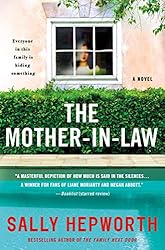
The Mother-in-Law
Sally Hepworth, 2019
St. Martin's Press
352 pp.
ISBN-13: 9781250120922
Summary
A twisty, compelling new novel about one woman's complicated relationship with her mother-in-law that ends in death.
From the moment Lucy met her husband’s mother, she knew she wasn’t the wife Diana had envisioned for her perfect son.
Exquisitely polite, friendly, and always generous, Diana nonetheless kept Lucy at arm’s length despite her desperate attempts to win her over. And as a pillar in the community, an advocate for female refugees, and a woman happily married for decades, no one had a bad word to say about Diana…except Lucy.
That was five years ago.
Now, Diana is dead, a suicide note found near her body claiming that she longer wanted to live because of the cancer wreaking havoc inside her body.
But the autopsy finds no cancer.
It does find traces of poison, and evidence of suffocation.
Who could possibly want Diana dead? Why was her will changed at the eleventh hour to disinherit both of her children, and their spouses? And what does it mean that Lucy isn’t exactly sad she’s gone?
Fractured relationships and deep family secrets grow more compelling with every page in this twisty, captivating new novel from Sally Hepworth. (From the publisher.)
Author Bio
• Birth—June 10, 1980
• Where—Australia
• Education—Monash University
• Currently—lives in Melbourne, Australia
Sally Hepworth is a former Event Planner and HR professional. A graduate of Monash University in Melbourne, Australia, she started writing novels after the birth of her first child.
She is the author of Love Like The French (2014, published in Germany). The Secret of Midwives (2015), The Things We Keep (2016), and The Family Next Door (2018).
Sally has lived around the world, spending extended periods in Singapore, the U.K., and Canada, and she now writes full-time from her home in Melbourne, Australia, where she lives with her husband and two children. (From the publisher.)
Book Reviews
Deliciously entertaining, packed with wit and suspense, and also delivers sharp insights about family dynamics and love.
People
Behold: the book that'll make your subway ride an actual enjoyable experience! This suspenseful thriller is impossible to put down.
Cosmo
We devoured it in just one sitting. Bet you will too!
Woman's Day
At last, sticky in-law tension gets the chilly thriller treatment. In Hepworth’s anticipated new page-turner, one woman’s complex relationship with her mother-in-law ends in death.
Entertainment Weekly
[A] suspenseful ride as a family copes with the suspicious suicide of its matriarch.… Hepworth’s short, punchy chapters keep the pages quickly turning while effortlessly deepening her characters. Readers will race to the end of this clever novel to find the truth.
Publishers Weekly
Infertility issues play a large role in this Australian story and add to the tiptoeing around and agonizing that Hepworth illustrates so well; the conversations among characters are another high point.… [A]bsorbing, cleverly written. —Henrietta Verma, Credo Reference, NY
Library Journal
(Starred review) A masterful depiction of how much is said in the silences.… [A] winner for fans of Liane Moriarty and Megan Abbott.
Booklist
When Diana, the matriarch of the Goodwin family, unexpectedly dies… circumstances… quickly point to homicide, and too many family members seem to have motives.… A mesmerizing domestic mystery.
Kirkus Reviews
Discussion Questions
1. In the opening chapter of the novel, Lucy describes feeling a "little niggle" in the pit of her stomach when the police showed up—a warning of oncoming danger. Are you familiar with the feeling she’s describing? When have you felt it? How do you think this ominous tone serves to set up the rest of the book?
2. The Mother-in-Law is told in dual timelines and dual narratives—Lucy and her mother-in-law, Diana. How does this structure affect your reading experience? Did you feel more sympathetic towards one narrator or the other?
3. What was your initial impression of Diana, both through the lens of Lucy and through hearing Diana’s own voice? How did your understanding of her and her motivations evolve throughout the book?
4. Diana and Lucy have very different definitions of what makes a "good" mother-in-law. What you you think makes for a good mother-in-law? How universal do you think your opinion is, or how personal? How do you think you would react in Lucy’s position?
5. What did you think when you first learned about Diana’s Orchard House past? Did it make sense to you, or come totally out of the blue? How do you think it fits into Diana’s character and explains why she acts the way she does in the present timeline?
6. Before you learned about what happened on Thanksgiving,what did you think the "incident" was? What were the clues throughout the frst half of the novel that make you think that way?
7. On page 133, Diana thinks, "When left to their own devices, bitter people can do bad things." Do you think she’s right to asses Hakem this way? Where are the other place in the narrative where you think that this same quote applies?
8. Tom and Diana have very different philosophies about giving their children money. Is either of them correct? Or is there more of a middle ground that neither of them have considered? Do you think it’s cruel for them to let Nettie suffer when they could help pay for her treatments?
9. On page 219, Ghezala says to Lucy, "Maybe [Diana] was so busy looking at the problems in the world, she forgot to give chances to those right under her nose." What do you think about that statement? Do you think she’s correct, or is there something more at play?
10. Before you learned the truth of Diana’s death, did you have a suspect in mind? Who and why?
(Questions issued by the publisher.)
top of page (summary)

The Mother's Promise
Sally Hepworth, 2017
St. Martin's Press
384 pp.
ISBN-13: 9781250077752
Summary
All their lives, Alice Stanhope and her daughter, Zoe, have been a family of two, living quietly in Northern California. Zoe has always struggled with crippling social anxiety and her mother has been her constant and fierce protector.
With no family to speak of, and the identity of Zoe’s father shrouded in mystery, their team of two works—until it doesn’t. Until Alice gets sick and needs to fight for her life.
Desperate to find stability for Zoe, Alice reaches out to two women who are practically strangers but who are her only hope: Kate, a nurse, and Sonja, a social worker.
As the four of them come together, a chain of events is set into motion and all four of them must confront their sharpest fears and secrets—secrets about abandonment, abuse, estrangement, and the deepest longing for family.
Imbued with heart and humor in even the most dismal moments, The Mother’s Promise is an unforgettable novel about the unbreakable bonds between mothers and daughters and the new ways in which families are forged. (From the publisher.)
Author Bio
• Birth—June 10, 1980
• Where—Australia
• Education—Monash University
• Currently—lives in Melbourne, Australia
Sally Hepworth is a former Event Planner and HR professional. A graduate of Monash University in Melbourne, Australia, she started writing novels after the birth of her first child.
She is the author of Love Like The French (2014, published in Germany). The Secret of Midwives (2015), The Things We Keep (2016), and The Family Next Door (2018).
Sally has lived around the world, spending extended periods in Singapore, the U.K., and Canada, and she now writes full-time from her home in Melbourne, Australia, where she lives with her husband and two children. (From the publisher.)
Book Reviews
The Mother’s Promise is a chick-lit tearjerker that nevertheless conveys with sympathy and some depth in the stories of four Northern California women who face difficult health and family problems, including important issues not typically found in fiction.… Author Sally Hepworth…knows how to spin an engrossing plot. While some of the key twists are obvious 100 pages before their Big Reveals…they later take surprising turns.
Fran Hawthorne - New York Journal of Books
[A] difficult novel of women struggling with fear and loss.… This bittersweet, emotionally intense novel is recommended for readers who appreciate issue-driven stories by Jodi Picoult and Lisa Genova —Lesa Holstine, Evansville Vanderburgh P.L., IN
Library Journal
When a devoted single mom discovers she has ovarian cancer, her own health is the least of her worries. What will happen to her daughter?… Saccharine at times, the tale's threads knot up a bit too easily and implausibly. A sentimental parable about the power of motherhood, friendship, and love.
Kirkus Reviews
Discussion Questions
1. Sonja, Kate, and Alice all have service-oriented jobs but are very isolated when it comes to their personal struggles. Where do we see key moments in the story when they begin to open up their personal lives to others? What prompts these changes and why were they each so isolated before?
2. Where do we see examples of different characters hiding information in order to protect each other? In each example, do the secrets improve or worsen the situation? Would you make the same decisions?
3. In this novel we see two women struggling in their marriages in very different ways. On page 118, Sonja wonders, "Then again, what did it mean to make a marriage succeed? Was it simply about staying together? Or was there something more she should be striving for?" How do you define a successful marriage?
4. What does Kate mean when, on page 164, she realizes that "marriage wasn’t meant to be conditional"?
5. How does Kate’s relationship with Zoe help her better understand her relationship with her own father?
6. Were you surprised when the identity of Zoe’s father was revealed? What was your reaction to the explanation that George gave to Sonja about his relationship with Alice?
7. Why does Alice react to Kate in such a strong, negative way at first? What are key moments when we see her attitude begin to change? Why does it change?
8. How do Zoe’s relationships with Kate and Harry affect her? Where do we see examples of the effect they have on her in her actions and demeanor?
9. On page 16, Sonja thinks, "Happiness was something you shared, chatted about, asked after. Suffering was something that you had to do behind closed doors, in silence, all alone." Where do we see difference characters living by this statement? Where do we see them going against it, and with what outcomes?
10.What do you imagine the future to hold for Zoe? What about for Kate and Sonja?
(Questions issued by the publisher.)
top of page (summary)


A Mother's Reckoning: Living in the Aftermath of Tragedy
Sue Klebold, 2016
Crown / Archetype
336 pp.
ISBN-13: 9781101902752
Summary
On April 20, 1999, Eric Harris and Dylan Klebold walked into Columbine High School in Littleton, Colorado. Over the course of minutes, they would kill twelve students and a teacher and wound twenty-four others before taking their own lives.
For the last sixteen years, Sue Klebold, Dylan’s mother, has lived with the indescribable grief and shame of that day. How could her child, the promising young man she had loved and raised, be responsible for such horror?
And how, as his mother, had she not known something was wrong? Were there subtle signs she had missed? What, if anything, could she have done differently?
These are questions that Klebold has grappled with every day since the Columbine tragedy. In A Mother’s Reckoning, she chronicles with unflinching honesty her journey as a mother trying to come to terms with the incomprehensible.
In the hope that the insights and understanding she has gained may help other families recognize when a child is in distress, she tells her story in full, drawing upon her personal journals, the videos and writings that Dylan left behind, and on countless interviews with mental health experts.
Filled with hard-won wisdom and compassion, A Mother’s Reckoning is a powerful and haunting book that sheds light on one of the most pressing issues of our time. And with fresh wounds from the recent Newtown and Charleston shootings, never has the need for understanding been more urgent.
All author profits from the book will be donated to research and to charitable organizations focusing on mental health issue. (From the publisher.)
Author Bio
• Birth—1948
• Raised—Columbus, Ohio, USA
• Education—Ohio State University
• Currently—Colorado
Sue Klebold is the mother of Dylan Klebold, one of the two shooters at Columbine High School in 1999 who killed 13 people before ending their own lives, a tragedy that saddened and galvanized the nation.
Susan came from a prominent family in Columbus, Ohio, the granddaughter of a philanthropist who build the local Jewish community center that bears his name. She and her husband Tom met at Ohio State University where both were art students. They married in 1971. Tom was eventually hired as a geophysicist for an oil company in Denver, Colorado, and Susan has worked as both a counselor at Arapahoe and Colorado Community Colleges. In 1990 the couple established Fountain Real Estate Management to oversee their rental properties.
Sue Klebold has spent the last 15 years excavating every detail of her family life, and trying to understand the crucial intersection between mental health problems and violence. Instead of becoming paralyzed by her grief and remorse, she has become a passionate and effective agent working tirelessly to advance mental health awareness and intervention. (Adapted from the publisher and Denver Post. Retrieved 2/21/2016.)
Book Reviews
[Sue Klebold] earns our pity, our empathy and, often, our admiration; and yet the book’s ultimate purpose is to serve as a cautionary tale, not an exoneration. Klebold seems to have written the book for yet another reason: to communicate with the families of the victims.... One has the eerie sense of bearing witness, in that moment, to the most intimate of communications. This is writing as action, bursting from a life so choked by circumstance that she could express that sentiment only from within the safety of a 300-page book.
Susan Dominus - New York Times Book Review
The author, whose son Dylan was one of two shooters who massacred 12 students and one teacher at Columbine High School in 1999, uses recollections, journals, and the profoundly disturbing writings and video recordings he left behind to reconstruct events and ask hard questions: Why did Dylan go so very wrong? And what could she have done?
Library Journal
Discussion Questions
Use our LitLovers Book Club Resources; they can help with discussions for any book:
• How to Discuss a Book (helpful discussion tips)
• Generic Discussion Questions—Fiction and Nonfiction
• Read-Think-Talk (a guided reading chart)
Also, consider these LitLovers talking points to help start a discussion for A Mother's Reckoning...then take off on your own.
1. How does this book come across to you? What does Sue Klebold say her motivation was in writing A Mother's Reckoning? Does she fulfill her goal?
2. "A mother is supposed to know," Klebold has said. To what extent is she right? How much are parents supposed to know? How much can they be expected to know? If children are aware that their parents routinely search their rooms, won't they simply find better hiding places?
3. Talk about the trajectory of Dylan Klebold from Sue's "sunshine boy" to troubled, deadly killer. Was there any point when the Klebolds might have stepped in, where they might have—or should have—recognized something was amiss with Dylan, something seriously amiss?
4. How much sympathy do you accord to Sue and Tom Klebold? Has your attitude toward them changed after reading this book? Were any myths about the Klebolds dispelled, or misunderstandings clarified?
5. Should A Mother's Reckoning have been written? Should it have come out before this time? Or never at all?
6. Can you put yourself in Sue and Tom Klebold's place? Or is that simply to hard to contemplate?
7. School bullying has always been an troublesome element of childhood and adolescence. How has Columbine changed society's attitude t
oward bullying? What are the ways in which we're dealing with bullying? Are they effective?
8. What were the differences, according to Klebold, between her son Dylan and Eric Harris?
(Questions issued by LitLovers. Please feel free to use them, online or off, with attribution. Thanks.)

Mothering Sunday: A Romance
Graham Swift, 2016
Knopf Doubleday
192 pp.
ISBN-13: 9781101947524
Summary
A luminous, intensely moving tale that begins with a secret lovers’ assignation in the spring of 1924, then unfolds to reveal the whole of a remarkable life.
Twenty-two-year-old Jane Fairchild has worked as a maid at an English country house since she was sixteen. For almost all of those years she has been the clandestine lover to Paul Sheringham, young heir of a neighboring house.
The two now meet on an unseasonably warm March day—Mothering Sunday—a day that will change Jane’s life forever.
As the narrative moves back and forth from 1924 to the end of the century, what we know and understand about Jane—about the way she loves, thinks, feels, sees, remembers—expands with every vividly captured moment.
Her story is one of profound self-discovery, and through her, Graham Swift has created an emotionally soaring, deeply affecting work of fiction. (From the publisher.)
Author Bio
• Birth—May 4, 1949
• Where—London, England, UK
• Education—Dulwich College; Cambridge; University of York
• Awards—Booker Prize; James Tait Black Memorial Prize
• Currently—lives in London, England
Graham Colin Swift is a well-known British author and fellow of the Royal Society of Literature (FRSL). He was born in London, England and educated at Dulwich College, London, Queens' College, Cambridge, and later the University of York. He was a friend of poet Ted Hughes.
Some of his works have been made into films, including Last Orders, which starred Michael Caine and Bob Hoskins and Waterland which starred Jeremy Irons.
Last Orders was a joint winner of the 1996 James Tait Black Memorial Prize for fiction and a mildly controversial winner of the Booker Prize in 1996, owing to the superficial similarities in plot to William Faulkner's As I Lay Dying.
Waterland was set in The Fens; it is a novel of landscape, history and family, and is often cited as one of the outstanding post-war British novels and has been a set text on the English Literature syllabus in British schools.
Works
1980 - The Sweet-Shop Owner
1982 - Shuttlecock (Geoffrey Faber Memorial Prize)
1983 - Waterland
1988 - Out of This World
1992 - Ever After
1996 - Last Orders (Booker Prize)
2003 - The Light of Day
2007 - Tomorrow
2009 - Making an Elephant: Writing from Within
2012 - Wish you Were Here
2016 - Mothering Sunday
(Author bio from Wikipedia.)
Book Reviews
Swift describes events long in the past in a way that gives them intense and permanent presentness. The vividly lost quality of the day is conveyed through a series of repeating motifs. The phone call, white orchids in the Sheringhams' hall, Paul's bedsheets. The story has an unmoored, dreamy quality, which captures the way such days become lodged in the recollections of youth…[Swift's] lush, sorrowful prose gives considerable pleasure.
Sophie Gee - New York Times Book Review
[A] dazzling read: sexy, stylish, subversive. You finish it and immediately read it again, because, like War and Peace, it’s a marvelous novel of possibilities.
Jackie McGlone - Herald (Scotland)
Masterful...[Swift] performs a complex enough conjuring trick, creating a perfect small tragedy with all the spring and tension of a short story, spinning around it a century of consequences with so light a touch that they only brush against the charmed centre.... Mothering Sunday is both a dissection of the nature of fiction and a gripping story; a private catastrophe played out in the quiet drawing rooms of the English upper middle-class, the drama that unfolds is all the more potent for its containment.... The narrative...accumulates the saturated erotic intensity of a Donne sonnet.... Mothering Sunday is bathed in light; and even when tragedy strikes, it blazes irresistibly.... Swift’s small fiction feels like a masterpiece.
Christobel Kent - Guardian (UK)
An almost musical quality, like a Bach prelude and fugue reworking and reinventing themes and ideas...both unsettling and deeply affecting. Mothering Sunday is a powerful, philosophical and exquisitely observed novel about the lives we lead, and the parallel lives—the parallel stories—we can never know.... It may just be Swift’s best novel yet.
Hannah Beckerman - Observer (UK)
Swift has written a book that is not just his most moving and intricate but his most engrossing, too.... At the narrative level, Mothering Sunday has a lot in common with earlier works of historical fiction—Ian McEwan’s pair of novels about a moment that resonates across the decades, Atonement and On Chesil Beach, and David Miller’s Today.
Leo Robson - Financial Times (UK)
This is the story of a woman’s becoming, as she discovers her power and possibility. It is a lot to pack into such a slim and tidy volume. But for all the detailed examination of character and the bold sweep of time, there is not a word wasted.... A lesson in poetic brevity.... There is a lulling quality to the movement between sections of the book—rhythms and repetitions, the ebb and flow of a tide, the wearing down of rock to form sand on a beach.... This is a rare read indeed.
Ellah Allfrey - Spectator (UK)
A dazzling novel...beautiful.... A vanished world is resurrected with superb immediacy. The shires gentry and their servants move around the pages with solid authenticity.... Wonderfully accomplished...an achievement.
Peter Kemp - Sunday Times (UK)
( Starred review.) [T]his elegiac tale offers a haunting portrait of lives in a world in transition.... [Swift's] depiction of a fragile caste clinging to traditions that define their sense of noblesse oblige...is poignant and moving—as is his intimation of a brilliant personal destiny that rises from the ashes of a tragically bygone social order.
Publishers Weekly
Jane, servant in a great house in the waning Downton days of 1924, can no longer see Paul, a young man from the neighboring house about to be married. What happens next is not Jane's piteous unwinding but the story of an orphan who begins life in service and eventually becomes a great writer and mistress of culture.
Library Journal
( Starred review.) A perfect gem of a novel. With his unmistakable gift for detailed exactitude and emotional subtlety, Swift lightly touches on weighty issues of loss and abandonment, boldness and survival. The antidote to Downton Abbey’s prolonged manor-house soap opera, Swift’s succinct rags-to-riches tale of a young woman’s unexpected metamorphosis is a rich and nuanced evocation of an innocent yet titillating time. —Carol Haggas
Booklist
( Starred review.) In England of 1924, a maid who knows her affair with an estate owner's son must end, ...is a marvelous creation who can seem wry, world-weary, innocent, or lusty, bringing to mind Molly Bloom. Swift has fun with language, with class conventions, and with narrative expectations in a novel where nothing is as simple or obvious as it seems at first.
Kirkus Reviews
Discussion Questions
1. What do you think attracts Jane to Paul? What are the needs that each fulfills for the other? Why is it important to see them together in “utter mutual nakedness” at first, and often through the lens of animal metaphors?
2. The novel focuses exclusively on Jane’s point of view, but she is not a first-person narrator. What is the effect of this slight narrative distance between the reader and narrator, and what might it say about Jane’s ultimate profession as a novelist?
3. What is the significance of Mothering Sunday for each of the characters, and what does the meaning of the day reveal about Jane’s sense of self? Is Jane more liberated or saddened by the reminder of her own orphanhood and lack of a mother?
4. Discuss the hierarchy within the Nivens’ household. How does the employment of Jane and Cook Milly at Beechwood fit into the sense that Britain is changing and modernizing? What’s the difference between older and younger generations of servants vis-a-vis their respect for hierarchy, and between the servants at Beechwood versus Upleigh?
5. What’s informative about reading this story through a from the perspective of a maid—someone whose job it is to both pay close attention to details and to ignore them?
6. Why does Jane feel able to push the limits of her freedom as a maid, and how does she do so with the Nivens and Paul? To what degree does she feel bound to her role, down to her “ghostly maid’s clothes,” and does that change over the course of her life?
7. How would you describe Jane’s sense of humor?
8. Describe the different relationships between parents and children in the novel. How does the constant reminder of the holiday of Mothering Sunday, and of Paul and Emma’s wedding, throughout the book complicate those traditional family ties, including marriage itself? And what does that say about the way tradition will carry through into the future?
9. The novel is structured in short vignettes that move back and forth in time, in intervals big and small. What are the effects of this mode of storytelling on the book’s feeling of suspense, and of how we learn about Jane?
10. Why is it so important to Jane not to define what is true or not true in her writing, especially given her fierce love of books, which, she claims, are a way people “escape the troubles of their lives”?
11. Where does Jane gain the greatest sense of belonging? Does she yearn more for inclusion or independence, to possess or to be possessed? Consider the statement that "life itself...was the sum of its possessions," and what this means for Jane in particular, a servant with an extreme paucity of belongings
12. Did you always trust Jane’s observations, memories, interpretations of events? If not, what made you question them, and/or the reliability of memory in general throughout the novel?
13. Did you get the impression that Jane ever felt guilty about Paul’s accident? Does the novel suggest that the characters were more at the mercy of fate or free will?
(Questions issued by the publisher.)

Motherless Brooklyn
Jonathan Lethem, 1999
Random House
311 pp.
ISBN-13: 9780345803399
Summary
Lethem fulfills the promise of his earlier, critically acclaimed novels with the gritty and uproarious tale of a Brooklyn P.I. with problems: a dead boss, women trouble, and an uncontrollable case of Tourette's syndrome.
Lionel Essrog is Brooklyn's very own Human Freakshow, an orphan whose Tourettic impulses drive him to bark, count, and rip apart language in startling and original ways.
Together with three veterans of the St. Vincent's Home for Boys, he works for small-time mobster Frank Minna's limo service cum detective agency. Life without Frank, the charismatic King of Brooklyn, would be unimaginable. When Frank is fatally stabbed, Lionel's world is suddenly turned upside-down, and this outcast who has trouble even conversing attempts to untangle the threads of the case, while trying to keep the words straight in his head.
A compulsively involving a and totally captivating homage to the classic detective tale. (From the publisher.)
Author Bio
• Birth—February 19, 1964
• Where—Brooklyn, New York, USA
• Education—Bennington College (no degree)
• Awards—National Book Critics Circle Award; World Fantasy
Award; Macallan Gold Dagger Award
• Currently—lives in Los Angeles, California
Jonathan Allen Lethem is an American novelist, essayist and short story writer. His first novel, Gun, with Occasional Music, a genre work that mixed elements of science fiction and detective fiction, was published in 1994. It was followed by three more science fiction novels. In 1999, Lethem published Motherless Brooklyn, a National Book Critics Circle Award-winning novel that achieved mainstream success. In 2003, he published The Fortress of Solitude, which became a New York Times Best Seller. In 2005, he received a MacArthur Fellowship.
Early life
Lethem was born in Brooklyn, New York, to Judith Frank Lethem, a political activist, and Richard Brown Lethem, an avant-garde painter. He was the eldest of three children. His father was Protestant (with Scottish and English ancestry) and his mother was Jewish, from a family that originated in Germany, Poland, and Russia. His brother Blake became an artist, and his sister Mara became a photographer and writer.
The family lived in a commune in the pre-gentrified Brooklyn neighborhood of North Gowanus (now called Boerum Hill). Despite the racial tensions and conflicts, he later described his bohemian childhood as "thrilling" and culturally wide-reaching. He gained an encyclopedic knowledge of the music of Bob Dylan, saw Star Wars twenty-one times during its original theatrical release, and read the complete works of the science fiction writer Philip K. Dick. Lethem later said Dick’s work was "as formative an influence as marijuana or punk rock—as equally responsible for beautifully fucking up my life, for bending it irreversibly along a course I still travel."
His parents divorced when Lethem was young. When he was thirteen, his mother Judith died from a malignant brain tumor, an event which he has said haunted him and has strongly affected his writing. (Lethem discusses the direct relation between his mother and the Bob Dylan song "Like a Rolling Stone" in the 2003 Canadian documentary Complete Unknown.) In 2007, Lethem explained, "My books all have this giant, howling missing [center]—language has disappeared, or someone has vanished, or memory has gone."
Intending to become a visual artist like his father, Lethem attended the High School of Music & Art in New York, where he painted in a style he describes as "glib, show-offy, usually cartoonish." At Music & Art he produced his own zine, The Literary Exchange, which featured artwork and writing. He also created animated films and wrote a 125-page novel, Heroes, still unpublished.
After graduating from high school, Lethem entered Bennington College in Vermont in 1982 as a prospective art student. At Bennington, Lethem experienced an "overwhelming....collision with the realities of class—my parents’ bohemian milieu had kept me from understanding, even a little, that we were poor.... [A]t Bennington that was all demolished by an encounter with the fact of real privilege." This, coupled with the realization that he was more interested in writing than art, led Lethem to drop out halfway through his sophomore year.
He hitchhiked from Denver, Colorado, to Berkeley, California, in 1984, across "a thousand miles of desert and mountains through Wyoming, Utah, and Nevada, with about 40 dollars in my pocket," describing it as "one of the stupidest and most memorable things I've ever done." He lived in California for twelve years, working as a clerk in used bookstores, including Moe's and Pegasus & Pendragon Books, and writing on his own time. Lethem published his first short story in 1989 and published several more in the early 1990s.
First novels
Lethem’s first novel, Gun, with Occasional Music, is a merging of science fiction and the Chandleresque detective story, which includes talking kangaroos, radical futuristic versions of the drug scene, and cryogenic prisons. The novel was published in 1994 to little initial fanfare, but an enthusiastic review in Newsweek, which declared Gun an "audaciously assured first novel," catapulted the book to wider commercial success. It became a finalist for the 1994 Nebula Award. In the mid-1990s, film producer-director Alan J. Pakula optioned the novel's movie rights, which allowed Lethem to quit working in bookstores and devote his time to writing.
His next several books include Amnesia Moon (1995), partially inspired by Lethem's experiences hitchhiking cross-country; The Wall of the Sky, the Wall of the Eye (1996), a collection of short stories; As She Climbed Across the Table (1997) about a physics researcher who falls in love with an artificially generated spatial anomaly called "Lack."
Lethem moved returned to Brooklyn in 1996, after which he published Girl in Landscape (1998) about a world populated by aliens but "very strongly influenced" by the 1956 John Wayne Western The Searchers, a movie with which Lethem is "obsessed."
In 1999, he released Motherless Brooklyn, a return to the detective theme, with a protagonist suffering from Tourette syndrome and obsessed with language. The book won the National Book Critics Circle Award for Fiction, The Macallan Gold Dagger for crime fiction, and the Salon Book Award, and was named book of the year by Esquire.According to the New York Times, the mainstream success of Motherless Brooklyn made Lethem "something of a hipster celebrity," and he was referred to several times as a "genre bender." Lev Grossman of Time classed Lethem with a movement of authors similarly eager to blend literary and popular writing, including Michael Chabon (with whom Lethem is friends), Margaret Atwood, and Susanna Clarke.
In the early 2000s, Lethem published a story collection, edited two anthologies, wrote magazine pieces, and published the 55-page novella This Shape We're In (2000)—one of the first offerings from McSweeney's Books, the publishing imprint that developed from Dave Eggers' McSweeney's Quarterly Concern.
In November 2000, Lethem said that he was working on an uncharacteristically "big sprawling" novel, about a child who grows up to be a rock journalist. The novel was published in 2003 as The Fortress of Solitude. The semi-autobiographical bildungsroman features a tale of racial tensions and boyhood in Brooklyn during the late 1970s.
Lethem's second collection of short fiction, Men and Cartoons, was published in late 2004. In a 2009 interview with Armchair/Shotgun, Lethem said of short fiction:
I'm writing short stories right now, that's what I do between novels, and I love them. I'm very devoted to it.... [T]he story collections I've published are tremendously important to me. And many of the uncollected stories—or yet-to-be-collected stories—are among my proudest writings. They're very closely allied, obviously, to novel writing. But also very distinct..
In 2005 Lethem released The Disappointment Artist, his first collection of essays, and in the same year he received a MacArthur Fellowship.Mid-career novels
After Motherless Brooklyn and The Fortress of Solitude, Lethem decided it "was time to leave Brooklyn in a literary sense anyway... I really needed to defy all that stuff about place and memory." In 2007, he returned—as a novelist—to California, where some of his earlier fiction had been set, with You Don't Love Me Yet, a novel about an upstart rock band. The novel received mixed reviews.
In early 2009, Lethem published Chronic City, set on the Upper East Side of Manhattan. The author claimed it was strongly influenced by Saul Bellow, Philip K. Dick, Charles G. Finney. and Hitchcock’s Vertigo and referred to it as "long and strange."
Lethem's next novel, Dissident Gardens, was in 2013. According to Lethem in an interview with the Los Angeles Times, the novel concerns "American leftists," very specifically "a red-diaper baby generation trying to figure out what it all means, this legacy of American Communism." He considers it "another New York neighborhood book, very much about the life of the city.... [W]riting about Greenwich Village in 1958 was really a jump for me...as much of an imaginative leap as any of the more fantastical things I've done."
Personal life
In 1987, Lethem married the writer and artist Shelley Jackson; they were divorced by 1997. In 2000, he married Julia Rosenberg, a Canadian film executive; they divorced two years later.
Lethem's current wife is filmmaker Amy Barrett; the couple has a son. Lethem has relocated to Los Angeles, California, where he is the Disney Professor of Writing at Pomona College in Claremont. (Adapted from Wikipedia. Retrieved 9/17/2013.)
Book Reviews
Under the guise of a detective novel, Lethem has written a more piercing tale of investigation, one revealing how the mind drives on its own ''wheels within wheels.'' Unlike the stock detective novel it shadows, the thriller in which clarity emerges on the final page, Motherless Brooklyn immerses us in the mind's dense thicket, a place where words split and twine in an ever-deepening tangle.
Albert Mobilio - New York Times
At once gripping, mournful, touching and comic.... One of the greatest feats of first-person narration in recent American fiction. Philip Marlowe would blush. And tip his fedora.
Washington Post
Some audio books make listening...more than a convenience and a mindless diversion. The author's work is enhanced, and the enjoyment of the reader-turned listener is heightened.... Motherless Brooklyn is such an audio book.... Part detective novel and part literary fantasia.... Superbly balances beautiful writing and an engrossing plot.
Atlanta Journal Constitution
Finding out whodinit is interesting enough, but it's more fun watching Lethem unravel the mysteries of his Tourettic creation. In this case, it takes on trenchant wordsmith to know another.
Time
Hard-boiled crime fiction has never seen the likes of Lionel Essrog, the barking, grunting, spasmodically twitching hero of Lethem's gonzo detective novel that unfolds amidst the detritus of contemporary Brooklyn. As he did in his convention-smashing last novel, Girl in Landscape, Lethem uses a blueprint from genre fiction as a springboard for something entirely different, a story of betrayal and lost innocence that in both novels centers on an orphan struggling to make sense of an alien world. Raised in a boys home that straddles an off-ramp of the Brooklyn Bridge, Lionel is a misfit among misfits: an intellectually sensitive loner with a bad case of Tourette's syndrome, bristling with odd habits and compulsions, his mind continuously revolting against him in lurid outbursts of strange verbiage. When the novel opens, Lionel has long since been rescued from the orphanage by a small-time wiseguy, Frank Minna, who hired Lionel and three other maladjusted boys to do odd jobs and to staff a dubious limo service/detective agency on a Brooklyn main drag, creating a ragtag surrogate family for the four outcasts, each fiercely loyal to Minna. When Minna is abducted during a stakeout in uptown Manhattan and turns up stabbed to death in a dumpster, Lionel resolves to find his killer. It's a quest that leads him from a meditation center in Manhattan to a dusty Brooklyn townhouse owned by a couple of aging mobsters who just might be gay, to a zen retreat and sea urchin harvesting operation in Maine run by a nefarious Japanese corporation, and into the clutches of a Polish giant with a fondness for kumquats. In the process, Lionel finds that his compulsions actually make him a better detective, as he obsessively teases out plots within plots and clues within clues. Lethem's title suggests a dense urban panorama, but this novel is more cartoonish and less startlingly original than his last. Lethem's sixth sense for the secret enchantments of language and the psyche nevertheless make this heady adventure well worth the ride.
Publishers Weekly
The short and shady life of Frank Minna ends in murder, shocking the four young men employed by his dysfunctional Brooklyn detective agency/limo service. The "Minna Men" have centered their lives around Frank, ever since he selected them as errand boys from the orphaned teen population at St. Vincent's Home. Most grateful is narrator Lionel. While not exactly well treated, his nickname is "Freakshow," Tourette's-afflicted Lionel has found security as a Minna Man and is shattered by Frank's death. Lionel determines to become a genuine sleuth and find the killer. The ensuing plot twists are marked by clever wordplay, fast-paced dialog, and nonstop irony. The novel pays amusing homage to, and plays with the conventions of, classic hard-boiled detective tales and movies while standing on its own as a convincing whole. The author has applied his trademark genre-bending style to fine effect. Already well known among critics for his literary gifts, Lethem should gain a wider readership with this appealing book's debut. Recommended for most fiction collections. —Starr E. Smith, Marymount Univ. Lib., Arlington, VA
Library Journal
A brilliantly imagined riff on the classic detective tale: the fifth high-energy novel in five years from the rapidly maturing prodigy whose bizarre black-comic fiction includes, most recently, Girl in Landscape (1998). Lethem's delirious yarn about crime, pursuit, and punishment, is narrated in a unique voice by its embattled protagonist, Brooklynite (and orphan) Lionel Essrog, a.k.a. "Freakshow.'' Lionel's moniker denotes the Tourette's syndrome that twists his speech into weird aslant approximations (his own name, for example, is apt to come out "Larval Pushbug'' or "Unreliable Chessgrub'') and induces a tendency to compulsive behavior ("reaching, tapping, grabbing and kissing urges'') that makes him useful putty in the hands of Frank Minna, an enterprising hood who recruits teenagers (like Lionel) from St. Vincent's Home for Boys, to move stolen goods and otherwise function as apprentice-criminal "Minna Men.'' The daft plotwhich disappears for a while somewhere around the middle of the novelconcerns Minna's murder and Lionel's crazily courageous search for the killer, an odyssey that brings him into increasingly dangerous contact with two elderly Italian men ("The Clients'') who have previously employed the Minna Men and now pointedly advise Lionel to abandon his quest; Frank's not-quite-bereaved widow Julia (a tough-talking dame who seems to have dropped in from a Raymond Chandler novel) at the Zendo, a dilapidated commune where meditation and other Buddhist techniques are taught; a menacing "Polish giant''; and, on Maine's Muscongus Island, a lobster pound and Japanese restaurant that front for a sinister Oriental conglomerate. The resulting complications are hilariously enhanced by Lionel's "verbal Tourette's flowering''a barrage of sheer rhetorical invention that has tour de force written all over it; it's an amazing stunt, and, just when you think the well is running dry, Lethem keeps on topping himself. Another terrific entertainment from Lethem, one of contemporary fiction's most inspired risk-takers. Don't miss this one.
Kirkus Reviews
Discussion Questions
1. For readers who come to Motherless Brooklyn with little knowledge of Brooklyn, what devices, beyond straightforward descriptions, does Lethem use to capture its distinctive atmosphere?
2. Lionel's wordplay includes variations on his own name—Liable Guesscog, Final Escrow, Ironic Pissclaim, for example. How does this particular quirk serve to establish Lionel's sense of himself and his place in the world? Is there an internal logic about the variations or are they simply haphazard?
3. The Minna Men are all orphans, first introduced as teenagers. Discuss how each of them carves out an identity for himself and why this is important to them. How do the initial descriptions Lionel provides of Tony [p. 39], Gil [p. 40], and Danny [p. 42-43] foreshadow the relationships among the four as adults? Do their characters change in the course of the novel?
4. Does Minna see himself as more than a boss to the young men? Does he make a conscious effort to turn the group into a family or does the family feeling develop from the needs of the young men themselves? What evidence, if any, is there that Minna's interest in them is emotional as well as practical? In what ways does Minna's relationship with his own mother and older brother influence the way he treats the Minna Men?
5. Why does Lionel say "it was Minna who brought me the language, Minna and Court Street that let me speak" [p.37]? What parts do Tony, Gil, and Danny play in helping Lionel accept his Tourette's Syndrome? How do their individual ways of dealing with Lionel differ? Which man's support is the most significant to Lionel both as a teenager and as anadult?
6. In describing Gil's explanation of Minna's kidnapping and murder, Lionel says "English might have been his fourth or fifth language from the sound of it" [p. 94]. Why does Lethem include this observation and other examples of mangled language throughout the book? How do they put Lionel's own "language difficulties" in perspective?
7. In addition to Lionel's wonderful, often poetic riffs, what other specific language patterns does Lethem employ to bring the various characters to life? For example, how do Lionel's conversation with the homicide detective [pp. 109-111], his initial encounter with Kimmery [p. 135] and his interview with Matricardi and Rockaforte [pp. 176-177] create impressions of these particular people that are independent of Lionel's own perceptions?
8. What role does Julia play in the novel? In what ways is she the stereotypical "dame" of other hard-boiled detective novels and films and how is she different? Do you think Julia is right when she says "No woman would ever want you, Lionel.... That's not really true. They might want you.... But they'll never be fair to you" [p. 297]?
9. Is Kimmery also a stock figure in this tradition? How does Kimmery's reaction to Lionel's Tourettic behavior differ from the reactions of the other characters? Does the brief, romantic interlude between Lionel and Kimmery advance the plot and if so, in what ways? How does it affect your understanding of Lionel? Is Kimmery "fair" to Lionel?
10. The Zen Buddhist communities in New York and Maine are not at all what they seem. Are the characters who participate in the Buddhist Zendo—Lionel's brother, Gerald, Julia, and Kimmery—influenced by Buddhist teachings? Do the principles of Zen Buddhism (either as expressed in the book by Kimmery or from your knowledge) illuminate some of the themes Lethem explores?
11. Does Lionel in fact become a "real detective"? Do his techniques fit your definition of detective work? Kimmery, for example, is skeptical about both his intentions and his working style [p. 255]. Do you think her evaluation is accurate? In other detective books you may have read, are the heroes completely removed from the personal aspects of the cases they investigate? Is the solution to Minna's murder fully satisfying in light of the evidence presented in the rest of the book?
12. At several points in the book, Lethem makes direct reference to the genres that inform Motherless Brooklyn—both the classic detective novel and "wiseguy" novels and movies. For example, Minna teases Gil for saying "piece, " rather than "gun" [p. 8]; and Lionel asks "Have you ever felt, in the course of reading a detective novel, a guilty thrill of relief at having a character murdered before he can step on to the page and burden you with his actual existence?" [p. 119]. In another passage, Lionel compares himself to the standard set in detective literature: "So many detectives have been knocked out and fallen into such strange, swirling darknesses...and yet I have nothing to contribute to this painful tradition" [p. 205]. Why does Lethem include these references? Are they simply there for "comic relief" or do they serve another purpose?
13. By using Lionel as narrator, Lethem is following a long tradition in detective fiction. In what ways would the impact on the reader be different if a third-person voice told the story? Why do you think he chose to use a narrator with Tourette's Syndrome? Is this purely a literary device, giving him the opportunity to play with language as an author? Do the classic detective heroes—for example, Dashiell Hammett's Sam Spade and Raymond Chandler's Philip Marlowe—have quirks comparable to Lionel's?
14. Does the title of the book refer only to the four orphans who make up the Minna Men? In what ways is Brooklyn itself "motherless"?
15. The Voice Literary Supplement wrote "Lethem loves to cross-wire popular genres and watch the sparks fly." In addition to the conventions of the hard-boiled detective novel, what other genre does Lethem draw on in Motherless Brooklyn? (Questions issued by publisher.)
The Mountain Between Us
Charles Martin, 2010
Broadway Books
336 pp.
ISBN-13: 9780739377697
Summary
On a stormy winter night, two strangers wait for a flight at the Salt Lake City airport. Ashley Knox is an attractive, successful writer, who is flying East for her much anticipated wedding. Dr. Ben Payne has just wrapped up a medical conference and is also eager to get back East for a slate of surgeries he has scheduled for the following day.
When the last outgoing flight is cancelled due to a broken de-icer and a forthcoming storm, Ben finds a charter plane that can take him around the storm and drop him in Denver to catch a connection. And when the pilot says the single engine prop plane can fit one more, if barely, Ben offers the seat to Ashley knowing that she needs to get back just as urgently. And then the unthinkable happens. The pilot has a heart attack mid-flight and the plane crashes into the High Uintas Wilderness—one of the largest stretches of harsh and remote land in the United States.
Ben, who has broken ribs and Ashley, who suffers a terrible leg fracture, along with the pilot's dog, are faced with an incredibly harrowing battle to survive. Fortunately, Ben is a medical professional and avid climber (and in a lucky break, has his gear from a climb earlier in the week). With little hope for rescue, he must nurse Ashley back to health and figure out how they are going to get off the mountain, where the temperature hovers in the teens
Meanwhile, Ashley soon realizes that the very private Ben has some serious emotional wounds to heal as well. He explains to Ashley that he is separated from his beloved wife, but in a long standing tradition, he faithfully records messages for her on his voice recorder reflecting on their love affair. As Ashley eavesdrops on Ben's tender words to his estranged wife she comes to fear that when it comes to her own love story, she's just settling. And what's more: she begins to realize that the man she is really attracted to, the man she may love, is Ben.
As the days on the mountains become weeks, their survival become increasingly perilous. How will they make it out of the wilderness and if they do, how will this experience change them forever? (From the publisher.)
Author Bio
• Birth—November 3, 1969
• Education—B.A., Florida State University; M.A., Ph.D.,
Regent University
• Currently—Jacksonville, Florida, USA
Charles Martin is the author of six books—Where the River Ends, Chasing Fireflies, Maggie, When Crickets Cry, Wrapped in Rain, The Dead Don't Dance, and The Mountain Between Us.
He earned his B.A. in English from Florida State University, and his M.A. in Journalism and Ph.D. in Communication from Regent University. He served one year at Hampton University as an adjunct professor in the English department and as a doctoral fellow at Regent. In 1999, he left a career in business to pursue his writing. He and his wife, Christy, live a stone's throw from the St. John's River in Jacksonville, Florida, with their three boys: Charlie, John T. and Rives. (From the author's website.)
Book Reviews
Neither the mainstream press nor publishing trade press seems to have reviewed this book. See Amazon and Barnes & Noble for helpful customer reviews.
Discussion Questions
1. The Mountain Between Us is an adventure story, a story of survivial, but and above all a love story. By the end of the novel, what do we learn about the author’s views of love? Is there such a thing as a perfect marriage? What do Ben and Ashley learn from the pilot, Grover, about the nature of enduring love? Is that a lesson that stays with them throughout the book? In your experience, does marriage get better? What makes a great marriage?
2. After the crash, Ben and Ashley are stranded at 11,500 feet, fifty miles from any kind of civilization with no hope of rescue, she with a broken leg, he with three busted ribs and a possible collapsed lung, and minimal supplies...yet they survived for more than four weeks in these extreme conditions. What skills and character traits do you think helped ensure their survival? Did you find the story credible?
3. Was Ben to blame at any point for what happened? Should he have hired the charter plane to take them out in the coming storm? During their time on the mountain, what choices did Ben make? Do you believe he made the right choices? What would you have done in his place?
4. We learn about Ben’s wife mostly through the recordings she made on Ben’s dictaphone. Is she a strong presence in the book? What kind of person was she? What made her so special to Ben?
5. Ben refers to himself as “a bit of an emotional blockhead” (page 119). Why do you think he finds it so difficult to come to terms with his “separation” from his wife, Rachel? What part did his childhood experiences play in his emotional development?
6. In the most difficult times on the mountain, when Ashley and Ben are losing hope of survival, how do they keep themselves going? What was the most difficult part of their ordeal? If you were in their position, what would you have done? Do you think you would have made it back home alive?
7. How does Ben and Ashley’s time in isolation on the mountain change their perspective on life? Does it make them see any more clearly? Are their lives irrevocably changed by the experience? In what ways?
8. Were you surprised by the revelation about Ben’s family life at the end of the book? How did the discovery make you feel? Looking back through the book, did the author lay any clues for the reader along the way?
9. Ben uses his dictaphone to communicate with his wife. What do you learn about Rachel from his recordings? Do you think this technique works as a narrative device? What does it say about the way we communicate with our loved ones today? Why did Ben throw the dictaphone into the ocean at the end of the book?
10. What is the significance of the title? What is “the mountain between us”?
11. In the author’s note, Charles references one of the most beautiful Bible verses: I lift my eyes to the hills. From where does my help come.... What part does religious faith play in this novel? Do you think the author’s own optimism is derived from his faith in God?
(Questions issued by publisher.)


A Mountain of Crumbs: A Memoir
Elena Gorokhova, 2009
Simon & Schuster
336 pp.
ISBN-13: 9781439125687
Summary
Elena Gorokhova’s A Mountain of Crumbs is the moving story of a Soviet girl who discovers the truths adults are hiding from her and the lies her homeland lives by.
Elena’s country is no longer the majestic Russia of literature or the tsars, but a nation struggling to retain its power and its pride. Born with a desire to explore the world beyond her borders, Elena finds her passion in the complexity of the English language—but in the Soviet Union of the 1960s such a passion verges on the subversive.
Elena is controlled by the state the same way she is controlled by her mother, a mirror image of her motherland: overbearing, protective, difficult to leave. In the battle between a strong-willed daughter and her authoritarian mother, the daughter, in the end, must break free and leave in order to survive.
Through Elena’s captivating voice, we learn not only the stories of Russian family life in the second half of the twentieth century, but also the story of one rebellious citizen whose curiosity and determination finally transport her to a new world. It is an elegy to the lost country of childhood, where those who leave can never return. (From the publisher.)
Author Bio
• Birth—1955
• Where—St. Petersburg, Russia
• Education—University of Leningrad; Ph.D.,
Rutgers University (New Jersey)
• Currently—lives in Ridgewood, New Jersey, USA
Elena Gorokhova grew up in Leningrad, now St. Petersburg, in a courtyard that became a more accurate emblem for the Soviet life than the ubiquitous hammer and sickle: a crumbling façade with locked doors and stinking garbage bins behind them. Like everyone else, when she was nine, Elena joined the Young Pioneers and had a red kerchief tied around her neck. A tiny cell in the body of a Leningrad school collective, she promised to live, study, and work as the great Lenin bequeathed every citizen to do.
But she harbored a passion that grew into an un-Soviet failing: at age ten she was seduced by the beauty of the English language and spent the next eight years deciphering its secrets at Leningrad English school # 238, to her mother’s bewilderment. Her mother—born three years before the Soviet state—became a mirror image of her Motherland: overbearing, protective, difficult to leave. A front-line surgeon during WWII, she wanted her daughter to be a doctor and a builder of communism, but Elena, in her mother’s words, was “stubborn as a goat.”
What followed was the English Department of Leningrad University, a marriage to a visiting American student, and a scandal, both public and private. After six months of official hurdles and family turmoil, Elena left for America, a ravaged suitcase on the KGB inspector’s table with twenty kilograms of what used to be her life. What followed was unknown, and frightening, and filled with mystery.
In the United States, Elena received a Doctorate in Language Education and has taught English as a Second Language, Linguistics, and Russian at various New Jersey colleges and universities. She is married (again) and has a daughter. After taking Frank McCourt’s memoir workshop in 2004, she recalibrated everything she’d written about her Soviet life and turned it into A Mountain of Crumbs.
Her mother now lives with her in New Jersey, just as she did in Leningrad. (From the author's website.)
Book Reviews
Slight…but endearing, a collection of well-sculptured memories about the deprivations and joys of [Gorokhova's] childhood in Leningrad (now St. Petersburg). It's a book about many things, notably class, politics, identity and sex, but one that circles around as often as not to the author's rumbling stomach.... A Mountain of Crumbs is a minor-key coming-of-age story, one that's tinged with real darkness around its edges.
Dwight Garner - New York Times
[Gorokhova's] exquisitely wrought, tender memoir of growing up in the Soviet Union…could be taught as a master class in memoir writing: the key is not to collect facts and recollections but to truthfully reimagine one's life…Gorokhova writes about her life with a novelist's gift for threading motives around the heart of a story, following its plot with a light touch and unwavering honesty. Each chapter distills a new revelation in poetic prose.
Elena Lappin - New York Times Book Review
Despite the feelings of claustrophobia and low-level menace conjured up, the portrait of a Soviet childhood is dreamily nostalgic.... [Yet] Sometimes it’s hard to believe how limited people’s lives were in Seventies Russia. Gorokhova finds herself, as a young woman, never having been inside a restaurant, not knowing what asparagus is when she reads about it in a book, used to eating all the stale food in the house before being allowed to eat anything fresh. ....In the end her escape is as unromantic as it is unexpected..... The overall result, though, is a stunning memoir: subtle, yet brimming with depth and detail. It leaves you wanting more. A sequel about life in America, please?
Viv Groskop - Telegraph (UK)
Like Angela’s Ashes, the memoir of her one-time teacher Frank McCourt, Gorokhova’s A Mountain of Crumbs opens with a wish that youth had been an easier enterprise.... [But] despite Gorokhova’s debts to McCourt...Gorokhova may lack McCourt’s lush storytelling skills, but her book is also free—thankfully—of his sugary sentiment. A Mountain of Crumbs is a straightforward account of Russia in the postwar decades, one that takes the reader confidently through the slow sinking of the Soviet ship.
Alexander Nazaryan - Christian Science Monitor.
Extraordinarily rich in sensory and emotional detail.... An engrossing portrait of a very lively, intelligent girl coming of emotional and intellectual age in the post-Stalinist Soviet Union.
Bookpage
Artful memoir about the angst and joys of growing up behind the Iron Curtain.... Articulate, touching and hopeful.
Kirkus Reviews
Discussion Questions
1. Explain the significance of the book title. Where did it originate? How does it keep recurring throughout the course of the book? In what way is a “mountain of crumbs” a metaphor for the failing Soviet Union?
2. Discuss the notion of vranyo. How does Elena first learn about vranyo? How do Russians play the game of vranyo in their daily lives? How is this game played in Elena’s family?
3. Elena believes her mother was once “cheerful and ironic, before she turned into a law-abiding citizen so much in need of order.” (p.99) Why do you think she changed? How did Elena avoid falling into the same trap?
4. Elena and her tutor cannot find the Russian equivalent of the English word “privacy.” What do you think this says about Russia?
5. How do Elena’s parents and grandparents represent the “old” Russia? What ideologies does Elena have trouble accepting? In what way does she voice her opposition to her mother and her beliefs in the old ways? Does she voice her opposition to anyone else?
6. What is the “secret” that Elena struggles to learn about during her teenage years? Why does she feel she cannot turn to her mother? How is her statement “There is a door between us, as always, and that’s where all important things are kept, behind closed doors” (p. 124) a metaphor for the current state of Russia and her desire to go to America?
7. After learning about what intelligentny means, who do you think best embodies it? Elena? Her sister? Her mother? Do you need to be intelligentny to decide if others are?
8. Recount the encounter between Elena and Kevin in the marketplace. How is it indicative of the differences between the East and the West?
9. Were you surprised when Elena accepted Robert’s offer of marriage? What does this say about Elena? Did your opinion of her change after learning this? If so, in what way?
10. Elena chooses to end her story with her departure to America, followed by a short epilogue about the present day. Why do you think she chose to end the story there? How would reading the story of her first few years in America impact the tone of the book for you?
(Questions issued by publisher.)

The Mountains Sing
Nguyen Phan Que Mai, 2020
Algonquin Books of Chapel Hill
352 pp.
ISBN-13: 9781616208189
Summary
With the epic sweep of Min Jin Lee’s Pachinko or Yaa Gyasi’s Homegoing and the lyrical beauty of Vaddey Ratner’s In the Shadow of the Banyan, The Mountains Sing tells an enveloping, multigenerational tale of the Tran family, set against the backdrop of the Viet Nam War.
Tran Dieu Lan, who was born in 1920, was forced to flee her family farm with her six children during the Land Reform as the Communist government rose in the North.
Years later in Ha Noi, her young granddaughter, Huong, comes of age as her parents and uncles head off down the Ho Chi Minh Trail to fight in a conflict that tore not just her beloved country, but her family apart.
Vivid, gripping, and steeped in the language and traditions of Viet Nam, The Mountains Sing brings to life the human costs of this conflict from the point of view of the Vietnamese people themselves, while showing us the true power of kindness and hope.
The Mountains Sing is celebrated Vietnamese poet Nguyen Phan Que Mai's first novel in English. (From the publisher.)
Author Bio
• Birth—1973
• Where—Ninh Bình Province, North Vietnam
• Raised—Bac Lieu Province, South Vietnam
• Education—B.A., from Australia; M.F.A., Lancaster Univiversity (UK)
• Awards—(see below)
• Currently—lives in Jakarta, Indonesia
Nguyen Phan Que Mai (gwen-fawn-kway-my; first name, Que Mai) was born in a small village of war torn Northern Vietnam and grew up witnessing the war’s devastation and its aftermath. When she was six years old, her family moved to the Mekong Delta in the southern part of Vietnam.
She worked as a street seller and rice farmer before winning a scholarship to attend a university in Australia. Returning to her home country, she worked worked for various organizations, including the United Nations, to promote Viet Nam's sustainable development. She has also worked extensively with veterans and war victims.
Nguyen also earned her M.F.A. from Lancaster University in the U.K. Her eight books of poetry, fiction and nonfiction, originally published in Vietnamese, have been translated and published in more than ten countries. Her work has also appeared in the W.W. Norton & Company's anthology, Inheriting the War: Poetry and Prose by Descendants of Vietnam Veterans and Refugees (2017).
Awards and honors
2007 - Story about My Life (youth newspaper) Award: writing competition
2010 - Vietnamese Writers Association: advancement of Vietnamese literature overseas
2010 - Hanoi Writers Association: Poetry of the Year Award
2010 - Vietnam Writers Association, Literature Newspaper, and Hanoi Television: poetry
2010 - Vietnam Writers Association, Literature Newspaper. and Hanoi Television: translation
Married to a European diplomat, Nguyeni is currently living in Jakarta with her two teenage children. (Adapted from online sources, including the author's website.)
Book Reviews
A luminous, complex family narrative…. The Mountains Sing affirms the individual's right to think, read, and act according to a code of intuitive civility, borne out of Vietnam's fertile and compassionate cultural heritage.
NPR
The Mountains Sing is a mult-igenerational epic about a family torn apart by war and the efforts of its various members to survive. It is also the missing narrative of the American War in Vietnam…. Nguyen’s poetic descriptions and deep affection for her characters allow the reader to feel for the Tran family’s many vicissitudes.
Minneapolis Star-Tribune
An historical novel that portrays Vietnamese strength in the face of adversity…. I came away at the end of the book with a new appreciation for the courage and resourcefulness of the Vietnamese.
Washington Independent Review of Books
(Starred review) [L]yrical, sweeping debut novel chronicles the Tran family through a century of war and renewal.… Nguyen brilliantly explores… what a writer shares with the world and what remains between family. [A] brilliant, unsparing love letter to Vietnam….
Publishers Weekly
(Starred review) An engrossing story of family, adversity, war, loss, and triumph…. Recalling Min Jin Lee and Lisa See, Nguyen displays a lush and captivating storyteller’s gift as she effortlessly transports readers to another world, leaving them wishing for more.
Library Journal
Balances the unrelenting devastation of war with redemptive moments of surprising humanity.
Booklist
(Starred review) A sweeping tale of one family's shifting fortunes in Vietnam across half a century…. For all the loss Nguyen depicts, though, her story is invitingly and gracefully told…. A richly imagined story of severed bonds amid conflict.
Kirkus Reviews
Discussion Questions
1. There are many major historical events featured in the novel. How much did you know about these events before you read The Mountains Sing? Did the story show you a new side to any events you were already familiar with?
2. Many of the characters in The Mountains Sing experience terrible things, and some of them must make difficult choices. Each of them handles their experiences differently. Te Son ca helps Huong on her journey. What other objects, memories, people, or conversations help each character to endure and recover?
3. How does Grandma Dieu Lan help her children after their return? What might her relationships with her children reveal about family relationships in Viet Nam?
4. War stories are often told from a male perspective. In The Mountains Sing, Huong and Grandma Dieu Lan take turns narrating their stories. How might the novel differ if it had male narrators? Why do you think the author chose to have women and girls tell the story instead?
5. Which character did you feel the most sympathetic toward? Te least? Is that different from which character you like the most and least, and if so, why?
6. "I was determined to sing on. I learned then that as long as I have my voice, I am still alive," says Grandma Dieu Lan. Give examples of music and poetry that are represented in the novel. How important do you think music and poetry are in the Vietnamese culture? How important are
they in your own culture?
7. In addition to descriptions of war and pain, The Mountains Sing features many descriptions of gorgeous landscapes, interesting city sights, and delicious foods. Were there any locations that you would like to visit or have visited? Any foods you would like to try or have tried?
8. According to Huong, proverbs are the essence of Vietnamese wisdom, passed orally from one generation to the next, even before the written Vietnamese language existed. Two examples are Trongcai rui co cai may (Good luck hides inside bad luck) and Ac gia ac bao (Cruelty dispensed, cruelty returned). Do these proverbs ring true for you? Were there other proverbs that resonated with you as particularly true or meaningful?
9. In The Mountains Sing, Vietnamese names and words appear with their full diacritical marks. For Vietnamese speakers, these marks are necessary to interpret meaning: for example, the words ma, mả, má, mà, mạ, and mã all have separate meanings (ghost, grave, mother, but, young rice plant, and horse, respectively). Nonetheless, it is unusual for an American novel to include the marks. Did their inclusion affect your reading experience? How?
10. Huong thinks that if people are willing to learn about other cultures, there will be no war on earth. Do you think Huong feels differently about America and American people because of her reading? What books have made your world bigger?
11. Grandma says, "If our stories survive, we will not die, even when our bodies are no longer here on this earth." The Mountains Sing is inspired by some of the experiences of the author’s family. What stories from your own family can be written into a novel? Do you know of any fictional stories that remind you of your own family story?
12. Had you previously read other books from or about Viet Nam? How is theViet Nam portrayed in The Mountains Sing similar to or different from the Viet Nam you already knew?
(Questions issued by the publisher.)


The Mountaintop School for Dogs And Other Second Chances
Ellen Cooney, 2014
Houghton Mifflin Harcourt
304 pp.
ISBN-13: 9780544236158
Summary
When twenty-four year old Evie impulsively ventures to the mountaintop Sanctuary to learn to become a dog trainer, she’s proceeding under falsehoods, having lied on her application.
She claimed to have experience with animals without explaining it was all from books, and she never mentioned the rehab program she’s just now coming out of. But she hadn’t known that the Sanctuary is a secret command center for a rescue network that engages in kidnappings of abused dogs, or that she’d be the only training-trainee they have.
Evie’s unique, vivid voice is a force of nature, and she meets her matches in the indomitable Mrs. Auberchon and other members of the staff, including a mysterious teenager named Giant George and an elderly golden retriever, Boomer, the Sanctuary’s butler.
At the heart of the novel are the wounded, healing dogs whose pasts, as Evie puts it, need to be erased like viruses on a computer: Tasha the Rottweiler, Alfie the greyhound, Shadow the hound mix, Dora the Scottie, Hank the lab/pit bull, Josie the yappy and deaf “small mix,” and Dapple the brood hound, whose rescue becomes Evie’s first kidnapping. These dogs meet all expectations as beautifully drawn, fully realized, unforgettable characters.
And as Evie begins her new education, which often involves learning things about cruelty and inhumanity she will wish she doesn’t know, the real adventure of Mountaintop opens up and keeps on opening, charged with her anger, convictions, intelligence, humor, mistakes, and most of all, her alive-ness.. (From the publisher.)
Author Bio
• Birth—1952
• Where—Clinton, Massachusetts, USA
• Education—M.A., Clark University
• Currently—lives in the state of Maine
Ellen Cooney is the author of A Private Hotel for Gentle Ladies (2005) and The Mountaintop School for Dogs and Other Second Chances (2014), as well as several other novels. Her stories have appeared in The New Yorker and many literary journals. She has taught writing at MIT, Harvard, and Boston College, and now lives in Maine with her dogs Andy, Skip, and Maxine—who are each, in their own way, rescues.
In her words:
The Mountaintop School For Dogs And Other Second Chances is my ninth novel. My life in fiction officially began with the publication of Small Town Girl, in 1983. Since then I’ve published with big, small, and university presses, plus an adventure in e-publishing with my eighth novel, Thanksgiving. My short stories have appeared in The New Yorker and many literary journals, but I haven’t done any stories lately. With my last several novels, each time I finish, I feel I want to write stories again, but then I start missing the thing of a long haul and find myself itchy to start a new one.
I was born in Clinton, Massachusetts in 1952 and lived for many years in Boston and Cambridge. I taught creative writing at Boston College, Northeastern University, the (former) Seminars at Radcliffe, Harvard University Extension and Summer School, and most recently at MIT, where I had a long, excellent gig as a writer in residence in the writing program. My life in books and writing has also included jobs as freshman comp teacher, copy writer, freelance journalist, film reviewer, bookstore clerk, and even, way back in the day, as an assembly-line packer for a book manufacturer in my home town.
As I like to say at my public appearances, and to anyone who asks about my career, “I’ve been around.” I was a child and adolescent poet and playwright. My first poem was published in a local paper when I was eight and then I just kept going. My schools put on my plays as a matter of routine. One year, in high school, when I’d been feeling a little lazy, I was insulted to discover a Thornton Wilder play might end up being chosen for a yearly drama thing, but it got me to hunker down and write a new one. I finally began writing fiction as a graduate student in English at Clark University in Worcester, MA, working on a thesis about Virginia Woolf, which I needed to take a break from. I was supposed to go on from my master’s to a Ph.D. in literature and a career as an academic who also wrote plays and poetry: my old fantasy.
But fiction took over. I don’t feel I “found it.” It was more that it just happened. I didn’t even know what I was doing when I started writing a semi-autobiographical piece about a girl obsessed with bomb shelters in the Cold War days of my youth, but it became that first novel. Sometimes I think I became a fiction writer after eliminating poet, playwright, and academic, as if the whole thing were logical. Mostly, I think I became a fiction writer because fiction is where you get to do everything, and that’s what I hope shows most in my work.
I write fulltime now and live in mid-coast Maine. I welcome inquiries and comments from book groups and readers of all sorts. One of my greatest pleasures is finding email from someone who just read one of my books and wanted to say they felt moved, or inspired, or connected, or less lonely or misunderstood, or even upset about a turn of a plot or something I described.
Now that Mountaintop is making its way in the world, I especially welcome comments from people who share my experience of living with animals who were rescued from lives of neglect, abuse, tragedy. My own three dogs inspired me to write about the profound and life-affirming things that happen when humans have the chance to truly connect with animals: comedy, really, because comedy is the opposite of the tragic.
My dogs drive me crazy at least once a day. But they make me laugh a whole lot more, and while I hope and trust they’ve forgotten their earlier experiences of being in terrible situations, I never stop remembering that at any given moment, somewhere, for every animal being loved by a human, another is being hurt by one. I like to think it’s not a mere fantasy that maybe a reader or two of Mountaintop will want to go to a shelter and bring home a homeless pet (From the author's website.)
Book Reviews
Cooney’s good-natured narrative teaches readers about many different aspects of dog behavior and training alongside Evie, making the book ideal for animal aficionados...Dog lovers rejoice! Cooney has crafted an uncomplicated, feel-good, canine-filled tale of cross-generational friendship, healing, and solidarity.
Publishers Weekly
Cooney’s latest novel is both a joyful romp and a thoughtful meditation. The author’s delicate touch with the pain and trauma endured by abused animals and her sensitive portrayal of dedicated rescuers send a powerful message. Love is a great teacher and we are all a little unadoptable. Readers of Garth Stein and Carolyn Parkhurst will adore this title.
Library Journal
(Starred review.) A charming novel about damaged souls looking for a "forever home."
Shelf Awareness
As knowledgeable as she is about the world of dog rescue and rehabilitation, Cooney (Lambrusco, 2008) is equally empathic in her treatment of a scarred and scared young woman.
Booklist
Discussion Questions
1. Who is your favorite Sanctuary dog? If you could adopt any one of them, which dog would you be least likely to choose? Would you trust your instincts about imagining a future for the dog with you? Would breed matter? Size? Personality?
2. When we first meet Evie, she’s emerging from the troubled years of her early twenties and wondering what to do with her life. Although finding the Sanctuary’s ad is accidental, did you feel her decision was only impulsive? She explains, “I felt that I stood in the doorway of a crowded, noisy room, picking up the sound of a whisper no one else seemed to hear” (page 3). Have you ever had to make a similar choice about following your instincts, or some sort of “calling,” even though it means entering a great unknown? How much does selfconfidence play into this? Courage?
3. Evie makes the case that it’s not a good idea to feel pity for an abused rescued dog. What is the novel saying about the difference between sympathy and empathy? What is it saying about methods of teaching and learning, not only in terms of dogs but for humans as well? What about the distinctions made between “training” and “teaching,” and the function of a teacher’s creativity? How does the early scene with Evie putting the trash can in the pen with Hank show what type of trainer she’ll become?
4. There are no graphic scenes in the novel of violence or cruelty. What is your reaction to the clinical typenotes on the past experiences of the Sanctuary dogs? What about the brief video in which the man involved in dogfighting mourns a dog who was killed in a fight, while saying, “I loved that dog”? Have you ever wished, as Evie does, that you didn’t know what you know about cruelties committed by humans?
5. How much of a role does the setting play in Mountaintop? The mountain itself? The location is never named—do you imagine the mountain in a specific place? How does Evie’s ascent of the mountain reflect elemental themes in literature and human experience? Did you feel a close presence of nature? Does the author use forces of nature to advance and enhance the story? What about the effects of nature on Evie?
6. What does alternating chapters between Evie and Mrs. Auberchon do for the novel? How does it affect the novel’s balance? What is the effect of having Evie in first person and Mrs. Auberchon in third? How effective is the final scene, especially when Mrs. Auberchon reveals her secret?
7. In her oneparagraph application essay touching on the story of the monk and Buddha, Evie scorns the monk’s refusal to speak or write of his visionexperience. Why does she react this way? Do you think she’s right? What is the novel saying about spirituality? What about the insistence on making an effort to communicate, to connect? What is your favorite act of connection between a human and a dog in the novel? Between a human and a human? Between a dog and a dog?
8. How do you feel about the Sanctuary’s involvement with the Network and the issue of kidnapping abused dogs? Did you feel that Evie’s participation in kidnapping the brood hound, Dapple, was of deep significance to her? How successful is Evie at imagining the old life of Shadow, the hound mix who had been living outdoors on a chain before he was kidnapped? What did it feel like when Shadow found his voice?
9. “Alpha” is a significant word in Mountaintop. The subject of domination and submission plays a crucial part in Evie’s learning process, along with teaching (and living) practices based on controlling behavior through use of intimidation, pain, and fear. Does the novel succeed in revealing how the dogs of the Sanctuary don’t only need to recover from harm done to their bodies, but to their spirits, their confidence, their dogness? Have you ever witnessed someone being harshly overcontrolling of their dog? How does the Sanctuary’s rejection of “alphaness” affect you? Can a dog and a human be true companions if a human insists on an alpha dynamic?
10. What is the novel saying about different types of obedience? Do you think Evie successfully manages to describe and understand how obedience is sometimes a positive thing, and sometimes not? Were you surprised that after Evie met Dora the Scottie, she came to feel that sometimes being an alpha is okay? What about the scene at the inn with Tasha, when Evie unwittingly behaves in a dominant manner that’s close to being abusive?
11. What are your reactions to Mrs. Auberchon? Do your early impressions of her change when you discover she’s the Sanctuary Warden, and what that means? What is your favorite scene with her?
12. Mountaintop has many funny moments, either through Evie’s narration or in comic scenes. What would this book be like without those moments of lightness? How necessary were they for your reading of the novel? Did it happen that you were moved to sadness and laughter in moments that came closely together? How did this affect your relationship with the characters?
13. What about Evie’s family? Is she doing the right thing in deciding she wants to be separate and out of touch, at least while she’s in her program? What do you imagine her parents are like? How much of Evie’s pre-Sanctuary life was determined by her parents’ divorce? What about the staffers, whom Evie so misunderstood? They aren’t present in many scenes, but do you feel they’re fully present in the world of the novel?
14. Were you bothered that Giant George/Eric is a character whose past is never known? Do you imagine a past he might have had? What is the novel saying about the relationship of anyone’s past to the future? Do you think Evie is naive or overly optimistic in coming to believe a past of abuse and loneliness can be erased like a virus on a computer? Evie wonders early on if it’s possible to “go to the place inside someone where loneliness is, when the someone was never anything but lonely” (page 90). Does she find an answer to that question?
15. If you imagine yourself going to the Sanctuary, say a few weeks after the end of the novel, what do you think is happening with the pit bulls? With the other dogs? With the humans?
(Questions from the author's website.)
A Moveable Feast
Ernest Hemingway, 1964
Simon & Schuster
240 pp.
ISBN-13: 9780684824994
Summary
If you are lucky enough to have lived in Paris as a young man, then wherever you go for the rest of your life, it stays with you, for Paris is a moveable feast.
Published posthumously in 1964, A Moveable Feast remains one of Ernest Hemingway's most beloved works. It is his classic memoir of Paris in the 1920s, filled with irreverent portraits of other expatriate luminaries such as F. Scott Fitzgerald and Gertrude Stein; tender memories of his first wife, Hadley; and insightful recollections of his own early experiments with his craft. It is a literary feast, brilliantly evoking the exuberant mood of Paris after World War I and the youthful spirit, unbridled creativity, and unquenchable enthusiasm that Hemingway himself epitomized. (From the publisher.)
Author Bio
• Birth—July 21, 1899
• Where—Oak Park, Illinois
• Death—July 02, 1961
• Where—Ketchum, Idaho
• Education—Oak Park & River Forest High School
• Awards—Pulitzer Prize, 1952; Nobel Prize, 1954
Ernest Hemingway did more to change the style of English prose than any other writer in the twentieth century, and for his efforts he was awarded the Nobel Prize in 1954. Hemingway wrote in short, declarative sentences and was known for his tough, terse prose. His main protagonists were always men and women of courage and conviction, who suffered unseen scars, both physical and emotional.
Hemingway was born July 21, 1899, in Oak Park, Illinois. After graduation from high school, he moved to Kansas City, Missouri, where he worked briefly for the Kansas City Star. Failing to qualify for the United States Army because of poor eyesight, he enlisted with the American Red Cross to drive ambulances in Italy. He was severely wounded on the Austrian front on July 9, 1918. Following recuperation in a Milan hospital, he returned home and became a freelance writer for the Toronto Star.
In December of 1921, he sailed to France and joined an expatriate community of writers and artists in Paris while continuing to write for the Toronto Star. He began his fiction career with "little magazines" and small presses, which led to a volume of short stories, In Our Time (1925).
Then, as a novelist, he gained international fame: The Sun Also Rises (1926) and A Farewell to Arms (1929) established Hemingway as the most important and influential fiction writer of his generation. He covered the Spanish Civil War, portraying it in fiction in his brilliant novel For Whom the Bell Tolls, (1940), which continued to affirm his extraordinary career. He subsequently covered World War II.
Hemingway's highly publicized life gave him unrivaled celebrity as a literary figure. He became an authority on the subjects of his art: trout fishing, bullfighting, big-game hunting, and deep-sea fishing, and the cultures of the regions in which he set his work—France, Italy, Spain, Cuba, and Africa.
The Old Man and the Sea (1952) earned him the Pulitzer Prize and was instrumental in his being awarded the Nobel Prize in 1954. Hemingway died in Ketchum, Idaho, on July 2, 1961. (Adapted from the publisher.)
Book Reviews
This is a book of love, loathing and bitterness. Love of Paris is the matter of the parts in which Hemingway relates how he settled into a routine as a writer in the tranquil years before what he calls "the rich" arrived. Written with that controlled lyricism of which he was master, these pages are marvelously evocative.
Lewis Galantier - New YorkTimes (5-10-1964)
For it is impossible to read his recollections of life in Paris in the nine-twenties without regarding this posthumous book as extraordinarily mean. His portrait of Gertrude Stein, whose hospitality he frequently enjoyed, is cruel and humiliating, and his portrait of Scott Fizgerald, a friend, is the same.
Brooks Atkinson - New York Times (7-7-1964)
A Moveable Feast retained a certain irresistible charm. It was a privilege to be able to read about that time in Paris in the words of one of the most important literary expatriates, and it remains so to this day. Reading A Moveable Feast for the fourth (and probably not the last) time, I was struck by how much of it is still agreeable to me. It is actually possible to like Hemingway as he plays with his little son and his cat, fondly nicknamed Bumby and F. Puss, as he talks and travels with Hadley...
Jonathan Yardley - Washington Post
Hemingway beautifully captures the fragile magic of a special time and place, and he manages to be nostalgic without hitting any false notes of sentimentality. "This is how Paris was in the early days when we were very poor and very happy," he concludes. Originally published in 1964, three years after his suicide, A Moveable Feast was the first of his posthumous books and remains the best
David Laskin, author
Discussion Questions
Use our LitLovers Book Club Resources; they can help with discussions for any book:
• How to Discuss a Book (helpful discussion tips)
• Generic Discussion Questions—Fiction and Nonfiction
• Read-Think-Talk (a guided reading chart)
Also consider these LitLovers talking points to help get a discussion started for A Moveable Feast:
1. What do you make of Hemingway's remark in his Preface:
If the reader prefers, this may be regarded as fiction. But there is always the chance that such a book of fiction may throw some light on what has been written as fact.
What is he saying? Is he suggesting little of none of his memoir is true? (Don't worry if you're not sure: no one is—the line is a bit of a puzzle.)
2. Given his later renown and personal excesses (alcoholism, braggadocio and bluster, womanizing, meanness), what do you make of this young Hemingway? How would you describe him? Is he a likable? Admirable?
3. What was the relationship between Hemingway and his first wife, Hadley, as described in A Moveable Feast? Where do you see the fault lines of their marriage? What part did horse racing play? Some have surmised that Hadley was the one woman (wife) he truly loved. What happened?
4. Talk about Hemingway's depictions of the famous literary characters in his Paris circle of friends. Whom do you find most interesting? What does he say, for instance, about F. Scott and Zelda Fitzgerald? Some readers have found his observations (even his treatment) cruel; others see Hemingway as honest if acerbic. What do you think?
5. Which episodes do you find particularly funny—perhaps the luncheon incident with Ford Madox Ford? Or Ezra Pound? Or the trip to Lyons with Fitzgerald?
6. Writing from a distance of some 30 years, Hemingway paints a beauty, even glamour, in being poor and hungry...in Paris...at that moment. Why does this seem to have been such a happy time for him? What lends this work its twilight nostalgia?
7. Talk about the writing ritual Hemingway describes when he was struggling to write his first volume of short stories and his first novel, The Sun Also Rises. What kind of discipline and commitment does it take to persevere when his stories were returned by the publishers. In his final years Hemingway's talent had fallen off, and he found himself unable to create a great novel. Does that knowledge affect how you view his vigor during those early years?
8. In the last chapter of A Moveable Feast, Hemingway refuses to accept responsibility for the failure of his marriage, painting himself almost as a victim of Pauline's machinations. How do you feel about Hemingway's explanation?
9.Continuing with Question #8: This original account of Hemingway's betrayal was heavily edited by his fourth wife, Mary, who some surmise may have had a reason for the particular shape the chapter took.
But a newly expanded and altered edition was issued in 2009 by Hemingway's grandson. In the new version the final chapter differs—Hemingway admits his culpability in betraying Hadley. Does knowing this change things, does it alter your answer to Question #8?
10. Have you read any of Hemingway's novels or short stories (which some scholars consider his finest writing)? If so, does reading A Moveable Feast affect how you read his fiction? If you have not other Hemingway works, does this book inspire you to do so?
(Questions by LitLovers. Please feel free to use them, online or off, with attribution. Thanks.)
top of page (summary)


Mr. Churchill's Secretary (Maggie Hope Series, #1)
Susan Elia MacNeal, 2012
Random House
384 pp.
ISBN-13: 9780553593617
Summary
Mr. Churchill’s Secretary captures the drama of an era of unprecedented challenge—and the greatness that rose to meet it.
London, 1940. Winston Churchill has just been sworn in, war rages across the Channel, and the threat of a Blitz looms larger by the day. But none of this deters Maggie Hope. She graduated at the top of her college class and possesses all the skills of the finest minds in British intelligence, but her gender qualifies her only to be the newest typist at No. 10 Downing Street.
Her indefatigable spirit and remarkable gifts for codebreaking, though, rival those of even the highest men in government, and Maggie finds that working for the prime minister affords her a level of clearance she could never have imagined—and opportunities she will not let pass. In troubled, deadly times, with air-raid sirens sending multitudes underground, access to the War Rooms also exposes Maggie to the machinations of a menacing faction determined to do whatever it takes to change the course of history.
Ensnared in a web of spies, murder, and intrigue, Maggie must work quickly to balance her duty to King and Country with her chances for survival. And when she unravels a mystery that points toward her own family’s hidden secrets, she’ll discover that her quick wits are all that stand between an assassin’s murderous plan and Churchill himself.
In this daring debut, Susan Elia MacNeal blends meticulous research on the era, psychological insight into Winston Churchill, and the creation of a riveting main character, Maggie Hope, into a spectacularly crafted novel. (From the publisher.)
Author Bio
• Birth—ca. 1966
• Raised—Buffalo, New York, USA
• Education—B.A., Wellesley College
• Currently—lives in Brooklyn, New York
Susan Elia MacNeal is an American writer best known for her Maggie Hope mystery series. She was raised in Buffalo, NY, and attended Wellesley College, where she cross-registered for classes at MIT. She also attended the Radcliffe Publishing Course at Harvard.
Susan interned at Random House, then moved to Penguin publishers and, later, to McGraw-Hill. Eventually, she became an associate editor at Dance Magazine.
Mr. Churchill's Secetary, the first in the Maggie Hope mystery series, was published in 2012, followed by Princess Elizabeth's Spy in 2013. The third installment, The Prime Minister's Secret, is due out in 2014.
The first book won the 2013 Barry Award for Best Paperback original by Deadly Pleasures Mystery Magazine! The second was an Oprah Pick of the Week and won the Booky Award by BookGateway.com. Both books have been nominated for various other awards, including a Dilys, Edgar, Thriller, and Macavity, among others.
Susan's other writings have appeared in the Wall Street Journal, Huffington Post, Fordor's, Time Out New York, Time Out London, Publishers Weekly, and Dance Magazine. She has also written for various publications of the New York City Ballet and is the author of two nonfiction books.
Susan is married and lives with her husband and two children in Brooklyn, New York. (Adapted from the author's website.)
Book Reviews
A plucky heroine isn’t enough to salvage a plot overly dependent on contrivances, as shown by MacNeal’s debut set in 1940 London, the kickoff to a series. The murder of Diana Snyder, a secretary in Prime Minister Winston Churchill’s office, creates a vacancy that American expat Maggie Hope agrees to fill, despite her umbrage at having been previously passed over for a more substantive position there. Maggie adjusts fairly quickly, even as the people of London strive to withstand both German bombs and IRA outrages. Since those behind Snyder’s fatal stabbing as well as their motive are identified early on, the suspense mainly lies in whether Maggie will be able to use her intellect to foil a plot aimed at decapitating the British government. On several occasions, disaster is averted purely by chance, undermining efforts to credit Maggie with saving the day.
Publishers Weekly
British-born but American-raised Maggie Hope, a math whiz with an MIT graduate school offer on hold, went to London to sell her late grandmother's home. Now it's 1940, and she is passionate about staying to help with her birth country's war effort. As a secretary for the prime minister's office, she is privy to Winston Churchill's inner thoughts. But unbeknownst to Maggie, a mole is working nearby, burrowing deep inside 10 Downing Street and making plans to cripple England's leadership. Already, one secretary has died at the hands of IRA activists colluding with the Nazis, but Maggie's shocking discoveries about her own family further threaten national security. VERDICT Watch out for the smart girl who can crack codes with her slide rule. The appeal of real-life characters populating the story works well in this solid historical cozy debut. MacNeal squeezes in plenty of World War II facts but never slows the pace. I like pairing this with Maureen Jennings's Season of Darkness and Sarah R. Shaber's Louise's War.
Library Journal
Trying to sell your grandmother's decaying Victorian house back in London can have unexpected consequences. Maggie Hope was born in England, but after her parents were killed in a car accident, her aunt, a college professor, took her along when she accepted a position in Boston. Unable now to sell her grandmother's house, Maggie is forced to take in roommates to keep things going. Her degree in math from a prestigious college apparently means nothing when she applies for jobs that would use her considerable skills to aid Britain, now in the throes of World War II. Her friend David Greene, one of Winston Churchill's private secretaries, prevails on Maggie to take on a secretarial post at 10 Downing Street, where her predecessor was murdered. She does her best with her job and enjoys a busy social life with her friends and roommates: Chuck, an Irish girl training to be a nurse; Paige, a Virginia debutante Maggie met in college; Annabelle and Clarabelle, "the Dumb-Belles"; and, most recently, Sarah, a ballerina. While the Luftwaffe is raining bombs on London, the IRA is doing its best to help Germany with sabotage and espionage. Maggie and her friends are caught up in the situation when it appears one of them may be aiding the IRA. In the midst of this intrigue, Maggie is shocked to learn that her father is still alive. Though she has little time to spare from her job, she's determined to track him down. Brave, clever Maggie's debut is an enjoyable mix of mystery, thriller and romance that captures the harrowing experiences of life in war-torn London.
Kirkus Reviews
Discussion Questions
1. Do you identify with Maggie? If so, what did you identify with in her?
2. At what point in the book were you most caught up in her decisions?
3. Which secondary character did you like the best? Which did you like the least? Why? Did you change your opinion of these people as the novel progressed and more information was revealed about them?
4. What’s the single most important decision or realization that Maggie made during the course of the book?
5. Did you find Maggie’s character believable? Are there situations where she acted inconsistently with her character?
6. If you could change one trait or action of Maggie, what would it be?
7. Did Maggie grow and change over the course of the novel? How?
8. How else would you like to see Maggie grow and change after the events of the novel?
9. How does the book reflect the time period or culture in which it was published? Were the depictions accurate?
10 Were you surprised at the twists in the plot? If so, which ones?
11. Which betrayal to you think is worse for Maggie—Aunt Edith’s or her father’s?
12. Does this book inspire you to read more? If so, what does it make you want to read?
13. Since women were limited in their choices of jobs, what job would you have chosen or attempted to obtain? Would you have sent your children to the countryside to be safe?
14. What would have been the hardest part of rationing for you? For example: The characters cope with rationing, bombing raids, and clothing coupons, as well of other wartime necessities.
(Questions from the author's website.)

Mr. Dickens and His Carol
Samantha Silva, 2017
Flatiron Books
288 pp.
ISBN-13: 9781250154040
Summary
Laced with humor, rich historical detail from Charles Dickens’ life, and clever winks to his work, Samantha Silva's Mr. Dickens and His Carol is an irresistible new take on a cherished classic.
Charles Dickens is not feeling the Christmas spirit. His newest book is an utter flop, the critics have turned against him, relatives near and far hound him for money.
While his wife plans a lavish holiday party for their ever-expanding family and circle of friends, Dickens has visions of the poor house. But when his publishers try to blackmail him into writing a Christmas book to save them all from financial ruin, he refuses. And a serious bout of writer’s block sets in.
Frazzled and filled with self-doubt, Dickens seeks solace in his great palace of thinking, the city of London itself. On one of his long night walks, in a once-beloved square, he meets the mysterious Eleanor Lovejoy, who might be just the muse he needs.
As Dickens’ deadlines close in, Eleanor propels him on a Scrooge-like journey that tests everything he believes about generosity, friendship, ambition, and love. The story he writes will change Christmas forever. (From the publisher.)
Author Bio
Samantha Silva is an author and screenwriter based in Idaho. Mr. Dickens and His Carol is her debut novel. Over her career she's sold film projects to Paramount, Universal, New Line Cinema and TNT. A film adaptation of her short story, "The Big Burn," won the 1 Potato Short Screenplay Competition at the Sun Valley Film Festival in 2017. Silva will direct, her first time at the helm.
She graduated from Johns Hopkins University's School of Advanced International Studies, where she studied in Bologna, Italy and Washington, D.C. She's lived in London three times, briefly in Rome, is an avid Italophile, and a forever Dickens devotee. (From the publisher.)
Book Reviews
[T]he book rises above farce when Silva lavishes her attention on moments that sparked her own imagination. She nicely captures the spirit of Dickens’s favorite escape from his desk or from fights with his wife, his long midnight walks around London: “Fog hovered in the hat brims of cabdrivers, rolled into stairwells to blanket snoring beggars, crept down the Thames bridge by bridge.” She convincingly portrays Dickens’s restless energy, especially its manifestation in anxiety, his yearning for public approval, and how his narcissism could burn those drawn to his flame.
Michael Sims - New York Times Book Review
This clever, original debut brilliantly imagines the writing of A Christmas Carol…Wildly moving, chock full of Dickensian atmosphere and written in a style as rich as a Victorian Christmas dinner.
Daily Mail (UK)
On its way to becoming a classic not unlike its subject matter.
Bustle
No writer in the history of literature so embodies the season of Christmas as Charles Dickens, a man who was alive to his fingertips from start to finish. Among his finest moments was surely when he wrote and published his mythic tale of Scrooge, Jacob Marley, and Tiny Tim, changing hearts and minds, then and now. Samantha Silva brings the great man, the Inimitable, to sizzling life in Mr. Dickens and His Carol. This man who brimmed with Christmases past, present, and future walks onto the public stage again in these pages, takes a bow, and enjoys the ringing applause.
Library Journal
Wonderfully Dickensian…With the wit and sprightly tone of a classic storyteller, Silva presents a heartwarming tale of friendship and renewal that’s imbued with the true Christmas spirit.
Booklist
Discussion Questions
1. Were you familiar with Charles Dickens' "A Christmas Carol" before reading Mr. Dickens and His Carol? Did Samantha Silva’s novel change how you viewed the classic? Discuss the ways in which Silva referenced and departed from Dickens’ original story.
2. The city of London plays a key role in this novel: "A map of it was etched on [Dickens’] brain, its tangle of streets and squares, alleys and mews a true atlas of his own interior. The city had made him. It knew his sharp angles, the soft pits of his being. It was a magic lantern that illuminated everything he was and feared and wished would be true. It was his imagination—its spark, fuel, and flame."How does London inspire this story? Do you have a place that is similarly important in your life and imagination?
3. Clocks appear in many scenes, from Dickens’ beloved fusee clock to the clock tower in the square, where he first meets Eleanor Lovejoy. What do you make of these representations of time? How does Dickens’ view of time, and of his own history, change over the course of these pages?
4. When Dickens is suffering from writer’s block, Eleanor tells him: "Then let the specter of your memory be the spark of your imagination." What is Dickens’ relationship with memory, and with the past generally? How does his own life inspire "A Christmas Carol"?
5. Dickens is fascinated by costume, performance, and theater, and he dreams throughout the novel of going to India with Macready and performing Shakespeare. Why do you think acting holds such interest for him? How is it similar to and different from writing? What is the significance of his staged reading of "A Christmas Carol" at the end of the story?
6. In a couple of scenes, we see other famous Victorian writers, including William Makepeace Thackeray, discussing (and disparaging) Dickens’ novels. Thackeray, a satirist, criticizes Dickens’ "gushing displays of the heart," while for Dickens, "It was all heart, or nothing." How does Silva play with sentimentality and other "Dickensian" qualities in Mr. Dickens and His Carol? Discuss the writing style here and the effect it had on you.
7. Dickens’ relationship with Eleanor is complicated: "He didn’t understand the kinship he felt toward her, or gratitude maybe, or some ineffable affinity of nature and qualities." How would you characterize their bond? Is it at all romantic? Why or why not?
8. When Dickens learns that Eleanor is a ghost, he reflects: "How real she’d seemed, and if not, at least as true as anything he’d ever known. Maybe she’d sprung from his imagination, his own roiling conscience, but it didn’t matter now." Were you surprised by the twist? How did you interpret Eleanor’s existence?
9. The world of spirits and ghosts was a point of intense fascination in Dickens’ day. As Chapman says, "The public adore spirits and goblins in a good winter’s tale." Why do you think Samantha Silva wrote a ghost story in this day and age? What are some of your favorite modern ghost stories?
10. On one of his London walks, Dickens watches a magic show and reflects on "the truth at the bottom of every illusion, every fiction: our own great desire to believe." Do you agree? Discuss the various illusions, fictions, and beliefs within Mr. Dickens and His Carol.
11. In her author’s note, Silva writes: "I’m keenly aware that a good biography tells us the truth about a person; a good story, the truth about ourselves." What do you think she means? What did you learn about yourself from this novel?
(Questions issued by the publisher.)


Mr. Fox
Helen Oyeyemi, 2011
Penguin Group (USA)
336 pp.
ISBN-13: 9781594486180
Summary
A brilliant and inventive story of love, lies, and inspiration.
Fairy-tale romances end with a wedding, and the fairy tales don't get complicated. In this book, the celebrated writer Mr. Fox can't stop himself from killing off the heroines of his novels, and neither can his wife, Daphne. It's not until Mary, his muse, comes to life and transforms him from author into subject that his story begins to unfold differently.
Mary challenges Mr. Fox to join her in stories of their own devising; and in different times and places, the two of them seek each other, find each other, thwart each other, and try to stay together, even when the roles they inhabit seem to forbid it. Their adventures twist the fairy tale into nine variations, exploding and teasing conventions of genre and romance, and each iteration explores the fears that come with accepting a lifelong bond.
Meanwhile, Daphne becomes convinced that her husband is having an affair, and finds her way into Mary and Mr. Fox's game. And so Mr. Fox is offered a choice: Will it be a life with the girl of his dreams, or a life with an all-too-real woman who delights him more than he cares to admit?
The extraordinarily gifted Helen Oyeyemi has written a love story like no other. Mr. Fox is a magical book, endlessly inventive, as witty and charming as it is profound in its truths about how we learn to be with one another. (From the publisher.)
Author Bio
• Birth—December 10, 1984
• Where—Nigeria
• Raised—London, England, UK
• Education—Cambridge University
• Awards—Somerset Maughm Award
• Currently—lives in London, England
Helen (oh YAY a mee) Oyeyemi is a British author with five novels to her name. She was born in Nigeria and raised in London, England.
Oyeyemi studied Social and Political Sciences at Corpus Christi College, Cambridge, graduating in 2006. While at Cambridge, two of her plays, Juniper's Whitening and Victimese, were performed by fellow students to critical acclaim and subsequently published by Methuen.
Novels
She wrote her first novel, The Icarus Girl, while still at school studying for her A levels at Cardinal Vaughan Memorial School.
In 2007 Bloomsbury published her second novel, The Opposite House which is inspired by Cuban mythology.
Her third novel, White is for Witching, described as having "roots in Henry James and Edgar Allan Poe" was published in 2009. It was a 2009 Shirley Jackson Award finalist and won a 2010 Somerset Maugham Award.
Mr Fox, Oyeyemi's fourth novel was published in 2011. Aimee Bender said in a New York Times review: "Charm is a quality that overflows in this novel." Kirkus Reviews, however thought that while readers might consider Mr. Fox "an intellectual tour de force," they might also find it "emotionally chilly."
Oyeyemi's fith novel, Boy, Snow, Bird, published in 2014, is a retelling of Snow White, set in Massachusetts in the 1950s.
What Is Not Yours Is Not Yours, released in 2016, is a collection of intertwined stories, all involving locks and keys.
Extras
• Oyeyemi is a lifelong Catholic who has done voluntary work for CAFOD in Kenya.
• In 2009 Oyeyemi was recognised as one of the women on Venus Zine’s “25 under 25” list.
(Adapted from Wikipedia. Retrieved 2/18/2014.)
Book Reviews
In the folk tale, Mr. Fox lures women into his lair to kill them. Oyeyemi's Mr. Fox used to lure women into his stories and kill them. She, of course, is her own Mr. Fox, and surely she lures us in, too. Not to kill us, not to repel us, but the opposite—to hold us in these stories and give us something along the way, something complicated and genuine. Charm is a quality that overflows in this novel, and it works under its best definition: as a kind of magical attraction and delight. Oyeyemi casts her word-spell, sentence by sentence, story by story, and by the end, the oppressive lair has opened up into a shimmering landscape pulsing with life.
Aimee Bender - New York Times Book Review
[A] postmodern puzzler that, despite its screwball moments, is inspired by the pre-modern: the bloody and bizarre English folk tale "Mister Fox," Charles Perrault's "Bluebeard" and the Grimm Brothers' "Fitcher's Bird" and "The Robber Bridegroom"… Violence is never far away in this ambitious effort, but neither is love (romantic, sexual, parental), and Oyeyemi's dazzling, dislocating novel ends with an elemental tale of transformation.
Kerry Fried - Washington Post
This, Oyeyemi’s fourth novel, is also formally her riskiest. Oyeyemi has an eye for the gently perverse, the odd detail that turns the ordinary marvelously, frighteningly strange.... Narrated in an almost childishly rhythmic, simple prose, the stories draw from a wide swath of literary registers—a boy tries to assemble a woman out of art; a vicious Harlequin killer sits chained beneath a lake; a girl in an occupied village rebels against foreign soldiers; a neophyte writer corresponds with an author she admires.... Yet stories, and fairy tales in particular, allow for metamorphosis, and it is through becoming writers and narrators that the women of this story liberate themselves from Mr. Fox’s deadly plotline
Jenny Hendrix - Boston Globe
Heroines don't live happily ever after in Mr. Fox's books because he can't help killing them off. Then his muse, Mary, comes to life and drags him into a world of make-believe that tests both the limits of the genre and the idea of a lifelong bond. Oyeyemi consistently surprises (her White Is for Witching won the 2010 Somerset Maugham Award). Get for discriminating readers and watch where this one goes.
Library Journal
Postmodernist, meta-fictional riffs on classic tales.... The Mr. Fox of the title...novelist who kills off his heroines... is visited with increasing frequency by his imaginary but alluring muse Mary. Mary is dissatisfied with Mr. Fox's treatment of women and challenges him, very vaguely, to a contest.... [F]orget any resemblance to linear logic in what is ultimately a treatise on love.
Kirkus Reviews
Discussion Questions
Use our LitLovers Book Club Resources; they can help with discussions for any book:
• How to Discuss a Book (helpful discussion tips)
• Generic Discussion Questions—Fiction and Nonfiction
• Read-Think-Talk (a guided reading chart)
(We'll add specific questions if and when they're made available by the publisher.)
Mr. Golightly's Holiday
Salley Vickers, 2003
St. Martin's Press
368 pp.
ISBN-13: 9780312423803
Summary
Many years ago, Mr. Golightly wrote a work of dramatic fiction that grew to be an astonishing international bestseller. But his reputation is on the decline and he finds himself badly out of touch with the modern world. He decides to take a holiday and comes to the historic village of Great Calne, hoping to use the opportunity to bring his great work up to date.
But he soon finds that events take over his plans and that the themes he has written on are being strangely replicated in the lives of the villagers around him. As he comes to know his neighbors better, Mr. Golightly begins to examine his attitude toward love and to ponder the terrible catastrophe of his only son's death—so, too, we begin to learn the true and extraordinary identity of Mr. Golightly. (From the publisher.)
Author Bio
• Birth—1948
• Where—Liverpool, UK
• Reared—Stoke-on-Trent and London
• Education— Cambridge University
• Awards—judge, Booker Prize (2002)
• Currently—lives in London, UK
Salley Vickers is an English novelist whose works include the word-of-mouth bestseller Miss Garnet's Angel, Mr. Golightly's Holiday, The Other Side of You and Where Three Roads Meet, a retelling of the Oedipus myth to Sigmund Freud in the last months of his life. Her books touch on big philosophical themes of religion, art, creativity and death. She also writes poetry.
She was born in Liverpool in 1948. Her mother was a social worker and her father a trades union leader, both members of the British communist party until 1956 and then very committed socialists. She was brought up in Stoke-on-Trent and London, and read English Literature at Cambridge University. Following this, she taught children with special needs and then English literature at Stanford, Oxford and the Open University and was a WEA and further education tutor for adult education classes.
She then trained as an Jungian analytical psychotherapist, working in the NHS and also specialised in helping people who were creatively blocked. She gave up her psychoanalytic work in 2002, although she still lectures on the connections between literature and psychology. She now writes full time and lives in London.
Her father was a committed supporter of Irish republicanism and her first name, 'Salley', is spelled with an 'e' because it is the Irish for 'willow' (from the Latin: salix, salicis) as in the W B Yeats poem, "Down by the Salley Gardens" a favourite of her parents.
She has two sons from her first marriage. In 2002, her second marriage, to the Irish writer and broadcaster Frank Delaney, was dissolved.
In 2002, she was a judge for the Booker Prize for Fiction. (From Wikipedia.)
Book Reviews
Salley Vickers, though treading perilously close to the edge of whimsy, is not a "cute" writer, and this book is more readable and modern— also darker and more serious—than a description may make it sound (though I have to warn that it does have a cutish ending and a few other lapses into near-coyness).
Alice K. Turner - Washington Post
Mr. Golightly's Holiday invites you to sit back and consider the large issues of remorse, redemption, and creation."
— The Boston Globe
Written in elegant understated prose, her work probes the human condition, while encompassing myth, metaphysics and spirituality, and embracing the big themes of life and death, good and evil along the way.
Christie Hickman - Daily Telegraph
Vickers writes quietly and confidently about the relationship between nature, humanity and the numinous. Mr Golightly’s Holiday is simultaneously funny, sad and surprising, as fresh and hopeful as one of Shakespeare’s comedies and for similar reasons. Vickers is never less than original and, when conveying her understanding of human frailty and potential, she can be sublime.
Pamela Norris - Literary Review (UK)
A compulsively readable novel from the word-of-mouth bestseller.... Salley Vickers’ latest is much more than a slightly eccentric and humorous tale about the small things in life. In fact, it gradually becomes apparent that its significance couldn’t be greater .
Observer (UK)
Vickers’ third novel contains all the elements of humour and expert story-telling but the author is far too subtle and intelligent to announce outright what she is really about to do; that is to deal with the intricacies of human emotion and answer some of humanity’s fundamental questions. It is a testimony to Vickers’ skill as a narrator that she manages to produce a hugely readable and uplifting piece of prose out of such difficult and delicate themes. It would seem she takes a certain delight in selecting deliberately weighty subject matter and simplifying it into light-hearted witty prose."
Clare Sawers - Scotland on Sunday
English author Vickers (Miss Garnet's Angel) has a light hand with themes that touch on issues of faith and sin, and her tale of Mr. Golightly, taking a break from his labors in a Devonshire village to see if he can create a worthy successor to his hugely popular and influential first book, begins with wonderful promise. Mr. Golightly's real identity, as well as that of his magnum opus and his chief business rival, is hinted at with delightful delicacy; and the fact that he chooses not to create any supernormal happenings, but to deal bemusedly with the people of his creation just as they are, makes him particularly endearing. Vickers is on sure ground with her creation of the more raffish of Golightly's new neighbors, but the introduction of a ravaged widow, Ellen Thomas, moves the book into murkier psychological waters. After a while the book's good humor begins to evaporate, and there is a highly melodramatic climax, followed by a weird chapter of discussion between Golightly and his rival that is reminiscent of the conclusion of The Brothers Karamazov and seems quite jarringly out of place. Vickers has a delightful if occasionally overwhimsical wit and writes charmingly of nature, human and otherwise, but the book fails to live up to its highly original central conceit.
Publishers Weekly
Discussion Questions
1. What is the significance of the name “Golightly?” Is Golightly a character light of touch? Explain the serious side to his personality. What is the meaning of the epigraph?
2. Golightly’s identity is not revealed until page 250. Discuss the many disguised biblical references that reveal who he is. How were you able to figure out his identity?
3. Golightly has taken a holiday to “rewrite his great work into a soap opera, which he had decided to call That’s How Life Is.” What does this working title say about what he is trying to recreate? Why would his masterpiece need to be rewritten as a soap opera?
4. During his holiday, Golightly meets many interesting characters, all of whom face some type of adversity. How are individual issues confronted by the characters of Great Calne a microcosm of today’s society? What are the positive and negative attributes of Great Calne?
5. As Golightly watches an adult raven try to feed its young he questions the “notion that a creator had influence over the objects of its creation.” What does this say about Golightly’s presence and influence in Great Calne? How does this explain how he sees mankind?
6. Golightly becomes a father figure to the troubled Johnny Spence, a young man who does not have a stable family life and hides around town. How does Golightly’s relationship with Johnny help him deal with the“catastrophe” of losing his son? Discuss how Golightly feels about and deals with the “catastrophe.” How is he a different person because of it?
7. Ellen Thomas, who was told by a gorse to “tell people...about love,” has an extension built on her house to hide a convicted sex offender who is being hunted by Brian Wolford, a prison officer. Consider how Ellen and Brian are different. What are the defining differences in their characteristics and what they represent? How and why do their paths cross at the conclusion of the novel?
8. Golightly’s rival antagonizes him with a series of email messages that Golightly himself “asked of the righteous Job.” How is the story of Job an influence in the novel? Why would Golightly feel that because“he had not been tested by life” he is “poorer thereby?” Consider the suffering that Ellen has experienced. How is she similar to Job? How is this theme reflected in the lines by Keats on the last page?
9. On the night before Ellen Thomas’s funeral, Golightly sends an email to his rival asking to meet. Why did Golightly have a need to talk to his rival? Why are they seemingly friendly with one another? How does the meeting show the necessary balance between good and evil? What are their thoughts on comedy and tragedy? What do they learn from one another?
10. Golightly learns many things about humanity during his holiday, but before leaving he realizes that“the beam of the universe, though slow, found its own level...but he, nor his rival was the agent.” Do you agree with this explanation of who is in control of the balance of the universe? How does this reflect what Golightly has learned during his holiday?
11. How does Luke’s new work reflect what Golightly tried to achieve with his recreation of his masterpiece? Do you agree with Paula’s need for a happy ending? Would you consider Mr Golightly’s Holiday to have a happy ending?
(Questions issued by publisher.)
top of page


Mr. Mercedes
Stephen King, 2014
Scribner
448 pp.
ISBN-13: 9781476754451
Summary
In a mega-stakes, high-suspense race against time, three of the most unlikely and winning heroes Stephen King has ever created try to stop a lone killer from blowing up thousands.
In the frigid pre-dawn hours, in a distressed Midwestern city, hundreds of desperate unemployed folks are lined up for a spot at a job fair. Without warning, a lone driver plows through the crowd in a stolen Mercedes, running over the innocent, backing up, and charging again. Eight people are killed; fifteen are wounded. The killer escapes.
In another part of town, months later, a retired cop named Bill Hodges is still haunted by the unsolved crime. When he gets a crazed letter from someone who self-identifies as the “perk” and threatens an even more diabolical attack, Hodges wakes up from his depressed and vacant retirement, hell-bent on preventing another tragedy.
Brady Hartsfield lives with his alcoholic mother in the house where he was born. He loved the feel of death under the wheels of the Mercedes, and he wants that rush again. Only Bill Hodges, with a couple of highly unlikely allies, can apprehend the killer before he strikes again. And they have no time to lose, because Brady’s next mission, if it succeeds, will kill or maim thousands.
Mr. Mercedes is a war between good and evil, from the master of suspense whose insight into the mind of this obsessed, insane killer is chilling and unforgettable. (From the publisher.)
Author Bio
• Birth—September 21, 1947
• Where—Portland, Maine, USA
• Education—B.A., University of Maine
• Awards—see below
• Currently—lives in Bangor, Maine
Stephen Edwin King is an American author of contemporary horror, suspense, science fiction, and fantasy. His books have sold more than 350 million copies and have been adapted into a number of feature films, television movies and comic books. King has published 50 novels, including seven under the pen-name of Richard Bachman, and five non-fiction books. He has written nearly two hundred short stories, most of which have been collected in nine collections of short fiction. Many of his stories are set in his home state of Maine.
Early life
King's father, Donald Edwin King, who was born circa 1913 in Peru, Indiana, was a merchant seaman. King's mother, Nellie Ruth (nee Pillsbury; 1913–1973) was born in Scarborough, Maine. The two were married in 1939 in Cumberland County, Maine.
Stephen Edwin King was born September 21, 1947, in Portland, Maine. When King was two years old, his father left the family under the pretense of "going to buy a pack of cigarettes," leaving his mother to raise King and his adopted older brother, David, by herself, sometimes under great financial strain. The family moved to De Pere, Wisconsin, Fort Wayne, Indiana and Stratford, Connecticut. When King was eleven years old, the family returned to Durham, Maine, where Ruth King cared for her parents until their deaths. She then became a caregiver in a local residential facility for the mentally challenged. King was raised Methodist.
As a child, King apparently witnessed one of his friends being struck and killed by a train, though he has no memory of the event. His family told him that after leaving home to play with the boy, King returned, speechless and seemingly in shock. Only later did the family learn of the friend's death. Some commentators have suggested that this event may have psychologically inspired some of King's darker works, but King makes no mention of it in his memoir On Writing.
King's primary inspiration for writing horror fiction was related in detail in his 1981 non-fiction Danse Macabre, in a chapter titled "An Annoying Autobiographical Pause." King makes a comparison of his uncle successfully dowsing for water using the bough of an apple branch with the sudden realization of what he wanted to do for a living. While browsing through an attic with his elder brother, King uncovered a paperback version of an H. P. Lovecraft collection of short stories entitled The Lurker in the Shadows that had belonged to his father. The cover art—an illustration of a yellow-green Demon hiding within the recesses of a Hellish cavern beneath a tombstone—was, he writes, the moment in his life which "that interior dowsing rod responded to." King told Barnes & Noble Studios during a 2009 interview, "I knew that I'd found home when I read that book."
Education and early career
King attended Durham Elementary School and graduated from Lisbon Falls High School, in Lisbon Falls, Maine. He displayed an early interest in horror as an avid reader of EC's horror comics, including Tales from the Crypt (he later paid tribute to the comics in his screenplay for Creepshow). He began writing for fun while still in school, contributing articles to Dave's Rag, the newspaper that his brother published with a mimeograph machine, and later began selling stories to his friends which were based on movies he had seen (though when discovered by his teachers, he was forced to return the profits). The first of his stories to be independently published was "I Was a Teenage Grave Robber", serialized over three published and one unpublished issue of a fanzine, Comics Review, in 1965. That story was published the following year in a revised form as "In a Half-World of Terror" in another fanzine, Stories of Suspense, edited by Marv Wolfman.
From 1966, King studied English at the University of Maine, graduating in 1970 with a Bachelor of Arts in English. That same year his first daughter, Naomi Rachel, was born. He wrote a column for the student newspaper, The Maine Campus, titled "Steve King's Garbage Truck", took part in a writing workshop organized by Burton Hatlen, and took odd jobs to pay for his studies, including one at an industrial laundry. He sold his first professional short story, "The Glass Floor," to Startling Mystery Stories in 1967. The Fogler Library at the University of Maine now holds many of King's papers.
After leaving the university, King earned a certificate to teach high school but, being unable to find a teaching post immediately, initially supplemented his laboring wage by selling short stories to men's magazines such as Cavalier. Many of these early stories have been published in the collection Night Shift. In 1971, King married Tabitha Spruce, a fellow student at the University of Maine whom he had met at the University's Fogler Library after one of Professor Hatlen's workshops. That fall, King was hired as a teacher at Hampden Academy in Hampden, Maine. He continued to contribute short stories to magazines and worked on ideas for novels. It was during this time that King developed a drinking problem, which would plague him for more than a decade.
Writing, 1970-2000
In 1973, King's novel Carrie was accepted by publishing house Doubleday. King threw an early draft of the novel in the trash after becoming discouraged with his progress writing about a teenage girl with psychic powers. His wife retrieved the manuscript and encouraged him to finish it. His advance for Carrie was $2,500, with paperback rights earning $400,000 at a later date. King and his family moved to southern Maine because of his mother's failing health. At this time, he began writing a book titled Second Coming, later titled Jerusalem's Lot, before finally changing the title to Salem's Lot (published 1975). In a 1987 issue of The Highway Patrolman magazine, he stated, "The story seems sort of down home to me. I have a special cold spot in my heart for it!" Soon after the release of Carrie in 1974, his mother died of uterine cancer. His Aunt Emrine read the novel to her before she died. King has written of his severe drinking problem at this time, stating that he was drunk delivering the eulogy at his mother's funeral.
After his mother's death, King and his family moved to Boulder, Colorado, where King wrote The Shining (1977). The family returned to western Maine in 1975, where King completed his fourth novel, The Stand (1978). In 1977, the family, with the addition of Owen Phillip (his third and last child), traveled briefly to England, returning to Maine that fall where King began teaching creative writing at the University of Maine. He has kept his primary residence in Maine ever since.
In 1985 King wrote his first work for the comic book medium, writing a few pages of the benefit X-Men comic book Heroes for Hope Starring the X-Men. The book, whose profits were donated to assist with famine relief in Africa, was written by a number of different authors in the comic book field, such as Chris Claremont, Stan Lee, and Alan Moore, as well as authors not primarily associated with that industry, such as Harlan Ellison. The following year, King wrote the introduction to Batman No. 400, an anniversary issue in which he expressed his preference for that character over Superman.
On June 19, 1999 at about 4:30 pm, King was walking on the shoulder of Route 5, in Lovell, Maine. Driver Bryan Smith, distracted by an unrestrained dog moving in the back of his minivan, struck King, who landed in a depression in the ground about 14 feet from the pavement of Route 5. According to Oxford County Sheriff deputy Matt Baker, King was hit from behind and some witnesses said the driver was not speeding, reckless, or drinking.
King was conscious enough to give the deputy phone numbers to contact his family but was in considerable pain. The author was first transported to Northern Cumberland Hospital in Bridgton and then flown by helicopter to Central Maine Medical Center, in Lewiston. His injuries—a collapsed right lung, multiple fractures of his right leg, scalp laceration and a broken hip—kept him at CMMC until July 9. His leg bones were so shattered doctors initially considered amputating his leg, but stabilized the bones in the leg with an external fixator. After five operations in ten days and physical therapy, King resumed work on On Writing in July, though his hip was still shattered and he could only sit for about forty minutes before the pain became worse. Soon it became nearly unbearable.
King's lawyer and two others purchased Smith's van for $1,500, reportedly to prevent it from appearing on eBay. The van was later crushed at a junkyard, much to King's disappointment, as he dreamed of beating it with a baseball bat once his leg was healed. King later mentioned during an interview with Fresh Air's Terry Gross that he wanted to completely destroy the vehicle himself with a pickaxe.
During this time, Tabitha King was inspired to redesign his studio. King visited the space while his books and belongings were packed away. What he saw was an image of what his studio would look like if he died, providing a seed for his novel Lisey's Story.
In 2002, King announced he would stop writing, apparently motivated in part by frustration with his injuries, which had made sitting uncomfortable and reduced his stamina. He has since resumed writing, but states on his website that:
I'm writing but I'm writing at a much slower pace than previously and I think that if I come up with something really, really good, I would be perfectly willing to publish it because that still feels like the final act of the creative process, publishing it so people can read it and you can get feedback and people can talk about it with each other and with you, the writer, but the force of my invention has slowed down a lot over the years and that's as it should be.
Writing, 2000's
In 2000, King published a serialized novel, The Plant, online, bypassing print publication. At first it was presumed by the public that King had abandoned the project because sales were unsuccessful, but he later stated that he had simply run out of stories. The unfinished epistolary novel is still available from King's official site, now free. Also in 2000, he wrote a digital novella, Riding the Bullet, and has said he sees e-books becoming 50% of the market "probably by 2013 and maybe by 2012." But he also warns: "Here's the thing—people tire of the new toys quickly."
In August 2003 King began writing a column on pop culture appearing in Entertainment Weekly, usually every third week. The column is called "The Pop of King," a play on the nickname "The King of Pop" commonly given to Michael Jackson. In 2006, King published an apocalyptic novel, Cell. The book features a sudden force in which every cell phone user turns into a mindless killer. King noted in the book's introduction that he does not use cell phones. In 2007, Marvel Comics began publishing comic books based on King's Dark Tower series, followed by adaptations of The Stand in 2008 and The Talisman in 2009.
In 2008, King published both a novel, Duma Key, and a collection, Just After Sunset. The latter featured 13 short stories, including a novella, N., which was later released as a serialized animated series that could be seen for free, or, for a small fee, could be downloaded in a higher quality; it then was adopted into a limited comic book series.
In 2009, King published Ur, a novella written exclusively for the launch of the second-generation Amazon Kindle and available only on Amazon.com, and Throttle, a novella co-written with his son Joe Hill, which later was released as an audiobook Road Rage, which included Richard Matheson's short story "Duel". On November 10 that year, King's novel, Under the Dome, was published. It is a reworking of an unfinished novel he tried writing twice in the late 1970s and early 1980s, and at 1,074 pages, it is the largest novel he has written since 1986's It. It debuted at No. 1 in The New York Times Bestseller List.
Writing, 2010s
On February 16, 2010, King announced on his website that his next book would be a collection of four previously unpublished novellas called Full Dark, No Stars. In April of that year, King published Blockade Billy, an original novella issued first by independent small press Cemetery Dance Publications and later released in mass market paperback by Simon & Schuster. The following month, DC Comics premiered American Vampire, a monthly comic book series written by King with short story writer Scott Snyder, and illustrated by Rafael Albuquerque, which represents King's first original comics work. King wrote the background history of the very first American vampire, Skinner Sweet, in the first five-issue story arc. Scott Snyder wrote the story of Pearl.
In 2011 King published 11/22/63. It was nominated for the 2012 World Fantasy Award Best Novel. The eighth Dark Tower volume, The Wind Through the Keyhole, was published in 2012.
King's most recent novel is the 2013 Doctor Sleep, a sequel to The Shining (1977).
Awards
Alex Award
Balrog Award
Black Quill Award
Bram Stocker AWards (14)
British Fantasy Society Awards (6)
Deutscher Phantastik Pries (5)
Horror Guild Awards (6)
Hugo Award
International Horror Guild Awards (2)
Locus Awards (5)
Mystery Writers of America Awards (2, incl.,Grand Master)
National Book Foundation, Medal of Distringuished Contribution to American Letters
O. Henry Award
Quill Award
Shirely Jackson Award
Thriller Award
World Fantasy Awards (4)
World Horror Convention, World Horror Grandmaster Award
Personal life
King and his wife own and occupy three different houses, one in Bangor, one in Lovell, Maine, and they regularly winter in their waterfront mansion located off the Gulf of Mexico, in Sarasota, Florida. He and Tabitha have three children, Naomi, Joe and Owen, and three grandchildren.
Shortly after publication of The Tommyknockers, King's family and friends staged an intervention, dumping evidence of his addictions taken from the trash including beer cans, cigarette butts, grams of cocaine, Xanax, Valium, NyQuil, dextromethorphan (cough medicine) and marijuana, on the rug in front of him. As King related in his memoir, he then sought help and quit all forms of drugs and alcohol in the late 1980s, and has remained sober since. The first novel he wrote after quitting drugs and alcohol was Needful Things.
Tabitha King has published nine of her own novels. Both King's sons are published authors: Owen King published his first collection of stories, We're All in This Together: A Novella and Stories, in 2005. Joseph Hillstrom King, who writes under the professional name Joe Hill, published a collection of short stories, 20th Century Ghosts, in 2005. His debut novel, Heart-Shaped Box, was published in 2007 and will be adapted into a feature film by director Neil Jordan. King's daughter Naomi is a Unitarian Universalist Church minister in Plantation, Florida with her same-sex partner, Rev. Dr. Thandeka.
King is a fan of baseball, and of the Boston Red Sox in particular; he frequently attends the team's home and away games, and occasionally mentions the team in his novels and stories. He helped coach his son Owen's Bangor West team to the Maine Little League Championship in 1989. He recounts this experience in the New Yorker essay "Head Down," which also appears in the collection Nightmares & Dreamscapes. In 1999, King wrote The Girl Who Loved Tom Gordon, which featured former Red Sox pitcher Tom Gordon as the protagonist's imaginary companion. In 2004, King co-wrote a book titled Faithful: Two Diehard Boston Red Sox Fans Chronicle the Historic 2004 Season with Stewart O'Nan, recounting the authors' roller coaster reaction to the Red Sox's 2004 season, a season culminating in the Sox winning the 2004 American League Championship Series and World Series. In the 2005 film Fever Pitch, about an obsessive Boston Red Sox fan, King tosses out the first pitch of the Sox's opening day game. (From Wikipedia. See complete article.)
Book Reviews
King is clearly having fun, and so are we…For the first half of the novel, King tickles our anxieties, his detective engaging in a classic cat-and-mouse game with the killer. But you can feel him wriggling against the hard-boiled tradition, shaking the hinges. …But it's the larger genre deviations that make Mr. Mercedes feel so fresh. At their purest, hard-boiled novels are fatalistic, offering a Manichaean view of humanity. For King, however, dark humor extends beyond the investigator's standard one-liners, reflecting a larger worldview. Killers and detectives make mistakes all the time…and coincidences play a far greater role than fate. Mr. Mercedes is a universe both ruled by a playful, occasionally cruel god and populated by characters all of whom have their reasons. One man can do only so much.
Megan Abbot - New York Times Book Review
King's customary use of bizarre events and freakish characters does not provide a credible basis for this detective novel. Also, he encumbers the plotline with insignificant details, causing his thriller to plod along rather than pulse with the tension and suspense often characteristic of detective fiction. —Jerry P. Miller, Cambridge, MA
Library Journal
[T]his is the most straight-up mystery-thriller of [King's] career.... This exists outside of the usual Kingverse...; add that to the atypical present-tense prose, and this feels pretty darn fresh. Big, smashing climax, too.... No need to rev the engine here; this baby will rocket itself out of libraries with a loud squeal of the tires. —Daniel Kraus
Booklist
King's familiar themes are all here: ...craziness...alcohol and even a carnival.... The storyline is vintage King, too: In the battle of good and evil, good may prevail—but never before evil has caused a whole lot of mayhem.... [N]icely dark, never predictable and altogether entertaining.
Kirkus Reviews
Discussion Questions
Use our LitLovers Book Club Resources; they can help with discussions for any book:
• How to Discuss a Book (helpful discussion tips)
• Generic Discussion Questions—Fiction and Nonfiction
• Read-Think-Talk (a guided reading chart)
1) Talk about the characters, both good and bad. Describe their personalities and motivations. Are they fully developed and emotionally complex? Or are they more one-dimensional heroes and villains?
2) What do you know—and when do you know it? At what point in the book do you, the reader, begin to piece together what happened?
3) Good crime writers are skillful at hiding clues in plain sight. How well does the author hide the clues in this work?
4) Does the author use red-herrings—false clues—to purposely lead readers astray?
5) Talk about plot's twists & turns—those surprising developments that throw everything you think you've figured out into disarray. Do they enhance the story, add complexity, and build suspense? Are they plausible? Or do the twists & turns feel forced and preposterous—inserted only to extend the story.
6) Does the author ratchet up the story's suspense? Did you find yourself anxious—quickly turning pages to learn what happened? How does the author build suspense?
7) What about the ending—is it satisfying? Is it probable or believable? Does it grow out of clues previously laid out by the author (see Question 2). Or does the ending come out of the blue? Does it feel forced...tacked-on...or a cop-out? Or perhaps it's too predictable. Can you envision a better, or different, ending?
8) Are there certain passages in the book—ideas, descriptions, or dialogue—that you found interesting or revealing...or that somehow struck you? What lines, if any, made you stop and think?
9) Overall, does the book satisfy? Does it live up to the standards of a good crime story or suspense thriller?
(Questions by LitLovers. Please feel free to use them, online or off, with attribution. Thanks. . . . We'll add specific questions if and when they're made available by the publisher.)
top of page (summary)

Mr. Nobody
Catherine Steadman, 2020
Random House
368 pp.
ISBN-13: 9781524797683
Summary
Who is Mr. Nobody?
When a man is found on a British beach, drifting in and out of consciousness, with no identification and unable to speak, interest in him is sparked immediately.
From the hospital staff who find themselves inexplicably drawn to him, to international medical experts who are baffled by him, to the national press who call him Mr. Nobody, everyone wants answers. Who is this man? And what happened to him?
Some memories are best forgotten.
Neuropsychiatrist Dr. Emma Lewis is asked to assess the patient in a small town deep in the English countryside. This is her field of expertise, this is the chance she’s been waiting for, and this case could make her name known across the world.
But therein lies the danger. Emma left this same town fourteen years ago and has taken great pains to cover all traces of her past since then.
Places aren’t haunted… people are.
But now something—or someone—is calling her back. And the more time she spends with her patient, the more alarmed she becomes that he knows the one thing about her that nobody is supposed to know. (From the publisher.)
Author Bio
• Birth—February 8, 1987
• Where—New Forest in Southern England, UK
• Education—Oxford School of Drama
• Currently—lives in North London, England
Catherine Steadman is an English actress and author, best known for playing Mabel Lane Fox in Downton Abbey (series 5, 2014). She is the author of two psychological thrillers, Something in the Water (2018) and Mr. Nobody (2020).
Steadman trained at the Oxford School of Drama and made her screen debut playing Julia Bertram in the ITV adaptation of Mansfield Park opposite Billie Piper, James D'arcy, Rory Kinnear & Michelle Ryan. Since then she has appeared in television dramas such as the CBC/Showtime co-production The Tudors (playing Joan Bulmer), Holby City, Law & Order: UK, Missing, Lewis, Quirke (alongside Gabriel Byrne), Fearless (opposite Helen McCrory(, and Victoria.
Most notably she played Nurse Wilson in the ITV drama Breathless, Maggie Lewis in Tutankhamun, as well as Mabel Lane Fox in Downton Abbey. She has also appeared in several comedy series such as The Inbetweeners, Fresh Meat, Trying Again and Bucket. (Adapted from Wikipedia. Retrieved 6/20/2018.)
Book Reviews
[A] tricky psychological puzzle…. It’s a joy to encounter a suspenseful book whose turns lurk, rather than lumber, around the corner. The story in Mr. Nobody corkscrews and somersaults…. Past mysteries haunt the present in ways that are both startling and claustrophobic…. [Steadman] is even better at writing than acting. If her first book, Something in the Water, was the Steadman gateway drug, then Mr. Nobody is the heroin that will get you hooked. Let’s hope, for purposes of withdrawal mitigation, there’s a third.
New York Times Book Review
[A] highly imaginative tale tinged with Hitchcockian tension and kinetic pacing…. Steadman’s deliciously provocative novel dishes up enough questions to fill the entire space devoted to this review. She cleverly cloaks them in more mysteries, turns and shocking revelations. Much like Something in the Water, Mr. Nobody pits fascinating characters against each other and allows them to act on their worst impulses…. Her literary instincts are spot on, and the protagonists she creates feel as alive as some of the characters she’s inhabited on film…. This talent for inhabiting characters carries over into her writing: Mr. Nobody and Emma Lewis, though invented, seem so real. Mr. Nobody turns out to be somebody, and his unmasking makes for a delightfully compelling story.
Washington Post
A mesmerizing psychological thriller…. In a series of exciting twists and shocking turns, Emma and Mr. Nobody come to discover they are connected in ways neither could have imagined. Steadman’s story is wholly unique and exceedingly well executed. Suspense is peppered in all the right places, and every bread crumb dropped throughout the story returns in wildly imaginative ways.
Associated Press
[Mr. Nobody] somberly explores trauma and its aftermath, but ample twists and a rollicking pace make it a perfectly thrilling read.
Vanity Fair
[O]ver-the-top psychological thriller…. Point of view shifts diminish the novel’s readability at times, but the elaborate plot, filled with seemingly impossible twists, drives to a suspenseful conclusion. Readers will look forward to Steadman’s next.
Publishers Weekly
From an Olivier-nominated actress whose debut, Something in the Water, was a New York Times best seller and an ITW Thriller Award finalist.
Library Journal
Steadman once again brilliantly paces the action from the very first scene.… As in all good thrillers, lights unexpectedly snap out, a creepy house is hidden down a tree-woven lane, and long-buried secrets emerge.… A spellbinding thriller perfect for dark and stormy nights.
Kirkus Reviews
Discussion Questions
We'll add publisher questions if and when they're available; in the meantime, please use our GENERIC MYSTERY QUESTIONS to start a discussion for Mr. Nobody … then take off on your own:
GENERIC DISCUSSION QUESTIONS
Mystery / Crime / Suspense Thrillers
1. Talk about the characters, both good and bad. Describe their personalities and motivations. Are they fully developed and emotionally complex? Or are they flat, one-dimensional heroes and villains?
2. What do you know...and when do you know it? At what point in the book do you begin to piece together what happened?
3. Good crime writers embed hidden clues in plain sight, slipping them in casually, almost in passing. Did you pick them out, or were you...clueless? Once you've finished the book, go back to locate the clues hidden in plain sight. How skillful was the author in burying them?
4. Good crime writers also tease us with red-herrings—false clues—to purposely lead readers astray? Does your author try to throw you off track? If so, were you tripped up?
5. Talk about the twists & turns—those surprising plot developments that throw everything you think you've figured out into disarray.
- Do they enhance the story, add complexity, and build suspense?
- Are they plausible or implausible?
- Do they feel forced and gratuitous—inserted merely to extend the story?
6. Does the author ratchet up the suspense? Did you find yourself anxious—quickly turning pages to learn what happened? A what point does the suspense start to build? Where does it climax...then perhaps start rising again?
7. A good ending is essential in any mystery or crime thriller: it should ease up on tension, answer questions, and tidy up loose ends. Does the ending accomplish those goals?
- Is the conclusion probable or believable?
- Is it organic, growing out of clues previously laid out by the author (see Question 3)?
- Or does the ending come out of the blue, feeling forced or tacked-on?
- Perhaps it's too predictable.
- Can you envision a different or better ending?
8. Are there certain passages in the book—ideas, descriptions, or dialogue—that you found interesting or revealing...or that somehow struck you? What lines, if any, made you stop and think?
9. Overall, does the book satisfy? Does it live up to the standards of a good crime story or suspense thriller? Why or why not?
(Generic Mystery Questions by LitLovers. Please feel free to use them, online or off, with attribution. Thanks.)

Mr. Penumbra's 24-Hour Bookstore
Robin Sloan, 2012
Farrar, Straus and Giroux
288 pp.
ISBN-13: 9781250037756
Summary
A gleeful and exhilarating tale of global conspiracy, complex code-breaking, high-tech data visualization, young love, rollicking adventure, and the secret to eternal life—mostly set in a hole-in-the-wall San Francisco bookstore.
The Great Recession has shuffled Clay Jannon out of his life as a San Francisco Web-design drone—and serendipity, sheer curiosity, and the ability to climb a ladder like a monkey has landed him a new gig working the night shift at Mr. Penumbra’s 24-Hour Bookstore. But after just a few days on the job, Clay begins to realize that this store is even more curious than the name suggests.
There are only a few customers, but they come in repeatedly and never seem to actually buy anything, instead “checking out” impossibly obscure volumes from strange corners of the store, all according to some elaborate, long-standing arrangement with the gnomic Mr. Penumbra.
The store must be a front for something larger, Clay concludes, and soon he’s embarked on a complex analysis of the customers’ behavior and roped his friends into helping to figure out just what’s going on. But once they bring their findings to Mr. Penumbra, it turns out the secrets extend far outside the walls of the bookstore.
With irresistible brio and dazzling intelligence, Robin Sloan has crafted a literary adventure story for the twenty-first century, evoking both the fairy-tale charm of Haruki Murakami and the enthusiastic novel-of-ideas wizardry of Neal Stephenson or a young Umberto Eco, but with a unique and feisty sensibility that’s rare to the world of literary fiction.
Mr. Penumbra’s 24-Hour Bookstore is exactly what it sounds like: an establishment you have to enter and will never want to leave, a modern-day cabinet of wonders ready to give a jolt of energy to every curious reader, no matter the time of day. (From the publisher.)
Author Bio
Robin Sloan grew up in Michigan and now splits his time between San Francisco and the Internet. (From the publisher.)
Book Reviews
Irresistible.
Newsweek
Wonderful.... I had a great time reading [Mr. Penumbra’s 24-Hour Bookstore], flew through it in one sitting.... The reader gets that deeply satisfying feeling of entering a wholly created world, and looking on in wonder as that world gets created by the author’s fearlessness and disregard for convention.... It’s a lot of fun, a real tour de force.
George Saunders - Blip Magazine
Sloan's debut novel takes the reader on a dazzling and flat-out fun adventure, winding through the interstices between the literary and the digital realms....From the shadows of Penumbra's bookshelves to the brightly lit constellation of cyberspace to the depths of a subterranean library, Sloan deftly wields the magicks (definitely with a "k") of the electronic and the literary in this intricate mystery.
Kirkus Reviews
Discussion Questions
1. Related to the word “umbrella,” Mr. Penumbra’s last name can refer to an area of partial illumination (especially in astronomy) or something that serves as a shroud. What makes his bookstore a source of light, even though it operates in the shadows?
2. What were your initial theories about the bookstore’s mysterious patrons and their project? What did you predict Manutius’s message would be?
3. At the heart of the novel is the collision of old-world handwork and the automated digital age. How do Clay and Mat build a bridge between these two worlds?
4. Discuss Clay’s pursuit of love. What makes Kat attractive to him? What does it take to win her over?
5. The characters remind us that fifteenth-century technologies of the book—from punch-cutting to typesetting—were met with fear and resistance, as well as with entrepreneurial competition and the need to teach new skills. How does this compare to the launch of e-books? If you try to picture what literacy will look like five hundred years from now, what do you see?
6. If you were to file a codex vitae, capturing all you’ve learned throughout your life, what would it contain?
7. As Clay and the team of Google decoders take on the same challenge, what do they discover about the relative strengths of the human brain and technology?
8. Neel’s financial backing makes it possible for Clay to outwit Corvina and the Festina Lente Company, despite its many lucrative enterprises. In this novel, what can money buy, and what are the limitations of wealth?
9. Clay’s literary idol, Clark Moffat, was forced to make a choice between the Unbroken Spine project and his commercially successful fiction. If you had been Moffat, which path would you have chosen?
10. Are Penumbra and his colleagues motivated only by a quest for immortality? If not, what are the other rewards of their labor-intensive work? Can books give their authors immortality?
11. How did you react to Gerritszoon’s “message to eternity,” revealed in the closing passages? How can his wisdom apply to your life?
12. Discuss the physical traits of your copy of Mr. Penumbra’s 24-Hour Bookstore. Do you have a hard copy or an e-book, and where did you buy it? How does the design of the book enhance your reading experience?
(Questions issued by publisher.)
Mr. Shakespeare's Bastard
Richard B. Wright, 2010
HarperCollins Canada
352 pp.
ISBN-13: 9781554688357
Summary
In a quiet manor house in Oxfordshire, an ailing housekeeper by the name of Aerlene Ward feels the time has come to confess the great secret that has shaped her life—she is the illegitimate daughter of William Shakespeare, England's most famous playwright.
With a brilliant eye and ear for this rich period of history, Richard B. Wright brings to life the teeming streets of Elizabethan London and the seasonal rhythms of rural life in Oliver Cromwell's England as he interweaves the intriguing stories of the lovely Elizabeth, who allows herself to be seduced by a struggling young writer from Stratford, and her plain but clever daughter, who must live with the consequences.
As their lives unfold, secrets are revealed, love is found and lost, and futures are forever changed. Readers will be fascinated by glimpses of the young Will as an actor with the Queen's Men and, fifteen years later, as a world-weary but increasingly wealthy playwright—who may have had an unexpected daughter.
An engaging blend of invention and historical detail, and echoing the unmistakable style of the Bard himself, Mr. Shakespeare's Bastard confirms Wright as one of our finest storytellers. This unforgettable novel will delight the senses and touch the heart. (From the publisher.)
Author Bio
• Birth—March 4, 1937
• Where—Midland, Ontario, Canada
• Education—Ryerson Polytechnic Institute; B.A., Trent
University
• Awards—Giller Prize (Canada); Faber Memorial Prize (UK);
Governor General's Award (Canada); Trillium Book Award
• Currently—lives in St. Catherines, Ontario
Richard B. Wright, CM, is a Canadian writer who was born in Midland, Ontario, to Laverne and Laura (née Thomas). He graduated from Midland high school in 1956, and attended and graduated from Ryerson Polytechnic Institute in the area of Radio and TV arts in 1959.
Career
Wright worked briefly within local newspapers and radio stations as a copywriter before becoming an assistent editor for MacMillan Canada in 1960.
During Wright's time at MacMillan his first book was published, a children's book titled Andrew Tolliver (Later retitled One John A. Too Many). His first full-length novel was titled The Weekend Man which was written in eighteen months while staying at his wife's family cottage in Quebec. The novel was a critical success with reviewers praising Wright's versatility and ability to speak and create believable female characters.
In 1970 Wright returned to post-secondary and attended Trent University from which he graduated in 1972 with a B.A. Of English. In 1976 Wright had obtained a position at Ridley College, a private school, teaching English until his eventual retirement.
While having being nominated for several literary awards before, it wasn't until 2001 that Wright gained wide recognition for his award-winning novel Clara Callan which also lead to the republication of many of his earlier works. That novel went on to win three of Canada's major literary awards: The Giller Prize , the Trillium Book Award and the Governor General's Award.
Literary Themes
Wright's published works often touch specifically on the lives of ordinary people with a profound balance of both depth and sensitivity. Wright has often been praised as an author who creates believable characters with a voice that must be heard. The Montreal Gazette is just one of many reviewers who have praised Wright’s work to the lengths of stating that his 2010 novel, Mr.Shakespeare’s Bastard is “A masterful novel...[which] confirms his ability to evoke an authentically female sensibility.” The novel has continued to gain recognition and was described by the Winnepeg Free Press as a novel that "Draws us swiftly through the pages...."
Wright also provides a narrative of pure life to his settings and character backgrounds that have continued to give him wide recognition as a Canadian novelist. His novels have been, and continue to be, published all around the world. In 2006 Wright received an Honorary Doctor of Letters from Trent University, and in 2007 he became a member of the Order of Canada Order of Canada.
Wright has been married to Phyllis Wright (née Cotton) since 1966. The couple has two sons, Christopher Stephen and Richard Andrew. He currently resides in St. Catherines Ontario where he writes full time and enjoys walking, reading and music. (From Wikipedia.)
Book Reviews
A writer of insatiable curiosity and intelligence who just happens to have perfect pitch for dialogue and nuance. These qualities have made Richard Wright one of Canada’s top literary talents and Mr. Shakespeare’s Bastard yet another total delight to read.
Toronto Star
A masterful novel...[which] confirms his ability to evoke an authentically female sensibility.
Montreal Gazette
An immensely entertaining romp.... Lizzy’s story and Aerlene’s story are wonderfully funny and suspenseful and absorbing.... Wright is a gifted storyteller and in Mr. Shakespeare’s Bastard he’s at his absolute storytelling best.
Winnipeg Free Press
Wright’s gifts as a novelist, notably here his ability to craft extraordinarily believable female characters, remain in full swing, as do his eternal interests, including his intense exploration of his characters’ interior lives.... Mr. Shakespeare’s Bastard is a smartly paced, lively and Shakespearean story of the many-splendoured varieties of love.... Throughout this lovely novel, Linny, the plain daughter of a pretty mother, shows her resemblance to her father in everything from the cast of her brow to her insight into the human heart.
Maclean's
Discussion Questions
Use our LitLovers Book Club Resources; they can help with discussions for any book:
• How to Discuss a Book (helpful discussion tips)
• Generic Discussion Questions—Fiction and Nonfiction
• Read-Think-Talk (a guided reading chart)
Also consider these LitLovers talking points to help get a discussion started for Mr. Shakespeare's Bastard:
1. Did you enjoy the book's structure as it alternated among three different time frames: Cromwellian England of 1658, the London of 1587, and London 15 years later? (Did you occasionally find it difficult to keep "Lizzy's" story separate from "Linney's"?)
2. At the onset of the story, Liz says to Arlene, "From the beginning I had terrible judgment in men." How does this statement set expectations for the story that follows? What are the parallels in Arlene's life?
3. The novel gives us two glimpses of Shakespeare—through Liz's eyes and, 15 years later, Arlene's? Describe the way this novel presents Shakespeare—and the ways in which he changes from Liz's time to Arlene's.
4. What draws Liz and Will together?
5. How does Liz's low opinion of herself cloud her belief in Shakespeare's talents?
6. Why might author Wright have chosen to tell his story three steps removed—through Liz, who tells Arlene, who then tells Charlotte. Consider how Charlotte questions the story's accuracy after so many years. Talk about Arlene's response and how it relates to the nature of storytelling...perhaps to the nature of all art, even to history itself:
That is an uncommonly literal reading of events and, if I may say so, does a disservice to your intelligence. In relating anything, we only approach the truth; we are never exactly there. Moreover, does not another truth besides the factual lurk in any account of events? A truth perhaps far more important?
7. In what way is literature a substitute religion for Arlene? Why is Hamlet her favorite play—what themes does it explore that have meaning for her own life?
8. What does Arlene think about Shakespeare after their meeting? Does he know or suspect she is his daughter? In what way does Arlene resemble her father—inward and outward. How are her insights into the human heart like her father's?
9. What does Charlotte regret about her own upbringing? How do society's codes for women restrict her life...and the lives of all women?
10. How does Wright portray life for the majority of men's and women's lives in the late-1500s to mid-1600s—especially the contrast between those of Oxford Manor and the "wretched masses" crowding the streets of London. Do you find Wright's descriptions of clothing and the other minutiae interesting or tiresome?
11. In what way do the lives of the novel's characters parallel the lives of Shakespeare's characters?
12. This novel contains loss and sorrow. Was it too sad? Would you have changed outcomes in the book—as Linney says she changed the fates of many of Shakespeare's characters?
13. As a male, does the author write in a convincing female voice? Wright could have written the book about a young man—after all, the book's title is "bastard" not "daughter." Any thoughts on why he decided on a female heroine rather than a male?
14. What are some of the humorous parts in the book? If you're in a book discussion, read them out loud.
15. Talk about the role of religion and the various religious practices (both traditional and non-traditional) in this novel.
Finally, not a question but an observation sent to us from Ginger Megs in Australian—we thought you would find it interesting:
Tea wasn't in common usage in England until 1660 and then only by the fashionable rich; a servant girl as written about on page 5 of Mr Shakespeare's Bastard would not be drinking tea.
(Questions by LitLovers. Please feel free to use them, online or off, with attribution. Thanks.)
top of page


Mr. Splitfoot
Samantha Hunt, 2016
Houghton Mifflin Harcourt
336 pp.
ISBN-13: 9780544526709
Summary
A contemporary gothic, Mr. Splitfoot tracks two women in two times as they march toward a mysterious reckoning.
Ruth and Nat are orphans, packed into a house full of abandoned children run by a religious fanatic. To entertain their siblings, they channel the dead. Decades later, Ruth’s niece, Cora, finds herself accidentally pregnant.
After years of absence, Aunt Ruth appears, mute and full of intention. She is on a mysterious mission, leading Cora on an odyssey across the entire state of New York on foot. Where is Ruth taking them? Where has she been? And who—or what— has she hidden in the woods at the end of the road?
In an ingeniously structured dual narrative, two separate timelines move toward the same point of crisis. Their merging will upend and reinvent the whole.
A subversive ghost story that is carefully plotted and elegantly constructed, Mr. Splitfoot will set your heart racing and your brain churning. Mysteries abound, criminals roam free, utopian communities show their age, the mundane world intrudes on the supernatural and vice versa. (From the publisher.)
Author Bio
• Birth—1971
• Where—Pound Ridge, New York, USA
• Education—M.F.A., Warren Wilson College
• Awards—Bard Fiction Prize; National Book Foundation 5 Under 35 Award
• Currently—lives in upstate New York
Samantha Hunt is an American novelist, essayist and short-story writer. Her father was an editor, and her mother a painter. The youngest of six siblings, she grew up in a house built in 1765—haunted not in the traditional sense, but so stuffed with books, good and bad, that it "haunted" Hunt all the same.
She moved first to Vermont in 1989 where she studied literature, printmaking, and geology. A later move took her to North Carolina where she earned an MFA from Warren Wilson College. In 1999 she headed to New York City to work on her writing, supporting herself with a odd jobs, including a stint in an envelope factory.
Writing
Hunt's novels include The Seas (2004), The Invention of Everything Else (2008), and Mr. Splitfoot (2016). She won the Bard Fiction Prize, the National Book Foundation’s 5 Under 35 award and was a finalist for the Orange Prize.
Hunt's short stories and essays have appeared in The New Yorker, New York Times Magazine, McSweeney's, A Public Space, Cabinet, Esquire, Believer, Blind Spot, Harper’s Bazaar, Village Voice, Seed Magazine, Tin House, New York Magazine, on the radio program This American Life and in a number of anthologies including Trampoline edited by Kelly Link. Hunt’s play, The Difference Engine, a story about the life of Charles Babbage, was produced by the Theater of a Two-Headed Calf. (Adapted from Wikipedia. Retrieved 2/9/2016).)
Book Reviews
I've dog-eared so many pages in honor of vivid prose that my…copy of Mr. Splitfoot curls up with fattened corners. Hunt renders as ornate and magical the tired landscape of Troy and upstate New York—and I say this as a native of that area, with high regard for its quiddities…Hunt's depiction of the seedy terrain of human relations is just as terrific…The novel moves not just in two time frames, told through two voices, a first-person narrator and a third- , but also…in the fourth dimension, stamping itself upon the reading mind. Hypnotic and glowing, Mr. Splitfoot insists on its own ghostly presence.
Gregory Maguire - New York Times Book Review
Samantha Hunt is one of the most inventive novelists working today, and Mr. Splitfoot features her usual imaginative flair…Ms. Hunt is a graceful, sometimes poetic writer who knows how to build suspense.
John Williams - New York Times
The historical and the fantastical entwine like snakes in Samantha Hunt’s fiction...Turned around and around in these woods, you won’t always know where you are, but there’s a rare pleasure in this blend of romance and phantoms.
Washington Post
Mr. Splitfoot [is] at once an intriguing mystery with clues, suspense, enigmas galore, and an exhilarating, witty, poignant paean to the unexplainable, the unsolvable, the irreducibly mysterious...[Hunt's] epistemological and ethical rigor are complemented by a lovely respect for what remains uncategorizable, unable to be mastered or explained away.
Boston Globe
[A] quirky, mysterious novel...Hunt has conjured an unusual and engaging story...Hunt’s aim is not to be believable, but to play with the unanswerable questions and mysteries that underlie life. The emotional connections between Hunt’s key characters are authentic, as is the unusual world she creates at Love of Christ!, and her writing is lively and funny. At times it felt like both Cora and I were on a wild goose chase, trailing Ruth wherever she went, but I gladly followed, eager to reach the surprising conclusion of this enigmatic journey.
Dallas Morning News
[A] wild ride. If you're all about magical realists like Kelly Link, this is one title you'll need to pick up, because Samantha Hunt's third novel takes the banal and rockets it into the fantastic (and the fantastically wonderful). I don't want to divulge too much about this one because I'd rather you read it yourself, but I will say that if you love dual narrative structures or complicated timelines, this is an especially good pick for your must-read list.
Bustle
(Starred review.) [A]a nod to the mid-19th-century legend of the Fox sisters, mediums who conjured up a devilish spirit they called Mr. Splitfoot in order to separate the gullible from their money. The book deftly straddles the slippery line between fantasy and reality in a story that’s both gripping and wonderfully mystifying.... This spellbinder is storytelling at its best.
Publishers Weekly
(Starred review.) This genre-defying page-turner shows off the talent of the up-and-coming Hunt. The narrative alternates between the present and the past.... The plot is a sort of puzzle, revealing the connections among all people and the constant echoes of the past in the present.... [A] ghost story, but it's also a road-trip narrative, a mystery, and a coming-of-age story, told with lyrical language. —Kate Gray, Boston P.L., MA
Library Journal
You’ll want to savor every fiendish bit of this book...a gothic tale that’s both deliciously creepy and emotionally satisfying, combining supernatural intrigue and thematic weight…. Hunt’s confidence in her story propels the book from page one.... Mr. Splitfoot is about the divide between the natural and the supernatural, between faith and reason, and in the hands of a storyteller like Hunt…the novel becomes something truly special.
BookPage
(Starred review.) Foster children, abandoned houses, and craters left by meteorites weave together a strange and frightening ghost story.... At times, the novel's murky obscurity may be vexing...but the...potent imagery keep the pages turning. A truly fantastic novel in which the blurring of natural and supernatural creates a stirring, visceral conclusion.
Kirkus Reviews
Discussion Questions
Use our LitLovers Book Club Resources; they can help with discussions for any book:
• How to Discuss a Book (helpful discussion tips)
• Generic Discussion Questions—Fiction and Nonfiction
• Read-Think-Talk (a guided reading chart)
Also, consider these LitLovers talking points to help start a discussion for Mr. Splitfoot...then take off on your own:
1. Talk about the Love of Christ! Foster Home, Farm, and Mission and the "Father" who runs it. Did those kind of places exist in the 19th century? It might be interesting to do a bit of research into the treatment of orphans prior to the mid- to late-20th century in order to ascertain the degree to which the Love of Chirst! represented the norm (Obviously, Samantha's representation is a parody, but even parodies are based on some semblance of reality.)
m. How would you describe Nat and Ruth's relationship? What does it mean that they call themselves sisters?
2. Ruth says that every story is a ghost story. What does she mean? Samantha Hunt has said elsewhere that "To think about 'haunted' is not necessarily a bad thing: to think about our dead in a different way. To use them in some way." How is her thinking reflected in Mr. Splitfoot?
m. What's in a name, especially the name of Mr. Splitfoot? What does the name conjure up in the imagination? For Ruth, "Mr. Splitfoot is a two that is sometimes a one, mothers and their children, Nat and Ruth, life and death." What does she mean?
m. What do you think about Mr. Bell? Think, too, about his name: the notion of the clarity of a ringing bell. He's a con man, a survivor. How else would you describe him?
m. Cora describes herself as shallow, willing to accept easy answers. How does her journey change her?
m. This is also a book about motherhood. Cora says that people are continually telling her the difficult parts of being a mother, but she's beginning to realize that a mother has to be brave, even fierce. How does this book explore motherhood? What kind of mothers are in this book: good, bad, dead, even nuns. In what ways is the absence of maternal love and guidance felt by the characters? What kind of mother do you think will Cora be?
m. What about the "ghost activist," Sheresa, who always looks out for dead people. What role does she play in the book?
m. Talk about the humor in this book, indeed, some of it is downright silly: for instance, there's the Society for Confusing Literature and the Real Lies" and the mash-up at the event on the Erie Canal with Captain Ahab, Huck Finn, Lord Nelson and a German U-boat. What else do you find funny?
m. At times the events in the book seem completely random and unrelated. How do they eventually come together to form a whole fabric of significance?
m. Mr. Splitfoot explores the boundaries between present and past, life and death, the natural and supernatural. How does the novel blur those boundaries? Where do you place the boundaries? Are the boundaries fluid...or fixed and impermeable?
m. Do a little research about Lily Dale in New York State, and the manner in which it's past and present-day spiritualism informs this novel.
(Questions by LitLovers. Please feel free to use them, online or off, with attribution. Thanks.)
Mr. Timothy
Louis Bayard, 2003
HarperCollins
416 pp.
ISBN-13: 9780060534226
Summary
Welcome to the world of a grown-up Timothy Cratchit, as created by the astonishing imagination of author Louis Bayard.
Mr. Timothy Cratchit has just buried his father. He's also struggling to bury his past as a cripple and shed his financial ties to his benevolent "Uncle" Ebenezer by losing himself in the thick of London's underbelly. He boards at a brothel in exchange for teaching the mistress how to read and spends his nights dredging the Thames for dead bodies and the treasures in their pockets.
Timothy's life takes a sharp turn when he discovers the bodies of two dead girls, each seared with the same cruel brand on the upper arm. The sight of their horror-struck faces compels Timothy to become the protector of another young girl, the enigmatic Philomela. Spurred on by the unwavering enthusiasm of a street-smart, fast-talking homeless boy who calls himself Colin the Melodious, Timothy soon finds that he's on the trail of something far worse—and far more dangerous—than an ordinary killer.
This breathless flight through the teeming markets, shadowy passageways, and rolling brown fog of 1860s London is wrought with remarkable depth and intelligence, complete with surprising twists and extraordinary heart. (From the publisher.)
Author Bio
• Birth—1963
• Raised—Springfield, Virginia, USA
• Education—B.A., Princeton University; M.A., Northwestern University
• Currently— Washington, D.C.
Louis Bayard is an author of 9 novels, many of which draw their inspiration from history. Born in Albuquerque, New Mexico, Bayard grew up in Northern Virginia. He earned his B.A. from Princeton University and his M.A. in journalism from Northwestern University.
Bayard's most recent work, Courting Mr. Lincoln, was published in 2019. His historical mysteries include Mr. Timothy (2003), The Pale Blue Eye (2006), The Black Tower (2008), The School of Night (2010), and Roosevelt's Beast (2014). The Pale Blue Eye, a fictional mystery set at West Point Academy during the time Edgar Alan Poe was enrolled, was shortlisted for both the Edgar and the Dagger Awards. His works have been translated into 11 languages.
Bayard has also written book reviews and essays for The Washington Post, New York Times, Salon and Nerve. He has appeared at the National Book Festival, and he has written the New York Times recaps for Downton Abbey and Wolf Hall.
Earlier Bayard worked as a staffer at the U.S. House of Representatives for D.C. Delegate Eleanor Holmes Norton. He also served as press secretary for former Representative Phil Sharp of Indiana. He continues to live in Washington where, in addition to his own writing, he teaches fiction writing at George Washington University (Adapted from online sources, including Wikipedia. Retrieved 5/9/2019.)
Book Reviews
Bayard is daring to elaborate on a work that has become deeply embedded in our culture. Far from being cowed, though, he is confident enough to turn this story on its head. His Tiny Tim reveals that he was never really the angelic tot who piously hoped the sight of him in church would remind the able-bodied congregation ''who made lame beggars walk and blind men see.'' No, Tim tells us, noble sentiments like these were fabricated by his father, who then attributed them to Tim. Young Cratchit was actually an angry child who could hardly wait to escape his lower-class family, especially his father, by means of the fortune and education Scrooge provided him.... Mr. Timothy, while in no way approaching the greatness of its source, is nevertheless an inventive and amusing turn on it.
Julie Gray - The New York Times
Bayard creates several clever ligatures to Dickens's original text, but it would be wrong to consider Mr. Timothy a sequel; its intent is not to show how characters turned out but rather, at least in part, to meditate on the question of identity and loss, and redemption as well, drawing on A Christmas Carol for a few founding precepts. When it evokes the original, it's with a sly twist.
Art Winslow - The Washington Post
Bayard's first two novels (Fool's Errand; Endangered Species) were contemporary romantic comedies, a far cry from his third, an audacious and triumphant entertainment that imagines the post-Christmas Carol life of Tiny Tim, transformed from an iconic representation of innocent suffering ("the iron brace was bought by a salvager long ago, and the crutch went for kindling") into a fully realized young adult struggling to find his place in a cruel world. Having lost his parents and become estranged from his remaining family as well from as reformed Ebenezer Scrooge, Mr. Timothy Cratchit has found a niche in a brothel as the tutor to its madam. Haunted by his failure to connect with his father, as well as by his father's ghost, Timothy has developed a thick skin to guard against the oppressive misery endemic to 1860s London. His defenses are penetrated when he encounters Philomela, a 10-year-old waif who has been mysteriously abused. With the assistance of a singing street urchin called Colin the Melodious and a maimed retired seafarer, he pursues the source of her torment and its connection with another child whose branded body was dumped in an obscure alley. The quest becomes more quixotic when evidence points to the aristocracy, abetted by a corrupt police force, but with Philomela taking an active role, the quartet narrow in on their target. With surprising but plausible twists, and a visceral, bawdy evocation of Victorian London, Bayard has crafted a page-turner of a thriller that is elevated beyond its genre by its endearingly flawed hero for whom nothing human is alien. Forecast: Like Charles Palliser's The Quincunx, this book will be embraced by Dickens devotees and many others as well. Riveting storytelling and the Christmas Carol connection could make it a holiday hit. Five-city author tour.
Publishers Weekly
Mr. Timothy is Tiny Tim Cratchit, all grown up and not too much the worse for wear save for a pronounced limp from his childhood disability. This spin-off reveals what happens after Ebenezer Scrooge reforms at the end of A Christmas Carol and the curtain goes down on the Cratchit family in improved circumstances. It is now Christmas in 1860, and Timothy, bedeviled by his father's ghost, has temporarily taken up residence in a brothel, where he earns his room and board by giving reading lessons to the proprietress. The Dickensian cast of characters includes Colin the Melodious, as artful a dodger as ever was, and Philomela, a young damsel in distress whom Timothy sets out to rescue from a pedophile ring run by a titled villain and his slash-happy henchman. If you have not had your fill of ghost-ridden heroes, needy orphans, and foggy nights in cobblestone streets, this sequel-with its breakneck plot, colorful characters, and the reappearance of Scrooge and the Cratchits will fill the bill. This Christmas Carol for the new millennium is highly recommended. —Barbara Love, Kingston Frontenac P.L., Ont.
Library Journal
Tiny Tim has grown up in this uneven effort: an intriguing reexamination of Dickens's beloved waif, saddled with a not altogether successful thriller, a la The Alienist. It's nearing Christmas in 1860s London and Tim Cratchit, now in his 20s, is reconsidering his life, irrevocably altered by that fateful, famous Christmas Day so many years ago. After his conversion to goodness, Ebenezer Scrooge took on the Cratchit family as his personal penance, particularly the angelic Tiny Tim. Tim was sent to doctors to fix his legs, tutored to fix his mind, and, by 20, he's a right little gentleman, though with few prospects and even less money (in an amusing turn, Scrooge, who's given most of his money away in philanthropy, now devotes his time to his collection of fungi). Strapped for cash, Tim takes a job as tutor in exchange for room and board, but his pupil is a middle-aged madame and his new home a brothel. Bayard's success is in questioning the original narrative of The Christmas Carol: it seems Tiny Tim never uttered all the selfless prattle attributed to him, it was father Bob Cratchit who fed the lines, trying to make something extraordinary out of his crippled boy. Into this father-son drama (though Bob is dead, Tim sees his ghost everywhere) comes the plot of a child slave-ring. Tim stumbles on a secret society with royal connections, though this society imports ten-year-old girls, brands them with Lord Griffyn's sign, and then offers them to upper-class pedophiles. With the help of young Colin, a street urchin who would have done Fagin proud, Tim tries to rescue Philomela, an Italian girl who has already once escaped the clutches of Lord Griffyn. Like Dickens, Bayard exposes the poverty and casual exploitation of children in that most self-serious of eras, and if he's a bit more explicit, well, this is the 21st century after all. Bayard is less successful in turning this clever literary novel into a bait-and-chase thriller-the climactic rescue comprises a full third of the narrative—and it is mighty hard work keeping the chase lively for so long. Still, a clever premise and smartly detailed prose manage to offset the disappointment of this tale's forced excitement.
Kirkus Reviews
Discussion Questions
1. How would you describe Mr. Timothy Cratchit? What are some of his physical characteristics? What kind of personality does he have? What are his interests, and who are his primary companions? How does he feel about his extended family?
2. Describe the house on Jermyn Street where Mr. Timothy lives. How does this unusual arrangement come about? How would you describe Mrs. Ophelia Sharpe, George, and Squidgy? What sorts of interaction does Timothy have with them and with the ladies of the house?
3. Many of the characters in Mr. Timothy are not who they seem at first glance. What were some of your initial impressions of Captain Gully, Squidgy, George, Philomela, Colin the Melodious, and Miss Binny? How did your impressions of these characters change by the novel's end?
4. Describe the unusual physical details that Timothy notices in the girls he encounters around London who have been serially murdered. Would you describe his fascination with these girls as a kind of obsession? How does Philomela fit the pattern of these other victims? What do you think Philomela represents to Timothy?
5. Mr. Timothy takes up where Charles Dickens' A Christmas Carol left off, following Timothy Cratchit as an adult no longer living in his parents' house and no longer entirely dependent on Ebeneezer Scrooge. How would you describe the London that Timothy inhabits? Were you surprised by the corruption and depravity that he uncovers in his midst?
6. How would you characterize Timothy's feelings for his father? What role does Bob Cratchit play in this story? At what moments does Timothy sense his father's presence? Describe some of the ways that he reaches out to his father.
7. Many of the characters in Mr. Timothy seem to combat their social condition with a sense of humor. How are Timothy, Colin the Melodious, and Captain Gully examples of this? What are some of the funny moments in Mr. Timothy that you especially enjoyed?
8. How does Timothy make the connection between the mysterious man in the carriage and Lord Frederick Griffyn? How do Annie and Peter Cratchit play a part in his discovery?
9. Describe how Timothy and Colin come to Philomela's rescue at Lord Griffyn's house. What challenges do they face? How do Rebbeck and his men try to thwart them?
10. How does Philomela save Timothy in the end? What circumstances enable her to come to his aid? What did you think about this sudden turn of events in Mrs. Sharpe's house? Were you surprised by George and Iris's involvement?
11. Where is Timothy Cratchit at the end of the novel? What is the significance of his plan to visit Majorca? Has he reconciled his grief over his father's death? What did you think of the end of the novel?
(Questions issued by publisher.)
Mr. Willy and Arthur
Fairleigh Brooks, 2016
Smashwords
48 pp.
ISBN-13: 9781310034541 (e-book)
Summary
Mr. Willy & Arthur is a novella about an imagined meeting between Boo Radley and Willy Loman.
I took the liberty of giving Boo the gumption to escape Maycomb, and of extending Willy's life five days.
Boo becomes an itinerant field hand. His new life takes him in and out of functioning families, and he finds this satisfying. Willy finds himself with $500 in severance pay, and decides to return to Florida, where he had been on vacation recently.
North of Raleigh one rainy night the two meet. This is the story of their few days together.
Author Bio
• Birth—November 20, 1953
• Where—Louisville, Kentucky, USA
• Education—B.S., Spalding University
• Currently—lives in Louisville, Kentucky
Fairleigh Brooks is the author of the novel, Notes of a Would-Be Astronaut, and a collection of short stories, Lady Chatterley's Pool Boy. His e-books include the novella, Mr. Willy & Arthur, and another short story collection, A Presentation of Short Stories Without Regard to Marketing.
Brooks has written feature stories for a local alt weekly, LEO. For several years, he was a commentator for a local National Public Radio affiliate WFPL. (From the author.)
Visit the author's website.
Discussion Questions
1. Do you think Boo Radley, somewhere and at some level, could have been prodded into finding the fortitude to leave Maycomb and strike out on his own?
2. Since the story is based on already existing characters from earlier writers, did you find each character, in new situations, remaining connected to his original portrayal?
3. Do you think Boo, however simple his life, found a real freedom, perhaps of the sort some of us might like to have?
4. Did you find a sense of Southern and Northern culture meeting?
5. Did you have any doubt, while reading, about Willy's fate?
6. Today's lives are radically different from Willy Loman's, obviously. Still, how alike with Willy's are our present lives in terms of drive, achieving what we want, and achieving what really matters?
7. What did you both learn outright and infer from both characters that perhaps you hadn't from the original works?
(Questions courtesy of the author.)

Mrs.
Caitlin Macy, 2018
Little, Brown and Co.
352 pp.
ISBN-13: 9780316434157
Summary
In the well-heeled milieu of New York's Upper East Side, coolly elegant Philippa Lye is the woman no one can stop talking about.
Despite a shadowy past, Philippa has somehow married the scion of the last family-held investment bank in the city. And although her wealth and connections put her in the center of this world, she refuses to conform to its gossip-fueled culture.
Then, into her precariously balanced life, come two women: Gwen Hogan, a childhood acquaintance who uncovers an explosive secret about Philippa's single days, and Minnie Curtis, a newcomer whose vast fortune and frank revelations about a penurious upbringing in Spanish Harlem put everyone on alert.
When Gwen's husband, a heavy-drinking, obsessive prosecutor in the US Attorney's Office, stumbles over the connection between Philippa's past and the criminal investigation he is pursuing at all costs, this insulated society is forced to confront the rot at its core and the price it has paid to survive into the new millennium.
Macy has written a modern-day House of Mirth, not for the age of railroads and steel but of hedge funds and overnight fortunes, of scorched-earth successes and abiding moral failures. A brilliant portrait of love, betrayal, fate and chance, MRS. marries razor-sharp social critique and page-turning propulsion into an unforgettable tapestry of the way we live in the 21st Century. (From the publisher.)
Author Bio
Caitlin Macy is the author of The Fundamentals of Play (2000), Spoiled: Stories (2009), and Mrs. (2018). A graduate of Yale, she received her MFA from Columbia. Her work has been published in The New Yorker, The York Times Magazine, Oprah Magazine and Slate, among other publications. he lives in New York City with her husband and two children. (From the publishers.)
Book Reviews
[A] solid read, more entertaining than enlightening. But there is something missing. Gwen’s middle-class background… judgments and perceptions provide an entry point for the reader. But… she is not relatable. Or perhaps it is the… Greek chorus… [whose observations] come so infrequently that they prove superfluous. What Mrs. does best is prove that class is mostly a state of mind, that the power of the rich derives from what we bestow on them, not from some innate birthright.
USA Today
Macy skewers power parents in this entertaining, sharp-eyed portrayal of privilege and it's price
People
Inside a seductive microuniverse, the super competitive lives of three very different women intersect at the exclusive preschool their children attend. When one woman's husband, a U.S. attorney, launches an investigation into the financial dealings of another's, shocking secrets threaten to disrupt their lives in this smart skewering of high society.
Marie Claire
Mrs. could be the next Big Little Lies.
Entertainment Weekly
[T]he gossipy lives of well-off parents in New York.… [A] fresh take on the society novel.… The attention to behavioral detail… is piercing and honest. Ultimately, a thesis emerges about the simplicity and selfishness of human nature.
Publishers Weekly
Macy knows just how to nail the status anxieties of the rich; her people are ultraprivileged but insecure.… Reading this sharply observed novel about New York's wealthier denizens is doubtless more enjoyable than it would be to actually join their crowd.
Kirkus Reviews
Discussion Questions
1. The last line of Kirkus Reviews coverage of Caitlin Macy's Mrs. (see "Book Reviews" above) says, "Reading this sharply observed novel about New York's wealthier denizens is doubtless more enjoyable than it would be to actually join their crowd." What do think? Would you take the chance ... or give them all a wide berth.
2. Talk about the three women characters at the heart of the novel: Philippa, Gwen, and Minnie. Describe their differences from one another in terms of personality, social standing, backgrounds, and interests. Do you identify, or at least sympathize with any one in particular? If so, who and why? Or if none, why so?
3. Why the book's title Mrs—and why, other than Philippa, are the women referred to as "Mrs"?
4. From outside of this exclusive coterie of women, each appears to be seamlessly integrated into the same class. On closer examination, though, all is not right. There seems to be a fair amount of class consciousness. What aggravates the group's cohesiveness? What are the class distinctions within the class?
5. Discuss the three marriages. Do any strain credulity?
6. In the novel, how does class affect parenting?
7. Talk about how the author skewers the wealthy: the way they talk about their vacations, the food they feed (or don't feed) their children, the nannies, the clothes—their overall sense of entitlement.
8. Reviewers have pointed to the array of minor characters who serve as a modern-day Greek Chorus, observing and commenting (through chatter and gossip) on the action and personalities. What do we learn from them?
9. Does the social milieu of St.Timothy moms remind you of … say, high school?
10. Has this novel left you admiring the ultra-wealthy for their hard work, intelligence, and ambition? How about envying them?
(Questions by LitLovers. Please feel free to use them, online and off, with attribution. Thanks.)


Mrs. Dalloway
Virginia Woolf, 1925
Houghton Mifflin Harcourt
216 pp
ISBN-13: 9780156628709
Summary
Woolf's Mrs. Dalloway is the inspiration for Michael Cunningham's The Hours, the award-winning novel and Oscar-nominated film.
A 1925 landmark of modernist fiction that follows an the wife of an MP around London as she prepares for her party that afternoon.
Direct and vivid in its telling of details, the novel shifts from the consciousness of Clarissa Dalloway to that of others, including a shell-shocked veteran of World War I whose destiny briefly intersects with hers.
The feelings that loom behind such mundane events as buying flowers—the social alliances, the exchanges with shopkeepers, the fact of death—give Mrs. Dalloway its texture and richness.
Heralded as Virginia Woolf's greatest novel, this is a vivid portrait of a single day in a woman's life. When we meet her, Mrs. Clarissa Dalloway is preoccupied with the last-minute details of party preparation while in her mind she is something much more than a perfect society hostess.
As she readies her house, she is flooded with remembrances of faraway times. And, met with the realities of the present, Clarissa reexamines the choices that brought her there, hesitantly looking ahead to the unfamiliar work of growing old. (From Houghton Mifflin Harcourt edition, cover image, top right.)
Author Bio
• Birth—January 25, 1882
• Where—London, England, UK
• Death—March 28, 1941
• Where—near Lewes, East Sussex, England
• Education—home schooling and studies at Cambridge
Born in 1882, the daughter of Julia Jackson Duckworth and Victorian scholar Sir Leslie Stephen, Virginia Stephen settled in 46 Gordon Square, Bloomsbury, in 1904. This house would become the first meeting place of the now-famous Bloomsbury Group—writers, artists, and intellectuals such as E. M. Forster, John Maynard Keynes, and Lytton Strachey who, along with Virginia and her sister Vanessa, shared an intense belief in the importance of the arts and a skepticism regarding their society's conventions and restraints.
Woolf's first novel, The Voyage Out, appeared in 1915 and was followed by Night and Day (1919), Jacob's Room (1922), Mrs. Dalloway (1925), To the Lighthouse (1927), Orlando (1928), The Waves (1931), and The Years (1937).
Woolf is also admired for her contributions to literary criticism in general and to feminist criticism in particular, with A Room of One's Own (1929) and Three Guineas (1937) reflecting the full range of her intellectual vigor, insight, and compassion for the role cast for female artists in the modern world. Additionally, Woolf s diary and correspondence, published posthumously, provide an invaluable window into her world offer-flung relationships and interests, imaginative depth, and creative method.
The victim of a lifetime of mental illness, Woolf committed suicide in 1941. She left behind her a literary legacy, including The Hogarth Press, established with Leonard in 1917, which published not only Woolf's own work but that of an increasingly influential group of innovative writers—including T. S. Eliot, James Joyce, and Katherine Mansfield.
More
Virginia Stephen married writer Leonard Woolf in 1912, referring to him during their engagement as a "penniless Jew." The couple shared a close bond; in 1937, Woolf wrote in her diary: "Love-making—after 25 years can’t bear to be separate.... You see it is enormous pleasure being wanted: a wife. And our marriage so complete." The two also collaborated professionally, in 1917 founding the Hogarth Press, which subsequently published Virginia's novels along with works by T.S. Eliot, Laurens van der Post, and others.
The ethos of the Bloomsbury group discouraged sexual exclusivity, and in 1922, Virginia met the writer and gardener Vita Sackville-West, wife of Harold Nicolson. After a tentative start, they began a sexual relationship that lasted through most of the 1920s. In 1928, Woolf presented Sackville-West with Orlando, a fantastical biography in which the eponymous hero's life spans three centuries and both genders. It has been called by Nigel Nicolson, Vita Sackville-West's son, "the longest and most charming love letter in literature."
After their affair ended, the two women remained friends until Woolf's death in 1941. Virginia Woolf also remained close to her surviving siblings, Adrian and Vanessa; Thoby had died of an illness at the age of 26.
After completing the manuscript of her last (posthumously published) novel, Between the Acts, Woolf fell victim to a depression similar to that which she had earlier experienced. The onset of World War II, the destruction of her London home during the Blitz, and the cool reception given to her biography of her late friend Roger Fry all worsened her condition until she was unable to work.
On 28 March 1941, Woolf committed suicide. She put on her overcoat, filled its pockets with stones, then walked into the River Ouse near her home and drowned herself. Woolf's body was not found until 18 April. Her husband buried her cremated remains under a tree in the garden of their house in Rodmell, Sussex. In her last note to her husband she wrote:
I feel certain that I am going mad again. I feel we can't go through another of those terrible times. And I shan't recover this time. I begin to hear voices, and I can't concentrate. So I am doing what seems the best thing to do. You have given me the greatest possible happiness. You have been in every way all that anyone could be. I don't think two people could have been happier 'til this terrible disease came. I can't fight any longer. I know that I am spoiling your life, that without me you could work. And you will I know. You see I can't even write this properly. I can't read. What I want to say is I owe all the happiness of my life to you. You have been entirely patient with me and incredibly good. I want to say that—everybody knows it. If anybody could have saved me it would have been you. Everything has gone from me but the certainty of your goodness. I can't go on spoiling your life any longer. I don't think two people could have been happier than we have been. (Author bio from Wikipedia and Houghton Mifflin Harcourt.)
Book Reviews
Who's afraid of Virginia Woolf? A lot of us. Despite her fragile elegance, Woolf is no quaint Edwardian. She's very much of the 20th-century: a writer who can be ferociously intellectual and sometimes downright intimidating.
Fortunately, we don't have to be all that intimidated by Mrs. Dalloway. On one level, it is accessible as a novel about class, unrequited love, and madness. On another level, though, the book is a more adventuresome read.
LitLovers LitPick - Oct. 2006
One day in the life of Clarissa Dalloway, a June day in London, punctuated accurately, impersonally, unfeelingly, by the chimes of Big Ben and a fashionable party to end it, is the complete story of Mrs. Woolf's new novel, Mrs. Dalloway, yet she contrives to enmesh all the inflections of Mrs. Dalloway's personality, and many of the implications of modern civilization in the account of those twenty-four hours.... Virginia Woolf stands as the chief figure of modernism in England and must be included with Joyce and Proust in the realization of experiments that have completely broken with tradition.
John W. Crawford - New York Times (5/10/1925)
Most of my reading is rereading. Last night I opened Mrs. Dalloway to look up something (I thought I remembered a reference to Wagner, whom I've been thinking a lot about lately) and started to read and couldn't stop. I read until two in the morning and woke at eight to read until eleven...something I had no intention of doing. I first read Mrs. Dalloway when I was sixteen; and each time—this was the fourth—it has seemed like a different book. This time I thought it more extraordinary, more original, even stronger than I remembered.
Susan Sontag - author
Mrs. Dalloway was the first novel to split the atom. If the novel before Mrs. Dalloway aspired to immensities of scope and scale, to heroic journeys across vast landscapes, with Mrs. Dalloway Virginia Woolf insisted that it could also locate the enormous within the everyday; that a life of errands and party-giving was every bit as viable a subject as any life lived anywhere; and that should any human act in any novel seem unimportant, it has merely been inadequately observed. The novel as an art form has not been the same since. Mrs. Dalloway also contains some of the most beautiful, complex, incisive and idiosyncratic sentences ever written in English, and that alone would be reason enough to read it. It is one of the most moving, revolutionary artworks of the twentieth century.
Michael Cunningham - author
Discussion Questions
1. In Mrs. Dalloway Virginia Woolf combines interior with omni-scient descriptions of character and scene. How does the author handle the transition between the interior and the exterior? Which characters' points of view are primary to the novel; which minor characters are given their own points of view? Why, and how does Woolf handle the transitions from one point of view to another? How do the shifting points of view, together with that of the author, combine to create a portrait of Clarissa and her milieu? Does this kind of novelistic portraiture resonate with other artistic movements of Woolf's time?
2. Woolf saw Septimus Warren Smith as an essential counterpoint to Clarissa Dalloway. What specific comparisons and contrasts are drawn between the two? What primary images are associated, respectively, with Clarissa and with Septimus? What is the significance of Septimus making his first appearance as Clarissa, from her florist's window, watches the mysterious motor car in Bond Street?
3. What was Clarissa's relationship with Sally Seton? What is the significance of Sally's reentry into Clarissa's life after so much time? What role does Sally play in Clarissa's past and in her present?
4. What is Woolf s purpose in creating a range of female characters of various ages and social classes—from Clarissa herself and Lady Millicent Burton to Sally Seton, Doris Kilman, Lucrezia Smith, and Maisie Johnson? Does she present a comparable range of male characters?
5. Clarissa's movements through London, along with the comings and goings of other characters, are given in some geographic detail. Do the patterns of movement and the characters' intersecting routes establish a pattern? If so, how do those physical patterns reflect important internal patterns of thought, memory, feelings, and attitudes? What is the view of London that we come away with?
6. As the day and the novel proceed, the hours and half hours are sounded by a variety of clocks (for instance, Big Ben strikes noon at the novel's exact midpoint). What is the effect of the time being constantly announced on the novel's structure and on our sense of the pace of the characters' lives? What hours in association with which events are explicitly sounded? Why? Is there significance in Big Ben being the chief announcer of time?
7. Woolf shifts scenes between past and present, primarily through Clarissa's, Septimus's, and others' memories. Does this device successfully establish the importance of the past as a shaping influence on and an informing component of the present? Which characters promote this idea? Does Woolf seem to believe this holds true for individuals as it does for society as a whole?
8. Threats of disorder and death recur throughout the novel, culminating in Septimus's suicide and repeating later in Sir William Bradshaw's report of that suicide at Clarissa's party. When do thoughts or images of disorder and death appear in the novel, and in connection with which characters? What are those characters' attitudes concerning death?
9. Clarissa and others have a heightened sense of the "splendid achievement" and continuity of English history, culture, and tradition. How do Clarissa and others respond to that history and culture? What specific elements of English history and culture are viewed as primary? How does Clarissa's attitude, specifically, compare with Septimus's attitude on these points?
10. As he leaves Regent's Park, Peter sees and hears "a tall quivering shape,... a battered woman" singing of love and death: "the voice of an ancient spring spouting from the earth" singing "the ancient song." What is Peter's reaction and what significance does the battered woman and her ancient song have for the novel as a whole?
11. Clarissa reads lines from Shakespeare's Cymbeline (IV, ii) from an open book in a shop window:
Fear no more the heat o' the sun
Nor the furious winter's rages.
Thou thy worldly task hast done,
Home art gone and ta'en thy wages:
Golden lads and girls all must,
As chimney-sweepers, come to dust.
These lines are alluded to many times. What importance do they have for Clarissa, Septimus, and the novel's principal themes? What fears do Clarissa and other characters experience?
12. Why does Woolf end the novel with Clarissa as seen through Peter's eyes? Why does he experience feelings of "terror," "ecstasy," and "extraordinary excitement" in her presence? What is the significance of those feelings, and do we as readers share with them?
(Questions issued by Houghton Mifflin Harcourt edition.)


Mrs. Earp: Wives & Lovers of the Earp Brothers
Sherry Monahan, 2013
Two Dot/Globe Pequot Press
176 pp.
ISBN-13: 9780762788354
Summary
When most people hear the name Earp, they think of Wyatt, Virgil, Morgan, and sometimes the lesser known James and Warren. They also had a half-brother named Newton, who lived a fairly quiet, uneventful life.
While it’s true these men made history on their own, they all had a Mrs. Earp behind them—some more than one.
One could argue some of these women helped shape the future of the Earp brothers and may have even been the fuel behind some of the fires they encountered. This book collectively traces the lives of the women who shared the title of Mrs. Earp either by name or relationship.
Author Bio
• Birth—N/A
• Where—the state of Illinois, USA
• Raised—the state of New Jersey
• Education—N/A
• Currently—lives in the state of North Carolina
Sherry Monahan is the incoming president (June 2014) of Western Writers of America and the author of several books on the Victorian West, including Mrs. Earp, California Vines, Wines & Pioneers, Taste of Tombstone, The Wicked West: Boozers, Cruisers, Gamblers and More and Tombstone's Treasure: Silver Mines & Golden Saloons.
Sherry also writes a "Frontier Fare" column for True West magazine and works as a marketing consultant and professional genealogist. As the "Genie with a Bottle," she traces the genealogy of food and wine. She calls it "Winestry" and says, "History never tasted so good."
She is currently working on Her Fateful Decision: The True Story of Ethel Hertslet (formerly, To California and Back), which is a true story of an aristocratic family who settled the rugged land of Lake County, California, in the 1880s.
She’s been on the History Channel in many shows, including Cowboys and Outlaws: Wyatt Earp, she co-hosted an episode of the Lost Worlds: Sin City of the West (Deadwood), Investigating History and two of the Wild West Tech shows. She was given a Wrangler in the 2010 Western Heritage Awards for her performance in the Cowboys and Outlaws show.
Her "Frontier Fare" column is being turned into a cookbook and will be released in 2015.
Other publications include the Tombstone Times, Tombstone Tumbleweed, Tombstone Epitaph, Arizona Highways, and other freelance works. In addition to her Victorian west books, Sherry has written three local history books on North Carolina towns. They capture the history of Apex, Cary, and Southport through 200+ images and historical details and recollections. (From the author.)
Book Reviews
Much has been written about Wyatt Earp and his last wife, Josie. Now we have a book on all the Earps’ wives, and it is a dandy. Monahan, a veteran Western writer of note, gives us delicious details of the partners of the famous Earp clan. Besides Wyatt’s three (some think four) wives, this entertaining read details Virgil, Morgan, Warren, James and their spouses.
The fleeting, semi-permanent and lasting relationships of the Earp men have been well documented and researched for this effort. The history of these young women is a broadcloth when petticoats accompanied six guns. The hardness of the times and their men speaks volumes of the Old West, and what it might be like to live it on the distaff side.
Many of the Earp women shared the name without benefit of ceremony. But they called themselves “Mrs. Earp,” thus immortalizing their own place in history. The author does an excellent job in fleshing out the Earp wives, most particularly pinning down younger brother Warren’s marriage record, little known before this book.
Monahan, a contributing editor for True West magazine, has perhaps penned her best effort in Mrs. Earp. For all who enjoy the history of the West, this book satisfies an area that is little traveled, and she does it with her usual captivating style.
Scott Dyke - Green Valley News and Sun
Discussion Questions
1. Did you feel emotions towards any of the wives? If so, which ones and why?
2. How are these Victorian women different from women today?
3. Did you have a favorite wife? If so, which one and why?
4. Do you think the author did a good job of telling the wives’ stories?
5. Did the author provide a clear direction for the book in the Introduction?
6. Would you read other books by this author? Why or why not?
7. Do you feel this book should or could be called a Western? Why or why not?
8. Would you read other books dealing with daily life and people who lived in the Victorian West? Why or why not?
9. Has this book broadened your knowledge of women who lived in the Victorian West?
10. Did you notice any similarities between the wives?
(Questions courtesy of the author.)


Mrs. Engels
Gavin McCrea, 2015
Catapult
368 pp.
ISBN-13: 9781936787296
Summary
Very little is known about Lizzie Burns, the illiterate Irishwoman and longtime lover of Frederick Engels, coauthor of The Communist Manifesto.
In Gavin McCrea’s first novel, the unsung Lizzie is finally given a voice that won’t be forgotten.
Lizzie is a poor worker in the Manchester, England, mill that Frederick owns. When they move to London to be closer to Karl Marx and family, she must learn to navigate the complex landscapes of Victorian society.
We are privy to Lizzie’s intimate, wry views on Marx and Engels’s mission to spur revolution among the working classes, and to her ambivalence toward her newly luxurious circumstances. Lizzie is haunted by her first love (a revolutionary Irishman), burdened by a sense of duty to right past mistakes, and torn between a desire for independence and the pragmatic need to be cared for.
Yet despite or because of their profound differences, Lizzie and Frederick remain drawn to each other in this complex, high-spirited love story. (From the publisher.)
Author Bio
• Birth—1978
• Where—Dublin, Ireland
• Education—B.A., M.A., University College, Dublin; M.A., Ph.D., University of East Anglia
• Currently—lives in the UK and Spain
Gavin McCrea was born in Dublin in 1978 and has since traveled widely, living in Japan, Belgium and Italy, among other places. He holds a BA and an MA from University College Dublin, and an MA and a PhD from the University of East Anglia. He currently divides his time between the UK and Spain. (From the author's website.)
McCrea on writing Mrs Engels: "I was lucky," he says. "I had a scholarship from the University of East Anglia that allowed me to put other work aside and immerse myself full time in this for a good two years. A lot of my research was into the nuts and bolts of what it would have been possible to say and do in 1870, within domestic space and outdoors."
About Lizzie Burns: "I thought long and hard about her being illiterate. I didn’t want that to impoverish her in some way. Every time she speaks, I didn’t want to think, Oh, this woman can’t read and write. I wanted to do the exact opposite. I wanted the liberties that she took with language to enrich her. (Both excerpts from Irish Times.com).
Book Reviews
Gavin McCrea is triumphant in his exuberant debut in creating Lizzie’s voice; she is dazzlingly convincing.
Antonia Senior - London Times
This is the best kind of historical fiction—oozing period detail, set in a milieu populated by famous figures and events about which much is known, but seen through the eyes of a central character who, due to her illiteracy, left no ready access to her experience in the form of letters or diary entries: a rich and accomplished first novel.
Lucy Scholes - Independent (UK)
This is an assured, beautifully written debut.
Mario Reading - Spectator (UK)
Ambitious and imaginative.... McCrea breathes real life into a historical character of whom we know next to nothing."
Daily Mail (UK)
McCrea’s novel, Mrs Engels, brings its historical characters to vivid and often—at least in Lizzie’s case—rambunctious life.... Clear-eyed, sardonic, self-deprecating, she is a strong literary heroine in the mould of the main characters of Emma Donoghue’s Slammerkin and Anne Enright’s The Pleasure of Eliza Lynch.
Irish Times (UK)
A marginalized figure in the history books, the fictional Lizzie Burns is a marvelous creation: an illiterate Irish daughter of the Manchester slums whose withering deprecations cut a swathe through the self-
delusions and hypocrisies of the founding fathers of Communism.... Laugh-out-loud funny, touching and tender, and almost Dickensian in its physical descriptions of the Industrial Revolution’s worst excesses, Mrs Engels is a stunningly accomplished debut novel.
Irish Examiner (UK)
(Starred review.) McCrae gives the illiterate Lizzie a vivid, convincing voice, sparkling with energy and not untouched by pathos. Her sharp, pragmatic observations offer a human perspective on historical icons.... But the heart of the novel is the beautifully realized romance between Lizzie and Frederick.
Publishers Weekly
Through Lizzie's singular perspective, peppered with her wry observations, readers are treated to a backstage look at the domestic lives of the most public 19th-century revolutionaries and their families. While Lizzie's story exists only marginally in the historical record, first-time novelist McCrea brings her to life in this soulful work. —Jennifer B. Stidham, Houston Community Coll. Northeast
Library Journal
(Starred review.) First-novelist McCrea well captures Lizzie’s fiery temperament, vivid voice, and complicated relationship with Engels, whom she both longs to marry and longs to be free of. Moving, finely detailed, rife with full-bodied, humanizing portraits of historical icons, and told in striking prose, this is a novel to be savored.
Booklist
(Starred review.) Lizzie's voice—earthy, affectionate, and street-smart but also sly, unabashedly mercenary, and sometimes-scheming—grabs the reader from the first sentence.... Forget Marx and Engels.... For Lizzie (and McCrea), social mores trump politics, while individual loyalties and needs are what ultimately matter. Who knew reading about communists could be so much fun?
Kirkus Reviews
Discussion Questions
Use our LitLovers Book Club Resources; they can help with discussions for any book:
• How to Discuss a Book (helpful discussion tips)
• Generic Discussion Questions—Fiction and Nonfiction
• Read-Think-Talk (a guided reading chart)
(We'll add specific questions if and when they're made available by the publisher.)
Mrs. Everything
Jennifer Weiner, 2019
Atria Books
480 pp.
ISBN-13: 9781501133480
Summary
A smart, thoughtful, and timely exploration of two sisters’ lives from the 1950s to the present as they struggle to find their places—and be true to themselves—in a rapidly evolving world. Mrs. Everything is an ambitious, richly textured journey through history—and herstory—as these two sisters navigate a changing America over the course of their lives.
Do we change or does the world change us?
Jo and Bethie Kaufman were born into a world full of promise.
Growing up in 1950s Detroit, they live in a perfect "Dick and Jane" house, where their roles in the family are clearly defined. Jo is the tomboy, the bookish rebel with a passion to make the world more fair; Bethie is the pretty, feminine good girl, a would-be star who enjoys the power her beauty confers and dreams of a traditional life.
But the truth ends up looking different from what the girls imagined. Jo and Bethie survive traumas and tragedies.
As their lives unfold against the background of free love and Vietnam, Woodstock and women’s lib, Bethie becomes an adventure-loving wild child who dives headlong into the counterculture and is up for anything (except settling down).
Meanwhile, Jo becomes a proper young mother in Connecticut, a witness to the changing world instead of a participant. Neither woman inhabits the world she dreams of, nor has a life that feels authentic or brings her joy. Is it too late for the women to finally stake a claim on happily ever after?
In her most ambitious novel yet, Jennifer Weiner tells a story of two sisters who, with their different dreams and different paths, offer answers to the question: How should a woman be in the world?
(From the publisher.)
Author Bio
• Birth—March 28, 1970
• Where—De Ridder, Louisiana, USA
• Raised—Simsbury, Connecticut
• Education—B.A., Princeton University
• Currently—lives in Philadelphia, Pennsylvania
Jennifer Weiner is an American writer, television producer, and former journalist. She is based in Philadelphia, Pennsylvania.
Background
Weiner was born in DeRidder, Louisiana, where her father was stationed as an army physician. The next year, her family (including a younger sister and two brothers) moved to Simsbury, Connecticut, where Weiner spent her childhood.
Weiner's parents divorced when she was 16, and her mother came out as a lesbian at age 55. Weiner has said that she was "one of only nine Jewish kids in her high school class of 400" at Simsbury High School. She entered Princeton University at the age of 17 and received her bachelor of arts summa cum laude in English in 1991, having studied with J. D. McClatchy, Ann Lauterbach, John McPhee, Toni Morrison, and Joyce Carol Oates. Her first published story, "Tour of Duty," appeared in Seventeen magazine in 1992.
After graduating from college, Weiner joined the Centre Daily Times in State College, Pennsylvania, where she managed the education beat and wrote a regular column called "Generation XIII" (referring to the 13th generation following the American Revolution), aka "Generation X." From there, she moved on to Kentucky's Lexington Herald-Leader, still penning her "Generation XIII" column, before finding a job with the Philadelphia Inquirer as a features reporter.
Novels and TV
Weiner continued to write for the Inquirer, freelancing on the side for Mademoiselle, Seventeen, and other publications, until after her first novel, Good in Bed, was published in 2001.
In 2005, her second novel, In Her Shoes (2002), was made into a feature film starring Cameron Diaz, Toni Collette and Shirley MacLaine by 20th Century Fox. Her sixth novel, Best Friends Forever, was a No. 1 New York Times bestseller and made Publishers Weekly's list of the longest-running bestsellers of the year. To date, she is the author of 10 bestselling books, including nine novels and a collection of short stories, with a reported 11 million copies in print in 36 countries.
In addition to writing fiction, Weiner is a co-creator and executive producer of the (now-cancelled) ABC Family sitcom State of Georgia, and she is known for "live-tweeting" episodes of the reality dating shows The Bachelor and The Bachelorette. In 2011, Time magazine named her to its list of the Top 140 Twitter Feeds "shaping the conversation." She is a self-described feminist.
Personal
Weiner married attorney Adam Bonin in October of 2001. They have two children and separated amicably in 2010. As of 2014 she lives in Philadelphia, Pennsylvania, with her partner Bill Syken.
Gender bias in the media
Weiner has been a vocal critic of what she sees as the male bias in the publishing industry and the media, alleging that books by male authors are better received than those written by women, that is, reviewed more often and more highly praised by critics. In 2010, she told Huffington Post,
I think it's a very old and deep-seated double standard that holds that when a man writes about family and feelings, it's literature with a capital L, but when a woman considers the same topics, it's romance, or a beach book—in short, it's something unworthy of a serious critic's attention.... I think it's irrefutable that when it comes to picking favorites—those lucky few writers who get the double reviews AND the fawning magazine profile AND the back-page essay space AND the op-ed...the Times tends to pick white guys.
In a 2011 interview with the Wall Street Journal blog Speakeasy, she said, "There are gatekeepers who say chick lit doesn’t deserve attention but then they review Stephen King." When Jonathan Franzen's novel Freedom was published in 2010 to critical acclaim and extensive media coverage (including a cover story in Time), Weiner criticized what she saw as the ensuing "overcoverage," igniting a debate over whether the media's adulation of Franzen was an example of entrenched sexism within the literary establishment.
Though Weiner received some backlash from other female writers for her criticisms, a 2011 study by the organization VIDA bore out many of her claims, and Franzen himself, in an interview with the Daily Telegraph, agreed with her:
To a considerable extent, I agree. When a male writer simply writes adequately about family, his book gets reviewed seriously, because: "Wow, a man has actually taken some interest in the emotional texture of daily life," whereas with a woman it’s liable to be labelled chick-lit. There is a long-standing gender imbalance in what goes into the canon, however you want to define the canon.
As for the label "chick lit", Weiner has expressed ambivalence towards it, embracing the genre it stands for while criticizing its use as a pejorative term for commercial women's fiction.
I’m not crazy about the label because I think it comes with a built-in assumption that you’ve written nothing more meaningful or substantial than a mouthful of cotton candy. As a result, critics react a certain way without ever reading the books.
In 2008, Weiner published a critique on her blog of a review by Curtis Sittenfeld of a Melissa Bank novel. Weiner deconstructs Sittenfeld's review, writing,
The more I think about the review, the more I think about the increasingly angry divide between ladies who write literature and chicks who write chick lit, the more it seems like a grown-up version of the smart versus pretty games of years ago; like so much jockeying for position in the cafeteria and mocking the girls who are nerdier/sluttier/stupider than you to make yourself feel more secure about your own place in the pecking order.
(Author bio adapted from Wikipedia. Retrieved 5/21/2014.)
Book Reviews
Her most sprawling and intensely personal novel to date.
Entertainment Weekly
A topical novel about sisterhood, heartache, hope, and womanhood that takes readers through the "herstory" of the second half of the 20th century.
Bustle
Jennifer Weiner is the master of richly told page-turners about complicated and likable women.
Refinery 29
Simply unputdownable.
Good Housekeeping
(Starred review) [A] heartwrenching multigenerational tale of love, loss, and family, which is partly inspired by Little Women.… Weiner’s talent for characterization, tight pacing, and detail will thrill her fans and easily draw new ones into her orbit.
Publishers Weekly
From the 1950s to the present, two sisters push against the limits of their world, shifting and changing even as America changes with them. From No. 1 New York Times best-selling author Weiner.
Library Journal
(Starred review) Readers will flock to this ambitious, nearly flawless novel.… Weiner asks big questions about how society treats women in this slyly funny, absolutely engrossing novel that is simultaneously epic and intimate.
Booklist
A sprawling story about two sisters growing up, apart, and back together.… A poignant reminder… [and] ambitious look at how women's roles have changed—and stayed the same—over the last 70 years.
Kirkus Reviews
[A] novel for the ages… as impressive as it is ambitious.… Weiner shows that big, expansive social novels are not only still possible in our fragmented society but perhaps necessary. Mrs. Everything is a great American novel, full of heart and hope.
Shelf Awareness
Discussion Questions
1. Jo and Bethie are very different people. But in what ways do you find them similar? Do their similarities outweigh their differences? How do their similarities cause problems in their relationship?
2. Forgiveness, of others and of the characters’ own selves, is an important theme in the novel. Discuss how the characters work through their conflicts and how they do or do not resolve the issues.
3. Compare and contrast how Jo and Bethie are influenced by their mother. Is there a defining element of their relationship with their mother? How does it weave its way into the sisters’ lives?
4. Mrs. Everything spans half of the twentieth century and the early part of the twenty-first. What period details make you feel immersed in each decade? Were there any details that you remembered from your own past? Were there details about life in earlier decades that surprised you? What effect did this have on your reading experience?
5. In Mrs. Everything, Jennifer Weiner has created many memorable secondary characters, from Mrs. Kaufman to Lila to Jo’s and Bethie’s partners and beyond. Did you have a favorite? What qualities made them come alive for you?
6. Were you ever frustrated by the choices Jo and Bethie made? Did you empathize with their choices, despite feeling frustrated?
7. Literature is full of sisters with complex relationships. Do Jo and Bethie remind you of other favorite sister duos? What is it about the sister relationship that captivates us as readers?
8. What draws Jo and Shelley together? After they’ve reunited, what keeps them together?
9. What do Bethie and Harold learn from each other throughout their relationship?
10. Because Mrs. Everything takes places over several decades, it touches on many political and social movements. Did you learn anything about American history while reading? Was there a cause or issue that particularly interested you?
11. When Lila visits Bethie for the summer, they have a heart-to-heart about the pressure Lila feels from her mother to be special and achieve great things. Bethie tells Lila that it comes from the lack of options the sisters had growing up in a different era:
Some girls did grow up and became doctors and lawyers and school principals.… A few girls did grow up and do things, and got those jobs, but for the rest of us, we were told that the most important thing was to be married, and be a mother.… She just doesn’t want that to be the only choice you have (page 392).
Though Lila does have more opportunities available to her than her mother and aunt did, she (and her generation) faces new challenges. Did you relate to Lila’s concerns?
12. How does faith—both religious and in a more general sense—inform Jo and Bethie? What does faith mean to the sisters?
(Questions issued by the publisher.)

Mrs. Fletcher
Tom Perrotta, 2017
Scribner
320 pp.
ISBN-13: 9781501144028
Summary
A penetrating and hilarious new novel about sex, love, and identity on the frontlines of America’s culture wars.
Eve Fletcher is trying to figure out what comes next. A forty-six-year-old divorcee whose beloved only child has just left for college, Eve is struggling to adjust to her empty nest when one night her phone lights up with a text message.
Sent from an anonymous number, the mysterious sender tells Eve, "U R my MILF!" Over the months that follow, that message comes to obsess Eve.
While leading her all-too-placid life—serving as Executive Director of the local senior center by day and taking a community college course on Gender and Society at night—Eve can’t curtail her own interest in a porn website called MILFateria.com, which features the erotic exploits of ordinary, middle-aged women like herself.
Before long, Eve’s online fixations begin to spill over into real life, revealing new romantic possibilities that threaten to upend her quiet suburban existence.
Meanwhile, miles away at the state college, Eve’s son Brendan—a jock and aspiring frat boy—discovers that his new campus isn’t nearly as welcoming to his hard-partying lifestyle as he had imagined. Only a few weeks into his freshman year, Brendan is floundering in a college environment that challenges his white-dude privilege and shames him for his outmoded, chauvinistic ideas of sex.
As the New England autumn turns cold, both mother and son find themselves enmeshed in morally fraught situations that come to a head on one fateful November night.
Sharp, witty, and provocative, Mrs. Fletcher is a timeless examination of sexuality, identity, parenthood, and the big clarifying mistakes people can make when they’re no longer sure of who they are or where they belong. (From the publisher.)
Author Bio
• Birth—August 13, 1961
• Where—Summit, New Jersey, USA
• Education—B.A., Yale University; M.A., Syracuse University
• Awards—Fellowship, Bread Loaf Writer's Conference
• Currently—Belmont, Massachusetts
Tom Perrotta is the author of several works of fiction, including Joe College, Election, Little Children and The Leftovers. Both Election and Little Children were adapted to film: Election, in 1999, starred Reese Witherspoon and Matthew Broderick; Little Children, in 2006, starred Kate Winslet and Jennifer Connelly
Perrotta has taught expository writing at Yale and Harvard University and has been called "one of our true genius satirists" by Mystic River author, Dennis LeHane. Newsweek hailed him as "one of America's best-kept literary secrets...like an American Nick Hornby." Perrotta lives with this wife and two children in Belmont, Massachusetts. (Adapted from the publisher.)
More
That Tom Perrotta struggled into his early 30s to find success should come as no surprise to fans of his work. A Yale grad, Perrotta studied writing under Thomas Berger and Tobias Wolff before moving on to teach creative writing at Yale and Harvard. It was during this period that he began work on the stories that would comprise his first release, Bad Haircut. He had finished two more novels (including Election, which would prove to be his breakthrough book) before Bad Haircut was finally picked up by a publisher in 1994.
It wasn't until a chance introduction with a screenwriter that Perrotta finally moved into the public eye. The result of that encounter was the publication of Election (1998), which was made into the much-beloved film starring Matthew Broderick and Reese Witherspoon. At last, Perrotta was able to call himself a working novelist.
The theme of ordinary people trapped in lives they never imagined runs throughout Perrotta's novels. Success for his characters is always just out of reach, and the world is always just outside of their control. Characters that seem destined for success serve as foils to the true protagonists, constant reminders of the unfairness of life.
Which is not to say that Perrotta's novels are depressing. On the contrary, his razor-sharp observations of the human condition are often side-splittingly funny, and the compassion he exhibits in his writing makes even the most ostensibly unlikable characters sympathetic. Perotta does not create caricatures; his novels work because he has a basic understanding that life is complex, and everyone has a story if you take the time to listen.
Extras
When asked in a 2004 Barnes & Noble interview what book most influenced his career as a writer, here's his response:
I read The Great Gatsby in high school and was hypnotized by the beauty of the sentences and moved by the story about the irrevocability of lost love. I've reread it several times since then and have discovered lots of other layers—Nick's idolization of Gatsby, the perverse Horatio Alger narrative of Gatsby's rise in the world, Fitzgerald's keen eye for the hard realities of social class in America—and I still maintain that even if there's no such thing as a perfect novel, Gatsby'
Book Reviews
Mrs. Fletcher…succeeds in ways that will be pleasingly familiar to his admirers. It uses a…propulsive plot, a humane vision and clean, non-ostentatious (if occasionally uninspired) prose to explore a fraught cultural topic.… Mrs. Fletcher is the sweetest and most charming novel about pornography addiction and the harrowing issues of sexual consent that you will probably ever read.
Chris Bachelder - New York Times Book Review
[Y]ou’re not likely to find a more pleasant story about pornography.… Which raises the question of when it’s bad to be good. Perrotta is an affectionate comic writer, but to his own detriment, he has mastered the art of suburban titillation—and he rests on it. Although lusty subjects thrum through this novel … despite its sultry promise to examine the varieties of sexual experience, Mrs. Fletcher is a tightly corseted story.
Ron Charles - Washington Post
Mrs. Fletcher is a less complex novel, "current" in the glib fashion of Perrotta's The Abstinence Teacher. At the same time it's satisfying, wise and deeply appealing.… That's the paradox of Perrotta's work. When he's most eager to tell us who we are, he occasionally falters, whereas in his more realistic, less topical moods, he stands on a par with our finest writers of popular literary fiction, like Meg Wolitzer and Richard Russo.
Charles Finch - Chicago Tribune
Perrotta covers the gamut of sexual issues in this made-for-TV comedy of errors.… Every character here exists in a state of sexual arousal, and the happy ending finds each of them in a satisfying relationship.
Publishers Weekly
Perrotta captures the confusion and mental gymnastics of a change in family life. He nails the difficulties associated with discarding long-standing habits and seeking out new ways of making life meaningful. —Joanna Burkhardt, Univ. of Rhode Island Libs., Providence
Library Journal
Perrotta invites us to appreciate the slow growth of Brendan's awareness…in tandem with Eve's pleasant discovery of her unexpected sexual appeal…. [R]azor-sharp … spot-on satire…from a uniquely gifted writer.
Kirkus Reviews
Discussion Questions
1. The novel opens with Eve privately lamenting that "big days" (page 3) are never as special as they should be. Are there other "big days," beyond dropping Brendan off at college, that fail to go the way she hopes?
2. Receiving that fateful, inappropriate text message—"U r my MILF!" (page 40)—has a profound effect on Eve, plunging her into the world of MILF porn and ongoing sexual fantasies about other women. Why do you think the text impacts Eve so deeply? How relevant do you think it is that her sexual exploration begins because someone else sees her as desirable, rather than emerging from solely internal motivation?
3. How are the dynamics of Eve and Amanda’s "date" influenced by Eve’s consumption of porn? Do you see her porn use as compulsive? Empowering? Something else?
4. At their dinner out, Eve and Amanda invent names for their alter egos: Ursula and Juniper. Does Eve’s engagement with Amanda, taking a Gender and Society class, and sexual acting out feel like an embrace of this alter ego? Do you think Eve is trying to "find herself," or is she trying to become someone else?
5. Brendan occupies a position of privilege in the world and on his college campus, yet he can’t seem to adjust to his new environment. Why do you think that is? Is it related to his sense of privilege, or does his discomfort come from elsewhere?
6. How would you describe the relationship between Brendan and Zack at first? What changes? Why do you think Zack distances himself from the friendship?
7. Brendan and Julian are both young, straight, white cisgender men taking college classes, yet they occupy their positions of privilege in very dissimilar ways. What do they have in common, and how are they different?
8. Despite herself, Eve is attracted to Julian and Amanda—both generationally younger and more progressive than she is. What do you think she finds appealing about each of them?
10. Amber uses the Autism Awareness Network to bond with Brendan and to try to engage him politically. What are her plans for him? On page 126, she says, "That’s how we change the world. One person at a time." Is Amanda trying to "change" Brendan, and if so, does she succeed?
11. Brendan is jealous of his dad’s relationship with Jon-Jon, his autistic half-brother, even though Jon-Jon is fairly low-functioning. When he has a temper tantrum on Parents Weekend, Brendan thinks about "how unfair it was that [his] father loved him so much and held him so tight—way tighter than he’d ever held [Brendan]—and wouldn’t let him go no matter what" (page 137). Can you empathize with Brendan’s pain, or do you think he is just being selfish?
12. When Amber and Brendan hook up, they have a sexual miscommunication that leads her to regard him as a "huge disappointment" (page 207). What’s Brendan’s role in the situation? What’s Amber’s?
13. By the time Eve, Amanda, and Julian have sex together, each has been fantasizing about the others for weeks or months. When their private fantasies enter the public sphere, what changes?
14. Eve texts Julian a picture of herself, but she won’t go over to his parents’ house to have sex with him. Why does she draw the line there? Do you think her reluctance to fully engage with Julian is about their age difference, or morality, or self-respect, or fear, or something else entirely? As a reader, does their age difference matter to you? And does it involve a different ethical calculation than it would if she were an older man and he a younger woman?
15. Professor Fairchild is an example of a character who, unlike Eve, has undergone a significant and permanent transformation. What do you make of their friendship? What does Eve hope to get from Margo, and Margo from Eve?
16. At the end of the novel, Eve settles back into conventionality, embracing a heterosexual relationship with someone her own age. At their wedding, however, Eve has a moment of doubt: she wonders if it was George, her soon-to-be husband, who sent her the MILF text message all those months ago. Who do you think it was? So much of Mrs. Fletcher is about characters’ hidden fantasies, unknown to all but the reader—except when those fantasies break through into real life, as they do with Eve, Julian, and Amanda. Do you think the characters we know less about have secret selves, secret "Ursulas," too? Does everyone?
(Questions issued by the publishers.)
Mrs. Kimble
Jennifer Haigh, 2003
HarperCollins
416 pp.
ISBN-13: 9780060858780
Summary
Deftly exploring the poignant landscape of longing, Mrs. Kimble traces the lives of three women who marry the same opportunistic man, a chameleon named Ken Kimble. He seduces each of them with sensitivity and generosity, and with his obsessively perfected physique. But marriage reveals Ken's true persona—elusive, workaholic, and hungry for extramarital affairs. All three of his wives are sustained by the hope that he will once again become the hero they fell in love with. For Ken's children, the reality of their father's absence is at once devastating and indelible. And for Ken himself, the price of maintaining illusions appears to be negligible.
Spanning four decades in the life of a tantalizingly unknowable man, Mrs. Kimble vividly portrays the pain of unequal affections. In a voice that is neither maudlin nor sentimental, Jennifer Haigh has crafted a debut novel that captures journeys of the heart in a wholly original way. (From the publisher.)
Author Bio
• Birth—October 16, 1968
• Where—Barnesboro, Pennsylvania, USA
• Education—B.A., Dickenson College; M.F.A., Iowa Writers'
Workshop
• Awards—2002 James A. Michener Fellowship; 2003;
PEN/Hemingway Award for Outstanding First Fiction, Mrs.
Kimble; 2006 PEN/L.L. Winship Award for outstanding book
by a New England author, Baker Towers
• Currently—lives in Boston, Massachusetts
The daughter of a librarian and a high school English teacher, Jennifer Haigh was raised with her older brother in the coal-mining town of Barnesboro, Pennsylvania. Although she began writing as a student at Dickinson College, her undergraduate degree was in French. After college, she moved to France on a Fulbright Scholarship, returning to the U.S. in 1991.
Haigh spent most of the decade working in publishing, first for Rodale Press in Pennsylvania, then for Self magazine in New York City. It was not until her 30th birthday that she was bitten by the writing bug. She moved to Baltimore (where it was cheaper to live), supported herself as a yoga instructor, and began to publish short stories in various literary magazines. She was accepted into the prestigious Iowa Writers' Workshop and enrolled in their two-year M.F.A. program. While she was at Iowa, she completed the manuscript for her first novel, Mrs. Kimble. She also caught the attention of a literary agent scouting the grad school for new talent and was signed to a two-book contract. Haigh was astonished at how quickly everything came together.
Mrs. Kimble became a surprise bestseller when it was published in 2003. Readers and critics alike were bowled over by this accomplished portrait of a "serial marrier" and the three wives whose lives he ruins. The Washington Post raved, "It's a clever premise, backed up by three remarkably well-limned Mrs. Kimbles, each of whom comes tantalizingly alive thanks to the author's considerable gift for conjuring up a character with the tiniest of details." The novel went on to win the PEN/Hemingway Award for Outstanding First Fiction.
Skeptics who wondered if Haigh's success had been mere beginner's luck were set straight when Baker Towers appeared in 2005. A multigenerational saga set in a Pennsylvania coal-mining community in the years following WWII, the novel netted Haigh the PEN/L.L. Winship Award for outstanding book by a New England author. (Haigh lives in Massachusetts.) The New York Times called it "captivating," and Kirkus Reviews described it as "[a]lmost mythic in its ambition, somewhere between Oates and Updike country, and thoroughly satisfying." High praise indeed for a sophomore effort.
In fact, Haigh continues to produce dazzling literary fiction in both its short and long forms, much of it centered on the interwoven lives of families. When asked why she returns so often to this theme, she answers, " In fact, every story is a family story: we all come from somewhere, and it's impossible to write well-developed characters without giving a great deal of thought to their childhood environments, their early experiences, and whose genetic material they're carrying around."
Extras
From a 2003 Barnes & Noble interview:
• All my life I've fantasized about being invisible. I love the idea of watching people when they don't know they're being observed. Novelists get to do that all the time!
• When I was a child, I told my mother I wanted to grow up to be a genie, a gas station attendant, or a writer. I hope I made the right choice.
• When asked what book most influenced her life as a writer, here is her response:
Light Years by James Salter. Probably the most honest book ever written about men and women—sad, gorgeous, unflinching.
• Favorite authors: James Salter and Vladimir Nabokov. For a writer, reading them is like taking vitamins. (Author bio and interview from Barnes & Noble.)
Book Reviews
Jennifer Haigh's Mrs. Kimble focuses a laser on that most irrational of decisions—whom to marry.... Though the premise seems overly schematic, the result is an affecting tale of the power of a charismatic predator and the acquiescence of his victims.... Haigh is spare and low-key, masterful at delineating the quiet but revealing moment.... Mrs. Kimble can be enjoyed as a sharply observed study of three women and the same stubborn, misplaced hopes that shape their lives.
Judith Maas - Boston Globe
The three women who successively marry Ken Kimble all believe they've found the perfect partner, and all are proven wrong in Haigh's uneven debut. Birdie is a student at a Southern Bible college in the early 1960s when she meets Kimble, then a handsome young choir director; they marry less than a year later, a day before she turns 19. After seven unfaithful years of marriage, Ken walks out on Birdie and their two young children, leaving the hard-drinking Birdie impoverished. Ken next surfaces in Florida in 1969, engaged to a formerly ambitious coed who dropped out of college to travel the country with him. He summarily dumps her to court 39-year-old Joan Cohen, a strong-willed Newsweek reporter who is recovering from breast cancer surgery. He marries her (after falsely telling her that he's Jewish) and joins her rich uncle in his real estate business. A few years and one miscarriage later, the marriage has quietly soured, and a few years after that Joan has a recurrence of cancer and dies. Ken's third wife is the much-younger Dinah, who used to be his children's baby-sitter. This marriage survives Ken's rise to prominence in Washington, D.C., as the founder of a successful charity. Haigh's women are believable, if a touch cliched, but Ken is a cipher. Haigh leaves us guessing about his motivations, and his irresistible appeal to these women-especially the tough-minded Joan-also remains murky. The novel has sharply incisive passages, but Haigh's thin characterizations don't quite live up to the promise of the clever, intricate premise.
Publishers Weekly
This gripping debut novel examines how easily shrewd lies can be mistaken for acts of love. Spanning twenty-five years, it recounts the stories of three women who marry the same elusive man in succession. Alternately wise, charming and cold blooded, Ken Kimble is as charismatic as Mephistopheles, a sweet liar who promises each woman what she wants most of all in exchange for her complete devotion. To his first wife, Birdie Bell, he offers a way out of her small Southern town. To his second wife, Joan Cohen, a lonely heiress and breast cancer survivor, he offers hope for a final chance at love. His third wife, Dinah Whitacre, is a woman half his age who is disfigured by a birthmark on her face. Before marrying her, Kimble provides an operation that restores her beauty. With each successive marriage, Kimble gains wealth and worldly experience while his wives compromise themselves and fall apart. Haigh renders Kimble's sociopathic behavior in quiet, understated prose, carefully examining the mitigating circumstances that draw each woman to him. Though Kimble's rise to power drives the plot, the sophisticated portraits of his three wives provide the substance and intrigue in this book
Book Magazine
(Starred review.) A beautiful novel with memorable, vibrant characters that will have wide appeal. —Kristine Huntley
Booklist
Haigh's perhaps too-carefully orchestrated debut tells the elusive story of one man from the perspectives of the three women he woos, marries, and disappoints. In 1969, Ken Kimble, chaplain at a Virginia college, deserts his wife Birdie and their two small children. Birdie, a southern magnolia without the steel who'd dropped out of Bible college to marry Ken seven years earlier, is unable to cope and slips into alcoholism. Meanwhile, after a stint of hippie-style wandering, Ken ends up in Florida, where he takes up with Joan. Having recently undergone a mastectomy, the 39-year-old career-driven Jewish journalist from New York feels newly vulnerable and lonely. She never questions the vague nature of Ken's past or his claim to have a Jewish mother. After their marriage, Ken enters the real-estate business under the patronage of Joan's uncle, while Joan tries to have a baby despite her doctor's warning that pregnancy could spur a recurrence of cancer. She suffers a miscarriage, then blames herself for a disastrous visit from Ken's children during which workaholic Ken shows minimal interest in them. Soon Ken finds himself a widower. In 1979, now a real-estate tycoon in Washington, D.C., Ken rediscovers Dinah, his children's babysitter back in his Virginia days. An aspiring chef, Dinah, whose sense of self has been marred by facial disfigurement since birth, remembers a moment of genuine kindness she received from Ken during her painful adolescence. After he pays for an operation to remove her birthmark, the much younger Dinah becomes his suddenly beautiful third wife. Fifteen years later, they have a troubled adolescent son and a loveless marriage. But Dinah is stronger than Ken's previous two wives. She not only survives and prospers after his final disappearing act, but provides solace for all three of his troubled children. The measured prose and care for detail show a promising talent, but the overscripted characters' lives feel more literary than lived.
Kirkus Reviews
Discussion Questions
Introduction
Jennifer Haigh’s Mrs. Kimble is a book about illusions, about the secrets we keep from one another, and the consequences of that secrecy. Through portraits of three women, each married in turn to the same mysterious man, the author explores what happens when a seemingly ordinary person maintains a double life—and the sometimes explosive results when secrets come out. While Haigh’s tale has elements in common with a conventional mystery or thriller, her interest is in the emotional world of those who discover—sometimes too late—that a loved one is not at all what he seems.
Mrs. Kimble is first and foremost about the consequences of deception in marriage, the seductive powers of Ken Kimble’s ever-shifting persona, and the consequences for each wife, as she begins to see beneath the appealing surface he crafts for her. Each story provides opportunity to discuss this portrait of the secretive personality, why it is that Kimble can so easily—and believably—transform himself to meet different women’s ideals.
Haigh’s novel also raises larger questions about how much self-deception can play a part in the making of a relationship. In each of the marriages portrayed in Mrs. Kimble, the wife subtly participates in the maintenance of silence about the husband’s past—and sometimes about much of his present life. Without blaming them for his actions, the author offers us something more complex than mere villainy on the part of a selfish man.
In their pursuit of what is perhaps a false notion of love, these three women choose to look past danger signs, not merely about Ken Kimble but also about themselves. Haigh invites us to talk about how it is that our fears and shame are exacerbated by silence, and how our illusions about ourselves can stand between us and the reality of life, and of love. —Bill Tipper
1. Consider the similarities and differences among Birdie, Joan, and Dinah. Is there a common thread that attracts Ken to each of them?
2. Joan and Dinah have physical traits that cause them to feel self-conscious and prone to rejection. Do you consider Birdie's vulnerabilities to be equally physical in nature, or are they purely emotional?
3. What motivates Ken? In your opinion, what enables him to so suddenly shift from being charming to vapid? To what do you attribute his compulsive dishonesty?
4. The novel's title reflects the tradition of taking a husband's surname after marriage. All of Ken's wives change their last names and become Mrs. Kimble. What does this indicate about the tradition, gender, power, and identity in Ken's marriages?
5. Birdie appears in all three parts of the novel. What were your initial impressions of her? Did your opinion of her shift as her life story unfolded?
6. American society experienced significant changes between the 1960s and the 1990s. Did this appear to affect Ken's various marriages, or was his behavior consistent across the mores of all decades?
7. How might Birdie's life have been different had her father not interfered with her attraction to Curtis Mabry? What is the effect of the Mabry family's presence in the novel?
8. Though the novel's characters are for the most part indifferent to spirituality, religion provides a frequent backdrop in Mrs. Kimble. What is the significance of Ken's Bible school past? How did you react when he convinced Joan of his Jewish heritage?
9. Do you believe that Ken's abandonment of Birdie was the sole cause of her emotional breakdown? How might her life have played out if he hadn't left her?
10. How does Ken's departure affect his children's attitude toward love? Do their relationships reflect or defy their parents' example?
11. Jennifer Haigh builds the storyline of Mrs. Kimble around brief scenes rather than lengthy, uninterrupted chapters. What is the effect of this technique?
12. Ken is not the only predatory man in the novel; Birdie is exploited by the mechanic she meets as a waitress, for example. Do the novel's characterizations of men and women match your own experience with the opposite sex?
13. With which of Ken's wives were you most able to relate? How would you have responded in each of their situations?
14. Though Ken is the most obviously secretive character in the novel, all of his wives possess a certain degree of secrecy and denial. Do you believe that it's possible to lead a completely honest life—including self honesty?
15. Ken is an enigma, yet his character is drawn in rich detail. Discuss the significance of his vanity, his attraction to younger women, and his apparent inability to love or show genuine affection. What is the relevance of his conservative childhood, particularly the death of his brother?
16. Food is mentioned throughout the novel, including Charlie's perpetual hunger as a child; Birdie's botched attempts to buy groceries; Ken's aversion to seafood, which causes Joan to tailor her menus; and Dinah's Thanksgiving reunion and culinary expertise. Discuss some of your most meaningful memories regarding food.
17. What makes Ken's cause of death particularly ironic and fitting?
18. While there are clearly three Mrs. Kimbles, are there also three Mr. Kimbles? Does each wife represent a separate identity for Ken?
19. What variations on love (parental, romantic, erotic) are presented in Mrs. Kimble? Which characters appear to experience the most authentic forms of love?
20. The novel closes with Ken's children brought together by Dinah. Charlie embraces his role as Brendan's big brother and father figure. What do you predict for the family after Ken's death?
(Questions issued by publisher.)

Mrs. Lincoln's Dressmaker
Jennifer Chiaverine, 2013
Penguin Group USA
384 pp.
ISBN-13: 9780142180358
Summary
In Mrs. Lincoln’s Dressmaker, novelist Jennifer Chiaverini presents a stunning account of the friendship that blossomed between Mary Todd Lincoln and her seamstress, Elizabeth “Lizzie” Keckley, a former slave who gained her professional reputation in Washington, D.C. by outfitting the city’s elite.
Keckley made history by sewing for First Lady Mary Todd Lincoln within the White House, a trusted witness to many private moments between the President and his wife, two of the most compelling figures in American history.
In March 1861, Mrs. Lincoln chose Keckley from among a number of applicants to be her personal “modiste,” responsible not only for creating the First Lady’s gowns, but also for dressing Mrs. Lincoln in the beautiful attire Keckley had fashioned. The relationship between the two women quickly evolved, as Keckley was drawn into the intimate life of the Lincoln family, supporting Mary Todd Lincoln in the loss of first her son, and then her husband to the assassination that stunned the nation and the world.
Keckley saved scraps from the dozens of gowns she made for Mrs. Lincoln, eventually piecing together a tribute known as the Mary Todd Lincoln Quilt. She also saved memories, which she fashioned into a book, Behind the Scenes: Thirty Years a Slave and Four Years in the White House. Upon its publication, Keckley’s memoir created a scandal that compelled Mary Todd Lincoln to sever all ties with her, but in the decades since, Keckley’s story has languished in the archives. In this impeccably researched, engrossing novel, Chiaverini brings history to life in rich, moving style. (From the publisher.)
Author Bio
• Birth—1969
• Raised—Ohio, Michigan, and Southern California (USA)
• Education—B.A., University of Notre Dame; University of Chicago
• Currently—lives in Madison, Wisconsin
Jennifer Chiaverini is an American quilter and author. She is best known for writing the Elm Creek Quilts novels. In 2013, in a departure from her quilting novels, she published Mrs. Lincoln's Dressmaker.
Growing up one of three children, Chiaverini lived in Ohio, Michigan and Southern California. She loved to read all genres, but ultimately fell in love with historical fiction. “My parents indulged my storytelling. I’ve wanted to write since I was young.” The desire to quilt came later.
A graduate of the University of Notre Dame and the University of Chicago, she is also a former writing instructor at Penn State and Edgewood College. She lives with her husband and two sons in Madison, Wisconsin.
In addition to the seventeen volumes of the Elm Creek Quilts series, she is the author of four volumes of quilt patterns inspired by her novels, as well as the designer of the Elm Creek Quilts fabric lines from Red Rooster Fabrics. (From Wikipedia.)
Book Reviews
[An] enlightening new historical novel.… Mrs. Lincoln's Dressmaker vividly imagines how the Civil War touched daily life in Washington.
Washingtonian
Chiaverini has drawn a loving portrait of a complex and gifted woman.
St. Louis Post-Dispatch
All the characters are brilliantly written, and readers will enjoy getting to know each and every one of them. [Chiaverini] brings to life long-forgotten snapshots of America’s past with style, grace and respect.
Romance Times (RT) Book Reviews
Though not without its problems (characters are insulated from the worst of the war; Lizzy is curiously passive; the pacing can be slow), Chiaverini deviates from her usual focus on quilting to create a welcome historical.
Publishers Weekly
Keckley is an admirable heroine—successful, self-made, and utterly sympathetic.... This is also a good choice for readers of Christian historical fiction, as both Elizabeth’s and Mr. Lincoln’s faiths are important elements in shaping their characters.
Booklist
Chiaverini's characters are compelling and accurate; the reader truly feels drawn into the intimate scenes at the White House. Historical fiction fans will enjoy this one.
Library Journal
[T]he backdrop is strikingly vivid, Chiaverini's domestic tale dawdles too often in the details of dress fittings and quilt piecings, leaving Elizabeth's emotional terrain glimpsed but not traveled.
Kirkus Reviews
Discussion Questions
1. What are Elizabeth Keckley’s most admirable qualities? What makes her such an appealing figure?
2. Mrs. Lincoln and Elizabeth both suffer terrible tragedies. Elizabeth was born into slavery, raped by her white master, and betrayed by her husband. She lost her only son in the war and was the victim of a scandal that damaged her reputation and left her in poverty. Mrs. Lincoln lost three of her four sons, as well as her husband, and was also the victim of devastating scandals and financial distress. How do they respond differently to the trials that life throws at them?
3. What picture of President Lincoln emerges in the novel? In what ways does the novel deepen our understanding of Lincoln, both as a political leader and as a husband, father, and friend?
4. Elizabeth likes to think “that she too had played some small part in helping President Lincoln know the desires and worries of colored people better. She hoped she had used, and would always use, her acquaintance with the president and her time in the White House for the good of her race” [p. 192]. In what ways—direct and indirect—did Elizabeth helped the cause of people of color during her time in the White House? How might her personal example of dignity, compassion, and integrity have helped her cause? What actions does she undertake on behalf of her race?
5. Why is the press so eager to vilify Mrs. Lincoln? Are any of their criticisms deserved?
6. After her husband’s death, Mrs. Lincoln tells Elizabeth, “You are the only good, kind friend I have anymore, and I don’t know how I shall get along without you” [p. 259]. Why does Mrs. Lincoln come to rely so heavily on Elizabeth? In what ways is Elizabeth a loyal and generous friend to Mrs. Lincoln? What does she offer Mrs. Lincoln beyond dressmaking?
7. Late in her life, Elizabeth tells the reporter, Mr. Fry, “When I am most in distress, I think of what I often heard Mr. Lincoln say to his wife: ’Don’t worry, Mother, because all things will come out right. God rules our destinies” [p. 349]. Does the novel itself seem to confirm Mr. Lincoln’s belief in divine providence? Does Lincoln’s death seem fated?
8. What are some of the novel’s most moving scenes? How is Chiaverini able to bring the era, as well as the Lincoln family, so vividly to life?
9. What are Elizabeth’s intentions in writing her memoir? In what ways does the editor of Carleton & Co., Mr. Redpath, take advantage of her?
10. One reviewer of Elizabeth’s memoir, Behind the Scenes, writes that “The Line must be drawn somewhere, and we protest that it had better be traced before all the servant girls are educated up to the point of writing up the private history of the families in which they may be engaged” [p. 321]. Why do the critics respond with such hostility—and inaccuracy—to her book? Why would they feel threatened by it?
11. How does Mrs. Lincoln’s Dressmaker complement and add to the portrait of President Lincoln in the recent, Oscar–winning film Lincoln?
12. Elizabeth learns from Mrs. Lincoln’s negative example that “the only way to redeem oneself from scandal was to live an exemplary life every day thereafter” [p. 325]. In what ways is her life, not just after the scandal but her entire life, exemplary?
13. Reflecting on her teaching at Wilberforce University, Elizabeth feels that “Her greatest legacy could not be measured in garments or in words but in the wisdom she had imparted, in the lives made better because she had touched them” [p. 339]. In what ways does Mrs. Lincoln’s Dressmaker also strengthen Elizabeth’s legacy? How much did you know about her before reading the novel?
(Questions issued by the publisher.)

Mrs. Osmond
John Banville, 2017
Knopf Doubleday
384 pp.
ISBN-13: 9780451493422
Summary
From the Man Booker Prize-winning author of The Sea, a dazzling and audacious new novel that extends the story of Isabel Archer, the heroine of Henry James's The Portrait of a Lady, into unexpected territory.
Isabel Archer is a young American woman, swept off to Europe in the late nineteenth century by an aunt who hopes to round out the impetuous but naïve girl's experience of the world.
When Isabel comes into a large, unexpected inheritance, she is finagled into a marriage with the charming, penniless, and — as Isabel finds out too late — cruel and deceitful Gilbert Osmond, whose connection to a certain Madame Merle is suspiciously intimate.
On a trip to England to visit her cousin Ralph Touchett on his deathbed, Isabel is offered a chance to free herself from the marriage, but nonetheless chooses to return to Italy.
Banville follows James's story line to this point, but Mrs. Osmond is thoroughly Banville's own: the narrative inventiveness; the lyrical precision and surprise of his language; the layers of emotional and psychological intensity; the subtle, dark humor. And when Isabel arrives in Italy — along with someone else! — the novel takes off in directions that James himself would be thrilled to follow. (From the publisher.)
Author Bio
• Aka—Benjamin Black
• Birth—December, 1945
• Where—Wexford, Ireland, UK
• Education—St. Peter's College, Wexford
• Awards—Booker Prize (more below)
• Currently—lives in Dublin, Ireland
John Banville is an Irish novelist and journalist. His novel The Book of Evidence (1989) was shortlisted for the Man Booker Prize, and won the Guinness Peat Aviation award. His eighteenth novel, The Sea, won the Man Booker Prize in 2005. He sometimes writes under the pseudonym Benjamin Black.
Banville is known for his precise and cold prose style, Nabokovian inventiveness, and for the dark humour of his generally arch narrators. His stated ambition is to give his prose "the kind of denseness and thickness that poetry has".
Background
Banville was born in Wexford, Ireland. His father worked in a garage and died when Banville was in his early thirties; his mother was a housewife. He is the youngest of three siblings; his older brother Vincent is also a novelist and has written under the name Vincent Lawrence as well as his own. His sister Vonnie Banville-Evans has written both a children's novel and a reminiscence of growing up in Wexford.
Banville was educated at a Christian Brothers school and at St Peter's College in Wexford. Despite having intended to be a painter and an architect he did not attend university. Banville has described this as "A great mistake. I should have gone. I regret not taking that four years of getting drunk and falling in love. But I wanted to get away from my family. I wanted to be free."
After school he worked as a clerk at Aer Lingus which allowed him to travel at deeply-discounted rates. He took advantage of this to travel in Greece and Italy. He lived in the United States during 1968 and 1969. On his return to Ireland he became a sub-editor at the Irish Press, rising eventually to the position of chief sub-editor. His first book, Long Lankin, was published in 1970.
Early career
After the Irish Press collapsed in 1995, he became a sub-editor at the Irish Times. He was appointed literary editor in 1998. The Irish Times, too, suffered severe financial problems, and Banville was offered the choice of taking a redundancy package or working as a features department sub-editor. He left.
Banville has been a regular contributor to The New York Review of Books since 1990. In 1984, he was elected to the Irish arts association Aosdana, but resigned in 2001 so that some other artist might be allowed to receive the annuity. He described himself in an interview with Argentine paper La Nacíon, as a West Brit. Banville also writes hardboiled crime fiction under the pen name Benjamin Black, beginning with Christine Falls (2006).
Banville has two adult sons with his wife, the American textile artist Janet Dunham. They met during his visit to San Francisco in 1968 where she was a student at the University of California, Berkeley. Dunham described him during the writing process as being like "a murderer who's just come back from a particularly bloody killing". Banville has two daughters from his relationship with Patricia Quinn, former head of the Arts Council of Ireland.
Banville has a strong interest in animal rights, and is often featured in Irish media speaking out against vivisection in Irish university research.
His writing
Banville is considered by critics as a master stylist of the English language, and his writing has been described as perfectly crafted, beautiful, dazzling. David Mehegan of the Boston Globe calls Banville "one of the great stylists writing in English today"; Don DeLillo called his work "dangerous and clear-running prose;" Val Nolan in the Sunday Business Post calls his style "lyrical, fastidious, and occasionally hilarious" [10]; The Observer described his 1989 work, The Book of Evidence, as "flawlessly flowing prose whose lyricism, patrician irony and aching sense of loss are reminiscent of Lolita." Banville himself has admitted that he is "trying to blend poetry and fiction into some new form." He is also known for his dark humour, and sharp wit.
Banville has written two trilogies; "The Revolutions Trilogy", consisting of Doctor Copernicus, Kepler, The Newton Letter and a second unnamed trilogy consisting of The Book of Evidence, Ghosts, Athena.
Banville is highly scathing of all of his work, stating of his books "I hate them all ... I loathe them. They're all a standing embarrassment. Instead of dwelling on the past Banville is continually looking forward; "You have to crank yourself up every morning and think about all the awful stuff you did yesterday, and how how you can compensate for that by doing better today". He writes only about a hundred words a day for his literary novels, versus several thousand words a day for his Benjamin Black crime fiction. He appreciates his work as Black as a craft while as Banville he is an artist, though he does consider crime-writing, in his own words, as being "cheap fiction."
Banville is highly influenced by Heinrich von Kleist, having written adaptations of three of his plays (including Amphitrion) and having again used Amphitrion as a basis for his novel The Infinities. One of Banvilles earlier influences was James Joyce—"After I'd read the Dubliners, and was struck at the way Joyce wrote about real life, I immediately started writing bad imitations of the Dubliners."
Awards
Booker Prize, James Tail Black Memorial Prize, Irish Book Awards, Guiness Peat Aviation Award, Guardian Ficiton Award, Franz Kafka Prize, Lannan Literary Award for Fiction. (From Wikipedia.)
Book Reviews
I recommend Mrs. Osmond more for curiosity’s sake than for the sake of a satisfying read—though it can certainly be that as well. But the novel will please mostly Henry James fans eager to learn of Isabel Archer’s fate. It will also please those fans who appreciate James’s—and now Banville’s—superb mastery of the English language. MORE …
Molly Lundquist - LitLovers
A fine act of literary ventriloquism and imagination.... [T]he narrative might best be described as a series of encounters between her and various characters from the original.... Cleverly, Banville has each of these meetings both propel his narrative forward and, looking backwards, add layers of intricacy to James’s work; each of Banville’s characters satisfyingly convincing in their new guises. As such, I suspect it’s those readers already familiar with The Portrait of a Lady who will enjoy Mrs Osmond the most.
Lucy Sholes - Independent (UK)
At times [Mrs. Osmond] has the glacial pace of the original, endless psychological dithering punctuated by brilliant flashes of melodrama … even over-the-top, language.… [T]here are also quite a few surprises, a tribute to Banville’s ingenuity…. [Isabel] uses her wealth and the power of inheritance to effect a neat revenge. Mrs Osmond is both a remarkable novel in its own right and a superb pastiche. But I found irritating the very mannerisms that try my patience in James.
Edmund White - Guardian (UK)
(Starred review.) [A] delightful tour de force.… Banville incorporates a wonderful sense of irony; the result is a novel that succeeds both as an unofficial sequel and as a bold, thoroughly satisfying standalone.
Publishers Weekly
(Starred review.) Banville's brilliant 17th novel uncannily evokes James's limpid prose, deft plotting, and finely limned characterization to offer a credible sequel to one of the greatest novels ever written. Banville's genius is unquestionable. —John G. Matthews, Washington State Univ. Libs., Pullman
Library Journal
(Starred review.) Fans of Henry will find the writing persuasively Jamesian…. A sequel that honors James and his singular heroine while showing Banville to be both an uncanny mimic and, as always, a captivating writer.
Kirkus Reviews
Discussion Questions
1.. Have you read The Portrait of a Lady? How does this sequel compare to your interpretation of James’s ambiguous ending?
2. Banville chose as his epigraph an excerpt from James’s novel: "Deep in her soul—deeper than any appetite for renunciation—was the sense that life would be her business for a long time to come." What does this sentence mean? Why did Banville choose this particular passage?
3. Our first glimpse of Isabel’s character comes through her maid, Staines, on page 4, who feels vexed by "what she considered her mistress’s willful credulousness, deplorable gullibility and incurably soft heart." Does this strike you as an accurate assessment? How does Isabel change over the course of the novel?
4. At several points, Isabel considers her fortune to be a burden. Why? How might her life be different if she hadn’t come into this inheritance?
5. Certain scenes have comedic undertones. How does Banville use humor to advance the story?
6. Why does Isabel attempt to make her relationship with Staines more egalitarian?
7. The behavior of several characters seems to be influenced by their location—in Rome vs. Florence, for instance. Why does it matter where conversations and confrontations take place?
8. On page 252, Isabel’s aunt tells her, "Advice is another term for mischief-making, and anyone who asks for it deserves the consequences. One cannot be told how to live, my girl—and one shouldn’t wish to be." How does this advice against advice prove useful to Isabel?
9. A vein of feminism runs throughout the story. How does it compare to your understanding of the time period, and to The Portrait of a Lady?
10. Why does Serena Merle accept Isabel’s proposition?
11. We don’t learn the whereabouts of the satchel of cash until relatively late in the novel. Why does Banville withhold this information?
12. How does Isabel’s final disposition of the money demonstrate how she has grown?
13. As the novel progresses, Isabel finds herself able to hold her own against both Gilbert Osmond and Serena Merle. What is the source of this newfound strength?
14. Discuss Isabel’s final encounter with Countess Gemini and Pansy. Why does Pansy act so cool toward Isabel? How did you respond to the Countess’s insinuations about Pansy?
15. The idea of freedom is a major theme of the novel. At what point does Isabel become free? How does she achieve freedom?
16. In the final scene, Isabel takes Myles Devenish to Paddington Station. Why? His response disappoints Isabel: "Our task, it seems to me, is to look beyond the individual case, and aim to make a world that will not any longer allow of the wretchedness you witnessed in that poor man’s plight" (page 369). Why does this change her attitude toward him?
17. Banville ends the novel as enigmatically, as James did with The Portrait of a Lady: "He had meant his words, shy and tentative as they had been, to convey an explorative note, a note of invitation, even, which he hoped Isabel would meet, and answer; but Isabel said nothing, nothing at all" (page 369). How do you interpret this?
(Questions issued by the publisher.)


Mrs. Poe
Lynn Cullen, 2013
Gallery Books
336 pp.
ISBN-13: 9781476702926
Summary
Inspired by literature’s most haunting love triangle, award-winning author Lynn Cullen delivers a pitch-perfect rendering of Edgar Allan Poe, his mistress’s tantalizing confession, and his wife’s frightening obsession in this new masterpiece of historical fiction.
1845: New York City is a sprawling warren of gaslit streets and crowded avenues, bustling with new immigrants and old money, optimism and opportunity, poverty and crime. Edgar Allan Poe’s "The Raven" is all the rage—the success of which a struggling poet like Frances Osgood can only dream.
As a mother trying to support two young children after her husband’s cruel betrayal, Frances jumps at the chance to meet the illustrious Mr. Poe at a small literary gathering, if only to help her fledgling career. Although not a great fan of Poe’s writing, she is nonetheless overwhelmed by his magnetic presence—and the surprising revelation that he admires her work.
What follows is a flirtation, then a seduction, then an illicit affair…and with each clandestine encounter, Frances finds herself falling slowly and inexorably under the spell of her mysterious, complicated lover.
But when Edgar’s frail wife, Virginia, insists on befriending Frances as well, the relationship becomes as dark and twisted as one of Poe’s tales. And like those gothic heroines whose fates are forever sealed, Frances begins to fear that deceiving Mrs. Poe may be as impossible as cheating death itself. (From the publisher.)
Author Bio
• Birth—July 11, 1955
• Where—Fort Wayne, Indiana, USA
• Education—B.A., Indiana University
• Currently—lives in Atlanta, Georgia
Lynn Cullen grew up in Fort Wayne, Indiana, the fifth girl in a family of seven children. She learned to love history combined with traveling while visiting historic sites across the U.S. on annual family camping trips.
Lynn attended Indiana University in Bloomington and Fort Wayne, and took writing classes with Tom McHaney at Georgia State. She wrote children’s books as her three daughters were growing up, while working in a pediatric office and, later, at Emory University on the editorial staff of a psychoanalytic journal.
While her camping expeditions across the States have become fact-finding missions across Europe, she still loves digging into the past. She does not miss, however, sleeping in musty sleeping bags. Or eating canned fruit cocktail. She now lives in Atlanta with her husband, their dog, and two unscrupulous cats.
Books
Lynn is the author of the 2010 novel, The Creation of Eve, which was named among the best fiction books of the year by the Atlanta Journal-Constitution and was an April 2010 Indie Next selection.
Her 2011 novel, Reign of Madness, about Juana the Mad, daughter of the Spanish Monarchs Isabella and Ferdinand, was chosen as a Best of the South selection by the Atlanta Journal Constitution and was a 2012 Townsend Prize finalist.
Her 2013 novel, Mrs. Poe, examines the fall of Edgar Allan Poe through the eyes of poet Francis Osgood.
Twain's End, published in 2015, explores the tangled relationship among Mark Twain, his secretary Isabel V. Lyon, and his business manager Ralph Ashcroft.
Lynn is also the author of numerous award-winning books for children, including the 2007 young adult novel I Am Rembrandt’s Daughter, which was a Barnes & Noble "Discover Great New Writers" selection, and an ALA Best Book of 2008. (From the author's website.)
Be sure to check out Lynn Cullen's essay on how she and a group of women formed their book club some 25 years ago. She was a guest on the Booking Mama blog.
Book Reviews
A vivid portrait of New York's cultural life in the mid-1800s, when writers like Poe were practically rock stars. Don't miss it.
People
Cullen, whose previous novels have focused on obscure women from the past, such as Juana of Castile (Reign of Madness) and Sofonisba Anguissola (The Creation of Eve), now turns her attention to Frances Sargent Osgood, a mid-19th-century poet and children’s author who, some believe, was romantically involved with Edgar Allen Poe.
Publishers Weekly
(Starred review.) Cullen has crafted a beautifully heartbreaking story filled with emotional twists and turns. Yes, it's dark, but so was Poe, and readers can expect a page-turning tale exposing the transgressions, antics, and heroics behind a literary icon. —Andrea Brooks, Northern Kentucky Univ. Lib., Highland Heights
Library Journal
[I]maginative historical novelist Cullen cleverly spins a mysterious, dark tale...with just enough facts to make it believable. Celebrities...step in for a fun romp through history.... [W]e’re left to wonder if Mrs. Poe is Edgar’s Mr. Hyde, or is Poe himself the villain? It’s enough to make the teacups rattle. —Laurie Borman
Booklist
Although Cullen attempts to portray Osgood and Poe as sympathetic characters, it's difficult to identify with either as they teeter back and forth between feelings of guilt, anguish, fear and defiance. The narrative might have been more interesting had the author focused on the relationship between the title character and her husband.
Kirkus Reviews
Discussion Questions
1. Cullen begins Mrs. Poe with two epigraphs. In the first, Osgood is recounting her first meeting with Poe to Reverend Griswold. In the second, Poe describes Frances Osgood. How do these two quotes set up the novel? Were Cullen’s representations of Osgood and Poe as you expected after reading the epigraphs?
2. Although Frances narrates the story, it is named for Mrs. Poe. Why do you think that Cullen has chosen to call the novel Mrs. Poe? Did the title affect your reading of the story? How?
3. After Frances meets Virginia Poe for the first time, Eliza asks her, "What does she seem like? Sweet? Sharp?" and Frances replies "Both, oddly enough" (p. 55). What does she mean? Do you agree with Frances’s assessment of Virginia? Why or why not?
4. Miss Fuller tells Frances, "Beneath that pretty society-girl surface, you strike me as the striving sort." (p. 163). Do you agree? What reasons does Frances have to be "the striving sort"? What are your initial impressions of Frances? Did your feelings about Frances change throughout the novel? In what ways?
5. Of Poe, Reverend Griswold says, "I find that there is nothing about Edgar Poe that is remotely like the rest of us. He is a predator, plain and simply. A wolf in wolf’s clothing" (p. 123). Why do you think that Griswold feels such animosity towards Poe? What do you think of Griswold? Discuss his interactions with Frances.
6. After Frances learns that Poe has praised her poetry in a lecture, the two meet to discuss writing. She tells him, "I find that the thoughts spoken between the lines are the most important part of a poem or story." To which he replies, "as in life" (p. 36). How does this apply to their relationship? Are there other instances in the novel where this is true? Discuss them.
7. The subject of marriage comes up frequently in Mrs. Poe. Eliza tells Frances "Wedded bliss is a tale made up to keep the species going" (p. 278), and Margaret Fuller says, "for every married person [at Anne Lynch’s conversazione] there is a story of rejection and betrayal" (p. 77). Discuss the marriages in Mrs. Poe. Why do you think Eliza feels that wedded bliss is simply a story? And, why does Frances stay married to Samuel although she knows he is a philanderer? Do you think that Frances is justified in making her decision?
8. At one of the conversaziones, Poe says, "Desire inspires us to be our very best" (p. 169). Do you agree? In what ways, if any, do Poe and Frances improve because of their relationship?
9. Margaret Fuller warns Frances to steer clear of the Poes, stating that Poe is "not what he seems" but rather "a poor boy much damaged from the trauma of his childhood." (p. 193). Do you agree with her assessment of the Poes? What do you think caused her to drop the idea of running a profile of them? Do you think that Margaret is acting as Frances’s friend, as she claims? What makes you think so?
10. Were you surprised by Samuel’s return? Although he is "maddeningly agreeable" (p. 230) with regard to Frances’s relationship with Poe, he is critical of her work. After reading one of her poems, he tells her, "There was a time when you would have made fun of a poem like this" (p. 240). Why does Samuel’s statement bother Frances so much? What do you think of the poem that he critiques?
11. Frances thinks that Virginia Poe is out to do her harm. What evidence supports her suspicions? Were you surprised when you found out the truth?
12. The Poes invite Frances to attend a play called "Fashion" with them. How does the plot of the play mirror their outing? Why does Poe apologize for his wife?
13. In several of his conversations with Frances, Poe makes references to stories that he has written, including "William Wilson" and "The Oval Portrait.".How does Poe use these stories to communicate with Frances?
14. Poe reads "Al Aaraaf," the poem he wrote when he was fourteen, at the Boston Lyceum, claiming that he wanted "to see if they could tell the difference between a child’s verse and a masterpiece" (p. 260). What do you think the real motivation behind his decision is? Do you agree with Mrs. Ellet that he called "down the wrath of the Boston circle" because it terrified him to do so (p. 271)? Why?
(Questions issued by the publisher.)


Mrs. Queen Takes the Train
William Kuhn, 2012
HarperCollins
374 pp.
ISBN-13: 9780062208286
Summary
After decades of service and years of watching her family's troubles splashed across the tabloids, Britain's Queen is beginning to feel her age. She needs some proper cheering up. An unexpected opportunity offers her relief: an impromptu visit to a place that holds happy memories—the former royal yacht, Britannia, now moored near Edinburgh.
Hidden beneath a skull-emblazoned hoodie, the limber Elizabeth (thank goodness for yoga) walks out of Buckingham Palace into the freedom of a rainy London day and heads for King's Cross to catch a train to Scotland. But a characterful cast of royal attendants has discovered her missing. In uneasy alliance a lady-in-waiting, a butler, an equerry, a girl from the stables, a dresser, and a clerk from the shop that supplies Her Majesty's cheese set out to find her and bring her back before her absence becomes a national scandal.
Mrs Queen Takes the Train is a clever novel, offering a fresh look at a woman who wonders if she, like Britannia herself, has, too, become a relic of the past. William Kuhn paints a charming yet biting portrait of British social, political, and generational rivalries—between upstairs and downstairs, the monarchy and the government, the old and the young. Comic and poignant, fast paced and clever, this delightful debut tweaks the pomp of the monarchy, going beneath its rigid formality to reveal the human heart of the woman at its center. (From the publisher.)
Author Bio
William Kuhn is a biographer and historian, and the author, most recently, of Reading Jackie, a look at the personality of Jacqueline Kennedy Onassis through the books she chose to edit at Viking and Doubleday. He has written three previous books: Democratic Royalism; Henry and Mary Ponsonby, a double biography of two key people at the court of Queen Victoria; and The Politics of Pleasure, a life of Britain's most royalist prime minister, Benjamin Disraeli. He lives in Boston, Massachusetts. Mrs. Queen Takes the Train is his first novel. (From the publisher.)
Book Reviews
Poignant and sweet, Mrs. Queen Takes the Train is a comic study of the British class system, an unusual testament to the possibilities of friendship outside normal comfort zones and an affirmation of the humanity within all of us
Richmond Times-Dispatch
You’ll come away thinking Her Majesty, at least this fictional one, charming, caring, thoughtful and brave.... A delightful escape. We can only hope there are more train rides in Her Majesty’s future.
USA Today
[A] charmer of a first novel.... This Elizabeth is delightful, slyly funny company. You’ll never look at the real one the same way again.
People
In his first novel, historian Kuhn (Reading Jackie: Her Autobiography in Books) attempts yet another imagining of the inner life of Queen Elizabeth II. Royalty is a lonely-if-privileged existence in the 21st century, and the queen has endured years of sordid scandals and stoic service. When she hears that the former royal yacht, Britannia, is moored in Scotland, she decides to visit, hoping to relive some happy memories. Disguised in a hoodie, she slips from the palace unnoticed. Upon discovering her gone, a motley crew of palace servants forms a search party. Included are the Queen's down-on-her-luck lady-in-waiting, Anne; a dedicated butler; an equerry just back from Iraq; a young mistress of the Mews; the queen's longtime dresser, Shirley; and a cheese shop clerk and sometime paparazzo. All are hoping to coax the monarch to return before the tabloids, or MI5, get wind of the adventure. Kuhn explores not only the queen's inner life, but the Downtown Abbey style-tensions between servants and royals, the old guard and the new. The servants are the real stars here, distinguishing this from other Elizabethan imaginings. Royal watchers and students of class alike will enjoy this smart, if familiar, tale.
Publishers Weekly
What if, once upon a time, Queen Elizabeth II did a runner? That's the fantastic, unlikely premise of this debut novel by nonfiction author Kuhn (Reading Jackie). Beset by troubles with her computer, austerity budgets, and, let's face it, family problems, the monarch thinks of magical moments aboard the royal yacht Britannia, now decommissioned and a tourist attraction in Edinburgh. Outfitted with stout shoes, her ever-present handbag (the contents of which are revealed), and a blue hoodie borrowed from a palace employee, Elizabeth heads to Scotland. In an effort to protect her, a gaggle of six ladies-in-waiting, palace staff, and common folk help steer her adroitly but inconspicuously from the sidelines. No one outside the royal circle seems to recognize her, although there are a few murmurs about Helen Mirren. Verdict: Expertly timed to capitalize on the glow emanating from the Diamond Jubilee, the satire here is featherweight (Kuhn is no Sue Townsend) in this 60-gun salute to the establishment that perpetuates the institution of the monarchy, including, of course, the queen herself. Long may she wave. —Bob Lunn, Kansas City, MO
Library Journal
This book is the perfect cup of tea for the year of the Queen’s Diamond Jubilee. Give it to lovers of all things British. It’s also a good bet for fans of Alexander McCall Smith.
Booklist
An imaginative glimpse into the queen of England's psyche as she rebels against her routine. Historian and biographer Kuhn's first novel ought to find an avid readership among the filmgoers who flocked to The King's Speech and The Queen.... An affectionate, sympathetic but also unstinting look at the woman inside the sovereign.
Kirkus Reviews
Discussion Questions
Use our LitLovers Book Club Resources; they can help with discussions for any book:
• How to Discuss a Book (helpful discussion tips)
• Generic Discussion Questions—Fiction and Nonfiction
• Read-Think-Talk (a guided reading chart)
Specific discussion questions will be added if and when they are made available by the publisher.
Ms. Hempel Chronicles
Sarah Shun-lien Bynum, 2008
Houghton Mifflin Harcourt
208 pp.
ISBN-13: 9780547247755
Summary
Ms. Beatrice Hempel, teacher of seventh grade, is new—new to teaching, new to the school, newly engaged, and newly bereft of her idiosyncratic father. Grappling awkwardly with her newness, she struggles to figure out what is expected of her in life and at work. Is it acceptable to introduce swear words into the English curriculum, enlist students to write their own report cards, or bring up personal experiences while teaching a sex-education class?
Sarah Bynum finds characters at their most vulnerable, then explores those precarious moments in sharp, graceful prose. From this most innovative of young writers comes another journey down the rabbit hole to the wonderland of middle school, memory, daydreaming, and the extraordinary business of growing up. (From the publisher.)
Author Bio
• Birth—N/A
• Where—Houston, Texas, USA
• Education—B.A., Brown University; M.F.A., University of
Iowa
• Awards—Finalist, National Book Award (2004)
• Currently—Brooklyn, New York, New York
Madeline is Sleeping is Sarah Shun-lien Bynum's first novel. Her short fiction has appeared in the Georgia Review, Alaska Quarterly Review, and The Best American Short Stories of 2004. A graduate of Brown University and the Iowa Writers Workshop, she lives in Brooklyn, New York. (From the publisher.)
More
From a 2004 interview with Barnes & Noble:
• I adore sushi (which I didn't discover, weirdly enough, until I was living in Iowa), but right now I'm on a strict sushi hiatus as I wait for the arrival of my first baby in the spring.
• I didn't see a single scary movie until I was twenty years old, but now I can't get enough of them! My favorites are The Shining, Rosemary's Baby, The Ring, and anything with zombies.
• When asked what book most influenced her career as a writer, here is her response:
Jane Eyre. When I first read it in the eighth grade, I remember being struck by two things: the extreme attractiveness of Mr. Rochester, and my sudden, acute awareness of Charlotte Brontë as the book's author. Up to this point, I don't remember giving much thought to the writers of books I liked—I was far more interested in the plots and the characters—the authors themselves seemed, for the most part, like appendages. Maybe it's because the edition I read of Jane Eyre had that lovely pencil drawing of Charlotte Brontë on its cover, or because her name was displayed in the exact same font and size as the title. In fact, her name appeared above the title, which explains why my younger brother believed for years that "Charlotte Brontë" was the famous novel written by Jane Eyre.
I'd like to believe that my growing awareness of an authorial presence was due to my budding sophistication as a reader—and certainly there was a new sort of intensity and urgency I felt in this book that might have suggested the workings of a very specific sensibility and imagination—but I'm afraid I would be giving my eighth-grade self too much credit. Either way, I remember Jane Eyre as the moment I became curious about the person behind the book, a curiosity which eventually led, I think, to my first serious thoughts about what it meant to be a writer, to become a writer. Charlotte Brontë continues to exercise her hold over me, as does her sister Emily—now, in addition to rereading Jane Eyre, I find myself returning to Anne Carson's The Glass Essay and Elizabeth Gaskell's The Life of Charlotte Brontë, both of which cast their own spells.
(Author bio and interview from Barnes & Noble.)
Book Reviews
Bynum's prose remains nimble and entertaining, a model of quiet control well suited to its subject.... The deftness with which [Ms. Hempel] observes and describes her world and its inhabitants is so engaging that for all its circumspection and regrettable lacunae, Ms. Hempel Chronicles works as an account of how nostalgia—both for what was and might have been—can generate a thousand mercies.
Josh Emmons - New York Times
Utterly charming.... Ms. Hempel teaches in middle school, and she's crazy about her students. It's easy to see why: They're vulnerable, darling, gentle souls just beginning to learn to occupy their fleshly selves. On the very first page, one of her seventh-graders attempts to describe the ballet solo she'll be performing in this evening's talent show. " 'Just imagine!' she said to Ms. Hempel, and clapped her hands rapturously against her thighs, as though her shorts had caught fire. The bodies of Ms. Hempel's students often did that: fly off in strange directions, seemingly of their own accord." It's true, that's what junior high kids do. For the reader it's like going off to the South of France and seeing that van Gogh didn't make that stuff up; it really does look like that. It just took an artist to be able to see it.
Carolyn See - Washington Post
A National Book Award finalist in 2004, Bynum returns with an intricate and absorbing collection of eight interconnected stories about Beatrice Hempel, a middle school English teacher. Ms. Hempel is the sort of teacher students adore, and despite feeling disenchanted with her job, she regards her students as intelligent, insightful and sometimes fascinating. Bynum seamlessly weaves stories of the teacher's childhood with the present—reminiscences about Beatrice's now deceased father and her relationship with her younger brother, Calvin—while simultaneously fleshing out the lives of Beatrice's impressionable students (they are in awe of the crassness of This Boy's Life). Though there isn't much in the way of plot, Bynum's sympathy for her protagonist runs deep, and even the slightest of events comes across as achingly real and, sometimes, even profound. Bynum writes with great acuity, and the emotional undercurrents in this sharp take on coming-of-age and growing up will move readers in unexpected ways.
Publishers Weekly
Among the most popular fiction of the mid-1960s was Bel Kaufman's Up the Down Staircase, the story of an idealistic public school teacher. Four decades later, National Book Award finalist Bynum has produced a worthy version for our times. Departing from the much-discussed experimental prose of her first novel, Madeleine Is Sleeping, the author here uses deceptively simple language to explore the sometimes amazing world of middle school in eight engaging linked narratives. Recently minted (and not especially idealistic) educator Beatrice Hempel struggles with insecurities at home and work while discovering in her classroom moments of wonder, grace, and sheer goofiness. Like Tobias Wolff—whose memoir This Boy's Life plays a major role in Ms. Hempel's teaching—Bynum writes with concise, careful phrasing and a clarity that illuminates the depths to be found even in the most quotidian existence. Recommended for all fiction collections.
Starr E. Smith - Library Journal
A subtle, dazzling novel about a fledgling middle-school teacher who reveals herself slowly, in layers, as if she isn't quite sure how much to show-to her students, to their parents, to the reader. Like a seventh-grade teacher on the first day of school, Ms. Hempel initially seems generic in this second novel from Bynum (whose debut, Madeleine Is Sleeping, was a National Book Award finalist in 2004). It's as if she's more of a type—the young schoolteacher who is just out of school herself—than an individual. But the individual emerges as the novel unfolds. Initially defined by her job, she gradually defines herself by so much more: her ethnicity (Chinese), her affinity for punk rock (the angrier and more abrasive the better), her family life (in her roles as a daughter and sister), her personal life (engaged, then not, then much later married and pregnant). There is so much elliptical richness in the multifaceted character of Ms. Hempel that every chapter in this short, taut novel brings revelation. As Ms. Hempel reveals herself to be "Beatrice" (and, much later, "Bea"), she struggles with how much of her life is appropriate to share with her students, for whom she is, inevitably, "the object of ferocious scrutiny." Some of the choices that she makes suggest either her uniqueness or her inexperience—her assignment of This Boy's Life by Tobias Wolff, with language perhaps not appropriate for seventh-grade readers; her sharing of her personal life in sex ed; her student evaluations written by the students themselves. So much is new for Ms. Hempel—she is new at being a teacher, new at being engaged (to a man whose sexual proclivities she neither shares nor understands), new at being an adult. These chronicles represent Ms. Hempel's education, as the teacher discovers what it means to be herself. No sign of sophomore slump in this masterful illumination of character.
Kirkus Reviews
Discussion Questions
Use our LitLovers Book Club Resources; they can help with discussions for any book:
• How to Discuss a Book (helpful discussion tips)
• Generic Discussion Questions—Fiction and Nonfiction
• Read-Think-Talk (a guided reading chart)
Also consider these LitLovers talking points to help get a discussion started for Ms. Hempel Chronicles:
1. Does Ms. Hempel like her job? How does she view her students? How do you view her students?
2. What was the point of having her students write their own progress reports in place of standard teacher evaluations?
3. How has Beatrice's past shaped her present personality and performance as a teacher? What ever happened to the teenaged girl who wore steel-toed boots and listened to punk rock?
4. Talk about this passage from the book: "When you are in school, your talents are without number, and your promise is boundless... But at a certain point, you begin to feel your talents dropping away...until one day you realize that you cannot think of a single thing you are wonderful at." How true do you find this observation? If it is true, how does it happen?
5. The passage in Question 4 reflects what can happen to children—they start out as colorful butterflies and move toward drab moths as they head into adulthood. Can you trace a sort of reverse movement—from moth to butterfly—for Ms. Hempel?
6. There is little plot and little conflict in Chronicles. Does that bore you...or hold your interest? What about the way the book is structured, its series of vignettes?
(Questions by LitLovers. Please feel free to use them, online or off, with attribution. Thanks.)
Mudbound
Hillary Jordan, 2008
Algonquin Books
340 pp.
ISBN-13: 9781565126770
Summary
A gripping and exquisitely rendered story of forbidden love, betrayal, and murder, set against the brutality of the Jim Crow South.
When Henry McAllan moves his city-bred wife, Laura, to a cotton farm in the Mississippi Delta in 1946, she finds herself in a place both foreign and frightening. Laura does not share Henry's love of rural life, and she struggles to raise their two young children in an isolated shotgun shack with no indoor plumbing or electricity, all the while under the eye of her hateful, racist father-in-law. When it rains, the waters rise up and swallow the bridge to town, stranding the family in a sea of mud.
As the McAllans are being tested in every way, two celebrated soldiers of World War II return home to help work the farm. Jamie McAllan is everything his older brother Henry is not: charming, handsome, and sensitive to Laura's plight, but also haunted by his memories of combat. Ronsel Jackson, eldest son of the black sharecroppers who live on the McAllan farm, comes home from fighting the Nazis with the shine of a war hero, only to face far more personal—and dangerous—battles against the ingrained bigotry of his own countrymen. It is the unlikely friendship of these two brothers-in-arms, and the passions they arouse in others, that drive this powerful debut novel. Mudbound reveals how everyone becomes a player in a tragedy on the grandest scale, even as they strive for love and honor.
Jordan's indelible portrayal of two families caught up in the blind hatred of a small Southern town earned the prestigious Bellwether Prize for Fiction, awarded biennially to a first literary novel that addresses issues of social injustice. (From the publisher.)
Author Bio
• Birth—N/A
• Raised—Dallas, Texas, and Muskogee, Oklahoma, USA
• Education—B.A., Wellseley College; M.F.A., Columbia
University
• Awards—Bellwether Award; Alex Award (American Library
Assoc.); Fiction of the Year (New Atlantic Independent Book-
sellers Assoc.)
• Currently—lives in New York State, soon in New York City
Hillary Jordan is the author of two novels: Mudbound, published in March 2008, and When She Woke, published in October 2011, both by Algonquin Books of Chapel Hill. She received a BA from Wellesley College and an MFA from Columbia University. She grew up in Dallas, TX and Muskogee, OK and now lives in Brooklyn, NY.
Mudbound
Mudbound is a story of betrayal, murder and forbidden love set in on a cotton farm in the Mississippi Delta in 1946, during the height of the Jim Crow era. The story is told in alternating first-person narratives by the members of two families: the McAllans, the white family that owns the farm; and the Jacksons, a black family that works for the McAllans as share tenants. When two sons, Jamie McAllan and Ronsel Jackson, return from fighting World War II, the unlikely friendship of these brothers-in-arms sets in motion a harrowing chain of events that test the faith and courage of both families. As they strive for love and honor in a brutal time and place, they become players in a tragedy on the grandest scale and find redemption where they least expect it.
When She Woke
"When she woke, she was red. Not flushed, not sunburned, but the solid, declarative red of a stop sign." Hannah Payne’s life has been devoted to church and family. But after she’s convicted of murder, she awakens in a new body to a nightmarish new life. She finds herself lying on a table in a bare room, covered only by a paper gown, with cameras broadcasting her every move to millions at home, for whom observing new “chromes”—criminals whose skin color has been genetically altered to match the class of their crime—is a sinister form of entertainment. Hannah is a Red; her crime is murder. The victim, says the state of Texas, was her unborn child, and Hannah is determined to protect the identity of the father, a public figure with whom she shared a fierce and forbidden love.
A powerful reimagining of The Scarlet Letter, When She Woke is a timely fable about a stigmatized woman struggling to navigate an America of the not-too-distant future, where the line between church and state has been eradicated and convicted felons are no longer imprisoned and rehabilitated, but “chromed” and released back into the population to survive as best they can. In seeking a path to safety in an alien and hostile world, Hannah unknowingly embarks on a journey of self-discovery that forces her to question the values she once held true and the righteousness of a country that politicizes faith and love.
Awards
Mudbound won a 2009 Alex Award from the American Library Association as well as the 2006 Bellwether Prize for fiction, founded by author Barbara Kingsolver and awarded biennially to an unpublished work of fiction that addresses issues of social justice. It was the 2008 NAIBA (New Atlantic Independent Booksellers Association) Fiction Book of the Year, was long-listed for the 2010 IMPAC Dublin Literary Award and named one of the Top Ten Debut Novels of the Decade by Paste Magazine. Mudbound was a Barnes & Noble Discover Great New Writers pick, a Borders Original Voices selection, a Book Sense pick, one of twelve New Voices for 2008 chosen by Waterstone's UK, a Richard & Judy New Writers Book Of The Month, and one of Indie Next's top ten reading group suggestions for 2009.
When She Woke was the #1 Indie Next pick for October 2011 and one of Publishers Weekly's Top Ten Literary Fiction picks for the fall. (Adapted from Wikipedia.)
Book Reviews
In Hillary Jordan's first novel, the forces of change and resistance collide with terrible consequences. Set in Mississippi just after World War II, the story is told by a chorus of narrators who alternate throughout the book.... It is a novel of place as much as people.
Amy Virshup - New York Times
Once Jordan gets these characters in place, she builds a compelling family tragedy, a confluence of romantic attraction and racial hatred that eventually falls like an avalanche. Indeed, the last third of the book is downright breathless.
Ron Charles - Washington Post
Jordan's tautly structured debut.... Confronts disturbing truths about America's past with a directness and a freshness of approach that recalls Alice Walker's The Color Purple.
Christina Koning - London Times
In a layered tragedy that is at once complicated and inevitable, Mudbound dramatizes the human cost of unthinking hatred... The challenge Jordan faces is to make an all-too-familiar story compelling. She meets it by making her characters flesh and blood.... That [she] makes a hopeful ending seem possible, after the violence and injustice that precede it, is a tribute to the novel's voices and the contribution each makes to the story... The characters live in the novel as individuals, black and white, which gives Mudbound its impact.
Lynna Williams - Atlanta Journal-Constitution
This book packs an emotional wallop that will engage adult and adolescent readers... The six narrators here have enough time and space to develop a complicated set of relationships. The fault lines among them converge into a crackling gunpoint confrontation, a stunning scene that ranks as my personal favorite of this year.
Rollie Welch - Cleveland Plain Dealer
Is it too early to say, after just one book, that here's a voice that will echo for years to come? With authentic, earthy prose...Jordan picks at the scabs of racial inequality that will perhaps never fully heal and brings just enough heartbreak to this inimate, universal tale, just enough suspense, to leave us contemplating how the lives and motives of these vivid characters might have been different.
Steven Benett - San Antonia Express
Jordan's beautiful debut (winner of the 2006 Bellwether Prize for literature of social responsibility) carries echoes of As I Lay Dying, complete with shifts in narrative voice, a body needing burial, flood and more. In 1946, Laura McAllan, a college-educated Memphis schoolteacher, becomes a reluctant farmer's wife when her husband, Henry, buys a farm on the Mississippi Delta, a farm she aptly nicknames Mudbound. Laura has difficulty adjusting to life without electricity, indoor plumbing, readily accessible medical care for her two children and, worst of all, life with her live-in misogynous, racist, father-in-law. Her days become easier after Florence, the wife of Hap Jackson, one of their black tenants, becomes more important to Laura as companion than as hired help. Catastrophe is inevitable when two young WWII veterans, Henry's brother, Jamie, and the Jacksons' son, Ronsel, arrive, both battling nightmares from horrors they've seen, and both unable to bow to Mississippi rules after eye-opening years in Europe. Jordan convincingly inhabits each of her narrators, though some descriptive passages can be overly florid, and the denouement is a bit maudlin. But these are minor blemishes on a superbly rendered depiction of the fury and terror wrought by racism.
Publishers Weekly
Jordan's poignant and moving debut novel, winner of the 2006 Bellwether Prize, takes on social injustice in the postwar Mississippi Delta. Here, two families, the landowning McAllans and their black sharecroppers, the Jacksons, struggle with the mores of the Jim Crow South. Six distinctive voices narrate the complex family stories that include the faltering marriage of Laura and Henry McAllan, the mean-spirited family patriarch and his white-robed followers, and returning war heroes Jamie McAllan and Ronsel Jackson. In every respect, the powerful pull of the land dominates their lives. Henry leaves a secure job with the U.S. Army Corps of Engineers to buy their farm, never noticing that the refined and genteel Laura dreams of escaping the pervasive mud and dreary conditions of farm life. Ronsel, encouraged by his war-hero status as a tank commander, wants to break away from the past and head North to a better future, while his parents, knowing no other life but farming, struggle to buy their own land. Jordan faultlessly portrays the values of the 1940s as she builds to a stunning conclusion. Highly recommended for all public libraries.
Donna Bettencourt - Library Journal
Family bonds are twisted and broken in Jordan's meditation on the fallen South. Debut novelist Jordan won the 2006 Bellwether Prize for this disquieting reflection on rural America, told from multiple perspectives. After steadfastly guarding her virginity for three decades, cosmopolitan Memphis schoolmarm Laura Chappell agrees to marry a rigid suitor named Henry McAllan, and in 1940 they have their first child. At the end of World War II, Henry drags his bride, their now expanded brood and his sadistic Pappy off to a vile, primitive farm in the backwaters of Mississippi that she names "Mudbound." Promised an antebellum plantation, Laura finds that Henry has been fleeced and her family is soon living in a bleak, weather-beaten farmhouse lacking running water and electricity. Resigned to an uncomfortable truce, the McAllans stubbornly and meagerly carve out a living on the unforgiving Delta. Their unsteady marriage becomes more complicated with the arrival of Henry's enigmatic brother Jamie, plagued by his father's wrath, a drinking problem and the guilt of razing Europe as a bomber pilot. Adding his voice to the narrative is Ronsel Jackson, the son of one of the farm's tenants, whose heroism as a tank soldier stands for naught against the racism of the hard-drinking, deeply bigoted community. Punctuated by an illicit affair, a gruesome hate crime and finally a quiet, just murder in the night, the book imparts misery upon the wicked—but the innocent suffer as well. "Sometimes it's necessary to do wrong," claims Jamie McAllan in the book's equivocal denouement. "Sometimes it's the only way to make things right."The perils of country living are brought to light in a confidently executed novel.
Kirkus Reviews
Discussion Questions1. The setting of the Mississippi Delta is intrinsic to Mudbound. Discuss the ways in which the land functions as a character in the novel and how each of the other characters relates to it.
2. Mudbound is a chorus, told in six different voices. How do the changes in perspective affect your understanding of the story? Are all six voices equally sympathetic? Reliable? Pappy is the only main character who has no narrative voice. Why do you think the author chose not to let him speak?
3. Who gets to speak and who is silent or silenced is a central theme, the silencing of Ronsel being the most literal and brutal example. Discuss the ways in which this theme plays out for the other characters. For instance, how does Laura's silence about her unhappiness on the farm affect her and her marriage? What are the consequences of Jamie's inability to speak to his family about the horrors he experienced in the war? How does speaking or not speaking confer power or take it away?
4. The story is narrated by two farmers, two wives and mothers, and two soldiers. Compare and contrast the ways in which these parallel characters, black and white, view and experience the world.
5. What is the significance of the title? In what ways are each of the characters bound—by the land, by circumstance, by tradition, by the law, by their own limitations? How much of this binding is inescapable and how much is self-imposed? Which characters are most successful in freeing themselves from what binds them?
6. All the characters are products of their time and place, and instances of racism in the book run from Pappy’s outright bigotry to Laura’s more subtle prejudice. Would Laura have thought of herself as racist, and if not, why not? How do the racial views of Laura, Jamie, Henry, and Pappy affect your sympathy for them?
7. The novel deals with many thorny issues: racism, sexual politics, infidelity, war. The characters weigh in on these issues, but what about the author? Does she have a discernable perspective, and if so, how does she convey it?
8. We know very early in the book that something terrible is going to befall Ronsel. How does this sense of inevitability affect the story? Jamie makes Ronsel responsible for his own fate, saying "Maybe that's cowardly of me, making Ronsel's the trigger finger." Is it just cowardice, or is there some truth to what Jamie says? Where would you place the turning point for Ronsel? Who else is complicit in what happens to him, and why?
9. In reflecting on some of the more difficult moral choices made by the characters—Laura's decision to sleep with Jamie, Ronsel's decision to abandon Resl and return to America, Jamie's choice during the lynching scene, Florence's and Jamie's separate decisions to murder Pappy—what would you have done in those same situations? Is it even possible to know? Are there some moral positions that are absolute, or should we take into account things like time and place when making judgments?
10. How is the last chapter of Mudbound different from all the others? Why do you think the author chose to have Ronsel address you, the reader, directly? Do you believe he overcomes the formidable obstacles facing him and finds "something like happiness"? If so, why doesn't the author just say so explicitly? Would a less ambiguous ending have been more or less satisfying?
(Questions from author's website.)

The Muralist
B.A. Shapiro, 2016
Algonquin Books of Chapel Hill
368 pp.
ISBN-13: 9781616206437
Summary
When Alizee Benoit, an American painter working for the Works Progress Administration (WPA), vanishes in New York City in 1940, no one knows what happened to her.
Not her Jewish family living in German-occupied France. Not her artistic patron and political compatriot, Eleanor Roosevelt. Not her close-knit group of friends, including Mark Rothko, Jackson Pollock, and Lee Krasner.
And, some seventy years later, not her great-niece, Danielle Abrams, who while working at Christie’s auction house uncovers enigmatic paintings hidden behind works by those now-famous Abstract Expressionist artists.
Do they hold answers to the questions surrounding her missing aunt? (From the publisher.)
Author Bio
Her own words
I am the author of seven novels (The Murialist, The Art Forger, The Safe Room, Blind Spot, See No Evil, Blameless and Shattered Echoes), four screenplays (Blind Spot, The Lost Coven, Borderline and Shattered Echoes) and the non-fiction book, The Big Squeeze.
In my previous career incarnations, I have directed research projects for a residential substance abuse facility, worked as a systems analyst/statistician, headed the Boston office of a software development firm, and served as an adjunct professor teaching sociology at Tufts University and creative writing at Northeastern University. I like being a novelist the best.
I began my writing career when I quit my high-pressure job after the birth of my second child. Nervous about what to do next, I said to my mother, "If I'm not playing at being superwoman anymore, I don't know who I am." My mother answered with the question: "If you had one year to live, how would you want to spend it?" The answer: write a novel and spend more time with my children. And that's exactly what I did. Smart mother.
After writing my novels and raising my children, I now live in Boston with my husband Dan and my dog Sagan. And yes, I'm working on yet another novel but have no plans to raise any more children. (From the author's website.)
Book Reviews
Shapiro’s plotting is deft, and the anonymous paintings and Alizee’s disappearance add mystery and intrigue to the tale. Like her well-received 2012 novel, The Art Forger, this new story takes us into the heart of what it means to be an artist. …[V]ibrant and suspenseful. As tens of thousands of modern-day asylum-seekers from the Middle East and Africa surge into Europe, and pictures of their mistreatment are broadcast around the world, The Muralist is a grim reminder that history continues to repeat itself.
Washington Post
B. A. Shapiro makes the radical, varied, and sometimes enigmatic world of abstract expressionism altogether human and accessible in her smart new historical thriller. …It has more emotional ballast and is more skillfully written than what one customarily finds. The novel evokes the horror and sorrow of the Holocaust in just their tedious administrative tasks of retracing steps, of sifting through wreckage. Shapiro also does a wonderful job of restoring complexity to the historical moment and stripping away the clarity of retrospection.
Boston Globe
The Muralist is, like What She Left Behind by Ellen Marie Wiseman or Orphan Train by Christina Baker Kline, a historical novel that brings the 20th century to life.
USA Today
B.A. Shapiro captivated us in 2012 with her "addictive" novel The Art Forger. Now, she’s back with another thrilling tale from the art world, set right on the brink of World War II.
Entertainment Weekly
Shapiro’s writing pulses with energy…. The Muralist brings the time period and setting to life. Readers will appreciate Shapiro’s seamless integration of fact into the story and will feel immersed in a time when the world tipped into chaos. Art, history, and mystery—an intriguing and satisfying blend.
Washington Independent Review of Books
Though compelling, Shapiro’s latest is bogged down in relaying well-researched material about the pre-WWII politics and developments in the art world, ultimately undermining the power of the fictional story.... Danielle, lacks depth, diminishing the denouement.
Publishers Weekly
(Starred review.) Shapiro follows the enthusiastically received The Art Forger (2012) with an even more polished and resonant tale. [Her] novel of epic moral failings is riveting, gracefully romantic, and sharply revelatory; it is also tragic in its timeliness as the world faces new refugee crises.
Booklist
In The Muralist, novelist B.A. Shapiro deftly layers American art history, the facts of World War II and the fictitious stories of Alizee and Dani. …The Muralist is a compelling mystery. …The Muralist elevates Shapiro to an even higher plane and is sure to be a crowning touch in an already celebrated career.
BookPage
The immortals of abstract impressionism drink, argue, and flirt with the muralist. But...the dialogue is wooden; the characterizations predictable.... Shapiro tries too hard to make her fiction into moral instruction.
Kirkus Reviews
Discussion Questions
1. The Muralist exposes many facts about the situation in the United States before World War II, including the denial of visas to qualified refugees, the majority of the country’s opposition to entering the war, and the open discrimination against Jews. Did you find any of this surprising? In the wake of the Allies’ victory, how has history generally portrayed this prewar period in America? Do you think there are parallels to the United States in the twenty-first century?
2. The issue of refugees running from war and oppression is as current today as it was during World War II. What similarities and differences to do you see between nations’ responses today and those before World War II? What about in attitudes among U.S. citizens?
3. The author places Alizee, a fictional character, among the real-life artists who created the Abstract Expressionist movement in New York in the 1940s. How did living there at that time inform their art? Is there something quintessentially American about Abstract Expressionism?
4. Alizee and her friends are employed by the Federal Art Project, a New Deal program funded by the government to give work to artists. Do you think a government program like this could happen in today’s political climate? How are art and artists valued or supported differently in today’s society?
5. In what ways might artistic talent and mental illness be linked? Did you see manifestations of a link in Alizee? How did that differ from the portrayals of Jackson Pollock and Mark Rothko?
6. Alizee wants to believe that art can change the world. Does art have the power to affect history? Are there examples of it doing so in the past?
7. Alizee decides to be part of an assassination attempt in the hopes of thwarting a greater wrong. Do you agree with what she does? Are there times when such decisions are justifiable? What was her state of mind when she made the decision?
8. How much do the times in which you live affect your individual life choices? How might Alizee’s life have been different if she had lived in the twenty-first century? Would her artistic dreams have been realized? How does Alizee’s artistic life compare with that of her grandniece Danielle?
9. When Danielle finds out the truth about what happened to her aunt, she seems able to become the artist she was meant to be. Why? Which was more important: finding the answer, or asking the question in the first place?
10. Were you surprised at how Alizee’s life turned out? Relieved? How do you think Alizee felt about it? How did her art define her life, even amid drastic change?
(Questions issued by the publisher.)


Murder as a Fine Art
David Morrell, 2013
Mulholland Books
358 pp.
ISBN-13: 9780316216791
Summary
Thomas De Quincey, infamous for his memoir Confessions of an English Opium-Eater, is the major suspect in a series of ferocious mass murders identical to ones that terrorized London forty-three years earlier.
The blueprint for the killings seems to be De Quincey's essay "On Murder Considered as One of the Fine Arts." Desperate to clear his name but crippled by opium addiction, De Quincey is aided by his devoted daughter Emily and a pair of determined Scotland Yard detectives.
In Murder as a Fine Art, David Morrell plucks De Quincey, Victorian London, and the Ratcliffe Highway murders from history. Fogbound streets become a battleground between a literary star and a brilliant murderer, whose lives are linked by secrets long buried but never forgotten. (From the publisher.)
Author Bio
• Birth—April 24, 1943
• Where—Kitchener, Ontario, Canada
• Education—B.A., St. Jerome's University; M.A., Ph.D.,
University of Pennsylvania
• Awards—Thrill Master Award from International Thriller
Writers
• Currently—lives in Santa Fe, New Mexico, USA
David Morrell is a Canadian-American novelist, best known for his debut 1972 novel First Blood, which would later become the successful Rambo film franchise starring Sylvester Stallone. He has written 28 novels, and his work has been translated into 26 languages. He also wrote the 2007-2008 Captain America comic book miniseries, The Chosen.
Early life and career
Morrell decided to become a writer at the age of 17, after being inspired by the writing in the classic television series Route 66. In 1966, Morrell received his B.A. in English from and moved to the United States to study with Hemingway scholar Philip Young at Pennsylvania State University, where he would eventually receive his M.A. and Ph.D. in American literature. During his time at Penn State he also met science fiction writer Philip Klass, better known by the pseudonym William Tenn, who taught the basics of writing fiction.
Morrell began work as an English professor at the University of Iowa in 1970. In 1972, his novel First Blood was published; it would eventually be made into the 1982 film of the same name starring Sylvester Stallone as Vietnam veteran John Rambo. Morrell continued to write many other novels, including The Brotherhood of the Rose, the first in a trilogy of novels, which was adapted into a 1989 NBC miniseries starring Robert Mitchum. Eventually tiring of the two professions, he gave up his tenure at the university in 1986 in order to write full time.
Morrell's teenaged son Matthew died of Ewing's Sarcoma, a rare form of bone cancer in 1987. The trauma of his loss influenced Morrell's work, in particular in his creative fiction memoir about Matthew, Fireflies. The protagonist of Morrell's novel Desperate Measures also experiences the loss of a son.
Memberships
Morrell is the co-president of the International Thriller Writers organization from which he was presented with the 2009 ThrillerMaster Award. He is a graduate of the National Outdoor Leadership School for wilderness survival as well as the G. Gordon Liddy Academy of Corporate Security. He is also an honorary lifetime member of the Special Operations Association and the Association of Former Intelligence Officers.
According to his website, he has been trained in firearms, hostage negotiation, assuming identities, executive protection, and anti-terrorist driving, among numerous other action skills that he describes in his novels. He recently received his FAA licence to pilot his own small plane.
Morrell lives in Santa Fe, New Mexico. (From Wikipedia. Retrieved 05/13/2013.)
Book Reviews
As might be expected from the creator of Rambo, Morrell writes action scenes like nobody's business.
Marilyn Stasio - New York Times
[Morrell's] 26th [novel] and surely one of his best—introduces a new hero.... He’s the real-life writer Thomas De Quincey, best remembered for Confessions of an English Opium-Eater, who, as this story unfolds in 1854, is 69 years old, five feet tall, frail and hopelessly addicted to the opium-based drink laudanum—yet able enough to use his intellectual powers to lead the search for a serial killer who fancies himself an artist.... Murder as a Fine Art may or may not be fine art, but it's an inspired blend of innovation, history and gore. Murder is rarely this much fun.
Patrick Anderson - Washington Post
The drama feels shockingly real because Morrell’s thorough and erudite research of the people and culture of the British Empire’s heyday informs every page of the novel.
Associated Press
(Starred review.) A killer copying the brutal 1811 Ratcliffe Highway murders terrorizes 1854 London in this brilliant crime thriller from Morrell. The earlier slaughters, attributed to a John Williams, were the subject of a controversial essay by Thomas De Quincey entitled “On Murder Considered as One of the Fine Arts.” ... The similarities send the police after De Quincey, who, aided by his able daughter Emily, must vindicate himself and catch the killer.... [A]n epitome of the intelligent page-turner.
Publishers Weekly
Three sleuths...hunt for a killer who has replicated a pair of 40-year-old massacres.... Verdict: Morrell hooks the reader early and moves the action along swiftly. He also effectively captures a long-gone London and details how the city was changing as it moved into the industrial age. This diverting thriller will please the many readers who enjoy historical crime fiction. —David Keymer, Modesto, CA
Library Journal
In 1854, a series of senseless killings in London so closely echo the literary work of [real-life] Thomas De Quincey that he becomes the principal suspect.... De Quincey is quite convincing, but most of his other characters lack the same depth.... In trying too hard to bring certain threads full circle, the book's climax comes across as a bit contrived. But the charming central conceit—a laudanum-chugging De Quincy chasing a killer through fog-shrouded Victorian London—goes a long way toward making up for the novel's glaring shortcomings, as do several tense, well-paced action sequences.
Kirkus Reviews
Discussion Questions
Use our LitLovers Book Club Resources; they can help with discussions for any book:
• How to Discuss a Book (helpful discussion tips)
• Generic Discussion Questions—Fiction and Nonfiction
• Read-Think-Talk (a guided reading chart)
We'll add specific questions if and when they're made available by the publisher.


Murder in Hand (Alicia Allen Investigates Trilogy, 3)
Celia Conrad, 2012
Barcham Books
352 pp.
ISBN-13: 9780954623340
Summary
This third book in the Alicia Allen Investigates Trilogy finds Alicia Allen—the half-Italian/half-British London solicitor with such a passion for justice it would make even Portia envious—sleuthing with her adoring cohort and fellow lawyer, Alex Waterford, in this tangled mystery of corruption on both sides of the law that spans England, New York, Sicily and mainland Italy.
When Fabio Angelino shows up in Alicia's office, the Italian American not only asks her to handle the Probate of his mother's English estate, but reveals that someone has been trying to kill him—perhaps the same person responsible for his lawyer father's disappearance in Sicily 16 years ago while working for a New York firm. The Italian police suspect the Mafia, but Fabio’s father’s death remains unsolved. Alicia and Alex have developed a comfortable relationship, and he urges her not to get too involved for her own safety.
However, when Fabio's sister, Guilia, is found callously murdered, Alicia feels compelled to investigate. Her quest takes her from England to Sicily and Italy over beautiful, but sinister, terrain as she finds herself pulled into an underworld where the most dangerous and corrupt criminals are those who hide behind the law.
Alicia’s Italian heritage comes to the surface as she looks for clues hidden in Italian Probate law, culture and Puccini. But in her bid to entrap the killer or killers, has Alicia Allen finally taken on malevolent forces too great, and will this be her last investigation? (From the publisher.)
This is the final book in the Alicia Allen Investigates Trilogy. A Model Murder (2011) is the first, and Wilful Miurder (2011) is the second.
Author Bio
• Birth—N/A
• Where—London, England, UK
• Education—J.D., University of London
• Currently—lives in West London, England
Celia Conrad is a British author who shares similarities with the heroine of her Alicia Allen Investigates Trilogy in her own Anglo-Italian heritage and solicitor experience (aka "lawyer" in the U.S.). Together they share an enthusiasm for crime solving, Shakespeare, All Things Italian and, of course, Pringles. A Model Murder was her debut novel, written at the suggestion of a mentor who encouraged her to write mysteries based on real-life stories she has encountered while working within the law. She followed it with Wilful Murder and Murder in Hand, Books 2 and 3, respectively in the Alicia Allen Investigates series. (From the author.)
Visit the author's website.
Follow Celia on Facebook.
Book Reviews
In this cerebral legal mystery, Celia Conrad pulls her feisty half-Italian London Probate/Estate lawyer heroine deeper into the quagmire world of unscrupulous attorneys, the unfortunates who work with them and their unsuspecting innocent victims. In this third book of the Alicia Allen trilogy, Conrad hits her stride as a bona fide puzzle master. The easy-to-follow plot line keeps readers guessing and pages turning. Great pleasures lie in Conrad's refusal--or perhaps inability--to write for the lowest common denominator of brainpower. Instead she aims for the highest. If you want to roll with Alicia Allen...better bring your A-Game (and some knowledge of Puccini opera wouldn't hurt). Murder in Hand could be enjoyed as a stand-alone book if readers don't mind not knowing the history between the justice-loving attorney and her adoring cohort Alex Waterford, and their mutual love for a potato chip that rhymes with “Tingles."
Dancing in the Experience Lane Book Reviews Blog
Murder in Hand is a book I can recommend for Italophiles, Anglophiles, fans of traditional British mysteries, and fans of Cozy-Murder-Mysteries. Savor the setting details, meanderings, the theories, and the relationships. All true to the genre, along with multiple murders, investigative trails galore, an exciting ending, and a romantic Epilogue. The Alicia Allen Investigates series gives Italophile cozy-fans a look into the world of a young English woman whose life is enriched by her Italian mother's culture, If you have read the first two books in the series, you will enjoy catching up with Alicia's friends and family. If you are new to the series, you will still be able to understand and enjoy Alicia's relationships, especially the interplay and affection with her boyfriend who is Alicia's sounding board.
Italophile Book Reviews
Discussion Questions
1. How much do you feel Alicia’s Italian background and the "importance of family" influence her attitude in her personal dealings with the people she meets?
2. How did you feel about Alicia’s reaction to Fabio’s plight? Could you relate to it or not? Why?
3. What insight does Murder in Hand give you into legal family arrangements?
4. What makes Alicia a strong female protagonist?
5. How did you feel about the introduction of Alicia’s Uncle Vico and his input? Does knowing more about Alicia’s family background influence how you think about her?
6. How did you feel about the development of Alicia’s relationship with Alex and his involvement in the mystery?
7. What do you think about the way Italian opera is used to advance the plot?
8. How do you feel about the way Italian culture and influence are portrayed in the book?
9. What’s your reaction to how Alicia stands up to dominant male lawyers?
10. What do you think about Alicia Allen’s reaction to Olivia’s situation? What, if anything, does it reveal about Alicia as a person?
11. How do you feel about Alicia’s determination to reach the truth whatever the consequences?
12. For readers of Alicia Allen Investigates Books 1 & 2: Would you recommend that readers read the first two books in order to enjoy/follow Alicia’s investigations in Book 3; or did you feel that Book 3 could be a “stand alone” mystery? If yes, why?
13. For readers of Alicia Allen investigates Books 1 & 2: How did you feel about returning characters? Were there characters you would like to have learned more about?
14. How did you feel about how details of the murders in the book were revealed to you?
15. What’s your reaction to the climatic action near the end in terms of dramatic tension and setting? Were you surprised by anything or did you “see it coming”?
16. What, if anything, struck you about the investigation process? Was it difficult or easy to follow? Did it seem realistic or far-fetched? Did you notice any red herrings?
17. Would you like Alicia to return and, if so, how do you envisage a future of crime solving with Alex? What do you think might happen if Alicia gets pregnant after they are married?
(Questions courtesy of the publisher.)


The Murderer's Daughters
Randy Susan Meyers, 2010
St. Martin's Press
320 pp.
ISBN-13: 9780312674434
Summary
A beautifully written, compulsively readable debut that deals with the aftermath of a shocking act of violence that leaves two young sisters with nothing but each other—in the tradition of White Oleander, this haunting novel is a testament to the power of family and the ties that bind us together, even as they threaten to tear us apart
Mama was “no macaroni-necklace-wearing kind of mother.” She was a lipstick and perfume-wearing mother, a flirt whose estranged husband still hungered for her. After Mama threw him out, she warned the girls to never let Daddy in the house, an admonition that tears at ten-year-old Lulu whenever she thinks about the day she opened the door for her drunken father, and watched as he killed her mother, stabbed her five-year-old sister Merry and tried to take his own life.
Effectively orphaned by their mother’s death and father’s imprisonment, Lulu and Merry, unwanted by family members and abandoned to a terrifying group home, spend their young lives carrying more than just the visible scars from the tragedy. Even as their plan to be taken in by a well-to-do foster family succeeds, they come to learn they’ll never really belong anywhere or to anyone—that all they have to hold onto is each other.
As they grow into women, Lulu holds fast to her anger, denies her father’s existence and forces Merry into a web of lies about his death that eventually ensnares her own husband and daughters. Merry, certain their safety rests on placating her needy father, dutifully visits him, seeking his approval and love at the expense of her own relationships. As they strive to carve lives of their own, the specter of their father, unrepentant and manipulative even from behind bars, haunts them. And when they learn he’s about to be paroled, the house of cards they’ve built their lives on teeters on the brink of collapse. (From the publisher.)
Author Bio
• Birth—ca. 1952-53
• Where—Brooklyn, New York City, New York, USA
• Education—City College of New York (no degree)
• Currently—lives in Boston, Massachusetts
The dark drama of Randy Susan Meyers' debut novel, The Murderer's Daughters is informed by her years of work with batterers, domestic violence victims, and at-risk youth impacted by family violence.
The Murderer's Daugher was published in 2010; 2013 saw the publishing of her second, The Comfort of Lies. Meyers’ short stories have been published in the Fog City Review, Perigee: Publication for the Arts, and the Grub Street Free Press.
In her words
I was born in Brooklyn, New York, where I quickly moved from playing with dolls to incessantly reading, spending most of my time at the Kensington Branch Library. Early on I developed a penchant for books rooted in social issues, my early favorites being Karen and The Family Nobody Wanted. Shortly I moved onto Jubilee and The Diary of Anne Frank.
My dreams of justice simmered at the fantastically broadminded Camp Mikan, where I went from camper to counselor, culminating in a high point when (with the help of my strongly Brooklyn-accented singing voice), I landed the role of Adelaide in the staff production of Guys and Dolls.
Soon I was ready to change the world, starting with my protests at Tilden High and City College of New York...until I left to pursue the dream in Berkeley, California, where I supported myself by selling candy, nuts, and ice cream in Bartons of San Francisco. Then, world weary at too tender an age, I returned to New York, married, and traded demonstrations for diapers.
While raising two daughters, I tended bar, co-authored a nonfiction book on parenting (Couples with Children), ran a summer camp, and (in my all-time favorite job, other than writing) helped resurrect and run a community center. (Adapted from the author's website.)
Book Reviews
A clear-eyed, insightful story about domestic violence and survivor's guilt...an impressively executed novel, disturbing and convincing.
Diane White - Boston Globe
Your heart will go out to Lulu and Merry. The tale of their grief and struggle to find their identities is beautifully written. A great debut novel
Rochelle Olson - Minneapolis-St. Paul Star Tribune
Unshakable truths at every turn.... Meyers, in a remarkably assured debut, details how the sisters process their grief in separate but similarly punishing ways.
Christian Toto - Denver Post
A gut-wrenchingly powerful, emotional novel that takes a very real look at how today's society handles crimes of passions and their consequences. She handles the subject with a tough-love, gloves-off approach that is both sensitive and practical, and as a result gives readers a look into a life that many live and deal with on a daily basis.
Sharon Galligar Chance - Wichita Falls Time Record News
This solid novel begins with young Lulu finding her mother dead and her sister wounded at the hands of her alcoholic father, who has failed at killing himself after attacking the family. Meyers traces the following 30 years for Lulu and her sister, Merry, as they are sent to an orphanage, where Lulu turns tough and calculating, searching for a way into an adoptive family. Eventually, Lulu becomes a doctor specializing in “the almost old,” though her secretiveness about her past causes new rifts to form in her new family. Meanwhile, Merry becomes a “victim witness advocate,” but her life is stunted; she's dependant on Lulu, drugs and alcohol, and she can't find love because she “usually want[s] whoever wants me.” In the background, their imprisoned father looms until a crisis that eerily mirrors the past forces Lulu and Merry to confront what happened years ago. Though the novel's sprawling time line and undifferentiated narrative voices—the sisters narrate in rotating first-person chapters—hinder the potential for readers to fall completely into the story, the psychologically complex characters make Meyers's debut a satisfying read.
Publishers Weekly
Lulu and Merry, ages ten and six, respectively, live with parents for whom marriage is a permanent battleground. One summer day in 1971, their father fatally stabs their mother in their Brooklyn apartment near Coney Island. Merry is also attacked but survives. When their father goes to jail, the sisters are shuffled from relatives to a group home to foster care. Lulu forever blames herself for her father's crimes, and Merry inexplicably continues to carry a torch for her father. How will they come to terms with their horrific past? Readers will follow them well into adulthood, hoping for the best. Verdict: First novelist Meyers draws on the eight years she worked at a batterer intervention program. Much like Janet Fitch's White Oleander or Jacqueline Mitchard's The Deep End of the Ocean, her book takes readers on an emotional roller-coaster ride. Readers, get out your handkerchief and prepare to care. —Keddy Ann Outlaw, Houston.
Library Journal
Meyers' empathetic, socially conscious debut considers the burdens carried and eventually shed by two sisters, survivors of domestic violence. Ten-year-old Lulu and eight-year-old Merry are caught up in adult turmoil when their father murders their mother in July 1971. Over the subsequent three decades, Lulu feels ineradicable guilt for letting him into the apartment that day and takes on the responsibility of protecting her sister. Merry, who bears literal scars (their father knifed her too), nevertheless considers it her job to keep him cheery throughout his life sentence. The children suffer relentlessly, both before the murder under the care of their neglectful mother and afterward in a miserable orphanage. A calm phase follows when the kindly Dr. and Mrs. Cohen take them home as foster children, yet both girls grow up deeply marked. Lulu is a short-tempered control freak who lies about her parents; Merry self-destructively depends on booze and unavailable men. Lulu marries successfully and has two children, but the women's lives are finally blown apart when one of the children is briefly held hostage at the courthouse where Merry works as a probation officer. Now the truth comes out, and both Lulu and Merry are liberated, to a degree. Eminently readable, despite some clunky phrasing and an excess of psychology, with affecting moments and insights.
Kirkus Reviews
Discussion Questions
1. The book begins with the statement, "I wasn't surprised when Mama asked me to save her life." As readers, we soon learn that Lulu, the narrator of this section, is not able to get help in time to save her mother. How does this impossible failure determine the course of Lulu's life? Why do you think the author chose to begin the narrative with this statement, and how does it shape the reader’s response to the violent scene that follows? What does this statement reveal about Lulu's experience as a daughter up to the point of her mother’s murder? How does the burden of this expectation determine her choices in life?
2. The novel begins with the murder of the main characters’ mother by their father, from Lulu's perspective. The narration of the novel then moves back and forth between Merry and Lulu. How do you think this narrative structure allowed you to understand the characters motivations in their different ways of coping with the formative trauma of their childhood?
3. What was your response to Merry’s need to stay attached to her father, and even emotionally care for him, despite his violence to both herself and her mother? How does Merry’s attachment to her father compare to Lulu’s need to deny his existence?
4. Were you surprised when the Cohen family took in Merry and Lulu? Merry and Lulu have trouble adapting to their foster family, just as their foster family has trouble fully embracing Merry and Lulu. The scene of Thanksgiving was particularly difficult for everyone. What was it like for you, as the reader, to experience this family scene? Did you find yourself judging or sympathizing with anyone in particular? How did it connect to the vision of family presented throughout the novel?
5. Both Merry and Lulu choose careers that are related to their early experiences of trauma. The scenes of their respective training, Merry as a victim advocate and Lulu as a doctor, help the reader understand the visceral connection between their early trauma and their professional choices. Do you think that their work lives allow them to create meaning from their suffering, or does it hinder their ability to develop beyond their early experience?
6. Lulu considers Merry’s inability to be in a long-term romantic relationship the result of Merry’s loyalty to their father. Do you think this is accurate? Are you surprised that Merry accepts her father’s help when she returns to school? Despite Lulu’s judgment of their father, Merry feels a duty towards him. Might there be any positive aspects to her filial loyalty?
7. Lulu describes herself as a reluctant mother, and throughout the book she has trouble showing the devotion to motherhood that Drew expects of her. What do you think holds Lulu back from fully surrendering to her role as a mother? How does your understanding of Lulu as a mother change after her daughters are held hostage in the courthouse?
8. Both Merry’s clients and Lulu’s patients depend on them to make life-changing choices about their lives. Their own childhood was bleak; where do you think they found the ability to offer such compassion to others? Do you think they would have made the same types of choices, if Ann Cohen had not been their foster mother?
9. The title of the novel, The Murderer’s Daughters, defines Merry and Lulu by their father’s violence. The novel ends soon after Joey is released from jail, and has served his debt to society. Do you think that Merry and Lulu will ever be able to transcend their role as “a murderer’s daughter,” What would happen to them if they did?
10. What do you think their mother would have wanted for her daughters? Would she have been able to understand their choices about alternately denying and embracing family?
(Questions issued by publisher.)
top of page


The Museum of Extraordinary Things
Alice Hoffman, 2014
Scribner
384 pp.
ISBN-13: 9781451693577
Summary
Mesmerizing and illuminating, Alice Hoffman’s The Museum of Extraordinary Things is the story of an electric and impassioned love between two vastly different souls in New York during the volatile first decades of the twentieth century.
Coralie Sardie is the daughter of the sinister impresario behind The Museum of Extraordinary Things, a Coney Island boardwalk freak show that thrills the masses. An exceptional swimmer, Coralie appears as the Mermaid in her father’s "museum," alongside performers like the Wolfman, the Butterfly Girl, and a one-hundred-year-old turtle. One night Coralie stumbles upon a striking young man taking pictures of moonlit trees in the woods off the Hudson River.
The dashing photographer is Eddie Cohen, a Russian immigrant who has run away from his father’s Lower East Side Orthodox community and his job as a tailor’s apprentice. When Eddie photographs the devastation on the streets of New York following the infamous Triangle Shirtwaist Factory fire, he becomes embroiled in the suspicious mystery behind a young woman’s disappearance and ignites the heart of Coralie.
With its colorful crowds of bootleggers, heiresses, thugs, and idealists, New York itself becomes a riveting character as Hoffman weaves her trademark magic, romance, and masterful storytelling to unite Coralie and Eddie in a sizzling, tender, and moving story of young love in tumultuous times. The Museum of Extraordinary Things is Alice Hoffman at her most spellbinding. (From the publisher.)
Author Bio
• Birth—March 16, 1952
• Where—New York, New York, USA
• Education—B.A., Adelphi Univ.; M.A., Stanford Univ.
• Currently—lives in Boston, Massachusetts
Born in the 1950s to college-educated parents who divorced when she was young, Alice Hoffman was raised by her single, working mother in a blue-collar Long Island neighborhood. Although she felt like an outsider growing up, she discovered that these feelings of not quite belonging positioned her uniquely to observe people from a distance. Later, she would hone this viewpoint in stories that captured the full intensity of the human experience.
After high school, Hoffman went to work for the Doubleday factory in Garden City. But the eight-hour, supervised workday was not for her, and she quit before lunch on her first day! She enrolled in night school at Adelphi University, graduating in 1971 with a degree in English. She went on to attend Stanford University's Creative Writing Center on a Mirrellees Fellowship. Her mentor at Stanford, the great teacher and novelist Albert Guerard, helped to get her first story published in the literary magazine Fiction. The story attracted the attention of legendary editor Ted Solotaroff, who asked if she had written any longer fiction. She hadn't — but immediately set to work. In 1977, when Hoffman was 25, her first novel, Property Of, was published to great fanfare.
Since that remarkable debut, Hoffman has carved herself a unique niche in American fiction. A favorite with teens as well as adults, she renders life's deepest mysteries immediately understandable in stories suffused with magic realism and a dreamy, fairy-tale sensibility. (In a 1994 article for the New York Times, interviewer Ruth Reichl described the magic in Hoffman's books as a casual, regular occurrence — "...so offhand that even the most skeptical reader can accept it.") Her characters' lives are transformed by uncontrollable forces — love and loss, sorrow and bliss, danger and death.
Hoffman's 1997 novel Here on Earth was selected as an Oprah Book Club pick, but even without Winfrey's powerful endorsement, her books have become huge bestsellers — including three that have been adapted for the movies: Practical Magic (1995), The River King (2000), and her YA fable Aquamarine (2001).
Hoffman is a breast cancer survivor; and like many people who consider themselves blessed with luck, she believes strongly in giving back. For this reason, she donated her advance from her 1999 short story collection Local Girls to help create the Hoffman Breast Center at Mt. Auburn Hospital in Cambridge, MA
Extras
From a 2003 Barnes & Noble interview:
• Hoffman has written a number of children's books, including Fireflies: A Winter's Tale (1999), Horsefly (2000), and Moondog (2004).
• Aquamarine was written for Hoffman's best friend, Jo Ann, who dreamed of the freedom of mermaids as she battled brain cancer.
• Here on Earth is a modern version of Hoffman's favorite novel, Wuthering Heights.
• Hoffman has been honored with the Massachusetts Book Award for her teen novel Incantation.
• When asked what books most influenced her life or career, here's what she said:
Edward Eager's brilliant series of suburban magic: Half Magic, Magic by the Lake, Magic or Not, Knight's Castle, The Time Garden, Seven-Day Magic, The Well Wishers. Anything by Ray Bradbury, Shirley Jackson, J. D. Salinger, Grace Paley. My favorite book: Emily Brontë's Wuthering Heights. (Author bio and interview from Barnes & Noble.)
Book Reviews
[A] collection of curiosities, each fascinating in its own right, but haphazardly connected as a whole.... Though [two interconnecting] stories have Hoffman’s trademark magical realism and hold great potential, their connection is tenuous—literally and thematically—and their complexities leave them incompletely explored.
Publishers Weekly
New York, 1911. Coralie Sardie works for her father, the "professor" and impresario of the Museum of Extraordinary Things, a freak show in Coney Island.... Hoffman blends social realism, historical fiction, romance, and mystery in a fast-paced and dramatic novel filled with colorful characters and vivid scenes of life in New York more than a century ago. —Leslie Patterson, Rehoboth, MA
Library Journal
Discussion Questions
1. The novel is framed by two spectacular fires. Why do you think the author chose to structure the novel this way? What effect does each fire have on the major characters and on the people of Manhattan and Brooklyn?
2. How does Raymond Morris, known as the Wolfman, change Coralie’s perception of her father and their circumscribed world? What parallels does Coralie find between her own life and those of the characters in Jane Eyre?
3. Why does Coralie keep Maureen in the dark about her night swims and her father’s sexual exploitation? Would Maureen have been able to protect Coralie if she had known?
4. Eddie says “the past was what we carried with us, threaded to the future, and we decided whether to keep it close or let it go” (139). Was Eddie able to let his past go? Did you sympathize with his decision to move away from his father?
5. Why does Eddie feel compelled to solve the mystery of Hannah Weiss’s disappearance? What makes him a good “finder”?
6. When Coralie steps into the lion’s cage, the trainer Bonavita tells her “you have a form of bravery inside you” (196). Do you agree? Does Coralie agree? In what instances does she defy her father, and when does she acquiesce to his demands?
7. Consider Coralie’s claim that “curiosity had always been my downfall” (253). Did her curiosity about her father and the outside world worsen her situation or improve it? How naïve is Coralie?
8. What did you make of the living wonders at The Museum of Extraordinary Things? How did their treatment differ at Dreamland? What enables some of the wonders, such as the Butterfly Girl, to achieve a semblance of a normal life?
9. What sort of atmosphere does Alice Hoffman create by using dreams as a recurring motif? How do Coralie’s and Eddie’s dreams expose their inner lives and connect them to the past and future?
10. Professor Sardie and Abraham Hochman both present themselves as things they are not. How did you feel about their deception and self-aggrandizement? Do circumstances make one worse than the other? In what ways did the culture of early-twentieth-century New York City favor the corrupt and those who bent the rules?
11. Where, and to whom, did Eddie look “to find what [he] was missing” (327)? What did Moses Levy, Abraham Hochman, the hermit, and Mr. Weiss each have to teach him?
12. Why did Maureen choose to stay with the Professor and Coralie, in spite of his treatment of her? Of the lessons that Maureen taught Coralie, which were the most important?
13. Consider the role that animals play in the novel. Why does Coralie save the tortoise? What is the symbolism of the trout that Eddie cannot kill? In what other instances do animals reveal something about a character?
14. In thinking of her father, Coralie says “perhaps there is evil in certain people, a streak of meanness that cannot be erased by circumstance or fashioned into something brand new by love” (246). Do you think a person can be innately evil? Are the morally ambiguous actions of other characters, such as Eddie or the liveryman, redeemed?
15. Hoffman’s portrait of New York City is of a rapidly evolving, volatile place. Which historical details stood out most vividly to you? If you’ve spent time in New York, was it hard to imagine the city as it was in the early-twentieth-century? What places are currently undergoing similar transformations or experiencing similar tensions?
(Questions issued by the publisher.)
top of page (summary)
The Museum of Innocence
Orhan Pamuk, 2009
Knopf Doubleday
560 pp.
ISBN-13: 9780307386243
Summary
A sweeping, emotionally charged novel of the nature of romantic attachment and the strange allure of collecting—this is Orhan Pamuk’s greatest achievement.
It is Istanbul in 1975. Kemal is a rich and engaged man when he by chance encounters a long-lost relation, Fusun, a young shopgirl whose beauty stirs all the passion denied him in a society where sex outside marriage is taboo.
Fusun ends their liaison when she learns of Kemal’s engagement. But Kemal cannot forget her: for nine years he tries to change her mind, meanwhile stealing from her an odd assortment of personal items, which he collects and cherishes—a “museum of innocence” that he puts on display to tell the heartbreaking story of a love that shaped a life. (From the publisher.)
Author Bio
• Birth—June 7, 1952
• Where—Istanbul, Turkey
• Education—Istanbul Technical University; graduated from the
Institute of Journalism, Uiversity of Istanbul
• Awards—Nobel Prize, 2006; Milliyet Press Novel Contest;
Orhan Kemal Novel Prize; Madarali Novel Prize; Prix de la
Decourverte Europeenne; Independent Award for Foreign
Fiction; IMPAC Dublin Award.
• Currently—teaches at Columbia University (New York City)
Ferit Orhan Pamuk is a Turkish novelist. He is also the Robert Yik-Fong Tam Professor in the Humanities at Columbia University, where he teaches comparative literature and writing.
One of Turkey's most prominent novelists, his work has sold over seven million books in more than fifty languages, making him the country's best-selling writer. Pamuk is the recipient of numerous literary awards, including the 2006 Nobel Prize for Literature—the first Nobel Prize to be awarded to a Turkish citizen.
Pamuk was born in Istanbul in 1952 and grew up in a wealthy yet declining bourgeois family; an experience he describes in passing in his novels, The Black Book and Cevdet Bey and His Sons, as well as more thoroughly in his personal memoir Istanbul. He was educated at Robert College secondary school in Istanbul and went on to study architecture at the Istanbul Technical University since it was related to his real dream career, painting. He left the architecture school after three years, however, to become a full-time writer, and graduated from the Institute of Journalism at the University of Istanbul in 1976. From ages 22 to 30, Pamuk lived with his mother, writing his first novel and attempting to find a publisher. He describes himeself as a "cultural" Muslim, who associates the historical and cultural identification with the religion.
Pamuk married Aylin Türegün, a historian, in 1982. From 1985 to 1988, while his wife was a graduate student at Columbia University, Pamuk assumed the position of visiting scholar there, using the time to conduct research and write his novel The Black Book in the university's Butler Library. This period also included a visiting fellowship at the University of Iowa.
Pamuk returned to Istanbul, a city to which he is strongly attached. He and his wife had a daughter named Rüya born in 1991, whose name means "dream" in Turkish. In 2001, he and Aylin were divorced.
In 2006, Pamuk returned to the US to take up a position as a visiting professor at Columbia. Pamuk is currently a Fellow with Columbia's Committee on Global Thought and holds an appointment in Columbia's Middle East and Asian Languages and Cultures Department and at its School of the Arts.
Orhan Pamuk started writing regularly in 1974. In 1983 he won the Turkish Orhan Kemal Novel Prize for Mr. Cevdet and His Sons. The book tells the story of three generations of a wealthy Istanbul family living in Nişantaşı, the district of Istanbul where Pamuk grew up.
More prizes came his way. His second novel, The Silent House, won both the 1984 Turkish Madarali Novel Prize and the 1991 Prix de la Decourverte Europeenne (for the book's French translation). His historical novel, The White Castle, published in Turkish in 1985, won the 1990 Independent Award for Foreign Fiction and extended his reputation abroad. The New York Times Book Review wrote, "A new star has risen in the east—Orhan Pamuk." He started experimenting with postmodern techniques in his novels, a change from the strict naturalism of his early works.
Popular success took a bit longer to come to Pamuk, but his 1990 novel, The Black Book, became one of the most controversial and popular readings in Turkish literature, due to its complexity and richness. Pamuk's fourth novel, New Life, caused a sensation in Turkey upon its 1995 publication and became the fastest-selling book in Turkish history. By this time, Pamuk had also become a high-profile figure in Turkey, due to his support for Kurdish political rights. In 1995, Pamuk was among a group of authors tried for writing essays that criticized Turkey's treatment of the Kurds.
Pamuk's international reputation continued to increase when he published My Name is Red in 2000. The novel blends mystery, romance, and philosophical puzzles in a setting of 16th century Istanbul. That book won international literature's most lucrative prize, the IMPAC Dublin Award in 2003.
Pamuk's next novel was Snow in 2002, which takes place in the border city of Kars and explores the conflict between Islamism and Westernism in modern Turkey. The New York Times listed Snow as one of its Ten Best Books of 2004. In 2003, Pamuk published his memoirs, Istanbul: Memories and the City. The Museum of Innocence was first published in 2008.
Pamuk's books are characterized by a confusion or loss of identity brought on in part by the conflict between Western and Eastern values. They are often disturbing or unsettling, but include complex, intriguing plots and characters of great depth. His works are also redolent with discussion of and fascination with the creative arts, such as literature and painting. Pamuk's work often touches on the deep-rooted tensions between East and West and tradition and modernism/secularism.
In 2006 Pumak was awarded te the Nobel Prize for Literature. His acceptance speech, given in Turkish, viewed the relations between Eastern and Western Civilizations:
What literature needs most to tell and investigate today are humanity's basic fears: the fear of being left outside, and the fear of counting for nothing, and the feelings of worthlessness that come with such fears; the collective humiliations, vulnerabilities, slights, grievances, sensitivities, and imagined insults, and the nationalist boasts and inflations that are their next of kin.... Whenever I am confronted by such sentiments, and by the irrational, overstated language in which they are usually expressed, I know they touch on a darkness inside me. We have often witnessed peoples, societies and nations outside the Western world—and I can identify with them easily— succumbing to fears that sometimes lead them to commit stupidities, all because of their fears of humiliation and their sensitivities. I also know that in the West—a world with which I can identify with the same ease—nations and peoples taking an excessive pride in their wealth, and in their having brought us the Renaissance, the Enlightenment, and Modernism, have, from time to time, succumbed to a self-satisfaction that is almost as stupid.
—Orhan Pamuk, Nobel Lecture (translation by Maureen Freely)
(Autho bio adapted from Wikipedia.)
Book Reviews
An enchanting new novel of first love painfully sustained over a lifetime....The city is on exhibit: the romantic touch of decaying wooden houses, the sturdy apartments of the nouveaux riches, postcard views of the shimmering Golden Horn, Soviet tankers on the Bosporus and a Frenchified restaurant once in favor.... Part of the delight in The Museum of Innocence is in scouting out the serious games, yet giving oneself over to the charms of Pamuk’s storytelling.... Freely’s translation captures the novelist’s playful performance as well as his serious collusion with Kemal. Her melding of tones follows Pamuk’s agility, to redirect our vision to the gravity of his tale.... What’s on show in this museum is the responsibility to write free and modern.
Maureen Howard - New York Times Book Review
Startling original. Every turn in the story seems fresh, disquieting, utterly unexpected...spellbindingly told.... The genius of Pamuk’s novel is that although it can be read as a simple romance, it is a richly complicated work with subtle and intricate layers. Kemal’s descent into love’s hell takes him through every level of the social order, past countless neighborhoods of sprawling Istanbul, in a story that spans 30 years.
Maria Arana - Washington Post
Pamuk...is that rare thing, a creator of sophisticated, intensely literary fiction, who is also his country’s bestselling writer...in part...because of his work’s accessibility and his willingness to adapt conventionally popular genres, like historical and detective stories, into multilayered, character-driven novels...mesmerizing, brilliantly realized...[with] marvelous and transporting evocations of Istanbul...and fascinating insights into a society living very much on the unstable borders of contemporary life between the Islamic and Western worlds.... [This] engrossing tale...deeply and compellingly explores the interplay between erotic obsession and sentimentality—and never once slips into the sentimental. There is a master at work in this book.
Timothy Rutten - Los Angeles Times
A world-class lesson in heartbreak and happiness.... Pamuk’s own presence in this wily narrative is as surreptitious as passion itself.
O Magazine
Pamuk’s sensual, sinister tale is a brilliant panorama of Turkey’s conflicted national identity—and a lacerating critique of a social elite that styles itself after the West but fails to embrace its core freedoms.
Vogue
(Starred review.) Nobel laureate Pamuk's latest is a soaring, detailed and laborious mausoleum of love. During Istanbul's tumultuous 1970s, Kemal Bey, 30-year-old son of an upper-class family, walks readers through a lengthy catalogue of trivial objects, which, though seeming mundane, hold memories of his life's most intimate, irretrievable moments. The main focus of Kemal's peculiar collection of earrings, ticket stubs and drinking glasses is beloved Füsun, his onetime paramour and longtime unrequited love. An 18-year-old virginal beauty, modest shopgirl and poor distant relation, Füsun enters Kemal's successful life just as he is engaged to Sibel, a very special, very charming, very lovely girl. Though level headed Sibel provides Kemal compassionate relief from their social strata's rising tensions, it is the fleeting moments with fiery, childlike Füsun that grant conflicted Kemal his deepest peace. The poignant truth behind Kemal's obsession is that his museum provides a closeness with Füsun he'll never regain. Though its incantatory middle suffers from too many indistinguishable quotidian encounters, this is a masterful work.
Publishers Weekly
And they say women fall crazy in love. In this latest from Nobel Prize winner Pamuk, protagonist Kemal becomes so obsessed with a shop girl he meets while buying his fiancée a purse that he ends up throwing away his entire life. Füsan is in fact a distant relative Kemal hasn't seen for some time, and they launch a passionate affair on the very eve of Kemal's engagement party. This is 1970s Turkey, and new ideas from the West would seem to bless the affair. But of course Kemal never considers breaking his engagement, and in the end a deeply bruised Füsan vanishes. As Kemal's fiancée, Sibel, rightly observes, "It's because she was a poor, ambitious girl that you were able to start something so easily." Kemal is not so enlightened as he thinks. He's also a bit of a bore, having compulsively organized an entire "museum" of artifacts pertaining to Füsan that the author repeatedly references; readers may agree with Kemal that "visitors to my museum must by now be sick and tired of my heartache." Verdict: This story is beautifully told, but at great length and in great detail; patient readers, be prepared. —Barbara Hoffert,
Library Journal
Curious and demanding new novel from Turkey's 2006 Nobel laureate, both closely akin to and somewhat less accomplished than its universally acclaimed predecessors (Snow, 2004, etc.). This is protagonist Kemal's impassioned tale of his obsessive love for a beautiful distant relative, Fusun, with whom he enjoys a rapturous sexual relationship as the day of Kemal's marriage to his blameless fiancee Sibel draws nearer. When we meet him in 1975, Kemal is the 30-year-old scion of a prosperous Istanbul family. The Basmacis are privileged people who acquire objects of beauty and value, store them away, then forget them. Not so with Kemal, whose yearning for the elusive Fusun (she's responsive only sexually) outlasts the breaking of his engagement and the years of Fusun's marriage to Feridun. During that period, Kemal is a frequent visitor to their home, from which he steals something each time, adding objects to his "collection" of artifacts commemorating ecstasies shared with his former lover (hence the compelling title metaphor). The author examines Kemal's twisted devotion with impressive cunning and inventiveness; inevitably, we think of Nabokov's Humbert Humbert and his Lolita, but to Pamuk's credit, the comparison does not diminish this novel's eloquence or impact. Suggestions of a tradition-bound haute bourgeoisie unable to let go of passing traditions and values feel honestly earned, and the narrative consistently engages and surprises. It's also too long and sometimes seems more a willed production than a cry from the heart. A rather contrived climax is redeemed by a witty denouement in which a new narrator makes an unexpected appearance. Another richly woven tale suffused with life and color from one of contemporary fiction's true master craftsmen.
Kirkus Reviews
Discussion Questions
Use our LitLovers Book Club Resources; they can help with discussions for any book:
• How to Discuss a Book (helpful discussion tips)
• Generic Discussion Questions—Fiction and Nonfiction
• Read-Think-Talk (a guided reading chart)
Also consider these LitLovers talking points to help get a discussion started for The Museum of Innocence:
1. Kemal says he has become "with the passage of time—the anthropologist of my experience." Talk about what he means by this remark—what he collects, preserves and his reasons for doing so. What objects do all of us hold onto from our past and why? What do we want them to provide us?
2. What kind of character is Kemal? What kind of narrator is he? (Is there a difference?) How would you describe him?
3. Why is Kemal so drawn to Fusun? Why doesn't he break off his engagement with Sibel? How does his obsession with Fusun shape (or misshape) his life, perhaps stop him from grasping "the ordinary beauty of things"?
4. What kind of young woman is Fusun? And what about Sibel? What does Sibel mean when she comments, "It's because she was a poor, ambitious girl that you were able to start something so easily?"
5. What do you make of the fact that Pamuk puts himself into his story? When he shows up at Kemal and Sibel's engagement party, Kemal tells us, "Those interested in Orhan Bey’s own description of how he felt while dancing with Fusun should look at the last chapter, entitled ‘Happiness.'" What's the game about?
6. How does Kemal describe his social circle?
7. What is the political context that surrounds this story? Why does Kemal seem blind to the dire circumstances around him—the bombs, riots, crackdowns and jailings? Is it apathy, love-sickness, or innocence that distracts him?
8. What does Kemal mean when he says, "This is not simply a story of lovers, but of the entire realm, that is, of Istanbul”?
9. Do you find the ending satisfying...or does it smack of manipulation? Do you wish for more...or does the story end as it should?
10. 1. In the book's opening pages, when Kemal and Fusun are in bed together, Kemal wonders: "had I known, had I cherished this gift, would everything have turned out differently?" Later he muses that we never understand happiness when we are in its midst, believing the future holds even brighter moments. Do you agree with that assessment? Is it part of human nature—to believe something better is on the horizon, while we pass over what is within our grasp?
11. What is the significance of the book's title? What does it refer to? Why "innocence"?
(Questions by LitLovers. Please feel free to use them, online or off, with attribution.)

The Music Shop
Rachel Joyce, 2018
Random House
320 pp.
ISBN-13: 9780812996685
Summary
A love story and a journey through music, the exquisite and perfectly pitched new novel from the bestselling author of The Unlikely Pilgrimage of Harold Fry and The Love Song of Miss Queenie Hennessy
It is 1988.
On a dead-end street in a run-down suburb there is a music shop that stands small and brightly lit, jam-packed with records of every kind. Like a beacon, the shop attracts the lonely, the sleepless, and the adrift; Frank, the shop’s owner, has a way of connecting his customers with just the piece of music they need.
Then, one day, into his shop comes a beautiful young woman, Ilse Brauchmann, who asks Frank to teach her about music. Terrified of real closeness, Frank feels compelled to turn and run, yet he is drawn to this strangely still, mysterious woman with eyes as black as vinyl.
But Ilse is not what she seems, and Frank has old wounds that threaten to reopen, as well as a past it seems he will never leave behind. Can a man who is so in tune with other people’s needs be so incapable of connecting with the one person who might save him?
The journey that these two quirky, wonderful characters make in order to overcome their emotional baggage speaks to the healing power of music—and love—in this poignant, ultimately joyful work of fiction. (From the publisher.)
Author Bio
• Birth—1962
• Where—London, England, UK
• Education—N/A
• Awards—Tinniswood Award
• Currently—Gloucestershire, England
Rachel Joyce is a British author. She has written plays for BBC Radio Four, and jointly won the 2007 Tinniswood Award for her To Be a Pilgrim.
Her debut novel, The Unlikely Pilgrimage of Harold Fry, was on the longlist for the 2012 Man Booker Prize. In December 2012, she was awarded the "New Writer of the Year" award by the National Book Awards for the novel. Her second novel, Perfect, was published in 2013 to critical acclaim. The Love Song of Miss Queenie Hennessy, a companion novel to Harold Fry, was released in 2015.
She is married to actor Paul Venables, and lives in Gloucestershire with her husband and four children. (Adapted from Wikipedia. Retrieved 8/18/2015.)
Book Reviews
Warmhearted, unusual and romantic, Rachel Joyce evokes the emotional power of your favorite record while underlining the importance of that forever-threatened little shop down a side street where music happens.… Joyce’s gift is in using simple language to convey profound observations on human nature.
Times (UK)
Rachel Joyce has established a reputation for novels that celebrate the dignity and courage of ordinary people and the resilience of the human spirit.… But what really elevates The Music Shop is Joyce’s detailed knowledge of—and passion for—music.
Guardian (UK)
The Music Shop is an unabashedly sentimental tribute to the healing power of great songs, and Joyce is hip to greatness in any key.… [The novel] captures the sheer, transformative joy of romance—"a ballooning of happiness." Joyce’s understated humor … offers something like the pleasure of A. A. Milne for adults. She has a kind of sweetness that’s never saccharine, a kind of simplicity that’s never simplistic.… I wouldn’t change a single note. Rachel Joyce, if music be the food of love, write on!
Ron Charles - Washington Post
This lovely novel is as satisfying and enlightening as the music that suffuses its every page.
Boston Globe
Joyce has a knack for quickly sketching characters in a way that makes them stick.… This is a touching, sometimes funny book about surviving change, the power of music and the importance of having a community—wacky or not. As with all of Joyce’s books, it will surprise you.
Minneapolis Star Tribune
An unforgettable story of music, loss and hope. Fans of High Fidelity, meet your next quirky love story. Vinyl fans, hold on to your turntables—Joyce’s latest is a buoyant homage to the healing power of music well-played.
People
Magical.… Joyce has a winner in this deceptively simple love story.… Joyce’s odes to music … and the notion that the perfect song can transform one’s life make this novel a triumph.
Publishers Weekly
[Joyce] continues to enchant and break hearts with her lovable misfits trying to survive in a modern world determined to pass them by. Irresistible. —Beth Andersen, formerly with Ann Arbor Dist. Lib., MI
Library Journal
Whether on foot, as in her novel The Unlikely Pilgrimage of Harold Fry, or track by track, on this unlikely musical odyssey, Joyce excels in enveloping readers in epic journeys of lost connections and loving reunions
Booklist
Joyce sets up a charming cast of characters, and her spirals into the sonic landscapes of brilliant musicians are delightful, casting a vivid backdrop for the quietly desperate romance between Frank and Ilse. From nocturnes to punk, this musical romance is ripe for filming.
Kirkus Reviews
Discussion Questions
We'll add publisher questions if and when they're available; in the meantime, use our LitLovers talking points to help start a discussion for The Music Shop … then take off on your own:
1. What does the demise of vinyl albums represent to Frank, literally and figuratively? What is it about CDs he despises: why does he consider them "toys"?
2. Frank tells a CD salesman that the point of vinyl records is that they are fragile. Why does he see that as important when it comes to music? Can the same insight be made about paper books vs. electronic ones?
3. Frank observes that "When a man has the passion to stand up for something crazy, it makes other problems in people's lives seem more straightforward." What does he mean by that, and does that observation have relevance to your own life?
4. Which member of Frank's shop "crew" most won your affection and why?
5. Joyce writes about Frank that he "was very much a single man." His only need seems to be the shop: "it was safer to stay uninvolved." How else would you describe Frank?
6. And in walks (so to speak) Ilse. What painful secrets is she carrying.
7. In what way does "community" act as the catalyst for change in the novel? Talk about the ways in which the characters come to grips with their fears and undergo transformation. What does personal change require of people? Have you ever undergone a transformative experience?
8. One of the overarching themes of The Music Shop is the capacity for art, in this case music, to heal. How so? Do other forms of art heal the wounded? What, then, can we say for the role of art in civilization?
9. How do you feel about the book's ending? Improbable? Predictable? Satisfying … or not?
(Questions by LitLovers. Please feel free to use them, online and off, with attribution. Thanks.)
Must Love Dogs
Claire Cook, 2002
Penguin Group USA
304 pp.
Summary
"I've lived in Marshbury all of my life, and never even knew it had a trailer park. My father was way ahead of me, of course. He'd not only located the trailer park, he'd found a woman there to date."
Forty-year-old preschool teacher Sarah Hurlihy thought she'd set herself up for a great life. She'd married the man she loved. They bought a house, decorated it, and then sat, looking at each other, trying to remember why they'd gotten married in the first place. But Sarah didn't have to wonder for long; her husband took up with a younger woman, sounding the death knell for their marriage, and propelling Sarah back into singlehood—at the same time as her newly widowed father.
Thrown unwillingly into the suburban dating pool alongside her dad, Sarah is ambivalent about the whole process, despite her ticking clock and thoughts that she might enjoy a child of her own. But Sarah's large, loving Irish clan comes to her rescue—her married sister placing a personal ad in her name and regularly monitoring Sarah's dating progress; and her brother, Michael, helps her feel lovable when he seeks out her comfort and advice while riding out his own rocky marriage.
In Must Love Dogs, Claire Cook ably captures the pitfalls of the midlife singles' scene, with a generous dose of humor and a heaping portion of characters who know better than to take themselves too seriously. (From the publisher.)
The 2005 film adaptation stars Diane Lane and John Cusack.
Author Bio
• Birth—February 14, 1955
• Where—Alexandria, Virginia, USA
• Education—B.A., Syracuse University
• Currently—Scituate, Massachusetts
Raised on Nancy Drew mysteries, Claire Cook has wanted to write ever since she was a little girl. She majored in theater and creative writing at Syracuse University and immersed herself in a number of artistic endeavors (copywriter, radio continuity director, garden designer, and dance and aerobics choreographer), yet somehow her dreams got pushed to the side for more real-life matters—like marriage, motherhood, and a teaching career. Decades passed, then one day she found herself parked in her minivan at 5 AM, waiting for her daughter to finish swim practice. She was struck with a now-or-never impulse and began writing on the spot. By the end of the season, she had a first draft. Her first novel, Ready to Fall, was published in 2000, when Cook was 45.
Since then, this "late starter" has more than made up for lost time. She struck gold with her second book, Must Love Dogs. Published in 2002, this story of a middle-aged divorcee whose singles ad produces hilariously unexpected results was declared "funny and pitch-perfect" by the Chicago Tribune and "a hoot" by the Boston Globe. (The novel got a second life in 2005 with the release of the feature film starring Diane Lane and John Cusack.) Cook's subsequent novels, with their wry, witty take on the lives of middle-aged women, have become bestsellers and book club favorites.
Upbeat, gregarious, and grateful for her success, Cook is an inspiration for aspiring writers and women in midlife transition. She tours indefatigably for her novels and genuinely enjoys speaking with fans. She also conducts frequent writing workshops, where she dispenses advice and encouragement in equal measure. "I'm extraordinarily lucky to spend my time doing what I love," she has said on countless occasions. " The workshops are a way to say thank you and open doors that I stumbled through to make it easier for writers coming up behind me.''
Extras
From a 2004 Barnes & Noble interview:
• I first knew I was a writer when I was three. My mother entered me in a contest to name the Fizzies whale, and I won in my age group. It's quite possible that mine was the only entry in my age group since "Cutie Fizz" was enough to win my family a six-month supply of Fizzies tablets (root beer was the best flavor) and half a dozen turquoise plastic mugs with removable handles. At six I had my first story on the "Little People's Page" in the Sunday paper (about Hot Dog, the family Dachshund) and at sixteen, I had my first front page feature in the local weekly.
• In the acknowledgments of Multiple Choice I say that even though it's probably undignified to admit it, I'm having a blast as a novelist. To clarify that, having a blast as a novelist does not necessarily mean having a blast with the actual writing. The people part—meeting readers and booksellers and librarians and the media—is very social and I'm having lots of fun with that. The writing part is great, too, once you get past the procrastination, the self-doubt, and the feelings of utter despair. It's all of the stuff surrounding the writing that's hard; once you find your zone, your place of flow, or whatever it is we're currently calling it, and lose yourself in the writing, it really is quite wonderful. I've heard writers say it's better than sex, though I'm not sure I'd go that far.
• I love books that don't wrap everything up too neatly at the end, and I think it's a big compliment to hear that a reader is left wanting more. After each novel, I hear from many readers asking for a sequel— they say they just have to find out what will happen to these people next. I think it's wonderful that the characters have come to life for them. But, for now, I think I'll grow more as a writer by trying to create another group of quirky characters. Maybe a few books down the road, I'll feel ready to return to some of them—who knows?
• When asked what book most influenced her life as a writer, here is what she said:
I get asked this question a lot on book tour, and I'm always tempted to say anything by Jane Austen or Alice Munro, just so people will know I'm well read, and sometimes I'm even tempted to say something by Gogol, just so people will think I'm really, really well read. But, alas, ultimately I tell the truth. The Nancy Drew books influenced me the most. I think they taught me a lot about pacing, and about ending chapters in such a way that the reader just can't put the book down and absolutely has to read on to the next chapter. I also think these books are responsible for the fact that I can't, for the life of me, write a chapter that's much longer than ten pages.
There's another variation of this question that I'm asked all the time on book tour: Who are your favorite authors? I always answer it the same way: My favorite authors are the ones who've been nice to me. It's so important for established authors to take emerging authors under their wings. Two who've been particularly generous to me as mentors and friends are Mameve Medwed and Jeanne Ray. Fortunately, they both happen to be very talented—and funny—so if you've somehow missed their books, you should read them immediately.
(Author bio and interview from Barnes & Noble.)
Book Reviews
Laugh-out-loud novel.... A light and lively read for anyone who has tried to reenter the dating scene—or tried to ‘fix up’ somebody else.
Boston Herald
A wry look at contemporary courtship rituals, as well as a warm portrayal of a large Irish-American family.
St. Louis Dispatch
Following up on themes from her debut novel, Ready to Fall, which looked at the pitfalls of cyberspace romance, Cook here chronicles the perils of various tried and true dating ploys, from personals ads to the use of adorable pooches as date bait. "If I didn't have a job, I might have stayed in bed until I rotted," muses Massachusetts preschool teacher Sarah Hurlihy, almost 41, divorced and dateless for two years. She's out to change all that when she bravely answers a personals ad in a local paper, but instead gets the ultimate nightmarish response her would-be date turns out to be her widower father, something her sprawling Irish Catholic family naturally finds wildly funny. Her oldest sister, Carol, decides the best way for Sarah to move on is to create her own personals ad, and soon Sarah's love life is lively, if not downright rambunctious. "God hates glib," "God hates ugly" and "God hates a smarty-pants" are all standards in the Hurlihy family lexicon, but Cook employs just enough glibness and smarty-pants humor to make this tart slice-of-the-single-life worth reading. As for "ugly," Sarah also learns some serious lessons about what the word really means and it's not a prospective suitor's nose hairs, his bald pate or his beer-belly bulge. Breezy first-person narration makes this a fast-paced, humorous diversion.
Publishers Weekly
This utterly charming novel...is a fun read, perfect for whiling away an afternoon on the beach. Sarah Hurlihy is 40 years old, divorced, and happily teaching preschoolers a multicultural curriculum. But her interfering, overzealous Boston Irish family thinks that she should be dating, and with much love she is pushed into answering a personal ad from a gentleman seeking a lady "who enjoys elegant dining, dancing and the slow bloom of affection"; the clincher is that he's a man who "loves dogs." That man turns out to be the last man on earth any woman would want to date, but Sarah pushes on, slowly falling headlong into the dating game with decidedly mixed results. Meanwhile, Sarah's widowed father has his own dating troubles, brother Michael is deep in marital problems, and sister Carol is having difficulty at home with her temperamental teenage daughter, who turns to her favorite aunt for comfort and body-piercing support. Somehow, they all seem to end up on Sarah's doorstep at the most inopportune moments, keeping the laughs going all the way to the not-quite-storybook-perfect ending. Suitable for all public libraries. —Stacy Alesi, Palm Beach Cty. Lib. Syst., Boca Raton
Library Journal
It's raining men, family, humor, and tragicomic angst in Cook's latest novel for older fans of Bridget Jones.
Booklist
Discussion Questions
1. What scene in Must Love Dogs made you laugh the hardest?
2. What gave you the biggest jolt of recognition?
3. What was your favorite "recipe" in the novel? Did you try it?
4. How would Must Love Dogs change if it were written from Carol's point of view? From Dolly's? From John Anderson's? Is there another character who might have narrated as effectively as Sarah?
5. Which traits of the Hurlihy family are shared by all families, and which are unique to them? Does your own family have a quirky little something that might have fit in with the story? One that would top them?
6. Have you or any of your friends ever dated through the personals? Would you be more or less likely to after reading Must Love Dogs?
7. Was it ethically/morally responsible for Claire Cook to place a phony personal ad in the name of research? Would it have been over the line to have responded to one? Should Claire have called the respondents and apologized, or was it sufficient to recycle their phone numbers to her single friends? Do you think she still has those phone numbers?
8. In the book, Sarah asks John Anderson, "What makes you think something's wrong with you?" Do you agree that people who are single often begin to think that something is wrong with them? If you've been single, was that true for you? Is there a version of this that applies to couples?
9. What are some of the ways in which people or society in general makes single people feel like second class citizens? How has that changed for women, and men, over the last several decades?
10. Some readers find Sarah's father, Billy Hurlihy, both lovable and exasperating. Based on what we know of his marriage to Sarah's mother, and his current love life, what do you think of him, especially as a husband and father? Is he likely to remarry?
11. As a preschool teacher, Sarah spends her days surrounded by children. As a member of a large, close-knit family, she is often in the company of her nieces and nephews. Do you think this makes it harder or easier for her to come to terms with the fact that she might not have her own children?
12. Would you want your own child to be in Sarah Hurlihy's classroom at Bayberry Preschool? Why or why not?
13. Claire Cook always wanted to be a novelist, yet didn't go after her dream until she was in her forties. Was she wise to wait until she'd had more life experience, or should she have had the courage to pursue her dream earlier? Do you think either path would have led her to the same place? What does that inspire you to achieve in your own life?
(Questions from the author's webpage.)

My Absolute Darling
Gabriel Tallent, 2017
Penguin Publishing
432 pp.
ISBN-13: 9780735211179
Summary
A brilliant and immersive, all-consuming read about one fourteen-year-old girl's heart-stopping fight for her own soul.
Turtle Alveston is a survivor. At fourteen, she roams the woods along the northern California coast. The creeks, tide pools, and rocky islands are her haunts and her hiding grounds, and she is known to wander for miles.
But while her physical world is expansive, her personal one is small and treacherous: Turtle has grown up isolated since the death of her mother, in the thrall of her tortured and charismatic father, Martin. Her social existence is confined to the middle school (where she fends off the interest of anyone, student or teacher, who might penetrate her shell) and to her life with her father.
Then Turtle meets Jacob, a high-school boy who tells jokes, lives in a big clean house, and looks at Turtle as if she is the sunrise. And for the first time, the larger world begins to come into focus: her life with Martin is neither safe nor sustainable.
Motivated by her first experience with real friendship and a teenage crush, Turtle starts to imagine escape, using the very survival skills her father devoted himself to teaching her. The reader tracks Turtle's escalating acts of physical and emotional courage, and watches, heart in throat, as she struggles to become her own hero—and in the process, becomes ours as well.
Shot through with striking language in a fierce natural setting, My Absolute Darling is an urgently told, profoundly moving read that marks the debut of an extraordinary new writer. (From the publisher.)
Author Bio
• Birth—ca. 1988
• Raised—Mendicino, California, USA
• Education—B.A., Willamette University
• Currently—lives in Salt Lake City, Utah.
Gabriel Tallent was born in New Mexico and raised on the Mendocino coast by two mothers. He received his B.A. from Willamette University in 2010, and after graduation spent two seasons leading youth trail crews in the backcountry of the Pacific Northwest. Tallent lives in Salt Lake City. (From the publisher.)
Book Reviews
Gabriel Tallent’s debut novel about an abused 14-year-old girl is explosive, and glorious.
Newsday
Every once in awhile there comes along a fictional character—Jane Eyre, Kunta Kinte, Jude St. Francis—whose plight and determination to overcome subsumes the reader so completely, we actually feel ourselves missing him or her after the final page. Turtle, the adolescent protagonist of Gabriel Tallent's debut novel, is that and so much more. For her unconventional wisdom and indomitable inner strength, and for Tallent's descriptive dexterity, which makes everything from Turtle's physical anguish to the smells and sensations of the lush California wilderness around her leap off the page—this is one of the most important books you'll pick up this decade.
Harper's Bazaar
One of EW's favorite books of the year so far…an unputdownable coming-of-age novel.
Entertainment Weekly
In his ferocious, heart-breaking first novel, Tallent deciphers the twisted relationship between Turtle Alveston and her rugged loner father, Martin.… Tallent combines gorgeous passages about the wilderness Turtle knows well and a steady beat of dramatic tension in this smashing debut.
BBC - Between the Lines
[A] gripping, vivid debut.… Readers will root for Turtle as she sets out to escape and be absorbed by Tallent’s stunning descriptions of nature.
RealSimple
Room meets Rambo in this emotionally fraught first novel.… In Turtle, Tallent has crafted a resourceful and resilient character.… In the end, though, Turtle’s story is harrowingly visceral.
Publishers Weekly
(Starred review.) Few coming-of-age stories deliver the sheer lyrical power of Tallent’s debut … Lucidly written, both heartbreaking and heartfelt, this book is ultimately affirmative without the slightest sentimentality, and it’s remarkable.
Library Journal
(Starred review.) Turtle is an extraordinary character whose thoughts and actions enliven the pages of Tallent’s remarkable first novel…. So vivid is the gorgeously realized setting that it becomes itself a major character in a novel that lingers in the mind long after the final page.
Booklist
(Starred review.) A 14-year-old girl struggles to escape her father's emotional and physical abuse in this harrowing debut. Turtle … is a remarkable teenage hero, heavily damaged but admirably persistent. A powerful, well-turned story about abuse, its consequences, and what it takes to survive it.
Kirkus Reviews
Discussion Questions
Use our LitLovers Book Club Resources; they can help with discussions for any book:
• How to Discuss a Book (helpful discussion tips)
• Generic Discussion Questions—Fiction and Nonfiction
• Read-Think-Talk (a guided reading chart)
(We'll add publisher questions if and when they're available.)


My Antonia
Willa Cather, 1918
~300 pp. (varies by publisher)
Summary
Widely recognized as Willa Cather's greatest novel, My Antonia is a soulful and rich portrait of a pioneer woman's simple yet heroic life. The spirited daughter of Bohemian immigrants, Antonia must adapt to a hard existence on the desolate prairies of the Midwest.
Enduring childhood poverty, teenage seduction, and family tragedy, she eventually becomes a wife and mother on a Nebraska farm. A fiction record of how women helped forge the communities that formed a nation. The book is also a hauntingly eloquent celebration of the strength, courage, and spirit of America's early pioneers. (From the publisher.)
Book Reviews
• Birth—December 7, 1873
• Reared—Red Cloud, Nebraska, USA
• Death—April 24, 1947
• Where—New York, New York
• Education—University of Nebraska
• Gold medal from American Academy of Arts and
Letters and the Prix Femina Americaine.
Wilella Sibert Cather was born on December 7, 1873, in the small Virginia farming community of Winchester. When she was ten years old, her parents moved the family to the prairies of Nebraska, where her father opened a farm mortgage and insurance business. Home-schooled before enrolling in the local high school, Cather had a mind of her own, changing her given name to Willa and adopting a variation of her grandmother's maiden name, Seibert, as her middle name.
During Cather's studies at the University of Nebraska, she worked as a drama critic to support herself and published her first piece of short fiction, "Peter," in a Boston magazine. After graduation, her love of music and intellectual pursuits inspired her to move to Pittsburgh, where she edited the family magazine Home Monthly, wrote theater criticism for the Pittsburgh Daily Leader, and taught English and Latin in local high schools. Cather's big break came with the publication of her first short story collection, The Troll Garden (1905). The following year she moved to New York City to work for McClure's Magazine as a writer and eventually the magazine's managing editor.
Considered one of the great figures of early-twentieth-century American literature, Willa Cather derived much of her inspiration from the American Midwest, which she considered her home. Never married, she cherished her many friendships, some of which she had maintained since childhood. Her intimate coterie of women writers and artists motivated Cather to produce some of her best work. Sarah Orne Jewett, a successful author from Maine whom Cather had met during her McClure's years, inspired her to devote herself full-time to creating literature and to write about her childhood, which she did in several novels of the prairies. She was awarded the Pulitzer Prize in 1923 for her novel about World War I, called One of Ours.
She won many other awards, including a gold medal from the American Academy of Arts and Letters and the Prix Femina Americaine. On April 24, 1947, two years after publishing her last novel, Willa Cather died in New York City of a cerebral hemorrhage. Among Cather's other accomplishments were honorary doctorate degrees from Columbia, Princeton, and Yale Universities. (From the Barnes & Noble Classics edition of O, Pioneers!)
Extras
When Cather first arrived at the University of Nebraska, she dressed as William Cather, her opposite sex twin.
Cather was the first woman voted into the Nebraska Hall of Fame, in 1961.
She spent forty years of her life with her companion, Edith Lewis, in New York City.
Book Reviews
Read this beautiful book. I should just stop here. So I will. Well...no. On second thought, I'd better not. But truth is there's not much more to say about this American classic than what H.L. Mencken said in 1918: No romantic novel ever written in America, by man or woman, is one half so beautiful as My Antonia.
A LitLovers Pick - Dec. 07
No romantic novel ever written in America, by man or woman, is one half so beautiful as My Antonia.
H. L. Mencken, 1918
It was risky, in the early part of this century, to presume to write fiction about ordinary, rough-hewn people engaged in the rigors of dry land farming in frontier Nebraska. The prevailing literary style was for overrefined, predictable, plot-driven novels with characters who held fast to European pretensions and standards of gentility. Along with writers such as Theodore Dreiser and Sinclair Lewis, Willa Cather was seen by some contemporary critics as an answered prayer. Writing about O PIONEERS!, which had established Cather's national reputation when it appeared in 1913, one critic stated, "Here at last is an American novel, redolent of the Western prairies."
Louise Bogan, who termed Cather an American classic in The New Yorker, treasured the authority of Cather's voice, her having "learned all there was to know about the prairie, including how to kill rattlesnakes and how prairie dogs built their towns." Above all, Bogan praised Cather for not being one of those "writers of fiction who compromised with their talents and their material in order to amuse or soothe an American business culture." Refreshed by Cather's evocation of pioneer life, Bogan said admiringly that Cather "used her power...in practicing fiction as one of the fine arts."
Kathleen Norris - PBS Website
Discussion Questions
You'll find two sets of questions below—the first from Penguin Classics, the second from Random House (Bantam Classics).
1. Why is getting "a picture" of Ántonia important enough to Jim and the narrator of the introduction that they decide to write about her? (p. 5
2. When Jim and Ántonia meet as children, why do they become such close friends?
3. Why does Pavel's story about the wolves and the wedding party affect Jim and Ántonia so deeply?
4. Who or what does Cather intend us to see as responsible for Mr. Shimerda's suicide?
5. Why does Cather repeatedly include images of people and objects silhouetted against the sun? What does the vision of the plough mean to Jim?
6. Why does Jim prefer "the hired girls" to the Black Hawk girls? Is Frances right when she says that Jim puts "a kind of glamour" over the hired girls? (p. 175)
7. What is Cather suggesting about gender roles with the characters Frances, Antonia, and Lena?
8. Why is Antonia so determined to keep going to the dancing tent that she would rather leave her job with the Harlings than stop dancing?
9. Why does the incident at Wick Cutter's house make Jim feel that he never wants to see Ántonia again and that he hated her almost as much as he hated Cutter
10. Why does Jim leave Lena Lingard in the end, despite how much he enjoys being with her?
11. Why does Jim tell Antonia, "I'd have liked to have you for a sweetheart, or a wife, or my mother or my sister—anything that a woman can be to a man"? (p. 240)
12. What does Jim mean when he says that "Cuzak had been made the instrument of Ántonia's special mission" (p. 270)? What is her mission?
13. Why is remembering the past so important to Jim? Why does he agree with Virgil that "optima dies prima fugit"? (p. 199)
14. How have immigrants enriched American culture? How have they been transformed by it?
15, Would you agree with Virgil and Jim that the earliest days are the best and the most quickly gone?
16. Do you agree that happiness consists of being "dissolved into something complete and great" (p. 20)?
(This set of questions from Penguin Classics edition.)
1. The first narrator in My Antonia is an unnamed speaker who grew up with Jim Burden and meets him years later on a train. Jim tells his story in response to this mysterious figure, who disappears from the novel as soon as the Introduction is over. How does this first narrator's disappearance foreshadow other withdrawals within this novel, which at times resembles a series of departures? Why might Cather have chosen to frame her narrative in this fashion?
2. When Jim arrives in Nebraska, he sees "nothing but land: not a country at all, but the material out of which countries are made." [11-12] Yet at the novel's end that landscape is differentiated. It has direction and color—red grass, blue sky, dun-shaded bluffs. We are reminded of the beginning of the Book of Genesis, and of God's parting of the heavens from the earth. To what extent is My Antonia an American Genesis? What are its agents of creation and differentiation?
3. Just as My Antonia's setting is initially raw and featureless, its narrative at first seems haphazard: "'I didn't arrange or rearrange. I simply wrote down what of herself and myself and other people's Antonia's name recalls to me. I suppose it hasn't any form.'" [6] Is Burden's description really accurate? Although the narrative proceeds chronologically, its structure is unconventional, as Antonia is present in only three of the five sections and much of her story unfolds via exposition. What effect does Cather produce by telling her story in this fashion?
4. One of the greatest difficulties facing the Shimerdas and other immigrant families is that posed by their lack of English, which seals them off from all but the most forthcoming of their neighbors. Yet even American-born arrivals to Nebraska find themselves set apart. As the narrator notes in the Introduction, "no one who had not grown up in a little prairie town could know anything about it. It was a kind of freemasonry, we said." [3] What is the nature of this freemasonry? What experiences do the inhabitants of this world share that are alien—and perhaps incommunicable—to people raised elsewhere? Does the shared experience of the novel's pioneers end up counting for more than their linguistic and ethnic differences?
5. What is it that makes Mr. Shimerda unable to adapt to his new home and ultimately drives him to suicide? Is he simply too refined—too rooted in Europe—to endure the harshness and solitude of the prairie? Before we jump to too easy a conclusion, we might consider the fact that the novel's other suicide, Wick Cutter, is a crass, upwardly mobile small-town entrepreneur. What do these two deaths suggest about the prerequisites for surviving in Cather's world?
6. From their first meeting, when Jim begins to teach Antonia English, he serves as her instructor and occasional guardian. Yet he also seems in awe of Antonia. What is it that makes her superior to him? What does she possess that Jim doesn't? What makes her difference so desirable?
7. At times Jim's feelings towards Antonia suggest romantic infatuation, yet their relationship remains chaste. Nor does Jim ever become sexually involved with the alluring—and more available—Lena Lingard. Curiously, Antonia appears to disapprove of their flirtation. And, whether he is conscious of it or not, Jim seems wedded to the idea of Tony as a sexual innocent. Following the failed assault by Wick Cutter, "I hated her almost as much as I hated Cutter. She had let me in for all this disgustingness." [186] How do you account for these characters' ambivalent and at times squeamish attitude toward sexuality? In what ways do they change when they marry and—in Antonia's case—bear children?
8. Just as it is possible to read Lena Lingard as Antonia's sensual twin, one can see the entire novel as consisting of doubles and repetitions. Antonia has two brothers, the industrious and amoral Ambrosch and the sweet-natured, mentally incompetent Marek. Wick Cutter's suicide echoes that of Mr. Shimerda. Even minor anecdotes have a way of mirroring each other. Just as the Russians Peter and Pavel are stigmatized because they threw a bride to a pursuing wolf pack, the hired hand Otto is burdened by an act of generosity on his voyage over to America, when the woman he is escorting ends up giving birth to triplets. Where else in the novel do events and characters mirror each other? What is the effect of this symmetry and its variations?
9. In one of her essays, Willa Cather observed, "I have not much faith in women in fiction." [cited in Hermione Lee, Willa Cather: Double Lives. New York, Vintage, 1991, p. 12] Yet in Antonia Cather has created a genuinely heroic woman. What perceived defects in earlier fictional heroines might Cather be trying to redeem in this novel? Do her female characters seem nobler, better, or more deeply felt than their male counterparts? In spite of this, why might Cather have chosen to make My Antonia' s narrator a man?
10. For her epigraph Cather uses a quote from Virgil: Optima dies... prima fugit: "The best days are the first to pass." How is this idea borne out within My Antonia? In what ways can the novel's early days, with their scenes of poverty, hunger and loss, be described as the best? What does Jim, the novel's presiding consciousness, lose in the process of growing up? Does Antonia lose it as well? How is this notion of lost happiness connected to Jim's observation: "That is happiness: to be dissolved into something complete and great"?
11. Although My Antonia is elegiac in its tone—and has been used in high school curricula to convey a conservative view of the American past—it is also notable for its striking realism about gender and culture. Not only does the novel have a female protagonist who prevails in spite of male betrayal and abuse (and two secondary female characters who prosper without ever marrying), it also portrays the early frontier as a multicultural quilt in which Bohemians, Swedes, Austrians, and a blind African-American retain their ethnic identities without dissolving in the American melting pot. Significantly, at the novel's end Antonia has reverted to speaking Bohemian with her husband and children. How important are these themes to the novel's overall vision? Do they accurately reflect the history of the western frontier?
(This set of questions from Bantam Classics edition.)
top of page (summary)

My Brilliant Friend (Neopolitan Novels 1)
Elena Ferrante, 2012 (U.S. ed., 2015)
Europa Editions
336 pp.
ISBN-13: 9781609450786
Summary
A modern masterpiece from one of Italy’s most acclaimed authors, My Brilliant Friend is a rich, intense, and generous-hearted story about two friends, Elena and Lila. Ferrante’s inimitable style lends itself perfectly to a meticulous portrait of these two women that is also the story of a nation and a touching meditation on the nature of friendship.
The story begins in the 1950s, in a poor but vibrant neighborhood on the outskirts of Naples. Growing up on these tough streets the two girls learn to rely on each other ahead of anyone or anything else. As they grow, as their paths repeatedly diverge and converge, Elena and Lila remain best friends whose respective destinies are reflected and refracted in the other.
They are likewise the embodiments of a nation undergoing momentous change. Through the lives of these two women, Ferrante tells the story of a neighborhood, a city, and a country as it is transformed in ways that, in turn, also transform the relationship between her protagonists, the unforgettable Elena and Lila.
Ferrante is the author of three previous works of critically acclaimed fiction: The Days of Abandonment, Troubling Love, and The Lost Daughter. With this novel, the first in a trilogy, she proves herself to be one of Italy’s great storytellers.
She has given her readers a masterfully plotted page-turner, abundant and generous in its narrative details and characterizations, that is also a stylish work of literary fiction destined to delight her many fans and win new readers to her fiction. (From the publisher.)
Books in the series
This is the first of Ferrante's four Neapolitan Novels. The Story of a New Name (2012) is the second, Those Who Leave and Those Who Stay (2013) is the third, and The Story of a Lost Child (2014) is the last.
Author Bio
Elena Ferrante is the pen-name of an Italian novelist whose true identity is not publicly known. Though heralded as the most important Italian novelist of her generation, she has kept her identity secret since the publication of her first novel in 1992.
Works
Ferrante is the author of a half dozen novels, the most well-known of which is Days of Abandonment. Her four "Neapolitan Novels" revolve around two perceptive and intelligent girls from Naples who try to create lives for themselves within a violent and stultifying culture. The series consists of four novels: My Brilliant Friend (2012), The Story of a New Name (2013), Those Who Leave And Those Who Stay (2014), and The Story of the Lost Child (2015), which was nominated for the Strega Prize, an Italian literary award.
Two of Ferrante's novels have been turned into films by Italian filmmakers. Troubling Love became the 1995 feature film Nasty Love, and The Days of Abandonment became a 2005 film of the same title.
Her nonfiction book Fragments (2003) discussion her experiences as a writer.
Identity
In a January 21, 2013, article in The New Yorker, James Woods wrote that Ferrante has said, "books, once they are written, have no need of their authors." Perhaps that is one reason for her pen-name.
Speculation about Ferrante's identity is rife. In the same New Yorker article, Woods also wrote:
In the past twenty years or so, though, she has provided written answers to journalists’ questions, and a number of her letters have been collected and published. From them, we learn that she grew up in Naples, and has lived for periods outside Italy. She has a classics degree; she has referred to being a mother. One could also infer from her fiction and from her interviews that she is not now married. (“Over the years, I’ve moved often, in general unwillingly, out of necessity. . . . I’m no longer dependent on the movements of others, only on my own” is her encryption.) In addition to writing, “I study, I translate, I teach. (Author bio adapted from Wikipedia. Retrieved 9/11/2015.)
Book Reviews
(These reviews refer to the other works in Ferrante's Neapolitan series, not just My Brilliant Friend.)
Elena Ferrante is one of the great novelists of our time. Her voice is passionate, her view sweeping and her gaze basilisk.... In these bold, gorgeous, relentless novels, Ferrante traces the deep connections between the political and the domestic. This is a new version of the way we live now—one we need, one told brilliantly, by a woman. (From a 2014 review of Those Who Stay Those Who Leave)
Roxana Robinson - New York Times Book Review
Everyone should read anything with Ferrante’s name on it. (From a 2012 review of My Brilliant Friend)
Eugenia Williamson - Boston Globe
Compelling, visceral and immediate . . . a riveting examination of power.... The Neapolitan novels are a tour de force. (From a 2014 review of Those Who Leave Those Who Stay)
Jennifer Gilmore - Los Angeles Times
Ferrante writes with a ferocious, intimate urgency that is a celebration of anger. Ferrante is terribly good with anger, a very specific sort of wrath harbored by women, who are so often not allowed to give voice to it. We are angry, a lot of the time, at the position we’re in—whether it’s as wife, daughter, mother, friend—and I can think of no other woman writing who is so swift and gorgeous in this rage, so bracingly fearless in mining fury. (From a 2012 review of My Brilliant Friend)
Susanna Sonnenberg - San Francisco Chronicle
The through-line in all of Ferrante’s investigations, for me, is nothing less than one long, mind-and-heart-shredding howl for the history of women (not only Neapolitan women), and its implicit j’accuse.... Ferrante’s effect, critics agree, is inarguable. (From a 2013 review of The Story of a New Name.)
Joan Fran - San Francisco Chronicle
Ferrante’s novels are intensely, violently personal, and because of this they seem to dangle bristling key chains of confession before the unsuspecting reader. (From a 2013 overview of Ferrante's works)
James Wood - The New Yorker
One of the more nuanced portraits of feminine friendship in recent memory. (From a 2013 review of My Brilliant Friend)
Megan O’Grady - Vogue
Elena Ferrante may be the best contemporary novelist you’ve never heard of. (From a 2013 review of The Story of a New Name)
Economist
When I read [the Neapolitan novels] I find that I never want to stop. I feel vexed by the obstacles—my job, or acquaintances on the subway—that threaten to keep me apart from the books. I mourn separations (a year until the next one—how?). I am propelled by a ravenous will to keep going. (From a 2013 review of the Neapolitan series.)
Molly Fischer - The New Yorker
[Ferrante’s Neapolitan Novels] don’t merely offer a teeming vision of working-class Naples, with its cobblers and professors, communists and mobbed-up businessmen, womanizing poets and downtrodden wives; they present one of modern fiction’s richest portraits of a friendship.
John Powers - Fresh Air, NPR
An intoxicatingly furious portrait of enmeshed friends Lila and Elena, Bright and passionate girls from a raucous neighborhood in world-class Naples. Ferrante writes with such aggression and unnerving psychological insight about the messy complexity of female friendship that the real world can drop away when you’re reading her.
Entertainment Weekly
This is both fascinating—two girls, their families, a neighborhood, and a nation emerging from war and into an economic boom—and occasionally tedious, as day-to-day life can be. But Lila, mercurial, unsparing...is a memorable character. (From a 2012 review of My Brilliant Friend.)
Publishers Weekly
Discussion Questions
1. Why is Don Achille such an important character? His presence looms over the whole novel;
what does he represent?
2. Throughout the novel, Lila earns her reputation as "the misfit," while Elena comes to be known as "the good girl." How do the two live vicariously through one another, and what is it about their differing personalities that makes their relationship credible? Which girl, if any, do you most easily identify with?
3. Domestic life in the outskirts of Naples in the 1950s is depicted as conservative, challenging, and at times, even severely violent. Ferrante uses the girls’ early "child play" to emulate the callous undertones of the town. Why is this analogy so successful? What is so important about Tina and Nu?
4. Why is Elena so invested in her education? Is it a means to an end, or an end unto itself? If a means to an end, what end? And if a means, is she being realistic or is she fooling herself?
5. What is revealed of the girls’ characters on the day they decide to skip school? Do these discoveries surprise you? How does this effect their relationship (or our sense of their relationship)?
6. Ferrante returns to the theme of "mother-daughter relationship" in My Brilliant Friend. What are the abiding characteristics of this relationship? Who do you feel suffers the most—mother or daughter? Why?
7. It can be assumed that Elena’s voice is behind the title of the novel, referring to Lila as "her brilliant friend." However, toward the end of the girls’ story, it is Lila who praises Elena, and encourages her to be "the best of all, boys and girls" (pg. 312). Is this dialogue between the two girls symbolic of Lila’s surrender? Are you surprised by Lila’s words?
8. Lila’s rustic personality and crude comments sometimes come off as hurtful and malicious. Furthermore, although both families struggle with poverty, it is the Cerullos who appear to be the underprivileged of the two. Why, nonetheless, does Elena remain a highly devout friend? What does this say about Elena?
9. What do the shoes that Lila designs and makes represent symbolically? What undertones do the shoes help to evidence in the latter half of the novel?
10. How would the book be different if told from the point of view of Lila or another character? Is Elena's point of view the most appropriate? Why or why not? Explain.
11. Page 282: "Do you love Stefano?" She said seriously, "Very much." "More than your parents, more than Rino?" "More than everyone, but not more than you." Lila’s personality seems to have grown warmer by the end of the novel. What can we attribute this change to?
(Questions issued by the publisher.)
My Dark Vanessa
Kate Elizabeth Russell, 2020
HarperCollins
384 pp.
ISBN-13: 9780062941503
Summary
Exploring the psychological dynamics of the relationship between a precocious yet naïve teenage girl and her magnetic and manipulative teacher, a brilliant, all-consuming read that marks the explosive debut of an extraordinary new writer.
—2000—
Bright, ambitious, and yearning for adulthood, fifteen-year-old Vanessa Wye becomes entangled in an affair with Jacob Strane, her magnetic and guileful forty-two-year-old English teacher.
—2017—
Amid the rising wave of allegations against powerful men, a reckoning is coming due. Strane has been accused of sexual abuse by a former student, who reaches out to Vanessa, and now Vanessa suddenly finds herself facing an impossible choice: remain silent, firm in the belief that her teenage self willingly engaged in this relationship, or redefine herself and the events of her past.
But how can Vanessa reject her first love, the man who fundamentally transformed her and has been a persistent presence in her life? Is it possible that the man she loved as a teenager—and who professed to worship only her—may be far different from what she has always believed?
Alternating between Vanessa’s present and her past, My Dark Vanessa juxtaposes memory and trauma with the breathless excitement of a teenage girl discovering the power her own body can wield.
Thought-provoking and impossible to put down, this is a masterful portrayal of troubled adolescence and its repercussions that raises vital questions about agency, consent, complicity, and victimhood.
Written with the haunting intimacy of The Girls and the creeping intensity of Room, My Dark Vanessa is an era-defining novel that brilliantly captures and reflects the shifting cultural mores transforming our relationships and society itself. (From the publisher.)
Author Bio
Kate Elizabeth Russell is originally from eastern Maine. She holds a PhD in creative writing from the University of Kansas and an MFA from Indiana University. My Dark Vanessa is her first novel. (From the publisher.)
Book Reviews
At the heart of this explosive and provocative debut is the relationship between a 15-year-old girl and her 42-year-old teacher.… [A] timely tale.
Newsweek
Perhaps the most anticipated first novel of the year, Russell's riveting, timeline-shifting saga of the relationship between a high-school student and her teacher…. [It] is sure to spark conversation (and debate).
Entertainment Weekly
[A] singular achievement—a masterpiece of tension and tone that will simultaneously grip you, horrify you, and move you…. With utmost sensitivity and vivid, gut-churning detail, Russell illuminates Vanessa’s struggle to see the story of her life for the tragedy it truly is. Before you start My Dark Vanessa, clear your schedule for the next few days—this… will utterly consume you.
Esquire
This isn't your cliché trope about a high school student-teacher relationship. Kate Elizabeth Russell brings forth all of the emotion and complexity.
Marie Claire
Likely to totally blow up your group chat (A "Must Read Book").
Bustle
(Starred review) [A]n introspective narrative that fully captures the complexity and necessity of the #MeToo movement in [a] powerful debut.… It also prompts readers to interrogate their own assumptions about victimhood, consent, and agency… a frighteningly sharp debut.
Publishers Weekly
(Starred review) A deeply relevant debut that the author has been writing since age 16, drawing on her own experiences, and the reading enlightens even as it chills. —Donna Bettencourt, Mesa Cty. P.L., Grand Junction, CO
Library Journal
Empathetic, incendiary, and discussable.
Booklist
(Starred review) [A] rich psychological study of the aftermath of abuse…. What emerges is a devastating cultural portrait of enablement and the harm we allow young women to shoulder.
Kirkus Reviews
Discussion Questions
We'll add publisher questions if and when they're available; in the meantime, use our LitLovers Book Club Resources. They can help with discussions for any book:
• How to Discuss a Book (helpful discussion tips)
• Generic Discussion Questions—Fiction and Nonfiction
• Read-Think-Talk (a guided reading chart)
(Resources by LitLovers. Please feel free to use them, online and off, with attribution. Thanks.)
My Dear I Wanted to Tell You
Louisa Young, 2011
HarperCollins
336 pp.
ISBN-13: 9780061997143
Summary
The lives of two very different couples are irrevocably intertwined and forever changed in this stunning World War I epic of love and war.
From the day in 1907 that eleven-year-old Riley Purefoy meets Nadine Waveney, daughter of a well-known orchestral conductor, he takes in the difference between their two families: his, working-class; hers, "posh" and artistic. Just a few years later, romance and these differences erupt simultaneously with the war in Europe. In a fit of fury and boyish pride, Riley enlists in the army and finds himself involved in the transformative nightmare of the twentieth century.
While Riley and his commanding officer, Peter Locke, fight for their country and their survival in the trenches of Flanders, Peter's lovely and naive wife, Julia, and his cousin Rose eagerly await his return. But the sullen, distant man who arrives home on leave is not the Peter they knew. Worried that her husband is slipping away, Julia is left alone with her fears when Rose joins the nursing corps to work with a pioneering plastic surgeon treating wounded and disfigured soldiers.
Only eighteen at the outbreak of the war, Nadine and Riley want to make promises to each other—but how can they when their future is out of their hands? Youthful passion is on their side, but then their loyalty is tested by terrible injury, and even more so by the necessarily imperfect rehabilitation that follows.
Moving among Ypres, London, and Paris, this emotionally rich and evocative novel is both a powerful exploration of the lasting effects of war on those who fight—and those who don't—and a poignant testament to the power of enduring love. (From the publisher.)
Author Bio
• Aka—Zizou Corder
• Birth—N/A
• Raised—London, England, UK
• Education—Cambridge University
• Currently—lives in London and Italy
Louisa Young grew up in London in the house in which Peter Pan was written. She studied modern history at Cambridge and was for many years a freelance journalist, working mostly for the motorcycle press, Marie Claire, and the Guardian. She lives in London and Italy with her daughter and the composer Robert Lockhart. (From the publisher.)
Young, along with her daughter, Isabel Adomakoh Young, writes under the name Zizou Corder. Together they have co-authored the well-known young adult Lionboy trilogy, Lee Raven Boy Thief and Halo.
Book Reviews
Known to children around the world for the best-selling Lionboy series…Louisa Young makes use of her abundant storytelling gifts in her first novel for adults: My Dear I Wanted to Tell You, a moving tale of men and women tested to their limits by World War I.
Wendy Smith - Washington Post
Singular in quality, if not unique in plot or tone, Young's WWI novel, her adult debut after coauthoring the Lionboy YA trilogy, follows two emblematic couples: Peter and Julia Locke, lovely and well-placed until their relationship disintegrates under the pressure of war and changing conventions, and, more centrally, working class Riley and posh Nadine, who, in a nice bit of symmetry, are hampered before the war by the very upper crustiness that the Lockes embody, but are subsequently more free to love each other and better suited by their modernity and openness to survive. Still, separation and a terrible injury ensure uncertainty and tension. The plot has a certain Atonement feel to it—working-class boy is semiadopted by upper-middle-class family and educated beyond his station, then falls unacceptably in love with their independent-minded daughter and goes to war while she becomes a nurse—but the similarities become increasingly irrelevant as Young's characters come into their own and easily shoulder the burden of escorting readers through an unsensationalized and thoughtful story of English class, world war, and that universal constant—love.
Publishers Weekly
Set in London, Paris, and Ypres, Belgium, Young's (Desiring Cairo) latest novel quickly captivates with a tale of two couples, each affected in powerful ways by the horrors of World War I. Riley Purefoy and Nadine Waveney met as children and formed an instant bond. Challenged by class differences and later by distance, their love is put to the test when Riley volunteers for military service. Riley's commanding officer, Peter Locke, is suffering his own tribulations in the trenches, while Peter's naive wife, Julia, undergoes a metamorphosis at home. Perhaps the only person who can keep them all from falling apart is Rose, a toughened yet loyal and compassionate nurse, who acts as a support system and whose character adds a wonderfully rich layer to the story. Verdict: With well-written, mesmerizing prose reminiscent of an earlier era, this novel will be enjoyed by any fan of romance or historical fiction. The level of detail and description is sometimes shocking but always poignant and relevant. —Amy M. Handley, Kent State Univ., Columbus
Library Journal
Innocence, devastation and restored hope cycle through two British couples after the men go to France to fight World War I and the women cope with their absence in very different ways. This is Young's first adult novel to be published in the United States.... There's considerably less sentimentality than you usually encounter in such stories. Young, a graceful and light-handed writer, offers apowerful account of war, and her detailed descriptions of the experimental reconstructive surgery add a compelling element to the story. A literate, moving wartime tale in which love triumphs over despair.
Kirkus Reviews
Discussion Questions
1. To what extent does Riley's class influence his behavior, and the behavior of others throughout the novel?
2. How does Riley's attitude to the war change as the novel progresses?
3. Do you think the actions of Riley and his reasons for going to war were good ones and do you think society has learnt lessons from the atrocities that occurred, or is it still happening today?
4. Do you think society's attitude to going to war today (ex: Afghanistan) differs from the attitude at the time of the First World War?
5. "Julia had learnt to love her own beauty, because beauty was currency, and other people valued it so highly." Discuss how this view of Julia's influences her behavior throughout the novel.
6. Compare her experiences of plastic surgery with those of Riley's. Is feeling ugly on the inside really that different to looking ugly on the outside?
7. "A girl needs a good reputation, these days more than ever. Art school is for times of peace and plenty, not for unmarried girls in wartime." Consider this advice that Nadine's mother gives her. How does this symbolize society's attitude to women, and does the war change this view in the novel?
8. The title of the novel is taken from a standard-issue field postcard that soldiers had to fill in during the war—Riley fills in one such field postcard. Consider the ways we communicated with our loved ones then compared to now.
(Questions issued by publisher.)
My Education
Susan Choi, 2013
Viking Press
304 pp.
ISBN-13: 9780143125570
Summary
An intimately charged novel of desire and disaster...
Regina Gottlieb had been warned about Professor Nicholas Brodeur long before arriving as a graduate student at his prestigious university high on a pastoral hill.
He’s said to lie in the dark in his office while undergraduate women read couplets to him. He’s condemned on the walls of the women’s restroom, and enjoys films by Roman Polanski.
But no one has warned Regina about his exceptional physical beauty—or his charismatic, volatile wife.
My Education is the story of Regina’s mistakes, which only begin in the bedroom, and end—if they do—fifteen years in the future and thousands of miles away.
By turns erotic and completely catastrophic, Regina’s misadventures demonstrate what can happen when the chasm between desire and duty is too wide to bridge. (From the publisher.)
Author Bio
• Birth—1969
• Where—South Bend, Indiana, USA
• Education—B.A., Yale University; M.F.A., Cornell University
• Awards—PEN/W.G. Sebald Award; Asian American Literary Award
• Currently—lives in New York City (Brooklyn)
Susan Choi is an American novelist. She was born in South Bend, Indiana to a Korean father and the American daughter of Russian Jewish immigrants. When she was nine years old, her parents divorced. She and her mother moved to Houston, Texas. Choi earned a B.A. in Literature from Yale University (1990) and an M.F.A. from Cornell University. She currently resides in Brooklyn, New York.
After receiving her graduate degree, she worked for The New Yorker as a fact checker.
Choi won the Asian American Literary Award for Fiction and was a finalist of the Discover Great New Writers Award at Barnes & Noble for her first novel, The Foreign Student. She was a Pulitzer Prize finalist for her historical fiction novel, American Woman. In 2010, she won the PEN/W.G. Sebald Award.
With David Remnick, she edited an anthology of short fiction entitled Wonderful Town: New York Stories from The New Yorker. Choi's second novel, American Woman, was a finalist for the Pulitzer Prize. Her third novel, A Person of Interest, was a finalist for the PEN/Faulkner Award in 2009. My Education, her fourth, was published in 2013; her fifth novel, Trust Exercise, came out in 2019. (From Wikipedia. Retrieved 7/10/2013.)
Book Reviews
A scorching hot read…a chaise-lounge literary page-turner par excellence: sexy, smart, well-plotted, jammed with observations witty and profound, and so well-written it occasionally leaves you gasping.
New York Newsday
A tricky book to categorize. On the one hand, it’s a campus novel…At the same time, this is just the background against which the larger story unfolds. What Choi is after is the elusive territory of experience, the way people and events imprint us when we’re young and then linger, exerting a subtle pressure over how we live our lives.
Los Angeles Times
The academic novel married to the novel of obsession is almost too pleasurable to contemplate, but that’s what this book is…Choi’s an extremely confident writer, and in My Education she beautifully explores the way a young person tries, and often fails, to navigate her budding and intersecting sexual, intellectual, and emotional lives. The writing in this novel is masterful – but the book did something to me emotionally, too. I felt like I was in an obsessive relationship with it. I wanted to read it all the time.
Meg Wolitzer - NPR.org
Choi gets top marks for slyly re-inventing the affaire de l’Académie in My Education.
Vanity Fair
A fascinating examination of sexual politics and the many disguises of desire.
Daily Beast
Explores a young heart and its painfully naïve and bold ways…It’s The Graduate meets The L Word meets the Carey Mulligan flick An Education.
Marie Claire
The throes of an obsessive relationship allow a young graduate student to avoid growing up for a little while in Choi’s dark and stormy fourth novel.... Regina Gottlieb, anxious about being a new student in a prestigious graduate English program...embark[s] on a torrid, all-consuming affair.... Even as Regina loses her way, though, the narrative never lacks direction. Choi keeps the moments between her characters believable while building momentum toward the illicit lovers’ inevitable falling-out.
Publishers Weekly
Promising graduate student Regina Gottlieb finds herself attracted to her libertine professor, Nicholas Brodeur. However...instead [she] becomes physically entangled with Nicholas's wife, Martha.... Verdict: As with her previous novels, Choi's talent resides in her densely layered prose and her slowing down the pace to draw readers into the inner worlds of her characters. The result is a deeply human tale of intentional mistakes, love and lust, and the search for a clearer vision of one's self. —Joshua Finnell, Denison Univ. Lib., Granville, OH
Library Journal
The sexual initiation of a graduate student, who learns how much she does not know, in a novel that somehow feels both overstuffed (style) and undernourished (substance). From the reference in the first sentence to "a highly conspicuous man,"....Choi makes it obvious to the reader that the novel's rites of passage won't be confining this education to the classroom.... [Regina's] education leaves her by the end knowing even less than when she had started. There seems to be a happy ending here, though it's hard to be certain for whom.
Kirkus Reviews
Discussion Questions
Use our LitLovers Book Club Resources; they can help with discussions for any book:
• How to Discuss a Book (helpful discussion tips)
• Generic Discussion Questions—Fiction and Nonfiction
• Read-Think-Talk (a guided reading chart)
We'll add specific questions if and when they're made available by the publisher.