


You Are Not Alone
Greer Hendricks, Sarah Pekkanen, 2019
St. Martin's Press
352 pp.
ISBN-13: 9781250202031
Summary
Shay Miller has three strikes against her: no job, no apartment, no love in her life.
But when she witnesses a perfectly normal looking young woman about her age make the chilling decision to leap in front of an ongoing subway train, Shay realizes she could end up in the same spiral.
She is intrigued by a group of women who seem to have it all together, and they invite her with the promise: "You are not alone."
Why not align herself with the glamorous and seductive Moore sisters, Cassandra and Jane? They seem to have beaten back their demons, and made a life on their own terms—a life most people can only ever envy. They are everything Shay aspires to be, and they seem to have the keys to getting exactly what they want.
As Shay is pulled deeper and deeper under the spell of the Moore sisters, she finds her life getting better and better. But what price does she have to pay? What do Cassandra and Jane want from her? And what secrets do they, and Shay, have that will come to a deadly confrontation?
You are not alone: Is it a promise? Or a threat? (From the publisher.)
Author Bio
Greer Hendricks
• Birth—ca. 1968
• Raised—San Francisco, California, USA
• Education—B.A., Connecticut College; M.A., Columbia University
• Currently—lives in New York City, New York
Greer Hendricks spent over two decades as an editor at Simon & Schuster. Prior to her tenure in publishing, she worked at Allure magazine and obtained her Master's in journalism from Columbia University.
Greer's writing has been published in The New York Times and Publishers Weekly. She lives in Manhattan with her husband and two children. The Wife Between Us is her first novel (From the publisher.)
According to Publishers Weekly, Hendricks worked with Sarah Pekkanen on Pekkanen's 2010 debut novel, The Opposite of Me. The two formed a close friendship and went on to publishd six more of Pekkanen's novels.
When Greer left publishing in 2014, Pekkanen was one of the few who knew of Hendrick's desire to write. Co-authoring a book with Hendricks, Pekkanen believed, would up her own game. So began their collaboration on The Wife Between Us (2018), followed by An Anonymous Girl (2019)
Sarah Pekkanen
• Birth—1967
• Where—New York, New York, USA
• Raised—Bethesda, Maryland
• Education—University of Wisconsin; University of Maryland
• Currently—lives in Chevy Chase, Maryland
Sarah Pekkanen was born in New York City, arriving so quickly that doctors had no time to give her mother painkillers. This was the last time Sarah ever arrived for anything earlier than expected. Her mother still harbors a slight grudge.
Sarah’s family moved to Bethesda, Maryland, where Sarah, along with a co-author, wrote a book entitled "Miscellaneous Tales and Poems." Shockingly, publishers did not leap upon this literary masterpiece. Sarah sent a sternly-worded letter to publishers asking them to respond to her manuscript. Sarah no longer favors Raggedy Ann stationery, although she is sure it impressed top New York publishers.
Sarah’s parents were hauled into her elementary school to see first-hand the shocking condition of her desk. Sarah’s parents stared, open-mouthed, at the crumpled pieces of paper, broken pencils, and old notebooks crowding Sarah’s desk. Sarah’s organization skills have since improved. Slightly.
After college, Sarah began work as a journalist, covering Capitol Hill. Unfortunately, Sarah could not understand the thick drawls of the U.S. Senators from Alabama, resulting in many unintentional misquotes. Sarah was groped by one octogenarian politician, sumo-bumped off a subway car by Ted Kennedy, and unsuccessfully sued by the chief of staff to a corrupt U.S. Congresswoman. Sarah also worked briefly as an on-air correspondent for e! Entertainment Network, until the e! producers realized that Capitol Hill wasn’t, by any stretch of the imagination, what one might call sexy.
Sarah married Glenn Reynolds, completing her rebellion against her father, who told her never to become a writer or marry a lawyer.
Sarah took a job at Gannett New Service/USAToday, covering Capitol Hill. Sarah was assigned to cover the White House Correspondents Dinner and rode in the Presidential motorcade to the dinner. Sarah convinced a White House aide to let her stick her head out of the limousine moon-roof during the ride and wave to onlookers. Later, her triumph was tempered by the fact that bouncers would not allow her into the Vanity Fair after-party. Sarah attempted entry three times in case the bouncers were just kidding.
Sarah took a job writing features for the Baltimore Sun, and interviewed the actor who played Greg Brady. She refrained from asking if he really made out with Marcia, but just barely.
Sarah and Glenn’s son Jackson was born. He arrived too quickly for Sarah to receive painkillers, and Sarah was pretty sure she saw her mother smirking. When Glenn put a loving hand on Sarah’s shoulder during the throes of labor, Sarah decided the most expedient way to get Glenn to remove his hand was to bite it, hard. She was proved right.
Twenty months later, Sarah and Glenn’s son Will was born. Three weeks later, Sarah and Glenn moved into a new home and renovated the kitchen. Two weeks later, Glenn caught pneumonia and simultaneously started a new job. Ten days after the kitchen renovation was complete, the kitchen caught on fire, and Sarah, Glenn and family moved to a hotel while renovation began anew. Sarah and Glenn decided to work on their "timing" issues.
Having left her journalism job to chase around the ever-active Jack and Will, Sarah started writing a column for Bethesda Magazine and began work on a novel. She did not write it on Raggedy Ann stationery.
Her first book, The Opposite of Me, came out in 2010 and her second, Skiping, a Beat in 2011. Those were followed by These Girls in 2012, The Best of Me in 2013, and Catching Air in 2014.
Sarah gave birth to a bouncing baby boy, Dylan, and gets a little weepy every time she contemplates her good luck. (Adapted from the author's website.)
Book Reviews
Psychological suspense is a genre that needs to be handled with kid gloves.… Greer Hendricks and Sarah Pekkanen seem to have mastered the formula.… [A] creepy-crawly tale.
New York Times Book Review
[E]ntertaining yet shallow psychological thriller…. Though the story doesn’t delve deep into the characters, the strong plot generates plenty of tension…. Though not up to the standard of the authors’ previous books, this one’s sure to please suspense fans.
Publishers Weekly
Dynamic duo Hendricks and Pekkanen bat another one out of the park with this unputdownable, highly recommended thrill ride. —Cynthia Price, Francis Marion Univ. Lib., Florence, SC
Library Journal
Masterfully escalates the suspense...keep[s] the reader guessing until the end. A great follow-up.
Booklist
Witnessing a suicide proves almost fatal for the witness herself.… The authors dole out clues… [through] flashbacks; finally we get the detail that makes the pieces come together…. Lots of frenzied flipping back and forth for readers who like to figure out the puzzle.
Kirkus Reviews
Discussion Questions
1. How does data shape Shay’s world and how does she process it? Does her data journal ultimately serve a higher purpose? Did you find Shay’s data entries helped set up key moments in the story? Which data nuggets did you find particularly interesting or surprising?
2. Discuss how the Moore sisters came to infiltrate the lives of Stacey, Daphne, Beth, and Amanda. How did their paths overlap and what does each woman bring to the table in terms of their talents? What are they asked to sacrifice for the favors they’ve been given?
3. Were you impressed by the Moore sisters’ level of surveillance and intervention in others’ lives? How is this influence wielded in both sinister and life affirming ways? What ties these seemingly dissimilar women together?
4. Do you think Shay could have avoided being absorbed into the sisters’ orbit? What was appealing to Shay about these glamorous women? Is loneliness Shay’s greatest weakness?
5. What psychological tricks and methods (like offering gifts) do the Moore sisters use to brilliantly manipulate their targets?
6. When did you suspect Amanda was in danger? What about Shay? What early signs tipped you off?
7. How did your feeling about Detective Williams evolve throughout the book? When did you realize that she was operating behind the scenes to help Shay?
8. Describe how you felt watching Shay transform into a clone of Amanda and paradoxically grow into a more independent and confident version of herself. Were you torn about how Shay was evolving? When did the cost grow too high?
9. What is it about New York City—a modern, bustling, and compressed city—that serves as an ideal backdrop or accomplice to this story?
10. Discuss the early lives of the Moore sisters—what did you learn later in the novel that helped color your reading of their actions or behaviors? Did you root for them at any point in the story? Who was really the master architect of their plans, and how did the sisters manage to look out for each other?
11. Discuss Sean and Jody’s role in Shay’s life. How did their triangle affect Shay’s susceptibility to the Moore sisters’ overtures? What do the people in Shay’s life get wrong about her or misread?
12. When Shay visits Amanda’s mother, she feels as if she’s tumbled into something called the Snowball Effect: “Basically it means that people who commit small acts of dishonesty find it easier to tell more lies. As your fabrications pile up, your anxiety and shame start to disappear” (p. 116). Why does Shay think this? And does the Snowball Effect apply to the other women in this novel besides Shay?
13. “Everything is working beautifully. Even though Cassandra and Jane don’t enjoy deceiving the other women, it’s necessary to protect them” (p. 195). Do the other women in the group consent to setting up Shay for the crime? Why? How do they engage with the sisters’ plans, even if seemingly coerced by their debt to them?
14. What cracks do the sisters begin to show that giveaway their scheme? The clues inadvertently dropped about a smoothie recipe, bedroom doors being left ajar, meeting the neighbor with a cat--do these tip off Shay initially? How does she continue to justify their kindnesses against the mounting evidence of something sinister at work?
15. Who is James and why does he become the target for the circle? What heinous acts has he committed?Does he deserve the punishment he gets?
16. What separates justice from revenge? Can you justify the intentions of the Moore sisters? Is their mission sympathetic? Is their approach more swift and satisfying than the legal system, as they assert?
17. Could you imagine yourself falling under the spell of the Moore sisters? What would appeal to you, or what characteristics of your personality would make you the most vulnerable to their influence?
18. Did you enjoy the cat-and-mouse chase and subway clash at the end of the novel? Were you satisfied and surprised by how all the puzzle pieces came together?
19. Did you consider Shay’s last actions suspect—is there any question she committed a murder? What do you think she feels in her heart?
(Questions issued by the publisher.)

You Bring the Distant Near
Mitali Perkins, 2017
Farrar, Straus and Giroux
320pp.
ISBN-13: 9780374304904
Summary
Nominated, 2017 National Book Awards
This elegant young adult novel captures the immigrant experience for one Indian-American family with humor and heart.
Told in alternating teen voices across three generations, You Bring the Distant Near explores sisterhood, first loves, friendship, and the inheritance of culture—for better or worse.
From a grandmother worried that her children are losing their Indian identity to a daughter wrapped up in a forbidden biracial love affair to a granddaughter social-activist fighting to preserve Bengali tigers, award-winning author Mitali Perkins weaves together the threads of a family growing into an American identity.
Here is a sweeping story of five women at once intimately relatable and yet entirely new. (From the publisher.)
Author Bio
• Born—Kolkata, India
• Education—University of California-Berkeley
• Currently—lives in the San Francisco Bay area, California
Mitali Perkins is an Indian-American writer, the author of 10 books for young readers. She was born in Kolkata (Calcuta), India, but by the time she was 11, she had lived in six different countries on three different continents, plus an island: India, Ghana, Cameroon, London, New York and Mexico. The family finally settled in California, in the US, when Mitali was just entering her teens.
Perkins attended the University of California-Berkeley, where she studied political science. Later, she taught in the elementary and middle-school grades, as well as college.
She currently resides in San Francisco, California, where she is married to a Presbyterian minister. Pekins is currently a lecturer at Saint Mary's College of California. (Adapted from the author's website.)
Book Reviews
(Starred review.) [U]nforgettable…. Perkins’s vibrantly written exploration of a family in transition is saturated with romance, humor, and meaningful reflections on patriotism, blended cultures, and carving one’s own path (Ages 12–up).
Publishers Weekly
(Starred review.) [C]aptures the unique and, at times, fraught experience of navigating multiple cultures. Perkins examines the delicate balance between meeting family expectations and attaining personal happiness.… [S]tunning. (Gr 9-up). —Lalitha Nataraj, Escondido Public Library, CA
School Library Journal
(Starred review.) Full of sisterhood, diversity, and complex, strong women, this book will speak to readers as they will undoubtedly find a kindred spirit in at least one of the Das women.
Booklist
[L]ushly drawn and emotionally resonant. The final third of the book, however…is less so; its plotlines…seem contrived and hastily written.… [Losing] steam and heart toward the end, the earlier chapters…make up for it (Ages 12-18).
Kirkus Reviews
Discussion Questions
1. What is the significance of Rabindranath Tagor's quote that appears before the novel begins?
2. How do attitudes toward gender differ between the various characters and between the generations?
3. What does Tara mean when she says: "She tells me I use the screen the way she uses reading and writing, but she's wrong. For her, that's escape. For me, it's research" (page 36)?
4. Why does Tara feel the need to perform and change her identity (page 37)?
5. What does Tara mean when she says that "power oozes from every American pore of her skin" when talking about Marcia Brady (page 41)?
6. What is the cultural significance of the conversation about Tara getting new shoes on page 45-46?
7. What do Ranee's attitudes toward gender reveal about the Indian notion of gender in the 1970s as opposed to the 1970s American idea of gender?
8. How would you describe the Das family dynamic? What does it reveal about each member?
9. Why do you think Ranee is so obsessed with social status and social standing?
10. Why does Sonia burn her journal (page 75)?
11. What traditions does each character hold onto? Which traditions does each give up? What do these say about each of the characters?
12. How does Sonia's conception of freedom change throughout the novel?
13. What does Tara's fear of becoming her mother say about her age (page 147)?
14. How do Chantal's fighting grandmothers resemble her mother and aunt's struggle to reconcile the differences in their two cultures? How do they represent her own struggle with her biracial identity?
(Questions issued by the publisher.)


You Cannot Find Peace Until You Find All the Pieces
Marie Maiden, 2012
Lulu
64 pp.
ISBN-13: 9781105661266
Summary
You Cannot Find Peace Until You Find All The Pieces chronicles a search for my father, a man I desired to meet face-to-face. The searched lasted eighteen years. It led me to discover my ancestry, which provided the documentation that I needed to finally locate my father. I was able to find the plantation where my dead ancestors lived as slaves, brothers and a sister whom I didn't know existed before I found my living father.
This work also chronicles the role of God in my life and how my belief in Jesus Christ has transformed me and given me the strength to overcome a less than desirable childhood. The most consequential of these was a teenage pregnancy and my life as a teen mother. (From the publisher.)
Author Bio
• Birth—May 24, 1964
• Where—Washington, D.C., USA
• Education—B.A., University of Maryland
• Currently—lives in Upper Marlboro, Maryland
Marie Maiden is the author of You Cannot Find Peace Until You Find All The Pieces (2012). The reviews for this great new book appear on many websites and blog sites. She has taught English comprehension at Princes George’s Community College in Largo, Maryland, and currently works as an Accountant with the Federal Government.
Ms. Marie Maiden is the youngest of five children. She was born in Washington, D.C., on May 24, 1964, and her parents separated when she was very young. She was raised by her mother and grandmother. During her teenage years, certain decisions were made for her life that created problems she never imagined or intended. Her memoir You Cannot Find Peace Until You Find All The Pieces is the story of what Marie did to save her life from complete ruin. (From the author.)
Book Reviews
This is a very amazing book I have just read. I am able to see crystal clear as to how the author was transformed despite having so many unpleasant and undesirable memories. This inspirational personal real story, filled with invaluable lessons, experience and insights really move me from the beginning till the end. I was very fascinated with how the author was being transformed and given the strength to overcome all the obstacles to become a joyful, fulfilled and wise person. This uplifting story also has a strong grounding on faith in God. I must say that this book is a wonderful story about hope, love and forgiveness. Her writing talents together with her well crafted skills brilliantly and creatively combined, really kept me turning the pages. Her braveness in sharing her ugly and shameful story is worthy of praises. I am deeply delighted to see how she can move so freely to convey Life’s message in such a powerful and insightful manner. Her story is full of expressions and emotion throughout her life - a real great insight as what truly make her better, stronger and wiser. That really drives her to beat herself to achieve greatness. Amazingly well done, I must say. This is a quick and easy read for anyone who loves light reading. Fortunately, Marie Maiden is not like many of us who have our own gifts and experience but never use them to share with others. She believes in simplicity and was focus through her writing. If the reviews she’s received thus-far are any indication, the world needed it. She uses her talents to reach and teach others.I received a review copy of the book for the purpose of writing a fair and honest review and no other compensation.
You Cannot Find Peace Until You Find All the Pieces though is a book which provides us with more than one dimension. It can help us view things not only in the physical sense, but also its related God wisdom. And more importantly, how we can apply God's wisdom and live with it. It serves wide and diverse needs especially for those who want to be exposed and learn the highest, positive and broader perspective on life. Don’t take my word for it, check it out yourself. This book also makes you gain more exposure in Christian values. It may give you a valid solid, profound and sound understanding of life given by the mighty Loving God. What I enjoyed most about this book is its fascinating way of conveying Christian values. It reflects the beauty of spreading the amazing little seed in readers' hearts, which is often underestimated. That’s what makes this book truly worth reading. As you read through the book, you’ll be able to visualise the hardship the author had to go through. This book is not meant to persuade or dissuade you – it’s meant to inform, ingrain and teach the readers in gaining the appropriate perspectives in our daily life. This book is highly recommended for reading. It is also suitable as a Christmas' and festive gifts. I thought the Title of the book is long, yet Simple, Precise and sum up the whole story. You Cannot Find Peace Until You find All the Pieces is definitely a noble goal, because it spreads the value of Christianity and prospers them to see things from the positive, profound and appropriate perspective, from God’s perspective through our daily Life. I must say that the reward of its wisdom is far more than your time, energy and money spent. Marvelous! In short, you will be empowered by its wisdom. Through consistent and persistent application by living it in your life is the surest way to ensure that you shine through your life. This book is also ideal for anyone who feels you had been living life without much meaning and is looking for inspiration to go off on your own, and dislike heavy reading. Last, but not least, this book would make a lovely valuable and meaningful Christmas present. All I can say is thank you!
James Oh - MaverickThinkerblogspot.com
I enjoyed Marie’s book on several levels. First was the historical level of her ancestry. I find that to be important in everyone’s life. The history of slavery is an abhorrent part of her history and our US history. Second is the importance of a father to a child’s life. When a father leaves and has no further input to a child’s life, it brings up many emotional issues for a child. I thought it was great that the author saw that importance and pursued finding her father, though the outcome was different from she anticipated. The third being the most important issue–a changed life in the hands of Father God through Jesus Christ. The author’s memoir chronicles her life before and after Christ. The differences are astonishing. Fourthly, I enjoyed the fact that Marie is dedicated to the transformation of her mind–a daily practice till the day we die. In addition, she recognizes obedience as a necessary part to growing spiritually. And finally, how important choices are and how they affect our lives. Some of Marie’s early choices caused problems she was not ready to deal with, but was helped tremendously by her grandmother and mother. I would like to have learned how her child dealt with her decision as he became an adult. For an uplifting story of a lost little girl to a woman of faith, this is a book to encourage you if you struggle with the emptiness of a missing father and the need for a heavenly Father. This book was provided by Marie Maiden in exchange for my honest review. No monetary compensation was exchanged I enjoyed Marie’s book on several levels. First was the historical level of her ancestry. I find that to be important in everyone’s life. The history of slavery is an abhorrent part of her history and our US history. Second is the importance of a father to a child’s life. When a father leaves and has no further input to a child’s life, it brings up many emotional issues for a child. I thought it was great that the author saw that importance and pursued finding her father, though the outcome was different from she anticipated.The third being the most important issue–a changed life in the hands of Father God through Jesus Christ. The author’s memoir chronicles her life before and after Christ. The differences are astonishing. Fourthly, I enjoyed the fact that Marie is dedicated to the transformation of her mind–a daily practice till the day we die. In addition, she recognizes obedience as a necessary part to growing spiritually. And finally, how important choices are and how they affect our lives. Some of Marie’s early choices caused problems she was not ready to deal with, but was helped tremendously by her grandmother and mother. I would like to have learned how her child dealt with her decision as he became an adult.For an uplifting story of a lost little girl to a woman of faith, this is a book to encourage you if you struggle with the emptiness of a missing father and the need for a heavenly Father.This book was provided by Marie Maiden in exchange for my honest review. No monetary compensation was exchanged.
Linda (4 of 5 stars)
This is a look at the author's life as she is looking for her father. I had a lot of apathy for her, and the people who entered her life. She searches on and off for over 18 years. She hit a lot of dead ends, and some were right, but led the wrong way. I did love the fact that she found her way to Christ, and then she found some success in finding her Dad, and some of her other family. Some parts are so very sad, but she has a sense of humor, and I found myself chuckling at some of the things she said and did! This is a quick read and the book is not very long...51 pages. Enjoy traveling with Marie in her journey.
Maureen Timerman (3 of 5 stars)
Terrific story of the struggles of a woman destined to be a mom although faced with many obstacles along the way. The story is well written and characters are well developed. Makes you care about them from the start...even those who think they are doing the right things because they are for the "right" reasons. I know there are more great novels in her future...I'm definitely a fan.
MaryAnn Koopmann (5 of 5 stars)
What a wonderful book!! Left me with goose bumps at the end. A wonderful story, fast read, you will not regret. I read this entire book in one setting, it really kept my attention. I enjoyed hearing about the authors family history. And if you are interested in your families genealogy or you are searching for a family member you need to read this book.
Melanie Lewis (4 of 5 stars)
This book is really one that has it all – history, autobiography, tale of redemption, and more and all in a very short, quick but fascinating read. I read it all in about one hour and it’s one hour that was well spent, some of Marie’s story was just overwhelming sad while others parts were filled with joy, such as finding her life in the Lord. This book will make it’s reader run the gamut of feelings and emotions. Since it’s short, I can’t give a long review of it, just know that it’s definitely worth your time if you chose to read Marie’s story. This book is really one that has it all – history, autobiography, tale of redemption, and more and all in a very short, quick but fascinating read. I read it all in about one hour and it’s one hour that was well spent, some of Marie’s story was just overwhelming sad while others parts were filled with joy, such as finding her life in the Lord. This book will make it’s reader run the gamut of feelings and emotions. Since it’s short, I can’t give a long review of it, just know that it’s definitely worth your time if you chose to read Marie’s story.
Sarah (5 of 5 stars)
Discussion Questions
1. This book is called You Cannot Find Peace Until You Find All The Pieces. Why would Marie Maiden have chosen it for the title of her book?
2. Talk about many of the broken pieces of the author's life that she writes about in her book?
3. The focus of the Marie's book centers around her desire to meet her long lost father. Discuss what it was it like for her as a child without a father?
4. The author explains in her book that she searched for her father, a search that lasted eighteen years. Why didn’t she give up? What made her keep searching for so many years?
5. What methods did the author use to find her father?
6. During her 18 year long search for her father, Marie ended up locating the plantation where her ancestors lived as slaves. What was it like for her to find the plantation home of her ancestors? What would it feel like for you?
7. Chapter three of the book is called “No One to Watch Over Me.” Did you ever feel, like Marie, that you had no one to watch over you as a child growing up?
8. Marie writes in her book that she had a less than desirable childhood. How would you describe her childhood years?
9. The author also writes about her life as a teenaged mother. What were those years like for her?
10. Chapter four is called “Trying to Find My Way on My Own.” Was the author able to find what she was searching for?
11. Marie recounts in her book that, her child was born with some health problems. Was she ever told how her child's condition occured? Talk about those problems and the hardships they brought for all involved?
12. The author wrote about being a teenaged mother of a handicapped child and the issues faced raising her child. How difficult would it be to be a child yourself and, at the same time, raise a child with special needs?
13. The focus of Marie's book is her father and her desire to meet him, a man whom she'd never met. Why was she so intent on meeting him?
(Questions provided courtesy of the author.)
You Know When the Men Are Gone
Siobhan Fallon, 2011
Penguin Group USA
2011 pp.
ISBN-13: 9780399157202
Summary
Reminiscent of Raymond Carver and Tim O'Brien, an unforgettable collection of interconnected short stories.
In Fort Hood housing, like all army housing, you get used to hearing through the walls... You learn too much. And you learn to move quietly through your own small domain. You also know when the men are gone. No more boots stomping above, no more football games turned up too high, and, best of all, no more front doors slamming before dawn as they trudge out for their early formation, sneakers on metal stairs, cars starting, shouts to the windows above to throw them down their gloves on cold desert mornings. Babies still cry, telephones ring, Saturday morning cartoons screech, but without the men, there is a sense of muted silence, a sense of muted life.
There is an army of women waiting for their men to return in Fort Hood, Texas. Through a series of loosely interconnected stories, Siobhan Fallon takes readers onto the base, inside the homes, into the marriages and families-intimate places not seen in newspaper articles or politicians' speeches.
When you leave Fort Hood, the sign above the gate warns,"You've Survived the War, Now Survive the Homecoming". It is eerily prescient. (From the publisher.)
Author Bio
Siobhan Fallon lived at Fort Hood while her husband, an Army major, was deployed to Iraq for two tours of duty. She earned her MFA at the New School in New York City. Fallon lives with her family near the Defense Language Institute in Monterey, California. (From the publisher.)
Book Reviews
Siobhan Fallon tells gripping, straight-up, no-nonsense stories about American soldiers and their families. It's clear from her tender yet tough-minded first book, You Know When the Men Are Gone, that she knows this world very well. The reader need not look at Ms. Fallon's biography to guess that she, like her book's characters, has spent time living in Fort Hood, Tex., watching the effects of soldiers' leave-takings and homecomings on men and the wives they leave behind.
Janet Maslin - New York Times
Terrific and terrifically illuminating…The highest praise I can give this book—as a critic and a soldier's wife—is that it's so achingly authentic that I had to put it down and walk away at least a dozen times. At one point, I stuffed it under the love seat cushions. If Fallon ever expands her talents into a novel, I may have to hide in the closet for a month. Challenging as the subject matter may be, this is a brisk read. Fallon's sentences are fleet and trim. Her near-journalistic austerity magnifies the dizzying impact of the content.
Lily Burana - Washington Post
A haunting collection likely to inform and move many readers, whether they are familiar with the intricacies of military life or not. Though the everyday experience of the women waiting for their husbands to come home may be a sense of muted life, these stories pulse with the reality of combat and its domestic repercussions.
Jessica Treadway - Boston Globe
Fallon, who earned an MFA in writing from the New School in New York, gives a compassionate yet unflinching portrait of the modern-day home front. She knows the world well, having spent two of her husband's deployments among the waiting wives. In You Know When the Men Are Gone, she reminds us of the outsized burden our military families carry, that the overseas casualty counts carried in newscasts can never tell the whole truth.
De Turenne - Los Angeles Times
Surely marks the beginning of a major career.... [Fallon] has a sharp, clean, prose style; a gift for telling urgent, important stories; and an eye for the kind of odd, revelatory detail that may seem ordinary if you have spent time on military bases but that civilians rarely encounter.
Stephanie Vaughn - San Francisco Chronicle
The crucial role of military wives becomes clear in Fallon's powerful, resonant debut collection, where the women are linked by absence and a pervading fear that they'll become war widows. In the title story, a war bride from Serbia finds she can't cope with the loneliness and her outsider status, and chooses her own way out. The wife in "Inside the Break" realizes that she can't confront her husband's probable infidelity with a female soldier in Iraq; as in other stories, there's a gap between what she can imagine and what she can bear to know. In "Remission," a cancer patient waiting on the results of a crucial test is devastated by the behavior of her teenage daughter, and while the trials of adolescence are universal, this story is particularized by the unique tensions between military parents and children. One of the strongest stories, "You Survived the War, Now Survive the Homecoming," attests to the chasm separating men who can't speak about the atrocities they've experienced and their wives, who've lived with their own terrible burdens. Fallon writes with both grit and grace: her depiction of military life is enlivened by telling details, from the early morning sound of boots stomping down the stairs to the large sign that tallies automobile fatalities of troops returned from Iraq. Significant both as war stories and love stories, this collection certifies Fallon as an indisputable talent.
Publishers Weekly
civilians will ever experience: Fort Hood, TX. Fort Hood is a place where husbands and fathers pack their gear and leave for deployments of a year or longer. Left behind are the families, and each of the eight stories describes a different spouse or family coping with such a prolonged absence. The wife and mother with breast cancer, the teenage bride, the young mother, the Serbian wife who speaks little English—each deals with the stress and loneliness of her husband's deployment to Iraq or Afghanistan in her own way. Some isolate themselves, choosing to live off base or move back in with their families. Others embrace the company and support of other army wives and attend Family Readiness Group meetings. This might be a work of fiction, but Fallon's work is remarkably real, and each story's characters immediately grip the reader. Verdict: Excellent; even readers who do not usually read short stories should seek out this book.—Shaunna Hunter, Hampden-Sydney Coll. Lib., VA
Library Journal
In an accomplished debut story collection, Fallon lays bare the lonely lives of military families when the men go to war. In these eight loosely connected tales, the families of Fort Hood, Texas, wait for their men to come home. That waiting, filled with anxiety, boredom and sometimes resentment, creates a Godot-like existence, in which real life begins only when a soldier's deployment ends. In the title story, young Meg, her husband in Iraq, becomes obsessed with her neighbor Natalya, a glamorous Serbian with little English and two babies, doubly isolated in Fort Hood. Meg presses her ear to their shared wall and eventually hears the voice of a strange man. In "The Last Stand," a soldier returns from Iraq permanently injured, to a wife tired of the strains of army life. She brings him to a hotel and then buys him breakfast before notifying him of their imminent divorce, their marriage a casualty of the war. In "Leave," Officer Nick Cash suspects his wife is cheating on him. On his scheduled leave home from Iraq, he tells his wife he has to stay at the front, but then secretly returns to Fort Hood, breaks into the basement of his own house and hides there for a week, waiting for the truth with a knife in his hand. In "Camp Liberty," the only story to take place largely in Iraq, David Mogeson, an investment banker who joined up after 9/11, befriends Raneen, a female interpreter. Back home on leave, he is bored by his longtime girlfriend and overwhelmed by a lifestyle of privilege, but when he returns to Iraq (and fantasies of building something with Raneen), he discovers she's been kidnapped, an all-too-common fate for interpreters. Fallon reveals the mostly hidden world of life on base for military families, and offers a powerful, unsentimental portrait of America at war. A fresh look at the Iraq war as it plays out on the domestic front.
Kirkus Reviews
Discussion Questions
1. In the first story, "You Know When the Men Are Gone," why does the narrator develop such an obsession with her neighbor? While it turns out that Natalya is worthy of Meg's scrutiny, is it easier for Meg to be a nosy neighbor than for her to focus on the danger her husband faced overseas?
2. Infidelity is a recurring theme in many of the stories. Did this surprise you?
3. Most of the stories take place in Fort Hood. Why do you think "Camp Liberty" is included in the collection if it takes place in Iraq? Is it in keeping with the other stories?
4. In "Camp Liberty," "Leave," and "The Last Stand," the main characters are men. Does that change the feel from the rest of the collection, which is primarily from a female point of view?
5. Many of the stories in You Know When the Men Are Gone are about the relationships between men and women. How would these stories change if the protagonists were flipped? If, say, "Inside the Break" was told from Manny's point of view instead of Kailani's? Or if "Leave" followed Trish instead of Nick?
6. In "The Last Stand," why does Helena sleep with Kit in the hotel room? Do you find her sympathetic?
7. In "Remission," Ellen feels that she is pitied by the other wives because of her cancer, but considered lucky because her husband has not been deployed. Does either of these circumstances outweigh the other? Is there a sliding scale of "tragedy" and "luck" in the lives of the families in Fort Hood? In your own life?
8. "Inside the Break" mentions pamphlets with such titles as "Roadmap to Reintegration," "What to Expect When Deployed Soldiers Return," and "Communicating with Your Spouse." Is it possible to sum up, in writing, the vast emotional landscape that families and soldiers experience upon the soldiers' return? Do you think Siobhan Fallon attempted to do that with this collection? If you think so, did she succeed?
9. What do you think the husband does at the end of "Leave"?
10. In "You've Survived the War, Now Survive the Homecoming," the sign refers to drunk driving, but do you think the author intends it as a metaphor for more?
11. In the same story, toward the end, Fallon writes: "Their fate depended on whether Carla walked out of the room with the baby or stood next to her husband. She bit her lip and wondered if this was the sum of a marriage: wordless recriminations or reconciliations, every breath either striving against or toward the other person, each second a decision to exert or abdicate the self." Do you agree with this take on marriage? Or do you think it's applicable only under extreme circumstances?
12. Which is your favorite story, and why?
13. Obviously the stories in You Know When the Men Are Gone are tied together by Fort Hood. What other themes do the stories share?
(Questions issued by publisher.)
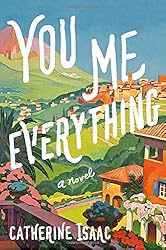
You Me Everything
Catherine Isaac, 2018
Penguin Publishing
368 pp.
ISBN-13: 9780735224537
Summary
Set in the French countryside on an idyllic summer vacation, a delicious, tender novel about finding joy and love even in the most unexpected places.
Jess and her ten-year-old son William set off to spend the summer at Chateau de Roussignol, deep in the rich, sunlit hills of the Dordogne.
There, Jess’s ex-boyfriend—and William’s father—Adam, runs a beautiful hotel in a restored castle. Lush gardens, a gorgeous pool, delectable French food, and a seemingly never-ending wine list—what’s not to like?
Jess is bowled over by what Adam has accomplished, but she’s in France for a much more urgent reason: to make Adam fall in love with his own son.
But Adam has other ideas, and another girlfriend—and he doesn’t seem inclined to change the habits of a lifetime just because Jess and William have appeared on the scene. Jess isn’t surprised, yet William—who has quickly come to idolize his father—wants nothing more than to spend time with him.
But Jess can’t allow Adam to let their son down—because she is tormented by a secret of her own, one that nobody—especially William—must discover.
By turns heartwrenching and hopeful, You Me Everything is a novel about one woman's fierce determination to grab hold of the family she has and never let go, and a romantic story as heady as a crisp Sancerre on a summer day. (From the publisher.)
Author Bio
• Aka—Jane Costello
• Birth—1974
• Where—Liverpool, England, UK
• Education—University of Liverpool; Glasgow Caledonian University
• Currently—lives in Liverpool, England
Catherine Isaac (a pseudonym for Jane Costello, which is also a pseudonym) is a British novelist born in Liverpool, England. Isaac/Costello studied History at the University of Liverpool and Journalism at Glasgow Caledonian University. She began her journalism career as trainee reporter at the Liverpool Echo, eventually rising to position of editor at the Liverpool Daily Post.
As Jane Costello, she wrote and published her first book, Bridesmaids, while on maternity leave in 2008. That novel and the next nine were all written as Jane Costello, and all became Sunday Times best-sellers in the UK.
You Me Everything, published in 2018, is her first book writing as Catherine Isaac, a pseudonym comprised of her middle name and her son Isaac's name. She explains the new pseudonym on her website:
It immediately felt different from my previous books and dealt with a subject that was bigger and more important than anything I'd tackled before.
Costello lives in Liverpool with her husband Mark and three sons. (Adapted from the publisher.)
Book Reviews
Equal parts wry comedy and touching family drama, it’s ultimately a heartbreaker that’ll stay with you long after you’re done.
Marie Claire
Heart-wrenching and romantic… draws comparisons to Lisa Genova’s Inside the O’Briens.… [A] solid choice for book groups that appreciate stories of everyday people with ordinary failings who overcome adversity.
Library Journal
A moving and surprising novel about love and parenthood, anxiety and hope. Readers who loved Jojo Moyes’ Me Before You will be swept up by Jess and Adam’s story.
Booklist
Isaac…skillfully captures Jess' oscillating emotions. Determined to make Adam love William,… [she] has a much more important motive for finding Adam—one that may spell life or death. A witty, light romance from a welcome new voice.
Kirkus Reviews
Discussion Questions
Catherine Isaac has described You Me Everything as a “love story in the widest definition of the term.” The novel explores the relationships between two lovers who went their separate ways, a mother and her ten-year-old, a distant father and the son he hardly knows, and a sick mother and her grown-up daughter. Which of these relationships did you feel were portrayed most effectively? Which did you enjoy reading about most?
2. We learn halfway through You Me Everything that Jess had a major choice to make in her life: whether or not to take a genetic test that would determine her own future. Would you have taken the test? Or could you have lived without knowing?
3. The novel is filled with lavish descriptions of the Dordogne, of the sights, sounds, smells, and tastes of a glorious French summer. Was this an aspect of the book that you enjoyed? Did the author successfully transport you to France as you were reading?
4. Isaac has said she hopes the book will raise awareness of Huntington’s disease, the condition Jess’s mother is living with. Had you known much, if anything, about the disease before reading this book? What do you think of how the author handled this difficult subject?
5. Near the end of the book, there is a new revelation about the night of William’s birth. Did you work out what had happened before Jess did?
6. “Sometimes it takes darkness to see how we shine.” Do you think it’s true that challenges in life can make a person stronger?
7. One of the themes explored in the novel is the idea of living life in the moment, not dwelling on fears about the future. Why do you think so many of us find that difficult to do?
8. You Me Everything handles some serious topics, but has moments of humor, too. What made you laugh in the book? How did you think this was balanced by other, more serious, aspects of the story?
(Questions issued by the publisher.)
You Remind Me of Me
Dan Chaon, 2004
Random House
384 pp.
ISBN-13: 9780345441409
In Brief
With his critically acclaimed Among the Missing and Fitting Ends, award-winning author Dan Chaon proved himself a master of the short story form. He is a writer, observes the Chicago Tribune, who can "convincingly squeeze whole lives into a mere twenty pages or so." Now Chaon marshals his notable talents in his much-anticipated debut novel.
You Remind Me of Me begins with a series of separate incidents: In 1977, a little boy is savagely attacked by his mother's pet Doberman; in 1997 another little boy disappears from his grandmother's backyard on a sunny summer morning; in 1966, a pregnant teenager admits herself to a maternity home, with the intention of giving her child up for adoption; in 1991, a young man drifts toward a career as a drug dealer, even as he hopes for something better.
With penetrating insight and a deep devotion to his characters, Dan Chaon explores the secret connections that irrevocably link them. In the process he examines questions of identity, fate, and circumstance: Why do we become the people that we become? How do we end up stuck in lives that we never wanted? And can we change the course of what seems inevitable?
In language that is both unflinching and exquisite, Chaon moves deftly between the past and the present in the small-town prairie Midwest and shows us the extraordinary lives of "ordinary" people. (From the publisher.)
Author Bio
• Birth—1946
• Raised—Sidney, Nebraska, USA
• Education—M.F.A., Syracuse University
• Awards—Pushcart Prize; O'Henry Award; Academy Award in
Literature-The American Academy of Arts & Letters
• Currently—lives in Cleveland Heights, Ohio, USA
Dan Chaon (pronounced "Shawn") is the acclaimed author of Fitting Ends and Among the Missing, a finalist for the National Book Award, which was also listed as one of the ten best books of the year by the American Library Association, Chicago Tribune, Boston Globe, and Entertainment Weekly, as well as being cited as a New York Times Notable Book.
Chaon’s fiction has appeared in numerous journals and anthologies, and won both Pushcart and O. Henry awards. Chaon teaches at Oberlin College and lives in Cleveland Heights, Ohio, with his wife and two sons. (From the publisher and Wikipedia.)
Book Reviews
You Remind Me of Me is the first novel by an author already established for mournful, eloquent short stories with a tone reminiscent of Russell Banks's. Mr. Chaon's stories have been about emotional ellipses in his characters' lonely lives. (His collection Among the Missing was a nominee for the National Book Award.) In the same manner the new book is a peculiarly haunting work, since it has as much to do with what is absent from its characters' stories as with what is present. So Jonah grows up to be an uneasy loner, and he clings to the sense that his life could have been different if one important loss had never occurred. He knows exactly what that loss is.
Janet Maslin - New York Times
Three lives viewed through a kaleidoscope of memories and secret pain assume a kind of mythical dimension in Chaon's piercingly poignant tale of fate, chance and search for redemption. As he demonstrated in his short story collection Among the Missing, Chaon has a sensitive radar for the daily routines of people striving to escape the margins of poverty and establish meaningful lives. Here, a woman's unsuccessful effort to rise above the pain of giving away an illegitimate baby, and to fight against mental illness and offer love to a second child, blights all their lives. Living with his harsh and bitter mother, Norma, and his kindly grandfather in Little Bow, S.Dak., young Jonah Doyle is permanently scarred after the family's Doberman attacks and maims him. The resulting livid ridges on his face are the outward manifestations of a deeper wound that will always haunt him. After his mother's suicide, Jonah sets out to find the older brother he has never met, and in the process, brings them both to the verge of tragedy. Jonah's older sibling is Troy Timmens, a well-meaning bartender and sometime drug dealer in St. Bonaventure, Nebr., who is devoted to his six-year-old son, Loomis. The boy will play a pivotal part in Jonah's quixotic attempts to win Troy's love. Chaon structures his plot in alternating flashbacks, and the fragmentary time structure forces the reader to puzzle out the relationships and contributes to rising dramatic tension. Chaon's clarity of observation, expressed in restrained, nuanced prose, coupled with his compassion for his flawed characters, creates a heart-wrenching story of people searching for connection. Readers of Kent Haruf will find similarities here, in the settings in small towns on the Great Plains and in the dignified portrayal of people leading secret, stoic lives.
Publishers Weekly
In his masterly first novel, Chaon tells an absorbing tale of fate and the struggle for recovery and human connection. His greatest strength is the ability to intertwine multiple stories while neatly showcasing the tangled threads of each character. In one thread, a young boy named Jonah is brutally attacked and permanently scarred by his grandfather's Doberman pinscher; in another, Norma, Jonah's mentally ill mother, recalls entering a home for unwed mothers, where she prepared to give up her first child for adoption. That brings us to said child, Troy Timmens, a small-time drug dealer and bartender with a son of his own, Loomis. Jonah seeks out his older brother, who desperately wants more out of life, but their connection ends in disaster. Chaon, whose short story collection, Among the Missing, drew rave reviews, allows his characters to enact their lives, losses, and hopes in a stark and realistic manner. Readers who prefer expertly crafted plotting and strong characterization will be drawn to this novel. Highly recommended for public library systems with an emphasis on literary fiction and for anyone interested in promising first novelists. —Christopher J. Korenowsky, Columbus Metropolitan Lib. Syst., OH
Library Journal
(Adult/High School.) This first novel focuses on the disparate lives of a fragmented family as they struggle with the harsh realities of poverty, depression, and dysfunction. The story opens with Jonah, a troubled, self-involved boy in a small South Dakota town. Raised by a depressed and suicidal mother who never wanted him, he survives an attack from the family's Doberman only to be severely scarred on his face and hands. Jonah develops into a lonely and isolated man who tries to make connections with anyone willing to befriend him, only to push others away by eventually demanding more than they want to give. Driven by his need for acceptance, Jonah seeks out an older half brother who was given up for adoption at birth. Troy, a bartender and occasional marijuana dealer, has difficulties of his own: shortly after the disappearance of his wife, he is arrested and placed on probation and house arrest for drug dealing. He struggles to regain custody of his son, Loomis, a strangely intelligent and watchful boy, from his uncooperative mother-in-law and has little time for the hopeful Jonah. In what he intends as a gesture of brotherly friendship, Jonah kidnaps Loomis, meaning to take the boy to Troy. This desperate act ultimately leads to the dramatic yet real conclusion. A series of tightly interwoven flashbacks; deft handling of structure; and simple, precise language transform these characters' lives into a story that is highly readable, thought-provoking, and profoundly moving. —Matthew L. Moffett, Northern Virginia Community College, Annandale
School Library Journal
Acclaimed storywriter Chaon (Among the Missing, 2001, etc.) affirms his matchless skill in crafting the small sketch, even as he struggles to conclude the weather-beaten plot of his first novel with large-scale grace. The initial handful of chapters here, in fact, read like a fresh collection of stories, distinguished as usual by the shy, cutting honesty of Chaon's prose. As these precisely dated chapters collect, the larger design of the whole emerges. Jonah and Troy share a mother. Troy was adopted out, while Jonah was raised by his mother and grandfather. Nearly all the characters here are adopted, in one way or another, some more than once. While his legal parents shred apart the last tendrils of their marriage, Troy is taken into a young family's circle. Jonah lives with his mother, herself an orphan, her wifeless father, and a Doberman pinscher. Each incident is expertly delineated as the narrative gathers momentum: Troy's early experiences with soft drugs and girls, Jonah's mauling by his grandfather's Doberman, and their mother's yearlong stay at a home for unwed mothers. When Jonah sets out to find the brother he's heard his mother mention, Chaon's taut mastery slackens. Hiring on as a cook where his half-brother works, Jonah learns that Troy, recently arrested for marijuana possession, has lost custody of his son Loomis. The tightly wound Jonah improbably attempts to "rescue" the boy back into Troy's custody, even as Troy continues to struggle with the new knowledge that he has a long-lost brother. The symmetries and compensations here are a bit too tidy, and though his final vignette leaves the reader astonished once again, the larger satisfactions of mature plot-making remain elusive for this powerful, promising writer.
Kirkus Reviews
Discussion Questions
1. Why did Nora give up her first baby and not her second? In turn, how did each child pay the price of her decision?
2. How do Jonah’s scars influence his life the most?
3. Why is Jonah so much more interested in the baby his mother gave up than Troy is about being adopted?
4. How do you feel Jonah and Troy’s lives would have been different if Nora had been honest with Wayne Hill, Troy’s natural father, about being pregnant?
5. How are Steve and Holiday, and Jonah important to each other? Why did their relationship end?
6. Why couldn’t Jonah recognize the circumstances he could change/influence so his fate would turn out differently?
7. How would Jonah and Troy’s lives been different if Jonah had been honest with Troy about their connection when they first met?
8. Why do you think Jonah didn’t tell Troy the truth about Nora’s life and personality when they first meet? Would this have changed the relationship between Troy and Jonah?
9. At what point did you recognize that Jonah has seriously broken with reality?
10. What is the significance of names in this novel? Why do you think the author chose each name?
Troy
The Mrs. Glass House
Jonah
Gary Gray
Mrs. Keene
Lisa Fixx
Loomis
St. Bonaventure
(Questions issued by publisher.)
You Shall Know Our Velocity!
Dave Eggers, 2002
Knopf Doubleday
400 pp.
ISBN-13: 9781400033546
Summary
Will has surprisingly come into a large amount of money. His photograph screwing in a lightbulb has been made a silhouette and is being used as a picture for the company's lightbulb boxes.
Will with his friend, Hand, buy plane tickets to the most obscure countries possible, wherein they will give the money away, bit by bit, to people whom they arbitrarily decide are most deserving. According to Hand, they gave to people for the benefit of both parties—as a sacrament with the purpose of restoring a faith in humanity.
Without a solid set of criteria, or a definitive direction in their plan, this proves surprisingly difficult, and they experience much awkward confusion and moral uncertainty. Barely able to achieve their goal of giving away their money, the two are reduced to pretending to ask for directions, and taping money to barn animals. The plot is both a log of the journey, as well as a look into the mind of the narrator, Will, who often feels isolated, confused, and shy. (From the publisher.)
Author Bio
• Birth—March 12, 1970
• Where—Boston, Massachusetts, USA
• Reared—Lake Forest, Illinois
• Education—University of Illinois
• Currently—lives in San Francisco, California
Dave Eggers is the author of four books, A Heartbreaking Work of Staggering Genius, You Shall Know Our Velocity!, How We Are Hungry, and What Is the What. He is the editor of McSweeney’s, a quarterly magazine and book-publishing company, and is cofounder of 826 Valencia, a network of nonprofit writing and tutoring centers for young people.
His interest in oral history led to his 2004 cofounding of Voice of Witness, a nonprofit series of books that use oral history to illuminate human rights crises around the world. As a journalist, his work has appeared in The New Yorker, Esquire, and The Believer. He lives in the San Francisco Bay area with his wife and daughter. (From the publisher.)
More
Eggers was born in Boston, Massachusetts, grew up in suburban Lake Forest (where he was a high-school classmate of the actor Vince Vaughn), and attended the University of Illinois at Urbana-Champaign. He lives in San Francisco and is married to the writer Vendela Vida. In October 2005, Vendela gave birth to a daughter, October Adelaide Eggers Vida.
Eggers's brother Bill is a researcher who has worked for several conservative think tanks, doing research on privatization. His sister, Beth, claimed that Eggers grossly understated her role in raising their brother Toph and made use of her journals in writing A Heartbreaking Work of Staggering Genius without compensating her. She later recanted her claims in a posting on her brother's own website McSweeney's Internet Tendency, referring to the incident as "a really terrible LaToya Jackson moment". On March 1, 2002, the New York Post reported that Beth, then a lawyer in Modesto, California, had committed suicide. Eggers briefly spoke about his sister's death during a 2002 fan interview for McSweeney's.
Eggers was one of three 2008 TED Prize recipients. His TED Prize wish: for community members to personally engage with local public schools.
Eggers began writing as a Salon.com editor and founded Might magazine, while also writing a comic strip called Smarter Feller (originally Swell, then Smart Feller) for SF Weekly. His first book was a memoir (with fictional elements), A Heartbreaking Work of Staggering Genius (2000). It focuses on the author's struggle to raise his younger brother in San Francisco following the sudden deaths of their parents. The book quickly became a bestseller and was a finalist for the Pulitzer Prize for General Non-Fiction. The memoir was praised for its originality, idiosyncratic self-referencing, and for several innovative stylistic elements. Early printings of the 2001 trade-paperback edition were published with a lengthy, apologetic postscript entitled "Mistakes We Knew We Were Making."
In 2002, Eggers published his first novel, You Shall Know Our Velocity, a story about a frustrating attempt to give away money to deserving people while haphazardly traveling the globe. An expanded and revised version was released as Sacrament in 2003 and retitled You Shall Know Our Velocity! for its Vintage imprint distribution. He has since published a collection of short stories, How We Are Hungry, and three politically-themed serials for Salon.com. In November 2005, Eggers published Surviving Justice: America's Wrongfully Convicted and Exonerated, compiling the book of interviews with exonerees once sentenced to death. The book was compiled with Lola Vollen, "a physician specializing in the aftermath of large-scale human rights abuses" and "a visiting scholar at the University of California, Berkeley's Institute of International Studies and a practicing clinician." Novelist Scott Turow wrote the introduction to Surviving Justice. Eggers's most recent novel, What Is the What: The Autobiography of Valentino Achak Deng (McSweeney's, 2006), was a finalist for the 2006 National Book Critics Circle Award for Fiction. Eggers is also the editor of the Best American Nonrequired Reading series, an annual anthology of short stories, essays, journalism, satire, and alternative comics.
Eggers is the founder of McSweeney's, an independent publishing house. McSweeney's produces a quarterly literary journal, McSweeney's, first published in 1998; a monthly journal, The Believer, which debuted in 2003 and is edited by wife Vida; and, beginning in 2005, a quarterly DVD magazine, Wholphin. Other works include The Future Dictionary of America, Created in Darkness by Troubled Americans, and the "Dr. and Mr. Haggis-On-Whey" children's books of literary nonsense, which Eggers writes with his younger brother. Ahead of the 2006 FIFA World Cup, Eggers wrote an essay about the US national team and soccer in the United States for The Thinking Fan's Guide to the World Cup, a book published with aid of the journal Granta, that contained essays about each competing team in the tournament.
Eggers currently teaches writing in San Francisco at 826 Valencia, a nonprofit tutoring center and writing school for children that he cofounded in 2002. Eggers has recruited volunteers to operate similar programs in Los Angeles, New York City, Seattle, Chicago, and Ann Arbor, Michigan, all under the auspices of the nonprofit organization 826 National. In 2006, he appeared at a series of fundraising events, dubbed the Revenge of the Book–Eaters tour, to support these programs. The Chicago show, at the Park West theatre, featured Death Cab for Cutie frontman Ben Gibbard. Other performers on the tour included Sufjan Stevens, Jon Stewart and David Byrne. In September 2007, the Heinz Foundations awarded Eggers a $250,000 Heinz award given to recognize "extraordinary achievements by individuals". The award will be used to fund some of the 826 Valencia writing centers. (From Wikipedia.)
Book Reviews
Headlong, heartsick and footsore....Frisbee sentences that sail, spin, hover, circle and come back to the reader like gifts of gravity and grace....Nobody writes better than Dave Eggers about young men who aspire to be, at the same time, authentic and sincere.
New York Times Book Review
You Shall Know Our Velocity! is the work of a wildly talented writer... Like Kerouac's book, Eggers's could inspire a generation as much as it documents it.
Los Angeles Times
There are some wonderful set-pieces here, and memorable phrases tossed on the ground like unwanted pennies from the guy who runs the mint.
Washington Post
The bottom line that matters is this: Eggers has written a terrific novel, an entertaining and imaginative tale
Boston Globe
Eggers ’s writing really takes off—his forte is the messy, funny tirade, stuffed with convincing pain and wry observations.
Newsday
Powerful.... Eggers’s strengths as a writer are real: his funny pitch-perfect dialog; the way his prose delicately captures the bumblebee blundering of Will’s thoughts; ... and the stream-water clarity of his descriptions.... There is genius here.... Who is doing more, single-handedly and single-mindedly, for American writing?
Time
Discussion Questions
1. You Shall Know Our Velocity! contains drawings, photographs, and reproductions of notes and maps that Will and Hand create in the story. How surprising is it to come upon such visual elements in a literary text? What do they add to the novel? In what ways do they challenge the conventions of the novel form?
2. Do Will and Hand decide to take their trip in order to escape their grief over Jack's death, or to confront that grief and possibly transform it? Is their trip an act of penance? What guilt do they feel in relation to Jack?
3. Will received his money for allowing an advertising company to use his silhouette, a shadow image of him screwing in a light bulb. In what ways is this circumstance both meaningful and absurd? What other absurd elements appear in the novel? Does the book's humor diminish or deepen its more serious concerns?
4. Will carries on internal conversations and arguments in his head, with Hand, with strangers, with Jack. But he's tired of them. "I wanted the voices silenced and I wanted less of my head generally" [p. 27]. Why is he so tormented by these voices? What does he want instead of the constant arguing? Does he find it by the end of the story?
5. In Estonia, Will questions why he is giving away his money: "Was the point to give it to people who needed it, orjust to get rid of it? I knew the answer, of course, but had to remind Hand" [p. 239]. What is the point of giving the money away? Why does Hand need to be reminded?
6. Hand describes at length the nomadic tribe of "Jumping People" in South America. These people believed in "the impermanence of place" [p. 376] and felt that they carried the souls of their dead loved ones on their backs like mountains. In what ways is their story relevant to Will and Hand's story? In what instances is jumping, or leaping over, important in the novel? Why has Eggers used the message the Jumping People carved into the cliff above their village, "YOU SHALL KNOW OUR VELOCITY," as his title?
7. Will winces at Hand's awkwardness when he spills his soda while giving money to a Moroccan family. "What kind of person brings his soda? You're giving $300 to people in a shack and you bring your soda? Nothing we did ever resembled in any way what we'd envisioned" [p. 226]. Why is it so hard to give the money to people gracefully? What are some of their more fanciful ideas about how to deliver the money? Why is the way they give it so important to them?
8. In what sense can the novel be read as an elegy to childhood, or to the lost innocence of childhood? What childhood experiences do Will and Hand remember most vividly? In what ways is their behavior still childlike?
9. Will describes a swarm of birds as "swinging to and fro, overlapping, like a group of sixth graders riding bikes home from school" [p. 101]; and of the smoothness of a Moroccan woman's skin, he says: "Next to skin like that, ours seemed so rough, like burlap woven with straw" [p. 220]. Where else does this kind of metaphorical language appear? What does it add to the novel?
10. Near the end of the novel, as they prepare to part, Hand asks Will when he will return from Mexico. Will says he doesn't know but thinks to himself "I'm going to keep going" [p. 389]. What does he mean by this? Is he suggesting suicide, the death by drowning referred to in the novel's opening sentence?
11. Will is beaten when Hand disappears. Later, in one of his interior dialogues, Will says "Most of being a man is being there, Hand" [p. 347]. Why is "being there" so important for Will? What other absences haunt him? Is Will able to be fully "there" for others?
12. Apart from disencumbering them of Will's money, how does this journey affect Will and Hand? Does it affect them differently? What do they discover about themselves and each other, about the world and their place in it, during the course of their travels?
13. In what ways does Eggers speak for or represent not only his own experience but the sensibility of his generation? How does that sensibility differ from previous generations?
14. Will's mother thinks it is "condescending" to swoop in and give poor people cash, while Will considers that attitude illogical, a defense for her own "inaction" [p. 123]. Is Will right? Is his way of giving better than his mother's support of charities? What is the essential difference between giving something to someone face to face as opposed to giving through a charitable institution? In what sense is the novel, as a whole, an act of giving?
(Questions issued by publisher.)


You Should Have Known
Jean Hanff Korelitz, 2014
Grand Central Publishing
448 pp.
ISBN-13: 9781455599493
Summary
Grace Reinhart Sachs is living the only life she ever wanted for herself.
Devoted to her husband, a pediatric oncologist at a major cancer hospital, their young son Henry, and the patients she sees in her therapy practice, her days are full of familiar things: she lives in the very New York apartment in which she was raised, and sends Henry to the school she herself once attended.
Dismayed by the ways in which women delude themselves, Grace is also the author of a book You Should Have Known, in which she cautions women to really hear what men are trying to tell them. But weeks before the book is published a chasm opens in her own life: a violent death, a missing husband, and, in the place of a man Grace thought she knew, only an ongoing chain of terrible revelations.
Left behind in the wake of a spreading and very public disaster, and horrified by the ways in which she has failed to heed her own advice, Grace must dismantle one life and create another for her child and herself. (From the publisher.)
Author Bio
• Birth—May 16, 1961
• Where—New York City, New York, USA
• Education—B.A., Dartmouth College
• Currently—lives in New York City
Jean Hanff Korelitz was born and raised in New York and graduated from Dartmouth College and contined with post-baccalaureate studies at Clare College, Cambridge.
She is the author of one book of poems, The Properties of Breath (1989), and five novels (see below). She has also written a novel for children, Interference Powder (2003), and has published essays in the anthologies Modern Love and Because I Said So, as well as in Vogue, Real Simple, More, Newsweek, and others.
She lives in New York City with her husband (Irish poet Paul Muldoon, poetry editor at The New Yorker and Princeton poetry professor). They have two children. (Adapted from the publisher.)
Novels
• 1996 - A Jury of Her Peers
• 1999 - The Sabbathday River
• 2006 - The White Rose
• 2009 - Admission
• 2014 - You Should Have Known
Book Reviews
[S]mart and devious…Ms. Korelitz is able to glide smoothly from a watchful, occasional sinister comedy of New York manners into a much more alarming type of story.
Janet Maslin - New York Times
Dramatic irony isn't the only pleasure of You Should Have Known; Grace's husband's pathology is erratic enough for behavior that holds genuine surprise. But the real suspense here lies in wondering when Grace will catch up to the reader. When and how will she come to know what she should have known and at some level maybe already did? The momentum of the novel, not to mention the writing, takes off just as Grace starts stumbling her way, arms outstretched, toward a glimpse of her husband's true nature.
Susan Dominus - New York Times Book Review
(Starred review.) This excellent literary mystery...with authentic detail in a rarified contemporary Manhattan.... The novel’s first third offers readers an authoritative glimpse into the busy-but-leisurely lives of private-school moms.... [until] one....was found murdered.... The plot borders on hyperbole when it comes to upending what we know about one character, but that doesn’t take much away from this intriguing and beautiful book.
Publishers Weekly
[I]n the vein of Gone Girl or The Silent Wife; unfortunately, the suspense is marred by the overwritten prose. The book tends to be very New York-centric, so readers unfamiliar with the vagaries of life in Manhattan may find little to enjoy; still, fans of Korelitz's first novel may be curious enough to give this a shot. —Robin Nesbitt, Columbus Metropolitan Lib., OH
Library Journal
Grace Reinhart Sachs...lives the perfect life.... Karma being what it is, it only stands to reason that the perfection of her life...will fall apart at the mere hint of scandal. And so it does.... Korelitz writes with clarity and an unusual sense of completeness.... A smart, leisurely study of midlife angst.
Kirkus Reviews
Discussion Questions
Use our LitLovers Book Club Resources; they can help with discussions for any book:
• How to Discuss a Book (helpful discussion tips)
• Generic Discussion Questions—Fiction and Nonfiction
• Read-Think-Talk (a guided reading chart)
(We'll add specific questions if and when they're made available by the publisher. In the meantime, use our generic mystery questions.)
GENERIC QUESTIONS
Mystery / Crime / Suspense Thrillers
1. Talk about the characters, both good and bad. Describe their personalities and motivations. Are they fully developed and emotionally complex? Or are they more one-dimensional heroes and villains?
2. What do you know...and when do you know it? At what point in the book do you, the reader, begin to piece together what happened?
3. Good crime writers are skillful at hiding clues in plain sight. How well does the author hide the clues in this work?
4. Does the author use red-herrings—false clues—to purposely lead readers astray?
5. Talk about plot's twists & turns—those surprising developments that throw everything you think you've figured out into disarray. Do they enhance the story, add complexity, and build suspense? Are they plausible? Or do the twists & turns feel forced and preposterous—inserted only to extend the story.
6. Does the author ratchet up the story's suspense? Did you find yourself anxious—quickly turning pages to learn what happened? How does the author build suspense?
7. What about the ending—is it satisfying? Is it probable or believable? Does it grow out of clues previously laid out by the author (see Question 2). Or does the ending come out of the blue? Does it feel forced...tacked-on...or a cop-out? Or perhaps it's too predictable. Can you envision a better, or different, ending?
8. Are there certain passages in the book—ideas, descriptions, or dialogue—that you found interesting or revealing...or that somehow struck you? What lines, if any, made you stop and think?
9. Overall, does the book satisfy? Does it live up to the standards of a good crime story or suspense thriller? Why or why not?
(Generic Mystery Questions by LitLovers. Please feel free to use them, online or off, with attribution. Thanks.)
top of page (summary)
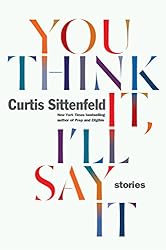
You Think It, I'll Say It: Stories
Curtis Sittenfeld, 2018
Random House
240 pp.
ISBN-13: 9780399592867
Summary
A suburban mother of two fantasizes about the downfall of an old friend whose wholesome lifestyle empire may or may not be built on a lie.
A high-powered lawyer honeymooning with her husband is caught off guard by the appearance of the girl who tormented her in high school.
A shy Ivy League student learns the truth about a classmate’s seemingly enviable life.
Curtis Sittenfeld has established a reputation as a sharp chronicler of the modern age who humanizes her subjects even as she skewers them. Now, with this first collection of short fiction, her "astonishing gift for creating characters that take up residence in readers' heads" (The Washington Post) is showcased like never before.
Throughout the ten stories in You Think It, I’ll Say It, Sittenfeld upends assumptions about class, relationships, and gender roles in a nation that feels both adrift and viscerally divided.
With moving insight and uncanny precision, Curtis Sittenfeld pinpoints the questionable decisions, missed connections, and sometimes extraordinary coincidences that make up a life.
Indeed, she writes what we’re all thinking—if only we could express it with the wit of a master satirist, the storytelling gifts of an old-fashioned raconteur, and the vision of an American original. (From the publisher.)
Author Bio
• Birth—August 23, 1975
• Where—Cincinnati, Ohio, USA
• Education—B.A., Stanford University; M.F.A., Iowa Writers' Workshop
• Currently—lives in St. Louis, Missouri
Elizabeth Curtis Sittenfeld is an American writer, the author of several novels and a collection of short stories.
Sittenfeld was the second of four children (three girls and a boy) of Paul G. Sittenfeld, an investment adviser, and Elizabeth (Curtis) Sittenfeld, an art history teacher and librarian at Seven Hills School, a private school in Cincinnati.
She attended Seven Hills School through the eighth grade, then attended high school at Groton School, a boarding school in Groton, Massachusetts, graduating in 1993. In 1992, the summer before her senior year, she won Seventeen magazine's fiction contest.
She attended Vassar College in Poughkeepsie, New York, before transferring to Stanford University in Palo Alto, California. At Stanford, she studied Creative Writing, wrote articles for the college newspaper, and edited that paper's weekly arts magazine. At the time, she was also chosen as one of Glamour magazine's College Women of the Year. She earned an MFA from the Iowa Writers' Workshop at the University of Iowa.
Novels
• Prep
Her first novel Prep (2005) deals with coming of age, self-identity, and class distinctions in the preppy and competitive atmosphere of a private school.
• The Man of My Dreams
Sittenfeld's second novel, The Man of My Dreams (2006), follows a girl named Hannah from the end of her 8th grade year through her college years at Tufts and into her late twenties.
• American Wife
Sittenfeld's third novel, American Wife (2008), is the tale of Alice Blackwell, a fictional character who shares many similarities with former First Lady Laura Bush.
• Sisterland
Her fourth novel, Sisterland (2013), concerns a set of identical twins who have psychic powers, one of whom hides her strange gift while the other has become a professional psychic.
• Eligible
A 21st-century retelling of Jane Austen's Pride and Prejudice, Eligible was released in 2016. (Adapted from Wikipedia. Retrieved 6/12/2013.)
Book Reviews
In the lives of Sittenfeld's characters, the lusts and disappointments of youth loom large well into middle age…. Their trials, in the grand scheme of things, are manageable enough that they allow easily for comedy, which Sittenfeld is a pro at delivering in the details.… But Sittenfeld doesn't shy away from poking at the soft spots of a person's psyche, the painful longings for something exquisite to cut through the ennui of even the most comfortable lives.… The women of You Think It, I'll Say It are, as a group, a demanding breed. They often assume the worst in their imagined adversaries. Sometimes they are wrong, but they are right about just enough (and funny enough) that we forgive them. And, because they know they need absolution for their own worst motives, we forgive those, too.
Susan Dominus - New York Times Book Review
Sittenfeld makes writing lively and diverting fiction look easy, though each deceptively simple and breezy story is masterfully paced and crafted. . . . Witty and buoyant, Sittenfeld delivers her characters to her audience with bemused perspicacity and above all affection. . . . Sittenfeld proves adept at quickly establishing characters in whom the reader feels inclined to invest immediately.
Chicago Tribune
Razor-sharp, often hilarious.… [Sittenfeld] is a sharp observer of human nature and human relationships.… A witty, breezy, zeitgeist-y collection.
USA Today
Perfectly paced, witty and laced with unexpected twists: Every story here sticks its landing.… Whatever [Sittenfeld] writes, we’ll read it.
People
Sittenfeld’s new story collection is brutally, beautifully human.
Entertainment Weekly
(Starred review) In her thoroughly satisfying first collection, Sittenfeld spins magic out of the short story form.… As in her novels, Sittenfeld’s characters are funny and insightful. Reading these consistently engrossing stories is a pleasure.
Publishers Weekly
(Starred review) In crisp, surprising language, these ten stories …put couples' foibles under the spotlight …to show how the slog of daily living knocks idealized romance out of its misleading No. 1 spot as the goal of pairing up. —Beth Andersen, formerly with Ann Arbor Dist. Lib., MI
Library Journal
(Starred review) [E]ntertaininge.… Masterfully plotted and often further gilded with mirthful twists, Sittenfeld’s short-form works (half of which are published here for the first time) are every bit as smart, sensitive, funny, and genuine as her phenomenally popular novels.
Booklist
[T]he fissures beneath the surfaces of comfortable lives.… . Sittenfeld's own perspective throughout is compassionate without being sentimental, hopeful without being naïve. The way we live now, assessed with rue and grace.
Kirkus Reviews
Discussion Questions
We'll add publisher questions if and when they're available; in the meantime, use our LitLovers Book Club Resources. They can help with discussions for any book, even short stories:
• How to Discuss a Book (helpful discussion tips)
• Generic Discussion Questions—Fiction and Nonfiction
• Read-Think-Talk (a guided reading chart)
(Resources by LitLovers. Please feel free to use them, online and off, with attribution. Thanks.)


You Too Can Have a Body Like Mine
Alexandra Kleeman, 2015
HarperCollins
3045 pp.
ISBN-13: 9780062388674
Summary
An intelligent and madly entertaining debut novel that is at once a missing-person mystery, an exorcism of modern culture, and a wholly singular vision of contemporary womanhood from a terrifying and often funny voice of a new generation.
A woman known only by the letter A lives in an unnamed American city with her roommate, B, and boyfriend, C, who wants her to join him on a reality show called That’s My Partner!
A eats (or doesn’t) the right things, watches endless amounts of television, often just for the commercials—particularly the recurring cartoon escapades of Kandy Kat, the mascot for an entirely chemical dessert—and models herself on a standard of beauty that only exists in such advertising. She fixates on the fifteen minutes of fame a news-celebrity named Michael has earned after buying up his local Wally Supermarket’s entire, and increasingly ample, supply of veal.
Meanwhile B is attempting to make herself a twin of A, who hungers for something to give meaning to her life, something aside from C’s pornography addiction, and becomes indoctrinated by a new religion spread throughout a web of corporate franchises, which moves her closer to the decoys that populate her television world, but no closer to her true nature. (From the publisher.)
Author Bio
• Birth—ca. 1985-86
• Raised—Colorado, Japan, and elsewhere
• Education—B.A., Brown University; M.F.A., Columbia University; Ph.D., University of
California-Berkeley (working towrd)
• Currently—lives in Staten Island, New York
Alexandra Kleeman, whose parents are both professors, grew up in places like Japan and Colorado. She started blogging in high school, joking, "I was pretty big in the Asian-American web log community."
After high school, Kleeman went to Brown University, where she studied cognitive science and creative writing. She received her M.F.A in fiction from Columbia University and is working toward her Ph.D. in Rhetoric at UC Berkeley.
At the age of 24, Kleeman published her first short story in the Paris Review and has continued to write for the Review as well as for Zoetrope, Guernica, Tin House, and n+1. She has received grants and scholarships from the Bread Loaf Writers' Conference, the Virginia Center for the Creative Arts, and the Santa Fe Art Institute.
Currently, Kleemena lives on Staten Island with her fiance, the novelist Alex Gilvarry. (Adapted from the publisher and Observer.com.)
Book Reviews
This is not a breezy summer read, but it’s cerebral, sharp, funny - and worth the ride.
New York Post
A satirical and searing critique of modern-day womanhood.
Chicago Tribune
Kleeman serves up a clever satire of our culture’s ever intensifying obsession with health, diet, and body image
Los Angeles Magazine.
The smartest, strangest novel I’ve read in a while (Staff Pick).
Paris Review
This debut novel by future superstar Alexandra Kleeman will be the thing to be seen reading this summer. Pick it up if you want to up your summer cool factor . . . . .Very funny, perfectly weird, a hyperintelligent commentary on a culture obsessed with you and fame.
Vanity Fair
Alexandra Kleeman has written Fight Club for girls.
Vogue.com
Excellent.... Sprinkled with detailed summaries of invented advertisements, the book describes a consumer landscape just on the far side of plausible. You Too Can Have a Body Like Mine is a story about realizing you’re hungry and trying to find out what for.
Slate
Her darkly satirical debut lays bare the ravages of advertising-fueled culture and consumerism, through a purposefully distorted version of our reality. Fans of DeLillo, Pynchon and Shteyngart are advised to take note.
Huffington Post
Alexandra Kleeman’s brilliant debut novel You Too Can Have A Body Like Mine is at once eerie and strange and beautiful, an incisive commentary on contemporary culture and womanhood.
Buzzfeed
Don’t be fooled by the sassy title-the cravings that lurk beneath the surface in this completely original debut will haunt what a body means to you indefinitely.
Marie Claire
(Starred review.) [A] fever dream of modern alienation.... It's a testament to Kleeman's ability that the text itself blurs and begins to run together.... This is a challenging novel, but undoubtedly one with something to say. One wonders what Kleeman will come up with next.
Publishers Weekly
Absurdist observations evoke masters like DeLillo and Pynchon, as well as the “hysterical realism” of Ben Marcus and Tom Perrotta, bringing a refreshingly feminist frame to the postmodern conversation. While ambitious in scope and structure, sharp humor and brisk storytelling ground the existential angst in Kleeman’s page-turning, entertaining performance.
Booklist
"I had hoped happiness would be warmer, cozier, more enveloping. More exciting, like one of the things that happen on TV to TV...." [T]here's writing just like that on nearly every page. At the narrative level, though, this novel barely moves.... Existential paralysis is a great subject for short fiction but a more difficult one for a novel.
Kirkus Reviews
Discussion Questions
Use our LitLovers Book Club Resources; they can help with discussions for any book:
• How to Discuss a Book (helpful discussion tips)
• Generic Discussion Questions—Fiction and Nonfiction
• Read-Think-Talk (a guided reading chart)
Also, consider these LitLovers talking points to help get a discussion started for You Too Can Have a Body Like Mine:
1. What is the significance of the book's title, "You Too Can Have a Body Like Mine"?
2. Talk about this novel as social commentary. What aspects of contemporary culture does it comment on? What does it suggest about the quality of our lives and how our aspirations are shaped?
3. The novel has been described as existential, difficult, disorienting, even alienating. Is the book primarily intellectual? Or does it resonate with you on a personal level? If so, what parts in particular?
4. How would you describe A and B and C? Why are they identified as such: why might the author have used letters rather than names for her characters? Do you see any aspect of yourself (or anyone you know) in A, B, or C?
5. Talk about A's fascination with Kandy Kat, both literally (as a plot element in the story) and metaphorically (what it might signify symbolically).
6. Why does A turn to the Church of the Conjoined Eaters? What practices of society does the church satirize?
7. Overall, what does the book suggest about the female body and it's "function" in society? Do you agree with A's view that "A woman’s body never really belongs to herself"?
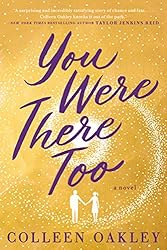
You Were There Too
Colleen Oakley, 2020
Penguin Publishing
352 pp.
ISBN-13: 9781984806468
Summary
A heart-wrenching and unforgettable love story about a woman who must choose between the man she loves and the man fate has chosen for her, in a novel that reminds us that the best life is one led by the heart.
Mia Graydon's life looks picket-fence perfect; she has the house, her loving husband, and dreams of starting a family.
But she has other dreams too—unexplained, recurring ones starring the same man.
Still, she doesn’t think much of it, until a relocation to small-town Pennsylvania brings her face to face with the stranger she has been dreaming about for years. And this man harbors a jaw-dropping secret of his own—he's been dreaming of her too.
Determined to understand, Mia and this not-so-stranger search for answers. But when diving into their pasts begins to unravel her life in the present, Mia emerges with a single question—what if? (From the publisher.)
Author Bio
Colleen Oakley is the author of three novels, You Were There Too (2020), Close Enough to Touch (2017), and Before I Go (2015).
Oakley is also the former senior editor of Marie Claire and editor in chief of Women's Health & Fitness. Her articles, essays and interviews have been featured in the New York Times, Ladies' Home Journal, Marie Claire, Women's Health, Redbook, Parade and Martha Stewart Weddings. She lives in Georgia with her husband, four kids and the world's biggest lapdog. (From the publisher.)
Book Reviews
(Starred review) Oakley blends an old-fashioned love story with a fresh psychic mystery for a satisfying look at commitment, forgiveness, and fate in this can’t-put-it-down story.… There is a splendid blend of humor throughout Oakley’s…foreboding love-conquers-all tale.
Publishers Weekly
[P]oignant… [with] a fascinating premise.… [T]he tension between Mia and Harrison, the fortuneteller and Oakley’s breezy writing all encourage the reader to stick with the book, which tells a sad story to a bouncy beat. Full of misdirection and a few gentle red herrings..
BookPage
(Starred review) Oakley keeps readers wondering… about Mia and Oliver, while the emotional journey… is realistic. Keep a box of tissues handy—the ending is a gut-punch that will leave readers who have invested in these beautifully drawn characters reeling.
Booklist
Readers expecting a simple happily-ever-after should look elsewhere, but those looking for a Me Before You-style sobfest are in the right place. A heartbreaking and thought-provoking exploration of fate, love, and choice sure to bring on a few tears.
Kirkus Reviews
Discussion Questions
1. Near the beginning of the book, Mia admits she’s been dreaming about a man on and off for most of her adult life. Have you ever had any recurring dreams? What do they mean to you?
2. When we meet Mia, she tells her sister, "It doesn’t feel like this is where I’m supposed to be." Why do you think she feels that way?
3. Mia and Harrison suffer a third miscarriage. What does the way they handle it tell you about their relationship? Do you think they have a strong marriage?
4. When Mia runs into Oliver a second time, he offers to help her with her garden and after spending the day with him, she realizes she feels like she’s known him forever. Have you ever felt that way when you first met somebody? What, if anything, do you think it means?
5. After Harrison misses Mia’s first appointment with the fertility specialist, she thinks, "The downside of being a surgeon’s wife isn’t just the long hours, but that strangers’ misfortunes can impact you so greatly." Do you think there are any circumstances where the demands of one partner’s job should be more important than the marriage?
6. When Mia and Harrison have dinner with Caroline and Oliver, she inevitably compares Oliver with her husband. Did you note any similarities between the two men? What are the biggest differences between them?
7. Mia decides not to tell her husband right away when Oliver confesses to dreaming about her too. Do you think it’s a betrayal? Should spouses tell each other everything? Or is it sometimes understandable to keep something to yourself?
8. Even though Harrison said he needed time, Mia continues to seek out information about IVF. Do you think she’s being too pushy, or is Harrison not being supportive enough?
9. On their mini getaway in New Jersey, Mia describes marriage as being like her television from childhood: "The connection gets loose sometimes—even to the point where you think it might not work anymore—but then something jars it and the wires slip back into place, exactly where they belong, lighting up the screen and bringing back the sound; everything working as it should." Did that strike you as an accurate description of a marriage?
10. After Mia spies Harrison with Whitney downtown, she remembers that Harrison doesn’t believe in soul mates. What does a soul mate mean to you?
11. In a drunken moment, Harrison finally reveals the burden he’s been carrying for months—that he feels responsible for the death of a young patient. Why do you think he kept this from Mia?
12. When Oliver shows up at Mia’s house, bewildered at the realization that Mia was at his best friend’s wedding years earlier, he repeats a Yogi Berra quote: "This is too much of a coincidence to be a coincidence." What do you think that means?
13. What qualities do you think Mia needed in a partner? Who did you think was a better match for her?
14. After talking to Raya, Mia drives back to Hope Springs and makes her decision about who she wants to be with. Were you surprised by her choice?
15. Have you ever had a dream that came true before? Do you believe people can truly dream about the future?
16. At the end, when Oliver stops by Mia’s to see how she’s doing, she wonders why Oliver was in her life, and that "maybe Harrison was right—maybe there’s no rhyme or reason to it all." Why do you think people come into our lives? Do you think it
(Questions issued by the publisher.)

You Will Know Me
Megan Abbott, 2016
Little, Brown and Co.
352 pp.
ISBN-13: 9780316231077
Summary
An audacious new novel about family and ambition.
How far will you go to achieve a dream? That's the question a celebrated coach poses to Katie and Eric Knox after he sees their daughter Devon, a gymnastics prodigy and Olympic hopeful, compete.
For the Knoxes there are no limits—until a violent death rocks their close-knit gymnastics community and everything they have worked so hard for is suddenly at risk.
As rumors swirl among the other parents, Katie tries frantically to hold her family together while also finding herself irresistibly drawn to the crime itself.
What she uncovers—about her daughter's fears, her own marriage, and herself—forces Katie to consider whether there's any price she isn't willing to pay to achieve Devon's dream.
From a writer with "exceptional gifts for making nerves jangle and skin crawl" (Janet Maslin), You Will Know Me is a breathless rollercoaster of a novel about the desperate limits of parental sacrifice, furtive desire, and the staggering force of ambition. (From the publisher.)
Author Bio
• Birth—1971
• Where—near Detroit, Michigan, USA
• Education—B.A., University of Michigan; Ph.D., New York University
• Awards—Edgar Award for Outstanding Fiction
• Currently—lives in New York City, New York
Megan Abbott is an American author of crime fiction and a non-fiction analyst of hardboiled crime fiction. Her novels and short stories have drawn from and re-worked classic subgenres of crime writing, with a female twist.
Abbott grew up in suburban Detroit and graduated from the University of Michigan. She is married to Joshua Gaylord, a New School professor who writes fiction under his own name and the pseudonym "Alden Bell."
Abbott was influenced by film noir, classic noir fiction, and Jeffrey Eugenides's novel The Virgin Suicides. Two of her novels reference notorious crimes. The Song is You (2007) is based around the disappearance of Jean Spangler in 1949, and Bury Me Deep (2009) is based on the 1931 case of Winnie Ruth Judd, who was dubbed the "Trunk Murderess."
Abbott has won the Mystery Writers of America's Edgar Award for outstanding fiction. Time named her one of the "23 Authors That We Admire" in 2011.
Works
2005 - Die a Little
2007 - The Song Is You
2007 - Queenpin (2008 Edgar Award; 2008 Barry Award)
2009 - Bury Me Deep
2011 - The End of Everything
2012 - Dare Me
2014 - The Fever
2016 - You Will Know Me
(Author bio from Wikipedia. Retrieved 8/9/2016.)
Book Reviews
What Megan Abbott knows, as so many maestros of the heebie-jeebies do, is that it's not strangers who are scary; it's the people you think you know and love.... Abbott…is in top form in this novel. She resumes her customary role of black cat, opaque and unblinking, filling her readers with queasy suspicion at every turn.... You Will Know Me revisits some of the author's favorite themes—community hysteria, the chaos of adolescent sexuality—but with a slight twist. Usually, teen-girl misanthropy and anxiety figure prominently into Ms. Abbott's novels. Here, the author is far more interested in the way adults recapitulate teenage behaviors, fretting and sniping and stirring the pot.
Jennifer Senior - New York Times
[B]rilliant.... There's a stroke of genius in this: The reader appreciates the satisfaction of the solution, which is simple, shocking and perfect. At the same time, the purpose of solving the mystery is, arguably, to undermine the idea that mysteries can ever be solved in a meaningful way.... We imagine we have our bearings, and then the murder knocks us off course. Then with each new fact that emerges, a piece of what we thought we knew is dislodged, leaving in its place a mystifying blank patch. By the end of the novel, everything...is an unanswerable question. All of this Abbott pulls off with breathtaking skill.
Sophie Hannah - New York Times Book Review
[Abbott's] books are driven as much by intricate character development and rhythmic sentences as they are by plot. They could easily be shelved with literary fiction.
Lucy Feldman - Wall Street Journal
Megan Abbott must have ice in her veins. In hijacking young-adult fiction for her own devious grown-up purposes, she writes from such a chilly remove you may want to turn up the thermostat. But the underlying tension she sustains is so beautifully unbearable, you may be unable to leave the couch.
Lloyd Sachs - Chicago Tribune
What puts flesh on the bones of Abbott's flying cheetah of suspense is her insight into parenting, marriage, and various sorts of interpersonal rivalry.... The characters of the adult women in this book, none completely likable, are knowingly depicted.... Abbott [is] above other writers in this genre, making her something of a Stephen King, whose work hangs right on the edge of the literary while making your skin crawl.
Marion Winik - Newsday
Megan Abbott is the mistress of noir.
Sarah Bryan Miller - St. Louis Post-Dispatch
Abbott seems to tap into that thing that makes ordinary teen girls so dangerous in that toxic mix of hormones and lack of sense of self, and then she dials it up a tick or two to homicidal.
Richard Alley - Memphis Flyer
The twists are good, as they are in any page-turner worth its salt. But Abbott is exceptional because she writes characters that are as careful as her plotting.
Kevin Nguyen - GQ.com
[You Will Know Me] will keep you glued to your beach blanket.
Marie Claire
You Will Know Me is the kind of tense, haunting tale that only Megan Abbott could tell, and once again cements her place as one of the most talented storytellers currently working in any genre.
Barry Lee Dejasu - New York Journal of Books
(Starred review.) [A]piercing look at what one family will sacrifice in the name of making their daughter a champion.... Abbott keenly examines the pressures put on girls' bodies and the fierce, often misguided love parents have for their children.
Publishers Weekly
In true Abbott style, nothing is predictable here; the plot consistently confounds expectations with its clever twists and turns. Verdict: Admirers of Patricia Highsmith, Laura Lippman, and Kimberly Pauley (Ask Me) are in for a treat. New readers have a backlist to explore! —Frances Thorsen, Chronicles of Crime Bookshop, Victoria, BC
Library Journal
(Starred review.) [E]veryday lives changed forever by an exceptional individual—in this case an Olympic gymnastics hopeful.... Being a parent is hard. Being a parent to an anomaly is something else entirely. Abbott proves herself a master of fingernails-digging-into-your-palms suspense.
Kirkus Reviews
Discussion Questions
We'll add publisher questions if and when they're available; in the meantime, use these LitLovers talking points to start a discussion for You Will Know Me...then take off on your own:
1. Who do you find more disturbing in this book: teenagers or adults? Talk about the grownups and the way their behavior mimics that of teenagers...or vice versa.
2. Why in particular does Katie Knox resent the other parents who try to "drag her into their little circle, their gym drama, their coven"?
3. How does Megan Abbott depict the world of female gymnastics? What are its contradictions in terms of the way the sport ages the girls yet restrains their maturity?
4. What hardships does gymnastics impose on the body? Discuss how the sport offers girls a means of mastering pain and taking control of their bodies. Is this discipline admirable, a good thing? What do you think, for instance, of Devon who endures the pain and never once cries?
5. Put yourself in the shoes of the Knoxes. What would you do if you were the parents of a child like Devon, "who worked harder and wanted something more than either of them ever had"?
6. Abbott is a master of deception: she drops a hint or clue with one hand, but subverts what you think you know with the other. At which point were you fairly sure of something, only to have the rug pulled out from under you?
7. Who do you find most frightening in You Will Know Me? Which character troubles you the most?
8. What is the thematic significance of the title? How well do we really want to know someone? How well CAN we really know anyone?
(Questions by LitLovers. Please feel free to use them, online or off, with attribution. Thanks.)


Young God
Katherine Faw Morris, 2014
Farrar, Straus and Giroux
208 pp.
ISBN-13: 9780374534233
Summary
Meet Nikki, the most determined young woman in the Carolina hills.
She’s determined not to let the expectations of society set her future; determined to use all the limited tools at her disposal to shape the world to her will; determined to preserve her family’s domination of the local drug trade despite the fact that her parents are gone. Nikki is thirteen years old.
Opening with a death-defying plunge off a high cliff into a tiny swimming hole, Young God refuses to slow down for a moment as it charts Nikki’s battles against the powers that be. Katherine Faw Morris has stripped her prose down to its bare essence—certain chapters are just a few words long—resulting in an electric, electrifying reading experience that won’t soon be forgotten.
She quickly gets to the core of Nikki, her young heroine, who’s only just beginning to learn about her power over the people around her—learning too early, perhaps, but also just soon enough, if not too late.
Evoking the staccato, telegraphic storytelling style of James Ellroy but with the literary affect of a young Denis Johnson and a fierce sense of place worthy of Flannery O’Connor or Donna Tartt, Morris is a debut novelist who demands your attention—and Nikki is a character who will cut you if you let your attention waver. (From the publisher.)
Author Bio
• Birth—ca. 1983-84
• Where—Northwest part of Carolina, USA
• Education—M.F.A, Columbia University
• Currently—lives in Brooklyn, New York City, New York
Katherine Faw Morris was born in northwest North Carolina. She lives in Brooklyn with her husband and two pit bulls. (From the publisher.)
Book Reviews
[I]n this young girl’s world, times are tough and drugs provide the only means for making a lucrative living..... The setup is promising, but all the characters remain two-dimensional.... Morris has kept her heroine at arm’s length, and therefore she, and the book as a whole, devolves into a slick romanticism of poverty, youth, and violence.
Publishers Weekly
A bleak novel of poverty and drugs in rural North Carolina, reminiscent of Flannery O'Connor but without a redemptive vision. At the center of the action is 13-year-old Nikki, whose mother dies at the beginning of the novel..... Morris writes brilliantly in short, spasmodic chapters, but her vision borders on despair.
Kirkus Reviews
Discussion Questions
Use our LitLovers Book Club Resources; they can help with discussions for any book:
• How to Discuss a Book (helpful discussion tips)
• Generic Discussion Questions—Fiction and Nonfiction
• Read-Think-Talk (a guided reading chart)
(We'll add specific questions if and when they're made available by the publisher.)

Young Jane Young
Gabrielle Zevin, 2017
Algonquin Books of Chapel Hill
320 pp.
ISBN-13: 9781616205041
Summary
From the author of the international bestseller The Storied Life of A. J. Fikry comes another novel that will have everyone talking.
Aviva Grossman, an ambitious congressional intern in Florida, makes the mistake of having an affair with her boss — and blogging about it. When the affair comes to light, the beloved congressman doesn’t take the fall.
But Aviva does, and her life is over before it hardly begins: slut-shamed, she becomes a late-night talk show punch line, anathema to politics.
She sees no way out but to change her name and move to a remote town in Maine. This time, she tries to be smarter about her life and strives to raise her daughter, Ruby, to be strong and confident.
But when, at the urging of others, Aviva decides to run for public office herself, that long-ago mistake trails her via the Internet and catches up — an inescapable scarlet A. In the digital age, the past is never, ever, truly past.
And it’s only a matter of time until Ruby finds out who her mother was and is forced to reconcile that person with the one she knows.
Young Jane Young is a smart, funny, and moving novel about what it means to be a woman of any age, and captures not just the mood of our recent highly charged political season, but also the double standards alive and well in every aspect of life for women. (From the publisher.)
Author Bio
• Birth—October 24, 1977
• Where— New York City, New York, USA
• Education—B.A., Harvard University
• Currently—lives in Silver Lake, Los Angeles, California
Gabrielle Zevin is an American author and screenwriter. Her novels include The Storied Life of A.J. Fikry (2014) and Young Jane Young (2017). She graduated from Harvard in 2000 with a degree in English & American Literature and lives in Silver Lake, Los Angeles.
Zevin's first writing job was as a teen music critic for her local newspaper. Her first novel Elsewhere was published in 2005. It was nominated for a 2006 Quill award, won the Borders Original Voices Award, and was a selection of the Barnes & Noble Book Club. It also made the Carnegie long list. The book has been translated into over twenty languages.
In 2007 Zevin was nominated for an Independent Spirit Award for Best First Screenplay for Conversations with Other Women which starred Helena Bonham Carter and Aaron Eckhart and was also directed by Hans Canosa. (From Wikipedia. Retrieved 4/10/2014.)
Book Reviews
Maybe with enough determination and love and support, women can choose their own adventures. They can start, like Aviva, by choosing not to be ashamed. In this life-affirming novel, Zevin doesn’t make that look easy, but she makes it look possible.
Ron Charles - Washington Post
It’s brilliant and hilarious, and it makes you wince in recognition — for the double-standard that relegates scandalized women to a life of shame even as their married lovers continue with their careers (and often their marriages), for the insatiable appetite we have for every last detail, for the ease and speed with which we stop seeing people as multilayered humans. It’s the sort of book that invites us to examine our long-held beliefs and perceptions.… It has a heart. And a spine. It’s exactly, I would argue, what we need more of right now.
Chicago Tribune
Another charming and funny winner by the author of the 2014 best seller The Storied Life of A. J. Fikry, about a woman at midlife confronting, along with her mom and daughter, a sex scandal from her youth.
AARP
[A] satisfying and entertaining story of reinvention and second chances.… Jane’s story is in the end less about political scandal and more about gaining strength and moving on from youthful missteps.
Publishers Weekly
Presenting a sharp send-up of our culture's obsession with scandal and blame, this novel pulls at the seams of misogyny from all angles, some of them sure to be uncomfortable for readers. Likely to be a popular book club pick. —Julie Kane, Washington & Lee Lib., Lexington, VA
Library Journal
Splendid.… A witty, strongly drawn group of female voices tells Aviva’s story.… [Zevin] has created a fun and frank tale. Her vibrant and playful writing… bring the story a zestful energy, even while exploring dark themes of secrecy and betrayal.
Booklist
[The] novel reinvents the familiar story more cleverly and warmly than one would have thought possible.… This book will not only thoroughly entertain…; it is the most immaculate takedown of slut-shaming…anywhere. Cheers, and gratitude, to the author.
Kirkus Reviews
Discussion Questions
We'll include publisher questions if and when they're available; in the meantime, consider using our LitLovers talking points to help start a discussion for Young Jane Young … then take off on your own:
1. Young Jane Young, of course, is inspired by the Bill Clinton-Monica Lewinsky scandal. How much do you remember about that ordeal — if you lived through it as an adult. If you were too young, what have you gleaned about it over the years, what has been passed down to you? You might start off your discussion by watching the Monica Lewinsky TED talk.
2. Follow-up to Question 1: What are the parallels between this novel and the Clinton-Lewinsky scandal?
3. How much does the power factor play into the Aviva/Levin: an older, more experienced male and a younger woman who is his subordinate? Should that be a consideration in blaming or absolving Aviva?
4. How would you describe the scandal that follows Aviva's affair with Levin? Why is the fallout always much greater for the woman than for the man, even though, in this case (as in so many), he's the married party? What does the unequal treatment suggest about society's mores?
5. Of the four women's sections, which do you engage with the most? Talk about how each section twists and turns the event, viewing it from a different angle. Consider Aviva's mother and, especially the Congressman's wife. How does each woman see the affaur?
6. What do you make of Ruby? Do you find her reaction to her mother's past understandable …or unbelievable?
7. What do you make of the "choose you own adventure" section?
8. Can a woman choose not to be shamed by all the "slut-shaming"
9. Does the digital age make public outrage more vitriolic today than it did back, say, 20-30 years ago? Consider that the Clinton-Lewinsky imbroglio created a media frenzy absent Twitter, smart phones, and Facebook.
(Questions by LitLovers. Please feel free to use them, online or off, with attribution. Thanks.)


Youngblood
Matt Gallagher, 2016
Atria Books
352 pp.
ISBN-13: 9781501105746
Summary
The US military is preparing to withdraw from Iraq, and newly-minted lieutenant Jack Porter struggles to accept how it’s happening—through alliances with warlords who have Arab and American blood on their hands.
Day after day, Jack tries to assert his leadership in the sweltering, dreary atmosphere of Ashuriyah.
But his world is disrupted by the arrival of veteran Sergeant Daniel Chambers, whose aggressive style threatens to undermine the fragile peace that the troops have worked hard to establish.
As Iraq plunges back into chaos and bloodshed and Chambers’s influence over the men grows stronger, Jack becomes obsessed with a strange, tragic tale of reckless love between a lost American soldier and Rana, a local sheikh’s daughter.
In search of the truth and buoyed by the knowledge that what he finds may implicate Sergeant Chambers, Jack seeks answers from the enigmatic Rana, and soon their fates become intertwined. Determined to secure a better future for Rana and a legitimate and lasting peace for her country, Jack will defy American command, putting his own future in grave peril.
Pulling readers into the captivating immediacy of a conflict that can shift from drudgery to devastation at any moment, Youngblood provides startling new dimension to both the moral complexity of war and its psychological toll. (From the publisher.)
Author Bio
• Birth—1983
• Where—Reno, Nevada, USA
• Education—B.A., Wake Forest University; M.F.A., Columbia University
• Currently—lives in Brooklyn, New York City
Matt Gallagher is an American author, former U.S. Army captain, and veteran of the Iraq War. He has written on a variety of subjects, mainly contemporary warfare, becoming widely known for his 2010 memoir Kaboom, an account of his platoon's experiences during the Iraq War. His debut novel Youngblood, also set in Iraq, was released in 2016.
Background and education
Gallagher was born in Reno, Nevada, to attorneys Deborah Scott Gallagher and Dennis Gallagher. He and his brother Luke attended Brookfield School and Bishop Manogue High School, where Matt edited the school newspaper and ran cross country and track. He graduated in 2001.
Gallagher went on to Wake Forest University in North Carolina. He joined Army ROTC the week before 9/11, and decided to honor this commitment after the September 11 attacks. While at Wake Forest, Gallagher served as the sports editor of the Old Gold & Black. He graduated in 2005 with a Bachelor of Arts Degree, commissioning into the U.S. Army as a second lieutenant in the Armor Branch.
Military service
Gallagher trained at Fort Knox, Kentucky, where he attended and graduated the Armor Officer Basic Course and Army Reconnaissance Course. He was subsequently assigned to the 2nd Brigade, 25th Infantry Division at Schofield Barracks, Hawaii. He deployed with this unit in 2007 as a scout platoon leader with 2-14 Cavalry to Saba al-Bor, a sectarian village northwest of Baghdad.
He was promoted to the rank of captain in July 2008, and was then reassigned to 1-27 Infantry, part of the famed 27th Infantry Regiment, where he served as a targeting officer. He and his unit returned to Schofield Barracks in February 2009, and Gallagher left the Army later that year. He earned the Combat Action Badge during his deployment to Iraq.
Kaboom blog
While deployed to Iraq, Gallagher wrote about his front-line experiences there on a military blog—Kaboom: A Soldier's War Journal—which ran from November 2007 to June 2008. Using the pseudonym of LT G, Gallagher offered a brash and brutally honest perspective of modern warfare. The blog was widely read by the national media before being shut down by the writer's military chain-of-command after Gallagher wrote a post detailing his rejection of a promotion in an effort to stay with his soldiers.
Books and other writings
After leaving the Army, Gallagher moved to New York City and wrote his war memoir, Kaboom: Embracing the Suck in a Savage Little War, which was published in 2010 and garnered significant praise by both New York Times and Wall Street Journal, among others.
In 2016 Gallagher's first novel, Youngblood, was published. Like Kaboom it, too, received wide acclaim in the national media and has been compared to Tim O'Brien's The Things They Carried and other classic war literature.
Gallagher also co-edited, with Roy Scranton, Fire and Forget: Short Stories from the Long War (2013), an anthology of literary fiction by veterans of Iraq and Afghanistan.
In addition to his books, Gallagher has also written for a number of magazines and reviews, including The Atlantic, Boston Review, New York Times and Wired.
Other
In 2013 Gallagher attained an M.F.A. from Columbia University. He works at Words After War, a literary nonprofit devoted to bringing veterans and civilians together to study conflict literature—and has appeared on PBS NewsHour in this capacity.
In early 2015, Gallagher was featured in Vanity Fair alongside Elliot Ackerman, Maurice Decaul, Phil Klay, Kevin Powers and Brandon Willitts, as the voices of a new generation of American war literature. (Adapted from Wikipedia. Retrieved 3/7/2016.)
Book Reviews
[P]rovides a visceral sense of what young American soldiers experienced during their Iraq deployments—the camaraderie, the fear, the exhaustion and boredom, and the sheer discomfort of being encased in 60 pounds of body armor…in triple-digit heat while keeping an eye out for snipers and roadside bombs…. Mr. Gallagher…writes here with the same verve and humor that made Kaboom such an engaging [memoir], but the story he tells in Youngblood is a tragic one…Mr. Gallagher has a keen reportorial eye, a distinctive voice and an instinctive sympathy for the people he is writing about, and he uses those gifts here to immerse us in his characters's lives. Jack…insinuates himself immediately in the reader's mind, as does his interpreter, Qasim…The Iraqi characters…step briskly off these pages…Mr. Gallagher leaves us with an appreciation of how war and occupation have affected Iraqi families for generations, and how the losses incurred after the 2003 American invasion remain day-to-day realities for the people who live there. With Youngblood, he has written an urgent and deeply moving novel.
Michiko Kakutani - New York Times
Showcases the manifold strengths of the author's writing, most prominently a gift for evoking the feel of contemporary soldiering in faraway places.... Evocative and [written with] stirring sympathyfor and surprising friendship with local civilians and soldiers.
Wall Street Journal
While [Gallagher's] nonfiction was visceral, immediate and reportorial, his fiction transforms direct experience into something more layered and complex. Gallagher’s voice is vital, literary and sometimes lyrical...smart, fierce and important.
Washington Post
A vivid and introspective chronicle of Gallagher’s fifteen months in Iraq…. Its aim is simple: to explain what it is like to wage an unconventional war…. Unlike a journalist, whose Heisenberg-like presence inevitably distorts, Gallagher is able to candidly depict the lighter moments of war…. Evocative prose, convincing dialogue, and, especially, telling vignettes of life as an American soldier in Iraq.
New Republic
A powerful fiction debut…a gritty, tragic, realistic look inside the failures of America's invasion and occupation of Iraq told by someone who lived it.
Huffington Post
As funny as it is harrowing.
Entertainment Weekly
[A]bout the futility of keeping the peace in Iraq, where it seems almost impossible to identify friend from foe. [Gallagher] imbues the struggle between Porter and Chambers with a moral heft while never reducing these two powerful characters to mere symbols of a military mission gone terribly wrong.
Publishers Weekly
Never have more veterans expressed the full depth of their war experience by turning to writing, and former U.S. Army captain Gallagher joins their ranks with this debut novel. Even as he anguishes over the U.S. military's cooperation with bloody warlords...Lt. Jack Porter breaks all the rules to help a local sheik's daughter.
Library Journal
(Starred review.) Gallagher’s riveting combination of gritty military jargon, sharply drawn characters, and suspenseful story line adds up to one of the best modern war novels since Tim O’Brien’s Vietnam classic, The Things They Carried (1990). Highly recommended.
Booklist
(Starred review.) A complex tale about the Iraq War, intrigue, love, and survival.... A fresh twist on the Iraq War novel adds depth to this burgeoning genre.
Kirkus Reviews
Discussion Questions
1. Take a look at the epigraph, Stephen Crane’s "In the Desert." Why do you think the author chose to open the book with this poem? How does it set the tone? Discuss how the poem affected you before you began the story, and how your understanding and appreciation of it have changed since finishing the novel.
2. On pages 78 and 79, the American soldiers gather in the compound to witness a fight between a camel spider and a scorpion. Watching his soldiers, Lieutenant Porter thinks "I looked around and didn’t see jaded boredom anymore but something else" (p. 77). What is it that Porter sees? Why do you think he chooses not to stop the fight?
3. Consider the fight between the scorpion and the spider. What can you say about this moment in the novel, both as a storytelling device and for its significance within the plot? What is the author trying to say with this scene?
4. After the fight, when Porter, having lost the bet, stands with Alphabet and the other soldiers drift away telling one another to "be the scorpion," Porter thinks to himself: "I couldn’t shake the feeling that I’d just lost something important, something that mattered, even if it was just a pretense of that something" (p. 80). What is the narrator referring to, and how does this shape his character both as an individual and with respect to the other characters?
5. The narrator recounts the story of his experience in training alongside his friend Randy Chiu, whom we later learn lost his legs in Afghanistan. Why does the narrator tell us this story? What is its significance in the greater context of the novel?
6. On page 135, when the Barbie Kid is detained for assaulting Chambers, Porter thinks: "Our grandfathers had pushed back the onslaught of fascism. Just what the fuck were we doing?" The narrator’s words are an interesting commentary on the evolution of American military identity, or at least the narrator’s perception of military purpose. Do you think it’s valid to assume that purpose in war is ever clearly defined, or is it more of a psychological mechanism?
7. Driving through the desert countryside outside of Ashuriyah on page 204, Porter thinks to himself:
This is the desert...free and true. I took a gulp of Rip It from the back hatch and breathed in baked air and laughed because it didn’t feel so strange anymore. None of it did.
What is this change that comes over Lieutenant Porter, and what causes it? Is it simply the passage of time, or do you think it’s triggered by a specific event?
8. At the beginning of Ramadan, the narrator says: "I fasted through the holy month, alone among the occupiers" (p. 215). Why do you think Porter chooses to fast? Do you believe there is irony in his use of "holy month" or "occupiers" here? How?
9. As the story progresses and Porter becomes more in touch with the local community, his thoughts on the war and his role in it start to shift. Discuss this transformation: Do you think his affection for Rana leads him to make excuses for people who would otherwise be considered dangerous? Or does his attitude stem from a more fundamental change in himself?
10. Elijah Rios, or Shaba, is a phantom presence throughout the novel, and as Porter digs deeper into the mystery surrounding his death, the true nature of his character is frequently called into question. What do you think of Shaba’s relationship with Rana? How would you define his relationship with Iraq? How do you distinguish the man that Rana knew from the one who fought alongside Chambers?
11. Do you think Porter’s dishonesty is justified in his attempt to help Rana and her sons, or does the crime involved negate the good intention behind the act? Is moral relativism symptomatic of war?
12. Do you believe that Rana and her sons made it to Beirut? Why or why not?
(Questions issued by the publisher.)

Your Heart Is a Muscle the Size of a Fist
Sunil Yapa, 2016
Little, Brown and Co.
320 pp.
ISBN-13: 9780316386531
Summary
An electrifying debut novel set amid the heated conflict of Seattle's 1999 WTO protests.
On a rainy, cold day in November, young Victor—a nomadic, scrappy teenager who's run away from home—sets out to join the throng of WTO demonstrators determined to shut down the city.
From the proceeds of selling weed, he plans to buy a plane ticket and leave Seattle forever. But it quickly becomes clear that the history-making 50,000 anti-globalization protestoers—from anarchists to environmentalists to teamsters—are testing the patience of the police, and what started out as a peaceful protest is threatening to erupt into violence.
Over the course of one life-altering afternoon, the fates of seven people will change forever: foremost among them police Chief Bishop, the estranged father Victor hasn't seen in three years, two protesters struggling to stay true to their non-violent principles as the day descends into chaos, two police officers in the street, and the coolly elegant financial minister from Sri Lanka whose life, as well as his country's fate, hinges on getting through the angry crowd, out of jail, and to his meeting with the President of the United States.
When Chief Bishop reluctantly unleashes tear gas on the unsuspecting crowd, it seems his hopes for reconciliation with his son, as well as the future of his city, are in serious peril.
In this raw and breathtaking novel, Yapa marries a deep rage with a deep humanity. In doing so he casts an unflinching eye on the nature and limits of compassion, and the heartbreaking difference between what is right and what is possible. (From the publisher.)
Author Bio
• Birth—ca. 1980 ?
• Raised—State College, Pennsylvania, USA
• Education—B.A., Pennsylvania State University; M.F.A., Hunter College
• Awards—Hyphen Asian American Short Story Contest
• Currently—lives in Woodstock, New York
Sunil Yapa is a Sri Lankan-American fiction writer and novelist. His debut novel Your Heart is a Muscle the Size of a Fist was published in 2016.
Background
Yapa's father, originally from Sri Lanka, is a retired professor of Geography at Penn State University. His mother is an American from Montana. Most of Yapa's youth was spent in State College, the home of Penn State. He graduated from the university in 2002 with a Bachelor of Arts degree in Economic Geography (where he won the 2002 E.W. Miller Award for excellence in writing in the discipline). For the next several years, he attempted to follow his father's path in becoming an academic geographer, but eventually he heeded his own desire, which had always been to write fiction.
In 2008 he entered Hunter College in New York City and in 2010 earned his Master's in Fine Arts. At Hunter he studied with two-time Booker Prize winning novelist Peter Carey, Nathan Englander, Claire Messud and 2009 National Book Award winner Colum McCann.
During his MFA studies, Yapa received the Alumni Scholarship & Welfare Fund Fellowship in 2008-2010—a grant given only to one MFA fiction student once every three years. He was also selected—twice—as a Hertog Fellow, working as a research fellow and research assistant to novelist Ben Marcus and then Zadie Smith.
Yapa also received scholarships to numerous writing programs, including the Norman Mailer Writers' Center in Provincetown, Massachusetts, and the Bread Loaf Writers’ Conference, among others.
From Fall 2009 to Spring 2010, he was a Fiction Intern for Esquire magazine.
Short Stories
Yapa won the 2010 Hyphen Asian American Short Story Contest for his short story, "Pilgrims (What is Lost and You Cannot Regain)." The story was published in the Fall 2010 issue of Hyphen, Issue No. 21.
Another short fiction piece appeared in Pindeldyboz: Stories that Defy Classification—"A Short Incident Involving a Boy, a Girl, Pigeons, and an Old Man with Advice."
Novel
Yapa's 2016 debut novel, Your Heart Is a Muscle the Size of a Fist, was widely reviewed and praised. An excerpt from the novel won second prize (and first prize in fiction) in The Miriam Weinberg Richter Memorial Award, a Hunter College writing competition judged by 2009 Impac Dublin winner Michael Thomas. (Adapted from Wikipedia and a January, 2016, BookPage interview. Retrieved 2/8/2016.)
Book Reviews
A fantastic debut novel.... What is so enthralling about this novel is its syncopated riff of empathy as the perspective jumps around these participants—some peaceful, some violent, some determined, some incredulous... Yapa creates a fluid sense of the riot as it washes over the city. Your Heart is a Muscle the Size of a Fist ultimately does for WTO protests what Norman Mailer's Armies of the Night did for the 1967 March on the Pentagon, gathering that confrontation in competing visions of what happened and what it meant.
Ron Charles - Washington Post
In this beautifully written, kaleidoscopically shifting novel.... Yapa penetrates to the human connections and disconnections at play between the lines of history in the era of the global village.
Chicago Tribune
This furiously paced and contrapuntal literary tour-de-force makes use of multiple vantage points and benefits from a remarkably empathic sensibility on the part of its author.... With Yapa burrowing into the hearts of these characters, each distinct yet sufferers all, his already weighty story attains a level of profundity.
Miami Herald
Fast-paced and unflinching.... As these characters encounter one another in a fog of tear gas and pepper spray, Yapa vividly evokes rage and compassion. Underlying the novel, and at once reinforced and rejected, is the chief's mantra: "Care too much and the world will kill you cold.
Dallas Morning News
Yapa's novel is a much-needed and refreshing pivot point. His novel makes a case for the validity of all opinions in a conflict the better part of two decades old. This rare quality of his work is a practice that many could benefit from in current conflicts, foreign and domestic.
Denver Post
Sunil Yapa's voice and ambition leap off the page. Here is a writer to watch.
Minneapolis Star Tribune
Fast-paced and unflinching.... As these characters encounter one another in a fog of tear gas and pepper spray, Yapa vividly evokes rage and compassion. Underlying the novel, and at once reinforced and rejected, is the chief's mantra: "Care too much and the world will kill you cold.
New Yorker
Yapa does a heroic job of journeying into the heart of this complex set of events, illustrating how they grow out of and impact the character's lives. And while the heart may be the size of a fist, here it paradoxically seems to encompass the whole world and all of its citizens, who pulse with its every beat.
Rumpus
[C]hilling.... Yapa shows great skill in...[building] a combustible environment, offering brief glimpses of the past to round out each character....[T]he author’s firm grasp of his story loosens a bit. But by the novel’s end, Yapa regains his stride.... [A] memorable, pulse-pounding literary experience.
Publishers Weekly
(Starred review.) In the years after Kent State and Rodney King but before the Black Lives Matter movement, the Battle of Seattle stands out as an example of poorly planned police response to public protest, and Yapa shines a blinding Maglite on the scene.... Yapa's writing is visceral and unsparing. Noteworthy, capital-I Important and a ripping read. —Christine Perkins, Whatcom Cty. Lib. Syst., Bellingham, WA
Library Journal
[A] gripping debut.... Yapa is a skilled storyteller, revealing just enough about his characters and the direction of his plot to engage his readers, yet effectively building dramatic impact by withholding certain key details. In the style of Colum McCann's Let the Great World Spin, Yapa ties together seemingly disparate characters and narratives through a charged moment in history, showing how it still affects us all in different ways.
Booklist
Yapa's grasp of the pre-9/11 global diaspora is sound, and he's knowledgeable about the tactics that both protesters and law enforcement use against each other. But lacking much in the way of deep characterization...the novel is largely a parade of pat sentiments and facile contradictions.... The genre deserves a better revival effort than this.
Kirkus Reviews
Discussion Questions
We'll add publisher questions if and when they're available; in the meantime, please use our LitLovers talking points to help start a discussion for Your Muscle Is the Size of a Fist … then take off on your own:
Also, consider these LitLovers talking points to help start a discussion for Your Heart is a Muscle the Size of a Fist...and then take off on your own:
1. Talk about the characters. Do you see any "villains" or merely flawed individuals with complicated past? Which characters do you most sympathize with? Which ones are you least in sympathy with?
2. What are the individual, or personal, motivations for some of the protesters in attending the rally?
3. Discuss collective reasons for protesting the World Trade Organization meeting. What is the overall purpose of the protests?
4. In a BookPage interview, Yapa has said...
I...wanted readers to experience the politics and economics of IMF deals and World Bank loans, structural adjustments and austerity programs. All that stuff is very academic and kind of boring.
Does Yapa bring those esoteric, remote subjects to life in his book as he'd hoped to do? Does he put a human face on the issues?
5. At the heart of the protest, and the heart of the book, is the question, "what kind of a world do we want?" How do the characters attempt to answer that question? How do you answer it?
6. At what point does crowd psychology—the emotional impact of chanting, of linking arms, the exhilaration of togetherness—take over? What about the police, those charged with maintaining public order and safety? When does their fear and anger get out of hand? At what point do they overstep the bounds of rational behavior?
7. What does 19-year-old Victor learn about the power of belief in individual action? Can an individual make a difference?
8. Do you find the presence of Victor as the estranged stepson of Police Chief Bishop to be necessary to the development of the story...or does it feel like a gimmick?
9. Talk about the significance of the title. How does it relate to the storyline and characters?
(Questions issued by LitLovers. Please feel free to use them, online or off, with attribution. Thanks.)

Z: A Novel of Zelda Fitzgerald
Therese Anne Fowler, 2013
St. Martin's Press
384 pp.
ISBN-13: 9781250028655
Summary
I wish I could tell everyone who thinks we’re ruined, Look closer...and you’ll see something extraordinary, mystifying, something real and true. We have never been what we seemed.
When beautiful, reckless Southern belle Zelda Sayre meets F. Scott Fitzgerald at a country club dance in 1918, she is seventeen years old and he is a young army lieutenant stationed in Alabama.
Before long, the “ungettable” Zelda has fallen for him despite his unsuitability: Scott isn’t wealthy or prominent or even a Southerner, and keeps insisting, absurdly, that his writing will bring him both fortune and fame. Her father is deeply unimpressed.
But after Scott sells his first novel, This Side of Paradise, to Scribner’s, Zelda optimistically boards a train north, to marry him in the vestry of St. Patrick’s Cathedral and take the rest as it comes.
What comes, here at the dawn of the Jazz Age, is unimagined attention and success and celebrity that will make Scott and Zelda legends in their own time.
Everyone wants to meet the dashing young author of the scandalous novel—and his witty, perhaps even more scandalous wife. Zelda bobs her hair, adopts daring new fashions, and revels in this wild new world. Each place they go becomes a playground: New York City, Long Island, Hollywood, Paris, and the French Riviera—where they join the endless party of the glamorous, sometimes doomed Lost Generation that includes Ernest Hemingway, Sara and Gerald Murphy, and Gertrude Stein.
Everything seems new and possible.
Troubles, at first, seem to fade like morning mist. But not even Jay Gatsby’s parties go on forever. Who is Zelda, other than the wife of a famous—sometimes infamous—husband?
How can she forge her own identity while fighting her demons and Scott’s, too? With brilliant insight and imagination, Therese Anne Fowler brings us Zelda’s irresistible story as she herself might have told it. (From the publisher.)
Author Bio
• Birth—April 22, 1967
• Raised—Milan, Illinois, USA
• Education—B.A., M.F.A., North Carolina State University
• Currently—lives in Wake Forest, North Carolina
Therese Anne Fowler (pronounced ta-reece) is the author of severl books, including: A Good Neighborhood (2020), A Well Behaved Woman: A Novel of the Vanderbilts 2018),and Z: A Novel of Zelda Fitzgerald (2013).
Fowler is the third child and only daughter of a couple who raised their children in Milan, Illinois. An avowed tomboy, Therese thwarted her grandmother’s determined attempts to dress her in frills—and, to further her point, insisted on playing baseball despite her town having a perfectly good girls’ softball league.
A
Thanks to the implementation of Title IX legislation and her father’s willingness to fight on her behalf, Therese became one of the first girls in the U.S. to play Little League baseball.
Her passion for baseball was exceeded only by her love of books. A reader since age four, she often abused her library privileges by keeping favorite books out just a little too long. When domestic troubles led to unpleasant upheaval during her adolescence, the Rock Island Public Library became her refuge. With no grounding in Literature per se, she made no distinction between the classics and modern fiction. Little Women was as valued as The Dead Zone. A story’s ability to transport her, affect her, was the only relevant matter.
Therese married at eighteen, becoming soon afterward a military spouse (officially referred to at the time as a "dependent spouse"). With customary spirit, she followed her then-husband to Texas, then to Clark Air Base in the Philippines—where, because of politics, very few military spouses could find employment. Again, books came to her rescue as the base library became her home-away-from-home and writers such as Jean Auel, Sidney Sheldon, and Margaret Atwood brought respite from boredom and heat.
Her own foray into writing came years later, after a divorce, single parenthood, enrollment in college, and remarriage. A chance opportunity during the final semester of her undergrad program led to her writing her first short story, and she was hooked.
Having won an essay contest in third grade and seen her writing praised by teachers ever since, she knew she could put words on paper reasonably well. This story, however, was her first real attempt at fiction. Her professor told her she had a knack for it, thus giving her the permission to try she hadn’t known she was waiting for.
After an intensive five-year stint that included one iffy-but-completed novel followed by graduate school, some short-fiction awards, an MFA in creative writing, teaching undergraduates creative writing, and a second completed novel that led to literary representation, Therese was on the path to a writing career. It would take more writing (some of which is published) and a great deal more reading, though, before she began to grasp Literature properly–experience proving to be the best teacher.
Therese has two grown sons and two nearly grown stepsons. She currently lives in North Carolina with her husband. (Adapted from the author's website. Retrieved 2/28/2020.)
Book Reviews
With lyrical prose, Fowler's Z beautifully portrays the frenzied lives of, and complicated relationship between, Zelda and F. Scott Fitzgerald...This is a novel that will open readers' minds to the life of an often misunderstood woman—one not easily forgotten.
RT Book Reviews
Jazz Age legends F. Scott and Zelda Fitzgerald come into focus in Fowler’s rich debut.... Fowler is a close study of their famously tumultuous relationship, sparing no detail by following the Fitzgeralds through the less glamorous parts of their lives and the more obscure moments of history, including Zelda’s obsession with ballet and the strained relationship she had with their daughter, Scottie. Most consistently, Zelda is worried about money, her husband’s alcoholism and lack of productivity, and her own desire for recognition. Although obviously well researched, Zelda, who splashed in the Union Square fountain and sat atop taxi cabs, doesn’t have, in Fowler’s hands, the edge that history suggests. Fowler portrays a softer, more anxious Zelda, but loveable nonetheless, whose world is one of textured sensuality.
Publishers Weekly
Fowler won an LJ star for her 2008 debut, Souvenir, then settled comfortably into fraught contemporary relationship territory. Here she does something entirely different, reimagining the tumultuous life of Zelda Fitzgerald. A big burst of publisher enthusiasm for this book.
Library Journal
If you’re looking for dishy tales of crazy Zelda and drunken Scott, this isn’t your book. You get some of that, certainly, but Fowler, through meticulous research, has crafted a Zelda you might not expect: She’s complex, confused, ambitious, impulsive—and naive.
BookPage
(Starred review.) Fowler’s Zelda is all we would expect and more…once she meets the handsome Scott, her life takes off on an arc of indulgence and decadence that still causes us to shake our heads in wonder…soirées with Picasso and his mistress, with Cole Porter and his wife, with Gerald and Sara Murphy, Gertrude Stein and Alice B. Toklas, Ezra Pound and Jean Cocteau. Scott’s friendship with Hemingway verges on a love affair—at least it’s close enough to one to make Zelda jealous. Ultimately, both of these tragic, pathetic and grand characters are torn apart by their inability to love or leave each other. Fowler has given us a lovely, sad and compulsively readable book.
Kirkus Reviews
Discussion Questions
1. Many accounts of both Scott and Zelda contend that Zelda wouldn’t marry Scott unless he was well off—a view they themselves encouraged in the early years of their marriage. How does this play into the flapper image Zelda embodied in the ‘20s? Overall, was it harmful or beneficial to her?
2. How much of Scott’s success is owed to Zelda’s manufactured breakup with him in 1919?
3. The first time Zelda thinks she may be pregnant she refuses to pursue an abortion. Why, then, does she choose differently later on?
4. Why does Zelda have so little regard for her parents’ views and the standards by which she was raised?
5. Is Scott’s alcohol abuse a cause or a result of the life he and Zelda led and the troubles they experienced?
6. How legitimate was it for Scott and his agent, Harold Ober, to sell Zelda’s short stories under a joint by-line?
7. Which of Zelda’s talents do you feel was her truest calling?
8. How do you feel about Scott’s insistence on hiring strict nannies to care for Scottie? What benefit, or harm, may have come from this?
9. Modern psychiatrists have said that Zelda was probably troubled not with schizophrenia in its current definition but with bipolar disorder, which is characterized by dramatic mood swings and the behaviors that sometimes result. Where do you see evidence of Zelda’s illness in the years before her breakdown in early 1930? How much, if any, of her vibrant personality might be tied to the disorder?
10. What does it say about Scott that he was so highly involved in Zelda’s care during her episodes of hospitalization?
11. Why does Zelda tolerate Scott’s infatuation with actress Lois Moran and, later, columnist Sheilah Graham?
12. When Zelda says Ernest Hemingway is to blame for the disaster she and Scott made of their lives, what exactly does she mean? What might have been different for them if Hemingway hadn’t been Scott’s close friend?
13. Ernest Hemingway’s sexuality has been the subject of scrutiny by literary scholars and curious readers alike. In what ways was Zelda’s fear about the nature of Scott’s friendship with Hemingway justified?
14. Owing greatly to Ernest Hemingway’s account of her in A Moveable Feast (1964), Zelda has been seen as “F. Scott Fitzgerald’s crazy wife.” Why do you think Hemingway wrote so spitefully about her and so critically about Scott so many years after both their deaths?
15. Scott made almost all his money writing for the popular magazines (“the slicks”) and from the movie industry—and making money was essential for the lifestyle he wanted to lead. Why, then, was he forever struggling to impress the critics with more serious work?
16. Alcohol abuse and infidelity were seen as common and acceptable during the Jazz Age and among the expatriates especially. How much have views changed since then?
17. How do Sara and Gerald Murphy influence Zelda? What about Zelda’s friend Sara Haardt Mencken?
18. Despite her evolving interests and ambitions, Zelda never saw herself as a feminist. How might that view have affected her choices, both as a young woman and then later, when she aspired to dance professionally?
19. In what ways would the Fitzgeralds’ public and private lives have been different if they’d lived in the 1960s? 1980s? Today?
20. The Great Gatsby is often said to have been modeled on the Fitzgeralds’ time in Great Neck (Long Island), New York, with Gatsby’s love for Daisy inspired by Zelda’s affair with Edouard Jozan. Where in Z do you see evidence of this?
21. Scott turns Zelda’s affair with Jozan into another Fitzgerald tale. What does this say about him? What does it say about Zelda that she allows it?
22. Though Zelda spends most of her adult life away from her family and the South, she doesn’t escape their influences. Where do you see this most vividly?
(Questions issued by publisher.)
Zenzele: A Letter for My Daughter
J. Nozipo Maraire, 1996
Dell Publishing
208 pp.
ISBN-13: 9780385318228
Summary
In an extraordinary literary debut—written as a letter from a Zimbabwean mother to her daughter, a student at Harvard—J. Nozipo Maraire transforms the lessons of life into a lyrical narrative. Interweaving history and memories, disappointments and dreams, like the tales of the traditional village storyteller, this letter is a gift from one generation to the next. As her daughter enters a new world, a mother shares the riches of her own through stories of her personal experiences and those of her generation.
She writes of Zimbabwe's struggle for independence, and of the men and women who shaped it: Zenzele's father, an outspoken activist lawyer; her aunt, a schoolteacher by day and a secret guerrilla fighter by night; and her cousin, a maid and spy. Each parable is a shrewd and quite often humorous tale interwoven to form a compelling and powerful story. Every character is a revelation and each story a revolution. Zenzele is for anyone who has ever loved and lost, fought and won. It is a complex tale wherein lies a simple truth: Respect the individual but understand what is vital to the whole. (From the publisher.)
Author Bio
• Birth—1966
• Where—Zimbabwe
• Education—B.S., Harvard University, M.D. Columbia
• Currently—lives New Haven, Connecticut, USA
Nozipo Maraire is a Zimbabwean doctor and writer. She is the author of Zenzele: A Letter for My Daughter. She is a practicing neurosurgeon. She got her undergraduate degree from Harvard University and then attended The Columbia University College of Physicians and Surgeons in New York City. Soon after she entered a neurosurgery internship at Yale. She currently lives in New Haven, Connecticut. (From Wikipedia.)
Book Reviews
The vision is entirely that of the mother, which is, of course, the point of it all, but also a constriction. There is a didactic quality here, and the reader, standing in for Zenzele, feels a trifle cornered. The wisdoms and warnings sometimes sit uneasily alongside the more telling immediacy of the events that are the core of the book
That grumble out of the way, let it be said that there are plenty of rewards here too—a rich impression of the warmth and color of Zimbabwean family life, a view of the traumas of the struggle for independence through a series of sharp vignettes, and, above all, a sense of the mother's passionate conviction that "Africa needs the hearts and minds of its sons and daughters.... The address to Zenzele is not a plea for the retention of traditional values, though it is a sturdy defense of the importance of recognizing and cherishing your roots.
Penelope Lively - New York Times Book Review
Elegiac stress lends power to the story, resulting in a humane antiminimalism that may owe some of its richness to the work of authenticating in writing a largely unwritten experience. Although Maraire yields at times to rhetorical overflow, she mainly imbues the novel with the complexities of the mother's rural life as it undergoes political transformation in the world of the city. —Molly McQuade
Booklist
Maraire, a Harvard-educated native of Zimbabwe now living in the United States, has written a beautifully poignant first novel about what it means to be a woman in Africa. The novel is written in the form of a letter from a mother to her daughter, Zenzele, who is just beginning her studies at Harvard. The mother writes of her girlhood in Rhodesia (Zimbabwe's colonial name), the struggle for Zimbabwe's independence, and her hopes and fears for the next generation. She has watched villagers send the best of her generation to Europe or America for an education, with the hope that they would return with their newly learned skills to better the lives of their compatriots. Instead, she is saddened when they do not return home to live but come back only for visits, seeming to have lost all remnants of African culture. The mother offers her own stories in hopes that her daughter, while creating herself, will never forget whence she came. Highly recommended for women's studies collections and to general readers seeking an intimate view of another life.—Debbie Bogenschutz
Library Journal
Discussion Questions
Use our LitLovers Book Club Resources; they can help with discussions for any book:
• How to Discuss a Book (helpful discussion tips)
• Generic Discussion Questions—Fiction and Nonfiction
• Read-Think-Talk (a guided reading chart)
top of page (summary)

The Zigzag Road To Happy
Anita Heavens, 2015
Terrapin Publishing
224 pp.
ISBN-13: 9780993317842
Summary
Based on a true story.
This is the story of 16-year-old Nicky who, feeling suffocated by her dysfunctional family life, runs away to London, England of the 1960s.
We follow her ups and downs, her tears and her boundless enthusiasm as she encounters a variety of quirky characters, including an African snake dancer, biker gangs and crafty old men.
At the same time Nicky is on an internal journey, struggling to get a sense of her own identity. She remembers the feeling of being happy from when she was small, and is constantly trying to get back to that. Flashbacks tell us how that got lost and how she became a chameleon, trying to please everyone. This means others are able to control her, particularly some of the young men she meets.
The novel follows the zigs and zags of Nicky's journey, which is full of the unexpected, constantly leading the reader to wonder whether the next turn of the road could take her back to happy.
Author Bio
• Birth—December 28, 1947
• Where—Croydon, England, UK
• Education—Reigate Grammar School
• Currently—lives in Thornton Heath, Surrey, England
Anita started her career in the business world, becoming Company Secretary to a group of retail companies and a Director of four of them. She then noticed her work was no longer bringing satisfaction and, realising what really interested her was people and how they develop despite and because of adversity, she retrained as a psychotherapist.
After a long and fulfilling career Anita gave up work due to two episodes of cancer. Having always wanted to write a book 'one day' she realised we can never be sure we will have that 'one day', and that prompted her to write The Zigzag Road to Happy, her first novel, some of which is based on her own experiences. She is currently working on some short stories and a possible sequel. (From the author.)
Visit the author's website.
Follow news of the novel on Facebook.
Discussion Questions
1. Do you feel Nicola was selfish in abandoning her mother as she did?
2. Why do you think Mr Cazian was so hostile towards Nicky?
3. Could Nicola have handled Lars' controlling behaviour differently?
4. How real did the characters seem? Did you feel strongly about any of them?
5. Did you think Laura made the right choice, given her circumstances?
6. How do you feel the central character developed during the novel?
7. Would the prejudice met by some of the characters in 1960s London be any different now?
8. Do you feel Nicola was a victim?
9. Do you think the English class system was relevant in the story?
10. How did you feel about the way the book ended?
11. Did you consider the book conveyed any important messages?
12. Should Nicky have eaten the sausages for an easier life?
(Questions courtesy of the author.)
Zorro
Isabel Allende, 2005
HarperCollins
416 pp.
ISBN-13: 9780060779009
Summary
Swashbuckling adventure story that reveals for the first time how Diego de la Vega became the masked man we all know so well.
Born in southern California late in the 18th century, he is a child of two worlds. Diego de la Vega's father is an aristocratic Spanish military man turned landowner; his mother, a Shoshone warrior. Diego learns from his maternal grandmother the ways of her tribe while receiving from his father lessons in the art of fencing. It is here, during Diego's childhood, that he witnesses the brutal injustices dealt Native Americans and first feels the inner conflict of his heritage.
Sent to Barcelona for a European education, Diego joins "La Justicia," a secret underground resistance movement devoted to helping the powerless and the poor.
Between California and Barcelona, the persona of Zorro is formed, a great hero is born and the legend begins. After many adventures, Diego de la Vega, a.k.a. Zorro, returns to America to reclaim the hacienda on which he was raised and to seek justice for all who cannot fight for it themselves. (From the publisher.)
Author Bio
• Birth—August 2, 1942
• Where—Lima, Peru
• Education—private schools in Bolivia and Lebanon
• Awards—Dorothy and Lillian Gish Prize, 1998; Sara Lee Foundation Award, 1998; WILLA
Literary Award, 2000
• Currently—lives in San Rafael, California, USA
Isabel Allende is a Chilean writer whose works sometimes contain aspects of the "magic realist" tradition. Author of more than 20 books—essay collections, memoirs, and novels, she is perhaps best known for her novels The House of the Spirits (1982), Daughter of Fortune (1999), and Ines of My Soul (2006). She has been called "the world's most widely read Spanish-language author." All told her novels have been translated from Spanish into over 30 languages and have sold more than 55 million copies.
Her novels are often based upon her personal experience and pay homage to the lives of women, while weaving together elements of myth and realism. She has lectured and toured many American colleges to teach literature. Fluent in English as a second language, Allende was granted American citizenship in 2003, having lived in California with her American husband since 1989.
Early background
Allende was born Isabel Allende Llona in Lima, Peru, the daughter of Francisca Llona Barros and Tomas Allende, who was at the time the Chilean ambassador to Peru. Her father was a first cousin of Salvador Allende, President of Chile from 1970 to 1973, making Salvador her first cousin once removed (not her uncle as he is sometimes referred to).
In 1945, after her father had disappeared, Isabel's mother relocated with her three children to Santiago, Chile, where they lived until 1953. Allende's mother married diplomat Ramon Huidobro, and from 1953-1958 the family moved often, including to Bolivia and Beirut. In Bolivia, Allende attended a North American private school; in Beirut, she attended an English private school. The family returned to Chile in 1958, where Allende was briefly home-schooled. In her youth, she read widely, particularly the works of William Shakespeare.
From 1959 to 1965, while living in Chile, Allende finished her secondary studies. She married Miguel Frias in 1962; the couple's daughter Paula was born in 1963 and their son Nicholas in 1966. During that time Allende worked with the United Nations Food and Agriculture Organization in Santiago, Chile, then in Brussels, Belgium, and elsewhere in Europe.
Returning to Chile in 1996, Allende translated romance novels (including those of Barbara Cartland) from English to Spanish but was fired for making unauthorized changes to the dialogue in order to make the heriones sound more intelligent. She also altered the Cinderella endings, letting the heroines find more independence.
In 1967 Allende joined the editorial staff for Paula magazine and in 1969 the children's magazine Mampato, where she later became editor. She published two children's stories, Grandmother Panchita and Lauchas y Lauchones, as well as a collection of articles, Civilice a Su Troglodita.
She also worked in Chilean television from 1970-1974. As a journalist, she interviewed famed Chilean poet Pablo Neruda. Neruda told Allende that she had too much imagination to be a journalist and that she should become a novelist. He also advised her to compile her satirical columns in book form—which she did and which became her first published book. In 1973, Allende's play El Embajador played in Santiago, a few months before she was forced to flee the country due to the coup.
The military coup in September 1973 brought Augusto Pinochet to power and changed everything for Allende. Her mother and diplotmat stepfather narrowly escaped assassination, and she herself began receiving death threats. In 1973 Allende fled to Venezuela.
Life after Chile
Allende remained in exile in Venezuela for 13 years, working as a columnist for El Nacional, a major newspaper. On a 1988 visit to California, she met her second husband, attorney Willie Gordon, with whom she now lives in San Rafael, California. Her son Nicolas and his children live nearby.
In 1992 Allende's daughter Paula died at the age of 28, the result of an error in medication while hospitalized for porphyria (a rarely fatal metabolic disease). To honor her daughter, Allenda started the Isabel Allende Foundation in 1996. The foundation is "dedicated to supporting programs that promote and preserve the fundamental rights of women and children to be empowered and protected."
In 1994, Allende was awarded the Gabriela Mistral Order of Merit—the first woman to receive this honor.
She was granted U.S. citizenship in 2003 and inducted into the American Academy of Arts and Letters in 2004. She was one of the eight flag bearers at the Opening Ceremony of the 2006 Winter Olympics in Turin, Italy.
In 2008 Allende received an honorary Doctor of Humane Letters from San Francisco State University for her "distinguished contributions as a literary artist and humanitarian." In 2010 she received Chile's National Literature Prize.
Writing
In 1981, during her exile, Allende received a phone call that her 99-year-old grandfather was near death. She sat down to write him a letter wishing to "keep him alive, at least in spirit." Her letter evolved into The House of the Spirits—the intent of which was to exorcise the ghosts of the Pinochet dictatorship. Although rejected by numerous Latin American publishers, the novel was finally published in Spain, running more than two dozen editions in Spanish and a score of translations. It was an immense success.
Allende has since become known for her vivid storytelling. As a writer, she holds to a methodical literary routine, working Monday through Saturday, 9:00 A.M. to 7:00 P.M. "I always start on 8 January,"Allende once said, a tradition that began with the letter to her dying grandfather.
Her 1995 book Paula recalls Allende's own childhood in Santiago, Chile, and the following years she spent in exile. It is written as an anguished letter to her daughter. The memoir is as much a celebration of Allende's turbulent life as it is the chronicle of Paula's death.
Her 2008 memoir The Sum of Our Days centers on her recent life with her immediate family—her son, second husband, and grandchildren. The Island Beneath the Sea, set in New Orleans, was published in 2010. Maya's Notebook, a novel alternating between Berkeley, California, and Chiloe, an island in Chile, was published in 2011 (2013 in the U.S.). Three movies have been based on her novels—Aphrodite, Eva Luna, and Gift for a Sweetheart. (Adapted from Wikipedia. Retrieved 5/23/2013.)
Book Reviews
It is not possible to sum up the surprises, rescues from prisons, flirtations (between Zorro's true love and, for example, a pirate), but the book has plenty of what Hollywood would call non-stop action, and this is told with a pleasure so keen on the author's part it's difficult not to be swept up in it.
Washington Post
Allende’s discreetly subversive talent really shows.... You turn the pages, cheering on the masked man.
Los Angeles Times
Equal parts adventure, historical novel and family saga, Zorro is a moving portrait of a hero who is heartbreakingly human.
People
(Starred review.) Allende's lively retelling of the Zorro legend reads as effortlessly as the hero himself might slice his trademark "Z" on the wall with a flash of his sword. Born Diego de la Vega in 1795 to the valiant hidalgo, Alejandro, and the beautiful Regina, the daughter of a Spanish deserter and an Indian shaman, our hero grows up in California before traveling to Spain. Raised alongside his wet nurse's son, Bernardo, Diego becomes friends for life with his "milk brother," despite the boys' class differences. Though born into privilege, Diego has deep ties to California's exploited natives—both through blood and friendship—that account for his abiding sense of justice and identification with the underdog. In Catalonia, these instincts as well as Diego's swordsmanship intrigue Manuel Escalante, a member of the secret society La Justicia. Escalante recruits Diego into the society, which is dedicated to fighting all forms of oppression, and thus begins Diego's construction of his dashing, secret alter ego, Zorro. With loyal Bernardo at his side, Zorro hones his fantastic skills, evolves into a noble hero and returns to California to reclaim his family's estate in a breathtaking duel. All the while, he encounters numerous historical figures, who anchor this incredible tale in a reality that enriches and contextualizes the Zorro myth. Allende's latest page-turner explodes with vivid characterization and high-speed storytelling.
Publishers Weekly
Allende's retelling of Zorro displays her essential belief that the fabric of the story—the making of the man—is as important as the actions. Born to an aristocratic Spanish father and a tamed Shoshone warrior in 18th-century California, Diego de la Vega learns the lessons of injustice early. His mother's Indian blood and the violence perpetrated against the Native Americans by European settlers ignite a slow-burning fire in Diego. When Diego is sent to Barcelona with his "milk" brother Bernardo to be educated in the ways of his forebears, he studies with a fencing master and joins an underground resistance group, where Zorro the romantic revolutionary is truly forged. Allende's Zorro is not quite the violent, swashbuckling rogue that Johnston McCulley created in his serial potboilers, but this Zorro doesn't have to be for his character to be compelling. One does long for a little more swordplay, but Diego's crisis of identity, his relationship with Bernardo, and his love for a woman he cannot have make for enthralling reading. Allende is a beguiling storyteller, and Zorro provides a rich palate for her customary embellish-ments. Recommended for all public libraries. —Misha Stone, Seattle
Library Journal
Allende's mesmerizing narrative voice never loses timbre or flags in either tension or entertainment value. To describe her as a clever novelist is to signify that she is both inventive and intelligent. —Brad Hooper
Booklist
Critics agree that while Zorro is light and entertaining, it is also a serious piece of literature...[and] most agree that Zorro is a captivating, modern version of the famed legend.
Bookmarks Magazine
A graceful imagining of the saber-wielding, justice-dispensing freedom fighter of yore. Children of the '50s may happily remember Guy Williams's TV portrayal of the legendary Zorro, who carved his signature initial into his enemies' flesh with the point of his sword and kept the entire Spanish army in Alta California busily searching for him. Latter-day Californian Allende provides a backstory that brims with modern concerns: In her hands, Zorro is an ever-so-slightly tormented revolutionary whose sense of justice comes from the accident of his birth. The child of a Spanish officer and a Shoshone Indian woman, Diego de la Vega grows up with a profound knowledge of the injustices wrought by Europeans on California's native peoples. He takes his vulpine identity— zorro is Spanish for "fox"—early on, after a fox delivers him from danger; says his grandmother, helpfully, "That zorro is your totemic animal, your spiritual guide.... You must cultivate its skill, its cleverness, its intelligence." He does, reaching adolescence "with no great vices or virtues, except for a disproportionate love of justice, though whether that is a vice or a virtue, I am not sure." A Rousseauian child of nature, de la Vega travels to Spain to acquire a continental education. Becoming radicalized in the bargain, he defies the country's Napoleonic rulers and joins an underground alliance to battle them, then takes the fight back to America. But first de la Vega must endure being shanghaied by pirates, who, neatly enough, haul him before the legendary uber-pirate Jean Lafitte for a parlay. He acquires yet more education in the bayous, then makes for California once more to visit mayhem on corrupt officialdom on behalf of truth, justice and the Spanish way of life. Allende's tale risks but resists descending into melodrama at every turn. The up-to-date, even postmodern ending makes for a nice touch, too, and will gladden the heart of anyone ready in his or her heart to carve a few Zs into the bad guys.
Kirkus Reviews
Discussion Questions
Use our LitLovers Book Club Resources; they can help with discussions for any book:
• How to Discuss a Book (helpful discussion tips)
• Generic Discussion Questions—Fiction and Nonfiction
• Read-Think-Talk (a guided reading chart)
Also consider these LitLovers talking points to help get a discussion started for Zorro:
1. Allende reshapes the legend of Zorro, creating a back story to explain his action-hero life. Talk about the ways in which Zorro's history—family lineage and upbringing—lead to his strong sense of justice. Who and/or what played the most important role in his development?
2. Do a little research into the various incarnations of Zorro— from the original story by Johnston McCulley in the early 20th century to the film and tv versions played by Douglas Fairbanks, Guy Williams, Anthony Hopkins, and most recently Antonio Banderas. How is Allende's version different from—or similar to—the earlier Zorros?
3. In what way is Zorro an archetype of a romantic champion for the oppressed? What other figures in history, literature and film, religion, or mythology does Zorro resemble? What makes this such an enduring character in our culture and psyche?
4. How do you see Allende's creation of Zorro? Is her Zorro a one dimensional, swashbuckling hero? Or is he more complex, containing the human contradictions of passion vs. rationality, darkness vs. light?
5. What role does Bernardo play in this novel? Is he a typical sidekick...or something more important? How would you describe him?
6. What about the two sisters, Julia and Isabel? In what ways are they different from one another. Who was your favorite/ least favorite?
7. How does Allende represent women in this work? In what way does she insert 21st-century feminism into an a narrative set in the late 18th century?
8. Talk about the injustices, as portrayed by Allende, in 18th-century California—particularly the treatment of native Americans at the hands of the European settlers.
9. Were you surprised by the narrator's identity at the end...or had you figured it out? How trustworthy is the narrator as a teller of truth? Why might Allende have chosen this particular character to tell Zorro's story?
10. As the Bookmarks review (see above) suggests: some critics see this book as both an entertaining adventure/action story and serious literature. Other reviewers have dismissed this work as an over-the-top melodrama—even the narrator wryly observes at one point that a story like this needs a formidable villain like Rafael Moncada. What's your opinion?
(Questions by LitLovers. Please feel free to use them, online or off, with attribution. Thanks.)
top of page (summary)
Zuckerman Bound: A Trilogy and Epilogue
Philip Roth, 1979-85
Penguin Group USA
700 pp.
ISBN-13: 9781598530117
Summary
For the last half century, the novels of Philip Roth have re-energized American fiction and redefined its possibilities, leading the critic Harold Bloom to proclaim Roth "our foremost novelist since Faulkner." Roth's comic genius, his imaginative daring, his courage in exploring uncomfortable truths, and his assault on political, cultural, and sexual orthodoxies have made him one of the essential writers of our time. By special arrangement with the author, The Library of America continues the definitive edition of Roth's collected works.
This fourth volume presents the trilogy and epilogue that constitute Zuckerman Bound (1985), Roth's wholly original investigation into the unforeseen consequences of art—mainly in libertarian America and then, by contrast, in Soviet-suppressed Eastern Europe—during the latter half of the twentieth century.
The Ghost Writer (1979) introduces Nathan Zuckerman in the 1950s, a budding writer infatuated with the Great Books, discovering the contradictory claims of literature and experience while an overnight guest in the secluded New England farmhouse of his literary idol, E. I. Lonoff.
Zuckerman Unbound (1981) finds him far from Lonoff's domain—the scene is Manhattan as the sensationalizing 1960s are coming to an end. Zuckerman, in his mid-thirties, is suffering the immediate aftershock of literary celebrity. The high-minded protege of E. I. Lonoff has become a notorious superstar.
The Anatomy Lesson (1984) takes place largely in the hospital isolation ward that Zuckerman has made of his Upper East Side apartment. It is Watergate time, 1973, and to Zuckerman the only other American who seems to be in as muchtrouble as himself is Richard Nixon. Zuckerman, at forty, is beset with crippling and unexplained physical pain; he wonders if the cause might not be his own inflammatory work.
In The Prague Orgy (1985), entries from Zuckerman's notebooks describing his 1976 sojourn among the outcast artists of Soviet-occupied Czechoslovakia reveal the major theme of Zuckerman Bound from a new perspective that provides the stinging conclusion to this richly ironic and intricately designed magnum opus. As an added feature, this volume publishes for the first time Roth's unproduced television screenplay for The Prague Orgy, featuring new characters and scenes that do not appear in the novella. (From the publisher.)
Author Bio
• Birth—March 19, 1933
• Where—Newark, New Jersey, USA
• Education—B.A., Bucknell University; M.A., University of
Chicago
• Awards—the most awarded US writer—see below
• Currently—lives in Connecticut
After many years of teaching comparative literature—mostly at the University of Pennsylvania—Philip Roth retired from teaching as Distinguished Professor of Literature at Hunter College in 1992. Until 1989, he was general editor of the Penguin book series Writers from the Other Europe, which he inaugurated in 1974 and which introduced the work of Bruno Schultz and Milan Kundera to an American audience.
His lengthy interviews with foreign authors—among them Primo Levi, Ivan Klima, and Aharon Appelfeld—have appeared in the New York Review of Books, the London Review of Books, and the New York Times Book Review. Roth was born in Newark, New Jersey, in 1933 and has lived in Rome, London, Chicago, and New York. He now resides in Connecticut. (From the publisher.)
More
Philip Roth's long and celebrated career has been something of a thorn in the side of the writer. As it is for so many, fame has been the proverbial double-edged sword, bringing his trenchant tragic-comedies to a wide audience, but also making him a prisoner of expectations and perceptions. Still, since 1959, Roth has forged along, crafting gorgeous variations of the Great American Novel and producing, in addition, an autobiography (The Facts) and a non-fictional account of his father's death (Patrimony: A True Story).
Roth's novels have been oft characterized as "Jewish literature," a stifling distinction that irks Roth to no end. Having grown up in a Jewish household in a lower-middle-class sub-section of Newark, New Jersey, he is incessantly being asked where his seemingly autobiographical characters end and the author begins, another irritant for Roth. He approaches interviewers with an unsettling combination of stoicism, defensiveness, and black wit, qualities that are reflected in his work. For such a high-profile writer, Roth remains enigmatic, seeming to have laid his life out plainly in his writing, but refusing to specify who the real Philip Roth is.
Roth's debut Goodbye, Columbus instantly established him as a significant writer. This National Book Award winner was a curious compendium of a novella that explored class conflict and romantic relationships and five short stories. Here, fully formed in Roth's first outing, was his signature wit, his unflinching insightfulness, and his uncanny ability to satirize his character's situations while also presenting them with humanity. The only missing element of his early work was the outrageousness he would not begin to cultivate until his third full-length novel Portnoy's Complaint—an unquestionably daring and funny post-sexual revolution comedy that tipped Roth over the line from critically acclaimed writer to literary celebrity.
Even as Roth's personal relationships and his relationship to writing were severely shaken following the success of Portnoy's Complaint, he continued publishing outrageous novels in the vein of his commercial breakthrough. There was Our Gang, a parodic attack on the Nixon administration, and The Breast, a truly bizarre take on Kafka's Metamorphosis, and My Life as a Man, the pivotal novel that introduced Roth's literary alter ego, Nathan Zuckerman.
Zuckerman would soon be the subject of his very own series, which followed the writer's journey from aspiring young artist with lofty goals to a bestselling author, constantly bombarded by idiotic questions, to a man whose most important relationships have all but crumbled in the wake of his success. The Zuckerman Trilogy (The Ghost Writer, Zuckerman Unbound, and The Counterlife) directly parallels Roth's career and unfolds with aching poignancy and unforgiving humor.
Zuckerman would later reemerge in another trilogy, although this time he would largely be relegated to the role of narrator. Roth's American Trilogy (I Married a Communist, the PEN/Faulkner Award winning The Human Stain, and The Plot Against America), shifts the focus to key moments in the history of late-20th–century American history.
In Everyman (2006), Roth reaches further back into history. Taking its name from a line of 15th-century English allegorical plays, Everyman is classic Roth—funny, tragic, and above all else, human. It is also yet another in a seemingly unbreakable line of critical favorites, praised by Kirkus Reviews, Booklist, Publishers Weekly, and The Library Journal.
In 2007's highly anticipated Exit Ghost, Roth returned Nathan Zuckerman to his native Manhattan for one final adventure, thus bringing to a rueful, satisfying conclusion one of the most acclaimed literary series of our day. While this may (or may not) be Zuckerman's swan song, it seems unlikely that we have seen the last Philip Roth. Long may he roar. (Author bio from Barnes & Noble.)
Literary Awards
Philip Roth is one of the most celebrated living American writers. Two of his works of fiction have won the National Book Award (Goodbye, Columbus; Sabbath's Theater); two others were finalists. Two have won National Book Critics Circle awards (Patrimony; Counterlife); again, another two were finalists. He has also won three PEN/Faulkner Awards (Operation Shylock, The Human Stain, and Everyman) and a Pulitzer Prize for Fiction for his 1997 novel, American Pastoral. In 2001, The Human Stain was awarded the United Kingdom's WH Smith Literary Award for the best book of the year. In 2002, he was awarded the National Book Foundation's Award for Distinguished Contribution to American Letters. Literary critic Harold Bloom has named him as one of the four major American novelists still at work, along with Thomas Pynchon, Don DeLillo, and Cormac McCarthy. In May 2006, he was given the PEN/Nabokov Award, and in 2007 the first PEN/Saul Bellow Award — both for lifetime achievement.
The May 21, 2006 issue of the New York Times Book Review announced the results of a letter that was sent to what the publication described as "a couple of hundred prominent writers, critics, editors and other literary sages, asking them to please identify 'the single best work of American fiction published in the last 25 years." Of the 22 books cited, six of Roth's novels were selected: American Pastoral, The Counterlife, Operation Shylock, Sabbath's Theater, The Human Stain, and The Plot Against America. The accompanying essay, written by critic A.O. Scott, stated, "If we had asked for the single best writer of fiction of the past 25 years, [Roth] would have won." ("More" and "Awards" from Wikipedia.)
Book Reviews
Zuckerman Bound: In bringing together in one volume his last three novels ...Philip Roth has presumably completed the saga of his fictional hero, Nathan Zuckerman. It is the story of how an earnest young student of literature grows up, writes a scandalous best seller and experiences the debilitating effects of fame. And it is also a story about the unforeseen consequences of art, the strange, predatory relationship that exists between literature and life, and an American writer's anomalous sense of vocation.
It's hard to say whether the parts of this volume add up to something more than their sum. In the first place, reading the Zuckerman fictions together, one is more acutely aware of fluctuations in Mr. Roth's style—the limber, Jamesian prose and delicate ironies of The Ghost Writer stand in marked contrast to the more staccato rhythms of Zuckerman Unbound and the frenzied, almost incoherent mannerisms of The Anatomy Lesson. The self-reflexive nature of the three novels also feels more pronounced when they are read all at once.
Michiko Kakutani - New York Times
The Ghost Writer: Philip Roth has given us a beautifully intricate novel that fulfills the promise of [his] early stories.... Now, it might conceivably be argued that as Mr. Roth grows older he is simply recycling the obsessions of his youth—his rebellion against the role of nice Jewish boy he played in his childhood and adolescence (or that his fictional persona played, at any rate); his guilt over exercising his freedom as an artist; and his insistence on the right to imagine in his work the bad people as well as the good who happen to be Jewish. But never before, that I can recall, has he handled these materials so deftly.
Christopher Lehmann-Haupt - New York Times
Zuckerman Unbound: It's really too bad. Zuckerman is unbound, all right, but in the sense of being cut loose from everything that made him what he was. Zuckerman Unbound is masterful, sure in every touch, clear and economical of line as a crystal vase, but there is something diminished about it, as about its immediate predecessors. The usual heartbreak and hilarity are there, but they no longer amplify each other; now both are muted.... And I do wish Mr. Roth would stop apologizing for Portnoy's Complaint. Its bite sinks deepest into the soft spot of something more American than it is Jewish.
George Stade - New York Times Book Review
The Prague Orgy puts [Roth's] self-conscious concerns in perspective and also casts them in a ludicrously comic light. Where the celebrated American writer receives money and fame for writing a sensational novel, the East European writer receives a jail sentence. Where the American writer gets thrown to the critics, the East European writer gets arrested by the police. And where the American writer suffers paranoia over importunate fans, the East European writer suffers real anxiety over informers and bugged rooms. The irony of all this, Mr. Roth implies, is that the freedom enjoyed by writers in the West also reduces them to celebrities—their work is not taken with the moral seriousness conferred upon the work of their comrades in Eastern Europe.... Mr. Roth...demonstrates, in this story, that he is a writer of far greater subtlety and inventiveness than his fictional hero. The Prague Orgy is free of the shrillness and self-pity that mar earlier sections of this volume, and it also possesses a new range and density of ambition. Roth fans can only hope that instead of merely marking the end of the Zuckerman saga, it marks another beginning.
Michikio Kakutani - New York Times
Discussion Questions
Use our LitLovers Book Club Resources; they can help with discussions for any book:
• How to Discuss a Book (helpful discussion tips)
• Generic Discussion Questions—Fiction and Nonfiction
• Read-Think-Talk (a guided reading chart)
top of page (summary)