
The Unit
Ninni Holmqvist, 2006 (trans., 2008)
Other Press
272 pp.
ISBN-13: 9781590513132
Summary
One day in early spring, Dorrit Weger is checked into the Second Reserve Bank Unit for biological material. She is promised a nicely furnished apartment inside the Unit, where she will make new friends, enjoy the state of the art recreation facilities, and live the few remaining days of her life in comfort with people who are just like her.
Here, women over the age of fifty and men over sixty–single, childless, and without jobs in progressive industries–are sequestered for their final few years; they are considered outsiders. In the Unit they are expected to contribute themselves for drug and psychological testing, and ultimately donate their organs, little by little, until the final donation.
Despite the ruthless nature of this practice, the ethos of this near-future society and the Unit is to take care of others, and Dorrit finds herself living under very pleasant conditions: well-housed, well-fed, and well-attended. She is resigned to her fate and discovers her days there to be rather consoling and peaceful. But when she meets a man inside the Unit and falls in love, the extraordinary becomes a reality and life suddenly turns unbearable. Dorrit is faced with compliance or escape, and...well, then what?
The Unit is a gripping exploration of a society in the throes of an experiment, in which the “dispensable” ones are convinced under gentle coercion of the importance of sacrificing for the “necessary” ones. Ninni Holmqvist has created a debut novel of humor, sorrow, and rage about love, the close bonds of friendship, and about a cynical, utilitarian way of thinking disguised as care. (From the publisher.)
Author Bio
Ninni Holmqvist was born in 1958 and lives in Skane, Sweden. She made her debut in 1995 with the short story collection Suit [Kostym] and has published two further collections of short stories since then. She also works as a translator.The Unit marks Holmqvist’s debut as a novelist (From the publisher.)
Book Reviews
A haunting, deadpan tale set vaguely in the Scandinavian future…Holmqvist’s spare prose interweaves The Unit’s pleasures and cruelties with exquisite matter-of-factness.... [Holmqvist] turns the screw, presenting a set of events so miraculous and abominable that they literally made me gasp.
Marcela Valdes - Washington Post
This haunting first novel imagines a nation in which men and women who haven’t had children by a certain age are taken to a “reserve bank unit for biological material” and subjected to various physical and psychological experiments, while waiting to have their organs harvested for “needed” citizens in the outside world… Holmqvist evocatively details the experiences of a woman who falls in love with another resident, and at least momentarily attempts to escape her fate.
The New Yorker
Swedish author Holmqvist's unconvincing debut, part of a wave of dystopias hitting this summer, is set in a near future where men and women deemed "dispensable" — those unattached, childless, employed in nonessential professions — are checked into reserve bank units for biological material and become organ donors and subjects of pharmaceutical and psychological experiments. When Dorrit Weger, who has lived her adult life isolated and on the brink of poverty, is admitted to the unit, she finds, to her surprise, comfort, friendship and love. Though the residents are under constant surveillance, their accommodations are luxurious, and in their shared plight they develop an intimacy rarely enjoyed in the outside world. But an unlikely development forces Dorrit to confront unexpected choices. Unfortunately, Holmqvist fails to fully sell the future she posits, and Dorrit's underdeveloped voice doesn't do much to convey the direness of her situation. Holmqvist's exploration of female desire, human need and the purpose of life has its moments, but the novel suffers in comparison with similar novels such as The Handmaid's Tale and Never Let Me Go.
Publishers Weekly
Chilling...stunning...Holmqvist’s fluid, mesmerizing novel offers unnerving commentary on the way society devalues artistic creation while elevating procreation, and speculation on what it would be like if that was taken to an extreme. For Orwell and Huxley fans.
Booklist
Pricey shops that require no money. Gardens that trump Monet's. Creature comforts galore. But Swedish ace Holmqvist's English-language debut soon discloses a catch. The shelf-life for inhabitants of this paradise is about six years. This is the Second Reserve Bank Unit, into which the State herds women 50 and up, and men 60 and over, to use for biological material. They're fattened like calves, but there's civic-duty payback: mandatory organ donation, culminating in the final "gift" of their lungs and hearts. Big Brother doesn't take every oldster, just those termed "dispensables": the cash-strapped, underachieving or, worst of all, childless. Dorrit Weger, freelance writer, dog-lover and free sprit, is initially mesmerized by her new surroundings. She feels a sense of community, a closeness never offered by Nils, the inadequate lover who would never leave his wife. And she takes pride in being needed when she's enlisted in one of the Unit's many medical experiments. It's a benign investigation into the effects of exercise, but in the cafeteria and on the lush grounds Dorrit soon notices other campers sleepwalking like zombies or displaying weirdly blotched skin. As her roommates are ushered off one by one to their final donations, she panics into the arms of Johannes, a fellow Unit resident who actually manages to impregnate her. Dazzled by upcoming motherhood, Dorrit is certain her bulging belly will gain her freedom. Proven at last productive, she's bound to be rewarded by the State...isn't she? In her first novel, short-story writer Holmqvist echoes political-science treatises like Hobbes' Leviathan and Rousseau's The Social Contract (gone decidedly mad here), as well as the usual dystopian novels from Brave New World to 1984. Orwellian horrors in a Xanadu on Xanax—creepily profound and most provocative.
Kirkus Reviews
Discussion Questions
1. Dorrit can be described as very obedient. She submits to her fate by going to the Unit without protest and does not seem naturally inclined to buck authority. What personality traits or life circumstances do you think causes a person to be obedient? Conversely, what leads one to question the rules of the establishment? Are you the type to question or accept the status quo? What do you think makes you that way?
2. In The Unit, the residents are surrounded by luxuries they did not know in their former lives outside. The food is abundant, fresh, and masterfully prepared and presented. Their apartments are comfortable and well-appointed. They have access state-of-the-art exercise facilities, and can shop in lovely boutiques in exchange for no money whatsoever. How do you see the availability these creature comforts to the indispensables? As perks? Mere distractions? How is this different from the meaning you might attach to these things in your own life?
3. Although she was content, owned a home with a garden, had a dog she loved, and a love affair with Nils, Dorrit was deemed by the state to be dispensable. To whom or to what was Dorrit's presence necessary? What determines one's worth? In order for our lives to have meaning, do you feel that we must make a contribution to greater society?
4. Dorrit comes from a big family—she was one of five children. And yet she describes them as being "scattered to the winds like a dandelion clock." What caused her family to become so disconnected? In thinking about your own life, what things do you do to maintain a family bond? What significance does family hold for you?
5. Dorrit finds more love and companionship,in the Unit than she ever did in her former life. Why do you suppose intimacy comes easier to her in the Unit? Do you think she ever would have developed deep friendships outside? Why or why not?
6. There are many gifted artists in residence at the Unit. Dorrit's writing comes much easier to her there than it did at home. What is it about the Unit that enables such creativity to come to the fore?
7. Dorrit was raised in the time before the laws about organ donations and indispensables were enacted, in the post-women's lib era when independence was encouraged and valued. Dorrit's mother, having raised five children and seeing the possibilities that lay before her three daughters, discourages them from getting "caught in a trap" by a having children and getting married. Yet these women live to see values shift once again to the point where a woman's life is only of value if she is a mother. How is Dorrit a product of her time but also trapped by it? Discuss the paradox of being a feminist in a society where your life only has meaning if you provide for others.
8. Why do you think that, despite their closeness and Dorrit's pregnancy, Johannes makes his final donation without consulting Dorrit and without saying goodbye in a deliberate way? In what ways is this decision selfish? Selfless? Do you think Johannes did the right thing? Why or why not?
9. Why does Dorrit abandon her escape attempt and return to the Unit? What would you have done?
10. Several times over the course of the novel, the society is referred to as a democracy. In what sense is it a fully democratic society? Are the people in the wider community truly free? What freedoms are afforded to the dispensables?
(Questions issued by publisher.)
top of page


Universal Harvester
John Darnielle, 2017
Farrar, Straus and Giroux
224 pp.
ISBN-13: 9780374282103
Summary
Jeremy works at the Video Hut in Nevada, Iowa. It’s a small town in the center of the state—the first a in Nevada pronounced "ay."
This is the late 1990s, and even if the Hollywood Video in Ames poses an existential threat to Video Hut, there are still regular customers, a rush in the late afternoon.
It’s good enough for Jeremy: it’s a job, quiet and predictable, and it gets him out of the house, where he lives with his dad and where they both try to avoid missing Mom, who died six years ago in a car wreck.
But when a local schoolteacher comes in to return her copy of Targets—an old movie, starring Boris Karloff, one Jeremy himself had ordered for the store—she has an odd complaint: “There’s something on it,” she says, but doesn’t elaborate. Two days later, a different customer returns a different tape, a new release, and says it’s not defective, exactly, but altered: “There’s another movie on this tape.”
Jeremy doesn’t want to be curious, but he brings the movies home to take a look. And, indeed, in the middle of each movie, the screen blinks dark for a moment and the movie is replaced by a few minutes of jagged, poorly lit home video.
The scenes are odd and sometimes violent, dark, and deeply disquieting. There are no identifiable faces, no dialogue or explanation—the first video has just the faint sound of someone breathing— but there are some recognizable landmarks. These have been shot just outside of town.
So begins John Darnielle’s haunting and masterfully unsettling Universal Harvester: the once placid Iowa fields and farmhouses now sinister and imbued with loss and instability and profound foreboding.
The novel will take Jeremy and those around him deeper into this landscape than they have ever expected to go. They will become part of a story that unfolds years into the past and years into the future, part of an impossible search for something someone once lost that they would do anything to regain. (From the publisher.)
Author Bio
• Birth—March 16, 1967
• Where—Bloomington, Indiana, USA
• Raised—Central California
• Education—B.A., Pitzer College
• Currently—lives in Durham, North Carolina
John Darnielle is an American musician and novelist best known as the primary (and often solitary) member of the American band the Mountain Goats, for which he is the writer, composer, guitarist, pianist and vocalist.
Born in Bloomington, Indiana, Darnielle grew up in Central California with an abusive stepfather by the name of Mike Noonan (1940-2004) (as referenced frequently in The Sunset Tree) and after high school, he went to work as a psychiatric nurse at the Metropolitan State Hospital in Norwalk, California.
For a couple of years, he lived on the Metropolitan State grounds, writing songs and playing his guitar when he wasn't working. During this time he began recording some of his songs onto cassette tapes using a Panasonic boombox. Shortly after working at the hospital, Darnielle attended Pitzer College from 1991 to 1995, earning a degree in English.
Throughout his college education he continued to record music. In 1992, Dennis Callaci, a friend of Darnielle's and owner of Shrimper Records, released a tape of Darnielle’s songs called "Taboo VI: The Homecoming". Around that time, the Mountain Goats were born and began touring with just Darnielle on guitar and a bassist, first Rachel Ware and then Peter Hughes.
Darnielle has lived in Grinnell, Iowa; Colo, Iowa; Ames, Iowa; Chicago, Illinois; Portland, Oregon; and Milpitas, CA. He currently resides in Durham, North Carolina with his wife Lalitree Darnielle, a botanist and photographer (who was featured playing the banjo in the band's 1998 EP New Asian Cinema) and son Roman.
Darnielle became a vegetarian in 1996 and a Vegan in 2007. In the same year, he performed at a benefit for the animal welfare organization Farm Sanctuary in Watkins Glen, New York. He performed again at Farm Sanctuary in 2009.
…
Writing
Darnielle's first book, Black Sabbath: Master of Reality, was published in 2008 as part of the 33? series. He writes the "South Pole Dispatch" feature in Decibel Magazine every month and also guest edited the poetry section of The Mays, an anthology of the best creative work coming out of Oxford and Cambridge. His first novel, entitled Wolf In White Van was released in 2014. It was among ten books nominated for the National Book Award for Fiction. (Adapted from Wikipedia. Retrieved 10/12/2014.)
Book Reviews
John Darnielle's new novel has gotten a lot of play—both near-raves and some out-and-out raves. One reviewer makes it a point to mention the plot's "enviable looseness." Well, I agree: the plot is loose, but that's its problem. Ultimately, the novel doesn't quite hang together, which is sad because it opens with such promise. So let me start there.
P.J Adler - Litlovers
A captivating exploration of the vagaries of memory and inertia in middle America… [Universal Harvester] serves as a stellar encore after the success of [Darnielle's] debut novel, Wolf in White Van.… Beneath the eerie gauze of this book, I felt an undercurrent of humanity and hope.
Manuel Roig-Franzia - Washington Post
[A] brilliant second novel.… What appears to be a chilling horror tale is also a perfectly rendered story about family and loss.… Darnielle is a master at building suspense, and his writing is propulsive and urgent; it's nearly impossible to stop reading. He's also incredibly gifted at depicting the dark side of the rural Midwest.… [Universal Harvester is] beyond worthwhile; it's a major work by an author who is quickly becoming one of the brightest stars in American fiction.
Michael Schaub - Los Angeles Times
Universal Harvester is a quiet story of grief with the trappings of a Stephen King suspense-thriller.… Its characters are constantly on the move, speeding toward destinations they fear will hold scenes of unspeakable devastation and loss, and Darnielle seamlessly transfers their dread straight into readers’ hearts.… [Universal Harvester is] so wonderfully strange, almost Lynchian in its juxtaposition of the banal and the creepy, that my urge to know what the hell was going on caused me to go full throttle.… [But] Darnielle hides so much beautiful commentary in the book’s quieter moments that you would be remiss not to slow down.
Abram Scharf - MTV News
(Starred review.) [A] slow-burn mystery/thriller.… Darnielle adeptly juggles multiple stories that collide with chaotic consequences…[and] improbable events that have form, and shape, and weight, and meaning.
Publishers Weekly
[U]nsettling.… Darnielle's contemporary ghost story may confound with its elusiveness (who is the mysterious "I" narrator?), but its impact will stick with readers. —Michael Pucci, South Orange P.L., NJ
Library Journal
Darnielle’s masterfully disturbing follow-up to the National Book Award-nominated Wolf in White Van reads like several Twilight Zone scripts cut together by a poet.… All the while, [Darnielle’s] grasp of the Iowan composure-above-all mindset instills the book with agonizing heartbreak. —Daniel Krau
Booklist
Kirkus Reviews
Darnielle’s prose is consistently graceful and empathetic, though plotwise the novel sometimes sputters.… Regardless, Darnielle is operating mainly on a metaphorical plane…what we know, feel, and remember about our families disappears too easily, as if stored on media we lack the devices to play. A smart and rangy yarn.
Discussion Questions
We'll add publisher questions if and when they're available; in the meantime, use our LitLovers talking points to start a discussion for Universal Harvester...then take off on your own:
1. Why might John Darnielle have chosen a sleepy, small town in the middle of Iowa as his setting for this novel?
2. How would you describe Jeremy? Consider, for instance, the fact that better job opportunities pass him by. Or that fact that he falls for girls but never pursues them. What does all this suggest about Jeremy? What about Jeremy's father? What is their relationship and the quality of their life as together as father and son?
3. What role does grief play in this novel, and how does it affect the various characters? In what way does grief, perhaps, unite them thematically?
4. Why does the author provide separate versions of reality, one in which Jeremy moves to a bigger city and finds a better job, and one in which Jeremy stays pub at the Video Hut?
5. What were your original expectations of, or ideas about, the clip embedded into the Target videotape—the dancing woman, the hand painting the hood, the door which gets flipped on its side, and the snippet of speech, "Wait. I did't..."? Did you come to understand what it was about by the novel's end?
6. After her trip to Collins, Sarah Jane talks to Jeremy about her anxiety.
The house,” said Sarah Jane, reaching back into her purse and retrieving the printout of the frame from when my hand slipped and the front porch came into view.
What was your response to the shifting point of view—from third- to first-person—in that passage? What does it do to your sense of Sarah Jane, or your understanding of the novel's narrator?
7. The novel feels like a horror novel without actually finding a monster. In an NPR interview, Darnielle said that he wanted to write about "that moment of dread" that occurs right before "the thing you don't want to see happens." Reading Universal Harvesters, were you gripped by those moments of dread? If so, when did that feeling overtake you?
8. What do you think of the book's ending? Were you satisfied...or let down?
(Questions by LitLovers. Please feel free to use them, online or off, with attribution. Thanks.)
top of page (summary)


The Universe Versus Alex Woods
Gavin Extence, 2013
Redhook
416 pp.
ISBN-13: 9780316246576
Summary
A rare meteorite struck Alex Woods when he was ten years old, leaving scars and marking him for an extraordinary future. The son of a fortune teller, bookish, and an easy target for bullies, Alex hasn't had the easiest childhood.
But when he meets curmudgeonly widower Mr. Peterson, he finds an unlikely friend. Someone who teaches him that that you only get one shot at life. That you have to make it count.
So when, aged seventeen, Alex is stopped at customs with 113 grams of marijuana, an urn full of ashes on the front seat, and an entire nation in uproar, he's fairly sure he's done the right thing ...
Introducing a bright young voice destined to charm the world, The Universe Versus Alex Woods is a celebration of curious incidents, astronomy and astrology, the works of Kurt Vonnegut and the unexpected connections that form our world. (From the publisher.)
Author Bio
• Birth—1982
• Raised—Swineshead, Lincolnshire, UK
• Education—Ph.D. in Film Studies
• Awards—Waterstone 11 Literary Prize
• Currently—lives in Sheffield, UK
Gavin Extence is a contemporary English writer. He won the Waterstones 11 literary prize for his first book The Universe Versus Alex Woods (2013). He has a PhD in Film studies, is married, has a daughter and is also a keen chess player.
The Universe Versus Alex Woods is Extence's début novel and is the everyday tale of a teenage science nerd hit by a meteorite who strikes up a friendship with a pot-smoking Vietnam veteran. It is the story of wilful teenager Alex, who acquires a fascination with science and astronomy after being struck by a falling meteorite and going into a coma. After recovering, Alex forms an unusual friendship with an aged, dope-smoking Vietnam vet, the reclusive Mr. Peterson, who is a dedicated aficionado of Kurt Vonnegut. (From Wikipedia. Retrieved 7/12/2013.)
Book Reviews
The Universe Versus Alex Woods will put you through the wringer. But oh, what a wringer!
NPR Books
With wit and warmth, Gavin Extence shines a light on one of the darkest, most difficult subjects of our times.
Sunday Express (UK)
When the material darkens towards the end, Extence skilfully manages to keep the narrative engaging and surprising. Mr Peterson, in particular, is a welcome antidote to those endless depictions of wise old men who know everything, being a spiky, contradictory figure raging against the dying of the light with impressive and stirring verve. After it finds its voice, this is a hugely enjoyable and even wise book, with plenty to say about life and death, and Vonnegut fans, in particular, will absolutely love it.
Observer (UK)
Perfectly crafted and beautifully written.... The Universe Versus Alex Woods may be a debut novel but it is an outstanding novel by any standards. Unforgettable.
Red (UK)
(Starred review.) Seventeen-year-old Alex Woods was a household name even before authorities discovered 113g of marijuana and the ashes of an old man in the car he drove across the English border. At the age of 10 Alex became a national celebrity after being hit by a meteorite.... Extence’s engaging coming-of-age debut skillfully balances light and dark, laughter and tears.
Publishers Weekly
Most teens think the universe is against them at some point. Seventeen-year-old Alex Woods has plenty of evidence for his case: a tarot-reading witch for a mother, his father a one-night Solstice stand long since forgotten, a chunk of meteorite crashing through the roof and smashing into him, the onset of epileptic seizures, and school bullies eager to target him.... Verdict: A bittersweet, cross-audience charmer, this debut novel will appeal to guys, YA readers, and Vonnegut and coming-of-age fiction fans. —Jan Blodgett, Davidson Coll. Lib., NC
Library Journal
Discussion Questions
Use our LitLovers Book Club Resources; they can help with discussions for any book:
• How to Discuss a Book (helpful discussion tips)
• Generic Discussion Questions—Fiction and Nonfiction
• Read-Think-Talk (a guided reading chart)
We'll add specific questions if and when they're made available by the publisher.


The Unknown Bridesmaid
Margaret Forster, 2014
Europa Editions
256 pp.
ISBN-13: 9781609452223
Summary
Margaret Forster's twenty-sixth work of fiction is a subtle, psychologically probing of personal history, guilt, and redemption.
Julia, a troubled and isolated child with few friends, is tormented by the irreperable damage she believes she has caused her family during a seemingly innocuous outing with her cousin's newborn hild.
Haunted by guilt and anxiety, she becomes a child psychologst and, later, a magistrate. Yet as The Guardian (UK) notes, "It's a gripping read without being a thriller because we are drawn ineluctably into something darker that we sense is always floating just beneath the surface of what Julia chooses to tell us."
Executed with razor-sharp control and remarkable confidence, Forster's novel is a powerful case study on the consequences of self-deception and the unforeseen effects it can have on he rest of our lives. (From the publisher.)
Author Bio
• Birth—May 25, 1938
• Where—Carlisle, England, UK
• Education—B.A., Oxford University
• Awards—(see below)
• Currently—lives in London, England
Margaret Forster s an English author. She was born in Carlisle, England, where she attended Carlisle and County High School for Girls (1949–1956). She won an Open Scholarship to read modern history at Somerville College, Oxford,from where she graduated in 1960.
After a short period as a teacher at Barnsbury Girls' School in Islington, north London (1961–1963), she has worked as a novelist, biographer and freelance literary critic, contributing regularly to book programs on television, to BBC Radio 4 and various newspapers and magazines. She was a member of the BBC Advisory Committee on the Social Effects of Television (1975–1977), the Arts Council Literary Panel (1978–1981), and chief reviewer for non-fiction in the Evening Standard (1977–1980). She was elected a Fellow of the Royal Society of Literature in 1975.
Forster is married to the writer, journalist and broadcaster Hunter Davies. They live in London and in the Lake District.
Works
She is the author of many successful novels, including Georgy Girl (1965) (filmed in 1966 and adapted for a short-lived 1970 Broadway musical), Lady's Maid (1990), Diary of an Ordinary Woman (2003), Have the Men Had Enough? (1989) and The Memory Box (1999), two memoirs, Hidden Lives (1995) and Precious Lives (1998), and several acclaimed biographies, most recently Good Wives (2001) and a fictionalised biography of the artist Gwen John, Keeping the world away (2006). She wrote Rich Desserts and Captain's Thin (1997), an account of the Carr's biscuit factory in Carlisle.
Awards
She has won awards for both her fiction and non-fiction works : Elizabeth Barrett Browning: a biography (Heinemann Award, 1989); Daphne du Maurier: The Secret Life of the Renowned Storyteller (Writers' Guild Award for Best Non-Fiction, 1993 – Fawcett Society Book Prize, 1994); Rich Desserts and Captain's Thin: a Family and Their Times 1831–1931 (Lex Prize of The Global Business Book Award, 1997); Precious Lives (J. R. Ackerley Prize for Autobiography, 1999). (From Wikipedia. Retrieved 9/20/2014.)
Book Reviews
Forster does a stunning job of shaping each layer of Julia’s psychological perspective into a dark, prismatic whole, but if there’s one disappointment in this book, it’s the abrupt ending. The novel has gathered such tension, and our experience of Julia is so intimate, that the closing passages seem poised to open one final door. But the conclusion fails to offer new insight. Then again, perhaps that’s Forster’s point, given how well she has explored her characters’ penchants for rationalization and self-deception.... [A] mesmerizing, unsettling novel.
Michelle Wildgen - New York Times Book Review
Makes such uncomfortable reading that at times you can barely turn the page, but it's so compelling that you have to.
Mail on Sunday (UK)
Nobody is better than Margaret Forster, with her clear calm prose, at delineating the fault lines of the ordinary, unexceptional and hidden lives.
Jennifer Selway - Daily Express (UK)
Margaret Forster is a brilliant and prolific writer... her latest novel is one of her best. It's a gripping read.
Observer (UK)
There is no one to match [Forster] for the way her assured, subtle and careful prose can detail the insecurities, torments and problems of what are, to all surface appearances, just nondescript, unremarkable and often half-lived lives.
The Lady (UK)
Margaret Forster has a deft and idiosyncratic touch.
Penelope Lively - Spectator (UK)
A brilliantly uncomfortable read about the art of forgetfulness.
Emma Hagestadt - Independent (UK)
Brilliant... You won't put this book down until its emotional end.
Siraj Patel Daily Express (UK)
[D]ark, disquieting.... [R]eaches deep to explore hidden truths and raises issues about resolving past conflicts, but...somewhat heavy-handedly, she doesn't cover much territory. Thin on plot, the book may be best regarded as a...carefully considered character study that digs deep to explore the ways the past can shade and shape the present.
Kirkus Reviews
Discussion Questions
Use our LitLovers Book Club Resources; they can help with discussions for any book:
• How to Discuss a Book (helpful discussion tips)
• Generic Discussion Questions—Fiction and Nonfiction
• Read-Think-Talk (a guided reading chart)
(We'll add specific questions if and when they're made available by the publisher.)
Unless
Carol Shields, 2002
HarperCollins
352 pp.
ISBN-13: 9780060098896
Summary
“Unless you’re lucky, unless you’re healthy, fertile, unless you’re loved and fed, unless you’re offered what others are offered, you go down in the darkness, down to despair.”
Reta Winters has many reasons to be happy: Her three almost grown daughters. Her twenty-year relationship with their father. Her work translating the larger-than-life French intellectual and feminist Danielle Westerman. Her modest success with a novel of her own, and the clamour of her American publisher for a sequel. Then in the spring of her forty-fourth year, all the quiet satisfactions of her well-lived life disappear in a moment: her eldest daughter Norah suddenly runs from the family and ends up mute and begging on a Toronto street corner, with a hand-lettered sign reading GOODNESS around her neck.
With the inconceivable loss of her daughter like a lump in her throat, Reta tackles the mystery of this message. What in this world has broken Norah, and what could bring her back to the provisional safety of home? Reta’s wit is the weapon she most often brandishes as she kicks against the pricks that have brought her daughter down: Carol Shields brings us Reta’s voice in all its poignancy, outrage and droll humour.
Piercing and sad, astute and evocative, full of tenderness and laughter, Unless will stand with The Stone Diaries in the canon of Carol Shields’s fiction. (From the publisher.)
Author Bio
• Birth—June 2, 1935
• Where—Oak Park, Illinois, USA
• Death—July 16, 2003
• Where—Toronto, Canada
• Education—B.A., Hanover College; M.A., Ottawa University
• Awards—Orange Prize for Women’s Fiction for Larry’s Party,
1998; Pulitzer Prize for The Stone Diaries, 1995; National
Book Critics Circle Award for The Stone Diaries, 1994
Carol Shields's characters are often on the road less traveled, and the trip is never boring. She has written about a folklorist, a poet, a maze designer, a translator, even other writers—appropriate professions in novels in which characters struggle to find their own paths in life.
Shields often focused on female characters, most notably in The Stone Diaries, her Pulitzer Prize-winning novel documenting the birth, death, and everything in between of Daisy Goodwill. Goodwill's story is told over a century, in various voices, featuring Shields's wry humor and her ability to convey what she has called "the arc of human life."
But don't pigeonhole Shields as a "women's writer." "I have directed a fair amount of energy and rather a lot of rage into that particular corner [of the] problem of men and women, particularly men and women who write and how women's novels are perceived differently from men's," Shields said in a 2001 interview. In 1997's Larry's Party, she swapped genders, writing from the perspective of a male floral designer who discovers a passion for mazes.
Unafraid to experiment with genres, Shields wrote an epistolary novel (A Celibate Season, coauthored with Blanche Howard), a sort of "literary mystery" about the posthumous discovery of a murdered poet's genius (Swann), and short stories (collected in Dressing for the Carnival and other titles). Though she often covered serious topics, she rarely did so without humor. Her novel of mid-life romance, Republic of Love, was called by the New York Times a "touching, elegantly funny, luscious work of fiction," an assessment that could be applied to the bulk of her work.
Shields changed her viewpoint yet again for Unless, but the circumstance was a tragic one. The book, which resurrects the main character from Dressing Up for the Carnival's "A Scarf," was written during the author's battle with breast cancer. "I never want to sound at all mystical about writing,'' she said in a 2002 interview, ''but this book—it just came out." Though not touching on her own illness, Shields did what she had always done—took her own questions and lessons, then used them to produce a story that speaks its own truth.
Shields passed away on July 16, 2003; she was 68.
Extras
From a 2003 Barnes & Noble interview:
When asked what book most influenced her life as a writer, here is what she said:
• When I was home sick as a child I used to take several volumes of the Encyclopedia to bed with me. We had a World Book Encyclopedia, which had quite a few pictures in color. I read the volumes randomly, browsing my way through them. I loved the hugeness of the world they confirmed for me, and the notion that that vastness could be organized and identified. You might think I would be humbled by the fact that people—individual intelligences—could become familiar with arcane material, but, in fact, I was deeply encouraged.
Here is Shields on were her favorite books (a fascinating list):
• Emma by Jane Austen. This book was written at the height of Austen's powers, when she felt secure in her footing.
• The Enigma of Arrival by V. S. Naipaul. The subject is so complex and the approach so original, that I didn't think he'd make it to the end, but he did.
• The Rabbit novels by John Updike. You might think of this as the four books it is, or you might see it as one long novel of the life of an American male in the middle of the 20th century. It is a great accomplishment, this emotional documentation of a human life and the other lives that accompany him.
• Independent People by Halldor Laxness, the Icelandic Nobel Prize winner. This novel has an epic range, looking at the world sometimes through a giant telescope, then concentrating with a magnifying lens on the rambling thoughts of one particular child.
• I love all the books by Alice Munro, who has given the world new ways of looking at the lives of women. She has, in fact, reinvented the shape of the short story.
• Possession by A. S. Byatt captures what many novels leave out: the life of the mind and the excitement of intellectual reflection.
• Family Matters by Rohinton Mistry. This book, published in the last year, is about family, about the delicacy and strength that weaves the family into a web.
• Guns, Germs and Steel by Jared Diamond made me believe (for about ten minutes) that I understood how the world was made. (Author bio from Barnes & Noble.)
Book Reviews
Reta Winters — loving helpmeet to a doctor, mother of three cheerful daughters, and author of a successful comic novel — has always considered herself happy, even blessed. Then her eldest child, nineteen-year-old Norah, briefly disappears and resurfaces as a panhandling mute on a Toronto street corner, holding up a homemade placard that says "Goodness." Shields's ability to use Reta's darkest fears to reveal the order lurking in chaos, without ever losing her light touch (Laurie Colwin comes to mind), is nothing short of astonishing
New Yorker Magazine
Marvelously idiosyncratic, passionate and wise, Shields' tenth novel rollicks from beginning to end with sauciness and wit. The heroine is forty-four-year-old Reta Winters, who confesses her problems from the start: "It happens that I am going through a period of great unhappiness and loss just now," she admits. The source of Reta's troubles is her firstborn, nineteen-year-old daughter, Norah, who recently dropped out of college and now spends her days on a Toronto street corner wearing a placard that reads "Goodness" around her neck. The reasons behind this erratic behavior are unclear. Reta obsessively wonders what went wrong while she attempts to write her second "comic" novel. The plot of Unless is secondary to its biting commentary, a fact that is destined to generate buzz among literary insiders but may leave readers looking for a traditional story less than enthralled. Plenty is said about the powerlessness of women, the absurdity of publishing and the denigration of our culture. The author laments the suppression of female writers by the male establishment, and she calls to task those who have elevated the lowest common denominator at the expense of originality, vision and talent. Shields never gets lost in the whorl of these discussions. Her feet are firmly planted, even as the pitiable. planet spins. —Beth Kephart
Book Magazine
"If I have any reputation at all it is for being an editor and scholar, and not for producing, to everyone's amazement, a fresh, bright, springtime piece of fiction," or so it was described in Publishers Weekly. That cheeky self-description sums up the protagonist of Shields's latest, the precocious, compassionate and feisty Reta Winters, an accomplished author who suddenly finds her literary success meaningless when the oldest of her three daughters, Norah, drops out of college to live on the streets of Toronto with a placard labeled "Goodness" hung around her neck. Shields takes an elliptical approach to Winters's dilemma, slowly exploring the possible reasons why a bright, attractive young woman would simply give up and drop out. As Shields makes her way through Winters's literary career, her marriage and the difficulties she and her daughter face in being taken seriously as women in the modern era, she employs an ingenious conceit by tracking Winters's emotions as she tries to write a sequel to her light romantic novel while helping a fellow writer, a Holocaust survivor, work on her memoirs. As Norah's plight deepens and the nature of her decision begins to surface, the romantic novel turns dark and serious, and Winters faces a rewrite when her long-time editor dies and his pedantic successor tries to introduce a sexist plot twist. Reta Winters is a marvelously inventive character whose thought-provoking commentary on the ties between writing, love, art and family are constantly compelling in this unabashedly feminist novel. The icing on the cake is the ending, which introduces a startling but believable twist to the plight of a young woman who, in doing nothing ... has claimed everything. The result is a landmark book that constitutes yet another noteworthy addition to Shields's impressive body of work. FYI: As revealed in an April 14, 2002 profile in the New York Times Magazine, Shields, who has terminal breast cancer, believes this will be her last novel.
Publishers Weekly
Unlike The Stone Diaries or Larry's Party, with their sweeping chronology of their characters' lives, Shields's new novel transpires over a few dark months. In elegant prose, it examines a woman's emotional journey following her eldest daughter's lapse into either asceticism or psychosis. The narrator, Reta Winters, lives with her physician husband, Tom, and three teenage daughters in a lovely suburban Toronto home. She has intelligent women friends and intellectual fulfillment translating the works of her mentor, an elderly French feminist. On the side, Reta is the author of a well-received novel of "light" fiction. However, the family's lives are radically transformed when her oldest daughter, Norah, leaves college and takes up begging on a Toronto street corner, wearing a sign saying "Goodness." Reta connects this act with women's essential powerlessness, while Tom suspects it to be post-traumatic stress. This remarkably liberal family maintains contact with Norah but doesn't intervene. Meanwhile, Reta distracts herself from her inner disquisition on loss, family, and the role of women by mentally manipulating the characters in her novel-in-progress and dealing with her fussy New York editor, who turns up just as the family crisis resolves itself. Finely detailed, thoughtful, and sometimes even humorous, this book is highly recommended for all fiction collections. —Reba Leiding, James Madison Univ., Harrisonburg, VA
Library Journal
From Pulitzer-winning Shields (The Stone Diaries, 1994, etc.), a tale about existential disarray that's spiked with feminist outrage and leavened with womanly wit. Until her daughter Norah begins living on the streets of Toronto in the spring of 2000, Reta Winters "thought tragedy was someone not liking my book." She and physician Tom Winters have been together for 22 years (although, mildly nonconformist children of the 1970s, they never married), and Reta has a modest literary reputation as author of a comic novel, My Thyme Is Up. Shortly after Norah leaves home, Reta starts a sequel, and we find her grieving and "at the same time plotting what Alicia will say to Roman" in Thyme in Bloom. Art sustains Reta, but its self-appointed interpreters infuriate her, and she writes letters to pundits who have ignored women's contributions to culture, an omission Reta gropingly feels has something to do with her daughter's turmoil. But because she's too suspicious of generalities to trust "the self-pitying harridan who has put down such words," she never mails them. Her first-person telling of all this, often quietly heartbreaking, is just as often bitingly humorous. Much of the fun comes at the expense of Reta's bombastic New York editor, who professes to find Big Issues in what Reta sees as light fiction but who proves able, in the story's most blistering development, to see Alicia as a stepping-stone to Roman's development. Typical of Shields's unerring pacing, this nasty revelation is followed by a crisis revealing why Norah became a street person. Reta's observations are so shrewd throughout, each detail so perfectly placed, that readers may not notice that the editor is the only other truly three-dimensional character. The philosophical questions don't emerge with the same brilliance as Shields's portrait of the writer or her modest claim for the importance of a female perspective on tragedy. Still, there's enough here to maintain her claim as one of our most gifted and probing novelists.
Kirkus Reviews
Discussion Questions
• Goodness:
1. Many definitions for goodness are raised in the novel. Do you think that Reta ever comes to a conclusion about what goodness is? If not, do you think she has realized anything about the nature of goodness?
2. What do you think Norah means when she talks to her mother about not being able to love anyone enough because she loves the world more? Do you think that Reta understands what Norah is saying?
3. How would you characterize Norah's relationship with her mother? How do you feel about Tom and Reta's response to Norah's leaving? Would you describe them as 'good' parents?
4. Why do you think Norah decides to abandon her life and stand on a street corner? What do you think that "goodness" means to her? Does it matter that we never learn why the woman on the Toronto street corner set herself on fire?
• Distraction
5. Why do you think Reta spends so much time thinking about Mrs. McGinn and the envelope she found behind the radiator, even after she realizes that it's just a baby shower invitation? How much of what we know about Norah comes from Reta's imagination?
6. Why do you think it's so important for Reta to buy the perfect scarf for Norah? Do you think the scarf matters?
• Men and women:
7. Do you think there's any significance to the fact that Tom and Reta aren't married?
8. Consider the scene when Reta has the theory of relativity explained to her by Colin Glass. Do you think that Reta understands what Colin is saying? How would you describe the nature of Reta's tone in this exchange?
• Work:
9. Compare Reta and Danielle Westerman. Name the attributes you do and don't admirein each of them.
10. How serious do you think Reta is about her work? What do you think about the fact that she writes (but does not send) various letters about woman writers not being taken seriously?
11. What's the impact of Reta Winters being introduced through a list of her literary achievements?
Writers writing about writers writing about writers:
12. Are there ever times when you feel like Carol Shields is narrating the book? If so, can you identify particular moments when this happens? Do you consider this mixed narrative style effective? Why or why not?
• Silence:
13. Do you have any ideas about why Lois is silent for most of the novel? What do you think about the fact that she basically tells her entire life to Arthur Springer?
14. The novel's epigraph reads: "If we had a keen vision and feeling of all ordinary human life, it would be like hearing the grass grow and the squirrels heartbeat and we should die of that roar that lies on the other side of that silence". What do you think of this quote? Do you think it's an appropriate introduction to the novel?
(Questions issued by publisher.)
top of page (summary)

The Unlikely Pilgrimage of Harold Fry
Rachel Joyce, 2012
Random House
384 pp.
ISBN-13: 9780812983456
Summary
Meet Harold Fry, recently retired. He lives in a small English village with his wife, Maureen, who seems irritated by almost everything he does, even down to how he butters his toast. Little differentiates one day from the next.
Then one morning the mail arrives, and within the stack of quotidian minutiae is a letter addressed to Harold in a shaky scrawl from a woman he hasn’t seen or heard from in twenty years. Queenie Hennessy is in hospice and is writing to say goodbye.
Harold pens a quick reply and, leaving Maureen to her chores, heads to the corner mailbox. But then, as happens in the very best works of fiction, Harold has a chance encounter, one that convinces him that he absolutely must deliver his message to Queenie in person. And thus begins the unlikely pilgrimage at the heart of Rachel Joyce’s remarkable debut. Harold Fry is determined to walk six hundred miles from Kingsbridge to the hospice in Berwick-upon-Tweed because, he believes, as long as he walks, Queenie Hennessey will live.
Still in his yachting shoes and light coat, Harold embarks on his urgent quest across the countryside. Along the way he meets one fascinating character after another, each of whom unlocks his long-dormant spirit and sense of promise. Memories of his first dance with Maureen, his wedding day, his joy in fatherhood, come rushing back to him—allowing him to also reconcile the losses and the regrets. As for Maureen, she finds herself missing Harold for the first time in years.
And then there is the unfinished business with Queenie Hennessy.
A novel of unsentimental charm, humor, and profound insight into the thoughts and feelings we all bury deep within our hearts, The Unlikely Pilgrimage of Harold Fry introduces Rachel Joyce as a wise—and utterly irresistible—storyteller. (From the publisher.)
Author Bio
• Birth—1962
• Where—London, England, UK
• Education—N/A
• Awards—Tinniswood Award
• Currently—Gloucestershire, England
Rachel Joyce is a British author. She has written plays for BBC Radio Four, and jointly won the 2007 Tinniswood Award for her To Be a Pilgrim.
Her debut novel, The Unlikely Pilgrimage of Harold Fry, was on the longlist for the 2012 Man Booker Prize. In December 2012, she was awarded the "New Writer of the Year" award by the National Book Awards for the novel. Her second novel, Perfect, was published in 2013 to critical acclaim. The Love Song of Miss Queenie Hennessy, a companion novel to Harold Fry, was released in 2015.
She is married to actor Paul Venables, and lives in Gloucestershire with her husband and four children. (Adapted from Wikipedia. Retrieved 8/18/2015.)
Book Reviews
Rachel Joyce's first novel...sounds twee, but it's surprisingly steely, even inspiring, the kind of quirky book you want to shepherd into just the right hands. If your friends don't like it, you may have to stop returning their calls for a little while until you can bring yourself to forgive them.... [Joyce] has a lovely sense of the possibilities of redemption. In this bravely unpretentious and unsentimental tale, she's cleared space where miracles are still possible.
Ron Charles - Washington Post
Harold’s journey is ordinary and extraordinary; it is a journey through the self, through modern society, through time and landscape. It is a funny book, a wise book, a charming book—but never cloying. It’s a book with a savage twist—and yet never seems manipulative. Perhaps because Harold himself is just wonderful.... I’m telling you now: I love this book.
Erica Wagner - The Times (UK)
Joyce writes with precision about the changing landscape as Harold trudges his way across England. Early chapters of the book are beguiling, but a final revelation tests credulity, and the sentimental ending may be an overdose of what the Brits call “pudding.”
Publishers Weekly
Soon after his retirement from a brewery in a quiet English village, Harold Fry...decides to embark on a 600-mile walk to say goodbye to [a dying friend]..... The result is a novel of deep beauty and wisdom about the human condition; Harold, a deeply sympathetic protagonist, has much to teach us. Verdict: A great novel; essential reading for fans of literary fiction. —Patrick Sullivan, Manchester Community Coll., CT
Library Journal
Solitary walks are perfect for imagining how one might set the world to rights, and Harold does just that, although not always with uplifting results, as he ruminates on missed opportunities and failed relationships.... [A] gentle and genteel charmer, brimming with British quirkiness yet quietly haunting in its poignant and wise examination of love and devotion.
Booklist
Those with the patience to accompany the protagonist on this meandering journey will receive an emotional payoff at the end. [A]n allegory that requires many leaps of faith, while straddling the line between the charming and cloying (as well as the comic and melodramatic). Manipulative but moving.
Kirkus Reviews
Discussion Questions
1. Why does the story that the garage girl tells Harold affect him so deeply? Do you think Harold would have mused on faith and gone on this tremendous journey had the garage girl told Harold that her aunt died of cancer anyway?
2. How does Maureen’s relationship with Rex allow her the perspective to understand Harold’s decision to walk?
3. The publicity that Harold receives on his journey often feels like a curse. What are some benefits that come out of the media coverage?
4. What does Harold’s choice to live off the land and other people’s kindness mean to him?
5. In what ways is the incident at the beach with his son representative of Harold’s fears about himself? In what ways do those fears reflect the reality?
6. “He had not said goodbye to his son. Maureen had; but Harold had not. There would always be this difference.” Do you think anything would have been different for Harold had he had the moment of closure with David’s body at the funeral home? How did this difference manifest over the years?
7. How might things have been different for Harold and Maureen if she had told him about Queenie’s visit to the house in which she explained why she took the blame? Maureen thinks her withholding of this information caused years of irreversible damage. How might Harold have been affected if he’d known any sooner that Queenie didn’t blame him at all?
8. What state did you think Queenie would be in when Harold reached the end of his journey? Were you surprised by their interaction once he got there? How do you think that scene might have been changed if Harold had arrived any sooner?
9. Think about all the people Harold met along the way—the garage girl, the barkeep, the woman with the apples and water, Martina, Wilf. Had Harold not met even one of them, might his journey have diverged, stalled, or even ended before he reached Queenie?
10. Where would Harold be today if he hadn’t made his pilgrimage? What would the state of his relationship with Maureen be? How would news of Queenie’s death have affected him? What would his life look like?
11. Does Harold’s journey feel secularly or religiously spiritual to you? Does it change over time? How does his idea of faith fit with your own beliefs?
12. What would it take to get you to make an extraordinary journey? Is there anyone or anything that could compel you to walk six hundred miles? What would such a journey mean to you?
13. The Unlikely Pilgrimage of Harold Fry has become an international bestseller. Readers from Taiwan, Germany, England, Australia, the United States, Italy, South Africa, and many other countries have embraced the novel. What do you think accounts for Harold reaching the hearts of so many people from all over the world?
(Questions issued by publisher.)


An Unnecessary Woman
Rabih Alameddine, 2014
Grove/Atlantic
320 pp.
ISBN-13: 9780802122148
Summary
One of the Middle East’s most celebrated voices, Rabih Alameddine offfers an enchanting story of a book-loving, obsessive, seventy-two-year-old "unnecessary" woman.
Aaliya Saleh lives alone in her Beirut apartment, surrounded by stockpiles of books. Godless, fatherless, childless, and divorced, Aaliya is her family’s “unnecessary appendage.” Every year, she translates a new favorite book into Arabic, then stows it away. The thirty-seven books that Aaliya has translated over her lifetime have never been read—by anyone.
In this breathtaking portrait of a reclusive woman’s late-life crisis, readers follow Aaliya’s digressive mind as it ricochets across visions of past and present Beirut. Colorful musings on literature, philosophy, and art are invaded by memories of the Lebanese Civil War and Aaliya’s own volatile past.
As she tries to overcome her aging body and spontaneous emotional upwellings, Aaliya is faced with an unthinkable disaster that threatens to shatter the little life she has left.
A love letter to literature and its power to define who we are, the prodigiously gifted Rabih Alameddine has given us a nuanced rendering of one woman's life in the Middle East. (From the publisher.)
Author Bio
• Birth—1959
• Where—Amman, Jordan
• Raised—Kuwait and Lebonan
• Education—B.S., University of California, Los Angeles; M.B.A, University
of San Francisco
• Currently—lives in San Francisco, California, USA
Rabih Alameddine is a Lebanese-American painter and writer. He was born in Amman, Jordan to Lebanese Druze parents (Alameddine himself is an atheist). He grew up in Kuwait and Lebanon, which he left at age 17 to live first in England and then in California.
A lover of mathematics, he earned a degree in engineering from the University of California at Los Angeles (UCLA) and a Master of Business in San Francisco. He began his career as an engineer, then moved to writing and painting.
He is the author of four novels—Koolaids: The Art of War (1998); I, the Divine (2001); The Hakawati (2008); and An Uncessary Woman (2013)—as well as The Perv (1999), a collection of short stories. In 2002 he received a Guggenheim Fellowship.
The Hakawati (The Storyteller in Arabic), his most famous work, was the result of eight years of intensive work. It has received critical acclaim and been translated into ten languages. Alameddine lives in San Francisco and Beirut. (From Wikipedia. Retrieved 2/20/2014.)
Book Reviews
[I]rresistible
[the author] offers winningly unrestricted access to the thoughts of his affectionate, urbane, vulnerable and fractiously opinionated heroine. Aaliya says that when she reads, she tries to 'let the wall crumble just a bit, the barricade that separates me from the book.' Mr. Alameddine's portrayal of a life devoted to the intellect is so candid and human that, for a time, readers can forget that any such barrier exists.
Wall Street Journal
Alameddine
has conjured a beguiling narrator in his engaging novel, a woman who is, like her city, hard to read, hard to take, hard to know and, ultimately, passionately complex.
San Francisco Chronicle
You can't help but love this character.
Arun Rath - NPR, All Things Considered
A restlessly intelligent novel built around an unforgettable character
a novel full of elegant, poetic sentences.
Minneapolis Star Tribune
I can’t remember the last time I was so gripped simply by a novel’s voice. Alameddine makes it clear that a sheltered life is not necessarily a shuttered one. Aaliya is thoughtful, she’s complex, she’s humorous and critical.
Rosecrans Baldwin- NPR.com
(Starred review.) Alameddine’s most glorious passages are those that simply relate Aalyia’s thoughts, which read like tiny, wonderful essays. A central concern of the book is the nature of the desire of artistic creators for their work to matter, which the author treats with philosophical suspicion. In the end, Aalyia’s epiphany is joyful and freeing.
Publishers Weekly
[T]he internal struggles of a solitary, elderly woman with a passion for books...Aaliya's life may seem like a burden or even "unnecessary" to others since she is divorced and childless, but her humor and passion for literature bring tremendous richness to her day-to-day life—and to the reader's... Though set in the Middle East, this book is refreshingly free of today's geopolitical hot-button issues. A delightful story for true bibliophiles, full of humanity and compassion
Library Journal
Studded with quotations and succinct observations, this remarkable novel by Alameddine is a paean to fiction, poetry, and female friendship. Dip into it, make a reading list from it, or simply bask in its sharp, smart prose. — Michele Leber
Booklist
(Starred review.) Though, until its climax, there's little action in the course of the day in which the novel is set, Aaliya is an engagingly headstrong protagonist, and the book is rich with her memories and observations..... [S]she never feels embittered, and Alameddine's storytelling is rich with a bookish humor that's accessible without being condescending. A gemlike and surprisingly lively study of an interior life.
Kirkus Reviews
Discussion Questions
Use our LitLovers Book Club Resources; they can help with discussions for any book:
• How to Discuss a Book (helpful discussion tips)
• Generic Discussion Questions—Fiction and Nonfiction
• Read-Think-Talk (a guided reading chart)
(We'll add specific questions if and when they're made available by the publisher.)


The Unquiet Dead (Rachel Getty and Esa Khattak Novels, 1)
Ausma Zehanat Khan, 2014
St. Martin's Press
368 pp.
ISBN-13: 9781250055187
Summary
Despite their many differences, Detective Rachel Getty trusts her boss, Esa Khattak, implicitly.
But she's still uneasy at Khattak's tight-lipped secrecy when he asks her to look into Christopher Drayton's death. Drayton's apparently accidental fall from a cliff doesn't seem to warrant a police investigation, particularly not from Rachel and Khattak's team, which handles minority-sensitive cases.
But when she learns that Drayton may have been living under an assumed name, Rachel begins to understand why Khattak is tip-toeing around this case. It soon comes to light that Drayton may have been a war criminal with ties to the Srebrenica massacre of 1995.
If that's true, any number of people might have had reason to help Drayton to his death, and a murder investigation could have far-reaching ripples throughout the community. But as Rachel and Khattak dig deeper into the life and death of Christopher Drayton, every question seems to lead only to more questions, with no easy answers.
Had the specters of Srebrenica returned to haunt Drayton at the end, or had he been keeping secrets of an entirely different nature? Or, after all, did a man just fall to his death from the Bluffs?
In her spellbinding debut The Unquiet Dead, Ausma Zehanat Khan has written a complex and provocative story of loss, redemption, and the cost of justice that will linger with readers long after turning the final page. (From the publisher.)
Author Bio
• Birth—ca. 1970
• Where—UK
• Education—Toronto, Ontario, Canada
• Awards—B.A., University of Toronto; LL.B., LL. M, University of Ottawa
• Currently—lives Denver, Colorado, USA
Ausma Zehanat Khan is the author of the debut novel The Unquiet Dead published in 2014 to widespread critical acclaim, including a Publishers Weekly starred review, and reviews in the Los Angeles Times and New York Times. The Unquiet Dead was also a January 2015 Indie Next pick. Her acclaimed second novel, The Language of Secrets, was published in 2016. She is also at work on a fantasy series, to be published in 2017.
A frequent lecturer and commentator, Ms. Khan holds a Ph.D. in International Human Rights Law with a research specialization in military intervention and war crimes in the Balkans. Ms. Khan completed her LL.B. and LL.M. at the University of Ottawa, and her B.A. in English Literature & Sociology at the University of Toronto.
Formerly, she served as Editor in Chief of Muslim Girl magazine. The first magazine to address a target audience of young Muslim women, Muslim Girl re-shaped the conversation about Muslim women in North America. The magazine was the subject of two documentaries, and hundreds of national and international profiles and interviews, including CNN International, Current TV, and Al Jazeera "Everywoman".
Ms. Khan practiced immigration law in Toronto and has taught international human rights law at Northwestern University, as well as human rights and business law at York University. She is a long-time community activist and writer, and currently lives in Colorado with her husband. (From the author's website.)
Book Reviews
Ausma Zehanat Khan's gripping first novel tackles questions of identity, culture, revenge and war horrors in a strong police procedural…. Khan illustrates her powerful storytelling through her well-sculpted characters…. An intelligent plot and graceful writing make The Unquiet Dead an outstanding debut that is not easily forgotten.
New York Times
Impressive…. Throughout Getty and Khattak’s solid and comprehensive investigation, Khan’s talents are evident. This first in what may become a series is a many-faceted gem. It’s a sound police procedural, a somber study of loss and redemption and, most of all, a grim effort to make sure that crimes against humanity are not forgotten.
Washington Post
The Unquiet Dead blazes what one hopes will be a new path guided by the author's keen understanding of the intersection of faith and core Muslim values, complex human nature and evil done by seemingly ordinary people. It is these qualities that make this a debut to remember and one that even those who eschew the genre will devour in one breathtaking sitting.
Los Angeles Times
This is Canadian-born Khan’s first novel and what a debut it is!... Khan knows her subject, knows her hometown, and knows how to keep the suspense building. This is a writer to watch.
Globe and Mail (Toronto)
[B]eautiful and powerful.... Through her characters’ interactions and passages taken from testimony at war crimes trials, Khan reveals the depths of horror and venality that people are capable of while also portraying the healing of long-sundered relationships.
Publishers Weekly
(Starred review.) Compelling and hauntingly powerful…anyone looking for an intensely memorable mystery should put this book at the top of their list.
Library Journal
The scandal of U.N. forces standing by while thousands of Muslim men, women and children were slaughtered is intensified by the possibility that Krstic entered Canada with a fortune in blood money. Khan’s stunning debut is a poignant, elegantly written mystery laced with complex characters who force readers to join them in dealing with ugly truths.
Kirkus Reviews
Discussion Questions
1. The original title of this book was "An Unsafe Area." Now that you have finished The Unquiet Dead, consider why "An Unsafe Area" might have been an appropriate title. What themes, events or settings in the book does it speak to? Do you prefer this title to The Unquiet Dead? Why or why not?
2. By the end of the mystery, we learn that Inspector Khattak is certain that Christopher Drayton was pushed to his death by Imam Muharrem. However, no independent corroboration of Khattak’s conclusion is offered, as Muharrem never makes a direct confession. If Inspector Khattak is correct, should he have arrested Imam Muharrem? Has justice been served? What does the ending of the book tell us about our notions of what real justice is?
3. How do you interpret Mink Norman’s statement to Khattak: "In Bosnia, identity is a curse. So do not pretend to know us." Why is Khattak so personally invested in the investigation? In what ways do his personal feelings cloud his judgment, and/or help illuminate some of the facts that lead to the mystery’s resolution?
4. The relationship between the two detectives, Esa Khattak and Rachel Getty, is sometimes an uneasy one. Although Khattak treats Rachel with respect, Rachel behaves as though she has something to prove to him. What factors influence Rachel’s sense of inadequacy? What impact has Rachel’s relationship with her father, retired police superintendent Don Getty,had on her career as a police officer? In what ways do Esa Khattak and Don Getty differ as superior officers?
5. Mothers play an important role in The Unquiet Dead. We see strikingly different manifestations of motherhood in the characters of Melanie Blessant and Lillian Getty. Tangentially, we also hear about the mothers of Aldo and Harry Osmond, Nathan and Audrey Clare, and David Newhall. How might our traditional expectations of motherhood be subverted by the relationship between Melanie Blessant and her daughters, Hadley and Cassidy? Or by Lillian Getty’s relationship with her children, Rachel and Zachary? How might the deceased mothers of David Newhall and the Clares be more idealized by contrast?
6. One of the themes of The Unquiet Dead is loyalty versus betrayal, a theme that is both personal and political. In what sense might the Bosnian characters in the story believe that they have been betrayed? Is this betrayal personal or political? Does it apply to Mink Norman’s relationship with Esa Khattak? If so, which of these two characters might claim to have been betrayed by the other, and why? What other examples of loyalty or betrayal in The Unquiet Dead can you think of?
7. The Bosnian lily, or Lilium bosniacum, is a plant native to the country of Bosnia. The fleur-de-lis symbol used on the coat of arms of the kings of Bosnia until 1463 may have been a representation of the Bosnian lily. It was revived on the Bosnian flag of independence in 1992, then removed in later iterations of the flag. Discuss the significance of the Bosnian lily as a personal and a political symbol in The Unquiet Dead. Why does it matter that this lily was planted in Christopher Drayton’s garden? What impact does the discovery of the lily have on Christopher Drayton?
8. In The Unquiet Dead, the librarian Mink Norman alludes to the history of Moorish Spain or Andalusia. She sees this period of history as a "golden idyll," and later compares Andalusia to the country of Bosnia before the 1992 war. Is this a valid comparison? In his frequent visits to the Andalusia Museum, is Inspector Khattak drawn more to the history of Andalusia or to the librarian herself? What does Ringsong represent to Esa Khattak, and why might he identify so strongly with the museum?
9. Toward the end of the book, Rachel begins to focus on a series of clues: the music, the photograph, the lilies, the gun. What role does each of these clues play in the mystery? How does the association of these particular clues help Rachel understand what happened on the night that Christopher Drayton fell to his death?
(Questions issued by the publisher.)


Unremarried Widow: A Memoir
Artis Henderson, 2014
Simon & Schuster
256 pp.
ISBN-13: 978145164928
Summary
In this powerful memoir, a young woman loses her husband twenty years after her own mother was widowed, and overcomes two generations of tragedy to discover that both hope and love endure.
Artis Henderson was a free-spirited young woman with dreams of traveling the world and one day becoming a writer. Marrying a conservative Texan soldier and becoming an Army wife was never part of her plan, but when she met Miles, Artis threw caution to the wind and moved with him to a series of Army bases in dusty southern towns, far from the exotic future of her dreams. If this was true love, she was ready to embrace it.
But when Miles was training and Artis was left alone, her feelings of isolation and anxiety competed with the warmth and unconditional acceptance she’d found with Miles. She made few friends among the other Army wives. In some ways these were the only women who could truly empathize with her lonely, often fearful existence— yet they kept their distance, perhaps sensing the great potential for heartbreak among their number.
It did not take long for a wife’s worst fears to come true. On November 6, 2006, the Apache helicopter carrying Miles crashed in Iraq, leaving twenty-six-year-old Artis—in official military terms—an “unremarried widow.” A role, she later realized, that her mother had been preparing her for for most of her life.
In this memoir Artis recounts not only the unlikely love story she shared with Miles and her unfathomable recovery in the wake of his death—from the dark hours following the military notification to the first fumbling attempts at new love—but also reveals how Miles’s death mirrored her father’s death in a plane crash, which Artis survived when she was five years old and which left her own mother a young widow.
In impeccable prose, Artis chronicles the years bookended by the loss of these men—each of whom she knew for only a short time but who had a profound impact on her life and on the woman she has become. (From the publisher.)
Author Bio
• Birth—ca. 1980
• Born—Atlanta, Georgia, USA
• Education—B.A., University of Pennsylvania; M.A.,
Columbia University
• Currently—lives in New York City, New York
Artis Henderson is an award-winning journalist and essayist whose work has appeared in the New York Times, Reader’s Digest, Florida Weekly, and the online literary journal Common Ties. She has an undergraduate degree from the University of Pennsylvania and a graduate degree from Columbia University’s School of Journalism. She lives in New York. (From the publisher.)
Book Reviews
[A] powerful look at mourning as a military wife…one would struggle to find a young author so committed to detail. As [Henderson] writes her way toward her version of a happy, or perhaps happy-as-it-can-be, ending, she does so with her wits about her and all five senses thoroughly engaged. Her sense of place is exquisite…One can spend an afternoon reading a book, only to have the experience fly into the ether, forgotten until you glimpse the cover buried in a stack on your bedside. Or, as with this book, you can finish it in a day and find yourself haunted weeks later…Gold star work from a gold star wife.
Lily Burana - New York Times Book Review
After four months of marriage, Henderson lost her husband, a 23-year-old Army pilot, in the Iraq war, and she recounts in this languid, heart-tugging narrative their love story.... In her fluid prose Henderson portrays a moving journey to selfhood that strikes the reader as authentic and emotionally honest. Agents: Ann Stein and Aitken Alexander, Aitken Alexander Assoc. (Jan.)
Publishers Weekly
Lorem ipsum dolor sit amet, nascetur neque iaculis vestibulum, sed nam arcu et, eros lacus nulla aliquet condimentum, mauris ut proin maecenas, dignissim et pede ultrices ligula elementum. Sed sed donec rutrum, id et nulla orci. Convallis curabitur mauris lacus, mattis purus rutrum porttitor arcu quis
Library Journal
A deeply moving memoir of love and grief that takes readers into the life of a military wife turned widow in a way that both embraces and transcends expectations.... Her willingness to reveal the complexities of her marriage as well as the raw emotion of her loss makes for a compelling page-turner. Book clubs will find much to discuss here.... A wholly American story that will find broad appeal with every reader who has ever wondered if she made the right choice.
Booklist
Journalist Henderson chronicles her passionate but unlikely romance and marriage to Miles, a fighter pilot... In 2006, Miles' helicopter crashed in bad weather.... Henderson writes movingly of his poignant, last letter to her.... She recounts how he urged her to pursue her dreams and relates her struggle to do so, despite her grief.... A beautiful debut from an exciting new voice.
Kirkus Reviews
Discussion Questions
1. Early in the book, we learn that Artis’s father was a pilot, just like Miles, and that he too was killed in a crash. The first time Artis’s mother meets Miles, she tells Artis he is just like her father. How do you see Artis’s family history affecting the decisions she makes? How do you think that knowledge and those memories influenced how she felt about getting involved with a pilot?
2. “What if you love someone with all your heart but you’re afraid that being with him means giving up the life you imagined for yourself?” (p. 88) Artis asks when she’s trying to figure out how to make a life with Miles. Later, when she pitches a relationship column to Florida Weekly, she admits she’s interested in “how to negotiate the terrain between what we want from life and what we want from a partner” (p. 220). How do you see this central question play out throughout the book? How do the other people in the story, especially those connected to the army, struggle with or resolve this tension?
3. Miles grew up in Texas, which is portrayed in the book as dry, dusty, and hot. Instead of staying in Texas while Miles deploys, Artis goes to Florida, her home, which feels lush and verdant. How does the author use the distinctive settings to cast light on how place affects the story? What other settings in the book does she describe, and how does that affect what happens there?
4. While Miles is stationed in Iraq, he tells Artis a story about going running one day. On the way back, he sees another solider ahead of him and decides to race him to camp. It is only once they’re back to camp safely that he realizes a sandstorm had blown up behind him; he has just outrun a sandstorm. Do you see this image as a metaphor for anything else in the book?
5. Artis never imagined marrying into the military, and she tries to separate herself from military life, never really fitting in with the other army wives or with Miles’s co-workers at the Officer’s Club. After Miles deploys, she moves to Florida and even talks about buying a house there to be their permanent home, removed from whatever base Miles will be sent to next. How else do you see Artis’s longing for distance play out in the story? What do you make of the fact that Artis eventually finds community and healing at the TAPS National Military Survivor Seminar?
6. Artis says that often women just know when something bad has happened to their husband (p. 127). Have you ever experienced a similar feeling of certainty about something happening far away? What do you think might be behind it?
7. Teresa Priestner is not satisfied with the information she is given about the helicopter crash that killed her husband and Miles, and she spends the rest of the book trying to prove that John deserves a Purple Heart. Artis, on the other hand, believes that their husbands are gone, and it doesn’t matter exactly how it happened (p. 169). What do these different attitudes reveal about how each woman deals with her grief? How do you think the differences in their lives might have influenced how they processed their husbands’ deaths?
8. Think about the different types of dreams that occur in the book—Miles’s startlingly prescient dream about the crash that opens the book (p. 10); the dream about the house Artis and Miles hoped to buy in Texas (p. 94); the dream in which Miles tells her that death itself is like a dream (p. 189). Do you think Artis believes it? How are these dreams different from one another, and how do they tie elements of the story together?
9. After Miles’s death, Artis admits that she feels angry at many people, but especially at her mother, “whose fate, despite my best efforts, I now shared.” (p. 132) Her relationship with Miles’s mother starts out rocky, but after his death, they are drawn together by their shared grief. What do these different responses reveal something about each of these women? How do you see Artis struggling to navigate the complicated territory of familial relationships?
10. In the beginning of the story, Artis consults a psychic, who gives her specific predictions Artis simply can’t imagine coming true (which, of course, do). Later in the story, she sees the psychic again, and is given more unbelievable predictions, at least one of which—seeing her name in print—has obviously come true. Do you believe in psychics? What do you make of the fact that her predictions were correct? Is there anything the psychic got wrong? Do you believe these predictions can be in any way self-fulfilling? Why or why not? What does the act of consulting a psychic reveal about Artis’s deep desires?
11. “Losing a spouse is in no way like losing a child, but all loss is in some way like losing ourselves.” Discuss this line. What losses have you experienced in your life? Do you agree that loss is like losing yourself? How do you find your way back?
12. There are several ways in which Artis reaches out for—or is reached out to by—the other side: She has dreams where Miles talks to her after he’s gone; she visits a psychic who gives her a message from Miles; she experiences strange phenomena, such as knocking in her house and the microwave turning on in the night, which she thinks might indicate a ghost. “I shook my head, disbelieving,” she writes. “But also believing a little.” (p. 186) What do you make of this? How do you see the barrier between this life and the next? Have you ever experienced similar comfort from beyond? How do you think the author’s belief allows her to experience or recognize it?
13. This story is written about events that happened in the not-too-distant past, and many of the events and trends that she mentions—the Florida real estate bubble that would never burst; the stock market crash of 2007—are written from the perspective of someone who knows how things turns out. How do you think knowing what happens to Miles affects how the author portrays the early stages of their relationship? Are there other elements of the story where you see this?
14. “If you took all the sorrows of the all the people in the world and hung them from a tree like fruit and then you let people choose which one they wanted, we would still pick our own” (p. 241). Do you believe this is true? Why or why not?
(Questions issued by the publisher.)


Unsaid
Neil Abramson, 2012
Center Street
384 pp.
ISBN-13: 9781599954097
Summary
In this explosive debut novel, Neil Abramson explores the beauty and redemptive power of human-animal relationships and the true meaning of communication in all of its diverse forms.
As a veterinarian, Helena was required to choose when to end the lives of the terminally ill animals in her care. Now that she has died, she is afraid to face them and finally admit to herself that her thirty-seven years of life were meaningless, error-ridden, and forgettable. So Helena lingers, a silent observer haunted by the life she left behind-her shattered attorney husband, David; her houseful of damaged but beloved animals; and her final project, Cindy, a chimpanzee trained to use sign language who may be able to unlock the mysteries of animal communication and consciousness.
When Cindy is scheduled for a research experiment that will undoubtedly take her life, David must call upon everything he has learned from Helena to save her. In the explosive courtroom drama that follows, all the threads of Helena's life entwine and tear as Helena and David confront their mistakes, grief, and loss and discover what it really means to be human. (From the publisher.)
Author Bio
Born and raised in New York City, Neil never expected to find himself anything other than a city dweller ….. until he married his wife, a veterinarian. “I went from living on Central Park South with two cats and a dead cactus from a prior relationship to living over an hour out of Manhattan in the middle of the woods with horses, a pig, dogs, cats, chinchillas and a parrot—and those were only the ‘domesticated” animals.’ We have since added two small humans to the mix.”
A partner in a large Manhattan law firm where he specializes in labor and employment law and litigation, Neil also works on animal rights and animal welfare issues on a pro bono basis. He’s been active in animal rights/animal welfare circles for over two decades, having served on the Board of Directors of the Animal Legal Defense Fund, as a founding member of the New York City Bar Association Committee on Legal Issues Relating to Animals and been recognized for his animal legal work by the ASPCA.
Together with his wife, he founded Finally Home-A Sanctuary for Animals, a not-for-profit organization dedicated to providing a safe haven for lost and abused animals in southern New York State. A percentage of the proceeds from the sale of Unsaid is being donated to Finally Home. (From the publihser.)
Book Reviews
Rarely has a novel captured so movingly the deep bonds between people and the animals that share their lives. Veterinarian Helena Colden has died of breast cancer, but she still watches over her shattered attorney husband and their menagerie-dogs, cats, horses, and a pig, all with personalities as distinct as their human companions. Helena, who narrates, remains guilt-ridden over the unresolved fate of a research chimp that communicates at the level of a 4-year-old child. How each of these vivid characters finds a way to let go and move on is at the heart of this entrancing tale.
Parade
In this heartfelt though predictable debut, Abramson explores the interconnecting relationships between animals and people, as well as the sensitive topic of scientific animal testing. Though wearying at times with endless narrative on compassion for all living beings, the novel is still touching and emotional. Thirty-seven-year-old lawyer David Colden is reeling from the death of his veterinarian wife, Helena, when he is approached by one of her colleagues, Jaycee, who worked with Helena teaching Cindy, a chimpanzee, to use American Sign Language. The funding for the chimpanzee project is about to come to a halt, and Jaycee initially wants David to obtain a court order so Cindy isn't used in scientific experiments. David refuses at first, too distraught over his loss and taking care of all Helena's pets: three dogs, six cats, horses, and a pig. But when Jaycee breaks into the government institution to "save" Cindy and is arrested, David agrees to represent her in court. Helena narrates from the afterlife and is an important presence in the courtroom during Jaycee's trial. Sudden life-changing events teach David love and acceptance, and while emotion often trumps plot, the focus on animal rights (Abramson is a lawyer who has been recognized by the ASPCA for his legal work) will resonate with animal lovers.
Publishers Weekly
In Abramson's debut, lawyer and animal rights advocate Helena has passed away after a long battle with cancer. Fearful of passing on to the next stage, she watches how her husband, friends, and pets cope with her death. A young veterinarian, Helena had a multitude of animals that David, her lawyer husband, now cares for as he goes through the grieving process. Joshua, her business partner, is overwhelmed with work in her absence. Her friend and colleague Jaycee can no longer prove to other researchers and government officials that a chimpanzee named Cindy responded in American Sign Language to her and Helena. Because of this, Jaycee's funding is pulled, and a legal fight begins as she enlists David's help to try and keep Cindy from being used for other scientific experiments that could possibly harm the chimp. Verdict:Abramson delivers a touching and dramatic story that is sure to please animal lovers. Though the heavy emphasis on animal rights becomes repetitive, overall this is a solid story of loss and love. —Joy Gunn, Henderson Libs., NV
Library Journal
The premise in lawyer and animal-rights activist Abramson's first novel—about a recently deceased veterinarian keeping her eye on the humans and animals she's left behind—is that the "consciousness" of all living beings must be respected equally.... The more morally evolved characters (most of them grieving a human loss) find solace mainly through their animal relationships. Readers will either adore or despise this combination of animal-rights zealotry and love-conquers-all spirituality.
Kirkus Reviews
Discussion Questions
1. Unsaid is about the healing power of animals. Have you had any personal experiences where an animal has helped you heal? Physically? Emotionally? Spiritually?
2. In the novel, one of the characters points out that there is a distinction between “unspoken” and “unsaid." Do you think there is a difference? What is it?
3. What characters in the book have left things “unsaid” when we first meet them? What remains “unsaid” by the end of the novel?
4. In the novel, Helena is unable to move on after she dies. Do you believe that her continued presence is voluntary or involuntary? In what way? What is the mechanism for her final release?
5. The novel ends with the word “Amen.” Why do you think the author chose that word?
6. The novel points out an ever-present tension between specieism and anthropomorphism. Is anti-specieism always anthropomorphic? Is anti-anthropomorphism always speciest?
7. Is there an ethical way to use animals in invasive science research? What if the research causes the death of the animal?
8. Which characters in the novel are motivated by rejection? Which are motivated by the fear of rejection?
9. Cindy is limited in her ability to communicate with humans. In what ways are the human characters limited in their ability to communicate? What has caused these limitations?
10. Does Clifford’s communication impairment result in his understanding more or less that the other characters? What does your answer lead you to conclude about the relationship between speech and understanding?
11. At the end of the novel, David insists that he be the one to inject the euthanasia solution that ends his dog’s life. Have you ever made that request? Would you consider doing so?
12. Many of the human characters in the book experience grief. Do you belief that animals experience grief? Have you ever witnessed an animal displaying grief?
13. One of the themes of the book is that meaning only comes from juxtaposition and dissonance. If you could choose, would you “live small” in a numb and painless existence or seek meaning and purpose even though that price of that understanding is pain?
14. How would the story have been different if narrated by Clifford? If narrated by David?
(Questions from the author's website.)
Unsheltered
Barbara Kingsolver, 2018
HarperCollins
480 pp.
ISBN-13: 9780062684561
Summary
A timely novel that interweaves past and present to explore the human capacity for resiliency and compassion in times of great upheaval.
Willa Knox has always prided herself on being the embodiment of responsibility for her family.
Which is why it’s so unnerving that she’s arrived at middle age with nothing to show for her hard work and dedication but a stack of unpaid bills and an inherited brick home in Vineland, New Jersey, that is literally falling apart.
The magazine where she worked has folded, and the college where her husband had tenure has closed. The dilapidated house is also home to her ailing and cantankerous Greek father-in-law and her two grown children: her stubborn, free-spirited daughter, Tig, and her dutiful debt-ridden, ivy educated son, Zeke, who has arrived with his unplanned baby in the wake of a life-shattering development.
In an act of desperation, Willa begins to investigate the history of her home, hoping that the local historical preservation society might take an interest and provide funding for its direly needed repairs.
Through her research into Vineland’s past and its creation as a Utopian community, she discovers a kindred spirit from the 1880s, Thatcher Greenwood.
A science teacher with a lifelong passion for honest investigation, Thatcher finds himself under siege in his community for telling the truth: his employer forbids him to speak of the exciting new theory recently published by Charles Darwin. Thatcher’s friendships with a brilliant woman scientist and a renegade newspaper editor draw him into a vendetta with the town’s most powerful men.
At home, his new wife and status-conscious mother-in-law bristle at the risk of scandal, and dismiss his financial worries and the news that their elegant house is structurally unsound.
Brilliantly executed and compulsively readable, Unsheltered is the story of two families, in two centuries, who live at the corner of Sixth and Plum, as they navigate the challenges of surviving a world in the throes of major cultural shifts.
In this mesmerizing story told in alternating chapters, Willa and Thatcher come to realize that though the future is uncertain, even unnerving, shelter can be found in the bonds of kindred—whether family or friends—and in the strength of the human spirit. (From the publisher.)
Author Bio
• Birth—April 8, 1955
• Where—Annapolis, Maryland, USA
• Education—B.A., DePauw University; M.S., University of Arizona
• Awards—Orange Prize
• Currently—lives on a farm in Virginia
Barbara Kingsolver was born on April 8, 1955. She grew up "in the middle of an alfalfa field," in the part of eastern Kentucky that lies between the opulent horse farms and the impoverished coal fields. While her family has deep roots in the region, she never imagined staying there herself. "The options were limited—grow up to be a farmer or a farmer's wife."
Kingsolver has always been a storyteller: "I used to beg my mother to let me tell her a bedtime story." As a child, she wrote stories and essays and, beginning at the age of eight, kept a journal religiously. Still, it never occurred to Kingsolver that she could become a professional writer. Growing up in a rural place, where work centered mainly on survival, writing didn't seem to be a practical career choice. Besides, the writers she read, she once explained, "were mostly old, dead men. It was inconceivable that I might grow up to be one of those myself..."
Kingsolver left Kentucky to attend DePauw University in Indiana, where she majored in biology. She also took one creative writing course, and became active in the last anti-Vietnam War protests. After graduating in 1977, Kingsolver lived and worked in widely scattered places. In the early eighties, she pursued graduate studies in biology and ecology at the University of Arizona in Tucson, where she received a Masters of Science degree. She also enrolled in a writing class taught by author Francine Prose, whose work Kingsolver admires.
Kingsolver's fiction is rich with the language and imagery of her native Kentucky. But when she first left home, she says, "I lost my accent.... [P]eople made terrible fun of me for the way I used to talk, so I gave it up slowly and became something else." During her years in school and two years spent living in Greece and France she supported herself in a variety of jobs: as an archaeologist, copy editor, X-ray technician, house cleaner, biological researcher and translator of medical documents.
After graduate school, a position as a science writer for the University of Arizona soon led her into feature writing for journals and newspapers. Her numerous articles have appeared in a variety of publications, including The Nation, the New York Times, and Smithsonian, and many of them are included in the collection, High Tide in Tucson: Essays from Now or Never. In 1986 she won an Arizona Press Club award for outstanding feature writing, and in 1995, after the publication of High Tide in Tucson, Kingsolver was awarded an Honorary Doctorate of Letters from her alma mater, DePauw University.
Writing
Kingsolver credits her careers in scientific writing and journalism with instilling in her a writer's discipline and broadening her "fictional possibilities." Describing herself as a shy person who would generally prefer to stay at home with her computer, she explains that "journalism forces me to meet and talk with people I would never run across otherwise."
From 1985 through 1987, Kingsolver was a freelance journalist by day, but she was writing fiction by night. Married to a chemist in 1985, she suffered from insomnia after becoming pregnant the following year. Instead of following her doctor's recommendation to scrub the bathroom tiles with a toothbrush, Kingsolver sat in a closet and began to write The Bean Trees, a novel about a young woman who leaves rural Kentucky (accent intact) and finds herself living in urban Tucson.
The Bean Trees, originally published in 1988 and reissued in a special ten-year anniversary edition in 1998, was enthusiastically received by critics. But, perhaps more important to Kingsolver, the novel was read with delight and, even, passion by ordinary readers. "A novel can educate to some extent," she told Publishers Weekly. "But first, a novel has to entertain—that's the contract with the reader: you give me ten hours and I'll give you a reason to turn every page. I have a commitment to accessiblity. I believe in plot. I want an English professor to understand the symbolism while at the same time I want the people I grew up with—who may not often read anything but the Sears catalogue—to read my books."
For Kingsolver, writing is a form of political activism. When she was in her twenties she discovered Doris Lessing. "I read the Children of Violence novels and began to understand how a person could write about the problems of the world in a compelling and beautiful way. And it seemed to me that was the most important thing I could ever do, if I could ever do that."
The Bean Trees was followed by the collection, Homeland and Other Stories (1989), the novels Animal Dreams (1990), and Pigs in Heaven (1993), and the bestselling High Tide in Tucson: Essays from Now and Never (1995). Kingsolver has also published a collection of poetry, Another America: Otra America (Seal Press, 1992, 1998), and a nonfiction book, Holding the Line: Women in the Great Arizona Mine Strike of l983 (ILR Press/Cornell University Press, 1989, 1996). The Poisonwood Bible (1998) earned accolades at home and abroad, and was an Oprah's Book Club selection.
Barbara's Prodigal Summer (2000), is a novel set in a rural farming community in southern Appalachia. Small Wonder, April 2002, presents 23 wonderfully articulate essays. Here Barbara raises her voice in praise of nature, family, literature, and the joys of everyday life while examining the genesis of war, violence, and poverty in our world.
Two additional books became best sellers. Animal, Vegetable, Miracle came in 2007, again to great acclaim. Non-fiction, the book recounts a year in the life of Kingsolver's family as they grew all their own food. The Lacuna, published two years later, is a fictional account of historical events in Mexico during the 1930, and moving into the U.S. during the McCarthy era of the 1950's.
Extras
• Barbara Kingsolver lives in Southern Applachia with her husband Steven Hopp, and her two daughters, Camille from a previous marriage, and Lily, who was born in 1996. When not writing or spending time with her family, Barbara gardens, cooks, hikes, and works as an environmental activist and human-rights advocate.
• Given that Barbara Kingsolver's work covers the psychic and geographical territories that she knows firsthand, readers often assume that her work is autobiographical. "There are little things that people who know me might recognize in my novels," she acknowledges. "But my work is not about me."
• "If you want a slice of life, look out the window. An artist has to look out that window, isolate one or two suggestive things, and embroider them together with poetry and fabrication, to create a revelation. If we can't, as artists, improve on real life, we should put down our pencils and go bake bread." (Adapted from Barnes & Noble.)
Book Reviews
Kingsolver has long written socially, politically and environmentally alert novels that engage with the wider world and its complications and vulnerabilities, all the while rendering the specific, smaller worlds of her characters humane and resonant.… The novel alternates between the 21st- and 19th-century stories, using the last words of one chapter as the title of the next one.… A dual narrative needs to be not only well choreographed, but also, more important, necessary. Kingsolver’s dual narrative works beautifully here.
Meg Wolitzer - New York Times Book Review
(Starred review) Kingsolver's meticulously observed, elegantly structured novel unites social commentary with gripping storytelling.… Containing both a rich story and a provocative depiction of times that shake the shelter of familiar beliefs, this novel shows Kingsolver at the top of her game.
Publishers Weekly
(Starred review) Exceptionally involving and rewarding…There is much to delight in and think about while reveling in Kingsolver’s vital characters, quicksilver dialogue, intimate moments, dramatic showdowns, and lushly realized milieus.… An enveloping, tender, witty, and awakening novel of love and trauma, family and survival, moral dilemmas and intellectual challenges.
Booklist
(Starred review) Alternating between two centuries,… Kingsolver gives readers plenty to think about. Her warm humanism coupled with an unabashed point of view make her a fine 21st-century exponent of the honorable tradition of politically engaged fiction.
Kirkus Reviews
Discussion Questions
1. What do the living spaces in their various conditions throughout the novel suggest about the people living in them? Figuratively speaking, which foundations turn out to be solid, or precarious?
2. Mary Treat tells Thatcher that to be unsheltered is to live in daylight. What does she mean? What kinds of shelter do these characters crave, in their different centuries? How might sheltered lives—or the craving for them—become a hindrance?
3. Which of the many challenges confronting Willa are hers alone to bear, and why? What do you see as the foundation of her successful relationship with Iano? How has marriage changed, or not changed, since the time of Rose and Thatcher?
4. Why do you think happy marriages so rarely appear in fiction?
5. In what ways, if any, do you find Nick’s bigotry and anger comprehensible? What accounts for Tig’s patience with him, despite their differences? How do the family’s conflicts relate to the polarization of present times? What’s suggested by Willa’s and Nick’s argument taking place on the Walt Whitman Bridge?
6. How are Mary Treat’s eccentricities related to her strengths? In what ways is her friendship especially valuable to Thatcher? What is the role of the scientist in times of social upheaval?
7. What are some of the"old mythologies" discussed by Mary and Thatcher, to which people cling for comfort even when they’re no longer true? Are any of these still popular in the modern era?
8. Mary tells Thatcher she is "astonished at how little most people can manage to see." Specifically, which realities in her century, and ours, do people find it difficult to see? What are the costs? Is it possible to view ourselves objectively in our own time?
9. When Thatcher sees the world "divided in two camps, the investigators and the sweeteners," what is he observing? Which of the novel’s characters are the former, and which are the latter? Where would you place yourself?
10. Consider the creative names and botanical character identities throughout the novel. What do they reveal? How have the various characters’ education or backgrounds shaped their perspectives? Why do you think a select few of them are able to think outside of what Tig calls "the cardboard box," or Mary, "the pumpkin shell?"
11. What family dynamics might have made Tig and Zeke so different and combative, while Jorge and his siblings are close and supportive?
12. How do the characters in two centuries variously understand and connect with the natural world? When Willa’s phone causes "thousands of birds [to burst] from their tree skyward like a house going up in smoke," what does this potent image suggest? What about the ants that seem to inhabit the neighborhood outside the boundaries of time?
13. When Willa complains that "the rules don’t apply anymore," what does she mean? How are Zeke and Tig preparing differently for a future in which they will have less than their parents? Did the novel move you to any new insights about generational difference?
14. How does the powerful experience of loss affect this novel’s characters, at personal and societal levels? Is the nature of grief constant across human experience? How might "the loss of what they know" influence people’s political behavior?
15. The novel’s epigraph quotes a Wallace Stevens poem,"The Well Dressed Man with a Beard." How does the epigraph relate to the novel, and how might Christopher Hawk (a well-dressed man with a beard) serve as its pivot point? Why do you think the author chose to set the story in two different centuries? And why these two in particular?
16. In shifting between chapters, what changes did you notice in the characters’ language, or the narrative tone? In what ways did you find the two separate narratives connected?
17. What is the "precise balance of terror and mollycoddling" that Charles Landis manages? How, when, and why do you think people respond to this leadership style?
18. The shooting of Uri Carruth by Charles Landis, and subsequent not-guilty verdict, are actual historical events. Is the anecdote relevant to the present? What is the role of journalism in a healthy society? Who is responsible for its integrity?
19. As they shift from parent-child to a more adult relationship, what does Willa learn from her daughter? How might "the secret of happiness" be "low expectations?" How does this relate to the lost-and-found quote about happiness from Willa Cather’s My Àntonia?
20. Thatcher settles finally on seeing Mary Treat as "a giant redwood: oldest and youngest of all living things, the tree that stood past one eon into the next." Do you agree?
(Questions issued by HarperCollins.)
Until They Bring the Streetcars Back
Stanley Gordon West, 1997
Lexington-Marshall Publishing
274 pp.
ISBN-13: 9780965624763
Summary
Until They Bring The Streetcars Back serves up a nostalgic journey through the streets of post-war 1949 Saint Paul, those wistful days of ten-cent sodas, big band music, and burning leaves. Stanley West weaves rollicking humor, riveting suspense and a bittersweet love story into the fabric of those optimistic times.
A harmless prank, a chance conversation and Cal Gant (in the friendly neighborhoods of his idyllic life) stumbles onto the naked face of cruelty, incest and murder. When he attempts to rescue a strange and haunting girl from the slaughterhouse her life has become, he finds himself in a heart-stopping struggle with her ruthless father, leading Cal to the brink of self-doubt, terror and death itself. Can he find within himself the backbone to stand against the horror, the daring to concoct some scheme to set Gretchen free? Until They Bring The Streetcars Back is the gripping story of what Cal does. (From the publisher.)
Author Bio
• Birth—ca. 1932-33
• Where—Minneapolis, Minnesota, USA
• Education—B.A., University of Minnesota
• Awards—4 Emmy Awards for Amos
• Currently—lives in Montana
Stanley West was born in St. Paul, Minnesota. While growing up he got around town riding the streetcars. He graduated from Central High School in 1950. He attended Macalester College and the University of Minnesota, receiving a degree in 1955. He moved from the Midwest to Montana in 1964 and has made his home there since.
His novel Amos was produced as a CBS Movie of the Week starring Kirk Douglas and was nominated for four Emmys. The novel stirred national controversy over abuse of the aged in America. When Kirk Douglas testified before congress and wrote in the New York Times on the issue, he pointed out that animals had been protected by law for one hundred years before children or the aged. West's Amos focused on the aged. (From the publisher.)
West is also author of Sweet Shattered Dreams, Blind Your Ponies, To Ride a Dead Horse, Finding Laura Buggs, Until They Bring the Streetcars Back, and Growing an Inch. (From Wikipedia.)
Book Reviews
If you can accept the implausibility of much of the action and the flatness of some of the characters, you'll find that this story demands emotional involvement. Cal's life is substantially changed and threatened by his circumstances, his own actions and the weight of the law.
Armchair Interviews.com
Discussion Questions
Use our LitLovers Book Club Resources; they can help with discussions for any book:
• How to Discuss a Book (helpful discussion tips)
• Generic Discussion Questions—Fiction and Nonfiction
• Read-Think-Talk (a guided reading chart)
Also consider these LitLovers talking points to help get a discussion started for Until They Bring the Streetcars Back:
1. Talk about Calvin as a character. Do you find him a realistic portrayal of adolescent angst...or heroism?
2. Discuss Gretchen and her situation. Why, for instance, does her father make her wear ugly dresses? What else does he do to Gretchen? What does Gretchen tell Cal, and why does he decide to help her? How does he feel toward Gretchen at first, and in what way does his attitude change?
3. Talk about the Gant family—their interactions with one another, and the fact that none of them ever cries openly, only in secret. Are they typical, do you think, of the era...or not? How different are families today?... or not? What attitude, for instance, does Cal's father have toward parents who hit their children? Describe Calvin's relationship with his father, in particular? What does Cal learn about his father (Chapter 31)?
4. Pastor Ostrum defines love in this way: “Love wasn't having a warm feeling but it was a decision you make, and Love is not something we wait to have happen to us, but something we do." What does he mean and how does this concept play out in the course of the novel?
5. What do the two incidents—Gretchen and shoes and what Calvin attempts to do for the MCCluskey's dog—have in common; what do the two events reveal about Calvin?
6. How do the supposed protectors of the young—Cal's father, the counselor, pastor, police—respond to what Cal tries to tell them regarding Gretchen? Why doesn't Gretchen tell someone about her father? Does Mr. Luttermann ever get his just deserts?
7. Can breaking the law ever be justified, even if it's to help someone in trouble? In this case, did Calvin have an alternative? What else might he haven done?
8. Comment on the story about Uncle Emil that Cal remembers while he's in jail. And what about the line: "You climbed on, now you gotta ride it out." What does it mean to Calivn?
8. What is the role of public transportation in this novel? And what is the significance of the title?
8. How does Calvin change, what does he come to learn by the end of the book? Was what he gave up worth it? Who else changes by the end of the book?
9. If you're from St. Paul, what has changed from this book's depiction of the city in the 1950s? What has remained the same?
(Questions by LitLovers. Please feel free to use them, online or off, with attribution. Thanks.)
top of page (summary)


Unwritten
Charles Martin, 2013
Center Street
336 pp.
ISBN-13: 9781455503957
Summary
An actress running from her past finds escape with a man hiding from his future.
When someone wants to be lost, a home tucked among the Ten Thousand Islands off the Florida coast is a good place to live. A couple decent boats, and a deep knowledge of fishing and a man can get by without ever having to talk to another soul. It's a nice enough existence, until the one person who ties him to the world of the living, the reason he's still among them even if only on the fringes, asks him for help.
Father Steady Capri knows quite a bit about helping others. But he is afraid Katie Quinn's problems may be beyond his abilities. Katie is a world-famous actress with an all too familiar story. Fame seems to have driven her to self-destruct. Steady knows the true cause of her desire to end her life is buried too deeply for him to reach. But there is one person who still may be able to save her from herself.
He will show her an alternate escape, a way to write a new life. But Katie still must confront her past before she can find peace. Ultimately, he will need to leave his secluded home and sacrifice the serenity he's found to help her. From the Florida coast, they will travel to the French countryside where they will discover the unwritten story of both their pasts and their future. (From the publisher.)
Author Bio
• Birth—November 3, 1969
• Education—B.A., Florida State University; M.A., Ph.D.,
Regent University
• Currently—Jacksonville, Florida, USA
Charles Martin is the author of Where the River Ends, Chasing Fireflies, Maggie, When Crickets Cry, Wrapped in Rain, The Dead Don't Dance, and The Mountain Between Us.
He earned his B.A. in English from Florida State University, and his M.A. in Journalism and Ph.D. in Communication from Regent University. He served one year at Hampton University as an adjunct professor in the English department and as a doctoral fellow at Regent. In 1999, he left a career in business to pursue his writing.
He and his wife, Christy, live a stone's throw from the St. John's River in Jacksonville, Florida, with their three boys: Charlie, John T. and Rives. (From the author's website.)
Book Reviews
Martin has an incredible gift for characterization and writing that tugs at the emotions without being overly melodramatic. This is the type of novel you will want to read quickly, because it is so engrossing, yet want to savor because the prose is meaningful and poignant.
RT Book Reviews
A kind-hearted priest brings together two celebrities who have faked their own deaths in Martin's ninth novel (after Thunder and Rain).... The novel reads as much like a mystery as a romance since neither main character reveals their past until the final third of the book. Unfortunately, this lack of back story, as well as the fact that they both have achieved a degree of wealth and fame...can leave the reader feeling like they've stumbled upon a modern day romantic allegory instead of a character-driven work of fiction.... [B]ut for those who like their romances on the fantastical side there's more than enough of the lives of the rich and famous to keep one engaged.
Publishers Weekly
Discussion Questions
1. Why do you think the title of the book is Unwritten? In what ways is that theme conveyed in the book?
2. Shortly after meeting Peter, Katie confesses to Steady, “I don't like the way I treat people.” Why do you think she behaves the way she does? Is her behavior justified?
3. Why would Steady believe that Peter and Katie are more capable of helping each other than he is of helping either of them?
4. Do you think Peter did the right thing in helping Katie through Door #3?
5. Were Katie’s fans truly mourning her after her death? Is the act of mourning about the person lost, or the person who is mourning?
6. In what ways are Peter and Katie similar? How does it impact their relationship?
7. Why do you think Katie had so many disguises? Were they a help to her or a hindrance?
8. In what ways is Katie influenced by the opinion of society throughout her life? How has it shaped who she is?
9. Peter stops writing after he loses Jodie, even though there are many children who love his stories. Why is that? Was it really about Jodie?
10. Discuss the theme of forgiveness in the novel.
11. In what way does Katie help Peter?
12. What do you think would have happened to Katie and Peter if Steady had not pushed them together? Could they have healed on their own?
(Questions issued by publisher.)
Up and In
Deborah Disney, 2014
HarperCollins
258 pp.
ISBN-13: 9781460704356
Summary
A laugh-out-loud debut that will delight fans of Liane Moriarty and Fiona Higgins, this is The Devil Wears Prada at the school gates!
Distinctly middle-class parents, Maria and Joe have committed every bit of available income to giving their daughters Kate and Sarah the best education possible, which to them means attending the most exclusive girls school in the state.
But when Kate befriends the spoilt and moody Mirabella, Maria must learn to play nicely with Mirabella's mother, Bea—the beguiling yet beastly queen of the toffee-nosed school mothers at Riverton.
A series of social blunders and intentional snubs make Maria determined to ensure Kate's rightful position both at school and on the Saturday morning netball team, but as Maria works hard to negotiate the social hierarchy, her previously contented life with Joe falls far from view.
With her mastery of dialogue and character, Australian author Deborah Disney skillfully balances keen and witty observations about daily life with the more serious issues of schoolyard bullying and social isolation.
You will laugh, you will nod along, and you will want to take the increasingly neurotic Maria aside and point out that in all her desperate, gaffe-filled attempts to fit in with the well-heeled, champagne-swilling mummies of Riverton, she might just be risking all that she holds dear. (From the publisher.)
Author Bio
• Birth—May 5, 1970
• Where—Toowoomba, Queensland, Australia
• Education—B.A., L.L.B., University of Queensland
• Currently—lives in Brisbane, Queensland
Australian author, Deborah Disney, practised as a litigation lawyer prior to finding her true calling in the school pick-up line where she started typing a little story on the notes app on her iPhone one afternoon. That little story turned into a book, and before too long that book turned her into a published author with HarperCollins.
Deborah is Wife to a patient and understanding man, and Mum to two school-aged daughters and one Border Collie, all of whom take turns at being her favourite. The two things she values most in people are kindness and humour. And when they praise her work. Which she finds both kind and funny, as she can't imagine writing novels ever feeling anything like work.
Deborah's first novel, Up and In, hit the bestseller charts on both Amazon and iBooks in Australia and has also enjoyed international acclaim. Deborah is currently working on her second novel, which is about in-laws. (From the author.)
Follow Deborah on Facebook.
Book Reviews
My stand-out fiction read for 2015.
Rebecca Sparrow, author, Mammamia columnist and host of So What Are You Reading?
This story showcases a world where motherhood is a competitive sport ... highly recommended.
Chicklit Club (High Raters)
While the book is satirical and clearly a mummy-mafia-on-speed version of events, it has so many nuggets of truth that Up and In is destined to become the next must-read for any mum navigating schoolyard politics.
Kidspot Parenting Magazine
I am so excited that this is Deborah Disney's debut novel. It's accomplished, compelling and one of those novels that will tug at the heartstrings one minute and have you giggling the next. Warm, extremely well-written and a complete delight to read. If you're looking for a light, funny, yet insightful novel then congratulations—you've found it!
Bookaholic Holly
Discussion Questions
1. Is Maria essentially more self-absorbed, or more compassionate?
2. What motivates Maria's desire for Kate to be included in activities with, and accepted by, the daughters of the beas?
3. At what point, if any, can Maria truthfully say she doesn't care what Bea thinks of her?
4. Kate comments that Maria and Bea are alike. Do these two women have any similar attributes or flaws?
5. Are Maria’s observations about the beas always fair?
6. Which character is the least likeable?
7. What factors have contributed to Kate’s loss of confidence?
8. Is honesty or positivity more important when providing your child with feedback about their pursuits?
9. Would this story have played out similarly if the characters had been soccer mums (of boys) instead of netball mums?
(Questions courtesy of the author.)
Up Island
Anne Rivers Siddons, 1997
HarperCollins
448 pp.
ISBN-13: 9780061715716
Summary
If there was ever one woman who knew what was important, that woman was Molly Bell Redwine. From childhood, Molly was taught by her charismatic, demanding mother that "family is everything." But in what seems like an instant, Molly discovers that family can change without warning. Her husband of more than twenty years leaves her for a younger woman, her domineering mother dies, and her Atlanta clan scatters to the four winds. In a heartbeat Molly is set adrift.
Devasting by her crumbling world, Molly takes refuge with a friend on Martha's Vineyard where she tries to come to terms with who she really is. After the summer season, Molly decides to stay on in this very different world, renting a small cottage on a remote up-island pond.
As Molly's stay up island widens the distance between her and her old life in Atlanta, she lets go of her outworn notions of family and begins to become part of a strange—and very real—new family. As the long Vineyard winter closes in, she braces herself for the search for renewal, identity, and strength, until the healing spring finally comes. (From the publisher.)
Author Bio
• Birth—January 9, 1936
• Where—Atlanta, Georgia, USA
• Education—B.A., Auburn University; Atlanta School of Art
• Currently—lives in Charleston, South Carolina and Maine
Born in 1936 in a small town near Atlanta, Anne Rivers Siddons was raised to be a dutiful daughter of the South — popular, well-mannered, studious, and observant of all the cultural mores of time and place. She attended Alabama's Auburn University in the mid-1950s, just as the Civil Rights Movement was gathering steam. Siddons worked on the staff of Auburn's student newspaper and wrote an editorial in favor of integration. When the administration asked her to pull the piece, she refused. The column ran with an official disclaimer from the university, attracting national attention and giving young Siddons her first taste of the power of the written word.
After a brief stint in the advertising department of a bank, Siddons took a position with the up and coming regional magazine Atlanta, where she worked her way up to senior editor. Impressed by her writing ability, an editor at Doubleday offered her a two-book contract. She debuted in 1975 with a collection of nonfiction essays; the following year, she published Heartbreak Hotel, a semi-autobiographical novel about a privileged Southern coed who comes of age during the summer of 1956.
With the notable exception of 1978's The House Next Door, a chilling contemporary gothic compared by Stephen King to Shirley Jackson's classic horror novel The Haunting of Hill House, Siddons has produced a string of well-written, imaginative, and emotionally resonant stories of love and loss —all firmly rooted in the culture of the modern South. Her books are consistent bestsellers, with 1988's Peachtree Road (1988) arguably her biggest commercial success. Described by her friend and peer, Pat Conroy, as "the Southern novel for our generation," the book sheds illuminating light on the changing landscape of mid-20th-century Atlanta society.
Although her status as a "regional" writer accounts partially for Siddons' appeal, ultimately fans love her books because they portray with compassion and truth the real lives of women who transcend the difficulties of love and marriage, family, friendship, and growing up.
Extras
• Although she is often compared with another Atlanta author, Margaret Mitchel, Siddons insists that the South she writes about is not the romanticized version found in Gone With the Wind. Instead, her relationship with the region is loving, but realistic. "It's like an old marriage or a long marriage. The commitment is absolute, but the romance has long since worn off...I want to write about it as it really is: I don't want to romanticize it."
• Siddons' debut novel Heartberak Hotel was turned into the 1989 movie Heart of Dixie, starry Ally Sheedy, Virginia Madsen, and Phoebe Cates. (From Barnes & Noble.)
Book Reviews
[T]he story gets frustrating because the reader wants everything to be right for Molly, and that certainly doesn't always happen. Sure there is some sort of resolution at the end, but it is a disjointed and odd conclusion. However...this novel is sure to find its fans. —Mary Frances Wilkens
Booklist
(YA) For Molly Redwine, maintaining her family is the essence of her existence. When her husband announces he is leaving her for another woman, her world collapses. The "other woman" quickly takes over Molly's social position, her house, and even the affection of her son. With the sudden death of her domineering mother, Molly is truly set adrift. Escaping with friends to Martha's Vineyard, she starts the search for her own identity. When her friends depart, she stays on in a small cottage. As a renter, she must also assume the duties of caretaker of two cantankerous old women who share a haunting secret, a gravely ill and estranged son of one of those women, and two territorial swans. Through the winter, Molly struggles to nurture them as she searches for a future for herself. As with most of Siddons's heroines, Molly is an engaging woman who battles successfully with adversity and remains unsinkable. The author's fans will be delighted with her latest novel and its setting. —Katherine Fitch, Lake Braddock Middle School, Burke, VA
School Library Journal
Siddons has her formula down to a science (Fault Lines, 1995, etc.), as this latest once again demonstrates. Molly Bell Redwine is a woman who's never had a chance to discover herself. As a child, she lived under the shadow of her glamorous mother. As a young adult, she met and married Tee, a Coca-Cola executive who fathered her two children, Teddy and Caroline, and kept her comfortable in the manner to which she'd become accustomed. When Tee announces out of the blue that he's met a younger woman, a Coke attorney, and wants a divorce, and Molly's mother up and dies without any notice, Molly's stable if painfully dull Atlanta existence is thrown into disarray. On the advice of her transplanted northern friend Liv, she heads to Liv's house in Martha's Vineyard for the rest of the summer, and to everyone's surprise decides to stay once Liv heads back south at the end of the season. On the island, Molly finds herself in an unusual position as house-sitter, nurse, and friend to two elderly, ill women, and as part-time caretaker to one of the women's sons, who's suffering from cancer and has recently had his leg amputated. On top of it all, Molly's depressed, mourning father joins her, hoping to find solace in this place where he and his daughter are anonymous. But as is often the case—at least in a good Siddons novel—alone doesn't last for long, and love comes when it's least expected. What has seemed at first an unbearable burden transforms Molly in ways she couldn't have imagined. Far-fetched but oddly compelling, this beaten-down housewife's journey to self-reliance and happiness has surprising quirks, lively characters, and actual feeling.
Kirkus Reviews
Discussion Questions
1. What role do the swans, Charles and Di, play in the lives of each of their human caretakers? What do they represent for Luzia, Bella, Tim and Molly, respectively? And what do they give back to the humans in return for food? Why do you think Tim and Luzia are able to communicate with the swans better than anyone else? What is the significance of the fact that they are a rare breed of mute swans?
2. When Molly's mother dies, her ghost begins visiting, first Molly, and then Tim, in their dreams. What is Belle's ghost trying to say to them? What does she want? And does she get it? What does Belle's hat mean to Molly when she first arrives on Martha's Vineyard? What does the hat come to mean for Molly?
3. What kind of understanding of "family" did Molly inherit from her Mother? Did it change when Molly had a family of her own? How does her up island experience change her notions of family, and in what ways? How might her new understanding help her cope with loss and her husband's betrayal?
4. Livvy says to Molly, "that's what middle age is, one loss after another . . . Didn't anybody ever tell you?" All of the people in Molly's Vineyard "family," her father, Dennis, Bella, Luzia, and herself, suffer from one or more devastating losses. How do they each cope differently with their losses? What enables each of them to ultimately find renewal and hope?
5. Molly muses that her son Teddy was not losing his father from the divorce, "only I was losing. From the perfect skin of The Family, only I was being ejected. How could that be?" How does her separation and potential divorce from Tee irrevocably alter her relationships with her children, friends, and parents as well? How is it that only she "was losing?" And does that still hold true by the end of the novel?
6. Molly agrees to stay in the small up island cottage on the condition that she is not required to become emotionally involved with the Ponders and their mysterious quarrels and struggles. What is it that draws her into the lives of her wards? When does Dennis Ponder cease being an abstract cancer patient and become "real" in her eyes? What kind of relationship do Dennis and Molly arrive at by the end of the novel? How would you characterize it?
7. "I went to the woods because I wished to live deliberately, to front only the essential facts of life, and see if I could not learn what it had to teach, and not, when I came to die, discover that I had not lived." What is the significance of Thoreau's passage for Tim, Dennis and Molly?
(Questions issued by publisher.)
top of page


Us
David Nicholls, 2014
HarperCollins
416 pp.
ISBN-13: 9780062365583
Summary
David Nicholls brings the wit and intelligence that graced his New York Time bestseller one day to a compellingly human, deftly humorous new novel about what holds marriages and families together—and what happens when everything threatens to fall apart.
Douglas Petersen may be mild mannered, but behind his reserve lies a sense of humor that, against all odds, seduces beautiful Connie into a second date... and eventually into marriage. Now, almost three decades after their relationship first blossomed in London, they live more or less happily in the suburbs with their moody seventeen-year-old son, Albie. Then Connie tells Douglas that she thinks she wants a divorce.
The timing couldn’t be worse. Hoping to encourage her son’s artistic interests, Connie has planned a month-long tour of European capitals, a chance to experience the world’s greatest works of art as a family, and she can’t bring herself to cancel. And maybe going ahead with the original plan is for the best, anyway? Douglas is privately convinced that this landmark trip will rekindle the romance in the marriage, and may even help him to bond with Albie.
Narrated from Douglas’s endearingly honest, slyly witty, and at times achingly optimistic point of view, Us is the story of a man trying to rescue his relationship with the woman he loves and learning how to get closer to a son who’s always felt like a stranger. Us is a moving meditation on the demands of marriage and parenthood and the intricate relationship between the heart and the head.
And in David Nicholls’s gifted hands, Douglas’s odyssey brings Europe—from the streets of Amsterdam to the famed museums of Paris, from the cafes of Venice to the beaches of Barcelona—to vivid life just as he experiences a powerful awakening of his own. Will this summer be his last as a husband, or the moment when he turns his marriage, and maybe even his whole life, around? (From the publisher.)
Author Bio
• Birth—November 30, 1966
• Where—Hampshire, England, UK
• Education—B.A., Bristol University; American Musical and Dramatic Academy
• Currently—lives in London, England
David Nicholls is an English novelist and screenwriter. His novels include Starter for Ten (2003), The Understudy (2005), One Day (2009), and Us (2014).
Early years
He attended Barton Peveril sixth-form college at Eastleigh, Hampshire, from 1983 to 1985 (taking A-levels in drama and theatre studies—like his elder and younger siblings—English, physics and biology), and playing a wide range of roles in college drama productions.
He then attended Bristol University in the 1980s (graduating with a BA in Drama and English in 1988) before training as an actor at the American Musical and Dramatic Academy in New York. Throughout his twenties, he worked as a professional actor, using the stage name David Holdaway. He played small roles at various theatres, including the West Yorkshire Playhouse and, for a three year period, at the Royal National Theatre.
Screenwriter
As a screenwriter, he co-wrote the adapted screenplay of Simpatico and contributed four scripts to the third series of Cold Feet (both 2000). For the latter, he was nominated for a British Academy Television Craft Award for Best New Writer (Fiction). He created the Granada Television pilot and miniseries I Saw You (2000, 2002) and the Tiger Aspect six-part series Rescue Me (2002). Rescue Me lasted for only one series before being cancelled. Nicholls had written four episodes for the second series before being told of the cancellation. His anger over this led to him taking a break from screenwriting to concentrate on writing his first novel, Starter for Ten. When he returned to screenwriting, he adapted Much Ado About Nothing into a one-hour segment of the BBC's 2005 ShakespeaRe-Told season.
In 2006, his film adaptation Starter for 10 was released in cinemas. The following year, he wrote And When Did You Last See Your Father?, an adaptation of the memoir by Blake Morrison. He penned an adaptation of Tess of the D'Urbervilles for the BBC, which aired in 2008, and an adaptation of Far From the Madding Crowd for BBC Films. He has also adapted Great Expectations; the screenplay has been listed on the 2009 Brit List, an annual industry poll of the best unmade scripts outside of the United States.
In 2005 he wrote Aftersun for the Old Vic's 24-Hour Play festival and later developed it into a one-off comedy for BBC One, broadcast in 2006. (From Wikipedia.)
Book Reviews
Liked One Day? Then you’ll find this absolutely fabulous.… Very funny and very moving, often at the same time.
Daily Mail (UK)
The bestselling author of One Day…is back with another crowd-pleaser, this time about a man trying to save his collapsing marriage and connect with his teenage son during a family tour of Europe (Best Books of the Fall).
People
Douglas is an amiably bumbling narrator, and Nicholls convincingly infuses his protagonist's voice with the dry wit and charm that have served the author so well in his previous books. This is Nicholls's most ambitious work to date, and his realistically flawed characters are somehow endearing despite the many bruises they inflict upon each other.
Publishers Weekly
(Starred review.) Nicholls has created in Douglas a man who has always known where he was and where he was going and who now is suddenly adrift emotionally as well as physically. And all the guidebooks and online tours won't be enough to right his course. Are you thinking this is a predictable tale of family dynamics? Think again; this is Nicholls, after all. For those who loved One Day, the author's latest is another heart-grabber about discovering what makes us happy and learning to let go. —Bette-Lee Fox
Library Journal
(Starred review.) Nicholls brings his trademark wit and wisdom to this by turns hilarious and heartbreaking examination of a long-term marriage…. This tender novel will further cement Nicholls’ reputation as a master of romantic comedy.
Booklist
(Starred review.) Nicholls is a master of the braided narrative, weaving the past and present to create an intricate whole…. A funny and moving novel.
Kirkus Reviews
Discussion Questions
1. What inspired your group to select Us by David Nicholls? Did you have any expectations?
2. Describe Douglas, Connie and Albie and their family dynamic. What do you think draws Douglas and Connie together? What drives them apart? How has their marriage evolved over the years and how does it affect their family life and their son?
3. This novel is about marriage—and not just a boy-meets-girl love story account. What does the author tell us about the Happily Ever After part? How does "real life," as David Nicholls portrays here, compare with our romanticized notions? Do husbands and wives have a responsibility to keeping the spark alive after the honeymoon stage?
4. How important it is for a person to stay true to their individuality and how do we reconcile individual needs with those of our partners and loved ones?
5. Traveling is a major component of this novel. How does being physically away from home affect the characters? What opportunities does traveling offer them? What emotional challenges does it raise?
6. Throughout the “Grand Tour” of Europe, Douglas slowly realizes that his plans aren’t working out. How does he cope with this knowledge? How does he have to change over the course of his journey?
7. The novel is also about family. The parent-child relationship can be as frustrating as it is rewarding. What are the particular sources of turmoil in the relationship between Douglas and Albie? What do you think helps them resolve their differences?
8. In a culture accustomed to instant gratification, have we lost our ability to cope with and work through tough times? Do you think people give up on relationships too easily? What about Douglas and Connie? What about Albie?
9. The meaning of love can change over the course of relationship. Describe the love that Douglas has for his wife, Connie and his son, Albie. Compare and contrast each of the characters from the novel's beginning and its end. In what ways have they changed? How have they stayed the same? What have they learned about themselves, their lives, and each other?
10. Each part of the book begins with a quote. What do the quotes add to the story and the section it precedes? Which quote struck you the most? Why?
11. Between the “Grand Tour,” Connie’s painting and Albie’s photography, art is at the very center of Us. How does seeing art affect the Douglas, Connie, and Albie? What do you think art can tell us about our lives?
12. The novel is called Us. Is there really an "Us" in the story? If yes, who is it? If no, what do you think inspired the title?
(Questions issued by publisher.)
Us Against You
Fredrik Backman, 2018
Atria Books
448 pp.
ISBN-13: 9781501160790
Summary
A small community tucked deep in the forest, Beartown is home to tough, hardworking people who don’t expect life to be easy or fair.
No matter how difficult times get, they’ve always been able to take pride in their local ice hockey team. So it’s a cruel blow when they hear that their town’s ice hockey club might soon be disbanded.
What makes it worse is the obvious satisfaction that all the former Beartown players, who now play for a rival team in the neighboring town of Hed, take in that fact.
But the arrival of a newcomer gives Beartown hockey a chance at a comeback.
Soon a team starts to take shape around Amat, the fastest player you’ll ever see; Benji, the intense lone wolf; always dutiful and eager-to-please Bobo; and Vidar, a born-to-be-bad troublemaker.
But bringing this team together proves to be a huge challenge, especially as the town’s enmity with Hed grows more and more acute as the big game approaches.
By the time the last goal is scored, a resident of Beartown will be dead, and the people of both towns will be forced to wonder if, after everything, the game they love can ever return to something as simple and innocent as a field of ice, two nets, and two teams. Us against you.
Here is a declaration of love for all the big and small, bright and dark stories that give form and color to our communities. With immense compassion and insight, Fredrik Backman reveals how loyalty, friendship, and kindness can carry a town through its most challenging days. (From the publisher.)
Author Bio
• Birth—June 2, 1981
• Raised—Helsingborg, Sweden
• Education—no degree
• Currently—Stockholm
Fredrik Backman, Swedish author, journalist, and blogger, was voted Sweden's most successful author in 2013.
Backman grew up in Helsingborg, studied comparative religion but dropped out and became a truck driver instead. When the free newspaper Xtra was launched in 2006, the owner reached out to Backman, then still a truck driver, to write for the paper. After a test article, he continued to write columns for Xtra
In spring 2007, he began writing for Moore Magazine in Stockholm, a year-and-a-half later he began freelancing, and in 2012 he became a writer for the Metro. About his move to writing, Backman said...
I write things. Before I did that I had a real job, but then I happened to come across some information saying there were people out there willing to pay people just to write things about other people, and I thought "surely this must be better than working." And it was, it really was. Not to mention the fact that I can sit down for a living now, which has been great for my major interest in cheese-eating. (From his literary agent's website.)
Backman married in 2009 and became a father the following year. He blogged about preparations for his wedding in "The Wedding Blog" and about becoming a father on "Someone's Dad" blog. During the 2010 Winter Olympics, he wrote the Olympic blog for the Magazine Cafe website and has continued as a permanent blogger for the site.
In 2012, Backman debuted as an author, publishing two books on the same day: a novel, A Man Called Ove (U.S. release in 2014), and a work of nonfiction, Things My Son Needs to Know About the World. His second novel, My Grandmother Sent Me to Tell You She's Sorry, came out in 2013 (U.S. release in 2015). (Adapted from Wikipedia and the publisher. Retrieved 7/23/2014.)
Book Reviews
If Alexander McCall Smith’s and Maeve Binchy’s novels had a love child, the result would be the work of Swedish writer Fredrik Backman.… With his wry acceptance of foible and failure, Backman combines a singular style with a large and compassionate perspective for his characters.… [His] novels have wide appeal, and for good reason. Us Against You takes a lyrical look at how a community heals, how families recover and how individuals grow.
Washington Post
What you get in a Fredrik Backman work is wonderful writing and brilliant insights into things that truly matter—right vs. wrong, fear vs. courage, love vs. hate, the importance and limits of friendship and loyalty, and more. Fredrik Backman is one of the world’s best and most interesting novelists. He is a giant among the world’s great novelists—and this literary giant is still growing.
Washington Times
[Backman] creates an astute emotional world much bigger than a small Swedish town.… A novel you can sink into.
Chicago Tribune
Deftly explores recovery and rebirth.
US Weekly
[E]ngrossing.… Backman’s excellent novel has an atmosphere of both Scandinavian folktale and Greek tragedy. Darkness and grit exist alongside tenderness and levity, creating a blunt realism that brings the setting’s small-town atmosphere to vivid life.
Publishers Weekly
There is even more potential for book group discussion here as Backman explores violence, political maneuvering, communities, feminism, sexuality, criminality, the role of sports in society, and what makes us all tick. —Mary K. Bird-Guilliams, Chicago
Library Journal
[E]vident in all [Backman's] novels is an apparent ability to state a truth about humanity with breathtaking elegance.… Backman plays [his] story for both cynicism and hope, and his skill makes both hard, but not impossible, to resist.
Kirkus Reviews
Discussion Questions
1. Backman describes the struggle between Beartown and Hed as one between the Bear and the Bull. What does this metaphor represent besides two fearsome animals fighting each other? What do these symbols say about the character of each town?
2. Early in the book, Maya and Ana retreat to a special place far from the rest of Beartown. Read Maya’s song, "The Island" on pp. 59–60. What do you think this little piece of land means to both of them?
3. Kira makes sacrifices so that Peter can be manager of Beartown hockey. Does Peter make sacrifices for his family, too? Discuss the way their relationship changes over the course of the book.
4. Peter tells Ann-Katrin: "I’m afraid the club might demand more from your sons than it can give back to them" (page 155). Bobo, Benji, and Amat must take their place in the world of men when they join the A-team. How does this change force them to grow up? In what ways does it expose their immaturities? What are the different ways each boy tries to fit in with and be accepted by the older players? In the end, are Peter’s fears of what the club will demand of the players justified?
5. People from Hed burn a Beartown Jersey in their town square. This event doesn’t hurt anyone physically, but would you still consider it an act of violence? How does this small symbolic act become amplified and have the power to do so much relational damage?
6. What special challenges do Maya and Ana face as they near adulthood? Do you think two such different girls will be able to maintain their friendship as they head down separate paths?
7. "When we describe how the violence between these two towns started, most of us will no longer remember what came first" (page 46). What do you think the tipping point was? What do you think the novel says about human beings’ innate tendency toward violence?
8. A theme in Us Against You is tribalism versus community. Both dynamics are grounded in a sense of loyalty formed around a shared identity, but what makes them different? How can a strong community become insular and intolerant?
9. Two outsiders come to town, Elisabeth Zackell and Richard Theo. How does each person understand the culture in Beartown, and how do they use that understanding to their individual advantage?
10. "People’s reactions to leadership are always the same: if your decisions benefit me, you’re fair, and if the same decision harms me, you’re a tyrant" (page 197). Are there any characters in Beartown who act against their own self-interest? What do you think are their reasons for doing so?
11. When Ana breaks Benji’s trust and reveals his secret, do you understand her action? Is what she does to Benji made more forgivable because of the circumstances?
12. Retaliation is a constant theme throughout the book. Are there any characters who try to break this cycle of violence? What do you think it takes for this pattern to be broken?
13. Richard Theo says to Peter: "They rule with the help of violence. A democracy can’t allow that. Anyone who becomes powerful because they’ve physically fought their way to the top needs to be opposed" (page 271). Do you agree with Theo? Does Theo rule with the help of violence?
14. Sports has the power to divide and the power to unite. On balance, do you think Beartown would be better off with or without its hockey club?
15. "We will say ‘things like this are no one’s fault,’ but of course they are. Deep down we will know the truth. It’s plenty of people’s fault. Ours" (page 293). Do you agree with this statement, or are their forces outside of the Beartown citizens’ control that are, in part, responsible for the violence?
(Questions issued by the publisher.)
The Usual Rules
Joyce Maynard, 2003
St. Martin's Press
400 pp.
ISBN-13: 9780312283698
Summary
It's a Tuesday morning in Brooklyn—a perfect September day. Wendy is heading to school, eager to make plans with her best friend, worried about how she looks, mad at her mother for not letting her visit her father in California, impatient with her little brother and with the almost too-loving concern of her jazz musician stepfather. She's out the door to catch the bus. An hour later comes the news: A plane has crashed into the World Trade Center—her mother's office building.
Through the eyes of thirteen-year-old Wendy, we gain entrance to the world rarely shown by those who documented the events of that one terrible day: a family's slow and terrible realization that Wendy's mother has died, and their struggle to go on with their lives in the face of such a crushing loss.
Absent for years, Wendy's real father shows up without warning. He takes her back with him to California, where she re-invents her life: Wendy now lives more or less on her own in a one-room apartment with a TV set and not much else. Wendy's new circle now includes her father's cactus-grower girlfriend, newly reconnected with the son she gave up for adoption twenty years before; a sad and tender bookstore owner who introduces her to the voice of Anne Frank and to his autistic son; and a homeless skateboarder, on a mission to find his long-lost brother.
Over the winter and spring that follow, Wendy moves between the alternately painful and reassuring memories of her mother and the revelations that come with growing to know her real father for the first time. Pulled between her old life in Brooklyn and a new one 3,000 miles away, our heroine is faced with a world where the usual rules no longer apply but eventually discovers a strength and capacity for compassion and survival that she never knew she possessed.
At the core of the story is Wendy's deep connection with her little brother, back in New York, who is grieving the loss of their mother without her. This is a story about the ties of siblings, about children who lose their parents, parents who lose their children, and the unexpected ways they sometimes find one another again. Set against the backdrop of global and personal tragedy, and written in a style alternately wry and heartbreaking, The Usual Rules is an unexpectedly hopeful story of healing and forgiveness that will offer readers, young and old alike, a picture of how, out of the rubble, a family rebuilds its life. (From the publisher.)
Author Bio
• Birth—November 5, 1953
• Raised—Durham, New Hampshire, USA
• Education—Yale University (no degree)
• Currently—lives in Mill Valley, California
Daphne Joyce Maynard is an American author known for writing with candor about her life, as well as for her works of fiction and hundreds of essays and newspaper columns, often about parenting and family. The 1998 publication of her memoir, At Home in the World, made her the object of intense criticism among some members of the literary world for having revealed the story of the relationship she had with author J. D. Salinger when he was 53 and she was 18.
Early life
Maynard grew up in Durham, New Hampshire, daughter of the Canadian painter Max Maynard and writer Fredelle Maynard. Her mother was Jewish (daughter of Russian-born immigrants) and her father was Christian. She attended the Oyster River School District and Phillips Exeter Academy. She won early recognition for her writing from The Scholastic Art and Writing Awards, winning student writing prizes in 1966, 1967, 1968, 1970, and 1971.
While in her teens, she wrote regularly for Seventeen magazine. She entered Yale University in 1971 and sent a collection of her writings to the editors of the New York Times Magazine. They asked her to write an article for them, which was published as "An Eighteen Year Old Looks Back on Life" in the magazine's April 23, 1972 issue.
J.D. Salinger
The Times Magazine article prompted a letter from J. D. Salinger, then 53 years old, who complimented her writing and warned her of the dangers of publicity.They exchanged 25 letters, and Maynard dropped out of Yale the summer after her freshman year to live with Salinger in Cornish, New Hampshire.
Maynard spent ten months living in Salinger's Cornish home, during which time she completed work on her first book, Looking Back, a memoir that was published in 1973, in which she adhered to Salinger's request that she not mention his role in her life. Her relationship with Salinger ended abruptly just prior to the book's publication. According to Maynard's memoir, he cut off the relationship suddenly while on a family vacation with her and with his two children; she was devastated and begged him to take her back.
For many years, Maynard chose not to discuss her affair with Salinger in any of her writings, but she broke her silence in At Home In the World, a 1999 memoir. The same year, Maynard put up for auction the letters Salinger had written to her. In the ensuing controversy over her decision, Maynard claimed that she was forced to auction the letters for financial reasons, including the need to pay her children's college fees; she would have preferred to donate them to Beinecke Library. Software developer Peter Norton bought the letters for $156,500 and announced his intention to return them to Salinger.
In September, 2013, Maynard wrote a New York Times opinion piece following the release of a documentary film on Salinger. She criticizes the film's hands-off attitude toward Salinger's numerous relationships with teenage girls.
Now comes the word...[that] Salinger was also carrying on relationships with young women 15, and in my case, 35 years younger than he. "Salinger" touches—though politely—on the story of just five of these young women (most under 20 when he sought them out), but the pattern was wider: letters I’ve received...revealed to me that there were more than a dozen.
Mid-career
Maynard never returned to college. In 1973, she used the proceeds from her first book to purchase a house on a large piece of land in Hillsborough, New Hampshire, where she lived alone for over two years. From 1973 until 1975, she contributed commentaries to a series called “Spectrum,” broadcast on CBS radio and television, frequently debating the conservative voices of Phyllis Schlafly and James J. Kilpatrick.
In 1975, Maynard joined the staff of the New York Times, where she worked as a general assignment reporter also contributing feature stories. She left the Times in 1977 when she married Steve Bethel and returned to New Hampshire, where the couple had three children.
From 1984 to 1990, Maynard wrote the weekly syndicated column “Domestic Affairs,” in which she wrote candidly about marriage, parenthood and family life. She also served as a book reviewer and a columnist for Mademoiselle and Harrowsmith magazines. She published her first novel, Baby Love, and two children’s books illustrated by her son Bethel. In 1986 she co-led the opposition to the construction of the nation’s first high-level nuclear waste dump in her home state of New Hampshire, a campaign she described in a New York Times cover story in April ,1986.
When Maynard’s own marriage ended in 1989—an event she explored in print—many newspapers dropped the “Domestic Affairs” column, though it was reinstated in a number of markets in response to reader protest. After her divorce, Maynard and her children moved to the city of Keene, New Hampshire.
Mature works
Maynard gained widespread commercial acceptance in 1992 with the publication of her novel To Die For which drew several elements from the real-life Pamela Smart murder case. It was adapted into a 1995 film of the same name starring Nicole Kidman, Matt Dillon, Joaquin Phoenix and Casey Affleck and directed by Gus Van Sant. In the late 1990s, Maynard became one of the first authors to communicate daily with her readership by making use of the Internet and an online discussion forum, The Domestic Affairs Message Board (DAMB).
Maynard has subsequently published in several genres. Both The Usual Rules (2003) and The Cloud Chamber (2005) are young adult titles. Internal Combustion (2006), was her first in the true crime genre. Although nonfiction, it had thematic similarities to the fictionalized crime in To Die For, dealing with the case of Michigan resident Nancy Seaman, convicted of killing her husband in 2004. Labor Day, an adult literary novel, was published in 2009 and is presently being adapted for a film to be directed by Jason Reitman. Maynard's most recent novels are The Good Daughters, published in 2010, and After Her, in 2013.
Maynard and her sister Rona (also a writer and the retired editor of Chatelaine) collaborated in 2007 on an examination of their sisterhood. Rona Maynard's memoir My Mother's Daughter was published in the fall of 2007.
Recent years
Maynard has lived in Mill Valley, California, since 1996. She was an adjunct professor at the University of Southern Maine and now runs writing workshops at Lake Atitlan, Guatemala.
In February 2010, Maynard adopted two Ethiopian girls, Almaz (10) and Birtukan, but in the spring of 2011, she announced to friends and family that she no longer felt she could care for the girls. She sent the girls to live with a family in Wyoming and, citing their privacy, removed all references to them from her website. On July 6, 2013, she married a lawyer, Jim Barringer. (Adapted fom Wikipedia. Retrieved 9/15/13.)
Book Reviews
Wordsworth's prescription for successful poetic writing called for emotion recollected in tranquillity, but in the post-millennial world his advice is decidedly outdated. As if to prove it, a mere 18 months after the September 11th terrorist attacks on the World Trade Center, the intrepid Joyce Maynard has delivered one of the first novels incorporating that day's horrific events.... [The author's] gift for creating realistic and heartfelt domestic moments succeeds in convincing us that Wendy has found a reason to go on in the midst of her tremendous sorrow, and that she, like her heroine Anne Frank, still believes 'in spite of everything, that people are truly good at heart.'"
New York Times Book Review
Haunting.... Maynard's fictional survivor provides deeper solace than the spiritual cheerleading that often applies to coping with loss in our culture.... Maynard's feel for the workings of a 13-year-old's internal voice distinguishes The Usual Rules in the same way writer Judy Blume did a generation earlier in Are You There, God? It's Me, Margaret.... [Maynard] speaks to a generation of young girls who are trying to navigate through a culture of loss, of wanting to belong to a family and at the same time free themselves from the usual rules.... [She] explores the idea of family as much as she examines the culture of loss.
Kathy Balog - USA Today
It is a sign of Maynard's somewhat gauche good-heartedness that she has already produced this novel about September 11th. The protagonist, Wendy, is a thirteen-year-old girl who has just begun to rebel against her mother. The mother goes to work in the World Trade Center, and doesn't come home; Wendy is left with a load of inchoate guilt and misery, a devoted stepfather, an adored half brother, and a father in California, who, after years of neglect, is suddenly interested in her. Wendy flees to her father and spreads love the way Johnny Appleseed planted trees. The idea is that this heals her. Minor characters—a San Francisco waif in search of his brother, a teen-age mother, a bookshop owner with an autistic son—endure less heartwarming outcomes, but Maynard's overriding impulse is palliative.
The New Yorker
She seems to understand a teenager's grief. Readers...will find it impossible not to root for Wendy as she figures out how to get on with her life.
People
While the first 50-odd pages of Maynard's (To Die For; At Home in the World) new novel are emotionally harrowing, perseverance is rewarded. Set both in Brooklyn and the small town of Davis, Calif., following the events of September 11, the book tells the coming-of-age story of a girl whose mother goes to work one morning and doesn't come back. Wendy, who must bear the burden of having the last conversation with her mother end in anger, must also help care for her four-year old half-brother, Louie, while her stepfather, Josh, struggles to deal with his own grief. Attempting to escape her depressing surroundings and numb state of mind, Wendy leaves her family and best friend to live in California with her estranged father, Garrett. There she meets a colorful cast of characters, including Garrett's cactus-loving girlfriend, Carolyn. She also encounters bookstore owner Alan, who affectionately cares for his autistic son; a young single mother struggling to parent her newborn; and a homeless skateboarding teenager in search of his long-lost brother. The lack of quotation marks to set off dialogue makes the text difficult to read at times, and Louie seems a little too adult, even for a precocious child, but the intense subject matter and well-crafted flashbacks make for a worthy read. Though some may be tempted to charge Maynard with exploiting a national tragedy, most readers will find the novel an honest and touching story of personal loss, explored with sensitivity and tact. Maynard brings national tragedy to a personal level, and while the loss and heartache of her characters are certainly fictional, the emotions her story provokes are very real.... This novel should appeal to a wide spectrum of readers, including those who have avidly followed the long career of the sometimes controversial author.
Publishers Weekly
(Adult/High School) Maynard brings the 9/11 tragedy to readers through its effect on one extended family. Because of a fight, Wendy, 13, didn't speak to her mother that fateful morning before she left for school and her mother went to work on the 84th floor of the World Trade Center. In the aftermath of the disaster, Wendy, her stepfather, and her four-year-old half brother go about in a daze until she is picked up and moved to California by her father. The divorce had been difficult and the girl doesn't know much about Garrett, who has few, if any, parenting skills. In California, her life spreads out to include all sorts of new acquaintances, from Garrett's cactus-growing, maternal girlfriend to an unwed teenage mother with serious coping problems, a homeless skateboarder, a bookstore owner, and his autistic son. The well-developed characters are likable individuals, and each one has a different view of life. In the end, Wendy has learned a new set of life principles that includes an appreciation for those who love her and for the variety of insights others have to offer. This story could have been maudlin and overwrought; it is instead immensely readable and thought provoking. Wendy is a real teen and her ecisions are correct for her and the young woman she is becoming. This well- paced novel looks forward positively rather than backward with anguish, and will reward those who pick it up. —Susan H. Woodcock, Fairfax County Public Library, Chantilly, VA
School Library Journal
Joyce Maynard...conveys with poignancy and realism Wendy's struggle to cope with her mother's disappearance. As she finds her own way through the rubble and discovers pockets of hope and optimism in her future, Wendy serves as an inspiration for anyone touched by tragedy, at any age.
Bookpage
In the aftermath of September 11, the usual rules don't apply, as this sometimes wrenching, ultimately cathartic novel shows.... This is a well-wrought and heartfelt portrayal of the people [such tragedies can leave] behind. —Michele Leber
Booklist
Maynard (Where Love Goes, 1995, etc.) rushes into the breach with the story of a 13-year-old girl whose mother is killed on September 11, 2001. As it begins, former dancer Janet (good enough to have understudied in A Chorus Line) is an executive secretary at a company on the World Trade Center's 87th floor, divorced from Wendy's irresponsible father Garrett and happily remarried to wonderful, domestic, bass player Josh, father of Janet's four-year-old son Louie. Maynard's chapters on the apocalyptic day when Janet doesn't come home—and on the surreal subsequent waiting period—are flatly descriptive. Josh and Louie are devastated; Wendy's grief is compounded by guilty memories of typically teenaged sullenness and meanness. When Garrett turns up after four years of no contact, wanting to take Wendy with him to California, she blankly acquiesces. Everyone she meets there is a case study in loss: Garrett's girlfriend Carolyn gave up her illegitimate baby two decades before; bookstore owner Alan has an institutionalized, autistic son and a wife who can't deal with it; 17-year-old Violet has kept her baby but can't manage him; cute skateboarder Todd (Wendy's first kiss) is looking for the older brother separated from him when their parents divorced; Garrett himself has a disapproving mother who dies before he can resolve their relationship. There's little surprising about these characters, or about the books Alan gives Wendy to help her cope (Anne Frank's diary, A Member of the Wedding, A Tree Grows in Brooklyn). But when the whole mismatched crew gets together for an oddball Thanksgiving, it's touching, as is Wendy's ultimate realization that "something had begun to grow back in her...she was alive again." A conclusion brings disaster to enough minor characters that a generally upbeat tone doesn't seem too saccharine. Profound, no, but sincere and heartfelt: could be the affirmative novel about 9/11 that a lot of readers are waiting for.
Kirkus Reviews
Discussion Questions
1. Following the death of her mother, would you expect a young girl in Wendy’s situation to be more emotional and less in control than she appeared? Is it believable that she behaved as she did?
2. If you have lost a parent—at whatever age the loss occurred—talk about how the experience changed you.
3. What was your initial impression of Garrett? How did your feelings about the man change over the course of the novel?
4. What did you feel about Wendy’s decision to go to California? Should Josh have prohibited her leaving?
5. Did you anticipate the source of Louie’s dismay on his birthday? Do you think the author wanted you to do so?
6. How do you feel about Josh becoming involved with Kate?
7. What do you consider to be the function of Violet? Of Tim? Of Carolyn’s son? Of Todd? Do they serve a function in the story or distract you from the main action surrounding Wendy and her family?
8. What do you think about Garrett’s decision to let Wendy skip school after ?nding out that she was not attending ninth grade in Davis?
9. What is the significance of the title, The Usual Rules?
10. What do you envision will be the issues that arise in Wendy’s future? Are you hopeful that she can go on to live a happy and healthy life after this kind of trauma and loss?
(Questions issued by publisher.)

Utopia Avenue
David Mitchell, 2020
Pengjuin Publishing
592 pp.
ISBN-13: 9780812997439
Summary
Utopia Avenue is the strangest British band you’ve never heard of.
Emerging from London’s psychedelic scene in 1967, and fronted by folk singer Elf Holloway, blues bassist Dean Moss and guitar virtuoso Jasper de Zoet, Utopia Avenue embarked on a meteoric journey from—
- the seedy clubs of Soho
- a TV debut on Top of the Pops
- glory in Amsterdam
- prison in Rome
- a fateful American sojourn in the Chelsea Hotel, Laurel Canyon, and San Francisco during the autumn of ’68.
David Mitchell’s kaleidoscopic novel tells the unexpurgated story of Utopia Avenue’s turbulent life and times; of fame’s Faustian pact and stardom’s wobbly ladder; of the families we choose and the ones we don’t; of voices in the head, and the truths and lies they whisper; of music, madness, and idealism.
Can we really change the world, or does the world change us? (From the publisher.)
• Birth—January 12, 1969
• Where—Southport, Lancashire, UK
• Education—B.A., M.A., University of Kent
• Awards—John Llewellyn Rhys Prize
• Currently—lives in County Cork, Ireland
David Mitchell is an English novelist, the author of several novels, two of which, number9dream (2001) and Cloud Atlas (2004), were shortlisted for the Booker Prize. He has lived in Italy, Japan and Ireland. Mitchell currently lives with his wife Keiko Yoshida and their two children in Ardfield, Clonakilty in County Cork, Ireland.
Early life
Mitchell was born in Southport in Merseyside, England, and raised in Malvern, Worcestershire. He was educated at Hanley Castle High School and at the University of Kent, where he obtained a degree in English and American Literature followed by an M.A. in Comparative Literature. He lived in Sicily for a year, then moved to Hiroshima, Japan, where he taught English to technical students for eight years, before returning to England, where he could live on his earnings as a writer and support his pregnant wife.
Work
Mitchell's first novel, Ghostwritten (1999), moves around the globe, from Okinawa to Mongolia to pre-Millennial New York City, as nine narrators tell stories that interlock and intersect. The novel won the John Llewellyn Rhys Prize (for best work of British literature written by an author under 35) and was shortlisted for the Guardian First Book Award. His two subsequent novels, number9dream (2001) and Cloud Atlas (2004), were both shortlisted for the Man Booker Prize. In 2003, he was selected as one of Granta's Best of Young British Novelists. In 2007, Mitchell was listed among Time magazine's 100 Most Influential People in The World.
In 2012 his novel Cloud Atlas was made into a film. In recent years he has also written opera libretti. Wake, based on the 2000 Enschede fireworks disaster and with music by Klaas de Vries, was performed by the Dutch Nationale Reisopera in 2010. For his other opera, Sunken Garden, he collaborated with the Dutch composer Michel van der Aa. It premiered in 2013 with the English National Opera.
Mitchell's sixth novel, The Bone Clocks, was released on September 2nd, 2014. In an interview in The Spectator, Mitchell said that the novel has "dollops of the fantastic in it", and is about "stuff between life and death." The book was longlisted for the 2014 Man Booker Prize.
Personal
In a Random House essay, Mitchell wrote:
Mitchell has the speech disorder of stammering and considers the film The King's Speech (2010) to be one of the most accurate portrayals of what it's like to be a stammerer: "I'd probably still be avoiding the subject today had I not outed myself by writing a semi-autobiographical novel, Black Swan Green, narrated by a stammering 13 year old.
One of Mitchell's children is autistic, and in 2013 he and wife Keiko translated into English a book written by a 13-year-old Japanese boy with autism, The Reason I Jump: One Boy's Voice from the Silence of Autism.
List of works
Novels
Ghostwritten (1999)
number9dream (2001)
Cloud Atlas (2004)
Black Swan Green (2006)
The Thousand Autumns of Jacob de Zoet (2010)
The Bone Clocks (2014)
Slade House (2015)
Utopia Avenue (2020)
(Bio adapted from Wikipedia. Retrieved 9/4/2014.)
Book Reviews
(Starred review)[ M]agical… a rollicking, rapturous tale of 1960s rock ’n’ roll.… Mitchell makes the best use of his familiar elements, from recurring characters to an innovative narrative structure, delivering more fun, more mischief, and more heart than ever before. This is Mitchell at his best.
Publishers Weekly
Mitchell's sprawling, engrossing look at the psychedelic era is lovingly rendered…. His fans will appreciate the Easter eggs and a metaphysical interlude; those who enjoy revisiting the 1960s will groove on the cameos from many celebrities of the time. —Liz French
Library Journal
(Starred review) [A] gritty, richly detailed fable from rock’s golden age.…[J]ust the thing for pop music fans of a bygone era that’s still very much with us. Those whose musical tastes end in the early 1970s—and literary tastes are up to the minute—will especially enjoy Mitchell’s yarn.
Kirkus Reviews
Discussion Questions
We'll add publisher questions if and when they're available; in the meantime, use our LitLovers Book Club Resources. They can help with discussions for any book:
• How to Discuss a Book (helpful discussion tips)
• Generic Discussion Questions—Fiction and Nonfiction
• Read-Think-Talk (a guided reading chart)
(Resources by LitLovers. Please feel free to use them, online and off, with attribution. Thanks.)


The Vacationers
Emma Straub, 2014
Penguin Group (USA)
304 pp.
ISBN-13: 9781594631573
Summary
An irresistible, deftly observed novel about the secrets, joys, and jealousies that rise to the surface over the course of an American family’s two-week stay in Mallorca.
For the Posts, a two-week trip to the Balearic island of Mallorca with their extended family and friends is a celebration: Franny and Jim are observing their thirty-fifth wedding anniversary, and their daughter, Sylvia, has graduated from high school. The sunlit island, its mountains and beaches, its tapas and tennis courts, also promise an escape from the tensions simmering at home in Manhattan.
But all does not go according to plan: over the course of the vacation, secrets come to light, old and new humiliations are experienced, childhood rivalries resurface, and ancient wounds are exacerbated.
This is a story of the sides of ourselves that we choose to show and those we try to conceal, of the ways we tear each other down and build each other up again, and the bonds that ultimately hold us together. With wry humor and tremendous heart, Emma Straub delivers a richly satisfying story of a family in the midst of a maelstrom of change, emerging irrevocably altered yet whole. (From the publisher.)
Author Bio
• Birth—ca. 1979-80
• Raised—New York City, New York, USA
• Education—B.A., Oberlin College
• Currently—lives in Brooklyn, New York City
Emma Straub is an American author three novels and a short story collection. Raised on Manhattan's Upper West side, she now lives with her husband and two young sons in Brooklyn.
Emma comes by writing naturally: her father is Peter Straub, an award winning writer of horror fiction, a fact which makes even Emma admit to a belief in a writing gene. Here's what she told Michele Filgate of Book Slut:
I believe the writing gene is located just behind the gene for enjoying red wine and just in front of the gene for watching soap operas, both of which I also inherited from my father. What I do know for sure is that I watched my father write for a living my entire childhood, and I understood that it was a job like any other, that one had to do all day, every day. I think a lot of people have the fantasy that a writer sits around in coffee shops all day, waiting for the muse to appear.
So while genes may play a role, so does hard work and grit: determined to become a writer, she pushed on even after her first four books were turned down. As she told Alexandra Alter of the New York Times,
They all got rejected by every single person in publishing, in the world. It’s still true that I will go to a publishing party or event, and the first thing I will think of is, "I know who you are, you rejected novels 2 and 4."
It's nice to think that today Straub is having the last laugh.
Attending Oberlin College, Straub received her B.A. in 2002. She went on to earn her M.F.A. at the University of Wisconsin where she studied with author Lorrie Moore. Returning to New York, she worked for a number of years at the independent Book Court bookstore in Brooklyn.
Her novels include Modern Lovers (2016), The Vacationers (2014), and Laura Lamont’s Life in Pictures (2012). Her story collection is titled Other People We Married (2011). Straub's fiction and nonfiction have been published in Vogue, New York Magazine, Tin House, New York Times, Good Housekeeping, and Paris Review Daily. She is also a contributing writer to Rookie. (LitLovers.)
Book Reviews
This glimpse into the Posts’ real-estate-blessed lives...might give the less fortunate reader an attack of the Majorca-deprived blues, but the novel’s joy and humor are infectious. Straub may be an heir to Laurie Colwin, crafting characters that are smart, addictively charming, delightfully misanthropic and fun.... When I turned the last page, I felt as I often do when a vacation is over: grateful for the trip and mourning its end
Margo Rabb - New York Times Book Review
Straub (Laura Lamont’s Life in Pictures) seems to have found her stride. The pacing is quick but satisfying and the characters themselves feel genuinely complex, interesting, and knowable. While the structure of the novel does feel somewhat unoriginal...Straub uses the simplicity of the organization to her advantage. A pleasant, readable journey.
Publishers Weekly
The Post family is leaving Manhattan for their long-planned trip to Mallorca, an intended celebration.... Secrets and longings are revealed, and relationships shift into new configurations.... Verdict: An examination of fidelity, passion, and the vagaries of relationships, this is summer reading with some sizzle and seriousness. —Melanie Kindrachuk, Stratford P.L., Ont.
Library Journal
(Starred review.) Sharply observed and funny, Straub’s domestic-drama-goes-abroad is a delightful study of the complexities of family and love, and the many distractions from both.
Booklist
(Starred review.) Straub refreshes a conventional plot through droll humor and depth of character. By now, the premise is so familiar it seems like such a novel could write itself, but it wouldn't write itself nearly as engagingly as Straub has.... A novel that is both a lot of fun to read and has plenty of insight into the marital bond and the human condition.
Kirkus Reviews
Discussion Questions
1. Franny and Charles have been friends for a long time. How does their close relationship affect other people on vacation with them?
2. From the outset, the Posts aren’t too fond of Carmen. Do you think she is treated fairly or unfairly by her boyfriend’s family?
3. How does Bobby and Sylvia’s relationship as adult siblings evolve over the course of the novel?
4. At the start of The Vacationers, Jim and Franny’s relationship is on the rocks, and it later comes dangerously close to falling apart. Is it possible to rebuild trust once it’s been lost?
5. This is a story about what we try to conceal from others, even from those closest to us, sometimes even from ourselves-and what we choose to show them instead. Have you ever felt like you’ve had to put on a good face for others?
6. What was the last vacation that you went on, and who did you go with? Did it give you a different perspective on your day-to-day life at home?
7. Do you think Bobby handled his financial difficulties the right way? Should he have kept these problems to himself or come clean to his family sooner?
8. The infidelity in Charles and Lawrence’s relationship is dealt with in a way that markedly contrasts with the other instances in The Vacationers. Does infidelity always have to be a big deal in a relationship?
(Questions issued by the publisher.)
The Vagrants
Yiyun Li, 2009
Random House
349 pp.
ISBN-13: 9780812973341
Summary
In luminous prose, award-winning author Yiyun Li weaves together the lives of unforgettable characters who are forced to make moral choices, and choices for survival, in China in the late 1970s.
As morning dawns on the provincial city of Muddy River, a spirited young woman, Gu Shan, once a devoted follower of Chairman Mao, has renounced her faith in Communism. Now a political prisoner, she is to be executed for her dissent. While Gu Shan’s distraught mother makes bold decisions, her father begins to retreat into memories. Neither of them imagines that their daughter’s death will have profound and far-reaching effects, in Muddy River and beyond.
Among the characters affected are Kai, a beautiful radio announcer who is married to a man from a powerful family; Tong, a lonely seven-year-old boy; and Nini, a hungry young girl. Beijing is being rocked by the Democratic Wall Movement, an anti-Communist groundswell designed to move the country toward a more enlightened and open society, but the government backlash will be severe.
In this spellbinding novel, the brilliant Yiyun Li gives us a powerful and beautiful portrait of human courage and despair in dramatic times. (From the publisher.)
Author Bio
• Birth—1972
• Raised—Beijing, China;
• Education—B.S. Peking University; M.F.A., University of
Iowa; M.F.A., Iowa Writers' Workshop
• Awards—Whiting Writers' Award; Frank O'Connor Int'l. Short
Story Award; PEN/Hemingway Award
• Currently—lives in Oakland, California, USA
Yiyun Li is a Chinese American writer. She was named a 2010 MacArthur Fellow. She is an editor of Brooklyn-based literary magazine, A Public Space.
Yiyun Li grew up in Beijing, China, and moved to the United States after she got B.S. from Peking University in 1996. She received an MFA in creative nonfiction from the Nonfiction Writing Program at the University of Iowa and an MFA in fiction from the Iowa Writers' Workshop.
Her stories and essays have been published in The New Yorker, Paris Review, and Zoetrope: All-Story. Two of the stories from A Thousand Years of Good Prayers were adapted into films: The Princess of Nebraska and the title story, which Li adapted herself. (From Wikipedia.)
Book Reviews
Somewhere along the way from a childhood in China...to her present-day life in Oakland, Calif., Ms. Li honed two valuable aspects of her writing talent. She is a keen observer of even the cruelest workaday details...[and] Ms. Li's second gift is for soap-operatic plotting of the sort that has given down-home emotional impetus to ostensibly exotic best sellers like Memoirs of a Geisha. She puts this talent to highly effective use in The Vagrants. Though this novel is at heart a collection of overlapping separate stories, Ms. Li links them with touches of melodrama and well-timed accidents of fate.
Janet Maslin - New York Times
Li pans across this field of suffering with quiet, undistracted patience, assembling, in effect, an anthology of horror stories. Her interest is not in the system itself, but in the costs and consequences of a society gone mad, one in which capitulation is regarded as the highest virtue and compassion is treated as a vice. Everything in this world is compromised or corrupted by politics, so that no act is without larger implications. Though Li's fleshing out of the details of life in her home country might sound like "One Season in the Life of Ivan Denisovich's Chinese Comrades," the book's texture is more akin to neorealist films like The Bicycle Thief or to unrelieved portraits of daily life in a dictatorship like the recent Romanian movie 4 Months, 3 Weeks and 2 Days.
Pico Iyer - New York Times Book Review
a powerful and thoughtful novel…[Li's] become a terrific writer. She doesn't condemn or condescend to a single soul here, just makes us see how nerve-racking and soul-killing it must be to live in a despotic nation run by a lot of very high-strung people. For readers who love complex novels about worlds we scarcely understand, The Vagrants will be a revelation.
Carolyn See - Washington Post
Li offers both a bleak view of a historical moment when "people were the most dangerous animals in the world" and a meditation on the act of martyrdom, which is presented both as a duty and as a "luxury that few could afford."
The New Yorker
Li's magnificent and jaw-droppingly grim novel centers on the 1979 execution of a Chinese counterrevolutionary in the provincial town of Muddy River and spirals outward into a scathing indictment of Communist China. Former Red Guard leader Shan Gu is scheduled to be executed after a denunciation ceremony presided over by Kai, the city's radio announcer. At the ceremony, Shan doesn't speak (her vocal chords have been severed), and before she's shot, her kidneys are extracted-by Kai's favor-currying husband-for transplant to a high regional official. After Shan's execution, Kwen, a local sadist, and Bashi, a 19-year-old with pedophile leanings, bury Shan, but not before further mutilating the body. While Shan's parents are bereft, others celebrate, including the family of 12-year-old Nini, born deformed after militant Shan kicked Nini's mother in her pregnant belly. Nini dreams of falling in love and-in the novel's intricate overlapping of fates-hooks up with Bashi, providing the one relatively positive moment in this panorama of cruelty and betrayal. Li records these events dispassionately and with such a magisterial sense of direction that the reader can't help being drawn into the novel, like a sleeper trapped in an anxiety dream.
Publishers Weekly
Following her short story collection Thousand Years of Good Prayers, Li's debut novel interestingly details life in the town of Muddy River, China, in 1979. Assorted characters are gradually introduced as stories unfold and revolve around the denunciation ceremony, execution, and attempted retribution for Shan, the daughter of retired Teacher Gu and his wife. Here, Li's central character, 19-year-old Bashi, intermingles with Old Kwen, a 56-year-old bachelor, as well as that of a young boy named Tong and an outcast 12-year-old girl named Nini. One of six sisters, Nini is plagued with severe birth deformities, but she and Bashi soon develop a friendship and tender bond that eventually leads Bashi to ask Nini to become his child bride. Added to this story are darker moments, like the sexual mutilation of Shan's body by Old Kwen, which Bashi tries to expose. Limited passages detailing particular scenes are not for the squeamish but are likely no worse than those found in gritty crime novels. Like other works set during this period in China, the novel is realistically filled with elements of inequality and despair. Content aside, Li's writing can be likened to that of Ha Jin, as she is a talented storyteller who is able to juggle multiple story lines and lead the reader through numerous highs and lows in this character-driven work. Well written and recommended for larger fiction collections, particularly public and academic libraries strong in Asian literature.
Shirley N. Quan - Library Journal
(Starred review.) In her staggering first novel, [Li] extends her inquiry into China’s particular brand of soul-killing tyranny...the public denunciation ceremonies preceding an execution.... Unflinching and mesmerizing, Li traces the contagion of evil with stunning precision and compassion in this tragic and beautiful novel of conscience. —Donna Seaman
Booklist
Discussion Questions
1. Gu Shan is a member of the generation that came of age during the Cultural Revolution. How do characters who are part of older generations—such as the Huas and Teacher and Mrs. Gu—act and react toward the revolution and then the later counterrevolution?
2. Among the many characters we meet in Muddy River, there are several distinct family groups, including Nini, her parents, and her five sisters; Bashi and his grandmother; Kai, her husband, baby, and in-laws; and Teacher Gu and his wife and daughter. What do these different family units tell the reader about family life in China since the revolution? What traditions have been upheld?
3. Teacher Gu reminds his wife of an ancient poem: “Seeing is not as good as staying blind” (page 103). What is he trying to tell her? Which characters experience incidents or confront issues of sight versus blindness? How does the message of this line relate to The Vagrants as a whole?
4. What does this novel tell us about being an insider versus being an outsider? How do characters who are clearly outsiders—such as Tong, who was raised in a village, and Bashi, who does not have a work unit—fare in Muddy River? How are they viewed by regular workers and schoolchildren, and how do they interact with such characters?
5. Gu Shan’s denunciation brings together residents from all parts of Muddy River society, yet the reader does not know her as well as many other characters in the book. What can you infer about her character, beliefs, and behavior from theother characters? Is she guilty? Is she innocent?
6. Certain characters, such as Kai, outwardly appear to be agents of the state and disseminate state propaganda. In which instances do characters unwittingly act as agents of the state? What do these examples show us about oppressive governments and societies?
7. Ghosts, such as those of Gu Shan or Bashi’s grandmother, are invoked at different points throughout the novel. What role do ghosts play in the minds of the characters? In the larger story? What does the juxtaposition of modern government propaganda with traditional beliefs such as the belief in ghosts illustrate?
8. When Han fears a reversal of his good fortune, he reminds Kai of the saying that "the one who robs and succeeds will become the king, and the one who tries and fails will be called a criminal" (page 208). He is clearly referring to his own political future, but to which other characters and situations in The Vagrants can this saying be applied? Do some of these situations recur in literature and history? Compare these external examples to the ones in the novel.
9. Though the events in the novel are complex, they represent only one relatively small, provincial city in the vastness of China. Stepping back, do you think that the circumstances in Muddy River were similar to, or differ from, circumstances in other cities in China? Beijing? How do the characters view Beijing?
10. The stark and vivid images in this novel are unique. Can you point out a few effective images that helped the novel come alive for you as a reader?
11. Discuss some of the most universal themes of The Vagrants. What makes them universal? In what ways do Yiyun Li’s distinctive style and use of language contribute to, or reinforce, these themes?
(Questions issued by publisher.)

Valentine
Elizabeth Wetmore, 2020
HarperCollins
320 pp.
ISBN-13: 9780062913265
Summary
Written with the haunting emotional power of Elizabeth Strout and Barbara Kingsolver, an astonishing debut novel that explores the lingering effects of a brutal crime on the women of one small Texas oil town in the 1970s.
Mercy is hard in a place like this …
It’s February 1976, and Odessa, Texas, stands on the cusp of the next great oil boom. While the town’s men embrace the coming prosperity, its women intimately know and fear the violence that always seems to follow.
In the early hours of the morning after Valentine’s Day, fourteen-year-old Gloria Ramírez appears on the front porch of Mary Rose Whitehead’s ranch house, broken and barely alive. The teenager had been viciously attacked in a nearby oil field—an act of brutality that is tried in the churches and barrooms of Odessa before it can reach a court of law.
When justice is evasive, the stage is set for a showdown with potentially devastating consequences.
Valentine is a haunting exploration of the intersections of violence and race, class and region in a story that plumbs the depths of darkness and fear, yet offers a window into beauty and hope.
Told through the alternating points of view of indelible characters who burrow deep in the reader’s heart, this fierce, unflinching, and surprisingly tender novel illuminates women’s strength and vulnerability, and reminds us that it is the stories we tell ourselves that keep us alive. (From the publisher.)
Author Bio
Born—ca. 1967-1968
Raised—Odessa, Texas, USA
Education—M.F.A., Iowa Writers' Workshop
Currently—lives in Chicago, Illinois
Elizabeth Wetmore is a graduate of the Iowa Writers’ Workshop. Her fiction has appeared in Epoch, Kenyon Review, Colorado Review, Baltimore Review, Crab Orchard Review, Iowa Review, and other literary journals.
She is the recipient of a fellowship from the National Endowment for the Arts and two fellowships from the Illinois Arts Council, as well as a grant from the Barbara Deming Foundation. She was also a Rona Jaffe Scholar in Fiction at Bread Loaf and a Fellow at the MacDowell Colony, and one of six Writers in Residence at Hedgebrook.
A native of Odessa in west Texas, she lives and works in Chicago. (From the publisher.)
Book Reviews
This is the story of… [life] in a backwater oil town in the mid-1970s, which Wetmore seems to know with empathy so deep it aches…. Several of these chapters are masterful short stories in their own right, but Wetmore knits them together with increasing intensity…. Wetmore has written something thrilling and thoughtful. Don’t let the launch of this novelist’s career be drowned out. Someday book clubs will meet again, and this would be a rousing choice.
Ron Charles - Washington Post
Valentine is an angry novel, a blast of feminist outrage against a toxic culture that breeds racism and violence against women. The narrative hurtles forward with urgency of a thriller, and it emulates the darkest spy fiction by making it painfully apparent that the good guys are… as likely as the bad guys to be punished. Elizabeth Wetmore’s… not painting a pretty picture here, but it’s palpably real, and her characters’ grit and resilience infuse the novel with a spirit of hard-won resolution…. [A] gripping, galvanizing tale from a strong new voice in American fiction.
Wendy Smith - Boston Globe
[G]ripping and complex…. Each of these women is up against inequalities and injustices, and Wetmore treats their struggles with the gravitas they deserve. But so too is her narration lively and comic, interjecting her characters’ perspectives with humor…. Wetmore delivers… a scalding critique of a… system that excuses male rapaciousness and greed…. With its deeply realized characters, moral intricacy, brilliant writing and a page-turning plot, Valentine rewards its readers’ generosity with innumerable good things in glorious abundance.
Kathleen Rooney - Chicago Tribune
Amid the harshness, Wetmore also crafts amazing beauty in the book…. [It] feels like a flower growing out of pavement… a difficult read because the inevitability of the outcomes is so depressingly predictable. Wetmore, like Harper Lee before her, has little interest in preserving the illusions of people who believe that justice and love will always prevail…. It’s an incredibly moving and emotionally devastating piece of work that heralds great things from Wetmore. There’s nothing in the pages but the world we Texans have built. If the mirror makes you uncomfortable, well, change the person in it.
Jef Rouner - Houston Chronicle
Elizabeth Wetmore's sunbaked prose can read more like a writer's rich imagination than real life, but as the story goes on it becomes a monument to a sort of singular grace, and true grit.
Entertainment Weekly
(Starred review) Stirring…. Wetmore poetically weaves the landscape of Odessa and the internal lives of her characters, whose presence remains vivid after the last page is turned. This moving portrait of West Texas oil country… [features] strong, memorable female voices.
Publishers Weekly
Drawing comparisons to Barbara Kingsolver and Wallace Stegner, Wetmore writes with an evidently innate wisdom about the human spirit. With deep introspection, she expertly unravels the complexities between men, women, and the land they inhabit. Achingly powerful, this story will resonate with readers long after having finished it.
Booklist
(Starred review) [H]arrowing, heartfelt…. As these women navigate what is decidedly a man’s world with feminine grace, Valentine becomes a testament to the resilience of the female spirit. Wetmore’s prose is both beautiful and bone-true.
BookPage
Discussion Questions
1. Consider the Texas landscape as it is richly described throughout the novel. What varying moods does it create? How does it affect the characters and their stories?
2. Why does Gloria change her name to Glory? What’s powerful about the names we use?
3. Gloria’s Tío Victor claims that "every story is a war story." What might he mean?
4. When throughout the novel does listening prove powerful and transformative? When is a failure to listen to someone’s story harmful?
5. In what ways is a violent, misogynistic man like Dale Strickland entitled and empowered by others, his town, and the culture at large?
6. What smaller, daily harms are done with impunity to the women in the novel? How does such behavior—often dismissed as harmless—reflect and affect larger value systems?
7. Mary Rose Whitehead is criticized by her own husband for helping Glory. Why is this? How is it that her decision to help and protect an abused girl and later testify in court is so offensive to many in the town, even the Ladies Guild?
8. How does Corrine Shepard address her grief over Potter’s death? What significance do you make of the cat that keeps "coming into [Corrine’s] backyard and killing everything"?
9. Why do you think Corrine initially refuses to help Mary Rose? How and why does her attitude change?
10. What is valuable for each in the secret friendship between Debra Ann and Jesse Belden? What do they understand about each other?
11. In what ways is the bookmobile important, particularly to Debra Ann? What might Debra Ann mean when she tells Jesse that "Every book has at least one good thing"?
12. Ginny’s grandmother told her many stories about women who died trying to do all that was expected of them? What is the value or burden of such narratives? What story is Ginny trying to write, and is it connected to her decision to leave Odessa? Did you expect her to return?
13. One lesson Suzanne Ledbetter imparts to her daughter is to "never depend on a man to take care of you” not even one as good as your daddy." Why is this so important? What are the obstacles to economic power for women in the novel? Which of those still exists in some form today?
14. What is valuable to Corrine about the occasional "misfit or dreamer" present in her high school English class over her thirty years of teaching? What might she mean when she emphasizes to them that "stories save lives"?
15. Corrine vehemently expresses to Potter how unfulfilling stay-at-home motherhood is for her. What does a fuller life look like for her and the other mothers in the novel?
16. Jumping from the high dive at the YMCA pool for the first time, Aimee and Debra Ann feel like they "can do anything" and "their faith is rooted in their bodies, the muscle and sinew and bone that holds them together and says move." How is this different from what is so often expected of the bodies of girls and women?
17. What are the significant themes in the story Debra Ann tells Jesse about the old rancher’s wife and her extraordinary garden?
18. What explains the profound and unjust opinion?ruling in Dale Strickland’s trial? What are the potential emotional effects of such injustice? What are the most effective ways to respond and survive?
19. Karla Sibley’s experience waiting tables a tthe bar suggests that to speak up against the generational legacy of male entitlement, violence against women, and racism "would require courage that we cannot even begin to imagine." What then is to be done about such oppressive forces? How does Karla respond to them?
20. Tío Victor eventually decides against vengeance on Dale Strickland because "nothing causes more suffering." What might he mean? Is Dale sufficiently punished by the novel’s end, in your opinion?
21. In what ways has Glory begun to heal? Though her scars "tether her to a single morning," what is her relationship to her body as she drives toward her mother in Mexico? What will it take for her to continue to heal?
(Questions issued by the publisher.)


The Valley of Amazement
Amy Tan, 2013
HarperCollins
608 pp.
ISBN-13: 9780062107329
Summary
Shanghai, 1912.
Violet Minturn is the privileged daughter of the American madam of the city's most exclusive courtesan house. But when the Ching dynasty is overturned, Violet is separated from her mother in a cruel act of chicanery and forced to become a "virgin courtesan."
Half-Chinese and half-American, Violet grapples with her place in the worlds of East and West — until she is able to merge her two halves, empowering her to become a shrewd courtesan who excels in the business of seduction and illusion, though she still struggles to understand who she is.
Back in 1897 San Francisco, Violet's mother, Lucia, chooses a disastrous course as a sixteen-year-old, when her infatuation with a Chinese painter compels her to leave her home for Shanghai. Shocked by her lover's adherence to Chinese traditions, she is unable to change him, despite her unending American ingenuity.
Fueled by betrayals, both women refuse to submit to fate and societal expectations, persisting in their quests to recover what was taken from them: respect; a secure future; and, most poignantly, love from their parents, lovers, and children. To reclaim their lives, they take separate journeys — to a backwater hamlet in China, the wealthy environs of the Hudson River Valley, and, ultimately, the unknown areas of their hearts, where they discover what remains after their many failings to love and be loved.
Spanning more than forty years and two continents, The Valley of Amazement transports readers from the collapse of China's last imperial dynasty to the beginning of the Republic and recaptures the lost world of old Shanghai through the inner workings of courtesan houses and the lives of the foreigners living in the International Settlement, both erased by World War II.
A deeply evocative narrative of the profound connections between mothers and daughters, imbued with Tan's characteristic insight and humor, The Valley of Amazement conjures a story of inherited trauma, desire and deception, and the power and obstinacy of love. (From the publisher.)
Author Bio
• Also named—En-Mai Tan
• Birth—February 15, 1952
• Where—Oakland, California, USA
• Education—B.A., M.A., San Jose State University
• Currently—San Francisco, California
Amy Tan is a Chinese-American writer, many of whose works explore mother-daughter relationships. Her first novel, The Joy Luck Club (1989) brought her fame and has remained one of her most popular works. It was adapted to film in 1993.
Early yeaars
Tan is the second of three children born to Chinese immigrants John and Daisy Tan. Her father was an electrical engineer and Baptist minister who traveled to the US to escape the Chinese Revolution. Although she was born in Oakland, California, her family moved a number of times throughout her childhood.
When she was fifteen, her father and older brother Peter both died of brain tumors within six months of each other. Tan subsequently moved with her mother and younger brother, John Jr., to Switzerland, where she finished high school at the Institut Monte Rosa in Montreux.
It was during this period that Tan learned about her mother's previous marriage in China, where she had four children (a son who died in toddlerhood and three daughters). Her mother had left her husband and children behind in Shanghai — an incident that became the basis for Tan's first novel, The Joy Luck Club. In 1987, she and her mother traveled to China to meet her three half-sisters for the first time.
Tan enrolled at Linfield College in Oregon, a Baptist college of her mother's choosing. After she dropped out to follow her boyfriend to San Jose City College in California, she and her mother stopped speaking for six months. Tan ended up marrying the young man in 1974 and subsequently earned both her B.A. and M.A. in English and linguistics from San Jose State University. She began her doctoral studies in linguistics at University of California-Santa Cruz and Berkeley, but abandoned them in 1976.
Career
While in school, Tan worked odd jobs — serving as a switchboard operator, carhop, bartender, and pizza maker. Eventually, she started writing freelance for businesses, working on projects for AT&T, IBM, Bank of America, and Pacific Bell, writing under non-Chinese-sounding pseudonyms.
In 1985, she turned to fiction, publishing her first story in 1986 in a small literary journal. It was later reprinted in Seventeen magazine and Grazia. On her return from the China trip with her mmother, where she had met her half-sisters, Tan learned her agent had signed a contract for a book of short stories, only three of which were written. That book eventually became The Joy Luck Club and launchd Tan's literary career.
Extras
In addition to her novels (see below), Tan has written two children's books: The Moon Lady (1992) and Sagwa, the Chinese Siamese Cat (1994), which was turned into an animated series airing on PBS. She has also appeared on PBS in a short spot encouraging children to write.
Tan is a member of the Rock Bottom Remainders, a rock band consisting of published writers, including Barbara Kingsolver, Matt Groening, Dave Barry and Stephen King, among others. In 1994 she co-wrote, with the other band members, Mid-Life Confidential: The Rock Bottom Remainders Tour America With Three Chords and an Attitude.
In 1998, Tan contracted Lyme disease, which went undiagnosed for a few years. As a result, she suffers from epileptic seizures due to brain lesions. Tan co-founded LymeAid 4 Kids, which helps uninsured children pay for treatment, and wrote about her life with Lyme disease in a 2013 op-ed piece in the New York Times.
Tan is still married to the guy she ran off with from Linfield College and married in 1974. He is Louis DeMattei, a lawyer, and the two live in San Francisco.
Books
1989 - The Joy Luck Club
1991 - The Kitchen God's Wife
1995 - The Hundred Secret Senses
2001 - The Bonesetter's Daughter
2003 - The Opposite of Fate: A Book of Musings (Essays)
2005 - Saving Fish from Drowning
2013 - The Valley of Amazement
2017 - Where the Past Begins: A Writer's Memoir
(Author bio adapted from Wikipedia and the author's website.)
Book Reviews
Written in Tan's characteristically economical and matter-of-fact style, The Valley of Amazement is filled with memorably idiosyncratic chracters. And its array of colorful multilayerd stories is given further depth by Tan's affecting depictions of mothers and daughters ... strong women struggling to survive all that life has to throw at them.
Lesley Downer - New York Times Book Review
The Valley of Amazement is never dull — there’s far too much sex, suffering and intrigue for that — but it’s wearisome. We deserve more enlightenment for surviving this ordeal with Violet. Her travails should deliver us to a place we couldn’t have imagined at the start.
Ron Charles - Washington Post
At times Tan skates perilously close to the thin emotional ice of a Mills & Boon, with the narrative of lost love and lost children, but she is too astute a writer to fall through entirely. She is a brisk storyteller, and despite its flaws, The Valley of Amazement packs in enough drama to keep her readers going to the end.
Isabel Hilton - Guardian (UK)
In short, it's one Tan thing after another, and therein lies the episodic weakness of this book, which is epic in length but not in shape. After a couple hundred pages, the reader recognizes, with a slow-descending pall, that men will keep behaving badly (or, at best, weakly) and Violet will keep suffering. Not, however, without processing her feelings as efficiently as a guest correspondent for O magazine.
Louis Bayard - Los Angeles Times
The epic story follows three generations of women pulled apart by outside forces.… The choice to cram the truth... into the last 150 pages makes the story unnecessarily confusing. Nonetheless, Tan’s mastery of the lavish world of courtesans and Chinese customs continues to transport.
Publishers Weekly
(Starred review.) This utterly engrossing novel is highly recommended to all readers who appreciate an author’s ability to transport them to a new world they will not forget. As a plus, this reviewer sensed the harbinger of a sequel by the last page.
Library Journal
(Starred review.) Tan’s prodigious, sumptuously descriptive, historically grounded, sexually candid, and elaborately plotted novel counters violence, exploitation, betrayal, and tragic cultural divides with beauty, wit, and transcendent friendship between women.
Booklist
Tan's story sometimes suffers from longueurs*, but the occasional breathless, steamy scene evens the score.… A satisfyingly complete, expertly paced yarn.
(*boring parts)
Kirkus Reviews
Discussion Questions
We'll add publisher questions if and when they're available; in the meantime, use our LitLovers talking points to help start a discussion for The Valley of Amazement ... then take off on your own:
1. "When I was 7, I knew exactly who I was." What does that statement suggest about the young speaker, and what is the irony behind it?
2. How does Amy Tan present Violet's perspective of the surroundings in Hidden Jade Path?
3. Describe Violet's relationship with her mother. What do you think of Lulu Mimi (in the first part of the novel)?
4. Describe Magic Gourd and her role as Violet's mentor. What do we learn through her long disquisition on the ways of the courtesan culture? (One hundred positions? Really?) Did it hold your attention? Does Magic Gourd's monlogue have a familiar ring to it (perhaps you've read Memoirs of a Geisha)?
5. Talk about the path of Violet's life once she is sold to the Hall of Tranquility? In what way does her own life mirror that of her mother?
6. How does the backdrop of China's many cultural and political disasters impinge on the secluded world of the brothels?
7. Many of the characters are in search of what one calls "pure self-being." What does that phrase mean, and how do the various characters each define attempt to locate the ideal for their own lives.
8. Eventually, Tan takes us back to late 19th-century California and to Lulu / Lucia. Does this section of the novel alter your view of her character?
9. What is role of the painting that gives the novel its name — the Valley of Amazement? Like "pure self-being (in Question 7), its message varies for each character—hope or hopelessness, perhaps. For Violet, the painting reminds her "of those illusions that changed as you turned them upside down or sideways."
(Questions by LitLovers. Please feel free to use them, online or off, with attribution. Thanks.)


Vampires in the Lemon Grove: Stories
Karen Russell, 2013
Knopf Doubleday
256 pp.
ISBN-13: 9780307957238
Summary
From the author of the New York Times best seller Swamplandia!—a finalist for the Pulitzer Prize—a magical new collection of stories that showcases Karen Russell’s gifts at their inimitable best.
A dejected teenager discovers that the universe is communicating with him through talismanic objects left behind in a seagull’s nest. A community of girls held captive in a silk factory slowly transmute into human silkworms, spinning delicate threads from their own bellies, and escape by seizing the means of production for their own revolutionary ends. A massage therapist discovers she has the power to heal by manipulating the tattoos on a war veteran’s lower torso.
When a group of boys stumble upon a mutilated scarecrow bearing an uncanny resemblance to the missing classmate they used to torment, an ordinary tale of high school bullying becomes a sinister fantasy of guilt and atonement. In a family’s disastrous quest for land in the American West, the monster is the human hunger for acquisition, and the victim is all we hold dear. And in the collection’s marvelous title story—an unforgettable parable of addiction and appetite, mortal terror and mortal love—two vampires in a sun-drenched lemon grove try helplessly to slake their thirst for blood.
Karen Russell is one of today’s most celebrated and vital writers—honored in The New Yorker’s list of the twenty best writers under the age of forty, Granta’s Best of Young American Novelists, and the National Book Foundation’s five best writers under the age of thirty-five. Her wondrous new work displays a young writer of superlative originality and invention coming into the full range and scale of her powers . (From the publisher.)
About the Author
• Birth—July 10, 1981
• Where—Miami, Florida, USA
• Education—B.A., Northwestern University
M.F.A. Columbia University
• Awards & Recognition—New Yorker's 20 Under 40;
Granta's Best Young American Novelists; National Book
Foundation's 5 Under 35; Mary Ellen von der Heyden
Berlin Prize
• Currently—lives in New York, New York
Karen Russell attended Northwestern University, where she earned her B.A. in 2003. She is a 2006 graduate of the Columbia University MFA program.
She was Margaret Bundy Scott Visiting Professor of English at Williams College.
Her stories have been featured in The Best American Short Stories, Conjunctions, Granta, The New Yorker, Oxford American, and Zoetrope.
She was named a National Book Foundation "5 Under 35" young writer honoree at a November 2009 ceremony, for her first book of short stories, St. Lucy's Home for Girls Raised by Wolves. Her second book, first novel Swamplandia! (2011), about a shabby amusement park set in the Everglades, was a Pulitzer Prize finalist and long-listed for the Orange Prize.
In 2013, she released another short story collection to excellent reviews: Vampires in the Lemon Grove.
She is the recipient of the Mary Ellen von der Heyden Berlin Prize and was a Fellow at the American Academy in Berlin for Spring 2012. (Adapted from Wikipedia.)
Book Reviews
…Ms. Russell deftly combines elements of the weird and supernatural with acute psychological realism; elements of the gothic with dry, contemporary humor. From apparent influences as disparate as George Saunders, Saki, Stephen King, Carson McCullers and Joy Williams, she has fashioned a quirky, textured voice that is thoroughly her own: by turns lyrical and funny, fantastical and meditative. Vampires in the Lemon Grove shows Ms. Russell more in control of her craft than ever…In these tales [she] combines careful research (into, say, a legend, a historical episode or a tradecraft) with minutely imagined details and a wonderfully vital sleight of hand to create narratives that possess both the resonance of myth and the immediacy of something new.
Michiko Kakutani - New York Times
Russell is no coy or mannered mistress of the freaky. Much of the pleasure in reading her comes from the wily freshness of her language and the breezy nastiness of her observations…A grim, stupendous, unfavorable magic is at work in these stories.
Joy Williams - New York Times Book Review
Vampires in the Lemon Grove should cement [Russell's] reputation as one of the most remarkable fantasists writing today…Two of these tales are among the best and most chilling I've read in years…[the] exquisite precision and conflation of the commonplace with the marvelous is a hallmark of Russell's prose style, infusing her work with a sense of the uncanny that keeps a reader off balance right until the last sentence.
Elizabeth Hand - Washington Post
Exquisitely peculiar…Vampires trades in the mythological waters of the Florida Everglades for eight new, but still darkly fantastical and dangerous worlds that constantly remind the reader that monsters and violence are always around the corner, and in ourselves.
Wall Street Journal
Russell returns to the story form with renewed daring, leading us again into uncharted terrain, though as fantastic as the predicaments she imagines are, the emotions couldn’t be truer to life.... Mind-blowing, mythic, macabre, hilarious.
Booklist
There are only eight stories in Russell’s new collection, but as readers of Swamplandia! know, Russell doesn’t work small. She’s a world builder, and the stranger the better. Not that she writes fantasy, exactly: the worlds she creates live within the one we know—but sometimes they operate by different rules.... Russell’s great gift—along with her antic imagination—who else would give us a barn full of ex-presidents reincarnated as horses?—is her ability to create whole landscapes and lifetimes of strangeness within the confines of a short story.
Publishers Weekly
The New Yorker's 20 Under 40. Granta's Best Young American Novelists. The National Book Foundation's 5 Under 35. Russell surely has had a stellar career, straight out of the gate. Her new collection echoes the witty lusciousness of her first novel, Pulitzer finalist Swamplandia! .... [T]he title piece features two vampires whose 100-year-old marriage is on the skids because one has developed a fear of flying. A few stories, like those about abandoned children, lose the wit and lusciousness and go all dark.
Library Journal
A consistently arresting, frequently stunning collection of eight stories. Though Russell enjoyed her breakthrough--both popular and critical--with her debut novel (Swamplandia!, 2011), she had earlier attracted notice with her short stories (St. Lucy's Home for Girls Raised by Wolves, 2006). Here, she returns to that format with startling effect, reinforcing the uniqueness of her fiction, employing situations that are implausible, even outlandish, to illuminate the human condition..... Even more impressive than Russell's critically acclaimed novel.
Kirkus Reviews
Discussion Questions
1. Discuss the relationship between Clyde and Magreb, the two vampires in the title story whose hundred-year marriage is tested when one of them develops a fear of flying. Do you think the author believes they have a good marriage? What is the impact of Clyde’s inability to transmute? Consider this quote from the beginning of the story: “I once pictured time as a black magnifying glass and myself as a microscopic flightless insect trapped in that circle of night. But then Magreb came along, and eternity ceased to frighten me.” What is the author saying here about mortal—and immortal—love?
2. How might “Vampires in the Lemon Grove” be read as a parable of appetite and addiction? Note the linguistic forms in which the author couches references to the vampires’ need for blood.
3. “I blinked down at a little blond child and then saw that my two hands were shaking violently, soundlessly, like old friends wishing not to burden me with their troubles. I dropped the candies into the children’s bags, thinking: You small mortals don’t realize the power of your stories” (p. 13). What is the author saying here about the nature of truth, the power of myth, and the role of storytelling in shaping identity?
4. In “Reeling for the Empire,” Tooka asks, “Are we monsters now?” (p. 31) In the title story, Clyde reflects, “Magreb was the first and only other vampire I’d ever met. We bared our fangs over a tombstone and recognized each other. There is a loneliness that must be particular to monsters, I think, the feeling that each is the only child of a species. And now that loneliness was over.” (p. 9) How are Clyde and Magreb similar to the reelers? What do these two stories have in common thematically? What do you think the author might be trying to say here about exile and community, shape-shifting and transformation?
5. Look at the passage in “Reeling for the Empire” where Kitsune describes the phenomenon of the thread: “Here is the final miracle, I say: our silk comes out of us in colors. There is no longer any need to dye it. There is no other silk like it on the world market, boasts the Agent.…Nobody has ever guessed her own color correctly—Hoshi predicted hers would be peach and it was blue; Nishi thought pink, got hazel. I would bet my entire five-yen advance that mine would be light gray, like my cat’s fur. But then I woke and pushed the swollen webbing of my thumb and a sprig of green came out. On my day zero, in the middle of my terror, I was surprised into a laugh: here was a translucent green I swore I’d never seen before anywhere in nature, and yet I knew it as my own on sight” (pp. 31–32). How do you account for the joyfulness of this discovery? What do you think the author is trying to communicate about the nature of identity, and of our essential selves?
6. Discuss Kitsune’s transformation [PE1] on p. 39. What does it mean that her thread changes from green to black?
7. “Reeling” ends with a violent, dramatic twist. What happens? How did this make you feel? Is this a happy ending or a sad one?
8. What do the seagulls represent to Nal in “The Seagull Army descends on Strong Beach, 1979,” and how does their symbolism change throughout the story? Initially Nal takes them for his conscience—later, for omens. Discuss Nal’s nightmare, and how the seagulls relate to Nal’s understanding of the past, present, and future. Why does he consider the seagulls “cosmic scavengers” (p. 75), and what do you think that means?
9. Many of the stories in Russell’s collection pivot on fantasies: Beverly’s fantasy of magically healing Sgt. Derek Zeiger in “The New Veterans”; Dougbert’s faith in Team Krill in “Dougbert Shackleton’s Rules for Antarctic Tailgating,” and a commitment to rooting for the underdog that destroys his marriage and causes him to run the risk of botulism, cannibalism, and frostbite; the Zegner family’s dream of proving up on their claim and becoming homesteaders even if it kills them; the dead presidents’ fantasies of running for reelection and their inability to relinquish their dreams of power despite being reincarnated as horses in “The Barn at the End of Our Term.” In what way might these fantasies be considered uniquely American?
10. A number of the stories in this collection orbit the themes of regret and atonement, and how to deal with wrongdoing and events that evoke anguish and guilt: Kitsune, Larry Rubio, and Sgt. Derek Zeiger are all grappling, to varying degrees, with issues of culpability. In all of these cases, memory plays a vital role in the rituals of atonement. Discuss.
11. In “The Graveless Doll of Eric Mutis,” a group of boys stumble on a mutilated scarecrow bearing an uncanny resemblance to the missing classmate they used to torment. There are powerfully sinister undertones here, and it could certainly be read as Karen Russell’s first horror story. But there are also themes of expiation and redemption in “Eric Mutis.” In what ways can it be read as a hopeful story?
12. Many of the stories in Vampires in the Lemon Grove are intensely comic, with absurd and magical predicaments—vampires in love; post-presidential horses; talismanic objects; miraculous tattoos that can transform the past; girls that turn into silkworms. Yet as readers we can see ourselves in each of these stories. No matter how outlandish the situation, the emotionand the vulnerability that Russell captures is recognizably our own. Which stories moved you most, or spoke to you most powerfully? Why?
(Questions issued by publisher.)
top of page (summary)


Vanessa and Her Sister: A Novel
Priya Parmar, 2014
Random House
368 pp.
ISBN-13: 9780804176378
Summary
An intimate glimpse into the lives of Vanessa Bell, her sister Virginia Woolf, and the controversial and popular circle of intellectuals known as the Bloomsbury Group.
London, 1905: The city is alight with change, and the Stephen siblings are at the forefront. Vanessa, Virginia, Thoby, and Adrian are leaving behind their childhood home and taking a house in the leafy heart of avant-garde Bloomsbury. There they bring together a glittering circle of bright, outrageous artistic friends who will grow into legend and come to be known as the Bloomsbury Group. And at the center of this charmed circle are the devoted, gifted sisters: Vanessa, the painter, and Virginia, the writer.
Each member of the group will go on to earn fame and success, but so far Vanessa Bell has never sold a painting. Virginia Woolf’s book review has just been turned down by The Times. Lytton Strachey has not published anything. E. M. Forster has finished his first novel but does not like the title. Leonard Woolf is still a civil servant in Ceylon, and John Maynard Keynes is looking for a job. Together, this sparkling coterie of artists and intellectuals throw away convention and embrace the wild freedom of being young, single bohemians in London.
But the landscape shifts when Vanessa unexpectedly falls in love and her sister feels dangerously abandoned. Eerily possessive, charismatic, manipulative, and brilliant, Virginia has always lived in the shelter of Vanessa’s constant attention and encouragement. Without it, she careens toward self-destruction and madness. As tragedy and betrayal threaten to destroy the family, Vanessa must decide if it is finally time to protect her own happiness above all else.
The work of exciting young newcomer Priya Parmar, Vanessa and Her Sister exquisitely captures the champagne-heady days of prewar London and the extraordinary lives of sisters Vanessa Bell and Virginia Woolf. (From the publisher.)
Author Bio
• Birth—N/A
• Where—Hawaii
• Education—Mt. Holyoke College; Oxford University; University of Edinburgh
• Currently—lives in London, England, and in Hawaii, USA
A former dramaturg and freelance editor, Priya Parmar was educated at Mount Holyoke College, The University of Oxford and The University of Edinburgh. She is the author of Exit the Actress (2011) and Vanessa and Her Sister (2014). Priya and her husband and their French bulldog Herbert divide their time between Hawaii and London. (From the publisher.)
Book Reviews
Rarely do you encounter a woman who commands as much admiration as does the painter Vanessa Bell in Priya Parmar's multilayered, subtly shaded novel…. Parmar's portrait brings Vanessa out of the shadows, into fully realized, shining visibility. The world remembers Virginia better than her enigmatic older sister: Parmar restores the symmetry of their relationship in the familial landscape, showing how essential Vanessa's steadying force was to Virginia's precarious balance.… Parmar's fabricated journal is an uncanny success. Its entries, plausible and graceful, are imbued with the same voice that can be found in letters by or about Vanessa. And Parmar's decision to interleave the invented diary with invented correspondence heightens the authentic feel of the portrait…In Vanessa and Her Sister, Parmar gives truth and definition to the character of a woman whose nature was as elusive as her influence was profound.
Liesl Schillinger - New York Times Book Review
In her gossipy, entertaining historical novel about the British bohemians, Priya Parmar conjures a devastating fictional portrait of one of those triangles—the great writer Virginia Woolf; her sister, the painter Vanessa Bell; and Vanessa’s husband, art critic Clive Bell.... Parmar’s perceptive and well-informed fill-in-the-blanks approach—and her elegant, accessible style—makes for some tasty, frothy Bloomsbury pie, indeed.
USA Today
An elegant, entertaining novel that brings new life to the Bloomsbury Group’s intrigues.
Dallas Morning News
The pretzeled plot unfolds at a steady pace, in crisp period prose, and rarely feels inevitable.
New York
Captivating...a subtle exploration of the sisters’ complicated emotional life.... Through letters and Vanessa’s journal entries, [Parmar] captures the excitement of social experimentation.
BBC
In this delightful novel, Parmar reimagines the brilliant, fragile writer and her turn-of-the-century bohemian friends, the famous Bloomsbury set, through the eyes of her painter sister Vanessa.... You’ll be spellbound (Book of the Week)
People
You’ll get lost in the worlds of Vanessa Bell and her sister, Virginia Woolf, as they struggle to make it as a painter and an author, respectively, in prewar London—but more so than art, this is a story of sisterhood.
Glamour
Parmar ambitiously attempts to show us through the eyes of Vanessa Bell, a celebrated painter in her own right, in her inventive, meticulously researched Vanessa and Her Sister.... The Bloomsbury Group were famous for their weekly salons, which were fueled by intellectual discourse, banter and booze; in Parmar’s story, you can almost hear the glasses tinkling. But the author’s greatest triumph is giving voice to the steady, loyal, motherly Vanessa, who lived nobly in her sister’s shadow only to experience a heartbreaking betrayal.
Good Housekeeping
Parmar inhabits the gilded "bohemian hinterland" of Virginia Woolf and her sister Vanessa, creating a vibrant fictional homage.
Oprah Magazine
Vanessa and Her Sister provides a fascinating take on this literary family, and the affection and exasperation Virginia’s sister might have felt living with a genius, who was prone to fits of madness. If you’re at all interested in Virginia Woolf, or just a fan of a good piece of historical fiction, in the vein of The Paris Wife, this book’s the one for you.
Bustle
(Starred review.) [E]xcellent.... Parmar’s narrative is riveting and successfully takes on the task of turning larger-than-life figures into real people. Readers who aren’t familiar with the Bloomsbury group might be overwhelmed at first by the sheer number of characters in the book, but Parmar weaves their stories together so effortlessly that nothing seems out of place.
Publishers Weekly
(Starred review.) A devoted, emotionally intense portrait of the Bloomsbury group focuses in particular on sisters Vanessa Bell and Virginia Woolf, whose complicated relationship is tested to the breaking point by their competing affections for two men. [The Bloomsbury] group's extraordinarily intertwined history...[is] not exactly uncharted territory, but Parmar enters it with passion and precision, delivering a sensitive, superior soap opera of celebrated lives.
Kirkus Reviews
Discussion Questions
1. When the novel opens, their father has died and the Stephen siblings have moved from their childhood home in Kensington to bohemian Bloomsbury. Why do you think Vanessa chose to uproot her siblings and move to such a radically different part of town? What sort of change is she trying to bring about for her family?
2. Vanessa tells us that her family value words and books over painting and visual arts. How do you think growing up in such a family affected Vanessa's view of herself as an artist? Would you rather be a writer or a painter?
3. Vanessa has always protected and supported Virginia, and has excused much of her difficult and unsocial behavior. Do you think Vanessa's tolerance gives Virginia permission to behave in the way that she does?
4. What is your opinion of Virginia and Vanessa’s relationship? Before Vanessa’s betrayal, did you find them to be legitimate friends, or do you feel something was missing between them even before Vanessa married Clive? How does Vanessa’s view of her sister change after she marries?
5. Vanessa turns down several proposals from Clive, but decides to accept him after Thoby dies. Do you feel that if Thoby had lived, Vanessa might have chosen a different path? Or that Virginia might not have behaved as she did? Do you think Vanessa and Clive are well-suited to each other?
6. Virginia feels contempt for Clive and thinks him an unsuitable husband for her sister. Why does she seek to "find a place" in Vanessa's marriage? What do you think Virginia hopes to achieve?
7. We often think of the early twentieth century as being a time of almost Victorian restraint, yet the Bloomsbury Group were open about both homosexual and heterosexual love. Do you think they were utterly unique? Do you believe such openness was actually more common at the time than we traditionally believe?
8. The Bloomsbury Group not only challenged the norms of the time, but challenged each other during their numerous discussions about art, writing, philosophy, economics and even love. Vanessa at times feels she is out of her depth, and marvels at Virginia’s brilliance. Do you agree with her assessment of herself? How difficult do you feel it would have been to be a part of such a talented and intelligent circle?
9. At one point Vanessa reflects, "If Virginia were not my sister, we would be a pedestrian cliche. Instead, we are a bohemian nightmare." How do you feel the ideals of the Bloomsbury Group influenced Vanessa’s reaction to not only Clive’s affair with Virginia, but his choice to resume physical relations with Mrs. Raven Hill? If you had been in her shoes, do you feel you would have responded differently?
10. The story opens with a letter from Virginia to Vanessa stating, "What happened cannot break us. It is impossible. Someday you will love and forgive me. Someday we will begin again." How did this letter color your reading of the rest of the novel? Did you expect Vanessa to forgive Virginia at any point? Do you think it is fair to say that Vanessa still loves her sister, despite that fact that she ultimately decides she cannot forgive her? Do you agree with Vanessa’s decision?
11. Vanessa and Her Sister is told largely through excerpts from Vanessa’s diary and her letters, with snippets of correspondence between her family and friends. What did you think of this narrative style? Was there any one person whose perspective you wished to see more often? How objective did you feel Vanessa’s portrayal of the story was?
12. Of the two sisters, Virginia is undoubtedly the more famous. Were you surprised by anything you learned about her in this novel? Did it challenge any previous ideas you had about her?
13. At the end of the novel, the author gives a brief description of what became of the members of the Bloomsbury Group. Was there anything in there you found unexpected? Disappointing? Particularly satisfying?
(Questions issued by the publisher.)
The Vanishing Act of Esme Lennox
Maggie O'Farrell, 2007
Houghton Mifflin Harcourt
256 pp.
ISBN-13: 9781443420105
Summary
In the middle of tending to the everyday business at her vintage clothing shop and sidestepping her married boyfriend's attempts at commitment, Iris Lockhart receives a stunning phone call: Her great-aunt Esme, whom she never knew existed, is being released from Cauldstone Hospital—where she has been locked away for over sixty years.
Iris’s grandmother Kitty always claimed to be an only child. But Esme’s papers prove she is Kitty’s sister, and Iris can see the shadow of her dead father in Esme’s face. Esme has been labeled harmless—sane enough to coexist with the rest of the world.
But Esme’s still basically a stranger, a family member never mentioned by the family, and one who is sure to bring life-altering secrets with her when she leaves the ward. If Iris takes her in, what dangerous truths might she inherit?
Maggie O’Farrell’s intricate tale of family secrets, lost lives, and the freedom brought by truth will haunt readers long past its final page. (From the publisher.)
Author Bio
• Birth—1972
• Where—Coleraine, Northern Ireland, UK
• Raised—Wales and Scotland, UK
• Education—Cambridge University
• Awards—Costa Award; Betty Trask Award; Somerset Maugham Award
• Currently—lives in London, England
Maggie O'Farrell is a British author of contemporary fiction, who was once featured in Waterstones' 25 Authors for the Future. It is possible to identify several common themes in her novels—the relationship between sisters is one, another is loss and the psychological impact of those losses on the lives of her characters.
The Vanishing Act Esme Lennox was published in 2007. In 2010 O'Farrell won the Costa novel award for The Hand That First Held Mine. Her 2013 novel, Instructions for a Heatwave, also received wide acclaim.
Maggie was born in Ireland and grew up in Wales and Scotland. At the age of eight she missed a year of school due to a viral infection, an event that is echoed in The Distance Between Us. Maggie worked as a journalist, both in Hong Kong and as the Deputy Literary Editor of The Independent on Sunday. She has also taught creative writing.
She is married to the novelist William Sutcliffe, whom she met at Cambridge. They live in Hampstead Heath, London, with their two children. (From Wikipedia.)
Book Reviews
O'Farrell is a very visual writer, creating dead-on images like the "arched pink rafters" of a dog's mouth and a chandelier's "points of light kaleidoscoping" above a dance floor. This talent serves her well at the novel's startling and darkly rewarding finale.
Julia Scheeres - New York Times
Maggie O'Farrell's three previous novels have been respectfully reviewed, but her new one radiates the kind of energy that marks a classic. Think Kate Chopin's The Awakening, Charlotte Gilman's "The Yellow Wallpaper" or Jean Rhys's Wide Sargasso Sea: stories that illuminate the suffering quietly endured by women in polite society. To that list of insightful feminist tales add The Vanishing Act of Esme Lennox. At the heart of this fantastic new novel is a mystery you want to solve until you start to suspect the truth, and then you read on in a panic, horrified that you may be right.
Ron Charles - Washington Post
O'Farrell's fourth novel brilliantly illustrates her talent for gradually revealing her characters'' inner lives by jumping back and forth in time and juxtaposing different narrative points of view.... A gripping read with superbly crafted scenes that will blaze in the reader's memory long after the novel is returned to the shelf.
Booklist
Iris Lockhart leads a solitary if spicy life, managing her clothing shop in Edinburgh and dallying with her married lover. But when Iris learns that she has a great-aunt Esme waiting to be released from Cauldstone Hospital, where she has been locked away for 60 years, it is as if a bomb has dropped. The hospital is closing, and someone must collect Esme, who upon inspection seems frail, quiet, and a little quirky but hardly mentally ill. As far as Iris knew, her grandmother Kitty had no siblings; Kitty is still alive but suffering from Alzheimer's. The secret of Esme's existence is only the first of many family secrets revealed in a tale told through shifting viewpoints, among them Kitty's fragmented recollections. A sudden ending to this finely wrought family expose may leave some readers in the lurch, but the psychological suspense along the way should satisfy those looking for both strong plot and characterization. Recommended for literary fiction collections
Keddy Ann Outlaw - Library Journal
When the willfully unattached Iris Lockhart receives a call about a great aunt she never met, her loner lifestyle gets woven into a much larger family drama. Iris may harbor a secret forbidden passion, but in her real-life affairs she prefers a detached approach. Therefore, when a call comes from the soon-to-close Cauldstone Hospital, asking what she would like to do with an elderly relative she didn't know existed, she is faced with more intimacy than she's comfortable with. Her great-aunt Esme, mistakenly called "Euphemia" by the staff, has been hospitalized for more than 60 years for various vague psychiatric disorders, at one point it seems for simply not wanting her hair to be cut. After Iris tries to place her, and recoils from the horrors of the recommended halfway house, she takes her into her own flat, carved out of the Scottish family's original grand home, on a trial basis. Over the course of one long weekend, that trial reveals truths about why Esme was hospitalized and why Iris never heard of her, and also delves into Iris's fear of intimacy as her married lover, Luke, teeters on the edge of leaving his wife. Relying on a complex structure that recalls O'Farrell's earlier work, most of the book's present action is focused on Iris's day-to-day functioning. But this contemporary action is merely the finale of a drama that's been going on since Esme's youth in India. That story unfolds primarily through a series of inner monologues. Esme enjoys rediscovering some memories but avoids others, while her sister Kitty, now institutionalized with Alzheimer's, runs through old mistakes and excuses that still haunt her in her dementia. At times, these competing voices, each with a different take on exactly what happened, can be confusing, but by the novel's surprising ending, each has become clear. Despite occasional opacity, this slow-building, impressionistic work amply rewards dedicated readers with a moving human drama.
Kirkus Reviews
Discussion Questions
1. Some of the earliest scenes Esme shares with the reader are those from her childhood in India. What do they reveal about Esme, her family, and their place in time and society?
2. Alex and Luke are both married men in love with Iris. Do you think Iris really loves either one of them? Why or why not?
3. O'Farrell's novel is steeped in secrets. As the story of Esme and Kitty unfolds simultaneously with the story of Iris and Alex, O'Farrell offers clues about the true nature of these relationships. How do these two stories relate to each other? How does it affect your feelings about the characters?
4. Why do you think Esme was sent to Cauldstone, and never released to go home? Do you think she is mentally unbalanced? Give examples from the book to support your opinion.
5. Esme is both taken aback and fascinated by many things that Iris shows and tells her. What does Esme find so remarkable about Iris? How are Iris and Esme similar? How are they different?
6. As Iris discovers more about Cauldstone, she discovers some of the more outrageous reasons that women were sent to "mad houses" like it. According to the novel's descriptions of that time period, what do you think drove this trend? Do you think changes have occurred in our view and treatment of women who don't "behave"? Why or why not?
7. O'Farrell creates distinct voices for the three main characters and shifts between their points of view to tell the story. Why do you think the author made this choice? What do the characteristics of these different voices reveal about Iris, Esme, and Kitty? How does this technique affect your reading experience?
8. How will the revelation of Esme and Kitty's secret change Iris's life? Do you think it will alter her relationships with Luke and Alex?
9. What do you make of the ending? What do you imagine will happen to these characters after the last page is turned? Has the author satisfied your interest in these characters?
(Questions issued by publisher.)
top of page


Vanishing Acts
Jodi Picoult, 2005
Simon & Schuster
448 pp.
ISBN-13: 9780743454551
Summary
Delia Hopkins has led a charmed life. Raised in rural New Hampshire by her beloved, widowed father, she now has a young daughter, a handsome fiance, and her own search-and-rescue bloodhound, which she uses to find missing persons.
But as Delia plans her wedding, she is plagued by flashbacks of a life she can't recall ... until a policeman knocks on her door, revealing a secret about herself that changes the world as she knows it — and threatens to jeopardize her future.
With Vanishing Acts, Jodi Picoult explores how life — as we know it — might not turn out the way we imagined; how the people we've loved and trusted can suddenly change before our very eyes; how the memory we thought had vanished could return as a threat. Once again, Picoult handles an astonishing and timely topic with under-standing, insight, and compassion. (From the publisher.)
Author Bio
• Birth—May 19, 1966
• Where—Nesconset (Long Island), New York, USA
• Education—B.A., Princeton University; M.Ed., Harvard University
• Currently—lives in Hanover, New Hampshire
Jodi Lynn Picoult is an American author. She was awarded the New England Bookseller Award for fiction in 2003. Picoult currently has approximately 14 million copies of her books in print worldwide.
Early life and education
Picoult was born and raised in Nesconset on Long Island in New York State; when she was 13, her family moved to New Hampshire. Even as a child, Picoult had a penchant for writing stories: she wrote her first story— "The Lobster Which Misunderstood"—when she was five.
While still in college—she studied writing at Princeton University—Picoult published two short stories in Seventeen magazine. To pay the bills, after graduation she worked at a variety of jobs, including copy writing and editing textbooks; she even taught eighth-grade English and attained a Masters in Education from Harvard University.
In 1989, Picoult married Timothy Warren Van Leer, whom she met in college, and while pregnant with their first child, wrote her first book. Song of the Humpbacked Whale, her literary debut, came out in 1992. Two more children followed, as did a string of bestseller novels. All told, Picoult has more than 20 books to her name.
Writing
At an earlier time in her life, Picoult believed the tranquility of family life in small-town New England offered little fodder for writing; the truly interesting stuff of fiction happened elsewhere. Ironically, it is small-town life that has ended up providing the settings for Picoult's novels. Within the cozy surroundings of family and friends, Picoult weaves complex webs of relationships that strain, even tear apart, under stress. She excels at portraying ordinary people who find themselves in extraordinary circumstances. Disoriented by some accident of chance, they stumble, whirl, and attempt to regain a footing in what was once their calm, ordered world.
Nor has Picoult ever shied from tackling difficult, controversial issues: school shooting, domestic violence, sexual abuse, teen suicide, and racism. She approaches painful topics with sympathy—and her characters with respect—while shining a light on individual struggles. Her legions of readers have loved and rewarded her for that compassion—and her novels have been consistent bestsellers.
Personal life
Picoult and her husband Timothy live in Hanover, New Hampshire. They have three children and a handful of pets. (Adapted from a 2003 Barnes and Noble interview and from Wikipedia. Retrieved 9/28/2016.)
Book Reviews
Delia Hopkins was six years old when her father allowed her to be his assistant in the amateur magic act he performed at the local senior center's annual Christmas pageant. "I learned a lot that night," recalls Delia, who is now 32, at the start of Picoult's absorbing new novel (her 12th, after My Sister's Keeper). "That people don't vanish into thin air...." She has come to know this even better as an adult: she makes her living finding missing people with her own search-and-rescue bloodhound. As she prepares for her wedding, however, Delia has a flash of memory that is so vivid yet so wildly out-of-place among the other memories from her idyllic New Hampshire upbringing that she describes it to a childhood friend, who happens to be a reporter. Soon, her whole world and the world of the widowed father she adores is turned upside down. Her marriage to her toddler's father, a loving but still struggling recovering alcoholic, is put on hold as she is forced to conduct a search-and-rescue mission on her own past and identity. It will cut to the heart of what she holds to be true and good. As in previous novels, Picoult creates compelling, three-dimensional characters who tell a story in alternating voices about what it might mean to be a good parent and a good person, to be true to ourselves and those we love. Picoult weaves together plot and characterization in a landscape that is fleshed out in rich, journalistic detail, so that readers will come away with intriguing questions rather than pat answers.
Publishers Weekly
Well-oiled Picoult sets her latest expertly devised search-and-rescue tale in rural New Hampshire, where a kidnapping case is uncovered 28 years too late. As usual, Picoult (My Sister's Keeper, 2004, etc.) spins a terrifically suspenseful tale by developing just the right human-interest elements to make a workable story. Single mom Delia Hopkins works with the local Wexton police and a bloodhound named Greta to find lost children. Delia's close relationship with her divorced, 60-ish father, Andrew, who runs a senior-citizens' home, grows strained when he's suddenly arrested on kidnapping charges. The victim is Delia herself, named Bethany Matthews before her father fled with her from a drunken Mexican mother in Arizona. For 28 of her 32 years, Delia has believed her mother was dead. With Andrew extradited to Phoenix, the strange history of the case unravels, complicated by the choice of Delia's fiance, Eric (father of daughter Sophie), as Andrew's lawyer and the assignment of her childhood buddy Fitz to cover the case for his newspaper. Picoult is a thorough, perceptive writer who deliberately presents alternating viewpoints, so that the truth seems constantly to be shifting. When Delia finally meets the attractive, remarried Elise Vasquez, she can't quite vilify a woman who has been sober for many years and works as a curandera (healer). Her father's story is both suspect and understandable, especially in light of his horrific treatment in prison, caught up in the violence of rival gangs. The magnetic Eric is a recovering alcoholic who falls off the wagon when stressed, while dependable, silent lover Fitz waits in the wings for his chance. Meanwhile, Delia and Sophie make a fascinating digression into the mythical world of the local Hopi tribe. At times, Picoult goes over the top, allowing Sophie to get lost so that Greta can find her and, at the eleventh hour, inserting into the trial the possibility of Delia's sexual abuse . An experienced novelist takes her sweet time to rich rewards: overall, an affecting saga, nicely handled.
Kirkus Reviews
Discussion Questions
1. When she learns she was kidnapped as a child, Delia's choice of profession takes on a new significance. What motivated Delia to pursue a career in search-and-rescue? Does she view it differently once she knows about her past?
2. Delia says that as children she, Fitz, and Eric each had their roles: "Fitz was the dreamer; I was the practical tactician. Eric, on the other hand, was the front man: the one who could charm adults or other kids with equal ease." Have they continued these roles into adulthood? How so? Is each one comfortable in his or her role, or is there a longing to be something different?
3. In one instance Eric muses that "there are people in this world who have done worse things than Andrew Hopkins." What is your opinion of what Andrew did—taking Delia away from her mother and creating a new life for the two of them? From a legal standpoint, is he guilty of a crime? How about from a moral standpoint?
4. Andrew himself says, "Does it really matter why I did it? By now, you've already formed your impression. You believe that an act committed a lifetime ago defines a man, or you believe that a person's past has nothing to do with his future." A person cannot change his or her past actions, but can they make up for the hurt they've caused by helping others? Does the good that Andrew has done for the town of Wexton and for the senior citizens in his care--not to mention the happy childhood he gave Delia--make up for or excuse his taking his daughter? What do you make of Elise's remark to Andrew that Delia "turned out absolutely perfect"?
5. Eric believes that he does not have "the experience or the wits or the confidence" to represent Andrew. Why then does he agree to take on the case? Why does he continue to act as Andrew's attorney even when it causes tension between him and Delia?
6. In one instance Delia says to Fitz about meeting her mother for the first time, "I want this to be perfect. I want her to be perfect. But what if she's not? What if I'm not?" How does the reality measure up when she finally meets her mother? What kind of understanding do Delia and Elise come to? Why does Elise give Delia the "spell"--is it to help Andrew or her daughter?
7. Delia believes "it takes two people to make a lie work: the person who tells it, and the one who believes it." How do the characters in the novel, including Delia herself, prove this to be true?
8. During the trial, Eric tells the court he is an alcoholic. What does the exchange between Eric and Delia while he is questioning her on the witness stand reveal about their relationship? Do they view each other differently after this exchange? As two people who love alcoholics, how does Delia's treatment of Eric differ from Andrew's treatment of Elise? Whose actions and reactions, given their partner's disease, do you support?
9. Eric says to Andrew, "Everyone deserves a second chance." How does the idea of second chances play out in Vanishing Acts? Are there any characters who deserve a second chance and don't get one? And, conversely - are there any characters who do get a second chance - and squander it?
10. Elise tells Delia, "If you had grown up with me, this is one of the things I would have tried to teach you: marry a man who loves you more than you love him. Because I have done both now, and when it is the other way around, there is no spell in the world that can even out the balance." Discuss this in terms of Delia's relationships with both Eric and Fitz. Which man do you think Delia should be with, and why?
11. Both Delia and Sophie quickly develop a close relationship with Ruthann. When Ruthann commits suicide, Delia is there to witness it. Why does she not try to stop Ruthann? What does Delia come to realize about herself from this experience?
12. Many of the chapters told from Andrew's point of view occur while he is in prison, "where everyone reinvents himself." What do these scenes, which depict in graphic detail the harsh realities of life behind bars, reveal about Andrew? What do they add to the overall storyline?
13. Right versus wrong is a dominant theme in Vanishing Acts--whether Andrew was right or wrong to kidnap Delia, whether Eric is right or wrong to hide his continued drinking from Delia, whether Delia is right or wrong not to stop Ruthann. How do the multiple perspectives in the story blur these lines and show how two people can view the same situation completely different? Were there any instances where you changed your mind about something in the story after reading a different character's viewpoint?
14. Fitz tells Delia, "I think you're angry at yourself, for not being smart enough to figure this out all on your own...If you don't want someone to change your life for you again, Dee, you've got to change it yourself." How do Fitz's words make Delia see her circumstances differently?
15. Ruthann introduces Delia to the Hopi creation myth, which suggests that humans have outgrown the world four times already, and are about to inhabit a fifth. Do most people outgrow their origins? Is reinvention part of the human experience? How do each of the characters' actions support or disprove this?
16. At one point, we learn that Fitz has not been writing about Andrew's trial, but about Delia. In fact, when he reads the first few pages to her, we can recognize them as the first few pages of this book. How does this affect the story you read? Is Fitz a reliable narrator?
17. Much is made of the nature of memory - whether it is stored physically, whether it can be conjured at will, whether it can be organically triggered or planted. Ultimately, do you believe Delia's recovered memories at the end of the book? Why or why not?
18. How are each of the main characters--Delia, Fitz, Eric, Andrew, and Elise--most changed by the events that take place? Where do you envision the characters five years from now?
(Questions issued by the publisher.)
top of page

The Vanishing Half
Brit Bennett, 2020
Penguin Publishing
352 pp.
ISBN-13: 9780525536291
Summary
From the author of The Mothers, a stunning new novel about twin sisters, inseparable as children, who ultimately choose to live in two very different worlds, one black and one white.
The Vignes twin sisters will always be identical.
But after growing up together in a small, southern black community and running away at age sixteen, it's not just the shape of their daily lives that is different as adults, it's everything: their families, their communities, their racial identities.
Many years later, one sister lives with her black daughter in the same southern town she once tried to escape.
The other secretly passes for white, and her white husband knows nothing of her past. Still, even separated by so many miles and just as many lies, the fates of the twins remain intertwined. What will happen to the next generation, when their own daughters' storylines intersect?
Weaving together multiple strands and generations of this family, from the Deep South to California, from the 1950s to the 1990s, Brit Bennett produces a story that is at once a riveting, emotional family story and a brilliant exploration of the American history of passing.
Looking well beyond issues of race, The Vanishing Half considers the lasting influence of the past as it shapes a person's decisions, desires, and expectations, and explores some of the multiple reasons and realms in which people sometimes feel pulled to live as something other than their origins.
As with her New York Times-bestselling debut The Mothers, Brit Bennett offers an engrossing page-turner about family and relationships that is immersive and provocative, compassionate and wise. (From the publisher.)
Author Bio
• Birth—ca. 1989-90
• Raised—Oceanside, California, USA
• Education—B.A., Stanford University; M.F.A., University of Michigan
• Currently—lives in Encino, California
Brit Bennett is an American author whose debut novel, The Mothers, was published in 2016. The novel is a coming-of-age story surrounding a trio of black teens growing up in southern California.
Bennett grew up in Oceanside in southern California. She is the youngest of three sisters. Their father was Oceanside's first black city attorney, and their mother a finger-print analyst for the country sheriff's department.
Bennett recalls herself as a serious, driven child, who started writing when she was 7 or 8. Her efforts resulted in a play about a coyote and short story about a Native American boy whose home is destroyed.
While she was only 17, she began writing The Mothers—she was the same age as the book's protagonist, Nadia Turner. Like Nadia, Bennett was smart and ambitious and eager to get out of the city where she grew up.
My mom grew up sharecropping in Louisiana, and my dad grew up in South Central L.A., and both of them were able to scratch and claw and go to college, so what’s my excuse?
Bennett did leave town. She attended Stanford University, where she received her B.A. in English. Later, she earned an M.F.A. from the University of Michigan. Bennett says she felt out of place in Michigan—she was a southern California girl suffering through Midwestern winters and wrestling with the culture shock of being in a mostly white environment.
At the time that Michael Brown in Ferguson, Missouri, and Eric Garner in Staten Island, New York, were killed at the hands of the police, Bennett was completing a writing fellowship at Michigan. Not long after the court cases absolved the policemen involved in the killings, Bennett wrote an essay for the webwite Jezebel, entitled "I Don't Know What to Do With Good White People."
The essay was viewed more than 1 million times in 3 days and drew the attention of a literary agent who emailed her wanting to know if Bennett wanted to write a book. The rest is history. (Adapted from a New York Times article.)
Book Reviews
Bennett is a remarkably assured writer who mostly sidesteps the potential for melodrama inherent in a form built upon secrecy and revelation. The past laps at the present in short flashbacks, never weighing down the quick current of a story that covers almost 20 years…. [T]he pages fairly turn themselves… in a book about suppressed lineages…. As old as the story of passing may be, so too is the effort… to capture its complicated desire.
Parul Sehgal-New York Times
I don't think I've read a book that covers passing in the way that this one does… epic.
Oprah Magazine
Not to be missed.
Harper’s Bazaar
Here, in her sensitive, elegant prose, [Bennett] evokes both the strife of racism, and what it does to a person even if they can evade some of its elements.
Vogue
This is sure to be one of 2020’s best and boldest…. A tale of family, identity, race, history, and perception, Bennett’s next masterpiece is a triumph of character-driven narrative.
Elle
Worth an early pre-order. It's a curvy, looping story… a fitting complement to her debut book, 2017's The Mothers. I gobbled this up.
Bustle
(Starred review) Impressive…. Bennett renders her characters and their struggles with great compassion, and explores the complicated state of mind that Stella finds herself in while passing as white. This prodigious follow-up surpasses Bennett’s formidable debut.
Publishers Weekly
Bennett here features identical twin sisters, who at age 16 run away from their small, black, 1950s Southern town and take different paths, one passing for white. What's key is the relationship between their daughters
Library Journal
(Starred review) Bennett keeps all these plot threads thrumming and her social commentary crisp. In the second half, Jude spars with her cousin Kennedy, Stella's daughter, a spoiled actress. Kin find "each other’s lives inscrutable" in this rich, sharp story about the way identity is formed.
Kirkus Reviews
Discussion Questions
1. Stella and Desiree Vignes grow up identical and, as children, inseparable. Later, they are not only separated, but lost to each other, completely out of contact. What series of events and experiences leads to this division and why? Was it inevitable, after their growing up so indistinct from each other?
2. When did you notice cracks between the twins begin to form? Do you understand why Stella made the choice she did? What did Stella have to give up, in order to live a different kind of life? Was it necessary to leave Desiree behind? Do you think Stella ultimately regrets her choices? What about Desiree?
3. Consider the various forces that shape the twins into the people they become, and the forces that later shape their respective daughters. In the creation of an individual identity or sense of self, how much influence do you think comes from upbringing, geography, race, gender, class, education? Which of these are mutable and why? Have you ever taken on or discarded aspects of your own identity?
4. Kennedy is born with everything handed to her, Jude with comparatively little. What impact do their relative privileges have on the people they become? How does it affect their relationships with their mothers and their understanding of home? How does it influence the dynamic between them?
5. The town of Mallard is small in size but looms large in the personal histories of its residents. How does the history of this town and its values affect the twins and their parents; how does it affect “outsiders” like Early and later Jude? Do you understand why Desiree decides to return there as an adult? What does the depiction of Mallard say about who belongs to what communities, and how those communities are formed and enforced?
6. Many of the characters are engaged in a kind of performance at some point in the story. Kennedy makes a profession of acting, and ultimately her fans blur the line between performance and reality when they confuse her with her soap opera character. Barry performs on stage in theatrical costumes that he then removes for his daytime life. Reese takes on a new wardrobe and role, but it isn’t a costume. One could say that Stella’s whole marriage and neighborhood life is a kind of performance. What is the author saying about the roles we perform in the world? Do you ever feel you are performing a role rather than being yourself? How does that compare to what some of these characters are doing? Consider the distinction between performance, reinvention, and transformation in respect to the different characters in the book.
7. Desiree’s job as a fingerprint analyst in Washington DC is to use scientific methods to identify people through physical, genetic details. Why do you think the author chose this as a profession for her character? Where else do you see this theme of identity and identification in the book?
8. Compare and contrast the love relationships in the novel –Desiree and Early, Stella and Blake, and Reese and Jude. What are their separate relationships with the truth? How much does telling the truth or obscuring it play a part in the functionality of a relationship? How much does the past matter in each case?
9. What does Stella feel she has to lose in California, if she reveals her true identity to her family and her community? When Loretta, a black woman, moves in across the street, what does she represent for Stella? What do Stella’s interactions with Loretta tell us about Stella’s commitment to her new identity?
(Questions issued by the publisher.)

The Vanishing Year
Kate Moretti, 2016
Atria Books
304 pp.
ISBN-13: 9781501118432
Summary
Zoe Whittaker is living a charmed life.
She is the beautiful young wife to handsome, charming Wall Street tycoon Henry Whittaker. She is a member of Manhattan’s social elite. She is on the board of one of the city’s most prestigious philanthropic organizations. She has a perfect Tribeca penthouse in the city and a gorgeous lake house in the country. The finest wine, the most up-to-date fashion, and the most luxurious vacations are all at her fingertips.
What no one knows is that five years ago, Zoe’s life was in danger. Back then, Zoe wasn’t Zoe at all. Now her secrets are coming back to haunt her.
As the past and present collide, Zoe must decide who she can trust before she—whoever she is—vanishes completely.
A "dark, twisty, edge-of-your-seat suspense" (Karen Robards), The Vanishing Year is told from the point-of-view of a heroine who is as relatable as she is enigmatic, The Vanishing Year is an unforgettable new novel by a rising star of the genre. (From the publisher.)
Author Bio
• Birth—ca. 1978
• Raised—Easton, Pennsylvania, USA
• Education—B.A., Shippensburg University
• Currently—lives in Bethlehem, Pennsylvania
Kate McInerney Moretti is an American author. She was raised in Pennsylvania's Lehigh Valley, graduating from Easton Area High School in 1996 and from Shippensburg University, where she received her B.A.
Writing, which started out as a hobby, eventually morphed into a passion for Moretti. A mother of two, she worked for 10 years as a scientist at a pharmaceutical company near Philadelphia—yet she somehow managed to find time to write.
Her first book, I Thought I Knew You came out in 2012 and was a surprise hit, racking up enough reviews and sales to push it onto the bestseller charts. Moretti's second book, Binds that Tie, was released in 2014; her third, While You Were Gone, came out in 2015. All three books were issued digitally by an independent online publisher, Red Adept.
Her 2016 book, however, represented a major transition for Moretti—a move nearly every indie author dreams about. The Vanishing Year was picked up Simon & Schuster, a major New York publishing house. The book, a fast-paced thriller, became an instant bestseller.
Moretti and her husband, Chip, live in Bethlehem, Pennsylvania with their two daughters. (Adapted from, among other sources, Lehigh Valley Live.)
Book Reviews
This psychological thriller evolves into sheer terror…the outcome will amaze readers.
Romance Times
Readers will wonder who is good, evil, or simply the victim of misguided thinking as they devour bestselling author Kate Moretti’s latest book, full of expertly placed screens and revelations.
BookPage
Some of the most suspenseful writing in the genre…adroitly written.
Crime Time Magazine
Zoe’s blend of disloyalty to friends...renders her unsympathetic at times. An implausible plot and chronological inconsistencies may also trouble some readers, but Moretti maintains a fast pace and creates a chillingly satisfying villain.
Publishers Weekly
Readers will wonder who is good, evil, or simply the victim of misguided thinking as they devour bestselling author Kate Moretti’s latest book, full of expertly placed screens and revelations.
Booklist
(Starred review.) [A] shocking mystery that will keep readers turning the pages. Parts of the ending may seem a little too coincidental, but the conclusion is explosive and satisfying enough that it doesn’t really matter. Great pacing and true surprises...[with] complex female characters.
Kirkus Reviews
Discussion Questions
We'll add specific questions if and when they're made available by the publisher. In the meantime, use our generic mystery questions.
GENERIC DISCUSSION QUESTIONS
Mystery / Crime / Suspense Thrillers
1. Talk about the characters, both good and bad. Describe their personalities and motivations. Are they fully developed and emotionally complex? Or are they flat, one-dimensional heroes and villains?
2. What do you know...and when do you know it? At what point in the book do you begin to piece together what happened?
3. Good crime writers embed hidden clues in plain sight, slipping them in casually, almost in passing. Did you pick them out, or were you...clueless? Once you've finished the book, go back to locate the clues hidden in plain sight. How skillful was the author in burying them?
4. Good crime writers also tease us with red-herrings—false clues—to purposely lead readers astray? Does your author try to throw you off track? If so, were you tripped up?
5. Talk about the twists & turns—those surprising plot developments that throw everything you think you've figured out into disarray.
- Do they enhance the story, add complexity, and build suspense?
- Are they plausible or implausible?
- Do they feel forced and gratuitous—inserted merely to extend the story?
6. Does the author ratchet up the suspense? Did you find yourself anxious—quickly turning pages to learn what happened? A what point does the suspense start to build? Where does it climax...then perhaps start rising again?
7. A good ending is essential in any mystery or crime thriller: it should ease up on tension, answer questions, and tidy up loose ends. Does the ending accomplish those goals?
- Is the conclusion probable or believable?
- Is it organic, growing out of clues previously laid out by the author (see Question 3)?
- Or does the ending come out of the blue, feeling forced or tacked-on?
- Perhaps it's too predictable.
- Can you envision a different or better ending?
8. Are there certain passages in the book—ideas, descriptions, or dialogue—that you found interesting or revealing...or that somehow struck you? What lines, if any, made you stop and think?
9. Overall, does the book satisfy? Does it live up to the standards of a good crime story or suspense thriller? Why or why not?
(Generic Mystery Questions by LitLovers. Please feel free to use them, online or off, with attribution. Thanks.)
top of page (summary)
Vanity Fair
William Makepeace Thackeray, 1848
~800-900 pp. (Varies by publisher.)
Summary
Ah! Vanitas Vanitatum! Which of us is happy in this world? Which of us has his desire? or, having it, is satisfied?
No one is better equipped in the struggle for wealth and worldly success than the alluring and ruthless Becky Sharp, who defies her impoverished background to clamber up the social ladder. Her sentimental companion Amelia, however, longs for caddish soldier George. As the two heroines make their way through the tawdry glamour of English society in the early 1800s, battles—military and domestic—are fought, fortunes made and lost.
The one steadfast and honorable figure in this corrupt world is Dobbin, devoted to Amelia, bringing pathos and depth to William Thackeray's gloriously satirical epic of love and social adventure. (From Penguin Classics, cover image, top-right.)
Author Bio
• Birth—July 18, 1811
• Where—Calcutta, India
• Died—December 24, 1863
• Where—London, England, UK
• Education—Cambridge Univeristy (UK)
William Makepeace Thackeray was born in Calcutta in 1811, but sent to England at the age of six. He was educated at Charterhouse and at Trinity College, Cambridge. In 1833 he settled in Paris, after a major financial loss, and tried his career as a painter. It was here that he met nineteen-year-old Isabella Shaw, upon whom he based many of his virtuous but weak heroines, and whom he married in 1836.
A year later they settled in London, where Thackeray turned seriously to journalism. His writing for periodicals included Yellowplush Correspondence, which appeared in Fraser's Magazine and then in 1841 in book form. Around this time personal and domestic pressures caused the already helpless Isabella to subside into a state of complete and permanent mental collapse, and the subsequent breakdown of the marriage formed a central part of Thackeray's consciousness.
Thackeray's early work centered around rogues and villains, most famously in The Luck of Barry Lyndon (1844; revised as The Memoirs of Barry Lyndon, Esq. in 1856), and in his masterpiece, Vanity Fair, which appeared in monthly parts in 1847-48 and which most clearly reveals his socially satirical edge. The Book of Snobs, which originally appeared as a series in Punch, also attacks Victorian society with vicious wit.
Thackeray's later novels include The History of Pendennis (1848-50), The History of Henry Esmond, Esq. (1852), The Newcomes (1852-53), The Virginians (1857-59), which is the sequel to Henry Esmond, and The Adventures of Philip (1861-62).
He also wrote a series of lectures, The English Humorists of the Eighteenth Century (1852-53), and numerous reviews, articles, and sketches, usually in the comic vein. From 1860 to 1862, he also edited Cornhill Magazine. Thackeray died suddenly on Christmas Eve, 1863 (From Penguin Classics—cover image, top-right.)
Book Reviews
(Classics have few, if any, mainstream press reviews online. See Amazon and Barnes & Noble for helpful customer reviews.)
A bewitching beauty who bends men to her will using charm, sex, and guile. An awkward man who remains loyal to his friends, even when those friends don't deserve his affection. A mother who cannot get over the loss of her husband and devotes her life to her child. Though written in 1847-48, William Makepeace Thackeray's Vanity Fair is peopled by types who remain familiar today. The novel's early nineteenth-century setting immerses us in a strange world of social stratification, moral strictures, and self-conscious sentiment. Yet its characters—from dissolute playboys and self-important heirs to judgmental aunts and finicky gourmands—are instantly recognizable.... Thackeray interweaves the stories of these three main characters into an exuberant narrative that's chockablock with indelible secondary characters and cynical aperçus that illuminate all manner of human folly. His withering gaze lands on both lords and ladies, exposing the mean-spirited pretensions and craving for distinction that permeate the whole social world. By placing the social skirmishes and family clashes of his characters against the backdrop of the Napoleonic Wars, Vanity Fair invites us to contemplate the pervasiveness of human strife—and the damage that our egotism and self-delusion do every day.
Penguin Group USA (publishers)
Discussion Questions
1. Becky Sharp is without doubt the novel's most intelligent and interesting character. Yet in frequent asides, the novel's narrator goes out of his way to expose her stratagems and condemn her motives. What do you think of the narrator's constant moralizing—about Becky as well as the novel's other characters?
2. Becky's disgrace occurs after her husband walks in on her intimate dinner with Lord Steyne. Do you think Rawdon's assumption—that Becky and Lord Steyne were lovers—is justified? Or was Becky, as she argues, merely using her charms to advance her husband's career? And why doesn't the usually omniscient narrator let us know conclusively what really happened?
3 Vanity Fair is subtitled "A Novel without a Hero." Yet William Dobbin certainly seems to be a hero, at least when judged against the novel's other principal characters. In what ways does he differ from a conventional romantic hero? Does he, too, display any of the vanity, hypocrisy, and self-deception common to the other characters in the novel?
4. Amelia is lauded by the narrator as a paragon of womanhood, though he admits that some people, especially other women, don't see her charms. Yet Amelia's excessive grief over her scapegrace husband's death, her hapless passivity in the face of poverty, her spoiled son's eager embrace of wealth and position, and her unthinking exploitation of Dobbin's devotion certainly make us wonder about how much good her goodness does in the real world. Are Amelia's sentimental illusions and steadfast virtue in the end preferable to Becky's hard-headed realism and unscrupulous scheming?
5. Near the end of the book, Becky presses Amelia to marry Dobbin by revealing the unsavory truth about Amelia's late husband. How do you explain this uncharacteristic altruism on Becky's part, given the animosity between her and Dobbin?
6. Thackeray peoples his novel with many colorful secondary characters. Were any especially well drawn or true to life? Which did you find most amusing, pathetic, or loathsome?
7. How does the world depicted in Vanity Fair, with its self-conscious morality and well-defined social strata, compare to our world today? What is different, and what remains the same?
8. Thackeray's narrator sprinkles the novel with frequent stinging asides, such as "Did we know what our intimates and dear relations thought of us, we should live in a world that we should be glad to quit," and "What bitter satire is there in those flaunting childish family portraits, with their farce of sentiment and smiling lies." What did you think of the sentiments expressed in these remarks and others throughout the novel? Did you find any that were especially on target or out of bounds? What do they add to the novel?
9. What other novels could you compare with Vanity Fair, either for the scope of their social observation, or for their pairing of unattractive "good" and charismatic "bad" female characters?
(Questions issued by Penguin Classics.)
top of page (summary)

Varina
Charles Frazier, 2018
Ecco Books
368 pp.
ISBN-13: 9780062405982
Summary
Sooner or later, history asks, which side were you on?
In his powerful new novel, Charles Frazier returns to the time and place of Cold Mountain, vividly bringing to life the chaos and devastation of the Civil War.
Her marriage prospects limited, teenage Varina Howell agrees to wed the much-older widower Jefferson Davis, with whom she expects the secure life of a Mississippi landowner.
Davis instead pursues a career in politics and is eventually appointed president of the Confederacy, placing Varina at the white-hot center of one of the darkest moments in American history—culpable regardless of her intentions.
The Confederacy falling, her marriage in tatters, and the country divided, Varina and her children escape Richmond and travel south on their own, now fugitives with "bounties on their heads, an entire nation in pursuit."
Intimate in its detailed observations of one woman’s tragic life and epic in its scope and power, Varina is a novel of an American war and its aftermath. Ultimately, the book is a portrait of a woman who comes to realize that complicity carries consequences. (From the publisher.)
Author Bio
• Birth—1950
• Where—Asheville, North Carolina, USA
• Education—B.A., University of North Carolina, Chapel Hill;
M.A., Ph.D., Appalachian State University
• Awards—National Book Award for Fiction, 1997
• Currently—lives in Raleigh, North Carolina
Charles Frazier grew up in the mountains of North Carolina. Cold Mountain, his highly acclaimed first novel, was an international bestseller, and won the National Book Award in 1997. In 2006 Mr. Frazier published Thirteen Moons.
Frazier had been teaching University-level literature part-time when he first became spellbound by the story of his great-great uncle W. P. Inman. Inman was a confederate soldier during the Civil War who took a harrowing foot-journey from the ravaged battle fields back to his home in the mountains of North Carolina. The specifics of Inman's history were sketchy, indeed, but Frazier's father spun his tale with such enticing drama that Frazier began filling in the gaps, himself. Bits of the life of Frazier's grandfather, who also fought in the Civil War, helped flesh out the journey of William Pinkney Inman.
He also looked toward the legendary epic poem The Odyssey for inspiration. Slowly, a gripping tale of devotion, faith, redemption, and love coalesced in Frazier's mind. For six or seven years, he toiled away on the story that would ultimately become Cold Mountain, and with the novel's publication in 1997, the first-time author had a modern classic of American literature on his hands.
In Cold Mountain, Inman is a wounded confederate soldier who abandons the war to venture home to his beloved Ada. Along the way, he is confronted by various obstacles, but he journeys on valiantly, regardless. Frazier cleverly divides the narrative between Inman's trek and Ada's story as she struggles to make due in the wake of her father's death and the absence of her love.
When Frazier was only half finished with the book, he passed it along to friend and novelist Kaye Gibbons (Ellen Foster; A Virtuous Woman), who then got it into the hands of her agent. Much to his disbelief, Frazier's novel went on to become the smash sensation of the late-‘90s. Winning countless laudatory reviews from publications throughout the nation, Cold Mountain also became a must-read commercial smash. The novel ultimately won the coveted National Book Award for fiction and was adapted into an Oscar-winning motion picture starring Jude Law, Nicole Kidman and best supporting actress Renee Zellweger.
Nearly ten years after the publication of Cold Mountain, Frazier published Thirteen Moons. While Thirteen Moons returns to a 19th century setting, 12-year old Will is quite a different protagonist from Inman. With only a horse, a key, and a map, the boy is prodded into Indian country with the mission of running a trading post. In this dangerous environment, Will learns to empathize with the Cherokees, who open his mind to a much broader world than he had ever seen before.
In 2011 Frazier published Nightwoods, the story of a young woman living alone in the Appalachians who takes on the care of her murdered sisters young children, traumatized, violent and mute.
Extras
• Frazier grew up not far from the mountain he immortalized in Cold Mountain in the Blue Ridge of North Carolina. Although the actual Cold Mountain exists, the town after which it is named in the novel is entirely fictional.
• Reportedly, Frazier was offered a whopping $8 million advance for Thirteen Moons. Sadly, the book never reached the sales potential Random House had expected. (From Widkipedia.)
Book Reviews
[S]uperb.… Frazier’s historical research generally sits lightly on the story, almost always embedded gracefully in dialogue, a small telling incident or a sharp memory of kindness or brutality. His prose is both of the characters’ time and perfectly evocative.
Mary Dorie Russell - Washington Post
Varina portrays a prescient, conflicted heroine.… Slyly paced.… When [Frazier] is at full-throttle, incredible declarations are tossed off as mere jottings.
Atlanta Journal-Constitution
Frazier’s novel is the latest to star a worthy female figure rescued from history's dustbin. And Frazier is a superb prose stylist who elevates the historical fiction genre.… Sometimes Frazier’s considerable literary talents get in his way. His writing can be breathtaking, but Varina’s fragmented narrative hopscotches all over the place. Which is a shame, because this picaresque novel’s most memorable scenes rival Gone With the Wind (and Cold Mountain) for sheer jaw-dropping Dixie drama.
USA Today
Frazier works on an epic scale, but his genius is in the details—he has a scholar’s command of the physical realities of early America and a novelist’s gift for bringing them to life.
Time
Frazier’s interjection of historical detail is richly informative, and his descriptions of the natural world of the South are lyrical. While V’s emotional reserve and stoic narration keep her from becoming a fully vibrant character, this is a sharp, evocative novel.
Publishers Weekly
(Starred review.)The unveiling of Varina's sad story piques the reader's curiosity. Much of what Frazier imagines is consistent with the incomplete historical record surrounding Varina, and he fills in the blanks to reveal a powerful personality. —Vicki Gregory, Sch. of Information, Univ. of South Florida, Tampa
Library Journal
Intelligent, outspoken, and clear-sighted but yoked to an intransigent man, the real Varina… sometimes feels elusive.… [S]he proclaims "the right side won" yet seems unable to fully grasp slavery’s ramifications. [A]powerful realization of its time….
Booklist
The most contemporary touch is the disjointed timeline, but even that isn't entirely effective. The resulting text isn't so much a coherent narrative as a series of vignettes. Intriguing subject. Uneven execution.
Kirkus Reviews
Discussion Questions
We'll add publisher questions if and when they're available; in the meantime, use our LitLovers talking points to help start a discussion for VARINA … then take off on your own:
1. How would you describe Varina Davis? Talk about her upbringing and consider the passage below: Does it ring true?
At sixteen—other than overwhelming scorn and rage—what power do you control? For the pimply boys V knew, it was guns and their prospects for inheritance. Girls had their bodies and minds. That age, you make choices and don’t always know you’re making them.
2. Comparisons have been made with Varina to Gone With the Wind, in terms of the stories themselves and especially the two heroines. Do you see similarities?
3. Consider this next passage regarding V's feelings toward slavery:
V has never made any claim of personal high ground. She grew up where and when she did. From earliest memory, owning other people was a given. But she began feeling the strangeness of it about nine or ten—not the wrongness or the sin of it, but the strangeness only.
In what way did slavery begin to feel strange to V?
4. Next, consider this passage:
[B]eing on the wrong side of history carries consequences. V lives that truth every day. If you’ve done terrible things, lived a terribly way, profited from pain in the face of history’s power to judge, then guilt and loss accrue.
In what way does V live the truth? And what is the "truth"—as she understands it? Has her understanding changed over the years?
5. How would you describe V's marriage with Jefferson Davis? Take into account the considerable age gap, as well as their differing personalities and beliefs.
6. In what way does Limber Jimmie/James Blake stand as a critique of V? How do their separate memories reveal their different experiences? What insights of America's greatest sin and greatest crisis do you, as a reader, gain from both characters' revelations?
7. V claims that "the right side won." Overall, how would you describe her attitude toward, and her understanding of, slavery? What do you think she would think about today's removal over the South's many civil war hero statues, including her husband's?
8. In her Washington Post review, Mary Doria Russell writes of Frazier's novel:
Elegiac without being exculpatory, it is an indictment of complicity without ignoring the historic complexity of the great evil at the core of American history.
Care to unpack that statement? What does Russell mean by"without ignoring the historical complexity"? What is complex about slavery: isn't it a case of black and white?
9. The book's timeline shifts frequently. Did you find this confusing or distracting? Or does the shifting perfectly reveal the fractured nature of memories, as well as the way the past bleeds continually into the present?
(Questions by LitLovers. Please feel free to use them, online and off, with attribution. Thanks.)

The Vegetarian
Han Kang, 2007 (Engl.Trans., Deborah Smith, 2015)
Crown/Archetype
208 pp.
ISBN-13: 9781101906118
Summary
Winner, 2016 Man Booker International Prize
A beautiful, unsettling novel about rebellion and taboo, violence and eroticism, and the twisting metamorphosis of a soul.
Before the nightmares began, Yeong-hye and her husband lived an ordinary, controlled life.
But the dreams—invasive images of blood and brutality—torture her, driving Yeong-hye to purge her mind and renounce eating meat altogether. It’s a small act of independence, but it interrupts her marriage and sets into motion an increasingly grotesque chain of events at home.
As her husband, her brother-in-law and sister each fight to reassert their control, Yeong-hye obsessively defends the choice that’s become sacred to her. Soon their attempts turn desperate, subjecting first her mind, and then her body, to ever more intrusive and perverse violations, sending Yeong-hye spiraling into a dangerous, bizarre estrangement, not only from those closest to her, but also from herself.
Celebrated by critics around the world, The Vegetarian is a darkly allegorical, Kafka-esque tale of power, obsession, and one woman’s struggle to break free from the violence both without and within her. (From the publisher.)
Author Bio
• Birth—November 27, 1970
• Where—Kwangju, South Korea
• Education—Yonsei University
• Awards—(see below)
• Currently—lives in Seoul
Han Kang is a South Korean poet, novelist, and short story writer. The daughter of novelist Han Seung-won, she was born in Kwangju but moved, at the age of 10, to Seoul. She studied Korean literature at Yonsei University and participated in the Iowa Writers' Workshop in the U.S.
Han published her first poems in 1993. Her first novel, Black Year, a mystery about a missing woman, was released in 1998. Around that time, she was introduced to a line from the Korean poet Yi Sang: "I believe that humans should be plants," a line which she interpreted as a defensece against the violence of the colonial period.
The line became an inspiration for "The Fruit of My Woman," Han's short story about a woman who actually turns into a plant. The woman and her husband had had a distant relationship, but once she becomes a plant he puts her in a pot and tends to her lovingly. Han said she wanted to deepen the story, which eventually became The Vegetarian, published in 2007 (English translation, 2015).
(Apparently, she wrote two of the three sections of The Vegetarian by hand: repetitive keyboard strokes had damaged her wrist.)
Han's other Korean novels include, Baby Buddha (a novella, 1999), Your Cold Hand (2002), Breath Fighting (2010), and Greek Lessons (2011).
Baby Buddha and The Vegetarian have been made into films. The latter was one of 14 films, out of 1,000 submissions, to be part of the North American Film Fest's "World Narrative Competition."
Awards
1995 - Hankook Ilbo Excellent Writer's Award for Baby Buddha
1999 - Korean Novel Award
2000 - Today's Young Artist Award (Literature), Ministry of Culture and Tourism
2005 - Yi Sang Literary Award Grand Prize for Mongolian Mark
2010 - Dong-ni Literary Award for Breath Fighting
2014 - Manhae Literary Award
(Author bio adapted from Wikipedia. Retrieved 2/9/2016.)
Book Reviews
All the trigger warnings on earth cannot prepare a reader for the traumas of [The Vegetarian]…there is no end to the horrors that rattle in and out of this ferocious, magnificently death-affirming novel…. Han's glorious treatments of agency, personal choice, submission and subversion find form in the parable. There is something about short literary forms—this novel is under 200 pages—in which the allegorical and the violent gain special potency from their small packages.
Porochista Khakpour - New York Times Book Reivew
Kang’s subject and tone owe much to Kafka,... delivering the surreal in a calm, almost deadpan way.... [F]or the most part, what makes The Vegetarian appealing is the controlled voice. Whether Yeong-hye is doing something as relatively normal as refusing sweet and sour pork or as outlandish as catching and eating a live bird while naked in a public garden, the voice stays coolly reportorial.... It’s easy to imagine that in a society as restrictive as Kang’s South Korea, this novel could seem especially daring. For Western readers, what’s more shocking is the unapologetic sexism against which the heroine rebels...
Lisa Zeidner - Washington Post
It takes a gifted storyteller to get you feeling ill at ease in your own body. Yet Han Kang often set me squirming with her first novel in English, at once claustrophobic and transcendent… Yeong-hye’s compulsions feel more like a force of nature… A sea like that, rippling with unknowable shadow, looks all but impossible to navigate—but I’d let Han Kang take the helm any time.
Chicago Tribune
Dark dreams, simmering tensions, chilling violence…This South Korean novel is a feast…It is sensual, provocative and violent, ripe with potent images, startling colors and disturbing questions…Sentence by sentence, The Vegetarian is an extraordinary experience… [It] will be hard to beat.
Guardian (UK)
This is an odd and enthralling novel; its story filled with nihilism but lyricism too, its writing understated even in its most fevered, violent moments. It has a surreal and spellbinding quality, especially in its passage on nature and the physical landscape, so beautiful and so magnificently impervious to the human suffering around it.
Arifa Akbar - Independent (UK)
This short novel is one of the most startling I have read… Exciting and imaginative…The author reveals how nature, sex and art crash through this polite society…It is the women who are killed for daring to establish their own identity. The narrative makes it clear it is the crushing pressure of Korean etiquette which murders them…[A] disturbing book.
Julia Pascal - Independent (UK)
Shocking...The writing throughout is precise and spare, with not a word wasted. There are no tricks. Han holds the reader in a vice grip...The Vegetarian quickly settles into a dark, menacing brilliance that is similar to the work of the gifted Japanese writer Yoko Ogawa in its devastating study of psychological pain...The Vegetarian is more than a cautionary tale about the brutal treatment of women: it is a meditation on suffering and grief. It is about escape and how a dreamer takes flight. Most of all, it is about the emptiness and rage of discovering there is nothing to be done when all hope and comfort fails....A work of savage beauty and unnerving physicality.
Irish Times (UK)
The Vegetarian is a book about the failures of language and the mysteries of the physical. Yet its message should not undermine Han’s achievement as a writer. Like its anti-protagonist, The Vegetarian whispers so clearly, it can be heard across the room, insistently and with devastating, quiet violence.
Joanna Walsh - New Statesman (UK)
[A] strange and ethereal fable, rendered stranger still by the cool precision of the prose… What is ultimately most troubling about Yeong-hye’s post-human fantasies is that they appear to be a reasonable alternative to the world of repression and denial in which everyone around her exists.
Times Literary Supplement (UK)
A complex, terrifying look at how seemingly simple decisions can affect multiple lives...In a world where women’s bodies are constantly under scrutiny, the protagonist’s desire to disappear inside of herself feels scarily familiar.
VanityFair.com
Indebted to Kafka, this story of a South Korean woman's radical transformation, which begins after she forsakes meat, will have you reading with your hand over your mouth in shock.
Oprah Magazine
The Vegetarian is the first—there will be more, let’s hope—of Han Kang’s novels to arrive in the United States…The style is realistic and psychological, and denies us the comfort that might be wrung from a fairy tale or a myth of metamorphosis. We all like to read about girls swapping their fish tails for legs or their unwrinkled arms for branches, but—at the risk of stating the obvious—a person cannot become a potted bit of green foodstuff. That Yeong-hye seems not to know this makes her dangerous, and doomed.
Harper’s
The Vegetarian is incredibly fresh and gripping, due in large part to the unforgettable narrative structure... Han Kang has created a multi-leveled, well-crafted story that does what all great stories do: immediately connects the unique situation within these pages to the often painful experience of living.
Rumpus
You may think you know where Han's English-language debut novel is going, but you have no idea.... This is a horror story in its depiction of the unknowability of others.... It's also a decidedly literary story for its exploration of despair, inner unrest, and the pain of coming to understand yourself....ingenious, upsetting, and unforgettable. —Gabe Habash, Deputy Reviews Ed.
Publishers Weekly
[A] spare, spectacular novel, in which a multigenerational, seemingly traditional Seoul family implodes. Yeong-hye, the youngest of three adult children...stop[s] eating meat; eventually, she eschews everything but water.... Family dysfunction amid cultural suffocation is presented with elegant precision, transforming readers[un]able to turn away. —Terry Hong, Smithsonian BookDragon, Washington, DC
Library Journal
Yeong-hye's...decision [not to eat meat] is sudden and rigid, inexplicable to her family and a society where unconventional choices elicit distaste.... [D]etails that are nearly fantastical in their strangeness to cut to the heart of the very human experience of discovering that one is no longer content with life as it is.... [M]esmerizing...and deeply disturbing.
Kirkus Reviews
Discussion Questions
Use our LitLovers Book Club Resources; they can help with discussions for any book:
• How to Discuss a Book (helpful discussion tips)
• Generic Discussion Questions—Fiction and Nonfiction
• Read-Think-Talk (a guided reading chart)
Also, consider these LitLovers talking points to help start a discussion for The Vegetarian...then take off on your own:
1. What is the relationship between Yeong-hye, "the most ordinary woman in the world," and her husband, Mr. Cheong. Why is her refusal to eat meat, so shocking to him?
2. The novel is structured in a tryptic format, with each section narrated by a family member who reacts to and interacts with Yeong-hye. As the three narrators confront her deepening madness, each also comes face to face with his/her own desires. What do they each come to understand about themselves and what they want from life? In what way are they transformed?
3. Talk about the way in which the author positions Yeong-Hye's vegetarianism—as a feminist choice and revolt against patriarchy. Are there another way to look at it?
4.The book is suffused with a mix of sex and violence. Do you find the physicality disturbing, shocking, repulsive, or something else? Why is there so much sex and brutality in this work; what might its purpose be?
5. What are your feelings about vegetarianism? Do you know vegetarians, or are you yourself one? What are the reason for eschewing meat? Is it a matter health, morality, religion, or basic distaste? If you are a meat eater, do you sometimes feel like the dinner acquaintance in the novel, who comments: "I'd hate to share a meal with someone who considers eating meat repulsive, just because that's how they themselves personally feel....don't you agree?"
6. Trace the stages of Yeong-hye's state of mind. Talk about her thoughts and the language which reflects them—as the passages range from journal-like entries to disconnected, abstract, almost impressionistic images.
7. The novel ends on an ambiguous note. What do you envision as the outcome? What do you think happens to Yeong-hye?
8. What is this book about anyway?
(Questions by LitLovers. Feel free to use them, online or off, with attribution. Thanks.)

The Vengeance of Mothers (One Thousand White Women Series, 2)
Jim Fergus, 2017
St. Martin's Press
352 pp.
ISBN-13: 9781250093424
Summary
9 March 1876
My name is Meggie Kelly and I take up this pencil with my twin sister, Susie. We have nothing left, less than nothing. The village of our People has been destroyed, all our possessions burned, our friends butchered by the soldiers, our baby daughters gone, frozen to death on an ungodly trek across these rocky mountains.
Empty of human feeling, half-dead ourselves, all that remains of us intact are hearts turned to stone. We curse the U.S. government, we curse the Army, we curse the savagery of mankind, white and Indian alike. We curse God in his heaven. Do not underestimate the power of a mother’s vengeance…
So begins the Journal of Margaret Kelly, a woman who participated in the U.S. government's "Brides for Indians" program in 1873, a program whose conceit was that the way to peace between the United States and the Cheyenne Nation was for One Thousand White Woman to be given as brides in exchange for three hundred horses.
These "brides" were mostly fallen women; women in prison, prostitutes, the occasional adventurer, or those incarcerated in asylums. No one expected this program to work. And the brides themselves thought of it simply as a chance at freedom. But many of them fell in love with their Cheyenne spouses and had children with them … and became Cheyenne themselves.
The Vengeance of Mothers explores what happens to the bonds between wives and husbands, children and mothers, when society sees them as "unspeakable." What does it mean to be white, to be Cheyenne, and how far will these women go to avenge the ones they love?
With vivid detail and keen emotional depth, Jim Fergus brings to light a time and place in American history and fills it with unforgettable characters who live and breathe with a passion we can relate to even today. (From the publisher.)
Author Bio
• Birth—1950
• Where—Chicago, Illinois, USA
• Education—Colorado College
• Awards—Mountains & Plains Booksellers Assn. - Fiction of the Year Award
• Currently—divides his time between Arizona, Colorado, and France
Jim Fergus is an American born author, best know for his 1998 novel Ten Thousand White Woman. Fergus was born in Chicago; his mother was French mother and father American. He attended high school in Massachusetts and headed out West to study English at Colorado College.
After working as a tennis pro for 10 years, he moved to Rand, Colorado, in 1980, settling among its 13 residents and writing freelance full time. Over the years, he published 100s of articles, essays, and interviews for various national publications.
Books
A devoted traveler, Fergus published his first book, a travel/sporting memoir titled, A Hunter's Road, in 1992. The LA Times called it "an absorbing, provocative, and even enchanting book."
Fergus’s first novel, One Thousand White Women: The Journals of May Dodd came out in 1998. The novel won the 1999 Fiction of the Year Award from the Mountains & Plains Booksellers Association and has since sold over a million copies in the U.S. and France.
In 1999, Fergus published The Sporting Road, a collection of outdoor articles and essays. That book was followed in 2005 with his second novel, The Wild Girl: The Notebooks of Ned Giles, historical fiction set in the 1930’s in Chicago, Arizona, and the Sierra Madre of Mexico.
Marie-Blanche, which he published in France in 2011, is historical fiction based on his own family — the complex and ultimately fatal relationship between Fergus’s French mother and grandmother.
In 2013, Fergus published another novel, first in France as Chrysis: Portrait de l’Amour, later the same year in the U.S. as The Memory of Love. Set in the 1920s, the novel is a love story based on the life of a true-life female painter, Chrysis Jungbluth.
Fergus published a follow-up in 2017 to his well known One Thousand White Women. The sequel, The Mothers of Vengeance, follows white women, married to Cheyennes under the "Brides for Indians" program, who seek vengeance after their husbands and children were killed during a raid by U.S. troops.
Jim Fergus divides his time between southern Arizona, northern Colorado, and France, (Adapted from the author's website.)
Book Reviews
Although historically accurate, the book’s reliance on the journal form leads to long monologues that read as wooden and redundant. However, the book starts quickly, bringing readers immediately into the time and place, and fans looking for adventure.
Publishers Weekly
Readers sensitive to racial, ethnic, and gender stereotypes will find no enjoyment here, as the author ignores the more interesting stories of the Cheyenne and Lakota women who appear on the margins. However, fans of the TV show Hell on Wheels might find the novel of interest. —Emily Hamstra, Seattle
Library Journal
(Starred review.) It's is a gripping tale, a history lesson infused with both sadness at the violence perpetuated against the Cheyenne and awe at the endurance of this remarkable group of women.
Booklist
Discussion Questions
1. Like the story of May Dodd, this book is told through journal entries written by white women living among the Cheyenne and "discovered" by one of May's descendants. How did this structure affect your reading experience? Did the firsthand accounts make the women's experiences seem more relatable?Would you believe that these journals had been rediscovered and published?
2. What do you think about Gertie's allegiances? She has had some terrible experiences with the United States Army, and yet she continues to work for them, but the women still see her as trustworthy. Do you agree?
3. Were you surprised by the sudden return of Martha, and by the catatonic state she was in? What do you think helped her to begin recovering, and what do you predict her future might be like?
4. On page 62, Molly writes, "We are the innocents they once were, escaping dark pasts into uncertain futures, and in denying us that change, they would be turning their back on their own experience, denying themselves and their friends." Would the Kelly sisters be betraying their own experiences by sending the other women back? Did they make the correct choice not to?
5. Throughout the story, Christian Goodman frequently cites his religious upbringing and moral opposition to war as reasons why he will not fight, either for the US Army or the Cheyenne. Contrast his views with those of the Kelly sisters. Are any of them right or wrong? What about each of their lives leads them to hold these opinions?
6. Throughout the book, many of the women are determined to get vengeance for their murdered families and friends. Analyze the Kelly sisters’ reaction to actually getting that vengeance by killing young soldiers. Does this satisfy them, and do you think they will continue in their quest for revenge?
7. Compare and contrast the experiences of the first group of women with those of the "greenhorns.” Do you think that the second group of women sent to be brides had an advantage over the first because there were other white women to help them assimilate to Cheyenne culture? Why or why not?
8. Phemie names her band of women warriors the Strong-heart Society. What do you think is the significance of choosing that name?
9. Near the end of the book, Meggie says that women go through three stages of life: before they have children, motherhood, and after their child has died. What do you make of Molly’s suggestion that there might be a fourth stage, a new chance at life? Do you think she will achieve that fourth stage?
10. How do you interpret the closing scene of the novel?
(Questions issued by the publisher.)
Vernon God Little
DBC Pierre, 2003
Houghton Mifflin Harcourt
300 pp.
ISBN-13: 9780156029988
Summary
Winner, 2003 Booker Prize; Whitbread Award
When sixteen kids are shot on high school grounds, everyone looks for someone to blame. Meet Vernon Little, under arrest at the sheriff's office, a teenager wearing nothing but yesterday's underwear and his prized logo sneakers. Moments after the shooter, his best buddy, turns the gun on himself, Vernon is pinned as an accomplice.
Out for revenge are the townspeople, the cable news networks, and Deputy Vaine Curie, a woman whose zeal for the Pritikin die is eclipsed only by her appetite for barbecued ribs from the Bar-B-Chew Barn. So Vernon does what any red-blooded American teenager would do; he takes off for Mexico.
Vernon God Little is a provocatively satirical, riotously funny look at violence, materialism, and the American media. (From the publisher.)
Author Bio
• Alias—Peter Warren Finlay
• Birth—1961
• Where—Australia
• Reared—Mexico
• Education—Edron Academy (Mexico City)
• Awards—Booker Prize; Whitbread First Novel Award;
Bollinger Everyman Woodhouse Award;
• Currently—lives in Ireland, UK
DBC Pierre was raised in Mexico between the ages of 7 and 23, although he has also traveled extensively. He lived a very privileged life in the milieu of that 2 percent of Mexico that holds the country's wealth and spent much time in the USA. Despite a very unrealistic, or "fairy-tale" childhood, he found himself more in tune as a child with the other 98 percent of Mexicans, and increasingly escaped home to run with the street crowd. When, at 16, his father fell gravely ill, he was largely entrusted with the family home, its cars and staff, and without recourse to counsel or reason, in his grief embarked upon a life of blithe self-destruction, alongside another half dozen junior rakes. Only two of them survived their twenties, and then only just:
Mexico, with its contrasts, its crushing poverty and sparkling wealth, its institutionalised corruption and cultural wisdom, its love of life and its embracing of death, undoubtedly set me on a path toward the deep end, philosophically and emotionally speaking. A fast and careless life had put me in tune with the common man, for whom a throw of the dice would mean life or death.
When, as a teenager, I set out for Texas to bring cars over the border, I saw that the same divides applied to the richest country on earth. Truest kinship was found in a group of homeless derelicts who camped under a bridge beside where I used to stay. It is in their broken-down lives that the seeds for Vernon were planted.
DBC Pierre has worked as a designer and cartoonist and currently lives in Ireland. Vernon God Little, his first novel, was awarded the 2003 the Booker Prize, Whitbread First Novel Award, and the Bollinger Everyman Woodhouse Award.
Extras
• Pierre's true-life journey from debt-ridden drug addict to Booker Prize winner has been a stranger-than-fiction ride. He told the (London) Guardian, "For nine years I was in a drug haze, on a rampage of cocaine, heroin, anything I could get. I am not proud of what I have done and I now want to put it right."
• During his dark years of gambling and drug addiction, he once even sold the house of his best friend—and stole the proceeds.
• In addition, he ran up hundreds of thousands of dollars in debt by taking part in a scheme to find Montezuma's gold in Mexico.
• He has said that the £50,000 check awarded with the Booker Prize would go about one-third of the way to settling his outstanding debts.
• Pierre landed a publishing deal for his first novel one hour before the first plane hit the World Trade Center on September, 11, 2001. "Ever since, I feel like there's some dark destiny swirling around the book," he said. (Author bio from Barnes & Noble, courtesy of Faber and Faber Ltd.)
Book Reviews
Startling and excellent....Like the best satires, it makes you feel faintly guilty for laughing, which intensifies the pleasure of reading. It also keeps you hooked....Vernon himself is a brilliant comic creation.
Carrie O'Grady - Guardian (UK)
While British critics enthusiastically compared Vernon to classics like The Adventures of Huckleberry Finn and The Catcher in the Rye, the book actually reads more like Beavis and Butt-head trying to do Nathanael West. It has moments of genuine horror and pathos, but for the most part it is a lumbering, mannered performance, a vigorous but unimaginative compendium of every cliché you've ever heard about America in general and Texas in particular.
Michiko Kakutani - New York Times
[A] dangerous, smart, ridiculous and very funny first novel.... dark, satirical prose, suffused with the language of youth culture.... The writing is simply terrific.... Plot aside—and there is much in this novel to keep the reader turning pages— Vernon God Little is just plain fun to read.
Sam Sifton - New York Times Book Review
If Huckleberry Finn were set on the Mexican-American border and written by the creators of South Park, it might read something like this.
San Francisco Chronicle
An unexpectedly moving first novel ... Raucous and brooding, coarse and lyric, corrosive and sentimental in about equal measure.
Joyce Carol Oates - The New Yorker
[H]is real triumph lies in Pierre's creation of Vernon, a mouthpiece for today's disaffected teenagers....[I]n his credible articulation of Vernon's existential angst Pierre has created an invigorating heir to Holden Caulfield.
Literary Review
Scabrously funny....[I]n Vernon Little, Pierre has channeled the most afflicted and endearing hero since Rushmore's Max Fischer.
Entertainment Weekly
Pierre takes a freewheeling, irreverent look at teenage Sturm und Drang in his erratic, sometimes darkly comic debut novel about a Texas boy running from the law in the wake of a gory school shooting. Vernon Gregory Little is the 15-year-old protagonist, a nasty, sarcastic teenager accused of being an accessory to the murders committed by his friend Jesus Navarro in tiny Martirio, "the barbecue sauce capital of Texas." Vernon manages to make bail and avoid the media horde that descends on the town after the killings, but he's unable to get to the other gun—his father's—which he knows will tie him to the crime, despite his innocence. His flight path takes him first to Houston, where he unsuccessfully tries to hook up with gorgeous former schoolmate Taylor Figueroa; the crafty beauty, promised a media job by the evil Lally, who's also duped Vernon's mom, follows him to Mexico and efficiently betrays him. Most of the plotting feels like an excuse for Vernon's endless, sharply snide riffs on his small town and the unique excesses of America that helped spawn the killings. Unfortunately, Vernon's voice grows tiresome, his excesses make him rather unlikable and the over-the-top, gross-out humor is hit-or-miss. Pierre's wild energy offers entertaining satire as well as cringe-provoking scenes, and though he can write with incisive wit, this is a bumpy ride..
Publishers Weekly
Published to critical acclaim in England, this first novel is a satirical look at contemporary America viewed through the eyes of Vernon Little, a 15-year-old who is the sole survivor of a high school massacre. Vernon's best friend, Jesus Navarro, was the shooter; but since Jesus is dead, the town makes Vernon their scapegoat. Pierre, whose real name is Peter Finlay and who occasionally visited Texas while growing up in Mexico, paints a black picture of a place where a boy can be executed before he is old enough to buy a drink legally, where a mother is more concerned about getting a new refrigerator than her innocent son's having been accused of mass murder. The stereotypes are broad: poor Mexicans are noble; white Texans are idiots; women are mindless, materialistic gossips; and convicted murderers are more humane than people outside. America may have difficulty finding the humor in this novel, but equally troubling is the inauthenticity of the narrative voice. Purchase only for libraries with sophisticated readers, far away from Texas. —Andrea Kempf, Johnson Cty. Community Coll. Lib., Overland Park, KS
Library Journal
A schoolyard massacre, a teenager on the lam, gross-out humor, and jabs at the media. Two things you should know at the outset. First, the narrative voice of 15-year-old Vernon Little overwhelms everything else. Second, the story is shaped like a doughnut. We know that one summer Tuesday in the oil town of Martirio in central Texas there occurred a Columbine-style massacre, and we know the identity of the shooter, but the context of the killings is withheld until near the end: that's the hole in the doughnut. The delayed revelation is pointless and without suspense; what happened is that Jesus Navarro, a Mexican kid and Vernon's buddy, goaded unendurably by his classmates, mowed down 16 of them before killing himself. Vernon is being held as a possible accessory to murder, though we know our boy is innocent. In his loud whine, he tells us about his Mom, his Mom's friends, his obsession (panties), and his predicament (no control over his bowels). His identity is filtered through favorite words ("slime," "cream pie," "fucken"), which capture a teenager's self-absorption, but nothing more: there is no vision of his world. He escapes to Mexico only to be entrapped by the gorgeous Taylor, a high-school acquaintance who's working hand-in-glove with Lally, a sinister con man who has already tricked Vern's Mom. Flown back to Houston, Vern stands accused of 34 murders; his TV image is so familiar that viewers even connect him to others (the "suggestibility" factor). Meanwhile, Lally has set up his own Reality TV, filming Death Row inmates and having viewers decide the order of their executions. Vern is convicted, then pardoned; what saves him are his own dried turds, found miles from the crime scene ("Stool's Out!" says Time). Humor and mass murder make for strange bedfellows, and first-timer Pierre fails to find the tone that might harmonize them.
Kirkus Reviews
Discussion Questions
(Below are two sets of questions—from the publisher and from a reader and LitLovers visitor.)
1. How does Vernon”s colloquial narrative voice help to develop him as a character? Does it ring true to you as the everyday speech of a young Texan? Do you "hear" Vernon speaking as you read? Is his voice different from the way characters in the book speak to one another? How does it change over the course of the novel?
2. How does the lack of male figures in Vernon”s home life affect him? How does Lally”s arrival change the dynamic of the household? How does Lally use his maleness to manipulate the situation, not just with Vernon”s mother and her friends, but with Vernon himself?
3. What is represented by the "knife" that Vernon refers to throughout the book, starting on p. 7: "it”s like [his mother] planted a knife in my back when I was born, and every fucken noise she makes just gives it a turn"? Later, he explains that parents "take every word in the fucken universe, and index it back to your knife . . . parents succeed by managing the database of your dumbness and your slime, ready for combat." (41) Do we all have "knives"? Are they created and used by our families, or by ourselves?
4. The question of cause and effect is central to novel. What do you think is the cause of the Martirio school shooting? Can there be more than one cause of an event like this? Is the town itself partly responsible for the massacre? Are Goosens and Nuckels? What about Jesus”s classmates? If we read the "cause and effect balls" Vernon plays with obsessively in his death row cell as a metaphor, what might they tell us about these questions?
5 Vernon God Little contains elements of two classic American genres: the adolescent coming-of-age story and the road novel. Critics have mentioned the novel”s similarity to The Catcher in the Rye and The Adventures of Huckleberry Finn. How would you compare Vernon God Little to these novels? What other novels (or stories, or films) did it remind you of? Do you think Pierre is consciously referring to these archetypal stories?
6. Discuss the role of consumerism in this novel. Vernon says that Jesus lacks power and status in part because "he can”t afford new Brands. Licensed avenues of righteousness are out of his reach."? (230) What does Vernon mean by "licensed avenues of righteousness?"
7. Vernon feels freer in Mexico than at home; he imagines that "there”s a kind of immune system back home, to knock off your edges, wash out the feral genes, package you up with your knife.... Down here, in another space and time, I spend a night among partners with correctly calibrated Mexican genes." (175) What is the difference Vernon is getting at here? Is he romanticizing Mexican life? What does it have, or lack, that allows him to feel free of his "knife"?
8 How does Vernon change and mature over the course of the novel? How does your attitude toward him change? Did you ever think that he had been part of the shooting?
9. Is the kind of cruelty shown by Jesus”s classmates on the day of the shooting simply a fact of adolescent life, or is it a symptom of an unhealthy society? Do teenagers have a right to be free from teasing and harassment, or are they, as Charlotte Brewster suggests, naturally subject to the tyranny of the majority of their peers? Can the social persecution of Jesus be compared to the persecution of Vernon by media-influenced public opinion?
10. What is the role of the media in Vernon God Little? Why do we never meet a real reporter, one who is not a fraud or an opportunist like Lally? How does the media spotlight shape Martirio”s reaction to the shootings? Do you think media coverage of tragedies and trials in recent years has gone too far? Has it had any positive effects?
11. What do you think of Lasalle”s final advice to Vernon (p. 258-260)? He asks Vernon, " “Where”s this God you talk about?... Just fuckin people. You stuck with the rest of us in this snake-pit of human wants, wants frustrated and calcified into needs.... Don”t come cryin to me because you got in the way of another man”s needs.”" Is this the root of Vernon”s troubles? If he had not been "too darn embarrassed to play God," (261) if he had set out from the beginning to "give the people what they want," could he have avoided the predicament he finds himself in? What do you make of the fact that Lasalle turns out to have been an axe murderer?
12. What does Vernon God Little say about America? Is it effective as a commentary on our culture? How do humor and satire work in the novel to provide a new perspective on school violence?
(Questions issued by publishers.)
_________________
1. How would you compare VGL to The Adventures of Huckleberry Finn or Catcher in the Rye?
2. Was the narrator consistently credible? (Most of the time his words and thoughts can believably belong to a fifteen year old, naive in some ways, precocious in others. However, the occasional line seems entirely out of place. The nearest example in chapter 5, p. 44: "Leona's Eldorado sashays past the pumpjack, full of musty, dry wombs and deep, bitter wants.")
3. Did you expect a negative ending to the story, based on all the difficulties of Vernon’s life?
4. How do you understand the relationship between Vernon and his mother? Is it believable that she does not defend him or take his side?
5. What kind of portrait of the media does Lalo Ledesma depict? Is this a fair portrait, or a stereotype?
6. Michiko Kakutani mentioned in her New York Times review that the events "ricochet mechanically between the predictable and the preposterous," resulting in a less than “convincing or compelling story." Was the story convincing to you?
7. Does this novel winning the Booker suggest a perpetuation of the "Ugly American" in the minds of Britons?
8. We’ve [Robyn's book club] now read The Line of Beauty, The Famished Road, The Bone People, and now VGL—all with a focus on young males. Can we compare and contrast the characters of Nick, Azaro, Simon/Claire, and Vernon?
(Questions courtesy of Robyn Rubenstein who prepared these questions on behalf of her book club in New York City—a club devoted to working its way through the Man Booker Prize books. Thanks Robyn.)
top of page (summary)


A Very Special Year
Thomas Montasser (transl., Jamie Bulloch), 2016
One World Publications
166 pp.
ISBN-13: 9781780748665
Summary
It’s not true that booksellers look after books; they look after people. A Very Special Year is a declaration of love to the guardians of literature and book doctors all over the world—an absolute gem. — Nina George, bestselling author of The Little Paris Bookshop
When young businesswoman Valerie takes over the bookshop owned by her aunt—who has vanished without trace—her intention is to bring some order to the chaos, and then sell the business.
But she has underestimated the power of this little store. As she spends her days in an old armchair, losing herself in books by Italo Calvino and Gustav Flaubert as well as Jonathan Safran Foer and Shahriar Mandanipour, she finds herself in thrall to the life of a bookseller—including the resident bookstore rat (yes, rat, not cat) and the chaotic shelving system.
One day she stumbles upon a mysterious book with an unfinished ending. Valerie thinks it must be a defective copy, but when a customer turns up searching for that very book, her view of the shop—and world—is never the same. (From the publisher.)
Author Bio
Author Thomas Montasser is a poet and novelist. He founded Montasser Media Agency with his wife twenty-five years ago, and it is now one of the leading literary agencies in Germany. Thomas is a self-confessed bibliophile, and lives in Munich, Germany, with his wife and three children.
Translator Jamie Bulloch studied modern languages at Bristol University and obtained an MA in Central European History at the School of Slavonic and East European Studies (SSEES) as well as a PhD in interwar Austrian history. His recent literary translations include Look Who's Back by Timur Vermes (MacLehose Press), which has been long-listed for the 2016 IMPAC award. He lives in London with his wife and three daughters. (Author bios from the publisher.)
Book Reviews
A slim love letter to books and their transformative powers…. Warm writing, an obvious adoration of the subject matter, the cozy setting, and a tiny splash of magic will charm readers, who will find Aunt Charlotte’s bookshop irresistible.
Booklist
A magical journey ... captivating and moving.
Elle
Discussion Questions
1. Why did the author title the book A Very Special Year?
2. What did you think about the use of magic in the book?
3. Would you have been able to close the bookshop, as Valerie intends to do at the outset?
4. What do you think is the greatest lesson Valerie learns in the end?
5. Who was your favorite character? Why?
(Questions issued by the publisher.)
Very Valentine (Valentine Trilogy, 1)
Adriana Trigiani, 2009
HarperCollins
384 pp.
ISBN-13: 9780061257063
Summary
Meet the Roncalli and Angelini families, a vibrant cast of colorful characters who navigate tricky family dynamics with hilarity and brio, from magical Manhattan to the picturesque hills of bella Italia. Very Valentine is the first novel in a trilogy and is sure to be the new favorite of Trigiani's millions of fans around the world.
In this luscious, contemporary family saga, the Angelini Shoe Company, makers of exquisite wedding shoes since 1903, is one of the last family-owned businesses in Greenwich Village. The company is on the verge of financial collapse. It falls to thirty-three-year-old Valentine Roncalli, the talented and determined apprentice to her grandmother, the master artisan Teodora Angelini, to bring the family's old-world craftsmanship into the twenty-first century and save the company from ruin.
While juggling a budding romance with dashing chef Roman Falconi, her duty to her family, and a design challenge presented by a prestigious department store, Valentine returns to Italy with her grandmother to learn new techniques and seek one-of-a-kind materials for building a pair of glorious shoes to beat their rivals. There, in Tuscany, Naples, and on the Isle of Capri, a family secret is revealed as Valentine discovers her artistic voice and much more, turning her life and the family business upside down in ways she never expected. Very Valentine is a sumptuous treat, a journey of dreams fulfilled, a celebration of love and loss filled with Trigiani's trademark heart and humor. (From the publisher.)
This is the first book in the Valentine Trilogy. The second is Brava Valentine; the third The Supreme Macaroni Company.
Author Bio
• Birth—1960
• Where—Big Stone Gap, Virginia, USA
• Education—B.A., St. Mary’s College, Indiana, USA
• Currently—lives in New York, New York
As her squadrons of fans already know, Adriana Trigiani grew up in Big Stone Gap, a coal-mining town in southwest Virginia that became the setting for her first three novels. The "Big Stone Gap" books feature Southern storytelling with a twist: a heroine of Italian descent, like Trigiani, who attended St. Mary's College of Notre Dame, like Trigiani. But the series isn't autobiographical—the narrator, Ave Maria Mulligan, is a generation older than Trigiani and, as the first book opens, has settled into small-town spinsterhood as the local pharmacist.
The author, by contrast, has lived most of her adult life in New York City. After graduating from college with a theater degree, she moved to the city and began writing and directing plays (her day jobs included cook, nanny, house cleaner and office temp). In 1988, she was tapped to write for the Cosby Show spinoff A Different World, and spent the following decade working in television and film. When she presented her friend and agent Suzanne Gluck with a screenplay about Big Stone Gap, Gluck suggested she turn it into a novel.
The result was an instant bestseller that won praise from fellow writers along with kudos from celebrities (Whoopi Goldberg is a fan). It was followed by Big Cherry Holler and Milk Glass Moon, which chronicle the further adventures of Ave Maria through marriage and motherhood. People magazine called them "Delightfully quirky... chock full of engaging, oddball characters and unexpected plot twists."
Critics sometimes reach for food imagery to describe Trigiani's books, which have been called "mouthwatering as fried chicken and biscuits" (USA Today) and "comforting as a mug of tea on a rainy Sunday" (New York Times Book Review). Food and cooking play a big role in the lives of Trigiani's heroines and their families: Lucia, Lucia, about a seamstress in Greenwich Village in the 1950s, and The Queen of the Big Time, set in an Italian-American community in Pennsylvania, both feature recipes from Trigiani's grandmothers. She and her sisters have even co-written a cookbook called, appropriately enough, Cooking With My Sisters: One Hundred Years of Family Recipes, from Bari to Big Stone Gap. It's peppered with anecdotes, photos and family history. What it doesn't have: low-carb recipes. "An Italian girl can only go so long without pasta," Trigiani quipped in an interview on GoTriCities.com.
Her heroines are also ardent readers, so it comes as no surprise that book groups love Adriana Trigiani. And she loves them right back. She's chatted with scores of them on the phone, and her Web site includes photos of women gathered together in living rooms and restaurants across the country, waving Italian flags and copies of Lucia, Lucia.
Trigiani, a disciplined writer whose schedule for writing her first novel included stints from 3 a.m. to 8 a.m. each morning, is determined not to disappoint her fans. So far, she's produced a new novel each year since the publication of Big Stone Gap.
I don't take any of it for granted, not for one second, because I know how hard this is to catch with your public," she said in an interview with The Independent. "I don't look at my public as a group; I look at them like individuals, so if a reader writes and says, 'I don't like this,' or, 'This bit stinks,' I take it to heart.
Extras
From a 2004 Barnes & Noble interview:
• I appeared on the game show Kiddie Kollege on WCYB-TV in Bristol, Virginia, when I was in the third grade. I missed every question. It was humiliating.
• I have held the following jobs: office temp, ticket seller in movie theatre, cook in restaurant, nanny, and phone installer at the Super Bowl in New Orleans. In the writing world, I have been a playwright, television writer/producer, documentary writer/director, and now novelist.
• I love rhinestones, faux jewelry. I bought a pair of pearl studded clip on earrings from a blanket on the street when I first moved to New York for a dollar. They turned out to be a pair designed by Elsa Schiaparelli. Now, they are costume, but they are still Schiaps! Always shop in the street—treasures aplenty.
• When asked what book most influenced her life as a writer, here is what she said:
Jane Eyre by Charlotte Brontë. When I was a girl growing up in Big Stone Gap, Virginia, I was in the middle of a large Italian family, but I related to the lonely orphan girl Jane, who with calm and focus, put one foot in front of the other to make a life for herself after the death of her parents and her terrible tenure with her mean relatives. She survived the horrors of the orphanage Lowood, losing her best friend to consumption, became a teacher and then a nanny. The love story with the complicated Rochester was interesting to me, but what moved me the most was Jane's character, in particular her sterling moral code. Here was a girl who had no reason to do the right thing, she was born poor and had no connections and yet, somehow she was instinctively good and decent. It's a story of personal triumph and the beauty of human strength. I also find the book a total page turner- and it's one of those stories that you become engrossed in, unable to put it down. Imagine the beauty of the line: "I loved and was loved." It doesn't get any better than that! (Bio and interview from Barnes & Noble.)
Book Reviews
This first-in-a-trilogy is a frilly valentine to Manhattan's picturesque West Village, starring a boisterous and charmingly contentious Italian-American family. Valentine Roncalli, adrift after a failed relationship and an aborted teaching career, becomes an apprentice to her 80-year-old grandmother, Teodora Angelini, at the tiny family shoe business. While Valentine struggles to come up with a financial plan-and shoe design-to bring the Old World operation into the 21st century, her brother, Alfred, is pushing Gram to retire and sell her building for $6 million. It's not all business for Valentine, of course: handsome and sophisticated Roman Falconi, owner and chef at a posh restaurant, is vying for her heart. Bestselling Trigiani channels ambition and girl-power, but is surprisingly reserved-and retro-when it comes to romance: "[O]ur relationship has to build slowly and beautifully in order to hold all the joy and misery that lies ahead," thinks Valentine. Still, this genteel and lush tale of soles and souls has loads of charm and will leave readers eager for the sequel.
Publishers Weekly
In Trigiani's (Big Stone Gap) launch of a new trilogy, 33-year-old Valentine attempts to save her family's custom shoe business while dealing with family and relationship dramas set against the backdrop of New York City and Italy. If she's going to realize her dream of becoming a master shoemaker, Valentine must come up with a plan to rescue the financially troubled family wedding shoe business and prevent her brother from selling the building (located in Greenwich Village and worth millions) for a quick profit. In addition, Valentine has a new man in her life, sexy restaurateur Roman, who is just as dedicated to his business as Valentine is to hers-leaving little time for romance. In the midst of it all, Valentine travels to Italy with her grandmother Theodora to buy supplies and later rendezvous with Roman for her birthday. Things go well for Valentine professionally, but her personal life is more up in the air. This, as well as the many entertaining characters introduced, leaves plenty of material for the two books to come. Nicely written with vivid images of high fashion, New York City, and traditional Italy, Trigiani's latest is sure to be eagerly anticipated by her many fans and attract some new readers. Recommended for all public libraries.
Karen Core - Library Journal
Trigiani’s closing is satisfying, even as it paves the way for the lovable heroine to reappear in a planned sequel. —Annie McCormick
Booklist
Food, shoes and romance feature prominently in this zesty novel of an Italian-American family, the first in a planned trilogy following the life of Valentine Roncalli. A few years ago Valentine left teaching for something entirely different: She moved in with her grandmother Teodora and became an apprentice cobbler. Angelini Shoe Company, a longtime fixture in Greenwich Village, is an old-world establishment that provides custom-made wedding shoes. Valentine learns from 80-year-old Teodora, whom she calls "Gram," the skills of shoemaking and running a business, but she eventually discovers that Gram doesn't have a head for numbers. Their beautiful building (the shop and showroom is downstairs, their apartment occupies the upper floors) has been borrowed against over the years, and now they can't possibly make enough shoes to cover the new mortgage. Brother Alfred wants the building sold (it's worth millions) and Gram put in a retirement community, but Valentine and Gram cling to the hope that the family company can prosper in the next century. While Valentine tries to save the company (it may all depend on winning a shoe competition at Bergdorf's) she meets sexy Roman Falconi, chef extrodinaire. The two have lots of heat and lots of issues—between the demands of his restaurant and her shoe shop, they rarely see each other. After months of a simmering relationship, Roman promises he'll meet Valentine on Capri, at the tail end of the buying trip she's making with Gram. Italy is an eye-opening experience—the hills of Tuscany, the wine, the leather and the big surprise, Gram's longtime lover Dominic. His romantic son Gianluca is also a bit of an eye-opener for Valentine—if she's so in love with Roman, then why does Gianluca look so damn good? Rich descriptions of beautiful things—a Greenwich Village rooftop garden, the Blue Grotto of Capri, a bounty of well-made meals, sexy men in sweaters—create a (not quite) fairy tale of guilty pleasures. Things may not work out perfectly for Valentine in this first installment, but Trigiani (Home to Big Stone Gap, 2006, etc.) offers plenty of reasons to stick around for part two.
Kirkus Reviews
Discussion Questions
1. Valentine Roncalli begins her tale with the words, "I am not the pretty sister. I'm not the smart sister either. I am the funny one." How does her outlook color her actions? What do you think of Valentine? Do you agree with her assessment or do you think she might be selling herself short?
2. One of the major themes of Very Valentine is family. Describe the Roncalli family. How does their bond enrich Valentine's life? How might it affect her adversely, both in her romantic and professional endeavors? Offer some examples from the novel.
3. What defines family for the Roncallis? How would you fit into Valentine's family? What defines family for you? What is your family life like now and what were your experiences growing up?
4. Compare Valentine with her mother, Michelina ("Mike"), and her grandmother, Teodora. What elements of her personality does Valentine get from both women? Does she take after one more than the other?
5. Valentine's sister-in-law, Pam, has a difficult time fitting into the Roncalli family. How much of this is the result of her own actions? Are the Roncalli sisters responsible as well?
6. Tradition is another them of Very Valentine. Her sister Tess calls Valentine traditional, yet Valentine disagrees. "I guess I appear to be one of my tribe, but the truth is, whenever I have the opportunity to walk the hard line of tradition, I balk." Is Tess right, does Valentine represent tradition? How does she balk at it, as she claims? Which sister has the more realistic view?
7. Valentine ponders the question: "How do we survive in a contemporary world without losing everything my great-grandfather built?" Is there a role for tradition and traditional craftsmen and artisans in our technologically dependent modern world?
8. What does tradition mean for your life? Are there any you particularly cherish that have been handed down through past generations? How do you keep traditions alive? How can you start new ones?
9. Romantic love and the yearning for it infuse the novel. Valentine is a single woman in a world seemingly defined by marriage. Can a woman be fulfilled and yet remain single? Can she be happy without a man?
10. Describe Valentine's love interests, Roman and Gianluca. What does each man provide that the other doesn't? Did you prefer one to the other? Do you think she could be happy with either of them—or someone like either of them?
11. When Roman tells her that he will be few days late meeting her in Capri, what do you think about her reaction to his news? What about when he cancels on her?
12. What role did the trip to Capri play in Valentine and Roman's relationship?
13. The Roncalli family offers numerous insights, both profound and humorous for Valentine. Her mother tells, "You see, that's when you know for sure somebody loves you. They figure out what you need and they give it to you—without you asking." What do you think of this view of love?
14. Mike also advises her daughter, "I believe in setting goals that one can achieve. Low expectations make for a happy life." Can not expecting much make you happy? How? What would happen to Valentine if she followed this advice?
15. When talking to her father, Valentine discovers that he has a spiritual philosophy: "What about me is eternal?" How would you answer this question? Besides children, what might you leave to future generations?
16. Throughout the novel, Valentine works hard to save the Angelini Shoe Company. If she is successful, she gains stability. What do you think will happen if she fails?
17. Valentine describes the art of making shoes: "My grandmother has taught me that the palette for leather and suede is limitless, like musical notes." What do our shoes say about ourselves? How is Valentine's passion, making shoes, a metaphor for her life?
18. In Adriana Trigiani's vivid prose, New York City and Italy are like "characters" in the book. Describe Valentine's New York. How does "her" city compare to the New York you might know of—or have imagined? What is Italy like through her eyes? What does each place offer Valentine?
19. What does Valentine learn about herself in Italy? How do those lessons affect her?
20. What do you think of Teodora's news? Why do you think she kept her relationship a secret all those years?
21. At the end of the novel, Valentine turns away from both Roman and Gianluca. "In this moment, I choose art." Is this the right choice for her? What might it mean for her and for the Angelini Shoe Company? Does she have to choose love and career?
23. What did you learn from Valentine's experiences? What advice would you give her about her love life and her career?
(Questions isssued by publisher.)
top of page

Victoria
Daisy Goodwin, 2016
St. Martin's Press
416 pp.
ISBN-13: 9781250045461
Summary
Drawing on Queen Victoria’s diaries, which she first started reading when she was a student at Cambridge University, Daisy Goodwin—creator and writer of the new PBS/Masterpiece drama Victoria and author of the bestselling novels The American Heiress and The Fortune Hunter—brings the young nineteenth-century monarch, who would go on to reign for 63 years, richly to life in this magnificent novel.
Early one morning, less than a month after her eighteenth birthday, Alexandrina Victoria is roused from bed with the news that her uncle William IV has died and she is now Queen of England.
The men who run the country have doubts about whether this sheltered young woman, who stands less than five feet tall, can rule the greatest nation in the world.
Despite her age, however, the young queen is no puppet. She has very definite ideas about the kind of queen she wants to be, and the first thing is to choose her name.
"I do not like the name Alexandrina," she proclaims. "From now on I wish to be known only by my second name, Victoria."
Next, people say she must choose a husband. Everyone keeps telling her she’s destined to marry her first cousin, Prince Albert, but Victoria found him dull and priggish when they met three years ago. She is quite happy being queen with the help of her prime minister, Lord Melbourne, who may be old enough to be her father but is the first person to take her seriously. (From the publisher.)
Author Bio
• Birth—December 19, 1961
• Where—England, UK
• Education—B.A., Cambridge University; Columbia University Film School
• Currently—lives in London, England
Daisy Georgia Goodwin is a British television producer, poetry anthologist and novelist.
Having attended Westminster School and Queen's College, London (another fee paying school, not a university), Goodwin studied history at Trinity College at Cambridge, and attended Columbia Film School before joining the BBC as a trainee arts producer in 1985.
In 1998 she moved to Talkback Productions as head of factual programmes, and in 2005 founded Silver River Productions. Her first novel, My Last Duchess, was published in the UK in August 2010 and, under the title The American Heiress, in the U.S. and Canada in June 2011. Her second novel, The Fortune Hunter, was released in 2014.
Victoria, published in 2016, is also the title of PBS's Masterpiece Theater's series by the same name. Goodwin is both writer and creator of the series.
In addition to her novels and film work, Goodwin has also published eight poetry anthologies and a memoir entitled Silver River, and was chairman of the judging panel for the 2010 Orange Prize for women's fiction. She has presented television shows including Essential Poems (To Fall In Love With) (2003) and Reader, I Married Him (2006).
Goodwin is married to Marcus Wilford, an ABC TV executive; they have two daughters. She appeared as part of the winning Trinity College, Cambridge team on the Christmas University Challenge BBC2, 27 December 2011. (From Wikipedia. Retrieved 7/15/2014.)
Book Reviews
Goodwin demonstrates her admirable ability to fuse wide-ranging knowledge of the period with lively storytelling skills.
Sunday Times (UK)
A hit…. The research is impeccable, the attention to detail―from protocol to petticoats―perfect, and it brings the formidable figure of Victoria to sparkling life.
Sunday Mirror (UK)
[Victoria] will sweep you away. It sumptuously brings to life the tale of Victoria's ascension to the throne, her battles with her mother and her relationship with her Prime Minister, Lord Melbourne. I loved the detail in this novel, and tore through it.
Stylist (UK)
Fans of character-driven storylines will relish witnessing Victoria's transition from immaturity to adulthood.
Real Simple
Goodwin mines a rich vein of royal history with the ascension of the impetuous and imperious 18-year-old—whose sole companions were dolls and a lapdog—to the English throne in 1837.... [A]timeless recounting of a young girl’s aching first love. (Dec.)
Publishers Weekly
Highly recommended.... Bestselling Goodwin always draws in fans.
Booklist
Discussion Questions
1. Daisy Goodwin was inspired to tell this story by Queen Victoria’s diaries. "How handsome Albert looks in his white cashmere breeches," the young queen wrote in 1839. Goodwin suddenly found herself imagining what it would be like if her own teenage daughter became the most powerful woman in the world overnight. How does Victoria handle her rise to power at the age of eighteen? How do you think you might have handled it?
2. In what ways does Victoria come across a "typical" teenager and/or as a powerful sovereign?
3. How does Victoria’s sheltered upbringing at Kensington Palace influence her ultimate ability to rule her country?
4. Why do you think one of the young queen’s first acts is to reject her given name of Alexandrina in favor of Victoria?
5. In what ways does Victoria’s relationship with her mother influence her decisions as queen? How does that relationship change in the course of the novel?
6. Where do you think Victoria gets the strength to stand up against her family and others who try to dictate her role as queen?
7. Why was Victoria so vengeful toward Lady Flora?
8. What are the biggest challenges that Victoria faces? How might you have dealt with those situations?
9. How do you feel about Lord Melbourne? What might Victoria's life have been like if she had chosen him over Albert?
10. What did you think of Albert when he first appeared in the story? How do you view Victoria’s prediction that theirs "will be a marriage of inconvenience"?
11. Victoria thinks Lord M must be teasing when he says that some Chartists believe that women should have the vote. There are also a number of references to "bonnets," or women, whose significance is clearly different from men’s. How do you see the role of women in general — and Queen Victoria in particular — in the course of the novel?
12.How has courting changed for the current heirs to the English throne compared to Queen Victoria?
13.Are there any modern-day world leaders you would compare to the young Victoria?
14.What do you see as the most and least enviable aspects of Queen Victoria’s life?
15.What was the most interesting thing about Victoria that you learned while reading this novel? Did you feel the same way about her at the beginning and end of the book?
(Questions issued by the publisher.)
top of page (summary)
The View from Castle Rock
Alice Munro, 2006
Knopf Doubleday
349 pp.
ISBN-13: 9781400077922
Summary
A powerful new collection from one of our most beloved, admired, and honored writers.
In stories that are more personal than any that she’s written before, Alice Munro pieces her family’s history into gloriously imagined fiction. A young boy is taken to Edinburgh’s Castle Rock, where his father assures him that on a clear day he can see America, and he catches a glimpse of his father’s dream. In stories that follow, as the dream becomes a reality, two sisters-in-law experience very different kinds of passion on the long voyage to the New World; a baby is lost and magically reappears on a journey from an Illinois homestead to the Canadian border.
Other stories take place in more familiar Munro territory, the towns and countryside around Lake Huron, where the past shows through the present like the traces of a glacier on the landscape and strong emotions stir just beneath the surface of ordinary comings and goings. First love flowers under the apple tree, while a stronger emotion presents itself in the barn. A girl hired as summer help, and uneasy about her “place” in the fancy resort world she’s come to, is transformed by her employer’s perceptive parting gift. A father whose early expectations of success at fox farming have been dashed finds strange comfort in a routine night job at an iron foundry. A clever girl escapes to college and marriage.
Evocative, gripping, sexy, unexpected—these stories reflect a depth and richness of experience. The View from Castle Rock is a brilliant achievement from one of the finest writers of our time. (From the publisher.)
Author Bio
• Birth—July 10, 1931
• Where—Wingham, Ontario, Canada
• Education—University of Western Ontario
• Awards—Nobel Prize for Literature; Man Booker Prize;
3 Governor General's Literary Awards; Giller Prize;
National Book Critics Circle Award; Trillium Book Award;
Marian Engel Award; Lorne Pierce Medal; Foreign
Honorary Member, American Academy Arts & Letters
• Currently—lives in Clinton, Ontario, and Comox, British
Columbia
Even though Alice Munro is known for her love stories, don't mistake her for just another romance writer. Munro never romanticizes love, but rather presents it in all of its frustrating complexity. She does not feel impelled to tack happy endings onto her tales of heartbreak and healing. As a result, Munro's wholly credible love stories have marked her as a true original who spins stories that are as honest as they are dramatic.
Alice Munro got her start in writing as a teenager in Ontario, and published her first story while attending Western Ontario University in 1950. Her first book, a collection of short stories titled Dance of the Happy Shades, would not be published until 1968, but when it arrived, Munro rapidly established herself as a unique voice in contemporary literature. Over the course of fifteen short stories, Munro displayed a firmly focused vision, detailing the loves and life-altering moments of the inhabitants of rural Ontario. Munro takes a gradual, methodical approach to unraveling her stories, often developing a character's perspective through several paragraphs, only to demolish it with a single, biting sentence. Yet she also explores those heartbreaking delusions of her characters with humanity, undercutting the bitterness with genuine compassion.
Munro was instantly recognized for her debut collection of stories, winning the prestigious Governor General's Award in Canada. Monroe would then spend the majority of her career writing short stories rather than novels. "I want to tell a story, in the old-fashioned way—what happens to somebody—but I want that 'what happens' to be delivered with quite a bit of interruption, turnarounds, and strangeness," she explained to Random House.com. "I want the reader to feel something is astonishing—not the 'what happens' but the way everything happens. These long short story fictions do that best, for me."
Munro would write only one novel, Lives of Girls and Women, a coming-of-age tale about a young girl named Del Jordan, which is actually structured more like a collection of short stories than a typical novel. Throughout the rest of her work, she would continue to explore themes of love and the way memories shape one's life in short story collections such as Friend of My Youth, Open Secrets, the award-winning The Love of a Good Woman, and Runaway
Because her stories are so unencumbered by cliches and speak with such clarity and truthfulness, it is often assumed that Munro's work is largely autobiographical. The fact that she chooses to set so many of her tales in her hometown only fuel these assumptions further. However, Munro says that very little of her material is based on her own life, and takes a more creative approach to inventing her finely developed characters. "Suppose you have—in memory—a young woman stepping off a train in an outfit so elegant her family is compelled to take her down a peg (as happened to me once)," she explains, "and it somehow becomes a wife who's been recovering from a mental breakdown, met by her husband and his mother and the mother's nurse whom the husband doesn't yet know he's in love with. How did that happen? I don't know."
As Munro grows older, her themes are turning more and more toward illness and death, yet she continues to display a startling vitality and youthfulness in her writing. A writer with a long and celebrated career, Alice Munro's work is just as compelling, honest, and insightful as ever.
Extras
• Munro dropped out of college in 1951 to marry fellow student James Munro. The couple opened a bookstore in Victoria, had three children, and divorced in 1972. Munro continues to live in Canada with her second husband, geographer Gerald Fremlin.
• Munro wrote on a typewriter for a good part of her career, calling herself a "late convert to every technological offering" in a publisher's interview. "I still don't own a microwave oven," she says. (From Barnes and Noble.)
Book Reviews
Again and again, Munro pieces together narratives out of frayed, handed-down material, including her own recollections and those of her mother and father, paying special attention to the details of small-town and rural life. Some of these stories—"Lying Under the Apple Tree," about an early romance, and "Hired Girl," about a term of service with a wealthy family vacationing on an island up north—are as shapely and satisfying as any she has written.
A.O. Scott - New York Times
There are no pyrotechnics in [the prose], very little poetry. The few similes are apt but not dazzlingly so. There is suspense, but it is contrived without resort to any obvious devices. In short, Munro is the illusionist whose trick can never be exposed. And that is because there is no smoke, there are no mirrors. Munro really does know magic: how to summon the spirits and the emotions that animate our lives.
Geraldine Brooks - Washington Post
Ten collections of stories and one novel have made Alice Munro one of the most praised fiction writers of our time. In The View from Castle Rock her full range of gifts is on display: indelible characters, deep insights about human behavior and relationships, vibrant prose, and seductive, suspenseful storytelling. Munro, in a foreword, tells how, a decade ago, she began looking into her family history, going all the way back to 18th-century Scotland. This material eventually became the stories presented here in part 1, "No Advantages." Munro also worked on "a special set of stories," none of which she included in previous collections, because they were "rather more personal than the other stories I had written." They now appear here in part 2, "Home." With both parts, Munro says, she has had a free hand with invention. Munro has used personal material in her fiction before, but at 75, she has given us something much closer to autobiography. Much of the book concerns people who have died, and places and ways of life that no longer exist or have been completely transformed, and though Munro is temperamentally unsentimental the mood is often elegiac. One difficulty that can arise with this kind of hybrid work is that the reader is likely to be distracted by the itch to know whether an event really occurred, or how much has been made up or embellished. In the title story, the reader is explicitly told that almost everything has been invented, and this enthralling multilayered narrative about an early 19th-century Scottish family's voyage to the New World is the high point of the collection. On the other hand, "What Do You Want to Know For?" at the heart of which is an account of a cancer scare Munro experienced, reads like pure memoir and seems not only thin by comparison but insufficiently imagined as a short story. Perhaps none of the stories here is quite up to the mastery of earlier Munro stories such as "The Beggar Maid" or "The Albanian Virgin." But getting this close to the core of the girl who would become the master is a privilege and a pleasure not to be missed. And reliably as ever when the subject is human experience, Munro's stories-whatever the proportions of fiction and fact-always bring us the truth.—Sigrid Nunez
Publishers Weekly
With this new collection, Munro (Runaway) more than lives up to her reputation as a master of short fiction. In 12 exquisitely constructed tales, she draws on family lore and letters to interpret the history of her Laidlaw relatives, a tough bunch from Scotland's Ettrick Valley that eventually emigrated to the New World. The title story, set in 1818, details a transatlantic voyage undertaken by six Laidlaws for whom ocean sailing is a totally new experience. Their struggles in adjusting to shipboard life anticipate challenges ahead in America as their fears and hopes culminate in the arrival of baby Isabel, all her life to be known as one "born at sea." In "No Advantages," a modern-day narrator's visit to Ettrick reveals what the family gained (and perhaps lost) by leaving the legend-haunted valley, while other stories explore how the harsh realities of wilderness pioneering affect several generations. All the narratives exhibit Munro's keen eye for realistic details and her ability to illuminate the depths of seemingly mundane lives and relationships. Highly recommended. —Starr E. Smith, Fairfax Cty. P.L., VA
Library Journal
Discussion Questions
1. "No Advantages"
Visiting the graveyard of Ettrick Church, Munro finds the tombstone of her great-great-great-great grandfather, and is struck with a feeling that “Past and present lumped together here made a reality that was commonplace and yet disturbing beyond anything I had imagined” [p. 7]. What is disturbing about this merging of past and present?
2. "The View from Castle Rock"
Agnes is a willful, sexually alert woman, trapped in her fate as a woman and mother [p. 72]. She is married to Andrew Laidlaw although she had been involved with his brother James [p. 67], who has already gone out to Nova Scotia. Andrew, we are told, “was the one that she needed in her circumstances” [p. 55]. What might her circumstances have been? In what ways does Agnes seem to embody the desires and frustrations of women in her time, and possibly in our time?
3. Why does the old James mention “the curse of Eve” with regard to Agnes [pp. 44-45]? Discuss Munro’s prose in the paragraphs describing Agnes’ childbirth [pp. 46-47]. What is most effective, moving, or realistic about this scene?
4. Though Walter refuses Nettie’s father’s offer of work and in doing so refuses to commit himself to Nettie, in later life “he will find that she is a source of happiness, available to him till the day he dies.” He imagines her “acquiring a tall and maidenly body, their life together. Such foolish thoughts as a man may have in secret” [p. 78]. Why does Walter pass up this offer?
5. James Laidlaw has wanted all his life to go to America with his family [p. 62]; why, once he is on the ship, does he lose interest? Why does he become, on the ship, so profoundly and comically a man of Ettrick? What do his letters home [pp. 82-84] tell us about him?
6. Munro writes, “I am surely one of the liars the old man talks about, in what I have written about the voyage. Except for Walter’s journal, and the letters, the story is full of my invention” [p. 84]. Discuss the ways in which factual evidence [pp. 84-87] and imaginative embellishment work together in this story, as well as the effect of this mingling.
7. "Illinois"
Andrew muses on what it was in America that had suited his brother Will and also possibly contributed to his early death: “there was something about all this rushing away, losing oneself entirely from family and past, there was something rash and self-trusting about it that might not help a man, that might put him more in the way of such an accident, such a fate” [p. 110]. Does the collection draw distinctions between those who remain attached to family, even in a new land, and those who are more eager to cut their ties?
8. "The Wilds of Morris Township"
The Laidlaws who settled in Blyth, Ontario—including Munro’s great-grandfather Thomas—lived seemingly joyless lives: “without any pressure from the community, or their religion …they had constructed a life for themselves that was monastic without any visitations of grace or moments of transcendence” [p. 118]. Munro’s father marveled at the change, in a generation, from adventurous emigrants to cautious settlers: “To think what their ancestors did …To pick up and cross the ocean. What was it squashed their spirits? So soon” [p. 126]. What might be possible answers to this question?
9. "Working for a Living"
Foundering late one night in a snowdrift as he walked home from work, a father thought only about his failures: about the fact that he would die in debt, about his invalid wife and the children he would leave behind. On hearing this, his daughter wondered, “didn’t he struggle for his own self? I meant, was his life now something only other people had a use for?” [p. 166]. What does this incident tell us the realities of adulthood, and about the daughter’s ambition and her sense of self-importance?
10. In what details does this story show how life’s economic difficulties diminish people? Does the father seem somehow heroic in the face of his disappointments? What becomes of the mother’s early entrepreneurial talents? How do these people come to terms with their disappointments and continue to face the future?
11. "Fathers"
Bunt Newcombe is so brutal with his wife and children that his daughter Dahlia speaks constantly of her desire to kill him. The narrator says that now such a family “might be looked on with concern and compassion. These people need help.” But in that time and place, such misfortunes were taken at face value: “It was simple destiny and there was nothing to be done about it” [p. 175]. The narrator, however, is also sometimes beaten by her father: “I felt as if it must be my very self that they were after, and in a way I think it was. The self-important disputatious part of my self that had to be beaten out of me” [p. 195]. What does this story tell us about the expectations of the world in which Munro grew up, and about how she managed to survive it with what she would need to become a writer?
12. "Lying Under the Apple Tree"
Since the story is told long after the events narrated, an older woman is narrating the experience of her younger self. What effect does this have on the reader’s understanding of the girl’s sexuality? Would the girl have had the words to express what she was feeling at the time? Does the girl’s desire come through more clearly in the words of an older woman? Think about Munro’s perspectives, throughout the collection, on sexuality and desire as experienced by women.
13. What are the signs that the Craik family is slightly lower down on the social scale—or at least on the scale of social striving—than the narrator’s own family? What does she mean in saying, “I was deceiving this family and my own, I was at this table under false pretenses” [p. 218]? How surprising is the story’s ending, in which the narrator discovers that Russell is Miriam McAlpin’s lover?
14. "Hired Girl"
As with “Lying Under the Apple Tree,” this story explores the experience of learning about one’s place in the hierarchy of social class. The hired girl, noticing the difference between the Montjoys’ kitchen and her own family’s, thinks, “it seemed as if I had to protect it from contempt—as if I had to protect a whole precious and intimate though hardly pleasant way of life from contempt” [p. 240]. Given this feeling, how does the girl handle herself in the presence of the family she works for? What is she ashamed of?
15. "The Ticket"
This is a story about leaving home, and about how marriage often was, for women, the ticket out. Yet Aunt Charlie suggests, intuiting the girl’s true feelings, that the man she has chosen might not be “just the right ticket for you” [p. 283]. Discuss how this urgent communication between the older woman and the bride-to-be is handled in the narrative. What details make the end of the story so effective?
16. "Home"
The narrator goes back to visit the house where she grew up, which has been modernized by her father and stepmother: “So it seems that this peculiar house—the kitchen part of it built in the eighteen-sixties—can be dissolved, in a way, and lost, inside an ordinary comfortable house of the present time” [p. 289]. How does the story serve to lay bare again the life within the house, which the narrator calls “a poor man’s house, a house where people have lived close to the bone for over a hundred years” [pp. 289-90]?
17. When her father says, “I know how you loved this place,” the daughter thinks , “And I don’t tell him that I am not sure now whether I love any place, and that it seems to me it was myself that I loved here—some self that I have finished with, and none too soon” [p. 290]. How has the daughter’s self-love helped her to escape from the life she might have had, had she stayed close to home?
18. "What Do You Want to Know For?"
What is the connection between the major elements in this story—the mysterious crypt, the regional landscape and its history, and the lump in the narrator’s breast? What is the significance of the lamp sealed inside the vault, and Mrs. Mannerow’s comment upon it: “Nobody knows why they did it. They just did” [p. 339]?
19. "Messenger"
Munro writes in her epilogue, “We can’t resist this rifling around in the past, sifting the untrustworthy evidence, linking stray names and questionable dates and anecdotes together, hanging on to threads, insisting on being joined to dead people and therefore to life” [p. 347]. What is the overall effect of these stories, and how do they make you think about your own family’s history and your place in it?
20. On The View from Castle Rock
Discuss Munro’s decision to create a collection of stories from her own and her family’s history. She writes in her foreword, “These are stories. You could say that such stories pay more attention to the truth of a life than fiction usually does. But not enough to swear on. The part of this book that might be called family history has expanded into fiction, but always within the outline of a true narrative”. How and why is this approach interesting? Do these stories, in any substantive way, differ from those in Munro’s earlier collections?
(Questions from the publisher.)
top of page
The View from Mount Joy
Lorna Landvik, 2007
Random House
384 pp.
ISBN-13: 9780345468383
Summary
When teenage hockey player Joe Andreson and his widowed mother move to Minneapolis, Joe falls under the seductive spell of Kristi Casey, Ole Bull High’s libidinous head cheerleader. Joe balances Kristi’s lustful manipulation with the down-to-earth companionship of his smart, platonic girlfriend, Darva. But it is Kristi who will prove to be a temptation (and torment) throughout Joe’s life.
Years later, Joe can’t believe that life has deposited him in the aisles of Haugland Foods. But he soon learns that being a grocer is like being the mayor of a small town: His constituents confide astonishing things and always appreciate Joe’s generous dispensing of the milk of human kindness.
The path Kristi has charged down, on the other hand, is as wild as Joe’s is tame. But who has really risked more? Who has lived more? And who is truly happy? As Joe discovers, sometimes people are lucky enough to be standing in the one place where the view of the world is breathtaking, if only they’ll open their eyes to all there is to see. (From the publisher.)
Author Bio
• Birth—N/A
• Rasied—Minneapolis, Minnesota, USA
• Education—attended University of Minnesota
• Currently—lives in Minneapolis, Minnesota
Lorna Landvik is the bestselling author of Patty Jane’s House of Curl, Your Oasis on Flame Lake, The Tall Pine Polka, Welcome to the Great Mysterious, Angry Housewives Eating Bon Bons, Oh My Stars, and The View from Mount Joy.
Married and the mother of two daughters, she is also an actor, playwright, and dog park attendee with the handsome Julio. Lorna Landvik wishes everyone holiday greetings of peace, love, joy, and a renewed commitment to fun. (From the publisher.)
More
From an interview with editors at Barnes and Noble:
Q: Where do you get your inspiration?
Sometimes, like Flannery [in Angry Housewives], I find inspiration everywhere—from a billboard, a snatch of music, a scent. Other times, I have no idea where it comes from: all of a sudden, a character appears unbidden in my head, with the urgent desire that I write about her or him.
Q: How did a book club end up at the center of [Angry Housewives]?
After the publication of my first novel, I got invited to speak at a book club and since then I've been to dozens and dozens. What always impresses me is the fun and friendship of these groups, some of which have been together for decades, and that's why I decided to write about one.
Q: Which books would make your greatest-hits list?
A short list would include To Kill a Mockingbird, Handling Sin (both of which are selections in the book), Huckleberry Finn, Great Expectations, and maybe a book I have great affection for, the Dick and Jane books, because they were the books that taught me how to read.
Q: What is your average workday like?
I like to work every day, but that doesn't mean I do. During the school year, I usually take a walk in the morning, come home, make a latte, and read the papers, and then I try to settle down and work. But I don't stick to a regular schedule—if I have something really important going on in the day (a lunch date, a movie), I'll work later in the afternoon or at night. My family's very accommodating and I've also learned to write among them, amid distraction.
Q: What do you do when the words won't come?
I get up, find the chocolate, and if that doesn't help, I might read and see if someone else's ability to tell a story can help fire up mine.
(Interview from Barnes & Noble.)
Book Reviews
A delightful journey.... full of humor and poignancy and the potential for joy in everyday life.
Charlotte Observer
Deeply satisfying.... Bursting with the same deliciously deadpan dialogue that is now a Landvik trademark.... [The View from Mount Joy provides] quite possibly Landvik’s most lovable character to date.
Minneapolis Star Tribune
Landvik's latest light drama opens as Joe Andreson transfers into a Minneapolis high school as a class of '72 senior. Like everyone else, Joe has a major thing for head cheerleader Kristi Casey—a version of Reese Witherspoon's character in Election. Joe gets some action, but is estranged from Kristi by graduation. As the years pass, and they stay in touch sporadically, Joe, who narrates, can't quite let go of his infatuation. He becomes an innovative grocer, still unmarried at mid-book, and Kristi transforms into a Bible-thumping radio/televangelist. Joe builds solid relationships with his mother and her new husband, and reconnects with high school friend Darva Pratt (who returns to town with her daughter, Flora), while Kristi sets her sights on the White House. Landvik (Angry Housewives Eating Bon Bons) deftly mixes humor and pathos in Kristi's ditzy On the Air with God radio show, starkly contrasted by her quietly powerful portrait of Joe, a man with real family values.
Publishers Weekly
In 1971, high school senior Joe Anderson moves to Minnesota with his widowed mother. Joe is a wonderful young man who plays hockey and piano, works in the local grocery, and is nice to his mother. So what's his flaw? He is attracted to Kristi Casey, the wildly fun cheerleader who is every boy's fantasy and who introduces Joe to oral sex, marijuana, and acid trips. As Joe moves through life from high school to adulthood and marriage, Kristi is always there to tempt him, even when she becomes an evangelist. Landvik is a wonderful storyteller, and Joe is an attractive character, perhaps too good to be true. However, some of the book club readers and fans who enjoyed Landvik's other novels (e.g., Angry Housewives Eating Bon Bons) may be uncomfortable with the sex and drugs and Kristi's hypocritical life as an evangelist and the wife of a politician. As long as librarians understand that this new work is more explicit than Landvik's previous novels, this is recommended for most public libraries.
Lesa M. Holstine - Library Journal
Once again displaying her genuine affection for Minnesota's salt-of-the-earth people and offbeat customs, Landvik's latest homespun homage is pure bliss. —Carol Haggas
Booklist
A pleasing character study following the life of Joe Andreson, from his misadventures in high school to reflective middle age. Although Joe narrates his tale, it is a story dominated by women, from his kind-hearted, widowed mother and his sophisticated lesbian aunt Beth (the three live together, gathering around the piano to sing show tunes) to the two young women who shape his adult life-Kristi Casey and Darva Pratt. In high school, Kristi is the golden girl-head cheerleader, honor student, feared and revered by all who come in contact with her ferocious smile. At turns cruel and alluring, Kristi takes a shine to Joe and the two have trysts in the AV room, a secret kept from Kristi's boyfriend. Joe even keeps it from his best friend Darva, a gifted artist and bourgeoning bohemian with plans to escape 1970s Minneapolis for Paris. Darva does go to Paris, while Joe goes to college on a hockey scholarship. Kristi and Joe meet from time to time in rural motels, but their relationship is little more than a strange mix of Kristi's confessions and impersonal sex. After graduation Kristi disappears, Joe inherits a grocery store and Darva returns from Europe, with tiny Flora in her arms. Though they maintain a platonic relationship, Darva and Joe live together and raise Flora, as Joe makes a success out of the market, thanks to his idiosyncratic approach to business. Meanwhile, Kristi reappears on the air as a right-wing evangelist doling out moral platitudes to her radio listeners. Joe and company are shocked by Kristi's new persona, and yet the girl most likely to succeed at any cost still has a few surprises left for the folks back home. Most of Joe's story is a real charmer—the questioning, sex-obsessed teen, the slightly lost 30 year old—but as the story creeps past middle age, Landvik seems to tire, and the narrative wraps up with the expected closing events. Warmhearted (if a bit uneven) tale of a sensitive man's journey through life.
Kirkus Reviews
Discussion Questions
1. Do you think Joe and Darva secretly yearned for a relationship with each other? Can a strictly platonic relationship such as theirs occur in real life?
2. How much of Joe’s life and personality was shaped by the loss of his father at such a young age?
3. Who has lived a more fulfilling life–Joe, with his simple, quiet life, or Kristi, with her adventurous life in the spotlight?
4. Did Joe give up on his hockey dreams too easily? Was he being cowardly and taking the easy road?
5. Do you applaud Kristi’s ambitious nature and her refusal to let her dreams get away from her?
6. Joe and Kristi seem to be fated to cross paths time and time again. What is their fascination with each other?
7. It’s obvious that the women in Joe’s life greatly influenced him, but how did his relationships with the men in his life shape him?
8. Was it fair for Lorna Landvik to feed into the typical cheerleader stereotypes?
9. Does Kristi mistake power and fame for happiness? Is she capable of being truly happy?
10. If Darva had not died, do you think Joe would have found happiness? Would he have stayed unmarried, living with his best friend and her daughter?
11. All of the characters experience happiness, tragedy, failures, and successes. Do you think The View from Mount Joy realistically portrays the progression of a life?
12. Did Kristi really love Tuck or did she love the fame that life with him would bring?
13. Jenny, the love of Joe’s life, plays a minor role in the book, compared to Darva and Kristi. Why do you think Lorna Landvik does this?
14. Is Joe a believable narrator? Would you have rather had both Kristi and Joe narrate the story?
(Questions issued by publishers.)
top of page


The View from Penthouse B
Elinor Lipman, 2013
Houghton Mifflin Harcourt
252 pp.
ISBN-13: 9780547576213
Summary
Two sisters recover from widowhood, divorce, and Bernie Madoff as unexpected roommates in a Manhattan apartment
Unexpectedly widowed Gwen-Laura Schmidt is still mourning her husband, Edwin, when her older sister Margot invites her to join forces as roommates in Margot’s luxurious Village apartment. For Margot, divorced amid scandal (hint: her husband was a fertility doctor) and then made Ponzi-poor, it’s a chance to shake Gwen out of her grief and help make ends meet. To further this effort she enlists a third boarder, the handsome, cupcake-baking Anthony.
As the three swap money-making schemes and timid Gwen ventures back out into the dating world, the arrival of Margot’s paroled ex in the efficiency apartment downstairs creates not just complications but the chance for all sorts of unexpected forgiveness.
A sister story about love, loneliness, and new life in middle age, this is a cracklingly witty, deeply sweet novel from one of our finest comic writers. (From the publisher.)
Author Bio
• Birth—October 16, 1950
• Where—Lowell, Massachusetts, USA
• Education—A.B. Simmons College
• Awards—New England Books Award For Fiction
• Currently—lives in North Hampton, Massachusetts, and New York, New York
Elinor Lipman is an American novelist, short story writer, and essayist, known for her humor and societal observations. In his review of her 2019 novel, Good Riddance, Sam Sacks of the Wall Street Journal wrote that Lipman "has long been one of our wittiest chroniclers of modern-day romance."
The author was born and raised in Lowell, Massachusetts. She graduated from Simmons College in Boston where she studied journalism. While at Simon, Lipman began her writing career, working as a college intern with the Lowell Sun. Throughout the rest of the 1970s, she wrote press releases for WGBH, Boston's public radio station.
Writing
Lipman turned to fiction writing in 1979; her first short story, "Catering," was published in Yankee Magazine. In 1987 she published a volume of stories, Into Love and Out Again, and in 1990 she came out with her first novel, Then She Found Me. Her second novel, The Inn at Lake Devine, appeared in 1998, earning Lipman the 2001 New England Book Award three years later.
Lipman's first novel, Then She Found Me, was adapted into a 2008 feature film—directed by and starring Helen Hunt, along with Bette Midler, Colin Firth, and Matthew Broderick.
In addition to her fiction, Lipman released a 2012 book of rhyming political tweets, Tweet Land of Liberty: Irreverent Rhymes from the Political Circus. Two other books—a 10th novel, The View from Penthouse B, and a collection of essays, I Can't Complain: (all too) Personal Essays—were both published in 2013. The latter deals in part with the death of her husband at age 60. A knitting devotee, Lipman's poem, "I Bought This Pattern Book Last Spring," was included in the 2013 anthology Knitting Yarns: Writers on Knitting.
Lipman was the Elizabeth Drew Professor of Creative Writing at Smith College from 2011-12, and she continues to write the column, "I Might Complain," for Parade.com. Smith spends her time between North Hampton, Massachusetts, and New York City.
Works
1988 - Into Love and Out Again: Stories
1990 - Then She Found Me
1992 - The Way Men Act
1995 - Isabel's Bed
1998 - The Inn at Lake Devine
1999 - The Ladies' Man
2001 - The Dearly Departed
2003 - The Pursuit of Alice Thrift
2006 - My Latest Grievance
2009 - The Family Man
2012 - Tweet Land of Liberty: Irreverent Rhymes from the Political Circus
2013 - I Can't Complain: (All Too) Personal Essays
2013 - The View From Penthouse B
2017 - On Turpentine Lane
2019 - Good Riddance
(Author bio adapted from Wikipedia. Retrieved 2/27/2019.)
Book Reviews
[A]tender, funny story of two middle-aged sisters…The View From Penthouse B sparkles with wit. But although the sisters think of themselves as living in the poorhouse, their budgetary problems seem forced, jangling false notes that try the reader’s patience. The novel skitters over oceans of trouble like a balloon set free and carried off by the wind. Work, paychecks, mortgage payments—all these are beside the point, which, when it’s finally addressed, is poignant: the nature of grief and forgiveness, the desire to find love.
Dominique Browning - New York Times Book Review
Reading Elinor Lipman is like sitting down over coffee with your favorite friend. It’s all wonderful fun. Lipman sketches her characters’ foibles with amused affection and moves the plot forward with practiced ease. The heart of her story is a touching portrait of sisterly devotion. Extravagant, excessive Margot and quiet Gwen couldn’t be more different. They bluntly decry each other’s mistakes, but they are fiercely loyal and protective. It’s giving nothing away to say that both sisters get the happy ending they deserve because Lipman’s fiction always honors an implicit contract to provide reader satisfaction..
Wendy Smith - Washington Post
After losing her divorce settlement in Bernard Madoff’s Ponzi scheme, Margot settles into a new penthouse in Greenwich Village with her widowed, jobless sister, Gwen-Laura Schmidt, and Anthony Sarno, a gay, recently laid-off, 20-something financier. The result, in Lipman’s thin 11th novel (after The Family Man), is a makeshift homey boarding house for lost souls.... Lipman’s choppy dialogue rarely delves beneath the surface, and for an author known for her sense of humor, this novel is sorely void of laughs.
Publishers Weekly
Gwen-Laura Consadine, widowed and still grieving after two years, moves into a swanky Manhattan penthouse at her older sister Margot's invitation. Margot's place is a bit too much for her to keep on her own now that her money has been Madoff-Ponzied away, a fact that she chronicles on her little-read blog.... Lipman hits her stride again. Middle-age love, family dynamics, and friendship makes her latest jarringly funny, touching, and vividly amusing. —Julie Kane, Sweet Briar College Lib., VA
Library Journal
Lipman's latest is a post–financial-crash comedy about a 50-ish widow and her divorced sister living together in a Greenwich Village apartment.... Will Gwen-Laura ever meet a decent man once she grudgingly enters the world of Internet dating?... The answers are not terribly surprising, but Lipman is more interested in the jokes than the characters, taking a sitcom approach. Although the author throws in plenty of contemporary social details, Gwen-Laura and Margot feel dated, closer to the world of Auntie Mame than Girls and without the edge of either. This book has more romance and less satiric bite than the author's best comic novels (The Family Man, 2009, etc.).
Kirkus Reviews
Discussion Questions
Use our LitLovers Book Club Resources; they can help with discussions for any book:
• How to Discuss a Book (helpful discussion tips)
• Generic Discussion Questions—Fiction and Nonfiction
• Read-Think-Talk (a guided reading chart)
We'll add specific questions if and when they're made available by the publisher.
Villette
Charlotte Bronte, 1853
~250 pp. (Varies by publisher.)
Summary
With her final novel, Villette, Charlotte Bronte reached the height of her artistic power. First published in 1853, Villette is Bronte's most accomplished and deeply felt work, eclipsing even Jane Eyre in critical acclaim.
Bronte's narrator, the autobiographical Lucy Snowe, flees England and a tragic past to become an instructor in a French boarding school in the town of Villette. There, she unexpectedly confronts her feelings of love and longing as she witnesses the fitful romance between Dr. John, a handsome young Englishman, and Ginerva Fanshawe, a beautiful coquetter.
This first pain brings others, and with them comes the heartache Lucy has tried so long to escape. Yet in spite of adversity and disappointment, Lucy Snowe survives to recount the unstinting vision of a turbulent life's journey—a journey that is one of the most insightful fictional studies of a woman's consciousness in English literature. (From Knopf Doubleday.)
Author Bio
• Birth—April 21, 1816
• Where—Thornton, Yorkshire, England
• Death—March 31, 1855
• Where—Haworth, West Yorkshire, England
• Education—Clergy Daughters' School at Cowan Bridge in
Lancashire; Miss Wooler's School at Roe Head; Pensionnat
Heger (Belgium, to study French and German)
Bronte was born on April 21, 1816, in Thornton, Yorkshire, in the north of England, the third child of the Reverend Patrick Bronte and Maria Branwell Bronte. In 1820 the family moved to neighboring Haworth, where Reverend Brontë was offered a lifetime curacy. The following year Mrs. Brontë died of cancer, and her sister, Elizabeth Branwell, moved in to help raise the six children.
The four eldest sisters—Charlotte, Emily, Maria, and Elizabeth—attended Cowan Bridge School, until Maria and Elizabeth contracted what was probably tuberculosis and died within months of each other, at which point Charlotte and Emily returned home. The four remaining siblings—Charlotte, Branwell, Emily, and Anne—played on the Yorkshire moors and dreamed up fanciful, fabled worlds, creating a constant stream of tales, such as the Young Men plays (1826) and Our Fellows (1827).
Reverend Bronte kept his children abreast of current events; among these were the 1829 parliamentary debates centering on the Catholic Question, in which the Duke of Wellington was a leading voice. Charlotte's awareness of politics filtered into her fictional creations, as in the siblings' saga The Islanders (1827), about an imaginary world peopled with the Brontë children's real-life heroes, in which Wellington plays a central role as Charlotte's chosen character.
Throughout her childhood, Charlotte had access to the circulating library at the nearby town of Keighley. She knew the Bible and read the works of Shakespeare, George Gordon, Lord Byron, and Sir Walter Scott, and she particularly admired William Wordsworth and Robert Southey. In 1831 and 1832, Charlotte attended Miss Wooler's school at Roe Head, and she returned there as a teacher from 1835 to 1838. After working for a couple of years as a governess, Charlotte, with her sister Emily, traveled to Brussels to study, with the goal of opening their own school, but this dream did not materialize once she returned to Haworth in 1844.
Midlife
In 1846 the sisters published their collected poems under the pen names Currer (Charlotte), Ellis (Emily), and Acton (Anne) Bell. That same year Charlotte finished her first novel, The Professor, but it was not accepted for publication.
However, she began work on Jane Eyre, which was published in 1847 and met with instant success. Though some critics saw impropriety in the core of the story—the relationship between a middle-aged man and the young, naive governess who works for him—most reviewers praised the novel, helping to ensure its popularity. One of Charlotte's literary heroes, William Makepeace Thackeray, wrote her a letter to express his enjoyment of the novel and to praise her writing style, as did the influential literary critic G. H. Lewes.
Following the deaths of Branwell and Emily Bronte in 1848 and Anne in 1849, Charlotte made trips to London, where she began to move in literary circles that included such luminaries as Thackeray, whom she met for the first time in 1849; his daughter described Bronte as "a tiny, delicate, serious, little lady." In 1850 she met the noted British writer Elizabeth Gaskell, with whom she formed a lasting friendship and who, at the request of Reverend Bronte, later became her biographer. Charlotte's novel Villette was published in 1853.
In 1854 Charlotte married Arthur Bell Nicholls, a curate at Haworth who worked with her father. Sadly, less than a year later, Bronte died during her first pregnancy. While her death certificate lists the cause of death as "phthisis" (tuberculosis), there is a school of thought that believes she may have died from excessive vomiting caused by morning sickness. At the time of her death, Charlotte Brontë was a celebrated author. The 1857 publication of her first novel, The Professor, and of Gaskell's biography of her life only heightened her renown. (Bio from Barnes and Noble Classic Edition.)
Book Reviews
(Classic books have few, if any, mainstream press reviews online. See Amazon and Barnes & Noble for helpful customer reviews.)
Bronte's finest novel
Virginia Woolfe
It is a still more wonderful book than Jane Eyre. There is something almost preternatural in its power.
George Eliot
Discussion Questions
1. Discuss the character of Lucy Snowe. Do you find her to be an admirable heroine? What qualities do you like in her, or dislike? How do you think you would behave in her circumstances?
2. Writing to her publisher, Charlotte Bronte had this to say about Vilette's protagonist: "I consider that [Lucy Snowe] is both morbid and weak at times; her character sets up no pretensions to unmixed strength, and anybody living her life would necessarily become morbid." What do you think of this appraisal? Do her 'unheroic' qualities make her more sympathetic or less?
3. Virginia Woolf felt that Villette was Bronte's "finest novel," and speaking about Bronte, wrote that "All her force, and it is the more tremendous for being constricted, goes into the assertion, 'I love, I hate, I suffer.'" What do you think Woolf means? Do you find this observation interesting, appealing, or moving?
4. Why do you think Bronte sets the narrative of Villette in a foreign country?
5. Explore the theme of education in Villette: What is the role of education in Lucy Snowe's own life?
6. The conclusion of Villette is famously ambiguous (it was made purposefully so by Bronte). Do you find it a happy ending? A sad one? Discuss.
________________
Additional questions by LitLovers.
7. In what way does Lucy Snowe live up to her name? Why is she so withholding of her emotions? What is she afraid of? Can you pin point the first moment she reveals tenderness?
8. Lucy has a revealing conversation with little Polly, the night Polly learns she is returning to her father. When Polly asks Lucy if she likes Graham, Lucy twice tells her "a little." Then Lucy goes on, "Where is the use of caring for him so very much: he is full of faults." .... "All boys are." Care to comment on that exchange? What does Lucy's attitude toward men reveal about her, and how does it serve her when she goes to Villette? At the end of the chapter, when Polly crawls into Lucy's bed for warmth, what is Lucy's response to her? What does Lucy ponder?
9. In fact, what are we to make of the entire episode about Polly? Why is it in the novel at all? Is Polly to serve as a parallel or a contrast to Lucy?
10. Why isn't Lucy's past spelled out more precisely? Can you speculate about what happened to her family? Any theories as to how she came be to alone and isolated in the world?
11. Were you disappointed that the romance between Dr. John and Lucy failed? Would he have made an appropriate mate for Lucy; in fact, is he good enough for Lucy? And why does she never reveal to him how they are connected?
12. How does M. Paul compare to Dr. John? In what way is Lucy and M. Paul's love "far better than common?"
13. From this novel, what can you ascertain about the lives of single women in the mid-19th century? What kind of security was available to them? What kinds of work? How was a woman to live if she was without family or husband?
14. Discuss the religious differences—between catholicism and protestantism—as expressed in Villette. Are those differences in evidence today?
(Questions 1-6 by Knopf Doubleday; 7-15 by LitLovers. Please feel free to use both sets, online or off, with attribution. Thanks.)
top of page

Vinegar Girl (Hogarth Shakespeare Series)
Anne Tyler, 2016
Crown/Archetype
240 pp.
ISBN-13: 9780804141260
Summary
Pulitzer Prize winner and American master Anne Tyler brings us an inspired, witty and irresistible contemporary take on one of Shakespeare’s most beloved comedies.
Kate Battista feels stuck. How did she end up running house and home for her eccentric scientist father and uppity, pretty younger sister Bunny?
Plus, she’s always in trouble at work—her pre-school charges adore her, but their parents don’t always appreciate her unusual opinions and forthright manner.
Dr. Battista has other problems. After years out in the academic wilderness, he is on the verge of a breakthrough. His research could help millions. There’s only one problem: his brilliant young lab assistant, Pyotr, is about to be deported. And without Pyotr, all would be lost.
When Dr. Battista cooks up an outrageous plan that will enable Pyotr to stay in the country, he’s relying—as usual—on Kate to help him. Kate is furious: this time he’s really asking too much. But will she be able to resist the two men’s touchingly ludicrous campaign to bring her around? (From the publisher.)
* The Hogarth Shakespeare project publishes Shakespeare works retold by acclaimed and bestselling novelists of today. Launched in 2015, the series is to be published in 20 countries. Click here for the list of authors who've signed up for Shakespeare redux.
Author Bio
• Birth—October 25, 1941
• Where—Minneapolis, Minnesota, USA
• Education—B.A., Duke University
• Awards—Pulitzer Prize (see below)
• Currently—lives in Baltimore, Maryland
Anne Tyler is a Pulitzer Prize-winning American novelist, short story writer, and literary critic. She has published 20 novels, the best known of which are Dinner at the Homesick Restaurant (1983), The Accidental Tourist (1985), and Breathing Lessons (1988). All three were nominated for the Pulitzer Prize for Fiction and the third won it.
She has also won the Janet Heidinger Kafka Prize, the Ambassador Book Award, and the National Book Critics Circle Award. In 2012 she was awarded The Sunday Times Award for Literary Excellence. She is recognized for her fully developed characters, her "brilliantly imagined and absolutely accurate detail" (New York Times), and her "rigorous and artful style" and "astute and open language" (also, New York Times). While many of her characters have been described as quirky or eccentric, she has managed to make them seem real through skillfully fleshing out their inner lives in great depth.
Her subject in all her novels has been the American family and marriage: the boredom and exasperating irritants endured by partners, children, siblings, parents; the desire for freedom pulling against the tethers of attachments and conflicted love; the evolution over time of familial love and sense of duty. Tyler celebrates unremarkable Americans and the ordinary details of their everyday lives. Because of her style and subject matter, she has been compared to John Updike, Jane Austen, and Eudora Welty, among others.
Childhood
The eldest of four children, she was born in Minneapolis, Minnesota. Her father, Lloyd Parry Tyler, was an industrial chemist and her mother, Phyllis Mahon Tyler, a social worker. Both her parents were Quakers who were very active with social causes in the Midwest and the South. Her family lived in a succession of Quaker communities in the South until they settled in 1948 in a Quaker commune in Celo, in the mountains of North Carolina near Burnsville.
The Celo Community settlement was founded by conscientious objectors and members of the liberal Hicksite branch of the Society of Friends, with community labor needs shared by the residents. Tyler lived there from age 7 through 11 and helped her parents and others with caring for livestock and organic farming. While she did not attend formal public school in Celo, lessons were taught in art, carpentry, and cooking in homes and in other subjects in a tiny school house. Her early informal training was supplemented by correspondence school.
Her first memory of her own creative story-telling was of crawling under the bed covers at age 3 and "telling myself stories in order to get to sleep at night." Her first book at age 7 was a collection of drawings and stories about "lucky girls...who got to go west in covered wagons." Her favorite book as a child was The Little House by Virginia Lee Burton. Tyler acknowledges that this book, which she read many times during this period of limited access to books, had a profound influence on her, showing how the years flowed by, people altered, and nothing could ever stay the same."
This early perception of changes over time is a theme that reappears in many of her novels decades later, just as The Little House itself appears in her novel Dinner at the Homesick Restaurant. Tyler also describes reading Little Women 22 times as a child. When the Tyler family left Celo after four years to move to Raleigh, NC, 11-year-old Anne had never attended public school and never used a telephone. This unorthodox upbringing enabled her to view "the normal world with a certain amount of distance and surprise."
Raleigh, North Carolina
It also meant that Tyler felt herself to be an outsider in the public schools she attended in Raleigh, a feeling that has followed her most of her life. She believes that this sense of being an outsider has contributed to her becoming a writer:
I believe that any kind of setting-apart situation will do [to become a writer]. In my case, it was emerging from the commune…and trying to fit into the outside world.
Despite her lack of public schooling prior to age 11, Anne entered school academically well ahead of most of her classmates in Raleigh. With access now to libraries, she discovered Eudora Welty, Gabriel García Márquez, F. Scott Fitzgerald, and many others. Welty remains one of her favorite writers, and she credits Welty with showing her that books could be about the everyday details of life, not just about major events.
During her years at N. B. Broughton High School in Raleigh, she was inspired and encouraged by a remarkable English teacher, Phyllis Peacock. Peacock had previously taught the writer Reynolds Price, under whom Tyler would later study at Duke University. She would also later teach the writer Armistead Maupin. Seven years after high school, Tyler would dedicate her first published novel to "Mrs. Peacock, for everything you’ve done."
Education
Tyler won a full scholarship to Duke University, which her parents urged her to go accept it because they also needed money for the education of her three younger brothers. At Duke, Tyler enrolled in Reynolds Price's first creative writing class, which also included a future poet, Fred Chappell. Price was most impressed with the sixteen-year-old Tyler, describing her as "frighteningly mature for 16," "wide-eyed," and "an outsider." Years later Price would describe Tyler as "one of the best novelists alive in the world,… who was almost as good a writer at 16 as she is now."
While an undergraduate, Tyler published her short story "Laura" in the Duke literary journal Archive, for which she won the newly created Anne Flexner award for creative writing. She wrote many short stories, one of which impressed Reynolds Price so that he later stated that it was the "most finished, most accomplished short story I have ever received from an undergraduate in my thirty years of teaching." "The Saints in Caesar’s Household" was published in Archive also and won her a second Anne Flexner award. This short story led to her meeting Diarmuid Russell, to whom Price had sent it with kudos. Russell, who was an agent for both Reynolds Price and for Tyler’s "crowning influence" Eudora Welty, later became Tyler’s agent.
Tyler majored in Russian Literature at Duke—not English—and graduated in 1961, at age 19, having been inducted into Phi Beta Kappa. With her Russian Literature background she received a fellowship to graduate school in Slavic Studies at Columbia University although she left after a year without her master's degree. She returned to Duke where she got a job in the library as a Russian bibliographer. It was there that she met Taghi Modarressi, a resident in child psychiatry in Duke Medical School and a writer himself, and they were married a year later (1963).
Early writing
While working at the Duke library—before and after marrying Modarressi—Tyler continued to write short stories, which appeared in The New Yoker, Saturday Evening Post, and Harpers. She also started work on her first novel, If Morning Ever Comes, eventually published 1964, followed by The Tin Can Tree in 1965. Years later she disowned both of these novels, as well as many of the short stories she wrote during this period, going so far as to say she "would like to burn them." She feels that most of this early work suffers from the lack of thorough character development and her failure to rework material repeatedly.
After the birth of two children (1965 and 1967), followed by a move from Montreal, Canada, to Baltimore in the U.S., Tyler had little time or energy for writing. She published nothing from 1965 to 1970. By 1970, however, she began writing again and published three more novels by 1974—A Slipping-Down Life, The Clock Winder, and Celestial Navigation. In her own opinion, her writing improved considerably during this period; with her children entering school, she was able to devote more time—and focus more intensely—than at any time since her undergraduate days.
National recognition
With Celestial Navigation, Tyler began to get wider recognition. Morgan's Passing (1980) won her the Janet Heidinger Kafka Prize for Fiction and was nominated for both the American Book Awards and the National Book Critics Circle Award.
With her next novel (her ninth), Dinner at the Homesick Restaurant, Tyler truly arrived as a recognized artist in the literary world. (She considers Homesick her best work.) Her tenth novel, The Accidental Tourist, was awarded the National Book Critics Circle Award for Fiction in 1985. It was also made into a 1988 movie starring William Hurt and Geena Davis. The popularity of this well-received film further increased the growing public awareness of her work. Her 11th novel, Breathing Lessons, received the Pulitzer Prize for Fiction in 1989 and was Time magazine’s "Book of the Year." It was adapted into a 1994 TV movie, as eventually were four other of her novels.
Since her Pulitzer Prize with Breathing Lessons, Tyler has written 9 more novels, all of favorably reviewed, many Book of the Month Club Main Selections and New York Times Bestsellers.
Analysis
In Tyler’s own words, the characters are the driving forces behind the stories and the starting point for her writing:
I do make a point of writing down every imaginable facet of my characters before I begin a book, trying to get to know them so I can figure out how they’ll react in any situation…..My reason for writing now is to live lives other than my own, and I do that by burrowing deeper and deeper….till I reach the center of those lives.
The magic of her novels starts with her ability to create those characters in the reader’s mind through the use of remarkably realistic details. The late Canadian author Carol Shields, writing about Tyler's characters, observes:
Tyler has always put her characters to work. Their often humble or eccentric occupations, carefully observed and threaded with humor, are tightly sewn to the other parts of their lives, offering them the mixed benefit of tedium and consolation, as well as a lighted stage for the unfolding of their dramatic selves. She also allows her men and women an opportunity for redemption.
Tyler has clearly spelled out the importance of her characters to her stories: "As far as I’m concerned, character is everything. I never did see why I have to throw in a plot, too."
Stylistically, Tyler's writing is difficult to categorize or label. Novelist Cathleen Schine describes how her "style without a style" manages to pull the reader into the story:
So rigorous and artful is the style without a style, so measured and delicate is each observation, so complex is the structure and so astute and open the language, that the reader can relax, feel secure in the narrative and experience the work as something real and natural.
The San Francisco Chronicle made a similar point: "One does not so much read a Tyler novel as visit it.
While Tyler herself does not like to think of her novels in terms of themes, numerous reviewers and scholars have noted the importance of family and marriage relationships to her characters and stories. Reviewing Noah's Compass, New York Times' Mitchiko Kakutani noted that
The central concern of most of this author’s characters has always been their need to define themselves in terms of family—the degree to which they see themselves as creatures shaped by genetics, childhood memories and parental and spousal expectations, and the degree to which they are driven to embrace independent identities of their own.
Tyler is not without her critics. The most common criticism is that her works are "sentimental," "sweet," and "charming and cosy." Even Kakutani has also occasionally bemoaned a "cloying cuteness," noting that "her novels—with their eccentric heroes, their homespun details, their improbable, often heartwarming plots—have often flirted with cuteness." In her own defense, Tyler has said,
For one thing I think it is sort of true. I would say piss and vinegar for [Philip] Roth and for me milk and cookies. I can’t deny it…. [However] there’s more edge under some of my soft language than people realize.
Also, because almost all of Tyler’s work covers the same territory—family and marriage relationships—and are located in the same setting, she has come under criticism for being repetitive and formulaic.
Tyler’s advice to beginning writers:
They should run out and buy the works of Erving Goffman, the sociologist who studied the meaning of gesture in personal interactions. I have cause to think about Erving Goffman nearly every day of my life, every time I see people do something unconscious that reveals more than they’ll ever know about their interiors. Aren’t human beings intriguing? I could go on writing about them forever."
Author bio adapted from Wikipedia. Retrieved 2/10/2015.)
Book Reviews
Anne Tyler’s Vinegar Girl is a retelling of The Taming of the Shrew, set in Baltimore, not far from Johns Hopkins. It is full of Tyler’s signature virtues—domestic details, familial conflict, emotional ambivalence, a sharp sense of place..... Tyler works around the arranged-marriage setup brilliantly by making the suitor formerly known as Petruchio a Russian research assistant on a special visa for people with "extraordinary ability," who is working for Kate’s father. He needs to marry to stay in the country, and the obvious choice is not Bunny, who is only 15, but the difficult, plain, hopeless one, Kate.... Vinegar Girl is...lively and thoughtful.
Jane Smiley - New York Times Book Review
An effective retelling, while nodding to the original text, stands on its own as a story in the way Iris Murdoch’s The Black Prince responds to Hamlet and Aldous Huxley’s Brave New World plays with The Tempest. Tyler succeeds in creating a world we believe in...Charming...Clever
Boston Globe
This modern adaptation of The Taming of the Shrew is vintage Tyler—crisp and funny, with quirky but believable characters…set, of course, in Tyler’s beloved Baltimore.
Minneapolis Star-Tribune
Family drama meets rom-com in a modern version of The Taming of the Shrew. Pushy dad plus entitled little sister, cute but clueless suitor, and Pulitzer Prize-winning author equals must-read.
Cosmopolitan
A quirky tale that transports Shakespeare's The Taming of the Shrew to Tyler's modern-day Baltimore, where a father's attempt to shoehorn his daughter into a green-card marriage has, of course, an unintentionally happy ending.
W Magazine
Tyler’s smooth prose makes Vinegar Girl, one of a series of renowned authors' Shakespearean updates, a light, summer read.
Baltimore Magazine
Ultimately, the tale succeeds as the kind of love story in which the most surprised people are the protagonists—which, arguably, could be said of the original as well—but Shakespeare’s powerful emotions are absent here. It is not the shrew who is tamed, but the tale itself.
Publishers Weekly
(Starred review.) The Taming of the Shrew meets Green Card in this delightful reinvention that owes as much to Tyler's quirky sensibilities as it does to its literary forebear. Come for the Shakespeare, stay for the wonderful Tyler. —Barbara Love, formerly with Kingston Frontenac P.L., Ont.
Library Journal
(Starred review.) Resplendent storyteller Tyler (A Spool of Blue Thread, 2015) is perfectly paired with The Taming of the Shrew…Deeply and pleasurably inspired by her source, Tyler is marvelously nimble and effervescent in this charming, hilarious, and wickedly shrewd tale of reversal and revelation.
Booklist
[F]unny, fun-loving and uplifting. Those who know the original well will be intrigued by Tyler's riffs: Is the new Kate less shrewish, or simply better characterized.... In either case, the surprising ending...makes for a heartwarming conclusion to a quirky, timeless tale.
Shelf Awareness
Tyler can't help but invest this mishmash with a good deal of her own rueful humor..., but her special qualities as a writer don't make a very good fit with the original. Neither a faithful retelling nor a trenchant countertale, though agreeable enough as an afternoon's entertainment.
Kirkus Reviews
Discussion Questions
We'll add specific questions when they're made available by the publisher. In the meantime, consider these LitLovers talking points for Vinegar Girl...then take off on your own:
1. Of course, the best place to start is to read Shakespeare's original The Taming of the Shrew and compare it with Anne Tyler's updated version, Vinegar Girl.
2. How do the two Kate's—Anne Tyler's and Shakespeare's—differ in temperament? Both women are sharp-tongued, but what are there nuances which distinguish one from the other? Do you prefer one Kate over the other? If you haven't (yet) read Shakespeare, then just talk about the modern Kate. Do you find her grumpy and unpleasant...or sympathetic? Does your view of her change during the course of the novel?
3. In what way might it be said that the modern-day Kate brings about her own taming?
4. What about the other characters: fathers and eventual husbands? Talk, especially, about the differences between Petruchio and Pytor.
5. Is the arranged marriage in Tyler's version of Taming of the Shrew plausible? Does Tyler pull it off? (Hints of Green Card?)
6. Critics, for years have been divided over the meaning of Shakespeare Kate's speech in which she submits to her husband. Is it done with a wink (ironic) or spoken in earnest? What about Tyler's Kate? How do the emphases of the two final speeches differ?
7.. Finally, of course, which version do you prefer? Does Tyler's have the fireworks and passion of the original? Or does it strive for a different aesthetic?
(Questions by LitLovers. Please feel free to use them, online or off, with attribution. Thanks.)


Vinnie Got Blown Away
Jeremy Cameron, 1995
HopeRoad
162 pp.
ISBN-13: 9781908446183
Summary
Nicky Burkett finds his childhood friend Vinnie dead at the bottom of a tower block. He and his mates have a code of conduct which makes revenge inevitable. They have to find the villains—much more serious criminals than themselves—and then they have to take them on.
The result is a hilarious hybrid of Elmore Leonard and Quentin Tarantino, with dialogue that crackles off the page, unforgettable characters and an authentic sense of place.
Darkly comic, stylish and violent, Vinnie Got Blown Away offers a radical contrast from the British tradition of a murder mystery among the middle classes. It mixes without discrimination among black, white and Asian communities; it follows their speech patterns: cockney and Caribbean unite. It demonstrates the resilience in these communities, an ability to survive against all outside pressures and values.
Walthamstow is stuck on the end of the north east of London. It is part of London, but it inhabits a world of its own. Vinnie Got Blown Away is the first of five novels by Jeremy Cameron describing the area. The books are about a multi-racial community in which loyalty to your mates is more important than following the rules of society.
This is a community with very little hope of finding jobs, status and money: the traditional aims of society. Instead, the community has its own aims and its own ways of surviving. It has resilience, it has humour and it knows what a fast buck looks like. Some of its characters break the law, some don't; but they all know how life is.
Brilliantly reviewed on its initial release in 1995, Vinnie Got Blown Away holds a unique place in the crime fiction canon, and is ripe for rediscovery by a new generation of readers. It is now recognised as being one of the British crime novels that one has to read. (From the publisher.)
Author Bio
• Birth—March 3, 1947
• Where—Norfolk, England, UK
• Education—B.A., Oxford University
• Currently—lives in Norfolk, England
Jeremy Cameron spent several years working in hostels for the homeless, and twenty years living and working in Walthamstow. During this period he wrote five novels set in Walthamstow and featuring Nicky Burkett.
The other books in the Nicky Burket Series include Wider than Walthamstow; Hell on Hoe Street, Brown Bread in Wengen, and It Was an Accident. His other books include: Never Again: A Walk from Hook of Holland to Istanbul and How to be President—of Norfolk Lawn Tennis Association. (From the author.)
Visit the author's website.
You can also follow Jeremy on Twitter.
Book Reviews
Audacious and outrageous.
Daily Telegraph
Jaunty, exhilarating and original, with a feeling for street life that renders it sexy and poignant.
Literary Review
A fast, funny trawl through the territory of London's new outlaw underclass. IIt is a masterly piece of storytelling
Financial Times
A short, sharp shock of a novel.
GQ
Funny, violent and vivid
Sunday Times
Discussion Questions
1. What is Nicky's attitude towards women?
2. Do women figure positively in the book?
3. Which of his mates are black, and which are white?
4. Is the language used in the book hard to absorb?
5. Do you feel that Walthamstow is a place you would like to visit?
6. Does Nicky change at all during the book?
7. Did you find the book violent?
8. Which is your favourite character, and why?
9. From the book, what would you feel are the causes of crime?
(Questions courtesy of the author.)
A Vintage Affair
Isabel Wolff, 2010
Random House
384 pp.
ISBN-13: 9780553386622
Summary
In Isabel Wolff’s captivating A Vintage Affair, a treasured child’s coat becomes a thread of hope connecting two very different women.
Her friends are stunned when Phoebe Swift abruptly leaves a plum job at the prestigious Sotheby’s auction house to open her own vintage clothing shop in London—but to Phoebe, it’s the fulfillment of a dream. In the sunlight-flooded interior of Village Vintage, surrounded by Yves Saint Laurent silk scarves, Vivienne Westwood bustle skirts, cupcake dresses, and satin gowns, Phoebe hopes to make her store the hot new place to shop, even as she deals with two ardent suitors, her increasingly difficult mother, and a secret from her past that casts a shadow over her new venture.
For Phoebe, each vintage garment carries its own precious history. Digging for finds in attics and wardrobes, Phoebe is rewarded whenever she finds something truly unique, for she knows that when you buy a piece of vintage clothing, you’re not just buying fabric and thread—you’re buying a piece of someone’s past. But one particular article of clothing will soon unexpectedly change her life.
Therese Bell, an elderly Frenchwoman, has an impressive clothing collection. But among the array of smart suits and couture gowns, Phoebe finds a child’s sky-blue coat—an item with which Bell is stubbornly reluctant to part. As the two women become friends, Phoebe will learn the tale of that little blue coat. And she will discover an astonishing connection between herself and Therese Bell—one that will help her heal the pain of her own past and allow her to love again. (From the publisher.)
Author Bio
• Birth—N/A
• Where—Warwickshire, England, UK
• Education—Cambridge University
• Currently—lives in London, England
In her words:
I was born in Warwickshire, read English at Cambridge and after spells in the theatre and in advertising, I got a job at the BBC. I had twelve very happy years at BBC World Service radio where I was a producer and reporter in the Features department and in Current Affairs.
I travelled widely compiling documentaries in Central America, Australia, Africa and the Far East. I also wrote freelance articles for magazines and newspapers such as the Spectator, Evening Standard, Independent and Daily Telegraph who, in 1997, commissioned me to write a comic, girl-about-town column, Tiffany Trott. Within a month of the first column appearing I'd been signed up by HarperCollins to turn Tiffany's adventures into a book. To my amazement HarperCollins then said they'd like another book, and another, and so somehow, without having set out to be a novelist, here I am.
In my novels self-deception is the main theme. That's why I write in the first person, because I love the fact that my heroine usually doesn't see what's really going on (or is pretending she doesn't) but the reader, gradually, does. So the reader is always one step ahead, seeing through the evident ambivalence of my heroine, or the naked guise. For writing in the first person opens up an ironic gap between what my heroine says and what she clearly feels, or between what she thinks is going on around her and what really is going on. By the end of the novel she either acknowledges, or is forced to face up to, the truth about who she truly is, or what she wants My books are all written with a combination of pathos and humour because that's true to life.
I live in London, very close to Portobello Market (where I often escape to browse the vintage clothes) with my partner Greg and our two children, Alice and Edmund. In my spare time I play table football with them. (From the author's website.)
Book Reviews
Romance in a vintage clothes shop—we were sold from line one. Luckily, this book lives up to its hype, and is filled with all the sensory goodness that leads to inevitable comparisons to Joanne Harris—this is an author to bookmark.
Irish Tatler
What makes this book stand out is Wolff’s passion for vintage fashion; velvety, silken prose describes the clothes and their history, with several pieces telling rich stories that develop into compelling sub-plots.
Easy Living
Readers with a passion for couture fashion will appreciate Wolff’s well-researched and intricate descriptions of beautiful, significant vintage pieces. While the dialogue is occasionally a bit bloated, this book is a smooth read with enough flair and fun for the beach or the pool. —Annie Bostro
Booklist
Vintage clothing lover Phoebe opens her own resale boutique in London's Blackheath neighborhood, meeting much success. She's grateful for the hustle and bustle the shop provides, because it lets her forget her guilt over the death of her best childhood friend, not to mention that she just left her fiancé at the altar. When the elderly Mrs. Bell contracts with Phoebe to sell her entire wardrobe, Phoebe finds herself reeled in by the story of Mrs. Bell's childhood friend, thought lost in the horrors of the Holocaust. Additionally, our heroine's got not one but two new suitors keeping her on her toes. Sounds like a lot, but Wolff manages to keep every story line interesting and on track, including plenty of fashion talk. Verdict: Fans of British chick lit, rejoice! (And readers who aren't already fans, prepare to become such.) With a wide cast of realistic, wonderfully drawn characters, a deft blending of the past with the present, and a seemingly effortless managing of several plots at once, this charming novel by the author of Behaving Badly and The Trials of Tiffany Trott deserves a place in all popular fiction collections. —Rebecca Vnuk, Forest Park, IL
Library Journal
Discussion Questions
Use our LitLovers Book Club Resources; they can help with discussions for any book:
• How to Discuss a Book (helpful discussion tips)
• Generic Discussion Questions—Fiction and Nonfiction
• Read-Think-Talk (a guided reading chart)
Also consider these LitLovers talking points to help get a discussion started for A Vintage Affair:
1. Describe Phoebe Swift. Has the author drawn her as a fully-developed or a one-dimensional character? Do you find her sympathetic?
2. How responsible is Phoebe for what happened to Emma?
3. What about Phoebe's family—her parents and, in particular, her mother?
4. Which of Phoebe's three romantic interests were you rooting for...and why.
5. Talk about the connection between Therese Bell and Phoebe. What draws them together? What do their losses have in common? Why hasn't Therese shared her story of Monique with anyone over all these years?
6. Were you engaged by the detailed passages about vintage clothing—the style, fabric, and history of fashion?
7. Discuss the role of clothing with regards to a person's emotional/psychological state? Do clothes really make a difference in how people think or feel about themselves? Would you say that clothing reflects or affects a person's inner-self?
8. What is the attraction people have to vintage clothing? Phoebe says, "when you buy a piece of vintage clothing you're not just buying fabric and thread—you're buying a piece of someone's past." Do you wear vintage clothes? If so, is the idea of wearing a piece of someone else's life appealing to you? If you've never purchased vintage clothes, why not?
9. A number of reviewers insist that A Vintage Affair is "NOT just chick lit." First, what is chick-lit and what separates it from so called "serious fiction"; second, do you agree that this book has depth and complexity?
10. Coincidence plays a role in this novel. Does it work as a narrative device: do you accept the story's dependence on chance...or do you find it contrived?
11. Loss and regret are thematic concerns explored in A Vintage Affair. How do those issues play out in the novel? What does Phoebe come to learn by the end—what insights has she gained?
12. Is the book's ending satisfying? Were all the loose ends tied-up? Too much so...or not enough?
(Questions by LitLovers. Please feel free to use them, online or off, with attribution. Thanks.)


The Violets of March
Sarah Jio, 2011
Penguin Group USA
304 pp.
ISBN-13: 9780452297036
Summary
Emily Wilson would be the first to admit that her life has seen better days. Her best-selling novel debuted eight years ago, she has struggled to write since, and she is now coming face-to-face with divorce from her once perfect husband Joel. Emily needs to heal, and she decides the best place to renew herself is across the country in a dear spot from her childhood: Bainbridge Island.
While staying with her beloved Aunt Bee, Emily's attempt at healing becomes complicated when she discovers the diary of a mysterious woman named Esther. Esther's story leads Emily on a path through a timeless love story, a painful series of misunderstandings, and a devastating secret that has vexed her family for decades.
The Violets of March is a story about love and fate. It's about the power such love has over us over space and time, and how it can haunt us when it goes unfulfilled. It defines love as an eternal bond that may drive us toward irrationality, but, ultimately, brings us hope for happiness and forgiveness. (From the publisher.)
Author Bio
• Birth—1978
• Raised—the state of Washington, USA
• Education—B.A., Western Washington University
• Currently—lives in Seattle, Washington
Sarah Jio is a veteran magazine writer and the health and fitness blogger for Glamour magazine. She has written hundreds of articles for national magazines and top newspapers including Redbook, O, The Oprah Magazine, Cooking Light, Glamour, SELF, Real Simple, Fitness, Marie Claire, Hallmark magazine, Seventeen, The Nest, Health, Bon Appetit, Gourmet, The Seattle Times, Parents, Woman’s Day, American Baby, Parenting, and Kiwi. She has also appeared as a commentator on NPR’s Morning Edition.
Sarah has a degree in journalism and writes about topics that include food, nutrition, health, entertaining, travel, diet/weight loss, beauty, fitness, shopping, psychology, parenting and beyond. She frequently tests and develops recipes for major magazines.
Her first novel The Violets of March, published in April, 2011, was chosen as a Best Book of 2011 by Library Journal. Her second novel, The Bungalow, was published in December of the same year. Blackberry Winter came out in 2012. The Last Camellia and Morning Glory were both issued in 2013.
Sarah lives in Seattle with her husband, Jason, and three young sons. (From the author's website.)
Book Reviews
[F]eed the kids before you settle in with journalist Sarah Jio's engrossing first novel, The Violets of March. This mystery-slash-love-story will have you racing to the end—cries of "Mom, I'm hungry!" be damned.
Redbook
Mystery meets romance in this absorbing debut novel. ... Readers will be enthralled from the start of the dual story lines, all the way through to the satisfying conclusion.
Women's Day
Using the curious nature of wood violets, which have bloomed on the island in an off-season to signal promise and redemption, the story's setting and sentiment are sure to entice readers and keep them captivated page after page.
Romance Times Books
Jio’s debut novel is a rich blend of history, mystery, and romance. After a heartbreaking divorce, one-hit-wonder author Emily is staying on Bainbridge Island, WA, with her elderly aunt when she comes across a diary from the 1940s. Drawn into the details of a mysterious stranger’s life, Emily begins to see parallels to her own situation and senses a mystical connection with the anonymous writer. Fans of Sarah Blake’s The Postmistress should enjoy this story.
Library Journal
Discussion Questions
1. Who is Emily Wilson? How would you describe her life and her state of mind at the beginning of the book? What draws you to her character?
2. What are your first impressions of Bee? How would you describe Emily and Bee's relationship?
3. What role does Bainbridge Island play in this story? What makes it unique? What does the island offer Emily that she can't get from her life in New York?
4. Family secrets play a significant part of the action in this book. How have these secrets affected Emily's family and personal relationships? Would you have tried to uncover the truth as well?
5. Emily finds two love interests on Bainbridge Island: Greg and Jack. What are your impressions of each of these men? Considering that Emily ultimately pursues Jack, would you have done the same? Why or why not?
6. Fate is a strong force in The Violets of March. How does fate affect Esther's story? How does it affect Emily's? What parallels do you see between the two? Do you believe in fate?
7. Henry reveals that he planted Esther's diary for Emily to find. Why didn't he confront Bee himself? Why was it important for Emily to find the diary and read it?
8. At one point, Emily thinks to herself, “What power Esther had over all of them.” What is your opinion of that thought? What power did Esther have over Elliot, Evelyn, Bee, Janice, and Henry? What power did her story have over Emily?
9. Both Bee and Elliot harbor guilt about the night of Esther's accident. How do you feel they handled the situation? Would you have protected Elliot the way Bee did? Would you have gone down after Esther the way Elliot said he had wanted to?
10. When Joel attempts to rekindle his love with her, Emily has gone through a great deal of soul-searching. What is your opinion of her decision to not take Joel back? Would you have done the same?
11. Elliot says that he and Esther were “soul mates,” and Emily's relationship with Jack mirrors that sentiment. Do you believe in soul mates? What role does timing play in these two couples' relationships? What could Esther and Elliot have done differently to be together.
12. The final scene finds Emily on the verge of writing again. How do you envision what her next book will look like? What future do you see for Emily?
(Questions issued by publisher.)
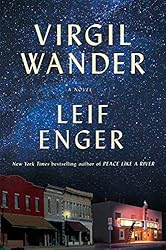
Virgil Wander
Leif Enger, 2018
Grove /Atlantic
352 pp.
ISBN-13: 9780802128782
Summary
An enchanting and timeless all-American story that follows the inhabitants of a small Midwestern town in their quest to revive its flagging heart
Midwestern movie house owner Virgil Wander is "cruising along at medium altitude" when his car flies off the road into icy Lake Superior. Virgil survives but his language and memory are altered and he emerges into a world no longer familiar to him.
Awakening in this new life, Virgil begins to piece together his personal history and the lore of his broken town, with the help of a cast of affable and curious locals, including:
- Rune, a twinkling, pipe-smoking, kite-flying stranger investigating the mystery of his disappeared son;
- Nadine, the reserved, enchanting wife of the vanished man;
- Tom, a journalist and Virgil’s oldest friend and …
- the Pea family, whose various members must confront tragedies of their own.
Into this community returns a shimmering prodigal son who may hold the key to reviving their town.
With intelligent humor and captivating whimsy, Leif Enger conjures a remarkable portrait of a region and its residents, who, for reasons of choice or circumstance, never made it out of their defunct industrial district.
Carried aloft by quotidian pleasures including movies, fishing, necking in parked cars, playing baseball and falling in love, Virgil Wander is a swift, full journey into the heart and heartache of an often overlooked American Upper Midwest by a "formidably gifted" (Chicago Tribune) master storyteller. (From the publisher.)
Author Bio
• Birth—1961
• Where—Sauk Centre, Minnesota, USA
• Education—Moorhead State University
• Currently—lives near Aitkin, Minnesota
Since his teens, Leif Enger has wanted to write fiction. He worked as a reporter and producer for Minnesota Public Radio from 1984 until the sale of Peace Like a River to publisher Grove/Atlantic allowed him to take time off to write.
In the early 1990s, he and his older brother, Lin, writing under the pen name L.L. Enger, produced a series of mystery novels featuring a retired baseball player.
Peace Like a River, published in 2001, has been described as "high-spirited and unflagging" and has received some notable acclaim in literary circles. His second novel, So Brave, Young, and Handsome is the story of an aging train robber's quest for self-discovery. Published in 2008, it received has excellent reviews. In 2018 Enger released Virgil Wander, a midwestern twist on magical realism about a town—and its inhabitants—struggling for a new lease on life.
Enger is married and lives on a farm in Minnesota with his wife. They have two sons. (From Wikipedia.)
Book Reviews
Enger’s first novel in 10 years marks him as a foremost stylist. His prose is rhapsodic, kaleidoscopic and — I’ll say it — enviable. Even more enviable is the rare feat of writing a comedic literary novel that is also a page-turner. He’s performing on a trapeze that not many others have even reached for.… Enger deserves to be mentioned alongside the likes of Richard Russo and Thomas McGuane. Virgil Wander is a lush crowd-pleaser about meaning and second chances and magic.
Nickolas Butler - New York Times Book Review
The well-meaning sad sack who narrates this poignant novel …has just driven his car into icy Lake Superior when the book opens.… Enger’s novel gives magical realism a homely Midwestern twist, and should have very broad appeal.
Publishers Weekly
(Starred review) With an unexpected dry wit, Enger pens a loosely woven plot about plucky Greenstone residents working to rejuvenate their town…. Surprises and delights throughout; definitely worth waiting for. —Donna Bettencourt, Mesa Cty. P.L., Grand Junction, CO
Library Journal
(Starred review) The focus of [Enger’s] bright and breathing third novel feels mostly like life itself, in all its smallness and bigness, and what it means to live a good one.
Booklist
[A] magical mystery tour of a fictional town on the shores of Lake Superior, near Duluth. [Enger's] first novel in a decade—perhaps his most ambitious. Or at least his most overstuffed.
Kirkus Reviews
Discussion Questions
1. Virgil’s spectacular sail off the road into Lake Superior is the inciting force of this novel. How does the catastrophe structure the novel, for Virgil and the townspeople?
2. Virgil muses often about the kindness or cruelty of women. Who are the women he contemplates or fantasizes about, and how do they respond to him—as friends, mother figures, lovers?
3. What are the odds stacked against the people of Greenstone? Some would say this is a complicated, even disenchanted time in America. How does the book affirm or dispute this view of the country?
4. Greenstone feels like any American town that has been passed over or forgotten. Why are so many novelists and playwrights fascinated by small-town America? What ideas do they allow us to explore? What other novels, plays, or films explore similar themes?
5. Enger has a flair for eccentric characters. What makes them memorable? How are they quintessentially human, for good or for ill?
6.What is the symbolism of the kites and their effect on the fliers? Why is kite-flying so addictive to some characters?
7. How does the loss of Rune’s son reverberate through the novel? How is he represented and mythologized throughout the novel?
8. Discuss the cache of old films and the way gatherings and friendships grow around them. What do they mean to Virgil? How culpable was he in keeping them? Why does he finally return the contraband and what ensues?
9. What does Adam Leer represent in the novel and how is this demonstrated to the reader? Is Leer an archetypal character of motiveless malignity like Iago from Othello, or something more complex?
10. How do Virgil and Rune change as they recover from their respective injuries? How do other characters help in their recoveries, and how do their chosen activities help them regain their footing?
11. Reread pages 262-264. What are the main themes and imagery in this passage, and how is Virgil moving toward resolution? How is Bjorn important to the process, as well as Nadine?
(Questions from author website.)
The Virgin Blue
Tracy Chevalier, 1997
Penguin Group USA
320 pp.
ISBN-13: 9780452284449
Summary
The compelling story of two women, born four centuries apart, and the ancestral legacy that binds them. Ella Turner does her best to fit in to the small, close-knit community of Lisle-sur-Tarn. She even changes her name back to Tournier, and learns French. In vain. Isolated and lonely, she is drawn to investigate her Tournier ancestry, which leads to her encounter with the town's wolfish librarian.
Isabelle du Moulin, known as Le Rousse due to her fiery red hair, is tormented and shunned in the village—suspected of witchcraft and reviled for her association with the Virgin Mary. Falling pregnant, she is forced to marry into the ruling family: the Tourniers. Tormentor becomes husband, and a shocking fate awaits her.
Plagued by the color blue, Ella is haunted by parallels with the past, and by her recurring dream. Then one morning she wakes up to discover that her hair is turning inexplicably red...
Alternating between the stories of Ella and Isabelle, The Virgin Blue is a haunting tale of ancestral legacies set against a dazzlingly descriptive portrait of French provincial life today, as well as of the hardships—and harsh beauty—of life in the sixteenth century. (From the publisher.)
Author Bio
• Birth—October 19, 1962
• Where—Washington, D.C., USA
• Education—B.A., Oberlin College (USA); M.A., University of
East Anglia (UK)
• Currently—lives in London, UK
Raised in Washington D.C., Tracy Chevalier moved to England in 1984 after graduating from Oberlin College in Ohio. Initially intending to attend one semester abroad, she studied for a semester and never returned. After working as a literary editor for several years, Chevalier chose to pursue her own writing career and in 1994, she graduated with a degree in creative writing at the University of East Anglia. The Virgin Blue (her first novel), was chosen by W. H. Smith for its Fresh Talent promotion in 1997. She lives in London with her husband and son and hopes to see all of Vermeer's thirty-five known paintings in her lifetime (thus far, she's seen twenty-eight of them).Tracy Chevalier first gained attention by imagining the answer to one of art history's small but intriguing questions: Who is the subject of Johannes Vermeer's painting "Girl with a Pearl Earring"?
It was a bold move on Chevalier's part to build a story around the somewhat mysterious 17th-century Dutch painter and his unassuming but luminous subject; but the author's purist approach helped set the tone. In an interview with her college's alumni magazine, she commented:
I decided early on that I wanted [Girl] to be a simple story, simply told, and to imitate with words what Vermeer was doing with paint. That may sound unbelievably pretentious, but I didn't mean it as "I can do Vermeer in words." I wanted to write it in a way that Vermeer would have painted: very simple lines, simple compositions, not a lot of clutter, and not a lot of superfluous characters.
Chevalier achieved her objective expertly, helped by the fact that she employed the famous Girl as narrator of the story. Sixteen-year-old Griet becomes a maid in Vermeer's tumultuous household, developing an apprentice relationship with the painter while drawing attention from other men and jealousy from women. Praise for the novel poured in: "Chevalier's exploration into the soul of this complex but naïve young woman is moving, and her depiction of 17th-century Delft is marvelously evocative," wrote the New York Times Book Review. The Wall Street Journal called it "vibrant and sumptuous."
Girl with a Pearl Earring was not Chevalier's first exploration of the past. In The Virgin Blue, her U.K.-published first novel (due for a U.S. edition in 2003), her modern-day character Ella Turner goes back to 16th-century France in order to revisit her family history. As a result, she finds parallels between herself and a troubled ancestor -- a woman whose fate had been unknown until Ella discovers it.
With 2001's Falling Angels, Chevalier -- a former reference book editor who began her fiction career by enrolling in the graduate writing program at University of East Anglia -- continued to tell stories of women in the past. But she has been open about the fact that compared to writing Girl with a Pearl Earring, the "nightmare" creating of her third novel was difficult and fraught with complications, even tears. The pressure of her previous success, coupled with a first draft that wasn't working out, made Chevalier want to abandon the effort altogether. Then, reading Barbara Kingsolver's The Poisonwood Bible led Chevalier to change her approach. "[Kingsolver] did such a fantastic job using different voices and I thought, with Falling Angels, I've told it in the wrong way," Chevalier told Bookpage magazine. "I wanted it to have lots of perspective."
With that, Chevalier began a rewrite of her tale about two families in the first decade of 20th-century London. With more than ten narrators (some more prominent than others), Falling Angels has perspective in spades and lots to maintain interest over its relatively brief span: a marriage in trouble, a girlhood friendship born at Highgate Cemetery, a woman's introduction to the suffragette movement. A spirited, fast-paced story, Falling Angels again earned critical praise. "This moving, bittersweet book flaunts Chevalier's gift for creating complex characters and an engaging plot," Book magazine concluded.
Chevalier continues to pursue her fascination with art and history in her fourth novel, on which she is currently at work. According to Oberlin Alumni Magazine, she is basing the book on the Lady and the Unicorn medieval tapestries that hang in Paris's Cluny Museum.
Extras
(From a 2003 Barnes & Noble interview)
• Chevalier's interest in Vermeer extends beyond a fascination with one painting. "I have always loved Vermeer's paintings," Chevalier writes on her Web site. "One of my life goals is to view all thirty-five of them in the flesh. I've seen all but one -- ‘Young Girl Reading a Letter' -- which hangs in Dresden. There is so much mystery in each painting, in the women he depicts, so many stories suggested but not told. I wanted to tell one of them."
• Chevalier moved from the States to London in 1984. "I intended to stay six months," she writes. "I'm still here." She lives near Highgate Cemetery with her husband and son.
• The film version of Girl with a Pearl Earring is on the 2003 slate from Lions Gate Films, with Scarlett Johansson in the role of Griet and Colin Firth playing Vermeer.
• When asked what book most influenced her life as a writer, here is her response:
It's impossible to list just one! I would say more generally— books that I read when I was a girl, that showed me how different worlds can be brought to life for a reader. My aunt likes to quote that when I was young I once said I was never alone when I had a book to read. (I don't remember saying that, but my aunt isn't prone to lying.) Those companions would be books like the Laura Ingalls Wilder series; Anne of Green Gables by L. M. Montgomery; A Wrinkle in Time by Madeleine L'Engle; The Egypt Game by Zylpha Keatley Snyder; the Dark Is Rising series by Susan Cooper; The Wolves of Willoughby Chase by Joan Aiken plus subsequent books in that series; and of course The Lord of the Rings by J.R.R. Tolkien.
• Her other favorite books include: Pride and Prejudice (Austen), The Sound and the Fury (Faulkner), Anna Karenina (Tolstoy), The Catcher in the Rye (Salinger), Alias Grace (Atwood), and Song of Solomon (Morrison). (Author bio and interview from Barnes & Noble.)
Book Reviews
Where Chevalier shines is in her clean prose and her descriptions of rural French and Swiss life, then and now.
Michael Harris - Los Angeles Times
As she did in her 2000 bestseller Girl With a Pearl Earring, Chevalier brings a distant time and place vividly alive.... Elegantly drawn.
People
Chevalier's clunky first novel, initially published in England in 1997, lacks the graceful literary intimacy of her subsequent runaway hit, Girl with a Pearl Earring. In split-narrative fashion, it follows a transplanted American woman in southwestern France as she connects through dreams with her distant Huguenot ancestors. The primary plot concerns the plight of Ella Turner, an insecure American midwife of French ancestry. Her architect husband, Rick, has been transferred from California to Toulouse, France, with Ella accompanying him. Often left alone, she becomes lonely and isolated, and when she decides it's time to have a baby, she begins dreaming of medieval scenes involving a blue dress. In alternating sections of the novel, these details are developed in a narrative about a 16th-century French farm girl and midwife, Isabelle du Moulin, and her eventual marriage to overbearing tyrant Etienne Tournier. Isabelle and Etienne belong to a vehemently anti-Catholic Calvinist sect that overthrows the village's cult of the Virgin, who is also known as La Rousse and depicted in paintings as red-haired and wearing a blue dress. Because of her own red hair and midwifery practice, Isabelle is suspected by her husband of witchcraft and punished accordingly. Ella, with the help of magnetic local librarian Jean-Paul, researches the lives of Isabelle and Etienne, trying to get to the bottom of her strange dreams. Chevalier tries hard to make Ella sympathetic, but her dissatisfaction with Rick is baffling, as is her attraction to the chauvinistic Jean-Paul. Equally difficult to swallow is the heavy-handed plot, which relies on jarring coincidences as it swerves unsteadily from past to present.
Publishers Weekly
Written well before her popular Girl with a Pearl Earring and previously published in England, this brilliant hybrid historical novel/contemporary romance/mystery has the signature Chevalier touches of fluid language, strong characters, and imaginative plotting. At loose ends after arriving in France with her architect husband, American midwife Ella Turner decides to research her elusive Huguenot ancestors, the Tourniers. Soon, however, her marriage founders (repeated encounters with an intriguing French librarian don't help), and Ella starts to have troubling dreams featuring the color blue. Flashbacks to the 16th century introduce Isabelle-also a midwife-who married into the Tournier family and is suspected by her rabidly anti-Catholic husband of continuing to worship the Virgin Mary. The punishment he finally exacts for her perceived crime is horrific. Fans of A.S. Byatt's Possession should enjoy this work, though it's Byatt with a soup on of Shirley Jackson's "The Lottery"; the startling ending, when all the (blue) threads are tied together, is not for the squeamish. This marvelous piece of writing firmly establishes Chevalier as a talent who's been worth watching. Highly recommended for both public and academic libraries. —Jo Manning, Miami Beach, FL
Library Journal
A rich and quirky Chinese puzzle of sorts: a family saga turns into a mystery, then is finally revealed as a domestic drama about a young American living in France who finds her own life intersecting with the history of her ancestors in palpable and uncanny ways. Chevalier’s first novel (never before published here) is set in Lisle-sur-Tarn, a little French town that’s a long way from California, both geographically and culturally. But when Ella Turner’s husband Rick accepted a job in Toulouse, Ella chose picturesque and sleepy Lisle for their new home. It was an eerie choice, for it turns out that Ella’s ancestors—the Tourniers—had lived in Lisle until the 16th century. Ella tries to settle into her new surroundings with good grace—studying French, introducing herself to the locals, socializing with Rick’s colleagues—but she’s soon at loose ends. To begin with, she starts to have a recurring dream—a wordless image of vivid blue—that leaves her increasingly troubled. She also develops a persistent case of eczema, which her doctor suggests may be brought on by stress. What sort of stress? And she finds herself unable to make friends in Lisle. Her only real confidant is Jean-Paul, the town librarian who helps her to research her family history. With his guidance, Ella pieces together the saga of the Tourniers, Protestant Huguenots who had to flee France during the religious wars of the late 16th century. Their story takes on a personal significance for Ella, who discovers a picture by one of her ancestors in the local museum, painted in exactly the same shade of blue that she sees in her dream. Chevalier (Girl With a Pearl Earring , 2000, etc.) contrasts Ella’s investigations with chapters relating the adventures of ancestor Isabelle de Moulin Tournier, whose life parallels Ella’s in many ways. Soon Ella realizes she’s looking into her past out of something more than idle curiosity. A modest work of some skill, told with a minimum of melodrama and some good local color.
Kirkus Reviews
Discussion Questions
1. Discuss the commonalities between Isabelle and Ella. Do you feel that they mirror each other?
2. Compare Isabelle's 16th century France to Ella's modern day France. Are there any similarities? Differences?
3. Do you think Ella is harsh on Rick for his inability to understand her? Do you think she is justified in her behavior?
4. Does your opinion of Jean Paul fluctuate throughout the novel?
5. How Ella's goal of getting pregnant interrupted? What does the interruption say about her feeling toward Rick?
6. How do the locals in France receive Ella? Does Rick have the same experience? Would Ella have known what the locals were saying about her without Jean Paul telling her?
7. Describe Ella's relationship with her cousin Jacob like? How do he and his wife help Ella feel "at home"?
8. Discuss the significance of Ella's hair gradually turning red. Discuss her reaction. What is Rick's reaction?
9. Who do you consider to be the heroine of this novel?
10. What was your reaction to Ella finding Marie? What was your reaction to Ella showing Sylvie Marie's bones?
11. Why does Ella get psoriasis? What does it represent? How does it make her feel about herself? How does Rick react to it?
12. Hannah's last audible words are "we are safe". Why does she stop speaking?
13. How does Ella know that the baby she conceived is Rick's and not Jean Paul's? Do you think she'd rather be pregnant with Jean Paul's baby?
14. Why does Ella steal Jean Paul's blue shirt? How does this link them metaphorically?
15. Discuss Rick's reaction to Ella's affair with Jean Paul.
16. Overall, do you consider this to be Ella's story or Isabelle's story?
(Questions issued by publisher.)
top of page
The Virgin of Small Plains
Nancy Pickard, 2006
Random House
368 pp.
ISBN-13: 9780345471000
Summary
Small Plains, Kansas, January 23, 1987: In the midst of a deadly blizzard, eighteen-year-old Rex Shellenberger scours his father’s pasture, looking for helpless newborn calves. Then he makes a shocking discovery: the naked, frozen body of a teenage girl, her skin as white as the snow around her. Even dead, she is the most beautiful girl he’s ever seen.
It is a moment that will forever change his life and the lives of everyone around him. The mysterious dead girl—the “Virgin of Small Plains”—inspires local reverence. In the two decades following her death, strange miracles visit those who faithfully tend to her grave; some even believe that her spirit can cure deadly illnesses. Slowly, word of the legend spreads.
But what really happened in that snow-covered field? Why did young Mitch Newquist disappear the day after the Virgin’s body was found, leaving behind his distraught girlfriend, Abby Reynolds? Why do the town’s three most powerful men—Dr. Quentin Reynolds, former sheriff Nathan Shellenberger, and Judge, Tom Newquist—all seem to be hiding the details of that night?
Seventeen years later, when Mitch suddenly returns to Small Plains, simmering tensions come to a head, ghosts that had long slumbered whisper anew, and the secrets that some wish would stay buried rise again from the grave of the Virgin. Abby—never having resolved her feelings for Mitch—is now determined to uncover exactly what happened so many years ago to tear their lives apart.
Three families and three friends, their worlds inexorably altered in the course of one night, must confront the ever-unfolding consequences inaward-winning author Nancy Pickard’s remarkable novel of suspense. Wonderfully written and utterly absorbing, The Virgin of Small Plains is about the loss of faith, trust, and innocence...and the possibility of redemption. (From the publisher.)
Author Bio
• Birth—1945
• Where—N/A
• Education—University of Missouri-Columbia
• Awards—Anthony Award, Macavity Awards (5), Agatha
Christie Award (4), Shamus Award
• Currently—lives in Prairie Village, Kansas
Nancy Pickard is Nancy Pickard is the author of eighteen popular and critically acclaimed novels, including the Jenny Cain and Marie Lightfoot mystery series. She is also the author of The Virgin of Small Plains (2006). The Scent of Rain and Lightning is her most recent novel.
She has won the Anthony Award, two Macavity Awards, and two Agatha Awards for her novels. She is a three-time Edgar Award nominee, most recently for her first Marie Lightfoot mystery, The Whole Truth, which was a national bestseller. With Lynn Lott, Pickard co-authored Seven Steps on the Writer’s Path.
She has been a national board member of the Mystery Writers of America, as well as the president of Sisters in Crime. She lives in Prairie Village, Kansas (From the publisher.)
Book Reviews
Nancy Pickard (the author of series novels based in the East) has set [her novel] in Kansas, where she lives. Making deft use of parallel time frames, Pickard writes with insight and compassion about an unresolved crime that continues to haunt a farming community. Burdened by its legacy of long-buried sins, the town of Small Plains hasn't been the same since 18-year-old Mitch Newquist was hustled out of the house by his father the judge in the middle of a blizzard.... Pickard draws out the truth with tantalizing suspense, while using the mystery to illuminate the ways a community would rather live in guilt and believe in miracles than give up its dark secrets.
Marilyn Stasio - New York Times
Nancy Pickard is acclaimed as one of today's best mystery writers. Mounting evidence suggests that this description is too limited. . .Pickard (is) one of today's best writers, period.
San Diego Union
Pickard (Storm Warnings) probes the truth behind miracles and the tragedies behind lies in this mesmerizing suspense novel set in Kansas. While rounding up newborn calves during a 1987 blizzard, Nathan Shellenberger, sheriff of Small Plains, and his teenage sons, Rex and Patrick, discover the naked frozen body of a beautiful teenage girl. Later, Nathan and Dr. Quentin "Doc" Reynolds bash the girl's face to an unrecognizable pulp, since they know who she is and fear that either Patrick or Rex's best friend, 17-year-old Mitch Newquist, is her killer. Witnessing this terrible scene is Mitch, hidden in Doc's home office supply closet where he's gone for a condom to use with Abby, Doc's 16-year-old daughter. Mitch's father, a judge, forces Mitch to leave town after the boy admits what he saw. In 2004, Abby and Rex-now the sheriff-find another blizzard victim, Mitch's mother, dead near the marker commemorating the still-unidentified "virgin." Readers may wish the author supplied more detail about the dead girl's background, but some cleverly planted surprises and the convincing portrait of smalltown life make this a memorable read.
Publishers Weekly
Cold case, indeed: a blizzard with too many parallels to a long-ago storm shocks 33-year-old Abby Reynolds into unraveling the mystery behind a 17-year-old homicide. The unidentified young woman found bloodied and naked in the snow has literally haunted the small Kansas town ever since, her unmarked grave emitting a miraculous glow. The secret begins to peel away when Abby realizes that the stories told about that night don't quite ring true. As she asks the people she loves to return to that time in 1987, Abby fears the murderer might be staring her in the face. Pickard's careful plotting builds slowly toward a climax, with the weather contributing to a sense of foreboding. Using flashbacks and multiple viewpoints, she provides an absorbing tale of love and deceit. This very readable standalone suspense novel, the first by popular mystery series author Pickard (Jenny Cain, Marie Lightfoot), will appeal to those who relished Martha Grimes's Hotel Paradise. Recommended for all popular fiction collections. —Teresa L. Jacobsen, Solano Cty. Lib., CA
Library Journal
Accomplished mystery writer Pickard (The Truth Hurts, 2002, etc.) skillfully exposes insidious elements in a small town. Two smitten teenagers in Small Plains, Kan., contemplate making love for the first time. Sent downstairs by girlfriend Abby Reynolds to fetch condoms from her doctor father's supply cabinet, Mitch Newquist instead secretly witnesses the brutal disfigurement of a dead girl's corpse by the respectable Dr. Reynolds. Mitch recognizes the girl as a local maid from another town. Being an honorable boy bound for college, he discloses what he has seen to his own father, the town judge. To the boy's amazement and growing bitterness, his parents cover up the incident, seeming to believe Dr. Reynold's lies about it, and send Mitch away the very next morning. Seventeen years later, Abby still lives in Small Plains and owns a tree service. Mitch's mother, Nadine, who suffers from Alzheimer's, dies of exposure in a snowstorm after running out in her nightgown to visit the grave of the maid who died so mysteriously. Locals call this unknown girl the Virgin of Small Plains, and her grave has become a shrine, attracting people from all over who believe in miraculous healing. The novel moves back and forth in time, from its present in 2004 to the definitive events of 17 years before. Among the players in the original drama who must now confront the damage it inflicted are the town sheriff and his two boys, who found the girl in the snow (they denied knowing her, although both boys were in love with her); and Abby and Mitch, torn from each other in the heat of young love. Pickard demonstrates an effective restraint with the material, so that when Mitch returns to the town for a reckoning, the shame of the town fathers leads to a satisfying denouement. A quietly fashioned, credible tale about the loss of innocence.
Kirkus Reviews
Discussion Questions
(LitLovers Note: We have NO idea no idea why these questions are written in an "author-interview" format. Do the best you can with them.)
1. The Virgin of Small Plains is your eighteeenth novel, but the first you’ve set in your home state of Kansas. Why have you waited until now? What challenges presented themselves in writing about an area and community so close to home?
2. What inspired you to write this story? Was the genesis of The Virgin of Small Plains significantly different from the ideas that spawned your previous books?
3. What about the development of the novel? Did this book present any unique challenges?
4. The action shuttles back and forth in time, alternately charting the events that lead to and follow from the Virgin’s death in 1987 and the repercussions still simmering seventeen years later. Why did you choose to braid the two narratives in this way? Was it difficult to keep your timelines straight?
5. How carefully do you map the plots of your books before setting down to write? Do your characters sometimes surprise you?
6. Did you find it hard to adopt and sustain the perspectives and voices of multiple narrators in The Virgin of Small Plains? Were certain characters more readily accessible to you than others?
7. You really capture the rhythms of adolescent thought, from Rex’s sexual frustrations to Abby’s heartbreak. Did you base their travails on your own experiences? On those of anyone you know?
8. You never expressly tip your hat to divine intervention in The Virgin of Small Plains, but there are indications throughout the text that some higher power may be at play–even though the story carefully supplies more plausible explanations for seemingly extraordinary events. (Case in point: The climactic car crash, which evokes the clockwork precision of a deus ex machina but at the same time seems like an natural narrative development.) Do you believe in the supernatural or spiritual?
9. The subplot involving Catie Washington both complements and nicely counters the murder mystery at the heart of The Virgin of Small Plains. Did you specifically conceive this character and her story to vary the tone of the book, or did they evolve organically from the story?
10. The twister that dominates the central passage of the novel alters not only the town of Small Plains but also the shape of the action unfolding there: Abby sees Mitch again; Catie’s faith is providentially confirmed; and the reader is properly introduced to Jeff Newquist, a pivotal minor character. How did you hit upon the idea of this perfect storm, so to speak?
11. You’ve achieved success and acclaim as an author of mysteries. Have you always been interested in that genre?
12. How did you launch your career?
13. As many reviewers noted, The Virgin of Small Plains transcends the parameters of that genre. Do you feel that this book delves into new territory for you as a writer?
14. What are you working on next?
15. It must be asked: Have you ever experienced a tornado firsthand?
(Questions issued by publisher...as found...sorry.)
A Virtuous Woman
Kaye Gibbons, 1997
Knopf Doubleday
165 pp.
ISBN-13: 9780375703065
Summary
When Blinking Jack Stokes met Ruby Pitt Woodrow, she was twenty and he was forty. She was the carefully raised daughter of Carolina gentry and he was a skinny tenant who had never owned anything in his life. She was newly widowed after a disastrous marriage to a brutal drifter.
He had never asked a woman to do more than help him hitch a mule. They didn't fall in love so much as they simply found each other and held on for dear life. A multilayered, compelling story of how two seemingly ill-matched people meet and somehow, miraculously make a marriage. (From the publisher.)
Author Bio
• Birth—May 05, 1960
• Where—Nash County, North Carolina, USA
• Education—North Carolina State University and University of
North Carolina at Chapel Hill
• Awards—Hemingway Award Citation, 1987; PEN/Revson
Award, 1988; NEA Grant, 1989; Knighthood of the Order of
Arts & Letters, Paris, 1998; Kaufman Prize, American
Society of Arts & Letters
• Currently—lives in Raleigh, North Carolina, and New York
Kaye Gibbons is the author of eight novels beginning with Ellen Foster. Her later works include, A Virtuous Woman, A Cure for Dreams, and Charms for the Easy Life, Sights Unseen, On the Occasion of My Last Afternoon, Divining Women, The Life All Around Me by Ellen Foster. She lives in Raleigh, North Carolina, with her husband and five children.
More
Kaye Gibbons was born in Nash County, North Carolina and attended Rocky Mount Senior High School, North Carolina State University, and the University of North Carolina at Chapel Hill. Her first novel, Ellen Foster, was awarded the Sue Kaufman Prize for First Fiction of the American Academy and Institute of the Arts and Letters and a special citation from the Ernest Hemingway Foundation. She has been the recipient of a National Endowment for the Arts Fellowship and was recently awarded the PEN/Revson Fellowship for A Cure for Dreams. She is writer-in-residence at the Library of North Carolina State University. She and her husband, Michael, and their three daughters Mary, Leslie and Louise, live in Raleigh.
In 1987, a novel detailing the hardships and heartbreaks of a tough, witty, and resolute 11-year-old girl from North Carolina found its way into the hearts of readers all over the country. Ellen Foster was the story of its namesake, who had suffered years of tough luck and cruelty until finding her way into the home of a kind foster mother. Now,
In 2006, some nineteen years later, author Kaye Gibbons wrote a continuation of Ellen's story. Ellen is now fifteen and living in a permanent household with her new adoptive mother. However, Ellen still feels unsettled an incomplete. Due to "the surplus of living" she had "jammed" into the years leading up to this point in her life, Ellen feels as though she is deserving of early admission into Harvard University. However, when this dream does not come to be, she re-embarks on her soul-searching journey, drawing her back to those she left behind in North Carolina.
Good-bye, Ellen Foster?
While it took Gibbons nearly two decades to return to her most-beloved character, she never truly let go of Ellen Foster, even as she was penning bestsellers and critical favorites such as A Cure For Dreams and Charms For the Easy Life. "She is like a fourth child in my house," Gibbons said in an audio interview with Barnes&Noble.com. "Ellen is really like the kid who came to spend the weekend and stayed for twenty years."
Perhaps Gibbons's close association with the little orphan is the result of her own personal connection to the character. She claims that the Ellen Foster books were "emotionally" autobiographical and helped her to come to terms with the most painful experience of her life. When Gibbons was a child, her ailing mother committed suicide—an event that placed her on the same pathless quest for love and belonging as Ellen.
The untimely death of Gibbons's mother provided much of the impetus for her to revisit Ellen in the 2006 sequel. "Before I wrote The Life All Around Me," she confides, "I wasn't obsessed by my mother's suicide, but I was angry about it... and it's something that I thought about every few minutes of the day, and I always wondered what my life would have been like had she stayed. She had extremely awful medical problems and had just had open-heart surgery, and back then we didn't know what we know now about the hormonal changes after heart surgery and the depression that's so typical after it. After I wrote The Life All Around Me, I was amazed that I didn't think about it as much as I did, and I found that I'd forgiven her and understood it."
Now that she has set some of her old demons to rest with Ellen Foster's sequel, which Booklist called "compelling and unique," Gibbons has vowed not to allow another nineteen years to pass before completing the next chapter in Ellen's story. She ensures that Ellen's adventures are just beginning and ultimately intends to tell the tale of her entire life.
I decided to recreate the life of a woman in literature. I always liked to have a big job to do... and I thought about how marvelous it would be at the end of my life to have created a free-standing woman; a walking, talking all-but-breathing person on paper.
Ambitious as this project may sound, a woman who has faced the challenges that Gibbons has shall surely prove herself to be up to the task.
Her Own Words:
From a 2006 Barnes & Nobel interview:
• I wrote A Virtuous Woman while nursing two babies simultaneously, typing with my arms wrapped around them. I turned in stained pages but never called them to anyone's attention for fear they'd be horrified.
• I got a C on an Ellen Foster paper I rewrote for a daughter's tenth-grade English class.
• Writing serious work one wants to be read and to last isn't like a hobby that can be picked up and put down, it's a lovely obsession and a very demanding joy.
• Getting involved with things that don't matter in life will get in the way of it, as they will with anything, like family and home, that do matter.
• To unwind, I watch movies and do collages with old photographs from flea markets or make jewelry with my daughter, and the best way to clear my mind is to walk around New York, where I write most of the time in a tiny studio apartment with random mice I've named Willard and Ben, though I can't tell any of those guys apart!
• My writing is powered by Diet Coke, very cold and in a can. If Diet Coke was taken off the market, I'm afraid I'd never write again!
• When asked what book most influenced her life as a writer, her is her response:
One Hundred Years of Solitude by Gabriel García Márquez. There's a staggering density to the novel as well as an ethereal, magical lightness, and I'm constantly studying passages to divine how García Márquez was able to do both with such uncompromising intellectual conviction.
(Author bio and interview from Barnes & Noble.)
Book Reviews
Jack Stokes and Ruby Pitt weave this strong, tightly knit love story in alternating chapters that begin when Jack, grieving over Ruby's death four months earlier, evokes the past. In flashbacks, the two richly cadenced Southern voices explore their vastly differing backgrounds, troubled histories and their unlikely but loving marriage. Born into a proud, prominent country family, coddled and adored, Ruby stuns her parents and two brothers by inexplicably running off with John Woodrow, a migrant worker who savagely abuses her. When John is killed in a brawl, Ruby, too proud to ask her family for help, begins doing housework for the wealthy Hoover family, where she meets Jack, a laconic, immensely capable tenant farmer on the Hoover land. He is 40; she is 20. Both lonely and vulnerable, they regard each other cautiously, carry on a wary courtship and embark on a firmly grounded marriage. The union is enriched by a small, supportive circle of friends, who, like the couple's landlord, Burr, are sharply etched and convincingly drawn. Gibbons, author of the critically praised Ellen Foster, has written a vivid, unsentimental, powerful novel.
Publishers Weekly
Alternating chapters narrated by Ruby Stokes (who is dying of cancer at 45) with those told by her husband, Blinking Jack, after her death, Gibbons creates a scrapbook of their quarter century together as tenant farmers. Too old and tough to be endearing like the protagonist of Ellen Foster, the Stokeses are no less honest and vivid as they consider the value of a good mate or good soil. Gibbons again flawlessly reproduces the humor and idiom of rural eastern North Carolina in Ruby's proper country dialect and Jack's peculiarly awful grammar. Recommended for public libraries and collections of regional fiction. —Maurice Taylor, Brunswick Cty. Lib., Southport, NC
Library Journal
Discussion Questions
Use our LitLovers Book Club Resources; they can help with discussions for any book:
• How to Discuss a Book (helpful discussion tips)
• Generic Discussion Questions—Fiction and Nonfiction
• Read-Think-Talk (a guided reading chart)
top of page


A Visit from the Goon Squad
Jennifer Egan, 2010
Knopf Doubleday
288 pp.
ISBN-13: 9780307592835
Summary
Winner, 2011 Pulitizer Prize
Winner, 2011 National Book Critics Circle Award
Moving from San Francisco in the 1970s to a vividly imagined New York City sometime after 2020, Jennifer Egan portrays the interlacing lives of men and women whose desires and ambitions converge and collide as the passage of time, cultural change, and private experience define and redefine their identities.
Bennie Salazar, a punk rocker in his teenage years, is facing middle age as a divorced and disheartened record producer. His cool, competent assistant, Sasha, keeps everything under control—except for her unconquerable compulsion to steal. Their diverse and diverting memories of the past and musings about the present set the stage for a cycle of tales about their friends, family, business associates, and lovers.
A high school friend re-creates the wild, sexually charged music scene of Bennie’s adolescence and introduces the wealthy, amoral entertainment executive Lou Kline, who becomes Bennie’s mentor and eventually faces the consequences of his casual indifference to the needs of his mistresses, wives, and children. Scotty, a guitarist in Bennie’s long-defunct band, emerges from life lived on the fringes of society to confront Bennie in his luxurious Park Avenue office, while Bennie’s once-punk wife, Stephanie, works her way up in the plush Republican suburb where they live.
Other vignettes explore the experiences and people that played a role in Sasha’s life. An uncle searching for Sasha when she runs away at seventeen becomes aware of his own disillusionments and disappointments as he tries to comfort her. Her college boyfriend describes a night of drug-fueled revelry that comes to a shocking end. And her twelve-year-old daughter contributes a clever PowerPoint presentation of the family dynamics—including hilariously pointed summaries of her mother’s “Annoying Habit #48” and “Why Dad Isn’t Here.”
From a trenchant look at the vagaries of the music business and the ebb and flow of celebrity to incisive dissections of marriage and family to a provocative vision of where America is headed, A Visit from the Goon Squad is unnerving, exhilarating, and irresistible. (From the publisher.)
Author Bio
• Birth—September 7, 1962
• Where—Chicago, Illinois, USA
• Raised—San Francisco, California
• Education—University of Pennsylvania; Cambridge
University (UK)
• Awards—Pulitizer Prize; National Book Critics Circle Award
• Currently—lives in Brooklyn, New York, New York
Jennifer Egan is an American novelist and short story writer who lives in the Fort Greene section of Brooklyn, New York City. She is perhaps best known for her 2010 novel A Visit from the Goon Squad, which won both the 2011 Pulitzer Prize for fiction and National Book Critics Circle Award for fiction.
Background/early career
Egan was born in Chicago, Illinois, but grew up in San Francisco, California. She majored in English literature at the University of Pennsylvania and, as an undergrad, dated Steve Jobs, who installed a Macintosh computer in her bedroom. After graduating from Penn, Egan spent two years at St John's College at Cambridge University, supported by a Thouron Award.
In addition to her several novels (see below), Egan has published short fiction in The New Yorker, Harper's, Zoetrope: All-Story, and Ploughshares, among other periodicals. Her journalism appears frequently in The New York Times Magazine. She also published a short-story collection in 1993.
A Visit from the Goon Squad
Egan has been hesitant to classify her most noted work, A Visit from the Goon Squad, as either a novel or a short story collection, saying,
I wanted to avoid centrality. I wanted polyphony. I wanted a lateral feeling, not a forward feeling. My ground rules were: every piece has to be very different, from a different point of view. I actually tried to break that rule later; if you make a rule then you also should break it!
The book features genre-bending content such as a chapter entirely formatted as a Microsoft PowerPoint presentation. Of her inspiration and approach to the work, she said,
I don’t experience time as linear. I experience it in layers that seem to coexist.… One thing that facilitates that kind of time travel is music, which is why I think music ended up being such an important part of the book. Also, I was reading Proust. He tries, very successfully in some ways, to capture the sense of time passing, the quality of consciousness, and the ways to get around linearity, which is the weird scourge of writing prose.
Bibliography (partial)
Novels
1995 - The Invisible Circus
2001 - Look at Me
2006 - The Keep
2010 - A Visit from the Goon Squad
2017 - Manhattan Beach
Short fiction
1993 - Emerald City (short story collection; released in US in 1996)
2012 - "Black Box" (short story, released on The New Yorker's Twitter account)
(Author bio adapted from Wikipedia. Retrieved 10/3/2017.)
Book Reviews
Whether this tough, uncategorizable work of fiction is a novel, a collection of carefully arranged interlocking stories or simply a display of Ms. Egan's extreme virtuosity, the same characters pop up in different parts of it.... Taking some of her inspiration from Proust's In Search of Lost Time as well as some from "The Sopranos," [Egan] creates a set of characters with assorted links to the music business and lets time have its way with them. Virtually no one in this elaborately convoluted book winds up the better for wear. But Ms. Egan can be such a piercingly astute storyteller that the exhilaration of reading her outweighs the bleak destinies she describes.
Janet Maslin - New York Times
Although shredded with loss, A Visit From the Goon Squad is often darkly, rippingly funny. Egan possesses a satirist's eye and a romance novelist's heart. Certainly the targets are plentiful in rock 'n' roll and public relations, the twinned cultural industries around which the book coalesces during the period from the early '80s to an imagined 2019 or so. No one is beyond the pale of her affection; no one is spared lampooning. Often she embraces and spears her subjects at the same time.
Will Blythe - New York Times Book Review
If Jennifer Egan is our reward for living through the self-conscious gimmicks and ironic claptrap of postmodernism, then it was all worthwhile. Her new novel, A Visit From the Goon Squad, is a medley of voices…scrambled through time and across the globe with a 70-page PowerPoint presentation reproduced toward the end. I know that sounds like the headache-inducing, aren't-I-brilliant tedium that sends readers running to nonfiction, but Egan uses all these stylistic and formal shenanigans to produce a deeply humane story about growing up and growing old in a culture corroded by technology and marketing. And what's best, every movement of this symphony of boomer life plays out through the modern music scene, a white-knuckle trajectory of cool, from punk to junk to whatever might lie beyond. My only complaint is that A Visit From the Goon Squad doesn't come with a CD.
Ron Charles - Washington Post
Readers will be pleased to discover that the star-crossed marriage of lucid prose and expertly deployed postmodern switcheroos that helped shoot Egan to the top of the genre-bending new school is alive in well in this graceful yet wild novel. We begin in contemporaryish New York with kleptomaniac Sasha and her boss, rising music producer Bennie Salazar, before flashing back, with Bennie, to the glory days of Bay Area punk rock, and eventually forward, with Sasha, to a settled life. By then, Egan has accrued tertiary characters, like Scotty Hausmann, Bennie's one-time bandmate who all but dropped out of society, and Alex, who goes on a date with Sasha and later witnesses the future of the music industry. Egan's overarching concerns are about how rebellion ages, influence corrupts, habits turn to addictions, and lifelong friendships fluctuate and turn. Or as one character asks, “How did I go from being a rock star to being a fat fuck no one cares about?” Egan answers the question elegantly, though not straight on, as this powerful novel chronicles how and why we change, even as the song stays the same.
Publishers Weekly
National Book Award nominee Egan's (jenniferegan.com) fourth novel, following The Keep (2006), also available from AudioGO, received wide critical acclaim for its deft treatment of time, technology, and humanity. Here, the brilliantly structured postmodernist work receives the audio treatment. The novel skips around in time, covering several decades in the lives of a record executive/ex-rocker; his assistant, a compulsive thief; and others. The very human characters grow on one despite—or, perhaps, owing to—Egan's frequent skewering of them. Actress Roxana Ortega's narration is soothing; her steady voice gives listeners something to hold on to when chapters occasionally confuse. Ortega appears to be new to the audiobook narrating business—with more inflection she has the potential to become a popular reader. Recommended. —B. Allison Gray, Santa Barbara P.L., Goleta Branch, CA
Library Journal
"Time's a goon," as the action moves from the late 1970s to the early 2020s while the characters wonder what happened to their youthful selves and ideals. Egan (The Keep, 2006, etc.) takes the music business as a case in point for society's monumental shift from the analog to the digital age. Record-company executive Bennie Salazar and his former bandmates from the Flaming Dildos form one locus of action; another is Bennie's former assistant Sasha, a compulsive thief club-hopping in Manhattan when we meet her as the novel opens, a mother of two living out West in the desert as it closes a decade and a half later with an update on the man she picked up and robbed in the first chapter. It can be alienating when a narrative bounces from character to character, emphasizing interconnections rather than developing a continuous story line, but Egan conveys personality so swiftly and with such empathy that we remain engaged. By the time the novel arrives at the year "202-" in a bold section narrated by Sasha's 12-year-old daughter Alison, readers are ready to see the poetry and pathos in the small nuggets of information Alison arranges like a PowerPoint presentation. In the closing chapter, Bennie hires young dad Alex to find 50 "parrots" (paid touts masquerading as fans) to create "authentic" word of mouth for a concert. This new kind of viral marketing is aimed at "pointers," toddlers now able to shop for themselves thanks to "kiddie handsets"; the preference of young adults for texting over talking is another creepily plausible element of Egan's near-future. Yet she is not a conventional dystopian novelist; distinctions between the virtual and the real may be breaking down in this world, but her characters have recognizable emotions and convictions, which is why their compromises and uncertainties continue to move us. Another ambitious change of pace from talented and visionary Egan, who reinvents the novel for the 21st century while affirming its historic values.
Kirkus Reviews
Discussion Questions
1. A Visit from the Goon Squad shifts among various perspectives, voices, and time periods, and in one striking chapter (pp. 176–251), departs from conventional narrative entirely. What does the mixture of voices and narrative forms convey about the nature of experience and the creation of memories? Why has Egan arranged the stories out of chronological sequence?
2. In “A to B” Bosco unintentionally coins the phrase “Time’s a goon” (p. 96), used again by Bennie in “Pure Language” (p.269). What does Bosco mean? What does Bennie mean? What does the author mean?
3. “Found Objects” and “The Gold Cure” include accounts of Sasha’s and Bennie’s therapy sessions. Sasha picks and chooses what she shares: “She did this for Coz’s protection and her own—they were writing a story of redemption, of fresh beginnings and second chances” (p. 7). Bennie tries to adhere to a list of no-no’s his shrink has supplied (pp. 18-19). What do the tone and the content of these sections suggest about the purpose and value of therapy? Do they provide a helpful perspective on the characters?
4. Lou makes his first appearance in “Ask Me If I Care” (pp. 30–44) as an unprincipled, highly successful businessman; “Safari” (pp. 45–63) provides an intimate, disturbing look at the way he treats his children and lover; and “You (Plural)” (pp. 64–69) presents him as a sick old man. What do his relationships with Rhea and Mindy have in common? To what extent do both women accept (and perhaps encourage) his abhorrent behavior, and why to they do so? Do the conversations between Lou and Rolph, and Rolph’s interactions with his sister and Mindy, prepare you for the tragedy that occurs almost twenty years later? What emotions does Lou’s afternoon in “You (Plural)” with Jocelyn and Rhea provoke? Is he basically the same person he was in the earlier chapters?
5. Why does Scotty decide to get in touch with Bennie? What strategies do each of them employ as they spar with each other? How does the past, including Scotty’s dominant role in the band and his marriage to Alice, the girl both men pursued, affect the balance of power? In what ways is Scotty’s belief that “one key ingredient of so-called experience is the delusional faith that it is unique and special, that those included in it are privileged and those excluded from it are missing out” (p. 74) confirmed at the meeting? Is their reunion in “Pure Language” a continuation of the pattern set when they were teenagers, or does it reflect changes in their fortunes as well as in the world around them?
6. Sasha’s troubled background comes to light in “Good-bye, My Love” (p. 157). Do Ted’s recollections of her childhood explain Sasha’s behavior? To what extent is Sasha’s “catalog of woes” representative of her generation as a whole? How do Ted’s feelings about his career and wife color his reactions to Sasha? What does the flash-forward to “another day more than twenty years after this one” (p. 175) imply about the transitory moments in our lives?
7. Musicians, groupies, and entertainment executives and publicists figure prominently in A Visit from the Goon Squad. What do the careers and private lives of Bennie, Lou, and Scotty (“X’s and O’s”; “Pure Language”); Bosco and Stephanie (“A to B”); and Dolly (“Selling the General”) suggest about American culture and society over the decades? Discuss how specific details and cultural references (e.g., names of real people, bands, and venues) add authenticity to Egan’s fictional creations.
8. The chapters in this book can be read as stand-alone stories. How does this affect the reader’s engagement with individual characters and the events in their lives? Which characters or stories did you find the most compelling? By the end, does everything fall into place to form a satisfying storyline?
9. Read the quotation from Proust that Egan uses as an epigraph (p. vii). How do Proust’s observations apply to A Visit from the Goon Squad? What impact do changing times and different contexts have on how the characters perceive and present themselves? Are the attitudes and actions of some characters more consistent than others, and if so, why?
10. In a recent interview Egan said, “I think anyone who’s writing satirically about the future of American life often looks prophetic.... I think we’re all part of the zeitgeist and we’re all listening to and absorbing the same things, consciously or unconsciously....” (Brooklyn Daily Eagle, April 8, 2010). Considering current social trends and political realities, including fears of war and environmental devastation, evaluate the future Egan envisions in “Pure Language” and “Great Rock and Roll Pauses.”
11. What does “Pure Language” have to say about authenticity in a technological and digital age? Would you view the response to Bennie, Alex, and Lulu’s marketing venture differently if the musician had been someone other than Scotty Hausmann and his slide guitar? Stop/Go (from “The Gold Cure”), for example?
(Questions issued by publisher.)