
Notes:
|
1. All titles listed are post-2005 (when Stieg Larsson's series first hit the U.S.); MOST titles are from 2012 on (tied to the Gone Girl phenomenon). |
 |
|
The Girl Titles |
Girl Categorized Girl from Berlin |


The Girls
Emma Cline, 2016
Random House
356 pp.
ISBN-13: 9780812998603
Summary
An indelible portrait of girls, the women they become, and that moment in life when everything can go horribly wrong—this stunning first novel is perfect for readers of Jeffrey Eugenides’s The Virgin Suicides and Jennifer Egan’s A Visit from the Goon Squad.
Northern California, during the violent end of the 1960s.
At the start of summer, a lonely and thoughtful teenager, Evie Boyd, sees a group of girls in the park, and is immediately caught by their freedom, their careless dress, their dangerous aura of abandon. Soon, Evie is in thrall to Suzanne, a mesmerizing older girl, and is drawn into the circle of a soon-to-be infamous cult and the man who is its charismatic leader.
Hidden in the hills, their sprawling ranch is eerie and run down, but to Evie, it is exotic, thrilling, charged—a place where she feels desperate to be accepted. As she spends more time away from her mother and the rhythms of her daily life, and as her obsession with Suzanne intensifies, Evie does not realize she is coming closer and closer to unthinkable violence.
Emma Cline’s remarkable debut novel is gorgeously written and spellbinding, with razor-sharp precision and startling psychological insight. The Girls is a brilliant work of fiction. (From the publisher.)
Author Bio
• Birth—ca. 1988-1989
• Where—Sonoma, California, USA
• Education—B.A. Middlebury College; M.F.A., Columbia University
• Awards—Plimpton Award (Paris Review)
• Currently—lives in Brooklyn, New York City, New York
Emma Cline is an American author, best known for The Girls, her 2016 debut novel loosely based on the Charles Manson murders of 1969. She has also written short stories for the Tin House and Paris Review.
Cline Grew up in California wine country: her father was a vintner, owner of Cline Cellers in Sonoma. Her mother came from the Jacuzzi family, inventors of the Jacuzzi whirlpool baths.
As a preteen, Cline had a brief stint as a film actress. She appeared in Flashcards, a 2003 short film, and When Billie Beat Bobby, a TV movie in which she played the young Billie Jean King.
At 13, she fell into a strange relationship with a much older man, a 54 year-old music promoter, who spotted her one day in Sonoma Plaza. They engaged in correspondence and occasional phone calls, talking about "teen stuff." It all ended when Cline got a boyfriend. Nonetheless, the episode seems an uncanny precursor to her later interest in—and sympathy for—the young women followers of Charles Manson.
Cline earned her B.A. from Middlebury College in Vermont, and two years later won a scholarship to the prestigious Bread Loaf Writers' Conference. Several years later, she received her M.F.A from Columbia University. One of her stories submitted at Columbia, which also ran in the Paris Review (summer, 2013), contained a reference to Manson. In a second article for the Review, she wrote of her visit to the Manson Family cult site, where she felt a strong connection with the girls he'd lured away from their families.
Hired immediately after grad school as a fiction writer by The New Yorker, Cline was already at work on The Girls. Her manuscript would become a hotly sought after property, and its eventual acquisition by Random House earned her (so it is rumored) a cool $2 million. (Adapted from Vulture.com .)
Book Reviews
Ms. Cline also understands—at the start, at any rate—how to build layers of suspense by withholding information.... [But she] can’t come close to sustaining her novel’s early momentum.... The storytelling becomes vague and inchoate, as if you are reading a poem...about the novel you’d rather be consuming.... It’s not that Ms. Cline doesn’t possess obvious talent. She has an intuitive feel for...how young women move through the world, except when she tells instead of shows. Then her book simply collapses.
Dwight Garner - New York Times
The Girls is a seductive and arresting coming-of-age story, told in sentences at times so finely wrought they could almost be worn as jewelry…a spellbinding story. Cline gorgeously maps the topography of one loneliness-ravaged adolescent heart. She gives us the fictional truth of a girl chasing danger beyond her comprehension, in a summer of Longing and Loss.
Dylan Landis - New York Times Book Review
The Girls is an extraordinary act of restraint. With the maturity of a writer twice her age, Cline has written a wise novel that’s never showy: a quiet, seething confession of yearning and terror…. Debut novels like this are rare, indeed.
Washington Post
Finely intelligent, often superbly written, with flashingly brilliant sentences.At her frequent best, Cline sees the world exactly and generously. On every other page, it seems, there is something remarkable—an immaculate phrase, a boldly modifying adverb, a metaphor or simile that makes a sudden, electric connection between its poles….Much of this has to do with Cline’s ability to look again, like a painter, and see (or sense) things better than most of us do.
The New Yorker
(Starred review.) [P]rovocative, wonderfully written.... Cline is especially perceptive about... the difficult, sometimes destructive passages to adulthood.... The Girls is less about one night of violence than about the harm we can do, to ourselves and others, in our hunger for belonging and acceptance.
Publishers Weekly
(Starred review.) [I]impressive...a harrowing coming-of-age exploration of how far a young girl will go (and how much she will give up of herself) in her desperate quest to belong. Beautifully written and unforgettable. —Wilda Williams
Library Journal
Cline makes old news fresh, but [her] MFA's fondness for strenuously inventive language: ...."The words slit with scientific desire..." [is] more baffling than illuminating. And Evie's conclusion that patriarchal culture might turn any girl deadly feels...less [true] upon reflection.... Vivid and ambitious.
Kirkus Reviews
Discussion Questions
A special thanks for Mary Lou Kolowitz of the Haverford Library in Havertown, PA, for these terrific questions.
1. Evie’s life is impacted by many circumstances from her childhood besides the communal group she met when she was14. Can you identify some of them based on her thoughts and actions in the book?
2. What Evie experiences after her separation from Connie is a life changing experience in itself for her. In one scene of the book, she describes drinking martinis and vomiting to try and rid herself of the loneliness she feels. Discuss any memories of adolescence you can remember and the vulnerability you may have felt.
3. Evie pities her mother. Even as a young girl, she has some understanding of the humiliation her mother endured from her father. How do you think this may have colored her perception of what love is?
4. Discuss Evie’s relationship to her father. Do you know any men who are similar in their parenting style (i.e., avoidance of parenting).
5. Why do you think Evie is so drawn to Suzanne?
6.) The book is an obvious reference to Charles Manson and his followers. Why do you think some people are attracted to a man like Russell to the point where they would do anything for him?
7. Do you think there is any hope for Evie after reading the book? How could she find happiness in her life?
8.) Did you enjoy the book? Why or why not?
(Questions from Mary Lou Kolowitz, Haverford Library.)
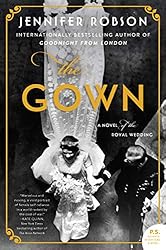
The Gown: A Novel of the Royal Wedding
Jennifer Robson, 2018
HarperCollins
400 pp.
ISBN-13: 9780062884275
Summary
An enthralling historical novel about one of the most famous wedding dresses of the twentieth century—Queen Elizabeth’s wedding gown—and the fascinating women who made it.
“Millions will welcome this joyous event as a flash of color on the long road we have to travel." —Sir Winston Churchill on the news of Princess Elizabeth’s forthcoming wedding
London, 1947:
Besieged by the harshest winter in living memory burdened by onerous shortages and rationing, the people of postwar Britain are enduring lives of quiet desperation despite their nation’s recent victory.
Among them are Ann Hughes and Miriam Dassin, embroiderers at the famed Mayfair fashion house of Norman Hartnell. Together they forge an unlikely friendship, but their nascent hopes for a brighter future are tested when they are chosen for a once-in-a-lifetime honor: taking part in the creation of Princess Elizabeth’s wedding gown.
Toronto, 2016:
More than half a century later, Heather Mackenzie seeks to unravel the mystery of a set of embroidered flowers, a legacy from her late grandmother.
How did her beloved Nan, a woman who never spoke of her old life in Britain, come to possess the priceless embroideries that so closely resemble the motifs on the stunning gown worn by Queen Elizabeth II at her wedding almost seventy years before? And what was her Nan’s connection to the celebrated textile artist and holocaust survivor Miriam Dassin?
With The Gown, Jennifer Robson takes us inside the workrooms where one of the most famous wedding gowns in history was created.
Balancing behind-the-scenes details with a sweeping portrait of a society left reeling by the calamitous costs of victory, she introduces readers to three unforgettable heroines, their points of view alternating and intersecting throughout its pages, whose lives are woven together by the pain of survival, the bonds of friendship, and the redemptive power of love. (From the publisher.)
Author Bio
• Birth—January 5, 1970
• Where—Peterborough, Ontario, Canada
• Education—B.A., University of Western Ontario; Ph.D., Oxford University
• Currently—lives in Toronto, Canada
Jennifer Robson is a Canadian writer and former journalist living in Toronto, Canada. She has written three books—Moonlight Over Paris (2016), After the War is Over (2015), and Somewhere in France (2013)—all novels that use as their starting point, or background setting, Europe's Great War.
Perhaps it was her father, noted historian Stuart Robson, who passed on his love of history to Jennifer, a "lifelong history geek," as she refers to herself. In fact, it was her father from whom she first learned of the Great War, (1914-1918, which Americans refer to as World War I). Later she served as an official guide at the Canadian National Memorial at Vimy Ridge, France, one of the war's major battle sites.
Jennifer studied French literature and modern history as an undergraduate at King’s College at the University of Western Ontario, then attended Saint Antony’s College at the University of Oxford, where she earned her doctorate in British economic and social history. While at Oxford, she was both a Commonwealth Scholar and a Doctoral Fellow of the Social Sciences and Humanities Research Council.
Before turning to full-time writing, Jennifer spent time as an editor. She and her husband have three children, a sheepdog and cat, and live in Toronto. (Adapted from the author's website.)
Book Reviews
(Starred Review) [A] satisfying multigenerational epic…. Robson’s meticulous attention to historical details—notably the intricacies of the embroidery work—is a wonderful complement to the memorable stories of Ann and Milly… a winning, heartwarming tale.
Publishers Weekly
Alternating time lines between 1947 Britain and 2016 Canada, Robson vividly brings to life… three women's struggles. Historical details about fabric, embroidery, and the royal family… with light romance round out this charming work. —Lynnanne Pearson, Skokie P.L., IL
Library Journal
(Starred Review) Robson deftly weaves issues of class, trauma, romance, and female friendship with satisfying details of Ann and Miriam’s craft. This unique take on the royal wedding will be an easy sell to fans of Netflix’s The Crown.
Booklist
[Robson] shifts deftly between Heather's world… in 2016, and Nan's world, giving meticulous attention to the historical detail of post-World War II London.… A fascinating glimpse into the world of design, the healing power of art, and the importance of women's friendships.
Kirkus Reviews
Discussion Questions
We'll add publisher questions if and when they're available; in the meantime, use our LitLovers talking points to help start a discussion for THE GOWN … then take off on your own:
1. How would you describe Ann Hughes? What affect did her mother's frequent criticism of her embroidery work have on Ann? How would you describe Ann's emotional state in the aftermath of the war?
2. Ann and Miriam Dassin become friends as the two work on the gown together. What do the women have in common, and in what ways are they different from one another? What forms the basis of their friendship—why are they drawn to one another?
3. How were both women, perhaps especially Miriam, scarred by the war, and how does each woman bear her scars? Why is Miriam so reluctant to tell Ann about Ravensbruck?
4. In what way does the friendship between Ann and Miriam ultimately lead to healing for both women? Do you have a friendship as nurturing as Ann and Miriam's?
6. Talk about the symbolic importance of the gown with regards to the British public. With its 10,000 seed pearls sewn into ivory silk, the gown seems to be an extravagance that might be considered excessive in a time of rationing. What was the public reaction to its luxuriousness?
7. Follow-up to Question 6: Ann's view of the the gown's excess is positive:
The royal family had made sacrifices, same as the rest of them.… The princess deserved a proper wedding...with a glorious gown.… Surely the gray-faced men in Whitehall wouldn't insist on some dreary affair.
Is Ann biased because she is working on the gown? Or is she right in that the Royal family "deserves" a beautiful wedding? What are your thoughts?
8. Talk about Ann's "bittersweet moment" after she has completed the gown? Do you understand her feelings of nostalgia?
9. Were you surprised by the frenzy surrounding the secrecy of the gown? Does it remind you of today's obsessive celebrity watching? Why was absolute secrecy important? Would you have been able to withstand the pressures of maintaining silence?
10. Was Ann right never to have revealed her past over the decades to her family? Would you have done likewise?
11. Do you find Heather Mackenzie's 2016 storyline as engaging as the historical part of the novel? Why or why not?
(Questions by LitLovers. Please feel free to use them, online and off, with attribution. Thanks.)


The Harder They Come
T.C. Boyle, 2015
HarperCollins
400 pp.
ISBN-13: 9780062349378
Summary
A powerful, gripping novel that explores the roots of violence and anti-authoritarianism inherent In the American character.
Set in contemporary Northern California, The Harder They Come explores the volatile connections between three damaged people—an aging ex-Marine and Vietnam veteran, his psychologically unstable son, and the son's paranoid, much-older lover—as they careen toward an explosive confrontation.
On a cruise to Central America, seventy-year-old Sten Stensen unflinchingly kills an armed robber menacing a busload of tourists. The reluctant hero is relieved to return home to Fort Bragg, California—only to find that his delusional son, Adam, has spiraled out of control.
Adam has become involved with Sara, a hardened member of a right-wing anarchist group that refuses to acknowledge the laws of the state. Adam's senior by some fifteen years, she becomes his protector and inamorata. As Adam's mental state fractures, he becomes increasingly delusional until a schizophrenic breakdown leads him to shoot two people. On the run, he takes to the woods, spurring the biggest manhunt in California history.
As T.C. Boyle explores a father's legacy of violence and his powerlessness in relating to his equally violent son, he offers unparalleled insights into the American psyche. Inspired by a true story, The Harder They Come is a devastating and indelible novel from a modern master. (From the publisher.)
Author Bio
• Birth—December 2, 1948
• Where—Peekskill, New York, USA
• Education—B.A., State University of New York at Potsdam; Ph.D., Iowa University
• Awards—Pen/Faulkner Award, 1998
• Currently—lives near Santa Barbara, California
T. Coraghessan Boyle (kuh-RAGG-issun) received his doctorate in nineteenth-century English literature from the University of Iowa in 1977. Since 1977, Boyle has taught creative writing at the University of Southern California. While in college, Boyle exchanged his middle name, John, for the unusual Coraghessan (kuh-RAGG-issun), the name of one of his Irish ancestors.
Boyle is the author of Descent of Man (1979), Water Music (1982), Budding Prospects (1984), Greasy Lake (1985), World's End (1987, winner of the PEN/Faulkner Award for fiction), If the River Was Whiskey (1989), East Is East (1990), The Road to Wellville (1993), which was made into a movie starring Anthony Hopkins, and Without a Hero (1994). His work has appeared in major American magazines, including The New Yorker, Esquire, Harper's, Paris Review, and Atlantic Monthly. Boyle lives with his wife, Karen, and their three children near Santa Barbara, California, in a house designed in 1909 by the architect Frank Lloyd Wright.
More
In the interest of time and space, it might be easier to note the writers that T. C. Boyle isn't compared to. But let's give the reverse a try: Donald Barthelme, John Barth, Thomas Pynchon, Evelyn Waugh, Franz Kafka, James Joyce, Kingsley Amis, Thomas Berger, Robert Coover, Lorrie Moore, Stanley Elkin, Tom Robbins, Tom Wolfe, Hunter S. Thompson, Don DeLillo, Flannery O'Connor. Oh, let's not forget F. Lee Bailey. And Dr. Seuss.
Boyle, widely admired for his acrobatic verbal skill, wild narratives and quirky characters (in one short story, he imagines a love affair between Dwight Eisenhower and Nikita Khrushchev's wife), has dazzled critics since his first novel in 1981.
Consider this example, from Larry McCaffery in a 1985 article for the New York Times:
Beneath its surface play, erudition and sheer storytelling power, his fiction also presents a disturbing and convincing critique of an American society so jaded with sensationalized images and plasticized excess that nothing stirs its spirit anymore.... It is into this world that Mr. Boyle projects his heroes, who are typically lusty, exuberant dreamers whose wildly inflated ambitions lead them into a series of hilarious, often disastrous adventures.
But as much as critics will bow at his linguistic gifts, some also knock him for resting on them a bit too heavily, hinting that the impressive showmanship attempts to hide a shortage of depth and substance. Craig Seligman, writing in the New Republic in 1993, pointed out that...
Boyle loves a mess. He loves chaos. He loves marshes and jungles, and he loves the jungle of language: luxuriant sentences overgrown with lianas of lists, sesquipedalian words hanging down like rare fruits. For all its exoticism, though, his prose is lucid to the point of transparency. It doesn't require much deeper concentration than a good newspaper (though it does require a dictionary).
Reviewing The Tortilla Curtain in 1995, New York Times critic Scott Spencer scratched his head over why Boyle had invited readers along for this particular ride:
Mr. Boyle's fictional strategy is puzzling. Why are we being asked to follow the fates of characters for whom he clearly feels such contempt? Not surprisingly, this is ultimately off-putting. Perhaps Mr. Boyle has received too much praise for his zany sense of humor; in this book, that wit often seems merely a maddening volley of cheap shots. It's like living next door to a gun nut who spends all day and half the night shooting at beer bottles.
Growing up, Boyle had no aspirations to be a writer. It wasn't until his studies at State University of New York, where he as a music student, that he bumped into his muse. "I went there to be a music major but found I really couldn't hack that at the age of 17," he told The Writer in 1999. "I just started to read outside my classes—literature and history. I wound up being a history and English major; when I wandered into a creative writing class as a junior, I realized that writing was what I could do."
He then started teaching, in part to avoid getting drafted into the Vietnam War, and later applied to the University of Iowa Writer's Workshop.
After a collection of short stories in 1979, he released his first novel, Water Music, called "pitiless and brilliant" by the New Republic, and has shuttled back and forth between novels and short stories, all known for their explosions of character imagination. Mr. Boyle's literary sensibility...thrives on excess, profusion, pushing past the limits of good taste to comic extremes," McCaffery wrote in his 1985 New York Times piece. "He is a master of rendering the grotesque details of the rot, decay and sleaze of a society up to its ears in K Mart oil cans, Kitty Litter and the rusted skeletons of abandoned cars and refrigerators."
In his review of Drop City, the 2003 novel set in California commune that won Boyle a National Book Award nomination, Dwight Garner joins the chorus of critical acclaim over the years—"Boyle has always been a fiendishly talented writer"—but he also acknowledges some of the criticism that Boyle has faced in these same years:
The rap against Boyle's work has long been that he's a sort of madcap predator drone, raining down hard nuggets of contempt, sarcasm and bitter humor on the poor men and women in his books while rarely giving us characters we're actually persuaded to feel anything about. This is partly a bum rap—and I'd hate to knock contempt, sarcasm and bitter humor—but there's enough truth in it that it's a joy to find, in Drop City that Boyle gives us a lot more than simply a line of bong-addled innocents led to slaughter.
But perhaps the neatest summary of Boyle's work would be from Lorrie Moore, one of the novelists to which he has been compared. In a 1994 New York Times review of Boyle's short story collection Without a Hero, she praised Boyle's "astonishing and characteristic verve, his unaverted gaze, his fascination with everything lunatic and queasy." She continues...
God knows, Mr. Boyle can write like an angel, if at times a caustic, gum-chewing one. And in this strong, varied collection maybe we have what we'd hope to find in heaven itself (by the time we begged our way there): no lessening of brilliance, plus a couple of laughs to mitigate all that high and distant sighing over what goes on below."
Extras
• Boyle changed his middle name from John to Coraghessan ( "kuh-RAGG-issun") when he was 17.
• He is known almost as much for his ego as his writing. "Each book I put out, I think, 'Goodbye, Updike and Mailer, forget it," the New Republic quoted him as saying. "I joke at Viking that I'm going to make them forget the name of Stephen King forever, I'm going to sell so many copies.
• Boyle's philosophy on reading and writing, as told to The Writer: "Good literature is a living, brilliant, great thing that speaks to you on an individual and personal level. You're the reader. I think the essence of it is telling a story. It's entertainment. It's not something to be taught in a classroom, necessarily. To be alive and be good, it has to be a good story that grabs you by the nose and doesn't let you go till The End." (From Barnes and Noble)
Book Reviews
[S]tunning…. The Harder They Come…is very much a showcase for all of Mr. Boyle's storytelling talents. It's gripping, funny and melancholy, and opens out from the miseries of a father and his troubled son into a resonant meditation on the American frontier ethos and propensity for violence—a dramatic novelistic rendering, in many ways, of the scholar Richard Slotkin's pioneering studies on the mythology of the American West…. From the novel's thrilling set piece of a start…to its pensive conclusion, The Harder They Come is a masterly—and arresting—piece of storytelling, arguably Mr. Boyle's most powerful, kinetic novel yet.
Michiko Kakutani - New York Times
The Harder They Come…takes on the paranoia of the far-right sovereign citizen movement and off-the-grid/mountain-man survivalism, as well as more mainstream American notions of independence. This could easily have been an opportunity for a writer of Boyle's comic gifts to go full-tilt satirical, but Boyle takes a darker and more restrained approach. He has written a compelling, complex and intimate novel about three particular people in a specific time and place, a novel that tells us something unnerving about certain precincts of the American Now.
Dana Spiotta - New York Times Book Review
Boyle has long been one of the most exciting and intelligent storytellers in the United States. His upcoming novel describes a mentally ill young man involved with a group of violent anarchists.
Washington Post
This new work of fiction from Boyle presents a fractured threesome: a 70-year-old ex-Marine, his troubled son and the son’s older girlfriend-a right-wing anarchist. A dark novel, The Harder They Come explores violence and the American psyche.
Houston Chronicle
T.C. Boyle again explores his favorite territory, the American psyche, in a gripping novel about an aging Vietnam vet and his mentally unstable son, out in April.
Tampa Bay Times
The latest from a prolific and acclaimed novelist, The Harder They Come is a family saga that maps the relationships between the three people at its heart, as their potent mix of violence and paranoia urges them toward tragedy.
Huffington Post
Boyle's...hypnotic narrative probes the complexities of heroism, violence, power, and resistance.... Written with both clarity and compassion, each of the novel’s characters inhabits a rich and convincing private world.... [and] their haunting stories illuminate the violent American battle with otherness.
Publishers Weekly
(Starred review.) A paranoid survivalist....retreats to a deep-woods bunker with his weapons where his shooting of a perceived "alien" will set off a massive manhunt. Verdict: ...Boyle tellingly explores the anger, paranoia, and violence lurking in the shadowlands of the American psyche. A powerful and profoundly unsettling tale. —Lawrence Rungren, Andover, MA
Library Journal
Violence corrodes the ideal of freedom in an ambitious novel that aims to illuminate the dark underbelly of the American dream.... Adam and Sten function more as types and symbols than individuals, though Boyle remains a master at sustaining narrative momentum as the sense of foreboding darkens and deepens.
Kirkus Reviews
Discussion Questions
Use our LitLovers Book Club Resources; they can help with discussions for any book:
• How to Discuss a Book (helpful discussion tips)
• Generic Discussion Questions—Fiction and Nonfiction
• Read-Think-Talk (a guided reading chart)
(We'll add specific questions if and when they're made available by the publisher.)

The Heirs
Susan Rieger, 2017
Crown/Archetype
272 pp.
ISBN-13: 9781101904718
Summary
Brilliantly wrought, incisive, and stirring, The Heirs tells the story of an upper-crust Manhattan family coming undone after the death of their patriarch.
Six months after Rupert Falkes dies, leaving a grieving widow and five adult sons, an unknown woman sues his estate, claiming she had two sons by him.
The Falkes brothers are pitched into turmoil, at once missing their father and feeling betrayed by him. In disconcerting contrast, their mother, Eleanor, is cool and calm, showing preternatural composure.
Eleanor and Rupert had made an admirable life together — Eleanor with her sly wit and generosity, Rupert with his ambition and English charm — and they were proud of their handsome, talented sons: Harry, a brash law professor; Will, a savvy Hollywood agent; Sam, an astute doctor and scientific researcher; Jack, a jazz trumpet prodigy; Tom, a public-spirited federal prosecutor.
The brothers see their identity and success as inextricably tied to family loyalty — a loyalty they always believed their father shared. Struggling to reclaim their identity, the brothers find Eleanor’s sympathy toward the woman and her sons confounding. Widowhood has let her cast off the rigid propriety of her stifling upbringing, and the brothers begin to question whether they knew either of their parents at all.
A riveting portrait of a family, told with compassion, insight, and wit, The Heirs wrestles with the tangled nature of inheritance and legacy for one unforgettable, patrician New York family. Moving seamlessly through a constellation of rich, arresting voices, The Heirs is a tale out Edith Wharton for the 21st century. (From the publisher.)
Author Bio
• Birth—ca. 1946-47
• Where—N/A
• Education—B.A., Mount Holyoke College; J.D., Columbia University
• Currently—lives in New York City, New York
Susan Rieger is a graduate of Columbia Law School. She has worked as a residential college dean at Yale and an associate provost at Columbia. She has taught law to undergraduates at both schools and written frequently about the law for newspapers and magazines. She lives in New York City with her husband. The Heirs (2017) is her second novel; The Divorce Papers (2014) is her first. (From the publisher.)
Book Reviews
Elegant literary prose and supremely likeable characters make this a must-read.
People
Fans of Salinger's stories about Manhattan's elite will enjoy this novel about privileged siblings who grapple with the state of their inheritance and long-held secrets that emerge in the wake of their father's death.
InStyle
Love and sex and money and betrayal make for excellent storytelling. And The Heirs has all of that.… As an exploration of the hidden lives of Rupert and Eleanor Falkes, it is a posh soap opera written by Fitzgerald and the Brontes. As a window on a family shaken by death, it is The Royal Tenenbaums, polished up and moved across town. But its beauty, economy and expensive wit is all its own.
NPR.org
(Starred Reivew.) [Incisive].… Rieger wrestles perceptively with difficult questions and…[shines] light on the Falkes’ extended web of familial and emotional ties, sucking the reader into the tangle of emotions and conflicting interests. Rieger’s book is a tense, introspective account of looking for truth, and instead finding peace. (May)
Publishers Weekly
(Starred Reivew.) Brilliantly constructed and flawlessly written, Rieger's novel brings all these moving parts together. The result is an emotional and satisfying story of how a complicated family and their outliers handle life's most pivotal moments. —Beth Gibbs, Davidson, NC
Library Journal
[A] timeless…family drama.… It is a charming, slightly haunting look at a family dealing with the inheritance of legacy rather than money and wondering if what happens after a relationship matters as much as how it was experienced at the time. —Diana Platt
Booklist
(Starred Reivew.) Despite an omniscient narrator who lays out information as quickly and smoothly as a Vegas blackjack dealer, the argument of this book seems to be that we simply can't know absolutely everything and it's better that way.… [T]his elegant novel wears its intelligence lightly.
Kirkus Reviews
Discussion Questions
We'll add publisher questions if and when they're available; in the meantime, use our LitLovers talking points to help start a discussion for The Heirs :
1. Talk about the family scion, Rupert Falkes as we first learn of him. What were your initial thoughts of him, and how do they change throughout the novel? How is he shaped by his past?
2. The question that Susan Rieger explores in her novel is one of identity. If someone close to you presents him/herself with certain personal traits and beliefs but, upon death, is found to have another life…can you claim to know that individual? How do we know anyone: through our own experiences …or in combination with other peoples' experiences?
3. The portrait of the Falkes family that Rieger offers us is a fairly detailed slice of the urban elite. Did you feel a touch of voyeuristic pleasure peering into such elevated society — the richly appointed apartments, dinners out with Veuve Clicquot? Or did you find it cloying? Do you think the author may be poking fun at her characters life-styles and all that they take for granted? Or does the writing not come across as satirical?
4. How would you describe each of the characters? Start with Eleanor and then proceed through the five sons/brothers. Are there any Falkes you prefer over any others?
5. How does the appearance of Vera Wolinski shake Eleanor's and each of the five sons' lives? How differently do they react? Trace the trajectory of their individual paths as they come to grips with the death of their father and all that ensues.
6. Everyone engages in highly questionable behavior: infidelity, lying, neglectful parenting, stalking children, and even a rape. Can anyone in this book lay claim to possessing a moral compass?
7. Are you satisfied with the way the novel ended? What understanding of Rupert does Eleanor come to that her sons do not, or cannot?
8. Discuss the structure of the novel with its separate but intersecting chapters from the viewpoints of the various characters. How does the structure contribute to what we learn about each of the family members? What about Vera's story? How does it affect your experience of reading The Heirs.
(Questions by LitLovers. Please feel free to use them, online or off, with attribution. Thanks.)


The Island
Victoria Hislop, 2005
HarperCollins
480 pp.
ISBN-13: 9780061340321
Summary
The Petrakis family lives in the small Greek seaside village of Plaka. Just off the coast is the tiny island of Spinalonga, where the nation's leper colony once was located—a place that has haunted four generations of Petrakis women.
There's Eleni, ripped from her husband and two young daughters and sent to Spinalonga in 1939, and her daughters Maria, finding joy in the everyday as she dutifully cares for her father, and Anna, a wild child hungry for passion and a life anywhere but Plaka. And finally there's Alexis, Eleni's great-granddaughter, visiting modern-day Greece to unlock her family's past.
A richly enchanting novel of lives and loves unfolding against the backdrop of the Mediterranean during World War II, The Island is an enthralling story of dreams and desires, of secrets desperately hidden, and of leprosy's touch on an unforgettable family. (From the publisher.)
Author Bio
• Birth—1959
• Where—Bromley, Kent, England, UK
• Raised—Tonbridge, England
• Education—B.A., Oxford University
• Currently—lives in Sissinghurst, England
Victoria Hislop writes travel features for The Sunday Telegraph and The Mail on Sunday, along with celebrity profiles for Woman & Home. She lives in Kent, England, with her husband and their two children. (From the publisher.)
More
Born in Bromley (Kent), Victoria Hislop (nee Hamson) grew up in Tonbridge. She read English at St Hilda's College, Oxford, and worked in publishing and as a journalist before becoming an author.
In 1988 she married Private Eye editor Ian Hislop in Oxford. They have two children, Emily Helen and William David, and live in Sissinghurst.
Hislop's first novel, The Island (2005), which the Sunday Express hailed as "the new Captain Corelli's Mandolin" was a Number 1 Bestseller in the UK, selling more than 1 million copies. According to her website, she rejected a Hollywood film offer (worth £300,000) for the novel. Instead, she offered the rights to Mega, a Greek television channel, for a fraction of the fee. Her desire was "to preserve the integrity of the book and to give something back to the Mediterranean island on which it is based."
The Return, her second novel, a sequel set in Spain, has also been a success and was followed by The Thread in 2012.
In 2009, she donated the short story "Aflame in Athens" to Oxfam's Ox-Tales project—four collections of UK stories written by 38 authors. Her story was published in the Fire collection. ("More" adapted from Wikipedia and the author's website.)
Book Reviews
Passionately engaged with its subject...the author has meticulously researched her fascinating background and medical facts
Sunday Times (London)
Hislop carefully evokes the lives of Cretans between the wars and during German occupation, but most commendable is her compassionate portrayal of the outcasts.
Guardian (UK)
At last—a beach book with a heart.... Meticulous research into Cretan culture...packed with family sagas, doomed love affairs, devastating secrets.... [Hislop] also forces us to reflect on illness, both the nasty, narrow-mindedness of the healthy and the spirit of survival in the so-called "unclean". Her message seems as relevant today as it would have been a century ago.
Observer (UK)
Travel writer Hislop's unwieldy debut novel opens with 25-year-old Alexis leaving Britain for Crete, her mother Sofia's homeland, hoping to ferret out the secrets of Sofia's past and thereby get a handle on her own turbulent life. Sofia's friend Fortini tells Alexis of her grandmother Anna, and great-aunt Maria. Their mother (Alexis's great-grandmother) contracted leprosy in 1939 and went off to a leper colony on the nearby island of Spinalonga, leaving them with their father. Anna snags a wealthy husband, Andreas, but smolders for his renegade cousin, Manoli. When philanderer Manoli chooses Maria, Anna is furious. Conveniently, Maria also contracts leprosy and is exiled, allowing Anna to conduct an affair with Manoli. Meanwhile, Maria feels an attraction to her doctor, who may have similar feelings. Though the plot is satisfyingly twisty, the characters play one note apiece (Anna is prone to dramatic outrages, Maria is humble and kind, and their love interests are jealous and aggressive). Hislop's portrayal of leprosy-those afflicted and the evolving treatment-during the 1940s and 1950s is convincing, but readers may find the narrative's preoccupation with chronicling the minutiae of daily life tedious.
Publishers Weekly
It would be hard to imagine a more cheerless setting for a novel than a leper colony on a remote Greek island, but the community of Spinalonga provides a remarkable backdrop for this affecting, multigenerational saga. At the outset of World War II, when she exhibits the first signs of leprosy, Eleni Petrakis is exiled to Spinalonga, an island off the coast of Crete. Leaving behind her husband and young daughters, Eleni believes her life is over. But the sun-soaked island, with its brightly painted houses and lively, well-run community, turns out to be a comfortable and humane refuge. Life is less kind to the family she had to forsake. While Maria remains a caring daughter to her single parent, sister Anna never recovers from the abandonment and grows into a cold and deceitful woman. In a cruel twist of fate, it is Maria who also falls prey to the disease on the eve of her wedding and who is sentenced to spend her own days on Spinalonga. Bookended by the present-day journey into her past by Anna's grown daughter, this debut novel is a deeply pleasurable read.
Barbara Love - Library Journal
When beloved schoolteacher Eleni is diagnosed with leprosy, she is exiled to the Greek island of Spinalonga. Left behind on Crete are her husband and two beautiful daughters.... [S]uccessful in Britain....[t]here's little to object to in this historical romp. —Marta Segal Block
Booklist
A young Englishwoman discovers her family's secret links to a Cretan leper colony, in an unusually humane saga. A bestseller in the U.K., British author Hislop's debut pays affecting tribute to the victims of leprosy and those who helped them. Alexis's mother Sofia has never discussed her family background, but when Alexis plans a trip to Crete with her decreasingly appealing boyfriend Ed, Sofia gives her an introduction to old family friend, Fortini, in the village of Plaka, across from Spinalonga Island, for years a leper colony, but now deserted. Fortini, with Sofia's permission, begins to narrate the Petrakis family story, starting with Alexis's grandmother Eleni in 1939, a saintly, married schoolteacher who developed leprosy, moved to Spinalonga and died there, leaving behind her husband and two daughters, Anna and Maria. Willful Anna marries rich Andreas but flirts with his sexier cousin Manoli, who falls in love with good-natured Maria. Their wedding plans are shattered when Maria realizes she too is infected with leprosy and must go to the island. Under the treatment of kind Dr. Kyritsis, Maria is given drugs, and eventually she and the other sufferers are healed and the colony is closed. Anna, meanwhile, has had an affair with Manoli and given birth to Sofia. On the night of Maria's return to Plaka, Andreas discovers the affair and shoots Anna. Eventually, Maria marries Kyritsis and they bring up Sofia, not revealing until very late her true parentage. Sofia takes the news badly, moves away and lives a life of shame and guilt for the pain she caused. Now she and Alexis are reunited in Plaka and Ed is given his marching orders. Mediocre fiction is redeemed by considerable empathy in this serious but patchy summer read.
Kirkus Reviews
Discussion Questions
1. How does the island of Spinalonga compare to its nearest neighbor, Plaka, in terms of natural resources and amenities?
2. What enables Eleni Petrakis to endure the separation from her family that she faces as an exile on Spinalonga?
3. How is life with leprosy portrayed in The Island? To what extent does it differ from any prior knowledge about the disease that you may have had?
4. How would you compare Anna and Maria's temperaments as young children, and how do their personalities affect their relationship as adults?
5. How does Anna's initial encounter with her husband's cousin, Manoli Vandoulakis, anticipate the nature of their extramarital relationship?
6. In what ways does Fortini Davaras serve as the character who links past, present, and future in the story that unfolds in The Island?
7. How would you characterize Maria's feelings for Dr. Kyritsis? Why is the nature of their relationship something that must be kept secret from the other residents of Spinalonga?
8. Why is Ed resistant to Alexis's need to know more about her family's past, and why does learning the truth about her mother's childhood help Alexis to make decisions regarding her relationship with Ed?
9. Why does Alexis's journey to Plaka enable Sofia to reveal aspects of her past that she had previously kept shrouded in secrecy?
10. How does leprosy connect with secrecy in the Petrakis family, and how does illness serve as a larger metaphor for the characters in The Island?
(Questions issued by publisher.)
top of page (summary)
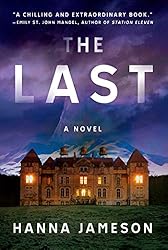
The Last
Hanna Jameson, 2019
Atria Books
352 pp.
ISBN-13: 9781501198823
Summary
A breathtaking dystopian psychological thriller follows an American academic stranded at a Swiss hotel as the world descends into nuclear war—along with twenty other survivors—who becomes obsessed with identifying a murderer in their midst after the body of a young girl is discovered in one of the hotel’s water tanks.
Jon thought he had all the time in the world to respond to his wife’s text message: I miss you so much. I feel bad about how we left it. Love you.
But as he’s waiting in the lobby of the L’Hotel Sixieme in Switzerland after an academic conference, still mulling over how to respond to his wife, he receives a string of horrifying push notifications.
Washington, DC has been hit with a nuclear bomb, then New York, then London, and finally Berlin. That’s all he knows before news outlets and social media goes black—and before the clouds on the horizon turn orange.
Now, two months later, there are twenty survivors holed up at the hotel, a place already tainted by its strange history of suicides and murders. Those who can’t bear to stay commit suicide or wander off into the woods.
Jon and the others try to maintain some semblance of civilization. But when the water pressure disappears, and Jon and a crew of survivors investigate the hotel’s water tanks, they are shocked to discover the body of a young girl.
As supplies dwindle and tensions rise, Jon becomes obsessed with investigating the death of the little girl as a way to cling to his own humanity. Yet the real question remains: can he afford to lose his mind in this hotel, or should he take his chances in the outside world? (From the publisher.)
Author Bio
• Birth—1990
• Where—Winchester, England, UK
• Education—B.A., University of Sussex
• Currently—lives in London, England
Hanna Jameson is a British author, perhaps best known for her London Underground mystery series. She was born in Winchester and earned her B.A. in American History at the University of Sussex. Having traveled around the world—in the U.S., Europe, and Japan, it was her experiences in the U.S. that inspired her to pursue her Bachelor's in American History.
Jameson's debut novel, Something You Are, the first of her Underground books, was published in 2012 when she was still in college—she was 22 (and was only 17 when she started it). That debut was nominated for a CWA Dagger Award. Two other books followed in the series: Girl Seven (2014), shortlisted for Crime Thriller Awards Best New Writer Award, and the third book Road Kill (2017).
In 2019 Jameson published her first stand-alone novel, a dystopian thriller, The Last.
In addition to writing and traveling, Jameson has worked for Britain's Nation Health Service. She lives in London. (Adapted from various online sources.)
Book Reviews
[E]ngrossing postapocalyptic psychological thriller…. Jameson asks powerful questions about fear, community, and self-interest…. She succeeds in evoking a palpable, immanent sense of tension in a story that’s equal parts drama and locked-room murder mystery.
Publishers Weekly
Jameson's postapocalyptic tale presents some interesting moral/ethical quandaries, though a lack of specificity and detail occasionally undercut its authenticity. More likely to appeal to readers of the author's previous works of suspense. —Karin Thogersen, Huntley Area P.L., IL
Library Journal
This genre-bending novel neatly embraces dystopian fiction and murder mystery, with the Omega Man starkness of the former and the requisite twists and turns of the latter (Top Pick).
BookPage
Jameson delivers an eerie and unsettling tale…. It makes for propulsive reading, but readers… will find themselves scratching their heads when all is finally revealed in a rather rushed finale. A thoughtful, page turning post-apocalyptic tale marred by a disjointed conclusion.
Kirkus Reviews
Discussion Questions
1. Consider the epigraph from Hans Keilson’s The Death of the Adversary. Why do you think the author chose this excerpt to open the novel?
2. Examine the structure and point of view of the novel. How would the story be different if Jon wasn’t the only narrator? Whose point of view would you want to explore? How does Jon’s occupation as a historian affect your reading of his chronicle? Do you think he’s an unreliable narrator? Why or why not?
3. On the rooftop with Jon, Dylan tells stories about L’Hotel Sixieme’s past (pp. 67–71). How does the author’s choice of setting enhance the stories?
4. Jon observes:
Everything that had happened before—our past lives—barely mattered. We lived day to day and could no longer remember all the people we hated, the things that upset us, made us angry online, Facebook statuses that made us roll our eyes, cute animal videos that made us cry, vendettas against journalists, news anchors, politicians, celebrities, relatives… all gone (p. 54).
How do you feel about Jon’s statement? Is the way he describes modern life too reductive, or is it an accurate portrait of what we value?
5. What role does technology play in the novel and in the characters’ survival?
6. How do the survivors react after discovering the girl’s body, and what do you think about their reactions? How do the stakes shift when a murder occurs at the end of the world?
7. Tomi is noticeably different from the other survivors. What pulls Jon toward her? At the same time, what about Tomi repels him? How do you feel about her?
8. The survivors share their personal histories during Jon’s investigation into the girl’s death: Adam talks about the ghost boy, and Nathan shares that his search for his stepfather led him to the hotel. Why do you think the author includes these stories?
9. Describe Jon’s first expedition outside the hotel. How do the events in the store affect him?
10. Tensions rise and blame gets lobbed around when the survivors discuss the recent election. Later, Tomi says to Jon, “The world didn’t go to shit because I voted for it. The world had long gone to shit; it took years. We all watched it happen” (p. 154). Do you think politics matter in their current situation? Whose side are you on? Discuss.
11. Discuss the group’s judgment of Nicholas van Schaik after his attempted assault on Mia (pp. 195–200). What were the arguments for and against his punishment, and do you believe the final choice fit the crime? Why or why not? Explain what you would do in this situation.
12. Early in the story, Jon tells Tania about his home life before he left for the conference. What do we learn about him? How does this revelation make you feel about Jon and about his actions so far?
13. What do Jon and Rob discover during their last trip outside? How do you feel about what they find?
14. Consider the ending. Why does the author end the novel in this way? Discuss what might happen to Jon, Tomi, and the other survivors.
(Questions issued by the publisher.)

The Leadership Gap: What Gets Between You and Your Greatness
Lolly Daskal, 2017
Portfolio
240 pp.
ISBN-13: 9781101981351
Summary
When successful people begin to feel uncertain or challenged at work, the one thing they want to know most is why things are going wrong after they have gone right for so long.
In The Leadership Gap, Lolly Daskal reveals the consequences highly driven, overachieving leaders face when they continue to rely on a skill set that has always worked for them, even when it is no longer effective. Over decades of advising and inspiring the most prominent chief executives in the world, Daskal has discerned that leaders fall into one of seven categories — The Rebel, The Explorer, The Truth Teller, The Hero, The Inventor, The Navigator, and The Knight — and have risen to their position relying on a specific set of values and traits. However, every leader reaches a point when their effectiveness is compromised by the gap hidden in those traits -- intuition becomes manipulation, for instance, or integrity becomes corruption.
Based on a mix of modern philosophy, psychology and her own vast well of business experience, Daskal offers a breakthrough perspective on leadership — a new system for rethinking everything you know to reveal the path to becoming the kind of leader you truly want to be.
In The Leadership Gap, Lolly Daskal not only confirms her stature as an exceptional business mind, but also reveals the insights and observations of one of our most important leadership experts — a businesswoman known for providing trusted advice, actionable solutions, and provocative ideas to the world's top executives. (From the publisher.)
Author Bio
Lolly Daskal is one of the most sought-after executive leadership coaches in the world. Her extensive cross-cultural expertise spans 14 countries, six languages and hundreds of companies.
As founder and CEO of Lead From Within, her proprietary leadership program is engineered to be a catalyst for leaders who want to enhance performance and make a meaningful difference in their companies, their lives, and the world. Based on a mix of modern philosophy, science, and nearly thirty years coaching top executives, Lolly’s perspective on leadership continues to break new ground and produce exceptional results.
Of her many awards and accolades, Lolly was designated a Top-50 Leadership and Management Expert by Inc. magazine. Huffington Post honored Lolly with the title of The Most Inspiring Woman in the World.
Her writing has appeared in HBR, Inc.com, Fast Company (Ask The Expert), Huffington Post, and Psychology Today, and others.
Lolly Daskal was born and lives in New York City. (From the author.)
Visit the author's website.
Follow Lolly Daskal on Twitter.
Book Reviews
Our weaknesses live in the shadows of our strengths, and this book does more than help us spot them—it shows us how to overcome them. Lolly Daskal takes us into the trenches of her executive coaching practice, carefully unpacking the self-awareness gaps that hold leaders back and lighting the path to expanding our comfort zones.
Adam Grant, author of Originals and Give and Take
I've seen talented leaders unwittingly make the biggest mistakes of their careers simply because they don't understand the complexities and pitfalls of their own strengths. The Leadership Gap offers terrific insight and valuable wisdom for high achievers who want to understand the tendencies that stand between them and meaningful success.
Sydney Finkelstein, author of Superbosses and Why Smart Executives Fail
Great leaders understand who they are as leaders and what motivates them to do the things they do. If you want to become one of them, read Lolly Daskal’s deeply insightful book. It has invaluable advice for leaders who want to propel themselves to the next level. It’s essential reading for those who want to be great.
Heidi Grant Halvorson, author of No One Understands You and What to Do About It
The Leadership Gap is an exciting new contribution to the tired conversation of leadership, and artfully explains why some leaders succeed while others don’t. Lolly Daskal draws on a wealth of expertise as leading global leadership consultant to identify the skills and gaps that exist within all of us.
Cy Wakeman, author of Reality-Based Leadership
As a leader there’s one thing standing between you and your ultimate potential. Once you are aware of it; once you embrace it, and once you know how to close that "gap," you can then become the magnificent leader you are meant to be.
Bob Burg, coauthor of The Go-Giver
There’s no shortage of thinking and writing about leadership, yet there’s a desperate shortage of leaders everywhere we look. That’s what makes Lolly Daskal’s book so powerful. Thoughtful and practical, analytical and personal, it invites leaders to rethink what it takes to be great, and promises to help bridge the “leadership gap” that plagues business and society. I urge you to read it.
William C. Taylor, CoFounder, Fast Company. Author of Simply Brilliant
An insightful new take on the world from one of my favorite leadership experts. 2 Likeable Thumbs up for this MUST READ!
Dave Kerpen, author of The Art of People
In these uncertain times, it’s more important than ever for leaders to be people who are truthful and who we can trust. In her book The Leadership Gap, Lolly Daskal reveals the qualities of truly great leaders, along with the gaps that stand in the way of their greatness. This book guides you towards your greatness in the quest to become a better and more effective leader.
Lauren Maillian, TV personality, startup investor, and author of The Path Redefined
Lolly Daskal is a keen observer of human behavior in general and leaders in particular. The Leadership Gap does an excellent job of helping aspiring leaders and seasoned professionals alike to find their blind spots and to understand the variety of styles that are required to be a positive influence on the people around them. This book might just be the next-best-thing to having your own personal coach.
Art Markman, PhD, Director of the Program in the Human Dimensions of Organizations at the University of Texas at Austin and author of Smart Thinking, Smart Change, and Brain Briefs
In The Leadership Gap, Lolly Daskal reveals exactly what it is that makes great leaders great, along with the gaps that stand between leaders and their greatness. Every leader will benefit by applying the principles contained in this book, along with their people, their customers, and their companies.
Emma Seppälä, Yale University Center for Emotional Intelligence, author of The Happiness Track
In The Leadership Gap Lolly Daskal masterfully reframes the conversation about leadership with her discerning and insightful exploration of seven archetypal images that drive and challenge leaders. Drawing from her vast experience coaching senior executives around the world, Lolly paints revealing leadership portraits that expose both darkness and the light in all leaders—and in ourselves. The Leadership Gap is fascinating, provocative, entertaining, and useful—a significant new contribution to how we think and act as leaders, and I highly recommend it.
Jim Kouzes, coauthor of the bestselling The Leadership Challenge and the Dean’s Executive Fellow of Leadership, Leavey School of Business, Santa Clara University
Lolly Daskal takes us on a unique and insightful journey into the 7 archetypes of leadership and shows us what it is that makes some leaders impactful over the long term and others fall miserably short. This book is a powerful tool for growing self-awareness and improving your impact as a leader. The Leadership Gap is destined to become a go-to for anyone who wants to have greater impact in the world!”
Dr Jackie Freiberg, co-author of 7 award-winning books, including CAUSE! A Business Strategy for Standing Out in a Sea of Sameness
I love love love reading Lolly's leadership insights. She inspires me to be a better man, and her writing gives me effective tools to inspire action in the teams I lead.
Adam Kreek, Olympic Gold Medalist and founder KreekSpeak
The Leadership Gap reads like my story—a deep search for ‘who I am being while I am leading.’ If John Grisham wrote a book on leadership, it would be a compelling page-turner like this one. Don’t miss this gift to the leader you can become. I promise you will be inspired, instructed, and invigorated.
Chip R. Bell, Author of Kaleidoscope: Delivering Innovative Service That Sparkles
I love this book. Each page is chock full of wisdom and common sense actionable ideas. Lolly gets to the heart of what keeps us from being great and what we need to do to close the gap to become our best selves. The way she has organized it around archetypes is brilliant. You can go straight to the chapter that speaks to you, pick it up at any time to learn more about yourself and others, and it’s an easy, fascinating read from cover to cover.
Jesse Lyn Stoner, co-author of Full Steam Ahead! Unleash the Power of Vision
In this deeply insightful book, leadership expert Lolly Daskal outlines a series of eye-opening and game-changing ideas, including why embracing weakness is the first step to achieving greatness. If you want instant insight into your clients, your boss, and even yourself, get this book. It will redefine the way you lead.
Ron Friedman Ph.D, author of The Best Place to Work
With expert analysis and soulful compassion, Lolly Daskal provides a fascinating expose on the psychological "gaps" leaders face in realizing their true potential. I’ve seen few other books with such thoughtfulness, practicality, and empathy for the human side of becoming a leader.
Andy Molinsky Ph.D, author of Global Dexterity and Reach
In The Leadership Gap, Lolly Daskal speaks truth to power through her penetrating and practical insights for today and tomorrow’s leaders.”
Bruce Rosenstein, Managing Editor, Leader to Leader. Author of Create Your Future the Peter Drucker Way
Great leadership starts with self-knowledge. Lolly Daskal provides a powerful new framework for understanding yourself and rising to become the leader, and person, you want to become.
Dorie Clark, adjunct professor at Duke University's Fuqua School of Business and author of Reinventing You and Stand Out
The Leadership Gap compellingly shows the tension that takes place inside of human beings because, within each of us are two competing sides, but only one leads to greatness. Whether you are a rebel or an explorer, a truth teller or a hero, an inventor, a navigator, or a knight, this book is a valuable resource for anyone who aspires to become a more authentic and complete leader.
Robert Rosales, Founder of Lead Academy, a positive psychology-based leadership development consultancy
There’s no way to read The Leadership Gap and walk away unchanged. Lolly Daskal brilliantly distilled her experience working with world leaders into an immediately actionable book filled with wisdom. I highly recommend this book to everyone interested in becoming a leader worth following.
Skip Prichard, CEO of OCLC, Inc., Author of The Book of Mistakes (coming January 2018)
Filled with smart experience and candor, Daskal's book will help any leader get to the next level - including you.
Damon Brown, author of The Bite-Sized Entrepreneur: 21 Ways to Ignite Your Passion & Pursue Your Side Hustle
Today, leaders can only achieve greatness if they are willing to find and fill their competency-gaps. In this fast moving and highly helpful read, Lolly Daskal will show you the 7 archetypes of leadership as well as the opportunities and pitfalls each one contains. Read it and soar!
Tim Sanders, New York Times bestselling author of Dealstorming and Love Is the Killer App: How to Win Business and Influence Friends
Riveting from beginning to end, The Leadership Gap pulls back the boardroom curtain to share startling insights from an executive coach who counsels world-class leaders behind the scenes. Here, for the first time in print, Daskal shares her system of the seven leadership archetypes and their “shadows,” along with easy-to-use takeaways on how to identify your own type and traverse your own gap.
Jane Ransom, International Speaker, Success Principles Trainer, Author of Self-Intelligence
top of page (summary)

The Leavers
Lisa Ko, 2017
Algonquin Books of Chapel Hill
352 pp.
ISBN-13: 9781616206888
Summary
Lisa Ko’s powerful debut, The Leavers, is the winner of the 2016 PEN/Bellwether Prize for Fiction, awarded by Barbara Kingsolver for a novel that addresses issues of social justice.
One morning, Deming Guo’s mother, Polly, an undocumented Chinese immigrant, goes to her job at a nail salon—and never comes home. No one can find any trace of her.
With his mother gone, eleven-year-old Deming is left mystified and bereft. Eventually adopted by a pair of well-meaning white professors, Deming is moved from the Bronx to a small town upstate and renamed Daniel Wilkinson. But far from all he’s ever known, Daniel struggles to reconcile his adoptive parents’ desire that he assimilate with his memories of his mother and the community he left behind.
Told from the perspective of both Daniel—as he grows into a directionless young man—and Polly, Ko’s novel gives us one of fiction’s most singular mothers. Loving and selfish, determined and frightened, Polly is forced to make one heartwrenching choice after another.
Set in New York and China, The Leavers is a vivid examination of borders and belonging. It’s a moving story of how a boy comes into his own when everything he loves is taken away, and how a mother learns to live with the mistakes of the past. (From the publisher.)
Author Bio
• Birth—1975
• Where—Queens, New York City, New York, USA
• Raised—state of New Jersey
• Education—B.A., Weslyan University; M.L.I. S., San Jose State University; M.F.A.,
City University of New York City College
• Awards—PEN/Bellwether Prize
• Currently—lives in Brooklyn, New York City, New York
Lisa is the first generation of her extended family to be born in American. Her parents are of Chinese descent who came to the U.S. from the Philippines. She was born in New York City's Borough of Queens, though eventually her family moved to the New Jersey suburbs where she grew up.
As the only Asian child in her community, Ko knows what it feels like to be an outsider, a feeling that has informed her fiction. Lonely, she turned to reading and writing for company and comfort. At five she started keeping a journal and wrote her first book, Magenta Goes to College. Magenta was her favorite colored crayon. She also read throughout her childhood and adolescence—as she says on her website, "to escape, to dream."
Ko received her B.A. from Wesleyan University in Connecticut. It was there that she devoured books by writers of color and finally began to write about people who looked like she did. After college she moved to New York City where she worked in book, magazine, and web publishing. Then it was on to San Francisco for five years, working in film production and co-starting an Asian American magazine. At 30, she returned to New York to continue writing a book.
It took eight-and-a-half years for Ko to write and edit The Leavers. Meanwhile, she juggled numerous jobs — from freelancing as an editor to adjunct teaching and full-time office work, writing when she could. In an interview with Flavorwire, she recalled:
I’ve had so many random writing, editing, and teaching jobs to pay the bills. I worked full-time as a web content specialist in a university marketing department while finishing The Leavers, but now I’m back to freelance writing and editing.
In 2016, even though The Leavers wasn't quite ready, she decided on a whim to submit it in a competition, all the while believing she would never win. Months later, author Barbara Kingsolver called Ko to tell her that she had had, in fact, won—the award was the 2016 PEN/Bellwether Prize for Socially Engaged Fiction. (Adapted from various online sources, including the author's website.)
Book Reviews
Thoroughly researched and ambitious in scope, Ko’s book ably depicts the many worlds Deming’s life encompasses.… It is impossible not to root for a boy so foundationally unmoored by circumstance. Moreover, Deming’s feisty mother is compellingly complicated: Polly Guo has an itch for freedom she cannot ignore. Indeed, the greatest strength of the book lies in its provocative depiction of a modern Chinese woman uninterested in traditional roles of any kind. What she makes of herself, and what we might make of her, are of interest from any number of angles.
Gish Jen - New York Times Book Review
One of 2017's most anticipated fiction debuts.… The winner of last year's PEN/Bellwether Prize, which recognizes fiction that explores issues of social justice, The Leavers feels as relevant as ever as the future of immigrants in America hangs in the balance.
Time.com
Beautifully written and deeply affecting, combining the emotional insight of a great novel with the integrity of long-form journalism, The Leavers is a timely meditation on immigration, adoption, and the meaning of family.
Village Voice
[G]orgeously redemptive… Lisa Ko’s debut novel is an achingly beautiful read about immigration, adoption, and the drive to belong. Beyond the desensitizing media coverage, Ko gives faces, (multiple) names, and details to create a riveting story of a remarkable family coming, going, leaving … all in hopes of someday returning to one another.
Christian Science Monitor
[A] dazzling debut.… Filled with exquisite, heartrending details, Ko’s exploration of the often-brutal immigrant experience in America is a moving tale of family and belonging (Book of the Week).
People
When Deming Guo was 11, his Chinese immigrant mother, Polly, left for work at a nail salon and never returned. In alternating perspectives, this heart-wrenching literary debut tells both of their stories.
Entertainment Weekly
Lisa Ko's The Leavers is the year's powerful debut you won't want to miss. The Leavers expertly weaves a tale of the conflicts between love and loyalty, personal identity and familial obligation, and the growing divide between freedom and social justice. An affecting novel that details the the gut-wrenching realities facing illegal immigrants and their families in modern America, Lisa Ko's debut is the 2017 fiction release you can't afford to miss.
Bustle.com
The Leavers describes the devastation caused by forced, abrupt and secret detentions that occur daily under our current Immigration Act. The novel weaves from past to present, from immediate abandonment to chronic loss, showing how the unfathomable disappearance of a mother eats into her son's effort to "move forward.” … [T]he story soars when Ko writes of immigration detention —a civil detention for violation of a civil law that is as callous and brutal as the worst sort of criminal incarceration.… [The Leavers] lets us feel the knife twist of sweeping government authority wielded without conscience or control. [Ko’s] work gives poignant voice to the fact the U.S. can, and must, write a better immigration system.
Ms. Magazine
Consider this book a must-read: They may be fictional, but these characters have a lot to teach us about the difficulties of belonging and the plight of illegal immigrants.
Marie Claire
What Ko seeks to do with The Leavers is illuminate the consequence of [deportation] facilities, and of the deportation machine as a whole, on individual lives. Ko’s book arrives at a time when it is most needed; its success will be measured in its ability to move its readership along the continuum between complacency and advocacy.
Los Angeles Review of Books
[E]ngaging and highly topical… Ko deftly segues between the intertwined stories of the separated mother and son and conveys both the struggles of those caught in the net of immigration authorities and the pain of dislocation.
National Book Review
(Starred review.) Ko’s debut is a sweeping examination of family through the eyes of a single mother, a Chinese immigrant, and her U.S.-born son, whose separation haunts and defines their lives.… [A] stunning tale of love and loyalty—to family, to country—is a fresh and moving look at the immigrant experience in America, and is as timely as ever. (Apr.)
Publishers Weekly
(Starred review.) [A]n emerging writer to watch. Verdict: Ko's writing is strong, and her characters, whether major or minor, are skillfully developed. Readers who enjoy thoughtfully told relationship tales…will appreciate. —Shirley Quan, Orange Cty. P.L., Santa Ana, CA
Library Journal
[S]killfully written.… [T]hose who are interested in closely observed, character-driven fiction will want to leave room for The Leavers on their shelves.
Booklist
A Chinese woman who works in a New York nail salon doesn't come home one day; her young son is raised by well-meaning strangers who cannot heal his broken heart.… [T]he specificity of the intertwined stories is the novel's strength.… This timely novel depicts the heart- and spirit-breaking difficulties faced by illegal immigrants.
Kirkus Reviews
Discussion Questions
We'll add publisher questions if and when they're available; in the meantime, use these LitLovers talking points to help start a discussion for The Leavers...then take off on your own:
1. What relevance, if any, does The Leavers have to the immigration issues dividing much of the world today? What are your opinions regarding immigration. Did this book alter those opinions...or confirm them?
2. How is Polly Guo portrayed in this work? Do you admire her...or not? Does she engender sympathy? Does your attitude toward her change during the course of the novel? Early on she is ambivalent about Deming's birth, placing him in a bag and leaving him underneath a city bench...only to return to him, of course. Is she to blame for her ambivalence?
3. Talk about Polly's turbulent past and how it shapes who she has become. She seems driven by dreams of her own. What are those dreams?
4. How would you describe Deming when he arrives back in the U.S. as a six-year-old? What kind of family do Polly and Leon provide for Deming and Michael? What kind of life do they lead in the Bronx? Consider Polly's job in the nail salon.
5. Deming is utterly bewildered by his mother's disappearance. Talk about the effect it has on him as he grows into adolescence and young adulthood? Consider this observation: "If he held everyone at arm’s length, it wouldn’t hurt as much when they disappeared." Or this one: "He had eliminated the possibility of feeling out of place by banishing himself to no place."
6. What role do Ko's music and his gambling play; how do they help assuage his pain? At one point, after a performance with his band, Deming slips out, thinking to himself, "It felt good being the one making the excuse to get away." What does he mean?
7. What do you think of Kay and Peter Wilkinson? Are they clueless? Insensitive? Well-meaning?
8. Polly's story is told in the first person while Deming's is in the third person. Why do you think the author made that choice? Is Polly's tale meant to be a journal for Deming?
9. Polly is the one who sees the nature of the immigration system firsthand. How is the system portrayed in the novel?
10. Lisa Ko says the novel was inspired by a 2009 New York Times article about an undocumented immigrant from China who spent 18 months in detention. She had been arrested at a bus station on the way to Florida for a new job. Does knowing that the novel has its roots in a true story have any impact on how you understand it?
(Questions by LitLovers. Please feel free to use them, online or off, with attribution. Thanks.)

The Lightness
Emily Temple, 2020
HarperCollins
288 pp.
ISBN-13: 9780062905321
Summary
A stylish, stunningly precise, and suspenseful meditation on adolescent desire, female friendship, and the female body that shimmers with rage, wit, and fierce longing—an audacious, darkly observant, and mordantly funny literary debut.
One year ago, the person Olivia adores most in the world, her father, left home for a meditation retreat in the mountains and never returned.
Yearning to make sense of his shocking departure and to escape her overbearing mother—a woman as grounded as her father is mercurial—Olivia runs away from home and retraces his path to a place known as the Levitation Center.
Once there, she enrolls in their summer program for troubled teens, which Olivia refers to as "Buddhist Boot Camp for Bad Girls."
Soon, she finds herself drawn into the company of a close-knit trio of girls determined to transcend their circumstances, by any means necessary. Led by the elusive and beautiful Serena, and her aloof, secretive acolytes, Janet and Laurel, the girls decide this is the summer they will finally achieve enlightenment—and learn to levitate, to defy the weight of their bodies, to experience ultimate lightness.
But as desire and danger intertwine, and Olivia comes ever closer to discovering what a body—and a girl—is capable of, it becomes increasingly clear that this is an advanced and perilous practice, and there’s a chance not all of them will survive.
Set over the course of one fateful summer that unfolds like a fever dream, The Lightness juxtaposes fairy tales with quantum physics, cognitive science with religious fervor, and the passions and obsessions of youth with all of these, to explore concepts as complex as faith and as simple as loving people—even though you don’t, and can’t, know them at all. (From the publisher.)
Author Bio
• Birth—ca. 1985-86 (?)
• Where—Syracuse, New York, USA
• Education—B.A., MIddlebury College; M.F.A., University of Virginia
• Awards—Henfield Prize
• Currently—lives in Brooklyn, New York City
Emily Temple was born in Syracuse, New York. She earned a BA from Middlebury College and an MFA in fiction from the University of Virginia, where she was a Henry Hoyns fellow and the recipient of a Henfield Prize.
Her short fiction has appeared in Colorado Review, Electric Literature's Recommended Reading, Indiana Review, Fairy Tale Review, and other publications. She lives in Brooklyn, where she is a senior editor at Literary Hub. This is her first novel. (From the publisher.)
Book Reviews
The breeziest book… in a good way…. A smart but nervous girl who maintains a propulsive inner monologue that evokes Emma Cline’s The Girls and a group of eccentric and bizarre young people that channels Donna Tartt’s The Secret History.
WSJ Magazine
An elegant and entertaining debut novel. A mystery disguised as a coming-of-age story…. This is one of those books that breaks your heart when it’s over.
Philadelphia Inquirer
[An] engrossing debut, by turns smart thriller and nuanced coming-of-age story…. While the frequent asides on fairy tales, etymology, and various intellectual concepts can feel distracting…, the lush, intelligent prose perfectly captures…adolescent yearning.
Publishers Weekly
Temple weaves Buddhist practice, rumor, philosophy, and teenage sexual longing into a story that is both deep and compelling. Her characters are complicated and conflicted, immersed in the throes of teenage angst and hormones. —Joanna Burkhardt, Univ. of Rhode Island Libs., Providence
Library Journal
(Starred review) Four teenage girls attempt to unlock the secrets of levitation in this unsettling debut…. [A] complex, psychological study of a young woman haunted by her past—and her capacity to hunger for violence and self-destruction. A dark, glittering fable about the terror of desire.
Kirkus Reviews
Discussion Questions
We'll add publisher questions if and when they're available; in the meantime, use our LitLovers Book Club Resources. They can help with discussions for any book:
• How to Discuss a Book (helpful discussion tips)
• Generic Discussion Questions—Fiction and Nonfiction
• Read-Think-Talk (a guided reading chart)
(Resources by LitLovers. Please feel free to use them, online and off, with attribution. Thanks.)

The Locals
Jonathan Dee, 2017
Random House
400 pp.
ISBN-13: 9780812993226
Summary
A rural working-class New England town elects as its mayor a New York hedge fund millionaire in this inspired novel for our times—fiction in the tradition of Jonathan Franzen and Jennifer Egan.
Mark Firth is a contractor and home restorer in Howland, Massachusetts, who feels opportunity passing his family by.
After being swindled by a financial advisor, what future can Mark promise his wife, Karen, and their young daughter, Haley? He finds himself envying the wealthy weekenders in his community whose houses sit empty all winter.
Philip Hadi used to be one of these people. But in the nervous days after 9/11 he flees New York and hires Mark to turn his Howland home into a year-round "secure location" from which he can manage billions of dollars of other people’s money.
The collision of these two men’s very different worlds—rural vs. urban, middle class vs. wealthy—is the engine of Jonathan Dee’s powerful new novel.
Inspired by Hadi, Mark looks around for a surefire investment: the mid-decade housing boom. Over Karen’s objections, and teaming up with his troubled brother, Gerry, Mark starts buying up local property with cheap debt.
Then the town’s first selectman dies suddenly, and Hadi volunteers for office. He soon begins subtly transforming Howland in his image—with unexpected results for Mark and his extended family.
Here are the dramas of twenty-first-century America—rising inequality, working class decline, a new authoritarianism—played out in the classic setting of some of our greatest novels: the small town. The Locals is that rare work of fiction capable of capturing a fraught American moment in real time. (From the publisher.)
Author Bio
• Birth—May 19, 1962
• Where—New York, New York, USA
• Education—B.A., Yale University
• Awards—Prix Fitzgerald Prize
• Currently—lives in Syracuse, New York
Jonathan Dee, an American novelist and non-fiction writer, was born in New York City. He graduated from Yale University, where he studied fiction writing with John Hersey.
Dee's first job out of college was at The Paris Review, as an Associate Editor and personal assistant to George Plimpton. Early in his tenure with Plimpton, Dee helped pull off the popular April Fool's joke about Sidd Finch, a fictitious baseball pitcher Plimpton wrote about for Sports Illustrated.
Writing
Dee has published several novels, including most recently The Privileges (2010), A Thousand Pardons (2013), and The Locals (2017).
He is a staff writer for The New York Times Magazine and contributor to Harper's. In 2008 Dee collaborated on the oral biography of Plimpton, "George, Being George." He interviewed Hersey and co-interviewed Grace Paley for The Paris Review's The Art of Fiction series.
Recognition
Dee was nominated for a National Magazine Award in 2010 for criticism in Harper's. His 2010 novel, The Privileges, won the 2011 Prix Fitzgerald prize and was a finalist for the 2011 Pulitzer Prize for Fiction.
He was the second winner of the St. Francis College Literary Prize.
He has also been the recipient of two fellowships: The National Endowment for the Arts and the Guggenheim Foundation.
Currently, Dee serves as a professor in the graduate writing program at Syracuse University, where he lives. (Adapted from Wikipedia. Retrieved 8/4/2017.)
Book Reviews
This novel is a big machine, and Dee drives it calmly … perhaps too calmly. He has the intelligence to pull off a novel of this size but lacks, somehow, the killer instinct — the ability to move in for intensities of feeling and thought and action.
Dwight Garner - New York Times
As the tension builds, protests are planned. Yet for all that the book gestures at a kind of political allegory, it shies away from the capital-S Scene it seems to promise and tapers away into anticlimax.… Still, The Locals is a quietly engrossing narrative that dishes out its food for thought in sly, quotable lines.… [M]y favorite: "Tough times brought out the bad side of people … and this internet was like some giant bathroom wall where you could just scrawl whatever hate you liked."
Lucinda Rosenfeld - New York Times Book Review
[Dee's] sensitivity has never been more unnerving than in his new novel, The Locals … [which] feels attuned to the broader currents of our culture, particularly the renewed tension between competing ideals of community and self-reliance.… With this little town, this idyllic-looking version of America, Dee has constructed a world — harrowing but instructive — where no one feels content.
Ron Charles - Washington Post
(Starred review.) Engrossing.… His blue-collar characters … are vividly developed, and his insights into how they think about the government (ineffective and corrupt) and their rights as citizens (ignored, trampled) are timely.… [Dee] handles the plot with admirable skill … and strikes the perfect ending note
Publishers Weekly
Dee taps into the zeitgeist with a novel about a rural, working-class New England town that elects a New York hedge fund billionaire as its mayor.… [C]ulture and class clash are inevitable.
Library Journal
(Starred review.) Good old social novels are hard to come by these days, great ones harder still. Leave it to [Jonathan] Dee to fill the void with a book that’s not only great but so frighteningly timely that the reader will be forced to wonder how he managed to compose it before the last election cycle
Booklist
(Starred review.) The residents of a small town in the Berkshires have their world overturned by a billionaire in their midst.… [The Locals] plays both as political allegory and kaleidoscopic character study. An absorbing panorama of small-town life and a study of democracy in miniature.
Kirkus Reviews
Discussion Questions
We'll add publisher questions if and when they're available; in the meantime, use our LitLovers talking points to start your discussion for The Locals … then take off on your own:
1. The novel opens in the immediate aftermath of 9/11. Talk about the ways that tragedy affected even those who weren't directly involved, people like Phil Hadi.
2. Hadi moves his family to Howland in the Berkshire Mountains of Massachusetts and eventually wins a seat on the town's board of selectmen. How did you feel, initially, about his offer to forgo a salary, donate his recent tax break, and carry some of the town's expenses?
3. Hadi says, "Democracy doesn't really work anymore." What is his reasoning? Do you agree with his observation?
4. Talk about the changes Hadi makes to the town. Do you find any parallels to today, say, in terms of the growing use of surveillance technology?
5. How do the local residents come to view Hadi's wealth? How does it affect their perception of community and/or themselves?
6. Mark Firth is one of the more central characters within the novel. How would you describe him? What about his wife Karen and the couple's marriage? How do you feel about Phil Hadi's influence on Mark, especially when Mark begins to flip houses?
7. In addition to Mark Firth, Jonathan Dee populates his novels with a number of other townspeople. Do you find some more sympathetic than others? Overall, are Dee's characters well drawn—do they come alive, have depth?
8. Mark confesses he feels "like something is lacking in me," and when Phil Hadi attempts to console him, Mark responds that in America, "you're supposed to better yourself …to think big. Right?" Is he right?
9. There is an obvious class division within the pages of this novel. How does Dee portray those divisions, and at the same time offer up satire? Consider, for instance, his take on the tony new restaurant in town.
10. What do the citizens of Howland come to understand by the end of the novel?
m. Inequality has become a major social-politial issue in America. Does this book illuminate or muddy the issue?
(Questions by LitLovers. Please feel free to use them, online or off, with attribution. Thanks.)

The Mothers
Brit Bennett, 2016
Penguin Publishing
288 pp.
ISBN-13: 9780399184512
Summary
Set within a contemporary black community in Southern California, Brit Bennett's mesmerizing first novel is an emotionally perceptive story about community, love, and ambition.
It begins with a secret.
"All good secrets have a taste before you tell them, and if we'd taken a moment to swish this one around our mouths, we might have noticed the sourness of an unripe secret, plucked too soon, stolen and passed around before its season."
It is the last season of high school life for Nadia Turner, a rebellious, grief-stricken, seventeen-year-old beauty. Mourning her own mother's recent suicide, she takes up with the local pastor's son. Luke Sheppard is twenty-one, a former football star whose injury has reduced him to waiting tables at a diner. They are young; it's not serious.
But the pregnancy that results from this teen romance—and the subsequent cover-up—will have an impact that goes far beyond their youth. As Nadia hides her secret from everyone, including Aubrey, her God-fearing best friend, the years move quickly.
Soon, Nadia, Luke, and Aubrey are full-fledged adults and still living in debt to the choices they made that one seaside summer, caught in a love triangle they must carefully maneuver, and dogged by the constant, nagging question: What if they had chosen differently? The possibilities of the road not taken are a relentless haunt.
In entrancing, lyrical prose, The Mothers asks whether a "what if" can be more powerful than an experience itself. If, as time passes, we must always live in servitude to the decisions of our younger selves, to the communities that have parented us, and to the decisions we make that shape our lives forever. (From the publisher.)
Author Bio
• Birth—ca. 1989-90
• Raised—Oceanside, California, USA
• Education—B.A., Stanford University; M.F.A., University of Michigan
• Currently—lives in Encino, California
Brit Bennett is an American author whose debut novel, The Mothers, was published in 2016. The novel is a coming-of-age story surrounding a trio of black teens growing up in southern California.
Bennett grew up in Oceanside in southern California. She is the youngest of three sisters. Their father was Oceanside's first black city attorney, and their mother a finger-print analyst for the country sheriff's department.
Bennett recalls herself as a serious, driven child, who started writing when she was 7 or 8. Her efforts resulted in a play about a coyote and short story about a Native American boy whose home is destroyed.
While she was only 17, she began writing The Mothers—she was the same age as the book's protagonist, Nadia Turner. Like Nadia, Bennett was smart and ambitious and eager to get out of the city where she grew up.
My mom grew up sharecropping in Louisiana, and my dad grew up in South Central L.A., and both of them were able to scratch and claw and go to college, so what’s my excuse?
Bennett did leave town. She attended Stanford University, where she received her B.A. in English. Later, she earned an M.F.A. from the University of Michigan. Bennett says she felt out of place in Michigan—she was a southern California girl suffering through Midwestern winters and wrestling with the culture shock of being in a mostly white environment.
At the time that Michael Brown in Ferguson, Missouri, and Eric Garner in Staten Island, New York, were killed at the hands of the police, Bennett was completing a writing fellowship at Michigan. Not long after the court cases absolved the policemen involved in the killings, Bennett wrote an essay for the webwite Jezebel, entitled "I Don't Know What to Do With Good White People."
The essay was viewed more than 1 million times in 3 days and drew the attention of a literary agent who emailed her wanting to know if Bennett wanted to write a book. The rest is history. (Adapted from a New York Times article.)
Book Reviews
The Mothers is a lush book, a book of so many secrets, betrayals and reckonings that to spill them in the lines of a review instead of letting them play out as the author intended would be silly. Instead I will tell you this: Despite Bennett’s thrumming plot, despite the snap of her pacing, it’s the always deepening complexity of her characters that provides the book’s urgency. Bennett’s ability to unwind them gently, offering insights both shocking and revelatory, has a striking effect. I found myself reading not to find out what happens to the characters, but to find out who they are.
Mira Jacob - New York Times
[B]rilliant...a trio of young people coming of age under the shadow of harsh circumstances in a black community in Southern California. Deftly juggling multiple issues, Bennett addresses the subjects—abortion, infidelity, religious faith, and hypocrisy, race—head-on.... [E]xquisitely developed.
Publishers Weekly
In a contemporary black community in Southern California, 17-year-old Nadia Turner and 21-year-old Luke Sheppard launch a soulful affair.... [T]he decisions they make when Nadia becomes pregnant will reverberate throughout their lives..
Library Journal
The tangled destinies of three kids growing up in a tightknit African-American community in Southern California.... Far from reliably offering love, protection, and care, in this book, the mothers cause all the trouble. A wise and sad coming-of-age story showing how people are shaped by their losses.
Kirkus Reviews
Discussion Questions
1. To what degree do you think Nadia's discomfort about her ambition is just in her head, and to what degree do you think her community sees her as an outsider because of it? Why is leaving home so revolutionary for Nadia? What can her academic accomplishments give her that her home community cannot?
2.Nadia and Luke are two black teen who go to a mostly white school, on the edge of a military base. When Luck ends up in the hospital, he becomes conscious of how Hispanic male nurse suffers from others’ stereotypes. How does the author approach identity in relation to race? How must Nadia change the way she interacts with people inside or outside of her community?
3. The Mothers strives to handle teen pregnancy with compassion and wisdom, portraying it as a life-transforming experience with incalculable ramifications. Why do you think Nadia makes the choices she does? How do these choices affect her life, Luke’s life, and even the larger community?
4.After his football injury, Luke must struggle to redefine his own sense of himself, his potential and expectations. Later in the book he befriends a male physical therapist who shows Luke that he, too, has the potential for ministering to the sick or injured—which is a sort of “mothering” in itself. How does Luke’s sense of masculinity change, before and after his injury? How does the author explore masculinity in the depiction of Nadia’s father, a professional military man who must learn to connect with his daughter? Do you think that, in the end, both father and daughter have found a way to communicate and show their love to each other?
5. The novel has a distinct nucleus, made up of “The Mothers,” the elderly women of the black church community who watch over the small-town goings-on with a presence that evokes the tone of a fable. Their chorus, Greek in format, shows the insularity and defiance of a small, loving community. How do “The Mothers” embody their community? In what ways do they impose their own experiences—their beliefs, their upbringings, their age—on the younger generation?
6. Another focus of the book is Nadia’s relationship with her best friend, Aubrey, as they help each other through adolescence and motherlessness. It provides poignant commentary about the ways women rely on one another, and about the necessity of navigating hard truths with the people we love. How do Nadia and Aubrey change over the course of the book—both within their friendship and outside of it? What does this friendship give each of the girls?
7. As Nadia maneuvers the adolescent world and beyond, how does her grief over her mother's death change her? Do you think it ultimately strengthens her? Weakens her?
(Questions adapted from the publisher's Teacher's Guide.)

The Need
Helen Phillips, 2019
Simon & Schuster
272 pp.
ISBN-13: 9781982113162
Summary
The Need, which finds a mother of two young children grappling with the dualities of motherhood after confronting a masked intruder in her home, is "like nothing you’ve ever read before… in a good way" (People).
When Molly, home alone with her two young children, hears footsteps in the living room, she tries to convince herself it’s the sleep deprivation. She’s been hearing things these days. Startling at loud noises. Imagining the worst-case scenario. It’s what mothers do, she knows.
But then the footsteps come again, and she catches a glimpse of movement.
Suddenly Molly finds herself face-to-face with an intruder who knows far too much about her and her family. As she attempts to protect those she loves most, Molly must also acknowledge her own frailty.
Molly slips down an existential rabbit hole where she must confront the dualities of motherhood: the ecstasy and the dread; the languor and the ferocity; the banality and the transcendence as the book hurtles toward a mind-bending conclusion.
In The Need, Helen Phillips has created a subversive, speculative thriller that comes to life through blazing, arresting prose and gorgeous, haunting imagery. The novel is a glorious celebration of the bizarre and beautiful nature of our everyday lives. (From the publisher.)
Author Bio
• Birth—1981
• Wjere—state of Colorado, USA
• Education—B.A., Yale University; M.F.A., Brooklyn College
• Currently—lives in Brooklyn, New York City, New York
Helen Phillips is the author of the novels, Beautiful Bureaucrat (2015) and The Need (2019) . She is the recipient of a Rona Jaffe Foundation Writer's Award and the Italo Calvino Prize, among others. Her collection, And Yet They Were Happy, was also a finalist for the McLaughlin-Esstman-Stearns Prize, and her work has been featured on NPR's Selected Shorts and appeared in Tin House, Electric Literature, Slice, BOMB, Mississippi Review, and PEN America.
Phillips has been an assistant professor of creative writing at Brooklyn College and lives in Brooklyn with her husband and children. (From the publisher.)
Book Reviews
Motherhood is a monstrosity in this engrossing novel, which opens with a mother clutching her children, fearful she hears an intruder. She doubts herself—not only about whether she’s imagined the break-in, but about how to exist as a mother. The story is maddening, panicky and full of black humor, much like parenthood itself.
New York Times
Phillips, as careful with language as she is bold with structure, captures many small sharp truths…. Everyday life, here, is both tedious and fascinating, grotesque and lovely, familiar and tremendously strange. Molly—worrying about the person she is becoming… is finally alive to it all, to its terrors but also, on those rare occasions when everyone is happy (or asleep), to its incandescent joys.
New York Times Book Review
Mothers will recognize so much in this fresh novel—but they aren’t the only ones who should read it. Phillips has found a way to make these experiences universal, acknowledging the importance of the other—the creature without whom none of us would exist.
Washington Post
Thrillingly disturbing, frighteningly insightful about motherhood and love, and spilling over with offhand invention, The Need is one of this year’s most necessary novels.
Guardian (UK)
What begins as a hyperventilating domestic noir morphs into elegant speculative fiction, and then into a grand hymn to motherhood.
Times Literary Supplement (UK)
A taut thriller...Between chills, readers will notice the pleasures of Phillips’s prose. Her style combines the sensibility of a poet with the forward drive of a thriller.… Phillips’s crystalline style vividly evokes her characters. She draws them so precisely that before we know it, we’re deep inside their lives.… [A] bewitching, fiercely original novel.
Boston Globe
An elegant dread slips through this elusive novel like wisteria on a crumbling wall...Many books claim to be domestic thrillers. The Need is the mother of them all.
Minneapolis Star-Tribune
Hypnotically eerie…. Phillips structures her astonishing fifth book in edge-of-your-seat mini-chapters that infuse domesticity with a horror-movie level of foreboding, reminding us that the maternal instinct is indeed a primal one.
O Magazine
Helen Phillips is best known for her delirious and philosophical short stories, and in her second novel, she combines her impeccable brevity with plot that unfolds like a paper snowflake.
Vanity Fair
This fever dream of a novel starts like a thriller (someone’s in the living room), morphs into speculative sci-fi… and ends up like nothing you’ve ever read before. In a good way.
People
What Helen Phillips builds from the first paragraphs is too clever, and moves too quickly, to be easily ground down in a review.
Entertainment Weekly
(Starred review) An unforgettable tour de force that melds nonstop suspense, intriguing speculation, and perfectly crafted prose.… With its crossover appeal to lovers of thriller, science fiction, and literary fiction, this story showcases an extraordinary writer at her electrifying best.
Publishers Weekly
[G]ripping, shape-shifting … Is this literary work a story of magical realism, a straight-up horror novel…, or a product of Molly's exhausted imagination? Of course, it's all of the above and makes for an unforgettable—and polarizing—reading experience. —Michael Pucci, South Orange P.L., NJ
Library Journal
A skillfully crafted, thought provoking domestic thriller.
Booklist
(Starred review) Phillips' fuguelike novel, in which the protagonist's tormentor may be either other or self, is a parable of parenting …. It is also a superbly engaging read—quirky, perceptive, and gently provocative. Molly may be losing her marbles, but we can't help rooting for her to find herself.
Kirkus Reviews
Discussion Questions
We'll add publisher questions if and when they're available; in the meantime, use our LitLovers Book Club Resources. They can help with discussions for any book:
• How to Discuss a Book (helpful discussion tips)
• Generic Discussion Questions—Fiction and Nonfiction
• Read-Think-Talk (a guided reading chart)
(Resources by LitLovers. Please feel free to use them, online and off, with attribution. Thanks.)

The Nix
Nathan Hill, 2016
Publisher
640 pp.
ISBN-13: 9781101946619
Summary
A Nix can take many forms. In Norwegian folklore, it is a spirit who sometimes appears as a white horse that steals children away. In Nathan Hill’s remarkable first novel, a Nix is anything you love that one day disappears, taking with it a piece of your heart.
It’s 2011, and Samuel Andresen-Anderson—college professor, stalled writer—has a Nix of his own: his mother, Faye. He hasn’t seen her in decades, not since she abandoned the family when he was a boy. Now she’s re-appeared, having committed an absurd crime that electrifies the nightly news, beguiles the internet, and inflames a politically divided country.
The media paints Faye as a radical hippie with a sordid past, but as far as Samuel knows, his mother was an ordinary girl who married her high-school sweetheart. Which version of his mother is true? Two facts are certain: she’s facing some serious charges, and she needs Samuel’s help.
To save her, Samuel will have to embark on his own journey, uncovering long-buried secrets about the woman he thought he knew, secrets that stretch across generations and have their origin all the way back in Norway, home of the mysterious Nix. As he does so, Samuel will confront not only Faye’s losses but also his own lost love, and will relearn everything he thought he knew about his mother, and himself.
From the suburban Midwest to New York City to the 1968 riots that rocked Chicago and beyond, The Nix explores—with sharp humor and a fierce tenderness—the resilience of love and home, even in times of radical change. (From the publisher.)
Author Bio
• Birth—ca. 1975-76
• Where—Cedar Rapids, Iowa, USA
• Education—B.A., University of Iowa; M.A. University of Massachusetts
• Currently—lives in Naples, Florida
Nathan Hill is an American author, a native of Iowa who was raised in various states in the Midwest. He now makes his home in Naples, Florida, while on leave from his teaching position as an associate professor at the University of St. Thomas in St. Paul, Minnesota.
Writing
His debut novel, The Nix, was published in 2016 and received widespread acclaim, including starred reviews from all four publishing journals: Booklist, Library Journal, Kirkus Reviews, and Publishers Weekly (no mean feat.)
His short stories have appeared in The Iowa Review, Gulf Coast, Denver Quarterly, Fugue, Gettysburg Review and other journals. The journal Fiction awarded him the Fiction Prize for his story "The Bottle."
Early career
Hill has worked as an editor and website designer for the Academy of American Poets and, prior to that, as a print journalist. (Adapted from the author's website.)
Book Reviews
There is an accidental topicality in Hill’s debut, about an estranged mother and son whose fates hinge on two mirror-image political events—the Democratic Convention of 1968 and the Republican Convention of 2004. But beyond that hook lies a high-risk, high-reward playfulness with structure and tone: comic set-pieces, digressions into myth, and formal larks that call to mind Jennifer Egan’s A Visit From the Goon Squad.
New York Magazine
(Starred reivew.) [A]n ironic view of 21st-century elections, education, pop culture, and marketing, with flashbacks to 1988, 1968, and 1944..... Hill skillfully blends humor and darkness, imagery and observation. .... [in] this rich, lively take on American social conflict.
Publishers Weekly
(Starred reivew.) When Samuel Andreson-Anderson was growing up, his mother... [told] him "the things you love the most will one day hurt you the worst."... Offering engrossing prose, multiple interlocking stories, and deftly drawn characters, Hill shows us how the interlinked consequences of our actions can feel like fate. —Barbara Hoffert
Library Journal
(Starred reivew.) Place Nathan Hill’s engrossing, skewering, and preternaturally timely tale beside the novels of Tom Wolfe, John Irving, Donna Tartt, and Michael Chabon. . . . Cartwheeling among multiple narrators, The Nix spins the galvanizing stories of three generations derailed in unexpected ways. . . . Hill takes aim at hypocrisy, greed, misogyny, addiction, and vengeance with edgy humor and deep empathy in a whiplashing mix of literary artistry and compulsive readability.
Booklist
(Starred reivew.) Sparkling, sweeping debut novel that takes in a large swath of recent American history and pop culture and turns them on their sides.... Hill gently lampoons advertising culture, publishing, academia, politics, and everything in between. A grand entertainment, smart and well-paced, and a book that promises good work to come.
Kirkus Reviews
Discussion Questions
1. Why do you think that the author chose to call his novel The Nix? What is a Nix according to folklore? How does the Nix function symbolically within the novel and which major themes of the novel does it help to facilitate or uncover? Who in the story believes himself or herself to be a Nix and why? Do you agree with that person? Why or why not?
2. At the beginning of the story, Faye reveals that she believes the things a person loves the most will ultimately hurt them the worst. Which events in her life may have caused her to adopt this point of view? Does the rest of the book seem to support this view of love or overturn it? Does Faye ever change her mind about this? Does her son, Samuel, share her view of love? Discuss.
3. Why does Faye leave her son, Samuel, and her husband? How does Samuel react to her departure, and what impact does this abandonment have on his life and development? What is it like when the two reunite? How does their relationship change over the course of the book, and what causes these changes? Do either of the characters seem to achieve catharsis? If so, how?
4. How do Faye’s parents react when she is accepted at the University of Illinois’s new Chicago Circle campus and tells them that she wants to attend? Why do you think that they have this reaction? How does Faye herself seem to feel about the prospect of leaving home? What helps her to make the final decision to go to Chicago, and why does her father tell her to never come back? Why do you think Faye refrains from addressing the misunderstanding that has caused so much strife between her and her parents?
5. Evaluate the treatment of women in the book. What kinds of experiences do the female characters share? How are they treated by the male? What do the men in the book think women should be like? Do the women meet these expectations or defy them? Explain. In the sections set in the 1960s and ’70s, how does feminism seem to impact the way that the women are perceived by those around them? How do they respond to these expectations and stereotypes? Is Faye’s experience similar to the experiences of the other women or very different? Discuss.
6. Compare and contrast the parent-child relationships in the book. How does Samuel and Faye’s relationship compare to Faye’s own relationship with her father, Frank? How well does each child know his or her parent? What prevents them from knowing this parent better? How do the relationships change over time, and what causes these changes? When considered together, what do these relationships suggest about the nature of the parent-child relationship in generals? Explain.
7. Evaluate the treatment of technology in the book. Is technology portrayed as a positive invention or a negative one? How does the characters’ use of technology affect their communication, their daily lives, and their development as people? Why are Samuel and Pwange especially addicted to Elfscape, and why does Pwange believe that Elfscape is more meaningful than the real world? What function or purpose does the game serve in their lives? What might this relationship reveal about contemporary life?
8. Consider the theme of the relationship between storytelling and point of view. What does the treatment of Faye’s story in the press reveal about this topic? Does the press, as depicted in the novel, provide fair and unbiased accounts of the news they report? What does the book also suggest about the publishing industry? Are the stories that each of the characters tells truthful and reliable? What does this information reveal about how we should approach storytelling as both storytellers and readers/listeners? Does the book ultimately suggest how we can best determine whether or not a source is reliable and a story is true?
9. Explore the motif of secrets. What are some of the secrets that the characters keep? Why do they keep these things secret? Do any of the characters ever reveal their secrets? If so, what is the outcome, and how are these secrets received? What do the responses to these reveals suggest about our fears of being known completely?
10. In the Choose-Your-Own-Adventure portion of the book, what choice does Samuel make when Bethany asks him if he can help her avoid her upcoming nuptials and invites him into her bedroom? Why does he make this choice? Do you believe it was the right choice? Why or why not? After some time passes, how does Samuel come to view his decision in that moment?
11. Evaluate the theme of shame. What causes the various characters in the novel to feel shame? How does the prevalence of this feeling impact their lives, the people they become, and the life choices they make? Do any of the characters overcome their feelings of shame? If so, how do they accomplish this?
12. Consider the portrayal of suburban middle-class living in the novel. How did industry affect and shape American life? What clues can we find in descriptions of the landscape? Does the book suggest whether industry provided a happier or better existence for families? For instance, is Frank living a better life because of his willingness to leave his home in Norway? What would you say the novel ultimately suggests about progress and the American dream?
13. What kinds of stories does Frank share with his daughter, Faye, as she is growing up? What effect do these stories have on her? Why do you think that she chooses to share these tales with her own son? What seems to be the purpose of telling these stories? What lessons or messages do the stories contain?
14. When Faye reaches Norway, how does what she finds compare to what her father had shared with her about his home and his past? Who is Freya, and how does Faye’s knowledge of who Freya is affect the way that she relates to and understands her father? How does the trip to Norway ultimately affect Faye’s relationship with her father and with Samuel?
15. Many of the characters in the book engage in some type of art. What role or purpose does art seem to fulfill in their lives? Why does Samuel decide to become a novelist? What does he hope that his book The Nix will achieve?
16. Evaluate the theme and motif of protest. In addition to the protests that Faye takes part in as a young woman, Samuel attends a protest with Bethany and serves as a witness to other protests. What are some of the causes that the characters protest? What happens at the protests? Are they successful? What do you think Walter Cronkite meant when he observes that maybe the story isn’t the people protesting but the people who are not? Does the book ultimately portray protest as a valuable pursuit or a futile one? What seems to be the purpose of protest? Discuss.
17. Why does Judge Charlie Brown take on the case against Faye? How do the two know each other? Does Judge Brown get the outcome he desires? Why or why not? What does Brown’s character suggest about fairness and justice in the world?
18. Who is Sebastian? How does Faye meet Sebastian, and why is she initially drawn to him? What is her reaction to the revelation of his true identity? What does Faye recognize as their common bond?
19. Consider the collective view of America that the novel offers. What does this America look like? Would you say that is an accurate portrayal? Why or why not? How does the author use comedy and the absurd to pose truths about the cultural and political landscape? Alternatively, how does he employ elements of tragedy to accomplish this? Does one method seem to be more successful in accomplishing this than the other? Explain.
20. In addition to the story of the Nix, another recurring tale in the novel is the parable of the elephant. What is the lesson in this parable, and what does it reveal about the true self? How might this message or way of looking at things shape your own understanding of and response to the characters in the book?
21. At the end of the book, Faye thinks: “Something does not have to happen for it to feel real” (581). What do you think she means by this? What might her statement suggest about the past, memory, imagination, and regret?
(Questions issued by the publisher.)

The One Man
Andrew Gross, 2016
St. Martin's Press
432 pp.
ISBN-13: 9781250079503
Summary
Poland. 1944.
Alfred Mendl and his family are brought on a crowded train to a Nazi concentration camp after being caught trying to flee Paris with forged papers. His family is torn away from him on arrival, his life’s work burned before his eyes.
To the guards, he is just another prisoner, but in fact Mendl—a renowned physicist—holds knowledge that only two people in the world possess. And the other is already at work for the Nazi war machine.
Four thousand miles away, in Washington, DC, Intelligence lieutenant Nathan Blum routinely decodes messages from occupied Poland. Having escaped the Krakow ghetto as a teenager after the Nazis executed his family, Nathan longs to do more for his new country in the war.
But never did he expect the proposal he receives from "Wild" Bill Donovan, head of the OSS: to sneak into the most guarded place on earth, a living hell, on a mission to find and escape with one man, the one man the Allies believe can ensure them victory in the war.
Bursting with compelling characters and tense story lines, this historical thriller from New York Times bestseller Andrew Gross is a deeply affecting, unputdownable series of twists and turns through a landscape at times horrifyingly familiar but still completely new and compelling. (From the publisher.)
Author Bio
• Birth—1952
• Where—New York, New York, USA
• Education—B.A., Middlebury College; M.B.A., Columbia University
• Currently—
Andrew Gross is an American author of thriller novels including four New York Times bestsellers. He is best known for his collaborations with suspense writer James Patterson. Gross’s books feature close family bonds, relationships characterized by loss or betrayal and large degree of emotional resonance which generally lead to wider crimes and cover-ups.
Early life and education
Andrew Gross was born in New York City in 1952. He grew up in Manhattan and attended the Barnard School for Boys. Both his father and his grandfather on his mother’s side were successful clothing manufacturers; they ran the Leslie Fay Companies, named after his mother.
Gross received a degree in English from Middlebury College in 1974. In 1979, he met his wife, Lynn, on a blind date in New York City, and they married three years later. In 1982, he received a Masters in Business Policy from Columbia University.
Business career
After a two-year stint in Denver, where he worked as a dress buyer, he opened a stew-and-soup fast food pilot named Ebeneezer's. He eventually went back to work for his family's publicly held apparel firm, the Leslie Fay Companies.
In 1984, Gross took over Head NV Sportswear, the struggling arm of the iconic ski and tennis brand, and by 1989, had repositioned it into the number one upscale producer of tennis and ski apparel in the U.S. and as a thriving brand in Europe as well. He left that endeavor for a larger role at Leslie Fay (which then had close to a billion dollars in annual sales and, by then, listed on the New York Stock Exchange).
As Gross describes it, "sometimes the toughest thing about being in a family company is that it's filled with your own family", so in 1991, he left to pursue his own opportunities at Le Coq Sportif, a boutique tennis/golf brand, and Sun Ice, Inc., a Canadian skiwear manufacturer. The Canadian firm, however, ended "poorly and abruptly", as Gross says, "hastening my writing career."
Writing
Gross attended the Writers Program at the University of Iowa. It took three years to finish a draft of his first book, Hydra (1998), a political thriller. He recalls that time:
After dozens of rejections from agents and ultimately publishers, not knowing what my next step in life was, and sitting around my study, wondering what cliff I was going to drive our SUV off of, I received a phone call from someone who asked, "Can you take a call from James Patterson?"
Gross met with Patterson and discussed the early concepts for what ultimately became the Women's Murder Club series. Patterson explained that the head of his publishing house had forwarded Gross's unpublished manuscript to him with the words scratched on the cover: "This guy does women well!" Patterson and Gross formed a partnership in less than a week.
Gross worked with Patterson on several books in this series, including Second Chance and Third Degree, both of which became best sellers. Then, they branched out on different themes together, co-authoring other bestsellers: The Jester, Lifeguard and Judge and Jury.
Solo career
In 2006, Gross left Patterson to pursue a solo writing career. In 2007, The Blue Zone debuted on the New York Times Best Seller list. A year later, Gross followed up with The Dark Tide (2007), which the International Thriller Writers Association nominated Thriller of the Year. That book's detective Ty Hauck of Greenwich, Connecticut, became the lead character in several other Gross's conspiracy-based bestsellers, Don't Look Twice (2009), Reckless (2010), and One Mile Under (2015). These collectively are referred to a the Ty Hauck series.
In all, Gross has written 10 books on his own, preceded by his five books with James Patterson.
His tenth book, The One Man departs from Gross's usual crime thrillers. Set in World War II, it concerns an attempted rescue of a (fictional) world-renowned physicist from Auschwitz. (Adapted from Wikipedia. Retrieved 8/24/2016.)
Book Reviews
(Starred Review.) [A] harrowing, thematically rich thriller.... [This] deadly odyssey into and out of this 20th-century hell drives toward a compelling celebration of the human will to survive, remember, and overcome.
Publishers Weekly
(Starred Review.) As moving as it is gripping. A winner on all fronts.
Booklist
(Starred Review.) [A] heart-pounding thriller set in the bowels of Auschwitz.... [D]on't bet on the outcome of this one, and do keep your tissues handy. This is Gross' best work yet, with his heart and soul imprinted on every page.
Kirkus Reviews
Discussion Questions
Use our LitLovers Book Club Resources; they can help with discussions for any book:
• How to Discuss a Book (helpful discussion tips)
• Generic Discussion Questions—Fiction and Nonfiction
• Read-Think-Talk (a guided reading chart)
(We'll add specific questions if and when they're made available by the publisher.)
The Only Story
Julian Barnes, 2018
Knopf Doubleday
252 pp.
ISBN-13: 9780525521211
Summary
From the Man Booker Prize-winning author of The Sense of an Ending, a novel about a young man on the cusp of adulthood and a woman who has long been there, a love story shot through with sheer beauty, profound sadness, and deep truth.
Most of us have only one story to tell. I don't mean that only one thing happens to us in our lives: there are countless events, which we turn into countless stories. But there's only one that matters, only one finally worth telling. This is mine.
One summer in the sixties, in a staid suburb south of London, Paul comes home from university, aged nineteen, and is urged by his mother to join the tennis club.
In the mixed-doubles tournament he's partnered with Susan Macleod, a fine player who's forty-eight, confident, ironic, and married, with two nearly adult daughters. She is also a warm companion, their bond immediate.
And they soon, inevitably, are lovers. Clinging to each other as though their lives depend on it, they then set up house in London to escape his parents and the abusive Mr. Mcleod.
Decades later, Paul looks back at how they fell in love, how he freed Susan from a sterile marriage, and how—gradually, relentlessly—everything fell apart, and he found himself struggling to understand the intricacy and depth of the human heart.
The Only Story is a piercing account of helpless devotion, and of how memory can confound us and fail us and surprise us (sometimes all at once), of how, as Paul puts it, "first love fixes a life forever." (From the publisher.)
Author Bio
• Aka—Dan Kavanaugh
• Birth—January 19, 1946
• Where—Leicester, England, UK
• Education—B.A., Oxford Uiversity
• Awards—Man Booker Prize; Gutenberg prize;
E.M. Forster Award; Geoffrey Faber Memorial
Prize; Prix Medicis; Prix Femina.
• Currently—lives in London, England
Julian Patrick Barnes is a contemporary English writer, and winner of the 2011 Man Booker Prize, for his book The Sense of an Ending. Three of his earlier books had been shortlisted for the Man Booker Prize: Flaubert's Parrot (1984), England, England (1998), and Arthur & George (2005).
Barnes has written crime fiction under the pseudonym Dan Kavanagh. Barnes is one of the best-loved English writers in France, where he has won several literary prizes, including the Prix Medicis for Flaubert’s Parrot and the Prix Femina for Talking It Over. He is an officer of L’Ordre des Arts et des Lettres.
Although Barnes was born in Leicester, his family moved to the outer suburbs of London six weeks later. Both of his parents were teachers of French. He has said that his support for Leicester City Football Club was, aged four or five, "a sentimental way of hanging on" to his home city. He was educated at the City of London School from 1957 to 1964. At the age of 10, Barnes was told by his mother that he had "too much imagination." As an adolescent he lived in Northwood, Middlesex, the "Metroland" of which he named his first novel.
Education and early career
Barnes attended Magdalen College, Oxford, where he studied Modern Languages. After graduation, he worked as a lexicographer for the Oxford English Dictionary supplement for three years. He then worked as a reviewer and literary editor for the New Statesman and the New Review. During his time at the New Statesman, Barnes suffered from debilitating shyness, saying: "When there were weekly meetings I would be paralysed into silence, and was thought of as the mute member of staff." From 1979 to 1986 he worked as a television critic, first for the New Statesman and then for The Observer.
Books
His first novel, Metroland (1980), is a short, semi-autobiographical story of Christopher, a young man from the London suburbs who travels to Paris as a student, finally returning to London. It deals with themes of idealism, sexual fidelity and has the three-part structure that is a common theme in Barnes' work. After reading the novel, Barnes' mother complained about the book's "bombardment" of filth. In 1983, his second novel Before She Met Me features a darker narrative, a story of revenge by a jealous historian who becomes obsessed by his second wife's past.
Barnes's breakthrough novel Flaubert's Parrot broke with the traditional linear structure of his previous novels and featured a fragmentary biographical style story of an elderly doctor, Geoffrey Braithwaite, who focuses obsessively on the life of Gustave Flaubert. The novel was published to great acclaim, especially in France, and it established Barnes as one of the pre-eminent writers of his generation. Staring at the Sun followed in 1986, another ambitious novel about a woman growing to maturity in post-war England who deals with issues of love, truth and mortality. In 1989 Barnes published A History of the World in 10½ Chapters, which was also a non-linear novel, which uses a variety of writing styles to call into question the perceived notions of human history and knowledge itself.
In 1991, he published Talking it Over, a contemporary love triangle, in which the three characters take turns to talk to the reader, reflecting over common events. This was followed ten years later by a sequel, Love, etc., which revisited the characters ten years on.
Barnes is a keen Francophile, and his 1996 book Cross Channel, is a collection of 10 stories charting Britain's relationship with France. He also returned to the topic of France in Something to Declare, a collection of essays on French subjects.
In 2003, Barnes appeared as the voice of Georges Simenon in a BBC Radio 4 series of adaptations of Inspector Maigret stories. Other works include England, England, a satire on Britishness and the culture of tourism; and Arthur & George, a detailed story based on the life of Sir Arthur Conan Doyle and his involvement in the Great Wyrley Outrages. His 1992 book, The Porcupine, deals with the trial of a fictional former Communist dictator.
Barnes' eleventh novel, The Sense of an Ending, published in 2011, was awarded the Man Booker Prize. The judges took 31 minutes to decide the winner, calling it a "beautifully written book," which "spoke to humankind in the 21st Century." Salman Rushdie tweeted Barnes his congratulations.
In 2013 Barnes published a "memoir" Levels of Life, about the death of his wife, which is "part history, part meditative essay and part fictionalized biography. The pieces combine to form a fascinating discourse on love and sorrow" (New York Times).
Personal life
His wife, literary agent Pat Kavanagh, died of a brain tumour on 20 October 2008. He lives in London. His brother, Jonathan Barnes, is a philosopher specialised in Ancient Philosophy. He is the patron of human rights organisation Freedom from Torture. (Adapted from Wikipedia.)
Book Reviews
Consistently surprising.… It shows a novelist at the height of his powers [and is] a book that quietly sinks its hooks into the reader and refuses to let go.
Robert Douglas-Fairhurst - Times (UK)
Often playful and always elegant, [it] propels us forward, first into joy, and then into despair, and there is no escape from the central story as it becomes bleaker. This intense, taut, sad and often beautiful tale may well be Barnes's best.
Lara Feigel - Spectator (UK)
One to savour.… Emotionally acute, profoundly beautiful, as droll as it is deep.”
Hephzibah Anderson - Mail on Sunday (UK)
Gentle, bleak, and brilliant.… His themes are the big, unfashionable universals—ageing, memory, above all love.
Jon Day - Financial Times (UK)
Barnes’s deeply touching novel is a study of heartbreak.… By revisiting the flow and ebb of one man’s passion, Barnes eloquently illuminates the connection between an old man and his younger self.
Publishers Weekly
Barnes skillfully plays with narrative form, turning the novel into something of a metafiction without making it ponderous or difficult to read.… Absorbing enough to polish off over a weekend, this novel has a place in popular and literary collections. —Christine DeZelar-Tiedman, Univ. of Minnesota Libs., Minneapolis
Library Journal
(Starred review.) Mesmeric.… The reader drifts along on Barnes’ gorgeous, undulating prose. Focusing on love, memory, nostalgia, and how contemporary Britain came to be, Barnes’ latest will enrapture readers from beginning to end. —Alexander Moran
Booklist
(Starred review.) [Paul is]…narcissistic, and his rhetoric … often takes on a needy, pleading tone.… But that's by Barnes' design, and it's consistently clear that Paul was in love.… A somber but well-conceived character study suffused with themes of loss and self-delusion.
Kirkus Reviews
Discussion Questions
1. The opening line reads, "Would you rather love the more, and suffer the more; or love the less, and suffer the less?" Which would you pick? Do you agree with Paul that this isn’t a fair questions because "we don’t have the choice"?
2. Susan and Paul have a quarter-century age difference, yet he repeatedly insists throughout the novel that neither one of them was taking advantage of the other. Do you agree, or do you think there is an inherent power imbalance between them due to that gap?
3. Games and sports feature prominently throughout the story, whether tennis, golf, or crossword puzzles. How do each of these activities, and the attitudes the characters have toward them, illuminate and illustrate the nature of love as they interpret it?
4. Discuss the character of Joan and her role as Paul’s only true confidant when it comes to his relationship with Susan.
5. Point of view consistently changes throughout the novel, with part one being in first person, part two in second person, and part three in third, second, and first. Why do you think Barnes chose to do this? How did the different perspectives impact the reading experience and influence how you understand Paul?
6. On pages 115–116, Paul presents his theory that memory is like a "log-splitter." How is the nature of memory demonstrated throughout the novel, and do you agree with Paul when he says, "Life is a cross section, memory is a split down the grain, and memory follows it all the way to the end"?
7. As Susan’s alcoholism progresses, she tells Paul she has "a moral disease" caused by her being from "a played-out generation" (page 169). What do you think is the impetus for her drinking, and how do you interpret her repeated insistence that her generation is "played out"?
8. A subsequent girlfriend of Paul’s calls Susan a "madwoman" in an attic (page 186), a reference to not only Charlotte Bronte’s Jane Eyre but also the groundbreaking 1979 work of feminist literary criticism of that title by Sandra Gilbert and Susan Gubar. How does Susan fit into the broader tradition of literary housewives? Is she a transgressive feminist, a beleaguered relic of pre–sexual revolution England, or something else entirely?
9. Do you think Paul was right to "hand back" Susan to her daughters, or do you think he abandoned her? How did his decision color your opinion of him?
10. As we see throughout the novel, and as is explicitly discussed in part three, Paul is obsessed with defining love. Discuss what it means when, on page 246, he posits, "Perhaps love could never be captured in a definition; it could only ever be captured in a story."
11. How is marriage represented in the novel, and how important is it that Paul himself never marries?
12. Gordon Macleod is an extremely complex man—something Paul comes to realize only later in life. Discuss the evolution of their relationship, and Gordon’s significance as a man who subscribes to traditional British masculinity.
13. Paul and Susan’s final encounter is, on the surface, anticlimactic, but at its core imbued with deep significance. How did you interpret it?
14. After their first match, when Paul apologizes for causing them to lose, Susan says, "The most vulnerable spot in doubles is always down the middle" (page 9). How does this idea reemerge throughout the novel—that our weakest spot is the space between us and someone else?
15. What is your only story?
(Questions issued by the publisher.)

The Other Bennet Sister
Janice Hadlow, 2020
Henry Holt & Company
480 pp.
ISBN-13: 9781250129413
Summary
Mary, the bookish ugly duckling of Pride and Prejudice’s five Bennet sisters, emerges from the shadows and transforms into a desired woman with choices of her own.
What if Mary Bennet’s life took a different path from that laid out for her in Pride and Prejudice?
What if the frustrated intellectual of the Bennet family, the marginalized middle daughter, the plain girl who takes refuge in her books, eventually found the fulfillment enjoyed by her prettier, more confident sisters?
This is the plot of Janice Hadlow's The Other Bennet Sister, a debut novel with exactly the affection and authority to satisfy Jane Austen fans.
Ultimately, Mary’s journey is like that taken by every Austen heroine. She learns that she can only expect joy when she has accepted who she really is. She must throw off the false expectations and wrong ideas that have combined to obscure her true nature and prevented her from what makes her happy.
Only when she undergoes this evolution does she have a chance at finding fulfillment; only then does she have the clarity to recognize her partner when he presents himself—and only at that moment is she genuinely worthy of love.
Mary’s destiny diverges from that of her sisters. It does not involve broad acres or landed gentry. But it does include a man; and, as in all Austen novels, Mary must decide whether he is the truly the one for her.
In The Other Bennet Sister, Mary is a fully rounded character—complex, conflicted, and often uncertain; but also vulnerable, supremely sympathetic, and ultimately the protagonist of an uncommonly satisfying debut novel. (From the publisher.)
Author Bio
Janice Hadlow worked at the BBC for more than two decades, and for ten of those years she ran BBC Two and BBC Four, two of the broadcaster’s major television channels. She was educated at Swanley School in Kent and graduated with a first class degree in history from King’s college, London.
Hadlow is the author of A Royal Experiment (2014), a biography of Great Britain's King George III. She currently lives in Edinburgh, Scotland. The Other Bennet Sister (2020) is her first novel. (From the publisher.)
Book Reviews
Satisfyingly evocative of [Pride and Prejudice] and yet strikingly contemporary…. Hadlow grafts a contemporary coming-of-age story onto a literary masterpiece… building upon what Austen had achieved—writing boldly and honestly about women’s lives.
Christian Science Monitor
Gorgeous… a wonderfully, warm, comforting read—perfect on a winter’s night.
Sun (UK)
Impeccably researched, this lifts Mary from obscurity, as she breaks out of her mother's world and follows her own path.
Daily Mail (UK)
An immersive and engaging new version of a familiar world… at once true to the source material and to life…. Hadlow’s great achievement is to shift our sympathies so completely that… it’s difficult not to race through those final pages, desperate to know if [Mary] will, after all, be allowed―will allow herself―a happy ending.
Guardian (UK)
If you thought Mary, the nerdy, plain sibling in Pride & Prejudice, was too dull to warrant her own novel, think again: In Hadlow’s imaginative retelling, the sister with no prospects finally gets some respect―and perhaps even a guy.
Oprah Magazine
(Starred review) [S]pectacular…. Writing in prose with the crisp liveliness of Austen's own, Hadlow remains true to the characterizations in Pride and Prejudice without letting them limit her…. This will delight Janeites as well as lovers of nuanced female coming-of-age tales.
Publishers Weekly
(Starred review) Delightful…. This is a charming and enchanting story… [that readers of Pride and Prejudice] will love, as will historical fiction readers looking for intelligent heroines with agency and heart. —Marlene Harris, Reading Reality, LLC, Duluth, GA
Library Journal
(Starred review) Absolutely magical…. It is a marvel that The Other Bennet Sister is [Hadlow’s] first novel. Her writing is elegant and wry, the story wise and engrossing.
Booklist
(Starred review) A…smart, heartfelt novel devoted to bookish Mary…. Hadlow traces [Mary's] progression with sensitivity, emotional clarity, and a quiet edge of social criticism[ that] Austen would have relished. Entertaining and thoroughly engrossing.
Kirkus Reviews
Discussion Questions
We'll add publisher questions if and when they're available; in the meantime, use our LitLovers talking points to help start a discussion for THE OTHER BENNET SISTER … then take off on your own:
1. When the novel opens, how does Mary Bennet in The Other Bennet Sister compare to Mary Bennet in Pride and Prejudice? (See question #8.)
2. In this story, we view the Bennet family through Mary's point of view. How does this viewpoint change your perception of the Bennet family? Or does it? What about Jane, Elizabeth, Kitty, and Lydia—again, as seen through Mary's eyes? Are they different from Austen's original characterizations? Consider, especially, Elizabeth, the heroine of Pride and Prejudice: is she still as admirable as she was in P & P?
3. (Follow-up to Question 2) How have the Bennet family dynamics molded Mary into the person she is at the beginning of the novel? Consider, especially, her relationship to Mr. and Mrs. Bennet? Consider, also, the sisters, to which she forms a sort of "fifth wheel" with regards to the Jane-Elizabeth and Kitty-Lydia pairings.
4. How would you describe the personality that lies beneath Mary Bennet's unassuming exterior? What are her desires and passions? What does she want, or need, out of life? How determined is she to fulfill those wants?
5. Homeless, once her father dies, Mary must depend on the kindness of others. Consider the Gardiner household: how does the family differ from the one she grew up in? What do the Gardiners place value on—as opposed to the qualities the Bennet family values?
6. In P & P, Charlotte Lucas is Elizabeth's friend, who also serves as a foil for Elizabeth. She marries Mr. Collins, settling for a lesser man than Elizabeth is willing to. What role does Charlotte play in the The Other Bennet Sister?
7. While Janice Hadlow has written a modern coming-of-age story, how has she remained faithful to Austen's original work—its style, voice, and the way it echoes of the social mores of the early 1800s?
8. (Follow-up to Question 1) How does Mary Bennet emerge by the end of the book? What has she learned? What has she gained? How has she grown?
(Questions by LitLovers. Please feel free to use them, online and off, with attribution. Thanks.)
The Parisian
Isabella Hammad, 2019
Grove/Atlantic
576 pp.
ISBN-13: 9780802129437
Summary
A masterful debut novel by Plimpton Prize winner Isabella Hammad, The Parisian illuminates a pivotal period of Palestinian history through the journey and romances of one young man, from his studies in France during World War I to his return to Palestine at the dawn of its battle for independence.
Midhat Kamal is the son of a wealthy textile merchant from Nablus, a town in Ottoman Palestine. A dreamer, a romantic, an aesthete, in 1914 he leaves to study medicine in France, and falls in love.
When Midhat returns to Nablus to find it under British rule, and the entire region erupting with nationalist fervor, he must find a way to cope with his conflicting loyalties and the expectations of his community.
The story of Midhat’s life develops alongside the idea of a nation, as he and those close to him confront what it means to strive for independence in a world that seems on the verge of falling apart.
Against a landscape of political change that continues to define the Middle East, The Parisian explores questions of power and identity, enduring love, and the uncanny ability of the past to disrupt the present.
Lush and immersive, and devastating in its power, The Parisian is an elegant, richly-imagined debut from a dazzling new voice in fiction. (From the publisher.)
Author Bio
• Birth—ca. 1991-92
• Where—London, England, UK
• Education—B.A., Oxford University; M.F.A., New York University
• Awards—Plimpton Prize
• Currently—lives in New York, New York
Isabella Hammad was born in London, and she obtained her undergraduate degree in English Language and Literature from Oxford University. In 2012 she was awarded a Kennedy Scholarship to Harvard, and in 2013 she received the Harper Wood Creative Writing Studentship from Cambridge University.
During her MFA in Fiction at New York University she was a Stein Fellow, and she was the 2016-2017 Axinn Foundation NYU Writer-in-Residence.
Her writing has been published in Conjunctions 66: Affinity (2016) and The Paris Review (2018), for which her short story "Mr Can’aan" won the 2018 Plimpton Prize. The Parisian her first novel was published in 2019. (From the author's literary agency.)
Book Reviews
A hugely accomplished historical sweep of a book… a novel of immense skill and confidence.
Guardian (UK)
Reminiscent of Michael Ondaatje’s The English Patient and Sebastian Faulks’s Birdsong, 27-year-old Isabella Hammad’s epic debut novel surpasses both in its scope.
New York
Stunning…a lush rendering of Palestinian life a century ago under the British mandate and a sumptuous epic about the enduring nature of love.
Vogue
(Starred review) In her exceptional debut, Hammad taps into the satisfying slow-burn style of classic literature with a storyline that captures both the heart and the mind.… This is an immensely rewarding novel that readers will sink into and savor.
Publishers Weekly
(Starred review) Against a backdrop of Arab nationalism and unrest caused by shifting political control of the region and waves of Jewish immigration, this finely plotted, big-hearted novel explores the origin of Mideast tensions that continue to this day. A compelling first novel. —Barbara Love, formerly with Kingston Frontenac P.L., Ont.
Library Journal
(Starred review) An assured debut…. Hammad sometimes drifts into the didactic in outlining an exceedingly complex history, but she does so with a poet's eye for detail…. Closely observed and elegantly written: an overstuffed story that embraces decades and a large cast of characters without longueurs.
Kirkus Reviews
Discussion Questions
We'll add publisher questions if and when they're available; in the meantime, use our LitLovers Book Club Resources. They can help with discussions for any book:
• How to Discuss a Book (helpful discussion tips)
• Generic Discussion Questions—Fiction and Nonfiction
• Read-Think-Talk (a guided reading chart)
(Resources by LitLovers. Please feel free to use them, online and off, with attribution. Thanks.)


The Past
Tessa Hadley, 2016
HarperCollins
320 pp.
ISBN-13: 9780062270412
Summary
Three sisters and a brother, complete with children, a new wife, and an ex-boyfriend’s son, descend on their grandparents' dilapidated old home in the Somerset countryside for a final summer holiday.
Simmering tensions and secrets rise to the surface over three long, hot weeks.The house is full of memories of their childhood and their past—their mother took them there to live when she left their father—but now, they may have to sell it. And beneath the idyllic pastoral surface lie tensions.
Sophisticated and sleek, Roland’s new wife (his third) arouses his sisters’ jealousies and insecurities. Kasim, the twenty-year-old son of Alice’s ex-boyfriend, becomes enchanted with Molly, Roland’s sixteen-year-old daughter. Fran’s young children make an unsettling discovery in an abandoned cottage in the woods that shatters their innocence.
Passion erupts where it’s least expected, leveling the quiet self-possession of Harriet, the eldest sister. As the family’s stories and silences intertwine, small disturbances build into familial crises, and a way of life—bourgeois, literate, ritualized, Anglican—winds down to its inevitable end.
Over five novels and two collections of stories, Tessa Hadley has earned a reputation as a fiction writer of remarkable gifts. She brings all of her considerable skill to The Past, a work of breathtaking scope and beauty—her most ambitious and accomplished novel yet. (From the publisher.)
Author Bio
• Birth—February 28, 1956
• Where—Bristol, England, UK
• Education—B.A., Cambridge University
• Currently—lives in London, England
Tessa Hadley is a British author born and raised in Bristol, England. Her father was a teacher who loved jazz, and her mother, a homemaker who loved painting. Her family was not devoid of literary chops: Hadley's uncle is the noted London playwright Peter Nichols.
As a girl, Tessa read extensively. She studied literature at Cambridge, which she found a "chilly, funny, odd place. Nursing idealistic dreams of changing lives, she decided to become a teacher.
It was a complete disaster. I was 23. I went to a rough comprehensive. I was political: I wanted to bring light where there was darkness. All that rubbish. I was hopeless. The kids ran rings around me. I cried on my way to school every morning.
Her misfortunes as a teacher sapped Hadley of her confidence to become an author. Additionally, two other major life events took over: marriage and children. Having attempted a book early on, it took another 23 years, plus three children and three stepchildren, before publishing her first novel in 2002. That book, Accidents in the Home, was longlisted for The Guardian First Book Award.
In addition to six novels (see below) she has two volumes of short stories, both of which were New York Times Notable Books. Her stories appear regularly in The New Yorker.
Hadley lives in London.
Books
2002 - Accidents in the Home
2003 - Everything Will Be All Right
2007 - The Master Bedroom
2007 - Sunstroke: and Other Stories
2011 - The London Train
2012 - Married Love: and Other Stories
2013 - Clever Girl
2016 - The Past
2018 - Late in the Day
(Author bio adapted from interview in the Independent, 5/25/2013, and from the publisher.)
Book Reviews
Hadley is adept at delineating the Cranes' brand of cultured middle-class Britishness in all its generational mutations.... The Past offers a contemporary variant on the pastoral idyll. Hadley's evocation of Kington's Arthur Rackham-like tangle of mossy woods and slippery brooks is deliciously precise, as is her charting of the cultural implications of the area's recent upgrade from poor farmland to gentrified vacation spot…But even as we come to understand why Kington has such a deep psychological pull over the Crane children, we are shown how Britain's enduring class divisions ensure that they remain outsiders in this place.... Hadley's many fans will welcome this solid addition to her continuing narrative of how brainy women and blundering men negotiate the slippery class and sex wars of modern-day Britain.
Fernanda Eberstadt - New York Times Book Review
Hadley should be a bestseller rather than literary fiction’s best kept secret…. [She] is an exquisite writer, a writer’s writer, with a fine eye for detail and a way of crafting sentences that stop and make you inhale.
London Times
Exquisite…. For anyone who cherishes Anne Tyler and Alice Munro, the book offers similar deep pleasures. Like those North American masters of the domestic realm, Hadley crystallizes the atmosphere of ordinary life in prose somehow miraculous and natural.... Extraordinary.
Ron Charles - Washington Post
I finished The Past sadly—why did it have to end?—with a sense that I had understood something profound about both Hadley’s characters, and my own life. Many readers will, I suspect, in the presence of this exhilarating novel feel the same.
Boston Globe
Hadley glides like a familiar spirit through the rooms of the house and the perspectives of her characters…. Her novels have a moral spaciousness that gives their ordinary settings and conflicts a philosophical range.... The Past shows Ms. Hadley’s gifts in fine fettle.
Wall Street Journal
Hadley’s formidable storytelling talent and compassionate understanding of humanity pull us right into this beautifully told narrative…. A memorable novel that continues to resonate well after the reader has turned the last page, and makes us long for the next work of fiction by this outstanding English writer.
Minneapolis Star Tribune
Each player... is so distinct, so warmly dimensional you soon feel you know them as well as they know each other. This alone... is a marvel. More marvelous still is Hadley’s seamless, steady control, moving individual and collective stories forward and backward in time — a splendid work.
San Francisco Chronicle
[An] expertly wrought depiction of family life. Hadley’s arresting descriptions of the physical and emotional landscape, and her tender approach to love, lust and, crucially, the passing of time underline her reputation as one of the UK’s finest contemporary novelists.
Financial Times (UK)
Masterly….When it comes to domestic drama Hadley is without rival, and here her considerable talent is poured into an astonishingly astute grasp of ‘the sheer irritation and perplexity of family coexistence,
Independent (UK)
A new Tessa Hadley novel is a pleasure to be savoured. In her five novels and two collections of stories, Hadley has matched the psychological insight of Henry James with the sharp dialogue of Elizabeth Bowen.... A hugely enjoyable and keenly intelligent novel, brimming with the vitality of unruly desire.
Daily Telegraph (UK)
Tessa Hadley has become one of this country’s great contemporary novelists. She is equipped with an armoury of techniques and skills that may yet secure her a position as the greatest of them.
Guardian (UK)
Hadley’s beautifully composed new novel... recalls Elizabeth Bowen’s The House in Paris in its dovetailing story lines, but the author’s genius for the thorny comforts of family... are entirely her own.
Vogue
Not much happens in this sixth novel from Hadley, yet even its most quotidian events seem bathed in meaning and consequence. Set exclusively on the rambling grounds of a crumbling English cottage estate, the story follows four middle-aged siblings.... This is familial drama at its best—unabashedly ordinary yet undoubtedly captivating
Publishers Weekly
(Starred review.) A fresh take on a familiar story of fractious family reunions where old resentments resurface, new alliances form, and long-buried secrets are uncovered. A great read whether at the cottage or just dreaming of one. —Barbara Love, formerly with Kingston Frontenac P.L., Ont.
Library Journal
Placing fraught family relationships under the microscope, Hadley, wise and discerning, offers a subtle-yet-bold examination of complex emotional subtexts that have the power to bring kin together or destroy the bonds that would otherwise unite them.
Booklist
(Starred review.) [A] quietly masterful domestic portrait.... Broken up into three dreamy sections—two in the present and one set in the same house a generation earlier—the novel might seem overly precious if it weren't so bracingly precise. Hadley is the patron saint of ordinary lives; her trademark empathy and sharp insight are out in force here.
Kirkus Reviews
Discussion Questions
Use our LitLovers Book Club Resources; they can help with discussions for any book:
• How to Discuss a Book (helpful discussion tips)
• Generic Discussion Questions—Fiction and Nonfiction
• Read-Think-Talk (a guided reading chart)
Also, consider these LitLovers talking points to help start a discussion for The Past...then take off on your own:
1. Talk about the book's title and the role the past plays in the adult Crane siblings' lives. Can any of us escape the hold that the past has on our lives? Can the Crane family?
2. Why does Kington have such a deep psychological pull over the Crane children?
3. Describe each of the four Crane siblings: Harriet, Alice, Fran, and Roland. How are their lives portrayed by Tessa Hadley? Whom do you find most sympathetic and whom least?
4. Why do Roland's sisters continue to dismiss him, even see him as "slightly ridiculous," when he has so obviously made a success of his life? Is their treatment of him a fair assessment or simply mean spirited?
5. Both Pilar and Kasim are "outsiders" when it comes to British society. How does the author use them to reflect both the "archetypally English" scene, as well as each of the Crane siblings? What different perspective do they bring to the story?
6. What role does class—or class division—play in this novel? What affect does it have on the Crane family, both in the present and the past?
7. Using the rural setting of Kington, Hadley hearkens back to an ancient literary form, the "pastoral," a form that incorporates erotic encounters—the mythical god Pan who pursues wood nymphs and shepherdesses, for one. Talk about the ways sexual desire plays out in this novel.
(Questions by LitLovers. Please feel free to use them, online or off, with attribution. Thanks.)
The Pisces
Melissa Broder, 2018
Crown/Archetype
288 pp.
ISBN-13: 9781524761554
Summary
Lucy has been writing her dissertation on Sappho for nine years when she and her boyfriend break up in a dramatic flameout. After she bottoms out in Phoenix, her sister in Los Angeles insists Lucy dog-sit for the summer.
Annika's home is a gorgeous glass cube on Venice Beach, but Lucy can find little relief from her anxiety—not in the Greek chorus of women in her love addiction therapy group, not in her frequent Tinder excursions, not even in Dominic the foxhound's easy affection.
Everything changes when Lucy becomes entranced by an eerily attractive swimmer while sitting alone on the beach rocks one night.
But when Lucy learns the truth about his identity, their relationship, and Lucy’s understanding of what love should look like, take a very unexpected turn.
A masterful blend of vivid realism and giddy fantasy, pairing hilarious frankness with pulse-racing eroticism, The Piisces is a story about falling in obsessive love with a merman: a figure of Sirenic fantasy whose very existnce pushes Lucy to question everything she thought she knew about love, lust, and meaning in the one life we have. (From the publisher.)
Author Bio
• Birth—ca. 1979-1980
• Where—Bryn Mawr, Pennsylvania, USA
• Education—B.A., Tufts University; M.F.A., City College of New York
• Awards—Pushcart Prize
• Currently—lives in Los Angeles, California
Melissa Broder is the author of the essay collection So Sad Today and four poetry collections, including Last Sext, and a 2018 novel, The Pisces.
Her poetry has appeared in POETRY, The Iowa Review, Tin House, Guernica, and she is the recipient of a Pushcart Prize. She writes the "So Sad Today" column at Vice, the astrology column for Lenny Letter, and the "Beauty and Death" column on Elle.com. She lives in Los Angeles. (From the publisher.)
Book Reviews
Melissa Broder writes about the void. She approaches the great existential subjects—emptiness, loneliness, meaninglessness, death and boyfriends—as if they were a collection of bad habits. That's what makes her writing so funny. And so sad.… Broder carries us along, even as we shake our heads. The book…has great momentum, like waves hitting the rocks.… Broder's preoccupations—and sometimes her prose—mirror her essays and poetry and tweets, but she has also allowed her social-media style and substance to blossom. The Pisces is part satire, part fairy tale and, sometimes jarringly, part meditation on addiction. Lucy longs for what is unattainable in life and so is drawn to the soothing darkness of death. She is an idealist who can't help noticing that nothing is ideal.
Cathleen Schine - New York Times Book Review -
A page turner of a novel.… The Pisces is many things: a jaunt in a fabulous voice, a culture critique of Los Angeles, an explicit tour of all kinds of sex (both really good and really bad).… Broder’s voice has a funny, frank Amy Schumer feel to it, injected with moments of a Lydia Davis-type abstraction.
Washington Post
It’s a knife-tip dissection of 21st-century anomie, and its clear-sighted depiction of muddy-headed people makes for bracing reading—like a dip in the freezing, salty sea.
Guardian (UK)
The dirtiest, most bizarre, most original works of fiction I’ve read in recent memory.
Vogue.com
Time for the easiest game of "if you loved this movie, read this book" ever: If you loved The Shape of Water,…you should definitely read The Pisces by Melissa Broder, a book about fish sex…[The Pisces offers] an exploration of how deeply impacted we all are in the corrupted world, and how far we’d have to swim to escape it.
Huffington Post
Explosive, erotic, scathingly funny…Its interspecies romantic intrigue buttresses a profound take on connection and longing that digs deep.
Entertainment Weekly
[A]n alternately ribald and poignant fantasy.… Broder evokes the details of bad sex in wincingly naturalistic detail, and even if the good sex is a little more soft-focus, it makes for a satisfying fantasy. [A] consistently funny and enjoyable ride.
Publishers Weekly
This anticipated first novel from poet/essayist Broder is hilariously narrated.… Those who take the plunge will be rewarded with a wild ride from a narrator whose sardonic outlook reveals profound truths about the nature of the self. —Kate Gray, Boston P.L., MA
Library Journal
(Starred review) In her first novel, essayist, poet, and Twitter-star Broder (So Sad Today, 2016; Last Sext, 2016) wraps timeless questions of existence—those that gods and stars have beseeched to answer for millennia—in the weirdest, sexiest, and most appealing of modern packaging. Brilliant and delightful.
Booklist
(Starred review) [A]t once intimate and sharp, familiar and ugly. Lucy dares you to recognize your [own] thoughts, fantasies, and obsessions …in life and love.… A fascinating tale of obsession and erotic redemption told with black humor and biting insight.
Kirkus Reviews
Discussion Questions
1. Early on, Lucy’s reliance on hope manifests in an affinity for crystals, psychics, and other spiritual entities. How does this evolve throughout the book?
2. Why do you think Lucy overdosed? Was she trying to hurt herself?
3. What does Lucy’s uncertainty about her thesis reveal about her? Do you think finishing it would offer her a sense of closure?
4. After joining a therapy group, Lucy jokingly thinks that the meaning of loving yourself is being repellant to others. Do you agree with her? How do she and the other group members exhibit their self-love?
5. Did you find Lucy’s desire for closeness and fulfillment relatable? Are these feelings normal?
6. When Theo reveals that he is a merman, he assures Lucy that "you aren’t hallucinating …in a way you were hallucinating before you met me in the sense that there was only one part of life you could see" (p. 139). What part of life did Lucy see before understanding who and what Theo is, and what part of life does she see after?
7. Lucy wonders if it is possible to be used while using someone. Who is she using, and who is using her?
8. What does Theo symbolize within the context of Lucy’s life? Do you think there is a particular reason he entered her life when he did?
9. Do you think Lucy learns anything from her brief encounters with Adam, Garrett, and Chase?
10. Of the members of her therapy group, Lucy feels most connected to Diana and Claire. Are these friendships helpful or harmful?
11. Do you think the support group has helped Lucy? What do Dr. Jude and its members teach her about herself?
12. Why do you think Jamie tries to reconnect with Lucy? Does she have any remaining feelings for him?
13. Lucy describes many types of love: a feeling of sisterly love felt between her and her sister, Diana, and Claire, a pure form of love between herself and Dominic, and the love she shares with Theo. How do these different types of love and relationships compare? Which type of love is most present in her life, and which is most important?
14. Lucy hypothesizes that "the only way to maybe have satisfaction would be to accept the nothingness and try not to put anyone else in it" (p. 104). Is it possible for her to accept the empty spaces in her life without attempting to fill them?
15. Why do you think Annika is so invested in Dominic? What does her reaction to his death say about her relationship with Lucy?
16. Do you believe that Theo is really what and who he claims to be? Do any of his actions indicate otherwise?
17. Ultimately, Lucy decides to return to her sister’s home rather than living with Theo or returning to Phoenix. Do you think this was the right decision?
(Questions issued by the publisher.)

The Power
Naomi Alderman, 2016 (U.S., 2017)
Little, Brown and Company
400 pp.
ISBN-13: 9780316547611
Summary
Winner, 2017 Baileys Women's Prize-Fiction
What would happen if women suddenly possessed a fierce new power?
In The Power, the world is a recognizable place: there's a rich Nigerian boy who lounges around the family pool; a foster kid whose religious parents hide their true nature; an ambitious American politician; a tough London girl from a tricky family.
But then a vital new force takes root and flourishes, causing their lives to converge with devastating effect. Teenage girls now have immense physical power—they can cause agonizing pain and even death. And, with this small twist of nature, the world drastically resets.
From award-winning author Naomi Alderman, The Power is speculative fiction at its most ambitious and provocative, at once taking us on a thrilling journey to an alternate reality, and exposing our own world in bold and surprising ways. (From the publisher.)
Author Bio
• Birth— 1974
• Where—London, England, UK
• Education—B.A., Oxford University; University of East Anglia
• Awards—Orange Prize-New Writers; Baileys Women's Prize-Fiction
• Currently—lives in London, England
Naomi Alderman is an English author, novelist and game designer whose most recent novel, The Power, won the 2017 Baileys Women's Prize for Fiction.
Born in London, the daughter of Geoffrey Alderman, a specialist in Anglo-Jewish history, Naomi attended Lincoln College, Oxford, where she read Philosophy, Politics and Economics. Following Oxford, she studied creative writing at the University of East Anglia.
From 2003-07, Alderman was the lead writer for Perplex City, an alternate reality game, at Mind Candy. She went on to become lead writer on the running video game Zombies, Run! which launched in 2012.
Since 2012, Alderman has been Professor of Creative Writing at Bath Spa University. She continues to write a monthly technology column for The Guardian.
Novels
Alderman's literary debut came in 2006 with Disobedience, a well-received (if controversial) novel about a North London rabbi's lesbian daughter living in New York. The novel garnered her the 2006 Orange Award for New Writers. Writing the book Alderman to reject her life as a practising Jew. "I went into the novel religious and by the end I wasn’t. I wrote myself out of it," she told Claire Armistead of The Guardian in 2016.
Her second novel, The Lessons, was published in 2010, and her third, The Liar's Gospel in 2012. That work portrays Jesus as an "inconsequential preacher," as described by Jewish Renaissance Magazine, which also referred to the novel as "uncomfortable and problematic."
Alderman's first three novels were all serialized on BBC Radio 4's Book at Bedtime.
In 2016, Alderman published The Power, a dystopian novel about young women who develop the ability to deliver deadly electrical shocks and who misuse their new found power. The book won the 2017 Baileys Women Prize for Fiction.
Recognition
2006 - Orange Prize for New Writers
2007 - Sunday Times New Writer of the Year
2012 - Rolex Mentor and Protege Arts Initiative*
2013 - Granta's 20 Best Young Writers list
2017 - Baileys Women's Prize-Fiction
* The Initiative is an international philanthropic program which pairs, for one year, "masters" in a specific discipline with emerging talents. Margaret Atwood selected Alderman as her protege, and the result was Alderman's fourth novel, The Power, which she dedicated to Atwood. (Adapted from Wikipedia. Retrieved 1/18/2018.)
Book Reviews
I was riveted by every page. Alderman's prose is immersive and, well, electric, and I felt a closed circuit humming between the book and me as I read.… I felt so hungry, reading this book, for a ball of lightning in my hand instead of keys between my knuckles on a long walk home at night. I felt hungry for the victory of these women…over those who would hurt them.
Amal El-Mohtar - New York Times Book Review
The Power is the stuff of superhero fiction.… What starts out as a fantasy of female empowerment deepens and darkens into an interrogation of power itself, its uses and abuses and what it does to the people who have it.… [Alderman's] breakout work.
Claire Armitstead - Guardian (UK)
Richly imagined, ambitious, and propulsively written.
Sophie Gilbert - Atlantic
The Hunger Games crossed with The Handmaid's Tale.
Cosmopolitan
Narratively complex, philosophically searching, and gorgeously rendered.
Lisa Shea - Elle
Sometimes lightning does strike the same place twice. Sometimes it strikes a whole bunch of times. In Orange Award winner Naomi Alderman's chilling The Power, women across the globe discover a sudden ability to harness their aggression by inflicting electric shocks through their fingertips. Fans of speculative fiction…about empowered youth will be struck by Alderman's speedy and thorough inhabitation of a world just different enough from ours to jolt the imagination. Mothers, lock up your boys.
Sloane Crosley - Vanity Fair
The Power doesn't necessarily hold the answers to what organizing principle we should rally around instead.… It does audaciously depict, however, the most extreme results of a movement that seeks rather than interrogates power: That if feminism has become a means for domination, it has lost its way.
Bridget Read - Vogue
Alderman tests her female characters by giving them power, and they all abuse it. Readers should not expect easy answers in this dystopian novel, but Alderman succeeds in crafting a stirring and mind-bending vision.
Publishers Weekly
A page-turning thriller and timely exploration of gender roles, censorship and repressive political regimes, The Power is a must-read for today's times. —Lauren Bufferd
BookPage
(Starred review.) [S]ublime…. That Alderman is able to explore…provocative themes in a novel that is both wildly entertaining and utterly absorbing makes for an instant classic, bound to elicit discussion and admiration in equal measure. — Kristine Huntley
Booklist
All over the world, teenage girls develop the ability to send an electric charge from the tips of their fingers.… [The novel asks] interesting questions about gender…. It's fast-paced, thrilling, and even funny. Very smart and very entertaining.
Kirkus Reviews
Discussion Questions
We'll add publisher questions if and when they're available; in the meantime, use our LitLovers talking points to help start a discussion for The Power … then take off on our own:
1. The premise of The Power seems to be that if a new world order were created—with women in charge—it would look little different from the way it does now. That woman would use their power to oppress men. Do you agree with that premise? Does Naomi Alderman make her case convincingly? Do you see other possibilities?
2. Follow-up to Question 1: The book poses a question: why do people abuse power? What does the book suggest the answer is? What is your answer?
3. As an interesting exercise, go through the novel to identify those societal structures, both legitimate and criminal, that have been changed by feminine power. Look at how the book treats religion, the military, sex trafficking and porn, harassment, even bullying. What does the new power inversion say about the way gender and sexuality operates in "normal" society (i.e., today in the early 21st century)?
4. In what ways does each of the four characters—Eve, Roxy, Tunde, and Margot—illuminate the events of the novel and all that has changed? Whose perspective or story do you find most interesting … or revealing … or engaging?
5. What do you make of Neil Adam Armon and his gushing letter to Naomi Alderman, "I am so grateful you could spare the time," and "Sorry, I'll shut up now"? If you are a woman, does that tone, do those words, have a familiar ring? Also, what's the joke here about appropriation, given that Alderman's name, not Neil's, ends up on the novel? (If you haven't already, play around with the letters of Neil's name.)
6. Vogue reviewer, Bridget Read (really), calls parts of the book "revenge porn." Do you agree with her label? Do you find the revenge satisfying or twisted … or both?
7. Neil ponders: "Gender is a shell game. What is a man? Whatever a woman isn't. What is a woman? Whatever a man is not. Tap on it and it's hollow. Look under the shells: It's not there." What does Neil mean, and do you agree or disagree? How do you see gender? Is it "real" or a social construct?
8. The novel: bleak or hopeful?
(Questions by LitLovers. Please feel free to use them, online and off, with attribution. Thanks.)
The River
Peter Heller, 2019
Knopf Doubleday
272 pp.
ISBN-13: 9780525521877
Summary
From the best-selling author of The Dog Stars, the story of two college students on a wilderness canoe trip—a gripping tale of a friendship tested by fire, white water, and violence.
Wynn and Jack have been best friends since freshman orientation, bonded by their shared love of mountains, books, and fishing.
Wynn is a gentle giant, a Vermont kid never happier than when his feet are in the water. Jack is more rugged, raised on a ranch in Colorado where sleeping under the stars and cooking on a fire came as naturally to him as breathing.
When they decide to canoe the Maskwa River in northern Canada, they anticipate long days of leisurely paddling and picking blueberries, and nights of stargazing and reading paperback Westerns.
But a wildfire making its way across the forest adds unexpected urgency to the journey.
When they hear a man and woman arguing on the fog-shrouded riverbank and decide to warn them about the fire, their search for the pair turns up nothing and no one. But: The next day a man appears on the river, paddling alone. Is this the man they heard? And, if he is, where is the woman?
From this charged beginning, master storyteller Peter Heller unspools a headlong, heart-pounding story of desperate wilderness survival. (From the publisher)
Author Bio
• Birth—February 13, 1959
• Raised—New York, New York, USA
• Education—B.A., Dartmouth College; M.F.A, Iowa Writers' Workshop
• Awards—Iowa Writers' Workshop's Michener Fellowship; National Outdoor's Book Award
• Currently—lives in Denver, Colorado
Peter Heller is a longtime contributor to NPR, and a contributing editor at Outside Magazine, Men’s Journal, and National Geographic Adventure. He is an award winning adventure writer and the author of four books of literary nonfiction. The Dog Stars, his first novel, was published in 2012.
Heller was born and raised in New York. He attended high school in Vermont and Dartmouth College in New Hampshire where he became an outdoorsman and whitewater kayaker. He traveled the world as an expedition kayaker, writing about challenging descents in the Pamirs, the Tien Shan mountains, the Caucuses, Central America and Peru.
At the Iowa Writers’ Workshop, where he received an MFA in fiction and poetry, he won a Michener fellowship for his epic poem “The Psalms of Malvine.” He has worked as a dishwasher, construction worker, logger, offshore fisherman, kayak instructor, river guide, and world class pizza deliverer. Some of these stories can be found in Set Free in China, Sojourns on the Edge. In the winter of 2002 he joined, on the ground team, the most ambitious whitewater expedition in history as it made its way through the treacherous Tsangpo Gorge in Eastern Tibet. He chronicled what has been called "The Last Great Adventure Prize" for Outside, and in his book Hell or High Water: Surviving Tibet’s Tsangpo River.
The gorge—three times deeper than the Grand Canyon—is sacred to Buddhists, and is the inspiration for James Hilton’s Shangri La. It is so deep there are tigers and leopards in the bottom and raging 25,000 foot peaks at the top, and so remote and difficult to traverse that a mythical waterfall, sought by explorers since Victorian times, was documented for the first time in 1998 by a team from National Geographic. The book won a starred review from Publisher’s Weekly, was number three on Entertainment Weekly’s “Must List” of all pop culture, and a Denver Post review ranked it “up there with any adventure writing ever written.”
In December, 2005, on assignment for National Geographic Adventure, he joined the crew of an eco-pirate ship belonging to the radical environmental group the Sea Shepherd Conservation Society as it sailed to Antarctica to hunt down and disrupt the Japanese whaling fleet.
The ship is all black, sails under a jolly Roger, and two days south of Tasmania the engineers came on deck and welded a big blade called the Can Opener to the bow—a weapon designed to gut the hulls of ships. In The Whale Warriors: The Battle at the Bottom of the World to Save the Planet’s Largest Mammals, Heller recounts fierce gales, forty foot seas, rammings, near-sinkings, and a committed crew’s clear-eyed willingness to die to save a whale. The book was published in 2007.
In the fall of 2007 Heller was invited by the team who made the acclaimed film The Cove to accompany them in a clandestine filming mission into the guarded dolphin-killing cove in Taiji, Japan. Heller paddled into the inlet with four other surfers while a pod of pilot whales was being slaughtered. He was outfitted with a helmet cam, and the terrible footage can be seen in the movie. The Cove went on to win an Academy Award. Heller wrote about the experience for Men’s Journal.
Heller’s most recent memoir, about surfing from California down the coast of Mexico, Kook: What Surfing Taught Me about Love, Life, and Catching the Perfect Wave, was published in 2010. Can a man drop everything in the middle of his life, pick up a surfboard and, apprenticing himself to local masters, learn to ride a big, fast wave in six months? Can he learn to finally love and commit to someone else? Can he care for the oceans, which are in crisis? The answers are in. The book won a starred review from Publisher’s Weekly, which called it a “powerful memoir…about love: of a woman, of living, of the sea.” It also won the National Outdoor Book Award for Literature. (From the author's website.)
In 2012, Heller published his first novel, The Dog Stars, to wide acclaim. It received starred reviews from Publishers Weekly, Library Journal and Booklist and was chosen as a "Best Book of the Month" by both Amazon and Barnes & Noble.
Heller currently lives in Denver, Colorado.
Book Reviews
Heller explores human relationships buffeted by outside forces in his suspenseful latest.… [W]ith its evocative descriptions of nature’s splendor and brutality, Heller… beautifully depicts the powers that can drive humans apart—and those that compel them to return repeatedly to one another.
Publishers Weekly
★ Using an artist's eye to describe Jack and Wynn's wilderness world, Los Angeles Times Book Prize finalist Heller has transformed his own outdoor experiences into a heart-pounding adventure that's hard to put down. —Donna Bettencourt, Mesa Cty. P.L., Grand Junction, CO
Library Journal
Heller once again chronicles life-or-death adventure with empathy for the natural world and the characters who people it. He writes most mightily of the boys’ friendship and their beloved, uncompromising wilderness, depicting those layers of life that lie far beyond what is more commonly seen.
Booklist
★ Heller has such a solid grasp of nature (both human and the outdoors) that the storytelling feels fresh and affecting. [He] speaks soberly to the random perils of everyday living. An exhilarating tale delivered with the pace of a thriller and the wisdom of a grizzled nature guide.
Kirkus Reviews
★ Peter Heller has struck gold again.… Masterly paced and artfully told, The River is a page-turner that demands the reader slow down… [It thrills as Heller invites his characters to confront their own mortality without losing sight of the deep connections between humans and their environment. —Lauren Bufferd
BookPage
Discussion Questions
1. Explore the early days of Jack and Wynn’s friendship. What brought them together? What does each young man admire about the other?
2. Examine Jack’s mother’s death. How old was he when she died, and how does he understand his own role in her death? To what extent has he processed his grief? How does our knowledge of this part of Jack’s history deepen our understanding of his character?
3. Discuss Jack’s sole trip back to the Encampment. How many years had passed since his mother had died there? How did he spend his time on this visit? Why do you think he chose not to tell his father?
4. Consider Jack and Wynn’s decision to go back up the river to look for Maia. Whose initial idea is it, and why is the choice ultimately made in spite of what the two men know about the threat of the fire?
5. Compare and contrast Jack and Wynn’s responses to danger. As you answer this question, consider the fire, Pierre, Maia’s injuries, and JD and Brent. To what do you attribute their different response styles? Whose approach to these dangerous situations do you consider to be more appropriate? Why?
6. Explore Wynn’s relationship with his sister, Jess. How does observing Wynn interact with his sister help Jack understand his friend’s worldview?
7. What does the ordeal teach these two young men about one another, their friendship, and themselves? How does their friendship evolve over the course of their journey?
8. Examine the role that nature plays in the novel. What is it about nature that is so appealing to both Jack and Wynn? Does their understanding of their place in nature change as the novel progresses?
9. Discuss the theme of luck as it is depicted in the novel. Would you characterize Jack and Wynn as lucky? Why or why not?
10. How would you characterize Jack’s sense of justice? What type of behavior, in Jack’s eyes, is unforgivable? How does he respond to the unethical behavior of others? Do he and Wynn see eye to eye, ethically?
11. On page 231, Heller writes of Jack, "Everybody he loved most, he killed. One way or another. Hubris killed them—his own. Always." Why does Jack feel at fault in both his mother’s and Wynn’s deaths? Do you feel that Jack is being fair to himself? Why or why not?
12. Explore the conclusion of the novel. Why do you think Jack decided to visit Wynn’s family? What role do you think his retelling of the story plays in his own grieving process? In that of Hansie and Jess? Do you think Jack will ever be able to move on from what happened?
(Questions issued by the publisher.)


The Rocks
Peter Nichols, 2015
Penguin Books
432 pp.
ISBN-13: 9781594633317
Summary
A romantic page-turner propelled by the sixty-year secret that has shaped two families, four lovers, and one seaside resort community.
Set against dramatic Mediterranean Sea views and lush olive groves, The Rocks opens with a confrontation and a secret: What was the mysterious, catastrophic event that drove two honeymooners apart so suddenly and absolutely in 1948 that they never spoke again despite living on the same island for sixty more years?
And how did their history shape the Romeo and Juliet–like romance of their (unrelated) children decades later? Centered around a popular seaside resort club and its community, The Rocks is a double love story that begins with a mystery, then moves backward in time, era by era, to unravel what really happened decades earlier.
Peter Nichols writes with a pervading, soulful wisdom and self-knowing humor, and captures perfectly this world of glamorous, complicated, misbehaving types with all their sophisticated flaws and genuine longing.
The result is a bittersweet, intelligent, and romantic novel about how powerful the perceived truth can be—as a bond, and as a barrier—even if it’s not really the whole story; and how one misunderstanding can echo irreparably through decades. (From the publisher.)
Author Bio
Peter Nichols has worked in advertising and as a screenwriter and a shepherd in Wales, and he has sailed alone across the Atlantic. He divides his time between Europe and the United States. (From the publisher.)
Book Reviews
The Rocks is a tragic double romance, told in reverse, primarily set on Mallorca. Superficially, it's a sort of mash-up of Jim Crace's Being Dead and Jess Walter's Beautiful Ruins. It begins in 2005 and runs back through time all the way to 1948, retracing the events precipitated by the novel's "inciting incident," whose final repercussion opens the book. This might sound confusing, but it isn't, because Nichols has a firm grasp of the chronology and a clear sense of control over the novel's trajectory and purpose: to illuminate the wreckage of romantic love and the end of a marriage, and, finally, to reveal the mystery at the heart of its death.
Kate Christensen - New York Times Book Review
Mr. Nichols takes the reader on a 400-page odyssey that includes a crooked real-estate deal, a hair-raising drug run in Morocco and enough sexual encounters to keep the summer beach reader breathlessly turning the page. Throughout it all, Mr. Nichols’s writing is witty and erudite.
Wall Street Journal
It’s the perfect beach read, with romance, mystery, humor, and drama all set on a tiny island in the Mediterranean Sea.
Boston Globe
We hear the rueful hum of real life, full of possibilities seized but mostly missed. And we grow wealthier by the page.
USA Today
[What] smart, sexy summer lit is invariably made of.... The Rocks has all the requisite romance and intrigue of good melodrama—and its settings are so postcard-gorgeous you can almost taste the sea spray and cold horchata—but there’s real wit and substance in his storytelling. Think of it as a beach read you’ll respect in the morning.
Entertainment Weekly
This page-turner will transport readers to the sunny community of expats at a glamorous seaside resort, where mystery, love, and family legacy are all fiercely intertwined.
Harper's Bazaar
[The Rocks is] constructed to keep the reader guessing..... So we keep turning the pages not to discover what will happen, but to find out what has already occurred. Along the way, there are sumptuous lunches served on yachts, exotic couples met while traveling in Morocco, older women seducing much younger men.
Oprah Magazine
(Starred review.) [T]wo central stories engage the readers’ sympathies and emotions, while Nichols colors in the background with the...louche exploits of the careless adults and the tanned teenagers who...have a harder time growing up beyond the endless summer.
Publishers Weekly
The problem is that Lulu is mostly unlikable....there's something disturbed about Lulu.... [R]eaders hoping for [a] winsome, humorous, hopeful love story will be disappointed. Nichols has written more of a tragedy, with the only glimmer of light coming in the final pages. —Christine Perkins, Whatcom Cty. Lib. Syst., Bellingham, WA
Library Journal
(Starred review.) Nichols deftly melds comedy and compassion, and his rendering of his Mediterranean setting will have readers packing their bags.
Booklist
(Starred review.) As intoxicating as a long afternoon sitting at the bar at The Rocks.... All of it is absolutely riveting, leaving the reader desperate to depart immediately for swoony Mallorca.... Nichols' expertise on everything from the Odyssey to olive oil to classic movies enriches the story, as does his profound understanding of his screwed-up cast of characters.... A literary island vacation with a worldly, wonderfully salacious storyteller.
Kirkus Reviews
Discussion Questions
1. The Rocks is a novel that experiments with the chronology of storytelling, unfurling backward through time. What did you think about the way that time was handled in the narrative? Did it affect the way you related to the story and characters? Did it make the story feel more—or less—propulsive?
2. Consider the parallel relationships between Aegina and Luc, Lulu and Gerald. How are these two relationships similar, and how they are different? To what degree is Aegina and Luc’s relationship shaped by the dynamic between their parents?
3. How did you interpret the ending with Luc and Aegina? Was it clear or ambiguous? Light or dark? How did you feel about the author’s decisions there?
4. From the beginning of the book we understand that there is a secret at the foundation of Lulu and Gerald’s split, and that it may be based on a tragic misunderstanding. The book then spirals backward through time to get to that past secret. Were you surprised when you found out the truth? Was it what you expected? Were you satisfied?
5. The book covers sixty years of life on the island of Mallorca. What changes do we see on the island over this time? How are they reflected in the people who live and visit there? Do you see reciprocal changes between the island and the people? That is, do the people change the island, or does the island change the people? In what ways?
6. What do you think the author is saying about expat culture and the people who build lives outside of their home countries? Discuss the positive and negative outcomes of such a decision.
7. Consider the cultural knowledge the book imparts—about the Odyssey, olive oil production, classic films and Hollywood… What can we learn about other parts of the world from the specific details the author brings to the page? How can reading a book like The Rocks inform us about cultural norms, traditions, and expectations?
8. Peter Nichols is an American who went to school in England and spent summers on Mallorca with his family. Since then he has lived all over the world and held a variety of jobs. After a successful career as a nonfiction writer, he turned to fiction and The Rocks. How do you think the author’s experience and biography may have shaped this book?
(Questions issued by the publisher.)
top of page (summary)

The Shadows
Alex North, 2020
Celadon Books
336 pp.
ISBN-13: 9781250318039
Summary
The haunting new thriller from Alex North, author of the New York Times bestseller The Whisper Man.
You knew a teenager like Charlie Crabtree. A dark imagination, a sinister smile—always on the outside of the group. Some part of you suspected he might be capable of doing something awful.
Twenty-five years ago, Crabtree did just that, committing a murder so shocking that it’s attracted that strange kind of infamy that only exists on the darkest corners of the internet—and inspired more than one copycat.
Paul Adams remembers the case all too well: Crabtree—and his victim—were Paul’s friends. Paul has slowly put his life back together.
But now his mother, old and suffering from dementia, has taken a turn for the worse. Though every inch of him resists, it is time to come home.
It's not long before things start to go wrong.
Paul learns that Detective Amanda Beck is investigating another copycat that has struck in the nearby town of Featherbank. His mother is distressed, insistent that there's something in the house. And someone is following him. Which reminds him of the most unsettling thing about that awful day twenty-five years ago.
It wasn't just the murder.
It was the fact that afterward, Charlie Crabtree was never seen again. (From the publisher.)
Author Bio
Alex North (a pseudonym) was born in Leeds, England, where he now lives with his wife and son. The author is a British crime writer who has previously published under another name. The Whisper Man was his first title under the pseudonym, and The Shadows is his second. Both came out in 2020. (From the publisher.)
Book Reviews
This is absorbing, headlong reading, a play on classic horror with an inventiveness all its own. As in his debut, The Whisper Man, North is aware of how a good horror novel can subtly rearrange a reader’s surroundings, charging them with menace.… In the third act, a revelation upends both the entire narrative and its emotional valence.… As with all the best illusions, you are left feeling not tricked, but full of wonder.
New York Times Book Review
(Starred review) The complex plot shifts smoothly between past and present with numerous unexpected twists. An… atmosphere of doom and disaster hovers over the… darkness of the nearby woods. This heart-pounding page-turner is impossible to put down.
Publishers Weekly
Before this twisty story ends, there are many surprises.… a successful, creepy thriller.T he conclusion wraps it up too tidily, but overall, this is a successful, creepy thriller. If you like Stephen King, you'll probably like North's new thriller, too. —David Keymer, Cleveland, OH.
Library Journal
(Starred review) Expect to be electrified by the author’s total mastery of misdirection. This second stunning thriller firmly establishes North as a rapturous teller of tales.
Booklist
The complicated backstory and new characters introduced late in the game… are not great. But the recourse to the ol’ "and then I woke up" tactic to pull one over on the reader is worse. Despite several interesting characters, the suspense plot lacks an engaging emotional core.
Kirkus Reviews
Discussion Questions
We'll add publisher questions if and when they're available; in the meantime, please use our generic MYSTERY QUESTIONS to start a discussion for THE SHADOWS … then take off on your own:
GENERIC DISCUSSION QUESTIONS
Mystery / Crime / Suspense Thrillers
1. Talk about the characters, both good and bad. Describe their personalities and motivations. Are they fully developed and emotionally complex? Or are they flat, one-dimensional heroes and villains?
2. What do you know...and when do you know it? At what point in the book do you begin to piece together what happened?
3. Good crime writers embed hidden clues in plain sight, slipping them in casually, almost in passing. Did you pick them out, or were you...clueless? Once you've finished the book, go back to locate the clues hidden in plain sight. How skillful was the author in burying them?
4. Good crime writers also tease us with red-herrings—false clues—to purposely lead readers astray? Does your author try to throw you off track? If so, were you tripped up?
5. Talk about the twists & turns—those surprising plot developments that throw everything you think you've figured out into disarray.
- Do they enhance the story, add complexity, and build suspense?
- Are they plausible or implausible?
- Do they feel forced and gratuitous—inserted merely to extend the story?
6. Does the author ratchet up the suspense? Did you find yourself anxious—quickly turning pages to learn what happened? A what point does the suspense start to build? Where does it climax...then perhaps start rising again?
7. A good ending is essential in any mystery or crime thriller: it should ease up on tension, answer questions, and tidy up loose ends. Does the ending accomplish those goals?
- Is the conclusion probable or believable?
- Is it organic, growing out of clues previously laid out by the author (see Question 3)?
- Or does the ending come out of the blue, feeling forced or tacked-on?
- Perhaps it's too predictable.
- Can you envision a different or better ending?
8. Are there certain passages in the book—ideas, descriptions, or dialogue—that you found interesting or revealing...or that somehow struck you? What lines, if any, made you stop and think?
9. Overall, does the book satisfy? Does it live up to the standards of a good crime story or suspense thriller? Why or why not?
(Generic Mystery Questions by LitLovers. Please feel free to use them, online or off, with attribution. Thanks.)

The Southern Book Club's Guide to Slaying Vampires
Grady Hendrix, 2020
Quirk Books
408 pp.
ISBN-13: 9781683691433
Summary
Steel Magnolias meets Dracula in this '90s-set horror novel about a women's book club that must do battle with a mysterious newcomer to their small Southern town, perfect for murderinos and fans of Stephen King.
Patricia Campbell’s life has never felt smaller. Her husband is a workaholic, her teenage kids have their own lives, her senile mother-in-law needs constant care, and she’s always a step behind on her endless to-do list.
The only thing keeping her sane is her book club, a close-knit group of Charleston women united by their love of true crime. At these meetings they’re as likely to talk about the Manson family as they are about their own families.
One evening after book club, Patricia is viciously attacked by an elderly neighbor, bringing the neighbor's handsome nephew, James Harris, into her life. James is well traveled and well read, and he makes Patricia feel things she hasn’t felt in years.
But when children on the other side of town go missing, their deaths written off by local police, Patricia has reason to believe James Harris is more of a Bundy than a Brad Pitt. The real problem? James is a monster of a different kind—and Patricia has already invited him in.
Little by little, James will insinuate himself into Patricia’s life and try to take everything she took for granted—including the book club—but she won’t surrender without a fight in this blood-soaked tale of neighborly kindness gone wrong. (From the publisher.)
Author Bio
Grady Hendrix is a novelist and screenwriter based in New York City. His novels include Horrorstör, named one of the best books of 2014 by National Public Radio, and My Best Friend’s Exorcism, for which the Wall Street Journal dubbed him "a national treasure."
The Bram Stoker Award winning Paperbacks from Hell, a survey of outrageous horror novels of the 1970s and '80s, was called "pure, demented delight"” by the New York Times Book Review. He’s contributed to Playboy, Village Voice, and Variety. (From the publisher.)
Book Reviews
(Starred review) [A] clever, addictive vampire thriller.… This powerful, eclectic novel both pays homage to the literary vampire canon and stands singularly within it.
Publishers Weekly
The April Library Reads list is out. The number one pick is The Southern Book Club's Guide to Slaying Vampires by Grady Hendrix.
Library Journal
(Starred review) Hendrix has masterfully blended the disaffected housewife trope with a terrifying vampire tale, and the anxiety and tension are palpable…. [A] cheeky, spot-on pick for book clubs.
Booklist
(Starred review) Hendrix cleverly sprinkles in nods to well-established vampire lore, and the fact that he's a master at conjuring heady 1990s nostalgia is just the icing on what is his best book yet. Fans of smart horror will sink their teeth into this one.
Kirkus Reviews
(Starred review) A vampire's hunger for blood may be insatiable, but this masterpiece novel ladles out ample thrills, chills, and relevant examples of sociopolitical injustices to satisfy any literary appetite.
Foreword Reviews
Discussion Questions
1. After an uncomfortable introduction to the neighborhood, James Harris quickly and almost seamlessly transitions into being a trusted resident. Why does he fit in so well despite his sudden and surprising appearance?
2. Discuss the dynamics of the neighborhood. What are the pros and cons of living in a suburban community like Mt. Pleasant in the 1990s? Do these vary depending on gender, race, or social status?
3. The book is female-driven, and much of the horror happens to women and children. How do all the women in the book club respond to reports of strange or downright scary events, and how does their environment influence the different strengths and weaknesses they display?
4. "Something strange is going on" is a phrase Patricia repeats throughout the book. Are there red flags about James Harris early on that the women miss, or ignore? Are their reservations different from those of their husbands?
5. Patricia is the one person who remains suspicious of her handsome new neighbor despite his friendly and charming exterior. Why do you think she, out of all James Harris’s new friends in their quiet neighborhood, is more prone to considering the possibility of a menace in their midst?
6. The response to reports of missing children in Six Mile versus Mt. Pleasant differs greatly, among both residents and law enforcement. What are the social implications of these differing reactions, and how do they influence the way the story plays out?
7. Despite the small-town charm and close-knit ties in Mt. Pleasant, Patricia finds her confidence broken again and again by people she trusts. How is her trust betrayed, both inside her social circle and beyond her community?
8. Although there is one obvious monster at the center of the story, we learn that fear, dread, and terror come in many forms. Is there more than one kind of monster? What are the scariest elements of this story and why?
9. Discuss how the women come together to end the threat to their community. Do you think the women's actions are justified, or do they go too far?
10. Discuss the novel in terms of other vampire horror fiction. What elements of vampire lore has Grady Hendrix expanded upon, discarded, and added to the genre? Do you think he has successfully furthered readers’ expectations for the vampire novel?
(Questions issued by the publisher.)
The Tenant
Katrine Engberg, 2020
Gallery/Scout Press
368 pp.
ISBN-13: 9781982127572
Summary
When a young woman is discovered brutally murdered in her own apartment, with an intricate pattern of lines carved into her face, Copenhagen police detectives Jeppe Korner and Anette Werner are assigned to the case.
In short order, they establish a link between the victim, Julie Stender, and her landlady, Esther de Laurenti, who’s a bit too fond of drink and the host of raucous dinner parties with her artist friends.
Esther also turns out to be a budding novelist—and when Julie turns up as a murder victim in the still-unfinished mystery she’s writing, the link between fiction and real life grows both more urgent and more dangerous.
But Esther’s role in this twisted scenario is not quite as clear as it first seems. Is she the culprit—or just another victim, trapped in a twisted game of vengeance? Anette and Jeppe must dig more deeply into the two women’s pasts to discover the identity of the brutal puppet-master pulling the strings in this electrifying literary thriller.
Hailed as "inconceivably thrilling" (Fyens Stiftstidende, Denmark), The Tenant is a work of stunning originality that will keep readers on the edge of their seats. (From the publisher.)
Author Bio
A former dancer and choreographer with a background in television and theater, Katrine Engberg has launched a groundbreaking career as a novelist with the publication of The Tenant. She is now one of the most widely read and beloved crime authors in Denmark. The Tenant is her debut novel and the start of a series hailed for its artful originality and beautiful prose. (From the publisher.)
Book Reviews
Engberg’s debut features dark family secrets—and a smorgasbord of surprises.
People
[A] gripping addition to the Scandinavian crime fiction pantheon.
OprahMag.com
[A] fast-moving first novel and series launch…. The undertow from the overly ambitious plot drowns any sense of plausibility, but Engberg’s sparkling cast and palpable evocation of a society U.S. readers will find similar yet foreign keep the pages turning pleasurably.
Publishers Weekly
[C]areful plotting ensures that the mystery unfolds deliberately, with surprises constantly woven into the narrative…. Engberg’s English language debut promises a gritty, unflinching procedural series, and will leave readers craving the translation of Kørner and Werner’s next adventure.
BookPage
Everyone has secrets, and some secrets are lies. Engberg's debut novel, a sleeper hit in her native Denmark, is sure to attract comparisons to other Scandinavian thrillers.… [L]ayered, character-driven suspense from authors including Erin Kelly and Ruth Ware may prove to be more apt read-alike suggestions.
Booklist
Overly familiar plot elements keep this from being a standout, and some twists require a significant suspension of disbelief, but Engberg's fast-paced narrative is bolstered by an interesting and quirky cast as well as an intriguing setting. A bit over-the-top but still a lot of fun.
Kirkus Reviews
Engberg's plotting is dexterous, and her character-centered storytelling aligns nicely with her unhurried descriptions of Copenhagen…. The Tenant is yet another feather in the plumed cap of Scandinavian noir.
Shelf Awareness
Discussion Questions
1. Compare and contrast Jeppe’s and Anette’s personalities, attitudes, and working styles. Do you think their differences make them a good or a bad team? Why?
2. Discuss the development of Esther and Gregers’s relationship. Do you think they would have formed such a close bond if not for Julie’s murder? Why or why not?
3. When Julie was murdered, who did you first suspect was her killer? Did that change once Kristoffer was found? How did your suspicions shift throughout the novel? Did you ever suspect David?
4. Does the atmosphere of Copenhagen—the theater, the cafes, the sea—affect the story in any way? Do you think the novel could have taken place in any city? Would the novel have been as effective if set in a different city?
5. Jeppe’s divorce has a profound impact on both his personal and his professional lives. Discuss how the aftereffects of his divorce blur the line between the personal and the professional and how his ethics are then challenged. Do you think Jeppe is ethical? Do you think anyone in the novel is? Discuss why or why not.
6. On pages 130–31, Esther says, "People who carry around grief or who have faced great challenges are more interesting than the ones with easy, happy lives." Discuss the various characters in the novel dealing with grief, loneliness, regret, and the loss of emotional connection. Do you agree with Esther that these characters are more interesting? Why or why not? Then discuss people in your own lives who have overcome challenges. How did those experiences change them?
7. Reread the passages the killer wrote on pages 162 and 218. What is their significance in the greater context of the plot? Did these help inform your suspicions as to who the killer might or might not be?
8. On page 233, Esther ponders that "writing a murder mystery is like trying to braid a spiderweb, thousands of threads stick to your fingers and break if you don’t keep your focus." Discuss the mystery at the heart of the novel and if you think the plot twists and red herrings were effective. Were you guessing until the end of the novel, or did you predict the ending early on?
9. Discuss the meaning of the name Star Child in both Esther’s manuscript and David’s note to Julie. Why do you think the author chose this name? How would you react to someone giving you a slip of paper with the words Star Child on it? Do you think you would have reacted the same way Julie did?
10. "There’s a very fine line between seizing an opportunity and doing something that you know is just downright stupid" (p. 307). Discuss instances in the novel where the characters walked this line and whether they seized an opportunity or made a mistake. If the latter, do you think anything in the novel would have changed if they had had better judgment? Would you have made the same decisions these characters did? What would you have done differently?
11. On page 334, Jeppe muses, "You think you know a person." Discuss the characters in the novel, their motivations, and how they surprised you throughout the book. Then, if you have a story to share, tell the group about a time a friend or family member did something extremely out of character and explain why it caught you by surprise.
12. After the killer is revealed to be David, you are given a glimpse into his young life and what eventually pushed him to murder. If he had had a different childhood, do you think he would have still become a killer? Or was he inherently evil? Discuss his motives for the killings and why you think he spared Esther. If he wasn’t caught, do you think he would have continued killing?
13. Scandinavian crime fiction is becoming more and more popular in the U.S. Compare The Tenant to American thrillers—books, TV shows, and movies. What qualities, if any, distinguish Jeppe and his team from detectives portrayed in American media?
14. One of the major themes in the novel is revenge. Discuss who seeks revenge, what motivates them, and what the consequences are.
15. Discuss the social criticisms made in the novel. In your discussion, consider violence against women; patriarchal societies; abortion, specifically forced or regulated abortions; and life in foster care.
(Questions issued by the publisher.)


The Three
Sarah Lotz, 2014
Little, Brown & Co.
480 pp.
ISBN-13: 9780316242905
Summary
Four simultaneous plane crashes. Three child survivors. A religious fanatic who insists the three are harbingers of the apocalypse. What if he's right?
The world is stunned when four commuter planes crash within hours of each other on different continents. Facing global panic, officials are under pressure to find the causes. With terrorist attacks and environmental factors ruled out, there doesn't appear to be a correlation between the crashes, except that in three of the four air disasters a child survivor is found in the wreckage.
Dubbed "The Three" by the international press, the children all exhibit disturbing behavioural problems, presumably caused by the horror they lived through and the unrelenting press attention. This attention becomes more than just intrusive when a rapture cult led by a charismatic evangelical minister insists that the survivors are three of the four harbingers of the apocalypse. The Three are forced to go into hiding, but as the children's behaviour becomes increasingly disturbing, even their guardians begin to question their miraculous survival. (From the publisher.)
Author Bio
Sarah Lotz is a screenwriter and novelist with a fondness for the macabre and fake names. Among other things, she writes urban horror novels under the name S.L. Grey with author Louis Greenberg; a YA pulp-fiction zombie series, Deadlands, with her daughter, Savannah, under the pseudonym Lily Herne; and quirky erotica novels with authors Helen Moffett and Paige Nick under the name Helena S. Paige.
Her latest solo novel, The Three, was published in 2014. She lives in Cape Town with her family and other animals. (From the author's website.)
Book Reviews
A spellbinding tale of science fiction, religious fervor and media madness that makes us wonder who, exactly, are the monsters.
Washington Post
[The story] involves dozens of characters, many of them peripheral to the central storyline, and the result reads like a faulty mash-up: plenty of bits and pieces (often well rendered by Lotz), but they don’t coalesce into a real narrative with the kind of momentum or urgency that the premise calls for.
Publishers Weekly
(Starred review.) Lotz is an excellent storyteller, and she favors subtle innuendo over big shocks. Her unsettling tale builds to a crescendo that will have readers leaving the lights on long after they finish the book. Recommended for fans of sf and apocalyptic thrillers by authors such as Justin Cronin and Stephen King. —Amy Hoseth, Colorado State Univ. Lib., Fort Collins
Library Journal
[F]ascinating and deeply creepy novel.... [Lotz] spins a tail of disaster and fanaticism that is both entertaining and scarily realistic. The Three is the real deal: gripping, unpredictable and utterly satisfying.
BookPage
Lone survivors from different plane crashes spark apocalyptic fears.... [An] eclectic style of storytelling provides just enough information to follow the developing events, while the reader grasps for the crucial information that will solve the mystery of the enigmatic children. An engaging thriller with clues that will keep you guessing.
Kirkus Reviews
Discussion Questions
Use our LitLovers Book Club Resources; they can help with discussions for any book:
• How to Discuss a Book (helpful discussion tips)
• Generic Discussion Questions—Fiction and Nonfiction
• Read-Think-Talk (a guided reading chart)
(We'll add specific questions if and when they're made available by the publisher.)

The Uncommitted
Margaret M. Goss, 2015
Henschelhaus Publishing
358 pp.
ISBN-13: 9781595984289
Summary
Josephine Reilly is a typical young mother, striving to do what is best for her family in the suburbs of St. Paul, Minnesota. Declan, her ambitious and talented husband, has a thriving career as a corporate lawyer. On the surface, life could not appear more perfect.
Yet, Josie has an unrealized gift, one that has haunted her since the drowning death of a childhood friend. Josie is a messenger, as was her mother and grandmother before her, carrying messages from the dead to the living through dreams, visions and telepathy.
For years, Josie suppresses her gift but when mother dies, she is unable to ignore it any longer. Upon exploring her ability, she finds she’s underestimated the dangers in channeling the dead when those she loves become targets of an invisible evil. Her sanity comes into question and she’s at risk of losing everything she holds dear. Then fate places Dr. Andrew Chase in Josie’s path, a healer of supernatural capabilities. Only he hasn’t come to prevent her fall . . .
The Uncommitted is a compelling tale of the spiritual struggle within us and of the realities beyond our physical sight. (From the publisher.)
Author Bio
• Birth—November 12, 1967
• Where—Oswego, New York, USA
• Education—B.S., Arizona State University; M.A., University of Wisconsin
• Awards—(see below)
• Currently—lives in Madison, Wisconsin
Margaret M. Goss is an award-winning author, hockey mom and registered nurse. She resides in Madison, Wisconsin, with her husband, three children and border collie mix, a rescue named Hobey. She was raised in an artistic home. Her mother was a painter and art teacher and her father was an English and journalism teacher. When she isn't writing, she is driving her kids to/from school, to/from hockey practice, games and everywhere in between. (From the author.)
Awards
2017 - Finalist, Next Generation Indie Book Awards, Horror Category
2016 - Winner, Midwest Independent Publishers Association, Cover Design
2015 - Shortlist, BookViral (UK)
Visit the author's website.
Follow Margaret on Facebook.
Book Reviews
Spiritual struggle, The Uncommitted is an engrossing debut novel. Catholicism plays a central role in the debut novel from Madison author Margaret Goss, but readers need not share her beliefs in order to relate to The Uncommitted — a surprisingly dark tale of spiritual struggle. Published by Three Towers Press in Milwaukee, this story set in St. Paul, Minn., contains references to such Madison institutions as UW Children’s Hospital (now American Family Children’s Hospital) and Culver’s, and revolves around Josephine Reilly, a 35-year- old mother of three who can communicate with the dead via dreams, visions and telepathy. While experimenting with what she initially considers a "gift," she unlocks an invisible evil that threatens her family and drives her to the brink of self-destruction. (Read more)
Michael Popke - The Isthamus (Madison, WI)
Solidly crafted and suspensefully written, The Uncommitted is the latest release from Margaret M. Goss and it proves something of a juggernaut when stacked up against other releases in the genre. Ingenious in its plotting, colourful in its characters, taut in its narrative, Goss ably creates an atmosphere thick with dread and ambiguity as Josephine Reilly comes to explore the full extent of her gifts. Yes, there are cliches to be found, but Goss adds more than enough extraordinarily refreshing fillers to keep it original and she knows just when to linger in the detail to maximise the suspense. It brings powerful images to mind, but with a degree of restraint that veers away from overkill and leaves the reader wanting more. Reasons enough to start reading and yet where Goss really excels in bringing her fiction to life is in creating a perpetual state of quiet apprehension that reflects Josephine’s prevailing spiritual struggle. A refreshing debut in this ever popular genre, The Uncommitted bodes well for future releases from Goss and is certainly deserving of a place on your bookshelf. It receives a strong BookViral recommendation.
Book Viral (UK)
This story has all the makings of the next Da Vinci Code but, I think even better.… [A] wonderful love story, mystery, and mystical adventure, all rolled up into one fast-moving and brilliantly told story.
Nick Chiarkas - Wisconsin State Public Defender Emeritus, author of"Weepers"
Discussion Questions
1. Why does Josie inherit the psychic gift but her siblings do not?
2. What was Josie’s motivation to begin channeling the dead?
3. What is the significance by the Glory of the Snow?
4. Why does Josie give up on the Institute?
4. Is The Uncommitted consistent with traditional Christian beliefs? Where does the novel deviate?
6. Why is it important for Josie’s children to be able to face the altar at Mass on Palm Sunday?
7. Why does Andrew feel compelled to help Josie? What is his purpose beyond being "her savior"?
(Questions courtesy of the author.)
The Weekend
Charlotte Wood, 2019 (U.S., 2020)
Penguin Publishing
272 pp.
ISBN-13: 9780593086452
Summary
Three women in their seventies reunite for one last, life-changing weekend in the beach house of their late friend.
Four older women have a lifelong friendship of the best kind: loving, practical, frank, and steadfast. But when Sylvie dies, the ground shifts dangerously for the remaining three.
They are Jude, a once-famous restaurateur; Wendy, an acclaimed public intellectual; and Adele, a renowned actress now mostly out of work.
Struggling to recall exactly why they've remained close all these years, the grieving women gather at Sylvie's old beach house—not for festivities this time, but to clean it out before it is sold.
Can they survive together without her?
Without Sylvie to maintain the group's delicate equilibrium, frustrations build and painful memories press in. Fraying tempers, an elderly dog, unwelcome guests and too much wine collide in a storm that brings long-buried hurts to the surface—and threatens to sweep away their friendship for good.
The Weekend explores growing old and growing up, and what happens when we're forced to uncover the lies we tell ourselves.
Sharply observed and excruciatingly funny, this is a jewel of a book: a celebration of tenderness and friendship from an award-winning writer. (From the publisher.)
Author Bio
• Birth—1965
• Where—Cooma, New South Wales, Australia
• Education—B.A., Charles Sturt University; M.A., University of Technology Sydney; Ph.D., University of New South Wales
• Awards—(see below)
• Currently—lives in Sydney, Australia
Charlotte Wood is an Australian writer and the author of six novels. She was born in Cooma, New South Wales, and received her B.A. from Charles Sturt University. She went on to earn a Masters in Creative Writing from University of Technology Sydney (UTS) and a Ph.D. from the University of New South Wales. Woods currently lives in Sydney, Australia.
The author's novels include The Weekend (2019), The Natural Way of Things (2015), Animal People (2011), The Children (2007), The Submerged Cathedral (2004), and Pieces of a Girl (1999).
Her nonfiction works include The Writer's Room (2016), a collection of interviews with Australian writers, as well as Love & Hunger (2012), a collection of personal reflections on cooking. Woods also edited an anthology of writing about siblings, Brothers & Sisters (2009).
Recognition
2014 - Chair of Arts Practice, Literature, at the Australia Council for the Arts
2016 - Stella Prize, Indie Book Awards Novel of the Year and Book of the Year (for The Natural Way of Things)
2016 - Writer in Residence Fellowship, University of Sydney's Charles Perkins Centre. (Wood brought together award-winning novelists and world-leading researchers to discuss complex topics of aging.)
Book Reviews
Wood has several surprises up her sleeve; her characters have loved often, lived large and taken plenty of risks, which makes for quick, Liane Moriarty-esque reading. She also has an eye for the little moments that link us, sometimes past the point of reason, to people whose histories we share.
New York Times
[A] dark, smart comedy of manners…. For a reader in or facing the demographic of Wood’s three friends, The Weekend is both fascinating and chilling. Not just the question of superannuated friendships, but also past-prime careers, aging bodies, senior finances and calcifying personality traits are all fairly coldly examined here.
Minneapolis Star Tribune
Old age is a state of mutiny rather than stasis in this glorious, forthright tale of female friendship.… What gives the book its glorious, refreshing, forthright spine is that each woman is still adamantly (often disastrously) alive, and still less afraid of death than irrelevance.
Guardian (UK)
The Weekend captivated me from the excellent opening chapter…. The three main characters—Jude, Adele and Wendy—are superbly drawn.… [T]his wise, funny novel will help you understand yourself—and it may scare the s*** out of anyone brave enough to confront the truths within its masterful pages.
Independent (UK)
Wood finds a beautiful balance between her three women…. The gaps between how a character sees themselves and how their friends see them are astutely drawn, both painfully comic and frequently heartbreaking.… Wood is to be praised for taking female friendship seriously and for being caustically honest.
Observer (UK)
A darkly funny, truthful novel…. There is endless pleasure to be found in the candour and compassion Wood brings to bear on femininity and female friendship.
Metro (UK)
A lovely, insightful exploration of aging, regrets and rebirth.
People
If you've ever thought to yourself, I wish there were a beach read kind of like the movie Book Club, but more emotionally complex—look no further.
Entertainment Weekly
Capture summer (even if you can't leave your house) with a tender read dripping in easy nostalgia.
Marie Claire
Three 70-something women spend Christmas together and find new tensions in their long friendship. With the lightest of touches, this big-hearted, insightful read tackles friendship, ambition, ageing and death.
Good Housekeeping
[S]harp…. Wood explores myriad possibilities of success, failure, philosophy, psychic ailments, and forms of melancholy that a 70-something woman might experience.… Baby boomers and Wood’s fans will best appreciate this astringent story.
Publishers Weekly
The novel displays wit, insight, and some astute social commentary, especially on the topic of age, but offers little in the way of engagement or surprises.…. A neatly observed, tightly circumscribed journey into predictable territory.
Kirkus Reviews
Discussion Questions
We'll add publisher questions if and when they're available; in the meantime, use our LitLovers talking points for THE WEEKEND … then take off on your own:
1. Start off your discussion by considering the number of books, nonfiction and fiction, that you've read on aging. How many can you think of? Among those works, how is aging dealt with—as an unavoidable "condition," as a preoccupation with dying, as a static no-man's land between living and dying, as comedy, as tragedy, or as a natural state of life in which individuals remain capable of desire and drive, complex emotions, and deep insight?
2. (Follow-up to Question 1) How does Charlotte Wood treat aging in The Weekend?
3. Of the three women—Jude, Wendy, and Adele—who is your favorite and least favorite, and why? Talk about their long relationships with one another, as well as their long-held grievances toward each other.
4. How does Wendy's dog, Finn, represent the state of old-age? While watching him through the kitchen window, Jude considers him "pitiful."
5. Part of the pain of aging is the difference between how you see yourself and how others see you. Does that feel familiar to you personally? How does this gap in perception affect the three women in The Weekend?
6. If you are in your mid-50s, say, or older, how do you view aging? How do you view yourself and your life as opposed to when you were in your 20s, 30s or 40s? What has changed?
(Questions by LitLovers. Please feel free to use them, online and off, with attribution. Thanks.)


The Wife, the Maid, and the Mistress
Ariel Lawhon, 2014
Knopf Doubleday
320 pp.
ISBN-13: 9780345805966
Summary
They say behind every great man, there's a woman. In this case, there are three...
Stella Crater, the judge's wife, is the picture of propriety draped in long pearls and the latest Chanel. Ritzi, a leggy showgirl with Broadway aspirations, thinks moonlighting in the judge's bed is the quickest way off the chorus line. Maria Simon, the dutiful maid, has the judge to thank for her husband's recent promotion to detective in the NYPD. Meanwhile, Crater is equally indebted to Tammany Hall leaders and the city's most notorious gangster, Owney "The Killer" Madden.
On a sultry summer night, as rumors circulate about the judge's involvement in wide-scale political corruption, the Honorable Joseph Crater steps into a cab and disappears without a trace. Or does he?
After 39 years of necessary duplicity, Stella Crater is finally ready to reveal what she knows. Sliding into a plush leather banquette at Club Abbey, the site of many absinthe-soaked affairs and the judge's favorite watering hole back in the day, Stella orders two whiskeys on the rocks—one for her and one in honor of her missing husband. Stirring the ice cubes in the lowball glass, Stella begins to tell a tale—of greed, lust, and deceit. As the novel unfolds and the women slyly break out of their prescribed roles, it becomes clear that each knows more than she has initially let on.
With a layered intensity and prose as effervescent as the bubbly that flows every night, The Wife, the Maid, and the Mistress is a wickedly entertaining historical mystery that will transport readers to a bygone era with tipsy spins through subterranean jazz clubs and backstage dressing rooms. But beneath the Art Deco skyline and amid the intoxicating smell of smoke and whiskey, the question of why Judge Crater disappeared lingers seductively until a twist in the very last pages. (From the publisher.)
Author Bio
Ariel Lawhon is co-founder of the popular online book club, She Reads, a novelist, blogger, and life-long reader. She lives in the rolling hills outside Nashville, Tennessee with her husband and four young sons (aka The Wild Rumpus).
Lawhon's first novel, The Wife, the Maid, and the Mistress (2014) is centered around the still-unsolved disappearance of New York State Supreme Court Judge, Joseph Crater. Ariel believes that Story is the shortest distance to the human heart.
Her second novel, Flight of Dreams (2016) is a fictional exploration of the mystery behind the the 1937 Hindenberg blimp explosion. I Was Anastasia (2018), Lawhon's third novel, follows Anna Anderson, who claimed to be Anastasia Romonov, the lone survivor of the execution of the Czar of Russia and his family. (From the author's website.)
Book Reviews
Good crime stories don't stay buried, and Ariel Lawhon's new novel, The Wife, the Maid, and the Mistress digs up the case of the so-called Missingest Man in New York and feasts on its bones…. This case was an a la carte menu of the era's social hot buttons: chorus girls, speakeasies, bootleggers, Tammany Hall corruption, nattily clad gangsters and irritating rich people.… Lawhon has a gift for lean banter and descriptive shorthand.... But don't let Lawhon's straightforward style and narrative restraint fool you. This book is more meticulously choreographed than a chorus line. It all pays off. Clues accumulate. Each scene proves important. Everyone lies. Once the rabbit is out of the hat everything takes on a different texture, reorganizes and makes sense. A second reading, like a second cocktail, is almost better than the first.
Chelsea Cain - New York Times Book Review
A gripping, fast-paced noir novel.... captures a New York City period full of high-kicking showgirls, mob-linked speakeasies and Tammany Hall political scandal.... Lawhon brings fresh intrigue to this tale, making the final outcome a guessing game for the reader as events unfold... Her version is built colorfully around many of the actual places and people who were key figures in the case... Stella, Maria and Ritzi are central to Lawhon's tale and give it a depth of emotion that is often missing from crime thrillers... the story moves forward with momentum, thanks to well-crafted scenes and fluid dialogue. Also, despite the many decades since Judge Crater went missing, the mystery of his disappearance is still a powerful magnet for its fictional retelling.
Associated Press
A romp through New York in the late 20's…Populated by gangsters and crooked politicians, society ladies and dancers, this story is nothing like your day-to-day life and yet... you will find the three women mentioned in the title (a wife, a maid and a mistress) strangely recognizable…. Ariel Lawhon has cleverly re-imagined what might have happened if three women in his life really did know.
Charlotte Observer
As rumors swirl about political corruption, an NYC judge disappears in 1930 without a trace. Caught in the scandal are his wife and showgirl mistress – plus his dutiful maid, whose detective husband is investigating the case. Inspired by a real-life unsolved mystery, this mesmerizing novel features characters that make a lasting impression."
People Magazine
Set among seedy speakeasies and backstage dressing rooms during Prohibition, the twists and turns in the tale of lust, greed, and deceit keep you guessing until the final pages....The Nancy Drew in you can’t wait to solve the artfully hidden clues in this historical mystery.
Daily Candy
A romp through 1930s New York populated by gangsters and crooked politicians, society ladies and dancers.
Deep South Magazine
Turns a historical mystery into nail-biting entertainment.
Nashville Scene
An intriguing mystery… Lawhon’s storytelling skills bring the characters to life and will have readers sympathizing with them even when they cheat and steal. She weaves reality and fantasy together so well — if you’re looking for a page-turner filled with glitz and glamour as well as murder, greed and deceit, this one’s for you.”
Romantic Times
In extended flashbacks, [Lawhon] paints a sordid portrait of mobsters and mayhem, corruption and carnage, greed and graft as she slyly builds the suspense to a stunning revelation. A story of a bygone New York, [the book] is also a tale of three women.... A fascinating story, but rendered colorless by its lack of momentum and stock characters. (Jan.)
Publishers Weekly
This story is at once an intricate tale of disparate but coexisting definitions of love and loyalty as well as a tale of what it meant to be a person of power in New York City in the early 20th century. Historical fiction and true crime readers will thoroughly enjoy this book.
Library Journal
In this tale of Jazz Age New York, Lawhon walks one of fiction’s trickiest tightropes, creating a novel that is both genuinely moving and full of pulpy fun.…The imagined events of the novel become even more poignant when the reader discovers that the story is based on the real-life disappearance of Joseph Crater and that most of the characters were real people, like the notorious madam Vivian Gordon and the vile gangster Owney Madden. It’s a great story, told with verve and feeling.
Booklist
Lawhon (Eye of the God, 2009) offers a fictional solution to the never-solved disappearance of New York Supreme Court Judge Joseph Crater in 1930, a headline story in its day.... [O]nly Ritzi's story...carries any dramatic weight. There is some cheesy fun to be had here with Prohibition mobsters and politicians, but the plot and prose are pedestrian.
Kirkus Reviews
Discussion Questions
1. Many of the scandals depicted in The Wife, the Maid, and the Mistress could easily be on the cover of People magazine today. We often tend to romanticize bygone eras like the 1930s. Did this novel open your eyes to the fact that the more things change the more they stay the same?
2. What did you think when Maria returned to Judge Crater’s room and took the envelope her husband had planted there? Was it a gutsy move or foolish?
3. There is a very unusual bond that develops between Maria, Ritzi and Stella. How is their connection different from female friendships today? Are there similarities?
4. The three women actually exert a tremendous amount of influence over the men in their lives, but it’s all done in a very surreptitious way. What does this say about the dynamic between men and women in the 1930s?
5. “Only fools underestimate the strength of Stella Crater.” Were you surprised at Stella’s evolution from seemingly “good wife” to ultimate power player?
6. There are some interesting counterpoints going on in the novel: Jude and Maria’s happy marriage compared with Judge Crater and Stella’s marriage of convenience; Maria’s inability to have a child and Ritzi’s unwanted child. How did these juxtapositions enhance your enjoyment of the novel?
7. Did you find the contents of Ritzi’s letter to Stella surprising? What about Maria’s role?
8. There are many real people and events woven into the storyline. Were you inspired to find out more about people like Judge Crater, Owney Madden, William Klein, and Ritzi? Who was the person who intrigued you the most?
9. Who would you cast as Stella, Maria, and Ritzi if the book were to be made into a movie?
10. Judge Crater’s disappearance remains a mystery to this day. What do you think happened to him?
(Questions issued by the publisher.)
The Wives
Tarryn Fisher, 2020
Graydon House Books
336 pp.
ISBN-13: 9781525809781
Summary
Thursday’s husband, Seth, has two other wives. She’s never met them, and she doesn’t know anything about them. She agreed to this unusual arrangement because she’s so crazy about him.
But one day, she finds something. Something that tells a very different—and horrifying—story about the man she married.
What follows is one of the most twisted, shocking thrillers you’ll ever read.
You’ll have to grab a copy to find out why. (From the publisher.)
Author Bio
Tarryn Fisher is the New York Times and USA Today bestselling author of some ten novels. Born a sun hater, she currently makes her home in Seattle, Washington, with her children, husband, and psychotic husky. She loves connecting with her readers on Instagram. (From the publisher.)
Book Reviews
[E]ngrossing psychological thriller…. Fisher smoothly inserts moments of self-doubt, longing, paranoia, and triumph into her unsettling narrative as she draws the reader into Thursday’s conflicted and increasingly complicated life. Suspense fans will be rewarded.
Publishers Weekly
[A]n intriguing premise… [but] the story flounders in details and sudden revelations and suffers from a violent ending that feels abrupt and unfinished.… [Still,] the language is edgy, [and] readers eager for a new thriller release will most likely snap this up. —Melanie Kindrachuk, Stratford P.L., Ont.
Library Journal
An intriguing plot takes some sharp twists in the search for the elusive truth in this fast-reading domestic thriller.
Booklist
[T]he narrative takes a sharp left turn that would be shocking if most genre readers hadn't already seen similar twists before. It's all a bit over the top, but Fisher… keeps a tight rein on her lightning-fast plot…. Derivative and shamelessly manipulative but still a lot of fun. Fisher is a writer to watch.
Kirkus Reviews
Discussion Questions
We'll add publisher questions if and when they're available; in the meantime, please use our GENERIC MYSTERY QUESTIONS to start a discussion for THE WIVES … then take off on your own:
GENERIC DISCUSSION QUESTIONS
Mystery / Crime / Suspense Thrillers
1. Talk about the characters, both good and bad. Describe their personalities and motivations. Are they fully developed and emotionally complex? Or are they flat, one-dimensional heroes and villains?
2. What do you know...and when do you know it? At what point in the book do you begin to piece together what happened?
3. Good crime writers embed hidden clues in plain sight, slipping them in casually, almost in passing. Did you pick them out, or were you...clueless? Once you've finished the book, go back to locate the clues hidden in plain sight. How skillful was the author in burying them?
4. Good crime writers also tease us with red-herrings—false clues—to purposely lead readers astray? Does your author try to throw you off track? If so, were you tripped up?
5. Talk about the twists & turns—those surprising plot developments that throw everything you think you've figured out into disarray.
- Do they enhance the story, add complexity, and build suspense?
- Are they plausible or implausible?
- Do they feel forced and gratuitous—inserted merely to extend the story?
6. Does the author ratchet up the suspense? Did you find yourself anxious—quickly turning pages to learn what happened? A what point does the suspense start to build? Where does it climax...then perhaps start rising again?
7. A good ending is essential in any mystery or crime thriller: it should ease up on tension, answer questions, and tidy up loose ends. Does the ending accomplish those goals?
- Is the conclusion probable or believable?
- Is it organic, growing out of clues previously laid out by the author (see Question 3)?
- Or does the ending come out of the blue, feeling forced or tacked-on?
- Perhaps it's too predictable.
- Can you envision a different or better ending?
8. Are there certain passages in the book—ideas, descriptions, or dialogue—that you found interesting or revealing...or that somehow struck you? What lines, if any, made you stop and think?
9. Overall, does the book satisfy? Does it live up to the standards of a good crime story or suspense thriller? Why or why not?
(Generic Mystery Questions by LitLovers. Please feel free to use them, online or off, with attribution. Thanks.)
The Word Is Murder
Anthony Horowitz, 2018
HarperCollins
400 pp.
ISBN-13: 9780062676788
Summary
She planned her own funeral, but did she arrange her own murder?
New York Times bestselling author of Magpie Murders and Moriarty, Anthony Horowitz has yet again brilliantly reinvented the classic crime novel, this time writing a fictional version of himself as the Watson to a modern-day Holmes.
One bright spring morning in London, Diana Cowper—the wealthy mother of a famous actor—enters a funeral parlor. She is there to plan her own service.
Six hours later she is found dead, strangled with a curtain cord in her own home.
Enter disgraced police detective Daniel Hawthorne, a brilliant, eccentric investigator who’s as quick with an insult as he is to crack a case. Hawthorne needs a ghost writer to document his life; a Watson to his Holmes. He chooses Anthony Horowitz.
Drawn in against his will, Horowitz soon finds himself a the center of a story he cannot control. Hawthorne is brusque, temperamental and annoying but even so his latest case with its many twists and turns proves irresistible. The writer and the detective form an unusual partnership.
At the same time, it soon becomes clear that Hawthorne is hiding some dark secrets of his own.
A masterful and tricky mystery that springs many surprises, The Word is Murder is Anthony Horowitz at his very best. (From the publisher.)
Author Bio
• Birth—April 5, 1955
• Where—Stanmore, Middlesex, UK
• Education—University of York
• Awards—Lancashire Children's Book of the Year Award
• Currently—lives in London, England
Anthony Horowitz, OBE is a prolific English novelist and screenwriter specialising in mystery and suspense. His work for children and teenagers includes The Diamond Brothers series, the Alex Rider series, and The Power of Five series (aka The Gatekeepers). His work for adults includes the novel and play Mindgame (2001) and two Sherlock Holmes novels, The House of Silk (2011) and Moriarty (2014). He has also written extensively for television, contributing numerous scripts to ITV's Agatha Christie's Poirot and Midsomer Murders. He was the creator and principal writer of the three ITV series—Foyle's War, Collision and Injustice.
Personal life
Horowitz was born in Stanmore, Middlesex, into a wealthy Jewish family, and in his early years lived an upper-middle class lifestyle. As an overweight and unhappy child, Horowitz enjoyed reading books from his father's library. At the age of eight, Horowitz was sent to the boarding school Orley Farm in Harrow, Middlesex. There, he entertained his peers by telling them the stories he had read. Overall, however, Horowitz described his time in the school as "a brutal experience," recalling that he was often beaten by the headmaster. At age 13 he went on to Rugby School and discovered a love for writing.
Horowitz adored his mother, who introduced him to Frankenstein and Dracula. She also gave him a human skull for his 13th birthday. Horowitz said in an interview that it reminds him to get to the end of each story since he will soon look like the skull. From the age of eight, he knew he wanted to be a writer, realizing "the only time when I'm totally happy is when I'm writing." He graduated from the University of York with a lower second class degree in English literature and art history in 1977.
Horowitz's father was associated with some of the politicians in the "circle" of prime minister Harold Wilson, including Eric Miller. Facing bankruptcy, he moved his assets into Swiss numbered bank accounts. He died from cancer when his son Anthony was 22, and the family was never able to track down the missing money despite years of trying.
Horowitz now lives in Central London with his wife Jill Green. They have two sons whom he credits with much of his success in writing. They help him, he says, with ideas and research. He is a patron of child protection charity Kidscape.
Early writing
Horowitz published his first children's book, The Sinister Secret of Frederick K Bower in 1979 and, in 1981, a second, Misha, the Magician and the Mysterious Amulet. In 1983 he released the first of the Pentagram series, The Devil's Door-Bell, which was followed by three more in the series until the final in 1986.
In between his novels, Horowitz worked with Richard Carpenter on the Robin of Sherwood television series, writing five episodes of the third season. He also novelized three of Carpenter's episodes as a children's book under the title Robin Sherwood: The Hooded Man (1986). In addition, he created Crossbow (1987), a half-hour action adventure series loosely based on William Tell.
Starting in 1988, Horowitz published two Groosham Grange novels, partially based on his boarding school years. The first won the 1989 Lancashire Children's Book of the Year Award.
The major release in his early career was The Falcon's Malteser (1986), which became the first in the eight-book Diamond Brothers series. The book was filmed for television in 1989 as Just Ask for Diamond. The series' final installment was issued in 2008.
Midcareer writing
Horowitz wrote numerous stand alone novels in the 1990s, but in 2000 he began the Alex Rider novels—about a 14-year-old boy becoming a spy for the British Secret Service branch MI6. The series is comprised of nine books (a tenth is connected but not part of it) with the final installment released in 2011.
Another series, The Power of Five (The Gatekeepers in the U.S.) began in 2005 with Raven's Gate—"Alex Rider with witches and devils," Horowitz called it. Five books in all were published by 2012
Horowitz also turned to playwrighting with Mindgame, which opened Off Broadway in 2009 at the Soho Playhouse in New York City. The production starred Keith Carradine, Lee Godart, and Kathleen McNenny; it was the New York stage directorial debut for Ken Russell
The estate of Arthur Conan Doyle selected Horowitz as the writer of a new Sherlock Holmes novel, the first such effort to receive an official endorsement. The resulting book, The House of Silk, came out in 2011, followed by Moriarty in 2014.
Horowitz was appointed Officer of the Order of the British Empire (OBE) in the 2014 New Year Honours for services to literature.
TV and film
Horowitz's association with televised murder mysteries began with the adaptation of several Hercule Poirot stories for ITV's popular Agatha Christie's Poirot series during the 1990s.
Starting in 1997, he wrote the majority of the episodes in the early series of Midsomer Murders. In 2001, he created a drama anthology series of his own for the BBC, Murder in Mind, an occasional series which deals with a different set of characters and a different murder every one-hour episode.
He is also less-favourably known for the creation of two short-lived and sometimes derided science-fiction shows, Crime Traveller (1997) for BBC One and The Vanishing Man (pilot 1996, series 1998) for ITV. The successful 2002 launch of the detective series Foyle's War, set during the Second World War, helped to restore his reputation as one of Britain's foremost writers of popular drama.
He devised the 2009 ITV crime drama Collision and co-wrote the screenplay with Michael A. Walker. Horowitz is the writer of a feature film screenplay, The Gathering, released in 2003 and starring Christina Ricci. He wrote the screenplay for Alex Rider's first major motion picture, Stormbreaker. (From Wikipedia. Retrieved 12/1/2014.)
Book Reviews
[T]he beguiling whodunit plot is dispatched with characteristic elan as Horowitz blurs the line between fiction and reality.… [T]here is no denying the sheer ingenuity of the central notion.
Financial Times (UK)
(Starred review) [A] scrupulously fair whodunit, features a fictionalized version of himself.… Deduction and wit are well-balanced, and fans of Peter Lovesey and other modern channelers of the spirit of the golden age of detection will clamor for more.
Publishers Weekly
(Starred review) Actually, the word is not murder, it’s ingenious....a masterful meta-mystery.
Booklist
(Starred review) [A] fiendishly clever puzzle…. Though the impatient, tightfisted, homophobic lead detective is impossible to love, the mind-boggling plot triumphs over its characters.
Kirkus Reviews
Discussion Questions
We'll add publisher questions if and when they're available. In the meantime, use our generic mystery questions to help start a discussion for THE WORD IS MURDER … then take off on your own:
GENERIC DISCUSSION QUESTIONS
Mystery / Crime / Suspense Thrillers
1. Talk about the characters, both good and bad. Describe their personalities and motivations. Are they fully developed and emotionally complex? Or are they flat, one-dimensional heroes and villains?
2. What do you know...and when do you know it? At what point in the book do you begin to piece together what happened?
3. Good crime writers embed hidden clues in plain sight, slipping them in casually, almost in passing. Did you pick them out, or were you...clueless? Once you've finished the book, go back to locate the clues hidden in plain sight. How skillful was the author in burying them?
4. Good crime writers also tease us with red-herrings—false clues—to purposely lead readers astray? Does your author try to throw you off track? If so, were you tripped up?
5. Talk about the twists & turns—those surprising plot developments that throw everything you think you've figured out into disarray.
- Do they enhance the story, add complexity, and build suspense?
- Are they plausible or implausible?
- Do they feel forced and gratuitous—inserted merely to extend the story?
6. Does the author ratchet up the suspense? Did you find yourself anxious—quickly turning pages to learn what happened? A what point does the suspense start to build? Where does it climax...then perhaps start rising again?
7. A good ending is essential in any mystery or crime thriller: it should ease up on tension, answer questions, and tidy up loose ends. Does the ending accomplish those goals?
- Is the conclusion probable or believable?
- Is it organic, growing out of clues previously laid out by the author (see Question 3)?
- Or does the ending come out of the blue, feeling forced or tacked-on?
- Perhaps it's too predictable.
- Can you envision a different or better ending?
8. Are there certain passages in the book—ideas, descriptions, or dialogue—that you found interesting or revealing...or that somehow struck you? What lines, if any, made you stop and think?
9. Overall, does the book satisfy? Does it live up to the standards of a good crime story or suspense thriller? Why or why not?
(Generic Mystery Questions by LitLovers. Please feel free to use them, online or off, with attribution. Thanks.)
The World That We Knew
Alice Hoffman, 2019
Simon & Schuster
384 pp.
ISBN-13: 9781501137570
Summary
This stirring tale takes place in 1941, during humanity’s darkest hour, and follows three unforgettable young women who must act with courage and love to survive.
In Berlin, at the time when the world changed, Hanni Kohn knows she must send her twelve-year-old daughter away to save her from the Nazi regime.
She finds her way to a renowned rabbi, but it’s his daughter, Ettie, who offers hope of salvation when she creates a mystical Jewish creature, a rare and unusual golem, who is sworn to protect Lea.
Once Ava is brought to life, she and Lea and Ettie become eternally entwined, their paths fated to cross, their fortunes linked.
Lea and Ava travel from Paris, where Lea meets her soulmate, to a convent in western France known for its silver roses; from a school in a mountaintop village where three thousand Jews were saved. Meanwhile, Ettie is in hiding, waiting to become the fighter she’s destined to be.
What does it mean to lose your mother? How much can one person sacrifice for love?
In a world where evil can be found at every turn, we meet remarkable characters that take us on a stunning journey of loss and resistance, the fantastical and the mortal, in a place where all roads lead past the Angel of Death and love is never ending. (From the publisher.)
Author Bio
• Birth—March 16, 1952
• Where—New York, New York, USA
• Education—B.A., Adelphi University; M.A., Stanford University
• Currently—lives in Boston, Massachusetts
Alice Hoffman was born in New York City and grew up on Long Island. After graduating from high school in 1969, she attended Adelphi University, from which she received a BA, and then received a Mirrellees Fellowship to the Stanford University Creative Writing Center, which she attended in 1973 and 74, receiving an MA in creative writing. She currently lives in Boston ,Massachusetts.
Beginnings
Hoffman’s first novel, Property Of, was written at the age of twenty-one, while she was studying at Stanford, and published shortly thereafter by Farrar Straus and Giroux. She credits her mentor, professor and writer Albert J. Guerard, and his wife, the writer Maclin Bocock Guerard, for helping her to publish her first short story in the magazine Fiction. Editor Ted Solotaroff then contacted her to ask if she had a novel, at which point she quickly began to write what was to become Property Of, a section of which was published in Mr. Solotaroff’s magazine, American Review.
Since that remarkable beginning, Alice Hoffman has become one of our most distinguished novelists. She has published a total of twenty-three novels, three books of short fiction, and eight books for children and young adults.
Highlights
♦ Her novel, Here on Earth, an Oprah Book Club choice, was a modern reworking of some of the themes of Emily Bronte’s masterpiece Wuthering Heights.
♦ Practical Magic was made into a Warner film starring Sandra Bullock and Nicole Kidman.
♦ Her novel, At Risk, which concerns a family dealing with AIDS, can be found on the reading lists of many universities, colleges and secondary schools.
♦ Hoffman’s advance from Local Girls, a collection of inter-related fictions about love and loss on Long Island, was donated to help create the Hoffman Breast Center at Mt. Auburn Hospital in Cambridge, MA.
♦ Blackbird House is a book of stories centering around an old farm on Cape Cod.
♦ Hoffman’s recent books include Aquamarine and Indigo, novels for pre-teens, and the New York Times bestsellers The River King, Blue Diary, The Probable Future, and The Ice Queen.
♦ Green Angel, a post-apocalyptic fairy tale about loss and love, was published by Scholastic and The Foretelling, a book about an Amazon girl in the Bronze Age, was published by Little Brown. In 2007 Little Brown published the teen novel Incantation, a story about hidden Jews during the Spanish Inquisition, which Publishers Weekly has chosen as one of the best books of the year.
♦ More recent novels include The Third Angel, The Story Sisters, the teen novel, Green Witch, a sequel to her popular post-apocalyptic fairy tale, Green Angel.
♦ The Red Garden, published in 2011, is a collection of linked fictions about a small town in Massachusetts where a garden holds the secrets of many lives.
Recognition
Hoffman’s work has been published in more than twenty translations and more than one hundred foreign editions. Her novels have received mention as notable books of the year by the New York Times, Entertainment Weekly, Los Angeles Times, Library Journal, and People magazine. Her short fiction and non-fiction have appeared in the New York Times, Boston Globe Magazine, Kenyon Review, Los Angeles Times, Architectural Digest, Harvard Review, Ploughshares and other magazines.
She has also worked as a screenwriter and is the author of the original screenplay "Independence Day," a film starring Kathleen Quinlan and Diane Wiest. Her teen novel Aquamarine was made into a film starring Emma Roberts.
In 2011 Alice published The Dovekeepers, which Toni Morrison calls "... a major contribution to twenty-first century literature" for the past five years. The story of the survivors of Masada is considered by many to be Hoffman’s masterpiece. The New York Times bestselling novel is slated for 2015 miniseries, produced by Roma Downey and Mark Burnett, starring Cote de Pablo of NCIS fame.
Most recent
The Museum of Extraordinary Things was released in 2014 and was an immediate bestseller, the New York Times Book Review noting, "A lavish tale about strange yet sympathetic people, haunted by the past and living in bizarre circumstances… Imaginative…"
Nightbird, a Middle Reader, was released in March of 2015. In August of 2015, The Marriage Opposites, Alice’s latest novel, was an immediate New York Times bestseller. "Hoffman is the prolific Boston-based magical realist, whose stories fittingly play to the notion that love—both romantic and platonic—represents a mystical meeting of perfectly paired souls," said Vogue magazine. (Adapted from the author's website.)
Book Reviews
[A] hymn to the power of resistance, perseverance and enduring love in dark times…. [G]ravely beautiful…. Hoffman the storyteller continues to dazzle.
New York Times
[A] bittersweet parable about the costs of survival and the behaviors that define humanity. [Hoffman] makes the reader care… about the fates of all of the characters. [She] offers a sober appraisal of the Holocaust and the tragedies and triumphs of those who endured its atrocities.
Publishers Weekly
One of America’s most brilliant novelists…. Hoffman uses her signature element of magical realism to tackle an intolerably painful chapter in history. Readers know going in that their hearts will be broken, but they will be unable to let go until the last page. —Beth Andersen, formerly with Ann Arbor Dist. Lib., MI
Library Journal
An exceptionally voiced tale of deepest love and loss...one of [Hoffman’s] finest. WWII fiction has glutted the market, but Hoffman’s unique brand of magical realism and the beautiful, tender yet devastating way she explores her subject make this a standout.
Booklist
Hoffman employs her signature lyricism to express the agony of the Holocaust with a depth seldom equaled in more seemingly realistic accounts.…Ava the golem is the heart of the book.… A spellbinding portrait of what it means to be human in an inhuman world.
Kirkus Reviews
[A] breathtaking, deeply emotional odyssey through the shadows of a dimming world while never failing to convince us that there is light somewhere at the end of it all. This book feels destined to become a high point in an already stellar career.
BookPage
Discussion Questions
1. This novel is both historical fiction and magical realism. How does Alice Hoffman achieve her unique writing style? What details does she use from each genre? What do each add to the emotional content of the story?
2. After reading the novel, re-examine the title. Consider who "we" refers to in relation to the story and to your own life.
3. How do you feel about Ava’s relationship with the heron? Has an animal ever affected your spiritual life? Are emotions bound to human experience?
4. In one of the darkest periods of human history, why do the characters still yearn to live even as the world is falling apart? What makes life precious? Is it love, family, memory, hope?
5. In fairy tales, beasts are often humane, and humans are often cruel. In The World That We Knew the same is true. Discuss this theme in the novel and in your favorite fairy tales.
6. Julien and Victor Lévi are brothers with very different paths. How does each handle their wartime experience? What do they share despite their differences, and what aspects of their past influences them most?
7. Marianne initially leaves her father’s farm “to find something that belonged to her and her alone” (99), which leads her to Paris. Despite ending up where she began, do you think she has achieved this goal? Why or why not? Did her love story surprise you? What do you think the future holds for her?
8. We learn halfway through the book that Hanni instructed her daughter to destroy Ava once Lea is brought to safety. Why do you think Lea defies her mother? Do you think she made the right decision? What may have changed her mind?
9. The book begins with Hanni making a great sacrifice to save her daughter and ends with Ava doing the same. What do these women share? Is it possible to love someone else’s children as if they were your own?
10. Ava is a golem, a mysterious creature of Jewish legend, controlled by her maker and created to do another’s bidding, but something changes. She longs for free will. Do you think she finds it?
11. Ettie yearns to be a scholar and a rabbi, but because she’s female these goals are unavailable to her. How does she create her own fate, and what leads her to rebel against the constraints of gender and history? Does war create opportunities for women to act outside of conventional roles?
12. Lea’s mother’s voice is heard throughout the novel in the italicized sections. The loss of a mother and the loss of a child is central to the story. How are the long-lasting effects of loss woven through the novel?
13. Can Ava posses a soul due to her ability to love? How does love change a world of hate, and how does it affect the characters in the novel?
(Questions by the pubishers.)
Their Eyes Were Watching God
Zora Neale Hurston, 1937
HarperCollins
256 pp.
ISBN-13: 9780060838676
Summary
Under "a blossoming pear tree" in West Florida, sixteen-year-old Janie Mae Crawford dreams of a world that will answer all her questions and waits "for the world to be made." But her grandmother, who has raised her from birth, arranges Janie's marriage to an older local farmer.
So begins Janie's journey toward herself and toward the farthest horizon open to her. Zora Neale Hurston's classic 1937 novel follows Janie from her Nanny's plantation shack, to Logan Killicks's farm, to all-black Eatonville, to the Everglades, and back to Eatonville—where she gathers in "the great fish-net" of her life. Janie's joyless marriage to Killicks lasts until Joe Starks passes by, on his way to becoming "a big voice."
Joe becomes mayor of Eatonville and is just as determined as Killicks was to keep Janie in her proper place. Through twenty years with Joe, she continues to cope, hope, and dream; and after Joe's death, she is once again "ready for her great journey," a journey she now undertakes with one Vergible Woods, a.k.a. Tea Cake. Younger than Janie, Tea Cake nevertheless engages both her heart and her spirit.
With him Janie can finally enjoy life without being one man's mule or another's bauble. Their eventful life together "on de muck" of the Everglades eventually brings Janie to another of her life's turning points; and after burying Tea Cake, she returns to a gossip-filled Eatonville, where she tells her story to her best friend, Phoeby Watson, and releases Phoeby to tell that story to the others.
Janie has "done been tuh de horizon and back." She has learned what love is; she has experienced life's joys and sorrows; and she has come home to herself in peace. (From the publisher.)
Author Bio
• Birth—January 7, 1891
• Where—Eatonville, Florida, USA
• Death—January 28, 1960
• Where—Fort Pierce, Florida
• Education—B.A., Barnard College (the school's first black
graduate); anthropology at Columbia University
In her award-winning autobiography, Dust Tracks on a Road (1942), Zora Neale Hurston claimed to have been born in Eatonville, Florida, in 1901. She was, in fact, born in Notasulga, Alabama, on January 7, 1891, the fifth child of John Hurston (farmer, carpenter, and Baptist preacher) and Lucy Ann Potts (school teacher). The author of numerous books, including Their Eyes Were Watching God; Jonah's Gourd Vine; Mules and Men; and Moses, Man of the Mountain, Hurston had achieved fame and sparked controversy as a novelist, anthropologist, outspoken essayist, lecturer, and theatrical producer during her sixty-nine years.
Hurston's finest work of fiction appeared at a time when artistic and political statements—whether single sentences or book-length fictions—were peculiarly conflated. Many works of fiction were informed by purely political motives; political pronouncements frequently appeared in polished literary prose. And Hurston's own political statements, relating to racial issues or addressing national politics, did not ingratiate her with her black male contemporaries. The end result was that Their Eyes Were Watching God went out of print not long after its first appearance and remained out of print for nearly thirty years. Henry Louis Gates, Jr., has been one among many to ask: "How could the recipient of two Guggenheims and the author of four novels, a dozen short stories, two musicals, two books on black mythology, dozens of essays, and a prizewinning autobiography virtually 'disappear' from her readership for three full decades?"
That question remains unanswered. The fact remains that every one of Hurston's books went quickly out of print; and it was only through the determined efforts, in the 1970s, of Alice Walker, Robert Hemenway (Hurston's biographer), Toni Cade Bambara, and other writers and scholars that all of her books are now back in print and that she has taken her rightful place in the pantheon of American authors.
In 1973, Walker, distressed that Hurston's writings had been all but forgotten, found Hurston's grave in the Garden of Heavenly Rest and installed a gravemarker. "After loving and teaching her work for a number of years," Walker later reported, "I could not bear that she did not have a known grave." The gravemarker now bears the words that Walker had inscribed there:
ZORA NEALE HURSTON
GENIUS OF THE SOUTH
NOVELIST FOLKLORIST ANTHROPOLOGIST
(1891-1960)
(From Wikipedia.)
More
During the 1920s, African-American culture in the United States received an exhilarating shot in the arm in the era known as the Harlem Renaissance. For the first time, black American art, music, and literature was being taken seriously among the intelligentsia as a significant force in contemporary culture. At the front of that movement were several writers, including Zora Neale Hurston.
Hurston's work reflected the liberation and experimentation of post-war America. She published stories and co-founded the groundbreaking journal Fire! with poet Langston Hughes and novelist Wallace Thurman. By the ‘30s, Hurston was a bestselling writer, but with the Renaissance on the wane and a new era of politics, economic depression, and the "social realism" movement, Hurston's once glorious literary career was running into dire straits. She would end her life destitute, practically forgotten, buried in an unmarked grave in Florida. However, a resurgence of interest in her work during the 1970s and the tireless work of writer Alice Walker would help reestablish Hurston in her rightful place as one of America's greatest and most influential writers.
Born in Eatonville, Florida, in 1891 to a father who was a Baptist preacher, Hurston was well-versed from birth in the dynamics of the Southern black experience. She brought that keen vision to her writing and published her first story in the Howard University literary magazine while attending the school in 1921.
Still, it was not until Hurston moved to New York City in 1925 that she really began to make waves on the literary scene. Her writing was characterized by its unflagging honesty and strength, qualities that Hurston herself exuded. She often ruffled feathers by refusing to adhere to the constricting gender conventions prevalent at the time. This strength and self-confidence was already apparent in the writer's very first works. Her debut novel Jonah's Gourde Vine was praised by the New York Times as "the most vital and original novel about the American Negro that has yet been written by a member of the Negro race." Her second was a bona fide classic, Mules and Men, a compendium of African American folk tales, songs, and maxims that drew on Hurston's extensive studies in Anthropology.
Critical reaction
By the time Hurston published her signature work Their Eyes Were Watching God, the freestyle experimentalism of the Harlem Renaissance was being increasingly overcast by the Great Depression. As a result, a backlash ensued. Their Eyes Were Watching God, which told of a woman named Janie Crawford who goes through three marriages to separate men as she struggles to realize herself, was too steeped in the experimentalism of the Renaissance to please critics. Furthermore, her portrayal of a black woman's search for personal liberation was too much for many black men to stomach. Richard Wright, the acclaimed author of Native Son, even dismissed Their Eyes Were Watching God for not being "serious fiction." Today, such criticism may seem absurd, or at the very least, incredibly short-sighted, but at the time, Hurston's daring prose was not in vogue amongst the social realists.
Their Eyes Were Watching God, instead, displays a true structural adventurousness, splitting between the eloquence of the narrative voice and the idiomatic, ungrammatical dialogue of the black, southern characters. While works of the social realism movement were easily categorized by their left-wing politics and gritty delivery, Their Eyes Were Watching God was less simple to pigeonhole. It is at once a product of the Harlem Renaissance, an example of Southern literature along the lines of Faulkner, and a work of feminist literature. Consequently, the novel was criticized for being out of step with the times, and it went out of print very shortly after being published, leading to the collapse of Hurston's career and her standing as a significant literary figure.
Hurston would die in 1960, back in Florida, destitute, forgotten. Her books long unavailable, her death barely registered. She would not return to the public eye until 1975, when Alice Walker published an essay titled "In Search of Zora Neale Hurston" in Ms. magazine. Along with other writer including Robert Hemenway and Tony Cade Bambara, Walker went on a crusade to revitalize Hurston's career fifteen years after the writer's death.
When Their Eyes Were Watching God was finally republished, it was reevaluated as a classic. Today, the novel is required reading in universities all over the country, and Hurston is widely acknowledged as one of the first great African-American women writers. As a final tribute to her idol, Walker also traveled to Florida where Hurston is buried and placed a marker on her grave, a long-overdue tribute to a great American writer reading with beautiful simplicity: "Zora Neale Hurston: Genius of the South."
Extras
• Hurston's earliest work was a comedic play called Mule Bone, which she co-wrote with Langston Hughes. However, the play would not be performed until 1991 due to an arduous legal battle that also brought an untimely end to the friendship between Hurston and Hughes.
• Spike Lee's audacious debut film She's Gotta Have It has been viewed by some as a hip adaptation of Their Eyes Were Watching God, and the fact that the film opens with a quotation from Zora Neale Hurston may prove such theories correct. ("More" and "Extras" from Barnes & Noble.)
Book Reviews
Alice Walker (The Color Purple) was responsible for kindling our current interest in this lovely but once neglected work. Their Eyes was a favorite of hers, now a favorite of many, and "short-listed" as a favorite of book clubs everywhere.
A LitLovers LitPick (Apr. '08)
A classic of black literature, Their Eyes Were Watching God belongs in the same category—with that of William Faulkner, F. Scott Fitzgerald, and Ernest Hemingway—of enduring American literature.
Saturday Review
In Their Eyes Were Watching God, Zora Neale Hurston draws a sharp portrait of a proud, independent black woman looking for her own identity and resolving not to live lost in sorrow, bitterness, fear, or romantic dreams.... Their Eyes Were Watching God has been called the first African American feminist novel because of its portrayal of a strong black woman rebelling against society's restrictions — and the received wisdom of her Nanny, no less — to seek out her own destiny. But ultimately, this is not a novel that looks out to the world to make political protest or social commentary; it concerns itself with describing the power that lies within us to define ourselves and our lives as we see fit, unbound and unfettered by society's limitations and prejudices. As Alice Walker once wrote, "There is enough self-love in that one book — love of community, culture, traditions — to restore a world.
Sacred Fire
Discussion Questions
1. What kind of God are the eyes of Hurston's characters watching? What is the nature of that God and of their watching? Do any of them question God?
2. What is the importance of the concept of horizon? How do Janie and each of her men widen her horizons? What is the significance of the novel's final sentences in this regard?
3. How does Janie's journey—from West Florida, to Eatonville, to the Everglades—represent her, and the novel's increasing immersion in black culture and traditions? What elements of individual action and communal life characterize that immersion?
4. To what extent does Janie acquire her own voice and the ability to shape her own life? How are the two related? Does Janie's telling her story to Pheoby in flashback undermine her ability to tell her story directly in her own voice?
5. What are the differences between the language of the men and that of Janie and the other women? How do the differences in language reflect the two groups' approaches to life, power, relationships, and self-realization? How do the novel's first two paragraphs point to these differences?
6. In what ways does Janie conform to or diverge from the assumptions that underlie the men's attitudes toward women? How would you explain Hurston's depiction of violence toward women? Does the novel substantiate Janie's statement that "Sometimes God gits familiar wid us womenfolks too and talks His inside business"?
7. What is the importance in the novel of the "signifyin'" and "playin' de dozens" on the front porch of Joe's store and elsewhere? What purpose do these stories, traded insults, exaggerations, and boasts have in the lives of these people? How does Janie counter them with her conjuring?
8. Why is adherence to received tradition so important to nearly all the people in Janie's world? How does the community deal with those who are "different"?
9. After Joe Starks's funeral, Janie realizes that "She had been getting ready for her great journey to the horizons in search of people; it was important to all the world that she should find them and they find her." Why is this important "to all the world"? In what ways does Janie's self-awareness depend on her increased awareness of others?
10. How important is Hurston's use of vernacular dialect to our understanding of Janie and the other characters and their way of life? What do speech patterns reveal about the quality of these lives and the nature of these communities? In what ways are "their tongues cocked and loaded, the only real weapon" of these people?
(Questions issued by publisher.)
top of page (summary)
Them
Nathan McCall, 2007
Simon & Schuster
339 pp.
ISBN-13: 9781416549161
Summary
This combination fo superbly developed characters, a realistic story line, and descriptions that profoundly capture the essence of this country's urban experience—in black and white—is the formula for the making of this truly great American novel. (From the publisher.)
In Them, Nathan McCall, best known as a memoirist, has tried his hand at fiction with a timely tale of gentrification and its attendant misunderstandings. Set in Atlanta's Old Fourth Ward, Them traces the gradual yuppification of a historically black neighborhood and the explosive racial tensions that follow suit. At its center is the tentative relationship—never quite the friendship the novel would have you believe—that develops between resident paranoiac Barlowe Reed and the white armchair liberal who moves in next door.
McCall, to his credit, gives voice to a whole slew of viewpoints, whether the characters are nostalgic '60s civil rights activists struggling to adapt their tactics to a new plight or eager gentrifiers who are blind to why their gestures of civic pride fall short.... Still, Them meets its subject matter head on and gives a nervy glimpse of a community under siege. (Amelia Atlas, from Barnes & Noble.)
Author Bio
Nathan McCall, author of Makes Me Wanna Holler, has worked as a journalist for the Washington Post. Currently, he teaches in the African American Studies Department at Emory University and lives in Atlanta, Georgia. (From the publisher.)
Book Reviews
(Starred review.) The embattled characters who people McCall's trenchant, slyly humorous debut novel (following the 1994 memoir Makes Me Wanna Holler and a 1997 essay collection) can't escape gentrification, whether as victim or perpetrator. As he turns 40, Barlowe Reed, who is black, moves to buy the home he's long rented in Atlanta's Old Fourth Ward, the birthplace of Martin Luther King Jr. His timing is bad: whites have taken note of the cheap, rehab-ready houses in the historically black neighborhood and, as Barlowe's elderly neighbor says to him, "They comin." Skyrocketing housing prices and the new neighbors' presumptuousness anger Barlowe, whose 20-something nephew is staying with him, and other longtime residents, who feel invaded and threatened. Battle lines are drawn, but when a white couple moves in next door to Barlowe, the results are surprising. Masterfully orchestrated and deeply disturbing illustrations of the depth of the racial divide play out behind the scrim of Barlowe's awkward attempts to have conversations in public with new white neighbor Sandy. McCall also beautifully weaves in the decades-long local struggle over King's legacy, including the moment when a candidate for King's church's open pulpit is rejected for "linguistic lapses... unbefitting of the crisp doctoral eloquence of Martin Luther King." McCall nails such details again and again, and the results, if less than hopeful, are poignant and grimly funny.
Publishers Weekly
McCall (Makes Me Wanna Holler) follows up his autobiography with a first novel that focuses directly on the old Fourth Ward of Atlanta, the former home of Dr. Martin Luther King Jr. Now the neighborhood is changing, as white couples find this the perfect place to resettle. The "gentrification" of the area begins next door to Barlowe Reed, an African American through whom McCall filters the anger, tensions, and sensibilities of the community. With his new neighbor Sandy and her husband, Sean, old grievances, beliefs, and hopes are explored and tested. McCall manages to make the characters fully genuine, and narrator Mirron Willis brings them quite expertly to life. Much more happens within the minds of these characters than in many more action-packed stories. Recommended.
Joyce Kessel - Library Journal
McCall, author of Makes Me Wanna Holler (1994), offers a sensitive look at the dynamics of gentrification. —Vanessa Bush.
Booklist
From memoirist and journalist McCall (What's Going On: Personal Essays, 1997, etc.), a debut novel about an Atlanta neighborhood undergoing gentrification—or invasion, depending on your point of view. The Old Fourth Ward, birthplace of Martin Luther King Jr., is a little run-down now that affluent blacks have been siphoned off to the integrated suburbs, but it's still a cozy African-American community that's tolerant of the old men who sit gabbing every day outside the Auburn Avenue Mini Mart, of the drunk couple often staggering along the sidewalks and of the homeless man always hustling for odd jobs. The Fourth suits Barlowe Reed, who dreams of buying the shabby house he rents at 1024 Randolph St., if he can just get a decent raise out of his cracker boss at the Copy Right Print Shop. It also appeals to Sean and Sandy Gilmore, part of an influx of whites drawn to the handsome old houses available "for the cost of a ham sandwich." Sean and Sandy want to be good neighbors; they can't understand why everyone regards them with hostility and suspicion. Readers will get it, as potholes neglected for years are filled in, police patrols appear out of nowhere to roust the drunks, and whites get elected to all the offices of the Fourth Ward Civic League, which promptly calls for an end to outdoor card-playing (so rowdy) and frontyard barbecues ("those hideous steel drums"). The tentative friendship between next-door neighbors Sandy and Barlowe doesn't stand a chance in this increasingly tense atmosphere as tires are slashed and fires started in the mailboxes of white-owned homes. McCall's characterizations are vivid rather than deep: With the exception of Sandy, all white folks are cluelessly arrogant, and among the somewhat more fully drawn African-Americans, only Barlowe has any real depth. The plot is similarly schematic; what matters here is McCall's painfully honest portrait of a nation racked by racial mistrust. Squirm-inducing, which surely was the author's intention.
Kirkus Reviews
Discussion Questions
1. Discuss the book's title. What is its meaning? How is the word "them" used throughout the novel, and in what ways does its significance change?
2. This book is divided into three parts. Why do you think Nathan McCall chose this structure?
3. Though their differences are obvious, what characteristics do Sandy and Barlowe share? In spite of different worldviews that complicate their relationship, why do you think these two are ultimately able to bond?
4. "If Barlowe could have assembled the words that reflected his knowing, he might have said something like this: 'Between two people with perceptions shaped by realities as alien as ours, some things really are inscrutable; one person's truths can transcend another's language, rendering them utterly incapable of seeing eye to eye'" (p. 225). What does this mean? Do you agree?
5. Though the overarching conflict of the novel may be between the blacks and the whites who inhabit the Old Fourth Ward, some discord emerges within each race as well. In what instances do stereotypes inspire misunderstandings among residents of the same race?
6. Were you surprised to discover that Sean turned The Hawk in to the police? Do you think his action was justified?
7. Though Viola's official cause of death was liver failure, people in the neighborhood assumed she died of heartbreak after The Hawk mysteriously disappeared. Do you believe Sean is therefore implicated in Viola's death?
8. Contrast and compare how Sean and Barlowe each dealt with the occasional intrusions of Viola and The Hawk. Would you characterize Viola's death as a sad yet ultimately necessary result ofgentrification, or a needless tragedy set in motion when the neighborhood's balance is thrown off kilter?
9. Although Sean and Sandy are obviously not welcome in the neighborhood, and in spite of several dangerous personal attacks, Sandy resists Sean's pressure to leave the Old Fourth Ward. Do you think her resolve is admirable or foolish? Is she to blame for what happens to Sean in the novel's violent climax?
10. In what ways does the author make statements about black self-sufficiency?
11. The Gilmores ultimately leave the Old Fourth Ward. Were there any instances throughout the novel when you believed that they would establish a happy life there?
12. Though they didn't intend to make a negative impact on the neighborhood, the Gilmores, like other whites, certainly did. Were there ways in which their presence produced positive results?
13. Do you think that, in leaving the neighborhood, the Smiths helped resolve a personal dilemma? Did they inadvertently help advance the process of gentrification?
14. Throughout the novel, Barlowe struggles with the feeling of "not knowing how to live" (p. #83). What does this mean? Are there other characters who deal with similar internal conflict?
15. Discuss Barlowe's transformation throughout the novel. What events and relationships inspire changes in his feelings, reactions, and goals? What ultimately enables him to feel at peace with himself by the end of book?
16. The instances in the book that involve segregated meetings or gatherings among ward residents primarily result in each group's strengthened dedication to remaining segregated. Do you think those actions symbolize continued racial divisions in this country? If so, how?
17. Is the issue of gentrification about race or class?
18. In the story, Barlowe shares this quote with Sandy: "They say liberals conduct their lynchins from shorter trees" (p. #206). What do you suppose that means? What is it's significance to the story?
19. How is it possible that in Atlanta, a city with an African American mayor, blacks in neighborhoods such as the Old Fourth Ward are powerless to hold off encroachment on their communities?
20. How might Barlowe's challenges in figuring out "how to live" have affected his ability to find fulfilling relationships with women?
21. What, if any, symbolic significance do you see in Tyrone's pigeons?
(Questions issued by publisher.)
top of page
Then She Found Me
Elinor Lipman, 1990
Simon & Schuster
307 pp.
ISBN-13: 9781416589938
Summary
April Epner teaches high school Latin, wears flannel jumpers, and is used to having her evenings free. Bernice Graverman brandishes designer labels, favors toad-sized earrings, and hosts her own tacky TV talk show: Bernice G!
But behind the glitz and glam, Bernice has followed the life of the daughter she gave up for adoption thirty-six years ago. Now that she's got her act together, she's aiming to be a mom like she always knew she could. And she's hurtling straight for April's quiet little life. (From the publisher.)
The 2008 film version is directed by and stars Helen Hunt. Colin Firth, Bette Midler, and Matthew Broderick also star.
Author Bio
• Birth—October 16, 1950
• Where—Lowell, Massachusetts, USA
• Education—A.B. Simmons College
• Awards—New England Books Award For Fiction
• Currently—lives in North Hampton, Massachusetts, and New York, New York
Elinor Lipman is an American novelist, short story writer, and essayist, known for her humor and societal observations. In his review of her 2019 novel, Good Riddance, Sam Sacks of the Wall Street Journal wrote that Lipman "has long been one of our wittiest chroniclers of modern-day romance."
The author was born and raised in Lowell, Massachusetts. She graduated from Simmons College in Boston where she studied journalism. While at Simon, Lipman began her writing career, working as a college intern with the Lowell Sun. Throughout the rest of the 1970s, she wrote press releases for WGBH, Boston's public radio station.
Writing
Lipman turned to fiction writing in 1979; her first short story, "Catering," was published in Yankee Magazine. In 1987 she published a volume of stories, Into Love and Out Again, and in 1990 she came out with her first novel, Then She Found Me. Her second novel, The Inn at Lake Devine, appeared in 1998, earning Lipman the 2001 New England Book Award three years later.
Lipman's first novel, Then She Found Me, was adapted into a 2008 feature film—directed by and starring Helen Hunt, along with Bette Midler, Colin Firth, and Matthew Broderick.
In addition to her fiction, Lipman released a 2012 book of rhyming political tweets, Tweet Land of Liberty: Irreverent Rhymes from the Political Circus. Two other books—a 10th novel, The View from Penthouse B, and a collection of essays, I Can't Complain: (all too) Personal Essays—were both published in 2013. The latter deals in part with the death of her husband at age 60. A knitting devotee, Lipman's poem, "I Bought This Pattern Book Last Spring," was included in the 2013 anthology Knitting Yarns: Writers on Knitting.
Lipman was the Elizabeth Drew Professor of Creative Writing at Smith College from 2011-12, and she continues to write the column, "I Might Complain," for Parade.com. Smith spends her time between North Hampton, Massachusetts, and New York City.
Works
1988 - Into Love and Out Again: Stories
1990 - Then She Found Me
1992 - The Way Men Act
1995 - Isabel's Bed
1998 - The Inn at Lake Devine
1999 - The Ladies' Man
2001 - The Dearly Departed
2003 - The Pursuit of Alice Thrift
2006 - My Latest Grievance
2009 - The Family Man
2012 - Tweet Land of Liberty: Irreverent Rhymes from the Political Circus
2013 - I Can't Complain: (All Too) Personal Essays
2013 - The View From Penthouse B
2017 - On Turpentine Lane
2019 - Good Riddance
(Author bio adapted from Wikipedia. Retrieved 2/27/2019.)
Book Reviews
A bright, lively, and funny look at an eccentric mother-daughter relationship.
New York Times Book Review
First-rate...stylish, original....delightful...Then She Found Me is a little, big-hearted book with the capacity to stir surprisingly deep feelings.
Boston Globe
In an enchanting tale of love in assorted forms, Lipman, author of the well-received collection of short stories Into Love and Out Again, delivers a first novel full of charm, humor and unsentimental wisdom. At age 36, April Epner, her adoptive parents recently deceased, is quite satisfied with her quiet, self-sufficient, solitary life as a Latin teacher in a suburban Boston high school. Then she is claimed by her birth mother, Bernice Graverman, star hostess of Boston's popular, gossipy morning TV talk show, Bernice G! Loud and self-centered, always on-stage Bernice, who was 17 when she gave April up for adoption, barrels her way into her self-effacing daughter's life, wreaking havoc all around. Not the least of these occasions occurs after April, bullied into bringing a date to a dinner with Bernice, invites the only available man she knows, the apparently nerdy school librarian, whose shy exterior hides unexpected virtues. Lipman displays a sure, light touch while charting the various transformations that love performs. Raising laughter and tears with acutely observed characterizations and dry, affectionate wit, she also keeps dealing out the surprises, leaving readers smiling long after the last page is turned.
Publishers Weekly
What happens when a well-adjusted adult is found by the birth mother she never sought? In Lipman's deft hands, the relationship between high school teacher April Epner and her newly discovered mother, talk-show hostess Bernice Graverman, is often strained, replete with humorous misunderstandings, but ultimately a warm and positive experience for both. Lipman's depiction of a 1980s family is a skillful rendering of the morals and manners of our time. Each character displays his or her human contradictions, whether it's Bernice frantically inventing preposterous stories concerning April's birth father, or April tentatively moving toward romance with the school librarian. This is a delightful addition to public library fiction collections. —Andrea Caron Kempf, Johnson Cty. Com. Coll. Lib., Overland Park, KS
Library Journal
Winningly wry and dry-eyed.... Funny, moving, and very wise in the ways of life.
Kirkus Reviews
Discussion Questions
Use our LitLovers Book Club Resources; they can help with discussions for any book:
• How to Discuss a Book (helpful discussion tips)
• Generic Discussion Questions—Fiction and Nonfiction
• Read-Think-Talk (a guided reading chart)
Also consider these LitLovers talking points to help get a discussion started for Then She Found Me:
1. How would you describe Bernice Graverman? Does she have the right to intrude into April's life? Is she April's "mother?" What rights do biological mothers have with regards to their children?
2. Is April's life all that she thinks it is? As she herself puts it: "it's very satisfying to teach something no one cares about."
3. What does Bernice offer April? (Hint: think of the symbolic significance of April's name....)
4. How does the idea of "class" play out in this book; in other words, how are social distinctions presented?
5. Is Elinor Lipman too hard on Bernice in her parody of daytime talk television shows?
6. Ultimately, what does April come to learn about herself and her what it means to be connected to "family?"
7. Lipman writes with a good deal of humor. Point out passages that you find particularly funny. You might even talk about the uses of humor in dealing with what are potentially painful subjects.
8. Have you read any other Elinor Lipman books? If so, how does this compare? If not, are you inspired to read more of her works?
9. Watch selected scenes of the 2008 movie with Helen Hunt and compare them with the book. Does the film capture the essence and humor of the novel?
(Questions by LitLovers. Please feel free to use them online and off, with attribution. Thanks.)
top of page
Then She Was Gone
Lisa Jewell, 2018
Atria Books
368 pp.
ISBN-13: 9781501154645
Summary
Ellie Mack was the perfect daughter.
She was fifteen, the youngest of three. She was beloved by her parents, friends, and teachers. She and her boyfriend made a teenaged golden couple. She was days away from an idyllic post-exams summer vacation, with her whole life ahead of her.
And then she was gone.
Now, her mother Laurel Mack is trying to put her life back together. It’s been ten years since her daughter disappeared, seven years since her marriage ended, and only months since the last clue in Ellie’s case was unearthed.
So when she meets an unexpectedly charming man in a café, no one is more surprised than Laurel at how quickly their flirtation develops into something deeper. Before she knows it, she’s meeting Floyd’s daughters—and his youngest, Poppy, takes Laurel’s breath away.
Because looking at Poppy is like looking at Ellie. And now, the unanswered questions she’s tried so hard to put to rest begin to haunt Laurel anew.
Where did Ellie go? Did she really run away from home, as the police have long suspected, or was there a more sinister reason for her disappearance? Who is Floyd, really? And why does his daughter remind Laurel so viscerally of her own missing girl. (From the publisher.)
Author Bio
• Birth—July 19, 1968
• Where—London, England, UK
• Education—Epsom School of Art & Design
• Awards—Melissa Nathan Award For Comedy Romance
• Currently—lives in London, England
Lisa Jewell is a British author of popular fiction. Her books number some 15, including most recently The House We Grew Up In (2013), The Third Wife (2014), The Girls in the Garden (U.S. title of 2016), I found You (2016), and Watching You (2018).
She was educated at St. Michael's Catholic Grammar School in Finchley, north London, leaving school after one day in the sixth form to do an art foundation course at Barnet College followed by a diploma in fashion illustration at Epsom School of Art & Design.
She worked in fashion retail for several years, namely Warehouse and Thomas Pink.
After being made redundant, Jewell accepted a challenge from her friend to write three chapters of a novel in exchange for dinner at her favourite restaurant. Those three chapters were eventually developed into Jewell's debut novel Ralph's Party, which then became the UK's bestselling debut novel in 1999.
Jewell is one of the most popular authors writing in the UK today, and in 2008 was awarded the Melissa Nathan Award For Comedy Romance for her novel 31 Dream Street.
She currently lives in Swiss Cottage, London with her husband Jascha and two daughters. (From Wikipedia. Retrieved 6/22/2016.)
Book Reviews
Jewell expertly mines the relationships of her compelling, multilayered characters for a perfect pack-for-vacation read.
Fort-Worth Star Telegram
Jewell expertly builds suspense by piling up domestic misunderstandings and more plot twists than an SVU episode. It’s a page-turner for readers who like beach reads on the dark side.
People
An intoxicating, spellbinding read that will make readers entranced with Lisa Jewell’s wicked and gorgeous prose …raw, intense, gritty, dark and suspenseful. If you are looking for a looking for a psychological thriller that will unfold secrets and truths in a shocking manner, this book is for you.
Manhattan Book Review
More than a whiff of The Lovely Bones wafts through this haunting domestic noir…. Skillfully told by several narrators…, Jewell’s gripping novel transcends its plot improbabilities to connect with an emotionally resonant story of loss, grief, and renewal.
Publishers Weekly
Laurel Mack is still recovering from the loss of her teenage daughter Ellie.…For thriller readers, Jewell's latest will not disappoint. Sharply written with twists and turns, it will please fans of Gone Girl, The Girl on the Train, or Luckiest Girl Alive. —Robin Nesbitt, Columbus Metropolitan Lib., OH
Library Journal
(Starred review) Full of suspense yet emotionally grounded…Fans of Liane Moriarty, Paula Hawkins, and Carla Buckley will adore this peek inside a gated community that truly takes care of its own, no matter the consequences.
Booklist
[P]alpable tension…deeply disturbing…. [C]haracters and the emotional core of the events are almost obscured by such quick maneuvering through the weighty plot. Dark and unsettling, this novel's end arrives abruptly even as readers are still moving at a breakneck speed.
Kirkus Reviews
Discussion Questions
1. Then She Was Gone is, first and foremost, a mystery. Yet many questions are answered quite early on in the book. How soon did you guess what really happened to Ellie, and if you did, did it affect your enjoyment of the book?
2. In the prologue, it says "Looking at it backward it was obvious all along." Now that you’ve finished the novel, do you agree? What "warning signs" referred to in the prologue might Ellie have spotted if she’d been more aware?
3. Did you think Lisa Jewell’s portrayal of Laurel and her journey was realistic? Could you relate to the way she dealt with her grief, or did you find it alienating?
4. What was your impression of Poppy when she is first introduced? Did this change over the course of the book, and if so, how?
5. Then She Was Gone is divided into six parts. Why do you think Lisa structured the book this way? How would you categorize each section—what makes it distinct from the other parts of the book?
6. For much of the book, Laurel and her daughter Hanna have a fraught relationship as Laurel fails to let go of unfavorable comparisons between Hanna and Ellie. Do you think it’s normal to have a favorite child? How should parents handle these feelings if they arise?
7. Throughout the novel, Laurel has moments in which she feels something is not quite right, but often writes it off as paranoia as a result of losing her daughter. Have you ever written off your own concerns? How can you distinguish between when you are being pessimistic, and when you should trust your intuition?
8. There are four different perspectives shown in the book, but only Noelle and Floyd’s narration are in first person. Why do you think Lisa chose to write their chapters in first person, directly addressing other characters, while Laurel and Ellie’s chapters were told through third person? What effect did this have on you as you read?
9. Floyd and Noelle are both characters with some obsessive tendencies. What other similarities do they share, and in what ways are they different? Were you able to sympathize with either or both of them?
10. In chapters from Ellie’s perspective, she repeatedly brings up the subject of blame, thinking of all the moments that led to what happened to her and what she "should" have done differently, or what others could have done to save her. As you read, did you find yourself blaming characters for the unforeseen consequences of the choices they made? If so, in which situations?
11. At the end of the book, Laurel notes that she "hasn’t told Poppy the full truth" (page 351) about everything that happened. Do you think she ever will? How would Poppy react to learning the secrets of her background?
(Questions issued by the publisher.)

There There
Tommy Orange, 2018
Knopf Doubleday
302 pp.
ISBN-13: 9780525520375
Summary
As we learn the reasons that each person is attending the Big Oakland Powwow—some generous, some fearful, some joyful, some violent—momentum builds toward a shocking yet inevitable conclusion that changes everything.
Jacquie Red Feather is newly sober and trying to make it back to the family she left behind in shame.
Dene Oxendene is pulling his life back together after his uncle’s death and has come to work at the powwow to honor his uncle’s memory.
Opal Viola Victoria Bear Shield has come to watch her nephew Orvil, who has taught himself traditional Indian dance through YouTube videos and will to perform in public for the very first time.
There will be glorious communion, and a spectacle of sacred tradition and pageantry. And there will be sacrifice, and heroism, and loss.
There There is a wondrous and shattering portrait of an America few of us have ever seen. It’s "masterful … white-hot … devastating" (Washington Post) at the same time as it is fierce, funny, suspenseful, thoroughly modern, and impossible to put down.
Here is a voice we have never heard—a voice full of poetry and rage, exploding onto the page with urgency and force. Tommy Orange has written a stunning novel that grapples with a complex and painful history, with an inheritance of beauty and profound spirituality, and with a plague of addiction, abuse, and suicide.
This is the book that everyone is talking about right now, and it’s destined to be a classic. (From the publisher.)
Author Bio
• Birth—January 19, 1982
• Where—Oakland, California, USA
• Education—M.F.A., Institute of American Indian Arts
• Currently—lives in Angels Camp, California
Tommy Orange is a recent graduate from the MFA program at the Institute of American Indian Arts. He is a 2014 MacDowell Fellow, and a 2016 Writing by Writers Fellow. He is an enrolled member of the Cheyenne and Arapaho Tribes of Oklahoma. He was born and raised in Oakland, California, and currently lives in Angels Camp, California. (From the publisher.)
Book Reviews
Bravura… There There has so much jangling energy and brings so much news from a distinct corner of American life that it’s a revelation… its appearance marks the passing of a generational baton..
Dwight Garner - New York Times
A new kind of American epic... one that reflects his ambivalence and the complexity of [Orange's] upbringing.
Alexandra Alter - New York Times Book Review
Masterful. White-hot. A devastating debut novel.
Ron Charles - Washington Post
(Starred review) [A] commanding debut…. The propulsion of both the overall narrative and its players are breathtaking as Orange unpacks how decisions of the past mold the present, resulting in a haunting and gripping story.
Publishers Weekly
(Starred review) [V]isceral…. A chronicle of domestic violence, alcoholism, addiction, and pain, the book reveals the perseverance and spirit of the characters…a broad sweep of lives of Native American people in Oakland and beyond. —Henry Bankhead, San Rafael P.L., CA
Library Journal
(Starred review) A symphonic debut.… Engrossing.… There There introduces an exciting voice.
Booklist
(Starred review) [A] kaleidoscopic look at Native American life in Oakland, California…. In this vivid and moving book, Orange articulates the challenges and complexities not only of Native Americans, but also of America itself.
Kirkus Reviews
Discussion Questions
1. The prologue of There There provides a historical overview of how Native populations were systematically stripped of their identity, their rights, their land, and, in some cases, their very existence by colonialist forces in America. How did reading this section make you feel? How does the prologue set the tone for the reader? Discuss the use of the Indian head as iconography. How does this relate to the erasure of Native identity in American culture?
2. Discuss the development of the "Urban Indian" identity and ownership of that label. How does it relate to the push for assimilation by the United States government? How do the characters in There There navigate this modern form of identity alongside their ancestral roots?
3. Consider the following statement from page 9: "We stayed because the city sounds like a war, and you can’t leave a war once you’ve been, you can only keep it at bay." In what ways does the historical precedent for violent removal of Native populations filter into the modern era? How does violence—both internal and external—appear throughout the narrative?
4. On page 7, Orange states: "We’ve been defined by everyone else and continue to be slandered despite easy-to-look-up-on-the-internet facts about the realities of our histories and current state as a people." Discuss this statement in relation to how Native populations have been defined in popular culture. How do the characters in There There resist the simplification and flattening of their cultural identity? Relate the idea of preserving cultural identity to Dene Oxendene’s storytelling mission.
5. Tony Loneman’s perspective both opens and closes There There. Why do you think Orange made this choice for the narrative? What does Loneman’s perspective reveal about the "Urban Indian" identity? About the landscape of Oakland?
6. When readers are first introduced to Dene Oxendene, we learn of his impulse to tag various spots around the city. How did you interpret this act? How does graffiti culture work to recontextualize public spaces?
7. Discuss the interaction between Opal Viola Victoria Bear Shield and Two Shoes that occurs on pages 50–52. How does Opal view Two Shoes’s "Indianness"? What is the import of the Teddy Roosevelt anecdote that he shares with her? How does this relate to the overall theme of narrative and authenticity that occurs throughout There There?
8. Describe the resettlement efforts at Alcatraz. What are the goals for inhabiting this land? What vision does Opal and Jacquie’s mother have for her family in moving to Alcatraz?
9. On page 58, Opal’s mother tells her that she needs to honor her people "by living right, by telling our stories. [That] the world was made of stories, nothing else, and stories about stories." How does this emphasis on storytelling function throughout There There? Consider the relationship between storytelling and power. How does storytelling allow for diverse narratives to emerge? What is the relationship between storytelling and historical memory?
10. On page 77, Edwin Black asserts, "The problem with Indigenous art in general is that it’s stuck in the past." How does the tension between modernity and tradition emerge throughout the narrative? Which characters seek to find a balance between honoring the past and looking toward the future? When is the attempt to do so successful?
11. Discuss the generational attitudes toward spirituality in the Native community in There There. Which characters embrace their elders’ spiritual practices? Who doubts the efficacy of those efforts? How did you interpret the incident of Orvil and the spider legs?
12. How is the city of Oakland characterized in the novel? How does the city’s gentrification affect the novel’s characters? Their attitudes toward home and stability?
13. How is femininity depicted in There There? What roles do the female characters assume in their community? Within their families?
14. Discuss Orvil’s choice to participate in the powwow. What attracts him to the event? Why does Opal initially reject his interest in "Indianness"? How do his brothers react to it?
15. Discuss the Interlude that occurs on pages 134–41. What is the import of this section? How does it provide key contextual information for the Big Oakland Powwow that occurs at the end of the novel? What is the significance of this event and others like it for the Native community?
16. Examine the structure of There There. Why do you think Orange chose to present his narrative using different voices and different perspectives? How do the interlude and the prologue help to bolster the themes of the narrative? What was the most surprising element of the novel to you? What was its moment of greatest impact?
(Questions issued by the publishers.)
 There's Nothing 86 Tonight
Maeve Kim, 2014
Shires Press
311 pp.
ISBN-13: 9781605712093
Summary
A comment from Lydia, one of the main characters: Love … Sometimes incomprehensible but still unmistakable.
Nick, Kim and Lydia have each been isolated by circumstance and self-preservation. When they start working in the same restaurant, their lives follow parallel courses through traumatic events to triumph and love.
Two comments from readers:
"Rich characters, excitement, descriptions that made me feel like I was there, believable and touching love scenes. There were places where I got teary and places where I laughed out loud."
"Absolutely magnificently written, complexly plotted and with characters not to be forgotten!"
Book may be purchased through Northshire Bookstore.
Author Bio
• Birth—March 23, 1944
• Where—Brooklyn, New York, USA
• Raised—upstate New York
• Education—B.A., State University of New York, Binghamton; M.Ed.,
University of Vermont
• Currently—lives in Jericho Center, Vermont
Maeve Kim has been an author since age 11, when she wrote a mystery in pencil, on a ruled school notebook. She has published several short stories and articles, but until this book her three and a half novels have been read only by friends.
Maeve started There's Nothing 86 Tonight over twenty-five years ago. When work demands increased to 60-80 hours a week, she put the story away—but the characters of Nick, Kim and Lydia continued to haunt her. When Maeve retired for the third time in June 2013, she dedicated herself toward finishing the book, revising and editing until one morning she thought, "I'm done. Ahhhhh". (From the author.)
Discussion Questions
1. 86 is a term used in restaurants. It’s used in several ways and as different parts of speech. 86 can mean being out of something, or doing away with something. A restaurant kitchen usually starts the evening with “nothing 86”. Later, when there isn’t any more Key Lime pie, the head cook or the restaurant manager goes around and tells all the servers to “86 the Key Lime”—meaning there aren’t any more servings left so the servers shouldn’t take any more orders for that dessert.
How does the title relate to the story? To the three main characters?
2. The author knew about two themes when she was writing: loneliness and the power of friendship. It wasn’t until she’d completely finished the book that she recognized a third theme: identity. How do we discover who we really are, so we can be at home in ourselves?
Nick wants to be more than his father’s son. Lydia wants to be more than her mother’s daughter. How do these characters invent themselves as adults without having had adult role models to respect or honor?
Where else in the book can you see the related themes of identity and one’s real or proper name?
3. Nick’s story is told in narrative, Lydia’s in the form of letters. Does this work for you, the reader? What benefits might come from having Lydia tell her own story?
4. Do you consider Sam a true character in the book? Or do you think of him as just part of Lydia?
5. Kim is isolated from others by her self-destructive choice of men, her cynical view of the world and her place in it, and her negative ideas about what life holds for women in general. Read the section on page 90 that starts with “Once at work”. What does this say about Kim’s expectations as a woman? How does she begin to overcome these beliefs?
6. Lydia is also isolated from others, but she’s generally more upbeat and sunny than Kim. Do you think this is just a difference in the two women’s personalities? What other factors might have contributed?
7. After a traumatic occurrence that shakes everyone at the Steak and Stine, Lydia writes to Sam, “I don’t want you to feel the burden of knowing that so many of us distrust you just because you’re male, but even more I don’t want to keep the secrecy of female fear”. Do you agree with her that many, or maybe even most, females fear men at times just because they’re male?
8. Nick’s search for a church wasn’t part of the first several drafts of the book. How do his religious beliefs and doubts relate to his life history? To his struggle to become a man worthy of respect?
9. As Lydia’s mother ages and becomes more dependent, it is increasingly difficult for Lydia to protect herself from her mother’s lifelong disapproval of almost everything in Lydia’s life. Do you predict Lydia’s attempts to cope with her mother’s demands will be successful?
(Questions courtesy of the author.)


These Is My Words: The Diary of Sarah Agnes Prine, 1881-1901
Nancy E. Turner, 1998
HarperCollins
416 pp.
ISBN-13: 9780061458033
Summary
A moving, exciting, and heartfelt American saga inspired by the author's own family memoirs, these words belong to Sarah Prine, a woman of spirit and fire who forges a full and remarkable existence in a harsh, unfamiliar frontier.
Scrupulously recording her steps down the path Providence has set her upon—from child to determined young adult to loving mother—she shares the turbulent events, both joyous and tragic, that molded her, and recalls the enduring love with cavalry officer Captain Jack Elliot that gave her strength and purpose.
Rich in authentic everyday details and alive with truly unforgettable characters, These Is My Words brilliantly brings a vanished world to breathtaking life again. (From the publisher.)
Author Bio
• Birth—1959
• Where—Dallas, Texas, USA
• Reared—in Southern California and Arizona
• Education—B.F. A., University of Arizona
• Currently—lives in Tuscon, Arizona
Nancy E. Turner is the author of several works of fiction, including My Name is Resolute (2014), Star Garden (2006), Sarah's Quilt (2004), The Water and the Blood (2001), and These is My Words (1998). She has been a seam snipper in a clothing factory, a church piano player, a paleontologist's aide, and an executive secretary.
She lives in Tucson, Arizona, with her husband and dog Snickers. She has two married children and three grandchildren. (From the publisher and author's website.)
Book Reviews
Based on the real-life exploits of the author's great-grandmother, this fictionalized diary vividly details one woman's struggles with life and love in frontier Arizona at the end of the last century. When she begins recording her life, Sarah Prine is an intelligent, headstrong 18-year-old capable of holding her own on her family's settlement near Tucson. Her skill with a rifle fends off a constant barrage of Indian attacks and outlaw assaults. It also attracts a handsome Army captain named Jack Elliot. By the time she's 21, Sarah has recorded her loveless marriage to a family friend, the establishment of a profitable ranch, the birth of her first childand the death of her husband. The love between Jack and Sarah, which dominates the rest of the tale, has begun to blossom. Fragmented and disjointed in its early chapters, with poor spelling and grammar, Sarah's journal gradually gains in clarity and eloquence as she matures. While this device may frustrate some readers at first, Taylor's deft progression produces the intended reward: she not only tells of her heroine's growth, but she shows it through Sarah's writing and insights. The result is a compelling portrait of an enduring love, the rough old West and a memorable pioneer.
Publishers Weekly
The first pages of Turner's work read like soap opera. Death by snakebite, Indian attacks, death in childbirth, rape, amputation without anesthetic are only some of the horrors of the first two chapters, in which action overwhelms character. Fortunately, these early entries of the diary of Sarah Agnes Prine are followed by others that introduce us to a remarkable woman and her family. The 30 years she chronicles begin in 1881, when she is 17 and en route from New Mexico Territory to Texas and back. Sarah's courage, resourcefulness, and skill with a rifle help her family survive after the death of her father and the loss of most of their property. However, the most lasting consequence of the ill-fated journey is her acquaintance with Captain Jack Elliott, commander of the troops assigned to protect the settlers from Texas to the Arizona Territory. Sarah resists her attraction to him, but after a brief, loveless marriage leaves her a widow with a child, she acknowledges her love. Their marriage is strong but unconventional, with her managing a growing ranch while he is away on extended military assignments. Readers come to admire Sarah, to share her many losses and rare triumphs. Turner based her novel on the life of her great grandmother. If even half these events are true, she was an amazing woman. For fans of historical fiction. —Kathy Piehl, Mankato State Univ., MN
Library Journal
This novel in diary format parallels the early history of the Arizona Territories as Sarah and her family travel from the New Mexico Territory and settle down to carve out a new life on a ranch near Tucson in the 1880s. Sarah's diary, based on the author's family memoirs, is a heartwarming and heartbreaking fictional account of a vibrant and gifted young woman. Sarah starts out as an illiterate, fiery 17 year old. Eventually, her writing becomes as smooth and polished as Sarah herself as she becomes a tenacious, literate, and loving wife and mother. A treasure trove of discovered books becomes the source of her self-education. Turner describes the trip in such detail that one has a sense of having traveled with Sarah, experiencing all of its heartache and sadness, its backbreaking exertion and struggles, its danger and adventure, its gentle and lighter moments. Life in the new country brings the constant fear of Indian raids and the threat and reality of floods, fire, and rattlesnakes; bandits; rough men, and pretentious women all have an effect on the protagonist but her strong marriage makes the effort worthwhile. Sarah centers her world around her home and family but maintains an independent spirit that keeps her whole and alive throughout her many trials and heartaches. This is a beautifully written book that quickly captures readers' attention and holds it tightly and emotionally until the end. —Dottie Kraft, formerly at Fairfax County Public Schools, VA
School Library Journal
A convivial period tale of adventure, love, and marriage, featuring a spunky gun-toting heroine and the brave-hearted soldier she comes to love. "These is" the late-19th-century words of Sarah Prine (whose grammar will improve considerably by the close of the yarn) as she tells the story of her family's trek from their Oregon home to Arizona—a journey that takes a terrible toll, including the death of Papa from a wound in a Comanche attack, a brother's loss of a leg, and the killing of friends who are traveling in the same wagon train. There'll also come the death of a small brother from snakebite, Mama's temporary weakness of mind, and Sarah's own first killing when she rescues young friends from rape. Leading the trek is aloof and hateful Captain Jack Elliot of the Regular Army, with whom Sarah struck a bargain—trading surplus horses for books. Sarah then marries horseman Jimmy Reed and settles down outside Tucson to raise horses. Mama and more family are nearby for the birth of daughter April, but the marriage is not meant to be. Jimmy, actually a deceiver, is accidentally killed at about the time that Sarah rescues none other than Captain Jack himself from death. The courtship of Sarah by Jack is long and quirky, conducted in between Army assignments, but a marriage does ensue, and it's a supremely happy one: Sarah gives birth to three and weathers Jack's many departures for the Army. He's heroic but needy, and an adoring lover; Sarah's heroic not only in spirit but with weaponry. Eventually, she even gets an education. After all the familial triumphs and tragedies, Jack must leave for the last time—in a super weeper of a death scene. A lushly satisfying romance, period-authentic, with true-grit pioneering.
Kirkus Reviews
Discussion Questions
Use our LitLovers Book Club Resources; they can help with discussions for any book:
• How to Discuss a Book (helpful discussion tips)
• Generic Discussion Questions—Fiction and Nonfiction
• Read-Think-Talk (a guided reading chart)
Also consider these LitLovers talking points to help get a discussion started for These Is My Words:
1. Trace Sarah's evolution from a young, unschooled girl with rough, homespun grammar to a polished and literate writer. Where in her diary writings do you begin to notice the change?
2. Does Sarah's picture of the West challenge or confirm your ideas of life on the frontier? Think of the many losses, the hardships and how settlers surmounted them. Are we, in modern times, as tenacious and courageous as Sarah and her ilk?
3. Talk about Captain Jack's transformation—or is it Sarah's transformation? What ultimately brings to two together?4. Although Sarah's diary is fictional (there is no actual diary according to Turner), it is based on stories about the author's great-grandmother. Do you feel the story is realistic ... or highly romanticized? Is Sarah credible...do you find her story convincing?
(Questions by LitLovers. Please feel free to use them, online or off, with attribution. Thanks.)
top of page (summary)
These Things Hidden
Heather Gudenkauf, 2011
Mira Publishing
352 pp.
ISBN-13: 9780778328797
Summary
When teenager Allison Glenn is sent to prison for a heinous crime, she leaves behind her reputation as Linden Falls' golden girl forever. Her parents deny the existence of their once-perfect child.
Her former friends exult her downfall. Her sister, Brynn, faces whispered rumors every day in the hallways of their small Iowa high school. It's Brynn—shy, quiet Brynn—who carries the burden of what really happened that night. All she wants is to forget Allison and the past that haunts her.
But then Allison is released to a halfway house, and is more determined than ever to speak with her estranged sister.
Now their legacy of secrets is focused on one little boy. And if the truth is revealed, the consequences will be unimaginable for the adoptive mother who loves him, the girl who tried to protect him and the two sisters who hold the key to all that is hidden. (From the publisher.)
Author Bio
• Birth—N/A
• Where—Wagner, South Dakota, USA
• Education—B.A., University of Iowa
• Awards—Edgar Award Finalist
• Currently—lives in Dubuque, Iowa
Heather Gudenkauf was born in Wagner, South Dakota, the youngest of six children. At one month of age, her family returned to the Rosebud Indian Reservation in South Dakota where her father was employed as a guidance counselor and her mother as a school nurse. At the age of three, her family moved to Iowa, where she grew up.
Having been born with a profound unilateral hearing impairment (there were many evenings when Heather and her father made a trip to the bus barn to look around the school bus for her hearing aids that she often conveniently would forget on the seat beside her), Heather tended to use books as a retreat, would climb into the toy box that her father's students from Rosebud made for the family with a pillow, blanket, and flashlight, close the lid, and escape the world around her. Heather became a voracious reader and the seed of becoming a writer was planted.
Gudenkauf graduated from the University of Iowa with a degree in elementary education, has spent the last sixteen years working with students of all ages and is currently an Instructional Coach, an educator who provides curricular and professional development support to teachers. Heather lives in Dubuque, Iowa with her husband, three children, and a very spoiled German Shorthaired Pointer named Maxine. In her free time Heather enjoys spending time with her family, reading, hiking, and running.
Novels2009 - The Weight of Silence
2011 - These Things Hidden
2012 - One Breath Away
2014 - Little Mercies
2016 - Missing Pieces
(Adapted from the author's website.)
Book Reviews
Gudenkauf's scintillating second suspense novel (after The Weight of Silence) opens with the release of 21-year-old Allison Glenn from prison, where she has served five years for an unspecified but particularly horrible crime. Allison is reluctant to enter a halfway house in her hometown of Linden Falls, Iowa, where "even a heroin-addicted prostitute arrested for armed robbery and murder would get more compassion than I ever will." Allison, her family's former golden girl, secures a job at a local bookstore, but her efforts to resume some sort of normal life are undermined by her well-to-do parents' indifference, her sister's hatred, and the stigma of her conviction. Meanwhile, one little boy holds the key to the tragedy that led to Allison's imprisonment. The author slowly and expertly reveals the truth in a tale so chillingly real, it could have come from the latest headlines.
Publishers Weekly
Gudenkauf's second novel (after The Weight of Silence) sees 21-year-old Allison Glenn released on parole after serving five years for an undisclosed but particularly gruesome crime. Disowned by her family and facing a small town's inability to forget her sins, former golden girl Allison reluctantly moves into a halfway house and finds work at a local bookstore, where she unwittingly discovers the key to her tragic past and her potential future: a little boy named Joshua. Verdict: The author unravels the mystery of Allison's crime through the lives of four women. While certain aspects of the story are tinged with melodrama and none of the characters develops a truly unique voice, the suspense is gripping. —Mara Dabrishus, Ursuline Coll., Pepper Pike, OH
Library Journal
Discussion Questions
1.Charm, Claire and Allison all serve as Joshua's mother at some point in the novel. In the end, who is the best mother? Why do you think so? How does each of these characters evolve throughout the story?
2.The women in the story all love Joshua in their own way. What else do they have in common? What are their differences?
3.Describe Charm's relationship with her mother. How does Charm demonstrate her determination to be different than her mother? What qualities do they share?
4.Olene, the director of the halfway house where Allison resides, tells her to "meet the world with hope in your heart." What does this quote mean for each of the main characters? What does it mean for your own life?
5.Water is consistently referenced throughout the novel. What is its significance? What message do you think the author is trying to relate to the reader?
6.Many of the characters in this novel have hopes and expectations for their family members that are not met. How do the various characters deal with their disappointment? Are their reactions justified? Do you relate to this in your own life?
7.We see glimpses of Allison and Brynn's parents through each girl's eyes. How have their parents shaped each girl? How have their roles in their family defined their relationship? How have your parents shaped you?
8.How does public perception of Allison and Brynn differ from how the sisters view themselves—and each other? How does this change throughout the book? How did your perceptions of Brynn and Allison change as you learned more about each character?
9.It is Christopher that connects Allison to Charm, yet his presence in the story is seen only through the eyes of women in his life. What was your impression of Christopher? Why do you think Allison fell in love with him?
10.In These Things Hidden, several characters take on the role of a parent—for example, Devin, Olene, Gus—for a child to whom they are not biologically related. What makes a good parent? Has there been anyone in your life who has represented the role of a parent for you? Have you done this for anyone in your life?
(Questions from the author's website.)

These Women
Ivy Pochoda, 2020
HarperCollins
352 pp.
ISBN-13: 9780062656384
Summary
From the award-winning author of Wonder Valley and Visitation Street comes a serial killer story like you’ve never seen before—a literary thriller of female empowerment and social change.
In West Adams, a rapidly changing part of South Los Angeles, they’re referred to as “these women.”
These women on the corner … These women in the club … These women who won’t stop asking questions … These women who got what they deserved …
In her masterful new novel, Ivy Pochoda creates a kaleidoscope of loss, power, and hope featuring five very different women whose lives are steeped in danger and anguish. They’re connected by one man and his deadly obsession, though not all of them know that yet. There is…
- Dorian, still adrift after her daughter’s murder remains unsolved;
- Julianna, a young dancer nicknamed Jujubee, who lives hard and fast, resisting anyone trying to slow her down;
- Essie, a brilliant vice cop who sees a crime pattern emerging where no one else does;
- Marella, a daring performance artist whose work has long pushed boundaries but now puts her in peril;
- Anneke, a quiet woman who has turned a willfully blind eye to those around her for far too long.
The careful existence they have built for themselves starts to crumble when two murders rock their neighborhood.
Written with beauty and grit, tension and grace, These Women is a glorious display of storytelling, a once-in-a-generation novel. (From the publisher.)
Author Bio
• Birth—January 22, 1977
• Where—Brooklyn, New York City, New York, USA
• Education—B.A., Harvard College; M.F.A. Bennington College
• Currently—lives in Los Angeles, California
Ivy Pochoda is the American author of four novels: These Women (2020) Wonder Valley (2017), The Visitation (2013) and The Art of Disappearing (2009)
Pochoda grew up in Brooklyn, New York, in a house filled with books. She has a BA from Harvard College in English and Classical Greek with a focus on dramatic literature, and an MFA from Bennington College in fiction.
During her college years at Harvard, Pochoda played squash, leading the school to national championships in all four of her years on the team. She was named Ivy League Rookie of the Year, Player of the Year, and was a four-time All-American and First Team all-Ivy. In May 2013, she was inducted into the Harvard Hall of Fame.
After graduation in 1998, Pochoda played squash professionally, joining The Women's International Squash Players Association full-time. She reached a career-high world ranking of 38th in March 1999 and continued playing professionally until 2007.
In 2009, she published her first novel (The Art of Disappearing) and become the James Merrill House writer-in-residence at Bennington College, where she also obtained her Masters in 2011.
Ivy currently lives in Los Angeles with her husband, Justin Nowell. (From the publisher and Wikipedia. Retrieved 5/27/2020.)
Book Reviews
Flawless…. Razor-sharp…. These Women is at first glance a conventional murder mystery constructed on that sturdy old tripod of serial killer, murdered women and dogged female detective. But each of those elements is freshly minted here thanks to the psychological depth granted each character and the graceful twists of Ms. Pochoda’s cunning yet unfussy plot….
Wall Street Journal
These Women is a gritty murder mystery with a feminist twist. Ivy Pochoda’s LA-set noir is the perfect summer read.
Oprah Magazine
Pochoda turns grief, suffering and loss into art, crafting a literary thriller that is no less compelling for its deep emotional resonance.
Vogue
Puts a feminist spin on the serial killer story, giving voice to five very different women living on the dangerous fringes of Los Angeles, and gradually threading their connection to a man with a deadly obsession.
Entertainment Weekly
(Starred review) Without sacrificing narrative drive, Pochoda lets her story unfold organically and impressionistically, through the eyes of her distinctive female characters…. This deep dive into the lives of women… makes them vividly unforgettable.
Publishers Weekly
Laced with grief and rage, racism and sexism, this edgy urban drama centers upon a serial killer's obsession that targets women of color living a lifestyle that garners little sympathy. Pochoda stuns with this disquieting literary thriller… complex, intense, and enthralling. —Gloria Drake, Oswego P.L. Dist., IL
Library Journal
With raw, visceral prose, Pochoda vividly evokes L.A.'s distinctive cityscape and the burdens and threats women face there.
Booklist
This seamy thriller is loaded with feminist intentions…, a quick dip into women’s boxing, and more. Unsurprisingly for Pochoda, the strongest character is the LA neighborhood itself. Gritty, sometimes cheesy, very on-the-nose with its message—but satisfying as a murder mystery.
Kirkus Reviews
Discussion Questions
We'll add publisher questions if and when they're available; in the meantime, use our LitLovers talking points to start a discussion for THESE WOMEN … then take off on your own:
1. Ivy Pochoda tells her story through a series on interlocking novellas. Why might she have chosen such a structure? What was your experience reading These Women? Would you have preferred to have a straight forward, or single, point of view?
2. Take time to describe each of the women, and talk about their strengths, flaws, and how all of them are connected.
3. (Follow-up to Question 2) Of the five women--Dorian, Julianna, Essie, Marella, and Anneke—is there one who generates more sympathy than others?
4. Anneke insists on the maintenance order: "Preserve order and order will be reflected in you." How does Anneke follow that motto in her life. First of all, what does she mean? Do you agree with her? What about the other women? And you: how do you see the need for order in your life?
5. Underlying the narrative is a cultural sense that the women deserve what they get—their deaths are "irrelevant." Essie's precinct even goes so far as to suggest that the killer is a "dissatisfied" customer. How do you answer the insidious belief that their way of life makes them less worthy.
6. Were you surprised at the identity of the killer?
(Questions by LitLovers. Please feel free to use them, online and off, with attribution. Thanks.)

They May Not Mean To, But They Do
Catherine Schine, 2016
Farrar, Straus and Giroux
304 pp.
ISBN-13: 9780374280130
Summary
From one of America’s greatest comic novelists, a hilarious new novel about aging, family, loneliness, and love
The Bergman clan has always stuck together, growing as it incorporated in-laws, ex-in-laws, and same-sex spouses. But families don’t just grow, they grow old, and the clan’s matriarch, Joy, is not slipping into old age with the quiet grace her children, Molly and Daniel, would have wished.
When Joy’s beloved husband dies, Molly and Daniel have no shortage of solutions for their mother’s loneliness and despair, but there is one challenge they did not count on: the reappearance of an ardent suitor from Joy’s college days. And they didn’t count on Joy herself, a mother suddenly as willful and rebellious as their own kids.
Cathleen Schine has been called "full of invention, wit, and wisdom that can bear comparison to [ Jane] Austen’s own" (The New York Review of Books), and she is at her best in this intensely human, profound, and honest novel about the intrusion of old age into the relationships of one loving but complicated family.
They May Not Mean To, But They Do is a radiantly compassionate look at three generations, all coming of age together. (From the publisher.)
Author Bio
• Birth—1953
• Where—Bridgeport, Connecticut, USA
• Education—B.A., Barnard College
• Currently—lives in New York City and Venice, California
In her own words:
I tried to be a medieval historian, but I have no memory for facts, dates, or abstract ideas, so that was a bust. When I came back to New York, I tried to be a buyer at Bloomingdale's because I loved shopping. I had an interview, but they never called me back. I really had no choice. I had to be a writer. I could not get a job.
After doing some bits of freelance journalism at the Village Voice, I did finally get a job as a copy editor at Newsweek. My grammar was good, but I can't spell, so it was a challenge. My boss was very nice and indulgent, though, and I wrote Alice in Bed on scraps of paper during slow hours. I didn't have a regular job again until I wrote The Love Letter.
The Love Letter was about a bookseller, so I worked in a bookstore in an attempt to understand the art of bookselling. I discovered that selling books is an interdisciplinary activity, the disciplines being: literary critic, psychologist, and stevedore. I was fired immediately for total incompetence and chaos and told to sit in the back and observe, no talking, no touching.
I dislike humidity and vomit, I guess. My interests and hobbies are too expensive or too physically taxing to actually pursue. I like to take naps. I go shopping to unwind. I love to shop. Even if it's for Q-Tips or Post-Its.
When asked what book most influenced her career as a writer, here is her response:
When I left graduate school after a gruesome attempt to become a medieval historian, I crawled into bed and read Our Mutual Friend. It was, unbelievably, the first Dickens I had ever read, the first novel I'd read in years, and one of the first books not in or translated from Latin I'd read in years. It was a startling, liberating, exhilarating moment that reminded me what English can be, what characters can be, what humor can be. I of course read all of Dickens after that and then started on Trollope, who taught me the invaluable lesson that character is fate, and that fate is not always a neat narrative arc.
But I always hesitate to claim the influence of any author: It seems presumptuous. I want to be influenced by Dickens and Trollope. I long to be influenced by Jane Austen, too, and Barbara Pym and Alice Munro. I aspire to be influenced by Randall Jarrell's brilliant novel, Pictures from an Institution. And I read Muriel Spark when I feel myself becoming soft and sentimental, as a kind of tonic. (From a 2003 Barnes & Noble interview.)
Book Reviews
…combines black comedy with shrewd observation of family dynamics…Joy is a persuasive character, intelligent, independent, with a flair for witty responses and wry thoughts, though in fact everyone in Schine's narrative is given to sharp comment and occasionally manic behavior. Despite its subject matter, They May Not Mean To, but They Do is a very funny novel…Cathleen Schine writes with economy and style—saying most by saying least, employing brief staccato sentences, with much of the action unfolding by way of dialogue. Some readers might feel that too much levity surrounds some disturbing matters…But others will see this as a proper form of defiance, the best way to face down the most disagreeable of circumstances. This is a novel in which serious subjects are treated with a deliberately light touch, a tactic that doesn't imply insensitivity or lack of empathy but simply accepts the fact that humor may be the best way of dealing with the unavoidable.
Penelope Lively - New York Times Book Review
Cathleen Schine [is] one of our most realistically imaginative, dependably readable novelists.... [H]er ten books comprise a sly, illuminating corpus that seems more related to the English comic novel than to most contemporary American fiction. [S]hapely and precisely structured... ruefully satiric... buoyant... sharply observant.... Her tenth and newest novel... cuts deeper, feels fuller and more ambitious, and seems to me her best.
Phillip Lopate - New York Review of Books
A seamless blend of humor and heartbreak
Miami Herald
Schine has a gift for transforming the pathos and comedy of everyday life into luminous fiction.
Entertainment Weekly
With its unexpected moments of profundity and laugh-aloud humor, Cathleen Schine’s novel movingly demonstrates how parents and children may not mean to but they do, ultimately, strain yet sustain one another.
Lilith Magazine
Schine’s latest novel combines the dark, pithy humor of a Lorrie Moore short story with quieter insights into aging, death, and the love, loneliness, and incomprehension that gets passed back and forth between generations.
Tablet
[A]droit observations about family, loss, and aging....showcasing Schine’s intuitive empathy, and any adult with an aged parent will recognize [Joy's] children’s well-meaning concern. Unfortunately, the ending peters out without a real conclusion.
Publishers Weekly
Schine is a master at limning family dynamics in all their messiness.... [T]his could be any reader’s clan. In addition, Schine’s ability to shift seamlessly from one person’s point of view to another’s adds depth and richness. —Andrea Kempf, formerly Johnson Cty. Community Coll. Lib., Overland Park, KS
Library Journal
A deeply affecting yet very funny intergenerational novel...the novel is as humorous as it is compassionate.... They May Not Mean To, But They Do has an extra layer of depth and dignity, making for a profound but very readable novel that is among her very best.
BookPage
"It's hard to be an old Jew," as one of the characters comments, and it's not so exciting to read about them, either. If this is the beginning of a tsunami of books about aging by baby-boomer authors, let's hope things pick up.
Kirkus Reviews
Discussion Questions
1. How do the aging parents described in the novel compare to your relatives? Who will your longterm caregivers be when you’re not able to care for yourself?
2. Aaron is "sentimental and unreliable and brimming with love and obvious charm," while Joy is"distracted, forgetful, thoughtful, brimming with love, too." How were Molly and Daniel affected by having lovebirds for parents? In their own marriages, and as parents themselves, are Molly and Daniel very different from their parents?
3. As Aaron and Duncan lose their grip on reality, which one fares better?
4. What is the ultimate role of Walter, Wanda, and Elvira? How does Joy navigate the fact that they are paid workers, yet they are performing deeply personal work for a family that has become attached to them?
5. Cathleen Schine is a master of tragicomedy. Which scenes made you laugh out loud, inappropriately?
6. Where should Freddie and Coco fit into the decision-making for their in-laws? What are the advantages and disadvantages of being on the fringes of a family in crisis?
7. Is "selling Upstate" the best solution to Joy’s financial conundrum? Should children help pay for their parents' retirement?
8. How does Joy’s life as a museum conservator reflect her perception of the past?
9. Chapter 41 is just two sentences long: "Daniel asked his mother if she was depressed. She said, 'Naturally.' " What do these seemingly simple sentences say about the nature of grief?
10. How do you predict Ben, Cora, and Ruby will treat their aging parents?
11. Would you have said yes to Karl’s proposition, even if it meant giving up a rent-controlled apartment?
12. In the closing scene, as Joy helps Ben with a legal situation, why does she finally feel at home? What does she want her purpose in life to be?
13. In the last paragraph of chapter 20, Joy turns the Philip Larkin lines cited in the epigraph on their head; in her version, "they" refers to the children, not the parents. What do her children mean to do, and why do they create such havoc for her?
14. In each of her novels, which portraits of companionship and solitude does Cathleen Schine create? How do her characters tolerate loneliness, and each other?
(Questions issued by the publisher.)


Thicker Than Soup
Kathryn Joyce, 2015
Troubador Publishing
304 pp.
ISBN-13: 9781784822640
Summary
Focussed on their careers, Sally Lancing, the daughter of a Pakistani immigrant and English mother, and John Sommers, the much-loved son of adoptive parents, are equally committed to a child-free future.
Then a surprise pregnancy—and doubts about the paternity—hurls them both into new, but separate, lives. Devastated by the loss of her job, her partner, and her home, Sally and her baby son embark on a journey to Pakistan to meet her father’s distant family. Once there, Sally’s eyes are opened to a world that challenges her deepest beliefs.
Meanwhile, John hides his vulnerability behind increasing success as a restaurateur. But the baby has rattled skeletons, and, unable to avoid his past, he too embarks on a journey—to find his birth parents.
As their horizons broaden and their views are challenged, the child, Sammy, is an innocent but enduring link. Thicker Than Soup is a story of love, loss and discovery that explores the concepts of morality and independence as Sally and John attempt to build separate futures. Until, that is, providence stirs life’s mixing bowl once more, and Sammy is again the crucial ingredient.
Thicker Than Soup is a moving tale of relationships set against a backdrop of both Thatcher’s Britain and a beautifully evoked Pakistan. Inspired by The Ginger Tree by Oswald Wynd, the novel explores the serious issues of cultural integration and diversity as well as adoption, and also, the devastating shock of HIV.
Author Bio
• Birth—August 16, 1953
• Where—Hull, Yorkshire, England, UK
• Education—BSc, University of Leicester
• Currently—lives in Stamford, Lincolnshire, England
Book Reviews
Thicker than Soup is a great read with strong and interesting characters who reflect real issues and real life dramas. It tugs one in as John struggles towards success whilst battling with the demons of his past. And when Sally goes to Pakistan, her experiences there open the eyes and the mind to a culture and society that has surprising attractions and reveals life that challenges some of the myths and views many of us hold. The story twists and turns as it takes the reader to some very plausible but unforeseen outcomes.After reading this book more than once I’ve been sad each time I finished; I’ve grown to know the characters and their lives, and discovered new things I missed the previous time around. The book is an experience and one that I won’t forget. I recommend it hugely.
David Lankester
This story gripped me to the end with it's many unexpected twists. The characters are complex and develop pleasingly as the story progresses. The setting in Britain and Pakistan of the period, as well as the cultural and social challenges of the time, are cleverly woven into this story of love and families.
Elizabeth Delap
Beautifully written page turner- I started it at 10am and finished it at 7pm, only briefly coming up for air and a quick lunch! The characters are well drawn and their actions and motivations are plausible and draw you into their lives. The time period (80s) and places (England and Pakistan) are evoked with a lightness of touch that never intrudes, and the author pulls off the difficult trick of maintaining a well balanced storyline alternating the narrative between the two protagonists chapter by chapter.
Nena
What an admirable first novel! Not just an absorbing and most readable page-turner, but a book that deals with serious themes - sexual morality, AIDS, friendship, family values and Islamic-Christian relations - all with a light touch and an engaging style. It is pacy, beautifully plotted with surprising twists, and its poignant ending leaves us with some hope. Dialogue and characterisation were extremely good. The reader benefits from the author's own experience of living in Pakistan to counter some of the popular misconceptions about that country, at least as it was some 20-30 years ago. Though I found the influx of new characters about a third of the way through the book somewhat overwhelming, that didn't spoil enjoyment of the novel as a whole.
Frank Brierley
This is a very well written debut novel. Full of engaging description of the 1980s the story evolves through several unexpected changes in fortune of the two main characters which keeps the reader guessing about the final outcome.
minuana
What an enjoyable read. I liked the pace of the story and found it hard to put down. So interesting to have a knowledgeable account of life in Pakistan. I also enjoyed travelling down memory lane to the 1980's. Definitely lots of "food" for thought! I shall certainly go and visit the Rothko at the Tate!
Diana Slater
Really enjoyed this book. The characters were believable and likeable. The story line followed unexpected paths but was realistic given the 1980s timeframe. I now want to visit Pakistan after reading about the sights, food and people.
J Bah
An excellent read- found myself not wanting to put it down! A brilliant ending and I am hoping that there is a follow-up in the pipeline.
Anita Quinn
A thoroughly enjoyable story, with well-developed characters. I thought the changes in location between England and Pakistan to be very well done. I lived for several years in Rawalpindi and found the author really captured the feeling of life in Pakistan in the 80's. I really felt I knew the characters and couldn't wait to get to the next chapter and twist to the plot. I read the book in two days and I look forward to more books from Ms. Joyce.
TGIS (Pat)
Discussion Questions
1. Are John and Sally justified in their behaviour towards each other in Part 1? Why do you think they behave as they do? What aspects of their personalities do you like and / or dislike, and why? Is it necessary to like the characters to engage with the story?
2. Does the author's style impact favourably or unfavourably on the story? How well, or otherwise, does the author manage the passage of time for each of the characters?
3. How do the psychological journeys Sally and John embark on in Part 2 compare? How do the past and the present impact on the decisions each of the make?
4. What are the main themes of the story and how are they portrayed in each character?
5. Were the supporting characters authentic? What did they bring to the story? Which of them did you like or dislike, and why?
6. What effect do you think the theme of food has on the story? Do you think the story could be similar or substantially different without it?
7. Are there any aspects of the story that affected you strongly? Did they make you sad, make you laugh, make you angry? If so, why do you think that was?
8. By the end of the book both Sally and John have matured. What do you think they have learned, and what effect has it had on them?
9. Has the book made you think differently about anything. Think about morality, conformity vs. independence, attitudes in the 1980's, adoption, life in Pakistan, etc.
10. Does Part 3 conclude the story? Is it a satisfactory ending? If not, how do you think the story might continue?
(Questions courtesy of the author.)


The Thing About Jellyfish
Ali Benjamin, 2015
Little, Brown Books for Young Readers
352 pp.
ISBN-13: 9780316380867
Summary
Benjamin's first solo novel has appeal well beyond a middle school audience (Kirkus Reviews).
Grief can open the world in magical ways.
After her best friend dies in a drowning accident, Suzy is convinced that the true cause of the tragedy was a rare jellyfish sting.
Retreating into a silent world of imagination, she crafts a plan to prove her theory—even if it means traveling the globe, alone. Suzy's achingly heartfelt journey explores life, death, the astonishing wonder of the universe...and the potential for love and hope right next door. (From the publisher.)
Author Bio
Her own words—
I’ve written about astrophysicists and athletes, cosmologists and Arctic conservators, geologists and psychologists and farmers and awesome children. What I enjoy, above all, is telling a good story. This world of ours is complex, but it’s filled with plenty of wonder and sparkle.
I am the author of The Thing About Jellyfish (2015), as well as the co-author of three other books: Tim Howard’s The Keeper (2014), both the adult and young readers’ editions; Paige Rawl’s Positive (2014), a coming-of-age memoir, which was a Junior Library Guild selection and the first-ever nonfiction selection for The Today Show book club; and, with Beth Bader, The Cleaner Plate Club (2010).
I’m currently at work on 200 Million Miles, a novel about people on Earth dreaming of Mars, to be published in 2016
In addition to the books I’ve written, I’ve also written for the Boston Globe Magazine, Martha Stewart’s Whole Living Online, and I was the sole story researcher/casting director for the hour-long primetime special, Sesame Street: Growing Hope Against Hunger, which won a 2012 Emmy Award. (From the author's website.)
Book Reviews
[H]eartfelt and fascinating…Benjamin explores the heartbreaking subject of grief in the young with dreamy, meditative and elegiac prose. She successfully captures the anxieties of middle school through Suzy's confusion and pain…The dedication of The Thing About Jellyfish reads, "For curious kids everywhere." It could also read, "For all those kids who need a gentle nudge to look closer at nature and science." Or perhaps, "For grieving kids who are struggling to come to terms with their losses, and seeking a path to peace and conciliation." There are, in other words, a lot of children who might not only benefit from this book but also find themselves deeply moved by it.
Jacqueline Kelly - New York Times Book Review
(Starred review.) [A] moving portrayal of loss and healing.... 12-year-old Suzy channels the conflicting emotions surrounding Franny’s drowning death into silence.... Benjamin’s novel is a shining example of the highs and lows of early adolescence, as well as a testament to the grandeur of the natural world (ages 8–12).
Publishers Weekly
(Starred review.) With elegant prose, the author captures the voice of a brilliant but lonely twelve-year-old girl struggling with loss.... This novel has it all: just-right pacing, authentic voices and characters, beautifully crafted plot, and superb writing (ages 11 to 18).
VOYA
Suzy's best friend, Franny Jackson, was a strong swimmer. There is no way she could have drowned, at least in Suzy's mind. Suzy's determined search for a different explanation for her friend's death leads her to believe that Franny was stung by an Irukandji jellyfish.... [A] superbly written, heartfelt novel (grades 4-7). —Juliet Morefield, Multnomah County Library, OR
School Library Journal
(Starred review.) Benjamin's involving novel features clean, fluid writing that is highly accessible, yet rich with possibilities for discussion.... Her highly individual, first-person narrative makes compelling reading.... An uncommonly fine first novel.
Booklist
(Starred review.) Surrounded by the cruelty of adolescence, Zu is awkward, smart, methodical, and driven by sadness. She eventually follows her research far beyond the middle school norm, because "Sometimes things just happen" is not an explanation.... A painful story smartly told (ages 12 & up).
Kirkus Reviews
Discussion Questions
Use our LitLovers Book Club Resources; they can help with discussions for any book:
• How to Discuss a Book (helpful discussion tips)
• Generic Discussion Questions—Fiction and Nonfiction
• Read-Think-Talk (a guided reading chart)
(We'll add specific questions if and when they're made available by the publisher.)


Things Fall Apart
Chinua Achebe, 1958
Knopf Doubleday
212 pp.
ISBN-13: 9780385474542
Summary
The 1958 novel chronicles the life of Okonkwo, the leader of an Igbo (Ibo) community, from the events leading up to his banishment from the community for accidentally killing a clansman, through the seven years of his exile, to his return.
Achebe addresses the problem of the 1890's intrusion of white missionaries and colonial government into tribal Igbo society, and describes the simultaneous disintegration of protagonist Okonkwo and his village.
The novel was praised for its intelligent and realistic treatment of tribal beliefs and of psychological disintegration coincident with social unraveling. Things Fall Apart helped create the Nigerian literary renaissance of the 1960s. (From the publishers.)
More
The bulk of the novel takes place in Umuofia, one of nine villages on the lower Niger. Umuofia is a powerful clan, skilled in war and with a great population, with proud traditions and advanced social institutions.
Okonkwo has risen from nothing to a high position. His father, a lazy flute-player named Unoka, has many debts with people throughout the village. Unoka's life represents everything Okonkwo strives to overcome. Through hard work, Okonkwo has become a great man among his people. He has taken three wives and his barn is full of yams, the staple crop. He rules his family with an iron fist, struggling to demonstrate how he does not have the laziness and weakness that characterized his father.
One day, a neighboring clan commits an offense against Umuofia. To avoid war, the offending clan gives Umuofia one virgin and one young boy. The girl is to become the offended party's new wife. The boy, whose name is Ikemefuna, is to be sacrificed, but not immediately. He lives in Umuofia for three years, and during that time he lives under Okonkwo's roof. He becomes like a part of Okonkwo's family. In particular, Nwoye, Okonkwo's oldest son, loves Ikemefuna like a brother. But eventually the Oracle calls for the boy's death, and a group of men take Ikemefuna away to kill him in the desert. Okonkwo, fearful of being perceived as soft-hearted and weak, participates in the boy's death, despite the advice of the clan elders. Nwoye is spiritually broken by the event.
Okonkwo is shaken as well, but he continues with his drive to become a lord of his clan. He is constantly disappointed by Nwoye, but he has great love for his daughter Ezinma, his child by his second wife Ekwefi. Ekwefi bore nine children, but only Ezinma has survived. She loves the girl fiercely. Ezinma is sickly, and sometimes Ekwefi fears that Ezinma, too, will die. Late one night, the powerful Oracle of Umuofia brings Ezinma with her for a spiritual encounter with the earth goddess. Terrified, Ekwefi follows the Oracle at a distance, fearing harm might come to her child.
Okonkwo follows, too. Later, during a funeral for one of the great men of the clan, Okonkwo's gun explodes, killing a boy. In accordance with Umuofia's law, Okonkwo and his family must be exiled for seven years.
Okonkwo bears the exile bitterly. Central to his beliefs is faith that a man masters his own destiny. But the accident and exile are proof that at times man cannot control his own fate, and Okonkwo is forced to start over again without the strength and energy of his youth. He flees with his family to Mbanta, his mother's homeland. There they are received by his mother's family, who treat them generously. His mother's family is headed by Uchendu, Okonkwo's uncle, a generous and wise old man.
During Okonkwo's exile, the white man comes to both Umuofia and Mbanta. The missionaries arrive first, preaching a religion that seems mad to the Igbo people. They do win converts though, generally men of low rank or outcasts. However, with time, the new religion gains momentum. Nwoye becomes a convert. When Okonkwo learns of Nwoye's conversion, he beats the boy. Nwoye leaves home. Okonkwo returns to Umuofia to find the clan sadly changed. The church has won some converts, some of whom are fanatical and disrespectful of clan custom. Worse, the white man's government has come to Umuofia. The clan is no longer free to judge its own; a District Commissioner judges cases in ignorance. He is backed by armed power.
During a religious gathering, a convert unmasks one of the clan spirits. The offense is grave, and in response the clan decides that the church will no longer be allowed in Umuofia. They tear the building down. Soon afterward, the District Commissioner asks the leaders of the clan, Okonkwo among them, to come see him for a peaceful meeting. The leaders arrive, and are quickly seized. In prison, they are humiliated and beaten, and they are held until the clan pays a heavy fine.
After a release of the men, the clan calls a meeting to decide whether they will fight or try to live peacefully with the whites. Okonkwo wants war. During the meeting, court messengers come to order the men to break up their gathering. The clan meetings are the heart of Umuofia's government; all decisions are reached democratically, and an interference with this institution means the end of the last vestiges of Umuofia's independence.
Enraged, Okonkwo kills the court messenger. The other court messengers escape, and because the other people of his clan did not seize them, Okonkwo knows that his people will not choose war. His act of resistance will not be followed by others. Embittered and grieving for the destruction of his people's independence, and fearing the humiliation of dying under white law, Okonkwo returns home and hangs himself.
The District Commissioner and his messengers arrive at Umuofia to see Okonkwo dead, and are asked to take down his body since Ibo mores forbid clan members to do this. The Commissioner considers writing a book about his experiences of undignified behavior in the area, with a chapter—or a reasonable paragraph—about Okonkwo's community. (From Wikipedia.)
Author Bio
• Birth—November 16, 1930
• Where—Anambra State, Nigeria
• Education—Dennis Memorial Grammar School (in Onitsha);
Government College (in Umuahia); University of Ibadan
• Awards—Commonwealth Poetry Prize
• Currently—lives in Annandale-on-Hudson, New York, USA
Chinua Achebe was cited in the London Sunday Times as one of the "1,000 Makers of the Twentieth Century" for defining "a modern African literature that was truly African" and thereby making "a major contribution to world literature."
Achebe has published novels short stories, essays, and children's books. His volume of poetry, Christmas in Biafra, written during the Biafran War, was the joint winner of the first Commonwealth Poetry Prize. Of his novels, Arrow of God won the New Statesman-Jock Campbell Award, and Anthills of the Savannah was a finalist for the 1987 Booker Prize.
Things Fall Apart, Chinua Achebe's masterpiece, has been published in fifty different languages and has sold millions of copies in the United States since its original publication in 1958-1959. (From the publisher.)
More
Chinua was born Albert Chinualumogu Achebe in the Igbo village of Nneobi, on November 16, 1930. His parents stood at a crossroads of traditional culture and Christian influence; this made a significant impact on the children, especially Chinualumogu. After the youngest daughter was born, the family moved to Isaiah Achebe's ancestral village of Ogidi, in what is now the Nigerian state of Anambra.
Storytelling was a mainstay of the Igbo tradition and an integral part of the community. Chinua's mother and sister Zinobia Uzoma told him many stories as a child, which he repeatedly requested. His education was furthered by the collages his father hung on the walls of their home, as well as almanacs and numerous books—including a prose adaptation of A Midsummer Night's Dream (c. 1590) and an Igbo version of The Pilgrim's Progress (1678). Chinua also eagerly anticipated traditional village events, like the frequent masquerade ceremonies, which he recreated later in his novels and stories.
In 1936 Achebe entered St Philips' Central School. Despite his protests, he spent a week in the religious class for young children, but was quickly moved to a higher class when the school's chaplain took note of his intelligence. One teacher described him as the student with the best handwriting in class, and the best reading skills. He also attended Sunday school every week and the special evangelical services held monthly, often carrying his father's bag. A controversy erupted at one such session, when apostates from the new church challenged the catechist about the tenets of Christianity. Achebe later included a scene from this incident in Things Fall Apart
Early schooling
At the age of twelve, Achebe moved away from his family to the village of Nekede, four kilometres from Owerri. He enrolled as a student at the Central School, where his older brother John taught. In Nekede, Achebe gained an appreciation for Mbari, a traditional art form which seeks to invoke the gods' protection through symbolic sacrifices in the form of sculpture and collage. When the time came to change to secondary school, in 1944, Achebe sat entrance examinations for and was accepted at both the prestigious Dennis Memorial Grammar School in Onitsha and the even more prestigious Government College in Umuahia.
Modelled on the British public school, and funded by the colonial administration, Government College had been established in 1929 to educate Nigeria's future elite. It had rigorous academic standards and was vigorously egalitarian, accepting boys purely on the basis of ability. The language of the school was English, not only to develop proficiency but also to provide a common tongue for pupils from different Nigerian language groups. Achebe described this later as being ordered to "put away their different mother tongues and communicate in the language of their colonisers". The rule was strictly enforced and Achebe recalls that his first punishment was for asking another boy to pass the soap in Igbo.
Once there, Achebe was double-promoted in his first year, completing the first two years' studies in one, and spending only four years in secondary school, instead of the standard five. Achebe was unsuited to the school's sports regimen and belonged instead to a group of six exceedingly studious pupils. So intense were their study habits that the headmaster banned the reading of textbooks from five to six o'clock in the afternoon (though other activities and other books were allowed).
Achebe started to explore the school's "wonderful library". There he discovered Booker T. Washington's Up From Slavery (1901), the autobiography of an American former slave; Achebe "found it sad, but it showed him another dimension of reality". He also read classic novels, such as Gulliver's Travels (1726), David Copperfield (1850), and Treasure Island (1883) together with tales of colonial derring-do such as H. Rider Haggard's Allan Quatermain (1887) and John Buchan's Prester John (1910). Achebe later recalled that, as a reader, he "took sides with the white characters against the savages" and even developed a dislike for Africans. "The white man was good and reasonable and intelligent and courageous. The savages arrayed against him were sinister and stupid or, at the most, cunning. I hated their guts."
University of Ibadan
In 1948, in preparation for independence, Nigeria's first university opened. Known as University College, (now the University of Ibadan), it was an associate college of the University of London. Achebe obtained such high marks in the entrance examination that he was admitted as a Major Scholar in the university's first intake and given a bursary to study medicine. After a year of gruelling work, however, he decided science was not for him and he changed to English, history, and theology. Because he switched his field, however, he lost his scholarship and had to pay tuition fees. He received a government bursary, and his family also donated money—his older brother Augustine even gave up money for a trip home from his job as a civil servant so Chinua could continue his studies.
From its inception, the university had a strong English faculty and it includes many famous writers amongst its alumni. These include Nobel Laureate Wole Soyinka, novelist Elechi Amadi, poet and playwright John Pepper Clark, and poet Christopher Okigbo. In 1950 Achebe wrote a piece for the University Herald entitled "Polar Undergraduate", his debut as an author. It used irony and humour to celebrate the intellectual vigour of his classmates. He followed this with other essays and letters about philosophy and freedom in academia, some of which were published in another campus magazine, The Bug. He served as the Herald's editor during the 1951–2 school year.
While at the university, Achebe wrote his first short story, "In a Village Church", which combines details of life in rural Nigeria with Christian institutions and icons, a style which appears in many of his later works. Other short stories he wrote during his time at Ibadan (including "The Old Order in Conflict with the New" and "Dead Men's Path") examine conflicts between tradition and modernity, with an eye toward dialogue and understanding on both sides. When Geoffrey Parrinder, a professor, arrived at the university to teach comparative religion, Achebe began to explore the fields of Christian history and African traditional religions.
It was during his studies at Ibadan that Achebe began to become critical of European literature about Africa. He read Irish novelist Joyce Cary's 1939 book Mister Johnson, about a cheerful Nigerian man who (among other things) works for an abusive British store owner. Achebe recognised his dislike for the African protagonist as a sign of the author's cultural ignorance. One of his classmates announced to the professor that the only enjoyable moment in the book is when Johnson is shot.
After the final examinations at Ibadan in 1953, Achebe was awarded a second-class degree. Rattled by not receiving the highest result possible, he was uncertain how to proceed after graduation. He returned to his hometown of Ogidi to sort through his options.
While he meditated on his possible career paths, Achebe was visited by a friend from the university, who convinced him to apply for an English teaching position at the Merchants of Light school at Oba. It was a ramshackle institution with a crumbling infrastructure and a meagre library; the school was built on what the residents called "bad bush"—a section of land thought to be tainted by unfriendly spirits. Later, in Things Fall Apart, Achebe describes a similar area called the "evil forest", where the Christian missionaries are given a place to build their church.
As a teacher he urged his students to read extensively and be original in their work. The students did not have access to the newspapers he had read as a student, so Achebe made his own available in the classroom. He taught in Oba for four months, but when an opportunity arose in 1954 to work for the Nigerian Broadcasting Service (NBS), he left the school and moved to Lagos.
The NBS, a radio network started in 1933 by the colonial government, assigned Achebe to the Talks Department, preparing scripts for oral delivery. This helped him master the subtle nuances between written and spoken language, a skill that helped him later to write realistic dialogue.
The city of Lagos also made a significant impression on him. The city teemed with recent migrants from the rural villages. Achebe revelled in the social and political activity around him and later drew upon his experiences when describing the city in his 1960 novel No Longer At Ease.
Things Fall Apart
While in Lagos, Achebe started work on a novel. This was challenging, since very little African fiction had been written in English, although Amos Tutuola's Palm-Wine Drinkard (1952) and Cyprian Ekwensi's People of the City (1954) were notable exceptions. While appreciating Ekwensi's work, Achebe worked hard to develop his own style, even as he pioneered the creation of the Nigerian novel itself. A visit to Nigeria by Queen Elizabeth II in 1956 brought issues of colonialism and politics to the surface, and was a significant moment for Achebe.
Also in 1956, Achebe was selected for training in London at the Staff School run by the British Broadcasting Corporation (BBC). His first trip outside Nigeria was an opportunity to advance his technical production skills, and to solicit feedback on his novel (which was later split into two books). In London he met novelist Gilbert Phelps, to whom he offered the manuscript. Phelps responded with great enthusiasm, asking Achebe if he could show it to his editor and publishers. Achebe declined, insisting that it needed more work.
Back in Nigeria, Achebe set to work revising and editing his novel (now titled Things Fall Apart, after a line in the poem "The Second Coming" by William Butler Yeats). He cut away the second and third sections of the book, leaving only the story of a yam farmer named Okonkwo. He added sections, improved various chapters, and restructured the prose.
By 1957, he had sculpted it to his liking, and took advantage of an advertisement offering a typing service. He sent his only copy of his handwritten manuscript (along with the ₤22 fee) to the London company. After he waited several months without receiving any communication from the typing service, Achebe began to worry. His boss at the NBS, Angela Beattie, was going to London for her annual leave; he asked her to visit the company. She did, and angrily demanded to know why it was lying ignored in the corner of the office. The company quickly sent a typed copy to Achebe. Beattie's intervention was crucial for his ability to continue as a writer. Had the novel been lost, he later said, "I would have been so discouraged that I would probably have given up altogether.
In 1958, Achebe sent his novel to the agent recommended by Gilbert Phelps in London. It was sent to several publishing houses; some rejected it immediately, claiming that fiction from African writers had no market potential. Finally it reached the office of Heinemann, where executives hesitated until an educational adviser, Donald MacRae—just back in England after a trip through west Africa read the book and forced the company's hand with his succinct report: "This is the best novel I have read since the war."
Reception
Heinemann published 2,000 hardcover copies of Things Fall Apart on 17 June 1958. According to Alan Hill, employed by the publisher at the time, the company did not "touch a word of it" in preparation for release. The book was received well by the British press, and received positive reviews from critic Walter Allen and novelist Angus Wilson. Three days after publication, the Times Literary Supplement wrote that the book "genuinely succeeds in presenting tribal life from the inside". The Observer called it "an excellent novel", and the literary magazine Time and Tide said that "Mr. Achebe's style is a model for aspirants."
Initial reception in Nigeria was mixed. When Hill tried to promote the book in West Africa, he was met with scepticism and ridicule. The faculty at the University of Ibadan was amused at the thought of a worthwhile novel being written by an alumnus. Others were more supportive; one review in the magazine Black Orpheus said: "The book as a whole creates for the reader such a vivid picture of Ibo life that the plot and characters are little more than symbols representing a way of life lost irrevocably within living memory."
In the book Okonkwo struggles with the legacy of his father—a shiftless debtor fond of playing the flute—as well as the complications and contradictions that arise when white missionaries arrive in his village of Umuofia. Exploring the terrain of cultural conflict, particularly the encounter between Igbo tradition and Christian doctrine, Achebe returns to the themes of his earlier stories, which grew from his own background.
Things Fall Apart has become one of the most important books in African literature. Selling over 8 million copies around the world, it has been translated into 50 languages, making Achebe the most translated African writer of all time. ("More" to end, from Wikipedia.)
Book Reviews
(Older works have few mainstream press reviews online. See Amazon and Barnes & Noble for helpful customer reviews.)
Things Fall Apart is one of the most widely read African novels ever published. It is written by one of Nigeria’s leading novelists, Chinua Achebe. Set in the Ibo village of Umuofia, Things Fall Apart recounts a stunning moment in African history—its colonization by Britain. The novel, first published in 1958, has by today sold over 8 million copies, been translated into at least forty-five languages, and earned Achebe the somewhat misleading and patronizing title of "the man who invented African literature." It carefully re-creates tribal life before the arrival of Europeans in Africa, and then details the jarring changes brought on by the advent of colonialism and Christianity.
The book is a parable that examines the colonial experience from an African perspective, through Okonkwo, who was "a strong individual and an Igbo hero struggling to maintain the cultural integrity of his people against the overwhelming power of colonial rule." Okonkwo is banished from the community for accidentally killing a clansman and is forced to live seven years in exile. He returns to his home village, only to witness its disintegration as it abandons tradition for European ways. The book describes the simultaneous disintegration of Okonkwo and his village, as his pleas to his people not to exchange their culture for that of the English fall on deaf ears.
The brilliance of Things Fall Apart is that it addresses the imposition of colonization and the crisis in African culture caused by the collapse of colonial rule. Achebe prophetically argued that colonial domination and the culture it left in Africa had such a stranglehold on African peoples that its consequences would haunt African society long after colonizers had left the continent.
Sacred Fire
Discussion Questions
1. The Ibo religious structure consists of chi—the personal god—and many other gods and goddesses. What advantages and disadvantages does such a religion provide when compared with your own?
2. The text includes many original African terms and there is a glossary provided. Do you find that this lends atmospheric authenticity, thus bringing you closer to the work? Do you find it helpful?
3. There is an issue here of fate versus personal control over destiny. For example, Okonkwo's father is sometimes held responsible for his own actions, while at other times he is referred to as ill-fated and a victim of evil-fortune. Which do you think Okonkwo believes is true? What do you think Achebe believes is true? What do you believe?
4. The threads of the story are related in a circular fashion, as opposed to a conventional linear time pattern. What effect does this impose on the tale of Ikemefuma? What effect does it have on the story of Ezinma?
5. The villagers believe—or pretend to believe—that the "Supreme Court" of the nine egwugwu are ancestral spirits. In fact, they are men of the village in disguise. What does this say about the nature of justice in general, and in this village in particular?
6. Our own news media pre-programs us to view the kind of culture clash represented here as being purely racial in basis. Does Achebe's work impress as being primarily concerned with black versus white tensions? If not, what else is going on here?
7. Certain aspects of the clan's religious practice, such as the mutilation of a dead child to prevent its spirit from returning, might impress us as being barbaric. Casting an honest eye on our own religiouspractices, which ones might appear barbaric or bizarre to an outsider?
8. In an essay entitled "The Novelist as Teacher, " Achebe states: "Here then is an adequate revolution for me to espouse--to help my society regain belief in itself and put away the complexes of the years of denigration and self-abasement" (Hopes and Impediments, p. 44). In what ways do you feel that this novel places Achebe closer to the fulfillment of this noble aspiration?
9. Nature plays an integral role in the mythic and real life of the Ibo villagers, much more so than in our own society. Discuss ways in which their perception of animals—such as the cat, the locust, the python—differ from your own, and how these different beliefs shape our behavior.
10. The sacrifice of Ikemefuma could be seen as being a parallel to the crucifixion of Jesus. The event also raises a series of questions. Ikemefuma and the villagers that are left behind are told that he is "going home" (p. 58). Does this euphemism for dying contain truth for them? Do they believe they are doing him a favor? Why do they wait three years, him and Okonkwo's family to think of him as a member of the family? Finally, Okonkwo, "the father, " allows the sacrifice to occur as God presumably allowed Christ's sacrifice, with no resistance. How can one accept this behavior and maintain love for the father or God?
11. Of Ezinma, Okonkwo thinks: "She should have been a boy" (p. 64). Why is it necessary to the story that Okonkwo's most favored child be a girl?
12. Of one of the goddesses, it is said: "It was not the same Chielo who sat with her in the market... Chielo was not a woman that night" (p. 106). What do you make of this culture where people can be both themselves and also assume other personas? Can you think of any parallels in your own world?
13. There are many proverbs related during the course of the narrative. Recalling specific ones, what function do you perceive these proverbs as fulfilling in the life of the Ibo? What do you surmise Achebe's purpose to be in the inclusion of them here?
14. While the traditional figure of Okonkwo can in no doubt be seen as the central figure in the tale, Achebe chooses to relate his story in the third person rather than the first person narrative style. What benefits does he reap by adopting this approach?
15. Okonkwo rejects his father's way and is, in turn, rejected by Nwoye. Do you feel this pattern evolves inevitably through the nature of the father/son relationship? Or is there something more being here than mere generational conflict?
16. The lives of Ikemefuma and Okonkwo can be deemed parallel to the extent that they both have fathers whose behavior is judged unacceptable. What do you think the contributing factors are to the divergent paths their fate takes them on as a result of their respective fathers' shadows?
17. The title of the novel is derived from the William Butler Yeats poem entitled "The Second Coming," concerned with the second coming of Christ. The completed line reads: "Things fall apart; the centre cannot hold." What layers of meaning are discernible when this completed line is applied to the story?
18. The District Commissioner is going to title his work The Pacification of the Primitive Tribes of the Niger (p. 209). What do you interpret from this to be his perception of Okonkwo and the people of Umuofia? And what do you imagine this augurs in the ensuing volumes in Achebe's trilogy of Nigerian life?
(Questions issued by publisher.)
Things I Want My Daughters to Know
Elizabeth Noble, 2008
HarperCollins
384 pp.
ISBN-13: 9780061686597
Summary
How do you cope in a world without your mother?
When Barbara realizes time is running out, she writes letters to her four daughters, aware that they'll be facing the trials and triumphs of life without her at their side. But how can she leave them when they still have so much growing up to do?
Take Lisa, in her midthirties but incapable of making a commitment; or Jennifer, trapped in a stale marriage and buttoned up so tight she could burst. Twentysomething Amanda, the traveler, has always distanced herself from the rest of the family; and then there's Hannah, a teenage girl on the verge of womanhood about to be parted from the mother she adores. But by drawing on the wisdom in Barbara's letters, the girls might just find a way to cope with their loss. And in coming to terms with their bereavement, can they also set themselves free to enjoy their lives with all the passion and love each deserves?
This heartfelt novel by bestselling author Elizabeth Noble celebrates family, friends...and the glorious, endless possibilities of life. (From the publisher.)
Author Bio
• Birth—December 22, 1968
• Where—High Wycombe, Buckinghamshire, England
• Education—B.A., Oxford University
• Currently—Wonersh, Guildford, Surrey, England
Elizabeth Noble was born in Buckinghamshire, England. She was educated in England and Canada, where the family lived for several years in Toronto.
In 1990 she graduated from St. Edmund Hall, Oxford University, with a B.A. (Honors) in English language and literature. But it was the diploma (Intensive Secretarial) that she was awarded by the typing school above the Italian café in Covent Garden that got her into her chosen career— publishing. Over a six year period she worked in the editorial, marketing, publicity, and sales departments of several big publishing houses—moving every couple of years, once she had made a big enough mess in the filing (note to bewildered successors: check under "m" for miscellaneous). This makes her a tricky author. She speaks fluent publishing.
She took a career break — she called it "retired" — to have her two daughters, after her marriage in 1996. When her youngest daughter was ready to go to nursery school, and real work beckoned, she decided to try what she had been threatening to do for years, and wrote a hundred pages of The Reading Group.
Then it took her nine months to work up the courage to send it to an agent. The Reading Group was published in the UK in January 2004 and went straight to the number-one position in (London's) Sunday Times's Fiction Bestseller list. She was supposed to be signing stock in London bookshops the day the chart was announced, but she had grown bored and was trying on trousers—they didn't fit—in a ladies' clothing store when the call came. So she was literally caught with her pants down.
The book has since sold almost a quarter of a million copies in the UK. But the other day her elder daughter, Tallulah, told her she would rather she got a job in a chicken plucking factory because then she would be at home more, so she doesn't think there is much danger of her getting conceited.
She has recently finished her second novel— there were no vacancies at the chicken plucking factory—and begun her third.
She lives with her husband and their ungrateful children in a haunted vicarage in "the safest village in Surrey," England. They obviously don't know about the ghost.
Extras
From a 2005 interview with Barnes & Noble:
• Researching my novels has changed my life. This year alone, in the name of research, I have abseiled 100 feet off of a viaduct, learnt how to gamble, and danced on stage in a Las Vegas show. At the ripe old age of 36, I've finally realized that you are only here once, and I'm never going to say no to a new experience again (so long as its legal!).
• I am perpetually engaged in a quest to be thinner, fitter, have better hair, and look more stylish. I'm usually losing.
• Each morning, I pump up the volume on the stereo and dance about the living room with my five- and seven-year-old daughters. It's the best ten minutes of every day.
• I am incredibly close to my parents and siblings. We have gone in very different directions—my brother teaches mathematics in France, and my sister is a midwife—but we all have a strong sense of family.
• My friends are hugely important to me, and spending time with them is a precious part of my life.
• I like chocolate, floral white wines, cinema, and being lazy. I love U.S. import TV—Sex and the City, The West Wing, Desperate Housewives, and Six Feet Under (God bless HBO!).
• I dislike almost all politicians, pushy parents, and bad manners. And I hate, hate, hate cell phones, and the fact that they mean you can never be ‘unavailable.'
• I unwind in a hot bath with a big glass of wine, and my ultimate luxury would be 12 hours sleep a night (but my children do not agree).
• When asked what book most influenced her career as a writer, here's her answer:
A thousand books have influenced my life as a writer...but since you're making me, I'm going to name the classic A Tree Grows in Brooklyn by Betty Smith, which I read as a girl and remember as the first novel that gripped me and made me say, as I reluctantly got to the end, "I want to write one day." I absolutely loved, and felt for, Francie Nolan. (Author bio from Barnes & Noble and the author's website.)
Book Reviews
Noble (The Reading Group) hits her stride in her tearjerker fourth novel. Before Barbara Forbes, a mother of four, succumbs to terminal cancer, she leaves words of wisdom for her four daughters in the form of letters to each of them. In the year following Barbara's death, her daughters draw strength from her words and from each other as they move forward with their lives. Lisa, the eldest, is advised to "let someone look after [her]" for a change. Jennifer, "fragile and hard to reach," struggles with an unraveling marriage. Free-spirited Amanda is thrown for a loop by a family secret, and teenaged Hannah, experiencing her first taste of rebellion, is reminded that she still has a lot of growing up to do. Though Barbara's life-is-short aphorisms are nothing new, her sharp wit and distinctive voice is a nice complement to the four nuanced stories of coping with death.
Publishers Weekly
Four sisters come to terms with the death of their mother over the course of one year, buoyed and buffeted by the letters and journal she left behind to guide them. Eldest daughter Lisa reaches a moment of truth with her boyfriend-to marry or not. Stoic Jennifer is at a crossroads in her marriage, complicated by the decision whether to have a baby. Amanda, consumed with wanderlust, wonders why she's always running away and considers what it would take for her to stay. And the youngest, 16-year-old Hannah, struggles to navigate her turbulent teenage years, mourning her mother while trying to comfort her father. Noble's fourth novel (after Alphabet Weekends) is a bittersweet yet ultimately uplifting story of love, family, and the bonds between mothers and daughters and among sisters. Letters and journal entries are sprinkled throughout the narrative, expanding the novel's focus to include the family's history from the very beginning and making for a sweeping, engaging, and comfortable women's fiction choice. Highly recommended for all public libraries.
Amy Brozio-Andrews - Library Journal
A beyond-the-grave, mother/daughter heartstring-tugger, from the shrewd British novelist (Alphabet Weekends, 2007, etc.). No crying and no black at the funeral, insists Barbara, a 60-year-old mother of four girls, in the first of her to-be-read-after-I'm-gone letters to her children. Noble's story of how Barbara's daughters (and second husband) survive her premature death from cancer, aided by farewell letters and a journal, is an unashamed tear-jerker, with its lovable-but-flawed parent sending caring advice into the future to her four grieving but eventually happy girls. Noble assigns each of the main characters a more or less trumped-up problem or secret to be resolved, after which contentment reliably follows. Commitment-phobic eldest child Lisa mucks up her relationship with nice Andy by having an affair and not really wanting to accept Andy's marriage proposal, but she ends up walking down the aisle. For possibly infertile Jennifer, with her cooling marriage, all is resolved by a sex-fueled holiday and a proper chat, after which she quickly becomes pregnant. Amanda, the wanderer, needs to stop running away, digest the fact that her father was neither of Barbara's husbands and open up to flawless new boyfriend Ed. And young Hannah simply requires some space in which to grow up. A comfortable if formulaic and sentimental scenario, delivered in a light tone with professionalism and a straight face.
Kirkus Reviews
Discussion Questions
1. What would you say in a letter to your daughter? What advice would you give?
2. How does the author succeed in portraying a main character who never actually appears in the novel?
3. Is it selfless or selfish for Barbara to reveal what she does?
4. What does each character learn about herself and what do they learn from Barbara?
5. How does each character handle grief?
6. What does it mean to have a "good death?"
7. How is each sister's relationship with her mother different?
8. Do you think it is important to keep a journal? Why or why not?
9. Is it okay to read another person's diary, letters, journal after they die? Why or why not? If you found someone's diary, would you read it?
10. What is the best advice your mother gave to you or what do you wish she'd told you?
11. Does birth order play a role in family dynamics and did the sister's here display characteristics that you'd expect from the eldest, middle, and youngest? Why or why not?
12. How do you think Barbara's daughters have been affected by their mother's romantic/marital history, and what role may her divorce have played in their own development and attitudes?
13. How do you view the author's portrayal of men within the narrative? In particular, how does Mark's reaction to his wife's death, in the context of his role as father and stepfather, affect you?
(Questions issued by publisher.)
top of page
Things in Jars
Jess Kidd, 2020
Atria Books
384 pp.
ISBN-13: 9781982121280
Summary
In the dark underbelly of Victorian London, a formidable female sleuth is pulled into the macabre world of fanatical anatomists and crooked surgeons while investigating the kidnapping of an extraordinary child in this gothic mystery—perfect for fans of The Essex Serpent as well as The Book of Speculation.
Bridie Devine—female detective extraordinaire—is confronted with the most baffling puzzle yet: the kidnapping of Christabel Berwick.
Christabel is the secret daughter of Sir Edmund Athelstan Berwick, and a peculiar child whose reputed supernatural powers have captured the unwanted attention of collectors trading curiosities in this age of discovery.
Winding her way through the labyrinthine, sooty streets of Victorian London, Bridie won’t rest until she finds the young girl, even if it means unearthing a past that she’d rather keep buried.
Luckily, Birdie's search is aided by an enchanting cast of characters, including a seven-foot tall housemaid; a melancholic, tattoo-covered ghost; and an avuncular apothecary. But secrets abound in this foggy underworld where spectacle is king and nothing is quite what it seems.
Blending darkness and light, history and folklore, Things in Jars is a spellbinding Gothic mystery that collapses the boundary between fact and fairy tale to stunning effect and explores what it means to be human in inhumane times. (From the publisher.)
Author Bio
• Birth—N/A
• Raised—London, England, UK
• Education—Ph.D., St. Mary's (London)
• Awards—Costa Short Story Award
• Currently—lives in London
Jess Kidd is the award-winning author of Himself (2016), Mr. Flood’s Last Resort (2017), and Things in Jars (2020). She has a PhD in creative writing from St. Mary’s University in London. She grew up as part of a large family from Ireland’s County Mayo and now lives in London with her daughter. Her first book, Himself, was shortlisted for the Irish Book Awards. (From the publisher.)
Book Reviews
This unusual Victorian detective tale is hugely satisfying and beautifully written…. Kidd gives the world what is instantly one of fiction's great spectral double acts.
London Times (UK)
This pacy piece of Victorian crime fiction delivers chills galore…done one with panache…. Her imagination runs wild, in tightly controlled prose. Her concision makes the book feel like a high-pressure jar.
Guardian (UK)
A twisting, precis-defying plot…. Arresting, funny and well-written.
Sunday Times (UK)
Kidd has fashioned enjoyable, indelible characters and a plot that keeps readers guessing, smiling and maybe even flinching.
Minneaolis Star Tribune
An enchanting mix of fact and fairytale for those looking for an out of the ordinary mystery.
Huffington Post
Set in 1863 London…. Vividly sketched, larger-than-life characters…compensate for the glacial pace and the underdeveloped plot. Penny-dreadful fans will delight in this stylish tale, but readers seeking a satisfying puzzle should look elsewhere.
Publishers Weekly
Kidd's prose is a river of detail, metaphor, and jarringly apt turns of phrase, bringing to life all too vividly the grotesque maze of human wickedness that Bridie threads…. Fans of the macabre will be mesmerized by this horrific gothic tale, but some may be disturbed by the overt, grisly details. —Sara Scoggan, Fishkill, NY
Library Journal
(Starred review) [A] captivating cast of characters and delivers a richly woven tapestry of fantasy, folklore, and history. The atmosphere is thick with myriad unpleasant smells on offer, and readers may find themselves wrinkling their noses, but they will keep turning the pages.
Booklist
(Starred review) Kidd is an expert at setting a supernatural mood…. With so much detail and so many clever, Dickensian characters, readers might petition Kidd to give Bridie her own series. Creepy, violent, and propulsive; a standout gothic mystery.
Kirkus Reviews
Discussion Questions
1. Jess Kidd evokes Victorian London through all five senses. What descriptions brought the city alive for you? Were there any parts of Kidd’s London that felt familiar, or some that felt new?
2. Gan Murphy advised Bridie, “When in doubt, take it apart, girl” (page 80). How does Bridie “take things apart” in Things in Jars?
3. The detective is a familiar figure in Victorian-era fiction. Discuss how Kidd subverted your expectations of a traditional detective—or did she?
4. How would you describe Mrs. Bibby? What defines her as a character?
5. In addition to the merrow, there are many references to mythology from various cultures, including character names like Euryale (one of the Greek Gorgons and a sister of Medusa), Father Thames, and Herne the Hunter, and creatures such as the kraken and the raven. How do these uses of mythology influence the tone and spirit of the novel?
6. Bridie has two love interests in the novel: Ruby Doyle, and Valentine Rose of Scotland Yard. What do the two men have in common? How are they different?
7. Were you surprised to learn who attacked Eliza? How does the revelation affect Bridie?
8. Storytelling is woven into Things in Jars in various ways, including through folklore and family histories. What do you think the author is trying to achieve with these layers of storytelling?
9. How do the worlds of magical realism and science complement each other in this novel? Do you think the author blends them together successfully?
10. There are many writers, poets, and works of literature mentioned by Kidd, including Charles Dickens. In what ways do you see a Dickensian influence in Things in Jars? What elements of plot, characterization, and setting remind you of his novels?
11. What aspect of Christabel/Sibeal most intrigued you? Although this character does not speak, what are you able to learn about her personality? What do you think she and Bridie might have in common?
12. How did you react after learning the truth about Ruby Doyle? Discuss your impression of Bridie and Ruby’s relationship from start to finish.
13. Transformation is at the center of Things in Jars: a child transforms into a mermaid; Bridie remakes herself in childhood and dons disguises throughout her investigation; Cora’s life is changed by a new love; characters live, die, and even return as ghosts. In your opinion, which character undergoes the greatest transformation, and why?
(Questions issued by the publishers.)


The Things That Keep Us Here
Carla Buckley, 2010
Random House
432 pp.
ISBN-13: 9780440246046
Summary
How far would you go to protect your family?
Ann Brooks never thought she’d have to answer that question. Then she found her limits tested by a crisis no one could prevent. Now, as her neighborhood descends into panic, she must make tough choices to protect everyone she loves from a threat she cannot even see.
In this chillingly urgent novel, Carla Buckley confronts us with the terrifying decisions we are forced to make when ordinary life changes overnight.
A year ago, Ann and Peter Brooks were just another unhappily married couple trying–and failing–to keep their relationship together while they raised two young daughters. Now the world around them is about to be shaken as Peter, a university researcher, comes to a startling realization: A virulent pandemic has made the terrible leap across the ocean to America’s heartland.
And it is killing fifty out of every hundred people it touches.
As their town goes into lockdown, Peter is forced to return home–with his beautiful graduate assistant. But the Brookses’ safe suburban world is no longer the refuge it once was. Food grows scarce, and neighbor turns against neighbor in grocery stores and at gas pumps. And then a winter storm strikes, and the community is left huddling in the dark.
Trapped inside the house she once called home, Ann Brooks must make life-or-death decisions in an environment where opening a door to a neighbor could threaten all the things she holds dear.
Carla Buckley’s poignant debut raises important questions to which there are no easy answers, in an emotionally riveting tale of one family facing unimaginable stress. (From the publisher.)
Author Bio
• Birth—N/A
• Where—Washinton, D.C., USA
• Education—B.A., Oberlin College; M.B.A., University of Pennsylvania
• Currently—lives in Chapel Hill, North Carolina
Carla Buckley is the author of The Good Goodbye (2016), The Deepest Secret (2014), Invisible (2012), and The Things That Keep Us Here (2010), which was nominated for a Thriller Award as a best first novel and the Ohioana Book Award for fiction.
She is a graduate of Oberlin College and the Wharton School of Business. Before turning to fiction, Buckley worked as an assistant press secretary for a U.S. senator, an analyst with the Smithsonian Institution, and a technical writer for a defense contractor.
She now lives in Chapel Hill, North Carolina, with her husband and three children. She is almost always at work on her next novel. (Adapted from the publisher.)
Book Reviews
The third-person narration squanders the tensions among [the characters], resulting in flat and unsurprising epiphanies. Although Buckley raises important questions about trust, loyalty and forgiveness, the narrative flaws detract from the overall effect.
Publishers Weekly
Medical thriller meets domestic drama in this timely debut.... With crisp writing and taut pacing, Buckley spins a convincing apocalyptic vision that's both frightening and claustrophobic, although she handles the human drama less adroitly.... Verdict: Despite structural flaws, this vivid depiction of suburban America gone bad is riveting. —Jeanne Bogino, New Lebanon Lib., NY
Library Journal
Buckley pulls many punches, downplaying in particular the chaos that could ensue following a total infrastructure collapse, and sets up the novel's surprise final twists by deliberately misleading the reader. Mawkish prose and blatantly contrived plot developments make this a disappointing debut.
Kirkus Reviews
Discussion Questions
(Author Carla Buckley has issued a "spoiler warning" with regards to these questions. You may wish to read through them AFTER finishing the novel.)
1. With the onset of the pandemic why do you think some people's behavior changed for the better and others for the worst? How do you think you would act in a similar situation?
2. In the story Ann chooses to not take her best friend's baby because of the flu, thereby condemning him to an almost certain death. Peter intervenes and takes the baby. What do you think that you would do in a similar situation? Does Peter's behavior reflect a faith?
3. Ann concluded that Peter and Shazia were in love and having a baby. Are there other instances in the book where taking the situation at face value led to wrong assumptions?
4. Carla Buckley portrayed almost all of the other characters in the book in the worst possible light. Did she do this to contrast Peter's behavior or do you think that people would behave this way in a dire situation?
5. Is the character of Ann written as strong or selfish?
6. Peter tried by example to draw his neighbors together in the spirit of helping each other through the crisis by voluntarily picking up the garbage for the street and taking it to the dump. Do you think they all would have survived longer if they had combined resources and helped each other, putting aside their fears? How do you think you and your neighbors would react in a crisis like this?
7. In the story, Ann demonstrates a willingness to do anything for her children. Identify the moral choices she made in doing so. Do you agree with her choices?
8. The book illustrates that when a disaster hits, people don't always have time to prepare. Are you prepared for a disaster of this magnitude? Why or why not?
9. At the end of the book, Kate indicates a reluctance to commit to Frank. Did you anticipate this? Why or why not?
10. How do you think the death of her infant son affected Ann's reaction when her neighbors brought their baby to her doorstep as they were dying?
11. How does the death of William shape both characters and plot development in the novel?
12. Even while we understand Ann's fears when Jacob is placed on her doorstep, how do you think you would act under the same circumstances? How would you draw the line around family in a true pandemic? Would you turn your back on your infected best friend and her possibly infected infant? Is it better to stay isolated as a family in a pandemic emergency or is it better to band together with other neighbors and why?
13. Which hardships that the characters had to endure would be the most difficult for you? Why?
15. How did Barney affect the storyline? Why do you think the author included him in as many scenes as she did?
(Questions from the author's website.)
top of page (summary)


The Things They Carried
Tim O'Brien, 1990
Houghton Mifflin Harcourt
272 pp.
ISBN-13: 9780618706419
Summary
Selected as a New York Times Book of the Century.
One of the first questions people ask about The Things They Carried is this: Is it a novel, or a collection of short stories? The title page refers to the book simply as "a work of fiction," defying the conscientious reader's need to categorize this masterpiece.
It is both: a collection of interrelated short pieces which ultimately reads with the dramatic force and tension of a novel. Yet each one of the twenty-two short pieces is written with such care, emotional content, and prosaic precision that it could stand on its own.
The Things They Carried depicts the men of Alpha Company: Jimmy Cross, Henry Dobbins, Rat Kiley, Mitchell Sanders, Norman Bowker, Kiowa, and of course, the character Tim O'Brien who has survived his tour in Vietnam to become a father and writer at the age of forty-three. They battle the enemy (or maybe more the idea of the enemy), and occasionally each other. In their relationships we see their isolation and loneliness, their rage and fear.
They miss their families, their girlfriends and buddies; they miss the lives they left back home. Yet they find sympathy and kindness for strangers (the old man who leads them unscathed through the mine field, the girl who grieves while she dances), and love for each other, because in Vietnam they are the only family they have. We hear the voices of the men and build images upon their dialogue. The way they tell stories about others, we hear them telling stories about themselves.
With the creative verve of the greatest fiction and the intimacy of a searing autobiography, The Things They Carried is a testament to the men who risked their lives in America's most controversial war. It is also a mirror held up to the frailty of humanity. Ultimately The Things They Carried and its myriad protagonists call to order the courage, determination, and luck we all need to survived. (From the publisher.)
Author Bio
• Birth—October 1, 1946
• Where—Austin, Minnesota, USA
• Education—B.A., Macalester College; graduate work at
Harvard University
• Awards—National Bok Award
• Currently—N/A
Tim O'Brien has said it was cowardice—not courage—that led him, in the late 1960s, to defer his admittance into Harvard in favor of combat in Vietnam. The alternatives of a flight to Canada or a moral stand in a U.S. jail were too unpopular.
He has since explored the definitions of courage—moral, physical, political—in his fiction, a body of work that has, at least until recently, dealt almost exclusively with America's most unpopular war and its domestic consequences. His first book, If I Die in a Combat Zone, Box Me Up and Ship Me Home looked at the war through a collection of war vignettes that he had written for newspapers in his home state of Minnesota, and his second book was a novel, Northern Lights, that he later decried as overly long and Hemingwayesque—almost a parody of the writer's war stories.
His third book, Going After Cacciato in 1978 does not suffer such criticism from the author. Or, for that matter, from the critics. Grace Paley praised the novel—which follows the journey of a soldier who goes AWOL from Vietnam and walks to Paris—as "imaginative" in the New York Times. And the book became a breakthrough critical success for O'Brien, the start of a series that would give him the unofficial title as our pre-eminent Vietnam storyteller. Cacciato even won the prestigious National Book Award for fiction in 1979, beating out John Irving's The World According to Garp.
"Going After Cacciato taunts us with many faces and angles of vision," Catherine Calloway wrote in the 1990 book America Rediscovered: Critical Essays on Literature and Film of the Vietnam War. "The protagonist Paul Berlin cannot distinguish between what is real and what is imagined in the war just as the reader cannot differentiate between what is real and what is imagined in the novel... Paul Berlin is forced, as is the reader, into an attempt to distinguish between illusion and reality and in doing so creates a continuous critical dialogue between himself and the world around him."
Born in Austin, Minn., to an insurance salesman and schoolteacher, O'Brien grew up as a voracious reader but didn't find the courage to write until his experiences in Vietnam. After the war, he studied at the Harvard University's School of Government and was a staff reporter at the Washington Post in the early 1970s. He writes from early in the morning until the evening and has a reputation for discarding long passages of writing because he finds the effort substandard. He also can do extensive revisions of his books between editions.
His follow-up to Cacciato, 1981's The Nuclear Age, had a draft dodger find his fortune in the uranium business though he is consistently plagued by dreams of nuclear annihilation. Critics labeled it a misstep. But his subsequent effort, The Things They Carried, a collection of short stories about Vietnam, reaffirmed his reputation as a Vietnam observer. "By moving beyond the horror of the fighting to examine with sensitivity and insight the nature of courage and fear, by questioning the role that imagination plays in helping to form our memories and our own versions of truth, he places The Things They Carried high up on the list of best fiction about any war," the New York Times said in March of 1990. And his next novel, In the Lake of the Woods, another Vietnam effort, won the top spot on Time's roster of fiction for 1994.
In Lake, Minnesota politician John Wade, whose career has suffered a major setback with the revelation of his participation in the notorious My Lai massacre from the Vietnam War, retreats to his cabin with wife Kathy, who later disappears. The Times Literary Supplement said it was perhaps his "bleakest novel yet" and that "the most chilling passages are not those which deal with guns and gore in Vietnam but those set in Minnesota many years later, revealing a people at ease but never at peace." Pico Lyer, writing in Time, said "O'Brien manages what he does best, which is to find the boy scout in the foot soldier, and the foot soldier in every reader."
O'Brien's more recent efforts—his sexual comedy of manners Tomcat in Love; and July, July, which centers on a high-school reunion of the Vietnam set—have not received the high praise of his earlier efforts. But O'Brien has said he is not writing for the critics, noting that Moby Dick was loathed upon its release. As he told Contemporary Literature in 1991:
I don't get too excited about bad reviews or good ones. I feel happy if they're good, feel sad if they're bad, but the feelings disappear pretty quickly, because ultimately I'm not writing for my contemporaries but for the ages, like every good writer should be. You're writing for history, in the hope that your book—out of the thousands that are published each year—might be the last to be read a hundred years from now and enjoyed.
Extras
• O'Brien was stationed in the setting of the infamous My Lai massacre a year after it occurred.
• His father wrote personal accounts of World War II for the New York Times.
• O'Brien's book The Things They Carried was a contender as Washington D.C. looked in 2002 to find a book for its campaign to have the entire city simultaneously reading the same book. (Author bio from Barnes & Noble.)
Book Reviews
This is a collection of stories about American soldiers in Vietnam by the author of Going After Cacciato. All of the stories "deal with a single platoon, one of whose members is a character named Tim O'Brien. Some stories are about [their] wartime experiences....Others are about a 43-year-old writer—again, the fictional character Tim O'Brien—remembering his platoon's experiences and writing war stories (and remembering writing stories) about them.
Christopher Tuplin - New York Times Book Review
The Things They Carried is more than 'another' book about Vietnam.... It is a master stroke of form and imagery.... The Things They Carried is about life, about men who [fight] and die, about buddies, and about a lost innocence that might be recaptured through the memory of stories. O'Brien tells us these stories because he must. He tells them as they have never been told before.
Richmond Times-Dispatch
I've got to make you read this book.... In a world filled too often with numbness, or shifting values, these stories shine in a strange and opposite direction, moving against the flow, illuminating life's wonder.
Rick Bass - Dallas Morning News
Weapons and good-luck charms carried by U.S. soldiers in Vietnam here represent survival, lost innocence and the war's interminable legacy. "O'Brien's meditations—on war and memory, on darkness and light—suffuse the entire work with a kind of poetic form, making for a highly original, fully realized novel.
Publishers Weekly
Winner of a National Book Award in 1979 for Going After Cacciato, O'Brien again shows his literary stuff with this brilliant collection of short stories, many of which have won literary recognition (several appeared in O. Henry Awards' collections and Best American Short Stories). Each of the 22 tales relates the exploits and personalities of a fictional platoon of American soldiers in Vietnam. An acutely painful reading experience, this collection should be read as a book and not a mere selection of stories reprinted from magazines. Not since Kurt Vonnegut's Slaughterhouse-Five has the American soldier been portrayed with such poignance and sincerity. —Mark Annichiarico
Library Journal
Discussion Questions
1. Why is the first story, "The Things They Carried, " written in third person? How does this serve to introduce the rest of the novel? What effect did it have on your experience of the novel when O'Brien switched to first person, and you realized the narrator was one of the soldiers?
2. In the list of all the things the soldiers carried, what item was most surprising? Which item did you find most evocative of the war? Which items stay with you?
3. In "On The Rainy River, " we learn the 21-year-old O'Brien's theory of courage: "Courage, I seemed to think, comes to us in finite quantities, like an inheritance, and by being frugal and stashing it away and letting it earn interest, we steadily increase our moral capital in preparation for that day when the account must be drawn down. It was a comforting theory." What might the 43-year-old O'Brien's theory of courage be? Were you surprised when he described his entry into the Vietnam War as an act of cowardice? Do you agree that a person could enter a war as an act of cowardice?
4. What is the role of shame in the lives of these soldiers? Does it drive them to acts of heroism, or stupidity? Or both? What is the relationship between shame and courage, according to O'Brien?
5. Often, in the course of his stories, O'Brien tells us beforehand whether or not the story will have a happy or tragic ending. Why might he do so? How does it affect your attitude towards the narrator?
6. According to O'Brien, how do you tell a true war story? What does he mean when he says that true war stories are never about war? What does he mean when he writes of one story, "That's a true story that never happened"?
7. In "Sweetheart of the Song Tra Bong, " what transforms Mary Anne into a predatory killer? Does it matter that Mary Anne is a woman? How so? What does the story tell us about the nature of the Vietnam War?
8. The story Rat tells in "Sweetheart of the Song Tra Bong" is highly fantastical. Does its lack of believability make it any less compelling? Do you believe it? Does it fit O'Brien's criteria for a true war story?
9. Aside from "The Things They Carried, " "Speaking of Courage" is the only other story written in third person. Why are these stories set apart in this manner? What does the author achieve by doing so?
10. What is the effect of "Notes, " in which O'Brien explains the story behind "Speaking Of Courage"? Does your appreciation of the story change when you learn which parts are "true" and which are the author's invention?
11. In "In The Field, " O'Brien writes, "When a man died, there had to be blame." What does this mandate do to the men of O'Brien's company? Are they justified in thinking themselves at fault? How do they cope with their own feelings of culpability?
12. In "Good Form, " O'Brien casts doubt on the veracity of the entire novel. Why does he do so? Does it make you more or less interested in the novel? Does it increase or decrease your understanding? What is the difference between "happening-truth" and "story-truth?"
13. On the copyright page of the novel appears the following: "This is a work of fiction. Except for a few details regarding the author's own life, all the incidents, names, and characters are imaginary." How does this statement affect your reading of the novel?
14. Does your opinion of O'Brien change throughout the course of the novel? How so? How do you feel about his actions in "The Ghost Soldiers"?
15. "The Ghost Soldiers" is one of the only stories of The Things They Carried in which we don't know the ending in advance. Why might O'Brien want this story to be particularly suspenseful?
(Questions from publisher.)
top of page (summary)