
|
Summer Rental |
|
 
 —Excerpt—
* * * * *
|
|
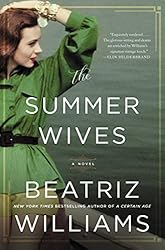

Summer Wives
Beatriz Williams, 2018
William Morrow
384 pp.
ISBN-13: 9780062660343
Summary
Beatriz Williams brings us the blockbuster novel of the season—an electrifying postwar fable of love, class, power, and redemption set among the inhabitants of an island off the New England coast…
In the summer of 1951, Miranda Schuyler arrives on elite, secretive Winthrop Island as a schoolgirl from the margins of high society, still reeling from the loss of her father in the Second World War.
When her beautiful mother marries Hugh Fisher, whose summer house on Winthrop overlooks the famous lighthouse, Miranda’s catapulted into a heady new world of pedigrees and cocktails, status and swimming pools. Isobel Fisher, Miranda’s new stepsister—all long legs and world-weary bravado, engaged to a wealthy Island scion—is eager to draw Miranda into the arcane customs of Winthrop society.
But beneath the island’s patrician surface, there are really two clans: the summer families with their steadfast ways and quiet obsessions, and the working class of Portuguese fishermen and domestic workers who earn their living on the water and in the laundries of the summer houses.
Uneasy among Isobel’s privileged friends, Miranda finds herself drawn to Joseph Vargas, whose father keeps the lighthouse with his mysterious wife. In summer, Joseph helps his father in the lobster boats, but in the autumn he returns to Brown University, where he’s determined to make something of himself.
Since childhood, Joseph’s enjoyed an intense, complex friendship with Isobel Fisher, and as the summer winds to its end, Miranda’s caught in a catastrophe that will shatter Winthrop’s hard-won tranquility and banish Miranda from the island for nearly two decades.
Now, in the landmark summer of 1969, Miranda returns at last, as a renowned Shakespearean actress hiding a terrible heartbreak.
On its surface, the Island remains the same—determined to keep the outside world from its shores, fiercely loyal to those who belong. But the formerly powerful Fisher family is a shadow of itself, and Joseph Vargas has recently escaped the prison where he was incarcerated for the murder of Miranda’s stepfather eighteen years earlier. What’s more, Miranda herself is no longer a naïve teenager, and she begins a fierce, inexorable quest for justice for the man she once loved … even if it means uncovering every last one of the secrets that bind together the families of Winthrop Island. (From the publisher.)
Author Bio• Birth—ca. 1971-72
• Where—Seattle, Washington, USA
• Education—B.A., Stanford University; M.B.A., Columbia University
• Currently—lives in Greenwich, Connecticut
A graduate of Stanford University with an MBA from Columbia, Beatriz spent several years in New York and London hiding her early attempts at fiction, first on company laptops as a corporate and communications strategy consultant, and then as an at-home producer of small persons.
She now lives with her husband and four children near the Connecticut shore, where she divides her time between writing and laundry. (From the author's website.)
Book Reviews
Williams transports readers to a time and place replete with glamour, drama and secrets. Delving into the inner sanctum of wealthy families to expose the dark sides of their lives is something Williams excels at.… [T]his a hard-to-put-down read and one you’ll want to savor.
Romance Times
The intricate and complex web of relationships within stated conventions are skillfully created and add depth to the narrative. Longtime Williams fans, readers of historical fiction and mysteries, and anyone seeking engaging plot twists will find satisfaction in these pages. —Stacey Hayman, Rocky River P.L., OH
Library Journal
Longtime Williams fans, readers of historical fiction and mysteries, and anyone seeking engaging plot twists will find satisfaction in these pages.
Booklist
Twenty years after a murder at her family's tony Long Island Sound summer enclave, an expatriate actress returns to right a terrible injustice and heal her broken heart.… With just the right touch of bitters… satisfyingly tempestuous—and eminently beachworthy.
Kirkus Reviews
Discussion Questions
We'll add publisher questions if and when they're available; in the meantime, use our LitLovers talking points to start a discussion for SUMMER WIVES … then take off on your own:
1. How would you compare the different Mirandas of this novel: the younger version of 1951 and the later one of 1969? What has changed?
2. Describe the early relationship between the two step-sisters, Miranda and Isobel. How does their relationship change when Miranda returns nearly 20 years later?
3. What else on the island has changed in Miranda's 20-year absence?
4. As as an author, Beatriz Williams is particularly deft at digging into the interior lives of women; Summer Wives is no exception. On her return to the island, Miranda Schuyler is hiding a bruised eye, indicative of a troubled relationship, a literal wound indicative of an internal one. Yet Miranda bears wounds from her teen-aged years as well. What are the causes of those wounds, and what does Miranda eventually decide to do: endure the pain or push back against it?
5. Talk about the dual world of life on Winthrop Island between the year-round Portuguese community and the wealthy summer folk. Where does the Fisher family fit within this social hierarchy? Why does Isobel tell her father, for instance, that she is pleased with his choice for a new wife?
6. Williams peels back the layers of opulence and social status on Winthrop Island. What does she reveal?
7. What is the relationship between Isobel and Joseph Vargas? Were you able to figure out the real killer of Hugh Fisher, or were you caught by surprise?
8. Were you able to keep track of the many characters and the different timelines, or were you somewhat confused? Is there one era you found more appealing than the others: the 1930's, '50's, or the '60s?
(Questions by LitLovers. Please feel free to use them, online and off, with attribution. Thanks.)
The Summerhouse (Summerhouse series #1)
Jude Deveraux, 2001
Simon & Schuster
416 pp.
ISBN-13: 9780671014193
Summary
Have you ever wanted to rewrite your past?
Three best friends, all with the same birthday, are about to turn forty. Celebrating at a summerhouse in Maine, Leslie Headrick, Madison Appleby, and Ellie Abbott are taking stock of their lives and loves, their wishes and choices. But none of them expect the gift that awaits them at the summerhouse: the chance for each of them to turn their "what-might-have-beens" into reality.
Leslie, a suburban wife and mother, follows the career of a boy who pursued her in college wonders: what if she had chosen differently? Madison dropped a modeling career to help her high school boyfriend recover from an accident, even though he'd jilted her. But what if she had said "no" when her old boyfriend had called? Ellie became a famous novelist, but a bitter divorce wiped out her earnings—and shattered her belief in herself. Why had the "justice" system failed her? And could she prevent its happening the second time around?
Now, a mysterious "Madame Zoya," offers each of them a chance to relive any three weeks from the past. Will the road not taken prove a better path? Each woman will have to decide for herself as she follows the dream that got away...and each must choose the life that will truly satisfy the heart's deepest longings. (From the publisher.)
Author Bio
• AKA—Jude Gilliam White
• Birth—September 20, 1947
• Where—Fairedale, Kentucky, USA
• Currently—lives in North Carolina
Deveraux won readers' hearts with the epic Velvet series, which revolves around the lives of the Montgomery family's irresistible men. Deveraux's early books are set largely in 15th- and 16th-century England, in which her fierce, impassioned protagonists find themselves in the midst of blood feuds and wars. Her heroines are equally scrappy—medieval Scarlett O'Haras who often have a low regard for the men who eventually win them over. They're fighters, certainly, but they're also beauties who are preoccupied with survival and family preservation.
Deveraux has also stepped outside her milieu, with mixed results. Her James River trilogy (River Lady, Lost Lady, and Counterfeit Lady) is set mostly in post-Revolution America; the popular, softer-edged Twin of Fire/Twin of Ice moves to 19th-century Colorado and introduces another hunky-man clan, the Taggerts. Deveraux manages to evoke a strong and convincing atmosphere for each of her books, but her dialogue and characters are as familiar as a modern-day soap opera's.
"Historicals seem to be all I'm capable of," Deveraux once said in an interview, referring to a now out-of-print attempt at contemporary fiction, 1982's Casa Grande. "I don't want to write family sagas or occult books, and I have no intention of again trying to ruin the contemporary market." Still, Deveraux did later attempt modern-day romances, such as the lighthearted High Tide (her first murder caper), the contemporary female friendship story The Summerhouse, and the time-traveling Knight in Shining Armor. In fact, with 2002's The Mulberry Tree, Deveraux seems to be getting more comfortable setting stories in the present, which is a good thing, since the fans she won with her historical books are eager to follow her into the future.
Extras
• Deveraux began her career as a fifth-grade teacher.
• Having a child and buying a house in Italy have changed Deveraux's perspective, according to an interview with a European fan in 2001. "I find that now [that I'm a mother] I'm not so interested in the events that happen between a man and woman," she said. "Now I want to know more about the character of a man, because now whether or not he would be a good father is of utmost importance. (From Barnes & Noble.)
Book Reviews
"If you had to do it all over again, what would you do?" is the question Deveraux poses in this wistful novel of second chances. Twenty-five years into her career, with 26 New York Times bestsellers to her credit and 30 million copies of her books in print, the author serves up the following situation: 19 years ago, Leslie, Madison and Ellie met while waiting in line to get their licenses renewed at the New York City Department of Motor Vehicles. Sharing the same birthday, they became instant friends. Now they're all turning 40, and although they haven't seen each other since that long-ago day, when Ellie invites the others for a reunion in Maine, they agree to attend. Once there, they realize that their lives haven't turned out as planned. But then the trio stumble across Madame Zoya of Futures, Inc., who make them an irresistible offer: they can relive any three weeks from the past, armed with the knowledge since gained. Afterwards, they must decide: should they stick with the lives they have or go with the new futures they've created? The conceit of the DMV meeting and subsequent reunion functions as a clunky device to let the women tell their individual tales of woe; the idea that they're soul mates even though they only met once and never kept in touch requires a considerable stretch of the imagination. When they do go back in time, like 40-years-olds trying to play 20 at a costume party, the conversations are youthfully banal. The eternal allure of lives relived rescues the tale, but this lukewarm effort is strictly for loyal fans. The best thing about time travel in Deveraux's world? Instant weight loss.
Publishers Weekly
Deveraux is at the top of her game here as she uses the time-travel motif that was so popular in A Knight in Shining Armor (1996), successfully updating it with a female buddy twist that will make fans smile. —Patty Engelmann
Booklist
Discussion Questions
Use our LitLovers Book Club Resources; they can help with discussions for any book:
• How to Discuss a Book (helpful discussion tips)
• Generic Discussion Questions—Fiction and Nonfiction
• Read-Think-Talk (a guided reading chart)
Also consider these LitLovers talking points to help get a discussion started for The Summerhouse:
1. Describe each of the three main characters—Ellie, Leslie and Madison. Of the three, is there one one whose story you most most relate to or sympathsize with...or find most compelling?
2. Do you consider these women true victims at the hands of men-gone-bad? Or do you see them as passive individuals, who find it easier to blame their unhappiness on others (a very common human failing)?
3. Ellie thinks castration is too light a punishment for Madison's high school boyfriend, who dumped Madison for his college sweetheart. But later, Ellie approves—smiles and all—Leslie's choice to dump her boyfriend and move to New York. "You wanted to see life," she says to Leslie. Care to comment on Ellie? Is she inconsistent, or is there a deeper morality she's aiming for?
4. If given the chance, which three weeks out of your own life would you choose to return to and relive? Are three weeks enough?
5. Having chosen the period of your life to return to, would you make permanent changes—and what would those changes be? In other words, would you accept Madame Zoya's offer for a do-over?
6. Are there better ways to affect the course of one's life than through time-travel? Could these women—should they—move on without having to alter their personal histories?
7. Should Madison quit smoking?
8. Each of the women thought they could fix the mistakes they made in their previous lives. What lessons, however, did they learn during their time-travel?
9. It has been said that women writing about women shortchange men—in other words, they don't create fully human male characters, only one dimensional caricatures. Does Deveraux fall into that trap, or do you feel her male characters are well-developed? (Or is that observation sexist to begin with?!)
10. Are you satisfied with the book's ending?
(Questions by LitLovers. Please feel free to use them, online or off, with attribution. Thanks.)
top of page


Summerland
Elin Hilderbrand, 2012
Little, Brown & Co.
464
ISBN-13: 9780316099943
Summary
A summer's night, a deadly crash, and four lives changed forever—in the page-turning bestseller from Elin Hilderbrand.
A warm June evening, a local tradition: the students of Nantucket High have gathered for a bonfire on the beach. What begins as a graduation night celebration ends in tragedy after a horrible car crash leaves the driver, Penny Alistair, dead, and her twin brother in a coma.
The other passengers, Penny's boyfriend, Jake, and her friend Demeter, are physically unhurt—but the emotional damage is overwhelming. Questions linger about what happened before Penny took the wheel.
As summer unfolds, startling truths are revealed about the survivors and their parents—secrets kept, promises broken, hearts betrayed. Elin Hilderbrand explores the power of community, family, and honesty, and proves that even from the ashes of sorrow new love can take flight. (From the publisher.)
Author Bio
• Birth—ca. 1969-70
• Raised—Collegeville, Pennsylvania, USA
• Education—B.A., Hopkins University; University of Iowa Writers' Workshop
• Currently—lives in Nantucket, Massachuestts
Elin Hilderbrand is an American writer of Summer beach read romance novels, some 20 in all. Her books have been set on and around Nantucket Island where she lives with her husband and three children.
Hilderbrand was born and raised in Collegeville, Pennsylvania. As a child, she spent summers on Cape Cod, "playing touch football at low tide, collecting sea glass, digging pools for hermit crabs, swimming out to the wooden raft off shore," until her father died in a plane crash when she was sixteen. She spent the next summer working—doing piecework in a factory that made Halloween costumes; she promised herself that the goal for the rest of her life would be that she would always have a real summer.
She graduated from Johns Hopkins University and became a teaching/writing fellow at the University of Iowa Writers' Workshop. In 1993 she moved to Nantucket, took a job as "the classified ads girl" at a local paper, and later started writing.
Her first novels were published by St. Martin's Press. With A Summer Affair, published in 2008, she moved to Little, Brown and Company. (From Wikipedia. Retrieved 7/11/2013.)
Book Reviews
Nantucket Island’s year-round residents are shaken when a car crash claims the life of driver Penny Alistair, a vibrant and popular high school student, and leaves her twin brother, Hobby, in a coma..... The sparks that this story throws out becomes a current that circles the agitated kids and their parents, electrifying the atmosphere as they grapple with what happened. Hilderbrand has a gift for building tension, and the reader will be willing to do just about anything to discover the real reason why Penny would drive herself, her brother, and her boyfriend over an embankment into oblivion.
Publishers Weekly
Hildebrand's latest touches on heavy subject matter but has a satisfying conclusion. Like Jodi Picoult, she writes about ordinary, believable characters in a difficult situation that could happen to anyone. While the multiple points of view are tough to follow at first, once the story "clicks," fans of realistic fiction will find themselves devouring this novel to discover what really happened that night on the beach. —Amber Woodard, Cumberland Univ. Lib., Lebanon, TN
Library Journal
Discussion Questions
1. What do you think of the use of Nantucket’s collective voice in Summerland ? How does the island—and the voice of its people—play its own role in the novel?
2. Following the tragic accident, Jordan decides to move his family to Australia for a year, even though Jake does not want to leave the island. For whom did Jordan make that decision? Why?
3. How would you describe Penny’s relationship with Ava? Should Ava have realized something more serious was wrong with Penny? What did Ava provide Penny that no one else could?
4. What do you think of Jordan’s decision not to run a story about the accident in the Nantucket Standard ? Do you think he made the right choice?
5. Throughout the novel, many characters struggle with guilt over the cause of the car accident, including Demeter and Jake. Do you think Penny was solely responsible for the accident? Or was anyone else at fault? Why or why not?
6. Penny had a very sensitive soul. What did she struggle with? Was she determined to end her life?
7. Perth and Nantucket are both coastal towns, but they are a world apart. How does life differ in these two places? What do Jordan and Jake learn from their time in Perth?
8. What caused Demeter to start drinking in an unhealthy way? What led her to continue her drinking, and what were the consequences?
9. What sparked Ava’s reawakening, and what led to her big decisions at the end of the novel?
10. What do you think of Hobby’s decision to keep Demeter’s secret news to himself? Do you think that’s something he should have shared with others?
11. How are the lives of the parents in the novel influenced by the lives of their children—and vice versa?
12. How does each character in Summerland find a way to start healing as the summer draws to a close?
(Questions issued by publisher.)
The Sun Also Rises
Ernest Hemingway, 1926
Simon & Schuster
256pp.
ISBN-13: 9780743297332
Summary
The Sun Also Rises is one of Ernest Hemingway's masterpieces and a classic example of his spare but powerful style. A poignant look at the disillusionment and angst of the post-World War I generation, the story introduces two of Hemingway's most unforgettable characters: Jake Barnes and Lady Brett Ashley.
Jake Barnes, an American newspaperman emasculated by a wound suffered in Italy during World War I, is living and working in Paris in the expatriate community. He takes friends Bill Gorton, Lady Brett Ashley (whom Jake loves), her fiance, Mike Campbell, and Robert Cohn (also in love with Brett) to Spain for trout fishing and bullfighting during the festival of San Fermin in Pamplona.
Tensions mount among Campbell, Cohn, and Barnes over Brett and intensify as she falls in love with Pedro Romero, a nineteen-year-old bullfighter. At the end of the festival, Brett leaves with Romero, Bill returns to Paris, Mike goes to St. Jean de Luz, and Jake goes to San Sebastian for a respite soon ended when he receives a telegram from Brett. Jake goes immediately to her aid in Madrid, where he finds her momentarily remorseful and evading truth about Romero and her relationship with Jake.
First published in 1926, The Sun Also Rises helped to establish Hemingway as one of the greatest writers of the twentieth century
(From the publisher.)
Author Bio
• Birth—July 21, 1899
• Where—Oak Park, Illinois
• Death—July 02, 1961
• Where—Ketchum, Idaho
• Education—Oak Park & River Forest High School
• Awards—Pulitzer Prize, 1952; Nobel Prize, 1954
Ernest Hemingway did more to change the style of English prose than any other writer in the twentieth century, and for his efforts he was awarded the Nobel Prize in 1954. Hemingway wrote in short, declarative sentences and was known for his tough, terse prose. His main protagonists were always men and women of courage and conviction, who suffered unseen scars, both physical and emotional.
Hemingway was born July 21, 1899, in Oak Park, Illinois. After graduation from high school, he moved to Kansas City, Missouri, where he worked briefly for the Kansas City Star. Failing to qualify for the United States Army because of poor eyesight, he enlisted with the American Red Cross to drive ambulances in Italy. He was severely wounded on the Austrian front on July 9, 1918. Following recuperation in a Milan hospital, he returned home and became a freelance writer for the Toronto Star.
In December of 1921, he sailed to France and joined an expatriate community of writers and artists in Paris while continuing to write for the Toronto Star. He began his fiction career with "little magazines" and small presses, which led to a volume of short stories, In Our Time (1925).
Then, as a novelist, he gained international fame: The Sun Also Rises (1926) and A Farewell to Arms (1929) established Hemingway as the most important and influential fiction writer of his generation. He covered the Spanish Civil War, portraying it in fiction in his brilliant novel For Whom the Bell Tolls, (1940), which continued to affirm his extraordinary career. He subsequently covered World War II.
Hemingway's highly publicized life gave him unrivaled celebrity as a literary figure. He became an authority on the subjects of his art: trout fishing, bullfighting, big-game hunting, and deep-sea fishing, and the cultures of the regions in which he set his work—France, Italy, Spain, Cuba, and Africa.
The Old Man and the Sea (1952) earned him the Pulitzer Prize and was instrumental in his being awarded the Nobel Prize in 1954. Hemingway died in Ketchum, Idaho, on July 2, 1961. (Adapted from the publisher.)
Book Reviews
(Older works have few, if any, mainstream press reviews online. See Amazon and Barnes & Noble for helpful customer reviews.)
No amount of analysis can convey the quality of The Sun Also Rises. It is a truly gripping story, told in a lean, hard, athletic narrative prose that puts more literary English to shame. Mr. Hemingway knows how not only to make words be specific but how to arrange a collection of words which shall betray a great deal more than is to be found in the individual parts. It is magnificent writing, filled with that organic action which gives a compelling picture of character. This novel is unquestionably one of the events of an unusually rich year in history.
New York Times (11/31/1926)
Discussion Questions
1. When Jake Barnes rebuffs the prostitute Georgette because he is "sick," she says, "Everybody's sick. I'm sick, too" (p.23). Is Georgette's observation an appropriate description of the people in the novel? Why is Jake's emasculating wound such an effective symbol?
2. When Jake and Bill walk during the Paris evening looking at Notre Dame, watching young lovers, and savoring cooking smells, Jake asks whether Bill would like a drink. Why does Bill respond, "No...I don't need it" (p. 83)? Why does Jake say that for Cohn the Bayonne cathedral was "a very good example of something or other" (p. 96)?
3. Is Jake and Bill's fishing trip to Burguete relevant to the epigraph from Ecclesiastes? How do their conversations in Burguete differ from those they have back in Pamplona? How do Robert's, Mike's, and Brett's absences from the fishing trip set them apart from Jake and Bill? Why is the Englishman Harris included in the Burguete scene?
4. How would you describe Jake Barnes's relationship with Brett? Does he love her; understand her? Is his view of Brett constant? How does he see her at the close of the novel? What does he mean when he says, "Isn't it pretty to think so," when Brett tells him that they "could have had such a damned good time together" (p. 251)?
5. If Hemingway's novel is about "the lost generation," do we conclude that all five of the persons who have gone to Pamplona are lost? Is there evidence that moral or spiritual cleansing ever takes place in the novel?
(Questions issued by publisher.)
top of page

The Sun Down Motel
Simone St. James, 2020
Penguin Publishing
336 pp.
ISBN-13: 9780440000174
Summary
Something hasn’t been right at the roadside Sun Down Motel for a very long time, and Carly Kirk is about to find out why in this chilling new novel.
Upstate New York, 1982. Viv Delaney wants to move to New York City, and to help pay for it she takes a job as the night clerk at the Sun Down Motel in Fell, New York.
But something isnʼt right at the motel, something haunting and scary.
Upstate New York, 2017.
Carly Kirk has never been able to let go of the story of her aunt Viv, who mysteriously disappeared from the Sun Down before she was born. She decides to move to Fell and visit the motel, where she quickly learns that nothing has changed since 1982. And she soon finds herself ensnared in the same mysteries that claimed her aunt. (From the publisher.)
Author Bio
Simone St. James is the USA Today bestselling and award-winning author of The Broken Girls, Lost Among the Living, and The Haunting of Maddy Clare. She wrote her first ghost story, about a haunted library, when she was in high school and spent twenty years behind the scenes in the television business before leaving to write full-time. (From the publisher .)
Book Reviews
[E]ngrossing supernatural thriller…. Suspense mounts as…characters put themselves in peril. Though the story’s spectral aspects may strike some as heavy-handed, there’s no doubt about the shocking, satisfying denouement. Horror fans will also want to check this one out.
Publishers Weekly
There are very few novels that leave me feeling genuinely spooked.… Simone St. James's The Sun Down Motel is very much one of those books, taking twists and turns that are equal parts compelling and creepy.
PopSugar
Discussion Questions
1. Why do you think the author chose to tell this story across two time periods and two points of view? Do you think it was effective? Why or why not?
2. Discuss how each of the victims were described in the media. Do you think the way the media characterized these women played a role in the overall investigation—and the failure by the police to catch the killer? How does their characterization compare to how victims are described by the media today?
3. From the beginning, Viv is determined to uncover who the female ghost is and why she’s haunting the motel. Why do you think this was so important to her? Why do you think she didn’t just flee Fell, New York, and the motel?
4. Viv, Carly, and Heather all have a somewhat morbid curiosity surrounding both the Fell, New York, murders and true crime in general, which reflects the fact that young women tend to be the biggest consumers of true crime content. Why do you think this is?
5. Discuss the ghosts that haunt the motel, especially Betty. What do you think each of them represented, if anything?
6. There are multiple instances where the women of this novel discuss what women should be doing to protect themselves, although as Viv notes: “It was always girls who ended up stripped and dead like roadkill…. It didn’t matter how afraid or careful you were—it could always be you.” What do you think the author is saying about the experience of being a woman? Do you think the novel might have been difference if Viv and Carly were men? If so, how?
7. How are the concepts of female rage and empowerment explored in this novel, if at all?
8. Consider Alma and Marnie, and the relationships they formed with Viv and with each other. Why do you think they allowed themselves to become involved with Viv’s investigation?
9. Multiple characters throughout this novel end up returning to the small town of Fell, New York, or choose to remain there despite many reasons—and opportunities—to leave. Why do you think they are drawn to the town?
10. Building off the previous question, why do you think the author chose a remote town—and an even more remote roadside motel—for the setting of this novel? How do you think the story would have changed with a different setting?
11. Discuss the way the killer was finally stopped. Do you think those involved did the right thing? Do you think, especially with consideration of the time period, that they could have done anything differently?
(Questions issued by the publisher.)
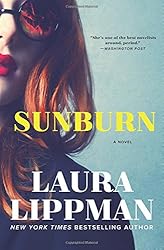
Sunburn
Laura Lippman, 2018
HarperCollins
304 pp.
ISBN-13: 9780062389923
Summary
Laura Lippman returns with a superb novel of psychological suspense about a pair of lovers with the best intentions and the worst luck: two people locked in a passionate yet uncompromising game of cat and mouse. But instead of rules, this game has dark secrets, forbidden desires, inevitable betrayals—and cold-blooded murder.
One is playing a long game. But which one?
They meet at a local tavern in the small town of Belleville, Delaware. Polly is set on heading west. Adam says he’s also passing through. Yet she stays and he stays—drawn to this mysterious redhead whose quiet stillness both unnerves and excites him.
Over the course of a punishing summer, Polly and Adam abandon themselves to a steamy, inexorable affair. Still, each holds something back from the other—dangerous, even lethal, secrets.
Then someone dies. Was it an accident, or part of a plan? By now, Adam and Polly are so ensnared in each other’s lives and lies that neither one knows how to get away—or even if they want to. Is their love strong enough to withstand the truth, or will it ultimately destroy them?
Something—or someone—has to give. Which one will it be?
Inspired by James M. Cain’s masterpieces The Postman Always Rings Twice, Double Indemnity, and Mildred Pierce, Sunburn is a tantalizing modern noir from the incomparable Laura Lippman. (From the publisher.)
Author Bio
• Birth—January 31, 1959
• Where—Atlanta, Georgia, USA
• Education—B.S., Northwestern University
• Awards—(see below)
• Currently—lives in Baltimore, Maryland
Lippman was born in Atlanta, Georgia, and raised in Baltimore, Maryland. She is the daughter of Theo Lippman Jr., a well known and respected writer at the Baltimore Sun, and Madeline Lippman, a retired school librarian for the Baltimore City Public School System. She attended high school in Columbia, Maryland, where she was the captain of the Wilde Lake High School It's Academic team.
Lippman is a former reporter for the (now defunct) San Antonio Light and the Baltimore Sun. She is best known for writing a series of novels set in Baltimore and featuring Tess Monaghan, a reporter (like Lippman herself) turned private investigator.
Lippman's works have won the Agatha, Anthony, Edgar, Nero, Gumshoe and Shamus awards. Her 2007 release, What the Dead Know, was the first of her books to make the New York Times bestseller list, and was shortlisted for the Crime Writer's Association Dagger Award. In addition to the Tess Monaghan novels, Lippman wrote 2003's Every Secret Thing, which has been optioned for the movies by Academy Award–winning actor Frances McDormand.
Lippman lives in the South Baltimore neighborhood of Federal Hill and frequently writes in the neighborhood coffee shop Spoons. In addition to writing, she teaches at Goucher College in Towson, Maryland, just outside of Baltimore. In January, 2007, she taught at the 3rd Annual Writers in Paradise at Eckerd College.
Lippman is married to David Simon, another former Baltimore Sun reporter, and creator and an executive producer of the HBO series The Wire. The character Bunk is shown to be reading one of her books in episode eight of the first season of The Wire. She appeared in a scene of the first episode of the last season of The Wire as a reporter working in the Baltimore Sun newsroom.
Awards
2015 Anthony Award-Best Novel (After I'm Gone)
2008 Anthony Award-Best Novel (What the Dead Know)
2008 Anthony Award-Best Short Story ("Hardly Knew Her")
2008 Barry Award-Best Novel (What the Dead Know)
2008 Macavity Award-Best Mystery (What the Dead Know)
2007 Anthony Award-Best Novel (No Good Deeds)
2007 Quill Award-Mystery (What the Dead Know)
2006 Gumshow Award-Best Novel (To the Power of the Three)
2004 Barry Award-Best Novel (Every Secret Thing)
2001 Nero Award (Sugar House)
2000 Anthony Award-Best Paperback Original (In Big Trouble)
2000 Shamus Award-Best Paperback Original (In Big Trouble)
1999 Anthony Award-Best Paperback Original (Butchers Hill)
1998 Agatha Award-Best Novel (Butchers Hill)
1998 Edgar Award-Best Paperback Original (Charm City)
1998 Shamus Award-Best Paperback Original (Charm City)
(Author bio adapted from Wikipedia.)
Book Reviews
Laura Lippman's Sunburn may be set in 1995, before Google searches made it a whole lot harder to vanish and start afresh elsewhere, but it takes its inspiration…from '40s noir: Double Indemnity, Mildred Pierce, The Postman Always Rings Twice…Sunburn, though cool and twisty, has more heart than expected. It's generous in other ways, too. The particular atmosphere of unlovely Belleville is deftly conveyed…People move in and out of the narrative with their own baggage and preoccupations. What they choose to tell us is very subjective and not always directly relevant, and this clamor of voices gives the novel satisfying depth and texture. There's a sense here that we're brushing up against many lives, many versions of the truth.
Harriet Lane - New York Times Book Review
I feel like it creates a whole new category, which I’m thinking of as "femme noir."… She’s taken this traditional noir structure of a man sweeping in to save a woman who then turns around and eats his heart out—she’s turned that notion on its head.
Wall Street Journal
The ingenious plot evolves into myriad twists that are as believable as they are surprising.… Sunburn delivers one of the year’s most intriguing mysteries.
Associated Press Staff
A masterful mix from a total pro.
People
(Starred review) [S]corching. Adam’s part in her potential downfall—comes to a boiling point. This is Lippman at her observant, fiercest best, a force to be reckoned with in crime fiction.
Publishers Weekly
(Starred review) Lippman's complicated femme fatale heroine and conflicted hero are more layered than one would expect from noir protagonists…. With an economy of words, she creates three-dimensional characters.… [A] tasty feast of a novel. —Liz French
Library Journal
(Starred review) Ingeniously constructed and extremely suspenseful, the novel keeps us guessing right up until its final moments. Lippman is a popular and dependable writer, and this homage to classic noir showcases a writer at the height of her powers.
Booklist
(Starred review) Lippman’s version of the sexy stranger passing through town.… [Her] trademark is populating a whodunit with characters so believably complicated they don’t need the mystery to carry the book.… Plotty, page-turning pleasure plus.
Kirkus Reviews
Discussion Questions
We'll add publisher questions if and when they're available; in the meantime, please use our LitLovers GENERIC MYSTERY QUESTIONS to start a discussion for Sunburn … then take off on your own:
GENERIC DISCUSSION QUESTIONS
Mystery / Crime / Suspense Thrillers
1. Talk about the characters, both good and bad. Describe their personalities and motivations. Are they fully developed and emotionally complex? Or are they flat, one-dimensional heroes and villains?
2. What do you know...and when do you know it? At what point in the book do you begin to piece together what happened?
3. Good crime writers embed hidden clues in plain sight, slipping them in casually, almost in passing. Did you pick them out, or were you...clueless? Once you've finished the book, go back to locate the clues hidden in plain sight. How skillful was the author in burying them?
4. Good crime writers also tease us with red-herrings—false clues—to purposely lead readers astray? Does your author try to throw you off track? If so, were you tripped up?
5. Talk about the twists & turns—those surprising plot developments that throw everything you think you've figured out into disarray.
- Do they enhance the story, add complexity, and build suspense?
- Are they plausible or implausible?
- Do they feel forced and gratuitous—inserted merely to extend the story?
6. Does the author ratchet up the suspense? Did you find yourself anxious—quickly turning pages to learn what happened? A what point does the suspense start to build? Where does it climax...then perhaps start rising again?
7. A good ending is essential in any mystery or crime thriller: it should ease up on tension, answer questions, and tidy up loose ends. Does the ending accomplish those goals?
- Is the conclusion probable or believable?
- Is it organic, growing out of clues previously laid out by the author (see Question 3)?
- Or does the ending come out of the blue, feeling forced or tacked-on?
- Perhaps it's too predictable.
- Can you envision a different or better ending?
8. Are there certain passages in the book—ideas, descriptions, or dialogue—that you found interesting or revealing...or that somehow struck you? What lines, if any, made you stop and think?
9. Overall, does the book satisfy? Does it live up to the standards of a good crime story or suspense thriller? Why or why not?
(Resources by LitLovers. Please feel free to use them, online and off, with attribution. Thanks.)


The Sunday Wife
Cassandra King, 2002
Hyperion
528 pp.
ISBN-13: 9780786890705
Summary
A captivating novel about one woman's journey toward independence and the life-changing friendship that guides her there.
Married for 20 years to the Reverend Benjamin Lynch, a handsome, ambitious minister of the prestigious Methodist church, Dean Lynch has never quite adjusted her temperament to the demands of the role of a Sunday wife. When her husband is assigned to a larger and more demanding community in the Florida panhandle, Dean becomes fast friends with Augusta Holderfield, a woman whose good looks and extravagant habits immediately entrance her. As their friendship evolves, Augusta challenges Dean to break free from her traditional role as the preacher's wife.
Just as Dean is questioning everything she has always valued, a tragedy occurs, providing the catalyst for change in ways she never could have imagined. (From the publisher.)
Author Bio
• Birth—1944
• Where—Lower Alabama, USa
• Education—B.A., M.A., Alabama college
• Currently—lives in the Low Country, South Carolina
Cassandra King is the author of five novels, most recently the critically acclaimed Moonrise (2013), her literary homage to Rebecca by Daphne du Maurier. Moonrise is a Fall 2013 Okra Pick and a Southern Independent Booksellers Alliance (SIBA) bestseller. It has been described as “her finest book to date.”
Fellow Southern writers Sandra Brown, Fannie Flagg, and Dorothea Benton Frank hailed her previous novel, Queen of Broken Hearts (2008), as “wonderful,” “uplifting,” “absolutely fabulous,” and “filled with irresistible characters.” Prior to that, King’s third book, The Same Sweet Girls (2005), was a #1 Booksense Selection and Booksense bestseller, a Southeastern Bookseller Association bestseller, a New York Post Required Reading selection, and a Literary Guild Book-of-the-Month Club selection.
Her first novel, Making Waves in Zion, was published in 1995 by River City Press and reissued in 2004 by Hyperion. Her second novel, The Sunday Wife (2002), was a Booksense Pick, a People Magazine Page-Turner of the Week, a Literary Guild Book-of-the-Month selection, a Books-a-Million President’s Pick, a South Carolina State Readers’ Circle selection, and a Salt Lake Library Readers’ Choice Award nominee. In paperback, the novel was chosen by the Nestle Corporation for its campaign to promote reading groups.
King’s short fiction and essays have appeared in numerous journals and anthologies, including Callaloo, Alabama Bound: The Stories of a State (1995), Belles’ Letters: Contemporary Fiction by Alabama Women (1999), Stories From Where We Live (2002), and Stories From The Blue Moon Cafe (2004). Aside from writing fiction, she has taught writing on the college level, conducted corporate writing seminars, worked as a human-interest reporter for a Pelham, Alabama, weekly paper, and published an article on her second-favorite pastime, cooking, in Cooking Light magazine.
A native of L.A. (Lower Alabama), King currents lives in the Low Country of South Carolina with her husband, novelist Pat Conroy, whom she met when he wrote a blurb for Making Waves. (From the author's website.)
Book Reviews
Rich [and] satisfying.
People
An intelligent, witty novel, skillfully written.
Boston Globe
Delivers haunting messages about the nature of love, freedom and forgiveness.
Orlando Sentinel
Joining a distinguished tradition of southern women writers, King explores the complexities of class and sexism
Birmingham News
The dilemma facing women [The role of wife? Can it be filled without losing yourself?]...is what made it real.
Jackson Clarion Ledger
Shines without turning into a sermon.
Florida International Magazine
Finely drawn characters and complicated social intrigue make Kings second novel a charming read. .... Orphaned as a child, the retiring Dean has spent 20 years of marriage in the shadow of her overbearing, charismatic husband, always feeling out of place..... King has written a truly heartwarming story, a tale of turbulent emotions and the vagaries of public opinion in a small Southern town; she has a sure winner here.
Publishers Weekly
(Audio version.) American version of the British novelist Barbara Pym's writing: a portrait of the well-intentioned but power-hungry preacher with his mismatched mate.... But on the third tape, ...we are left listening to a generic and unremarkable romance novel, predicting most events before reader Joan Allen mentions them.... This is ultimately a frustrating novel (at least in this abridged version).
Library Journal
Discussion Questions
1. What is a Sunday wife? What makes a "good" one? Consider whether or not Dean fits the bill, and explain your reasoning.
2. How does the prologue introduce you to the book's themes?
3. Who is the narrator and is this narrator reliable? Explore what the book would have been like if Ben had been the narrator. Consider how the story would unfold if one of the other characters were narrating.
4. What is the role of religion in The Sunday Wife? How does it frame—or anchor—the story? Share who you believe holds the book's moral center, and why?
5. Discuss the different social issues and dilemmas that King weaves throughout—like same-sex marriage, psychic healing, book banning and adultery—and examine why she uses them to tell this story.
6. Were you surprised at Dean's early admission that she and Ben don't share a bedroom? What kind of relationship does this lead you to believe that they have? Looking at Ben and Dean's exchange on pages 112-113, what kind of person is Dean with her husband?
7. When Dean succeeds in cultivating a friendship with Augusta and Maddox, why isn't Ben ecstatic? Explore whether or not Augusta causes a rift between Ben and Dean. Is Dean and Ben's relationship already coming apart? Why does Augusta tell Dean, "You're not the woman you appear to be"? (page 116)
8. How are Dean and Augusta alike? What are your impressions of them? Thinking about Ben and Maddox, discuss their similarities and differences and what kind of men you think they are, and why.
9. Look at the name choices and the character traits the names imply. How do names influence the reader's perception of the characters?
10. On page 61, Dean and Augusta talk about fate vs. determination and choice. Share whether or not you believe, as Augusta does, that there are unseen forces that determine our fate. Why? How do Augusta's beliefs fit with what happens in her life?
11. Explore the turmoil Rich and Godwin's union causes the community. Why is Ben so upset about Rich and Godwin's union? Why was he so unsympathetic about Dean being attacked? What would you say to him if you were Dean?
12. Why does Augusta's affair with John Marcus Vickery upset Dean so much? Why does Dean say to Augusta, "You've got a child now. Do you want someone taking advantage of Gus like that?" Is this a valid argument? On page 249, Augusta says she has a "trump card." What did you think she was talking about when she said this? What does the trump card turn out to be?
13. Discuss the conversation between Dean and Vickery that begins on page 237. Do you think Vickery is being honest—or flirtatious? Why are so many people drawn to Vickery, and to Ben? On page 239, Vickery says to Dean, "Ben is going to lose you." Why would he presume to say so? Do you think Dean had any notion of leaving Ben at this point?
14. What, if any, is the symbolism of Augusta going over the Crystal River Bridge? (page 260) How do you react to Dean's not even thinking of Ben during the morning after Augusta dies? Do you feel sorry for Vickery not having anyone to grieve with? Did he really love Augusta?
15. Would you have given Augusta's note to her husband or hidden from him it like Dean did? Discuss why Dean does this and whether or not she was protecting Maddox. What are the consequences of Dean's actions? Why does Maddox get so angry when he finally reads the letter?
(Questions from author's website.)
Sundays at Tiffany's
James Patterson & Gabrielle Charbonnet, 2008
Grand Central Publishing
336 pp.
ISBN-13: 9780446536318
Summary
As a little girl, Jane has no one. Her mother Vivienne Margaux, the powerful head of a major New York theater company has no time for her. But she does have one friend—Michael—and no one can see him but her. But Michael can't stay with Jane forever, and on her eighth birthday, her imaginary friend must leave her.
When Jane is in her thirties, working for her mother's company, she is just as alone as she was as a child. Her boyfriend hardly knows she's there and is more interested in what Vivienne can do for his career. Her mother practically treats her as a slave in the office, despite the great success of Jane's first play, Thank Heaven. Then she finds Michael—handsome, and just the same as she remembers him, only now he's not imaginary. For once in her life, Jane is happy—and has someone who loves her back. But not even Michael knows the reason behind why they've really been reunited. (From the publisher.)
Author Bio
• Birth—March 22, 1947
• Where—Newburgh, New York, USA
• Education—B.A., Manhattan College; M.A., Vanderbilt Univ.
• Awards—Edgar Award, Best First Mystery Novel, 1977
• Currently—lives in Palm Beach, Florida
James Patterson had been working as a very successful advertising copywriter when he decided to put his Masters degree in English to a somewhat different use. Inspired by bestselling hair-raising thrillers like The Day of the Jackal and The Exorcist, Patterson went to work on his first novel. Published in 1976, The Thomas Berryman Number established him as a writer of tightly constructed mysteries that move forward with the velocity of a bullet. For his startling debut, Patterson was awarded the prestigious Edgar Award for Best First Mystery Novel—an auspicious beginning to one of the most successful careers in publishing.
A string of gripping standalone mysteries followed, but it was the 1992 release of Along Came a Spider that elevated Patterson to superstar status. Introducing Alex Cross, a brilliant black police detective/forensic psychologist, the novel was the first installment in a series of bestselling thrillers that has proved to be a cash cow for the author and his publisher.
Examining Patterson's track record, it's obvious that he believes one good series deserves another...maybe even a third! In 2001, he debuted the Women's Murder Club with 1st to Die, a fast-paced thriller featuring four female crime fighters living in San Francisco — a homicide detective, a medical examiner, an assistant D.A., and a cub reporter. The successful series has continued with other numerically titled installments. Then, spinning off a set of characters from a previous novel (1998's When the Wind Blows), in 2005 he published Maximum Ride: The Angel Experiment. Featuring a "flock" of genetically engineered flying children, the novel was a huge hit, especially with teen readers, and spawned a series of vastly popular fantasy adventures.
In addition to continuing his bestselling literary franchises, Patterson has also found time to co-author thrillers with other writers — including Peter de Jonge, Andrew Gross, Maxine Paetro, and Howard Roughan — and has even ventured into romance (Suzanne's Diary for Nicholas, Sam's Letters to Jennifer) and children's literature (santaKid). Writing at an astonishing pace, this prolific author has turned himself into a one-man publishing juggernaut, fulfilling his clearly stated ambition to become "the king of the page-turners."
Extras
From a Barnes & Noble interview:
• Patterson's Suzanne's Diary For Nicholas was inspired by a diary his wife kept that tracked the development of their toddler son.
• Two of Patterson's Alex Cross mysteries (Along Came a Spider and Kiss the Girls) have been turned into films starring Morgan Freeman; in 2007, a weekly television series premiered, based on the bestselling Women's Murder Club novels.
• When asked what book most influenced his life, here is is response:
Probably the novel that most influenced me as a young writer is A Hundred Years of Solitude—simply because as I read it, I realized that I could never do anything half as good. So why not try mysteries? Gabriel García Márquez's magical mystery tour begins with one of the most engaging lines in fiction: "Many years later, as he faced the firing squad, Colonel Aureliano Buendía was to remember that distant afternoon when his father took him to discover ice." What follows is an exhilarating recounting of a century in the imaginary Colombian town of Macondo—the comedies and tragedies, joy and suffering, sublime and ridiculous. An entire town, for example, is affected with insomnia at one point in the novel. A woman literally rises to heaven while drying her laundry. And eventually, the firing squad, fires. Some have called this the great American novel—only it was written by a South American. (Author bio and interview from Barnes & Noble.)
Book Reviews
What do women want? At this point in his career Mr. Patterson probably has a better answer than Freud did.
Janet Maslin, New York Times
Entertaining.... Readers looking for a romantic escape will enjoy [this book].
Midwest Book Review
A love story with an irresistible twist.
Woodstock Sentinel-Review (Canada)
Discussion Questions
Use our LitLovers Book Club Resources; they can help with discussions for any book:
• How to Discuss a Book (helpful discussion tips)
• Generic Discussion Questions—Fiction and Nonfiction
• Read-Think-Talk (a guided reading chart)
Also consider these LitLovers talking points to help get a discussion started for Sunday's at Tiffany's:
1. Patterson's novel merges the boundaries of the natural and supernatural worlds. Many individuals...and many cultures believe those two worlds are actually more closely integrated than everyday reality and science suggests. Where do you fall in this? Guardian angels...yes or no?
2. A number of authors penetrate the boundaries between the natural and supernatural? Can you think of any; if so, how are their works similar to or different from Sundays at Tiffany's?
3. Talk about the root causes of Jane's feelings of loneliness, both as a child and adult? Is a mother's withholding of love and affection cause enough for a life-long sense of emptiness?
4. Discuss Patterson's characters—particuarly Jane and her mother. Are they are fully developed, emotionally complex individuals...or one-dimensional caricatures?
5. Some readers felt the ending was too pat, that it held no surprises. What about you?
6. Early on there are hints that Jane suffers from a serious but undisclosed medical condition. Is this condition ever revealed?
(Questions by LitLovers. Please feel free to use them, online or off, with attribution. Thanks.)
top of page


Sundown, Yellow Moon;
Larry Watson, 2007
Random House
336 pp.
ISBN-13: 9780375758539
Summary
On an icy day in January 1961, in Bismarck, North Dakota, a sixteen-year-old boy walks home from high school with his best friend, Gene. The sudden sound of sirens startles and excites them, but they don’t have long to wonder what the sound could mean. Soon after seeing police cars parked on their street, the boys learn the shocking truth: hours before, Gene’s father, Raymond Stoddard, walked calmly and purposefully into the state capitol and shot to death a charismatic state senator. Raymond then drove home and hanged himself in his garage.
The horrific murder and suicide leave the community reeling. Speculation about Raymond’s motives run rampant. Political scandal, workplace corruption, financial ruin, adultery, and jealousy are all cited as possible catalysts. But in the end, the truth behind the day’s events died with those two men. And for Gene and his friend, the tragedy is a turning point, both in their lives and in their friendship.
Nearly forty years later, Gene’s friend, a writer, revisits the tragedy and tries to unravel the mystery behind one man’s inexplicable actions. Through his own recollections and his fiction—sometimes impossible to separate—he attempts to make sense of a senseless act and, in the process, to examine his youth, his friendship with Gene, and the love they both had for a beautiful girl named Marie.
Spare, haunting, lyrical, Sundown, Yellow Moon is a piercing study of love and betrayal, grief and desire, youth and remembrance. Using a brilliant, evocative fiction-within-fiction structure, Larry Watson not only brings to life a distinct period in history but, mostaffectingly, reveals the interplay of memory, secrets, and the passage of time. (From the publisher.)
Author Bio
• Birth—1947
• Raised—Bismark, North Dakota, USA
• Education—B.A., M.F.A., Unversity of North Dakota; Ph.D.,
University of Utah
• Awards—Milkweed National Fiction Prize, Mountains and
Plains Bookseller Award, Friends of American Writers
Award, Banta Award, Critics Choice Award, ALA/YALSA
Best Books for Young Adults Winner
• Currently—lives in Milwaukee, Wisoconsin
Larry Watson was born in 1947 in Rugby, North Dakota. He grew up in Bismarck, North Dakota, and married his high school sweetheart. He received his BA and MFA from the University of North Dakota, his Ph.D. from the creative writing program at the University of Utah, and an honorary Doctor of Letters degree from Ripon College. Watson has received grants and fellowships from the National Endowment for the Arts (1987, 2004) and the Wisconsin Arts Board.
Watson is the author of five novels and a chapbook of poetry. His fiction has been published in more than ten foreign editions, and has received prizes and awards from Milkweed Press, Friends of American Writers, Mountain and Plains Booksellers Association, New York Public Library, Wisconsin Library Association, and Critics’ Choice. Montana 1948 was nominated for the first IMPAC Dublin International Literary Prize. The movie rights to Montana 1948 and Justice have been sold to Echo Lake Productions and White Crosses has been optioned for film.
He has published short stories and poems in Gettysburg Review, New England Review, North American Review, Mississippi Review, and other journals and quarterlies. His essays and book reviews have appeared in the Los Angeles Times, Washington Post, Chicago Sun-Times, Milwaukee Journal-Sentinel, and other periodicals. His work has also been anthologized in Essays for Contemporary Culture, Imagining Home, Off the Beaten Path, Baseball and the Game of Life, The Most Wonderful Books, These United States, and Writing America.
Watson taught writing and literature at the University of Wisconsin-Stevens Point for 25 years before joining the faculty at Marquette University in 2003. (From the publisher.)
Book Reviews
The unnamed, not-entirely-reliable narrator of this novel of obsession from Watson (In a Dark Time) aims his imaginative faculties at discovering, through fiction, the truth of an incident from his adolescence in Bismarck, N.Dak. In trying to figure out why, in 1961, his best friend's father shot a state senator and then hanged himself, the writer tries out a number of different scenarios via short fictions and simple speculation, including mental illness, romantic rivalry, a festering real estate swindle and a looming corruption scandal. The fictions-within-a-fiction are a clever conceit, but ponderous discussion of the pieces weakens it. More problematic is that the specifics of the larger tale aren't engineered to go as far as Watson wants to take them. The book's greatest strength, alongside its palpable sense of place, is its rich period detail—including the inescapability of cigarette smoking, in which nearly every character hungrily indulges. But even the narrator's own mother, initially absorbed by the case, loses interest in it rather swiftly, so it should be no surprise that the relentless analysis of minutiae comes to feel like harping.
Publishers Weekly
This novel is a literary murder mystery/coming of age tale/writer's memoir/love story that, perhaps understandably, struggles under the weight of its ambitions. The narrator of the novel is a successful fiction writer looking back on a traumatic event from his youth that has become seminal to his life and writing. This event is a murder and suicide: his best friend's father-a steady, solid, suburban dad-shot and killed an old acquaintance, a popular state senator, and then returned home and took his own life. Both young men are baffled and disturbed by this violence, and the novel examines the lingering damage it causes. Watson (Montana 1948) is at his best exploring the grief and confusion these events create for the two teen-age friends. Watson is less effective, however, as he moves past this event to the love story and the passages that link this event to the fictional narrator's literary work. The interior life of his characters becomes less convincing, and the exploration of how personal experience is transformed into art is, unfortunately, not fully realized.
Patrick Sullivan - Library Journal
A writer scours the past and his own false starts in an ultimately futile quest to explain the 1961 assassination of a charismatic North Dakota legislator. In his latest return to the Northern plains, Watson (Orchard, 2003, etc.) flouts the taboo against writer protagonists, no doubt in the interests of structure. Musing over a compendium of his earlier attempts to explicate the central drama of his life, the nameless writer-narrator recalls a January Wednesday in Bismarck, 1961, when he walked home from high school with his best friend, Gene Stoddard. At Gene's house, Gene's father Ray has, uncharacteristically, returned early from his job as a state employee at the nearby North Dakota capitol building. The narrator later learns that Ray shot, point-blank at the capitol, his own boyhood friend Monty Burnham, a state senator with Washington ambitions, then hurried home to hang himself in the family garage, leaving behind a confession to the crime but no inkling as to motive. Approaching the incident from the points of view of both pivotal and peripheral players, the narrator dispenses creative writing tips and quotes stories he's published in obscure literary journals. Several speculative vendetta scenarios emerge. Monty and Alma, Ray's beautiful wife, were high-school sweethearts, and rekindled an affair after her marriage, possibly during World War II, possibly during a high-school reunion, casting doubt on the paternity of the Stoddards' daughter. Monty bamboozled Ray's dying father into selling a beloved lake cabin, depriving Ray of his inheritance. Monty embroiled Ray, who works in purchasing, in a kickback scheme involving the state auto fleet, a scandal on the brink of exposure. Although everyone else, including his parents, has put the trauma to rest, the narrator has not. His obsession is complicated by his estrangement from Gene, and his (lifelong) infatuation with Gene's girlfriend, Marie. The soft-focus ending is only a momentary respite from the novel's preoccupation-the persistent, agonizing allure of the unknowable.
Kirkus Reviews
Discussion Questions
1. What does Sundown, Yellow Moon say about the nature, source, and durability of young love?
2. Of the available possible explanations for Raymond Stoddard’s actions, which do you favor and why?
3. Each character seems to favor a particular explanation. What does that preference reveal about his or her character?
4. Does the explanation you favor reveal something about your character and experience?
5. The narrator writes stories to explain and understand what happened in his neighborhood. Is that a universal human response, or does it stem from his personal nature?
6. Does Sundown, Yellow Moon say that storytelling is a basic human impulse?
7. The narrator doesn’t emerge as an entirely likable character. Why? Is he made less than sympathetic because of what he says and does, or because of what he thinks and feels? Or because of what he writes?
8. What does Sundown, Yellow Moon say about the nature of memory? Of memory and imagination?
9. In some respects, the narrator is stuck in the past. What prevents him from living in the present?
10. How is the setting, both the time and the place, important to the action in the novel?
11. Because of the many stories within stories, it’s not always possible to determine what “really happened” in the narrative. How does that uncertainty figure in the novel’s themes?
12. If you knew the narrator based only on the stories he’s written, would you characterize him in the same way you would based on his behavior, speech, thoughts, and emotions?
13. Do you have a favorite character?
14. There have been many assassinations and attempted assassinations of politicians in the United States. How does this novel comment on the social, psychological, and cultural response to such events?
15. What does Sundown, Yellow Moon say about violence in America?
(Questions issued by publishers.)
top of page


The Sunlit Night
Rebecca Dinerstein, 2015
Bloomsbury (USA)
272 pp.
ISBN-13: 9781632861122
Summary
In the beautiful, barren landscape of the Far North, under the ever-present midnight sun, Frances and Yasha are surprised to find refuge in each other.
Their lives have been upended—Frances has fled heartbreak and claustrophobic Manhattan for an isolated artist colony; Yasha, a Russian immigrant raised in a bakery in Brighton Beach, arrives from Brooklyn to fulfill his beloved father's last wish: to be buried "at the top of the world." They have come to learn how to be alone.
But in Lofoten, an archipelago of six tiny islands in the Norwegian Sea, ninety-five miles north of the Arctic Circle, they form a bond that fortifies them against the turmoil of their distant homes, offering solace amidst great uncertainty.
With nimble and sure-footed prose enriched with humor and warmth, Dinerstein reveals that no matter how far we travel to claim our own territory, it is ultimately love that gives us our place in the world. (From the publisher.)
Author Bio
• Birth—ca. 1987-88
• Where—New York, New York, USA
• Education—B.A., Yale; M.F.A., New York University
• Currently—lives in Brooklyn, New York City, New York
Rebecca Dinerstein is the author of Lofoten (2012), a bilingual English-Norwegian collection of poems, and The Sunlit Night (2015), her debut novel. She received her B.A. from Yale and her M.F.A. in Fiction from New York University, where she was a Rona Jaffe Graduate Fellow.
Upon receving her B.A., Dinerstein traveled to a Norwegian artist's colony where she stayed for a year to write poetry. The colony was located on the site of an abandoned asylum for the insane—in Lofoten—an archipelago in the Norwegian Arctic. “I wanted to go as far north as I could,” she has said. Lofoten became the title of her poetry collection, as well as the setting of her novel. Dinerstein now lives in Brooklyn, New York City. (Adapted from the publisher and The Telegraph.)
Visit the author's website.
Book Reviews
The Norwegian Arctic of Dinerstein's imagination is a strange and wonderful place, half stark wilderness and half Scandi-kitsch paradise…the pleasure of The Sunlit Night derives less from [Yasha and Frances's] story than from the joyfully odd landscape Dinerstein conjures, in which certain absurdities begin to seem quite natural…
Britt Peterson - New York Times Book Review
Dinerstein's crystalline prose floats off the page, her storytelling delights and surprises. She takes on the travails, absurdities and human failings with warmth and humor, embracing it all and reminding us through her characters to do the same.
Milwaukee Journal Sentinel
Refreshing.... The author is a poet so the prose is, not surprisingly, lyrical but it's observant and witty, too.
Daily Mail (UK)
Dinerstein's much buzzed-about debut novel is a fanciful Arctic Circle romance between a Russian immigrant raised in a Brighton Beach bakery and a Manhattanite seeking refuge from family problems in a Norwegian artists' colony.
Forward
Engaging and alive.... The Sunlit Night heralds the beginning of an intriguing career in fiction during which Dinerstein will hopefully continue to take us off the beaten path.
Huffington Post
(Starred review.) In Dinerstein’s captivating debut novel, an isolated island above the Arctic Circle is the setting for two people trying to surmount grief and find love.... With provocative insights about the cruelty of abandonment, the concept of home, and the limits of parental and filial love, Dinerstein’s novel is a rich reading experience.
Publishers Weekly
The disorienting "midnight sun" of summer near the Arctic Circle creates a mystical setting as the characters work out their personal and family dilemmas. New Yorkers Frances and Yasha (both immensely likable characters) experience profound culture shock in the sparsely populated town and yearn to connect with each other. —Christine DeZelar-Tiedman, Univ. of Minnesota Libs., Minneapolis
Library Journal
At the very top of the world, two lonely outsiders find comfort in each other in Dinerstein's deliciously melancholy debut.... Frances and Yasha—united by their separate losses...fall into an unlikely kind of romance. Dinerstein's writing is light and lyrical, and her descriptions of the far north are intoxicating.... A poetic premise with language to match.
Kirkus Reviews
Discussion Questions
1. Why do you think Rebecca Dinerstein chose to introduce us to Frances in the context of her relationship with Robert Mason? How does she see the Masons in comparison with her "desperately artistic" (21) family?
2. Examine the role of landscape in The Sunlit Night, from urban to wild, Brooklyn to Borg.
3. Frances says of her family: "The only way we knew how to be was in each other's way" (16). The layout of their apartment certainly reflects this reality, but in what other ways do the members of Frances's family intrude on one another? What seems to be Frances's role in the family, and how does that role affect her?
4. Consider Olyana's first appearance at the bakery. How did your understanding of her reason for being there change over the course of her stay? Yasha reflects on a strong memory of sharing a bar of milk chocolate with his mother. How does this memory—and her recurring association with sweets—set the tone for Olyana's character?
5. Upon meeting Nils, Frances thinks: "Here was mankind in his original state...in all his innocence" (69). What do you think is his impression of her? Do they see each other clearly? Is Frances right about their "unfulfilled romance" (164)?
6. The narration of The Sunlit Night switches from first- to third-person as it moves between Frances and Yasha. Why do you think the author made this choice? Were you surprised to encounter Frances from an outside perspective? Why or why not?
7. Consider Vassily's funeral at Eggum. Frances claims her body is "confused about grief.... I'm not laughing. I'm shaking" (127). What other aspects of this ceremony struck you as unusual or "confused about grief"? What affect did they have? What do you think would have been Vassily's reaction to this ceremony?
8. Yasha thinks, "His mother, and Frances—they did not seem tied to the idea of place. They were the anywhere sort" (140). In the world of this novel, what connects a person to place? Which characters, if any, have achieved that connection by the end? Explain.
9. Consider the use of Norse mythology in The Sunlit Night from the Yggdrasil tree sculpture to Olyana's Valkyrie costume. What links can be made between the real world of the novel and the mythological one Haldor presides over at the Viking Museum?
10. While the first four parts of the novel have places for names, the fifth has a time period—"The Other Season"—during which the narrative jumps swiftly between Frances and Yasha. How did this shift affect your understanding of their relationship and its future? Why was it important for Yasha to stay in Lofoten for part of "the other season"?
11. A sense of professional failure weighs heavily on Frances's father. "What does it matter if you do what you love, if what you love doesn't matter?" (12), he asks her. What conclusions, if any, does the novel reach about this question, particularly with regard to being an artist?
12. Rebecca Dinerstein's first book, Lofoten, is a work of poetry. Choose a passage from The Sunlit Night that feels especially lyrical and discuss its poetic use of language.
(Questions issued by Bloomsbury Publishing.)

The Sunshine Girls
Jane Green, 2017
Penguin Publishing
384 pp.
ISBN-13: 9780399583315
Summary
A warm, wise, and wonderfully vivid novel about a mother who asks her three estranged daughters to come home to help her end her life.
Ronni Sunshine left London for Hollywood to become a beautiful, charismatic star of the silver screen. But at home, she was a narcissistic, disinterested mother who alienated her three daughters.
As soon as possible, tomboy Nell fled her mother’s overbearing presence to work on a farm and find her own way in the world as a single mother.
The target of her mother’s criticism, Meredith never felt good enough, thin enough, pretty enough. Her life took her to London—and into the arms of a man whom she may not even love.
And Lizzy, the youngest, more like Ronni than any of them, seemed to have it easy, using her drive and ambition to build a culinary career to rival her mother’s fame, while her marriage crumbled around her.
But now the Sunshine sisters are together again, called home by Ronni, who has learned that she has a serious disease and needs her daughters to fulfill her final wishes.
And though Nell, Meredith, and Lizzy have never been close, their mother’s illness draws them together to confront the old jealousies and secret fears that have threatened to tear these sisters apart. As they face the loss of their mother, they will discover if blood might be thicker than water after all. (From the publisher.)
Author Bio
• Birth—May 31, 1968
• Where—London, England, UK
• Education—University of Wales
• Currently—lives in Westport, Connecticut, USA
Jane Green is the pen name of Jane Green Warburg, an English author of women's novels. Together with Helen Fielding she is considered a founder of the genre known as chick lit.
Green was born in London, England. She attended the University of Wales, Aberystwyth and worked as a journalist throughout her twenties, writing women's features for the Daily Express, Daily Mail, Cosmopolitan and others. At 27 she published her first book, Straight Talking, which went straight on to the Bestseller lists, and launched her career as "the queen of chick lit".
Frequent themes in her most recent books, include cooking, class wars, children, infidelity, and female friendships. She says she does not write about her life, but is inspired by the themes of her life.
She is the author of more than 15 novels, several (The Beach House, Second Chance, and Dune Road) having been listed on the New York Times bestseller list. Her other novels Another Piece of My Heart (2012), Family Pictures (2013), and Tempting Fate (2014) received wide acclaim.
In addition to novels, she has taught at writers conferences, and writes for various publications including the Sunday Times, Parade magazine, Wowowow.com, and Huffington Post.
Green now lives in Connecticut with her second husband, Ian Warburg, six children, two dogs and three cats. Actively philanthropic, her foremost charities are The Hole in the Wall Gang Camp (Paul Newman's camp for children with life-threatening illnesses), Bethel Recovery Center, and various breast cancer charities. She is also a supporter of the Westport Public Library, and the Westport Country Playhouse. (Adapted from Wikipedia. Retrieved 4/20/2014.)
Book Reviews
[A] well-realized portrait of a dysfunctional family.… Verdict: Green does a wonderful job of creating realistic and lovable (despite themselves) characters. Fans…who enjoy Elin Hilderbrand and Kristin Hannah will love this book. —Kristen Stewart, Pearland Lib., Brazoria Cty. Lib. Syst., TX
Library Journal
Green…presents readers with another warm and winning family tale.
Booklist
As Green shifts back and forth among the sisters' and Ronni's perspectives, she sifts through the emotional wreckage of women inflicting wounds on themselves and each other. She convincingly depicts a frayed family with a keen eye for the details that snap the threads of sisterhood.
Kirkus Reviews
Discussion Questions
1. In her youth, Ronni makes choices to further her career, often at the expense of her family, but we also see moments of doubt and, later in her life, regret. Do you think her choices are entirely selfish? Do you empathize with any of her conflicts? What would you have done differently in her shoes?
2. It seems as though in her own way, Ronni has her daughters' best interests at heart, even if this sometimes hurts them. For instance, she constantly criticizes Meredith’s weight but also worries about her daughter's engagement. In what way is Ronni’s relationship with her daughters like or unlike many parent-child relationships? How do you think parents can strike a balance between communicating parental wisdom and allowing their children to make their own decisions? Does Ronni ultimately succeed in doing so?
3. Nell often remarks that Ronni is a much better grandmother than she was a mother. Why do you think this is?
4. Do you think Ronni’s last attempt to bring her daughters together makes up for her wrongdoings as a mother?
5. Do you empathize with Ronni’s wish to die on her own terms? If you were in her daughters’ place, would you comply with her wishes? Why or why not?
6. It’s often difficult to change old habits, but the Sunshine sisters discover that they must in order to truly connect as a family. Do you find that you revert back to certain habits or roles around your family members? Do you think it’s possible to change these habits and, consequently, your familial relationships?
7. Throughout the book, we see that Ronni and her daughters have difficulty opening up to one another and communicating their true feelings. Oftentimes, it leads to conflict, such as Nell and Lizzy’s argument over using the farm for the pop-up supper club, or the family’s disapproval of Meredith’s fiance. Why do you think it is so difficult for them to be truly vulnerable and open around one another? Do you find you have the same difficulties with your family members?
8. In many ways, the sisters refuse to confront their own problems but are remarkably perceptive at parsing one another’s issues and even predicting romance. Do you sometimes experience the same disparity in perception in your own life? Have you ever had a similar situation with a family member or close friend?
9. In the present day, the Sunshine sisters are not truly content with their lives and choices. Why do you think this is? Do you think it has anything to do with their familial relationships?
10. While talking about relationships with Nell, Meredith says, "There's a large part of me that thinks it's better to have stability, and kindness, and friendship. Those are the things that make a relationship last, I think. Not chemistry." Do you agree? How important were each of these factors in the sisters’ relationships? Do you think they would agree with Meredith’s statement in the end?
11. How is Greta the perfect match for Nell despite being a completely unexpected romantic partner?
12. Are you satisfied with the way things end for the Sunshine sisters?
(Questions issued by the publishers.)
Super Sad True Love Story
Gary Sheytngart, 2010
Random House
352 pp.
ISBN-13: 9780812977868
Summary
In a very near future—oh, let’s say next Tuesday—a functionally illiterate America is about to collapse. But don’t that tell that to poor Lenny Abramov, the thirty-nine-year-old son of an angry Russian immigrant janitor, proud author of what may well be the world’s last diary, and less-proud owner of a bald spot shaped like the great state of Ohio.
Despite his job at an outfit called Post-Human Services, which attempts to provide immortality for its super-rich clientele, death is clearly stalking this cholesterol-rich morsel of a man. And why shouldn’t it? Lenny’s from a different century—he totally loves books (or “printed, bound media artifacts,” as they’re now known), even though most of his peers find them smelly and annoying. But even more than books, Lenny loves Eunice Park, an impossibly cute and impossibly cruel twenty-four-year-old Korean American woman who just graduated from Elderbird College with a major in Images and a minor in Assertiveness.
After meeting Lenny on an extended Roman holiday, blistering Eunice puts that Assertiveness minor to work, teaching our “ancient dork” effective new ways to brush his teeth and making him buy a cottony nonflammable wardrobe. But America proves less flame-resistant than Lenny’s new threads. The country is crushed by a credit crisis, riots break out in New York’s Central Park, the city’s streets are lined with National Guard tanks on every corner, the dollar is so over, and our patient Chinese creditors may just be ready to foreclose on the whole mess.
Undeterred, Lenny vows to love both Eunice and his homeland. He’s going to convince his fickle new love that in a time without standards or stability, in a world where single people can determine a dating prospect’s “hotness” and “sustainability” with the click of a button, in a society where the privileged may live forever but the unfortunate will die all too soon, there is still value in being a real human being.
Wildly funny, rich, and humane, Super Sad True Love Story is a knockout novel by a young master, a book in which falling in love just may redeem a planet falling apart. (From the publisher.)
Author Bio
• Birth—July 5, 1972
• Where—Leningrad, USSR
• Education—B.A., Oberlin College (Ohio); M.F.A.,
Hunter College (NYC)
• Awards—Stephen Crane Award; National Jewish
Book Award
• Currently—lives in New York, New York
Gary Shteyngart (born Igor Semyonovich Shteyngart) is an American writer born in Leningrad, USSR. Much of his work is satirical and relies on the invention of elaborately fictitious yet somehow familiar places and times.
Background
Shteyngart spent the first seven years of his childhood living in a square dominated by a huge statue of Vladimir Lenin in what is now St. Petersburg, Russia; (he alternately calls it "St. Leningrad" or "St. Leninsburg"). He comes from a Jewish family and describes his family as typically Soviet. His father worked as an engineer in a LOMO camera factory; his mother was a pianist.
In 1979 when Gary was 7, the Shteyngart family immigrated to the United States, where he was brought up with no television in his family's New York City apartment and where English was not the household language. He did not shed his thick Russian accent until the age of 14.
Later Shteyngart traveled to Prague, an experience that inspired his first novel, set in the fictitious European city of Prava. He is a graduate of Stuyvesant High School in New York City; Oberlin College in Ohio, where he earned a degree in politics; and Hunter College of the City University of New York, where he earned an MFA in Creative Writing.
Writing career
Shteyngart took a trip to Prague which inspired his first novel, The Russian Debutante's Handbook (2002), which is set in the fictitious European city of Prava. He has published two more novels: Absurdistan (2006) and Super Sad True Love Story (2010). His fourth book, Little Failure (2014), is a memoir recounting his family's emigration to the U.S. in 1979.
His other writing has appeared in The New Yorker, Slate, Granta, Travel and Leisure, and The New York Times.
Shteyngart's work has received numerous awards. The Russian Debutante's Handbook won the Stephen Crane Award for First Fiction, the Book-of-the-Month Club First Fiction Award and the National Jewish Book Award for Fiction. It was named a New York Times Notable Book and one of the best debuts of the year by The Guardian. In 2002, he was named one of the five best new writers by Shout NY Magazine. Absurdistan was chosen as one of the ten best books of the year by the New York Times Book Revieww and Time magazine, as well as a book of the year by the Washington Post, Chicago Tribune, San Francisco Chronicle and many other publications. In June 2010, Shteyngart was named as one of The New Yorker magazine's "20 under 40" luminary fiction writers. Super Sad True Love Story won the 2011 Bollinger Everyman Wodehouse Prize for comic literature.
Personal
Shteyngart now lives in New York City. He has taught writing at Hunter College, and currently teaches writing at Columbia University. During the Fall of 2007, he also had a fellowship at the American Academy in Berlin, Germany.
Shteyngart is married to Esther Won who is of Korean descent. In October 2013, they became parents to Johnny Won Shteyngart. (Adapted from Wikipedia. Retrieved 2/14/2014.)
Book Reviews
Gary Shteyngart's wonderful new novel…is a supersad, superfunny, superaffecting performance—a book that not only showcases the ebullient satiric gifts he demonstrated in his entertaining 2002 debut, The Russian Debutante's Handbook, but that also uncovers his abilities to write deeply and movingly about love and loss and mortality.... In recounting the story of Lenny and Eunice in his antic, supercaffeinated prose, Mr. Shteyngart gives us his most powerful and heartfelt novel yet—a novel that performs the delightful feat of mashing up an apocalyptic satire with a genuine supersad true love story.
Michiko Kakutani - New York Times
the writing is never less than stylish and witty, and the sense of disaster, here as in Shteyngart's other novels, is unfailingly lyrical, performed for full, funny rhetorical orchestra....The sheer exhilaration of the writing in this book—Lenny's confessional tones, Eunice's teenage slang—is itself a sort of answer to the flattened-out horrors of the world it depicts. It's not that writing of any kind will save us from our follies or our rulers; but words are a form of life, and we can't say we haven't been warned.
Michael Wood - New York Times Book Review
A slit-your-wrist satire illuminated by [Shteyngart's] absurd wit.... This zany Russian immigrant loops the comedy of Woody Allen's "Sleeper" through the grim insights of George Orwell's 1984 to produce a "Super Sad True Love Story" that exposes the moral bankruptcy of our techno-lust.... But what pulls on our affections and keeps the satire from growing too brittle is Lenny's earnest voice as he struggles to fit into a world that clearly has no more use for him.
Ron Charles - Washington Post
Gary Shteyngart’s dystopian novel deserves a place on the shelf beside 1984 and Brave New World....The surprising and brilliant third novel from Russian-American satirist Shteyngart is actually two love stories.... Shteyngart writes with an obvious affection for America—at its most chilling, Super Sad True Love Story comes across as a cri de coeur from an author scared for his country. The biggest risk for any dystopian novel with a political edge is that it can easily become humorless or didactic; Shteyngart deftly avoids this trap by employing his disarming and absurd sense of humor (much of which is unprintable here). Combined with the near-future setting, the effect is a novel more immediate—and thus more frightening, at least for contemporary readers—than similarly themed books by Orwell, Huxley and Atwood.
NPR, Books We Like
Exuberant and devastating...such an acidly funny, prescient book.... It’s a wildly funny book that hums with the sheer vibrancy of Shteyngart’s prose, and that holds up a riotous, terrifying mirror to a corrupted American empire in decline.
Entertainment Weekly
(Starred review.) Shteyngart (Absurdistan) presents another profane and dizzying satire, a dystopic vision of the future as convincing—and, in its way, as frightening—as Cormac McCarthy's The Road. It's also a pointedly old-fashioned May-December love story, complete with references to Chekhov and Tolstoy. Mired in protracted adolescence, middle-aged Lenny Abramov is obsessed with living forever (he works for an Indefinite Life Extension company), his books (an anachronism of this indeterminate future), and Eunice Park, a 20-something Korean-American. Eunice, though reluctant and often cruel, finds in Lenny a loving but needy fellow soul and a refuge from her overbearing immigrant parents. Narrating in alternate chapters—Lenny through old-fashioned diary entries, Eunice through her online correspondence—the pair reveal a funhouse-mirror version of contemporary America: terminally indebted to China, controlled by the singular Bipartisan Party (Big Brother as played by a cartoon otter in a cowboy hat), and consumed by the superficial. Shteyngart's earnestly struggling characters—along with a flurry of running gags—keep the nightmare tour of tomorrow grounded. A rich commentary on the obsessions and catastrophes of the information age and a heartbreaker worthy of its title, this is Shteyngart's best yet.
Publishers Weekly
This cyber-apocalyptic vision of an American future seems eerily like the present, in a bleak comedy that is even more frightening than funny. Though Shteyngart received rave reviews for his first two novels (The Russian Debutante's Daughter, 2001; Absurdistan, 2006), those appear in retrospect to be trial runs for his third and darkest to date. Russian immigrant Lenny Abramov returns home to Manhattan of the indeterminate future, following a year in Italy, only to find his career as "Life Lovers Outreach Coordinator (Grade G) of the Post-Human Services division" in jeopardy. Just shy of 40, he is already coming to terms with his mortality amid the scorn of much younger, hipper careerists, as he markets eternal life to those with the wherewithal to afford it. The narrative alternates between the diary entries of Lenny and the computer log of Eunice Park, his much younger and reluctant Korean girlfriend whom he'd met in Italy and eventually persuaded to join him in the States. Lenny's diary is itself an anachronism, since this "post-literate age" lacks the patience to scan text for anything longer than political bromides or marketing pitches. The society at large finds books "smelly," though Lenny still collects and even reads them. "Media" has become an adjective (positive, all-purpose) as well as a noun, and some familiar institutions have morphed into Fox-Ultra and The New York Lifestyle Times. Both Lenny and Eunice are fully fleshed-out characters rather than satiric caricatures, but their matter-of-fact acceptance of Bi-Partisanship masking a police state, and of the illiterate, ebullient and Orwellian American Restoration Authority as a bulwark against the country's collapse (the waiting list to move to Canada exceeds 23 million), makes this cautionary tale all the more chilling. The narrative proceeds in a surprising yet inevitable manner to the outcome the title promises. When Lenny realizes "I can't connect in any meaningful way to anyone," he's writing about not merely a technological breakdown but the human condition, where the line distinguishing comedy from tragedy dissolves.
Kirkus Reviews
Discussion Questions
1. What elements of Shteyngart’s dystopian near-future do you see in our contemporary world?
2. In that same vein, do you feel that we really are in, or are headed for, a post-literate age? Have a media-saturated environment and short attention spans affected our ability to read and appreciate books?
3. Lenny and Eunice come from two opposing cultures and have different ethnic backgrounds. While he is a ruminative book reader, hers is the generation of the instant and fleeting. For all their differences, why do you think Lenny and Eunice are drawn together? What do they share in common in terms of their personal history?
4. After a trip home to Long Island, Lenny contemplates an existence that is “at the end of the busted rainbow, at the end of the day, at the end of the empire.” What does he mean by this? Do you feel that we are at the end of an era?
5.Lenny’s employer, Post Human Services, offers the promise of life extension for High Net Worth individuals. How do you think losing the assurance of death, a great equalizer, would affect the dynamic of society? If you had the option, would you seek out immortality?
6. Super Sad True Love Story is an epistolary novel—one written as a series of documents. Discuss the how Shteyngart’s use of diary entries and digital exchanges impacted your reading experience.
7. One target of Shteyngart’s satire is the value placed on youthfulness. Discuss how this preoccupation manifests itself in the novel—consider Eunice’s relationship with Lenny and Joshie, The Post Human Services, and representations of the elderly.
8. Lenny has been described as a twentieth century man in a twenty-first century world. How, specifically, is he anachronistic to the “new” New York?
9. Shteyngart includes elements of science fiction, romance, and dystopian fantasy. How do you think each of these genres manifests itself in the novel? Why is each important?
10. Super Sad True Love Story treads into dark territory—mortality, heartbreak, the demise of a culture—yet, as a satire, it relies heavily on humor for its social criticism. In your opinion, how important is humor in evaluating and responding to the world in which we live?
11. Though Super Sad True Love Story is set in the (very near) future, there is a strong immigrant presence that also harkens back to the American past. Discuss the portrayal and significance of immigrants in the novel.
12. In the Super Sad universe, there is no such thing as a private detail. In our world, what do you feel are the benefits and pitfalls of social media? Where should we draw the line in terms of what we broadcast about our personal lives?
(Questions issued by publisher.)
top of page


Supermom in Galilee
Rachel Stackhouse (with Peter C. de Vries ), 2015
Peter C. deVries (Publisher)
296 pp.
ISBN-13: 9781515121503
Summary
A unique, absorbing journey in time crafted by a bestselling novelist and molded by a New Testament scholar!
Rachel did everything right. But no matter where she was, she had the feeling she was supposed to be someplace else…
When an agnostic suburban soccer mom lies down with a migraine, the last thing she expects is to wake up in a dusty, smelly courtyard in first-century Galilee.
Befuddled, shocked, and—as a woman without family traveling alone—in fear for her very life, Rachel is grateful to be taken in by two wealthy women on a mission: the financial support of a charismatic rabbi from Nazareth. Jesus is a real up-and-comer, the women insist, with a knack for motivational speaking. You’ll love him! But Rachel has never been “a believer.” And even if she were, the swarthy, robust, and greasy-haired man to which she is introduced hardly strikes her as deity material. Then again… sometimes, she isn’t so sure.
Based on both scholarly depictions of Jesus of Nazareth and research into daily life in the first century, we see through Rachel’s account a fresh, earthy, and wholly pragmatic portrait of the historical Jesus. We see the rabbi not as the gospel writers chose to present him, but as he might have appeared to the little-known women who bankrolled his travels and to the disciples’ wives who seasoned his stew.
As Rachel experiences the resiliency and raw courage of these women, unsung and unrecorded by history, she is forced to wonder whether it is her own frenetic, perfectionist life that is truly the fairy tale.
Commentary by a New Testament scholar and pastor accompanies this novel by a bestselling author under a different pen name to provide chapter-by-chapter historical and Biblical background and reflections that help you explore your understanding of Jesus and his world. This book will engage the individual reader as well book clubs and study groups seeking a fresh perspective on a familiar topic.
Author Bios
Rachel Stackhouse
Rachel Stackhouse is a busy mother of three who under another pen name is also the author of several bestselling Kindle novels of mystery and romance. This unique story, written before the age of ebooks, collected dust in a drawer for many years while mainstream publishers considered it "too Christian" and Christian publishers rejected the concept of time travel as "hocus pocus."
Now, thanks to a more open literary market and the addition of excellent commentary by a New Testament scholar, the reader is invited to spy on one woman’s vision of the events of first-century Galilee, and to wonder what might have been…
Peter de Vries
• Birth—1963
• Where—State of Pennsylvania, USA
• Education—B.A., Pennsylvania State University, M.Div., Princeton Theological Seminary,
Ph.D., University of Pittsburgh
• Currently—lives in Mars, Pennsylvania
Born and raised in a Pennsylvania coal-mining town to Dutch immigrant parents, Peter C. de Vries has been a Presbyterian pastor for twenty-seven years, and is in his twenty-second year of service in a congregation outside of Pittsburgh. He has taught New Testament exegesis at Pittsburgh Theological Seminary, trains church leaders in Ghana, and has held several leadership positions in the Presbyterian Church at the regional level.
He is married to his best friend and has three children, two grandchildren, and a goofy little dog. (From the author .)
Visit Peter de Vries website.
Follow Peter on Facebook.
Book Reviews
Supermom in Galilee gives me a feel for the culture of first century Palestine. As I read each chapter with Peter de Vries' commentary interspersed, I found it to be evocative, reshaping stories I've known since my childhood in ways that are new and fresh.
Rick Ufford-Chase, Moderator of the 216th General Assembly of the Presbyterian Church (USA), Co-director of Stony Point Conference Center (New York)
Discussion Questions
CHAPTER FIVE
1. What people or things do you try to ignore or get rid of?
2. How do you try to avoid them?
3. When has following God been unsettling for you?
CHAPTER SIX
4. When have you been on the losing side of a division that people make? When have you been on the “winning” side? What did you do?
5. What image of Jesus do you have in your mind? How accurate, historically, do you think it is?
6. What does Jesus have in common with you? What makes him different from you?
7. Is there a challenge Jesus is presenting to you that you’d rather ignore?
CHAPTER TEN
8. Why do you think people tend to prefer the simple and clear-cut over the ambiguous and nuanced?
9. Under what circumstances are you more likely to make judgments quickly, and when are you more likely to investigate the subtleties of the situation?
10. How does Jesus’ refusal to treat us according to a set of standards affect our penchant to assert our own version of right and wrong?
CHAPTER FIFTEEN
11. What are some features of your personality that you are sometimes ashamed of or wish you could eliminate? How could they be an asset for you?
12. When have you acted or spoken with good intentions, only to discover later that you only made matters worse?
CHAPTER SIXTEEN
13. When have you suffered at the hands of those who claimed to be doing Christ’s work? How did the experience affect you?
14. Under what circumstances are you likely to forget your own failings and condemn others instead?
15. Are there times when you have ignored or failed to pick up the role that God has given you to continue his work of grace?
16. Who is in your life now that you can touch? How will you do it?
(Questions courtesy of the author.)


The Supreme Macaroni Company (Valentine Trilogy, 3)
Adriana Trigiani, 2013
HarperCollins
352 pp.
ISBN-13: 9780062136589
Summary
For over a hundred years, the Angelini Shoe Company in Greenwich Village has relied on the leather produced by Vechiarelli & Son in Tuscany. This historic business partnership provides the twist of fate for Valentine Roncalli, the school-teacher turned shoemaker, to fall in love with Gianluca Vechiarelli, a tanner with a complex past...and a secret.
A piece of surprising news is revealed on a fateful Christmas Eve when Valentine and Gianluca join her extended family. Now faced with life altering choices, Valentine remembers the wise words that inspired her in the early days of her beloved Angelini Shoe Company: "A person who can build a pair of shoes can do just about anything." The proud, passionate Valentine is going to fight for everything she wants and savor all she deserves—the bitter and the sweetness of life itself. (From the publisher.)
This is the final book of the Valentine Trilogy. The first book is Very Valentine (2009); the second Brava Valentine (2010)
Author Bio
• Birth—1960
• Where—Big Stone Gap, Virginia, USA
• Education—B.A., St. Mary’s College, Indiana, USA
• Currently—lives in New York, New York
As her squadrons of fans already know, Adriana Trigiani grew up in Big Stone Gap, a coal-mining town in southwest Virginia that became the setting for her first three novels. The "Big Stone Gap" books feature Southern storytelling with a twist: a heroine of Italian descent, like Trigiani, who attended St. Mary's College of Notre Dame, like Trigiani. But the series isn't autobiographical—the narrator, Ave Maria Mulligan, is a generation older than Trigiani and, as the first book opens, has settled into small-town spinsterhood as the local pharmacist.
The author, by contrast, has lived most of her adult life in New York City. After graduating from college with a theater degree, she moved to the city and began writing and directing plays (her day jobs included cook, nanny, house cleaner and office temp). In 1988, she was tapped to write for the Cosby Show spinoff A Different World, and spent the following decade working in television and film. When she presented her friend and agent Suzanne Gluck with a screenplay about Big Stone Gap, Gluck suggested she turn it into a novel.
The result was an instant bestseller that won praise from fellow writers along with kudos from celebrities (Whoopi Goldberg is a fan). It was followed by Big Cherry Holler and Milk Glass Moon, which chronicle the further adventures of Ave Maria through marriage and motherhood. People magazine called them "Delightfully quirky... chock full of engaging, oddball characters and unexpected plot twists."
Critics sometimes reach for food imagery to describe Trigiani's books, which have been called "mouthwatering as fried chicken and biscuits" (USA Today) and "comforting as a mug of tea on a rainy Sunday" (New York Times Book Review). Food and cooking play a big role in the lives of Trigiani's heroines and their families: Lucia, Lucia, about a seamstress in Greenwich Village in the 1950s, and The Queen of the Big Time, set in an Italian-American community in Pennsylvania, both feature recipes from Trigiani's grandmothers. She and her sisters have even co-written a cookbook called, appropriately enough, Cooking With My Sisters: One Hundred Years of Family Recipes, from Bari to Big Stone Gap. It's peppered with anecdotes, photos and family history. What it doesn't have: low-carb recipes. "An Italian girl can only go so long without pasta," Trigiani quipped in an interview on GoTriCities.com.
Her heroines are also ardent readers, so it comes as no surprise that book groups love Adriana Trigiani. And she loves them right back. She's chatted with scores of them on the phone, and her Web site includes photos of women gathered together in living rooms and restaurants across the country, waving Italian flags and copies of Lucia, Lucia.
Trigiani, a disciplined writer whose schedule for writing her first novel included stints from 3 a.m. to 8 a.m. each morning, is determined not to disappoint her fans. So far, she's produced a new novel each year since the publication of Big Stone Gap. I don't take any of it for granted, not for one second, because I know how hard this is to catch with your public," she said in an interview with The Independent. "I don't look at my public as a group; I look at them like individuals, so if a reader writes and says, 'I don't like this,' or, 'This bit stinks,' I take it to heart.
Extras
From a 2004 Barnes & Noble interview:
• I appeared on the game show Kiddie Kollege on WCYB-TV in Bristol, Virginia, when I was in the third grade. I missed every question. It was humiliating.
• I have held the following jobs: office temp, ticket seller in movie theatre, cook in restaurant, nanny, and phone installer at the Super Bowl in New Orleans. In the writing world, I have been a playwright, television writer/producer, documentary writer/director, and now novelist.
• I love rhinestones, faux jewelry. I bought a pair of pearl studded clip on earrings from a blanket on the street when I first moved to New York for a dollar. They turned out to be a pair designed by Elsa Schiaparelli. Now, they are costume, but they are still Schiaps! Always shop in the street—treasures aplenty.
• When asked what book most influenced her life as a writer, here is what she said:
Jane Eyre by Charlotte Bronte. When I was a girl growing up in Big Stone Gap, Virginia, I was in the middle of a large Italian family, but I related to the lonely orphan girl Jane, who with calm and focus, put one foot in front of the other to make a life for herself after the death of her parents and her terrible tenure with her mean relatives. She survived the horrors of the orphanage Lowood, losing her best friend to consumption, became a teacher and then a nanny. The love story with the complicated Rochester was interesting to me, but what moved me the most was Jane's character, in particular her sterling moral code. Here was a girl who had no reason to do the right thing, she was born poor and had no connections and yet, somehow she was instinctively good and decent. It's a story of personal triumph and the beauty of human strength. I also find the book a total page turner- and it's one of those stories that you become engrossed in, unable to put it down. Imagine the beauty of the line: "I loved and was loved." It doesn't get any better than that! (Bio and interview from Barnes & Noble.)
Book Reviews
Trigiani explores the delicate balance (and unbalance) between work, family, and love.... [O]ften hilarious.... A twist near the end of the book is not unexpected, but tense shifts get a little dizzying.... Trigiani’s ability to bring the large, warm, enveloping—if somewhat dysfunctional—family to life will keep any reader engrossed and entertained.
Publishers Weekly
Trigiani's latest introduces readers to Val Roncalli, shoemaker and member of a boisterously loud Italian American family...announces that Gianluca Vechiarelli, a tanner, has proposed to her. More shocking is that Val has accepted.... Val's eccentric family keeps the book going at a quick pace, distracting readers from Val's insecure baby steps toward marital bliss. —Mara Dabrishus, Ursuline Coll. Lib., Pepper Pike, OH
Library Journal
The third in a trilogy about the life of Valentine Roncalli. Trigiani re-enters familiar territory here, both in that this book follows two previous novels about the Roncalli family and in that it has many of her hallmarks: sprawling Italian families, old-world craftsmanship, and melodious love letters to New York City and Italy.... Fans of Trigiani's Valentine books will find plenty of fodder here.
Kirkus Reviews
Discussion Questions
1. Describe Valentine and Gianluca's relationship. Is he the true love she has waited for?
2. What are the biggest obstacles to their happiness as a couple? What are their greatest strengths? What does Val expect from marriage? How does the reality compare? What makes for a good marriage? Is it realistic to want it all?
3. Think about the advice Val received from her family. If you are or have been married, what advice would you give her? If you aren't married what do you think marriage might be like?
4. Is Gianluca a good husband? Is Valentine a good wife? How much can their differences be attribute to age? To gender? To culture? Do you think they found the right balance in their relationship?
5. Is having such a large and close family like the Roncalli clan a blessing? Are there any downsides? What is your family like? How do our families impact our romantic relationships?
6. Talk about Val's wedding. Do you like the idea of a big wedding? If you are married, what was your day like? If not, what kind of wedding would you like to have?
7. Keeping secrets partially define Val and Gianluca's relationship. What information do they keep from each other and how do they affect the course of their lives? What is the biggest secret they each keep from the other?
8. Gianluca wants them to live in Italy. Why doesn't Val want to? Is it possible for them to live part time in both NewYork and Italy while still building the business?
9. Val not only married an older man,she married one who was married before. How do both of these facts shape her marriage? What is it like for her to meet Gianluca's first wife? Why doesn't he like to talk about his first marriage with Val? Why does she need to know about his past?
10. What does building the business mean to Valentine? Is Gianluca right—does she put her ambition ahead of her family? How do we juggle both? How does Val?
11. How does Alfie impact their relationship and Val's ambitions?
12. Were you surprised about the turn of events toward the end of the novel? How does Val handle this change? How does her family help her get through it? Should Gianluca have told her about the house? Didn't she have a right to weigh in with her opinion? Did he do the right thing?
13. What do you think the future holds for Val?
14. Discuss the books title. Do you think it is appropriate for the story? What did Val gain in this novel? What lessons did she learn?
15. What did you take away from reading The Supreme Macaroni Company?
(Questions issued by publisher.)


The Supremes at Earl's All-You-Can-Eat
Edward Kelsey Moore, 20013
Knopf Doubleday
320 pp.
ISBN-13: 9780307959928
Summary
Meet Odette, Clarice, and Barbara Jean.
Earl’s All-You-Can-Eat is home away from home for this inseparable Plainview, Indiana, trio. Dubbed “the Supremes” by high school pals in the tumultuous 1960s, they weather life’s storms together for the next four decades. Now, during their most challenging year yet, dutiful, proud, and talented Clarice must struggle to keep up appearances as she deals with her husband’s humiliating infidelities. Beautiful, fragile Barbara Jean is rocked by the tragic reverberations of a youthful love affair. And fearless Odette engages in the most terrifying battle of her life while contending with the idea that she has inherited more than her broad frame from her notorious pot-smoking mother, Dora.
Through marriage, children, happiness, and the blues, these strong, funny women gather each Sunday at the same table at Earl’s diner for delicious food, juicy gossip, occasional tears, and uproarious banter.
With wit and love, style and sublime talent, Edward Kelsey Moore brings together four intertwined love stories, three devoted allies, and two sprightly earthbound spirits in a big-hearted debut novel that embraces the lives of people you will never forget. (From the publisher.)
Author Bio
• Birth—ca. 1960-61
• Where—state of Indiana, USA
• Education—B.M., Indiana University; M.M., State
University of New York-Stony Brook
• Currently—lives in Chicago, Illinois
Edward Kelsey Moore is an American musician and author. He received a Bachelor of Music degree from Indiana University, and a Master of Music degree from the State University of New York at Stony Brook; his teachers included renowned cellists Janos Starker and Bernard Greenhouse.
Music career
For more than two decades,Moore has been a professional musician performing with a number of midwestern orchestras, including the Chicago Sinfonietta, the Chicago Philharmonic, and the Joffrey Ballet Orchestra. He is also principal cellist of the New Black Music Repertory Ensemble. He has played on many recordings, and toured nationally and internationally. In addition to performing, he has been a popular professor of music, training and nurturing a new generation of cello players.
Writing career
During Moore's high school years, and onward into college, he experimented with writing short stories. As he finished his education, he set writing aside and focused on building a career in music. Many years later, as a member of a string quartet, Edward was hired to perform at a reception for the winners of a local writing contest. As he played background music Edward considered: "I could have sent in a story..." It was an inspiring event and within a few weeks he began writing again.
His short fiction has been published in many literary magazines including Indiana Review, African American Review, and Inkwell. His short story "Grandma and the Elusive Fifth Crucifix" was selected as an audience favorite from the Stories on Stage series produced by WBEZ in Chicago. It was broadcast locally, and over National Public Radio. The Supremes at Earl's All-You-Can-Eat is Moore's debut novel, and he is currently writing his second book. (From the author's website.)
Read interview at BookPage.
Book Reviews
Edward Kelsey Moore knows how to write a terrific, complex, believable, and always intriguing story.
Zetta Brown - New York Journal of Books
Funny and tenderhearted...Moore expertly combines tragedy and comedy in a way that feels fluid and natural, creating a world that is internally consistent and rich.... Perhaps the most remarkable quality of The Supremes is love—the author’s love for his characters, even the most flawed, shines from every page.
Ilana Teitelbaum - Shelf Awareness
The indefatigable trio of Barbara Jean, Clarice, and Odette (known as "The Supremes" since high school) churns the small community of Plainview, Indiana into a Southern-fried tailspin this debut from Moore, a professional cellist. Each of the central characters brings unique challenges to the tables at Earl’s diner: Odette battles cancer while her pothead mother communicates with famous ghosts; Clarice tries to salvage a crumbling marriage with her cheating husband; and beautiful Barbara Jean, who married for money, drinks to forget a youthful affair and her dead son. In a booth at Earl’s All-You-Can-Eat, a short walk from Calvary Baptist Church, these women lay bare their passions, shortfalls, and dramas.... Moore’s take on this rowdy troupe of outspoken, lovable women has its own distinctive pluck.
Publishers Weekly
In the mid-Sixties, three black teenage friends—Odette, Clarice, and Barbara Jean—start meeting at Earl's All-You-Can-Eat, the first black-owned business in Plainview, IN. Watched over by Earl, they keep meeting there for 40 years. Comparisons to The Help, Waiting To Exhale, and Fried Green Tomatoes....
Library Journal
[T]hree close friends from Plainview, Ind., who, from their adolescence to their maturity, meet to gossip and consolidate their friendship at a local eatery....and they began calling themselves—and being called by others—the Supremes. The novel opens some 40 years after their salad days.... Through both Odette's narrative and a more neutral third-person perspective, we learn of the trio's personal problems and the rise and fall of their relationships. .... Throughout the Supremes' intertwined stories is one constant—meeting and eating at Earl's All-You-Can-Eat, now run by his son Little Earl, a place where relationships are forged, scandals are aired and copious amounts of chicken are consumed. A novel of strong women, evocative memories and deep friendship.
Kirkus Reviews
Discussion Questions
1. According to the author...
The Supremes at Earl’s All-You-Can-Eat is rooted in the fond memories I have of a childhood spent eavesdropping on the women of my family as they talked at family gatherings. Even when I was too young to fully understand the often very adult subject matter of their conversations, I was struck by how quickly the topics veered from heartbreakingly tragic to wildly hilarious.... My intention in writing The Supremes at Earl’s All-You-Can-Eat was to celebrate the joy of true friendship and to invite readers to remember the smart, funny and strong women in their lives.
Do you think Eward Kelsey Moore has accomplished what he set out to do? Does he, a man, convey the feelings of women accurately and convincingly? In what ways is he especially knowing about women’s feelings?
2. Odette was born in a sycamore tree. Barbara Jean was born on the wrong side of the tracks. Clarice was the first black baby to be born in an all-white hospital. How do the circumstances of each woman’s birth shape her choices as adult? Their interactions with one another? Their relationships with their husbands?
3. When things get tough for the Supremes, they often see the funny side of the worst moments. Moore has a lot of fun with cousin Veronica and her donut-eating daughter. In what other instances do the Supremes use humor to help them survive?
4. Odette, Clarice, and Barbara Jean are best friends, but they’re quite different. What is a defining moment in each of their lives?
5. Commenting on “the tender considerations that came with being a member of the Supremes,” Odette says: “We overlooked each other’s flaws and treated each other well, even when we didn’t deserve it” (p. 37). What other qualities make the friendship among the three women so extraordinary? In what ways do they help one another?
6. The chapters alternate between Odette’s voice and an omniscient third-person narrator. What is the effect of this in storytelling? Why does Moore choose Odette as a narrator rather than Clarice or Barbara Jean?
7. Ghosts appear throughout the novel. What does Odette’s mother’s voice add to the story? What kind of personality comes through? In what ways does she represent a voice of wisdom, and can this be helpful or aggravating to Odette?
8. One of Dora Jackson’s beliefs is that “what we call miracles is just what’s supposed to happen. We either go with it or stand in its way” (p.296). What seemingly miraculous events occur in the novel, and why do some characters choose to “go with it” and others “stand in [their] way”?
9. Earl’s All-You-Can-Eat is the first black-owned restaurant in Plainview, Indiana. What role does place play in the novel, and how does the diner shape the lives of the main characters?
10. The Supremes grew up in tumultuous times. How was each one of them affected by the major social changes for African Americans, as well as for women, that occurred over the course of their lives?
11. How are the men who love the Supremes—James, Richmond, Lester, and Chick—each a reflection of the woman he loves? And what does each husband give to the woman in his life that she treasures, despite his failings?
12. Why does Clarice decide not to move back in with Richmond, even after he feels they’ve patched things up? What other changes do you see in Clarice after her separation from her husband, specifically in her relationship with music and religion? Do you think she will follow her dream as a musician?
13. Do you think that after a life of hard knocks, Barbara Jean will finally find happiness with Chick? Or is she destined for more tough times ahead?
14. Whether alive or dead (or a ghost), the mothers of the Supremes play a major role in their daughters’ lives. As the Supremes grow older, how do their mothers continue to exert an influence on their adult lives? Who is hurt most by it? Who is helped by it? Who is most like her mother as she gets older?
15. Odette, Clarice, and Barbara Jean each attend three very different churches. In what ways did growing up in these particular churches help to shape them into women they ultimately became?
The Surrendered
Chang-rae Lee, 2010
Penguin Group USA
435 pp.
ISBN-13: 9781594489761
Summary
With his three critically acclaimed novels, Chang-rae Lee has established himself as one of the most talented writers of contemporary literary fiction. Now, with The Surrendered, Lee has created a book that amplifies everything we've seen in his previous works, and reads like nothing else. It is a brilliant, haunting, heartbreaking story about how love and war inalterably change the lives of those they touch.
June Han was only a girl when the Korean War left her orphaned; Hector Brennan was a young GI who fled the petty tragedies of his small town to serve his country. When the war ended, their lives collided at a Korean orphanage where they vied for the attentions of Sylvie Tanner, the beautiful yet deeply damaged missionary wife whose elusive love seemed to transform everything. Thirty years later and on the other side of the world, June and Hector are reunited in a plot that will force them to come to terms with the mysterious secrets of their past, and the shocking acts of love and violence that bind them together.
As Lee unfurls the stunning story of June, Hector, and Sylvie, he weaves a profound meditation on the nature of heroism and sacrifice, the power of love, and the possibilities for mercy, salvation, and surrendering oneself to another.
Combining the complex themes of identity and belonging of Native Speaker and A Gesture Life with the broad range, energy, and pure storytelling gifts of Aloft, Chang-rae Lee has delivered his most ambitious, exciting, and unforgettable work yet. It is a mesmerizing novel, elegantly suspenseful and deeply affecting. (From the publisher.)
Author Bio
• Birth—July 29, 1965
• Where—Seoul, Korea
• Education—B.A., Yale University; M.F.A., University of
Oregon (USA)
• Awards—PEN/Hemingway Award; Anisfield-Wolf Prize;
NAIBA Book Award
• Currently—lives in Princeton, New Jersey, USA
Chang-rae Lee landed on the literary scene in 1995 with Native Speaker, a detective story about much more than just another crime. Critics responded, and Lee's debut received a string of recognition, including a Hemingway Foundation/PEN Award. Biography/Critical Appreciation. Everyone agreed that Chang-rae Lee was a writer to watch. Over the nearly two decades since then, he has published four more novels, all to wide acclaim.
Lee and his family emigrated from Seoul, South Korea to the United States in 1968. His family settled in Westchester, New York, and Lee eventually attended Yale and the University of Oregon, where he earned his M.F.A.
Lee's first novel, Native Speaker (1995), won numerous awards including the PEN/Hemingway Award. The novel centers around a Korean American industrial spy, explores themes of alienation and betrayal as felt or perpetrated by immigrants and first-generation citizens, and played out in local politics.
In 1999, he published his second novel, A Gesture Life. This elaborated on his themes of identity and assimilation through the narrative of an elderly Japanese-American doctor who remembers treating Korean comfort women during World War II. For this book, Lee received the Asian American Literary Award.
His 2004 novel Aloft received mixed notices from the critics and featured Lee's first protagonist who is not Asian American, but a disengaged and isolated Italian-American suburbanite forced to deal with his world. It received the 2006 Asian/Pacific American Award for Literature in the Adult Fiction category.
His 2010 novel The Surrendered won the 2011 Dayton Literary Peace Prize and was a nominated finalist for the 2011 Pulitzer Prize for Fiction.
In 2014 Lee published On Such A Full Sea, a dystopian novel set in a future version of the American city of Baltimore, Maryland called B-Mor where the main character, Fan, is a Chinese-American laborer working as a diver in a fish farm.
Lee a writer and a teacher, as well as the director of the M.F.A. Program at Hunter College of City University in New York City. Those fortunate enough to be his students get to learn from the man who knows the stuff of human nature—that the aftereffect of any act is the core of every great story, and that even the most conventional characters can bear the weight of unconventional story lines. (Adapted from Barnes & Noble and Wikipedia. Retrieved 1/12/2014.)
Extras
(From a 2004 Barnes & Noble interview):
• If I weren't a writer," Lee reveals in our interview, "I'd probably be working in the food and/or wine business, perhaps running a wine or coffee bar—or even an Asian noodle soup shop."
• When asked what book most influenced his life or career as a writer, here is his response:
"The Book" doesn't quite exist for me—there are too many that influenced me in incalculable ways.... These, in no particular order, are several of my many, many favorites:
Dubliners by James Joyce—Stories so luminous that one would be instantly blinded by their beauty were it not for the revelatory poignancy of their narratives.
On the Road by Jack Kerouac—This is a wild and inspiring book, and was especially so for someone like me, a middle-class suburban kid who was always taught to color within the lines.
Rabbit Is Rich by John Updike—One of the few novels I might consider calling "perfect" —it's all here, in a virtuosic and utterly unified presentation: voice, characterization, narrative sequencing, keen social commentary, metaphorical/pictorial wizardry. Updike at the height of his powers.
The Confessions of Nat Turner by William Styron—A torrential display of Styron's prodigious imagination and lyricism.
The Names by Don DeLillo—A brilliant, complex, brooding inquiry into the uses—and essential position—of language. A "novel of ideas" that goes beyond rgumentation and ultimately soars with the force of poetry.
(Autho nterview from Barnes & Noble.)
Book Reviews
Searing.... With The Surrendered, Mr. Lee has written the most ambitious and compelling novel of his already impressive career—a symphonic work that reprises the themes of identity, familial legacies and the imperatives of fate he has addressed in earlier works, but which he grapples with here on a broader, more intricate historical canvas. Though the novel has its flaws, it is a gripping and fiercely imagined work that burrows deep into the dark heart of war, leaving us with a choral portrait of the human capacity for both barbarism and transcendence.
Michiko Kakutani - New York Times
Chang-rae Lee is fond of words like "accrete" and "accrue," words that try to name the slow, almost imperceptible processes by which experience acquires weight, mass and, if you're lucky, meaning. "Life, gathering," reads one full sentence in his ferocious and lyrical new novel, The Surrendered, and you couldn't ask for a better two-word description of what good fiction aspires to. This novel...gathers life greedily, hungrily, but with a certain stealth: Lee doesn't bolt it all down at once, as the refugee children in his story do. The Surrendered, his largest, most ambitious book, is about the horrors of war and the sorrows of survival, yet its manner is quiet, watchful, expectant, as if everyone, including Lee himself, were waiting to see what might accrue.
Terrence Rafferty - New York Times Book Review
Epic in scope, masterful in execution, heart stopping at times, and heartbreaking at others. The meticulous narrative unfolds over 52 years and across three continents. Nothing is rushed; nothing is overlooked. We can even feel the buzz of a window pane on our fingertips as rumbling Japanese military vehicles approach along a gravel road.... Lee understands that in art and in stories what is perhaps most valuable is not what can be explained but what can be felt.
Boston Globe
This is not a happy book, but it is a rewarding one. The Surrendered grabs your attention—sometimes terrifying you in the process—and doesn't let go until its final moment.... Its pages are breathtakingly alive.
The San Francisco Chronicle
Lee's masterful fourth novel (after Aloft) bursts with drama and human anguish as it documents the ravages and indelible effects of war. June Han is a starving 11-year-old refugee fleeing military combat during the Korean War when she is separated from her seven-year-old twin siblings. Eventually brought to an orphanage near Seoul by American soldier Hector Brennan, who is still reeling from his father's death, June slowly recovers from her nightmarish experiences thanks to the loving attention of Sylvie Tanner, the wife of the orphanage's minister. But Sylvie is irretrievably scarred as well, having witnessed her parents' murder by Japanese soldiers in 1934 Manchuria. These traumas reverberate throughout the characters' lives, determining the destructive relationship that arises between June, Hector and Sylvie as the plot rushes forward and back in time, encompassing graphic scenes of suffering, carnage and emotional wreckage. Powerful, deeply felt, compulsively readable and imbued with moral gravity, the novel does not peter out into easy redemption. It's a harrowing tale: bleak, haunting, often heartbreaking—and not to be missed.
Publishers Weekly
Beautiful, riveting, piercingly haunting.... The settings and times are masterfully interwoven to form an elegant, disturbing inquiry into courage, love, loyalty, and mercy.... This is a book to read in two or three long sittings, gulping pages, turning them as fast as possible to reach the perfect, inevitable ending.
Kate Christensen - Elle
June Singer is a middle-aged Korean woman living in the United States and dying of cancer, but before she dies, she wants to accomplish two things: find her son, who is drifting around Italy, and make a redemptive pilgrimage to the Chapel of Bones. She enlists the unwilling help of Hector, her son's father, whom she hasn't seen since the 1950s, when she was a child in a Korean orphanage and Hector was an ex-soldier working as the handyman. Throughout June and Hector's painful journey, we learn about the Tanners, the couple who ran the orphanage; Sylvie Tanner's childhood as a daughter of missionaries who were slain in front of her; the possessive love that June and Hector had for Sylvie; and the resulting calamity that has haunted them their whole lives. Verdict: This is a completely engrossing story of great complexity and tragedy. Lee's (Aloft) ability to describe his characters' sufferings, both physical and mental, is extraordinarily vivid; one is left in awe of the human soul's ability to survive the most horrific experiences. —Joy Humphrey, Pepperdine Univ. Law Lib., Malibu, CA
Library Journal
With his signature empathy and artistry, Lee links emotionally complex events.... Profoundly committed to authenticity, and in command of a remarkable gift for multidimensional metaphors, Lee dramatizes the guilt and "mystery of survival" in scenes of scalding horror and breathtaking beauty.... Lee has created a masterpiece of moral and psychological imagination unsparing in its illumination of the consequences of bloodshed and war.
Booklist
The odyssey of a Korean War refugee becomes first the subject of, then a haunting overture to, the award-winning Korean-American author's fourth novel (Aloft, 2004, etc.). Lee's introspective and interrogatory novels seek the sources of their characters' strengths and weaknesses in their own, and their families' stories-nowhere more powerfully than in this exhaustive chronicle of three hopeful lives tempered in the crucibles of wars and their enduring aftermaths. In a patiently developed and intermittently slowly paced narrative that covers a 30-year span and whose events occur in four countries and on three continents, the entangled histories of three protagonists are revealed. We first encounter 11-year-old June Han, traveling with her twin siblings following the deaths of their parents toward safety with their uncle's family. June's willed stoicism and suppression of fear serve her well in extremity, but they will have a far different effect on her later life-shaped when she is rescued by American G.I. Hector Brennan (himself in flight from the memory of a painful loss). Hector brings June to Sylvie Tanner, a minister's wife who runs an orphanage (and whose own demons owe much to the savagery of history in another place and another time). Each character's past, motivations and future prospects are rigorously and compassionately examined, as the author follows them after the war. In its ineffably quiet way, there really is something Tolstoyan in this searching fiction's determination to understand the characters specifically as members of families and products of other people's influences. The characterizations of Hector and Sylvie are astonishingly rich and complex, and the risk taken in depicting the adult June as the woman readers will hope she would not become is triumphantly vindicated. A major achievement, likely to be remembered as one of this year's best books.
Kirkus Reviews
Discussion Questions
1. In the orphanage, June is a bully to the other children and shows affection only to Sylvie. Yet when we first meet her, she is incredibly caring to her sister and brother. What do you think caused this change in her personality? How did her experiences as a young girl shape the adult she became?
2. Hector seems to develop true feelings for Dora. If things had ended differently in the final scene with Dora, do you think he would still have gone off with June? Why or why not? Do you think his experience with Sylvie colored his relationship with Dora? How?
3. Do you think Sylvie and Tanner would have adopted June had things not happened the way they did turned out differently? Why or why not?
4. June seems fixated on finding Nicholas even after it becomes clear that he is not who he says he is. Why do you think she is so focused? Why do you think she needs to find him?
5. If you’ve read Chang-rae Lee’s work in the past, you know that he writes often of identity. How do these themes play out in The Surrendered? Of Hector, June, and Sylvie, which character do you think has the strongest sense of identity? The weakest?
6. Each character undergoes a traumatic experience that ends up shaping the course of his or her life: Hector’s father’s death, June’s loss of her family, and Sylvie’s experience in Manchuria. How do these events change their characters? Do you think each person’s life would be different had these traumatic events not occurred?
7. The book A Memory of Solferino recurs throughout the novel and is passed from Sylvie to June to Nicholas. What do you think the book means to each character and how does it influence the choices they make?
8. Although The Surrendered is very much about war, the events of the Korean War itself make up a very small part of the book. Why do you think the author chose this approach? What point do you think he was making? How does this relate to his choice of title?
9. Discuss the idea of mercy in the book. Which characters do you think most exemplify this trait? In which scenes does the idea of mercy seem to be the guiding force?
10. Hector is born in the town of Ilion and is named after Hector in the Iliad. Discuss heroism in the book. Are any of the characters heroes? Do they behave heroically?
(Questions issued by publisher.)
top of page


The Survivor
Gregg Hurwitz, 2012
St.Martin's Press
384 pp.
ISBN-13: 9780312625511
Summary
One morning in Los Angeles, Nate Overbay—a divorced former solider suffering from PTSD and slowly dying from ALS — goes to an eleventh-floor bank, climbs out of the bathroom window onto the ledge, and gets ready to end it all.
But as he’s steeling himself, a crew of robbers bursts into the bank and begins to viciously shoot employees and customers. With nothing to lose, Nate confronts the robbers, taking them out one-by-one. The last man standing leaves Nate with a cryptic warning.
Nate soon learns what that message meant. He is kidnapped by Pavlo, a savage Russian mobster and mastermind of the failed heist. Unable to break back into the bank to get the critical item inside, Pavlo gives Nate an ultimatum—break in and get what he needs or watch Pavlo slowly kill the one thing Nate loves most—his ex-wife Janie and his teenaged daughter Cielle—both lost when he came back from Iraq broken and confused. Now he’s got one last chance to protect the people he loves, even if it’s the last thing he is able to do. (From the publisher.)
See the video (Lee Childs reads The Survivor).
Author Bio
• Birth—ca. 1973
• Where—near San Francisco, California, USA
• Education—B.A., Harvard University; M.F.A., Oxford
University
• Currently—lives in Los Angeles, California
Gregg Hurwitz is the author of a number of critically acclaimed thrillers, including They’re Watching, Trust No One, The Crime Writer and Troubleshooting. International bestsellers, his novels have been finalists for several awards, including the Crime Writers of America Ian Fleming Steel Dagger and the ITW Best Novel of the Year awards.
In addition to his novels, he has also written comic books and screenplays, developed television series for Warner Brothers and Lakeshore, published scholarly articles on Shakespeare, and is currently a consulting producer on ABC’s “V.” He has taught fiction at the University of Southern California and guest lectured for UCLA and Harvard. Hurwitz grew up in the Bay Area and earned his B.A. from Harvard and a master’s from Trinity College at Oxford. He lives in Los Angeles, California. (From the publisher.)
Book Reviews
Hurwitz takes you on a rollercoaster ride from masked gunmen to an escaped killer. Guaranteed to have you so enthralled miss your stop on the bus.
Rolling Stone
A very entertaining thriller writer in the mould of Harlan Coben...grabs the reader by the throat and does not relinquish its grip. The story hurtles along and the suspense does not let up until the final gunshot
Sunday Canberra Times (Australia)
Hurwitz’s hair-raising stand-alone stars an unlikely hero, 36-year-old Nate Overbay. Diagnosed with Lou Gehrig’s disease nine months earlier, Nate is about to leap off an 11th-floor ledge of a bank building in Santa Monica, Calif., when he notices a robbery in progress through the window next to where he’s standing. Nate climbs back in the window undetected, grabs a handgun a masked man has conveniently set down, and, thanks to his ROTC firearms training, succeeds in shooting dead five of the six robbers. In revenge, the thwarted theft’s mastermind, a notorious Ukrainian mobster, vows to brutally kill Nate and his teenage daughter unless Nate can retrieve the robbery’s objective: an envelope stored in one of the bank’s safe deposit boxes. In between tight, compelling action scenes, Hurwitz (You’re Next) sensitively depicts Nate’s struggles with ALS. While Nate’s exploits may be a little beyond his skill set at times, thriller fans won’t let this one gather any dust on the nightstand.
Publishers Weekly
Divorced and terminally ill, vet Nate Overbay stands 11 stories up on the ledge of a bank building, ready to end it all. When robbers break into the bank, he rushes down to save the day but is later kidnapped by the Russian mobster behind the break-in. He's got a job Nate had better do—or his ex-wife and daughter will suffer. Hurwitz's You're Next was an LJ Best Thriller of 2011.
Library Journal
Hurwitz demonstrates his mastery of the thriller genre. Nate Overbay...overcomes his suicide plan as he looks through the bank window and witnesses a robbery in progress. He climbs back inside, shoots five criminals dead and saves the day...become[ing] an unwilling hero. He suffers from ALS and simply wants to spare himself the agonizing end that is only months away. The trouble is, now he has angered Pavlo, the Ukrainian mobster who had directed the heist.... Hurwitz's writing is crisp and economical, and he steers clear of hackneyed phrases and one-dimensional characters.... A fine thriller that succeeds on every level. How often do you read about a hero who just wants to die in peace?
Kirkus Reviews
Discussion Questions
Use our LitLovers Book Club Resources; they can help with discussions for any book:
• How to Discuss a Book (helpful discussion tips)
• Generic Discussion Questions—Fiction and Nonfiction
• Read-Think-Talk (a guided reading chart)
We will add specific Discussion Questions when they become available from the publisher.

Swamplandia!
Karen Russell, 2011
Knopf Doubleday
336 pp.
ISBN-13: 9780307263995
In Brief
From the celebrated twenty-nine-year-old author of the everywhere-heralded short-story collection St. Lucy’s Home for Girls Raised by Wolves comes a blazingly original debut novel that takes us to the swamps of the Florida Everglades, and introduces us to Ava Bigtree, an unforgettable young heroine.
The Bigtree alligator-wrestling dynasty is in decline, and Swamplandia!, their island home and gator-wrestling theme park, formerly #1 in the region, is swiftly being encroached upon by a fearsome and sophisticated competitor called the World of Darkness.
Ava’s mother, the park’s indomitable headliner, has just died; her sister, Ossie, has fallen in love with a spooky character known as the Dredgeman, who may or may not be an actual ghost; and her brilliant big brother, Kiwi, who dreams of becoming a scholar, has just defected to the World of Darkness in a last-ditch effort to keep their family business from going under.
Ava’s father, affectionately known as Chief Bigtree, is AWOL; and that leaves Ava, a resourceful but terrified thirteen, to manage ninety-eight gators and the vast, inscrutable landscape of her own grief.
Against a backdrop of hauntingly fecund plant life animated by ancient lizards and lawless hungers, Karen Russell has written an utterly singular novel about a family’s struggle to stay afloat in a world that is inexorably sinking.
An arrestingly beautiful and inventive work from a vibrant new voice in fiction. (From the publisher.)
About the Author
• Birth—July 10, 1981
• Where—Miami, Florida, USA
• Education—B.A., Northwestern University
M.F.A. Columbia University
• Awards & Recognition—New Yorker's 20 Under 40;
Granta's Best Young American Novelists; National Book
Foundation's 5 Under 35; Mary Ellen von der Heyden
Berlin Prize
• Currently—lives in New York, New York
Karen Russell attended Northwestern University, where she earned her B.A. in 2003. She is a 2006 graduate of the Columbia University MFA program.
She was Margaret Bundy Scott Visiting Professor of English at Williams College.
Her stories have been featured in The Best American Short Stories, Conjunctions, Granta, The New Yorker, Oxford American, and Zoetrope.
She was named a National Book Foundation "5 Under 35" young writer honoree at a November 2009 ceremony, for her first book of short stories, St. Lucy's Home for Girls Raised by Wolves. Her second book, first novel Swamplandia! (2011), about a shabby amusement park set in the Everglades, was a Pulitzer Prize finalist and long-listed for the Orange Prize.
In 2013, she released another short story collection to excellent reviews: Vampires in the Lemon Grove.
She is the recipient of the Mary Ellen von der Heyden Berlin Prize and was a Fellow at the American Academy in Berlin for Spring 2012. (Adapted from Wikipedia.)
Critics Say . . .
Ms. Russell knows how to use bizarre ingredients to absolutely irresistible effect…For all its gorgeously eerie omens …Swamplandia! stays rooted in the Bigtree family's emotional reality. Take away the wall-to-wall literary embellishments, and this is a recognizable story, if not a familiar one. But there's no need to take those embellishments away. They are an essential, immensely enjoyable part of this novel's strange allure, and they have been rendered with commanding expertise, right down to the most tangential details…The book's a marvel.
Janet Maslin - New York Times
Vividly worded, exuberant in characterization, the novel is a wild ride: Russell has style in spades…If Russell's style is a North American take on magical realism, then her commitment to life's nitty-gritties anchors the magic; we are more inclined to suspend disbelief at the moments that verge on the paranormal because she has turned Swamplandia! into a credible world..
Emma Donoghue - New York Times
Russell has perfected a tone of deadpan wit and imperiled innocence that I find deeply endearing…you never know when a riptide of tragedy might pull away the humor of Swamplandia! As in her short-story collection, [Russell's] charted out a strange estuary where heartbreak and comedy mingle to produce a fictional environment that seems semi-magical but emotionally true.
Ron Charles - Washington Post
Few novelists debut with as much hearty recommendation as Russell, a New Yorker 20-under-40 whose cunning first novel germinates a seed planted in her much-loved collection, St. Lucy's Home for Girls Raised by Wolves. We return to Swamplandia!, the once-thriving Florida tourist attraction where the Bigtree clan—Ava, Ossie, Kiwi, and the Chief—wrestles alligators. After the death of mother Hilola—the park's star alligator wrestler—Ava, the youngest Bigtree, takes her place in the spotlight while her sister, Ossie, elopes with a ghostly man named Louis Thanksgiving, and brother Kiwi winds up sweeping floors at Swamplandia!'s competition. Worst of all is the disappearance of the Chief, spurring Ava to embark upon a rescue mission that will take her from the Gulf of Mexico to the gates of hell, occasionally assisted by an unlikely extended family that includes the geriatric Grandpa Sawtooth, the Bird Man, and a tiny red alligator with the potential to save the park. Russell's willingness to lend flesh and blood to her fanciful, fantastical creations gives this spry novel a potent punch and announces an enthralling new beginning for a quickly evolving young author.
Publishers Weekly
The Tamiami Trail, a two-lane road connecting the wealthy city of Naples with bustling, multicultural Miami, cuts through a river of grass known as the Florida Everglades. This wonderfully unique combination of wildwood hammock and cypress slough has been home to the mound-building Calusa, then the Seminoles, and now the quirkiest, most delightful group of all, the fictitious Bigtrees. A once-thriving destination for blue-haired tourists from the Midwest, Swamplandia boasted airboat rides and alligator wrestling until the death of the feature performer, matriarch Hilola Bigtree. The grieving chief fails to recognize that his kids are suffering, too. Osceola, the oldest daughter, communes with the dead. Kiwi, her brother, makes a pact with the devil, the Disney-esque attraction, World of Darkness, and precocious Ava secretly nurtures a rare red alligator, hoping to revive the family business. Like a kinder, gentler Carl Hiaasen, Russell manages to skewer all the Florida bad guys—Big Sugar, the Army Corps of Engineers, and the Casino Gaming Commission—while writing a love song to paradise and innocence lost. Verdict: This wildly imaginative debut novel, coming on the heels of the short story collection St. Lucy's Home for Girls Raised by Wolves, delivers on Russell's status as one of Granta's Best Young American Novelists. A phantasmagorical tale of teens left on their own to battle their demons, mixed with a brief history of the Sunshine State, Russell's book will appeal to young adults as well as their folks. —Sally Bissell, Lee Cty. Lib. Syst., Ft. Myers, FL
Library Journal
Ava Bigtree is experiencing some hard times in making it through her childhood. Her mother Hilola, a world-class alligator wrestler at the family tourist compound Swamplandia! (which Russell always writes with an exclamation point), died of cancer, so business has fallen off considerably. Perhaps even more significant, World of Darkness recently opened and started draining away customers from Swamplandia! Because the Bigtree family business was on an island off the coast of Florida, no one in the family had much experience with mainland life. Ava, who narrates roughly half the book, would like to follow in her mother's alligator-wrestling footsteps, but her age prevents her from reviving the business. Her brother Kiwi joins the forces of evil, as it were, by taking a job at World of Darkness—one of its big draws is the Leviathan, a ride in which tourists slide down a seemingly saliva-soaked tongue of a giant whale—but also by getting the education he lacked on the island. Kiwi hopes to send money home but finds after meeting all the exploitative fees charged by his boss that he has almost nothing left. Ava's sister Ossie (short for Osceola—she's named after the Florida Indian tribe) starts paying close attention to the results of a Ouija board, finds an old dredge in the swamps near her home, and goes off with the ghost of Louis Thanksgiving, who had died in the swamps years before. Meanwhile, the patriarch of the Bigtree clan, known as the Chief, abandons the whole sorry business and finds a job at a mainland casino. The narrative becomes a quest of sorts as Ava, accompanied by a bizarre character called the Bird Man, poles through the swamps in a mythic attempt to locate her sister. Throughout this search, Russell evokes archetypal journeys through underworlds and across the Styx. Quirky, outlandish fiction: To say it's offbeat is to seriously underestimate its weirdness.
Kirkus Reviews
Book Club Discussion Questions
1. Now that you’ve read the novel, go back and reread the epigraph. Why do you think Russell chose this quote?
2. Some of these characters first appeared in the story “Ava Wrestles the Alligator” in Russell’s collection, St. Lucy’s Home for Girls Raised by Wolves. Have you read that story? How does it compare to the novel?
3. “‘Tradition is as important, kids,’ Chief Bigtree liked to say, ‘as promotional materials are expensive.’” (page 5) Did the Chief show this in his actions? Which of the Bigtree tribe members paid the most respect to tradition?
4. How did Chief’s myth-making affect his children? How might things have been different if he’d been more truthful?
5. On page 28, Chief introduces his theory of Carnival Darwinism, which he thought would save Swamplandia! How might it have been successful? Why wasn’t it?
6. Where else does the notion of evolution come into play?
7. Belief—in Carnival Darwinism, in ghosts—plays a large role in the novel. What prompts Ossie’s beliefs? Ava’s? Where is the turning point in their belief systems?
8. Why do you think Ossie sees Louis and other ghosts, but never Hilola?
9. What does Ava’s red alligator represent? And the melaleuca trees?
10. Why do you think Russell interrupted the novel for the story of the Dredgeman’s Revelation? What exactly is the “revelation”?
11. There are biblical references throughout the book, especially in the World of Darkness sections. Why does Russell include them?
12. How do Kiwi’s actions affect his family? What do we learn via his sojourn on the mainland?
13. On page 146, the Bird Man tells Ava, “Nobody can get to hell without assistance, kid.” How does this compare to the quote from Dante that opens the chapter? What does it tell us about his character?
14. The three Bigtree children are innocent for their ages. Which one matures the most over the course of the novel?
15. The Bird Man calls the ending of the Dredgeman’s Revelation “a vanishing point.” (page 176) What does he mean by that?
16. Both the Bird Man and Vijay act as guides to a Bigtree sibling. How does each approach his role?
17. When Ava said “I love you” to the Bird Man on page 196, what did you expect to happen as a result?
18. On page 198, Ava recites a credo: “I believe the Bird Man knows a passage to the underworld. I believe that I am brave enough to do this. I have faith that we are going to rescue Ossie.” Was she right about any of this?
19. Did the Bird Man believe in the underworld, or did he have an ulterior motive all along?
20. How does Kiwi’s use of language change during the novel? What does it reflect?
21. Like the Dredgeman, several of the Bigtrees have revelations. Whose is the most surprising?
22. What is the significance of the Mama Weeds passage? What do we learn from it?
23. Why doesn’t Ava ever tell anyone what the Bird Man did?
(Questions issued by publisher.)


The Swan Gondola
Timothy Schaffert, 2014
Penguin Group (USA)
464 pp.
ISBN-13: 9781594486098
Summary
A lush and thrilling romantic fable about two lovers set against the scandalous burlesques, midnight séances, and aerial ballets of the 1898 Omaha World’s Fair.
On the eve of the 1898 Omaha World’s Fair, Ferret Skerritt, ventriloquist by trade, con man by birth, isn’t quite sure how it will change him or his city. Omaha still has the marks of a filthy Wild West town, even as it attempts to achieve the grandeur and respectability of nearby Chicago. But when he crosses paths with the beautiful and enigmatic Cecily, his whole purpose shifts and the fair becomes the backdrop to their love affair.
One of a traveling troupe of actors that has descended on the city, Cecily works in the Midway’s Chamber of Horrors, where she loses her head hourly on a guillotine playing Marie Antoinette. And after closing, she rushes off, clinging protectively to a mysterious carpetbag, never giving Ferret a second glance. But a moonlit ride on the swan gondola, a boat on the lagoon of the New White City, changes everything, and the fair’s magic begins to take its effect. (From the publisher.)
Author Bio
• Birth—N/A
• Where—state of Nebraska, USA
• Education—B.A., University of Nebraska-Lincoln; M.F.A.,
University of Arizona
• Currently—lives in Omaha, Nebraska
Timothy Schaffert grew up on a farm in Nebraska and now lives in Omaha. He is the author of four previous critically acclaimed novels, which have been among Barnes & Noble Discover Great New Writers selections, Indie Next Picks, and New York Times Editor’s Choices. Schaffert teaches creative writing and literature at the University of Nebraska-Lincoln. (From the publisher.)
Novels
2014 - The Swan Gondola
2011 - The Coffins of Little Hope
2007 - Devils in the Sugar Shop
2005 - The Singing and Dancing Daughters of God
2002 - The Phantom Limbs of the Rollow Sisters
Book Reviews
[H]ighly atmospheric entertainment, full of plot twists, historical flavor and paranormal romance.... Beneath the intrigue, mystery and historical window dressings of The Swan Gondola beats the heart of a complicated love story.... As a prose stylist, Schaffert leans toward the extravagant without crossing the line into purple. The jaunty Victorian temperament of the prose rings true to the era, as do its thoroughness and attention to detail.
Washington Post
A ventriloquist in a hot air balloon lifts off from Omaha, Neb., crashes in a strange land, and presides over an emerald cathedral. Yes, it’s The Wizard of Oz. But it’s also the loose construct of Timothy Schaffert’s new novel, The Swan Gondola, which pays tribute to the L. Frank Baum’s classic, yet veers off on its own path of magic and deception. It’s an entertaining and thoroughly researched book, particularly suitable for Americana buffs who want a taste of life in a western frontier town struggling to become a modern city at the turn of the century.
St. Louis Post Dispatch
The Swan Gondola is loud and colorful and larger-than-life. But throughout, Schaffert proves he knows how to find the quiet heart of a scene, of which none are better than the tender moments between August and Ferret, full of the love of friendship and the pain of one-sided romance.
Kansas City Star
I am a hopeless romantic. And if you’re like me, Timothy Schaffert’s The Swan Gondola may just be the perfect book for you.... [It is] a believable, touching and occasionally maddening tale of love, loss, and life afterward.... Schaffert’s characters come across as so vivid that I found myself wishing, almost to the point of believing, that Ferret Skerritt were real, if for no other reason than to prove that magic was at one time genuine.
Wichita Eagle
Set during the 1898 Omaha World's Fair, this novel recreates the few months that Nebraska served as an international capital, complete with lavish temporary palaces and a cast of cynical hucksters, pickpockets and performers who earn their living on the midway. Though the historical details about the fair's construction delight...it's the love story of a certain ventriloquist named Ferret Skerritt and an actress named Cecily that captivates, most especially when a wealthy rival to Ferret threatens to separate the two. Be prepared for a romantic finish—and some unexpected twists in the plot that prove magic is possible, even for magicians.
Oprah.com
A ventriloquist falls for a Marie Antoinette impersonator at the 1898 Omaha World's Fair. The backdrop for his pursuit—aerialist acts, midnight séances—only adds charm to this mythical slice of Americana.
Good Housekeeping
[A] love story set during the 1898 Omaha World’s Fair. “Ferret” Skerritt is a ventriloquist who becomes smitten with Cecily, a beauty who comes to town with the fair’s Chamber of Horrors.... As the two lovers become embroiled with Wakefield, however, the novel loses some of its magic. Additionally, the frequent Wizard of Oz allusions build to nothing. But there are many romantic and historical delights here.
Publishers Weekly
With allusions to the Emerald City in The Wizard of Oz, Schaffert has magically transformed a stretch of field near Omaha into a white, shimmering vision of rotundas, columns, and pillars. His magical tale is steeped in late 19th-century history. The stately pace might be too slow for some readers, but fans of historical fiction will not be disappointed. —Donna Bettencourt, Mesa Cty. P.L., Palisade, CO
Library Journal
(Starred review.) Schaffert’s whimsical epic of illusion and reality at the 1898 Omaha World’s Fair promises and delivers grand entertainment.... Audiences will be lured in by the offbeat personalities and carried along by the unexpected plot developments, but the real showstopper is the exuberant Gilded Age setting.... [T]his finely spun world feels almost dreamlike, yet Schaffert also takes a sharp look at what’s most important in life.
Booklist
The Swan Gondola will no doubt garner comparisons to Water for Elephants and The Night Circus, and fans of such historical romances will not be disappointed. There’s plenty of magic to go around in this good, old-fashioned love story.
Bookpage
[T]he central love story is thin and upended so quickly the reader is challenged to feel invested in Ferrett's and Cecily's fates. And though Schaffert uses fakery as an intriguing theme..., the closing chapters' would-be ghost story has too much stage makeup to achieve its intended Oz-like effect. A rambunctious and well-researched but ungainly historical romance.
Kirkus Reviews
Discussion Questions
Use our LitLovers Book Club Resources; they can help with discussions for any book:
• How to Discuss a Book (helpful discussion tips)
• Generic Discussion Questions—Fiction and Nonfiction
• Read-Think-Talk (a guided reading chart)
(We'll add specific questions if and when they're made available by the publisher.)
The Swan Thieves
Elizabeth Kostova, 2010
Little, Brown & Co.
564 pp.
ISBN-13: 9781607886693
Summary
Psychiatrist Andrew Marlowe has a perfectly ordered life—solitary, perhaps, but full of devotion to his profession and the painting hobby he loves. This order is destroyed when renowned painter Robert Oliver attacks a canvas in the National Gallery of Art and becomes his patient. In response, Marlowe finds himself going beyond his own legal and ethical boundaries to understand the secret that torments this genius, a journey that will lead him into the lives of the women closest to Robert Oliver and toward a tragedy at the heart of French Impressionism.
Ranging from American museums to the coast of Normandy, from the late nineteenth century to the late twentieth, from young love to last love, The Swan Thieves is a story of obsession, the losses of history, and the power of art to preserve human hope. (From the publisher.)
Author Bio
• Birth—December 26, 1964
• Where—New London, Connecticut, USA
• Rasied—Knoxville, Tennessee
• Education—B.A., Yale; M.F.A. University of Michigan
• Awards—Hopwod Award for Novel-in-Progress; Quill Award; Book Sense Award
• Currently—lives in Michigan, USA
Elizabeth Johnson Kostova, an American author, is best known for her debut novel The Historian. Swan Thieves, her second novel, was released in 2010.
Kostova's interest in the Dracula legend began with the stories her father told her about the vampire when she was a child. The family lived in Ljubljana, Slovenia in 1972, while her father was teaching at a local university; during that year, the family traveled across Europe. According to Kostova, "It was the formative experience of my childhood."She "was fascinated by [her father's Dracula stories] because they were...from history in a way, even though they weren't about real history, but I heard them in these beautiful historic places." Kostova's interest in books and libraries began early as well. Her mother, a librarian, frequently took her and her sisters to the public library — they were each allowed to check out 30 books and had a special shelf for their library books.
As a child, she listened to recordings of Balkan folk music and became interested in the tradition. As an undergraduate at Yale, she sang in and directed a Slavic chorus. In 1989, she and some friends traveled to Eastern Europe, specifically Bulgaria and Bosnia, to study local musical customs. The recordings they made will be deposited in the Library of Congress. While Kostova was in Europe, the Berlin Wall collapsed, heralding the fall of Communism in Eastern Europe, events which shaped her understanding of history.
Five years later, in 1994, when Kostova was hiking in the Appalachian Mountains with her husband, she had a flashback to those storytelling moments with her father and asked herself "what if the father were spinning his Dracula tales to his entranced daughter and Dracula was listening in? What if Dracula was still alive?" She immediately scratched out seven pages of notes into her writer's notebook. Two days later, she started work on the novel. At the time she was teaching English as a second language, creative writing, and composition classes at universities in Philadelphia, Pennsylvania. She then moved to Ann Arbor, Michigan, and finished the book as she was obtaining her Master of Fine Arts degree at the University of Michigan. In order to write the book, she did extensive research about Eastern Europe and Vlad Tepes.
Kostova finished the novel in January 2004 and sent it out to a potential literary agent in March. Two months later and within two days of sending out her manuscript to publishers, Kostova was offered a deal—she refused it. The rights to the book were then auctioned off and Little, Brown and Company bought it for US$2 million (US$30,000 is typical for a first novel from an unknown author). Publishers Weekly explained the high price as a bidding war between firms believing that they might have the next Da Vinci Code within their grasp. One vice-president and associate publisher said "Given the success of The Da Vinci Code, everybody around town knows how popular the combination of thriller and history can be and what a phenomenon it can become." Little, Brown, and Co. subsequently sold the rights in 28 countries. The book was published in the United States on 14 June 2005.
More
The novel blends the history and folklore of Vlad Tepes and his fictional equivalent Count Dracula and has been described as a combination of genres, including Gothic novel, adventure novel, detective fiction, travelogue, postmodern historical novel, epistolary epic, and historical thriller. Kostova was intent on writing a serious work of literature and saw herself as an inheritor of the Victorian style. Although based on Bram Stoker's Dracula, The Historian is not a horror novel, but rather an eerie tale. The novel is concerned with questions about history, its role in society, and how it is represented in books, as well as the nature of good and evil. As Kostova explains, "Dracula is a metaphor for the evil that is so hard to undo in history." The evils brought about by religious conflict are a particular theme and the novel explores the relationship between the Christian West and the Islamic East.
Heavily promoted, the book became the first debut novel to land at number one on the the New York Times bestseller list and as of 2005 was the fastest-selling hardback debut novel in US history. In general, the reviews of the novel were mixed. Several reviewers noted that she described the setting of her novel well. However, some reviewers criticized the book's structure and its lack of tonal variety. Kostova received the 2006 Book Sense award for Best Adult Fiction and the 2005 Quill Award for Debut Author of the Year. Sony bought the film rights to the novel for $1.5 million.
In May 2007, the Elizabeth Kostova Foundation was created. The Foundation helps support Bulgarian creative writing, the translation of contemporary Bulgarian literature into English, and friendship between Bulgarian authors and American and British authors.
Kostova's second novel, The Swan Thieves, was released in 2010, and The Shadow Land in 2017. (From Wikipedia.)
Book Reviews
The many ardent admirers of The Historian, Elizabeth Kostova's 2005 first novel, will be happy to learn that her second book offers plenty of the same pleasures. Like The Historian, the new novel ranges across a variety of richly described international locales, both antique and modern. There is once again an assortment of narratives, all of which converge to solve a central mystery. Kostova again pays punctilious attention to the details of her characters' working lives (archival scholarship in the first book, painting in the second). And although the two novels' subjects are worlds apart, there is a shared romantic premise, in which the past is forever imposing itself onto the present, the dead onto the living.
Donna Rifkind - Washington Post
The Swan Thieves revisits certain themes and strategies of [Elizabeth Kostov's 2005 debut novel] The Historian, chief among them an academic hero who is drawn into a quest for knowledge about the central mystery, only to develop an obsession that becomes the driving force of the plot. Each chapter marks a point of view shift from the previous one, with the narrative shared among a variety of characters telling the story in a variety of ways. The events range from the present moment back to the 19th century of the painters Beatrice de Clerval and her uncle Olivier Vignot, whose intertwined lives, letters, and paintings are at the heart of the story.This time out, Kostova's central character, Andrew Marlow, has a license to ask prying questions as he unravels the secrets and pursues the truth, because he is a psychiatrist. (Before Freud, genre quest novels depended on sleuths like Sherlock Holmes to play this role.) Even though Marlow comes across as a sensible, trained therapist, after only the briefest of encounters with his newly hospitalized patient, the renowned painter Robert Oliver, Marlow develops an obsessive desire to solve the mystery of why Oliver attempted to slash a painting in the National Gallery. Marlow is himself a painter, and the Oliver case has been given to him because of his knowledge of art. But Oliver is uncooperative and mute, though he conveniently gives Marlow permission to talk to anyone in his life before falling silent. Oliver's inexplicable behavior, which includes poring over a stolen cache of old letters written in French, triggers what I can only call a rampant countertransference response in Marlow, whose overwhelming obsession becomes a strange and frequently far-fetched journey of discovery as he persists to the point of trespass and invasion. Is this the crossing of the ultimate border promised by the ARC's jacket copy, the enactment of the fantasy of one's therapist developing an obsessive fascination that blots out all other reality? Less urgent in its events than The Historian, The Swan Thieves makes clear that Kostova's abiding subject is obsession. Legions of fans of the first book have been waiting impatiently, or perhaps even obsessively, for this novel. The Swan Thieves succeeds both in its echoes of The Historian and as it maps new territory for this canny and successful writer. —Katharine Weber
Publishers Weekly
A painting has been attacked at the National Gallery of Art, and the assailant—Robert Oliver, a painter of notoriety in his own right—isn't speaking. It is left to psychiatrist Andrew Marlow—a hobbyist painter himself—to unravel the puzzle of Robert's manic behavior. With a mysterious packet of letters and the testimony of Robert's ex-wife and ex-girlfriend as guides, Marlow dives into a mystery of romance and impressionist art dating back to late 19th-century France. Love and obsession are the primary themes of Kostova's long-awaited second novel (after The Historian), which stretches across three centuries and renders just the right amount of drama. The luxurious artistic detail and richly drawn characters will pull in readers, who will be hard-pressed to stop turning pages. Verdict: Fans of Richard Matheson's What Dreams May Come and Somewhere in Time, both explorations of love across time and space, and readers of Tracy Chevalier and Audrey Niffenegger will enjoy Kostova's strong sophomore effort, which is sure to be a best seller and a suitable choice for book clubs. Highly recommended. —Leigh Wright, Bridgewater, NJ
Library Journal
Kostova follows up her blockbuster debut about the undead (The Historian, 2005) with a romance about a contemporary painter's obsession with an undiscovered 19th-century Impressionist. After he attempts to slash the painting Leda at the National Gallery in Washington, D.C., respected artist Robert Oliver is committed to a mental hospital under the care of psychiatrist Andrew Marlow (think Heart of Darkness). A painter himself, Marlow is fascinated by his patient, who refuses to speak and paints the same dark-haired woman over and over. "When I asked him whether he was sketching from imagination or drawing a real person," Marlow remembers, "he ignored me more pointedly than ever." Then Robert lends Marlow a package of letters written in the late 1870s by aspiring painter Beatrice de Clerval Vignot to her husband's uncle Olivier Vignot, an established artist at the Paris Salon. Knowing he is stretching professional boundaries, Marlow goes to North Carolina to visit Robert's charming, pragmatic ex-wife and tracks down the spirited painter Mary Bertison, with whom Robert later lived in D.C. Both women loved the artist and felt they lost him to the woman in the painting. Marlow himself falls increasingly under Beatrice's spell as he reads letters tracing her growing feelings for Uncle Olivier. The psychiatrist, a 52-year-old bachelor, is also drawn to Mary despite the questionable professional ethics of dating a patient's ex-girlfriend. With Robert tucked away painting his Beatrice in silence, Marlow travels to Mexico with Mary, then alone to Paris to trace the life of the real Beatrice and track down her secret paintings of swans; short chapters set in 1879 reveal what happened to her and her work. Kostova's theme is creative obsession and what everyday boundaries can be broken in its name; the novel seems to favor the most romantic answer. Neither Robert's decisions nor Marlow's make a lot of sense, but lush prose and abundant drama will render logic beside the point for most readers.
Kirkus Reviews
Discussion Questions
1. At the beginning of Chapter 2, psychiatrist Andrew Marlow confesses that the story he is going to tell is “not only private but subject to my imagination as much as to the facts.” In what ways does this prove to be true, in the course of the book? How does Marlow’s imagination affect the telling of his
own story?
2. Each of the artists in the book—Robert, Marlow, Mary, Kate, Beatrice, and Olivieris faced with choices between art and personal life. What are some of these dilemmas, and how does each character resolve or at least experience them?
3. In Chapter 64, at their painting conference in Maine, Mary says to Robert, “‘I have the feeling that if I knew why you were still painting the same thing after so many years, then I would know you. I would know who you are.” Why does Robert paint Beatrice for years and how does his obsession with her shape his artwork? What other obsessions appear in the course of the book, in Robert and in other characters?
4. Landscapes play an important role in The Swan Thieves, both in life and on canvas. What are the major landscapes of the book, and what effect do they have on the characters?
5. In Chapter 95, just before Marlow flies to Paris to learn more about Beatrice de Clerval, Mary tells him, “‘Please just let her die properly, the poor woman.’” What does she mean by this? Why is it important to her?
6. The Swan Thieves is partly a study of love that bridges gaps across time and age—passion, mentoring, parenting. Which characters have these relationships? What do the old, or older, characters have to offer the younger ones? What do the younger ones offer their elders?
7. At many points in the story, artists paint or sketch one another. What are these occasions and how is each significant to the story?
8. In Etretat, as she considers her relationship with Olivier, Beatrice realizes that whatever happens between them “she must effect herself and live with later.” Is this true of other characters’ experiences? In what senses?
9. The myth of Leda and the Swan surfaces repeatedly in the narrative. Where do we encounter it and what is its significance in each of the main characters’ lives? What other swans make an appearance in the book?
10. Kate says of her second meeting with Robert Oliver, “His apparent unawareness of himself was mesmerizing.” What else mesmerizes other people about Robert? Why do some of the other characters find him compelling?
11. On leaving the National Gallery at the end of Chapter 7, Marlow notes “that mingled relief and disappointment one feels on departure from a great museum—relief at being returned to the familiar, less intense, more manageable world, and disappointment at that world’s lack of mystery.” What museums appear in the novel? Is Marlow’s craving for mystery ultimately satisfied by museums or by“the world,” and in what ways?
(Questions issued by publisher.)
top of page (summary)


The Swans of Fifth Avenue
Melanie Benjamin, 2016
Random House
336 pp.
ISBN-13: 9780345528698
Summary
A triumphant new novel about New York’s “Swans” of the 1950s—and the scandalous, headline-making, and enthralling friendship between literary legend Truman Capote and peerless socialite Babe Paley.
Of all the glamorous stars of New York high society, none blazes brighter than Babe Paley.
Her flawless face regularly graces the pages of Vogue, and she is celebrated and adored for her ineffable style and exquisite taste, especially among her friends—the alluring socialite Swans Slim Keith, C. Z. Guest, Gloria Guinness, and Pamela Churchill.
By all appearances, Babe has it all: money, beauty, glamour, jewels, influential friends, a prestigious husband, and gorgeous homes. But beneath this elegantly composed exterior dwells a passionate woman—a woman desperately longing for true love and connection.
Enter Truman Capote. This diminutive golden-haired genius with a larger-than-life personality explodes onto the scene, setting Babe and her circle of Swans aflutter. Through Babe, Truman gains an unlikely entrée into the enviable lives of Manhattan’s elite, along with unparalleled access to the scandal and gossip of Babe’s powerful circle.
Sure of the loyalty of the man she calls "True Heart," Babe never imagines the destruction Truman will leave in his wake. But once a storyteller, always a storyteller—even when the stories aren’t his to tell.
Truman’s fame is at its peak when such notable celebrities as Frank and Mia Sinatra, Lauren Bacall, and Rose Kennedy converge on his glittering Black and White Ball. But all too soon, he’ll ignite a literary scandal whose repercussions echo through the years.
The Swans of Fifth Avenue will seduce and startle readers as it opens the door onto one of America’s most sumptuous eras. (From the publisher.)
Read Vanity Fair article.
Author Bio
• Aka—Melanie Hauser
• Birth—November 24. 1962
• Where—Indianapolis, Indiana, USA
• Education—Indiana University (Purdue University at Indianapolis)
• Currently—lives near Chicago, Illinois
Melanie Benjamin is the pen name of American writer, Melanie Hauser (nee Miller). Born in Indianapolis, Indiana, Melanie is one of three children. Her brother Michael Miller is a published non-fiction author and musician. Melanie attended Indiana University—Purdue University at Indianapolis then married Dennis Hauser in 1988; they presently reside in the Chicago, Illinois area with their two sons.
Early writing
As Melanie Hauser, she published short stories in the In Posse Review and The Adirondack Review. Her short story "Prodigy on Ice" won the 2001 "Now Hear This" short story competition that was part of a WBEZ (Chicago Public Radio) program called Stories on Stage, where short stories were performed and broadcast.
When Melanie sold her first of two contemporary novels, she had to add Lynne to her name (Melanie Lynne Hauser) to distinguish her from the published sports journalist Melanie Hauser.
The first of Melanie's contemporary novels, Confessions of Super Mom was published in 2005; the sequel Super Mom Saves the World came out in 2007. In addition to her two contemporary novels, Melanie also contributed an essay to the anthology IT'S A BOY and maintained a popular mom blog called The Refrigerator Door.
Fictional biographies
Under the pen name Melanie Benjamin (a combination of her first name and her son's first name), she shifted genres to historical fiction. Her third novel, Alice I Have Been, was inspired by Alice Liddell Hargreaves's life (the real-life Alice of Alice in Wonderland). Published in 2010, Alice I Have Been was a national bestseller and reached the extended list of The New York Times Best Seller list.
In 2011, Benjamin fictionalized another historical female. Her novel The Autobiography of Mrs. Tom Thumb focuses on the life of Lavinia Warren Bump, a proportionate dwarf featured in P.T. Barnum's shows.
Her third fictionalized biography, The Aviator's Wife, was released in 2013 and centers on Anne Morrow Lindbergh, wife of famed aviator, Charles Lindberg.
The Swans of Manhattan, published in 2016, revolves around the Truman Capot-Babe Paley friendship and the glitterati of Manhattan during the 1950s and '60s. (Adapted from Wikipedia. Retrieved 2/14/2016.)
Book Reviews
This moving fictionalization brings the whole cast of characters back to vivid life. Gossipy and fun, it’s also a nuanced look at the beauty and cruelty of a rarefied, bygone world.
People
Benjamin’s fact-based narrative captures the era’s juiciest scandals and wildest extravagances, but...the novel’s themes are sober ones: the double-edged power of telling our stories, the ways we test and punish those we love, and the psychic cost of life lived by the mantra "appearance matters most."
Publishers Weekly
(Starred review.) When a desperate Capote betrays his swans by publishing their darkest secrets, friendships crumble and hearts break.... Benjamin convincingly portrays a large cast of colorful historical figures while crafting a compelling, gossipy narrative with rich emotional depth. Highly recommended. —Mara Bandy, Champaign P.L., IL
Library Journal
Class, cliques, and cattiness converge in this New York fable based on the lives of Truman Capote and his greatest fan, Babe Paley.... Elegant Babe's thoughts, if not her lips, are unsealed at last.... [Readers get] a chance to judge whether a swan's muteness can be more interesting than her gripe.
Kirkus Reviews
Discussion Questions
1. The Swans all have very complicated relationships with one another—perhaps most notably, Slim and Pamela were both married to the same man. What ties these women together, despite their differences and the sometimes competitive nature of their friendships?
2. Truman is embraced wholeheartedly by the swans when he first appears on the New York social scene. What do you think draws them to him?
3. Discuss Babe's marriage with Bill. What are its strengths? What are its weaknesses?
4. What do you think of Truman's relationship with fame? At times, he seems willing to sacrifice almost anything (love, his health, and his friendships) in pursuit of the limelight. How does that serve him, ultimately?
5. Why do you think Truman published "La Cote Basque, 1965"? What point was he making about (or to) the story's subjects?
6. Truman and Babe were both heavily influenced by their mothers. In what ways were their childhood experiences similar? In what ways were they different?
7. Babe and her sisters were raised for successful marriages. Did they live up to their mother's hopes?
8. Pick three words to describe Truman and Babe's friendship. Or, pick one word to describe Truman, one to describe Babe, and one to describe their friendship.
9. Do you think Babe forgave Truman, in the end?
10. There are a number of stories told throughout the novel. What are some of the stories that you tell—about yourself or about others? In what ways do stories shape our experiences?
11. Who was your favorite character? Why?
12. Who surprised you the most? Why?
13. Aging is a prominent theme throughout the novel, as the opulent 50s come to an end and a new generation of socialites supplants the glamorous Swans. What did you think of that? How do you feel about getting older?
14. Discuss the significance of memory in this novel. In what ways do we distort our memories? What, if anything, is the significance of this?
15. Can you think of a woman who is the modern equivalent of Babe Paley and her circle of friends?
16. Babe always presents a very carefully composed face to the world. Only occasionally do we see that mask slip. Discuss those moments. Who is the real Babe, beneath the makeup and jewels?
17. How has the role of women in society shifted from the 1960s to today?
18. If you have read any of Melanie Benjamin's previous books, compare and contrast this work with her earlier novels. Is this story a departure? If so, in what ways? If not, how is it in keeping with her other writing?
(Questions from the author's website. Reproduced with permission.)

The Sweeney Sisters
Lian Dolan, 2020
HarperCollilns
304 pp.
ISBN-13: 9780062909046
Summary
A hilarious, heartfelt story about books, love, sisterhood, and the surprises we discover in our DNA that combines the wit of Jonathan Tropper with the heart of Susan Wiggs.
Maggie, Eliza, and Tricia Sweeney grew up as a happy threesome in the idyllic seaside town of Southport, Connecticut.
But their mother’s death from cancer fifteen years ago tarnished their golden-hued memories, and the sisters drifted apart. Their one touchstone is their father, Bill Sweeney, an internationally famous literary lion and college professor universally adored by critics, publishers, and book lovers.
When Bill dies unexpectedly one cool June night, his shell-shocked daughters return to their childhood home. They aren’t quite sure what the future holds without their larger-than-life father, but they do know how to throw an Irish wake to honor a man of his stature.
But as guests pay their respects and reminisce, one stranger, emboldened by whiskey, has crashed the party. It turns out that she too is a Sweeney sister.
When Washington, DC based journalist Serena Tucker had her DNA tested on a whim a few weeks earlier, she learned she had a 50% genetic match with a childhood neighbor—Maggie Sweeney of Southport, Connecticut. It seems Serena’s chilly WASP mother, Birdie, had a history with Bill Sweeney—one that has remained totally secret until now.
Once the shock wears off, questions abound. What does this mean for William’s literary legacy? Where is the unfinished memoir he’s stashed away, and what will it reveal? And how will a fourth Sweeney sister—a blond among redheads—fit into their story?
By turns revealing, insightful, and uproarious, The Sweeney Sisters is equal parts cautionary tale and celebration—a festive and heartfelt look at what truly makes a family. (From the publisher.)
Author Bio
Lian Dolan is a writer and broadcaster, whose name is pronounced like "Liam" but with an "n." She is the creator and host of "Satellite Sisters," the award-winning and top-rated radio talk show she produces with her four real sisters: Julie, Liz, Sheila, and Monica. She also created the popular podcast about modern motherhood, "The Chaos Chronicles," developed by Nick at Nite for TV.
Dolan is the author of two Los Angeles Times best-selling novels, Helen of Pasadena (2010) and Elizabeth the First Wife (2013), and a regular columnist for Pasadena Magazine. A graduate of Pomona College in Claremont, she now lives in Pasadena, California with her husband and two sons (From the publisher.)
[A] breezy tale…. While Dolan’s prose lacks verve, the juicy sibling rivalry propels the pace, and the presence of Serena helps the sisters form new bonds among themselves and with the outsider. This endearing story of sisterhood delivers on its promise.
Publishers Weekly
[A] lot of love and laughter.… It's been a while since Dolan's last novel, Elizabeth the First Wife, but this humorous, heartfelt family story is worth the wait. Will appeal to fans of Elin Hilderbrand and Elizabeth Berg. —Stacy Alesi, Eugene M. & Christine E. Lynn Lib., Lynn Univ., Boca Raton, FL
Library Journal
The Sweeney sisters gather in Southport, Connecticut, for the funeral of their father, Bill Sweeney, a brilliant writer. An unexpected guest at his wake, however, will shift the foundations of their lives.… A warmhearted portrait of love embracing true hearts.
Kirkus Reviews
Discussion Questions
We'll add publisher questions if and when they're available; in the meantime, use our LitLovers Book Club Resources. They can help with discussions for any book:
• How to Discuss a Book (helpful discussion tips)
• Generic Discussion Questions—Fiction and Nonfiction
• Read-Think-Talk (a guided reading chart)
(Resources by LitLovers. Please feel free to use them, online and off, with attribution. Thanks.)

Sweet Breath of Memory
Ariella Cohen, 2016
Kensington Books
400 pp.
ISBN-13: 9781496703705
Summary
Life is in the telling.
With its tree-lined streets, vibrant downtown and curbside planters of spring bulbs, Amberley, Massachusetts, seems a good place for Cate Saunders to start over.
It's been two years since her husband, John, was killed in Iraq and life has been a struggle. Her new job as a caregiver doesn't pay much, but the locals are welcoming. In fact, Cate has barely unpacked before she's drawn—reluctantly at first—into a circle of friends.
There's diner-owner Gaby, who nourishes her customers' spirits as well as their bodies; feisty Beatrice, who kept the town going when its men marched off to WWII; wise-cracking MaryLou, as formidable as Fort Knox but with the same heart of gold; and, Sheila, whose Italian grocery is the soul of the place.
As Amberley reveals itself to be a town shaped by war, Cate encounters another kindred spirit—a Holocaust survivor with whom she feels a deep connection. When revelations about John's death threaten Cate's newfound peace of mind, these sisters-in-arms' stories show her an unexpected way forward.
And Cate comes to understand that although we suffer loss alone, we heal by sharing our most treasured memories. (From the publisher.)
Author Bio
• Birth—ca. 1961-62
• Raised—Teaneck, New Jersey, USA
• Education—B.A., Columbia University (Barnard College); J.D., University of Michigan
• Currently—lives in New England
Ariella Cohen is a graduate of Barnard College, the Hebrew University, and the University of Michigan Law School. Her short fiction appears in A Cup of Comfort for Couples, Heartscapes, and Flashshot. Sweet Breath of Memories (2016) is her first novel.
Although she makes her home in New England, her dream self resides in County Mayo, Ireland. (From the publisher.)
Visit the author's website.
Discussion Questions
1. Cate’s memories of John are fluid, shifting in and out of focus and becoming abraded by time. She questions if this means her love was somehow flawed. Why do you think some memories remain crisp, while others blur and seem to dim with each dawn?
2. Cate speaks of memories as a shield against loneliness and despair. Like armor, they’re "initially so shiny they dazzle and in time acquire the patina of use." Do you agree? Are there particular memories that have been your armor in life?
3. How does the life path of Cate mirror that of Miriam Rosen? Can the guilt Cate feels over John’s death be compared with a Holocaust survivor’s guilt?
4. Gaby does not initially tell her closest friends that she is dying. Knowing how her parents’ deaths shadow her life, do you think denying herself the comfort of friendship is a form of self-punishment?
5. Working as a home care aide, Cate wears the uniform of one valued more for what her hands can do than what her mind can imagine. Compare her initial attitude toward caregiving with Gaby’s toward waitressing. Both women come to view such manual labor as a form of atonement. Is this healthy?
6. When Helen describes growing up with her mother, the anger and resentment she felt toward Charlotte is obvious even though it was tempered by great love. How can we help friends and colleagues face the unique challenges of caregiving?
7. Rosa Vitelli, whom we meet only through the memories of other characters, often said that, "Life’s challenges are best confronted on a full stomach." Compare this with Vincent’s outburst in the grocery when the sight of so much food disgusts and angers him. Could you relate to that scene? Have you had similar feelings after traveling or living overseas?
8. Cate’s book celebrates those who mother, marry, and mourn America’s warriors. For Cate, such women are the silent casualties of war. Do you agree that these sisters-in-arms need to tell their stories?
9. Sheila and Leah differ in their views of how war changes people. Sheila believes that the experience will bring to the surface what was always there, while Leah feels that what is life-altering can also change a person’s character. What is your view? Is war merely a crucible or fundamentally transformative?
10. After she understands Zelda’s medical needs, Cate asks why the woman isn’t in a place where she can be cared for. Helen points out that Amberley is such a place because Zelda’s friends keep an eye on her. Do you think a community coming together like that is a good thing, or should people like Zelda be in care facilities?
11. In comforting Cate after her first patient dies, Helen points out that the choices Lourdes Garcia made can’t be understood by those living in comfort. One implication of Helen’s words is that Lourdes was justified in compromising her ethics in order to survive. Can Lourdes be compared with Jan Schultz, the German-Polish collaborator Miriam wrote about?
12. Who do you think gave Cate Miriam’s journal entries? Why were they given to her?
13. The novel examines the Jewish concept of tikkun ha-olam—repair of the broken world—from many perspectives. How do the main characters affect repair of their community and themselves? Discuss, for example, Cate, Sheila, Gaby, Helen, and Father Sullivan.
14. The ring Judah Berkson made for Miriam was the gift of a dying father to the daughter he would never see become a woman. Consider the ring’s meaning to those who controlled its destiny: Miriam, the German officer who stole it, Jack Mitchell, Leah and Sheila’s mother, Sheila, Cate, Samuel, and, finally, Rachel.
15. Cate realizes that she may never learn the truth about John’s death. Ambiguity settles uneasily in her mind but she comes to accept it as the "new normal." Could you live with such uncertainty?
16. After meeting Samir Falah, Cate cannot bring herself to expose his possible complicity in John’s death. In mirroring Miriam’s actions, did Cate do the right thing?
17. The town of Amberley is a central character in the novel. How does living in such an iconic small town contribute to Cate’s emotional journey?
18. At the end of the novel, Cate comes home to Amberley. Compare that scene with her arrival by bus in chapter one. Think about how the women of Amberley changed in the interim. Is Cate a catalyst for change much as Miriam was decades before?
(Questions issued by the publisher.)
The Sweet By and By
Todd Johnson, 2009
HarperCollins
320 pp.
ISBN-13: 9780061579516
Summary
I want you to know something if you don't already. Life is choosing whom and what you love. Everything else follows...
Among the longleaf pines and family farms of eastern North Carolina, days seem to pass without incident for Margaret Clayton and Bernice Stokes until they discover each other in a friendship that will take them on the most important journey of their lives. Margaret, droll and whip smart, has a will of iron that never fails her even when her body does, while Bernice, an avid country-music fan, is rarely lucid.
Irreverent and brazen at every turn, they make a formidable pair at the home where they live, breaking all the rules and ultimately changing the lives of those around them. Lorraine, their churchgoing, God-questioning nurse, both protects and provokes them while they are under her watchful eye, as her daughter, April, bright and ambitious, determinedly makes her way through medical school. Rounding out the group of unlikely and often outrageous friends is Rhonda, the Bud-swilling beautician who does the ladies' hair on her day off and whose sassy talk hides a vulnerable heart, one that finally opens to love.
Weaving this tightly knit and compelling novel in alternating chapters, each woman gets to tell her story her own way, as all five learn to reconcile troubled pasts, find forgiveness, choose hope, and relish the joy of life. Rich with irresistible characters whose uniquely musical voices overflow the pages, The Sweet By and By is a testament to the truth that the most vibrant lives are not necessarily the most visible ones. (From the publisher.)
Author Bio
• Reared—Charlotte, North Carolina, USA
• Education—B.A., University of North Carolina; M.A., Yale
Divinity School
• Currently—Litchfield County, Connecticut
Todd Johnson grew up in Charlotte, North Carolina, the great-grandson of a rural Baptist preacher. After graduating from UNC-Chapel Hill with honors in history and receiving his master's degree from Yale Divinity School, Todd moved to New York City to pursue a career as a musician. Armed with a handful of demo reels, he made the rounds, knocking on the doors of advertising music producers. A few weeks later, he sang his first national commercial and went on to sing and arrange countless jingles for television and radio. He has also performed with a long roster of major artists, including Garth Brooks, Celine Dion, Tony Bennett, Marc Anthony, Barry Manilow, Al Jarreau, Michael Bolton, Sarah Brightman and Natalie Cole.
After singing the praises of cleaning products, cars, airlines, beverages, and even toilet paper, Todd decided to give himself to his longstanding passion for theatre. In 2006, he received a Tony Award nomination as a producer of The Color Purple on Broadway.
A longtime resident of Manhattan’s Upper West Side, Todd recently moved to a 250-year-old house in Litchfield County, Connecticut, where it has come in very handy that he’s an Eagle Scout. When he’s not working on his next book, he rides horses and tries to keep the garden under control. (From the author's website.)
Book Reviews
Packed with so much poignancy readers might want to keep tissues handy.... This novel carries in it lessons of family, friends, kindness, generosity and love...heartfelt.... [Johnson] realistically portrays the challenges the elderly face and captures the authentic voices of these five very different women. This is a novel not to be missed.
Las Vegas Review-Journal
Give Todd Johnson an "A." He made me laugh and cry. Johnson's...five women...are as convincing as Reynolds Price's Kate Vaiden and Allan Gurganus' Lucy Marsden. From the first page they step into your life and start talking pure Southern music.
Raleigh News & Observer
Gentle, sensitive...sometimes funny, occasionally sad, and ultimately life-affirming. Johnson has done an admirable job of making each woman distinct and memorable. The reader will have a clear picture of each in mind-and will feel fond of them..a fine debut. I look forward to seeing what Johnson writes next.
Winston-Salem Journal
This debut novel eloquently tells the story of five North Carolina women, and it is quite simply one of the most beautifully written books you'll ever read. The story plays like music in the heart. Descriptions promise a laugh. Beautifully crafted dialogue brings a quick catch in the throat. Strength fills this book, while reinforcing the love and respect Southerners hold for their mothers, grandmothers, friends, and daughters. Packed with so much poignancy readers might want to keep tissues handy...this novel carries in it lessons of family, friends, kindness, generosity and love...heartfelt... [Johnson] realistically portrays the challenges the elderly face and captures the authentic voices of these five very different women. This is a novel not to be missed.
Southern Living
Read The Sweet By and By. In his debut novel, Todd Johnson explores the lives of five Southern women who are unexpectedly connected to each other. While most of the action takes place in a nursing home, their stories never fall short of livelihood. Think of it as Steel Magnolias meets The Golden Girls.
Real Simple
Johnson's bittersweet and often humorous hen-lit debut portrays the lives of five very different Southern women: compassionate Lorraine, bossy Margaret, grief-stricken Bernice, ambitious April and brusque Rhonda. At the center of this character-driven novel is Lorraine, a nurse at the nursing home where Margaret and Bernice live. As the three women drift into friendship, hairdresser Rhonda arrives to take a part-time job, and the older women begin to change her life. Lorraine's daughter, April, meanwhile, is also gradually drawn into the circle. The story unfolds slowly over decades and life milestones, giving the characters plenty of time to reveal themselves. Johnson has a sure ear for Southern speech, though the dialect can become tiresome, and the narrative's lack of plot makes the novel feel overlong. Nevertheless, the underlying message of the power of love and friendship resonates, as does its depiction of the way in which people leading unremarkable lives can have a tremendous impact on those around them.
Publishers Weekly
You may feel like your Southern ladies lit shelf is crammed, but you'll want to save a place for this debut novel—essentially a hymn of praise for licensed practical nurses (LPNs). Set in an eastern North Carolina nursing home, the book follows Lorraine, an African American nurse; her daughter, April; Margaret and Bernice, elderly white patients; and Rhonda, a younger, white hairdresser who comes on Sundays. Moving back and forth in time, Johnson does a fine job of illustrating the rich inner lives of those imprisoned by failing mental or physical health. Although not without its flaws, the novel moves beyond stereotypes as Lorraine lives in loving service to those unable to do for themselves. Like so many Southern novels, strong women predominate, and good men seem scarce. One may wish to know more about Rhonda's and April's lives, but the irrepressible Bernice and her obsessive antics over a prized stuffed monkey compensate. Even with the conundrum of an abundance of good fiction and limited budgets, novels about everyday people like Lorraine are in short supply. Strongly recommended for popular and Southern fiction collections.
Rebecca Kelm - Library Journal
Two nursing-home residents inspire their hairdresser and caregiver, in Broadway producer (The Color Purple) Johnson's often preachy first novel. Lorraine, an African-American practical nurse, suppresses traumatic memories of an abusive husband and the crib death of her firstborn by concentrating on creating a semblance of normalcy for her charges at Ridgecrest, a North Carolina nursing home. Lorraine's favorites are Margaret, who is struggling to maintain her faculties in this dementia-conducive setting, and Bernice, frankly and unapologetically gaga, accompanied always by her monkey doll, Mister Benny. Rhonda, painfully conscious of her poor white origins, does hair at Ridgecrest once a week, and, spurred on by Margaret, Lorraine and Bernice, gradually gains self-acceptance. April, Lorraine's daughter, has become a doctor, making her mother proud. The present arc takes us through various occasions at the nursing home—Christmas, Mother's Day, Fourth of July, etc.—where we see in action the ambivalence and anger of Margaret and Bernice toward the middle-aged children who have consigned them to Ridgecrest. In a scene that fails to deliver its tragicomic intent, Benny meets his end when he's tossed on a barbecue grill by a crotchety geezer. There's the obligatory escape sequence, wherein Margaret and Bernice slip out the back door at night and head for a local ice-cream parlor, then to Raleigh, where they spend the night in a hotel. After the adventure proves too much for Bernice (she passes away in her sleep in the hotel room), the story loses whatever impetus it had. Letters left behind, written by Bernice to her beloved younger son Wade after his death in a car crash, convincingly if anticlimactically document her descent into madness. Extended meditations by the surviving principals (except Margaret, who thankfully retains her refreshing cynicism) on the Big Questions make for a predictable and lifeless denouement. Earnest, and funny in spots, but it too often sacrifices depth for wisecracks and original insights for cliches.
Kirkus Reviews
Discussion Questions
1. The Sweet By and By is told through the first-person perspectives of five women. Aside from the chapter titles, how does the author keep each of these voices distinct and immediately recognizable? What does each unique woman bring to the story?
2. From Thanksgiving and the Fourth of July to Margaret and Bernice’s escape to the Tastee Freez, holidays and food are powerful motifs in The Sweet By and By. What function do these motifs play in the story?
3. In Chapter Twenty-Six, April claims there are only two unforgivable sins: sickness and aging. Why do you think she says this? Do you think this statement is true to the novel?
4. Several of Lorraine's chapters take place in church. How does Lorraine understand the role of God in her life, and does that change over the course of the novel?
5. What does the title The Sweet By and By allude to? What do you feel it means in relationship to your own life?
6. In Chapter Thirty-Five, April and her mother learn the difference between “apparent” and “absolute magnitudes” of stars. What does this distinction symbolize? How do the five main characters’ perspectives of themselves confirm or conflict with the other characters’ depictions of them?
7. The Sweet By and By covers many years, often with only subtle indications that significant time has passed. What details does the author employ to implicitly convey the passage of time? Do different parts of the novel move more quickly than others, and if so, how can you tell?
8. What role does race play in the novel? Why do you think the author waits before revealing Margaret’s race?
9. In Chapter Twenty-Four, Lorraine, Margaret, and Rhonda read Bernice Stokes’s letters to her deceased son. Lorraine says, “Don’t think she didn’t know, honey. There’s ways of knowing that we don’t know nothing about.” What do you think Lorraine means here?
10. Why does Margaret insist on naming Bernice’s second stuffed animal?
11. Are Margaret and Bernice’s escape related to Bernice’s death? Why or why not?
12. Why does Lorraine wait so long to tell April about her brother?
13. The novel is filled with uncharacteristic representations of age. In Chapter Twenty-Two, Rhonda recounts how as a child her grandmother threw away her dolls and told her, “You’re grown up now.... Let the past be in the past!” A page later, she washes “Mister Benny’s” hair for an aging Bernice Stokes. In one of the novel’s final scenes, April takes her aging mother to the planetarium. Can you think of other passages like this? What does The Sweet By and By tell us about childhood, adulthood, and aging?
(Questions from the author's website.)
top of page

Sweet Lamb of Heaven
Lydia Millet, 2016
W.W. Norton & Co.
256 pp.
ISBN-13: 9780393285543
Summary
Nominated, 2016 National Book Awards
Blending domestic thriller and psychological horror, this compelling page-turner follows a mother fleeing her estranged husband.
Lydia Millet’s chilling new novel is the first-person account of a young mother, Anna, escaping her cold and unfaithful husband, a businessman who’s just launched his first campaign for political office.
When Ned chases Anna and their six-year-old daughter from Alaska to Maine, the two go into hiding in a run-down motel on the coast. But the longer they stay, the less the guests in the dingy motel look like typical tourists―and the less Ned resembles a typical candidate. As his pursuit of Anna and their child moves from threatening to criminal, Ned begins to alter his wife’s world in ways she never could have imagined.
A double-edged and satisfying story with a strong female protagonist, a thrilling plot, and a creeping sense of the apocalyptic, Sweet Lamb of Heaven builds to a shattering ending with profound implications for its characters―and for all of us. (From the publisher.)
Author Bio
• Birth—December 5, 1968
• Where—Boston, Massachusetts, USA
• Raised—Toronto, Ontario, Canada
• Education—B.A., University of North Carolina at Chapel Hill; M.S., Duke University
• Awards—PEN Center USA Award for Fiction; Pulitizer finalist
• Currently—lives near Tuscon, Arizona
Lydia Millet is an American novelist. Her third novel, My Happy Life, won the 2003 PEN Center USA Award for Fiction, and she has been a finalist for the Pulitzer Prize and the Los Angeles Times Book Prize. Salon wrote of Millet's work, "The writing is always flawlessly beautiful, reaching for an experience that precedes language itself."
Millet was born in Boston, Massachusetts and raised in Toronto, Canada. She holds a BA in interdisciplinary studies, with highest honors in creative writing, from the University of North Carolina at Chapel Hill and a Master's in environmental policy from Duke University. Millet lives in Tucson, Arizona with her two children. She worked for Natural Resources Defense Council for two years before joining the Center for Biological Diversity in 1999 as a staff writer.
Works
Millet is best known for her dark sense of humor, stylistic versatility, and political bent. Her first book, Omnivores (1996), is a subversion of the coming-of-age novel, in which a young girl in Southern California is tormented by her megalomaniac father and invalid mother and finally sold in marriage to a real estate agent. Her second, George Bush, Dark Prince of Love (2000), is a political comedy about a trailer-park woman obsessed with the 41st American President.
Brief but weighty, her third book, My Happy Life (2002), is a poetic, language-oriented work about a lonely misfit trapped in an abandoned hospital, who writes the poignant story of her life on the walls. It is narrated by, as the Village Voice glowing deems her, "an orphan cruelly mistreated by life who nevertheless regards her meager subsistence as a radiant gift." Despite the horrors that amount to her life, she still calls herself happy.
Jennifer Reese of the New York Times Book Review commented on Millet's new approach to the treatment of the literary victim, saying "Millet has created a truly wretched victim, but where is the outrage? She has coolly avoided injecting so much as a hint of it into this thin, sharp and frequently funny novel; one of the narrator's salient characteristics is an inability to feel even the mildest indignation. The world she inhabits is a savage place, but everything about it interests her, and paying no attention to herself, she is able to see beauty and wonder everywhere."
Millet's fourth novel, Everyone's Pretty (2005), is a picaresque tragicomedy about an alcoholic pornographer with messianic delusions, based partly on Millet's stint as a copy editor at Larry Flynt Publications. Sarah Weinman of the Washington Post Book World called it "both prism and truth" "With a sharp eye for small details, a keen sense of the absurd and strong empathy for its creations," Millet creates a kaleidoscope of quirky characters. The New York Times Book Review called her fifth novel, Oh Pure and Radiant Heart (2005), an "extremely smart…resonant fantasy." It brings three of the physicists responsible for creating the atomic bomb to life in modern-day New Mexico, where they acquire a cult following and embark on a crusade for redemption.
How the Dead Dream (2008) is "a frightening and gorgeous view of human decline," according to Utne Reader. It features a young Los Angeles real estate developer consumed by power and political ambitions who, after his mother's suicide attempt and two other deaths, begins to nurture a curious obsession with vanishing species. Then a series of calamities forces him from a tropical island, the site on one of his developments, onto the mainland where he takes a Conrad-esque journey up a river into the remote jungle. Eye Weekly summarized this black comedy, noting "American culture loves its stories of hubris, downfall and ruin as of late, but it takes a writer of Millet's sensitivity to enjoy the way down this much."
Love in Infant Monkeys (2010) is a short story collection featuring vignettes about famous historical and pop culture icons and their encounters with other species.
Her 2011 novel Ghost Lights made best-of-the-year lists in the New York Times and San Francisco Chronicle and received strong critical attention. The novel stars an IRS bureaucrat named Hal—a man baffled by his wife’s obsession with her missing employer. In a moment of drunken heroism, Hal embarks on a quest to find the man, embroiling himself in a surreal tropical adventure (and an unexpected affair with a beguiling German woman). Ghost Lights is beautifully written, engaging, and full of insight into the heartbreaking devotion of parenthood and the charismatic oddity of human behavior. The Boston Globe called it "[An] odd and wonderful novel," while the Cleveland Plain Dealer wrote, "Millet is that rare writer of ideas who can turn a ruminative passage into something deeply personal. She can also be wickedly funny, most often at the expense of the unexamined life."
Ghost Lights was the second in an acclaimed cycle of novels that began with How the Dead Dream in 2008. The third, Magnificence (2012) completes the cycle.
Magnificence introduced Susan Lindley, a woman adrift after her husband’s death and the dissolution of her family. Embarking on a new phase in her life after inheriting her uncle’s sprawling mansion and its vast collection of taxidermy, Susan decides to restore the extensive collection of moth-eaten animal mounts, tending to "the fur and feathers, the beaks, the bones and shimmering tails." Meanwhile an equally derelict human menagerie—including an unfaithful husband and a chorus of eccentric old women—joins her in residence. In a setting both wondrous and absurd, Susan defends her legacy from freeloading relatives and explores the mansion’s unknown spaces. Jonathan Lethem, writing for the Guardian, called it "elegant, darkly comic…with overtones variously of Muriel Spark, Edward Gorey and J. G. Ballard, full of contemporary wit and devilish fateful turns for her characters, and then also to knit together into a tapestry of vast implication and ethical urgency, something as large as any writer could attempt: a kind of allegorical elegy for life on a dying planet. Ours, that is." The book was nominated for an L.A. Times Book Prize.
The September 2012 release of Shimmers in the Night was the second in The Dissenters, an eco-fantasy series for young adults. Beginning with The Fires Beneath the Sea, the plot follows two young siblings as they search for their mother, a shapeshifting character who is fighting against forces who wants to make the planet over in their own image.
Pills and Starships (2014) is a young adult novel set in "a dystopic future brought by global warming."
Mermaids in Paradise (2015) tempers the sharp satire of Millet's early career with the empathy and subtlety of her more recent novels and short stories. In a sendup of the American honeymoon, Mermaids in Paradise takes readers to the grounds of a Caribbean island resort, where newlyweds Deb and Chip—the opinionated, skeptical narrator and her cheerful jock husband—meet a marine biologist who says she's sighted mermaids in a coral reef.
"Karen Russell" wrote "leave it to Lydia Millet to capsize her human characters in aquamarine waters and upstage their honeymoon with mermaids. I am awed to know there's a mind like Millet's out there—she's a writer without limits, always surprising, always hilarious. (From Wikipedia. Retrieved 1/13/2015.)
Book Reviews
Few novels surprise me…But Lydia Millet's Sweet Lamb of Heaven confounded me, delightfully so…I have little patience with literary novels that claim to have the propulsive momentum of a thriller, yet Millet pulls it off…The source of the mysterious voice is not the true mystery at the heart of Sweet Lamb of Heaven. Instead, it is the eternal human dilemma of what to do with knowledge once we have it. Will it lead to enlightenment or insanity? Will we be better people for it, or worse? It is Anna's voice—cool, intelligent, passionate, contradictory—that makes this novel so affecting. I resisted it initially because I was overwhelmed by my sense of dislocation, my uncertainty about where we were headed. But how I missed it when it was gone, how I yearned for it to speak to me again.
Laura Lippman - New York Times Book Review
Lydia Millet is not as popular as she should be. This novel will change that…. Her ambitious new novel, “Sweet Lamb of Heaven,” is part fast-paced thriller, part quiet meditation on the nature of God.
Lisa Zeidner - Washington Post
“[W]e have a real thriller on our hands. ... part of a higher-stakes game being played by Millet, one that will ultimately, unabashedly touch on time, beauty, horror, God, demons and the very nature of being. By novel's end... the stakes have been raised through the roof.
Laird Hunt - Los Angeles Times
[A] hypnotic novel of psychological and philosophical suspense.
Oprah Magazine
Millet’s prose is stunning,... you’ll have a hard time putting this down.
Isabella Biedenharn - Entertainment Weekly
Millet weaves a satisfying cat and mouse game.... Her novel reads like top-notch psychological suspense...: Anna’s paranoia is smartly given an additional, possibly supernatural dimension with the unknown voice, which becomes an inextricable part of her flight. This is a page-turner from a very talented writer, and the result is a crowd-pleaser.
Publishers Weekly
Operating, as always, on multiple levels with artistic panache, emotional precision, and profound intent, Millet transforms a violent family conflict into a war of cosmic proportions over nothing less than life itself. —Donna Seaman
Booklist
Folded into this plot is the mystical tale of Anna hearing voices upon Lena's birth, which leads her to others like her and the understanding that deep language belongs to all sentient creatures yet generally gets lost to humans.... Compelling in parts, but with Anna's very real battles with Ned deflected by fuzzy meditation, not successful as a whole. —Barbara Hoffert
Library Journal
(Starred review.) Millet is content to leave the woollier questions unanswered, but the thriller writer in her brings the book to a satisfying climax. A top-notch tale of domestic paranoia that owes a debt to spooky psychological page-turners like Rosemary's Baby yet is driven by Millet's particular offbeat thinking.
Kirkus Reviews
Discussion Questions
Use our LitLovers Book Club Resources; they can help with discussions for any book:
• How to Discuss a Book (helpful discussion tips)
• Generic Discussion Questions—Fiction and Nonfiction
• Read-Think-Talk (a guided reading chart)
(We'll add specific questions if and when they're made available by the publisher.)
Sweet Little Lies
Caz Frear, 2018
HarperCollins
352 pp.
ISBN-13: 9780062823199
Summary
In this gripping debut procedural, a young London policewoman must probe dark secrets buried deep in her own family’s past to solve a murder and a long-ago disappearance.
Your father is a liar.
But is he a killer?
Even liars tell the truth … sometimes.
Twenty-six-year-old Cat Kinsella overcame a troubled childhood to become a Detective Constable with the Metropolitan Police Force, but she’s never been able to banish these ghosts.
When she’s called to the scene of a murder in Islington, not far from the pub her estranged father still runs, she discovers that Alice Lapaine, a young housewife who didn’t get out much, has been found strangled.
Cat and her team immediately suspect Alice’s husband, until she receives a mysterious phone call that links the victim to Maryanne Doyle, a teenage girl who went missing in Ireland eighteen years earlier. The call raises uneasy memories for Cat—her family met Maryanne while on holiday, right before she vanished.
Though she was only a child, Cat knew that her charming but dissolute father wasn’t telling the truth when he denied knowing anything about Maryanne or her disappearance.
Did her father do something to the teenage girl all those years ago? Could he have harmed Alice now? And how can you trust a liar even if he might be telling the truth?
Determined to close the two cases, Cat rushes headlong into the investigation, crossing ethical lines and trampling professional codes. But in looking into the past, she might not like what she finds. (From the publisher.)
Author Bio
• Birth—N/A
• Raised—Coventry, England, UK
• Education—B.A., Coventry University
• Awards—Richard & Judy Bestseller Search
• Currently—lives in Coventry, England
Caz Frear grew up in Coventry and spent her teenage years dreaming of moving to London and writing a novel. After fulfilling her first dream, it wasn't until she moved back to Coventry thirteen years later that the writing dream finally came true.
She has a first-class degree in History & Politics from Coventry University, which she's put to enormous use over the years by working as a waitress, shop assistant, retail merchandiser and, for the past twelve years, a headhunter.
When she's not agonizing over snappy dialogue or incisive prose, she can be found shouting at the TV when Arsenal are playing or holding court in the pub on topics she knows nothing about. (From the publisher .)
Book Reviews
(Starred review) [T]aut, psychologically twisted…. Readers will root for the spiky Kinsella, with her empathetic center, and hope to see more of her in future books.
Publishers Weekly
In 1998, Maryanne Doyle went missing; 18 years later, Det. Cat Kinsella is still haunted by her own family's possible involvement in the case.… [S]ecrets and lies come back with a vengeance, resulting in an intense page-turner. —Natalie Browning, Longwood Univ. Lib., Farmville, VA
Library Journal
Frear has fashioned a remarkably rich and sympathetic character in Cat, and her portrayal of dysfunctional families, especially their mix of world-weary dialogue interspersed with cutting comments, is cringingly realistic…. Impressive.
Booklist
(Starred review) Cat is somewhat prickly, which makes her hard to get to know, but as the investigation and the story wind on, she earns our sympathy and our trust because we can see that, while flawed, she acts for the victims…. A truly satisfying—and gritty—mystery.
Kirkus Reviews
Discussion Questions
We'll add publisher questions if and when they're available; in the meantime, please use our GENERIC MYSTERY QUESTIONS to start a discussion for SWEET LITTLE LIES … then take off on your own:
GENERIC DISCUSSION QUESTIONS
Mystery / Crime / Suspense Thrillers
1. Talk about the characters, both good and bad. Describe their personalities and motivations. Are they fully developed and emotionally complex? Or are they flat, one-dimensional heroes and villains?
2. What do you know...and when do you know it? At what point in the book do you begin to piece together what happened?
3. Good crime writers embed hidden clues in plain sight, slipping them in casually, almost in passing. Did you pick them out, or were you...clueless? Once you've finished the book, go back to locate the clues hidden in plain sight. How skillful was the author in burying them?
4. Good crime writers also tease us with red-herrings—false clues—to purposely lead readers astray? Does your author try to throw you off track? If so, were you tripped up?
5. Talk about the twists & turns—those surprising plot developments that throw everything you think you've figured out into disarray.
- Do they enhance the story, add complexity, and build suspense?
- Are they plausible or implausible?
- Do they feel forced and gratuitous—inserted merely to extend the story?
6. Does the author ratchet up the suspense? Did you find yourself anxious—quickly turning pages to learn what happened? A what point does the suspense start to build? Where does it climax...then perhaps start rising again?
7. A good ending is essential in any mystery or crime thriller: it should ease up on tension, answer questions, and tidy up loose ends. Does the ending accomplish those goals?
- Is the conclusion probable or believable?
- Is it organic, growing out of clues previously laid out by the author (see Question 3)?
- Or does the ending come out of the blue, feeling forced or tacked-on?
- Perhaps it's too predictable.
- Can you envision a different or better ending?
8. Are there certain passages in the book—ideas, descriptions, or dialogue—that you found interesting or revealing...or that somehow struck you? What lines, if any, made you stop and think?
9. Overall, does the book satisfy? Does it live up to the standards of a good crime story or suspense thriller? Why or why not?
(Generic Mystery Questions by LitLovers. Please feel free to use them, online or off, with attribution. Thanks.)
The Sweet Potato Queens' First Big Ass Novel: Stuff We Didn't Do, but Could Have, and May Yet
Jill Conner Browne with Karin Gillespie, 2007
Simon & Schuster
320 pp.
ISBN-13: 9780743278348
Summary
How much more? The #1 New York Times bestselling author of five works of nonfiction now serves up The Sweet Potato Queens' First Big-Ass Novel: Stuff We Didn't Actually Do, but Could Have, and May Yet. The humor in this uproarious coming-of-queen novel is more delicious than a favorite dessert (the Queens favor Chocolate Stuff™, of course).
In Jackson, Mississippi, Mary Bennett, Patsy, Gerald, and Jill are high school classmates whose daily routine is paced like a shuffle through the local red dirt—until the arrival of a redheaded newcomer banishes monotony forever. With her luxurious mane and voluptuous figure, Tammy Myers aspires to join the silver-spooners, who make things happen in their lives. When Jill convinces Tammy and the others that money might buy a certain kind of good time and that true friendship has no price tag, the "Sweet Potato Queens" are born. "If it ain't fun, we ain't doin' it," runs their official club motto, and the Queens are true to their word.
Together, the Queens laugh out loud as they step down the long—and not altogether pretty—road toward making their very own queen dust, the sparkle that comes from livin' and lovin' their own lives. The Sweet Potato Queens' First Big-Ass Novel: Stuff We Didn't Actually Do, but Could Have, and May Yet reveals that the journey isn't always easy, but in the company of the Queens, you can sparkle, too. (From the publisher.)
Author Bio
• Birth—ca. 1953
• Where—Tupelo, Mississippi, USA
• Education—N/A
• Currently—lives in Jackson, Mississippi
Those without a sense of humor need not read any further.
Now that that's out of the way, welcome to the world of Jill Conner Browne, self-proclaimed "Sweet Potato Queen" and internationally-proclaimed fabulously funny writer of romantic advice, tantalizingly tasty recipes, and—now, for the first time —rip-roaring fiction!
While Browne is no doubt the queen-bee of the Sweet Potato set, apparently there are factions of other such queens all across the nation. You may even have one in your very own neighborhood; they can always be recognized by their flashy sunglasses, even flashier red fright wigs, their sly pseudonyms of "Tammy" (which they acquire to protect their identities'), and the chilly margaritas inevitably clenched in their hands. The illustrious Sweet Potato Queens have all loved and lost, maybe they're approaching middle-age, and they certainly enjoy a bawdy tale as much as a frosty beverage. As their ranks continue to grow, Jill Conner Browne's popularity and success does, as well—which is quite an improvement over her less than ideal beginnings.
About fifteen years ago, Browne was awash in financial troubles, twice divorced, and responsible for a little girl and a sickly mother. To combat her less-than-glamorous life, she and a clutch of friends took on the absurdly glamorous personas of the Sweet Potato Queens, parading around the streets of Mississippi in a sweet potato farm truck, dolled up in outrageous tiaras and feather boas. Soon enough the Sweet Potato Queens became something of a local phenomenon, which Browne parlayed into hilariously in-your-face columns about love, life, family, and men.
The publication of her very first book The Sweet Potato Queens' Book of Love followed. The volume was an all-out explosion of ribald, good-natured advice (ex: "The True Magic Words Guaranteed to Get Any Man to Do Your Bidding") and, of course, a smashing recipe for the perfect margarita. With the massive success of Browne's first book, her life suddenly took a turn for the better and she became one of the hottest writers going. Her uproarious sequel God Save the Sweet Potato Queens solidified Browne's status as a role model for other women looking to break out of their shells. The book offered up more advice ("Dating for the advanced, or advancing"; "The joys of marriage—if you must"), as well as more lip-smacking recipes.
Such recipes were the chief focus of The Sweet Potato Queens' Big-Ass Cookbook (and Financial Planner) , a carefree compendium of secret recipes ("The Gooiest Cake in the World"; "Bitch Bar Bacon Swimps") and some tongue-in-cheek financial advice ("Hope that Daddy lives forever").
By now, the Sweet Potato Queens had grown into a veritable nationwide army, eager to devour new titles like The Sweet Potato Queens' Field Guide to Men and The Sweet Potato Queens' Wedding Planner/Divorce Guide. With The Sweet Potato Queens' First Big-Ass Novel, Browne's first foray into fiction, the origin of the Queens is finally (and fictionally) revealed.
Extras
• Now that Browne has introduced the world to the Sweet Potato Queens via her hilarious books, she is continuing to spread the word in person. She regularly does public appearance tours in which she speaks "about all things Queenly."
• Browne is not the only writer in the Conner clan. Her sister Judy is the author of the similarly humorous Southern Fried Divorce. (From Barnes & Noble.)
Book Reviews
After five nonfiction bestsellers, Browne leaps into fiction (with assistance by Bottom Dollar Girls creator Karin Gillespie) and delivers a GEN-U-WINE page-turner of a novel. Fans won't be surprised that Browne's combination of bawdy humor and self-empowerment affirmations easily translates in novel form. An unexpected delight is how deftly Browne creates fully dimensional supporting characters surrounding her first-person narrator, Jill Connor. (In her nonfiction adventures, all the other queens are named Tammy and intentionally blend together.) Beginning in 1968 with five high school misfits thrown together, Browne traces the core members of the Sweet Potato Queens through two decades of weddings, funerals and disastrous relationships. While readers learn the origins of "The Promise" and the motto "Never wear panties to a party," Browne also invents some new lingo (tyrants at work are "bossholes" and men adept in bed "know about the little man in the boat"). Fans of the Queen's artery-choking recipes are in luck; after the final chapter, Browne offers menu items from Rest in Peace, a restaurant the Queens would love to open that would only serve food found at Southern funerals. Browne's hilarious and heartwarming debut sets sturdy groundwork for future fictional follies.
Publishers Weekly
More vignette than novel, this is the tale of a group of Southern gals and a gay guy as they help one another through marriages, divorces, funerals, and other life experiences, served up with plenty of wit in roughly five-year updates. The characters are colorful and likable, but the humor is mostly coarse and overly peppered with profanities. The book seems more an inconsistent retelling of Browne's previous nonfiction material now cast in a fiction mold rather than a tour de force of fresh, new stories. Browne's reading of her work is clear and solid. Also included are some recipes and an interview with the author. Recommended for larger libraries or for adult chick-lit collections
Denise A. Garofalo - Library Journal
Five high-school friends from Jackson, Miss., forge an enduring bond, based on their mutual belief in each other's fabulousness. As an antidote to the snooty clubs that won't have them, offbeat teens Jill, Mary Bennett, Patsy, Tammy and Gerald come together to form the Sweet Potato Queens, founded on the principle "If it ain't fun, we ain't doing it." Sharing humor and outsider status in school, the pals regularly get together to eat lots of pork and to gossip, and each year they dress in red wigs and sequin gowns and attend the St. Patrick's Day parade. The friends remain close long after graduation, despite taking divergent paths. Rich-girl-with-a-secret Mary Bennett heads off to soap-star fame in Hollywood; Gerald (to no one's surprise) comes out in San Francisco; and beautiful aspiring singer Tammy becomes a local TV weathergirl who drowns her numerous insecurities in a string of extramarital affairs. Midwestern-transplant Patsy moves to Atlanta and becomes a mom, while Boss Queen Jill muddles through a dull job and even duller love life. Tall and athletic, she eventually hits her stride, finding satisfaction as an in-demand personal trainer and a popular local columnist. Meanwhile, the queens experience the requisite laughter, tears and general messiness of life, all culminating in a last-minute London intervention to save Tammy from her latest bad decision. This fictionalized account of the origins of Browne's real-life SPQs (The Sweet Potato Queens' Wedding Planner and Divorce Guide, not reviewed, etc.) has a slapdash feel. Co-written with Gillespie, author of the Bottom Dollar Girls series, it reads less like a novel than what it is: the latest extension of this successful southern-fried brand. Breezy, but likely to move only existing fans of the Sweet Potato Queens.
Kirkus Reviews
Discussion Questions
1. The novel begins with the question "Is a queen created or is she born that way?" (1) Do you agree that we must learn to "make our very own queen dust" (6), or do you think some people naturally sparkle more than others? Jill claims you can see "the gleam of a queen" (1) in baby pictures of Queen Elizabeth, Cher, and RuPaul. What other celebrities—male, female, or somewhere in between!—might have been born with a queenly glimmer in their eyes?
2. Jill narrates the novel in the first-person voice. How does this affect the way the story unfolds? Discuss what the novel might be like from the point of view of another one of the Queens. Could Mary Bennett, Gerald, Patsy, or Tammy capture the uproarious humor of Jill's narration?
3. Jill introduces the city of Jackson, Mississippi, by emphasizing the divide of Yazoo Road: "If you lived north of Yazoo, like Marcy Stevens did, you peed champagne and blew your nose in silk. If you lived south—as I did—you peed Dixie Beer and blew your nose in burlap" (9). What is the "personality" of Jackson? How is the town like another character in the book, or even another Queen? If this novel were set in your hometown, how would it be different?
4. Jill describes her thirteen-year-old self like this: "I was so skinny?that when I ran I looked like an eggbeater coming down the road. If I turned sideways and stuck out my tongue, I looked like a zipper" (6). Think back to your own early teenage years. How would you humorously describe what you looked like back then? Were you as awkwardasyoung Jill?
5. Jill's friends describe her as "a whiz at motivating people," "a born leader," and "a helluva cook" (44). So why does Jill think, "I must have been absent when God handed out talents" (45)? What do you think is behind her late-blooming career and unsatisfying love life? What has been holding her back?
6. The Sweet Potato Queens' four food groups are sweet, salty, fried, and au gratin! What are yours? Are they just as indulgent as the Queens'?
7. One of the themes of the novel is the importance of creating your own positive self-image. Take Tammy as an example. Discuss how her character evolves, from the Key Club incident in high school to realizing she's been "royalty in Jackson all along" (271). What mistakes does Tammy make, and how do they affect her self-image? What does it take for Tammy to accept herself as a real-life Sweet Potato Queen, instead of a fantasized "Lady Tammy" (218)?
8. Jill's writing career grows over the course of the novel, from joking about sending her articles to the Fish Wrapper Gazette (148), to her beloved column in The Diddy Wah Diddy, to realizing she should write a book about the Sweet Potato Queens. What helps Jill gain confidence in her writing? Do you think she successfully balances her career as a personal trainer with her love for writing?
9. How does Ross quickly win over Jill, who admits, "It was positively head-spinning how quickly my feelings for Ross had grown. I was like a sports car that had gone from zero to sixty in three dates" (183)? What are some of the warning signs that Ross is too good to be true? If you were in Jill's position, do you think you would fall for Ross's charms? Why or why not?
10. Compare the Tammys' 1968 homecoming float (on pages 38 to 42) to the Sweet Potato Queens' St. Paddy's Day Parade of 1989 (pages 271 to 278). What has changed on their float over the years, and what has remained the same?
11. What is Patsy's special talent, which earns her the nickname "Queen Poot" (274)? How does Patsy use her unique skill on Marcy Stevens? Does Marcy get what's coming to her?
12. What do you think of the novel's ending? Is this a happy ending for Jill, who has not yet found love? Discuss what Jill means by this statement: "Some day my king will come... . For the very first time, I thought I might be willing to let it happen" (278).
13. Which of the Sweet Potato Queens do you relate to the most, and why? Which Queen do you find the most comical, and which is the most practical?
14. The novel ends in 1989. Where do you see Jill, Tammy, Mary Bennett, Patsy, and Gerald in 2007, eighteen years later? Do you think the middle-aged Queens would still look just as fabulous in their St. Paddy's Day Parade prom gowns?
15. Name a scene in the book that made you laugh out loud. Did other members of your book club chuckle at the same moments?
16. If you've read any of Browne's other Sweet Potato Queens books, how does the Big-Ass Novel compare to her previous nonfiction titles? If this is your first time with the Sweet Potato Queens, are you planning to read the rest of the series?
Enhance Your Book Club:
1. If you haven't already, start your own O-fficial Chapter of the Sweet Potato Queens! There are more than five thousand chapters registered nationwide. Come up with a name and a motto, and nominate a member (or yourself) as Boss Queen. To get inspired, registered, and fully accessorized, visit the Sweet Potato Queens website.
2. Have members of your book club make some of the recipes in The Sweet Potato Queens' First Big-Ass Novel. Share the food at your book club meeting. You might want to call your meeting to order by announcing, "COME AND GIT IT! (That's y'allbonics for bon appétit.)" (280)
3. Do a little research on Jackson, Mississippi. Have each member of your book club bring in one fun fact about the town, or a map or picture of a Jackson landmark. Maybe your group will want to take a field trip next March, for Mal's St. Paddy's Day Parade!
(Questions issued by publisher.)
top of page


Sweet Salt Air
Barbara Delinsky, 2013
St. Martin's Press
416 pp.
ISBN-13: 9781250007032
Summary
Charlotte and Nicole were once the best of friends, spending summers together in Nicole's coastal island house off of Maine. But many years, and many secrets, have kept the women apart.
A successful travel writer, single Charlotte lives on the road, while Nicole, a food blogger, keeps house in Philadelphia with her surgeon-husband, Julian. When Nicole is commissioned to write a book about island food, she invites her old friend Charlotte back to Quinnipeague, for a final summer, to help. Outgoing and passionate, Charlotte has a gift for talking to people and making friends, and Nicole could use her expertise for interviews with locals. Missing a genuine connection, Charlotte agrees.
But what both women don't know is that they are each holding something back that may change their lives forever. For Nicole, what comes to light could destroy her marriage, but it could also save her husband. For Charlotte, the truth could cost her Nicole’s friendship, but could also free her to love again. And her chance may lie with a reclusive local man, with a heart to soothe and troubles of his own.
Bestselling author and master storyteller Barbara Delinsky invites you come away to Quinnipeague. (From the publisher.)
Author Bio
• AKA—Ruth Greenberg, Billie Douglass, Bonnie Drake
• Birth—August 9, 1945
• Where—Boston, Massachusetts, USA
• Education—B.A., Tufts University; M.A., Boston College
• Awards—Romantic Times Magazine: Special Achievement
(twice), Reviewer's Choice, and Best Contemporary
Romance Awards; from Romance Writers of America:
Golden Medallion and Golden Leaf Awards.
• Currently—lives in Newton, Massachusetts
Barbara Delinsky (born as Barbara Ruth Greenberg) is an American writer of twenty New York Times bestsellers. She has also been published under the pen names Bonnie Drake and Billie Douglass.
Delinsky was born near Boston, Massachusetts. Her mother died when she was only eight, which she describes on her website as the "defining event in a childhood that was otherwise ordinary."
In 1963, she graduated from Newton High School, in Newton, Massachusetts. She then went on to earn a B.A. in Psychology from Tufts University and an M.A. in Sociology at Boston College.
Delinsky married Steve Delinsky, a law student, when she was very young. During the first years of her marriage, she worked for the Massachusetts Society for the Prevention of Cruelty to Children. After the birth of her first child, she took a job as a photographer and reporter for the Belmont Herald newspaper. She also filled her time doing volunteer work at hospitals, and serving on the Board of Directors of the Friends of the Massachusetts General Hospital Cancer Center and their Women's Cancer Advisory Board.
In 1980, after having twins, Delinsky read an article about three female writers, and decided to try putting her imagination on paper. After three months of researching, plotting, and writing, she sold her first book. She began publishing for Dell Publishing Company as Billie Douglass, for Silhouette Books as Billie Douglass, and for Harlequin Enterprises as Barbara Delinsky. Now, she only uses her married name Barbara Delinsky, and some of her novels published under the other pseudonyms, are being published under this name. Since then, over 30 million copies of her books are in print, and they have been published in 25 languages. One of her novels, A Woman's Place, was made into a Lifetime movie starring Lorraine Bracco. Her latest work, Sweet Salt Air, is published by St. Martin's Press.
In 2001, Delinsky branched out into nonfiction with the book Uplift: Secrets from the Sisterhood of Breast Cancer Survivors. A breast cancer survivor herself, Barbara donates the proceeds of that book and her second nonfiction work to charity. With those funds she has been able to fund an oncology fellowship at the Massachusetts General Hospital that trains breast surgeons.
The Delinsky family resides in Newton, Massachusetts. Steve Delinsky has become a reputed lawyer of the city, while she writes daily in her office above the garage at her home. (From Wikipedia. Retrieved 5/21/2013.)
Visit Barbara Delinsky's website.
Book Reviews
Two old friends, troubled by present crises and past mistakes, reunite on an island off the coast of Maine.... When Nicole summons Charlotte to Quinnipeague to help with [a cook] book, Charlotte has reservations due to a secret she has harbored for years: Shortly before Nicole's wedding, she had a drunken one-night stand with [Nicole's husband] Julian. A pregnancy resulted; the child was given up for adoption.... The result: promising complications, rendered less than compelling by plodding, talky narration. Despite some appetizing menu items, pretty standard fare.
Kirkus Reviews
Discussion Questions
1. Quinnipeague is a fictional island, but based very closely on the many islands that dot Maine’s coast and are popular with summer visitors. Have you been to a seasonal island or beach community on vacation? How was Quinnipeague similar to these places you’ve visited? What characteristics make Quinnipeague unique? What interesting dynamics play out in the story because of the seasonal nature of Quinnipeague? What differences did you find between the characters who are “locals” and those that are “summer people?”
2. One of the main plotlines is Sweet Salt Air revolve around Charlotte’s and Nicole’s efforts to write a cookbook. What is the significance of food—how it’s prepared, served, and appreciated—in Sweet Salt Air? What makes the island’s food special to the two women? Do they view food, and the process of collecting recipes and the stories behind them, differently?
3. Talk about the characters’ lives off the island of Quinnipeague—Charlotte, who lives in Brooklyn but travels constantly, and Nicole who is firmly rooted to her home in Philadelphia. What does each woman’s lifestyle reveal about her personality? Do their lifestyle choices seem in keeping with what the novel reveals about them?
4. Both Charlotte and Nicole are keeping secrets at the start of the novel that they have no intention of revealing. And yet, they both ultimately do. Do you understand why each woman kept her secret from the other? Do you think one was more justified in keeping her secret? What did you think of each woman’s reaction to the truth? Have you ever kept a big secret from a friend, only to reveal it later?
5. If you were Nicole, could you forgive Charlotte for what she did? Do you think there are some things in friendship that are unforgiveable? Do you think Charlotte has forgiven herself? If yes, what happened on the island that allowed her to forgive herself? If not, what do you think she still needs to do?
6. Nicole and Julian face challenges, but every marriage is tested at one time or another. What do you think is the hardest test? Illness? Infidelity? Money? Are we stronger for the suffering? In what ways?
7. Cecily Cole is a presence throughout the book, despite her death several years earlier. How do the locals see Cecily and her garden? How does Cecily’s spirit affect each character in the novel? How do Leo’s descriptions of Cecily as a mother affect your view of her? Do you believe in the kind of lingering legacy that the women discover in the herbs and food of Quinnipeague?
8. Discuss the role of Salt to the story in Sweet Salt Air? Do you and your friends have the same taste in books? How do Charlotte’s and Nicole’s differing reactions to the book reflect their natures? How did you enjoy the experience of hearing about a book you could not read? Were you surprised when you learned who had written Salt?
9. Nicole is upset over Angie’s relationship with Tom. Do you feel that she’s justified? Have you ever witnessed a parent’s romantic involvement with a non-parent of yours? What emotions were involved for you? For your parent?
10. Leo has a “bad boy” edge. Does this make him more attractive to Charlotte? Do you think a little rebellion is attractive? Leo has committed some crimes in his life, crimes for which he’s served time in jail. What is your sense of how Leo’s time in jail affected him? Has he changed? Does doing bad things make us bad people? And what about Charlotte, who’s committed no crimes, and yet, she’s done some terrible things? Would you characterize Charlotte as “bad”?
11. If you could ask the author anything about Sweet Salt Air—clarification of a plot point, a detail about a particular character, scenes from the cutting-room floor—what would it be? (You may choose to contact Barbara Delinsky, via her website or Facebook, and ask her!)
(Questions issued by publisher.)
Sweet Sorrow
David Nicholls, 2020
HMH Books
416 pp.
ISBN-13: 9780358248361
Summary
From the best-selling author of One Day comes a bittersweet and brilliantly funny coming-of-age tale about the heart-stopping thrill of first love—and how just one summer can forever change a life.
• Now:
On the verge of marriage and a fresh start, thirty-eight year old Charlie Lewis finds that he can’t stop thinking about the past, and the events of one particular summer.
• Then:
Sixteen-year-old Charlie Lewis is the kind of boy you don’t remember in the school photograph. He’s failing his classes. At home he looks after his depressed father—when surely it should be the other way round—and if he thinks about the future at all, it is with a kind of dread.
But when Fran Fisher bursts into his life and despite himself, Charlie begins to hope.
In order to spend time with Fran, Charlie must take on a challenge that could lose him the respect of his friends and require him to become a different person. He must join the Company.
And if the Company sounds like a cult, the truth is even more appalling: The price of hope, it seems, is Shakespeare, Romeo and Juliet learned and performed in a theater troupe over the course of a summer.
• Now:
Charlie can’t go the altar without coming to terms with his relationship with Fran, his friends, and his former self.
Poignant, funny, enchanting, devastating, Sweet Sorrow is a tragicomedy about the rocky path to adulthood and the confusion of family life, a celebration of the reviving power of friendship and that brief, searing explosion of first love that can only be looked at directly after it has burned out.
Show More (From the publisher.)
Author Bio
• Birth—November 30, 1966
• Where—Hampshire, England, UK
• Education—B.A., Bristol University; American Musical and Dramatic Academy
• Currently—lives in London, England
David Nicholls is an English novelist and screenwriter. His novels include Starter for Ten (2003), The Understudy (2005), One Day (2009), Us (2014), and Sweet Sorrow (2020).
Early years
He attended Barton Peveril sixth-form college at Eastleigh, Hampshire, from 1983 to 1985 (taking A-levels in drama and theatre studies—like his elder and younger siblings—English, physics and biology), and playing a wide range of roles in college drama productions.
He then attended Bristol University in the 1980s (graduating with a BA in Drama and English in 1988) before training as an actor at the American Musical and Dramatic Academy in New York. Throughout his twenties, he worked as a professional actor, using the stage name David Holdaway. He played small roles at various theatres, including the West Yorkshire Playhouse and, for a three year period, at the Royal National Theatre.
Screenwriter
As a screenwriter, he co-wrote the adapted screenplay of Simpatico and contributed four scripts to the third series of Cold Feet (both 2000). For the latter, he was nominated for a British Academy Television Craft Award for Best New Writer (Fiction). He created the Granada Television pilot and miniseries I Saw You (2000, 2002) and the Tiger Aspect six-part series Rescue Me (2002). Rescue Me lasted for only one series before being cancelled. Nicholls had written four episodes for the second series before being told of the cancellation. His anger over this led to him taking a break from screenwriting to concentrate on writing his first novel, Starter for Ten. When he returned to screenwriting, he adapted Much Ado About Nothing into a one-hour segment of the BBC's 2005 ShakespeaRe-Told season.
In 2006, his film adaptation Starter for 10 was released in cinemas. The following year, he wrote And When Did You Last See Your Father?, an adaptation of the memoir by Blake Morrison. He penned an adaptation of Tess of the D'Urbervilles for the BBC, which aired in 2008, and an adaptation of Far From the Madding Crowd for BBC Films. He has also adapted Great Expectations; the screenplay has been listed on the 2009 Brit List, an annual industry poll of the best unmade scripts outside of the United States.
In 2005 he wrote Aftersun for the Old Vic's 24-Hour Play festival and later developed it into a one-off comedy for BBC One, broadcast in 2006. (From Wikipedia.)
Book Reviews
A beautiful paean to young love.… Sweet Sorrow is a book that does what Nicholls does best… pinning the narrative to a love story that manages to be moving without ever tipping over into sentimentality, all of it composed with deftness, intelligence and, most importantly, humour. We may think of Nicholls as a writer of heartbreakers… but he has always been a comic novelist and Sweet Sorrow is full of passages of laugh-out-loud… humour.
Guardian (UK)
Nicholls' literary talents are impressive…. [T]he sense of nostalgia is visceral and intense, almost time-bending.
Sunday Times (UK)
A compassionate, intelligent look at the raw pain and loneliness of a teenage boy, the everyday miracle of first love and the perennial power of Shakespeare’s language.
Spectator (UK)
[A]n ideal blend of the gently humorous and utterly heartfelt…, and readers are liable to find their thoughts drifting over their own misspent school holidays or crushingly ardent first loves. Bag a copy immediately, because this has got "perfect summer read" smeared all over it like so much factor 30.
Independent (UK)
[T]he novel skips along merrily; the repartee frequently sparkles, the jokes are genuinely funny, walk-on characters are brilliantly sketched into life, and his genuine affection for the main players is evident throughout.
Financial Times (UK)
Nicholls excels at capturing Charlie’s insecurity, the messy exuberance of first love, and the coarseness of teenage male friendships…. A good deal of fun.
Publishers Weekly
(Starred review) With his usual grace, Nicholls plumbs human relationships… offering a singular reading experience…. Nicholls masterfully unfolds events. The depth of feeling between friends, family members, and lovers, first time or not—Nicholls captures it all. Highly recommended.
Library Journal
(Starred review) With fully fleshed-out characters, terrific dialogue, bountiful humor, and genuinely affecting scenes, this is really the full package of a rewarding, romantic read.
Booklist
[L]eisurely, nostalgic, and often amusing…. Charlie and his theatrical colleagues make good company, and even the fraught family situation is satisfactorily resolved. An old-fashioned, endearing romance for readers with time to spare.
Kirkus Reviews
Discussion Questions
1. What kind of portrait does the book paint of adolescence? How is it characterized and what makes it remarkable? What does Charlie think is "the greatest lie that age tells about youth" (165)? As he looks back upon the summer of 1997, what does he seem to have learned or taken away from the experiences he had?
2. Consider how the novel offers up a dialogue about the power of art. How does learning Shakespeare change Charlie and alter the course of his life? How are he and others in the book affected by their newfound interests in music, art, and theater? How have the arts been influential—either directly or indirectly—in your own life?
3. What does the book reveal about the dual themes of nostalgia and memory? How does the author’s choice of narrator play a part in this? Is Charlie a reliable narrator? How does he view his past and how has his way of looking at the past changed? Is there a time in your own life that you feel particularly nostalgic about? Why do you think these particular memories are so enduring?
…Alternatively, is there a time or event in your life that you felt nostalgic about something that has since lost its power? If so, why do you think this is? What does the book ultimately suggest about memory and our relationship with our past? How does the book’s epigraph correspond to what the book reveals about memory and storytelling?
4. What does Charlie mean when he says that he "watched a cult of nostalgia grow" (97) over the years, and what, in his mind, caused this growth? How does he think this influenced the cultural relationship between memory and storytelling? Do you agree with him? Discuss.
5. Explore the major theme of love. What kinds of love are depicted in the novel? How does the book characterize first love?Where does Charlie say the story of first love really lies? How does the book’s treatment of love change or evolve as readers have an opportunity to see the characters as adults? How would you say the book ultimately defines love?
6. What does Sweet Sorrow suggest about cultural gender norms and, specifically, masculinity? As Charlie grows up, what do he and his friends believe masculinity is? What is his relationship like with Harper, Fox, and Lloyd? How do they spend their time and how do they relate to one another?
…Why doesn’t Charlie tell his friends about his involvement with the Full Fathom Five? What does he notice is missing in his relationship with these friends? What role might these norms have played in his relationship with his father and how did it affect that relationship? How have cultural ideas about masculinity evolved—or remained the same—during your own lifetime?
7. How does Charlie’s story parallel that of Shakespeare’s Romeo and Juliet? What common themes, symbols, and motifs do the two stories share? What leads to the downfall of the protagonists in each tale? Does either story offer any portrayal of catharsis or redemption? If so, how is this achieved?
8. Reflecting on the title of the book, what causes the sorrow that many of the characters experience throughout the story? How do they respond to and manage—or fail to manage—this emotion? Could their pain have been avoided? Why or why not? Do they seem to learn anything by way of their suffering?
9. What does Charlie fear most about living alone with his father? What word does he say he and his family found ways to avoid? Why do you think they went to such great lengths to avoid this particular word? What stigma does this attitude reveal? Do you think that the stigma surrounding this issue has changed much since 1997? Discuss.
(Questions issued by the publisher.)


Sweet Thunder
Ivan Doig, 2013
Penguin Group USA
320 pp.
ISBN-13: 9781594487347
Summary
A beloved character brings the power of the press to 1920s Butte, Montana, in this latest from the best storyteller of the West
In the winter of 1920, a quirky bequest draws Morrie Morgan back to Butte, Montana, from a year-long honeymoon with his bride, Grace. But the mansion bestowed by a former boss upon the itinerant charmer, who debuted in Doig’s bestselling The Whistling Season, promises to be less windfall than money pit.
And the town itself, with its polyglot army of miners struggling to extricate themselves from the stranglehold of the ruthless Anaconda Copper Mining Company, seems—like the couple’s fast-diminishing finances—on the verge of implosion.
These twin dilemmas catapult Morrie into his new career as editorialist for the Thunder, the fledgling union newspaper that dares to play David to Anaconda’s Goliath. Amid the clatter of typewriters, the rumble of the printing presses, and a cast of unforgettable characters, Morrie puts his gift for word-slinging to work. As he pursues victory for the miners, he discovers that he is enmeshed in a deeply personal battle as well—the struggle to win lasting love for himself.
Brilliantly capturing an America roaring into a new age, Sweet Thunder is another great tale from a classic American novelist. (From the publisher.)
Sweet Thunder is the final novel in a trilogy—beginning with The Whistling Season (2006), followed by Work Song (2010)
Author Bio
• Birth—June 27, 1939
• Where—White Sulphur Springs, Montana, USA
• Death—April 9, 2015
• Where—Seattle, Washington
• Education—B.A., M.A., Northwestern University; Ph.D., University of Washington
Ivan Doig was born in Montana to a family of home-steaders and ranch hands. After the death of his mother Berneta, on his sixth birthday, he was raised by his father Charles "Charlie" Doig and his grandmother Elizabeth "Bessie" Ringer. After several stints on ranches, they moved to Dupuyer, Pondera County, Montana in the north to herd sheep close to the Rocky Mountain front.
After his graduation from Valier high school, Doig attended Northwestern University, where he received a bachelor's degree and a master's degree in journalism. He later earned a Ph.D. in American history at the University of Washington, writing his dissertation about John J. McGilvra (1827-1903). He now lives with his wife Carol Doig, nee Muller, a university professor of English, in Seattle, Washington.
Before he became a novelist, Doig wrote for newspapers and magazines as a free-lancer and worked for the United States Forest Service. He has also published two memoirs—This House of Sky (1979) and Heart Earth (1993).
Much of his fiction (more than 10 novels) is set in the Montana country of his youth. His major theme is family life in the past, mixing personal memory and regional history. As the western landscape and people play an important role in his fiction, he has been hailed as the new dean of western literature, a worthy successor to Wallace Stegner. (From Wikipedia.)
Extras
His own words:
• Taking apart a career in such summary sentences always seems to me like dissecting a frog—some of the life inevitably goes out of it—and so I think the more pertinent Ivan Doig for you, Reader, is the red-headed only child, son of ranch hand Charlie Doig and ranch cook Berneta Ringer Doig (who died of her lifelong asthma on my sixth birthday), who in his junior year of high school (Valier, Montana; my class of 1957 had 21 members) made up his mind to be a writer of some kind.
• No one is likely to confuse my writing style with that of Charlotte Bronte, but when that impassioned parson’s daughter lifted her pen from Jane Eyre and bequeathed us the most intriguing of plot summaries—"Reader, I married him"—she also was subliminally saying what any novelist ... must croon to those of you with your eyes on our pages: "Reader, my story is flirting with you; please love it back."
• One last word about the setting of my work, the American West. I don’t think of myself as a "Western" writer. To me, language—the substance on the page, that poetry under the prose—is the ultimate "region," the true home, for a writer. Specific geographies, but galaxies of imaginative expression —we’ve seen them both exist in William Faulkner’s postage stamp-size Yoknapatawpha County, and in Gabriel Garcia Marquez’s nowhere village of Macondo, dreaming in its hundred years of solitude. If I have any creed that I wish you as readers, necessary accomplices in this flirtatious ceremony of writing and reading, will take with you from my pages, it’d be this belief of mine that writers of caliber can ground their work in specific land and lingo and yet be writing of that larger country: life. (From the author's website.)
Book Reviews
Filled with an abundance of rich characters… it is Butte itself, a tough-fisted city of plungers and promoters, bootleggers and union workers, sharpers and window men and crooked boxers, that binds the story together. Doig re-creates one of America's legendary cities and fills it with characters to match.
Denver Post
Doig, who holds a Ph.D. in history, is at his best in his historic novels, and he unspools this compelling tale among the clatter of typewriters and the 'sweet thunder' of printing presses… Marvelous… yet another Montana book worthy of Doig’s prodigious talents.
Seattle Times
There have been many charming rogues through literary history, and Mr. Doig brings us another one: Morrie Morgan… Doig has a gift of making oddballs believable and lovable, as well as a gift for capturing place and personality in deft strokes… an entertaining story at a high intellectual level.
New York Journal of Books
Butte, Montana in the 1920s meant Anaconda Copper Mining Company squeezing the town, its residents, and the land for everything they've got. Doig brings back the charismatic Morrie Morgan...last seen in 2010's Work Song, in this stirring tale of greed, corruption, and the power of past sins.... Doig's attention to detail, both historical and concerning characters of his own creation, is as sharp as ever.... [R]eaders both seasoned and new will fall under the spell of Doig's Big Sky Country.
Publishers Weekly
Morrie Morgan is back, accompanied by our favorite loopy characters from Doig's acclaimed Whistling Season and Work Song. It's 1920, and after a whirlwind honeymoon, Morrie and wife, Grace, return to Butte, MT, where despotic power resides under one mighty thumb, the Anaconda Copper Mining Company.... Verdict: With a master storyteller's instincts and a dollop of wry humor, Doig evokes a perfect landscape of the past with a cast of memorable characters. A treasure of a novel. —Donna Bettencourt, Mesa Cty. P.L., Palisade, CO
Library Journal
Think Shane but with dueling journalists instead of gunfighters… A stirring tale given a melancholic edge by the fading influence of print newspapers in our very different modern world.
Booklist
Morrie Morgan returns to again confront the evil Anaconda Copper Mining Company, as well as several unwelcome reminders of his checkered past.... Doig also quietly conveys the injustices and cruelties of American history, particularly in the realistically depressing and temporary resolution of the union's struggle with Anaconda.... [W]elcome evidence that Doig, in his 70s, is more prolific and entertaining than ever.
Kirkus Reviews
Discussion Questions
1. What about returning to Butte worries Morrie, and what about his new post at the Thunder has the potential to put him and Grace in danger? What do you make of Morrie's decisions?
2. Doig's website describes Sweet Thunder at one level as "a domestic romp of Shakespearean proportions" and a "high-spirited, inventive, but historically acute portrait of a conflicted America." Knowing this, how might it affect your reading of the novel?
3. Also by authorial intention, certain of the characters are larger than life. Which ones seem so to you, and what techniques of characterization are used to make them so?
4. When he first starts working at the Thunder, Morrie calls the newspaper a "daily miracle" and a "draft of history." What ideas-about the power of newspapers, of knowledge, and of history-is Doig exploring here and throughout the book?
5. Morrie also says that "A newspaper without a cause is little more than a tally sheet of mishaps," and takes pride in the Thunder as a publication rooted in justice and responsibility. Do you think the same could be said of any media outlets today?
6. A couple of times, Morrie as narrator and protagonist breaks the "fourth wall" between cast of characters and audience to speculate on how the story would suddenly be shown in a new light if one of his assumed or presumed identities was actually the true one. Do you find this a departure from the straightforward storytelling until then, or an enhancement of the novel's imaginative possibilities?
7. How does the struggle between the corporate power embodied by Anaconda and the individual power embodied by Morrie and the Thunder develop and change throughout the novel? How is it emblematic of larger themes in American history? Can you relate their conflict to American society today?
8. The value of fiction has been said to be telling a greater truth by making things up. Is this satisfactorily reflected in any of Morrie's shifting identities in the course of the story? Dubiously in any of them?
9. Morrie, one of Ivan's most popular characters, previously appeared in The Whistling Season and Work Song, along with several other characters in Sweet Thunder. If you're new to Morrie and the crew, which character was your favorite, and why? And if you're new to Doig, what aspects of his style did you enjoy or find unique? If you've read another Morrie novel, whom were you happiest to see again? What are some of the author's touches, especially in characterizations and use of locales and dialogue, that establish continuity throughout the trilogy?
(Questions from the author's website.)

Sweet Tooth
Ian McEwan, 2012
Knopf Doubleday
320 pp.
ISBN-13: 9780345803450
Summary
In this stunning new novel, Ian McEwan’s first female protagonist since Atonement is about to learn that espionage is the ultimate seduction.
Cambridge student Serena Frome’s beauty and intelligence make her the ideal recruit for MI5. The year is 1972. The Cold War is far from over. England’s legendary intelligence agency is determined to manipulate the cultural conversation by funding writers whose politics align with those of the government.
The operation is code named “Sweet Tooth.”
Serena, a compulsive reader of novels, is the perfect candidate to infiltrate the literary circle of a promising young writer named Tom Haley. At first, she loves his stories. Then she begins to love the man.
How long can she conceal her undercover life? To answer that question, Serena must abandon the first rule of espionage: trust no one.
Once again, Ian McEwan’s mastery dazzles us in this superbly deft and witty story of betrayal and intrigue, love and the invented self. (From the publisher.)
Author Bio
• Birth—June 21, 1948
• Where—Aldershot, England, UK
• Education—B.A., University of Sussex; M.A. University of East Anglia
• Awards—(see blow)
• Currently—lives in Oxford, England
Ian Russell McEwan is an English novelist. He was born in Aldershot, Hampshire, the son of David McEwan and Rose Lilian Violet (nee Moore). His father was a working class Scotsman who had worked his way up through the army to the rank of major. As a result, McEwan spent much of his childhood in East Asia (including Singapore), Germany and North Africa (including Libya), where his father was posted. His family returned to England when he was twelve.
McEwan was educated at Woolverstone Hall School; the University of Sussex, receiving his degree in English literature in 1970; and the University of East Anglia, where he was one of the first graduates of Malcolm Bradbury and Angus Wilson's pioneering creative writing course.
Career
McEwan's first published work was a collection of short stories, First Love, Last Rites (1975), which won the Somerset Maugham Award in 1976. He achieved notoriety in 1979 when the BBC suspended production of his play Solid Geometry because of its alleged obscenity. His second collection of short stories, In Between the Sheets, was published in 1978.
The Cement Garden (1978) and The Comfort of Strangers (1981) were his two earliest novels, both of which were adapted into films. The nature of these works caused him to be nicknamed "Ian Macabre." These were followed by The Child in Time (1987), winner of the 1987 Whitbread Novel Award; The Innocent (1990); and Black Dogs (1992). McEwan has also written two children's books, Rose Blanche (1985) and The Daydreamer (1994). His 1997 novel, Enduring Love, about the relationship between a science writer and a stalker, was popular with critics and adapted into a film in 2004.
In 1998, he won the Man Booker Prize for Amsterdam. His next novel, Atonement (2001), received considerable acclaim; Time magazine named it the best novel of 2002, and it was shortlisted for the Booker Prize. In 2007, the critically acclaimed movie Atonement, directed by Joe Wright and starring Keira Knightley and James McAvoy, was released in cinemas worldwide. His next work, Saturday (2005), follows an especially eventful day in the life of a successful neurosurgeon. Saturday won the James Tait Black Memorial Prize for 2005, and his novel On Chesil Beach (2007) was shortlisted for the 2007 Booker Prize.
McEwan has also written a number of produced screenplays, a stage play, children's fiction, an oratorio and a libretto titled For You with music composed by Michael Berkeley.
In 2008 at the Hay Festival, McEwan gave a surprise reading of his then novel-in-progress, eventually published as Solar (2010). The novel includes a scientist hoping to save the planet from the threat of climate change and got its inspiration from a 2005 Cape Farewell expedition. McEwan along with fellow artists and scientists spent several weeks aboard a ship near the north pole.
McEwan's twelfth novel, Sweet Tooth (2012), is historical in nature and set in the 1970. In an interview with the Scotsman newspaper, McEwan revealed that the impetus for writing the novel was a way for him to write a "disguised autobiography." McEwan's 13th novel, The Children Act (2014), is about a high court judge.
Controversy
In 2006 McEwan was accused of plagiarism, specifically a passage in Atonement that closely echoed one from a 2012 memoir, No Time for Romance, by Lucilla Andrews. McEwan acknowledged using the book as a source for his work; in fact, he had included a brief note at the end of the book referring to Andrews's autobiography, among several other works. Writing in the Guardian in November 2006, a month after Andrews' death, McEwan professed innocence of plagiarism while acknowledging his debt to the author.
The incident recalled critical controversy over his debut novel The Cement Garden, key plot elements that closely mirrored some of those in Our Mother's House, a 1963 novel by Julian Gloag, which had also been made into a film. McEwan denied charges of plagiarism, claiming he was unaware of the earlier work.
In 2011 McEwan caused controversy when he accepted the Jerusalem Prize for the Freedom of the Individual in Society. In the face of pressure from groups and individuals opposed to the Israeli government, specifically British Writers in Support of Palestine (BWISP), McEwan wrote a letter to the Guardian in which he said...
There are ways in which art can have a longer reach than politics, and for me the emblem in this respect is Daniel Barenboim's West-Eastern Divan Orchestra—surely a beam of hope in a dark landscape, though denigrated by the Israeli religious right and Hamas. If BWISP is against this particular project, then clearly we have nothing more to say to each other.
He announced that he would donate the ten thousand dollar prize money to Combatants for Peace, an organization that brings together Israeli ex-soldiers and Palestinian ex-fighters.
Recognition
McEwan has been nominated for the Man Booker prize six times to date, winning the Prize for Amsterdam in 1998. His other nominations were for The Comfort of Strangers (1981, Shortlisted), Black Dogs (1992, Shortlisted), Atonement (2001, Shortlisted), Saturday (2005, Longlisted), and On Chesil Beach (2007, Shortlisted). McEwan also received nominations for the Man Booker International Prize in 2005 and 2007.
He is a Fellow of the Royal Society of Literature, a Fellow of the Royal Society of Arts, and a Fellow of the American Academy of Arts and Sciences. He was awarded the Shakespeare Prize by the Alfred Toepfer Foundation, Hamburg, in 1999. He is also a Distinguished Supporter of the British Humanist Association. He was awarded a CBE in 2000. In 2005, he was the first recipient of Dickinson College's Harold and Ethel L. Stellfox Visiting Scholar and Writers Program Award, in Carlisle, Pennsylvania, U.S. In 2008, McEwan received an honorary degree of Doctor of Literature by University College, London, where he used to teach English literature. In 2008, The Times (of London) featured him on their list of "The 50 greatest British writers since 1945".
Personal
McEwan has been married twice. His 13-year marriage to spiritual healer and therapist Penny Allen ended in 1995 and was followed by a bitter custody battle over their two sons. His second wife, Annalena McAfee, was formerly the editor of the Guardian's Review section.
In 2002, McEwan discovered that he had a brother who had been given up for adoption during World War II when his mother was married to a different man. After her first husband was killed in combat, McEwan's mother married her lover, and Ian was born a few years later. The brothers are in regular contact, and McEwan has written a foreword to Sharp's memoir. (Excerpted and adapted from Wikipedia. Retrieved 9/4/2014.)
Book Reviews
McEwan is in the first tier of novelists writing in English today.... He has achieved a complete mastery of his craft.
New York Observer
This is a great big beautiful Russian doll of a novel, and its construction–deft, tight, exhilaration immaculate–is a huge part of its pleasure.... Sweet Tooth is a comic novel and a novel of ideas, but, unlike so many of those, it also exerts a keen emotional pull.
Julie Myerson - The Observer
McEwan writes with his usual clinical precision, brilliantly evoking the London of dingy Camden flats, the three-day week and IRA atrocities. His assumption of a female persona is pitch-perfect.
Daily Mail
Thoroughly clever.... A sublime novel about novels, about writing them and reading them and the spying that goes on in doing both.... McEwan has spied on real life to write Sweet Tooth, and in reading it we are invited to spy on him.... Rich and enjoyable.
Financial Times
Gloriously readable and, at times, wickedly funny.
Irish Times
Given the nonstop wisecracks, the book might be most satisfying if read as sheer camp. A twist confirms that the misogyny isn’t to be taken seriously, but Serena’s intellectual inferiority is a joke that takes too long to reach its punch line. McEwan devotees may hope that in his next novel he returns to characterizations deeper than the paper they’re printed on.
Publishers Weekly
A subtly and sweetly subversive novel...and labyrinthine in its masterful manipulation of the relationship(s) between fiction and truth.... Britain's foremost living novelist has written a book-often as drily funny as it is thoughtful--that somehow both subverts and fulfills every expectation its protagonist has for fiction.
Kirkus Reviews
Discussion Questions
1. What is the significance of the epigraph taken from Timothy Garton-Ash’s The File: “If only I had met, on this search, a single clearly evil person”? How does it tie in with the major themes of Sweet Tooth and McEwan’s method of characterization?
2. Why do you believe that the author chose to set a contemporary novel in the England of the 1970s during the lingering Cold War? What contemporary or otherwise timeless themes is McEwan able to treat by adopting this political-historical backdrop? In Chapter 18, Pierre speaks to MI5 of “the softest, sweetest part of the Cold War, the only truly interesting part, the war of ideas” (241). Does McEwan’s novel seem to support this sentiment? How does it treat the subject of a “war of ideas”?
3. McEwan chooses to employ a female protagonist. Is she convincing? What surprises you about her character? Consider your response and reaction to her character. Is she likeable? Are you sympathetic to her? How does the author elicit this response from readers? How is she viewed by the other characters in the novel and how does this affect your own interpretation?
4. Is Sweet Tooth truly a spy novel? How does it fulfill or defy your expectations of this genre? In addition to portraying spying for political purposes, how else is the theme of spying treated? Who in the novel is a spy? Who is spied on and for what purpose?
5. McEwan uses espionage as a device to talk about a wide range of subjects, including secrecy, trust, deception, seduction, betrayal, and truth. Who is betrayed or deceived in the novel? How do they react to these deceptions or betrayals? Are there any characters who can be trusted? How does espionage become a metaphor for the deeper concerns of the novel—in other words, how does genre come to serve as both a symbol of and disguise for theme?
6. How does Sweet Tooth compare to McEwan’s 1990 spy novel The Innocent? What do the two novels share in common? Do the works address the same themes? Though they might be assigned to the same genre, how are the two books different?
7. Serena says that “[a]ll she wanted was [her] own world, and [herself] in it, given back to [her] in artful shapes and accessible form” (105). Later in the novel she explains that she believes that “[t]here is, in [her] view an unwritten contract with the reader that the writer must honor. … The invented had to be as solid and as self-consistent as the actual.” How do her statements correspond to Haley’s works? And to Sweet Tooth itself? Do both abide by this contract?
8. In Chapter 8, Serena says that “Haley had got under [her] skin, and [she] wondered if he was one of those necessary men”—an “impermissible” thought, she adds (105). What does she mean by this? Why might this characterization of Haley be considered “impermissible”?
9. Excerpts from Haley’s short stories are peppered throughout the novel. What impact does McEwan’s use of metafiction—described by The Guardian’s Julie Myerson as a Russian doll effect—have on the reader? How are the major themes of the novel mirrored—or otherwise contradicted—in Haley’s stories?
10. Serena accuses Haley of “easy nihilism” (196). What does she mean by this? Does Haley’s own world-view, in fact, seem consistent with the view touted in his apocalyptic novel? Do Serena’s observations about “easy nihilism” affect your reaction of her actions throughout the novel?
11. Pierre speaks to the employees of MI5 of “the hazardous terrain where politics and literature meet” (244). How does the novel speak to the subject of cultural freedom or control of cultural conversation? Is this topic still relevant today?
12. Why doesn’t Serena tell Tom about her work? Could she have told him? Should she have? Consider Tom’s account of his discovery of Serena’s role in Operation Sweet Tooth. What does her dilemma and Tom’s reaction seem to indicate about ethics and morality? Are the views evinced by each character consistent with or in opposition to one another?
13. What view of religion and faith is presented in the novel? Consider the descriptions of the church and evaluate Serena’s relationships with her father, The Bishop. How does his character—and her relationship with him—seem to shape Serena's character and affect her relationship with men henceforth? Revisit the scene where Serena returns home and cries on her father’s shoulder. What is his response? Is it one we might expect? What other kinds of faith are evidenced—or absent—in McEwan’s novel?
14. How does the conclusion of the book change your view or perception of the preceding events and of the characters involved? Of the book’s overall messages and themes?
15. McEwan seems to be employing first person narration, presenting an accounting as memoir. How does the shift in narration and voice affect your interpretation of the story? Are the narrators reliable? Consider the delivery of information and the relationship of this delivery to what we believe as readers and perceive as truth. How easy it for the characters to distort the truth but gain or preserve trust? How do these questions tie in with a larger conversation about propaganda treated in the novel?
16. McEwan confirms that Sweet Tooth contains semi-autobiographical elements. What are these parallels and where do these parallels diverge or end? How alike are Haley and McEwan? McEwan and Serena? What does this tell readers about the relationship between reality and fiction—or else the disparity between the two?
17. The novel contains information about writing and reading, but it also creates a dialogue about literary criticism. How do Serena and Tom differ as critics? What seems to shape their opinions? How is Tom’s own novel received by critics? How does this compare to the critique of the book by Serena or other employees of MI5? Likewise, how do Serena’s literary tastes change throughout the novel?
18. Subversion plays a major role in Sweet Tooth. Consider not only how readers’ expectations are topped, but how the characters’ expectations are consistently defied. Many of the characters are not who we expect. In addition to the complexity of Serena’s character, Canning is revealed as a spy, Jeremy confesses that he is homosexual, and Max is engaged and so forth. What, then, does the novel suggest about what we can know—or what we cannot know—about others? About our own identity?
19. What does Sweet Tooth reveal about the process of writing itself and the genesis of a work of literature? What does it reveal about reading? Consider Serena’s description of writing in Chapter 5, but also, what do Haley and his stories lend to this dialogue, or the account of Operation Mincemeat? Finally, what does the form of McEwan’s own novel contribute on this subject?
(Questions issued by publisher.)

Sweetbitter
Stephanie Danler, 2016
Knopf Doubleday
368 pp.
ISBN-13: 9781101875940
Summary
A lush, raw, thrilling novel of the senses about a year in the life of a uniquely beguiling young woman, set in the wild, seductive world of a famous New York City restaurant.
"Let's say I was born when I came over the George Washington Bridge..." This is how we meet unforgettable Tess, the twenty-two-year-old at the heart of this stunning debut.
Shot from a mundane, provincial past, Tess comes to New York in the stifling summer of 2006. Alone, knowing no one, living in a rented room in Williamsburg, she manages to land a job as a "backwaiter" at a celebrated downtown Manhattan restaurant.
This begins the year we spend with Tess as she starts to navigate the chaotic, enchanting, punishing, and privileged life she has chosen, as well as the remorseless and luminous city around her. What follows is her education: in oysters, Champagne, the appellations of Burgundy, friendship, cocaine, lust, love, and dive bars.
As her appetites awaken—for food and wine, but also for knowledge, experience, and belonging—we see her helplessly drawn into a darkly alluring love triangle. With an orphan’s ardor she latches onto Simone, a senior server at the restaurant who has lived in ways Tess only dreams of, and against the warnings of coworkers she falls under the spell of Jake, the elusive, tatted up, achingly beautiful bartender.
These two and their enigmatic connection to each other will prove to be Tess’s most exhilarating and painful lesson of all.
Stephanie Danler intimately defines the crucial transition from girl to woman, from living in a place that feels like nowhere to living in a place that feels like the center of the universe. She deftly conjures the nonstop and purely adrenalized world of the restaurant—conversations interrupted, phrases overheard, relationships only partially revealed. And she evokes the infinite possibilities, the unbearable beauty, the fragility and brutality of being young in New York with heart-stopping accuracy.
A lush novel of the senses—of taste and hunger, seeing and understanding, love and desire—Sweetbitter is ultimately about the power of what remains after disillusionment, and the transformation and wisdom that come from our experiences, sweet and bitter. (From the publisher.)
Author Bio
• Birth—ca. 1983-1984
• Raised—Los Angeles, California, USA
• Education—M.F.A., New School
• Currently—lives in Los Angeles
Stephanie Danler is an American author, whose debut novel, Sweetbitter, was publishsed in 2016 to both great anticipation and acclaim.
Like her young narrator-herone Tess, Danler came to New York City in her early twenties and worked in restaurants. It was a job she continued up through her late twenties as a way to support herself while getting her MFA at New York's New School.
How she got her book published is the stuff of fairy tales. The story goes that Danler, then working in a West Village restaurant, approached one of the diners, who happened to be a top publisher, and pitched her book. Being polite, he agreed to take a look at it and was later "stunned" by its language, and polish. A high six-figure advance followed, and Sweetbitter was published some 18 months later.
Danler has since left New York and now lives in a 1920's cottage in the Laurel Canyons section of Los Angeles, where she writes, cooks and entertains.
Book Reviews
Ms. Danler is a sensitive observer of the almost wartime camaraderie among workers at a restaurant that's humming at full capacity, of the exhaustion, of the postshift drinking in dive bars until dawn, of the sex and other stimulants—the biggest one simply being young and alive and open to the animal and intellectual possibilities that New York offers…. Ms. Danler is a gifted commenter…on many things, class especially…. Sweetbitter grows darker than you might expect, in terms of where Tess's desires lead her. It's a book about hunger of every variety, even the sort that can disturb you and make you sometimes ask yourself, as does Tess, "Was I a monster or was this what it felt like to be a person?"
New York Times - Dwight Garner
[O]utstanding…. Stephanie Danler's first novel, Sweetbitter, is the Kitchen Confidential of our time, written from the cleaner and infinitely more civilized front-of-the-house perspective…It would be a tired story if it weren't so, well, for one thing true and for another so brilliantly written. A coked-out girl who sees the sun come up as many times as Tess does might cause her writer to run out of metaphors for unwelcome daybreak…but Danler never does, and her description of the panic of the unannounced health department inspection was so engrossing to read, I missed a flight even though I had already checked in and was waiting at the gate…. Tess is a character you root for and collude with. Danler has a deeply endearing habit of inviting you, the reader, to participate in Tess's own becoming.
New York Times Book Review - Gabrielle Hamilton
Danler's novel paints a visceral, evocative portrait of what it's like to move to New York in your early twenties. Her spot-on descriptions of New York 10 years ago and Tess's evolution from naif to world-weary server, all in just one year, elevate Sweetbitter—the opposite of "Bittersweet"—above its chic-lit trappings into an irresistible coming-of-age tale that can truly be savored.
Mae Anderson - Associated Press
Sweetbitter...dresses the bones of a classic coming-of-age story with the lusty flesh and blood of a bawdy early twenty-first-century picaresque.... Danler...quickly draws you into the sparkling surfaces and the shadowy underbelly of the city... [Tess's] insatiable hunger for tactile, sensual satisfaction dares you to tag along. The journey is high-minded and dirty, beastly and bountiful.
Elle
Danler’s ravishing debut is like inhabiting the heady after-midnight hours of a city drunk on its own charms… [Her] descriptions of food and drink go beyond mouth-watering, verging on orgasmic…a first novel [that] tantalizes, seduces, satisfies.
Leigh Haber - O Magazine
Sweetbitter is the rare novel that transcends its hype.... Come for the Meyer-lemon-tart narrator, Tess; stay for author Danler’s lush and precise writing about food, drugs, and dives.
New York
Danler can be a brilliant observer of the city; she can make dialogue snap; she is unafraid to give us a protagonist whose drive can be monstrous.
Newsday
Tess’s sensual awakening to food: creamy, ash-dusted cheeses; anchovies drenched in olive oil; dense, fleshy figs like "a slap from another sun-soaked world" [is] the book’s true romance—the heady first taste of self-discovery, bitter and salty and sweet.
Leah Greenblatt - Entertainment Weekly
(Starred review.) [A] quintessential coming-of-age story.... [Tess] defines the foods and condiments that are sweet and those that are bitter—and her relationships...are ultimately just that... Danler evokes Tess’s...with deft skill. This novel is a treat.
Publishers Weekly
Danler's debut captures the wild abandon of youth set free in a environment where there are no rules. The characters are well drawn, realistic, and enigmatic. Tess's fresh outlook contrasts with the jaded lives of the other employees. —Joanna Burkhardt, Univ. of Rhode Island Libs., Providence
Library Journal
(Starred review.) From her very first sentences...Danler aims to mesmerize, to seduce, to fill you with sensual cravings. She also offers the rare impassioned defense of Britney Spears. As they say at the restaurant: pick up!
Kirkus Reviews
Discussion Questions
1. The title appears within one of the novel’s epigraphs, a quote from a poem by Sappho: "Eros once again limb-loosener whirls me / Sweetbitter, impossible to fight off, creature stealing up." How does this fit into Tess’s story?
2. On page 4, Tess likens the Hudson River to Lethe. According to Greek mythology, the dead drink from Lethe to forget their previous lives. On page 13, in her interview with Howard, Tess says, "Or maybe it means we’ve forgotten ourselves. And we keep forgetting ourselves. And that’s the big grown-up secret to survival." What is Tess trying to forget?
3. Throughout the novel, Tess considers the idea that she is a "fifty-one percenter," whose optimistic warmth, intelligence, work ethic, empathy, and self-awareness and integrity made her uniquely qualified to work at the restaurant. How does this concept figure into her developing sense of herself, and her coworkers? Does it prove to be a good thing?
4. Simone is prone to lecturing Tess philosophically. (Appetite "cannot be cured. It’s a state of being, and like most, has its attendant moral consequences." [page 62] "Your senses are never inaccurate—it’s your ideas that can be false." [page 78]) What do these proclamations tell us about Simone’s character? And what do we learn about Tess?
5. "The sharing of secrets is a ceremony, marking kinship. You have no secrets yet, so you don’t know what you don’t know" (page 89). What secrets does Tess develop? Do they help her, or hurt her?
6. What does Simone mean when she tells Tess, "And you want to take every experience on the pulse" (page 95)? And when Tess repeats that phrase to Jake on page 145, why does he say, "You’re too malleable to be around [Simone]"?
7. The concept of "terroir" appears several times in the novel. On page 133, Tess wonders if people can have it. Which characters do you think have terroir? Can a book have it?
8. At what point does it become clear to the reader that Tess has developed a problem with drugs and alcohol? When does she realize it?
9. Simone and Jake each influence Tess greatly. Whose influence proves more beneficial, and whose is more damaging? What does she want from each of them? What does she get?
10. On page 196, Tess tells Jake, "You’re all terrified of young people. We remind you of what it was like to have ideals, faith, freedom. We remind you of the losses you’ve taken as you’ve grown cynical, numb, disenchanted, compromising the life you imagined. I don’t have to compromise yet. I don’t have to do a single thing I don’t want to do. That’s why you hate me." What do you think of her assessment?
11. Several of Tess’s coworkers assign to her nicknames of their own devising—"new girl," "Skipper," "Fluffer," "little one." The reader doesn’t even learn her real name until page 216. What do these names have in common? Are they terms of endearment, or belittling?
12. What role does Howard play in Tess’s coming of age? What does he see in her that she hasn’t yet seen in herself?
13. Tess and Simone each came to New York at twenty-two. How were their paths similar, and how were they different?
14. Tess and Jake both grew up motherless. Simone becomes a mother figure for each. Which of them gets the most out of the relationship: Tess, Jake, or Simone?
15. Why does Samantha’s appearance at the restaurant affect Simone so deeply?
16. Why does discovering Simone’s key tattoo affect Tess so deeply?
17. When examining the photographs pinned to Jake’s wall, Tess thinks, "It reminded me, the way he skirted around those photos, of something Simone had told me during one of our lessons: try not to have ideas about things, always aim for the thing itself. I still did not understand these four photographs, the why of them" (page 291). What does this passage mean? What does she want to know?
18. Why does Tess feel so betrayed when she learns about Jake and Simone’s planned sabbatical? How does the timing, coinciding with the restaurant’s closing, affect her response?
19. Over the course of the novel, Tess devotes herself to studying wine—but after she shares her thoughts on Beaujolais, Mrs. Neely says, "Child, what is wrong with you? There’s no roses in the damn wine. Wine is wine and it makes you loose and helps you dance. That’s it. The way you kids talk, like everything is life or death" (page 335). What does this exchange do for Tess? What does Mrs. Neely represent?
20. When Sasha tells Tess about the reality of Jake and Simone’s relationship, why is she surprised?
21. Why does Tess have sex with Howard?
22. Regularly throughout the novel, the author interrupts Tess’s storytelling with collections of overheard fragments of conversation. What purpose do these poetic interludes serve? What does the final one represent?
(Questions issued by the publisher.)

Sweetgirl
Travis Mulhauser, 2016
Ecco/HarperCollins
256 pp.
ISBN-13: 9780062400833
Summary
With the heart, daring, and evocative atmosphere of Winter’s Bone and True Grit, and driven by the raw, whip-smart voice of Percy James, a blistering debut about a fearless sixteen-year old girl whose search for her missing mother leads to an unexpected discovery, and a life or death struggle in the harsh frozen landscape of the Upper Midwest.
As a blizzard bears down, Percy James sets off to find her troubled mother, Carletta. For years, Percy has had to take care of herself and Mama—a woman who’s been unraveling for as long as her daughter can remember. Fearing Carletta is strung out on meth and that she won’t survive the storm, Percy heads for Shelton Potter’s cabin, deep in the woods of Northern Michigan. A two-bit criminal, as incompetent as he his violent, Shelton has been smoking his own cook and grieving the death of his beloved Labrador, Old Bo.
But when Percy arrives, there is no sign of Carletta. Searching the house, she finds Shelton and his girlfriend drugged into oblivion—and a crying baby girl left alone in a freezing room upstairs. From the moment the baby wraps a tiny hand around her finger, Percy knows she must save her—a split-second decision that is the beginning of a dangerous odyssey in which she must battle the elements and evade Shelton and a small band of desperate criminals, hell-bent on getting that baby back.
Knowing she and the child cannot make it alone, Percy seeks help from Carletta’s ex, Portis Dale, who is the closest thing she’s ever had to a father. As the storm breaks and violence erupts, Percy will be forced to confront the haunting nature of her mother’s affliction and finds her own fate tied more and more inextricably to the baby she is determined to save.
Filled with the sweeping sense of cultural and geographic isolation of its setting—the hills of fictional Cutler County in northern Michigan—and told in Percy’s unflinching style, Sweetgirl is an affecting exploration of courage, sacrifice, and the ties that bind—a taut and darkly humorous tour-de-force that is horrifying, tender, and hopeful. (From the publisher.)
Author Bio
• Birth—June 23, 1976
• Where—Northern Michigan
• Education—B.A., North Central Michigan College and Central Michigan Univerity; M.F.A., University of
North Carolina, Greensboro
• Currently—lives in Durham, North Carolina
Travis Mulhauser was born and raised in Northern Michigan. His novel, Sweetgirl, was long-listed for The Center for Fiction’s First Novel Prize, was a Michigan Notable Book Award winner in 2017, an Indie Next Pick, and named one of Ploughshares Best Books of the New Year.
He is also the author of Greetings from Cutler County: A Novella and Stories, published in 2005.
Travis received his MFA in Fiction from UNC-Greensboro and is also a proud graduate of North Central Michigan College and Central Michigan University. He lives currently in Durham, North Carolina, with his wife and two children (From the author's website.)
Book Reviews
[L]ean yet poetic prose.
Popmatters.com
The writing is gorgeous and the stakes rise steadily from the moment Percy first sets out, making this slim novel surprisingly vicious and taut.
Bookriot.com
Sweetgirl works on so many levels, it’s difficult to know how to classify it…hilarious, heartbreaking and true, a major accomplishment from an author who looks certain to have an impressive career ahead of him.
NPR
[Y]ou can’t help but smile at this disarmingly original novel.… Travis Mulhauser traverses a wobbling slack line across a moral crevasse that few of us will experience. Yet there’s a devastating credibility to the events he creates.
Minneapolis Star Tribune
So good that I read a few paragraphs aloud to my podiatrist…. Though meth and drugs infest almost every page, this debut novel is chillingly lyrical and filled with a love so raw and fierce it takes your breath.
Charlotte Observer
[S]mart, taut, and believable writing.
St. Louis Post-Dispatch
Mulhauser evocatively describes the bleak landscape and starkly degraded social mores of an isolated community after the tourists have departed..… Yet the novel succeeds as a coming-of-age story when Percy, having survived grisly violence and abysmal loss, experiences a realization about how to shape her future.
Publishers Weekly
A self-sufficient 16-year-old girl searches for her meth-addicted parent in the deep woods…. Verdict: Though it never fully escapes the shadow of Woodrell's famous novel [Winter's Bone], this title boasts fine writing and memorable characters. —Michael Pucci, South Orange P.L., NJ
Library Journal
Percy, certainly, is an established type. She's wise beyond her years, committed to doing the right thing despite.…the hardships she has endured. And, like every other character in this novel, she speaks with a folksy eloquence that requires strenuous suspension of disbelief.
Kirkus Reviews
Discussion Questions
1. How did you feel about the book’s title, Sweetgirl, before and after finishing the novel?
2. Much of the novel is told from the perspective of Percy, a teenage girl. How does her relatively young point of view affect what we learn about her surroundings? Did you find her voice convincing?
How would you describe Percy and Portis’s relationship, and how does it change over the course of the novel?
3. How did getting the third-person perspective of Shelton affect the way you thought about him as a character? What did reading Shelton’s perspective do to humanize him for you?
4. The stark landscape and the blizzard become a driving force throughout the course of the novel. In what ways do the characters’ geographical surroundings inform and shape their choices?
5. The book begins with Percy searching for Carletta—yet when she finds her, she decides to leave her in the trailer in order to keep seeking help for Jenna. What do you think her reasoning was? Would you have done the same?
6. There are many instances of violence throughout the course of the novel. What did these passages tell you about life in this community? Did you feel that they were necessary to the plot, and why or why not?
7. How did you feel about Percy’s change of heart by the end of the novel, and her decision to leave? Do you think Percy would have left had Portis still been around?
(Questions from the author's website.)


Sweetland
Michael Crummey, 2015
Liveright Publishing
336 pp.
ISBN-13: 9780871407900
Summary
The epic tale of an endangered Newfoundland community and the struggles of one man determined to resist its extinction.
The scarcely populated town of Sweetland rests on the shore of a remote Canadian island. Its slow decline finally reaches a head when the mainland government offers each islander a generous resettlement package—the sole stipulation being that everyone must leave.
Fierce and enigmatic Moses Sweetland, whose ancestors founded the village, is the only one to refuse. As he watches his neighbors abandon the island, he recalls the town’s rugged history and its eccentric cast of characters. Evoking The Shipping News, Michael Crummey—one of Canada’s finest novelists—conjures up the mythical, sublime world of Sweetland’s past amid a stormbattered landscape haunted by local lore.
As in his critically acclaimed novel Galore, Crummey masterfully weaves together past and present, creating in Sweetland a spectacular portrait of one man’s battle to survive as his environment vanishes around him. (From the publisher.)
Author Bio
• Birth—November 18, 1965
• Where—Buchans, Newfoundland and Labrador, Canada
• Raised—Wabush, Labrador
• Education—B.A., Memorial University (Newfoundland); M.A., Queens University (Ontario)
• Awards—(see below)
• Currently—lives in St. John, Newfoundland and Labrador
Michael Crummeyis a Canadian poet and writer. His fourth novel, Sweetland, was published in 2015.
Born in Buchans, Newfoundland and Labrador, Crummey grew up there and in Wabush, Labrador, where he moved with his family in the late 1970s.
He began to write poetry while studying at Memorial University in St. John's, where he received a B.A. in English in 1987. He completed a M.A. at Queen's University in Kingston, Ontario, in 1988, then dropped out of the Ph.D. program to pursue his writing career. Crummey returned to St. John's in 2001.
Writing and awards
Since first winning Memorial University's Gregory J. Power Poetry Contest in 1986, Crummey has continued to receive accolades for his poetry and prose.
♦ In 1994, he became the first winner of the Bronwen Wallace Memorial Award for young unpublished writers.
♦ Arguments with Gravity (1996), his first volume pof poetry, won the Writer's Alliance of Newfoundland and Labrador Book Award for Poetry.
♦ Hard Light (1998), his second collection, was nominated for the Milton Acorn People's Poetry Award in 1999. 1998 also saw the publication
♦ A 1998 collection of short stories, Flesh and Blood, won Crummey a nomination for the Journey Prize.
♦ Crummey's debut novel, River Thieves (2001) became a Canadian bestseller, winning the Thomas Head Raddall Award, the Winterset Award for Excellence in Newfoundland Writing, and the Atlantic Independent Booksellers' Choice Award. It was also shortlisted for the Giller Prize, the Commonwealth Writers' Prize, the Books in Canada First Novel Award, and was long-listed for the IMPAC Award.
♦ His second novel, The Wreckage (2005), was longlisted for the 2007 IMPAC Award.
♦ His third novel Galore (2009) shortlisted for the 2011 IMPAC Award.
Crummey's writing often draws on the history and landscape of Newfoundland and Labrador. The poems and prose in Hard Light are inspired by the stories of his father and other relatives, and the short stories in Flesh and Blood take place in the fictional mining community of Black Rock, which strongly resembles Buchans.
Crummey's novels in particular can be described as historical fiction. River Thieves details the contact and conflict between European settlers and the last of the Beothuk in the early 19th century, including the capture of Demasduwit. The Wreckage tells the story of young Newfoundland soldier Wish Fury and his beloved Sadie Parsons during and after World War II.
Crummey also research and wrote the 2014 National Film Board of Canada multimedia short film 54 Hours on the 1914 Newfoundland Sealing Disaster, co-directed by Paton Francis and Bruce Alcock. (Adapted from Wikipedia. Retrieved 1/25/2015.)
Book Reviews
Impetuous and imperious, Moses Sweetland is an extraordinary, beautifully realized character, and the supporting cast—including Queenie Coffin, a chain-smoking romance-novel addict who hasn’t left her house in four decades; and the feral Priddle brothers, "Irish twins" born 10 months apart—are scarcely less so. But Sweetland, Crummey’s finest novel yet, reaches its mythic and mesmerizing heights only after the others depart, leaving Moses—a Newfoundland Robinson Crusoe who even encounters a Friday-like dog—alone on his eponymous island, bracing for a bitter winter both seasonal and personal.
Macleans
(Starred review.) Sweetland is both a place—a small island off Newfoundland—and a person—Moses Sweetland—and both have seen better times. The provincial government is offering resettlement money to Sweetland residents, but only if everyone agrees to leave.... Crummey.... [concludes] the book in a way that recalls Aristotle’s maxim from the Poetics: the best endings find a way to be both surprising and inevitable.
Publishers Weekly
Winner of the Commonwealth Prize for Canada, Crummey sets his new work on a sparsely populated Canadian island. Now the government has offered to resettle folks from the island's one town, Sweetland, provided that everyone agrees to leave. The holdout is Moses Sweetland, whose ancestors settled the town.
Library Journal
(Starred review.) On the small fictional island of Sweetland, just south of Newfoundland, a former lighthouse keeper becomes the last man standing when he refuses to accept a government resettlement package—much to everyone's exasperation.... Through its crusty protagonist, Crummey's shrewd, absorbing novel tells us how rich a life can be, even when experienced in the narrowest of physical confines.
Kirkus Reviews
Discussion Questions
Use our LitLovers Book Club Resources; they can help with discussions for any book:
• How to Discuss a Book (helpful discussion tips)
• Generic Discussion Questions—Fiction and Nonfiction
• Read-Think-Talk (a guided reading chart)
(We'll add specific questions if and when they're made available by the publisher.)
The Sweetness at the Bottom of the Pie
Alan Bradley, 2009
Random House
384 pp.
ISBN-13: 9780385343497
Summary
In his wickedly brilliant first novel, Debut Dagger Award winner Alan Bradley introduces one of the most singular and engaging heroines in recent fiction: eleven-year-old Flavia de Luce, an aspiring chemist with a passion for poison. It is the summer of 1950—and a series of inexplicable events has struck Buckshaw, the decaying English mansion that Flavia’s family calls home. A dead bird is found on the doorstep, a postage stamp bizarrely pinned to its beak. Hours later, Flavia finds a man lying in the cucumber patch and watches him as he takes his dying breath. For Flavia, who is both appalled and delighted, life begins in earnest when murder comes to Buckshaw. “I wish I could say I was afraid, but I wasn’t. Quite the contrary. This was by far the most interesting thing that had ever happened to me in my entire life.”
To Flavia the investigation is the stuff of science: full of possibilities, contradictions, and connections. Soon her father, a man raising his three daughters alone, is seized, accused of murder. And in a police cell, during a violent thunderstorm, Colonel de Luce tells his daughter an astounding story—of a schoolboy friendship turned ugly, of a priceless object that vanished in a bizarre and brazen act of thievery, of a Latin teacher who flung himself to his death from the school’s tower thirty years before. Now Flavia is armed with more than enough knowledge to tie two distant deaths together, to examine new suspects, and begin a search that will lead her all the way to the King of England himself. Of this much the girl is sure: her father is innocent of murder—but protecting her and her sisters from something even worse...
An enthralling mystery, a piercing depiction of class and society, The Sweetness at the Bottom of the Pie is a masterfully told tale of deceptions—and a rich literary delight. (From the publisher.)
Author Bio
• Birth—1938
• Where—Toronto, Ontario, Canada
• Awards—Debut Dagger Award, Crimewriter's Assn.
• Currently—Kelowna, British Columbia
Alan Bradley was born in Toronto and grew up in Cobourg, Ontario. With an education in electronic engineering, Alan worked at numerous radio and television stations in Ontario, and at Ryerson Polytechnical Institute (now Ryerson University) in Toronto, before becoming Director of Television Engineering in the media centre at the University of Saskatchewan in Saskatoon, SK, where he remained for 25 years before taking early retirement to write in 1994.
He became the first President of the Saskatoon Writers, and a founding member of the Saskatchewan Writers Guild. His children's stories were published in The Canadian Children's Annual, and his short story "Meet Miss Mullen" was the first recipient of the Saskatchewan Writers Guild Award for Children's Literature.
For a number of years, he regularly taught Script Writing and Television Production courses at the University of Saskatchewan (Extension Division) at both beginner and advanced levels.
His fiction has been published in literary journals and he has given many public readings in schools and galleries. His short stories have been broadcast by CBC Radio.
He was a founding member of The Casebook of Saskatoon, a society devoted to the study of Sherlock Holmes and Sherlockian writings. Here, he met the late Dr. William A.S. Sarjeant, with whom he collaborated on their classic book, Ms Holmes of Baker Street. This work put forth the startling theory that the Great Detective was a woman, and was greeted upon publication with what has been described as "a firestorm of controversy".
The release of Ms. Holmes resulted in national media coverage, with the authors embarking upon an extensive series of interviews, radio and television appearances, and a public debate at Toronto's Harbourfront. His lifestyle and humorous pieces have appeared in The Globe and Mail and The National Post.
His book The Shoebox Bible (McClelland and Stewart, 2006) has been compared with Tuesdays With Morrie and Mr. God, This is Anna. In July of 2007 he won the Debut Dagger Award of the (British) Crimewriter's Association for his novel The Sweetness at the Bottom of the Pie, the first of a series featuring eleven year old Flavia de Luce. (From the author's website.)
Book Reviews
Fans of Louise Fitzhugh's iconic Harriet the Spy will welcome 11-year-old sleuth Flavia de Luce, the heroine of Canadian journalist Bradley's rollicking debut. In an early 1950s English village, Flavia is preoccupied with retaliating against her lofty older sisters when a rude, redheaded stranger arrives to confront her eccentric father, a philatelic devotee. Equally adept at quoting 18th-century works, listening at keyholes and picking locks, Flavia learns that her father, Colonel de Luce, may be involved in the suicide of his long-ago schoolmaster and the theft of a priceless stamp. The sudden expiration of the stranger in a cucumber bed, wacky village characters with ties to the schoolmaster, and a sharp inspector with doubts about the colonel and his enterprising young detective daughter mean complications for Flavia and enormous fun for the reader. Tantalizing hints about a gardener with a shady past and the mysterious death of Flavia's adventurous mother promise further intrigues ahead.
Publishers Weekly
An 11-year-old solving a dastardly murder in the English countryside in 1950 wouldn't seem to be everyone's cup of tea. But Flavia Sabina de Luce is no ordinary child: she's already an accomplished chemist, smart enough to escape being imprisoned by her older sisters and to exact revenge, forthright and fearless to the point of being foolhardy, and relentless in defending those she loves. When she spies on her father arguing heatedly with a strange man late at night and the next morning finds that man buried in the cucumber patch, she sets out, riding her bicycle named Gladys, to make sense of it all. And when her father—a philatelist and widower for a decade who still mourns his wife—is arrested, Flavia's efforts are intensified. She delves into the backstory, involving the death of her father's beloved teacher years earlier and the loss of a rare stamp, and puts together the pieces almost too late. The stiff-upper-lip de Luce family is somewhat stereotypically English, but precocious Flavia is unique. Winner of the Debut Dagger Award, this is a fresh, engaging first novel with appeal for cozy lovers and well beyond.
Michele Leber - Library Journal
When a stranger shows up dying in her family's cucumber patch in the middle of the night, 11-year-old Flavia de Luce expands her interests from chemistry and poisons to sleuthing and local history. The youngest of a reclusive widower's three daughters, Flavia is accustomed to independence and takes delight in puzzles and "what if's." She is well suited to uncovering the meaning of the dead snipe left at the kitchen door, the story behind the bright orange Victorian postage stamps, and—eventually—the identity of the murderer and his relationship to the dying man. Bradley sets the protagonist on a merry course that includes contaminating her oldest sister's lipstick with poison ivy, climbing the bell tower of the local boys' school, and sifting through old newspapers in the village library's outbuilding. Flavia is brave and true and hilarious, and the murder mystery is clever and satisfying. Set in 1950, the novel reads like a product of that time, when stories might include insouciance but relative innocence, pranks without swear words, and children who were not so overscheduled or frightened that they couldn't make their way quite nicely in chatting up the police or the battle-shocked family retainer. Mystery fans, Anglophiles, and science buffs will delight in this book and may come away with a slightly altered view of what is possible for a headstrong girl to achieve. —Francisca Goldsmith, Halifax Public Libraries, Nova Scotia
School Library Journal
A precocious 11-year-old chemist confesses to murder. Buckshaw, the de Luce ancestral home, is in a bit of an uproar. First the cook finds a dead snipe with a stamp jammed on its beak on the doorstep. Then young Flavia awakens in the dead of night to hear her taciturn father, who normally saves his passion for his stamp collection, arguing with someone. Creeping out to the cucumber patch below her window to see more, she finds a man who breathes out the word "Vale," then expires. When Inspector Hewitt arrests her father, Flavia decides that her confession will save him. Hewitt doesn't believe her, of course, and she is forced to solve the crime between making trips to her attic sanctum, poisoning her sister Ophelia's lipstick and ignoring her sister Daphne, who always has her nose in a book. The one person she trusts is the family factotum, Dogger the gardener, a shell-shocked war comrade of her father the Colonel. Her snooping leads her to an ancient episode involving her father, the corpse and another former alumnus of Greyminster who has few qualms about killing her. Brilliant, irresistible and incorrigible, Flavia has a long future ahead of her. Bradley's mystery debut is a standout chock full of the intellectual asides so beloved by Jonathan Gash readers. It might even send budding sleuths to chemistry classes.
Kirkus Reviews
Discussion Questions
1. With her high level of knowledge, her erudition and her self-reliance, Flavia hardly seems your typical eleven-year-old girl. Or does she? Discuss Flavia and her personality, and how her character drives this novel. Can you think of other books that have used a similar protagonist?
2. The Sweetness at the Bottom of the Pie falls within the tradition of English country house mysteries, but with the devilishly intelligent Flavia racing around Bishop’s Lacey on her bike instead of the expected older woman ferreting out the truth by chatting with her fellow villagers. Discuss how Bradley uses the traditions of the genre, and how he plays with them too.
3. What is your favorite scene from The Sweetness at the Bottom of the Pie?
4. With her excessive interest in poisons and revenge, it’s no surprise that Flavia is fascinated, not scared, as she watches the stranger die in her garden. In your view, is her dark matter-of-factness more refreshing or disturbing?
5. Flavia reminds us often about Harriet, the mother she never knew, and has many keepsakes that help her imagine what she was like. Do you think the real Harriet would have fit into Flavia’s mold?
6. Flavia’s distance from her father, the Colonel, is obvious, yet she loves him all the same. Does their relationship change over the course of the novel in a lasting way? Would Flavia want it to?
7. Through Flavia’s eyes what sort of a picture does Alan Bradley paint of the British aristocracy? Think as well about how appearances aren’t always reality, as with the borderline bankruptcy of Flavia’s father and Dr. Kissing.
8. Discuss the meaning (or meanings) of the title The Sweetness at the Bottom of the Pie.
9. What twists in the plot surprised you the most?
10. Buckshaw, the estate, is almost a character in its own right here, with its overlarge wings, hidden laboratory, and pinched front gates. Talk about how Bradley brings the setting to life in this novel—not only Buckshaw itself, but Bishop’s Lacey and the surrounding area.
11. What does Flavia care about most in life? How do the people around her compare to her chemistry lab and books?
12. Like any scientist. Flavia expects her world to obey certain rules, and seems to be thrown off kilter when surprises occur. How much does she rely on the predictability of those around her, like her father and her sisters, in order to pursue her own interests (like solving the murder)?
(Questions issued by publisher.)
top of page (summary)
Sweetwater Creek
Anne Rivers Siddons, 2005
HarperCollins
480 pp.
ISBN-13: 9780060751517
Summary
At twelve, Emily Parmenter knows alone all too well. Left mostly to herself after her beautiful young mother disappeared and her beloved older brother died, Emily is keenly aware of yearning and loss. Rather than be consumed by sadness, she has built a life around the faded plantation where her remote father and hunting-obsessed brothers raise the legendary Lowcountry Boykin hunting spaniels. It is a meager, narrow, masculine world, but to Emily it has magic: the storied deep-sea dolphins who come regularly to play in Sweetwater Creek; her extraordinary bond with the beautiful dogs she trains; her almost mystic communion with her own spaniel, Elvis; the dreaming old Lowcountry itself. Emily hides from the dreaded world here. It is enough.
And then comes Lulu Foxworth, troubled daughter of a truly grand plantation, who has run away from her hectic Charleston debutante season to spend a healing summer with the quiet marshes and river, and the life-giving dogs. Where Emily's father sees their guest as an entrée to a society he thought forever out of reach, Emily is at once threatened and mystified. Lulu has a powerful enchantment of her own, and this, along with the dark, crippling secret she brings with her, will inevitably blow Emily's magical water world apart and let the real one in—but at a terrible price.
Poignant and emotionally compelling, Anne Rivers Siddons's Sweetwater Creek draws you into the luminous landscape of the Lowcountry. With characters that linger long after you've turned the last page, this engaging tale is destined to become an instant classic. (From the publisher.)
Author Bio
• Birth—January 9, 1936
• Where—Atlanta, Georgia, USA
• Education—B.A., Auburn University; Atlanta School of Art
• Currently—lives in Charleston, South Carolina and Maine
Born in 1936 in a small town near Atlanta, Anne Rivers Siddons was raised to be a dutiful daughter of the South—popular, well-mannered, studious, and observant of all the cultural mores of time and place. She attended Alabama's Auburn University in the mid-1950s, just as the Civil Rights Movement was gathering steam. Siddons worked on the staff of Auburn's student newspaper and wrote an editorial in favor of integration. When the administration asked her to pull the piece, she refused. The column ran with an official disclaimer from the university, attracting national attention and giving young Siddons her first taste of the power of the written word.
After a brief stint in the advertising department of a bank, Siddons took a position with the up and coming regional magazine Atlanta, where she worked her way up to senior editor. Impressed by her writing ability, an editor at Doubleday offered her a two-book contract. She debuted in 1975 with a collection of nonfiction essays; the following year, she published Heartbreak Hotel, a semi-autobiographical novel about a privileged Southern coed who comes of age during the summer of 1956.
With the notable exception of 1978's The House Next Door, a chilling contemporary gothic compared by Stephen King to Shirley Jackson's classic horror novel The Haunting of Hill House, Siddons has produced a string of well-written, imaginative, and emotionally resonant stories of love and loss—all firmly rooted in the culture of the modern South. Her books are consistent bestsellers, with 1988's Peachtree Road (1988) arguably her biggest commercial success. Described by her friend and peer, Pat Conroy, as "the Southern novel for our generation," the book sheds illuminating light on the changing landscape of mid-20th-century Atlanta society.
Although her status as a "regional" writer accounts partially for Siddons' appeal, ultimately fans love her books because they portray with compassion and truth the real lives of women who transcend the difficulties of love and marriage, family, friendship, and growing up.
Extras
• Although she is often compared with another Atlanta author, Margaret Mitchel, Siddons insists that the South she writes about is not the romanticized version found in Gone With the Wind. Instead, her relationship with the region is loving, but realistic. "It's like an old marriage or a long marriage. The commitment is absolute, but the romance has long since worn off.... I want to write about it as it really is: I don't want to romanticize it."
• Siddons' debut novel Heartberak Hotel was turned into the 1989 movie Heart of Dixie, starry Ally Sheedy, Virginia Madsen, and Phoebe Cates. (From Barnes & Noble.)
Book Reviews
Filled with the lushness of the Low Country, this coming-of-age story, with its haunting, lyrical prose and complex characters who inspire emotions ranging from anger to empathy, will captivate any reader. —Maria Hatton
Booklist
Veteran novelist Siddons returns to South Carolina's low country for her latest, a capable but uninspired story of a young girl's coming-of-age on the family plantation. Emily Parmenter is a lonely 12-year-old whose life revolves around the Boykin spaniels her family raises as hunting dogs. Her mother ran off; her beloved disabled brother, Buddy, who introduced her to literature, blew his head off with a shotgun (although Emily has conversations with him in her head); and her father, Walter, withholds all praise and attention. Her solace is her dog, Elvis, and Cleta, the wise black housekeeper. When 20-year-old LuLu Foxworth of the blueblood Foxworths arrives to spend time at the Parmenter plantation and work with the dogs, Emily is reluctant to welcome her, while social-climbing Walter is thrilled, hoping LuLu can teach Emily "to be a lady." The two emotionally neglected girls bond, and Lulu confides her dirty little secret: her addiction to alcohol and the smarmy Yancey Byrd, with whom Lulu has a 9U Weeks-style love affair. The plot follows formula and the ends tie up happily for everyone but poor LuLu, the bad rich girl with the heart of gold.
Publishers Weekly
Twelve-year-old Emily Parmenter helps in the family business of raising hunting spaniels at their Charleston area plantation, Sweetwater Farm. Her only pals are her own dog, Elvis, and her deceased older brother, Buddy (who speaks to her from the grave). But her life is about to change radically with the arrival of rich, sophisticated 20-year-old Lulu Foxworth. During her visit to the plantation, she falls in love with the dogs and Emily's family before moving in. As in Siddons's Nora, Nora, we again see a strong-willed young woman enter the scene both to disturb and to enrich her environs and transform an adolescent, motherless girl. Under Lulu's tutelage, Emily leaves her child's world and enters one for which she's not quite ready. As usual, Siddons never lets you forget where you are—the essence of South Carolina's Low Country is prominently featured and intricately (albeit sometimes repetitively) described. Fans of Siddons's novels will enjoy.
Library Journal
(Adult/High School)Siddons's strength is in describing locale, and in Sweetwater Creek she takes readers to the South Carolina Lowcountry, imbuing it with an almost magical aura. The mystical landscape of oak groves and tidal rivers where dolphins play is home to 12-year-old Emily Parmenter, daughter of a struggling plantation owner whose only claim to success is his line of legendary Boykin hunting spaniels. Emily grieves the death of her cherished older brother while also coming to terms with her mother's desertion. She forges a bond with her own spaniel and proceeds to find her place on the plantation when her innate ability to train the hunting dogs is discovered. Life is beginning to settle into a comfortable rhythm when a young debutante, Lulu Foxworth, exhausted from her whirlwind social season, takes up residence at Sweetwater Plantation for a summer of rest and retreat from the pressures of her demanding life. Lulu craves the peace of Sweetwater, and Emily, though curious, is not anxious to let the outside world in. This coming-of-age tale appeals on many levels as it explores loneliness and loss, friendship and betrayal, and the comfort of a beloved pet or favorite place in nature. Despite the sadness that pervades, there is peace, beauty, and escape in Sweetwater Creek. —Gari Plehal, Pohick Regional Library, Fairfax County, VA
School Library Journal
Discussion Questions
Use our LitLovers Book Club Resources; they can help with discussions for any book:
• How to Discuss a Book (helpful discussion tips)
• Generic Discussion Questions—Fiction and Nonfiction
• Read-Think-Talk (a guided reading chart)
Also consider these LitLovers talking points to help get a discussion started for Sweetwater Creek:
1. What kind of girl is Emily? Where and how does she find comfort in her lonely existence on the Sweetwater farm? Talk about her hability to train the Boykin spaniels...and her relationship to Elvis.
2. How does Emily's father Walter view the Foxworths? What is he hoping to get from them?
2. Describe Lulu Foxworth. What are her demons? In what way does Lulu change Emily and her life?
3. What does Emily come to learn by the end of this book?
4. Is what happens to Lulu inevitable?
(Questions by LitLovers. Please feel free to use them, online or off, with attribution. Thanks.)
top of page


The Swerve: How the World Became Modern
Stephen Greenblatt, 2011
W.W. Norton
368 pp.
ISBN-13: 9780393343403
Summary
Winner, 2011 National Book Award, Nonfiction
Winner, 2012 Pulitzer Prize, Nonfiction
One of the world's most celebrated scholars, Stephen Greenblatt has crafted both an innovative work of history and a thrilling story of discovery, in which one manuscript, plucked from a thousand years of neglect, changed the course of human thought and made possible the world as we know it.
Nearly six hundred years ago, a short, genial, cannily alert man in his late thirties took a very old manuscript off a library shelf, saw with excitement what he had discovered, and ordered that it be copied. That book was the last surviving manuscript of an ancient Roman philosophical epic, On the Nature of Things, by Lucretius—a beautiful poem of the most dangerous ideas: that the universe functioned without the aid of gods, that religious fear was damaging to human life, and that matter was made up of very small particles in eternal motion, colliding and swerving in new directions.
The copying and translation of this ancient book-the greatest discovery of the greatest book-hunter of his age-fueled the Renaissance, inspiring artists such as Botticelli and thinkers such as Giordano Bruno; shaped the thought of Galileo and Freud, Darwin and Einstein; and had a revolutionary influence on writers such as Montaigne and Shakespeare and even Thomas Jefferson. (From the publisher.)
Author Bio
• Birth—November 7, 1943
• Raised—Cambridge, Massachusetts, USA
• Education—B.A, Ph.D., Yale University; B.A., M.A.,
Cambridge University
• Awards—National Book Award; Pulitzer Prize
• Currently—lives in
Stephen Jay Greenblatt is a Pulitzer Prize winning American literary critic, theorist and scholar. He is regarded by many as one of the founders of New Historicism, a set of critical practices that he often refers to as "cultural poetics"; his works have been influential since the early 1980s when he introduced the term.
Greenblatt has written extensively on Shakespeare, the Renaissance, culture and new historicism and is considered to be an expert in these fields. He is also co-founder of the literary-cultural journal Representations, which often publishes articles by new historicists. His most popular work is Will in the World, a biography of Shakespeare that was on the New York Times Best Seller List for nine weeks.
Education and career
Greenblatt was born in Boston and raised in Cambridge, Massachusetts. After graduating from Newton North High School, he was educated at Yale University (B.A. 1964, M.Phil 1968, Ph.D. 1969) and Pembroke College, Cambridge (B.A. 1966, M.A. 1968). Greenblatt has since taught at University of California, Berkeley and Harvard University. He was Class of 1932 Professor at Berkeley (he became a full professor in 1980) and taught there for 28 years before taking a position at Harvard University, where in 1997 Greenblatt became the Harry Levin Professor of Literature. He was named John Cogan University Professor of the Humanities in 2000. Greenblatt is considered "a key figure in the shift from literary to cultural poetics and from textual to contextual interpretation in U.S. English departments in the 1980s and 1990s."
Greenblatt is a permanent fellow of the Wissenschaftskolleg in Berlin. As a visiting professor and lecturer, Greenblatt has taught at such institutions as the Ecole des Hautes Etudes, the University of Florence, Kyoto University, the University of Oxford and Peking University. He was a resident fellow at the American Academy of Rome, and is a fellow of the American Academy of Arts and Sciences, the American Philosophical Society, and the American Academy of Arts and Letters, and has been president of the Modern Language Association.
Family
Greenblatt has three children. He was married to Ellen Schmidt from 1969–96; they have two sons (Joshua, an attorney, and Aaron, a doctor). In 1998 he married fellow academic Ramie Targoff, also a Renaissance expert and a professor at Brandeis University; they have one son (Harry).
New Historicism
Greenblatt first used the term “new historicism” in his 1982 introduction to The Power of Forms in the English Renaissance wherein he uses Queen Elizabeth's “bitter reaction to the revival of Shakespeare’s Richard II on the eve of the Essex rebellion" to illustrate the “mutual permeability of the literary and the historical." While some critics have charged that it is “antithetical to literary and aesthetic value, others praise new historicism as “a collection of practices” employed by critics to gain a more comprehensive understanding of literature by considering it in historical context while treating history itself as “historically contingent on the present in which [it is] constructed."
Greenblatt has said ...
My deep, ongoing interest is in the relation between literature and history, the process through which certain remarkable works of art are at once embedded in a highly specific life-world and seem to pull free of that life-world. I am constantly struck by the strangeness of reading works that seem addressed, personally and intimately, to me, and yet were written by people who crumbled to dust long ago.
Publishing
Greenblatt joined M. H. Abrams as general editor of the Norton Anthology of English Literature published by W.W. Norton during the 1990s. He is also the co-editor of the anthology's section on Renaissance literature and the general editor of the Norton Shakespeare, “currently his most influential piece of public pedagogy." (From Wikipedia. Read the complete article.)
Book Reviews
A warm, intimate…volume of apple-cheeked popular intellectual history. Mr. Greenblatt…is a very serious and often thorny scholar…. But he also writes crowd pleasers…. The Swerve…brings us Mr. Greenblatt in his more cordial mode. He wears his enormous erudition lightly…. There is abundant evidence here of what is Mr. Greenblatt's great and rare gift as a writer: an ability, to borrow a phrase from The Swerve, to feel fully "the concentrated force of the buried past."
Dwight Garner - New York Times
In The Swerve, the literary historian Stephen Greenblatt investigates why [Lucretius's] book nearly died, how it was saved and what its rescue means to us. [Greenblatt]...was amazed by how personally it spoke to him. Such encounters have become central to the philosophy Greenblatt has elaborated in several decades of work as a literary historian and theorist of the “new historicism” in literary studies. It combines hardheaded investigations of historical context with a profound feeling for the way writers somehow pull free from time, to enter the minds of readers.
Sarah Bakewell - New York Times Book Review
Pleasure may or may not be the true end of life, but for book lovers, few experiences can match the intellectual-aesthetic enjoyment delivered by a well-wrought book. In the world of serious nonfiction, Stephen Greenblatt is a pleasure maker without peer.
Long Island Newsday
[The Swerve] is thrilling, suspenseful tale that left this reader inspired and full of questions about the ongoing project known as human civilization.
Boston Globe
But Swerve is an intense, emotional telling of a true story, one with much at stake for all of us. And the further you read, the more astonishing it becomes. It's a chapter in how we became what we are, how we arrived at the worldview of the present. No one can tell the whole story, but Greenblatt seizes on a crucial pivot, a moment of recovery, of transmission, as amazing as anything in fiction.
Philadelphia Inquirer
The Swerve is one of those brilliant works of non-fiction that's so jam-packed with ideas and stories it literally boggles the mind.
Maureen Corrigan - NPR
Can a poem change the world? Harvard professor and bestselling Shakespeare biographer Greenblatt ably shows in this mesmerizing intellectual history that it can. A richly entertaining read about a radical ancient Roman text that shook Renaissance Europe and inspired shockingly modern ideas (like the atom) that still reverberate today.
Newsweek
It's fascinating to watch Greenblatt trace the dissemination of these ideas through 15th-century Europe and beyond, thanks in good part to Bracciolini's recovery of Lucretius' poem.
Salon.com
(Starred review.) In this gloriously learned page-turner, both biography and intellectual history, Harvard Shakespearean scholar Greenblatt (Will in the World) turns his attention to the front end of the Renaissance as the origin of Western culture's foundation: the free questioning of truth.... In an obscure monastery in southern Germany lay the recovery of a philosophy free of superstition and dogma. Lucretius' "On the Nature of Things." ... [The] finding lay what Greenblatt...terms a historic swerve of massive proportions, propagated by such seminal and often heretical truth tellers as Machiavelli, Giordano Bruno, and Montaigne. We even learn the history of the bookworm.... Nearly 70 pages of notes and bibliography do nothing to spoil the fun of Greenblatt's marvelous tale. 16 pages of color illus.
Publishers Weekly
Whether one poem ["The Nature of Things" by Lucretius] could be so influential is questionable. In addition to this overzealous history, book lovers are rewarded with brilliant descriptions of the history of books, libraries, and fascinating detail about manuscript production.... "Greenblatt's masterful account transcends [Bracciolini's] significant discovery," read the review of the National Book Award-winning Norton hardcover. —Susan Baird, formerly with Oak Lawn P.L., Chicago
Library Journal
Greenblatt (Humanities/Harvard Univ.; Shakespeare's Freedom, 2010, etc.) makes another intellectually fetching foray into the Renaissance—with digressions into antiquity and the recent past—in search of a root of modernity. More than 2,000 years ago, Roman poet and philosopher Lucretius wrote On the Nature of Things, which spoke of such things as the atomic structure of all that exists, of natural selection, the denial of an afterlife, the inherent sexuality of the universe, the cruelty of religion and the highest goal of human life being the enhancement of pleasure. It was a dangerous book and wildly at odds with the powers that be.... Greenblatt brilliantly ushers readers into this world.... More wonderfully illuminating Renaissance history from a master scholar and historian.
Kirkus Reviews
Discussion Questions
1. In The Swerve, Stephen Greenblatt is essentially making the argument that a poem changed the world. Do you agree that the written word can carry this kind of power? And do you think a literary rediscovery could potentially initiate a new “swerve” today?
2. Lucretius’s "On the Nature of Things" appealed to readers in part because it spoke from a lost world. People are still fascinated with the classical past. Why do humans have this nostalgia for the past, and how can this type of preoccupation help us move forward?
3. How were the intolerable ideas in Lucretius tolerated, or at least allowed to pass, after the text was copied and circulated?
4. Discuss Greenblatt’s ability to bring Poggio Bracciolini and his contemporaries to life for us, despite the very great distance in time—six hundred years—between their world and ours. How does Greenblatt handle the unfamiliarity of their world and its assumptions?
5. Greenblatt suggests that book hunting kept Bracciolini from succumbing entirely to the corrosive cynicism of his world. Why should an obsession with uncovering ancient books from a pagan past have meant so much to him?
6. What do you make of the fact that Bracciolini didn’t really grasp the importance of his discovery? Was his discovery of Lucretius’s poem just a fortunate accident?
7. What parallels do you notice between the world that suppressed Lucretius’s poem and the world in which we live today? What differences?
8. How does Greenblatt’s discussion of the loss of books to bookworms and the destruction of libraries (both willful and accidental) speak to current debates over printed versus digital books?
9. Did it surprise you that monasteries became havens for—and even producers of—forgotten books at a time when people were censoring books and burning libraries for religious reasons? Discuss the complicated relationship between the church and literary/scientific endeavors over the years.
10. "On the Nature of Things" could be thought of as a poem that “went viral.” How has the dissemination of ideas changed since the Renaissance? Can you think of another book or piece of literature that gained popularity and swayed popular thought in a similar way? Do you think literature is more likely to have a world changing impact, or can music, film, or art generate the same effect?
11. Lucretius claimed that the ideas in his work should liberate humans from fear of death, but his contemporary Cicero said that these ideas only made matters worse, since total extinction—a return to atoms colliding in an infinite universe—was more frightening than any punishment in the afterlife. Where do you stand on this debate?
12. It seems the term “Epicureanism” still conveys rash, indulgent pleasure seeking. Did Greenblatt’s exploration of the true nature of Epicurus and his followers change how you think about our collective pursuit of pleasure?
13. What is the significance of the fact that Lucretius conveyed his scientific ideas in the form of a poem? What are the consequences in our own age of the extreme separation of poetry and science?
14. How do the atomic “swerves” described in Lucretius’s poem mirror the larger “swerve” initiated by the poem itself? What might Lucretius have thought of Greenblatt’s “co-opting” his term to describe human events much larger than invisible atoms?
(Questions issued by publisher.)


Swim Back to Me
Ann Packer, 2011
Knopf Doubleday
240 pp.
ISBN-13: 9781400044047
Summary
From Ann Packer, author of the New York Times best-selling novels The Dive from Clausen’s Pier and Songs Without Words, a collection of burnished, emotionally searing stories, framed by two unforgettable linked narratives that express the transformation of a single family over the course of a lifetime.
A wife struggles to make sense of her husband’s sudden disappearance. A mother mourns her teenage son through the music collection he left behind. A woman shepherds her estranged parents through her brother’s wedding and reflects on the year her family collapsed. A young man comes to grips with the joy—and vulnerability—of fatherhood. And, in the masterly opening novella, two teenagers from very different families forge a sustaining friendship, only to discover the disruptive and unsettling power of sex.
Ann Packer is one of our most talented archivists of family life, with its hidden crevasses and unforeseeable perils, and in these stories she explores the moral predicaments that define our social and emotional lives, the frailty of ordinary grace, and the ways in which we are shattered and remade by loss. With Swim Back to Me, she delivers shimmering psychological precision, unfailing intelligence, and page-turning drama: her most enticing work yet. (From the publisher.)
Author Bio
• Birth—1959
• Where—Stanford, California, USA
• Education—B.A., Yale University; M.F.A., University of Iowa
• Awards—James Michener Award, National Endowment for the Arts Fellowship
• Currently—lives in Northern California
Ann Packer is an American novelist and short story writer, perhaps best known for her critically acclaimed first novel The Dive From Clausen's Pier. She is the recipient of a James Michener Award and a National Endowment for the Arts fellowship.
Personal life
Packer was born in Stanford, California. She is the daughter of Stanford University professors Herbert Packer and Nancy (Huddleston) Packer.
Her mother was a student of novelist Wallace Stegner at the Stanford Writing Program; she later joined the Stanford faculty as professor of English and creative writing. Ann's father was on the faculty of Stanford Law School, where he highlighted the tensions between Due Process and Crime Control. In 1969, when Ann was 10 years old, he suffered a stroke that paralyzed the right side of his body. He committed suicide three years later. Her brother, George Packer, is a novelist, journalist, and playwright.
Packer currently lives in Northern California with her two children.
Early career
Packer was an English major at Yale University, but only began writing fiction during her senior year. She moved to New York after college and took a job writing paperback cover copy at Ballantine Books. She attended the Iowa Writers' Workshop from 1986 to 1988, selling her first short story to The New Yorker a few weeks before receiving her M.F.A. degree.
In 1988 Packer moved to Madison, Wisconsin as a fellow at the Wisconsin Institute for Creative Writing. During her two years in Wisconsin she published stories in literary magazines, including the story "Babies," which was included in the 1992 O. Henry Award prize stories collection. The New Yorker story, "Mendocino," became the title story of her first book, Mendocino and Other Stories, published by Chronicle Books in 1994.
Recent career
Packer spent almost 10 years writing The Dive From Clausen's Pier. Geri Thoma of the Elaine Markson Agency agreed to take on the book and sold it almost immediately to the editor Jordan Pavlin at Alfred A. Knopf. It was published in 2002 and became the first selection of the Good Morning America "Read This!" Book Club. It also received a Great Lakes Book Award, an American Library Association Award, and the Kate Chopin Literary Award. The novel was adapted into a 2005 cable television film.
Packer’s next two books were also published by Knopf: a novel, Songs Without Words (2007), and a collection of short fiction, Swim Back to Me (2011). "Things Said or Done," one of the stories in Swim Back to Me, was included in the 2012 O. Henry Award prize stories collection. In 2015 another novel, The Children's Crusade, was published by Scribner.
In addition to fiction, Packer has written essays for the Washington Post, Vogue, Real Simple, and Oprah Magazine. (From Wikipedia. Retrieved 4/13/2015.)
Book Reviews
Packer's sterling collection is framed by two novellas. In the opener, "Walk for Mankind," teenager Richard Appleby describes his bittersweet relationship with Sasha Horowitz, a rebellious, risk-taking 14-year-old, who has a clandestine affair with a drug dealer. Sasha's behavior is a reaction to her controlling and hyper-charming father, an English professor who's spiraling downward professionally and personally. "Things Said or Done" is set three decades later, when Sasha, now 51 and divorced, has become Richard's caretaker, forced to deal with his self-destructive, narcissistic personality while recognizing the ways in which they are alike. Packer's talents are evident in these psychologically astute novellas, and also in the stories in between. "Molten" conveys a mother's grief over her adolescent son's senseless death; "Dwell Time" features a protagonist's happy second marriage—until her husband disappears. In the affecting "Her First Born," a new father finally understands his wife's attachment to the memory of her first child, who died. The only misstep is "Jump," whose lead character, a rich man's son who fakes an underprivileged background to work in a photocopy shop, lacks credibility. Packer (The Dive from Clausen's Pier) presents complex human relationships with unsentimental compassion
Publishers Weekly
(Starred review.) Touching, tender and true… Her prose is deceptively simple, her insights always complex… Acknowledging the hurt and sorrow our loved ones bring us, the author never forgets to trace the joys of intimacy as well.
Kirkus Reviews
Discussion Questions
1. The stories “Walk for Mankind” and “Things Said or Done” are interlocking narratives that capture the lives of two families over the course of several decades. “Walk for Mankind” paints a vivid portrait of Sasha and Richard as young teenagers, and also provides a concise but clear portrait of Richard at the age of fifty. In the second story, “Things Said or Done,” we see what has become of Sasha as a grown woman. How do these revelations about who Sasha and Richard become as adults defy or fulfill our expectations based on who they were as adolescents? Were you surprised by the trajectories of their lives? Why or why not?
2. When Sasha asks her father for a ride to the fund-raiser called Walk for Mankind, her father replies, “Ah, the Walk. Noblest of causes.” Later, Richard’s mother takes him to the Oakland ghetto, where they pass a prostitute, causing his mother to remark, “She’s mankind, too.” Discuss Richard’s mother’s views about class and social justice.
3. On page 16, Richard reflects on his mother’s reasons for leaving their family and remembered that she used her desire to help the underprivileged as a rationalization. He thinks wryly that “there were underprivileged and undereducated women on our side of the bay, too.” How did you feel reading the scenes with Richard’s mother? Is she a sympathetic character? Why or why not?
4. What is Harry Henry’s house? What does it represent to Richard and Sasha?
5. During the Walk for Mankind, a stranger called Karl shows Richard a series of pictures documenting the evolution of a frog. Years later, Richard asks, “How do people do it, pry themselves from their pasts. . . I wish I could say my life in the natural world began with a transformative experience. . . The course of true progress is boring…it’s incremental. Think of that frog, the one in Karl’s picture. There wasn’t a single moment when he passed into maturity….” How do the ideas about growth and change that Richard is grappling with here relate to Packer’s themes in this story and throughout Swim Back to Me?
6. Ralph Waldo Emerson’s ideas about knowledge and personal growth seem to hover over both “Walk for Mankind” and “Things Said or Done.” At one point Richard’s father discusses the idea of the quest in relation to one of Emerson’s poems. Discuss the following passage about transformation from Emerson’s essay “Experience” in relation to Packer’s two linked stories: “If any of us knew what we were doing, or where we are going, then when we think we best know! We do not know today whether we are busy or idle. In times when we thought ourselves indolent, we have afterwards discovered that much was accomplished, and much was begun in us. All our days are so unprofitable while they pass, that 'tis wonderful where or when we ever got anything of this which we call wisdom, poetry, virtue. We never got it on any dated calendar day.”
7. “Walk for Mankind” ends with these words: “It would be years before it occurred to me that with that one gesture I managed to kill two birds with one stone. And I do mean kill. And I do mean birds, though perhaps I should say it with an English accent, buds. It isn’t easy, admitting your murders.” What do the birds in this paragraph symbolize? Compare and contrast with the exchange on page 30, in which Sasha and Richard make an emergency stop at a stranger’s house during the walk, and the tall man asks Sasha, “Did you get both birds?” How does the meaning and symbolism shift as the story continues? What does Richard feel he has murdered at the end of the story?
8. In “Things Said or Done,” Sasha says, “Such is the lot of the narcissist’s child, to inherit her parent’s umbrage over the world’s indifference.” What is Sasha’s lot?
9. At the wedding, Sasha and her father discuss a Yeats poem, which posits a dichotomy between conscience and vanity. Sasha says that she struggles with her conscience, and her father with his vanity. Which is worse, guilt or humiliation? Which is the animating fear for the characters in both “Walk for Mankind” and “Things Said or Done”?
10. At the conclusion of “Things Said or Done,” it becomes clear that Sasha has no memory of Richard, although Richard was a critical character at a formative moment of her youth. What does this suggest about our childhood experiences? What do you think the author is trying to convey about memory and experience, the nature of the past, and its relation to our future?
11. Discuss this paradoxical predicament from the end of “Jump”: “Wanting to be gone was one thing, but going was another.”
12. On page 158 the heroine of “Dwell Time” catalogs all the physical, empirical things she knows about Matt--“he counted out vitamins”; “he liked her to put her hand on his bare chest”--and then asks: “Was that someone who would run away?” How much do we know about the people we love? How much is it possible to know?
13. What is “dwell time”?
14. In the analogy presented on page 172--“How long would the next one be, the next period at home before he went off to war again”--where is war, and where is Matt’s true home?
15. At the end of “Her Firstborn,” Packer writes: “Dean’s had it all wrong: it isn’t that Lise had a baby who died, but rather that she had a baby, who died.” How is the meaning of this sentence profoundly changed by Packer’s movement of the comma? What are we meant to infer from this shift in emphasis? How does this alter our understanding of Lise’s experience?
16. In “Jump,” both Carolee and Alejandro are invested in projecting images of themselves that aren’t quite true to their life histories. Both are also uncomfortable with issues of affluence and privilege. Why? What are they trying to conceal, and who are they pretending to be?
17. Why is this collection called Swim Back to Me? From which story does the collection take its title, and how is it relevant to the collection as a whole?
18. Do the fathers in Packer’s collection have anything in common? The families? What do you think Packer views as the perils and consolations of family life?
(Questions issued by publisher.)
top of page
Swimming
Joanna Hershon, 2002
Random House
384 pp.
ISBN-13: 9780345442765
Summary
What happened the weekend that Aaron Wheeler brought his girlfriend Suzanne home to meet his family for the first time would change things forever.
In this remarkable, lyrically written debut novel, Joanna Hershon captures the ever-evolving aftermath of one tragic summer weekend for the Wheeler family in New Hampshire.
Swimming unfolds with uncommon power and a rich, interior narrative force. It is a gripping family story, a heartbreaking coming of age journey, and a suspenseful psychological investigation into the meanings of identity, fidelity, and intimacy. (From the publisher.)
Author Bio
Joanna Hershon received a Master of Fine Arts in fiction from Columbia University in 1999. She has been a Breadloaf Working Scholar, an Edward Albee Writing Fellow, and a twice produced playwright in New York City. She lives in Brooklyn with her husband. Swimming is her first novel. (From the publisher.)
Book Reviews
Brother kills brother, and a younger sister makes their story her own in this lush but unsteady modern-day Cain and Abel tale by first-timer Hershon. On a beautiful summer weekend, Aaron Wheeler brings his college girlfriend, Suzanne, home to meet his family in New Hampshire. Golden boy Aaron is a few years older than his volatile, difficult brother, Jack; their little sister, Lila, is eight. The visit is pleasant if tense, as Suzanne finds herself drawn to Jack against her better judgment. Late one night after a party, Suzanne and Jack end up swimming alone together at the lake behind the house. As Jack makes it back to shore, naked, Aaron is waiting for him. Jack's death is made to look like an accident—it is said that he fell on the rocks—and Aaron disappears, dropping out of college. When Hershon picks up the narrative 10 years later, the story is resumed from Lila's point of view. Now living in New York City and teaching private English classes, she stumbles through her daily life, glimpsing Aaron or Jack in all the men she sees. A chance encounter with Suzanne focuses her determination to discover what really happened that night in New Hampshire and to find Aaron again. Hershon's carefully worked prose aspires to hothouse perfection, but overworked metaphors and forced turns of phrase undermine its effectiveness. At moments, the narrative invites readers to sink beneath its surface, but Hershon fails to sustain the dark, atmospheric morass she cultivates.
Publishers Weekly
Memory and desire—these two words sum up this immersive novel. Memory of a summer night, a lake, an accident. Desire of Aaron for Suzanne, of Suzanne for Jack. Lila's memories of her brothers and her desire to make sense of the past. Hershon wraps you in her spell, intimately creating fine details—the prickliness of wet skin drying in the dark, the sound of a pale green porcelain teacup breaking, the smell of a dingy hotel room. Like Jane Hamilton or Sue Miller, she has an eye for place, an ear for dialog, and true feeling for character. While the details serve to propel the plot forward, the dialog brings to life characters so real that they breathe behind you. Marred only by two coincidences used to advance the story, this is a work of real feeling, talent, and great beauty. Buy a copy and dive in. —Yvette Olson, City Univ. Lib., Renton, WA
Library Journal
Hershon's first novel is an engrossing tale of love, redemption, and second chances. —Kristine Huntley
Booklist
Unrealized or discarded possibility are both the subject and nature of this earnest debut, a story reminiscent of the family-centered fiction of Sue Miller and Jane Hamilton. It begins in 1966, when Jeb Wheeler meets Vivian Silver and impulsively brings her to his house in the New Hampshire woods. The action then fast-forwards to 1987: the Wheelers' eldest son Aaron, 21 years later, has brought his gorgeous girlfriend Suzanne Wolfe for a visit. His parents are barely glimpsed presences (as they remain in fact), but Hershon focuses close attention on Aaron's mercurial eight-year-old sister Lila and especially his brother Jack, a vaguely sinister, sardonic misfit to whom Suzanne finds herself helplessly attracted. A midnight swim following a chaotic party at a friend's house shatters the Wheelers' already precarious solidarity, ends Aaron's relationship with Lila, sends him into self-imposed exile—and leads to a long final sequence dominated by the heretofore peripheral figure of Lila. Another decade has passed: she's now a student and part-time tutor in New York City, and she directly engages the ghosts of the Wheelers' past upon reencountering (now married) Suzanne and laboriously extracting the truth about her family's losses and Aaron's whereabouts. In a scarcely credible series of scenes, Lila finds Aaron (who doesn't recognize her), acknowledges in herself the tortuous complex of motives and emotions experienced by the people whom she's been quick to blame, and achieves a muted reconciliation. Much of Swimming absorbs and satisfies, because Hershon writes lucid, stinging dialogue and movingly conveys the sense of hollowness and waste that overpowers the lives of the people. The characterizations are sketchy, however, making for both an intermittently static and overlong read. A flawed if interesting debut by a more than capable writer who'll surely give us better.
Kirkus Reviews
Discussion Questions
1. What does the title suggest, and what varieties of "swimming" are involved in the action? How does the swim at the story's start contrast with the plunge at the end?
2. Do the three epigraphs (from Marilynne Robinson, Emily Dickinson, and Martin Buber) constitute a kind of progression for the three parts? How does Dickinson's phrase—"The truth must dazzle gradually"—describe the story line?
3. Twenty-one years elapse between the action of the Prologue and Part One, and ten years elapse between Part One and Two. Parts Two and Three, however, are directly sequential. What is the author telling us about the presence of the past and the healing passage of time?
4. Can you come up with reasons for the brothers' sibling rivalry? Why are they so angry with each other, and is Suzanne a kind of lightning rod for the trouble that erupts between them, or is she the trouble itself?
5. What motivates Pria's behavior? In what ways does she change between the first and second time we meet her, and do you feel she's trying to atone for her actions at the party and on the night of Jack's death?
6. The same question could well be asked of Suzanne. How sympathetic is the author to this character/seductress? Why is it, do you think, that she's willing to acknowledge Lila during that first meeting in New York?
7. Both Lila and Aaron have the habit of calling their parents and then hanging up. What does this tell us about the nature of communication in the Wheeler clan?
8. We know what's under Sylvie's bed and what the red box contains. What would Aaron (as David Silver) have of hers under his own bed?
9. In what ways is this a time-bound piece (describing the nature of the counter-culture in the 1980s, the drug culture in the 1990s, etc.), and in what ways does the family dynamic exist outside of a specific time and place?
10. Imagine Swimming as a set of linked short stories or as a movie or play. What would be gained and what lost?
11. Why does Lila disguise herself as Abby in her brother's house? What causes her to come out of hiding and reveal herself at last?
12. Is it realistic that a brother would not know his sister after a decade of growth? And why should Lila recognize a woman she's seen only once, when she herself was eight years old at the time, and who now has spent ten years thereafter in New York City?
13. Describe a day in 1967 in which Jeb and Vivian Wheeler are alone in the house he has built and to which she moves when they're first married. Describe the same day in 1997 when they are alone in the house once more—with one of their three children dead and the other two away.
14. Imagine the visit to Portsmouth from Ben's point of view. Why does he get so angry at Lila when she says she needs to run an errand by herself?
15. Imagine the scene when Suzanne returns to her husband after she tells Lila what happened on the fateful night in 1987. What does she tell Richard and how does he respond?
16. If this novel had been told in the first person, who would be its likely narrator and why?
17. In what ways does the scene of the party at the lake outside Ann Arbor (Part Three) repeat what happened at the party in the Wheelers' pond (Part One)? Look for variations on the theme and what those changes might mean.
18. "The water was blue and the sky was pink and the trees flourishing green. 'Are you okay?' she said. He said he was full of awe." This climactic moment at the end of Chapter Twenty-five is a scene of rebirth and redemption, clearly. To what extent is it also, in the formal sense, religious? Is Aaron's time in Israel and his shelf of Biblical texts directly relevant here?
19. What will happen when Aaron goes home and arrives at the house once again?
20. These were nineteen questions. Formulate twenty more.
(Questions issued by publisher.)
__________________
Some readers find the publisher's questions (above) too difficult. You might find these LitLovers "talking points" more helpful—at least to get a discussion off the ground:
1. Talk about the two brothers, Aaron and Jack. How would you describe their relationship? In what ways are they different from one another?
2. What draws Suzanne to Jack? What is her role in (or her responsibility for) what follows? What do you think of Suzanne —at the time we first meet her and, again, 10 years later?
3. What does Lila know—or believe she knows—about the tragedy at the pond? In what way does it affect her, both in the immediate aftermath and when we meet her 10 years later? How would you describe her state of mental health in the second half of the novel?
4. What do you think about the two coincidences in the book? Are they credible? Do they ruin the book for you, or do you accept them as necessary to further the plot?
5. Talk about what happens when Lila finds Aaron? Is he different from his younger self (in the first half of the book)? Do you find it believable that Aaron doesn't recognize his sister? Why does Lila play along, choosing not to reveal her identify until later?
6. Ultimately, what does Lila come to understand by the end of the novel? How is she changed by what she learns? (Keep in mind, here, that what a character learns by the end of a book is usually one of the central themes an author has been exploring throughtout the course of the novel.)
7. Are you pleased with how the book ends?
8. Overall, do you find Swimming a satisfying read? Why or Why not? Do you feel Hershon gives too much detailed description...or is it her attention to detail appropriate and well-rendered? What about Hershon's characters: are they fully-developed as complex human beings...or rather flat and under developed?
(Questions by LitLovers. Please feel free to use them, online or off, with attribution. Thanks.)
top of page


Swimming Home
Deborah Levy, 2011
Bloomsbury USA
176 pp.
ISBN-13: 9781620401699
Summary
Shortlisted - 2012 Man Booker Prize
As he arrives with his family at the villa in the hills above Nice, Joe sees a body in the swimming pool. But the girl is very much alive.
She is Kitty Finch: a self-proclaimed botanist with green-painted fingernails, walking naked out of the water and into the heart of their holiday. Why is she there? What does she want from them all? And why does Joe's enigmatic wife allow her to remain?
A subversively brilliant study of love, Swimming Home reveals how the most devastating secrets are the ones we keep from ourselves. (From the publisher.)
Author Bio
• Birth—1959
• Where—South Africa
• Education—Dartington College of Arts
• Currently—lives in London, England, UK
Deborah Levy, born in South Africa, is is a British playwright, novelist, and poet. Her work has been staged by the Royal Shakespeare Company and she is the author of several novels including, Swimming Home and Hot Milk, both of which were shortlisted for the Man Booker Prize.
Life
Levy's father was a member of the African National Congress and an academic and historian. The family emigrated to Wembley Park, in 1968. Her parents divorced in 1974.
Work
Levy trained at Dartington College of Arts, leaving in 1981 to write a number of plays, including Pax, Heresies for the Royal Shakespeare Company, and others which are published in Levy: Plays 1 (Methuen). She also served as director and writer for Manact Theatre Company in Cardiff, Wales.
Her first novel Beautiful Mutants, came out in 1986; her second, Swallowing Geography, in 1993; and her third, Billy and Girl, in 1996.
Swimming Home, her 2011 novel, was shortlisted for the 2012 Man Booker Prize. It was also shortlisted for the UK Author of the Year prize at the 2012 Specsavers National Book Awards and for the 2013 Jewish Quarterly Wingate Prize.
Levy published a short story collection, Black Vodka, which was shortlisted for the BBC International Short Story Award 2012, and in 2016 she released her fourth novel, Hot Milk, which was also shortlisted for the Man Booker Prize.
She has always written across a number of art forms (including collaborations with visual artists) and was a Fellow Commoner in Creative Arts at Trinity College, Cambridge from 1989 to 1991. (Adapted from Wikipedia. Retrieved 4/24/2014.)
Book Reviews
Levy's elegant language and subtle, uncanny plot are strictly adult fare…Levy creates perfectly realistic scenes that erupt in flashes of disorienting hostility and the non sequiturs of dreams…The seductive pleasure of Levy's prose stems from its layered brilliance. These are deceptively simple scenes…but they all reward rereading. Levy moves her characters in and out of focus, always one step ahead of our sympathies, ready at any point to disrupt a conversation with some evocative revelation.
Ron Charles - Washington Post
From the first brief chapters of Deborah Levy's spare, disturbing and frequently funny novel, which was a finalist for this year's Man Booker Prize, we sense that things will turn out badly…As we continue reading, we realize that Swimming Home is unlike anything but itself. Its originality lies in its ellipses, its patterns and repetitions, in what it discloses and reveals, and in the peculiar curio cabinet Levy has constructed…Readers will have to resist the temptation to hurry up in order to find out what happens…because Swimming Home should be read with care…Our reward is the enjoyable, if unsettling, experience of being pitched into the deep waters of Levy's wry, accomplished novel.
Francine Prose - New York Times Book Review
Here is an excellent story, told with the subtlety and menacing tension of a veteran playwright.
Sam Sacks - Wall Street Journal
Wholly new, fresh and yes, profound.... [Swimming Home] floats like a wasp, and stings like one too.
Tucker Shaw - Denver Post
This perfectly written, expertly crafted short book…[is] so well done and so clever.
Chicago Tribune
Exquisite.... Levy’s sense of dramatic form, as she hastens us toward the grim finale, is unerring, and her precise, dispassionate prose effortlessly summons people and landscapes.
The New Yorker
Levy is a keenly attentive writer, alive to the hyperreal nature of things, her prose achieving a hallucinatory quality as things seem to float out of the characters’ minds and into the text … Levy manipulates light and shadow with artfulness. She transfixes the reader: we recognize … the thing of darkness in us all. This is an intelligent, pulsating literary beast.
Telegraph (UK)
A statement on the power of the unsaid … Levy’s cinematic clarity and momentum … convey confusion with remarkable lucidity.
Times Literary Supplement (UK)
Witty and poignant.
Sunday Times (UK)
One of the finest new novels I have read (and already reread) in a long time … it radiates the sensual languor of sun-drenched afternoons in the south of France and the disquieting, uncanny beauty only perceived by a true daytime insomniac.
Guardian (UK)
Allusive, elliptical and disturbing…Often funny and always acute…Swimming Home reminded me of Virginai Woolf’s Mrs. Dalloway. Although a short work, it has an epic quality. This is a prizewinner.
Independent (UK)
Swimming Home is a beautiful, delicate book underpinned by a complexity that only reveals itself slowly to the reader.
Financial Times (UK)
(Starred review. )Levy winds her characters up and watches them go, and they do as most humans do, which is to mess up in the face of desire. Her novel is utterly beautiful and lyrical throughout, even at the most tragic turns…. A shortlisted nominee for the Man Booker Prize, deserving of the widest readership.
Booklist
Kitty Finch...is staggeringly beautiful..., unclothed...and has designs on Joe Jacobs.... Levy winds her characters up and watches them go, and they do as most humans do, which is to mess up in the face of desire. Her novel is utterly beautiful and lyrical.... [D]eserving of the widest readership.
Kirkus Reviews
Discussion Questions
Use our LitLovers Book Club Resources; they can help with discussions for any book:
• How to Discuss a Book (helpful discussion tips)
• Generic Discussion Questions—Fiction and Nonfiction
• Read-Think-Talk (a guided reading chart)
(We'll add specific questions if and when they're made available by the publisher.)

Swimming Lessons
Claire Fuller, 1017
Tin House Books
356 pp.
ISBN-13: 9781941040515
Summary
An exhilarating literary mystery that will keep readers guessing until the final page.
Ingrid Coleman writes letters to her husband, Gil, about the truth of their marriage, but instead of giving them to him, she hides them in the thousands of books he has collected over the years.
When Ingrid has written her final letter she disappears from a Dorset beach, leaving behind her beautiful but dilapidated house by the sea, her husband, and her two daughters, Flora and Nan.
Twelve years later, Gil thinks he sees Ingrid from a bookshop window, but he's getting older and this unlikely sighting is chalked up to senility. Flora, who has never believed her mother drowned, returns home to care for her father and to try to finally discover what happened to Ingrid.
But what Flora doesn't realize is that the answers to her questions are hidden in the books that surround her. Scandalous and whip-smart, Swimming Lessons holds the Coleman family up to the light, exposing the mysterious truths of a passionate and troubled marriage. (From the publisher.)
Author Bio
• Birth—February 9, 1967
• Where—Oxfordshire, England, UK
• Education—Winchester School of Art; M.A., University of Winchester
• Awards—(see below)
• Currently—lives in Winchester, England
laire Fuller is an English writer and the author of the novels Our Endless Numbered Days (2015), Swimming Lessons (2017), and Bitter Orange (2018). She was born and raised in Oxfordshire.
In the 1980s she studied sculpture at Winchester School of Art, working mainly in wood and stone, before embarking on a marketing career. Later, she attained her Master's in creative and critical writing from the University of Winchester.
Awards
Fuller began writing fiction at the age of 40. She told a fellow writer,
Getting the words down is torture. Once they're written, I love rewriting, editing and polishing.
The polishing has paid off handsomely, winning her a number of literary prize—the Desmond Elliott Prize for her 2015 debut novel, Our Endless Numbered Days; the BBC Opening Lines Short Story Competition in 2014; and the Royal Academy Short Story Award in 2016.
Fuller and her husband live in Winchester, England. Her son and a daughter are grown. (Adapted from Wikipedia. Retrieved 2/9/2017.)
Book Reviews
"Gil Coleman looked down from the first-floor window of the bookshop and saw his dead wife standing on the pavement below." This provocative sentence opens the story of a woman's failed marriage.… Fuller successfully creates two discomfiting narratives, a strong backdrop for the story's essential mystery.
Publishers Weekly
Did Ingrid Coleman drown or just disappear during the summer of 1992? Fuller's richly layered second novel raises these questions and more.… [W]ith revelations and surprises, Fuller's well-crafted, intricate tale captures the strengths and shortcomings of ordinary people. —Donna Bettencourt, Mesa Cty. P.L., Grand Junction, CO
Library Journal
(Starred review.) Fuller proves to be a master of temporal space, taking readers through flashbacks and epistolary chapters at a pace timed to create wonder and suspense. It's her beautiful prose, though, that rounds this one out, as she delves deeply to examine the legacies of a flawed and passionate marriage
Booklist
Fuller's tale is eloquent, harrowing, and raw, but it's often muddled by tired, cloying dialogue. And whereas Ingrid shines as a protagonist at large, the supporting characters are lacking in depth. Simmering with tension, this tragic, albeit imperfect, mystery is sure to keep readers inching off their seats.
Kirkus Reviews
Discussion Questions
We'll add publisher questions if and when they're available; in the meantime, use our LitLovers talking points to start a discussion of Swimming Lessons ... then take off on your own:
1. Do you think Gil ever found the letters Ingrid wrote to him? Any of them? Some of them? All of them? If so, when? (There is no agreement on this point among readers.)
2. Talk about what the letters reveal about Ingrid's marriage to Gil and the kind of man he is (or was)?
3. What about Ingrid—what do we learn about her? What were her motives for writing the letters? Are they to be believed—is she trustworthy? Why did Ingrid write the letters to Gil rather than to her daughters?
4. Consider the symbolic significance of Ingrid's placing letters in between the pages of books (stories within stories). What might that suggest about the thematic concerns of Fuller's novel…or perhaps the truthfulness of the letters themselves…or the truthfulness of any retelling of anyone's past?
5. Talk about the daughters. How are Nan and Flora alike, and how are they different from one another? Nan, for instance, can not imagine her mother alive, while Flora continues to believe, in the absence of any proof to the contrary, that Ingrid is still alive. What do those divergent beliefs say about the sisters?
6. When Ingrid finds another woman breastfeeding Nan, what does it mean that Ingrid would "eventually understand"? Who was the woman? Was she Gabriel's mother, perhaps? Or someone else? What is the significance, if any, of that scene?
7. Speaking of Gabriel's mother: what do you make of her and her decision not to marry Gil, as her son insists?
8. As you read Swimming Lessons, did you think of Where'd You Go Bernadette? If you've read Maria Semple's book, how do the two novels compare?
9. What is the significance of the book's title "Swimming Lessons"?
(Questions by LitLovers. Please feel free to use them, online or off, with attribution. Thanks.)
The Swimming Pool
Holly LeCraw, 2010
Knopf Doubleday
320 pp.
ISBN-13: 9780385531931
Summary
A heartbreaking affair, an unsolved murder, an explosive romance: welcome to summer on the Cape in this powerful debut.
Seven summers ago, Marcella Atkinson fell in love with Cecil McClatchey, a married father of two. But on the same night their romance abruptly ended, Cecil's wife was found murdered—and their lives changed forever. The case was never solved, and Cecil died soon after, an uncharged suspect.
Now divorced and estranged from her only daughter, Marcella lives alone, mired in grief and guilt. Meanwhile, Cecil's grown son, Jed, returns to the Cape with his sister for the first time in years. One day he finds a woman's bathing suit buried in a closet—a relic, unbeknownst to him, of his father's affair—and, on a hunch, confronts Marcella. When they fall into an affair of their own, their passion temporarily masks the pain of the past, but also leads to crises and revelations they never could have imagined. (From the publisher.)
Author Bio
Holly LeCraw, born and raised in Atlanta, Georgia (USA), now lives outside of Boston with her husband and three children. Her short fiction has appeared in various publications and has been nominated for a Pushcart Prize. (From the author's website.)
Book Reviews
Marcella appears to have wandered in from a Sidney Sheldon novel. Longhaired, exotic, lonely and well toned, she calls people "darling".... LeCraw moves the story along at a nice clip, unpacking scenes and returning to them from different perspectives.... The trouble is that everyone is so floridly earnest. I understand that this is a bodice-ripper couched as a literary novel...[b]ut does it have to take itself so seriously?
Chelsea Cain - New York Times Book Review
Strong writing keeps the reader sucked in to LeCraw's painful family drama debut. The lovely Marcella is reeling from tragedy; her ex-husband, Anthony, has sent Toni, their only daughter, away to boarding school and on to college. The man with whom Marcella had an affair, Cecil McClatchey, dies in a car accident soon after his wife, Betsy, is murdered. Amid the wreckage is Cecil's daughter, Callie, fighting for her sanity with two young children, and his son, Jed, who, desperate to fill the void left by the death of his parents, seeks answers from Marcella only to begin a tortured love affair with her as she drowns in guilt, struggling to find some meaning to hold on to. As Marcella comes closer to the truth about Betsy's murder and Cecil's death, and mindful that she is now the lover of Cecil's son, she struggles and fails to gather strength enough to make any decision, right or wrong. It is a story of deep and searing love, between siblings and lovers, but most powerfully, between parents and their children.
Publishers Weekly
LeCraw's thoughtful debut novel tells of two families whose lives are entwined by tragedy, secrecy, and scandal. Marcella Atkinson's heart was broken the night her affair with Cecil McClatchey ended and his wife was murdered. Never entirely cleared as a suspect in her killing, Cecil himself died soon after. Years later, her own marriage destroyed by the affair, Marcella is again thrown into contact with the McClatchey family when her daughter Toni (ignorant of her mother's adultery) is employed by Cecil's daughter, Callie, who for her own reasons must seek solace with her brother Jed in their family's summer home on Cape Cod. Jed's discovery of Marcella's old swimsuit in a closet leads him to her and to an entirely new relationship. Verdict:This exceptionally complex and accomplished novel does not read like the work of a beginning writer. With a strong underlying theme of longing woven throughout, LeCraw's work skillfully takes these characters through varying emotional journeys. An insightful piece, not just for beach or airplane reading. An author to watch. —Julie Kane, Sweet Briar Coll. Lib., VA
Library Journal
However implausible, LeCraw’s serpentine debut mystery offers a searing blend of intrigue and desire. —Carol Haggas
Booklist
LeCraw's remarkably confident first novel begins seven years after an unsolved murder and explores the ripple effect both of decisions that may have caused the murder and its aftermath. Cecil McClatchy was away on a business trip when his wife Betsy was murdered in their Atlanta home, but he was clearly a suspect. Months later Cecil died in a car accident and the case has never been solved. Now Cecil's grown children are spending the summer at the McClatchy summer place on Cape Cod. Daughter Callie has chosen to recover there after the difficult birth of her second child. Callie's brother Jed has taken a leave from his legal career to stay with her since her husband can only commute from his own career on weekends-an example of LeCraw's sometimes unconvincing plotting. In the attic Jed finds a bathing suit he knows was not his mother's but belonged to a Cape neighbor, Marcella Atkinson, on whom he once had an adolescent crush and whose college-age daughter Toni is currently working for Callie as a nanny. Soon Jed is at her doorstep in Connecticut asking why the bathing suit turned up at his house. Marcella, long divorced from her seemingly aloof husband Anthony, confesses that she and Cecil had an affair, that she knows he was innocent of murder because they were together. In fact that very weekend Cecil had told her his decision to stay in his marriage; after Betsy's death, he made Marcella promise not to acknowledge the affair to protect his children from further pain. Soon Jed and Marcella begin their own secret affair complicated by Toni's obvious crush on Jed. Meanwhile Callie sinks into dangerous postpartum depression exacerbated by unresolved grief over the loss of her parents. Every character feels guilt or at least regret, some with more reason than others. Whether open or suppressed, passion rules events, but this is not a murder mystery; instead LeCraw reveals the complex moral and psychological mystery within all relationships.
Kirkus Reviews
Discussion Questions
1. What are all the different forces that draw Jed and Marcella together? What taboos, exactly, are they breaking? What fruits does this relationship bear—and are they worth the transgression?
2. What do you think Jed and Callie might have been like if their parents hadn’t died? What do you think it did to them losing their parents just as they were about to become adults themselves—how would that be different from other timing?
3. Marcella begins the book as a very broken and fragile woman. How long has she been like this? What has contributed to it, besides her divorce and Cecil’s death, and to what degree? What is her progression throughout the book—does she end up in a different psychological and emotional place? What are the signs that she might have changed?
4. The cocktail party at the McClatcheys’ pool becomes a centerpiece: at different points we see it from Jed’s, Callie’s, Anthony’s, Cecil’s, and Marcella’s POVs. How did such a mundane event become so central? What did that day mean for all these different characters? Discuss why all of them were so vulnerable at those particular times. What might Toni’s and Betsy’s perspectives—the only missing ones—have been like?
5. Why do you think LeCraw uses different points of view? Why might she choose a particular POV for a scene? How would the book be different if it were only from, say, Jed’s point of view, or some other character’s?
6. Do you think Marcella and Anthony will get back together? Does Marcella still love him? How and why?
7. What sort of man should Marcella have married? How might her life have been different--or would it have been? What sort of woman should Anthony have married? Or did they marry the right people after all?
8. LeCraw often documents action not as it is happening, but as a character is remembering it. How does the memory add an extra layer of meaning to the action? Why do you think particular flashbacks are interwoven at the points they are?
9. Discuss Callie and Betsy’s relationship—does it seem smooth? How does the nature of their relationship affect Callie’s grief process after Betsy’s death?
10. What is your prognosis for Callie and Billy’s marriage? Do you think Callie will change as a result of her postpartum depression?
(Questions issued by publisher.)
top of page

Swing Time
Zadie Smith, 2016
Penguin Publishing
464 pp.
ISBN-13: 9781594203985
Summary
An ambitious, exuberant new novel moving from northwest London to West Africa, from the multi-award-winning author of White Teeth and On Beauty.
Two brown girls dream of being dancers—but only one, Tracey, has talent. The other has ideas: about rhythm and time, about black bodies and black music, about what constitutes a tribe, or makes a person truly free.
It's a close but complicated childhood friendship that ends abruptly in their early twenties, never to be revisited, but never quite forgotten, either.
Dazzlingly energetic and deeply human, Swing Time is a story about friendship and music and stubborn roots, about how we are shaped by these things and how we can survive them. Moving from northwest London to West Africa, it is an exuberant dance to the music of time. (From the publisher.)
Author Bio
• Birth—October 27, 1975
• Where—Hampstead, England, UK
• Education—B.A., Cambridge University
• Awards—(see below)
• Currently—lives in New York City, New York, and London, England
Early Life
Zadie Smith was born as Sadie Smith in the northwest London borough of Brent—a largely working-class area—to a Jamaican mother, Yvonne Bailey, and a British father, Harvey Smith. Her mother had grown up in Jamaica and emigrated to Britain in 1969. Zadie has a half-sister, a half-brother, and two younger brothers, one of whom is the rapper and stand-up comedian Doc Brown and the other is rapper Luc Skyz. Her parents divorced when she was a teenager.
As a child Smith was fond of tap dancing and as a teenager considered a musical theater career. When she was 14, she changed her name to "Zadie."
Education
Smith attended Cambridge University where she earned money as a jazz singer and, at first, wanted to become a journalist. Despite those earlier ambitions, literature emerged as her principal interest. While an undergrad, she published a number of short stories in a collection of new student writing called The Mays Anthology. These attracted the attention of a publisher, who offered her a contract for her first novel. Smith decided to contact a literary agent and was taken on by A.P. Watt.
Career
White Teeth was introduced to the publishing world in 1997—long before completion. The partial manuscript fueled an auction among different houses for the publishing rights, but it wasn't until her final year at Cambridge that she finished the novel. When published in 2000, White Teeth became an immediate bestseller, praised internationally and pocketing a number of awards. In 2002, Channel 4 adapted the novel for television.
In interviews Smith reported that the hype surrounding her first novel had caused her to suffer a short spell of writer's block. Nevertheless, her second novel, The Autograph Man, came out in 2002. It, too, achieved commercial success although the critical response was not as positive as it had been to White Teeth.
Following publication of The Autograph Man, Smith visited the United States as a 2002–2003 a Fellow at Harvard University. While there, she started work on a book of essays, some portions of which are included in a later essay collection titled Changing My Mind, published in 2009.
Her third novel, On Beauty came out in 2005. Set largely in and around Greater Boston, it attracted acclaim and was shortlisted for the Man Booker Prize. It won the 2006 Orange Prize.
Following a brief spell teaching fiction at Columbia University, Smith joined New York University as a tenured professor of fiction in 2010. That same year, The UK's Guardian newspaper asked Smith for her "10 rules for writing fiction." Among them, she offered up this:
Tell the truth through whichever veil comes to hand—but tell it. Resign yourself to the lifelong sadness that comes from never being satisfied.
During 2011, Smith served as the New Books editor at Harper's magazine, and in 2012, she published NW, her fourth novel, this one set in the Kilburn area of north-west London (the title refers to the area's postal code, NW6). NW was shortlisted for the Royal Society of Literature Ondaatje Prize and the Women’s Prize for Fiction.
Swing Time, Smith's fifth novel, was released in 2016, again to solid acclaim. The novel, a coming-of-age story, follows the fate of two girls of color who became fast friends through their mutual love of dance.
Personal Life
Smith met Nick Laird at Cambridge University, and the couple married in 2004. They have two children, Kathrine and Harvey, and are based in New York City and Queen's Park, London.
Awards and recognition
♦ White Teeth (2000): Whitbread First Novel Award, James Tait Black Memorial Prize, Commonwealth Writers’ First Book Award.
♦ The Autograph Man (2002): Jewish Quarterly Wingate Literary Prize
♦ On Beauty (2005): Commonwealth Writers’ Best Book Award, Orange Prize
♦ NW (2012): shortlisted for Ondaatje Prize and Women's Prize for Fiction
♦ General: Granta′s Best of Young British Novelists, 2003, 2013; Welt-Literaturpreis, 2016.
(Author bio adapted from Wikipedia. Retrieved 10/31/2016.)
Book Reviews
Every once in a while, a novel reminds us of why we still need them. Building upon the promise of White Teeth, written almost two decades ago, Zadie Smith’s Swing Time boldly reimagines the classically English preoccupation with class and status for a new era—in which race, gender, and the strange distortions of contemporary celebrity meet on a global stage…No detail feels extraneous, least of all the book’s resonant motif, the sankofa bird, with its backward-arching neck—suggestive less of a dancer than of an author, looking to her origins to understand the path ahead.
Megan O’Grady, Vogue
Smith delivers a page-turner that’s also beautifully written (a rare combo), but best of all, she doesn’t sidestep the painful stuff.
Glamour
A sweeping meditation on art, race, and identity that may be [Smith’s] most ambitious work yet.
Esquire
Transfixing, wide-ranging (from continents to emotions to footwork.)
Marie Claire
A thoughtful tale of two childhood BFFs whose shared passion for dance takes them on wildly divergent life paths.
Cosmopolitan
(Starred review.) [P]overty is a daily struggle and the juxtaposition makes for poignant parallels and contrasts. Though some of the later chapters seem unnecessarily protracted, the story is rich and absorbing, especially when it highlights Smith's ever-brilliant perspective on pop culture.
Publishers Weekly
(Starred review.) The remarkable Smith again does what she does best, packing a personal story...into a larger understanding of how we humans form tribes.... The narrative moves deftly and absorbingly.... A rich and sensitive drama...for all readers. —Barbara Hoffert
Library Journal
(Starred review.)Agile and discerning…. With homage to dance as a unifying force, arresting observations…exceptionally diverse and magnetizing characters, and lashing satire, Swing Time is an acidly funny, fluently global, and head-spinning novel about the quest for meaning, exaltation, and love.
Booklist
(Starred review.) A keen, controlled novel.... [Smith] crafts quicksilver fiction around intense friendship, race, and class.... Moving, funny, and grave, this novel parses race and global politics with Fred Astaire’s or Michael Jackson's grace.
Kirkus Reviews
Discussion Questions
Use our LitLovers Book Club Resources; they can help with discussions for any book:
• How to Discuss a Book (helpful discussion tips)
• Generic Discussion Questions—Fiction and Nonfiction
• Read-Think-Talk (a guided reading chart)
(We'll add specific questions if and when they're made available by the publisher.)
Sworn to Silence (Kate Burkerholder Series-1)
Linda Castillo, 2009
St. Martin's Press
384 pp.
ISBN-13: 9780312597160
Summary
Some secrets are too terrible to reveal. Some crimes are too unspeakable to solve....
In Painters Mill, Ohio, the Amish and “English” residents have lived side by side for two centuries. But sixteen years ago, a series of brutal murders shattered the peaceful farming community. A young Amish girl named Kate Burkholder survived the terror of the Slaughterhouse Killer...but ultimately decided to leave her community.
A wealth of experience later, Kate has been asked to return to Painters Mill as chief of police. Her Amish roots and big-city law enforcement background make her the perfect candidate. She’s certain she’s come to terms with her past—until the first body is discovered in a snowy field.
Kate vows to stop the killer before he strikes again. But to do so, she must betray both her family and her Amish past—and expose a dark secret that could destroy her. (From the publisher.)
Author Bio
Bestselling author Linda Castillo knew at a very young age that she wanted to be a writer—and penned her first novel at the age of 13. She is the winner of numerous writing awards, including the Daphne du Maurier Award of Excellence, the Holt Medallion and a nomination for the prestigious RITA. She loves writing edgy stories that push the envelope and take her readers on a roller coaster ride of breathtaking romance and thrilling suspense.
Linda spins her tales of love and intrigue from her home in Dallas, Texas, where she lives with her husband and four lovable dogs. In her spare time she enjoys riding horses, especially trail riding, and dabbles in barrel racing. (From the publishers and author website.)
Book Reviews
Lovers of suspense will find no better novel to read this summer than Sworn to Silence, a teeth-chattering debut thriller from romance writer Linda Castillo.... This first in a series will delight fans of Chelsea Cain and Thomas Harris...compelling characters, excellent plotting and a hair-raising finale.
USA Today
Romance novelist Castillo, who grew up near Amish country, convincingly switches gears with this debut thriller, balancing chilling suspense and a nuanced portrait of the English-Amish divide. Starring a tough, complicated cop who speaks Pennsylvania Dutch as smoothly as she downs a vodka, Silence is the opening salvo in what promises to be a gripping series.
People
(Starred review.) [An] excellent first in a new suspense series from romance veteran Castillo…. Adept at creating characters with depth and nuance, Castillo smoothly integrates their backstories into a well-paced plot.
Publishers Weekly
This debut mystery… marks Castillo's move from romantic suspense to straight mystery, and judging by this novel, the move is a good one. Though the ending feels a bit rushed and serial killers abound in crime fiction today, this is very well done. —Jane Jorgenson
Library Journal
(Starred review.) [A] consistently chilling mystery debut.… Deeply flawed characters in a distinctive setting make this a crackling good series opener, recommended for fans of T. Jefferson Parker and Robert Ellis… who generate the same kind of chills and suspense. —Allison Block
Booklist
Discussion Questions
We'll add questions if and when they're issued by the publishers. In the meantime, use our LitLovers talking points to help start a discussion for SWORN TO SILENCE … then take off on your own:
1. How would you describe Kate Burkholder? What kind of character is she? Is she a likable heroine? What are her flaws...and do they overwhelm her more admirable qualities?
2. Follow-up to Question 1—Kate comes across as a woman of strength and integrity. When do you begin to see cracks in that facade? Why are they there?
3. Why did Kate abandon the Amish way of life? What is her current relationship with the community? What special insights does her Amish background give her as she pursues the murderer. Talk about the way in which she balances the opposing cultures of "English" and Amish.
4. What if anything have you learned about the Amish culture? What surprised you?
5. Four officers work under Kate Burkholder's direction—T.J., Glock, Skid, and Pickles. Does the author do a good job of drawing these secondary characters? Describe them—their strengths and weaknesses.
6. What about John Tomasetti. Is he a good cop? How does he initially view Kate… and what makes him change how he views her? Talk about his own past and the way it's impinged on his career and on this investigation in particular.
7. Kate makes some questionable choices as the mystery unfolds. What explanation can be given for those missteps?
8. Sworn to Silence contains graphic descriptions of murder and rape. Does the writing border on sensational… or are the descriptions necessary to further the plot? What do you think?
9. Were you surprised by the killer's identity? Does the book's ending satisfy? Or is it too predictable? If so, what did you know...and when did you know it? How well does Castillo plant her clues (they need to be planted but not obvious)?
10. What was your experience reading Sworn to Silence. The word "intense" is frequently used to describe the book. Did you find it too intense… or is the level of suspense just right?
(Questions by LitLovers. Please feel free to use them, online or off, with attribution. Thanks.)

Sycamore
Bryn Chancellor, 2017
HarperCollins
336 pp.
ISBN-13: 9780062661098
Summary
A mesmerizing page-turner in the spirit of Everything I Never Told You and Olive Kitteridge.
Out for a hike one scorching afternoon in Sycamore, Arizona, a newcomer to town stumbles across what appear to be human remains embedded in the wall of a dry desert ravine.
As news of the discovery makes its way around town, Sycamore’s longtime residents fear the bones may belong to Jess Winters, the teenage girl who disappeared suddenly some eighteen years earlier, an unsolved mystery that has soaked into the porous rock of the town and haunted it ever since.
In the days it takes the authorities to make an identification, the residents rekindle stories, rumors, and recollections both painful and poignant as they revisit Jess’s troubled history. In resurrecting the past, the people of Sycamore will find clarity, unexpected possibility, and a way forward for their lives.
Skillfully interweaving multiple points of view, Bryn Chancellor knowingly maps the bloodlines of a community and the indelible characters at its heart—most notably Jess Winters, a thoughtful, promising adolescent poised on the threshold of adulthood.
Evocative and atmospheric, Sycamore is a coming-of-age story, a mystery, and a moving exploration of the elemental forces that drive human nature—desire, loneliness, grief, love, forgiveness, and hope—as witnessed through the inhabitants of one small Arizona town. (From the publisher.)
Author Bio
• Birth—ca. 1971-72
• Raised—Sedona, Arizona, USA
• Education—B.A., Northern Arizona University; M.A., Arizona State University; M.F.A., Vanderbilt University
• Awards—Prairie Schooner Book Prize
• Currently—lives in Charlotte, North Carolina
Bryn Chancellor, English professor and author, was born in California and raised in Arizona. She earned her B.A from Northern Arizona and her M.A. Arizona State, both in English. She received an M.F.A. in fiction from Vanderbilt University..
Chancellor's debut novel Sycamore was published in 2017, and her story collection When Are You Coming Home? in 2014. Other short fiction has appeared in Gulf Coast, Blackbird, Colorado Review, Crazyhorse, Phoebe, and elsewhere.
In 2014 Chancellor won the Prairie Schooner Book Prize for her story collection. Additional honors include the Poets & Writers Maureen Egen Writers Exchange Award in fiction, as well as literary fellowships from the Alabama State Council on the Arts and the Arizona Commission on the Arts.
Currently she is assistant professor of English at the University of North Carolina in Charlotte. She is married to artist Timothy Winkler. (Adapted from the author's website.)
Book Reviews
I cannot even begin to detail all the Sycamore folks I came to know in this rather literary thriller. There were a lot of lost souls and people starting over, which some readers might find a bit maudlin. But I loved every minute I spent with this book. Most every character was revealed in such an intimate way that I did not want to say goodbye, unusual in a thriller. I admired the closure that the author achieved, wrapping up so very many loose ends and difficult predicaments by book’s end. I even found comfort in a beautifully written scene describing the last minutes of Jess’s life. This is Chancellor's first novel …I sure hope she has more to come. READ MORE …
Keddy Ann Outlaw - LitLovers
Chancellor…deftly dissects the lives of more than a dozen characters who come into contact with Jess during the 12 months she lives in Sycamore. With a few opening words in each chapter, we’re immersed in their worlds and the hefty burdens of their years-long emotional struggle.… Chancellor creates suspense and tension in quiet, insular moments—family members brooding at the dinner table, lustful gazes, the rolled eyes of hormonal teenagers in the hallways of the local high school.
Atlanta Journal-Constitution
The novel glimmers with its author’s keen understanding of lives at all ages and stages. Which she achieves with deft characterization; few of her creations can be called minor, and all are drawn with care and compassion. At once haunting and hopeful, Sycamore displays Chancellor’s talent across all of fiction’s realms and showcases her generosity of spirit.… Powerful and moving.
Richmond Times-Dispatch
This hypnotic debut probes the disappearance of 17-year-old Jess.… Chancellor shifts nimbly between past and present and from character to character, cutting away the net of riddles that ensnares Sycamore’s residents.
Oprah magazine
[An] emotional and addicting debut…[and] unforgettable page‐turner.
RT Book Reviews
(Starred review.) [R]iveting…a movingly written, multivoiced novel examining how one tragic circumstance can sow doubt about fundamental things; as one character succinctly asks, "Do we really know anyone?"… [A] transporting vision of community, connection, and forgiveness.
Publishers Weekly
(Starred review.) Chancellor's absorbing first novel begins quietly, quickly gains momentum, and ends explosively.… Shifting deftly between 1991 and 2009, Chancellor spins multiple threads of Jess's story as it affects everyone, especially Maud.… [G]ripping. —Donna Bettencourt, Mesa Cty. P.L., Grand Junction, CO
Library Journal
A meaty, suspenseful debut.
Booklist
Though the author builds a fair amount of whodunit suspense, she clearly means for this to be a serious novel about loss, grieving, and forgiveness. Unfortunately, her writing—effortful and straining too hard for effect—often gets in the way…. [The] deft, plausible resolution…[is] not enough.
Kirkus Reviews
Discussion Questions
We'll add publisher questions if and when they're available; in the meantime, use our LitLovers talking points to start a discussion for Sycamore … then take off on your own:
1. In the opening chapter, Jessica Winters is new to Sycamore and having trouble adjusting to both her new home and her parents' divorce. Does author Bryn Chancellor portray teenage angst and anger convincingly? What do you think of her friendship with Dani? And Dani's father? Would his "interest" in Dani have been handled differently today?
2. What do you think of Maud as a mother? As a person? How do you consider the relationship between mother and daughter?
3. Another newcomer to Sycamore is Laura Drennan, also coming out of a failed marriage. She, of course, is the one who finds the remains, which sets the story in motion. Laura views her move to Sycamore as "an entire split from the past." She would be happy to "burn the whole f***ing thing down and to see if she could rise from the ashes." What do you think of her?
4. Consider the town locals, some of them generations deep. What are their dreams and disappointments? Each of them — Iris Overton, Stevie Prentiss, Adam Newell, and Esther Genoways — is alone. How do they cope with the challenges in front of them? Do you find one character more engaging than others, perhaps?
5. (Follow-up to Question 4) What effect does/did Jessica Winter's disappearance have on the town? How has the mystery haunted the residents over nearly two decades? How does the possibility of finding her remains open up new wounds?
6. The author uses her individual characters to reveal different facets of Jessica and the mystery of her disappearance. How and what do we learn from each of the different characters?
7. Comparisons are being made of this book to Olive Kitteridge. Have you read Elizabeth Strout's book? Do you see any resemblances, if so what?
8. (Follow-up to Question 7) Did you enjoy the author's use of shifting perspectives? Or did you find the numerous characters hard to keep track of? What might be the advantage of incorporating different points of view in telling a story? What, on the other hand, might be the advantage of using a single narrative voice?
9. In what way does Sycamore, the town itself, function as a character? How does the author make use of the area's landscape and atmospherics to highlight the mystery at the heart of the novel?
10. Talk about the way the author ratchets up suspense. Were you surprised by the ending? Is the ending satisfying?
(Questions by LitLovers. Please feel free to use them, online or off, with attribution. Thanks.)


Sycamore Row
John Grisham, 2013
Knopf Doubleday
464 pp.
ISBN-13: 9780385537131
Summary
John Grisham's A Time to Kill is one of the most popular novels of our time. Now we return to that famous courthouse in Clanton as Jake Brigance once again finds himself embroiled in a fiercely controversial trial-a trial that will expose old racial tensions and force Ford County to confront its tortured history.
Seth Hubbard is a wealthy man dying of lung cancer. He trusts no one. Before he hangs himself from a sycamore tree, Hubbard leaves a new, handwritten, will. It is an act that drags his adult children, his black maid, and Jake into a conflict as riveting and dramatic as the murder trial that made Brigance one of Ford County's most notorious citizens, just three years earlier.
The second will raises far more questions than it answers. Why would Hubbard leave nearly all of his fortune to his maid? Had chemotherapy and painkillers affected his ability to think clearly? And what does it all have to do with a piece of land once known as Sycamore Row?
In Sycamore Row, John Grisham returns to the setting and the compelling characters that first established him as America's favorite storyteller. Here, in his most assured and thrilling novel yet, is a powerful testament to the fact that Grisham remains the master of the legal thriller, nearly twenty-five years after the publication of A Time to Kill. (From the publisher.)
Author Bio
• Birth—February 8, 1955
• Where—Jonesboro, Arkansas, USA
• Education—B.S., Mississippi State; J.D., University of Mississippi
• Currently—lives in Oxford, Mississippi and Albermarle, Virginia
John Ray Grisham, Jr. is an American lawyer, politician, and author, best known for his popular legal thrillers. He has written more than 25 novels, a short story collection (Ford County), two works of nonfiction, and a children's series.
Grisham's first bestseller was The Firm. Released in 1991, it sold more than seven million copies. The book was later adapted into a feature film, of the same name starring Tom Cruise in 1993, and a TV series in 2012 which "continues the story of attorney Mitchell McDeere and his family 10 years after the events of the film and novel." Eight of his other novels have also been adapted into films: The Chamber, The Client, A Painted House, The Pelican Brief, Skipping Christmas, The Rainmaker, The Runaway Jury, and his first novel, A Time to Kill. His books have been translated into 29 languages and published worldwide.
As of 2008, his books had sold over 250 million copies worldwide. Grisham is one of only three authors to sell two million copies on a first printing; the others are Tom Clancy and J.K. Rowling.
Early life and education
Grisham, the second oldest of five siblings, was born in Jonesboro, Arkansas, to Wanda Skidmore Grisham and John Grisham. His father was a construction worker and cotton farmer; his mother a homemaker. When Grisham was four years old, his family started traveling around the South, until they finally settled in Southaven in DeSoto County, Mississippi. As a child, Grisham wanted to be a baseball player. neither of his parents had advanced education, he was encouraged to read and prepare for college.
As a teenager, Grisham worked for a nursery watering bushes for $1.00 an hour. He was soon promoted to a fence crew for $1.50 an hour. At 16, Grisham took a job with a plumbing contractor. Through a contact of his father, he managed to find work on a highway asphalt crew in Mississippi at the age of 17.
It was during this time that an unfortunate incident made him think more seriously about college. A fight broke out among the crew with gunfire, and Grisham ran to the restroom for safety. He did not come out until after the police had "hauled away rednecks." He hitchhiked home and started thinking about college.
His next work was in retail, as a salesclerk in a department store men's underwear section, which he described as "humiliating." He decided to quit but stayed when he was offered a raise. He was given another raise after asking to be transferred to toys and then to appliances. A confrontation with a company spy posing as a customer convinced him to leave the store. By this time, Grisham was halfway through college.
He went to the Northwest Mississippi Community College in Senatobia, Mississippi and later attended Delta State University in Cleveland. Grisham drifted so much during his time at the college that he changed colleges three times before completing a degree. He graduated from Mississippi State University in 1977, receiving a BS degree in accounting.
He later enrolled in the University of Mississippi School of Law planning to become a tax lawyer. But he was soon overcome by "the complexity and lunacy" of it. He decided to return to his hometown as a trial lawyer, but his interest shifted to general civil litigation. He graduated in 1983 with a JD degree.
Law and politics
Grisham practiced law for about a decade and also won election as a Democrat in the Mississippi House of Representatives from 1983 to 1990 at an annual salary of $8,000. By his second term at the Mississippi state legislature, he was the vice-chairman of the Apportionment and Elections Committee and a member of several other committees.
With the success of his second book The Firm, published in 1991, Grisham gave up practicing law. He returned briefly in 1996 to fight for the family of a railroad worker who had been killed on the job. It was a commitment made to the family before leaving law to become a full-time writer. Grisham successfully argued his clients' case, earning them a jury award of $683,500—the biggest verdict of his career.
Writing
Grisham said that, sometime in the mid-1980s, he had been hanging around the court one day when he overheard a 12-year-old girl telling the jury how she been beaten and raped. Her story intrigued Grisham, so he began to watch the trial, noting how members of the jury wept during her testimony. It was then, Grisham later wrote in the New York Times, that a story was born. Musing over "what would have happened if the girl's father had murdered her assailants," Grisham took three years to complete his first book, A Time to Kill.
Finding a publisher was not easy. The book was rejected by 28 publishers before Wynwood Press, an unknown publisher, agreed to give it a modest 5,000-copy printing. It was published in June 1989. The day after Grisham completed A Time to Kill, he began work on his second novel, the story of an ambitious young attorney "lured to an apparently perfect law firm that was not what it appeared." The Firm remained on the the New York Times' bestseller list for 47 weeks and became the bestselling novel of 1991.
Beginning with A Painted House in 2001, the author broadened his focus from law to the more general rural South, but continued to write legal thrillers. He has also written sports fiction and comedy fiction.
In 2005, Grisham received the Peggy V. Helmerich Distinguished Author Award. The award is presented annually by the Tulsa Library Trust.
In 2010, Grisham started writing legal thrillers for children 9-12 years old. The books featured Theodore Boone, a 13-year-old boy, who gives his classmates legal advice—everything from rescuing impounded dogs to helping their parents prevent their house from being repossessed. His daughter, Shea, inspired him to write the Boone series.
Marriage and family
Grisham married Renee Jones in 1981, and the couple have two grown children together, Shea and Ty. The family spends their time in their Victorian home on a farm outside Oxford, Mississippi, and their other home near Charlottesville, Virginia.
The Innocence Project
Grisham is a member of the Board of Directors of The Innocence Project, which campaigns to free unjustly convicted people on the basis of DNA evidence. The Innocence Project argues that wrongful convictions are not isolated or rare events but instead arise from systemic defects. Grisham has testified before Congress on behalf of the Project and appeared on Dateline on NBC, Bill Moyers Journal on PBS, and other programs. He also wrote for the New York Times in 2013 about an unjustly held prisoner at Guantanamo.
Libel suit
In 2007, former legal officials from Oklahoma filed a civil suit for libel against Grisham and two other authors. They claimed that Grisham and the others critical of Peterson and his prosecution of murder cases conspired to commit libel and generate publicity for themselves by portraying the plaintiffs in a false light and intentionally inflicting emotional distress. Grisham was named due to his publication of the non-fiction book, The Innocent Man. He examined the faults in the investigation and trial of defendants in the murder of a cocktail waitress in Ada, Oklahoma, and the exoneration by DNA evidence more than 12 years later of wrongfully convicted defendants Ron Williamson and Dennis Fritz. The judge dismissed the libel case after a year, saying, "The wrongful convictions of Ron Williamson and Dennis Fritz must be discussed openly and with great vigor."
Misc.
The Mississippi State University Libraries maintains the John Grisham Room, an archive containing materials related to his writings and to his tenure as Mississippi State Representative.
Grisham has a lifelong passion for baseball demonstrated partly by his support of Little League activities in both Oxford, Mississippi, and Charlottesville, Virginia. He wrote the original screenplay for and produced the 2004 baseball movie Mickey, starring Harry Connick, Jr. He remains a fan of Mississippi State University's baseball team and wrote about his ties to the university and the Left Field Lounge in the introduction for the book Dudy Noble Field: A Celebration of MSU Baseball.
In an October 2006 interview on the Charlie Rose Show, Grisham stated that he usually takes only six months to write a book and that his favorite author is John le Carre. (Adapted from Wikipedia. Retrieved 10/6/2013.)
Book Reviews
One of [Grisham's] finest.... Sycamore Row is a true literary event—the sequel, nearly a quarter-century later, to A Time to Kill, Grisham’s first and perhaps best-regarded novel.... I believe these two books about Clanton [Mississippi] will now be read back to back—and, standing together, at last dispel the long shadow of Harper Lee.
Charlie Rubin - New York Times Book Review
Remember A Time To Kill's Jake Brigance? He's back, trying to make sure that justice is served in Ford County, MS, even as one small town's trial of the century seems set to pull folks apart. Just starting to buzz—one wishes that there were more plot details—but the return of Jack Brigance will set readers on fire.
Library Journal
Discussion Questions
The following Discussion Questions were developed by MaryAnne Johnson of The Crack Spine Book Club. She has graciously offered to share them with LitLovers. Thank you MaryAnne!
1. We know the setting of Sycamore Row is Clanton, Mississippi, 3 years after Carl Lee Bailey is found innocent in the murder of the two men who have raped his daughter. The year is 1989. If you read or saw the novel/movie, have race relations among the townspeople changed or remain the same in this novel. Examples?
2. Jake Brigance, (Of course, all we can picture is Mathew Mc Conaughy!) young and smart, has gained a great measure of respectability among the townspeople for his defense of Carl Lee. In this novel, what qualities and characteristics does Jake have that make him a memorable and noteworthy character, resident of Clanton, and lawyer? Examples?
3. In Sycamore Row, there are many references to all that Jake and his wife Carla have lost in his defense of Hailey. Do these issues make Jake more heroic or weaker in this novel? How do these issues resolve themselves in this novel?
4. What would be the stylistic purpose for Chapter One to graphically portray the suicide of Seth Hubbard?
5. Seth Hubbard’s character is both dark and light, good yet flawed. What qualities and examples represent the good and the light? What qualities and examples represent a troubled and flawed man?
6. What are the multiple factors that relate to the contesting of the will/estate by Hubbard’s children as well as a battleground for legal discussion? Explain.
7. What is your impression of the character and personality of the black maid, Lettie Lang? What is her past and background as revealed in the early chapters? How does she comport herself at the beginning of the novel, in the presence of Seth’s children, upon hearing of Seth’s will, and concerning her husband?
8. What is Lettie’s true identity as revealed through Charlie Pardue, Boaz Rinds, and the powerful investigative talents of her own daughter Portia?
9. The theme of avarice and greed threads its way through the novel—and most shockingly from those who have no familial rights—the lawyers! Almost 45% of the novel focuses on the scavengers-- lawyers, investigators, and witnesses, who feed on the flesh of money made from this trial. What impressions and examples can you use to support this idea? Is this an accurate portrayal of legal proceedings?
10. What is the personality of the Honorable Judge Atlee? What is your impression of his personal style as well as his conduction of his legal responsibilities? Is he on Jake’s side or is there a darker undercurrent to his nature? How is his power and authority asserted in the final resolution of the case?
11. Suspense builds in the novel regarding Seth’s younger brother Ancil, who is also named in the will. What details are revealed and uncovered concerning Ancil’s background and history? What did Ancil see…and how did this traumatic event alter his personality? What do we learn when he is discovered in a hospital in Juneau, Alaska?
12. What was John Grisham’s literary intent in holding Ancil’s story until the last chapters?
13. Who is Sylvester Rinds and how did he come to own 80 acres of land that was then deeded to Cleon Hubbard by Sylvester Rinds wife? How did the land come to Seth Hubbard?
14. One despicable character in the novel is Lettie’s husband, Simeon Lang. Describe his personality and what role he plays in the tragic events of the novel.
15. There are so many colorful characters in the novel who either directly or indirectly affect the outcome of events such as Portia, Lucien Wilbanks, Harry Lee Rex, Ozzie, Dumas Lee, Wade Lanier, Quince Lundy, Charlie Pardue, Boaz Rinds, etc, etc…….What do these characters add to the novel’s story and uniqueness?
16. What legal regulatory errors occur in the trial (allowed by Judge Atlee) that lead to the real possibility of an appeal and a retrial of the case?
17. Why is the case resolved before an appeal can be requested? How is the case resolved?
18. Are you satisfied with the reason/s Seth Hubbard changed his will and left his estate to Lettie? Or do you find the idea contestable?
19. Sometimes a reader imagines a different resolution of ending to a major bone of contention in a novel. Could John Grisham have created a tighter, more familial connection between Seth and Lettie that would have enhanced the ending and solution of the will?
20. In the tradition of Southern literature, mainly William Faulkner, the novel is based on these multiple characters who weave in and out of the plot like fireflies. John Grisham, like Faulkner, is trying to establish a community of townsfolk to relate to in future novels. Is this literary device effective?
(Questions developed by MaryAnne Johnson of The Crack Spine Book Club. Please feel free to use them online with a link to LitLovers. Thank you.)
top of page (summary)

The Sympathizer
Viet Thanh Nguyen*, 2015
Grove / Atlantic
384 pp.
ISBN-13: 9780802124944
Summary
Winner, 2016 Pulitizer Prize
Winner, 2016 Edgar Award
A profound, startling, and beautifully crafted debut novel, The Sympathizer is the story of a man of two minds, someone whose political beliefs clash with his individual loyalties.
It is April 1975, and Saigon is in chaos. At his villa, a general of the South Vietnamese army is drinking whiskey and, with the help of his trusted captain, drawing up a list of those who will be given passage aboard the last flights out of the country.
The general and his compatriots start a new life in Los Angeles, unaware that one among their number, the captain, is secretly observing and reporting on the group to a higher-up in the Viet Cong.
The Sympathizer is the story of this captain: a man brought up by an absent French father and a poor Vietnamese mother, a man who went to university in America, but returned to Vietnam to fight for the Communist cause.
A gripping spy novel, an astute exploration of extreme politics, and a moving love story, The Sympathizer explores a life between two worlds and examines the legacy of the Vietnam War in literature, film, and the wars we fight today. (From the publisher.)
*Pronounced "when" with a slight "ng" at the onset.
Author Bio
• Birth—N/A
• Where—Buon Me Thuot, Vietnam
• Raised—Harrisburg, Pennsylvania; San Jose, California, USA
• Education—B.A., Ph.D., University of California, Berkeley
• Awards—Pulitizer Prize; Edgar Award (see more below)
• Currently—lives in Los Angeles, California
Viet Than Nguyen (Pronounced "when" with a slight "ng" at the onset.) was born in Buon Me Thuot, Vietnam. He came to the United States as a refugee in 1975 with his family and was initially settled in Fort Indiantown Gap, Pennsylvania, one of four such camps for Vietnamese refugees. From there, he moved to Harrisburg, Pennsylvania, where he lived until 1978.
Seeking better economic opportunities, his parents moved to San Jose, California, and opened one of the first Vietnamese grocery stores in the city. In the late 1970s and early 1980s, San Jose had not yet been transformed by the Silicon Valley economy, and was in many ways a rough place to live, at least in the downtown area where Viet’s parents worked. He commemorates this time in his short story “The War Years” (TriQuarterly 135/136, 2009).
Education and teaching
Viet attended St. Patrick School and Bellarmine College Preparatory in San Jose. After high school, he briefly attended UC Riverside and UCLA before settling on UC Berkeley, where he graduated with degrees in English and ethnic studies. He stayed at Berkeley, earning his Ph.D. in English.
After getting his degree, Viet moved to Los Angeles for a teaching position at the University of Southern California, and has been there ever since.
Writing
Viet's short fiction has been published in Manoa, Best New American Voices 2007, A Stranger Among Us: Stories of Cross-Cultural Collision and Connection, Narrative Magazine, TriQuarterly, Chicago Tribune, and Gulf Coast, where his story won the 2007 Fiction Prize.
He has written a collection of short stories and an academic book called Nothing Ever Dies: Vietnam and the Memory of War, which is the critical bookend to a creative project whose fictional bookend is The Sympathizer (2015). Nothing Ever Dies examines how the so-called Vietnam War has been remembered by many countries and people, from the US to Vietnam, Laos, Cambodia, and South Korea, across literature, film, art, museums, memorials, and monuments.
Name
People not familiar with Vietnamese culture sometimes have a hard time pronouncing Viet's surname. The Anglicization of Nguyen leads to further issues. Is it pronounced Noo-yen? Or Win? It’s never pronounced Ne-goo-yen. The Win version is closer to the Vietnamese and seems to be the favored choice for Vietnamese Americans.
Recognition
Winner of the 2016 Pulitzer Prize for Fiction
Winner of the 2016 Edgar Award for Best First Novel
Winner of the 2016 Andrew Carnegie Medal for Excellence in Fiction
Winner of the 2015 Center for Fiction First Novel Prize
Winner of the 2015-2016 Asian/Pacific American Award for Literature (Adult Fiction)
Finalist for the 2016 PEN/Faulkner Award
Finalist for the 2016 PEN/Robert W. Bingham Prize for Debut Fiction
Named a Best Book of the Year on more than twenty lists, including the New York Times Book Review, Wall Street Journal, and Washington Post
(Author bio adapted from the author's website.)
Book Reviews
The great achievement of The Sympathizer is that it gives the Vietnamese a voice and demands that we pay attention. Until now, it's been largely a one-sided conversation—or at least that's how it seems in American popular culture…[where] we've heard about the Vietnam War mostly from the point of view of American soldiers, American politicians and American journalists. We've never had a story quite like this one before…[Nguyen] has a great deal to say and a knowing, playful, deeply intelligent voice. His novel is a spy thriller, a philosophical exploration, a coming-of-age tale, the story of what it's like to be an immigrant, to be part-Asian, to be the illegitimate child of a forbidden liaison. It's about being forced to hide yourself under so many layers that you're not sure who you are…There are so many passages to admire. Mr. Nguyen is a master of the telling ironic phrase and the biting detail, and the book pulses with Catch-22-style absurdities…[Nguyen] undercuts horror with humor and then swings it back around.
Sarah Lyall - New York Times
[R]emarkable…Nguyen…brings a distinct perspective to the war and its aftermath. His book fills a void in the literature, giving voice to the previously voiceless while it compels the rest of us to look at the events of 40 years ago in a new light. But this tragicomic novel reaches beyond its historical context to illuminate more universal themes: the eternal misconceptions and misunderstandings between East and West, and the moral dilemma faced by people forced to choose not between right and wrong, but right and right. The nameless protagonist-narrator, a memorable character despite his anonymity, is an Americanized Vietnamese with a divided heart and mind. Nguyen's skill in portraying this sort of ambivalent personality compares favorably with masters like Conrad, Greene and le Carré.
Philip Caputo - New York Times Book Review
[A] dark and exciting debut novel.... The Sympathizer starts with the fall of Saigon in 1975, depicting the corrupt jockeying for places on the departing planes. It’s a frenzied, abrasive, attention-grabbing overture.... Excoriating ironies abound.... Black humor seeps through these pages.
Wall Street Journal
Extraordinary.... Surely a new classic of war fiction.... [Nguyen] has wrapped a cerebral thriller around a desperate expat story that confronts the existential dilemmas of our age... Laced with insight on the ways nonwhite people are rendered invisible in the propaganda that passes for our pop culture.... I haven’t read anything since Orwell’s Nineteen Eighty-Four that illustrates so palpably how a patient tyrant, unmoored from all humane constraint, can reduce a man’s mind to liquid.
Washington Post
Stunned, amazed, impressed. [The Sympathizer is] so skillfully and brilliantly executed that I cannot believe this is a first novel. (I should add jealous to my emotions.) Upends our notions of the Vietnam novel.
Chicago Tribune
The Sympathizer reads as part literary historical fiction, part espionage thriller and part satire. American perceptions of Asians serve as some of the book’s most deliciously tart commentary.... Nguyen knows of what he writes.
Los Angeles Times
Sparkling and audacious.... Unique and startling.... Nguyen’s prose is often like a feverish, frenzied dream, a profuse and lively stream of images sparking off the page.... Nguyen can be wickedly funny.... [His] narrator has an incisive take on Asian-American history and what it means to be a nonwhite American...this remarkable, rollicking read by a Vietnamese immigrant heralds an exciting new voice in American literature
Seattle Times
Welcome a unique new voice to the literary chorus.... [The Sympathizer] is, among other things, a character-driven thriller, a political satire, and a biting historical account of colonization and revolution. It dazzles on all fronts.
Cleveland Plain Dealer
The novel’s best parts are painful, hilarious exposures of white tone-deafness...[the] satire is delicious.
New Yorker
A dark, funny—and Vietnamese—look at the Vietnam War.... The novel is rife with insight and criticism—and importantly...the perspective of a Vietnamese person during and after the war.
All Things Considered, NPR
This debut is a page-turner (read: everybody will finish) that makes you reconsider the Vietnam War (read: everyone will have an opinion).... Nguyen’s darkly comic novel offers a point of view about American culture that we’ve rarely seen.
Oprah.com
(Starred review.) [A]stonishing....a lively, wry first-person narrator called the Captain...[navigates] the fall of Saigon.... [As] Vietnamese exiles settle uncomfortably in an America....the Captain is forced to incriminate others.... Nguyen’s novel enlivens debate about history and human nature....poignant, often mirthful....
Publishers Weekly
(Starred review.) Ultimately a meditation on war, political movements, America's imperialist role, the CIA, torture, loyalty, and one's personal identity, this is a powerful, thought-provoking work. —Reba Leiding, emeritus, James Madison Univ. Lib., Harrisonburg, VA
Library Journal
(Starred review.) Nguyen’s cross-grained protagonist exposes the hidden costs in both countries of America’s tragic Asian misadventure. Nguyen’s probing literary art illuminates how Americans failed in their political and military attempt to remake Vietnam—but then succeeded spectacularly in shrouding their failure in Hollywood distortions. Compelling—and profoundly unsettling.
Booklist
(Starred review.) A closely written novel of after-the-war Vietnam, when all that was solid melted into air. As Graham Greene and Robert Stone have taught us, on the streets of Saigon, nothing is as it seems.... Both chilling and funny, and a worthy addition to the library of first-rate novels about the Vietnam War.
Kirkus Reviews
Discussion Questions
We'll include publisher questions if they're made available. In the meantime, use these LitLovers talking points to kick start a discussion for The Sympathizer:
1. What does the narrator mean when he tells us, "I am a man of two minds"? How does this statement reverberate throughout the book?
2. Comparisons of this work have been made to Joseph Heller's Catch-22, an absurdist take on World War II. Nguyen includes similar satire in The Sympathizer. One such example is this statement::
It was a smashingly successful cease-fire, for in the last two years only 150,000 soldiers had died. Imagine how many would have died without a truce!
Can you find other examples where the author employs similar satiric wit? What affect does such a stylistic device have on your reading? Does the black humor lessen the horror of the war, or draw more attention to it?
3. Talk about the conclusion of the book, which many describe as shattering. Was it so for you? How has the narrator been changed by his experiences? What has he come to learn about himself, his culpability, his identify, the war, America and Vietnam?
4. The narrator says that the war in Vietnam "was the first war where the losers would write history instead of the victors." What does he mean by that? What do you know (or remember) about the war—and how did you come to know it? How does point of view, who does the telling, alter one's understanding of history?
(Questions by LitLovers. Please feel free to use them, online or off, with attribution Thanks.)
The Syringa Tree
Pamela Gien, 2006
Random House
254 pp.
ISBN-13: 9780375759109
Summary
In this heartrending and inspiring novel set against the gorgeous, vast landscape of South Africa under apartheid, award-winning playwright Pamela Gien tells the story of two families—one black, one white—separated by racism, connected by love.
Even at the age of six, lively, inquisitive Elizabeth Grace senses she’s a child of privilege, “a lucky fish.” Soothing her worries by raiding the sugar box, she scampers up into the sheltering arms of the lilac-blooming syringa tree growing behind the family’s suburban Johannesburg home.
Lizzie’s closest ally and greatest love is her Xhosa nanny, Salamina. Deeper and more elemental than any traditional friendship, their fierce devotion to each other is charged and complicated by Lizzie’s mother, who suffers from creeping melancholy, by the stresses of her father’s medical practice, which is segregated by law, and by the violence, injustice, and intoxicating beauty of their country.
In the social and racial upheavals of the 1960s, Lizzie’s eyes open to the terror and inhumanity that paralyze all the nation’s cultures—Xhosa, Zulu, Jew, English, Boer. Pass laws requiring blacks to carry permission papers for white areas and stringent curfews have briefly created an orderly state—but an anxious one. Yet Lizzie’s home harbors its own set of rules, with hushed midnight gatherings, clandestine transactions, and the girl’s special task of protecting Salamina’s newborn child—a secret that, because of the new rules, must never be mentioned outside the walls of the house.
As the months pass, the contagious spirit of changesends those once underground into the streets to challenge the ruling authority. And when this unrest reaches a social and personal climax, the unthinkable will happen and forever change Lizzie’s view of the world.
When The Syringa Tree opened off-Broadway in 2001, theater critics and audiences alike embraced the play, and it won many awards. Pamela Gien has superbly deepened the story in this new novel, giving a personal voice to the horrors and hopes of her homeland. Written with lyricism, passion, and life-affirming redemption, this compelling story shows the healing of the heart of a young woman and the soul of a sundered nation. (From the publisher.)
The Syringa Tree has also been adapted to TV film in 2002.
Author Bio
• Birth—1957
• Where—Johannesburg, South Africa
• Education—N/A
• Awards—Obie Award for Best Play and Performance; Drama
Desk Award for Performance; Outer Circle Award for
Performance; Drama League Honor—all for 2001 for the
stage version of Syringa.
• Currently—lives in California
Pamela Gien was born and raised in South Africa. She is the recipient of the Obie Award for Best Play 2001. She currently lives in the United States. The Syringa Tree is her first novel. (From the publisher.)
More
The Syringa Tree had its world premiere at ACT in Seattle, followed by a two-year run in New York. Gien has since travelled around the world, including London and Cape Town, performing the play, astonishing audiences with her adept portrayal of such diverse characters, and moving them deeply through the raw emotions and profound insights contained within the story.
As both a writer and performer of The Syringa Tree, Pamela Gien won the Drama Desk Award for Outstanding Solo Performance, the Outer Critics Circle Award for Outstanding Solo Performance, a Drama League Honor, a nomination for the John Gassner Playwriting Award, and the Obie for both Performance and Best Play 2001. She shares these awards and her deepest gratitude with Matt Salinger, her producer and Larry Moss, her director.
She has also appeared in film in Men Seeking Women with Will Ferrell, and The Last Supper starring Bill Paxton, Jason Alexander, Charles Durning, and Ron Perlman.
Book Reviews
Novels can be large, hardy vehicles, capable of surviving lackluster maintenance and neglected fine-tuning while still carrying readers to someplace worth visiting. This version of The Syringa Tree conveys, as pale fire, some of the brightness generated by Gien’s stage performances. Her original concept—to illustrate the breathtaking cruelty and lunacy of apartheid by detailing its effects on a small number of black and white characters—remains effective. A child’s bewildered response to the injustices inflicted on people she knows and loves seems entirely appropriate; only adults could have believed that apartheid made any practical or moral sense.
Paul Gray - New York Times Book Review
A spare, yet poetic account that steadily works its magic on the reader as both a portrait of individuals, and a country, in the tumultuous time of apartheid.
Seattle Post-Intelligencer
A gorgeous, hopeful, heartrending novel.... This uncommonly moving, deeply humane novel nearly dances in a reader's hands with the rhythms and the colors, the complicatedness and the inimitability of southern Africa.
O, The Oprah Magazine
(Based on the one-woman stage production.) South African writer and actress Pamela Gien's new one-woman play, The Syringa Tree, is the tragic story of two South African families—one black, one white— and the complex love they share, even as race stands between them. While this isn't unexplored territory, what makes this production a standout is Gien's impressive performance in creating 28 fully realized characters on a sparsely decorated stage. Through her expressive movements and creative vocalizations— most startlingly in rapid-fire exchanges between six-year old Elizabeth and her redoubtable, deep-voiced South African caretaker—Gien single-handedly fills the stage with the people, music and verdant countryside of South Africa.
Gien's dazzling performance only enhances the simple emotional power of the tale. What we see through the eyes of six-year-old Elizabeth, her black caretaker and the others who populate this story is that apartheid was not only fought in the frontline political struggle broadcast around the world, but also in the closely knit circles of families, in the intimacies of individual relationships and in the quiet but fierce struggles of personal conscience.
Time Magazine
Six-year-old Lizzie Grace sits in the syringa tree in her South African backyard whenever she's troubled. From there, she watches her Afrikaner neighbors and the black workers her part-Jewish family employs. Although her parents an always-busy doctor father and a depressed mother have tried to insulate themselves and their staff, it is impossible to shield Lizzie from the racism that permeates daily life. Indeed, as the meaning of apartheid unfolds, Lizzie struggles to understand racial laws that force her nanny to carry work papers and hide from the police. Through her eyes, readers see South African townships and experience the indignities that provoked underground resistance movements. Although the protagonist is occasionally cloying, this is part of the book's charm. Nonetheless, there are spots where the child's perspective weakens the text and leaves the reader hungry for more. For example, Lizzie's grandfather is murdered by a Rhodesian rebel, but the reason for this political crime remains unclear. South African-born Gien, who created this novel from her Obie Award-winning play of the same name, here illuminates a shameful history of a country by highlighting the juxtaposition of race, anti-Semitism, and class privilege. Highly recommended. —Eleanor J. Bader, Brooklyn, NY.
Library Journal
(Adult/High School) Six-year-old Lizzy is present when her doctor father secretly delivers the baby of her nurse, Salamina, in a white suburb of South Africa in 1963. It becomes Lizzy's special responsibility to keep the infant hidden from the police as well as from the Afrikaner neighbors. As the irrepressible child grows, it becomes more and more difficult to keep Moliseng hidden, and she is sent to the slums of Soweto to live with her grandmother. At the age of 14, she is killed by police as she leads other children in a final defiant and heartrending gesture, proclaiming her freedom. The narrative is told from the point of view of Lizzy, who grapples with the conflicting social, political, and religious values of the times and with her mother's depression. She finds comfort, if not answers, in the distracted attention of her father, the unconditional love of her nurse, and her own Syringa tree with its sweet-smelling blossoms. Readers will be carried away by lyrical descriptions of the sensual beauty of the veld and will experience the heartache of the characters as their lives are torn apart by the violence of the period. The story is as compelling and enlightening as Alan Paton's Cry, the Beloved Country, and the writing is evocative of that classic work. —Jackie Gropman, Chantilly Regional Library, Fairfax County, VA
School Library Review
Discussion Questions
1. The novel is set in South Africa during the time leading up to apartheid. The story is told from the point of view of a six-year-old girl for most of the novel. How does this affect the way you perceive the situation in South Africa?
2. Lizzy thinks, even before Moliseng is born, that it is her dire responsibility to protect and save her loved ones. She literally thinks her mother is “kept alive by her exceedingly good behaviour.” Why has she come to believe that her actions and thoughts will direct the fates of others?
3. Both Eugenie and Salamina are maternal with Lizzy. How are Lizzy’s relationships with them similar, and how are they different?
4. Family is a major force in Pamela Gien’s story. How does Lizzy understand and how does she feel about her mother, her father, and her grandfather? How does she understand/feel about Salamina and Moliseng? Does Lizzy perceive them to be equal members of the family? Is she aware of any differences?
5. Lizzy is raised by an atheist parent. How do you think this helps or hinders her in her chaotic environment? What of her credo: “Oh no nothing will happen God won’t let anything happen”?
6. Compare Lizzy’s two ‘siblings.’ Moliseng plays a large role at the beginning while John comes to fruition as a character much later in the story. Why do you think this is? Is it significant that she refers to Moliseng as “the speck” and to John by his real name?
7. Why do Lizzy’s parents choose to risk so much by allowing “the speck” to stay at their house?
8. What is the role of Moliseng’s character in the story? Think about her relationship to Lizzy, her social position, and her status in the world. What about Loeska? What is her role in the story? Do Moliseng and Loeska symbolize anything beyond their individual characters?
9. Why does Lizzy want to be friends with Loeska so desperately?
10. Why is the book named after a tree in the Grace family’s back yard? Think about its description in the novel, physical and otherwise, and about trees as symbols in general. Think about what goes on in and around this tree, and the spirituality it evokes.
11. Dr. Milton Bird tells Dr. Isaac Grace that Eugenie’s depression is “unrelated to circumstance.” Do you agree?
12. Why does Lizzy bludgeon the chameleon in her backyard?
13. Why was Grandpa George murdered? Why did the murderer steal Grandpa George’s medals?
14. Why do you think Salamina leaves? Why does she do it secretly, in the night, and not say goodbye?
15. Why does Lizzy finally return to Africa?
16. How does the book’s tone change throughout the novel? What factors provoke the change?
17. The themes of displacement and disappearance surface over and over again in the novel, both on personal and cultural levels. Who really is lost and who is gone? Who is trying to forget and who is forgotten?
(Questions issued by publisher.)
top of page
Take Me Apart
Sara Sligar, 2020
Farrar, Straus and Giroux
368 pp.
ISBN-13: 9780374719593
Summary
A spellbinding novel of psychological suspense that follows a young archivist’s obsession with her subject’s mysterious death as it threatens to destroy her fragile grasp on sanity.
When the famed photographer Miranda Brand died mysteriously at the height of her career, it sent shock waves through Callinas, California.
Decades later, old wounds are reopened when her son Theo hires the ex-journalist Kate Aitken to archive his mother’s work and personal effects.
As Kate sorts through the vast maze of material and contends with the vicious rumors and shocking details of Miranda's private life, she pieces together a portrait of a vibrant artist buckling under the pressures of ambition, motherhood, and marriage.
But Kate has secrets of her own, including a growing attraction to the enigmatic Theo, and when she stumbles across Miranda's diary, her curiosity spirals into a dangerous obsession.
A seductive, twisting tale of psychological suspense, Take Me Apart draws readers into the lives of two darkly magnetic young women pinned down by secrets and lies. Sara Sligar's electrifying debut is a chilling, thought-provoking take on art, illness, and power, from a spellbinding new voice in literary suspense. (From the publisher.)
Author Bio
Sara Sligar is an author and academic based in Los Angeles, where she teaches English and creative writing as a postdoctoral fellow at the University of Southern California. She holds a Ph.D. in English from the University of Pennsylvania and a master’s in History from the University of Cambridge.
Sligar's writing has been published in McSweeney’s, Quartz, The Hairpin, and other outlets. Take Me Apart is her first novel. (From publishers.)
Book Reviews
[A] circuitous first novel…. Ms. Sligar’s debut is by turns an art-world satire, an erotic romance and a descent into madness. Its gratifying conclusion proves well worth the digressive journey.
Wall Street Journal
A dark, thoughtful thriller.
Washington Post
At the center of this dark drama is mental illness…. Reading it is painful. Yet, these are some of the novel’s strongest pages…. A reading experience like peeling an onion layer by layer…. You can put this book down, just not for long.
USA Today
A juicy thriller.
Entertainment Weekly
[P]erceptive…. Sligar shows off a keen ear for dialogue…. With a cool style and fast pace, Sligar achieves a propulsive exploration of these ambitious women’s inner turbulence in response to an abusive man in each of their lives.
Publishers Weekly
A study of two damaged and sympathetic women…. Love story, hate story, mystery—all in one.
Library Journal
Sligar handles her intricately structured story's threads with delicacy in this impressive, suspenseful debut.
Booklist
(Starred review) [V]ividly rendered…. Sligar delivers an intriguing mystery while tackling big themes, especially sexism and the societal restraints placed on women's bodies and minds. The results are spellbinding. A raw and sophisticated debut.
Kirkus Reviews
Discussion Questions
We'll add publisher questions if and when they're available; in the meantime, use our LitLovers talking points to help start a discussion for TAKE ME APART ... then take off on your own:
1. What do we learn about Miranda through her diary and the other artifacts of her life that Kate Aitkin works through?
2. How—and why—do the revelations of Miranda's life affect Kate's own mental stability? What are the deeply held secrets in Kate's own life?
3. What role does Kate's Aunt Louise play in Kate's unraveling?
4. Talk about how the novel explores the way artists, especially if they are women, often suffer for their creations.
5. What does this novel reveal about the negative effects of ambition, success, and fame?
6. In what way can gossip in this novel be both corrosive as well as useful?
7. What do you think about Theo? Does your assessment of him change?
8. As you, along with Kate, continued to read through Miranda's archival material, whom did you first suspect, and did your suspicions shift from one character to another? Who and why?
9. Do you find the novel's conclusion satisfying?
(Questions by LitLovers. Please feel free to use them, online and off, with attribution. Thanks.)