


The Secret Keeper
Kate Morton, 2012
Simon & Schuster
496 pp.
ISBN-13: 9781439152812
Summary
From the New York Times and internationally bestselling author of The Distant Hours, The Forgotten Garden, and The House at Riverton, a spellbinding new novel filled with mystery, thievery, murder, and enduring love.
During a summer party at the family farm in the English countryside, sixteen-year-old Laurel Nicolson has escaped to her childhood tree house and is happily dreaming of the future. She spies a stranger coming up the long road to the farm and watches as her mother speaks to him. Before the afternoon is over, Laurel will witness a shocking crime. A crime that challenges everything she knows about her family and especially her mother, Dorothy—her vivacious, loving, nearly perfect mother.
Now, fifty years later, Laurel is a successful and well-regarded actress living in London. The family is gathering at Greenacres farm for Dorothy’s ninetieth birthday. Realizing that this may be her last chance, Laurel searches for answers to the questions that still haunt her from that long-ago day, answers that can only be found in Dorothy’s past.
Dorothy’s story takes the reader from pre–WWII England through the blitz, to the ’60s and beyond. It is the secret history of three strangers from vastly different worlds—Dorothy, Vivien, and Jimmy—who meet by chance in wartime London and whose lives are forever entwined. The Secret Keeper explores longings and dreams and the unexpected consequences they sometimes bring. It is an unforgettable story of lovers and friends, deception and passion that is told—in Morton’s signature style—against a backdrop of events that changed the world.. (From the publisher.)
Author Bio
• Birth—1976
• Where—Berri, South Australia
• Education—B.A., and M.A., University of Queensland
• Awards—(see below)
• Currently—lives in Australia
Kate Morton is the eldest of three sisters. Her family moved several times before settling on Tamborine Mountain where she attended a small country school. She enjoyed reading books from an early age, her favourites being those by Enid Blyton.
She completed a Licentiate in Speech and in Drama from Trinity College London and then a summer Shakespeare course at the Royal Academy of Dramatic Art in London. Later she earned first-class honours for her English Literature degree at the University of Queensland, during which time she wrote two full-length manuscripts (which are unpublished) before writing the story that would become the 2006 novel The House at Riverton.
Following this she obtained a scholarship and completed a Master's degree focussing on tragedy in Victorian literature. She is currently enrolled in a Ph.D. program researching contemporary novels that marry elements of gothic and mystery fiction.
Kate Morton is married to Davin, a jazz musician and composer, and they have two sons.
Works & recognition
Works and recognition
Morton's novels have been published in 38 countries and have sold three million copies.
♦ The House at Riverton was a Sunday Times #1 bestseller in the UK in 2007 and a New York Times bestseller in 2008. It won General Fiction Book of the Year at the 2007 Australian Book Industry Awards, and was nominated for Most Popular Book at the British Book Awards in 2008.
♦ Her second book, The Forgotten Garden, was a #1 bestseller in Australia and a Sunday Times #1 bestseller in the UK in 2008.
♦ In 2010, Morton's third novel, The Distant Hours, was released, followed by her fourth, The Secret Keeper, in 2012. He rmost recent novel, Lake House, came out in 2015. (Adapted from Wikipedia. Retrieved 9/23/2015.)
Visit the author's website.
Book Reviews
Classic Morton: 16-year-old Laurel Nicolson sits dreaming away in her childhood tree house when she spies her mother speaking to an unknown man. Later, Laurel witnesses a terrible crime. But it's not until 50 years have passed that she can ask her mother the pertinent questions—which leads to a story involving three strangers in wartime London. Morton's best-selling work is always classy and nuanced; great for reading groups
Library Journal
Discussion Questions
1. Each of Kate Morton's four novels are securely anchored in their strong sense of time and place. In The Secret Keeper, World War II is a rich and realistic environment–close enough for memory but a long way from our twenty-first century lives—which allows the author to show both the frailty and courage of human nature. Discuss.
2. The rusted-on loyalties of family members to each other are key in this novel. Do you think Dolly's feelings of unease about her own family contribute to her love of playing make-believe?
3. Laurel had never thought to ask her mother about her life before Dorothy met Stephen Nicolson. And it's impossible for Dolly to imagine Lady Caldicott being young and beautiful wearing those glorious dresses now going musty in the dressing room. And Jimmy's dad loves to tell his stories of the past. How is ageing portrayed in The Secret Keeper?
4. Many readers have commented on how extremely likeable Jimmy is–how has Kate Morton developed his character to make him so?
5. Do you think that The Secret Keeper's characters live the lives they deserve? Were you satisfied and surprised at their various outcomes and their influences on each other?
6. Once you understood Dorothy's reasons for committing that violent action at the end of chapter one, did you find any moral ambiguity in her behaviour? Did she really have a choice?
7. Everyone has their secrets. The Secret Keeper, some more than others! Do you think Laurel is justified in upturning her mother's carefully laid secrets? When is keeping a secret within a family justified?
(Questions issued by publisher.)
A Secret Kept
Tatiana de Rosnay, 2010
St. Martin's Press
320 pp.
ISBN-13: 9780312593315
Summary
This stunning new novel from Tatiana de Rosnay, author of the acclaimed New York Times bestseller Sarah’s Key, plumbs the depths of complex family relationships and the power of a past secret to change everything in the present.
It all began with a simple seaside vacation, a brother and sister recapturing their childhood. Antoine Rey thought he had the perfect surprise for his sister Melanie’s birthday: a weekend by the sea at Noirmoutier Island, where the pair spent many happy childhood summers playing on the beach. It had been too long, Antoine thought, since they’d returned to the island—over thirty years, since their mother died and the family holidays ceased. But the island’s haunting beauty triggers more than happy memories; it reminds Melanie of something unexpected and deeply disturbing about their last island summer. When, on the drive home to Paris, she finally summons the courage to reveal what she knows to Antoine, her emotions overcome her and she loses control of the car.
Recovering from the accident in a nearby hospital, Melanie tries to recall what caused her to crash. Antoine encounters an unexpected ally: sexy, streetwise Angele, a mortician who will teach him new meanings for the words life, love and death. Suddenly, however, the past comes swinging back at both siblings, burdened with a dark truth about their mother, Clarisse.
Trapped in the wake of a shocking family secret shrouded by taboo, Antoine must confront his past and also his troubled relationships with his own children. How well does he really know his mother, his children, even himself? Suddenly fragile on all fronts as a son, a husband, a brother and a father, Antoine Rey will learn the truth about his family and himself the hard way. By turns thrilling, seductive and destructive, with a lingering effect that is bittersweet and redeeming, A Secret Kept is the story of a modern family, the invisible ties that hold it together, and the impact it has throughout life. (From the publisher.)
Author Bio
• Birth—September 28, 1961
• Where—Suburbs of Paris, France
• Education—B.A., University of East Anglia (UK)
• Currently—lives in Paris
Tatiana de Rosnay, born in the suburbs of Paris, is of English, French and Russian descent. Her father is French scientist Joël de Rosnay, her grandfather was painter Gaëtan de Rosnay. Tatiana's paternal great-grandmother was Russian actress Natalia Rachewskïa, director of the Leningrad Pushkin Theatre from 1925 to 1949.
Tatiana's mother is English, Stella Jebb, daughter of diplomat Gladwyn Jebb, and great-great-granddaughter of Isambard Kingdom Brunel, the British engineer. Tatiana is also the niece of historian Hugh Thomas.
Tatiana was raised in Paris and then in Boston, when her father taught at MIT in the 70's. She moved to England in the early 1980s and obtained a Bachelor's degree in English literature at the University of East Anglia, in Norwich. On her return to Paris in 1984, she was a press officer, then became a journalist and literary critic for Psychologies Magazine.
Since 1992, de Rosnay has published twelve novels in French and three in English. She has also worked on the series Family Affairs for which she has written two episodes with the screenwriter Pierre-Yves Lebert. The series was broadcasted on TF1 during the summer of 2000.
In 2006 de Rosnay published her most popular novel, Sarah's Key, selling over three million copies in French and almost two million in English. In 2009 the book was adapted into French cinema, under the same title by Serge Joncour, with Kristin Scott Thomas as Julia; the movie was converted to English in late 2011. She published A Secret Kept in 2009, Rose in 2011, and The House I Loved in 2012.
In January 2010, several French magazines issued a ranking of the top French novelists, placing de Rosnay at number eight. In January 2011, Le Figaro magazine published a ranking of the top ten most read French authors, positioning de Rosnay at fifth. (From Wikipedia.)
Book Reviews
The long-delayed resolution of a French family's mystery electrifies de Rosnay's (Sarah's Key) glimpse at the crushing cost of keeping secrets. Parisian architect Antoine Rey and his sister, Melanie, celebrate her 40th birthday on the island where they vacationed as children with their mother, until she died there in 1974. Upon returning, Melanie is gripped by a shocking repressed memory and loses control of the car. After a brief spell of amnesia, she tells her brother what it was she remembered: their mother had been in love with a woman. As a skeptical Antoine investigates this twist in their mother's past, an upsetting chain of events unfurls: his daughter's best friend drops dead of a heart condition at only 14 years of age; his teenage son is arrested; and he learns that his father is dying of cancer. Antoine gets support in his quest from a new lover, a Harley-riding mortician who teaches him how respecting death helps one to embrace life. This perceptive portrait of a middle-aged man's delayed coming-of-age rates as a seductive, suspenseful, and trés formidable keeper.
Publishers Weekly
Frenchman Antoine Rey wants to do something special for his sister Melanie on her fortieth birthday, so he surprises her with a weekend trip to Noirmoutier Island, where the two spent many idyllic childhood summers until their mother’s untimely death.... French novelist de Rosnay renders swift, lucid prose and steady suspense (even though one of the novel’s big secrets is revealed mid-tale). Expect demand among fans of both literary mystery and high-end romance. —Allison Block
Booklist
The story of an emotionally distant family as it struggles to come to grips with changing dynamics and the mysterious death of a young mother many years ago[...] De Rosnay’s writing is eloquent and beautiful, and her characterizations are both honest and dead-on.
Kirkus Reviews
Discussion Questions
1. Discuss the different narrative structures employed in A Secret Kept. What do you think the author intended to achieve with each? Do you prefer one over the others?
2. How does the author describe the classic, wealthy 16th arrondissement of Paris—where Blanche Rey's apartment and the avenue Kleber one are located—as opposed to where Antoine lives, on the Left bank? What does this tell you about the Rey family?
3. Part of the novel takes place on Noirmoutier Island which is connected to the west coast of France by the Gois Passage. Why is Antoine so attached to Gois Passage? Do you see any parallels between the author's descriptions of this place and the story as a whole?
4. What was your impression of Antoine at the beginning of the book? What about at the end? Over the course of the novel, how does he change and what does he learn about himself?
5. Discuss the different themes and imagery of death that come up in the novel and that Antoine has to face. Did you find them morbid? Or realistic?
6. Did you like the character of the sexy, streewise mortician Angele Rouvatier? What makes her different from other heroines and what do you think she represents? In what ways does she have a hand in the changes in Antoine's character?
7. François and Antoine Rey are two opposite personalities, as fathers, husbands, brothers, and sons. Discuss specific differences you see. Do you believe Antoine will ever get through to his father? What exactly do you think Francois knows about Clarisse, her life, her death?
8. Clarisse Rey is the invisible woman of this book. Yet her letters, photos, and the film that Antoine watches at the end, as well as Gaspard's confession, gradually expose her. What kind of woman was she? What do we learn about her? Compare her to Angele, Melanie, and Astrid.
9. How do Melanie and Antoine react differently when they discover the truth about their mother and her death? Why do you think that Melanie chooses not to remember? Do you think you would react more like Melanie or Antoine?
10. This novel explores taboo subjects and family secrets in a conservative French bourgeois society. Discuss those subjects and whether they would be taboo if the novel were set in the USA. What do you think really happened the day Clarisse went to confront Blanche?
11. Do you personally believe that family secrets should be revealed or hidden forever? In cases like the novel's, do you think the truth is more painful than lying?
12. If you have read Sarah's Key—also by de Rosnay—can you point to any themes that are found in both books?
(Questions issued by publiser.)


The Secret Life of Bees
Sue Monk Kidd, 2002
Penguin Group USA
336 pp.
ISBN-13: 9780142001745
Summary
Living on a peach farm in South Carolina with her harsh, unyielding father, Lily Owens has shaped her entire life around one devastating, blurred memory - the afternoon her mother was killed, when Lily was four. Since then, her only real companion has been the fierce-hearted, and sometimes just fierce, black woman Rosaleen, who acts as her "stand-in mother."
When Rosaleen insults three of the deepest racists in town, Lily knows it's time to spring them both free. They take off in the only direction Lily can think of, toward a town called Tiburon, South Carolina—a name she found on the back of a picture amid the few possessions left by her mother.
There they are taken in by an eccentric trio of black beekeeping sisters named May, June, and August. Lily thinks of them as the calendar sisters and enters their mesmerizing secret world of bees and honey, and of the Black Madonna who presides over this household of strong, wise women. Maternal loss and betrayal, guilt and forgiveness entwine in a story that leads Lily to the single thing her heart longs for most. (From the publisher.)
Author Bio
• Birth—August 12, 1948
• Where—Sylvester, Georgia, USA
• Education—B.S., Texas Christian University
• Awards—Poets and Writers Award; Katherine Anne Porter
Award
• Currently—lives in Charleston, South Carolina
Sue Monk Kidd's first novel, The Secret Life of Bees, spent more than one hundred weeks on the New York Times bestseller list, has sold more than four million copies, and was chosen as the 2004 Book Sense Paperback Book of the Year and Good Morning America's "Read This!" Book Club pick. She is also the author of several acclaimed memoirs and the recipient of numerous awards, including a Poets & Writers award. She lives near Charleston, South Carolina.
More
Sue Monk Kidd first made her mark on the literary circuit with a pair of highly acclaimed, well-loved memoirs detailing her personal spiritual development. However, it was a work of fiction, The Secret Life of Bees, that truly solidified her place among contemporary writers. Although Kidd is no longer writing memoirs, her fiction is still playing an important role in her on-going journey of spiritual self-discovery.
Despite the fact that Kidd's first published books were nonfiction works, her infatuation with writing grew out of old-fashioned, Southern-yarn spinning. As a little girl in the little town of Sylvester, Georgia, Kidd thrilled to listen to her father tell stories about "mules who went through cafeteria lines and a petulant boy named Chewing Gum Bum," as she says on her web site. Inspired by her dad's tall tales, Kidd began keeping a journal that chronicled her everyday experiences.
Such self-scrutiny surely gave her the tools she needed to pen such keenly insightful memoirs as When the Hearts Waits and The Dance of the Dissident Daughter, both tracking her development as both a Christian and a woman. "I think when you have an impulse to write memoir you are having an opportunity to create meaning of your life," she told Barnes & Noble.com, "to articulate your experience; to understand it in deeper ways... And after a while, it does free you from yourself, of having to write about yourself, which it eventually did for me."
Once Kidd had worked the need to write about herself out of her system, she decided to get back to the kind of storytelling that inspired her to become a writer in the first place. Her debut novel The Secret Life of Bees showed just how powerfully the gift of storytelling charges through Kidd's veins. The novel has sold more than 4.5 million copies, been published in over twenty languages, and spent over two years on the New York Times bestseller list.
Even as Kidd has shifted her focus from autobiography to fiction, she still uses her writing as a means of self-discovery. This is especially evident in her latest novel The Mermaid Chair, which tells the story of a woman named Jessie who lives a rather ordinary life with her husband Hugh until she meets a man about to take his final vows at a Benedictine monastery. Her budding infatuation with Brother Thomas leads Jessie to take stock of her life and resolve an increasingly intense personal tug-of-war between marital fidelity and desire.
Kidd feels that through telling Jessie's story, she is also continuing her own journey of self-discovery, which she began when writing her first books. "I think there is some part of that journey towards one's self that I did experience. I told that particular story in my book The Dance of the Dissident Daughter and it is the story of a woman's very-fierce longing for herself. The character in The Mermaid Chair Jessie has this need to come home to herself in a much deeper way," Kidd said, "to define herself, and I certainly know that longing."
Extras
Kidd lives beside a salt marsh near Charleston, South Carolina, with her husband, Sandy, a marriage and individual counselor in private practice. (From Barnes & Noble.)
Book Reviews
Lily, in finding herself, finds the divine archetypal feminine, the great universal mother who resides within and empowers each of us. The book is replete with metaphors: the beehive, honey, and queen bee stand in for concepts of home, love, and the uber-feminine.
A LitLovers LitPick (March '07)
Like Marilynne Robinson's Housekeeping and Kent Haruf's Plainsong, this book is about family and caretaking and blurring social lines, about eccentric kindness, swollen hearts and the artifacts of love. It is about the South in 1964, about a child named Lily whose world is irrevocably transformed when her mother dies one tragic afternoon. It is not just the mother's absence that haunts Lily as she grows up; it is the fuzzy memory of the circumstances of her mother's death that makes Lily secretly wonder if she is forgivable, lovable, good. Goodness—what it is, what it looks like, who bestows it—is the frame within which this book is masterfully hung, the organizing principle behind this intimate, unpretentious and unsentimental work....
In the company of the beekeepers and their extraordinary female friends, Lily slowly learns to live with her own past, to trust the beekeepers with her secrets and to navigate the pressing prejudices of the South. She learns what goodness is and how it finally survives. She earns the respect of the company she keeps and becomes a better version of herself.
Maybe it is true that there are no perfect books, but I closed this one believing that I had found perfection. The language is never anything short of crystalline and inspired. The plotting is subtle and careful and exquisitely executed, enabling Kidd not just to make her points about race and religion, but to tell a memorable story while she does. The characters are lovable and deep-hearted, fully dimensional, never pat. The story endures long after the book is slipped back onto the shelf.
Beth Kephart - Book Magazine
Honey-sweet but never cloying, this debut by nonfiction author Kidd (The Dance of the Dissident Daughter) features a hive's worth of appealing female characters, an offbeat plot and a lovely style. It's 1964, the year of the Civil Rights Act, in Sylvan, S.C. Fourteen-year-old Lily is on the lam with motherly servant Rosaleen, fleeing both Lily's abusive father T. Ray and the police who battered Rosaleen for defending her new right to vote. Lily is also fleeing memories, particularly her jumbled recollection of how, as a frightened four-year-old, she accidentally shot and killed her mother during a fight with T. Ray. Among her mother's possessions, Lily finds a picture of a black Virgin Mary with "Tiburon, S.C." on the back so, blindly, she and Rosaleen head there. It turns out that the town is headquarters of Black Madonna Honey, produced by three middle-aged black sisters, August, June and May Boatwright. The "Calendar sisters" take in the fugitives, putting Lily to work in the honey house, where for the first time in years she's happy. But August, clearly the queen bee of the Boatwrights, keeps asking Lily searching questions. Faced with so ideally maternal a figure as August, most girls would babble uncontrollably. But Lily is a budding writer, desperate to connect yet fiercely protective of her secret interior life. Kidd's success at capturing the moody adolescent girl's voice makes her ambivalence comprehensible and charming. And it's deeply satisfying when August teaches Lily to "find the mother in (herself)" a soothing lesson that should charm female readers of all ages.
Publishers Weekly
This sweeping debut novel, excerpts of which have appeared in Best American Short Stories, tells the tale of a 14-year-old white girl named Lily Owen who is raised by the elderly African American Rosaleen after the accidental death of Lily's mother. Following a racial brawl in 1960s Tiburon, SC, Lily and Rosaleen find shelter in a distant town with three black bee-keeping sisters. The sisters and their close-knit community of women live within the confines of racial and gender bondage and yet have an unmistakable strength and serenity associated with the worship of a black Madonna and the healing power of honey. In a series of unforgettable events, Lily discovers the truth about her mother's past and the certainty that "the hardest thing on earth is choosing what matters." The stunning metaphors and realistic characters are so poignant that they will bring tears to your eyes. —David A. Berone, Univ. of New Hampshire, Durham
Library Journal
A wonderfully written debut that rather scants its subject of loss and discovery-a young girl searching for the truth about her dead mother-in favor of a feminist fable celebrating the company of women and the ties between that mothers and daughters. The prose is lapidary, the characters diverse, and the story unusual as it crosses the color line, details worship of a black Virgin Mary, and extensively describes the lives and keeping of bees. But despite these accomplishments, the fabulist elements (bees as harbingers of death, a statue with healing powers) seem more whimsical than credible and ultimately detract from the story itself. Lily Owens, just about to turn 14, narrates this tale set in South Carolina during July 1964. Since her mother died when she was four, Lily has been raised by African-American Rosaleen and by her sadistic father T. Ray Owens, a peach farmer who keeps reminding Lily that she killed her mother. When Rosaleen is arrested and beaten for trying to vote, Lily springs her from the hospital, and they head to the town of Tiburon because its name is on the back of a cross that belonged to Lily's mother. On the front is a picture of a black Madonna who can also be seen on the labels of jars of honey produced in Tiburon by local beekeeper Augusta Boatwright. Certain the secret to her mother's past lies in Tiburon, Lily persuades Augusta to take them in. As the days pass she helps with the bees; meets handsome young African-American Zach; becomes convinced her mother knew Augusta; and is introduced to the worship of Our Lady of Chains, a wooden statue of Mary that since slavery has had special powers. By summer's end, Lily knows a great deal of bee lore and also finds the right moment to learn what really happened to her mother. Despite some dark moments, more honey than vinegar.
Kirkus Reviews
Discussion Questions
1. Were you surprised to learn that T. Ray used to be different, that once he truly loved Deborah? How do you think Deborah's leaving affected him? Did it shed any light on why T. Ray was so cruel and abusive to Lily?
2. Had you ever heard of "kneeling on grits"? What qualities did Lily have that allowed her to survive, endure, and eventually thrive, despite T. Ray?
3. Who is the queen bee in this story?
4. Lily's relationship to her dead mother was complex, ranging from guilt to idealization, to hatred, to acceptance. What happens to a daughter when she discovers her mother once abandoned her? Is Lily right-would people generally rather die than forgive? Was it harder for Lily to forgive her mother or herself?
5. Lily grew up without her mother, but in the end she finds a house full of them. Have you ever had a mother figure in your life who wasn't your true mother? Have you ever had to leave home to find home?
6. What compelled Rosaleen to spit on the three men's shoes? What does it take for a person to stand up with conviction against brutalizing injustice? What did you like best about Rosaleen?
7. Had you ever heard of the Black Madonna? What do you think of the story surrounding the Black Madonna in the novel? How would the story be different if it had been a picture of a white Virgin Mary? Do you know women whose lives have been deepened or enriched by a connection to an empowering Divine Mother?
8. Why is it important that women come together? What did you think of the "Calendar Sisters" and the Daughters of Mary? How did being in the company of this circle of females transform Lily?
9. May built a wailing wall to help her come to terms with the pain she felt. Even though we don't have May's condition, do we also need "rituals," like wailing walls, to help us deal with our grief and suffering?
10. How would you describe Lily and Zach's relationship? What drew them together? Did you root for them to be together?
11. Project into the future. Does Lily ever see her father again? Does she become a beekeeper? A writer? What happens to Rosaleen? What happens to Lily and Zach? Who would Zach be today?
(Questions issued by publisher.)
top of page (summary)


The Secret Life of CeeCee Wilkes
Diane Chamberlain, 2006
Harlequin
528 pp.
ISBN-13: 9780778312956
Summary
An unsolved murder.
A missing child.
A lifetime of deception.
In 1977, pregnant Genevieve Russell disappeared. Twenty years later, her remains are discovered and Timothy Gleason is charged with murder. But there is no sign of the unborn child.
CeeCee Wilkes knows how Genevieve Russell died, because she was there. And she also knows what happened to the missing infant, because two decades ago she made the devastating choice to raise the baby as her own. Now Timothy Gleason is facing the death penalty, and she has another choice to make. Tell the truth, and destroy her family. Or let an innocent man die in order to protect a lifetime of lies... (From the publisher.)
More
Eve Elliot is a successful therapist to troubled students, a loving wife, a mother deeply invested in her family. But her happiness is built on a lie. When she was a lonely, vulnerable young woman, a single decision made in innocence led to a dark night of unimaginable consequences. Now, forced to confront her past, she faces another terrible choice: reveal to her family that she is not who she seems, or allow a man to take the blame for a crime she knows he did not commit. If the choice affected only her life, Eve is certain she would do what is right. But though inaction means condemning an innocent man, it also means protecting her family from the mistakes of her past.
Corinne Elliot has always known she was different: the only redhead in a family of brunettes, the paralyzing shyness that contrasts with her sister's vivaciousness, the many fears—of highways, of bridges, of public spaces—that constrict her daily life. Still, with a new job possibility and a baby on the way, she's found some measure of happiness-until the day she turns on the television and finds her mother's image on screen.
Now, as the past explodes into the present, Corinne must confront the secrets she has always intuited, and find answers from the one person who knows the truth of what happened over two decades ago-CeeCee Wilkes. (With permission from the author's website. Retrieved 6/6/2014.)
Author Bio
• Birth—1950
• Raised—Plainfield, New Jersey, USA
• Education—B.A., M.A., San Diego State University
• Awards—RITA Award for
• Currently—lives in North Carolina
Diane Chamberlain is the bestselling American author of some 30 novels, primarily surrounding family relationships, love, and forgiveness. Her works have been published in 20 languages. Her best-known books include The Silent Sister (2014), Necessary Lies (2013), and The Secret Life of CeeCee Wilkes (2006).
In her own words:
I was an insatiable reader as a child, and that fact, combined with a vivid imagination, inspired me to write. I penned a few truly terrible "novellas" at age twelve, then put fiction aside for many years as I pursued my education.
I grew up in Plainfield, New Jersey and spent my summers at the Jersey Shore, two settings that have found their way into my novels.
In high school, my favorite authors were the unlikely combination of Victoria Holt and Sinclair Lewis. I loved Holt's flair for romantic suspense and Lewis's character studies as well as his exploration of social values, and both those authors influenced the writer I am today.
I attended Glassboro State College in New Jersey as a special education major before moving to San Diego, where I received both my bachelor's and master's degrees in social work from San Diego State University. After graduating, I worked in a couple of youth counseling agencies and then focused on medical social work, which I adored. I worked at Sharp Hospital in San Diego and Children's Hospital in Washington, D.C. before opening a private psychotherapy practice in Alexandria, Virginia, specializing in adolescents. I reluctantly closed my practice in 1992 when I realized that I could no longer split my time between two careers and be effective at both of them.
It was while I was working in San Diego that I started writing. I'd had a story in my mind since I was a young adolescent about a group of people living together at the Jersey Shore. While waiting for a doctor's appointment one day, I pulled out a pen and pad began putting that story on paper. Once I started, I couldn't stop. I took a class in fiction writing, but for the most part, I "learned by doing." That story, Private Relations, took me four years to complete. I sold it in 1986, but it wasn't published until 1989 (three very long years!), when it earned me the RITA award for Best Single Title Contemporary Novel. Except for a brief stint writing for daytime TV (One Life to Live) and a few miscellaneous articles for newspapers and magazines, I've focused my efforts on book-length fiction and am currently working on my nineteenth novel.
My stories are often filled with mystery and suspense, and–I hope–they also tug at the emotions. Relationships – between men and women, parents and children, sisters and brothers – are always the primary focus of my books. I can't think of anything more fascinating than the way people struggle with life's trials and tribulations, both together and alone.
In the mid-nineties, I was diagnosed with rheumatoid arthritis, a challenging disease to live with. Although my RA is under good control with medication and I can usually type for many hours a day, I sometimes rely on voice recognition technology to get words on paper. I’m very grateful to the inventor of that software! I lived in Northern Virginia until the summer of 2005, when I moved to North Carolina, the state that inspired so many of my stories and where I live with my significant other, photographer John Pagliuca. I have three grown stepdaughters, three sons-in-law, three grandbabies, and two shelties named Keeper and Jet.
For me, the real joy of writing is having the opportunity to touch readers with my words. I hope that my stories move you in some way and give you hours of enjoyable reading. (From the author's website)
Book Reviews
(Some books have few, if any, mainstream press reviews online. See Amazon and Barnes & Noble for helpful customer reviews.)
Discussion Questions
1. CeeCee made a terrible mistake as a teenager, yet that mistake gave her a beloved daughter in Corinne. Did you do anything in your younger years that you deeply regret? (You don’t need to reveal what it was!) Did anything good come from it, and if so, how does that impact your feeling of regret?
2. CeeCee was smart and level headed. What elements conspired to allow her to help Tim in his plot to kidnap Genevieve Russell? Was there any point in your life when you might have been similarly seduced?
3. Did you feel sympathy toward CeeCee as a teenager? What other emotions did you feel toward her and why?
4. How did you feel about CeeCee’s mother leaving the letters for her?
5. Discuss CeeCee’s (and young Eve’s) self-esteem issues. What do you think created them and how do they play into her actions?
6. How would you describe Eve as a mother of the infant Cory? Of the adult Cory?
7. How do you feel about Jack as a husband and father? What did you like about him? Dislike?
8. Corinne had many fears and phobias. What do you think was the genesis of those fears?
9. Why do you think Eve made the choice she did when she learned of Tim’s conviction? Would you have made the same choice? Why or why not?
10. How would you have felt in Corinne’s place when she learned of her mother’s deception?
11. How do you feel about family secrets? Would the big secrets in this family–Eve’s actual identity and Corinne’s kidnapping–have been better left alone?
(Questions from the author's website.)
top of page


The Secret Life of Violet Grant
Beatriz Williams, 2014
Penguin Group (USA)
448 pp.
ISBN-13: 9780399162176
Summary
Manhattan, 1964. Vivian Schuyler, newly graduated from Bryn Mawr College, has recently defied the privilege of her storied old Fifth Avenue family to do the unthinkable for a budding Kennedy-era socialite: break into the Madison Avenue world of razor-stylish Metropolitan magazine.
But when she receives a bulky overseas parcel in the mail, the unexpected contents draw her inexorably back into her family’s past, and the hushed-over crime passionnel of an aunt she never knew, whose existence has been wiped from the record of history.
Berlin, 1914. Violet Schuyler Grant endures her marriage to the philandering and decades-older scientist Dr. Walter Grant for one reason: for all his faults, he provides the necessary support to her liminal position as a young American female physicist in prewar Germany. The arrival of Dr. Grant’s magnetic former student at the beginning of Europe’s fateful summer interrupts this delicate détente.
Lionel Richardson, a captain in the British Army, challenges Violet to escape her husband’s perverse hold, and as the world edges into war and Lionel’s shocking true motives become evident, Violet is tempted to take the ultimate step to set herself free and seek a life of her own conviction with a man whose cause is as audacious as her own.
As the iridescent and fractured Vivian digs deeper into her aunt’s past and the mystery of her ultimate fate, Violet’s story of determination and desire unfolds, shedding light on the darkness of her years abroad...and teaching Vivian to reach forward with grace for the ambitious future and the love she wants most. (From the publisher.)
Author Bio
• Birth—ca. 1971-72
• Raised—Seattle, Washington, USA
• Education—B.A., Stanford University; M.B.A., Columbia University
• Currently—lives in Greenwich, Connecticut
A graduate of Stanford University with an MBA from Columbia, Beatriz spent several years in New York and London hiding her early attempts at fiction, first on company laptops as a corporate and communications strategy consultant, and then as an at-home producer of small persons.
She now lives with her husband and four children near the Connecticut shore, where she divides her time between writing and laundry. (From the author's website.)
Book Reviews
Williams's latest is another absorbing page-turner filled with romance and secrets but with some flaws. While Violet's narrative will captivate readers with its intrigue and the protagonist's struggles, Vivian's story is less compelling and the plot strains believability toward the end. —Christina Thurairatnam, Holmes Cty. Dist. P.L., Millersburg, OH
Library Journal
[A] substantive beach read steeped in history and familial intrigue. Separated by 50 years but joined together in spirit and ambition, Vivian Schuyler and Violet Schuyler Grant share equal parts of the narrative flow as the story leapfrogs back and forth between 1964 New York and 1914 Berlin.... Readers will love wallowing in the twists and turns of this irresistibly luxurious tale. —Margaret Flanagan
Booklist
Williams competently advances the narratives of both women by alternating between Vivian's and Violet's stories. But although both are interesting protagonists, readers will find Vivian's wisecracking subterfuge annoying and question Violet's naive, subservient approach to her marriage.... [Readers] will want to know why Vivian's family wasn't interested in discovering the complete truth about Violet's fate prior to Vivian's investigation.
Kirkus Reviews
Discussion Questions
1. Vivian Schuyler’s and Violet Grant’s stories are separated by fifty years. They each pursued very different career paths, yet both women had similar ambitions and faced a surprising number of similar challenges and obstacles. Discuss the similarities and differences in their professional goals, how they pursued those goals, and how they overcame obstacles along the way. What about similarities in their personal lives?
2. It has been fifty years since Vivian found out about Violet, her great-aunt. How do modern women’s experiences measure up to Vivian’s? To Violet’s?
3. The meaning and context of love plays a central role The Secret Life of Violet Grant, which touches on romantic, platonic, and familial love, and even delves into the dynamics of abuse. Discuss different examples of love and how it functions-or fails to function-in the context of the characters’ lives.
4. Why do you think Vivian was immediately drawn so strongly to Violet’s story?
5. Discuss Vivian’s friendship with Gogo. How does this relationship affect both women? How does it change by the end of the book? Does it matter that it was rooted in Vivian’s determination to work at the Metropolitan? Do you think Vivian and Gogo will remain friends?
6. Does this friendship bear any similarities to that between Violet and the Comtesse de Saint-Honore?
7. Early on, Lionel Richardson expresses a sentiment about women voting-only “sensible” women should vote. As appalling as his behavior is, Walter Grant actually disagrees with this opinion and expresses support for Violet’s ambitions and women’s rights in general. Compare and contrast Lionel and Walter in this regard. How do their actions measure up to their words?
8. Discuss Vivian’s relationship with her family-how she does and doesn’t fit in with the Schuylers? In light of the tension between them all, why do you think family is still important to her?
9. Though we don’t see it, Violet’s relationship with the Schuylers was clearly much more fraught. Do you think family was still important to her? Why or why not?
10. The Greenwalds (from A Hundred Summers) make an appearance in The Secret Life of Violet Grant. Discuss how they fit in with and compare to the Schuylers.
11. At one point, Vivian’s sister Pepper says, “I think the secret to marriage is just old-fashioned tolerance.” Do you agree? What role do you think this sentiment plays in their parents’ marriage? Why do they stay together, despite the cracks in the relationship and the readier acceptance of divorce among the upper classes of the period? How about the other couples in the book?
12. Demands for obedience are ever present in Violet’s life, especially in the areas of family, work, and romance. How does she confront them?
13. Vivian is much more outspoken and boisterous than her great-aunt. How does she confront similar demands and social strictures? How does her approach compare to Violet’s?
(Questions issued by the publisher.)
top of page (summary)


The Secret of Raven Point
Jennifer Vanderbes, 2014
Scribner
320 pp.
ISBN-13: 9781439167007
Summary
A powerful story of love, loss, and redemption amid the ruins of war-torn Italy.
1943: When seventeen-year-old Juliet Dufresne receives a cryptic letter from her enlisted brother and then discovers that he’s been reported missing in action, she lies about her age and travels to the front lines as an army nurse, determined to find him. Shy and awkward, Juliet is thrust into the bloody chaos of a field hospital, a sprawling encampment north of Rome where she forges new friendships and is increasingly consumed by the plight of her patients. One in particular, Christopher Barnaby, a deserter awaiting court-martial, may hold the answer to her brother’s whereabouts—but the trauma of war has left him catatonic.
Racing against the clock, Juliet works with an enigmatic young psychiatrist, Dr. Henry Willard, to break Barnaby’s silence before the authorities take him away. Plunged into the horrifying depths of one man’s memories of combat, Juliet and Willard are forced to plumb the moral nuances of a so-called just war and to face the dangers of their own deepening emotional connection.
In luminous prose, Vanderbes tells the story of one girl’s fierce determination to find her brother as she comes of age in a time of unrelenting violence. Haunting, heartbreaking, and ultimately uplifting, The Secret of Raven Point is an unforgettable war saga that captures the experiences of soldiers long after the battles have ended. (From the publisher.)
Author Bio
• Birth—1974
• Where—New York City, New York, USA
• Education—B.A., Yale University; M.F.A., Iowa Writers' Workshop
• Awards—numerous fellowships (see below)
• Currently—lives in New York City
Jennifer Vanderbes was born and raised in New York City and received her B.A. in English Literature from Yale University and her M.F.A. in Creative Writing from the Iowa Writers' Workshop.
Her first published story, "The Hatbox", was selected by Tobias Wolff for inclusion in Best New American Voices 2000 and was hailed as "outstanding" by Publisher's Weekly: "The piece exhibits relaxed, old-fashioned storytelling reminiscent of W. Somerset Maugham."
Novels
Her first novel, Easter Island, was named a "best book of 2003" by the Washington Post and Christian Science Monitor and was translated into sixteen languages.
Her second novel, Strangers at the Feast (2010), was described by Library Journal as "an absorbing and suspenseful story about the dynamics of family, generational misunderstandings, and the desperate ways one copes with both the arbitrariness of fate and the consequences of one's choices."
Her third novel, The Secret of Raven Point (2014), received a starred review in Library Journal, which said, "Readers will fall in love with the delightful Juliet, who is a smart and courageous heroine....the only disappointing thing about this book is that it has to end."
Other writings
Her essays and reviews have appeared in the New York Times, Wall Street Journal, Washington Post and The Atlantic, and her short fiction has appeared in Granta.
Her first play, Primating, about primatologists on a chimp reserve in Africa, was recently optioned by Jeffrey Richards Associates, the producers of August: Osage County and The Glass Menagerie.
She has taught creative writing at the Iowa Writers' Workshop, Columbia University, the University of Tampa and the Colgate Writers' Conference.
Fellowships
Her awards include a Guggenheim Fellowship, a Dorothy and Lewis B. Cullman Fellowship at the New York Public Library, a Wisconsin Institute for Creative Writing Fellowship, a Colgate University Creative Writing Fellowship, and a Truman Capote Fellowship. (Adapted from Wikipedia and the author's website. Retrieved 2/18/2014.)
Book Reviews
In 1943...Juliet Dufresne signs up to be an Army nurse,....surpris[ing] herself with her capacity for growth and for maintaining her own integrity against seemingly insurmountable odds. The book does not shy away from the grotesque details of battle or the horrible decisions that ordinary people must make when faced with war’s extraordinary demands.
Publishers Weekly
(Starred review.) Readers will fall in love with the delightful Juliet, who is a smart and courageous heroine, and other hospital workers as they form friendships and struggle to accept tragedy and loss while treating their patients' physical and mental wounds.... [T]he only disappointing thing about this book is that it has to end. —Vicki Briner, City Coll. Lib., Fort Lauderdale, FL
Library Journal
Vanderbes graphically depicts the gruesome nature of battlefield injuries, both to the body and to the psyche, even as she shows Juliet’s courage and strength. The skillful Vanderbes’ aching depiction of Juliet’s struggle to maintain her humanity amid the army’s callous bureaucracy and the horrors of war works as both an homage to our armed forces and a moving personal story of emotional growth.
Booklist
When her beloved brother is declared missing in action, smart, flinty Juliet Dufresne, training to be a nurse, goes to Italy to find him, in an empathetic, oblique take on the layers of damage done during war. Part mystery, part coming-of-age tale, part World War II novel...[w]hat begins as formulaic turns unusual and affecting as the emotional depths of Vanderbes' story slowly emerge.
Kirkus Reviews
Discussion Questions
1. In the beginning of the novel, Juliet’s identity is largely determined by her relationship to her brother and what it means to be “Tuck’s little sister.” How does Juliet’s sense of self change throughout the novel?
2. How was Juliet affected by her mother’s death and growing up without a female role model? How does Juliet find other female role models later in life? How does it affect her relationships with men? How does Juliet find other female role models later in life?
3. Which character did you find the most compelling? Which character did you empathize with the most? Why?
4. Consider Juliet’s role as a nurse at the front in Italy. How does she mature throughout her time in Italy? How does she show her bravery? Does her personal desire to get information from Barnaby in any way undermine her role as his nurse?
5. How do the nurses and doctors at the front cope when they’re confronted with death and the fragility of life on a daily basis? How does this affect the way they perceive the value of human life? Consider this passage from page 49: “Skin and ligaments held it all together, the entirety of the mass of flesh she called herself. But no bone of hers looked much different from someone else’s bone; her femur would roughly mirror the femur of any soldier on the operating table; none of the flesh she’d seen in the hospitals—the torn muscles, the exposed stomachs, the broken ribs—had anything to do with the people it belonged to. The same delicate pieces made up everyone, and if the wrong pieces or too many pieces broke, the whole person ceased to exist. Juliet had witnessed this daily for months, and yet the strangeness of it never subsided.”
6. How did you react to Barnaby’s stories during his sessions with Dr. Willard? How did these stories of being bullied by Captain Brilling and the other soldiers paint a picture of life at the front?
7. In what way does the novel’s depiction of World War II support or undermine your previous understanding of that war? Consider the story Dr. Willard tells about the Goumier soldiers after the battle of Monte Cassino. Is the battle fatigue Dr. Willard is treating similar to what soldiers experience in today’s conflicts?
8. Consider what Juliet’s relationships with Beau, Dr. Willard, and even Brother Reardon reveal about her femininity and sexuality. Think about the contrast between Glenda’s social life at the field hospital and Juliet’s.
9. How does each of the characters deal with death and dying? How does Juliet come to terms with the thought that Tucker is dead? Consider this excerpt as Juliet discovers a corpse in the woods near the lake on their leave from the hospital: “The pain of death had always frightened Juliet, but she saw now that solitude wrought the greater horror. Had Tuck been left somewhere, abandoned?” (p. 133)
10. After Mother Hen’s death, Juliet discovers that Dr. Willard is not as stalwart in his beliefs as she thought he was. Why do Dr. Willard and the others work to heal men who may return to the front and die? Why did Mother Hen try to save a man that was already dying? How does this form Juliet’s concept of justice? In the end, is Juliet more frightened of death or an unjust world?
11. Brother Reardon has the courage to do what Dr. Willard and Juliet could not when he runs off with Barnaby. How does this moment provide each of the characters with an opportunity to redeem themselves?
12. Juliet is surprised to see Liberata again, her spirit reduced, her brother lost. Why is Juliet upset that Liberata no longer pleads for her help? What did the other characters lose in the war? What do they find?
13. How did you react to the letter that Juliet receives from Barnaby? Why do you think he decided to write to her? Should it affect Juliet’s memory of her brother?
(Questions issued by the publisher.)


The Secret Place (Dublin Murder Squad 5)
Tana French, 2014
Viking Adult
464 pp.
ISBN-13: 9780143127512
Summary
The photo on the card shows a boy who was found murdered, a year ago, on the grounds of a girls’ boarding school in the leafy suburbs of Dublin. The caption saysI KNOW WHO KILLED HIM.
Detective Stephen Moran has been waiting for his chance to get a foot in the door of Dublin’s Murder Squad—and one morning, sixteen-year-old Holly Mackey brings him this photo.
“The Secret Place,” a board where the girls at St. Kilda’s School can pin up their secrets anonymously, is normally a mishmash of gossip and covert cruelty, but today someone has used it to reignite the stalled investigation into the murder of handsome, popular Chris Harper. Stephen joins forces with the abrasive Detective Antoinette Conway to find out who and why.
But everything they discover leads them back to Holly’s close-knit group of friends and their fierce enemies, a rival clique—and to the tangled web of relationships that bound all the girls to Chris Harper. Every step in their direction turns up the pressure. Antoinette Conway is already suspicious of Stephen’s links to the Mackey family.
St. Kilda’s will go a long way to keep murder outside their walls. Holly’s father, Detective Frank Mackey, is circling, ready to pounce if any of the new evidence points toward his daughter. And the private underworld of teenage girls can be more mysterious and more dangerous than either of the detectives imagined.
The Secret Place is a powerful, haunting exploration of friendship and loyalty, and a gripping addition to the Dublin Murder Squad series. (From the publisher.)
Author Bio
• Birth—1973
• Where—Vermont, USA
• Education—B.A., Trinity College (Dublin)
• Awards—Edgar Award, Macavity Award, Barry Award
• Currently—lives in Dublin, Ireland
Tana French is an Irish novelist and theatrical actress. Her debut novel In the Woods (2007), a psychological mystery, won the Edgar, Anthony, Macavity, and Barry awards for best first novel. She is a liaison of the Purple Heart Theatre Company and also works in film and voiceover.
French was born in the U.S. to Elena Hvostoff-Lombardi and David French. Her father was an economist working in resource management for the developing world, and the family lived in numerous countries around the globe, including Ireland, Italy, the US, and Malawi.
French attended Trinity College, Dublin, where she was trained in acting. She ultimately settled in Ireland. Since 1990 she has lived in Dublin, which she considers home, although she also retains citizenship in the U.S. and Italy. French is married and has a daughter with her husband.
Dublin Murder Squad series
In the Woods - 2007
The Likeness - 2008
Faithful Place - 2010
Broken Harbor - 2012
The Secret Places - 2014
The Trespasser - 2016
Stand-alone mystery
The Witch Elm - 2018
(Bio adapted from Wikipedia. Retrieved 9/2/2014.)
Book Reviews
(Starred review.) [M]esmerizing.... Det. Stephen Moran...is biding his time until he can make the Murder Squad. When 16-year-old Holly Mackey, a colleague’s daughter, shows up with a clue to an old crime, Moran sees his chance.... French stealthily spins a web of teenage secrets with a very adult crime at the center.
Publishers Weekly
A year after the body of swoon-worthy Chris Harper was dumped at St. Kilda's, a girls' school in a Dublin suburb, student Holly Mackey gives Det. Stephen Moran a photo of Chris she's found with the words "I know who killed him" inscribed on the back. From the multi-award-winning and New York Times best-selling French.
Library Journal
(Starred review.) The Dublin novelist has few peers in her combination of literary stylishness and intricate, clockwork plotting.... Beyond the murder mystery, which leaves the reader in suspense throughout, the novel explores the mysteries of friendship, loyalty and betrayal, not only among adolescents, but within the police force as well. [A] meticulously crafted novel.
Kirkus Reviews
Discussion Questions
1. What part of the author’s portrayal of adolescence rang the truest with your own experience? Of all the teenagers in the novel, which reminded you most of yourself at the age?
2. Who did you first suspect killed Chris Harper? Who did you think wrote the note? Why?
3. Detective Mackey’s sharp eye for human behavior is matched only by his determination to protect Holly. He warns Conway that Moran is ambitious, even to the point of disloyalty. Is this true?
4. Similarly, Mackey explains to Moran why Conway is so disliked by the Murder Squad. Do you believe his reasoning or is he trying to play on Moran’s fears? If you were Conway, how would you have reacted to the other detectives’ behavior?
5. There are episodes of the supernatural throughout the novel. Do you believe that Holly and her friends had magical powers? Did the students actually see Chris’s ghost? What was the dark shape that Moran noticed through the doorway?
6. The title refers to the St. Kilda’s board where the girls post their secrets, but in what other ways could it be interpreted?
7. The book’s chapters alternate between Moran and Conway’s experience solving the crime and the events leading up to the crime itself. How did this double narrative heighten your experience as a reader?
8. Moran admits, “I love beautiful; always have. I never saw why I should hate what I wish I had” (p. 31). What does he mean? Does this affect his work on the case?
9. French presents the relationship between Selena and Chris so that any of her friends’ differing perspectives on his feelings are plausible. What do Selena, Julia, Holly, and Becca each believe? Who do you agree with?
10. Would Chris Harper’s murder case have been handled differently if it had occurred in a poor Dublin neighborhood?
11. French writes that “when Holly thinks about it a long time afterwards, when things are starting to stay fixed and come into focus at last, she will think that probably there are ways you could say Marcus Wiley killed Chris Harper” (p. 95). What does she mean?
(Questions issued by the publishers.)
top of page (summary)
The Secret River (Thornhill Trilogy 1)
Kate Grenville, 2006
Canongate U.S.
334 pp.
ISBN-13: 9780802197795
Summary
Winner, 2006 Commonwealth Writers Prize
The Orange Prize–winning author Kate Grenville recalls her family’s history in an astounding novel about the pioneers of New South Wales. Already a best seller in Australia, The Secret River is the story of Grenville’s ancestors, who wrested a new life from the alien terrain of Australia and its native people. William Thornhill, a Thames bargeman, is deported to the New South Wales colony in what would become Australia in 1806.
In this new world of convicts and charlatans, Thornhill tries to pull his family into a position of power and comfort. When he rounds a bend in the Hawkesbury River and sees a gentle slope of land, he becomes determined to make the place his own. But, as uninhabited as the island appears, Australia is full of native people, and they do not take kindly to Thornhill’s theft of their home.
The Secret River is the tale of Thornhill’s deep love for his small corner of the new world, and his slow realization that if he wants to settle there, he must ally himself with the most despicable of the white settlers, and to keep his family safe, he must permit terrifying cruelty to come to innocent people. (From the publisher.)
The other two books in the Thornhill Trilogy are (2) The Lieutenant ... and (3) Sarah Thornhill
Author Bio
• Birth—October 14, 1950
• Where—Sydney, Australia
• Education—B.A. University of Sydney; M.A. University of
Colorado
• Awards—Vogel Award (Australia); Orange Prize;
Commonwealth Writers Prize, Short-listed, Booker Prize
• Currently—lives in Sydney, Australia
Kate Grenville was born in Sydney, Australia. After completing an Arts degree at Sydney University she worked in the film industry (mainly as an editor) before living in the UK and Europe for several years and starting to write.
In 1980 she went to the USA and completed an MA in Creative Writing at the University of Colorado, where her teachers included Ron Sukenick, Robert Steiner and Steve Katz.
On her return to Australia in 1983 she worked at the Subtitling Unit for SBS Television. In 1984 her first book, a collection of stories—Bearded Ladies—was published.
Since then she's published six novels and four books about the writing process (one co-written with Sue Woolfe).
The Secret River (2005) has won many prizes, including the Commonwealth Prize for Literature and the Christina Stead Prize, and has been an international best-seller. (It also formed the basis for a Doctorate of Creative Arts from University of Technology, Sydney) The Idea of Perfection (2000) won the Orange Prize.
Her other works of fiction have been published to acclaim in Australia and overseas and have won state and national awards. Much-loved novels such as Lilian's Story (1985), Dark Places (1995), and Joan Makes History (1988) have become classics, admired by critics and general readers alike.
Lilian's Story was filmed starring Ruth Cracknell, Toni Collette and Barry Otto. Dream House was filmed under the title Traps, starring Jacqueline MacKenzie.
Kate Grenville's novels have been widely published in translation, and her books about the writing process are used in many writing courses in schools and universities.
She lives in Sydney with her family. (From the author's website.)
Book Reviews
Magnificent.... an unflinching exploration of modern Australia’s origins.... Grenville’s psychological acuity, and the sheer gorgeousness of her descriptions of the territory being fought over, pulls us ever deeper into a time when one community’s opportunity spelled another’s doom.
The New Yorker
The most remarkable quality of Kate Grenville's new novel is the way it conveys the enormous tragedy of Australia's founding through the moral compromises of a single ordinary man. The Secret River reminds us that national history may be recorded as a succession of larger-than-life leaders and battles, but in fact a country arises from the accretion of personal dreams, private sacrifices and, often, hidden acts of cruelty.
Ron Charles - Washington Post
The stage is set for a confrontation that seems inevitable but never predestined. Grenville is too sly a writer for that. Imperceptibly heightening the suspense, she draws you into Thornhill's London past, then into his struggle to carve a homestead out of an astonishing land that warps reality, tilting perception toward hallucination.... Grenville's admirably plain novel is equally subtle in its portrait of what a man is and what—to his own horror—he can become.
Anna Mundow - Boston Globe
An Australian novelist of impeccable talents conjures this New South Wales as few writers could.... With sentences so astonishingly muscular and right that readers will dream the landscape at night, will flick an imaginary mosquito from their ears.... Unforgettable.... Grenville delivers Thornhill’s emotional journey as meticulously as she charts the sights and sounds of this bewildering New South Wales.... Perfectly rendered. The Secret River is a masterwork, a book that transcends historical fiction and becomes something deeply contemporary and pressing.... Nothing save for genius can explain the quality of this book, the extraordinary—one might even say alchemical—transformation of historical details into story, language into poetry. Against every measure with which a book might be judged, this one transcends. This one deserves every prize it has already received, and every prize yet to come.
Beth Kephart - Chicago Tribune
Orange Prize-winning Grenville's Australian bestseller is an eye-opening tale of the settlement of New South Wales by a population of exiled British criminals. Research into her own ancestry informs Grenville's work, the chronicle of fictional husband, father and petty thief William Thornhill and his path from poverty to prison, then freedom. Crime is a way of life for Thornhill growing up in the slums of London at the turn of the 19th century—until he's caught stealing lumber. Luckily for him, a life sentence in the penal colony of New South Wales saves him from the gallows. With his wife, Sal, and a growing flock of children, Thornhill journeys to the colony and a convict's life of servitude. Gradually working his way through the system, Thornhill becomes a free man with his own claim to the savage land. But as he transforms himself into a trader on the river, Thornhill realizes that the British are not the first to make New South Wales their home. A delicate coexistence with the native population dissolves into violence, and here Grenville earns her praise, presenting the settler-aboriginal conflict with equanimity and understanding. Grenville's story illuminates a lesser-known part of history—at least to American readers-with sharp prose and a vivid frontier family.
Publishers Weekly
In this follow-up to her Orange Prize-winning The Idea of Perfection, Australian writer Grenville turns to her own family history for inspiration. To depict the settling of her native land, Grenville focuses on William Thornhill, an illiterate bargeman driven to steal to survive hard times in London. When his death sentence is commuted to extradition to New South Wales (which would later become Australia), Thornhill and his growing family again find themselves struggling to make ends meet. When Thornhill tries to pull himself up in the world by laying claim to a plot of land along the Hawkesbury River, he finds himself at war with the native people. The narrative offers a fascinating look at the uneasy coexistence between the settlers and the aborigines, as well as at the internal pressures of a marriage where husband and wife nurture contradictory dreams. Thornhill and his wife, Sal, are interesting and complex characters, and the story builds in intensity toward an inevitable climax. Recommended. —Evelyn Beck, Piedmont Technical Coll., Greenwood, SC
Library Journal
(For Adult/High School) William Thornhill, a boatman in pre-Victorian London, escapes the harsh circumstances of his lower-class, hard-scrabble life and ends up a prosperous, albeit somehow unsatisfied, settler in Australia. After being caught stealing, he is sentenced to death; the sentence is commuted to transportation to Australia with his pregnant wife. Readers are filled with a sense of foreboding that turns out to be well founded. Life is difficult, but through hard work and initiative the Thornhills slowly get ahead. During his sentence, William has made his living hauling goods on the Hawkesbury River and thirsting after a piece of virgin soil that he regularly passes. Once he gains his freedom, his family moves onto the land, raises another rude hut, and plants corn. The small band of Aborigines camping nearby seems mildly threatening: William cannot communicate with them; they lead leisurely hunter/gatherer lives that contrast with his farming labor; and they appear and disappear eerily. They are also masterful spearmen, and Thornhill cannot even shoot a gun accurately. Other settlers on the river want to eliminate the Aborigines. The culture clash becomes violent, with the protagonist unwillingly drawn in. The characters are sympathetically and colorfully depicted, and the experiencing of circumstances beyond any single person's control is beautifully shown. —Judy McAloon, Potomac Library, Prince William County, VA
School Library Journal
A riveting narrative unfolds into a chilling allegory of the mechanics and the psychology of colonialism in the veteran Australian author's rich historical novel. In a follow-up to her Orange Prize-winning The Idea of Perfection (2002), Grenville reaches back to Australia's origins, in an expansive tale similar in plot and theme to Patrick White's 1976 masterpiece, A Fringe of Leaves. It's the story of William Thornhill, a London bargeman who turns to petty crime after an impoverished childhood and when marriage and paternity severely test his survival skills. Sentenced to death for theft (he stole a load of wood), he receives a commutation of his sentence thanks to the emotional importunings of his devoted wife Sal, and when he is "transported" to New South Wales as a convict laborer, William's family dutifully accompanies him. Australia beckons as a land of opportunity, though the hamlet of Sydney is at this time (1806) little more than a cluster of crude huts. William adapts to this strange new environment, following the examples of other convicts and fortune-hunters, and stakes out a parcel of land (shaped, with fine symbolic irony, like a man's thumb), grandly naming it Thornhill's Point. Then things begin unraveling. Native aborigines who already inhabit the land, and to whom the concept of ownership is utterly alien, are initially passive, then resentful, eventually confrontational. Misunderstandings crop up and multiply, and subsequent actions lead to a horrific massacre—in which William grimly, reluctantly participates. His "triumph" is plaintively contrasted to the stoical endurance of the aborigine Jack, the lone survivor of the massacre, who possesses a primal connection to the land and its spirit that William's act of "ownership" can never displace. No fingers are pointed: We understand only too well what brought these people together and then thrust them apart, and the story's resolution achieves genuine tragic grandeur. Grenville's best, and a giant leap forward.
Kirkus Reviews
Discussion Questions
1. “Strangers”, we are introduced to William Thornhill, who has been transported to New South Wales as a criminal. “There was no need of lock, of door, of wall: this was a prison whose bars were ten thousand miles of water” (p. 3). Considering William’s confrontation on the first night, is the sentence ironic? In these few pages how is the alien landscape and his visceral reaction to it established? Why do you think that Grenville chose to begin the book with this out-of-sequence chapter?
2. Part 1 of the novel puts us back at Thornhill’s desperately impoverished childhood in a large family in London at the early part of the nineteenth-century. “He grew up a fighter. By the time he was ten years old the other boys knew to leave him alone. The rage warmed him and filled him up. It was a kind of friend” (p. 15). Discuss the effects of poverty on Thornhill and how it shapes the rest of his life.
3. In the London portion of The Secret River, readers may notice similarities with Charles Dickens’s depiction of the poverty and moral tone in nineteenth-century London. The Dickens version has become an archetype. Grenville is very effective at evoking the period, as well. How does her portrayal differ from the familiar Dickensian one? What devices does she use to articulate the era?
4. William meets Sal Middleton, through his sister Lizzie, “She was no beauty, but had a smile that lit up everything around her. The only shadow in her life was the graveyard where her brothers and sisters were buried” (p. 17). Talk about the early relationship between William and Sal. What is the attraction of each to the other? How do the differences in their early lives affect their relationship throughout the years of their marriage?
5. William spends seven years as an apprentice waterman to Sal’s father. “Folk always needed to get from one side of the river to the other, and coal and wheat always had to be got to the docks from the ships that brought them. As long as he kept his health he would never outright starve. He swore to himself that he would be the best apprentice, the strongest, quickest, cleverest. That when freed in seven years he would be the most diligent waterman on the whole of the Thames”(p. 25). What important lessons in addition to his trade do William learn from this experience? What do we learn about William’s fundamental character? At this point, what kind of a man would you say that he is?
6. After William marries Sal and they have their first child, their luck starts to change, and in spite of William’s good intentions they are driven to thievery. When inevitably William is caught, convicted, and sentenced to death, how do the differences in their characters (refer back to Question 4) affect the outcome? What kind of a woman is Sal?
7. Grenville’s descriptions of Sydney are very vivid and quickly establish a stark contrast with the urban landscape of London. “It was a raw scraped little place. There were a few rutted streets, either side of the stream threading its way down to the beach, but beyond them the buildings were connected by rough tracks like animals’ runs, as kinked among the rocks and trees as the trees themselves” (p. 79). How do the Thornhills react and adjust to their new surroundings and circumstances?
8. After Thornhill and Blackwood encounter Smasher Sullivan for the first time, Blackwood advises William, “Ain’t nothing in this world just for the taking.... A man got to pay a fair price for taking.... Matter of give a little, take a little” (p. 104). What does Blackwood already know and what is he trying to express to his friend?
9. When Thornhill goes up the river with Thomas Blackwood in The Queen a whole new world opens up to him. His hunger to own land is immediate and almost atavistic. Sal on the other hand is appalled at the thought of settling the land and becoming farmers. “Perhaps it was because she had not felt the rope around her neck. That changed a man forever” (p. 111). Do you agree with William’s reasoning?
10. Right from the beginning when the Thornhills stake out “their” land there is always a vague feeling of intrinsic threat. “My own, he kept saying to himself. My place. Thornhill’s place. But the wind in the leaves up on the ridge was saying something else entirely” (p. 139). Nothing in William’s experience has prepared him for the mysteries of this new land and its people. What does the land mean to him? What are his biggest delusions? Did you find him aggressive, ignorant, innocent, naïve, full of rationales? Explain.
11. What is the biggest difference in Aboriginal culture and the white settlers’ culture? How does this impact everything that happens from the time that the Thornhills move from Sydney?
12. “For himself, he could take or leave a lot of them, but he made them welcome for Sal’s sake” (p. 162). Discuss your impressions of each of the Thornhill’s neighbors—Saggity, Mrs. Herring, the Webbs, Loveday, and of course Smasher and Blackwood. Smasher and Blackwood are at two extremes in their attitudes and behavior. Where would you place the others in relation to these two? How would you rank Thornhill? How do the white settlers interact? Are they helpful or harmful to one another?
13. In Kate Grenville’s depiction of Sal and of Mrs. Herring, what do you infer about the women who helped to settle New South Wales? What was Sal’s role, and how did it influence her behavior toward her husband and children? What always seems to keep her somewhat removed from William? Do you think that it took a certain kind of woman to endure the hardships of resettlement, or did all women of the lower classes have to endure difficult lives? What is the impression of women settler’s place in the history of Australia that you draw from this novel?
14. Thornhill goes to Sydney to acquire two convict servants, Dan and Ned, from amongst the newly transported English prisoners. Although they come from very similar circumstances, what makes Thornhill stand apart? How is it possible for him to slip into the role of master with such ease? Had the years in New South Wales changed his basic nature?
15. When young Dick is learning to make fire from one of the natives, we see that his perceptions differ greatly from his fathers. “Going on five, that child born at sea between one world and another was a solemn creature with a dreamy face in which Thornhill could not see any echo of his own. He could sit for hours crooning to himself and fiddling about with a few stones” (p. 119). In the end, Dick goes to live with Blackwood. What does this connote?
16. When things start to go very badly for the settlers, the government, in the persons of Captain McCallum and his soldiers, are sent to resolve the situation. There are many other historical occasions where this tragic scenario played itself out. Why is their plan doomed to failure?
17. Once the Thornhill’s corn crop is ruined, Sal’s forbearance is pushed past its limit. After she delivers her ultimatum, what changes forever between husband and wife? How does this change affect the outcome? Do you think it was inevitable?
18. Discuss the final battle scene as seen through the eyes of William Thornhill. “He closed his eyes. Like the old man on his knees he felt he might become something other than a human, something that did not do things in this sticky clearing that could never be undone” (p. 308). In today’s terms we would characterize Thornhill as conflicted. What are the elements at work in his psyche?
19. At the end it appears that William and Sal have realized all that they set out to do. They are successful, rich, and leading a life they could never have dreamed of back in London. However, their beautiful, grand new house isn’t quite right and Sal’s garden will not grow. Why, in spite of hard work and sacrifice don’t they have everything they wanted?
(Questions issued by publisher.)
top of page (summary)


The Secret Scripture
Sebastian Barry, 2008
Penguin Group (USA)
320 pp.
ISBN-13: 9780143115694
Summary
In the beginning, Dr. William Grene’s interest in the almost impossibly old woman is merely professional, tinged perhaps with a hint of curiosity.
Roseanne McNulty, one hundred years old, was one of the most beautiful girls in County Sligo, Ireland, in her youth. She has been confined in the Roscommon Regional Mental Hospital, where Dr. Grene is the senior psychiatrist, since the days of World War II.
Now, in compliance with a change in government policy that has decreed the closing of the hospital, Dr. Grene is evaluating the facility’s patients to make dispassionate recommendations about which ones are mentally fit to resume life in society.
As he interviews Roseanne to determine her mental state his neutrality evaporates. Reluctant to cooperate but curiously compassionate toward him, the ancient woman impresses him as "a formidable person," and indeed she is. Cleverly, carefully, she keeps the doctor at bay, denying him access to the deepest secrets of her past.
All the while, however, Roseanne is at work on a personal narrative of the very facts she withholds from her doctor—the "secret scripture" of the novel’s title. Over a period of years, holding almost nothing back, she has patiently recorded the details of her preconfinement life, including her father’s ill-starred attempt to give comfort to a band of Irish rebels, a cataclysmic fire at a local orphanage, and the descent of her mother into derangement.
Her narrative becomes a chronicle not only of her deep emotions, but also of a turbulent era in her nation’s history, from the upheavals of the Irish civil war to the German bombing of Belfast during World War II. It also speaks personally and poignantly of the struggles of Roseanne’s Protestant family to live a peaceful, unmolested life in the midst of religious prejudice.
Slipping continually into her story is a dark and ominous specter: a Catholic priest named Father Gaunt who is committed to preserving the perceived purity of his flock and the values of his religion, even if it means destroying the lives and families of those who hold dissenting views.
As Roseanne scribbles out her testament, Dr. Grene also prepares a journal, intended at first to contain his professional findings but soon expanding to contain his reflections on history, the human condition, and the failure of his relationship with his wife. Gradually, the two lonely diarists forge a bond, which, in the end, proves far closer than either could possibly have imagined.
A finalist for the 2008 Man Booker Prize and winner of the Costa Award for Best Novel, The Secret Scripture encompasses not only some of the most painful episodes in Irish history, but also delves deeply into the emotions of love, passion, and soul-destroying prejudice. Casting doubt upon the reliability of human perceptions and, indeed, the very nature of truth, it also upholds the possibilities of dignity and redemption. (From the publisher.)
Author Bio
• Birth—July 5, 1955
• Where—Dublin, Ireland
• Education—Catholic University School and Trinity College
• Awards—Costa Book of the Year; James Tait Black Memorial Prize;
Cezam Prix Litteraire Inter CE (France); Walter Scott Prize
• Currently—lives in Wicklow, Ireland
Sebastian Barry, an Irish playwright, novelist and poet is considered one of his country's finest writers, noted for his dense literary writing style. Born in Dublin, his mother was the late Irish actress Joan O'Hara. He attended Catholic University School and Trinity College, Dublin, where he read English and Latin.
Barry's literary career began in poetry before he began writing plays and novels. In recent years his fiction writing has surpassed his work in the theatre in terms of success, having once been considered a playwright who wrote occasional novels.
He has twice been shortlisted for the Man Booker Prize for his novels A Long Long Way (2005) and The Secret Scripture (2008), the latter of which won the 2008 Costa Book of the Year and the James Tait Black Memorial Prize. His 2011 novel On Canaan's Side (2011) was longlisted for the Booker, and his most recent novel was published in 2014, The Temporary Gentleman.
Novels and plays
Barry started his literary career with the novel Macker's Garden in 1982. This was followed by several books of poetry and a further novel The Engine of Owl-Light in 1987 before his career as a playwright began with his first play produced in 1988 at the Abbey theatre, Boss Grady's Boys.
Barry's maternal great-grandfather, James Dunne, provided the inspiration for the main character in his most internationally known play, The Steward of Christendom (1995). The main character, named Thomas Dunne in the play, was the chief superintendent of the Dublin Metropolitan Police from 1913–1922. He oversaw the area surrounding Dublin Castle until the Irish Free State takeover on 16 January 1922. One of his grandfathers belonged to the British Army Corps of Royal Engineers.
Both the play The Steward of Christendom (1995) and the novel The Whereabouts of Eneas McNulty (1998) are about the dislocations (physical and otherwise) of loyalist Irish people during the political upheavals of the early 20th century. The title character of the latter work is a young man forced to leave Ireland by his former friends in the aftermath of the Anglo-Irish War.
He also wrote the satirical Hinterland (2002), based loosely on former Irish Taoiseach Charles Haughey, the performance of which caused a minor controversy in Dublin. The Sunday Times, called it "feeble, puerile, trite, shallow, exploitative and gratuitously offensive", while The Telegraph called it "as exciting as a lukewarm Spud-U-Like covered in rancid marge and greasy baked beans."
Barry's work in fiction came to the fore during the 1990s. His novel A Long Long Way (2005) was shortlisted for the Man Booker Prize, and was selected for Dublin's 2007 One city one book event. The novel tells the story of Willie Dunne, a young recruit to the Royal Dublin Fusiliers during the First World War. It brings to life the divided loyalties that many Irish soldiers felt at the time following the Easter Rising in 1916. (Willie Dunne, son of the fictional Thomas Dunne, first appears as a minor but important character in his 1995 play The Steward of Christendom.)
His novel The Secret Scripture (2008) won the James Tait Black Memorial Prize for fiction (the oldest such award in the UK), the Costa Book of the Year; the French translation Le testament cache won the 2010 Cezam Prix Litteraire Inter CE. It was also a favourite to win the 2008 Man Booker Prize, narrowly losing out to Aravind Adiga's The White Tiger.
Barry's most recent play is Andersen's English (2010), inspired by children's writer Hans Christian Andersen coming to stay with Charles Dickens and his family in the Kent marshes.
On Canaan's Side (2011), Barry's fifth novel, concerns Lily Bere, the sister of the character Willy Dunne from (the 2005 novel) A Long Long Way and the daughter of the character Thomas Dunne from (the 1995 play) The Steward of Christendom, who emigrates to the US. The novel was longlisted for the Man Booker Prize and won the 2012 Walter Scott Prize.
His most recent novel, The Temporary Gentleman (2014), tells the story of Jack McNulty—an Irishman whose commission in the British army in WWII was never permanent. Sitting in his lodgings in Accra, Ghana, in 1957, he’s writing the story of his life with desperate urgency.
Academia
Barry's academic posts have included Honorary Fellow in Writing at the University of Iowa (1984), Villanova University (2006) and Writer Fellow at Trinity College, Dublin (1995–1996).
Personal
Barry lives in County Wicklow with his wife, actress Alison Deegan, and their three children. (From Wikipedia. Retreived 5/8/2014.)
Book Reviews
[Barry writes] in language of surpassing beauty.... It is like a song, with all the pulse of the Irish language, a song sung liltingly and plaintively from the top of Ben Bulben into the airy night.
Dinitia Smith - New York Times
Barry recounts all this in prose of often startling beauty. Just as he describes people stopping in the street to look at Roseanne, so I often found myself stopping to look at the sentences he gave her, wanting to pause and copy them down.
Margot Livesey - Boston Globe
Luminous and lyrical.
Oprah Magazine
The latest from Barry pits two contradictory narratives against each other in an attempt to solve the mystery of a 100-year-old mental patient.... Written in captivating, lyrical prose, Barry's novel is both a sparkling literary puzzle and a stark cautionary tale of corrupted power.
Publishers Weekly
(Starred review.) [M]asterfully and with intense emotionality that nevertheless refuses to become maudlin. Another notable part of Barry’s artistry is the sheer poetry of his prose, now heart-stoppingly lyrical, now heart-poundingly thrilling. An unforgettable portrait of mid-twentieth-century Ireland. —Patricia Monaghan
Booklist
Barry writes vigorously and passionately about his native land. The story is told antiphonally, alternating narratives between a secret journal...and the "Commonplace Book" of...psychiatrist Dr. Grene.... Barry beautifully braids together the convoluted threads of his narrative
Kirkus Reviews
Discussion Questions
1. Although Roseanne is very reluctant to converse with Dr. Grene about her past, she pours her recollections into her secret journal. Why do you think she is so reticent with regard to the psychiatrist and so blatant in her private revelations?
2. Do you think that The Secret Scripture is specifically intended as a story about Ireland and the Irish psyche, or is it a more universal story about issues that affect oppressed people everywhere?
3. The theme of woman as a sexual transgressor and outcast has long engaged writers of fiction from Hawthorne to Hardy and beyond. In what ways, if any, did The Secret Scripture contribute to your understanding of women who are punished for their sexual behavior?
4. Early in the novel, Joe Clear calls Father Gaunt "a good man." Subsequent events call this judgment gravely into question. Playing devil’s advocate, can you think of reasons for calling Father Gaunt a good man? If so, then why does his "goodness" have such disastrous effects?
5. Father Gaunt’s account of Roseanne’s life is clouded by his prejudices. Roseanne’s autobiographical testament is rendered unreliable by her age and her suspect mental condition. Which version of events do you find more trustworthy? Is either account completely untrustworthy?
6. How does Dr. Grene’s relationship with his wife, Bet, relate to the principal plot of the novel?
7. Early in the novel, Joe Clear drops feathers and hammers from a tower in a botched attempt to explain the force of gravity to his daughter. Why do you think Barry inserts this curious vignette into the book?
8. What character names in The Secret Scripture do you think serve a symbolic function? What, specifically, do these names suggest?
9. Although Roseanne Clear is plainly victimized by those around her, she also makes some very poor choices, like going to meet John Lavelle on Knocknarea and seeking help from Mrs. McNulty when she is on the verge of giving birth. Is she in some strange sense complicit in her own suffering?
10. The novel explores the risks inherent in seeking truth. Have your own searches for truth sometimes had unforeseen consequences?
11. In the end, do you find Roseanne’s story tragic or triumphant? Explain.
(Questions issued by the publisher.)


The Secret Son
Jennifer Burke, 2013
Poolbeg Press
312 pp.
ISBN-13: 9781842236048
Summary
Sean Murtagh, who has been living and working in New York since leaving college five years ago, returns home to Wicklow in Ireland when his wealthy father, Liam, is unexpectedly killed in a car crash. He is shocked to discover that Liam’s will disinherits his wife and children, leaving the family home and fortune to a secret son, Andrew Shaw.
For the Shaw family, the news offers a lifeline. Twenty year old Andrew is seriously ill with kidney disease and the inheritance may mean the difference between life and death. However, the lives of Andrew, his devoted older sister Tors and younger brother Jack are changed when their mother insists they move across the country to Wicklow to stake their claim under the will.
Thrown together, Sean Murtagh and Tors Shaw find their loyalties tested as they try to find some middle ground between the families, while each dealing with their own grief and personal tragedies. Further revelations from the past, along with Andrew’s deteriorating health, creates an impossible situation that threatens everything Sean and Tors hold dear.
Author Bio
• Birth—January 25, 1983
• Where—Dublin, Ireland
• Education—B.A., Trinity College Dublin; PostGrad Diploma, DIT
• Awards—TV3's Write A Bestseller Award
• Currently—lives in Dublin
Jennifer has been writing stories for as long as she can remember but it was only in 2011, after qualifying as a solicitor, that she realised if she didn't get down to the serious business of writing a novel soon, she'd never do it. So she joined the Irish Writer's Centre, took a couple of courses and put time aside to write properly.
Eager for feedback, Jennifer joined a writing group which she is still a part of today. She also starting entering competitions with encouraging results—a short story was shortlisted in the From the Well competition in 2012 and published in the resulting anthology, and she was shortlisted in the Fish Flash Fiction competition in both 2012 and 2013.
Eventually, in 2013, her big break came. Jennifer won TV3's Write A Bestseller competition, securing a three book deal with Poolbeg Press. The Secret Son was published in September 2013 to critical acclaim.
When not writing, Jennifer works as a solicitor and enjoys singing with the Lassus Scholars choir and travelling. (From the author.)
Visit the author's website.
Follow Jennifer on Facebook.
Book Reviews
Dramatic from the opening chapter, The Secret Son dismisses any form of slow build up and drops the reader right into the heart of the story—as well as the heart of two families whose lives are about to be thrown into disarray.... Right up to the last page, this story kept me enthralled and the quality of storytelling and writing is phenomenal! It’s hardly surprising it’s the TV3 competition winner.
Mary Malone - Writing.ie
FOR the past couple of years, Poolbeg Press and TV3 have given aspiring writers the chance of a lifetime. The publishers teamed up with TV3's The Morning Show to run the Write A Best Seller competition, which gives the winner an opportunity to see their novel in print.... This year's winner is Jennifer Burke's [The Secret Son]. As a solicitor, [Burke] saw many family disputes over dead relatives' wills, which gave her the idea of a will that did not just involve the division of monies but went a step further to reveal a dark secret.... With its many twists and turns, this unusual and absorbing book takes the reader on a touching journey to an unpredictable ending, making it likely that Jennifer Burke will follow the success of the previous winner and have a bestseller on her hands.
Ann Dunne - Irish Independent
The Secret Son was a brilliant read from start to finish which had me hooked with its twists and turns throughout. I had to keep reading to discover how both families would react to the details of the will, the legalities of the will and whether or not the Murtagh's would contest it, but more importantly how would they react when they finally meet face to face when there's so much animosity between them? This was a gripping read with a completely unexpected ending, it's hard to believe that this is Jennifer's debut novel so I cannot wait to hear what she has in store for us next.
Shaz's Book Blog
Discussion Questions
1. Which character grows most as a person throughout The Secret Son?
2. Can Glenda Wilson & Karen Shaw ever be friends?
3. By all accounts, Liam Murtagh was a loving father and loyal friend & neighbour. Does his act of cowardice in choosing to reveal his secret only after his death undo or undermine these positive attributes?
4. What is the significance of the house the Shaws use in Wicklow being situated by an isolated beach?
5. Is Karen Shaw likeable, unlikeable or a bit of both? Why?
6. Give examples of how the sea is used to mirror the emotions of the characters.
7. Which of the Murtagh children do you feel the most sorry for and why?
8. Who in The Secret Son would you like to have as a (a) parent, (b) sibling, and (c) child, and why?
9. If the Murtagh's had formally contested Liam's will in court and you were the judge, would you change the will?
10. What is The Secret Son's message about keeping the past hidden?
11. Is Liam in any way redeemed by Karen Shaw's revelation at the end of the book?
12. How would the book be different if Andrew Shaw was, and always had been, perfectly healthy?
(Questions courtesy of the author.)

The Secret Wife
Gill Paul, 2016
Avon
416 pp.
ISBN-13: 9780008102142
Summary
A Russian grand duchess and an English journalist. Linked by one of the world’s greatest mysteries … Love. Guilt. Heartbreak.
1914
Russia is on the brink of collapse, and the Romanov family faces a terrifyingly uncertain future. Grand Duchess Tatiana has fallen in love with cavalry officer Dmitri, but events take a catastrophic turn, placing their romance—and their lives—in danger.
2016
Kitty Fisher escapes to her great-grandfather’s remote cabin in America, after a devastating revelation makes her flee London. There, on the shores of Lake Akanabee, she discovers the spectacular jewelled pendant that will lead her to a long-buried family secret.
Haunting, moving and beautifully written, The Secret Wife effortlessly crosses centuries, as past merges with present in an unforgettable story of love, loss and resilience. (From the publisher.)
Author Bio
• Birth—N/A
• Where—Glasgow, Scotland, UK
• Education—Glasgow University
• Currently—lives in London, England
Gill Paul is a Scottish author of history and historical fiction. She was born in Glasgow and studied Medicine at Glasgow University. She later studied English Literature and History (she was, as she admits, "a student for a long time"). After graduating, Paul headed to London, where she worked in publishing, eventually starting her own company to produce books for publishers.
Paul's latest novel, The Secret Wife (2016), uses a dual time-frame: the first, in which a young woman must decide whether to forgive her unfaithful husband, and the second, which re-imagines the survival of Tatiana Romanov, the second daughter of the last tsar of Russia, and her love for a young cavalry officer.
Other novels include No Place for a Lady (2015), about two Victorian sisters who travel out to the Crimean War of 1854–56 and face challenges beyond anything they could have imagined; The Affair (2013), set in Rome in 1961–62 as Elizabeth Taylor and Richard Burton fall in love while making Cleopatra; and Women and Children First (2012), about a young steward who works on the Titanic.
Gill also writes historical non-fiction, including A History of Medicine in 50 Objects (2016) and her "Love Stories" series, each volume containing fourteen tales of real-life couples: how they met, why they fell for each other, and what happened in the end. Published around the world, the series includes World War II Love Stories (2014), Royal Love Stories (2012), and Titanic Love Stories (2011). Paul also writes on health, nutrition and relationships. (Adapted from the author's website.)
Book Reviews
Meticulously researched and evocatively written, this sweeping story will keep a tight hold on your heartstrings until the final page
Iona Grey, author
A cleverly crafted novel and an enthralling story: the heartbreak genuine, the research brilliant. I love the way the present narrative throws light on the past story so that the transitions are smooth. A triumph.
Dinah Jefferies, author
A marvellous story: gripping, romantic and evocative of a turbulent and fascinating time.
Lulu Taylor, author
This was just magical. At the last line, tears rolled down my cheeks. Highly recommended.
Louise Beech, author
A heart-warming affirmation of the tenacity of human love.
Liz Trenow, author
Gill Paul has crafted a beautiful book. The passages set in Russia in 1914 are so richly described and researched that I felt as if I was living in the pages myself. I adored it.
Amanda Jennings, author
Discussion Questions
These questions have been graciously submitted to LitLovers by Linda from the Page Turners book club. Thank you Linda!
1. This novel begins with a troubled marriage between Kitty and Tom? What was the problem? Why did Kitty flee to Lake Akanabee? Why did she choose this place?
2. What was the importance of the golden oval studded with jewels that Kitty found under the steps of the cabin? How does this object become a focal point of the plot line?
3. Much of this novel is the actual history of the Romanov family of Russia. Describe the family members. What can you conclude (or do you know) about Tsar Nicholas as a ruler of Russia?
Why were the Romanovs so unpopular with so many of the Russian people?
4. Who was Grigori Rasputin? How did he gain such control over the royal family?
5. How did Dmitri Malama meet Tatiana? What does the title of the book, "The Secret Wife," refer to? (You can find photos of Dmitri and Tatiana on the internet.)
6. What interests bonded Dmitri and Tatiana?
7. At what point in the novel did Gill Paul deviate from actual history? What was Dmitri’s plan to rescue Tatiana?
8. What was the fate of the Romanovs and Rasputin? The details of this massacre weren’t totally revealed until 1979. How were the remains authenticated? Where are the remains now?
9. Dmitri flees to Berlin after WWI. Whom did he meet there? Why does he leave Berlin for the United States?
10. Who was Anna Tschaikovsky? How does she fit into this story? Do you remember hearing of surviving Romanovs here in the US?
11. How and where did Dmitri find Tatiana? How did she prove she really was “his secret wife”? What was her new name? How did Tatiana find out Dmitri had also survived the war?
12. Who saved Tatiana from the massacre of her family?
13. What arrangement did Tatiana suggest for their future lives in the US?
14. Why did Dmitri have such a poor relationship with his children? How did that affect Kitty and her life?
15. What role did Hana Markova play in Kitty’s life?
16. How did Tom reach out to Kitty? Do you think he was sincere? What did Tom do that convinced Kitty her marriage might be saved?
17. What would you say is the theme of this novel? What similarities or influences do you see between Dmitri and Kitty?
18. Did you enjoy this novel? Why or why not?
(Please feel free to use these questions, online or off, with attribution to Linda of Page Turners and LitLovers. Thanks.)


The Secret Wisdom of the Earth
Christopher Scotton, 2015
Grand Central
480 pp.
ISBN-13: 9781455551927
Summary
After witnessing the death of his younger brother in a terrible home accident, 14-year-old Kevin and his grieving mother are sent for the summer to live with Kevin's grandfather. In this peeled-paint coal town deep in Appalachia, Kevin quickly falls in with a half-wild hollow kid named Buzzy Fink who schools him in the mysteries and magnificence of the woods. The events of this fateful summer will affect the entire town of Medgar, Kentucky.
Medgar is beset by a massive Mountaintop Removal operation that is blowing up the hills and back filling the hollows. Kevin's grandfather and others in town attempt to rally the citizens against the 'company' and its powerful owner to stop the plunder of their mountain heritage. When Buzzy witnesses the brutal murder of the opposition leader, a sequence is set in play which tests Buzzy and Kevin to their absolute limits in an epic struggle for survival in the Kentucky mountains.
Redemptive and emotionally resonant, The Secret Wisdom of the Earth is narrated by an adult Kevin looking back on the summer when he sloughed the coverings of a boy and took his first faltering steps as a man among a rich cast of characters and an ambitious effort to reclaim a once great community. (From the publisher.)
Author Bio
• Birth—ca. 1961
• Rasied—Maryland surburb of Washington, D.C., USA
• Education—B.A., McDaniel College
• Currently—lives in Annapolis, Maryland
In his words
I grew up about 30 miles outside of Washington, D.C. in what was then undeveloped country. It was a place of cornfields and tree houses, dammed-up creeks and secret swimming holes. In the summers, my brothers and I would dash out around 8:00 am for wherever and return just in time for dinner in the evening. It was a magical place to be a kid and I wanted to recapture that wonder of discovery as fourteen year-old Kevin explores his new surroundings in my debut novel The Secret Wisdom of the Earth.
When I was about Kevin’s age, developers bought up most of the land and the idyllic bounds of my childhood became one big construction site—creeks were backfilled and swimming holes ran to mud. All of us neighborhood hellions felt a great sense of loss at the destruction of our woods—one we couldn’t quite understand or articulate, but it hung over us that summer like a fogged-in field.
By the time I went off to college, the countryside of my youth was solidly suburban. It was in college that I first fell in love with Appalachia. Initially for her music—the spinning lilt of a fiddle reel; the compact fury of a mandolin run; the plaintive harmonies—then, for her beauty, as I came to know the region in my twenties with little but a backpack and a camp stove.
About that time, I met a good friend’s mother for the first time—she was an incredibly beautiful woman who seemed to carry with her a deep-set sadness. I asked my friend about it and he told me the story of how his three-year-old brother died in the most horrific accident at home you could possible imagine. I carried the story of this child’s death with me for many years and knew that I had to write a novel about its effect on a family. I also knew that Appalachia, a region I’d come to loved so well, would be a perfect setting for this nascent coming-of-age novel.
But as the years unspooled—I graduated from college, began a career, moved to London, got married, had kids—I discovered innumerable reasons not to write. In fact, I perfected the art of excuse-making. On and on, month after month, year-to-year.
And as I stared down forty, I realized that this great bright dream of being a novelist was in danger of becoming my single biggest regret. I began writing The Secret Wisdom of the Earth the very next day, with the awful death of my friend’s young brother as the tragedy that sets the story in motion.
It was slow-going, to be sure—I’d rise at 5:00 a.m. each morning, write in the quiet hours before work, then revise and edit in the evenings after putting my boys to bed. But it was in this routine of early rising and evening editing that the main characters, Kevin, Buzzy, Pops, Tilroy and Paul, began to take shape.
I completed about half of the novel in London—fleshing out those characters, their relationships and the loss each of them suffers—but something was clearly missing from the story. The various plot paths I needed to tie everything together turned out to be nub ends. I moved back to the States and immediately went down to eastern Kentucky in hopes of breaking this narrative logjam. It was on this trip that I saw my first Mountaintop Removal operation.
The horrific gray scar of that mine brought back the sense of sickening loss I’d had at fourteen when the pristine woods I’d grown up in were cut down, hauled away and replaced with tract housing. I knew then, looking out over this massive, denuded landscape in Kentucky, that the eradication of these proud ancient mountains was a fitting allegory for a loss that all of the main characters suffer. Once I connected these themes, the rest of the story began to bubble forth.
My trips to Kentucky, talking with folks and listening to their stories, showed me that the apologue of Mountaintop Removal is a complicated one—one that can’t be reduced to simply good vs. evil or rich vs. poor. I tried to portray this hard-bought paradox and lay it alongside Kevin’s story in a compelling way. (From the author's website.)
Book Reviews
Scotton’s accomplished debut is the story of Kevin Gillooly, a 14-year-old boy who moves to coal country and learns about courage and violence, beauty and danger, from his wise, weathered grandfather and a best friend well versed in backwoods survival.... Neither the first portrait of mining country nor the most original, Scotton’s novel nonetheless makes for compelling reading.
Publishers Weekly
(Starred review.) Debut author Scotton sets a captivating modern morality tale in Kentucky's coal country, 1985.With the small-town aura of To Kill a Mockingbird, a man reflects on the summer he learned that tradition, greed, class, race and sexual orientation can make for murder.... A powerful epic of people and place, loss and love, reconciliation and redemption.
Kirkus Reviews
Discussion Questions
1. How did your view of what happened to Joshua (and, subsequently, what happened to Kevin and the rest of his family) change as it was gradually revealed exactly how he died and how his death affected each member of the family?
2. Kevin is withdrawn, angry and wracked with guilt when he arrives in Medgar. How does Pops make Kevin feel comfortable in his home away from home? How does Pops’ influence in particular change Kevin as a person?
3. Describe Buzzy’s relationship with Cleo. How did each brother view the other? What were the different ways that each of them were tested, and how did they each end up ultimately?
4. Pops works with animals and grew up on the land he continued to live on, while Buzzy knows all about the forest and the ways its inhabitants can help humans. How are their relationships with nature different from Kevin’s? How is Kevin’s understanding of land and nature changed by the end?
5. Is it possible for Joshua’s accident to have been Kevin’s fault, even partially? How would you feel in Kevin’s place? In his parents’ place?
6. How did Kevin’s grandmother Sarah affect Medgar? Pops? Kevin?
7. Why was Paul’s reveal of his homosexuality—a fact that almost everyone knew—such a shock at the town meeting?
8. Pops describes the Budget family as "different." What role do they play in the community of Medgar? How does Tilroy fit in with his family at the beginning of the novel, and how does his death change the family in the end?
9. How do class and financial status shape the different inhabitants of Medgar? Discuss the meaning of quotes such as the following one from Pops about Buzzy’s family: "The Finks are poor, but they’re proud poor. Esmer runs the Hollow hard. Kids stay in school, they truck their garbage out once a week. These are solid people."
10. Compare the attitude toward Paul and Paitsel at the meeting the night before Paul’s beating ("We can’t be havin this kinda sick, Satan devil cancer in our town") and the conversations Kevin heard from all different townspeople regarding Paul days later ("Uncommon generous. No better man in town, I say"). How do those two different perspectives get pulled back and forth, both in the town and in Kevin’s mind?
11. Pops physically punished Bubba Boyd for speaking ill of Sarah: "The fury that exploded and the speed with which it arrived frightened m—it was as if a raging magma, held down for so long by rearing and position ruptured its vessel and spewed forth in an overpowering surge." How does this capacity to become enraged fit with the rest of Pops’ character?
12. Describe the turmoil that Buzzy suffered between when he witnessed the attack on Paul and when he finally confessed to Kevin. What would you have done in his place?
13. When Buzzy got an A in school, his father’s reaction was surprising to Kevin: "Buzzy the Brain, gonna live above his rearin." Why would a parent react like that? What did that statement make Kevin realize about the truth of living in the hollow?
14. "It’s like you own the universe." Why did Tilroy attack Paul?
15. Pops tells the boys about the magic and power he felt after climbing Red Cloud, a feeling he compares to theirs upon climbing Old Blue on their tramp, and Kevin feels he understands the new knowledge: "Yesterday was the hardest thing I’ve ever done in my life. The whole day was a test. I know I can do harder things, now." What other experiences in the story brought out similar reactions in Kevin and Buzzy? Do you think that the "magic" of Red Cloud or the white stag can really exist?
16. How did the difficult and daring rescue of Pops help Kevin (and Buzzy) complete his summer transformation from boy to man?
17. Kevin finds a moment of connection and empathy when he considers Tilroy’s body for a final time: "I stayed for just a moment more and thought about my own father; how I still wanted his approval, still craved his love, still drank up drops of attention. I considered the shell of Tilroy one last time and pondered the certainty of rearing; the inevitability of desire; and the turn life takes when the two are set hard against." How was he able to call up understanding for this troubled young man who violently killed a good man and shot Kevin’s own grandfather and friend? How would you have felt in Kevin’s place?
18. Considering what happened by the end of the summer to all the different characters—Kevin and his family, Buzzy and his, Tilroy and his, Paul and Paitsel—do you find everyone’s transformations (or lack of) satisfying? Why or why not?
19. Kevin and Buzzy have changed since they became fast friends the summer that Kevin moved to Medgar. Buzzy expresses his envy of Kevin and the life he always knew Kevin would have, even when they were young. What kept the boys so close together during their teenage years, and why have they grown up to have such dissimilar lives? Do you think either of them could have done anything to maintain their close relationship?
20. The lingering effects of violence are an important theme in the novel. How does the violence done to the mountains serve as an allegory for the violence perpetrated by and done to characters in the novel?
(Questions issued by the publisher.)


Secrets of a Charmed Life
Susan Meissner, 2015
Penguin Books
416 pp.
ISBN-13: 9780451419927
Summary
During World War II England, two sisters are separated by the chaos of wartime.
She stood at a crossroads, half-aware that her choice would send her down a path from which there could be no turning back. But instead of two choices, she saw only one—because it was all she really wanted to see...
Current day, Oxford, England. Young American scholar Kendra Van Zant, eager to pursue her vision of a perfect life, interviews Isabel McFarland just when the elderly woman is ready to give up secrets about the war that she has kept for decades...beginning with who she really is. What Kendra receives from Isabel is both a gift and a burden—one that will test her convictions and her heart.
1940s, England...
As Hitler wages an unprecedented war against London’s civilian population, hundreds of thousands of children are evacuated to foster homes in the rural countryside. But even as fifteen-year-old Emmy Downtree and her much younger sister Julia find refuge in a charming Cotswold cottage, Emmy’s burning ambition to return to the city and apprentice with a fashion designer pits her against Julia’s profound need for her sister’s presence.
Acting at cross purposes just as the Luftwaffe rains down its terrible destruction, the sisters are cruelly separated, and their lives are transformed. (From the publisher.)
Author Bio
• Birth—January 9, 1961
• Where—San Diego, California, USA
• Education—Point Loma Nazarene University
• Currently—lives in San Diego, California
Susan Meissner is an American writer born and raised in San Diego, California. She began her literary career at the age of eight and since then has published more than a dozen novels (though that part came a bit later in her life).
Early years and career
Susan attended Point Loma Nazarene University, married a U.S. Air Force man, raised four children, and spent five years overseas and several more in Minnesota. Those were the years she put her novel-writing itch on hold. In 1995, however, she took a part-time reporting job at her county newspaper, became a columnist three years later, and eventually editor of a local weekly paper. One of the things she is most proud of that her paper was named the Best Weekly Paper in Minnesota in 2002.
That was the same year Susan's latent novel-writing itch resurfaced, and she began working on her first novel, Why the Sky is Blue. In a little more than a year, the book was written, published, and in the bookstores. She's been noveling ever since—with a string of 12 books under her name. Historical Fiction is one of her favorite genres.
Booklist placed A Fall of Marigolds on its "Top Ten" list of women's fiction for 2014. In 2008, Publishers Weekly named The Shape of Mercy as one of the year's 100 Best Novels.
Personal
Susan lives with her husband and four children in San Diego where her husband is a pastor and Air Force Reserves chaplain. She teaches in writing workshops. In addition to writing books, she enjoys spending time with her family, making and listening to music, reading, and traveling. (Based on the author's website.)
Books
2016 - Stars Over Sunset Boulevard
2015 - Secrets of a Charmed Life
2014 - A Fall of Marigolds
2013 - The Girl in the Glass
2011 - A Sound Among the Trees
2010 - Lady in Waiting
2009 - White Picket Fences
2008 - The Shape of Mercy
2008 - Blue Heart Blessed
2006 - A Seahorse in the Thames
2006 - In All Deep Places
2005 - The Remedy for Regret
2003 - Why the Sky is Blue
Book Reviews
[A] young history student hop[es] to interview a survivor of the Blitz.... Despite some structural awkwardness...[the] novel is rich with vividly drawn characters, places, and events, and its themes of reinvention and redemption will strike a chord with readers. —Quinn, Mary Ellen
Booklist
Discussion Questions
1. What did you enjoy most about Secrets of a Charmed Life? What do you think will stay with you?
2. Would you describe Secrets of a Charmed Life as a story about sisters or a story about mothers and daughters?
3. Discuss the secrets that the characters keep from one another. What facts does Annie hide from her daughters and why? What do Emmy and Julia not tell the men they eventually marry? What secret does Charlotte keep? How do these secrets impact the characters’ lives? Are there other secrets in the book?
4. How is this book different than other books you’ve read about World War 2?
5. Describing Emmy, the author wrote, “She stood at a crossroads, half-aware that her choice would send her down a path from which there could be no turning back. But instead of two choices, she saw only the one—because it was all she really wanted to see.” Has there ever been a time when you couldn’t see the choices open to you until much later?
6. Later in her life, Julia writes in her journal: “Fear does not start to fade until you take the step that you think you can’t.” Do you agree? What was Julia afraid of when she wrote this?
7. How similar or dissimilar were Emmy and her mother? Did Emmy have an accurate view of the kind of person her mother was?
8. Isabel tells Kendra that there are no secrets to charmed life. There is only the task of forgiving ourselves for only being able to make our own choices, and no one else’s? What do you think she meant by this?
9. What did the sketches of brides’ dresses represent to Emmy?
10. What were Emmy’s reasons for choosing to remain Isabel throughout her adult life? Would you have done the same?
11. On one level, the novel is about losing something very precious. What’s the most precious thing you’ve ever lost? What were the consequences?
12. Have you ever lived through a time of war or social chaos, even to a small degree? How does your experience compare with what Emmy and Julia went through?
(Questions courtesy of the author.)


The Secrets of Casanova
Greg Michaels, 2013
Booktrope Editions
350 pp.
ISBN-13: 9781620151785
Summary
Paris of 1755 is bloated with opportunity. That’s the way Jacques Casanova, an unredeemed adventurer with an ever-surging appetite for pleasure, needs it.
But times, men, and gods are changing—and Jacques luck is fading. When he is thrust to the center of a profound mystery, he doesn’t care if vice or virtue leads him onward. “After all,” he declares, “a man who asks himself too many questions is an unhappy man.” But as Jacques’ challenges mount, what questions will he ask? What price must he pay to uncover a treasure of inestimable value? (From the author.)
Author Bio
• Birth—June 27, 1948
• Where—Texas, USA
• Education—B.A., University of Texas, Austin
• Currently—lives on the West Coast, USA
After Greg Michaels received his BA in anthropology from the University of Texas at Austin, a chance experience thrust him into a career as a professional actor and fight director. To date he's acted in fifty theater productions, more than forty television shows, and choreographed dozens of fights for stage and screen. In The Secrets of Casanova, Greg again proves his skill at telling a theatrical story. He lives with his wife, two sons, and Andy the hamster.
In his words:
If your scrapbook includes a souvenir photo of a hairy barbarian from Universal Studios Hollywood, there's a good chance that I'm the hairy barbarian in the photo. I performed the role of swordsman Kobad Shah in the live stunt show, "Conan the Barbarian: A Sword & Sorcery Spectacular." Wielding a broadsword in each hand, I fought to the death over 5,000 times—always to my death, never the big guy's.
Yep, I've been an actor my whole adult life. I've lived and worked in New York, Los Angeles and parts in between, performing mostly in theater and television. Onstage I've pleased audiences in the title role of Cyrano de Bergerac, been booed as the bad guy, Teddy, in When Ya Comin' Back, Red Ryder? I brought audiences to tears in The Cherry Orchard, and playing Custer's Native American scout, Bloody Knife, was a personal triumph.
As for TV, I've acted in nearly 40 productions—from the silly to the significant, including The Dukes of Hazzard, X-Files, and Amber's Story. If you were a viewer of General Hospital many years ago, you might have seen my characterization of Van (the villain). (From the author.)
Visit the author's website.
Book Reviews
(See helpful customer reviews of this book on Amazon.com.)
Michaels’ debut novel puts a brilliantly original spin on an historical figure whose very name is a cliche. This Casanova must wrestle not only with falling hopelessly and passionately in love, but embarking on a mysterious quest that is as much a spiritual awakening as a swashbuckling adventure...so erotic and so sensitively written, I found it difficult to believe its author was a man.
—Robin Maxwell, national best-selling author of The Secret Diary of Anne Boleyn
More colorful than 50 Shades of Grey, more playful than the Crossfire series, this debut novel limns the life and times of Casanova. Peopling his story with fascinating characters from Voltaire to the pope of the hour, Michaels deftly evokes the sights, sounds, and the all-too-pungent scents and stenches of eighteenth-century Europe.
—Vicki Leon, author of The Joy of Sexus & other nonfiction histories
Discussion Questions
1. What was your early impression of Casanova? Did he change through the course of the book? In what ways?
2. What seems to be the author’s view on religion and spirituality?
3. Most of the main characters in the book have some association with religion. Discuss their views.
4. Was Casanova a calculated seducer? Name some ways he says he seduced women.
5. Are there parallels between France in 1755 and the United States, present day?
6. What did you know about the republic of Venice before reading this book? What do you know now?
(Questions courtesy of the author.)


Secrets of Eden
Chris Bohjalian, 2010
Crown Publishing
384 pp.
ISBN-13: 9780307394989
Summary
"There," says Alice Hayward to Reverend Stephen Drew, just after her baptism, and just before going home to the husband who will kill her that evening and then shoot himself.
Drew, tortured by the cryptic finality of that short utterance, feels his faith in God slipping away and is saved from despair only by a meeting with Heather Laurent, the author of wildly successful, inspirational books about ... angels.
Heather survived a childhood that culminated in her own parents' murder-suicide, so she identifies deeply with Alice’s daughter, Katie, offering herself as a mentor to the girl and a shoulder for Stephen – who flees the pulpit to be with Heather and see if there is anything to be salvaged from the spiritual wreckage around him.
But then the State's Attorney begins to suspect that Alice's husband may not have killed himself...and finds out that Alice had secrets only her minister knew.
Secrets of Eden is both a haunting literary thriller and a deeply evocative testament to the inner complexities that mark all of our lives. Once again Chris Bohjalian has given us a riveting page-turner in which nothing is precisely what it seems. As one character remarks, “Believe no one. Trust no one. Assume all of our stories are suspect. (From the publisher.)
Author Bio
• Birth—1960
• Where—White Plains, New York, USA
• Education—Amherst College
• Awards—Anahid Literary Award, 2000; New England Book Award, 2002
• Currently—lives in Lincoln, Vermont
Christopher Aram Bohjalian, who goes by the pen name Chris Bohjalian, is an American novelist. Bohjalian is the author of 15 novels, including New York Times bestsellers Midwives, Secrets of Eden, The Law of Similars, Before You Know Kindness, The Double Bind, Skeletons at the Feast, and The Night Strangers.
Bohjalian is the son of Aram Bohjalian, who was a senior vice president of the New York advertising agency Romann & Tannenholz. Chris Bohjalian graduated summa cum laude from Amherst College, where he was a member of the Phi Beta Kappa Society. In the mid-1980s, he worked as an account representative for J. Walter Thompson advertising agency in New York.
He and his wife lived in a co-op in Brooklyn until March 1986, when the two were riding in a taxicab in which the driver refused to let them out of the car for 45 minutes, ignoring all traffic lights and stop signs. Around midnight, the driver dropped them off at a near-deserted street in front of a crack house, where the police were conducting a raid and Bohjalian and his wife were forced to drop to the ground for their protection. The incident prompted the couple to move from Brooklyn; Bohjalian said, "After it was all over, we just thought, "Why do we live here?" A few days later, the couple read an ad in The New York Times referencing the "People's Republic of Vermont," and in 1987 the couple moved to Lincoln, Vermont.
Early career
After buying their house, Bohjalian began writing weekly columns for local newspaper and magazine about living in the small town, which had a population of about 975 residents. The Concord Monitor said of Bohjalian during this period, "his immersion in community life and family, Vermont-style, has allowed him to develop into a novelist with an ear and empathy for the common man." Bohjalian continued the column for about 12 years, writing about such topics as his own daily life, fatherhood and the transformation of America. The column has run in the Burlington Free Press since 1992. Bohjalian has also written for such magazines as Cosmopolitan, Reader's Digest and the Boston Globe Sunday Magazine.
Bohjalian's first novel, A Killing in the Real World, was released in 1988. Almost two decades after it was released, Bohjalian said of the book, "It was a train wreck. I hadn't figured things out yet." His third novel, Past the Bleachers, was released in 1992 and adapted as a Hallmark Channel television movie in 1995.
In 1998, Bohjalian wrote his fifth book, Midwives, a novel focusing on rural Vermont midwife Sibyl Danforth, who becomes embroiled in a legal battle after one of her patients died following an emergency Caesarean section. The novel was critically acclaimed and was selected by Oprah Winfrey as the October 1998 selection of her Oprah's Book Club, which helped push the book to great financial success. It became a New York Times and USA Today bestseller. Victoria Blewer has often described her husband as having "a crush" on the Sybil Danforth character. In 2001, the novel was adapted into a Lifetime Movie Network television film starring Sissy Spacek in the lead role. Spacek said the Danforth character appealed to her because "the heart of the story is my character's inner struggle with self-doubt, the solo road you travel when you have a secret."
Later career
Bohjalian followed Midwives with the 1999 novel The Law of Similars, about a widower attorney suffering from nameless anxieties who starts dating a woman who practices alternative medicine. The novel was inspired by Bohjalian's real-life visit to a homeopath in an attempt to cure frequent colds he was catching from his daughter's day care center. Bohjalian said of the visit, "I don't think I imagined there was a novel in homeopathy, however, until I met the homeopath and she explained to me the protocols of healing. There was a poetry to the language that a patient doesn't hear when visiting a conventional doctor." The protagonist, a father, is based in part on Bohjalian himself, and his four-year-old daughter is based largely on Bohjalian's daughter, who was three when he was writing the book., Liz Rosenberg of The New York Times said the novel shared many similarities with Midwives but that it paled in comparison; Rosenberg said, "Unlike its predecessor, it fails to take advantage of Bohjalian's great gift for creating thoughtful fiction featuring characters in whom the reader sustains a lively interest." Megan Harlan of The Boston Phoenix described it as "formulaic fiction" and said Bohjalian focused too much on creating a complex plot and not enough of complex characterizations. The Law of Similars, like Midwives, made the New York Times bestsellers list.
He won the New England Book Award in 2002, and in 2007 released "The Double Bind," a novel based on Fitzgerald's The Great Gatsby.
In 2008, Bohjalian released Skeletons at the Feast, a love story set in the last six months of World War II in Poland and Germany. The novel was inspired by an unpublished diary written by German citizen Eva Henatsch from 1920 to 1945. The diary was given to Bohjalian in 1998 by Henatsch's grandson Gerd Krahn, a friend of Bohjalian, who had a daughter in the same kindergarten class as Bohjalian's daughter. Bohjalian was particularly fascinated by Henatsch's account of her family's trek west ahead of the Soviet Army, but he was not inspired to write a novel from it until 2006, when he read Armageddon: The Battle for Germany, Max Hastings' history of the final years of World War II. Bohjalian was struck not only by how often Henatsch's story mirrored real-life experiences, but also the common "moments of idiosyncratic human connection" found in both. Skeletons of the Feast was considered a departure for Bohjalian because it was not only set outside of Vermont, but set in a particular historical moment.
His 2010 novel, Secrets of Eden, was also a critical success, receiving starred reviews from three of the four trade journals (Booklist, Library Journal, and Publishers Weekly), as well as many newspapers and magazines. It debuted at # 6 on The New York Times bestseller list.
His next novel, The Night Strangers, published in 2011, represents yet another departure for Bohjalian. The is both a gothic ghost story and a taut psychological thriller.
He has written a weekly column for Gannett's Burlington Free Press since February 1992 called "Idyll Banter." His 1,000th column appeared in May 2011.
Personal comments
In a 2003 Barnes & Noble interview, Bohjalian offered up these personal comments:
I was the heaviest child, by far, in my second-grade class. My mother had to buy my pants for me at a store called the "Husky Boys Shop," and still she had to hem the cuffs up around my knees. I hope this experience, traumatizing as it was, made me at least marginally more sensitive to people around me.
I have a friend with Down syndrome, a teenage boy who is capable of remembering the librettos from entire musicals the first or second time he hears them. The two of us belt them out together whenever we're driving anywhere in a car.I am a pretty avid bicyclist. The other day I was biking alone on a thin path in the woods near Franconia Notch, New Hampshire, and suddenly before me I saw three bears. At first I saw only two, and initially I thought they were cats. Then I thought they were dogs. Finally, just as I was approaching them and they started to scurry off the path and into the thick brush, I understood they were bears. Bear cubs, to be precise. Which is exactly when their mother, no more than five or six feet to my left, reared up on her hind legs, her very furry paws and very sharp claws raised above her head in a gesture that an optimist might consider a wave and guy on a bike might consider something a tad more threatening. Because she was standing on a slight incline, I was eye level with her stomach—an eventual destination that seemed frighteningly plausible. I have never biked so fast in my life in the woods. I may never have biked so fast in my life on a paved road.
I do have hobbies—I garden and bike, for example—but there's nothing in the world that gives me even a fraction of the pleasure that I derive from hanging around with my wife and daughter.
He lives with his wife and daughter in Lincoln, Vermont, where he is active in the local church and the Vermont theater community—always off-stage, never on.
Writing style
Bohjalian novels often focus on a specific issue, such as homelessness, animal rights and environmentalism, and tend to be character-driven, revolving around complex and flawed protagonists and secondary characters. Bohjalian uses characteristics from his real life in his writings; in particular, many of his novels take place in fictional Vermont towns, and the names of real New Hampshire towns are often used throughout his stories. Bohjalian said, "Writers can talk with agonizing hubris about finding their voices, but for me, it was in Vermont that I discovered issues, things that matter to me." His novels also tend to center around ordinary people facing extraordinarily difficult situations resulting from unforeseen circumstances, often triggered by other parties. (From Wikipedia.)
Book Reviews
Bohjalian, a seasoned pro, lucidly handles the back-and-forth chronology as successive narrators give their different perspectives on the same events, and he skillfully plants clues ... that carefully lead to a shocking final plot twist, though they cannot make it persuasive.... Trying to fold a serious subject into a commercially palatable format, Secrets of Eden is readable and fitfully insightful, but never truly illuminating.
Wendy Smith - Washington Post
Superbly written - vivid and horrifying without being melodramatic....a tribute to Bohjalian's storytelling skill.
Boston Globe
end. . .Bohjalian's book is about the power of secrets and sacrifice and a warning against jumping to judgment. Those who doubt their faith, he writes, are sometimes the strongest among us.
Amy Driscoll - Miami Herald
Page-turning.... Bohjalian has a knack for creating nuanced, detailed first-person female characters.... Secrets of Eden speeds along pleasingly as both thriller and character study.
Seattle Times
Superb... Fans of Bohjalian's 11 other novels (including Midwives) know to expect the unexpected and, thanks to his creativity and cunning, readers usually get walloped by one heck of a plot twist by book's end. In Secrets of Eden, the old saw that none of us knows what really goes on in a house when the shades are drawn rings chillingly true.
Carol Memmott - USA Today
Chris Bohjalian has always known how to keep the pages turning. In his latest novel, a small Vermont hamlet has been racked by a well-established couple's apparent murder-suicide. Bohjalian describes the aftermath of that ruinous night in varied voices, effortlessly slipping into the heads of the shaken local pastor, the no-nonsense deputy state attorney, and the best-selling author whose own past draws her to the scene of the crime.... [A] study of guilt and grief.
Entertainment Weekly
Bohjalian has built a reputation on his rich characters and immersing readers in diverse subjects—homeopathy, animal rights activism, midwifery—and his latest surely won’t disappoint. The morning after her baptism into the Rev. Stephen Drew’s Vermont Baptist church, Alice Hayward and her abusive husband are found dead in their home, an apparent murder-suicide. Stephen, the novel’s first narrator, is so racked with guilt over his failure to save Alice that he leaves town. Soon, he meets Heather Laurent, the author of a book about angels whose own parents’ marriage also ended in tragedy. Stephen’s deeply sympathetic narration is challenged by the next two narrators: deputy state attorney Catherine Benincasa, whose suspicions are aroused initially by Stephen’s abrupt departure (and then by questions about his relationship with Alice), and Heather, who distances herself from Stephen for similar reasons and risks the trip into her dark past by seeking out Katie, the Haywards’ now-orphaned 15-year-old daughter who puts into play the final pieces of the puzzle, setting things up for a touching twist. Fans of Bohjalian’s more exotic works will miss learning something new, but this is a masterfully human and compassionate tale.
Publishers Weekly
While stylistically reminiscent of his earlier best seller, Midwives, Bohjalian's 13th novel is his most splendid accomplishment to date. The story revolves around the apparent murder-suicide of Alice and George Hayward and its toll on the couple's teenage daughter Katie, the lost faith of Rev. Stephen Drew, and the minister's relationship with an author of books about angels. As the narrative takes its turn through a series of voices, Bohjalian wends his way through the reader's mind, toying with perceptions, trust, and doubt. Did George in fact kill himself after strangling his wife? As lives are dissected, relationships are uncovered and their repercussions hypothesized and echoed. Verdict: A fantastic choice for book clubs, this novel deals beautifully with controversial topics of domestic abuse, faith, and adultery without resorting to sensationalism. Fans of Jodi Picoult and Anita Shreve will enjoy this breathtaking piece of fiction.
Library Journal
Bohjalian returns with a story of violence. Part I opens with the first-person testimony of Stephen Drew, minister to a Baptist congregation in Haverill, Vt., that includes Alice Hayward, whose husband George tops off years of beatings by strangling her after dinner on the day she chose to be baptized. It quickly becomes clear that Stephen and Alice had been lovers, and the weirdly distanced description of the guilt he feels about her death is creepy even before we realize that George may not have shot himself after killing his wife, and Stephen is the top suspect in the eyes of deputy state's attorney Catherine Benincasa. The narration of Part II is problematic; while Stephen is arrogant and self-absorbed, Catherine is vengefully obsessed with the violence against women she sees in her work. The portrait of the Hayward marriage that emerges from both accounts is grimly predictable (angry, controlling man; passive, isolated woman). The novel improves dramatically with the narration in Part III of Heather Laurent, author of bestselling books about angels who has a brief affair with Stephen in the aftermath of Alice's murder. Heather's father killed her mother and then himself when she was 14, and she thinks she can help both Stephen and 15-year-old Katie Hayward, Alice and George's daughter, deal with their trauma. Heather's depiction of her parents' marriage has the specificity and complexity missing from the collage portrait of the Haywards, though her fixation on angels never amounts to anything more than a fictional device. Part IV, narrated by Katie, has a somber power as the girl imagines her parents' last hours. A schematic tale of battered wives, murderous husbands and the consequences for their traumatized daughters.
Kirkus Reviews
Discussion Questions
1. Re-read the quotes that open the book. One is from a leading voice of Enlightenment rationalism, the other from the Bible. Samuel Johnson speaks about loss and sorrow; the quote from Genesis is about the bonds of marriage. What did you think of this unique pairing when you began reading? Now that you’ve finished Secrets of Eden, how do these quotes help shape your understanding of the story?
2. What did you think of the title before you began reading? The phrase “secrets of Eden” appears when Heather Laurent and Reverend Drew are together in New York: “He pulled me against him and said simply, ‘There were no secrets in Eden’” (page 259). What do you think Reverend Drew means by that? What are the secrets in the biblical Eden? Where is the “Eden” in Secrets of Eden? Is it a place? A state of mind? What are the secrets in the story, and who is keeping them? What is gained or lost when these secrets are revealed?
3. Chris Bohjalian is known for writing novels with an evocative sense of place: New England,especially small-town Vermont. How does the setting of Secrets of Eden impact the characters? How is it vital to the story? Could these events have taken place in another landscape, another social context? Why or why not?
PART I: Stephen Drew
4. The novel begins from Reverend Stephen Drew’s perspective. How would you describe his voice as a narrator? Is he sympathetic? Reliable? What is his state of mind? In the first few pages of the first chapter, what does Reverend Drew reveal about himself? About Alice Hayward’s life and death? What does he not reveal? Did you immediately trust his point of view? Why or why not? What words would you use to describe him? Do you think he’d use the same words to describe himself?
5. When he recalls Alice Hayward’s baptism, Reverend Drew remembers the word “there” in a poignant way, comparing the last word Alice spoke to him with Christ’s last words on the cross. Why do you think this simple word —“there”—is given such weighty importance? How is it related to what Reverend Drew calls “the seeds of my estrangement from my calling” (page 13)?
6. Reverend Drew says of his calling to the church: “All I can tell you is I believe I was sent” (page 44). He then delves into a grisly description of the Crucifixion (pages 45–48), recalling the first time he studied it in high school. With what we know about Reverend Drew up to this point, how did his revelation help you understand him? Were you drawn in or repulsed by his fixation?
7. How does Reverend Drew explain his spiritual breakdown? Was there one moment when he lost his faith (Alice’s baptism, her death) or was it the result of a series of events? What kind of response did you have to his breakdown? One of empathy? Curiosity? Suspicion?
PART II: Catherine Benincasa
8. Before we hear from Catherine in her own voice, we see her through Reverend Drew’s eyes. What is your first impression of her from his perspective? Does that impression change once you see things from her point of view? What words would you use to describe Catherine?
9. Catherine says of Reverend Drew, “the guy had ice in his veins...a serial-killer vibe” (page 106). How does this compare with how he portrays himself? Do you think Catherine sees Reverend Drew clearly based on what she knows? Is she jumping to conclusions, or making use of her intuition and the hard truths she’s learned throughout her grueling years on the job?
10. At one point, Catherine says, “I know the difference between mourning and grief” (page 193). What do you think she means by this? Do you agree that there’s a difference? How would you describe the reactions, so far, of Reverend Drew, Heather, and Katie to the terrible events they’re faced with—as mourning or grief?
PART III: Heather Laurent
11. By the time we get to the section narrated by Heather, we’ve seen her from both Reverend Drew’s and Catherine Benincasa’s points of view, and we’ve read excerpts from her books. How would you describe her? Do you agree with Drew that she’s “unflappably serene...an individual whose competence was manifest and whose sincerity was phosphorescent” (page 65), or do you agree with pathologist David Dennison’s take on her: “‘Angel of death. I’m telling you: That woman is as stable as a three-legged chair’” (page 182)?
12. Heather’s section begins with her description of her first encounter with an angel: she’s a young woman, lost in the depths of depression, and intends to commit suicide (pages 225–232). How would you interpret this moment? What does it reveal about how she deals with the deaths of her parents? About how she sees the world?
13. Reverend Drew and Catherine Benincasa both provide graphic descriptions of crimes and crime scenes—the Haywards’ and others—but Heather’s memories of the violence between her parents is particularly grim. How do you react to reading these passages?
PART IV: Katie Hayward
14. Ending the novel in Katie Hayward’s voice is a provocative choice. What do you think of it? You’ve now seen her from the points of view of Reverend Drew, Catherine, and Heather—how would you describe her? Does she seem like a typical teenager? To borrow Catherine’s distinction, is Katie grieving or in mourning?
15. At one point during a conversation with Katie, Reverend Drew says, “it was one good thing to come out of that awful Sunday night: We were all striving to be better people. To be kind. To be gentler with one another” (page 321). Is this true in the case of the people in this novel? Can good come out of such violence, such painful loss? How does each of the four main characters respond? How does the town in general respond?
16. Re-read the interview between Katie Hayward and Emmet Walker (pages 155–160). Think back to when you read it the first time, before you’d finished the book. Did anything give you pause? Is there anything in Katie’s responses that reveals what we later find out to be true?
17. The novel ends with a revelation. Did it surprise you? How does the author build suspense throughout the novel? Can you find moments of foreshadowing that hint at the ending?
18. Part I ends with Reverend Drew saying, “If there is a lesson to be learned from my fall...it is this: Believe no one. Trust no one. Assume no one really knows anything that matters at all. Because, alas, we don’t. All of our stories are suspect” (page 101). Do you think all the narrators’ stories—Reverend Drew, Catherine, Heather, Katie—are suspect? Is one of them more believable, more reliable, than the others?
19. Pay particular attention to the minor characters: Ginny O’Brien, Emmet Walker, David Dennison, Amanda and Norman, Alice Hayward. What does each minor character reveal about the narrators? How does each move the story forward?
20. Reverend Drew remembers an intimate moment with Alice Hayward in which she asks him to “Remind me who I am” (page 99). How do you understand this need in Alice? What was she looking for in Reverend Drew? Do you think she got it?
21. Excerpts from Heather Laurent’s books are interspersed throughout the novel. Look closely at each excerpt and at what comes before and after. Discuss why you think these are included, and how they impact your reading based on where they appear. Is there a literal connection between what’s happening in the story and what’s happening in Heather Laurent’s books, or is the connection more nuanced? Does one excerpt stand out to you more than the others?
22. Chris Bohjalian’s readers know that his novels often address a significant social issue. Secrets of Eden tackles the tragedy of domestic violence. How did reading this novel influence your understanding of domestic violence?
23. Angels are a recurring image and a major theme in Secrets of Eden. Who sees them? When do they appear? How are they described? How do they affect each character differently? In the end, do the angels provide an image of hope?
(Questions issued by publisher.)
top of page (summary)


The Secrets of Midwives
Sally Hepworth, 2015
St. Martin's Press
336 pp.
ISBN-13: 9781250051912
Summary
Three generations of women … Secrets in the present and from the past … A captivating tale of life, loss, and love…
Neva Bradley, a third-generation midwife, is determined to keep the details surrounding her own pregnancy—including the identity of the baby’s father— hidden from her family and co-workers for as long as possible.
Her mother, Grace, finds it impossible to let this secret rest. The more Grace prods, the tighter Neva holds to her story, and the more the lifelong differences between private, quiet Neva and open, gregarious Grace strain their relationship.
For Floss, Neva’s grandmother and a retired midwife, Neva’s situation thrusts her back sixty years in time to a secret that eerily mirrors her granddaughter’s—one which, if revealed, will have life-changing consequences for them all.
As Neva’s pregnancy progresses and speculation makes it harder and harder to conceal the truth, Floss wonders if hiding her own truth is ultimately more harmful than telling it.
Will these women reveal their secrets and deal with the inevitable consequences? Or are some secrets best kept hidden? (From the publisher.)
Author Bio
• Birth—June 10, 1980
• Where—Australia
• Education—Monash University
• Currently—lives in Melbourne, Australia
Sally Hepworth is a former Event Planner and HR professional. A graduate of Monash University in Melbourne, Australia, she started writing novels after the birth of her first child.
She is the author of Love Like The French (2014, published in Germany). The Secret of Midwives (2015), The Things We Keep (2016), and The Family Next Door (2018).
Sally has lived around the world, spending extended periods in Singapore, the U.K., and Canada, and she now writes full-time from her home in Melbourne, Australia, where she lives with her husband and two children. (From the publisher.)
Book Reviews
Big in-house excitement will help along this tale of three generations of midwives by Australian author Hepworth. Midwife Neva Bradley refuses to reveal the details of her own pregnancy, which unsettles her mother, Grace, while reminding grandmother Floss of her own situation 60 years previously. And Floss has her own secret that she doesn't want revealed.
Library Journal
Discussion Questions
1. Grace’s response to Neva’s refusal to reveal the identity of her baby’s father is complex: "Despite my shock and frustration, a pleasant surge of adrenaline rushed through me…Neva was rebelling. And despite my desperation to know the parentage of my grandchild-‐to-‐be, I was excited." What does Grace mean by this? Why does she feel this why? How do we see the relationship between Grace and Neva change as the story progresses?
2) As Floss tells the story that she has been hiding bit by bit throughout the novel did you have any guesses as to what the secret would ultimately be? How did your predictions change as the story was revealed? Did the truth surprise you, or were you able to figure it out?
3) Did you have any guesses as to who the father of Neva’s baby was? Were you surprised when he was finally revealed?
4) Reflect on the structure of the novel. How does having all three women’s viewpoints give us a complex, richer picture of the women’s individual stories? How do Floss’s flashbacks to her past give us insight into their present situation?
5. We are able to observe as Grace weighs her options for how to proceed during the homebirth that results in her suspension. Do you think she did the right thing during the birth? What would you have done in her position? Did your opinion of what she did remain the same or change after the conversation she has with the investigator from the Board of Nursing?
6) What did you think of Grace’s decision to continue to deliver babies secretly during her suspension? What was your response to Robert’s reaction when he found out?
7) Grace expresses strong views on the differences between delivering a baby in a hospital versus in a birthing center versus at home. What are the differences? What are her arguments for homebirth? Do you agree or disagree with her?
8) Did you learn anything new about midwifery, birthing, or pregnancy in general while reading this novel? What surprised you most about the birthing scenes?
9) When Neva watches Grace hold Mietta as they are about to leave the hospital she observes that, "They were connected by so much more than a gaze. I would have said it was a biological pull, but now, thinking of Gran, I wasn’t so sure." In your opinion, what is it that defines a family? What creates a familial bond?
10) Throughout the novel we see characters forced to confront unexpected situations and grapple with how to handle and react to them, knowing that their reactions will not only greatly affect themselves but the other people involved. Put yourself in the position of different characters such as Mark, Imogen, Patrick, Sean, Floss, and Neva. How would you react if you were faced with their situations? Were there certain characters that you felt especially sympathetic towards? Were there others with whom you disagreed?
(Questions issued by the publisher.)


The Secrets She Carried
Barbara Davis, 2013
Penguin Group USA
368 pp.
ISBN-13: 9780451418777
Summary
When a young woman returns to North Carolina after a thirty-year absence, she finds that the once-grand tobacco plantation she called home homes more secrets than even she imagined.
Though Peak Plantation has been in her family for generations, Leslie Nichols can’t wait to rid herself of the farm left to her by her estranged grandmother Maggie—and with it the disturbing memories of her mother’s death, her father’s disgrace, and her unhappy childhood. But Leslie isn’t the only one with a claim to Peak.
Jay Davenport, Peak’s reclusive caretaker, has his own reasons for holding onto the land bequeathed to him by Leslie’s grandmother. Before she died, Maggie hinted at a terrible secret surrounding Adele Laveau, a lady’s maid who came to Peak during the 1930s and died under mysterious circumstances. Jay is haunted by Maggie’s story, yet the truth eludes him—until Leslie uncovers a cryptically marked grave on the property.
As they delve into the mystery of Adele’s death, Leslie and Jay discover shocking secrets that extend deep into the roots of Leslie’s family tree—secrets that have the power to alter her life forever. (From the publisher.)
Author Bio
• Birth—June, 1969
• Where—Fairlawn, New Jersey, USA
• Education—N/A
• Currently—lives in Holly Springs, North Carolina
After spending more than a decade in the jewelry business, Barbara Davis decided to leave the corporate world to pursue her lifelong passion for writing. The Secrets She Carried is her first novel. She currently lives near Raleigh, North Carolina with the love of her life, Tom, and their beloved ginger cat, Simon. (From the publisher.)
Visit the author's website.
Book Reviews
This beautifully written novel tells a tale of epic romance, one that lasts through the decades and centuries. Set on a plantation in a small town in North Carolina, loves stories unfold as the novel progresses through both past and present, and hidden secrets once thought long buried, slowly reveal themselves. It's a beautiful story and Davis does an amazing job telling it.
Romantic Times
This is the story of a journey of healing with intrigue, humor, mystery, secrets, romance and hope. While it starts out fairly slowly, it quickly picks up and the reader won't be able to stop reading. Be prepared for some late nights reading, with some take-out dinners and less sleep than customary. Barbara Davis has written a poignant, enigmatic, and loving novel that will delight all who relish a great story. Well-crafted and exciting work of contemporary fiction!
Crystal Book Reviews
Davis wowed me with her flawless blending of past and present in The Secrets She Carried. Her compassion for her characters made me care, and her haunting tale kept the pages flying. A poignant, mysterious and heartfelt story.
Diane Chamberlain, author - Necessary Lies
I read Barbara Davis's debut novel, The Secrets She Carried, deep into the night--one minute rushing to discover how the mysteries resolved, the next slowing to save her lovely and assured writing. Adele Laveau's haunting voice and Leslie's Nichols' journey toward understanding lingered long after I read the final page of this engrossing tale.
Julie Kibler, author - Calling Me Home
Discussion Questions
1. Running away rather than confronting uncomfortable situations is one of the themes of the book. What situations, past or present, is Leslie fleeing? Are the potential consequences she fears emotional, physical, or both?
2. What other characters in the book are seeking to run away from something, and how does that avoidance express itself? What pitfalls do they encounter as a result?
3. In the early part of the book the relationship between Leslie and Jay is tense and wary. What events eventually lead them to realize they may have misjudged one another?
4. How does Adele’s voice (first person/present tense) contribute to the overall ‘flavor’ of the book? Did you have trouble with the idea of her story being told from beyond the grave?
5. Do you have a favorite passage or scene from the book, and if so, what about it speaks to you?
6. The book includes two women who evolve deeply as a result of story events. Discuss how Leslie and Adele change, learn, and grow over the course of the book, ad what specific events evidence this growth?
7. Discuss Henry’s strengths and weakness. Though Adele never stops loving him, how does her perception of him change as the book progresses? How did you feel about his decision to send Jemmy away?
8. How does Leslie’s sense of “family” evolve over the course of the novel, and what events or discoveries specifically influence that evolution.
9. Discuss the concepts of forgiveness and redemption and how they are addressed in the book. Which characters require redemption and why? Which characters bestow forgiveness, and how is it shown?
10. The heart wants what it wants is repeated several times throughout the book. Do you see Adele relinquishing Maggie to Susanne as an act of strength or weakness? Does love justify any action?
(Questions courtesy of the author.)
Secrets to Happiness
Sarah Dunn, 2009
Little, Brown & Company
288 pp.
ISBN-13: 9780316013604
Summary
Holly Frick has just endured the worst kind of breakup: the kind where you're still in love with the person leaving you. While her wounds are still dangerously close to the surface, her happily married best friend confesses over a bottle of wine that she is this close to having an affair. And another woman comes to Holly for advice about her love life—with Holly's ex!
Holly decides that if everyone around her can take pleasure wherever they find it, so will she. As any self-respecting 30ish New York woman would do, she brings two males into her life: a flawed but endearing dog, and a good natured, much younger lover. She's soon entangled in a web of emails, chance meetings, and misguided good intentions and must forge an entirely new path to Nirvana.
From the author of The Big Love, Secrets to Happiness is a big-hearted, knife-sharp, and hilariously entertaining story about the perils of love and friendship, sex and betrayal—and a thoroughly modern take on our struggle to be happy. (From the publisher.)
Author Bio
• Birth—July 28, 1969
• Where—Phoenix, Arizona, USA
• Education—B.A., University of Pennsylvania
• Currently—lives in Garrison, New York
Sarah Dunn an American author and television writer. She is known for the ABC sitcom American Housewife (starring Katy Mixon), as well as for her novels, The Big Love (2004), Secrets to Happiness (2009), and The Arrangement (2017). Her books have been translated into 19 different languages.
Born in Phoenix, Arizona, Dunn headed east to attend the University of Pennsylvania, where she graduated magna cum laude as an English major. She remained in Philadelphia after college, writing a humor column for the Philadelphia City Paper and waiting tables at TGI Fridays. A few years later, at the age of 24, Dunn published The Official Slacker Handbook, and was subsequently lured out to Hollywood to write for Murphy Brown, Spin City, Veronica’s Closet and Bunheads. With Spin City co-creator Bill Lawrence, Dunn penned Michael J. Fox's final episode of the series.
On her (now defunct) website, Dunn claimed to have moved from Los Angeles to New York five times, and from New York back to Los Angeles four times, which means she is still living in New York …or, as of this writing, in the state of New York. In 2007, Dunn married former New York Observer executive editor Peter Stevenson, and the couple lives in Garrison, New York, with their children.
Dunn is a member of the all-female television writer group "The Ladies Room," which also includes Vanessa McCarthy, Stephanie Birkitt, and Julie Bean. The group was founded in July 2016. (Adapted from various online sources.)
Book Reviews
In the end, what makes Dunn's novel such a pleasure to read is the very thing that keeps it from being a breathless page-turner: Holly's singular spirituality. She may be as baffled as everyone else about how to achieve happiness, but she also knows that happiness isn't all it's cracked up to be. In a world—fictional and non- —where doing a good thing gets you accused of having a messiah complex, and doing whatever you want is justified as following your path, Holly never stops trying to figure out where her duty lies. Underneath it all—the sex, the shopping, the city—she's an old-fashioned heroine. Also funny.
Jincy Willett - New York Times
Sarah Dunn's Secrets to Happiness zips along hilariously, fueled by pitch-perfect dialogue…[It] is an antic urban comedy, with enough neurotic characters to fill the cast of a Woody Allen movie. It's great fun.
Boston Globe
The hapless protagonist of this topical novel is such a clever observer of modern life, offering a wealth of Exacto-sharp theories that echo sentiments we may feel but would hesitate to express.... Charming and approaching Tina-Fey funny, Dunn, whose first novel was The Big Love (no connection to the HBO series), combines crackling dialogue and absurdly real-feeling scenarios to create a big-city smart, yet universally appealing, little gem.
People
Secrets to Happiness is smart, bitingly funny, laced with sitcom-sharp dialogue and bittersweet. Far from a confectionary tale, it reads more like a spiritual journey, one that follows Holly and a cast of supporting characters as they try to turn their lives around.... But since this is not a chick-lit book, a guy is not the answer here. For Holly and her supporting cast, the secret to happiness is embracing the fact that, as one character states, it's O.K. to live an ordinary life. This means accepting a life they would have otherwise shunned.
New York Observer
Dunn charts several New Yorkers' lives in this snappy novel. The spotlight most often falls on Holly Frick, a 35-year-old divorcée whose egg walls "are taking on the consistency of tissue paper as we speak." A writer whose cheeky first novel bombed, Holly now resides low enough on the TV totem pole to be cranking out after-school dreck with her gay pal Leonard. Meanwhile, her best friend, Amanda, is cheating on her husband, and Holly adopts Chester, a cute little dog with cancer whose hopeful approach to life mirrors Holly's. While Holly's love life follows a formula-familiar trajectory, Amanda's romantic flailing ensnares Holly, and Chester's destiny takes an unexpected turn that means big changes for both of them. Although cliches pop up (the supergay friend, a $1,200 purse splurge), the energetic and witty prose speeds along the narrative. It's smarter than the usual single-in-the-city fare, and funnier, too.
Publishers Weekly
Like Dunn's heroine in her debut, The Big Love, Holly Frick is brokenhearted and looking for happiness against the backdrop of hectic New York City. Holly believes in doing the right thing. Whether it's a result of her evangelical Christian upbringing or just a generally overactive conscience, the "right thing" includes adopting a dog with a brain tumor and meeting her married friend's paramour because her friend thinks they'll like each other. The assorted cast of supporting characters includes a 22-year-old lover, a skinny girl who finally agrees to date the overweight guy from her gym, and a gay man who has an unhealthy relationship with his attention deficit disorder meds. These characters circle around Holly in an exploration of six degrees of separation as she touches each of them—and they her—in their quests for happiness. Readers of Dunn's previous novel and fans of Jennifer Weiner and Jane Green will enjoy the sophisticated tone of this classic searching-for-love story. Recommended for popular fiction collections.
Anika Fajardo - Library Journal
Holly Frick is smart and sassy, loyal and dedicated. All the qualities a woman could want in a girlfriend, but not the ones that seem to resonate with men, if her roster of failed relationships is any indicator. There’s her ex-husband, Alex, with whom she’s still in love; her ex-boyfriend, Spence, a womanizing creep whom Holly scathingly immortalized in her first novel; and Lucas, a 22-year-old boy-toy who, for all his playful sexuality, ultimately makes Holly feel like a cradle-robbing matron. But then she meets Jack, an opinionated Buddhist who is having an affair with her married best friend; and even though Holly takes an immediate dislike to him, she has to admit there’s something undeniable lurking just beneath the surface. Dunn displays a rapier wit; a perfectly nuanced gift for savvy, sophisticated dialogue; and an endearing moral compass, which she uses to great advantage as she blithely navigates the fraught and fatuous world of trendy New York’s treacherous dating scene.
Kirkus Reviews
Discussion Questions
Use our LitLovers Book Club Resources; they can help with discussions for any book:
• How to Discuss a Book (helpful discussion tips)
• Generic Discussion Questions—Fiction and Nonfiction
• Read-Think-Talk (a guided reading chart)
Also consider these LitLovers talking points to help get a discussion started for Secrets to Happiness:
1. Reviewers note the humor in Dunn's novel, a good place to begin. What do you find funny about her book—about Holly's life, her cast of friends, and her perceptions?
2. Consider the genre referred to as "Chick Lit"—a term Holly finds objectionable. Why? What, if anything, distinguishes chick lit from all "fiction by and for women"? Does Secrets to Happiness itself fall into the chick lit category? Check out the LitLovers blog post, Chick Lit—Enough Gum to Chew On? You might also take a look at this post: Venus & Mars—Do We Write Differently Too?
3. All the novel's characters, including Holly, are searching for happiness. How do they define happiness, what are their expectations, and what eventually do they come to realize? For Holly what in particular is learned—and how does Chester help her along her path?
4. More than most of her friends, Holly seems grounded in morality—trying to doing what is right. Where does her moral compass come from—and how is it tested by her friends and her life in general? In life, just how difficult is it for any of us to stay on the straight-and-narrow ... (or is it "straightened arrow")?
5. What's with Jack? Or any of the males in this novel...Alex, Spence, Lucas?
(Questions by LitLovers. Please feel free to use them, online or off, with attribution. Thanks.)
top of page

The Secrets We Keep
Kate Hewitt, 2018
Bookouture
356 pp.
ISBN-13: 9781786816306
Summary
My whole body aches. I trawl memories of her, now so precious… my darling child. I can’t lose her.
When Tessa arrives at the little house by the lake with her two children, it is an escape. The rental house may be a bit small—but it’s theirs for the summer. A place to hide…
However, their isolation is disrupted by the family from the big house next door. Three children and their glamorous mother Rebecca—who seems determined to invite Tessa into their lives.
Rebecca, however, is harbouring a dark secret. And when it becomes too much for her to bear, Tessa seems to be the only person she can turn to.
But as powerful bonds form between the two families, choices will be made that can never be undone. And as the summer comes to an end, nothing can keep everyone safe. And one family will pay the ultimate price (From the publisher.)
Author Bio
Kate was born in Pennsylvania, went to college in Vermont, and has spent summers in the Canadian wilderness. After several years as a diehard New Yorker, she now lives in a small market town in Wales with her husband, five young children, and an overly affectionate Golden Retriever. (From the author's website.)
Book Reviews
It had me on the edge of my seat with tears in my eyes. It is a very heart wrenching book to read and incredibly moving.
Goodreads reviewer
Captivating, suspenseful, entertaining novel! This beautiful thriller kept me on the edge of my seat while I was reading it!
Goodreads reviewer, 5 stars
An intriguing tale of friendship, loyalty and family… I loved it.
Goodreads reviewer, 5 stars
Discussion Questions
We'll add publisher questions if and when they're available; in the meantime, use our LitLovers talking points to help start a discussion for THE SECRETS WE KEEP … then take off on your own:
1. Given their two distinctly different lives, what draws Tessa and Rebecca to one another? How would you describe the dynamics of their relationship and its complications?
2. Talk about how outward appearances—in this book and especially in real life—can be deceiving. Do you know someone like Rebecca? If so, how do they evade detection? How do they sew together the frayed edges of their lives into a the appearance of a seamless whole? Or, ahem… yourself?
3. The novel is told from the points of view of both Tessa and Rebecca. Describe each of the women. Do you find one of them and/or her story, more sympathetic than the other? Did your feelings change during the course of the book?
4. The book's title is about the secrets we all tell. Tell to whom?
5. Talk about the way the book leads up to its climax. Did the plot hold your attention, is it suspenseful—edge-of-your-seat suspenseful? Were you kept guessing, or did you have an inkling of what was coming?
(Questions by LitLovers. Please feel free to use them, online and off, with attribution. Thanks.)
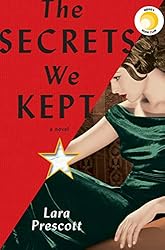
The Secrets We Kept
Lara Prescott, 2019
Knopf Doubleday
368 pp.
ISBN-13: 9780525656159
Summary
A thrilling tale of secretaries turned spies, of love and duty, and of sacrifice—inspired by the true story of the CIA plot to infiltrate the hearts and minds of Soviet Russia, not with propaganda, but with the greatest love story of the twentieth century: Doctor Zhivago.
At the height of the Cold War, two secretaries are pulled out of the typing pool at the CIA and given the assignment of a lifetime.
Their mission: to smuggle Doctor Zhivago out of the USSR, where no one dare publish it, and help Pasternak's magnum opus make its way into print around the world.
Glamorous and sophisticated Sally Forrester is a seasoned spy who has honed her gift for deceit all over the world—using her magnetism and charm to pry secrets out of powerful men. Irina is a complete novice, and under Sally's tutelage quickly learns how to blend in, make drops, and invisibly ferry classified documents.
The Secrets We Kept combines a legendary literary love story—the decades-long affair between Pasternak and his mistress and muse, Olga Ivinskaya, who was sent to the Gulag and inspired Zhivago's heroine, Lara—with a narrative about two women empowered to lead lives of extraordinary intrigue and risk.
From Pasternak's country estate outside Moscow to the brutalities of the Gulag, from Washington, D.C. to Paris and Milan, The Secrets We Kept captures a watershed moment in the history of literature—told with soaring emotional intensity and captivating historical detail. And at the center of this unforgettable debut is the powerful belief that a piece of art can change the world. (From the publisher.)
Author Bio
• Birth—N/A
• Where—Greensburg, PA, USA
• Education—B.A., American University; M.F.A., University of Texas
• Currently—lives in Austin, Texas
Lara Prescott was born near Pittsburgh, Pennsylvania, and earned her B.A. in political science from American University in Washington, D.C. Before turning to writing, she worked as an animal protection advocate and a political campaign operative.
Eventually, Prescott returned to school, receiving her MFA from the Michener Center for Writers at the University of Texas, Austin. Her stories have appeared in The Southern Review, Hudson Review, Crazyhorse, Day One,and Tin House Flash Fridays.
In 2016, Prescott won the 2016 Crazyhorse Fiction Prize for the first chapter of her debut novel, The Secrets We Kept. She lives in Austin, Texas. (From the publisher.)
Book Reviews
A gorgeous and romantic feast of a novel anchored by a cast of indelible secretaries.
New York Times
Enthralling…. This is the rare page-turner with prose that's as wily as its plot.
Vogue
Proto-feminist Mad Men transposed to the world of international espionage—all midcentury style and intrigue set against real, indelible history.
Entertainment Weekly
(Starred review) [T]riumphant…. Through lucid images and vibrant storytelling, Prescott creates an edgy postfeminist vision of the Cold War… for a smart, lively page-turner. This debut shines as spy story, publication thriller, and historical romance with a twist.
Publishers Weekly
(Starred review) [W]th alternating dramatic plots involving spies and espionage, many fascinating characters (both historical and fictional) from East and West, and a gifted writer and storyteller to tie it all together… with astonishing assurance. —Leslie Patterson, Rehoboth, MA
Library Journal
(Starred review) Prescott’s debut far surpasses the typical genre fare.… Cold War buffs or those familiar with Pasternak’s tour-de-force and its adaptations will find this book especially enticing. Those new to the story will still be intrigued, and perhaps want to seek out the original. —Joan Curbow
Booklist
(Starred review) Inspired by the true story of the role of Dr. Zhivago in the Cold War: a novel… [on] grand passions on both sides.… [T]he Western portions of the book… really sing. An intriguing and little-known chapter of literary history is brought to life with brio.
Kirkus Reviews
Discussion Questions
1. Compare the way the men and women in the book go about their work of secret-keeping. How do societal gender roles determine who does what and who is acknowledged for their work in public? In your opinion, do the men or women wield more power?
2. For the main women in the book—Olga, Irina, and Sally—secret-keeping incurs different punishments and rewards. Who do you think suffers and sacrifices the most? Who winds up most "successful"?
3. Throughout the book, we read of Olga’s unsent letters to one of her interrogators in the Gulag, the prison where she’s sent for her association with Boris Pasternak. Were you surprised by her loyalty to him in spite of the immense suffering she endures? How, in her own way, does she use those letters to express the kind of truth about love and oppression that Boris does in his novel?
4. Sally describes herself as having "one of those faces—the wide eyes, the ready smile that suggested I was an open book, someone who had no secrets to keep, and if she did, wouldn’t be able to keep them anyway" (63). How do she and the other women in the book transform themselves in order to keep so many secrets? How are these guises reflected in the structure of the novel itself? Consider the changing first-person points of view and the names of the chapters.
5. Major historical events, including Stalin’s death and the launch of Sputnik, are recalled through the eyes of the characters in highly charged environments. If you lived through these events yourself, how did their depiction in the novel impact your understanding of them? If you didn’t, how did their depiction shed light on what it was like to experience them first-hand?
6. Have you read Doctor Zhivago? If so, what elements of that love story do you see recurring in The Secrets We Kept? And even if you haven’t read it, were you able to glean how the balance of political commentary and romance contributed to the stir it caused in the world at the time of its publication?
7. Did you agree with Boris’s decisions first to share the novel with the Italian publisher, and then decline the Nobel Prize? Why or why not?
8. Although Irina believed she failed her interview for the typist job, she explains that "they [had] seen something in me that I hadn’t seen myself…. For the first time in my life, I felt as if I had a greater purpose, not just a job. That night, something unlocked in me—a hidden power I never knew I had" (116). Do you believe she uses this power for good? Do you think she came away from her position grateful for the power she discovered?
9. The chapters narrated by the typists form a kind of Greek chorus anchoring the book in their shared experience—a collective point of view that’s both inside and outside the deepest truths of the CIA. Of the course of the novel, how do the limits of their knowledge manifest themselves? What might this suggest about the nature of truth itself, and how complete it can really be? What is the hierarchy of secrecy inside and outside the Agency?
10. Sally states that becoming someone else for her work, that taking on a given persona is "the best part . . . [But] to become someone else, you have to want to lose yourself in the first place" (186). How does she embody this desire to erase a former identity, and who else in the book shares this feeling?
11. Describe Teddy’s attraction to Irina and to his job at the Agency. Did you get the impression that he really knew what he wanted out of his life? How are his passions for literature (and Russian literature in particular) satisfied or disappointed by what unfolds during the course of the novel?
12. Discuss how taboo influences the main love affairs in the book. Does any character find true satisfaction or happiness in traditional romantic arrangements (namely, heterosexual marriage), and how do these relationships contribute to the theme of secrecy in the novel?
13. Olga’s children, Ira and Mitya, are both victims of their mother’s choices in love and politics. How does she navigate her identity as a woman and a mother, and the obligations and desires that come with it? Would you have made the same choices she did when it came to staying with Boris? Consider her recognition that "I thought of my children knowing, so young, that love sometimes isn’t enough" (243).
14. Discuss the author’s choices to use first-person, second-person, and third-person narrators for different chapters in the book. What do those choices suggest about the relative importance of the characters, and how close she wants us to get to them?
15. "We go on because that’s what we have to do," Olga tells Boris when he is contemplating suicide (294). How do the events of the novel speak to this kind of endurance? Who takes up the charge to go on, and who isn’t able to?
16. Describe your experience of reading about the dissemination of Doctor Zhivago at the World’s Fair. What emotions and physical feelings came up as this dangerous property was passed from hand to hand? If you were living in the time of the novel, do you think you would have sought it out knowing the implications of reading it?
17. Discuss a book, film, piec of music, or other art that has profoundly shaped your experience of current events at any point in your life in the way Doctor Zhivago does for the characters. How did that piece reflect back to you concerns about how you lived your life at the time? Did it change your behaviors or lifestyle at all?
(Questions from the publisher.)


Sedition
Katharine Grant, 2014
Henry Holt & Co.
320 pp.
ISBN-13: 9780805099928
Summary
An unforgettable historical tale of piano playing, passions, and female power...
♦ The setting: London, 1794.
♦ The problem: Four nouveau rich fathers with five marriageable daughters.
♦ The plan: The young women will learn to play the piano, give a concert for young Englishmen who have titles but no fortunes, and will marry very well indeed.
♦ The complications: The lascivious (and French) piano teacher; the piano maker’s jealous (and musically gifted) daughter; the one of these marriageable daughters with a mating plan of her own.
While it might be a truth universally acknowledged that a man in possession of a title and no money must be in want of a fortune, what does a sexually awakened young woman want? In her wickedly alluring romp through the late-Georgian London, Italian piano making, and tightly-fitted Polonaise gowns, Katharine Grant has written a startling and provocative debut. (From the publisher.)
Author Bio
• Birth—1958
• Raised—Lancashire, England, UK
• Education—N/A
• Currently—lives in Glasgow, Scotland, UK
Katharine Grant is (as K.M. Grant) a children's book author, best known in the UK for her DeGranville Trilogy. Sedition (2014) is her debut novel for adults.
Born Katharine Mary Towneley, she is the third daughter of Sir Simon Towneley and Lady Mary Fitzherbert. She grew-up She was brought up in Lancashire, England, amid the ghosts of her ancestors, one of whom was the last person in the UK to be hung, drawn, and quartered.
She has written regularly for most newspapers in Scotland and is currently the Royal Literary Fund Writing Fellow at the University of Glasgow. She lives in Glasgow with her husband and three children. (Adapted from publisher and Wikipedia. Retrieved 6/9/2014.)
Book Reviews
Grant’s portraits of the encounters between Alathea and her father are disturbing in their matter-of-factness. Although there are no graphic descriptions, Grant’s economical prose somehow makes these scenes even more vivid and brutal. Alathea’s father is a complex character who should be entirely despicable, and yet isn't quite. Grant never paints in strokes of black and white, of good and evil. Alathea, who ought to be considered the victim, seems strangely in control.
Andrea Wulf - New York Times Book Review
The darkness of Sedition is its driving force. A subversive and thrilling gothic tale, it will keep you up all night. It’s the sort of novel you say you’ll read for only 10 more minutes because it’s already way past your bedtime. Two hours later, your light is still on. [Grant’s] girls are wonderfully drawn. Spiteful, cliquey, and a curious tumble of innocence and hormones, they drive the plot in ferocious and unexpected directions.... She manages to be carnal without being graphic, detailed without being anatomical.… Sedition is not just about sex, although it is good on female passion. It is about the power of music and cultural clashes: old blood against new money; new musical genius against conservative sensibilities. Grant captures a dizzying sense that this is a world being remade simultaneously by bankers and Bach…. The plot grows, like the music, to a staggering climax, and Grant happily subverts the cliches of the heaving bosoms and seductive Frenchmen. She writes as Alathea plays the piano—with wit, verve and not a little mischief.
Times (UK)
In its fairly irresistible combination of transgressive sex and a richly layered evocation of history, Sedition demands comparison with Sarah Waters' untouchably brilliant novel.…. Her imagination is marvellously gothic and the Georgian London she conjures up brims with invention and detail.… Grant also has a gift for sly comedy.... Her characterization, too, is superlative…. Quite unforgettable.
Guardian (UK)
Seduction’ would be nearer the mark.... Packed full of colourful characters and with an unexpectedly poignant coda, this is an original, winningly-imagined tale of the ties that bind (and some very naughty pianoforte lessons).
Daily Mail (UK)
Sedition.… is as dark and deceitful as it is gloriously bawdy, the beautiful bastard child of Choderlos de Laclos's Les liaisons dangereuses and Sarah Waters's Fingersmith.
Observer (UK)
This is one of those precious novels. The kind that bookworms burrow inside to devour with relish from cover to cover. The kind you’ll secrete behind all the other books on your shelves in case friends steal it and somehow "forget" to give it back.... Not a dull or superfluous page.... Grant at times writes like Jane Austen on crack cocaine or Dickens sating himself at an orgy—drawing freely on the literary posturing of past greats, but entirely, refreshingly modern, entirely herself…. She makes you gasp and laugh and re-read. . . Her style is a triumph of wit and brio.
Scotsman (UK)
A fast paced, sexy, historical read about the intriguing tutor/student relationship. . . . Grant’s girls are vividly described: funny, witty, melancholy, rowdy, elegant and kick-ass, each learning the skills to be the mistress of their own destiny.
Marie Claire (UK)
(Starred review.) [A] witty, dark, and sophisticated tale set in 1790s London..... Grant eschews period cliches in favor of sharp, unsentimental storytelling that evokes the era with zest and authenticity.... The novel’s epigrammatic voice...is another of its delights, detached in tone but delivering what are often dark ironies with memorable brevity and cleverness.
Publishers Weekly
Drawn in by the compellingly edgy language, the beautiful evocation of emotions through music, ...the reader is ultimately frustrated by the brevity of the novel.... A longer book that allowed greater development of secondary characters would have strengthened the emotional and narrative impact. —Cynthia Johnson, Cary Memorial Lib., Lexington, MA
Library Journal
Sedition could easily have dissolved into semi-kinky melodrama, a chronicle of Belladroit’s conquests. Thanks to author Katharine Grant’s sly writing, it never does… A thumping debut filled with sex, manipulation and a dash of romance. Wickedly dark and provocative, Sedition is a bold reminder that the thirst for power and status remains unquenched over the ages.
BookPage
Late eighteenth-century London is the well-detailed setting for this fun, lascivious gambol through the lives of women and men with decidedly carnal appetites.... Although the dark theme of incest winds through the story, overall the plot and characters are handled with grace and precision. —Julie Trevelyan
Booklist
The grooming of five young Englishwomen for the marriage market goes wildly off the rails in a debut that...takes some surprisingly saucy turns.... Grant's tale, though fresh and spirited, sags in the middle before picking up some speed for the concluding concert.... [A] cleverly seductive romp, which conceals, beneath its witty surface, some very dark comments on fathers and daughters.
Kirkus Reviews
Discussion Questions
Use our LitLovers Book Club Resources; they can help with discussions for any book:
• How to Discuss a Book (helpful discussion tips)
• Generic Discussion Questions—Fiction and Nonfiction
• Read-Think-Talk (a guided reading chart)
(We'll add specific questions if and when they're made available by the publisher.)
top of page (summary)


Seduction
M.J. Rose, 2013
Atria Books
372 pp.
ISBN-13: 9781451621501
Summary
A gothic tale about Victor Hugo’s long-buried secrets and the power of a love that never dies.
In 1843, novelist Victor Hugo’s beloved nineteen-year-old daughter drowned. Ten years later, still grieving, Hugo initiated hundreds of seances from his home on the Isle of Jersey in order to reestablish contact with her. In the process, he claimed to have communed with Plato, Galileo, Shakespeare, Dante, Jesus—and even the devil himself. Hugo’s transcriptions of these conversations have all been published.
Or so it has been believed...
Recovering from a great loss, mythologist Jac L’Etoile thinks that throwing herself into work will distract her from her grief. In the hopes of uncovering a secret about the island’s mysterious Celtic roots, she arrives on Jersey and is greeted by ghostly Neolithic monuments, medieval castles and hidden caves.
But the man who has invited her there, a troubled soul named Theo Gaspard, hopes she’ll help him discover something quite different—transcripts of Hugo’s lost conversations with someone he called the Shadow of the Sepulcher. Central to his heritage, these are the papers his grandfather died trying to find. Neither Jac nor Theo anticipate that the mystery surrounding Victor Hugo will threaten their sanity and put their very lives at stake.
Seduction is a historically evocative and atmospheric tale of suspense with a spellbinding ghost story at its heart, written by one of America’s most gifted and imaginative novelists. Awakening a mystery that spans centuries, this multilayered gothic tale brings a time, a place and a cast of desperate characters brilliantly to life. (From the publisher.)
Author Bio
• Birth—N/A
• Where—New York City, New York, USA
• Education—B.A., Syracuse University
• Currently—lives in Greenwich, Connecticut
M. J. Rose is an American author and book marketing executive. She is a graduate of Syracuse University and spent the 1980's working in advertising, eventually as Creative director of Rosenfeld Sirowitz and Lawson. One of her commercials is featured in the Museum of Modern Art in New York City. She lives in Connecticut with the composer Doug Scofield and their dog, Winka.
Rose launched her publishing career in 1998, when she self-published her first novel, Lip Service. When traditional publishers had rejected it—unsure of how to market a book that did not fit into one distinct genre—Rose promoted the book online, setting up a website where readers could download the book. After selling 2500 copies (in digital and paper formats), the book was chosen by the Literary Guild/Doubleday Book Club and became the first e-book to be subsequently published by a mainstream New York publisher.
Following Lip Service, Rose wrote the thrillers In Fidelity (2001), Flesh Tones (2003), and Sheet Music (2004). Her Butterfield Institute Series introduced protagonist Dr. Morgan Snow, a renowned New York sex therapist, and includes The Halo Effect (2005), The Delilah Complex (2006), and The Venus Fix (2006). In 2006, she also wrote the erotic novel, Lying in Bed.
Rose began a new series focusing on reincarnation and other supernatural phenomena, starting with The Reincarnationist (2007),and continuing with The Memorist (2008), The Hypnotist (2010), and The Book of Lost Fragrances (2012). The Reincarnationist was the inspiration for the Fox TV series "Past Life."
Rose provides book marketing services and consultation to authors through AuthorBuzz.com and runs the popular publishing industry blog, Buzz, Balls & Hype. She co-authored Buzz Your Book with Doug Clegg, which she uses to teach an online book marketing class of the same name. (From Wikipedia.)
Book Reviews
Rose’s vivid imagination and beautiful writing make this a book to savor. (Top Pick 4 ½ stars)
Romance Times
The sensuality, and the pure and utter dreamlike state with which [Rose] writes is effortless and engaging, producing [a] story that’s impossible to leave behind... drawing the reader into the depths of a sensual mystery that they will truly never forget! This deserves a standing ovation!
Suspense Magazine
Rose interweaves mythology, the supernatural, psychoanalysis and Evil Incarnate, creating an amazing amalgam of narrative wonder... will haunt you.
Mystery Lovers Bookshop
The 1843 drowning death of Victor Hugo’s beloved eldest daughter, Didine, provides the catalyst for Rose’s well-crafted paranormal novel of suspense, a sequel to The Book of Lost Fragrances (2012)... Rose is especially good at recreating Hugo’s despair and willingness to do anything to reunite with Didine, making his abandonment of rationality all too plausible.
Publishers Weekly
(Starred review.) Full of well-researched history, the paranormal, and modern intrigue, this atmospheric tale of suspense is fully engrossing to those willing to suspend their disbelief.
Library Journal
Rose’s growing fan base will probably devour this one.
Booklist
Rose (The Book of Lost Fragrances, 2012, etc.) fails to breathe new life into her latest offering, which includes themes and characters introduced in previous stories and rehashes discussions about reincarnation, Jungian psychology and olfactory sensations.... As the author switches back and forth between the very distant past...and the present, she finally connects all the troubled characters...and brings the book to a close--but not before Jac, her hosts and therapists have protracted discussions about reincarnation and the collective unconscious.
Kirkus Reviews
Discussion Questions
Use our LitLovers Book Club Resources; they can help with discussions for any book:
• How to Discuss a Book (helpful discussion tips)
• Generic Discussion Questions—Fiction and Nonfiction
• Read-Think-Talk (a guided reading chart)
We'll add specific questions if and when they're made available by the publisher.
The Seduction of Water
Carol Goodman, 2003
Random House
400 pp.
ISBN-13: 9780345450913
Summary
Iris Greenfeder, ABD (All But Dissertation), has just turned forty, lives in Manhattan, and works three teaching jobs to support herself. Recently she's felt that the "buts" are taking over her life: all but published, all but a professor, all but married (to Jack, her boyfriend of ten years). Yet the sudden impulse to write a story about her mother leads to a shot at literary success.
The piece recounts an eerie Irish fairy tale her mother used to tell her at bedtime—and nestled inside it is the sad story of her mother's death..." "More than fifty years ago, Iris's mother, Katherine Morrissey, arrived at the Catskills's grand Hotel Equinox penniless, with almost no belongings. Kay was hired as a maid but refused to speak of her past or her family. One year later, she married Ben Greenfeder, the hotel's manager. During the hotel's off-season, Kay wrote the first two fantasy novels of a planned trilogy.
There never was a third book. When Iris was nine, her mother left one day for a writer's conference—and never came back. Kay died that very night in a hotel fire on Coney Island, registered as another man's wife." "Now Hedda Wolfe, Kay's former literary agent, has a proposal: If Iris will return to the Hotel Equinox where she grew up, research her mother's life, and find the third and final manuscript that Hedda is convinced exists, then she can guarantee Iris a huge advance to write her mother's biography."
Transfixed by the notion of a third book, Iris believes that it will hold clues to the mysteries of Kay's life—and death. But as she begins to peer into the thicket of her mother's hidden world, stinging revelations leave Iris with new questions. When a deadly "accident" befalls the one man who could shed some light on Kay, it becomes clear that Iris is not alone in her deep interest in her mother's past—or in her search for a lost manuscript that might hold more secrets than she ever expected. (From the publisher.)
Author Bio
• Birth—1960
• Education—B.A. Vassar College
• Currently—lives on Long Island, NY USA
Carol Goodman is the author of The Lake of Dead Languages. Her work has appeared in such journals as The Greensboro Review, Literal Latté, The Midwest Quarterly, and Other Voices. After graduation from Vassar College, where she majored in Latin, she taught Latin for several years in Austin, Texas. She then received an M.F.A. in fiction from the New School University. Goodman currently teaches writing and works as a writer-in-residence for Teachers & Writers. She lives on Long Island. (From BookReporter.com)
Book Reviews
An aspiring writer delves into the long-buried mystery of her novelist mother's death in this silky-smooth novel by the author of The Lake of Dead Languages. Water, from Iris Greenfeder's perspective, is the Hudson River. She has a view of it from her five-story walkup in New York City's westernmost Greenwich Village, and it shimmers in the distance from the Equinox, the Catskills hotel where Iris grew up. Her father, Ben, was the manager at the Equinox; her mother, Kay, a former maid, wrote two fantastical novels there. Driving the plot is the not-so-simple question: did Kay write a third novel, and is it hidden at the Equinox? Back at the hotel for the summer, Iris plans to write the story of her mother's life and search for the missing manuscript. As she attempts to solve the mystery, she is abetted and thwarted by a large cast of characters, including her mother's famous literary agent, the mega-millionaire owner of a hotel chain, the daughter of a famous suicidal poet, an all-knowing gardener and the delicious Aidan Barry, whom Iris meets while he's still in prison. The novel's first-person, present-tense narrative fosters intimacy, though it somewhat undercuts suspense. More effective is the use Goodman makes of the Irish myth of the selkie-half-seal, half-woman-as told by Iris's mother. Mystery, folklore, a thoroughly modern romance, a strong sense of place and a winning combination of erudition and accessibility make this second novel a treat.
Publisher's Weekly
The Seduction of Water is the story of Iris Greenfeder, a teacher who would rather be a writer, and the secrets her mother kept and her search for the truth about her mother's death. Iris grew up at the Hotel Equinox in the Catskills, where her father, Ben, was manager for 50 years, and her mother, Katherine, was the chambermaid. While at the hotel, Katherine wrote two fantasy novels of a planned trilogy, and it was rumored that there was a manuscript for the third. When Iris was ten, her mother went to attend a conference in a hotel in Manhattan and never returned; she was found dead the following day. As Iris attempts to solve these mysteries, she is assisted and disillusioned by many multidimensional characters who weave in and out of the story. The novel's first-person, present-tense vehicle builds intimacy that grabs the listener immediately. The program is packed with tension, lively in atmosphere, and rich in plot. Read by Christine Marshall, it is a good romantic suspense-not highly literary but captivating and pleasing. Recommended for public libraries. —Glen Cove Lib., NY
Carol Stern - Library Journal
There's enough plot for two or three Robert Ludlum potboilers in this agreeably overstuffed second from Goodman (The Lake of Dead Languages, 2002). Add to that a heroine who's both a savvy writer and teacher and the gothic-thriller type who keeps walking into situations guaranteed to compromise or endanger her. Actually, it's understandable that Iris Greenfeder heads for the moribund Hotel Equinox in the Catskills—where her late mother (pseudonymous fantasy author K.R. La Fleur) had worked—since the familiar Irish folktale, about a "seal woman" tricked into ill-fated marriage with a mortal, that Iris's mother had loved and written about seems to hold clues to why the reclusive author died in a fire at another hotel, accompanied by the man for whom she had left her husband. Sound complicated? That's only the beginning of the intrigue, which also involves Iris's adult ex-convict student (and eventual lover) Aidan Barry; powerful hotelier Harry Kron, whose reasons for resurrecting the Equinox may be even more sinister then they seem; a jewel theft many years ago, which echoes the fate of the "net of tears" woven by the aforementioned seal woman; and an elderly gardener, a secretive literary agent, a vengeful female editor, among other primary and secondary suspects. It's fun in the early going, as Goodman makes suggestive connections between the matter of classic fairy tales and her mother's story. Then the tale flattens out midway, as hitherto-concealed motives and interrelationships need clarifying. Goodman wins us back, though, with a Chinese-box climax and denouement in which Iris risks her life, learns how her mother's novels had fictionalized her own family history and unshared secrets—and also how she herself isn't the woman she thinks she is. Much too long, and tending to cliché, but a pretty good romantic suspenser nonetheless.
Kirkus Reviews
Discussion Questions
1. Discuss your favorite fairy tale from your childhood. How did you learn the story and what did you learn from it? What does it mean to you now?
2. The fairy tale assignment galvanized Iris's students and helped them to find their own voices. Why do you think this assignment successful on so many levels?
3. Did you ever have a school assignment that affected you in such a manner? Discuss why it reached you and what it taught you.
4. Both Iris and Phoebe are haunted by the early loss of their mothers. Discuss how these characters have been shaped by and have adapted to their losses and more generally how the death of a parent or a parental figure affects us all.
5. A schism exists in Iris's life: before and after her mother's death. Do you have such a defining event in your life? Discuss the various life-changing events—births, deaths, and other rites of passage—that can result in such a before-and-after outlook.
6. Her mother's death is the defining event of Iris's life when this novel begins. Do you think it will remain the defining event by the close of the novel?
7. Iris confesses that she is "still not comfortable being the giver of grades, the passer of judgment." Can you identify with her struggle? Or do you judge her to be immature?
8. When Iris begins to investigate her mother's past, she comes to understand that her mother felt like an imposter in her new life at the Hotel Equinox. Why is this so? Discuss the many reasons why people might feel like an imposter in their own lives.
9. Iris wonders whether Danny the baker she meets in Brooklyn or his brother Vincent the painter "is really the artist in the family." What do you think? How do you define an artist?
10. The financial and personal toll exacted in securing the time and space to create art is central to this novel. Discuss the hurdles that artists face. Do you think female artists still confront more obstacles than their male counterparts?
11. Have you ever suffered from writer's block or a comparable affliction in your own life? Did you resolve it? If so, how? If not, why not?
12. Thinking about her relationship with Jack, Iris speculated, "Lover and beloved. Didn't there always have to be one of each?" Do you agree?
13. Aidan believes that "there's more sorrow in not following your heart." What do you think?
14. The seven-year age difference between Aidan and Iris troubles Iris greatly. Do you think the pairing of older women and younger men—as opposed to the reverse—still carries a social stigma? Is this changing?
15. Aidan is not a career criminal, but worries that will be his fate once he is released from jail. Discuss the plight of the ex-convict in our society.
16. Iris's mother spent much of her life observing and recording the carelessness of the wealthy and how the rich could ignore and mistreat those who served their needs. Discuss the class tensions in this novel, from the plight of Iris's mother to Harry Kron's attitude toward his staff to Aidan's fears that he is not "good enough" for Iris.
17. Iris's unfinished dissertation is an analysis of her mother's very personal fiction, an analysis hobbled by the daughter's ignorance of the mother's past. Discuss the complex blend of mythical, religious, and personal influences in K.R. LaFleur's fantasy novels.
18. Do you think learning the full truth about her mother will set Iris free to live her own life on her own terms?
19. "She wouldn't want me to spend my life telling her story, she would want me to tell my own," Iris concludes at the close of the novel. Do you think Iris will write again? If so, what do you think she will write?
20. What do you think would have happened to Kay and her family if she had told her husband the whole truth about her past? Could the tragedies that followed have been averted?
21. Which characters are your favorites and why? Did you wish to hear more (or less) from certain characters in this novel?
22. Discuss the structure of this novel. Did you find the story-within-the-story format compelling?
23. Do you agree that The Seduction of Water defies categorization in a single genre? How would you describe this novel to prospective readers?
24. Is your group interested in reading this author's first novel The Lake of Dead Languages?
(Questions issued by publisher.)
top of page


See How Small
Scott Blackwood, 2015
Little, Brown and Company
224 pp.
ISBN-13: 9780316373807
Summary
A riveting novel about the aftermath of a brutal murder of three teenage girls.
One late autumn evening in a Texas town, two strangers walk into an ice cream shop shortly before closing time. They bind up the three teenage girls who are working the counter, set fire to the shop, and disappear.
See How Small tells the stories of the survivors—family, witnesses, and suspects—who must endure in the wake of atrocity. Justice remains elusive in their world, human connection tenuous.
Hovering above the aftermath of their deaths are the three girls. They watch over the town and make occasional visitations, trying to connect with and prod to life those they left behind. "See how small a thing it is that keeps us apart," they say.
A master of compression and lyrical precision, Scott Blackwood has surpassed himself with this haunting, beautiful, and enormously powerful new novel. (From the publisher.)
Author Bio
• Birth—ca. 1965
• Where—El Dorado, Arkansas, USA
• Raised—Tennessee, Oklahoma, Texas
• Education—University of Texas; Texas State University
• Awards—Whiting Writers’ Award
• Currently—lives in Chicago, Illinois
Scott Blackwood is the author of the 2015 novel See How Small and the 2009 novel We Agreed to Meet Just Here, which won a 2011 Whiting Writers’ Award, the AWP Prize for the Novel, The Texas Institute of Letters Award for best work of fiction, and was a finalist for the Pen Center USA Award in fiction.
His fiction has appeared in American Short Fiction, Gettysburg Review, Boston Review, Southwest Review, Chicago Tribune Printer’s Row Journal, and New York Times. It has been anthologized in Janet Burroway’s Imaginative Writing.
His two narrative nonfiction books, The Rise and Fall of Paramont Records, Volumes I & II—produced by Jack White—tell the curious tale of a white-owned "Race record" label that began in a Wisconsin chair factory and changed American popular music forever. Scott has been individually nominated for a 2015 Grammy Award for Volume I and featured on NPR’s Weekend Edition, Sound Opinions, and in the New York Times, Los Angeles Times, Rolling Stone and elsewhere. A former Dobie Paisano Fellow and long-time resident of Austin, Texas, Scott now lives in Chicago and teaches fiction writing in the MFA Creative Writing Program at Southern Illinois University. (Adapted from the author's website.)
Book Reviews
Blackwood's portraits of all these characters are surprising and compassionate. Not a single sentence in See How Small is maudlin or overwrought.... It's not an easy book to read....descriptions of the emotional torture their families go through, however, are beyond heartbreaking.... It's a kind of paradox that Blackwood explores with compassionate eyes, beautifully poetic writing and artistic fearlessness. See How Small is a brutal, necessary and near perfect novel.
Michael Schaub - NPR
Mr. Blackwood has a way of writing where you feel like you’re constantly trying to catch up, be privy to what’s really making this story tick. While this style can be an asset, especially when leading a reader through a maze of intrigue, it can also be frustrating.... But the novel is not without its thoughtful statements brimming with stories wanting to be told.... See How Small is not for the faint of heart and has very little happiness or hope.... [It] raises questions about whether the real victims of a tragedy aren’t those that die but those forced to live.
Megan McLachlan - Pittsburgh Post Gazette
(Starred review.) [A] genre-defying novel of powerful emotion, intrigue, and truth. From the opening pages, which artfully skirt from past to present.... [B]ased on a similar, still-unsolved 1991 case in Austin, Tex., Blackwood explores the effects of senseless crime on an innocent, tightly knit community, using deft prose to mine the essence of human grief and compassion.
Publishers Weekly
The novel has much to say about the mysteries of the human psyche, the far-reaching effects of violence, and the disparate ways grief works on people.
Booklist
Similar on the surface to Alice Sebold's The Lovely Bones, this lyrical, abstract, and less sentimental novel by Blackwood about murdered teenage girls observing the living will probably not appeal to as wide an audience but may haunt literary fiction readers long after the unsettling ending. —Laurie Cavanaugh, Holmes P.L., Halifax, MA
Library Journal
The novel is strikingly creepy, if a bit affected—the brevity of the chapters and gauzy prose have a lyrical effect but also make the story feel diffuse, with no one peculiar, uncanny moment given the chance to build up a head of steam. Blackwood is an excellent stylist, though in the name of unconventionality, the reader lacks a few narrative toeholds.
Kirkus Reviews
Discussion Questions
Use our LitLovers Book Club Resources; they can help with discussions for any book:
• How to Discuss a Book (helpful discussion tips)
• Generic Discussion Questions—Fiction and Nonfiction
• Read-Think-Talk (a guided reading chart)
(We'll add specific questions if and when they're made available by the publisher.)


See Me
Nicholas Sparks, 2015
Grand Central Publishing
496 pp.
ISBN-13: 9781455520619
Summary
See me just as I see you . . .
Colin Hancock is giving his second chance his best shot. With a history of violence and bad decisions behind him and the threat of prison dogging his every step, he's determined to walk a straight line.
To Colin, that means applying himself single-mindedly toward his teaching degree and avoiding everything that proved destructive in his earlier life. Reminding himself daily of his hard-earned lessons, the last thing he is looking for is a serious relationship.
Maria Sanchez, the hardworking daughter of Mexican immigrants, is the picture of conventional success. With a degree from Duke Law School and a job at a prestigious firm in Wilmington, she is a dark-haired beauty with a seemingly flawless professional track record.
And yet Maria has a traumatic history of her own, one that compelled her to return to her hometown and left her questioning so much of what she once believed.
A chance encounter on a rain-swept road will alter the course of both Colin and Maria's lives, challenging deeply held assumptions about each other and ultimately, themselves. As love unexpectedly takes hold between them, they dare to envision what a future together could possibly look like...until menacing reminders of events in Maria's past begin to surface.
As a series of threatening incidents wreaks chaos in Maria's life, Maria and Colin will be tested in increasingly terrifying ways. Will demons from their past destroy the tenuous relationship they've begun to build, or will their love protect them, even in the darkest hour?
Rich in emotion and fueled with suspense, See Me reminds us that love is sometimes forged in the crises that threaten to shatter us...and that those who see us for who we truly are may not always be the ones easiest to recognize. (From the publisher.)
Author Bio
• Birth—December 31. 1965
• Where—Omaha, Nebraska, USA
• Education—B.A., University of Notre Dame
• Currently—lives in New Bern, North Carolina
Nicholas Charles Sparks is an American novelist, screenwriter and producer. He has published some 20 novels, plus one non-fiction. Ten have been adapted to films, including Message in a Bottle, A Walk to Remember, The Notebook, Nights in Rodanthe, Dear John, The Last Song, The Lucky One, and most recently The Longest Ride.
Background
Sparks was born to Patrick Michael Sparks, a professor of business, and Jill Emma Marie Sparks (nee Thoene), a homemaker and an optometrist's assistant. He was the middle of three children, with an older brother and a younger sister, "Dana", who died at the age of 33 from a brain tumor. Sparks said that she is the inspiration for the main character in his novel A Walk to Remember.
His father was pursuing graduate studies at University of Minnesota and University of Southern California, and the family moved a great deal, so by the time Sparks was eight, he had lived in Watertown, Minnesota, Inglewood, California, Playa del Rey, California, and Grand Island, Nebraska, which was his mother's hometown during his parents' one year separation.
In 1974 his father became a professor of business at California State University, Sacramento teaching behavioral theory and management. His family settled in Fair Oaks, California, and remained there through Nicholas's high school days. He graduated in 1984 as valedictorian from Bella Vista High School, then enrolled at the University of Notre Dame under a full track and field scholarship. In his freshman year, his team set a record for the 4 x 800 relay.
Sparks majored in business finance and graduated from Notre Dame with honors in 1988. He also met his future wife that year, Cathy Cote from New Hampshire, while they were both on spring break. They married in 1989 and moved to New Bern, North Carolina.
Writing career
While still in school in 1985, Sparks penned his first (never published) novel, The Passing, while home for the summer between freshman and sophomore years at Notre Dame. He wrote another novel in 1989, also unpublished, The Royal Murders.
After college, Sparks sought work with publishers or to attend law school, but was rejected in both attempts. He then spent the next three years trying other careers, including real estate appraisal, waiting tables, selling dental products by phone and starting his own manufacturing business.
In 1990, Sparks co-wrote with Billy Mills Wokini: A Lakota Journey to Happiness and Self-Understanding. The book was published by Random House sold 50,000 copies in its first year.
In 1992, Sparks began selling pharmaceuticals and in 1993 was transferred to Washington, DC. It was there that he wrote another novel in his spare time, The Notebook. Two years later, he was discovered by literary agent Theresa Park, who picked The Notebook out of her agency's slush pile, liked it, and offered to represent him. In October 1995, Park secured a $1 million advance for The Notebook from Time Warner Book Group. The novel was published in 1996 and made the New York Times best-seller list in its first week of release.
With the success of his first novel, he and Cathy moved to New Bern, NC. After his first publishing success, he began writing his string of international bestsellers.
Personal life and philanthropy
Sparks continues to reside in North Carolina with his wife Cathy, their three sons, and twin daughters. A Roman Catholic since birth, he and his wife are raising their children in the Catholic faith.
In 2008, Entertainment Weekly reported that Sparks and his wife had donated "close to $10 million" to start a private Christian college-prep school, The Epiphany School of Global Studies, which emphasizes travel and lifelong learning.
Sparks also donated $900,000 for a new all-weather tartan track to New Bern High School. He also donates his time to help coach the New Bern High School track team and a local club track team as a volunteer head coach.
In addition to track, he funds scholarships, internships and annual fellowship to the Creative Writing Program (MFA) at the University of Notre Dame. (Adapted from Wikipedia.)
Book Reviews
[A] made-for-Hollywood storyline; the brooding hero in the pouring rain. Look no further than Nicholas Sparks. Stylist Sparks is more than just a bestselling author of romantic fiction though, he's a pop culture phenomenon.
Irish Independent
An absorbing page-turner packed with the beachside lifestyle detail that is [a] Sparks hallmark.
Daily Mail
Discussion Questions
Use our LitLovers Book Club Resources; they can help with discussions for any book:
• How to Discuss a Book (helpful discussion tips)
• Generic Discussion Questions—Fiction and Nonfiction
• Read-Think-Talk (a guided reading chart)
(We'll add specific questions if and when they're made available by the publisher.)


See Now Then
Jamaica Kincaid, 2013
Farrar, Straus and Girox
192 pp.
ISBN-13: 9780374180560
Summary
In See Now Then, the brilliant and evocative new novel from Jamaica Kincaid—her first in ten years—a marriage is revealed in all its joys and agonies.
This piercing examination of the manifold ways in which the passing of time operates on the human consciousness unfolds gracefully, and Kincaid inhabits each of her characters—a mother, a father, and their two children, living in a small village in New England—as they move, in their own minds, between the present, the past, and the future: for, as she writes, “the present will be now then and the past is now then and the future will be a now then.” Her characters, constrained by the world, despair in their domestic situations. But their minds wander, trying to make linear sense of what is, in fact, nonlinear. See Now Then is Kincaid’s attempt to make clear what is unclear, and to make unclear what we assumed was clear: that is, the beginning, the middle, and the end.
Since the publication of her first short-story collection, At the Bottom of the River, which was nominated for a PEN/Faulkner Award for Fiction, Kincaid has demonstrated a unique talent for seeing beyond and through the surface of things. In See Now Then, she envelops the reader in a world that is both familiar and startling—creating her most emotionally and thematically daring work yet. (From the publisher.)
Author Bio
• Aka—Elaine Potter Richardson
• Birth—May 25, 1949
• Where—St. John's, Antigua
• Education—N/A
• Awards—Center for Fiction's Clifton Fadiman Medal;
Lannan Literary Award for Fiction, Prix Femina Etranger;
Anisfield-Wolf Book Award; Lila Wallace-Reader’s Digest
Award
• Currently—lives in North Bennington, Vermont, and
Claremont California.
Jamaica Kincaid, Caribbean novelist, gardener, and gardening writer, is the author of six novels, including her most recent, So Then Now (2013)
She was born in the city of St. John's on the island of Antigua, which she left at age seventeen for the U.S. After working as an au pair in Manhattan, she fell in with a group of writers for The New Yorker where she began writing the magazine's "Talk of the Town" column. Then-editor William Shawn started publishing her fiction in the late 1970s, and in 1979 she married his son Allen (a composer and the brother of actor Wallace).
Kincaid's short fiction has appeared in The Paris Review and The New Yorker, where her novel Lucy was originally serialized. Her first book, At the Bottom of the River (1983), was nominated for the PEN/Faulkner Award for Fiction.
Her novels are loosely autobiographical, though Kincaid has warned against interpreting their autobiographical elements too literally: "Everything I say is true, and everything I say is not true. You couldn't admit any of it to a court of law. It would not be good evidence. Her work often prioritizes "impressions and feelings over plot development" and often features conflict with both a strong maternal figure and colonial and neocolonial influences.
Kincaid's marriage to Allen Shawn ended in 2002. They have two grown children, Harold (music producer/songwriter), and a daughter, Annie (singer/songwriter Annie Rosamond). Kincaid lives in North Bennington, Vermont, during the summers and teaches at Claremont McKenna College in Claremont, California, during the academic year.(Adapted from Wikipedia.)
Book Reviews
Ms. Kincaid writes with passion and conviction, and she also writes with a musical sense of language, a poet’s understanding of how politics and history, private and public events, overlap and blur.
Michiko Kakutani - New York Times
Writers make uncomfortable kin.... There’s a reflex in every writer that trumps even the maternal instinct, a part of her that, even while her newborn suckles at her breast, is cold-eyed, choosing words to describe the pit-bull clamp of its gums, the crusted globe of its skull, with the same dispassion which she might describe fellow passengers on a bus.... The intimate treachery, the permanent duality that this entails...are lucidly examined in Jamaica Kincaid’s latest novel.... Kincaid has the gift of endowing common experience with a mythic ferocity.... [She] is one of our most scouringly vivid writers.
Fernanda Eberstadt - New York Times Book Review
Most readers feel protective of that little unit, the family. When it breaks, as it so often does and most certainly will in this story, we experience the tragedy.... Was it ever any different? Did Mr. Sweet, who so utterly resembles the absent-minded Mr. Ramsay from Virginia Woolf's To the Lighthouse, ever truly love Mrs. Sweet, a modern-day Mrs. Ramsay—the mother who struggles every day to save her family from destruction, or just unhappiness?
Susan Salter Reynolds - New York Newsday
Man marries. Woman grows old and fat. Man throws her over for a prettier version. It's a familiar story. Yet, in Jamaica Kincaid's voice, the scorned woman's fury becomes a spellbinding tale, as lyrical as Paradise Lost, as resonant as a Greek epic. This is hell like none other. You descend it circle by circle, and, word by word, you yield to the storyteller's art.... Kincaid is not easy reading. Not much that is worthwhile in literature is. But she is fierce and true. Certainly, that is so of See Now Then. After 10 years of inexplicable fictional silence, she comes forth with a mighty roar.
Marie Arana - Washington Post
Kincaid conscientiously and expertly manipulates language the way a photographer adjusts a camera’s lens, bringing her characters into clear focus and accentuating their profiles against their natural backdrop.
Liza Weisstuch - Boston Sunday Globe
Bold and beautiful.... Joycean? Yes, and also much like the role of Winnie in the Samuel Beckett play Happy Days—both Winnie and Kincaid addressing us in a rush that we recognize as an actual process of thought.... See Now Then is—by turns—lovely, even lilting, difficult, and condemning of Mr. Sweet. The good news is that everything works—Kincaid’s style, story and startling way of telling a tale of the cosmos in terms of domesticity . . . There is courage and brilliance here, and an unusual way of going about it. We hurt for Mrs. Sweet, we pull for her, we identify with her passion for her children while we somewhat understand Mr. Sweet – and fairly jump for joy when Mrs. Sweet notes that, "Death has no Then and Now."
Karen Brady - Buffalo News
Chaucer’s Wife of Bath meets Virginia Woolf!.... With the intensity of Virginia Woolf, Kincaid creates a palimpsest of time past, time present and time future . . . Mrs. Sweet in these pages makes a verbal symphony.... Kincaid’s attempt to capture living itself may just be, as she puts it, "always just out of reach," but her talent for trying remains palpable on every page.... Connoisseurs will find it delicious.
Alan Cheuse - Chicago Tribune (Book of the Month)
Damned, haunted and psychological.... Kincaid’s heady fiction doesn’t unfold dramatically, but her prose does, vining and clinging to readers’ ears, blooming into a tritone musical theory—see-now-then.... Churning through the tenses, Mrs. Sweet’s stream of consciousness is the narrative form: an aesthetic rendering of how time, memory and imagination create the fabric of being... In her earlier novels, misaligned family relations produce the potential for human failure. Kincaid’s female protagonist-narrators triumph against those circumstances through literary intelligence. Mrs. Sweet’s grappling with time is beautiful and brutal: It acknowledges that our failures sometimes deny surmounting and, instead, resonate across memory into persistent, heart-rending permanence.
Walton Muyumba - Dallas Morning News
Kincaid continues to write with a unique, compelling voice that cannot be found anywhere else. Her small books are worth a pile of thicker—and hollower—ones
Jeffrey Rodgers - San Francisco Chronicle
See Now Then is a hurricane of a book, a novel of psychic bewilderment and seething inaction that relentlessly defines and redefines the sense of otherness and displacement that is the permanent legacy of slavery and colonialism. An existential crisis if there ever was one, Jamaica Kincaid mines it with seriousness, tenderness and frequently savage humor in this novel, showing that it touches not just blacks, but all people, however loathe they may be to admit it. But See Now Then gives us no choice. From the first pages, its intimate, matter of fact, stream of consciousness style blurs the lines between us and them, now and then, poetry and prose, reality and imagination.... With Kincaid, it’s never a matter of what wins, only of what is.
Ms. Magazine
In her first novel in a decade, Kincaid (Autobiography of My Mother) brings her singular lyricism and beautifully recursive tendencies to the inner life of Mrs. Sweet, who is facing the end of her marriage, and who, over the course of the book, considers the distinctions between her nows and her thens, particularly when recounting what was while the memories bleed with a pain that still is. Particularly touching is Kincaid’s rendering of motherhood. What’s startling is the presumably autobiographical nature of the plot..... While evidence of fictionalization is obvious (naming the children after Greek myths), the book feels precariously balanced between meticulous language and raw emotion. The distinction between life and art is not always clear, but only a writer as deft as Kincaid can blur the lines so elegantly.
Publishers Weekly
Fans of Lannan Literary Award winner Kincaid have waited more than ten years for this novel, originally scheduled for September 2012, ostensibly about a small-town New England family but really about the characters' minds.
Library Journal
The plot centers on Mr. and Mrs. Sweet, a couple whose marriage is shot through with passivity and resentment, though the source of the tension is never quite explicit.... Their two children are named Persephone and Heracles, and the story sometimes shifts into a broad allegorical mode that, like those names, echoes Greek mythology. (In one scene, Heracles pulls off his father's testicles and throws them all the way to the Atlantic.) In some ways, this book is a tribute to modernism, in its surrealism, in its [Gertrude] Stein-ian prose and in the way Kincaid cannily merges past and present events to evoke mood... It's not a total success.... Yet Kincaid's audaciousness is winning. She's taken some much-needed whacks at the conventional domestic novel.
Kirkus Reviews
Discussion Questions
Use our LitLovers Book Club Resources; they can help with discussions for any book:
• How to Discuss a Book (helpful discussion tips)
• Generic Discussion Questions—Fiction and Nonfiction
• Read-Think-Talk (a guided reading chart)
Also consider these LitLovers talking points to help get a discussion started for

See What I Have Done
Sarah Schmidt, 2017
Grove Atlantic
324 pp.
ISBN-13: 9780802126597
Summary
Lizzie Borden took an ax
And gave her mother forty whacks.
When she saw what she had done,
She gave her father forty-one.
Or did she?
In this riveting debut novel, See What I Have Done, Sarah Schmidt recasts one of the most fascinating murder cases of all time into an intimate story of a volatile household and a family devoid of love.
On the morning of August 4, 1892, Lizzie Borden calls out to her maid: Someone’s killed Father. The brutal ax-murder of Andrew and Abby Borden in their home in Fall River, Massachusetts, leaves little evidence and many unanswered questions.
While neighbors struggle to understand why anyone would want to harm the respected Bordens, those close to the family have a different tale to tell — of a father with an explosive temper; a spiteful stepmother; and two spinster sisters, with a bond even stronger than blood, desperate for their independence.
As the police search for clues, Emma comforts an increasingly distraught Lizzie whose memories of that morning flash in scattered fragments. Had she been in the barn or the pear arbor to escape the stifling heat of the house? When did she last speak to her stepmother? Were they really gone and would everything be better now?
Shifting among the perspectives of the unreliable Lizzie, her older sister Emma, the housemaid Bridget, and the enigmatic stranger Benjamin, the events of that fateful day are slowly revealed through a high-wire feat of storytelling. (From the publisher.)
Author Bio
After completing a bachelor of arts (professional writing/editing), a master of arts (creative writing), and a graduate diploma of information management, Sarah Schmidt currently works as a reading and literacy coordinator (read: a fancy librarian) at a regional public library. She lives in Melbourne, Australia, with her partner and daughter. (From the publisher .)
Book Reviews
Sarah Schmidt has created a lurid and original work of horror. It's a pity that some of its force has been dissipated by its disorganized and overlong second half. As a result, the novel lacks the ever-tightening narrative torque that might more effectively have delivered the lovely shocker on the last page.
Patrick McGrath - New York Times Book Review
A gripping and still puzzling story… [and] credible imagining of a bizarre episode.
Wall Street Journal
We get only glimpses into the particular hell of the Borden household; the fact that we can fill in the blanks from our own darkest places draws us closer, more uncomfortably, in. Schmidt’s unusual combination of narrative suppression and splurge makes for a surprising, nastily effective debut. Neighbours, doctor, police: visitors to the Borden house in the aftermath of the murders react with incredulity. “I don’t think I believe it myself,” says Lizzie.
Justine Jordan - Guardian (UK)
A bloody good read.… A taut, lyrical account of the destruction of the Borden family, both through ax murder and subtler means.… Schmidt inhabits each of her narrators with great skill, channeling their anxieties, their viciousness, with what comes across as (frighteningly) intuitive ease. Everything about Schmidt’s novel is hauntingly, beautifully off. It’s a creepy and penetrating work, even for a book about Lizzie Borden.
USA Today
Debut novelist Sarah Schmidt tackles the murk and silence in this old tale, imagining the cruel secrets of a respected family.
Elle
[The] novel is compelling, scary—and gruesomely visceral.
Entertainment Weekly
This palpable imagining of what led to the murder of Lizzie Borden’s parents will stay with you for as long as this historical mystery has enthralled pop culture.
Redbook
(Starred review.) [U]nforgettable…compelling.… [T]he book honors known facts yet fearlessly claims its own striking vision. Even before the murders, the Bordens' cruel, claustrophobic lives are not easy to visit, but from them Schmidt has crafted a profoundly vivid and convincing fictional world.
Publishers Weekly
(Starred review.) The heated narrative contributes to the sense of simmering craziness permeating the Borden household. A historical time line of actual events is appended. What better subject for a psychological thriller than one of the most notorious murders in U.S. history. —Reba Leiding, emeritus, James Madison Univ. Lib., Harrisonburg, VA
Library Journal
(Starred review.) Heralds the arrival of a major new talent.… Nail-biting horror mixes with a quiet, unforgettable power to create a novel readers will stay up all night finishing.
Booklist
This fictional retelling of the Lizzie Borden murders is a domestic nightmare … [with] staggeringly gorgeous, feverish prose and the thrill of deep, dark, gruesome detail. (Six of the Brightest New Names in Fiction).
BookPage
(Starred review.) Schmidt creates…a palpable sense of unease.… There are books about murder and there are books about imploding families; this is the rare novel that seamlessly weaves the two together, asking as many questions as it answers.
Kirkus Reviews
Discussion Questions
We'll add publisher questions if and when they're available; in the meantime, please use our LitLovers talking points to help start a discussion for See What I Have Done … then take off on your own:
1. How would you describe Lizzie?
2. What was the family dynamic (or dynamite?) of the Borden household? Talk especially about Andrew Borden and his treatment of his daughters. Consider the sisters' strained relationship with their stepmother. How would you describe the relationship between Lizzie and Emma? What about Lizzie's remark that "None of this would have had happened if she [Emma] hadn't left me in the house." What do you think she meant?
3. What were Lizzie's particular resentments regarding her father? Is there one that might have set her off?
4. Talk about Bridget's position in the house.
5. Schmidt blurs the voices and perceptions of characters. Did you find this confusing? Did it detract from your reading experience? Or is the blurring part and parcel of the emotional intensity that propels the novel?
6. Sarah Schmidt writes with an almost sickening physicality — of odors, vomiting, dirty under garments, or bladders full to bursting. Why might she have chosen to employ such vivid descriptions? What effect does it have on the novel's atmosphere and/or tone?
7. Good mysteries depend on suspended revelation, information withheld from readers. What information does Sarah Schmidt withhold? Consider hints at Lizzie's instability. What other hints, for instance, are leveled at Benjamin or Uncle John?
8. Speaking of Uncle John: what is his role in all of this?
9. Schmidt's novel is both a "whodunit" and a "whydunit." What makes Lizzie the prime suspect: Since she was never convicted, however, what are your thoughts on who most likely murdered the Bordens … and why?
(Questions by LitLovers. Please feel free to use them, online or off, with attribution. Thanks.)


The Siege of Krishnapur
J.G. Farrell, 1973
New York Review of Books (Classic)
352 pp.
ISBN-13: 9781590170922
Summary
J. G. Farrell’s The Siege of Krishnapur is both a gripping tale of the siege of a remote British outpost during the Indian Mutiny of 1857 and a fascinating, and blisteringly comic novel of ideas. Farrell’s picture of the British Empire in crisis raises questions with a bearing on contemporary conflicts between East and West.
In 1857, Indian soldiers in the British army—known as sepoys—rebelled against their colonial overlords, and serious conflict broke out in the northern half of the subcontinent. In Farrell’s novel, the British inhabitants of the fictional town of Krishnapur ignore rumors of unrest only to find themselves under siege by the rebels.
Trapped in a dwindling number of buildings, subject to repeated attack, and suffering both from sickness and the oppressive heat of summer, the British community soon finds itself under threat from within, too, as the simple certainties of superiority and invulnerability that have sustained them and the British Empire begin to crumble.
Farrell’s characters, from the local priest and doctor to the young men and women who have come east to make their fortune or marry, are shown responding to this challenge in unexpected ways. Especially interesting and sympathetic is the character of Mr Hopkins, the administrative head, or Collector, of Krishnapur. In him, Farrell offers an unforgettable picture of a decent man enduring the death of his ideals.
With its many memorable characters, riveting battle scenes, and tragicomic appreciation of the ironies of history, this masterful novel—winner of the Booker Prize in 1973—will keep readers on the edge of their seats. (From the publisher.)
This is the second book in Farrell's Empire Trilogy; the first is Troubles (1970). The Singapore Grip (1978) is the third.
Author Bio
• Birth—January 25, 1935
• Where—Liverpool, England, UK
• Death—August 11, 1979
• Where—Bantry Bay, County Cork, Ireland
• Education—Oxford University
• Awards—Booker Prize; Geoffrey Faber Memorial Prize; Lost Man Booker Prize
James Gordon Farrell was a Liverpool-born novelist of Irish descent. He gained prominence for a series of novels known as the Empire Trilogy (Troubles, The Siege of Krishnapur and The Singapore Grip), which deal with the political and human consequences of British colonial rule.
Farrell's career abruptly ended when he drowned in Ireland at the age of 44, swept to his death in a storm. "Had he not sadly died so young,” Salman Rushdie said in 2008, "there is no question that he would today be one of the really major novelists of the English language. The three novels that he did leave are all in their different way extraordinary."
Troubles received the 1971 Geoffrey Faber Memorial Prize and The Siege of Krishnapur received the 1973 Booker Prize. In 2010 Troubles was retrospectively awarded the Lost Man Booker Prize, created to recognise works published in 1970. Troubles and its fellow shortlisted works had not been open for consideration that year due to a change in the eligibility rules.
Early life and education
Farrell, born in Liverpool into a family of Anglo-Irish background, was the second of three sons. His father, William Farrell, had worked as an accountant in Bengal, and in 1929 he married Prudence Josephine Russell, a former receptionist and secretary to a doctor. From the age of 12 he attended Rossall public school in Lancashire.
After World War II, the Farrells moved to Dublin, and from this point on Farrell spent much time in Ireland: this, perhaps combined with the popularity of Troubles, leads many to treat him as an Irish writer. After leaving Rossall, he taught in Dublin and also worked for some time on Distant Early Warning Line in the Canadian Arctic.
In 1956, he went to study at Brasenose College, Oxford; while there he contracted polio. This would leave him partially crippled, and the disease would be prominent in his works. In 1960 he left Oxford with Third-class honours in French and Spanish and went to live in France, where he taught at a lycee.
Early works
Farrell published his first novel, A Man From Elsewhere, in 1963. Set in France, it shows the clear influence of French existentialism. The story follows Sayer, who is a journalist for a communist paper, as he tries to find skeletons in Regan's closet. Regan is a dying novelist who is about to be awarded an important Catholic literary prize. The book mimics the fight between the two leaders of French existentialism: Jean-Paul Sartre and Albert Camus. The two argue about existentialism: the position that murder can be vindicated as an expedient in overthrowing tyranny (Sartre) versus the stance that there are no ends that justify unjust means (Camus). Bernard Bergonzi reviewed it in the New Statesman in the 20 September 1963 issue and said, "Many first novels are excessively autobiographical, but A Man from Elsewhere suffers from the opposite fault of being a cerebral construct, dreamed up out of literature and the contemporary French cinema." Farrell himself came to dislike the book.
Two years after this came The Lung, in which Farrell returned to his real-life trauma of less than a decade earlier: the main character Martin Sands contracts polio and has to spend a long period in hospital. It has been noted that it is somewhat modeled after Farrell, but it is modeled more after Geoffrey Firmin from Malcolm Lowry 1947 novel, Under the Volcano. The anonymous reviewer for The Observer wrote that "Mr. Farrell gives the pleasantly solid impression of really having something to write about" and one for The Times Literary Supplement that "Mr. Farrell's is an effective, potent brew, compounded of desperation and a certain wild hilarity."
In 1967, he published A Girl in the Head. The protagonist, the impoverished Polish count Boris Slattery, lives in the fictional English seaside town of Maidenhair Bay, in the house of the Dongeon family (which is believed to be modelled after V. S. Naipaul's A House for Mr Biswas). His marriage to Flower Dongeon is decaying. His companion is Dr. Cohen, who is a dying alcoholic. Boris also has sex with an underaged teenager, June Furlough. He also fantasizes about Ines, a Swedish summer guest, who is the "girl in the head." Boris is believed to be modelled after Humbert Humbert in Vladimir Nabokov's Lolita. Like its two predecessors, the book met only middling critical and public reaction.
Empire Trilogy
Troubles (1970) tells the comic yet melancholy tale of an English Major, Brendan Archer, who in 1919 goes to County Wexford in Ireland to meet the woman he believes he may be engaged to marry. From the crumbling Majestic Hotel at Kilnalough, he watches Ireland's fight for independence from Britain. Farrell started writing this book while on a Harkness Fellowship in the United States and finished it in a tiny flat in Knightsbridge, London. He won a Geoffrey Faber Memorial Prize for the novel, and with the prize money travelled to India to research his next novel.
Farrell's next book The Siege of Krishnapur (1973) and his last completed work The Singapore Grip (1978) both continue his story of the collapse of British colonial power. The former deals with the Indian Rebellion of 1857. Inspired by historical events such as the sieges of Cawnpore and Lucknow, the novel is set in the fictional town of Krishnapur, where a besieged British garrison succeeds in holding out for four months against an army of native sepoys, in the face of enormous suffering, before being relieved.
The third of the novels, The Singapore Grip, centres upon the Japanese capture of the British colonial city of Singapore in 1942, while also exploring at some length the economics and ethics of colonialism at the time, as well as the economic relationship between developed and Third World countries at the time that Farrell was writing.
The three novels are in general linked only thematically, although Archer, a character in Troubles, reappears in The Singapore Grip. The protagonist of Farrell's unfinished novel, The Hill Station, is Dr McNab, introduced in The Siege of Krishnapur; this novel and its accompanying notes make the series a quartet.
When The Siege of Krishnapur won the Booker Prize in 1973, Farrell used his acceptance speech to attack the sponsors, the Booker Group, for their business involvement in the agricultural sector in the Third World. In this vein, some readers have found Farrell's critique of colonialism and capitalism in his subsequent novel The Singapore Grip to be heavy-handed, although those new to the book after the crash of 2008 might not find it so.
Death
In 1979, Farrell decided to quit London to take up residence on the Sheep's Head peninsula in southwestern Ireland. A few months later he was found drowned on the coast of Bantry Bay, after falling in from rocks while angling. He was 44.
He is buried in the cemetery of St. James's Church of Ireland in Durrus. The manuscript library at Trinity College, Dublin holds his papers: Papers of James Gordon Farrell (1935–1979). TCD MSS 9128-60.
Legacy
Ronald Binns described Farrell's colonial novels as "probably the most ambitious literary project conceived and executed by any British novelist in the 1970s."
In the 1984 novel Foreign Affairs by Alison Lurie, Vinnie Miner, the protagonist, reads a Farrell novel on her flight from New York to London. In the 1991 novel The Gates of Ivory by Margaret Drabble, the writer Stephen Cox is modelled on Farrell.
Charles Sturridge scripted a film version of Troubles made for British television in 1988 and directed by Christopher Morahan.
Quotes
Farrell said to George Brock in an interview for The Observer Magazine, "the really interesting thing that's happened during my lifetime has been the decline of the British Empire." (Adapted from Wikipedia. Retrieved 1/12/2015.)
Book Reviews
Suspense and subtlety, humour and horror, the near-neighbourliness of heroism and insanity: it is rare to find such divergent elements being controlled in one hand and being raced, as it were, in one yoke. But Farrell manages just this here: his imaginative insight and technical virtuosity combine to produce a novel of quite outstanding quality.
Times (UK)
The magnificient passages of action in The Siege of Krishnapur, its gallery of characters, its unashamedly detailed and fascinating dissertations on cholera, gunnery, phrenology, the prodigal inventiveness of its no doubt also well-documented scenes should satisfy the most exacting and voracious reader. For a novel to be witty is one thing, to tell a good story is another, to be serious is yet another, but to be all three is surely enough to make it a masterpiece.
John Spurling - New Statesman
[A] masterpiece as unclassifiable as Giuseppe Lampedusa’s novel The Leopard or Penelope Fitzgerald’s novel, The Blue Flower. A historical novel, a comedy of manners, an intellectual history, an evocation of scene: It is all of these. But it is the inimitable combination of these ingredients that gives the book its perculiar savor.
Columbus Dispatch
Discussion Questions
1. Why does the Collector idealize the Great Exhibition? What ideals does it embody? How does the authorial voice serve to put into perspective the Collector’s sanguine faith in these ideals? What final verdict on the Great Exhibition do the events of the novel leave us with?
2. How are women—both individually and as a group—characterized? How do the men see them? In the last days of the siege, two of the women have become integral to the survival of the community: Lucy Hughes has proven herself to be skilled at making rifle cartridges and Louise Dunstaple works tirelessly to help Dr. McNab in the hospital. How do these actions change your perception of each of them? Have the women changed significantly, or now, at the end, have we simply been offered a different view of them?
3. Farrell’s novel is richly sensory. How does he use sensory details—particularly auditory and olfactory details—to create atmosphere and build tension? Choose several passages that you felt were especially vivid and explain why.
4. The British compound acts as a petri dish, in which prevailing ideas about class, race, sex,and religion are enacted within a small, closed community. Given the events that unfold, what conclusions can be drawn about the state of the larger society? Give examples of how Victorian social hierarchies are acted out amongst the besieged community.
5. How does George Fleury evolve as the novel progresses? Why does he become more appealing to Louise Dunstaple—whom he later marries—when before the siege she had no interest in him at all? Compare Fleury and Louise’s brother, Harry. Why is Fleury often in opposition to so many people in Krishnapur, especially Hari, the Collector, and the Padre?
6. The novel’s humor springs from the mocking and ironic portrayal of its characters. Describe the tone of The Siege of Krishnapur. Are the characters nuanced individuals, or are they types? Does the novel’s irony and humor diminish our ability to feel sympathy for them?
7. How would you characterize Lieutenant Cutter? What qualities of the British in India does he typify?
8. Characters in Farrell’s novel often remain stubbornly committed to their beliefs, even inspite of convincing evidence to the contrary. Discuss the argument about cholera treatmentbetween Dr. Dunstaple and Dr. McNab. Why is Dr. Dunstaple so unwilling to reconsider his point of view? What arguments are ultimately compelling to the community and why is this alarming? What broader inferences about British society in India can be drawn from the argument between the two men?
9. "The Collector was astonished by how little the Prime Minister had changed during his month of captivity.... The siege had simply made no impression on him whatsoever" [p. 226]. Why has the siege had such little effect on the Prime Minister? Why has it had a greater impact on Hari?
10. Do you think that Hari is a convincing character? What ideas and values of European culture does he cherish? Why did he and Fleury not see eye to eye when the latter visited the Maharajah’s palace? Why, even in spite of his humiliating imprisonment, does Hari remain fond of the Collector?
11. Many years after the siege, the Collector, a former avid proponent of the arts, says, "Culture is a sham. It’s a cosmetic painted on life by rich people to conceal its ugliness" [p. 343]. How and why have the Collector’s ideas changed so radically? What are his final thoughts on leaving India and how has he come to them.
(Questions issued by the publisher.)

The Sellout
Paul Beatty, 2015
Farrar, Straus and Giroux
304 pp.
ISBN-13: 9781250083258
Summary
Winner, 2016 Man Booker Prize
Winner, 2016 National Book Critics Circle Award
A biting satire about a young man's isolated upbringing and the race trial that sends him to the Supreme Court, Paul Beatty's The Sellout showcases a comic genius at the top of his game.
It challenges the sacred tenets of the United States Constitution, urban life, the civil rights movement, the father-son relationship, and the holy grail of racial equality—the black Chinese restaurant.
Born in the "agrarian ghetto" of Dickens—on the southern outskirts of Los Angeles—the narrator of The Sellout resigns himself to the fate of lower-middle-class Californians: "I'd die in the same bedroom I'd grown up in, looking up at the cracks in the stucco ceiling that've been there since '68 quake."
Raised by a single father, a controversial sociologist, he spent his childhood as the subject in racially charged psychological studies. He is led to believe that his father's pioneering work will result in a memoir that will solve his family's financial woes.
But when his father is killed in a police shoot-out, he realizes there never was a memoir. All that's left is the bill for a drive-thru funeral.
Fuelled by this deceit and the general disrepair of his hometown, the narrator sets out to right another wrong: Dickens has literally been removed from the map to save California from further embarrassment.
Enlisting the help of the town's most famous resident—the last surviving Little Rascal, Hominy Jenkins—he initiates the most outrageous action conceivable: reinstating slavery and segregating the local high school, which lands him in the Supreme Court. (From the publisher.)
Author Bio
• Birth—1962
• Where—Los Angeles, California, USA
• Education—M.F.A., Brooklyn College; M.A., Boston University;
• Currently—New York, New York
Paul Beatty is a contemporary American author. He received his MFA in creative writing from Brooklyn College and an MA in psychology from Boston University. He is a 1980 graduate of El Camino Real High School in Woodland Hills, California.
Poetry
In 1990, Paul Beatty was crowned the first ever Grand Poetry Slam Champion of the Nuyorican Poets Cafe. One of the prizes for winning that championship was a book deal—which resulted in his first volume of poetry, Big Bank Takes Little Bank.
This was followed by another book of poetry Joker, Joker, Deuce and appearances performing his poetry on MTV and PBS (in the series The United States of Poetry).
In 1993, he was awarded a grant from the Foundation for Contemporary Arts Grants to Artists Award.
Fiction
His first novel, The White Boy Shuffle received a positive review in the New York Times, whose reviewer, Richard Bernstein, called the book "a blast of satirical heat from the talented heart of black American life."
His second book, Tuff received a positive notice in Time magazine. In 2006, Beatty edited an anthology of African-American humor called Hokum and wrote an article in the New York Times on the same subject.
His 2008 novel Slumberland was about an American DJ in Berlin.
In The Sellout, released in 2015, Beatty returns to Los Angeles, to a fictional neighborhood called Dickens, for this novel about an urban farmer who tries to spearhead a return to slavery and segregation. (From Wikipedia. Retrieved 11/17/2015.)
Book Reviews
The first 100 pages of [Paul Beatty's] new novel, The Sellout, are the most caustic and the most badass first 100 pages of an American novel I've read in at least a decade. I gave up underlining the killer bits because my arm began to hurt.... [They] read like the most concussive monologues and interviews of Chris Rock, Richard Pryor and Dave Chappelle wrapped in a satirical yet surprisingly delicate literary and historical sensibility.... The jokes come up through your spleen.... The riffs don't stop coming in this landmark and deeply aware comic novel.... [It] puts you down in a place that's miles from where it picked you up.
Dwight Garner - New York Times
Swiftian satire of the highest order.... Giddy, scathing and dazzling.
Sam Sacks - Wall Street Journal
[The Sellout] is among the most important and difficult American novels written in the 21st century.... It is a bruising novel that readers will likely never forget.
Kiese Laymon - Los Angeles Times
The Sellout isn't just one of the most hilarious American novels in years, it also might be the first truly great satirical novel of the century.... [It] is a comic masterpiece, but it's much more than just that-it's one of the smartest and most honest reflections on race and identity in America in a very long time.
Michael Schaub - NPR.org
Beatty’s satirical latest is a droll, biting look at racism in modern America.... Beatty gleefully...question[s] what exactly constitutes black identity in America. Wildly funny but deadly serious, Beatty’s caper is populated by outrageous caricatures, and its damning social critique carries the day.
Publishers Weekly
Beatty, author of the deservedly highly praised The White Boy Shuffle (1996), here outdoes himself and possibly everybody else in a send-up of race, popular culture, and politics in today's America . . . Beatty hits on all cylinders in a darkly funny, dead-on-target, elegantly written satire . . . [The Sellout] is frequently laugh-out-loud funny and, in the way of the great ones, profoundly thought provoking. A major contribution. —Mark Levin
Library Journal
Beatty has never been afraid to stir the pot when it comes to racial and socioeconomic issues, and his latest is no different. In fact, this novel is his most incendiary, and readers unprepared for streams of racial slurs...in the service of satire should take a pass.... Another daring, razor-sharp novel from a writer with talent to burn.
Kirkus Reviews
Discussion Questions
Use our LitLovers Book Club Resources; they can help with discussions for any book:
• How to Discuss a Book (helpful discussion tips)
• Generic Discussion Questions—Fiction and Nonfiction
• Read-Think-Talk (a guided reading chart)
1. Do you find this book offensive? Why or why not? What other readers might take offense at The Sellout? Why is Paul Beatty's language so incendiary?
2. in his lengthy Barnes & Noble review, Stefan Beck says that The Sellout will "shock all of us into reexamining what we think we know about race in America." Did the book have that effect on you? Did it alter how you, personally, view black-white relations in the US?
3. What is the thematic significance (and humor) in the fact that the father of the book's narrator dropped the double-e from his last name, resulting in the surname Me—and, thus, the title of the Supreme Court case, Me vs. the United States?
4. How off-putting, or difficult, did you find the first 300 pages or so of this book? Was it difficult to follow the narrative thread, to get your "fictional footing"? Why might the author have opened his book with this stylistic technique?
5. What is the purpose of instituting slavery? What does Me hope to accomplish by doing so?
6. What do you think of the white woman who utters this: "[Y]ou're a beautiful woman who just happens to be black, and you're far too smart not to know that it isn't race that's the problem but class"? What do you think of her statement? What do you think the author thinks of it?
7. What about academia? What does Beatty think of black intellectuals and, particularly, the attempt to sanitize Twain's classic?
I also improved Jim's diction, rejiggered the plotline a bit, and retitled the book The Pejorative-Free Adventures and Intellectual and Spiritual Journeys of African-American Jim and His Young Protege, White Brother Huckleberry Finn, as They Go in Search of the Lost Black Family Unit.
(By the way, pay attention to the use of the word "rejiggered.")
8. What is the title's significance? First, what is a sellout?—define it. What is being sold out...or who is being sold out...and who is doing the selling out?
(Questions by LitLovers. Please feel free to use them, online or off, with attribution. Thanks.)
The Senator's Wife
Sue Miller, 2008
Knopf Doubleday
305 pp.
ISBN-13: 9780307276698
Summary
Meri is newly married, pregnant, and standing on the cusp of her life as a wife and mother, recognizing with some terror the gap between reality and expectation. Delia—wife of the two-term liberal senator Tom Naughton—is Meri's new neighbor in the adjacent New England town house. Tom's chronic infidelity has been an open secret in Washington circles, but despite the complexity of their relationship, the bond between them remains strong.
Soon Delia and Meri find themselves leading strangely parallel lives, as they both reckon with the contours and mysteries of marriage: one refined and abraded by years of complicated intimacy, the other barely begun. With precision and a rich vitality, Sue Miller—beloved and bestselling author of While I Was Gone—brings us a highly charged, superlative novel about marriage and forgiveness. (From the publisher.)
Author Bio
• Birth—November 29, 1943
• Where—Chicago, Illinois, USA
• Education—B.A., Radcliffe College
• Currently—lives in Cambridge, Massachusetts
Since her iconic first novel, The Good Mother in 1986, Sue Miller has distinguished herself as one of our most elegant and widely celebrated chroniclers of family life, with a singular gift for laying bare the interior lives of her characters.
While not strictly speaking autobiographical, Miller's fiction is, nonetheless, shaped by her experiences. Born into an academic and ecclesiastical family, she grew up in Chicago's Hyde Park and went to college at Harvard. She was married at 20 and held down a series of odd jobs until her son Ben was born in 1968. She separated from her first husband in 1971, subsequently divorced, and for 13 years was a single parent in Cambridge, Massachusetts, working in day care, taking in roomers, and writing whenever she could.
In these early years, Miller's productivity was directly proportional to her ability to win grants and fellowships. An endowment in 1979 allowed her to enroll in the Creative Writing Program at Boston University. A few of her stories were accepted for publication, and she began teaching in the Boston area. Two additional grants in the 1980s enabled her to concentrate on writing fulltime. Published in 1986, her first novel became an international bestseller.
Since then, success has followed success. Two of Miller's books (The Good Mother and Inventing the Abbots) have been made into feature films; her 1990 novel Family Pictures was nominated for a National Book Critics Circle Award; Oprah Winfrey selected While I Was Gone for her popular Book Club; and in 2004, a first foray into nonfiction—the poignant, intensely personal memoir The Story of My Father—was widely praised for its narrative eloquence and character dramatization. The Senator's Wife was published in 2008, followed by The Lake Shore Limited in 2010 and The Arsonist in 2014.
Miller is a distinguished practitioner of "domestic fiction," a time-honored genre stretching back to Jane Austen, Henry James, and Leo Tolstoy and honed to perfection by such modern literary luminaries as John Updike, Flannery O'Connor, and Richard Ford.
A careful observer of quotidian detail, she stretches her novels across the canvas of home and hearth, creating extraordinary stories out of the quiet intimacies of marriage, family, and friendship. In an article written for the New York Times "Writers on Writing" series, she explains:
For me everyday life in the hands of a fine writer seems...charged with meaning. When I write, I want to bring a sense of that charge, that meaning, to what may fairly be called the domestic.
Extras
From a 2008 Barnes & Noble interview:
• I come from a long line of clergy. My father was an ordained minister in the Presbyterian church, though as I grew up, he was primarily an academic at several seminaries — the University of Chicago, and then Princeton. Both my grandfathers were also ministers, and their fathers too. It goes back farther than that in a more sporadic way.
• I spent a year working as a cocktail waitress in a seedy bar just outside New Haven, Connecticut. Think high heels, mesh tights, and the concentrated smell of nicotine. Think of the possible connections of this fact to the first fact, above.
• I like northern California, where we've had a second home we're selling—it's just too far away from Boston. I've had a garden there that has been a delight to create, as the plants are so different from those in New England, which is where I've done most of my gardening. I had to read up on them. I studied Italian gardens too—the weather is very Mediterranean. I like weeding—it's almost a form of meditation.
• I like little children. I loved working in daycare and talking to kids, learning how they form their ideas about the world's workings—always intriguing, often funny. I try to have little children in my life, always.
• I want to make time to take piano lessons again. I did it for a while as an adult and enjoyed it.
• I like to cook and to have people over. I love talking with people over good food and wine. Conversation — it's one of life's deepest pleasures.
• When asked what book most influenced her life, here is her response:
In terms of prose style or a particular way of telling a story or a story itself, there is no one book that I can select. At various times I've admired and been inspired by various books. But there is a book that made the notion of making a life in writing seem possible to me when I was about 22. It was called The Origin of the Brunists.
I opened the newspaper on a Sunday to the Book Review, and there it was, a rave, for this first novel, written by a man named Robert Coover—a man still writing, though he's more famous for later, more experimental works. The important thing about this to me, aside from the fact that the book turned out to be extraordinary and compelling (it's about a cult that springs up around the lone survivor of a coal mining disaster, Giovanni Bruno), was that I knew Robert Coover. He had rented a room in my family's house when I was growing up and while he was a graduate student at the University of Chicago, where my father taught.
Bob Coover, whose conversations with friends drifted up through the heating ducts from his basement room to mine. Bob Coover, a seemingly normal person, a person whose life I'd observed from my peculiar adolescent vantage for perhaps three years or so as he came and went. It was thrilling to me to understand that such a person, a person not unlike myself, a person not somehow marked as "special" as far as I could tell, could become a writer. If he could, well then, maybe I could. (Author bio from Barnes & Noble.)
Book Reviews
I won't reveal how the final betrayal occurs, but will just say that in this particular moment Miller plays her hand in a masterly fashion. Shock, deceit, desire and despair come together at once in a way that feels simply like fate. In that remarkable bit of novelistic choreography, I saw in Miller what her fans have always seen: a clever storyteller with a penchant for the unexpected and a talent for depicting the bizarre borderline acts, the unfortunate boundary crossings and the regrettable instances of excessive self-indulgence that can destroy a world in a blink.
Judith Warner - New York Times
Complex and beautifully drawn...with her keen eye and precise prose, Ms. Miller expertly conveys the passage of time and the evolution of emotions, giving readers the sense of lives fully lived.
Wall Street Journal
It was probably inevitable that Sue Miller, a gifted storyteller, would eventually unleash her talents on the topic of political marriage. As Miller explained recently in an interview with NPR's Linda Wertheimer, she has long been intrigued by the dynamics of such marriages, particularly those in which a wife's loyalty seems to outlast her husband's worthiness. Politics breeds the sacrificial wife who abandons her dreams for those of her husband but then suffers public humiliation when the honorable member fails to keep his in his pants. What, Miller wonders, makes these wives stay put in marriages that diminish them? It's a good question, but it remains unanswered in an otherwise compelling tale of the marital complexities and disappointments in Miller's latest novel, The Senator's Wife.
Connie Schultz - Washington Post
A leisurely, meticulously constructed tale that builds inevitably, even relentlessly, to a striking, life-changing denouement.... An impressive addition to Miller's list of novels.
Chicago Tribune
The novel is a domestic drama, with its compare-and-contrast marriage storylines, a tone that can be overly earnest, and protagonists that sometimes lack self-awareness. But there is good insight into character here, and the story’s masterful plot twist—a final betrayal—reveals Miller’s ample talents as a storyteller.
Booklist
Bestselling author Miller (The Good Mother; When I Was Gone) returns with a rich, emotionally urgent novel of two women at opposite stages of life who face parallel dilemmas. Meri, the young, sexy wife of a charismatic professor, occupies one wing of a New England house with her husband. An unexpected pregnancy forces her to reassess her marriage and her childhood of neglect. Delia, her elegant neighbor in the opposite wing, is the long-suffering wife of a notoriously philandering retired senator. The couple have stayed together for his career and still share an occasional, deeply intense tryst. The women's routines continue on either side of the wall that divides their homes, and the two begin to flit back and forth across the porch and into each others physical and psychological spaces. A steady tension builds to a bruising denouement. The clash, predicated on Delia's husband's compulsive behavior and on Meri's lack of boundaries, feels too preordained. But Miller's incisive portrait of the complex inner lives of her characters and her sharp manner of taking them through conflicts make for an intense read.
Publishers Weekly
Meri, short for Meribeth, is going through some major changes: she just got married, moved to another state, and bought a new home. When she and her husband, Nathan, move into their New England townhouse, they learn that their neighbor, Delia Naughton, is the wife of the vaunted Sen. Tom Naughton. Delia is at the other end of the spectrum from Meri: her children are grown, and, for her, life is slowing down. Yet the two women hit it off and quickly become friends. Having their first child together teaches Meri and Nathan the nuances of married life; Meri, meanwhile, uncovers the mysteries of Delia and Tom's relationship. An intervening tragedy then causes a savage rift between Meri and Delia. Miller (The Good Mother) has written an extremely powerful novel of women, marriage, and friendship. The characters are fascinating, the story engrossing, and the novel incredibly readable. Highly recommended for all collections.
Library Journal
How loyalty and betrayal occur within marriage and within friendship are the central but not the only questions raised in this quietly provocative domestic novel from Miller (Lost in the Forest, 2005, etc.). In 1993, 37-year-old Meri and her new husband Nathan buy half a duplex in the Connecticut college town where he teaches history. Although Nathan and she have definite sexual chemistry, Meri is uncertain about the lasting power of their love. She is painfully aware of their different backgrounds, in particular his mother's continuing affection in contrast to her own lack of maternal love growing up. Their neighbor in the attached house is Delia, the wife of former Senator Tom Naughton. Meri is drawn to Delia as a mother figure, but Delia, while friendly, is slightly aloof. While house-sitting for Delia, newly pregnant Meri reads a stash of Delia's letters from Tom delineating the Naughtons' private marital history. Tom's infidelities made marriage impossible, especially after his fling with their daughter's roommate, but Delia and he have continued to rendezvous since their public separation. Shortly after Meri gives birth to her son, Tom suffers a debilitating stroke and Delia brings him back to Connecticut to care for him. Delia comments that she and Meri are living parallel lives, tending a baby and an invalid husband. Actually, the ever-insecure Meri feels alienated from Nathan, unloving toward the baby and generally ugly and unhappy. Delia, meanwhile, is thrilled to have her husband completely to herself at last. But even semi-paralyzed, Tom carries on a sexually charged flirtation with Meri that destroys Delia's temporary Eden. Years later, happily ensconced in her family life with Nathan and their three sons, Meri has found the capacity for love that Delia represented, but her remorse over betraying Delia remains limited. Despite an overly deliberate pace, Miller brings into stark yet uplifting relief the limitations of morality when confronted with love.
Kirkus Reviews
Discussion Questions
1. Have you read any of Sue Miller's other works? What shared themes, if any, do you see in her new novel?
2. In the second paragraph of Chapter One, Miller says, “Meri has occupied the backseat the whole time—at first because that's just how it happened when they all got in the car, and then by choice.” What does this tell us about Meri? Did your first impression of her turn out to be accurate?
3. Discuss the title. Why do you think Miller called her novel The Senator's Wife when Meri's story gets equal time?
4. How does Meri's childhood, and specifically her relationship with her own mother, influence her relationship with Delia?
5. Reread the top of page 32, Delia's first encounter with Nathan. What is her perception of him and his attitude towards Meri? Do you think she's right?
6. Several times in the novel, it's suggested that moving to a new home equals an opportunity for new beginnings. Which move proves to be most important to Delia?
7. Meri seems to take great pleasure in keeping secrets. Why do you think that is? How does it help her, and how does it harm her? Ultimately, is it good for her marriage?
8. On page 61 Meri tells Nathan about the effect Delia has on her. Discuss the idea of aperçus—why do you think Meri is so shaken by Delia's statements? Have you ever known someone who has had a similar effect on you?
9. One major theme in the novel is the conflict between public and private lives. Which character is most comfortable living in public? Least comfortable? In what ways do Meri, Delia, Nathan, and Tom each have both private and public aspects?
10. At times there are parallels between Meri and Tom, Delia and Nathan, and at other times the pairings are rearranged. Who do you think is most similar? Most unlike each other? Who would you most like to spend time with, if these were real people?
11. Delia reads Anne Apthorp's letters, and the results are beneficial and illuminating. What is the result when Meri reads the Naughtons' correspondence?
12. What purpose does the fifty-page flashback (beginning on page 91) serve? What do we learn about these characters that we might not know otherwise?
13. Meri has a difficult time accepting her pregnancy and motherhood. What does this say about her? Are we led to dislike her, or feel compassionate towards her? How do you think Miller feels about the character she created?
14. Delia's relationships with her grown children are quite varied. Why do you think she wound up with three such different results? What kind of mother was she?
15. Discuss Delia and Tom's relationship. Who has the most power, and how is it wielded? What would you have done in Delia's place at these key junctures: When she found out about Carolee; when Tom had his stroke; when she walked in on Tom and Meri?
16. Nursing in public is challenging for many women, even today. On page 229, Meri does it in 1994, with heartbreaking results. Have you ever nursed in public? What do you think of the practice? How does this tie in to Miller's public vs. private themes?
17. On page 305, Tom says to Meri, “Mea culpa!” Is he really taking the blame? Does he deserve it?
18. Reflecting upon the events of 1994, Meri thinks on page 305, “In the end she has come to think it was Tom who changed her more, who gave her something, something that she didn't know she needed.” What did Tom give her? Is she right about him changing her more?
19. Reread the last paragraph of the novel. Did Meri really act out of love? Why do you think she did it? What price did she pay, if any?
(Questions issued by publisher.)
top of page


Sense and Sensibility
Jane Austen, 1811
368 pp.
Penguin Random House
ISBN-13: 9780141439662
Summary
Two sisters of opposing temperaments but who share the pangs of tragic love provide the subjects for Sense and Sensibility.
Elinor, practical and conventional, is the epitome of sense; Marianne, emotional and sentimental, the embodiment of sensibility. To each comes the sorrow of unhappy love: Elinor desires a man who is promised to another while Marianne loses her heart to a scoundrel who jilts her.
Their mutual suffering brings a closer understanding between the two sisters — and true love finally triumphs when sense gives way to sensibility and sensibility gives way to sense.
The Dashwood sisters are very different from each other in appearance and temperament; Elinor's good sense and readiness to observe social forms contrast with Marianne's impulsive candor and warm but excessive sensibility.
Both struggle to maintain their integrity and find happiness in the face of a competitive marriage market. (From Penguin Classics—cover image, top-right.)
Author Bio
• Born—December 16, 1775
• Where—Steventon in Hampshire, UK
• Death—July 18, 1817
• Where—Winchester, Hampshire
• Education—taught at home by her father
In 1801, George Austen retired from the clergy, and Jane, Cassandra, and their parents took up residence in Bath, a fashionable town Jane liked far less than her native village. Jane seems to have written little during this period. When Mr. Austen died in 1805, the three women, Mrs. Austen and her daughters, moved first to Southampton and then, partly subsidized by Jane's brothers, occupied a house in Chawton, a village not unlike Jane's first home. There she began to work on writing and pursued publishing once more, leading to the anonymous publication of Sense and Sensibility in 1811 and Pride and Prejudice in 1813, to modestly good reviews.
Known for her cheerful, modest, and witty character, Jane Austen had a busy family and social life, but as far as we know very little direct romantic experience. There were early flirtations, a quickly retracted agreement to marry the wealthy brother of a friend, and a rumored short-lived attachment—while she was traveling—that has not been verified. Her last years were quiet and devoted to family, friends, and writing her final novels. In 1817 she had to interrupt work on her last and unfinished novel, Sanditon, because she fell ill. She died on July 18, 1817, in Winchester, where she had been taken for medical treatment. After her death, her novels Northanger Abbey and Persuasion were published, together with a biographical notice, due to the efforts of her brother Henry. Austen is buried in Winchester Cathedral.
Jane Austen's delightful, carefully wrought novels of manners remain surprisingly relevant, nearly 200 years after they were first published. Her novels—Pride and Prejudice and Emma among them—are those rare books that offer us a glimpse at the mores of a specific period while addressing the complexities of love, honor, and responsibility that still intrigue us today. (From Barnes & Noble.)
Book Reviews
(Older works have few, if any, mainstream press reviews online. See Amazon and Barnes & Noble for helpful customer reviews.)
It is now almost exactly two centuries since the first two of Jane Austen's six completed novels—Sense and Sensibility and Pride and Prejudice—were published, and for much of that time writers and critics have passionately disagreed about the true caliber of her work. Austen's books received a few respectful reviews and lively attention from the reading public during her lifetime, but it wasn't until nearly thirty years after her death that some critics began to recognize her enduring artistic accomplishment—and others to debate it.
(From Penguin Classics Introduction to Mansfield Park.)
About the Title
Marianne Dashwood, trusting the evidence of her senses, falls passionately in love with a man who in truth is less good than he seems. Elinor Dashwood quite sensibly "thinks very highly of, greatly esteems, and likes" a man whose worthiness in her eyes only increases when she learns why he cannot marry her. Through the sisters' stories, and the moral dilemmas they raise, Jane Austen explores in the form of a delightful and dramatically satisfying romance the limitations and pitfalls of the Romantic aesthetic in a world where money matters.
Though Northanger Abbey (originally called "Lady Susan") was Austen's first novel to be accepted for publication, the publisher never issued it, and by the time Austen bought back the rights in 1816, she didn't think it was good enough to publish. Sense and Sensibility, published in 1811, is considerably more ambitious than Northanger Abbey, both thematically and technically, and is generally considered Austen's first major novel.
(From Penguin Classics, cover image, top-right.)
Discussion Questions
Use our LitLovers Book Club Resources; they can help with discussions for any book:
• How to Discuss a Book (helpful discussion tips)
• Generic Discussion Questions—Fiction and Nonfiction
• Read-Think-Talk (a guided reading chart)
Also consider these LitLovers talking points to help get a discussion started for Sense and Sensibility:
1. Talk about the significance of Austen's title. What is the difference in meaning between the words "sense" and "sensibility" ... and which sister represents which word? Which word most represents your own approach to life and love? Which matters more...or are they both equally important in chosing a mate?
2. If you haven't already (in question #1), discuss the differences between the two sisters, Elinor and Marianne? Does Austen seem to favor one over the other?
3. Then, of course, there's Fanny Dashwood. How does she set about working on her husband after his father's death? Later, why does she make it clear that her brother Edward is not for Elinor? What does this suggest about the role of marriage for the upper classes?
4. Are Edward's attentions to Elinor fair and honorable? Why isn't he more open with her? Where does his honor lie—or where should it lie—with Lucy or Elinor? Do you admire him? Is he overly passive, honorable, loyal...or what?
5. What is Marianne's objection to Colonel Brandon? At times, do you find yourself sympathetic to Willoughby despite his abandonment of Marianne? Does Austen plant clues to Willoughby's character early on?
6. Talk about the other characters, as well: Sir John Middleton and his mother-in-law, Mrs. Jennings; John Dashwood; Mrs. Ferrars; and Lucy Steele. How does Austen portray them? What about Lucy, for instance, makes her seem insincere, even when we first meet her?
7. Austen explores the function of marriage in Sense and Sensibility (actually, in most if not all of her novels). What social constraints are placed on choosing a mate and for what reasons? Do similar restraints exist today?
8. What gave a woman advantages in the marriage market in Austen's time? What placed her at a disadvantage? Same for men: what made free choice in marriage difficult for them, as well?
9. In the end, does sense triumph over sensibility? Or do you think Austen is sympathetic to both perspectives? What does each sister come to learn from the other?
10. Do you find the ending satisfactory for both sisters? Do you feel the two make the right choice for happiness? Why or why not?
(Questions by LitLovers. Please feel free to use them, online or off, with attribution. Thanks.)
top of page (summary)


The Sense of an Ending
Julian Barnes, 2011
Knopf Doubleday
176 pp.
ISBN-13: 9780307957122
Summary
Winner, 2011 Man Booker Prize
The story of a man coming to terms with the mutable past, Julian Barnes's new novel is laced with his trademark precision, dexterity and insight. It is the work of one of the world's most distinguished writers.
Tony Webster and his clique first met Adrian Finn at school. Sex-hungry and book-hungry, they navigated the girl drought of gawky adolescence together, trading in affectations, in-jokes, rumour and wit. Maybe Adrian was a little more serious than the others, certainly more intelligent, but they swore to stay friends forever. Until Adrian's life took a turn into tragedy, and all of them, especially Tony, moved on and did their best to forget.
Now Tony is in middle age. He's had a career and a marriage, a calm divorce. He gets along nicely, he thinks, with his one child, a daughter, and even with his ex-wife. He's certainly never tried to hurt anybody. Memory, though, is imperfect. It can always throw up surprises, as a lawyer's letter is about to prove. The unexpected bequest conveyed by that letter leads Tony on a dogged search through a past suddenly turned murky. And how do you carry on, contentedly, when events conspire to upset all your vaunted truths? (From the publisher.)
Author Bio
• Aka—Dan Kavanaugh
• Birth—January 19, 1946
• Where—Leicester, England, UK
• Education—B.A., Oxford Uiversity
• Awards—Man Booker Prize; Gutenberg prize;
E.M. Forster Award; Geoffrey Faber Memorial
Prize; Prix Medicis; Prix Femina.
• Currently—lives in London, England
Julian Patrick Barnes is a contemporary English writer, and winner of the 2011 Man Booker Prize, for his book The Sense of an Ending. Three of his earlier books had been shortlisted for the Man Booker Prize: Flaubert's Parrot (1984), England, England (1998), and Arthur & George (2005).
Barnes has written crime fiction under the pseudonym Dan Kavanagh. Barnes is one of the best-loved English writers in France, where he has won several literary prizes, including the Prix Médicis for Flaubert’s Parrot and the Prix Femina for Talking It Over. He is an officer of L’Ordre des Arts et des Lettres.
Although Barnes was born in Leicester, his family moved to the outer suburbs of London six weeks later. Both of his parents were teachers of French. He has said that his support for Leicester City Football Club was, aged four or five, "a sentimental way of hanging on" to his home city. He was educated at the City of London School from 1957 to 1964. At the age of 10, Barnes was told by his mother that he had "too much imagination." As an adolescent he lived in Northwood, Middlesex, the "Metroland" of which he named his first novel.
Education and early career
Barnes attended Magdalen College, Oxford, where he studied Modern Languages. After graduation, he worked as a lexicographer for the Oxford English Dictionary supplement for three years. He then worked as a reviewer and literary editor for the New Statesman and the New Review. During his time at the New Statesman, Barnes suffered from debilitating shyness, saying: "When there were weekly meetings I would be paralysed into silence, and was thought of as the mute member of staff." From 1979 to 1986 he worked as a television critic, first for the New Statesman and then for The Observer.
Books
His first novel, Metroland (1980), is a short, semi-autobiographical story of Christopher, a young man from the London suburbs who travels to Paris as a student, finally returning to London. It deals with themes of idealism, sexual fidelity and has the three-part structure that is a common theme in Barnes' work. After reading the novel, Barnes' mother complained about the book's "bombardment" of filth. In 1983, his second novel Before She Met Me features a darker narrative, a story of revenge by a jealous historian who becomes obsessed by his second wife's past.
Barnes's breakthrough novel Flaubert's Parrot broke with the traditional linear structure of his previous novels and featured a fragmentary biographical style story of an elderly doctor, Geoffrey Braithwaite, who focuses obsessively on the life of Gustave Flaubert. The novel was published to great acclaim, especially in France, and it established Barnes as one of the pre-eminent writers of his generation. Staring at the Sun followed in 1986, another ambitious novel about a woman growing to maturity in post-war England who deals with issues of love, truth and mortality. In 1989 Barnes published A History of the World in 10½ Chapters, which was also a non-linear novel, which uses a variety of writing styles to call into question the perceived notions of human history and knowledge itself.
In 1991, he published Talking it Over, a contemporary love triangle, in which the three characters take turns to talk to the reader, reflecting over common events. This was followed ten years later by a sequel, Love, etc., which revisited the characters ten years on.
Barnes is a keen Francophile, and his 1996 book Cross Channel, is a collection of 10 stories charting Britain's relationship with France. He also returned to the topic of France in Something to Declare, a collection of essays on French subjects.
In 2003, Barnes appeared as the voice of Georges Simenon in a BBC Radio 4 series of adaptations of Inspector Maigret stories. Other works include England, England, a satire on Britishness and the culture of tourism; and Arthur & George, a detailed story based on the life of Sir Arthur Conan Doyle and his involvement in the Great Wyrley Outrages. His 1992 book, The Porcupine, deals with the trial of a fictional former Communist dictator.
Barnes' eleventh novel, The Sense of an Ending, was published in 2011 and awarded the Man Booker Prize. The judges took 31 minutes to decide the winner, calling it a "beautifully written book," which "spoke to humankind in the 21st Century." Salman Rushdie tweeted Barnes his congratulations.
In 2013 Barnes published a "memoir" Levels of Life, about the death of his wife, which is "part history, part meditative essay and part fictionalized biography. The pieces combine to form a fascinating discourse on love and sorrow" (New York Times).
Personal life
His wife, literary agent Pat Kavanagh, died of a brain tumour on 20 October 2008. He lives in London. His brother, Jonathan Barnes, is a philosopher specialised in Ancient Philosophy. He is the patron of human rights organisation Freedom from Torture. (Adapted from Wikipedia.)
Book Reviews
The Sense of an Ending...is dense with philosophical ideas.... Still, it manages to create genuine suspense as a sort of psychological detective story. We not only want to find out how Mr. Barnes's narrator, Tony Webster, has rewritten his own history—and discover what actually happened some 40 years ago—but also understand why he has needed to do so.... Mr. Barnes does an agile job...of unpeeling the onion layers of his hero's life while showing how Tony has sliced and diced his past in order to create a self he can live with. In doing so Mr. Barnes underscores the ways people try to erase or edit their youthful follies and disappointments, converting actual events into anecdotes, and those anecdotes into a narrative.
Michiko Kakutani - New York Times
In Barnes's (Flaubert's Parrot) latest, winner of the 2011 Man-Booker Prize, protagonist Tony Webster has lived an average life with an unremarkable career, a quiet divorce, and a calm middle age. Now in his mid-60s, his retirement is thrown into confusion when he's bequeathed a journal that belonged to his brilliant school-friend, Adrian, who committed suicide 40 years earlier at age 22. Though he thought he understood the events of his youth, he's forced to radically revise what he thought he knew about Adrian, his bitter parting with his mysterious first lover Veronica, and reflect on how he let life pass him by safely and predictably. Barnes's spare and luminous prose splendidly evokes the sense of a life whose meaning (or meaninglessness) is inevitably defined by "the sense of an ending" which only death provides. Despite its focus on the blindness of youth and the passage of time, Barnes's book is entirely unpretentious. From the haunting images of its first pages to the surprising and wrenching finale, the novel carries readers with sensitivity and wisdom through the agony of lost time.
Publishers Weekly
Life has been good to Tony Webster, who's both contentedly retired and contentedly divorced. Then friends reappear from a childhood long left behind and presumably shelved, and as the past suddenly looms large, Tony must rethink everything that has been his life. In the hands of multi-award winner Barnes, this should be masterly—and, with the book under 200 pages, there's a gorgeous simplicity at work.
Library Journal
A man's closest-held beliefs about a friend, former lover and himself are undone in a subtly devastating novella from Barnes.... [S]peaks to Barnes' skill at balancing emotional tensions and philosophical quandaries. A knockout. What at first seems like a polite meditation on childhood and memory leaves the reader asking difficult questions about how often we strive to paint ourselves in the best possible light.
Kirkus Reviews
Discussion Questions
1. Would you describe Tony Webster as an "unreliable yet sincere narrator"?
2. To what extent do you think Julian Barnes uses “peripeteia,” the unexpected twist in plot, to encourage the reader to adjust their expectations?
3. Do you agree with Anita Brookner’s review, “his [Julian Barnes] reputation will surely be enhanced by this book.” The Telegraph, July 2011.
4. The Sense of an Ending is a novel about the imperfections of memory. What insight does it give the reader into ageing and memory?
5. Is the ending unforeseen, does it leave you with a sense of unease?
(Questions issued by publisher.)
Also see the Discussion Questions at Princeton Book Review. They're much more comprehensive.
top of page (summary)
The Sentimentalists
Johanna Skibsrud, 2009
W.W. Norton & Co.
224 pp.
ISBN-13: 9780393082517
Summary
Winner, 2010 Giller Prize
Johanna Skibsrud's debut novel connects the flooding of an Ontario town, the Vietnam War, a trailer in North Dakota and an unfinished boat in Maine. Parsing family history, worn childhood memories, and the palimpsest of old misunderstandings, Skibsrud's narrator maps her father's past.
Haunted by the vivid horrors of the Vietnam War, exhausted from years spent battling his memories, Napoleon Haskell leaves his North Dakota trailer and moves to Canada. He retreats to a small Ontario town where Henry, the father of his fallen Vietnam comrade, has a home on the shore of a man-made lake.
Under the water is the wreckage of what was once the town—and the home where Henry was raised. When Napoleon's daughter arrives, fleeing troubles of her own, she finds her father in the dark twilight of his life, and rapidly slipping into senility. With love and insatiable curiosity, she devotes herself to learning the truth about his life; and through the fog, Napoleon's past begins to emerge.
Lyrical and riveting, The Sentimentalists is a story of what lies beneath the surface of everyday life, and of the commanding power of the past. Johanna Skibsrud's first novel marks the debut of a powerful new voice in Canadian fiction. (From the publisher.)
Author Bio
• Birth—1980
• Where—Meadowville, Nova Scotia, Canada
• Education—B.A., University of Toronto; M.A., Concordia
University; Ph.D. candidate, Universite de Montreal.
• Awards—Scotiabank Giller Prize
• Currently—Montreal, Quebec
Johanna Skibsrud is the author of The Sentimentalists, winner of the 2010 Scotiabank Giller Prize, Canada’s most prestigious literary award. Her other books include the poetry collections Late Nights with Wild Cowboys (shortlisted for the Gerald Lampert Award) and I Do Not Think That I Could Love a Human Being. She lives in Montreal.
Skibsrud's Giller win also focused attention on the struggles of small press publishers. The book had been originally published by Gaspereau Press, a boutique firm based in Nova Scotia which is one of Canada's only book publishing companies that still binds and prints its own books, with the result that the firm had difficulty meeting the increased demand after Skibsrud's win was announced. Chapters-Indigo, Canada's primary bookstore chain, did not have a single copy of the book in stock anywhere in Canada in the entire week of the Giller announcement.
However, the paper book's unavailability resulted in a significant increase in ebook sales; the ebook version of the novel quickly became the top-selling title for Kobo devices. The company subsequently announced that it had sold the novel's trade paperback rights to Douglas & McIntyre, while it will continue to print a smaller run of the novel's original edition for book collectors. W.W. Norton & Company is the book's U.S. publisher. (From the publishers and Wikipedia.)
Book Reviews
(As of early 2011, this work has yet to be published in the U.S., so reviews are from Canada. We will add Publishers Weekly, et al, as those reviews become available.)
Skibsrud knows what she's doing: The slow fuse of the novel's first half turns out to be a very effective setup for the explosive second.
National Post (Canada)
A solid debut and a beautiful tribute to a father-daughter relationship.
Globe and Mail (Toronto)
I read it twice, and it’s amazing even the second time, and I think it would be even more amazing the third time. She’s a tremendous stylist.
Michael Enright - Sunday Edition (Canadian Broadcast Company)
Discussion Questions
Use our LitLovers Book Club Resources; they can help with discussions for any book:
• How to Discuss a Book (helpful discussion tips)
• Generic Discussion Questions—Fiction and Nonfiction
• Read-Think-Talk (a guided reading chart)
Also consider these LitLovers talking points to help get a discussion started for The Sentimentalists:
1. What is the meaning of the book's title?
2. One of Skibsrud's thematic concerns is the fragility and unreliability of memory. In what ways specifically, both large and small, does that theme play itself out in the novel? (Consider, for instance, the field glasses turned the wrong way around.)
3. Talk about the metaphor of Casablanca's having been flooded—and especially the canoe rides in which Henry and Napoleon's daughter skim over the place where Henry grew up.
4. What is Napoleon's relationship with his daughters? In what way has his war experience shaped his role as a father?
5. Discuss Napoleon's marriage and the narrator's mother with her depressive episodes.
6. Comment on Napoleon's statement, "Women think they can make sad things go away by knowing the reason that they happened." True, false, neither—not just the part about women, but also whether understanding why sad things happen is an antidote to sadness?
7. The Vietnam War is central to the second part of the book. What exactly happened during the war that has so deeply affected Napoleon? Is it possible to sort out the truth from all the conflicting accounts?
8. Does the narrator truly come to know her father at the end of his life...or by the end of this novel? What does she know, or understand, about him?
9. Johanna Skibsrud approaches the novel as a poet. Can you point to evidence of her poetry background in The Sentimentalists? Think about the rhythmic quality of her prose, her diction, the use of imagery and symbols.
10. How did you experience this book? Was it a difficult read for you? Did it hold your interest?
(Questions by LitLovers. Please feel free to use them, online or off, with attribution. Thanks.)
top of page (summary)

A Separate Country: A Story of Redemption in the Aftermath of the Civil War
Robert Hicks, 2009
Grand Central Publishing
432 pp.
ISBN-13: 9780446581653
Summary
Set in New Orleans in the years after the Civil War, A Separate Country is based on the incredible life of John Bell Hood, arguably one of the most controversial generals of the Confederate Army—and one of its most tragic figures.
Robert E. Lee promoted him to major general after the Battle of Antietam. But the Civil War would mark him forever. At Gettysburg, he lost the use of his left arm. At the Battle of Chickamauga, his right leg was amputated.
Starting fresh after the war, he married Anna Marie Hennen and fathered 11 children with her, including three sets of twins.
But fate had other plans. Crippled by his war wounds and defeat, ravaged by financial misfortune, Hood had one last foe to battle: Yellow Fever.
A Separate Country is the heartrending story of a decent and good man who struggled with his inability to admit his failures-and the story of those who taught him to love, and to be loved, and transformed him. (From the publisher.)
Author Bio
• Birth—January 30, 1951
• Where—West Palm Beach, Florida, USA
• Education—unspecified college in Nashville, Tennessee
• Currently—lives in Franklin, Tennessee
Robert Hicks is the author of New York Times bestseller, The Widow of the South (2005) and two other novels in the Southern saga, A Separate Country (2009) and The Orphan Mother (2016). Hicks was born and raised in South Florida, moving to Williamson County, Tennessee, in 1974. He now lives at "Labor in Vain," his late-eighteenth-century log cabin near the Bingham Community.
Because of his writing, as well as his work in music, art, and historical preervation, Hicks made the #2 spot in the "Top 100 Reasons to Love Nashville." The list was featured in a 2015 issue of Nashville Lifestyles, which dubbed Hicks "Nashville's Master of Ceremonies."
Music and art
Hicks's interest in the arts are varied: over the years he has worked in music as a publisher and an artistic manager in both country and alternative-rock music. He has also been a partner in the B. B. King's Blues Clubs—located in Nashville, Memphis, Orlando, and Los Angeles—and continues to serve as the company's "Curator of Vibe."
As a lifelong art collector, Hicks was the first Tennessean ever to be listed among Art & Antiques's Top 100 Collectors in America. He focuses on artists such as Howard Finster and B.F. Perkins, as well as on different genres, such as Tennesseana and Southern Material Culture.
Hicks has also served as curator of the exhibition "Art of Tennessee" at the First Center for the Visual Arts in Nashville. The exhibition—first conceived at Hicks's kitchen table—was seven years in the making, opening in September 2003. Hicks also co-edited of the exhibition's award winning catalog, Art of Tennessee.
Historic preservation
Hicks has long been fascinated by the Battle of Franklin, Tennessee, on November 30, 1864—a particularly bloody fight that weakened the Confederate's ability to win the Civil War. Hick's interest led him to found Franklin's Charge, an organization that saved what remained of the eastern flank of the battlefield—turning it into a public battlefield park. It was a massive project, considered "the largest battlefield reclamation in North American history" by the American Battlefield Protection Program.
By the end of 2005, Franklin's Charge had already raised over 5 million dollars toward this goal, surpassing anything ever achieved by other communities in America to preserve battlefield open space. As Jim Lighthizer, President of the Civil War Preservation Trust said, "There is no 'close second' in any community in America, to what Robert Hicks and Franklin's Charge has done in Franklin."
In addition to his work for the battlefield park, Hicks has served on the boards of the Historic Carnton Plantation (a focal point of the Franklin Battle), Tennessee State Museum, The Williamson County Historical Society, and the Museum of Early Southern Decorative Arts in Winston-Salem, North Carolina. He presently serves on the board of directors of the Ogden Museum of Southern Art in New Orleans.
Historical novels
Hicks's interest in the Franklin battlefield—and a chance meeting with Civil War historian and author Shelby Foote—inspired an idea for a book, eventually leading to The Widow of the South, his first novel, which was published in 2005. Hick's intent for the book was to bring national attention to those five bloody hours on the Franklin battlefield and the impact the battle had in remaking us a nation.
A Separate Country, Hicks's second novel published in 2009, takes place in New Orleans in the years after the Civil War. It is based on the life of John Bell Hood, one of the most controversial generals of the Confederate Army—and one of its most tragic figures.
In 2016, Hicks released his third book in the Civil War saga, The Orphan Mother. The story follows Mariah Reddick, former slave to Carrie McGavock—the "Widow of the South"—who has built a new life for herself as a midwife during the post-war Reconstruction Era.
Other writing
Hicks has written other works in addition to his novels. His first book, published in 2000, is a collaboration with French-American photographer Michel Arnaud: Nashville: the Pilgrims of Guitar Town. In 2008, he co-edited (with Justin Stelter and John Bohlinger) the story collection, A Guitar and A Pen: Short Stories and Story-Songs By Nashville Songwriters.
He has also written the introduction to two books on historic preservation authored by photographer Nell Dickerson, GONE: A Photographic Plea for Preservation and Porch Dogs.
Hicks's essays on regional history, southern material culture, furniture and music have appeared in numerous publications over the years. He also writes op-eds for the New York Times on contemporary politics in the South and is a regular contributor to Garden & Gun.
More
Hicks travels throughout the nation speaking on a variety of topics ranging from "Why The South Matters" to "The Importance of Fiction in Preserving History to Southern Material Culture" and "A Model for the Preservation of Historic Open Space for Every Community."
In January 2016 Hicks was a panelist and featured speaker at the third annual Rancho Mirage Writers Festival in California. Along with American historian H.W. Brands, Hicks took part in the panel discussion "The War that Forged a Nation: Why the Civil War Matters."
To commemorate the 150th anniversary of the Battle of Franklin, in 2014 Hicks released the first small batch of his bourbon whiskey Battlefield Bourbon. Each of the 1,864 bottles is numbered and signed by Hicks. (Adapted from Wikipedia. Retrieved 9/14/2016.)
Book Reviews
Robert Hicks's riveting new novel takes up Hood's life after the war. Anyone who has ever lived in New Orleans must be prepared to be made homesick, and the bizarre cast of characters, including a dwarf, a burly priest and a boy of mixed and mysterious parentage, wouldn't seem right in any city but this one. I read A Separate Country with breakneck speed for that most old-fashioned of reasons: I wanted to see what happened next. And then I eagerly read it a second time to make sure I got the complicated twists and turns. Is there a better recommendation?"
Charlotte Hays - Washington Post
After the War, Hood scampered down to New Orleans in order to try to live as fully as possible. That's where Robert Hicks enters in his marvelous new book, which looks back on the legendary and monstrous general of the Civil War with a brand new set of eyes. Hicks doesn't ever let us forget that this was once a man who "cared very little for the men [he] ruined." Yet at the same time, this is a work which seems designed to remember Hood neither as a legend nor a monster but as a man.
Miami Herald
A Separate Country is a powerful evocation of New Orleans as it was in 1879, a book thick with history, rich in atmosphere. The characters walk the city's rough and tumble streets, witness the corruption of the Louisiana Lottery and the toll of the yellow fever epidemic, enact their very human love affairs, hide their secrets. To read it is to visit, for the length of its pages, an all-enveloping, passionately rendered past, beautiful and hallucinatory. "This city is not for the fainthearted," Hicks writes
New Orleans Times Picayune
[A] grand, ripped-from-the-dusty-archives epic of Confederate general John Bell Hood.... Hicks's stunning narrative volleys between Hood, Anna Marie and Eli, each offering variety and texture to a story saturated in Southern gallantry and rich American history.
Publishers Weekly
Suffused with racial tension, brutality, sweltering heat, and sickness, this is the tale of a warrior knowing "nothing about death, only killing" who finally seeks love and a reconciliation with God. Readers must see past the bugs and the stench of New Orleans to unravel the puzzle of these picaresque characters.... [[P]recise, evocative writing. —Bette-Lee Fox
Library Journal
A tale of mixed-up foolscap, dark secrets, a dwarf and a wharf. Tennessee-based Hicks...ventures here into Reconstruction-era New Orleans.... Hicks spins a taut tale, told in many voices, of tangled webs, vengeance and other unfinished business. Expertly written, with plenty of unexpected twists—a pleasure for...fans of literary mysteries.
Kirkus Reviews
Discussion Questions
1. What role does the city of New Orleans play in the lives of Hood and his family?
2. Describe the relationship between Eli and General Hood. Why does Hood call upon Eli to complete the task of transporting/destroying his memoirs? Why does Eli accept the request? What would you have done in Eli’s place? Hood’s?
3. What is the "separate country" to which the title alludes? Is there more than one answer to this question? If so, name them.
4. What do Anna Marie and Hood provide one another? What is their relationship based on? How does this change over the years?
5. How do the three different narrative voices affect the reader’s perception of the story?
6. Why do you think it is that Hood fell from wealth and respect to poverty and dishonor? Can his fall be entirely blamed on the war? If not, what were the other factors?
7. What is the effect of having two narrators and one intended reader (Lydia) who pass away at the beginning of the story? Does the power and symbolism of the writing change with the passing of their authors?
8. How does meeting Michel, Rintrah, and Paschal change Anna Marie? Is it a positive change or a negative one?
9. Discuss Eli’s assertion that "Beauty was accidental and fleeting, and even if you were on the lookout and caught it at the right moment, that beautiful thing would break your heart no doubt, and all you’d have to show for it was ashes" (page 100). Here he is discussing his old feelings of revenge for Hood, but to what other aspects of the story could this quote be alluding to?
10. Upon seeing the portrait that Anna Marie painted of him, Hood comments, "I must live up to it now.…That is the face of a different man" (page 112). In her letter to Lydia, Anna Marie wrote, "I thought he was insulting the painting, or making a joke. Later, I knew he was talking about himself. He would have to become the different man." What changes did Hood have to make after the war? Was he successful? How did his attempt at change affect Anna Marie and the others around them?
11. In talking to his daughter about Hood, Anna Marie’s father says, "…a man who is willing to face criticism, ridicule, failure, because he prefers to believe that men are good, such a man is closer to God than the rest of us" (page 132). Is he proven correct in his assessment? Would Hood agree with this evaluation of himself? Would Eli?12. How are Hood and Anna Marie affected by the lynching of Paschal at the hands of Sebastien? Why does Sebastien continue to have a presence in the couple’s lives?
13. When explaining her relationship with Paschal, Anna Marie admits, "Acquiescence was the price of eternal membership in a society that would swaddle me and give me warmth for as long as I lived" (page 153). How does this concept come up throughout the story? How can it be applied to society today?
14. Why do Hood and his wife hide acquaintances from their past from one another? Were these decisions wise?
15. Is it true that Hood "created" Sebastien Lemerle? Can one battle during a war really alter a man completely?
16. Before encountering Paschal, Hood asserts that he did not want to be forgotten (page 196). Was his desire reasonable, and did he effectively move toward achieving it while he was alive? In what ways did his wishes come true?
17. Hood and Anna Marie both take blame for Paschal’s death. In what ways were they at fault, and in what ways (if any) was his death inevitable, regardless of what either of them did?
18. Hood declares again and again that his sole strength and purpose is to fight and kill. Do you think that people have a set function in life, as Hood believes? If so, did Hood correctly identify his?
19. Hood admits to Sebastien that he refuses to fail at aiding the sick, but has more ambivalent feelings toward his family and his business (page 251). Why are his convictions so seemingly conflicted? He makes some conjectures about the reasons, but what do you think draws him to those who suffer from yellow fever?
20. Anna Marie reminds her daughter,
Epidemics, whether of disease or of violence or of heresy, rob the living of a sense of the past or the future. All is compressed into this day, and this night. The living become paranoid, at first vigilant against strangers and outsiders, and then suspicious of neighbors and friends. The things that once seemed important seem insignificant (page 267).
Discuss how this observation applies beyond the yellow fever outbreak of 19th century New Orleans.
21. How much truth is there in Sister Mary Therese’s accusation that Anna Marie purposefully cast Paschal out of her life (page 271)?
22. Why does Anna Marie take it upon herself to visit M and ask her to take care of Eli?
23. Do you agree that Eli owes his survival in New Orleans to Paschal, as Rintrah asserts when he’s coercing Eli to help him kill Sebastien (page 291)?
24. "All roads led back to the mother superior, it seemed like" (page 301), Eli observes. Describe Sister Mary Therese’s part in the story. How is she connected to each of the characters?
Questions issued by the publisher.)


Separate Lives
Lynn Assimacopoulos, 2015
Dorrance Publishing
38 pp.
ISBN-13: 9781480912472
Summary
This true story is about learning that my son's friend who had been adopted as a baby wanted to search for his birthparents. He was especially anxious about this since his adoptive parents both suddenly passed away in a car accident.
I agreed to try to help him because I had done some genealogy searching on our family however I did not know if this would be of help or not.
For months I scanned through phone books, sent letters to anyone I could think of and personally visited everything from the local library to the National Archives in Washington, D.C. which resulted in nothing but a lack of any information.
Even the person in the National Archives told me it was useless because a woman usually marries and changes her name which makes it nearly impossible to trace.
Then a random internet search produced a surprising possible clue and allowed me to begin the fascinating but uncertain journey in the search. All this is documented in my book Separated Lives. (From the publisher.)
Author Bio
• Birth— April 23, 1939
• Where—Humboldt, Iowa, USA
• Education—B.S.N., University of Minnesota
• Currently—lives in Phoenix, Arizona
Lynn Assimacopoulos: Experienced in hospital ICU, home health, transcultural nursing care, nursing staff development, Red Cross volunteer Director and Nurse/Writer in long term care organization; have written for Nursing Journals, policy and procedure manuals for Nursing, Social Work, Activities, Dietary, Infection Control as well as several health related newsletters; have presented lectures on Cultural Awareness/Cultural Diversity and adult learning; worked with Federal Guidelines regarding consultations and interpretations for long term care facilities in several states; have been writing since 8 years old mainly poetry and short stories; have coordinated many health related workshops, conferences, study groups, refresher courses, seminars; member of National Honor Society, "Best Nursing Class Citizen", United Way "Best Volunteer" Award, received Best Media Award for Excellence in Journalism (Nursing print category); published several poems in book Follow the Piper (2011) and two non-fiction books: I Thought There Was A Road There (2000)- a collection of true life humorous short stories/situations relating to faith in God and current one—Separated Lives (2015). (From the author.)
Book Reviews
This book read like pages from Lynn's private diary as she details her thoughts, feelings, actions and interactions with Ryan before, during and after the search.... Lynn details their developing care, compassion and growing respect for one another, as both ride their individual emotional roller coasters.
Linda Schellentrager - Adoption Network Cleveland
I found Separated Lives highly engaging...and filled with natural emotional highs and lows about someone trying to uncover or take the lead in helping someone else discover who they really are and where they come from...in the journey to find their roots; I was impressed by both the author's tenacity, tactful but assertive methodology and empathy for her subject.
Paul A - Amazon Customer Review
This book describes her true-life search..is well written.
Lost Cousins Newsletter
Discussion Questions
1. How would you feel if your adopted child wanted to search for his/her birthparents?
2. Would you be willing to help your adopted child in their search?
3. If you had been adopted would you want to meet your birthparents?
4. Should adoption agencies be compelled to give adoptees more information than the law allows at the present time?
5. Is open or closed adoption more acceptable and why?
6. I know of a case where two parents adopted a brother and a sister but decided to return the sister to the adoption agency/home. How do you feel about this situation?
7. Should adopted children always be told that they are adopted and when is the best time to do this?
8. When reading the book what did you expect would happen?
9. What was the most surprising aspect of this book?
10. If you found someone’s birthparent(s) how would you approach them to tell his/her that you know about their placing their child for adoption?
11. Were you surprised by Ryan’s birthparents reactions?
12. Do you know of persons that actually found their birthparent(s); however, the birthparent(s) were not interested in having any kind of relationship with them?
(Questions courtesy of the author.)

A Separation
Katie Kitamura, 2017
Penguin Publishing
240 pp.
ISBN-13: 9780399576102
Summary
This is her story.
About the end of her marriage. About what happened when Christopher went missing and she went to find him. These are her secrets, this is what happened...
A young woman has agreed with her faithless husband: it's time for them to separate. For the moment it's a private matter, a secret between the two of them.
As she begins her new life, she gets word that Christopher has gone missing in a remote region in the rugged south of Greece; she reluctantly agrees to go look for him, still keeping their split to herself.
In her heart, she's not even sure if she wants to find him. As her search comes to a shocking breaking point, she discovers she understands less than she thought she did about her relationship and the man she used to love.
A searing, suspenseful story of intimacy and infidelity, A Separation lays bare what divides us from the inner lives of others. With exquisitely cool precision, Katie Kitamura propels us into the experience of a woman on edge, with a fiercely mesmerizing story to tell. (From the publisher.)
Author Bio
• Birth—1979
• Where—California, USA
• Education—B.A., Princeton University; Ph.D. London Consortium
• Awards—
• Currently—lives in New York, New York
Lorem ipsum dolor sit amet, nascetur neque iaculis vestibulum, sed nam arcu et, eros lacus nulla aliquet condimentum, mauris ut proin maecenas, dignissim et pede ultrices ligula elementum. Sed sed donec rutrum, id et nulla orci. Convallis curabitur mauris lacus, mattis purus rutrum porttitor arcu quis. (From .)
Book Reviews
In the hierarchical world of Kitamura’s novel, there is little love or friendship between equals, only manipulation and control, guilt and obedience, humiliation and submission. And behind these power games, one detects an overriding fatalism about the possibility of human connection, a sense that "wife and husband and marriage are only words that conceal much more unstable realities, more turbulent than perhaps can be contained in a handful of syllables, or any amount of writing." It is this radical disbelief — a disbelief, it appears, even in the power of art—that makes Kitamura’s accomplished novel such a coolly unsettling work.
Fernanda Eberstadt - New York Times Book Review
[An] intimate, psychological mystery (Books We Can't Wait to Read in 2017).
Paul S. Makishima - Boston Globe
Kitamura…leaves plot issues unresolved. Instead, she focuses on capturing a disarray of contradictory emotions, delineating the line between white lies and betrayal.… Despite the mysterious premise, readers may find that the narrator’s frequent contemplation frustratingly stalls the novel.
Publishers Weekly
(Starred review.) [A] tautly austere, intensely internal narrative, both adroitly lyrical and jarring. For readers seeking profound examinations of challenging relationships…Kitamura's oeuvre will be a compelling discovery. —Terry Hong, Smithsonian BookDragon, Washington, DC
Library Journal
At once cool and burning, Kitamura’s immersive, probing psychological tale benefits from its narrator’s precise observations and nimble use of language.
Booklist
(Starred review.) Dread and lassitude twist into a spare and stunning portrait of a marital estrangement.… [T]he narrator suggests that "perhaps wife and husband and marriage itself are only words that conceal much more unstable realities, more turbulent than can be contained in a handful of syllables."
Kirkus Reviews
Discussion Questions
We'll add publisher questions if and when they're available; in the meantime, please use our LitLovers talking points to start a discussion for Separation...then take off on your own... :
1. What kind of woman is the narrator of the book—how would you describe her? Why do you think the author decided not to give her a name? At one point the narrator tells us about her work as a literary translator: "translation's potential for passivity appealed to me." What does that statement say about her?
2. When Christopher's mother calls wondering where he is, why doesn't the narrator tell her mother-in-law that the two have gone their separate ways? What holds her back from sharing this information? And why does she decide to head to Greece in search of him, even though she is reluctant to do so?
3. What atmosphere does the Greek village of Gerolimenas convey? Consider the blackened hills and empty hotels, the faceless saints and stray dogs. How does this setting help create the novel's mood? And what is that mood?
4. What was your reaction when you learned where Christopher was? Were you shocked?
5. What do we learn about the narrator and Christopher's relationship: it's beginning, middle, and it's ultimate end? What kind of emotional harm have they inflicted on one another? In what ways do you discern the narrator's hidden (repressed?) anger despite her outwardly detached personae?
6. What do you make of Christopher? Katie Kitamura never gives him the opportunity to speak for himself. Mostly, what we get of him comes through an unflattering portrait presented to us by the narrator. Is she a reliable, or fair, judge of her husband?
7. As she finds herself on the shore of the Mediterranean, the narrator muses about men's proclivity for infidelity:
Now, they no longer went away—there was not, at least for most of them, a sea to roam or a desert to cross, there was nothing but the floors of an office tower, the morning commute, a familiar and monotonous landscape…it was only on the shores of infidelity that they achieved a little privacy, a little inner life.
Does that mean she forgives Christopher his incessant straying?
8. Follow-up to Question 7: What other ruminations on marriage does the narrator engage in? In her view, for instance, what does marriage mean to wives that it does not, or cannot, mean to husbands? Do you have any thoughts about...well, the narrator's thoughts? What are your thoughts surrounding marriage?
9. Discuss the narrator's final encounter with her in-laws and what she comes to realize about their marriage? How did she see them at first, and how does she see the two in light of her own failed relationship?
10. What does the novel's title, "Separation," refer to? How many kinds of separation are there in this story?
11. What does the narrator come away having learned? Has she changed by the novel's end? What do you predict for the new relationship she is returning home to?
(Questions by LitLovers. Please feel free to use them, online or off, with attribution. Thanks.)
top of page (summary)

Separation Anxiety
Laura Zigman, 2020
HarperCollins
288 pp.
ISBN-13: 9780062909077
Summary
A hilarious novel about a wife and mother whose life is unraveling and the well-intentioned but increasingly disastrous steps she takes to course-correct her relationships, her career, and her belief in herself…
Judy never intended to start wearing the dog.
But when she stumbled across her son Teddy’s old baby sling during a halfhearted basement cleaning, something in her snapped. So: the dog went into the sling, Judy felt connected to another living being, and she’s repeated the process every day since.
Life hasn’t gone according to Judy’s plan.
Her career as a children’s book author offered a glimpse of success before taking an embarrassing nose dive. Teddy, now a teenager, treats her with some combination of mortification and indifference. Her best friend is dying. And her husband, Gary, has become a pot-addled professional "snackologist" who she can’t afford to divorce.
On top of it all, she has a painfully ironic job writing articles for a self-help website—a poor fit for someone seemingly incapable of helping herself.
Wickedly funny and surprisingly tender, Separation Anxiety offers a frank portrait of middle-aged limbo, examining the ebb and flow of life’s most important relationships.
Tapping into the insecurities and anxieties that most of us keep under wraps, and with a voice that is at once gleefully irreverent and genuinely touching, Laura Zigman has crafted a new classic for anyone taking fumbling steps toward happiness. (From the publisher.)
Author Bi.o
• Birth—ca. 1962
• Raised—Newton, Massachusetts, USA
• Education—B.A., University of Massachusetts-Amherst
• Currently—lives in Cambridge, Massachusetts
Laura Zigman is the author of several novels, including her well-known debut, Animal Husbandry (1998), which was made into the movie, Someone Like You (2001, with Hugh Jackman and Ashley Judd). Zigman's other books include Dating Big Bird (2000), Her (2003), A Piece of Work (2006), and Separation Anxiety (2020). She is also co-author, with professional matchmaker Patti Novak, of the self-help book, Get Over Yourself: How to Get Real, Get Serious, and Get Ready to Find True Love (2008).
Zigman grew up in Newton, Massachusetts, and graduated from the University of Massachusetts in Amherst. She worked for ten years as a publicist for Times Books, Vintage Books, Turtle Bay Books, Atlantic Monthly Press, and Alfred A. Knopf, before moving to Washington, D.C., where she began her career as a writer.
Zigman has been a contributor to The New York Times, Washington Post, and Huffington Post, produced a popular online series of animated videos, "Annoying Conversations," and was the recipient of a Yaddo residency. She lives in Cambridge with her husband, son, and deeply human Sheltie. (Adapted from the publisher and from Wikidedia. Retrieved 3/4/2020.)
Book Reviews
What is the name of the emotion that mixes exasperation with sympathy? This was the question going through my head as I read Separation Anxiety, Laura Zigman’s wistful and somewhat erratic fifth novel. The story of Judy Vogel, a middle-aged writer, mother and wife consumed with loneliness as her husband and son drift away, it is a tale that elicits a curious combination of those feelings.… It is unclear why otherwise passive people have decided to get divorced since they seem to like each other and are kind. This dynamic, at least, is fresh; you root for Zigman’s decent and vulnerable characters even while wanting to give them a good shake.… Zigman has brought her ur-self firmly into middle age—and while she is a familiar, self-deprecating, likable protagonist with self-esteem issues, one does find oneself wondering why, with the supposed vantage point of some years, she hasn’t yet gotten out from under the weight of her own judgment.
Janice Y.K. Lee - New York Times Book Review
Judy [is] a 50-year-old mother going through some serious changes.… Readers who enjoyed Maria Semple's far superior Where'd You Go, Bernadette… may enjoy this, but it is not Zigman's best effort. She is a popular writer, though, so buy for demand only. —Stacy Alesi, Eugene M. & Christine E. Lynn Lib., Lynn Univ., Boca Raton, FL
Library Journal
A world where motherhood, wifely duties, and career aspirations take hard twists and turns. With plenty of snark and a dash of humor, [Zigman] shows just how real the struggle bus is, perfect for readers who like a heroine with a messy life.
Booklist
[A] bit unsettling.… [Judy] almost doesn't seem to care about [the dog]… [and when] a group of people at the dog park… charge her with animal abuse, you wonder whose side you're on. The author gamely combines characters and caricatures, real pain and farce.
Kirkus Reviews
Every middle-aged woman who has ever felt invisible, lost or depressed will connect with some aspect of Judy’s life…. Unpredictable and delightfully original. For those seeking a good laugh and a good cry, look no further than Separation Anxiety.
BookPage
Discussion Questions
We'll add publisher questions if and when they're available; in the meantime, use our LitLovers Book Club Resources. They can help with discussions for any book:
• How to Discuss a Book (helpful discussion tips)
• Generic Discussion Questions—Fiction and Nonfiction
• Read-Think-Talk (a guided reading chart)
(Resources by LitLovers. Please feel free to use them, online and off, with attribution. Thanks.)
The Septembers of Shiraz
Dalia Sofer, 2007
HarperCollins
368 pp.
ISBN-13: 9780061130410
Summary
In the aftermath of the Iranian revolution, rare-gem dealer Isaac Amin is arrested, wrongly accused of being a spy. Terrified by his disappearance, his family must reconcile a new world of cruelty and chaos with the collapse of everything they have known.
As Isaac navigates the tedium and terrors of prison, forging tenuous trusts, his wife feverishly searches for him, suspecting, all the while, that their once-trusted housekeeper has turned on them and is now acting as an informer. And as his daughter, in a childlike attempt to stop the wave of baseless arrests, engages in illicit activities, his son, sent to New York before the rise of the Ayatollahs, struggles to find happiness even as he realizes that his family may soon be forced to embark on a journey of incalculable danger.
A page-turning literary debut, The Septembers of Shiraz simmers with questions of identity, alienation, and love, not simply for a spouse or a child, but for all the intangible sights and smells of the place we call home. (From the publisher.)
Author Bio
• Birth—1972
• Where—Tehran, Iran
• Reared—New York, New York
• Education—B.A., New York University; M.F.A, Sarah
Lawrence
College
• Currently—New York, New York
Dalia Sofer was born in Iran and fled at the age of ten to the United States with her family. She received her MFA in Fiction from Sarah Lawrence College in 2002 and has been a resident at Yaddo. In March 2007 she was the first recipient of the Sirenland Fellowship, given each year to an unpublished author to attend the Sirenland Writers Conference in Positano, Italy.
She has been a contributor to NPR's All Things Considered, Poets & Writers magazine, the National Poetry Almanac of the Academy of American Poets, and the New York Sun. Her essays, "Of These, Solitude" and "A Prenuptial Visit to Chartres" were included, respectively, in the anthologies Yentl's Revenge: The Next Wave of Jewish Feminism (2001) and France, a Love Story (2004). She lives in New York City. (From Barnes & Noble, courtesy HarperCollins.)
Extras
From a 2007 interview with Barnes and Noble editors:
• "My first job was in retail in a clothing store on Madison Avenue. (It was the most ruthless job I've ever had, because I experienced, firsthand, the raw rudeness of people. Nowhere else can you find the sordid depths of the human soul than you can as a shop clerk on Madison Avenue!)
• "I like to take very long walks in the city—sometimes as long as seventy or eighty blocks. Walking shakes things up inside me. It is the best mood stabilizer.
• "I am fascinated by religious iconography. This began in Assisi, Italy, where I spent some time many years ago."
• When asked about what book influenced her most as a writer, she responded:
The Great Gatsby by F. Scott Fitzgerald. When I first read this book, in high school, I found it to be a simple but beautiful account of the lackadaisical spirit and eventual malaise of the 1920s. It was years later, on subsequent readings, that I took note of the many layers that make it such a rich and satisfying novel. Nick Carraway, the narrator, discovers Gatsby's story bit by bit - some parts true, others lies - from overheard gossip or from Gatsby himself. Flashbacks intersect with the present story of the summer of 1922, filling the gaps as the plot continues to move forward. In the end the pieces come together like those of an intricate puzzle. I was struck by Fitzgerald's use of symbols, such as colors. When Nick first sees Daisy Buchanan and Jordan Baker they are both wearing white dresses, which were "rippling and fluttering as if they had just been blown back in after a short flight around the house."
This points to the women's innocence, but also to their lack of substance. Gatsby wears silver and gold when he goes to visit Daisy for the first time after five years, and the green light at Daisy's dock, which taunts Gatsby, symbolizes the simplified version of the American dream. Another prominent symbol is the vigilant pair of eyes over the "valley of the ashes," signifying the witnessing of the waste and purposelessness of the 1920s—a reference perhaps to T.S. Eliot's The Waste Land. The passage introducing the valley is filled with images of dust and smoke, and it is in this valley that carelessness finally ends with a death. I love, too, how Fitzgerald weaves the inevitable passage of time throughout the novel: Gatsby believes that time does not alter things. When he meets Daisy at Nick's house for the first time after five years, his nervousness makes him knock the clock over. Later, Daisy's child becomes a physical representation of the passage of time, and in the end Nick Carraway notes that it's his thirtieth birthday—a sobering realization that the "roaring twenties" are over. Like a hand-woven fabric that seems simple and straightforward at first glance, this book is constructed of multiple, delicate layers—only noticeable on close inspection. This, I think, is how a great book should be." (Author interview from Barnes & Noble.)
Book Reviews
The Septembers of Shiraz is a remarkable debut: the richly evocative, powerfully affecting depiction of a prosperous Jewish family in Tehran shortly after the revolution. In this fickle literary world, it's impossible to predict whether Sofer's novel will become a classic, but it certainly stands a chance.... Sofer writes beautifully, whether she's describing an old man's "wrinkled voice" or Shirin's irritation at wearing a head scarf, imagining "there are tiny elves inside...crumpling paper against her ears all day long." And she tells her characters' stories with deceptive simplicity. Every member of the Amin family attains a moving, and memorable, depth and reality. Although their crises—and the philosophical questions they raise—are of the greatest urgency and seriousness, The Septembers of Shiraz is miraculously light in its touch, as beautiful and delicate as a book about suffering can be.
Claire Messud - The New York Times
Like Persepolis, Marjane Satrapi's graphic memoir about the same period in Iran, this book's strength lies partly in Sofer's ability to characterize Iranians in any epoch: the obsession with saving face, the moments of sweetness between strangers, the interplay between Muslims and Jews that can be ugly or tender.... The Septembers of Shiraz rises above being an ethnic novel about an intriguing place. It does not exoticize the Middle East or focus unduly on tempting targets such as women being forced to cover themselves or the persecution of Jews. These things exist, but they are part of a panoply of strangeness wrought upon everyone regardless of religion, gender or class. Instead, the book is about how people, in any country, live mostly without thinking about the political implications of their choices, and how they are taken by surprise when revolution or war crashes in. And how, even after the soul searching and the questions about whether they have led their lives the right way, they still care mostly about family, work, love and money. They are still, in the end, themselves.
Tara Bahrampour - The Washington Post
Sofer's family escaped from Iran in 1982 when she was 10, an experience that may explain the intense detail of this unnerving debut. On a September day in 1981, gem trader Isaac Amin is accosted by Revolutionary Guards at his Tehran office and imprisoned for no other crime than being Jewish in a country where Muslim fanaticism is growing daily. Being rich and having had slender ties to the Shah's regime magnify his peril. In anguish over what might be happening to his family, Isaac watches the brutal mutilation and executions of prisoners around him. His wife, Farnaz, struggles to keep from slipping into despair, while his young daughter, Shirin, steals files from the home of a playmate whose father is in charge of the prison that holds her father. Far away in Brooklyn, Isaac's nonreligious son, Parviz, struggles without his family's money and falls for the pious daughter of his Hasidic landlord. Nicely layered, the story shimmers with past secrets and hidden motivations. The dialogue, while stiff, allows the various characters to come through. Sofer's dramatization of just-post-revolutionary Iran captures its small tensions and larger brutalities, which play vividly upon a family that cannot, even if it wishes to, conform.
Publishers Weekly
In Sofer's debut novel, Isaac Amin, a Jewish businessman in Tehran, is imprisoned following the Iranian Revolution. As Amin attempts to survive his brutal treatment and convince his captors that he is not a Zionist spy, his wife, young daughter, and son (a college student in New York City) find various ways to cope with the radical change in their way of life and the knowledge that they may never see Amin again. This is a story that needs to be told, as a reminder of how political and religious ideologies can destroy individuals, families, and societies. Yet the Amins are not portrayed as innocent victims but flawed human beings who closed their eyes to the injustices of the monarchy under which they benefited. The family and political issues raised in the book are timely and ripe for discussion; this should be a popular book club choice.
Christine DeZelar - Library Journal
An Iranian Jew waits wrongly accused in prison while his family slowly crumbles in Tehran and New York. In the wake of the Iranian Revolution, as the Ayatollah Khomeini's Republic is first being established, gem dealer Isaac Amin is arrested near his opulent Tehran home. Technically accused of being an Israeli spy, Isaac's real crimes are his religion and his personal wealth. As his interrogators try to break him with physical abuse and neglect, Isaac is most tortured by the memories of his family, with whom he is allowed no contact. On the homefront, the situation is similarly bleak. Isaac's beloved wife Farnaz tirelessly seeks information about her husband, and in doing so, begins to question the loyalty of the family's trusted maid, Habibeh, whose son (a former employee of Isaac's) has become an ardent member of the Republic. Isaac and Farnaz's precocious young daughter, Shirin, decides to take matters into her own hands, risking the family's lives when she steals confidential files from a classmate's home in the hopes of saving her uncle from the same fate as her father. And, an ocean away, son Parviz feels the strains in different ways, when both information and money from his family suddenly stops. He takes a room and job with a welcoming Hassidic man in Brooklyn, and, against his better judgment, falls in love with the daughter, Rachel. Eventually, Isaac triumphs over his accusers by bribing his way out of prison with a gift of his life savings. But the family's troubles are hardly over, and as they try to make their way out of the country to reunite their family overseas, young Shirin's well-intentioned plan threatens to curtail all their efforts. Sofer's characters are immensely sympathetic and illustrate plainly and without pretense the global issues of class, religion and politics following the Iranian Revolution. As intelligent as it is gripping.
Kirkus Reviews
Discussion Questions
1. Indifference: As Isaac Amin is arrested, he notices the indifference of the items on his desk “witnessing this event.” The following morning, his wife Farnaz thinks: “That the city is short by one man this morning makes so little difference.” Does one man's suffering or misfortune really affect those around him, or are we essentially alone in the world—whether we are experiencing pain or joy? While we may feel compassion for someone undergoing a difficulty, can we ever truly understand what that person is experiencing?
2. Isaac and Farnaz (as well as Isaac's sister and her husband) are very attached to their belongings. To what extent do the objects that we collect over the years come to define us?
3. The story is told from the points of view of the four family members. How does this affect your experience as a reader?
4. In prison Isaac is picked on because of his materialistic pursuits. His response—that life is to be enjoyed—and his recitation of a poem by Hafez manage to unite the group's opinion in his favor. What do you think of Isaac's philosophy?
5. Are you familiar with the poetic form—the ghazal? If so, where have you encountered this form? Do you have a favorite ghazal that you could share? What do you think of the idea of the ghazal as a symbol for Isaac's situation?
6. Isaac is persecuted because he is Jewish—even though he has led an essentially secular life. His son Parviz, renting an apartment from a Hassidic family in Brooklyn, is denied the love of his landlord's daughter because he is not Jewish enough. What do you think of the ways in which people classify and categorize one another—and set boundaries and differences? Do you think these boundaries are sometimes justified?
7. Isaac's nine-year-old daughter, Shirin, steals files from the basement of a friend whose father is a Revolutionary Guard. How do you understand her actions?
8. What role does memory serve in this novel? As a young man Isaac was a memorizer of poetry, and in prison he memorizes lines from the Koran—a partially calculated act that helps him when faced with his interrogator. But it is the involuntary memory (a term famously coined by Marcel Proust) of each of the characters that surfaces in much of the book. How do these recollections serve the characters, the story, and the reader?
9. Has this book changed your understanding of Iran—its history, its culture, and its people? If so, does this new understanding affect how you perceive the current stand-off between Iran and the United States?
(Questions provided by the publisher.)
top of page (summary)
Serena
Ron Rash, 2008
HarperCollins
384 pp.
ISBN-13: 9780061470844
Summary
The year is 1929, and newlyweds George and Serena Pemberton travel from Boston to the North Carolina mountains where they plan to create a timber empire.
Although George has already lived in the camp long enough to father an illegitimate child, Serena is new to the mountains — but she soon shows herself to be the equal of any man, overseeing crews, hunting rattlesnakes, even saving her husband's life in the wilderness. Together this lord and lady of the woodlands ruthlessly kill or vanquish all who fall out of favor.
Yet when Serena learns that she will never bear a child, she sets out to murder the son George fathered without her. Mother and child begin a struggle for their lives, and when Serena suspects George is protecting his illegitimate family, the Pembertons' intense, passionate marriage starts to unravel as the story moves toward its shocking reckoning.
Rash's masterful balance of violence and beauty yields a riveting novel that, at its core, tells of love both honored and betrayed. (From the publisher.)
Author Bio
• Birth—1953
• Where—Chester Springs, South Carolina, USA
• Reared—Boiling Springs, North Carolina, USA
• Education— B.A., Gardner-Webb College; M.A., Clemson
University
• Awards—O'Henry Prize; National Endowment for the Arts
Poetry Fellowship; Sherwood Anderson Prize
• Currently—lives in North Carolina
Ron Rash is the author of three prize-winning novels — One Foot in Eden, Saints at the River, and The World Made Straight — thee collections of poems and two collections of stories. A recipient of the O. Henry Prize, he holds the John Parris Chair in Appalachian Studies at Western Carolina University. (From the publisher.)
Book Reviews
With bone-chilling aplomb, linguistic grace and the piercing fatalism of an Appalachian ballad, Mr. Rash lets the Pembertons' new union generate ripple after ripple of astonishment…Among this novel's many wonders are Mr. Rash's fine ear for idiomatic, laconic talk and the startling contrast he creates between Serena and her new neighbors.
Janet Maslin - New York Times
Serena, the Lady Macbeth of Ron Rash's stirring new novel, wouldn't fret about getting out the damned spot. She wouldn't even wash her hands; she'd just lick it off. I couldn't take my eyes off this villainess.... In addition to writing short stories, Rash is also a fine poet, and he brings a poet's concision and elliptical tendencies to this novel. As a result, these scenes and conversations constantly suggest more than they show, a technique that renders them alluring, sometimes erotic, often frightening. And his restraint is a necessity to keep this gothic tale from slipping into campiness. That's a real danger when you've got a beautiful murderess striding around the forest with a pet eagle on her wrist and a one-armed goon at her side. Frankly, it's sometimes difficult to catch the author's tone in these passages; the book seems deadly serious, but there are moments...when one suspects that Rash is rolling his eyes, too. But this is the challenge of the gothic novel: managing the accretion of excesses in a way that doesn't break the spell. The blind hag who delivers prophesies to the lumbermen, the insane preacher who warns of impending doom, even the portentous eclipse of the moon—all these details rise up just right.
Ron Charles - Washington Post
A powerful tale, well told, Serena is enriched by Rash’s artful use of language. With just the right turn of phrase, dead-on details and subtle use of symbol, he delivers a story that will remain with readers long after the final page.
People
Masterfully written.... The book is consistently heartbreaking in its portrayal of what humans are capable of.... Sprawling [and] engrossing.
Charlotte Observer
Depression-era lumber baron George Pemberton and his callous new wife, Serena, are venality incarnate in Rash's gothic fourth novel (after The World Made Straight), set, like the other three, in Appalachia. George—who coolly kills the furious father of Rachel Harmon, the teenage girl pregnant with George's bastard son-is an imperious entrepreneur laying waste to North Carolina timberland without regard for the well-being of his workers. His evil pales beside that of Serena, however. Rash's depictions of lumber camp camaraderie (despite deadly working conditions) are a welcome respite from Serena's unrelenting thirst for blood and wealth; a subplot about government efforts to buy back swaths of privately owned land to establish national parks injects real history into this implacably grim tale of greed and corruption gone wild—and of eventual, well-deserved revenge.
Publishers Weekly
This is a violent story about ambition, privilege, and ruthlessness played out in an Appalachian timber camp in North Carolina during the Depression. The novel opens with the camp's wealthy owner, George Pemberton, returning from Boston with his new bride, Serena. He is met on a train platform by his business partners—and by camp kitchen worker Rachel, who is carrying his child (and meeting the train with her angry father). When George leaves the platform, Rachel's father is dead, and Rachel herself has been spurned and humiliated. The novel is richly detailed, and many of the characters are skillfully drawn by Rash (The World Made Straight). Unfortunately, though, the Pembertons—who are rapacious and monstrously self-absorbed—often seem one-dimensional and implausible. Serena is particularly hard to believe at times. Still, parts of the novel are superb, particularly the final section when Serena turns violently against Rachel and her son. The Pembertons create a wasteland in these beautiful mountains, and Rash also renders that loss powerfully. Though flawed, this manages to be an engaging read. Recommended for libraries with large fiction collections
Patriack Sullivan - Library Journal
The latest from Rash (The World Made Straight, 2006, etc.) is a fine melodrama about a wealthy homicidal couple, latter-day Macbeths, in Depression-era Appalachia. The book is an artful expansion of "Pemberton's Bride," the brilliant standout in Rash's story collection Chemistry (2007). The opening is unforgettable. Pemberton and his bride Serena return from Boston to Waynesville, in the North Carolina mountains. Waiting at the train station is Abe Harmon and his pregnant daughter Rachel. Harmon has vowed to kill her seducer Pemberton, but the latter knifes the drunk old man to death as Serena watches approvingly. Pemberton has no fear of the consequences, for he owns the lumber company on which Waynesville depends and has the local officials on his payroll, all except his nemesis, sheriff McDowell. He has a worthy mate in Serena, daughter of a Colorado lumber baron; her entire family died in the 1918 influenza epidemic. No sentimentalist, she burnt down the family home before moving East. Eventually she too will bloody her hands, killing an innocent and strengthening her bond with Pemberton. The mercilessly exploited workers soon realize she is Pemberton's full partner; his former partner is killed in a hunting "accident." When she saves the life of a foreman, Galloway (felling trees is dangerous work), he becomes her lifelong slave, and hit man; the incompetent doctor who causes Serena to miscarry is just one of Galloway's victims. But the novel is not just a trail of blood. Rash also focuses on the quiet dignity of Rachel (now a single parent raising Jacob, Pemberton's son) and shows an unforced reverence for nature, hideously despoiled by Pemberton's relentless clear-cutting. The lumber king's one soft spot is his feeling for Jacob, but that proves too much for Serena. The last hundred pages are thrilling, as mother and son take flight; McDowell supports them heroically; and Pemberton...well, see for yourself. Should be a breakthrough for this masterful storyteller.
Kirkus Reviews
Discussion Questions
1. Explore the novel's use of historical figures and events—Horace Kephart, George Vanderbilt, and the creation of the Great Smoky Mountains National Park. How do these characters contribute to the historical texture of the novel? What are the values attributed to these characters? What does the book have to say about the importance of land preservation versus the need for economic interests?
2. How would you describe Serena's philosophy of life? What does she value most? What importance does she place on honesty? In your opinion, did she ever truly love Pemberton? If so, what do her actions in the end say about what she values most in life?
3. The moon, prominent in both mythology and folklore, has traditionally embodied femininity, romantic love, insanity, and life cycles. Serena is associated with the moon throughout the novel, and her name evokes Selena, a goddess of the moon. How does this association deepen the characterization of Serena? Is the author's pairing of the moon with Serena in any way ironic?
4. Although Serena and Rachel have decidedly different personalities, can you see any similarities between them? How do the juxtaposed scenes at the end of Book One—Serena taming the eagle and Rachel carrying Jacob to the doctor—create parallels between these women? How do Rachel's and Serena's childhoods shape their adult personalities?
5. Although many of the novel's events are dark and violent, there are comic moments as well, as in McIntyre's prophecies of snakes falling from the sky. What are some other comic scenes? What purpose do these episodes have in the larger pattern of the novel?
6. There is a hunting episode near the novel's beginning and one at the conclusion. Compare and contrast the characters and actions in these scenes. What foreshadowing can you see in the first hunting scene? How do these connections help you understand the second hunting episode more fully?
7. From the opening scene when he arrives in Waynesville and dispatches Harmon, Pemberton is in control of nearly everyone and everything he surveys. Considering his lifelong position of authority and control through economic and physical violence, why do you think he was blind to Serena's intentions in the end? Does the conclusion change your feelings about Pemberton? Why or why not?
8. Although the novel offers a kind of realism akin to the historical documentary, there are episodes of the otherworldly and supernatural that cannot be explained rationally. What effect do these scenes and characters have on you as the reader?
9. For instance, do you believe in the "second sight" of the blind Mrs. Galloway? What do these examples suggest about the nature of the world and the actions of human beings?
10. Several reviewers have argued that there has never been a character quite like Serena in previous American fiction. Do you agree? Can you think of other female characters who wield such life and death power with such ruthlessness?
11. In the novel's coda, it is 1929, Serena is living in Sao Paulo, Brazil. The notorious Nazi Joseph Mengele was living in Sao Paulo at the same time. Is there any indication that Serena and Mengele were somewhere connected? If so, what significance do you see in their connection?
12. When Rachel gathers ginseng early in the novel, she carefully replants the seeds to ensure more plants will grow. She is also extremely knowledgeable about the plants and creatures she lives among. Contrast her attitude to nature to the Pembertons.
(Questions issued by publisher.)
top of page (summary)
The Serpent's Tale (Mistress of the Art of Death Series #2)
Ariana Franklin, 2008
Penguin Group USA
416 pp.
ISBN-13: 9780425225745
Summary
When King Henry II's mistress is found poisoned, suspicion falls on his estranged queen, Eleanor of Aquitaine.
The king orders Adelia Aguilar, expert in the science of death, to investigate-and hopefully stave off civil war. A reluctant Adelia finds herself once again in the company of Rowley Picot, the new Bishop of St. Albans...and her baby's father. Their discoveries into the crime are shocking—and omens of greater danger to come. (From the publisher.)
Author Bio
• Real Name—Diane Norman
• Birth—August 25, 1933
• Where—London, England, UK
• Death—January 27, 2011
• Where—England
• Awards—BBC and Crime Writers' Assn.
Ariana Franklin was born in London just before World War II. During the war, she and her parents lived with her father's uncle, a minister in Winston Churchill's wartime cabinet. In London, Ariana had a privileged life, with a nanny, a maid and a chauffeur. But eventually her mother got tired of the constant air raids, so they went to live with Ariana's maternal grandparents in the seaside town of Torquay in Devonshire, leaving her father behind—permanently, as it turned out.
After her parent's divorce, Ariana and her mother had very little money and lived in a tiny apartment over a shop. It was very different from their days London, but in retrospect, Ariana was glad to have seen both sides of life.
To earn money, she left school at fifteen. Ariana had a great love of journalism-perhaps the only thing inherited from her father, a correspondent for the Times—so she looked for work in that field. By the age of seventeen she was back in London, working on a local paper in its East End, where she was spotted by a national newspaper. At twenty, she became the youngest reporter then in Fleet Street. Sadly, on her 21st birthday, Ariana was covering a murder on the South coast and missed her party entirely. "But, it's my birthday," she protested to her news editor when he told her to cover the murder. "Many happy returns," he said, "and now get down to Southampton."
Ariana found that she loved a reporter's life: accompanying the Queen on a visit to Paris, invading Wales, dressed for combat, her face blacked, on an exercise with Royal Marine Commandos under fire from live ammunition.
Marriage to a fellow journalist, Barry Norman, and Fleet Street didn't mix—he was always flying into the country as she flew out of it. So, not wanting another divorce in the family, Ariana gave up her newspaper career and instead settled down in the country, giving birth to two daughters within fourteen months of each other.
With a child on either hip, she continued to write. Anything. Magazine articles, biographies, ghost stories. Most of all, history, especially women's history. How did we get here? Why didn't we get here sooner?
She became a specialist on the early Middle Ages, its justice, its climate, dress, food, habits, and crime. In fact, her first book, which dealt with the coming of the Common Law and the jury system under that great English kings, Henry II, received plaudits from university professors of history and won a BBC award for its accuracy and depiction of the twelfth century. Accuracy is important, Ariana believes. If a reader's paying you the compliment of buying your book, you've got to get it right.
So there she was, happily writing historical novels to good reviews and charting women's fight for equality through the ages. She had just dealt with the French Revolution and was wondering what the hell to do next when literary agent Helen Heller came into her life with an irresistible offer, "Why not write an historical thriller?"
Now, if Ariana's a sucker for anything, it's for Raymond Chandler's dictum: "When in doubt, have a man come in with a gun." But this time, the man with a gun needed to be a woman. So it was back to the twelfth century for Ariana—no guns, but lots of crossbows, and poison and daggers, and, believe it or not, a school of medicine in Salerno where women could train as doctors and where autopsy was permitted.
Thus Adelia, the 12th century female pathologist, was born to take up her role as "Mistress of the Art of Death" fighting medieval crime and speaking for victims who otherwise would have been forgotten. Sounds exciting? It is. It's a thriller. It's also, because Ariana Franklin's writing it, accurate, fascinating. And don't forget fun. (From the author's website.)
Book Reviews
This excellent adventure delivers high drama and lively scholarship from its heroine's feminist perspective.
Marilyn Stasio - New York Times
A deliciously dark and effective concoction of historical fiction, suspense, romance, adventure and forensics.
Miami Herald
Franklin reintroduces the second coming of Adelia Aguilar, a character who first appeared in Mistress of the Art of Death. Kate Reading captures her brilliantly through a wonderful and eerie reading. She has a voice made for narration; steady and firm in her pitch-perfect delivery, she draws upon the foggy atmosphere created by Franklin and sets the tone vividly with her classical British accent. Reading has such a firm understanding of the story that each word becomes as crucial as the last, creating a dramatic entertainment for the listener. Her characters, including the evil Queen Eleanor, a distressed King Henry II and of course Aguilar herself, are all well-rounded, with Reading perfecting a variety of gritty dialects to fit accordingly. Reading has a knack for this genre of story; with an inherent ability to captivate her audience from start to finish.
Publishers Weekly
Medieval forensic specialist Vesuvia Adelia Rachel Ortese Aguilar returns to action in the second installment in Franklin's historical series (Mistress of the Art of Death, 2007). The proto-feminist "doctor of death" has come a long way. As this enjoyable romp opens, Adelia has settled into life in the fens of East Anglia, practicing medicine and trying to raise her daughter. Her peace is disrupted by the arrival of a messenger with a royal mandate. King Henry II's favorite mistress, Rosamund, has been murdered, presumably with poisonous mushrooms, and his estranged wife, Queen Eleanor of Aquitaine, is the chief suspect-Eleanor recently escaped from Henry's clutches and is known to be both wildly jealous and also brewing rebellion. Before civil war can once again tear the country apart, Henry needs Adelia to uncover the truth about Rosamund's death. At first unwilling, but keen on avoiding war, she takes on the challenge and in the process uncovers yet another murder and numerous other foul acts, as well as some unexpected information about decaying human flesh. The careful clinician of the first book has become a passionate woman and worried mother, exoticism and novelty traded for a greater range of emotion. A warm, promising continuation of the series.
Kirkus Reviews
Discussion Questions
1. In what ways has the character of Adelia changed since the events of Mistress of the Art of Death? How do her experiences in the earlier novel inform her actions in The Serpent's Tale?
2. Were you familiar with the legend of Henry and Eleanor before reading this book? How does Ms. Franklin's portrayal of them compare to others you have read or seen? Did you learn anything about them that surprised you?
3. Sister Havis remarks that the icehouse at Godstow Abbey was built "long before [the abbey's] foundation," quite possibly by the Romans. How do details such as these enrich the storytelling? What other details does the author employ to create a sense of time, place, and history in the novel?
4. Some people's names in the novel are pointedly descriptive, such as the ill-humoured mercenary named Cross. What other character names seem intentionally selected in this way? How does this technique assist or enhance the storytelling?
5. Much as a modern woman might, Adelia rejects many of the commonly held beliefs of medieval England, such as the inferiority of women and the existence of witchcraft. Are there also ways in which Adelia's thinking seems a product of its time? How do you think she would fare in the modern world?
6. In explaining his pious attitude towards his vows, Picot tells Adelia that a bishop is "...a keeper of other people's souls. His own, yours... Adelia, it matters. I thought it would not, but it does." Do you think Adelia is obligated to respect his beliefs? Would you consider it "immoral" if she tried to change his mind?
7. Mother Edyve sees the rise of "courtly love"—what we would today understand as romance —as a step towards raising the status of women. Adelia sees it as "a pleasant hypocrisy... Love, honor, respect. When are they ever extended to everyday women?" From today's perspective, whose view do you think has proven more accurate?
8. How has Adelia's role as a mother changed her view of the world? Do you think she would have been as personally invested in the fate of a character like Emma Bloat before the birth of her daughter? Overall, is motherhood an advantage or disadvantage for Adelia?
(Questions from the author's website.)

Seven Days of Us
Francesca Hornak, 2017
Penguin Publishing
368 pp.
ISBN-13: 9780451488756
Summary
A warm, wry, sharply observed debut novel about what happens when a family is forced to spend a week together in quarantine over the holidays…
It’s Christmas, and for the first time in years the entire Birch family will be under one roof. Even Emma and Andrew’s elder daughter — who is usually off saving the world — will be joining them at Weyfield Hall, their aging country estate. But Olivia, a doctor, is only coming home because she has to. Having just returned from treating an epidemic abroad, she’s been told she must stay in quarantine for a week … and so too should her family.
For the next seven days, the Birches are locked down, cut off from the rest of humanity — and even decent Wi-Fi — and forced into each other’s orbits. Younger, unabashedly frivolous daughter Phoebe is fixated on her upcoming wedding, while her older sister, Olivia, deals with the culture shock of being immersed in first-world problems.
Their father, Andrew, sequesters himself in his study writing scathing restaurant reviews and remembering his glory days as a war correspondent. But his wife, Emma, is hiding a secret that will turn the whole family upside down.
In close proximity, not much can stay hidden for long, and as revelations and long-held tensions come to light, nothing is more shocking than the unexpected guest who’s about to arrive. (From the publisher.)
Author Bio
Francesca Hornak is a journalist and writer, whose work has appeared in newspapers and magazines including The Sunday Times, Guardian, Marie Claire, Red, Grazia and Stylist. Her column "History Of The World In 100 Modern Objects" first appeared in The Sunday Times Style Magazine in 2013 and ran for two years, later becoming a title with Portico. Francesca is also the author of a second non-fiction book, Worry with Mother. (From the publisher.)
Book Reviews
Hilarity/tension ensues when a family is forced to spend a weeklong quarantine holed up together at Weyfield Hall, their aging country estate in the English countryside. Tensions are high already, but when an unexpected guest shows up, all issues are forced out into the open.
New York Post
Hornak’s smart, delightfully funny, page-turning debut takes a posh, dysfunctional British family … slaps on a week’s worth of quarantine at Christmastime, and adds…a large helping of humor.… [S]pot-on insight about human nature.
Publishers Weekly
(Starred review.) Hornak's brilliant debut manages to be simultaneously clever, funny, and poignant, as the Birch family is forced to spend an isolated week in the country during the holidays.
Library Journal
(Starred review.) Alternately tender and razor-sharp, Seven Days of Us will resonate with anyone who regresses the minute they step inside their childhood home.
Booklist
Hornak skillfully juggles each character's distinct point of view and creates a family that readers will grow to love.…An emotional but ultimately uplifting holiday story.
Kirkus Reviews
Discussion Questions
1. Is there one character you relate to more than any other in this story? If so, why?
2. How well do you think Francesca Hornak captures the family dynamic of a week in quarantine over the holidays?
3. Do you think it was better/right for Andrew to conceal his one-off infidelity with Jesse’s mother? Or should he have spoken up and told Emma at the time?
4. Why did Olivia stay away from her family for so long? Have you ever experienced the feeling of not being able to be yourself with your family?
5. Discuss the sibling rivalry between Olivia and Phoebe. Why do you think we, as adults, fall into old roles when home with family? Have you experienced this?
6. What do you think kept Phoebe and George together for six years?
7. Did you empathize with the way each character reacted to Jesse’s surprise arrival? Did you empathize with Jesse?
8. Is there a moral lesson that each character takes away with them at the end of the story? If so, what is that lesson?
9. What are the main themes in the story?
10. Do you like the way the story is told from multiple points of view?
11. The end is tinged with tragedy and hope. How did the ending affect you?
12. What do you imagine or hope would happen next for each of the members of the Birch family after the closing pages of the book?
(Questions issued by the publisher.)

The Seven Husbands of Evelyn Hugo
Taylor Jenkins Reid , 2017
Atria Books
400 pp.
ISBN-13: 9781501139239
Summary
A legendary film actress reflects on her relentless rise to the top and the risks she took, the loves she lost, and the long-held secrets the public could never imagine.
Aging and reclusive Hollywood movie icon Evelyn Hugo is finally ready to tell the truth about her glamorous and scandalous life. But when she chooses unknown magazine reporter Monique Grant for the job, no one is more astounded than Monique herself. Why her? Why now?
Monique is not exactly on top of the world. Her husband has left her, and her professional life is going nowhere. Regardless of why Evelyn has selected her to write her biography, Monique is determined to use this opportunity to jumpstart her career.
Summoned to Evelyn’s luxurious apartment, Monique listens in fascination as the actress tells her story. From making her way to Los Angeles in the 1950s to her decision to leave show business in the ‘80s, and, of course, the seven husbands along the way, Evelyn unspools a tale of ruthless ambition, unexpected friendship, and a great forbidden love.
Monique begins to feel a very real connection to the legendary star, but as Evelyn’s story near its conclusion, it becomes clear that her life intersects with Monique’s own in tragic and irreversible ways.
"Heartbreaking, yet beautiful" (Jamie Blynn, Us Weekly), The Seven Husbands of Evelyn Hugo is "Tinseltown drama at its finest" (Redbook): a mesmerizing journey through the splendor of old Hollywood into the harsh realities of the present day as two women struggle with what it means—and what it costs—to face the truth. (From the publisher.)
Author Bio
• Birth—ca. 1984-85
• Where—Acton, Massachusettes, USA
• Education—Emerson College
• Currently—lives in Los Angeles, California
Taylor Jenkins Reid is an author, essayist, and TV writer from Acton, Massachusetts. Her debut novel, Forever, Interrupted (2013) has been optioned with Dakota Johnson attached to star. Her second book, After I Do (2014), was called a "must read" by Kirkus. Other novels include, Maybe In Another Life (2015), The Seven Husbands of Evelyn Hugo (2017), and Daisy Jones & The Six (2019).
In addition to her novels, Taylor's essays have appeared in the Los Angeles Times, Huffington Post, xoJane, and a number of other blogs.
She lives in Los Angeles with her husband, Alex, and their dog, Rabbit. (From the publisher.)
Book Reviews
[F]ascinating, emotional and will be hard to put down. For fans of Taylor Jenkins Reid, this is her best work yet.
Associated Press
A novel of Old Hollywood that's simultaneously gossipy and poignant. Look no further for the glamour, ambition and shocking secrets your beach-blanket sessions demand.
People
Come for the glam old Hollywood vibes; stay for a touching tale of a young reporter and a silver-screen legend.
Cosmopolitan
In her latest mesmerizing tale, Reid transports readers back to Hollywood’s heyday with a heroine in the likes of — but more intriguing than — Elizabeth Taylor, Zsa Zsa Gabor and Katherine Hepburn. Yes, Evelyn Hugo is the glamorous idol you admire, but she’s also the relentless fighter you aspire to be. Her life’s story is heartbreaking, yet beautiful and will keep readers captivated until the very last page.
Us Weekly
Reid’s characters will enchant readers as they travel through the glitz and glamour of Old Hollywood and the truths they both must confront.
Real Simple
Taylor Jenkins Reid is the queen of queens when it comes to beach reads, and this breathtaking treat proves once again the throne is hers alone.
Redbook
The epic adventures Evelyn creates over the course of a lifetime will leave every female reader mesmerized. This wildly addictive journey of a reclusive Hollywood starlet and her tumultuous Tinseltown journey comes with unexpected twists and the most satisfying of drama.
PopSugar
Riveting, heart-wrenching, and full of Old Hollywood glamour, The Seven Husbands of Evelyn Hugo is one of the most captivating reads of 2017.
Buzzfeed
[T]he total package: the very best of Classic Hollywood intrigue, a delicious twist, and incisive commentary on the wages of stardom, especially for women.
Anne Helen Petersen - BuzzFeed culture writer and author of Scandals of Classic Hollywood
A big, juicy read…Reid expertly captures the hothouse nature of Hollywood.… [T]he story is fresh, and the end reveal is worth the wait.
Historical Novel Society
Former Hollywood bombshell…[gives] a behind-the-scenes exclusive of her many relationships. Evelyn's path to success and stardom was not without sacrifice, scandal, secrets, and heartbreak.… For fans of Tinseltown gossip and tales of private lives hidden from prying public eyes.
Library Journal
Reid has penned a gut-wrenching yet upbeat story about love and life…A sure bet for fans of romantic women’s fiction."
Booklist
An aging starlet…offers the rights to her memoir to an inexperienced writer—at a heartbreaking cost.… Reid's heroine reveals her darkest secrets…a celebration of human frailty that speaks to the Marilyn Monroe and Elizabeth Taylor in us all.
Kirkus Reviews
Discussion Questions
1. Each husband’s section opens with an illustrative moniker (for example, "Poor Ernie Diaz," "Goddamn Don Adler," "Agreeable Robert Jamison"). Discuss the meaning and significance of some of these descriptions. How do they set the tone for the section that follows? Did you read these characterizations as coming from Evelyn, Monique, an omniscient narrator, or someone else?
2. Of the seven husbands, who was your favorite, and why? Who surprised you the most?
3. Monique notes that hearing Evelyn Hugo’s life story has inspired her to carry herself differently than she would have before. In what ways does Monique grow over the course of the novel? Discuss whether Evelyn also changes by the end of her time with Monique, and if so, what spurs this evolution.
4. On page 147, Monique says, "I have to 'Evelyn Hugo' Evelyn Hugo." What does it mean to "Evelyn Hugo"? Can you think of a time when you might be tempted to "Evelyn Hugo"?
5. Did you trust Evelyn to be a reliable narrator as you were reading? Why, or why not? Did your opinion on this change at all by the conclusion, and if so, why?
6. What role do the news, tabloid, and blog articles interspersed throughout the book serve in the narrative? What, if anything, do we learn about Evelyn’s relationship to the outside world from them?
7. At several points in the novel, such as pages 82–83 and 175–82, Evelyn tells her story through the second person, "you." How does this kind of narration affect the reading experience? Why do you think she chooses these memories to recount in this way?
8. How do you think Evelyn’s understanding and awareness of sexuality were shaped by her relationship with Billy—the boy who works at the five-and-dime store? How does her sensibility evolve from this initial encounter? As she grows older, to what extent is Evelyn’s attitude toward sex is influenced by those around her?
9. On page 54, Evelyn uses the saying "all’s well that ends well" as part of her explanation for not regretting her actions. Do you think Evelyn truly believes this? Using examples from later in her life, discuss why or why not. How do you think this idea relates to the similar but more negatively associated phrase "the ends justify the means"?
10. Evelyn offers some firm words of wisdom throughout her recounting of her life, such as "Be wary of men with something to prove" (p. 77), "Never let anyone make you feel ordinary" (p. 208), and "It is OK to grovel for something you really want" (p.192). What is your favorite piece of advice from Evelyn? Were there any assertions you strongly disagreed with?
11. Several times, Evelyn mentions having cosmetic surgery. What was your reaction to this? How do these decisions jibe with the value system and ethical code that she seems to live by? Why do you think Evelyn continues to dye her hair at the end of her life?
12. Review the scenes on pages 199 and 348, in which Evelyn relays memories of conversing in Spanish after years without speaking it. Discuss the role language plays in her understanding of who she is. In what ways does her relationship to her Cuban identity parallel her experiences with her sexuality, and in what ways does it differ?
13. If you could meet and interview one celebrity at the end of their life, who would it be? What would you ask them?
(Questions issued by the publisher.)
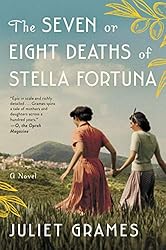
The Seven or Eight Deaths of Stella Fortuna
Juliet Grames, 2020
HarperCollins
464 pp.
ISBN-13: 9780062862839
Summary
From Calabria to Connecticut: a sweeping family saga about sisterhood, secrets, Italian immigration, the American dream, and one woman's tenacious fight against her own fate.
For Stella Fortuna, death has always been a part of life. Stella’s childhood is full of strange, life-threatening incidents—moments where ordinary situations like cooking eggplant or feeding the pigs inexplicably take lethal turns.
Even Stella’s own mother is convinced that her daughter is cursed or haunted.
In her rugged Italian village, Stella is considered an oddity—beautiful and smart, insolent and cold. Stella uses her peculiar toughness to protect her slower, plainer baby sister Tina from life’s harshest realities.
But she also provokes the ire of her father Antonio: a man who demands subservience from women and whose greatest gift to his family is his absence.
When the Fortunas emigrate to America on the cusp of World War II, Stella and Tina must come of age side-by-side in a hostile new world with strict expectations for each of them. Soon Stella learns that her survival is worthless without the one thing her family will deny her at any cost: her independence.
In present-day Connecticut, one family member tells this heartrending story, determined to understand the persisting rift between the now-elderly Stella and Tina.
A richly told debut, The Seven or Eight Deaths of Stella Fortuna is a tale of family transgressions as ancient and twisted as the olive branch that could heal them. (From the publisher.)
Author Bio
Juliet Grames was born in Hartford, Connecticut, and grew up in a tight-knit Italian-American family. A book editor, she has spent the last decade at Soho Press, where she is associate publisher and curator of the Soho Crime imprint. This is her first novel. (From the publisher.)
Book Reviews
[A] meaty family saga set in Calabria and Connecticut, crossing two centuries and five generations…. In conjuring this absorbing life, Grames has created a satisfying doorstop of a book, rich in detail, tightly written and delightfully easy to get lost in.
New York Times Book Review
The Seven or Eight Deaths of Stella Fortuna achieves what no sweeping history lesson about American immigrants could: It brings to life a woman that time and history would have ignored.
Washington Post
Epic in scale and richly detailed.… Grames holds the reader under a spell from start to finish as she constructs a puzzle of identity formed against convention.… Grames’s clear and compassionate voice lets the figures of her heritage move freely
Oprah Magazine
If you’re going through Elena Ferrante withdrawals, this is the book for you. A rich, sweeping tale of an Italian-American family and their long-buried secrets.
Harper's Bazaar
Grames’ witty and deeply felt family saga begins in a pre-WWII Italian village, where young Stella Fortuna learns the hard truths of life (and death) as she grows up with an abusive father and immigrates with her family to the U.S.
Entertainment Weekly
As Stella strives to prove herself among the many messy and aggressive men in her life, Grames uses her heroine’s story to reflect on motherhood, inherited trauma and survival.
Time
Remarkable…. A rich tale blending fiction with family history, one that celebrates the Calabrese culture in Italy as well as the immigrant experience of diverse cultures in America…. This compelling intergenerational tale is intelligently written.
Forbes
[A] vivid and moving debut…. Grames keeps the spotlight on stubborn, independent, and frequently unhappy Stella, while developing a large cast of believably complicated supporting characters…. This is a sharp and richly satisfying novel.
Publishers Weekly
[R]ichly imagined…. Beautiful, smart, and unyielding, Stella Fortuna grows up in a mountain village in Italy…. The family immigrates to America before World War II, and Stella continues protecting… sister Tina, with their estrangement in old age framing the narrative.
Library Journal
[T]he author’s own grandmother inspire this tale of an Italian American family and the complicated woman at its heart.… Readers who appreciate narratives driven by vivid characterization and family secrets will find much to enjoy here.... [Grames is] an author to watch.
Booklist
[A] stale]magic-realist tone… soon gives way to a harder-edged,… more compelling look at women’s lives in a patriarchal society…. The rush of events muddies the narrative focus…. Messily executed, but the author’s emotional commitment to her material makes it compelling.
Kirkus Reviews
Discussion Questions
1. Do you think that any of Stella’s near-deaths was her own fault? Which one(s), and why? Do you think Stella ever secretly blamed herself for a bad thing that happened to her? What about her family—do you think they ever believed that she had it coming?
2. The longer she is married, the more Assunta struggles with her oath to God that she will obey her husband. What individual events reshape her attitude, and how? Do you think she makes mistakes about when she should be obedient and when she should push back. Or do you think, in her shoes, you would make the same choices?
3. Do you—or could you—believe in the Evil Eye? Do you think other people’s jealousy can take form and negatively affect us?
4. Is Stella a religious person? How does her religiosity differ from her mother’s?
5. Does Stella Fortuna’s life have a love story? Why do you think there is never a more traditional romance during the course of her long life? Who does Stella love most? Who loves Stella most?
6. If Antonio Fortuna lived today instead of a century ago,would he be considered a sociopath? Or is he more complicated?Why do you think he does the abusive and grotesque things he does? Are they symptoms of a single underlying reason, or are hey random acts of an undisciplined and naturally cruel man?
7. When Stella first experiences her nightmare, she distracts her family from what really happened by blaming an imaginary black man for an assault that happened only in her dream. Why do you think she does this? How might the situation have escalated?
8. (Follow-up to Question 7) The Italian American community has had a reputation for anti-African American racism, which is often represented in media, like Quentin Tarantino’s True Romance or in the episode of The Sopranos entitled "Unidentified Black Males." Do you think Stella’s instinct to blame a black man is a product of the time in which she lived, or do you think she’d do the same today? Do you think that in America, where successive waves of immigrants from different places makeup the majority of the population, racism is more of a problem than it is in more homogenous populations? Do the simultaneous pressures to Americanize and preserve traditions pit groups against each other and create confrontations? Or is the truth the opposite, that the mixing of so many different groups means more open-mindedness and acceptance than the same immigrants would have felt in their home country?
9. Stella knows that her father, although strict, would not want to be identified as one of the "old world" un-Americanized Italians in Hartford, and Stella uses this knowledge to convince him to let the sisters cut their hair short. In your opinion, do the Fortunas Americanize, or do they ghettoize themselves among other Italians? Which of the family members do you imagine felt more of a moral imperative to modernize or preserve traditions? Have you observed similar tensions of identity among immigrant groups you may be a part of?
10. Is Carmelo Maglieri a good man?
11. After her Accident, when Stella turns on Tina, what do you think Tina thinks? Do you think she is baffled and heartbroken, or do you think on some level she feels guilty over things that have happened between the sisters over the last sixty-plus years?
(Questions issued by the publisher.)
top of page (summary)


Seventh Heaven
Alice Hoffman, 1990
Penguin Group USA
272 pp.
ISBN-13: 9780425188484
Summary
Nora Silk doesn’t really fit in on Hemlock Street, where every house looks the same.
She's divorced.
She wears a charm bracelet and high heels and red toreador pants.
And the way she raises her kids is a scandal.
But as time passes, the neighbors start having second thoughts about Nora. The women’s apprehension evolves into admiration. The men’s lust evolves into awe. The children are drawn to her in ways they can't explain. And everyone on this little street in 1959 Long Island seems to sense the possibilities and perils of a different kind of future when they look at Nora Silk . . .
This extraordinary novel by the author of The River King and Local Girls takes us back to a time when the exotic both terrified and intrigued us, and despite our most desperate attempts, our passions and secrets remained as stubbornly alive as the weeds in our well-trimmed lawns.. (From the publisher.)
Author Bio
• Birth—March 16, 1952
• Where—New York, New York, USA
• Education—B.A., Adelphi Univ.; M.A., Stanford Univ.
• Currently—lives in Boston, Massachusetts
Born in the 1950s to college-educated parents who divorced when she was young, Alice Hoffman was raised by her single, working mother in a blue-collar Long Island neighborhood. Although she felt like an outsider growing up, she discovered that these feelings of not quite belonging positioned her uniquely to observe people from a distance. Later, she would hone this viewpoint in stories that captured the full intensity of the human experience.
After high school, Hoffman went to work for the Doubleday factory in Garden City. But the eight-hour, supervised workday was not for her, and she quit before lunch on her first day! She enrolled in night school at Adelphi University, graduating in 1971 with a degree in English. She went on to attend Stanford University's Creative Writing Center on a Mirrellees Fellowship. Her mentor at Stanford, the great teacher and novelist Albert Guerard, helped to get her first story published in the literary magazine Fiction. The story attracted the attention of legendary editor Ted Solotaroff, who asked if she had written any longer fiction. She hadn't — but immediately set to work. In 1977, when Hoffman was 25, her first novel, Property Of, was published to great fanfare.
Since that remarkable debut, Hoffman has carved herself a unique niche in American fiction. A favorite with teens as well as adults, she renders life's deepest mysteries immediately understandable in stories suffused with magic realism and a dreamy, fairy-tale sensibility. (In a 1994 article for the New York Times, interviewer Ruth Reichl described the magic in Hoffman's books as a casual, regular occurrence — "...so offhand that even the most skeptical reader can accept it.") Her characters' lives are transformed by uncontrollable forces — love and loss, sorrow and bliss, danger and death.
Hoffman's 1997 novel Here on Earth was selected as an Oprah Book Club pick, but even without Winfrey's powerful endorsement, her books have become huge bestsellers — including three that have been adapted for the movies: Practical Magic (1995), The River King (2000), and her YA fable Aquamarine (2001).
Hoffman is a breast cancer survivor; and like many people who consider themselves blessed with luck, she believes strongly in giving back. For this reason, she donated her advance from her 1999 short story collection Local Girls to help create the Hoffman Breast Center at Mt. Auburn Hospital in Cambridge, MA
Extras
From a 2003 Barnes & Noble interview:
• Hoffman has written a number of children's books, including Fireflies: A Winter's Tale (1999), Horsefly (2000), and Moondog (2004).
• Aquamarine was written for Hoffman's best friend, Jo Ann, who dreamed of the freedom of mermaids as she battled brain cancer.
• Here on Earth is a modern version of Hoffman's favorite novel, Wuthering Heights.
• Hoffman has been honored with the Massachusetts Book Award for her teen novel Incantation.
• When asked what books most influenced her life or career, here's what she said:
Edward Eager's brilliant series of suburban magic: Half Magic, Magic by the Lake, Magic or Not, Knight's Castle, The Time Garden, Seven-Day Magic, The Well Wishers. Anything by Ray Bradbury, Shirley Jackson, J. D. Salinger, Grace Paley. My favorite book: Emily Brontë's Wuthering Heights. (Author bio and interview from Barnes & Noble.)
Book Reviews;
Part American Graffiti, part early Updike, Seventh Heaven simultaneously chronicles the coming of age of a group of teenagers in a Long Island town, and the gradual dissolution of their parents’ repressed, middle-class world...A parable about changing times and changing values.
New York Times
Before you know it, you're half in love with the ordinary people who inhabit this book; you're seduced by their susceptibility to the remarkable.
The New Yorker
Literary magic... A beautiful, deceptively simple story about ordinary life in an ordinary housing development nestled beside the Southern State Parkway...Hoffman breaks down the barriers of time, distance, and reticence. She takes us inside the houses of Hemlock Street and shows us how our ordinary neighbors—like ouselves—are both unique and universal, and worthy of love.
Newsday
Brilliant and astonishing...Suffused with magic. If ever a book deserved to be called "haunting," this is it. In every sense of the word.
Newsweek
Nora is ahead of her time. A single mother in 1950s suburbia, she's strong, sexy, passionate, and mysterious. Everyone in town is touched by her, and in the mirror of her magnetism, people see themselves as never before. With Nora's courageous image before them, they begin to ask themselves questions they had never asked—finding answers they had never dared to imagine
Cosmopolitan
In the full flowering of her extraordinary talent, Hoffman has produced a wise, poignant and uplifting novel luminous with the sensitive evocation of ordinary lives. The setting is a Long Island, N.Y., housing development from 1959 to 1960, a place of conforming, happy families where husbands mow the lawns of the tract houses and wives meet for coffee, where "safety hung over the neighborhood like a net." The arrival of Nora Silk, a brassy divorcee with two young children, is the catalyst for disturbing changes and events, some of them violent. Plucky, impetuous, innocently seductive and a messy housekeeper, Nora is anathema to the subdivision wives, who ostracize her and whose children torment her eight-year-old clairvoyant son, Billy. But as Nora's presence disturbs the community, it is slowly revealed that behind the identical facades of the houses are secret lives of turmoil, restlessness and longing. As in all Hoffman novels, mundane existence is disrupted in surprising ways: families disintegrate, a teenager dies, a placid housewife disappears. And ultimately Nora, whose optimism about her dead-end life is unquenchable, becomes an instrument of healing. Hoffman has intuitive grasp of the thoughts and feelings that are masked by conventional behavior. Like some of her characters, she seems to have a spooky ability to read thoughts; how else to account for her unerring understanding of people of nearly every age and across a broad social spectrum? She has a gift for perceiving the cruelty of children and the wide gulf that yawns between the most loving, attentive parents and their offspring's unknown wishes and deeds. As usual, she tells more than a compulsively readable story. She does magic, she unsettles you and she leaves you feeling emotionally purged and satisfied.
Publishers Weekly
In felicitously recording the lives of newcomers-on-the-block Nora Silk and her sons, baby James and young Billy, Hoffman proves once again that she can tell a charming story about suburbia that is, at once, mundane and oddly transcendent. Nora, a young, sexy divorcee, moves to the suburbs of New York City following her divorce (in 1959 a scandalous event). All alone, she manages work, her sons, and assorted domestic responsibilities with quirky flair, if not thoroughness (and occasional help from assorted magic spells inherited from her grandfather). Hoffman takes the reader back to that apparently innocent time and into a "nice" neighborhood, where the sunny replicated exteriors of the houses hide sometimes desperate lives within. Nora and her neighbors signal lifestyles of the future: a woman walks out on her family, another goes back to work; a boy is abused and strikes back; a father leaves home. Combining reality with magic, this novel surpasses At Risk. —Lauren Bielski, New York
Library Journal
Discussion Questions
Use our LitLovers Book Club Resources; they can help with discussions for any book:
• How to Discuss a Book (helpful discussion tips)
• Generic Discussion Questions—Fiction and Nonfiction
• Read-Think-Talk (a guided reading chart)
Also consider these LitLovers talking points to help get a discussion started for Seventh Heaven:
1. Start with Noral Silk. What is it about her that, at first, the neighbors on Hemlock Street find so disturbing? Should Nora have tried a little harder to blend in with the residents, if only for Billy's sake? What, eventually, draws residents to Nora? What does she offer them?
2. What is Nora hoping to find or experience in her new life in the Long Island subdivision? What kind of lives are all the residents of this suburban world hoping to live? Are suburbs really the safe, insulated world their residents hope it will be?
3. What about Nora and 17-year-old Ace McCarthy? How do you feel about their relationship?
4. When Billy begins to practice his father's magic trick, is he really starting to look fainter or is that that others are simply ignoring him?
5. Hoffman shows us Hemlock Street, not just through Nora, but through the eyes of a number of residents. Talk about some of the other characters in the subdivision: Joe Hennessy (why does he find his role as detective troubling?); Donna Durgin (what prompts her diet and her abandonment of her family?); Danny and Rickie (what adolescent struggles are they going through?) What do these characters' stories reveal about life in a 1950's era subdivision?
6. The novel is set in the late 1950s, on the cusp of the '60s. Why might Hoffman have chosen that particular time for her story? What larger issue is she exploring? In what way were the '50s and '60s different from one another? (Think about Nora, for instance, and how she represents, thematically, a disruptive influence on a seemingly placid community.)
7. Hoffman makes use of magical realism, the incorporation of supernatural elements into otherwise realistic stories. She believes that we live in a magical world. How does she inject fantastic events and objects into this novel? Do you appreciate her fantasy or find it contrived?
8. By the end of the novel, how have characters changed? What, if anything, have they learned...or gained? Do you find the ending satisfying? Do you feel as if all the strings are tied neatly together...or are some things left open and unresolved?
8. Have you read other Alice Hoffman novels? How does this one compare?
(Questions by LitLovers. Please feel free to use them, online or off, with attribution. Thanks.)
top of page

Severance
Ling Ma, 2018
Farrar, Straus and Giroux
304 pp.
ISBN-13: 9780374261597
Summary
Maybe it’s the end of the world, but not for Candace Chen, a millennial, first-generation American and office drone meandering her way into adulthood in Ling Ma’s offbeat, wryly funny, apocalyptic satire, Severance.
Candace Chen, a millennial drone self-sequestered in a Manhattan office tower, is devoted to routine.
With the recent passing of her Chinese immigrant parents, she’s had her fill of uncertainty. She’s content just to carry on: She goes to work, troubleshoots the teen-targeted Gemstone Bible, watches movies in a Greenpoint basement with her boyfriend.
So Candace barely notices when a plague of biblical proportions sweeps New York. Then Shen Fever spreads. Families flee. Companies cease operations. The subways screech to a halt.
Her bosses enlist her as part of a dwindling skeleton crew with a big end-date payoff. Soon entirely alone, still unfevered, she photographs the eerie, abandoned city as the anonymous blogger NY Ghost.
Candace won’t be able to make it on her own forever, though.
Enter a group of survivors, led by the power-hungry IT tech Bob. They’re traveling to a place called the Facility, where, Bob promises, they will have everything they need to start society anew. But Candace is carrying a secret she knows Bob will exploit.
Should she escape from her rescuers?
A send-up and takedown of the rituals, routines, and missed opportunities of contemporary life, Ling Ma’s Severance is a moving family story, a quirky coming-of-adulthood tale, and a hilarious, deadpan satire. Most important, it’s a heartfelt tribute to the connections that drive us to do more than survive. (From the publisher.)
Author Bio
• Birth—N/A
• Where—Sanming, China
• Raised—Utah, Nebraska, and Kansas, (USA)
• Education—B.A., University of Chicago; M.F.A., Cornell University
• Awards—Graywolf SLS Prize
• Currently—lives in Chicago, Illinois
Ling Ma was born in China and grew up in the US in the Midwest. She attended the University of Chicago and received an MFA from Cornell University.
Prior to graduate school she worked as a journalist and an editor. Her writing has appeared in Granta, VICE, Playboy, Chicago Reader, Ninth Letter, and other publications. A chapter of Severance received the 2015 Graywolf SLS Prize. She lives in Chicago, Illinois. (From the publisher.)
Book Reviews
How do you fit a zombie novel inside an immigrant story inside a coming-of-age tale? Ling Ma... accomplished this feat in her gripping and original turducken of a novel.… Fascinating.
Trine Tsoudero - Chicago Tribune
[A] standout debut. Satiric and playful―as well as scary.… Ling Ma is an assured and inventive storyteller [and her novel] reflects on the nature of human identity and how much the repetitive tasks we perform come to define who we are.… A sardonic wake-up call.
Maureen Corrigan - NPR, Fresh Air
Funny, frightening, and touching.... Ling Ma manages the impressive trick of delivering a bildungsroman, a survival tale, and satire of late capitalist millennial angst in one book, and Severance announces its author as a supremely talented writer to watch.
Millions
A satirical spin on the end times—kind of like The Office meets The Leftovers.
Estelle Tang - Elle
Ma's language does so much in this book, and its precision, its purposeful specificity, implicates an entire generation. But what is most remarkable is the gentleness with which Ma describes those working within the capital-S System. What does it mean if a person finds true comfort working as a "cog" in a system they disagree with? Is that comfort any less real?
Buzzfeed
[S]hrewd postapocalyptic…. There are some suspense elements, but the novel’s strength lies in Ma’s accomplished handling of the walking dead conceit to reflect on what constitutes the good life. This is a clever and dexterous debut.
Publishers Weekly
[A] smart, searing expose on the perils of consumerism, Google overload, and millennial malaise. Verdict: With womb dystopia a hot topic inspired by the renewed popularity of The Handmaid's Tale, an already established audience will be eager to discover this work. —Terry Hong, Smithsonian BookDragon, Washington, DC
Library Journal
(Starred review) Embracing the genre but somehow transcending it, Ma creates a truly engrossing and believable anti-utopian world. Ma's extraordinary debut marks a notable creative jump by playing on the apocalyptic fears many people share today.
Booklist
(Starred review) Candace is great, a wonderful mix of vulnerability, wry humor, and steely strength.… Ma also offers lovely meditations on memory and the immigrant experience. Smart, funny, humane, and superbly well-written.
Kirkus Reviews
Discussion Questions
1. Explore the novel’s title. In addition to severance from a normal world of work, what else is severed in Candace’s life? What new connections does she form as a result of being severed?
2. As you read about Spectra’s Bible production process, from the deadly health hazards experienced by the workers to the VIP treatment Candace receives during her business travel, how was your perception of "sacred texts" affected? Are bejeweled religious objects at odds with Christian doctrine? What conflicts arise in the book between religion, morality, and the requirements of contemporary life?
3. As Candace navigates the business world and her family history, how does her understanding of her own identity shift? How do her parents reconcile the Cultural Revolution of their upbringing with the world of supermarkets and the Chinese Christian Community Church? How does Mandarin serve as both a bridge and a barrier for their daughter?
4. Candace chooses to inhabit L'Occitane in the Facility. If you had to be imprisoned in a mall, which store would you choose for your cell?
5. What does Candace’s mother, Ruifang, teach her about being a woman? How are Candace’s relationships with men affected by Candace observing her father, Zhigang, and his beliefs about love and marriage?
6. What is unique about the way Ling Ma weaves a darkly humorous thread through the story line? When did you find yourself laughing out loud? When did you find yourself worrying that a fungal apocalypse could actually happen?
7. What is the effect of the novel’s time line? How does Ling Ma’s use of flashbacks stay true to the way memories reflect and illuminate each other?
8. As Candace learns how to shoot a gun and scavenge for necessities, she proves how determined she is to survive. What is the purpose of survival in the absence of quality of life? How do you personally define "quality of life"?
9. Severance is packed with references to beauty products, clothing stores, and other brands that have defined American consumerism. After the pandemic, what replaces these labels in the survivors’ quest for comfort and camaraderie? When money becomes useless, what new forms of currency emerge?
10. If you had been in Candace’s situation, would you have left town with Jonathan? What accounts for the huge distinction between his approach to work and Candace’s? Would you have accepted Spectra’s final contract—and how committed would you be to making sure to fulfill it?
11. Severance shines a spotlight on soul-crushing mind-sets that flourish both before and after the pandemic. What are they? Will profit-driven cultural forces diminish in your lifetime, or will they gain momentum?
12. How is the novel shaped by the presence of the undead who, instead of being predators like traditional zombies, are stuck in a mindless, harmless act? If you succumbed to Shen Fever, what repetitive act would your body perform?
13. How does Bob derive power? Which of his followers did you trust the most, and which the least? How does their bureaucracy compare to Spectra’s?
14. From Candace’s NY Ghost blog to the nostalgia-laden stalkings, the survivors crave a connection to what they’ve lost. Under similar circumstances, which memories and images would you want to stockpile?
15. How did you react to the closing scene? What do you imagine will happen next?
(Questions issued by the publisher.)

Sex and Vanity
Kevin Kwan, 2020
Knopf Doubleday
336 pp.
ISBN-13: 9780385547208
Summary
The iconic author of the bestselling phenomenon Crazy Rich Asians returns with the glittering tale of a young woman who finds herself torn between two men: the WASPY fiance of her family's dreams and George Zao, the man she is desperately trying to avoid falling in love with.
On her very first morning on the jewel-like island of Capri, Lucie Churchill sets eyes on George Zao and she instantly can't stand him.
She can't stand it when he gallantly offers to trade hotel rooms with her so that she can have a view of the Tyrrhenian Sea, she can't stand that he knows more about Casa Malaparte than she does, and she really can't stand it when he kisses her in the darkness of the ancient ruins of a Roman villa and they are caught by her snobbish, disapproving cousin Charlotte.
"Your mother is Chinese so it's no surprise you'd be attracted to someone like him," Charlotte teases.
The daughter of an American-born Chinese mother and a blue-blooded New York father, Lucie has always sublimated the Asian side of herself in favor of the white side, and she adamantly denies having feelings for George.
But several years later, when George unexpectedly appears in East Hampton, where Lucie is weekending with her new fiancé, Lucie finds herself drawn to George again.
Soon, Lucie is spinning a web of deceit that involves her family, her fiancé, the co-op board of her Fifth Avenue apartment building, and ultimately herself as she tries mightily to deny George entry into her world—and her heart.
Moving between summer playgrounds of privilege, peppered with decadent food and extravagant fashion, Sex and Vanity is a truly modern love story, a daring homage to A Room with a View, and a brilliantly funny comedy of manners set between two cultures. (From the publisher.)
Author Bio
• Birth—ca. 1973-74
• Where—Singapore
• Raised—Clear Lake, Texas, USA
• Education—B.A., University of Houston-Clear Lake; B.F.A., Parsons School of Design
• Currently—lives in New York, New York
Kevin Kwan is a Singaporean-American novelist best known for his satirical Crazy Rich Asians Trilogy (2013-17). He was born in Singapore, the youngest of three boys, into an established, old-wealth Chinese family.
Background and early years
His great-grandfather, Oh Sian Guan, was a founding director of Singapore's oldest bank, the Overseas-Chinese Banking Corporation. His paternal grandfather, Dr. Arthur Kwan Pah Chien, was an ophthalmologist who became Singapore's first Western-trained specialist and was knighted by Queen Elizabeth II for his philanthropic efforts. His maternal grandfather, Rev. Paul Hang Sing Hon, founded the Hinghwa Methodist Church. Kwan is also related to Hong Kong-born American actress Nancy Kwan.
As a young boy, Kwan lived in Singapore with his paternal grandparents and attended the Anglo-Chinese School. When he was 11, his father, an engineer, and mother, a pianist, moved the family to the U.S., eventually landing in Clear Lake, Texas, where Kwan graduated from high school at the age of 16. Kwan earned a B.A. in Media Studies from the University of Houston-Clear Lake, after which he moved to Manhattan to attend Parsons School of Design to pursue a B.F.A. in Photography.
Career
Staying in New York, Kwan worked for Andy Warhol's Interview Magazine, Martha Stewart Living, and Tibor Kalman's design firm M & Co. In 2000, Kwan established his own creative studio; his clients have included Ted.com, Museum of Modern Art, and the New York Times.
In 2007, Kwan edited I Was Cuba, a photographic "memoir" of Cuba; in 2008 he co-authored with Deborah Aaronson an advice book, Luck: The Essential Guide.
Then, in 2009, while caring for his dying father, Kwan began to conceive of Crazy Rich Asians. He and his father reminisced about their life in Singapore while driving to and from medical appointments. Hoping to capture those memories, Kwan began writing them down in story form.
Living in the U.S. since 1985, Kwan's view of Asia had become westernized—he has said he feels like "an outsider looking in." His goal was to change the stereotypical perception of wealthy Asians' conspicuous consumption, refocusing instead on old-wealth families more like his own, families that exude "style and taste [and] have been quietly going about their lives for generations."
Four years later, in 2013, Kwan published Crazy Rich Asians, the first volume of what would become his trilogy. Two years later, in 2015, he released China Rich Girlfriend and, in 2017, Rich People's Problems. In 2018 the first book of the trilogy was released as a film and became an immediate box office hit.
In August 2018, Amazon Studios ordered a new drama series from Kwan and STX Entertainment. The as yet unnamed series is to be set in Hong Kong and will follow the "most influential and powerful family" along with their business empire.
Recognition
In 2014, Kwan was named as one of the "Five Writers to Watch" on the list of Hollywood's Most Powerful Authors published by The Hollywood Reporter. In 2018, he made Time magazine's list of 100 most influential people; that same year he was also inducted into The Asian Hall of Fame. (Adapted from Wikipedia. Retrieved 10/18/2018.)
Book Reviews
Deliciously modern… drama, diamonds, and satire galore.
Vanity Fair
[A]n intoxicating, breezy update of E.M. Forster’s A Room with a View.… Kwan exploits the Forster frame for clever references…. There are moments both catty and witty, but this delectable comedy of manners—the literary equivalent of white truffle and caviar pizza—is still pizza.
Publishers Weekly
Lucie Churchill can't admit her attraction to George Zao when they meet on the island of Capri and end up kissing in the glorious ruins of a Roman villa. She's still in denial when she encounters him a few years later in the Hamptons.
Library Journal
A deliciously fun romp from Capri to Manhattan and East Hampton. Kwan is in fine form, gleefully name-dropping luxury brands and socialites as he spins a heartfelt, satirical tale that observes the price of fame, fortune and following your heart.
BookPage
(Starred review) Kwan… again manages to enchant…. While he’s engineering the timeless love story and continuing our postgraduate education in all the things money can buy, Kwan manages to take a few swipes against snobbery and racism. Nice. This is the only way you’re getting to Capri this year. Why resist?
Kirkus Reviews
Discussion Questions
We'll add publisher questions if and when they're available; in the meantime, use our LitLovers Book Club Resources. They can help with discussions for any book:
• How to Discuss a Book (helpful discussion tips)
• Generic Discussion Questions—Fiction and Nonfiction
• Read-Think-Talk (a guided reading chart)
(Resources by LitLovers. Please feel free to use them, online and off, with attribution. Thanks.)


The Shack: Where Tragedy Confronts Eternity
William P. Young, 2008
Windblown Media
304 pp.
ISBN-13: 9780609414115
Summary
Mackenzie Allen Philips’ youngest daughter, Missy, has been abducted during a family vacation, and evidence that she may have been brutally murdered is found in an abandoned shack deep in the Oregon wilderness. Four years later in the midst of his Great Sadness, Mack receives a suspicious note, apparently from God, inviting him back to that shack for a weekend.
Against his better judgment he arrives at the shack on a wintry afternoon and walks back into his darkest nightmare. What he finds there will change Mack's world forever. (From the publisher.)
Author Bio
• Birth—May 11, 1955
• Where—Grande Praire, Alberta, Canada
• Reared—West Paupua
• Education—B.A., Warner Pacific College
• Currently—lives in Gresham, Oregon, USA
William P. Young was born a Canadian and raised among a Stone Age tribe by his missionary parents in the highlands of former New Guinea. He suffered great loss as a child and young adult and now enjoys the "wastefulness of grace" with his family in the Pacific Northwest. (From the publisher.)
More
William P. Young is an American author, best known for The Shack, a Christian novel. Young initially printed just fifteen copies of his book for friends who encouraged him to have it published. Unable to find a publisher, Young published the book himself in 2007; word-of-mouth referrals eventually drove the book to number one on the New York Times trade paperback fiction best-seller list in June 2008.
In an interview with World Magazine's Susan Olasky, Young, who is no longer a member of a church, said that the institutional church...
doesn't work for those of us who are hurt and those of us who are damaged.... If God is a loving God and there's grace in this world and it doesn't work for those of us who didn't get dealt a very good hand in the deck, then why are we doing this?... Legalism within Christian or religious circles doesn't work very well for people who are good at it. And I wasn't very good at it.
An article in MacLean's Magazine in August 2008 indicated that Young, is a...
Canadian raised from birth by his missionary parents in Dutch New Guinea, Young was sexually abused by some of the people his parents preached to, as he was again back home, at a Christian boarding school. Young drifted through life as an adult, buoyed a little by his faith and a lot by his wife, Kim, keeping his secrets and building his shack: "the place we make to hide all our crap," he calls it. Until, at 38, he found himself at the nadir. "I had a three-month affair with one of my wife's best friends. That was it, that just blew my careful little religious world apart. I either had to get on my knees and deal with my wife's pain and anger or kill myself.
Young currently resides in Gresham, Oregon, with his wife and six children. (From Wikipedia.)
Book Reviews
The Shack is a one of a kind invitation to journey to the very heart of God. Through my tears and cheers, I have been indeed transformed by the tender mercy with which William Paul Young opened the veil that too often separated me from God and from myself. With every page, the complicated do’s and don’t that distort a relationship into a religion were washed away as I understood Father, Son, and Holy Ghost for the first time in my life.
Patrick M. Roddy (producer, ABC News)
When the imagination of a writer and the passion of a theologian cross-fertilize the result is a novel on the order of The Shack. This book has the potential to do for our generation what John Bunyan’s Pilgrim’s Progress did for his. It’s that good!
Eugene Peterson ( Professor Emeritus, Theology, Regent College, Vancouver, B.C.)
Finally! A guy-meets-God Novel that has literary integrity and spiritual daring. The Shack cuts through the cliches of both religion and bad writing to reveal something compelling and beautiful about life's integral dance with the Divine. This story reads like a prayer—like the best kind of prayer, filled with sweat and wonder and transparency and surprise. When I read it, I felt like I was fellowshipping with God. If you read one work of fiction this year, let this be it.
Mike Morrell - zoecarnate.com
You will be captivated by the creativity and imagination of the shack, and before you know it you’ll be experiencing god as never before. William young’s insights are not just captivating, they are biblically faithful and true. Don’t miss this transforming story of grace.
Greg Albrecht - Plain Truth Magazine
Discussion Questions
Use our LitLovers Book Club Resources; they can help with discussions for any book:
• How to Discuss a Book (helpful discussion tips)
• Generic Discussion Questions—Fiction and Nonfiction
• Read-Think-Talk (a guided reading chart)
Also consider these LitLovers talking points to help get a discussion started for The Shack:
1. How did reading this book affect your faith? Does it change, challenge, strengthen your image of God? Why is God portrayed as a woman, what reasons does God give Mack?
2. Does God answer convincingly the reason for the trinity?
3. Does the idea of God a character in the book, or God's first-person voice, bother you...or does it work within the context of The Shack's story?
4. Why did God let Missy die? Do you think The Shack answers convincingly the central question of theodicy, the existence of evil—or why, if there is a God, bad things happen to good people?
5. What does The Shack say about forgiveness—toward the self or toward those who have wronged you.
6. Young has been criticized for advocating lawlessness (p. 122) ...or universalism (p. 225)? Do you think that is a fair or unfair criticism?
7. Many readers find the first 4 chapters of The Shack almost too painful to read. Could they have been written in a way that would be less painful—without changing the book's message?
8. Does the book's ultimate message satisfy you? Is it possible to let go of control and certainty in life? Is it possible to live only in the present?
(Questions by LitLovers; please feel free to use them, online and off, with attribution. Thanks.)
top of page (summary)


Shadow and Bone (Grisha Trilogy, 1)
Leight Bardugo, 2012
Henry Holt & Co.
416 pp.
ISBN-13: 9781250027436
Summary
Surrounded by enemies, the once-great nation of Ravka has been torn in two by the Shadow Fold, a swath of near impenetrable darkness crawling with monsters who feast on human flesh. Now its fate may rest on the shoulders of one lonely refugee.
Alina Starkov has never been good at anything. But when her regiment is attacked on the Fold and her best friend is brutally injured, Alina reveals a dormant power that saves his life—a power that could be the key to setting her war-ravaged country free. Wrenched from everything she knows, Alina is whisked away to the royal court to be trained as a member of the Grisha, the magical elite led by the mysterious Darkling.
Yet nothing in this lavish world is what it seems. With darkness looming and an entire kingdom depending on her untamed power, Alina will have to confront the secrets of the Grisha...and the secrets of her heart.
Shadow and Bone is the first installment in Leigh Bardugo's Grisha Trilogy. The second is Seige and Storm (2013) and Ruin and Rising (2014). (From the publisher.)
Author Bio
• Birth—1975
• Where—Jerusalem, Israel
• Education—B.A., Yale University
• Currently—lives in Hollywood, California, USA
Leigh Bardugo is the author of the New York Times bestsellers Shadow and Bone (2012) and Siege and Storm (2013). Ruin and Rising (2014) is the third installment in her Grisha Trilogy. Leigh was born in Jerusalem, grew up in Los Angeles, and graduated from Yale University. She has worked in advertising, journalism, and most recently, makeup and special effects. These days, she’s lives and writes in Hollywood where she can occasionally be heard singing with her band. (From the author's website .)
Book Reviews
Some fantasy novels deal out the tropes of the genre like cards from a dog-eared deck. Others affirm the elemental power of these tropes, reminding us not only why we read fantasy, but also why we read at all. There may be nothing new under the sun, but a good story makes you just not care. Like the expert strike of a reflex hammer, it hits precisely the right spot. Leigh Bardugo's first novel, Shadow and Bone, does so straight from its opening lines, pulling the reader into a mesmerizing exploration of one of the most potent fantasy novel motifs: the discovery of hidden strength within oneself.
Laini Taylor - New York Times Book Review
In a strong debut, Bardugo draws inspiration from Russian and Slavic myth and culture to kick off her Grisha trilogy.... Filled with lush descriptions, intriguing magic, and plenty of twists, this memorable adventure offers action and intrigue mixed with an undercurrent of romance and danger (Ages 12–up).
Publishers Weekly
Fast-paced and unpredictable, this debut novel will be a hit with readers who love dark fantasy.... Bardugo creates a unique world complete with monsters, magic, danger, romance, corruption, and extravagance. Suspense builds slowly, allowing readers time to absorb the otherworldly setting and the battle between the darkness that destroys and the light that saves (Gr 7 & up). —Leigh Collazo, Ed Willkie Middle School, Fort Worth, TX
School Library Journal
Alina and Mal, orphaned children from an early age, grew up as best friends in war-torn Ravka. Now, they are both part of the First Regiment and head across the Fold to get supplies from West Ravka.... The first in a new series, Bardugo teleports the reader into a magical world with Alina's story. A theme of love and forgiveness is woven throughout as Alina makes her way through this new life. —Maggie L. Schrock
Children's Literature
Book 1 of Leigh Bardugo's fantasy series, the Grisha Trilogy, tells of the travails of war orphans, Alina Starkov and Malyen Oretsev.... Shadow And Bone has all the features one looks for in a teen fantasy novel—lots of action, characters with fantastical powers, intrigue, mystical creatures, deception, and romance. —Christina Miller
VOYA
Bardugo weaves a captivating spell with lushly descriptive writing, engaging characters, and an exotic, vivid world. Readers will wait impatiently for the next installment.
Booklist
In a Russian-inflected fantasy world, an orphan comes into immense power and, with it, danger.... While Alina's training borrows familiar tropes (outlander combat teacher, wizened-crone magic instructor, friends and enemies among her peers), readers will nevertheless cheer her progress.... The plotting is powerful enough to carry most readers past flaws and into the next book in the series (13 & up).
Kirkus Reviews
Discussion Questions
1. Alina and Mal grew up in an orphanage in Kermazin. How does this relate to Alina’s experiences at the Little Palace? To Mal’s experiences in the First Army?
2. How is the Fold connected to the Darkling? What does it say about him and his power?
3. How does Alina feel about her power? How do her feelings change? Why?
4. What is the connection between Alina and the Darkling? What does Alina think of this connection at different points in the novel?
5. How are the Grisha talents like science? Why are other people afraid of what the Grisha can do?
(Questions issued by the publisher.)
top of page (summary)
The Shadow Catcher
Marianne Wiggins, 2007
Simon & Schuster
336 pp.
ISBN-13: 9780743265218
Summary
Following her National Book Award finalist, Evidence of Things Unseen, Marianne Wiggins turns her extraordinary literary imagination to the American West, where the life of legendary photographer Edward S. Curtis is the basis for a resonant exploration of history and family, landscape and legacy.
The Shadow Catcher dramatically inhabits the space where past and present intersect, seamlessly interweaving narratives from two different eras: the first fraught passion between turn-of-the-twentieth-century icon Edward Curtis (1868-1952) and his muse-wife, Clara; and a twenty-first-century journey of redemption.
Narrated in the first person by a reimagined writer named Marianne Wiggins, the novel begins in Hollywood, where top producers are eager to sentimentalize the complicated life of Edward Curtis as a sunny biopic: "It's got the outdoors. It's got adventure. It's got the do-good element." Yet, contrary to Curtis's esteemed public reputation as servant to his nation, the artist was an absent husband and disappearing father. Jump to the next generation, when Marianne's own father, John Wiggins (1920-1970), would live and die in equal thrall to the impulse of wanderlust.
Were the two men running from or running to? Dodging the false beacons of memory and legend, Marianne amasses disparate clues — photographs and hospital records, newspaper clippings and a rare white turquoise bracelet — to recover those moments that went unrecorded, "to hear the words only the silent ones can speak."
The Shadow Catcher, fueled by the great American passions for love and land and family, chases the silhouettes of our collective history into the bright light of the present. (From the publisher.)
Author Bio
• Birth—September 8, 1947
• Where—Lancaster, Pennsylvania, USA
• Education—Manheim Township High School, Lancaster
• Awards—Whiting Award, 1989; Janet Heidiger Kafka Prize
for best novel written by an American woman, 1990
• Currently—lives in Los Angeles, California
Marianne Wiggins was born in Lancaster, Pennsylvania, and has lived in Brussels, Rome, Paris, and London. She is the author of ten books of fiction, including John Dollar and Evidence of Things Unseen, for which she was a National Book Award finalist in fiction, as well as a finalist for the Pulitzer Prize. She has won an NEA grant, the Whiting Writers' Award, and the Janet Heidinger Kafka Prize. She is Professor of English at the University of Southern California. (From the publisher.)
More
From a 2005 Barnes & Noble interview:
Q: What was the book that most influenced your life or your career as a writer—and why?
A: Hands down, this was Tillie Olsen's Silences. It was published soon after I turned 30, when I had one book in print and had not really found my canvas nor my voice. I was at a turning point in my life, not knowing if I could make a "career" of writing and having a young daughter to support on my own. Olsen's masterpiece is not so much "written" as gasped — her passionate engagement with the subject of women writers grips you physically like a madwoman on a bus demanding your participation in her cause. I read it in the kitchen, I read it in bed — I still read parts of it at least once every month.
Q: What are your favorite books, and what makes them special to you?
A: When I moved back to the United States after living 16 years in London, I had to ship all my possessions to California through the Panama Canal. I'll always remember the look on that Allied Movers agent's face when he saw my shelves of books: over 300 cartons' worth, and that was after I weeded out the out-of-date travel books to places like Burma and Romania that I had bought for research for my novels. I'm going to have to sidestep this question, adapting my sister's line. She has five children and frequently, sincerely, says, "I love ‘em all." (Bio and interview from Barnes & Noble.)
Book Reviews
Wiggins seems to be writing her own psycho-history here. (The book is dedicated to her daughter, Lara Porzak, a photographer.) But if the novel fails to integrate all the cosmic elements she summons up — her digressions on maps, aerial perspective, Western land rights and Los Angeles traffic are strained — Wiggins ably challenges the smug idea that we can easily distinguish truth and falsehood in telling anyone’s story, especially our own. Fictive memoir? Fact-based novel? I don’t care what she calls this book. I’ll gladly read it again.
Richard B. Woodward - New York Times
There are passages in Marianne Wiggins's eighth novel so piercingly beautiful that I put the book down, shook my head and simply said, "Wow." She's reproduced a number of photographs in her text — appropriately, since her subject is a photographer — but these physical images pale in comparison to the pictures she creates with words.
Wendy Smith - Washington Post
The author can make you weep in a single sentence...The events and relationships are rendered on the page with an immediacy that catches you up short.
Boston Globe
(Starred review.) Wiggins is a writer who paints elegant pictures with words.... The pages are liberally sprinkled with photographs, insights, realistic pathos, and human situations. This creative novel will not disappoint. —Elizabeth Dickie
Booklist
Wiggins takes on real-life American photographer Edward Sheriff Curtis. The author braids the stories of Curtis, whose photos of Native Americans and the western landscape shaped the region's mythology; his long-suffering wife, Clara; and a present-day writer, "Marianne Wiggins," who's summoned to a Las Vegas hospital to see the dying "father" whom she knows to be an imposter because her dad hanged himself decades earlier. Incorporated into the text are photographic images taken by the mysterious, obsessive Curtis, famed for his pictures of grave, brooding Indians posed in ceremonial dress-funeral portraits of a dying race, he called them. Especially poignant is the plight of Clara, who manages the household and raises their children virtually alone (the youngest goes 18 years without seeing her father). Yet when she finally sues for divorce, the children side with Curtis, choosing the mythical god over the disciplinarian. Wiggins intercuts the story of the writer/narrator's own absent father. The novel can seem diffuse—neither storyline is explored as fully as it might be—but the stratagem pays off in bravura passages like the one in which Wiggins riffs her way from ethnic roadside restaurants to gods of Greek myth to the American cult of celebrity...and in the process forges an emotional link between narrative lines. An ambitious, lively work, though its fragments don't coalesce perfectly.
Publishers Weekly
Discussion Questions
1. Marianne Wiggins's new novel, The Shadow Catcher, centers in part on the life of a real historical figure, Edward Sheriff Curtis. Discuss the unique process of weaving fact and fiction: What difficulties it might pose? What artistic freedoms might emerge?
2. The book features an unusual narrative technique, combining historical fiction with more documentary-style biography and history, as well as a personal narrative that reads like memoir. Why do you think the author chose to tell this story in this way?
3. The chapters in the novel about Edward and Clara are essentially told from Clara's point of view. Is this ultimately more a story about Clara than Edward?
4. The intimate details of a personal relationship that unfolded in the past may not be documented in the way a public life might be. Is love a timeless emotion, or is the feeling influenced by the times in which it occurs?
5. The Edward Curtis presented here is a much more complicated man than the heroic figure that has come down to us through the legacy of his work. How do mythic elements of a human life arise over time?
6. Do you think Edward Curtis's story is a singularly American one?
7. There is a character named "Marianne Wiggins" in The Shadow Catcher who, on the surface, shares much of the history of the actual Marianne Wiggins. When you are reading a novel, does the feeling of making a personal connection with the author add to your experience?
8. In another unusual feature for a novel, The Shadow Catcher is peppered with images—not only some of Edward Curtis's photographs, but photographs from Marianne Wiggins's family and images of historical and personal documents aswell. Why do you think the author included these?
9. This is not the first time a photographer has been a central character in one of Marianne Wiggins's novels. Discuss the art of photography as it might relate to fiction.
10. A watchword throughout this novel is "Print the Legend." Why do you think we sometimes cling to our cultural myths in the face of overriding evidence against their truth?
11. Late in the novel Wiggins writes, "How the average person dreams is pretty much how the average novelist puts a page together." Discuss the possible meanings of this statement.
12. Marianne Wiggins was born and raised in the East, lived in Europe for many years, and now lives in California. How might a person come to develop such an obvious passion for a region—in this case the Western landscape—not her original home?
(Questions issued by publisher.)
top of page (summary)

The Shadow Land
Elizabeth Kostova, 2017
Random House
496 pp.
ISBN-13: 9780345527868
Summary
From the #1 bestselling author of The Historian comes a mesmerizing novel that spans the past and the present—and unearths the troubled history of a gorgeous but haunted country.
A young American woman, Alexandra Boyd, has traveled to Sofia, Bulgaria, hoping that life abroad will salve the wounds left by the loss of her beloved brother.
Soon after arriving in this elegant East European city, however, she helps an elderly couple into a taxi—and realizes too late that she has accidentally kept one of their bags. Inside she finds an ornately carved wooden box engraved with a name: Stoyan Lazarov.
Raising the hinged lid, she discovers that she is holding an urn filled with human ashes.
As Alexandra sets out to locate the family and return this precious item, she will first have to uncover the secrets of a talented musician who was shattered by political oppression—and she will find out all too quickly that this knowledge is fraught with its own danger.
Elizabeth Kostova’s new novel is a tale of immense scope that delves into the horrors of a century and traverses the culture and landscape of this mysterious country. Suspenseful and beautifully written, it explores the power of stories, the pull of the past, and the hope and meaning that can sometimes be found in the aftermath of loss. (From the publisher.)
Author Bio
• Birth—December 26, 1964
• Where—New London, Connecticut, USA
• Rasied—Knoxville, Tennessee
• Education—B.A., Yale; M.F.A. University of Michigan
• Awards—Hopwod Award for Novel-in-Progress; Quill Award; Book Sense Award
• Currently—lives in Michigan, USA
Elizabeth Johnson Kostova, an American author, is best known for her debut novel The Historian. Swan Thieves, her second novel, was released in 2010.
Kostova's interest in the Dracula legend began with the stories her father told her about the vampire when she was a child. The family lived in Ljubljana, Slovenia in 1972, while her father was teaching at a local university; during that year, the family traveled across Europe. According to Kostova, "It was the formative experience of my childhood."She "was fascinated by [her father's Dracula stories] because they were...from history in a way, even though they weren't about real history, but I heard them in these beautiful historic places." Kostova's interest in books and libraries began early as well. Her mother, a librarian, frequently took her and her sisters to the public library — they were each allowed to check out 30 books and had a special shelf for their library books.
As a child, she listened to recordings of Balkan folk music and became interested in the tradition. As an undergraduate at Yale, she sang in and directed a Slavic chorus. In 1989, she and some friends traveled to Eastern Europe, specifically Bulgaria and Bosnia, to study local musical customs. The recordings they made will be deposited in the Library of Congress. While Kostova was in Europe, the Berlin Wall collapsed, heralding the fall of Communism in Eastern Europe, events which shaped her understanding of history.
Five years later, in 1994, when Kostova was hiking in the Appalachian Mountains with her husband, she had a flashback to those storytelling moments with her father and asked herself "what if the father were spinning his Dracula tales to his entranced daughter and Dracula was listening in? What if Dracula was still alive?" She immediately scratched out seven pages of notes into her writer's notebook. Two days later, she started work on the novel. At the time she was teaching English as a second language, creative writing, and composition classes at universities in Philadelphia, Pennsylvania. She then moved to Ann Arbor, Michigan, and finished the book as she was obtaining her Master of Fine Arts degree at the University of Michigan. In order to write the book, she did extensive research about Eastern Europe and Vlad Tepes.
Kostova finished the novel in January 2004 and sent it out to a potential literary agent in March. Two months later and within two days of sending out her manuscript to publishers, Kostova was offered a deal—she refused it. The rights to the book were then auctioned off and Little, Brown and Company bought it for US$2 million (US$30,000 is typical for a first novel from an unknown author). Publishers Weekly explained the high price as a bidding war between firms believing that they might have the next Da Vinci Code within their grasp. One vice-president and associate publisher said "Given the success of The Da Vinci Code, everybody around town knows how popular the combination of thriller and history can be and what a phenomenon it can become." Little, Brown, and Co. subsequently sold the rights in 28 countries. The book was published in the United States on 14 June 2005.
More
The novel blends the history and folklore of Vlad Tepes and his fictional equivalent Count Dracula and has been described as a combination of genres, including Gothic novel, adventure novel, detective fiction, travelogue, postmodern historical novel, epistolary epic, and historical thriller. Kostova was intent on writing a serious work of literature and saw herself as an inheritor of the Victorian style. Although based on Bram Stoker's Dracula, The Historian is not a horror novel, but rather an eerie tale. The novel is concerned with questions about history, its role in society, and how it is represented in books, as well as the nature of good and evil. As Kostova explains, "Dracula is a metaphor for the evil that is so hard to undo in history." The evils brought about by religious conflict are a particular theme and the novel explores the relationship between the Christian West and the Islamic East.
Heavily promoted, the book became the first debut novel to land at number one on the the New York Times bestseller list and as of 2005 was the fastest-selling hardback debut novel in US history. In general, the reviews of the novel were mixed. Several reviewers noted that she described the setting of her novel well. However, some reviewers criticized the book's structure and its lack of tonal variety. Kostova received the 2006 Book Sense award for Best Adult Fiction and the 2005 Quill Award for Debut Author of the Year. Sony bought the film rights to the novel for $1.5 million.
In May 2007, the Elizabeth Kostova Foundation was created. The Foundation helps support Bulgarian creative writing, the translation of contemporary Bulgarian literature into English, and friendship between Bulgarian authors and American and British authors.
Kostova's second novel, The Swan Thieves, was released in 2010, and The Shadow Land in 2017. (From Wikipedia.)
Book Reviews
A compelling and complex mystery, strong storytelling, and lyrical writing combine for an engrossing read.… Lazarov’s… attempt to become a concertmaster… has tragic consequences, setting up Kostova’s most emotional and harrowing moments.
Publishers Weekly
(Starred review.) This…will delight the author's fans. A slight hint of the mystical will appeal to readers who enjoyed Deborah Harkness's "All Souls" trilogy, while the mystery and thriller aspects will keep fans… reading. A fantastic book club pick. —Elizabeth McArthur, Bexar Cty. Digital Lib., BiblioTech, San Antonio
Library Journal
Interweaving tales juxtapose the past with the present as the mystery unfolds. Verdict: Those who enjoy a deep dive into the complicated lives of people both historical and contemporary will love this book. —Connie Williams, Petaluma High School, CA
School Library Journal
[T]he romance Kostova drums up for Alexandra …feel[s] shoehorned into the novel…. Kostova's passion and tragic sense of history, along with jewellike character studies, almost make up for the overplotting and repetitiveness as she drums her points home.
Kirkus Reviews
Discussion Questions
Use our LitLovers Book Club Resources; they can help with discussions for any book:
• How to Discuss a Book (helpful discussion tips)
• Generic Discussion Questions—Fiction and Nonfiction
• Read-Think-Talk (a guided reading chart)
(We'll add specific questions if and when they're made available by the publisher.)
top of page (summary)