


Shadow of Night: (All Souls Trilogy 2)
Deboroah Harkness, 2012
Penguin Group USA
592 pp.
ISBN-13: 9780143123620
Summary
"Together we lifted our feet and stepped into the unknown"—the thrilling sequel to the New York Times bestseller A Discovery of Witches.
Deborah Harkness exploded onto the literary scene with her debut novel, A Discovery of Witches, Book One of the magical "All Souls Trilogy" and an international publishing phenomenon. The novel introduced Diana Bishop, Oxford scholar and reluctant witch, and the handsome geneticist and vampire Matthew Clairmont; together they found themselves at the center of a supernatural battle over an enchanted manuscript known as Ashmole 782.
Now, picking up from A Discovery of Witches’ cliffhanger ending, Shadow of Night plunges Diana and Matthew into Elizabethan London, a world of spies, subterfuge, and a coterie of Matthew’s old friends, the mysterious School of Night that includes Christopher Marlowe and Walter Raleigh.
Here, Diana must locate a witch to tutor her in magic, Matthew is forced to confront a past he thought he had put to rest, and the mystery of Ashmole 782 deepens.
Deborah Harkness has crafted a gripping journey through a world of alchemy, time travel, and magical discoveries, delivering one of the most hotly anticipated novels of the season. (From the publisher.)
The first book in the All Souls Trilogy is A Discovery of Witches (2011), and the third is The Book of Life (2014).
Author Bio
• Birth—N/A
• Raised—outside of Philadelphia, PA, USA
• Education—B.A., Mount Holyoke College; M.A., Northwestern University; Ph.D., University of California-Davis
• Currently—lives in southern California
Deborah Harkness is a professor of history at the University of Southern California. She has received Fullbright, Guggenheim, and National Humanities Center fellowships, and her most recent scholarly work is The Jewel House: Elizabethan London and the Scientific Revolution. She also writes an award-winning wine blog, Good Wine Under $20. (From the publisher.)
More
In her own words
I grew up in the suburbs of Philadelphia and have lived in western Massachusetts, the Chicago area, Northern California, upstate New York, and Southern California. In other words, I’ve lived in three out of five time zones in the US! I’ve also lived in the United Kingdom in the cities of Oxford and London.
For the past twenty-eight years I’ve been a student and scholar of history, and received degrees from Mount Holyoke College, Northwestern University, and the University of California at Davis. During that time I researched the history of magic and science in Europe, especially during the period from 1500 to 1700.
The libraries I’ve worked in include Oxford’s Bodleian Library, the All Souls College Library at Oxford, the British Library, London’s Guildhall Library, the Henry E. Huntington Library, the Folger Shakespeare Library, and the Newberry Library—proving that I know my way around a card catalogue or the computerized equivalent. These experiences have given me a deep and abiding love of libraries and a deep respect for librarians. Currently, I teach European history and the history of science at the University of Southern California in Los Angeles.
My previous books include two works of non-fiction: John Dee’s Conversations with Angels: Cabala, Alchemy, and the End of Nature (Cambridge University Press, 1999) and The Jewel House: Elizabethan London and the Scientific Revolution (Yale University Press, 2007). It has been my privilege to receive fellowships from the American Council of Learned Societies, the Guggenheim Foundation, the National Science Foundation, and the National Humanities Center. And I was honored to receive accolades for my historical work from the History of Science Society, the North American Conference on British Studies, and the Longman’s/History Today Prize Committee.
In 2006, I took up my keyboard and entered the world of blogging and Twitter. My wine blog, Good Wine Under $20, is an online record of my search for the best, most affordable wines. These efforts have been applauded by the American Wine Blog Awards, Saveur.com, Wine & Spirits magazine, and Food & Wine magazine. My wine writing has also appeared on the website Serious Eats and in Wine & Spirits magazine. (From the author's website.)
Book Reviews
Rich, period fun, particularly delightful in its witty characterization of historical immortals.... Shadow ramps up the supernatural suspense.
New York Daily News
Picking up where she left off in last year’s A Discovery of Witches, Harkness proves she’s not suffering from a sophomore slump with this addictive tale of magic, mayhem and two lovers.
Chicago Tribune
Deborah Harkness takes us places we’ve never been before.... Shadow of Night isn't just about wonderfully detailed descriptions of England in 1591, it's about being there. Readers time-travel as precisely and precariously as Diana and Matthew do.... Shadow ends as Discovery did with promises of more to come. Lucky for us.
USA Today
Harkness exudes her own style of magic in making the world of late 16th century England come alive.... Enchanting, engrossing and as impossible to put down as its predecessor, Shadow of Night is a perfect blend of fantasy, history and romance. Its single greatest flaw is, after almost 600 pages, it’s over. If you’ve already read and enjoyed A Discovery of Witches, picking up Shadow of Night is an absolute requirement. Otherwise, pick up both, and consider your summer reading list complete.
Miami Herald
The joy that Harkness, herself a historian, takes in visiting the past is evident on every page.... A great spell, the one that can enchant a reader and make a 600-page book fly through her fingertips, is cast.... Its enduring rewards are plenty.
Entertainment Weekly
Fans of Harkness’s 2011 debut A Discovery of Witches will be delighted.... Harkness delivers enough romance and excitement to keep the pages turning. Readers will devour it.
People
Propelled by her successful fiction debut, A Discovery of Witches, historian Harkness concocts an energetic if chaotic sequel filled with witches, daemons, vampires, wearhs, weavers, and warm-bloods (aka humans) racing to retrieve a lost manuscript that details the origins of supernatural species, which, in the wrong hands, could hasten their extinction. The first novel culminated in the mixed marriage of vampire/scientist Matthew de Clermont to historian/untrained witch Diana Bishop. This novel opens with the newlyweds time-traveling to Elizabethan England so Diana can study witchcraft; never mind they’re burning witches in Scotland or that in London an educated American woman doesn’t exactly blend in. There, they hope to retrieve magical manuscript Ashmole 782, last seen in Oxford’s 21st-century Bodleian library. Diana gets in touch with her inner firedrake, Matthew with his father, but they can’t find a tutor for ages, and they can’t rescue the manuscript without a trip to Prague. Supporting Diana and Matthew in their quest is a secret society that includes dashing Walter Raleigh and dangerous daemon Christopher Marlowe. Harkness delights in lining up the living dead and modern academic history, as in her explanation of how a forger named Shakespeare, with supernatural prompting, takes up playwriting. This tale of a feminist Yankee in Queen Elizabeth’s court charms amid the tumult, as the gifted heroine and her groom fight for generations and another sequel to come in order to protect the magical world that’s all around us.
Publishers Weekly
Picking up where...best-selling A Discovery of Witches left off, geneticist and vampire Matthew Clairmont and Oxford scholar and witch Diana Bishop travel back in time to Elizabethan England to hunt for the enchanted Ashmole 782 manuscript and to seek magic lessons for Diana. VERDICT Readers who enjoyed the first book's striking detail and complex world-building will be equally as thrilled with this second book in the trilogy, as Harkness, a scholar herself (history, Univ. of Southern California), focuses her lens on the denizens, culture, and geography of late 16th-century Europe.
Library Journal
This novel is as much a love story about a bygone era as it is about Matthew and Diana. It overflows with a colorful cast of characters, many of whom Harkness has plucked straight from the history books, and Harkness renders the late 1500s in exquisite detail.... The writing is so rich, the characters so compelling...and best of all, Harkness manages to execute with aplomb the act of answering old questions while posing new ones that will intensify anticipation for the final installment. Readers who have been counting down the days, take heart: The wait was most assuredly worth it.
BookPage
[T]hanks to the magic of time travel, Harkness' (A Discovery of Witches, 2011) latest finds witch and Oxford professor Diana Bishop and her lover, scientist and vampire Matthew Clairmont, at the tail end of Elizabethan England, when Shakespeare's career is about to take off. There, by happenstance, they meet Christopher Marlowe, who commands an uncommonly rich amount of data about the ways of the otherworld. Asked why the odd couple should attract attention, he remarks matter-of-factly, "Because witches and wearhs are forbidden to marry," an exchange that affords Diana, and the reader, the chance to learn a new word.... it Marlowe gets to do some petticoat lifting...[and] Will Shakespeare comes onto the scene late, but there's good reason for that.... Clearly Harkness has great fun with all this, and her background as a literature professor gives her plenty of room to work with, and without, an ounce of pedantry. Sure, the premise is altogether improbable. But, that said, there's good fun to be had here, even for those who might wish for a moratorium on books about vampires, zombies, witches and other things that go bump in the night.
Kirkus Reviews
Discussion Questions
1. Harkness opens Shadow of Night with a quote by Queen Elizabeth I. How is the quote significant to the book?
2. The Elizabethan era is made vivid in the novel through the everyday details that Diana must contend with. What did you find most surprising, funny, or intriguing about life in the sixteenth century?
3. When Diana arrives in 1590, she is thrilled to experience firsthand a world that she had studied as a historian. If you could go back in time, what era would you visit? What would you do while there?
4. There is no question that Matthew is a compelling character, but is he a traditional romantic hero? Compare him with some of your favorite leading men in literature.
5. Who were the School of Night? What is the meaning behind the title Shadow of Night?
6. In Shadow of Night Harkness cheekily refers to Shakespeare’s plays without naming them. Can you recognize which work she’s referring to?
7. What does Diana learn about the materials used to make Ashmole 782?
8. If Shadow of Night was a film, which celebrities would you cast in the starring roles?
9. Did you read A Discovery of Witches? If so, in what ways has Diana changed since the last novel? If not, how did your own opinion about Diana change through the course of the book?
10. A Discovery of Witches ended with a cliffhanger. At the end of Shadow of Night, what do you think lies ahead?
(Questions issued by publisher.)
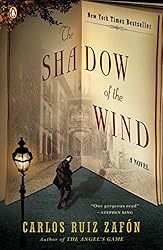
The Shadow of the Wind (Cemetery of Lost Books series 1)
Carlos Ruiz Zafron, Lucia Graves (trans.), 2001
Penguin Group USA
496 pp.
ISBN-13: 9780143034902
Summary
Barcelona, 1945
A great world city lies shrouded in secrets after the war, and a boy mourning the loss of his mother finds solace in his love for an extraordinary book called The Shadow of the Wind, by an author named Julian Carax.
When the boy searches for Carax's other books, it begins to dawn on him, to his horror, that someone has been systematically destroying every copy of every book the man has ever written.
Soon the boy realizes that The Shadow of the Wind is as dangerous to own as it is impossible to forget, for the mystery of its author's identity holds the key to an epic story of murder, madness, and doomed love that someone will go to any lengths to keep secret. (From the publisher.)
Author Bio
• Birth—September 25, 1964
• Where—Barcelona, Spain
• Awards—Edebe Children's Literary Award, Best Novel, 1993
• Currently—lives in Barcelona and Los Angeles, California, USA
Carlos Ruiz Zafon is a Spanish novelist. His first novel, El Príncipe de la Niebla (The Prince of Mist, 1993), earned the Edebe literary prize for young adult fiction. He is also the author of three more young adult novels, El Palacio de la Medianoche (1994), Las Luces de Septiembre (1995) and Marina (1999). The English version of El Príncipe de la Niebla was published in 2010.
In 2001 he published the novel La Sombra del Viento (The Shadow of the Wind), his first "adult" novel, which has sold millions of copies worldwide. Since its publication, La Sombra del Viento has garnered critical acclaim around the world and has won many international awards. His next novel, El Juego del Angel, was published in April 2008. The English edition, The Angel's Game, is translated by Lucia Graves, daughter of the poet Robert Graves. It is a prequel to The Shadow of the Wind, also set in Barcelona, but during the 1920s and 1930s. It follows (and is narrated by) David Martin, a young writer who is approached by a mysterious figure to write a book. Ruiz Zafon intends it to be included in a four book series along with The Shadow of the Wind. The Third book in the cycle, El Prisionero del Cielo, appeared in 2011, and was published in English in 2012 as The Prisoner of Heaven.
Ruiz Zafon's works have been published in 45 countries and have been translated into more than 50 different languages. According to these figures, Ruiz Zafon is the most successful contemporary Spanish writer (along with Javier Sierra and Juan Gomez-Jurado). Influences on Ruiz Zafon's work have included 19th century classics, crime fiction, noir authors and contemporary writers.
Apart from books, another large influence comes in the form of films and screenwriting. He says in interviews that he finds it easier to visualize scenes in his books in a cinematic way, which lends itself to the lush worlds and curious characters he creates. (From Wikipedia.)
Extras
From a 2005 Barnes & Noble interview:
• In my tender youth I worked as a musician (composer, arranger and keyboard player/synthesizer programmer, record producer, etc.) and I've also labored for seven long years in the advertising jungle as a cynical mercenary, first as a copywriter, then a creative director (whatever that means) and also producing/directing TV commercials and polluting the world with artifacts glorifying Visa, Audi, Sony, Volkswagen, American Express, and many other evil entities. In 1992, when the lease on my soul was about to expire, I quit to become what I always wanted to do, be a full-time writer. Since then, I've published five novels and also have worked occasionally as a screenwriter.
• I am a curious creature and put my finger in as many cakes as I can: history, film, technology, etc. I'm also a freak for urban history, particularly Barcelona, Paris and New York. I know more weird stuff about 19th-century Manhattan than is probably healthy.
• There are two things that I cannot live without: music and books. Caffeine isn't dignified enough to qualify.
• When asked what authors most influenced his career as a writer, here is his response:
Charles Dickens and all of the 19th-century giants. (From Barnes & Noble.)
Book Reviews
The melodrama and complications of Shadow, expertly translated by Lucia Graves, can approach excess, though it's a pleasurable and exceedingly well-managed excess. We are taken on a wild ride—for a ride, we may occasionally feel—that executes its hairpin bends with breathtaking lurches.
Richard Eder - The New York Times
Anyone who enjoys novels that are scary, erotic, touching, tragic and thrilling should rush right out to the nearest bookstore and pick up The Shadow of the Wind. Really, you should.
Michael Dirda - The Washington Post
A thriller, a historical novel and a comedy of manners, but above all, the story of a tragic love...with great narrative skill, the author interweaves his plots and enigmas, like a set of Russian dolls in an unforgettable story about the secrets of the heart and the enchantment of books, maintaining the suspense right to the very last page.
La Vanguardia
As magnetic as The Dumas Club, as unsettling as The Mystery of the Haunted Crypt and with a plot as complex and well rounded as The Name of The Rose — to be recommended one hundred percent.
La Razon
I was enthralled by Zafon's book and it gave me many hours of great delight. Not only because the story is set in a book shop, not only because it is about the search and the hunt for books and there is a library of forgotten books to be discovered, but because The Shadow of the Wind is suspenseful like a thriller, poetic like a love story, sometimes mysterious like its title, and because it describes the characters and the storyline so wonderfully that the reader wants to be a part of it. A paean to reading and to the love of books.
Westdeutscher Rundfunk
Ruiz Zafon strives for a literary tone, and no scene goes by without its complement of florid, cute and inexact similes and metaphors…. [T]he colorful cast of characters, the gothic turns and the straining for effect only give the book the feel of… the Hollywood version of a great 19th-century novel.
Publishers Weekly
[C]omplex, Byzantine, at times longwinded work…. Recommended primarily for public libraries and especially for readers who lead double lives as bibliophiles. —Lawrence Olszewski, OCLC Lib., Dublin, OH
Library Journal
The histories of a mysterious book and its enigmatic author are painstakingly disentangled in this yeasty Dickensian romance…. The Shadow of the Wind will keep you up nights—and it'll be time well spent. Absolutely marvelous.
Kirkus Reviews
Discussion Questions
1. Julián Carax's and Daniel's lives follow very similar trajectories. Yet one ends in tragedy, the other in happiness. What similarities are there between the paths they take? What are the differences that allow Daniel to avoid tragedy?
2. Nuria Monfort tells Daniel, "Julián once wrote that coincidences are the scars of fate. There are no coincidences, Daniel. We are the puppets of our unconscious." What does that mean? What does she refer to in her own experience and in Julián's life?
3. Nuria Monfort's dying words, meant for Julián, are, "There are worse prisons than words." What does she mean by this? What is she referring to?
4. There are many devil figures in the story-Carax's Laín Coubert, Jacinta's Zacarias, Fermín's Fumero. How does evil manifest itself in each devil figure? What are the characteristics of the villains/devils?
5. Discuss the title of the novel. What is "The Shadow of the Wind"? Where does Zafón refer to it and what does he use the image to illustrate?
6. Zafón's female characters are often enigmatic, otherworldly angels full of power and mystery. Clara the blind white goddess ultimately becomes a fallen angel; Carax credits sweet Bea with saving his and Daniel's lives; Daniel's mother is actually an angel whose death renders her so ephemeral that Daniel can't even remember her face. Do you think Zafón paints his female characters differently than his male characters? What do the women represent in Daniel's life? What might the Freud loving Miquel Moliner say about Daniel's relationships with women?
7. Daniel says of The Shadow of the Wind, "As it unfolded, the structure of the story began to remind me of one of those Russian dolls that contain innumerable ever-smaller dolls within" (p. 7). Zafón's The Shadow of the Wind unfolds much the same way, with many characters contributing fragments of their own stories in the first person point of view. What does Zafón illustrate with this method of storytelling? What do the individual mini-autobiographies contribute to the tale?
8. The evil Fumero is the only son of a ridiculed father and a superficial, status-seeking mother. The troubled Julián is the bastard son of a love-starved musical mother and an amorous, amoral businessman, though he was raised by a cuckolded hatmaker. Do you think their personalities are products of nature or nurture? How are the sins of the fathers and mothers visited upon each of the characters?
(Questions from the publisher.)


Shadow Tag
Louise Erdrich, 2010
HarperCollins
272 pp.
ISBN-13: 9780061536106
Summary
When Irene America discovers that her husband, Gil, has been reading her diary, she begins a secret Blue Notebook, stashed securely in a safe-deposit box.
There she records the truth about her life and her marriage, while turning her Red Diary—hidden where Gil will find it—into a manipulative farce. Alternating between these two records, complemented by unflinching third-person narration, Shadow Tag is an eerily gripping read.
When the novel opens, Irene is resuming work on her doctoral thesis about George Catlin, the nineteenth-century painter whose Native American subjects often regarded his portraits with suspicious wonder. Gil, who gained notoriety as an artist through his emotionally revealing portraits of his wife—work that is adoring, sensual, and humiliating, even shocking—realizes that his fear of losing Irene may force him to create the defining work of his career.
Meanwhile, Irene and Gil fight to keep up appearances for their three children: fourteen-year-old genius Florian, who escapes his family's unraveling with joints and a stolen bottle of wine; Riel, their only daughter, an eleven-year-old feverishly planning to preserve her family, no matter what disaster strikes; and sweet kindergartener Stoney, who was born, his parents come to realize, at the beginning of the end.
As her home increasingly becomes a place of violence and secrets, and she drifts into alcoholism, Irene moves to end her marriage. But her attachment to Gil is filled with shadowy need and delicious ironies.
In brilliantly controlled prose, Shadow Tag fearlessly explores the complex nature of love, the fluid boundaries of identity, and one family's struggle for survival and redemption. (From the publisher.)
Author Bio
• Birth—June 7, 1954
• Where—Little Falls, Minnesota, USA
• Education—A.B., Dartmouth College; M.A., Johns Hopkins
• Awards—National Book Award; National Book Critics Circle Award; Nelson Algren Prize
• Currently—lives in Minnesota
Karen Louise Erdrich is an author of some 20 novels, as well as poetry, short stories, and children's books. She has some Native American ancestry and is widely acclaimed as one of the most significant writers of the second wave of what critic Kenneth Lincoln has called the Native American Renaissance.
In 1984, Erdrich won the National Book Critics Circle Award for her debut novel, Love Medicine. In 2009, her novel The Plague of Doves was named a finalist for the Pulitzer Prize in Fiction, and three years later, in 2012, she won the National Book Award for Round House.
Erdrich is the owner of Birchbark Books, a small independent bookstore in Minneapolis, Minnesota. The eldest of seven children, Erdrich was born to Ralph and Rita Erdrich in Little Falls, Minnesota. Her father was German-American while her mother was French and Anishinaabe (Ojibwa). Her grandfather Patrick Gourneau served as a tribal chairman for the Turtle Mountain Band of Chippewa Indians. Erdrich grew up in Wahpeton, North Dakota where her parents taught at the Bureau of Indian Affairs school.
She attended Dartmouth College in 1972-1976, earning an AB degree and meeting her future husband, the Modoc anthropologist and writer Michael Dorris. He was then director of the college’s Native American Studies program. Subsequently, Erdrich worked in a wide variety of jobs, including as a lifeguard, waitress, poetry teacher at prisons, and construction flag signaler. She also became an editor for The Circle, a newspaper produced by and for the urban Native population in Boston. Erdrich graduated with a Master of Arts degree in creative writing from Johns Hopkins University in 1979.
In the period 1978-1982, Erdrich published many poems and short stories. It was also during this period that she began collaborating with Dorris, initially working through the mail while Dorris was working in New Zealand. The relationship progressed, and the two were married in 1981. During this time, Erdrich assembled the material that would eventually be published as the poetry collection Jacklight.
In 1982, Erdrich's story "The World’s Greatest Fisherman" was awarded the $5,000 Nelson Algren Prize for short fiction. This convinced Erdrich and Dorris, who continued to work collaboratively, that they should embark on writing a novel.
Early Novels
In 1984, Erdrich published the novel Love Medicine. Made up of a disjointed but interconnected series of short narratives, each told from the perspective of a different character, and moving backwards and forward in time through every decade between the 1930s and the present day, the book told the stories of several families living near each other on a North Dakota Ojibwe reservation.
The innovative techniques of the book, which owed a great deal to the works of William Faulkner but have little precedent in Native-authored fiction, allowed Erdrich to build up a picture of a community in a way entirely suited to the reservation setting. She received immediate praise from author/critics such as N. Scott Momaday and Gerald Vizenor, and the book was awarded the 1984 National Book Critics Circle Award. It has never subsequently been out of print.
Erdrich followed Love Medicine with The Beet Queen, which continued her technique of using multiple narrators, but surprised many critics by expanding the fictional reservation universe of Love Medicine to include the nearby town of Argus, North Dakota. Native characters are very much kept in the background in this novel, while Erdrich concentrates on the German-American community. The action of the novel takes place mostly before World War II.
The Beet Queen was subject to a bitter attack from Native novelist Leslie Marmon Silko, who accused Erdrich of being more concerned with postmodern technique than with the political struggles of Native peoples.
Erdrich and Dorris’ collaborations continued through the 1980s and into the 1990s, always occupying the same fictional universe.
Tracks goes back to the early 20th century at the formation of the reservation and introduces the trickster figure of Nanapush, who owes a clear debt to Nanabozho. Erdrich’s novel most rooted in Anishinaabe culture (at least until Four Souls), it shows early clashes between traditional ways and the Roman Catholic Church.
The Bingo Palace updates but does not resolve various conflicts from Love Medicine: set in the 1980s, it shows the effects both good and bad of a casino and a factory being set up among the reservation community. Finally, Tales of Burning Love finishes the story of Sister Leopolda, a recurring character from all the former books, and introduces a new set of white people to the reservation universe.
Erdrich and Dorris wrote The Crown of Columbus, the only novel to which both writers put their names, and A Yellow Raft in Blue Water, credited to Dorris. Both of these were set away from the Argus reservation.
Domestic Life
The couple had six children, three of them adopted. Dorris had adopted the children when he was single. After their marriage, Erdrich also adopted them, and the couple had three daughters together. Some of the children had difficulties.
In 1989 Dorris published The Broken Cord, a book about fetal alcohol syndrome, from which their adopted son Reynold Abel suffered. Dorris had found it was a widespread and until then relatively undiagnosed problem among Native American children because of mothers' alcohol issues. In 1991, Reynold Abel was hit by a car and killed at age 23.
In 1995 their son Jeffrey Sava accused them both of child abuse. Dorris and Erdrich unsuccessfully pursued an extortion case against him. Shortly afterward, Dorris and Erdrich separated and began divorce proceedings. Erdrich claimed that Dorris had been depressed since the second year of their marriage.
On April 11, 1997, Michael Dorris committed suicide in Concord, New Hampshire.
Later Writings
Erdrich’s first novel after divorce, The Antelope Wife, was the first to be set outside the continuity of the previous books. She has subsequently returned to the reservation and nearby towns, and has produced five novels since 1998 dealing with events in that fictional area. Among these are The Master Butchers Singing Club, a macabre mystery which again draws on Erdrich's Native American and German-American heritage, and The Last Report on the Miracles at Little No Horse. Both have geographic and character connections with The Beet Queen.
Together with several of her previous works, these have drawn comparisons with William Faulkner’s Yoknapatawpha novels. The successive novels have created multiple narratives in the same fictional area and combined the tapestry of local history with current themes and modern consciousness.
In The Plague of Doves, Erdrich has continued the multi-ethnic dimension of her writing, weaving together the layered relationships among residents of farms, towns and reservations; their shared histories, secrets, relationships and antipathies; and the complexities for later generations of re-imagining their ancestors' overlapping pasts. The novel was a finalist for the Pulitzer Prize in 2009.
Erdrich's 2010 book, Shadow Tag, was a departure for her, as she focuses on a failed marriage.
Erdrich is an enrolled member of the Anishinaabe nation (also known as Ojibwa and Chippewa). Erdrich also has German, French and American ancestry. One sister, Heidi, publishes under the name Heid E. Erdrich; she is a poet who also resides in Minnesota. Another sister, Lise Erdrich, has written children's books and collections of fiction and essays. For the past few years, the three Erdrich sisters have hosted annual writers workshops on the Turtle Mountain Indian Reservation in North Dakota.
The award-winning photographer Ronald W. Erdrich is one of their cousins. He lives and works in Abilene, Texas. He was named "Star Photojournalist of the Year" in 2004 by the Texas Associated Press Managing Editors association. (Adapted from Wikipedia.)
Book Reviews
[I]n places, Shadow Tag seems more like notes for a novel than fully realized fiction.... Elsewhere, though, Erdrich’s unbridled urgency yields startlingly original phrasing...as well as flashes of blinding lucidity.... [T]he character to whom, in the end, Erdrich assigns all agency, all authorial power, changes our understanding of everything that has come before. The choice feels wistful, possibly noble and almost unbearably sad.
Leah Hager Cohen - New York Times Book Review
[A] tense little masterpiece of marital strife that recalls [Erdrich's] tragic relationship with the poet Michael Dorris. Gossips will trace the story's parallels to the author's life, but for all its voyeuristic temptations, Shadow Tag is no roman a clef, no act of spousal revenge on her estranged husband, who committed suicide in 1997. Instead, Erdrich has done what so many writers can't or won't do in this age of self-exposure: transform her own wrenching experience into a captivating work of fiction that says far more about the universal tragedy of spoiled love than it reveals about her private life.
Ron Charles - Washington Post
A fast-paced novel of exceptional artistic, intellectual, and psychological merit.... Nowhere have love’s complications been better illustrated than in the raw honesty of Shadow Tag.
Boston Globe
Shadow Tag is hard to put down...It builds to a spectacular ending with a twist I didn’t see coming.... Erdrich has taken a tragedy and turned it into art.
Philadelphia Inquirer
Read this if: You’re looking for a well-written, well-told tale that is thought—and discussion—provoking.
Baltimore Sun
Erdrich's bleak latest (after The Plague of Doves) chronicles the collapse of a family. Irene America is a beautiful, introspective woman of Native American ancestry, struggling to finish her dissertation while raising three children. She is married to Gil, a painter whose reputation is built on a series of now iconic portraits of Irene, but who can't break through to the big time, pigeonholed as a Native American painter. Irene's fallen out of love with Gil and discovers that he's been reading her diary, so she begins a new, hidden, diary and uses her original diary as a tool to manipulate Gil. Erdrich deftly alternates between excerpts from these two diaries and third-person narration as she plots the emotional war between Irene and Gil, and Gil's dark side becomes increasingly apparent as Irene, fighting her own alcoholism, struggles to escape. Erdrich ties her various themes together with an intriguing metaphor—riffing on Native American beliefs about portraits as shadows and shadows as souls—while her steady pacing and remarkable insight into the inner lives of children combine to make this a satisfying and compelling novel.
Publishers Weekly
Irene America is a smart, beautiful Minneapolis Ojibwe. Too distracted to finish her doctoral degree, she musters the emotional resources needed to keep two journals. The "Red Diary" is bait, filled with adulterous scenes that Irene uses to push volatile artist husband Gil close enough to the brink that he'll leave her. She unleashes all her rage and frustration in the "Blue Notebook," which she keeps in a bank deposit box. Meanwhile, Gil believes that his obsessive graphic paintings of Irene will somehow lure her back to him. Caught in the crosshairs of their parents' cruel, messy unraveling are 13-year-old Florian, a genius who models his mother's excessive drinking habits; Riel, 11, who believes that only she can hold her disintegrating family together; and sunny little Stoney. Verdict: Erdrich's latest is a brilliant cautionary tale of the shocking havoc willfully destructive, self-centered spouses wreak not only upon themselves but also upon their children. Reading it is like watching a wildfire whose flames are so mesmerizingly beautiful that it's almost easy to ignore the deadly mess left behind. —Beth E. Andersen, Ann Arbor Dist. Lib., MI
Library Journal
An exquisite, character-driven tale...its piercing insights into sex, family, and power are breathtaking…A masterfully concentrated and gripping novel of image and conquest, autonomy and love, inheritance and loss. —Donna Seaman
Booklist
Taking a risky leap, Erdrich sets aside the magical-realist style of her many volumes about the Ojibwes to write a domestic tragedy set among sophisticated, assimilated, highly educated and successful Native Americans. Gil and Irene live with their kids Florian, Riel and Stony in a seemingly idyllic home in Minneapolis. Gil is a renowned painter, Irene the subject of his graphically revealing portraits. Also a gifted historian, she is currently doing research for her doctorate dissertation about the painter George Catlin. Self-consciously aware of their heritage, Gil (raised in poverty by his white mother after his Native American father's death in Vietnam) and Irene (given a middle-class upbringing by her AIM activist mother) know that observers consider them an iconic couple. But Gil has a habit of brutalizing the children he cherishes, and Irene cannot relinquish the glass of wine always in her hand to protect them. When Irene realizes that Gil has been reading her diary, she feels her soul has been invaded. She begins writing entries to play with his mind, torturing him about an affair he imagines she is having. Obsessed with his love for Irene, Gil thinks that he wants to save the marriage. Irene thinks that she wants to free herself from Gil. Both are lying to themselves. Erdrich's unsparing prose dissects these two deeply flawed characters to show their ugliest selves, yet she allows them each their moments of joy and spiritual respite alone, together and with their children. Into this deeply personal novel about marriage, family and individual identity, she also weaves broader questions about cause and effect in history—specifically the effect Catlin's painting of Native Americans had on them and on him—that resonate within her characters' lives. Readers familiar with Erdrich's personal life may suspect she has written close to the bone here, but she manages the rare achievement of rising above the facts she has incorporated to create a small masterpiece of compelling, painfully moving fiction.
Kirkus Reviews
Discussion Questions
Use our LitLovers Book Club Resources; they can help with discussions for any book:
• How to Discuss a Book (helpful discussion tips)
• Generic Discussion Questions—Fiction and Nonfiction
• Read-Think-Talk (a guided reading chart)
Also consider these LitLovers talking points to help get a discussion started for Shadow Tag:
1. Start with the title....what is its significance within the scope of the story? What does it mean to step on a shadow?
2. Describe both Gil and Irene. What kind of people are they, and what is their relationship with one another? What does each character want from the other...or not want?
3. Care to comment on this passage?
They might hate each other, at least, Irene might hate Gil, while he had no idea how much he hated Irene because he was so focused on winning back her love.
Is this an accurate assessment? Do the two hate one another?
4. What kind of parents are Irene and Gil? Why doesn't Irene protect the children from Gil's abuse? How are Florian, Riel, and Stony protrayed...and how are they affected by the family's dysfunction?
5. Gil uses Irene as a model for his paintings...while Irene is studying a Native American painter whose subjects died soon after they were painted. Talk about this as a metaphor within the story—the affect that Gil's paintings have on Irene and her sense of identity?
6. Why does Irene keep two diaries? Who is at fault here when it comes to duplicity and/or stealth? Which is more important in a marriage—respect for privacy or transparency and truth?
7. Do you care about these characters—are either (or any of them) sympathetic? Does this book have a villain?
8. Does the 3rd-person narrator seem to side with Irene? If so, does it influence your attitude toward the characters? Is the narrator reliable?
9. What about the ending? Do you feel it is "almost unbearably sad" as the New York Times reviewer writes? Would you like to have seen it end differently? Would a different ending have maintained the novel's integrity?
(Questions by LitLovers. Please feel free to use them, online or off, with attribution. Thanks.)
top of page (summary)

Shakespeare for Squirrels
Christopher Moore, 2020
HarperCollins
288 pp.
ISBN-13: 9780062434029
Summary
Shakespeare meets Dashiell Hammett in this wildly entertaining murder mystery from Christopher Moore—an uproarious, hardboiled take on the Bard’s most performed play, A Midsummer Night’s Dream.
Set adrift by his pirate crew, Pocket of Dog Snogging—last seen in The Serpent of Venice—washes up on the sun-bleached shores of Greece, where he hopes to dazzle the Duke with his comedic brilliance and become his trusted fool.
But the island is in turmoil.
Egeus, the Duke’s minister, is furious that his daughter Hermia is determined to marry Demetrius, instead of Lysander, the man he has chosen for her. The Duke decrees that if, by the time of the wedding, Hermia still refuses to marry Lysander, she shall be executed… or consigned to a nunnery.
Pocket, being Pocket, cannot help but point out that this decree is complete bollocks, and that the Duke is an egregious weasel for having even suggested it. Irritated by the fool’s impudence, the Duke orders his death.
With the Duke’s guards in pursuit, Pocket makes a daring escape. He soon stumbles into the wooded realm of the fairy king Oberon, who, as luck would have it, is short a fool. His jester Robin Goodfellow—the mischievous sprite better known as Puck—was found dead. Murdered.
Oberon makes Pocket an offer he can’t refuse: he will make Pocket his fool and have his death sentence lifted if Pocket finds out who killed Robin Goodfellow.
But as anyone who is even vaguely aware of the Bard’s most performed play ever will know, nearly every character has a motive for wanting the mischievous sprite dead.
With too many suspects and too little time, Pocket must work his own kind of magic to find the truth, save his neck, and ensure that all ends well.
A rollicking tale of love, magic, madness, and murder, Shakespeare for Squirrels is a Midsummer Night’s noir—a wicked and brilliantly funny good time conjured by the singular imagination of Christopher Moore. (From the publisher.)
Author Bio
• Birth—August 5, 1958
• Where—Toledo, Ohio, USA
• Education—Ohio State Univ., Brooks Inst. of Photography
• Awards—Quill Award, 2005 and 2006
• Currently—Hawaii and San Francisco, California
A 100-year-old ex-seminarian and a demon set off together on a psychotic road trip...
Christ's wisecracking childhood pal is brought back from the dead to chronicle the Messiah's "missing years"...
A mild-mannered thrift shop owner takes a job harvesting souls for the Grim Reaper...
Whence come these wonderfully weird scenarios? From the fertile imagination of Christopher Moore, a cheerfully demented writer whose absurdist fiction has earned him comparisons to master satirists like Kurt Vonnegut, Terry Pratchett, and Douglas Adams.
Ever since his ingenious debut, 1992's Practical Demonkeeping and his 2002 Lamb: The Gospel According to Biff , Moore has attracted an avid cult following. But, over the years, as his stories have become more multi-dimensional and his characters more morally complex, his fan base has expanded to include legions of enthusiastic general readers and appreciative critics.
Asked where his colorful characters come from, Moore points to his checkered job resume. Before becoming a writer, he worked at various times as a grocery clerk, an insurance broker, a waiter, a roofer, a photographer, and a DJ — experiences he has mined for a veritable rogue's gallery of unforgettable fictional creations. Moreover, to the delight of hardcore fans, characters from one novel often resurface in another. For example, the lovesick teen vampires introduced in 1995's Bloodsucking Fiends are revived (literally) for the 2007 sequel You Suck—which also incorporates plot points from 2006's A Dirty Job.
For a writer of satirical fantasy, Moore is a surprisingly scrupulous researcher. In pursuit of realistic details to ground his fiction, he has been known to immerse himself in marine biology, death rituals, Biblical scholarship, and Goth culture. He has been dubbed "the thinking man's Dave Barry" by none other than The Onion, a publication with a particular appreciation of smart humor.
As for story ideas, Moore elaborates on his website: "Usually [they come] from something I read. It could be a single sentence in a magazine article that kicks off a whole book. Ideas are cheap and easy. Telling a good story once you get an idea is hard." Perhaps. But, to judge from his continued presence on the bestseller lists, Chris Moore appears to have mastered the art.
Extras
From a 2006 Barnes & Noble interview:
• In researching his wild tales, Moore has done everything from taking excursions to the South Pacific to diving with whales. So what is left for the author to tackle? He says he'd like to try riding an elephant.
• One of the most memorably weird moments in Moore's body of work is no fictional invention. The scene in Bloodsucking Fiends where the late-night crew of a grocery store bowls with frozen turkeys is based on Moore's own experiences bowling with frozen turkeys while working the late shift at a grocery store.
• When asked what book influenced his career as a writer, he answered:
Cannery Row by John Steinbeck. In Cannery Row, Steinbeck writes about very flawed people, but with great affection, and by doing so, shows us that it is our flaws that make us human, and that is what we share, that is our humanity. A friend of mine used to say, "He writes with the voice of a benevolent God." In the process, the book is also very funny. I think I saw that as a model, as a guide. I'd always written humor that was fairly edgy, but here was a guy writing with great power and gentle humor. I was moved and inspired." (Author bio Barnes & Noble.)
Book Reviews
A hilariously noir tale of love, magic and murder.
USA Today
Buckle in for Shakespeare for Squirrels, an uproarious take on Shakespeare’s A Midsummer Night’s Dream—transformed into a murder mystery.… A funny, fast-paced, and wild read.
Huffington Post
Moore’s amusing third installment to the Fool series…. In this raucous, crass, and innuendo-filled romp, Moore once again delivers light and derivative fun. This cheeky homage will please lovers of Shakespeare and camp.
Publishers Weekly
(Starred review) Moore's trademark humor is on full display with his cast of strangely lovable characters. This is Shakespeare with an edge and will not only appeal to Moore's fans but garner new ones. —Kristen Stewart, Pearland Lib., Brazoria Cty. Lib. Syst., TX
Library Journal
(Starred review) It takes a certain amount of guts and wild abandon to recast a Shakespeare comedy as a hard-boiled detective story, but if anyone can pull it off, it’s master satirist Moore, whose gift for funny business apparently knows no bounds.
Booklist
(Starred review) Nobody writes mystery novels quite like Christopher Moore…. As hilarious as A Midsummer Night’s Dream is to begin with, Moore adds a contemporary dose of sly humor that I think would impress the Bard.
Bookpage
Manic parodist Moore… returns with a rare gift for Shakespeare fans…. A kicky, kinky, wildly inventive 21st-century mashup with franker language and a higher body count than Hamlet.
Kirkus Reviews
Discussion Questions
We'll add publisher questions if and when they're available; in the meantime, use our LitLovers talking points to help start a discussion for SHAKESPEARE FOR SQUIRRELS … then take off on your own:
1. Well… is Shakespeare for Squirrels funny? Do you find Moore's humor puerile, cleverly witty, overly raunchy, laugh-out-loud hilarious?
2. Are you familiar with the Bard's original Midsummer Night's Dream? What elements of MsND does Moore build on, and where does he depart?
3. Characters seems to have their own agendas. Who manipulates whom for their own reasons?
4. Do you have a favorite character?
5. Who killed Puck… and why? A number of Athenians would love to have Puck dead; whom did you first suspect?
6. Talk about the way Moore breaks through the 4th wall in his Shakespearean spoof.
7. What do you think Shakespeare himself would have thought of Moore's homage?
(Questions by LitLovers. Please feel free to use them, online and off, with attribution. Thanks.)
Shanghai Girls
Lisa See, 2009
Random House
314 pp.
ISBN-13: 9780812980530
Summary
In 1937, Shanghai is the Paris of Asia, a city of great wealth and glamour, the home of millionaires and beggars, gangsters and gamblers, patriots and revolutionaries, artists and warlords. Thanks to the financial security and material comforts provided by their father’s prosperous rickshaw business, twenty-one-year-old Pearl Chin and her younger sister, May, are having the time of their lives. Though both sisters wave off authority and tradition, they couldn’t be more different: Pearl is a Dragon sign, strong and stubborn, while May is a true Sheep, adorable and placid. Both are beautiful, modern, and carefree...until the day their father tells them that he has gambled away their wealth and that in order to repay his debts he must sell the girls as wives to suitors who have traveled from California to find Chinese brides.
As Japanese bombs fall on their beloved city, Pearl and May set out on the journey of a lifetime, one that will take them through the Chinese countryside, in and out of the clutch of brutal soldiers, and across the Pacific to the shores of America. In Los Angeles they begin a fresh chapter, trying to find love with the strangers they have married, brushing against the seduction of Hollywood, and striving to embrace American life even as they fight against discrimination, brave Communist witch hunts, and find themselves hemmed in by Chinatown’s old ways and rules.
At its heart, Shanghai Girls is a story of sisters: Pearl and May are inseparable best friends who share hopes, dreams, and a deep connection, but like sisters everywhere they also harbor petty jealousies and rivalries. They love each other, but each knows exactly where to drive the knife to hurt the other the most. Along the way they face terrible sacrifices, make impossible choices, and confront a devastating, life-changing secret, but through it all the two heroines of this astounding new novel hold fast to who they are–Shanghai girls. (From the publisher.)
Author Bio
• Birth—February 18, 1955
• Where—Paris, France
• Education—B.A., Loyola Marymount University
• Currently—lives in Los Angeles, California
Lisa See is the New York Times bestselling author of Shanghai Girls; Peony in Love; Snow Flower and the Secret Fan; Flower Net (an Edgar Award nominee); The Interior; and Dragon Bones, as well as the critically acclaimed memoir On Gold Mountain. The Organization of Chinese American Women named her the 2001 National Woman of the Year. She lives in Los Angeles. (From the publisher.)
More
At first glance, Lisa See would not seem to be a likely candidate for literary voice of Chinese-American women. With her flaming red hair and freckled complexion, she hardly adheres to any stereotypical conceptions of what an Asian-American woman should look like, however, her familial background has given her roots in Chinese culture that have fueled her eloquent, elegant, and exciting body of work.
See grew up in the Chinatown section of Los Angeles. Although she is only 1/8 Chinese, her upbringing provided her with a powerful connection to that fraction of herself. "I really grew up in this very traditional, old Chinese family," she revealed in an interview with Barnes & Noble.com. "It was very traditional, but also quite magical in a lot of ways, because I really was in a very different culture then how I looked."
See's Chinese background was not the only aspect of her family that affected the course her life has taken. She also comes from a long line of writers and novelists. Her somewhat morose relatives initially led her to believe that writing must be the result of suffering and pain, which turned her off from literary pursuits at first. Ironically, despite her strong family roots, See only decided to try her hand at writing as a means of embarking on a lifestyle without roots.
I knew three things. I never wanted to get married, I never wanted to have children, and I only wanted to live out of a suitcase. How am I gonna do it? And I was really thinking about it, and then one morning, I woke up, and it was truly like a light bulb went off —‘Oh, I could be a writer!' Many, many years later, here I am, married, I have children, [and] I am a writer.
In the wake of this unexpected epiphany, Lisa See began work on her first book On Gold Mountain: The One-Hundred-Year Odyssey of My Chinese-American Family. This highly detailed family history charted the events that led her great-grandfather Fong See to become the godfather of her Chinatown neighborhood and the 100-year-old patriarch of her family. See interviewed close to 100 of her relatives while researching the book that both gave her a clearer portrait of how her racially mixed family developed and broke her into the publishing business.
See then went on to explore other aspects of both Chinese and American culture via fiction. She followed her debut with a series of popular political thrillers set in China and featuring American attorney David Stark. Her novel Snow Flower and the Secret Fan abandons Stark and his pursuit of justice for the time being with a tale that reaches much further back into Chinese culture, and more specifically, the subordinate role women have traditionally played in that culture. This more personal novel scored accolades while also further solidifying her role as a significant Chinese-American writer. And See's Peony in Love (2007) is a jarring historical novel set against the backdrop of an early-17th-century Chinese opera.
See's position in the Chinese-American community has also extended beyond her writing. She was honored by the Organization of Chinese American Women as National Woman of the Year in 2001 and is also responsible for designing a walking tour of her Chinatown home in L.A. Her devotion to that apparently-small, but actually-vast, 1/8 of her ethnicity proves that well-worn adage about never judging a book by looking at its cover. (From the author's website.)
Extras
• I never wanted to be a writer. My mother and my grandfather were both writers. When I was a kid, they both took the position that writing was about suffering and pain, so you can see why I didn't want to be a writer. There came a time when I was about twenty and living in Greece, and I knew three things: I didn't want to get married, I didn't want to have children, and I only wanted to live out of a suitcase. But how was I going to support myself and how was this ever going to happen? One morning I woke up and it was like a light bulb went off: ‘Ah, I could be a writer.' Within twenty-four hours of returning back to the States I had my first two magazine assignments. But if you've been reading this at all closely, you know that I got married and had children. And thank God, because I would have been a pretty boring person and not a very good writer if I didn't have those three people in my life. But I still do love to live out of a suitcase and have been writing most of these answers on a plane from Shanghai to San Francisco.
• When asked about what book influenced her as a writer, here is her response:
Angle of Repose by Wallace Stegner. I read this novel just before I started writing On Gold Mountain. I loved the way Stegner combined family story with history. I know that this book has come under severe criticism in recent years for possible plagiarism. Nevertheless, it inspired and continues to inspire me. (Bio and interview from a 2005 Barnes and Noble interview.)
Book Reviews
Lisa See's Shanghai Girls is much loftier than its cover art's stunning portrait....The author of Snow Flower and the Secret Fan has written a broadly sweeping tale that opens in Shangai in 1937. he detail is thoughtful and intricate in ways that hardly qualify ththis book as the stuff of chick lit.
Janet Maslin - New York Times
Examining the chains of friendship within the confines of family, See’s kaleidoscopic saga transits from the barbaric horrors of Japanese occupation to the sobering indignities suffered by foreigners in 1930s Hollywood while offering a buoyant and lustrous paean to the bonds of sisterhood.
Booklist
See (Snow Flower; Peony in Love) explores tradition, the ravages of war and the importance of family in her excellent latest. Pearl and her younger sister, May, enjoy an upper-crust life in 1930s Shanghai, until their father reveals that his gambling habit has decimated the family's finances and to make good on his debts, he has sold both girls to a wealthy Chinese-American as wives for his sons. Pearl and May have no intention of leaving home, but after Japanese bombs and soldiers ravage their city and both their parents disappear, the sisters head for California, where their husbands-to-be live and where it soon becomes apparent that one of them is hiding a secret that will alter each of their fates. As they adjust to marriage with strangers and the challenges of living in a foreign land, Pearl and May learn that long-established customs can provide comfort in unbearable times. See's skillful plotting and richly drawn characters immediately draw in the reader, covering 20 years of love, loss, heartbreak and joy while delivering a sobering history lesson. While the ending is ambiguous, this is an accomplished and absorbing novel.
Publishers Weekly
In prewar 1930s Shanghai, carefree sisters Pearl Chin and younger, prettier May are the "beautiful girls" whose images on posters beckon viewers to buy products. They openly scoff at their parents' superstitious, old-world ways, but they soon learn that the good life is but an illusion. The Japanese army's brutal invasion of the city makes their lives as beautiful girls impossible. Their businessman father loses everything to the ruthless mob, and to pay off his debts he forces his daughters into arranged marriages to Chinese men living in the United States. See is masterly in her powerful depictions of the prejudice and harsh treatment the sisters encounter as they try to assimilate into the strange new world of Los Angeles. Possibly the best book yet from the author of Peony in Love; highly recommended.
Library Journal
Two sisters escape war-ravaged Shanghai, only to face discrimination and the threat of deportation in the United States. See's latest fictional exploration of the lives of Chinese women begins in 1937 Shanghai, a cosmopolitan city under imminent threat of Japanese invasion. As oblivious to rumors of their beloved city's collapse as they are to their family's circumstances, Pearl Chin and her younger sister May continue to shop, frequent nightclubs and pose for illustrator Z.G.'s advertising calendars featuring "Beautiful Girls." However, Papa Chin, having lost his fortune to gambling debts, has sold his daughters into marriage to Sam and Vern, sons of Chinese-American entrepreneur Old Man Louie. After hasty weddings (only Pearl's union, with Sam, is consummated), the brides refuse to accompany their husbands to California. When Shanghai is bombed and Papa abruptly disappears, the women and their mother join the stream of refugees fleeing the Japanese on foot. Along the way, Pearl and her mother are brutally raped by Japanese soldiers, while May hides. Their mother does not survive, but the Chins reach Hong Kong and embark for the United States, having decided, in desperation, to join their husbands. At San Francisco's notorious Angel Island immigrant-internment center, May, pregnant by a boyfriend, prolongs the sisters' already extended quarantine until she is able to give birth in secrecy. Pearl claims May's daughter Joy as her own and Sam's. Once reunited with their spouses in L.A.'s Chinese district, the former Shanghai princesses must acclimatize themselves to a life of drudgery, toiling in the Louie family's curio shops and restaurants. Despite engrossing complications involving immigration issues and the impact of the '50s Red Scare on Chinese-Americans, the Chinatown section, spanning 20 years, seems overlong. The final chapters, however, wherein Z.G.'s Beautiful Girl artwork resurfaces as Maoist propaganda and the FBI stalks the family, are worth the wait. The close suggests See's next setting may be the People's Republic, a development sure to please her readership.
Kirkus Reviews
Discussion Questions
1. Pearl’s narration is unique because of its level, calm tone throughout— even when the events she describes are horrific. One is reminded of Wordsworth’s reference to “emotion recollected in tranquility.” It is almost as if Pearl is writing in a diary. What was Lisa See trying to accomplish in setting up this counterpoint between her tone and her narrative?
2. Pearl is a Dragon and May is a Sheep. Do you think the two sisters, in their actions in the novel, are true to their birth signs?
3. Which sister is smarter? Which is more beautiful?
4. Each sister believes that her parents loved the other sister more. Who is right about this? Why?
5. Pearl says that parents die, husbands and children can leave, but sisters are for life. Does that end up being true for Pearl? If you have a sister, to what extent does the relationship between Pearl and May speak to your own experience? What’s the difference between a relationship that’s “just like sisters” and a relationship between real sisters? Is there anything your sister could do that would cause an irreparable breach?
6. Z.G. talks about ai kuo, the love for your country, and ai jen, the emotion you feel for the person you love. How do these ideas play out in the novel?
7. Shanghai Girls makes a powerful statement about the mistreatment of Chinese immigrants in the United States. Were you surprised about any of the details in the novel related to this theme?
8. How would you describe the relationship between Pearl and May? How does the fact that both are, in a sense, Joy’s mother affect their relationship? Who loves Joy more and how does she show it?
9. Pearl doesn’t come to mother-love easily or naturally. At what point does she begin to claim Joy as her own? How, where, and why does she continue to struggle with the challenges of being a mother? Do you think this is an accurate portrayal of motherhood?
10. There are times when it seems like outside forces conspire against Pearl—leaving China, working in the restaurant, not finding a job after the war, and taking care of Vern. How much of what happens to Pearl is a product of her own choices?
11. Pearl’s attitude toward men and the world in general is influenced by what happened to her in the shack outside Shanghai. To what extent does she find her way to healing by the end of the novel? Did your attitude toward Old Man Louie change? How do you feel about Sam and his relationship with Pearl and Joy? Did your impression of him change as the novel progressed?
12. The novel begins with Pearl saying, “I am not a person of importance” (p. 3). After Yen-yen dies, Pearl comments: “Her funeral is small. After all, she was not a person of importance, rather just a wife and mother” (p. 246). How do you react to comments like these?
13. Speaking of Yen-yen, Pearl notes: “When we’re packing, Yen-yen says she’s tired. She sits down on the couch in the main room and dies” (p. 246). Why does Pearl describe Yen-yen’s death in such an abrupt way?
14. After Joy points out the differences in the way Z.G. painted her mother and aunt in the Communist propaganda posters, May says, “Everything always returns to the beginning” (p. 267). Pearl has her idea of what May meant, but what do you think May really meant? And what is Pearl’s understanding of this saying at the end of the novel?
15. Near the end of Shanghai Girls, May argues that Pearl and Sam have withdrawn into a world of fear and isolation, not taking advantage of the opportunities open to them. Do you agree with May that much of Pearl’s sadness and isolation is self-imposed? Why or why not?
16. How do clothes define Pearl and May in different parts of the story? How do the sisters use clothes to manipulate others?
17. How does food serve as a gateway to memory in the novel? How does it illustrate culture and tradition both in the novel and in your own family?
18. What influence—if any—do Mama’s beliefs have on Pearl? How do they evolve over time?
19. Pearl encounters a lot of racism, but she also holds many racist views herself. Is she a product of her time? Do her attitudes change during the course of the story?
20. What role does place—Shanghai, Angel Island, China City, and Chinatown—serve in the novel? What do you think Lisa See was trying to say about “home”?
(Questions issued by publisher.)


Shannon Hollow
Chelsey Cosh, 2014
CreateSpace
480 pp.
ISBN-13: 9781503061859
Summary
A generational saga that spans from the dirty thirties to modern day, Shannon Hollow tells the story of a small Utah community and its eclectic mix of residents.
From the spoiled and insatiable housewife to the dancing coal miner's daughter, each has their own little secret to protect.
Faith is tested. Love is put to the limits. Truth is discovered.
Welcome to Shannon Hollow.
Author Bio
• Birth—1991
• Where—Ajax, Ontario, Canada
• Rasied—Greenwood, Ontario, Canada
• Education—attended UOIT; B.A., Must University
• Currently—lives in rural southeastern Ontario, Canada
Chelsey Cosh has been writing all her life.
Formerly entertainment editor and co-webmaster of Canadian literary magazine What If, she mixes her writing with other pleasures, including her love of everything that pop culture and technology has to offer.
Her debut novel, Shannon Hollow, is set in Utah, capturing the experiences and attitudes of a small town's citizens and watching them change through the decades, moving from the dirty thirties right up to modern day. She also writes non-fiction, like Reel Talk: Irreverent Insights on Cinema and Television, a thirteen-essay collection on film and television.
Cosh lives in rural southeastern Ontario.
Visit Chelsey's Goodreads Author Page and her Amazon Central Page.
Discussion Questions
1. Motherhood is an important theme throughout the book. There are many maternal figures, regardless of whether or not they have children. Who do you feel does the best job at being a mother, biological or otherwise? Why do you feel that some characters struggle with motherhood? Do you think any characters are lacking in maternal figures and, if so, do you think this affects their own maternal instincts?
2. In what way do each of the main characters - Diane, Harriet, Wyatt, Elijah, Hector, Francis, and Ruby - reflect their background? Do you feel that any of the characters overcome their origins? Does their background ever help them meet their goals? Do you feel that any of these characters fulfilled his or her destiny?
3. Is Jo (the former beauty queen/stripper that works at Parker Brigham Luft) a good person or a bad person? Explain your impression of her character.
4. Who is Ruby's father? Consider not just biological ties but the father-daughter relationship. Explain your reasoning.
5. Consider Diane Weiss as a character. Do you find her sympathetic? Do your feelings towards her change over the course of the novel? Talk about the points in which Diane shows who she truly is.
6. Consider the many cultures that criss-cross in Shannon Hollow: Diane's French and German ancestry, Harriet's Irish heritage, Elijah's formative years in predominantly Jewish New York, Sora's Japanese lineage, Heloísa's abusive upbringing in Brazil... Considering this multicultural convergence, why do you think that Utah was chosen as the main setting? Do you feel it was an appropriate choice? Why or why not?
7. Consider the reasons why you would or would not want to visit Thistlewood. Is Thistlewood welcoming? Does it invite social gatherings or is it a hiding place? Does Thistlewood hold a deeper meaning, and, if so, what do you think that meaning is?
8. How are the marriages of Wyatt and Harriet, Elijah and Diane, and Aron and Ruby different? How are they similar? Would you consider any of these characters' marriages successful? Why or why not?
9. Luella May and Sora have markedly different marital relationships than those around them. Do you think their unique circumstances isolate them? Consider whether these characters believe their own marriage is successful. Given the chance, do you feel that these characters would adopt a more conventional relationship? Why or why not?
10. What role does religion play in Francis's life? What about Diane? Luella May? Would you consider them "good Christians"? Do you think their moral code is based on religious teachings? Why or why not? How does religion affect each character's attitudes towards sex?
11. Consider the pace of the plot. Is this book driven by the sequence of its events? Or does it focus instead on the characters and their dynamics? Which passages engage you most and why do you think that is?
12. Is the ending satisfying? Do you feel that any characters who deserved to be punished received a fitting comeuppance? If not, what would you change?
13. Consider the title of the book, "Shannon Hollow." Do you feel there is a hidden meaning attached to the title? If so, what do you think it may represent?
14. Cosh divides her story into parts based on the decades. Why? Consider the various decades that Shannon Hollow spans. Do you feel that the characters grow and mature in any major ways? How does the passing of time and the changing social mores affect the characters and their relationships? Do you think that any of the characters would have acted differently if they were part of a more modern generation? How so?
(Questions courtesy of the author.)
Shantaram
Gregory David Roberts
St. Martin's Press
944 pp.
ISBN-13: 9780312330538
Summary
It took me a long time and most of the world to learn what I know about love and fate and the choices we make, but the heart of it came to me in an instant, while I was chained to a wall and being tortured.
So begins this epic, mesmerizing first novel set in the underworld of contemporary Bombay. Shantaram is narrated by Lin, an escaped convict with a false passport who flees maximum security prison in Australia for the teeming streets of a city where he can disappear.
Accompanied by his guide and faithful friend, Prabaker, the two enter Bombay's hidden society of beggars and gangsters, prostitutes and holy men, soldiers and actors, and Indians and exiles from other countries, who seek in this remarkable place what they cannot find elsewhere.
As a hunted man without a home, family, or identity, Lin searches for love and meaning while running a clinic in one of the city's poorest slums, and serving his apprenticeship in the dark arts of the Bombay mafia. The search leads him to war, prison torture, murder, and a series of enigmatic and bloody betrayals. The keys to unlock the mysteries and intrigues that bind Lin are held by two people. The first is Khader Khan: mafia godfather, criminal-philosopher-saint, and mentor to Lin in the underworld of the Golden City. The second is Karla: elusive, dangerous, and beautiful, whose passions are driven by secrets that torment her and yet give her a terrible power.
Burning slums and five-star hotels, romantic love and prison agonies, criminal wars and Bollywood films, spiritual gurus and mujaheddin guerrillas—this huge novel has the world of human experience in its reach, and a passionate love for India at its heart. Based on the life of the author, it is by any measure the debut of an extraordinary voice in literature. (From the publisher.)
Author Bio
• Birth—June, 1952
• Where—Melbourne, Australia
• Education—attended Melbourne University
• Currently—lives in Mumbai (Bombay), India (?)
Gregory David Roberts was born as Gregory John Peter Smith in Melbourne, Australia. An author, he is best known for his novel Shantaram. He is a former heroin addict and convicted bank robber who escaped from Pentridge Prison in 1980, and fled to India where he lived for ten years.
Roberts had become addicted to heroin after his marriage ended, and he lost custody of his young daughter. In his efforts to finance his drug habit, Roberts became known as the "Building Society Bandit" and the "Gentleman Bandit," because he had chosen to rob only institutions with adequate insurance. He would wear a three-piece suit and he always said "please" and "thank you" to the people he robbed. Roberts believed at the time that in this way he was lessening the brutality of his acts, but later in his life he admitted that people only gave him money because he had made them afraid. He escaped from Pentridge Prison in 1980.
In 1990 Roberts was captured in Frankfurt after being caught smuggling heroin into the country. He was extradited to Australia and served a further six years in prison, two of which were spent in solitary confinement. According to Roberts, he escaped prison again during that time, but then he relented and smuggled himself back into jail. His intention was to serve the rest of his sentence to give himself the chance to be reunited with his family. During his second stay in Australian prison, Roberts began writing the novel Shantaram. The manuscript was destroyed by prison wardens, twice, while Roberts was writing it.
After leaving prison, Roberts was able to finally finish and publish his novel. The title Shantaram comes from the name his best friend's mother gave him, which means "Man of Peace," or "Man of God's Peace."
Roberts lived in Melbourne, Germany, and France and finally returned to Mumbai, where he set up charitable foundations to assist the city's poor with health care coverage. He was finally reunited with his daughter. He got engaged to Francoise Sturdza, who is the president of the Hope for India Foundation. Roberts also wrote the original screenplay for the movie adaptation of Shantaram.
In 2009, Roberts was named an Zeitz Foundation Ambassador for Community. Ambassadors help raise awareness and shape activities in their respective dimension. (From Wikipedia.)
Book Reviews
Shantaram is an exuberant, swashbuckling story of derring-do, told with reckless gusto and obvious affection, and if Roberts is no sort of stylist (and he isn't), you'd have to be a snob not to admit to enjoying yourself.
Patrick Ness - Telegraph (UK)
A gentle giant on the scale of Shantaram can afford a few unintended giggles, but million-rupee questions remain: Why, given Roberts's wealth of material and penchant for soul-searching, didn't he write a memoir? And what of Linbaba's debt to society and, presumably, to his briefly mentioned young daughter back in Australia? What is he really after, anyway? But it seems unsporting to begrudge Roberts the license to thrill while having such a good time —and ''Shantaram,'' mangrove-scented prose and all, is nothing if not entertaining. Sometimes a big story is its own best reward.
Megan O'Grady - New York Times
[A] sprawling, intelligent novel…full of vibrant characters…the exuberance of his prose is refreshing…Roberts brings us through Bombay's slums and opium houses, its prostitution dens and ex-pat bars, saying, You come now. And we follow.
Washington Post
"I was a revolutionary who lost his ideals in heroin, a philosopher who lost his integrity in crime, and a poet who lost his soul in a maximum-security prison," says Lin, Gregory David Roberts' hero, on the first page of Shantaram.... The sad truth is that there's little more to be gained by reading the remaining 935 pages. Lin's brutal trek through Afghanistan and its bloody ending turn out to be just another in a shapeless collection of action episodes, strung together by macho ruminations about the nature of love, trust, courage, and, of course, freedom.
Boston Globe
Part travelogue, part love letter, part autobiography, Shantaram is a vivid, entertaining but slightly grandiose tale of Lin, an ex-junkie and convicted robber who escapes from an Australian prison then hides in the most alien of places: the hot, filthy, decadent, seaside metropolis of Bombay.
Rita Bishnoi - USA Today
Shantaram had me hooked from the first sentence. [It] is thrilling, touching, frightening...a glorious wallow of a novel.
Detroit Free Press
Utterly unique, absolutely audacious, and wonderfully wild, Shantaram is sure to catch even the most fantastic of imaginations off guard.
Elle
At the start of this massive, thrillingly undomesticated potboiler, a young Australian man bearing a false New Zealand passport that gives his name as "Lindsay" flies to Bombay some time in the early '80s. On his first day there, Lindsay meets the two people who will largely influence his fate in the city. One is a young tour guide, Prabaker, whose gifts include a large smile and an unstoppably joyful heart. Through Prabaker, Lindsay learns Marathi (a language not often spoken by gora, or foreigners), gets to know village India and settles, for a time, in a vast shantytown, operating an illicit free clinic. The second person he meets is Karla, a beautiful Swiss-American woman with sea-green eyes and a circle of expatriate friends. Lin's love for Karla—and her mysterious inability to love in return—gives the book its central tension. "Linbaba's" life in the slum abruptly ends when he is arrested without charge and thrown into the hell of Arthur Road Prison. Upon his release, he moves from the slum and begins laundering money and forging passports for one of the heads of the Bombay mafia, guru/sage Abdel Khader Khan. Eventually, he follows Khader as an improbable guerrilla in the war against the Russians in Afghanistan. There he learns about Karla's connection to Khader and discovers who set him up for arrest. Roberts, who wrote the first drafts of the novel in prison, has poured everything he knows into this book and it shows. It has a heartfelt, cinemascope feel. If there are occasional passages that would make the very angels of purple prose weep, there are also images, plots, characters, philosophical dialogues and mysteries that more than compensate for the novel's flaws. A sensational read, it might well reproduce its bestselling success in Australia here.
Publishers Weekly
A thousand pages is like a thousand pounds—it sounds like too much to deal with. Nevertheless, Roberts' very long novel sails along at an amazingly fast clip. Readers in the author's native Australia apparently finished every page of it, for they handed it considerable praise. Now U.S. readers can enjoy this rich saga based on Roberts' own life: escape from a prison in Australia and a subsequent flight to Bombay. —Brad Hooper
Booklist
Discussion Questions
Use our LitLovers Book Club Resources; they can help with discussions for any book:
• How to Discuss a Book (helpful discussion tips)
• Generic Discussion Questions—Fiction and Nonfiction
• Read-Think-Talk (a guided reading chart)
Also consider these LitLovers talking points to help get a discussion started for Shantaram:
1. Although Gregory David Roberts refers to Shantaram as a "novel," what do you make of the fact that its events are based on his own life? Does that knowledge make the story more interesting, more powerful? How does it affect the way you view the primary character Lin?
2. What would you most like to ask Roberts if you were to meet him?
3. In an interview Roberts says,
I don’t believe that there are Good men or Bad men. I believe that the deeds we do are Good and Bad, not the men and women who commit them.... I’ve known mafia men who took responsibility for feeding the poor in their district, and I’ve known cops who were ruthlessly cruel. We human beings are just that—human animals with the capacity to do Good or to do Bad—and we all do both, to a greater or lesser degree.
What do you think of his remark, and how is his philosophy expressed in the novel? Are there good and bad characters in Shantaram—or characters who do good and bad things? What about your own life—"good" and "bad" people...or actions?
4. According to Roberts, one of the novel's major themes is loneliness—through exile and alienation. How does Roberts use islands, a central image throughout the novel, to represent his theme? Consider Bombay itself (known as the Island City) or Leopold's Beer Bar (referred to frequently as an island). What other islands, literal and figurative, can you indentify in Shantaram? How do they work as images of exile and alienation?
5. Lin comes to India as an exile, already set apart from the villagers with their profound sense of belonging. How do Lin's experiences change him, gradually rescuing him from his isolation. Consider, for instance, the two different taxi accidents—and Lin's two different responses. What else and who else help Lin overcome his alienation—from himself, from humanitiy, from a sense of meaning in his life?
6. What draws Lin to Khader Khan? Does Lin's connection with the mafia don alleviate—or exacerbate—his isolation? Consider his emotional bond with Khader Khan, but also his moral alienation as he reverts to a life of crime.
7. Love represents the only real hope for escaping exile and alienation. There is love between Lin and Karla. What other forms of love occur in Shantaram? Who else experiences love?
8. Events occur twice in the novel, like the two taxi accidents mentioned in Question 5. There are other parallel events and character relationships—what Roberts has referred to as the story's "house of mirrors." Here are several mirror examples:
floods — secret staircases — face "amputations"— wedding parties — the green scarf and green banner — Ulla and Khaled (both have sold themselves to survive) —Mourizio and Aabdul Ghani — Karla and Lisa Carter
Find other "mirrors," and talk about how each pair reflects one another. Roberts says the mirrors represent the self-referential nature of the universe itself. You might also think of them as symbolic of the deep connectedness within all of life.
9. Talk about the novel's many characters: why you like or dislike them—admire them or find them abhorrent. Does Roberts present them as complex individuals, or as one-dimensional cartoon-type characters? What do you think about the author's frequent references to eyes, for instance, as a sort of shorthand method of characterization. Does that device work?
10. Some reviewers find Roberts' prose style heavy-handed, even silly, bordering on the purple prose of cheap romance stories. Others find the prose lush, vibrant, and compelling. Can you find examples of either style? Overall, what is your opinion of Roberts' prose?
11. What about the book's ending? Do you see it as hopeful? Has Lin found...or will he find...redemption?
12. Shantaram represents the second work (though the first published) in a planned trilogy. Are you inspired by this work to read the other installments once they are published?
(Questions by LitLovers. Please feel free to use them, online or off, with attribution. Thanks.)
top of page (summary)
Sharp Objects
Gillian Flynn, 2006
Broadway Books
254 pp.
ISBN-13: 9780307341556
Summary
Fresh from a brief stay at a psych hospital, reporter Camille Preaker faces a troubling assignment: she must return to her tiny hometown to cover the murders of two preteen girls.
For years, Camille has hardly spoken to her neurotic, hypochondriac mother or to the half-sister she barely knows: a beautiful thirteen-year-old with an eerie grip on the town.
Now, installed in her old bedroom in her family's Victorian mansion, Camille finds herself identifying with the young victims—a bit too strongly.
Dogged by her own demons, she must unravel the psychological puzzle of her own past if she wants to get the story—and survive this homecoming. (From the publiher.)
Author Bio
• Birth—February 24, 1971
• Where—Kansas City, Missouri, USA
• Education—B.A., University of Kansas; M.A., Northwest University
• Awards—Ian Fleming Steel Daggers
• Currently—lives in Chicago, Illinois
Gillian Flynn is an American author, screenwriter, comic book writer, and former television critic for Entertainment Weekly. Her three published novels are the thrillers: Sharp Objects, Dark Places, and Gone Girl.
Early life
Flynn was born in Kansas City, Missouri. Both of her parents were professors at Metropolitan Community College–Penn Valley: her mother, Judith Ann (nee Schieber), a reading-comprehension professor; her father, Edwin Matthew Flynn, a film professor. "Painfully shy," Flynn found escape in reading and writing and watching horror movies.
Flynn attended the University of Kansas, where she received her undergraduate degrees in English and journalism. She spent two years in California writing for a trade magazine for human resources professionals before moving to Chicago where, in 1997, she earned a Master's in journalism at Northwestern University.
Career
Initially, Flynn wanted to work as a police reporter but soon discovered she had no aptitude for police reporting. She worked briefly at U.S. News & World Report before being hired as a feature writer in 1998 for Entertainment Weekly. She was promoted to television critic, writing about both tv and film.
Flynn attributes her craft to her 15-some years in journalism:
I could not have written a novel if I hadn't been a journalist first, because it taught me that there's no muse that's going to come down and bestow upon you the mood to write. You just have to do it. I'm definitely not precious.
Although Flynn considers herself a feminist, some critics accuse her of misogyny because of the unflattering depiction of female characters in her books. Yet feminism, she feels, allows for women to be bad characters in literature:
The one thing that really frustrates me is this idea that women are innately good, innately nurturing.
Flynn also said people will dismiss...
trampy, vampy, bitchy types—there's still a big pushback against the idea that women can be just pragmatically evil, bad, and selfish.
Books
Flynn began writing novels during her free time while working for Entertainment Weekly. Her three books are—
♦ Sharp Objects (2006) revolves around a serial killer in Missouri and the reporter who returns to her Missouri hometown from Chicago to cover the event. Partly inspired by Dennis Lehane's 2001 Mystic River, the book deals with dysfunctional families, violence, and self-harm. It was shortlisted for the Mystery Writers of America Edgar in 2007 for Best First Novel by an American Writer. It won the Crime Writers' Association "New Blood" and "Ian Fleming Steel Daggers" awards.
♦ Dark Places (2009) centers on a woman investigating her brother who was convicted in the 1980s, when she was only a child, of murdering their parents.The book explores the era's satanic rituals and was adapted into a 2015 film. Flynn makes a cameo appearance in the film.
♦ Gone Girl (2012) concerns a couple, the wife of which disappears on their fifth wedding anniversary, and her husband who comes under police scrutiny as the prime suspect.
The novel hit No. 1 on the New York Times Hardcover Fiction Bestseller list for eight weeks. Times culture writer Dave Itzkoff wrote that the novel was, except for the Fifty Shades of Grey series, the biggest literary phenomenon of 2012. By the end of that year, Gone Girl had sold over two million copies (print and digital).
After selling the film rights for $1.5 million, Flynn wrote the Gone Girl screenplay. The 2014 film, starring Ben Affleck and Rosamund Pike, was released to popular and critical acclaim.
Other writing
Flynn was an avid reader of comic and graphic novels when she was a child. She collaborated with illustrator Dave Gibbons and wrote a comic book story called "Masks," as part of the Dark Horse Presents series. It came out in 2015.
Flynn agreed to write the scripts for Utopia, an forthcoming HBO drama series adapted from the acclaimed British series Utopia. The HBO series is to be directed and executive produced by David Fincher, who also directed Gone Girl.
Personal life
She married lawyer Brett Nolan in 2007. They met through Flynn's grad school classmate at Northwestern but did not start dating until Flynn, then in her mid-30s, moved back to Chicago from New York City. The couple still resides in Chicago with their two children. (Adapted from Wikipedia. Retrieved 10/13/2015.)
Book Reviews
[A[ mesmerizing psychological thriller. Camille Preaker, a novice reporter with a history of self-mutilation, is sent to her hometown in Missouri to cover the murder of one teenage girl and the disappearance of another.... [M]akes one's blood run cold.
Publishers Weekly
Fans of psychological thrillers will welcome narrator/Chicago Daily Post reporter Camille Preaker with open arms...As first-time novelist Flynn expertly divulges in this tale reminiscent of the works of Shirley Jackson, there is much more to discover about Wind Gap and, most of all, about Camille.
Library Journal
This impressive debut novel is fueled by stylish writing and compelling portraits.... In a particularly seductive narrative style, Flynn adopts the cynical, knowing patter of a weary reporter, but it is her portraits of the town's backstabbing, social-climbing, bored, and bitchy females that provoke her sharpest and most entertaining writing. A stylish turn on dark crimes and even darker psyches.
Booklist
Flynn delivers a great whodunit, replete with hinting details, telling dialogue, dissembling clues. Better yet, she offers appalling, heartbreaking insight into the darkness of her women's lives: the Stepford polish of desperate housewives, the backstabbing viciousness of drug-gobbling, sex-for-favors Mean Girls, the simmering rage bound to boil over. Piercingly effective and genuinely terrifying.
Kirkus Reviews
Discussion Questions
1. Soon after arriving in Wind Gap, Camille reflects, "Curry was wrong: Being an insider was more distracting than useful." What exactly was Curry wrong about? What advantages did he think Camille’s "insider" status would bring with it? Was he, ultimately, wrong?
2. After ten years of abstinence, what is it that motivates Camille’s promiscuity during her return to Wind Gap? What do you make of her choice of partners—both relative outsiders in the town?
3. Does Camille deliberately sabotage her relationship with Richard? Could they have made a good couple?
4. Driving through Wind Gap, Camille describes the character of each distinct section of town, including its architecture: often poorly executed renovations and new construction. What do you make of her critiques? How are their homes symbolic of the people of Wind Gap?
5. Does Amma feel real affection for Camille? What are her motivations for getting closer to Camille?
6. What similarities do you see between Camille and Amma? What similarities do you think Camille sees?
7. Why is Amma so obsessed with her dollhouse? What significance does it hold for her?
8. Camille is addicted to "cutting," a form of self-harm. Why do you think she specifically cuts words into her skin?
9. Camille is shocked when her suspicions about Marian’s illnesses are confirmed. Do you think she believes Adora deliberately killed Marian? Do you believe Marian’s death was intentional?
10. Is there goodness in Adora? Are there any moments when she seems to you more human, or more kind?
11. How would you describe Alan—a man who, as Camille says, never sweats—living among so much anxiety? Do you see this type of contrast—between cleanliness and filth, order and disorder—elsewhere in the book?
12. The story about cutting off her own hair before school-picture day is attributed both to Ann and to Camille. Why do you think the author makes this connection?
13. Discuss the role of substance abuse in the book. How does it define the characters, their behavior, and the town of Wind Gap? How does it contribute to the telling of the story, as the focus—and the substances themselves—intensify during the course of the book?
14. Discuss the theme of violence throughout the book, including animal slaughter, sexual assault, cutting, biting, and, of course, murder. What do you make of the way residents of Wind Gap respond to violence?
15. "A ring of perfect skin." One on Camille’s back, another on her mother’s wrist. What significance does this have? How alike are Camille and her mother? In what crucial ways are they different?
16. Why does Camille allow herself to be poisoned by Adora?
17. In describing her crimes, Amma recalls happy, "wild" times with Ann and Natalie. Why isn’t Amma able to keep these girls as friends? Do their violent undercurrents doom these friendships to fail, or could they have been overcome?
18. As a reporter, Camille often has to distinguish between original quotes and quotes that are influenced by "true crime" dramas. What is the author saying about our society and our exposure to crime stories? Are the police working the case also guilty of this pop-culture shorthand?
19. At the end of the book, Camille isn’t certain of her answer to one key question: "Was I good at caring for Amma because of kindness? Or did I like caring for Amma because I have Adora’s sickness?" What is your opinion?
20. How important do you think the outward appearance of the people in Sharp Objects is to their personalities? Ugliness and beauty are themes throughout the book, but are they the key themes? Or do the characters rise above the visual?
(Questions issued by the publisher.)
She Lies in Wait
Gytha Lodge, 2019
Random House
368 pp.
ISBN-13: 9781984817358
Summary
Six friends. One killer. Who do you trust? A teen girl is missing after a night of partying; thirty years later, the discovery of her body reopens a cold case in an absorbing novel featuring a small-town cop determined to finally get to the truth.
On a scorching July night in 1983, a group of teenagers goes camping in the forest.
Bright and brilliant, they are destined for great things, and the youngest of the group—Aurora Jackson—is delighted to be allowed to tag along.
The evening starts like any other—they drink, they dance, they fight, they kiss. Some of them slip off into the woods in pairs, others are left jealous and heartbroken. But by morning, Aurora has disappeared. Her friends claim that she was safe the last time they saw her, right before she went to sleep. An exhaustive investigation is launched, but no trace of the teenager is ever found.
Thirty years later, Aurora’s body is unearthed in a hideaway that only the six friends knew about, and Jonah Sheens is put in charge of solving the long-cold case. Back in 1983, as a young cop in their small town, he had known the teenagers—including Aurora—personally, even before taking part in the search.
Now he’s determined to finally get to the truth of what happened that night. Sheens’s investigation brings the members of the camping party back to the forest, where they will be confronted once again with the events that left one of them dead, and all of them profoundly changed forever.
This searing, psychologically captivating novel marks the arrival of a dazzling new talent, and the start of a new series featuring Detective Chief Inspector Jonah Sheens. (From the publisher.)
Author Bio
• Birth—ca. 1983-84
• Where—Cambridge, England, UK
• Education—B.A., Cambridge University; M.A., University of East Anglia
• Currently—lives in Cambridge, England
(From the author's Amazon page. Retrieved 1/28/2019.)
Book Reviews
This enjoyably chilling suspense tale by Gytha Lodge conveys both the thrills and the dangers of being a teenager on the brink of adult independence.… The obvious questions of how [Aurora Jackson] died and at whose hand are properly dealt with. But the fascination of this story is in the character studies of the surviving children, all grown up now and participants in a dark mystery that they all wish had never seen the light of day.
Marilyn Stasio - New York Times Book Review
The discovery of [a body] 30 years later… catapults Southampton Det. Chief Insp. Jonah Sheens back to one of his first—and most haunting—investigations.… Lodge smoothly intercuts the present-day… with flashbacks… a promising start to a planned series.
Publishers Weekly
Neatly plotted and nicely atmospheric.… This British import is plausible and eminently satisfying. Encore, please.
Booklist
(Starred review) Sheens and his team are compassionate, clever, and likable.… [I]ntrigues and twists, offer… enough red herrings… to please fans of the genre. There are already two more DCI Sheens novels in the works—hooray!
Kirkus Reviews
Discussion Questions
We'll add publisher questions if and when they're available; in the meantime, use our LitLovers Generic Mystery Questions for SHE LIES IN WAIT … then take off on your own:
GENERIC QUESTIONS
Mystery / Crime / Suspense Thrillers
1. Talk about the characters, both good and bad. Describe their personalities and motivations. Are they fully developed and emotionally complex? Or are they flat, one-dimensional heroes and villains?
2. What do you know...and when do you know it? At what point in the book do you begin to piece together what happened?
3. Good crime writers embed hidden clues in plain sight, slipping them in casually, almost in passing. Did you pick them out, or were you...clueless? Once you've finished the book, go back to locate the clues hidden in plain sight. How skillful was the author in burying them?
4. Good crime writers also tease us with red-herrings—false clues—to purposely lead readers astray? Does your author try to throw you off track? If so, were you tripped up?
5. Talk about the twists & turns—those surprising plot developments that throw everything you think you've figured out into disarray.
- Do they enhance the story, add complexity, and build suspense?
- Are they plausible or implausible?
- Do they feel forced and gratuitous—inserted merely to extend the story?
6. Does the author ratchet up the suspense? Did you find yourself anxious—quickly turning pages to learn what happened? A what point does the suspense start to build? Where does it climax...then perhaps start rising again?
7. A good ending is essential in any mystery or crime thriller: it should ease up on tension, answer questions, and tidy up loose ends.Does the ending accomplish those goals?
- Is the conclusion probable or believable?
- Is it organic, growing out of clues previously laid out by the author (see Question 3)?
- Or does the ending come out of the blue, feeling forced or tacked-on?
- Perhaps it's too predictable.
- Can you envision a different or better ending?
8. Are there certain passages in the book—ideas, descriptions, or dialogue—that you found interesting or revealing...or that somehow struck you? What lines, if any, made you stop and think?
9. Overall, does the book satisfy? Does it live up to the standards of a good crime story or suspense thriller? Why or why not?
(Questions by LitLovers. Please feel free to use them, online and off, with attribution. Thanks.)
She Would Be King
Wayetu Moore, 2018
Graywolf Press
312 pp.
ISBN-13: 9781555978174
Summary
A novel of exhilarating range, magical realism, and history—a dazzling retelling of Liberia’s formation
Wayetu Moore’s powerful debut novel, She Would Be King, reimagines the dramatic story of Liberia’s early years through three unforgettable characters who share an uncommon bond.
♦ Gbessa—exiled from the West African village of Lai, is starved, bitten by a viper, and left for dead, but still she survives.
♦ June Dey—raised on a plantation in Virginia, hides his unusual strength until a confrontation with the overseer forces him to flee.
♦ Norman Aragon—the child of a white British colonizer and a Maroon slave from Jamaica, can fade from sight when the earth calls him.
When the three meet in the settlement of Monrovia, their gifts help them salvage the tense relationship between the African American settlers and the indigenous tribes, as a new nation forms around them.
Moore’s intermingling of history and magical realism finds voice not just in these three characters but also in the fleeting spirit of the wind, who embodies an ancient wisdom. "If she was not a woman," the wind says of Gbessa, "she would be king."
In this vibrant story of the African diaspora, Moore, a talented storyteller and a daring writer, illuminates with radiant and exacting prose the tumultuous roots of a country inextricably bound to the United States.
She Would Be King is a novel of profound depth set against a vast canvas and a transcendent debut from a major new author. (From the publisher.)
Author Bio
• Birth—ca. 1984-85
• Where—Liberia
• Raised—Texas, USA
• Education—B.A., Howard University; M.A., University of Southern California
• Currently—lives in Brookly, New York City, New York
Wayetu Moore is the director of One Moore Book, a nonprofit group that encourages reading for children in countries with low-literacy rates. Her debut novel, She Would Be King, was published in 2018. A memoir is also forthcoming.
Moore was born in Liberia but left when she was only five to escape the country's civil war. She moved to New York City and lived in her mother's dorm room at Columbia University where her mother was finishing up her degree. Three years later, the family settled in Texas, which Moore now calls home.
The author earned her B.A. from Howard University and her M.A. from Southern California University. She is currently working toward a second Master's at Columbia Teacher's College where she is studying the impact of culturally relevant curricula and teaching aids on under-served elementary school children.
Moore has written for Guernica Magazine, Rumpus, Atlantic Monthly and other publications. She has been featured in The Economist, NPR, NBC, BET and ABC, among others, for her work in advocacy for diversity in children’s literature. (Adapted from various online sources. Retrieved 9/14/2018).
Read an author interview here.
Book Reviews
Moore's vivid characters, beguiling language and powerful subject matter engage us thoroughly. The book is unforgettable.
Minneapolis Star Tribune
This compelling debut novel by Wayetu Moore blends historical fiction with magical realism in an exhilarating tale of the formation of Liberia. Moore effortlessly weaves the threads of indigenous West African tribes, American and Caribbean slavery, and British colonialism together to tell the creation story of a new nation, complete with unforgettable characters and a dynamic voice.
Marie Claire
Hotly anticipated.… A breathtaking retelling of the founding of Liberia.… Wayetu Moore’s magical realism can make anyone believe in how connected humans are to the world around them.
Glamour
Stunning.… It is an epic narrative, weaving together themes of diasporic conflict, the legacy of bondage, isolation, and community, and it offers a transcendent, important look at the ways in which the past is never fully behind us, and instead echoes throughout everything we do.
NYLON
[An] impressive fantasy that revolves around three indelible characters.… Moore uses an accomplished, penetrating style—with clever swerves into fantasy—to build effective critiques of tribal misogyny, colonial abuse, and racism.
Publishers Weekly
(Starred review) Many books are devoted to connecting Africans of the diaspora, yet… Moore's debut does so with remarkable …spiritual, and mystical dimensions.… [P]oetic dialog… [allows] readers to imagine events, sights, feelings, and sensations. —Ashanti White, Fayetteville, NC
Library Journal
Moore’s insightful, emotional descriptions graft these stories right onto readers’ hearts.
BookPage
An ambitious, genre-hopping, continent-spanning novel.… Moore is a brisk and skilled storyteller who weaves her protagonists' disparate stories together with aplomb yet… [renders her] cast of characters in ways that feel psychologically compelling.
Kirkus Reviews
Discussion Questions
We'll add publisher questions if and when they're available; in the meantime, use our LitLovers talking points to help start a discussion for SHE WOULD BE KING … then take off on your own:
1. Of the three main characters, do you have a favorite—one you admire more than the others or find more sympathetic? Talk about the way all three empower themselves. Overall, what does this book have to say about self-empowerment and the human spirit?
2. Wayetu Moore makes use of magical realism in her telling of Liberia's history. What does that fantastical approach—superpowers for her three main characters and the wind as narrator—bring to her story?
3. Do you consider the powers given to Gbessa, June Dey, and Norman Aragon as gifts …or curses …or both?
4. Talk about the way in which the novel deals with slave trade, especially the atrocities at the hands of the French. Were you aware of this part of history?
5. Discuss the racism toward native Liberians which arose during the country's formation. Was it inadvertent? Was it unavoidable—simply part and parcel to our basic human nature? Or was the racism a result of something else entirely?
6. One of the questions posed by She Would Be King is the degree to which past events are responsible for our actions in the present. Can the evil things that were done to us—cruelty and injustice we were once subjected to—explain, even excuse, our present deeds?
(Questions by LitLovers. Please feel free to use them, online and off, with attribution. Thanks.)
She's Come Undone
Wally Lamb, 1992
Simon & Schuster
480 pp.
ISBN-13: 9780671021009
Summary
Mine is a story of craving: an unreliable account of lusts and troubles that began, somehow, in 1956 on the day our free television was delivered....
Meet Dolores Price. She's 13, wise-mouthed but wounded, having bid her childhood goodbye. Beached like a whale in front of her bedroom TV, she spends the next few years nourishing herself with the Mallmomars, potato chips, and Pepsi her anxious mother supplies. When she finally rolls into young womanhood at 257 pounds, Dolores is no stronger and life is no kinder. But this time she's determined to rise to the occasion and give herself one more chance before really going belly up.
In this extraordinary coming-of-age odyssey, Wally Lamb invites us to hitch a wild ride on a journey of love, pain, and renewal with the most heartbreakingly comical heroine to come along in years. At once a fragile girl and a hard-edged cynic, so tough to love yet so inimitably lovable, Dolores is as poignantly real as our own imperfections. She's Come Undone includes a promise: you will never forget Dolores Price. (From the publisher.)
Author Bio
• Birth—October 17, 1950
• Where—Norwich, Connecticut, USA
• Education—B.A., M.A., University of Connecticut;
M.F.A., University of Vermont
• Awards—(see below)
• Currently—lives in Connecticut
Wally Lamb is an American author of several novels, including She's Come Undone (1992) and I Know This Much Is True (1998), The Hour I First Believed (2008), and We Are Water (2013). The first two books were Oprah Book Club selections. Lamb was the director of the Writing Center at Norwich Free Academy in Norwich from 1989 to 1998 and has taught Creative Writing in the English Department at the University of Connecticut.
Early life
Lamb was born to a working-class family in Norwich, Connecticut. Three Rivers, the fictional town where several of his novels are set, is based on Norwich and the nearby towns of New London, Willimantic, Connecticut, and Westerly, Rhode Island. As a child, Lamb loved to draw and create his own comic books—activities which, he says, gave him "a leg up" on the imagery and colloquial dialogue that characterize his stories. He credits his ability to write in female voices, as well as male, with having grown up with older sisters in a neighborhood largely populated by girls.
After graduating from high school, Lamb studied at the University of Connecticut during the turbulent early 1970s era of anti-war and civil-rights protests and student strikes. He holds a B.A. and an M.A. in Education from the University of Connecticut and an M.F.A. in Writing from Vermont College.
Writing
Lamb began writing in 1981, the year he became a first-time father. Lamb's first published stories were short fictions that appeared in Northeast, a Sunday magazine of the Hartford Courant. "Astronauts," published in the Missouri Review in 1989, won the Missouri Review William Penden Prize and became widely anthologize
d. His first novel, She's Come Undone, was followed six years later by I Know This Much Is True, a story about identical twin brothers, one of whom develops paranoid schizophrenia. Both novels became number one bestsellers after Oprah Winfrey selected them for her popular Book Club. Lamb's third novel, The Hour I First Believed, published in 2008, interfaces fiction with such non-fictional events as the Columbine High School shooting, the Iraq War, and, in a story within the story, events of nineteenth-century America. Published the following year, Wishin' and Hopin' was a departure for Lamb: a short, comically nostalgic novel about a parochial school fifth grader, set in 1964. In We Are Water, Lamb returns to his familiar setting of Three Rivers. The novel focuses on art, 1950s-era racial strife, and the impact of a devastating flood on a Connecticut family.
Teaching
Lamb taught English and writing for 25 years at the Norwich Free Academy, a regional high school that was his alma mater. In his last years at the school, Lamb designed and implemented the school's Writing Center, where he instructed students in writing across the disciplines. As a result of his work for this program, he was chosen the Norwich Free Academy's first Teacher of the Year and later was named a finalist for the honor of Connecticut Teacher of the Year (1989). From 1997 to 1999, he was an Associate Professor in the English Department at the University of Connecticut. As the school's Director of Creative Writing, he originated a student-staffed literary and arts magazine, The Long River Review.
Prison work
From 1999 to the present, Lamb has facilitated a writing program for incarcerated women at the York Correctional Institute, Connecticut's only women's prison in Niantic, Connecticut. The program has produced two collections of his inmate students' autobiographical writing, Couldn't Keep It to Myself: Testimonies from Our Imprisoned Sisters and I'll Fly Away: Further Testimonies from the Women of York Prison, both of which Lamb edited.
The publication of the first book became a source of controversy and media attention when, a week before its release, the State of Connecticut unexpectedly sued its incarcerated contributors—not for the six thousand dollars each writer would collect after her release from prison but for the entire cost of her incarceration, calculated at $117 per day times the number of days in her prison sentence. When one of the writers won a PEN/Newman's Own First Amendment Award, given to a writer whose freedom of speech is under attack, the prison destroyed the women's writing and moved to close down Lamb's program. These actions caught the interest of the CBS 60 Minute; the State of Connecticut settled the lawsuit and reinstated the program shortly before the show was aired.
Influences
Lamb says he draws influence from masters of long- and short-form fiction, among them John Updike, Flannery O'Connor, F. Scott Fitzgerald, Willa Cather, Edith Wharton, Raymond Carver, and Andre Dubus.
He credits his perennial teaching of certain novels to high school students with teaching him about "the scaffolding" of longer stories. Among these, Lamb lists Harper Lee's To Kill a Mockingbird, Mark Twain's The Adventures of Huckleberry Finn, and J.D. Salinger's The Catcher in the Rye. He says Joseph Campbell's The Hero with a Thousand Faces and other anthropological analyses of the commonalities of ancient myths from diverse world cultures helped him to figure out the ways in which stories, ancient and modern, can illuminate the human condition. Lamb has also stated that he is influenced by pop culture and artists who work in other media. Among these he mentions painters Edward Hopper and René Magritte.
Honors and awards
Lamb's writing awards include grants from the National Endowment for the Arts and the Connecticut Commission on the Arts, the Connecticut Center for the Book's Lifetime Achievement Award, selections by Oprah's Book Club and Germany's Bertelsmann Book Club, the Pushcart Prize, the New England Book Award for Fiction, and New York Times Notable Books of the Year listings.
She's Come Undone was a finalist for the Los Angeles Times's Best First Novel Award and one of People magazine's Top Ten Books of the Year. I Know This Much Is True won the Friends of the Library USA Readers' Choice Award for best novel of 1998 and the National Alliance for the Mentally Ill's Kenneth Johnson Award for its anti-stigmatizing of mental illness.
Teaching awards for Lamb include a national Apple Computers "Thanks to Teachers" Excellence Award and the Barnes and Noble "Writers Helping Writers" Award for his work with incarcerated women. Lamb has received Honorary Doctoral Degrees from several colleges and universities and was awarded Distinguished Alumni awards from Vermont College of Fine Arts and the University of Connecticut. (From Wikipedia. Retrieved 9/14/13.)
Discussion Questions
1. How does Dolores' life parallel her mother's and how does she ultimately triumph and move beyond her tie to her mother's failures?
2. Discuss the significance of water in the novel — as a symbol of both Dolores' breaking points and eventual recovery.
3. How is religion, particulary Catholicism, treated in the novel? Is it a legitimate source of strength or simply another crutch to avoid dealing with the real problems in Dolores' family?
4. Death, in many forms, frequently occurs in the novel. What is the impact of death on Dolores and is she ever able to move beyond the initial tragedy of her baby brother's death?
5. Throughout her life, no matter where she is, Dolores always feels like on outsider. What perspective of reality dictates her actions — is Dolores misguided or is she a victim of her circumstances?
6. How is Dolores' sexuality used to reflect her voyage in society Is her path in life guided by her dysfunctional relationships with men, beginning with her father, or are the men in her life simply potholes in her quest to search for her identity?
7. Dolores' earliest memory revolves around the day her family received their first television set. Discuss the prevalence of popular culture in the novel, both in the shaping of Dolores' identity and the world she lives in.
8. Whether talented or not, many characters in the novel express themselves through some form of art. Does "art imitate life" or does "life imitate art," and how is art used to give life to the characters and their emotions?
9. Dolores frequently encounters people in her life who mirror family members who have disappointed her over the years. What is the role of the family and how does Dolores ultimately compensate for her losses through her relationships with caring outsiders?
10. Dolores is both adored and loathed for her unconventional appearance. How is body image treated in the novel and how does it affect Dolores' growth and placement in society. Is her problem with social assimilation unique to her experience or a symptom of our society's definition of beauty?
11. Discuss the significance of Dolores' mother's flying leg painting. Her mother is killed before she really gets a chance to fly — what facilitates Dolores' ability to finally accept her mother's failures and create her own wings to fly towards a better future?
12. Much of the attention of She's Come Undone has focused on a male writer's ability (or inability) to write authentically in the voice of a female character. What other male fiction writers of the present and/or the past have experimented with women's "voices'? What female writers have written in the voice of males? Is it appropriate for fiction writers to give themselves such "gender-bending" assignments? Is it politically correct? Is it a more socially acceptable task for writers of one gender than for the other?
13. Wally Lamb has described "good literature" as writing that explores the imperfections of the world and "kicks readers in their pants, shakes them out of their complacency about a world that needs fixing." Do you agree or disagree with this definition? How does it apply to She's Come Undone?
(Questions issued by publisher.)
top of page (summary)


The Shell Seekers
Rosamunde Pilcher, 1987
Random House
544 pp.
ISBN-13: 9780312961329
Summary
Set in London and Cornwall from World War II to present, The Shell Seekers tells the story of the Keeling family, and of the passions and heartbreak that have held them together for three generations. The family centers around Penelope, and it is her love, courage, and sense of values that determine the course of all their lives, Deftly shifting back and forth in time, each chapter centers on one of the principal players in the family's history.
The unifying thread is an oil painting entitled "The Shell Seekers," done by Penelope's father. It is this painting that symbolizes to Penelope the ties between the generations. But it is the fate of this painting that just may tear the family apart. (From the publisher.)
Author Bio
• Aka—Jane Fraser
• Birth—September 22, 1924
• Where—Lelant, Cornwall, England, UK
• Education—Miss Kerr-Sanders Secretarial College
• Currently—Invergowrie by Dundee, Scotland, UK
Prior to the phenomenal success of The Shell Seekers, Rosamunde Pilcher enjoyed a long and distinguished career as a novelist and short-story writer, but it was with this novel that she found herself embraced by readers around the globe. She is now internationally recognized as one of the most-loved storytellers of our time and has gone on to write the celebrated bestselling novels Coming Home and September. She lives with her husband Graham and their dog Daisy in Perthshire, Scotland. (From the publisher.)
More
Rosamunde Pilcher was born in Lelant, Cornwall on September 22, 1924. She attended St. Clare's Polwithen and Howell's School Llandaff before going on to Miss Kerr-Sanders' Secretarial College. She began writing for herself when she was seven, and published her first short story when she was only 18.
From 1943 through 1946, Pilcher served with the Women's Naval Service. On December 7, 1946 she married Graham Hope Pilcher. They moved to Dundee, Scotland, where she still lives today. Besides being a housewife and mother of four children, she wrote short stories and love stories for women's magazines at her kitchen table using the pen name Jane Fraser.
In 1949, Pilcher's first book, a romance novel, was published by Mills and Boon, under the pseudonym Jane Fraser. She published an additional ten novels under that name. In 1955 she also began writing under her real name with Secret to Tell. By 1965 she had dropped the pseudonym and was signing her own name to all of her novels.
At the beginning writing was a refuge from her daily life. She claims that writing saved her marriage. The real breakthrough in Pilcher's career came in 1987, when she wrote the family saga, The Shell Seekers. Since then her books have made her one of the more successful contemporary female authors.
One of her most famous works, The Shell Seekers, focusses on Penelope Stern Keeling, an elderly British woman who relives her life in flashbacks, and on her relationship with her adult children. Keeling's life was not extraordinary, but it spans "a time of huge importance and change in the world." The novel describes the everyday details of what life during World War II was like for some of those who lived in Britain. The Shell Seekers sold more than five million copies worldwide and was adapted for the stage by Terence Brady and Charlotte Bingham.
Extras
• Her books are especially popular in Germany due to the fact that the national TV station ZDF (Zweites Deutsches Fernsehen) has produced more than 70 of her stories for TV. These TV films are some of the most popular programmes on ZDF. Both Pilcher and ZDF programme director Dr. Claus Beling were awarded the British Tourism Award in 2002 for the positive effect the books and the TV versions had on tourism.
• Pilcher retired from writing in 2000. Two years later she was created an Officer of the British Empire (OBE)
• She has four children and fourteen grandchildren. Her son, Robin Pilcher, is also a novelist. (Bio from Wikipedia.)
For more information visit the author's website.
Book Reviews
[Flashbacks] are done with the ease and charm of a kindly friend showing you a photograph album: not a mammoth session to glaze the eyes, but a gentle journey telling you these longed-for facts about people you already know.... It is a measure of this story's strength and success that a reader can be carried for more than 500 pages in total involvement with Penelope, her children, her past and the painting that hangs in her country cottage. The Shell Seekers is a deeply satisfying story, written with love and confidence.
Maeve Binchy - New York Times
Beautifully done.... A book about families.... When the reader closes the book, it is with a sense of regret—regret that there is no more.
Boston Herald
A lovely story, the best, really absorbing book I've read in a long time, the kind you hate to put down and especially hate to finish.
Atlanta Journal Constitution
On the heels of a hasty wartime marriage, Penelope Keeling is left to repent at leisure in the English seaside town of Porthkerris, where her artist father and her French mother are spending the duration of World War II. Safe in the embracing arms of that warm household, Penelope forgets her sour husband and takes a lover, and in that relationship, too, she weathers the war's privations and its hardest blows. In a beautifully detailed family saga that shifts effortlessly back and forth in time, Pilcher (Under Gemini) recounts Penelope's story and that of her three children. When their grandfather's work suddenly comes into vogue, Nancy, obsessed over status, and sleek Noel, adept at getting the most and giving the least, join in urging their mother to sell The Shell Seekers, a painting that gives her great joy. Only Olivia, a cool and collected magazine editor, refuses to be party to their barely concealed avarice. Pilcher's 13th book is a satisfying and savory family novel, in which rich layers of description and engagingly flawed characters more than make up for the occasional cliche.
Publishers Weekly
As this absorbing saga of a modern English family opens, 64-year-old Penelope Keeling is returning to her country house following a heart attack, and her three adult children have varying reactions to the news. The narrative is actually a series of deftly interwoven vignettes that shift back and forth in time; each chapter centers on one of the principal players in the family's history. The unifying thread is an oil painting entitled "The Shell Seekers," done by Penelope's father. Pilcher's characters are well-drawn, real, and engrossing people. A thoroughly charming book for most fiction collections. Troll Book Club main selection. —Maria A. Perez-Stable, Western Michigan Univ. Libs., Kalamazoo
Library Journal
Discussion Questions
Use our LitLovers Book Club Resources; they can help with discussions for any book:
• How to Discuss a Book (helpful discussion tips)
• Generic Discussion Questions—Fiction and Nonfiction
• Read-Think-Talk (a guided reading chart)
Also consider these LitLovers talking points to help get a discussion started for The Shell Seekers:
1. How would you describe Penelope Keeling as a character? What traits you would you ascribe to her? Maeve Binchy has said that Penelope's ordinariness is what makes her character so likable...and also what gives her strength. Is she ordinary, and if so, is Binchy correct?
2. What makes Noel and Nancy so unlikable? (Honestly, does Nancy have to be overweight?) Does Pilcher develop them fully as emotionally complex characters ... or as shallow, one-dimensional characters?
3. What about Olivia? Is she too good to be true? She clearly has her mother's favor: how might this affect the behavior of Noel and Nancy? Why doesn't Penelope tell Olivia about Richard? Do you wish she had?
4. Talk about the incident of the red dress. What was your reaction when it was found in the closet?
5. How did Penelope's own upbringing, by her Bohemian artist parents, prepare her—or not—for her later life? What values and ideals did she take away from her growing-up years?
6. How does the prospect of an inheritance affect family dynamics, both in this story and in life? Is Pilcher's account of Penelope's family realistic?
7. What does Penelope learn as she journeys, literally and figurativelly, back into her past? How does it change her?
8. Talk about the book's World War II years. In what way does Pilcher bring that era alive?
9. What is the symbolic significance of the novel's title and its reference to the Shell Seekers painting?
10. Why does Penelope want to keep The Shell Seekers? What does it mean to her? Were you held in suspense wondering how Penelope would eventually dispense with the painting? Where you satisfied with the outcome?
(Questions by LitLovers. Please feel free to use them, online or off, with attribution. Thanks.)
top of page (summary)

Shelter
Jung Yun, 2016
Picador Books
336 pp.
ISBN-13: 9781250075611
Summary
You can never know what goes on behind closed doors.
Kyung Cho is a young father burdened by a house he can’t afford. For years, he and his wife, Gillian, have lived beyond their means. Now their debts and bad decisions are catching up with them, and Kyung is anxious for his family’s future.
A few miles away, his parents, Jin and Mae, live in the town’s most exclusive neighborhood, surrounded by the material comforts that Kyung desires for his wife and son. Growing up, they gave him every possible advantage—private tutors, expensive hobbies—but they never showed him kindness. Kyung can hardly bear to see them now, much less ask for their help.
Yet when an act of violence leaves Jin and Mae unable to live on their own, the dynamic suddenly changes, and he’s compelled to take them in.
For the first time in years, the Chos find themselves living under the same roof. Tensions quickly mount as Kyung’s proximity to his parents forces old feelings of guilt and anger to the surface, along with a terrible and persistent question: how can he ever be a good husband, father, and son when he never knew affection as a child?
As Shelter veers swiftly toward its startling conclusion, Jung Yun leads us through dark and violent territory, where, unexpectedly, the Chos discover hope.
Shelter is a masterfully crafted debut novel that asks what it means to provide for one's family and, in answer, delivers a story as riveting as it is profound. (From the publisher.)
Author Bio
• Birth—ca. 1972
• Where—South Korea
• Raised—Fargo, North Dakota, USA
• Education—B.A., Vassar College; M.A., University of Pennsylvania; M.F.A.,
University of Massachusetts-Amherst
• Currently—lives in Amherst, Massachusetts
Jung Yun was born in South Korea and grew up in North Dakota. She received her B.A. in Asian Studies at Vassar College and went on to the University of Pennsylvania where she earned a Master's in Public Administration.
Career
From there Yun headed to New York City where, after a number of years, she became deputy director for the Lincoln Center for Performing Arts Redevelopment Corporation. Working 90- to 100-hour weeks, she came to realize that, as much as she loved her work, she wanted a different life—in particular, a writing life. So in her early 40s, Yun applied to the M.F.A. program at the University of Massachusetts and in 2007 graduated with her second Masters, this one in writing.
Today, Yun serves as the director of New Faculty Initiatives at the UMass Amherst Institute for Teaching Excellence and Faculty Development.
Writing
Shelter, her first novel appeared in 2016 to solid, even superlative, reviews.
Other work has appeared in Tin House (the "Emerging Voices" issue); The Best of Tin House: Stories, edited by Dorothy Allison; and the Massachusetts Review; and she is a recipient of an honorable mention for the Pushcart Prize and an Artist's Fellowship in fiction from the Massachusetts Cultural Council. She lives in Western Massachusetts with her husband. (Adapted from the publisher and from the UMass Department of English profile.)
Book Reviews
Gripping.... Yun shows how, although shelter doesn’t guarantee safety and blood doesn’t guarantee love, there’s something inextricable about the relationship between a child and a parent…. Shelter is captivating.
New York Times Book Review
The combination of grisly James Patterson thriller and melancholic suburban drama shouldn’t work at all. Yet Ms. Yun pulls it off...The proximity of Kyung's parents and the atmosphere of grief and panic launch him on a spiral of self-destruction that’s impossible to turn away from.
Sam Sacks - Wall Street Journal
[A] beautifully crafted, deeply moving first novel.
Chicago Tribune
I read the greater part of Jung Yun's Shelter in a 14-hour sitting, interrupted by only five hours of sleep. I was on a trip, with other people, but I couldn't do anything until I was finished; Yun's debut may be a family drama, but it has all the tension of a thriller. It's a sharp knife of a novel―powerful and damaging, and so structurally elegant that it slides right in...it gets better and richer with every page...Like the writer's version of a no-hitter, Shelter is a marvel of skill and execution, tautly constructed and played without mercy.
Steph Cha - Los Angeles Times
In other hands, this material could fall apart or lose steam, but Jung Yun keeps it together through pitch-perfect, but flawed narrator Kyung and a high-tension storyline.... An unexpected page-turner.
Toronto Globe and Mail
Yun's emotional perspicacity and tensile prose combine to turn it into something deeper than mere family melodrama.... Shelter emerges as rich and multi-layered.
Toronto Star
Jung Yun dazzles in her haunting debut.
US Weekly
[A] fearless and thrilling debut.
Town & Country
The tension inside Kyung [is] visceral....Yun skillfully makes his unraveling feel fast-paced and urgent.
Entertainment Weekly
Yun keeps the suspense and family drama racing neck and neck.... Shelter is a suspenseful, illuminating first novel.
Jane Ciabattari - BBC.com
What follows is the unfolding of a horrific and complicated crime―not to mention a horrific and complicated hidden family history.
Marie Claire
In her intense debut, Jung explores the powerful legacy of familial violence and the difficulty of finding the strength and grace to forgive.... Despite some lengthy asides, especially in the novel’s first half, that threaten to drown the narrative momentum in emotional reflection, a lot happens in this family drama rife with tension and unexpected ironies.
Publishers Weekly
(Starred review.) [L]ike Celeste Ng's superlauded best seller, Everything You Never Told Me, also about a dysfunctional mixed-race family's tragedy, this work should find itself on best-of lists, among major award nominations, and in eager readers' hands everywhere. —Terry Hong, Smithsonian BookDragon, Washington, DC
Library Journal
Yun too frequently explains what would have been more effectively described, leaving the book a little flat. Yun's characters don't merely desire walls and a roof, although houses have a powerful and intelligent presence here. A diverse and nuanced cast of characters seeks shelter from pain and loneliness in this valiant portrayal of contemporary American life.
Kirkus Reviews
Discussion Questions
1. What were your initial impressions of Kyung Cho in the opening scene of the novel? How did your understanding of him as a father, husband, and parent change as you read on?
2. Financial debt plays a major role in Kyung and Gillian’s lives. What other kinds of debts are present in this novel? And how do these obligations influence the ways in which the characters interact with each other?
3. How do the various houses in Shelter reflect their owners' personalities? In what ways do they provide a sense of security for their owners (or reinforce their insecurities)?
4. As first generation immigrants, Jin and Mae came to the U.S. to pursue their idea of the American Dream. As a “1.5 generation” immigrant (someone who immigrated at a very young age), how is Kyung’s version of the dream similar to, or different from, his parents’?
5. Kyung thinks of his mother, Mae, as someone “who never believed she was capable of anything.” In what ways does your perception of Mae align with or contradict his image of her?
6. Gillian suggests that it would have been understandable if Kyung had simply ended his relationship with his parents. Why might it be difficult for adult children of abusive and/or neglectful parents to simply relinquish their caretaking responsibilities?
7. Which parent does Kyung seem to resent more? His father, who was the source of such trauma during the first eighteen years of his life? Or his mother, who influenced many of his choices during the last eighteen years?
8. Kyung notes that Jin treats his grandson, Ethan, very differently than he treated Kyung as a child. Is this a selfish act on Jin’s part? Or a selfless one?
9. Both of Kyung’s parents seem drawn to religion for different reasons. What are some of those reasons? And why does Kyung reject the church and the people associated with it so strongly?
10. Connie says that he knew “not even five minutes after meeting [Kyung]— that nothing was ever going to make [him] happy.” How does the idea of happiness differ for each character? And how do characteristics like race, gender, religion, age, and class influence those differences?
11. In the final scene, Kyung begins to see his father in a more sympathetic light. In what ways is that sympathy earned or not earned?
12. What do you hope for the main characters by the novel's end?
(Questions issued by the publisher.)


Sherlock Holmes and the Mystery of Einstein's Daughter
Tim Symonds, 2014
MX Publishing
206 pp.
ISBN-13: 9781780925721
Summary
In 1986 Einstein’s first son, Hans Albert Einstein, investigated an old shoebox tucked away on the top shelf of a wardrobe. It contained several dozen yellowed letters in German type, exchanges between Albert and Mileva. Italian, Swiss, German and Austro-Hungarian postmarks reflected their peripatetic life. Letters dated between early 1901 and 1903 mention a daughter they refer to as Lieserl. After September 1903 her name never appears again, anywhere.
Lieserl remains a subject of mystery and speculation. Researchers regularly trek to Serbia to conduct investigations. They comb through registries, synagogues, church and monastery archives throughout the Vojvodina region, the place of her birth and short life, but to no avail.
In The Mystery of Einstein’s Daughter Holmes exclaims, ‘the most ruthless effort has been made by public officials, priests, monks, friends, family and relatives by marriage, to seek out and destroy every document with Lieserl’s name on it. The question is—why? (From the publisher.)
Author Bio
• Birth—1937
• Where—London, England, UK
• Education—B.A., University of California-Los Angeles
• Currently—lives in Sussex, England
Tim Symonds was born in London. He grew up in Somerset, Dorset and Guernsey. After several years working in the Kenya Highlands and along the Zambezi he emigrated to the United States. He studied at Göttingen and at the University of California, Los Angeles, where he graduated Phi Beta Kappa in Political Science.
He is a Fellow of the Royal Geographical Society.
Sherlock Holmes And The Mystery Of Einstein’s Daughter was written in a converted oast house near Rudyard Kipling’s old home, Bateman’s in Sussex and in the forests and hidden valleys of the High Weald. The plot is based on an original research paper published by Tim Symonds, entitled "A Vital Detail In The Story Of Albert Einstein."
The author’s other detective novels include Sherlock Holmes and The Case of the Bulgarian Codex and Sherlock Holmes and The Dead Boer at Scotney Castle. (From the author.)
Book Reviews
[T]o remove the duo of Holmes and Watson from their original context is to me rather disturbing and also removes much of their real appeal as characters. Thankfully, the author of this novel, Tim Symonds, places his Holmes and Watson in a context that I could fully see Conan Doyle approving of and one that draws the reader into an exciting mystery. What makes the Symonds’ book work is the author’s keen sense of timing and his expansive knowledge of history and period traditions and culture.... Symonds’ command of historical detail cannot be overstated: The man has been able to gather a wealth of compelling details about everything from restaurants of the period to the spectre of scarlet fever and weaves all of this into the narrative. While the novel is of course fiction, the supporting details when sourced from history are fully accurate and the reader will learn many fascinating things about England, Serbia, and the general state of life at the time just by reading this very engrossing mystery.... Any complaints? Well, perhaps the book could have been longer, and that isn’t just to say it was so good I didn’t want it to end, though it was in fact that good.... Tim Symonds’ take on Sherlock Holmes is a fine one, and one of very few worthy of Conan Doyle’s characters found in contemporary post-canonical writing concerning Holmes and Watson. Highly recommended.
InSerbia
Discussion Questions
1. The novel is closely based on a real life event in Einstein's youth, during his time at the Zurich Polytechnic. How many people know Einstein sired an illegitimate daughter, and what was her fate?
2. Taking Sherlock Holmes out of his "comfort zone" of London left him with a fast learning track to go along in deepest Serbia. How much research do you think an author needs to do to get the facts and atmosphere right, in this case Serbia in 1905? (Answer, it took Tim Symonds 3 years and about 30 books)
3. How well does it work for a fictitious character, Sherlock Holmes, to investigate a real and larger-than-life character like Albert Einstein? The author found it really interesting because millions in the world truly believe Holmes existed while millions can imagine Einstein as some figment of the world of science's collective mind
(Questions courtesy of the author.)


Shield of the Palidine
Barbara T. Cerny, 2012
Strategic Book Publishing
364 pp.
ISBN-13: 9781631353390
Summary
Finalist - 2015 National Indie Excellence Book Awards
Finalist - 2015 Reader's Favorite Awards
What happens when you throw a spoiled French princess and a stinky peasant boy into the world of Greek Mythology? Chaos, intrigue, adventure, and love.
Accidently discovering a portal between Earth and Amorgos, Pierre and Elise find themselves surrounded by frightful creatures from beyond their imagination.
Princess Elise d’Orleans, niece to King Louis XIII, is a spoiled brat used to having everyone cater to her every need. She hates Amorgos, hates the races of people populating Amorgos, and hates the fact that everyone believes she is their Redeemer, the One to free them from enslavement of their common enemy, the Asmodai.
But most of all, she hates the fact that the only other human in Amorgos is a stinky peasant that doesn't kowtow to her every whim.
Pierre Tonnelier, the village's journeyman cooper, found an extraordinary necklace in the woods outside Chateau de Saint-Germain en Laye, a castle in the French countryside. He is forced to sell this unusual piece to pay off his father's debts. What he didn't contend with was it taking him on a strange journey with an egotistical royal pain in the derriere.
Shield of the Palidine chronicles the journey of Elise to the true Redeemer, of Pierre to a warrior of immense abilities, and their unbridled love, despite all the tensions of class, bigotry, and intolerance.
Author Bio
• Birth—N/A
• Where—Denver, Colorado, USA
• Education—A.S., Mesa State College; B.S., Arizona State University; M.S., Lehigh University
• Currently—Oakwood, Ohio
Author Barbara T. Cerny grew up in Grand Junction, Colorado, which at that time was a small town of 30,000 people.
She left that little burg to see the world, garner three college degrees, and to serve in the US Army. After eight years on active duty and fourteen years in the reserves, she retired as a lieutenant colonel in 2007.
While deployed to the Middle East in 2005, Ms. Cerny finally figured out she had to get going on the real love of her life, writing. She wrote her first two novels during that time and hasn’t stopped. She is presently working on novels number seven, eight, and nine.
When not writing, Ms. Cerny works as an information technology specialist and supervisor for the US Air Force. She lives with her loving husband, their two active teenagers, two needy cats, and two turtles. The turtles patiently watch her write and listen to her intently as she discusses plot lines with them. (From the author.)
Visit the author's website.
Follow Barbara on Facebook...and Twitter.
Book Reviews
5 Stars: Tremendous action, historical references and fantastic imagination combine in Shield of the Palidine by Barbara T. Cerny to create an excellent story of hope, dedication, loss and love. An incredible number of well-developed characters, both historical and mythical, take part in several quests to find the tools mentioned by the prophecies to aid in the final battle. This story is full of emotion and clearly follows the growth in maturity of the young French princess and the peasant she thinks is beneath her. It is an outstanding book for fantasy readers of all ages.
Melinda Hills, Readers' Favorite
5 Stars: Shield of the Palidine is a great fantasy adventure for young adult readers. The cast of main characters is broken down by geography. It provides a pronunciation guide, and includes information such as fairy, minotaur, gnome, etc. The illustrations are beautifully drawn, and add depth to the story. And I learned a little French.
Jada Ryker, author of the Takes a Dare mystery series
5 Stars: It is in a word, Amazing. This beautiful new world is filled with creatures from Greek Mythology. Centaurs, Griffons, Satyrs, Elves, Witches and more live in this strange new place. Not only do these creatures welcome the human teenagers to their world, they expect them to save it. [Pierre and Elise] embark on the adventure of a lifetime. Cerny has written these adventures with vivid details, characters you will laugh with, cheer for, and come to love as they work together to save their world. I know I certainly did, and cannot wait to read the sequel.
Melissa Brown, author
Discussion Questions
1. SotP is set in the mid-1600s in France. Does this time period work best for this story?
2. Elise is a spoiled brat. Why do you think she acts this way? Would the story have been better or worse if Elise had been a good person at the start?
3. Elise treats Pierre like dirt under her feet. Is this realistic? Pierre fought back, treating her with as much distain. Have you ever felt like someone treated you this way? What was your reaction?
4. Pierre falls in love Elise long before she falls in love with him. Is this possible? Was it love or something else? Have you ever had that kind of slow-building chemistry with someone you've met, either in a friendship or a romantic relationship? Do you believe it's a physical response or an emotional one?
5. Pierre kills many Asmodai after Lomo loses his life. Where do you think he found the strength, fortitude, or hatred (whatever you want to call it) to rush into battle with nary a thought? Did he deserve the berating the centaurs gave him?
6. Did you find the jealousy of Elise toward Anya substantiated? Do people actually fly off the handle like that, not believing in their lovers?
7. If you were writing the ending of Elise and Pierre’s story, what would it be?
8. SotP is the first in a series of four. Is the rest of the series needed or can it stand on its own?
(Questions courtesy of the author.)


Shine Shine Shine
Lydia Netzer, 2012
St. Martin's Press
320 pp.
ISBN-13: 9781250007070
Summary
When Maxon met Sunny, he was seven years, four months, and eighteen-days old. Or, he was 2693 rotations of the earth old. Maxon was different. Sunny was different. They were different together.
Now, twenty years later, they are married, and Sunny wants, more than anything, to be “normal.” She’s got the housewife thing down perfectly, but Maxon, a genius engineer, is on a NASA mission to the moon, programming robots for a new colony. Once they were two outcasts who found unlikely love in each other: a wondrous, strange relationship formed from urgent desire for connection. But now they’re parents to an autistic son. And Sunny is pregnant again. And her mother is dying in the hospital. Their marriage is on the brink of imploding, and they’re at each other’s throats with blame and fear. What exactly has gone wrong?
Sunny wishes Maxon would turn the rocket around and come straight-the-hell home.
When an accident in space puts the mission in peril, everything Sunny and Maxon have built hangs in the balance. Dark secrets, long-forgotten murders, and a blond wig all come tumbling to the light. And nothing will ever be the same.…
A debut of singular power and intelligence, Shine Shine Shine is a unique love story, an adventure between worlds, and a stunning novel of love, death, and what it means to be human. (From the publisher.)
Author Bio
• Birth—ca. 1971-72
• Where—Detroit, Michigan, USA
• Education—B.A. Bowling Green State University
• Currently—lives in Norfolk, Virginia
In her words:
I was born in Detroit and raised by two public school teachers. We lived in Michigan during the school year, and at an old farm in the hills of western Pennsylvania during school vacations. My world revolved around horses, music, and books. I went to college and grad school in the midwest, met my husband and got married in Chicago, and then moved to Norfolk when we decided to have kids. We have two: a boy and a girl. I homeschool them and taxi them to orchestra rehearsal, the karate dojo, the pony farm, and many music lessons. At our homeschool co-op I teach literature, and I love to travel, knit, play my electric guitar, and of course read. (From the author's website.)
Shine, Shine, Shine is Lydia's first book; her second is How to Tell Toledo from the Night Sky (2014).
Book Reviews
Over the moon with a metaphysical spin. Heart-tugging…it is struggling to understand the physical realities of life and the nature of what makes us human….Nicely unpredictable…Extraordinary.
Janet Maslin - New York Times
There are certain novels that are just twisty, delightfully so. Shine, Shine, Shine is one. In this first novel, Lydia Netzer takes a hard look at being completely human through the eyes of two people who are kinda not…Shine, Shine, Shine may ask an old question. But Netzer’s answer to how to be who you are is fresh from the heart.
New York Daily News
The novel traces Maxon and Sunny’s relationship from their childhoods in Burma and Appalachia to outer space, revealing the futility of chasing an ideal of what’s normal…Shine Shine Shine breaks free of the gravitational pull of traditional romantic cliches.
Washington Post
Lydia Netzer’s luminous debut novel concerns what lies beneath society’s pretty surfaces—Sunny’s congenital hairlessness, her husband’s remoteness, their son’s autism. What makes it unexpectedly moving is how skillfully Netzer then peels back those layers, finding heartbreaking depth even in characters who lack ordinary social skills.
Boston Globe
This is a novel about the strangeness of being human. Lydia Netzer says she wrote it when she was pregnant with her first child and feeling "paralysed with fear that I was too weird, too self-absorbed, too unskilled to have a child, and that whatever baby had the bad luck to be born of my uterus would be permanently scarred by my failings." Hopefully, she feels better now. Or at least, a lot less alone in her imagined weirdness. After meeting Sunny and Maxon, I know I do.
Independent (UK)
Netzer has penned a modern take on alienation, building a family, making connections—creating memorable characters and an odd, idiosyncratic, but highly believable narrative along the way.
Toronto Star
[Sunny and Maxon’s] peculiarities form an endearing story in Shine Shine Shine, Norfolk resident Lydia Netzer's first—and amazingly inventive—novel.... Netzer's munificence of spirit lights her story with compassion.... Shine Shine Shine transcends not only geography, whether in Burma, Pennsylvania, Norfolk or outer space, but also the science and the struggles, the weirdness and the woe; it aims straight for the heart and the humanity that unites us all. Netzer, whose imagination knows no limits, infuses her debut with love—and reminds us that normalcy can be vastly overrated.
Richmond Times-Dispatch
Shine, Shine, Shine is a novel…but “Shine, Shine, Shine” could easily refer to Netzer’s writing abilities, the way she handles the craft of storytelling, and the way her novel captures and holds the reader’s attention…Netzer is a master storyteller. She leads the reader through a landscape full of beauty and charged with pitfalls, actual and emotional, while holding your eyes to the page, and your fingers itching to turn to the next page
Virginian Pilot
Not only entertaining, but nuanced and wise…blending wit and imagination with an oddly mesmerizing, matter-of-fact cadence, Netzer’s debut is a delightfully unique love story and a resounding paean to individuality.
People (A People Pick)
From a distance, Netzer’s confident debut is the tale of “an astronaut lost in space, and the wife he left behind.” At its core, it is the story of the power of love to overcome the great accidents of the universe. Sunny was born totally hairless. Her husband, Maxon, is a rocket scientist, and together they have an autistic son named Bubber. It appears they live a normal suburban life in Virginia— Sunny wears a long blond wig and Bubber is medicated to keep him calm. But after Maxon leaves for a space expedition, a car accident reveals Sunny’s hairlessness to her friends and neighbors. Being outed causes Sunny to re-examine her life, and she begins to come to terms with herself as different but special. Meanwhile, Maxon’s expedition is jeopardized when a tiny rock “that had been hiding behind the moon” slams into his spaceship. As he and his crew struggle to survive, and Sunny embraces her family’s peculiarities, Netzer deftly illuminates the bonds that transcend shortcomings and tragedy. Characterized by finely textured emotions and dramatic storytelling, Netzer’s world will draw readers happily into its orbit.
Publishers Weekly
(Starred review.) Sunny is the perfect wife leading the perfect life in small-town Virginia, with a husband she's managed to make look pretty standard-issue, too, though he's a brainy-to-distraction astronaut slated to help colonize the moon. Then a minor car crash sends Sunny's blonde wig flying, revealing that she's bald, and the normalcy these two have built up since meeting as oddball children starts to tumble. Lots of in-house enthusiasm for what seems to be a juicily wacky and engaging first novel.
Library Journal
Netzer's debut, about a heavily pregnant woman left to care for her dying mother and autistic son while her Nobel-winning husband travels to the moon, takes the literary concept of charmingly quirky characters to a new level.... While [Maxon] faces a crisis in space that shows him how much his relationships on earth matter, Sunny stops wearing her wig, medicating Bubber to control him and maintaining Emma endlessly on life support. She drops her pretense of normality, only to realize that there may be no such thing as normal; everyone wears a metaphorical wig. Talky uplift and a self-congratulatory tone bog down the novel, but through compelling characters, Netzer raises a provocative question: Is autism a disability, a gift or the norm of the future?
Kirkus Reviews
Discussion Questions
1. Is Emma a good mother?
2. What might Sunny's life have been like if she had never gotten pregnant, and therefore never felt the need to put on the wig?
3. Was Sunny culpable for Paul Mann's death?
4. Do you agree with Rache that everyone has their baldness, or do you think those perfect housewives actually exist?
5. Perhaps Maxon was better off without his dad, but do you think Sunny was negatively affected by growing up without a father?
6. If you wrote a letter to your child, to be read only after your death, what would it say?
7. The book suggests that raising any child is like programming a robot, with scripted replies, ritual behaviors, and reinforced responses. Do you agree?
8. Emma did not want Sunny to marry Maxon. Why? And was she right?
9. Do you think that Sunny seriously considered Les Weathers as a replacement for Maxon, if he should die?
10. Where would you prefer to live: the perfect house in a respectable neighborhood in a historic city, or a strange farmhouse in the wilds of an eccentric rural county?
11. What changes have you made to fit in to a new role you've taken on, whether it's parenthood, a new job, or a marriage?
12. Do you think that motherhood fundamentally changes a woman, or do you think it's possible to hold on to the person you were before kids?
13. Why did Emma bring Sunny back to America?
14. How is Maxon flawed as a husband? How is he a good spouse?
15. Could there be someone better for Maxon than Sunny?
16. In her worry that marrying Maxon would ruin Sunny, should Emma have wonder if marrying Sunny would be the best thing for him?
17. Is it Maxon's fault that Bubber is the way he is?
18. Did Sunny make the right decision in taking Bubber out of his special school and off his medications?
19. How does a woman's relationship with her mother change when she becomes a mother herself?
20. Sunny felt she had to let her mother's ship fall past the horizon before her own could set sail. Can a woman truly become "the mother" while her own mother is alive?
21. Although Sunny's mother Emma was the epitome of acceptance, and encouraged her to go without a wig while she was growing up, why do you think Sunny started wearing them?
22. Why did Emma turn her husband in to the communists when they lived in Burma, and was this revelation necessary for the plot and coherence of the book?
23. In pages 291-293 of the book, during Sunny's labor with Bubber, she at first thinks she overhears her mother and Maxon having a conversation about Maxon going to the moon, but later Sunny thinks she must have made up the conversation. Do you think this conversation did occur? Why or why not? If you think it did occur what do you think motivated Sunny's mother to make the suggestion to Maxon that he complete his mission to the moon?
24. How is Sunny's decision to abandon her wig after her car accident related to her decision to take Bubber off of his medication?

Shiner
Amy Jo Burns, 2020
Penguin Publishing
272 pp.
ISBN-13: 9780525533641
Summary
On a lush mountaintop trapped in time, two women vow to protect each other at all costs-and one young girl must defy her father to survive.
An hour from the closest West Virginia mining town, fifteen-year-old Wren Bird lives in a cloistered mountain cabin with her parents. They have no car, no mailbox, and no visitors-except for her mother's lifelong best friend.
Every Sunday, Wren's father delivers winding sermons in an abandoned gas station, where he takes up serpents and praises the Lord for his blighted white eye, proof of his divinity and key to the hold he has over the community, over Wren and her mother.
But over the course of one summer, a miracle performed by Wren's father quickly turns to tragedy. As the order of her world begins to shatter, Wren must uncover the truth of her father's mysterious legend and her mother's harrowing history and complex bond with her best friend.
And with that newfound knowledge, Wren can imagine a different future for herself than she has been told to expect.
Rich with epic love and epic loss, and diving deep into a world that is often forgotten but still part of America, Shiner reveals the hidden story behind two generations' worth of Appalachian heartbreak and resolve.
Amy Jo Burns brings us a smoldering, taut debut novel about modern female myth-making in a land of men-and one young girl who must ultimately open her eyes. (From the publisher.)
Author Bio
Amy Jo Burns is the author of the memoir Cinderland (2014) and most recently Shiner (2020). Her writing has appeared in The Paris Review Daily, Tin House, Ploughshares, Gay Magazine, Electric Literature, Literary Hub, and The Paris Review Daily, as well as the anthology Not That Bad. (From the publisher.)
Book Reviews
[L]ayered, evocative debut… [While] the recursive structure… [makes] it difficult for readers to fully connect with… characters, Burns beautifully renders [their]… desperation. Burns stunning prose is reason enough to keep an eye out for this promising writer’s next effort.
Publishers Weekly
It's tough enough for 15-year-old Wren Bird to live in a mountaintop cabin with no car and no visitors… even as her father… spends his Sunday spouting sermons…and handling snakes.… [A] supposed miracle performed by Wren's father leads to tragedy, making her examine her family history.
Library Journal
(Starred review) This gorgeously written, plot-rich novel examines the complex lives of five beautifully realized characters…. [T]he novel is also about story and its gradual morphing into legend…. This memorable… novel is exceptional in its power and imagination… a must-read.
Booklist
(Starred review) In an Appalachian hamlet, a girl’s world is shattered by the secrets of the adults around her.… Wren’s engaging, convincing voice leads the reader through her strange world. [This] teenage girl is the strong center of a fever-dream story of hidden pasts.
Kirkus Reviews
Discussion Questions
1. Shiner centers on the stories of three women—Wren; her mother, Ruby; and Ruby’s best friend, Ivy—living on an isolated mountain in coal country. The opening line of the novel is: "Making good moonshine isn’t that different from telling a good story, and no one tells a story like a woman." What is Shiner saying about the power of storytelling, and in particular, about the importance of women’s voices?
2. Early in the novel, Ivy tells Wren, "Weddings are funerals. Don’t you dare dream of them." In what ways have Ivy’s and Ruby’s lives been hampered by the men they have chosen to marry? Discuss the factors that led them to make those particular choices. How does each of them express regret? How does their regret affect Wren?
3. Shiner is also about the power of female friendship. How do Ivy and Ruby model closeness and mutuality? How does their connection sustain them across decades? In what ways has their friendship changed the course of their lives, for better or worse?
4. When did you begin to suspect that there was more to Briar’s miracles than meets the eye? Discuss how Shiner interrogates the power of belief. How does the legend of Briar’s white eye contribute to his status in the community? Whose belief matters most to Briar, and why?
5. The natural world plays a large part in the novel. Compare and contrast how the town of Trap and the mountain are portrayed. What dangers lurk in each place, and what beauties? Which characters believe the natural world can be tamed? Which are enthralled by its power?
6. How does Wren learn and grow from her relationship with Caleb? What does he teach her about the world beyond her mountain, and what does she teach him about her own culture and way of life?
7. Flynn Sherrod makes moonshine in the dark, keeping his craft a secret from the law. In what ways is his moonshine a metaphor for the secrets he is compelled to keep throughout the book? How do these secrets protect the people he cares for most? What is the cost of keeping these secrets, to the other characters and to Flynn himself?
8. Consider the adult men in Shiner—Flynn, Briar, Hasil, Noble, and Ricky. What accounts for the differences between them and for the ways they relate to women? What about the young men—Caleb, Sonny, and Ivy’s sons?
9. Discuss the fates of the three main women in the novel, Ivy, Ruby, and Wren. How has Wren changed by the end of the story? What do you think about her choice to remain on the mountain? In what ways will her life be different from that of her mother, or of Ivy?
(Questions issued by the publishers.)


The Shining Girls
Lauren Beukes, 2013
Little, Brown & Co.
400 pp.
ISBN-13: 9780316216869
Summary
The girl who wouldn't die...hunts the killer who shouldn't exist.
The future is not as loud as war, but it is relentless. It has a terrible fury all its own.
Harper Curtis is a killer who stepped out of the past. Kirby Mazrachi is the girl who was never meant to have a future.
Kirby is the last shining girl, one of the bright young women, burning with potential, whose lives Harper is destined to snuff out after he stumbles on a House in Depression-era Chicago that opens on to other times.
At the urging of the House, Harper inserts himself into the lives of the shining girls, waiting for the perfect moment to strike. He's the ultimate hunter, vanishing into another time after each murder, untraceable-until one of his victims survives.
Determined to bring her would-be killer to justice, Kirby joins the Chicago Sun-Times to work with the ex-homicide reporter, Dan Velasquez, who covered her case. Soon Kirby finds herself closing in on the impossible truth . . .
The Shining Girls is a masterful twist on the serial killer tale: a violent quantum leap featuring a memorable and appealing heroine in pursuit of a deadly criminal. (From the publisher.)
Author Bio
• Birth—June 5, 1976
• Where—Johannesburg, South Africa
• Education—M.A., University of Cape Town
• Awards—Arthur C. Clarke Award; Kitschies Red
Tentacle Award (Best Novel)
• Currently—lives in Cape Town, South Africa
Lauren Beukes is a South African novelist, short story writer, journalist and TV scriptwriter. She was born and raised in South Africa and is of French and Dutch descent. Beukes has an MA in Creative Writing from the University of Cape Town and subsequently worked as a freelance journalist for ten years, including two years in New York. She currently lives in Cape Town with her husband, television director Matthew Brown, and their daughter.
Books
Beukes is most recently the author of The Shining Girls (2013), a novel about a time-traveling serial-killer and the survivor who turns the hunt around. The TV rights have been acquired by MRC and Leonardo DiCaprio's Appian Way according to The Hollywood Reporter.
Her previous novel, Zoo City (2010), a hardboiled thriller about crime, magic, the music industry, refugees and redemption set in a re-imagined Johannesburg won the 2011 Arthur C. Clarke Award, and the 2010 Kitschies Red Tentacle for best novel. The book was short- and long-listed for a host of other literary awards.The film rights have been optioned by South African producer, Helena Spring.
Her first novel was Moxyland (2008), a cyberpunk novel set in a future Cape Town. Her first nonfiction work, Maverick: Extraordinary Women From South Africa's Past (2005), was long-listed for the 2006 Sunday Times Alan Paton Award.
She has published short stories in several anthologies including Further Conflicts, Home Away, Touch: Stories of Contact, Open: Erotic Stories from South African Women Writers, FAB, African Road: New Writing from Southern Africa, 180 Degrees: New Fiction By South African Women Writers, and Urban 03.
Beukes is currently working on a novel called Broken Monsters, which is set in Detroit, Michigan.
Film and television
As head writer for Clockwork Zoo, she was part of the development team that created South Africa's first half-hour animated TV series, URBO: The Adventures of Pax Afrika. She also wrote 12 episodes of the Disney Playhouse show, Florrie's Dragons for Wish Films and episodes of the animated series Mouk for the French production company Millimages.
She directed a feature-length documentary on Miss Gay Western Cape called Glitterboys & Ganglands. The film has shown at various festivals including The Atlanta Film Festival, Encounters, Out in Africa and won best LGBT film at the San Diego Black Film Festival.
Beuke was also one of the writers, together with Ben Trovato and Tumiso Tsukudu on the pilot of controversial ZA News, a Spitting Image-style satire show with puppets based on the work of South African cartoonist, Zapiro. The pilot was commissioned but never broadcast.
Journalism
As a journalist, her articles have been published in a wide range of local and international magazines including The Hollywood Reporter, Nature Medicine, and Colors, as well as The Sunday Times Lifestyle, Marie Claire, Elle, Cosmopolitan and SL Magazine.
She won "Best Columnist Western Cape" in the Vodacom Journalist of the Year Awards in 2007 and 2008.
Comics
Beukes made her comic-writing debut with "All The Pretty Ponies" in Vertigo's Strange Adventures. She also wrote "The Hidden Kingdom," an arc of Fairest (issues #8-13), a spin-off of Bill Willingham's Eisner Award-winning Fables series. (From Wikipedia. Retrieved 12/4/13.)
Book Reviews
A triumph ... [T]he smart and spunky Kirby Mizrachi is as exciting to follow as any in recent genre fiction ... [E]ach chapter in which [Harper] appears holds a reader's attention, especially the sharply described murder scenes - some of which read as much like starkly rendered battlefield deaths out of Homer as forensic reconstructions of terrible crimes ... This book means business.
NPR
[Beukes is] so profusely talented—capable of wit, darkness, and emotion on a single page—that a blockbuster seems inevitable.... The Shining Girls marks her arrival as a major writer of popular fiction.
USA Today
The premise is pure Stephen King, but Beukes gives it an intricate, lyrical treatment all her own.
Time
Discussion Questions
Use our LitLovers Book Club Resources; they can help with discussions for any book:
• How to Discuss a Book (helpful discussion tips)
• Generic Discussion Questions—Fiction and Nonfiction
• Read-Think-Talk (a guided reading chart)
We'll add specific questions if and when they're made available by the publisher.


The Shipping News
Annie Proulx, 1993
Simon & Schuster
352 pp.
ISBN-13: 9780671510053
Summary
Winner of the Pulitzer 1994 Prize and the National Book Award
Quoyle, a third-rate newspaper hack, with a "head shaped like a crenshaw, no neck, reddish hair...features as bunched as kissed fingertips," is wrenched violently out of his workaday life when his two-timing wife meets her just deserts.
An aunt convinces Quoyle and his two emotionally disturbed daughters to return with her to the starkly beautiful coastal landscape of their ancestral home in Newfoundland. Here, on desolate Quoyle's Point, in a house empty except for a few mementos of the family's unsavory past, the battered members of three generations try to cobble up new lives.
Newfoundland is a country of coast and cove where the mercury rarely rises above 70 degrees, the local culinary delicacy is cod cheeks, and it's easier to travel by boat and snowmobile than on anything with wheels.
In this harsh place of cruel storms, a collapsing fishery, and chronic unemployment, the aunt sets up as a yacht upholsterer in nearby Killick-Claw, and Quoyle finds a job reporting the shipping news for the local weekly, the Gammy Bird (a paper that specializes in sexual-abuse stories and grisly photos of car accidents).
As the long winter closes its jaws of ice, each of the Quoyles confronts private demons, reels from catastrophe to minor triumph—in the company of the obsequious Mavis Bangs; Diddy Shovel the strongman; drowned Herald Prowse; cane-twirling Beety; Nutbeem, who steals foreign news from the radio; a demented cousin the aunt refuses to recognize; the much-zippered Alvin Yark; silent Wavey; and old Billy Pretty, with his bag of secrets.
By the time of the spring storms Quoyle has learned how to gut cod, to escape from a pickle jar, and to tie a true lover's knot. (From the publisher.)
Author Bio
• Birth—August 22, 1935
• Where—Norwich, Connecticut, USA
• Education—B.A., University of Vermont; M.A., Sir George Williams University
• Awards—Pulitzer Prize and National Book Award, 1994; PEN/Faulkner, 1993
• Currently—lives in Seattle, Washington
Pulitzer Prize winner Annie Proulx did not set out to be a writer. She studied history in school, acquiring both her bachelor's and her master's degrees and abandoning her doctorate only in the face of a pessimistic job market. Something of a free spirit, she married and divorced three times and ended up raising three sons and a daughter single-handedly. She settled in rural Vermont, living in a succession of small towns where she worked as a freelance journalist and spent her free time in the great outdoors, hunting, fishing, and canoeing.
Although she wrote prolifically, most of Proulx's early work was nonfiction. She penned articles on weather, farming, and construction, and contracted for a series of rural "how tos" for magazines like Yankee and Organic Gardening. She also founded the Vershire Behind the Times, a monthly newspaper filled with colorful features and vignettes of small-town Vermont life. All this left little time for fiction, but she averaged a couple of stories a year, nearly all of which were accepted for publication.
Prominent credits in two editions of Best American Short Stories led to the publication in 1988 of Heart Songs and Other Stories, a first collection of Proulx's short fiction. Set in blue-collar New England, these "perfectly pitched stories of mysterious revenges and satisfactions" (the Guardian) received rapturous reviews.
With the encouragement of her publisher, Proulx released her first novel in 1992. The story of a fractured New England farm family, Postcards went on to win the PEN/Faulkner Award for fiction. She scored an even greater success the following year when her darkly comic Newfoundland set piece, The Shipping News, scooped both the National Book Award and the Pulitzer Prize. One year before her 60th birthday, Proulx had become an authentic literary celebrity.
Since then, the author has alternated between short and long fiction, garnering numerous accolades and honors along the way. Giving the lie to the literary adage "write what you know," her curiosity has led her into interesting, unfamiliar territory: Before writing The Shipping News, she made more than seven extended trips to Newfoundland, immersing herself in the culture and speech of its inhabitants; similarly, she weaved staggering amounts of musical arcana into her 1996 novel Accordion Crimes. She is known for her keen powers of observation—passed on, she says, from her mother, an artist and avid naturalist—and for her painstaking research, a holdover from her student days.
In 1994, Proulx left Vermont for the wide open spaces of Wyoming—a move that inspired several memorable short stories, including the O. Henry Award winner "Brokeback Mountain." First published in The New Yorker and included in the 1999 collection Close Range: Wyoming Stories, this tale of a doomed love affair between two Wyoming cowboys captured the public imagination when it was turned into an Oscar-winning 2005 film by director Ang Lee.
Lionized by most critics, Proulx is, nevertheless, not without her detractors. Indeed, her terse prose, eccentric characters, startling descriptions, and stylistic idiosyncrasies (run-on sentences followed by sentence fragments) are not the literary purist's cup of tea. But few writers can match her brilliance at manipulating language, evoking place and landscape, or weaving together an utterly mesmerizing story with style and grace.
Extras
• Proulx was the first woman to win the prestigious Pen/Faulkner Award. (From Barnes & Noble.)
Book Reviews
The Shipping News is alive in every sinse of the word...Proulx has George Eliot's gift of loving observation — her vision is wise and generous.
Douglas Glover - The Boston Globe
It is a testament to Proulx's unique storytelling skills that this tale of a miserable family opting to start a new life in a miserable Newfoundland fishing village has an enchanted, fairy-tale quality, despite its harrowing details of various abuses. It is also very funny.... Proulx creates an amazing world in Killick-Claw, Newfoundland...populated by a fascinating variety of big-hearted, unlikely heroes who are revealed to have all manner of special talents.
Booklist
Proulx has followed Postcards, her story of a family and their farm, with an extraordinary second novel of another family and the sea. The fulcrum is Quoyle, a patient, self-deprecating, oversized hack writer who, following the deaths of nasty parents and a succubus of a wife, moves with his two daughters and straight-thinking aunt back to the ancestral manse in Killick-Claw, a Newfoundland harbor town of no great distinction. There, Quoyle finds a job writing about car crashes and the shipping news for The Gammy Bird , a local paper kept afloat largely by reports of sexual abuse cases and comical typographical errors. Killick-Claw may not be perfect, but it is a stable enough community for Quoyle and Co. to recover from the terrors of their past lives. But the novel is much more than Quoyle's story: it is a moving evocation of a place and people buffeted by nature and change. Proulx routinely does without nouns and conjunctions — "Quoyle, grinning. Expected to hear they were having a kid. Already picked himself for godfather'' — but her terse prose seems perfectly at home on the rocky Newfoundland coast. She is in her element both when creating haunting images (such as Quoyle's inbred, mad and mean forbears pulling their house across the ice after being ostracized by more God-fearing folk) and when lyrically rendering a routine of gray, cold days filled with cold cheeks, squidburgers, fried bologna and the sea.
Publishers Weekly
Off the beaten track of contemporary American fiction in both style and setting, this remarkable second novel by the author of Postcards should capture the attention of readers and critics. Huge, homely Quoyle works off and on for a newspaper. His cheating wife Petal is killed in a car crash while abandoning him and their two preschool daughters. Wallowing in grief, Quoyle agrees to accompany his elderly aunt and resettle in a remote Newfoundland fishing village. Memorable characters — gay aunt Agnis, difficult daughter Bunny, new love interest Wavey, many colorful locals in their new hometown — combine with dark stories of the Quoyle family's past and the staccato, often subjectless or verbless sentences (bound to make English teachers cringe) to create a powerful whole.
Library Journal
Discussion Questions
1. Proulx describes Quoyle as "a great damp loaf of a body." What kind of man is Quoyle? How does Proulx's sublime, comic style make you feel about him?
2. When Quoyle writes for the Mockingburg Record he never seems to understand the dynamics of journalism, yet in writing "The Shipping News" he transforms The Gammy Bird and eventually becomes managing editor of the paper. Discuss some of the other changes Quoyle experiences from the beginning of the novel to the end.
3. As Quoyle arrives in Newfoundland, he hears much of his family's past. In fact, there is an old relative, "some kind of fork kin," still alive in Newfoundland. Why does Quoyle avoid Nolan — seem angry at the old man from the start? Is the reason as simple as Quoyle denying where he came from, especially after learning the details of his father's relationship with the aunt?
4. Proulx tells us the aunt is a lesbian, yet never makes a specific issue out of the aunt's sexual orientation. Does this fact add dimension to the story for you? Does it add to the aunt's character? We, as readers, assume that characters are heterosexual without needing to hear specifically about their sexual life. Does the matter-of-course way Proulx treats the aunt's sexuality help make the reader a less judgmental critic?
5. Discuss Quoyle's relationship with Petal Bear. Can you justify his feelings for her? Even after her death, she continues to have a strong hold on him, and her memory threatens to squelch the potential of his feeling for Wavey Prowse. Is this because Quoyle doesn't understand love without pain? Both Quoyle and Wavey have experienced abusive relationships previously. How do they treat each other?
6.Newfoundland is more than the setting for this story, it is a dreary yet engaging character onto itself. Does the cold weather and the rough life add to your enjoyment of the book?
7. Do you think the chapter headings from The Ashley Book of Knots, The Mariner's Dictionary, and Quipus and Witches' Knots add to the atmosphere of the book? Did their humor illustrate some of Proulx's points, or did they simplify some of her issues? Notice especially the headings for chapters 2, 4, 28, 32, 33, and 34.
(Questions issued by publisher.)
top of page (summary)


The Shoemaker's Wife
Adriana Trigiani, 2012
HarperCollins
496 pp.
ISBN-13: 9780061257094
Summary
The majestic and haunting beauty of the Italian Alps is the setting of the first meeting of Enza, a practical beauty, and Ciro, a strapping mountain boy, who meet as teenagers, despite growing up in villages just a few miles apart. At the turn of the last century, when Ciro catches the local priest in a scandal, he is banished from his village and sent to hide in America as an apprentice to a shoemaker in Little Italy. Without explanation, he leaves a bereft Enza behind. Soon, Enza's family faces disaster and she, too, is forced to go to America with her father to secure their future.
Unbeknownst to one another, they both build fledgling lives in America, Ciro masters shoemaking and Enza takes a factory job in Hoboken until fate intervenes and reunites them. But it is too late: Ciro has volunteered to serve in World War I and Enza, determined to forge a life without him, begins her impressive career as a seamstress at the Metropolitan Opera House that will sweep her into the glamorous salons of Manhattan and into the life of the international singing sensation, Enrico Caruso.
From the stately mansions of Carnegie Hill, to the cobblestone streets of Little Italy, over the perilous cliffs of northern Italy, to the white-capped lakes of northern Minnesota, these star-crossed lovers meet and separate, until, finally, the power of their love changes both of their lives forever.
Lush and evocative, told in tantalizing detail and enriched with lovable, unforgettable characters, The Shoemaker's Wife is a portrait of the times, the places and the people who defined the immigrant experience, claiming their portion of the American dream with ambition and resolve, cutting it to fit their needs like the finest Italian silk.
This riveting historical epic of love and family, war and loss, risk and destiny is the novel Adriana Trigiani was born to write, one inspired by her own family history and the love of tradition that has propelled her body of bestselling novels to international acclaim. Like Lucia, Lucia, The Shoemaker's Wife defines an era with clarity and splendor, with operatic scope and a vivid cast of characters who will live on in the imaginations of readers for years to come. (From the publisher.)
Author Bio
• Birth—1960
• Where—Big Stone Gap, Virginia, USA
• Education—B.A., St. Mary’s College, Indiana, USA
• Currently—lives in New York, New York
As her squadrons of fans already know, Adriana Trigiani grew up in Big Stone Gap, a coal-mining town in southwest Virginia that became the setting for her first three novels. The "Big Stone Gap" books feature Southern storytelling with a twist: a heroine of Italian descent, like Trigiani, who attended St. Mary's College of Notre Dame, like Trigiani. But the series isn't autobiographical—the narrator, Ave Maria Mulligan, is a generation older than Trigiani and, as the first book opens, has settled into small-town spinsterhood as the local pharmacist.
The author, by contrast, has lived most of her adult life in New York City. After graduating from college with a theater degree, she moved to the city and began writing and directing plays (her day jobs included cook, nanny, house cleaner and office temp). In 1988, she was tapped to write for the Cosby Show spinoff A Different World, and spent the following decade working in television and film. When she presented her friend and agent Suzanne Gluck with a screenplay about Big Stone Gap, Gluck suggested she turn it into a novel.
The result was an instant bestseller that won praise from fellow writers along with kudos from celebrities (Whoopi Goldberg is a fan). It was followed by Big Cherry Holler and Milk Glass Moon, which chronicle the further adventures of Ave Maria through marriage and motherhood. People magazine called them "Delightfully quirky... chock full of engaging, oddball characters and unexpected plot twists."
Critics sometimes reach for food imagery to describe Trigiani's books, which have been called "mouthwatering as fried chicken and biscuits" (USA Today) and "comforting as a mug of tea on a rainy Sunday" (New York Times Book Review). Food and cooking play a big role in the lives of Trigiani's heroines and their families: Lucia, Lucia, about a seamstress in Greenwich Village in the 1950s, and The Queen of the Big Time, set in an Italian-American community in Pennsylvania, both feature recipes from Trigiani's grandmothers. She and her sisters have even co-written a cookbook called, appropriately enough, Cooking With My Sisters: One Hundred Years of Family Recipes, from Bari to Big Stone Gap. It's peppered with anecdotes, photos and family history. What it doesn't have: low-carb recipes. "An Italian girl can only go so long without pasta," Trigiani quipped in an interview on GoTriCities.com.
Her heroines are also ardent readers, so it comes as no surprise that book groups love Adriana Trigiani. And she loves them right back. She's chatted with scores of them on the phone, and her Web site includes photos of women gathered together in living rooms and restaurants across the country, waving Italian flags and copies of Lucia, Lucia.
Trigiani, a disciplined writer whose schedule for writing her first novel included stints from 3 a.m. to 8 a.m. each morning, is determined not to disappoint her fans. So far, she's produced a new novel each year since the publication of Big Stone Gap.I don't take any of it for granted, not for one second, because I know how hard this is to catch with your public," she said in an interview with The Independent. "I don't look at my public as a group; I look at them like individuals, so if a reader writes and says, 'I don't like this,' or, 'This bit stinks,' I take it to heart.
Extras
From a 2004 Barnes & Noble interview:
• I appeared on the game show Kiddie Kollege on WCYB-TV in Bristol, Virginia, when I was in the third grade. I missed every question. It was humiliating.
• I have held the following jobs: office temp, ticket seller in movie theatre, cook in restaurant, nanny, and phone installer at the Super Bowl in New Orleans. In the writing world, I have been a playwright, television writer/producer, documentary writer/director, and now novelist.
• I love rhinestones, faux jewelry. I bought a pair of pearl studded clip on earrings from a blanket on the street when I first moved to New York for a dollar. They turned out to be a pair designed by Elsa Schiaparelli. Now, they are costume, but they are still Schiaps! Always shop in the street—treasures aplenty.
• When asked what book most influenced her life as a writer, here is what she said:
Jane Eyre by Charlotte Bronte. When I was a girl growing up in Big Stone Gap, Virginia, I was in the middle of a large Italian family, but I related to the lonely orphan girl Jane, who with calm and focus, put one foot in front of the other to make a life for herself after the death of her parents and her terrible tenure with her mean relatives. She survived the horrors of the orphanage Lowood, losing her best friend to consumption, became a teacher and then a nanny. The love story with the complicated Rochester was interesting to me, but what moved me the most was Jane's character, in particular her sterling moral code. Here was a girl who had no reason to do the right thing, she was born poor and had no connections and yet, somehow she was instinctively good and decent. It's a story of personal triumph and the beauty of human strength. I also find the book a total page turner- and it's one of those stories that you become engrossed in, unable to put it down. Imagine the beauty of the line: "I loved and was loved." It doesn't get any better than that! (Bio and interview from Barnes & Noble.)
Book Reviews
Within the pages of this novel, Trigiani’s 10th, is a gloriously romantic yet sensible world that seamlessly blends practicality and beauty...built around the staggering cultural and social changes the war years swept in.... Trigiani’s very best...exquisite writing and a story enriched by the power of abiding love.
USA Today
If you want to learn how to craft a happy life, skip the self-help books and study the characters in The Shoemaker's Wife. Here, as she does in much of her writing, Adriana Trigiani focuses on love, friendship and family, the kind you're born into and the kind you create when your own family isn't available.... As we learn from her story, we're responsible for our creating our own happiness.... Trigiani gives us a road map to a happy life. You'll have trouble putting this novel down.
Richmond Times-Dispatch
Italian teenagers Ciro Lazzari and Enza Ravanelli feel an instant romantic connection when they first meet in the Alps in 1908, but their budding relationship is interrupted when Ciro must quickly leave Italy after learning a local priest's shameful secret. The two meet again years later in New York City, where Ciro works as an apprentice to a shoemaker and Enza enjoys the elegant life of a seamstress at the opulent Metropolitan Opera. The couple's trials continue as the story takes them to the harsh winters of Minnesota and through the horrors of two world wars, helping them both finally to realize fully the true value of love and family. While her plot is somewhat predictable, popular novelist Trigiani (Lucia, Lucia) has created two immensely likable main characters, and it's a particular pleasure to root for Enza, a caring but independent woman who loves Ciro but also has dreams of her own. Verdict: Trigiani's gift for using vivid details to create a strong sense of place and her warm affection for her characters will make this a satisfying read for her many fans. —Mara Bandy, Champaign P.L., IL
Library Journal
This expansive epic, which seems tailor-made for a miniseries, manages to feel both old-fashioned and thoroughly contemporary...[an] irresistible love story.
Booklist
Discussion Questions
Use our LitLovers Book Club Resources; they can help with discussions for any book:
• How to Discuss a Book (helpful discussion tips)
• Generic Discussion Questions—Fiction and Nonfiction
• Read-Think-Talk (a guided reading chart)
Also consider these LitLovers talking points to help get a discussion started for The Shoemaker's Wife:
1. One of the overarching themes of The Shoemaker's Wife is the interconnectedness of human lives and events:
Ciro had begun to notice the...seemingly disparate pieces of his experience weren't so separate after all.... He figured that all the threads of his experience would eventually be sewn together, taking shape in harmony and form to create a glorious work of art.
a) Talk about the way this connectedness plays out in the novel.
b) Does it play out in your own life? Do you see life as a series of random experiences—or is there a larger scheme in place that eventually connects people and events?
2. Ciro's motto is "Beware the things of this world that can mean everything or nothing." What does he mean? How does one discern the difference between things that mean "everything"...and things that mean "nothing"?
3. How would you describe the Lazzari brothers? Outwardly they seem very different—in what ways are they also similar? What do you make of their mother's decision to turn them over to the convent—is it "abandonment"? What lasting effect, emotionally, does her leaving them have on their lives?
4. Why does Ciro become a favorite of the nuns? What character traits does he display as a boy that he will come to depend on as he makes his way in America?
5. Why does the corrupt priest have so much power—why do the nuns feel they are unable to confront him? Does the author's use of this incident—as a key turning point in the novel—disturb you? Is she interjecting a personal attitude toward the Church? Or is this a legitimate, viable plot point? What do you make of the fact that Eduardo later becomes a priest?
6. Talk about Enza? What kind of young woman is she? What do you find admirable about her?
7. Why are Enza and Ciro drawn to one another? Enza "had something that Ciro had not seen in any girl before—she was curious." Why would curiosity appeal to Ciro? What does Enza see in Ciro?
8. The novel is told through the twin perspectives of Ciro and Enza. Do you appreciate the alternating point of view...or find it distracting? Why might Adriana Trigiani have chosen to tell the story through two characters rather than a single omniscient narrator?
9. Describe the friendship that develops between Enza and Laura when the two meet as factory workers? What does each do for the other?
10. How would you describe the role of family in this book? To what degree have the traditions and values of the family changed today? Do you believe family ties and commitments, especially for 2nd and 3rd generation of immigrants, remain as strong as they were 100 years ago?
11. Talk about the struggles of the Lazzaris and the Ravanellis—a mother must give up her sons, and a young woman must leave her family and country. How typical were those hardships in lives of families and individuals who eventually emigrated to America? Do any of those stories mirror events in your own family history? In what way did hardship shape the ambitions of immigrants and their pursuit of the American dream?
12. Talk about the way in which the author portrays immigrant life in America at the turn of the 20th century. What struck you most about how immigrants lived in New York and elsewhere?
13. The novel takes place during a time of monumental cultural and societal changes—the automobile, telephone, electricity, airplanes, and two great wars fought on a worldwide scale. How did those changes affect the characters' lives...or the ways in which the characters thought about their lives? What would the cumulative effect of those changes have felt like to you?
14. What is the significance of the novel's cover, the woman in the strapless red gown? The photo ran in a 1949 issue of Harper's Bazaar—how does it relate to the story?
15. PLOT SPOILER. If you didn't know this story was inspired by the author's own grandparents, did you believe that Enza and Ciro would eventually become reunited? Did you find the frequency of their meetings and separations drawn-out and tiresome...or did their separations build suspense and create a vicarious longing on your part?
16. Do you find the details about opera interesting, particularly the behind-the-scene view? Are you familiar with opera—have you come away with a greater appreciation of the art form...or not?
17. Have you read other works by Adriana Trigiani? If so, which ones, and how does The Shoemaker's Wife compare? Do you foresee a sequel to this novel? If so, what direction would it take?
(Questions by LitLovers. Please feel free to use them, online or off, with attribution. Thanks.)
Shoot the Moon
Billie Letts, 2004
Grand Central Publishing
368 pp.
ISBN-13: 9780446401142
Summary
A tale of a small Oklahoma town and the mystery that has haunted its residents for years.
In 1972, windswept DeClare, Oklahoma, was consumed by the murder of a young mother, Gaylene Harjo, and the disappearance of her baby, Nicky Jack. When the child's pajama bottoms were discovered on the banks of Willow Creek, everyone feared that he, too, had been killed, although his body was never found.
Nearly thirty years later, Nicky Jack mysteriously returns to DeClare, shocking the town and stirring up long-buried memories. But what he discovers about the night he vanished is more astonishing than he or anyone could have imagine. Piece by piece, what emerges is a story of dashed hopes, desperate love, and a secret that still cries out for justice...and redemption. (From the publisher.)
Author Bio
• Birth—1937
• Where—Tulsa, Oklahoma, USA
• Education—B.A., Southeast Missouri State University
• Awards—Percy Walker Award
• Currently—lives in Tulsa, Oklahoma
Billie Letts is the author of numerous highly acclaimed short stories and screenplay, and a former professor at Southeastern Oklahoma State University. Her first novel, Where The Heart Is, won the Walker Percy Award, sold more than three million copies, and became a major motion picture. Her second novel, The Honk and Holler Opening Soon, was named the first "Oklahoma Reads Oklahoma" selection. Her third novel, Shoot the Moon and her fourth novel, Made in the U.S.A. were both New York Times bestsellers. Billie Letts is a native Oklahoman, and currently lives in Tulsa. (From the publisher.)
More
Betts was married to professor-turned-actor Dennis Letts, from 1958 until his death from cancer in 2008. Dennis served as Billie's editor for her novels. Together they had three sons: Dana Letts; playwright and actor, Tracy Letts; jazz musician and composer, Shawn Letts. (From Wikipedia.)
Book Reviews
Letts has shown once again her gift for capturing the personalities that inhabit Oklahoma's small towns-and some of the bigger cities as well.
Tulsa World
Letts has a way of grabbing her audience with a gentle but very firm hand on the neck....She has an overwhelming sense of optimism that overshadows any minor evil lurking around the corner.
Dayton Daily News
A Beverly Hills veterinarian goes south hoping to locate the mother who gave him up for adoption-but finds himself instead investigating a murder, a cover-up, and attempts on his own life. Evoking the closeness of small-town life in DeClare, Oklahoma (epitomized by Teeve's Place, a combined diner and pool hall owned and run by Teeve Narjo), bestselling Letts (Where the Heart Is, 1995, etc.) begins her third outing as handsome Dr. Mark Allbright arrives in town. Mark has just learned that he is adopted and that his mother was Gaylene Narjo, from DeClare, and he now wants to confront her and ask why she didn't want him. But Gaylene, he learns, when he introduces himself to Teeve, was murdered 30 years ago and her son Nicky Jack, then ten-months-old, disappeared and was never seen again. The murder was attributed to a well-regarded African-American, Joe Dawson, who allegedly killed himself in jail. DeClare is a politically correct mix of good guys (Native Americans, a gay lawyer, a crusading anti-Republican journalist) and bad guys (a sadistic white sheriff, O Boy Daniels, a gun-nut, bigoted teachers) that may look good but makes for a blindingly unshaded story. As Mark reads Gaylene's diary, he learns how she dreamed of becoming an artist and how, as a native Cherokee, she was angered by the bigotry she experienced at high school. He also learns that she was pregnant when she graduated, and no one knows who was responsible. With the help of Ivey, Teeve's single and pregnant daughter, and of lawyer Hal Duchamp, Mark begins his search for Gaylene's killer. Some of the locals, though, including O Boy Daniels and the radio station's Arthur McFadden, aren't happy about Mark's continuing presence. Still, even when someone tries to take him out, Mark is not deterred. Eventually, of course, his amateur sleuthing pays off-and he even finds someone to love. Perfect for the beach.
Kirkus Reviews
Discussion Questions
1. In her novels Billie Letts beautifully captures the personalities in Oklahoma's small towns. Do you think DeClare, Oklahoma could be "Any Town, USA" or is it uniquely a small town in the state of Oklahoma?
2. Key themes in this novel deal with the question of identity and self-knowledge. Mark Albright (Nicky Jack Harjo) doesn't know who he is. What does he learn about himself during the course of the story? Does he change in any fundamental way from the beginning to the end of the book?
3. Do you find the love relationship between Ivy and Mark/Nicky Jack believable? Why or why not?
4. We get to know Gaylene, posthumously, through what other people say about her and through her diaries. Are the two views of her similar or different? Why does she call herself "Spider Woman"?
5. What importance do you think race has in this novel: not much, some, or a great amount? What are some examples of racial discrimination faced by characters? Mark/Nicky Jack doesn't know he is part Cherokee. Is it important that he does know?
6. The book also raises some troubling issues faced by adopted children. What are they? Do you think an adopted child should be given his birth parents' identities? Why or why not?
7. Mark/Nicky Jack talks about having a careful plan for his life, and then fate dramatically changes that plan. He points out that Ivy has no plan at all, and she's drifting through life. What are the pros and cons of each character's approach to life? What is your own approach?
8. What do you make of the domino players? Why are they in the story? What do they contribute besides the title?
9. A frequent situation in the novels of Billie Letts is the dilemma faced by an unmarried pregnant woman about the child she carries. In this book, what choice does each of the unmarried pregnant women make with regard to her unborn child, and what are the consequences of that choice? Do you think each woman makes the best choice for her?
10. Because this is fiction, the author can create any ending she wishes for her characters. Do you agree with the fate she gives to each of the major characters? In particular, how do you feel about what happened to Carrie and her son Kippy? Are you convinced she would have taken his life along with her own?
11. Who would you say is the happiest or most "together" character or characters in this book? Why? Does "shooting the moon" make for happiness?
12. If there is someday a sequel about Mark/Nicky Jack and Ivy, what do you think might happen to them? Do you think their relationship will last?
(Questions issued by publisher.)
top of page
Shopgirl
Steve Martin, 2000
Hyperion
160 pp.
ISBN-13: 9781401308278
Summary
From the comic genius of Steve Martin comes a contemporary fable of life an love from the point of view of a shopgirl behind the glove counter at Neiman Marcus.
Mirabelle, a semi-glamourous young woman who is making her way through the romantic jungles of Beverly Hills/Los Angeles, is an aspiring artist who prides herself on her clothing aesthetic. Unfortunately, she doesn't always have the best taste in men. When she meets a young Turk named Jeremy, whose idea of a great second date is a visit to the Laundromat, she sees him through a haze of prozac and other anti-depressants, and through the prism of her own poor self-esteem.
But then she meets Ray Porter and thinks he could be her Knight in Shining Armor. In fact, he does turn out to be a worldly, rich gentleman who is a kindly and even exciting lover, but he never really takes Mirabelle seriously. T
ogether, Mirabelle, Ray, Jeremy, and a few other suporting characters populate this insightful piece that is sometimes quirky, sometimes comic, and sometimes languid as a summer day. (From the publisher.)
The 2005 film, adapted from the novella, stars Steve Martin, Clare Danes, and Jason Schwartzman.
Author Bio
• Birth—August 14, 1945
• Where—Waco, Texas USA
• Raised—Orange County, California
• Education—B.A., University of California, L.A.
• Awards—2 Emmy Awards; 2 Grammy Awards;
Life Time Achievement–American Comedy Awards
• Currently—lives in Beverly Hills, California
"If Woody Allen is the archetypal East Coast neurotic, Steve Martin is the ultimate West Coast wacko," Maureen Orth wrote for Newsweekin 1977. At the time, Martin was a star on the standup comedy circuit, known for his nose glasses, bunny ears and sudden attacks of "happy feet." More than 20 years later, the idea that the two are counterparts still seems apt: Like Woody Allen, Steve Martin has gone from comedy writer and performer to scriptwriter, director, playwright and book author. But while Woody Allen's transformation from angst-ridden intellectual into Bergman-inspired auteur was something fans might have anticipated, who would have guessed that the wild and crazy guy with the arrow through his head harbored a passion for philosophy, art and literature?
Early years
Growing up in Orange County, California, Martin worked afternoons, weekends and summers at Disneyland, where he learned to do magic tricks, make balloon animals and perform vaudeville routines. By the time he was 18, he was performing at Knott's Berry Farm while attending junior college. He was a bright but unenthusiastic student until a girlfriend (and her loan of Somerset Maugham's The Razor's Edge) inspired him to transfer to Long Beach State and major in philosophy. There, he delved into metaphysics, semantics and logic before concluding that he was meant for the arts. He transferred again, to the theater department at UCLA, and started performing comedy in local clubs. Truth in art, he later said, "can't be measured. You don't have to explain why, or justify anything. If it works, it works. As a performer, non sequiturs make sense, nonsense is real." (Aha -- there was a philosophical impulse behind those bunny ears.)
Career
After a string of successful T.V. comedy-writing gigs, Martin got back into performing, and a few years later, he was landing spots on "The Tonight Show" and guest-hosting "Saturday Night Live," where he performed his famous King Tut routine. His first album, Let's Get Small, won a Grammy and was the best-selling comedy album of 1977. His first book, Cruel Shoes, was a collection of comic vignettes with titles like "How to Fold Soup" and "The Vengeful Curtain Rod." And his starring role in The Jerk kicked off a highly successful film career that includes more than 20 hit movies, including Roxanne and L.A. Story, both of which Martin wrote and directed.
Early on, critics classed Steve Martin with comedians like Martin Mull and Chevy Chase—goofy white guys whose slapstick comedy had no overt political message, though it might have a postmodern touch of self-critique. But Martin kept scaling the heights of absurdity until he'd reached an altitude all his own. Beginning in 1994, he took two years off from movie acting to concentrate on his writing. The result was Picasso at the Lapin Agile, a surreal comedy about Picasso and Einstein that won critical and popular acclaim: "More laughs, more fun and more delight than anything currently on the New York stage," raved The New York Observer.
Though Martin went back to the movies, he also kept on writing, turning out several more plays and a series of ingeniously demented essays for The New Yorker and The New York Times, many of which are collected in book form in Pure Drivel. Then, in 2000, he surprised readers with his bestselling book Shopgirl, a tender, insightful novella about a Neiman Marcus clerk and her two suitors. These days, Martin is recognized as a "gorgeous writer capable of being at once melancholy and tart, achingly innocent and astonishingly ironic" (Elle). He's also been tapped to host ceremonies for the prestigious National Book Awards. It seems the man who once defined comedy as "acting stupid so other people can laugh" is in fact one of the smartest guys ever to emerge from L.A.
Extras
• As a stand-up comedian on "The Tonight Show", Martin was demoted to guest-host nights for a while because Johnny Carson didn't think his act — which could include reading from the phone book or telling jokes to four dogs onstage — was funny.
• After he became nationally famous as a comedian, Martin joked that his new wealth had allowed him to buy "some pretty good stuff. Got me a $300 pair of socks, got a fur sink ... let's see ... an electric dog-polisher, a gasoline-powered turtleneck sweater ... and of course I bought some dumb stuff, too." Actually, Martin is a serious art collector whose purchases include paintings and drawings by Roy Lichtenstein, Francis Bacon, Pablo Picasso and David Hockney.
• Martin's marriage to the actress Victoria Tennant ended in 1994. But it was his subsequent breakup with actress Anne Heche that really broke his heart, he hinted in an Esquire interview. "I spent about a year recovering, and searching out myself and asking why things happened the way they did. I wrote a play about it, Patter for the Floating Lady. Oh, I shouldn't have told you that. I should have said I made it up." (From Barnes & Noble.)
Book Reviews
Shopgirl, Martin's elegant, bleak, desolatingly sad first novella, is in every sense his most serious work to date.... Martin's humor has always been about people who do not realize they are absurd. In 'Shopgirl that sense of absurdity is larger and more encompassing—something closer to an existentialist idea of the absurd, of life as defined by a tragicomic absence of purpose.... The novella has an edge to it, and a deep, unassuageable loneliness. Steve Martin's most achieved work to date may well have the strange effect of making people glad not to be Steve Martin.
John Lanchanster - New York Times Book Review
His writing has sometimes been sweet, sometimes biting, occasionally intellectually boastful- but it has always been funny.
Wall Street Journal
Shopgirlreads as smoothly and pleasurably as the novels of the late W.M. Spackman, whose An Armful of Warm Girl easily won the prize 25 years ago for best title of a novel about foolish 50 year-old men.
Los Angeles Times
Steve Martin, who over the years has bravely transformed himself before the public eye from brilliant stand-up comedian to genial actor to writer... [has written] a hilarious but intense first novella...which is all about happiness and how to get there... One of the nicest things about this novel is the way it effortlessly bridges generations.
Vogue
Who'd have thought Martin, known (aside from his acting) for his smart, snarky New Yorker pieces, would pen a tender love story?...Martin's shift from public follies to private frailties registers as courageous and convincing.
Entertainment Weekly
Movie star Martin shone in the comic essays of last year's Pure Drivel, but can he write serious fiction? His debut novella gives fans a chance to find out. Shy, depressed, young, lonely and usually broke, Vermont-bred Mirabelle Butterfield sells gloves at the Beverly Hills Neiman Marcus (nobody ever buys); at night, she watches TV with her two cats. Martin's slight plot follows Mirabelle's search for "at least romance and companionship" with middle-aged Ray Porter, a womanizing Seattle millionaire who may, or may not, have hidden redeeming qualities. Also in and out of Mirabelle's life are a handful of supporting characters, all of them lonely and alienated, too. There's her father, a dysfunctional Vietnam vet; the laconic, unambitious Jeremy; and Mirabelle's promiscuous, body-obsessed co-worker Lisa. Detractors may call Martin's plot predictable, his characters stereotypes. Admirers may answer that...these aren't stereotypes but modern archetypes, whose lives must be streamlined if they are to represent ours. Except for its love-hate relations with L.A., little about this book sounds much like Martin; its anxious, sometimes flat prose style can be affecting or disorienting, and belongs somewhere between Douglas Coupland and literary chroniclers of depression like Lydia Davis. Martin's first novel is finally neither a triumph nor a disaster: it's yet another of this intelligent performer's attempts to expand his range, and those who will buy it for the name on the cover could do a lot worse.
Publishers Weekly
The action moves quickly, yet the narrative takes its time to develop, which is a very skillful bit of writing business. Martin's literary fable of a novella is disarming, particularly for those who come to it expecting the biting, zany humor of Pure Drivel (1998), but it may mark a new direction in a noteworthy writer's career. —Bonnie Smothers
Booklist
Martin was wise to make the book little more than one hundred pages. His brevity saves Shopgirlfrom becoming tedious, and his deft styling and nice descriptions keep the story flowing along.... [like] a shallow hypnotic dream that pulls you through to the end without leaving you feeling ripped off for the few hours invested. It's a quick and harmless read that shows the potential of a writer who shouldn't be satisfied spooning out irony for the New Yorker set.
Steve Wilson - Book Magazine
Discussion Questions
Use our LitLovers Book Club Resources; they can help with discussions for any book:
• How to Discuss a Book (helpful discussion tips)
• Generic Discussion Questions—Fiction and Nonfiction
• Read-Think-Talk (a guided reading chart)
Also consider these LitLovers talking points to help get a discussion started for Shopgirl:
1. How would you describe Mirabelle? What is she like? At what stage is she in her life? How is her job, selling gloves—"things that nobody buys anymore"—suitably ironic for her?
2. What is Jeremy like? How would you describe him? Were you rooting for him (or not) as a potential boyfriend?
3. What draws Mirabella and Jeremy together if, as the narrator says, "at this stage of their lives, in true and total fact, they only thing they have in common is a Laundromat"?
4. Is Ray Porter a good man...or not? How would you describe him?
5. Ray is honest about what he wants—that "he can have [Mirabelle] without obligation." Ray believes that "they will both see the benefits they are receiving" from one another. Can a good relationship be built on such an understanding?
6. Mirabelle and Ray have The Conversation; afterwards both take away different versions—he believes Mirabelle understands his intent of seeing other women; she believes Ray "is bordering on falling in love with her." How does that difference in understanding occur? Has it ever happened to you?
7. What was your feeling when Mirabelle became involved with Ray? If she had asked your advice, what would you have said?
8. Does Mirabelle love Ray? Or does she love the idea of Ray—his wealth, his paternal protection?
9. How does Ray feel toward Mirabelle? Do his feelings ever change?
10. This is a classic love triangle: older man, younger woman, and younger man. Yet Martin presents something different. Can you put your finger on what it is?
11. When you first read the book, were you surprised or disappointed that it wasn't funnier? Were you expecting a humorous book from a former stand-up comic?
12. Follow-up to Question 10: Even though this isn't an uproariously funny book, there is still a good deal of humor. Find a few of your favorite lines and read them out loud.
13. Lisa is one of the funniest characters in the book. Do you find her so? Why does she set up the competition with Mirabelle?
14. Was Jeremy's transformation believable? Do your feelings about Jeremy change?
15. How does Martin paint the L.A. scene—the things people are looking for, aspiring to? In what way might the novella be described as a gentle satire?
16. Is the ending satisfying? Or were you hoping for another outcome?
17. Watch the movie. How do film and book compare? Which do you prefer?
(Questions by LitLovers. Please feel free to use them, online or off, with attribution. Thanks.)
A Short History of Women: A Novel
Kate Walbert
Simon & Schuster
256 pp.
ISBN-13: 9781416594994
Summary
National Book Award finalist Kate Walbert's A Short History of Women is a profoundly moving portrayal of the complicated legacies of mothers and daughters, chronicling five generations of women from the close of the nineteenth century through the early years of the twenty-first.
The novel opens in England in 1914 at the deathbed of Dorothy Townsend, a suffragette who starves herself for the cause. Her choice echoes in the stories of her descendants interwoven throughout: a brilliant daughter who tries to escape the burden of her mother's infamy by immigrating to America just after World War I to begin a career in science; a niece who chooses a conventional path—marriage, children, suburban domesticity—only to find herself disillusioned with her husband of fifty years and engaged in heartbreaking and futile antiwar protests; a great-granddaughter who wryly articulates the free-floating anxiety of the times while getting drunk on a children's playdate in post-9/11 Manhattan. In a kaleidoscope of voices and with a richness of imagery, emotion, and wit, Walbert portrays the ways in which successive generations of women have responded to what the Victorians called "The Woman Question."
As she did in her critically acclaimed The Gardens of Kyoto and Our Kind, Walbert induces "a state in which the past seems to hang effortlessly amid the present" (New York Times).
A Short History of Women is her most ambitious novel, a thought-provoking and vividly original narrative that crisscrosses a century to reflect the tides of time and the ways in which the lives of our great-grandmothers resonate in our own. (From the publisher.)
Author Bio
• Birth—1961
• Where—New York, New York, USA
• Education—M.A., New York University
• Awards—Pushcart Prize; O. Henry Award
• Currently—lives in New York, New York and Stony Creek,
Connecticut
Kate Walbert made her writing debut in 1998 with Where She Went, a collection of interlinked stories about the lives and travels of a mother and daughter. Marion moves frequently, a lifestyle that never permits her to form a stable identity. Her daughter Rebecca, by contrast, travels with the intent of "finding herself," but only becomes more and more rootless in the process. The New York Times named Where She Went a Notable Book of 1998 and said that it "contains many quick flashes of beauty...it goes far and takes us with it."
In 2001 she published The Gardens of Kyoto —a bittersweet story about the friendship between two cousins prior to World War II. The novel is based on her Pushcart Prize and O. Henry Award–winning story of the same name.
Walbert has published fiction and articles in the Paris Review, Double Take, New York Times, and numerous other publications. She has received fellowships from the National Endowment for the Arts and the Connecticut Commission on the Arts. She teaches writing at Yale University and lives in New York City and Stony Creek, Connecticut. (From Barnes & Noble.)
Book Reviews
Walbert's books have all dealt...with the lives of women, but this one is her most ambitious and as if to reflect the non-linear progress of feminism. Walbert also utilizes compression and flashback to sweep through time, her style reminiscent of a host of innovative writers from Virginia Woolf to Muriel Spark to Pat Barker…A Short History deals with complicated women living in complicated times, and if it is empathetic, it is also disturbing, as all moral conundrums are. It is a witty and assured testament to the women's movement and women writers, obscure and renowned.
Valerie Sayers - Washington Post
Nearly everything about Kate Walbert's new novel is wickedly smart…Walbert's primary concerns—unlike those of some of her characters—aren't political. Her writing wears both its intelligence and its ideology lightly. No manifesto, this is a gorgeously wrought and ultimately wrenching work of art.
Leah Hager Cohen - New York Times Book Review
With a sharp eye and deft touch, Walbert explores the ways women’s priorities and freedoms have evolved even as their yearnings have stayed remarkably constant. —Kristine Huntley
Booklist
Walbert—2004 National Book Award nominee for Our Kind—offers a beautiful and kaleidoscopic view of the 20th century through the eyes of several generations of women in the Townsend family. The story begins with Dorothy Townsend, a turn-of-the-century British suffragist who dies in a hunger strike. From Dorothy's death, Walbert travels back and forth across time and continents to chronicle other acts of self-assertion by Dorothy's female descendants. Dorothy's daughter, Evelyn, travels to America after WWI to make her name in the world of science-and escape from her mother's infamy. Decades later, her niece, also named Dorothy, has a late-life crisis and gets arrested in 2003 for taking photos of an off-limits military base in Delaware. Dorothy's daughters, meanwhile, struggle to find meaning in their modern bourgeois urban existences. The novel takes in historical events from the social upheaval of pre-WWI Britain to VJ day in New York City, a feminist conscious-raising in the '70s and the Internet age. The lives of these women reveal that although oppression of women has grown more subtle, Dorothy's self-sacrifice reverberates through generations. Walbert's look at the 20th century and the Townsend family is perfectly calibrated, intricately structured and gripping from page one.
Publishers Weekly
When 34-year-old British feminist Dorothy Townsend intentionally starves herself to death to win attention for women's suffrage, she leaves behind two children. It's 1914, and the pair is separated, never to reunite. Walbert's latest work—her previous novel, Our Kind, was a 2004 National Book Award finalist—imagines the impact of Townsend's suicide on four successive generations of Townsend women, all of them named Dorothy. Was the act a sign of desperation, a brilliant way to divert attention from an impending world war, or a selfish renunciation of maternal obligation? Walbert's intricately layered novel examines the past 100 years with subtlety and wit, simultaneously addressing the ways historical memory intrudes and recedes in individual lives. It's gripping, intense, and powerful. Walbert's language is elegant, her images resonant. Characters are recognizable but not clichéd and will stay with readers as wise, if also flawed and struggling, exemplars of political and intellectual engagement. Highly recommended for all contemporary fiction collections.
Eleanor J. Bador - Library Journal
Five generations of willful, restless women struggle to find an identity beyond that of wife and mother. Dorothy Trevor Townsend bequeathes one heck of a legacy when she dies at age 34 in 1914. The British suffragette starves herself to death as an act of civil disobedience, leaving behind two fatherless children and a married lover. Her act is doubly shocking, occurring as it does during the carnage of World War I. Dorothy's son Thomas ends up with family friends in California, becomes a musician and dies young of alcoholism. Daughter Evelyn endures wartime deprivations at boarding school before finding her way to America as well. She becomes a well-known chemistry professor at Barnard, eschewing traditional attachments and family life. Thomas's daughter, Dorothy Townsend Barrett, takes a different route, marrying and producing three children, only to realize in her 70s that she has always been miserable. So she protests the Iraq war, divorces her devoted husband Charles and starts a blog, to the horror of her responsible eldest daughter Caroline. With an empty nest and a divorce of her own, Caroline is stunned to recognize the role that fear has played in her life. Caroline's sister Liz, like the others, has talent and brains, but late motherhood and a busy, privileged life in Manhattan have made her question what it all means. When Liz was a child, she slipped into her mother's purse a verse she'd written that contained the line "I am a hollow bone." It resonates throughout the lives of all these women: "It's as if I echo, or rather, feel in myself an absence," says Dorothy Barrett. "I feel as if I've forgotten something, as if there's a question I forgot to answer." Walbert (Our Kind, 2004, etc.) is careful to give equal weight to their challenges through different eras. The male characters are not as fully fleshed out as they could be, but Charles' longing for the wife he never really had is quite moving. Daring and devastating: 20th-century history made personal.
Kirkus Reviews
Discussion Questions
1. Throughout the novel, Walbert consistently reveals future events before they occur—from Father Fairfield's death to Dorothy Townsend (Barrett's) impending divorce. Why do you think she chooses to do this? How does this change the pacing of the story?
2. How is Evelyn's release of the canary symbolic of her own desires? (p.15) Why do you think she gets so angry when the bird refuses to leave on its own? How does she feel once it is gone? How does this parallel the actions that Evelyn eventually takes?
3. The novel opens with Evelyn Charlotte Townsend's mother starving herself for her cause, a death "brought on by modern ideas, pride, acertain vanity or rather, unreasonable expectations." (p. 76) How does her death spur on the next generation of this family? How do you think things would have been different if she had not died? Would Evelyn and subsequent Townsend generations have been as bold as they were? Why or why not?
4. Discuss how all the women in the novel struggle between their rebellious ideals and trying to lead a "normal" life. Do you believe Dorothy when she says that she "didn't sign on for this?" (p. 74)
5. How did you feel when Evelyn lied to Stephen Pope about her family? Why do you think she says "I'll start from nothing...I am now no one's daughter." (p. 90) Does she really reject her past or is she more like her mother than she wants to admit?
6. Each of the women in the novel at one point or another rejects the life they are leading. The most notable instance is Dorothy Townsend's (Barrett) radical change following her son's death. Discuss how each of the women, like Dorothy Townsend, "shed a skin." (p. 104)
7. Discuss the theme of loss in A Short History of Women. What are the major losses that each character experiences? How does this affect the women they are and the women they become?
8. Evie has a long standing relationship with Stephen Pope and has a love for him that she claims is "not what a woman's love should be or look like, absent, as it is, a family, a husband." (p. 173) Yet, they have a very solid and caring relationship. How does this compare to someone like Dorothy Townsend (Barrett) who has a husband she no longer loves?
9. How does Fran's question of "Did you ever ruin your life for a feeling?" (p. 191) reflect the struggles that each woman has experienced? What is Elizabeth's response to Fran's question? Do you think she believes her response? What do you think her response would be if asked the same question about her mother?
10. Which of Dorothy's descendants do you think best embodies her strength and will for the cause? Which do you think embodies it the least? Why?
(Questions issued by publisher.)
top of page (summary)


The Short Life of Sparrows
Emm Cole, 2014
Self-published
430 pp.
AISN: B00NGR7NDQ
Summary
Beneath the light of a full moon, the Nightbloods and Seers are dancing. They are dancing as they await another Awakening, a dream that defines every witch's destiny. It doesn't matter that the coven is cheering and anticipating her turn into womanhood, because Calli doesn't want any of it.
She doesn't want to see the face of the hired hand Isaiah, nor does she desire the pursuits of a very determined Nightblood as she runs from a future with the Ordinary help. She knows that regardless of whether she taps into forbidden magic or not, an Awakening is rumored to hold ultimate power over the Seer who dreams it.
While the other Seers her age are given to their parties, their enchantments, and the lust of Nightblood suitors, Calli must choose how she'll endure the worst of her visions. There may be a way to survive her sleep, but she's not sure she can defeat the truth that will find her when she's wide awake.
Does real love even stand a chance against the darkest of magic?
Author Bio
Emm Cole is the author of the Dark Fantasy novel, The Short Life of Sparrows, as well as the Young Adult Fantasy series, Mermina. She lives with her husband and two spunky children. When she’s not writing, she is often highlighting favorite passages in books.
Her funky imagination tends to be equal parts whimsically pretty and morbidly sinister. Emm believes that every new story she writes should challenge the limits of her creativity further than the last one, and she plans to keep developing unique magical realms, one book at a time.
According to Emm, authors Laini Taylor, Maggie Stiefvater, and John Green are pen-wielding super heroes. Don’t share your Sour Patch Kids or Swedish Fish with her, because she’ll eat them all. Emm is a fan of everything supernatural and finds that drama in stories is always more entertaining than the real kind.
She also enjoys thought-provoking art and is an admitted TV series junkie who has The Vampire Diaries and Friday Night Lights memorized. If a pop culture reference wasn’t acknowledged on Gilmore Girls, she probably finds it irrelevant. (From the author's website.)
Book Reviews
(For more extensive reviews, see Amazon Customer Reviews.)
The message is profound. The prose enrapturing. And the journey...unforgettable.
Tiana Dalichov, Author of Poison
I'm a huge fan of building relationships, not wham-insta-love. The Short Life of Sparrows has meaningful relationships in spades. Not just between the love interests, but in the relationships of the secondary characters as well.
Sara Mack, author of The Guardian Trilogy
Discussion Questions
1. By the end, most of the characters have all in some way told a lie of their own that has led to some severe consequences. Which characters do you believe were justified in their secrets? Or do you think they were all wrong to hide their secrets from each other?
2. A lot of the secondary characters evolve from who we believe them to be in the first chapters. Who would you say is the most surprising during the course of the story? Why?
3. Do you think if Lil had chosen differently in the past that it would have changed anything for the better?
4. Which scene stands out to you most in The Short Life of Sparrows? And why?
5. Which relationship, romantic or not, did you feel most connected to?
6. Who was the most selfish of the bunch and why? The most selfless, and why?
7. Which character did you resonate with most? The least?
(Questions written and donated to LitLovers by Marie from Utah.)


Shotgun Lovesongs
Nickolas Butler, 2014
St. Martin's Press
352 pp.
ISBN-13: 9781250039828
Summary
Welcome to Little Wing.
It’s a place like hundreds of others, nothing special, really. But for four friends—all born and raised in this small Wisconsin town—it is home. And now they are men, coming into their own, or struggling to do so.
One of them never left, still working the family farm that has been tilled for generations. But others felt the need to move on, with varying degrees of success. One trades commodities, another took to the rodeo circuit, and one of them even hit it big as a rock star. And then there’s Beth, a woman who has meant something special in each of their lives.
Now all four are brought together for a wedding. Little Wing seems even smaller than before. While lifelong bonds are still strong, there are stresses—between the friends, between husbands and wives. There will be heartbreak, but there will also be hope, healing, even heroism as these memorable people learn the true meaning of adult friendship and love.
Seldom has the American heartland been so richly and accurately portrayed. Though the town may have changed, the one thing that hasn’t is the beauty of the Wisconsin farmland, the lure of which, in Nickolas Butler’s hands, emerges as a vibrant character in the story.
Shotgun Lovesongs is that rare work of fiction that evokes a specific time and place yet movingly describes the universal human condition. It is, in short, a truly remarkable book—a novel that once read will never be forgotten. (From the publisher.)
Author Bio
• Birth—October 2, 1979
• Raised—Eau Claire, Wisconsin, USA
• Education—University of Wisconsin; Iowa Writers' Workshop
• Currently—lives in Wisconsin
Nickolas Butler, author of several novels, is perhaps best known for Shotgun Lovesongs and, most recently, Little Faith. Butler was raised in Eau Claire, Wisconsin, and attended the University of Wisconsin. He is also a graduate of the Iowa Writers' Workshop.
Butler has worked as a meatpacker, a Burger King maintenance man, a liquor store clerk, a coffee roaster, an office manager, an author escort, an inn-keeper (twice), and several other odd vocations.
Aside from his novels, Butler's writings have appeared in Narrative Magazine, Ploughshares, The Kenyon Review Online, The Progressive, The Christian Science Monitor, and elsewhere.
He lives on 16 acres of land in rural Wisconsin adjacent to a buffalo farm. He is married with two children.
Novels
2014 - Shotgun Lovesongs
2015 - Beneath the Bonfire
2016 - The Hearts of Men
2019 - Little Faith
Book Reviews
The most lyrical parts of this big-hearted book are about how all the characters…are almost physically drawn to the town and one another…Mr. Butler makes his characters sufficiently different to create all sorts of memorable interactions when their paths cross…[in] this impressively original debut.
Janet Maslin - New York Times
The author romanticizes the landscape and the notion of community—as if such ideals were limited to small town, agrarian dreams. More seriously, his characters are too similar—all of them too lyrical and too insightful. Butler’s prose is often beautiful, and the narrative churns along well, but the book just isn’t convincing enough to get the reader to buy all the way in.
Publishers Weekly
Overall, though, this is a warm and absorbing depiction of male friendship.... [T]he sole female narrator, is as nuanced and believable a character as her male counterparts. —Christine DeZelar-Tiedman, Univ. of Minnesota Libs., Minneapolis
Library Journal
The hearty Midwest, which thrums and beats through tiny Little Wing, Wisconsin—an Anytown, USA, if there ever was one—assumes the whole soul of Butler’s fetching debut, if only to end up proving how unassuming it is.... Butler examines just what it means to be from a place—and if sharing that from-some-place is more a reason to stay in touch, or a reason not to. —Annie Bostrom
Booklist
(Starred review.) A debut novel that delves so deeply into the small-town heartland that readers will accept its flaws as part of its charm. "Write what you know" is the first dictum directed toward aspiring fiction writers, and there's no doubt that Butler knows his fictional Little Wing inside out.... Despite some soap-opera machinations and occasional literary overreach, the novel will strike a responsive chord.
Kirkus Reviews
Discussion Questions
1. Many of the characters in Shotgun Lovesongs regret specific moments in their life, moments that (perhaps) other people may not regret at all. Do you feel regret is a useful emotion? What do you regret? Which characters (and their regrets) do you identify with?
2. Late in the novel, Lee makes a particular observation about what he thinks America is. Do you feel that his perspective is at odds with your own notions of what America is? Or do you agree with him?
3. Many critics and early readers of Shotgun Lovesongs have remarked that it is a novel that explores adult male friendships. And yet, perhaps at the heart of the story is Beth (and she is given her own voice in the novel). How did you feel about Butler’s representation of women? Was it accurate?
4. Fame seems to be an important theme or consideration throughout Shotgun Lovesongs. Do you feel that the novel critiques fame? Celebrates fame? What do you think about the cult of personality in America? Do you care about celebrity? Read tabloids? Why?
5. Some critics have said that Shotgun Lovesongs is overly sentimental, even "precious"? Do you think this novel is sentimental? Is sentimentality something to be altogether avoided in fiction?
6. Beth and Leland share one night of romance. This incident happened when neither character was married or even dating someone. And yet, it is enough to unravel lifelong friendships. What do you think about this? Could you relate to characters and their reactions?
7. There is a kind of dichotomy in this novel between city and country. Has your own life been subject to the push-pull of living rural vs. living urban? What have you had to sacrifice to live where you live? Do you see it as a sacrifice?
(Questions issued by the publisher.)


A Shower of Roses
Tom Milton, 2010
Nepperhan Press
177 pp.
ISBN-13: 9780982990414
Summary
Eva’s mission in life is to help people by doing little things for them, instead of performing great heroic acts. She is a pediatric nurse at a hospital in New York, and things are going well for her when she meets Marek, a Polish exile, and falls in love with him.
Marek ostensibly works for a large international bank, but that is a cover for his role as a CIA agent with the mission of fomenting a popular uprising against the communist government of Poland. At the request of the CIA the bank transfers him to London, where the story opens in April 1981, shortly after Poland announced that it would be unable to repay its foreign debt and the Solidarity movement emerged in the port of Gdańsk.
Eva had never dreamed of marrying a man like Marek, but she responds to his need for love, and she devotes her life to him. She is fully aware that his work is dangerous, and every time he goes to Poland she worries that he will be arrested by the secret police. Though he drags her into a world of political intrigue and tests her love by subjecting her to increasingly painful experiences, she keeps her promise to love him no matter what he does, until she confronts the truth about him—and about herself. (From the publisher.)
Author Bio
• Birth—April 3, 1949
• Where—St. Paul, Minnesota, USA
• Education—Ph.D., Walden University, M.A. University
of Iowa (Writers Workshop), B.A. Princeton University
• Currently—lives in Hastings-on-Hudson, NY
Tom Milton was born and raised in St. Paul, Minnesota. After completing his undergraduate degree at Princeton he worked for the Wall Street Journal, and then he was invited to the Writers Workshop in Iowa City, where he completed a novel and a master’s degree. He then served in the U.S. Army, and upon his discharge he joined a major international bank in New York. For the next twenty years he worked overseas, initially as an economic/political analyst and finally as a senior executive. He later became involved in economic development projects. After retiring from his business career he joined the faculty of Mercy College, where he is a professor of international business. Five years ago he found a publisher for his novels, some of which are set in foreign cities where he lived (Buenos Aires, London, Madrid, and Santo Domingo). His novels are popular with reading groups because they deal with major issues, they have engaging characters, and they are good stories.
His first published novel, No Way to Peace, set in Argentina in the mid-1970s, is about the courage of five women during that country’s war of terror. His second novel, The Admiral’s Daughter, is about the conflict between a young woman and her father during the civil rights war in Mississippi in the early 1960s. His third novel, All the Flowers, set in New York in the late 1960s, is about a gifted young singer who gets involved in the antiwar movement because her twin brother joins the army to prove his manhood to his father. His fourth novel, Infamy, set in Madrid in 2007, is about the attempt of security agents to stop a terrorist attack on New York City that would use weapons of mass destruction. His next novel, A Shower of Roses, set in London in the early 1980s, is about a young nurse who is drawn by love into an intrigue of the Cold War. His next novel, Sara’s Laughter, set in Yonkers, NY in 1993, is about a woman in her mid-thirties who wants a child but is unable to get pregnant. And his latest novel, The Golden Door, is about a young Latina woman in Alabama whose future is threatened by a harsh anti-immigrant law that the state passed in 2011. (From the author.)
Book Reviews
“Do we have a purpose?” “Are we capable of unconditional love?” “What is God’s role in our lives?” These are the types of questions Tom Milton explores in his fifth novel A Shower of Roses. But perhaps Milton’s most pressing question is, “Can womankind save mankind (because he’s surely not going to save himself)?”
Set primarily in London in 1981, the story follows the life of Eva Ostrowski. Eva is the daughter of Polish parents who escaped the onslaught of the Germans and the Russians during World War II. She is married to a man named Marek whose name can be loosely translated as “a severe brand of Pole.” Marek, like Eva’s parents, is also a transplanted Pole who now works for the CIA. He often travels back and forth to Poland (disguised as a banker) in an effort to aid the Solidarity movement’s attempt to overthrow Poland’s communist government.
To fully develop Eva’s character, Milton intersperses the storyline with insightful passages about Eva’s past. Eva was raised in a tightly-knit Polish community in St. Paul, Minnesota. Catholicism and polka music were the two most important ingredients in the glue that held this community together. During her fifth-grade year, Eva’s favorite nun gave her a book called The Story of a Soul by St. Therese of Lisieux. Through this book, Eva came to understand that in a world dominated and controlled by men, her greatest contribution would be myriad small acts of kindness and the spreading of happiness through unconditional love for others.
Eva’s marriage to Marek is the embodiment of the theory that opposites attract. He is an atheist. His sole mission in life is to effect the political balance of power on the world stage, and he is unconvinced anyone is capable of unreserved love. Eva is everything he is not, and it is through this relationship that Milton presents the reader with his theories regarding some of life’s most profound issues.
A Shower of Roses is provoking and engaging. The story takes its time developing the central theme of finding and defining one’s place in the grand scheme of things, but once it hits its stride, Roses is hard to put down. Eva’s struggles and insights take place in a world seemingly designed by Emmanuel Kant and Virginia Woolf, a world in which the desire for power and control at all costs meets the belief that unconditional love can save a soul from the “darkness of unending night.”
Can a price be placed on a human life? Is there a limit to the amount of love one can give? A Shower of Roses takes its audience to dark places in its search for answers to these questions, but by the end of the story, after encountering these issues for herself, Eva “knelt down and thanked God for revealing the truth to her.”
Chris Fisher - Foreword Reviews
Discussion Questions
1. Why was Eva attracted to the mission of helping people by doing little things for them?
2. Why did Eva respond to the discovery of her father’s infidelity the way she did?
3. What do Eva and Ramona have in common other than the fact that they are pediatric nurses at the same hospital?
4. What does Eva learn by sharing with Ramona her discovery about her father?
5. How does Eva’s experience with her father make her susceptible to Marek’s appeal in the Recovery Room?
6. What makes Eva believe that she can love Marek no matter what he does?
7. What do Eva and Juliana have in common other than the fact that their husbands are involved in international banking?
8. What important insights about herself does Eva gain from her conversations with Juliana?
9. In one conversation with Juliana, Eva talks about the Jungian concept of reconciling the past and the future. Why is Eva unable to do this?
10. What do Eva and Francis have in common other than the fact that they are both taking the same course at the University of London?
11. What important insights about her husband does Eva gain from her conversations with Francis?
12. Did Marek’s personal needs jeopardize his political mission?
13. Why does Eva trust Marek and believe everything he says?
14. Is Eva’s commitment to her mission compromised by her devotion to her husband?
15. While Marek is testing Eva’s love for him, is he also testing her faith in God?
16. Who do you think betrayed Marek?
17. Do you think what happens to Eva supports the notion that in spite of all the advice we get from other people, we can learn only from our own experience?
(Questions courtesy of author.)


Shutter Island
Dennis Lehane, 2003
HarperCollins
299 pp.
ISBN-13: 9780061703256
Summary
The year is 1954. U.S. Marshal Teddy Daniels and his new partner, Chuck Aule, have come to Shutter Island, home of Ashecliffe Hospital for the Criminally Insane, to investigate the disappearance of a patient. Multiple-murderess Rachel Solando is loose somewhere on this barren island, despite having been kept in a locked cell under constant surveillance.
As a killer hurricane bears relentlessly down on them, a strange case takes on even darker, more sinister shades—with hints of radical experimentation, horrifying surgeries, and lethal countermoves made in the cause of a covert shadow war. No one is going to escape Shutter Island unscathed, because nothing at Ashecliffe Hospital is remotely what it seems. (From the publisher.)
Author Bio
• Birth—August 4, 1965
• Where—Dorchester, Massachusetts, USA
• Education—B.A., Eckerd College; M.F.A., Florida International University
• Awards—Shamus Award, Best First Novel; Anthony Award; Dilys Award
• Currently—lives in Boston, Massachusetts
Dennis Lehane is an American author. He has written several award-winning novels, including A Drink Before the War and the New York Times bestseller Mystic River, which was later made into an Academy Award-winning film.
Another novel, Gone, Baby, Gone, was also adapted into an Academy Award-nominated film. His novel Shutter Island was adapted into a film by Martin Scorsese in 2010. Lehane is a graduate of Florida International University in Miami, Florida.
Personal Life
Lehane was born and reared in the Dorchester neighborhood of Boston, Massachusetts, and continues to live in the Boston area, which provides the setting for most of his books. He spent summers on Fieldston Beach in Marshfield. Lehane is the youngest of five children. His father was a foreman for Sears & Roebuck, and his mother worked in a Boston public school cafeteria. Both of his parents emigrated from Ireland. His brother, Gerry Lehane, who is two and a half years older than Dennis, is a veteran actor who trained at the Trinity Repertory Company in Providence before heading to New York in 1990. Gerry is currently a member of the Invisible City Theatre Company.
He was previously married to Sheila Lawn, formerly an advocate for the elderly for the city of Boston but now working with the Suffolk County District Attorney's Office as an Assistant District Attorney. Currently, he is married to Dr. Angela Bernardo, with whom he has one daughter.
He is a graduate of Boston College High School (a Boston Jesuit prep school), Eckerd College (where he found his passion for writing), and the graduate program in creative writing at Florida International University in Miami, Florida. He occasionally makes guest appearances as himself in the ABC comedy/drama TV series Castle.
Literary Career
His first book, A Drink Before the War, which introduced the recurring characters Patrick Kenzie and Angela Gennaro, won the 1995 Shamus Award for Best First P.I. Novel. The fourth book in the series, Gone, Baby, Gone, was adapted to a film of the same title in 2007; it was directed by Ben Affleck and starred Casey Affleck and Michelle Monaghan as Kenzie and Gennaro. Reportedly, Lehane "has never wanted to write the screenplays for the films [based on his own books], because he says he has 'no desire to operate on my own child.'"
Lehane's Mystic River was made into a film in 2003; directed by Clint Eastwood, it starred Sean Penn, Tim Robbins, and Kevin Bacon. The novel itself was a finalist for the PEN/Winship Award and won the Anthony Award and the Barry Award for Best Novel, the Massachusetts Book Award in Fiction, and France's Prix Mystère de la Critique.
Lehane's first play, Coronado, debuted in New York in December 2005. Coronado is based on his acclaimed short story "Until Gwen," which was originally published in The Atlantic Monthly and was selected for both The Best American Short Stories and The Best Mystery Short Stories of 2005.
Lehane described working on his historical novel, The Given Day, as "a five- or six-year project" with the novel beginning in 1918 and encompassing the 1919 Boston Police Strike and its aftermath. The novel was published in October, 2008.
On October 22, 2007 Paramount Pictures announced that they had optioned Shutter Island with Martin Scorsese attached as director. The Laeta Kalogridis-scripted adaptation has Leonardo DiCaprio playing U.S. Marshal Teddy Daniels, "who is investigating the disappearance of a murderess who escaped from a hospital for the criminally insane and is presumed to be hiding on the remote Shutter Island." Mark Ruffalo played opposite DiCaprio as U.S. Marshal Chuck Aule. Shutter Island was released on February 19, 2010.
Teaching Career
Since becoming a literary success after the broad appeal of his Kenzie and Gennaro novels, as well as the success of Mystic River, Lehane has taught at several colleges. He taught fiction writing and serves as a member of the board of directors for a low-residency MFA program sponsored by Pine Manor College in Chestnut Hill, Massachusetts. He has also been involved with the Solstice Summer Writers' Conference at Boston's Pine Manor College and taught advanced fiction writing at Harvard University, where his classes quickly filled up.
In May 2005, Lehane was presented with an honorary Doctor of Humane Letters degree from Eckerd College and was appointed to Eckerd's Board of Trustees later that year. In Spring 2009, Lehane became a Joseph E. Connor Award recipient and honorary brother of Phi Alpha Tau professional fraternity at Emerson College in Boston, MA. Other brothers and Connor Award recipients include Robert Frost, Elia Kazan, Jack Lemmon, Red Skelton, Edward R. Murrow, Yul Brynner, and Walter Cronkite. Also in Spring 2009, Lehane presented the commencement speech at Emmanuel College in Boston, Massachusetts, and was awarded an honorary degree.
Film Career
Lehane wrote and directed an independent film called Neighborhoods in the mid 1990s. He joined the writing staff of the HBO drama series The Wire in 2004. Lehane returned as a writer for the fourth season in 2006 Lehane and the writing staff won the Writers Guild of America (WGA) Award for Best Dramatic Series at the February 2008 ceremony and the 2007 Edgar Award for Best Television Feature/Mini-Series Teleplay for their work on the fourth season. Lehane remained a writer for the fifth and final season in 2008. Lehane and the writing staff were nominated for the WGA Award award for Best Dramatic Series again at the February 2009 ceremony.He served as an executive producer for Shutter Island. (Adapted from Wikipedia.)
Bibliography
The Kenzie-Gennaro Novels
1994 - A Drink Before the War
1996 - Darkness, Take My Hand
1997 - Sacred
1998 - Gone, Baby, Gone
1999 - Prayers for Rain
2010 - Moonlight Mile
Joe Coughlin Novels
2008 - The Given Day
2012 - Live by Night
2015 - World Gone By
Stand-alones
2001 - Mystic River
2003 - Shutter Island
2006 - Coronado
Book Reviews
Dennis Lehane takes a leap into unknown genre territory in Shutter Island. But whichever genre he's aiming for in this misguided effort—psychological suspense, cold war thriller or Grand Guignol melodrama—he misses it by a nautical mile.... The atmosphere is properly dark and moody, and so long as Teddy and Chuck stick to the manhunt and their investigation of Ashecliffe's creepy medical staff, they play their roles with muscle and grace.
Marilyn Stasio - New York Times
To read Dennis Lehane's Shutter Island is to enter a nightmare of madness, violence and deception. To finish the novel—and it would be criminal even to hint at its ending—is to be disoriented, perhaps angered, and finally to reflect on the ability of a master storyteller to play havoc with our minds. If we could bring back Edgar Allan Poe and equip him with today's postmodern bag of tricks, he might give us a tale as unexpected and unsettling as Shutter Island.
Patrick Anderson - Washington Post
Shutter Island is a tremendously satisfying thriller. The suspense is molasses-thick with a plot that will keep you guessing. Lehane doesn't miss a trick. It's a great, fun read, and then there's that ending. You're sure to talk about this one over lunch.
Tom Walker - Denver Post
It has the headlong suspense and whopper of a story you would expect in any well-made thriller.
Joseph Barbato - USA Today
(Audio version.) Boston-area novelist Lehane has written a terrific suspense novel, an impressive follow-up to 2001's Mystic River. Shutter Island is off Massachusetts's coast, an army facility turned hospital for the criminally insane. When a beautiful-and certifiably crazy-patient escapes, U.S. Marshal Teddy Daniels and his partner, Chuck Aule, are called in to investigate. Embroiled in uncertainties and mystery, the two soon learn there's much more at stake than simply finding one missing woman. Stechschulte gives a stirring performance. His portrayal of Daniels is convincing, and he reads the role with equal parts poignancy and toughness. Stechschulte is particularly adept at reading dialogue. For example, one stormy night at the hospital, Teddy and Chuck are playing cards with two of the hospital's workers. The quartet banters, calling each other's bluffs and having a grand old time, yet tones of racism underlie the conversation. Stechschulte handles the dialogue well, distinguishing between each voice and varying the pace between rapid back-and-forth and thoughtful, drawn out remarks.
Publishers Weekly
A pair of US Marshals are sent to an island-bound institution for the criminally insane to find an escaped murderer—in Lehane ’s lollapalooza of a corkscrew thriller. The Cold War is simmering and a hurricane approaching the Massachusetts coast when Edward Daniels and Charles Aule, his new partner, arrive at Ashecliffe Hospital in 1954, the morning after Rachel Solando, a housewife who drowned her three children, has gone AWOL. How did she get out of the third-floor room she’d been locked into two hours earlier without disturbing the door or windows or any of the three orderlies between her and the outdoors? Other false notes seem even more disturbing. Rachel has left behind a series of tantalizingly cryptic clues as to her fate. Chief of staff Dr. John Cawley, Rachel’s psychiatrist, refuses to share his notes on her, his personnel files, or the treatment files of Dr. Lester Sheehan, her group therapist, who left for his vacation on the ferry that brought Teddy Daniels and Chuck Aule to the island. And the two marshals have brought baggage of their own: Teddy’s hunt for an arsonist he’s convinced is an Ashecliffe inmate and Chuck’s suspicion that the patients are being used as guinea pigs for some villainous new psychotropics. Inevitably, the hunters become the hunted, dissatisfied with reports that Rachel Solando has returned, determined to get to the bottom of the mind-altering experiments being carried out in the dread Lighthouse, separated from each other by natural and human assaults, and sought far more urgently by the ultra-secretive authorities than the woman they came to find. Will Cawley and company succeed in having them declared incompetent and preventing them from escaping? After an extraordinarily humane series of neo-noirs (Mystic River, 2001, etc.), Lehane has produced a brilliantly far-fetched page-turner that’s sure to be the most talked-about thriller of the year.
Kirkus Reviews
Discussion Questions
Use our LitLovers Book Club Resources; they can help with discussions for any book:
• How to Discuss a Book (helpful discussion tips)
• Generic Discussion Questions—Fiction and Nonfiction
• Read-Think-Talk (a guided reading chart)
Also consider these LitLovers talking points to help get a discussion started for Shutter Island:
1. Both Teddy Daniels and Chuck Aule arrive at Ashecliffe with different motives than their official one, which is to find a missing patient. What are their underlying reasons in coming the the asylum?
2 How would you describe the two men, Teddy in particular? What are his traits? What "baggage" do both men bring into the investigation? In other words, what are their background stories? And how do personal issues affect their professional work?
3. What traits in Chuck does Teddy find unsettling?
4. Water plays an important role in this mystery-thriller. Explore its various incarnations and how it affects Teddy's psyche, as well as the setting and mood of the novel. Start, perhaps, with young Teddy's experience on his father's fishing boat.
5. What were your reactions to the hospital's medical director, Dr. Joseph Cawley? In what way does he appear suspicious, even perhaps unethical? What is Cawley's method for treating mental patients, and how does it square with the prevailing treatment of the 1950's?
6. How does Lehane make use of Teddy's psychic state to create tension and uncertainty and to drive the plot?
7. Comment on the passages in which Teddy recalls his love for Dolores, his wife. How does he describe his feelings for her?
8. The story takes place in 1954, during the Cold War. Why might Lehane have used that time period in which to set a story about madness, scientific experimentation, and life-threatening weather? What are the symbolic implications of the setting?
9. The plot of Shutter Island is filled with cryptic clues, twists, turns, and complications. Looking back, at what point were you thrown off track? Was there any point when you began to fit pieces of the puzzle together? Or were you mystified from start to finish?
10. What was your experience reading this book? Was it difficult to put down? Were you on the edge of your seat? Does Shutter Island deliver—does it live up to its reputation as a mystery-thriller? . . . Or did you find the story predictable and/or manipulative?
(Questions by LitLovers. Please feel free to use them, online or off, with attribution. Thanks.)
top of page (summary)


Siege and Storm (Grisha Trilogy, 2)
Leigh Bardugo, 2013
Henry Holt & Co.
496 pp.
ISBN-13: 9781250044433
Summary
Darkness never dies.
Hunted across the True Sea, haunted by the lives she took on the Fold, Alina must try to make a life with Mal in an unfamiliar land, all while keeping her identity as the Sun Summoner a secret. But she can’t outrun her past or her destiny for long.
The Darkling has emerged from the Shadow Fold with a terrifying new power and a dangerous plan that will test the very boundaries of the natural world. With the help of a notorious privateer, Alina returns to the country she abandoned, determined to fight the forces gathering against Ravka.
But as her power grows, Alina slips deeper into the Darkling’s game of forbidden magic, and farther away from Mal. Somehow, she will have to choose between her country, her power, and the love she always thought would guide her—or risk losing everything to the oncoming storm.
Seige and Storm is the second installment of the Grisha Trilogy. The first is Shadow and Bone (2012), and the third Ruin and Rising (2014). (From the publisher.)
Author Bio
• Birth—1975
• Where—Jerusalem, Israel
• Education—B.A., Yale University
• Currently—lives in Hollywood, California, USA
Leigh Bardugo is the author of the New York Times bestsellers Shadow and Bone (2012) and Siege and Storm (2013). Ruin and Rising (2014) is the third installment in her Grisha Trilogy. Leigh was born in Jerusalem, grew up in Los Angeles, and graduated from Yale University. She has worked in advertising, journalism, and most recently, makeup and special effects. These days, she’s lives and writes in Hollywood where she can occasionally be heard singing with her band. (From the author's website .)
Book Reviews
After narrowly escaping the Darkling at the end of Shadow and Bone, Alina and Mal are still on the run.... World-building and character development are top-notch, and relationships and motives are complex; Alina hungers for more power just as much as the Darkling does.... An action-packed, heartbreaking ending (Gr 8 & up). —Leigh Collazo, Ed Willkie Middle School, Fort Worth, TX
School Library Journal
Darkness is not easy to escape, even as the “Sun Summoner.” Alina finds herself trapped in a web of forbidden magic as she tries to start a new life in unfamiliar territory. Even with Mal by her side, the tempestuous Darkling’s game is putting a wedge between them....she cannot seem to trust anything as she did (Ages 12 & up). —Lisette Baez
Children's Literature
This second installment...takes off where Book 1, Shadow And Bone (Henry Holt/Macmillan, 2012/VOYA August 2012), left off: Mal and Alina escaped the King's palace and are fleeing another Grisha.... This action-packed, suspenseful grand tale of war, adventure and love, with a maritime setting, colorful battles, and female warriors, will appeal to a broad readership and is an enticing prelude to the anticipated Book 3. —Christina Miller
VOYA
Bardugo populates her fully realized world with appealing three-dimensional characters and an involving plot that keeps a steady pace. But she doesn’t skimp on the introspective moments that will bond readers to the main characters and have them tapping their feet impatiently for the concluding volume.... The buzz will be big (Grades 7-12). —Cindy Welch
Booklist
The Grisha Trilogy turns from bildungsroman to political thriller in its second installment.... Bardugo's sophomore effort smooths out many of the rookie wrinkles that marred Shadow and Bone...keeping readers immersed in the plot. Characters are rich and complex.... Scheming and action carry readers at a breathless pace to an end that may surprise them. (13 & up ).
Kirkus Reviews
Discussion Questions
Use our LitLovers Book Club Resources; they can help with discussions for any book:
• How to Discuss a Book (helpful discussion tips)
• Generic Discussion Questions—Fiction and Nonfiction
• Read-Think-Talk (a guided reading chart)
(We'll add specific questions if and when they're made available by the publisher.)
top of page (summary)


The Siege Winter
Ariana Franklin and Samantha Norman, 2015
HarperCollins
352 pp.
ISBN-13: 9780062282569
Summary
A powerful historical novel by the late Ariana Franklin and her daughter Samantha Norman, The Siege Winter is a tour de force mystery and murder, adventure and intrigue, a battle for a crown, told by two courageous young women whose fates are intertwined in twelfth century England’s devastating civil war.
1141. England is engulfed in war as King Stephen and his cousin, the Empress Matilda, vie for the crown. In this dangerous world, not even Emma, an eleven-year-old peasant, is safe. A depraved monk obsessed with redheads kidnaps the ginger-haired girl from her village and leaves her for dead. When an archer for hire named Gwyl finds her, she has no memory of her previous life.
Unable to abandon her, Gwyl takes the girl with him, dressing her as a boy, giving her a new name—Penda—and teaching her to use a bow. But Gwyn knows that the man who hurt Penda roams free, and that a scrap of evidence she possesses could be very valuable.
Gwyl and Penda make their way to Kenilworth, a small but strategically important fortress that belongs to fifteen-year-old Maud. Newly wedded to a boorish and much older husband after her father’s death, the fierce and determined young chatelaine tempts fate and Stephen’s murderous wrath when she gives shelter to the empress.
Aided by a garrison of mercenaries, including Gwyl and his odd red-headed apprentice, Maud will stave off Stephen’s siege for a long, brutal winter that will bring a host of visitors to Kenilworth—kings, soldiers...and a sinister monk with deadly business to finish. (From the publisher.)
Author Bios
Diana Norman (aka Ariana Franklin)
• Birth—August 25, 1933
• Where—London, England, UK
• Death—January 27, 2011
• Where—London, England
• Awards—British Crime Writers' Assn. Historical Dagger Award
Diana Norman was a British author and journalist. She is well known for her historical crime fiction, written under the pen name Ariana Franklin.
Personal
Norman was born Mary Diana Narracott. She lived in London until World War II when her family moved her to Devon to escape the blitz. Her father wrote for the (London) Times, and although she lacked formal education—she left school at 15—she followed in his journalistic footsteps. At 17 she returned to London to work for a local newspaper in the East End.
At 20 Norman was hired by the Daily Herald, becoming the youngest reporter on Fleet Street. She covered royal visits, war exercises with the Royal Marines (she wore camouflage), and an occasional murder.
In 1957 she married a fellow journalist, Barry Norman, now a well-known media personality and film critic for the BBC. The couple raised two daughters. Their marriage is the subject of a 2013 memoir published by Barry, See You in the Morning.
Writing
After becoming a mother Norman gave up journalism and devoted herself full-time to writing, first medieval history and later historical fiction. Her first book, nonfiction, came out in 1963: The Stately Ghosts of England. Two more nonfiction works followed—Road from Singapore (1970) and Terrible Beauty: Life of Constance Markievicz, 1868–1927 (1987).
In 1980 Nornam turned to historical novels, still writing under her own name, Diana Norman. Her first novel, Fitzempress' Law, set in Henry II's reign, came out in 1980, and she followed it with 10 more.
In 2006, with City of Shadows, she began writing under the name Ariana Franklin, eventually publishing seven Franklin books, three of which featured the fictional medieval pathologist, Adelia Aguilar. Mistress of the Art of Death, published in 2007, won the British Crime Writers' Association Historical Dagger Award for the year's best historical crime novel. Her final work, The Siege Winter, a stand alone, was written with her daughter Samantha Norman; it was published posthumously in 2015.
Norman died in 2011 after a long illness from vasculitis, a rare autoimmune disease. (Adapted from The Guardian obituary and from Wikipedia. Both sources accessed 3/23/2015.)
Samanatha Norman
• Birth—December 28, 1962
• Where—Datchworth, Hertfordshire, England, UK
• Education—N/A
• Currently—lives in London, England
Samantha Norman began working life in publishing as a junior editor in children's books before moving in to freelance journalism. She became variously a boxing correspondent, feature writer, travel writer, theatre critic, film critic and showbusiness columnist for most national newspapers and magazines before falling in to television where she worked as a presenter for many years. Nowadays, as well as writing, she is an interviewer for Celebrity Productions, specifically their Audience With ... series.
She completed The Siege Winter, a historical thriller written by her mother Diana Norman, aka Ariana Franklin. The book was published in 2015, four years after her mother's death in January, 2011 (see above). According to an interview with Bookish, Norman credited her mother for teaching her how to write:
Shortly after leaving university, I found myself in a rather dull office job with the ambition—although, alas, not the opportunity—to become a journalist. As in all times of crisis, I went home to mum—a trained journalist herself—who sat down with me and patiently taught me how to research a subject, conduct an interview, and craft a story. Under her tutelage I went on to have the most wonderful career traveling the world and visiting extraordinary places to interview remarkable people.
(Author bio adapted from the publisher.)
Book Reviews
Readers will note Franklin’s hand in the storytelling and see the freshness Norman brings to the tale, filled with fascinating characters who drive the plot as much as the tempestuous backdrop. With its bit of intrigue, historical setting and lovely characters, readers will be captivated by this compelling tale.
Historical Novels Review
(Starred review.) Norman ably fills the hole in historical fiction left by the death of her late mother, Franklin by bringing the author's final manuscript to fruition with aplomb.... Norman and Franklin excel at showing how the war impacts everyone in this richly researched, female-driven historical mystery. —Liza Oldham, Beverly, MA
Library Journal
Franklin and Norman draw a tale of intrigue and violence from the Anarchy, the 12th-century struggle over the right to rule England between Stephen of Blois and Empress Matilda.... [A] thoroughly captivating tale.
Kirkus Reviews
Discussion Questions
Use our LitLovers Book Club Resources; they can help with discussions for any book:
• How to Discuss a Book (helpful discussion tips)
• Generic Discussion Questions—Fiction and Nonfiction
• Read-Think-Talk (a guided reading chart)
(We'll add specific questions if and when they're made available by the publisher. In the meantime, use our generic mystery questions.)
GENERIC DISCUSSION QUESTIONS
Mystery / Crime / Suspense Thrillers
1. Talk about the characters, both good and bad. Describe their personalities and motivations. Are they fully developed and emotionally complex? Or are they more one-dimensional heroes and villains?
2. What do you know...and when do you know it? At what point in the book do you, the reader, begin to piece together what happened?
3. Good crime writers are skillful at hiding clues in plain sight. How well does the author hide the clues in this work?
4. Does the author use red-herrings—false clues—to purposely lead readers astray?
5. Talk about plot's twists & turns—those surprising developments that throw everything you think you've figured out into disarray. Do they enhance the story, add complexity, and build suspense? Are they plausible? Or do the twists & turns feel forced and preposterous—inserted only to extend the story.
6. Does the author ratchet up the story's suspense? Did you find yourself anxious—quickly turning pages to learn what happened? How does the author build suspense?
7. What about the ending—is it satisfying? Is it probable or believable? Does it grow out of clues previously laid out by the author (see Question 2). Or does the ending come out of the blue? Does it feel forced...tacked-on...or a cop-out? Or perhaps it's too predictable. Can you envision a better, or different, ending?
8. Are there certain passages in the book—ideas, descriptions, or dialogue—that you found interesting or revealing...or that somehow struck you? What lines, if any, made you stop and think?
9. Overall, does the book satisfy? Does it live up to the standards of a good crime story or suspense thriller? Why or why not?
(Generic Mystery Questions by LitLovers. Please feel free to use them, online or off, with attribution. Thanks.)
top of page (summary)

The Signature of All Things
Elizabeth Gilbert, 2013
Penguin Group USA
512 pp.
ISBN-13: 9780143125846
Summary
A glorious, sweeping novel of desire, ambition, and the thirst for knowledge...
In The Signature of All Things, Elizabeth Gilbert returns to fiction, inserting her inimitable voice into an enthralling story of love, adventure and discovery. Spanning much of the eighteenth and nineteenth centuries, the novel follows the fortunes of the extraordinary Whittaker family as led by the enterprising Henry Whittaker—a poor-born Englishman who makes a great fortune in the South American quinine trade, eventually becoming the richest man in Philadelphia.
Born in 1800, Henry’s brilliant daughter, Alma (who inherits both her father’s money and his mind), ultimately becomes a botanist of considerable gifts herself. As Alma’s research takes her deeper into the mysteries of evolution, she falls in love with a man named Ambrose Pike who makes incomparable paintings of orchids and who draws her in the exact opposite direction—into the realm of the spiritual, the divine, and the magical. Alma is a clear-minded scientist; Ambrose a utopian artist—but what unites this unlikely couple is a desperate need to understand the workings of this world and the mechanisms behind all life.
Exquisitely researched and told at a galloping pace, The Signature of All Things soars across the globe—from London to Peru to Philadelphia to Tahiti to Amsterdam, and beyond. Along the way, the story is peopled with unforgettable characters: missionaries, abolitionists, adventurers, astronomers, sea captains, geniuses, and the quite mad.
But most memorable of all, it is the story of Alma Whittaker, born in the Age of Enlightenment, but living well into the Industrial Revolution. Alma bears witness to that extraordinary moment in human history when all the old assumptions about science, religion, commerce, and class were exploding into dangerous new ideas. Written in the bold, questing spirit of that singular time, Gilbert’s wise, deep, and spellbinding tale is certain to capture the hearts and minds of readers. (From the publisher.)
Author Bio
• Birth—July 18, 1969
• Raised—Litchfield, Connecticut, USA
• Education—B.A., New York University
• Awards—Pushcart Prize
• Currently—Frenchtown, New Jersey
Elizabeth M. Gilbert is an American author, essayist, short story writer, biographer, novelist and memoirist. She is best known for her 2006 memoir, Eat, Pray, Love, which spent 200 weeks on the New York Times Best Seller list, and was also made into a film by the same name in 2010.
Gilbert was born in Waterbury, Connecticut. Her father was a chemical engineer, her mother a nurse. Along with her only sister, novelist Catherine Gilbert Murdock, Gilbert grew up on a small family Christmas tree farm in Litchfield, Connecticut. The family lived in the country with no neighbors, and they didn’t own a TV or even a record player. Consequently, they all read a great deal, and Gilbert and her sister entertained themselves by writing little books and plays.
Gilbert earned a Bachelor of Arts degree in Political Science from New York University in 1991, after which she worked as a cook, a waitress, and a magazine employee. She wrote of her experience as a cook on a dude ranch in short stories, and also briefly in her book The Last American Man (2002).
Journalism
Esquire published Gilbert's short story "Pilgrims" in 1993, under the headline, "The Debut of an American Writer." She was the first unpublished short story writer to debut in Esquire since Norman Mailer. This led to steady—and well paying—work as a journalist for a variety of national magazines, including SPIN, GQ, New York Times Magazine, Allure, Real Simple, and Travel + Leisure.
Her 1997 GQ article, "The Muse of the Coyote Ugly Saloon", a memoir of Gilbert's time as a bartender at the very first Coyote Ugly table dancing bar located in the East Village section of New York City, was the basis for the feature film Coyote Ugly (2000). She adapted her 1998 GQ article, "The Last American Man: Eustace Conway is Not Like Any Man You've Ever Met," into a biography of the modern naturalist, The Last American Man, which received a nomination for the National Book Award in non-fiction. "The Ghost," a profile of Hank Williams III published by GQ in 2000, was included in Best American Magazine Writing 2001.
Early books
Gilbert's first book Pilgrims (1997), a collection of short stories, received the Pushcart Prize and was a finalist for the PEN/Hemingway Award. This was followed by her novel Stern Men (2000), selected as a New York Times "Notable Book." In 2002 she published The Last American Man (2002), a biography of Eustace Conway, a modern woodsman and naturalist, which was nominated for National Book Award.
Eat, Pray, Love
In 2006, Gilbert published Eat, Pray, Love: One Woman's Search for Everything Across Italy, India and Indonesia (Viking), a chronicle of her year of "spiritual and personal exploration" spent traveling abroad. She financed her world travel for the book with a $200,000 publisher's advance.
The memoir was on the New York Times Best Seller List of non-fiction in the spring of 2006, and in October 2008, after 88 weeks, the book was still on the list at number 2. Gilbert appeared on The Oprah Winfrey Show in 2007, and has reappeared on the show to further discuss the book and her philosophy, and to discuss the film. She was named by Time as among the 100 most influential people in the world. The film version was released in 2010 with Julia Roberts starring as Gilbert.
After EPL
Gilbert's fifth book, Committed: A Skeptic Makes Peace with Marriage, was released in 2010. The book is somewhat of a sequel to Eat, Pray, Love in that it takes up Gilbert's life story where her bestseller left off. Committed also reveals Gilbert's decision to marry Felipe, the Brazilian man she met in Indonesia as recounted in the final section of EPL. The book is an examination of the institution of marriage from several historical and modern perspectives—including those of people, particularly women, reluctant to marry. In the book, Gilbert also includes perspectives on same-sex marriage and compares this to interracial marriage prior to the 1970s. Gilbert and Felipe are still married and operate a story called Two Buttons.
In 2012, she republished At Home on the Range, a 1947 cookbook written by her great-grandmother, the food columnist Margaret Yardley Potter. Apply
Gilbert returned to fiction in 2013 with The Signature of All Things, a sprawling 19th-century style novel following the life of a young female botonist. The book brings together that century's fascination with botany, botanical drawing, spiritual inquiry, exploration, and evolution. Kirkus Reviews called it "a brilliant exercise of intellect and imagination," and Booklist a "must read."
Literary influences
In an interview, Gilbert mentioned The Wizard of Oz with nostalgia, adding, "I am a writer today because I learned to love reading as a child—and mostly on account of the Oz books..." She is especially vocal about the importance of Charles Dickens to her, mentioning his stylistic influence on her writing in many interviews. She lists Marcus Aurelius' Meditations as her favorite book on philosophy. (Adapted from Wikipedia. Retrieved 9/16/2013.)
Book Reviews
The most ambitious and purely imaginative work in Gilbert’s 20-year career: a deeply researched and vividly rendered historical novel about a 19th century female botanist.
Wall Street Journal
Gilbert has mulled, from the confines of her desk, the correlations of nature, the principle that connects a grain of sand to a galaxy, to create a character who does the same—who makes the study of existence her life’s purpose. And in doing so, she has written the novel of a lifetime.
Oprah Magazine
After 13 years as a memoirist, Elizabeth Gilbert (Eat, Pray, Love) has returned to fiction, and clearly she’s reveling in all its pleasures and possibilities. The Signature of All Things is a big, old-fashioned story that spans continents and a century.... The story begins with Henry Whittaker, at first poor...but in the end the richest man in Philadelphia. In more detail, the story follows Henry’s daughter, Alma....a prodigy.... [T]here is much pleasure in this unhurried, sympathetic, intelligent novel by an author confident in her material and her form.
Publishers Weekly
(Starred review.) [D]igressing at will into areas ranging from botany to spiritualism to illustration, [Gilbert] tells the rich, highly satisfying story of scholar Alma Whittaker.... Gilbert, in supreme command of her material, effortlessly invokes the questing spirit of the nineteenth century, when amateur explorers, naturalists, and enthusiasts were making major contributions to progress. Beautifully written and imbued with a reverence for science and for learning, this is a must-read. —Joanne Wilkinson
Booklist
Gilbert's sweeping saga of Henry Whittaker and his daughter Alma offers an allegory for the great, rampant heart of the 19th century.... The dense, descriptive writing seems lifted from pages written two centuries past, yet it's laced with spare ironical touches and elegant phrasing.... Multiple narrative threads weave seamlessly into a saga reminiscent of T. C. Boyle's Water Music, with Alma following Ambrose to Tahiti and then returning alone to prosper at Hortus Botanicus, thinking herself "the most fortunate woman who ever lived." A brilliant exercise of intellect and imagination.
Kirkus Reviews
Discussion Questions
1. The Signature of All Things takes as its first focus not the book’s heroine, Alma Whittaker, but her rough-and-tumble father, Henry. Why do you think Elizabeth Gilbert made this choice in her narration, and why are the first fifty pages essential to the rest of the novel?
2. Alma Whittaker grows up in the richest family in Philadelphia. In what ways does her father’s fortune set her free? In what ways is it a prison?
3. How does Alma resemble her father? In what crucial ways do they differ?
4. What role is played in the novel by the Whittakers’ servant Hanneke de Groot? In what ways is her perspective essential to the story?
5. Alma postulates that there exist a variety of times, ranging from Human Time to Divine Time, with Geological Time and Moss Time as points in between (pp. 170-71). How might these different notions of time help to relate the world of science to the world of miracles? Is the miracle of creation just a natural process that took a very long time?
6.Gilbert plays with perspective, not only as it relates to time, but also as it relates to space. During the course of the novel, Alma must adapt to dealing with microscopic space as well as global space. At one point, when she plays the part of a comet in a tableau of the solar system, she even becomes figuratively a part of outer space. How do Gilbert’s manipulations of space enrich the experience of reading the novel?
7. Instead of representing Prudence’s abolitionist husband, Arthur Dixon, as an unambiguous hero, Gilbert presents him as a somewhat cracked fanatic, who impoverishes and even endangers his family in the name of an idea. What do you think of Gilbert’s decision to place the cause of abolitionism, which modern thinkers usually find almost impossible to criticize, in the hands of an asocial, self-denying oddball?
8. One of the more unsettling themes of The Signature of All Things is Alma’s habitual masturbation. How does her autoeroticism fit into the rest of the novel, and is the book strengthened or weakened by its presence?
9. Alma’s decision to devote her life to studying mosses is compared to a “religious conversion” (p. 163). In The Signature of All Things, science and religion often intertwine. Are they ever finally reconciled? If so, how? If not, why not?
10. Alma’s husband, Ambrose Pike, offers her a marriage filled with deep respect, spiritual love, intellectual adventure-and positively no sex. Should she have been contented with this arrangement?
11. On pages 319-20, Alma takes “an honest accounting” of her life thus far. At this point in her life, is she a success or a failure? What are the arguments on either side of the question? What are your own criteria for a life well lived?
12. As Alma sails toward Tahiti, the whaler that carries her is nearly sunk by a storm. She feels that this brush with violent death was “the happiest experience of her life” (p. 336). Why might she think this, and what does it tell us about her character?
13. Ambrose’s spirituality eventually destroys him, whereas that of the Reverend Welles, the Tahitian missionary, enables him to cope with isolation and professional failure. What is the difference between the two men’s spiritual understandings? Why is one vision destructive and the other saving?
14. Alma claims at the end of the novel, “I have never felt a need to invent a world beyond this world. . . . All I ever wanted to know was this world” (p. 497). How has this limitation to her curiosity helped her? Has it harmed her?
(Questions issued by the publisher.)
top of page (summary)
The Silence of the Girls
Pat Barker, 2018
Knopf Doubleday
304 pp.
ISBN-13: 9780385544214
Summary
From the Booker Prize-winning author of the Regeneration trilogy comes a monumental new masterpiece, set in the midst of literature's most famous war. Pat Barker turns her attention to the timeless legend of The Iliad, as experienced by the captured women living in the Greek camp in the final weeks of the Trojan War.
The ancient city of Troy has withstood a decade under siege of the powerful Greek army, who continue to wage bloody war over a stolen woman—Helen.
In the Greek camp, another woman watches and waits for the war's outcome: Briseis. She was queen of one of Troy's neighboring kingdoms, until Achilles, Greece's greatest warrior, sacked her city and murdered her husband and brothers.
Briseis becomes Achilles's concubine, a prize of battle, and must adjust quickly in order to survive a radically different life, as one of the many conquered women who serve the Greek army.
When Agamemnon, the brutal political leader of the Greek forces, demands Briseis for himself, she finds herself caught between the two most powerful of the Greeks. Achilles refuses to fight in protest, and the Greeks begin to lose ground to their Trojan opponents.
Keenly observant and cooly unflinching about the daily horrors of war, Briseis finds herself in an unprecedented position to observe the two men driving the Greek forces in what will become their final confrontation, deciding the fate, not only of Briseis's people, but also of the ancient world at large.
Briseis is just one among thousands of women living behind the scenes in this war--the slaves and prostitutes, the nurses, the women who lay out the dead--all of them erased by history. With breathtaking historical detail and luminous prose, Pat Barker brings the teeming world of the Greek camp to vivid life.
She offers nuanced, complex portraits of characters and stories familiar from mythology, which, seen from Briseis's perspective, are rife with newfound revelations. Barker's latest builds on her decades-long study of war and its impact on individual lives--and it is nothing short of magnificent. (From the publisher.)
Author Bio
• Birth—May 8, 1943
• Where—Thornaby-on-Tees, Yorkshire, England, UK
• Education—B.A., London School of Economics
• Awards—Man Booker Prize
• Currently—lives in Durham, England
Patricia Mary W. Barker, CBE is an English writer and novelist. She has won many awards for her fiction, which centres on themes of memory, trauma, survival and recovery. Her work is described as direct, blunt and plainspoken. In 2012, The Observer named her Regeneration Trilogy as one of "The 10 best historical novels."
Personal life
Barker was born to a working-class family in Thornaby-on-Tees in the North Riding of Yorkshire, England. Her mother Moyra died in 2000, and her father's identity is unknown. According to The (London) Times, Moyra became pregnant "after a drunken night out while in the Wrens." In a social climate where illegitimacy was regarded with shame, she told people that the resulting child was her sister, rather than her daughter.
Mother and daughter lived with Barker's grandmother Alice until her mother married and moved out when Barker was seven. Barker chose to stay with her grandmother because of their bond and because, as she told The Guardian in 2003, "my stepfather didn't warm to me, nor me to him."
Her grandparents ran a fish and chip shop which failed, and the family was, she told The Times in 2007, "poor as church mice; we were living on National Assistance." At the age of eleven, Barker won a place at grammar school, attending King James Grammar School in Knaresborough and Grangefield Grammar School in Stockton-on-Tees.
Barker, who says she has always been an avid reader, studied international history at the London School of Economics from 1962-65 After graduating in 1965, she returned home to nurse her grandmother, who died in 1971.
In a pub, in 1969, Barker was introduced to David Barker, a zoology professor and neurologist 20 years her senior. He left his marriage to live with her, they had two children together, and were married in 1978 following his divorce. Barker was widowed when David died in January 2009. Their daughter Anna Barker Ralph is now a novelist.
Early work
Barker began to write fiction in her mid-20s. Although her first three novels were never published, in 1982, after 10 years of rejections, she finally found a publisher for Union Street. The book is an interlinked set of stories detailing the life of working-class women—stories that publishers told her they found "bleak and depressing."
On author Angela Carter's recommendation, Barker sent the manuscript to feminist publisher Virago, who accepted it. Upon its release, the New Statesman hailed Union Street as a "long overdue working class masterpiece," and the New York Times Book Review called it "first-rate, punchy and raunchy. The book remained one of Virago's top sellers for years and was later adapted as the Hollywood film Stanley and Iris, starring Robert De Niro and Jane Fonda.
Regeneration Trilogy
After publishing five novels, Barker turned her attention to the First World War, which she had always wanted to write about. In 1991 she published the first in her war trilogy: Regeneration, followed by The Eye in the Door (1993), and The Ghost Road (1995).
The books are an unusual blend of history and fiction, and Barker draws extensively on the writings of First World War poets and W.H.R. Rivers, an army doctor who worked with traumatized soldiers. The main characters are based on historical figures, with the exception of Billy Prior, whom Barker invented as both a parallel and a contrast to British soldier-poets Wilfred Owen and Siegfried Sassoon.
The books, which came to be called the "Regeneration Trilogy," were extremely well received by critics, and in 1995 the final book, The Ghost Road, won the Booker Prize.
Awards and recognition
In 1983, Barker won the Fawcett Society prize for fiction for Union Street. In 1993 she won the Guardian Fiction Prize for The Eye in the Door, and in 1995 she won the Booker Prize for The Ghost Road. In May 1997, Barker was awarded an honorary degree by the Open University as Doctor of the University, and in 2000, she was named a Commander of the Order of the British Empire (CBE). (Adapted from Wikipedia. Retrieved 9/7/2018.)
Book Reviews
I began to lose faith on the first page of the novel when Briseis describes the retreat of the Lyrnessus women and children, hastening from their homes to seek refuge in the citadel: "…to be walking down the street in broad daylight felt like a holiday." The jarring inauthenticity of this sentence is sadly characteristic of the novel as a whole.… Unfortunately, Barker’s voices are dissonant and unpersuasive. The girls, alas, remain silenced.
Geraldine Brooks - New York Times Book Review
An impressive feat of literary revisionism that should be on the Man Booker longlist.… Why isn’t [it]?… [T]his latest work is an impressive feat of literary revisionism that reminds us that there are as many ways to tell a story as there are people involved.… [T]his is a story about the very real cost of wars waged by men: "the brutal reality of conquest and slavery." In seeing a legend differently, Barker also makes us re-think history.
Independent (UK)
In The Silence of the Girls, [Barker] now gives a voice to the voiceless.… It is not generally known that the omission of Pat Barker’s Regeneration from the 1991 Booker shortlist by the all-male panel of judges was the trigger for the foundation of the Orange (now Women’s) Prize. Barker’s omission from this year’s Booker longlist is a decision equally lamentable, for The Silence of the Girls is a book that will be read in generations to come.
Amanda Craig - Daily Telegraph (UK)
Its magnificent final section can’t help but make you reflect on the cultural underpinnings of misogyny, the women throughout history who have been told by men to forget their trauma.… You feel you are in the hands of a writer at the height of her powers, her only priority to enlarge the story.
Evening Standard (UK)
Amid the recent slew of rewritings of the great Greek myths and classics, Barker’s stands out for its force of purpose and earthy compassion.… Barker puts a searing twist on The Iliad to show us what the worst fate can be.
Times (UK)
Despite its strong narrative line and transportive scenes of ancient life, however, this novel lacks the lyrical cadences and magical intensity of Madeline Miller’s Circe…. Yet this remains a suspenseful and moving illumination of women’s fates in wartime.
Publishers Weekly
[B]rilliant, beautifully written…. Both lyrical and brutal, Barker's novel is not to savor delicately but rather to be devoured in great bloody gulps. A must read! —Jane Henriksen Baird, formerly at Anchorage P.L., AK
Library Journal
[C]ompelling…. Briseis is flawlessly drawn as Barker wisely avoids the pitfall so many authors stumble into headlong, namely, giving her an anachronistic modern feminist viewpoint…. Barker makes it all convincing and very powerful. Recommended on the highest order.”
Booklist
Barker writes 47 brisk chapters of smooth sentences; her dialogue, as usual, hums with intelligence. [But] the… prose is awkwardly thick with Briticisms…. A depiction of Achilles' endless grief for Patroclus becomes itself nearly endless.
Kirkus Reviews
Discussion Questions
1. Briseis’ attitude toward Achilles changes throughout the course of the novel. Did you always find yourself agreeing with her opinion of him? Why or why not?
2. What is most striking about the difference between how Achilles presents himself privately and publicly? In what ways do the two personas merge toward the end of the novel?
3. How did reading The Silence of the Girls impact your understanding of The Illiad? What did this book add to the story of the Trojan War as a whole?
4. There are many visceral and devastating depictions of war and its aftermath in The Silence of the Girls. Which moment struck you as the most heartbreaking or poignant?
5. Honor, both familial and for your city, is a strong theme of The Illiad. How does this theme apply to The Silence of the Girls?
6. Throughout the course of the novel, we see Briseis through many traumatic experiences, including her fall from Queen to concubine. Were you ever surprised by her reactions to these experiences? How would you have reacted to these experiences?
7. The Silence of the Girls is a retelling of The Illiad from one of the minor character’s point of view. If Pat Barker were to write another retelling, whose point of view would you be most interested in reading? How, for instance, might Paris, Helen’s lover, tell his tale?
8. If The Silence of the Girls were written from the point of view of a male minor character, how would that change the story?
(Questions issued by the publisher.)
The Silent Patient
Alex Michaelides, 2019
Celadon Books
336 pp.
ISBN-13: 9781250301697
Summary
Promising to be the debut novel of the season The Silent Patient is a shocking psychological thriller of a woman’s act of violence against her husband—and of the therapist obsessed with uncovering her motive.
Alicia Berenson’s life is seemingly perfect.
A famous painter married to an in-demand fashion photographer, she lives in a grand house with big windows overlooking a park in one of London’s most desirable areas.
One evening her husband Gabriel returns home late from a fashion shoot, and Alicia shoots him five times in the face, and then never speaks another word.
Alicia’s refusal to talk, or give any kind of explanation, turns a domestic tragedy into something far grander, a mystery that captures the public imagination and casts Alicia into notoriety.
The price of her art skyrockets, and she, the silent patient, is hidden away from the tabloids and spotlight at the Grove, a secure forensic unit in North London. (From the publisher.)
Author Bio
• Birth—September 4, 1977
• Where—Cyprus
• Education—M.A., Cambridge University; M.A., American Film Institute
• Currently—lives in London, England, UK
Michaelides was a screenwriter before turning to novels. He wrote The Devil You Know (2013) starring Rosamund Pike and co-wrote The Con is On (2018), with Uma Thurman, Tim Roth, Parker Posey, and Sofia Vergara. Michaelides lives in London. (From the publisher and Amazon.)
Book Reviews
(Starred review) [S]uperb…. This edgy, intricately plotted psychological thriller establishes Michaelides as a major player in the field.
Publishers Weekly
Clever plotting, red herrings, and multiple twists ensure most readers will be surprised by the ending of this debut thriller…. Dark, edgy, and compulsively readable.— Kiera Parrott
Library Journal
Unputdownable, emotionally chilling, and intense, with a twist that will make even the most seasoned suspense reader break out in a cold sweat
Booklist
While much of the book is clumsy, contrived, and silly, it is while reading passages of the diary that one may actually find oneself laughing out loud. Amateurish, with a twist savvy readers will see coming from a mile away.
Kirkus Reviews
Discussion Questions
We'll add publisher questions if and when they're available; in the meantime, use our LitLovers talking points to help start a discussion for THE SILENT PATIENT ... then take off on your own:
1. How would you describe Alicia Berenson and the life she has lead up to the time she kills her husband? What was your initial sense of why Alicia refused to speak?
2. Alicia's self-portrait is entitled Alcestis, based an ancient Greek Eurpidean tragedy, which in turn is based upon Greek mythology. Do a bit of research into the myth to find out what Alicia might have been saying about herself in her portrait. What, in other words, does the painting reveal about the painter?
3. Follow-up to Question 2: The author once took a post-grad course in psychotherapy and subsequently spent a couple of years working part-time in a psychiatric unit like the Grove. What does Michaelides mean when, in 2018, he said in an interview with the Bookseller…
I saw how the world of psychotherapy might be the perfect modern setting to reimagine [Alcestis'] story and explore its themes of death, guilt and silence.
4. Follow-up to Questions 2 and 3: Do you begin to see Alicia as a mythic character, a parallel to Alcestis? If so, in what way?
5. The author has created his own challenge: he must gradually reveal Alice to readers (and to Theo) without allowing her to tell her own story. How does Michaelides use Alicia's physical appearance and artwork to reveal her character?
6. What do think of Theo, initially, as he begins to work with Alice? What do you come to understand about him, and his motivation, as the book unfolds? In what way does your view of Theo change?
7. Were you shocked by the big reveal at the end? Or did you see it coming?
8. The Silent Patient is called a psychological thriller, but the reviewer of Crime by the Book blog considers it an in depth character study in which both characters' identities take precedence over the actual crime. In what genre would you place the book—character study or plot-based thriller? (It's presumably "both," but let's say you have to choose one or the other.)
(Questions by LitLovers. Please feel free to use them, online and off, with attribution. Thanks.)


The Silent Sister
Diane Chamberlain, 2014
St. Martin's Press
352 pp.
ISBN-13: 9781250010711
Summary
In The Silent Sister, Riley MacPherson has spent her entire life believing that her older sister Lisa committed suicide as a teenager.
Now, over twenty years later, her father has passed away and she's in New Bern, North Carolina, cleaning out his house when she finds evidence to the contrary. Lisa is alive. Alive and living under a new identity. But why exactly was she on the run all those years ago, and what secrets are being kept now?
s Riley works to uncover the truth, her discoveries will put into question everything she thought she knew about her family. Riley must decide what the past means for her present, and what she will do with her newfound reality, in this engrossing mystery from international bestselling author Diane Chamberlain. (From the publisher.)
Author Bio
• Birth—1950
• Where—Plainfield, New Jersey, USA
• Education—B.A., M.A., San Diego State University
• Awards—RITA Award
• Currently—lives in North Carolina
Diane Chamberlain is the bestselling American author of some 30 novels, primarily surrounding family relationships, love, and forgiveness. Her works have been published in 20 languages. Her best-known books include The Silent Sister (2014), Necessary Lies (2013), and The Secret Life of CeeCee Wilkes (2006).
In her own words:
I was an insatiable reader as a child, and that fact, combined with a vivid imagination, inspired me to write. I penned a few truly terrible "novellas" at age twelve, then put fiction aside for many years as I pursued my education.
I grew up in Plainfield, New Jersey and spent my summers at the Jersey Shore, two settings that have found their way into my novels.
In high school, my favorite authors were the unlikely combination of Victoria Holt and Sinclair Lewis. I loved Holt's flair for romantic suspense and Lewis's character studies as well as his exploration of social values, and both those authors influenced the writer I am today.
I attended Glassboro State College in New Jersey as a special education major before moving to San Diego, where I received both my bachelor's and master's degrees in social work from San Diego State University. After graduating, I worked in a couple of youth counseling agencies and then focused on medical social work, which I adored. I worked at Sharp Hospital in San Diego and Children's Hospital in Washington, D.C. before opening a private psychotherapy practice in Alexandria, Virginia, specializing in adolescents. I reluctantly closed my practice in 1992 when I realized that I could no longer split my time between two careers and be effective at both of them.
It was while I was working in San Diego that I started writing. I'd had a story in my mind since I was a young adolescent about a group of people living together at the Jersey Shore. While waiting for a doctor's appointment one day, I pulled out a pen and pad began putting that story on paper. Once I started, I couldn't stop. I took a class in fiction writing, but for the most part, I "learned by doing." That story, Private Relations, took me four years to complete. I sold it in 1986, but it wasn't published until 1989 (three very long years!), when it earned me the RITA award for Best Single Title Contemporary Novel. Except for a brief stint writing for daytime TV (One Life to Live) and a few miscellaneous articles for newspapers and magazines, I've focused my efforts on book-length fiction and am currently working on my nineteenth novel.
My stories are often filled with mystery and suspense, and–I hope–they also tug at the emotions. Relationships – between men and women, parents and children, sisters and brothers – are always the primary focus of my books. I can't think of anything more fascinating than the way people struggle with life's trials and tribulations, both together and alone.
In the mid-nineties, I was diagnosed with rheumatoid arthritis, a challenging disease to live with. Although my RA is under good control with medication and I can usually type for many hours a day, I sometimes rely on voice recognition technology to get words on paper. I’m very grateful to the inventor of that software! I lived in Northern Virginia until the summer of 2005, when I moved to North Carolina, the state that inspired so many of my stories and where I live with my significant other, photographer John Pagliuca. I have three grown stepdaughters, three sons-in-law, three grandbabies, and two shelties named Keeper and Jet.
For me, the real joy of writing is having the opportunity to touch readers with my words. I hope that my stories move you in some way and give you hours of enjoyable reading. (With permission from the author's website. Retrieved 6/6/2014.)
Book Reviews
[T]he readers of this tale will be surprised and shocked by the unveiling of a truth that they will never guess up front. Chamberlain has written an excellent novel with well-thought-out plotlines that never lose the suspense lover’s interest for one solitary second.
Suspense Magazine
Chamberlain’s powerful story is a page-turner to the very end. A must for all mystery lovers and those who like reading about family struggles.
Library Journal
The Silent Sister is a powerful and thrilling novel. This tautly paced and emotionally driven novel will engross Chamberlain’s many fans as well as those who read Sandra Brown and Carla Buckley.
Booklist
After her father's sudden death, a daughter discovers disturbing facts about a sister presumed dead more than two decades earlier.... Although the plot is not exactly watertight, the revelations are parceled out so skillfully that disbelief remains suspended until the satisfying if not entirely plausible close. A compulsively readable melodrama.
Kirkus Reviews
Discussion Questions
1. How did the false story of Lisa’s suicide influence the path Riley took in her career? How did discovering the truth change her approach?
2. On page 87, Danny tells Riley, "It’s not my mind that’s sick…It’s my soul." What does he mean by this?
3. "Her violin had gotten her through some terrible times and now, during the loneliest, scariest time of her life, she didn’t have the one thing that could calm her." Do you have something you turn to during times of hardship in a similar way?
4. How did you react to Danny’s vehement desire to see Lisa arrested? Did your understanding or reaction change as the story unfolded?
5. On page 318, Celia says, "justice comes in many forms." What does she mean by this? Do you agree?
6. While Riley is looking for the truth about her family she isn’t always sure that she will reach out to Lisa if she is able to find her. What do you see as the turning point in her search when she makes a firm decision to contact Lisa?
7. Throughout the novel both Jeannie Lyons and Verniece Kyle lie to Riley, though with vastly different motives. Did you suspect that they were hiding something? If so, what was it that made you suspicious? What secrets did you think they were keeping, and were you surprised by the truths that Jeannie and Verniece eventually revealed?
8. In what ways do both Riley and Lisa attempt to maintain a sense of connection to family that they have lost?
9. Both Danny and Riley express complex emotions over both the loss of Lisa and then later the discovery that she is alive and maintaining a new identity. What conflicting emotions does Riley feel? Why? How do they compare or contrast to Danny’s feelings and the way he expresses them?
10. How did you react to Riley’s decision to move to Seattle and maintain the lie about her and Jade’s history?
(Questions issued by the publisher.)


The Silent Wife
A.S.A Harrison, 2013
Penguin Group USA
336 pp.
ISBN-13: 9780143123231
Summary
A chilling psychological thriller about a marriage, a way of life, and how far one woman will go to keep what is rightfully hers
Jodi and Todd are at a bad place in their marriage. Much is at stake, including the affluent life they lead in their beautiful waterfront condo in Chicago, as she, the killer, and he, the victim, rush haplessly toward the main event.
He is a committed cheater. She lives and breathes denial. He exists in dual worlds. She likes to settle scores. He decides to play for keeps. She has nothing left to lose. Told in alternating voices, The Silent Wife is about a marriage in the throes of dissolution, a couple headed for catastrophe, concessions that can’t be made, and promises that won’t be kept.
Expertly plotted and reminiscent of Gone Girl and These Things Hidden, The Silent Wife ensnares the reader from page one and does not let go. (From the publisher.)
Author Bio
• Birth—ca. 1948
• Raised—North York, Ontario, Canada
• Died—April 14, 2013
• Where—Toronto, Ontario
• Education—Ontario College of Art
Susan Harrison was a writer and psychtherapist, who wrote under the name A.S.A. Harrison. Her previous books include Orgasms (1974), Revelations (with Margaret Dragu, 1987), and Zodicat Speaks (1996). The Silent Wife is her debut novel, and she was at work on a new psychological thriller when she died in 2013. Harrison was married to the visual artist John Massey and lived in Toronto. (From the publisher.)
Her fascinating life is beautifully described in the Toronto Globe and Mail obituary.
Book Reviews
[A] smart, nuanced portrait of a dying marriage.... Accepting the peccadillos of her adulterous husband is one thing, but when Todd takes his infidelity to the next level and tells [Jodi] that he’s leaving her, the existence she’s clung to so dearly is destroyed.... Harrison...breathes life into Adlerian psychology, and weaves theory into a heart-pounding thriller that will keep you up at night.
Publishers Weekly
Jodi has led a quietly ordered and opulent life with her partner, Todd, for the past 20 years. She considers herself to be a flexible and understanding better half... Told in the alternating voices of Jodi and Todd, Harrison's novel is the story of what happens when the life we've worked so hard to achieve is exposed as an illusion.... [C]oolly detached and heartbreakingly accurate. —Caitlin Bronner, St. Joseph's Coll. Lib., Brooklyn, NY
Library Journal
Harrison, who in real life is also a psychotherapist, writes a neat atmospheric tale that examines life from both characters' points of view but sometimes works a bit too hard to cram extraneous detail into the story, particularly when it comes to psychotherapy and Jodi's present clients.... Harrison pens a good, basic story stretched thin by unnecessary and distracting detail.
Kirkus Reviews
Discussion Questions
Use our LitLovers Book Club Resources; they can help with discussions for any book:
• How to Discuss a Book (helpful discussion tips)
• Generic Discussion Questions—Fiction and Nonfiction
• Read-Think-Talk (a guided reading chart)
Also, consider these broad talking points to help get a discussion started for The Silent Wife:
1. Describe Jodi and Todd—separately and together as a couple. How would you define the quality of their 20-year relationship? Why has Jodi looked the other way with Todd's occasional affairs? What does it say about her expectations for the relationship...and what does it say about Todd and his expectations?
2. Then there is Natasha—what do you make of her? Why is Jodi's reaction so powerful to this particular dalliance of Todd?
3. To what degree does Harrison's use of psychology elucidate the mental state of her characters? Did you find the author's information on psychotherapy helpful...interesting...overdone...distracting?
4. Harrison's novel switches back and forth between Jodi's and Todd's points of view. Why might the author have used this technique? What does it add to the story? Or would you have preferred a single point of view?
5. What was your emotional reaction to The Silent Wife? Would you call it a page-turner...and, if so, how does Harrison ratchet up the suspense?
6. If you've read Gone Girl, how does the Silent Wife compare with Gillian Flynn's book?
(Questions by LitLovers. Please feel free to use them, online or off, with attribution. Thanks.)
Silk
Alessandro Baricco, 1997 (trans. by Ann Goldstein, 2007)
Random House
144 pp.
ISBN-13: 9780307277978
Summary
This startling, sensual, hypnotically compelling novel tells a story of adventure, sexual enthrallment, and a love so powerful that it unhinges a man's life.
The year is 1861. Hervé Joncour is a French merchant of silkworms, who combs the known world for their gemlike eggs.
Then circumstances compel him to travel farther, beyond the edge of the known, to a country legendary for the quality of its silk and its hostility to foreigners: Japan.
There Joncour meets a woman. They do not touch; they do not even speak. And he cannot read the note she sends him until he has returned to his own country. But in the moment he does, Joncour is possessed. (From the publisher.)
The 2007 film of the same name stars Michael Pitt and Keira Knightly.
Author Bio
• Birth—January 25, 1958
• Where—Turin, Italy
• Education—studied philosophy and piano
• Awards—Prix Medicis Etranger, 1995 (French literary prize
awarded to a non French author); Viareggio and Palazzo al
Bosco—both prestigious Italian literary awards.
• Currently—lives in Turin, Italy
Alessandro Baricco was born in Turin in 1958. He is the author of two previous novels, Castelli di rabbia, which won the Prix Médicis in France and the Selezione Campiello prize in Italy, and Ocean-Sea, which won the Viareggio and Palazzo del Bosco prizes. He has also written essays in the field of musicology. Silk became an immediate bestseller in Italy and has been translated into twenty-seven languages. (From Barnes & Noble.)
More
Alessandro Baricco is a popular Italian writer, director, and performer, whose novels have been translated into a wide number of languages.
After receiving degrees in philosophy (under Gianni Vattimo) and piano, he published essays on music criticism: "Il genio in fuga" (1988) on Gioachino Rossini, and "L'anima di Hegel e le mucche del Wisconsin" ("Hegel's Soul and the Cows of Wisconsin", 1992) on the relation between music and modernity. He subsequently worked as musical critic for La Repubblica and La Stampa, and hosted talk shows on Rai Tre.
Baricco debuted as a novelist with Castelli di rabbia (translated as Lands of Glass) in 1991. In 1993 he co-founded a creative writing school in Turin, naming it Scuola Holden after J. D. Salinger's Holden Caulfield. The Scuola Holden hosts a variety of courses on narrative techniques including screenwriting, journalism, videogames, novels and short stories. In the following years his fame grew enormously throughout Europe, with his works topping the Italian and French best-seller lists. Larger recognition followed the adaptation of his theatrical monologue "Novecento" into the movie The Legend of 1900, directed by Academy Award-winning director Giuseppe Tornatore.
He has also worked with the French band Air, releasing "City Reading", a mix of the band's music with Baricco's reading of his novel City. (From Wikipedia.)
Book Reviews
Silk has the brilliant colors...and the enchantment of a miniature.... Vividly erotic.
Newsday
A riveting, lyrical love story, an accomplished historical fiction, a compact, condensed...epic about human hearts in crisis.
Alan Cheuse - All Things Considered (National Public Radio)
A heart-breaking love story.... A stylistic tour de force [and] a literary gem of bewitching power.
The Sunday Times
A book with language to savor.... It seems as guileless as a folk tale but propels a reader with real force.
Denver Post
In 1861, after plague has destroyed the silkworms in the Middle East and Africa, French merchant Herve Joncour travels to Japan, a country of which little is known to the French, in search of healthier, better silk. Flouting a Japanese law against exporting silkworms, Joncour leaves his loving wife for what will be the first of many four-month journeys through Europe, Russia and Siberia to Japan, where he befriends a wealthy Japanese trader and falls in love with his beautiful young mistress. With each trip, Joncour's expectations of closer contact with the young woman escalate, as does the danger of his journey. Joncour finally receives a letter from the concubine, which he must take for translation to a Japanese woman living in a neighboring French village The letter encourages Joncour to travel to Japan one last time; what he finds there will change his life forever. Baricco, winner of the Prix Medicis and other awards for his two previous novels, uses the precise, formal language of the 19th-century realists to evoke exotic settings, vivid characters and historical details. Written in 65 spare chapters (some less than a page long, some evolving into verse), Barrico's fairy tale of East and West weaves a fine, tight fabric of recurrent phrases and motifs, a novel as delicate and strong as its subject.
Publishers Weekly
Discussion Questions
Use our LitLovers Book Club Resources; they can help with discussions for any book:
• How to Discuss a Book (helpful discussion tips)
• Generic Discussion Questions—Fiction and Nonfiction
• Read-Think-Talk (a guided reading chart)
Also consider these LitLovers talking points to help get a discussion started for Silk:
1. Explore the underlying symbolism of the silkworms and metamorphosis—opening of the eggs, feeding, cocooning, and spinning 1,000 yards of thread.
2. The narrator describes Joncour as a man who witnesses his life rather than lives it. What is meant by that? How will that change during the story? Or will it?
3. Silk ponders the sorrow of finding love in far off places and the difficulty of keeping desire alive in marriage. Talk about how this conflict gets played out in the novella—and in our own lives.
4. The book explores the difference between imaginary life and life lived day-to-day. Which is more real to Joncour?
5. Why does Joncour build the garden? What compensation does it offer him? What might the garden suggest about the larger role of art in our lives?
(Questions by LitLovers. Please feel free to use them, online or off, with attribution. Thanks.)
The Silkworm (Cormoran Strike Series, 2)
Robert Galbraith / J.K. Rowling, 2014
Little, Bown and Company
464 pp.
ISBN-13: 9780316206891
Summary
When novelist Owen Quine goes missing, his wife calls in private detective Cormoran Strike.
At first, Mrs. Quine thinks her husband has just gone off by himself for a few days, as he has done before, and asks Strike to find him and bring him home.
But as Strike investigates, he discovers that Quine has just completed a manuscript revealing poisonous secrets about almost everyone he knows. If the novel were to be published, it would ruin lives--meaning that there are lots of influential people who might want him silenced.
When Quine is found brutally murdered under bizarre circumstances, Strike and Robin, his determined young assistant, embark on a race against time to understand the motivations of a ruthless killer, a killer unlike any they've encountered before.
A compulsively readable novel in the highly acclaimed Cormoran Strike series, The Silkworm has unforgettable twists at every turn. (From the publisher.)
Author Bio
• Aka—Robert Galbraith
• Birth—July 31, 1965
• Where—Chipping Sodbury near Bristol, England, UK
• Education—Exeter University
• Awards—3 Nestle Smarties Awards; British Book Award- Children's Book of the Year; British Book Awards- Author of the Year; British Book Awards- Book of the Year.
• Currently—lives in Perthshire, Scotland and London, England.
Joanne "Jo" Rowling, better known under the pen name J. K. Rowling, as well as the mystery writer Robert Galbraith, is a British author known as the creator of the Harry Potter fantasy series, the idea for which was conceived while on a train trip from Manchester to London in 1990. The Potter books have gained worldwide attention, won multiple awards, sold more than 400 million copies, and been the basis for a popular series of films.
Rowling is perhaps equally famous for her "rags to riches" life story, in which she progressed from living on welfare to multi-millionaire status within five years. As of March 2010, when its latest world billionaires list was published, Forbes estimated Rowling's net worth to be $1 billion. The 2008 Sunday Times Rich List estimated Rowling's fortune at £560 million ($798 million), ranking her as the twelfth richest woman in Great Britain. Forbes ranked Rowling as the forty-eighth most powerful celebrity of 2007, and Time magazine named her as a runner-up for its 2007 Person of the Year, noting the social, moral, and political inspiration she has given her fandom.
She has become a notable philanthropist, supporting such charities as Comic Relief, One Parent Families, Multiple Sclerosis Society of Great Britain, and the Children's High Level Group.
Early years
Rowling was born to Peter James Rowling and Anne Rowling (nee Volant), on 31 July 1965 in Yate, Gloucestershire, England, 10 miles (16.1 km) northeast of Bristol. The family moved to the nearby village Winterbourne when Rowling was four. She attended St Michael's Primary School, a school founded by abolitionist William Wilberforce. (The school's headmaster has been suggested as the inspiration for Harry Potter's Albus Dumbledore).
As a child, Rowling often wrote fantasy stories, which she would read to her sister. "I can still remember me telling her a story in which she fell down a rabbit hole and was fed strawberries by the rabbit family inside it. Certainly the first story I ever wrote down (when I was five or six) was about a rabbit called "Rabbit." He got the measles and was visited by his friends, including a giant bee called Miss Bee." When she was a young teenager, her great aunt gave her a very old copy of Jessica Mitford's autobiography, Hons and Rebels. Mitford became Rowling's heroine, and Rowling subsequently read all of her books.
She attended secondary school at Wyedean School and College, where her mother, Anne, had worked as a technician in the Science Department. Rowling has said of her adolescence, "Hermione [A bookish, know-it-all Harry Potter character] is loosely based on me. She's a caricature of me when I was eleven, which I'm not particularly proud of." Sean Harris, her best friend in the Upper Sixth owned a turquoise Ford Anglia, which she says inspired the one in her books. "Ron Weasley [Harry Potter's best friend] isn't a living portrait of Sean, but he really is very Sean-ish."
Rowling read for a BA in French and Classics at the University of Exeter. After a year of study in Paris, Rowling moved to London to work as a researcher and bilingual secretary for Amnesty International.
In 1990, while she was on a four-hour-delayed train trip from Manchester to London, the idea for a story of a young boy attending a school of wizardry "came fully formed" into her mind. When she had reached her Clapham Junction flat, she began to write immediately. In December of that same year, Rowling’s mother died, after a ten-year battle with multiple sclerosis, a death that heavily affected her writing: she introduced much more detail about Harry's loss in the first book, because she knew about how it felt.
Rowling then moved to Porto, Portugal to teach English as a foreign language. While there she married Portuguese television journalist Jorge Arantes in 1992. Their child, Jessica Isabel Rowling Arantes (named after Jessica Mitford), was born in 1993 in Portugal. The couple separated in November 1993. In December 1993, Rowling and her daughter moved to be near her sister in Edinburgh, Scotland. During this period Rowling was diagnosed with clinical depression, which brought her the idea of Dementors, soul-sucking creatures introduced in the third book.
After Jessica's birth and the separation from her husband, Rowling had left her teaching job in Portugal. In order to teach in Scotland she would need a postgraduate certificate of education (PGCE), requiring a full-time, year-long course of study. She began this course in August 1995, after completing her first novel while having survived on state welfare support.
She wrote in many cafes, especially Nicolson's Cafe, whenever she could get Jessica to fall asleep. As she stated on the American TV program A&E Biography, one of the reasons she wrote in cafes was not because her flat had no heat, but because taking her baby out for a walk was the best way to make her fall asleep.
Harry Potter books
In 1995, Rowling finished her manuscript for Harry Potter and the Philosopher's Stone on an old manual typewriter. The book was submitted to twelve publishing houses, all of which rejected the manuscript. A year later she was finally given the green light (and a £1500 advance) by Bloomsbury, a small British publishing house in London, England. The decision to publish Rowling's book apparently owes much to Alice Newton, the eight-year-old daughter of Bloomsbury’s chairman, who was given the first chapter to review by her father and immediately demanded the next.
Although Bloomsbury agreed to publish the book, her editor Barry Cunningham says that he advised Rowling to get a day job, since she had little chance of making money in children’s books. Soon after, in 1997, Rowling received an £8000 grant from the Scottish Arts Council to enable her to continue writing. The following spring, an auction was held in the United States for the rights to publish the novel, and was won by Scholastic Inc., for $105,000. Rowling has said she “nearly died” when she heard the news.
In June 1997, Bloomsbury published Philosopher’s Stone with an initial print-run of 1000 copies, five hundred of which were distributed to libraries. Today, such copies are valued between £16,000 and £25,000. Five months later, the book won its first award, a Nestle Smarties Book Prize. In February, the novel won the prestigious British Book Award for Children’s Book of the Year, and later, the Children’s Book Award. Its sequel, Harry Potter and the Chamber of Secrets, was published in July, 1998.
In December 1999, the third novel, Harry Potter and the Prisoner of Azkaban, won the Smarties Prize, making Rowling the first person to win the award three times running. She later withdrew the fourth Harry Potter novel from contention to allow other books a fair chance. In January 2000, Prisoner of Azkaban won the inaugural Whitbread Children’s Book of the Year award, though it lost the Book of the Year prize to Seamus Heaney’s translation of Beowulf.
The fourth book, Harry Potter and the Goblet of Fire, was released simultaneously in the UK and the US on 8 July 2000, and broke sales records in both countries. Some 372,775 copies of the book were sold in its first day in the UK, almost equalling the number Prisoner of Azkaban sold during its first year. In the US, the book sold three million copies in its first 48 hours, smashing all literary sales records. Rowling admitted that she had had a moment of crisis while writing the novel; "Halfway through writing Four, I realised there was a serious fault with the plot....I've had some of my blackest moments with this book..... One chapter I rewrote 13 times, though no-one who has read it can spot which one or know the pain it caused me." Rowling was named author of the year in the 2000 British Book Awards.
A wait of three years occurred between the release of Goblet of Fire and the fifth Harry Potter novel, Harry Potter and the Order of the Phoenix. This gap led to press speculation that Rowling had developed writer's block, speculations she fervently denied. Rowling later admitted that writing the book was a chore. "I think Phoenix could have been shorter", she told Lev Grossman, "I knew that, and I ran out of time and energy toward the end."
The sixth book, Harry Potter and the Half-Blood Prince, was released on 16 July 2005. It too broke all sales records, selling nine million copies in its first 24 hours of release. While writing, she told a fan online, "Book six has been planned for years, but before I started writing seriously I spend two months re-visiting the plan and making absolutely sure I knew what I was doing." She noted on her website that the opening chapter of book six, which features a conversation between the Minister of Magic and the British Prime Minister, had been intended as the first chapter first for Philosopher's Stone, then Chamber of Secrets then Prisoner of Azkaban. In 2006, Half-Blood Prince received the Book of the Year prize at the British Book Awards.
Harry Potter and the Deathly Hallows was released in July, 2007, (0:00 BST) and broke its predecessor's record as the fastest-selling book of all time. It sold 11 million copies in the first day of release in the United Kingdom and United States. She has said that the last chapter of the book was written "in something like 1990", as part of her earliest work on the entire series. During a year period when Rowling was completing the last book, she allowed herself to be filmed for a documentary which aired in Britain on ITV on 30 December 2007. It was entitled J K Rowling... A Year In The Life and showed her returning to her old Edinburgh tenement flat where she lived, and completed the first Harry Potter book. Re-visiting the flat for the first time reduced her to tears, saying it was "really where I turned my life around completely."
Harry Potter is now a global brand worth an estimated £7 billion ($15 billion), and the last four Harry Potter books have consecutively set records as the fastest-selling books in history. The series, totalling 4,195 pages, has been translated, in whole or in part, into 65 languages.
The Harry Potter books have also gained recognition for sparking an interest in reading among the young at a time when children were thought to be abandoning books for computers and television, although the series' overall impact on children's reading habits has been questioned.
Life after Harry Potter
Forbes has named Rowling as the first person to become a U.S.-dollar billionaire by writing books, the second-richest female entertainer and the 1,062nd richest person in the world. When first listed as a billionaire by Forbes in 2004, Rowling disputed the calculations and said she had plenty of money, but was not a billionaire. In addition, the 2008 Sunday Times Rich List named Rowling the 144th richest person in Britain. In 2001, Rowling purchased a luxurious nineteenth-century estate house, Killiechassie House, on the banks of the River Tay, near Aberfeldy, in Perth and Kinross, Scotland. Rowling also owns a home in Merchiston, Edinburgh, and a £4.5 million ($9 million) Georgian house in Kensington, West London, (on a street with 24-hour security).
On 26 December 2001, Rowling married Neil Michael Murray (born 30 June 1971), an anaesthetist, in a private ceremony at her Aberfeldy home. Their son was born in 2003 and a daughter in 2005.
In the UK, Rowling has received honorary degrees from St Andrews University, the University of Edinburgh, Napier University, the University of Exeter and the University of Aberdeen; and in the US, from Harvard. She has been awarded the Légion d'honneur by French President Nicolas Sarkozy. (During the Elysée Palace ceremony, she revealed that her maternal French grandfather had also received the Légion d'honneur for his bravery during World War I.) According to Matt Latimer, a former White House administrator for President George W. Bush, Rowling was turned down for the Presidential Medal of Freedom because administration officials believed that the Harry Potter series promoted witchcraft.
Subsequent writing
Rowling has stated that she plans to continue writing, preferably under a pseudonym. In 2012, however, under her own name, she published her first novels for adults, The Casual Vacancy. Although she "thinks it's unlikely" that she will write another Harry Potter, an "encyclopedia" of wizarding along with unpublished notes may be published sometime in the future.
Using the pen name "Robert Galbraith," Rowling published The Cuckoo's Calling in 2013. It reached the top of the New York Times Best Sellers list within weeks. (Adapted from Wikipedia.)
Book Reviews
[Rowling's] appealing detective hero Cormoran Strike is back, and so is his resourceful sidekick, Robin Ellacott, a gumshoe team that's on its way to becoming as celebrated for its mystery-solving skills as Nick and Nora Charles of Thin Man fame, and Mikael Blomkvist and Lisbeth Salander.… What keeps the suspense percolating along is Ms. Rowling's instinctive sense of storytelling and her ability to make the reader sympathize with Strike and Robin, two middle-class strivers plugging along in a status and increasingly money-conscious London.… The result is an entertaining novel in which the most compelling characters are not the killer or the victim, but the detectives charged with solving the crime.
New York Times - Michiko Kakutani
[E]ndlessly entertaining.… Strike himself may at first appear to be something we have seen too often—a brooding, damaged detective …but there is an optimism to him that is refreshing and endearing.… Strike also shares a trait with many great fictional detectives: He is darn good company.… The Silkworm is a very well-written, wonderfully entertaining take on the traditional British crime novel.… Robert Galbraith may proudly join the ranks of English, Scottish and Irish crime writers such as Tana French, Ian Rankin, Val McDermid, John Connolly, Kate Atkinson and Peter Robinson…to put any author on that list is very high praise.
New York Times Book Review - Harlan Coben
[The Silkworm is a] swift-paced, suspenseful mystery.… Robert Galbraith has announced himself a fresh voice in mystery fiction: part hard-boiled, part satiric, part poignant, and part romantic.
Tom Nolan - Wall Street Journal
The Silkworm is fast-paced and entertaining.… Strike is heroic without intending to be and has a great back story. He's the illegitimate son of a rock star whose half-siblings grew up in privilege.… And he's brooding, but not annoyingly so. Strike has all kinds of potential. It'd be a crime not to keep up with him.
Sherryl Connelly - New York Daily News
Why is "likable" the first word that comes to mind upon finishing The Silkworm? Surely, that has something to do with Rowling's palpable pleasure in her newly chosen genre (the jig may be up with her Robert Galbraith pseudonym, but the bloom is still on her homicidal rose) and even more to do with her detective hero, who, at the risk of offending, is the second husband of every author's dreams.
Louis Bayard - Washington Post
Bring on the next one, please.… Galbraith writes with wit and affection for detective-novel tradition (it's impossible not to see her central duo as a modern-day Nick and Nora, minus the marriage), and races us through a twisty plot so smoothly that you won't notice as the hours tick by.
Moira MacDonald - Seattle Times
The last line of The Silkworm, which will lift the hearts of readers who have come to love its deeply sympathetic characters, offers the prospect of more of that joy both for her and for us.
Charles Finch - USA Today
The story is enthralling, not only for its twists and turns, but for the fun of the teamwork.… [It's] a cast of characters who you'll want to meet again and again.
Ashley Ross - Time
A compulsively entertaining yarn.
Thom Geier - Entertainment Weekly
Robert Galbraith… has written a second absorbing whodunit starring detective Corcmoran Strike to follow last year's stealth hit, The Cuckoo's Calling.… Astutely observed, well-paced.… The Silkworm thoroughly engages as a crime novel.
Sue Corbett - People
(Starred review) J.K. Rowling, under her Galbraith pseudonym, again demonstrates her adroitness at crafting a classic fair-play whodunit in a contemporary setting, peopled with fully realized primary and secondary characters.
Publishers Weekly
As we all know, Galbraith's first Cormoran Strike novel won great reviews but not great sales until it was revealed that Galbraith was actually J.K. Rowling. Wouldn't you know a famous novelist is at the heart of this second Strike outing.
Library Journal
(Starred review) [P]lunges readers into the dark side of book publishing.… Stay tuned for the next installment in this highly acclaimed and fast-moving series. —Connie Rockman
Booklist
(Starred review) Cormoran Strike, Rowling’s hard-living private eye, isn’t as close to the edge as he was in his first appearance. His success …has brought him more clients than he can handle.… Rowling proves once again that she’s a master of plotting.
Kirkus Reviews
Discussion Questions
We'll add publisher questions if and when they're available; in the meantime, please use our GENERIC MYSTERY QUESTIONS to start a discussion for THE SILKWORM … then take off on your own:
GENERIC DISCUSSION QUESTIONS
Mystery / Crime / Suspense Thrillers
1. Talk about the characters, both good and bad. Describe their personalities and motivations. Are they fully developed and emotionally complex? Or are they flat, one-dimensional heroes and villains?
2. What do you know...and when do you know it? At what point in the book do you begin to piece together what happened?
3. Good crime writers embed hidden clues in plain sight, slipping them in casually, almost in passing. Did you pick them out, or were you...clueless? Once you've finished the book, go back to locate the clues hidden in plain sight. How skillful was the author in burying them?
4. Good crime writers also tease us with red-herrings—false clues—to purposely lead readers astray? Does your author try to throw you off track? If so, were you tripped up?
5. Talk about the twists & turns—those surprising plot developments that throw everything you think you've figured out into disarray.
- Do they enhance the story, add complexity, and build suspense?
- Are they plausible or implausible?
- Do they feel forced and gratuitous—inserted merely to extend the story?
6. Does the author ratchet up the suspense? Did you find yourself anxious—quickly turning pages to learn what happened? A what point does the suspense start to build? Where does it climax...then perhaps start rising again?
7. A good ending is essential in any mystery or crime thriller: it should ease up on tension, answer questions, and tidy up loose ends. Does the ending accomplish those goals?
- Is the conclusion probable or believable?
- Is it organic, growing out of clues previously laid out by the author (see Question 3)?
- Or does the ending come out of the blue, feeling forced or tacked-on?
- Perhaps it's too predictable.
- Can you envision a different or better ending?
8. Are there certain passages in the book—ideas, descriptions, or dialogue—that you found interesting or revealing...or that somehow struck you? What lines, if any, made you stop and think?
9. Overall, does the book satisfy? Does it live up to the standards of a good crime story or suspense thriller? Why or why not?
(Generic Mystery Questions by LitLovers. Please feel free to use them, online or off, with attribution. Thanks.)


The Silver Linings Playbook
Matthew Quick, 2008
Farrar, Strauss and Giroux
304 pp.
ISBN-13: 9780374532284
Summary
For Pat Peoples, despair is not an option.
Recently released from a neural health facility and still recovering from a traumatic event that has been blocked from his memory, Pat is sure that he can find a silver lining in even the most challenging situation. He also believes that his life is a movie produced by God, and that if he can get himself in tip-top shape physically and emotionally, he will reunited with the love of his life, his estranged wife, Nikki.
Keeping Pat on the road to recovery is an unconventional therapist named Cliff Patel, whose obsession with the Philadelphia Eagles rivals Pat’s. Along the way, Pat tries to understand why his family seems to be hiding something from him, why Kenny G’s “Songbird” is one of the few things that makes him want to hit something, and why his new friend Tiffany thinks she can lure Pat away from Nikki. Tragically widowed and clinically depressed, Tiffany challenges Pat’s view of the world, raising poignant questions about hope and love. (From the publisher.)
The book became a 2012 film starring Bradley Cooper, Robert Di Nero, Jennifer Lawrence, and Chris Tucker.
Author Bio
• Birth—October 23, 1972
• Raised—Oaklyn, New Jersey, USA
• Education—B.A., LaSalle University; M.F.A, Goddard College
• Currently—lives in Holden, Massachusetts
Matthew Quick is an American author of young adult and fiction novels. His debut novel, The Silver Linings Playbook, was adapted into a movie, starring Bradley Cooper and Jennifer Lawrence, with Robert De Niro, Jackie Weaver, and Chris Tucker.
His other novels include Sorta Like a Rockstar (2010), Boy21 (2012), Forgive Me, Leonard Peacock (2013) and The Good Luck for Right Now (2014). Quick was finalist for a 2009 PEN/Hemingway Award, and his work has been translated into several languages.
Quick grew up in Oaklyn, New Jersey. He has a degree in English literature from La Salle University and an MFA from Goddard College. He left his job as a tenured English teacher in Haddonfield, New Jersey, to write his first novel while living in Collingswood, New Jersey. He now lives in Holden, Massachusetts with his wife, novelist Alicia Bessette. (From Wikipedia. Retrieved 02/17/2014.)
Book Reviews
[C]ompelling and fascinating ... a tour de force.... From the beer-soaked Bacchanalian tailgating to the black holes of despair into which Iggles fans plunge themselves after a defeat, Quick is dead-on.
Bill Lyon - Philadelphia Inquirer
[C]harming debut novel...it is hard not to be moved by the fate of a man who, despite many ordeals, tries to believe in hope and fidelity, not to mention getting through another day with his sanity intact.
Stephen Barbara - Wall Street Journal
It's a charmingly nerve-wracking combination...The book is cinematic, but the writing still shimmers. This nimble, funny read is spiked with enough perception to allow the reader to enjoy Pat's blindly hopeful philosophy without irony.
Barrie Hardymon - NPR
Quick fills the pages with so much absurd wit and true feeling that it's impossible not to cheer for his unlikely hero.
Allison Lynn - People
Pat Peoples, the endearing narrator of this touching and funny debut, is down on his luck. The former high school history teacher has just been released from a mental institution and placed in the care of his mother. Not one to be discouraged, Pat believes he has only been on the inside for a few months—rather than four years—and plans on reconciling with his estranged wife. Refusing to accept that their apart time is actually a permanent separation, Pat spends his days and nights feverishly trying to become the man she had always desired. Our hapless hero makes a friend in Tiffany, the mentally unstable, widowed sister-in-law of his best friend, Ronnie. Each day as Pat heads out for his 10-mile run, Tiffany silently trails him, refusing to be shaken off by the object of her affection. The odd pair try to navigate a timid friendship, but as Pat is unable to discern friend from foe and reality from deranged optimism, every day proves to be a cringe-worthy adventure. Pat is as sweet as a puppy, and his offbeat story has all the markings of a crowd-pleaser.
Publishers Weekly
[I]mmensely likable debut novel.... Pat [Peoples] has returned home to live with his parents in a New Jersey suburb following a stay in a Baltimore mental institution, whence he was committed after reacting irrationally to a breakup with his beloved wife Nikki.... Deftly timed surprises stimulate crucial revelations, and the full truth of both Pat's sufferings and his own egregious contributions to them expand the novel's basically simple comic-domestic texture into something far more disturbing, complex and, eventually, quite moving. If the novel were 50 or so pages shorter, it might have been terrific.... Still, its judicious blending of pop-culture experience with richly persuasive characterizations...make the book a winner.
Kirkus Reviews
Discussion Questions
1. How does the book redefine happy endings? What makes Pat so determined to believe that every cloud has a silver lining?
2. As Pat heals from his brain injuries and trauma, in what ways is he sometimes more mentally stable than his family and friends? Is his optimism—combined with his belief that God is a filmmaker—a sign of his sanity? How was your reading affected by the fact that the “bad place” was a neural health facility rather than a psychiatric hospital?
3. Discuss the relationships Pat and Jake have with their father, Patrick Senior. What does their father teach them about being a man? Why is it so hard for him to show emotion?
4. How does Cliff use the Eagles’ playbook to teach Pat about the real world? How do the Eagles bring unity to Pat’s family? What makes Hank Baskett the ideal rookie to serve as Pat’s inspiration?
5. In “A Hive Full of Green Bees,” what does Pat discover about himself during the violent incident with the Giants fan (Steve)? How did you feel about Jake while he was taunting Steve?
6. What keeps Pat’s obsession with Nikki alive? What does Cliff ultimately help him understand about the nature of love and attraction?
7. Tiffany and Pat’s mother, Jeanie, have different approaches to his recovery. Tiffany believes that direct confrontation is best; Jeanie wants to protect Pat from anything that might upset him, including his brother’s marriage to Caitlin. Which approach is better?
8. How did your impressions of Nikki and Tiffany shift throughout the novel?
9. Did Dance Away Depression have any healing effect on Pat? What did Tiffany want him to hear when she chose “Total Eclipse of the Heart” as their song?
10. What role does Danny play, along with Aunt Jasmine, in rescuing Pat emotionally on Christmas Day? When have you had a similar encounter with a friend who appeared at exactly the right moment?
11. How did you react when Pat finally remembers why Kenny G pushes him over the edge? What does his trauma have in common with Tiffany’s?
12. Discuss Pat’s take on literature, particularly The Scarlet Letter, The Bell Jar, The Adventures of Huckleberry Finn, and The Catcher in the Rye. How does his approach to literature change as his worldview changes? What would it be like to have Pat as a member of your book club?
13. In “An Acceptable Form of Coping,” Cliff and Pat disagree about whether sad books should be required reading for students. Pat says that such books teach kids to be pessimistic. Cliff says, "Life is hard, Pat, and children have to be told how hard life can be...so they will be sympathetic to others.” What’s your opinion? What books were you drawn to when you were younger?
14. Discuss the book’s closing scene. How has The Silver Linings Playbook inspired you in your life?
15. Watch the movie or play favorite scenes from it. How does the film compare to the book? Were the actors the ones you would have chosen?
(Questions issued by publisher.)


The Silver Star
Jeannette Walls, 2013
Scribner
304 pp.
ISBN-13: 97814516615457
Summary
The Silver Star, Jeannette Walls has written a heartbreaking and redemptive novel about an intrepid girl who challenges the injustice of the adult world—a triumph of imagination and storytelling.
It is 1970 in a small town in California. “Bean” Holladay is twelve and her sister, Liz, is fifteen when their artistic mother, Charlotte, a woman who “found something wrong with every place she ever lived,” takes off to find herself, leaving her girls enough money to last a month or two. When Bean returns from school one day and sees a police car outside the house, she and Liz decide to take the bus to Virginia, where their Uncle Tinsley lives in the decaying mansion that’s been in Charlotte’s family for generations.
An impetuous optimist, Bean soon discovers who her father was, and hears many stories about why their mother left Virginia in the first place. Because money is tight, Liz and Bean start babysitting and doing office work for Jerry Maddox, foreman of the mill in town—a big man who bullies his workers, his tenants, his children, and his wife. Bean adores her whip-smart older sister—inventor of word games, reader of Edgar Allan Poe, nonconformist. But when school starts in the fall, it’s Bean who easily adjusts and makes friends, and Liz who becomes increasingly withdrawn. And then something happens to Liz.
Jeannette Walls, supremely alert to abuse of adult power, has written a deeply moving novel about triumph over adversity and about people who find a way to love each other and the world, despite its flaws and injustices. (From the publisher.)
Author Bio
• Birth—April 21, 1960
• Where—Phoenix, Arizona, USA
• Education—B.A., Barnard College
• Currently—lives in New York City and Long Island
For two decades, Jeannette Walls hid her roots. A regular contributor to MSNBC.com, she lives in New York and Long Island and is married to the writer John Taylor. (From the publisher.)
More
Her own words:
When I sat down to write The Glass Castle, there was no doubt in my mind that once the truth about me was out I would lose all my friends and my job. So far, the reaction has been the opposite. I'm just stunned. I think I've shortchanged people and their capacity for compassion. The whole experience has changed my outlook on the world. My brother and I are closer. My sister Lori and I have discussed things we'd never before talked about. I'm back in touch with people I knew in West Virginia whom I hadn't spoken to since I left. My mother wants to correct something in the book: She wants everyone to know that she's an excellent driver.
When I was growing up, I always loved animals. But it was a part of myself that I'd let go dormant as an adult. Writing The Glass Castle, I was reminded of how important animals had always been to me, and that love was reawakened. Not long ago, I rescued two racing greyhounds, Emma and Leopold, and I'm irrationally devoted to them.
When asked in a 2005 Barnes & Noble interview which book influenced her career as a writer, here is her response:
A Tree Grows in Brooklyn by Betty Smith [is the book that influenced me the most].... It had a powerful effect on my view of the world and first made me realize how much of an emotional wallop — and comfort — a book could deliver. I read it when I was 11 or 12 and was stunned that a character created 50 years earlier seemed so similar to me. She loved her father even though he was a hopeless drunk, she lived in a rough neighborhood but found beauty in it, and she was determined to make something of her life.
If [I] had a book club, [we] would it be reading...Gilead by Marilynne Robinson. I find books that have a moral and spiritual center, that speak to what is really important and lasting, hugely appealing.
Books are my very favorite gift to give. If you give a book to someone and they really respond to it, you feel you've actually changed their life in some way. I recently gave my father-in-law both volumes of William Manchester's biography of Churchill — and we had long, animated conversations about him and history and the psychology and greatness. If a book really moves me, I'll sometimes buy several copies for friends and give them out even if there's no occasion. I bought The Lovely Bones for four or five people. If someone's not much of a reader, I try to find a book that speaks to one of their passions. Whenever I'm reading a book I enjoy, I always develop a mental list of the people I want to share it with. I love it when people reciprocate; when they call me up and tell me they're reading a great book and can't wait for me to read it. That's how I heard about Gilead.
I write on a 19th-century oak table, in front of a window overlooking a wisteria-covered arbor.... [W]hen I wrote The Glass Castle, I wrote it entirely on the weekends, getting to my desk by 7:30 or 8:00 a.m. and continuing until 6:00 or 7:00 p.m. I wrote the first draft in about six weeks—but then I spent three or four years rewriting it. My husband, John Taylor, who is also a writer, observed all this approvingly and quoted John Fowles, who said that a book should be like a child: conceived in passion and reared with care.
I've been a journalist for almost 20 years and wrote one nonfiction book about the history of the tabloid press. But writing The Glass Castle was an entirely different experience. I was writing about myself and about intensely personal—and potentially embarrassing—experiences. Over the last 25 years, I wrote several versions of this memoir—sometimes pounding out 220 pages in a single weekend—but I always threw out the pages. Once I tried to fictionalize it, but that didn't work either. It took me this long to figure out how to tell the story. (From a 2005 Barnes & Noble interview.)
Book Reviews
Readers of Walls’s bestselling memoir The Glass Castle may find this new novel too familiar to be entirely satisfying. When 12-year-old Bean Holladay and her 15-year-old sister, Liz, are abandoned by their narcissistic, unstable mother, Charlotte, they make their way to Byler, Va., Charlotte’s hometown, in search of an uncle they barely know.... When Bean reads To Kill a Mockingbird in school, she seems like a long-lost cousin to Scout, and to the young Walls herself. The other characters are too often thinly conceived, but she makes for a strong and spunky protagonist.
Publishers Weekly
Memoirist Walls...turns to out-and-out fiction in this story about two young sisters who leave behind their life on the road for the small Virginia town their mother escaped years before.... [Their uncle] Tinsley gives the girls the security they have missed. .... Walls turns what could have been another sentimental girl-on-the-run-finds-home cliché into a fresh consideration of both adolescence and the South on the cusp of major social change.
Kirkus Reviews
Discussion Questions
1. It takes a certain amount of courage for two young girls to make their way cross country without their mother. Why are Liz and Bean able to take on such a journey?
2. Discuss Bean and Liz’s mother. What do her disappearances say about her ability to raise her children? Do you feel any sympathy for her and her need to leave Byler in the first place, and then leave it again to go to New York? Consider her fake boyfriend, her Hotel Madison breakdown, but also her quick return to Byler upon hearing of Liz and Bean’s trouble.
3. At the Byler Independence Day parade, Bean says, “Mom…had been telling us for years about everything wrong with America—the war, the pollution, the discrimination, the violence—but here were all these people, including Uncle Clarence, showing real pride in the flag and the country. Who was right?” (pg 86). This idea of opposing cultural viewpoints comes up numerous times during the girls’ stay in Virginia. How do Liz and Bean’s views differ from the more provincial townsfolk of Byler? Do the sisters stop seeing eye to eye? Is there a “right” way to look at things, or is much of opinion and belief based on context?
4. Can we trust Bean’s assessment of Jerry Maddox? Is there some truth to Maddox’s later accusation that Liz and Bean are wont to make up fantasies in a big game of “What’s Their Story?”
5. A number of adults advise Bean against seeing a lawyer after Maddox assaults Liz. What does this say about the adults of Byler? Are there ever grounds to let injustice stand? Would Liz and Bean have been better off forgetting the ordeal, or were they right to challenge Maddox’s abuse of power?
6. Discuss the Wyatt family and their involvement in the Holladays’ lives. What do Aunt Al, cousins Joe and Ruth, and Uncle Clarence offer Bean that she might not otherwise have? Consider especially Bean and Joe’s tire outing, as well as Clarence’s handling of Maddox’s demands at the house.
7. After Bean’s English class reads To Kill a Mockingbird, she notes, “For all of Miss Jarvis’s singing its praises as great literature, a lot of the kids in the class had real problems with the book…” (pg. 151). How do the students’ reactions reflect the racial tensions in Byler?
8. What changes do you see in Bean over the course of the story? Does she take Liz’s place as the strong, centered Holladay sister?
9. After Maddox is cleared of all charges, Bean says, “I felt completely confused, like the world had turned upside down, and we were living in a place where the guilty were innocent and the innocent were guilty. How are you supposed to behave in a world like that?” (pg 229). What do you think Bean and Liz learned about the adult world from the trial? How does one behave in a place where terrible things are allowed to happen without reprisal?
10. What do you think the emus represent for Liz?
11. When Bean starts waving at strangers, Liz notes, “You’ve gone native.” (pg 60). Have the girls become true Byler residents by the end of the novel? Is there still a bit of California in them? Or a bit of their mother?
12. Is there justice in the way Maddox is ultimately dealt with?
(Questions issued by publisher.)

Simon the Fiddler
Paulette Jiles, 2020
HarperCollins
352 pp.
ISBN-13: 9780062966742
Summary
The critically acclaimed, bestselling author of News of the World and Enemy Women returns to Texas in this atmospheric story, set at the end of the Civil War, about an itinerant fiddle player, a ragtag band of musicians with whom he travels trying to make a living, and the charming young Irish lass who steals his heart.
In March 1865, the long and bitter War between the States is winding down.
Till now, twenty-three-year-old Simon Boudlin has evaded military duty thanks to his slight stature, youthful appearance, and utter lack of compunction about bending the truth.
But following a barroom brawl in Victoria, Texas, Simon finds himself conscripted, however belatedly, into the Confederate Army. Luckily his talent with a fiddle gets him a comparatively easy position in a regimental band.
Weeks later, on the eve of the Confederate surrender, Simon and his bandmates are called to play for officers and their families from both sides of the conflict. There the quick-thinking, audacious fiddler can’t help but notice the lovely Doris Mary Dillon, an indentured girl from Ireland, who is governess to a Union colonel’s daughter.
After the surrender, Simon and Doris go their separate ways. He will travel around Texas seeking fame and fortune as a musician. She must accompany the colonel’s family to finish her three years of service.
But Simon cannot forget the fair Irish maiden, and vows that someday he will find her again.
Incandescent in its beauty, told in Paulette Jiles’s trademark spare yet lilting style, Simon the Fiddler is a captivating, bittersweet tale of the chances a devoted man will take, and the lengths he will go to fulfill his heart’s yearning. (From the publisher.)
Author Bio
• Birth—1943
• Where—Salem, Missouri, USA
• Education—B.A., University of Missouri
• Awards—(see below)
• Currently—lives near San Antonio, Texas
Poet, memoirist, and novelist Paulette Jiles was born and raised in the Missouri Ozarks and moved to Canada in 1969 after graduating with a degree in Romance languages from the University of Missouri at Kansas City.
She spent eight years as a journalist in Canada, before turning to writing poetry. In 1984, she won the Governor General's Award (Canada's highest literary honor) for Celestial Navigation, a collection of poems lauded by the Toronto Star as "...fiercely interior and ironic, with images that can mow the reader down."
In 1992, Jiles published Cousins, a beguiling memoir that interweaves adventure and romance into a search for her family roots. Ten years later, she made her fiction debut with Enemy Women (2002), the survival story of an 18-year-old woman caged with the criminally insane in a St. Louis prison during the Civil War. Janet Maslin raved in the New York Times, "This is a book with backbone, written with tough, haunting eloquence by an author determined to capture the immediacy of he heroine's wartime odyssey." The book won the Willa Literary Award for Historical Fiction (U.S.) and the Rogers Writers' Trust Fiction Prize (Canada).
In her second novel, 2007's Stormy Weather, Jiles mined another rich trove of American history. Set in Texas oil country during the Great Depression, the story traces the lives of four women, a widow and her three daughters, as they struggle to hold farm and family together in a hardscrabble world of dust storms, despair, and deprivation. In its review, the Washington Post praised the author's lyrical prose, citing descriptions that "crackle with excitement."
A dual citizen of the United States and Canada, Jiles currently lives on a ranch near San Antonio, Texas.
Books
1973 - Waterloo Express (poetry)
1984 - Celestial Navigation (poems)
1985 - The Golden Hawks (children)
1986 - Sitting in the Club Car Drinking Rum and Karma Kola
1986 - The Late Great Human Road Show
1988 - The Jesse James Poems
1988 - Blackwater (short stories)
1989 - Song to the Rising Sun (poems)
1992 - Cousins (memoir)
1995 - North Spirit: Travels Among the Cree and Ojibway Nations and Their Star Maps (memoir)
2002 - Enemy Women
2005 - Flying Lesson: Selected Poems
2007 - Stormy Weather
2009 - The Color of Lightning
2013 - Lighthouse Island
2016 - News of the World
2020 - Simon the Fiddler
Awards
Governor General’s Award for Poetry,Canada (Celestial Navigation)
Rogers Writers’ Trust Fiction Prize, Canada (Enemy Women)
Willa Literary Award for Historical Fiction, U.S. (Enemy Women)
Extras
From a 2007 Barnes & Noble interview:
• When I lived in Nelson, British Columbia, there were three or four of us women who were struggling writers; we were very poor and we had a great deal of fun. We shared writing and money and wine. Woody (Caroline Woodward) had a great, huge Volkswagen bug—green—named Greena Garbo. When any of us managed to publish something there were celebrations. It was a wonderful time. They always managed to show up at my place just when I'd baked bread. One time Meagan and Joanie arrived to share with me a horrible dinner they had made of cracked wheat and onions—we were actually all short of food. I had just made lasagna—and they ate all of my lasagna and left me with that vile dish of groats and onions. And then we all got married and went in different directions.
• I have a small ranch that keeps me busy—two horses, a donkey, a cat, a dog, fences, a pasture—I and spend lots of time preventing erosion, clearing cedar, etc.
• When asked what book most influenced her career as a writer, here is her response:
Anatomy of Criticism: Four Essays by Northrop Frye gives a clear and cogent analysis of the various sorts of imaginative narratives, among them the quest story. It does not assign value to any one type of story. I came upon Frye's The Well-Tempered Critic in college and loved it. It has the same sort of descriptive brilliance as Anatomy. It was a relief from the contemporary insistence that only the novel of psychological exploration was of literary value."
Other influential books include The Old Man and the Sea by Ernest Hemingway; All the Pretty Horses by Cormac McCarthy. (Author bio from Barnes & Noble.)
Book Reviews
The reader is treated to a kind of alchemy on the page when character, setting and song converge at all the right notes, generating an authentic humanity that is worth remembering and celebrating.
New York Times
[Jiles's] description of Simon and Doris traveling on separate journeys across the Texas landscape is superb, causing us to feel the elation and sense of possibility that rises in the hearts of man, woman and beast in setting out on the road.
Wall Street Journal
Endearing…. And when the final battle royal arrives in San Antonio, it’s just the rousing ballad we want to hear.
Washington Post
Jiles’ sparse but lyrical writing is a joy to read…. A beautifully written book and a worthy follow-up to News of the World.
Associated Press
In Simon the Fiddler we once again accompany a cast of intriguing characters on a suspenseful Texas-based quest just after the Civil War.… A crackling-good adventure tale.
Minneapolis Star Tribune
Luminescent prose.… Jiles’ timeworn territory provides a cozy escape.
Los Angeles Times
Jiles’s gritty and richly atmospheric seventh novel returns to the post–Civil War Texas she explored in News of the World.… Jiles immerses the reader in the sensory details of the era…. [Her] limber tale satisfies with welcome splashes of comedy and romance.
Publishers Weekly
(Starred review) Imbued with the dust, grit, and grime of Galveston at the close of the Civil War,… Jiles brings… her written word as lyrical and musical as Simon's bow raking over his strings. Loyal Jiles readers… will adore the author's latest masterpiece.
Booklist
(Starred review) [A]tmospheric adventure… [with] clever plotting …true to Jiles' loving but cleareyed portrait of Texas' vibrant, violent frontier culture. Vividly evocative and steeped in American folkways: more great work from a master storyteller.
Kirkus Reviews
Discussion Questions
We'll add publisher questions if and when they're available; in the meantime, use our LitLovers talking points to help start a discussion for SIMON THE FIDDLER … then take off on your own
1. Talk about Simon Boudlin; what kind of a person is he? Is he an idealist, a realist, a romantic … or all three?
2. In a particularly lyrical passage, Jiles writes of her hero:
To Simon, the world of musical structures was far more real than the shoddy saloons in which he had to play.… It existed outside him. It was better than he was. He was always on foot in that world, an explorer in busted shoes.
How does the passage describe not just Simon but all of us—especially our capacity to sense the transcendent nature of art? Does art—music, painting and sculpture, literature, or drama—affect you in a similar manner?
3. Describe the land of Texas and the turmoil of its people as the Civil War winds down. Consider the Union occupying forces, the poverty, disease, and violence.
4. What do you think of Doris. Talk about her "situation" vis-a-vis Col. Webb, which is just as precarious as Simon's.
5. Some reviewers (New York Times and Wall Street Journal) feel that the romance between Simon and Doris hits a false note, that it is "ludicrously melodramatic." Others have found in it the promise of hope in a troubled world. What do you think?
(Questions by LitLovers. Please feel free to use them, online and off, with attribution. Thanks.)
A Simple Plan
Scott Smith, 1993
Knopf Doubleday
416 pp.
ISBN-13: 9780307278272
Summary
When two brothers and a friend find four million dollars in the cockpit of a downed plane buried in the snow, their plan seems so simple.
But from the moment it is set into motion, Hank Mitchell's well-ordered life spins out of control, sending him on a downward spiral of deceit, treachery, and blackmail. (From the publisher.)
Author Bio
• Birth—1965
• Where—Summit, New Jersey, USA
• Education—B.A., Columbia University
• Currently—lives in New York, New York
Scott Smith is an American author and screenwriter and is a graduate of Columbia University. He has published two suspense novels, A Simple Plan and The Ruins. His 1998 screen adaptation of A Simple Plan earned him an Academy Award nomination.
Scott Smith was born in Summit, New Jersey in 1965 and now lives in New York City. After studying at Dartmouth College and Columbia University in New York, he took up writing full time. He wrote the screenplay for his book A Simple Plan starring Bill Paxton, Billy Bob Thornton, and Bridget Fonda. This film was nominated for numerous awards, including two Academy Awards, one for Best Adapted Screenplay. The screenplay won numerous awards, such as a Broadcast Film Critics Association Award and a National Board of Review Award. Billy Bob Thornton also won numerous awards for best supporting actor for this film.
Smith's long awaited second novel, The Ruins, was published in 2006. Stephen King claims it as "The best horror novel of the new century." The movie was adapted to film in 2008. (From Wikipedia.)
Book Reviews
A Simple Plan, Scott Smith's beautifully controlled and disturbing first novel, delivers a total of nine deaths, harrowing murders all, but it is surely a morality tale, with not a whiff of the whodunit about it. Instead its trail of blood raises a good many rudimentary philosophical questions and does so starkly. What is necessary? What is inevitable? What is justifiable? If Mr. Smith fails to examine them as attentively as he sets them in place, still he tells a thoroughly absorbing story of choices made, both well and badly, and consequences stalled, evaded, suffered and escaped
Rosellen Brown - New York Times Book Review
A better title for A Simple Plan, Scott Smith's much ballyhooed first novel, might be "A Stupid Plan." From the instant he embarks on a path of crime and destruction, Mr. Smith's narrator, Hank Mitchell, exhibits an extraordinary degree of carelessness, thickheadedness and self-delusion, not to mention greed, selfishness and cruelty. The only reason he is not immediately caught or dissuaded from his plan is the equal stupidity of people around him, including his wife, his brother, the local sheriff and the F.B.I.
Michiko Kakutani - New York Times
Like watching a train wreck. There is nothing to be done, but it is impossible to turn away.
Chicago Times
Once one accepts the bizarre premise of Smith's astonishingly adept, ingeniously plotted debut thriller, the book fulfills every expectation of a novel of suspense, leading the reader on a wild exploration of the banality of evil. Indeed, it is difficult to believe that a tyro writer could have produced so controlled and assured a narrative. When Hank Mitchell, his obese, feckless brother Jacob and Jacob's smarmy friend Lou accidentally find a wrecked small plane and its dead pilot in the woods near their small Ohio town, they decide not to tell the authorities about the $4.4 million stuffed into a duffel bag. Instead, they agree to hide the money and later divide it among themselves. The "simple plan'' sets in motion a spiral of blackmail, betrayal and multiple murder which Smith manipulates with consummate skill, increasing the tension exponentially with plot twists that are inevitable and unpredictable at the same time. In choosing to make his protagonist an ordinary middle-class man—Hank is an accountant in a feed and grain store— Smith demonstrates the eerie ease with which the mundane can descend to the unthinkable. Hank commits the first murder to protect his brother and their secret; he eerily rationalizes the ensuing coldblooded deeds while remaining outwardly normal, hardly an obvious psychopath. Smith's imagination never palls; the writing peaks in a gory liquor store scene that's worthy of comparison to Stephen King at his best.
Publishers Weekly
In the opening pages of this riveting first novel, Hank Mitchell is heading down a snowy road with his brother Jacob and a friend, intent on visiting his parents' grave. After chasing Jacob's huge dog through the woods, the three men stumble upon a tiny plane whose pilot is dead. The plane holds another surprise—a bag containing $4 million. Upright Hank resists taking the money but finally thinks up a "simple plan'' that will protect them if anyone suspects them of stealing. Once Hank veers from the straight and narrow, however, nothing is simple. Unnerved by his somewhat slow-witted brother's panic, distrustful of thief-in-arms Lou, Hank commits a murder—and is launched upon a bloody downward spiral that carries the reader quickly to the end of the book. Buttoned-downed Hank ultimately proves to be made of poorer stuff than his scruffier compatriots, and his carefully reasoned descent into crime is shocking. Occasionally, it seems a bit too pat—the reader is left wondering whether anyone could commit so many crimes without moral upset—but ultimately this should prove popular reading.
Library Journal
A fairy-tale windfall blasts the lives of two brothers, determined to do whatever it takes to hold onto the money, in Scott's electrifying first novel. On their way to visit their parents' graves in rural Ohio, Hank Mitchell and his brother Jacob, together with Jacob's no-account pal Lou, find a downed plane, a dead pilot, and four million dollars. After briefly considering turning the money over to the authorities, they decide to let Hank keep it for six months to see whether anybody comes looking for it--believing in their innocence that if nobody does, they'll be safe in spending it. But the very next day, when Hank and Jacob are back at the plane to make sure they haven't left any traces of their presence, they're forced to kill a witness to their discovery. When Lou finds out and begins to blackmail Hank for advances on his share of the loot, Hank's surprisingly resourceful wife Sarah comes up with a scheme to shut his mouth—a scheme that ends, inevitably, in more violence, as Hank keeps killing to protect his family's stake in the American dream, the secrets of his earlier murders, and his sense of himself as normal "despite everything I've done that might make it seem otherwise." By the time the horrific plot has wound down, nine people have died, with more deaths (the Mitchell parents, seven victims in a Detroit kidnapping) hanging heavily over the story. Yet Smith infuses each new twist of violence with shocks of unexpected pity, as Hank, devastated by the killing, keeps drifting back to the rationale he and Sarah share: He had to do it, it wasn't his fault. An eerily flat confessional whose horror is only deepened by its flashes of tenderness. Think of a backwater James M. Cain, or a contemporary midwestern Unforgiven—and don't think about getting any sleep tonight.
Kirkus Reviews
Discussion Questions
Use our LitLovers Book Club Resources; they can help with discussions for any book:
• How to Discuss a Book (helpful discussion tips)
• Generic Discussion Questions—Fiction and Nonfiction
• Read-Think-Talk (a guided reading chart)
Also consider these LitLovers talking points to help get a discussion started for A Simple Plan:
1. Hank Mitchell, the center of the story, is an ordinary man who proves capable of tremendous evil. At one point, he says, "I'm just normal... like everyone else"—a statement that brings to mind Hannah Arendt's remark about Adolf Eichmann, the Nazi war criminal. On seeing Eichmann in the court room, Arendt was struck by "the banality of evil." Do (most-all-some?) ordinary people contain the seeds of evil?
2. Hank confesses "I did one bad thing...and it led to a worse thing." Is he attempting to absolve himself of guilt?
3. How does the fact that Hank represents the story's point of view affect your judgment? Do you find Hank convincing? Do you identify with him, are you sympathetic to him, do you accept his justifications? Is there a point in which, as a reader, you become complicit?
4. You might also talk about the Cain and Abel parallels with Hank and Jacob. How, as one critic puts it, could this work be viewed as a morality tale? What do you make of the radio preacher in the background as Hank finishes off his last two victims?
(Questions by LitLovers. Please feel free to use them, online or off, with attribution.)
top of page

Since We Fell
Dennis Lehane, 2017
HarperCollins
432 pp.
ISBN-13: 9780062129383
Summary
Since We Fell follows Rachel Childs, a former journalist who, after an on-air mental breakdown, now lives as a virtual shut-in.
In all other respects, however, she enjoys an ideal life with an ideal husband. Until a chance encounter on a rainy afternoon causes that ideal life to fray. As does Rachel’s marriage. As does Rachel herself.
Sucked into a conspiracy thick with deception, violence, and possibly madness, Rachel must find the strength within herself to conquer unimaginable fears and mind-altering truths.
By turns heart-breaking, suspenseful, romantic, and sophisticated, Since We Fell is a novel of profound psychological insight and tension. It is Dennis Lehane at his very best. (From the publisher.)
Author Bio
• Birth—August 4, 1965
• Where—Dorchester, Massachusetts, USA
• Education—B.A., Eckerd College; M.F.A., Florida International University
• Awards—Edgar Award (2); Shamus Award-Best First Novel; Anthony Award; Dilys Award
• Currently—lives in Boston, Massachusetts
Dennis Lehane is an American author. He has written several award-winning novels, including A Drink Before the War and the New York Times bestseller Mystic River, which was later made into an Academy Award-winning film.
Another novel, Gone, Baby, Gone, was also adapted into an Academy Award-nominated film. His novel Shutter Island was adapted into a film by Martin Scorsese in 2010. Lehane is a graduate of Florida International University in Miami, Florida.
Personal Life
Lehane was born and reared in the Dorchester neighborhood of Boston, Massachusetts, and continues to live in the Boston area, which provides the setting for most of his books. He spent summers on Fieldston Beach in Marshfield. Lehane is the youngest of five children. His father was a foreman for Sears & Roebuck, and his mother worked in a Boston public school cafeteria. Both of his parents emigrated from Ireland. His brother, Gerry Lehane, who is two and a half years older than Dennis, is a veteran actor who trained at the Trinity Repertory Company in Providence before heading to New York in 1990. Gerry is currently a member of the Invisible City Theatre Company.
He was previously married to Sheila Lawn, formerly an advocate for the elderly for the city of Boston but now working with the Suffolk County District Attorney's Office as an Assistant District Attorney. Currently, he is married to Dr. Angela Bernardo, with whom he has one daughter.
He is a graduate of Boston College High School (a Boston Jesuit prep school), Eckerd College (where he found his passion for writing), and the graduate program in creative writing at Florida International University in Miami, Florida. He occasionally makes guest appearances as himself in the ABC comedy/drama TV series Castle.
Literary Career
His first book, A Drink Before the War, which introduced the recurring characters Patrick Kenzie and Angela Gennaro, won the 1995 Shamus Award for Best First P.I. Novel. The fourth book in the series, Gone, Baby, Gone, was adapted to a film of the same title in 2007; it was directed by Ben Affleck and starred Casey Affleck and Michelle Monaghan as Kenzie and Gennaro. Reportedly, Lehane "has never wanted to write the screenplays for the films [based on his own books], because he says he has 'no desire to operate on my own child.'"
Lehane's Mystic River was made into a film in 2003; directed by Clint Eastwood, it starred Sean Penn, Tim Robbins, and Kevin Bacon. The novel itself was a finalist for the PEN/Winship Award and won the Anthony Award and the Barry Award for Best Novel, the Massachusetts Book Award in Fiction, and France's Prix Mystère de la Critique.
Lehane's first play, Coronado, debuted in New York in December 2005. Coronado is based on his acclaimed short story "Until Gwen," which was originally published in The Atlantic Monthly and was selected for both The Best American Short Stories and The Best Mystery Short Stories of 2005.
Lehane described working on his historical novel, The Given Day, as "a five- or six-year project" with the novel beginning in 1918 and encompassing the 1919 Boston Police Strike and its aftermath. The novel was published in October, 2008.
On October 22, 2007 Paramount Pictures announced that they had optioned Shutter Island with Martin Scorsese attached as director. The Laeta Kalogridis-scripted adaptation has Leonardo DiCaprio playing U.S. Marshal Teddy Daniels, "who is investigating the disappearance of a murderess who escaped from a hospital for the criminally insane and is presumed to be hiding on the remote Shutter Island." Mark Ruffalo played opposite DiCaprio as U.S. Marshal Chuck Aule. Shutter Island was released on February 19, 2010.
Teaching Career
Since becoming a literary success after the broad appeal of his Kenzie and Gennaro novels, as well as the success of Mystic River, Lehane has taught at several colleges. He taught fiction writing and serves as a member of the board of directors for a low-residency MFA program sponsored by Pine Manor College in Chestnut Hill, Massachusetts. He has also been involved with the Solstice Summer Writers' Conference at Boston's Pine Manor College and taught advanced fiction writing at Harvard University, where his classes quickly filled up.
In May 2005, Lehane was presented with an honorary Doctor of Humane Letters degree from Eckerd College and was appointed to Eckerd's Board of Trustees later that year. In Spring 2009, Lehane became a Joseph E. Connor Award recipient and honorary brother of Phi Alpha Tau professional fraternity at Emerson College in Boston, MA. Other brothers and Connor Award recipients include Robert Frost, Elia Kazan, Jack Lemmon, Red Skelton, Edward R. Murrow, Yul Brynner, and Walter Cronkite. Also in Spring 2009, Lehane presented the commencement speech at Emmanuel College in Boston, Massachusetts, and was awarded an honorary degree.
Film Career
Lehane wrote and directed an independent film called Neighborhoods in the mid 1990s. He joined the writing staff of the HBO drama series The Wire in 2004. Lehane returned as a writer for the fourth season in 2006 Lehane and the writing staff won the Writers Guild of America (WGA) Award for Best Dramatic Series at the February 2008 ceremony and the 2007 Edgar Award for Best Television Feature/Mini-Series Teleplay for their work on the fourth season. Lehane remained a writer for the fifth and final season in 2008. Lehane and the writing staff were nominated for the WGA Award award for Best Dramatic Series again at the February 2009 ceremony.He served as an executive producer for Shutter Island. (Adapted from Wikipedia.)
Book Reviews
Endlessly surprising.… [A] twisty tale.
Wall Street Journal
The surfeit of plot twists and emotional baggage are buoyed by Lehane’s hard-boiled lyricism and peerless feel for New England noir.
USA Today
With sharply acute characterization, this is classic Lehane.
Guardian (UK)
A pleasantly twisted character study and a love story.… Lehane is in command of what he’s doing.
Tampa Bay Times
Make no mistake, Since We Fell is crime fiction, filled with con men, murder, greed and revenge. But the love story gives this novel its heart.
Associated Press
Another winner from the author of Mystic River.… A raucous mix of lust, greed, and betrayal.
AARP Magazine
A ride you won’t want to miss.
New York Journal of Books
[An] expertly wrought character study masquerading as a thriller.… The book’s conspiracy plot doesn’t cut the deepest; it’s Lehane’s intensely intimate portrayal of a woman tormented by her own mind.
Publishers Weekly
[T]his narrative vehicle never veers out of control, and when Lehane hits the afterburners in the last 50 pages, he produces one of crime fiction’s most exciting and well-orchestrated finales — rife with dramatic tension and buttressed by rich psychological interplay between the characters. —Bill Ott
Booklist
[P]lenty of intrigue, intricacies, and emotional subtleties..… What seems at the start to be an edgy psychological mystery seamlessly transforms into a crafty, ingenious tale of murder and deception—and a deeply resonant account of one woman’s effort to heal deep wounds.
Kirkus Reviews
Discussion Questions
(We'll add specific questions if and when they're made available by the publisher. In the meantime, use our generic mystery questions.)
GENERIC DISCUSSION QUESTIONS
Mystery / Crime / Suspense Thrillers
1. Talk about the characters, both good and bad. Describe their personalities and motivations. Are they fully developed and emotionally complex? Or are they flat, one-dimensional heroes and villains?
2. What do you know...and when do you know it? At what point in the book do you begin to piece together what happened?
3. Good crime writers embed hidden clues in plain sight, slipping them in casually, almost in passing. Did you pick them out, or were you...clueless? Once you've finished the book, go back to locate the clues hidden in plain sight. How skillful was the author in burying them?
4. Good crime writers also tease us with red-herrings—false clues—to purposely lead readers astray? Does your author try to throw you off track? If so, were you tripped up?
5. Talk about the twists & turns—those surprising plot developments that throw everything you think you've figured out into disarray.
- Do they enhance the story, add complexity, and build suspense?
- Are they plausible or implausible?
- Do they feel forced and gratuitous—inserted merely to extend the story?
6. Does the author ratchet up the suspense? Did you find yourself anxious—quickly turning pages to learn what happened? A what point does the suspense start to build? Where does it climax...then perhaps start rising again?
7. A good ending is essential in any mystery or crime thriller: it should ease up on tension, answer questions, and tidy up loose ends. Does the ending accomplish those goals?
- Is the conclusion probable or believable?
- Is it organic, growing out of clues previously laid out by the author (see Question 3)?
- Or does the ending come out of the blue, feeling forced or tacked-on?
- Perhaps it's too predictable.
- Can you envision a different or better ending?
8. Are there certain passages in the book—ideas, descriptions, or dialogue—that you found interesting or revealing...or that somehow struck you? What lines, if any, made you stop and think?
9. Overall, does the book satisfy? Does it live up to the standards of a good crime story or suspense thriller? Why or why not?
(Generic Mystery Questions by LitLovers. Please feel free to use them, online or off, with attribution. Thanks.)
top of page (summary)


Sing You Home
Jodi Picoult, 2011
Simon & Schuster
466 pp.
ISBN-13: 9781439102725
Summary
Every life has a soundtrack. All you have to do is listen.
Music has set the tone for most of Zoe Baxter’s life. There’s the melody that reminds her of the summer she spent rubbing baby oil on her stomach in pursuit of the perfect tan. A dance beat that makes her think of using a fake ID to slip into a nightclub. A dirge that marked the years she spent trying to get pregnant.
For better or for worse, music is the language of memory. It is also the language of love.
In the aftermath of a series of personal tragedies, Zoe throws herself into her career as a music therapist. When an unexpected friendship slowly blossoms into love, she makes plans for a new life, but to her shock and inevitable rage, some people—even those she loves and trusts most—don’t want that to happen.
Sing You Home is about identity, love, marriage, and parenthood. It’s about people wanting to do the right thing for the greater good, even as they work to fulfill their own personal desires and dreams. And it’s about what happens when the outside world brutally calls into question the very thing closest to our hearts: family. (From the publisher.)
The book comes with a CD of original songs by Jodi Picoult (lyrics), performed by Ellen Wilber (music).
Author Bio
• Birth—May 19, 1966
• Where—Nesconset (Long Island), New York, USA
• Education—B.A., Princeton University; M.Ed., Harvard University
• Currently—lives in Hanover, New Hampshire
Jodi Lynn Picoult is an American author. She was awarded the New England Bookseller Award for fiction in 2003. Picoult currently has approximately 14 million copies of her books in print worldwide.
Early life and education
Picoult was born and raised in Nesconset on Long Island in New York State; when she was 13, her family moved to New Hampshire. Even as a child, Picoult had a penchant for writing stories: she wrote her first story— "The Lobster Which Misunderstood"—when she was five.
While still in college—she studied writing at Princeton University—Picoult published two short stories in Seventeen magazine. To pay the bills, after graduation she worked at a variety of jobs, including copy writing and editing textbooks; she even taught eighth-grade English and attained a Masters in Education from Harvard University.
In 1989, Picoult married Timothy Warren Van Leer, whom she met in college, and while pregnant with their first child, wrote her first book. Song of the Humpbacked Whale, her literary debut, came out in 1992. Two more children followed, as did a string of bestseller novels. All told, Picoult has more than 20 books to her name.
Writing
At an earlier time in her life, Picoult believed the tranquility of family life in small-town New England offered little fodder for writing; the truly interesting stuff of fiction happened elsewhere. Ironically, it is small-town life that has ended up providing the settings for Picoult's novels. Within the cozy surroundings of family and friends, Picoult weaves complex webs of relationships that strain, even tear apart, under stress. She excels at portraying ordinary people who find themselves in extraordinary circumstances. Disoriented by some accident of chance, they stumble, whirl, and attempt to regain a footing in what was once their calm, ordered world.
Nor has Picoult ever shied from tackling difficult, controversial issues: school shooting, domestic violence, sexual abuse, teen suicide, and racism. She approaches painful topics with sympathy—and her characters with respect—while shining a light on individual struggles. Her legions of readers have loved and rewarded her for that compassion—and her novels have been consistent bestsellers.
Personal life
Picoult and her husband Timothy live in Hanover, New Hampshire. They have three children and a handful of pets. (Adapted from a 2003 Barnes and Noble interview and from Wikipedia. Retrieved 9/28/2016.)
Book Reviews
Picoult's overstuffed latest is stretched just to the breaking point.... Picoult abandons her usual efforts to present an equal view of both sides of an issue...but her devoted fans will nevertheless find everything they expect: big emotion, diligent research, legal conflict, and a few twists at the end.
Publishers Weekly
Never one to shy away from controversial issues, this time Picoult...forces us to consider both sides of these hot topics with her trademark impeccable research, family dynamics, and courtroom drama. Sure to be a hit with her myriad fans and keep the book clubs buzzing. —Jeanne Bogino, New Lebanon Lib., NY
Library Journal
Told from the perspectives of all three major characters, Picoult’s gripping novel explores all sides of the hot-button issue and offers a CD of folk songs that reflect Zoe’s feelings throughout the novel. —Kristine Huntley
Kirkus Reviews
Discussion Questions
1. An original, accompanying soundtrack is available for Sing You Home. Listen to the soundtrack with your book club members and discuss how the song choices reinforce or affect your reading. In what way did having a soundtrack enhance your understanding of Zoe's "voice"? If you had to create a soundtrack for this book, what songs would you include? Explain your choices.
2. Zoe also claims that "music is the language of memory" and has the power to reach through even the darkest corners of dementia and awaken long-forgotten memories. Are there any songs or albums that remind you of a certain time or place in your life? Do you think it's a blessing or a curse to be reminded of such memories through music?
3. Sing You Home is narrated by three different protagonists, each with their own unique voice and personality. Did this narrative device work for you as a reader? Do you think Zoe's story would've been portrayed differently if there had only been one narrator? Why or why not?
4. Change and metamorphosis are reoccurring ideas in Sing You Home. In your opinion, which characters changed the most? Which characters remained the same?
5. On page 75, Max reflects on the nature of change: "Actually, when you turn into someone you don't recognize, you feel nothing at all." Do you think this is true in all instances? How would you describe periods of self-discovery and metamorphosis like those Zoe experiences?
6. How do Zoe's struggles as a music therapist to Lucy give you insight into her character?
7. Whether it's an expert witness discussing the scientific proof of physiological differences between heterosexuals and homosexuals or Vanessa talking about experiences unique to the gay dating world, great attention is paid to the differences between gay and straight relationships throughout the novel. Do you think the story features any universal dating realities and relationship experiences that transcend different sexual orientations? Explain your answer.
8. Vanessa's mother and Zoe's mother have very different reactions when her daughter says, "I'm gay." Are both mothers justified in their reactions? Discuss.
9. During the trial, Max's attorney brings in expert psychologist Dr. Newkirk to discuss the detriment of same-sex parent households on children. Dr. Newkirk's argument is that a child needs the influence of both genders to ensure healthy development. Do you agree with her? Why or why not? Do you think the family structure ultimately created by Zoe, Vanessa, and Max is a healthy one?
10. When Zoe has doubts about being able to raise a son, her mom tells her, "'It's not gender that makes a family; it's love. You don't need a mother and a father; you don't necessarily even need two parents. You just need someone who's got your back.'" (p. 374) Do you agree with her? Explain your answer.
11. During his sermon, Pastor Clive argues against homosexuality by saying, "After all, I like swimming . . . but that doesn't make me a fish." (p. 399) Do you think his fish analogy is relevant? Do you find his interpretation of sexuality more or less accurate than Vanessa's assertion that "we're all just wired differently." (p. 111)
12. When Max says to Zoe, "'God forgives you,'" she replies, "'God should know there's nothing to forgive.'" (p. 406) Their statements are diametrically opposite, and they spend almost the entire novel arguing their beliefs to each other. Do you think both sides' arguments were equally represented in the novel? Which points from either side did you find most compelling or convincing? Which points did you find most difficult to hear?
13. When Max seeks guidance from Pastor Clive as to how he should react to Zoe's new relationship with Vanessa, Pastor Clive tells him a story about Pastor Wallace, who allowed homosexuals into his congregation. Pastor Clive believes that Pastor Wallace is a model for tolerance and that, while homosexuality shouldn't be accepted, gay members of the church should be tolerated. Do you believe Pastor Clive practices what he preaches in the novel? What about when he says that the Eternal Glory Church isn't "anti-gay" but rather "pro-Christ"? (p. 219) Is tolerance even possible without acceptance? Explain.
14. Despite being about a very specific relationship and a unique court case, Sing You Home addresses universal themes and ideas regarding family, love, and acceptance. Do you think this story reaches a wide audience, despite its unique specificities? Did you connect with the characters? Why or why not?
15. Several different story lines are left unresolved, such as Lucy's story and why she made allegations against Zoe, and how Max and Liddy eventually get married. Are there any subplots you wish the author had resolved or delved into more thoroughly? Are there any that you would've resolved differently?
(Questions by publisher.)
top of page

Sing, Unburied, Sing
Jesmyn Ward, 2017
Scribner
304 pp.
ISBN-13: 9781501126062
Summary
Winner, 2017 National Book Award
Drawing on Morrison and Faulkner, The Odyssey and the Old Testament, Ward gives us an epochal story, a journey through Mississippi’s past and present that is both an intimate portrait of a family and an epic tale of hope and struggle.
Ward is a major American writer, multiply awarded and universally lauded, and in Sing, Unburied, Sing she is at the height of her powers.
Jojo and his toddler sister, Kayla, live with their grandparents, Mam and Pop, and the occasional presence of their drug-addicted mother, Leonie, on a farm on the Gulf Coast of Mississippi.
Leonie is simultaneously tormented and comforted by visions of her dead brother, which only come to her when she’s high; Mam is dying of cancer; and quiet, steady Pop tries to run the household and teach Jojo how to be a man.
When the white father of Leonie’s children is released from prison, she packs her kids and a friend into her car and sets out across the state for Parchman farm, the Mississippi State Penitentiary, on a journey rife with danger and promise.
Sing, Unburied, Sing grapples with the ugly truths at the heart of the American story and the power, and limitations, of the bonds of family. Rich with Ward’s distinctive, musical language, Sing, Unburied, Sing is a majestic new work and an essential contribution to American literature. (From the publisher.)
Author Bio
• Birth—1977
• Where—DeLisle, Mississippi, USA
• Education—B.A., Stanford University; M.F.A., University of Michigan
• Awards—2 National Book Awards (others below)
• Currently—lives in Mississippi; commutes to Mobile, Alabama
Jesmyn Ward is an American novelist and two-time National Book Award winner for fiction. Salvage the Bones won in 2011 (it also won a 2012 Alex Award), and Sing, the Unburied, Sing, won in 2017. Her other two books include her first novel, Where the Line Bleeds (2008) and a memoir, The Men We Reaped (2013), about the deaths of her brother and other young male friends.
Early years
Jesmyn Ward grew up in DeLisle, a small rural community in Mississippi. She developed a love-hate relationship with her hometown after having been bullied at public school by black classmates and, subsequently, by white students while attending a private school paid for by her mother’s employer.
Ward received her undergraduate degree from Stanford University, choosing to become a writer upon graduation in order to honor the memory of her younger brother killed by a drunk driver earlier that year. Ward went on to earn an M.F.A. from the University of Michigan in 2005. At U of M she won five Hopwood Awards for essays, drama, and fiction.
Shortly afterwards, she and her family became victims of the 2005 Hurricane Katrina. With their house in De Lisle flooding rapidly, the Ward family set out in their car to get to a local church, but ended up stranded in a field full of tractors. When the white owners of the land eventually checked on their possessions, they refused to invite the Wards into their home, claiming they were overcrowded. Tired and traumatized, the refugees were eventually given shelter by another white family down the road.
Ward went on to work at the University of New Orleans, where her daily commute took her through neighborhoods ravaged by the hurricane. Empathizing with the struggle of the survivors and coming to terms with her own experience during the storm, Ward was unable to write creatively for three years—the time it took her to find a publisher for her first novel, Where the Line Bleeds.
In 2008 she returned to Stanford as a Stegner Fellow—one of the most prestigious awards available to emerging American writers.
Literary career
Earlier in 2008, just as Ward was deciding to give up writing and enroll in a nursing program, Where the Line Bleeds was accepted by Doug Seibold at Agate Publishing. Starting on the day twin protagonists Joshua and Christophe DeLisle graduate from high school, Where the Line Bleeds follows the brothers as their choices pull them in opposite directions. Unwilling to leave the small rural town on the Gulf Coast where they were raised by their loving grandmother, the twins struggle to find work, with Joshua eventually becoming a dock hand and Christophe joining his drug-dealing cousin.
In a starred review, Publishers Weekly called Ward "a fresh new voice in American literature" who "unflinchingly describes a world full of despair but not devoid of hope." The novel was picked as a Book Club Selection by Essence and received a Black Caucus of the American Library Association (BCALA) Honor Award in 2009. It was shortlisted for the Virginia Commonwealth University Cabell First Novelist Award and the Hurston-Wright Legacy Award.
Her second novel Salvage the Bones (2011) homes in once more on the visceral bond between poor black siblings growing up on the Gulf Coast. Chronicling the lives of pregnant teenager Esch Batiste, her three brothers, and their father during the 10 days leading up to Hurricane Katrina, the day of the cyclone, and the day after, Ward uses a vibrant language steeped in metaphors to illuminate the fundamental aspects of love, friendship, passion, and tenderness.
Explaining her main character's fascination with the Greek mythological figure of Medea, Ward told Elizabeth Hoover of the Paris Review
It infuriates me that the work of white American writers can be universal and lay claim to classic texts, while black and female authors are ghetto-ized as "other." I wanted to align Esch with that classic text, with the universal figure of Medea, the antihero, to claim that tradition as part of my Western literary heritage. The stories I write are particular to my community and my people, which means the details are particular to our circumstances, but the larger story of the survivor, the savage, is essentially a universal, human one.
In 2011, Ward won the National Book Award in the Fiction category for Salvage the Bones. Interviewed by CNN’s Ed Lavandera, she said that both her nomination and her victory had come as a surprise, given that the novel had been largely ignored by mainstream reviewers. In a television interview with Anna Bressanin of BBC News on (December 22, 2011), Ward said...
When I hear people talking about the fact that they think we live in a post-racial America, … it blows my mind, because I don’t know that place. I’ve never lived there. … If one day, … they’re able to pick up my work and read it and see … the characters in my books as human beings and feel for them, then I think that that is a political act.
Jesmyn Ward received an Alex Award for Salvage the Bones in 2012. The Alex Awards are given out each year by the Young Adult Library Services Association to ten books written for adults that resonate strongly with young people aged 12 through 18. Commenting on the winning books in School Library Journal, former Alex Award committee chair, Angela Carstensen described Salvage the Bones as a novel with "a small but intense following—each reader has passed the book to a friend."
In 2013, Ward published her memoir Men We Reaped. She announced on her blog two years earlier that she had finished the book's first draft, calling it the hardest thing she had ever written. The memoir explores the lives of her brother and four other young black men who lost their lives in her hometown. (Adapted from the publisher and Wikipedia. Retrieved 9/28/2013.)
Book Reviews
[Ward's] books reach for the sweep, force and sense of inevitability of the Greek myths, but as translated to the small, mostly poor, mostly black town in Mississippi where she grew up and where she still lives…[Sing, Unburied, Sing] is Ward's most unsparing book…With the supernatural cast to the story, everything feels heightened. The clearest influence is Toni Morrison's Beloved—the child returning from the dead, bitter and wronged and full of questions. The echoes in the language feel like deliberate homage.
Parul Sehgal - New York Times Book Review
The novel is built around an arduous car trip: A black woman and her two children drive to a prison to pick up their white father. Ward cleverly uses that itinerant structure to move this family across the land while keeping them pressed together, hot and irritated. As soon as they leave the relative safety of their backwoods farm, the snares and temptations of the outside world crowd in, threatening to derail their trip or cast them into some fresh ordeal.… The plight of this one family is now tied to intersecting crimes and failings that stretch over decades. Looking out to the yard, Jojo thinks, "The branches are full. They are full with ghosts, two or three, all the way up to the top, to the feathered leaves." Such is the tree of liberty in this haunted nation.
Washington Post
Staggering…even more expansive and layered [than Salvage the Bones]. A furious brew with hints of Toni Morrison and Homer’s The Odyssey, Ward’s novel hits full stride when Leonie takes her childfren and a friend and hits the road to pick up her children’s father, Michael, from prison. On a real and metaphorical road of secrets and sorrows, the story shifts narrators — from Jojo to Leonie to Richie, a doomed boy from his grandfather’s fractured past — as they crash into both the ghosts that stalk them, as well as the disquieting ways these characters haunt themselves.
Boston Globe
As long as America has novelists such as Jesmyn Ward, it will not lose its soul. Sing, Unburied, Sing, the story of a few days in the lives of a tumultuous Mississippi Gulf Coast family and the histories and ghosts that haunt it, is nothing short of magnificent. Combining stark circumstances with magical realism, it illuminates America’s love-hate tug between the races in a way that we seem incapable of doing anywhere else but in occasional blessed works of art.
Minneapolis Star Tribune
Ward unearths layers of history in gorgeous textured language, ending with an unearthly chord.
BBC
Ward's execution is anything but [familiar]; her first foray into magical realism is downright luminous.
Entertainment Weekly
(Starred review.) [B]eautifully crafted…. When the dead…make their appearances…their stories are deeply affecting, in no small part because of Ward’s brilliant writing and compassionate eye.
Publishers Weekly
(Starred review.) Lyrical yet tough, Ward’s distilled language effectively captures the hard lives, fraught relationships, and spiritual depth of her characters.
Library Journal
In her first novel since the National Book Award–winning Salvage the Bones (2011), Ward renders richly drawn characters, a strong sense of place, and a distinctive style that is at once down-to-earth and magical.
Booklist
(Starred review.) [A] bold, bright, and sharp-eyed road novel.… As with the best and most meaningful American fiction these days, old truths are recast here in new realities rife with both peril and promise.
Kirkus Reviews
Discussion Questions
1. The novel begins with Jojo’s thoughts, "I like to think I know what death is" and "I want Pop to know I can get bloody" (page 1). How do these thoughts set the stage for Jojo’s birthday and what follows?
2. How does Given’s death shape Leonie, Pop, and Mam? How does it change how they relate to each other?
3. Why does Given begin appearing to Leonie after Michael goes to jail, whenever she gets high? Why doesn’t Leonie tell anyone about seeing Given?
4. Leonie says from the first moment she saw Michael, he "saw me.… Saw the walking wound I was and came to be my balm" (page 54). Discuss how guilt, desire, taboo, defiance, and grief are at work in Michael and Leonie’s connection to each other.
5. What does Leonie get out of her friendship with Misty? What does Jojo see in the dynamics at play between Misty and Leonie?
6. Discuss the gris-gris bag from Pop that Jojo finds hidden in his clothes (page 63). What does each item signify? Why must Jojo hide it from Leonie?
7. Why can Pop only tell Richie’s story to Jojo in pieces (page 70)? What do you think Pop wants or needs Jojo to understand?
8. As Leonie looks at Jojo and Kayla in the back seat on their way to pick up Michael, she thinks, "Sometimes, when Jojo’s playing with Kayla or sitting in Mama’s room rubbing her hands or helping her turn over in the bed, I look at him and see a hungry girl" (page 95). Why does Leonie see this "hungry girl" in Jojo?
9. Why is Jojo convinced that "Leonie kill things" (page 108)? Why are Leonie and Jojo always in conflict, especially concerning how to take care of Kayla?
10. When Richie joins Jojo at Parchman, is it a surprise? Why is Richie tied to Parchman? And to River?
11. Why does Michael brawl with Big Joseph and ultimately choose to leave with Leonie rather than stay with his parents (page 208)?
12. When Mam insists that Leonie help her die, to "Let me leave with something of myself" (page 216), what makes Leonie hesitate? Why does she wish for Given to be there in that moment?
13. What does Richie mean when he tells Jojo, "I can’t. Come inside. I tried. Yesterday. There has to be some need, some lack. Like a keyhole. Makes it so I can come in. But after all that — your mam, your uncle. Your mama. I can’t. You’ve…changed. Ain’t no need. Or at least, ain’t no need big enough for a key"? (page 281)
14. Water plays an important role throughout the novel. Pop’s name is River. Mam is known as the "saltwater woman." The town and prison where Pop and Michael are incarcerated are named for the "parched man." Jojo wonders who the parched man is, if he looked like Pop, Jojo, or Michael. Which characters seem to need water? Which are of the water?
15. Kayla is central to the final scene of the novel, with the "tree of ghosts." Jojo describes her: "Her eyes Michael’s, her nose Leonie’s, the set of her shoulders Pop’s, and the way she looks upward, like she is measuring the tree, all Mam. But something about the way she stands, the way she takes all the pieces of everybody and holds them together, is all her. Kayla" (page 284). How is it fitting that Kayla closes the story, telling the ghosts to "Go home" and singing to them and to Jojo?
(Questions issued by the publisher.)


Single, Carefree, Mellow: Stories
Katherine Heiny, 2015
Knopf Doubleday
240 pp.
ISBN-13: 9780804173155
Summary
For the commitment-averse women in the eleven sublime stories of Single, Carefree, Mellow, falling in love is never easy and always inconvenient.
♦ Maya is in love with both her boyfriend and her boss.
♦ Sadie’s lover calls her as he drives to meet his wife at marriage counseling.
♦ Nina is more worried that the Presbyterian minister living above her garage will hear her kids swearing than that he will find out she’s sleeping with her running partner.
The women grapple with love amidst everything from unwelcome houseguests to disastrous birthday parties as Katherine Heiny spins a debut that is superbly accomplished, endlessly entertaining, and laugh-out-loud funny. (From the publisher.)
Author Bio
• Birth—ca. 1967
• Raised—Midland, Michigan, USA
• Education—M.F.A., Columbia University
• Currently—lives outside Washington, DC
Katherine Heiny was only 25 when she received a call from The New Yorker about publishing her short story "How to Give the Wrong Impression." She was then a poor graduate student enrolled in the M.F.A. program at Columbia University and struggling to pay her rent.
Later, after another of her stories appeared in Seventeen Magazine, she received a different phone call—this one from a book publisher who asked if she would be interested in writing young adult books. Why not, she thinks, and now, years later, she claims more than 20 YA novels under her belt...and under various pen names.
Her debut story collection Single, Carefree, Mellow (2015) is her first book as Katherine Heiny. She lives in Washington DC with her husband Ian McCredie and their children. (Adapted from an interview in Longreads.)
Book Reviews
Sharply perceptive.... Ms. Heiny [has] powers of writerly seduction...[a] gift for dreaming up otherwise smart women who lapse into temporary insanity while besotted.
Janet Maslin - New York Times
[S]omething like Cheever mixed with Ephron: white, middle-class suburban discontent simmering below the surface, but treated with a light touch that keeps the focus squarely on the woman's point of view…. [O]n the whole Heiny is very good at portraying the circumscribed landscapes, both literal and emotional, in which her characters live. She also gives credence to what is still a conundrum for many women: What role can I play in a world in which I am neither fully "carefree" and "mellow" when single, nor entirely "giving" and "content" when attached? A world in which I am still implicated in conventions of how women should be?
Naomi Fry - New York Times Book Review
To encounter the wry, funny stories in Katherine Heiny’s Single, Carefree, Mellow is to experience the best form of simultaneous pleasure and sadness.
Philadelphia Tribune
Heartbreaking and darkly comic.
Atlantic
[Heiny is] a badass storyteller.
Huffington Post
Chances are you’ve already heard the buzz on this collection of short stories, each of which has a relationship or affair at its center. But no matter how good you imagine it is, it’s better.
Glamour.com
Winning stories you won’t forget.
People
Dissatisfied teenagers and bored housewives, clueless boyfriends and cuckolded husbands, and 11 variations on the recurrent theme of infidelity and its fallout populate Heiny’s first collection of stories.
Publishers Weekly
(Starred review.) Not all [of Heiny’s characters] are single (or carefree or mellow), but they are all singular, and following their stories is like sitting at a dive bar tossing back deceptively pretty, surprisingly strong drinks with a pal who may not always make the best decisions but always comes away with the most colorful tales.
Kirkus Reviews
Discussion Questions
1. Infidelity is an overarching theme of the collection. Are there any commonalities among the affairs described in the book? How do different characters wrestle with the idea of being "the other woman"? Does anyone fight this label? Embrace it?
2. Discuss Sasha’s relationship with Monique as described throughout "The Dive Bar." How would you describe their friendship? How does Sasha depend on Monique for moral support? When Sasha is viewing the apartment with Carson, why does she immediately think of Monique?
3. On page 11, Sasha remarks that there is "no limit to the things a real couple can do!" Discuss what makes a relationship "real." What authenticates Sasha’s relationship? Which story describes the most "real" couple, in your opinion?
4. In "How to Give the Wrong Impression," Gwen wrestles with issues of insecurity in her relationship with Boris. How does this manifest throughout the story? When is she most confident?
5. On page 47, Maya laments that "Rhodes, his mother, Bailey—they all deserved someone so much better." How do feelings of guilt factor into Maya’s self-worth? At what points in the book does her decision-making come from a place of guilt? When does she escape that guilt—if ever?
6. In "Blue Heron Bridge," Nina mentions that she "got the sense she sometimes got when she said something funny, that she had suddenly become visible." Explore this concept of "visibility" in connection with Nina’s identity. How does she define herself? How does she determine her self-worth? Why do you think she embarks on her affair with David?
7. On page 31, Gwen leaves the conversation with Linette to put on more makeup even though "this is about as good as it gets." How is femininity presented throughout Single, Carefree, Mellow? In what ways are dating rituals described as performative?
8. On page 49, in the story "Single, Carefree, Mellow," Maya admits she has a "recurring nightmare about marrying Rhodes," yet by the end of the story she knows that "she could not leave Rhodes." Given her oscillating feelings about their relationship, were you surprised that they did get married? What do you think holds their relationship together?
9. In "Cranberry Relish," Heiny arranges the narrative structure so that the perspective alternates between the present moment, where Billy is describing his newest conquest, and flashbacks to the beginning of Josie and Billy’s affair. Why do you think the author chose to frame their relationship this way?
10. How is motherhood described throughout Single, Carefree, Mellow? Contrast the experiences of the protagonist in "That Dance You Do" with Nina in "Blue Heron Bridge."
11. On page 84, Nina relishes "the sweetness that was [hers] now, of the happiness she knew." Given the reaction she has about the news of David’s affair with Bunny Pringle, what do you attribute her happiness to in this scene?
12. Discuss "The Rhett Butlers." How does the narrator see Mr. Eagleton? Does she ever see him as a sexual predator, or merely a boring boyfriend? How did you react to this story? Its ending?
13. In "Andorra," Sadie describes her ability to carry on a long-term affair as "a sign of strength and character" (page 205). How is this assertion refuted throughout the story?
14. Female friendship is an integral aspect of Single, Carefree, Mellow. How do friends in Single, Carefree, Mellow rely on each other for support and comfort? What did you find to be most realistic about Heiny’s portrayal of female friendship? Did any particular friendships in the book resonate with you?
15. Many of the characters in these stories have roommates. Boris and Gwen are roommates; Sasha and Monique are roommates; Fern and Haley were roommates. How does the role of a roommate both fill and fail to fill the role of a romantic partner for these women?
16. On page 193, Maya says that girls are "nothing but heartbreak." What do you think she means by this? Do you agree? Can you connect this statement with the overarching themes of Single, Carefree, Mellow?
(Questions issued by the publisher.)
A Single Thread
Marie Bostwick, 2008
Kensington Publishing
288 pp.
ISBN-13: 9780758222572
Summary
Marie Bostwick weaves the unforgettable story of four very different women whose paths cross, changing their lives forever.
It’s a long way from Fort Worth, Texas, to New Bern, Connecticut, yet it only takes a day in the charming Yankee town to make Evelyn Dixon realize she’s found her new home. The abrupt end of her marriage was Evelyn’s wake-up call to get busy chasing her dream of opening a quilt shop. Finding a storefront is easy enough; starting a new life isn’t. Little does Evelyn imagine it will bring a trio like Abigail Burgess, her niece Liza, and Margot Matthews through her door.
Troubled and angry after her mother’s death, Liza threatens to embarrass her Aunt Abigail all over town unless she joins her for quilting classes. A victim of downsizing at the peak of her career, Margot hopes an event hosted by the quilt shop could be a great chance to network—and keep from dying of boredom…
As they stitch their unique creations, Evelyn, Abigail, Liza, and Margot form a sisterhood they never sought—but one that they’ll be grateful for when the unexpected provides a poignant reminder of the single thread that binds us all. (From the publisher.)
Author Bio
Marie Bostwick was born and raised in the Northwest (USA). Since marrying the love of her life twenty-four years ago, she has never known a moment's boredom. Marie and her family have moved a score of times, living in eight U.S. states and two Mexican cities, and collecting a vast and cherished array of friends and experiences. Marie has three handsome sons and now lives with her husband in Connecticut where she writes, reads, quilts, and is active in her local church. (From Barnes & Noble.)
Book Reviews
Bostwick makes a seamless transition from historical fiction to the contemporary scene in this buoyant novel about the value of friendship among women. When Evelyn Dixon's marriage ends, she leaves Texas and drives north until New Bern, Conn., captures her heart. There she pursues a dream of opening a quilt shop, and with little money and a lot of determination, she turns a derelict building into a haven for the crafty set. But three women who show up for quilting class end up learning about more than stitching and batting. Chilly, wealthy Abigail Burgess; her angry 19-year-old niece, Liza; and recently laid-off Margot Matthews all have different reasons for being there, but when Evelyn, having just learned she has breast cancer, breaks down, the trio unites to support her. Evelyn's illness and recovery are the catalysts that force the others to re-examine their own lives, while hints of a possible romance for Evelyn add a complementary thread to the friendship, community and illness story lines. Bostwick's polished style and command of plot make this story of bonding and sisterhood a tantalizing book club contender.
Publishers Weekly
Bostwick succeeds admirably in this departure from historical fiction (e.g., On Wings of the Morning). When divorce forces Evelyn Dixon to leave her Texas home, she impulsively drives to New Bern, CT, where she finds the perfect neglected building to turn into a shop. When her business struggles, a new friend suggests a special event to keep it going. On the day Evelyn holds a Quilt Pink event for cancer, she discovers that she herself has breast cancer. Following the event, she falls apart in front of three women, including the town's wealthiest woman and the woman's troubled niece. Not surprisingly, the three women become Evelyn's friends and assist with the shop while she undergoes treatment, and everyone's lives change. Despite the predictability of the plot, this is a pleasant story of friendship, with a message of starting over despite the odds. It will remind readers of Debbie Macomber's popular The Shop on Blossom Street. The first in Bostwick's "Cobbled Court" series, this comforting book is highly recommended for public libraries.
Library Journal
Discussion Questions
1. In Marie Bostwick’s novel, A Single Thread, Evelyn Dixon is a Texas housewife, who in a matter of days must not only vacate her marriage but also her home. If the circumstances of life called for you to leave your home and move quickly, where would you go? How would you cope? What would scare you about the situation? What would excite you?
2. A quilter of more than 25 years, Evelyn likes the exacting precision her hobby requires. But she also revels in the fact that if 100 people were to quilt the same pattern no two of their quilts would be exactly alike. What do we know about Evelyn because she is a quilter? How would you elaborate on her view of quilting as a metaphor for life?
3. After only a few hours in New Bern, Evelyn realizes she feels more at ease in the New England town than she ever did in her planned suburban development. Do you believe certain places can speak to us? Can you recall a place where you immediately felt at home? Do you know why?
4. When Evelyn ventures into the old brick storefront that will become Cobbled Court Quilts, she doesn’t really see the grime or the broken windows or the water stains on the walls. Instead, she envisions how the tiny window panes would gleam if washed and how inviting the front door would be with fresh red paint. What allows some people, like Evelyn, to see the possibilities in life—and not be overwhelmed by the negatives? Is there danger in having such a world view? Can you remember one time when you saw potential in something (or someone) that no one else did? If you took action on your feeling, what happened?
5. Newly divorced, financially fragile, and of an age when some would say she should be sitting on a Florida beach worrying about her grandkids, what possesses Evelyn instead to open a quilting shop—in a new town no less? Is she brave? Foolhardy? Is there something you’ve always wanted to do or try? Would the people in your life cheer you on? Or brand you delusional? Is it ever too late to pursue your dream?
6. Abigail Burgess-Wynne, the matriarch of New Bern, appears to be popular, pragmatic, and in total control of her life. If she were not a wealthy woman, willing to support many local causes, do you think she would be as popular? Is her popularity only a factor of what she (and her money) can do for others? What could possibly make her so resistant to her niece’s cry for help? What do we risk when we pin someone else’s sins on another?
7. Why does it take Evelyn so long to realize that Charlie Donnelly is smitten with her? Do you think the challenges to her health had anything to do with her lack of awareness of his feelings? Have you ever been unaware of someone’s feelings for you, and what did you do when you finally realized those feelings?
8. When Charlie makes his duck confit and Evelyn hosts her quilting classes, some would say they are just “trying to make a living.” But as Charlie tells Evelyn, there are about 200 easier ways to do that. Pushed, Evelyn admits she dreamed that her store would spawn a community of quilters. Where do you find community in your life? What do we gain through community?
9. Three of the scariest words in the world: You have cancer. After Evelyn hears them, she breaks down not with friends but before three strangers. Why? What is the most unusual situation in your life from which you ultimately made a friend? If you have had cancer or have known someone battling cancer, what did the experience teach you? What would you share about this six-letter word?
10. Abigail may appear chilly, materialistic, and controlling, but Evelyn believes the brittle shell houses a compassionate soul. In fact, she believes the same holds true for the rebellious and prickly Liza Burgess. What would cause Abigail and Liza to hide—even deny—such a positive quality about themselves? Have you ever put up walls in your life, then rued the decision?
11. Too often we believe we are loved for our breasts or our muscles, our looks or our hair, when ideally we all want to be loved for the cocktail of qualities that makes us, well, us. What are your perennial, unchanging qualities—both good and bad, quirky and mundane, silly and serious?
12. Life doesn’t promise that we will always be happy, but Evelyn manages to piece together what she needs to face the journey: a group of loyal friends. Name three things that would help you through the ups and downs of life.
(Questions issued by publisher.)
top of page

The Singles Game
Lauren Weisberger, 2016
Simon & Schuster
352 pp.
ISBN-13: 9781476778211
Summary
The new novel from the New York Times bestselling author of The Devil Wears Prada —a dishy tell-all about a beautiful tennis prodigy who, after changing coaches, suddenly makes headlines on and off the court.
How far would you go to reach the top?
When America’s sweetheart, Charlotte “Charlie” Silver, makes a pact with the devil—the infamously brutal tennis coach Todd Feltner—she finds herself catapulted into a world of celebrity stylists, private parties, charity matches aboard mega-yachts, and secret dates with Hollywood royalty.
Under Todd’s new ruthless regime, Charlie the good girl is out. Todd wants “Warrior Princess” Charlie all the way. After all, no one ever wins big by playing nice.
Celebrity mags and gossip blogs go wild for Charlie as she jets around the globe chasing Grand Slam titles and Page Six headlines. But as the Warrior Princess’s star rises on and off the court, it comes at a cost. In a world obsessed with good looks and hot shots, is Charlie Silver willing to lose herself to win it all?
Sweeping from Wimbledon to the Caribbean, from the US Open to the Mediterranean, The Singles Game is a sexy and wickedly entertaining romp through a world where the stakes are high—and no one plays by the rules. (From the publisher.)
Author Bio
• Birth—March 28, 1977
• Raised—Scranton and Allentown, Pennsylvania, USA
• Education—B.A., Cornell University
• Currently—lives in New York City
Lauren Weisberger is the American author of six novels. She is best known for her 2003 bestseller The Devil Wears Prada, a speculated roman a clef of her real life experience as a put-upon assistant to Vogue editor-in-chief Anna Wintour.
Early life and education
Weisberger was born in Scranton, Pennsylvania, to a school teacher mother and a department-store-president turned mortgage-broker father. Weisberger was raised in Conservative Judaism and later Reform Judaism. She spent her early youth in Clarks Summit, Pennsylvania, a small town outside Scranton. At 11, her parents divorced and she and her younger sister, Dana, moved to Allentown, Pennsylvania, in the Lehigh Valley region of the state, with their mother.
At Parkland High School, in South Whitehall Township near Allentown, Weisberger was involved in intramural sports, some competitive sports, extra projects, and organizations. She graduated in 1995. She attended Cornell University in Ithaca, New York, where she was an English major, graduating in 1999.
After college, she traveled as a backpacker through Europe, Israel, Egypt, Jordan, Thailand, India, Nepal, and Hong Kong. Returning home, she moved to Manhattan and was hired as Wintour's assistant at Vogue. She was there for ten months before leaving along with features editor Richard Story. While Weisberger said she felt out of place at the magazine, managing editor Laurie Jones later said, "She seemed to be a perfectly happy, lovely woman".
Weisberger and Story began working for Departures Magazine, an American Express publication, where she wrote 100-word reviews and became an assistant editor. She also published a 2004 article in Playboy magazine.
After mentioning her interest in writing classes to her boss, Richard Story, he referred her to his friend Charles Salzberg. She started writing a story about her time at Vogue, and completed it by trying to write 15 pages every couple of weeks. After repeated urgings, she showed the finished work to agents; it sold within two weeks.
Novels
In 2003, Weisberger's first book, The Devil Wears Prada, was released and spent six months on the New York Times Best Seller List. The book is a semi-fictional but highly critical view of the Manhattan elite. As of July 2006, The Devil Wears Prada was the best-selling mass-market softcover book in the nation, according to Publishers Weekly. The book is largely based on Weisberger's experience at Vogue. There is much speculation that the character of Miranda Priestly represents aspects of Anna Wintour. The fictional Elias-Clark publishing company is said to be modeled after Condé Nast.
The book calls into light the many aspects of one's first job. It also highlights the presumed insanity of the fashion world and the difficulty and pressure a person goes through when trying to balance a demanding job with an adequate social life. The book provides a comical insight into the fashion world. While this book was met with stunning success, one former employee of Anna Wintour, Kate Betts, criticized Weisberger and the book in The New York Times, saying that Weisberger and Wintour are the direct counterparts of their fictional characters and that "Andrea ... is just as much a snob as the snobs she is thrown in with." In 2013 Weisberger published a sequel of the book: Revenge Wears Prada: The Devil Returns.
Weisberger's second novel, Everyone Worth Knowing, was published in fall of 2005 and is based upon the trials and tribulations of the New York City public relations world. It received generally unfavorable reviews. Despite debuting on the New York Times Best Sellers List at No. 10, it dropped off the list in two weeks and was noted for its disappointing sales.
Chasing Harry Winston is Weisberger's third novel, released in 2008. The main characters are three best friend New Yorkers facing the horror of turning 30. The book was panned by critics and was voted "#1 Worst Book of 2008" by Entertainment Weekly.
Last Night at Chateau Marmont was released in 2010 and debuted at No. 9 on the New York Times Bestseller List on September 5, 2010
Revenge Wears Prada, a sequel to The Devil Wears Prada, was released in 2013. It debuted at No. 3 on the New York Times Bestseller List. Weisbeger's sixth book came out in 2016: The Singles Game, a look at the highstakes world of professional tennis.
Short Stories
Her short story "The Bamboo Confessions" is included in the anthology American Girls About Town. It is about a New York City backpacker who travels around the world and begins to view her love life back home in a different light. (Adapted from Wikipedia. Retrieved 7/11/2013.)
Book Reviews
A sparkling novel about a tennis pro who stages a big comeback with the help of her shark-like new coach…the book zooms along in the great tradition of summer reads…If you’re looking for a fast-paced romance with believable characters, Weisberger serves it up right.
Washington Post
Lauren Weisberger, author of the best-selling The Devil Wears Prada, trades fashion magazine politics for the drama that often follows the elite world of competitive tennis in her new book…Weisberger is able to weave interesting aspects of Charlie's celebrity life and work ethic into the fabric of a sizzling love story.
Readers will rally along with Charlie's entourage.
Associated Press
[The Singles Game is] brilliantly written, fun and so stuffed full with interesting characters you won’t be able to put it down.
Daily Mail (UK)
The Devil Wears Prada scribe turns her biting wit to the high stakes world of women’s pro tennis. Look out for cameos from David Beckham and Princes Will and Harry, not to mention lots of sizzling locker-room antics.
Cosmopolitan
A good-girl tennis star is pushed by her tough-genius coach into intense training—and even more intense celebrity status. Lauren Weisberger does the high life like nobody else.
Glamour.com
Tennis fans will love the spot-on descriptions of life on the tour. Weisberger fans will welcome a protagonist who learns to control her life even while living the dream. And women’s-fiction fans will cheer that they’ve found the perfect beach read.
Booklist
Weisberger follows her formula of launching a naïve young woman into uncharted territory....While it lacks the bite of Weisberger's beloved The Devil Wears Prada, this is still a fun, fast-paced read filled with well-crafted and memorable characters.
Kirkus Reviews
Discussion Questions
We'll add specific questions if and when they're made available by the publisher. In the meantime, use our LitLovers talking points to help start a discussion for The Singles Game...then take off on your own:
1. What do you learn from The Singles Game about the professional tennis circuit? Does any of it surprise you? How realistic a portrait do you think Lauren Weisberger has drawn? Do you feel the detail enhanced the book or bogged down the pace?
2. How would you describe the people who inhabit the world of tennis—the players, coaches, and celebrities who hover around its edges or at its very center?
3. How good a tennis player is Charlie? Why do so many of the characters—her father, brother and former coach—want her to retire at 25?
4. Talk about what happens to Charlie's moral compass as she pursues higher rankings under new coach. How do the trappings of success entice young people...or people of any age? What are the dangers of succeeding at any cost?
5. If you've read The Devil Wears Prada (or seen the film), what are the similarities between that book's heroine, Andy, and this book's heroine, Charlie?
6. Talk about life on the road—not only for Charlie, but also for any sports or performance artist or, say, for politicians and business people? What are the hardships? What are the perks? How much time have you spent on the road in your life or career? Does the traveling life appeal to you?
7. The Singles Game is a coming of age story. What does Charlie come to understand about herself by the end of the novel?
(Questions by LitLovers. Please feel free to use them, online or off, with attribution. Thanks.)

The Sinner
Petra Hammesfahr, 1999 (2017 movie tie-in)
Penguin Publishing
400 pp
ISBN-13: 9780143132851
Summary
The basis for the "instantly gripping" (Washington Post) limited series on USA starring Jessica Biel, The Sinner is an internationally bestselling psychological thriller surrounding an unexplained murder
On a sunny summer afternoon by the lake, Cora Bender stabs a complete stranger to death. Why? What would cause this quiet, kind young mother to commit such a startling act of violence in front of her family and friends?
Cora quickly confesses, and it seems like an open-and-shut case.
But the police commissioner, haunted by these unaswered questions, refuses to close the file and begins his own maverick investigation. So begins the slow unraveling of Cora’s past, a harrowing descent into the depths of her own psyche and the violent secrets buried within.
A dark, spellbinding novel where the truth is to be questioned at every turn, The Sinner is now a smash summer hit, with the TV series hailed as one of the best new shows of summer. (From the publisher.)
Author Bio
• Birth—May 10, 1951
• Where—Titz, North Rhine-Westphalia, Germany
• Education—N/A
• Awards—Crime Prize of Wiesbaden; Rhineland Literary Prize
• Currently—lives near Cologne, Germany
Hailed as Germany’s Patricia Highsmith, Petra Hammesfahr has written more than 20 crime and suspense novels, and also writes scripts for film and television. She has won numerous literary prizes, including the Crime Prize of Wiesbaden and the Rhineland Literary Prize.
Hammesfahr's early life was not an easy one. She left school at 13, was married and pregnant by 17. Her husband was an alcoholic. But those experiences she later drew upon for her fiction, a frequent theme of which is the junction of childhood innocence and adult calamity.
Hammesfahr's breakthrough novel, The Sinner, was first published in Germany in 1999, where it remained on the bestseller list for more than 15 months. It was published in England in 2007 and in the U.S. in 2010, becoming both a critical and commercial success. In 2017, the novel was adapted for a TV miniseries, starring Jessica Biel and Bill Pullman. (Adapted from the publisher and Bitter Lemon Press.)
Book Reviews
Hauntingly insightful and sensitive.
Guardian
Delightfully unsettling.
Telegraph
The best psychological suspense novel I have read all year.… [A] brilliant study of a woman driven to the edge of madness.
Sunday Telegraph
This novel by one of Germany's most successful crime writers is wonderfully written, gripping, full of psychological insight.
Literary Review
Petra Hammesfahr's The Sinner demonstrates why she is one of Germany's bestselling writers of crime and psychological thrillers. It's grim, delves deep into the human psyche, and keeps you gripped.
Times (UK)
[A] complex, disturbing, and fast-paced psychological thriller.
Booklist
Discussion Questions
(We'll add specific questions if and when they're made available by the publisher. In the meantime, use our generic mystery questions.)
GENERIC DISCUSSION QUESTIONS
Mystery / Crime / Suspense Thrillers
1. Talk about the characters, both good and bad. Describe their personalities and motivations. Are they fully developed and emotionally complex? Or are they flat, one-dimensional heroes and villains?
2. What do you know...and when do you know it? At what point in the book do you begin to piece together what happened?
3. Good crime writers embed hidden clues in plain sight, slipping them in casually, almost in passing. Did you pick them out, or were you...clueless? Once you've finished the book, go back to locate the clues hidden in plain sight. How skillful was the author in burying them?
4. Good crime writers also tease us with red-herrings—false clues—to purposely lead readers astray? Does your author try to throw you off track? If so, were you tripped up?
5. Talk about the twists & turns—those surprising plot developments that throw everything you think you've figured out into disarray.
- Do they enhance the story, add complexity, and build suspense?
- Are they plausible or implausible?
- Do they feel forced and gratuitous—inserted merely to extend the story?
6. Does the author ratchet up the suspense? Did you find yourself anxious—quickly turning pages to learn what happened? A what point does the suspense start to build? Where does it climax...then perhaps start rising again?
7. A good ending is essential in any mystery or crime thriller: it should ease up on tension, answer questions, and tidy up loose ends. Does the ending accomplish those goals?
- Is the conclusion probable or believable?
- Is it organic, growing out of clues previously laid out by the author (see Question 3)?
- Or does the ending come out of the blue, feeling forced or tacked-on?
- Perhaps it's too predictable.
- Can you envision a different or better ending?
8. Are there certain passages in the book—ideas, descriptions, or dialogue—that you found interesting or revealing...or that somehow struck you? What lines, if any, made you stop and think?
9. Overall, does the book satisfy? Does it live up to the standards of a good crime story or suspense thriller? Why or why not?
(Generic Mystery Questions by LitLovers. Please feel free to use them, online or off, with attribution. Thanks.)
top of page (summary)


Sipping From the Nile: My Exodus from Egypt
Jean Naggar, 2011
Amazon Encore
380 pp.
ISBN-13: 9781612181417
Summary
A memoir of the vanished worlds of an unusual childhood.
Born into a prominent, sophisticated Jewish family who spent time in Europe and lived in the Middle East, author Jean Naggar tells in this coming-of-age memoir the story of her protected youth in an exotic, multicultural milieu. To Naggar, her childhood seemed a magical time that would never come to an end.
But in 1956, Egyptian President Nasser’s nationalizing of the Suez Canal set into motion events that would change her life forever. An enchanted way of life suddenly ends from multinational hostilities, and her closeknit, extended family is soon scattered far and wide. Naggar’s own family moves to London where she finishes her schooling and is swept into adulthood and the challenge of new horizons in America.
Speaking for a different wave of immigrants whose Sephardic origins highlight the American Jewish story through an unfamiliar lens, Naggar traces her personal journey through lost worlds and difficult transitions, exotic locales, and strong family values. The story resonates for all in this poignant exploration of the innocence of childhood in a world breaking apart. (From the author.)
Author Bio
• Birth—December 5, 1937
• Where—Alexandria, Egypt
• Raised—Cairo, Egypt; Brighton, England, UK
• Education—B.A., London University
• Currently—lives in New York, New York, USA
Jean Naggar was born Jean Mosseri in Alexandria, Egypt on December 5th, 1937. She grew up in Cairo and attended the Gezira Preparatory School and the English School in Heliopolis before going to boarding school at Roedean School, Brighton, England.
She and her family left Egypt in 1957 following the international Suez crisis. She attended Westfield College at London University and was awarded a BA Hons. degree from London University in 1960.
In 1962 she married Serge Naggar and moved to New York City where, in 1978, she founded the Jean V. Naggar Literary Agency, Inc., (JVNLA).
Jean and Serge are the parents of three grown children and grandmother of seven.
Her son, Alan Naggar, is an actor, director and theatrical producer in California.
Her son, David Naggar, works at Amazon.com in charge of digital Kindle content. He moved there after 16 years in various executive positions at Random House followed by a year as President of iAmplify, an internet start-up focused on digital content and distribution.
Her daughter, Jennifer Naggar Weltz, is her partner in the Jean V. Naggar Literary Agency. Jennifer runs the financial and administrative side of the business while also operating as agent of her own list and as rights director for the agency. (From the author's website.)
Book Reviews
An intriguing way of life that no longer exists. Glamorous, exciting, filled with the sophisticated life of a Jewish family living in Europe and the Middle East, Naggar documents times of elegant lifestyles, to the tumultuous struggles of war. The book is beautifully written, with vivid descriptions of homes, meals, glamorous clothing and social events while living in Egypt, later on in England, and finally in New York City. The history of this extended family is a most interesting look at a loving, religious, educated culture. And like every family, there is passionate love and loss, but always there is the undercurrent of delight and an indomitable will to do more than just survive.
US Review of Books
Discussion Questions
1. In the beginning of the book, Jean sees a black snake in the garden. What does the snake symbolize? How does the discovery of the snake affect the tone of the story?
2. Early on, Jean talks about her Auntie Helen and her ties to Israel and the Zionist movement. Though they lived in the same house, Jean was never aware of her aunt's Israeli connections until later. What does this reveal about Jean's childhood and her understanding of the larger forces around her?
3. Jean appears to be somewhat conflicted about marriage, as there are many instances in her family history of women who have been robbed of an education, and even a childhood, by marriage. Yet, as a teenage girl, she longs to get married and is distraught when she is told that she cannot marry her first love. How have the marriages of the women before her shaped Jean's understanding of the institution of marriage?
4. The narrator describes the celebration of Passover dinner in rich and abundant detail. Discuss the irony of celebrating the exodus of the Jews of Pharaoh’s Egypt for this particular family, whose lives are torn apart by their own exodus during the Suez Crisis. How does this represent the unease between Egypt and its Jewish population?
5. The theme of isolation comes up several times throughout the narrative. Jean and her siblings are isolated from the adult world in their nursery, and the family compound, complete with its own synagogue isolates them from the rest of Cairo. How is this isolation a metaphor for the Jews’ relationship with Egypt and the larger Arab world?
6. Though Jean considers Egypt to be her home, her parents send her to school in Britain and she grows up speaking English, French and Italian. In light of Egypt's colonial past, how does her education affect her ties to her homeland? How do her schooling and her upbringing shape her later in life?
7. Several people in the memoir barely escape death: Jean's great-great grandfather Ezekiel leaves an inn in the middle of the night after hearing a voice in a dream and escapes a massacre; Bert, the driver, avoids a bombing when he brings cough medicine to Jean’s Uncle Ellis, and Jean herself changes flights, thus avoiding being on a plane that crashes. Do you think this recurring theme of near-death suggests that the author believes she cheated death by getting out of Egypt?
8. How does personal spirituality, as opposed to religion, mold the lives of the Mosseri clan from both an ethnic and traditional standpoint? What other cultural influences play into the author’s and her family’s belief in fate, the power of prayer and their various superstitions?
9. Jean describes her overprotective family as keeping her “in stasis, waiting for life to happen, sensing powerful darknesses around me but never touching them.” Referring to the Suez Crisis that forced their exodus, she says “The moment when my parents' world shattered was also the moment that set me free.“ How was she set free by leaving Egypt?
10. After Jean's family leaves Egypt, she moves to the UK and eventually to New York, where she goes on to have a successful career as a literary agent. How might her life have been different had she stayed in Egypt?
11. At the end of the book, Jean is talking to her grandchildren about making kaak, a traditional Arabic dish. How does food function in the book as a way to tie the present generations to the past?
12. What does the family's relationship with their Egyptian Muslim driver, Osta Hussein, whom Jean describes as 'above suspicion' even at the height of the Suez Crisis, represent? What does it reveal about personal loyalty versus loyalty to one's country or religion?
13. By the time she is writing this story, the author has close ties to Europe, the Arab world and the United States. Discuss the ways in which she is influenced by all of these regions. In what ways is she a product of all three?
14. After the Suez crisis, tens of thousands of Egyptian Jews were forced to leave Egypt along with citizens of French and British descent. While the French and British citizens had countries to return to, the Jews, including Jean's family, were scattered across the globe. Discuss the implications of this difference, in particular with regard to Israel and the Jewish diaspora.
15. When Jean's mother marries her father, she goes to live in the family's compound with her husband's mother and sister instead of establishing a home of her own for her family. How is this a metaphor for the family's sense of displacement and greater search for a home?
16. In the book, Jean returns to Egypt one final time in 1990. So much has changed that she finds her homeland nearly unrecognizable. What do you think the author would make of the seismic changes in Egypt in 2011? Would she think it represented a true break from Egypt's troubled past or more of the same?
17. In this age of email, there will be no handwritten letters lost in an attic to show future generations how we lived and who we really were. How does the personal exploration involved in writing a memoir affect the writer? Future generations? Is this just a matter of personal closure or an attempt to preserve the histories of individuals to add depth to the political overlay that dominates every “history”?
(Questions courtesy of the author.)

Siracusa
Delia Ephron, 2016
Penguin Publishing
304 pp.
ISBN-13: 9780399165214
Summary
An electrifying novel about marriage and deceit that follows two couples on vacation in Siracusa, a town on the coast of Sicily, where the secrets they have hidden from one another are exposed and relationships are unraveled.
New Yorkers Michael, a famous writer, and Lizzie, a journalist, travel to Italy with their friends from Maine—Finn; his wife, Taylor; and their daughter, Snow.
“From the beginning,” says Taylor, “it was a conspiracy for Lizzie and Finn to be together.” Told Rashomon-style in alternating points of view, the characters expose and stumble upon lies and infidelities past and present.
Snow, ten years old and precociously drawn into a far more adult drama, becomes the catalyst for catastrophe as the novel explores collusion and betrayal in marriage.
With her inimitable psychological astuteness and uncanny understanding of the human heart, Ephron delivers a powerful meditation on marriage, friendship, and the meaning of travel.
Set on the sun-drenched coast of the Ionian Sea, Siracusa unfolds with the pacing of a psychological thriller and delivers an unexpected final act that none will see coming. (From the publisher.)
Author Bio
• Born—July 12, 1944
• Raised—Beverly Hills, California, USA
• Education—B.A., Barnard College
• Currently—lives in New York City, New York
Although born in New York City, Delia Ephron was raised in famed Beverly Hills, California, by her screen-writing parents. She was the second of four daughters, the oldest of whom was Nora Ephron (1941-2012).
Ephron attended Barnard College (now part of Columbia University) and after graduation stayed in New York, where she met David Brock at a 1969 Martin Luther King rally in Central Park. The two married and, when Brock was offered a teaching position at Brown University, moved to Providence, Rhode Island. In 1971, using her married name, she co-authored two craft books with Lorraine Rodgers: The Adventurous Crocheter and Glad Rags.
In 1975, the couple split up, with Ephron returning to New York and to her maiden name in order to pursue writing. A humorous 500-word article for The New York Times Magazine, "How to Eat Like a Child," was expanded into a book in 1978. It became a bestseller, and Ephron became a contributing editor for New York magazine—her writing career was launched.
Ephron met Jerome Kasner, a screenwriter and playwright, who taught her how write a screenplay. They fell in love, and Ephron moved with him back to Los Angeles, where she remained for many years—writing books (for kids and adults) and screenplays and producing films—until eventually returning to New York.
And her relationship with her more famous sister, Nora? "Very close," according to Delia. In 1978 She told Judy Klemesrud of The New York Times that Nora was her best friend:
Nora encouraged me. She's always been wonderful. She has looked at my work, and I've looked at hers, too. She's one of the best editors in New York. She'll look at a piece and say just one thing, and the whole piece is better.
The two worked together on many projects. After losing Nora to cancer in 2012, she wrote her 2013 memoir, Sister Mother Husband Dog (Etc.). In an interview, Ephron told Publishers Weekly that she never expected to have to go through life without her sister. "Grief stops you in your tracks, it makes you feel you should move on, but you can’t." Ephron eventually did move on, of course, and in 2016 published Siracusa, a suspense novel about two families traveling together in Europe.
| Books | Film | |
| How to Eat Like a Child (1979, Illus., Edward Koren) Teenage Romance: Or, How to Die of Embarrassment (1981) Funny Sauce (1986) Do I Have to Say Hello? Aunt Delia's Manners Quiz for Kids/Grownups (1991) The Girl Who Changed the World (1993) Hanging Up (1995) Big City Eyes (2000) Frannie in Pieces (2007) The Girl with the Mermaid Hair (2010) The Lion Is In (2012) Sister Mother Husband Dog: Etc (2013) Siracusa (2016) |
—SCREENWRITER How to Eat Like a Child (TV, 1981) Brenda Starr (as "Jenny Wolkind") This Is My Life (1992) Mixed Nuts (1994) Michael (1996) You've Got Mail (1998) Hanging Up (2000) Sisterhood of the Traveling Pants (2005) Bewitched (2005) —PRODUCER Sleepless in Seattle (1993) You've Got Mail (1998) Hanging Up (2000) |
Book Reviews
An irresistible novel for fans of psychological thrillers, or those considering vacationing with former lovers and spouses (often one and the same).
Oprah Magazine
[A] suspenseful, thoroughly delicious tale. You can almost taste the gelato.
People
(Starred review.) A seductive and edgy dissection of two imploding marriages—and an unhinged mother-daughter alliance.... Each of these toxic relationships puts the characters on course to careen headlong into a dark place of deceit and rage in Ephron’s brilliant takedown of marital and familial pretense.
Publishers Weekly
This could be a quick beach read for those interested in romantic suspense or travel writing, as long as they don't mind the cast of unlikable characters. —Kate Gray, Boston P.L., MA
Library Journal
A master of precise and keen character development, a virtuoso of pacing and surprise, a wizard at skewering convention and expectation, Ephron offers a bewitching take on relationships—marital, parental, casual, and serious—in this read-in-one-sitting, escapist escapade with a message.
Booklist
Siracusa starts innocuously enough, as an ironic travelogue about American sophisticates abroad....with each narrator recounting and interpreting the same encounters from vastly differing perspectives….As the clues pile up, the coming storm is expertly foreshadowed—but when it arrives, it’s utterly surprising.
Kirkus Reviews
Discussion Questions
We'll add publisher's questions if and when they're available; in the meantime, use these LitLovers talking points to start a discussion for Siracusa...then take off on your own:
1. Lizzie comments at the beginning of Siracusa: "Husbands and wives collaborate, hiding even from themselves who is calling the shots and who is along for the ride." What exactly does she mean, and how does that observation portend events to come in the novel? Would you say that statement holds true for many marriages, if not most?
2. This book is about two imploding marriages. Talk about each marriage and what is at the root of those implosions. What are the ways in which the two couples differ from one another? Where are the fault lines, not just within the relationships, but also within each of the four personalities?
3. Michael, a novelist, says: "As for lying, in this story, which is also my life, I will make a case for the charm of it." What does he mean? Is he distorting his own life for literary purposes?
4. What role does Snow play in all of this? How would you describe her?
5. Talk about how the characters are prone to both deception and self-deception. Do you find one character more sympathetic than the others? Lizzie, perhaps?
6. Describe the mother-daughter relationship between Taylor and Snow. Healthy? Unhealthy?
7. Of the various perspectives in this book, whose narration did you trust the most? Did that change over the course of the novel?
8. What do you make of Kath and her sudden appearance?
9. As a novel of psychological suspense, Ephron expertly piles up the clues. Were you able to sort them out by the end? Were you caught off guard?
10. Ultimately, what portrait does Ephron paint of marriage? Is her assessment overly dark, even cynical? Lizzie says, "Marriage can't protect you from heartbreak of the random cruelties and unfairnesses that life deals out." Is she right...or not?
11. Lizzie also tells us that "good comes of bad and all the absurdities play out in your favor." Does the story's plot seem to bear her out? Does real life?
12. Inevitable comparisons have been made between Siracusa and Ford Maddox Ford's masterpiece, The Good Soldier (1915). If you've read Ford's book, in what way do the two books resemble one another? If you haven't read The Good Soldier, you might consider reading it next and comparing the two.
(Questions by LitLovers. Please feel free to use them, online or off, with attribution. Thanks.)


Sister
Rosamund Lupton, 2010
Crown Publishing
352 pp.
ISBN-13: 9780307716521
Summary
When her mom calls to tell her that Tess, her younger sister, is missing, Bee returns home to London on the first flight. She expects to find Tess and give her the usual lecture, the bossy big sister scolding her flighty baby sister for taking off without letting anyone know her plans.
Tess has always been a free spirit, an artist who takes risks, while conservative Bee couldn’t be more different. Bee is used to watching out for her wayward sibling and is fiercely protective of Tess (and has always been a little stern about her antics). But then Tess is found dead, apparently by her own hand.
Bee is certain that Tess didn’t commit suicide. Their family and the police accept the sad reality, but Bee feels sure that Tess has been murdered. Single-minded in her search for a killer, Bee moves into Tess's apartment and throws herself headlong into her sister's life--and all its secrets.
Though her family and the police see a grieving sister in denial, unwilling to accept the facts, Bee uncovers the affair Tess was having with a married man and the pregnancy that resulted, and her difficultly with a stalker who may have crossed the line when Tess refused his advances.
Tess was also participating in an experimental medical trial that might have gone very wrong. As a determined Bee gives her statement to the lead investigator, her story reveals a predator who got away with murder—and an obsession that may cost Bee her own life.
A thrilling story of fierce love between siblings, Sister is a suspenseful and accomplished debut with a stunning twist. (From the publisher.)
Author Bio
• Birth—1964
• Rasied—Little Chesterford in Essex, England, UK
• Education—B.A., Cambridge University
• Awards—New Writers' Award (Carton Television)
• Currently—lives in London, England
Rosamund Lupton is a British author of three novels—Sister (2010), Afterwards (2012), and The Quality of Silence (2016). She studied literature at Cambridge University and lives in London with her husband and two children.
In her first novel, Sister, she tells the story of Beatrice, living in New York, in search for Tess, her missing sister, who lives in London. Sister was a great commercial success, selling well over a million copies worldwide. It has been translated in 30 languages, and it was a best-seller on the New York Times and London's Sunday Times lists.
Her second novel Afterwards was awarded "best mystery books of 2012" by the Seattle Times, and "best book of 2012" by Amazon USA.
Her third novel, The Quality of Silence, follows an astrophysicist and her deaf daughter through the Alaskan wilderness in search of their husband/father. It was optioned by FilmNation in March 2016.
Before turning to novels, Lupton was a script-writer for television and film, writing original screenplays. She won Carlton Television's new writers' competition. (Adapted from Wikipedia. Retrieved 3/24/2016.)
Book Reviews
A taut, hold-your-breath-and-your-handkerchief thriller.... Like Kate Atkinson, Patricia Highsmith and Ruth Rendell, Lupton builds suspense not only around the causes and details of her story's brutal denouement, but also around the personalities and motivations of those who lunge and those who duck.... Both tear-jerking and spine-tingling, Sister provides an adrenaline rush that could cause a chill on the sunniest afternoon.
Liesl Schillinger - New York Times
A fast-paced, absurdly entertaining novel.... Along with a juicy mystery, it resounds with an authentic sense of sisterly love and loyalty.
Boston Globe
[An] unusual and searing debut... At the harrowing conclusion, Bee's aching heart accepts that "grief is love turned into an eternal missing."
Publishers Weekly
Beautifully written with an unexpected twist at the end, this debut literary thriller was a best seller in Britain and a Richard and Judy Book Club Pick. Thriller fans will eagerly await Lupton's next book. —Marianne Fitzgerald, Annapolis, MD
Library Journal
(Starred review.) Lupton’s remarkable debut novel is a masterful, superlative-inspiring success that will hook readers (and keep them guessing) from page one.... A chilling, gripping, tragic, heart-warming, life-affirming enigma of a story.
Booklist
Hitchcockian spookiness in this tale of two sisters—one living, one dead—in London.... Lupton's decision to make Bee the narrator—and to have her write to her dead sister—enhance the book's eeriness. A skillfully wrought psychological thriller.
Kirkus Reviews
Discussion Questions
1. What were your initial theories about how Tess died? How would you have pursued the case if you had been one of the DIs?
2. How does Bee and Tess’s relationship compare to the way you and your siblings interact? What causes the most disagreement between you? What brings you together, no matter what?
3. What did the sisters’ mother teach them about motherhood and being a fulfilled woman? What did she teach them about love?
4. How did their father’s absence affect the way Bee and Tess felt about men?
5. Both sisters are involved in creative fields, even debating typefaces in their emails. What does Tess express in her paintings? Is there any room for self-expression in Bee’s commercial design work?
6. Do you think Bee discovers anything new about her sister in a deep way- for example when she meets her landlord Amias and friends Kasia and Simon? How much of what Beatrice discovers is about herself?
7. What does the novel say about resilience, both physical and emotional, and where it comes from?
8. How does the memory of Leo affect the Hemming family?
9. Though Bee acknowledges that she and her sister are not devout Catholics, how does their Catholicism affect their view of the world (in an Anglican nation, no less)?
10. Why was Tess drawn to Emilio, and Kasia to Mitch? Would you have been more attracted to Todd or to William?
11. Discuss the novel’s structure. How did it affect you as the narrator referred to Tess as “you”? What was your understanding of Mr. Wright and his role?
12. Dr. Nichols, Professor Rosen, and William all inhabit the world of diagnosis and treatment. How do their three different roles (and mindsets) reflect the realities of modern medicine?
13. Though Chrom-Med is a fictional company, what real-life questions about gene therapy are raised by the novel? What is the ethical way to apply humanity’s knowledge of the human genome?
14. Discuss the novel’s stunning closing scenes. What do you predict for the aftermath?
(Questions issued by publisher.)
top of page (summary)