
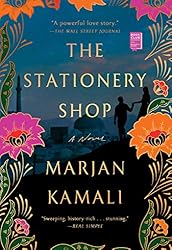

The Stationery Shop
Marjan Kamali, 2019
Gallery Books
336 pp.
ISBN-13: 9781982107499
Summary
A poignant, heartfelt novel of lost love explores loss, reconciliation, and the quirks of fate.
Roya, a dreamy, idealistic teenager living amid the political upheaval of 1953 Tehran, finds a literary oasis in kindly Mr. Fakhri’s neighborhood stationery shop, stocked with books and pens and bottles of jewel-colored ink.
Then Mr. Fakhri, with a keen instinct for a budding romance, introduces Roya to his other favorite customer—handsome Bahman, who has a burning passion for justice and a love for Rumi’s poetry—and she loses her heart at once.
Their romance blossoms, and the little stationery shop remains their favorite place in all of Tehran.
A few short months later, on the eve of their marriage, Roya agrees to meet Bahman at the town square when violence erupts—a result of the coup d’etat that forever changes their country’s future. In the chaos, Bahman never shows.
For weeks, Roya tries desperately to contact him, but her efforts are fruitless.
With a sorrowful heart, she moves on—to college in California, to another man, to a life in New England—until, more than sixty years later, an accident of fate leads her back to Bahman and offers her a chance to ask him the questions that have haunted her for more than half a century: Why did you leave? Where did you go? How is it that you were able to forget me? (From the publisher.)
Author Bio
• Birth—ca. 1970-71
• Where—Turkey
• Raised—Turkey, Kenya, Germany, Iran, and the U.S.
• Education—B.A., University of California-Berkeley; M.B.A., Columbia University; M.F.A., New York University
• Currently—lives outside of Boston, Massachusetts
Marjan Kamali was born in Turkey to Iranian parents. Her father was in the diplomatic corp, and Kamali spent her childhood in Kenya, Germany, Turkey, post-revolutionary Iran. In 1982, the family moved to Forest Hills, Queens, in New York City.
Kamali holds degrees from UC Berkeley, Columbia University, and New York University. To distract herself from spreadsheet drudgery while studying for her M.B.A. at Columbia, she began to write at fiction, eventually penning a short story that would become the opening chapter of her debut novel.
That debut, Together Tea, was published in 2013. It became a Massachusetts Book Award Finalist, an NPR WBUR Good Read, and a Target Emerging Author Selection. In 2019, Kamali issued her second novel, The Stationery Shop.
Kamail's other work has been broadcast on BBC Radio 4 and published in two anthologies: Tremors and Let Me Tell You Where I’ve Been. An excerpt from The Stationery Shop was published in Solstice Literary Magazine and nominated for a Pushcart Prize.
Marjan lives with her husband and two children in the Boston area. (Adapted from the publisher and Boston Athenaeum.)
Book Reviews
[M]oving.… The refined, melancholic mood of their story extends to Roya’s feelings about the Iran she left behind, which vanishes completely as the Shah’s authoritarian government gives way to an even more despotic clerical rule after the 1979 revolution.
Sam Sacks - Wall Street Journal
[A] wistful look at two idealists and the world they should have inherited.… Kamali offers a paean not just to lost love, but to the poetry, food, and culture that fed their memories for 60 years.
Christian Science Monitor
Grab your tissues.… Marjan Kamali’s second novel channels love in the time of coup d’états. Set among the political upheaval of 1950s Tehran, The Stationery Shop follows teenager Roya as she discovers the power of love, loss, and then, decades later, fate. And did we mention you’ll need tissues?
Boston Magazine
I! Am! Obsessed! With! This! Book!… Think The Notebook, only better (no offense, Ryan Gosling).
Cosmopolitan.com
A beautiful, emotionally honest story about first love, deep family bonds, and fate.
Pop Sugar
[A] tender story of lifelong love.… The loss of love and changing worlds is vividly captured by Kamali; time and circumstances kept these lovers apart, but nothing diminishes their connection. Readers will be swept away.
Publishers Weekly
The unfurling stories in Kamali’s sophomore novel will stun readers as the aromas of Persian cooking wafting throughout convince us that love can last a lifetime. For those who enjoy getting caught up in romance while discovering unfamiliar history of another country.
Library Journal
Kamali paints an evocative portrait of 1950s Iran and its political upheaval, and she cleverly writes the heartbreak of Roya and Bahman’s romance to mirror the tragic recent history of their country. Simultaneously briskly paced and deeply moving, this will appeal to fans of Khaled Hosseini and should find a wide audience.
Booklist
Sixty years after her first love failed to meet her in a market square, Roya Khanom Archer finally has the chance to see him. But will he break her heart again?… A sweeping romantic tale of thwarted love.
Kirkus Reviews
Discussion Questions
1. The first two chapters show us very different stages in Roya’s life. Discuss the similarities and differences between her life as a married woman in New England and her life as a teenager living in Tehran.
2. On page 3, Roya observes, "For hadn’t she married a man who was reasonable and, my goodness, unbelievably understanding? Hadn’t she, in the end, not married that boy, the one she met so many decades ago in a small stationery shop in Tehran, but lassoed her life instead to this Massachusetts-born pillar of stability?" How are Bahman and Walter different? How are they similar? What do you think Roya was looking for in each of them? How do her expectations for a relationship change throughout the story?
3. On page 56, after discovering Bahman’s mother believes he should marry Shahla, Roya tries to contain her anger: "This was the societal web of niceties and formalities and expected good female behavior that often suffocated her. But she had no choice but to bear it, to try to navigate within it. That much she knew." Discuss the importance of "saving face" for Iranian women in the 1950s. Do those expectations differ from what was expected of American women? What about women today? Research the cultural expectations of young women in Iran and discuss as a group. How are they similar or different to the expectations you or the women in your life have experienced?
4. Roya and Zari have very different personalities and ways of looking at life, and the two sisters often argue and clash. But there is a bond between them that is unbreakable. Have you experienced that simultaneous closeness and clashing with siblings in your life? What do you think it is about the sibling relationship in general and Roya and Zari’s sisterhood in particular that lends itself to such contradictions?"
5. Throughout the course of her courtship in 1953, Roya experiences passion and longing in new, surprising ways. For example, on page 84, when she watches Jahangir and Bahman dance, she is filled with desire. Compare Roya’s desire as a young woman to Badri’s. Do their social classes influence their actions? What would be the repercussions if Roya acted as Badri did in her youth?
6. Marjan Kamali employs foreshadowing as a plot device in The Stationery Shop. Discuss how it adds to the story and moves the narrative along. How would the novel read without foreshadowing?
7. In the 1950s, women in Tehran weren’t allowed the freedoms, though still limited, that women in America were. How does Roya’s family challenge those social expectations? How does that inform Roya’s life as grown woman?
8. In chapter 14, the readers learn about the history between Mr. Fakhri and Bahman’s mother. After reading this, why do you think Badri treated Roya so terribly?
9. On page 172, Roya struggles with cultural differences in flirting: "Sometimes there didn’t seem to be any rules. It had been far easier in Iran where tradition and tarof who your grandfather was often dictated how to behave." How do flirting and dating in both Tehran and America challenge Roya and her expectations for relationships? Discuss the differences in how Roya and Zari approach dating. Why do you think Zari feels more comfortable in America than Roya does? Do you think Roya would have had an easier time dating in America if she had never met Bahman?
10. In chapter 18, Bahman reveals the struggles of living with a mentally ill mother in Tehran. Discuss mental illness and its stigma as a group. How was mental illness viewed throughout time, and how does the treatment of the mentally ill vary across cultures? How is the way that Bahman and his father care for his mother countercultural?
11. At the beginning of chapter 19, Roya and Walter go on a double date with Zari and her boyfriend, Jack. Jack offends Roya with the way he speaks about Iran and its food and culture. Do you think Roya is right in feeling offended? Would you have been offended? Discuss cultural ignorance and bias as a group.
12. The characters in The Stationery Shop experience several devastating losses, from love to identity to miscarriage. How do they recover, and how do those losses forever change them? Can your group relate to these sorrows? What losses in your lives have forever changed you?
(Questions issued by the publisher.)

Stay With Me
Ayobami Adebayo, 2017
Knopf Doubleday
272 pp.
ISBN-13: 9780451494603
Summary
This celebrated, unforgettable first novel gives voice to both husband and wife as they tell the story of their marriage—and the forces that threaten to tear it apart.
Yejide and Akin have been married since they met and fell in love at university. Though many expected Akin to take several wives, he and Yejide have always agreed: polygamy is not for them.
But four years into their marriage — after consulting fertility doctors and healers, trying strange teas and unlikely cures — Yejide is still not pregnant. She assumes she still has time — until her family arrives on her doorstep with a young woman they introduce as Akin's second wife.
Furious, shocked, and livid with jealousy, Yejide knows the only way to save her marriage is to get pregnant, which, finally, she does — but at a cost far greater than she could have dared to imagine. An electrifying novel of enormous emotional power, Stay With Me asks how much we can sacrifice for the sake of family. (From the publisher.)
Author Bio
• Birth—January 29, 1988
• Where—Lagos, Nigeria
• Education—B.A., M.A., Obafemi Awolowo University; M.A., University of East Anglia
• Currently—lives in Nigeria
Ayobami Adebayo, a Nigerian novelist, was born in Lagos. She holds BA and MA in English literature from Obafemi Awolowo University. She also has an MA in creative writing from the University of East Anglia, where she was awarded an international bursary for creative writing. She has also studied with Chimamanda Ngozi Adichie and Margaret Atwood.
In addition to her university degrees, Adebayo has received fellowships and residencies from Ledig House, Sinthian Cultural Centre, Hedgebrook, Ox-Bow School of Art, Ebedi Hills and the Siena Art Institute. Adebayo's stories have appeared in a number of magazines and anthologies, and one was highly commended in the 2009 Commonwealth short story competition.
Since 2009, Adebayo has worked as an editor for Saraba Magazine. She lives in Nigeria. (Adapted from the publisher.)
Book Reviews
[A] stunning debut…Stay With Me …has a remarkable emotional resonance and depth of field. It is, at once, a gothic parable about pride and betrayal; a thoroughly contemporary — and deeply moving — portrait of a marriage; and a novel, in the lineage of great works by Chinua Achebe and Chimamanda Ngozi Adichie.… [Adebayo] is an exceptional storyteller. She writes not just with extraordinary grace but with genuine wisdom about love and loss and the possibility of redemption. She has written a powerfully magnetic and heartbreaking book.
Michiko Kakutani - New York Times
Affecting and powerful.… Adebayo's prose is a pleasure: immediate, unpretentious and flecked with whip-smart Nigerian-English dialogue. She handles weighty themes with an absence of sentimentality.
Sunday Times (UK)
(Starred review.) Adebayo slowly reveals [the couple's] unspoken shame by having both narrate chapters covering the same events.… Her methodical exposure of her characters' secrets…culminates in a tender, satisfying conclusion.
Publishers Weekly
(Starred review.) [An] emotionally powerful first novel that relies…on old-fashioned storytelling.… Adebayo's work makes a blazing entry onto the list of young, talented writers from Nigeria. Readers who pick up this debut novel will not put it down until they've finished. —Ally Bissell
Library Journal
(Starred review.) Adebayo describes parenthood and love with heartbreaking prose. She deftly reveals secrets and the decisions that set life-altering events in motion. The story's fast pace brings surprising twists.
Booklist
(Starred review.) Set against a backdrop of student protests, a presidential assassination, and a military coup, Adebayo's novel captures how the turmoil of Nigerian life in the 1980s and '90s seeps into the most personal of decisions — to fight for…one's family. [A] fine young writer.
Kirkus Reviews
Discussion Questions
1. Discuss the early stages of Yejide and Akin's courtship, from both of their perspectives. What is Yejide's initial reaction to Akin's romantic propositions? Consider Yejide's childhood and past that is revealed over the course of the novel. What does she seek in a romantic relationship? How does Akin provide security for her? How does Akin convince Yejide that he is trustworthy?
2. Consider the family unit as a social force in Stay with Me. How do the opinions of Akin's family members influence his decisions? Describe the relationship between Akin and his parents. How does Akin both obey and defy the wishes of his family? How does Yejide navigate her role as a daughter-in-law?
3. In the beginning of Stay with Me, the reader is introduced to the central conflict of Yejide and Akin's life: their infertility as a couple. How is Yejide and Akin's childlessness seen as a reflection on the family unit? What is the burden of expectation placed on Yejide? How is she treated by Akin's family as a result of her infertility? By the community? How do attitudes toward Yejide change once she is pregnant?
4. Discuss the road leading to Yejide's first pregnancy. How do the social pressures to become a mother weigh on Yejide? Once Yejide learns that she is no longer Akin's only wife, how does the urgency of her mission become more pronounced? Consider the barriers to her pregnancy, and what she learns about herself from the field remedies and the medical establishment. How does the psychological trauma that accompanies her journey weigh on her throughout the novel?
5. The tension between modern attitudes and traditional thought informs much of Stay with Me. How does Yejide and Akin's early agreement of monogamy conflict with the prevailing social attitude? How does this create tension over the course of the novel? How does Yejide defy the wishes of her husband's family? How does the eventual shift of parental responsibilities to Akin upend the expectations of motherhood and parenting?
6. Consider the identity of "mother," and how understanding of that role shifts for Yejide over the course of the novel. How does the story of her mother's death influence her worldview and her perspective on family? Discuss the relationship Yejide had with her father's other wives. Which woman in her life, if any, provides her with an understanding of what a loving mother-child relationship looks like? Once she becomes a mother, how does her self-image change?
7. Describe Yejide's relationship with Iya Bolu. How does Iya Bolu's attitude toward Yejide shift over the years? When does Yejide seem to earn the most respect from Iya Bolu? When does she earn her sympathy?
8. Consider the political background of Stay with Me. How does the instability of the government undermine the health and happiness of Yejide and her family? How does the political upheaval reflect the emotional turmoil of Yejide and Akin?
9. The reveal of Akin's medical condition is an important development in the plot. Given this revelation, would you consider Funmi's death to be purposeful? How did you interpret his reaction to her accusation? How does Akin contend with threats to his masculinity throughout the novel?
10. Discuss the significance of the hair salon in Yejide's life. How does it encourage her independence? How does it act as a place of gathering within their community?
11. Compare the bedtime story that Yejide tells her children with the tale that Akin shares with Rotimi as she grows. What do these stories reveal about the worldviews of both parents? What lessons are they sharing? How is it a cautionary tale between parent and child? How does it reflect Yejide's own childhood experiences?
12. Discuss the process of mourning as depicted in Stay with Me. How does the community react to Yejide's mourning for the loss of her first child versus her second? Discuss the general attitude towards Yejide's depression from her family and those around her.
13. What is Akin's relationship with his brother? How do they compete with each other? How do they jockey for the coveted spot of favored son throughout the novel? After their brawl, how does their relationship change? Do you think Dotun possessed real romantic feelings for Yejide?
14. Discuss Yejide's reunion with Rotimi. Were you surprised by this reveal? How did you interpret Timi's insistence on calling Yejide “Moomi”?
15. Stay with Me is a novel that challenges readers' expectations with its surprising reveals, its secrets, and its deception. What plot development did you find to be most surprising? How does Adebayo play with the idea of expectation versus reality throughout the novel?
(We'll add publisher questions if and when they're available.)
Staying On (The Raj Quartet, Epilogue)
Paul Scott, 1977
University of Chicago Press
216 pp.
ISBN-13: 9780226743493
Summary
Winner, 1977 Booker Prize
In this sequel to "The Raj Quartet," Colonel Tusker and Lucy Smalley stay on in the hills of Pankot after Indian independence deprives them of their colonial status.
Finally fed up with accommodating her husband, Lucy claims a degree of independence herself. Eloquent and hilarious, she and Tusker act out class tensions among the British of the Raj and give voice to the loneliness, rage, and stubborn affection in their marriage.
Staying On won the Booker Prize in 1977 and was made into a 1979 motion picture starring Trevor Howard and Celia Johnson. (From the publisher.)
Author Bio
• Birth—March 25, 1920
• Where—Southgate (north London), England, UK
• Death—March 1, 1978
• Where—London, Englan
• Awards—Booker Prize—1971, 1977
Paul Mark Scott was a British novelist, playwright, and poet, best known for his monumental tetralogy "The Raj Quartet." His novel Staying On won the Booker Prize for 1977.
Paul Scott was born in Southgate, north London, the younger of two sons. His father, Thomas (1870-1958), was a Yorkshireman who moved to London in the 1920s and was a commercial artist specialising in furs and lingerie. His mother, Frances, nee Mark (1886-1969) was the daughter of a labourer from south London, socially inferior to her husband but with artistic and social ambitions. In later life Scott differentiated between his mother’s creative drive and his father’s down-to-earth practicality.
He was educated at Winchmore Hill Collegiate School (a private school) but was forced to leave suddenly, and without any qualifications, when 14, at a time that his father’s business was in severe financial difficulty. He worked as an accounts clerk for CT Payne and took evening classes in bookkeeping. He started writing poetry in his spare time. It was in this environment that he came to understand the rigid social divisions of suburban London, so that when he went to British India he had an instinctive familiarity with the interactions of caste and class in an imperial colony.
He was called up (conscripted) in to the army as a private in early 1940 near the start of World War II and was assigned to Intelligence Corps. He met and married his wife, Penny, née Avery, in Torquay in 1941.
In 1943 he was posted as an Officer Cadet to India, where he was commissioned. He ended the war as a Captain in the Indian Army Service Corps organizing logistics for the Fourteenth Army’s reconquest of Burma, which had fallen to the Japanese in 1942. Despite being initially appalled by the attitudes of the British, the heat and dust, the disease and poverty and the sheer numbers of people, he, like so many others, fell deeply in love with India.
After demobilisation in 1946 he was employed as an accountant for two small publishing houses and remained until 1950. His two daughters (Carol and Sally) were born in 1947 and 1948. In 1950 Scott moved to the literary agent Pearn, Pollinger & Higham (later to be split into Pollinger Limited and David Higham Associates) and subsequently became a director. Whilst there he was responsible for representing Arthur C Clarke, Morris West, M M Kaye, Elizabeth David, Mervyn Peake, and Muriel Spark, amongst others.
Scott published a collection of three religious poems under the title I, Gerontius in 1941, but his writing career began in earnest with his first novel Johnny Sahib in 1952; despite seventeen rejections it met with modest success. He continued to work as a literary agent to support his family, but managed to publish regularly. The Alien Sky (US title, Six Days in Marapore) appeared in 1953, and was followed by A Male Child (1956), The Mark of the Warrior (1958), and The Chinese Love Pavilion (1960). He also wrote two radio-plays for the BBC, Lines of Communication (1952) and Sahibs and Memsahibs (1958). All the novels were respectfully received though selling only moderately, but in 1960 Scott decided to try to earn a living as a full time author, and resigned from his literary agency.
More
His novels persistently draw on his experiences of India and service in the armed forces with strong subtexts of uneasy relationships between male friends or brothers; both the social privilege and the oppressive class and racial stratifications of empire are represented, and novel by novel the canvas broadens. The Alien Sky remains the principal fictional exploration of a very light-skinned Eurasian (mixed race, British-Indian) woman who has married a white man by pretending to be white; A Male Child is set principally in London and deals with the domestic effects of losing a family member to imperial service; and The Chinese Love Pavilion, after an Indian opening, is largely concerned with events in Malaya under Japanese occupation.
In retrospect these novels can be seen as studies towards "The Raj Quartet," and one of its minor characters appears by name in The Birds of Paradise (1962), but the lack of commercial success forced Scott to broaden his range. His next two novels, The Bender (1963), a satirical comedy, and The Corrida at San Feliu (1964), comprising multiple linked texts and drawing extensively on family holidays to the Costa Brava, are a clear attempt to experiment with new forms and locales. However, while still well received neither was especially successful, either financially or artistically, and Scott decided that he must either write the novel of the Raj of which he believed himself capable, or return to salaried work.
Scott flew to India in 1964 to see old friends, both Indian and Anglo-Indian, make new acquaintances in independent India, and recharge his batteries by reconfronting the place that obsessed him. Artistically he felt drained and a failure, feelings that were reinforced by financial straits and physical weakness. Since serving in India, Scott suffered from undiagnosed amoebic dysentery, which can seriously affect mood as well as digestion, and had managed to handle it by what his biographer, Hilary Spurling, describes as “alarming” quantities of alcohol. The condition was exacerbated by the visit and on his return he had to undergo painful treatment, but afterwards felt better than he had for years.
The Raj Quartet
In June 1964, Scott began to write The Jewel in the Crown, the first novel of what was to become "The Raj Quartet". It was published in 1966 to minor and muted enthusiasm. The remaining novels in the sequence were published over the next nine years – The Day of the Scorpion (1968), The Towers of Silence (1971) and A Division of the Spoils (1974). Scott wrote in relative isolation and only visited India twice more during the genesis of "The Raj Quartet", in 1968 and in 1971, latterly for the British Council. He worked in an upstairs room at his home in Hampstead overlooking the garden and Hampstead Garden Suburb woodland—a far cry from the archetypal administrative province, between the Ganges and the foothills of the Himalaya, in which the novels were set. He supplemented his earnings from his books with writing reviews for the Times, the Times Literary Supplement, New Statesman and Country Life.
The Jewel in the Crown engages with and rewrites E. M. Forster's A Passage to India (1924), and so is necessarily set in a small, Hindu-majority rural town with an army garrison, but the wider province is implicit, and the later novels spread out to the cold-weather capital on the plains, the hot-weather capital in the hills, a neighbouring Muslim-ruled Princely State, and the railways-lines that bind them together—as well as Calcutta, Bombay, and the Burmese theatre of war. The cast also expands to include at least 24 principals, more than 300 named fictional characters, and a number of historical figures including Churchill, Gandhi, Jinnah, Wavell, and Slim. The story is initially that of the gang rape of a young British woman in 1942, but follows the ripples of the event as they spread out through the relatives and friends of the victim, the child of the rape, those arrested for it but never charged and subsequently interned for political reasons, and the man who arrested them. It also charts events from the Quit India riots of August 1942 to the violence accompanying the Partition of India and creation of Pakistan in 1946-7, and so represents the collapse of imperial dominance, a process Scott describes as 'the British coming to the end of themselves as they were'.
Scott's wife Penny had supported him throughout the writing of "The Raj Quartet" despite his heavy drinking and sometimes violent behaviour, but once it was complete she left him and filed for divorce. Forced to reassess his life and options he turned to teaching, and in 1976 and 1977 he was visiting Professor at the University of Tulsa in the U.S. state of Oklahoma. His coda to "The Raj Quartet", Staying On, was published in 1977 just before his second visit. Soon after its publication, and while he was in Tulsa, Scott was diagnosed with colon cancer.
At the time of their publication, the novels of "The Raj Quartet" were, individually and collectively, received with little enthusiasm. Only The Towers of Silence and Staying On achieved success with the award of the Yorkshire Post Fiction Award and the Booker Prize in 1971 and 1977 respectively. Sadly, Scott was too ill to attend the Booker presentation in November 1977. He died at the Middlesex Hospital, London on 1 March 1978.
Scott stated that “For me, the British Raj is an extended metaphor [and] I don’t think a writer chooses his metaphors. They choose him.” From his earliest experiences in north London, he felt himself an outsider in his own country. As his biographer comments,
Probably only an outsider could have commanded the long, lucid perspectives he brought to bear on the end of the British raj, exploring with passionate, concentrated attention a subject still generally treated as taboo, or fit only for historical romance and adventure stories. However Scott saw things other people would sooner not see, and he looked too close for comfort. His was a bleak, stern, prophetic vision and, like Forster's, it has come to seem steadily more accurate with time.
The Jewel in the Crown has at its heart the confrontation between Hari Kumar, the young, English-public-school educated Indian liberal, and the grammar-school scholarship-boy turned police superintendent Ronald Merrick who both hates and is attracted to Kumar and seeks to destroy him after Daphne Manners, the English girl who is in love with Kumar and has been courted by Merrick, is raped.
Critics have seen this conflict as one fundamentally influenced by Scott’s own deeply-divided bisexual nature, with Kumar representing everything young, bright, and forward-looking that had been brutally crushed in Scott’s own youth. At the same time Merrick, probably (but not absolutely certainly) a repressed homosexual, with authoritarian leanings and an arrogant sense of his own racial standing, is partly a self-portrait in which Scott confronted his own and his compatriots' defensive impulse to racial and personal self-aggrandisement, and to moral and political pretence. The result is widely seen as a substantial, and to date definitive, fictional exploration both of the underbelly and of the moral workings of the Raj in India.
In 1980, Granada Television filmed Staying On, with Trevor Howard and Celia Johnson as Tusker Smalley and his wife Lucy, famously advertised at the time as "Reunited for the first time since Brief Encounter". The success of its first showing on British television in December 1980 encouraged Granada Television to embark on the much greater project of making "The Raj Quartet" into a major fourteen-part television series known as The Jewel in the Crown, first broadcast in the UK in early 1984 and subsequently in the US and many Commonwealth countries. It was rebroadcast in the UK in 1997 as part of the 50th anniversary celebrations of Indian independence, and in 2001 the British Film Institute voted it as 22nd in the all time best British television programmes. It has also been adapted as a nine-part BBC Radio 4 dramatisation under its original title in 2005. (From Wikipedia.)
Book Reviews
Staying On provides a sort of postscript to [Scott's] deservedly acclaimed "The Raj Quartet".... He has, as it were, summoned up the Raj's ghost in Staying On.... It is the story of the living death, in retirement, and the final end of a walk-on character from the quartet.... Scott has completed the task of covering in the form of a fictional narrative the events leading up to India's partition and the achievement of independence in 1947. It is, on any showing, a creditable achievement.
Malcolm Muggeridge - New York Times Book Review
Scott's vision is both precise and painterly. Like an engraver cross-hatching in the illusion of fullness, he selects nuances that will make his characters take on depth and poignancy.
Jean G. Zorn - New York Times Book Review
Staying On far transcends the events of its central action... [The work] should help win for Scot...the reputation he deserves—as one of the best novelists to emerge from Britain's silver age.
Robert Towers - Newsweek
A graceful comic coda to the earlier song of India.... No one writing knows or can evoke an Anglo-Indian setting better than Scott.
Paul Gray - Time
Discussion Questions
Use our LitLovers Book Club Resources; they can help with discussions for any book:
• How to Discuss a Book (helpful discussion tips)
• Generic Discussion Questions—Fiction and Nonfiction
• Read-Think-Talk (a guided reading chart)
Also consider these LitLovers talking points to help get a discussion started for Staying On:
1. Why do the Smalleys not return to England after Indian independence? Might their decision have been different in the England that is today?
2. As Tusker says, "I still think we were right to stay on, though I don't think of it any longer as staying on, but just as hanging on." What does he mean...and do you think he was "right to stay on"? Does staying on suggest passivity and weakness...or strength and endurance...or what?
3. What effect does Tusker's death at the onset of the book have on the way you read the work? Why would Scott have started the novel with his death? When you revisit his death at the end of the book, has your perspective changed?
4. Talk about the irony of the Smalleys' stature in the newly independent India—their place in the economic-social hierarchy Lucy, for instance, feels she has become "a black sheep in reverse exposure"—what does she mean? For the Smalleys and others who stayed on, are they receiving their "just deserts"? Or not.
5. Discuss how Scott limns the portraits of his characters, particularly Tusker and Lucy. Do his portrayals capture their emotional and psychological complexity? In other words, does he create real people?
6. How would you describe the Smalleys' relationship? What is it (or who is it) that makes the marriage so difficult? In what way did they sacrifice their happiness—was it circumstance... or habit...or what? Is one more to blame than the other—do you sympathize with one more than the other?
6. Talk about how Lucy views her situation? What makes her plight so precarious?
7. Scott uses varying perspectives—Smalleys, Ibrahim, and Mr. Bhoolabhoy—to tell his story. How does each of the characters' reflections reveal the fading days of the Raj and the new society which took its place?
8. Talk about Mr. Bhoolabhoy and his wife. Funny or maddening? In what way was Frank Bhoolabhoy shaped by the Raj—and perhaps left stranded, as much as the Smalleys? What does that say about the effects of colonialism?
9. Talk about Mr. Bhoolabhoy's reaction to the arrival of the new Anglican priest, from south India. How does the priest revitalize the community—and what might this suggest about the possibility of blending cultures?
9. Have you read any novel of the "Raj Quartet," perhaps The Jewel in the Crown (or seen the 1984 BBC series)? If so, in what way might Staying On be considered an epilogue to the Quartet?
10. What is the thematic significance of The newer Shiraz overshadowing Smith's Hotel...and Tusker's dying hand clutching the notice of Mrs. Bhoolabhoy's sale of Smith's?
11. Consider watching Granada TV's 1980 adaptation of Staying On with Trevor Howard and Celia Johnson. Does the film reveal new insights? Is it a faithful adaptation?
(Questions by LitLovers. Please feel free to use them, online or off, with attribution. Thanks.)
top of page


The Steady Running of the Hour
Justin Go, 2014
Simon & Schuster
480 pp.
ISBN-13: 9781476704586
Summary
A Quest Novel and a historical tour de force, The Steady Running of the Hour unravels a tale of passion, legacy, and courage reaching across the twentieth century.
In 1924, the English mountaineer Ashley Walsingham dies attempting to summit Mount Everest, leaving his fortune to his former lover, Imogen Soames-Andersson—whom he has not seen in seven years. Ashley’s solicitors search in vain for Imogen, but the estate remains unclaimed.
Nearly eighty years later, new information leads the same law firm to Tristan Campbell, a young American who could be the estate’s rightful heir. If Tristan can prove he is Imogen’s descendant, the inheritance will be his. But with only weeks before Ashley’s trust expires, Tristan must hurry to find the evidence he needs.
From London archives to Somme battlefields to the Eastfjords of Iceland, Tristan races to piece together the story behind the unclaimed riches: a reckless love affair pursued only days before Ashley’s deployment to the Western Front; a desperate trench battle fought by soldiers whose hope is survival rather than victory; an expedition to the uncharted heights of the world’s tallest mountain.
Following a trail of evidence that stretches to the far edge of Europe, Tristan becomes consumed by Ashley and Imogen’s story. But as he draws close to the truth, Tristan realizes he may be seeking something more than an unclaimed fortune.
The Steady Running of the Hour announces the arrival of a stunningly talented author. Justin Go’s novel is heartrending, transporting, and utterly compelling. (From the publisher.)
Author Bio
• Birth—September 7, 1980
• Where—Los Angeles, California
• Education—B.A., University of California, Berkeley; M.A., University
College, London
• Currently—"Transient. Usually in the US or Europe" (mostly New York City
or Berlin, Germany).
Justin Go attended the University of California at Berkeley, where he graduated with a BA in history and art history. He also holds an MA in English from University College London. He has lived in Tokyo, Paris, London, (Brooklyn) New York City, and Berlin. He is currently at work on his second novel. (From the publisher.)
Book Reviews
With this debut, Justin Go deploys the elements of a caper—an unclaimed fortune, an illicit affair—in an assured literary thriller.
Wall Street Journal
Go’s intriguing first novel spans the 20th century… with vivid accounts of wartime France, pioneering mountaineering expeditions, and an isolated village in Iceland.
BBC
Go’s debut is ambitious in many ways: it evokes a time of privileged daring... [and] love that transcends time and disdains convention; and it fluidly moves between past and present.... [The] story, as told in flashback, feels heartfelt but overwrought, and the trench warfare and climbing scenes, while competently executed, mine an oft-depicted period without adding much that’s new.
Publishers Weekly
Gifted storyteller Go captures a period feel in the backstory through his narratives and uses dialog to reveal his characters' place among the affluent, while Tristan's contemporary story line profiles a young man making do with what he has and driven to unravel the truth behind his family's past. This story is a page-turner and an impressive first work, sure to be appreciated by fans of historical and travel fiction. —Shirley Quan, Orange Cty. P.L., Santa Ana, CA
Library Journal
Ambitious…this is a remarkable work.
Booklist
Debut novelist Go splices two stories in his extravagant, superficial debut.... Tristan, a young Californian, is told by a London lawyer [a] fortune is his if he can prove Imogen was his great-grandmother. The guy is a windup toy; Go sends him on a document search, traveling from Sweden to Paris to Berlin to Iceland to beat a seven-week deadline.... Go is a maximalist (lofty emotions, extreme settings) punching above his weight
Kirkus Reviews
Discussion Questions
1. The novel’s title is taken from a line in the epigraph that begins the novel. How does the epigraph, from “Strange Meeting,” relate both to Tristan’s quest and Ashley’s life? Why do you think Justin Go chose to title his novel The Steady Running of the Hour?
2. Of Imogen and Ashley, Geoffrey Khan says, “These were not people like you and me.” What does he mean? What were your first impressions of both Ashley and Imogen? Did any of their actions surprise you as you learned more of their love story? Which ones, and why?
3. Tristan recounts how his half brother, Adam, told him, “I always ask for advice so I can worry about it. Then I go and do the thing I was going to do anyway, because knowing it’s a bad idea never stopped me.” Do you agree with Adam’s assessment of Tristan? Give examples from the book that support your opinion. Why do you think Tristan chooses to share Adam’s words with Mireille?
4. Describe the trust that Tristan stands to inherit. How was it set up, and why? Why do you think Prichard is so invested in having Tristan inherit Ashley’s estate?
5. Ashley tells Imogen that he joined the army because “I was bored at Cambridge.... And I was fool enough to worry I’d miss something if I kept out of the war.” Compare Ashley’s ideas of war with the realities he faces in the trenches. Describe his wartime experiences. Do they change him? If so, how?
6. Mireille says that “even love can sometimes be a mistake, and that perhaps this vanished love of Ashley and Imogen’s had been a wasted one.” Do you agree with Mireille about Ashley and Imogen’s relationship? Do you think they loved each other? Why or why not? Describe the nature of their love.
7. As Tristan delves more deeply into Ashley and Imogen’s history, his reaction to Ashley’s estate changes. How does it change? What accounts for the alteration in his feelings toward it? Why do you think Imogen never claimed Ashley’s estate, despite being named heir?
8. Eleanor criticizes Imogen for “turning away from ordinary choices,” saying, “If someone expects something from you, you can’t bear to give it to them.” Is Eleanor right about Imogen’s character? In what ways has Imogen turned away from “ordinary choices,” and what have the results been? Compare the two sisters. How are they different?
9. When a hotel clerk mistakenly thinks Imogen and Ashley are married, she’s displeased because “it’s just not how I want to think of us.” Contrast Imogen’s attitude toward marriage with Ashley’s. She believes that “one oughtn’t give names to what two people are to one another. It only makes it harder to be one’s self.” Do you agree with her? Why or why not?
10. When Tristan speaks of his plan to leave France and go to Berlin, Mireille is critical of him: “You don’t understand what’s going on around you.” In what ways do his experiences change him, and are they for the better? Why do you think Mireille reacts so strongly to the plan? Is she justified in her criticisms of Tristan? Why or why not? What are some of Tristan’s aspects that Mireille disapproves of?
11. While Imogen is in Sweden, she wonders if she and Ashley had “truly made choices, or had they given in to forces they felt too weak to resist?” What do you think? Did they have choices with regard to their love affair? Both Imogen’s relationship with Ashley and Tristan’s with Mireille unfold over the course of only a few days. Compare and contrast the two relationships. In what ways, if any, are the two relationships alike?
12. After the war, Ashley tells Eleanor that he won’t give up trying to find Imogen. She replies, “You are giving something up.... You just don’t realize it.” Is she correct? What is Ashley giving up by continuing to search for Imogen? Why do you think he persists?
13. Book 3 begins with an epigraph that, in part, reads, “If you are a brave man you will do nothing: if you are fearful you may do much, for none but cowards have need to prove their bravery.” Discuss instances of bravery that occur in The Steady Running of the Hour. Do you think that Imogen is brave for the way she handles her relationship with Ashley? Why or why not?
14. Duties figure prominently throughout The Steady Running of the Hour. When Imogen asks Ashley to leave the army, he tells her he cannot, because, he says, “I’ve a duty.” Do you agree with his decision to “see this through”? Why or why not? Does Imogen have any responsibilities toward Ashley? What are they? What duties does Tristan have toward Ashley’s estate, if any?
(Questions issued by the publisher.)

Stealing Ghosts (The DeWitt Agency Files, 2)
Lance Charnes, 2017
Wombat Media Group
344 pp.
ISBN-13: 9780988690387
Summary
Dorotea DeVillardi is ninety-one years old, gorgeous, and worth a fortune. Matt Friedrich’s going to steal her.
The Nazis seized Dorotea’s portrait from her Viennese family, then the Soviets stole it from the Nazis. Now it’s in the hands of a Russian oligarch. Dorotea’s corporate-CEO grandson played by the legal rules to get her portrait back, but he struck out. So he’s hired the DeWitt Agency to get it for him – and he doesn’t care how they do it.
Now Matt and Carson, his ex-cop partner, have to steal Dorotea’s portrait from a museum so nobody knows it’s gone, and somehow launder its history so the client doesn’t have to hide it forever. The client’s saddled them with a babysitter: Dorotea’s granddaughter Julie, who may have designs on Matt as well as the painting. As if this wasn’t hard enough, it looks like someone else is gunning for the same museum – and he may know more about Matt and Carson’s plans than he should.
Matt went to prison for the bad things he did at his L.A. art gallery. Now he has a chance to right an old wrong by doing a bad thing for the best of reasons. All he has to do is stay out of jail long enough to pull it off. (From the publisher.)
Author Bio
• Birth—1960
• Where—Oakland, California, USA
• Education—B.A. University of California, Berkeley; M.S.,California State University, Long Beach
• Currently—lives in Orange County, California
Lance Charnes has been an Air Force intelligence officer, information technology manager, computer-game artist, set designer and Jeopardy! contestant, and is now an emergency management specialist. He’s had training in architectural rendering, terrorist incident response and maritime archaeology, but not all at the same time. His Facebook author page features spies, archaeology and art crime.
Lance is the author of the international thriller DOHA 12, the near-future thriller SOUTH, and the DEWITT AGENCY FILES series of international art-crime novels. All are available in trade paperback and digital editions. He's also a frequent contributor to Macmillan's Criminal Element website. (From the author.)
Visit the author's website.
Follow Lance on Facebook.
Discussion Questions
1. The back-cover synopsis for this novel says that Matt’s "doing a bad thing for the best of reasons." Can good intentions make up for doing the wrong thing? How do Matt’s and Carson’s sins stack up against those of the other characters (seen and unseen)?
2. Put yourself in Ron Bowen’s and Julie’s positions. If the only way you can retrieve a priceless family treasure is to steal it, would you? If not, how else might you get that treasure back if legal measures have failed?
3. Do you have mementos of your grandparents or earlier relatives? If so, are there some that seem more precious than others? Why are they special? What resonance do you find in Julie saying about her grandmother’s other paintings (p. 282 in the print edition), "Those are just things she owned. This [meaning the portrait] is her"?
4. Did Julie become Gillian, or was she Gillian all along? Use examples from the text to support your conclusion.
5. Have you ever been in a romantic relationship with someone of a significantly different age? If so, were you the older or younger participant? Why did you do it? What did you learn from the experience?
6. Is Ute Kinigader a victim or co-perpetrator of her father’s crimes? Why?
7. Matt and Geisman debate how they should deal with Ute Kinigader after they interview her (Chapter 63, starting on page 298 of the print edition). Whose argument do you agree with more: Matt’s, or Geisman’s? Why? What third approach can you propose that they didn’t discuss?
8. Part of Matt’s motivation to finish this project is to atone for what he helped do to Ida Rothenberg, a Holocaust survivor his gallery cheated. Do you think he succeeds? Why or why not? What’s your definition of "atonement" or "redemption" in this situation?
9. Who was your favorite character, and why? Who was your least-favorite character, and why? Who was the strongest character, and what made him/her seem that way to you?
10. If you also read The Collection (the first in the DeWitt series): Describe how you think Matt’s and Carson’s relationship has changed from that story to this one. Why do you think this change happened? What do you expect of their relationship in future stories?
11. With which character do you identify with most closely? Why?
12. Did anything happen that surprised you? If so, what and why?
(Questions courtesy of the author.)


Stella Bain
Anita Shreve, 2013
Little, Brown & Co.
272 pp.
ISBN-13: 9780316098861
Summary
When an American woman, Stella Bain, is found suffering from severe shell shock in an exclusive garden in London, surgeon August Bridge and his wife selflessly agree to take her in.
A gesture of goodwill turns into something more as Bridge quickly develops a clinical interest in his houseguest. Stella had been working as a nurse's aide near the front, but she can't remember anything prior to four months earlier when she was found wounded on a French battlefield.
In a narrative that takes us from London to America and back again, Shreve has created an engrossing and wrenching tale about love and the meaning of memory, set against the haunting backdrop of a war that destroyed an entire generation. (From the publisher.)
Author Bio
• Birth—1946
• Raised—Dedham, Massachusetts, USA
• Education—B.A. Tufts University
• Awards—PEN/L.L. Winship Award; O. Henry Prize
• Currently—lives in Longmeadow, Massachusetts
Anita Shreve is the acclaimed author of nearly 20 books—including two works of nonfiction and 17 of fiction. Her novels include, most recently, Stella Bain (2013), as well as The Weight of Water (1997), a finalist for England's Orange prize; The Pilot's Wife (1998), a selection of Oprah's Book Club; All He Even Wanted (2003), Body Surfing (2007); Testimony (2008); A Change in Altitude (2010). She lives in Massachusetts. (From the publisher.)
More
For many readers, the appeal of Anita Shreve’s novels is their ability to combine all of the escapist elements of a good beach read with the kind of thoughtful complexity not generally associated with romantic fiction. Shreve’s books are loaded with enough adultery, eroticism, and passion to make anyone keep flipping the pages, but the writer whom People magazine once dubbed a “master storyteller” is also concerned with the complexities of her characters’ motivations, relationships, and lives.
Shreve’s novels draw on her diverse experiences as a teacher and journalist: she began writing fiction while teaching high school, and was awarded an O. Henry Prize in 1975 for her story, "Past the Island, Drifting." She then spent several years working as a journalist in Africa, and later returned to the States to raise her children. In the 1980s, she wrote about women’s issues, which resulted in two nonfiction books—Remaking Motherhood and Women Together, Women Alone—before breaking into mainstream fiction with Eden Close in 1989.
This interest in women’s lives—their struggles and success, families and friendships—informs all of Shreve’s fiction. The combination of her journalist’s eye for detail and her literary ear for the telling turn of phrase mean that Shreve can spin a story that is dense, atmospheric, and believable. Shreve incorporates the pull of the sea—the inexorable tides, the unpredictable surf—into her characters’ lives the way Willa Cather worked the beauty and wildness of the Midwestern plains into her fiction. In Fortune’s Rocks and The Weight of Water, the sea becomes a character itself, evocative and ultimately consuming. In Sea Glass, Shreve takes the metaphor as far as she can, where characters are tested again and again, only to emerge stronger by surviving the ravages of life.
A domestic sensualist, Shreve makes use of the emblems of household life to a high degree, letting a home tell its stories just as much as its inhabitants do, and even recycling the same house through different books and periods of time, giving it a sort of palimpsest effect, in which old stories burn through the newer ones, creating a historical montage. "A house with any kind of age will have dozens of stories to tell," she says. "I suppose if a novelist could live long enough, one could base an entire oeuvre on the lives that weave in and out of an antique house."
Shreve’s work is sometimes categorized as "women’s fiction," because of her focus on women’s sensibilties and plights. But her evocative and precise language and imagery take her beyond category fiction, and moderate the vein of sentimen-tality which threads through her books. Moreover, her kaleidoscopic view of history, her iron grip on the details and detritus of 19th-century life (which she sometimes inter-sperses with a 20th-century story), and her uncanny ability to replicate 19th-century dialogue without sounding fusty or fussy, make for novels that that are always absorbing and often riveting. If she has a flaw, it is that her imagery is sometimes too cinematic, but one can hardly fault her for that: after all, the call of Hollywood is surely as strong as the call of the sea for a writer as talented as Shreve. (Adapted from Barnes & Noble.)
Book Reviews
Shreve’s 17th novel is a tragic yet hopeful story of love, memory, loss, and rebuilding. A young woman wakes up with amnesia in a battlefield hospital tent in Marne, France, in 1916. She thinks her name is Stella Bain, and she thinks she knows how to nurse and drive an ambulance.... The novel is both tender and harsh, and the only false note is the use of present tense, which prevents the reader from being pulled in more closely. Shreve’s thoughtful, provocative, historical tale has modern resonance.
Publishers Weekly
Shreve is back with a period piece that will keep readers thinking. In the midst of World War I, a woman finds herself lost and alone in London with no idea of who she is or how she got there.... As the story unfolds, Stella does find her identity and the reasons that made her abandon her American family and head off to Europe to help in the war.... [A]n emotional conclusion.... As usual, [Shreve's] plotlines and domestic drama do not disappoint. —Beth Gibbs, Davidson, NC
Library Journal
A woman awakens in a field hospital in Marne, France, in 1916. Fragments of memory surface: She recalls that she was serving near the front as a nurse's aide and ambulance driver before suffering a shrapnel wound and shell shock and that her name is Stella Bain.... Although the novel's structure is somewhat disjointed, and the preliminary amnesiac chapters seem gratuitous in light of the full revelations that follow, the characters are well-drawn and sympathetic. Many surprises are in store. An exemplary addition to Shreve's already impressive oeuvre.
Kirkus Reviews
Discussion Questions
Use our LitLovers Book Club Resources; they can help with discussions for any book:
• How to Discuss a Book (helpful discussion tips)
• Generic Discussion Questions—Fiction and Nonfiction
• Read-Think-Talk (a guided reading chart)
We'll add specific questions if and when they're made available by the publisher.
Stern Men
Elizabeth Gilbert, 2000
Houghton Mifflin Harcourt, 2000; Penguin Groups USA 2009
304 pp.
ISBN-13: 9780143114697
Summary
In this big, wise, funny first novel from a PEN/Hemingway Award finalist, a resilient young woman brings an end to an age-old fishing feud...
On two remote islands off the coast of Maine, the local lobstermen have fought savagely for generations over the fishing rights to the ocean waters between them. Young Ruth Thomas is born into this feud, a daughter of Fort Niles destined to be at war with the men of Courne Haven.
Eighteen years old, smart as a whip, irredeemably unromantic, Ruth returns home from boarding school determined to throw her education overboard and join the "stern men" who work the lobster boats. She is certain of one thing: she will not surrender control of her life to the wealthy Ellis family, which has always had a sinister hold over the island. On her side are Fort Niles's eccentric residents: the lovable Mrs. Pommeroy and her various deadbeat sons; sweet old Senator Simon, on a mission to dig up shipwreck treasure; and Simon's twin brother, Angus Addams, the most ruthless lobsterman alive.
The feud between the islands escalates daily—until Ruth gets a glimpse of Owney Wishnell, a silent young Courne Haven Adonis with a prenatural gift for catching lobsters. Their passion is fast, furious, and forbidden. Their only hope is an unlikely truce.
For readers who love the work of John Irving, Stern Men is a comedy that is as smart and finely crafted as it is entertaining. Stern Men captures a particular American spirit with on-the-mark dialogue and a fine funny touch that pierces our notions of commerce and class. This is a large-canvas novel with a heroine destined for greatness in spite of herself. (From the publisher.)
Author Bio
• Birth—July 18, 1969
• Raised—Litchfield, Connecticut, USA
• Education—B.A., New York University
• Awards—Pushcart Prize
• Currently—Frenchtown, New Jersey
Elizabeth M. Gilbert is an American author, essayist, short story writer, biographer, novelist and memoirist. She is best known for her 2006 memoir, Eat, Pray, Love, which spent 200 weeks on the New York Times Best Seller list, and was also made into a film by the same name in 2010.
Gilbert was born in Waterbury, Connecticut. Her father was a chemical engineer, her mother a nurse. Along with her only sister, novelist Catherine Gilbert Murdock, Gilbert grew up on a small family Christmas tree farm in Litchfield, Connecticut. The family lived in the country with no neighbors, and they didn’t own a TV or even a record player. Consequently, they all read a great deal, and Gilbert and her sister entertained themselves by writing little books and plays.
Gilbert earned a Bachelor of Arts degree in Political Science from New York University in 1991, after which she worked as a cook, a waitress, and a magazine employee. She wrote of her experience as a cook on a dude ranch in short stories, and also briefly in her book The Last American Man (2002).
Journalism
Esquire published Gilbert's short story "Pilgrims" in 1993, under the headline, "The Debut of an American Writer." She was the first unpublished short story writer to debut in Esquire since Norman Mailer. This led to steady—and well paying—work as a journalist for a variety of national magazines, including SPIN, GQ, New York Times Magazine, Allure, Real Simple, and Travel + Leisure.
Her 1997 GQ article, "The Muse of the Coyote Ugly Saloon", a memoir of Gilbert's time as a bartender at the very first Coyote Ugly table dancing bar located in the East Village section of New York City, was the basis for the feature film Coyote Ugly (2000). She adapted her 1998 GQ article, "The Last American Man: Eustace Conway is Not Like Any Man You've Ever Met," into a biography of the modern naturalist, The Last American Man, which received a nomination for the National Book Award in non-fiction. "The Ghost," a profile of Hank Williams III published by GQ in 2000, was included in Best American Magazine Writing 2001.
Early books
Gilbert's first book Pilgrims (1997), a collection of short stories, received the Pushcart Prize and was a finalist for the PEN/Hemingway Award. This was followed by her novel Stern Men (2000), selected as a New York Times "Notable Book." In 2002 she published The Last American Man (2002), a biography of Eustace Conway, a modern woodsman and naturalist, which was nominated for National Book Award.
Eat, Pray, Love
In 2006, Gilbert published Eat, Pray, Love: One Woman's Search for Everything Across Italy, India and Indonesia (Viking), a chronicle of her year of "spiritual and personal exploration" spent traveling abroad. She financed her world travel for the book with a $200,000 publisher's advance.
The memoir was on the New York Times Best Seller List of non-fiction in the spring of 2006, and in October 2008, after 88 weeks, the book was still on the list at number 2. Gilbert appeared on The Oprah Winfrey Show in 2007, and has reappeared on the show to further discuss the book and her philosophy, and to discuss the film. She was named by Time as among the 100 most influential people in the world. The film version was released in 2010 with Julia Roberts starring as Gilbert.
After EPL
Gilbert's fifth book, Committed: A Skeptic Makes Peace with Marriage, was released in 2010. The book is somewhat of a sequel to Eat, Pray, Love in that it takes up Gilbert's life story where her bestseller left off. Committed also reveals Gilbert's decision to marry Felipe, the Brazilian man she met in Indonesia as recounted in the final section of EPL. The book is an examination of the institution of marriage from several historical and modern perspectives—including those of people, particularly women, reluctant to marry. In the book, Gilbert also includes perspectives on same-sex marriage and compares this to interracial marriage prior to the 1970s. Gilbert and Felipe are still married and operate a story called Two Buttons.
In 2012, she republished At Home on the Range, a 1947 cookbook written by her great-grandmother, the food columnist Margaret Yardley Potter.
Gilbert returned to fiction in 2013 with The Signature of All Things, a sprawling 19th-century style novel following the life of a young female botonist. The book brings together that century's fascination with botany, botanical drawing, spiritual inquiry, exploration, and evolution. Kirkus Reviews called it "a brilliant exercise of intellect and imagination," and Booklist a "must read."
Literary influences
In an interview, Gilbert mentioned The Wizard of Oz with nostalgia, adding, "I am a writer today because I learned to love reading as a child—and mostly on account of the Oz books..." She is especially vocal about the importance of Charles Dickens to her, mentioning his stylistic influence on her writing in many interviews. She lists Marcus Aurelius' Meditations as her favorite book on philosophy. (Adapted from Wikipedia. Retrieved 9/16/2013.)
Book Reviews
Her metaphoric writing flashes with welcome brillance...[Stern Men] makes its mark through vividness and toughness.
New York Times
A wonderful first novel about life, love and lobster fishing...Stern Men is high entertainment.
USA Today
Set on two fictitious islands in northern Maine during the 1970s, this first novel by the author of a sparkling story collection, Pilgrims, begins slowly but warms up with smart, sassy humor. Isolated from the mainland by 20 miles of sea, but separated from each other only by a small channel, the islands of Fort Niles and Courne Haven should be natural allies, sharing the local lobster industry. Instead, the two communities are old enemies, torn apart by centuries of hostile, occasionally violent competition among their territorial lobstermen. Ruth Thomas, daughter of one of Fort Niles's most cutthroat lobstermen, has returned home after four years at a private girls' school, determined both to resist her rich grandfather's plans to send her to college and to find her place among the island's rough-spoken personalities. Both propositions prove more difficult than the headstrong romantic expects. As Gilbert charts Ruth's attempts to decide her future, she introduces a strong dose of lobster lore and a large cast of sly villains and oddball characters. Her prose is as light-hearted and amusing as ever, though some narrative twists lack the emotional resonance of her previous work and several characters seem hemmed in as caricatures. Ruth's meeting with her estranged mother is smoothed over in an anticlimactic fashion, blunting the power of the scene, and her offbeat coming-of-age story gets going only a third of the way through the book. Nonetheless, Gilbert's comic timing grows sharper in the second half, and her gift for lively, authentic dialogue and atmospheric settings continually lights up this entertaining, and surprisingly thought-provoking, romp.
Publishers Weekly
This is the first novel by Gilbert, whose collection of short stories, Pilgrims, was published to critical acclaim. The novel takes place on the remote Maine island of Fort Niles and its neighboring twin, Courne Haven. For years, the residents of these islands have been lobster fishermen constantly at war with one another for control of the waters. Ruth Thomas is born into this community, but she is not quite of it. Her father's family has fished here for generations. Her mother was raised as a servant, the illegitimate child of an adopted daughter of the influential Ellis family, who summer on the island where they once ran a quarry. Ruth's task is to find her own way in the world, despite the Ellis family's attempts to control her and the opinion of many that a smart girl like her would be better off moving to the mainland. This is a beautiful novel, funny and moving at the same time and populated by some quite memorable characters. Highly recommended for public and academic fiction collections. —Debbie Bogenschutz, Cincinnati State Technical & Community Coll. Lib.
Library Journal
A sly picaresque about a young woman who single-handedly ends a generations-long feud between two remote islands off the coast of Maine. Ruth Thomass parentsher lobsterman father and New England sort-of aristocrat motherseparated when she was a child. Largely ignored but adored by her gruff father, Ruth is sent off to boarding school, but she still spends her summers and vacations happily adrift among the oddball characters of Fort Niles Island. She virtually lives with her neighborsa widow with five inbred sonsand cusses as heatedly and colorfully as the most ruthless lobstermen (whom she alone seems able to befriend). But Ruth is not just your run-of-the-mill tomboy: she also has strong ties to her mother, who lives as a glorified maid/half-sister in the wealthy and powerful Ellis family, and Ruth thus has the typical (if slightly more hard-boiled) romantic yearnings of every teenage girl. Part offbeat social history of lobstermen and their environment and partyeslove story, Gilbert's debut (after a particularly arresting set of stories called Pilgrims, 1997) is a surprisingly satisfying combination of ideas: that a young woman can be tough and still be a girl, that even in a masculine culture, a smart and crafty woman can take charge and end decades of feuding, that sleeping with the enemy can be a good idea. Theres romance here, but little sentimentality and, mercifully (considering that this is a first novel by a young urban woman), no trendy psychologizing. In fact, while the story is more or less contemporary, it has the time-out-of-time quality typical of the best fiction and it has a heroine who owes more to Voltaire than to Helen Fielding. Sophisticated yet ribald, comic yet serious: an exceptional debut from a writer to watch.
Kirkus Reviews
Discussion Questions
1. “As humans, after all, we become that which we seek. Dairy farming makes men steady and reliable and temperate; deer hunting makes men quiet and fast and sensitive; lobster fishing makes men suspicious and wily and ruthless” (p. 5). Can you think of other occupations to which this statement could apply?
2. The men of Fort Niles and Courne Haven have historically hated one another. How do you think the women felt?
3. Do you think Ruth would have grown up to be more or less the same person without Mrs. Pommeroy’s influence? What are the benefits for a woman to have a same-sex role model and/or confidante?
4. Ruth stubbornly declares a love of lobster fishing and island life when, in fact, she finds them both rather boring. Can you think of a situation in your own life when you loved the idea of something more than the truth of it?
5. In assembling the collection for his projected museum, Senator Simon tells Ruth, “It’s the common objects...that become rare” (p. 77). What are some everyday objects that you think should become tomorrow’s artifacts and why?
6. How are the mudflats where Senator Simon and Webster search for the elephant’s tusk a metaphor for Ruth’s predicament? What does the tusk represent to Webster? Ruth?
7. Do you think Jane Smith-Ellis’s death was a suicide? Are there clues in the text that lead the reader to that conclusion? What are they?
8. Where do you think Ruth’s mother ought to live? To whom does she owe her greatest allegiance? What about Ruth?
9. Lanford Ellis sent Ruth away to school in order for her to eventually save the islands. Why did he think it was necessary for her to be educated so far away from Fort Niles?
10. How would the outcome of the novel change if Ruth had been born a boy?
11. What literary heroines does Ruth remind you of? Why is a headstrong young girl such an appealing protagonist in a novel?
(Questions issued by publisher.)
top of page


Still Alice
Lisa Genova, 2007
Simon & Schuster
320 pp.
ISBN-13: 9781439102817
Summary
Still Alice is a compelling debut novel about a 50-year-old woman's sudden descent into early onset Alzheimer's disease, written by first-time author Lisa Genova, who holds a Ph. D in neuroscience from Harvard University.
Alice Howland, happily married with three grown children and a house on the Cape, is a celebrated Harvard professor at the height of her career when she notices a forgetfulness creeping into her life.
As confusion starts to cloud her thinking and her memory begins to fail her, she receives a devastating diagnosis: early onset Alzheimer's disease. Fiercely independent, Alice struggles to maintain her lifestyle and live in the moment, even as her sense of self is being stripped away. In turns heartbreaking, inspiring and terrifying, Still Alice captures in remarkable detail what's it's like to literally lose your mind...
Reminiscent of A Beautiful Mind, Ordinary People and The Curious Incident of the Dog in the Night-time, Still Alice packs a powerful emotional punch and marks the arrival of a strong new voice in fiction. (From the publisher.)
See the 2014 movie with Julianne Moore (Oscar for Best Actress) and Alec Baldwin.
Listen to our Movies Meet Book Clubs Podcast as Hollister and O'Toole discuss book and film.
Author Bio
• Birth—November 22, 1970
• Where—N/A
• Education—B.S. Bates College; Ph.D, Harvard University
• Currently—lives on Cape Cod, Massachusetts
Lisa Genova is an American neuroscientist and author of fiction. She graduated valedictorian, summa cum laude from Bates College with a BS degree in biopsychology and received her Ph.D. in neuroscience from Harvard University in 1998.
Genova did research at Massachusetts General Hospital East, Yale Medical School, McLean Hospital, and the National Institutes of Health. She also taught neuroanatomy at Harvard Medical School fall 1996.
Genova married and gave birth to a daughter in 2000. Four years later she and her husband divorced, and Genova began writing full-time. To hear Genova tell it:
When I was 33, I got divorced. I’d been a stay-at-home mom for four years, and I planned to go back to work as a health-care industry strategy consultant. But then I asked myself a question that changed the course of my life: If I could do anything I wanted, what would I do? My answer, which was both exciting and terrifying—write a novel about a woman with Alzheimer’s (Cape Cod Magazine.).
In 2007 she self-published her first novel, Still Alice, which went on to became a major best seller and award winning film. Since then, Genova has written three other fictional works about characters dealing with neurological disorders.
Still Alice
Genova's debut novel follows a woman suffering from early-onset Alzheimer’s disease. Alice Howland, a 50-year-old woman, is a cognitive psychology professor at Harvard and a world-renowned linguistics expert. She is married to an equally successful husband, and they have three grown children. The disease takes hold swiftly, changing Alice’s relationship with her family and the world.
Self-published, Genova sold copies of the book out of the trunk of her car. The book was later acquired by Simon & Schuster and published in 2009. It appeared on the New York Times best seller list for more than 40 weeks, was sold in 30 countries, and translated into more than 20 languages.
The book was adapted for the stage by Christine Mary Dunford and performed by Chicago's Lookingglass Theatre Company in 2013.
A 2014 film adaptation starred Julianne Moore as the lead and co-starred Alec Baldwin, Kristen Stewart, and Kate Bosworth. Moore won an Oscar for Best Actress.
Other books
♦ Left Neglected (2011)
Genova's second novel tells the story of a woman who suffers from left neglect (also called hemispatial or unilateral neglect), caused by a traumatic brain injury. As she struggles to recover, she learns that she must embrace a simpler life. She begins to heal when she attends to elements left neglected in herself, her family, and the world around her.
♦ Love Anthony (2012)
Offering a unique perspective in fiction, this third novel presents the extraordinary voice of Anthony, a nonverbal boy with autism. Anthony reveals a neurologically plausible peek inside the mind of autism, why he hates pronouns, why he loves swinging and the number three, how he experiences routine, joy, and love. And it is the voice of this voiceless boy that guides two women in this powerfully unforgettable story to discover the universal truths that connect us all.
♦ Inside the O'Briens (2015)
In her fourth novel, Genova follows Joe O'Brien, a middle-aged Boston policeman diagnosed with Huntington's. There is no cure, and the disease is progressive and lethal. The story revolves around the fallout on Joe's family, including his daughter who is at risk for carrying the genes.
TV and film
Since her first novel was published, Genova has become a professional speaker about Alzheimer's disease. She has been a guest on the Today Show, Dr. Oz, CNN, PBS News Hour, and the Diane Rehm Show. She appeared in the documentary film To Not Fade Away. It is a follow-up to the Emmy Award-winning film, Not Fade Away (2009), about Marie Vitale, a woman who was diagnosed with Alzheimer's disease at the age of 45. (Adapated from Wikipedia. Retrieved 4/6/2015.)
Book Reviews
After I read Still Alice, I wanted to stand up and tell a train full of strangers, "You have to get this book."
Beverly Beckham - Boston Globe
Reads like a gripping memoir of a woman in her prime watching the life she once knew fade away....A poignant portrait of Alzheimer's, Still Alice is not a book you will forget.
Craig Wilson - USA Today
The brutal facts of Alzheimer's are heartbreaking, and it's impossible not to feel for Alice and her loved ones, but Genova's prose style is clumsy and her dialogue heavy-handed. This novel will appeal to those dealing with the disease and may prove helpful, but beyond the heartbreaking record of illness there's little here to remember.
Publishers Weekly
Alice's own emotional responses, including fear, suicidal thoughts, shame and panic, are offered in semi-educational fashion, sometimes movingly, sometimes mechanically. Alice's address to the Alzheimer's Association Annual Dementia Care Conference is an affecting final public statement before her descent into fog and the loving support of her children. Worthy, benign and readable, but not always lifelike.
Kirkus Reviews
Discussion Questions
1. When Alice becomes disoriented in Harvard Square, a place she's visited daily for twenty-five years, why doesn't she tell John? Is she too afraid to face a possible illness, worried about his possible reaction, or some other reason?
2. After first learning she has Alzheimer's disease, "the sound of her name penetrated her every cell and seemed to scatter her molecules beyond the boundaries of her own skin. She watched herself from the far corner of the room" (pg. 70). What do you think of Alice's reaction to the diagnosis? Why does she disassociate herself to the extent that she feels she's having an out-of-body experience?
3. Do you find irony in the fact that Alice, a Harvard professor and researcher, suffers from a disease that causes her brain to atrophy? Why do you think the author, Lisa Genova, chose this profession? How does her past academic success affect Alice's ability, and her family's, to cope with Alzheimer's?
4. "He refused to watch her take her medication. He could be mid-sentence, mid-conversation, but if she got out her plastic, days-of-the-week pill container, he left the room" (pg. 89). Is John's reaction understandable? What might be the significance of him frequently fiddling with his wedding ring when Alice's health is discussed?
5. When Alice's three children, Anna, Tom and Lydia, find out they can be tested for the genetic mutation that causes Alzheimer's, only Lydia decides she doesn't want to know. Why does she decline? Would you want to know if you had the gene?
6. Why is her mother's butterfly necklace so important to Alice? Is it only because she misses her mother? Does Alice feel a connection tobutterflies beyond the necklace?
7. Alice decides she wants to spend her remaining time with her family and her books. Considering her devotion and passion for her work, why doesn't her research make the list of priorities? Does Alice most identify herself as a mother, wife, or scholar?
8. Were you surprised at Alice's plan to overdose on sleeping pills once her disease progressed to an advanced stage? Is this decision in character? Why does she make this difficult choice? If they found out, would her family approve?
9. As the symptoms worsen, Alice begins to feel like she's living in one of Lydia's plays: "(Interior of Doctor's Office. The neurologist left the room. The husband spun his ring. The woman hoped for a cure.)" (pg. 141). Is this thought process a sign of the disease, or does pretending it's not happening to her make it easier for Alice to deal with reality?
10. Do Alice's relationships with her children differ? Why does she read Lydia's diary? And does Lydia decide to attend college only to honor her mother?
11. Alice's mother and sister died when she was only a freshman in college, and yet Alice has to keep reminding herself they're not about to walk through the door. As the symptoms worsen, why does Alice think more about her mother and sister? Is it because her older memories are more accessible, is she thinking of happier times, or is she worried about her own mortality?
12. Alice and the members of her support group, Mary, Cathy, and Dan, all discuss how their reputations suffered prior to their diagnoses because people thought they were being difficult or possibly had substance abuse problems. Is preserving their legacies one of the biggest obstacles to people suffering from Alzheimer's disease? What examples are there of people still respecting Alice's wishes, and at what times is she ignored?
13. "One last sabbatical year together. She wouldn't trade that in for anything. Apparently, he would" (pg. 223). Why does John decide to keep working? Is it fair for him to seek the job in New York considering Alice probably won't know her whereabouts by the time they move? Is he correct when he tells the children she would not want him to sacrifice his work?
14. Why does Lisa Genova choose to end the novel with John reading that Amylix, the medicine that Alice was taking, failed to stabilize Alzheimer's patients? Why does this news cause John to cry?
15. Alice's doctor tells her, "You may not be the most reliable source of what's been going on" (pg. 54). Yet, Lisa Genova chose to tell the story from Alice's point of view. As Alice's disease worsens, her perceptions indeed get less reliable. Why would the author choose to stay in Alice's perspective? What do we gain, and what do we lose?
(Questions issued by publisher.)
top of page (summary)


Still Life (Inspector Gamache series, 1)
Louise Penny, 2006
St. Martin's Press
336 pp.
ISBN-13: 9780312948559
Summary
Winner, "New Blood" Dagger; Arthur Ellis; Barry; Anthony; and Dilys Awards.
Chief Inspector Armand Gamache of the Surete du Quebec and his team of investigators are called in to the scene of a suspicious death in a rural village south of Montreal and yet a world away. Jane Neal, a long-time resident of Three Pines, has been found dead in the woods. The locals are certain it’s a tragic hunting accident and nothing more but Gamache smells something foul this holiday season…and is soon certain that Jane died at the hands of someone much more sinister than a careless bowhunter.
With this award-winning first novel, Louise Penny introduces an engaging hero in Inspector Gamache, who commands his forces—and this series—with power, ingenuity, and charm. (From the publisher.)
See all our Reading Guides for Chief Inspector Gamache novels by Louise Penny.
Author Bio
• Birth—1958
• Where—Toronto, Canada
• Education—B.A, Ryerson University
• Awards—Agatha Award (4 times) "New Blood" Dagger Award;
Arthur Ellis Award; Barry Award, Anthony Award; Dilys Award.
• Currently—lives in Knowlton, Canada (outside of Montreal)
In her words
I live outside a small village south of Montreal, quite close to the American border. I'd like to tell you a little bit about myself. I was born in Toronto in 1958 and became a journalist and radio host with the Canadian Broadcasting Corporation, specializing in hard news and current affairs. My first job was in Toronto and then moved to Thunder Bay at the far tip of Lake Superior, in Ontario. It was a great place to learn the art and craft of radio and interviewing, and listening. That was the key. A good interviewer rarely speaks, she listens. Closely and carefully. I think the same is true of writers.
From Thunder Bay I moved to Winnipeg to produce documentaries and host the CBC afternoon show. It was a hugely creative time with amazingly creative people. But I decided I needed to host a morning show, and so accepted a job in Quebec City. The advantage of a morning show is that it has the largest audience, the disadvantage is having to rise at 4am.
But Quebec City offered other advantages that far outweighed the ungodly hour. It's staggeringly beautiful and almost totally French and I wanted to learn. Within weeks I'd called Quebecers "good pumpkins", ordered flaming mice in a restaurant, for dessert naturally, and asked a taxi driver to "take me to the war, please." He turned around and asked "Which war exactly, Madame?" Fortunately elegant and venerable Quebec City has a very tolerant and gentle nature and simply smiled at me.
From there the job took me to Montreal, where I ended my career on CBC Radio's noon programme.
In my mid-thirties the most remarkable thing happened. I fell in love with Michael, the head of hematology at the Montreal Children's Hospital. He'd go on to hold the first named chair in pediatric hematology in Canada, something I take full credit for, out of his hearing.
It's an amazing and blessed thing to find love later in life. It was my first marriage and his second. He'd lost his first wife to cancer a few years earlier and that had just about killed him. Sad and grieving we met and began a gentle and tentative courtship, both of us slightly fearful, but overcome with the rightness of it. And overcome with gratitude that this should happen to us and deeply grateful to the family and friends who supported us.
Fifteen years later we live in an old United Empire Loyalist brick home in the country, surrounded by maple woods and mountains and smelly dogs.
Since I was a child I've dreamed of writing and now I am. Beyond my wildest dreams (and I can dream pretty wild) the Chief Inspector Gamache books have found a world-wide audience, won awards and ended up on bestseller lists including the New York Times. Even more satisfying, I have found a group of friends in the writing community. Other authors, booksellers, readers—who have become important parts of our lives. I thought writing might provide me with an income—I had no idea the real riches were more precious but less substantial. Friendships.
There are times when I'm in tears writing. Not because I'm so moved by my own writing, but out of gratitude that I get to do this. In my life as a journalist I covered deaths and accidents and horrible events, as well as the quieter disasters of despair and poverty. Now, every morning I go to my office, put the coffee on, fire up the computer and visit my imaginary friends, Gamache and Beauvoir and Clara and Peter. What a privilege it is to write. I hope you enjoy reading the books as much as I enjoy writing them.
Chief Inspector Gamache was inspired by a number of people, and one main inspiration was this man holding a copy of En plein coeur. Jean Gamache, a tailor in Granby. He looks slightly as I picture Gamache, but mostly it was his courtesy and dignity and kind eyes that really caught my imagination. What a pleasure to be able to give him a copy of En plein coeur! (From the author's website with permission.)
Book Reviews
Like her neighbors in the picturesque Canadian village of Three Pines, the dear old thing had hidden depths, courtesy of an author whose deceptively simple style masks the complex patterns of a well-devised plot—rather like the subtle designs of Jane’s "primitive" pictures. Chief Inspector Armand Gamache of the Surete du Quebec, who is as bemused as we are by life in Three Pines, has the wit and insight to look well beyond its idyllic surface.
Marilyn Stasio - New York Times
It’s hard to decide what provides the most pleasure in this enjoyable book: Gamache, a shrewd and kindly man constantly surprised by homicide; the village, which sounds at first like an ideal place to escape from civilization; or the clever and carefully constructed plot.
Chicago Tribune
(Starred review.) Canadian Penny's terrific first novel, which was the runner-up for the CWA's Debut Dagger Award in 2004, introduces Armand Gamache of the Sorete du Quebec. When the body of Jane Neal, a middle-aged artist, is found near a woodland trail used by deer hunters outside the village of Three Pines, it appears she's the victim of a hunting accident. Summoned to the scene, Gamache, an appealingly competent senior homicide investigator, soon determines that the woman was most likely murdered. Like a virtuoso, Penny plays a complex variation on the theme of the clue hidden in plain sight. She deftly uses the bilingual, bicultural aspect of Quebecois life as well as arcane aspects of archery and art to deepen her narrative. Memorable characters include Jane; Jane's shallow niece, Yolande; and a delightful gay couple, Olivier and Gabri. Filled with unexpected insights, this winning traditional mystery sets a solid foundation for future entries in the series.
Publishers Weekly
(Starred review.) This is a real gem of a book that slowly draws the reader into a beautifully told, lyrically written story of love, life, friendship, and tragedy. And it's a pretty darn good mystery too. This belongs in the same league with such other outstanding Canadian mysteries as Eric Wright's Charlie Salter series. —Emily Melton
Booklist
Cerebral, wise and compassionate, Gamache is destined for stardom. Don’t miss this stellar debut.
Kirkus Reviews
Discussion Questions
1. At the beginning of Still Life, we are told that “violent death still surprised” Chief Inspector Armand Gamache. Why is that odd for a homicide detective, and how does it influence his work? What are his strengths and his weaknesses?
2. The village of Three Pines is not on any map, and when Gamache and Agent Nicole first arrive there, they see “the inevitable paradox. An old stone mill sat beside a pond, the mid morning sun warming its fieldstones. Around it the maples and birches and wild cherry trees held their fragile leaves, like thousands of happy hands waving to them on arrival. And police cars. The snakes in Eden.” Can you find other echoes of Paradise in Three Pines, and what role do snakes—real or metaphorical—play there?
3. There are three main couples in the book: Clara and Peter, Olivier and Gabri, and Gamache and Reine-Marie. How would you characterize each of these relationships?
4. Gamache says “I’ve never met anyone uniformly kind and good,” yet no one has anything bad to say about Jane—except regarding her art. What is your impression of that art? How do you understand the game Jane used to play with Yolande and the Queen of Hearts?
5. When the charred arrowhead is found in his home, it is said that Matthew Croft “had finally been hurt beyond poetry.” How does poetry help him and other characters in this novel? Does it ever have the power to hurt? What do you think of Timmer Hadley’s idea that “there’s something about Ruth Zardo, something bitter, that resents happiness in others, and needs to ruin it. That’s probably what makes her a great poet, she knows what it is to suffer.”
6. Consider Gamache’s advice to Nichol: “Life is choice. All day, everyday. Who we talk to, where we sit, what we say, how we say it.And our lives become defined by our choices. It’s as simple and as complex as that. And as powerful.” Similarly, Myrna stopped practicing psychology because she lost patience with people who lead “still” lives, “waiting for someone to save them….The fault lies with us, and only us. It’s not fate, not genetics, not bad luck, and it’s definitely not Mom and Dad. Ultimately it’s us and our choices.” How do their choices affect the principal characters in the novel? Do any of their choices remind you of ones you have made in your own life?
7. There’s a huge clue to the murder early in the book, when Jane gives Ben a meaningful look and then quotes from W. H. Auden: “Evil is unspectacular and always human, and shares our bed and eats at our own table.” Why is it so easy to overlook that clue at the time, and what impact does it have when it’s quoted again in the last chapter?
8. Who do you think Gamache has in mind when he tells Gabri and Olivier: “You’re not the types to do murder. I wish I could say the same for everyone here.”
9. Clara has “very specific tastes” in murder mysteries: “Most of them were British and all were of the village cozy variety.” Do you see Still Life as a typical “cozy”? Why or why not?
(Questions issued by publisher.)


Still Life with Bread Crumbs
Anna Quindlen, 2014
Random House
272 pp.
ISBN-13: 9780812976892
Summary
Still Life with Bread Crumbs begins with an imagined gunshot and ends with a new tin roof.
Between the two is a wry and knowing portrait of Rebecca Winter, a photographer whose work made her an unlikely heroine for many women. Her career is now descendant, her bank balance shaky, and she has fled the city for the middle of nowhere. There she discovers, in a tree stand with a roofer named Jim Bates, that what she sees through a camera lens is not all there is to life.
Brilliantly written, powerfully observed, Still Life with Bread Crumbs is a deeply moving and often very funny story of unexpected love, and a stunningly crafted journey into the life of a woman, her heart, her mind, her days, as she discovers that life is a story with many levels, a story that is longer and more exciting than she ever imagined. (From the publisher.)
Author Bio
• Birth—July 8, 1952
• Where—Philadelphia, PA, USA
• Education—B.A., Barnard College
• Awards—Pulitzer Prize for her New York Times column
• Currently—New York, New York
Anna Quindlen could have settled onto a nice, lofty career plateau in the early 1990s, when she had won a Pulitzer Prize for her New York Times column; but she took an unconventional turn, and achieved a richer result.
Quindlen, the third woman to hold a place among the New York Times' Op-Ed columnists, had already published two successful collections of her work when she decided to leave the paper in 1995. But it was the two novels she had produced that led her to seek a future beyond her column.
Quindlen had a warm, if not entirely uncritical, reception as a novelist. Her first book, Object Lessons, focused on an Irish American family in suburban New York in the 1960s. It was a bestseller and a New York Times Notable Book of 1991, but was also criticized for not being as engaging as it could have been. One True Thing, Quindlen's exploration of an ambitious daughter's journey home to take care of her terminally ill mother, was stronger still—a heartbreaker that was made into a movie starring Meryl Streep. But Quindlen's fiction clearly benefited from her decision to leave the Times. Three years after that controversial departure, she earned her best reviews yet with Black and Blue, a chronicle of escape from domestic abuse.
Quindlen's novels are thoughtful explorations centering on women who may not start out strong, but who ultimately find some core within themselves as a result of what happens in the story. Her nonfiction meditations—particularly A Short Guide to a Happy Life and her collection of "Life in the 30s" columns, Living Out Loud—often encourage this same transition, urging others to look within themselves and not get caught up in what society would plan for them. It's an approach Quindlen herself has obviously had success with.
Extras
• To those who expressed surprise at Quindlen's apparent switch from columnist to novelist, the author points out that her first love was always fiction. She told fans in a Barnes & Noble.com chat, "I really only went into the newspaper business to support my fiction habit, but then discovered, first of all, that I loved reporting for its own sake and, second, that journalism would be invaluable experience for writing novels."
• Quindlen joined Newsweek as a columnist in 1999. She began her career at the New York Post in 1974, jumping to the New York Times in 1977.
• Quindlen's prowess as a columnist and prescriber of advice has made her a popular pick for commencement addresses, a sideline that ultimately inspired her 2000 title A Short Guide to a Happy Life Quindlen's message tends to be a combination of stopping to smell the flowers and being true to yourself. Quindlen told students at Mount Holyoke in 1999, "Begin to say no to the Greek chorus that thinks it knows the parameters of a happy life when all it knows is the homogenization of human experience. Listen to that small voice from inside you, that tells you to go another way. George Eliot wrote, 'It is never too late to be what you might have been.' It is never too early, either. And it will make all the difference in the world."
• Studying fiction at Barnard with the literary critic Elizabeth Hardwick, Quindlen's senior thesis was a collection of stories, one of which she sold to Seventeen magazine. (From Barnes & Noble.)
Book Reviews
Rebecca Winter is a 60-year-old photographer...[who] needs a fresh start after her marriage falls apart because her husband trades her in for a younger model.... Quindlen has always excelled at capturing telling details in a story, and she does so again in this quiet, powerful novel, showing the charged emotions that teem beneath the surface of daily life.
Publishers Weekly
Quindlen has made a home at the top of the bestsellers lists with novels that capture the grace and frailty of everyday life, and her latest work is sure to take her there again. With spare, elegant prose, she crafts a poignant glimpse into the inner life of an aging woman who discovers that reality contains much more color than her own celebrated black-and-white images.
Library Journal
A Pulitzer Prize–winning columnist and star in the pantheon of domestic fiction (Every Last One, 2010), Quindlen presents instantly recognizable characters who may be appealingly warm and nonthreatening, but that only serves to drive home her potent message that it’s never too late to embrace life’s second chances.
Booklist
A photographer retreats to a rustic cottage, where she confronts aging and flagging career prospects.... Occasionally profound, always engaging, but marred by a formulaic resolution in which rewards and punishments are meted out according to who ranks highest on the niceness scale.
Kirkus Reviews
Discussion Questions
1. What part of Rebecca Winter’s life do you relate to the most? How did the way Rebecca handled her hardships compare to decisions you’ve made in your own life?
2. One of the themes of Still Life with Bread Crumbs is discovering how to age gracefully. What has been one of your biggest struggles when entering a different stage of life? What is something you’ve enjoyed?
3. Rebecca finds herself living far outside the comfort zone of her former New York City life. What do you think is the most difficult part of moving somewhere new? Have you ever been in a similar situation? How did you handle it?
4. At one point in the book, Jim says that he believes that people live in houses that look like them. How does your own house or apartment reflect your personality?
5. "Language had always failed her when it came to describing her photographs…There was nothing she could say about the cross photographs that could come close to actually seeing them." Rebecca realizes this after speaking at the Women’s Art League event. Do you ever find it difficult to describe the effect that art --- photographs, paintings, writing --- has had on you? What might that say about the power of artwork?
6. Throughout the book, Sarah is often the perfect antidote for Rebecca’s unhappiness. Do you have a person like this in your life? Think about one of the times that you were most grateful for him or her.
7. One of the turning points for Rebecca is when Ben tells her, "You will always be Rebecca Winter." How has Rebecca’s personal identity become entangled with her identity as an iconic artist? What helps her to ground herself?
8. The dog gradually becomes a bigger part of Rebecca’s life as she moves further away from her past self—the "not a dog person" city girl. The dog pictures are even the catalyst for Rebecca’s break with TG. What do you think the presence of the dog means in Rebecca’s life, especially after she discovers his name is Jack? How might the constant company of an animal have a different effect from that of the company of people?
9. When Rebecca finally learns the meaning of the crosses, she wonders if the great artists had ever considered "the terrible eternity of immortality" for their subjects. We live in a culture of camera phones and constant photography. Was there ever a moment when you were particularly grateful to have a certain photograph? Do you ever wish that our lives were less documented?
10. O. Henry’s short story and the story of Rebecca’s mother’s Mary Cassatt both have a bittersweet quality to them. Think about a moment in your life that might have been upsetting or sad. Was there someone who helped you see beauty or happiness in that moment instead?
(Questions issued by the publisher.)


Still Missing
Chevy Stevens 2010
St. Martin's Press
384 pp.
ISBN-13: 9781250049513
Summary
On the day she was abducted, Annie O’Sullivan, a thirty-two year old realtor, had three goals—sell a house, forget about a recent argument with her mother, and be on time for dinner with her ever-patient boyfriend.
The open house is slow, but when her last visitor pulls up in a van as she's about to leave, Annie thinks it just might be her lucky day after all. Interwoven with the story of the year Annie spent as the captive of psychopath in a remote mountain cabin, which unfolds through sessions with her psychiatrist, is a second narrative recounting events following her escape—her struggle to piece her shattered life back together and the ongoing police investigation into the identity of her captor.
The truth doesn’t always set you free.
Still Missing is that rare debut find—a shocking, visceral, brutal and beautifully crafted debut novel. (From the publisher.)
Author Bio
• Born—1973
• Where—Vancouver Island, British Columbia, Canada
• Education—N/A
• Awards—International Thriller Writers Award
• Currently—lives on Vancouver Island, B.E.
Chevy Stevens grew up on a ranch on Vancouver Island and still calls the island home. For most of her adult life she worked in sales, first as a rep for a giftware company and then as a Realtor.
At open houses, waiting between potential buyers, she spent hours scaring herself with thoughts of horrible things that could happen to her. Her most terrifying scenario, which began with being abducted, was the inspiration for Still Missing. After six months Chevy sold her house and left real estate so she could finish the book.
Chevy enjoys writing thrillers that allow her to blend her interest in family dynamics with her love of the west coast lifestyle. When she’s not working on her next book, she’s hiking with her husband and dog in the local mountains. (From the author's website.)
Book Reviews
Still Missing runs deeper than the chills it delivers, the surprises it holds and the resilience of its main character. Ms. Stevens makes Annie a strong, smart woman who won’t stop fighting to regain her sanity and equilibrium. She can’t come back until she knows why she was taken away.
Janet Maslin - New York Times
The strength of the novel lies not in its characters or insights but in a shrewdly calculated, suspenseful plot that uncorks one surprise after another.
Patrick Anderson - Washington Post
This debut novel has the power to shock and awe with its explosively frightening premise about a woman who is kidnapped by a stranger and held against her will for more than year. It starts with a very scary abduction. Annie O'Sullivan is a real-estate agent, and her captor comes for her at an open house. What happens to Annie during her captivity is heartbreaking, stomach-turning, outrageously immoral and frightening. Equally unimaginable is the catalyst for her kidnapping. This is one scary novel with a new twist on the classic kidnap and conspiracy story. Still Missing by Vancouver Island native and resident Chevy Stevens is sure to rock lovers of the thriller genre.
USA Today
Crackling with suspense this debut thriller stars Annie O'Sullivan, a young Realtor who recounts her year-long ordeal as a captive of a rapist she calls simply "The Freak." Her imprisonment, escape, and fraught reentry into ordinary life will have you glued to the page.
People
(Starred review.) Stevens’s impressive debut, a thriller set on Vancouver Island, pulsates with suspense that gets a power boost from the jaw-dropping but credible closing twist. In psychiatric sessions, Annie O’Sullivan, a 32-year-old realtor with a nice boyfriend and a demanding mother, describes her year-long ordeal as the captive of a rapist. The intense plot alternates between Annie’s creepy confinement, her escape, and her attempts to readjust to real life, from going to the bathroom when she wants to managing her own meals. Still, Annie knows that a large part of her soul is “still missing.” Her transformation from victim adds to the believability of the enthralling plot.
Publishers Weekly
(Starred review.) On a sunny August afternoon, realtor Annie O'Sullivan is just about to end an open house showing when a friendly, nicely dressed man appears. What seems to be a lucky break is really just the beginning of Annie's yearlong ordeal. During sessions with her psychologist, Annie takes the reader back to her abduction and narrates how she struggled to survive during and after the horror. Since the reader is reliving the events through Annie's own retelling, the material can be tough to take. That emotional challenge is alleviated by Annie's flashes of humor and defiance. In her mind, once a victim does not mean one forever. Verdict: While there is physical danger in what Annie experiences, the suspense is in her psychological struggle. Author praise of this highly touted debut includes comparisons to Karin Slaughter and Lisa Gardner, and those authors' fans will like this thriller. While this may be a stretch, the "what would I do" aspect of the reading experience may make this a match for some Jodi Picoult readers as well. Highly recommended. —Jane Jorgenson, Madison P.L., WI
Library Journal
(Starred review.) Stevens’s blistering debut follows a kidnap victim from her abduction to her escape—and the even more horrifying nightmare that follows. One moment, Vancouver Island realtor Annie O’Sullivan is taking one last client, a quiet, well-spoken man with a nice smile, through the property where she’s holding an open house; the next moment, she’s being marched out to a van at gunpoint, unaware that it’s the last time for months that she’ll see the sky or breathe the open air. The man who’s taken her calls himself David; she calls him The Freak. And her ordeal over the next year, described in unsparing detail in a series of lacerating sessions with her psychiatrist, indicates that her name is a lot more accurate than his.... A grueling, gripping demonstration of melodrama’s darker side.
Kirkus Reviews
Discussion Questions
Use our LitLovers Book Club Resources; they can help with discussions for any book:
• How to Discuss a Book (helpful discussion tips)
• Generic Discussion Questions—Fiction and Nonfiction
• Read-Think-Talk (a guided reading chart)
Also consider these LitLovers talking points to help get a discussion started for Still Missing:
1. How would you describe Annie's character...especially those qualities that enable her to survive her ordeal at the hands of The Freak? How well might you have fared?
2. At some point during captivity, Annie begins to almost like The Freak. She goes to far as to admit that "sometimes he's kinda sweet." Although identifying with a captor is a known phenomenon—referred to as the "Stockholm Syndrome" in psychiatric parlance—how do those feelings develop in Annie?
3. Are the early parts of the novel, the sex scenes, too lurid for your taste—do you consider them sensational. Or are they an integral part of the plot, necessary for us to grasp Annie's tormented state?
4. Is "The Freak" a good name for Annie's abductor? What would you have called him? Describe him.
5. Chevy Stevens has written her book as a flashback, the present peering back into the past. We know at the outset, therefore, that Annie escapes her ordeal. Why might the author have structured her book in such a way?
6. David-The-Freak tells Annie that she is perfectly safe with him. There's a degree of ironic truth in his statement. How so? (Consider what happens when she escapes to freedom.)
7. Describe what Annie finds once she returns home—starting with her mother and the accident that took her father's and sibling's lives. Then there's the old boyfriend, Luke, as well as her best friend.
8. What prompts Annie to realize that her captivity was intentionally set-up by someone in her old life?
9. What is the significance of the title, "Still Missing"?
10. In all, does this book deliver? Were you held in suspense? Or did you find it predictable? Was the ending satisfying?
(Questions by LitLovers. Please feel free to use them, online or off, with attribution. Thanks.)


The Stockholm Octavo
Karen Engelmann, 2012
HarperCollins
416 pp.
ISBN-13: 9780061995347
Summary
Life is close to perfect for Emil Larsson, a self-satisfied bureaucrat in the Office of Customs and Excise in 1791 Stockholm. He is a true man of the Town—a drinker, card player, and contented bachelor—until one evening when Mrs. Sofia Sparrow, a fortune-teller and proprietor of an exclusive gaming parlor, shares with him a vision she has had: a golden path that will lead him to love and connection. She lays an Octavo for him, a spread of eight cards that augur the eight individuals who can help him realize this vision—if he can find them.
Emil begins his search, intrigued by the puzzle of his Octavo and the good fortune Mrs. Sparrow's vision portends. But when Mrs. Sparrow wins a mysterious folding fan in a card game, the Octavo's deeper powers are revealed. For Emil it is no longer just a game of the heart; collecting his eight is now crucial to pulling his country back from the crumbling precipice of rebellion and chaos.
Set against the luminous backdrop of late eighteenth-century Stockholm, as the winds of revolution rage through the great capitals of Europe, The Stockholm Octavo brings together a collection of characters, both fictional and historical, whose lives tangle in political conspiracy, love, and magic in a breathtaking debut that will leave you spellbound. (From the publisher.)
Author Bio
Karen Engelmann lived and worked in Sweden for eight years. She has an MFA from Goddard College in Vermont. She currently lives in Dobbs Ferry, New York. (From the publisher.)
Book Reviews
[A] deliciously sly first novel...The Stockholm Octavo is an irresistible cipher between two covers—an atmospheric tale of many rogues and a few innocents gambling on politics and romance in the cold, cruel north.
New York Times Book Review
A full deck of piquant pleasures...elegant and precarious...Engelmann captures the lost enterprises and values of another time, the weird customs that strike us as alien and foolish....[and] craftily unfolds her fictional story pleat by pleat within the real history of 1792.
Washington Post
A dizzying story of political intrigue and forbidden romance, all played out in an array of lost arts, from the reading of cards to the language of ladies’ fans to the healing power of plants. Each has its own delicious vocabulary and in Engelmann’s debut, each word is savored.
Boston Globe
Blends political intrigue, fortune-telling, alchemy, skullduggery, high treason and love. The plot is so compelling it will keep you up at night, and the characters so well-crafted you will gladly follow them through the streets and alleys of 18th-century Stockholm
Minneapolis Star Tribune
Karen Engelmann’s absorbing debut doesn’t traffic in mystery so much as Mystery with a capital “m.” . . . . As she deftly shuffles characters, Engelmann’s hand moves faster than a reader’s eye in a thoroughly engaging story of intrigue and gamesmanship.” (Christian Science Monitor )A juicy page-turner.... Engelmann’s intellectually playful take on the mathematics of love and power proves irresistible.
O, The Oprah Magazine
Layered, absorbing, and rife with interesting fictional characters and genuine historical detail, Engelmann’s work kept me in suspense from this first page to the last.
Real Simple
(Starred review.) Political and social intrigue are merged through the medium of the mystical card layout called the Octavo in this debut novel of maneuvering aristocrats and striving tradesmen in late 18th-century Stockholm. In the reign of the alternately enlightened and autocratic King Gustav III, his brother Karl and the society doyenne known as the Uzanne scheme to return control of Sweden to the nobility.... Neatly mixing revolutionary politics with the erotic tension and cutthroat rivalry of the female conspirators...Engelmann has crafted a magnificent, suspenseful story set against the vibrant society of Sweden’s zenith, with a cast of colorful characters balanced at a crux of history.
Publishers Weekly
The Stockholm Octavo, Karen Engelmann’s impressive debut, is as marvelously and intricately constructed as the mysterious form of divination it’s named for. A true pleasure from beginning to satisfying end.
Shelf Awareness
(Starred review.) In her debut novel, set in 1790s Stockholm, Engelmann features a card game called Octavo. When the fortune-telling Mrs. Sophia Sparrow foresees a golden future for smug bureaucrat Emil Larsson, she lays an Octavo so that he can find the eight people who will help him realize that vision. Soon, it's evident that his search is linked with the fate of his country.
Library Journal
(Starred review.) Mysterious, suspenseful, and, at times, action-packed.
Booklist
Elegant and multifaceted, Engelmann's debut explores love and connection in late-18th-century Sweden and delivers an unusual, richly-imagined read. Stockholm, "Venice of the North," in an era of enlightenment and revolution is the setting for a refreshing historical novel grounded in a young man's search for a wife but which takes excursions into politics, geometry (Divine and other), numerology, the language of fans and, above all, cartomancy—fortunetelling using cards.... The setup is wonderfully engrossing; the denouement doesn't deliver quite enough. But this is stylish work by an author of real promise.
Kirkus Reviews
Discussion Questions
1. THE OCTAVO
The Octavo indicates that much of life is pre-determined but the Seeker has the opportunity to influence outcomes. Which characters in the book embraced this philosophy and took charge of their destiny—with or without the Octavo? Which didn’t, and let fate takes its course? How does the OCTAVO help to advance the story? Did you find yourself wondering about your own Octavo?
2. DIVINATION
Mrs. Sparrow claims to have the gift (and burden) of the Sight. Have you ever had an experience with divination? Were the predictions relevant and accurate? Do you believe in fate, free will, or (like the Octavo) a combination of both?
3. STOCKHOLM
The entire novel (aside from backstory and some exposition) takes place in the Town. How does the setting enrich the story? What smells, tastes, and other details bring the setting to life? Do you think the city of Stockholm acts as a character in the novel? If yes, what affect does it have on the other characters?
4. FOLDING FANS
Possession of the fan Cassiopeia is a major motivation of the novel. What power and symbolism does the fan have and why? What other tools did women have at their disposal in this period? What did you think about the way fans are used by the Uzanne? Do you think the handling of the fan could be taught and used in the way that The Uzanne proposes? Why do you think the fan disappeared from use? Is there a modern equivalent of this must-have 18th century accessory?
5. THE EIGHT
Once the Seeker identifies the eight and their role in the Octavo, they have the opportunity to influence their significant event. Did you know who Emil’s eight were before he did? Who are your favorite characters among Emil’s eight? What are their flaws and strengths? Which of their actions reveal the most about them? What event do you believe comes as a turning point for that character? Could you identify the eight from a significant event in your own life? Has a person with only a peripheral connection to you ever played a part in a significant event?
6. HISTORY
Do the historical facts enhance your enjoyment of the story? After reading this book, are you more interested in the history of Sweden and the events of this period? What did you think about King Gustav III? Do you read historical fiction to be informed or entertained? Do you expect a work in this genre to be 100% accurate? Did the book change the history or did the history change the story?
7. MAGIC
In the 18th century, magic was broadly accepted as a part of life—astrology alchemy, divination, séances, conjuring the devil and more. Do you think many people today believe in various forms of magic? How many would admit their belief? What magic practices remain? Describe the influence of herbs and potions—both magical and medicinal—used in the novel. What about the use of herbs and potions—magical and medicinal—today?
8. LOVE & CONNECTION
How does the meaning of love and connection change for Emil over the course of the novel? Does it change for other characters? How did you feel about the conclusion of the novel? Does Emil find love and connection? What is the role of isolation (personal, cultural, geographical) in the novel? Do you think that the actions we take and the choices we make have a ripple effect? How far might that ripple spread?A READING GROUP GUIDE for
(Questions found on the author's webpage.)
Stone Creek
Victoria Lustbader, 2008
HarperCollins
400 pp.
ISBN-13: 9781616849238
Summary
In the small town of Stone Creek, a random encounter offers two lonely people a chance at happiness.
Danny, a young widower, still grieves for his late wife, but for the sake of his five-year-old son, Caleb, he knows he must move on. Alone in her summer house, Lily has left her workaholic husband, Paul, to his long hours and late nights back in the city. In Stone Creek, she can yearn in solitude for the treasure she's been denied: a child.
What occurs when Lily and Danny meet is immediate and undeniable—despite Lily being ten years older and married. But ultimately it is little Caleb's sadness and need that will tip the scales, upsetting a precarious balance between joy and despair, between what cannot happen...and what must.
An unforgettable novel of tremendous emotional heft, Stone Creek brilliantly illuminates how the powers of love and loss transform the human heart. (From the publisher.)
Author Bio
• Birth—November 11, 1947
• Where—New York, New York, USA
• Education—B.A., Stony Brook State University of New York
• Currently—lives in New York and on Long Island
Victoria Schochet Lustbader was born and raised in New York City, the youngest of three children and the only daughter of Rubin Schochet, a Lithuanian emigre, and Dorothy Hertz Schochet, a second-generation Russian.
Drawn to the arts from a young age, Victoria studied ballet for ten years, played the piano and guitar, and wrote poetry and stories. Always fascinated as well with the sciences and languages, she began college at SUNY Stony Brook as a Biology major with a minor in Russian, but ultimately got her BA in English. After graduation, Victoria spent thirteen years as an editor of science fiction and fantasy, first at Harper & Row, then at Putnam/Berkley. She worked extensively with authors such as Ursula LeGuin, Harlan Ellison, Robert Silverberg, Frank Herbert, and Philip Jose Farmer.
In 1982 she married author Eric Van Lustbader. For the next several years she continued in the publishing business as a freelance editor, but then began a second, decade-long career as a fundraiser and Board member with The Nature Conservancy on Long Island and throughout New York State.
In 2001, Victoria made the tumultuous decision to become a writer herself. Her first novel, Hidden, was published in June of 2006 by Forge Books. Her second, Stone Creek, was published by HarperCollins in May of 2008. She and her husband divide their time between NYC and the east end of Long Island. (From the publisher.)
Book Reviews
Childless, married Lily Spencer, 46, falls for 30-something widower Danny Malloy and his five-year-old son in this would-be Whartonesque marriage tale from former book editor Lustbader (Hidden ). Lily's troubled marriage has led her to retreat to the small Catskill town of Stone Creek while husband Paul, 54, a successful Manhattan attorney, remains submerged in work. Paul and Lily have given up hope of having a child: Paul with brisk efficiency, Lily still mournful and yearning. When she and gifted, still-grieving furniture restorer Danny espy each other in the Stone Creek supermarket, sparks fly. As they come together, Lily finds in Danny the companionship Paul doesn't provide, and in Danny's son, Caleb, she finds a boy who needs a mother. As much as Lustbader tries to give Danny equal time, his struggles with a secretive, unforgiving mother-in-law never attain the resonance of Lily's search among an ex-husband, a current husband, a lover and a boy for someone with whom she can share her love and pain. Piercingly personal descriptions of love, loss and desperate attempts to plug life's gaps give Lustbader's second novel its emotional edge, while there's plenty of steam for romance readers.
Publishers Weekly
Lustbader's second novel (after Hidden) is a story of troubled lives and misunderstandings in which everyone is looking for love. Danny Malloy, father to five-year-old Caleb, misses his dead wife. Paul and Lily Spencer are a wealthy couple whose marriage suddenly hits a snag when they find they're unable to have children. Lily escapes to the couple's country home for the summer, needing someone to love-and finds herself on a collision course with Danny and Caleb. Lustbader, whose husband is thriller writer Eric Van Lustbader, shows promise with this effort, and her characters are certainly interesting. However, Lustbader tries too hard to present everyone's point of view; the narrative's third-person present tense only distances readers from the story. Additionally, there is not enough action to move the narrative along, and the combination of tension and introspection makes the writing feel cold at times. An optional purchase for large public libraries only.
Library Journal
Discussion Questions
1. All three characters believe that they have met the love of their life. Danny thought Tara was the love of his life. Lily and Paul each believe the other is the love they were destined for. Do you believe there can only be one true love? Or is it possible to love again with the same kind of depth and fulfillment?
2. The book purposely brings up, without judgment, some of the many ways, motives and reasons why people are unfaithful to their committed partners, or to their idea of moral rightness. Do you think infidelity is ever justified? Can it be a good thing under the right circumstances? Do you think its ever justified to act in opposition to your own sense of what's morally right? What are other reasons, not explored in this book, that might cause someone to take such an action?
3. Each of the main characters in the book experiences a loss that paralyzes him or her in some way. Danny's loss is the most obvious; what loss do you think each of the other characters—Lily, Paul, Eve—suffer from? Do you think they all succeed in forgiving? Do you think that the act of forgiving, in each case, allows that person to move on with his or her life?
4. In reading about the beginning of their marriage, Lily's and Paul's relationship seems to be in perfect balance. How do you think this changes and what does Danny offer that Lily hasn't gotten in her relationship with Paul? Do you think Danny envisions the same intimacy in a relationship with Lily as he had with Tara?
5. Danny believes that he and Tara would never have had the problems that Lily and Paul have. Do you agree? Why? What are the differences in the two relationships?
6. Lily wonders which is worse—to lose something vital that you've had, or to have never had it at all; is one worse than the other and why? The reactions of the outside world are different in each case—when you lose something you had, the world notices and grieves with you. If you lose something you want but don't get, does the world notice? How do you grieve differently for a private loss rather than a public one? Do you think one process is easier than the other?
7. Lily's love for Danny is inextricably bound to her love and need for Caleb. They two of them bring up the two most primal urges in a woman/person: sex and parenthood. Would she have fallen in love with Danny if he didn't have a son, or if she didn't yearn for a child?
8. Danny's feelings for Lily go deeper than her resemblance to his dead wife. What is he responding to in her? Do you think they could have had a future together?
9. Do you think that Danny was right to give Eve Tara's journal? Why do you think he chose to do that? Who do you think it helped more, Danny or Eve? What does his act say about his feelings toward Eve and about his grieving over Tara? What do you think Eve's reaction to what she reads would be? Do you think she will feel differently about Tara and Danny afterward?
10. Lily faces one of the toughest decisions a person can face—torn between loving two people and having to choose one. Did Lily make the right decision in staying with Paul? What do you think would have happened if she had chosen Danny? What do you think are her reasons for her choice?
11. Lily and Danny will see one another again—they are determined not to lose their friendship, and Caleb's happiness. What do you think will happen when they do? Do you think it's possible for two people, who feel the way they do about each other, to remain just friends? Can very strong feelings for a person morph into something just as strong, and yet different?
12. Is this a happy ending?
(Questions issued by publisher.)
top of page
The Stone Diaries
Carol Shields, 1994
Penguin Group USA
400 pp.
ISBN-13: 9780143105503
Summary
Canada Governor General's Award (1994)
Pulitzer Prize for Fiction (1995)
The Stone Diaries is the story of one woman's life; a truly sensuous novel that reflects and illuminates the unsettled decades of our century.
Born in 1905, Daisy Goodwill drifts through the chapters of childhood, marriage, widowhood, remarriage, motherhood and old age. Bewildered by her inability to understand her own role, Daisy attempts to find a way to tell her own story within a novel that is itself about the limitations of autobiography. (From the publisher.)
Author Bio
• Birth—June 2, 1935
• Where—Oak Park, Illinois, USA
• Death—July 16, 2003
• Where—Toronto, Canada
• Education—B.A., Hanover College; M.A., Ottawa University
• Awards—Orange Prize for Women’s Fiction for Larry’s Party,
1998; Pulitzer Prize for The Stone Diaries, 1995; National
Book Critics Circle Award for The Stone Diaries, 1994
Carol Shields's characters are often on the road less traveled, and the trip is never boring. She has written about a folklorist, a poet, a maze designer, a translator, even other writers—appropriate professions in novels in which characters struggle to find their own paths in life.
Shields often focused on female characters, most notably in The Stone Diaries, her Pulitzer Prize-winning novel documenting the birth, death, and everything in between of Daisy Goodwill. Goodwill's story is told over a century, in various voices, featuring Shields's wry humor and her ability to convey what she has called "the arc of human life."
But don't pigeonhole Shields as a "women's writer." "I have directed a fair amount of energy and rather a lot of rage into that particular corner [of the] problem of men and women, particularly men and women who write and how women's novels are perceived differently from men's," Shields said in a 2001 interview. In 1997's Larry's Party, she swapped genders, writing from the perspective of a male floral designer who discovers a passion for mazes.
Unafraid to experiment with genres, Shields wrote an epistolary novel (A Celibate Season, coauthored with Blanche Howard), a sort of "literary mystery" about the posthumous discovery of a murdered poet's genius (Swann), and short stories (collected in Dressing for the Carnival and other titles). Though she often covered serious topics, she rarely did so without humor. Her novel of mid-life romance, Republic of Love, was called by the New York Times a "touching, elegantly funny, luscious work of fiction," an assessment that could be applied to the bulk of her work.
Shields changed her viewpoint yet again for Unless, but the circumstance was a tragic one. The book, which resurrects the main character from Dressing Up for the Carnival's "A Scarf," was written during the author's battle with breast cancer. "I never want to sound at all mystical about writing,'' she said in a 2002 interview, ''but this book—it just came out." Though not touching on her own illness, Shields did what she had always done—took her own questions and lessons, then used them to produce a story that speaks its own truth.
Shields passed away on July 16, 2003; she was 68.
Extras
From a 2003 Barnes & Noble interview:
When asked what book most influenced her life as a writer, here is how she responded:
• When I was home sick as a child I used to take several volumes of the Encyclopedia to bed with me. We had a World Book Encyclopedia, which had quite a few pictures in color. I read the volumes randomly, browsing my way through them. I loved the hugeness of the world they confirmed for me, and the notion that that vastness could be organized and identified. You might think I would be humbled by the fact that people—individual intelligences—could become familiar with arcane material, but, in fact, I was deeply encouraged.
Here is Shields on were her favorite books (a fascinating list):
• Emma by Jane Austen. This book was written at the height of Austen's powers, when she felt secure in her footing.
• The Enigma of Arrival by V. S. Naipaul. The subject is so complex and the approach so original, that I didn't think he'd make it to the end, but he did.
• The Rabbit novels by John Updike. You might think of this as the four books it is, or you might see it as one long novel of the life of an American male in the middle of the 20th century. It is a great accomplishment, this emotional documentation of a human life and the other lives that accompany him.
• Independent People by Halldor Laxness, the Icelandic Nobel Prize winner. This novel has an epic range, looking at the world sometimes through a giant telescope, then concentrating with a magnifying lens on the rambling thoughts of one particular child.
• I love all the books by Alice Munro, who has given the world new ways of looking at the lives of women. She has, in fact, reinvented the shape of the short story.
• Possession by A. S. Byatt captures what many novels leave out: the life of the mind and the excitement of intellectual reflection.
• Family Matters by Rohinton Mistry. This book, published in the last year, is about family, about the delicacy and strength that weaves the family into a web.
• Guns, Germs and Steel by Jared Diamond made me believe (for about ten minutes) that I understood how the world was made. (Author bio from Barnes & Noble.)
Book Reviews
Shields's novelistic signature is her sympathetic insight into ''the rather lumpy psychic matter of perplexity'' felt by her characters. Delving into the lives of obscure people like Daisy Flett, she captures their dazed awareness that they are mysteries to themselves—yet she also grants them "the cool and curious power of occasionally being able to see the world vividly."
Ann Hulbert - New York Times Book Review
The Stone Diaries reminds us again why literature matters.
New York Times
Bittersweet, beautifully written...deliciously unclassifiable, blatantly intelligent and subtly subversive.... The Stone Diaries chips away at our most cherished, comforting beliefs about the immutability of facts and fate.
San Francisco Chronicle
Shields follows her heroine, Daisy Goodwill Hoad Flett, from her birth—and her mother's death—on the kitchen floor of a stonemason's cottage in a small quarry town in Manitoba through childhood in Winnipeg, adolescence and young womanhood in Bloomington, Ind. (another quarry town), two marriages, motherhood, widowhood, a brief, exhilarating career in Ottawa—and eventually to old age and death in Florida. Stone is the unifying image here: it affects the geography of Daisy's life, and ultimately her vision of herself. Wittily, ironically, touchingly, Shields gives us Daisy's version of her life and contrasting interpretations of events from her friends, children and extended family. (She even provides ostensible photographs of Daisy's family and friends.) Shields's prose is succint, clear and graceful, and she is wizardly with description, summarizing appearance, disposition and inner lives with elegant imagery. Secondary characters are equally compelling, especially Daisy's obese, phlegmatic mother; her meek, obsessive father, who transforms himself into an overbearing executive; her adoptive mother, her stubborn father-in-law. Readers who discover Shields with this book can also pick up a simultaneously published paperback version of an early first novel, Happenstance.
Publishers Weekly
Shields (The Republic of Love, The Orange Fish, Swan) offers epic material in this century-long story of a woman's life told from many points of view. Short-listed for the Booker Prize, the novel dazzles with its deft touch and ironic wisdom. Daisy Goodwill is born in 1905 in Manitoba and dies early in the 1990's in a Florida nursing home. Chapter headings are archetypal: "Birth, 1905," "Childhood, 1916," "Marriage, 1927," "Love, 1936," "Motherhood, 1947," until, finally, "Illness and Decline, 1985" and "Death." In fact, the novel even includes 16 pages of photos to mimic the usual pattern of a biography. In this case, however, the point of view switches frequently: "Life is an endless recruiting of witnesses," Daisy says in "Birth," and the narrative structure bears out this theme. Daisy's mother dies in childbirth, and her father, a stonecutter, forgets for days at a time "that he is the father of a child...."' Her father moves to Indiana, where she marries a man who quickly commits suicide and then, in 1936, she marries Barker Flett, a professor whose mother had brought her up. Her life plays itself out. Shields's quiet touch, gossipy and affectionate, re-creates Daisy's poignant decline and death with dollops of humorous distance, including obituaries, recipes, and overheard snippets of conversation. Shields, who began as a miniaturist, has come full bloom with this latest exploration of domestic plenitude and paucity; she's entered a mature, luminous period, devising a style that develops an earlier whimsical fabulism into a hard-edged lyricism perfect for the ambitious bicultural exploration she undertakes here.
Kirkus Reviews
Discussion Questions
1. The first chapter of this novel is the only one that is narrated entirely in the first person. Why might the author have chosen to shift narrative voices? At what points in the book does the narrative "I" return? Who do you think is telling Daisy's story?
2. What irony is implicit in the fact that Mercy Goodwill is unaware of her own pregnancy? Compare this near-virgin birth to Daisy's own catastrophically chaste honeymoon. How do this novel's female characters experience sex, pregnancy and childbirth?
3. Although Daisy describes her mother as "extraordinarily obese" and taller than her husband, a photo reveals that Mercy Goodwill is actually shorter than Cuyler and no more than ordinarily husky. Is Daisy lying? Or does she merely have "a little trouble with getting things straight?" Where else are there discrepancies between Daisy's version of her life and the book's "documentation?"
4. From the passionate Cuyler Goodwill to Barker Flett, who is smitten with Daisy while she is still a child, the men in this novel are both erotically enthralled by women and fulfilled by their relationships with them. In contrast, their wives seem bewildered by, indifferent to, or at best serenely tolerant of their husbands' ardor. Does The Stone Diaries subvert traditional sex roles? Where do Daisy and the novel's other female characters derive their greatest pleasure and fulfillment? How badly do Shields's women need men?
5. When Cuyler Goodwill loses his wife he builds her a tower. When his daughter loses her first husband, she never tells the story to another soul. What might account for her reticence? How deeply does Daisy seem to love either of her husbands? On the other hand, how trustworthy are these characters' public displays of emotion?
6. "Life is an endless recruiting of witnesses." This observation in the first chapter seems borne out by the constant stream of secondary characters who intrude into Daisy's life story and at times commandeer it. What role does Daisy—or Carol Shields—assign "witnesses" like the Jewish peddler Abram Gozhdë Skutari, the bicyclist who kills Clarentine Flett, or Cuyler Goodwill's housekeeper? Why might these characters reappear in the narrative years after their initial entrances? How trustworthy are their interpretations of Daisy's life and character?
7. Although Cuyler Goodwill builds a tower in his wife's memory, he is unable to remember her name at the time of his own death. Magnus Flett is able to recite much of Jane Eyre from memory well into his hundreds. And, even as small children, Alice, Warren and Joan Flett "take turns comparing and repeating their separate and shared memories and shivering with pleasure every time a fresh fragment from the past is unearthed." What role does memory play in The Stone Diaries? How much of Daisy's diary is remembered, and how much imagined?
8. In the chapter entitled "Sorrow," a number of characters offer explanations for Daisy's depression. How accurate are any of these? Are we given any reason to trust one interpretation over others? How well do any of Daisy's intimates really know her? How well does the reader know her by the book's close?
9. How does Daisy influence her children or determine the choices they make in their own lives? Does she seem to do so at all? What kinds of lessons does she impart to them? Is Daisy Flett a "good" mother, a "good" wife or daughter? Does The Stone Diaries allow us to make such easy judgments about its protagonist?
(Questions issued by publisher.)
top of page


Stone Mattress: Nine Tales
Margaret Atwood, 2014
Knopf Doubleday
288 pp.
ISBN-13: 978038553912#
Summary
A collection of highly imaginative short pieces that speak to our times with deadly accuracy. Vintage Atwood creativity, intelligence, and humor: think Alias Grace.
Margaret Atwood turns to short fiction for the first time since her 2006 collection, Moral Disorder, with nine tales of acute psychological insight and turbulent relationships bringing to mind her award-winning 1996 novel, Alias Grace.
♦ A recently widowed fantasy writer is guided through a stormy winter evening by the voice of her late husband in "Alphinland," the first of three loosely linked stories about the romantic geometries of a group of writers and artists.
♦ In "The Freeze-Dried Bridegroom," a man who bids on an auctioned storage space has a surprise.
♦ In "Lusus Naturae," a woman born with a genetic abnormality is mistaken for a vampire.
♦ In "Torching the Dusties," an elderly lady with Charles Bonnet syndrome comes to terms with the little people she keeps seeing, while a newly formed populist group gathers to burn down her retirement residence.
♦ And in "Stone Mattress," a long-ago crime is avenged in the Arctic via a 1.9 billion-year-old stromatolite.
In these nine tales, Margaret Atwood is at the top of her darkly humorous and seriously playful game. (From the publisher.)
Author Bio
• Birth—November 18, 1939
• Where—Ottawa, Ontario, Canada
• Education—B.A., University of Toronto; M.A. Radcliffe; Ph.D., Harvard University
• Awards—Governor General's Award; Booker Prize; Giller Award
• Currently—lives in Toronto, Canada
Margaret Eleanor Atwood, is a Canadian poet, novelist, literary critic, essayist, and environmental activist. She is among the most-honoured authors of fiction in recent history. She is a winner of the Arthur C. Clarke Award and Prince of Asturias Award for Literature, has been shortlisted for the Booker Prize five times, winning once, and has been a finalist for the Governor General's Award several times, winning twice. She is also a founder of the Writers' Trust of Canada, a non-profit literary organization that seeks to encourage Canada's writing community.
Early life
Born in Ottawa, Ontario, Canada, Atwood is the second of three children of Margaret Dorothy (nee Killam), a former dietitian and nutritionist, and Carl Edmund Atwood, an entomologist. Due to her father’s ongoing research in forest entomology, Atwood spent much of her childhood in the backwoods of Northern Quebec and traveling back and forth between Ottawa, Sault Ste. Marie, and Toronto. She did not attend school full-time until she was in grade 8. She became a voracious reader of literature, Dell pocketbook mysteries, Grimm's Fairy Tales, Canadian animal stories, and comic books. She attended Leaside High School in Leaside, Toronto, and graduated in 1957.
Atwood began writing at the age of six and realized she wanted to write professionally when she was 16. In 1957, she began studying at Victoria College in the University of Toronto, where she published poems and articles in Acta Victoriana, the college literary journal. Her professors included Jay Macpherson and Northrop Frye. She graduated in 1961 with a Bachelor of Arts in English (honours) and a minor in philosophy and French.
In late 1961, after winning the E.J. Pratt Medal for her privately printed book of poems, Double Persephone, she began graduate studies at Harvard's Radcliffe College with a Woodrow Wilson fellowship. She obtained a master's degree (MA) from Radcliffe in 1962 and pursued further graduate studies at Harvard University for two years but did not finish her dissertation, “The English Metaphysical Romance." She has taught at the University of British Columbia (1965), Sir George Williams University in Montreal (1967–68), the University of Alberta (1969–70), York University in Toronto (1971–72), the University of Alabama in Tuscaloosa (1985), where she was visiting M.F.A. Chair, and New York University, where she was Berg Professor of English.
Personal life
In 1968, Atwood married Jim Polk; they were divorced in 1973. She formed a relationship with fellow novelist Graeme Gibson soon after and moved to a farm near Alliston, Ontario, north of Toronto, where their daughter was born in 1976. The family returned to Toronto in 1980.
Other genres
While she is best known for her work as a novelist, she has also published fifteen books of poetry. Many of her poems have been inspired by myths and fairy tales, which have been interests of hers from an early age. Atwood has published short stories in Tamarack Review, Alphabet, Harper's, CBC Anthology, Ms., Saturday Night, and many other magazines. She has also published four collections of stories and three collections of unclassifiable short prose works.
Atwood has also produced several children's books, including Princess Prunella and the Purple Peanut (1995) and Rude Ramsay and the Roaring Radishes (2003)—delicious alliterative delights that introduce a wealth of new vocabulary to young readers
Speculative fiction vs. sci-fic
The Handmaid's Tale received the first Arthur C. Clarke Award in 1987. The award is given for the best science fiction novel that was first published in the United Kingdom during the previous year. It was also nominated for the 1986 Nebula Award, and the 1987 Prometheus Award, both science fiction awards.
Atwood was at one time offended at the suggestion that The Handmaid's Tale or Oryx and Crake were science fiction, insisting to the UK's Guardian that they were speculative fiction instead: "Science fiction has monsters and spaceships; speculative fiction could really happen." She told the Book of the Month Club: "Oryx and Crake is a speculative fiction, not a science fiction proper. It contains no intergalactic space travel, no teleportation, no Martians."
She clarified her meaning on the difference between speculative and science fiction, admitting that others use the terms interchangeably: "For me, the science fiction label belongs on books with things in them that we can't yet do.... [S]peculative fiction means a work that employs the means already to hand and that takes place on Planet Earth." She said that science fiction narratives give a writer the ability to explore themes in ways that realistic fiction cannot.
Environmentalism
Although Atwood's politics are commonly described as being left-wing, she has indicated in interviews that she considers herself a Red Tory in the historical sense of the term. Atwood, along with her partner Graeme Gibson, is a member of the Green Party of Canada (GPC) and has strong views on environmental issues. She and Gibson are the joint honorary presidents of the Rare Bird Club within BirdLife International. She has been chair of the Writers' Union of Canada and president of PEN Canada, and is currently a vice president of PEN International. In a Globe and Mail editorial, she urged Canadians to vote for any other party to stop a Conservative majority.
During the debate in 1987 over a free trade agreement between Canada and the United States, Atwood spoke out against the deal, and wrote an essay opposing the agreement.
Atwood celebrated her 70th birthday at a gala dinner at Laurentian University in Sudbury, Ontario, marking the final stop of her international tour to promote The Year of the Flood. She stated that she had chosen to attend the event because the city has been home to one of Canada's most ambitious environmental reclamation programs: "When people ask if there's hope (for the environment), I say, if Sudbury can do it, so can you. Having been a symbol of desolation, it's become a symbol of hope." (Adapted from Wikipedia. Retrieved 9/17/2013.)
Book Reviews
An obsession with aging and dying unites much of Stone Mattress, and Atwood, more than 40 books into her career, has arrived here preoccupied not just with the churn of generations but also with legacy and reputation, with getting straight the story of one’s life—the tale about the tale—and with surviving what happens once no one is paying any attention anymore.... Witty and frequently biting, Stone Mattress is keen to the ways in which we choose, all our lives, to love and to hurt—and in Atwood’s world these two actions are always choices, creating consequences for which we will one day be held to account.
Matt Bell - New York Times Book Review
(Starred review.) Atwood, a bestselling master of fiction, delivers a stunning collection...[and] brings her biting wit to bear on the battle of the sexes....[Given Atwood's] wild imagination...it's clear that this grande dame is at the top of her game.
Publishers Weekly
(Starred review.) Aging and death reverberate throughout Atwood's (MaddAddam) excellent collection.... Poignant, funny, distressing, and surreal, Atwood's stories bring the extraordinary to the ordinary. For Atwood devotees and literary fiction fans. —Joy Humphrey, Pepperdine Univ. Law Lib.
Library Journal
(Starred review.) Shrewdly brilliant, gleefully mischievous, and acerbically hilarious...Atwood has the raptor's penetrating gaze, speed, and agility and never misses her mark.
Booklist
Clever tales about writers, lovers and other weirdos. This, explains Atwood in the acknowledgements, is a book of tales, not stories, which means that it's removed "at least slightly from the realm of mundane works and days."... Up to her old tricks and not dropping a card.
Kirkus Reviews
Discussion Questions
Use our LitLovers Book Club Resources; they can help with discussions for any book:
• How to Discuss a Book (helpful discussion tips)
• Generic Discussion Questions—Fiction and Nonfiction
• Read-Think-Talk (a guided reading chart)
(We'll add specific questions if and when they're made available by the publisher.)


Stoner
John Williams, 1965
New York Review of Books
288 pp.
ISBN-13: 9781590171998
Summary
William Stoner is born at the end of the nineteenth century into a dirt-poor Missouri farming family. Sent to the state university to study agronomy, he instead falls in love with English literature and embraces a scholar’s life, so different from the hardscrabble existence he has known.
And yet as the years pass, Stoner encounters a succession of disappointments: marriage into a "proper" family estranges him from his parents; his career is stymied; his wife and daughter turn coldly away from him; a transforming experience of new love ends under threat of scandal. Driven ever deeper within himself, Stoner rediscovers the stoic silence of his forebears and confronts an essential solitude.
John Williams’s luminous and deeply moving novel is a work of quiet perfection. William Stoner emerges from it not only as an archetypal American, but as an unlikely existential hero, standing, like a figure in a painting by Edward Hopper, in stark relief against an unforgiving world. (From the publisher.)
Author Bio
• Birth—August 29, 1922
• Where—northeast Texas, USA
• Death—March 3, 1994
• Where—Fayetteville, Arkansas
• Education—B.A., M.A., University of Denver; Ph.D., University of Missouri
• Awards—National Book Award
John Edward Williams was an American author, editor, and professor. He was best known for his novels Stoner (1965) and Augustus (1972). The latter won a U.S. National Book Award.
Early life
Williams was raised in northeast Texas. His grandparents were farmers; his stepfather was a janitor in a post office. Despite a talent for writing and acting, Williams flunked out of a local junior college after his first year. He worked with newspapers and radio stations in the Southwest for a year, then reluctantly joined the war effort by enlisting in the United States Army Air Force early in 1942. He spent two and a half years as a sergeant in India and Burma. During his enlistment, he wrote a draft of his first novel, which was published in 1948.
Education and writing
At the end of the war Williams moved to Denver, Colorado and enrolled in the University of Denver, receiving Bachelor of Arts (1949) and Master of Arts (1950) degrees. During his time at the University of Denver, his first two books were published, Nothing But the Night (1948), a novel depicting the terror and waywardness resulting from an early traumatic experience, and The Broken Landscape (1949), a collection of poetry.
Upon completing his MA, Williams enrolled at the University of Missouri, teaching and working on his Ph.D. in English Literature, which he obtained in 1954.
Teaching and writing
In the fall of 1955 Williams returned to the University of Denver as Assistant Professor, becoming director of the creative writing program. His second novel, Butcher's Crossing (1960) depicts frontier life in 1870's Kansas. He edited and wrote the introduction for the anthology English Renaissance Poetry in 1963. His second book of poems, The Necessary Lie (1965), was issued by Verb Publications. He was the founding editor of the University of Denver Quarterly (later Denver Quarterly), which was first issued in 1965. He remained as editor until 1970.
Williams' third novel, Stoner (1965), is the fictional tale of a University of Missouri English professor. A year later the book was out of print, but it was reissued in 2003 and again in 2006. His fourth novel, Augustus (1972), a rendering of the violent times of Augustus Caesar in Rome, remains in print. It won the National Book Award for Fiction, which it shared with Chimera by John Barth (the first time the award was split).
Williams loved the study of literature. When asked in a 1985 interview whether literature should be entertaining, his response was emphatic: "Absolutely. My God, to read without joy is stupid."
Retirement and death
In 1985, Williams retired from the University of Denver. He died of respiratory failure in 1994, at his home in Fayetteville, Arkansas. He was survived by his wife and descendants. A fifth novel, The Sleep of Reason, was unfinished at the time of his death and never published.
Critical response
Critic Morris Dickstein called the 1965 Stoner "something rarer than a great novel—it is a perfect novel, so well told and beautifully written, so deeply moving, it takes your breath away."
He also noted that, while Butcher's Crossing, Stoner, and Augustus are "strikingly different in subject," they "show a similar narrative arc: a young man's initiation, vicious male rivalries, subtler tensions between men and women, fathers and daughters, and finally a bleak sense of disappointment, even futility."
Novelist and scientist C.P. Snow wrote of Stoner: "Why isn’t this book famous?… Very few novels in English, or literary productions of any kind, have come anywhere near its level for human wisdom or as a work of art."
In his introduction to the 2006 edition of Stoner, author John McGahern wrote,
There is entertainment of a very high order to be found in Stoner, what Williams himself describes as "an escape into reality" as well as pain and joy. The clarity of the prose is in itself an unadulterated joy.
Steve Almond praises Stoner in the New York Times Magazine, writing, "I had never encountered a work so ruthless in its devotion to human truths and so tender in its execution. (Author bio adapted from Wikipedia. Retrieved 11/29/2015.)
Book Reviews
John Williams’s Stoner is something rarer than a great novel—it is a perfect novel, so well told and beautifully written, so deeply moving, that it takes your breath away.
New York Times Book Review
The book begins boldly with a mention of Stoner’s death, and a nod to his profound averageness: "Few students remembered him with any sharpness after they had taken his courses." By the end, though, Williams has made Stoner’s disappointing life into such a deep and honest portrait, so unsoftened and unromanticized, that it’s quietly breathtaking.
Boston Globe
Stoner by John Williams, contains what is no doubt my favorite literary romance of all time. William Stoner is well into his 40s, and mired in an unhappy marriage, when he meets Katherine, another shy professor of literature. The affair that ensues is described with a beauty so fierce that it takes my breath away each time I read it. The chapters devoted to this romance are both terribly sexy and profoundly wise.
Christian Science Monitor
Williams didn’t write much compared with some novelists, but everything he did was exceedingly fine…it’s a shame that he’s not more often read today…But it’s great that at least two of his novels [Stoner, Butcher’s Crossing] have found their way back into print.
Denver Post
Stoner, by John Williams, is a slim novel, and not a particularly joyous one. But it is so quietly beautiful and moving, so precisely constructed, that you want to read it in one sitting and enjoy being in it, altered somehow, as if you have been allowed to wear an exquisitely tailored garment that you don’t want to take off.
Toronto Globe and Mail
One of the great forgotten novels of the past century. I have bought at least 50 copies of it in the past few years, using it as a gift for friends…The book is so beautifully paced and cadenced that it deserves the status of classic (Top 10 Novels).
Colum McCann - Guardian (UK)
Stoner is undeniably a great book, but I can also understand why it isn’t a sentimental favorite in its native land. You could almost describe it as an anti-Gatsby…Part of Stoner’s greatness is that it sees life whole and as it is, without delusion yet without despair…The novel embodies the very virtues it exalts, the same virtues that probably relegate it, like its titular hero, to its perpetual place in the shade. But the book, like professor William Stoner, isn’t out to win popularity contests. It endures, illumined from within.
Tim Kreider - The New Yorker
A masterly portrait of a truly virtuous and dedicated man.
The New Yorker
Serious, beautiful and affecting, what makes Stoner so impressive is the contained intensity the author and character share.
Irving Howe - New Republic
A quiet but resonant achievement.
Times Literary Supplement
It’s simply a novel about a guy who goes to college and becomes a teacher. But it’s one of the most fascinating things that you’ve ever come across.
Tom Hanks - Time
Stoner is written in the most plainspoken of styles…Its hero is an obscure academic who endures a series of personal and professional agonies. Yet the novel is utterly riveting, and for one simple reason: because the author, John Williams, treats his characters with such tender and ruthless honesty that we cannot help but love them.
Steve Almond - Tin House
A poignant campus novel from the mid-’60s—an unjustly neglected gem.
Nick Hornby - People
Williams’ descriptions of the experience of reading both elucidate and evince the pleasures of literary language; the "minute, strange, and unexpected combinations of letters and words" in which Stoner finds joy are re-enacted in Williams' own perfect fusion of words.
n+1
The best book I read in 2007 was Stoner by John Williams. It’s perhaps the best book I’ve read in years.
Stephen Elliott - Believer
Discussion Questions
1. "Stoner’s colleagues, who held him in no particular esteem when he was alive, speak of him rarely now; to the older ones, his name is a reminder of the end that awaits them all, and to the younger ones it is merely a sound which evokes no sense of the past and no identity with which they can associate themselves or their careers." Having read the whole book, do you think the summary of Stoner’s life, as described on the first page of the novel, is a fair assessment?
2. "He did not rise above the rank of assistant professor, and few students remembered him with any sharpness after they had taken his courses." Why do you think the author begins the novel by summarising Stoner’s life and telling us how little he is remembered after his death? Having already had a summary of Stoner’s life, what did you think the book would be about and did you find it irritating to know, upfront, that nothing sensational would happen?
3. In the introduction, John McGahern cites an interview in which the author says: "I think he’s a real hero. A lot of people who have read the novel think that Stoner had such a sad and bad life. I think he had a very good life." Do you agree with the author’s view that Stoner is a hero?
4. "From the earliest time he could remember, William Stoner had his duties." Stoner’s life is filled with many failures—his marriage, his stymied career and his short-lived affair. Do you think Stoner views these unpleasant parts of his life as duties he must endure? How do you think his rural upbringing has affect his personality?
5. "The required survey of English literature troubled and disquieted him in a way nothing had ever done before." Stoner is troubled by his initial foray into English literature and in a class with his English instructor, Archer Sloane, he is unable to answer a question on a Shakespearean sonnet. Why do you think Stoner changes his course of study from agriculture to English?
6. "Her childhood was an exceedingly formal one, even in the most ordinary moments of family life. Her parents behaved toward each other with a distant courtesy; Edith never saw pass between them the spontaneous warmth of either anger or love. Anger was days of courteous silence, and love was a word of courteous endearment." How much do you think Edith’s upbringing affects her life with Stoner? Why do you think she is constantly compelled to wage battles against Stoner—what is she trying to prove?
7. "Throughout the late spring and early summer she was tireless in her search [for a house], which seemed to work an immediate cure for her illness." What do you think is the cause of Edith’s recurring illnesses? Do you think her illnesses are psychosomatic?
8. "And so, like many others, their honeymoon was a failure; yet they would not admit this to themselves, and they did not realise the significance of the failure until long afterward." There are several turning points in the novel, where Stoner’s life could go down different paths. Do you feel he takes control of his life and lives in accordance with his values, or do you think he remains too passive and stoic during the course of his life? Do you think stoicism is a good quality?
9. "William fell instantly in love with her; the affection he could not show to Edith he could show to his daughter, and he found a pleasure in caring for her that he had not anticipated." Do you think Stoner is a good father to Grace? Do you think one parent carries more blame for Grace’s early pregnancy and alcoholism, or do you think both parents share equal blame?
10. "A kind of joy came upon him, as if borne in on a summer breeze. He dimly recalled that he had been thinking of failure—as if it mattered. It seemed to him now that such thoughts were mean, unworthy of what his life had been." In the end, do you think Stoner has any regrets about the way he has lived his life? Do you think Stoner is a good man or a weak man?
(Questions issued by Random House, Australia.)
Stones from the River
Ursula Hegi, 1994
Simon & Schuster
528 pp.
ISBN-13: 9780684844770
Summary
Stones from the River is a daring, dramatic and complex novel of life in Germany. It is set in Burgdorf, a small fictional German town, between 1915 and 1951. The protagonist is Trudi Montag, a Zwerg—the German word for dwarf woman.
As a dwarf she is set apart, the outsider whose physical "otherness" has a corollary in her refusal to be a part of Burgdorf's silent complicity during and after World War II. Trudi establishes her status and power, not through beauty, marriage, or motherhood, but rather as the town's librarian and relentless collector of stories.
Through Trudi's unblinking eyes, we witness the growing impact of Nazism on the ordinary townsfolk of Burgdorf as they are thrust on to a larger moral stage and forced to make choices that will forever mark their lives. Stones from the River is a story of secrets, parceled out masterfully by Trudi—and by Ursula Hegi—as they reveal the truth about living through unspeakable times. (From the publisher.)
Author Bio
• Birth—May 23 1946
• Where—Germany
• Education—B.A., M.A., University of New Hampshire
• Awards—NEA Fellowship; 5 PEN Syndicated Fiction Awards
• Currently—Upstate New York, USA
Multiple award winner Ursul Hegi moved from West Germany to the U.S. in 1964. She has lived on both coasts, in the states of Washington and New York.
Hegi's first two books had American settings; but when she was in her 40s, she began investigating her cultural heritage in stories about life in Germany. Her critically acclaimed 1994 novel Stones from the River gathered further momentum when it was selected in 1999 as an Oprah's Book Club pick.
Among numerous honors and awards, Hegi has received an NEA Fellowship, several PEN Syndicated Fiction Awards, and a book award from the Pacific Northwest Booksellers Association (PNBA) in 1991 for Floating in My Mother's Palm. She has taught creative writing and has written many reviews for acclaimed publications like The New York Times, the Los Angeles Times, and The Washington Post.
Extras
• Hegi immigrated to the U.S. in 1964, at the age of 18.
• After it was rejected by several publishers, Hegi destroyed the manuscript of her first novel. She explains herself in this way:
[The novel] was called Judged, and I wrote it between 1970 and 1972. When Intrusions—my first novel brought into print—was accepted for publication, I was a graduate student at the University of New Hampshire, and one of the other students said it would be interesting to write a thesis on my two unpublished novels. By then I knew that I didn't want to publish Judged. It just wasn't very good, and I knew I didn't want to revise it. But I had learned a lot from writing it -- especially how not to write a novel. I went home, made paper airplanes with my children from the manuscript, and landed them in the wood stove.
My second unpublished manuscript, written in the mid-1970s, was The Woman Who Would Not Speak. It was set in Germany, and I used quite a bit of the material, in very different form, for two later novels, Floating in My Mother's Palm and Stones in the River. I always felt that I wanted go further with those characters. When I began Floating, it helped a lot to have descriptions that I'd written not too long after leaving Germany. Floating contains one chapter, called "The Woman Who Would Not Speak," which gives you an idea of the storyline and characters in the book. I revise my work between 50 and 100 times, going deeper each time. But part of revision is also knowing what to abandon. (Author bio from Barnes & Noble.)
Book Reviews
Rich and lively...This moving, elegiac novel commands our compassion and respect for the wisdom and courage to be found in unlikely places, in unlikely times.
Suzanne Ruta - The New York Times Book Review
What a novel is supposed to be: epic, daring, magnificent, the product of a definging and mesmerizing vision...It is in a word, remarkable.
Michael Dorris - Los Angeles Times
Returning to Burgdorf, the small German community she memorably depicted in Floating in My Mother's Palm , Hegi captures the events and atmosphere in the country prior, during and after WW II. Again she has produced a powerful novel whose chilling candor and resonant moral vision serve a dramatic story. With a sure hand, Hegi evokes the patterns of small-town life, individualized here in dozens of ordinary people who display the German passion for order, obedience and conformity, enforced for centuries by rigid class differences and the strictures of the Catholic church. The protagonist is Trudi Montag, the Zwerg (dwarf) who becomes the town's librarian; (she and most of the other characters figured in the earlier book). A perennial outsider because of her deformity, Trudi exploits her gift for eliciting peoples' secrets--and often maliciously reveals them in suspenseful gossip. But when Hitler ascends to power, she protects those who have been kind to her, including two Jewish families who, despite the efforts of Trudi, her father and a few others, are fated to perish in the Holocaust. Trudi is a complex character, as damaged by her mother's madness and early death as she is by the later circumstances of her life, and she is sometimes cruel, vindictive and vengeful. It is fascinating to watch her mature, as she experiences love and loss and finds wisdom, eventually learning to live with the vast amnesia that grips formerly ardent Nazis after the war. One hopes that Hegi will continue to depict the residents of Burgdorf—Germany in microcosm—thus deepening our understanding of a time and place.
Publishers Weekly
At the beginning of World War I, Trudi Montag, a dwarf, is born to an unstable mother and a gentle father in a small Rheinish town. Through the Weimar Republic and the Third Reich into the era following World War II she first struggles with—and later draws strength and wisdom from—her inability to fit into a conformist and repressive society. As the town's librarian and historian, Trudi keeps track of many secrets, revealing the universality of her experience. While Hegi's (Floating in My Mother's Palm) treatment of history and politics is engaging, her novel's appeal lies in the humanity of its characters. Particularly strong is her portrayal of, and insight into, the community of women and children as they react to changing conditions in the town. A sensitive and rewarding book. —Michael T. O'Pecko, Towson State Univ., MD
Library Journal
Discussion Questions
1. Why did Hegi choose a dwarf as her protagonist? How do the other characters respond to Trudi's "otherness"? How do you?
2. What compels Trudi to unearth people's secrets? She uses these stories as a means of exchange and a tool for bartering, disclosing some secrets while holding back others, enhancing where she sees fit. What drives her to repeat and embellish the stories she hears? What need in her does it fulfill? Why, in contrast, does Trudi keep her own secrets hidden? How does her desire to possess secrets and her urge to tell stories change as the story progresses?
3. Hegi portrays Trudi as a woman capable of both enormous rage and great compassion. The same woman who takes Max Rudnick a note which reads "I have seen you, and I find you too pitiful to consider," risks her life when she hides Jews in her cellar. How does Hegi reconcile these differences in her main character?
4. When Trudi is fourteen years old, four schoolboys drag her into a barn and molest her. Trudi is profoundly affected -- in what ways does this immediately change her? How does it continue to shape her in the coming years? Is Trudi ever able to overcome it? How?
5. During the war, Trudi risks her life and her father's by hiding Jews in their cellar. How does this forever transform her relationship to people? What impact do her actions have on the town, and how does it change her standing in Burgdorf?
6. How does Hegi develop the character of Leo? He is a constant support beam to the townspeople and to Trudi -- how does he tie the story together? How are Leo and Trudi different from each other, and in what ways are they similar?
7. As Nazism encroaches on Burgdorf, Hegi's characters areconfronted with moral dilemmas that go far beyond their ordinary experience. What are the different ways in which the townspeople react? What reasons does Hegi suggest for their varying emotions and actions? What do you think you might have done differently in their place?
8. After Michael Abramowitz is taken away and beaten by Nazis, his wife has a thought that she never voices: "Given a choice, she would rather be the one who was persecuted than the one who did the persecuting." Do you think this is a feeling shared by other Jews during the war? By ordinary Germans? How would you choose?
9. We do not learn until late in the story that Emil Hesping is the unknown benefactor. We discover that all the years he has been giving gifts to the people of Burgdorf, he has been embezzling money from the gymnasium. How do you feel when he is killed for removing Hitler's unwelcome statue from the town square? The unknown benefactor symbolically counteracts some of the pain Hitler's tyranny has caused. What is Hegi saying about the relation of good deeds to justice?
10. After the war, many of Burgdorf's townspeople refuse to speak of the war years, pretending that they took no part in the war's evils. What compels them to participate in this complicity of silence? What do you believe can happen to a people when they collectively bury a memory? What purpose does it serve to bring out the truth and to never forget it?
11. What is the significance of making Trudi and her father the town librarians? Why do you think Hegi uses a library as her novel's principal setting?
12. How are Burgdorf's women affected by their country's history? Think of Renate Eberhardt, who is turned in by her Nazi son; Ingrid, the young woman searching for divinity; Jutta, the strong and beautiful wife of Klaus Malteri Hanna, the—baby Trudi loves too much; Eva Sturm, who was not protected by her husband, Alexander. What pain and atrocities are visited on the women specifically?
13. What vision of human nature does Stones from the River express? Does Hegi perceive human beings as fundamentally good, evil, or indifferent? As immutable or capable of transformation?
14. In Stones from the River, Hegi uses both stones and the river symbolically. What significance does the phrase "stones from the river" acquire in the course of the novel, both for Trudi and the reader? How does Trudi use the stones as a means of self expression? What does the river mean to Trudi, and how does Hegi develop it as a metaphor?
(Questions issued by publisher.)
top of page (summary)


The Stopped Heart
Julie Myerson, 2016
HarperCollins
512 pp.
ISBN-13: 9780062409324
Summary
[A] beautifully written, yet deeply chilling, novel of psychological suspense explores the tragedies—past and present—haunting a picturesque country cottage.
Mary Coles and her husband, Graham, have just moved to a cottage on the edge of a small village. The house hasn’t been lived in for years, but they are drawn to its original features and surprisingly large garden, which stretches down into a beautiful apple orchard. It’s idyllic, remote, picturesque: exactly what they need to put the horror of the past behind them.
One hundred and fifty years earlier, a huge oak tree was felled in front of the cottage during a raging storm. Beneath it lies a young man with a shock of red hair, presumed dead—surely no one could survive such an accident.
But the red-haired man is alive, and after a brief convalescence is taken in by the family living in the cottage and put to work in the fields. The children all love him, but the eldest daughter, Eliza, has her reservations. There’s something about the red-haired man that sits ill with her. A presence. An evil.
Back in the present, weeks after moving to the cottage and still drowning beneath the weight of insurmountable grief, Mary Coles starts to sense there’s something in the house. Children’s whispers, footsteps from above, half-caught glimpses of figures in the garden. A young man with a shock of red hair wandering through the orchard.
Has Mary’s grief turned to madness? Or have the events that took place so long ago finally come back to haunt her? (From the publisher.)
Author Bio
• Birth—June 2, 1960
• Where—Nottingham, England, UK
• Education—B.A., University of Bristol
• Currently—llives in
Julie Myerson (nee Pike) is an English author and critic. As well as writing both fiction and non-fiction books, she is also known for having written a long-running column in the Guardian entitled "Living with Teenagers" based on her own family experiences.
Education and journalism
Myerson studied English at Bristol University before working for the National Theatre. She has written a column for the Independent about her domestic trials including her partner, the screenwriter and director Jonathan Myerson, and their children Jacob (known as Jake), Chloe, and Raphael. Since then, she has written a column for the Financial Times about homes and houses. Myerson was a regular reviewer on the UK arts program Newsnight Review, on BBC Two.
Controversies
Julie Myerson was the anonymous author of "Living with Teenagers," a Guardian column and later nonfiction book that detailed the lives of a family with three teenage children. The column was stopped after one of the children was identified and was ridiculed at school, although Myerson had previously denied being the author three times to her own children. She admitted authorship only when it became so obvious there was no other option. After the Guardian confirmed the author of the series, it removed the articles from its website to "protect their privacy."
Myerson was also at the centre of a controversy in 2009 when details of her book The Lost Child: a True Story emerged; commentators criticized Myerson for what Minette Marrin in the Sunday Times, called her "betrayal not just of love and intimacy, but also of motherhood itself." Tim Lott called the book a "moral failure," adding "Julie has betrayed Jake for her own ambition."
Some critics, however, took the opposite view. The Guardian's Mark Lawson, a friend of Julie Myerson, called the book noble, saying that "the elegance and thoughtfulness of this book—and its warning of a fate that may overtake many parents—should not be lost in the extra-literary frenzy." The Observer's Kate Kellaway called the book rash but courageous, writing that Myerson had tried to "write honestly about a nightmarish situation and a subject that never seems to get the attention it deserves." The book was published in the U.S. in August 2009.
Fiction
Sleepwalking (1994) ♦ The Touch (1996) ♦ Me and the Fat Man (1998) ♦ Laura Blundy (2000) ♦ Something Might Happen (2003) ♦ The Story of You (2006) ♦ Out of Breath (2007) ♦ Then (2011) ♦ The Quickening (2013) ♦ The Stopped Heart (2016).
Nonfiction
Home: The Story of Everyone Who Lived In Our House (2004) ♦ Not A Games Person (2005) ♦ Living with Teenagers: 3 kids, 2 parents, 1 Hell of a Bumpy Ride (2008) ♦ The Lost Child (2009).
Recognition
Something Might Happen (2003) was longlisted for the Man Booker Prize and shortlisted both the W.H. Smith Literary Award and the IMPAC Dublin Literary Award. Sleepwalking (2005) was shortlisted for the John Llewellyn Rhys (Mail on Sunday) Award.
(Adapted from Wikipedia. Retrieved 4/17/2016.)
Book Reviews
The story is heart wrenching, unremittingly grisly…. A thriller and…a page-turner…. The Stopped Heart exposes the flesh of the lives cut in half, the pain and loves of the past, and why they are no less real than the present.
Independent (UK)
Myerson evokes mystery and madness, with glimpses into devastating events, the full extent of which are slowly and skillfully uncovered.
Vogue (UK)
This novel is beautifully written and cleverly told. And it’s almost completely terrifying…. Edge-of-your-seat suspense…. It’s the sort of book you cannot put down.
Guardian (UK)
In this hair-raiser, Mary Coles moves to a country cottage that seems too good to be true…and it turns out, she’s right. Goose-bumps ensue.
Cosmopolitan
[An] overlong novel from British author Myerson focuses on two families living in the same village near Ipswich in Essex, separated by 150 years.... [The author] fails to unite the two stories into a suspenseful whole.
Publishers Weekly
(Starred review.) On the first page, it’s clear that something indescribably horrific has happened…. This novel is impossible to put down; it will be read compulsively to learn the what of what has happened, if not the why. A stunner.
Booklist
Myerson twines a delightfully twisted tale, exposing the dark underbelly of love and the gaping, raw wounds of grief. She deftly holds back secrets, doling them out carefully, as if the reader, too, can only face so much horror at a time. By turns terrifying and heartbreaking; an enthralling spine-chiller.
Kirkus Reviews
Discussion Questions
We'll add the publisher's questions if and when they're made available. In the meantime, use these LitLovers talking points to kick off a discussion for The Stopped Heart...then take off on your own:
1. How did you experience The Stopped Heart? Were you thoroughly terrified? Was it a page-turner or nail-biter for you?
2. Julie Myerson doesn't insert obvious breaks (not even an asterisk) when she switches from past to present. Did you find it difficult at times to tell which time frame you were in? Why does the author not define the two eras more clearly?
3. Myerson doesn't spare readers when revealing the tragedy that faces Mary and Graham Coles. Myerson releases information slowly; nonetheless, how painful was it for you to read?
4. The novel's prose is remarkable in the way it limns the shape of grief: Mary, for instance, is "struck by how pointless it felt to push a metal hook with an ornament hanging off it through a hole in her ear." What are some other passages which struck you as particularly descriptive of sadness?
5. The red-haired young man appears to Mary and disappears. But rather than be alarmed, she welcomes the hauntings. Why?
6. Talk about James Dix—how he appears out of a violent storm; how he insinuates himself into the center of the family, and how he gains control over Eliza. Who, or what, is he?
7. Just as Mary senses the cottage's former lives, Lottie makes references to its future ones. Consider the name Merricoles. Where else do past and future intersect with one another?
8. How do the two stories mirror one another? Consider the inclusion of abduction, cruelty, sexual obsession, and the impossibility of keeping children safe.
9. What does Myerson suggest about past evil? Does she offer a way to help us right past wrongs or offer or an explanation regarding the nature of evil? Or not?
10. Can any marriage withstand the kind of devastating tragedy the Coles have experienced? How would you describe the state of their marriage at the beginning of The Heart Stopped? What about Eddie's attentions to Mary? What were your initial feelings toward their budding attraction to one another?
11. Do the twin plots work as a narrative device in The Stopped Heart? Critics aren't always in agreement on this point. What do you think?
(Questions by LitLovers. Please feel free to use them, online or off, with attribution. Thanks.)

The Storied Life of A.J. Fikry
Gabrielle Zevin, 2014
Workman Publishing
288 pp.
ISBN-13: 9781616204518
Summary
In the spirit of The Guernsey Literary and Potato Peel Pie Society and The Unlikely Pilgrimage of Harold Fry, Gabrielle Zevin’s enchanting novel is a love letter to the world of books—and booksellers—that changes our lives by giving us the stories that open our hearts and enlighten our minds.
On the faded Island Books sign hanging over the porch of the Victorian cottage is the motto "No Man Is an Island; Every Book Is a World." A. J. Fikry, the irascible owner, is about to discover just what that truly means.
A. J. Fikry’s life is not at all what he expected it to be. His wife has died, his bookstore is experiencing the worst sales in its history, and now his prized possession, a rare collection of Poe poems, has been stolen. Slowly but surely, he is isolating himself from all the people of Alice Island—from Lambiase, the well-intentioned police officer who’s always felt kindly toward Fikry; from Ismay, his sister-in-law who is hell-bent on saving him from his dreary self; from Amelia, the lovely and idealistic (if eccentric) Knightley Press sales rep who keeps on taking the ferry over to Alice Island, refusing to be deterred by A.J.’s bad attitude.
Even the books in his store have stopped holding pleasure for him. These days, A.J. can only see them as a sign of a world that is changing too rapidly.
And then a mysterious package appears at the bookstore. It’s a small package, but large in weight. It’s that unexpected arrival that gives A. J. Fikry the opportunity to make his life over, the ability to see everything anew.
It doesn’t take long for the locals to notice the change overcoming A.J.; or for that determined sales rep, Amelia, to see her curmudgeonly client in a new light; or for the wisdom of all those books to become again the lifeblood of A.J.’s world; or for everything to twist again into a version of his life that he didn’t see coming.
As surprising as it is moving, The Storied Life of A. J. Fikry is an unforgettable tale of transformation and second chances, an irresistible affirmation of why we read, and why we love. (From the publisher.)
Author Bio
• Birth—October 24, 1977
• Where— New York City, New York, USA
• Education—B.A., Harvard University
• Currently—lives in Silver Lake, Los Angeles, California
Gabrielle Zevin is an American author and screenwriter. She graduated from Harvard in 2000 with a degree in English & American Literature and lives in Silver Lake, Los Angeles.
Zevin's first writing job was as a teen music critic for her local newspaper. Her first novel Elsewhere was published in 2005. It was nominated for a 2006 Quill award, won the Borders Original Voices Award, and was a selection of the Barnes & Noble Book Club. It also made the Carnegie long list. The book has been translated into over twenty languages.
In 2007 Zevin was nominated for an Independent Spirit Award for Best First Screenplay for Conversations with Other Women which starred Helena Bonham Carter and Aaron Eckhart and was also directed by Hans Canosa. (From Wikipedia. Retrieved 4/10/2014.)
Book Reviews
The only thing that’s “storied” in the life of A.J. Fikry, a curmudgeonly independent bookseller, in this funny, sad novel from Zevin is his obvious love of literature.... Fikry runs Island Books....a “persnickety little bookstore.... The surprisingly expansive story...arriv[es] at a bittersweet denouement. Zevin is a deft writer, clever and witty, and her affection for the book business is obvious.
Publishers Weekly
In this sweet, uplifting homage to bookstores, Zevin perfectly captures the joy of connecting people and books.... Filled with interesting characters, a deep knowledge of bookselling, funny depictions of book clubs and author events, this will prove irresistible to book lovers everywhere.
Booklist
Fikry drinks. Island Books drifts toward bankruptcy.... Zevin writes characters who grow and prosper, mainly A. J. and Lambiase, in a narrative that is sometimes sentimental, sometimes funny, sometimes true to life and always entertaining. A likable literary love story about selling books and finding love.
Kirkus Reviews
Discussion Questions
1. At the beginning of the story, Amelia says she is considering quitting online dating. How would you compare the act of buying books online to the act of dating online? Is it relevant to the story that Amelia meets her eventual husband in a very analog location, a bookstore?
2. Consider the setting. Why do you think the author chooses to set the book on an island? How does the island setting reflect A.J.’s character?
3. Perhaps oddly, vampires are a recurring motif in the story: for example, when A.J.’s wife throws the vampire prom and when A.J. watches True Blood to court Amelia. What do you make of the references to vampires?
4. Lambiase moves from an occasional or nonreader, to a reader, to a bookseller. How do you think becoming a reader changes him? Consider the scene where he decides not to Questions for Discussion 9 confront Ismay about the backpack. Do you think Lambiase’s reaction is different than it would have been if he hadn’t taken up reading?
5. The author chooses to begin each chapter with a description of a short story. Discuss some of the ways the stories relate to the chapters with which they are paired. Is A.J. creating a canon for Maya? How does the book itself function as a kind of canon? If these are A.J.’s favorites, what do they say about A.J. as a reader and as a man?
6. Did you find Ismay’s motivations for stealing Tamerlane to be forgivable? How do you think she should pay for her crime? Why do you think Lambiase lets her off?
7. At one point, Maya speculates that perhaps “your whole life is determined by what store you get left in” (page 85). Is it the people or the place that makes the difference?
8. When did you become aware that Leon Friedman might be an imposter? What did you make of Leonora Ferris’s reasons for hiring him?
9. How do you think Daniel Parrish might have changed if hehad lived? Do you think some people never change?
10. Were you surprised by the outcome of the short story contest? What do you think of A.J.’s comments to Maya about why certain books and stories win prizes and others don’t? Does the knowledge that a book has won a prize attract you to reading it?
11. Compare Maya’s “fiction” about the last day of her mother’s life to Ismay’s version. Which do you consider to be more accurate and why?
12. How do you think the arrival of the e-reader is related to the denouement of the story? Is A.J. a man who cannot exist in a world with e-books? What do you think of e-books? Do you prefer reading in e- or on paper?
13. At one point, A.J. asks Maya, “Is a twist less satisfying if you know it’s coming? Is a twist that you can’t predict symptomatic of bad construction?” What do you think of this statement in view of the plot of The Storied Life of A. J. Fikry? Did you guess who Maya’s father was? If so, what were the clues?
14. The author chooses to end the novel with a new sales rep coming to an Island Books that is no longer owned by A.J. What do you make of this ending?
15. What do you think the future holds for physical books and bookstores?
(Questions issued by the publisher.)


The Stories We Tell
Patti Callahan Henry, 2014
St. Martin's Press
272 pp.
ISBN-13: 9781250040312
Summary
Patti Callahan Henry is back with a powerful novel about the stories we tell and the people we trust.
Eve and Cooper Morrison are Savannah’s power couple. They’re on every artistic board and deeply involved in the community. She owns and operates a letterpress studio specializing in the handmade; he runs a digital magazine featuring all things southern gentlemen. The perfect juxtaposition of the old and the new, Eve and Cooper are the beautiful people. The lucky ones. And they have the wealth and name that comes from being part of an old Georgia family.
But things may not be as good as they seem.
Eve’s sister, Willa, is staying with the family until she gets "back on her feet." Their daughter, Gwen, is all adolescent rebellion. And Cooper thinks Eve works too much. Still, the Morrison marriage is strong. After twenty-one years together, Eve and Cooper know each other. They count on each other. They know what to expect. But when Cooper and Willa are involved in a car accident, the questions surrounding the event bring the family close to breaking point. Sifting between the stories—what Cooper says, what Willa remembers, what the evidence indicates—Eve has to find out what really happened. And what she’s going to do about it.
A riveting story about the power of truth, The Stories we Tell will open your eyes and rearrange your heart. (From the publisher.)
Author Bio
• Birth—N/A
• Where—Philadelphia, Pennsylvania, USA
• Education—R.N., Auburn University; M.C.H., Georgia State
• Currently—lives in Mountain Brook, Alabama
New York Times bestselling author Patti Callahan Henry has published nine novels: Losing the Moon, Where the River Runs, When Light Breaks, Between the Tides, The Art of Keeping Secrets, Driftwood Summer, The Perfect Love Song, Coming up for Air, and And Then I Found You—her most recent. Hailed as a fresh new voice in southern fiction, Henry has been shortlisted for the Townsend Prize for Fiction, and nominated four different times for the Southeastern Independent Booksellers Novel of the Year. Her work is published in five languages and in audiobook by Brilliance Audio.
Henry has appeared in numerous magazines including Good Housekeeping, skirt!, South, and Southern Living. Two of her novels were Okra Picks and Coming up For Air was selected for the August 2011 Indie Next List. She is a frequent speaker at fundraisers, library events and book festivals. A full time writer, wife, and mother of three—Henry lives in Mountain Brook, Alabama.
Patti Callahan Henry grew up in Philadelphia, the daughter of an Irish minister, and moved south with her family when she was 12 years old. With the idea that being a novelist was “unrealistic,” she set her sights on becoming a pediatric nurse, graduating from Auburn University with a degree in nursing, and from Georgia State with a Master’s degree in Child Health.
She left nursing to raise her first child, Meagan, and not long after having her third child, Rusk, she began writing down the stories that had always been in her head. Henry wrote early in the mornings, before her children woke for the day, but it wasn’t until Meagan, then six, told her mother that she wanted “to be a writer of books” when she grew up, that Henry realized that writing was her own dream as well. She began taking writing classes at Emory University, attending weekend writers’ conferences, and educating herself about the publishing industry, rising at 4:30 AM to write. Her first book, Losing the Moon, was published in 2004. (From the author's website.)
Book Reviews
Henry has mastered the art of the slow reveal, leading the reader down unexpected paths. Readers who enjoy southern women’s fiction a la Joshilyn Jackson (Someone Else’s Love Story, 2013) will appreciate this emotionally satisfying novel.
Booklist
Discussion Questions
1. The book opens with the narrator, Eve, telling us about her eye color changing. In what ways was this event a premonition of the other changes in Eve’s life?
2. Let’s talk about the title of this book—The Stories We Tell. What do you believe the author means by “stories?” What are the stories we tell in a relationship as we come to know each other?
3. The art and craft of letterpress is an integral part of the story. What do you think about Eve’s obsession with typography, letterpress machines, and fonts? How does it fit in with the notion of “stories?”
4. Creativity and art are healing balms for both Willa and Eve in different ways. How do you believe working has helped Eve and singing/songwriting has helped Willa? What is it about the creative process that helps people to heal?
5. Willa has a traumatic Brain Injury (TBI), which affects her memory and her emotions. How do you think this injury affected Eve’s willingness to believe Willa’s version of that night? Were you able to trust Willa’s story and perceptions?
6. Gwen is rebelling in different ways during the crisis, and Eve talks about adolescence meaning “a disturbance.” How much do you think Gwen’s behavior was a reflection of the tension in her parents’ marriage?
7. Eve and Max have an obvious attraction to each other, yet both of them try to keep it professional. Do you think they could have avoided falling in love? Or can you avoid such a thing?
8. What do you think of the term “financial infidelity? ”In what ways do you think this kind of infidelity breaches ethics? Or does it?
9. Image, family, and success appear to be of the utmost importance to Cooper. Do these ideas oppose each another? At what point in the story did you, as a reader, start to doubt Cooper’s story?
10.The Ten Good Ideas came from Willa and Eve’s childhood remodeling of The Ten Commandments. What ideas, both as a child and as an adult, would you include in this list? Which idea resonated the most with you?
11. The tagline for Eve’s company is, “There’s a story behind everything.” Max often expressed himself with stories—fables, folk tales, and fairy tales. Willa expressed herself in songs and she also believed her dreams told her about her life. In what ways do you incorporate this kind of storytelling into your own life?
12. Eve’s family plays a pivotal role in her life and in her beliefs. How do you believe this influenced her belief in Cooper? How do you believe this affected her final decision?
13. Savannah, as a city, seems almost like a character in the novel. In what ways does this distinct setting influence the story? Would this have been a different kind of story if it had been set elsewhere?
14. Did you have a sense of who was telling a “true story” throughout this novel—and who wasn’t? Did that change throughout your read? How did you think it would end?
(Questions issued by the publisher.)
top of page (summary)
The Story of a Marriage
Andrew Sean Greer, 2008
Macmillan Picador
208 pp.
ISBN-13: 9780312428280
Summary
"We think we know the ones we love.” So Pearlie Cook begins her indirect and devastating exploration of the mystery at the heart of every relationship: how we can ever truly know another person."
It is 1953 and Pearlie, a dutiful young housewife, finds herself living in the Sunset District in San Francisco, caring not only for her husband’s fragile health but also for her son, who is afflicted with polio. Then, one Saturday morning, a stranger appears on her doorstep, and everything changes. All the certainties by which Pearlie has lived and tried to protect her family are thrown into doubt. Does she know her husband at all? And what does the stranger want in return for his offer of a hundred thousand dollars? For six months in 1953 young Pearlie Cook struggles to understand the world around her, and most especially her husband, Holland.
Pearlie’s story is a meditation not only on love but also on the effects of war, with one war recently over and another coming to a close. Set in a climate of fear and repression—political, sexual, and racial—The Story of a Marriage portrays three people trapped by the confines of their era, and the desperate measures they are prepared to take to escape it. Lyrical and surprising, The Story of a Marriage looks back at a period that we tend to misremember as one of innocence and simplicity. (From the publisher.)
Author Bio• Birth—November 21, 1970
• Where—Washington, DC, USA
• Education—B.A., Brown University; M.F.A., University of Montana
• Currently—lives in San Francisco, California
Andrew Sean Greer is an American novelist and short story writer. Born in Washington D.C., he is the son, and identical twin, of two scientists. He attended Brown University, where he was the commencement speaker at his own graduation, with his off-the-cuff remarks criticizing Brown's admissions policies setting off a near riot.
Following graduation Greer lived in New York, working in various jobs — as a chauffeur, theater tech, television extra — to support his habit as an unsuccessful writer. After several years, he headed to graduate school at the University of Montana in Missoula where he received an M.F.A. From Missoula, he moved to Seattle and two years later to San Francisco where he now lives.
Writing
While in San Francisco, Greer began publishing his short fiction in magazines; over the years his stories have appeared in Esquire, Paris Review, New Yorker, among others, and they have been anthologized in The Book of Other People, and The PEN/ O. Henry Prize Stories 2009. His collection of stories, How It Was for Me, was released in 2000.
He published his first novel, The Path of Minor Planets, in 2001 and since then has had a string of generally well-regarded, if not always top-selling books: The Confessions of Max Tivoli (2003), perhaps his best-known; The Story of a Marriage (2008), The Impossible Lives of Greta Wells (2013); and Less (2017). (Adapted from Wikipedia. Retrieved 7/12/2013.)
Book Reviews
Andrew Sean Greer's much-praised previous novel, The Confessions of Max Tivoli, was an eerie "memoir" of someone born with the appearance of an old, wrinkled man who then ages backward, looking ever younger as he matures inwardly. John Updike found the book "enchanting, in the perfumed, dandified style of disenchantment brought to grandeur by Proust and Nabokov." Greer's new novel is equally praiseworthy, but the influence it evokes is less that of Proust or Nabokov than of Edgar Allan Poe.... A timeless story of conflicting loyalties, The Story of a Marriage has roots in the fiction of Poe's era, but, fittingly enough, its plot is firmly anchored in the vividly described America of the early 1950s—a seemingly serene era whose submerged social, racial and political tensions would soon create their own disruptions and upheavals.
Maggie Scarf - New York Times Book Review
From the beginning of this inspired, lyrical novel, the reader is pulled along by the attentive voice of Pearlie, a young African-American woman who travels west to San Francisco in search of a better life after growing up in a rural Kentucky town.... Mr. Greer's considerable gifts as a storyteller ascend to the heights of masters like Marilynne Robinson and William Trevor. In the hands of a lesser writer this narrative might have stumbled into a literary derivation of Annie Proulx's now famous short story "Brokeback Mountain." But instead Mr. Greer creates a moving story that is all his own via an intimate view of Pearlie's world, which has spun off its axis.... Mr. Greer seamlessly choreographs an intricate narrative that speaks authentically to the longings and desires of his characters.
S. Kirk Walsh - New York Times
The Story of a Marriage is just that, the chronicle of one marriage, closely and elegantly examined...a plot that deepens as surprises explode unexpectedly and terrifyingly. The Story of a Marriage is more than worth the reader's attention. It's thoughtful, complex and exquisitely written.
Carolyn See - Washington Post
Greer (The Confessions of Max Tivoli, 2004) sets this emotionally wrenching tale in a U.S. rife with strife—recovering from one war, mired in yet another, and grappling daily with the prickly issue of race. A haunting, thought-provoking novel about the liabilities of love. —Allison Block
Booklist
As he demonstrated in the imaginative The Confessions of Max Tivoli, Greer can spin a touching narrative based on an intriguing premise. Even a diligent reader will be surprised by the revelations twisting through this novel and will probably turn back to the beginning pages to find the oblique hints hidden in Greer's crystalline prose. In San Francisco in 1953, narrator Pearlie relates the circumstances of her marriage to Holland Cook, her childhood sweetheart. Pearlie's sacrifices for Holland begin when they are teenagers and continue when the two reunite a few years later, marry and have an adored son. The reappearance in Holland's life of his former boss and lover, Buzz Drumer, propels them into a triangular relationship of agonizing decisions. Greer expertly uses his setting as historical and cultural counterpoint to a story that hinges on racial and sexual issues and a climate of fear and repression. Though some readers may find it overly sentimental, this is a sensitive exploration of the secrets hidden even in intimate relationships, a poignant account of people helpless in the throes of passion and an affirmation of the strength of the human spirit.
Publishers Weekly
World War II shapes and complicates a young married couple's shared and separate lives in this latest from California author Greer (The Confessions of Max Tivoli, 2004, etc.). What narrator Pearlie Cook says of her introverted spouse Holland ("We think we know the ones we love.") applies also to herself, in one of several surprise twists taken by Greer's slowly unfolding plot. We learn early on that she met shy, handsome neighbor Holland Cook in grade school in their native Kentucky. After Holland enlisted and went overseas, Pearlie moved to California, where she volunteered for a military organization, then married the wounded returning soldier (further burdened by congenital illness), devoted herself to creating a peaceful, loving environment and bore him a son (who would be stricken with poliomyelitis). Her family's story becomes entangled with that of "Buzz" Drumer, Holland's hospital roommate, whose disclosures overturn everything Pearlie thought she knew, and confirm her determination to protect her husband and son—though, she'll eventually acknowledge, she has managed instead "to step on and alter a war, and a marriage, and the course of several lives." Greer creates numerous moving moments, but they're often obscured by emotionally charged figurative language and imperfectly dramatized expressions of enlightened social and political attitudes. (If only George Orwell had edited this book...) Little more can be said without revealing the novel's crucial surprises—except that the author simply tries too hard, and the reader balks at its surplus of sentimentality. Greer's best feature as a novelist is his willingness to keep trying new things. Let's hope his next book avoids the worst excesses of this one.
Kirkus Reviews
Discussion Questions
1. How does your view of Pearlie and Holland change in the course of reading Part I? What were your assumptions about them on a first reading and how did they alter?
2. What was your reaction to Buzz's arrival on Pearlie's doorstep? And to the speed with which he becomes such a regular guest in Pearlie and Holland's home?
3. How does Buzz and Pearlie's relationship develop and change in the course of the novel? Discuss what brings them together and separates them.
4. At one point in the novel Pearlie says "I am sure we each loved a different man. Because a lover exists only in fragments..." (p. 64). Do Pearlie and Buzz each know a different Holland? Does Holland surprise you by the choice he finally makes?
5. "It was a medieval time for mothers," Pearlie tells us (p. 14). How much does Pearlie's role as a wife and a caregiver define her? Do you think she could have responded differently to Buzz and his revelations?
6. How did you think about or remember the fifties before reading this novel? Why is it so often portrayed as a period of innocence, despite the polio epidemic, the Korean War, the Red Scare, and segregation? Did the novel change the way you think about this period?
7. Pearlie tells us that she was a "finker for Mr. Pinker" (p. 120). What effect does that have on your view of her and your trust in her as a narrator?
8. "This is a war story. It was not meant to be. It started as a love story, the story of a marriage, but the war has stuck to it everywhere like shattered glass. Not an ordinary story of me in battle but of those who did not go to war." (p. 156). Discuss the way the war affects Pearlie, Holland, Buzz, Annabel Platt, and William Platt.
9. How do the lives of Ethel Rosenberg and Eslanda Goode Robeson relate to Pearlie?
10. Why do you think Pearlie goes to the International Settlement? Does her view of homosexuality change in the course of the novel, and if so, how?
11. How did what happened in Kentucky shape both Pearlie and Holland? And how are they affected by the social changes that happen in the course of their lives?
12. How does Sonny's life differ from that of his parents?
13. "We think we know the ones we love.... But what have we really understood?" (p. 3). How do you think the novel answers that question?
14 Do you agree with Pearlie's decision at the end of novel not to meet Buzz? Why does she prefer to walk out of the hotel and into the sunlight?
(Questions issued by publisher.)
top of page


The Story of a New Name (Neapolitan Novels 2)
Elena Ferrante, 2012 (trans., 2013)
Europa Editions
480 pp.
ISBN-13: 9781609451349
Summary
The second book following My Brilliant Friend and featuring the two friends Lila and Elena.
The two protagonists are now in their twenties. Marriage appears to have imprisoned Lila. Meanwhile, Elena continues her journey of self-discovery.
The two young women share a complex and evolving bond that brings them close at times, and drives them apart at others. Each vacillates between hurtful disregard and profound love for the other.
With this complicated and meticulously portrayed friendship at the center of their emotional lives, the two girls mature into women, paying the cruel price that this passage exacts. (From the publisher.)
Books in the series
My Brilliant Friend (2011) is the first of Ferrante's four Neapolitan Novels. This book is the second, Those Who Leave and Those Who Stay (2013) is the third, and The Story of a Lost Child (2014) is the last.
Author Bio
Elena Ferrante is the pen-name of an Italian novelist whose true identity is not publicly known. Though heralded as the most important Italian novelist of her generation, she has kept her identity secret since the publication of her first novel in 1992.
Works
Ferrante is the author of a half dozen novels, the most well-known of which is Days of Abandonment. Her four "Neapolitan Novels" revolve around two perceptive and intelligent girls from Naples who try to create lives for themselves within a violent and stultifying culture. The series consists of four novels: My Brilliant Friend (2012), The Story of a New Name (2013), Those Who Leave And Those Who Stay (2014), and The Story of the Lost Child (2015), which was nominated for the Strega Prize, an Italian literary award.
Two of Ferrante's novels have been turned into films by Italian filmmakers. Troubling Love became the 1995 feature film Nasty Love, and The Days of Abandonment became a 2005 film of the same title.
Her nonfiction book Fragments (2003) discussion her experiences as a writer.
Identity
In a January 21, 2013, article in The New Yorker, James Woods wrote that Ferrante has said, "books, once they are written, have no need of their authors." Perhaps that is one reason for her pen-name.
Speculation about Ferrante's identity is rife. In the same New Yorker article, Woods also wrote:
In the past twenty years or so, though, she has provided written answers to journalists’ questions, and a number of her letters have been collected and published. From them, we learn that she grew up in Naples, and has lived for periods outside Italy. She has a classics degree; she has referred to being a mother. One could also infer from her fiction and from her interviews that she is not now married. (“Over the years, I’ve moved often, in general unwillingly, out of necessity. . . . I’m no longer dependent on the movements of others, only on my own” is her encryption.) In addition to writing, “I study, I translate, I teach. (Author bio adapted from Wikipedia. Retrieved 9/11/2015.)
Book Reviews
Every so often you encounter an author so unusual it takes a while to make sense of her voice. The challenge is greater still when this writer's freshness has nothing to do with fashion, when it's imbued with the most haunting music of all, the echoes of literary history. Elena Ferrante is this rare bird: so deliberate in building up her story that you almost give up on it, so gifted that by the end she has you in tears.... As a translator, Ann Goldstein does Ferrante a great service. Like the original Italian, the English here is disciplined, precise, never calling attention to itself.... Ferrante's gift for recreating real life stems as much from the quiet, unhurried rhythm of her writing as from the people and events she describes. The translation reproduces Ferrante's narrative ebb and flow while registering the distinct features of her voice.
Joseph Luzzi - New York Times Book Review
The through-line in all of Ferrante’s investigations, for me, is nothing less than one long, mind-and-heart-shredding howl for the history of women (not only Neapolitan women), and its implicit j’accuse.... Ferrante’s effect, critics agree, is inarguable. (From a 2013 review of The Story of a New Name.)
Joan Fran - San Francisco Chronicle
Elena Greco and her "brilliant friend" Lina Cerullo...enter the tumultuous world of young womanhood with all its accompanying love, loss, and confusion.... Ferrante masterfully combines Elena's recollections of events with Lila's point of view.... [P]oignant.
Publishers Weekly
[A] beautifully written portrait of a sometimes difficult friendship....[and] a study in the possibility of triumph over disappointment.... [T]his second book closes with [Elana] embarking on what promises to be a brilliant literary career and with the hint that true love may not be far behind. Admirers of Ferrante's work will eagerly await the third volume.
Kirkus Reviews
(The following reviews refer to the entirety of Ferrante's Neapolitan series, not just The Story of a New Name.)
Ferrante’s novels are intensely, violently personal, and because of this they seem to dangle bristling key chains of confession before the unsuspecting reader. (From a 2013 overview of the Neapolitan series.)
James Wood - The New Yorker
When I read [the Neapolitan novels] I find that I never want to stop. I feel vexed by the obstacles—my job, or acquaintances on the subway—that threaten to keep me apart from the books. I mourn separations (a year until the next one—how?). I am propelled by a ravenous will to keep going. (From a 2013 review of the Neapolitan series.)
Molly Fischer - The New Yorker
[Ferrante’s Neapolitan Novels] don’t merely offer a teeming vision of working-class Naples, with its cobblers and professors, communists and mobbed-up businessmen, womanizing poets and downtrodden wives; they present one of modern fiction’s richest portraits of a friendship.
John Powers - Fresh Air, NPR
An intoxicatingly furious portrait of enmeshed friends Lila and Elena, Bright and passionate girls from a raucous neighborhood in world-class Naples. Ferrante writes with such aggression and unnerving psychological insight about the messy complexity of female friendship that the real world can drop away when you’re reading her.
Entertainment Weekly
Discussion Questions
2. Even before Lila and Stefano separate, Nunzia expresses regret that Lila married so young, when in fact, Nunzia, Fernando, and Rino pushed Lila into her marriage. What role does family play in Lila’s and Elena’s lives? In what way can Nunzia’s servitude at Ischia be seen as penance for crippling her daughter’s ambitions?
3. Out of all of the men Lila could have fallen in love with, why does she choose Nino? Are her intentions malicious? Or does her choice reflect a desire for a new kind of life? Is a new kind of life possible for her?
4. One gets the impression that the bond between Lila and Elena is stronger than any marriage. Why is that? Why can they be close to each other in a way they can’t be close to their spouses?
5. In Ferrante’s work, violence and the threat of violence are so omnipresent that they are almost characters in themselves. How does Ferrante show cultural violence reinforcing organizational violence (e.g. the mafia and camorra), and vice versa?
6. As Elena soon realizes, Lila’s “art project” at the shoe store is an act of self-destruction. In what other ways does Lila engage in self-destruction? Is her insistence on wearing fine clothing also a way of effacing herself? Is the same true of her retreat into motherhood? Why does Lila want to be erased?
7. How might Lila’s life have been different if she had not been beautiful and had grown into her beauty the way that Elena did? Would it have been any different?
8. When Elena loses faith that the university will ever give her the social mobility she desires, she explains how not everyone at the university is so despondent about their futures. She says, [Those who are not despondent] were youths—almost all male . . . who excelled because they knew, without apparent effort, the present and the future use of the labor of studying. They knew because of the families they came from . . .” (403). Is Elena right that she will never really be able to rise about the class in which she was born? Why or why not?
9. We learn from Elena that she practically failed her university exam only to discover that she passed with marks high enough to receive a scholarship. In what other ways is Elena an unreliable narrator? Can the reader trust her portrayal of Lila?
10. How might the Neapolitan novels have been different if Lila had authored them rather than Elena? How would she have described her friend?
11. When Elena returns home from school, she has trouble communicating with her mother. She says, “Language itself, in fact, had become a mark of alienation. I expressed myself in a way that was too complex for her, although I made an effort to speak in dialect, and when I realized that and simplified the sentences, the simplification made them unnatural and therefore confusing” (437). What is the role of language in The Story of a New Name? How does language underline the girls’ complex ties to the community in which they were born?
12. In My Brilliant Friend, Elena and Lila adore Little Women. And again, the novel comes up in The Story of a New Name. In what ways do Elena and Lila’s lives differ from or resemble those of the March sisters? What is Ferrante trying to tell us in making this comparison?
13. Elena and Lila began life in the same neighborhood, going to the same school, but by the end of the book, their lives have diverged. Why is this? Is Lila debilitated by her superior intelligence? Is she too combative to be accepted? Or is Elena merely luckier than Lila? What qualities have allowed Elena to succeed?
14. Many have referred to the Neapolitan Novels as poignant portrayals of female friendship, which surely they are. But in what ways do the experiences of Elena and Lila extend beyond the female condition and speak to the human condition, albeit in a voice that just happens to be female?
(Questions issued by the publisher.)

The Story of Arthur Truluv
Elizabeth Berg, 2017
Random House
240 pp.
ISBN-13: 9781400069903
Summary
An emotionally powerful novel about three people who each lose the one they love most, only to find second chances where they least expect them—from New York Times bestselling author Elizabeth Berg
For the past six months, Arthur Moses’s days have looked the same: He tends to his rose garden and to Gordon, his cat, then rides the bus to the cemetery to visit his beloved late wife for lunch.
Sometimes in the evening he’ll take a walk and stop to chat with his nosy neighbor, Lucille. It’s a quiet routine not entirely without its joys. The last thing Arthur would imagine is for one unlikely encounter to utterly transform his life.
Eighteen-year-old Maddy Harris is an introspective girl who often comes to the cemetery to escape the other kids at school and a life of loss. She’s seen Arthur sitting there alone, and one afternoon she joins him—a gesture that begins a surprising friendship between two lonely souls.
Moved by Arthur’s kindness and devotion, Maddy gives him the nickname "Truluv." As Arthur’s neighbor Lucille moves into their orbit, the unlikely trio bands together, helping one another, through heartache and hardships, to rediscover their own potential to start anew.
Wonderfully written and full of profound observations about life, The Story of Arthur Truluv is a beautiful and moving novel of compassion in the face of loss, of the small acts that turn friends into family, and of the possibilities to achieve happiness at any age. (From the publisher.)
Author Bio
• Birth—December 2, 1948
• Where—St. Paul, Minnesota, USA
• Education—A.A.S, St. Mary’s College
• Awards—(see below)
• Currently—lives in Chicago, Illinois
Before she became a writer, Elizabeth Berg spent 10 years as a nurse. It's a field, as she says on her website, that helped her to become a writer:
Taking care of patients taught me a lot about human nature, about hope and fear and love and loss and regret and triumph and especially about relationships—all things that I tend to focus on in my work.
Her sensitivity to humanity is what Berg's writing is noted for. As Publishers Weekly wrote in reviewing The Dream Lover, her 2015 portrayal of George Sand, "Berg offers vivid, sensual detail and a sensitive portrayal of the yearning and vulnerability" behind her main character.
Background
Berg was born in St. Paul Minneapolis. When her father re-enlisted in the Army, she and her family were moved from base to base—in one single year, she went to three different schools. Her peripatetic childhood makes it hard for Berg to answer the usually simple question, "where did you grow up?"
Berg recalls that she loved to write at a young age. She was only nine when she submitted her first poem to American Girl magazine; sadly, it was rejected. It was another 25 years before she submitted anything again—to Parents Magazine—and that time she won.
In addition to nursing, Berg worked as a waitress, another field she claims is "good training for a writer." She also sang in a rock band.
Writing
Berg ended up writing for magazines for 10 years before she finally turned to novels. Since her 1993 debut with Durable Goods, her books have sold in large numbers and been translated into 27 languages. She writes nearly a book a year, a number of which have received awards and honors.
Recognition
Two of Berg's books, Durable Goods and Joy School, were listed as "Best Books of the Year" by the American Library Association. Open House became an Oprah Book Club Selection.
She won the New England Booksellers Award for her body of work, and Boston Public Library made her a "literary light." She has also been honored by the Chicago Public Library. An article on a cooking school in Italy, for National Geographic Traveler magazine, won an award from the North American Travel Journalists Association.
Personal
Now divorced, Berg was married for over twenty years and has two daughters and three grandchildren. She lives with her dogs and a cat in Chicago. (Author bio adapted from the author's website.)
Book Reviews
Berg’s novel is as comforting as Lucille’s fresh-baked cookies, with plenty of charm and memorable characters. Readers will be taken by this story about how friendship can defy any generation gap and how it’s never too late to find a new purpose in life.
Publishers Weekly
[A] sweet, sentimental tale of an elderly man and a teenager coming into each other's lives at just the right moment.… [T]his life-affirming story is a … little break from the darker novels that have been so popular lately. —Beth Gibbs, Davidson, NC
Library Journal
Fans of Meg Wolitzer, Emma Straub, or Berg’s previous novels will appreciate the richly complex characters and clear prose. Redemptive without being maudlin, this story of two misfits lucky to have found one another will tug at readers' heartstrings.
Booklist
[The life-affirming messages are far from subtle, and the fine line between sensitivity and sentimentality is often breached. Aims for profound but settles for pleasant.
Kirkus Reviews
Discussion Questions
We'll add publisher questions if and when they're available; in the meantime, use our LitLovers talking points to help start a discussion for The Story of Arthur Truluv … then take off on your own:
1. How would you describe Arthur Moses? Although many of us (are you one?) find graveyards somewhat disconcerting, even eerie, Arthur finds comfort in visiting Nora's grave. What is it about the cemetary that offers him solace?
2. What drives Maddy to the graveyard? How would you define Maddy and her father's relationship? What is it about Arthur that attracts Maddy, eventually inspiring her to coin the name Truluv?
3. Care to comment on Maddy's observation about love: "But the longer I live, the more I come to see that love is not so easy for everyone. It can get awfully complicated." Does it sadden you to realize that such a dark view of life and love comes from a teenager? Or is it preferable that young people attain wisdom or caution early on?
4. What does Lucille bring to the mix of personalities? How do you see her role?
5. "What is it that makes a family?" This question lies at the heart of the novel. Care to weigh in on it?
6. Follow-up to Question 5: Consider the quotation in full (from which the question above is taken):
What is it that makes a family? Certainly no document does, no legal pronouncement or accident of birth. No, real families come from choices we make about who we want to be bound to, and the ties to such families live in our hearts.
Consider the possible implications of that passage: perhaps blood families or legal families are not worth fighting for; it may be easier to walk away. Is the passage suggesting that, when family life falls apart, we should choose to opt out rather than attempt to work through painful relationships or deal with troubled family members? There is no right or wrong answer here: it's simply a question to spark discussion.
7. Do you find the ending satisfying? (Did you predict it?) Would you have preferred another? Why do you think Elizabeth Berg chose the conclusion she did?
8. Some have found this book schmaltzy and overly sentimental. Others find it deeply heartfelt and genuine. Where do you stand?
8. Can you see similarities between this novel and A Man Called Ove or The Storied Life of A.J. Fikry?
(Questions by LitLovers. Please feel free to use them, online or off, with attribution. Thanks.)
The Story of Beautiful Girl
Rachel Simon, 2011
Grand Central Publishing
346 pp.
ISBN-13: 9780446574464
Summary
It is 1968. Lynnie, a young white woman with a developmental disability, and Homan, an African American deaf man, are locked away in an institution, the School for the Incurable and Feebleminded, and have been left to languish, forgotten.
Deeply in love, they escape, and find refuge in the farmhouse of Martha, a retired schoolteacher and widow. But the couple is not alone-Lynnie has just given birth to a baby girl. When the authorities catch up to them that same night, Homan escapes into the darkness, and Lynnie is caught. But before she is forced back into the institution, she whispers two words to Martha: "Hide her."
And so begins the 40-year epic journey of Lynnie, Homan, Martha, and baby Julia—lives divided by seemingly insurmountable obstacles, yet drawn together by a secret pact and extraordinary love. (From the publisher.)
Author Bio
• Birth—1959
• Where—Newark, New Jersey, USA
• Education—B.A., Bryn Mawr College; M.F.A, Sarah
Lawrence College
• Awards—several philanthropical (below)
• Currently—lives in Wilmington, Delaware
Rachel Simon is an American author of both fiction and non-fiction. Her six books include the 2011 novel The Story of Beautiful Girl and the 2002 memoir Riding The Bus With My Sister. Her work has been adapted for film, television, radio, and stage.
Simon was born in New Jersey and spent most of her first sixteen years in the New Jersey towns of Newark, Millburn, Irvington, and Succasunna. During that time, she began writing short stories and novels, which she shared widely with friends and teachers but never submitted to editors. When Rachel was eight, her parents split up. She and her three siblings remained with their mother for eight years, and then moved to Easton, Pennsylvania to live with their father, with Rachel also becoming a boarding student at Solebury School in New Hope, PA.
Rachel studied anthropology at Bryn Mawr College and graduated in 1981. She then moved to the Philadelphia area and worked at a variety of jobs, including supervisor of researchers for a television study at the Annenberg School for Communication at the University of Pennsylvania. She earned an MFA in Creative Writing from Sarah Lawrence College in 1988.
Just before graduating, she won the Writers At Work short story contest, and when she attended the Writers At Work conference that June in Park City, Utah, she decided to be more courageous than she’d been as a teenager. She brought multiple copies of a collection of short stories, Little Nightmares, Little Dreams, that she’d just completed and handed them to every agent and editor who was interested. An editor from Houghton Mifflin bought the manuscript six weeks later and published it to critical acclaim in 1990.
Career
Until 2011, when The Story of Beautiful Girl was published, Rachel Simon was best known for her memoir, Riding The Bus With My Sister (2002). A national bestseller, it became a seminal book in the disability community and a frequent selection on high school reading lists. It was also adapted for a Hallmark Hall of Fame movie in 2005 and has been rebroadcast frequently on the Hallmark Channel. The film stars Rosie O' Donnell as Rachel’s sister Beth and Andie McDowell as Rachel, and was directed by Anjelica Huston.
The success of the book and adaptation of Riding The Bus With my Sister led to Rachel becoming a widely sought-after speaker around the country. The book has also received numerous awards, including a Secretary Tommy G. Thompson Recognition Award for Contributions to the Field of Disability from the US Department of Health and Human Services; a TASH Image Award for positive portrayals of people with disabilities; and a Media Access Award from California Governor's Committee for Employment of People with Disabilities.
Other adaptations of Rachel Simon’s work include the title story from Little Nightmares, Little Dreams (1990), which has been adapted for both the National Public Radio program Selected Shorts, and the Lifetime program “The Hidden Room.” Another story from that collection, “Paint,” was adapted for the stage by the Arden Theatre Company (Philadelphia).
Rachel’s other titles are the novel The Magic Touch (Viking, 1994), the memoir The House on Teacher's Lane (2010); and an inspirational book for writers, The Writer's Survival Guide (1997). She has received creative writing fellowships from the Delaware Division of the Arts, the Pennsylvania Council of the Arts, and the Ludwig Vogelstein Foundation.
Personal life
She is married to Hal Dean, an architect whom she met shortly after she graduated from college. Their highly unusual, nineteen-year-long path to marriage, is recounted in The House On Teacher’s Lane. They now live in Wilmington, Delaware. Rachel visits frequently with her sister Beth, whose love of bus riding is chronicled in Riding The Bus With My Sister, and who does still ride the buses. (From Wikipedia.)
Book Reviews
In this enthralling love story, Lynnie, a young white developmentally disabled woman with limited speech, and Homan, a deaf African-American man, meet at the Pennsylvania State School for the Incurable and Feebleminded in the late 1960s. Despite strict rules, poor conditions, an abusive staff, and the couple's lack of language, Lynnie and Homan share tender moments. After their escape, a few days of freedom not only enables the secretly pregnant Lynnie to give birth outside the walls of the corrupt institution, it also secures the couple's admiration for one another. Fears of discovery force them to leave the baby in the hands of a nurturing widow, Martha Zimmer. Soon after, the school's staff apprehend Lynnie, while Homan flees. Although their stories diverge and unfold independently of one another, memories of their short time together sustain them for more than 40 years as they develop the confidence to eventually parent, learn to sign and speak, and finally, reunite. Simon (Riding the Bus with My Sister) who grew up with a developmentally disabled sister, has written an enormously affecting read, and provided sensitive insight into a complex world often dismissed by the "abled."
Publishers Weekly
Simon, author of the best-selling memoir Riding the Bus with My Sister, returns with a touching novel about three lives forever intertwined as the result of a quick meeting. Homan, black and deaf, and Lynnie, white and developmentally delayed, have fallen in love and escape together from the miserable confines of a 1960s Pennsylvania institution for the "feeble-minded," The School. They seek refuge at the farmhouse of Martha, a retired schoolteacher and widow. Employees of The School track down Lynnie and Homan, but before Lynnie is forced to return, she reveals to Martha a precious secret: she has given birth. The novel covers the decades following Lynnie's return to The School, Homan's escape, and Martha's life after she decides what to do with the child. Verdict: At times tender, at times heartbreaking, this novel will appeal to fans of Simon's previous work and anyone interested in the deplorable treatment in the not-so-distant past of those with disabilities. —Shaunna Hunter, Hampden-Sydney Coll. Lib., VA
Library Journal
Discussion Questions
1. What did you learn that you didn’t already know about the history of people with disabilities and the ways in which they were routinely treated by society? What did you learn about how people with disabilities might live today? Consider the lives of people you know who have a disability. Did the experiences of Lynnie and Homan change or shed light on your understanding of them?
2. Martha’s former students provide her with support for the first several years of Julia’s life. Was there a teacher in your life who meant as much to you as Martha meant to her students?
3. Why do you think Martha took on the incredible responsibility of raising another woman’s child instead of contacting the proper authorities? What would you have done in her place?
4. At the time Lynnie was a child, it wasn’t uncommon for parents to place their children with disabilities in an institution. Do you know anyone who had a child who was like Lynnie at that time? What choice did they make for their child, and how did that decision play out in their lives?
5. Kate breaks rules for Lynnie, doing such things as letting her draw pictures in her office and giving her a private place to see Buddy. When is it appropriate for professionals to go against official policy?
6. Lynnie does not want Kate to go in search of the baby and Kate says she will honor Lynnie’s wishes. What do you think of Kate’s decision to do this? Kate also secretly goes against Lynnie’s wishes, but does not tell her. Was this the right thing to do?
7. Homan is up against incredible odds in making his way in the world, especially once his uncle Blue dies. Discuss the ways that race, impairment, illiteracy, and institutionalization play a part in how he interacts with the world and how the world reacts to him.
8. Homan does not have a mental disability, yet he gets stuck in an institution for those who do. When he’s out in the world, people often shout at him, as if that will help him understand or even hear them. Discuss an interaction you’ve observed between a person with a disability and someone he didn’t know, where incorrect assumptions made real understanding impossible.
9. Homan realizes in the faith healing scene that he isn’t so sure he wants to be “fixed.” Why does he have so little interest? Sam also does not pursue healing, and the subject of being healed never even comes up for Lynnie. What do you think Rachel Simon is saying through her characters’ indifference to being “fixed”?
10. What do you think happened between Sam and Strawberry that led him to cry, and then to lose his interest in the free-wheeling life he and Homan had been living? Why do you think the man in the house at the top of the long front steps closed the door in Homan’s face?
11. When Julia is a baby in the stroller, Martha thinks about the history of words like “pajamas.” Later, when Julia is nearing school age, she collects wigs that she uses to spell words. How do these references to language foreshadow what happens when Julia is a teenager?
12. Do you think Julia’s lack of knowledge about her parents plays a part in her emotional development as a teenager, and as an adult? Was it right for Martha not to tell her the truth?
13. How does art create links between the characters throughout the book, and what is the role it plays in the final chapter?
14. In the Author’s Note at the end of the book, readers learn that the character of Homan was based on a real person. How does this knowledge affect your experience of the book?
15. Each character has a relationship to spirituality. Discuss how and if each changes over time. What do you think Rachel Simon was trying to say by including this aspect of all the characters’ lives?
16. Discuss the symbolism of the lighthouse man. Is it meant to be taken purely literally, or is there a metaphorical aspect to it as well?
17. Rachel Simon has said in interviews that the character of Homan follows a journey that has some overlaps with the episodes Odysseus went through in The Odyssey. What similarities do you see between the stories of Homan and Odysseus? Does The Story of Beautiful Girl conjure up other myths, folk tales, or fairy tales?
18. Romantic relationships between characters with disabilities are rare in fiction. How is the romance between Homan and Lynnie like the romances of characters in fiction who don’t have disabilities? How is it different?
19. The Story of Beautiful Girl is ultimately a story about love—romantic love, familial love, the love between friends. In what ways are the characters of the novel transformed by love, both given and received?
20. The epigraph of the novel is “Telling our stories is holy work.” Who does the “our” refer to in this book? What other groups of people can you think of whose stories have been hidden from society?
(Questions issued by publisher.)
The Story of Edgar Sawtelle
David Wroblewski, 2008
HarperCollins
566 pp.
ISBN-13: 9780061374234
Summary
For Shakespeare buffs, this is a retelling of Hamlet.
Born mute, speaking only in sign, Edgar Sawtelle leads an idyllic life with his parents on their farm in remote northern Wisconsin. For generations, the Sawtelles have raised and trained a fictional breed of dog whose thoughtful companionship is epitomized by Almondine, Edgar's lifelong friend and ally.
But with the unexpected return of Claude, Edgar's paternal uncle, turmoil consumes the Sawtelles' once peaceful home. When Edgar's father dies suddenly, Claude insinuates himself into the life of the farm—and into Edgar's mother's affections.
Grief-stricken and bewildered, Edgar tries to prove Claude played a role in his father's death, but his plan backfires—spectacularly. Forced to flee into the vast wilderness lying beyond the farm, Edgar comes of age in the wild, fighting for his survival and that of the three yearling dogs who follow him. But his need to face his father's murderer and his devotion to the Sawtelle dogs turn Edgar ever homeward.
David Wroblewski is a master storyteller, and his breathtaking scenes—the elemental north woods, the sweep of seasons, an iconic American barn, a fateful vision rendered in the falling rain—create a riveting family saga, a brilliant exploration of the limits of language, and a compulsively readable modern classic. (From the publisher.)
Author Bio
• Birth—1960
• Where—Pittsville, Wisconsin, USA
• Education—M.F.A., Warren Wilson College
• Currently—lives in Colorado
David Wroblewski grew up in rural Wisconsin, not far from the Chequamegon National Forest where The Story of Edgar Sawtelle is set. He earned his master's degree from the Warren Wilson MFA Program for Writers and now lives in Colorado with his partner, the writer Kimberly McClintock, and their dog, Lola. This is his first novel. (From the publisher.)
Book Reviews
One of the great pleasures of The Story of Edgar Sawtelle is its free-roaming, unhurried progress, enlivened by the author’s inability to write anything but guilelessly captivating prose.... One of Mr. Wroblewski’s most impressive accomplishments here is to exert a strong, seemingly effortless gravitational pull. The reader who has no interest in dogs, boys or Oedipal conflicts of the north woods of Wisconsin will nonetheless find these things irresistible. Pick up this book and expect to feel very, very reluctant to put it down. Whether it is capturing every nuance of puppy behavior, following Edgar through the dictionary as he picks names for his first litter, or delivering long sections of narrative that Mr. Wroblewski himself has named intriguingly (“Three Griefs,” “What Hands Do”), this rich and hefty book never flags.
Janet Maslin - New York Times
Wroblewski seems aware of the two outsize risks he has undertaken — not merely deciding to retell “Hamlet,” but combining it with a near categorically twee subject: slobbering, tail-wagging dogs. He handles his task with impressive subtlety, even when allowing the narrative a dog’s-eye view. But while sections of this book achieve a piercing elegance, the novel too often slides into the torpid mode of field guides and breeding manuals, with Wroblewski’s penchant for detail getting in the way of a full exploration of his characters’ emotional cores. This concern with the exterior frequently eclipses his attention to the interior, a self-indulgence that the first-time author may well outgrow. Even Shakespeare had to first produce “Titus Andronicus.”.
Mike Peed - New York Times Book Review
Sit. Stay. Read. The dog days of summer are nigh, and here is a big-hearted novel you can fall into, get lost in and finally emerge from reluctantly, a little surprised that the real world went on spinning while you were absorbed. You haven't heard of the author. David Wroblewski is a 48-year-old software developer in Colorado, and this is his first novel. It's being released with the kind of hoopla once reserved for the publishing world's most established authors. No wonder: The Story of Edgar Sawtelle is an enormous but effortless read, trimmed down to the elements of a captivating story about a mute boy and his dogs. That sets off alarm bells, I know: Handicapped kids and pets can make a toxic mix of sentimentality. But Wroblewski writes with such grace and energy that Edgar Sawtelle never succumbs to that danger. Inspired improbably by the plot of Shakespeare's Hamlet, this Midwestern tale manages to be both tender and suspenseful.
Ron Charles - Washington Post
The most enchanting debut novel of the summer....a great, big, mesmerizing read, audaciously envisioned as classic Americana...One of the great pleasures of The Story of Edgar Sawtelle is its free-roaming, unhurried progress, enlivened by the author’s inability to write anything but guilelessly captivating prose.
Pittsburgh Tribune
A literary thriller with commercial legs, this stunning debut is bound to be a bestseller. In the backwoods of Wisconsin, the Sawtelle family—Gar, Trudy and their young son, Edgar—carry on the family business of breeding and training dogs. Edgar, born mute, has developed a special relationship and a unique means of communicating with Almondine, one of the Sawtelle dogs, a fictional breed distinguished by personality, temperament and the dogs' ability to intuit commands and to make decisions. Raising them is an arduous life, but a satisfying one for the family until Gar's brother, Claude, a mystifying mixture of charm and menace, arrives. When Gar unexpectedly dies, mute Edgar cannot summon help via the telephone. His guilt and grief give way to the realization that his father was murdered; here, the resemblance to Hamlet resonates. After another gut-wrenching tragedy, Edgar goes on the run, accompanied by three loyal dogs. His quest for safety and succor provides a classic coming-of-age story with an ironic twist. Sustained by a momentum that has the crushing inevitability of fate, the propulsive narrative will have readers sucked in all the way through the breathtaking final scenes.
Publishers Weekly
Set in Wisconsin, this deeply nuanced epic tells the story of a boy, his dog, and much more. Father, son, and even dog take turns narrating before the story is told primarily by the inexplicably mute Edgar Sawtelle. Part mystery, part Hamlet, the story opens with a sinister and seemingly unrelated scene that begins to make sense as the narrative progresses. The rich depiction of Edgar's family, who are breeders of unique dogs, creates a warm glow that contrasts sharply with the cold evil that their family contains. This tension, along with a little salting of the paranormal, makes this an excruciatingly captivating read. Readers examine the concept of choice, the choice of the dogs in their relationship with people, and the choice of people in their acquiescence to or rejection of their perceived destiny. Ultimately liberating, though tragic and heart-wrenching, this book is unforgettable; overwhelmingly recommended for all libraries.
Henry Blankhead - Library Journal
A stately, wonderfully written debut novel that incorporates a few of the great archetypes: a disabled but resourceful young man, a potential Clytemnestra of a mom and a faithful dog. Writing to such formulas, with concomitant omniscience and world-weariness, has long been the stuff of writing workshops. Wroblewski is the product of one such place, but he seems to have forgotten much of what he learned there: He takes an intense interest in his characters; takes pains to invest emotion and rough understanding in them; and sets them in motion with graceful language (and, in eponymous young Edgar's case, sign language). At the heart of the book is a pup from an extremely rare breed, thanks to a family interest in Mendelian genetics; so rare is Almondine, indeed, that she finds ways to communicate with Edgar that no other dog and human, at least in literature, have yet worked out. Edgar may be voiceless, but he is capable of expressing sorrow and rage when his father suddenly dies, and Edgar decides that his father's brother, who has been spending a great deal of time with Edgar's mother, is responsible for the crime. That's an appropriately tragic setup, and Edgar finds himself exiled to the bleak wintry woods—though not alone, for he is now the alpha of his own very special pack. The story takes Jungle Book-ish turns: "He blinked at the excess moonlight in the clearing and clapped for the dogs. High in the crown of a charred tree, an owl covered its dished face, and one branch down, three small replicas followed. Baboo came at once. Tinder had begun pushing into the tall grass and he turned and trotted back." It resolves, however, in ways that will satisfy grown-up readers. The novel succeeds admirably in telling its story from a dog's-eye view that finds the human world very strange indeed. An auspicious debut: a boon for dog lovers, and for fans of storytelling that eschews flash. Highly recommended.
Kirkus Reviews
Discussion Questions
1. How would Edgar's story have been different if he had been born with a voice? How would Edgar himself have been different? Since Edgar can communicate perfectly well in sign most of the time, why should having a voice make any difference at all?
2. At one point in this story, Trudy tells Edgar that what makes the Sawtelle dogs valuable is something that cannot be put into words, at least by her. By the end of the story, Edgar feels he understands what she meant, though he is equally at a loss to name this quality. What do you think Trudy meant?
3. How does Almondine's way of seeing the world differ from the human characters in this story? Does Essay's perception (which we can only infer) differ from Almondine's? Assuming that both dogs are examples of what John Sawtelle dubbed canis posterus, "the next dogs", what specifically can they do that other dogs cannot?
4. In what ways have dog training techniques changed in the last few decades? Do Edgar's own methods change over the course of the story? If so, why? Do different methods of dog training represent a trade-off of some kind, or are certain methods simply better? Would it be more or less difficult to train a breed of dogs that had been selected for many generations for their intellect?
5. Haunting is a prominent motif in The Story of Edgar Sawtelle. How many ghosts, both literal and figurative, are in this story? In what ways are the ghosts alike? Who is haunted, and by whom?
6. One of the abiding mysteries in Edgar's life concerns how his parents met. In fact, Edgar is an inveterate snoop about it. Yet when Trudy finally offers to tell him, he decides he'd rather not know. What does that reveal about Edgar's character or his state of mind? Do you think he might have made a different decision earlier in the story?
7. At first glance, Henry Lamb seems an unlikely caretaker for a pair of Sawtelle dogs, yet Edgar feels that Tinder and Baboo will be safe with him. What is it about Henry that makes him fit? Would it have been better if Edgar had placed the dogs with someone more experienced? Why doesn't Edgar simply insist that all the dogs return home with him?
8. Claude is a mysterious presence in this story. What does he want and when did he start wanting it? What is his modus operandi? Would his methods work in the real world, or is such behavior merely a convenient trope of fiction? Two of the final chapters are told from Claude's point of view. Do they help explain his character or motivation?
9. In one of Edgar's favorite passages from The Jungle Book, Bagheera tells Mowgli that he was once a caged animal, until "one night I felt that I was Bagheera—the Panther—and no man's plaything, and I broke the silly lock with one blow of my paw and came away." There is a dialectic in Edgar's story that is similarly concerned with the ideas of wildness and domestication. How does this manifest itself? What is the "wildest" element in the story? What is the most "domestic"?
10. Mark Doty has called The Story of Edgar Sawtelle "an American Hamlet." Certainly, there are moments that evoke that older drama, but many other significant story elements do not. Edgar's encounter with Ida Paine is one example out of many. Are other Shakespearean plays evoked in this story? Consider Macbeth, Romeo and Juliet, Othello, and The Tempest. In what sense is The Story of Edgar Sawtelle like all Elizabethan stage drama? Is it important to know (or not know) that the story is, at some level, a retelling of an older tale? Do you think Elizabethan audiences were aware that Hamlet was itself a retelling of an older story?
11. Until it surfaces later in the story, some readers forget entirely about the poison that makes its appearance in the Prologue; others never lose track of it. Which kind of reader were you? What is the nature of the poison? When the man and the old herbalist argue in the Prologue, who did you think was right?
12. In the final moments of the story, Essay must make a choice. What do you think she decides, and why? Do you think all the dogs will abide by her decision?
(Questions issued by publisher.)
top of page (summary)


The Story of Land and Sea
Katy Simpson Smith, 2014
HarperCollins
272 pp.
ISBN-13: 9780062335951
Summary
Set in a small coastal town in North Carolina during the waning years of the American Revolution, this incandescent debut novel follows three generations of family—fathers and daughters, mother and son, master and slave—characters who yearn for redemption amid a heady brew of war, kidnapping, slavery, and love.
Drawn to the ocean, ten-year-old Tabitha wanders the marshes of her small coastal village and listens to her father's stories about his pirate voyages and the mother she never knew.
Since the loss of his wife, Helen, John has remained land-bound for their daughter, but when Tab contracts yellow fever, he turns to the sea once more. Desperate to save his daughter, he takes her aboard a sloop bound for Bermuda, hoping the salt air will heal her.
Years before, Helen herself was raised by a widowed father. Asa, the devout owner of a small plantation, gives his daughter a young slave named Moll for her tenth birthday. Left largely on their own, Helen and Moll develop a close but uneasy companionship.
Helen gradually takes over the running of the plantation as the girls grow up, but when she meets John, the pirate turned Continental soldier, she flouts convention and her father's wishes by falling in love. Moll, meanwhile, is forced into marriage with a stranger. Her only solace is her son, Davy, whom she will protect with a passion that defies the bounds of slavery.
In this elegant, evocative, and haunting debut, Katy Simpson Smith captures the singular love between parent and child, the devastation of love lost, and the desperate paths we travel in the name of renewal. (From the publisher.)
Author Bio
• Birth—ca. 1985-86
• Where—Jackson, Mississippi, USA
• Education—B.A., Mount Holyoke College; M.F.A. Bennington College; Ph.D., University
of North Carolina, Chapel Hill
• Currently—lives in New Orleans, Louisiana
Katy Simpson Smith was born and raised in Jackson, Mississippi. She attended Mount Holyoke College and received a PhD in history from the University of North Carolina at Chapel Hill and an MFA from the Bennington Writing Seminars. She has been working as an adjunct professor at Tulane University and lives in New Orleans, Louisiana.
Books
2013 - We Have Raised All of You: Motherhood in the South, 1750-1835.
2014 - The Story of Land and Sea
2016 - Free Men
(Author bio adapted from the publisher.)
Book Reviews
Set in the years around the Revolutionary War in a North Carolina coastal town, Katy Simpson Smith’s first novel is steeped in grief.... [The family's] losses are unrelenting; the act of merely keeping going seems almost heroic. From the start, Ms. Smith’s spare, rhythmic prose captivates.... Her refusal to serve up false redemption is admirable.
Carmela Ciuraru - New York Times
Smith has a real gift for describing both hope and despair, which is one of the hardest things for an author to do well. She’s also gifted at drawing realistic, three-dimensional characters, particularly Tabitha and her grandfather…Smith is absolutely a writer to watch.
NPR
Hypnotic…Smith employs a style of impressively measured, atmospheric understatement in her unabashedly stark descriptions, and we thrill to watch her characters row stoically into a darkening future.
Elle
With her preternaturally mature debut, Smith makes a persuasive bid to join the ranks of Hilary Mantel and Marilynne Robinson-people who have informed visions of history and the writing gifts to make them sing… Spartan, lyrical prose chimes in tune with austere times, wringing beauty from hard-bitten straits.
Independent Weekly
A luminous debut...
Oprah Magazine
Smith lyrically but firmly draws us still back in time to reveal the lives that surround her character…Transporting, tragic, both tranquil and turbulent, Smith captures life in any time period-but especially this era of newfound freedoms-with grace and powerful prose.
Interview Magazine
A bereaved father and his son-in-law struggle to understand the tragedies that have befallen them in Smith’s debut novel, which is set among the marshes of coastal North Carolina during the uncertain time of the American Revolution.... Smith’s soulful language of loss is almost biblical, and the descriptions of her characters’ sorrows are poetic and moving.
Publishers Weekly
Smith's spare prose and storytelling style is resonant of oral history or folk tales, and the early chapters...call to mind Sena Jeter Naslund's Ahab's Wife. At first, this style creates something of a remove for the reader.... Despite the many sad events, the reader eventually engages, and the novel ends with a note of hope. —Christine DeZelar-Tiedman, Univ. of Minnesota Libs., Minneapolis
Library Journal
[A] striking debut novel that reads like poetry and will linger like mythology, as Simpson’s language and metaphors weave threads of magic through each sentence.
BookPage
In her debut novel, Smith takes liberties with linear narrative and employs ever shifting points of view but still doesn't quite manage to imbue her stoic characters with inner lives.... Though Smith's homespun prose conveys a sense of the period without undo artifice, this is more a diorama of archetypes than a fully-fleshed drama.
Kirkus Reviews
Discussion Questions
1. The Story of Land and Sea is set during and after the Revolutionary War. Of what significance is the historical time and place of the story? How would you describe the town of Beaufort during this period? What are the particular challenges of this time especially for the lives of the novel's women?
How are these challenges demonstrated in the experiences of Helen, her daughter Tabitha, and her slave Moll? How do the lives of these eighteenth century women compare to those of women today? If you could go back in time and live during that period, would you?
2. Husbands lose wives, children lose mothers, and a mother loses her child in the novel. How do these losses affect each of them? How do each of the characters seem to cope—or not with his or her grief? Of all the profound experiences of loss and longing in the story, which was the most compelling to you?
3. Explain the significance of the title "The Story of Land and Sea." What does the contrast between the land and the sea bring to the novel? What do the sea and the land represent to each of the characters and how is each reflected in their lives?
4. Helen's "story of land and sea" comes in the form of trinkets—a brass bell, a broken pearl—she has gathered. Why are these small, everyday items so significant to her? What kind of treasures does her daughter Tabitha collect? Why do we collect objects—why are the important to us?
5. Tabitha, Helen's daughter, identifies the mother she never knew with the ocean. What specific human characteristics are suggested by the many and varied descriptions of the ocean throughout the novel?
6. For ten-year-old Tabitha, "the wicked are the heroes." Why? What is it about innocence and youth that might make such characters compelling? How would you describe Tabitha's childhood? In what ways is it unusual? We eventually come to know Tabitha's mother, Helen, as a child. Are mother and daughter alike? How is Tab both her mother's and her father's daughter?
7. Helen is a strong-minded woman, yet she is also a dutiful daughter who loves her father. Asa does not approve of John, yet Helen elopes with him anyway. What gives her the courage to defy her father and follow her heart? How does her sense of duty change over time?
8. Consider Helen's slave, Moll, who has been with Helen since both were young girls. Describe her relationship with Helen. Do they think of themselves as friends? Can a slave and a master truly be friends? How does the imbalance in their relationship affect how they see each other and how they experience the ordinary events of life, from marriage to childbirth? Though her life is held in bondage, in what ways does Moll demonstrate her power and independence? Of the two women, does one have more emotional power over the other?
9. After John's tragic loss, he decides to head west and takes Moll's son, Davy, with him. Why does he do this? Is he as heartless as Moll accuses of him of being? Shouldn't Moll be happy that going west holds the promise of eventual freedom for her son? What fuels her decision to run away, even though she is leaving two young daughters behind? Are you sympathetic to her choices? How does Asa respond to Moll's request for her freedom? Is it possible to sympathize with him?
10. Moll believes that "Love was weakness. Love was acknowledging the rightness of the world and this she could not do." Explain this. Why does she feel this way? What role does love play in each of the characters' lives? Is love a form of bondage or does it offer freedom? In thinking about Moll's marriage, Helen ponders a difficult question: What is a life without the ability to choose? How do you answer this?
11. Think about Helen. Miss Kingston a family friend, wishes the young woman had "a little imagination." What might she mean by this? Is her assessment of Helen correct? Of Helen it is said, "it's as well she kept herself from novels." Why? Can reading a novel be dangerous?
12. John grew up as a neglected orphan. How is he capable of such deep romantic and paternal love as an adult? Why are John and Helen drawn to each other? What does family mean to each of them? Compare and contrast John and Asa. How do their shared experiences and losses unite and divide them?
13. What is your opinion of Asa? He is a self-made businessman and a devout man. How does his business success and his faith sustain him? How do they fail him? How does losing the women he loves affect him? When John is leaving, Asa asks him if he will be lonely and gives him a shell. "Take it," he tells him. "You'll miss the sea." Why does he do this? Why does John later toss the shell away?
14. Consider the image of the blue martin momentarily trapped in Asa's house. What might it symbolize? How are the novel's themes—love, loss, sacrifice, duty, freedom, choice—demonstrated through various characters' experiences? Choose one or two themes and characters to explain.
15. Think about the structure of the novel. It begins in the present, goes back in time, then returns to the present. How does this structure add to the story's power? Why do you think the author chose to tell the story this way?
16. What did you take away from reading The Story of Land and Sea?
17. Think about the spiritual lives of the characters in this novel. How do the characters engage with both organized religion and personal faith? How do John and Asa respond differently after their wives die in childbirth? How do their religious beliefs change over time? Does Christianity look different to a slave owner like Helen and an enslaved person like Moll?
18. Part One ends in a tragic event. How does John cope with his losses in order to make a life for himself? How can we as readers also move on from that event? How do some of the characters maintain a sense of hope in their lives?
(Questions issued by the publisher.)


The Story of the Lost Child (Neapolitan Novels 4)
Elena Ferrante, 2015
Europa Editions
480 pp.
ISBN-13: 9781609452865
Summary
“Nothing quite like this has ever been published before,” proclaimed The Guardian newspaper about the Neapolitan Novels in 2014. Those Who Leave and Those Who Stay, the third book in the series, was an international best seller and a New York Times Notable Book of the Year. Its author was dubbed “one of the great novelists of our time” by the New York Times Book Review.
This fourth and final installment in the series raises the bar even higher and indeed confirms Elena Ferrante as one of the world’s best living storytellers.
Here is the dazzling saga of two women, the brilliant, bookish Elena and the fiery uncontainable Lila. In this book, both are adults; life’s great discoveries have been made, its vagaries and losses have been suffered.
Through it all, the women’s friendship, examined in its every detail over the course of four books, remains the gravitational center of their lives. Both women once fought to escape the neighborhood in which they grew up—a prison of conformity, violence, and inviolable taboos. Elena married, moved to Florence, started a family, and published several well-received books.
But now, Elena has returned to Naples to be with the man she has always loved. Lila, on the other hand, never succeeded in freeing herself from Naples. She has become a successful entrepreneur, but her success draws her into closer proximity with the nepotism, chauvinism, and criminal violence that infect her neighborhood.
Yet somehow this proximity to a world she has always rejected only brings her role as unacknowledged leader of that world into relief. For Lila is unstoppable, unmanageable, unforgettable!
Against the backdrop of a Naples that is as seductive as it is perilous and a world undergoing epochal change, this story of a lifelong friendship is told with unmatched honesty. Lila and Elena clash, drift apart, reconcile, and clash again, in the process revealing new facets of their friendship.
The four volumes in this series constitute a long remarkable story that readers will return to again and again, and, like Elena and Lila themselves, every return will bring with it new discoveries. (From the publisher.)
Books in the series
My Brilliant Friend (2011) is the first of Ferrante's four Neapolitan Novels. The Story of a New Name (2012) is the second, Those Who Leave and Those Who Stay (2013) is the third, and this book is the last.
Author Bio
Elena Ferrante is the pen-name of an Italian novelist whose true identity is not publicly known. Though heralded as the most important Italian novelist of her generation, she has kept her identity secret since the publication of her first novel in 1992.
Works
Ferrante is the author of a half dozen novels, the most well-known of which is Days of Abandonment. Her four "Neapolitan Novels" revolve around two perceptive and intelligent girls from Naples who try to create lives for themselves within a violent and stultifying culture. The series consists of four novels: My Brilliant Friend (2012), The Story of a New Name (2013), Those Who Leave And Those Who Stay (2014), and The Story of the Lost Child (2015), which was nominated for the Strega Prize, an Italian literary award.
Two of Ferrante's novels have been turned into films by Italian filmmakers. Troubling Love became the 1995 feature film Nasty Love, and The Days of Abandonment became a 2005 film of the same title.
Her nonfiction book Fragments (2003) discussion her experiences as a writer.
Identity
In a January 21, 2013, article in The New Yorker, James Woods wrote that Ferrante has said, "books, once they are written, have no need of their authors." Perhaps that is one reason for her pen-name.
Speculation about Ferrante's identity is rife. In the same New Yorker article, Woods also wrote:
In the past twenty years or so, though, she has provided written answers to journalists’ questions, and a number of her letters have been collected and published. From them, we learn that she grew up in Naples, and has lived for periods outside Italy. She has a classics degree; she has referred to being a mother. One could also infer from her fiction and from her interviews that she is not now married. (“Over the years, I’ve moved often, in general unwillingly, out of necessity. . . . I’m no longer dependent on the movements of others, only on my own” is her encryption.) In addition to writing, “I study, I translate, I teach. (Author bio adapted from Wikipedia. Retrieved 9/11/2015.)
Book Reviews
Elena and Lila…are one of those unforgettable pairs who define each other and take their place in our collective imagination as a matched set.... Ms. Ferrante's Neapolitan quartet is utterly distinctive, immersing us not just in a time and place, but deep within the psychological consciousness of its narrator.... Ms. Ferrante's writing—lucid and direct, but with a cyclonic undertow—is very much a mirror of both her heroines.... Ms. Ferrante…captures the day-to-day texture of women's lives…The novels are beautifully enmeshed, one with another, as if Ms. Ferrante had the entire quartet in her head from the start.
Michiko Kakutani - New York Times
Ferrante...adumbrates the mysterious beauty and brutality of personal experience.
Rachel Cusk - New York Times Book Review
[W]ith her new novel, The Story of the Lost Child, Ferrante has written what I’d call a “city book,” a knowing and complex tale that encompasses an entire metropolis. The breadth of vision makes this final installment feel like the essential volume.
John Domini - Washington Post
The saga is both comfortingly traditional and radically fresh, it gives readers not just what they want, but something more than they didn't know they craved...through this fusion of high and low art, Ms. Ferrante emerges as a 21st-century Dickens
Economist (UK)
The Story of the Lost Child does not offer a comfortable end to the series, but it confirms Ferrante—once again–as one of contemporary fiction’s most compelling voices.
Telegraph (UK)
This is Ferrante at the height of her brilliance.
Elissa Schappell - Vanity Fair
(Starred review.) The novel is Elena's final work and permanently ties Elena and Lila together, for better and worse. This stunning conclusion further solidifies the Neapolitan novels as Ferrante's masterpiece and guarantees that this reclusive author will remain far from obscure for years to come
Publishers Weekly
(Starred review.) Word of mouth launched this series, glowing reviews helped, and, eventually, a publishing phenomenon was born. The series’ conclusion is a genuine literary event.
Booklist
(Starred review.) Elena's narrative...confidently carries readers through the course of two lives, but the shadowy circumstances of those lives will invite rereading and reinterpretation.... [A] mythic portrait of a female friendship in the chthonian world of postwar Naples.
Kirkus Reviews
Discussion Questions
Use our LitLovers Book Club Resources; they can help with discussions for any book:
• How to Discuss a Book (helpful discussion tips)
• Generic Discussion Questions—Fiction and Nonfiction
• Read-Think-Talk (a guided reading chart)
(We'll add specific questions if and when they're made available by the publisher.)


The Story Sisters
Alice Hoffman, 2009
Crown Publishing
325 pp.
ISBN-13: 9780307405968
Summary
Alice Hoffman's new novel, The Story Sisters, charts the lives of three sisters—Elv, Claire, and Meg. Each has a fate she must meet alone: one on a country road, one in the streets of Paris, and one in the corridors of her own imagination.
Inhabiting their world are a charismatic man who cannot tell the truth, a neighbor who is not who he appears to be, a clumsy boy in Paris who falls in love and stays there, a detective who finds his heart’s desire, and a demon who will not let go.
What does a mother do when one of her children goes astray? How does she save one daughter without sacrificing the others? How deep can love go, and how far can it take you? These are the questions this luminous novel asks. (From the publisher.)
Author Bio
• Birth—March 16, 1952
• Where—New York, New York, USA
• Education—B.A., Adelphi Univ.; M.A., Stanford Univ.
• Currently—lives in Boston, Massachusetts
Born in the 1950s to college-educated parents who divorced when she was young, Alice Hoffman was raised by her single, working mother in a blue-collar Long Island neighborhood. Although she felt like an outsider growing up, she discovered that these feelings of not quite belonging positioned her uniquely to observe people from a distance. Later, she would hone this viewpoint in stories that captured the full intensity of the human experience.
After high school, Hoffman went to work for the Doubleday factory in Garden City. But the eight-hour, supervised workday was not for her, and she quit before lunch on her first day! She enrolled in night school at Adelphi University, graduating in 1971 with a degree in English. She went on to attend Stanford University's Creative Writing Center on a Mirrellees Fellowship. Her mentor at Stanford, the great teacher and novelist Albert Guerard, helped to get her first story published in the literary magazine Fiction. The story attracted the attention of legendary editor Ted Solotaroff, who asked if she had written any longer fiction. She hadn't — but immediately set to work. In 1977, when Hoffman was 25, her first novel, Property Of, was published to great fanfare.
Since that remarkable debut, Hoffman has carved herself a unique niche in American fiction. A favorite with teens as well as adults, she renders life's deepest mysteries immediately understandable in stories suffused with magic realism and a dreamy, fairy-tale sensibility. (In a 1994 article for the New York Times, interviewer Ruth Reichl described the magic in Hoffman's books as a casual, regular occurrence — "...so offhand that even the most skeptical reader can accept it.") Her characters' lives are transformed by uncontrollable forces — love and loss, sorrow and bliss, danger and death.
Hoffman's 1997 novel Here on Earth was selected as an Oprah Book Club pick, but even without Winfrey's powerful endorsement, her books have become huge bestsellers — including three that have been adapted for the movies: Practical Magic (1995), The River King (2000), and her YA fable Aquamarine (2001).
Hoffman is a breast cancer survivor; and like many people who consider themselves blessed with luck, she believes strongly in giving back. For this reason, she donated her advance from her 1999 short story collection Local Girls to help create the Hoffman Breast Center at Mt. Auburn Hospital in Cambridge, MA
Extras
From a 2003 Barnes & Noble interview:
• Hoffman has written a number of children's books, including Fireflies: A Winter's Tale (1999), Horsefly (2000), and Moondog (2004).
• Aquamarine was written for Hoffman's best friend, Jo Ann, who dreamed of the freedom of mermaids as she battled brain cancer.
• Here on Earth is a modern version of Hoffman's favorite novel, Wuthering Heights.
• Hoffman has been honored with the Massachusetts Book Award for her teen novel Incantation.
• When asked what books most influenced her life or career, here's what she said:
Edward Eager's brilliant series of suburban magic: Half Magic, Magic by the Lake, Magic or Not, Knight's Castle, The Time Garden, Seven-Day Magic, The Well Wishers. Anything by Ray Bradbury, Shirley Jackson, J. D. Salinger, Grace Paley. My favorite book: Emily Brontë's Wuthering Heights. (Author bio and interview from Barnes & Noble.)
Book Reviews
Hoffman has a child's dreamy eye, in the best possible sense. To her, the stuff grown-ups don't see anymore looms huge and important—insects banging on windowpanes, thunderstorms, a chestnut tree with a door to the "otherworld." She invents a realm where that sense of the fictive doesn't go away, where imagination and reality bleed together.... In the end, The Story Sisters, for all its magic realism, is about a family navigating through motherhood, sisterhood, daughterhood. It's Little Women on mushrooms.
Chelsea Cain - New York Times Book Review
It's a rare year that doesn't bring a novel from Alice Hoffman, and those who follow this maddeningly uneven writer have learned to cast a wary eye on each new offering. Will it be Good Alice, poser of uncomfortable moral dilemmas and marvelously rich portraitist of family life (Blue Diary, Skylight Confessions)? Or will it be Bad Alice, blatantly careless plotter and outrageous overdoer of the magic-beneath-the-surface-of-our-lives shtick (The Probable Future, The Third Angel)? The Story Sisters, actually, is In-Between Alice: excessive and over-determined but ultimately so moving that it overwhelms these faults.... [A] radiant finale reminds us what a satisfying novelist Alice Hoffman can be, when she feels like it.
Wendy Smith - Washington Post Book World
At once a coming-of-age tale, a family saga, and a love story of erotic longing, The Story Sisters sifts through the miraculous and the mundane as the girls become women and their choices haunt them, change them and, finally, redeem them. It confirms Alice Hoffman’s reputation as "a writer whose keen ear for the measure struck by the beat of the human heart is unparalleled.
Chicago Tribune
(Starred review.) The always dazzling Hoffman has outdone herself in this bewitching weave of psychologically astute fantasy and shattering realism, encompassing rape, drug addiction, disease, and fatal accidents. Her alluring characters are soulful, their suffering mythic, and though the sorrows are many and the body count high, this is an entrancing and romantic drama shot through with radiant beauty and belief in human resilience and transformation. —Donna Seaman
Booklist
Lyrical but atypically monotonous, bestseller Hoffman's (The Third Angel) latest follows the dark family saga of Elv, Megan and Claire Story, sisters plagued by uncommon sadness. As a child, Elv spun fairy tales of a magical world for her sisters, but a period of savage sexual abuse-information about which slowly leaks out—sends her spiraling into years of drug addiction and painful self-abuse. Elv's story is unrelentingly grim, and without Hoffman's characteristic magic realism, its simple downward spiral becomes exhausting. Tragedy after tragedy befalls the family—Elv's commitment to a juvenile rehab facility, a deadly accident, a fatal illness and betrayal after betrayal. When the last third of the book turns to focus on Claire, who has been so damaged by the family crises that she refuses to speak, the slight glimmers of hope and goodness are too little, too late. Hoffman's prose is as lovely as ever: the imagined and real worlds of the Story sisters are rich and clear, but Elv's troubles and the Story family's nonstop catastrophes are wearying.
Publishers Weekly
Once upon a time on Long Island, there were three Story sisters: Elv, Meg, and Claire. Aged 12 to 15, they were all beautiful and well behaved, with long, dark hair and pale eyes. They lived in magical harmony, speaking a private, shared language. Their parents were divorced, and the sisters visited their grandparents in Paris every spring. But their mother, Annie, feels increasingly left out of her daughters' lives. Indeed, darkness is soon to fall. Elv's belief in a secret underworld spins out of control, and she begins using drugs and stealing. Sent away to reform school, she falls in love with a man who is a heroin addict. There are betrayals and accidents, Annie falls ill, and the Story family disintegrates before our eyes. This is one of Hoffman's darkest novels yet, and some of Hoffman's readers may find it too dark. But name recognition advises purchase of multiple copies for libraries, and hope for the family's healing keeps readers, heartbroken yet spellbound, turning the pages.
Library Journal
An act of child abuse has lasting consequences in Hoffman's painfully moving novel (The Third Angel, 2008, etc.). The summer Claire Story was 8 and her sister Elv was 11, a man tried to abduct Claire in his car; Elv jumped in, told Claire to jump out, and it was hours before she returned. They never told their mother Annie or middle sister Meg-their father walked out that same summer-and neither girl was ever the same. As the main narrative opens, when Elv is 15, she's becoming an out-of-control adolescent increasingly at odds with careful, rule-following Meg. Racked with guilt over the unknown horrors her sister endured in her place, Claire tries to be loyal, but as Elv's drug use and promiscuity escalate, she backs away. The desperate Annie finally takes Elv to a rehab facility, enlisting the reluctant support of her selfish ex-husband, who insists it's all her fault. At the facility, Elv meets Lorry, a thief and addict who introduces her to heroin, but who also really loves her. The chronology speeds up after Elv comes home and a dreadful accident seals her alienation from her family. Hoffman paints wrenching scenes of tentative efforts at reconciliation that just barely fail, as Elv becomes pregnant and cleans up, but loses Lorry to his "fatal flaw." A kindly detective brings late-life happiness to Annie and metes out delayed justice to Elv's abuser, but the disasters keep coming. Two sisters grow into adulthood, dreadfully damaged by the losses they've endured and their punishing self-blame for the mistakes they made. Hoffman's habitual allusions to mysterious supernatural forces are very jarring in this context, as is the endless interpolation of memories from the terrible abduction; she could have trusted her readers to get the point with out constant prodding. A radiant denouement shows love redeeming the surviving sisters, and there are beautiful moments throughout, but they don't entirely compensate for Hoffman's excesses of plot and tone. A near-miss from this uneven but always compelling writer.
Kirkus Reviews
Discussion Questions
1. When Elv and Claire set out to rescue the horse at the beginning of the novel, what do you learn about the family dynamics and the personalities of the three sisters? How do they relate to one another and to their mother, Annie? Which sister is most like Annie? What does Annie mean when she says,“People who said daughters were easy had never had girls of their own” [p. 4]?
2. The importance of storytelling is a central theme of this novel. What purpose do stories serve—for the individual and for society? Do you see any parallels between the Story sisters and other literary sisters, such as the Brontë sisters or the March sisters in Louisa May Alcott’s Little Women? Can imagined worlds be both positive and destructive? What is the thin line between storytelling and deception/ denial, and how does it come into play in the novel?
3. After her abduction, Elv begins to invent the world of Arnelle. It’s a way for her to escape reality, but her fairy-tale world becomes a trap of its own. Discuss the otherworld that Elv creates and how it functions. What are the rules of Arnelle and how do they relate to Elv’s abduction? Why does Elv later decide to change the story by “going over to the other side” [p. 69] and joining with the “demon world”? Can you understand and have compassion for her when she turns her back on the “human world”?
4. Fairy tales typically include common mythic elements, including the battle between good and evil, the idea of “the quest,” and the notion that sacrifices must be made in order for an individual to earn wisdom and faith. How are the qualities of fairy tales incorporated into the novel?
5. Each chapter begins with a “fairy tale” from Elv’s Black Book of Fairy Tales, the stories she tells to her sisters. If you read them in order, what do they tell you about Elv’s inner life? Are fairy tales often a psychological map, a way to get to truth via mythic and symbolic references? If so, how?
6. On the day of Elv’s abduction Meg is reading the Charles Dickens novel Great Expectations. Why is this significant? Meg also reads Oliver Twist and Virginia Woolf’s To the Lighthouse. Why might these novels appeal to her? Which author does Claire read in Paris, and why do you think this novelist would appeal to her considering her unique vision of the world? Are there novels that you feel affected you greatly at certain points in your life? If so, which ones and why?
7. Why does Elv keep her abduction a secret? Whom is she trying to protect? Why does Claire go along with her decision? Is keeping another person’s secret a sign of loyalty or does it—as Meg asserts—make you an accomplice? How did your vision of Elv change as you learned more details about her abduction?
8. When Elv’s family brings her to Westfield, she feels betrayed. Why does Elv place such a high premium on loyalty, and how do you think she defines it? How does each family member react to the intervention? Are there situations where it’s necessary to deceive loved ones in order to save them? Have you ever faced such a situation with a loved one?
9. First at the Westfield School and later in prison, Elv strongly identifies with Hester Prynne in Hawthorne’s The Scarlet Letter. What parallels do you see between Elv and Hester? In what ways does Elv imagine herself to be “marked” and set apart from others? Have you known people who have made a youthful mistake that has haunted them?
10. What stories does Lorry tell Elv about his past, and how do they mirror her own tales of Arnelle? Why doesn’t she feel betrayed when she learns that Lorry’s “true-life” stories about living below Penn Station with the mole people are in fact fiction? What is the distinction between a story and a lie? Do you think Lorry gave Elv what she wanted or needed? How do you view the love they had for each other?
11. When Annie hires Pete to track down Elv, the two strike up a friendship that leads to romance. What do you make of Pete’s decision to stay with Annie and pursue a relationship with her even though he knows he doesn’t have much time left with her? What does that decision say about his character?
12. After Meg dies, her sisters are emotionally lost, shattered by the tragic circumstance of her death. Elv disappears and Claire withdraws deep inside herself, refusing to speak or relate to others. Why does Elv run away from the scene of the accident? Does she want to be found? Who does Claire blame for Meg’s death and why? Why does it take an outsider such as Pete to understand and try to assuage the sisters’ guilt?
13. While in prison, Elv works with abused and abandoned dogs and later takes a job with an animal shelter. After Meg dies, Claire’s constant companion is her dog, Shiloh. Lorry’s stories revolve around a heroic dog as well. How does the relationship between human and dog relate to the theme of loyalty? What impact do the dogs have on the sisters and why?
14. As a detective, Pete is in the business of uncovering secrets. But he is also a keeper of secrets when he feels it’s necessary to protect those he loves. Why does he pose as an author when he visits the man who abused Elv? Is this man correct when he says people are unknowable and that “everyone has their secrets” [p. 286)? Do you feel Pete has made a moral decision when he frames the man who is responsible for so much of the damage in the Story sisters’ lives?
15. In Paris, Claire leads a solitary life and speaks only when necessary. She avoids love and relationships and suffers from intense guilt. What does Claire mean when she says that “she and Elv were two of a kind” [p. 227]? Do you see the similarities between the sisters, even though their lives take such different arcs? What role does art play in reconnecting Claire to the world?
16. How does motherhood change Elv, and what does she discover about the nature of maternal love? Do you think we often understand our parents best only after we ourselves become parents? What stories does Elv pass down to Mimi? How does the telling of family stories help Elv and connect her to the past? What role does Mimi play in bringing Elv and Claire together again? Do you see a future for the Story sisters? If you were to write the next five years in the sisters’ lives, how do you imagine Claire and Elv’s relationship will progress? Would you agree that the major theme of The Story Sisters is the possibility of redemption and forgiveness? (Questions from the author's website.)
top of page


The Storyteller
Jodi Picoult, 2013
Simon & Schuster
480 pp.
ISBN-13: 9781439102763
Summary
Some stories live forever . . .
Sage Singer is a baker. She works through the night, preparing the day’s breads and pastries, trying to escape a reality of loneliness, bad memories, and the shadow of her mother’s death. When Josef Weber, an elderly man in Sage’s grief support group, begins stopping by the bakery, they strike up an unlikely friendship. Despite their differences, they see in each other the hidden scars that others can’t, and they become companions.
Everything changes on the day that Josef confesses a long-buried and shameful secret—one that nobody else in town would ever suspect—and asks Sage for an extraordinary favor. If she says yes, she faces not only moral repercussions, but potentially legal ones as well. With her own identity suddenly challenged, and the integrity of the closest friend she’s ever had clouded, Sage begins to question the assumptions and expectations she’s made about her life and her family. When does a moral choice become a moral imperative? And where does one draw the line between punishment and justice, forgiveness and mercy?
In this searingly honest novel, Jodi Picoult gracefully explores the lengths we will go in order to protect our families and to keep the past from dictating the future. (From the publisher.)
Author Bio
• Birth—May 19, 1966
• Where—Nesconset (Long Island), New York, USA
• Education—B.A., Princeton University; M.Ed., Harvard University
• Currently—lives in Hanover, New Hampshire
Jodi Lynn Picoult is an American author. She was awarded the New England Bookseller Award for fiction in 2003. Picoult currently has approximately 14 million copies of her books in print worldwide.
Early life and education
Picoult was born and raised in Nesconset on Long Island in New York State; when she was 13, her family moved to New Hampshire. Even as a child, Picoult had a penchant for writing stories: she wrote her first story— "The Lobster Which Misunderstood"—when she was five.
While still in college—she studied writing at Princeton University—Picoult published two short stories in Seventeen magazine. To pay the bills, after graduation she worked at a variety of jobs, including copy writing and editing textbooks; she even taught eighth-grade English and attained a Masters in Education from Harvard University.
In 1989, Picoult married Timothy Warren Van Leer, whom she met in college, and while pregnant with their first child, wrote her first book. Song of the Humpbacked Whale, her literary debut, came out in 1992. Two more children followed, as did a string of bestseller novels. All told, Picoult has more than 20 books to her name.
Writing
At an earlier time in her life, Picoult believed the tranquility of family life in small-town New England offered little fodder for writing; the truly interesting stuff of fiction happened elsewhere. Ironically, it is small-town life that has ended up providing the settings for Picoult's novels. Within the cozy surroundings of family and friends, Picoult weaves complex webs of relationships that strain, even tear apart, under stress. She excels at portraying ordinary people who find themselves in extraordinary circumstances. Disoriented by some accident of chance, they stumble, whirl, and attempt to regain a footing in what was once their calm, ordered world.
Nor has Picoult ever shied from tackling difficult, controversial issues: school shooting, domestic violence, sexual abuse, teen suicide, and racism. She approaches painful topics with sympathy—and her characters with respect—while shining a light on individual struggles. Her legions of readers have loved and rewarded her for that compassion—and her novels have been consistent bestsellers.
Personal life
Picoult and her husband Timothy live in Hanover, New Hampshire. They have three children and a handful of pets. (Adapted from a 2003 Barnes and Noble interview and from Wikipedia. Retrieved 9/28/2016.)
Book Reviews
Picoult reconfigures themes from her other bestsellers for her uneven new morality tale. Twenty-five-year-old reclusive baker Sage Singer befriends the elderly Josef Weber, who shares something shocking from his past and asks her to help him die, a request that pins Sage between morality and retribution. Sage, a Jew who now considers herself an atheist, begins to think more deeply about faith. Picoult examines the links between family identity, religion, humanity, and how it all figures in difficult decisions. The three-parter is narrated by several characters, including Sage’s grandmother Minka, who survived the Holocaust. Snippets of a novel Minka wrote focus on a bloodthirsty beast, a metaphor for life in a death camp. Picoult’s formulaic approach to Minka’s accounts of the Holocaust is a cheap shot, but the author appreciates Sage’s moral bind. Nearly half of the book is devoted to a verbose, sad recounting of Minka’s time during the war, but the real conflict lies within Sage. That conflict, and the complexity of a character who discovers herself through the trials of Josef and Minka, is the book’s saving grace.
Publishers Weekly
Everyone loves retired teacher and Little League coach Josef Weber, including Sage Singer, who befriends him after they start talking at the bakery where she works. So obviously she's horrified when he asks her to kill him. Then he tells her why he deserves to die, and she's inclined to agree.
Library Journal
Sage, who works in a bakery.... Josef, a much respected 95-year-old retired German teacher, confesses to Sage that he is a former SS officer.... Sage calls in Leo, a Washington, D.C.–based FBI agent who specializes in tracking down Nazi fugitives. Leo asks her to elicit Minka's story, never before told.... Minka's story [moves from] the misery of the Polish ghetto and imprisonment in Auschwitz. Readers will see the final twist coming far in advance due to unwieldy plot contrivances which only serve to emphasize what they are intended to conceal. Still, a fictional testament as horrifying as it is suspenseful.
Kirkus Reviews
Discussion Questions
1. The Storyteller opens with a story within a story: the gripping narrative that Minka Singer composes: first as a young student in Lodz, then from the ghetto where her family finds itself exiled, and finally, during her imprisonment at Auschwitz. How does the tale of Ania and Aleksander and Casmir Lubov intersect with the plot of the larger novel? In what ways does this fantastical tale of two brothers and the myth of the upior connect with the brutality of the Holocaust and the ongoing hunt for Nazi war criminals?
2. “Josef Weber is as close as you can get to being canonized while you’re still alive. Everyone in Westerbrook knows him…[h]e’s everyone’s adoptive cuddly grandfather.” (p. 22) How does Mary’s estimation of Josef Weber square with what Sage learns of him? How is Josef Weber’s public persona incompatible with the truths that he reveals to Sage? To what extent is it possible for someone who hides a terrible secret to be so seemingly good?
3. By way of explaining her self-imposed solitude, Sage reveals her dramatic facial scar to Josef Weber, in spite of her general embarrassment about her disfigurement. What is it about Josef Weber that Sage finds herself drawn to? To what extent does the genesis of their friendship seem entirely coincidental? At what point in the novel does Sage start being his friend and at what point does she stop?
4. “One of the first things Adam told me was that I was pretty, which should have been my first clue that he was a liar.” (p. 25) Is Sage’s extramarital relationship with Adam consistent with her character’s values? What does their affair offer her? To what extent does Adam’s love for Sage seem genuine? How does he seem to embody the qualities of the “liar” that Sage calls him?
5. “The reason that we go to meet the people who bring us tips about potential Nazis is so that we can make sure they aren’t nuts.” (p. 213) How does Leo Stein’s personality come across in the chapters in the book that he narrates? Why does Leo Stein find Sage Singer irresistible when he first meets her? How does Sage’s on again/off again relationship with Adam complicate her feelings for Leo?
6. “And why does it make me sick to hear him label me; to think that, after all this time, Josef would still feel that one Jew is interchangeable for another?” (p. 61) How do you interpret Josef’s interest in Sage’s Jewish heritage? Given that Sage does not self-identify as a Jew, and does not even believe in God, is she any less qualified to help Josef carry out his death? To what degree does the logic of Josef’s plan hinge on Sage’s being a Jew?
7. “I knew that what the Hauptscharführer saw in my book was…an allegory, a way to understand the complicated relationship between himself and his brother…[i]f one brother was a monster, did it follow that the other had to be one too?” (p. 382) What do Franz and Reiner Hartmann’s gestures toward Minka reveal about their true characters as individuals? Why does Josef Weber choose to lie about his identity (twice) to Sage? To what extent does Josef’s decision mirror that of Aleks Lubov, who chooses to protect the identity of his brother, Casmir, as the monster who terrorizes the village in Minka’s upior story?
8. How do Josef Weber’s recollections of life during the war compare to the memories of Sage’s grandmother, Minka? How did their witnessing so much death up close impact them, respectively, as perpetrator and survivor of the Holocaust? Why did both of them choose to keep details of this period of their life a secret from those closest to them for so long? How did their stories impact you as a reader?
9. “I started to pull the hem of the sweater, so that the weave unraveled. I rolled the yarn up around my arm like a bandage, a tourniquet for a soul that was bleeding out.” (p. 339) How does Minka react when she discovers her father’s bag among the cast-off belongings of Jews condemned to the gas chambers? What does this moment mark in her young life? How does her knowledge of German save her from a worse punishment for wanton destruction of property?
10. As she sorts and separates the belongings of the murdered victims of Auschwitz, Minka secretly collects the cast-off photographs of people who have been condemned to die. What does her risking severe punishment and the possibility of death in order to keep other people’s memories intact, reveal about her need to salvage and preserve something from destruction? Were you surprised when these photographs reappeared in the novel at the book’s conclusion?
11. Why does Sage decide to take justice into her own hands and grant Josef Weber his dying wish? How did you feel upon discovering that Sage was misled by Weber about his true identity? To what extent does Sage seem to forgive Weber for his actions? Why does Sage conceal her behavior from Leo Stein, and to what extent does her behavior seem rational and understandable, given all that she has endured—and lost—herself?
12. There are many storytellers complicit in the creation of this novel—the author, Jodi Picoult; Sage’s grandmother, Minka; Josef Weber, a.k.a. Franz Hartmann; Sage Singer, the protagonist who shapes the narrative through her actions; the many nameless victims of the Holocaust; even the reader, who constructs his or her own interpretation of these multiple narratives. Why do you think Jodi Picoult chose this title for her novel? How does the novel’s conclusion allow the reader to participate actively in the process of storytelling?
(Questions issued by publisher.)
The Storyteller's Secret
Sejal Badani, 2018
Amazon Publishing
412 pp.
ISBN-13: 9781542048279
Summary
An epic story of the unrelenting force of love, the power of healing, and the invincible desire to dream.
Nothing prepares Jaya, a New York journalist, for the heartbreak of her third miscarriage and the slow unraveling of her marriage in its wake.
Desperate to assuage her deep anguish, she decides to go to India to uncover answers to her family’s past. Intoxicated by the sights, smells, and sounds she experiences, Jaya becomes an eager student of the culture.
But it is Ravi—her grandmother’s former servant and trusted confidant—who reveals the resilience, struggles, secret love, and tragic fall of Jaya’s pioneering grandmother during the British occupation. Through her courageous grandmother’s arrestingly romantic and heart-wrenching story, Jaya discovers the legacy bequeathed to her and a strength that, until now, she never knew was possible. (From the publisher.)
Author Bio
A former attorney, Sejal Badani left the law to pursue writing full time. She was an ABC/Disney Writing Fellowship and CBS Writing Fellowship Finalist.
When not writing, she loves reading, biking along the ocean, traveling and trying to teach her teacup Morkie not to hide socks under the bed (so far she has been completely unsuccessful). Bruce Springsteen, Beyonce, and Ed Sheeran are always playing in the background. She would love to speak to book clubs via Skypes. (From the author's website.)
Book Reviews
This stimulating novel reads like a true-to-life story…The descriptions of the lives of both common villagers and the well-off are informative. The insights into the local customs and traditions might be an eye-opener even for those familiar with Indians’ time-honored ways.
Historical Novel Society
While the narrative at times reflects the dark elements of human nature, the tone is hopeful and enriching. Badani builds imagery with a gentleness that is soothing to take in and threads together rich descriptions of the landscape that are transportive.
USA Today
The Storyteller’s Secret is a lavishly told tale of secrets, love, and loyalty. It is a celebration of the beauty of story and its ability to help us be heard and understood.
New York Journal of Books
Discussion Questions
1. In the beginning of the novel, we read of Jaya’s miscarriages and the collapse of her marriage. Jaya and her husband have different ways of coping with their pain. How did their coping mechanisms differ? How did they contribute to the breakdown of their marriage?
2. Jaya feels the pain of her mom’s emotional distance throughout her life. As a child, she always wished for a closer relationship and was desperate for her affection. Their relationship is transformed by Jaya’s trip to India. How would you describe their relationship before and after?
3. Jaya travels to India in the hopes of discovering her family’s long held secrets. She reflects that, after knowing her past, she is ready for the future. How does uncovering your family’s past affect your life?
4. Jaya meets Ravi, her grandmother’s servant, and learns of the beautiful relationship they had despite their different ranks in the caste system. How does Ravi and Jaya’s relationship progress? How would you describe it?
5. Ravi still carries guilt from decisions he made decades ago. Did he do the right thing both times? How might the characters lives look if he had chosen differently? Are there any other moments in the novel where events could have been drastically different if a character made a different decision?
6. Jaya learns the story of her pioneering grandmother and how in many ways she was born before her time. How did her dreams and interests differ from those of her family members and fellow villagers? What was expected of her? How were her dreams in conflict?
7. Amisha had an arranged marriage and her role in life was predetermined by society. How have things changed for women? How are they still the same?
8. Jaya ponders: "maybe life is a series of decisions with destiny thrown in.” Do you agree? Do you believe we control our stories with decisions, or are our fates pre-determined by destiny?
9. Amisha’s husband Deepak’s attitude towards her and her work at the school changes several times in the novel. What does this say about how Deepak views his wife? Does he love her? Does he understand her?
10. Amisha deeply regrets not helping a student whose stories seemed to be a call for help. Do teachers have a duty to save their students, even if it means risking their job? Does Amisha ever ask for help?
11. At the heart of this epic story is love—the fierce and immeasurable love Amisha had for her children and the romantic love she had for Stephen. Discuss how these two loves in her life made her feel. Were they in conflict with each other? Did she feel like she had to choose?
12. What was your reaction to Amisha not telling Stephen the truth? Did she make the best choice? Did she have a choice?
13. Badani explores exotic India, it’s traditions and long history. How has India changed? How have things changed for Ravi and his family? How are things the same?
14. Amisha longed for an education and dreamed of writing. Jaya is moved by the struggle and her strength despite her lack of choices. The sacrifices she made for her children and the courage she showed in wanting more for her daughter. How can we be inspired by our ancestor’s stories?
(Questions from the author's website.)
top of page (summary)


The Stranger
Harlan Coben, 2015
Penguin Publishing
480 pp.
ISBN-13: 9780451414137
Summary
Harlan Coben's most shocking thriller yet, proving that a well-placed lie can help build a wonderful life—and a secret has the same explosive power to destroy it.
The Stranger appears out of nowhere, perhaps in a bar, or a parking lot, or at the grocery store. His identity is unknown. His motives are unclear. His information is undeniable. Then he whispers a few words in your ear and disappears, leaving you picking up the pieces of your shattered world.
Adam Price has a lot to lose: a comfortable marriage to a beautiful woman, two wonderful sons, and all the trappings of the American Dream: a big house, a good job, a seemingly perfect life.
Then he runs into the Stranger. When he learns a devastating secret about his wife, Corinne, he confronts her, and the mirage of perfection disappears as if it never existed at all.
Soon Adam finds himself tangled in something far darker than even Corinne's deception, and realizes that if he doesn't make exactly the right moves, the conspiracy he's stumbled into will not only ruin lives—it will end them. (From the publisher.)
Author Bio
• Birth—January 4, 1962
• Raised—Livingston, New Jersey, USA
• Education—Amherst College
• Awards—Edgar, Shamus, and Anthony Awards
• Currently—lives in Ridgewood, New Jersey
Harlan Coben is an American author of mystery novels and thrillers. The plots of his novels often involve the resurfacing of unresolved or misinterpreted events in the past (such as murders, fatal accidents, etc.) and often have multiple plot twists. Both series of Coben's books are set in and around New York and New Jersey, and some of the supporting characters in the two series have appeared in both.
Coben was born to a Jewish family in Newark, New Jersey, but was raised and schooled in Livingston, New Jersey with childhood friend and future politician Chris Christie at Livingston High School. While studying political science at Amherst College, he was a member of Psi Upsilon fraternity with author Dan Brown. After Amherst, Coben worked in the travel industry, in a company owned by his grandfather. He now lives in Ridgewood, New Jersey with his wife, Anne Armstrong-Coben MD, a pediatrician, and their four children.
Career
Coben was in his senior year at college when he realized he wanted to write. His first book was accepted when he was twenty-six but after publishing two stand-alone thrillers in his twenties (Play Dead in 1990 and Miracle Cure in 1991) he decided on a change of direction and began a series of thrillers featuring his character Myron Bolitar. The novels of the popular series follow the tales of a former basketball player turned sports agent (Bolitar), who often finds himself investigating murders involving his clients.
Coben has won an Edgar Award, a Shamus Award a Smelly Award (for writing about New Jersey) and an Anthony Award, and is the first writer to have received all three. He is also the first writer in more than a decade to be invited to write fiction for the New York Times op-ed page. He wrote a short story entitled "The Key to my Father," which appeared June 15, 2003.
In 2001 he released his first stand-alone thriller since the creation of the Myron Bolitar series in 1995, Tell No One, which went on to be his best selling novel to date. Film director Guillaume Canet made the book into a French thriller, Ne le dis à personne in 2006. Coben followed Tell No One with six more stand-alone novels. His 2008 novel Hold Tight became his first book to debut at No. 1 on the New York Times Best Seller list. Although this is another stand-alone novel, Coben commented on his official website that certain key characters from The Woods will make brief appearances. His 2009 novel, Long Lost, featured a return of Myron Bolitar and also debuted at No. 1 on the New York Times Bestseller List. Caught, also a stand-alone thriller was published in 2010. (From Wikipedia.)
Book Reviews
Bestseller Coben continues to turn out thrillers that put highly original spins on a current trend or problem, and while this standalone lacks the nail-biting suspense of his best, it's clever enough to be thoroughly entertaining.
Publishers Weekly
(Starred review.) Coben can always be relied on to generate thrills from the simplest premises, but his finest tales maintain a core of logic throughout the twists. This 100-proof nightmare ranks among his most potent.
Kirkus Reviews
Discussion Questions
These Questions were prepared by Jane Ferko who has generously shared them with LitLovers. Thank you, Jane!
1. What was Adam’s reaction to the Stranger and his story? Did he believe it at first?
2. We are only told about Adam’s feelings throughout the book. Why did the author not let us in on Corrine’s thoughts or feelings at all?
3. When the men from the soccer team came to Adam and told him Corrine had taken the money from the soccer fund what was his reaction?
3. The author, Harlan Coben, was asked in an interview why he wrote about ordinary people whose live change in a few dramatic moments. What do you think?
4. Have you ever known someone who faked pregnancy (other than on TV soap operas)? Why did Corrine do this? Why did Suzanne do it? Were their reasons the same?
5. Kuntz killed Heidi because she wouldn’t tell him anything that would lead him to the Stranger and Ingrid. Why was he so desperate to find out? Why did he need money so badly? Would the average person be able to justify killing someone for this reason?
6. What was the premise Chris (the Stranger) used to justify what they did? Why did they ask for money? Did this mean their cause wasn’t as moral as they initially felt it was? Did you notice that they called the people they approached their VICTIMS? What does that indicate?
7. Why did they not approach Corrine before they told Adam and try to get money from her? Were you surprised when Chris revealed the truth about why they did not?
8. The story took a big turn when Adam learned what really happened to Corrine and why. Do you believe someone would be capable of such a thing against someone who was suqpposed to be a friend (Corrine)? How would you feel if your friends conspired against you in this way?
9. What do you think happened to Mr and Mrs Rinsky? Did they have to leave their home? Were you disappointed we were not told?
10. Is the Tracker App that Corrine put on their phones a good thing? How could it be used for good or bad purposes? Would you want a family member to put one on your phone without telling you?
11. Joanna became a heroine to Adam when she rescued and helped him setup Tripp’s murder as a suicide. What motivated her to help Adam go after the Stranger?
12. How did killing Tripp affect Adam—how was it changing his life?
13. What one word would you use to describe the story? Use one word to describe the writing style.
14. Overall, does the book live up to the standards of a good mystery or crime story? Explain your reason for saying yes or no.
(Questions developed by Jane Ferko. Please feel free to use them, online and off, with attribution to LitLovers...and Jane. Thanks.)


Stranger in a Strange Land
Robert A. Heinlein, 1961
Ace Books
528 pp.
ISBN-13: 9780441788385
Summary
One of the greats in science fiction writing and winner of the 1962 Hugo Award for Best Novel.
It is 25 years after a space launch from Earth landed on Mars—never to return. Now a second expedition heads out to learn what happened and returns home with the Man From Mars. Valentine Michael Smith is human, born from parents of the original expedition...but raised by Martians.
Confronted by the many oddities of a strange new land, Mike must learn to adapt to Earth—not only its atmosphere, but its language and cultural practices. Aided by nurse Gillian Boardman and reporter Ben Caxton, Mikes eludes World Government agents who may be trying to kill him. He finds refuge in the home of Jubal Harshaw, a well-known doctor, lawyer, and writer. Jubal offers protection and wisdom, standing in as a father to Mike.
Mike is the classic outsider viewing and commenting on society's pervading culture—a culture familiar to the book's readers. With considerable wit and humor, Heinlein portrays a futurist civilization gone awry. Consumerism, gambling, sexuality, alcoholism, and hyper-religiosity represent the new norm for Earthlings. Will Mike be Earth's nemesis...or its savior? (From LitLovers.)
Author Bio
• Birth—July 7, 1907
• Raised—Kansas City, Missouri, USA ,
• Death—May 8, 1988
• Where—Carmel, California, USA
• Education—B.S., U.S. Naval Academy
• Awards—4 Hugo Awards; Science Fiction Writers Grand Master
Robert Anson Heinlein was an American science fiction writer. Often called the "dean of science fiction writers," he was one of the most influential and controversial authors of the genre in his time. He set a standard for scientific and engineering plausibility, and helped to raise the genre's standards of literary quality.
He was one of the first science fiction writers to break into mainstream magazines such as The Saturday Evening Post in the late 1940s and was one of the best-selling science fiction novelists for decades. Heinlein, Isaac Asimov, and Arthur C. Clarke are known as the "Big Three" of science fiction.
Heinlein was a notable writer of science fiction short stories and one of a group of writers who came to prominence under the editorship of John W. Campbell, Jr. in his Astounding Science Fiction magazine. Heinlein, however, denied that Campbell influenced his writing to any great degree.
Within the framework of his science fiction stories, Heinlein repeatedly addressed certain social themes: the importance of individual liberty and self-reliance, the obligation individuals owe to their societies, the influence of organized religion on culture and government, and the tendency of society to repress nonconformist thought. He also speculated on the influence of space travel on human cultural practices.
Heinlein was named the first Science Fiction Writers Grand Master in 1974 He won Hugo Awards for four of his novels; in addition, fifty years after publication, three of his works were awarded "Retro Hugos"—awards given retrospectively for publication years when there were no Hugo Awards. In his fiction Heinlein coined words that have become part of the English language, including "grok" and "waldo," and he popularized the terms "TANSTAAFL" and space marine.
Early years
Heinlein was born to Rex Ivar Heinlein (an accountant) and Bam Lyle Heinlein, in Butler, Missouri. His childhood was spent in Kansas City, Missouri. The outlook and values of this time and place (in his own words, "The Bible Belt") had a definite influence on his fiction, especially his later works, as he drew heavily upon his childhood in establishing the setting and cultural atmosphere in works like Time Enough for Love and To Sail Beyond the Sunset. He often broke with many of the Bible Belt's values and mores—especially in regard to religion and sexual morality—both in his writing and in his personal life.
Heinlein graduated from the U.S. Naval Academy in Annapolis, Maryland, in 1929 with a B.S degree in naval engineering and served as an officer in the Navy. He was assigned to the new aircraft carrier USS Lexington in 1931, where he worked in radio communications, then in its earlier phases, with the carrier's aircraft. He also served aboard the destroyer USS Roper in 1933 and 1934, reaching the rank of lieutenant.
In 1934, Heinlein was discharged from the Navy due to pulmonary tuberculosis. During a lengthy hospitalization, he developed a design for a waterbed.
After his discharge, Heinlein attended a few weeks of graduate classes in mathematics and physics at the University of California at Los Angeles (UCLA), but he soon quit, either because of his health or from a desire to enter politics.
Heinlein supported himself at several occupations, including real estate sales and silver mining, but for some years found money in short supply. He became active in Upton Sinclair's socialist End Poverty in California movement in the early 1930s. When Sinclair gained the Democratic nomination for Governor of California in 1934, Heinlein worked actively in the campaign.
Heinlein himself ran for the California State Assembly in 1938, but he was unsuccessful. In 1954, he wrote, "many Americans ... were asserting loudly that McCarthy had created a 'reign of terror.' Are you terrified? I am not, and I have in my background much political activity well to the left of Senator McCarthy's position."
Author
While not destitute after the campaign—he had a small disability pension from the Navy—Heinlein turned to writing in order to pay off his mortgage. His first published story, "Life-Line", was printed in the August 1939 issue of Astounding Science-Fiction. Another story, Misfit, followed in November—and Heinlein was quickly acknowledged as a leader of the new movement toward "social" science fiction.
During World War II, he did aeronautical engineering for the U.S. Navy, also recruiting Isaac Asimov and L. Sprague de Camp to work at the Philadelphia Naval Shipyard in Pennsylvania. He also wrote for Boys' Life in 1952.
As the war wound down in 1945, Heinlein began re-evaluating his career. The atomic bombings of Hiroshima and Nagasaki, along with the outbreak of the Cold War, galvanized him to write nonfiction on political topics. In addition, he wanted to break into better-paying markets. He published four influential short stories for The Saturday Evening Post, making him the first science fiction writer to break out of the "pulp ghetto."
In 1950, the movie Destination Moon, a documentary-like film, won an Academy Award for special effects. Heinlein had invented many of the effects; he had also written both story and scenario and co-written the script. He also embarked on a series of juvenile Sci Fi novels for the Charles Scribner's Sons publishing company that went from 1947 through 1959—at the rate of one book each autumn, in time for Christmas presents to teenagers.
In 1948, Heinlein married Virginia "Ginny" Gerstenfeld, his third wife, to whom he would remain married until his death forty years later. Ginny undoubtedly served as a model for many of his intelligent, fiercely independent female characters. She was also the first reader of his manuscripts and was reputed to be a better engineer than Heinlein himself.
Isaac Asimov believed that Heinlein made a swing to the right politically at the same time he married Ginny. Tramp Royale contains two lengthy apologias for the McCarthy hearings. The Heinleins formed the small "Patrick Henry League" in 1958, and they worked in the 1964 Barry Goldwater Presidential campaign. After seeing a full-page ad demanding a halt to nuclear weapons testing, Heinlein spent the next several weeks writing and publishing works that lambasted "Communist-line goals concealed in idealistic-sounding nonsense" and urged Americans not to become "soft-headed."
In 1959, after Scribner rejected one of his juvenile novels as too controversial, Heinlein felt released from the constraints of writing novels for children. He began to write a series of challenging books that redrew the boundaries of science fiction, including his best-known work, Stranger in a Strange Land (1961), and The Moon Is a Harsh Mistress (1966).
Later life and death
Beginning in 1970 Heinlein had a series of health crises, broken by strenuous periods of activity in his hobby of stonemasonry. The decade began with a life-threatening attack of peritonitis, recovery from which required more than two years. As soon as he was well enough to write again, he began work on Time Enough for Love (1973), which introduced many of the themes found in his later fiction.
While vacationing in Tahiti in early 1978, he suffered a transient ischemic attack. Over the next few months, he became more and more exhausted, and his health again began to decline. The problem was determined to be a blocked carotid artery, and he had one of the earliest known carotid bypass operations to correct it. Heinlein and Virginia had been smokers, and smoking appears often in his fiction, as do fictitious strikable self-lighting cigarettes.
Asked to appear before a Joint Committee of the U.S. House and Senate in 1983, he testified on his belief that spin-offs from space technology were benefiting the infirm and the elderly. Heinlein's surgical treatment re-energized him, and he wrote five novels from 1980 until he died in his sleep from emphysema and heart failure on May 8, 1988.
At that time, he had been putting together the early notes for another World as Myth novel. Several of his other works have been published posthumously.
After his death, his wife Virginia Heinlein issued a compilation of Heinlein's correspondence and notes into a somewhat autobiographical examination of his career, published in 1989 under the title Grumbles from the Grave.
Heinlein's archive is housed by the Special Collections department of McHenry Library at the University of California at Santa Cruz. The collection includes manuscript drafts, correspondence, photographs and artifacts. A substantial portion of the archive has been digitized and it is available online through the Robert A. and Virginia Heinlein Archives.
A complete collection of Heinlein's published work, conformed and copy-edited by several Heinlein scholars, including biographer William H. Patterson, was published by the Heinlein Trust as the "Virginia Edition," after his wife. (Adapted from Wikipedi. Retrieved 9/29/2013.)
Book Reviews
[D]isastrous mishmash of science fiction, laborious humor, dreary social satire and cheap eroticism"; he characterized Stranger as "puerile and ludicrous", saying "when a non-stop orgy is combined with a lot of preposterous chatter, it becomes unendurable, an affront to the patience and intelligence of readers"
Orville Prescott - New York Times (August 4, 1961)
'[D]isturbing, shocking and entertaining.... It sparkles and crackles and produces goose bumps of apprehension and dissatisfaction with the human race.... The best of his many books. (Back cover, 1968 paperback edition.)
Washington Post
[I]n some ways emblematic of the Sixties... It fit the iconoclastic mood of the time, attacking human folly under several guises, especially in the person or persons of the Establishment: government, the military, organized religion. By many of its readers, too, it was taken to advocate a religion of love, and of incalculable power, which could revolutionize human affairs and bring about an apocalyptic change, presumably for the better.
David N. Samuelson - Critical Encounters: Writers and Themes in Science Fiction
[T]he values of the sixties could hardly have found a more congenial expression.
Robert Scholes and Eric S. Rabkin - Science Fiction: History, Science, Vision
Discussion Questions
Use our LitLovers Book Club Resources; they can help with discussions for any book:
• How to Discuss a Book (helpful discussion tips)
• Generic Discussion Questions—Fiction and Nonfiction
• Read-Think-Talk (a guided reading chart)
Also, consider these LitLovers talking points to start a discussion for Stranger in a Strange Land:
1. The title of Heinlein's novel is taken from Exodus 2:22 in the Old Testament.
And she bare him a son, and he called his name Gershom: for he said, I have been a stranger in a strange land.
Why might Heinlein have used the verse? Is there a larger Biblical relationship to the novel?
2. How does Earth in Heinlein's unspecified future differ from the Earth we know today?
3. Aside from language, what are the cultural differences between life on Mars and life on Earth? What must Mike learn in order to adapt to life among humans, e.g., religion, war, and, sex? What else?
4. What does it mean to be a "water brother"?
5. Mike explains that God is "one who groks," and from there he goes on to reveal the Martian concept of life as "Thou art God." Explain! What does "grok" mean?
6. How is human sexuality portrayed in this book? In what way does Mike's sexual awakening parallel his spiritual growth?
7. What is the fourth dimension—where Mike sends the government agents chasing him?
8. Talk about Mike's psychic powers. How has he come by them? How does Jill eventually learn to use them?
9. Talk about the Fosterites— their religious concepts and practices. What is their interest in Mike?
10. SPOILER ALERT: What do you suppose occurs in the private confrontation between Mike and Digby, after which Digby disappears? Why has the author withheld that information?
11. Follow-up to Question 10: Why does Mike feel that he made the best decision possible under the circumstances?
12. How would you describe the Church of All Worlds? What is its central message? What is its appeal? Why do people who initially reject the message later become devoted followers, including Ben?
13. Mike worries that humanity has become stuck in its own unhappiness and strife. What do you think?
14. Is Heinlein's novel anti-feminist? Or does it offer an empowering message for women?
15. SPOILER ALERT: Why does Mike decide to sacrifice himself at the novel's end?
16. SPOILER ALERT Is this a religious book? Is it anti-religious or blasphemous? Does the story parallel the life of Jesus? Or the archangel Michael?
17. What does this book satirize?
(Questions by LitLovers. Please feel free to use them, online or off, with attribution. Thanks.)


The Stranger's Child
Alan Hollinghurst, 2011
Knopf Doubleday
448 pp.
ISBN-13: 9780307474346
Summary
From the Man Booker Prize–winning author of The Line of Beauty: a magnificent, century-spanning saga about a love triangle that spawns a myth, and a family mystery, across generations.
In the late summer of 1913, George Sawle brings his Cambridge schoolmate—a handsome, aristocratic young poet named Cecil Valance—to his family’s modest home outside London for the weekend. George is enthralled by Cecil, and soon his sixteen-year-old sister, Daphne, is equally besotted by him and the stories he tells about Corley Court, the country estate he is heir to.
But what Cecil writes in Daphne’s autograph album will change their and their families’ lives forever: a poem that, after Cecil is killed in the Great War and his reputation burnished, will become a touchstone for a generation, a work recited by every schoolchild in England. Over time, a tragic love story is spun, even as other secrets lie buried—until, decades later, an ambitious biographer threatens to unearth them.
Rich with Hollinghurst’s signature gifts—haunting sensuality, delicious wit and exquisite lyricism—The Stranger’s Child is a tour de force: a masterly novel about the lingering power of desire, how the heart creates its own history, and how legends are made. (From the publisher.)
Author Bio
• Birth—May 26, 1954
• Where—Stroud, Gloucestershire, England, UK
• Education—Oxford University
• Awards—Man Booker Prize; Newdigate Prize for Poetry
• Currently—lives in London, England
Alan Hollinghurst is an English novelist and winner of the 2005 Man Booker Prize for The Line of Beauty. His 2011 novel, The Stranger's Child was longlisted for the Man Booker.
The only child of James Kenneth Holinghurst (a bank manager) and his wife Lilian, he attended Canford School in Dorset. He read English at Magdalen College, Oxford graduating in 1975; and subsequently took the further degree of Master of Literature (1979). While at Oxford he shared a house with Andrew Motion, and was awarded the Newdigate Prize for poetry in 1974, the year before Motion.
In the late 1970s he became a lecturer at Magdalen, and then at Somerville College and Corpus Christi College, Oxford. In 1981 he moved on to lecture at University College London. In 1997, he went on an Asia book tour in Singapore.
In 1981 he joined The Times Literary Supplement and was the paper's deputy editor from 1982 to 1995. Hollinghurst is openly gay and lives in London. (From Wikipedia.)
Book Reviews
Among the sometimes bloodless English male novelists of [Hollinghurst's] generation, he is the one whose cleverness is least in conflict with his ability to make the reader feel as well as see the story…As always, Mr. Hollinghurst maintains an almost perfect balance between momentum and still life. He is also shrewdly funny.
Emma Brockes - New York Times
Hollinghurst's fine new book, The Stranger's Child—the closest thing he has written to an old-fashioned chronicle novel—contains a whole hidden literary curriculum, out of which he has fashioned something fresh and vital.
Thomas Mallon - New York Times Book Review
Alan Hollinghurst's The Stranger's Child could hardly be better.... Most novelists tend to be slightly showoffy, in one way or another; it's how they make clear that what they're doing is art. But Alan Hollinghurst doesn't need to be a prose Johnny Depp. Instead, he writes with the relaxed elegance and unobtrusive charm of a Cary Grant. Part social history, part social comedy and wholly absorbing, The Stranger's Child does everything a novel should do and makes it look easy.
Michael Dirda - Washington Post
At once classically literary and delightfully, subversively modern...The Stranger's Child is easily [Hollinghurst’s] most subtle and most ambitious novel. Hollinghurst is a master observer of human and social behavior. As told in five sections spanning nearly a century, The Stranger's Child uses the mode to startling, marvelous effect, as his characters grow old and perish while the fractured, uncertain memories of each remain—for future inhabitants to debate and unearth.... Fans of Hollinghurst know him for his flawless phrasing, his wickedly funny depictions of class and society, and his distinctive, enduring sensuality, all of which continue here, but in telling the story of a young poet's legacy over the course of a century, Hollinghurst displays an exciting shift from earlier work.... Unlike other novels that make use of lengthy passages of time and revolve around long-deceased characters, The Stranger's Child is not as absorbed with nostalgia. It's a clear-eyed look at how strange and perplexing memory is, and how vague and uncertain our relationships, sexual and otherwise, can be. It's a thrilling, enchanting work of art, and the latest in what we can only hope will be a very long career.
Adam Eaglin - San Francisco Chronicle
Magnificent...insightful. Hollinghurst explores how a living, breathing existence can become a biographical subject riddled with omissions and distortions.... Hollinghurst divides the novel into five novella-length sections, in each of [which] he demonstrates his knack for conjuring the moments between events, the seeming down time in which the ramifications of turning points in life sort themselves out. His immersion in each period is fluid and free of false notes, collectively fusing into a single symphonic epic...[a] beautifully written, brilliantly observed and masterfully orchestrated novel.
Michael Upchurch - Seattle Times
A sly and ravishing masterpiece... The novel skips with indecent ease through 100 years of British political and literary history, concealing its mighty ambition in charm and louche wit. It's a devastating history of gay love, erasure and resilience. It's also a ripping yarn, a simple love (or rather, lust—Hollinghurst's characters are too Wildean for love) story as literary whodunit: Brideshead Revisited crossed with Possession... Behind the bloom of Hollinghurst's prose, another project quietly unfurls. As much as The Stranger's Child is about England and Englishness, about war, about the impulse toward biography, it's profoundly and unmistakably a secret literary history. It's the tapestry of British literature turned around to reveal its seams, to reveal that the history of the British novel has been the history of gay people in Britain. It's Oscar Wilde and A.E. Housman, E.M. Forster and Virginia Woolf and the entire Bloomsbury set, a history—as Cecil's is—of invisibility, secrecy and scandal, censure and frenetic posthumous outing. This precis might be stuffy; the book never is. The Stranger's Child restores gay life and love to the vibrant center of the British novel without a hint of solemnity or righteousness, only supple prose and a sodden, fun bunch of obviously, gloriously gay characters. Seldom has literary restitution proved so pleasurable.
Parul Sehgal - Cleveland Plain Dealer
Masterful.... Few novels so skillfully revealed what's really said behind polite facades, and The Stranger's Child displays that talent on a broader canvas.... Hollinghurst is a superior novelist of manners, and the brilliance of The Stranger's Child is in how it reveals the ways bad blood and secrets muck with history. When everybody strains to say the appropriate thing, the facts suffer. That theme is perfectly suited for Hollinghurst, who can reveal a host of hidden messages in the simplest utterance (or pursed lips).... Psychologically penetrating...brilliant.
Mark Athitakis - Minneapolis Star Tribune
Cecil Valance, with his truculent gaiety and his big hands, is a wonderful creation, the perfect type of upper-class aesthete of the time: self-assured and overbearing—a bully, mocking, and entirely in thrall to himself and his distinctly modest talent.... Hollinghurst is a master storyteller, and his book is thrilling in the way that the best Victorian novels are, so that one finds oneself galloping somewhat shamefacedly through the pages in order to discover what happens next. The writing is superb—I can think of no other novelist of the present day, and precious few of the past, who could catch human beings going about the ordinary business of living with the loving exactitude on display here. Two or three times on every page the reader will give a cry of recognition and delight as yet another nail is struck ringingly on the head.... Dazzlingly atmospheric...fantastically intricate windings of a plot, with all manner of excursions along the way—a sequestered cache of letters, questions of doubtful paternity, clandestine affairs—in other words, all the twists and turns that human relations will insist on making. For the daring of its setting out, and for the consistent flash and fire of the writing, The Stranger's Child is to be cherished.
John Banville - New Republic
A sweeping multi-generational family saga...beautifully written. The Stranger’s Child has been compared to the work of Evelyn Waugh, E. M. Forster, and, as with Hollinghurst’s previous novels, Henry James, as well as that of contemporaries like Ian McEwan (for Atonement, which, on the surface, has many similarities) and Kazuo Ishiguro (for The Remains of the Day). But Hollinghurst brings a precise elegance to the genre, building upon the novels that came before it. This was the first novel in a long while that pulled me in wholeheartedly. We live in a time when things struggle to stick: competing influences, recommendations, and links, bombarding us and casting aside one new thing for the next.... It seems difficult to imagine that we wouldn’t take all of these characters with us through our lives in turn.
Elizabeth Minkel - Millions
The Booker Prize-winning author’s new novel covers a century and traces a love triangle torn from the pages of Brideshead Revisited though at least one side of the triangle is addressed more directly than Waugh did in his classic tale. With ambition and scope Hollinghurst uses a "love in wartime" narrative to explore the deep and wildly complicated connections between memory and what passes for history. —Publishers Weekly Top 100
Publishers Weekly
With the prewar ambience of Atonement, the manor-house mystique of Gosford Park, and the palpable sexual tension of Hollinghurst's own The Line of Beauty, this generously paced, thoroughly satisfying novel will gladden the hearts of Anglophile readers. —Barbara Love, Kingston Frontenac P.L., Ont
Library Journal
Cecil Valance is a poet of terrific talent who, according to a guest in a comfortably English countryside house, is "not so good as Swinburne or Lord Tennyson." In his defense, he is still young.... War is looming, and Cecil...seems pleased at the prospect of trying his skills out on the Kaiser's boys. Alas, things don't work out as planned.... Now a biographer, working with the clues, is making the claim that Valance belongs in the canon not just of modernist British poetry, but of gay literature as well—a claim that, though seemingly well defended, stirs up controversy.... How do we know the truth about anyone's life? Hollinghurst's carefully written, philosophically charged novel invites us to consider that question.
Kirkus Reviews
Discussion Questions
1. Much of The Stranger’s Child concerns attempts to get at the truth of Cecil Valance. What does the novel as a whole say about our ability to truly know another person? In what ways does it illustrate the limits of our knowing? Do we as readers of the novel know Cecil more accurately than George, Daphne, Dudley—even Sebastian Stokes? What about Paul Bryant?
2. What role does keeping secrets play in the The Stranger’s Child? Why do so many characters feel compelled to lead secret lives?
3. Several characters are said to have had “a bad war,” suffering from what would now be described as post traumatic stress disorder. How has the war affected Dudley Valence and Leslie Keeping in particular? In what ways does World War I cast a shadow over the entire novel?
4. Before her interview with Sebby Stokes for the memoir he’s writing about Cecil, Daphne thinks: “What she felt then; and what she felt now; and what she felt now about what she felt then; it wasn’t remotely easy to say” [p. 141]. Later in the novel, frustrated with Paul’s interview for his biography of the poet, Daphne muses: “He was asking for memories, too young himself to know that memories were only memories of memories” [p.382]. In what ways does the novel suggest that memory, of both facts and feelings, is an extremely unreliable method of recovering the truth?
5. What is suggested by the divergent attitudes expressed in the novel toward Victorianism, especially as it is embodied in Corley House? Why does Dudley detest the house so violently? What is the effect of Mrs. Riley’s modernist makeover?
6. How do English attitudes towards homosexuality change over the period the novel covers, from 1913 to 2008? Why is it important, in terms of Cecil Valance’s biography, that the true nature of his sexuality, and the true recipient of his famous poem “Two Acres,” be revealed?
7. What other important generational changes in English life does the novel trace?
8. The Stranger’s Child is, among many other things, a wonderfully comic novel. What are some of its funniest moments and most amusing observations?
9. Cecil Valance is a purely fictional character—though he resembles the World War I poet Rupert Brooke—but he inhabits a milieu in the novel that includes real people: literary scholars Jon Stallworthy and Paul Fussell appear at a party, John Betjeman attends a rally to save St. Pancras Station, and Cecil is said to have known Lytton Strachey and other members of the Bloomsbury group. What is the effect of this mixing of real and fictional characters?
10. Near the end of the novel, Jennifer Keeping tells Rob that Paul Bryant’s story of his father’s heroic death in World War II is a fiction, that in fact Paul was a bastard. For Rob, this revelation makes Paul “if anything more intriguing and sympathetic” [p. 422]. Do you agree with Rob—is Paul a sympathetic character? How does Paul’s own secret past shed light on his motivations and tactics as a biographer?
11. In what ways does A Stranger’s Child critique English manners and morals? In what ways might it be said to celebrate them—if at all?
12. The novel is filled with remarkable subtleties of perception. After Cecil leaves “Two Acres,” Daphne thinks: “Of course he had gone! There was a thinness in the air that told her, in the tone of the morning, the texture of the servants’ movements and fragments of talk” [p. 75]. Where else does this kind of finely attuned awareness appear in the novel? What do such descriptions add to the experience of reading of The Stranger’s Child?
13. The novel opens with George, Daphne, and Cecil reciting Tennyson’s poetry on the lawn of “Two Acres” and ends with Rob viewing a video clip of a digitally animated photograph (on the website Poets Alive! Houndvoice.com) that makes it appear as if Tennyson is reading his poetry [p. 424]. What is Hollinghurst suggesting by bookending his novel in this way?
14. What does the novel say about how literary reputations are created, preserved, revised?
15. Why do you think Hollinghurst ends the novel with Rob’s unsuccessful attempt to recover Cecil’s letters to Hewitt before they go up in smoke? Is this conclusion satisfying, or appropriately open-ended?
(Questions issued by publisher.)
Strangers
Anita Brookner, 2009
Random House
256 pp.
ISBN-13: 780307472601
Summary
Literary master Anita Brookner’s elegant style is manifest on every page of her brilliant new novel. Beautifully crafted and emotionally evocative, Strangers portrays the magic and depth of real life, telling the rich story of an ordinary man whose unexpected longings, doubts, and fears are universal.
Paul Sturgis is resigned to his bachelorhood and the quietude of his London flat. He occasionally pays obliging visits to his nearest living relative, Helena, his cousin’s widow and a doyenne of decorum who, like Paul, bears a tacit loneliness. To avoid the impolite complications of turning down Helena’s Christmas invitation, Paul sets off for a holiday in Venice, where he meets Mrs. Vicky Gardner. Younger than Paul by several decades, the intriguing and lovely woman is in the midst of a divorce and at a crossroads in her life. Upon his return to England, a former girlfriend, Sarah, reenters Paul’s life. These two women reroute Paul’s introspections and spark a transformation within him.
Paul’s steady and preferred isolation now conflicts with the stark realization of his aloneness and his need for companionship in even the smallest degree. This awareness brings with it a torrent of feelings—reassessing his Venetian journey, desiring change, and fearing death. Ultimately, his discoveries about himself will lead Paul to make a shocking decision about his life. (From the publisher.)
Author Bio
• Birth—July 16, 1928
• Where—Herne Hill (outside London), UK
• Education—B.A., Kings College; Ph.D. Courtauld Institute of
Art (London)
• Awards—Booker Prize, 1984
• Currently—lives in the UK
Anita Brookner is the author of twenty beautifully crafted novels, including Falling Slowly, Undue Influence, and Hotel du Lac, which won the Booker Prize. An international authority on eighteenth-century painting, she became the first female Slade Professor at Cambride University. She lives in London.
More
Anita Brookner is an English novelist and art historian. Her father, Newson Bruckner, was a Polish immigrant, and her mother, Maude Schiska, was a singer whose father had emigrated from Poland and founded a tobacco factory. Maude changed the family's surname to Brookner owing to anti-German sentiment in England. Anita Brookner had a lonely childhood, although her grandmother and uncle lived with the family, and her parents, secular Jews, opened their house to Jewish refugees escaping Nazi persecution during the 1930s and World War II. Brookner, an only child, has never married and took care of her parents as they aged.
Brookner was educated at James Allen's Girls' School. She received a BA in History from King's College London in 1949, and a doctorate in Art History from the Courtauld Institute of Art in 1953. In 1967 she became the first woman to hold the Slade professorship at Cambridge University. She was promoted to Reader at the Courtauld Institute of Art in 1977, where she worked until her retirement in 1988. Brookner was made a CBE (Commander of the British Empire) in 1990. She is a Fellow of New Hall, Cambridge.
Brookner published her first novel, A Start In Life, in 1981 at the age of 53. Since then she has published approximately a novel every year; her fourth book, Hotel Du Lac, published in 1984, won the Booker Prize.
Brookner is highly regarded as a stylist. Her fiction, which has been heavily influenced by her own life experiences, explores themes of isolation, emotional loss and difficulties associated with 'fitting in' in English society. Her novels typically depict intellectual, middle-class women, who suffer isolation, emotional loss and disappointments in love. Many of Brookner's characters are the children of European immigrants who experience difficulties with fitting into English life; a number of characters appear to be of Jewish descent. (From Wikipedia.)
Book Reviews
Any reader who has visited the worlds of Brookner's two dozen novels knows that most of the action takes place beneath the surface of everyday activity.... A familiar complaint about Brookner is that she tells the same story over and over. Not true at all, as I see it, except for her uniform interest in exploring interior states of being. Strangers provides a good example of how distinctive her fiction can be, without sacrificing any of her usual depth.
Donna Rifkind - Washington Post
Few novelists can stand with Anita Brookner when it comes to the interior revelations of the human heart.... Every page has a felicity of wording that makes you want to...underline passages that you don’t want to forget.
Seattle Times
As Brookner delicately parses the harsh diminishments of age, and the terrible fear that one will end one’s life at the mercy of strangers, she expresses exquisite psychological understand-ing and philosophical grace, dry-sherry humor, and the coy hope that forbearance can in the long run deliver liberation. —Donna Seaman
Booklist
Brookner's 24th book is an often monotonous meditation on an elderly man's solitary existence. Much of the first several chapters are dedicated to 72-year-old Paul Sturgis's stuffy reflections on his attitudes toward life and loneliness. The narrative shows some promise when Sturgis meets recently divorced Vicky Gardner on a trip to Venice, but their ensuing relationship—in Venice and later, when they both return to London—is mired in a painfully polite restraint. As if in a parody of English manners, Vicky and Sturgis labor over countless afternoon teas without forming anything resembling human contact. Vicky often approaches moments of vulnerable honesty, only to act appalled if he shows any interest in these rare glimpses of humanity. Sturgis's interactions with his ex-lover Sarah, meanwhile, are slightly more candid, but these merely highlight Sturgis's painfully apparent dull formality. (They also give him more material to pontificate over.) While the novel happens in the current day, the occasional mobile phone feels as out of place as it would in, say, one of the Henry James novels that could be the inspiration for this tedious exercise in drawing-room politesse.
Publishers Weekly
Paul Sturgis is another solitary Brookner protagonist who bears his loneliness with a patient stoicism while also puzzling over how his life has come to such a desultory pass. A retired banker, Paul fills his quiet days rereading Henry James, walking through his London neighborhood, and paying semi-regular visits to his only relative, the widow of a cousin. His past associations with women, who considered him "too nice," were short-lived and unsuccessful. So it comes as a welcome surprise when two women enter his uneventful life. First, Vicki Gardner sits beside him on a Christmas trip to Venice, where both are planning to escape the lonely holiday; thus they launch a quasi-friendship. Upon his return home, Paul runs into Sarah, a former girlfriend, who is lately widowed and suffering from poor health. Verdict: What tension this novel possesses revolves around whether Paul will take up with either Vicki or Sarah, both unsuitable for him. Strictly for those readers who still appreciate the simple gentility of Brookner's novels.
Barbara Love - Library Journal
Brookner tells the story of bookish retiree Paul Sturgis. Most of the novel takes place within Paul's mind, which is also where most of Paul's life takes place. Since leaving his job and the comfort of routine, Paul finds himself with only one ritual—occasional visits with Helena, the widow of his cousin and thus a distant relative, but apparently his only living one. Neither of them seems to enjoy the visits much, though they provide human connection in a world otherwise filled with strangers. Two chance encounters promise to enliven Paul's existence, or threaten to complicate it. On a trip to Venice to avoid Helena's annual Christmas invitation, he meets Vicky Gardner, a vivacious woman some 20 years younger. "Women, after pursuit on his part, had found him disappointing in a way that he had never fully understood," muses Paul, yet Vicky doesn't. Or maybe he doesn't give her the chance. Or maybe she's so engulfed by the complications of her life—her recent divorce, her rootlessness bordering on homelessness—that she simply doesn't realize how disappointing a relationship with Paul might be. They continue to meet back home in London, complicating Paul's life in a way that he occasionally finds stimulating but more often uncomfortable. Another chance encounter offers another complication, when he runs into Sarah, one of the women who had found him disappointing, and still does. Yet Sarah was one of only two girlfriends he had ever been serious about. He feels torn between his past with Sarah and whatever future he might have with Vicky, while recognizing that "a life lived purely in the mind, as he seemed to have lived his own, would seem not only without interest but bizarre, unnatural. Free to do nothing, a retiree bores himself and others, including the reader.
Kirkus Reviews
Discussion Questions
Use our LitLovers Book Club Resources; they can help with discussions for any book:
• How to Discuss a Book (helpful discussion tips)
• Generic Discussion Questions—Fiction and Nonfiction
• Read-Think-Talk (a guided reading chart)
Also consider these LitLovers talking points to help get a discussion started for Strangers:
1. Just how dull is Paul Sturgis? Why do women feel disappointed in him once they come to know him? What is it he lacks—is it some inherent personality trait? Finally, is it possible to be too nice?
2. How does Paul view his bachelorhood and reclusiveness? Is he lonely, does he realize he is lonely, or does he take pleasure in his quietude? In fact, in reference to Question 1, does living a solitary existence, or a life of the mind, make one dull?
3. Talk about Paul's visits to the widowed Helena—how do the two relate, or not relate, to one another? To what degree does an insistence on decorum interfere in their relationship? Can etiquette and manners be sort of a protective shield for some people?
4. Talk about Vicky Garnder. In what ways does she challenge Paul or complicate his life? Is she a suitable companion for him, long-term or short-term?
5. How does meeting Sarah after so many years affect Paul?
6. What is Paul's attitude toward aging and his own eventual (sooner than later) death? Does Brookner do a good job of explicating what it feels like to age? You might talk here about the thematic significance of the book's title.
7. In what way, if any, is Paul changed by the end of the story? What does he come to realize?
8. What was your experience reading this novel? Did you find its interiority overly tedious? Or did you find it penetrating and insightful. Does Brookner make you care for her characters?
(Questions by LitLovers. Please feel free to use them, online or off, with attribution. Thanks.)
top of page


Strays
Jennifer Caloyeras, 2015
Ashland Creek Press
219 pp.
ISBN-13: 9781618220370
Summary
Sixteen-year-old Iris Moody has a problem controlling her temper, but then, she has a lot to be angry about. Dead mother. Workaholic father. Dumped by her boyfriend. Failing English.
When a note in Iris's journal is mistaken as a threat against her English teacher, she finds herself in trouble not only with school authorities but with the law.
In addition to summer school, dog-phobic Iris is sentenced to an entire summer of community service, rehabilitating troubled dogs. Iris believes she is nothing like Roman, the three-legged pit bull who is struggling to overcome his own dark past, not to mention the other humans in the program.
But when Roman's life is on the line, Iris learns that counting on the help of others may be the only way to save him.
Author Bio
• Birth—August 2, 1976
• Where—Los Angeles, California, USA
• Education—B.A., University of California, Santa Cruz; M.A. California State University,
Los Angeles, M.F.A., University of British Columbia
• Currently—lives in Los Angeles, California
She is the author of two young adult novels: Strays (2015) and Urban Falcon (2009). Her short stories have been published in Monday Night Literary, Wilde Magazine, Storm Cellar, and Booth. She has been a college instructor, elementary school teacher and camp counselor. She is the dog columnist for the Los Feliz Ledger and the Larchmont Ledger. (From the author.)
Jennifer is available for school visits and book club meetings.
Visit the author's website.
Follow Jennifer on Goodreads.
Book Reviews
One doesn't expect humor to evolve from such a serious theme; but, it does. One doesn't expect Strays to use the intersection of two fearful personalities to explore positive change and courage—yet, it does. And any who anticipate Strays to be a dog story alone may be disappointed only because it's so much more; it focuses equally on pet and person, and the situations that get them into trouble. Young adults who want a story of more than an animal rescue or a sixteen-year-old's angst will find Strays a compelling saga.
D. Donovan - Midwest Book Review
[A] source of comfort for angry teens.
Kirkus Reviews
[A]n engaging book about a journey of self-discovery that should inspire readers of all ages.
Bark Magazine
Strays is a quietly moving story about starting over, and the powerful bond that can form between animals and humans. Caloyeras’ prose is instantly captivating, and readers will feel for Iris’s agony and her pain. Iris is a multi-faceted character—as are the others we are introduced to throughout the story. These fully-realized individuals—both people and dogs—who populate the story are what really bring Strays to life.
Novel Novice
Strays is so much more than a story about a young, angry girl who learns to trust others and accept their help. It’s about grief, compassion, understanding and forgiveness.... Strays touched my heart and I would be willing to bet it will do the same for most people who read it.
Susan Barton - eBook Review Gal
[T]he reader can see the human-animal bond grow and enjoy Iris’s growth and turning points as well…a well-written story and a very enjoyable read.
Dianne Rich - Seattle pi
This is a sweet story about a girl and a dog and how hard it is to let go of the past in order to get on with the future. It’s a story about trust, redemption and acceptance [...] Readers young and old will appreciate this one.
Book Chatter
[T]he author did a great job capturing the human animal bond and this would be a great book to share with the young adults in your life.
Preston Speaks
Over the course of the book, Iris comes to terms with her mother’s death, learns how to reconnect with her father (thanks to court-appointed therapy), realizes that the quiet troublemaking boy in her new high school isn’t as much of a loser as her friends made him out to be and learns that facing your problems head-on is always better than ignoring them. I really enjoyed reading Strays and look forward to more novels by Jennifer Caloyeras.
Leigh-Ann Brodber at The Young Folks
I wholeheartedly recommend this book. Caloyeras captures the angst and discomfort of teenage years, especially for kids who have had a rough childhood. And she weaves into the story some very real dogs, each of whom has come from a punishing life. They are all strays of sorts. And there is hope for all of them.
Robin Lamont at The Hen House
Strays is a coming of age story that is as original as it is revealing with a heroine who is highly relatable. Author Jennifer Caloyeras' depiction of a young girl's struggles to find a way to move beyond her angst is a refreshingly honest tale which will appeal to readers of all ages. Caloyeras' comfortable writing style makes reading this book feel a bit like curling up with a fuzzy blanket. This book is highly recommended and has earned the Literary Classics Seal of Approval.
Literary Classics
Discussion Questions
1. Do you think Iris was treated fairly by Ms. Schneider and the school when she gets into trouble taking her English final? Why or why not?
2. How does Roman and Iris’s relationship evolve throughout the story? Does Iris’s fear of dogs motivate or paralyze her? In what ways have you been motivated or paralyzed by fear?
3. Why do you think Perry structures her class around fairy tales? What fairy tale can you relate to your own life?
4. In what ways are the teens that participate in Ruff Rehabilitation similar to their dogs? In what ways are they different?
5. How does Perry’s selection of Angela Carter’s The Bloody Chamber help Iris work through her relationship with Roman and help with grieving the loss of her mother?
6. Have you ever had a teacher like Perry? Or a teacher like Ms. Schneider? How can a teacher change your trajectory?
7. Describe Iris’s relationship with her father. How do you think her father would describe their relationship? How does their relationship change over the course of the novel?
8. How are Iris’s friendships tested throughout the novel?
9. Many of the characters in Strays have secrets. What are their secrets and how do they serve to help or hinder each character?
10. How has this novel changed your view on animals perceived as “dangerous”?
(Questions courtesy of the author.)


The Submission
Amy Waldman, 2011
Farrar, Straus and Giroux
320 pp.
ISBN-13: 9781250007575
Summary
Reimagining 9/11 and its aftermath, Amy Waldman's provocative novel begins with a resonant scene: a jury gathers in Manhattan to choose a memorial for the victims of a devastating Islamic terrorist attack. After tense deliberations, they select the Garden, which features trees both living and made from salvaged steel. Then the jury discovers that the anonymous architect who created the winning design is an American Muslim.
The revelation triggers both fury and ambivalence throughout New York, making the designer the staunchly independent Mohammed "Mo" Khan a symbol of beliefs that seem foreign to him. His most visible defender is Claire Harwell, the only member of the selection committee who lost a loved one in the attack. Cool and eloquent, Claire grows increasingly frustrated by Mo as he stubbornly refuses to answer concerns about the origins or meaning of his design.
At the helm of the memorial project is Paul Rubin, a grandson of Jewish peasants who has risen to a position of influence and wealth. Paul's idea of America is rooted in tolerance, but he must also take into account the emotions of outraged, grieving family members who want him to quash Mo's design. Within the crowds, two powerful voices come to dominate the debate: the widow of an undocumented worker who cleaned offices champions Mo's design, while the brother of a fallen firefighter calls it the worst kind of disrespect.
As the emotional rhetoric escalates, The Submission becomes a mesmerizing meditation on the human experience. (From the publisher.)
Author Bio
Amy Waldman was a reporter for The New York Times for eight years. She spent three years as co-chief of the South Asia bureau after covering Harlem, Brooklyn, the Bronx, and the aftermath of 9/11. She was also a national correspondent for the Atlantic, where her stories included this look at Islam in the courts.
She has been a fellow at the Radcliffe Institute for Advanced Study and at the American Academy in Berlin. Her fiction has appeared in the Boston Review and the Atlantic, and was anthologized in The Best American Non-Required Reading 2010. She lives with her family in Brooklyn. (From the author's website.)
Book Reviews
[N]ervy and absorbing…Writing in limber, detailed prose, Ms. Waldman has created a choral novel with a big historical backdrop and pointillist emotional detail, a novel that gives the reader a visceral understanding of how New York City and the country at large reacted to 9/11, and how that terrible day affected some Americans' attitudes toward Muslims and immigrants.
Michiko Kakutani - New York Times
With the keen and expert eye of an excellent journalist, Waldman provides telling portraits of all the drama's major players, deftly exposing their foibles and their mutual manipulations. And she has a sense of humor: the novel is punctuated with darkly comic details…Elegantly written and tightly plotted, The Submission ultimately remains a novel about the unfolding of a dramatic situation—a historian's novel…lucid, illuminating and entertaining.
Claire Messud - New York Times Book Review
[A] coherent, timely and fascinating examination of a grieving America's relationship with itself. Waldman…excels at involving the reader in vibrant dialogues in which the level of the debate is high and the consequences significant.
Ron Charles - Washington Post
Waldman imagines a toxic brew of bigotry in conflict with idealism in this frighteningly plausible and tightly wound account of what might happen if a Muslim architect had won a contest to design a memorial at the World Trade Center site. Jury member and 9/11 widow Claire Burwell presses for the winning garden design both before and after its creator is revealed as Mohammed "Mo" Khan, an American-born and raised architect who becomes embroiled in the growing furor between those who see the garden as a symbol of tolerance and peace, and various activists who claim patriotism as they spew anti-Islamic diatribes. Waldman keenly focuses on political and social variables, including an opportunistic governor who abets the outbreak of xenophobia; the wealthy chairman of the contest, maneuvering for social cachet; a group of zealots whose obsession with radical Islam foments violence; a beautiful Iranian-American lawyer who becomes Mo's lover until he refuses to become a mouthpiece; and a trouble-sowing tabloid reporter. Meanwhile, Mo refuses to demean himself by explaining the source of his design, seen by some as an Islamic martyr's paradise. As misguided outrage flows from all corners, Waldman addresses with a refreshing frankness thorny moral questions and ethical ironies without resorting to breathless hyperbole. True, there are more blowhards than heroes, but that just makes it all the more real.
Publishers Weekly
Ten years after 9/11, writing about the attacks without seeming to exploit them can still be a challenge. Debut novelist Waldman takes an effective approach by imagining a search for a fitting memorial that ends up revealing the divisions underlying American society. A member of the jury choosing the memorial, Claire—who lost her husband on 9/11 and now finds herself cast as a "star widow"—champions a garden whose walls contain the names of the dead. The design wins, the anonymous submission is opened, and the architect is revealed to be Muslim American—born here, hardly a practitioner of his faith, and not ready to fall into the role of the enemy. At first glance, Waldman's tale unfolds in fluid, accessible language, and the issues raised here will deeply engage readers.
Library Journal
The selection of a Muslim architect for a 9/11 memorial stirs a media circus in Waldman's poised and commanding debut novel.... Waldman's book reflects a much-needed understanding of American paranoia in the post-9/11 world.
Kirkus Reviews
Discussion Questions
1. What do you think the purpose and message of a national memorial should be? Would you have voted for the Void or the Garden?
2. Reread the epigraph. What do its words suggest about the relationship between nature and human nature?
3. As Claire tries to explain the tragedy to William (and, in a way, to Penelope), what does she discover about her own beliefs and feelings?
4. Mo is under considerable pressure to give the "right" reasons when asked why he entered the competition, but he defies simplistic answers. What does his design communicate on its own? For any creative work including novels should the author's biography matter to us? Do you think he was obligated to explain himself and his design? Why or why not?
5. Chapter 16 begins with a depiction of Mo's hunger and thirst during Ramadan. We're told, "The truth was he didn't know why he was doing it." How does it affect him, a secular skeptic, to join Muslims worldwide in observing the fast?
6. How did your reactions shift as Sean's story unfolded, especially as he struggled with conflicting feelings after pulling Zahira's scarf? Is bigotry excusable if it's coming from someone whose loved one was the victim of a horrific crime? What are the limits of a survivor's rights?
7. Asma's memories of Inam are her private inheritance, and she must rely on translators to convey her messages in English. Did anyone in the novel have a truly accurate understanding of her suffering? How was her mourning experience different from Claire's and Sean's? What common emotions do all of the novel's survivors share?
8. Many of the characters desperately want someone to blame for their loss. The final line of chapter 22, referring to Alyssa, reads, "She is responsible." Ultimately, who is responsible for the tragedies depicted in the novel?
9. What would you have done in Paul Rubin's situation? Was it courageous or insensitive of him to permit Mo's submission to move forward?
10. A journalist, Amy Waldman had special insight into Alyssa's world. What does the novel tell us about the role of the media (exploited by all parties involved) and the impact of a free press in the information age?
11. How does Claire's sense of self change when Jack reappears in her life? Did Cal, despite his wealth, cost her an important part of her identity?
12. Discuss the novel's title. To what (and to whom) must the characters submit? Who are the novel's most and least submissive characters?
13. An uproar erupted in 2010 when Park51, a community center housing a mosque, was proposed for construction two blocks from Ground Zero. What does this conflict and the one described in The Submission suggest about how 9/11 might have transformed American society? (Note: Amy Waldman began writing The Submission several years before Park51 was announced.)
14. What makes fiction a powerful way to explore events that shaped our lives? What can a novel achieve that journalism and testimonials can't?
15. In the final "dialogue" between Claire and Mo, orchestrated by Molly and William, is anything resolved? What does the closing image of a cairn show us about the heart of the novel, and the role of future generations in resolving history?
(Questions issued by publisher.)

Such a Fun Age
Kiley Reid, 2019
Penguin Publishing
320 pp.
ISBN-13: 9780525541905
Summary
A striking and surprising debut novel from an exhilarating new voice, Such a Fun Age is a page-turning and big-hearted story about race and privilege, set around a young black babysitter, her well-intentioned employer, and a surprising connection that threatens to undo them both.
Alix Chamberlain is a woman who gets what she wants and has made a living, with her confidence-driven brand, showing other women how to do the same.
So she is shocked when her babysitter, Emira Tucker, is confronted while watching the Chamberlains' toddler one night, walking the aisles of their local high-end supermarket.
The store's security guard, seeing a young black woman out late with a white child, accuses Emira of kidnapping two-year-old Briar. A small crowd gathers, a bystander films everything, and Emira is furious and humiliated. Alix resolves to make things right.
But Emira herself is aimless, broke, and wary of Alix's desire to help. At twenty-five, she is about to lose her health insurance and has no idea what to do with her life.
When the video of Emira unearths someone from Alix's past, both women find themselves on a crash course that will upend everything they think they know about themselves, and each other.
With empathy and piercing social commentary, Such a Fun Age explores the stickiness of transactional relationships, what it means to make someone "family," and the complicated reality of being a grown up. It is a searing debut for our times. (From the publisher.)
Author Bio
• Birth—1987
• Where—Los Angeles, California, USA
• Raised—Tucson, Arizona
• Education—Marymount Manhattan College; University of Arkansas, M.F.A., Iowa Writers' Workshop
• Currently—lives in Philadelphia, Pennsylvania
Kiley Reid was born in Los Angeles, California, and raised in Tucson, Arizona. She studied acting at Marymount Manhattan College and creative writing at the University of Arkansas. She recieved her M.F.A. from the Iowa Writers' Workshop.
Reid's debut novel, Such a Fun Age (December 31, 2019) explores the relationship between a young black babysitter and her well-intentioned white employer. Within two weeks of its release, the novel ranked #3 on the New York Times hardcover fiction list.
Reid, who spent six years caring for the children of wealthy Manhattanites, began the novel while applying to graduate school. She completed the book while earning her MFA from the Iowa Writers' Workshop; both book and screen rights were acquired before she graduated.
During her time at the Iowa Workshop, she was awarded a Truman Capote Fellowship. She also taught undergraduate creative writing workshops with a focus on race and class.
Reid's short stories have been featured in Ploughshares, December, New South, and Lumina. Currently, she lives in Philadelphia. Pennsylvania. (Adapted from Wikipedia. Retrieved 2/25/2020.)
Book Reviews
Reid constructs a plot so beautifully intricate and real and fascinating that readers will forget that it’s also full of tough questions about race, class and identity…. With this entertaining novel, Reid subverts our notions of what it means to write about race and class in America, not to mention what it means to write about love. In short, it’s a great way to kick off 2020.
Washington Post
An exploration of race and racism and misguided perceptions of the issue, executed with wit and a sharp edge…[Such a Fun Age] reveals how trapped black people who work in service jobs for white people feel, how easily privileged whites—who would protest any claims of prejudice—can fetishize blacks, or fail to see them as fully three-dimensional humans. And yes, dear reader, you are implicated in this too.
Boston Globe
A complex, layered page-turner…. This is a book that will read, I suspect, quite differently to various audiences—funny to some, deeply uncomfortable and shamefully recognizable to others—but whatever the experience, I urge you to read Such a Fun Age. Let its empathetic approach to even the ickiest characters stir you, allow yourself to share Emira’s millennial anxieties about adulting, take joy in the innocence of Briar’s still-unmarred personhood, and rejoice that Kiley Reid is only just getting started.
NPR
Lively…. [A] carefully observed study of class and race, whose portrait of white urban affluence—Everlane sweaters, pseudo-feminist babble—is especially pointed. Attempting to navigate the white conscience in the age of Black Lives Matter, Reid unsparingly maps the moments when good intentions founder.
New Yorker
Reid’s acerbic send-up of identity politics thrives in the tension between the horror and semiabsurdity of race relations in the social media era. But she is too gifted a storyteller to reduce her tale to, well, black-and-white…. Clever and hilariously cringe-y, this debut is a provocative reminder of what the road to hell is paved with.
Oprah Magazine
[A] funny, fast-paced social satire about privilege in America.… Beneath her comedy of good intentions, [Reid] stages a Millennial bildungsroman that is likely to resonate with 20-something postgraduates scrambling to get launched in just about any American city.
Atlantic
Fun is the operative word in Such a Fun Age, Kiley Reid’s delectably discomfiting debut. The buzzed-about novel takes a thoroughly modern approach to the timeless upstairs-downstairs trope.… Told from alternating points of view, the novel loops through vibrant vignettes set in reggaeton nightclubs and Philadelphia farmers markets before landing firmly on one side of the maternal divide…. This page-turner goes down like comfort food, but there’s no escaping the heartburn.
Vogue
Kiley Reid has written the most provocative page-turner of the year.… [Such a Fun Age] nestl[es] a nuanced take on racial biases and class divides into a page-turning saga of betrayals, twists, and perfectly awkward relationships.… The novel feels bound for book-club glory, due to its sheer readability. The dialogue crackles with naturalistic flair. The plotting is breezy and surprising. Plus, while Reid’s feel for both the funny and the political is undeniable, she imbues her flawed heroes with real heart.
Entertainment Weekly
Such a Fun Age is blessedly free of preaching, but if Reid has an ethos, it’s attention: the attention Emira pays to who Briar really is, and the attention that Alix fails to pay to Emira, instead spending her time thinking about her…. The novel is often funny and always acute, but never savage; Reid is too fascinated by how human beings work to tear them apart. All great novelists are great listeners, and Such a Fun Age marks the debut of an extraordinarily gifted one.
Slate
Reid crafts a nuanced portrait of a young black woman struggling to define herself apart from the white people in her life who are all too ready to speak and act on her behalf.… This is an impressive, memorable first outing.
Publishers Weekly
(Starred review) Reid illuminates difficult truths about race, society, and power with a fresh, light hand. We're all familiar with the phrases white privilege and race relations, but rarely has a book vivified these terms in such a lucid, absorbing, graceful, forceful, but unforced way.
Library Journal
In her smart and timely debut, Reid has her finder solidly on the pulse of the pressures and ironies inherent in social media, privilege, modern parenting, racial tension, and political correctness.
Booklist
(Starred review) Reid’s debut sparkles with sharp observations and perfect details—food, decor, clothes, social media, etc.—and she's a dialogue genius.… Her evenhandedness with her varied cast of characters is impressive.… Charming, challenging, and so interesting you can hardly put it down.
Kirkus Reviews
Discussion Questions
1. Such a Fun Age is told from the perspectives of two highly different women: Emira and Alix. How did the narration impact your reading experience? Did you re-late more to one woman than the other? Did that change as you read the novel?
2. After Kelley takes the video of Emira in the grocery store, she asks him not to release it. Did you understand her request? What would you have done if you were in her position?
3. The question of parental vs. parental-figure relationships is pivotal in this story. How does Briar’s relationship with Emira differ from that with her mother? How do Emira and Alix each relate to Briar in turn?
4. While the "age" in the title recalls childhood, the novel is very much about Emira’s pivotal age and her experience as a twenty-five-year old learning how to be a grown-up. Talk about some of Emira’s challenges, as well as her freedoms. How does her experience compare or differ to your own?
5. An unexpected person links Emira and Alix. What was your reaction when you realized the connection? How did it make you view Alix differently? Emira?
6. Kelley is the first to point out the racist accusations against Emira, but at times, he seems to forget they have very different experiences, whereas Emira is always aware of it. Talk about the moments where they don’t seem to communicate well about their specific perspectives.
7. Kelley and Alix have a fraught history. Do you think Alix is right to blame Kelley for many of her issues growing up? Do you think Kelley’s perception of Alix as spoiled and privileged is fair?
8. Alix devotes herself to befriending Emira, but Emira only sees Alix as her employer. At the end of the day, did you find their relationship to be anything more than transactional? In what ways do each of the woman try to either maintain or disrupt that boundary?
9. Toward the end of the novel, Alix is confronted with the possibility that she had not acted in Emira’s best interests. Do you think Alix meant well by getting involved in Emira’s situation? Do her intentions ultimately matter?
10. The last chapter follows Emira in the years after the incident at the Chamberlains’. In what way did things change, if at all? Did anything you learned about Kelley, Alix, or Briar surprise you?
11. There are many uncomfortable, but relatable, moments in Such a Fun Age. In what ways did you see your own experiences reflected in this story? How did you feel seeing them explored through the characters?
(Questions issued by the publishers.)


A Sudden Light
Garth Stein, 2014
Simon & Schuster
416 pp.
ISBN-13: 9781439187036
Summary
When a boy tries to save his parents’ marriage, he uncovers a legacy of family secrets in a coming-of-age ghost story.
In the summer of 1990, fourteen-year-old Trevor Riddell gets his first glimpse of Riddell House. Built from the spoils of a massive timber fortune, the legendary family mansion is constructed of giant, whole trees, and is set on a huge estate overlooking Puget Sound.
Trevor’s bankrupt parents have begun a trial separation, and his father, Jones Riddell, has brought Trevor to Riddell House with a goal: to join forces with his sister, Serena, dispatch Grandpa Samuel—who is flickering in and out of dementia—to a graduated living facility, sell off the house and property for development into “tract housing for millionaires,” divide up the profits, and live happily ever after.
But Trevor soon discovers there’s someone else living in Riddell House: a ghost with an agenda of his own. For while the land holds tremendous value, it is also burdened by the final wishes of the family patriarch, Elijah, who mandated it be allowed to return to untamed forestland as a penance for the millions of trees harvested over the decades by the Riddell Timber company. The ghost will not rest until Elijah’s wish is fulfilled, and Trevor’s willingness to face the past holds the key to his family’s future.
A Sudden Light is a rich, atmospheric work that is at once a multigenerational family saga, a historical novel, a ghost story, and the story of a contemporary family’s struggle to connect with each other. A tribute to the natural beauty of the Pacific Northwest, it reflects Garth Stein’s outsized capacity for empathy and keen understanding of human motivation, and his rare ability to see the unseen: the universal threads that connect us all. (From the publisher.)
Author Bio
• Birth—December 6, 1964
• Where—Los Angeles, California, USA
• Rasied—Seattle, Washington
• Education—B.A., M.F.A., Columbia University
• Currently—lives in Seattle, Washington
Garth Stein is an American author and film producer from Seattle, Washington. Widely known as the author of the New York Times bestselling novel, The Art of Racing in the Rain, Stein is also a documentary film maker, playwright, teacher, and amateur racer.
Early years
Born in California, Garth Stein spent most of his childhood growing up in Seattle. His father, a Brooklyn native, was the child of Austrian Jewish immigrants, while Stein's Alaskan mother comes from Tlingit and Irish descent. Stein later revisited his Tlingit heritage in his first novel, Raven Stole the Moon.
Stein attended Columbia University, where he received a B.A. in 1987. He then stayed at Columbia to earn His M.F.A. from its School of the Arts in 1990.
Career
Stein has worked as a director, producer and/or writer of documentary films—several of which won awards. In 1991, he co-produced an Academy Award winning short film, The Lunch Date. He then co-produced The Last Party, a film account of the 1992 Democratic National Convention; later he produced and directed When Your Head's Not a Head, It's a Nut, a documentary about his sister's brain surgery.
After films, Stein took up creative writing. At one time, he taught creative writing at Tacoma School of the Arts. His published works include three books and two plays. Brother Jones, his first play, was produced in Los Angeles in 2005. He wrote another play, No One Calls Me Mutt Anymore in 2010 for the theatrical department at his alma mater, Shorewood High School in Shoreline, WA.
The Art of Racing in the Rain
Stein's third novel, The Art of Racing in the Rain (2008) became a New York Times bestseller. The novel is told from the point of view of Enzo, a race car-obsessed dog, whose owner teaches him about the art of racing. But most of Enzo's knowledge comes from watching television, including a program about a Mongolian legend of dogs reincarnated as humans. Enzo comes to believe it is his fate, as well—to be reincarnated as a human.
Stein was inspired to write the book after viewing a documentary on Mongolia called State of Dogs and after hearing a reading of the Billy Collins poem "The Revenant," told from a dog's point of view.
The racing experience is based on Stein's own experience racing cars. Stein became involved in "high performance driver education," receiveding his racing license from the Sports Car Club of America (SCCA). He won the points championship in the Northwest Region Spec Miata class in 2004 but left racing after a serious crash—while racing in the rain.
Personal life
After spending 18 years in New York City, Stein returned to Seattle where he lives with his wife, Andrea Perlbinder Stein, their three sons, and the family dog, Comet, a lab/poodle mix. While living in New York, played in a rock band, called Zero Band, that rehearsed but rarely performed. (Adapted from Wikipedia. Retrieved 10/13/2014.)
Book Reviews
Rich and textured...Stein is resourceful, cleverly piecing together the family history with dreams, overheard conversations, and reminiscences...a tale well told.
Seattle Times
A captivating page-turner.
Minneapolis Star Tribune
Witty, atmospheric and filled with acutely observed characters, Stein’s ghost story possesses uncommon depth.
People
Set against the stunning beauty of the Pacific Northwest and told with expert angst, empthy, poetry, and mystery, Stein has created an ode to nature and redemption...in turns touching and classically sinister, with surprising twists.
Interview Magazine
A haunting family saga.
Good Housekeeping
With its single setting and small cast of characters...the story’s feeling of claustrophobia adds to the tension. Stein dramatizes the various tensions between his characters well.... The history of the Riddell family fails to shock after a while, even as events in the present lead to the tragic denouement.
Publishers Weekly
[O]ffers a touch of magic. [Trevor Riddell's father] wants to shove aside ailing grandpa and sell the house and land to a developer. But the ghost of family patriarch Elijah wants the land returned to wilderness to make amends for the millions of trees harvested by the Riddell Timber Company.
Library Journal
(Starred review.) Haunting in all the right ways.
Booklist
A Sudden Light is the best of many genres: a ghost story, a love story, historical fiction….a truly killer read…a bold, poignant book about wealth, family ties, and the power—and fallacy—of memory.
BookPage
This monotonous multigenerational tale of a family and its timber empire will have the reader sawing logs in no time.... The fatal flaw here is the author's decision to have a teenager narrate this complex, sprawling story; ...no matter how precocious he was, he couldn't possibly have had the vantage point to describe the whole situation.... A repetitive, poorly conceived work of pulp fiction. Frankly, we're stumped.
Kirkus Reviews
Discussion Questions
2. Jones tells Trevor that they are going to Riddell House so they can convince Samuel to sell it. What other reasons does Jones have for returning? What does he really hope will come of their visit?
3. What sort of woman is Serena? Why do you think she never left Riddell House? In what ways does she control the family narrative? What are some of her redemptive qualities?
4. Grandpa Samuel talks about what his wife, Isobel, knew: “If you feel you don’t have enough, you hold on to things. But if you feel you have enough, you let go of things.” Do you agree? What does each character in the novel hold on to and how does it motivate their actions? Who is most willing to let go?
5. A Sudden Light features generations of men. Other than Serena, the women in the story play a relatively minor role yet often have a lasting impact. How did Isobel, Rachel, and Alice influence the men in their lives?
6. Consider the theme of redemption in the novel. What drives Elijah’s and Benjamin’s wish to return The North Estate to its original wild forest? What do they have to atone for? Will returning the land to wilderness redeem them?
7. Why was Benjamin so conflicted during his lifetime? Is his internal conflict a result of his upbringing or education or sexuality? How much of it is a product of the place and time in which he lived?
8. What is the significance of the carving of a hand holding a globe that Harry made for Riddell House? What does the carving symbolize to Benjamin, Isobel, Samuel, Jones, and Trevor?
9. The “eternal groaning” is one of the characteristics of Riddell House. How are Riddell House and The North Estate used as characters in the novel?
10. The beauty and power of nature deeply move Benjamin and Trevor. What do they experience while climbing the great tree near Riddell House? How is Trevor transformed by the climb? Have you felt something similar in nature?
11. Trevor tells Dickie that he chooses truth over loyalty. Do you think seeking answers makes Trevor disloyal to his family? When Trevor reveals what he has learned to his father, what happens?
12. How does the author’s portrayal of ghosts and spirits differ from other ghost stories you’ve read? Did the distinction of ghosts versus spirits make sense to you? Why were Trevor and Samuel the only ones who could see the ghosts?
13. In what way was Jones’s death an act of love? How was it a promise he had to fulfill?
14. Elijah Riddell wrote: “no man is beyond redemption as long as he acts in redeemable ways” and Ben wrote: “It is not prayer, but in deeds that we find absolution.” What burdens have Elijah, Ben, Samuel, Jones, Serena, and Trevor each carried? Was each a permanent obstacle to success in life? Were the characters able to change their fates?
15. What does “faith” mean in the context of this novel? Are faith and belief the same thing? How would you answer the question: “How do we reconcile the differences between what we see and what we know?”
- See more at: Simon & Schuster.
(Questions issued by the publisher.)


Sufficient Ransom
Sylvia Sarno, 2014
Savvy Scribe Press
326pp.
ISBN-13: 9781484884591
Summary
Ever wonder what it feels like to have it all—family, career, health, money—and not be happy?
Ann Olson takes her life for granted until her young son, Travis, disappears from the backyard one evening. Searching for her son, Ann throws caution to the wind. Soon, she finds herself enmeshed in the seedy world of Mexican drug dealers who operate just across the border in Tijuana.
Does Ann, an atheist, embrace Christianity despite her husband warning that her pastor friend is more interested in converting her than in finding Travis? Does she make it out of the drug tunnel alive, or is her rashness her downfall? And is Travis’s disappearance related to that of other recently missing children in San Diego?
A story of a mother’s love, courage in the face of evil, and her unexpected journey of self-discovery along the way.
Author Bio
• Birth—April 15, 1966
• Where—Brookline, Massachusetts, USA
• Education—B.A., Boston College
• Currently—lives in San Diego, California
In her words:
My love of stories started when I was very young. Listening to my Dad's simplified version of Shakespeare at bedtime awakened my imagination. When I was six, I moved from suburban Boston to Italy with my family. Living in a two-bedroom apartment in the industrial city of Turin we didn’t own a television. I spent my free time reading The Hardy Boys, Nancy Drew, and many other juvenile fiction classics. My passion for literature really took hold during those years.
We returned to the States when I was eleven, to the same house on an acre of grass and trees that we had left. The main floor of our home was always neat and clean, with plastic covers on the common area furniture to keep the children and the dust off, while downstairs my father’s thousands of stacked books held dusty court. To this day, I love well-used books.
As the time to start college drew near, I remember considering, then nixing, the idea of a career as a novelist. My conclusion: too many "he saids" and "she saids" to write. Young and impatient, writing a book seemed so arduous to me. I wanted to work in business and make money. At Boston College, I majored in English because I loved the subject. I figured I would learn about business by working in companies, not by studying them. After a stint in commercial real estate, I decided I didn’t want to be a developer after all. After working on Wall Street I decided that I didn’t want to run a big company or be an analyst or a banker. And after running my own recruiting firm for many years I decided that what I really wanted to do was write novels.
My debut novel was inspired by my years living in Italy. After a high profile kidnapping in Rome in the 1970’s, bodyguards began accompanying some of my Italian classmates to school. I remember my parents talking about their own fears of kidnapping. Decades later, those childhood impressions re-surfaced and inspired Sufficient Ransom.
I am currently at work on my second book—a historical novel set in Italy. I can’t wait to finish it and get it out into the world! Stay tuned. (From the author.)
Visit the author's website.
Follow Sylvia on Facebook.
Book Reviews
The role of religion in tragic circumstances is given a well-crafted twist in this intriguing thriller.
ForeWord Clarion Reviews
In Sufficient Ransom, a fast-paced novel of kidnapping, religion, and drugs, Sylvia Sarno reveals the lengths to which a mother is willing to go in order to find her child.
ForeWord Clarion Reviews
Discussion Questions
1. Describe the two ways in which the concept of "ransom" applies to the story.
2. Can a CPS social worker really interview a child at his/her school without parental permission?
3. Why does Kika think Ann is a bad mother?
4. How many people have been killed in Mexico in the past five years in the drug wars?
5. Why does Kika feel she has to prove that she can protect a child?
6. Why does Max Ruiz hate his cousin Julio so much?
7. What does Richard mean when he says that Ann engages in "magical thinking?"
8. Why does Ann feel she needs to be forgiven?
9. Why did Kika's mother Antonia collect information on Nora March?
10. Why does Chet think that being a "fanatic" is a good thing?
11. What do Chet and his mother Nora argue about?
12. How does Ann change at the end of the book?
(Questions courtesy of the author.)


Sugar
Bernice L. McFadden, 2000
Penguin Group USA
240 pp.
ISBN-13: 9780452282209
Summary
In a debut novel that blends the rich, earthy atmosphere of the deep South and a voice imbued with spiritual grace, Bernice L. McFadden tells the story of two women: a modest, churchgoing wife and mother, and the young prostitute she befriends. "When Sugar arrives in 1950s Bigelow—waltzing down the main square of the sweltering tiny Arkansas town as if she has every right to be there—no one tosses out the welcome mat or invites her in for a Coke.
The Bigelow women hate her from the minute they lay eyes on her—on the bouncing blond wig and red-painted lips that tell them she has never known a hard day's work. All they know is they want her gone, out of their town, and away from their men. "But Sugar has traveled too far and survived too much to back down now. She parks herself in the house at #10 Grove Street, even though she feels there is something about Bigelow that is calling up the past she prayed she'd left behind. "Deep in her soul, Pearl Taylor knows what it is that Sugar feels, because it happened to her. It was the day her world shut down, the day the devil himself murdered her young daughter, Jude.
It wasn't that Pearl stopped believing in God, exactly; she just couldn't trust him the way she used to. Then Sugar moves in next door, and Pearl's life irrevocably changes. Over sweet potato pie, an unlikely friendship begins, transforming the lives of two women—and an entire community. (From the publisher.)
Author Bio
• Birth—N/A
• Where—Brooklyn, New York City, New York, USA
• Education—NYC Fashion College - Laboratory Institute of
Merchandising; Marymount College, Fordham University
• Currently—lives in Brooklyn, New York
Bernice L. McFadden is the author of seven critically acclaimed novels, including the classic Sugar, Nowhere Is a Place, (a 2006 Washington Post Best Fiction title), and Gathering of Waters in 2012.
She is a two time Hurston/Wright award fiction finalist as well as the recipient of two fiction honor awards from the BCALA. McFadden lives in Brooklyn, New York. (From the publisher.)
More
Bernice L. McFadden was born, raised and currently lives in Brooklyn, New York. She is the eldest of four children and the mother of one daughter, R'yane Azsa. Ms. McFadden attended grade school at P.S. 161 in Brooklyn and Middle School at Holy Spirit, also in Brooklyn. She attended high school at St. Cyril Academy an all-girls boarding school in Danville, Pa.
In the Fall of 1983 she enrolled in the noted NYC fashion college: Laboratory Institute of Merchandising, with dreams of becoming an international clothing buyer.
She attended LIM for two semesters and then took a position at Bloomingdale's and later with Itokin, a Japanese owned retail company.
Disillusioned and frustrated with her job, she signed up for a Travel & Tourism course at Marymount College where she received a certificate of completion. After the birth of her daughter in 1988, Bernice McFadden obtained a job with Rockresorts a company then owned by the Rockefeller family.
The company was later sold and Ms. McFadden was laid off and unemployed for one year. She sights that year as the turning point in her life because during those twelve months Ms. McFadden began to dedicate herself to the art of writing. During the next nine years she held three jobs, always looking for something exciting and satisfying. Forever frustrated with corporate America and the requirements they put on their employees, Ms. McFadden enrolled at Fordham University. Her intention was to obtain a degree that would enable her to move up another rung on the corporate ladder.
She signed up for courses that concentrated on Afro-American history and literature, as well as creative writing, poetry and journalism. She credits the two years spent under the guidance of her professors as well as the years spent lost in the words of her favorite author's, to the caliber of writer she has become.
During those years, Ms. McFadden made a conscious effort to write as much as possible and began to send out hundreds of query letters to agents and publisher's attempting to sell one of her short stories or the novel she was working on.
In 1997, Ms. McFadden quit her job and dedicated seven months to re-writing the novel that would become, Sugar. In May of 1998, after depleting her savings, she took her last and final position within corporate America.
On Feb 9th, 1999, her daughter's eleventh birthday (and Alice Walker's birthday—one of Ms. McFadden's favorite author's) she sent a query letter to an agent who signed her two weeks later and the rest is literary history!
Bernice L. McFadden also writes racy, humorous fiction under the pseudonym, Geneva Holliday. (From the author's website.)
Book Reviews
With her eponymous anti-heroine, debut novelist McFadden breaks the mold of a venerable stereotype. Here, the hooker with a heart of gold is instead a hooker with a past so tarnished no amount of polishing can change her fate. As a baby, Sugar is abandoned by her mother and raised by a trio of prostitutes who run an Arkansas bordello. Turning tricks at age 12, and leaving town four years later to try her luck in St. Louis and then Detroit, brings more degradation, along with an ever-hardening heart. Upon her mother's death in 1955, Sugar is willed a modest home in Bigelow, Ark., but when she moves into town, and supports herself the only way she knows, the female population rises in wrath against her. All except Pearl, Sugar's next-door neighbor, who more than a decade ago lost her beloved daughter, Jude, to a vicious rapist/murderer. Pearl is struck by Sugar's uncanny likeness to Jude, and is determined to become Sugar's friend in spite of vocal disapproval. Although the two women are opposites in nearly every way, they bring out the best in each other: Sugar convinces Pearl to loosen up and accompany her to a Saturday night juke joint, and Sugar promises to go to church for two months of Sundays. Hypocritical gossip spreads among the townsfolk and tension grows when it turns out that nearly every married man in Bigelow pays a visit to Sugar, leaving the apparently frigid wives planning to run Sugar out of town. Pearl gives it her best shot to transform Sugar, but both women's painful pasts come back to haunt them in a crescendo of violent reenactments, betrayals and surprising revelations leading to a poignant, bittersweet ending. While hampered by a forced and compressed backstory, a surfeit of maudlin moments and some overwriting that is inadvertently funny, this ambitious first novel will appeal to readers who can appreciate Sugar's determination to come to terms with her past and fashion a viable future.
Publishers Weekly
McFadden's debut novel is an earthy slice of life in a small Southern town. When Sugar, a prostitute who never had a chance for love or a normal life, moves into the house next door to Pearl, a matron who lost her spirit after the murder of her daughter 15 years before, the two women form a bond strong enough to withstand even the most vicious gossip. But secrets from both of their pasts may prove too much even for these two compelling women, and Sugar must choose between her dreams for something better and the people she has learned to love. McFadden captures the full character of small-town life and the strengths and weaknesses of its people. This novel of friendship and loss is an excellent addition to the growing body of work by young African American writers. Recommended for all libraries. —Ellen Flexman, Indianapolis-Marion Cty. P.L.
Library Journal
African-American McFadden presents a sometimes schematically plotted but sweet debut tale of an unlikely friendship between two women. Set in a fictional small town of 1950s Arkansas, the story vividly evokes the life and time of a community still haunted by racism. The people are poor, work hard, and have been so badly treated by whites that fifteen years ago when teenaged Jude Taylor was found murdered and her body horribly mutilated, it was assumed the perpetrator was a white man. Pearl, Jude's mother, never recovered from the event; she retreated into herself, dressed like an old woman, and was sexually cool to husband Joe. But when Sugar moves next door, her life begins to change. Sugar, born in a nearby town, soon scandalizes the locals because she sits naked in front of her windows and has men visitors. Pearl, reluctant to believe that Sugar is a whore, and affected by Sugar's striking resemblance to Jude, tries to make friends. She eventually wins a hardened Sugar over, and the two women share their life's stories. Sugar's mother abandoned her in a local bordello run by the black Lacey sisters; Sugar was raped there, became a whore, and then moved north. Learning that she had inherited this house, she came back to Arkansas. Pearl talks about Jude as she has never done before, lets Sugar give her a fashion makeover, and goes to a club to hear Sugar sing, in return for getting Sugar to attend church. But Sugar is beaten up by an old acquaintance named Lappy, and, though she recovers, her resolution to change her ways falters. As ends are too neatly tidied up, and as the truth comes out about Sugar's parentage and Jude's murderer, Pearl faces another loss as Sugar moves on. A gritty but heartwarming celebration of friendship by a promising new writer.
Kirkus Reviews
Discussion Questions
1. Sugar opens with the murder of Jude Taylor. Why do you think the author chose to open with this graphic-and horrific-scene? How did this scene set the tone for the rest of the novel? Why is Jude's murder such an integral part of the storyline?
2. When Pearl first sees Sugar, she is "struck by the familiarity of her face"(pg. 37) because it reminds her of Jude. Pearl also called Sugar by Jude's name on several occasions. What draws Pearl to Sugar besides her physical resemblance to Jude?
3. By associating with Sugar, Pearl alienates Shirley and some of the other women in Bigelow. Why do these women feel so threatened by Sugar?
4. Sugar and Pearl's friendship is an unlikely pairing. What does each one gain from the relationship?
5. At one point in the story the author writes, "Knowing each other's past helped both Pearl and Sugar. Secret pains, now told, bonded the women together tighter than anything else in this world" (pg. 125). Why do Pearl and Sugar choose to confide in one other when neither has ever done so with anyone else?
6. In the beginning of the book, the author has included this quote by Sarah Miles: "There's a little bit of hooker in every woman. A little bit of hooker and a little bit of God." What do you think of this statement? How does it pertain to the story?
7. Sugar is set mainly in the small town of Bigelow, Arkansas. What "role" does the small town play in the story? Sugar was raised in a small town by the Lacey sisters and later lived in St. Louis, Detroit, andChicago. Why does she choose to return to a small town?
8. Describe Pearl and Joe's relationship. What first drew them to one another? How would you describe their relationship when the story first begins? How does it change as the novel progresses? At the end of the story, the reader finds out that Joe is going to make a confession to Pearl. How do you think she would have reacted to the news?
9. "Pearl looked around her. She tried to imagine herself without Sugar. She didn't know who that might be, the person that existed before Sugar's arrival was buried deep into the hard, dry memory of Bigelow next to the rotting bones of her baby girl. How could she be anything more with the loss of two in her life now?" (pg. 218). Why does Pearl feel so bereft by Sugar's departure? Do you think she sensed that Sugar was more than just a neighbor and friend to her and Joe?
10. One reviewer stated that "Sugar speaks of what is real." What aspects of the novel do you think the reviewer is referring to?
(Questions issued by publisher.)


The Sugar Queen
Sarah Addison Allen, 2008
Random House
304 pp.
ISBN-13: 9780553384840
Summary
Sarah Addison Allen, author of the New York Times bestselling debut, Garden Spells, tells the tale of a young woman whose family secrets—and secret passions—are about to change her life forever.
Josey Cirrini is sure of three things: winter is her favorite season, she’s a sorry excuse for a Southern belle, and sweets are best eaten in the privacy of her closet. For while Josey has settled into an uneventful life in her mother’s house, her one consolation is the stockpile of sugary treats and paperback romances she escapes to each night.
Until she finds her closet harboring Della Lee Baker, a local waitress who is one part nemesis—and two parts fairy godmother. With Della Lee’s tough love, Josey’s narrow existence quickly expands. She even bonds with Chloe Finley, a young woman who is hounded by books that inexplicably appear when she needs them—and who has a close connection to Josey’s longtime crush. Soon Josey is living in a world where the color red has startling powers, and passion can make eggs fry in their cartons. And that’s just for starters.
Brimming with warmth, wit, and a sprinkling of magic, here is a spellbinding tale of friendship, love—and the enchanting possibilities of every new day. (From the publisher.)
Author Bio
• Aka—Katie Gallagher
• Birth—ca. 1972
• Where—Ashville, North Carolina, USA
• Education—B.A., University of North Carolina, Asheville
• Currently—lives in Asheville, North Carolina
Garden Spells didn't start out as a magical novel," writes Sarah Addison Allen. "It was supposed to be a simple story about two sisters reconnecting after many years. But then the apple tree started throwing apples and the story took on a life of its own... and my life hasn't been the same since."
North Carolina novelist Sarah Addison Allen brings the full flavor of her southern upbringing to bear on her fiction—a captivating blend of fairy tale magic, heartwarming romance, and small-town sensibility.
Born and raised in Asheville, in the heart of the Blue Ridge Mountains, Allen grew up with a love of books and an appreciation of good food (she credits her journalist father for the former and her mother, a fabulous cook, for the latter). In college, she majored in literature—because, as she puts it, "I thought it was amazing that I could get a diploma just for reading fiction. It was like being able to major in eating chocolate."
After graduation in 1994, Allen began writing seriously. She sold a few stories and penned romances for Harlequin under the pen name Katie Gallagher; but her big break occurred in 2007 with the publication of her first mainstream novel, Garden Spells, a modern-day fairy tale about an enchanted apple tree and the family of North Carolina women who tend it. Booklist called Allen's accomplished debut "spellbindingly charming," and the novel became a BookSense pick and a Barnes & Noble Recommends selection.
The Sugar Queen followed in 2008, The Girl Who Chased the Moon in 2009, The Peach Keeper in 2011; and Lost Lake in 2014. Allen's 2015 novel First Frost returned to some of her charaters in Garden Spells.
Since then, Allen has continued to serve heaping helpings of the fantastic and the familiar in fiction she describes as "Southern-fried magic realism." Clearly, it's a recipe readers are happy to eat up as fast as she can dish it out.
Extras
From a 2007 Barnes and Noble interview:
• I love food. The comforting and sensual nature of food always seems to find its way into what I write. Garden Spells involves edible flowers. My book out in 2008 involves southern and rural candies. Book three, barbeque. But, you know what? I'm a horrible cook.
• In college I worked for a catalog company, taking orders over the phone. Occasionally celebrities would call in their own orders. My brush with celebrity? I took Bob Barker's order.
• I was a Star Wars fanatic when I was a kid. I have the closet full of memorabilia to prove it — action figures, trading cards, comic books, notebooks with ‘Mrs. Mark Hamill' written all over the pages. I can't believe I just admitted that.
• While I was writing this, a hummingbird came to check out the trumpet vine outside my open window. I stopped typing and sat very still, mesmerized, my hands frozen on the keys, until it flew away. I looked back to my computer and ten minutes had passed in a flash.
• I love being a writer.
• When asked what book most influenced her career as a writer, here is her response:
Every book I've ever read has influenced me in some way. Paddington Bear books and Beverly Cleary in elementary school. Nancy Drew and Judy Blume in middle school. The sci-fi fantasy of my teens. The endless stream of paperback romances I devoured as I got older. Studying world literature and major movements in college. Who I am, what I am, is the culmination of a lifetime of reading, a lifetime of stories. And there are still so many more books to read. I'm a work in progress. (Author bio from Barnes & Noble.)
Book Reviews
The Sugar Queen offers sincere relationship insight. It's like a dessert you'd scorn for being too sweet but would devour anyway.
Entertainment Weekly
Allen’s second bewitching offering...is a candy jar of magical characters and mystical adventures. As in Allen’s previous work, there’s an element of the supernatural (self-help books that literally follow one around; tears that sprout mysterious tropical flowers), and again it works. Words such as sweet, charming and delightful are weak accolades for such a pleasurable book.
Publishers Weekly
In 13 candy-themed chapters, secrets from the past unravel, and old and new dreams and romances come to fruition. Allen's inspired descriptions of Della Lee's ex-boyfriend Julian wonderfully explain the power "bad boys" exert over even good women. (She) uses magic to captivating effect. Fans of Garden Spells will want this.
Rebecca Kelm - Library Journal
Allen's delectable follow-up to her sprightly best-selling debut (Garden Spells, 2007) is another tasty trek into a world where things are not quite as they seem. Like the most decadently addictive bonbons, once started, Allen's magically entrancing novel is impossible to put down. —Carol Haggas
Booklist
Discussion Questions
1. What keeps Josey from leaving home? What makes Adam stay in Bald Slope? In what ways do they feel the same about North Carolina and its landscape?
2. What has Josey hungered for throughout her life? What transformed her from a difficult child into a woman who hides her cravings?
3. Why does Margaret want to prevent the arrival of unexpected visitors? What fears are captured in her peppermint-oil ritual?
4. What are Julian’s motivations in his pursuit of Chloe? How did your opinion of him shift throughout the novel?
5. In her conversation with Livia’s granddaughter (chapter six), Josey suggests that Amelia might want to have a life of her own. Amelia immediately dismisses that idea. What enables Josey to free herself, rather than becoming like Amelia? Could Josey have done it without Della Lee?
6. How does money influence Josey’s outlook on life? How did her father use it, through lavish parties and an eye-catching house, to get what he wanted? What was he not able to buy, no matter how wealthy he was?
7. Josey lives in a world of rules, from a neighborhood that bans snowmen to a mother who bans a snug red sweater. What is the purpose of these rules? What stifling rules in your life—at work, with your family, or in your community—do you sometimes dream of breaking?
8. Discuss Chloe’s relationship to the world of books. What is the significance of the magical way they appear in her life, and the equally magical way she finds a house to call her own? How do books become a home for her?
9. What is Nova Berry’s role in Bald Slope? How do her remedies—such as stinging nettle tea—compare toJosey’s sweets?
10. How did Margaret’s past shape her future? Who ultimately is to blame for standing in the way of her love for Rawley? How have notions of love and motherhood changed for Josey’s generation?
11. How did you react when Della Lee’s situation was revealed in the end? Have you ever been guided by the wisdom of someone like her?
12. Would you have forgiven Jake? How did you feel about him after you learned the identity of his lover?
13. How are Adam and Josey able to heal each other as their attraction grows? What does it take to propel Josey’s crush beyond the realm of fantasy? When are they able to trust each other enough to have a real-world relationship?
14. What were your thoughts as Josey tore up the attorney’s note aboard the ship? What do you believe it said? Are secrets ever useful in a family, or do they always result in pain?
15. What themes appear in both this novel and Sarah Addison Allen’s debut, Garden Spells? What forms of mystical hope appear in both books?
(Questions issued by publisher.)
top of page
Sugar Run
Mesha Maren, 2019
Algonquin Books of Chapel Hill
320 pp.
ISBN-13: 9781616206215
Summary
On the far side the view was nothing but ridgelines, the craggy silhouettes rising up against the night sky like the body of some dormant god. Jodi felt her breath go tight in her chest. This road went only one way, it seemed, in under the mountains until you were circled.
In 1989, Jodi McCarty is seventeen years old when she’s sentenced to life in prison for manslaughter. She’s released eighteen years later and finds herself at a Greyhound bus stop, reeling from the shock of unexpected freedom.
Not yet able to return to her lost home in the Appalachian mountains, she heads south in search of someone she left behind, as a way of finally making amends.
There, she will meet and fall in love with Miranda, a troubled young mother living in a motel room with her children. Together they head toward what they hope will be a new home and fresh start. But what do you do with a town and a family that refuses to change?
Set within the charged insularity of rural West Virginia, Mesha Maren’s Sugar Run is a searing and gritty debut about making a run at another life, the use and treachery of makeshift families, and how no matter the distance we think we’ve traveled from the mistakes we’ve made, too often we find ourselves standing precisely in the place we began. (From the publisher.)
Author Bio
• Birth—ca. 1984
• Where—Alderson, West Virginia, USA
• Awards—Thomas Wolfe Fiction Prize
• Education—B.A., University of North Carolina-Asheville; M.F.A. Queens University
• Currently—lives in Alderson, West Virginia
Mesha Maren’s debut novel, Sugar Run, was published in 2019. Her short stories and essays have appeared in Tin House, the Oxford American, Hobart, Barcelona Review, Forty Stories: New Writing from Harper Perennial and other literary journals. S
She was chosen by Lee Smith as winner of the 2015 Thomas Wolfe Fiction Prize and is the recipient of a 2014 Elizabeth George Foundation Grant, an Appalachian Writing Fellowship from Lincoln Memorial University, and residency fellowships from the MacDowell Colony and the Ucross Foundation.
She currently teaches fiction at the MFA program at West Virginia Wesleyan College and serves as a National Endowment of the Arts Writer-in-Residence at the Beckley Federal Correctional Institution. (From the publisher.)
Book Reviews
The literary lineages here are hard-boiled fiction and film noir, but on every page of her debut novel, Mesha Maren creates bold new takes on those venerable genres, a much needed refresh of worn tropes and cliches. Maren is masterly at describing America’s modern wastelands, the blasted towns not yet and maybe never-to-be the beneficiaries of rehabilitation and reoccupation. You can almost see Maren—like Raymond Chandler—cutting each typed page into three strips and requiring each strip to contain something delightful (startling simile, clever dialogue, brilliant description) offered to the reader as a recompense for a world that presses up against you all raw and aggressive and dangerous. A language that fully owns its power to capture just that "heart-wild magic."
Charles Frazier – New York Times Book Review
Sugar Run throttles…. The clip is fast and exciting.
Wall Street Journal
Caught in the divide between the haves and the have-nots, Jodi is a perfect illustration of the fallacy that good intentions and hard work reap success.… [S]he does the best she can, tugging her heartstrings tight around her substitute family of misfits, each one of them desperate to escape their messy past lives. But in her effort to save everyone else, she risks losing sight of herself.
Atlanta Journal-Constitution
“Intriguing…lyrical…. Maren adroitly incorporates issues surrounding poverty in rural America into her narrative, including drug dealing and addiction; lack of jobs; fracking, which destroys communities and the land’s ecological health; and gun violence, which can change everything in a moment. Maren’s story is engaging and full of damaged and provocative characters who, like all of us, can be misled by our hearts.
Minneapolis Star-Tribune
A tense, atmospheric Southern noir spiked with queer themes, Sugar Run weaves between two timelines in its depiction of Jodi, a woman just finishing an 18-year prison sentence (The 50 Most Anticipated Books of 2019).
Entertainment Weekly
In Masha Maren's impressive debut, Jodi McCarty is released from prison after an 18-year sentence and is determined not to repeat past mistakes. While wandering around the South, she meets a young woman named Miranda, who has just left an abusive relationship. Together, they go looking for someone from Jodi's past and head to West Virginia—followed by the demons that haunt them both. This slow-burning novel asks if we can ever really escape the past and start over.
RealSimple.com
Maren’s impressive debut is replete with luminous prose that complements her cast of flawed characters.… Maren astutely captures Jodi’s desperation in trying to unite a family despite her past.
Publishers Weekly
(Starred Review) These are stories of violence and passion and squashed hope—at one point, Jodi says, "she'd laid the old pattern over her new life like the fragile tissue-paper outlines Effie had used to cut dresses"—and you will feel every word. A highly recommended debut. —Barbara Hoffert
Library Journal
Dread and a lush natural world infuse Maren's noir-tinged debut as she carefully relays soul-crushing realities and myths of poverty and privilege, luck and rehabilitation, and the human needs that can precede criminality through love-starved loner Jodi and her band of fellow hungry souls.
Booklist
In Maren's darkly engrossing debut novel, two women yearning for freedom fall in love, but the secrets of the past and betrayals in the present threaten to crush them.… This impressive first novel combines beautifully crafted language and a steamy Southern noir plot to fine effect.
Kirkus Reviews
Discussion Questions
We'll add publisher questions if and when they're available; in the meantime, use our LitLovers Book Club Resources. They can help with discussions for any book:
1. We meet Jodi McCarthy at the beginning of Sugar Run as she is released from prison. The novel then moves back and forth between Jodi's past and the present. Talk about Paula's "presence" in the novel, and Jodi and Paula's falling out.
2. This book is very much about the impact of the past on the present, as author Mesha Maren indicated in a Durham (NC) Herald Sun interview. To what extent are any of us able to put our past behind us?
3. Follow-up to Question 2: In the Herald Sun interview, Maren said that we never "outlive" our past sins, but we can "continue to live beyond them." What do you think she means? In other words, what is the distinction she makes between "outliving" vs. "living beyond" our past?
4. Jodi wants to return to rural West Virginia. Why is she so determined to do so? Do you think it's harder to re-invent yourself in small, rural towns?
5. What attracts Jodi to Miranda? Do you see Jodi and Miranda's relationship as a repeat of Jodi's previous relationship with Paula?
6. How does the author depict both the socio-economic and topographical terrains of her home in West Virginia?
7. Who are some of your favorite secondary characters, and why?
(Questions by LitLovers. Please feel free to use them, online and off, with attribution. Thanks.)


Suite Francaise
Irene Nemirovsky, Trans., Sandra Smith, 2006
Random House
431 pp.
ISBN-13: 9781400096275
Summary
An extraordinary novel of life under Nazi occupation—recently discovered and published 64 years after the author's death in Auschwitz.
In the early 1940s, Irène Némirovsky was a successful writer living in Paris. But she was also Jewish, and in 1942 she was arrested and deported to Auschwitz.
Her two small daughters, aged 5 and 13, escaped, carrying with them, in a small suitcase, the manuscript—one of the great first-hand novelistic accounts of a way of life unravelling.
Part One—"A Storm in June"
Set in the chaos of the tumultuous exodus from Paris on the eve of the Nazi invasion. As the German army approaches, Parisians seize what belongings they can and flee the city, the wealthy and the poor alike searching for means to escape.
Thrown together under circumstances beyond their control, a group of families and individuals with nothing in common but the harsh demands of survival find themselves facing the annihilation of their world, and human nature is revealed for what it is—sometimes tender, sometimes terrifying.
Part Two—"Dolce"
Set in a German-occupied village near Paris, where, riven by jealousy and resentment, resistance and collaboration, the lives of the townspeople reveal nothing less than the essence of the French identity.
The delicate, secret love affair between a German soldier and the French woman in whose house he has been billeted plays out dangerously against the background of Occupation.
Suite Française is both a piercing record of its time, and a humane, profoundly moving work of art. Riveting, impossible to put down, it makes us witnesses to life as it was in wartime France, and leaves us wondering how we too might behave in such a perilous situation.
An immediate #1 bestseller in France, Suite Française has captured readers' imaginations not only for the tragic story of its author, and the circumstances of its rediscovery, but for its brilliantly subtle and compelling portrait of France under Occupation. (From the publisher.)
Author Bio
• Birth—February 11, 1903
• Where—Kiev, Ukraine
• Death—August 17, 1942
• Where—Auschwitz-Birkenau, Nazi Germany
• Education—Sorbonne
Irène Némirovsky was the daughter of a Jewish banker from Ukraine, Léon Némirovsky. Her mother was not interested in her, and often denied that she had a daughter, because it would make her "look old".
The Némirovskys lived in Saint Petersburg, Russia, where she was brought up by a French gouvernante, almost making French her native tongue. Irène also spoke Yiddish, Basque, Finnish, Polish, and English (probably learned while strolling the Rue des Rosiers in Paris, according to an interview).
The Némirovsky family lived for a year in Finland in 1918 following the Russian Revolution, and then, in 1919, moved to Paris, France, where Irène attended the Sorbonne and started writing when she was only 18 years old.
In 1926, Irène Némirovsky married Michel Epstein, a banker, and had two daughters: Denise, born in 1929; and Élisabeth, in 1937.
In 1929 she published David Golder, the story of a Jewish banker unable to please his troubled daughter, which was an immediate success, and was adapted to the big screen by Julien Duvivier in 1930, with Harry Baur as David Golder. In 1930 her novel Le Bal, the story of a mistreated daughter and the revenge of a teenager, became a play and a movie.
The David Golder manuscript was sent by post to the Grasset publisher with a Poste restante address and signed Epstein. H. Muller, a reader for Grasset immediately tried to find the author but couldn't get hold of him/her. Grasset put an ad in the newspapers hoping to find the author, but the author was "busy": she was having her first child, Denise. When Irène finally showed up as the author of David Golder, the unverified story is that the publisher was surprised that such a young woman was able to write such a powerful book.
Although she was widely recognized as a major author, by Jewish authors like Joseph Kessel and anti-semitic authors like Robert Brasillach alike, French citizenship was denied to the Némirovskys in 1938.
Irène Némirovsky was Jewish, but converted to Catholicism in 1939 and wrote in Candide and Gringoire, two anti-Semitic magazines—perhaps partly to hide the family's Jewish origins and thereby protect their children from growing anti-Semitic persecution.
By 1940, Némirovsky's husband was unable to continue working at the bank—and Irène's books could no longer be published—because of their Jewish ancestry. Upon the Nazis' approach to Paris, they fled with their two daughters to the village of Issy-l'Evêque (the Némirovskys initially sent them to live with their nanny's family in Burgundy while staying on in Paris themselves; they had already lost their Russian home and refused to lose their home in France), where Némirovsky was required to wear the Yellow badge. On July 13, 1942, Irène Némirovsky (then 39) was arrested as a "stateless person of Jewish descent" by French police under the regulations of the German occupation. As she was being taken away, she told her daughters, "I am going on a journey now." She was brought to a convoy assembly camp at Pithiviers and on July 17 together with 928 other Jewish deportees transported to Auschwitz. Upon her arrival there two days later, her forearm was marked with an identification number. According to official papers, she died a month later of typhus.
Her husband was sent to Auschwitz shortly thereafter, and was immediately put to death in a gas chamber.
The rediscovery
Némirovsky is now best known as the author of the unfinished Suite Française (Denoël, France, translation by Sandra Smith, Knopf), two novellas portraying life in France between June 4, 1940 and July 1, 1941, the period during which the Nazis occupied Paris. These works are considered remarkable because they were written during the actual period itself, and yet are the product of considered reflection, rather than just a journal of events, as might be expected considering the personal turmoil experienced by the author at the time.
Némirovsky's oldest daughter, Denise, kept the notebook containing the manuscript for Suite Française for fifty years without reading it, thinking it was a journal or diary of her mother's, which would be too painful to read. In the late 1990s, however, she made arrangements to donate her mother's papers to a French archive and decided to examine the notebook first. Upon discovering what it contained, she instead had it published in France, where it became a bestseller in 2004.
The original manuscript has been given to the Institut mémoires de l'édition contemporaine (IMEC), and the novel has won the Prix Renaudot—the first time the prize has been awarded posthumously.
Némirovsky's surviving notes sketch a general outline of a story arc that was intended to include the two existing novellas, as well as three more to take place later during the war and at its end. She wrote that the rest of the work was "in limbo, and what limbo! It's really in the lap of the gods since it depends on what happens."
In a January 2006 interview with the BBC, her daughter, Denise, said, "For me, the greatest joy is knowing that the book is being read. It is an extraordinary feeling to have brought my mother back to life. It shows that the Nazis did not truly succeed in killing her. It is not vengeance, but it is a victory." (From the author's website.)
Book Reviews
The improbable survival of her two novellas is a cause for celebration and also for grief at another reminder of the horrors of the Holocaust. She wrote what may be the first work of fiction about what we now call World War II. She also wrote, for all to read at last, some of the greatest, most humane and incisive fiction that conflict has produced.
Paul Gray - The New York Times
While diaries give us a day-to-day record, their very inclusiveness can lead to tedium; memoirs, on the other hand, written at a later date, search for highlights and illuminate the past from the vantage point of the present. In Némirovsky's Suite Française we have the perfect mixture: a gifted novelist's account of a foreign occupation, written while it was taking place, with history and imagination jointly evoking a bitter time, correcting and enriching our memory.
Ruth Kruger - Washington Post
This is not a diary or a novel written years later in cool contemplation. These are historical novellas written while the author lived through the events. Yet with the detachment of hindsight and the craft of a fine, experienced author (she had successfully published nine novels), Nemirovsky shapes into novel form the stories of a small gallery of French Parisians and villagers and occupying German officers and soldiers, each with his or her national and personal idiosyncrasies and destinies. This was to have been the first of five novellas in an ongoing war saga, but in 1942 the Germans discovered the Jewish writer living in a small village. She was arrested and shipped to Auschwitz, and died a month later.
Publishers Weekly
Nemirovsky (1903-42), a Sorbonne-educated Jewish migr born into a wealthy Russian family, had planned to write a five-part novel documenting the turmoil of Nazi-occupied France. Instead, she was deported in 1942 and died in Auschwitz. Her daughters hid their mother's notebook in a valise, and it remained unread for over 60 years. This Knopf edition includes the first two books of the projected quintet, as well as appendixes with the author's notes and correspondence, and the preface to the French edition. The latter includes biographical information that tells the remarkable story of the book's provenance. Part 1, "Storm in June," describes the panic and confusion accompanying several Parisian families' exodus to the countryside as the Germans enter Paris. The pettiness of an arriviste banker and his mistress contrasts sharply with his employees' acts of courage the kind of heroism of ordinary people that history generally does not record. Part 2, "Dolce," relates the complicated relationships between the occupying Wehrmacht army and French peasants, village merchants, and ruling class aristocracy. Some resisted, some cooperated as necessary, while others welcomed the conqueror into their arms. "Dolce" illuminates wartime economies of scarcity, the brutality of martial law (anyone caught with a radio risked immediate execution), and cultural hegemony (church bells were reset to German time). Throughout the narrative, the uncertain plight of two million French prisoners of war and painful memories of previous invasions haunt the characters. In a notebook excerpt, N mirovsky reminds herself to "simplify" the language and the narrative. The result is a world-class "you-are-there" proto-epic that is essential for all fiction and European history collections. —Mark Andr Singer, Mechanics' Inst. Lib., San Francisco
Library Journal
Acclaimed in France and the U.K., here are two sections of a hugely ambitious novel about World War II France, plus authorial notes and correspondence; the remaining three sections were never written, for the already established Russo-French-Jewish author died at Auschwitz in 1942. These sections should be seen as movements in the symphony Nemirovsky envisaged. Part one, "Storm in June," follows various civilians fleeing a panicky Paris and a victorious German army in June 1940. Here are the Pericands, middle-class Catholics, secure in their car; Madame offers charity to refugees on foot, but strictly for show. There is Gabriel Corte, famous writer and "privileged creature" (so he thinks); Charles Langelet, the ice-cold aesthete who steals gasoline from innocents; Corbin, the obnoxious bank director who forces his employees, the Michauds, out of his car. They can handle that; they're an admirable couple, sustained by their humility and mutual devotion. What interests Nemirovsky is individual behavior in the harsh glare of national crisis; keeping the Germans in the background, she skewers the hypocrisy, pretension and self-involvement of the affluent Parisians. There is no chaos or cross-cutting between multiple characters in part two, "Dolce." Here the focus is on one middle-class household in a village in the occupied zone in 1941. Madame Angellier agonizes over her son Gaston, a POW; her daughter-in-law Lucile, who never loved him (he kept a mistress), is less concerned; the women co-exist uncomfortably. Tensions rise when a young German lieutenant, Bruno, is billeted with them; he and Lucile are drawn to each other, though they do not become lovers. Then another complication: Lucileagrees to shelter a peasant who has shot a German officer. An honest soul, Lucile is forced into duplicity with Bruno; Nemirovsky relishes these crisis-induced contradictions. Her nuanced account is as much concerned with class divisions among the villagers as the indignities of occupation; when the soldiers leave for the Russian front, the moment is surprisingly tender. A valuable window into the past, and the human psyche. This is important work.
Kirkus Reviews
Discussion Questions
1. The novelist, who herself fled Paris on the eve of the Nazi invasion, wrote the book virtually while the occupation was happening, most likely making Suite Française the first work of fiction about World War II. How do you think she managed to write while she herself was in jeopardy? Do you think it was easier for her to capture the day-to-day realities of life under occupation? In what ways might the book have been different if she had survived and been able to write Suite Française years after the war?
2. Suite Française is a unique pair of novels. Which of the two parts of Suite Française do you prefer? Which structural organization did you find more effective: the short chapters and multiple focus of "Storm in June," or the more restricted approach of "Dolce?"
3. What is the significance of the title "Dolce?"
4. How does Suite Française undermine the long-held view of French resistance to the German occupation?
5. Discuss Irène Némirovsky's approach to class in Suite Française. How do the rich, poor, and the middle classes view one another? How do they help or hinder one another? Do the characters identify themselves by class or nationality?
(You might consider the aristocratic Mme de Montmort's thought in "Dolce": "What separates or unites people is not their language, their laws, their customs, but the way they hold their knife and fork.")
6. In "Dolce," we enter the increasingly complex life of a German-occupied provincial village. Coexisting uneasily with the soldiers billeted among them, the villagers—from aristocrats to shopkeepers to peasants—cope as best they can. Some choose resistance, others collaboration. Each relationship is distorted by the allegiances of war. What happens when someone—who might have been your friend—is now declared your enemy during a war?
7. The lovers in the second novel question whether the needs of the individual or the community should take priority. Lucille imagines that "in five, or ten, or twenty years" this problem will have been replaced by others. To what extent, if at all, has this proved the case? Has Western society conclusively decided to privilege the individual over the group?
8. How does Suite Française compare to other World War Two novels you have read? How would you compare it to the great personal documents of the war (for example, those written by Anne Frank and Victor Klemperer), or to fiction?
9. "Important events—whether serious, happy or unfortunate—do not change a man's soul, they merely bring it into relief, just as a strong gust of wind reveals the true shape of a tree when it blows of all its leaves." —"Storm in June," p.203
Do you agree?
10. Consider Irène Némirovsky's plan for the next part of Suite Française (in the appendix). What else do you think could happen to the characters?
(Questions issued by publisher.)
top of page (summary)
Sula
Toni Morrison, 1973
Knopf Doubleday
174 pp.
ISBN-13: 9781400033430
Summary
Two girls who grow up to become women. Two friends who become something worse than enemies. In this brilliantly imagined novel, Toni Morrison tells the story of Nel Wright and Sula Peace, who meet as children in the small town of Medallion, Ohio.
Their devotion is fierce enough to withstand bullies and the burden of a dreadful secret. It endures even after Nel has grown up to be a pillar of the black community and Sula has become a pariah. But their friendship ends in an unforgivable betrayal—or does it end? Terrifying, comic, ribald and tragic, Sula is a work that overflows with life. (From the publisher.)
Author Bio
• Aka—Chloe Anthony Wofford
• Birth—February 18, 1931
• Where—Lorain, Ohio, USA
• Education—B.A., Howard University; M.A., Cornell,
• Awards—Nobel Prize, 1993, National Book Critics' Circle
Award, 1977; Pulitzer Prize, 1988.
• Currently—lives in Princeton, NJ and New York, NY
With her incredible string of lyrical, imaginative, and adventurous modern classics Toni Morrison lays claim to being one of America's best novelists. Race issues are at the heart of many of Morrison's most enduring novels, from the ways that white concepts of beauty affect a girl's self image in The Bluest Eye to themes of segregation in Sulu and slavery in her signature work Beloved. Through it all, Morrison relates her tales with lyrical eloquence and spellbinding mystery.
Born Chloe Anthony Wofford, Morrison's unique approach to writing stems from a childhood spent steeped in folklore and mythology. Her family reveled in sharing these often tales, and their commingling of the fantastic and the natural would become a key element in her work when she began penning original tales of her own.
The other majorly influential factor in her writing was the racism she experienced firsthand in, as Jet magazine described it, the "mixed and sometimes hostile neighborhood" of Lorain, Ohio. When Morrison was only a toddler, her home was set afire by racists while her family was still inside of it. During times such as these, she found strength in her father, who instilled in her a great sense of dignity. This pride in her cultural background would heavily influence her debut novel.
In The Bluest Eye, an eleven-year old black girl named Pecola prays every night for blue eyes, seeing them as the epitome of feminine beauty. She believes these eyes, symbolizing commonly held white concepts of attractiveness, would put an end to her familial woes, an end to her father's excessive drinking and her brother's meandering. They would give her self-esteem and purpose. The Bluest Eye is the first of Toni Morrison's cries for racial pride and it is an auspicious debut told with an eerie poeticism.
Morrison next tackled segregation in Sulu, which chronicles the friendship between two women who, much like the author, grew up in a small, segregated village in Ohio. Song of Solomon followed. Arguably her first bona fide classic and certainly her most lyrical work, Song of Solomon breathed with the mythology of Morrison's youth, a veritable modern folktale pivoting on an eccentric whimsically named Milkman Dead who spends his life trying to fly. This is one of Morrison's most breathtaking, most accomplished and fully dimensional novels, a story of powerful convictions told in an unmistakably original manner.
In Song of Solomon, Morrison created a distinct world where the supernatural commingles comfortably with the mundane, a setting that would reappear in her masterpiece, Beloved. Beloved is a ghost story quite unlike any other, a tale of guilt and love and the horrendous legacy of slavery. Taking place not long after the end of the Civil War, Beloved finds Sethe, a former slave, being haunted by the daughter she murdered to save the child from being sold into slavery. It is a gut wrenching story that is buoyed by its fantastical plot device and the sheer beauty of Morrison's prose.
Beloved so moved Morrison's literary peers that forty-eight of them signed an open letter published in the New York Times demanding she be recognizing for this major effort. Subsequently, the book won her a Pulitzer Prize. A year after publishing her next novel Jazz in 1992, she would become the very first African American to win the Nobel Prize for Literature.
Towards the end of the century, Morrison's work became increasingly eclectic. She not only published another finely crafted, incendiary novel in Paradise, which systematically tracks the genesis of an act of mob violence, but she also published her first children's book The Big Box. In 2003, she published Love, her first novel in five years, a complex meditation on family and the way one man fuels the obsessions of several women. The following year she assembled a collection of photographs of school children taken during the era of segregation. What makes Remember: The Journey to School Integration so particularly haunting is that Morrison chose to compose dialogue imagining what the subjects of each photo may have been thinking. In 2008, Morrison published A Mercy.
That imagination, that willingness to take chances, to examine history through a fresh perspective, is such an integral part of Morrison's craft. She is as vital as any contemporary artist, and her stories may focus on the black American experience, but the eloquence, imaginativeness, and meaningfulness of her writing leaps high over any racial boundaries.
Extras
• Chloe Anthony Wofford chose to publish her first novel under the name Toni Morrison because she believed that Toni was easier to pronounce than Chloe. Morrison later regretted assuming the nom de plume.
• In 1986, the first production of Morrison's sole play Dreaming Emmett was staged. The play was based on the story of Emmett Till, a black teen murdered by racists in 1955.
• Morrison's prestigious status is not limited to her revered novels or her multitude of awards. She also holds a chair at Princeton University. (Author bio from Barnes & Noble.)
Book Reviews
Morrison's novel is...vital and rich.... Her extravagantly beautiful, doomed characters are locked in a world where hope for the future is a foreign commodity, yet they are enormously, achingly alive. And this book about them—and about how their beauty is drained back and frozen—is a howl of love and rage, playful and funny as well as hard and bitter.... Toni Morrison is someone who really knows how to clank a sentence...and her dialogue is so compressed and life-like that it sizzles. Morrison's skill at characterization is such that, by the end, it's as if an enormous but too severely framed landscape has been unrolled and inhabited by people who seem almost mythologically strong and familiar...they have a heroic quality, and it's hard to believe we haven't known them forever.
Sara Blackburn - New York Times
Sula and Nel grow up through this novel in a small town called The Bottom, in Medallion, Ohio and in doing so got through different issues, situations, and strains, because of race, socioeconomic status, traditions, sexual orientation and intercourse. Through these issues human emotions are shown and just how different people can think.
Nel Wright is an example of the black bourgeoisie, structured in traditional roles and conventional life, and Sula lives in stucturelessness and her mother and grandmother are viewed eccentric and loose. The girls come from opposites, but come together, in which is like two halves making a whole.
Sula’s breakthrough about life occurs when she over hears her mother say that she doesn’t like Sula although she loves her. The reader learns that a mother will always love a child but doesn’t have to like them showing the difference between liking and loving. This also shows the novels exploration of human emotions. After hearing this Sula is changed forever, realizing you can only live for yourself.
The girls grow into adulthood. Nel stayed in their hometown and went into a conventional life that she grew up in; she got married, had kids, and was a housewife. Sula left for 10 years, went to college and traveled the country having affairs with many men.
The two reunite after Sula’s return to The Bottom. She caused trouble for the whole town, by being a threat to their convention and traditional ways of life. Woman changed and became more understanding of their husbands, working hard to keep them home so that they don’t fall into Sula’s bed. They treated children better and each other better. Sula’s return although some viewed as almost evil, brought good fortune to The Bottom, because the people change for the better.
Sula then commits the ultimate betrayal to Nel. It is through this betrayal and Sula’s demise that it is shown that Sula is not good or evil, she is merely indifferent to all. The events of her life leading up to her death such as her mothers comment has left Sula with any way of understanding human emotion or ability to have emotions. Without Sula the town then falls apart without the influence of her "evil" helping them to be better.
This novel causes the reader to look at "good" and "evil" and see that the good can be evil and the evil can be good. In the end Nel realizes that in some ways she is like Sula and that their relationship was even more important then the betrayal that had occurred in the Novel.
Daniel Dawkins - African-American Fiction
(Audio version.) Hearing an author read her own work creates a special ambiance. To hear Morrison read a short, unabridged novel published 24 years ago, to hear in her voice how much she still values the writing, well, who could ask for more? The only drawback is that Morrison, while very much in tune with her characters, often lets her voice drop to a whisper, making these tapes difficult to listen to while driving and almost impossible on a highway with the window open. On the page, Sula is one of her more clearly defined novels—the friendship and later hatred that envelopes the lives of two black women from "the bottom"—but the imagistic nature of the writing means listeners may have to replay passages if they want to follow the action. A small price to pay for a masterpiece. —Rochelle Ratner, formerly with Soho Weekly News, NYC
Library Journal
Told from the points of view of many characters, Sula provides a multifaceted portrait of a community and, within it, a friendship. Morrison confronts superstition, the role of women in black society, the ravages of war, legacy, and the gray areas of morality and perception that don't make any of the preceding easy to define. Students studying this work might want to concentrate on characterization (Sula's mother Hannah and her grandmother Eva are as complex as Sula and Nel) and the rhythm of Morrison's prose, especially in the first-person sections. Morrison has proven through her body of work that she is one of America's premier novelists, a writer who can portray multiple levels of even the simplest plot. Since she has written so few novels (eight at this writing), readers should easily be able to familiarize themselves with all her books. For those who have not read Morrison, I recommend starting with this book or Song of Solomon since the others are either more demanding or, in the case of The Bluest Eye, not as complex.
Debbie Lee Wesselman - MostlyFiction.com
The novel...explores notions of good and evil through the friendship of two childhood friends who have witness the accidental death of a little boy. Nel admits to herself that she had blamed his death entirely on Sula and set herself up as the “good” half of the relationship. In this regard, Sula is a novel about ambiguity. It questions and examines the terms “good” and “evil,” often demonstrating that the two often resemble one another.
Moleskine Book Reviews - Mattviews.wordpress.com
Discussion Questions
1. What is the significance of the quote at the start of the book, "Nobody knew my rose of the world but me.... I had too much glory. They don't want glory like that in nobody's heart." (The Rose Tattoo) How does this set the stage for the novel.
2. The novel begins by telling the reader that the Bottom, the neighborhood above Medallion, will soon be gone, replaced by the Medallion City Golf Course. How does knowing that the Bottom will soon be gone influence the rest of the novel? How does this description imply that things are not what they appear to be on the surface?
3. What are some possible reasons Eva's decision to go downstairs and light the fire, "the smoke of which was in her hair for years"? How does this make you feel about her character? Was this an act of sacrifice or selfishness? Can Eva be described as "good" or "bad"?
4. Eva gave her children to a neighbor and returned 18 months later, minus one leg. What is the possible symbolic significance of Eva's missing leg? How does it tie into the theme of deceptive appearances in the novel?
5. Sula contains some adult language and themes. Is this book appropriate for high school students? Are African Americans portrayed in a positive or negative light in the book? What about the portrayal of white people?
6. The novel takes place over the course of 45 years. How do relations between the races change over the course of the novel? How are the inhabitants of the Bottom and Medallion changed by what's going on in the world around them?
7. One reviewer commented that Sula is "a complex story of friendship and disappointment, death and sex, desperation and vulnerability" (Gayle Sims, Knight-Ridder Newspaper). How would you characterize the novel?
8. Sula and Nel become friends and later seem to be each other's alter egos. How does Nel's decision to marry inform Sula's life? How does Sula's leaving influence Nel?
(Questions issued by publisher.)
top of page (summary)
Sullivan's Island: A Low Country Tale
Dorothea Benton Frank, 2004
Penguin Group USA
416 pp.
ISBN-13: 9780515127225
Summary
Sullivan's Island is a real place, a barrier island seven miles off the coast of Charleston, South Carolina. Home to Fort Moultrie, which is known for its role in the American Revolution and the Civil War, it is also called the "Ellis Island of Slavery" as over 200,000 slaves from the west coast of Africa entered our country on its shores between 1770 and 1775. As a young soldier, Edgar Allen Poe was stationed at Fort Moultrie and wrote The Gold Bug during that time. It is said the island is a haunted place, populated with the ghosts of broken hearts and lives of untold courage.
Dorothea Benton Frank's first novel, Sullivan's Island combines the stories of love and family with history and place. Set in 1963 and in 1999, it compares and contrasts coming of age in the tumultuous early sixties to coming of age in the peace of the early nineties. It introduces the Gullah Culture to many people for the first time and explains its significance in forming the traditions and values of the island children, which they carry into their adult lives. Sullivan's Island looks at the rigors of Catholicism during the early sixties, shattered childhood innocence, betrayal and revenge and the magic of Lowcountry life.
The protagonist, Susan Hamilton Hayes is in her early forties when we meet her. She is the wife of Tom, a prominent Charleston attorney and the mother of their daughter, Beth. In the prologue, we watch her life implode and then watch and learn how she puts it back together with great humor and pure grit.
We travel back with her to revisit the bitter disappointments of her childhood until she discovers decades later that those juvenile conundrums and challenges gave her the strength to face her adult years. And, most of those lessons were taught to her by Livvie Singleton, an African American woman, descended from slavery.
The Lowcountry itself as important as any character in Sullivan's Island, because its rich history and great beauty teach all the characters who they are and where they belong on the planet. Perhaps most importantly, the Lowcountry and the night sky of Sullivan's Island guide the characters to connect with the spiritual side of life and show them that love never dies. (From the publisher.)
Author Bio
• Birth—1951
• Where—Sullivan's Island, North Carolina, USA
• Education—Fashion Institute of America
• Currently—lives in New Jersey and on Sullivan Island
An author who has helped to put the South Carolina Lowcountry on the literary map, Dorothea Benton Frank hasn't always lived near the ocean, but the Sullivan's Island native has a powerful sense of connection to her birthplace. Even after marrying a New Yorker and settling in New Jersey, she returned to South Carolina regularly for visits, until her mother died and she and her siblings had to sell their family home. "It was very upsetting," she told the Raleigh News & Observer. "Suddenly, I couldn't come back and walk into my mother's house. I was grieving."
After her mother's death, writing down her memories of home was a private, therapeutic act for Frank. But as her stack of computer printouts grew, she began to try to shape them into a novel. Eventually a friend introduced her to the novelist Fern Michaels, who helped her polish her manuscript and find an agent for it.
Published in 2000, Frank's first "Lowcountry tale," Sullivan's Island made it to the New York Times bestseller list. Its quirky characters and tangled family relationships drew comparisons to the works of fellow southerners Anne Rivers Siddons and Pat Conroy (both of whom have provided blurbs for Frank's books). But while Conroy's novels are heavily angst-ridden, Frank sweetens her dysfunctional family tea with humor and a gabby, just-between-us-girls tone. To her way of thinking, there's a gap between serious literary fiction and standard beach-blanket fare that needs to be filled.
"I don't always want to read serious fiction," Frank explained to The Sun News of Myrtle Beach, South Carolina. "But when I read fiction that's not serious, I don't want to read brain candy. Entertain me, for God's sake." Since her debut, she has faithfully followed her own advice, entertaining thousands of readers with books Pat Conroy calls "hilarious and wise" and characters Booklist describes as "sassy and smart,."
These days, Frank has a house of her own on Sullivan's Island, where she spends part of each year. "The first thing I do when I get there is take a walk on the beach," she admits. Evidently, this transplanted Lowcountry gal is staying in touch with her soul.
Extras
From a Barnes & Noble interview:
• Before she started writing, Frank worked as a fashion buyer in New York City. She is also a nationally recognized volunteer fundraiser for the arts and education, and an advocate of literacy programs and women's issues.
• Her definition of a great beach read—"a fabulous story that sucks me in like a black hole and when it's over, it jettisons my bones across the galaxy with a hair on fire mission to convince everyone I know that they must read that book or they will die."
• When asked about her favorite books, here is what she said:
After working your way through all of F. Scott Fitzgerald, Jane Austen, Eudora Welty, Tennessee Williams, Flannery O'Connor, of course, you have to read Gone with the Wind a billion times, then [tackle these authors].
The Water is Wide by Pat Conroy; To Kill a Mockingbird by Harper Lee; The Handmaid's Tale by Margaret Atwood; A Thousand Acres by Jane Smiley; The Red Tent by Anita Diamant; Ladder of Years by Anne Tyler; Brunelleschi's Dome by Ross King; Making Waves and The Sunday Wife by Cassandra King; Islands by Anne Rivers Siddons; Rich in Love, Fireman's Fair, Dreams of Sleep, and Nowhere Else on Earth (all three) by Josephine Humphrey. (Author bio and interview from Barnes and Noble.)
Book Reviews
Frank's debut novel is a story of redemption set in South Carolina's steamy low country. Susan Hamilton Hayes's comfortable Charleston existence is shattered when she finds her husband in bed with another woman. Faced with a failed marriage, a confused teenage daughter and a mediocre job, she sets about the business of healing. Slowly, supported by visits to her sister in their childhood home on sleepy Sullivan's Island, Susan becomes a successful newspaper columnist, regains her confidence as a woman (despite a hilariously deflating date) and finally explores the death of her complex, abusive father decades before. Chapters alternate between the present and 1963, the year her father died, as Susan faces both the strength and the damaging effects of her family legacy. The ending—complete with a perfect suitor reemerging from Susan's youth—is almost too picture perfect to ring true but both the setting and the characters are blazingly authentic. Frank evokes the eccentric Hamilton family and their feisty Gullah housekeeper with originality and conviction; Susan herself—smart, sarcastic, funny and endearingly flawed—makes a lively and memorable narrator. Thanks to these scrappily compelling portraits, this is a rich read.
Publishers Weekly
Set on the coast of South Carolina, this book explores one woman's journey from a contentedly married middle-aged wife and mother to a newly divorced woman looking back on her past for reassurance and to the future for some means of regaining her self-esteem. The story opens with Susan walking in on her husband and his young lover, a shocking surprise to her and an annoyance to him. Susan escalates the situation by throwing them both out, packing her husband's toiletries, and then beginning a new chapter. The tale moves back and forth between present and past as Susan reminisces about her South Carolina Lowcountry upbringing, with all of its "geechee" and Gullah cadences and the African American housekeeper who raised her and her siblings. Throughout, Susan draws strength and support from her sister, and her appreciation for her roots deepens as she tries to come to terms with divorce and raising a teenager. Frank's novel deals with dating, divorce, family life, and teenagers in an outrageously funny way. Conversely, there is a bittersweet nostalgia that permeates a life that seems familiar to us all. Joyce Bean does a highly credible job of evoking Southern pluck and sass as she moves easily among characters. Those who enjoy Pat Conroy or Anne Rivers Siddons will not be disappointed. Recommended for all public libraries. —Gloria Maxwell, Penn Valley Community Coll., Kansas City, MO
Library Journal
Discussion Questions
1. What is the Lowcountry and how important is it to the story of Sullivan's Island?
2. What is the Gullah culture and how did it impact the psyche of Susan Hamilton Hayes and her siblings? And, did Livvie Singleton's legacy have an impact on Susan's daughter, Beth?
3. Would you say that it was better to have come of age in the sixties or the nineties and what are the principal differences in those decades from Susan's point of view. Is she right?
4. Susan makes a claim that the world has been made better and safer by the people of her generation. What do you think?
5. Susan's relationship with Livvie is a powerful one as is her relationship with her own mother. Would you say that her mother's weakness was as valuable to her as Livvie's strength? And, would you describe Livvie and Susan's mother, MC as frustrated by their positions in life?
6. Susan's father, Hank is a complicated man. Would you say that, if he were a young parent today, that he could be convicted of child abuse? And, why didn't Marvin Struthers have him arrested for it in 1963? How have attitudes changed about parent's rights to discipline their children?
7. Susan's grandfather, Tipa is a classic example of a southern gentleman of his day. Was his bigotry understandable for the early 1960's? Discuss how the love Susan felt for Livvie grew against the narrow mindedness of her grandfather. Do you think that she loved her grandfather and indeed, did she love her parents?
8. Should Susan have taken Tom back? How realistic is forgiveness and reconciliation in the face of blatant adultery of Tom's variety? How well did she handle explaining it to Beth and then coping with her relationship with Tom and Beth?
9. Why did Simon Rifkin play such a long lasting role in Susan's life? Was she naïve about him or were they fated to be together? Is there such a thing as fate?
10 Is it dangerous to love someone with limits on the amount of affection and loyalty you intend to allot them? What happens when Susan and Maggie talk about being stingy with affection and commitment?
11. The south is known for its ghost stories and tales of the inexplicable. Do you think that the mirror described in Sullivan's Island was believable? And, if not, who among you has had something happen that defied scientific explanation?
12. How critical is complete truth in a marriage? Is anyone ever completely honest with someone who holds the immediate stability and the near future in their hands? When is lying permissible? And, when a lie is exposed, how forgiving are you?
(Questions issued by publisher.)
top of page (summary)

The Summer Before the War
Helen Simonson, 2016
Random House
496 pp.
ISBN-13: 9780812993103
Summary
The bestselling author of Major Pettigrew’s Last Stand returns with a breathtaking novel of love on the eve of World War I that reaches far beyond the small English town in which it is set.
East Sussex, 1914. It is the end of England’s brief Edwardian summer, and everyone agrees that the weather has never been so beautiful.
Hugh Grange, down from his medical studies, is visiting his Aunt Agatha, who lives with her husband in the small, idyllic coastal town of Rye. Agatha’s husband works in the Foreign Office, and she is certain he will ensure that the recent saber rattling over the Balkans won’t come to anything.
And Agatha has more immediate concerns; she has just risked her carefully built reputation by pushing for the appointment of a woman to replace the Latin master.
When Beatrice Nash arrives with one trunk and several large crates of books, it is clear she is significantly more freethinking—and attractive—than anyone believes a Latin teacher should be. For her part, mourning the death of her beloved father, who has left her penniless, Beatrice simply wants to be left alone to pursue her teaching and writing.
But just as Beatrice comes alive to the beauty of the Sussex landscape and the colorful characters who populate Rye, the perfect summer is about to end.
For despite Agatha’s reassurances, the unimaginable is coming. Soon the limits of progress, and the old ways, will be tested as this small Sussex town and its inhabitants go to war. (From the publisher.)
Author Bio
• Birth—ca. 1964-65
• Where—England, UK
• Education—London School of Economics; M.F.A., State University of New York,
at Stony Brook
• Currently—lives in Washington, DC,
Helen Simonson is the author of two novels, The Last Stand of Major Pettigrew (2010) and The Summer Before the War (2016). Though living in America, Simonson was born and raised in England.
She grew up near Rye, a 14th century smuggling port from which the sea receded long ago. The town is now surrounded by marshland, the very place Charles Dickens' Pip, from Great Expectations, started off on his jouney to manhood. Rye is situated in East Sussex, a county of medieval villages, seaside towns, and high grassy bluffs known as the South Downs. Simonson considers it her ideal of home.
But over the past three decades Simonson has lived in the U.S.—first, as a long-time and proud resident of Brooklyn, New York, and more recently in the Washington D.C. area.
As a young woman, Simonson was eager to head to London for college and, later, to move across the pond to America. Yet she has always carried with her a deep longing for home. "I think this dichotomy—between the desire for home and the urge to leave—is of central interest to my life and my writing," she has said. (Adapted from the author's website.)
Book Reviews
If you’ve been wanting more Downton Abbey, this book is for you. Helen Simonson’s success with Major Pettigrew’s Last Stand continues with her second novel—this one peering into the insular English village of Rye. It is the summer before World War I, and the villagers, ruled over by Lady Marbely, are blissfully ignorant that their lives are about to change, irrevocably, as the world balances on the cusp of a long and brutal war. READ MORE.
Cara Kless - LitLovers
It is clear from the beginning who the favored characters are, and we can be assured they will end up satisfactorily. The book is prettily written, with charming descriptions and bits of historical detail.... [T]he Latin teacher and her admirer, who prizes her intellect above his ambition, are too self-aware. When they do a good deed, they probe themselves for hidden selfish motives. It is as if Jane Austen’s Emma had kept fretting that perhaps she should mind her own business. Rather than making characters sympathetic, this virtuous quirk prevents the reader from discovering the mild contradictions in human nature. And that is what we travel to social-comedy land to enjoy.
Judith Martin - New York Times Book Review
The Summer Before the War [like Simonson's Major Pettigrew] is also a delightful story about nontraditional romantic relationships, class snobbery and the everybody-knows-everybody complications of living in a small community. The novel’s amusing dialogue enlivens its compelling storyline.... [But d]espite the rib-tickling levity, though, this comedy of manners is also a serious novel about class cruelty on and off the battlefield.
Carol Memmott - Washington Post
[G]ender, class, and social mores...at the dawn of World War I.... Simonson’s writing is restrained but effective, especially when making quiet revelations. A heartbreaking but satisfying ending...about [class systems that] unfairly limit people and their potential.
Publishers Weekly
Simonson's episodic descriptions of life in Rye as the war looms...with a touch of romance. The book falters a bit when it switches away from Rye to cover life in the trenches, and the climax there feels a bit melodramatic, but Simonson's good-hearted, likable characters make up for these weaknesses —Mara Bandy, Champaign P.L., IL
Library Journal
A bright confection of a book morphs into a story of dignity and backbone....another comedy of manners nestled in a British village. This time [Simonson] deepens the gravitas and fattens the story, which begins on the cusp of World War I....beautifully plotted and morally astute.
Kirkus Reviews
Discussion Questions
1. An important subject in The Summer Before the War is women’s lives: their role and limits, and how women work within and against Edwardian strictures. Do you think we can take any modern lessons from these women’s lives?
2. Beatrice and Celeste both idolize their fathers. However, are they both betrayed? Do all the characters place too much trust in father figures? Do you think this a useful metaphor for England as it goes to war?
3. Why do we love the Edwardian era so much? Is it the gentility and supposed innocence of the age? Does this attraction remain for you after reading The Summer Before the War?
4. The author presents two strong women in the characters of Beatrice Nash and Agatha Kent. How are they similar and different? Why do you think the author chose to present both voices?
5. Who is your favorite character and what draws you to him or her in particular? Whom do you dislike in the book, and does he or she have redeeming features?
6. The author has said she thinks the whole world can be explained in a small town. Did she succeed at that in this book? What do you think can or cannot be described and explained within such a setting?
7. Though The Summer Before the War is set in Edwardian En-gland, did you recognize elements of your own town, city, or -social circle in this novel? Could the good ladies and gentlemen of Rye only exist in England, or are such characters found everywhere?
8. Why are books about war so compelling? Do you agree with Beatrice that no writer can ever write about war in a way that will prevent it? Is it a valuable topic anyway?
9. Did The Summer Before the War change what you knew or how you thought of the First World War? How so?
(Questions issued by the pubisher).
Also, consider these LitLovers talking points to help start a discussion for The Summer Before the War…then take off on your own:i
1. Talk about the status of women's rights (or the lack of) during the setting of The Summer Before the War. What prejudices does Beatrice, as a woman, have to confront?
2. Comparisons of Simonson's book have been made to the television series Downton Abbey. What parallels do you see? Consider class and gender issues, as well as the effect of the war on the staid Edwardian sensibilities.
3. How would you describe Beatrice Nash? Why does Beatrice reject the idea of marriage?
4. Some of Simonson's dialogue is very funny. Find a few of the quips for fun...but also talk about the serious realities that underlie their surface humor. Consider, for example, this one about the arrival of Belgium refugees: "It is quite impossible to ask our ladies to take absolute peasants into their own houses, however charming their wooden clogs." Underneath its humor, what does it reveal about societal mores?
5. Talk about the incidents of cruelty, both on and off the battlefield. What might Simonson be hinting at when it comes to the cruelty of organized warfare vs. a "peaceful" village society engaged in rivalry for civic boards and pageants...or guns vs. sarcasm?
6. Describe the gruesome conditions and suffering in the battlefield trenches. How does the novel juxtapose that suffering with the naivete of the villagers back home?
7. Talk about how the rigid class attitudes were changed by the war. Hugh Grange, for instance, thinks that the "earthbound ruffians formed as indelible a part of England’s fabled backbone as any boys from Eton’s playing fields."
(This set of questions is by LitLovers. Please feel free to use them, online or off, with attribution. Thanks.)
Summer Blowout
Claire Cook, 2008
Hyperion
256 pp.
ISBN-13: 9781401340957
Summary
A good makeup artist never panics. Bella Shaughnessy knows this. She’s the resident makeup maven in a family of Boston Irish hair salon owners; she has an artful solution to almost every problem. But Bella feels bruised beyond the reach of even the best concealer when her half-sister runs off with her husband. What could she come up with to cover a hurt like that?
Plenty, it turns out. She conceives an invigorating new business idea, and soon meets a cute entrepreneur who can help out. Despite their bickering, they can’t seem to stay away from success—or from each other. (From the publisher.)
Author Bio
• Birth—February 14, 1955
• Where—Alexandria, Virginia, USA
• Education—B.A., Syracuse University
• Currently—Scituate, Massachusetts
Raised on Nancy Drew mysteries, Claire Cook has wanted to write ever since she was a little girl. She majored in theater and creative writing at Syracuse University and immersed herself in a number of artistic endeavors (copywriter, radio continuity director, garden designer, and dance and aerobics choreographer), yet somehow her dreams got pushed to the side for more real-life matters—like marriage, motherhood, and a teaching career. Decades passed, then one day she found herself parked in her minivan at 5 AM, waiting for her daughter to finish swim practice. She was struck with a now-or-never impulse and began writing on the spot. By the end of the season, she had a first draft. Her first novel, Ready to Fall, was published in 2000, when Cook was 45.
Since then, this "late starter" has more than made up for lost time. She struck gold with her second book, Must Love Dogs. Published in 2002, this story of a middle-aged divorcee whose singles ad produces hilariously unexpected results was declared "funny and pitch-perfect" by the Chicago Tribune and "a hoot" by the Boston Globe. (The novel got a second life in 2005 with the release of the feature film starring Diane Lane and John Cusack.) Cook's subsequent novels, with their wry, witty take on the lives of middle-aged women, have become bestsellers and book club favorites.
Upbeat, gregarious, and grateful for her success, Cook is an inspiration for aspiring writers and women in midlife transition. She tours indefatigably for her novels and genuinely enjoys speaking with fans. She also conducts frequent writing workshops, where she dispenses advice and encouragement in equal measure. "I'm extraordinarily lucky to spend my time doing what I love," she has said on countless occasions. "The workshops are a way to say thank you and open doors that I stumbled through to make it easier for writers coming up behind me."
Extras
From a 2004 Barnes & Noble interview:
• I first knew I was a writer when I was three. My mother entered me in a contest to name the Fizzies whale, and I won in my age group. It's quite possible that mine was the only entry in my age group since "Cutie Fizz" was enough to win my family a six-month supply of Fizzies tablets (root beer was the best flavor) and half a dozen turquoise plastic mugs with removable handles. At six I had my first story on the "Little People's Page" in the Sunday paper (about Hot Dog, the family Dachshund) and at sixteen, I had my first front page feature in the local weekly.
• In the acknowledgments of Multiple Choice I say that even though it's probably undignified to admit it, I'm having a blast as a novelist. To clarify that, having a blast as a novelist does not necessarily mean having a blast with the actual writing. The people part—meeting readers and booksellers and librarians and the media—is very social and I'm having lots of fun with that. The writing part is great, too, once you get past the procrastination, the self-doubt, and the feelings of utter despair. It's all of the stuff surrounding the writing that's hard; once you find your zone, your place of flow, or whatever it is we're currently calling it, and lose yourself in the writing, it really is quite wonderful. I've heard writers say it's better than sex, though I'm not sure I'd go that far.
• I love books that don't wrap everything up too neatly at the end, and I think it's a big compliment to hear that a reader is left wanting more. After each novel, I hear from many readers asking for a sequel— they say they just have to find out what will happen to these people next. I think it's wonderful that the characters have come to life for them. But, for now, I think I'll grow more as a writer by trying to create another group of quirky characters. Maybe a few books down the road, I'll feel ready to return to some of them—who knows?
• When asked what book most influenced her life as a writer, here is her answer:
I get asked this question a lot on book tour, and I'm always tempted to say anything by Jane Austen or Alice Munro, just so people will know I'm well read, and sometimes I'm even tempted to say something by Gogol, just so people will think I'm really, really well read. But, alas, ultimately I tell the truth. The Nancy Drew books influenced me the most. I think they taught me a lot about pacing, and about ending chapters in such a way that the reader just can't put the book down and absolutely has to read on to the next chapter. I also think these books are responsible for the fact that I can't, for the life of me, write a chapter that's much longer than ten pages.
There's another variation of this question that I'm asked all the time on book tour: Who are your favorite authors? I always answer it the same way: My favorite authors are the ones who've been nice to me. It's so important for established authors to take emerging authors under their wings. Two who've been particularly generous to me as mentors and friends are Mameve Medwed and Jeanne Ray. Fortunately, they both happen to be very talented—and funny—so if you've somehow missed their books, you should read them immediately. (Author bio and interview from Barnes & Noble.)
Book Reviews
The exuberant and charming Claire Cook (ask anyone who saw her at this spring's Tennessee Williams/New Orleans Literary Festival) is one of the sassiest and funniest creators of contemporary women's fiction.... Summer Blowout, is every bit as much fun as Must Love Dogs and Life's a Beach.
New Orleans Time-Picayune
Nobody does the easy-breezy beach book with a lighter hand than Claire Cook.... In Summer Blowout...you soon find yourself on another of Cook's delightful tours of the funny side of big family life.
Hartford Courant
You won ’t have to don your sunglasses for this sunny delight by the author of Must Love Dogs. Makeup artist Bella Shaughnessy has a thing for lipstick—with names like Catfight, Damaged and Revive—a family that gives new meaning to the expression blended (thanks to a half-sister who’s dating Bella’s ex-husband) and a ban on men (see half-sister). Which is too bad, because she’s just met Sean Ryan, an entrepreneur with sparkling eyes and a proposal, business that is—or is it?—for Bella. As refreshing as an icy drink on a sultry day.
Family Circle
A brisk story, Summer Blowout is primed to become a big-screen romantic comedy. —Hilary Hatton
Booklist
Cook updates the themes of love and disenchantment that drove Life's a Beach and Must Love Dogs in her latest beacher. Bella Shaughnessy, a makeup artist whose solace in times of hardship is finding just the right lipstick to match her mood, gets a divorce and quits men after discovering that her husband of 10 years has been seeing her younger half-sister, Sophia. During a wedding job, she gets stuck with dog-sitting Precious (who "looked kind of like a flying squirrel") and quickly gets so attached that she takes drastic measures to keep the dog. Can other kinds of attachment be far behind, as cute and easygoing Sean Ryan enters the picture? Sufficient comedy and romance keep readers entertained until the last page.
Publishers Weekly
Lipstick rules in this sunny romance tucked inside a Boston family's chain of beauty salons. Recently divorced makeup artist Bella Shaughnessy is going down swinging as she reacts to newcomer Sean Ryan and the gnawing possibility that developers are sabotaging her family's original shop. Cook's (Life's a Beach) ability to make families' foibles ring true—and funny—ensures a delightful read. Snap this one up and enjoy the makeup advice.
Teresa Jacobsen - Library Journal
Cook's fifth, about a family of beauticians, falls as flat as a badly layered mullet. The formulaic chick-lit elements are duly provided: family craziness, brand-name-dropping, egregious infidelity. Lucky Larry Shaughnessy gave Italian names to his five children and to the chain of beauty salons he runs in the Boston area. Why? Well, he's been an "Italiophile" ever since he spent his first honeymoon in Tuscany, and "how much money could you really charge at Salon de Seamus?" Daughter (and narrator) Bella recently lost her husband Craig to her half-sister Sophia. This makes work awkward, since all of Lucky's offspring, along with two of his ex-wives, are employed in the salons. Makeup artist and lipstick addict Bella meets rich, handsome Sean Ryan at a college admission fair where she's providing makeovers and he's test-marketing a "college application survival kit." They exchange wisecracks and snappy comebacks, but not, just yet, bodily fluids. Burned by bad relationships, both have commitment issues. Among the other developments: Bella, assigned to prettify a bridal party, dognaps the bride's neglected tiny terrier, dyes and crops the dog's fur and renames her Cannoli. There are a few funny bits, as when the Shaughnessys, including gay stylist Mario and his spouse Todd, perform a hair intervention to force Lucky to give up his Donald Trump coiffure. But the climactic ensemble scene in Atlanta, where the family congregates for a nephew's wedding, is not the madcap laugh-fest it labors to be. Nor is eminently self-satisfied Bella the sort of wryly self-deprecating protagonist the genre requires. Intense beauty-product placement may be this novel's onlyselling point.
Kirkus Reviews
Discussion Questions
Use our LitLovers Book Club Resources; they can help with discussions for any book:
• How to Discuss a Book (helpful discussion tips)
• Generic Discussion Questions—Fiction and Nonfiction
• Read-Think-Talk (a guided reading chart)
Also consider these LitLovers talking points to help get a discussion started for Summer Blowout:
1. Summer Blowout, while not a fount for heavy philosophical discussion, can still yield up some good questions about family, loyalty, trust, and love. So start with Bella's family—what did you find funny about them...or irritating. A fun family to be a part of? Any comparisons to your own family? Family businesses...good idea?
2. Then, of course, there's Bella's sister Sophia. What a b.... um, back-stabber, dating Bella's ex-husband. Do sisters (even half-sisters...why is that important in the story do you think?) really DO that?
3. Talk the about the irony of Bella as a make-up artist, skilled at covering up flaws, bruises, dark spots...etc. How does this apply to her own life? Then, of course, there's the irony of all of Bella's wedding jobs.
4. Sean...see it coming? Predictable?
5. Of course, Blowout is about a woman who surmounts an emotional trauma, changing her life to achieve happiness and fulfillment. A realistic picture of what happens to women (or men) after suffering losses? Is it possible in real life to put all that pain behind us and forge a new life? Or is this the stuff of romance novels, movies, and dreams?
(Questions by LitLovers. Please feel free to use them, online or off, with attribution. Thanks.)
top of page


Summer House with Swimming Pool
Herman Koch, 2014
Crown Publishing
400 pp.
ISBN-13: 9780804138819
Summary
When a medical procedure goes horribly wrong and famous actor Ralph Meier winds up dead, Dr. Marc Schlosser needs to come up with some answers. After all, reputation is everything in this business. Personally, he’s not exactly upset that Ralph is gone, but as a high profile doctor to the stars, Marc can't hide from the truth forever.
It all started the previous summer. Marc, his wife, and their two beautiful teenage daughters agreed to spend a week at the Meier’s extravagant summer home on the Mediterranean. Joined by Ralph and his striking wife Judith, her mother, and film director Stanley Forbes and his much younger girlfriend, the large group settles in for days of sunshine, wine tasting, and trips to the beach.
But when a violent incident disrupts the idyll, darker motivations are revealed, and suddenly no one can be trusted. As the ultimate holiday soon turns into a nightmare, the circumstances surrounding Ralph’s later death begin to reveal the disturbing reality behind that summer’s tragedy.
Featuring the razor-sharp humor and acute psychological insight that made The Dinner an international phenomenon, Summer House with Swimming Pool is a controversial, thought-provoking novel that showcases Herman Koch at his finest. (From the publisher.)
Author Bio
• Birth— September 5, 1953
• Raised—Amsterdam, Netherlands
• Education—N/A
• Awards—Publieksprijs (the Netherlands)
• Currently—lives in Amsterdam
Herman Koch is a Dutch writer and actor. He has written short stories, novels, and columns. His best-selling novel The Dinner (2009) has been translated into 21 languages. He has acted for radio, television, and film. He co-created the long-running TV series Jiskefet (1990–2005).
Koch was born in Arnhem, Netherlands. His family moved to Amsterdam when he was two years old. He went to the Montessori Lyceum Amsterdam from which he was expelled. Although his native language is Dutch, he also speaks English, German, and Spanish.
Acting
Koch is an actor for radio, television, and film. He contributed to the comedy show Borat (1984–1989) for radio. Together with Kees Prins and Michiel Romeyn, Koch created the long-running absurdist and satiric series Jiskefet (1990–2005; Trash Can) for television, in which he also acted. And he played minor roles in the movie The Flying Liftboy (1998), the 2000 TV series of the same name, and Voetbalvrouwen (2007; Footballers' Wives).
Writing
Koch is the author of short stories, novels, and columns. His debut was De voorbijganger (1985; The Passerby) a collection of short stories. His first novel was Red ons, Maria Montanelli (1989; Save Us, Maria Montanelli). In 2005, Koch wrote the text for the Grand Dictation of the Dutch Language.
His sixth novel was Het diner (2009; The Dinner), which was translated into 21 languages including English, has sold over one million copies throughout Europe and won the 2009 NS Audience award (Dutch: NS Publieksprijs). A Dutch play of The Dinner was in theaters in 2012, and a Dutch movie version was released in 2013. An English language adaptation to be directed by Cate Blanchett was announced in 2013.
Kock released Summer House with Swimming Pool in 2014.
Personal life
Koch is married to Amalia Rodriguez, and they have a son Pablo. (From Wikipedia. Retrieved 6/1/2014.)
Book Reviews
Failing the plausibility test is a black eye in commercial fiction. So is letting the pace become so slack that we don’t care who will eventually be revealed as the rapist. A good psychological thriller ought to end with a crisp, clean twist. This ending is mashed potatoes. Herman Koch does have a knack for generating narrative thrust, which Summer House with Swimming Pool manifests for its first two-thirds. Nevertheless, given how well his previous novel performed, this follow-up is inexplicably careless.
Lionel Shriver - New York Times Book Review
Bound to satisfy fans of The Dinner…A new psychological thriller about nasty people on an opulent vacation.
Boston Globe
(Starred review.) Although Koch, by his own admission, is not a mystery writer, he once again succeeds on that count without ever stinting on literary quality.... [V]ery few real-world events will distract readers from finishing this addictive book in one or two sittings.
Publishers Weekly
[In The Dinner] Koch’s wry wit and sardonic approach to marriage and children transformed a grisly act of violence into fodder for parental and ethical contemplation. Here, he once again probes the limits of parental protection…[and] continues to illuminate ways in which our Freudian unconscious takes dreadful revenge on the ego.
Library Journal
Just as he did in his bestseller, The Dinner, Dutch novelist Koch tells a sinister tale through the eyes of a questionable narrator.... Koch's deft and nuanced exploration of gender, guilt, and vengeance make his second novel to be translated into English an absorbing read.
Booklist
In this disquieting novel from Koch, sex, celebrity and medical ethics become inextricably tangled as a summer idyll goes nightmarishly wrong.... A sly psychological thriller lurks within this pitch-dark comedy of manners, yet its ending manages to raise far more questions than it solves.
Kirkus Reviews
Discussion Questions
Use our LitLovers Book Club Resources; they can help with discussions for any book:
• How to Discuss a Book (helpful discussion tips)
• Generic Discussion Questions—Fiction and Nonfiction
• Read-Think-Talk (a guided reading chart)
(We'll add specific questions if and when they're made available by the publisher.)


The Summer of the Bear
Bella Pollen, 2011
Grove/Atlantic
448 pp.
ISBN-13: 9780802145888
Summary
With her fifth novel, critically acclaimed writer and journalist Bella Pollen takes readers into the private dynamics of a family grappling with the loss of father and husband in Scotland’s Outer Hebrides, where between elemental beauty and utter bleakness, strange forces are at play.
In 1980 Germany, under Cold War tension, a mole is suspected in the British Embassy. When the clever diplomat Nicky Fleming dies suddenly and suspiciously, it’s convenient to brand him the traitor. But was his death an accident, murder, or suicide? As the government digs into Nicky’s history, his wife, Letty, relocates with her three children to a remote Scottish island hoping to salvage their family. But the isolated shores of her childhood retreat only intensify their distance, and it is Letty’s brilliant and peculiar youngest child, Jamie, who alone holds on to the one thing he’s sure of: his father has promised to return and he was a man who never broke a promise.
Exploring the island, Jamie and his teenaged sisters discover that a domesticated brown bear has been marooned on shore, hiding somewhere among the seaside caves. Jamie feels that the bear may have a strange connection to his father, and as he seeks the truth, his father’s story surfaces unexpected ways. Bella Pollen has an uncanny ability to capture the unnoticeable moments in which families grow quiet. A novel about the corrosive effects of secrets and the extraordinary imagination of youth, The Summer of the Bear is Pollen’s most ambitious and affecting book yet. (From the publisher.)
Author Bio
• Birth—June 22, 1961
• Where—Oxford, England, UK
• Education—N/A
• Currently—lives in Ladbroke, Grove, London
Arabella Rosalind Hungerford Pollen is an English couturier and author. Arabella, nicknamed Bella, was born in Oxford, the daughter of Peregrine Michael Hungerford Pollen and Patricia Helen Barry. In 1981 she founded the fashion design company Arabella Pollen Ltd., running it until 1994. Among her clients were Diana, Princess of Wales; Margaux Hemingway and Marianne Faithfull.
Pollen is also a writer who, as a journalist, has contributed to a wide variety of publications, including The Sunday Telegraph, Vogue, and The Observer. As a novelist, she has published five books: All About Men; B Movies, Blue Love; Midnight Cactus; Hunting Unicorns, and The Summer of the Bear.
Her first marriage was to Giacomo Dante Algranti. In 1995 she married David Maurice Benjamin Macmillan, the grandson of former Prime Minister Harold Macmillan. The couple have two children: Finn Joshua M. Macmillan and Mabel Macmillan. They live in Ladbroke, Grove, London.
Book Reviews
Full of vivid detail.... Pollen is an acute observer of people and places.... a skilled dissector of the subtleties of sibling warfare.
Washington Post
Pollen delivers a potent narrative about a family gripped by grief.
Terry Loncaric - Chicago Post-Tribune
There’s magic at the margins of The Summer of the Bear.... The novel has a bit of the style of Lemony Snicket and a smidgeon of The Secret of Roan Inish. Pollen’s writing is clean and clear enough that you can really smell the peat smoke and feel the wind.
Los Angeles Times
Affecting.... Riveting.... A thrilling tale that unravels mysteries of the human heart, The Summer of the Bear is spine-tingling. (4.5 stars)
People
What's real and what's imagined is at the heart of this gem of a novel, which is one part fairy tale, one part international thriller, and all-parts engrossing family drama.... Pollen's lyrical and often witty prose makes this a stirring tale of loss and self-discovery.
Lynn Schnurnberger - More
In the time it took me to finish the first two or three sentences, I was already hooked: the characters, their feelings and their behavior seemed entirely real and true to me.... The Outer Hebrides are so vividly described that I am obsessed with going there for a visit.
Nancy Pearl - NPR
A haunting, unsentimental look at estranged families and hidden secrets.... Magically melancholy.... Tender and wistful, Pollen doesn’t shy away from harsh truths, but at the heart of her story there’s an unquenchable belief in love and redemption
Marie Claire (UK)
In 1980s Berlin, there's evidence that the British Embassy was undermined by a mole, and when diplomat Nicky Fleming dies unexpectedly (was it murder? suicide?), it's easy enough to point the finger at him. Trying to protect her three children, his widow resettles in the Outer Hebrides, where odd but brilliant young Jamie discovers a brown bear while exploring the island with his teenaged sisters. Jamie believes that the bear is somehow connected to his father, and what really happened back in Berlin begins to emerge. A fascinating plot, and now that British author Pollen has two novels in film development, one must wonder whether she is heading for a breakout. With suggestions of both political and psychological tension, this should appeal to a wide range of readers.
Library Journal
Pollen sensitively and intricately takes each family member through painful stages of grief and longing. —Carol Haggas
Booklist
(Starred review.) In her moving, beautifully written fifth novel, Pollen (Midnight Cactus, 2006, etc.) serves up an improbable mix that, on the face, seems as if it shouldn't work. The main strand of narrative is something out of Cold War thrillerdom (whence le Carré): Letty Fleming's diplomat husband, posted to Berlin a decade before the fall of the Berlin Wall, dies there.... A shocked Letty, with children in tow, retreats to the Outer Hebrides to sort things out.... [Young son] conjures up a conversation about grizzlies with Dad, an admonition from Mom that "there are no bears in Scotland" and, in good time, some reckonings with the grizzly himself, who is quite a smart and sensitive fellow.... A sensitive and literate story told on several levels, all of them believable—if some of them improbable, too
Kirkus Reviews
Discussion Questions
1. Set between the natural wilderness of the Outer Hebrides and the civilization of Bonn and its nuanced rules of diplomatic society, The Summer of the Bear follows Letty Fleming and her children as they struggle to comprehend the sudden death of their beloved husband and father. Begin your discussion by considering the differences between these two settings and how they reflect Letty’s emotional conflicts. Is she better able to understand what happened in Germany away from Germany, or is there something about the Outer Hebrides that clouds her thinking?
2. Continuing with your discussion of setting and place, think specifically about the remote Scottish islands where everyone lies at the constant mercy of the wind, the tides, and lack of daylight. Talk about the influence of the natural world on each member of the family. How do they adjust to this new way of life, both physically and spiritually?
3. When Nicky dies, Letty and the children find a gaping hole at the center of their world. Examine the ways in which the British diplomatic community has shaped their lives and the ways in which, on Nicky’s death, they no longer have a place in this society. Why do you think Letty flees to the Outer Hebrides? What is she hoping to find there? Do you think Letty is fleeing from her life in Bonn or, rather, fleeing toward something in the Outer Hebrides?
4. Heartbroken and bewildered, Letty is left as the head of her family and feels very much out of her depth in this new role. “It no longer felt as if they were a family. More like a collection of damaged souls bound by a set of rites and rhythms over which they had little control—but then maybe that was the definition of a family” (pp. 18-19). Discuss Letty’s thought process here. What do you think the definition of a family is? Is it possible for there to be a fixed definition for something so fluid and so dependent on external forces? How does an event such as an unexpected death like Nicky’s throw the contours of a family into stark relief?
5. Discuss the structure of the novel with its flashbacks and changing narrative viewpoints from adult to children to bear. Did it serve to deepen your experience of the novel? If so, how? What were your thoughts when you understood that the narrator of the “swimmer” chapters was the bear? How long did it take for you to realize this? Were you happy to suspend your disbelief and to move forward with the novel as a magical fable?
6. Talk about Letty’s character. What is it about her that made her something of a misfit in Bonn among the diplomats’ wives? Would you consider her inability to conform as a character strength or weakness? How does it impact her treatment at the hands of Nicky’s former colleagues, and the formidable ambassadress in the weeks following Nicky’s death? How much of this treatment does she bring on herself by not fighting back? Why do you think she doesn’t?
7. Despite his death in the first chapter, Nicky Fleming remains a strong presence in the book. It is his very personal and rigid sense of morality that shapes the story. Discuss his role as a father and as a diplomat. Was he right to flout the diplomatic code by putting family before king and country? Or humanity over the political ideals of his government? Was his decision to protect the island selfish or selfless?8. Discuss whether it is Nicky’s death that shakes Letty more, or the questions that his death raises? Is she more concerned by the fact that he might have been a traitor or that he was not the man she thought she knew?
9. What does their friend and fellow diplomat, Tom, mean by “Hold on to what you believe. That’s all that’s important” (p. 139).
10. Consider the statement, “people tended to sleepwalk through their lives . . . capable only of happiness retrospectively—until something happened that was monumental and only then did life divide into the before and after” (p. 19). One of the book’s themes is that moment before knowing, before life changes forever. The before and the after. Sometimes, as with death, the characters have no control over these defining moments, but at other times they make a conscious decision to change their lives in inalterable ways. Find examples of this throughout the novel and talk about the way the characters can mold their own lives by stepping willingly into the “after.” Is it sometimes preferable to be in an “after” moment where one can begin to move forward and heal rather than to remain stuck in the unpredictability of the “before?”
11. Letty spares Jamie from attending his father’s funeral, and spares all three children her tears and the talk. Instead she “turns turtle” and retreats into silence. At what point does her protection of the children turn into doing them harm? And what about herself? Is she helping or harming herself? Why do you think she is so afraid of talk?
12. The author writes beautifully on the ways in which families work and is especially sensitive to the ways in which families communicate—or don’t. Discuss the importance of the theme of “communication” throughout the novel starting with Nicky’s statement, “Almost everything that goes wrong in the world is due to people not knowing how to talk to each other.” Find instances of Letty and her children failing to communicate with each other.
13. Alba, the middle child, bristles with anger throughout the novel, furious that secrets are being kept from her by her mother and her older sister. “She eyeballed her mother willing her to answer all the suspicions she didn’t dare voice.” How is her adolescent fury a means of communication? How does her mother react? What is Alba really hoping for? After Letty finds out about Alba’s shoplifting spree, she is roused into anger for a moment and then she and Alba return to the status quo with the silence between them “stretched long and shrill.” What are your feelings for Letty as she fails her daughter, as the seeds are set for potential tragedy?
14. Alba lashes out at life around her, stealing from the local shop because she believes that life owes her—although shoplifting “couldn’t add up to the debt that life was obligated to pay her” (p. 200). Do you understand what she means by this? Can you empathize? Would you say that this feeling of discontent reflects a growing trend in our society?
15. Talk about Georgie, the oldest child. How would you describe her character? Discuss how the knowledge of carrying secrets affects her and changes her. How does she grow up during the course of the novel? How far would you say this sentence describes Georgie’s role in the family? “As always it fell to Georgie to bridge the gulf between her mother’s pretence at normality and her sister’s mutinous rebuttal” (p. 38).
16. Consider the elusive quality of truth in the novel. How far does Letty want to go in her pursuit of the truth behind Nicky’s death? Does she really want to know the truth, or instead a truth she can live with? Discuss the place of truth in Bonn’s diplomatic society life, set against the backdrop of the Cold War.
17. Continuing your analysis of truth—or approximation thereof—throughout the novel, turn your thoughts to Jamie Fleming, Letty’s youngest child. Jamie lives in a world of his own making, an amalgamation of reality and fantasy strung together from the hints, stories, and off-hand comments of others, especially his parents. How far would you agree that his parents are responsible for perpetuating his inability to live in the real world? Is this harmful to him? Why do you think they constantly protect him from the truth?
18. In many ways, through the character of Jamie, the narrative questions reality: Is it something that we all conspire to agree on in the adult world? Talk about the narrative as a search for what is real. Is it possible that Jamie with his childish honesty, his lack of irony or sarcasm and his literal view of the world, has the least distorted version of reality?
19. In a magical collision of reality and imagination, Jamie believes that the lost bear is his deceased father, seeking out his family. Discuss the ways in which Jamie comes to this conclusion—and why it appears to be so obvious to him. How effective was this fable-like binding of magic and reality? Do you agree with Jamie’s thoughts, “Why was he the only person who believed in anything? Why was he always the only one not to succumb to the epidemic of hopelessness? Were faith and optimism things that disappeared when you grew up?” (p. 185)
20. Nicky’s determination to honor his promises to the children accounts for Jamie’s conviction that his father will return to him. This is turn leads to Jamie’s belief that his father has come back in the form of the bear. Do you feel this promise saves Jamie’s life or puts his life in danger?21. It is left up to the reader to decide whether the bear truly is Nicky or whether the connection is a figment of Jamie’s imagination. For those who believe that Nicky does in some way reappear to keep his pledge to Jamie and save the life of his son, discuss whether Nicky can be deemed to have kept his promise to each member of his family and how this ultimately allows them to find peace.22. Consider the children as a group and talk about the ways they react to their new post-Bonn life. A review for this novel refers to the children as “underparented”—would you agree with this description of them?
23. “Everyone has a place where they fit into their skins, a place where they are able to make sense of the world, and the island was hers.” Discuss the moment when Letty realizes that while this may be her home, her moral compass, it is certainly not that of her children’s.
24. “Everything and every event is pervaded by the Grace of God” (p. 181). What do you think Nicky means by this, and why did he leave it with the details of his “betrayal”? How true do you think it is?
25. While charting the family’s separate journeys into grief, the author also manages to infuse the novel with a fine sense of wit and humor. Find elements of light-heartedness throughout the story and discuss its place within the emotional arc of the narrative.
26. What do the islanders represent? Compare the close-knit society of the islands to that of the governmental community in Bonn.
27. How satisfactory did you find the novel’s conclusion? Would you consider the novel, ultimately, as hopeful? Discuss what might lie in the future for the Fleming family.
(Questions by publisher.)


Summer Rental
Mary Kay Andrews, 2012
St. Martin's Press
432 pp.
ISBN-13: 9780312642709
Summary
Sometimes, when you need a change in your life, the tide just happens to pull you in the right direction.... Ellis, Julia, and Dorie. Best friends since Catholic grade school, they now find themselves, in their mid-thirties, at the crossroads of life and love.
Ellis, recently fired from a job she gave everything to, is rudderless and now beginning to question the choices she’s made over the past decade of her life. Julia—whose caustic wit covers up her wounds—has a man who loves her and is offering her the world, but she can’t hide from how deeply insecure she feels about her looks, her brains, her life. And Dorie has just been shockingly betrayed by the man she loved and trusted the most in the world…though this is just the tip of the iceberg of her problems and secrets.
A month in North Carolina’s Outer Banks is just what each of them needs. Ty Bazemore is their landlord, though he’s hanging on to the rambling old beach house by a thin thread. After an inauspicious first meeting with Ellis, the two find themselves disturbingly attracted to one another, even as Ty is about to lose everything he’s ever cared about.
Maryn Shackleford is a stranger, and a woman on the run. Maryn needs just a few things in life: no questions, a good hiding place, and a new identity. Ellis, Julia, and Dorie can provide what Maryn wants; can they also provide what she needs? Five people questioning everything they ever thought they knew about life. Five people on a journey that will uncover their secrets and point them on the path to forgiveness. Five people who each need a sea change, and one month that might just give it to them. (From the publisher.)
Read an Excerpt.
Author Bio
• Aka—Kathy Hogan Trocheck
• Birth—July 27, 1954
• Where—Tampa Florida
• Raised—St. Petersberg, Florida
• Education—B.A., Iniversity of Georgia
• Currently—lives in Atlanta, Georgia
In In 2003, a writer named Mary Kay Andrews burst on the book scene with an entertaining, lighthearted confection entitled Savannah Blues. Hailed as a promising debut, the book received positive reviews; but not everyone realized it was actually the work of journalist-turned-novelist Kathy Hogan Trocheck, author of a bestselling mystery series begun in 1990 and featuring ex-cop-turned P.I. Callahan Garrity. Trocheck explained in an interview with Reading Group Guides.com the reason for adopting a pseudonym (derived, by the way, from combining the names of her two children): "Because Blues is so different from my Callahan books, I wanted a chance to try for a whole new group of readers, people who like women's fiction, Southern fiction, and still, mysteries. That Mary Kay is a pseudonym for Kathy Hogan Trocheck is not a secret from my fans."
Savannah Blues introduced readers to Eloise "Weezie" Foley, whose marriage to the wealthy Talmadge Evans III suffers a fatal blow when he announces he is in love with someone else. When Talmadge's mistress moves into his Savannah mansion, it's the backyard carriage house for Weezie, who soon begins to devise a plan to get revenge on her cheating hubby. Blues may have been a marked departure from Trocheck's grittier early work, but it was a rousing success on all fronts. Publishers Weekly hailed it as "delightfully breezy, richly atmospheric" and Kirkus reviews called it "pure fun."
Soon, Mary Kay Andrews had assumed a life of her own. A year later, she published Little Bitty Lies, followed in 2005 by the joyfully wacky New York Times bestseller Hissy Fit. Having revisited the world of her irresistible protagonist Weezie Foley twice more in Savannah Breeze and Blue Christmas, Andrews continues to craft her winning brand of witty, Southern-fried fiction -- much to the delight of her many fans.
Extras
• When Andrews was a journalist at The Atlanta Journal-Constitution, she covered the famous "Midnight in the Garden of Good and Evil" murder case. As Kathy Hogan Trocheck, Andrews's mysteries have been nominated for the Edgar, Anthony, Agatha, and Macavity Awards.
• When she isn't writing, Mary Kay Andrews lectures and teaches at writing workshops.
Book Reviews
Mary Kay Andrews spins a beach blanket sizzler around three lifelong friends...This warm weather treat has a lot going for it, not least the sunny forecast that summer love can blossom into a four-season commitment.
Publishers Weekly
[A] tailor-made beach read…another charmer.
Booklist
(Starred review.) Andrews…is at her warm and funny best…[she] simply excels at creating the kind of characters readers can relate to, and she has a fabulous sense of humor to boot
Library Journal
Discussion Questions
1. Each of the four characters comes to Ebbtide with a major problem. How would you characterize each problem?
2. Which of the characters’ dilemmas did you find the easiest to relate to? Which one felt the least identifiable to you, and why?
3. There is a famous saying that “money is only something you need in case you don’t die tomorrow.” Do you feel that money could have solved each one of these characters’ problems, including Ty Bazemore? Why or why not?
4. Maryn Shackleford leaves her life behind to create a new identity. If you were in her position would you have done the same? Would it be easy to leave your life behind? Have you ever been tempted to do so?
5. Does the idea of a month-long rental with a group of girlfriends appeal to you? Where would be your dream place to go? What problems could you foresee occurring?
6. Do you think it’s possible to be married to someone and not realize he’s gay? If Dorie’s situation happened to you, what would you do?
7. For someone who has devoted her entire life to her career, being fired is the ultimate devastation. Can you relate to Ellis’s situation? Do you understand why this threw her so much? Do you think being fired can actually end up being the best thing that ever happened to you?
8. Julia fights against the physical realities of growing old. What do you really think she’s worried about? Do you embrace the concept of aging with humor, acceptance, or dread?
9. Ty and Ellis could not be more opposite. But did you see any ways in which they are similar? Can you see their relationship working in the long term?
10. What is your go-to karaoke song?
11. If you were to create a soundtrack to go along with this book, what would be on the playlist?
top of page (summary)