


The Things We Cannot Say
Kelly Rimmer, 2019
Graydon House
432 pp.
ISBN#: 9781525823565
Summary
In 1942, Europe remains in the relentless grip of war. Just beyond the tents of the Russian refugee camp she calls home, a young woman speaks her wedding vows. It’s a decision that will alter her destiny…and it’s a lie that will remain buried until the next century.
Since she was nine years old, Alina Dziak knew she would marry her best friend, Tomasz. Now fifteen and engaged, Alina is unconcerned by reports of Nazi soldiers at the Polish border, believing her neighbors that they pose no real threat, and dreams instead of the day Tomasz returns from college in Warsaw so they can be married.
But little by little, injustice by brutal injustice, the Nazi occupation takes hold, and Alina’s tiny rural village, its families, are divided by fear and hate.
Then, as the fabric of their lives is slowly picked apart, Tomasz disappears.
Where Alina used to measure time between visits from her beloved, now she measures the spaces between hope and despair, waiting for word from Tomasz and avoiding the attentions of the soldiers who patrol her parents’ farm. But for now, even deafening silence is preferable to grief.
Slipping between Nazi-occupied Poland and the frenetic pace of modern life, Kelly Rimmer creates an emotional and finely wrought narrative. The Things We Cannot Say is an unshakable reminder of the devastation when truth is silenced…and how it can take a lifetime to find our voice before we learn to trust it. (From the publisher.)
Author Bio
Kelly Rimmer is the New York Times, Wall Street Journal, USA Today and worldwide bestselling author of contemporary and historical fiction, including The Secret Daughter and The Things We Cannot Say. The Warsaw Orphan is her most recent.
Kelly lives in rural Australia with her family and a whole menagerie of badly behaved animals. Her novels have been translated into more than 20 languages. (From the author's website.)
Do read this moving backstory to The Things We cannot Say, Kelly's novel set during World War II and inspired by her grandarents, who eventualy left Poland for Australia.
Book Reviews
Rimmer gives each story line the space to develop organically, resulting in concluding chapters that tie the two women's stories together in an extremely moving fashion. Fans of Kristin Hannah's The Nightingale (2015) and Pam Jenoff's The Orphan's Tale (2017) will enjoy this absorbing, emotional tale of love, heartbreak, and resilience.
Booklist
An intense story of survival, hardship, and heartbreak, The Things We Cannot Say is sure to evoke emotion in even the most cynical reader.
New York Journal of Books
Discussion Questions
Sadly no questions are available. Please use our LitLovers Book Club Resources. They can help with discussions for any book:
• How to Discuss a Book (helpful discussion tips)
• Generic Discussion Questions—Fiction and Nonfiction
• Read-Think-Talk (a guided reading chart)
(Resources by LitLovers. Please feel free to use them, online and off, with attribution. Thanks.)


The Things We Cherished
Pam Jenoff, 2010
Doubleday
304 pp.
ISBN-13: 9780307742421
Summary
Charlotte Gold is shocked when her ex-fiance Brian appears on the doorstep of her law office with a troubling case. Roger Dykmans, a wealthy financier and the brother of a Holocaust hero, has been accused of World War II-era war crimes, including the betrayal of his brother and the Jews he tried to save. All Charlotte needs to do is travel to Munich and help Brian’s estranged brother Jack prove Roger’s innocence.
Despite her misgivings, Charlotte agrees, but the case is soon hindered by the client himself. Roger refuses to help with his own defense, revealing only that proof of his innocence lies inside an intricate timepiece last seen in Nazi Germany.
As Jack and Charlotte track the anniversary clock through the past century, they learn of Roger’s love for his brother’s Jewish wife, Magda, and the tragic decisions he had to make to save her—all the while fighting a growing attraction of their own. (From the publisher.)
Author Bio
• Birth—N/A
• Where—Silver Spring, Maryland, USA
• Education—B.A., George Washington University; M.A., Cambridge University; J.D., University of Pennsylvania
• Currently—lives in Cherry Hill, New Jersey
Pam Jenoff was born in Maryland and raised outside Philadelphia. She attended George Washington University in Washington, D.C., and Cambridge University in England.
Upon receiving her master's in history from Cambridge, she accepted an appointment as Special Assistant to the Secretary of the Army. The position provided a unique opportunity to witness and participate in operations at the most senior levels of government, including helping the families of the Pan Am Flight 103 victims secure their memorial at Arlington National Cemetery, observing recovery efforts at the site of the Oklahoma City bombing and attending ceremonies to commemorate the fiftieth anniversary of World War II at sites such as Bastogne and Corregidor.
Following her work at the Pentagon, Pam moved to the State Department. In 1996 she was assigned to the U.S. Consulate in Krakow, Poland. It was during this period that Pam developed her expertise in Polish-Jewish relations and the Holocaust. Working on matters such as preservation of Auschwitz and the restitution of Jewish property in Poland, Pam developed close relations with the surviving Jewish community.
Pam left the Foreign Service in 1998 to attend law school and graduated from the University of Pennsylvania. She worked for several years as a labor and employment attorney both at a firm and in-house in Philadelphia and now teaches law school at Rutgers.
Pam is the author of The Kommandant's Girl, which was an international bestseller and nominated for a Quill award, as well as The Diplomat's Wife, The Ambassador's Daughter, Almost Home, A Hidden Affair and The Things We Cherished.
She lives outside Philadelphia with her husband and three children. (From the publisher.)
Book Reviews
Opens a provocative window onto the continuing effort to bring Nazi war criminals to justice, and the complexities involved in making legal and moral judgments decades later.... At once a historical mystery, a legal thriller, and a romance.
Philadelphia Inquirer
A bittersweet story of loves old and new, of men and women trying to survive in perilous times.
Richmond Times-Dispatch
Provocative.... A story of human emotion, physical necessity, love and hate. The author conveys the pain of a period none can forget, and the feelings we have that can be all too painful.
Baltimore Jewish Times
[U]ndeniable intrigue.
Jewish Chronicle
Jenoff weaves an intriguing and intelligent story with a delicacy that is captivating.
Kate Furnivall - author of The Russian Concubine
Unlike much romantic historical suspense, this is quiet and credible—even the surprise twists—further cementing Jenoff's reputation for adeptly using the harsh realities of WWII Europe as a context for a timeless love story.
Publishers Weekly
A powerful novel rich in period detail, The Things We Cherished is a fascinating contemporary and historical drama, a unique glimpse into a disappearing world, and a reminder that past and present often come together in unexpected ways.
Booklist
A skillfully rendered tale of undying love, unthinkable loss and the relentless grip of the past on the present.
Kirkus Reviews
Discussion Questions
1. Why do you think Charlotte agreed to help Brian and take on the case? Do you agree with her decision?
2. Do you think the ends that Roger was seeking (saving Magda and her daughter) justified the means of his choices and actions? Did you find him likeable despite these choices?
3. What do you think drew Roger and Magda together so powerfully? How did their dynamic change throughout the book?
4. What do you think Magda really wanted?
5. What role does the clock play throughout the book? Are there commonalities in the way it touches people’s lives? Differences?
6. The relationships between the brothers in the book (Brian and Jack, Sol and Jake, Roger and Hans) are fraught with both affection and acrimony. What is it about sibling relationships that makes them so complex? Is it different when the siblings are the same sex versus the opposite?
7. Charlotte initially dislikes Jack. When does she begin to feel differently about him? What conflicts develop between them, and are they things that can be overcome? Is the fact that they’re both attorneys an advantage or a detriment to their romantic relationship?
8. How do you think Charlotte’s personal and professional lives influenced one another at the beginning of the book? Did that change?
9. With whom in the book does Charlotte most closely identify/relate? Why?
10. were you surprised at the way in which Johann, the farmer, went on to live his life after Rebecca died? How so?
11. Which character in the book was most tested by circumstance? Which was most transformed?
12. Did you think the events in the characters’ lives were driven by fate? Chance?
13. What do you think of Sol's perception that he was the lucky one because he got to remain in Berlin after Jake was forced to flee?
14. Where do you think Charlotte winds up one month after the end of the book? One year? Five years?
(Questions courtesy of the author.)


The Things We Do For Love
Kristin Hannah, 2004
Random House
432 pp.
ISBN-13: 9780345520807
Summary
Years of trying unsuccessfully to conceive a child have broken more than Angie DeSaria’s heart. Following a painful divorce, she moves back to her small Pacific Northwest hometown and takes over management of her family’s restaurant. In West End, where life rises and falls like the tides, Angie’s fortunes will drastically change yet again when she meets and befriends a troubled young woman.
Angie hires Lauren Ribido because she sees something special in the seventeen-year-old. They quickly form a deep bond, and when Lauren is abandoned by her mother, Angie offers the girl a place to stay. But nothing could have prepared Angie for the far-reaching repercussions of this act of kindness. Together, these two women—one who longs for a child and the other who longs for a mother’s love—will be tested in ways that neither could have imagined. (From the publisher.)
Author Bio
• Birth—September, 1960
• Where—Southern California, USA
• Reared—Western Washington State
• Education—J.D., from a school in Washington (state)
• Awards—Golden Heart Award; Maggie Award; National Reader's Choice
• Currently—lives on Bainbridge Island, Washington
In her words
I was born in September 1960 in Southern California and grew up at the beach, making sand castles and playing in the surf. When I was eight years old, my father drove us to Western Washington where we called home. After working in a trendy advertising agency, I decided to go to law school. "But you're going to be a writer" are the prophetic words I will never forget from my mother. I was in my third-and final-year of law school and my mom was in the hospital, facing the end of her long battle with cancer. I was shocked to discover that she believed I would become a writer. For the next few months, we collaborated on the worst, most clichéd historical romance ever written.
After my mom's death, I packed up all those bits and pieces of paper we'd collected and put them in a box in the back of my closet. I got married and continued practicing law.
Then I found out I was pregnant, but was on bed rest for five months. By the time I'd read every book in the house and started asking my husband for cereal boxes to read, I knew I was a goner. That's when my darling husband reminded me of the book I'd started with my mom. I pulled out the boxes of research material, dusted them off and began writing. By the time my son was born, I'd finished a first draft and found an obsession.
The rejections came, of course, and they stung for a while, but each one really just spurred me to try harder, work more. In 1990, I got "the call," and in that moment, I went from a young mother with a cooler-than-average hobby to a professional writer, and I've never looked back. In all the years between then and now, I have never lost my love of, or my enthusiasm for, telling stories. I am truly blessed to be a wife, a mother, and a writer. (From the author's website.)
Book Reviews
In this tear-jerking novel by Hannah (Between Sisters), 38-year-old Angela Malone abandons a successful advertising career in Seattle to find comfort in West End, the small Pacific Northwest coastal town where she grew up. Pregnancy woes (chronic miscarriages, a baby who lived only for five days and a botched adoption) have caused her marriage to journalist Conlan to end in divorce. Her big, warmhearted Italian family welcomes her with open arms, and she throws herself into revamping the family restaurant, DeSaria's. Then she befriends hard-working teenager Lauren Ribido, who's in need of a new coat, some mothering and, later on, a place to live. Lauren's life is far worse than self-pitying Angie's—she's pregnant, her alcoholic mother has given up on her, and her rich boyfriend, David, is off to his first-choice college. Lauren can't go through with the abortion David encourages her to have, and the next step seems obvious: she should give the baby up to Angie, who's on the way to reconciling with Conlan. Hannah stacks the odds against Lauren almost absurdly, and makes her life with Angie a rose-tinted dream come true, but she paints a wrenching, convincing picture of the dilemma teenage mothers face. Familiar but warmly rendered characters, a few surprising twists and a bittersweet ending make this satisfying summer reading.
Publishers Weekly
In her latest novel, Hannah (On Mystic Lake) tells the story of a woman so consumed by her inability to have a child that her relationships with her family, her friends, and especially her husband are damaged. After divorcing, Angie Malone returns home to care for her aging mother and try to salvage the family's floundering restaurant business. She offers the teenaged Lauren Ribido a job as a waitress. Cautious about becoming too emotionally involved with the young woman, Angie watches Lauren cope with school, a distant and perpetually drunk mother, and a romantic relationship with a wealthy high school boyfriend. When an unexpected (but predictable) pregnancy forces Lauren to give up her dreams, Angie must come to grips with how much help she can offer the young woman. Hannah strikes a serious and quite somber chord, bringing a thoughtful, insightful touch to Angie's attempts to restart her marriage, bond with her siblings, and assist Lauren. The romantic aspect of the novel takes a distant second place to the relationship between the two women and the complicated issues of grief, childbearing, and acceptance. A worthwhile addition to any public library fiction collection. —Margaret Hanes, Sterling Heights P.L., MI
Library Journal
Best-selling Hannah's latest sensitive tale explores the need we all have for love in a portrait of two women of different ages and backgrounds. Angie Malone has come back to her small Washington State town after suffering the loss of a child, the end of a marriage, and the death of her father. Nestled in the bosom of her family...as she copes with her grief.... When Angie reaches out to 18-year-old Lauren Ribido,...they worry that she'll be disappointed. Lauren has not had an easy life.... Angie becomes attached to her and acts like a surrogate mother as they embark on a shaky friendship. Hannah captures the joy and heartache of family as she draws the reader into the lives of her characters and makes them feel like personal friends, proving once again why she is a star of women's fiction. —Patty Engelmann
Booklist
Discussion Questions
1. Kristin Hannah begins her novel with a quote from writer/ philosopher Henry David Thoreau: “Things do not change; we change.” Do you think the events of the novel are responsible for Angie’s personal growth?
2. The Things We Do for Love focuses on two women, both in relationships burdened by an overwhelming problem.Why does Conlan and Angie’s relationship weather the storm whereas Lauren and David’s relationship does not?
3. Lauren wonders about her mother’s emotional neglect, “So why did it still hurt, after all these years? You’d think a heart would grow calluses at some point.” Why didn’t Lauren’s heart grow calluses? What was the source of hope before meeting Angie? How was she able to envision a better life for herself?
4. Descriptions of the town of West End proliferate in the novel. It is a place characterized by dramatic fluctuations in weather and even in population between the tourist season and the quiet winters. It is a small town, but it holds radically different associations for each character. How is Angie’s West End different from Lauren’s West End or David’s West End? In what ways is the town itself a character in the book?
5. Lauren’s childhood was marked by a dearth of two important things: love and money. Does Lauren, consciously or not, think that these two things go together? Is she attracted to David’s family money, or does she love him in spite of it?
6. Does Angie believe that her mother can communicate with her late father?
7. “Lauren wanted to push the hair out of her mother’s eyes but she didn’t dare. It was the kind of intimacy that could ruin everything.” Why is Lauren afraid of establishing intimacy with her mother? What does she fear would result from these impulses?
8. It is much easier for Lauren to tell her mother that she’s pregnant than it is for her to tell Angie. Why?
9. Were you surprised by Lauren’s decision to have the baby? What aspects of Lauren’s personality may have served as clues toward predicting what decision she would eventually make?
10. Lauren’s relationship with Angie gives her a new, powerful confidence that she has never felt before. How does this confidence change the way Lauren interacts with her world? Does it bring her closer to the other people in her life, or does it alienate her?
11. David’s mother tells Lauren that “motherhood changes who you are.” How do you think that having a child changes a woman? Angie is the only woman in the novel who is not technically a mother. How is she different from the ‘mothers’ that surround her?
12. There are a handful of times in the book where Angie prays. Does Angie strike you as a religious woman? How does she relate to her family’s Catholicism? For what (or whom) does she pray?
13. Conlan and Angie’s first few encounters on their road to reconciliation take place in their bedrooms. Why do you think it is easier for them, after having been married for so long, to show their love for each other physically before having a discussion?
14. Obviously, food plays a large role in the DeSaria family’s traditions and daily life. They attribute to a good meal the power to heal and to conjure feelings of joy and togetherness. But food has negative connotations in the novel as well: lack, loneliness, and inadequacy. How are Lauren and Angie’s relationships with food similar?
15. When Conlan shows up at the cottage on Christmas Eve, he says that he came to meet Lauren. Why is meeting Lauren such a priority for him? What do you think his expectations of Lauren were? How does his impression of her after they meet change his mind about Angie’s decision to take Lauren in?
16. Lauren remarks about her unplanned pregnancy: “A smart girl would have done things differently.” Do you agree with that statement?
17. When Lauren asks Angie to raise her unborn baby, Angie is immediately certain that it would be “doing the wrong thing.” What is Angie really worried about, and why? How do the concepts of right and wrong play into this life-altering decision?
18. Conlan tells Lauren that she did a grown-up thing, which is not the same as being a grown-up. Do you think that Lauren matures throughout the course of the novel?
19. Lauren tells David that if she hadn’t gotten pregnant they might have stayed together forever. How did the baby create weakness in their relationship, or did it just illuminate a weakness that already existed?
20. When Lauren left the hospital with her baby in tow, she followed her heart and struck out on her own with no safety net in sight; but she also broke a promise that she’d made to someone she loved, and didn’t stick around to defend her choice. Do you think that what Lauren did was brave or cowardly?
21. What do you think the future holds for Angie? Do you think that she’s truly ready to help raise a baby, under her own roof, that will never be her own? What strategies do you think she should employ to make it work?
(Questions issued by publisher.)


The Things We Keep
Sally Hepworth, 2016, year
St. Martin's Press
352 pp.
ISBN-13: 9781250051905
Summary
Anna Forster is only thirty-eight years old, but her mind is slowly slipping away from her. Armed only with her keen wit and sharp-eyed determination, she knows that her family is doing what they believe to be best when they take her to Rosalind House, an assisted living facility.
But Anna has a secret: she does not plan on staying. She also knows there's just one another resident who is her age, Luke. What she does not expect is the love that blossoms between her and Luke even as she resists her new life.
As her disease steals more and more of her memory, Anna fights to hold on to what she knows, including her relationship with Luke.
Eve Bennett, suddenly thrust into the role of single mother to her bright and vivacious seven-year-old daugher, finds herself putting her culinary training to use at Rosalind house. When she meets Anna and Luke, she is moved by the bond the pair has forged.
But when a tragic incident leads Anna's and Luke's families to separate them, Eve finds herself questioning what she is willing to risk to help them. Eve has her own secrets, and her own desperate circumstances that raise the stakes even higher.
With huge heart, humor, and a compassionate understanding of human nature, Sally Hepworth delivers a page-turning novel about the power of love to grow and endure even when faced with the most devastating of obstacles. You won’t forget this book. (From the publisher.)
Author Bio
• Birth—June 10, 1980
• Where—Australia
• Education—Monash University
• Currently—lives in Melbourne, Australia
Sally Hepworth is a former Event Planner and HR professional. A graduate of Monash University in Melbourne, Australia, she started writing novels after the birth of her first child.
She is the author of Love Like The French (2014, published in Germany). The Secret of Midwives (2015), The Things We Keep (2016), and The Family Next Door (2018).
Sally has lived around the world, spending extended periods in Singapore, the U.K., and Canada, and she now writes full-time from her home in Melbourne, Australia, where she lives with her husband and two children. (From the publisher.)
Book Reviews
[A]n unconventional tearjerker of a love story.... The story’s nonlinear structure, designed to mimic Anna’s disorientation, cleverly obscures a few reveals that color the reader’s perception.... A supporting cast of quirky old folks and Eve’s precocious daughter add levity to a poignant and nuanced story.
Publishers Weekly
(Starred review.) While on the surface a sad, realistic portrayal of a heartbreaking disease, [The Things We Keep] latest is much more...a poignant testament to the immeasurable and restorative power of love. Sure to appeal to fans of Jojo Moyes, Jodi Picoult, and Lisa Genova; book clubs will be lining up. —Jeanne Bogino, New Lebanon Lib., NY
Library Journal
[R]omance in an assisted living facility.... Perhaps Hepworth...feared this book would be too grim with Anna as the main focus. A lot happens here—too much really...but it's a definite page-turner. It's also uneven, with genuinely poignant moments brushing up against cheesy ones.
Kirkus Reviews
Discussion Questions
1. The Things We Keep is told from the points of view of Eve, Anna, and Clem. How does this structure enhance your experience as a reader? How would this novel have been different had certain sections been omitted or told from a different point of view?
2. Did you learn anything you didn’t previously know about dementia while reading this novel?
3.When Eve suggests to Angus that Anna and Luke are in love he says, "But even if they loved each other once, they can’t really love each other now, can they? How can you love someone you don’t remember?" Eric makes a similar argument, saying that people with dementia are incapable of falling in love. But Rosie says "Dementia steals things—memories, speech, other abilities. But I don’t think it changes who you are or who you love." What did you think about love and dementia as you were reading? Did you agree more with Angus and Eric or with Rosie? Did your ideas change as you read? Why or why not?
4. The Things We Keep explores both what it’s like to live with Alzheimer’s disease and what it’s like to live and love someone who has it. How did you react to the decisions Jack made and the way he and his wife treated Anna? Did you agree or disagree with them? What did you think of the way he and Luke’s sister reacted to the relationship between Anna and Luke? How would you have reacted if you were in their positions?
5. What lessons does Eve learn from Anna that make her think differently about events and people in her own life?
6.Anna and Eve are at the center of this story, but The Things We Keep is full of colorful secondary characters. Who were your favorites?
7. Eve is initially unsettled when Rosie lies to Anna and tells her that she will take her home the next day to see her mother (who is no longer alive) and her brother. Rosie tells Eve, "We can make each moment frightening for her with the truth. Or we can lie to her and make each moment happy and joyous." How did you respond to this scene? What would you do if you were in Rosie’s position? What do you think you would want someone to do if you were in Anna’s position?
8. Eve risks her job at a time when she desperately needs it to help Anna and Luke despite being told that to do so is wrong and harmful. Why? What about the events in her own life make her feel so strongly about helping Anna?
9. Were you surprised by the truth about Anna’s fall? Did you have any guesses about what happened as you were reading? Did they change as the novel progressed?
10. Sally Hepworth does a skillful job of creating characters who are well-rounded and complex and not defined by one characteristic or one action. Where do we see examples of this throughout the story?
(Questions issued by the publisher.)

Things You Save in a Fire
Katherine Center, 2019
St. Martin's Press
320 pp.
ISBN-13: 9781250047328
Summary
From the author of How to Walk Away comes a stunning new novel about courage, hope, and learning to love against all odds.
Cassie Hanwell was born for emergencies. As one of the only female firefighters in her Texas firehouse, she's seen her fair share of them, and she's a total pro at other people's tragedies. But when her estranged and ailing mother asks her to give up her whole life and move to Boston, Cassie suddenly has an emergency of her own.
The tough, old-school Boston firehouse is as different from Cassie's old job as it could possibly be. Hazing, a lack of funding, and poor facilities mean that the firemen aren't exactly thrilled to have a "lady" on the crew—even one as competent and smart as Cassie. Except for the infatuation-inspiring rookie, who doesn't seem to mind having Cassie around. But she can't think about that. Because love is girly, and it’s not her thing. And don’t forget the advice her old captain gave her: Never date firefighters. Cassie can feel her resolve slipping...and it means risking it all—the only job she’s ever loved, and the hero she’s worked like hell to become.
Katherine Center's Things You Save in a Fire is a heartfelt and healing tour-de-force about the strength of vulnerability, the nourishing magic of forgiveness, and the life-changing power of defining courage, at last, for yourself. (From the publisher.)
Author Bio
• Birth—March 4, 1972
• Raised—Houston, Texas, USA
• Education—B.A., Vassar College; M.F.A., University of Houston
• Currently—lives in Houston, Texas
Katherine Center is the author of several contemporary novels about love and family. She graduated from St. John's School in Houston, Texas, and later earned her B.A. from Vassar College, where she won the Vassar College Fiction Prize.
She went on to receive her M.A. in fiction from the University of Houston. While in graduate school, she distinguised herself as a writer and editor: she co-edited Gulf Coast, a literary fiction magazine, and her graduate thesis earned her a spot as a finalist for the Mary McCarthy Prize in Short Fiction.
Center is the author of 7 novels, starting in 2006 with: The Bright Side of Disaster. More recently she has published How to Walk Away (2018), which became a Book of the Month Club pick; Things to Save in a Fire (2019), and What You Wish For (2020). Center's work is often categorized as women's fiction, chick lit and mommy lit. She describes her books as "bittersweet comic novels."
Center currently lives in Houston, Texas, with her husband and two children.
Extras
- Along with Jeffrey Toobin and Douglas Brinkley, Center was one of the speakers at the 2007 Houston Chronicle Book and Author Dinner.
- Her first novel was optioned by Varsity Pictures.
- Center has published essays in Real Simple and the anthologies Because I Love Her, CRUSH: 26 Real-Life Tales of First Love, and My Parents Were Awesome.
- Center also makes video essays, one of which, a letter to her daughter about motherhood, became the very popular "Defining a Movement" video for the Mom 2.0 conference.
- As a speaker at the 2018 TEDx Bend, Center's talk was entitled, "We Need to Teach Boys to Read Stories About Girls."
(Author bio adapted from Wikipedia. Retrieved 5/15/2018.)
Book Reviews
A spirited, independent heroine meets a smoking-hot fireman in Center’s smart romance.
Washington Post
The novel is at its best in the fire station… [though it] can feel a little facile at times, its characters discussing feelings and forgiveness which an urgency that feels more convenient than realistic. But its window into firefighter culture is fascinating.
Long Island Newsday
Center crafts a heartfelt story of growth and the redemptive power of love perfect for fans of women’s fiction, especially works by Jodi Picoult and Elin Hilderbrand.
Library Journal
(Starred review) An appealing heroine, a compelling love story, a tearjerking twist, and a thoroughly absorbing story. Another winner from Center.
Booklist
(Starred review) Center gives readers a sharp and witty exploration of love and forgiveness that is at once insightful, entertaining, and thoroughly addictive.
Kirkus Reviews
Discussion Questions
We'll add publisher questions if and when they're available; in the meantime, use our LitLovers talking points; to help start a discussion for THE THINGS YOU SAVE IN A FIRE … then take off on your own:
1. Katherine Center's novel offers fascinating insights into the world of firefighting. What surprised or intrigued you most? What about, for instance, the frequent pranks and jokes?
2. (Follow-up to Question 1) What does it take to be a firefighter, both physically and mentally? Is is something you could ever envision yourself doing?
3. Describe Cassie Hanwell's character, her background, and her flaws. What prompted her to forge a career in emergency rescue?
4. In what ways are the Austin, Tex., and the Boston, Mass., fire departments different—both in procedure and culture? Talk about the challenges Cassie faces as the Boston crew's first woman?
5. How would you describe Cassie's relationship with her mother? Do you blame her hesitancy to connect with Diana? What does Cassie begin to learn about herself that she has been suppressing for decades?
6. In a good novels, the main characters usually undergo change; Things You Save in a Fire is no different. How do both Cassie and Diana change? What do they learn about themselves and others?
7, What might the book's title mean? What are the things you save in a fire?
(Questions by LitLovers. Please feel free to use them, online and off, with attribution. Thanks.)


Think Twice (Rosato & Associates Series, 11)
Lisa Scottoline, 2010
St. Martin's Press
448 pp.
ISBN-13: 9781250043740
Summary
Is evil born in us—or is it bred? That is the question at the heart of this penetrating novel from blockbuster New York Times bestselling author Lisa Scottoline.
Bennie Rosato looks exactly like her identical twin, Alice Connelly, but the darkness in Alice’s soul makes them two very different women. Or at least that’s what Bennie believes—until she finds herself buried alive at the hands of her twin.
Meanwhile, Alice takes over Bennie’s life, impersonating her at work and even seducing her boyfriend in order to escape the deadly mess she has made of her own life. But Alice underestimates Bennie and the evil she has unleashed in her twin’s psyche.
Soon Bennie, in her determination to stay alive long enough to exact revenge, must face the twisted truth that she is more like Alice than she could have ever imagined…and by the novel’s shocking conclusion, Bennie finds herself engaged in a war she cannot win—with herself. With its blistering speed, vivid characters, and perplexing moral questions, Think Twice is a riveting emotional thriller that will keep readers breathless until the very last page. (From the publisher.)
Author Bio
• Birth—July 1, 1955
• Where—Philadelphia, Pennsylvania, USA
• Education—B.A., J.D., University of Pennsylvania
• Awards—Edgar Award
• Currently—lives in Philadelphia, Pennsylvania
Lisa Scottoline is the New York Times bestselling author and Edgar award-winning author of some two dozen novels and several nonfiction books. She also writes a weekly column with her daughter Francesca Serritella for the Philadelphia Inquirer titled "Chick Wit" which is a witty and fun take on life from a woman's perspective.
These stories, along with many other never-before-published stories, have been collected in four books including their most recent, Have a Nice Guilt Trip, and the earlier, Meet Me at Emotional Baggage Claim, Best Friends, Occasional Enemies, Why My Third Husband Will Be a Dog, which has been optioned for TV, and My Nest Isn't Empty, It Just Has More Closet Space.
Lisa reviews popular fiction and non-fiction, and her reviews have appeared in the New York Times, Washington Post and Philadelphia Inquirer. Lisa has served as President of Mystery Writers of America and has taught a course she developed, "Justice and Fiction" at The University of Pennsylvania Law School, her alma mater.
Lisa is a regular and much sought after speaker at library and corporate events. Lisa has over 30 million copies of her books in print and is published in over 35 countries. She lives in the Philadelphia area with an array of disobedient pets, and she wouldn't have it any other way.
Lisa's books have landed on all the major bestseller lists including the New York Times, USA Today, Wall Street Journal, Publisher's Weekly, Washington Post, and Los Angeles Times, and Look Again was named "One of the Best Novels of the Year" by the Washington Post, and one of the best books in the world as part of World Book Night 2013.
Lisa's novels are known for their emotionality and their warm and down-to-earth characters, which resonate with readers and reviewers long after they have finished the books. When writing about Lisa’s Rosato & Associates series, Janet Maslin of the New York Times applauds Lisa's books as "punchy, wisecracking thrillers" whose "characters are earthy, fun and self-deprecating" and distinguishes her as having "one of the best-branded franchise styles in current crime writing."
Recognition
Lisa's contributions through her writing has been recognized by organizations throughout the country. She is the recipient of the Edgar Award, the Mystery Writer's of America most prestigious honor, the Fun, Fearless, Fiction Award by Cosmopolitan Magazine, and named a PW Innovator by Publisher's Weekly.
Lisa was honored with AudioFile's Earphones Award and named Voice of the Year for her recording of her non-fiction book, Why My Third Husband Will Be a Dog. The follow up collection, My Nest Isn't Empty, It Just Has More Closet Space has garnered both Lisa and her daughter, Francesca, an Earphones Award as well. In addition, she has been honored with a Distinguished Author Award from Scranton University, and a "Paving the Way" award from the University of Pennsylvania, Women in Business.
Personal
Lisa's accomplishments all pale in comparison to what she considers her greatest achievement, raising, as a single mom, her beautiful (a completely unbiased opinion) daughter, an honors graduate of Harvard, author, and columnist, who is currently working on her first novel.
Lisa believes in writing what you know, and she puts so much of herself into her books. What you may or may not learn about Lisa from her books is that...
♦ she is an incredibly generous person
♦ an engaging and entertaining speaker
♦ a die-hard Eagles fan
♦ a good cook.
♦ She loves the color pink, her Ipod has everything from U2 to Sinatra to 50 Cent, she is proud to be an American, and nothing makes her happier than spending time with her daughter.
Dogs
Lisa is also a softie when it comes to her furry family. Nothing can turn Lisa from a professional, career-minded author, to a mushy, sweet-talking, ball-throwing woman like her beloved dogs. Although she has owned and loves various dog breeds, including her amazing goldens, she has gone crazy for her collection of King Charles Spaniels.
Lisa first fell in love with the breed when Francesca added her Blehneim Cavalier, Pip, to the mix. This prompted Lisa to get her own, and she started with the adorable, if not anatomically correct (Lisa wrote a "Chick Wit" column about this), Little Tony, her first male dog. Little Tony is a black and tan Cavalier King Charles Spaniel.
But Lisa couldn't stop at just one and soon added her little Peach, a Blehneim King Charles Cavalier. Lisa is now beyond thrilled to be raising Peach’s puppies, Daniel Boone and Kit Carson, and for daily puppy pictures, be sure to follow Lisa on Facebook or Twitter. Herding together the entire pack is Lisa’s spunky spit-fire of a Corgi named Ruby. The solitude of writing isn't very quiet with her furry family, but she wouldn't have it any other way.
Cats
Not to be outshined by their canine counterparts, Lisa's cats, Vivi and Mimi, are the princesses of the house, and have no problem keeping the rest of the brood in line. Vivi is a grey and white beauty and is more aloof than her cuddly, black and white partner, Mimi.
When Lisa’s friend and neighbor passed, Lisa adopted his beloved cat, Spunky, a content and beautiful ball of fur.
Chickens
Lisa loves the coziness of her farmhouse, and no farm is complete without chickens. Lisa has recently added a chicken coop and has populated it with chicks of different types, and is overjoyed with each and every colorful egg they produce. Watching over Lisa's chicks are her horses, which gladly welcomed the chicks and all the new excitement they bring. (Author bio adapted from the author's website.
)Visit the author's website.
Follow Lisa on Facebook.
Book Reviews
A thriller that feels like an instant classic.
Connecticut Post
So engaging [you] can’t help but read it in one sitting.
Seattle Post-Intelligencer
[C]ontrived situations and paper-thin characters on top of a premise that strains credibility. After Bennie’s evil identical twin sister, Alice Connelly, drugs her and leaves her to die, buried in a remote farm field, Alice takes advantage of her physical resemblance to Bennie to assume her identity at the law firm.... This tired effort is unlikely to win Scottoline new converts.
Publishers Weekly
Scottoline takes us back to Bennie Rosato's all-female law firm and the warm, witty women who work there. Bennie's twin sister, Alice, shows up, and if we weren't sure she was evil before, now we know: Alice drugs Bennie, buries her alive, then impersonates her.... Scottoline's intricate plot will keep thriller fans turning those pages. —Stacy Alesi, Palm Beach Cty. Lib. Syst., Boca Raton, FL
Library Journal
Alice Connelly is in deep trouble. The drug runner she'd hooked up with has gone missing, and she's certain that their supplier, Q, plans to disappear her too. Luckily, she has an escape route: Knock out Bennie Rosato, the identical twin from whom she's been separated since childhood.... You won't believe a word of this tale of cat and mouse, but you won't put it down unfinished either.
Kirkus Reviews
Discussion Questions
1. On the first page, we are told that Bennie and Alice, despite identical DNA, are polar opposites—but are they? Aside from appearance, in what ways are these women "twins?" What traits do they share?
2. Alice was given up for adoption and Bennie was raised by their mother. Who do you think had a better life? Why? What impact do you think this had on the person Alice has become? Do you think Alice uses this as justification for her horrible acts? Does Bennie owe Alice anything? Why or why not?
3. Think Twice asks the question, Is evil born or bred? How does the book explore the question, and how would you answer that question? Do you think there can be evil in a good person, and good in an evil person? Explain. When pushed to the limit, do you think we are all capable of evil? Talk about what might make you do something you would otherwise never do.
4. Both Alice and Bennie have a chance to kill one another, yet neither goes through with it. Why do you think that is?
5. What is the significance of Alice's decision to bury Bennie alive? Is it cruel torture, a flash of compassion, or simply an error in judgment? In what ways have they both "buried" each other over the years? Is this act metaphoric of something else?
6. If Valentina had not intervened, do you think Bennie would have shot and killed Alice? Would she have been justified? Would you have forgiven her? Is that the same question? In what way would killing Alice have led to Bennie's own destruction?
7. Why is it unsettling to imagine one has a doppelganger, a double, a second self walking the earth? If you found out that you had a twin you had never met, would you feel excited to embrace your long lost sibling, or would you feel threatened by this other you? What impact do you think it would have on your life and close relationships?
8. Mary DiNunzio has worked closely with Bennie for years, yet she was easily fooled by Alice. Why? Why was Mary so inclined to believe Alice's impersonation? Was she just distracted by her recent troubles with Anthony, or was she blinded by Bennie's new found admiration for her?
9. Speaking of her relationship trouble, what did you think about Mary's decision about the house? Did you agree or disagree? Why? Is Anthony old-fashioned to want to be the main breadwinner in their relationship, or is that urge to provide in a man's nature? How are disparate salaries playing a role in today's relationships?
10. Is Valentina a real witch or a charlatan? Does she have superpowers or just a good gut instinct? Do you trust your instincts? Have you ever had an experience that lead you to believe you might have a sixth sense?
(Questions issued by publisher.)


The Thinking Woman's Guide to Real Magic
Emily Croy Barker, 2013
Penguin Group (USA)
567 pp.
ISBN-13: 9780670023660
Summary
With her dissertation stalled and her ex-boyfriend engaged to another woman, Nora Fischer finds herself flailing. While suffering through a friend's wedding weekend, Nora wanders into the woods to clear her head and somehow discovers a portal that transports her away from her current misery into a world unlike anything she's known before.
There, Nora meets a mysterious and powerful woman named Ilissa and her suave son, Raclin. Nora is seduced by the excitement of this new realm, and she tumbles headlong into a passionate romance with Raclin. The wondrous veneer soon fades though, and Nora realizes she's not only caught in a strange, foreign land but she has been thrust into an age-old power struggle between Ilissa, Raclin and their nemesis, the magician Aruendiel.
When Nora finds her life in danger, it is Aruendiel who comes to her rescue and who reluctantly agrees to mentor her in the spells and magic that she'll need to survive in this new and perilous world. Despite Aruendiel's reclusive, acerbic nature, Nora begins growing closer to him. As her spell-casting skills grow, Nora encounters plenty of magical characters including a former witch-priestess-turned magician and her dangerous pet, a wizard with literary ambitions, and an ice demon whose deadly hunger is tamed only by poetry. As the land readies for war, Nora is alone at a crossroads with a decision to make: stay in this realm of magic or return to her own world?
Emily Croy Barker has written a richly imagined debut that is steeped in the literature of fantasy, fairy tale, and classic fiction. Readers will find all sorts of homages in The Thinking Woman's Guide to Real Magic-from Beauty and the Beast, to Alice in Wonderland, to classic journeys to the underworld. And they will fall for Nora, who is indeed a thinking woman's heroine: smart, quirky, witty, and best of all, very real.
For lovers of Lev Grossman's The Magicians series (The Magicians and The Magician King) and Deborah Harkness's All Souls Trilogy (A Discovery of Witches and Shadow of Night). (From the publisher.)
Author Bio
• Birth—ca. 1965-66
• Raised—Greensboro, North Carolina, USA
• Education—B.A., Harvard University
• Currently—lives in New Jersey
A graduate of Harvard University, Emily Croy Barker has been a magazine journalist for more than twenty years. She is currently executive editor at The American Lawyer. This is her first novel. She lives in New Jersey. (From the publisher.)
Book Reviews
Centered on more adult concerns than the Harry Potter books, Barker’s debut is full of allusions to dark fairy tales and literary romances. If Hermione Granger had been an American who never received an invitation to Hogwarths, this might have been her story.
People
[A]mbitious, densely packed.... Nora [Fischer]...has escaped into another world in which magic exists—and is not as cute and cuddly as she might have imagined. Though the story starts with a classic tale of unpleasant fairies working their will, it morphs into something deeper and more nuanced.... [A] well-rounded, smooth, and subtle tale.
Publishers Weekly
Nora Fischer, a doctoral student whose dissertation and love life have both hit the skids....is transformed into a beautiful woman surrounded by the rich and eclectic. Thus begins Nora's fast-paced adventure, full of romance, magic, and intrigue in which things are never quite as they seem. —Crystal Renfro, Georgia Inst. of Technology Lib. & Information Ctr., Atlanta
Library Journal
The Thinking Woman’s Guide to Real Magic is a medieval fairy tale with a deliciously dark twist...a thoroughly enchanting read.... Barker has spun a clever, lush yarn that is uniquely its own.
BookPage
[G]raduate student Nora Fischer wanders...smack-dab into a parallel universe seemingly populated by glamorous refugees from a Fellini film.... [But] all is not as it seems beneath the shining veneer of her new world.... This dark fairy tale has plenty of curb appeal for a wide range of fantasy, time-travel, and alternate-reality fans. —Margaret Flanagan
Booklist
Debut novelist Barker turns in a pleasant if largely predictable fantasy yarn. [A] brilliant literary scholar....wanders through a mysterious portal into the otherworld.... Will she ever find her true love in the magic kingdom? Will she get back to real life in time to pay her tuition? Barker's pages tell all—and leave plenty of room for a sequel or even a series.... An entertaining tale capably told.
Kirkus Reviews
Discussion Questions
1. Nora proves particularly adept at magic. Is there something about her personality that makes her a good magician?
2. Would you rather be a wizard or a magician?
3. Aruendiel never tells Mrs. Toristel that he is her great-great-grandfather, though Nora urges him to. Nora never tells her, either. Did Nora do the right thing? Would you withhold a secret like that from a friend or family member?
4. When Aruendiel brings Massy's little girl back to life, he turns Massy into an apple tree so she can feed her children. Was this a fitting punishment for the woman?
5. After the ice demon has sucked Dorneng's soul, Nora takes care of him (though he has just tried to kill her) rather than abandon him. Would you do the same?
6. When Aruendiel is trapped by an invisible prison, Nora uses math to break the spell. Are math and science the equivalent of magic in our world?
7. Nora translates Pride and Prejudice into Ors. Discuss the role of the novels and poems that appear in this book. What do they mean to Nora?
8. When Aruendiel casts the observation spell, Nora is able to see her family. Would you stay in a magical world separated from your family physically if you could communicate with them through such a spell?
9. Did you want to know more about the mysterious Kavareen? Would you trust it?
10. If you were to learn real magic, who would you rather have as your teacher, Aruendiel or Hirizjahkinis? Why?
11. Does Aruendiel change over the course of the book? Has he learned anything from Nora by the end?
12. Were you rooting for Aruendiel and Nora to get together at the end? Or Nora and Perin?
13. At the end of the book Raclin's ring is still on Nora's finger. Do you think she will return to the world of magic?
(Questions issued by publisher.)


The Third Angel
Alice Hoffman, 2008
Crown Publishing
256 pp.
ISBN-13: 9780307405951
Summary
Three women linked over time by love and redemption.
Three weddings riddled with secrecy and betrayal. Three generations wounded by heartbreak and loss. Traveling backward through time, The Third Angel moves from modern-day London where Maddy Heller seduces her sister’s fiance to the wild days of the '60s where Frieda Lewis falls for a musician with in search of a muse, and finally to the buttoned-down '50s where Bryn Evans can’t give up her complicated ex-husband.
At the center of this intricate web is Lucy Green, who as a 12-year-old girl witnesses a tragic lover’s quarrel in a London hotel. Already rocked by the death of her mother, Lucy withdraws into books and dreams. If love inevitably leads to pain and sorrow, why go on?
Only by discovering the Third Angel, an angel in disguise on Earth, can each of the characters embrace the transforming nature of love. With this beautifully wrought and elegant novel, Alice Hoffman once again tells an unforgettable story of love and faith. (From the publisher.)
Author Bio
• Birth—March 16, 1952
• Where—New York, New York, USA
• Education—B.A., Adelphi Univ.; M.A., Stanford Univ.
• Currently—lives in Boston, Massachusetts
Born in the 1950s to college-educated parents who divorced when she was young, Alice Hoffman was raised by her single, working mother in a blue-collar Long Island neighborhood. Although she felt like an outsider growing up, she discovered that these feelings of not quite belonging positioned her uniquely to observe people from a distance. Later, she would hone this viewpoint in stories that captured the full intensity of the human experience.
After high school, Hoffman went to work for the Doubleday factory in Garden City. But the eight-hour, supervised workday was not for her, and she quit before lunch on her first day! She enrolled in night school at Adelphi University, graduating in 1971 with a degree in English. She went on to attend Stanford University's Creative Writing Center on a Mirrellees Fellowship. Her mentor at Stanford, the great teacher and novelist Albert Guerard, helped to get her first story published in the literary magazine Fiction. The story attracted the attention of legendary editor Ted Solotaroff, who asked if she had written any longer fiction. She hadn't — but immediately set to work. In 1977, when Hoffman was 25, her first novel, Property Of, was published to great fanfare.
Since that remarkable debut, Hoffman has carved herself a unique niche in American fiction. A favorite with teens as well as adults, she renders life's deepest mysteries immediately understandable in stories suffused with magic realism and a dreamy, fairy-tale sensibility. (In a 1994 article for the New York Times, interviewer Ruth Reichl described the magic in Hoffman's books as a casual, regular occurrence — "...so offhand that even the most skeptical reader can accept it.") Her characters' lives are transformed by uncontrollable forces — love and loss, sorrow and bliss, danger and death.
Hoffman's 1997 novel Here on Earth was selected as an Oprah Book Club pick, but even without Winfrey's powerful endorsement, her books have become huge bestsellers — including three that have been adapted for the movies: Practical Magic (1995), The River King (2000), and her YA fable Aquamarine (2001).
Hoffman is a breast cancer survivor; and like many people who consider themselves blessed with luck, she believes strongly in giving back. For this reason, she donated her advance from her 1999 short story collection Local Girls to help create the Hoffman Breast Center at Mt. Auburn Hospital in Cambridge, MA
Extras
From a 2003 Barnes & Noble interview:
• Hoffman has written a number of children's books, including Fireflies: A Winter's Tale (1999), Horsefly (2000), and Moondog (2004).
• Aquamarine was written for Hoffman's best friend, Jo Ann, who dreamed of the freedom of mermaids as she battled brain cancer.
• Here on Earth is a modern version of Hoffman's favorite novel, Wuthering Heights.
• Hoffman has been honored with the Massachusetts Book Award for her teen novel Incantation.
• When asked what books most influenced her life or career, here's what she said:
Edward Eager's brilliant series of suburban magic: Half Magic, Magic by the Lake, Magic or Not, Knight's Castle, The Time Garden, Seven-Day Magic, The Well Wishers. Anything by Ray Bradbury, Shirley Jackson, J. D. Salinger, Grace Paley. My favorite book: Emily Brontë's Wuthering Heights. (Author bio and interview from Barnes & Noble.)
Book Reviews
For readers, sniffing out the parallels between the stories slightly obscures one of the pleasures of reverse narrative—its sense of inexorability, of every action tending toward a certain conclusion. Deftly and quietly, Hoffman tucks in the plot strand that ties together her tragic love stories; but following its thread isn't what keeps readers turning the pages. That honor goes to the young Frieda of the novel's middle section, in part because her brave, direct character is more appealing than insecure Maddy and sad, silent Lucy, and in part because she moves in a time and place many of us might have liked to witness—one where fans screamed to have a glimpse of John Lennon and an air of exotic possibility touched even young hotel maids, who, in their thick eyeliner and minidresses, "looked like a horde of Cleopatras when they went out en masse."
Polly Morrice - New York Times
Is there an American novelist who understands the complicated and mulitfacted nature of love in all its manifestations — romantic, familial, platonic — better than Alice Hoffman?... Some critics have minimized the complexity of Hoffman’s work by refering to her as a romance writer. Well, Hoffman is a romance writer, but then so were Flaubert, Proust, the Bronte sisters, and Jane Austen. The Third Angel is indeed a romance, but one of intricacy and pathos, with characters beautifully, believably and empathetically drawn....The Third Angel represents yet another strong, visceral and deeply, darkly moving tale of love and heatbreak, tragedy and redemption from a writer whose keen ear for the measure struck by the beat of the human heart is unparalleled. The Third Angel is an intense, provocative and throughly affecting novel.
Chicago Tribune
Hoffman’s luminous language bounces us into accepting not only coincident but also its consequences.
Boston Globe
Like Michael Cunningham’s The Hours, Hoffman’s tale weaves the stories of women at key moments in their lives with revelations both stunning and inevitable.
Pittsburgh Post-Gazette
With a graceful nod to the power of redemption, Alice Hoffman reminds readers we are all hurt and broken, stumbling through life and fumbling for love, but sometimes we can still find out way to where we want to go.
Charlotte Observer
Headstrong women, reckless love affairs and a liberal dusting of the supernatural are the pleasurable trademarks of an Alice Hoffman novel.... Her passionate storytelling and intense characters make a deeply personal connetion that should bewitch old fans and new readers alike.
People
In this elegant and stunning novel, veteran heartstring-puller Hoffman (Here on Earth; Seventh Heaven) examines the lives of three women at different crossroads in their lives, tying their London-centered stories together in devastating retrospect. High powered New York attorney Maddy Heller arrives in 1999 London having had an affair with Paul, her sister Allie's fiancé,; she must now cope with the impending marriage, and with Paul's terminal illness-which echoes the girls' mother's cancer during their childhood. Hoffman then shifts to heady 1966 London and to Frieda Lewis, Paul's future mother, who falls for a doomed up-and-coming songwriter knowing he will break her heart. The narrative then shifts further back, to 1952 and to Maddy and Allie's future mother, Lucy Green. A bookish 12-year-old wise beyond her years, Lucy sails with her father and stepmother from New York to London for a wedding. There, she becomes an innocent catalyst to a devastating event involving a love triangle. Hoffman interweaves the three stories, gazing unerringly into forces that cause some people to self-destruct ("There was no such thing as too much for a girl who thought she was second best") and others to find inner strength to last a lifetime.
Publishers Weekly
(Audio version.) In a haunted London hotel, the lives of three women intersect across time. A jealous sister cheats with her brother-in-law to-be, a chambermaid beguiles a rock star by composing an original lyric, and a 12-year-old girl is enlisted as go-between for doomed lovers. In each vignette's time warp, the hotel ghost conducts his nightly seventh floor rampage. Hoffman's unsettling and compelling 20th novel weaves the sadness and loss of ordinary people coping in extraordinary ways into tensile strength. The book and audio share the same haunting cover art depicting the fragile third angel who anonymously walks among us to give us aid. Reader Nancy Travis is able to unravel the threads of interlocking plot pieces without drawing the spotlight, allowing the story to outshine the voice reading it. Essential for fiction collections.
Judith Robinson - Library Journal
One of her best...an exceptionally well-structured, beguiling, and affecting triptych of catastrophic love stories.... Not only is Hoffman spellbinding in this incandescent fusion of dark romance and penetrating psychic insight, she also opens diverse and compelling worlds, dramatizes the shocks and revelations that forge the self, and reveals the necessity and toll of empathy and kindness. Hoffman has transcended her own genre.
Booklist
A ghost in a down-at-the-heels London hotel ties together three tragic romances in Hoffman's latest (Skylight Confessions, 2007, etc.). Though all three episodes are strongly conceived with complex characters, the connecting material includes carelessly repetitive plot devices (warring sisters, cancer-stricken mothers), highly improbable links among the major figures and a seriously overused blue heron. The "third angel" metaphor is also heavy-handed, but at least has a tangible connection to the plot. In addition to the Angel of Life and the Angel of Death, Dr. Lewis tells his daughter Frieda, there's a Third Angel, "who walked among us, who sometimes lay sick in bed, begging for human compassion." Frieda passes along this insight to Allie, who marries Frieda's dying son Paul during the summer of 1999 in the novel's first section. Though Allie's furiously jealous younger sister Maddy does everything she can to destroy the wedding-including sleeping with Paul, who's trying to convince his fiancee that he doesn't deserve her-nothing can kill the love that blossoms in Allie as Paul's illness grows mortal. Section two moves back to 1966, when 19-year-old Frieda has fled her father's plans for her to become a doctor and gone to work as a maid at the Lion Park Hotel. Frieda falls in love with Jamie, the junkie rock star in Room 708, and writes him two songs: "The Third Angel" and "The Ghost of Michael Macklin." The latter is about the specter introduced in the book's opening pages, when Maddy hears shouting in Room 707 and learns that something terrible happened there in 1952. In fact, it was Maddy and Allie's mother, then 12 years old, who witnessed the incident that created the ghost, an outgrowth of yet another doomed wedding. The particulars are recounted in the closing section, which features another cluster of full-bodied characters. By now, however, the piling up of disasters and coincidences has become ridiculous. Some moving material about love and loss, swamped by authorial excess.
Kirkus Reviews
Discussion Questions
1.At the beginning of “The Heron’s Wife,” Maddy is the reckless loner and Allie is the perfectionist who does what’s expected of her. How did their mother’s battle with cancer in their childhood shape their characters? Do you see Maddy as the weak one and Allie as the strong one? Are there ways in which Maddy is stronger than Allie?
2. Why is Maddy so quick to betray her sister? Do you believe that she’s in love with Paul? Or does Maddy commit an act of revenge and why?
3. When Allie explains her relationship with Paul, she says she’s not a person who leaves in the midst of a crisis. How do you feel about Allie’s decision to marry Paul? Could she stand by him without marrying him? Why is loyalty so important to her?
4. What does the blue heron represent? Who is the heron for each sister and does that change by the end of their story?
5. The Lion Park Hotel in 1966 is a place that offers “privacy at all costs, no questions asked and none answered; secrecy even among friends” [p. 153]. What words do you associate with privacy? What sort of guests are looking for “privacy at all costs”?
6. When Frieda goes on a house call with her father to Jenny Foley’s house, she is not afraid to see the corpse of Jenny’s husband. “It was only a body. If anything, it was the dead man’s wife she was afraid of, all those tears, all that emotion [p. 132].” Why is it the widow’s grief that affects Frieda so profoundly?
7. Frieda moves to London and takes a job as a maid largely as a rebuke to her father. How does Frieda’s view of her parents change over the course of her relationship with Jamie? Does Frieda truly love Jamie or does she love feeling needed? Why does she return to the life that she previously rejected? Is Frieda’s marriage to Bill a birdcage or does it free her? Who do you think Jamie truly loved?
8. The third section of the novel is called “The Rules of Love.” What are the rules? Should the basis for marriage be romantic love? Can the love between parent and child or between siblings be equally profound? Based on the pairings in the book, do you think love is complicated or simple?
9. At the beginning of “The Rules of Love,” Lucy is reading Anne Frank: The Diary of a Young Girl. Later, she buys Alice in Wonderland and Through the Looking-Glass. What is the significance of these books and how do they reflect her emotional landscape?
Lucy returns. Why does Teddy need Lucy in order to vanquish his ghost? Have you ever been haunted by an action that you later regretted? What is the novel’s message about betrayal and forgiveness?
11. The story starts in the present and moves backward in time. Why do you think the author chose to structure the novel this way? Would the book have been as satisfying if it had been written in chronological order?
12. Doctor Lewis wears two watches. Lucy drops her watch in the water. Characters are noted for their punctuality or lateness. Why is time such a central preoccupation? What are the various ways in which characters escape time? What is the relationship between time and love?
13. Though set in the city of London, parks and gardens are described in vivid detail. What role does nature play for the characters? Discuss the symbolism of the white roses in “The Heron’s Wife,” yellow foliage in “Lion Park,” and the white rabbits in “The Rules of Love.”
14. Many of the characters lose loved ones to illness, particularly cancer. Think about the cycle of love, secrecy, and betrayal. How do illness and cancer serve as metaphors?
15. “You think you’re doing him a kindness,” says Frieda as she explains the concept of the Third Angel. “You think you’re the one taking caring of him, while all the while, he’s the one who’s saving your life [95].” Which characters meet their Third Angel and how are they transformed? Are there examples in your own life where an act of kindness reaffirmed your faith in people?
(Questions issued by publisher.)
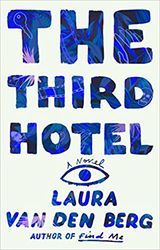
The Third Hotel
Laura van den Berg, 2018
Farrar, Straus and Giroux
224 pp.
ISBN-13: 9780374168353
Summary
In Havana, Cuba, a widow tries to come to terms with her husband’s death—and the truth about their marriage—in Laura van den Berg’s surreal, mystifying story of psychological reflection and metaphysical mystery.
Shortly after Clare arrives in Havana, Cuba, to attend the annual Festival of New Latin American Cinema, she finds her husband, Richard, standing outside a museum.
He’s wearing a white linen suit she’s never seen before, and he’s supposed to be dead.
Grief-stricken and baffled, Clare tails Richard, a horror film scholar, through the newly tourist-filled streets of Havana, clocking his every move.
As the distinction between reality and fantasy blurs, Clare finds grounding in memories of her childhood in Florida and of her marriage to Richard, revealing her role in his death and reappearance along the way.
The Third Hotel is a propulsive, brilliantly shape-shifting novel from an inventive author at the height of her narrative powers. (From the publisher.)
Author Bio
• Birth—1983
• Raised—state of Florida, USA
• Education—B.A., Rollins College; M.F.A., Emerson College
• Awards—(see below)
• Currently—lives in Cambridge Massachusettes
Laura van den Berg is a novelist and short fiction writer. In addition to her debut novel, Find Me (2015) and The Third Hotel (2018), she has published two volumes of short stories, The Isle of Youth (2003) and What Will the World Look Like When All the Water Leaves Us (2009).
Other short stories have appeared in Conjunctions, Freeman’s, The Kenyon Review, American Short Fiction, Ploughshares, Glimmer Train, and One Story, and have been anthologized in The Best American Short Stories, The Best American Mystery Stories, The O. Henry Prize Stories, and The Best American Nonrequired Reading. Her criticism and essays have appeared in The New York Times Book Review, O, The Oprah Magazine, BOMB Magazine, and Vogue.com.
Van den Berg also teaches writing. She has taught at Columbia University, the Fine Arts Work Center in Providence, Rhode Island, and the Bread Loaf Conference. Currently she is a lecturer at Harvard University and Warren Wilson College.
She and her husband, writer Paul Yoon, live with their dog in Cambridge, Massachusetts.
Awards
Rosenthal Family Foundation Award (American Academy of Arts & Letters)
Bard Fiction Prize
Pushcart Prize
O. Henry Award
Jeannette Haien Ballard Writer’s Prize
(Author bio adapted from Wikipedia and the author's website. Retrieved 8/24/2018.)
Book Reviews
There's no denying [van den Berg's] skill at rendering this material; her sentences, at their best, are extraordinarily lucid.… These descriptive passages may come off to some readers as clutter, but they serve to ground a story that sometimes feels elusive and vague.The novel’s intellectual and philosophical excursions are less successful, to my mind, than its concrete descriptions.… Read [The Third Hotel] as the inscrutable future cult classic it probably is, and let yourself be carried along by its twisting, unsettling currents.
J. Robert Lennon - New York Times Book Review
There’s Borges and Bolaño, Kafka and Cortázar, Modiano and Murakami, and now Laura van den Berg. The acclaimed author of two story collections and a novel, van den Berg has always been good, but with The Third Hotel she’s become fantastic—in every sense of the word.… The fantastic plot is elevated by van den Berg’s fantastic writing and unique twists of language.… These sentences aren’t flourishes of showoff; nothing unoriginal slips by in this flawless novel… so much subtextual lava is coursing under the surface of every page of The Third Hotel that the book feels like it’s going to erupt in your hands.
Randy Rosenthal - Washington Post
Laura van den Berg is an artist of the uncanny. As with some surrealist painting, devour her work quickly and the trick will not snag.… Clare’s eerie perceptional wobbles are conjured beautifully by van den Berg, who sees like a painter and narrates like a crime reporter. To read The Third Hotel sometimes feels like following a character based on Joan Didion sinking deeper into a universe whose laws were written by Patricia Highsmith.… We are anchored by loss, set free by love, cliches tell us. What, this exquisitely written book asks, if it’s the opposite? In doing so van den Berg drives home an inversion far scarier than any zombie film.
John Freeman - Boston Globe
It's a quicksilver novel—just when you think you have a possible grip on its plot and meaning, it slithers out of grasp. The Third Hotel works its magic at the level of the subconscious, where nightmares are made.
Jenny Shank - Dallas Morning News
Reading Laura van den Berg's disquieting new novel, The Third Hotel, is akin to walking out of a dark movie theater into bright sunlight. Part of you is still living in a cinematic dreamscape. The real world is what's imaginary.… [T]he writing is lovely and fluid. She is comfortable with ambiguity, and The Third Hotel isn't intent on resolution. It reminds me of another hotel, that one in California, where "you can check out anytime you like, but you can never leave." Haunting.
Nancy Pate - Minneapolis Star Tribune
The Third Hotel contains all of the ingredients for a classic work of horror.… Not every author can make a character both fly through supernatural events and remain grounded in a place the way van den Berg does with Clare. The strength of van den Berg’s storytelling comes from Clare’s attempts to solve the mystery of why Richard has hunkered down in a different country, layered with grief from back home that continues to haunt her. She’s a “final girl” whose denouement horrifies in a modern, bloodless way.
Bethanne Patrick - Time
Van Den Berg doesn't do neatness. She does elegance. She writes with off-kilter beauty and absolute relaxation; the less peaceful a sentence should be, the more peaceful it is.… The Third Hotel is a novel that operates in symbols and layers, which means you can read it however you like. There's no one ending, no right answer, and as a result, it will take away your internal compass. It will unmoor you, send you wobbling around your house in a haze. It will slide some eels under your skin. My recommendation? Let it. We can all stand to learn some new truths.
Lily Meyer - NPR.org
Eerie and uncanny, layered and sharp.… Though subtly drawn, what it means to be a woman becomes just as central to The Third Hotel as the mystery of Richard’s reappearance. Powerful and atmospheric, van den Berg’s novel portrays a haunting descent into grief and the mysteries we can’t quite solve while advancing a thought-provoking exploration of marriage, misogyny, and the loneliness that lurks within unwavering privacy.
Lauren Sarazen - Los Angeles Review of Books
A twisty exploration of grief and perception as well as the ways in which we contribute to our own undoing.
Julia Pierpont - Oprah Magazine
Strange, unsettling, and profound from start to finish, The Third Hotel is a book teeming with the kind of chaos that can only emanate from the mind. It could be fairly described as a meditation on grief, or marriage, or travel; fresh insights on each materialize regularly, at enviable levels of nuance.… [van den Berg] gets under your skin and hits bone. Hers is a terror tale as mercurial as life, veering between the grisly and the gentle.… The Third Hotel ultimately probes one woman’s reaction to the senseless.
David Canfield - Entertainment Weekly
[M]ysterious and engrossing.… Toying with horror tropes and conventions …van den Berg turns Clare’s journey into a dreamlike exploration of grief. This is a potent novel about life, death, and the afterlife.
Publishers Weekly
A surreal meditation on grief and loss.… Atmospheric descriptions of Cuba, and references to horror-film tropes… are integrated throughout, providing additional layers of richness. Verdict:… this novel has a dreamlike quality that resists narrative structure and logic. —Christine DeZelar-Tiedman, Univ. of Minnesota Libs., Minneapolis
Library Journal
Brooding, often-surreal, funerally bemusing …van den Berg's entrancing, gorgeously enigmatic tale dramatizes the narcosis of grief.
Booklist
The line between the real and the imagined is forever blurry, and the result of all that ambiguity is both moving and unsettling.Gorgeously haunting and wholly original; a novel that rewards patience.
Kirkus Reviews
Discussion Questions
We'll add publisher questions if and when they're available; in the meantime, use our LitLovers Talking Points to help start a discussion for THE THIRD HOTEL … than take off on your own:
1. In the first sentence of the novel, Clare wonders: "what was she doing in Havana?" She considers telling anyone who might recognize her, " I am not who you think I am." Or even, "I am experiencing a dislocation of reality." Why is she experiencing such uncertainty about her identity as well as her purpose for visiting Cuba? What do you think she means by "a dislocation of reality"? And, finally, what do you think all of this suggests about Clare's sense of herself?
2. Follow-up to Question 1: Does your initial perception of Clare change during the course of the novel?
3. What were your initial thoughts when Clare sees and follows her husband. Did you consider it/him a ghost, an impostor, or a hallucinatory vision?
4. As the novel progresses, what do we learn about the state of Richard and Clare's marriage? How would you describe their relationship?
5. Do you find yourself impatient with Clare's negation of herself and her surroundings: she wishes to "be free of past and future, of memory and feeling." What about her penchant, for example, of turning off all light and sound in hotel rooms; the fact that she never enters the theater for the movie screening, or that she doesn't correct the person who mistakes her for someone else? Is this Clare's way of expressing grief. If so, do you find her sympathetic?
6. Follow-up to Question 5: One character tells Clare she is deranged. Another says that the grieving are dangerous, like "injured animals with fearsome claws, bloodied and pushed into a corner." What do you think of Clare's mental/emotional state?
7. Why might the author withhold so much information from readers: the unopened white box found by her husband's body; what her father said to her, which left her unable to speak in full sentences; the red notebook, which she slams shut; the unopened envelope from her father; phone calls that are silent on the other end or filled with static? Recall, Clare's quip to a new friend, "Americans like straight answers" and "simple stories."
8. Follow-up to Question 7: Do the author's revelations at the end satisfy your questions?
9. How would you describe this book: a police procedural, a ghost story, a thriller, a philosophical query into self-identity and death? All, or none, of the above?
10. The professor of quantum physics tells Clare that "We are all erasing ourselves a tiny bit at a time." He goes on to say, "Drinking, fantasies, secrets, denial, hysteria, double lives, suicide, ennui, schemes. Those are just a few of the ways we disappear." Why do we want to erase ourselves? And what does these observation suggest about the thematic concerns of The Third Hotel?
11. What was your experience reading Laura van den Berg's novel? Were you intrigued or mystified? Enthralled or irritated? J. Robert Lennon, the New York Times reviewer, while somewhat critical, predicted The Third Hotel will become a "cult classic." What do you think?
(Questions by LitLovers. Please feel free to use them, online and off, with attribution. Thanks.)
The Third Rainbow Girl: The Long Life of a Double Murder in Appalachia
Emma Copely Eisenberg, 2020
Hachette Books
336 pp.
ISBN-13: 9780316449236
Summary
A stunningly written investigation of the murder of two young women—showing how a violent crime casts a shadow over an entire community.
In the early evening of June 25, 1980 in Pocahontas County, West Virginia, two middle-class outsiders named Vicki Durian, 26, and Nancy Santomero, 19, were murdered in an isolated clearing.
They were hitchhiking to a festival known as the Rainbow Gathering but never arrived.
For thirteen years, no one was prosecuted for the "Rainbow Murders," though deep suspicion was cast on a succession of local residents in the community, depicted as poor, dangerous, and backward. In 1993, a local farmer was convicted, only to be released when a known serial killer and diagnosed schizophrenic named Joseph Paul Franklin claimed responsibility.
With the passage of time, as the truth seemed to slip away, the investigation itself caused its own traumas—turning neighbor against neighbor and confirming a fear of the violence outsiders have done to this region for centuries.
Emma Copley Eisenberg spent years living in Pocahontas and re-investigating these brutal acts. Using the past and the present, she shows how this mysterious act of violence has loomed over all those affected for generations, shaping their fears, fates, and the stories they tell about themselves.
In The Third Rainbow Girl, Eisenberg follows the threads of this crime through the complex history of Appalachia, forming a searing and wide-ranging portrait of America-its divisions of gender and class, and of its violence. (From the publisher.)
Author Bio
Emma Copley Eisenberg is the author of the true crime story, The Third Rainbow Girl, published in 2020.
Other work has appeared in Granta, VQR, McSweeney's, Tin House, Paris Review online, New Republic, Salon, Slate, and elsewhere.
She has received support from the Millay Colony for the Arts, the Elizabeth George Foundation, Lambda Literary, and the New Economy Coalition. Her reporting has been recognized by GLAAD, the New York Association of Black Journalists, the Deadline Club and Longreads' Best Crime Reporting 2017.
Eisenberg lives in Philadelphia, where she co-directs Blue Stoop, a community hub for the literary arts. (Adapted from the publisher.)
Book Reviews
[A]n evocative and elegantly paced examination of the murders that takes a prism-like view of the crime.… [Eisenberg's] unraveling of the brutal double murder is as skilled as her exploration of Pocahontas County, where the men, as much as the women, appear trapped in their predestined societal roles, and where toxic masculinity gnaws at the men, rudderless and lost, who drink to fill the idle hours. But she also digs deeper, beyond the old cliches of insular, backward mountain folk, to find a thriving transgender community and an independent, open-minded streak among the county’s inhabitants…. [This is] not just a masterly examination of a brutal unsolved crime, which leads us through many surprising twists and turns and a final revelation…. It’s also an unflinching interrogation of what it means to be female in a society marred by misogyny, where women hitchhiking alone are harshly judged, even blamed for their own murders.
Melissa Del Bosque - New York Times Book Review
[A] haunting and hard-to-characterize book about restless women and the things that await them on the road.… Because she lived and worked with teenage girls in Pocahontas County on and off for several years but isn't a native, [Eisenberg] is suited to the insider-outsider reporter role.… there's a deeper dimension to The Third Rainbow Girl that gives it its contemplative power. Eisenberg intertwines her own raw story about coming-into-womanhood into the true crime narrative.
Maureen Corrigan - NPR
[A] true crime tale as thoroughly researched and reported as it is perplexing.… [The book] offers a deep-dive into rural Appalachia, a region of the United States that is little understood, and it digs into questions of how deeply misogyny and bias can run inside a community. It is also an honest and endearing coming-of-age tale—one that will leave readers curious to know what Eisenberg will write about next ... Eisenberg's growing personal commitment to the summer camp for teen girls, and to her friends in this complicated rural ecosystem, emerges as the living heartbeat of the book.… [Eisenberg's] relentless reporting and attention to detail are what make the true crime elements of this book so enjoyable.… [It] accomplishes what any good murder mystery should. It shines a spotlight on a nexus of people and a place.… The insights into human nature are the real gritty, good stuff you get from reading a masterful work of journalism like this one.
Rachel Veroff - NPR
[Read this work] as a memoir, as a deeply researched true-crime report, as a work of philosophy. And the language is physical and visceral in its description of both the corporeal and the psychological.… Eisenberg is a skilled researcher, a truth made clear by the troves of detail about the "Rainbow Murders" case, expertly laid out in engaging prose.… Ultimately, the book is about accepting multiplicity and the prismatic nature of truth and justice… a rare find.
Sarah Neilson - Seattle Times
Compelling and sensitive.… The Third Rainbow Girl is not only a meticulously investigated story of a crime and its haunting aftermath, it's also a coming-of-age memoir.
Salon
[A] deeply felt exploration of Appalachia, a land where fault lines of race, gender, and class run deep. Eisenberg, a one-time resident of Pocahontas County, never lets her former home off easy, but instead evokes a portrait at once generous and devastating.
Esquire
If this is a book about a murder, it is also a book about the history of economic exploitation in Appalachia, the systemic biases of the criminal justice system, and the unreliability of memory.
The Nation
[G]ripping… [as the author] blends the case facts with a memoir of her time living in the area…. Part self-discovery and part crime and courtroom drama, … [this] is essential reading for true crime fans.
Publishers Weekly
[S]tunning…Eisenberg delivers the gripping tale of the murders, trial, and subsequent reverberations through the community. The author transcends genre and offers a unique work that is part memoir, part sociological analysis…. [N]ot to be missed. —Mattie Cook, Flat River Community Lib., MI
Library Journal
(Starred review) Eisenberg has crafted a beautiful and complicated ode to West Virginia. Exquisitely written,
this is a powerful commentary on society's notions of gender, violence, and rural America. Readers of literary nonfiction will devour this title in one sitting.
Booklist
[A] genre-straddling debut that blends true crime and memoir.… [Eisenberg] reconstructs the case with a brisk pace and a keen sensitivity…. The compelling second story is, in effect, a memoir of her coming-of-age in Pocahontas County…. [A] nuanced portrait of a crime and its decadeslong effects.
Kirkus Reviews
Discussion Questions
We'll add publisher questions if and when they're available; in the meantime, use our LitLovers Book Club Resources. They can help with discussions for any book:
• How to Discuss a Book (helpful discussion tips)
• Generic Discussion Questions—Fiction and Nonfiction
• Read-Think-Talk (a guided reading chart)
(Resources by LitLovers. Please feel free to use them, online and off, with attribution. Thanks.)
Thirteen Moons
Charles Frazier, 2006
Random House
422 pp.
ISBN-13: 9780375509322
Summary
This magnificent novel by one of America’s finest writers is the epic of one man’s remarkable journey, set in nineteenth-century America against the background of a vanishing people and a rich way of life.
At the age of twelve, under the Wind moon, Will is given a horse, a key, and a map, and sent alone into the Indian Nation to run a trading post as a bound boy. It is during this time that he grows into a man, learning, as he does, of the raw power it takes to create a life, to find a home. In a card game with a white Indian named Featherstone, Will wins—for a brief moment—a mysterious girl named Claire, and his passion and desire for her spans this novel. As Will’s destiny intertwines with the fate of the Cherokee Indians—including a Cherokee Chief named Bear—he learns how to fight and survive in the face of both nature and men, and eventually, under the Corn Tassel Moon, Will begins the fight against Washington City to preserve the Cherokee’s homeland and culture. And he will come to know the truth behind his belief that “only desire trumps time.”
Brilliantly imagined, written with great power and beauty by a master of American fiction, Thirteen Moons is a stunning novel about a man’s passion for a woman, and how loss, longing and love can shape a man’s destiny over the many moons of a life. (From the publisher.)
Author Bio
• Birth—1950
• Where—Asheville, North Carolina, USA
• Education—B.A., University of North Carolina, Chapel Hill;
M.A., Ph.D., Appalachian State University
• Awards—National Book Award for Fiction, 1997
• Currently—lives in Raleigh, North Carolina
Charles Frazier grew up in the mountains of North Carolina. Cold Mountain, his highly acclaimed first novel, was an international bestseller, and won the National Book Award in 1997. In 2006 Mr. Frazier published Thirteen Moons.
Frazier had been teaching University-level literature part-time when he first became spellbound by the story of his great-great uncle W. P. Inman. Inman was a confederate soldier during the Civil War who took a harrowing foot-journey from the ravaged battle fields back to his home in the mountains of North Carolina. The specifics of Inman's history were sketchy, indeed, but Frazier's father spun his tale with such enticing drama that Frazier began filling in the gaps, himself. Bits of the life of Frazier's grandfather, who also fought in the Civil War, helped flesh out the journey of William Pinkney Inman.
He also looked toward the legendary epic poem The Odyssey for inspiration. Slowly, a gripping tale of devotion, faith, redemption, and love coalesced in Frazier's mind. For six or seven years, he toiled away on the story that would ultimately become Cold Mountain, and with the novel's publication in 1997, the first-time author had a modern classic of American literature on his hands.
In Cold Mountain, Inman is a wounded confederate soldier who abandons the war to venture home to his beloved Ada. Along the way, he is confronted by various obstacles, but he journeys on valiantly, regardless. Frazier cleverly divides the narrative between Inman's trek and Ada's story as she struggles to make due in the wake of her father's death and the absence of her love.
When Frazier was only half finished with the book, he passed it along to friend and novelist Kaye Gibbons (Ellen Foster; A Virtuous Woman), who then got it into the hands of her agent. Much to his disbelief, Frazier's novel went on to become the smash sensation of the late-‘90s. Winning countless laudatory reviews from publications throughout the nation, Cold Mountain also became a must-read commercial smash. The novel ultimately won the coveted National Book Award for fiction and was adapted into an Oscar-winning motion picture starring Jude Law, Nicole Kidman and best supporting actress Renee Zellweger.
Nearly ten years after the publication of Cold Mountain, Frazier published Thirteen Moons. While Thirteen Moons returns to a 19th century setting, 12-year old Will is quite a different protagonist from Inman. With only a horse, a key, and a map, the boy is prodded into Indian country with the mission of running a trading post. In this dangerous environment, Will learns to empathize with the Cherokees, who open his mind to a much broader world than he had ever seen before.
In 2011 Frazier published Nightwoods, the story of a young woman living alone in the Appalachians who takes on the care of her murdered sisters young children, traumatized, violent and mute.
Extras
• Frazier grew up not far from the mountain he immortalized in Cold Mountain in the Blue Ridge of North Carolina. Although the actual Cold Mountain exists, the town after which it is named in the novel is entirely fictional.
• Reportedly, Frazier was offered a whopping $8 million advance for Thirteen Moons. Sadly, the book never reached the sales potential Random House had expected. (From Widkipedia.)
Book Reviews
Mr. Frazier recounts Will’s melancholy adventures with plenty of narrative brio, giving the reader a succession of suspenseful—and in some cases touching —set pieces: the young Will venturing out into the wilderness for the first time, armed only with a sketchy map and a few provisions; Will facing off in a duel with Claire’s sadistic guardian, Featherstone; Will and Bear deciding to hunt down a group of their own people (who have killed some government soldiers) to win permission to stay on their land.
Michiko Kakutani - The New York Times
(Starred review.) When Frazier's debut Cold Mountain blossomed into a National Book Award-winning bestseller with four million copies in print, expectations for the follow-up rose almost immediately. A decade later, the good news is that Frazier's storytelling prowess doesn't falter in this sophomore effort, a bountiful literary panorama again set primarily in North Carolina's Great Smoky Mountains. The story takes place mostly before the Civil War this time, and it is epic in scope. With pristine prose that's often wry, Frazier brings a rough-and-tumble pioneer past magnificently to life, indicts America with painful bluntness for the betrayal of its native people and recounts a romance rife with sadness.
In a departure from Cold Mountain's Inman, Will Cooper narrates his own story in retrospect, beginning with his days as an orphaned, literate "bound boy" who is dispatched to run a musty trading post at the edge of the Cherokee Nation. Nearly nine mesmerizing decades later, Will is an eccentric elder of great accomplishments and gargantuan failures, perched cantankerously on his front porch taking potshots at passenger trains rumbling across his property (he owns "quite a few" shares of the railroad). Over the years, Will—modeled very loosely, Frazier acknowledges, on real-life frontiersman William Holland Thomas—becomes a prosperous merchant, a self-taught lawyer and a state senator; he's adopted by a Cherokee elder and later leads the clan as a white Indian chief; he bears terrible witness to the 1838-1839 Trail of Tears; a quarter-century later, he goes to battle for the Confederacy as a self-anointed colonel, leading a mostly Indian force with a "legion of lawyers and bookkeepers and shop clerks" as officers; as time passes, his life intersects with such figures as Davy Crockett, Sen. John C. Calhoun and President Andrew Jackson.
After the Civil War, Will fritters away a fortune through wanderlust, neglect and unquenched longing for his one true love, Claire, a girl he won in a card game when they were both 12, wooed for two erotic summers in his teen years and found again several decades later. In the novel's wistful coda, recalling Claire's voice inflicts "flesh wounds of memory, painful but inconclusive"-a voice that an uncertain old Will hears in the static hiss when he answers his newfangled phone in the book's opening pages. The history that Frazier hauntingly unwinds through Will is as melodic as it is melancholy, but the sublime love story is the narrative's true heart.
Publishers Weekly
If Frazier modeled Cold Mountain on The Odyssey, his template for Thirteen Moons could well be Little Big Man, as a very old man tells tall tales about his life with American Indians. Indentured at 12 and sent to Cherokee territory to run a trading post, Will Cooper gets more or less adopted by Bear, a Cherokee chief who maintains the old ways, and Featherstone, the owner of a slave-supported plantation. Will also falls hard and permanently for Claire, who drifts in and out of his life over the years. He takes to the law and tries to defend Cherokees from the land grabs that culminated in the Trail of Tears. His tales are mostly fascinating, and the insights into the period priceless. Reader Will Patton sounds too young to portray the ancient Cooper, but much of the book concerns his youthful adventures. If the novel gradually becomes less adventuresome and bogs down in mundane legal complications, well, so do many real lives. If not the home run that Cold Mountain was, Thirteen Moons is at least a stand-up double and one of the more entertaining novels of the year. Libraries will want to have it.
John Hiett - Library Journal
The recent resurgence in historical fiction arguably dates from the critical and popular success of North Carolinian Charles Frazier's memorable first novel, Cold Mountain. A romantic epic in the classic mold, this richly detailed sag of a Civil War deserter's homeward odyssey won the 1997 National Book Award and inspired a haunting 2003 feature film.
Classical precedent likewise informs and shapes Frazier's long-awaited second novel, in which a rootless an restless protagonist, like Cold Mountain's embattled hero, Inman, expends the energies of a long lifetime seeking permanent reunion with the only woman he'll ever love, who love shim in return yet moves in and out of his yearning orbit during the decades they are apart, but never entirely trusts him nor can bring herself to share his patchwork experience.
Like the beleaguered heroes of the books that are his lifelong sustenance, he's a visionary fixated on an ever-receding ideal: the noble knight Lancelot, cursed and burdened by his own divided and enervated loyalties.
She is Claire Featherstone, the ethereally beautiful young wife of a "white" (i.e. half-breed) Indian who prospers as a landowners and patriarch in the Cherokee Nation that stretches westward from the Carolinas to Oklahoma.
He is Will Cooper, an orphan and "bound boy" sold by his relatives to an "antique gentleman" who places adolescent Will in a moribund trading post on the edge of "the (Cherokee) Nation"—from which humble beginning he earns a vast fortune, bonds closely with his Cherokee neighbors and mentors (his conflicted friendship with the mercurial Featherstone overshadowed by his filial devotion to the equally prominent chief known as Bear), studies law and represents "his people" against the repressive policies of Indian-hating President Andrew Jackson, becomes a state senator and an itinerant buffer between the red men's and white men's worlds, all the while pursuing the memory, the dream and the promise of the elusive Claire.
Thirteen Moons brings this vanished world thrillingly to life, retelling the agonizing stories of "the Removal" (of Indians from their ancestral lands) and the lie of "Reconstruction"; creating literally dozens of heart-stopping word pictures (e.g. autumns display "a few stunted pumpkins still glowing in the fields an a few persistent apples hanging red in the skeletal orchards"); building unforgettable characterizations of the sorrow-laden everyman Will (whom we first, then finally, glimpse as a reclusive anachronism, weathered by "a near century of living"), unpredictable Featherstone and stoical Beat (a character Faulkner might have created), Claire who belongs to no man, ancient medicine woman Granny Squirrel, and all the uprooted and dispossessed souls enduring "the days and nights, the thirteen moons" of each accumulating year, while making their final journey "to the Nightland".
One of the great Native American—and American—stories, and a great gift to all of us, from one of our very best writers.
Kirkus Reviews
Generic Questions
Use our LitLovers Book Club Resources; they can help with discussions for any book:
• How to Discuss a Book (helpful discussion tips)
• Generic Discussion Questions—Fiction and Nonfiction
• Read-Think-Talk (a guided reading chart)
top of page


Thirteen Reasons Why
Jay Asher, 2007
Penguin Group (USA)
336 pp.
ISBN-13: 9781595141880
Summary
Clay Jensen returns home from school to find a mysterious box with his name on it lying on his porch. Inside he discovers cassette tapes recorded by Hannah Baker—his classmate and crush—who committed suicide two weeks earlier.
On tape, Hannah explains that there are thirteen reasons why she decided to end her life. Clay is one of them. If he listens, he’ll find out how he made the list.
Through Hannah and Clay’s dual narratives, debut author Jay Asher weaves an intricate and heartrending story of confusion and desperation that will deeply affect teen readers.
Thirteen Reasons Why is the gripping, addictive international bestseller that has changed lives the world over. It's an unrelenting modern classic. (From the publisher.)
Author Bio
• Birth—September 30, 1975
• Where—Arcadia, California, USA
• Education—Cuesta Community College and Cal Poly San Luis Obispo (no degree)
• Currently—lives in California
Jay Asher is an American writer of contemporary novels for teens. He was born in Arcadia, California, and grew up with a family that encouraged him to pursue his many interests—from guitar playing to writing. He attended Cuesta Community College after graduating from San Luis Obispo High School. It was here where he wrote his first two children’s books for a class called Children’s Literature Appreciation.
Deciding he wanted to become an elementary school teacher, he transferred to California Polytechnic State University in San Luis Obispo. But he left his senior year in order to pursue his career as a serious writer. In 2002 he married his wife Joan Marie. Those early years found him working in various establishments, including a shoe store, libraries, and bookstores. Many of his work experiences had an impact on some aspect of his writing.
Writing
Asher's first novel, Thirteen Reasons Why, became a 2007 New York Times best-selling young-adult fiction novel. It won several awards and received five stars from Teen Book Review, as well as high praise from fellow authors, including Ellen Hopkins, Sherman Alexie, and Chris Crutcher, and Gordon Korman.
His second novel The Future of Us was co-written by Carolyn Mackler and published in 2011. He has also written several picture books and middle school humor novels.
Asher is a fan of the TV series My So-Called Life and cites it as a major influence on his work.
Synopses
Thirteen Reasons Why (2007). This is the story of Hannah Baker, a girl who committed suicide. She reveals her thirteen reasons for her decision in a series of seven audio tapes mailed to a classmate with instructions to pass them from one student to another, in the style of a chain letter. Through Hannah's recorded voice, her classmates learn the reasons why Hannah decides to take her own life. Besides Hannah, the reader also sees the story through the eyes of Clay Jensen, one of the recipients of the tapes. Asher was inspired to write due to incidents that happened in his high school.
The Future of Us (2011) This was co-written with Carolyn Mackler. This is the story of Josh and Emma, two teenagers who used to be best friends until a huge misunderstanding. In 1996, Josh helps Emma set up her internet, only to find Facebook—before it has been invented. There, they can see themselves 15 years in the future—status updates, information, friends, etc. Using Facebook, they are able to change their destinies. (Adapted from Wikipedia. Retrieved 10/09/2014.)
Book Reviews
This novel is the first for Jay Asher, and it is billed as a spectacular one. The reader learns that one cannot stop the future or rewind the past. This book is also billed as suspense. It may not be for everyone, and many may become bored and/or discouraged before the end, but, like other Razorbill books, it is challenging and interesting. —Naomi Butler
Children's Literature
From Hannah, readers realize the impact of thoughtless actions and comments. As Clay finishes Hannah's story, he becomes more perceptive and sensitive to others.... [T]here is depth to the novel. This provocative tale touches on universal topics of interest, is genuine in its message, and would be a good choice for high school book discussions and booktalks. —Judy Sasges
VOYA
(Gr 7 Up.) High school senior Clay Jensen receives seven audiotapes in the mail. They contain the story of why Hannah Baker, a girl he adored, committed suicide.... He spends a torturous night listening and wandering, unearthing the depth and causes of Hannah's unhappiness.... [T]he breakneck pace and dizzying emotion are the true source of this novel's irresistible readability at all levels. —Johanna Lewis, New York Public Library
Library Journal
The text alternates, sometimes quickly, between Hannah's voice (italicized) and Clay's thoughts as he listens to her words, which illuminate betrayals and secrets that demonstrate the consequences of even small actions.... The message about how we treat one another, although sometimes heavy, makes for compelling reading. —Dobrez, Cindy
Booklist
(Starred review.) Asher has created an entrancing character study and a riveting look into the psyche of someone who would make this unfortunate choice. A brilliant and mesmerizing debut from a gifted new author
Kirkus Reviews
Discussion Questions
1. How does Hannah and Clay’s dual narrative enhance the story? What additional details are revealed through this method of storytelling that might have otherwise remained secret if the book had been written from only one of their perspectives? How might the story have changed if the book had been written from one of the other people’s perspectives instead of Clay’s? For example, Tony’s?
2. Consider the title of the novel. Are each of Hannah’s thirteen reasons of equal importance? Which do you find to be the most unexpected? Who is responsible for Hannah’s death? Why do you think Hannah committed suicide?
3. The inside of the book jacket for Thirteen Reasons Why pictures a replica of the map that Hannah leaves for each of the people named on her tapes. What does being able to visually trace Clay’s route through town add to your reading experience?
4. Discuss the role that the presence of Hannah’s voice plays as a physical presence on the tapes. Is the impact the tapes have different from the impression a suicide note would have left? Why do you think she recorded and left the tapes? If her story had been recorded on CDs or MP3 files would the effect have been different?
5. At the beginning of the first tape, Hannah says, "...there are thirteen sides to every story." What does she mean by this? Are there sides to her own story that Hannah doesn’t know? Do you think she would have made different decisions if she had had the chance to listen to each of the other thirteen sides?
6. Hannah references rumors that she hoped to get away from when her family moved. What do you imagine she meant? Define the word "rumor." What comment does this story make about rumors in general? Discuss how rumors and truth can be connected. Is one more powerful than the other? Can rumors be positive? Does Hannah’s story change your original point of view on this subject?
7. Hannah also says, "No one knows for certain how much impact they have on the lives of other people. Oftentimes, we have no clue. Yet we push it just the same." Discuss the concept of individual perception and how it contributes to how Hannah’s story plays out. What do you think she means by "pushing it"? Further on, Hannah says, "...I’m sure you must have thought, This can’t be why I’m on the tapes.
8. Mr. Porter tells Hannah that besides filing charges with the police,she has two options for dealing with what happened at the afterparty. He tells her she can confront the other person or move on. Do you agree that these are her only options? What do you think Clay was hoping Mr. Porter would say to Hannah?
9. Reflect on Hannah and Clay’s last words to each other in the hallway at school. Discuss their greater meaning within the context of the story. Compare and contrast their last words to the other times in the novel when these same words are uttered under different circumstances. How is it relevant that Clay hears Skye utter these words?
10. Discuss Skye’s role in the story. Compare and contrast her to Hannah. What do you think Clay says to Skye when he catches up with her in the hallway?
11. Why do you think the author ended the story the way he did? How do you think Clay is changed by listening to Hannah’s tapes? Do you think the tapes had similar effects on the other listeners? Do you think they all followed Hannah’s instructions in the same manner that Clay did? How do you imagine their experiences to be different?
12. Could anything have saved Hannah? If one link in this chain of events had been different, which one do you think would have made the most difference for Hannah? How would a change in that specific event have impacted the remaining portion of the other thirteen reasons that followed?
13. What will you remember from reading this novel?
14. Read Jay Asher’s responses to thirteen questions about Thirteen Reasons Why, which are printed in the back of the book. If you had you the chance, would you have asked Jay the same thirteen questions after reading the story? What else would you like to know? Which of his responses surprised you the most? How do his answers help you to better understand Hannah and the novel?
(Questions issued the publisher.)
The Thirteenth Tale
Diane Setterfield, 2006
Simon & Schuster
432 pp.
ISBN-13: 9780743298032
Summary
Biographer Margaret Lea returns one night to her apartment above her father's antiquarian bookshop. On her steps she finds a letter. It is a hand-written request from one of Britain’s most prolific and well-loved novelists. Vida Winter, gravely ill, wants to recount her life story before it is too late, and she wants Margaret to be the one to capture her history. The request takes Margaret by surprise—she doesn’t know the author, nor has she read any of Miss Winter’s dozens of novels.
Late one night, while pondering whether to accept the task of recording Miss Winter’s personal story, Margaret begins to read her father’s rare copy of Miss Winter’s Thirteen Tales of Change and Desperation. She is spellbound by the stories and confused when she realizes the book only contains twelve stories. Where is the thirteenth tale? Intrigued, Margaret agrees to meet Miss Winter and act as her biographer.
As Vida Winter unfolds her story, she shares with Margaret the dark family secrets that she has long kept hidden as she remembers her days at Angelfield, the now burnt-out estate that was her childhood home. Margaret carefully records Miss Winter’s account and finds herself more and more deeply immersed in the strange and troubling story. In the end, both women have to confront their pasts and the weight of family secrets. As well as the ghosts that haunt them still. (From the publisher.)
Author Bio
• Birth—August 22, 1964
• Where—Berkshire, England, UK
• Education—B.A., Ph.D., University of Bristol
• Currently—lives in Yorkshire, England
Diane Setterfield is in her early forties. Having spent time in France, she now lives in Harrogate. Her background is an academic one. Her previous publications have been in the field of 19th and 20th century French literature, especially the works of André Gide.
More
Diane Setterfield is one of the most talked-about authors in the world, and as of this writing, her debut novel hasn't even been released yet! The reason this British academic is causing such a stir is because her haunting gothic mystery, The Thirteenth Tale, was the subject of a high-stakes bidding war on both sides of the pond. After she was discovered by novelist Jim Crace (Genesis; Being Dead) at a writing course on how to get published (!), Setterfield's book caught the attention of multiple publishers. As the oft-told story goes, the ten-day bidding war the book inspired resulted in it being sold for a staggering 800,000 pounds in the U.K. and $1 million in the U.S. (to Simon & Schuster). Eight translation deals have also been signed, and the book is also expected to be a hot target for filmmakers.
All of this has been quite a kick for Setterfield, who had been a teacher of French literature and the French language and had only previously published articles on literary theory. "If you ask anybody who has ever thought of writing a book how they feel about getting their work published, they will tell you that nothing could be more thrilling," Setterfield told the Yorkshire Post. "Any serious writer would view it as an enormous privilege to be able to devote the best of their time to what they love, and that's what I'll now be able to do."
As for the book that has attracted all of this rabid attention, Setterfield delivers one of the most intriguing novels to hit book stores in a long time with the story of Margaret Lea. The reclusive, plain Margaret spends her days working in her father's bookshop, where she fuels her fascination for famous writers. When she receives a letter from the legendary Vida Winter—a novelist notorious for toying with journalists and constantly reinventing her own life story—Margaret is given a most intriguing offer. As Vida is aging and ailing, she finally wants to come clean about her past and tell her true story to Margaret. What follows is a labyrinthine descent into the strange and chilling story of Vida's past and her bizarre family history. Critics have lauded The Thirteenth Tale as a credible successor to the greatest works by literary luminaries like Charlotte Brontë and Daphne du Maurier. Publishers Weekly has already applauded its "graceful storytelling that has its own pleasures," and Library Journal notes how the book "grabs the reader with its damp, icy fingers and doesn't let go until the last shocking secret has been revealed."
As for Setterfield, who is currently working on her second novel, she believes that the true gauge of her novel's success is still yet to come. "Of course I'm very happy with how it all seems to be going... but nobody has bought a copy yet," she said. "All the success so far is lovely, but the real acid test will be September when it gets into the shops."
Extras
Excerpts from a 2006 Barnes & Noble interview:
• Jobs I had before I began writing, in chronological order: Chambermaid, Shop Assistant (lightbulbs and batteries), Shop Assistant (newspapers and greetings cards), Bakery Assistant (I put the jam into doughnuts. I hate doughnuts.), Assistant in an old people's home, Library Assistant, English Language Tutor, Translator, French Language Tutor, University Lecturer, French Language Tutor again. Writing suits me better than any other job I have had.
• My best vacation: The most recent holiday was the best. My husband and I have just come back from Athens. It was my first visit, the first of many I am sure. My favorite things were: the view of the city from the top of Lycabettus Hill. The mysterious and moving figures in the Museum of Cycladic Art. The glass windows in the pavements where they meant to dig ventilation shafts for the new metro but found such fabulous antiquities that they had to excavate instead. The artichoke/courgette/dill salad at To Kafenio. The birdsong at 6:00 on a May evening at the Kerameikos.
• I have kept a reading diary since I was 18. I am jealous of my friend who has kept hers since she was ten.
• I love to read, obviously. Cooking and eating are joys (as I write this the sun is shining, and I am wondering whether the time is right to buy an ice-cream maker). I am always happy up a ladder with a paintbrush in my hand. And I wish I had more time to spend in the garden -- not least because I get good ideas for writing when I'm out there. I like spending time with my friends. (I did warn you. Writers are not special people. When they're not writing they do exactly the same as everyone else.)
• There is no single book that stands out in my mind as having influenced me in this way. Rather, it is the experience of reading itself that has been central in my life. The addictive pleasure of abandoning yourself to a book, of losing consciousness of your worries, your body, and your surroundings, to become a ghost haunting other worlds has influenced me in many ways....
• My mother says that after I first visited the home of the man I later married, she knew it was serious when I told her, "Mum, he has more books than me!" So, books are at the very heart of my life.
• My favorite book: The Heart is a Lonely Hunter by Carson McCullers. It is the most perfect book I can remember reading. (Bio and interview from Barnes & Noble.)
Book Reviews
Setterfield, a former professor of 20th-century French literature, is a deft stylist and talented technician. Both her love for literature and the depth of her learning enliven her debut novel.
Margaux Wexberg Sanchez - The Washington Post
Former academic Setterfield pays tribute in her debut to Brontë and du Maurier heroines: a plain girl gets wrapped up in a dark, haunted ruin of a house, which guards family secrets that are not hers and that she must discover at her peril. Margaret Lea, a London bookseller's daughter, has written an obscure biography that suggests deep understanding of siblings. She is contacted by renowned aging author Vida Winter, who finally wishes to tell her own, long-hidden, life story. Margaret travels to Yorkshire, where she interviews the dying writer, walks the remains of her estate at Angelfield and tries to verify the old woman's tale of a governess, a ghost and more than one abandoned baby. With the aid of colorful Aurelius Love, Margaret puzzles out generations of Angelfield: destructive Uncle Charlie; his elusive sister, Isabelle; their unhappy parents; Isabelle's twin daughters, Adeline and Emmeline; and the children's caretakers. Contending with ghosts and with a (mostly) scary bunch of living people, Setterfield's sensible heroine is, like Jane Eyre, full of repressed feeling-and is unprepared for both heartache and romance. And like Jane, she's a real reader and makes a terrific narrator. That's where the comparisons end, but Setterfield, who lives in Yorkshire, offers graceful storytelling that has its own pleasures.
Publishers Weekly
A ruined mansion in the English countryside, secret illegitimate children, a madwoman hidden in the attic, ghostly twin sisters-yep, it's a gothic novel, and it doesn't pretend to be anything fancier. But this one grabs the reader with its damp, icy fingers and doesn't let go until the last shocking secret has been revealed. Margaret Lea, an antiquarian bookseller and sometime biographer of obscure writers, receives a letter from Vida Winter, "the world's most famous living author." Vida has always invented pasts for herself in interviews, but now, on her deathbed, she at last has decided to tell the truth and has chosen Margaret to write her story. Now living at Vida's (spooky) country estate, Margaret finds herself spellbound by the tale of Vida's childhood some 70 years earlier...but is it really the truth? And will Vida live to finish the story? Setterfield's first novel is equally suited to a rainy afternoon on the couch or a summer day on the beach. —Jenne Bergstrom, San Diego Cty. Lib.
Library Journal
A dying writer bids a young bookshop assistant to write her biography. Margaret Lea grew up in a household of mourning, but she never knew why until the day she opened a box of papers underneath her parent's bed and found the birth and death certificates of a twin sister of whom she never knew. It is the coincidence of twins in the life of Vida Winter, Britain's most famous writer, that convinces Margaret to leave her post at her father's rare-books store and travel to the dying writer's Yorkshire estate. There, she hears a story no one else knows: who Vida Winter really is. For decades, the author has wildly fabricated answers to personal questions in interviews. Now Vida wants to tell the true story. And what a story it is, replete with madness; incest; a pair of twins who speak a private language; a devastating fire; a ghost that opens doors and closes books; a baby abandoned on a doorstep in the rain; a page torn from a turn-of-the-century edition of Jane Eyre; a cake-baking gentle giant; skeletons; topiaries; blind housekeepers; and suicide. As the master storyteller nears death, Margaret has yet to understand why she is the one Vida chose to record her tale. And is it a tall tale? One last great fiction to leave for her reading public? Only Margaret, who begins to catch glimpses of her own dead twin in the eternal gloom of the Winter estate, can sort truth from longing and lies from guilt. Setterfield has crafted an homage to the romantic heroines of du Maurier, Collins and the Brontes. But this is no postmodern revision of the genre. It is a contemporary gothic tale whose excesses and occasional implausibility (Vida's "brother" is the least convincing character) can be forgiven for the thrill of the storytelling. Setterfield's debut is enchanting Goth for the 21st century.
Kirkus Reviews
Discussion Questions
1. Much of the novel takes place in two grand estates—Angelfield and then Miss Winter's. How are the houses reflections of their inhabitants?
2. As the story unfolds, we learn that Margaret and Miss Winter are both twins. What else do they have in common?
3. Margaret and her mother are bound by a singular loss—the death of Margaret's twin sister. How has each woman dealt with this loss, and how has it affected her life? If her parents had told her the truth about her twin, would Margaret still be haunted?
4. Books play a major role in this novel. Margaret, for example, sells books for a living. Miss Winter writes them. Most of the important action of the story takes place in libraries. There are stories within stories, all inextricably intertwined. Discuss the various roles of books, stories, and writing in this novel.
5. Miss Winter asks Margaret if she'd like to hear a ghost story—in fact, there seem to be several ghost stories weaving their way through. In what ways is The Thirteenth Tale a classic, gothic novel?
6. Miss Winter frequently changes points of view from third to first person, from "they" to "we" to "I," in telling Margaret her story. The first time she uses "I" is in the recounting of Isabelle's death and Charlie's disappearance. What did you make of this shifting when Margaret points it out on page 204?
7. Compare and contrast Margaret, Miss Winter, and Aurelius—the three "ghosts" of the novel who are also each haunted by their pasts.
8. It is a classic writer's axiom that a symbol must appear at least three times in a story so that the reader knows that you meant it as a symbol. In The Thirteenth Tale, the novel Jane Eyre appears several times. Discuss the appearances and allusions to Jane Eyre and how this novel echoes that one.
9. The story shifts significantly after the death of Mrs. Dunne and John Digence. Adeline steps forward as intelligent, well-spoken, and confident—the "girl in the mists" emerges. Did you believe this miraculous transformation? If not, what did you suspect was really going on?
10. Dr. Clifton tells Margaret that she is "suffering from an ailment that afflicts ladies of romantic imagination" when he learns that she is an avid reader of novels such as Wuthering Heights, Jane Eyre, and Sense and Sensibility. What do you think he means by drawing such a parallel? What other parallels exist between The Thirteenth Tale and classic nineteenth-century literature?
11. When did you first suspect Miss Winter's true identity? Whether you knew or not, looking back, what clues did she give to Margaret (and what clues did the author give to you)?
12. Margaret tells Aurelius that her mother preferred telling "weightless" stories in place of heavy ones, and that sometimes it's better "not to know." Do you agree or disagree?
13. The title of this novel is taken from the title of Miss Winter's first book, Thirteen Tales of Change and Desperation, a collection of twelve stories with a mysterious thirteenth left out at the last minute before publication. How is this symbolic of the novel? What is the thirteenth tale?
14. When do you think The Thirteenth Tale takes place? The narrator gives some hints, but never tells the exact date. Which aspects of the book gave you a sense of time, and which seemed timeless? Did the question of time affect your experience with the novel?
(Questions issued by publisher.)
top of page (summary)


Thirty Girls
Susan Minot, 2014
Knopf Doubleday
320 pp.
ISBN-13: 9780307266385
Summary
Esther is a Ugandan teenager abducted by the Lord's Resistance Army and forced to witness and commit unspeakable atrocities. She is struggling to survive, to escape, and to find a way to live with what she has seen and done.
Jane is an American journalist who has traveled to Africa, hoping to give a voice to children like Esther and to find her center after a series of failed relationships. In unflinching prose, Minot interweaves their stories, giving us razor-sharp portraits of two extraordinary young women confronting displacement, heartbreak, and the struggle to wrest meaning from events that test them both in unimaginable ways.
With mesmerizing emotional intensity and stunning evocations of Africa's beauty and its horror, Minot gives us her most brilliant and ambitious novel yet. (From the publisher.)
Author Bio
• Birth—December 7, 1956
• Where—Boston, Massachusetts, USA
• Education—B.A., Brown University; M.F.A., Columbia University
• Awards—Prix Femina Etranger; O. Henry Prize; Pushcart Prize
• Currently—lives in New York, New York
Susan Mino is an award-winning novelist, short-story writer, poet, and screenwriter. Her first novel, Monkeys (1986), was published in a dozen countries and won the Prix Femina Etranger in France. Her novel Evening was a worldwide best seller and became a major motion picture. She received her MFA from Columbia University and lives with her daughter in New York City and on an island off the coast of Maine. (From the publisher.)
Sexuality and the difficulties of romantic relationships are a constant theme in Minot's work. Her second book, Lust and Other Stories, focuses on "the relations between men and women in their twenties and thirties having difficulty coming together and difficulty breaking apart."
Reviewing her novella "Rapture" in The Atlantic Monthly, James Marcus notes that "Sex and the single girl have seldom been absent from Susan Minot's fiction," and Dave Welch at Powells.com identifies one of Minot's themes as "the emotional safeguards within family and romantic relations that hold people apart." About Lust, Jill Franks observes that Minot...
begins with short, simple sentences, building gradually to longer ones to create the inevitable conclusion: men don't love like women do. Her logic appears in simple two-or three-liners that capture a sense of futility...Do not look for a happy, mutual, heterosexual relationship in Minot. You will not find it.
Minot has also co-authored two screenplays that have been made into films: Stealing Beauty (1996) with Bernardo Bertolucci, and Evening (based on her novel of the same name, 2007), written with Michael Cunningham. (From Wikipedia.)
Book Reviews
[A] novel of quiet humanity and probing intelligence. Thirty Girls approaches the atrocities wrought by Kony's army with candor yet without sensationalism, a combination that may not initially attract readers. But to ignore Minot's book would be a serious mistake…Susan Minot takes huge questions and examines them with both a delicate touch and a cleareyed, unyielding scrutiny.
New York Times Book Review
Transfixing.... Esther, taken from harsh reality, is an extraordinary character . . . If you keep patient, all [the novel’s] scattered, neurotic strands will wind into a tight cord, and, in the end, you may calm down, stay in this writer’s hands and make sense of the exhilaration and horror.
Washington Post
Clear and searing.... Pulls you in from the first page.... The details are rendered with empathy, and both main characters occupied honorably in their struggles. It forces the reader to consider how much luck fashions the basic architecture of our lives. And how, despite all the vast differences in that architecture, what we strive for is remarkably the same.... A book that looks hard at trauma, love, and humanity, that contemplates the wide potential spectrum of life, concluding perhaps that life is not competition between us, but instead a struggle within each of us for whatever "twigs" of love and happiness we can manage, no matter what the context.
Boston Globe
Gripping.... Sensual.... Immediate.... Minot wants to do more than sound a drumbeat of atrocities.... She wants to use literature to transmute a human horror into something that can be understood and in time healed.
Miami Herald
Skillful and moving.... Esther’s story gives Thirty Girls moral weight, like that offered in Graham Greene’s best novels.... We’re all suffering humans, but our capacity for empathy offers a chance of reducing that suffering. Thirty Girls brings faraway calamity home in the form of Esther, a character so endearing that shutting out her story is not an option.
Dallas Morning News
Poignant.... The true heart of this novel comes from Esther and the children of the LRA. Minot captures their characters so effectively that, throughout the many scenes, one almost forgets that these specific stories and children are fiction. Esther is a stunning character whose strength and bravery is an inspiration to readers.... Thirty Girls conveys an important story that people need to hear.
Pittsburgh Post-Gazette
Extraordinary.... Panoramic.... Poetic.... Minot shows her readers that war zones cannot be contained within one country, or one region. When cruelty and violence reign, we are all at risk.
NPR
Daring.... Minot’s cleanly sculpted prose and capacity to penetrate and open the mind and heart challenge us to step outside our comfort zone. Finally, there comes this realization: Esther and Jane aren’t so different at all. We recognize their stories as ours.... Minot succeeds, through her fictionalized version, in making us care as much as she does.
O Magazine
Africa—described in Minot’s muscular, evocative, and unflinching prose—offers itself up to Jane in all its beguiling beauty, its unremitting violence, and breaks her open like an egg. When she meets Esther Akello, whose time in captivity has left her silent and self-hating, the two recognize in each other something that needs healing, and together they create a transcendent moment (for the reader as well) in a "cracked and sad" world where "everything was lit and love happened."
MORE Magazine
When there is a story the world needs to know, does it matter who tells it, or just that it gets told?.... The nexus of white guilt and privilege is raised in Thirty Girls again and again.... Minot tells both stories with such harsh, lyrical beauty that neither is easy to forget. (Grade: A-)
Entertainment Weekly
Exceptional... Represents a broadening vision for Minot . . . She has earned a trademark on the subject of desire.
Elle
Chapters alternate between the perspectives of Esther and Jane Wood, a self-absorbed, 40-ish American journalist who travels to Africa to interview the abductees, but is also fleeing failed love affairs and a general sense of purposelessness in her life. This is a risky narrative ploy, as Jane’s concerns seem trivial compared to those of the heroically resilient teenagers. It pays off at the end, though....
Publishers Weekly
A novel as raw, beautiful, and seemingly serendipitous as the politics, landscape, and culture of the sub-Saharan Africa it describes.... Minot has an uncanny feel for the emotional hit-or-miss connections between people.
Shelf Awareness
(Starred review.) Dreamlike.... Though the shifting narratives start out highlighting the stark contrasts between the two worlds, they eventually collide as violence enters the privileged white enclave.... A deeply affecting title that manages to express weighty sentiments and horrific events with subtlety and poetry. —Lauren Gilbert, Sachem P.L., Holbrook, NY
Library Journal
Spellbinding Minot, a writer of exquisite perception and nuance, contrasts Esther’s and Jane’s radically different, yet profoundly transforming journeys in a perfectly choreographed, slow-motion, devastatingly revealing collision of realities. So sure yet light is Minot’s touch in this master work, so piercing yet respectful her insights into suffering and strength, that she dramatizes horrific truths, obdurate mysteries, and painful recognition with both bone-deep understanding and breathtaking beauty.
Booklist
Minot tries to combine a fictionalized but mostly journalistic account of the abduction of Ugandan children by Joseph Kony's Lord's Resistance Army with a sexual drama about the doomed romance of an American writer and a much younger white Kenyan.... Despite hauntingly beautiful prose, there is a secondhand feel to Esther's story, which plays fiddle to Jane's navel-gazing.
Kirkus Reviews
Discussion Questions
Use our LitLovers Book Club Resources; they can help with discussions for any book:
• How to Discuss a Book (helpful discussion tips)
• Generic Discussion Questions—Fiction and Nonfiction
• Read-Think-Talk (a guided reading chart)
(We'll add specific questions if and when they're made available by the publisher.)

This Changes Everything (Spanners Series, I)
Sally Ember, 2013
Timult Books
334 pp.
ISBN-13: 9781310232428 (Kindle, free)
Summary
Dr. Clara Ackerman Branon, Ph.D., 58, is having the first of many home visits from holographic representations of five beings from the Many Worlds Collective (MWC), a consortium of planet and star systems all around the multiverse, over a thirty-year, increasingly Utopian period.
Earth is being invited to join, formally, and the December, 2012, visit is the first one allowed to be made public. Making the existence of the MWC public means many Earthers have to adjust our beliefs and ideas about life, religion, culture, identity and, well, everything we think and are. Clara becomes the liaison for Earth, the Chief Communicator, between Earth and the MWC.
This Changes Everything relates the events partly from her point of view, partly from records of meetings of varying groups of the MWC governing bodies, and partly from her Media Contact, Esperanza Enlaces, employing humor, poignancy, a love story, family issues, MWC’s mistakes and blunders, history, politics, paranormalcy and hope.
This is Vol. I of the Spanners Series. Vol. II is This Changes My Family and My Life Forever (2014). Vol. III is This Is/Is Not the Way I Want Things To Change (2015).
Author Bio
• Birth—1954
• Where—Clayton (St. Louis), Missouri USA
• Education—University of Massachusetts/Amherst, M.Ed. & Ed.D.
• Currently—Creve Coeur (St. Louis), Missouri USA
Sally Ember, Ed.D., has been passionate about writing since she was nine years old. She’s won prizes for her poetry, stories, songs and plays. She began meditation in her teens. Now, Sally delights fans of paranormal and romance by blurring the lines between fact and fiction in a multiverse of multiple timelines, often including exciting elements of utopian science fiction and Buddhism. Born Jewish on the cusp of Leo and Virgo, Sally's life has been infused with change.
In her "other" professional life, Sally has worked as an educator and upper-level, nonprofit manager in colleges, universities and private nonprofits in many parts of the USA before returning to live in St. Louis, Missouri, in August, 2014. Sally has a BA in Elementary Education, a Master's (M.Ed.) and a doctorate in education (Ed.D.).
Her sci-fi /romance/ speculative fiction/ paranormal/ multiverse/ utopian books for New Adult/adult/YA audiences, "The Spanners Series," are getting great reviews.
Vol I, "This Changes Everything," ebook is FREE everywhere, $17.99 paperback.
Vol II, "This Changes My Family and My Life Forever," ebook as $3.99 and paperback $19.99.
Vol III, "This Is/Is Not the Way I Want Things to Change," released @$3.99 as ebook and paperback $19.99 on 12/8/15. Look for Vol IV – X in 2016-2021. From Timult Books.
Currently, she meditates, writes, swims, reads and hosts her Google+ Hangout On Air (HOA) *CHANGES*, conversations with authors, LIVE almost every Wednesday, 10 - 11 AM Eastern USA (on hiatus until January, 2016).
Sally blogs regularly on wide-ranging topics and includes reviews, interviews, guest blog posts, and excerpts from her books. (From the author.)
Visit the author's website.
Follow Sally on Facebook.
Book Reviews
This Changes Everything by Sally Ember is a well-written, complex work that is going to add a strong title to a genre that can sometimes become bogged down with the same old, same old. This Changes Everything is a book that I am very happy to have had the chance to read and I would recommend it to any sci-fi/fantasy fan.
Zach Tyo - indiebookreviewer.blogspot.com
You have created your characters very well. I feel for Clara, I imagine her alienating a lot of people because her enthusiasm and drive and ability to push herself makes her someone who doesn't suffer fools gladly. I would have liked more of the reporter's life and I didn't like Epifanio at all. He sounded arrogant and selfish. I loved that the aliens were chosen by lottery. You had so many good touches like that, which made the book a continuing surprise. I...have to say it is one of the most challenging, exciting and original books I've read.
(Mary) Josephine O'Brien - Author, Sharing Skies
You have written a wonderfully imaginative and original story with plenty of twists and turns. I really like your multiuniverse setting with different timelines and the concept of the "Many Worlds Collective."
Sophekles - Author, The Serotonin Transfer
I love your sense of humor. I literally laughed out loud when Clara said that she had given him the name 'Led.' I also like that this is an alien story where the aliens are helping, rather than trying to take over the world. It's a refreshing angle.
S.M. Koz - Author, Pangalax
[After reading 1st 20 pages only] …In a lot of ways I’m at a loss to critique this because it’s quite different than what I’m used to encountering. It’s a more immediate version of Stranger in Strange Land by Heinlein. Now, what I say next is strictly speaking off the cuff at 11 PM after a couple of rum and cokes, but as it stands I’d probably rate this either three or four stars, depending on how it develops. Once I got into the ideas behind it all, I found it personally fascinating. I’m not sure how that would translate to a broader readership, but it’s nifty stuff. I like alternate timelines and the like.
Alexander Crommich - Crommich Industries
[This Changes Everything] is highly-imaginative, but for so many different reasons, and outside of the normal scope. There are times when I felt that I was reading an actual research report of true to life events. Honestly, I’m sitting at my laptop, questioning if Clara has provided this work to Ember, or if the two are one in the same. The experience is mind-altering, and would challenge readers to think beyond the bubble that we live in. I would surely recommend This Changes Everything to anyone that enjoys a a well-written and researched Sci-Fi series. I will point out that it pushes the envelope, and toys with one’s perception. Well done! 5 Stars.
Janice G. Ross - Author
The writing is complex and done extremely well.... There were times when I almost forgot I was reading a work of fiction and not a news account of real events, and I would consider that to be skilled writing indeed.... [D]id I enjoy more of it than not? Yes. Four stars. Did I like the overall content? Most of the time. Three stars. Was the writing of good quality? Oh, definitely yes. Five stars. My overall rating: four of five stars.
Lynda Dietz (Easy Reader) - ilovetoreadyourbooks.blogspot.com
Discussion Questions
1. HISTORICAL events ranging from Earth dates 250 BCE to 2013 are discussed in TCE. Choose one or more and discuss the pertinent Chapters' perspectives on the events, asking: is this plausible? What are the implications were this depiction to be accurate?
2. RELIGIOUS concepts, theories, and practices of Jews, Christians and Buddhists are discussed and depicted in several Chapters; the lead character, Clara Branon, is a practicing Buddhist raised Jewish. How do your own religious education, studies, practices and/or upbringing influence your opinions and understandings of the concepts and themes in This Changes Everything (TCE)? What new ideas does TCE inspire you to consider and what has your consideration led you to think?
3. BIOLOGICAL changes to humans are important parts of the Transition period that the Many Worlds Collective imposes on Earthers. Men are disproportionately affected. So are those with sexual orientation or gender identities that are considered "minority" until the Transition's events prove them to be otherwise. What do you imagine would actually occur in your own life, your family members' and colleagues' lives, were these changes to be imposed right now?
4. COMMUNICATION enhancements and improvements, such as the interspecies translator, nicknamed the "fish," make it easy for humans to connect individually and as a group with other species on Earth as well as off-planet. How would your life change if you had a fish? With whom or what would you like to communicate first and why?
5. The MULTIVERSE on-again/off-again romantic/friendship relationship between Clara Branon and Epifanio Dang occurs throughout The Spanners Series in various timelines. In TCE, readers are left believing what version prevails? Why or why not do you believe Clara and Epifanio are together as lovers/partners/spouses? What is your preference for the outcome of their relationship and why? How do you relate personally to this love story?
6. "Re-set" is a concept introduced in TCE and utilized to explain both personal and global/political/social alterations, chances to re-start and re-do decisions, events, choices for Clara and for Earth. What exact point in your life or in the planet's life would you choose for a Re-set and why?
7. What do you think of Clara's lesson on Return and ReInvolvement? How do these depictions relate to your current beliefs about death, consciousness experiences after physical death, and reincarnation?
8. If you were going to recommend that someone read or not read TCE, what would be your reasons?
9. How much of TCE do you believe is fiction, how much is fact, and how do you know? How does this affect your enjoyment of the novel?
10. Please review the annotated list of Volumes of the Spanners Series (Appendix A). What else would you like to see discussed or depicted in future Spanners Series Volumes, knowing that the time frame is the same (beginning roughly at the beginning of 2013 and ending roughly at the end of 2041, Clara's term as the Chief Communicator)? Who else would you like to have as a narrator? Please let Sally know your ideas! sallyember at yahoo
(Questions provided courtesy of the author.)

This Changes My Family and My Life Forever (Spanner Series, II)
Sally Ember, 2014
Smashwords
388 pp.
ISBN-13: 9781311724137 (Kindle)
Summary
How would YOU do with the changes after Public Contact is revealed? How does Dr. Clara Branon develop into the person selected by the Many Worlds Collective to be Earth's first Liaison late in 2012?
This Changes My Family and My Life Forever contains a few of the younger Earthers' stories of the first five years After Public Contact with the Many Worlds Collective (2013-2018) interspersed with "Snapshots" from Clara's earlier and current life and the first Chief of the Psi-Warriors' experiences. Clara relates stories from more than one timeline of the multiverse in which we all reside but which few can know through timulting the way Clara can.
Stories from "The Transition" to full membership for Earth. with its varied reactions, struggles and circumstances, are offered in TCMF&MLF from the points of view of Zephyr Branon, Dr. Clara Branon's adult son, Clara's nieces and nephews and their children. One of Clara's nephews, Moran Ackerman, becomes Chief of the Psi-Warriors and all species who train to become Earth's OverSeers. In his "Interludes," Moran shares experiences of the specialized psi training and some anecdotes from The Transition from his unique rabbinical and humorous perspectives.
Esperanza Enlaces, Clara's Chief Media Contact, a contemporary of Clara's son, edits, curates and partially narrates TCMF&MLF, allowing more of the on-again/off-again romances between Clara and Epifanio Dang and others to unfold in several timelines. Clara's grand-nephews and nieces also make appearances; a few continue to be featured due to their extraordinary psi talents in Volumes IV, VII and VIII of The Spanners Series by Sally Ember, Ed.D.
This is Vol. II of the Spanners Series. Vol. I is This Changes Everything (2013). Vol. III is This Is/Is Not the Way I Want Things to Change (2015).
Author Bio
• Birth—1954
• Where—Clayton (St. Louis), Missouri, USA
• Education—University of Massachusetts/Amherst, M.Ed. & Ed.D.
• Currently—Creve Coeur (St. Louis), Missouri
Sally Ember, Ed.D., has been passionate about writing since she was nine years old. She’s won prizes for her poetry, stories, songs and plays. She began meditation in her teens. Now, Sally delights fans of paranormal and romance by blurring the lines between fact and fiction in a multiverse of multiple timelines, often including exciting elements of utopian science fiction and Buddhism. Born Jewish on the cusp of Leo and Virgo, Sally's life has been infused with change.
In her "other" professional life, Sally has worked as an educator and upper-level, nonprofit manager in colleges, universities and private nonprofits in many parts of the USA before returning to live in St. Louis, Missouri, in August, 2014. Sally has a BA in Elementary Education, a Master's (M.Ed.) and a doctorate in education (Ed.D.).
Her sci-fi /romance/ speculative fiction/ paranormal/ multiverse/ utopian books for New Adult/adult/YA audiences, "The Spanners Series," are getting great reviews.
Vol I, "This Changes Everything," ebook is FREE everywhere, $17.99 paperback.
Vol II, "This Changes My Family and My Life Forever," ebook as $3.99 and paperback $19.99.
Vol III, "This Is/Is Not the Way I Want Things to Change," released @$3.99 as ebook and paperback $19.99 on 12/8/15. Look for Vol IV – X in 2016-2021. From Timult Books.
Currently, she meditates, writes, swims, reads and hosts her Google+ Hangout On Air (HOA) *CHANGES*, conversations with authors, LIVE almost every Wednesday, 10 - 11 AM Eastern USA (on hiatus until January, 2016).
Sally blogs regularly on wide-ranging topics and includes reviews, interviews, guest blog posts, and excerpts from her books. (From the author.)
Visit the author's website.
Follow Sally on Facebook.
Book Reviews
Clara Ackerman Branon is back, and earths transition continues.
I actually read Vol I and Vol II back to back, so for me it was like I'm reading one continuous book. I think though that one would need to read Vol I really to fully understand what is going to happen.
In this volume, we get introduced more to Clara's family (they are a large family!) who all get interviewed about how they experienced it all (when the news first broke, what changed for them, any difficulties, what are they planning for the future). One of the main narrator is Clara's nephew Moran, a Rabbi before transition, who will now become the Chief in the fight against those who resist and fight the transition. There is also more info about Clara, snippets about her life from young woman to past transition. We learn about her jobs, relationships with both man and woman and in communes, what does she listen to, read etc. Though I'm still confused about her relationship with her lover / not lover Epifanio - but hey, more volumes are to come.
One thing I like very much about the Spanners Series is the message that we can all live together in peace, learn from each other, be there for each other. All differences (religious, racial, gender, and even between species and inhabitants of other planets) are overcome. I mean, how cool would that be to be able to communicate with animals - and not in a jokey, Eddie Murphy Dr Dolittle kind of way, but accept them and their needs / interests as equal to humans. And those people who resist change (yes, there will always be those, even if it is clear that the change is for the better) will not be eliminated, but gently persuaded to recognize at what is best for them.
Another thing I really like is the cover artwork and I hope the author doesn't change the cover art throughout the series, that would be a shame. It's pretty and imaginative. Once you have read the first few chapters and read about the first encounter with 'The Band', have a look at the cover again and you will go 'ahhhh'.
I very much enjoyed this series and the somewhat unusual structure of the book with interviews and different narrators. It is blurring the lines between fiction and non-fiction. One of the great plus for me was that abbreviations or foreign language used (one of the main characters is Hispanic) are always explained in brackets straight away. Because of the non-fiction style, it does not halt the flow of the story at all, but is in fact very helpful. On the minus side, as there are several of Clara's relatives are interviewed, it can sometimes be a bit 'samey' at some stage. But the writing is easy to read, so it is not a big deal and I found myself skipping over a few pages.
A satisfying continuation from Volume I—let's see what's coming up in the next volume.
The Pegster Reads
Discussion Questions
1. If you have or know children or grandchildren any of the ages of Clara's son, nieces, nephews, grandnieces, grandnephews, how would you respond if they began to exhibit Excellent Skills the ways Clara's family did?
2. How would you resond and what would you say to people if you discovered that YOU have Excellent Skills and have been chosen to be trained further?
3. Consider your current job, home life, interests and neighborhood: how would these change or how would you change within them After Public Contact, during The Transition?
4. What parts of Clara's "Snapshots" most interested you and why?
5. What did you learn in Volume II that you were glad the author included and what do you wish had been depicted more?
6. The author is seeking collaborators in the teen/young adult-new adult age range for Vol VIII and older adults for Volume IX. How would you contribute if you were to join that effort?
(Questions courtesy of the author.)
top of page (summary)

This Could Hurt
Jillian Medoff, 2018
HarperCollins
384 pp.
ISBN-13: 9780062660763
Summary
A razor-sharp and deeply felt novel that illuminates the pivotal role of work in our lives—and that captures the emotional complexities of five HR colleagues trying to balance ambition, hope, and fear as their small company is buffeted by economic forces that threaten to upend them.
Rosa Guerrero beat the odds as she rose to the top of the corporate world. An attractive woman of a certain age, the longtime chief of human resources at Ellery Consumer Research is still a formidable presence, even if her most vital days are behind her.
A leader who wields power with grace and discretion, she has earned the devotion and loyalty of her staff. No one admires Rosa more than her doting lieutenant Leo Smalls, a benefits vice president whose whole world is Ellery.
While Rosa is consumed with trying to address the needs of her staff within the ever-constricting limits of the company’s bottom line, her associate director, Rob Hirsch, a middle-aged, happily married father of two, finds himself drawing closer to his "work wife," Lucy Bender, an enterprising single woman searching for something—a romance, a promotion—to fill the vacuum in her personal life.
For Kenny Verville, a senior manager with an MBA, Ellery is a temporary stepping-stone to bigger and better places—that is, if his high-powered wife has her way.
Compelling, flawed, and heartbreakingly human, these men and women scheme, fall in and out of love, and nurture dreams big and small. As their individual circumstances shift, one thing remains constant—Rosa, the sun around whom they all orbit.
When her world begins to crumble, the implications for everyone are profound, and Leo, Rob, Lucy, and Kenny find themselves changed in ways beyond their reckoning.
Jillian Medoff explores the inner workings of an American company in all its brilliant, insane, comforting, and terrifying glory. Authentic, razor-sharp, and achingly funny, This Could Hurt is a novel about work, loneliness, love, and loyalty; about sudden reversals and unexpected windfalls; a novel about life. (From the publisher.)
Author Bio
• Birth—August 21. 1963
• Raised—Moved frequently around the US as a child
• Education—B.A., Barnard College; M.F.A., New York University
• Currently—lives in New York City, New York
Jillian Medoff is an American the author of several works of fiction, as well as a management consultant in communication and human resources. The eldest daughter of a traveling salesman, Medoff moved 17 times by age 17, ultimately settling in Atlanta, Georgia. She has a BA from Barnard College and an MFA from New York University.
Books
Medoff's first novel, Hunger Point (1997) became the basis for an original 2003 Lifetime movie starring Barbara Hershey and Christina Hendricks. Her second novel is Good Girls Gone Bad (2002), and her third I Couldn't Love You More (2012). This Could Hurt (2018) draws on her work knowledge of corporate human resources.
Corporate career
In addition to her writing, Medoff also has a career in management consulting and corporate communications. She’s worked for a wide range of employers across multiple industries, including Deloitte, Aon, Revlon, Max Factor and Medco.
Currently, Medoff is a Senior Consultant with The Segal Group, advising clients on communication strategies for all aspects of the employee experience. This includes workforce engagement, performance management, and professional development. She’s fluent in HR practices and procedures, as well as benefits and pay programs. (Adapted from Wikipedia. Retrieved 1/30/2018.)
Book Reviews
The amount of time we spend on the job—the getting ready for, the getting-to, the getting-from, the long hours doing it and the longer hours worrying about it—make JIllian Medoff’s smart, funny novel, THIS COULD HURT, especially pertinent. The author has penned a comedic love letter to the workplace at a time when morbid satires, spoofs, and putdowns have become the fashion. Her proposition is salutary—work can be the place where we grow into our better selves … if we let it. READ MORE…
Molly Lundquist - LitLovers
As smart as Medoff’s critique of corporate inanity is, it’s tempered by compassion for these people, who are ultimately tender with each other, too.… Through the subterranean strata of this failing office run alliances and feuds, love affairs and betrayals that influence raises, promotions and dismissals. And when Rosa herself gets in trouble, how far will her beloved staff go to protect her from the rigid mechanics of the corporation? The answer to that question becomes the story’s central problem, its funniest routine and its most moving element.
Washington Post
There’s an air of The Office TV show in its darkly comic tone, but it delves more deeply and seriously into the dynamics of a workplace.… It’s a rich lode. Medoff mines the phenomenon of the "office wife," generational values, gender politics, racial nervousness, networking and more, all set against the irrevocable reality of meeting the bottom line.… She’s a deft observer of office politics, as well as human relationships. She has a sense of history. And she wastes no one’s time: The narrative cracks along, without an indulgent passage in the book.
Minneapolis Star-Tribune
This smart, jaunty novel takes the lid off a small company’s faltering human resources department to reveal intrigue and backstabbing that only intensify when the boss gets sick. But, as Medoff deftly reminds us, decency can find a way of surfacing even among the filing cabinets.
People
Medoff explores the effects of the 2008 economic downturn on a small staff of human resources managers…in this witty novel.… The characters are well-drawn, though the author gets stuck in their personal tangents…. Nevertheless, this is a sharp and moving novel.
Publishers Weekly
(Starred review.) Medoff is a master of the small, telling detail that completely nails a person's psyche, delivering a cast of characters flawed yet struggling to redeem themselves. An ultimately hopeful, completely inventive tale. —Christine Perkins, Whatcom Cty. Lib. Syst., Bellingham, WA
Library Journal
Incisive.… Medoff’s scenarios will be familiar to everyone employed everywhere,… and she cogently captures the angst and celebrates the camaraderie of coworkers committed to group success while struggling with personal demons.
Booklist
Shrewd and deeply affecting.… Sharply drawn intimate details about the lives of each character add even greater depth and broaden the timeless appeal of this very smart, thoroughly absorbing story.
Shelf Awareness
Intrigue swirls around HR executive Rosa Guerrero in this engrossing workplace drama…. An economical epilogue makes clever use of corporate organization charts to quickly trace the characters' odysseys after the story's bittersweet conclusion…. A sharp-eyed novel of corporate manners.
Kirkus Reviews
Discussion Questions
We'll add publisher questions if and when they're available; in the meantime, use our LitLovers talking points to help start a discussion for This Could Hurt by Jillian Medoff … then take off on your own:
1. How Emory has been impacted by the 2008 financial meltdown? In particular, how does the crash affect the team working for Rosa?
2. Talk about Rosalita Guerrero. What kind of a manager is she, and what kind of sacrifices has she made for her career? Have you ever worked for someone as devoted to the job as she is? Do you have a similar kind of investment in your own career or job?
3. According to Rosa, "A business unit was not a family—period. Yet what fueled an employee's success, and in turn, the company's, were the very qualities that bound a family: loyalty, diligence, humor, grace." Care to unpack that statement? Do you find it contradictory—a business unit is a not a family, but it has to act like a family—or does it make sense to you?
4. Talk about Rosa's staff—their various traits and quirks: Rob Hirsch, Lucy Bender, Leo Small, and Ken Verville. Of the team members, whom do you admire … distrust … find fault with … or sympathize with more than others?
5. Rosa advises her subordinates: "The key is to be the same person at home and at work." Why does she believe that? Are you the same person in both venues? Is it truly advisable—is it even possible? Or is Rosa implying that the "you" at home is the more authentic person than the "you" in the office?
6. Talk about Lucy and Rob's relationship. Is Lucy Rob's "office wife"? What is an "office wife"? Are there "office husbands"? Have you been an office spouse or had one? Does your spouse have an office spouse?
7. What kind of "gender wars," if any, are played out in this novel?
8. The author pokes fun at the way women dressed for the office in the 2000s, calling it "the worst period of women's business attire." How should women dress in the corporate world—what is appropriate attire? Same goes for men—and why is the business suit de rigueur?
9. What is the significance of the book's title?
10. Follow-up to Question 9: Is it true that "every new job is another chance to reinvent yourself"?
11. The primary concern of This Could Hurt is finding satisfaction and fulfillment in our work and relationships. How does the novel suggest we should go about that?
(Questions by LitLovers. Please feel free to use them, online and off, with attribution. Thanks.)

This Dark Road to Mercy
Wiley Cash, 2014
HarperCollins
240 pp.
ISBN-13: 9780062088253
Summary
A Land More Kind Than Home made Wiley Cash an instant literary sensation. His resonant new novel, This Dark Road to Mercy, is a tale of love and atonement, blood and vengeance, a story that involves two young sisters, a wayward father, and an enemy determined to see him pay for his sins.
When their mother dies unexpectedly, twelve-year-old Easter Quillby and her six-year-old sister, Ruby, are shuffled into the foster care system in Gastonia, North Carolina, a little town not far from the Appalachian Mountains.
But just as they settle into their new life, their errant father, Wade, an ex–minor league baseball player whom they haven't seen in years, suddenly reappears and steals them away in the middle of the night.
Brady Weller, the girls' court-appointed guardian, begins looking for Wade, and quickly turns up unsettling information linking him to a multimillion-dollar robbery. But Brady isn't the only one hunting him. Also on the trail is Robert Pruitt, a mercurial man nursing a years-old vendetta, a man determined to find Wade and claim what he believes he is owed.
The combination of Cash's evocative and intimate Southern voice and those of the alternating narrators, Easter, Brady, and Pruitt, brings this soulful story vividly to life. At once captivating and heartbreaking, This Dark Road to Mercy is a testament to the unbreakable bonds of family and the primal desire to outrun a past that refuses to let go. (From the publisher.)
Author Bio
• Birth—ca. 1977-78
• Where—Gastonia, North Carolina, USA
• Education—B.A., M.A., University of North Carolina;
Ph.D., University of Louisiana
• Currently—lives in Wilmington, North Carolina
Wiley Cash is from western North Carolina, a region that figures prominently in his fiction. A Land More Than Home, his first novel was published in 2012, followed by This Dark Road to Mercy in 2014.
Wiley holds a B.A. in Literature from the University of North Carolina-Asheville, an M.A. in English from the University of North Carolina-Greensboro, and a Ph.D. in English from the University of Louisiana-Lafayette (where he studied under author Ernest Gaines).
He has received grants and fellowships from the Asheville Area Arts Council, the Thomas Wolfe Society, the MacDowell Colony, and Yaddo. His stories have appeared in Crab Orchard Review, Roanoke Review and Carolina Quarterly, and his essays on Southern literature have appeared in American Literary Realism, South Carolina Review, and other publications.
Wiley lives with his wife and two daughters in Wilmington, North Carolina. He serves as the writer-in-residence at the University of North Carolina-Asheville and teaches in the Mountainview Low-Residency MFA. (Adapted from previous and current bios on the author's website. Retrieved 10/4/2017.)
Book Reviews
Twelve-year-old Easter and her six-year-old sister Ruby are caught in the foster care system...[when] their erstwhile father... spirits them away from the one stable home the girls have known. Add to this mix a thug looking for Wade, owing to some missing money....this book captures the reader's attention from the start and never lets go. —Robin Nesbitt, Columbus Metropolitan Lib., OH
Library Journal
[A] striking take on Southern literature.... In the rhythms and cadence of the South, Cash offers a tale about...seeking redemption. The story unfolds in three voices: 12-year-old Easter...; Brady, weary, bitter, intent on finding justice...; and Robert Pruitt...an ex-con driven by 'roid-rage.... A story of family, blood loyalty and making choices that can seem right but end up wrong.
Kirkus Reviews
Discussion Questions
1. In This Dark Road to Mercy, people are not always what they seem, and assumptions are sometimes proven wrong. Easter, for example, may be a kid, but she's incredibly smart and mature for her age as evidenced from the very first page of the novel. What assumptions does Easter make about Wade, based on her mother's stories and her fragmented memories? Do you think she was right about him? Why or why not? Who else has suffered because of assumptions made about them by others?
2. Wade makes two remarks to Easter regarding their skin color (white) versus that of their schoolmates (black) during their first meeting in the book. Later on, Wade unthinkingly buys the girls an inflatable raft decorated with the Confederate flag. Discuss the subtle themes of race, class, and other social factors running through this novel. How important to the story is it that the main characters are underprivileged or otherwise struggling financially? How might the story have been different if the characters were middle class, or even wealthy?
3. When Easter discovers her mother unconscious and on drugs, she decides not to call 911, but to let her mother sleep it off. Why? Identify other moments in the novel where Easter decides to do something other than the more obvious or expected thing. What effect does this have on your opinion of her? 4. Marcus accuses Easter of not wanting anyone to know about their relationship. He seems to be hinting that it's because he is black and she is white. Do you think he's right? Why or why not? Why else might Easter have wanted to keep her feelings about Marcus private?
5. Though we don't yet know his motivations, we are introduced to Wade when he first contacts Easter on the schoolyard after school one day. Later she overhears him talking to Miss Crawford about trying to get the girls back. He claims he was tricked into signing away his parental rights and says, "I know how the law works, and I know it never works for people like me." What does he mean by this? Do you feel sympathetic toward Wade? Use examples from the novel to illustrate your opinion.
6. Wade and the girls are on the run for most of the novel. Identify what, and whom, they are running from and discuss how other characters are similarly "on the run," either literally or metaphorically.
7. Easter often seems fearless. When Pruitt first approaches her on the edge of the schoolyard, she instinctively denies her name and pretends not to know Wade at the same time that she understands instinctively that Pruitt is trying to scare her. Describe how she balances some fears, such as she feels walking away from Pruitt, against other things she might fear. What frightens Easter the most?
8. On page 2, Easter describes Ruby as looking just like their mother, while she (Easter) looks like Wade. How does Easter feel about this? Why does it mean so much to her when she and Wade dye their hair and, with their suntans, "finally looked like a family" (p. 125)? What, in the end, finally makes Easter feel comfortable with her natural coloring?
9. Wade tells Easter, "I wanted to be a good dad, but I screwed that up, too." (P. 136) Brady Weller could just as easily have delivered this line. Why do you think the author chose to make Brady one of the narrative voices in this novel? Identify the parallels between him and Wade and between each man and their children.
10. A running thread through the novel is the competition between baseball greats Sammy Sosa and Mark McGwire, each of whom are trying to break the homerun record set by Roger Maris in 1961. How does this competition relate to the main plot of the novel? Why do you think Easter and Ruby are such fans of Sosa's? Discuss the significance of the baseball game in St. Louis where the story comes to a climax.
11. As Brady zeroes in on Wade's and the Quillby girls' location, he asks his daughter Jessica, "Would you let them stay with their dad, or would you follow the law and make sure they get back where they're supposed to be?" (p. 146). Jessica answers, "I don't know…I'm not a dad." Do you think she's suggesting that Brady think like a father and not like a cop or guardian? Discuss how these two philosophical positions might differ with regard to the situations presented in the novel.
12. When does Easter first begin to think that maybe Wade isn't such a bad person after all? Do you think people can really change? Did Wade? If so, why do you think he abandons the girls at the stadium? Is it more for their sake, or his own?
13. Over dinner, Jessica points out to Brady that no one ever asks kids what they want and what would make them happy. What do you think about this observation? Is there wisdom in asking young children what they want when it comes to guardianship? Is there an inherent danger in relying on their opinion? Do you think Brady ultimately made the right choice in trying to trap Wade? What would you have done? Do you think the girls are happy in the end?
(Questions issued by the publisher.)
Title&&&
Author, year
Publisher
### pp.
ISBN-13: ### #
Summary
Lorem ipsum dolor sit amet, nascetur neque iaculis vestibulum, sed nam arcu et, eros lacus nulla aliquet condimentum, mauris ut proin maecenas, dignissim et pede ultrices ligula elementum. Sed sed donec rutrum, id et nulla orci. Convallis curabitur mauris lacus, mattis purus rutrum porttitor arcu quis. (From .)
Author Bio
• Birth—
• Where—
• Education—
• Awards—
• Currently—
Lorem ipsum dolor sit amet, nascetur neque iaculis vestibulum, sed nam arcu et, eros lacus nulla aliquet condimentum, mauris ut proin maecenas, dignissim et pede ultrices ligula elementum. Sed sed donec rutrum, id et nulla orci. Convallis curabitur mauris lacus, mattis purus rutrum porttitor arcu quis. (From .)
Book Reviews
Lorem ipsum dolor sit amet, nascetur neque iaculis vestibulum, sed nam arcu et, eros lacus nulla aliquet condimentum, mauris ut proin maecenas, dignissim et pede ultrices ligula elementum. Sed sed donec rutrum, id et nulla orci. Convallis curabitur mauris lacus, mattis purus rutrum porttitor arcu quis
Publishers Weekly
Lorem ipsum dolor sit amet, nascetur neque iaculis vestibulum, sed nam arcu et, eros lacus nulla aliquet condimentum, mauris ut proin maecenas, dignissim et pede ultrices ligula elementum. Sed sed donec rutrum, id et nulla orci. Convallis curabitur mauris lacus, mattis purus rutrum porttitor arcu quis
Library Journal
Lorem ipsum dolor sit amet, nascetur neque iaculis vestibulum, sed nam arcu et, eros lacus nulla aliquet condimentum, mauris ut proin maecenas, dignissim et pede ultrices ligula elementum. Sed sed donec rutrum, id et nulla orci. Convallis curabitur mauris lacus, mattis purus rutrum porttitor arcu quis
Kirkus Reviews
Discussion Questions
Use our LitLovers Book Club Resources; they can help with discussions for any book:
• How to Discuss a Book (helpful discussion tips)
• Generic Discussion Questions—Fiction and Nonfiction
• Read-Think-Talk (a guided reading chart)
(We'll add specific questions if and when they're made available by the publisher.)
This is Happiness
Niall Williams, 2020
Bloomsbury USA
400 pp.
ISBN-13: 9781635574203
Summary
A profound and enchanting new novel from Booker Prize-longlisted author Niall Williams about the loves of our lives and the joys of reminiscing.
You don’t see rain stop, but you sense it.
You sense something has changed in the frequency you’ve been living. and you hear the quietness you thought was silence get quieter still, and you raise your head so your eyes can make sense of what your ears have already told you, which at first is only…
…something has changed.
The rain is stopping. Nobody in the small, forgotten village of Faha remembers when it started; rain on the western seaboard was a condition of living. Now—just as Father Coffey proclaims the coming of electricity—it is stopping.
Seventeen-year-old Noel Crowe is standing outside his grandparents’ house shortly after the rain has stopped when he encounters Christy for the first time. Though he can’t explain it, Noel knows right then: something has changed.
This is the story of all that was to follow.
Christy's long-lost love and why he had come to Faha, Noel’s own experiences falling in and out of love, and the endlessly postponed arrival of electricity—a development that, once complete, would leave behind a world that had not changed for centuries.
Niall Williams’ latest novel is an intricately observed portrait of a community, its idiosyncrasies and its traditions, its paradoxes and its inanities, its failures and its triumphs.
Luminous and otherworldly, and yet anchored with deep-running roots into the earthy and the everyday, This Is Happiness is about stories as the very stuff of life: the ways they make the texture and matter of our world, and the ways they write and rewrite us. (From the publisher.)
Author Bio
• Birth—1958
• Where—Dublin, Ireland
• Education—B.A., M.A., University College Dublin
• Currently—lives in Kiltumper, County Clare, Ireland
Niall Williams is a playwright, author. He was born in Dublin, where years later her studied English and French literature at University College Dublin and eventually graduated with a Master's degree in Modern American Literature.
After his univesity years, hHe moved to New York in 1980 where he married Christine Breen, whom he had met while she was a Master's student also at UCD Williams took his first job opening boxes of books in a bookshop in Mount Kisco. Later, he worked as a copywriter for Avon Books in New York City before deciding to try life as a writer.
In 1985 he and his wife left America, returning to Ireland to the cottage in west Clare that Chris's grandfather had left eighty years before to find his life in America.
Williams's first four books were co-written with his wife, Chris, telling of their life together in Kiltumper in west Clare. His first of three plays, The Murphy Initiative, was staged in 1991 at The Abbey Theatre in Dublin. His second, A Little Like Paradise, was produced on the Peacock stage of The Abbey Theatre in 1995, and his third, The Way You Look Tonight, was produced by Galway's Druid Theatre Company in 1999. (Adapted from the publisher.)
Book Reviews
Williams has painted a lush, wandering portrait of Faha, a village back in time in County Clare, Ireland.…"Oh, just shut up and take me back to Faha," I wanted to interject at times. But I couldn’t and wouldn’t; he’s too sweet a fellow…. Be kind, he admonishes the reader directly at one point, and it’s a testament to this bighearted novel that I felt duly chastened, almost like a member of the clan.
Elizabeth Graver - New York Times Book Review
The Ireland that Niall Williams writes about in this novel is gone — or would be if he hadn’t cradled it so tenderly in the clover of his prose. Escaping into the pages of This Is Happiness feels as much like time travel as enlightenment.… Williams’s most affecting skill is his ability to narrate this novel in two registers simultaneously, capturing Noe’s naivete as a teen and his wisdom as an old man.… If you’re a reader of a certain frame of mind, craving a novel of delicate wit laced with rare insight, this, truly, is happiness.
Ron Charles - Washington Post
In the pre-modern idyll fashioned by Mr. Williams, beauty stands out a little more sharply, and feelings are experienced with more directness and intensity.… A meandering, often delightful, rural rhapsody, This Is Happiness recalls only what was sublime about the simple life in Faha.… There is no small amount of blarney in this. I laughed out loud at Noel’s astonishing claim that "there was little culture of complaint" during that era, as though glorious grumblers like Sean O’Casey and Patrick Kavanagh had never put pen to paper.
Sam Sacks - Wall Street Journal
Williams balances carefully between nostalgia and clear-eyed realism.… [V]ivid character sketches abound ... Jumbling chronology and interjecting retrospective opinions as everyone does when remembering the past, Noe warmly evokes a village immersed in the timeless rhythms of nature and the rituals of the Catholic Church, counterpointed by blunt depictions of the bone-deep fatalism of people who know that outsiders view them as backward.… Noe’s musings may occasionally dip into sentimentality, but it’s honest sentiment honestly acquired from his embrace of the full spectrum of human experience — a lesson he learned during the transformative months eloquently captured in Niall Williams’s tender, touching novel.
Wendy Smith - Boston Globe
This is a charming, often moving book, enriched by beautifully drawn characters and brilliantly depicted scenes from country life. The narrative unfurls at a languid pace: We drift from Easter services to games of Gaelic football, from pub sessions to house dances. And yet we happily surrender to the gentle rhythms of the drama and the lilting cadences of the prose. Again and again Williams ensures there is musicality in standard descriptions and poetry gilding commonplace truths.… Williams has written a memorable novel that vividly brings alive both a different era and two different male characters—"knights of first and last loves."
Malcolm Forbes - Minneapolis Star Tribune
Charming is one word for Williams’ prose. It is also life-affirming and written with a turn of phrase that makes the reader want to underline something on every page.… This is not a book to read for fast-moving developments. It is one to savour, slowly, like the way of life it enshrines. The supporting cast is huge, eccentric, frequently funny.
Isabel Berwick - Financial Times (UK)
[G]lorious and lyrical prose ... Noe’s reminiscences of that period are full of beauty and hard-won wisdom. This novel is a delight.
Publishers Weekly
(Starred review) The beauty and power of Irish author Niall Williams' writing lies in his ability to invest the quotidian with wonder. A truly peerless wordsmith, he even makes descriptions of gleaming white appliances and telephone wire sing…the book is hilarious among its many other virtues. Buy, rent, get your hands on this book somehow and savor every word of it. Its title says it all: Plunging into This is Happiness is happiness indeed.
BookPage
(Starred review) With a beckoning gentleness that belies the deeper philosophies at play, superb Irish author Williams offers a lilting, magical homage to time and redemption, and a stirring, sentimental journey into the mysteries of love and the possibilities of friendship.
Booklist
(Starred review) Warm and whimsical, sometimes sorrowful, but always expressed in curlicues of Irish lyricism, this charming book makes varied use of its electrical metaphor, not least to express the flickering pulse of humanity. A story both little and large and one that pulls out all the Irish stops.
Kirkus Reviews
Discussion Questions
We'll add publisher questions if and when they're available; in the meantime, use our LitLovers Book Club Resources. They can help with discussions for any book:
• How to Discuss a Book (helpful discussion tips)
• Generic Discussion Questions—Fiction and Nonfiction
• Read-Think-Talk (a guided reading chart)
(Resources by LitLovers. Please feel free to use them, online and off, with attribution. Thanks.)

This Is How It Always Is
Laurie Frankel, 2017
Flatiron
336 pp.
ISBN-13: 9781250088550
Summary
This is how a family keeps a secret…and how that secret ends up keeping them.
This is how a family lives happily ever after…until happily ever after becomes complicated.
This is how children change…and then change the world.
This is Claude. He’s five years old, the youngest of five brothers, and loves peanut butter sandwiches. He also loves wearing a dress, and dreams of being a princess.
When he grows up, Claude says, he wants to be a girl.
Rosie and Penn want Claude to be whoever Claude wants to be. They’re just not sure they’re ready to share that with the world. Soon the entire family is keeping Claude’s secret. Until one day it explodes.
Laurie Frankel's This Is How It Always Is is a novel about revelations, transformations, fairy tales, and family.
And it’s about the ways this is how it always is: Change is always hard and miraculous and hard again, parenting is always a leap into the unknown with crossed fingers and full hearts, children grow but not always according to plan.
And families with secrets don’t get to keep them forever. (From the publisher.)
Author Bio
Laurie Frankel lives in Seattle, Oregon, with her husband, son and border collie. Before writing fulltime, she taught college-level writing, literature and gender studies.
Her previous novel, The Atlas of Love, has been highly acclaimed: "This beautifully written debut offers something for everyone—humour, richly drawn characters, and a tender exploration of love, friendship, and food" - Los Angeles Times Magazine. (From the publisher.)
Book Reviews
A bold, honest, heartbreaking story about the choices parents make, and how life goes on, but not always according to plan. This must-read novel… is the perfect pick for book clubs.
PopSugar
One of the most timely and big-hearted family stories I have read in a long time…This is a beautiful novel about the unexpected curve balls of parent and sibling relationships, and the limitless boundaries of family love.
Bustle
(Starred review.) Frankel's slightly askew voice, exemplified by Rosie and Penn's nontraditional gender roles, keeps the narrative sharp and surprising. This is a wonderfully contradictory story—heartwarming and generous, yet written with a wry sensibility.
Publishers Weekly
This novel offers a timely and thoughtful look at the life of a transgender child. It is also a touching and sympathetic account that is brimming with life and hard to put down. —Leslie Patterson, Rehoboth, MA
Library Journal
(Starred review.) [T]he challenges of raising a transgender child.... Though well-plotted, well-researched, and unflaggingly interesting, the novel is cloying at times, with arch formulations, preachy pronouncements.... [Still, as] thought-provoking a domestic novel as we have seen this year.
Kirkus Reviews
Discussion Questions
Use our LitLovers Book Club Resources; they can help with discussions for any book:
• How to Discuss a Book (helpful discussion tips)
• Generic Discussion Questions—Fiction and Nonfiction
• Read-Think-Talk (a guided reading chart)
(We'll add specific questions if and when they're made available by the publisher.)


This Is How You Lose Her
Junot Diaz, 2012
Penguin Group USA
224 pp.
ISBN-13: 9781594631771
Summary
Díaz turns his remarkable talent to the haunting, impossible power of love—obsessive love, illicit love, fading love, maternal love.
On a beach in the Dominican Republic, a doomed relationship flounders. In the heat of a hospital laundry room in New Jersey, a woman does her lover’s washing and thinks about his wife. In Boston, a man buys his love child, his only son, a first baseball bat and glove.
At the heart of these stories is the irrepressible, irresistible Yunior, a young hardhead whose longing for love is equaled only by his recklessness—and by the extraordinary women he loves and loses: artistic Alma; the aging Miss Lora; Magdalena, who thinks all Dominican men are cheaters; and the love of his life, whose heartbreak ultimately becomes his own.
In prose that is endlessly energetic, inventive, tender, and funny, the stories in This Is How You Lose Her lay bare the infinite longing and inevitable weakness of the human heart. They remind us that passion always triumphs over experience, and that “the half-life of love is forever.” (From the publisher.)
Author Bio
• Birth—December 31, 1968
• Where—Santo Domingo, Dominican Republic
• Reared—Parlin, New Jersey, USA
• Education—B.A., Rugters; M.F.A., Cornell
• Awards—Eugene McDermott Award, Guggenheim Fellowship,
National Endowment of the Arts Fellowship, PEN/Malamud
Award, , Rome Prize from American Academy of Arts and
Sciences, National Book Critics Circle Award
• Currently—New York, New York and Boston, Massachusetts
Junot Díaz was born in Villa Juana, a barrio in Santo Domingo, Dominican Republic. He was the third child in a family of five. Throughout most of his early childhood he lived with his mother and grandparents while his father worked in the United States. In December, 1974, at the age of six, Díaz immigrated to Parlin, New Jersey, where he was re-united with his father.
He attended Kean College in Union, New Jersey for one year before transferring and ultimately completing his BA at Rutgers College in 1992, majoring in English; there he was involved in a creative-writing living-learning residence hall and in various student organizations and was exposed to the authors who would motivate him into becoming a writer: Toni Morrison and Sandra Cisneros. He worked his way through college: delivering pool tables, washing dishes, pumping gas and working at Raritan River Steel.
After graduating from Rutgers he was employed at Rutgers University Press as an editorial assistant. He earned his MFA from Cornell University in Ithaca, New York in 1995, where he wrote most of his first collection. Diaz has said he was stunned when he received an acceptance letter from Cornell because he had not applied there. Apparently his then-girlfriend applied on his behalf.
Díaz is active in Dominican community and teaches creative writing at the Massachusetts Institute of Technology, and is also the fiction editor for the Boston Review. He is a founding member of the Voices of Writing Workshop, a writing workshop focused on writers of color.
His fiction has appeared in The New Yorker magazine which listed him as one of the 20 top writers for the 21st century. He has also been published in Story, Paris Review, and in the anthologies Best American Short Stories four times (1996, 1997, 1999, 2000), and African Voices. He is best known for his two major works: the short story collection Drown (1996) and the novel The Brief Wondrous Life of Oscar Wao (2007). Both were published to critical acclaim.
He has received a Eugene McDermott Award, a fellowship from the John Simon Guggenheim Memorial Foundation, a Lila Acheson Wallace Readers Digest Award, the 2002 Pen/Malamud Award, the 2003 US-Japan Creative Artist Fellowship from the National Endowment for the Arts, a fellowship at the Radcliffe Institute for Advanced Study at Harvard University and the Rome Prize from the American Academy of Arts and Letters. He won the 2007 Sargant First Novel Prize and was selected as one of the 39 most important Latin American writers under the age of 39 by the Bogotá Book Capital of World and the Hay Festival. In September of 2007, Miramax acquired the rights for a film adaptation of The Brief and Wondrous Life of Oscar Wao.
The stories in Drown focus on the teenage narrator's impoverished, fatherless youth in the Dominican Republic and his struggle adapting to his new life in New Jersey. Reviews were generally strong but not without numerous complaints.
The arrival of his novel (The Brief Wondrous Life of Oscar Wao) in 2007 prompted a minor re-appraisal of Diaz's earlier work. His first book "Drown" was now being widely recognized as an important landmark in contemporary literature—ten years after publication—even by critics who had either entirely ignored the book or had given it poor reviews.
Díaz's first novel, The Brief Wondrous Life of Oscar Wao was released in September 2007. (An excerpt from the novel had appeared previously in The New Yorker's 2007 Summer Fiction issue.) Writing in Time magazine critic Lev Grossman said that Díaz's novel was...
so astoundingly great that in a fall crowded with heavyweights—Richard Russo, Philip Roth—Díaz is a good bet to run away with the field. You could call The Brief Wondrous Life of Oscar Wao the saga of an immigrant family, but that wouldn't really be fair. It's an immigrant-family saga for people who don't read immigrant-family sagas. The family in question emigrated from the Dominican Republic and consists of a mother, a son and a daughter—the father having done a runner some years earlier.
The Brief Wondrous life of Oscar Wao was awarded the Sargent First Novel Prize and the National Book Critics Circle Award for Best Novel of 2007. The novel was selected by Time and New York Magazine as the best novel of 2007. St. Louis Post-Dispatch, Los Angeles Times, Village Voice, Christian Science Monitor, New Statesman, Washington Post and Publishers Weekly also placed the novel on their Best of 2007 lists. A poll by National Book Critics Circle ranked The Brief Wondrous Life of Oscar Wao as the most recommended novel by their members.
His 2012 This Is How You Lose Her is a collection of nine short stories unified by a central character, Yunior, the narrator of several stories in Drown. The stories follow hardheaded Yunior, falling in out of relationships as he yearns for love. The book has earned Junot high praise.
About his own work and artistic outlook Diaz offered these insights...
Place was never something I took for granted, not when I had two geographies in my heart. I take special pleasure in naming things as well as I can, since all I was taught as a kid was to give things false names. Or to give them no name at all. I find these public/private discussions repressive whether they're being generated from within our community or without. How in the world can anyone form an authentic self when there are so many damn rules about how one should act in the world? Us writers, we're just throwing words up into the wind, hoping that they will carry, and someone, somewhere, sometime, will have a use for them. (Biography from Wikipedia.)
Book Reviews
Junot Díaz has one of the most distinctive and magnetic voices in contemporary fiction: limber, streetwise, caffeinated and wonderfully eclectic.... The strongest tales are those fueled by the verbal energy and magpie language that made Brief Wondrous Life so memorable and that capture Yunior’s efforts to commute between two cultures, Dominican and American, while always remaining an outsider.
Michiko Kakutani - New York Times
Junot Díaz writes in an idiom so electrifying and distinct it’s practically an act of aggression, at once enthralling, even erotic in its assertion of sudden intimacy.... [It is] a syncopated swagger-step between opacity and transparency, exclusion and inclusion, defiance and desire.... His prose style is so irresistible, so sheerly entertaining, it risks blinding readers to its larger offerings. Yet he weds form so ideally to content that instead of blinding us, it becomes the very lens through which we can see the joy and suffering of the signature Díaz subject: what it means to belong to a diaspora, to live out the possibilities and ambiguities of perpetual insider/outsider status.
Leah Hager Cohen - New York Times Book Review
Drown, [Diaz's] 1996 collection of stories, was widely praised for its verve and searing honesty. Readers of that and [The Brief Wondrous Life of Oscar Wao] will find much to love in This Is How You Lose Her. Written in a singular idiom of Spanglish, hip-hop poetry and professorial erudition, it is comic in its mopiness, charming in its madness and irresistible in its heartfelt yearning.
Ron Hansen - Washington Post
In Diaz’s magisterial voice, the trials and tribulations of sex-obsessed objectifiers become a revelation.
Boston Globe
[A] propulsive new collection…[that] succeeds not only because of the author's gift for exploring the nuances of the male…but because of a writing style that moves with the rhythm and grace of a well-danced merengue.
Seattle Times
Díaz writes with subtle and sharp brilliance. … He dazzles us with his language skills and his story-making talents, bringing us a narrative that is starkly vernacular and sophisticated, stylistically complex and direct. ….A spectacular read.
Díaz writes with subtle and sharp brilliance. … He dazzles us with his language skills and his story-making talents, bringing us a narrative that is starkly vernacular and sophisticated, stylistically complex and direct. ….A spectacular read.
Minneapolis Star-Tribune
These stories...are virtuosic, command performances that mine the deceptive, lovelorn hearts of men with the blend of tenderness, comedy and vulgarity of early Philip Roth. It's Diaz's voice that's such a delight, and it is every bit his own, a melting-pot pastiche of Spanglish and street slang, pop culture and Dominican culture, and just devastating descriptive power, sometimes all in the same sentence.
USA Today
This collection of stories, like everything else [Díaz has] written, feels vital in the literal sense of the word. Tough, smart, unflinching, and exposed, This is How You Lose Her is the perfect reminder of why Junot Díaz won the Pulitzer Prize...[He] writes better about the rapid heartbeat of urban life than pretty much anyone else.
Christian Science Monitor
Exhibits the potent blend of literary eloquence and street cred that earned him a Pulitzer Prize…Diaz’s prose is vulgar, brave, and poetic.
O Magazine
Searing, irresistible new stories…It’s a harsh world Diaz conjures but one filled also with beauty and humor and buoyed by the stubborn resilience of the human spirit.
People
The centripetal force of Díaz’s sensibility and the slangy bar-stool confidentiality of his voice that he makes this hybridization feel not only natural and irresistible, but inevitable, the voice of the future…[This is How You Lose Her] manages to be achingly sad and joyful at the same time. Its heart is true, even if Yunior’s isn’t.
Salon
(Starred review.) Searing, sometimes hilarious, and always disarming.... Readers will remember why everyone wants to write like Díaz, bring him home, or both. Raw and honest, these stories pulsate with raspy ghetto hip-hop and the subtler yet more vital echo of the human heart.
Publishers Weekly
Díaz’s third book is as stunning as its predecessors. These stories are hard and sad, but in Díaz’s hands they also crackle.
Library Journal
(Starred review.) Each taut tale of unrequited and betrayed love and family crises is electric with passionate observations and off-the-charts emotional and social intelligence.... Fast-paced, unflinching, complexly funny, street-talking tough...Díaz’s gripping stories unveil lives shadowed by prejudice and poverty and bereft of reliable love and trust. These are...lives in which intimacy is a lost art, masculinity a parody, and kindness, reason, and hope struggle to survive like seedlings in a war zone.
Booklist
Discussion Questions
Use our LitLovers Book Club Resources; they can help with discussions for any book:
• How to Discuss a Book (helpful discussion tips)
• Generic Discussion Questions—Fiction and Nonfiction
• Read-Think-Talk (a guided reading chart)
Also consider these LitLovers talking points to help get a discussion started for This Is How You Lose Her:
1. What do you think of Yunior—how would you describe him? Do you find him sympathetic, exasperating, offensive, likable? Is it possible to create a likable character who is a compulsive womanizer?
2. Yunior says of himself, "I’m not a bad guy.... I’m like everybody else: weak, full of mistakes, but basically good." Do you agree with his self-assessment...or is he letting himself off the hook too easily? Isn't his description applicable to anyone?
3. Talk about the family's reaction to their new home in the U.S. What would it be like to find yourself in a totally new culture faced with an different language?
4. (Follow-up to Question 3) In "Invierno" Yunior and his brother, newly arrived in New Jersey, stare out the window. Talk about the literary symbolism of that act—what "staring out a window" might represent metaphorically for anyone new to this country.
5. What role in this book does the American Dream play in Yunior's and his family's new life in America?
6. What about Rafa—what do you think of him? Talk about the relationship between the two brothers and, especially, how Yunior relates to Rafa.
7. What does Yunior think—what do you think—of the way Rafa treats women? Does Yunor admire and envy his brother's treatment of women? Does he want to copy Rafa's behavior...or is he shocked by it?
8. (Follow-up to Question 7) A pattern of infidelity runs throughout the stories. Why is Yunior compulsively unfaithful to women? Consider the influences of his father and brother—are genetics destiny? Explore the idea of a deeper, metaphorical meaning of betrayal in these stories—a betrayal against the self? And why does Yunior leave a written record of his infidelities?
9. (Follow-up to Questions 7 & 8) What makes Yunior so compulsively self-destructive?
10. How does the author deal with Rafa's cancer? If you've read other works about cancer patients, does Diaz differ in the way he handles the illness in this book?
11. In "The Pura Principle," Mami, having not been particularly religious before, turns to Christianity to find solace during Rafa's illness. What is Yunior's attitude toward his mother's new-found devotion...and his attitude toward religion in general?
12. Talk about the final story of this book, "The Cheater's Guide to Love." What is Yunior coming to realize? In what way has he changed or matured?
13. Diaz uses two different points of view in his stories—the first-person "I" and second-person "you." At times he breaks out of the former to speak to readers directly. Any thought as to why—what is the effect of doing so? What about his use of the second-person perspective—is it clever, awkward, or off-putting?
14. Some have described Diaz's language as "Spanglish." But he also uses a healty dose of idioms from other parts of culture, from hip-hop to academia. What other cultural lingo does Diaz draw from, and what is the effect of his "multilingualism"? Does it make for greater realism...or humor...or what? Does it cause difficulties for you, the reader?
(Questions by LitLovers. Please feel free to use them, online or off, with attribution. Thanks.)
top of page (summary)


This Is the Water
Yannick Murphy, 2014
HarperCollins
352 pp.
ISBN-13: 9780062294906
Summary
A fast-paced story of murder, adultery, parenthood, and romance, involving a girls’ swim team, their morally flawed parents, and a killer who swims in their midst.
In a quiet New England community members of swim team and their dedicated parents are preparing for a home meet. The most that Annie, a swim-mom of two girls, has to worry about is whether or not she fed her daughters enough carbs the night before; why her husband, Thomas, hasn’t kissed her in ages; and why she can’t get over the loss of her brother who shot himself a few years ago.
But Annie’s world is about to change. From the bleachers, looking down at the swimmers, a dark haired man watches a girl. No one notices him. Annie is busy getting to know Paul, who flirts with Annie despite the fact that he’s married to her friend Chris, and despite Annie’s greying hair and crow’s feet. Chris is busy trying to discover whether or not Paul is really having an affair, and the swimmers are trying to shave milliseconds off their race times by squeezing themselves into skin-tight bathing suits and visualizing themselves winning their races.
When a girl on the team is murdered at a nearby highway rest stop—the same rest stop where Paul made a gruesome discovery years ago—the parents suddenly find themselves adrift. Paul turns to Annie for comfort. Annie finds herself falling in love. Chris becomes obsessed with unmasking the killer.
With a serial killer now too close for comfort, Annie and her fellow swim-parents must make choices about where their loyalties lie. As a series of startling events unfold, Annie discovers what it means to follow your intuition, even if love, as well as lives, could be lost. (From the publisher.)
Author Bio
• Birth—ca. 1958 (?)
• Raised—New York, New York, USA
• Education—B.A., Hamshire College; M.A., New York University
• Awards—(see below)
• Currently—lives in Reading, Vermont
Yannick Murphy is an American novelist and short story writer. She graduated from Hampshire College in Amherst, Massachusetts and received a graduate degree from New York University where she studied with Gordon Lish (writer and famed editor of Raymond Carver).
She has taught creative writing at the University of Southern California, University of California-Los Angeles, New York University, and Oberlin College in Ohio. She has also worked a variety of other jobs, ranging from personal assistant to famed journalist Carl Bernstein (All the President's Men) to the Hair Club for Men.
Yannick is the author of This Is the Water (2014), The Call (2011), Signed, Mata Hari (2007), Here They Come (2006), and The Sea of Trees (1997), as well as two story collections and several children's books.
She lives in Vermont, with her veterinery husband and their three children.
Awards
1990 Whiting Writers' Award
National Endowment for the Arts award
Chesterfield Screenwriting award
MacDowell Colony fellowship
The 2012 Winship/PEN New England Award. (Awards list from Wikipedia.)
Book Reviews
(Starred review.) [O]bscenely suspenseful.... Murphy...known for her stylistic experimentation, tries out a second-person perspective and a continual “this is” structure...that works... [I]n Murphy’s hands, the structure becomes almost hypnotic—and when the story hits full speed in the final quarter, the suspense becomes almost excruciating. (Aug.)
Publishers Weekly
(Starred review.) [A] propulsive, psychologically lush, witty, and unpredictable novel.... Murphy’s evocation of feverish competition, stressed marriages, and the shocking banality of a serial killer’s inner life coalesce in a novel of acute observation, penetrating imagination, and rare agility that is capped by a resounding denouement.
Booklist
An offbeat thriller.... Countless sentences begin “This is,” as Murphy assumes the voice of a preschool teacher.... Murphy also presents the thoughts of swim-mom Annie in what for this woman is the aptly self-conscious “you” of the second person.... [A] different sort of murder yarn that boasts twists in both the style and the plot.
Kirkus Reviews
Discussion Questions
(We'll add specific questions if and when they're made available by the publisher. In the meantime, use our generic mystery questions.)
GENERIC QUESTIONS
Mystery / Crime / Suspense Thrillers
1. Talk about the characters, both good and bad. Describe their personalities and motivations. Are they fully developed and emotionally complex? Or are they more one-dimensional heroes and villains?
2. What do you know...and when do you know it? At what point in the book do you, the reader, begin to piece together what happened?
3. Good crime writers are skillful at hiding clues in plain sight. How well does the author hide the clues in this work?
4. Does the author use red-herrings—false clues—to purposely lead readers astray?
5. Talk about plot's twists & turns—those surprising developments that throw everything you think you've figured out into disarray. Do they enhance the story, add complexity, and build suspense? Are they plausible? Or do the twists & turns feel forced and preposterous—inserted only to extend the story.
6. Does the author ratchet up the story's suspense? Did you find yourself anxious—quickly turning pages to learn what happened? How does the author build suspense?
7. What about the ending—is it satisfying? Is it probable or believable? Does it grow out of clues previously laid out by the author (see Question 2). Or does the ending come out of the blue? Does it feel forced...tacked-on...or a cop-out? Or perhaps it's too predictable. Can you envision a better, or different, ending?
8. Are there certain passages in the book—ideas, descriptions, or dialogue—that you found interesting or revealing...or that somehow struck you? What lines, if any, made you stop and think?
9. Overall, does the book satisfy? Does it live up to the standards of a good crime story or suspense thriller? Why or why not?
(Generic Mystery Questions by LitLovers. Please feel free to use them, online or off, with attribution. Thanks.)
top of page (summary)
This Is Where I Leave You
Jonathan Tropper, 2009
Penguin Group USA
352 pp.
ISBN-13: 9780452296367
Summary
The death of Judd Foxman's father marks the first time that the entire Foxman family—including Judd's mother, brothers, and sister—have been together in years. Conspicuously absent: Judd's wife, Jen, whose fourteen-month affair with Judd's radio-shock-jock boss has recently become painfully public.
Simultaneously mourning the death of his father and the demise of his marriage, Judd joins the rest of the Foxmans as they reluctantly submit to their patriarch's dying request: to spend the seven days following the funeral together. In the same house. Like a family.
As the week quickly spins out of control, longstanding grudges resurface, secrets are revealed, and old passions reawakened. For Judd, it's a weeklong attempt to make sense of the mess his life has become while trying in vain not to get sucked into the regressive battles of his madly dysfunctional family. All of which would be hard enough without the bomb Jen dropped the day Judd's father died: She's pregnant.
This Is Where I Leave You is Jonathan Tropper's most accomplished work to date, a riotously funny, emotionally raw novel about love, marriage, divorce, family, and the ties that bind—whether we like it or not. (From the publisher.)
Author Bio
• Birth—1970
• Where—Riverdale, New York, USA
• Education—N/A
• Currently—lives in Westchester, New York
Jonathan Tropper is also the author of This is Where I Leave You, How to Talk to a Widower, Everything Changes, and Plan B. He lives with his wife, Elizabeth, and their children in Westchester, New York, where he teaches writing at Manhattanville College.
How To Talk To A Widower, was the 2007 selection for the Richard and Judy Show in the United Kingdom. Everything Changes was a Booksense selection. Three of Tropper's books are currently being adapted into movies. Tropper is also currently working on a television series How to Talk to a Widower which was optioned by Paramount Pictures, and Everything Changes and The Book of Joe are also in development as feature films. (Adapted from the publisher and Wikipedia.)
Book Reviews
[The] Foxman family gets together to mourn the loss of its partriarch in Jonathan Tropper's smartly comic novel.... In a wry domestic tone nicely akin to Tom Perrotta, Tropper goes on to introduce a darkly entertaining bunch of disfunctional relatives.... Although Mr. Tropper's dialogue here is fast and fresh, his book also has ballast.... Still, this author's strong suit is wisecracks, the more irreverent the better. And he gives snarky allure to Judd's observations.
Janet Maslin - New York Times
Hilarious and often heartbreaking.... [A] novel that charms by allowing for messes, loose ends and the reality that there's only one sure ending for everyone.
Los Angeles Times
Usually when a relationship goes belly-up, the focus is on the emotionally gutted woman, who cries and seethes and grieves her way through the split. Naturally, she rebounds and meets Mr. Right, after learning a few poignant life lessons. How bracing and refreshing to read something from the male perspective.... Tropper gets men. He's a more sincere, insightful version of Nick Hornby, that other master of male psyche.
USA Today
Tropper returns with a snappy and heartfelt family drama/belated coming-of-age story. Judd Foxman's wife, Jen, has left him for his boss, a Howard Stern–like radio personality, but it is the death of his father and the week of sitting shivah with his enjoyably dysfunctional family that motivates him. Jen's announcement of her pregnancy—doubly tragic because of a previous miscarriage—is followed by the dramas of Judd's siblings: his sister, Wendy, is stuck in an emotionless marriage; brother Paul—always Judd's defender—and his wife struggle with infertility; and the charming youngest, Phillip, attempts a grown-up relationship that only highlights his rakishness. Presided over by their mother, a celebrated parenting expert despite her children's difficulties, the mourning period brings each of the family members to unexpected epiphanies about their own lives and each other. The family's interactions are sharp, raw and often laugh-out-loud funny, and Judd's narration is unflinching, occasionally lewd and very keen. Tropper strikes an excellent balance between the family history and its present-day fallout, proving his ability to create touchingly human characters and a deliciously page-turning story.
Publishers Weekly
According to Genesis, the earth was created in six days. In the newest work from Tropper, the Foxman family spend a week together and the world practically implodes. Recently separated Judd, his two brothers, his sister, and their mother sit shiva for Foxman patriarch Mort. This seven-day Jewish ritual allows family members to mourn together while friends and relatives come to pay their respects—and have a little nosh. But the Foxman siblings don't get along, despite the best efforts of their celebrity child-care expert mother. As narrator Judd says, "Some families…become toxic to each other after prolonged exposure." Verdict: With its frat-house language and sexual obsessions, this hilarious, testosterone-driven thrill-ride comes with all the weaponry at the Foxmans' disposal: physical blows, verbal darts, psychological barbs, friendly jousts, and loving punches to the solar plexus. And the women have their say as well; there are no neutral corners in this melee. Highly recommended for Tropper fans, who will rejoice at the opportunity to indulge; others will wonder where he's been all their lives.
Bette Lee Fox - Library Journal
Reeling from the sudden collapse of his marriage, Judd Foxman spends an illuminating week with his dysfunctional family. It's bad enough that he walks in on his wife Jen making love to another man in their bed, but the betrayal is doubly devastating when Judd realizes her partner is his boss Wade, a macho talk-radio blowhard. With the image of the two of them likely to be seared permanently onto his retinas, Judd crawls off to a sad basement rental, only to be roused a short time later by the news that his cancer-stricken father has finally died. Judd's pop-psychologist mother Hillary calls her four grown children home to sit shiva for a full seven days, but it's doubtful that her atheist husband would have truly appreciated this nod to Jewish tradition. Unhappy as he is, Judd can take some comfort in the fact that the rest of the Foxmans are just as screwed up. His older brother Paul, once a gifted athlete, still blames Judd for the dog attack that brought his baseball career to a halt. Paul's wife Alice is so eager to get pregnant that she makes Judd an indecent proposal any sensible brother-in-law would refuse. Sister Wendy, married to a self-absorbed jerk, still carries a torch for her childhood sweetheart Horry, who suffered permanent brain injury in a college bar fight. And prodigal youngest Phillip shows up in a Ferrari with his much older life coach/girlfriend Tracy in tow. Thrown into the mix is potential new love interest Penny, who tantalized Judd in high school, and the news that Jen is pregnant with his (not Wade's) baby. All this sets up Judd for a major day of reckoning, and the realization that maybe, just maybe, he has contributed to some of the problems in his life. Tropper (How to Talk to a Widower, 2007, etc.) has covered this man-child territory before, but few can rival his poignant depictions of damaged men befuddled by the women they love.
Kirkus Reviews
Discussion Questions
Use our LitLovers Book Club Resources; they can help with discussions for any book:
• How to Discuss a Book (helpful discussion tips)
• Generic Discussion Questions—Fiction and Nonfiction
• Read-Think-Talk (a guided reading chart)
Also consider these LitLovers talking points to help get a discussion started for This Is Where I Leave You:
1. Is the Foxman family really in mourning? How can you tell? As an atheist, why does Mort request that his family sit shiva after his death?
2. What's wrong with these people! Whom do you finger as the most dysfunctional family member, including spouses? Which character do you find...funniest...most despicable...most sympathetic? Be honest, now: any of them you identify with?
3. What has caused the tension between Judd and his brother Paul? What are some of the other family secrets and entanglements?
4. Clearly, Judd is an adult, yet this book can also be seen as a delayed coming-of-age story. What does Judd learn in the end about himself and his role in helping to create the world in which he finds himself?
5. How 'bout that rabbi? Is the Foxman's assessment of him fair?
6. What do the Foxman offspring come to understand about their parents by the book's finale?
7. How does Judd respond to becoming a father, and how does he connect his role as soon-to-be parent with the loss of his own father? In what way does parenthood take on meaning for him?
8. What is the significance of the book's title?
(Questions by LitLovers. Please feel free to use them, online or off, with attribution. Thanks.)
top of page (summary)


This Is Where It Ends
Marieke Nijkamp, 2016
Sourcebooks
288 pp.
ISBN-13: 9781492622468
Summary
10:00 a.m.
THE PRINCIPAL of Opportunity, Alabama's high school finishes her speech, welcoming the entire student body to a new semester and encouraging them to excel and achieve.
10:02 a.m.
THE STUDENTS get up to leave the auditorium for their next class.
10:03
THE AUDITORIUM doors won't open.
10:05
SOMEONE starts shooting.
Told from four perspectives over the span of 54 harrowing minutes, terror reigns as one student's calculated revenge turns into the ultimate game of survival. (From the publisher.)
Author Bio
Marieke Nijkamp was born and raised in the Netherlands. A lifelong student of stories, language, and ideas, she is more or less proficient in about a dozen languages and holds degrees in philosophy, history, and medieval studies. She is a storyteller, dreamer, globe-trotter, geek. Her debut young adult novel This Is Where It Ends, a contemporary story that follows four teens over the course of the fifty-four minutes of a school shooting, was published in 2016 by Sourcebooks Fire. (From the author's website.)
Book Reviews
A highly diverse cast of characters, paired with vivid imagery and close attention to detail, set the stage for an engrossing, unrelenting tale. The starkly chilling realism and themes of abuse, death, and assault, among others, may prove too much for younger or sensitive readers, but the story unquestionably leaves an indelible mark (Ages 14–up).
Publishers Weekly
The four main narratives are joined by text messages, tweets, and blog entries...allowing for more viewpoints and commentary without narrative clutter. Although the work is devastating, it offers a small moment of optimism and closure.... [A] thrilling narrative (Gr 8-up). —Susannah Goldstein, Convent of the Sacred Heart, New York City
School Library Journal
It is a challenge to establish an understanding of some characters and their relationships due to the swift changes in voice, but the core message and potential to open thoughtful discussion make this a solid choice for teen readers (Ages 12 to 18). —Stacey Hayman
VOYA
Strong characterizations capture diversity in gender, race, ability, and sexuality. Even reluctant readers will anxiously pursue the ending, unable to turn away from the tragedy and in desperate hope for a resolution, knowing there cannot be a happy ending
Booklist
Nijkamp's emotional, powerful debut fictionalizes an all-too-frequent occurrence in today's world. Her strong storytelling pulls readers into a school shooting, leaving them amongst the gunman's victims in Opportunity High's auditorium (4 stars).
Romance Times Reviews
The language can occasionally feel a bit melodramatic, with lines like "we're fighting for hope and a thousand tomorrows," but this is a minor side note to this compelling story of terror, betrayal, and heroism. This brutal, emotionally charged novel will grip readers and leave them brokenhearted (Ages 14-18).
Kirkus Reviews
Discussion Questions
1. There are many different kinds of relationships in this novel: family, friendship, romantic. How do these relationships inform what is at stake for each of the main characters?
2. Each character reacts differently to the shooting. Choose two characters and describe how they responded. Do you agree with the decisions they made? How might you have acted differently?
3. This is Where It Ends is interspersed with texts, social media posts, and blog excerpts. How do you think technology has affected the way we experience and respond to tragedy?
4. If you could save one character in this novel, who would you save and why?
QUESTIONS ABOUT THE CHARACTERS
Sylv
5. Family is very important to Sylv, so much so that she’s willing to give up her dream to take care of her mother. If you were in her shoes, would you do the same? Why or why not?
6. Sylv tries to save Steve and Asha because “we’re all responsible for each other.” What does Sylv mean by this? Do you agree?
7. Autumn and Sylv keep secrets from each other. Do you think this helps or hurts their relationship? Do you agree with their decisions or would you have encouraged them to speak up?
Autumn
8. Autumn doesn’t feel as if she belongs in Opportunity. She tells Sylv, “If I stay here, I don’t think I’ll matter.” What does she mean by this?
9. While speaking of Autumn’s mother, Autumn’s father says, “Dance took everything from her.” Is that the case for Autumn too? What did dance give her?
Tomás
10. Early in the novel, Tomás has the opportunity to escape the school. Instead, he chooses to try to help his classmates. Discuss Tomás’s decision. What would you have done?
11. When Fareed is on the phone with the police, Tomás comments that Fareed suppresses his accent so he won’t be marked as a suspect. Do you think that was necessary? Do you think that is fair?
Claire
12. There are moments in the novel when Claire says she hates herself for wanting to be happy. Why does she feel that way? If you were her friend, what would you tell her?
13. Claire and Chris feel helpless as they wait for news about what is happening inside the school. In your opinion, was it more difficult for the characters inside the auditorium or those waiting to hear about their loved ones? Why?
Tyler
14. Tyler told his father he wanted to go back to school to “set things right.” Discuss his motivations. How could he have gone about this differently?
15. Autumn and Tyler were both grieving their mother and dealing with family and school. How did they each cope with their troubles? Why do you think they both felt so alone?
QUESTIONS ABOUT DEATH AND GRIEVING
16. In the epilogue, the survivors come together to remember those they lost by sending lanterns into the sky. Mei describes this as a way to “make sure the darkness is never absolute.” What does that mean to you?
17. How can you ensure the darkness is never absolute—for yourself or your peers or your family?
18. What do you think happens to the survivors after the book ends? What would come next for them? How do you think their experiences changed them?
QUESTIONS ABOUT SCHOOL SHOOTINGS
19. At the end of the book, someone asks, about the shooting: “How could it happen here? Why couldn’t we stop it?” How would you answer those questions?
20. In your opinion, what can be done to prevent school shootings?
(Questions found on author's website.)

This Is Your Life, Harriet Chance!
Jonathan Evison, 2015
Algonquin Books
320 pp.
ISBN-13: 9781616206017
Summary
With Bernard, her husband of fifty-five years, now in the grave, seventy-eight-year-old Harriet Chance impulsively sets sail on an ill-conceived Alaskan cruise that her late husband had planned.
But what she hoped would be a voyage leading to a new lease on life becomes a surprising and revelatory journey into Harriet’s past.
There, amid the overwhelming buffets and the incessant lounge singers, between the imagined appearances of her late husband and the very real arrival of her estranged daughter midway through the cruise, Harriet is forced to take a long look back, confronting the truth about pivotal events that changed the course of her life. And in the process she discovers that she’s been living the better part of that life under entirely false assumptions.
In This Is Your Life, Harriet Chance! Jonathan Evison has crafted a bighearted novel with an endearing heroine at the helm. Through Harriet, he paints a bittersweet portrait of a postmodern everywoman, her story told with great warmth, humanity, and humor. Part dysfunctional love story, part poignant exploration of the mother-daughter relationship, nothing is what it seems in this tale of acceptance, reexamination, and forgiveness. (From the publisher.)
Author Bio
• Birth—1968
• Where—San Jose, California, USA
• Education—High School
• Awards—(see below)
• Currently—lives on Bainbridge, Washington
Jonathan Evison, an American writer, was born in San Jose, California. In his teens, he was the founding member and frontman of the Seattle punk band March of Crimes, which included future members of Pearl Jam and Soundgarden. He has lived in Seattle, Los Angeles, San Francisco, and Missoula, Montana—and now lives on Bainbridge Island, Washington with his family.
Over the years, Evison worked as a laborer, a caregiver, a bartender, a telemarketer, a car salesman and a syndicated radio host. In this latter incarnation, he was the writer, producer, and host of the award winning comedy show, Shaken, Not Stirred.
Novels
Evison has published several novels—This Is Your Life, Harriet Chance! (2015), The Revised Fundamentals of Caregiving (2012), West of Here (2011), and All About Lulu (2008). A fifth novel, Mike Munoz Saves the World! The Great American Landscaping Novel, is not yet scheduled for release.
His work, often distinguished by its emotional resonance and offbeat humor; critics have compated him to a variety of authors, most notably J.D. Salinger, Charles Dickens, T.C. Boyle, nd John Irving.
Recognition
His debut novel, All About Lulu won critical acclaim, including the Washington State Book Award, and landed on many year-end "Best of" lists, including Hudson Booksellers, where it enjoyed the added distinction of being the only independent title selected in 2008. L Magazine included All About Lulu in its "Best Books of the Decade."
Evison's second novel, West of Here, became a New York Times bestseller. It won the 2012 Pacific Northwest Booksellers Association Award and the Booklist Editor's Choice Award, and it was named "Book of the Year" by Hudson Booksellers. Editor Chuck Adams (Water for Elephants, A Reliable Wife) called West of Here the best novel he's worked on in over four decades of publishing.
Evison's third novel, The Revised Fundamentals of Caregiving, also received wide acclaim, earning him his second Pacific Northwest Booksellers Award. Janet Maslin of the New York Times called it his "most stealthily powerful novel." A film version, scheduled for release in 2016, stars Paul Rudd.
Extras
He is one of the contributors to the literary website Three Guys One Book and is the executive editor of The Nervous Breakdown, where among other duties, he curates the national book club. He was the first guest on author and podcaster Brad Listi's podcast Other People.
Evison allegedly wrote six unpublished novels before the 2008 publication of All About Lulu, physically burying three of them and purportedly burning all of his rejection letters. He is renowned for his extensive and colorful book touring, and his love of beer.
In 2009 and 2011 he was nominated by the American Book Association as Most Engaging Author. (Adapted from Wikipedia. Retrieved 9/29/2015.)
Book Reviews
The one constant in This Is Your Life, Harriet Chance! is Evison's brutal honesty…. Evison resists every neat resolution, every unearned epiphany. As fanciful as his prose can be…he's not afraid to depict the dark side of aging as it is, and not as we wish it were…. [This] is a book that speaks to all of us, whether we're young enough to check Facebook 50 times a day, or old enough to have only a vague idea what the Internet is. The themes Evison presents—disappointment, delusion, redemption—are universal, and he deals with them beautifully in this wonderful novel…. The truth is sometimes hard to accept, but we have no choice but to do so. This is your life, Harriet Chance, but it's ours, too.
Michael Schaub - New York Times Book Review
Evison’s open-hearted, effervescent fourth novel...is structured as “an unsentimental accounting” of Harriet’s highs and lows.... This reader personally overdosed on adorable spirits after “It’s a Wonderful Life,”..., but Evison handles the jaunty tone with aplomb.
That lightness of touch is both a strength and a weakness.
Lisa Zeidner - Washington Post
Evison’s rollicking novel is a close-up up of the life of 78-year-old Harriet Chance, whose Alaskan cruise highlights include indulging in endless seafood buffets, acquiring touristy tribal knickknackery, and discovering the secret of her deceased husband’s decades-long affair with her best friend.
Oprah Magazine
Slowly, and with admirable, dark precision, Evison lays Harriet bare. The lies, the dodges, the secrets and frustrated desires. This is where the voice serves him. With a touch of snark and a lashing of perfectly affected irony, he flenses her to the bone and, somehow, seems kind in doing it. Comforting, even. That huckster's sing-song dripping with love, forgiveness and understanding—all of which have been in short supply during Harriet’s life.... It is Evison’s timing—the slow burn and perfect pacing of the reveals—that makes This Is Your Life, Harriet Chance! hang together. He understands that, ultimately, every game show host stands as straight man to the goofy humanity of the regular folk sharing his stage. And with Harriet Chance—poor, frustrated, flummoxed Harriet—Evison has found his ideal foil.
NPR Books
Evison’s voice is buoyant and cheeky as he unveils the deep traumas that form Harriet’s sense of herself, but there are missteps.... Still, Evison succeeds in crafting a believable and gut-wrenching story, particularly Harriet’s relationship with her daughter.
Publishers Weekly
[S]mart readers will want to take this Alaskan cruise [Evison has] booked for widowed 79-year-old Harriet Chance, who suddenly realizes that her whole life has been based on a lie.
Library Journal
Both uplifting and melancholy, funny and thought-provoking, this entertaining read speaks directly to the importance of acceptance and healing.
Booklist
(Starred review.) Insightful, richly entertaining look at a woman who, very late in the game, finds that life remains full of surprises.... Evison writes humanely and with good humor of his characters, who, like the rest of us, muddle through, too often without giving ourselves much of a break. A lovely, forgiving character study that's a pleasure to read.
Kirkus Reviews
Discussion Questions
Use our LitLovers Book Club Resources; they can help with discussions for any book:
• How to Discuss a Book (helpful discussion tips)
• Generic Discussion Questions—Fiction and Nonfiction
• Read-Think-Talk (a guided reading chart)
(We'll add specific questions if and when they're made available by the publisher.)

This Is/Is Not the Way I Want Things to Change (Spanner Series, III)
Sally Ember, Ed.D., 2015
Timult Books
536 pp.
ISBN-13: 9780996999823 (Kindle)
Summary
Clara, Moran, Espe, Epifanio and the alien Band of holos are back in This Is/Is Not the Way I Want Things to Change, Volume III, The Spanners Series.
Psi-Defiers launch increasingly violent protests during this five-year Transition, attempting to block Earth's membership into the Many Worlds Collective. Earth's nations and borders must dissolve and Psi-Warriors must strengthen in their battle against the rebels.
Clara, as Earth's first Chief Communicator, also juggles family conflicts and danger while creating psi skills training Campuses to help Earth through the Psi Wars. Clara timults alternate versions of their futures as the leaders' duties and consciences force them to make difficult choices across multiple timelines, continuing to train and fight.
Will the Psi-Warriors' and other leaders' increasing psi skills, interspecies collaborations and budding alien alliances be enough for Earth to make it through The Transition intact? If there is no clear path for Clara's and Epifanio's love, does she partner with Steve or go it alone?
What do YOU do with wanted/unwanted changes?
This is Vol. III of the Spanners Series. Vol. I is This Changes Everything (2013). Vol. II is This Changes My Family and My Life Forever (2014).
Author Bio
• Birth—1954
• Where—Clayton (St. Louis), Missouri USA
• Education—University of Massachusetts/Amherst, M.Ed. & Ed.D.
• Currently—Creve Coeur (St. Louis), Missouri USA
Sally Ember, Ed.D., has been passionate about writing since she was nine years old. She’s won prizes for her poetry, stories, songs and plays. She began meditation in her teens. Now, Sally delights fans of paranormal and romance by blurring the lines between fact and fiction in a multiverse of multiple timelines, often including exciting elements of utopian science fiction and Buddhism. Born Jewish on the cusp of Leo and Virgo, Sally's life has been infused with change.
In her "other" professional life, Sally has worked as an educator and upper-level, nonprofit manager in colleges, universities and private nonprofits in many parts of the USA before returning to live in St. Louis, Missouri, in August, 2014. Sally has a BA in Elementary Education, a Master's (M.Ed.) and a doctorate in education (Ed.D.).
Her sci-fi /romance/ speculative fiction/ paranormal/ multiverse/ utopian books for New Adult/adult/YA audiences, "The Spanners Series," are getting great reviews.
Vol I, "This Changes Everything," ebook is FREE everywhere, $17.99 paperback.
Vol II, "This Changes My Family and My Life Forever," ebook as $3.99 and paperback $19.99.
Vol III, "This Is/Is Not the Way I Want Things to Change," released @$3.99 as ebook and paperback $19.99 on 12/8/15. Look for Vol IV – X in 2016-2021. From Timult Books.
Currently, she meditates, writes, swims, reads and hosts her Google+ Hangout On Air (HOA) *CHANGES*, conversations with authors, LIVE almost every Wednesday, 10 - 11 AM Eastern USA (on hiatus until January, 2016).
Sally blogs regularly on wide-ranging topics and includes reviews, interviews, guest blog posts, and excerpts from her books. (From the author.)
Visit the author's website.
Follow Sally on Facebook.
Book Reviews
Because this reads like a documentation of actual events, I came away from it feeling like my own little life is petty and trivial and a waste of "time." Like, I’m not part of The Movement and I ought to run right out and start a victory garden or a recycling program or find an ESP trainer and get started learning how to TK or.... The entire series is such an astounding creation it amazes me that it’s the production of just one person.
Devorah “Dee” Fox - Dee-Scoveries (fantasy/thriller author, journalist, columnist)
Discussion Questions
1. If you read Volume II, This Changes My Family and My Life Forever, which focused on the younger Spanners' views of the same five years of The Transition, what do you think are the major differences between their viewpoints ad those of the older Spanners as presented in Volume III? If you haven't read Vol. II, what do you think are the key age-related concerns expressed by these older Spanners in Vol III?
2. Compare/Contrast Epifanio Dang and Steve Jasny as partners/lovers for Clara Branon: pros and cons for each, type of person each is, type of relationship she has with each compared to her being on her own. Give your preference for her partnership status and reasons.
3. If you had to do a "Confession" as Clara does, especially in public, what would be your difficulties and why? What would you confess with the most ease and why? How would you benefit from having to do this?
4. What are your thoughts on the religious/spiritual aspects of Clara's life and those of other older Spanners in this series (Buddhism, Judaism)? What have you learned from this book and/or what would you like to learn more about due to having read this or other books on these subjects?
5. What do you think about the Many Worlds Collective's Interventions on behalf of Earthers? Favorites? Objections? Reasons? Consider: Tinting, dissolving national and regional boundaries and governments, Sequestering, making all education/Access free and available to all, hormonal adjustments to reduce/end violence and close most prisons, Excellent Skills Program trainings, communication with all species via the fish.
(Questions courtesy of the author.)
top of page (summary)

This Love Story Will Self-Destruct
Leslie Cohen, 2018
Gallery Books
336 pp.
ISBN-13: 9781501168536
Summary
This is the classic tale of boy meets girl: Girl … goes home with someone else.
Meet Eve. She’s a dreamer, a feeler, a careening well of sensitivities who can’t quite keep her feet on the ground, or steer clear of trouble. She’s a laugher, a crier, a quirky and quick-witted bleeding-heart-worrier.
Meet Ben. He’s an engineer, an expert at leveling floors who likes order, structure, and straight lines. He doesn’t opine, he doesn’t ruminate, he doesn’t simmer until he boils over.
So naturally, when the two first cross paths, sparks don’t exactly fly. But then they meet again. And again. And then, finally, they find themselves with a deep yet fragile connection that will change the course of their relationship—possibly forever.
Follow Eve and Ben as they navigate their twenties on a winding journey through first jobs, first dates, and first breakups; through first reunions, first betrayals and, maybe, first love. This is When Harry Met Sally reimagined; a charming tale told from two unapologetically original points of view.
With an acerbic edge and heartwarming humor, debut novelist Leslie Cohen takes us on a tour of what life looks like when it doesn’t go according to plan, and explores the complexity, chaos, and comedy in finding a relationship built to last. (From the publisher.)
Author Bio
Leslie Cohen was born and raised in New York. She studied fiction at Columbia University, and wrote a weekly music column for a newspaper in Colorado before working in publishing for several years. This is her debut novel (From the publisher.)
Book Reviews
Leslie Cohen beautifully demonstrates a profound truth about growing up.… It's a book about the journey, not the destination. It's about the changes within. It's about a woman finding the courage and strength she needs to become who she is meant to be. While reading it, I found that maybe I could find the courage to accept my past—the parts that are gone and the parts that remain—and forge ahead on my new path.
Melissa Ragsdale - Bustle.com
What’s better than love at first sight? A surprise romance, growing over time. This is a Big Apple confection worthy of its dazzling backdrop.
People
When Harry Met Sally for a new generation, with all the humor, heart, and smarts that writing neo-Ephron entails
Booklist
(Starred review.) Although this is Eve and Ben's love story, it's also an ode to New York City, an exploration of loss, a rumination on 9/11's effects on a generation, and a tale of two people navigating their 20s. [E]dgy, …full of humor and wit.
Kirkus Reviews
Discussion Questions
1. Cohen introduces us to the impassioned, quirky Eve in the opening chapters of the novel, before revealing her tragic past. How did your impression of Eve evolve as you learned her backstory?
2. One could argue that New York City is the third protagonist in this novel, one whose characteristics shift dramatically at various points in the story. Eve’s description of living in the city ranges from "feeling like an ant trapped amid a towering maze of buildings, waiting for a giant shoe to crush you to death" (pg. 109) to the "damn city fit like a glove" (pg. 118). How does the setting both impact and reflect the characters’ emotional states throughout the novel?
3. On pg. 169, Ben says to Eve, "We’ve come into each other’s lives over and over again, and that’s fine. No big deal. But because we have, we begin to feel a destiny with each other." Discuss the moments of serendipity that connect Ben and Eve. Do you think these coincidences are random, or are they, as Ben believes, a matter of "synchronicity"?
4. What do you make of Ben’s decision not to immediately tell Eve about the connection between his father and her mother? How would you have handled the situation?
5. Discuss the significance of Eve’s mother dying on 9/11. Do you think Eve’s experience of this significant loss would be different if it were not linked to such a public, large-scale tragedy?
6. On pg. 248, Jesse tells Eve that she’s in love with Ben because she’s "desperate to feel that way." Do you agree with this statement? If so, does it minimize Eve’s relationship with Ben?
7. While discussing his job on pg. 136, Ben says "there is a certain satisfaction in bringing order to the ideas." How does this sentiment hold true in his relationship with Eve? Ultimately, do you think Ben helps Eve bring order to her life, or does she accomplish this on her own?
8. Both the novel's opening and closing scenes take place in Eve's apartment. How does her definition of "home" change over the years? What major turning points shape her perceptions about where she lives, and where she wants to live?
9. On pg. 1, Eve recounts, "It was the journey that made it happen. No sense regretting the stops along the way." Ben echoes her on pg. 313, claiming that "you couldn’t fully appreciate a sunny day unless you’d come in from a storm." Do you agree with them? Has this statement held true at any point in your life?
10. Reread the prologue and discuss how your interpretation has changed now that you’ve finished the book. Would you consider either Ben or Eve reliable narrators in these opening passages?
11. What future do you envision for Ben and Eve beyond the last page of the book?
(Questions issued by publisher.)
This Must Be the Place
Maggie O'Farrell, 2017
Knopf Doubleday
400 pp.
ISBN-13: 9780345804723
Summary
An irresistible love story, an unforgettable family. Bestselling author Maggie O’Farrell captures an extraordinary marriage with insight and laugh-out-loud humor in what Richard Russo calls “her breakout book.”
Daniel Sullivan leads a complicated life.
A New Yorker living in the wilds of Ireland, he has children he never sees in California, a father he loathes in Brooklyn, and his wife, Claudette, is a reclusive ex–film star given to pulling a gun on anyone who ventures up their driveway.
Together, they have made an idyllic life in the country, but a secret from Daniel’s past threatens to destroy their meticulously constructed and fiercely protected home.
Shot through with humor and wisdom, This Must Be the Place is an irresistible love story that crisscrosses continents and time zones as it captures an extraordinary marriage, and an unforgettable family, with wit and deep affection. (From the publisher.)
Author Bio
• Birth—1972
• Where—Coleraine, Northern Ireland, UK
• Raised—Wales and Scotland, UK
• Education—Cambridge University
• Awards—Costa Award; Betty Trask Award; Somerset Maugham Award
• Currently—lives in London, England
Maggie O'Farrell is a British author of contemporary fiction, who was once featured in Waterstones' 25 Authors for the Future. It is possible to identify several common themes in her novels—the relationship between sisters is one, another is loss and the psychological impact of those losses on the lives of her characters.
The Vanishing Act Esme Lennox was published in 2007. In 2010 O'Farrell won the Costa novel award for The Hand That First Held Mine. Her 2013 novel, Instructions for a Heatwave, also received wide acclaim.
Maggie was born in Ireland and grew up in Wales and Scotland. At the age of eight she missed a year of school due to a viral infection, an event that is echoed in The Distance Between Us. Maggie worked as a journalist, both in Hong Kong and as the Deputy Literary Editor of The Independent on Sunday. She has also taught creative writing.
She is married to the novelist William Sutcliffe, whom she met at Cambridge. They live in Hampstead Heath, London, with their two children. (From Wikipedia.)
Book Reviews
World is crazier and more of it than we think, / Incorrigibly plural," reads the epigraph to Maggie O'Farrell's seventh novel—a quote from Louis MacNeice's poem Snow that might serve as an appetizer (or warning, depending on your proclivities) for what's to come. This Must Be the Place is an "incorrigibly plural" book, offering its story through a kaleidoscopic proliferation of points of view, fractured chronologies and geographical shifts. The result…is marvelous, a contemporary and highly readable experiment whose ambitious structure both enacts and illuminates its central concern: what links and separates our 21st-century selves as we love, betray, blunder and soldier on (and back) through time…This wide-ranging novel has a vivid sense of play, despite its sometimes sober subject matter. Mostly, its experiments bear fruit.
Elizabeth Graver - New York Times Book Review
Compassionate.… Few contemporary writers equal Maggie O’Farrell’s gift for combining intricate, engrossing plots with full-bodied characterizations.
Washington Post
Extraordinary.… An engrossing novel… from a writer of impressive, perhaps masterly, skills.
Washington Times
Intensely absorbing.… O’Farrell writes novels in which you can happily lose yourself.
NPR
[M]agical…. There is enough possibility and randomness for three books, yet the story never feels overstuffed, and when it ends, the reader is stunned and grateful, relieved that in the face of all that can go (and have gone) wrong, some things have come right.
Publishers Weekly
On holiday in Ireland to escape the stress of a terrible custody battle, young American professor Daniel Sullivan meets and falls in love with celebrated actress Claudette…. They end up living blissfully together …but a secret from Daniel's past won't stay put.
Library Journal
[A] sophisticated story about love [with] an interlocking series of narratives set from 1944 to 2016, in places ranging from Sussex to Goa to Brooklyn…. Juicy and cool, this could be O'Farrell's U.S. breakthrough book.
Kirkus Reviews
Discussion Questions
1. For an epigraph, O’Farrell selected a quote from a poem by Louis MacNeice: "World is crazier and more of it than we think, / Incorrigibly plural." What does this mean? Why do you think she chose it?
2. We see various parts of the story through the eyes of more than a dozen characters, jumping back and forth in time. How do their points of view build on one another?
3. Daniel introduces Claudette to readers by saying, "My wife, I should tell you, is crazy" (page 5). Now that you’ve read the entire novel, do you believe he means this?
4. Why does Daniel’s hearing Nicola Janks’s voice on the radio set the entire story in motion?
5. On page 31, Daniel thinks,
That same feeling of dislocation between what you thought you were doing and what you actually did envelops me as I sit there, as I press my elbows into the surface of my desk. All along I’d thought my life had been one thing, but it now seems it might have been something else entirely.
What does he mean? Is he right about that?
6. The first chapter from Claudette’s perspective, "I Am Not an Actress," is told from the first-person plural and second-person point of view. Why do you think O’Farrell chose to tell that portion of the story like that? What effect does it have?
7. What does Niall’s eczema symbolize?
8. On page 59, Phoebe describes her feeling of dissociation, "Like I’ve been cut down the middle and I’m in two places at once, or I’m getting radio interference from somewhere, or I’m just a shadow." On page 361, Marithe describes a similar sensation. Aside from sharing a father, what is the connection between the girls?
9. What do we learn from the auction catalog of Claudette’s memorabilia?
10. When Myrna advises Daniel to go home—"ʻLeave whatever this is alone. What can be gained from turning over old coals?’" (page 118)—why doesn’t he listen? What could have changed if he had?
11. Several chapters are told from the perspective of minor characters, such as Lenny and Maeve. How does this reset your understanding of what’s happening?
12. Pascaline describes Daniel as "someone who is so… different on the inside from how they are on the outside" (page 134). What does she mean by that?
13. Why does Daniel’s career as a linguist, studying the way language changes, matter to the story? What does it tell us about his character?
14. What propels Daniel to track down Todd?
15. Why didn’t Todd give Daniel’s letter to Nicola?
16. How does Teresa’s story affect your understanding of Daniel’s behavior? What purpose does her story serve in the novel as a whole?
17. On page 249, Ari describes his stammer as being like an iceberg, "ʻOnly a small part of it is visible, while under the water is a large, jagged, dangerous mass of ice.’" What else in the novel might be described this way?
18. Grief affects some characters more profoundly than others. What similarities do you see in how Daniel and Niall dealt with Phoebe’s death? And differences?
19. Why does Claudette react the way she does when Daniel tells her about Nicola?
20. In the interview transcript, Timou tells the interviewer that Claudette ran away because of "you." "ʻNot you personally but what you stand for. You are the synecdoche for what she ran away from’" (page 314). What does this mean?
21. Rosalind’s chapter, "Always to Be Losing Things," reads almost like a stand-alone short story. Why do you think O’Farrell chose to add another layer to the novel? What do we learn here?
22. Rosalind tells Daniel, "ʻI have a theory …that marriages end not because of something you did say but because of something you didn’t. All you have to do now is work out what it is’" (page 351). Does Daniel work this out? What does he say to Claudette?
23. Siblings—step-, half, full—play major roles in the novel. How might things have been different if, say, Lucas wasn’t always there for Claudette, or Ari didn’t eventually gain siblings of his own?
24. Toward the end of the novel, Daniel disarms Claudette by complimenting her on her parenting. Why does this have such an effect on her?
(Questions issued by the publisher.)

This Tender Land
William Kent Krueger, 2019
Simon & Schuster
464 pp.
ISBN-13: 9781476749297
Summary
A magnificent novel about four orphans on a life-changing odyssey during the Great Depression, from the bestselling author of Ordinary Grace.
1932
Minnesota—the Lincoln School is a pitiless place where hundreds of Native American children, forcibly separated from their parents, are sent to be educated.
It is also home to an orphan named Odie O’Banion, a lively boy whose exploits earn him the superintendent’s wrath. Forced to flee, he and his brother Albert, their best friend Mose, and a brokenhearted little girl named Emmy steal away in a canoe, heading for the mighty Mississippi and a place to call their own.
Over the course of one unforgettable summer, these four orphans will journey into the unknown and cross paths with others who are adrift, from struggling farmers and traveling faith healers to displaced families and lost souls of all kinds.
With the feel of a modern classic, This Tender Land is an enthralling, big-hearted epic that shows how the magnificent American landscape connects us all, haunts our dreams, and makes us whole. (From the publisher.)
Author Bio
• Birth—November 16, 1950
• Where—Torrington, Wyoming, USA
• Education—Stanford University (no degree)
• Awards—Anthony Award's Best Novel (twice); Anthony Award's Best First Novel; Loft-McKnight Award
• Currently—lives in St. Paul, Minnesota
William Kent Krueger is an American author and crime writer, best known for the 13 novels of his Cork O'Connor series of books, ending with Tamarack County in 2013. The series is set mainly in Minnesota, USA. In 2005 and 2006, he won back-to-back Anthony Awards for best novel. Only one other author has done this since the award's inception in 1986.
Krueger has said that he wanted to be a writer from the third grade, when his story "The Walking Dictionary" was praised by his teacher and parents.
He attended Stanford University but his academic path was cut short when he came into conflict with the university's administration during student protests of spring 1970. Throughout his early life, he supported himself by logging timber, digging ditches, working in construction, and being published as a freelance journalist. He never stopped writing.
He wrote short stories and sketches for many years, but it was not until the age of 40 that he finished the manuscript of his first novel, Iron Lake. It won the Anthony Award for Best First Novel, the Barry Award for Best First Novel, the Minnesota Book Award, and the Loft-McKnight Fiction Award.
In 2013 he published his first stand-alone novel Ordinary Grace, referred to by Publishers Weekly as "elegiac, evocative....a resonant tale of fury, guilt, and redemption."
He lives with family in St. Paul, Minnesota.
Writing influences
Krueger has said his favorite book is To Kill A Mockingbird. He grew up reading Ernest Hemingway, John Steinbeck, F. Scott Fitzgerald, and James T. Farrell. Most influential among these was Hemingway. In an interview for Shots magazine, Krueger described his admiration for Hemingway's prose:
His prose is clean, his word choice perfect, his cadence precise and powerful. He wastes nothing. In Hemingway, what’s not said is often the whole point of a story. I like that idea, leaving the heart off the page so that the words, the prose itself, is the first thing to pierce you. Then the meaning comes.
As a mystery genre writer, Krueger credits Tony Hillerman and James Lee Burke as his strongest influences.
Writing process
Krueger prefers to write early in the morning. Rising at 5.30 am, he goes to the nearby St Clair Broiler, where he drinks coffee and writes long-hand in wirebound notebooks.
He began going to the diner in his 30s when he had to make time for writing early in the morning before going to work at the University of Minnesota. He continues the habit, and today has his "own" booth there. In return for his loyalty, the restaurant has hosted book launches for Krueger. At one, the staff wore T-shirts emblazoned with "A nice place to visit. A great place to die."
Cork O'Connor series
When Krueger decided to set the series in northern Minnesota, he realized that a large percentage of the population was of mixed ancestry. In college, Krueger had wanted to be a cultural anthropologist; he became intrigued by researching the Ojibwe culture and weaving the information into his books. Krueger's books are set in and around Native American reservations. The main character, Cork O'Connor is part Ojibwe, part Irish.
History was a study in futility. Because people never learned. Century after century, they committed the same atrocities against one another or against the earth, and the only thing that changed was the magnitude of the slaughter... Conscience was a devil that plagued the individual. Collectively, a people squashed it as easily as stepping on a daisy.
Krueger has read the first Ojibwe historian, William Whipple Warren, as well as Francis Densmore, Gerald Vizenor and Basil Johnston. He has also read novels by Louise Erdrich and Jim Northrup. Krueger began to meet and get to know the Ojibwe people and remains fascinated by their culture.
His descriptions are meant to express his characters' feelings about the settings. Krueger believes that the sense of place is made resonant by the actions and emotions of the characters within it. He describes it as "a dynamic bond that has the potential to heighten the drama of every scene." (From Wikipedia. Retreived July 12, 2013.)
Book Reviews
[L]ively but heavy-handed adventure…. Though overly sentimental prose… weakens the story’s impact, Krueger’s enjoyable riff on The Odyssey will satisfy fans of American heartland epics.
Publishers Weekly
Readers expecting an actual mystery from crime writer Krueger might be disappointed, but those who want to read about the mystery of life will discover what one of Odie's companions observes. "You tell stories but they're real. There are monsters and they eat the heart of children." —Lesa Holstine, Evansville Vanderburgh P.L., IN
Library Journal
More than a simple journey; it is a deeply satisfying odyssey, a quest in search of self and home. Richly imagined and exceptionally well plotted and written, the novel is, most of all, a compelling, often haunting story that will captivate both adult and young adult readers.
Booklist
[N]ot quite the book that William Kent Krueger’s fans expected, but it’s hard to imagine a better one…. [A] story that will stay with you long after you read the last page…. You will not be disappointed with the story and will read it effortlessly from start to finish in a single sitting.
BookReporter
Discussion Questions
1. Although Odie and Albert find themselves in a boarding school for Native American children, most of the Native children don’t actually speak in the story. The Native character whom readers get to know best is Mose, and he is mute and "speaks" only through sign language. Why do you think the author chose silence as a way of depicting the children at the school?
2. Trying to understand the nature of God is one of the many struggles for Odie during his experiences in the summer of 1932. Is Odie the only one struggling with this issue? What sense do you have concerning the way the other vagabonds feel about the nature of God? What about the people they meet on their travels? How does Odie’s relationship with God change over the course of his journey?
3. When Odie and Albert attempt to buy boots, the clerk is skeptical that Albert and Odie would be able to afford the $5 price tag. After Odie lies about getting the money from their father, a second clerk remarks, "If he got a job these days, he’s one of the lucky ones." This is Odie and Albert’s first experience of life outside of the Lincoln School. What sense of the current state of the world do you get from this encounter?
4. When Odie is working for Jack in his orchard, Jack explain his religious philosophy, saying, "God all penned up under a roof? I don’t think so." Where does Jack think God is really to be found? What is it in Odie’s experience that makes him disagree with Jack’s outlook?
5. After having escaped Jack, the vagabonds encounter a Native American man named Forrest. He appears friendly and shares a meal with them, but he’s also aware that there is a $500 reward for their capture—a huge amount of money at the time. The children are unsure whether to trust him or not. What would you do in their situation?
6. Tent revivals—places where Christians would gather to hear religious leaders speak—were common in the Great Depression, often traveling across the country from town to town. They offered hope to people in desperate times, as Sister Eve does to Odie, Albert, Emmy, and Mose. However, Albert is skeptical of Sister Eve’s healings, calling her a con. What do you believe about Sister Eve’s ability to heal? What is the con that Albert is warning Odie about?
7. Why does Odie trust Sister Eve so wholeheartedly, but not her partner, Sid? Do you think he’s right to draw the conclusions he does about Sid from their interactions? How do some of Odie’s misjudgments lead to disastrous consequences? In your opinion, is what happens to Albert in some way Odie’s fault?
8. When the vagabonds encounter the skeleton of a Native American boy, Albert says there’s nothing they can do, but Mose reacts very differently. Later, he wanders off from the group to learn about the Dakota Conflict of 1862, which resulted in the execution of thirty-eight Sioux and the deaths of hundreds more. How does knowledge of this history change how Mose perceives himself? What impact does hearing this story have on Odie? On you?
9. Hoovervilles (named for President Herbert Hoover) were shantytowns that sprang up all across America during the Great Depression for homeless individuals and families. In difficult times like this, how do people like the Schofields survive? Is there an expectation that the government will help them, or do they look to other sources for assistance? How do the residents of this particular Hooverville pull together? How are they driven apart?
10. The Flats is like no other place the vagabonds have been on their journey. What makes it so unusual? When John Kelly is stopped by a policeman, why does he feel he has to say he is from a different part of town? Despite making a new friend, why is Odie so unhappy during the time he spends there?
11. When Odie is on his own, riding the rails, trying to get to St. Louis, he comes face to face with danger and violence. Do you think he was foolish for striking out alone? How was this encounter different from the things he experienced at Lincoln School?
12. Odie is a born storyteller even at his young age. Throughout the book he tells Albert, Emmy, and Mose tales about an imp, a princess, and the vagabonds. What purpose do these stories serve in the novel?
13. Sister Eve says to Odie that the only prayer she knows will absolutely be answered is a prayer for forgiveness. What do you think she means by this? Who are the people whom Odie needs to forgive, and for what reasons?
14. Odie, Albert, Mose, and Emmy are all searching for peace and a place to call home. What do you think each character is looking for and what are their different definitions of home? In the end, do they all find what they are looking for, and if so how?
15. The author has said that he drew inspiration from the works of Mark Twain, Charles Dickens, and Homer. Do you find elements of works by those authors in This Tender Land? Why or why not? Are there other authors whose work this story calls to mind?
16. In the story, Odie speaks of the journey he and the other are on as an odyssey. Do you see echoes of Homer’s epic poem in the children’s experiences? If so, can you identify Homer’s poetic counterpart for each section of the story?
(Discussion Questions issued by the publisher.)


This Was Not the Plan
Cristina Alger, 2016
Touchstone
352 pp.
ISBN-13: 9781501103759
Summary
An incisive, hilarious, and tender exploration of fatherhood, love, and family life through the story of a widower who attempts to become the father he didn’t know he could be.
Charlie Goldwyn’s life hasn’t exactly gone according to plan. Widowerhood at thirty-three and twelve-hour workdays have left a gap in his relationship with his quirky five-year-old son, Caleb, whose obsession with natural disasters and penchant for girls’ clothing have made him something of a loner at his preschool.
The only thing Charlie has going for him is his job at a prestigious law firm, where he is finally close to becoming a partner.
But when a slight lapse in judgment at an office party leaves him humiliatingly unemployed, stuck at home with Caleb for the summer, and forced to face his own estranged father, Charlie starts to realize that there’s more to fatherhood than financially providing for his son, and more to being a son than overtaking his father’s successes.
At turns heartbreaking and hilarious, This Was Not the Plan is a story about loss and love, parenthood, and friendship, and what true work-life balance means. (From the publisher.)
Author Bio
• Birth—ca. 1980
• Where—New York City, New York, USA
• Education—B.A., Harvard University; J.S., New York University
• Currently—lives in New York City, New York
Cristina Alger witnessed the 2008 financial collapse up close and personal. Although she had left a job at Goldman Sachs to become a lawyer, she watched as many of her friends, still on Wall Street, lost their jobs.
There was a period of time right after Lehman Brothers collapsed. There was a string of bankruptcies and the market was crashing. New York City was changing very rapidly.... I remember thinking that someone should write about this in a fictional way and how it was affecting people in New York City.
That germ of an idea gave way to Alger's debut novel, The Darlings (2012), about a well-off New York family caught up in a financial scandal. The novel was set in a social milieu the author knows well.
Alger was born and raised in New York City, summering in the Hamptons and attending a private girl's school on Manhattan's posh Upper East Side. From there she went on to Harvard, landing a job after graduation as an investment analyst at Goldman Sachs. She spent two at Sachs before leaving for New York University to study law. Alger remained in New York after law school, working for a corporate law firm in mergers and acquisitions, a sought after area of law. But like many lawyers, after the crash she ended up in the then-hot legal field—bankruptcy.
It was while she worked as an attorney that Alger turned to writing fiction.
I started writing for fun in 2008. My work was really intense at that point so it was a fun side project. Now I write full time. There was a period where I was working and writing, which is very hard to do. My hat is off to those who can do both.
Like her first novel, her second, This Was Not the Plan, is also a setting familiar to Alger. The book follows the travails of an ambitious lawyer at a prestigious law firm who ends up unemployed and spending time with his young son for the first time. (Adapted from ibtimes.com.)
Book Reviews
[Alter's] novel of love, loss, and parenthood is readable and relatable. [Although] the story becomes overly sentimental...[its] sweetness isn’t always to its detriment...; Charlie’s growing relationship with Caleb is uplifting and memorable.
Publishers Weekly
[An] ensuing lapse in judgment leaves Charlie a full-time dad and unemployed attorney.... Alger's darkly comic novel offers an engaging take on single parenthood from a man's viewpoint. —Robin Nesbitt, Columbus Metropolitan Lib., OH
Library Journal
A big, heartfelt book that reads like your favorite sitcom....Charlie’s evolution to a secure, confident, stay-at-home dad is wonderfully satisfying, and he is as relatable as Will Freeman in Nick Hornby’s About a Boy.
BookPage
Alger...makes Charlie fairly three dimensional.... To her credit, Alger...leaves some of the resolution up to the reader's imagination. But she doesn't really offer anything new. Working night and day isn't as fulfilling as being with family; readers may wonder why Charlie doesn't already know that.
Kirkus Reviews
Discussion Questions
1. Charlie has a prepared response to justify working for a prestigious law firm that represents clients he doesn’t respect, but he contradicts himself when he speaks candidly at an office party. Do you think Mira’s birthday, lack of sleep, and stress are mostly to blame for his behavior, or do you think the moral dilemma is the root cause of his outburst? Do you think it is sometimes important to compromise one’s principles for the sake of a job?
2. Charlie’s drunken comments at the office party and a viral video of the speech cause him to lose his job. Do you think the consequences would have been less severe if the incident had not been leaked to YouTube? Do you think the firm was justified in letting him go? How has the Internet changed the workplace and the ways in which we interact professionally?
3. Charlie and Zadie’s father says he had wanted to be in their lives from the very beginning. Zadie is fairly quick to accept this story; Charlie struggles, but ultimately concedes his father must be sincere. Do you believe their father was completely honest with himself regarding the situation and his intentions toward their mother?
4. According to Charlie’s father, their mother refused his money because she didn’t want her children to be spoiled, saying that the money would “screw [them] up.” Was she justified in her refusal to be helped? In your opinion, would wealth inevitably have spoiled Charlie and Zadie? How much of character development in childhood do you believe is influenced by socioeconomic status? By parenting?
5. Do you think Charlie and Zadie could ever have a full, healthy relationship with their father after so many years of distance? Can people fully heal and truly come together after such a long estrangement?
6. Charlie refuses Fred’s offer to join his new legal firm. Is he motivated more by hurt or more by the desire to leave behind the grueling lifestyle he’d been leading? How do you define work-life balance? Is it possible to achieve that balance at a job like Charlie’s?
7. According to Zadie, Charlie’s dismissal from Hardwick, Mays & Kellerman is a healthy dose of failure. Do you think that being fired was truly what Charlie needed at this point in his life, or do you think he would inevitably have left of his own accord? Do you think failure always offers a positive learning experience? Consider a time when you failed. How did it affect you?
8. Charlie spends time with his son and works out his complicated feelings for his father as they all spend time together in the Hamptons. What are the lessons Charlie learns from his son? From his father? How does he come to understand fatherhood through his experiences with both of them?
9. Do you think Elise and Charlie made the right decision when they decided not to enter into a relationship right away? Is it likely they will ultimately be together?
10. When Charlie arrives in the Hamptons, he finds his sister, her fiancé, his estranged father, a woman with whom he once had a fling, and his soon-to-be-stepmother. He is initially outraged and uncomfortable with the situation, but with time (and Zadie’s encouragement) he accepts the unconventional arrangement. What do you think are the binding moments for this unusual family? Are blood ties the strongest of all? How do you define family?
(Questions issued by the publisher.)


The Thorn Birds
Colleen McCullough, 1977
HarperCollins
673 pp.
ISBN-13: 9780061990472
Summary
Colleen McCullough's sweeping saga of dreams, struggles, dark passions, and forbidden love in the Australian Outback has enthralled readers the world over.
This is the chronicle of three generations of Clearys, ranchers carving lives from a beautiful, hard land while contending with the bitterness, frailty, and secrets that penetrate their family. Most of all, it is the story of only daughter Meggie and her lifelong relationship with the haunted priest Father Ralph de Bricassart—an intense joining of two hearts and souls that dangerously oversteps sacred boundaries of ethics and dogma.
A poignant love story, a powerful epic of struggle and sacrifice, a celebration of individuality and spirit, Colleen McCullough's acclaimed masterwork remains a monumental literary achievement—a landmark novel to be cherished and read again and again. (From the publisher.)
Author Bio
• Birth—June 1., 1937
• Where—Wellington, New South Wales, Australia
• Died—January 29, 2015
• Where—Norfolk Island, Australia
• Education—Holy Cross college, Woolhara; University of Sydney
Colleen Margaretta McCullough (married name Robinson) was an Australian author known for her novels, her most well-known being The Thorn Birds.
McCullough was born in 1937 in Wellington, in the Central West region of New South Wales, to James and Laurie McCullough. Her mother was a New Zealander of part-Maori descent. During her childhood, the family moved around a great deal, eventually settled in Sydney where she attended Holy Cross College Woollahra. She was "a voracious reader" with a strong interest in both science and the humanities.
She had a younger brother, Carl, who drowned in the Mediterranean when he was 25. She based a character in The Thorn Birds on him, and also wrote about him in Life Without the Boring Bits.
Before her tertiary education, McCullough earned a living as a teacher, librarian and journalist. In her first year of medical studies at the University of Sydney she suffered dermatitis from surgical soap and was told to abandon her dreams of becoming a medical doctor. Instead, she switched to neuroscience and worked at Royal North Shore Hospital in Sydney.
In 1963, McCullough moved for four years to the United Kingdom; at the Great Ormond Street Hospital in London she met the chairman of the neurology department at Yale University who offered her a research associate job at Yale. She spent ten years from April 1967 to 1976 researching and teaching in the Department of Neurology at the Yale Medical School in New Haven, Connecticut, United States.
Writing
It was while at Yale that she wrote her first two books. One of these, The Thorn Birds, became an international best seller that in 1983 was turned into one of the most watched television mini-series of all time.
The success of these books enabled her to give up her medical-scientific career and to try to "live on her own terms." In the late 1970s, after stints in London and Connecticut, she settled on the isolation of Norfolk Island, off the coast of mainland Australia, where she met her husband, Ric Robinson. They married in 1984. Under his birth name Cedric Newton Ion-Robinson, he was a member of the Norfolk Legislative Assembly. He changed his name formally to Ric Newton Ion Robinson in 2002.
McCullough's 2008 novel The Independence of Miss Mary Bennet engendered controversy with her reworking of characters from Jane Austen's Pride and Prejudice. Susannah Fullerton, the president of the Jane Austen Society of Australia, said she "shuddered" that Elizabeth Bennet was rewritten as weak, and Mr Darcy as savage.
She is one of the strongest, liveliest heroines in literature...[and] Darcy's generosity of spirit and nobility of character make her fall in love with him—why should those essential traits in both of them change in 20 years?
McCullough died on 29 January 2015, at the age of 77, on Norfolk Island from apparent kidney failure after suffering from a series of small strokes. She had suffered from failing eyesight and was confined to a wheelchair.
Recognition
In 1984, a portrait of McCullough, painted by Wesley Walters, was a finalist in the Archibald Prize. The prize is awarded for the "best portrait painting preferentially of some man or woman distinguished in Art, Letters, Science or Politics."
The depth of historical research for the novels on ancient Rome led to her being awarded a Doctor of Letters degree by Macquarie University in 1993.
She was appointed an Officer of the Order of Australia on 12 June 2006, "[f]or service to the arts as an author and to the community through roles supporting national and international educational programs, medico-scientific disciplines and charitable organisations and causes."
Bibliograhy
Novels (stand-alones):
Tim (1974) ♦ The Thorn Birds (1977) ♦ An Indecent Obsession (1981) ♦ A Creed for the Third Millennium (1985) ♦ The Ladies of Missalonghi (1987) ♦ The Song of Troy (1998) ♦ Morgan's Run (2000) ♦ The Touch (2003) ♦ Angel Puss (2004) ♦ The Independence of Miss Mary Bennet (2008) ♦ Bittersweet (2013).
Masters of Rome series
The First Man in Rome (1990) ♦ The Grass Crown (1991) ♦ Fortune's Favorites (1993) ♦ Caesar's Women (1996) ♦ Caesar (1997) ♦ The October Horse (2002) ♦ Antony and Cleopatra (2007).
Carmine Delmonico series
On, Off (2006) ♦ Too Many Murders (December 2009) ♦ Naked Cruelty (2010) ♦ The Prodigal Son (2012) ♦ Sins of the Flesh (2013). (Author bio adapted from Wikipedia. Retrieved 2/8/2015.)
Book Reviews
A heart-rending epic...truly marvelous.
Chicago Tribune
A perfect read.... The kind of book the world blockbuster was made for.
Boston Globe


Those Girls
Chevy Stevens, 2015
St. Martin's Press
384 pp.
ISBN-13: 9781250034588
Summary
Life has never been easy for the three Campbell sisters. Jess, Courtney, and Dani live on a remote ranch in Western Canada where they work hard and try to stay out of the way of their father's temper.
One night, a fight gets out of hand and the sisters are forced to go on the run, only to get caught in an even worse nightmare when their truck breaks down in a small town. As events spiral out of control they find themselves in a horrifying situation and are left with no choice but to change their names and create new lives.
Eighteen years later, they are still trying to forget what happened that summer. But when one of the sisters goes missing, followed closely by her niece, they are pulled back into the past. And this time there's nowhere left to run.
With Those Girls Chevy Stevens presents her most visceral thriller yet: an unforgettable portrait of desperation, loyalty, and evil. A story of survival...and revenge. (From the publisher.)
Author Bio
• Birth—1973
• Where—Vancouver Island, British Columbia, Canada
• Education—N/A
• Awards—International Thriller Writers Award
• Currently—lives on Vancouver Island, B.E.
Chevy Stevens grew up on a ranch on Vancouver Island and still calls the island home. For most of her adult life she worked in sales, first as a rep for a giftware company and then as a Realtor. At open houses, waiting between potential buyers, she spent hours scaring herself with thoughts of horrible things that could happen to her. Her most terrifying scenario, which began with being abducted, was the inspiration for Still Missing. After six months Chevy sold her house and left real estate so she could finish the book.
Chevy enjoys writing thrillers that allow her to blend her interest in family dynamics with her love of the west coast lifestyle. When she’s not working on her next book, she’s hiking with her husband and dog in the local mountains. (From the author's website.)
Book Reviews
[A] gripping thriller.... Stevens skillfully builds suspense, but often draws characters with broad strokes, sacrificing depth for pacing, and a few niggling details (such as the timing of Brian’s marriage) remain unexplained. Despite its flaws, this fast-paced nail-biter will keep readers up late—and may evoke a few tears.
Publishers Weekly
(Starred review.) [Three] sisters...anxiously await the return of their abusive and alcoholic father, who has been away for a month working on an oil rig. The homecoming is worse than they anticipated.... [Such ] an engrossing, suspenseful tale that readers will wish they could warn the protagonists of the dangers that lie ahead...nail-biting suspense. —Susan Moritz, Silver Spring, MD
Library Journal
Tense, believable, and action-packed, made more vibrant by Stevens' sense of place.
Kirkus Reviews
Discussion Questions
1. Throughout the novel we observe the dynamics between the three sisters. How would you describe each sister’s role? Do their roles change as the novel progresses?
2. In what ways do we see how the experiences Dani, Courtney, and Jess had as children and teenagers affect the relationships they have and how they relate to people as adults? How are they each affected differently?
3. Why do Dani, Courtney, and Jess decide to flee after killing their father? Do you think fleeing was their only choice, or do you think they should have taken a different path?
4. Do you think the sisters were too trusting of Brian and Gavin when they met them? Would you have accepted their help if you had been in a similar position, or would you have reacted differently? At what point did you begin to think the boys were truly a dangerous threat?
5. In this novel we see horrible acts of cruelty, but also acts of great kindness and compassion. Which characters display compassion and generosity? What motivates them to do so?
6. Do you think Jess did the right thing by hiding the truth from Skylar for all those years?
7. What was your reaction to Skylar’s decision to run away to find Courtney? Would you have done the same thing in her position?
8. Were you surprised by the way things turned out in the end? What did you expect to happen? Did your expectations change as the novel progressed?
9. How did you react to Courtney’s decision to sacrifice herself to save Skylar?
10. Reflect on the structure of the book, which is written in two parts. How did it affect your experience as a reader? Were you surprised by the way the first part ended? What were your expectations for the second part?
11. What do you imagine the future to hold for Dani, Jess, and Skylar?
(Questions issued by the publisher.)
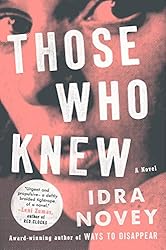
Those Who Knew
Idra Novey, 2018
Penguin Publishing
256 pp.
ISBN-13: 9780525560432
Summary
A taut, timely novel about what a powerful politician thinks he can get away with and the group of misfits who finally bring him down.
On an unnamed island country ten years after the collapse of a U.S.-supported regime, Lena suspects the powerful senator she was involved with back in her student activist days is taking advantage of a young woman who's been introducing him at rallies.
When the young woman ends up dead, Lena revisits her own fraught history with the senator and the violent incident that ended their relationship.
Why didn't Lena speak up then, and will her family's support of the former regime still impact her credibility? What if her hunch about this young woman's death is wrong?
What follows is a riveting exploration of the cost of staying silent and the mixed rewards of speaking up in a profoundly divided country. Those Who Knew confirms Novey's place as an essential new voice in American fiction. (From the publisher.)
Author Bio
• Birth—ca. 1977-78
• Raised—Johnstown, Pennsylvania, USA
• Education—B.A., Barnard College; M.F.A., Columbia Univesity
• Awards—(see below)
• Currently—lives in Brooklyn, New York City
Idra Novey is an American novelist, poet, and translator (from Portuguese and Spanish). She grew up in Johnstown, Pennsylvania, with 3 siblings and now lives in Brooklyn, New York.
Novey is the author of the novels Those Who Knew (2018) and Ways to Disappear (2016). Her poetry books include Exit, Civilian (2011) and The Next Country (2008).
She is the translator of The Passion According to G.H. by Clarice Lispector, On Elegance While Sleeping by Viscount Lascano Tegui, Birds for a Demolition by Manoel de Barros, and The Clean Shirt of It.
She has received awards from Poets & Writers, the Poetry Foundation, the Brooklyn Eagles Literary Prize, and the National Endowment of the Arts. (Adapted from Wikipedia and other online sources. Retrieved 11/12/2018.)
Book Reviews
Read this now, because everyone you know will be talking about it by early 2019.
Washington Post
Idra Novey's taut second novel takes on an ever-relevant subject: Those Who Knew is a fast-paced, hackles-raising story that focuses on silenced victims of assault and the remorse and shame that comes of not speaking up against abuses of power.
NPR
By turns brutal, funny, and tender.… During what are arguably our own Terrible Years, with truth and justice blurred nearly every day, Those Who Knew is as urgent as a ticking time bomb.
Oprah Magazine
There’s timely and then there’s timely. In this prescient novel, a powerful, corrupt senator may finally atone for his crimes when a woman close to him winds up dead. But who can bring him down?
Entertainment Weekly
This timely thriller examines the power influential men hold over women.
Time
Utterly, painfully, of our time.… Novey reveals the extent of our connections to one another, and the true reach of a person's actions—how they can ripple out so much farther than they'd imagined.
Buzzfeed
The second novel by the poet-translator, whose debut, Ways to Disappear, put her on a short list of boundary-busting young mystery authors, works in a dash of dystopia, untangling the dark history of a progressive senator ten years after the fall of a dictatorship.
New York
Almost exactly a year after the Me Too floodgates opened, this novel takes a closer look at the fallout of a powerful figure’s abuse.
Huffington Post
Poet-turned-novelist Idra Novey's new book is set on an unnamed island country 10 years after the collapse of a U.S.-supported regime. Lena suspects that a powerful senator she used to be involved with is taking advantage of another young woman—and when that woman turns up dead, Lena must revisit her turbulent relationship with the senator.
Bustle
[P]ropulsive.… [T]hough there are some unnecessary structural turns (scenes from a play…), the book nevertheless has a striking sense of momentum. [A]dd in a slight and intriguing sense of the supernatural, and the result is a provocative novel that has the feel of a thriller.
Publishers Weekly
The personal is political in this new novel from Novey.… By concentrating on the interconnected and very personal stories of each [character], Novey negotiates the surreal reality of an aging port city that is both victim and beneficiary of globalization.… Highly recommended.
Library Journal
Novey creates a landscape in which her characters may represent, or sometimes hide, their nation, class, or station in life. Yet her women overcome such barriers and join together, revealing what they know in order to effect change, a modern parable.
Booklist
(Starred review) [A] woman suspects a prominent senator… is guilty of his own private violence.… It's not a particularly subtle book… it unfurls more or less how you'd expect… but Novey's writing is so singularly vibrant it hardly matters. Dreamy and jarring and exceedingly topical.
Kirkus Reviews
Discussion Questions
We'll add publisher questions if and when they're available; in the meantime, use our LitLovers talking points to help start a discussion for THOSE WHO KNEW … and then take off on your own:
1. How would you describe Lena's character? Why, for instance, does she go to such lengths to cover up her family's wealth? Why is she hiding it …or hiding from it? How did Victor use her privileged class position to manipulate her?
2. Why does Lena believe it is her responsibility to speak out about her suspicions surrounding Victor's role in Maria's death? Is it her responsibility? Consider Lena's own experience with Victor's rage and her years of silence.
3. When an unfamiliar black sweater and bra keep turning up among her belongings, Lena comes to believe she is receiving signals from an afterlife—which means that she is ordained to avenge Maria. How do you view these and other strange occurrences—are they spiritual visitations, her imagination, or symptoms of trauma or guilt?
4. Talk about the reasons that Olga cautions Lena against standing up to the "wrath of a sociopath." If you were in Olga's position—and given her own tragic history—do you find her warning understandable? What would you advise Lena?
5. Victor? Talk about his character—and how, for example, he represents "politics as usual." (Pigs, anyone?)
6. The novel's big question is this: to what degree is remaining silent in the face of sexual violence a matter of complicity and a moral failing?
7. Power is also a major subject in Those Who Knew. Consider the ways in which various characters wield power over others—sexual, political, or socio/economic. For instance, Victor can turn his sexuality against Cristina, but she can leverage her family's political connections against him. Who else leverages power against others?
8. Talk about previous U.S. involvement in the country's history and how American tourists show no interest in learning of America's role in that dark past.
9. Consider Freddy's play and the way it implicates his brother Victor without publicly defaming him. Does the play-within-a-novel device work as a plot device?
10. Follow-up to Question 9: Why might the author have divided the novel into three acts, as if it were a stage play?
11. Novey also uses extraneous media—news bulletins, sales entries, and commentary from Freddy's play. What do these snippets add to the reading experience?
(Questions by LitLovers. Please feel free to use them, online and off, with attribution. Thanks.)


Those Who Leave and Those Who Stay (Neapolitan Novels 3)
Elena Ferrante, 2013 (trans. 2014)
Europa Editions
400 pp.
ISBN-13: 9781609452339
Summary
Since the publication of My Brilliant Friend, the first of the Neapolitan novels, Elena Ferrante’s fame as one of our most compelling, insightful, and stylish contemporary authors has grown enormously. She has gained admirers among authors and critics. But her most resounding success has undoubtedly been with readers, who have discovered in Ferrante a writer who speaks with great power and beauty of the mysteries of belonging, human relationships, love, family, and friendship.
The incredible story continues in book three of the critically acclaimed Neapolitan Novels!
In this third Neapolitan novel, Elena and Lila, the two girls whom readers first met in My Brilliant Friend, have become women.
Lila married at sixteen and has a young son; she has left her husband and the comforts her marriage brought and now works as a common laborer. Elena has left the neighborhood, earned her college degree, and published a successful novel, all of which has opened the doors to a world of learned interlocutors and richly furnished salons.
Both women have attempted are pushing against the walls of a prison that would have seen them living a life of misery, ignorance and submission. They are afloat on the great sea of opportunities that opened up during the nineteen-seventies.
Yet they are still very much bound to each other by a strong, unbreakable bond. (From the publisher.)
Books in the series
My Brilliant Friend (2011) is the first of Ferrante's four Neapolitan Novels. The Story of a New Name (2012) is the second, this book is the third, and The Story of a Lost Child (2014) is the last.
Author Bio
Elena Ferrante is the pen-name of an Italian novelist whose true identity is not publicly known. Though heralded as the most important Italian novelist of her generation, she has kept her identity secret since the publication of her first novel in 1992.
Works
Ferrante is the author of a half dozen novels, the most well-known of which is Days of Abandonment. Her four "Neapolitan Novels" revolve around two perceptive and intelligent girls from Naples who try to create lives for themselves within a violent and stultifying culture. The series consists of four novels: My Brilliant Friend (2012), The Story of a New Name (2013), Those Who Leave And Those Who Stay (2014), and The Story of the Lost Child (2015), which was nominated for the Strega Prize, an Italian literary award.
Two of Ferrante's novels have been turned into films by Italian filmmakers. Troubling Love became the 1995 feature film Nasty Love, and The Days of Abandonment became a 2005 film of the same title.
Her nonfiction book Fragments (2003) discussion her experiences as a writer.
Identity
In a January 21, 2013, article in The New Yorker, James Woods wrote that Ferrante has said, "books, once they are written, have no need of their authors." Perhaps that is one reason for her pen-name.
Speculation about Ferrante's identity is rife. In the same New Yorker article, Woods also wrote:
In the past twenty years or so, though, she has provided written answers to journalists’ questions, and a number of her letters have been collected and published. From them, we learn that she grew up in Naples, and has lived for periods outside Italy. She has a classics degree; she has referred to being a mother. One could also infer from her fiction and from her interviews that she is not now married. (“Over the years, I’ve moved often, in general unwillingly, out of necessity. . . . I’m no longer dependent on the movements of others, only on my own” is her encryption.) In addition to writing, “I study, I translate, I teach. (Author bio adapted from Wikipedia. Retrieved 9/11/2015.)
Book Reviews
Nothing you read about Elena Ferrante's work prepares you for the ferocity of it. And with each new novel in her revelatory Neapolitan series, she unprepares you all over again…Those Who Leave and Those Who Stay is the story of a furious friendship, and the internal violence suffered by two women set against the turbulent landscape of a fractured Italy…this is a woman's story told with such truthfulness that it is not so much a life observed as it is felt. The reader is ransacked and steps back into the world gingerly, with lingering questions about estrangement and belonging.
Amy Rowland - New York Times
Elena Ferrante is one of the great novelists of our time. Her voice is passionate, her view sweeping and her gaze basilisk. Her subject is the domestic world, and part of her genius lies in her capacity to turn this sphere into an infernal region, full of rage and violence, unlimited in its intellectual and emotional reach. Ferrante's view of family life is anything but sentimental, anything but comforting. In fact, her writing is remarkable for its velocity and ruthlessness. Reading her is like getting into a fast car with Tony Soprano: At once you are caught up and silenced, rendered breathless, respectful…In these bold, gorgeous, relentless novels, Ferrante traces the deep connections between the political and the domestic. This is a new version of the way we live now—one we need, one told brilliantly, by a woman.
Roxanna Robinson - New York Times Book Reviewbb
[Those Who Leave] is a book of evidence, the effects of the past told, never shown, and yet it remains compelling, visceral and immediate. The past's touchstones and many characters who have appeared in the previous volumes are alluded to often, but the book stands alone, gallantly becoming for the reader what it is for Elena Greco—an exercise in remembering.... [The novel] is as expansive and broad as it is intimate.... Those Who Stay is a tour de force. I don't want to read anything else.
Jennifer Gilmore - Los Angeles Times
(Starred review.) Surpassing the rapturous storytelling of the previous titles in the Neapolitan Novels, Ferrante here reunites Elena and Lil..., who dissect subjects as complicated as their own relationship, including feminism and class, men and women, mothers and children, sex and violence, and origin and destiny.
Publishers Weekly
(Starred review.) Rising far above the melodrama of a typical coming-of-age story... [with] keen intellectual curiosity and heartfelt passion.... [T]his tour de force shows off Ferrante's strong storytelling ability and will leave readers eager for the final volume of the series. —Lisa Rohrbaugh, Leetonia Community P.L., OH
Library Journal
(Starred review.) [The author] approaches her characters' divergent paths with an unblinking objectivity that prevents the saga from sinking into melodrama.... Ferrante's lucid rendering...illustrates both that the personal is political and that novels of ideas can compel as much as their lighter-weight counterparts.
Kirkus Reviews
Discussion Questions
1. In this installment of the series, is there a shift in Elena’s relationship with her mother? Or is their dynamic essentially unchanged by time?
2. Has Elena treated her family in Naples unfairly as they claim? How much guilt must she carry for the increasing distance between her and her family?
3. What events lead Elena to understand that violence and ugliness do not end at the border of the old neighborhood? How does this revelation affect her?
4. How does the worldview Elena formed growing up in the neighborhood influence her adult life in more cosmopolitan Florence?
5. How does Ferrante explore the relationship between mind a body over the course of the novel?
6. Michele Solara, the son of the feared loan shark Manuela Solara and Lila’s one-time suitor, says that “money invents scenarios, situations, peoples lives.” Does Ferrante seem to believe this? How much of Elena and Lila’s actions and character are determined by money? Does Elena’s relationship to money and power differ from Lila’s?
7. Is Elena’s violent reaction to her younger sister Elisa’s relationship with Marcello Solara justified? How does this development affect Elena’s relationship with their family?
8. How do Lila and Elena approach motherhood differently?
9. Ferrante delineates a stark difference between the burden of motherhood and the passivity of fatherhood. Is this dynamic specific to the time and place of the novel, or is it universal?
10. Elena grapples with new feminist writing, debates women’s issues with her cultured circle of female friends in Florence, and makes an effort to reconcile the idea of women instilled in her by the neighborhood with the new feminist model. What unspoken, contemporaneous shifts for men and masculinity affect the male characters in the book?
11. Lila says to Elena, “Each of us narrates our life as it suits us.” How reliable is Elena as a narrator?
12. Ferrante’s Neapolitan novels have been described as “one of modern fiction’s richest portraits of friendship” (John Powers, NPR’s Fresh Air). Do you agree that Ferrante captures the nature of friendship between women? Do your friendships resemble Elena and Lila’s relationship in any way?
13. Do Lila’s high standards for Elena do more to inspire or to paralyze her friend?
14. Nino says that Elena attributes character traits and achievements to Lila that actually belong to her. Do you think this is true? If so, which traits?
15. Lila asserts that nothing ever happens unexpectedly. Does anything truly unexpected happen in this novel, or can all the events be traced back to their origins in the first book?
16. What are your predictions for the final installment? Will Nino and Elena really start a new life together? How will that relationship affect the bond between Lila and Elena?
(Questions are issued by the publisher.)
Those Who Save Us
Jenna Blum, 2004
Houghton Mifflin Harcourt
496 pp.
ISBN-13: 9780156031660
Summary
For fifty years, Anna Schlemmer has refused to talk about her life in Germany during World War II. Her daughter, Trudy, was only three when she and her mother were liberated by an American soldier and went to live with him in Minnesota. Trudy's sole evidence of the past is an old photograph: a family portrait showing Anna, Trudy, and a Nazi officer, the Obersturmfuhrer of Buchenwald.
Driven by the guilt of her heritage, Trudy, now a professor of German history, begins investigating the past and finally unearths the dramatic and heartbreaking truth of her mother's life.
Combining a passionate, doomed love story, a vivid evocation of life during the war, and a poignant mother/daughter drama, Those Who Save Us is a profound exploration of what we endure to survive and the legacy of shame. (From the publisher.)
Author Bio
• Birth—N/A
• Reared—in Montclair, New Jersey, USA
• Education—B.A., Kenyon College; M.A., Boston University
• Awards—Harold Ribalow Prize by Hadassah Magazine
• Currently—Boston, Massachusetts
Jenna Blum is of German and Jewish descent. She worked for Steven Spielberg's Shoah Foundation for four years, interviewing Holocaust survivors. She currently teaches at Boston University and runs fiction workshops for Grub Street Writers. (From the publisher.)
More
New York Times bestselling author Jenna Blum has been writing professionally since 1986, when her short story "The Legacy of Frank Finklestein" won First Prize in Seventeen magazine's national fiction contest. Jenna's debut novel Those Who Save Us was published by Harcourt in 2004. In October 2007 the novel, called "the little book that could" in Publishers Weekly, jumped onto the Boston Globe and the New York Times bestseller lists.
Those Who Save Us won the Harold Ribalow Prize, awarded by Hadassah magazine and adjudged by Elie Wiesel, in 2005; foreign rights have been sold in Australia, Brazil, Canada, England, France, Italy, Israel, Norway, and Spain. Those Who Save Us was also the Borders Book Club Selection for Summer 2007. A World War II mother-daughter story inspired by Jenna’s German and Jewish heritage and the interviews she conducted for Steven Spielberg’s Survivors of the Shoah Foundation, Those Who Save Us is a national book club favorite and continues to hold steady on the New York Times bestseller list.
Jenna, who always wanted to be a writer, grew up in Montclair, New Jersey, the eldest daughter of a broadcast journalist and a concert pianist. She was educated at Kenyon College (B.A., English) and Boston University (M.A., Creative Writing) and published short fiction and nonfiction in numerous literary magazines and newspapers, including Seventeen, the Boston Globe, Improper Bostonian, Poets & Writers, Meridian, Faultline, Prairie Schooner, Kenyon Review, Bellingham Review, and Briar Cliff Review, which twice nominated Jenna's stories for a Pushcart Prize.
Jenna taught Creative and Communications Writing for six years at Boston University, where she was also the Fiction Editor of the literary magazine AGNI. Jenna, still a Boston resident, now teaches at local writing school Grub Street Writers, where she has run classes for over a decade; she teaches the master novel workshop and writes writers' advice columns for the Grub Street Free Press. Jenna also travels nationally to speak about Those Who Save Us and visits book clubs whether in person or by phone; she has attended over 800 book clubs in the greater Boston area alone. (From the author's website.)
Book Reviews
Jenna Blum's accomplished first novel, Those Who Save Us, is both vast and intimate in its reach.... Utterly believable.... An absorbing tale of two women's struggles with the burdens and responsibilities of remembrance.
Boston Globe
The book's power... [lies] in examining the emotional and moral gray area between heroism and collaboration....Those Who Save Us bursts with provocative questions about the ambiguous possibilities of culpability.
San Francisco Chronicle
It seems strange to think of someone writing a pleasant novel about the Holocaust, but this is what Jenna Blum has done.... Blum’s writing is exceptionally readable.
London Times
A deeply moving tale.... Blum’s beautifully lyrical, heart-wrenching story strikes a deep chord within those who read it, opening the reader’s eyes to the grim realities faced during this horrible time by Jews and the Germans in the Resistance who tried to help them. This novel will leave no reader untouched.
Tulsa World
Blum, who worked for Steven Spielberg's Shoah Foundation, takes a direct, unsentimental look at the Holocaust in her first novel. The narrative alternates between the present-day story of Trudy, a history professor at a Minneapolis university collecting oral histories of WWII survivors (both German and Jewish), and that of her aged but once beautiful German mother, Anna, who left her country when she married an American soldier. Interspersed with Trudy's interviews with German immigrants, many of whom reveal unabashed anti-Semitism, Anna's story flashes back to her hometown of Weimar. As Nazi anti-Jewish edicts intensify in the 1930s, Anna hides her love affair with a Jewish doctor, Max Stern. When Max is interned at nearby Buchenwald and Anna's father dies, Anna, carrying Max's child, goes to live with a baker who smuggles bread to prisoners at the camp. Anna assists with the smuggling after Trudy's birth until the baker is caught and executed. Then Anna catches the eye of the Obersturmf hrer, a high-ranking Nazi officer at Buchenwald, who suspects her of also supplying the inmates with bread. He coerces her into a torrid, abusive affair, in which she remains complicit to ensure her survival and that of her baby daughter. Blum paints a subtle, nuanced portrait of the Obersturmf hrer, complicating his sordid cruelty with more delicate facets of his personality. Ultimately, present and past overlap with a shocking yet believable coincidence. Blum's spare imagery is nightmarish and intimate, imbuing familiar panoramas of Nazi atrocity with stark new power. This is a poised, hair-raising debut.
Publishers Weekly
Perhaps the most surprising thing about this novel is that it is the author's first; its historical sweep, character delineations, and alternating time periods would lead one to believe that Blum had many others to her name. The German-born Anna and her young daughter, Trudy, who suffer a harrowing existence under the Nazi regime, are saved by a brutal SS officer and then an American soldier, who whisks them off to the wilds of Minnesota after the war. But the SS officer exacts a chilling price, and the immigrants are never really accepted in their new home, raising the question of what it means to be "saved." Trudy is obsessed with finding out more about her German heritage and the SS officer, who evidently fathered her, but Anna adamantly refuses to discuss the past. Then Trudy, now a divorced college professor, embarks on a project to interview Germans who survived the war and, in the process, makes an astonishing discovery that will affect the course of her life. Blum, who is half Jewish and worked for four years for Steven Spielberg's Shoah Foundation, tells her story in the present tense in both real time and flashbacks that impart immediacy without causing confusion. Highly recommended for all literary fiction collections and many popular collections as well. —Edward Cone
Library Journal
Anna's story is a gripping mystery in a page-turner that raises universal questions of shame, guilt, and personal responsibility. Hazel Rochman.
Booklist
An emotionally estranged mother and daughter are reconciled when the daughter learns the truth about her German mother's actions in WWII. Blum, who is half-Jewish and of German descent, worked for Steven Spielberg's Shoah Foundation as an interviewer of Holocaust survivors-and her first fiction is suffused with details about life in wartime Germany, where her protagonists Anna Schlemmer and her daughter Trudy were both born. Trudy, now a professor of German history in the Twin Cities, is divorced and, as an only child, is responsible for Anna, who has to be put in a home soon after the death of her husband Jack, the American soldier she married at war's end. Anna rarely talks, and Trudy, who has seen a picture of her mother with a Nazi officer and a young Trudy, believing herself his daughter, is deeply ashamed. The two women tell their separate stories here as Trudy starts work on a project that involves interviewing Germans who were in Germany during the war. Anna recalls how, at 19, and living at home with her Nazi father in Weimar, she met Jewish doctor Max Stern. She hid him in her house, but Max bwas discovered. Anna, pregnant with Max's child, moved in with Mathilde, a baker helping the Resistance. After daughter Trudy was born in 1940, Anna also began working for the Resistance, delivering bread to a nearby camp for officers and retrieving hidden messages on the way home. But when she witnesses a brutal killing by Horst, an officer at the camp, and was seen by him, she became his mistress in order to save Trudy's life. Trudy finally learns the truth of her paternity—but her mother's long and insufficiently motivated silence about it isn't persuasive. An ambitious but flawed first outing.
Kirkus Reviews
Discussion Questions
1. How would you categorize Those Who Save Us: as a war story, a love story, a mother-daughter story? Why? How is it different from other novels that address the issues surrounding the Holocaust? What new perspectives does it offer?
2. Discuss the novel's title, Those Who Save Us. In what ways do the characters save each other in the novel, and who saves whom? How does Blum play with the concept of being saved, being safe, being a savior?
3. In the beginning of the novel, what is Anna's attitude towards the Jewish people of Weimar? Does her attitude change? If so, where does this transformation occur and why?
4. While she is hiding Max, Anna thinks she would "pay a high price to be plain, for her looks pose an ever-greater danger to both herself and Max." Do you see Anna's beauty as a blessing or a curse? What role does it play in shaping her destiny? How do her looks affect her relationships with Max, Gerhard, the Obersturmführer, Trudy?
5. When living with Mathilde, Anna asks why Mathilde risks her life to feed the Buchenwald prisoners "when everyone else turn a blind eye." Why does Mathilde take this risk? Why does Anna? Do you think American women would react differently than German women in similar circumstances, and if so, why?
6. What are Anna's sexual reactions to the Obersturmführer, and what effect do they have on how she sees herself? How do they shape Anna's relationship with Trudy? ... Do you see Anna's relationship with the Obersturmführer as primarily sexual, or are there places in the novel where their relationship transcends the sexual?
7. Do you see the Obersturmführer as a monster or as human? What are his vulnerabilities? To what degree is he a product of his time? If the Obersturmführer had been born in contemporary America, what might he be doing today?
8. Toward the end of the novel, Anna thinks that the Obersturmführer "has blighted her ability to love." Do you think he has forever affected her ability to love Jack? To love Trudy? What are Anna's real feelings for the Obersturmführer, and what are his true feelings toward Anna and her daughter?
9. Are Trudy's difficulties with her mother caused only by the secrets Anna keeps? If the past had not come between them, what would their relationship have been like? In what ways are Trudy and Anna typical of mothers and daughters everywhere? What parallels can you draw between their relationship and yours with your own mother?
10. Trudy has been familiar with shame all her life, both her own shame and Anna's. How does Trudy learn about shame from Anna? Does Trudy's shame stem solely from her suspicions about her Nazi parentage or from her German heritage as well? How has her shame manifested in her adult lifestyle?
11. Anna's consistent response to Trudy's questions is, "The past is dead, and better it remain so." Why does Anna keep her silence? Is this fair to Trudy? Were you surprised that Anna refuses to talk about her past even when she has been confronted and deemed a heroine by Mr. Pfeffer? In her position, would you do the same?
12. During his German Project interview, Rainer plays what he calls "a dirty trick" on Trudy by reading a prepared statement about his aunt's experience and eventual deportation to Auschwitz instead of telling his own story. Why does he do this? Why is Rainer so angry with Trudy? Is he angry with her? Do you think his anger is justified?
13. Why does Trudy get involved with Rainer? Is Trudy and Rainer's relationship a healthy one? When Rainer departs for Florida, he says, "I do not deserve this .... I am not meant to be this happy," a statement with which Trudy agrees. If Trudy and Rainer's relationship were not affected by their wartime pasts, would it have been happy? Would it have existed at all?
14. What does each of Trudy's interview subjects-Frau Kluge, Rose-Grete Fischer, Rainer, Felix Pfeffer-represent about German actions during the war and how Germans feel in retrospect? What does Trudy learn from her German subjects?
15. At the end of Those Who Save Us, the characters' fates are ambiguous; Trudy, for instance, is left in a "vacuum between one part of life ending and another coming to take its place." Why does Blum do this? What statement, if any, is she trying to make? Do you feel that the novel's end is a happy one for Trudy? For Anna? Why or why not? And what do you think has happened to the Obersturmführer?
(Questions issued by publisher.)
top of page (summary)


A Thousand Acres
Jane Smiley, 1991
Knopf Doubleday
384 pp.
ISBN-13: 9781400033836
Summary
Winner of the 1992 Pulitzer Prize and National Book Critics Circle Award
When Larry Cook, the aging patriarch of a rich, thriving farm in Iowa, decides to retire, he offers his land to his three daughters. For Ginny and Rose, who live on the farm with their husbands, the gift makes sense—a reward for years of hard work, a challenge to make the farm even more successful.
But the youngest, Caroline, a Des Moines lawyer, flatly rejects the idea, and in anger her father cuts her out—setting off an explosive series of events that will leave none of them unchanged. A classic story of contemporary American life, A Thousand Acres strikes at the very heart of what it means to be a father, a daughter, a family.
"While she has written beautifully about families in all of her seven preceding books, [this] effort is her best: a family portrait that is also a near-epic investigation into the broad landscape, the thousand dark acres, of the human heart. (From the publisher.)
Author Bio
• Birth—September 26, 1949
• Where—Los Angeles, California, USA
• Rasied—Webster Grove, Missouri
• Education—B.A., Vassar College; M.A., M.F.A, and Ph.D., Iowa University
• Awards—Pulitzer Prize, 1992; National Book Critics Circle Award, 1991
• Currently—lives in Northern California
Jane Smiley is the author of numerous works of fiction, including The Age of Grief, The Greenlanders, Ordinary Love & Good Will, A Thousand Acres (for which she was awarded the Pulitzer Prize), and Moo. She lives in northern California. (From the publisher.)
More
Jane Smiley is a Pulitzer Prize-winning American novelist.
Born in Los Angeles, California, Smiley grew up in Webster Groves, Missouri, a suburb of St. Louis, and graduated from John Burroughs School. She obtained a B.A. at Vassar College, then earned an M.F.A. and Ph.D. from the University of Iowa. While working towards her doctorate, she also spent a year studying in Iceland as a Fulbright Scholar.
Smiley published her first novel, Barn Blind, in 1980, and won a 1985 O. Henry Award for her short story "Lily", which was published in the Atlantic Monthly. Her best-selling A Thousand Acres, a story based on William Shakespeare's King Lear, received the Pulitzer Prize for Fiction in 1992. It was adapted into a film of the same title in 1997. In 1995 she wrote her sole television script produced, for an episode of Homicide: Life on the Street. Her novella The Age of Grief was made into the 2002 film The Secret Lives of Dentists.
Thirteen Ways of Looking at the Novel (2005), is a non-fiction meditation on the history and the nature of the novel, somewhat in the tradition of E. M. Forster's seminal Aspects of the Novel, that roams from eleventh century Japan's Murasaki Shikibu's The Tale of Genji to twenty-first century Americans chick lit.
From 1981 to 1996, she taught undergrad and graduate creative writing workshops at Iowa State University. She continued teaching at ISU even after moving her primary residence to California.
In 2001, Smiley was elected a member of The American Academy of Arts and Letters. (From Wikipedia.)
Book Reviews
A brilliant modern take on Shakespeare's King Lear. We've had so many recent send-ups of the classics—Ahab's Wife, Bridget Jones's Diary, On Beauty, Mr. Timothy, even Wicked—that the novelty has worn off, if not worn thin. But A Thousand Acres was seminal, one of the first and still one of the most dazzling....
A LitLovers LitPick (Dec. '07)
While she has written beautifully about families in all of her seven preceding books, [this] effort is her best: a family portrait that is also a near-epic investigation into the broad landscape, the thousand dark acres, of the human heart."
The Washington Post Book World
A full, commanding novel.... This is a story bound and tethered to a lonely road in the Midwest, but drawn from a universal source.... A profoundly American novel.
The Boston Globe
Winner of the Pulitzer Prize and the NBCC Award for fiction, a BOMC dual main selection and a five-week PW bestseller in cloth, Smiley's novel of family life on an insular Iowa farm raises profound questions about human conduct and moral responsibility.
Publishers Weekly
This important new novel by the author of Ordinary Love and Good Will and The Greenlanders is, first of all, a farm novel. Smiley lovingly creates an idyllic world of family farm life in Iowa in 1979: the neat yard, freshly painted house, clean clothes on the line, and fertile, well-tended fields. The owner of these well-managed acres is Larry Cook, who abruptly decides to turn the farm over to his two eldest daughters and their husbands. Ginny and Ty are hard-working farmers who try to placate her ornery father, while sister Rose and hard-drinking Pete try to stand up to him. Dark secrets surface after the property transfer, and the family's careful world unravels with a grim inevitability reminiscent of Smiley's splendid novella Good Will . Not to be missed. —Ann H. Fisher, Radford P.L., VA
Library Journal
Lear in Iowa. In a scalding, 20th-century version of Shakespeare's tragedy, Smiley—clawing open the "ingratitude" of a monarch's elder daughters to reveal a rage that could out-tempest Lear's—once again examines the buried secret hurts within families and the deadly results when damaged egos are unleashed: "The one thing...maybe no family could tolerate was things coming out into the open." Living under the iron order of that tyrannical, successful farmer Larry Cook, owner of 640 Iowa acres, are: daughter Rose, 34- year-old recovering cancer patient, mother of two and wife of ex- musician Pete, the perennial outsider, object of Larry's contempt; and childless Ginny, married to Tyler, an easygoing man who can betray with silence. Youngest daughter Caroline, whom motherless Rose and Ginny had raised and unfettered from Daddy, is a lawyer in Des Moines. It's at a well-liquored neighborhood social that Daddy announces he's giving up his farm to his three daughters. "I don't know," says cool lawyer Caroline, and Daddy slams off in a fury. As Rose and Ginny and their pleased husbands prepare for a release from Daddy's overlordship, something else is released when Rose—scenting out weakness in the terrible old man—hungers for revenge at last. Nothing but Daddy's repentance will do for deeds in the past so foul that Ginny has blotted out the memory and Rose has kept her silence. Circling around Rose's sizzling path toward impossible satisfaction, with Ginny in tow, are their husbands—one blunted, one death-bound—and a self-exiled native son who will drive a wedge between the two sisters, mingling a hate and lust/love that brings one to murder. As for Daddy's angel Caroline—come back to flight for Daddy (senile? maybe), never battered by home maelstroms—he's been simply a father "no more, no less." With the Bard's peak moments—the storm, a blinding, etc.—a potent tragedy immaculate in characters, stately pace, and lowering ambiance.
Kirkus Reviews
Discussion Questions
1. How does the symbiotic relationship between person and place addressed in Ms. Smiley's choice of epigraph play itself out in the novel? How does setting shape character and vice versa? Which seems to have the upper hand? How is Zebulon County itself a major character in A Thousand Acres?
2. What are the strengths and weaknesses of Ginny's narration? Is she able to maintain clarity and candor throughout her chronicling of events? What gets in the way? Is she as forthcoming in portraying herself as she is in discussing others? Why or why not? How would the novel differ if told from the perspective of Rose, Caroline, Jess, or Larry?
3. At the outset of the novel, Ginny confesses that retrospection has not revealed too much about the drama that unfolded when her father decided to hand over the farm to Rose and her and leave out Caroline: "I've thought over every moment of that party time and time again, sifting for pointers, signals, ways of knowing how to do things differently from the way they got done. There were no clues" [p. 13]. To what extent does the story that she then tells undermine this claim? What remains a mystery despite her scrutiny?
4. What are the most tragic elements of A Thousand Acres? Whichof these elements are rooted in the exercise of an individual's will, and which seem attributable to something beyond the scope of human volition? Where does the novel ultimately situate itself in the enduring fate v. free will debate?
5. What do you see as Smiley's debt to Shakespeare's King Lear? Where do the two works part ways? What provides A Thousand Acres with its autonomy despite its borrowed plot and characters?
6. Which of the issues explored in A Thousand Acres are unique to rural life in America? Which resonate regardless of geography? What does the novel reveal about variations and consistencies in the so-called American character?
7. What are a few of the guises in which passion appears in A Thousand Acres? What seems to lie at the root of each guise? Which do the most damage? Why do some characters yield to a desire for authority, acreage, etc., while others resist such temptations? Is there greater freedom in following passion or in checking it? What does the novel teach us about the nature of passion, restraint, and indulgence?
8. The interior lives of Caroline as well as Larry remain relatively unexamined compared to those of Rose and Ginny, their spouses, and Jess. What is the dramatic and thematic significance of keeping these characters in the shadows?
9. Contemplating her father's momentous decision, Ginny marvels at its apparent rashness. "He decided to change his whole life on Wednesday!" she exclaims. "Objectively, this is an absurdity" [p. 34]. Her remark points to the struggle against the whims of chance that appears throughout A Thousand Acres. How does the deliberate adherence to daily routine help the characters to weather the vicissitudes of the natural world and the inconsistency of human nature? What kind of solace and safety, if any, do seasonal chores and rituals provide?
10. Discuss the myriad ways that motherhood—and fatherhood—are weighed in the novel. How does Ginny's ineluctable desire to give birth shape her view of her present and past? What meaning does she derive from the many surrogate-maternal roles she plays? In what ways is her mother's long absence a constant presence?
11. "Our bond had a peculiar fertility that I was wise enough to appreciate, and also, perhaps, wise enough to appreciate in silence," Ginny says. "Rose wouldn't have stood for any sentimentality" [p. 62]. Reticence seems the norm among these characters, yet they express themselves in other ways. What nonverbal forms of communication do they use? What are the reach and limits of each? What are the perils and possibilities?
12. Is there a particular political view or ideology at work in A Thousand Acres? If so, what is it? Does viewing the novel through the lens of feminism, for example, limit or enlarge it? What do you see as the novelist's responsibility vis-a-vis politics? Does this work fall closer to agenda or inquiry?
13. "The first novel I ever knew was my family," writes Ms. Smiley in the afterword to Family: American Writers Remember Their Own (David McKay Co., 1997). "We had every necessary element, from the wealth of incident both domestic and historical, to the large cast of characters. We had geographical sweep and the requisite, for an American novel, adventure in the West." How can A Thousand Acres be interpreted as a meditation on family? How does the novel shed light on the dark corners of family life? How are the Cooks both anomalous to and representative of the average American family? What explains their tragic dissolution? What could have prevented it?
14. What are the advantages and disadvantages of a story that is told almost entirely in the past tense? How does this affect your interpretation of the novel?
15. Ginny is stilled by the disturbing thought that her own "endurance might be a pleasant fiction allowed [her] by others who've really faced facts" [p. 90]. Is it? Do you construe her story, i.e., the novel, as flight from a difficult reality or a means of confronting it? Why?
16. During a game of Monopoly, Jess describes Harold as someone who is "cannier and smarter than he lets on," then suggests that real freedom exists in "the slippage between what he looks like and what he is" [p. 109]. How does the relationship between appearance and reality drive the novel's action in terms of the meaning and direction of its characters' lives? What kind of importance does Jane Smiley assign to this relationship?
17. In what reads like a muted epiphany, Ginny considers the constant weight and exhaustion she felt in the months after her mother's death and then realizes that one reaches a point where "relief is good enough" [p. 198]. Is this remark an expression of resignation or true acceptance?
18. In a candid conversation with Rose, Ginny voices her inability to understand her father's abuse despite Rose's insistence that the matter is a simple case of "I want, I take, I do." Ginny says, "I can't believe it's that simple," to which Rose responds: "If you probe and probe and try to understand, it just holds you back" [p. 212]. What does this exchange reveal about the limitations of reason? About the possibility or impossibility of true catharsis? What options exist when the rational is exhausted?
(Questions issued by publisher.)
top of page


The Thousand Autumns of Jacob de Zoet
David Mitchell, 2010
Random House
496 pp.
ISBN-13: 9780812976366
Summary
In 2007, Time magazine named him one of the most influential novelists in the world. He has twice been short-listed for the Man Booker Prize. The New York Times Book Review called him simply “a genius.” Now David Mitchell lends fresh credence to The Guardian’s claim that “each of his books seems entirely different from that which preceded it.” The Thousand Autumns of Jacob de Zoet is a stunning departure for this brilliant, restless, and wildly ambitious author, a giant leap forward by even his own high standards. A bold and epic novel of a rarely visited point in history, it is a work as exquisitely rendered as it is irresistibly readable.
The year is 1799, the place Dejima in Nagasaki Harbor, the “high-walled, fan-shaped artificial island” that is the Japanese Empire’s single port and sole window onto the world, designed to keep the West at bay; the farthest outpost of the war-ravaged Dutch East Indies Company; and a de facto prison for the dozen foreigners permitted to live and work there. To this place of devious merchants, deceitful interpreters, costly courtesans, earthquakes, and typhoons comes Jacob de Zoet, a devout and resourceful young clerk who has five years in the East to earn a fortune of sufficient size to win the hand of his wealthy fiancée back in Holland.
But Jacob’s original intentions are eclipsed after a chance encounter with Orito Aibagawa, the disfigured daughter of a samurai doctor and midwife to the city’s powerful magistrate. The borders between propriety, profit, and pleasure blur until Jacob finds his vision clouded, one rash promise made and then fatefully broken. The consequences will extend beyond Jacob’s worst imaginings. As one cynical colleague asks, “Who ain’t a gambler in the glorious Orient, with his very life?”
A magnificent mix of luminous writing, prodigious research, and heedless imagination, The Thousand Autumns of Jacob de Zoet is the most impressive achievement of its eminent author. (From the publisher.)
Author Bio
• Birth—January 12, 1969
• Where—Southport, Lancashire, UK
• Education—B.A., M.A., University of Kent
• Awards—John Llewellyn Rhys Prize
• Currently—lives in County Cork, Ireland
David Mitchell is an English novelist, the author of several novels, two of which, number9dream (2001) and Cloud Atlas (2004), were shortlisted for the Booker Prize. He has lived in Italy, Japan and Ireland. Mitchell currently lives with his wife Keiko Yoshida and their two children in Ardfield, Clonakilty in County Cork, Ireland.
Early life
Mitchell was born in Southport in Merseyside, England, and raised in Malvern, Worcestershire. He was educated at Hanley Castle High School and at the University of Kent, where he obtained a degree in English and American Literature followed by an M.A. in Comparative Literature. He lived in Sicily for a year, then moved to Hiroshima, Japan, where he taught English to technical students for eight years, before returning to England, where he could live on his earnings as a writer and support his pregnant wife.
Work
Mitchell's first novel, Ghostwritten (1999), moves around the globe, from Okinawa to Mongolia to pre-Millennial New York City, as nine narrators tell stories that interlock and intersect. The novel won the John Llewellyn Rhys Prize (for best work of British literature written by an author under 35) and was shortlisted for the Guardian First Book Award. His two subsequent novels, number9dream (2001) and Cloud Atlas (2004), were both shortlisted for the Man Booker Prize. In 2003, he was selected as one of Granta's Best of Young British Novelists. In 2007, Mitchell was listed among Time magazine's 100 Most Influential People in The World.
In 2012 his novel Cloud Atlas was made into a film. In recent years he has also written opera libretti. Wake, based on the 2000 Enschede fireworks disaster and with music by Klaas de Vries, was performed by the Dutch Nationale Reisopera in 2010. For his other opera, Sunken Garden, he collaborated with the Dutch composer Michel van der Aa. It premiered in 2013 with the English National Opera.
Mitchell's sixth novel, The Bone Clocks, was released on September 2nd, 2014. In an interview in The Spectator, Mitchell said that the novel has "dollops of the fantastic in it", and is about "stuff between life and death." The book was longlisted for the 2014 Man Booker Prize.
Personal
In a Random House essay, Mitchell wrote:
I knew I wanted to be a writer since I was a kid, but until I came to Japan to live in 1994 I was too easily distracted to do much about it. I would probably have become a writer wherever I lived, but would I have become the same writer if I'd spent the last six years in London, or Cape Town, or Moose Jaw, on an oil rig or in the circus? This is my answer to myself.
Mitchell has the speech disorder of stammering and considers the film The King's Speech (2010) to be one of the most accurate portrayals of what it's like to be a stammerer: "I'd probably still be avoiding the subject today had I not outed myself by writing a semi-autobiographical novel, Black Swan Green, narrated by a stammering 13 year old."
One of Mitchell's children is autistic, and in 2013 he and wife Keiko translated into English a book written by a 13-year-old Japanese boy with autism, The Reason I Jump: One Boy's Voice from the Silence of Autism.
List of works
Novels
Ghostwritten (1999)
number9dream (2001)
Cloud Atlas (2004)
Black Swan Green (2006)
The Thousand Autumns of Jacob de Zoet (2010)
The Bone Clocks (2014)
Slade House (2015)
Utopia Avenue (2020)
(Bio adapted from Wikipedia. Retrieved 9/4/2014.)
Book Reviews
David Mitchell has traded in the experimental, puzzlelike pyrotechnics of Ghostwritten and Number9Dream for a fairly straight-ahead story line and a historical setting. He's meticulously reconstructed the lost world of Edo-era Japan, and in doing so he's created his most conventional but most emotionally engaging novel yet: it's as if an acrobatic but show-offy performance artist, adept at mimicry, ventriloquism and cerebral literary gymnastics, had decided to do an old-fashioned play and, in the process, proved his chops as an actor.
Michiko Kakutani - New York Times
If any readers have doubted that David Mitchell is phenomenally talented and capable of vaulting wonders on the page, they have been heretofore silent. Mitchell is almost universally acknowledged as the real deal. His best-known book, Cloud Atlas, is one of those how-the-holy-hell-did-he-do-it? modern classics that no doubt is—and should be—read by any student of contemporary fiction…[The Thousand Autumns of Jacob de Zoet] confirms Mitchell as one of the more fascinating and fearless writers alive.
Dave Eggers - New York Times Book Review
[Mitchell] startles us again with a rich historical romance set in feudal Japan, an epic of sacrificial love, clashing civilizations and enemies who won't rest until whole family lines have been snuffed out. Yes, the novelist who's been showing us the future of fiction has published a classic, old-fashioned tale. It's not too early to suggest that Mitchell can triumph in any genre he chooses.
Ron Charles - Washington Post
When a Dutch trader falls in love with a Japanese midwife who is also the disfigured daughter of a samurai doctor in 19th-century Japan, you can be sure that the emotional and cultural clashes will be significant. The Thousand Days of Jacob de Zoet is a historical romance novel by Davd Mitchell, gifted author of Cloud Atlas and Black Swan Green. Here, Mitchell melds history and literature into a satisfying blend.
Christian Science Monitor
Mitchell’s rightly been hailed as a virtuoso genius for his genre-bending, fiercely intelligent novels Ghostwritten and Cloud Atlas. Now he takes something of a busman’s holiday with this majestic historical romance set in turn-of-the-19th-century Japan, where young, naive Jacob de Zoet arrives on the small manmade island of Dejima in Nagasaki Harbor as part of a contingent of Dutch East Indies officials charged with cleaning up the trading station’s entrenched culture of corruption. Though engaged to be married in the Netherlands, he quickly falls in hopeless love with Orito Aibagawa, a Dutch-trained Japanese midwife and promising student of Marinus, the station’s resident physician. Their “courtship” is strained, as foreigners are prohibited from setting foot on the Japanese mainland, and the only relationships permitted between Japanese women and foreign men on Dejima are of the paid variety. Jacob has larger trouble, though; when he refuses to sign off on a bogus shipping manifest, his stint on Dejima is extended and he’s demoted, stuck in the service of a vengeful fellow clerk. Meanwhile, Orito’s father dies deeply in debt, and her stepmother sells her into service at a mountaintop shrine where her midwife skills are in high demand, she soon learns, because of the extraordinarily sinister rituals going on in the secretive shrine. This is where the slow-to-start plot kicks in, and Mitchell pours on the heat with a rescue attempt by Orito’s first love, Uzaemon, who happens to be Jacob’s translator and confidant. Mitchell’s ventriloquism is as sharp as ever; he conjures men of Eastern and Western science as convincingly as he does the unscrubbed sailor rabble. Though there are more than a few spots of embarrassingly bad writing (“How scandalized Nagasaki shall be, thinks Uzaemon, if the truth is ever known”), Mitchell’s talent still shines through, particularly in the novel’s riveting final act, a pressure-cooker of tension, character work, and gorgeous set pieces. It’s certainly no Cloud Atlas, but it is a dense and satisfying historical with literary brawn and stylistic panache.
Publishers Weekly
It is a rare novel that's so captivating that the reader feels transported through time and fully immersed in an unfamiliar culture and place, and this is such a novel. Mitchell, a Man Booker Prize finalist for Cloud Atlas, returns with a story set at the turn of the 18th century around Dejima, an artificial island located in Nagasaki Bay and used as a trade outpost by the Dutch East Indies Company. A small group of mostly Dutch merchants lives on Dejima under the watchful eye of Japanese guards, government officials, and translators. Clerk Jacob de Zoet comes to Dejima for a period of five years to make his fortune and return to marry his wealthy fiancee in Holland. An honest man, Jacob intends to put the company's financial records in order and root out corruption, but after meeting midwife Orito Aibagawa, he becomes entangled in events far more sinister than forged ledgers. Verdict: this painstakingly researched and original novel is hard to pin to any one genre, for it is a historical novel and cultural study with plenty of intrigue and mystery mixed in. It is intelligent and utterly readable at the same time. Highly recommended. —Shaunna Hunter, Hampden-Sydney Coll. Lib., VA
Library Journal
Another Booker Prize nomination is likely to greet this ambitious and fascinating fifth novel—a full-dress historical, and then some-from the prodigally gifted British author (Black Swan Green, 2006, etc.). In yet another departure from the postmodern Pynchonian intricacy of his earlier fiction, this is the story of a devout young Dutch Calvinist (the eponymous Jacob) sent in 1799 to Japan, where the Dutch East India Company, aka the VOC, had opened trade routes more than two centuries earlier. But now the Company is threatened by the envious British Empire, which seeks to appropriate the Far East's rich commercial opportunities. Jacob's purpose is to acquire sufficient wealth and experience to earn the hand of his fiancee Anna. But his mission is to serve as a ship's clerk while simultaneously investigating charges of corruption against the Company's powerful Chief Resident. When a scandal involving the seizure of the much-desired commodity of copper is manipulated to implicate Jacob, he is posted to the artificially constructed island of Dejima in Nagasaki Harbor, becoming a de facto prisoner of an insular little world of rigorously patterned and controlled cultural-and commercial-rituals. Meanwhile, the story of Aibagawa Orita, a facially disfigured (hence unmarriageable) midwife authorized to study with the Company's doctor (the saturnine Marinus, a kind of Pangloss to Jacob's earnest Candide), punished for having aspired beyond her station, and the moving story of her planned escape from servitude and reunion with the beloved (Uzaeman) forbidden to marry her (which contains deft echoes of Atwood's The Handmaid's Tale and Ondaatje's The English Patient), mocks, as it exalts, Jacob's concealed love for this extraordinary woman. The story climaxes as British forces challenge the Dutch hold on the East's riches, and Jacob's long ordeal hurtles toward its conclusion. It's as difficult to put this novel down as it is to overestimate Mitchell's virtually unparalleled mastery of dramatic construction, illuminating characterizations and insight into historical conflict and change. Comparisons to Tolstoy are inevitable, and right on the money.
Kirkus Reviews
Discussion Questions
Use our LitLovers Book Club Resources; they can help with discussions for any book: • How to Discuss a Book (helpful discussion tips)
• Generic Discussion Questions—Fiction and Nonfiction
• Read-Think-Talk (a guided reading chart)
Also consider these LitLovers talking points to help get a discussion started for The Thousand Autumns of Jacob de Zoet:
1. What is the purpose of Dejima? Why do the Japanese wish to isolate European traders from their society, walling them off on a man-made island?
2. How do the Europeans and the Japanese view one another in this novel? What stereotypes do the Europeans have toward the Japanese? Why are Europeans determined to break through the barriers errected by the Shoguns—are their motives humanistic or mercenary...principled or unprincipled?
3. In an interview with a Japanese newspaper, David Mitchell said his intention was to "write a bicultural novel, where Japanese perspectives are given an equal weight to Dutch/European perspectives." Do you think Mitchell succeeded in being even-handed to both cultures?
4. This book also explores the clash between science and superstition; or the European enlightenment and intuition. How do those two different ways of knowing play out in The Thousand Autumns?
5. Jacob is a devout Christian. Are his religious ideals challenged or altered in any way? How do the Japanese view the religion of the Europeans?
6. Jacob is referred to as "an honest soul in a human swamp of crocodiles, a sharp quill among blunt nibs." How well does this passage describe his character? How else would you describe Jacob; what other personality/character traits does he possess?
7. Is Jacob naive to see right and wrong as "moral bookkeeping" and to believe "all that matters is truth"? How difficult is it in this book to define, or discern, or prove what is true?
8. Mitchell is interested in language. How powerful are the story's translators? What role do translators play in protecting—or distorting—meaning and truth through the use of language? Can translation ever penetrate the meaning of another language?
9. Talk about the numerous moral dilemmas faced by Ogawa Uzaemon? Does he make the right choices...with regards to his parents, his wife, Orito, and Jacob?
10. Discuss Japanese society: especially the highly stratified social order, including the role and of women and the restrictions placed on them. Is Japanese society more, or less, hierarchical than European society?
11. How would you describe Orito Aibagawa? What is her role in Japanese society—in what ways does Japanese culture restrict, even debase Orito. What makes Jacob fall in love with her when he is already committed to Anna back home?
12. Why does Orito decide to return to the shrine? Would you have returned?
13. Discuss John Penhaligon and the pivotal decisions he makes in the novel. Why does the Phoebus turn away from Dejima?
14. Who wins the game of Go—the magistrate or the abbot?
15. Which of the book's three sections do you find most engaging...or least engaging?
16. How would you classify this novel—as a suspense-thriller, mystery, melodrama, cultural study, or historical novel? How would you describe it to someone?
17. Was the book's ending satisfying? How else might it have ended? Does Jacob die a happy or fulfilled man? Where do you think he would have preferred to end his days?
(Questions by LitLovers. Please feel free to use them, online or off, with attribution. Thanks.)
top of page (summary)
A Thousand Orange Trees
Kathryn Harrison, 1995
Gardner Books
317 pp.
ISBN-13: 9781857024074
Summary
As Marie Louise de Bourbon, niece of Louis XIV, journeys south from Versailles to marry the Spanish king, she is forced to abandon the cumbersome orange trees brought from her beloved Versailles, leaving them to wither in the chill Pyrenees.
This loss presages the future that awaits her, in a court riven by intrigue, with an impotent husband who demands an heir. Marie’s fate is dreamed of by Francisca de Luarca, as she sits in her prison cell far from the Queen’s chamber. This imaginative Castilian silk grower's daughter has fallen passionately and dangerously in love with a young priest.
In this luscious, hypnotic novel, Kathryn Harrison twists together their stories, bringing to vivid life the wonders and the horrors of 17th-century Spain, a world convulsed by poverty and religious upheaval. (From the publisher.)
More
Set in 17th century Spain, A Thousand Orange Trees twists together the stories of two women born on the same day, whose lives are devoured by the bloodthirsty Spanish state.
Francisca de Luarca, the daughter of a Castilian silk grower, is arrested by the Inquisition after a love affair with a priest and is tortured as a witch. Marie Louise de Bourbon, the niece of Louis XIV, is transported from her beloved Versailles to marry the impotent Spanish king, and is tormented by the court when she fails to provide an heir.
In her prison cell Francisca conjures up memories of her past and dreams of the Queen's life, producing a beautifully women narrative which takes historical fiction to new heights. (From the publisher.)
Author Bio
• Birth—1961
• Where—Los Angeles, California, USA
• Education—B.A., Standord University; Iowa Writers'
Workshop
• Currently—lives in New York City
Kathryn Harrison was raised in Los Angeles by her maternal grandparents. She graduated from Stanford University in 1982 with a BA in English and Art History and received an MFA from the University of Iowa's Writers' Workshop in 1987. She lives in New York with her husband, the novelist and book editor Collin Harrison, whom she met in 1985, when the two of them were enrolled in the Writers' Workshop. They have three children, born in 1990, 1992 and 2000.
The bestselling author famously documented a disturbing triangulation that developed involving her young mother, her father and herself in the memoir The Kiss, which described her father's seduction of the author when she was twenty and their incestuous involvement, which persisted for four years and is reflected in the plots and themes of her first three novels, published before The Kiss.
While much of her body of work documents her tortured relationship with her mother, who died in 1985—the essays collected in Seeking Rapture: Scenes From a Life, a second memoir, The Mother Knot, as well as The Kiss—she has also written extensively of her maternal grandparents, both in her personal essays and, in fictionalized form, in her novels. Her grandmother, a Sassoon, was raised in Shanghai, where she lived until 1920, her experiences there inspiring Harrison's historical novel, The Binding Chair. The Seal Wife, set in Alaska during the First World War, draws on the early life of her British grandfather, who spent his youth trapping fur in the Northwest Territories and laying track into Anchorage for the Alaska Railroad.
Harrison has published six novels, three memoirs, a travelogue, a biography, and, as of June 2008, a book of true crime. She is a frequent reviewer for the New York Times Book Review, and her personal essays have been included in many anthologies and have appeared in The New Yorker, Harper's Magazine, Vogue, O Magazine, Salon.com, Nerve.Com, More Magazine, and Bookforum, and other publications. (From Wikipedia.)
See the more on the author's website.
Book Reviews
A magical novel.
Lisa Tuttle - Time Out
Audacious feats of the imagination. This rich and complex novel is both harrowing and compelling.
Nicola Humble - Times Literary Supplement (London)
Kathryn Harrison writes about the dark side of a woman's destiny with an intensity that makes you shiver.
She
One novel I have not mentioned so far, one of the main narrative strands of which features a powerful, but doomed, love affair, is Kathryn Harrison’s A Thousand Orange Trees, which takes place in seventeenth-century Spain, at the height of the Counter Reformation. The twist in this tale, the insurmountable obstacle for the lovers, is the fact that one of them is a priest. This is a scenario which occurs in several modern romances, notably Colleen McCullough’s The Thornbirds, and is, I think, an area deserving of further exploration. The celibate priest is a fascinating variation on the classic theme of the wounded hero healed by the heroine’s love, as long as we think of love in earthly, erotic terms rather than divine love. The distinction, however, can become blurred, as in the many documented cases of visionary ecstatics, whose experience of divine love is often expressed in erotically charged terms.
Sarah Bower - Historical Novel Society
Harrison is completely at ease with the historical material, evoking with frightening detail the world of the Spanish Inquisition, whose prisoners reside, almost literally, in the bowels of Madrid. The Spanish court, too, is described with precision and colour, and its formality and restraint contrast strikingly with the splendour and exuberance of the French Court.... Maria Luisa loses every freedom at her arrival in Spain.... Her entrapment within the royal court is not at all dissimilar to Franciscaís imprisonment at the hands of the Inquisition.
Holly Davis - Deep South (New Zealand)
Discussion Questions
Use our LitLovers Book Club Resources; they can help with discussions for any book:
• How to Discuss a Book (helpful discussion tips)
• Generic Discussion Questions—Fiction and Nonfiction
• Read-Think-Talk (a guided reading chart)
top of page


A Thousand Pardons
Jonathon Dee, 2013
Random House
224 pp.
ISBN-13: 9780812993219
Summary
For readers of Jonathan Franzen and Richard Russo, Jonathan Dee’s novels are masterful works of literary fiction. In this sharply observed tale of self-invention and public scandal, Dee raises a trenchant question: what do we really want when we ask for forgiveness?
Once a privileged and loving couple, the Armsteads have now reached a breaking point. Ben, a partner in a prestigious law firm, has become unpredictable at work and withdrawn at home—a change that weighs heavily on his wife, Helen, and their preteen daughter, Sara. Then, in one afternoon, Ben’s recklessness takes an alarming turn, and everything the Armsteads have built together unravels, swiftly and spectacularly.
Thrust back into the working world, Helen finds a job in public relations and relocates with Sara from their home in upstate New York to an apartment in Manhattan. There, Helen discovers she has a rare gift, indispensable in the world of image control: She can convince arrogant men to admit their mistakes, spinning crises into second chances. Yet redemption is more easily granted in her professional life than in her personal one.
As she is confronted with the biggest case of her career, the fallout from her marriage, and Sara’s increasingly distant behavior, Helen must face the limits of accountability and her own capacity for forgiveness. (From the publisher.)
Author Bio
• Birth—May 19, 1962
• Where—New York, New York, USA
• Education—B.A., Yale University
• Awards—Prix Fitzgerald Prize
• Currently—lives in Syracuse, New York
Jonathan Dee, an American novelist and non-fiction writer, was born in New York City. He graduated from Yale University, where he studied fiction writing with John Hersey.
Dee's first job out of college was at The Paris Review, as an Associate Editor and personal assistant to George Plimpton. Early in his tenure with Plimpton, Dee helped pull off the popular April Fool's joke about Sidd Finch, a fictitious baseball pitcher Plimpton wrote about for Sports Illustrated.
Writing
Dee has published several novels, including most recently The Privileges (2010), A Thousand Pardons (2013), and The Locals (2017).
He is a staff writer for The New York Times Magazine and contributor to Harper's. In 2008 Dee collaborated on the oral biography of Plimpton, "George, Being George." He interviewed Hersey and co-interviewed Grace Paley for The Paris Review's The Art of Fiction series.
Recognition
Dee was nominated for a National Magazine Award in 2010 for criticism in Harper's. His 2010 novel, The Privileges, won the 2011 Prix Fitzgerald prize and was a finalist for the 2011 Pulitzer Prize for Fiction.
He was the second winner of the St. Francis College Literary Prize.
He has also been the recipient of two fellowships: The National Endowment for the Arts and the Guggenheim Foundation.
Currently, Dee serves as a professor in the graduate writing program at Syracuse University, where he lives. (Adapted from Wikipedia. Retrieved 8/4/2017.)
Book Reviews
Jonathan Dee’s trim new book arrives—like the handsome characters he writes about—burdened with high expectations.... The opening of A Thousand Pardons is, in fact, instantly absorbing. When you meet Helen and Ben Armstead...so many stress fractures are spidering across the surface of their marriage that you’ll want to shield your eyes.... Quick shifts in tone and point of view as their shiny marriage shatters make these opening pages irresistible.... [Helen] manages to land a job at a moribund three-person PR firm.... She has no experience with such work, but she has “an extraordinary gift,” a colleague claims. But in a novel set in crisply real, modern-day Manhattan, Helen’s enterprise seems silly. The dialogue is corny, the setting is sitcom fresh.
Ron Charles - Washington Post
The rich, Dee seems to believe, aren’t just different from you and me. They’re a lot worse. And yet in A Thousand Pardons, his hugely enjoyable new novel, they get a pass.... Dee is a snappy, cinematic writer, and it’s very hard not to inhale [the opening] section of the novel in one greedy sitting.... Dee writes fabulous, Japanese-street tidy sentences. This gives him an almost spooky access to the inner lives of his characters.... There is a heat haze of real emotion rising off this book.
John Freeman - Boston Globe
[An] undercooked new novel.... A number of problems plague this novel: the thin Hamilton is ultimately inconsequential to the book, as is the romance between Sara and a black classmate discovering identity politics. Worse is Helen’s transformation from housewife to PR genius, which happens in a blink and is given no support.... These flaws are a pity because Dee shines when unveiling the inner workings of the PR industry, which is at once ubiquitous and obscure. When the author focuses on the ways in which public opinion is routinely manipulated, he gives a tantalizing glimpse at what might have been.
Publishers Weekly
Pulitzer Prize finalist Dee goes au courant with the story of a woman who returns to work when her corporate-lawyer husband loses all after an egregious act at the office. Helen, now in public relations, has a handy talent for getting powerful men to apologize for their misdeeds.
Library Journal
Dee is adept at meshing the complexities of marriage and family life with the paradoxes of the zeitgeist. In his sixth meticulously lathed and magnetizing novel, he riffs on the practice of crisis management [and] the absurdities of a society geared to communicate in a thousand electronic modes while those closest to each other can barely make eye contact.
Booklist
(Starred review.) A marriage flames out. Gleefully, thrillingly, Dee (The Privileges, 2010, etc.) tracks its aftermath, focusing primarily on the evolution of the ex-wife. That's Helen Armstead, struggling to save a dying marriage. Husband Ben, partner in a New York City law firm, has been so deeply depressed he's ignored not just her and their upstate home, but their 12-year-old daughter, Sara (Chinese, adopted).... Helen, a stay-at-home mom, must hustle to find work. ... Her crisis management skills attract the attention of a huge PR company, which recruits her. This is not some empowerment fairy tale; Dee keeps the action grounded and credible.... Pulitzer finalist Dee has written a page turner without sacrificing a smidgen of psychological insight. What a triumph.
Kirkus Reviews
Discussion Questions
1. Helen believes abjection and confession are transformative. But why doesn’t Ben’s abject apology toward the beginning of the book work on Helen? Does he need to atone as well as apologize?
2. Describe the public relations environment in which Helen finds herself. As a sincere person, how does she conform to the environment...or does it conform to her?
3. The collection of clients needing the help of Helen and particularly Malloy Worldwide is a pretty nasty group. Why does Helen not hesitate to help bad guys? Does she think everyone is redeemable? Are her lack of judgment and her sympathy part of what makes her special?
4. Why are the stories of powerful people brought low so compelling? Has the ritual of public apology become a way for the culture to remind itself of how we define “good” behavior? Or is it just an opportunity for hypocrisy and schadenfreude?
4. In A Thousand Pardons, some of the characters want a break from the past and the accountability that comes with contemplating the past. But Helen remembers everything, and certainly confessing and apologizing are acts of remembering. Do you see a connection between memory and morality? Is willful amnesia an American problem?
5. Helen’s gift reaches its limit with the Catholic Church. Has she finally lost interest in absolving powerful men?
6. The narrator encourages readers to have an intimacy with the book's characters. At the same time there is a sort of pulling back on the the narrator's part, a restraint from passing judgment Do you believe the characters should be judged? As a reader, do you judge them?
7. At various points after the scandal, Sara, Ben, and Helen lurk around their Westchester town trying not to be recognized. Yet in the end they return to their house there. Shouldn't they just leave and start over somewhere else? Why don't they?
8. The book, though basically serious, contains a lot of dry wit, sly humor, and many moments of sharp irony. There are even some elements of screwball comedy. Is it wrong to call it a funny book?
9. What does Ben mean when he says that he is “almost comfortable” in his disgrace, that he likes the “sad, clear vision” he has?
10. Ben’s journey takes him from a despised life of upper class security to abjection to something close to integrity. His storyline does not go the way the reader expects, partly because he refuses to let himself off the hook for what he did. Has he redeemed himself by the end?
11. The ending of the novel is somewhat open, and, like the rest of the book, it happens quickly. Can you imagine what happens next to Helen, Ben, and Sara?
(LitLovers adapted these questions from a publisher interview with the author.)

A Thousand Splendid Suns
Khaled Hosseini, 2007
Pengiun Group USA
384 pp.
ISBN-13: 9781594483851
Summary
Propelled by the same superb instinct for storytelling that made The Kite Runner a beloved classic, A Thousand Splendid Suns is at once an incredible chronicle of thirty years of Afghan history and a deeply moving story of family, friendship, faith, and the salvation to be found in love.
Born a generation apart and with very different ideas about love and family, Mariam and Laila are two women brought jarringly together by war, by loss and by fate. As they endure the ever escalating dangers around them-in their home as well as in the streets of Kabul—they come to form a bond that makes them both sisters and mother-daughter to each other, and that will ultimately alter the course not just of their own lives but of the next generation. With heart-wrenching power and suspense, Hosseini shows how a woman's love for her family can move her to shocking and heroic acts of self-sacrifice, and that in the end it is love, or even the memory of love, that is often the key to survival.
A stunning accomplishment, A Thousand Splendid Suns is a haunting, heartbreaking, compelling story of an unforgiving time, an unlikely friendship, and an indestructible love. (From the publisher.)
Author Bio
• Birth—March 04, 1965
• Where—Kabul, Afghanistan
• Education—B.S., Santa Clara University; M.D., University
of California, San Diego School of Medicine
• Currently—lives in northern California
Khaled Hosseini was born in Kabul, Afghanistan, in 1965. His father was a diplomat with the Afghan Foreign Ministry and his mother taught Farsi and History at a large high school in Kabul. In 1970, the Foreign Ministry sent his family to Tehran, where his father worked for the Afghan embassy. They lived in Tehran until 1973, at which point they returned to Kabul.
In July of 1973, on the night Hosseini’s youngest brother was born, the Afghan king, Zahir Shah, was overthrown in a bloodless coup by the king’s cousin, Daoud Khan. At the time, Hosseini was in fourth grade and was already drawn to poetry and prose; he read a great deal of Persian poetry as well as Farsi translations of novels ranging from Alice in Wonderland to Mickey Spillane’s Mike Hammer series.
In 1976, the Afghan Foreign Ministry once again relocated the Hosseini family, this time to Paris. They were ready to return to Kabul in 1980, but by then Afghanistan had already witnessed a bloody communist coup and the invasion of the Soviet army. The Hosseinis sought and were granted political asylum in the United States. In September of 1980, Hosseini’s family moved to San Jose, California. They lived on welfare and food stamps for a short while, as they had lost all of their property in Afghanistan. His father took multiple jobs and managed to get his family off welfare.
Hosseini graduated from high school in 1984 and enrolled at Santa Clara University where he earned a bachelor’s degree in Biology in 1988. The following year, he entered the University of California-San Diego’s School of Medicine, where he earned a Medical Degree in 1993. He completed his residency at Cedars-Sinai Hospital in Los Angeles and began practicing Internal Medicine in 1996. His first love, however, has always been writing.
In 2003, Hosseini published The Kite Runner, which became a runaway bestseller and film in 2007. He followed up with his second novel, A Thousand Splendid Suns in 2007, also a bestseller. His third novel, And the Mountians Echoed, was published in 2013.
Hosseini has vivid, and fond, memories of peaceful pre-Soviet era Afghanistan, as well as of his personal experiences with Afghan Hazaras. One Hazara in particular was a thirty-year-old man named Hossein Khan, who worked for the Hosseinis when they were living in Iran. When Hosseini was in the third grade, he taught Khan to read and write. Though his relationship with Hossein Khan was brief and rather formal, Hosseini always remembered the fondness that developed between them.
In 2006, Hosseini was named a goodwill envoy to the UNHCR, The United Nations Refugee Agency. (Adapted from the publisher.)
Extras
From a 2004 Barnes & Noble interview:
• During his years in the U.S., Hosseini has soaked in more than his share of American culture. He professes to be a fan of such U.S. institutions as the music of Bruce Springsteen and football. Still, he admits that he simply cannot appreciate baseball, saying, "I think that to fully appreciate baseball, it helps to have been born in the U.S."
• When it comes to chickens, Hosseini is a chicken. "I'm terrified of chickens," the writer confesses. "Absolutely petrified. This intense and irrational fear is, I believe, caused by the memory of a black hen we owned in Kabul when I was a child. She used to peck her own chicks to death as soon as the eggs hatched."
• When Hosseini isn't writing or tending to one of his patients, he enjoys games of no-limits Texas hold 'em poker with his brother and friends.
• When asked what book most influenced him, here is what he had to say:
I remember reading The Grapes of Wrath in high school in 1983. My family had immigrated to the U.S. three years before, and I had spent the better part of the first two years learning English. John Steinbeck's book was the first book I read in English where I had an "Aha!" moment, namely in the famed turtle chapter. For some reason, I identified with the disenfranchised farm workers in that novel—I suppose in one sense, they reminded me of my own country's traumatized people. And indeed, when I went back to Afghanistan in 2003, I met people with tremendous pride and dignity under some very bleak conditions; I suspect I met a few Ma Joads and Tom Joads in Kabul.
Book Reviews
Hosseini succeeds in carrying readers along because he understands the power of emotion as few other popular writers do. As he did in The Kite Runner, he uses a melodramatic plot to convey vividly the many aspects of love and the ways people sacrifice themselves for those they hold dear. With A Thousand Splendid Suns, Hosseini has shown that he doesn’t intend to be a one-hit wonder. It will be interesting to see where he goes from here.
Lisa See - New York Times Book Review
[The book] going to be another bestseller no matter what's said about it in this and other reviews, so maybe there's no point in going further. But just in case you're curious, just in case you're wondering whether in yours truly's judgment it's as good as The Kite Runner, here's the answer: No. It's better.
Jonathan Yardley - Washington Post
Often, second novels pale in comparison to the first, but this long-awaited story pulls the reader completely into a world of cruelty, despair, pain and poverty and offers hope, redemption and love to offset the anguish. It brings to life a part of the world that the average American knows little about, and makes real for us the very human implications of our foreign policies, long after Afghanistan faded from the headlines.
Charlotte Observer
So what is the point of reading this novel? The texture of these characters' journey around the craters of their country is no doubt well known to readers of international news. Rendered as fiction in A Thousand Splendid Suns, however, it devastates in a new way. It forces us to imagine what we would do had we been born to such grim fates.
Minneapolis Star-Tribune
The book holds the listener thanks to Hosseini's riveting story-an in-depth exploration of Afghan society in the three decades of anti-Soviet jihad, civil war and Taliban cruelty. He impels us to empathize with and admire those most victimized by Afghan history and culture-women. Mariam, a 15-year-old bastard whose mother commits suicide, is married off to 40-year-old Rasheed, who abuses her brutally, especially after she has several miscarriages. At 60, Rasheed takes in 14-year-old Laila, whose parents were blown up by stray bombs. He soon turns violent with her. Although Laila is united with her childhood beloved, the potential return of the Taliban always shadows their happiness.
Publishers Weekly
(Starred review.) Unimaginably tragic, Hosseini's magnificent second novel is a sad and beautiful testament to both Afghani suffering and strength. Readers who lost themselves in The Kite Runner will not want to miss this unforgettable follow-up. —Kristine Huntley
Booklist
Most critics agreed that Khaled Hosseini's second novel is as devastating, if not more powerful, than his first.... [T]he novel offers a chilling, all-too-real portrait Afghan life. "It is, for all its short-comings, a brave, honorable, big-hearted book" (Washington Post).
Bookmarks Magazine
This Afghan-American author follows his debut (The Kite Runner, 2003) with a fine risk-taking novel about two victimized but courageous Afghan women. Mariam is a bastard. Her mother was a housekeeper for a rich businessman in Herat, Afghanistan, until he impregnated and banished her. Mariam's childhood ended abruptly when her mother hanged herself. Her father then married off the 15-year-old to Rasheed, a 40ish shoemaker in Kabul, hundreds of miles away. Rasheed is a deeply conventional man who insists that Mariam wear a burqa, though many women are going uncovered (it's 1974). Mariam lives in fear of him, especially after numerous miscarriages. In 1987, the story switches to a neighbor, nine-year-old Laila, her playmate Tariq and her parents. It's the eighth year of Soviet occupation-bad for the nation, but good for women, who are granted unprecedented freedoms. Kabul's true suffering begins in 1992. The Soviets have gone, and rival warlords are tearing the city apart. Before he leaves for Pakistan, Tariq and Laila make love; soon after, her parents are killed by a rocket. The two storylines merge when Rasheed and Mariam shelter the solitary Laila. Rasheed has his own agenda; the 14-year-old will become his second wife, over Mariam's objections, and give him an heir, but to his disgust Laila has a daughter, Aziza; in time, he'll realize Tariq is the father. The heart of the novel is the gradual bonding between the girl-mother and the much older woman. Rasheed grows increasingly hostile, even frenzied, after an escape by the women is foiled. Relief comes when Laila gives birth to a boy, but it's short-lived. The Taliban are in control; women must stay home; Rasheed loses his business; they have no food; Aziza is sent to an orphanage. The dramatic final section includes a murder and an execution. Despite all the pain and heartbreak, the novel is never depressing; Hosseini barrels through each grim development unflinchingly, seeking illumination. Another artistic triumph, and surefire bestseller, for this fearless writer.
Kirkus Reviews
Discussion Questions
1. The phrase “a thousand splendid suns,” from the poem by Saib-e-Tabrizi, is quoted twice in the novel – once as Laila’s family prepares to leave Kabul, and again when she decides to return there from Pakistan. It is also echoed in one of the final lines: “Miriam is in Laila’s own heart, where she shines with the bursting radiance of a thousand suns.” Discuss the thematic significance of this phrase.
2. Mariam’s mother tells her: “Women like us. We endure. It’s all we have.” Discuss how this sentiment informs Mariam’s life and how it relates to the larger themes of the novel.
3. By the time Laila is rescued from the rubble of her home by Rasheed and Mariam, Mariam’s marriage has become a miserable existence of neglect and abuse. Yet when she realizes that Rasheed intends to marry Laila, she reacts with outrage. Given that Laila’s presence actually tempers Rasheed’s abuse, why is Mariam so hostile toward her?
4. Laila’s friendship with Mariam begins when she defends Mariam from a beating by Rasheed. Why does Laila take this action, despite the contempt Mariam has consistently shown her?
5. Growing up, Laila feels that her mother’s love is reserved for her two brothers. “People,” she decides, “shouldn’t be allowed to have new children if they’d already given away all their love to their old ones.” How does this sentiment inform Laila’s reaction to becoming pregnant with Rasheed’s child? What lessons from her childhood does Laila apply in raising her own children?
6. At several points in the story, Mariam and Laila pass themselves off as mother and daughter. What is the symbolic importance of this subterfuge? In what ways is Mariam’s and Laila’s relationship with each other informed by their relationships with their own mothers?
7. One of the Taliban judges at Mariam’s trial tells her, “God has made us different, you women and us men. Our brains are different. You are not able to think like we can. Western doctors and their science have proven this.” What is the irony in this statement? How is irony employed throughout the novel?
8. Laila’s father tells her, “You’re a very, very bright girl. Truly you are. You can be anything that you want.” Discuss Laila’s relationship with her father. What aspects of his character does she inherit? In what ways is she different?
9. Mariam refuses to see visitors while she is imprisoned, and she calls no witnesses at her trial. Why does she make these decisions?
10. The driver who takes Babi, Laila, and Tariq to the giant stone Buddhas above the Bamiyan Valley describes the crumbling fortress of Shahr-e-Zohak as “the story of our country, one invader after another… we’re like those walls up there. Battered, and nothing pretty to look at, but still standing.” Discuss the metaphorical import of this passage as it relates to Miriam and Laila. In what ways does their story reflect the larger story of Afghanistan’s troubled history?
11. Among other things, the Taliban forbid “writing books, watching films, and painting pictures.” Yet despite this edict, the film Titanic becomes a sensation on the black market. Why would people risk the Taliban’s violent reprisals for a taste of popcorn entertainment? What do the Taliban’s restrictions on such material say about the power of artistic expression and the threat it poses to repressive political regimes?
12. While the first three parts of the novel are written in the past tense, the final part is written in present tense. What do you think was the author’s intent in making this shift? How does it change the effect of this final section?
(Questions issued by publisher.)
top of page (summary)


The Thread
Victoria Hislop, 2012
HarperCollins
400 pp.
ISBN-13: 9780062135582
Summary
From the internationally acclaimed author of The Island and The Return comes a sweeping and unforgettable story of love and friendship and the choices that must be made when loyalties are challenged.
Thessaloniki, Greece, 1917: As Dimitri Komninos is born, a fire sweeps through the thriving multicultural city where Christians, Jews, and Muslims live side by side. It is the first of many catastrophic events that will forever change this place and its people.
Five years later, as the Turkish army pushes west through Asia Minor, young Katerina loses her mother in the crowd of refugees clambering for boats to Greece. Landing in Thessaloniki's harbor, she is at the mercy of strangers in an unknown city. For the next eighty years, the lives of Dimitri and Katerina will be entwined with each other and—through Nazi occupation, civil war, persecution, and economic collapse—with the story of their homeland.
Thessaloniki, Greece, 2007: A young Anglo-Greek hears his grandparents' remarkable story for the first time and understands he has a decision to make. For decades, Dimitri and Katerina have looked after the treasures of those who have been forced from their beloved city. Should he stay and become their new custodian? (From the publisher.)
Author Bio
• Birth—1959
• Where—Bromley, Kent, England, UK
• Raised—Tonbridge, England
• Education—B.A., Oxford University
• Currently—lives in Sissinghurst, England
Victoria Hislop writes travel features for The Sunday Telegraph and The Mail on Sunday, along with celebrity profiles for Woman & Home. She lives in Kent, England, with her husband and their two children. (From the publisher.)
More
Born in Bromley (Kent), Victoria Hislop (nee Hamson) grew up in Tonbridge. She read English at St Hilda's College, Oxford, and worked in publishing and as a journalist before becoming an author.
In 1988 she married Private Eye editor Ian Hislop in Oxford. They have two children, Emily Helen and William David, and live in Sissinghurst.
Hislop's first novel, The Island (2005), which the Sunday Express hailed as "the new Captain Corelli's Mandolin" was a Number 1 Bestseller in the UK, selling more than 1 million copies. According to her website, she rejected a Hollywood film offer (worth £300,000) for the novel. Instead, she offered the rights to Mega, a Greek television channel, for a fraction of the fee. Her desire was "to preserve the integrity of the book and to give something back to the Mediterranean island on which it is based."
The Return, her second novel, a sequel set in Spain, has also been a success and was followed by The Thread in 2012.
In 2009, she donated the short story "Aflame in Athens" to Oxfam's Ox-Tales project—four collections of UK stories written by 38 authors. Her story was published in the Fire collection. ("More" adapted from Wikipedia and the author's website.)
Book Reviews
A brilliant page turner and destined to become a reading group staple, The Thread is rich with drama and historical detail.
Glamour (UK)
Hislop’s vivid storytelling makes a fascinating, turbulent place and time spring to life.
Cleveland Plain Dealer
When Turkish troops force the people of Smyrna from their homes in 1922, a young girl named Katerina becomes separated from her mother amid the chaos. Taken in by a fellow refugee with two daughters of her own, Katerina and her surrogate family make a new life together in the Greek city of Thessaloniki. Katerina soon meets Dimitri, the young son of a wealthy businessman, who is living nearby while his mother remodels their mansion on the sea. The novel takes place over the course of their lifetimes, and tracks the crossing of their paths as they struggle to survive and nurture a love indifferent to dogma and national conflict in a city beleaguered by political, social, and emotional turbulence, including Nazi occupation, Communist backlash, civil war, and poverty. . Hislop (The Island) is a clever storyteller who deftly manages to flesh out Katerina and Dimitri’s personal lives, while never abandoning the collective for the sake of the individual—20th-century Greece and her citizens are brought vividly to life. Striking an excellent balance between historicity and impassioned drama, Hislop’s newest should not be missed.
Publishers Weekly
Combining a keen eye for detail with her usual fluid writing style, Hislop presents an engrossing excursion to Thessaloniki, Greece’s second-largest metropolis.... This fastmoving, touching saga about tragedy, recovery, and the real meaning of family is full of dramatic incidents demonstrating their city’s transformation and resilience.
Booklist
Hislop writes in rich, vivid detail about the city by the sea, bringing its diverse population to life.... Sweeping in scope yet intimate in detail, The Thread is a love letter to Greece and a testament to the courage and adaptability of its people.
Shelf Awareness
Discussion Questions
1. What enables Eugenia and Katerina to survive in Thessaloniki after the burning of Smyrna?
2. How is the Greece Communist party portrayed in The Thread? To what extent does this differ from any prior knowledge about the party that you may have had?
3. In what ways is threading prominent throughout the novel? How does threading become important during the political crisis?
4. How are class and cultural distinctions portrayed? How do the people of Greece regard these differences and how do their attitudes change?
5. How is family represented in The Thread? How does the political situation challenge and shape these family structures?
6. How do Katerina and Dimitri's lives intertwine throughout the novel and how do their initial encounters shape their relationship?
7. Why is Olga Kominos unable to leave her home and how does her agoraphobia develop?
8. How does the country of Greece change both politically and economically throughout The Thread? To what extent does this differ from any prior knowledge about Greece's history that you may have had?
9. Compare the different marriages depicted. What were the various incentives for marriage? How were women treated during marriage? What were the expectations of a wife? How did the political situation effect women and did women have any power over political outcomes?
10. How does the ending of the novel echo its themes and motifs? What type of future does this ending represent?
(Questions issued by publisher.)
A Thread of Grace
Mary Doria Russell, 2005
Random House
464 pp.
ISBN-13: 9780449004135
Summary
Set in Italy during the dramatic finale of World War II, this new novel is the first in seven years by the bestselling author of The Sparrow and Children of God.
It is September 8, 1943, and fourteen-year-old Claudette Blum is learning Italian with a suitcase in her hand. She and her father are among the thousands of Jewish refugees scrambling over the Alps toward Italy, where they hope to be safe at last, now that the Italians have broken with Germany and made a separate peace with the Allies. The Blums will soon discover that Italy is anything but peaceful, as it becomes overnight an open battleground among the Nazis, the Allies, resistance fighters, Jews in hiding, and ordinary Italian civilians trying to survive.
Mary Doria Russell sets her first historical novel against this dramatic background, tracing the lives of a handful of fascinating characters. Through them, she tells the little-known but true story of the network of Italian citizens who saved the lives of forty-three thousand Jews during the war’s final phase. The result of five years of meticulous research, A Thread of Grace is an ambitious, engrossing novel of ideas, history, and marvelous characters that will please Russell’s many fans and earn her even more. (From the publisher.)
Author Bio
• Birth—August 19, 1950
• Where—Elmhurst, Illinois, USA
• Education—B.A. University of Illinois; M.A. Northeastern
University; Ph.D. University of Michigan
• Awards—The John W. Campbell Award, 1998
• Currently—lives in Cleveland, Ohio
Mary Doria Russell was born in suburban Chicago in 1950. Her mother was a U.S. Navy nurse and her father was a Marine Corps drill sergeant. She and her younger brother, Richard, consequently developed a dismaying vocabulary at an early age. Mary learned discretion at Sacred Heart Catholic elementary school and learned how to parse sentences at Glenbard East High; she moved on to study cultural anthropology at the University of Illinois, social anthropology at Northeastern University in Boston, and biological anthropology at the University of Michigan.
After earning a doctorate, Russell taught human gross anatomy at Case Western Reserve University in the 1980s but left the academic world to write fiction, which turned out to be a good career move.
Her novels have struck a deep chord with readers for their respectful but unblinking consideration of fundamental religious questions. The Sparrow and Children of God remain steady sellers, translated into more than a dozen languages. Russell has received nine national and international literary awards and has been a finalist for a number of others. She and her family live in Cleveland, Ohio. (From the publisher.)
In her words
From a 2005 Barnes & Noble interview:
• I honestly think getting up early gives you cancer. You should definitely sleep in as often as possible.
• Coffee is good for you. Don't believe anyone who says different. All research concluding that coffee is bad is seriously flawed in scientific design.
• Here's how you know when you're grown up: you decide if you get to have a pet. You don't have to ask anyone else's permission. I just got myself a 4-year-old miniature dachshund named Annie from Petfinder.com. She makes me laugh out loud first thing in the morning, and at least half a dozen times a day after that.
• When asked what book most influenced her career as a writer, here is her response:
Seven Pillars of Wisdom by T. E. Lawrence (1935). I saw the David Lean movie Lawrence of Arabia when it first came out in 1962. I was twelve then, and ripe for hero worship, living in Lombard, Illinois, but ready to imagine a larger world than the Chicago suburbs. I found a musty old copy of Seven Pillars, and to this day I remain fascinated by the book and the man who wrote it. I can name a number of direct effects of reading the book.
Initially, I became interested in archeology because of Lawrence's early work, and that led me to anthropology, which sustained my interest through three degrees and years of professional work. I keep my hand in by editing the professional papers of friends in the field.
Lawrence taught me that speaking more than one language opens doors to experiences you'd miss if you only speak English. Over the years, I've studied Spanish, Russian, French and Croatian fairly formally, with less studious stabs at Latin, Hebrew, Italian and German. Each one has led me places I'd never have gone other wise. My study of Croatian led directly to the adoption of our son Daniel in Zagreb—so Lawrence is Dan's sort-of godfather!
I learned that intentions are irrelevant and regrets are useless: it doesn't matter what you thought would happen, or that you meant no harm. Unintended consequences of good intentions are a theme I return.
Lawrence taught me that how you write is as important as what you have to tell about. Choice of word, rhythm, detail, editing and overall structure make Seven Pillars literature, not just a military history or personal memoir.
There are echoes of Lawrence's experience in Deraa in my first novel, echoes of his war guilt in my third. I'm beginning research for a novel about the 1921 Cairo Peace Conference, and will come full circle: T. E. Lawrence will actually be a character in that one.
I also caught the colon habit from reading Lawrence's work: quod erat demonstradum. (Interview from Barnes & Noble.)
Book Reviews
I sense a tension in this writer, who seems torn between a desire to linger and explore her interesting creations more fully and a need to keep the action racing forward. The action wins. An addictive page-turner, A Thread of Grace satisfies our need to be reminded of how warmly inspiring humanity can be when it is moved to be generous, tolerant and forgiving.
Robert MacNeil - Washington Post
Busy, noisy and heartfelt, this sprawling novel by Russell—a striking departure from her previous two acclaimed SF thrillers, The Sparrow and Children of God—chronicles the Italian resistance to the Germans during the last two years of WWII. Three cultures mingle uneasily in Porto Sant'Andrea on the Ligurian coast of northwest Italy—the Italian Jews of the village, headed by the chief rabbi Iacopo Soncini; the Italian Catholics, like Sant'Andrea's priest Don Osvaldo Tomitz, who befriend and shelter the Jews; and the occupying Germans invited by Mussolini's crumbling regime. In the last camp is the drunken, tubercular Nazi deserter, Doktor Schramm, a broken man who confesses to Don Osvaldo that while working in state hospitals and Auschwitz, he was responsible for murdering 91,867 people. Meanwhile, Jewish refugees in southern France, including Albert Blum and his teenage daughter, Claudette, are fleeing across the Alps to Italy, hoping to find sanctuary there. Russell pursues numerous narrative threads, including the Blums' perilous flight over the mountains; Italian Jew Renzo Leoni's personal coming to terms with his participation in the Dolo hospital bombing during the Abyssinian campaign in 1935; the dangerous frenzy of the Italian partisans; and the bloody-mindedness of German officers resolved to carry out Hitler's murderous racial policy despite mounting evidence of its futility. The action moves swiftly, with impressive authority, jostling dialogue, vibrant personalities and meticulous, unexpected historical detail. The intensity and intimacy of Russell's storytelling, her sharp character writing and fierce sense of humor bring fresh immediacy to this riveting WWII saga. This is a worthy successor to high-caliber, crowd-pleasing WWII novels like Corelli's Mandolin or The English Patient.
Publishers Weekly
In 1943, teenaged Claudette Blum scales the Alps with her father, hoping to find sanctuary in Italy. It took the author of the highly regarded The Sparrow five years to research this book, which highlights the network of Italians who saved 43,000 Jewish lives during World War II.
Library Journal
Stateless Jews find refuge in the valleys of northwest Italy, thanks to the humanity of supposedly thick-witted peasants: a rich, rewarding, and well-researched tale of WWII. Piedmont, the province north of Genoa, in the lee of the Maritime Alps, is now largely off the American tourist map. But in 1943, when the Italian Fascists surrendered to the advancing allies, Piedmont was desperately attractive to the thousands of Jewish refugees who were forced to flee the Germans marching into the political vacuum in Mussolini's former European territories. Brutal as the Italian fascists were, they had been notoriously slow to turn over their Jews to Germans, and the Piemontesi had a reputation for sanctuary. In his third outing, science-fiction author Russell (Children of God, 1998, etc.) weaves oral and written histories and a large cast into a fast moving story that switches back and forth between the scarcely populated agricultural valleys at the edge of the Alps and fictitious Porto Sant'Andrea, an unexceptional industrial city somewhere on the Ligurian coast. An odd coalition of native Italian Jews, Roman Catholic clergy, communists, and unaffiliated anti-Fascists, have united in a conspiracy to protect the stream of refugees coming on foot through the mountain passes from France at the very moment that the Nazis are turning against their former Italian hosts. The masterminds of the Italo-Jewish effort are Lidia Leoni, an aristocratic and supremely sophisticated communist and her boozy, brilliant, protean son Renzo, a much-decorated flier haunted by his role in Italy's Ethiopian adventure. Knowing the efficiency and ruthlessness of the Germans who now hold power in Porto Sant' Andrea, the Leonis steer money and refugees to the tiny hamlets in Valdottavo, where peasants have already begun to harbor Transalpine guests. The one "good" German in Russell's adventure is Werner Schramm, a doctor in flight from his past as an obedient euthanizer and witness to the death camps who is now witness to the humanity of the Jews and the charity of the mountain peasants. Beautiful, noble, fascinating, and almost unbearably sad.
Kirkus Reviews
Discussion Questions
1. Renzo and Schramm have both committed crimes against civilians during war, but the priest Don Osvaldo feels there is some essential difference between the two men's actions. Is the difference merely a matter of scale, or is there an ethical difference? Does your emotional response to each character color your opinion?
2. Renzo attempts to remain apolitical during the Nazi occupation. Was that a moral position or should he have fought the Nazis from the beginning? Is moderation or neutrality possible or even desirable during war?
3. We are accustomed to admiring the partisan resistance to German occupation during World War II. In today's world there are many places where armed resistance to occupying forces is called "terrorism." What makes a resistance legitimate? Does the motive of the occupying force make any difference?
4. Claudette's children never understand her, and she dies a mystery to them. Have you been affected by the war experiences of a family member? Were you aware of how their experiences deformed them?
5. Was Iacopo Soncini a bad husband or a good rabbi? How does having a family change the responsibilities of the clergy?
6. Imagine that you heard Schramm's confession at the beginning of the book. If you were Don Osvaldo, what would you have told Schramm? Are there unforgivable sins?
7. Was Schramm's remorse genuine at the end of the book? Why did he put his uniform back on when he was ordered to by the German officer at the hospital?
8. How would you feel about a moral universe where Schramm went to heaven and Renzo went to hell?
9. People who didn't live through World War II often believe they'd have hidden someone like Anne Frank or helped refugees from Nazi Germany the way the Italian peasants did. What would be an analogous risk today?
(Questions issued by publisher.)
top of page


Three Brothers
Peter Ackroyd, 2014
Knopf Doubleday
256 pp.
ISBN-13: 9780385538619
Summary
Rapier-sharp, witty, intriguing, and mysterious: a new novel from Peter Ackroyd set in the London of the 1960s.
Three Brothers follows the fortunes of Harry, Daniel, and Sam Hanway, a trio of brothers born on a postwar council estate in Camden Town. Marked from the start by curious coincidence, each boy is forced to make his own way in the world—a world of dodgy deals and big business, of criminal gangs and crooked landlords, of newspaper magnates, backbiters, and petty thieves.
London is the backdrop and the connecting fabric of these three lives, reinforcing Ackroyd's grand theme that place and history create, surround and engulf us. From bustling, cut-throat Fleet Street to hallowed London publishing houses, from the wealth and corruption of Chelsea to the smoky shadows of Limehouse and Hackney, this is an exploration of the city, peering down its streets, riding on its underground, and drinking in its pubs and clubs.
Everything is possible—not only in the new freedom of the 1960s but also in London's timeless past. (From the publisher.)
Author Bio
• Birth—October 5, 1949
• Where—London, England, UK
• Education—B.A., Cambridge University
• Awards—Whitbread Award (2); Somerset Maughm Award
• Currently—lives in London, England
Peter Ackroyd is an English biographer, novelist, and critic with a particular interest in the history and culture of London. For his novels about English history and culture and his biographies of, among others, Charles Dickens, T. S. Eliot and Sir Thomas More, he won the Somerset Maugham Award and two Whitbread Awards.
He is noted for the volume of work he has produced, the range of styles therein, his skill at assuming different voices, and the depth of his research. He was elected a fellow of the Royal Society for Literature in 1984 and created a Commander of the Order of the British Empire in 2003.
Early life and education
Ackroyd was born in London and raised on a council estate in East Acton by his single mother in a "strict" Roman Catholic household. He first knew that he was gay when he was seven. He was educated at St. Benedict's, Ealing, and at Clare College, Cambridge, from which he graduated with a double first in English literature. In 1972, he was a Mellon Fellow at Yale University.
Work
The result of his Yale fellowship was Notes for a New Culture, written when Ackroyd was only 22 and eventually published in 1976. The title, an echo of T. S. Eliot's Notes Towards the Definition of Culture (1948), was an early indication of Ackroyd's penchant for exploring and re-examining the works of other London-based writers.
He worked at The Spectator magazine between 1973 and 1977 and became joint managing editor in 1978. He worked as chief book reviewer for The Times (of London) and was a regular broadcaster on radio. Since 1984 he has been a Fellow of the Royal Society of Literature.
His literary career began with poetry, including such works as London Lickpenny (1973) and The Diversions of Purley (1987). In 1982 he published The Great Fire of London, his first novel, which is a reworking of Charles Dickens' novel Little Dorrit. The novel set the stage for the long sequence of novels Ackroyd has produced since, all of which deal in some way with the complex interaction of time and space and what Ackroyd calls "the spirit of place." However, his transition to novelist was unexpected. In a 1989 interview with Patrick McGrath, Ackroyd said
I enjoy it, I suppose, but I never thought I’d be a novelist. I never wanted to be a novelist. I can’t bear fiction. I hate it. It’s so untidy. When I was a young man I wanted to be a poet, then I wrote a critical book, and I don’t think I even read a novel till I was about 26 or 27.
Thematics
In his novels he often contrasts historical segments with segments set in the present-day (e.g. The Great Fire of London, Hawksmoor, The House of Doctor Dee). Many of Ackroyd's novels play in London and deal with the ever changing, but at the same time stubbornly consistent nature of the city. Often this theme is explored through the city's artists, especially its writers:
• Oscar Wilde in The Last Testament of Oscar Wilde (1983), a fake autobiography of Wilde;
• Nicholas Hawksmoor, Sir Christopher Wren, and Sir John Vanbrugh in Hawksmoor (1985);
• Thomas Chatterton and George Meredith in Chatterton (1987);
• John Dee in The House of Dr Dee (1993);
• Dan Leno, Karl Marx, George Gissing, and Thomas de Quincey in Dan Leno and the
Limehouse Golem (1994);
• John Milton in Milton in America (1996);
• Charles Lamb in The Lambs of London (2004).
Hawksmoor, winner of both the Whitbread Novel Award and the Guardian Fiction Prize, was inspired by Iain Sinclair's poem "Lud Heat" (1975), which speculated on a mystical power from the positioning of the six churches Nicholas Hawksmoor built. The novel gives Hawksmoor a Satanical motive for the siting of his buildings, and creates a modern namesake, a policeman investigating a series of murders.
Chatterton (1987), a similarly layered novel explores plagiarism and forgery and was shortlisted for the Booker Prize.
London: The Biography, by Ackroyd, is an extensive and thorough discussion of London through the ages. In 1994 when interviewed by The Observer, about the London Psychogeographical Association, he remarked:
I truly believe that there are certain people to whom or through whom the territory, the place, the past speaks ... Just as it seems possible to me that a street or dwelling can materially affect the character and behaviour of the people who dwell in them, is it not also possible that within this city (London) and within its culture are patterns of sensibility or patterns of response which have persisted from the thirteenth and fourteenth centuries and perhaps even beyond?
In the three-book sequence, London: The Biography (2000), Albion: The Origins of the English Imagination (2002), and Thames: Sacred River (2007), Ackroyd has produced works of what he considers historical sociology. These books trace themes in London and English culture from the ancient past to the present, drawing again on his favoured notion of almost spiritual lines of connection rooted in place and stretching across time.
His fascination with London literary and artistic figures is also displayed in the sequence of biographies he has produced:
• Ezra Pound (1980)
• T. S. Eliot (1984),
• Charles Dickens (1990)
• William Blake (1995)
• Thomas More (1998)
• Chaucer (2004)
• William Shakespeare (2005)
• J. M. W. Turner.
The city itself stands astride all these works, as it does in the fiction. Ackroyd was forced to think of new methods of biography writing in T. S. Eliot when he was told he couldn't quote extensively from Eliot's poetry and unpublished letters.
From 2003 to 2005, Ackroyd wrote a six-book non-fiction series (Voyages Through Time), intended for readers as young as eight, his first work for children. The critically acclaimed series ("Not just sound-bite snacks for short attention spans, but unfolding feasts that leave you with a sense of wonder", The Sunday Times) is an extensive narrative of key periods in world history.
In a 2012 interview with Matthew Stadlen of the BBC, when asked the question, "Who do you think is the person who has made the biggest impact upon the life of this country ever?" Ackroyd said, "I think William Blake is the most powerful and most significant philosopher or thinker in the course of English history"—though he did not say what had led him to form this opinion. In the same interview, when asked what fascinates him about London, he said he admired "its power, its majesty, its darkness, its shadows." When asked what he did outside of writing, he said, "I drink...that's about it."
Personal life
Ackroyd had a long-term relationship with Brian Kuhn, an American dancer he met while at Yale. After a nervous breakdown in the late 1980s, Ackroyd moved to Devon with Kuhn. However, Kuhn was then diagnosed with AIDS, dying in 1994, and Ackroyd moved back to London. He has long been known for his abuse of alcohol, and in 1999 he suffered a heart attack and was placed in a medically induced coma for a week. (From Wikipedia. Retrieved 4/24/2014.)
Book Reviews
Three Brothers is an alternative autobiography, a ghost story and a murder mystery all in one slim volume. Dickens, Blake, and Eliot—all subjects of lives by Ackroyd—cast shadows over the three-ply narrative that is full of chance and coincidence, 'alliances and affinities,' 'contenders and young pretenders,' shape-shifters and shirt-lifters ... The waspish vignettes of literary London and fusty academe are a delight. The air is full of poison—and echoes of other Ackroyd novels. He sees the capital as 'a web so taut and tightly drawn' that the slightest movement sets off a chain of events ... The brilliant result is the quintessence of Ackroyd.
Telegraph (UK)
Three Brothers [is] a London novel which is permeated by Dickens ... The themes—lost childhoods and crime—are Dickensian, and the novel is suffused with the author’s awareness of the strangeness and often loneliness of the bleak streets of London. There is melodrama and comedy, and this too is Dickensian ... A book full of rich and sudden moments of delight.
Scotsman (UK)
London is a major character in the novel. In Ackroyd's accomplished hands the city becomes a mystical place, where visions abound. Highly recommended.
Daily Mail (UK)
Three Brothers, an amalgam of social satire and noirish thriller, is vintage Ackroyd."
Financial Times (UK)
[A] characteristically sly novel juxtaposing the mundane and the mystical in 1960s London. [A] trio of brothers...take radically different paths in life...[and] embody different aspects of Ackroyd’s own biography—a segmentation that contributes to their oddly impersonal feel. In contrast, the author’s beloved London [is] triumphantly alive...coincidence is everywhere, anything is possible.
Publishers Weekly
(Starred review.) With overtones of Greek tragedy and Charles Dickens, this is a literary and engrossing parable and a loving tribute to London in all its depravity.
Library Journal
[An] intriguing if inconsistent latest...stew of family saga, murder mystery, political conspiracy and tableau of London's history.... Ackroyd's short novel maintains a patchy course.... At times humdrum and perfunctory, at others fantastical, this genre-spanning novel offers lightweight bookish entertainment.
Kirkus Reviews
Discussion Questions
Use our LitLovers Book Club Resources; they can help with discussions for any book:
• How to Discuss a Book (helpful discussion tips)
• Generic Discussion Questions—Fiction and Nonfiction
• Read-Think-Talk (a guided reading chart)
(We'll add specific questions if and when they're made available by the publisher.)

Three Daughters of Eve
Elif Shafak, 2017
Bloomsbury USA
384 pp.
ISBN-13: 9781632869951
Summary
The stunning, timely new novel from the acclaimed, internationally bestselling author of The Architect's Apprentice and The Bastard of Istanbul.
Peri, a married, wealthy, beautiful Turkish woman, is on her way to a dinner party at a seaside mansion in Istanbul when a beggar snatches her handbag.
As she wrestles to get it back, a photograph falls to the ground — an old polaroid of three young women and their university professor. A relic from a past — and a love — Peri had tried desperately to forget.
Three Daughters of Eve is set over an evening in contemporary Istanbul, as Peri arrives at the party and navigates the tensions that simmer in this crossroads country between East and West, religious and secular, rich and poor. Over the course of the dinner, and amidst an opulence that is surely ill-begotten, terrorist attacks occur across the city.
Competing in Peri's mind however are the memories invoked by her almost-lost polaroid, of the time years earlier when she was sent abroad for the first time, to attend Oxford University. As a young woman there, she had become friends with the charming, adventurous Shirin, a fully assimilated Iranian girl, and Mona, a devout Egyptian-American.
Their arguments about Islam and feminism find focus in the charismatic but controversial Professor Azur, who teaches divinity, but in unorthodox ways. As the terrorist attacks come ever closer, Peri is moved to recall the scandal that tore them all apart.
Elif Shafak is the number one bestselling novelist in her native Turkey, and her work is translated and celebrated around the world. In Three Daughters of Eve, she has given us a rich and moving story that humanizes and personalizes one of the most profound sea changes of the modern world. (From the publisher.)
Author Bio
• Birth—October 25, 1970
• Where—Strasbourg, France
• Education—M.A., Ph.D., Middle East Technical University
• Awards—(see below)
• Currently—lives in London, England, UK
Elif Shafak, a Turkish author, columnist, and professor, is Turkey's most well-known female novelist.
Writing in both Turkish and English, she has published 15 books, 10 of which are novels, blending Eastern and Western traditions of storytelling on subjects such as women, minorities, immigrants, subcultures, and youth. Her writings reflect her interest in history, philosophy, Sufism, oral culture, and cultural politics.
Şafak was born Elif Bilgin in Strasbourg to philosopher Nuri Bilgin and Şafak Atayman, who later became a diplomat. After her parents' separation, Şafak was raised by her mother.[6] She says not growing up in a typical patriarchal family had a great impact on her work and writing. She incorporated her mother's first name—Turkish for "dawn"—with her own when constructing her pen name.
Cosmopolitan identity
Şafak spent her teenage years in Madrid and Amman before returning to Turkey. She has lived around the world—Boston, Michigan, Arizona, Istanbul and London—and her writing has thrived upon these journeys. She sees herself as not just migrating from country to country, city to city but language to language, even in her native Turkish she believes she plays to the vocabularies of different cultures. Through it all she has maintained a deep attachment to the city of Istanbul, which plays an important part in her fiction. As a result, a sense of multiculturalism and cosmopolitanism has consistently characterized both her life and her work.
In 2010 she was awarded the title of Chevalier de l'Ordre des Arts et des Lettres. In October 2017 it was announced that Shafak will be the 2017 contributor to the Future Library Project, a collection of 100 literary works commissioned yearly from 2014 to 2114 and kept unread until 2114 when they will be printed as a limited edition anthology. (From .)
Book Reviews
There is a compelling confidence about the scope of Elif Shafak’s work. As a writer who stands between west and east, working in Turkish and English, living in Istanbul and London, she engages with some of the most pressing political and personal themes of our times. Her new novel is no exception.
Natasha Walter - Guardian (UK)
This is a truly modern novel—about the way we are shaped by politics, including freedom of expression and political repression, but also by our personal relationships (Best Books of 2017).
Sadiq Khan - Financial Times
[Shfak's] writing in English is a mixed bag, with passages of appealing sensuality and intelligence alternating with sections that are overwrought or clunky and in need of more rigorous editing. At times the women (and indeed the men) here can seem like mouthpieces for ideological arguments rather than real characters…. Despite all that, Three Daughters of Eve is a compelling read.
Cathy Dillon - Irish Times
Turkey's best-known female novelist, Elif Shafak, has been building a body of work that needles her country's historical amnesia.… The ways in which an unresolved past can fuel present-day tensions is the subject of Shafak's vivid and timely eighth novel.
Vogue
A beautifully rendered tale of homeland and faith.
Marie Claire
Shafak’s ambitious novel follows Peri Nalbantoglu, namely her memories of childhood and a scandal … at Oxford.… [R]readers interested in debates about the nature of God will find the book intriguing.
Publishers Weekly
Shafak uses rich, thought-provoking prose to illuminate women's struggles and fuse Islam with feminist theory.… [She] illustrates the ongoing fissure between Eastern and Western culture in Turkey. —Sally Bissell, formerly with Lee Cty. Lib. Syst., Fort Myers, FL
Library Journal
Shafak is a brilliant chronicler of the ills that plague contemporary society and once again proves her mettle.
Booklist
Shafak's infectious, earnest exuberance is used here to better effect than it has been recently; her portrait of a woman in existential crisis feels universal, shining clarifying light on Islam … within the frame of today's world.
Kirkus Reviews
Discussion Questions
We'll add publisher questions if and when they're available; in the meantime, use our LitLovers Book Club Resources. They can help with discussions for any book:
• How to Discuss a Book (helpful discussion tips)
• Generic Discussion Questions—Fiction and Nonfiction
• Read-Think-Talk (a guided reading chart)
(Resources by LitLovers. Please feel free to use them, online and off, with attribution. Thanks.)
Three Junes
Julia Glass, 2002
Random House
353 pp.
ISBN-13: 9780385721424
Summary
Winner, 2002 National Book Award for Fiction
Julia Glass's National Book Award-winning novel is fundamentally a story of family, and of the way that the bonds of love can also become barriers between individuals longing to connect. But Three Junes also spans the final decade of the 20th century, and woven into the story of the Scots-American McLeods is a penetrating look at the circumstances of contemporary life. Dealing with issues ranging from the AIDS crisis to the impact of modern science on fertility, Glass's novel places its characters in a world whose problems will be familiar ones for reading groups.
The "Three Junes" of the title separate the action of the story into three separate sections, unfolding in three different years. The result is a triptych that—along with some of the issues raised—may remind readers of Michael Cunningham's 1999 novel The Hours. Three Junes opens in 1989 with the story of Paul McLeod, the Scots father of the family, who has just lost his wife to cancer, and his meeting with Fern, an American painter, when he takes a tour of Mediterranean islands. The second section jumps six years to follow Paul's son Fenno, a gay bookstore owner in New York City, and sketches his perspective on the McLeod family dynamics. Fenno's story incorporates that of his twin brothers David and Dennis and his problematic relationship to their more conventional lives.
The third June, in 1999, is told from the perspective of Fern, as she encounters Fenno through an unrelated connection, and thus weaves together the stories of father and son. There is no single event driving the plot—rather, book clubs will discover a wonderful opportunity for conversations about the subtle accumulations of events out of which the shape of a life emerges.
A central theme in Three Junes is memory and particularly the kind of memory that constitutes mourning. Living "in the moment" is a challenge for the McLeods—a universal issue sure to open many discussions about the how the past can take hold of our present lives. The novel opens with Paul's excursion to Greece after his wife's death—and his realization there that seeing almost any woman who resembles her can trigger an acute sense of her presence. This is movingly echoed in the section of the book in which Fenno describes his early years in New York in the late 1980s. Fenno is haunted both by the ghostlike memory of his mother, as well as the friends lost to the AIDS epidemic. Both men must struggle to find renewed meaning in lives that have changed in ways they could never have suspected. Fern, too, must struggle with the memory of a husband whose death came as a wrenching conclusion to a difficult relationship.
Finally, Glass has penned a story that always returns to questions of love and communication—and particularly the ways the two are not always in harmony. Critics have remarked that much of the novel takes place in island locations, from Scotland, to Greece, to the island of Manhattan. This motif underscores Glass's concern with how emotionally separated even the most loving people can become from one another. And while Fern's meeting with Fenno in a symbolic way bridges the gap between father and son, the words that did not pass between the two hang all the more noticeably in the atmosphere of Three Junes. Reading groups will enjoy following together Glass's exploration of these island-like souls, and looking for the evidence of the messages sometimes sent between them. (Bill Tipper—From the publisher.)
Author Bio
• Birth—March 23, 1956
• Where—Boston, Massachusetts, USA
• Education—B.A., Yale College
• Awards—Tobias Wolff Award for Fiction, 1999; Nelson Algren
Fiction Awards, 1993, 1996, 2000; National Book Award for
Fiction, 2002
• Currently—lives in New York, New York
After graduating from Yale with a degree in art, Julia Glass received a fellowship to study figurative painting in Paris. Upon her return, she moved to New York, where she became involved in the city's vibrant art scene, worked as a copy editor, and wrote the occasional magazine column. She had always been a good writer, but her energies were initially focused on an art career. Finally, the pull to write became too strong. Glass put down her paint brush and picked up her pen.
One of her earliest short stories, never published, was a semi-autobiographical piece called "Souvenirs." Loosely based on her experiences as a student traveling in Greece, the story was (by Glass's own admission) pretty formulaic. Yet, she found herself returning to it over the years, haunted by the faint memory of someone she had met on that trip: an older man whose wife had recently died.
Then, during the early 1990s, Glass experienced some serious setbacks in her life: Within the space of a few years, her marriage ended in divorce, she was diagnosed with breast cancer, and her beloved younger sister—a dynamic woman with a seemingly wonderful life—committed suicide. Devastated by her sister's death, Glass turned to writing as a way of working through her grief and loss. Suddenly, the memory of the sad widower in Greece took on a melancholy resonance. She retrieved "Souvenirs" from her desk drawer for one final rewrite, expanded it to novella length, and spun it from a different point of view. Renamed "Collies," the story won the Pirate's Alley Faulkner Society Medal in 1999. It also became the first section of Glass's remarkable 2002 debut novel, the National Book Award winner Three Junes.
After a spate of "postmodern" bestsellers, Three Junes was like a breath of fresh air, harkening back to an era of more straightforward, gimmick-free writing. Spanning a period of ten years (1989-1999), the novel covers three disparate, event-filled months in the lives of a well-to-do Scottish family named McLeod, weaving a cast of colorful, interconnected characters into a tapestry of contemporary social mores that would do Glass's 19th-century role model George Eliot proud.
The same dazzling sprawl that distinguished her acclaimed debut has characterized Glass's subsequent efforts—rich, dense narratives that unfold from multiple points of view and illuminate the full, complicated spectrum of relationships (among parents and children, brothers and sisters, husbands and wives, friends and lovers). In an interview with NPR, she explained her penchant for ensemble casts and panoramic multidimensional stories: "I see life as increasingly complex, vivid, colorful, crazy, chaotic. That's the world I write about...the world I live in."
Extras
From a 2002 Barnes & Noble interview:
• Glass's first published writing was a regular column on pets called "Animal Love" that ran in Glamour magazine for two years in the late eighties. Says Glass, "I grew up in a home where animals were ever-present and often dominated our lives. There were always horses, dogs, and cats, as well as a revolving infirmary of injured wildlife being nursed by my sister the aspiring vet. Without any conscious intention on my part, animals come to play a significant role in my fiction: in Three Junes, a parrot and a pack of collies; in The Whole World Over, a bulldog named The Bruce. To dog lovers, by the way, I recommend My Dog Tulip by J. R. Ackerley—by far the best 'animal book' I've ever read."
• She is an avid rug-hooker in her free time. She explains that "unlike the more restrictive needlepoint, this medium permits me to work with yarn in a fluid, painterly fashion." Several of her rugs were reproduced in a book called Punch Needle Rug Hooking, by Amy Oxford (Schiffer Books).
• Glass considers herself a "confirmed, unrepentant late bloomer." She explains, "I talked late, swam late, did not learn to ride a bike until college —and might never have walked or learned to drive a car if my parents hadn't overruled my lack of motivation and virtually forced me to embrace both forms of transportation. I suspect I was happy to sit in a corner with a book. Though I didn't quite plan it that way, I had my two sons at just about the same ages my mother saw me and my sister off to college, and my first novel was published when I was 46. This 'tardiness' isn't something I'm proud of, but I'm happy to be an inspiration to others who arrive at these milestones later than most of us do."
• When asked what book most influenced her life as a writer, here is how she responded:
I cannot imagine how many books I've read in my life so far — and to name a "favorite" would be impossible, but the most influential, hands down, was Daniel Deronda, by George Eliot, because, though it's certainly flawed, it's the book that put me to work writing fiction as an adult. As a child, and through college, I had always loved reading and writing, but the notion of "being a writer" wasn't one I thought much about pursuing; perhaps writing came so naturally to me from an early age that I took it for granted, saw it as a means rather than a possible "end," a life's labor unto itself. My professional sights were set on the visual arts; In college I majored in art, then won a fellowship to spend a year painting abroad after graduation, and then, like so many artists, found myself in New York City holding down a day job as a copy editor and painting at night. I was showing my work here and there, but I was also reading a great deal.
Having adored Middlemarch in college, I picked up Daniel Deronda—and fell so deeply in love with the experience of reading it that, now in my late twenties, I began to yearn to write fiction for the first time since high school. George Eliot's astonishingly beautiful use of language, her nearly contemptible yet ultimately captivating heroine—Gwendolen Harleth, who remains one of my favorite all-time characters—and the daring structure of the novel itself, the way it leaves major characters offstage for significant stretches, all made me think at length about what an extraordinary thing a book really is—and suddenly I wanted, fiercely, to be making up stories of my own. (Author bio and interview from Barnes & Noble.)
Book Reviews
This enormously accomplished debut novel is a triptych that spans three summers, across a decade, in the disparate lives of the McLeod family. The widowed father, a newspaper publisher who maintains the family manse in Scotland, is chary, dogged, and deceptively mild. Fenno, the eldest son, runs an upscale bookshop in the West Village, and his most intimate relationship—aside from almost anonymous grapplings with a career house-sitter named Tony—is with a parrot called Felicity. One of Fenno's younger brothers is a Paris chef whose wife turns out pretty daughters like so many brioches; the other is a veterinarian whose wife wants Fenno to help them have a baby. Glass is interested in how risky love is for some people, and she writes so well that what might seem like farce is rich, absorbing, and full of life.
The New Yorker
The artful construction of this seductive novel and the mature, compassionate wisdom permeating it would be impressive for a seasoned writer, but it's all the more remarkable in a debut. This narrative of the McLeod family during three vital summers is rich with implications about the bonds and stresses of kin and friendship, the ache of loneliness and the cautious tendrils of renewal blossoming in unexpected ways. Glass depicts the mysterious twists of fate and cosmic (but unobtrusive) coincidences that bring people together, and the self-doubts and lack of communication that can keep them apart, in three fluidly connected sections in which characters interact over a decade. These people are entirely at home in their beautifully detailed settings Greece, rural Scotland, Greenwich Village and the Hamptons and are fully dimensional in their moments of both frailty and grace. Paul McLeod, the reticent Scots widower introduced in the first section, is the father of Fenno, the central character of the middle section, who is a reserved, self-protective gay bookstore owner in Manhattan; both have dealings with the third section's searching young artist, Fern Olitsky, whose guilt in the wake of her husband's death leaves her longing for and fearful of beginning anew. Other characters are memorably individualistic: an acerbic music critic dying of AIDS, Fenno's emotionally elusive mother, his sibling twins and their wives, and his insouciant lover among them. In this dazzling portrait of family life, Glass establishes her literary credentials with ingenuity and panache.
Publishers Weekly
This strong and memorable debut novel draws the reader deeply into the lives of several central characters during three separate Junes spanning ten years. At the story's onset, Scotsman Paul McLeod, the father of three grown sons, is newly widowed and on a group tour of the Greek islands as he reminisces about how he met and married his deceased wife and created their family. Next, in the book's longest section, we see the world through the eyes of Paul's eldest son, Fenno, a gay man transplanted to New York City and owner of a small bookstore, who learns lessons about love and loss that allow him to grow in unexpected ways. And finally there is Fern, an artist and book designer whom Paul met on his trip to Greece several years earlier. She is now a young widow, pregnant and also living in New York City, who must make sense of her own past and present to be able to move forward in her life. In this novel, expectations and revelations collide in startling ways. Alternately joyful and sad, this exploration of modern relationships and the families people both inherit or create for themselves is highly recommended for all fiction collections. —Maureen Neville, Trenton P.L., NJ
Library Journal
Readers may be reminded of Evelyn Waugh and, especially, Angus Wilson by the rich characterizations and narrative sweep that grace this fine debut about three summers in—and surrounding—the lives of a prominent and prosperous Scottish family. Recently widowed Paul MacLeod languishes through a guided tour of Greece in 1989, buoyed by a hopeful, not-quite-romantic relationship with a Daisy Miller-like American artist. This sequence is a rich blend of carefully juxtaposed present action and extended flashbacks to Paul's youth and wartime service, management of his family's highly successful newspaper, and conflicted marriage to the woman whom he adored and who was probably unfaithful to him. The second "summer" (of 1995) brings Paul's gay eldest son Fenno home from New York City (where he co-owns a small bookstore) for his father's burial, and his own roiling memories of compromised relationships with his two brothers and their families and with former lovers and mentors. Fenno's account of what he wryly calls "a life of chiaroscuro-or scuroscuro: between one kind of darkness and another" is the best thing here. The third summer, of 1999, focuses on Fern, the artist Paul had briefly encountered during his Grecian junket. Glass deftly sketches in Fern's history of romantic and marital disappointments (she seems to be fatally attracted to men who are gay, bisexual, self-destructive, or just plain undependable) as well as present confusions (she's living with Fenno's former lover). But the manner in which Fern is coincidentally re-connected with the surviving MacLeods is both ingeniously skillful and just a tad too contrived. Glass makes it all work, though the parts are not uniformly credibleor compelling. Nevertheless, a rather formidable debut. The traditional novel of social relations is very much alive in Three Junes. Virginia Woolf and Elizabeth Bowen, among other exemplars, would surely approve.
Kirkus Reviews
Discussion Questions
1. Julia Glass is also a painter. How do the style, structure, and descriptive passages of Three Junes reflect her artistic sensibility? How do the various segments, stories, and flashbacks work within the chronological text?
2. While traveling in Greece, Marjorie says she cannot stop “collecting worlds. . . . Different views, each representing a new window” [pp. 31–32]. How is the role of the traveler and observer like the role of the author?
3. Place figures crucially in the novel, whether it is a Greek island, a Scottish town, the West Village of New York City, or a Long Island town. What is the importance of each place and its role in the context of the entire novel? What are the symbolic differences between the countryside and the city? Where does Fenno belong?
4. The episodes in the first part, Paul’s vacation in Greece juxtaposed against the tale of his life in Scotland, come together to form a picture of his marriage with Maureen. Why does the author tell his tale in this fashion? Why is this part titled “Collies”?
5. Why does Paul, the steady shepherd of his family and newspaper, go to Greece first on vacation and then to live? Do you think he really wanted to “drop [his memories] like stones, one by one, in the sea” [p.49]?
6. In the beginning, Fern reminds Paul of Maureen. Are the two alike or not? What are their similarities and differences? What does each want from life? How have Fern’s relationships affected her character and choices? Why hasn’t she told Stavros about her pregnancy? What is she afraid of?
7. Why doesn’t Fenno visit his father in Greece? What else has Fenno postponed doing or compromised for the sake of work or being upright? What consumes Fenno? What is the cause of the coolness between Fenno and his brother David? Is it rivalry? Do you think this coolness changes by the novel’s end? Which brother seems more admirable, and why?
8. What does the author accomplish by dividing the book into three parts with only the second as a first-person narrative? Why does she let Fenno tell his own story? What effect does this have on the reader? In addition, why does Fenno occasionally address the reader—for instance, when he says, “feeling left out, you will have noticed, is second nature to me” [p. 125]? Does this make us sympathetic to Fenno?
9. Part Two is titled “Upright.” Why? Is uprightness a positive or negative characteristic? Which characters are upright in the novel? Who is not?
10. What is the appeal of birds for Fenno and Mal? Fascinated by birds as an adolescent, Fenno covers the walls of his bookstore, named Plume, with bird prints. The dishes Mal breaks have birds on them. Felicity—Mal’s and then Fenno’s bird—is a vital character in the novel. Do birds and books have a special connection here?
11. What is the role of the mother in Three Junes? Has motherhood transformed or hindered Maureen? Do you think it will change Fern? How does Lucinda, the übermother, carry out her role? How about Véronique?
12. The novel teems with interconnected relationships. Describe some of them. Paul and Maureen—were they both satisfied in life? In marriage? Mal and Fenno—was their relationship ever fully actualized? Fenno and Tony—what kind of attraction did they share? Was it purely sexual? Tony and Fern—what brought them together? Fern and Stavros—will they stay together? Which is your favorite couple?
13. Tony’s job is “to take the very, very small and make it large. . . . Give stature to the details” [p. 277], which is also what the author does. Is Tony a compelling character in Three Junes? Is he simply a foil to Fenno and Fern? What is his purpose in the novel?
14. How does food—its smells, textures, and tastes—weave its way into all three parts of the novel? Why does the author vividly spell out the menus and recipes for us at all the critical meals? Which dishes are the most memorable?
15. What are the various views of death presented in Three Junes? How does the author view death? How do the characters in the novel accept or come to terms with death?
16. Anna explains to Fern, “When it comes to life, we spin our own yarn, and where we end up is really, in fact, where we always intended to be” [p. 286]. Glass ends her novel echoing this quote. Why? What do Anna’s words signify?
(Questions issued by publisher.)
top of page (summary)


Three Sisters (Blackberry Island, 2)
Susan Mallery, 2013
Harlequin: Mira
352 pp.
ISBN-13: 9780778314349
Summary
After Andi Gordon is jilted at the altar, she makes the most impetuous decision of her life—buying one of the famed Three Sisters Queen Anne houses on Blackberry Island. Now the proud-ish owner of the ugly duckling of the trio, she plans to open her own pediatric office on the first floor, just as soon as her hunky contractor completes the work. Andi's new future may be coming together, but the truth is she's just as badly in need of a major renovation as her house.
When Deanna Phillips confronts her husband about a suspected affair, she opens up a Pandora's box of unhappiness. And he claims that she is the problem. The terrible thing is, he's right. In her quest to be the perfect woman, she's lost herself, and she's in danger of losing her entire family if things don't change.
Next door, artist Boston King thought she and her college sweetheart would be married forever. Their passion for one another has always seemed indestructible. But after tragedy tears them apart, she's not so sure. Now it's time for them to move forward, with or without one another.
Thrown together by fate and geography, and bound by the strongest of friendships, these three women will discover what they're really made of: laughter, tears, love and all. (From the publisher.)
Author Bio
With more than 25 million books sold worldwide, New York Times bestselling author Susan Mallery is known for creating characters who feel as real as the folks next door, and for putting them into emotional, often funny situations readers recognize from their own lives. Susan’s books have made Booklist’s Top 10 Romances list in four out of five consecutive years. RT Book Reviews says, “When it comes to heartfelt contemporary romance, Mallery is in a class by herself.” With her popular, ongoing Fool’s Gold series, Susan has reached new heights on the bestsellers lists and has won the hearts of countless new fans.
Susan grew up in southern California, moved so many times that her friends stopped writing her address in pen, and now has settled in Seattle with her husband and the most delightfully spoiled little dog who ever lived. (Bio courtesy of the author. Visit Susan Mallery online. Also, if your group is reading Three Sisters, she's happy to chat by phone. Her assistant's email is
Book Reviews
Susan Mallery gives us a candid, honest look into the turmoil of family life when tragedies and personal crisis' occur. Welcome back to Blackberry Island. So nice to meet these newest additions to this lovely tourist town and visit with some old friends. Mallery never disappoints her readers and Three Sisters is no exception. It's a winner and should be on everyone's short list of must reads.
FreshFiction.com
The second installment in Mallery's Blackberry Island series (after Barefoot Season), Three Sisters gives equal weight and prominence to each of these plotlines as it sensitively delves into the emotional landscapes of characters grappling to overcome personal crises.
Kathleen Gerard - Reading Between the Lines.com (found on Shelf Awareness)
Discussion Questions
1. The Three Sisters in the book are the three houses atop the highest hill on Blackberry Island. In what way does each house reflect its owner? Would you like to live in a Victorian home that is more than 100 years old? Why or why not? Which house would you want to live in and why?
2. Andi was left at the altar by a man she’d dated for more than ten years. How do you think you would’ve reacted if this had happened to you? What do you think of Andi’s decision to move to Blackberry Island, where she had no support structure in place because she knew no one?
3. With which of the three women did you empathize most strongly? Why? Did your feelings change as the story progressed? What did the women have in common besides geography?
4. Which character changed the most? In what way?
5. A lot of women have control issues like Deanna, though not to the same extreme. Do you think she knew she had a problem before Colin confronted her with his unhappiness? Why or why not? Deanna’s need for control stemmed from her childhood as the abused and neglected daughter of an alcoholic mother. When do you feel that Deanna truly began trying to change, rather than going through the motions?
6. Many couples split up after the death of a child because they grow apart while learning to accept their new reality. How did Boston and Zeke react differently to their son’s death? Did you feel that one of them dealt with the loss more appropriately than the other? Why or why not? Why did Boston continue to draw black and white portraits of Liam?
7. Wade was angry when Andi didn’t defend him to her mother. Andi felt Wade was using the moment as an excuse to avoid commitment. Who do you think was right, and why?
8. Susan Mallery is known for tapping into the humor of even the most emotional situations. Which scenes in Three Sisters made you laugh?
9. Female friendship is at the heart of this story, and yet for the first half of the book, the women really didn’t interact much. Deanna’s breakdown in Boston’s kitchen was a major turning point in their relationship. How do you think this single moment changed the women’s understanding of each other? How do you think their friendship changed each woman from that point forward?
10. Overall, do you feel this was a sad book or a happy book? Why? Did you like the way Three Sisters ended for each of the characters? Why or why not?
(Questions from author's website: Visit Susan Mallery online.)

Three Sisters, Three Queens (Tudor Court, 2)
Philippa Gregory, 2016
Touchstone
576 pp.
ISBN-13: 9781476758572
Summary
There is only one bond that I trust: between a woman and her sisters. We never take our eyes off each other. In love and in rivalry, we always think of each other.
From the #1 New York Times bestselling author behind the upcoming Starz original series The White Princess, a gripping new Tudor story featuring King Henry VIII’s sisters Mary and Margaret, along with Katherine of Aragon, vividly revealing the pivotal roles the three queens played in Henry VIII’s kingdom.
When Katherine of Aragon is brought to the Tudor court as a young bride, the oldest princess, Margaret, takes her measure. With one look, each knows the other for a rival, an ally, a pawn, destined—with Margaret’s younger sister Mary—to a sisterhood unique in all the world.
The three sisters will become the queens of England, Scotland, and France. United by family loyalties and affections, the three queens find themselves set against each other.
Katherine commands an army against Margaret and kills her husband James IV of Scotland. But Margaret’s boy becomes heir to the Tudor throne when Katherine loses her son.
Mary steals the widowed Margaret’s proposed husband, but when Mary is widowed it is her secret marriage for love that is the envy of the others. As they experience betrayals, dangers, loss, and passion, the three sisters find that the only constant in their perilous lives is their special bond, more powerful than any man, even a king. (From the publisher.)
Author Bio
• Birth—January 9, 1954
• Where—Nairobi, Kenya
• Raised—Bristol, England, UK
• Education—B.A., Sussex University; Ph.D., Edinburgh University
• Currently—lives in the North York Moors, Yorkshire, England
Philippa Gregory is a British historical novelist, writing since 1987. The best known of her works is The Other Boleyn Girl (2001), which in 2002 won the Romantic Novel of the Year Award from the Romantic Novelists' Association.
Early life and academic career
Philippa Gregory was in Nairobi, Kenya, the second daughter of Elaine (Wedd) and Arthur Percy Gregory, a radio operator and navigator for East African Airways. When she was two years old, her family moved to Bristol, England.
She was a "rebel" at Colston's Girls' School where she obtained a B grade in English and two E grades in History and Geography at A-level. She then went to journalism college in Cardiff and spent a year as an apprentice with the Portsmouth News before she managed to gain a place on an English literature degree course at the University of Sussex, where she switched to a history course.
She worked in BBC radio for two years before attending the University of Edinburgh, where she earned her doctorate in 18th-century literature. Gregory has taught at the University of Durham, University of Teesside, and the Open University, and was made a Fellow of Kingston University in 1994.
Private life
Gregory wrote her first novel Wideacre while completing a PhD in 18th-century literature and living in a cottage on the Pennine Way with first husband Peter Chislett, editor of the Hartlepool Mail, and their baby daughter, Victoria. They divorced before the book was published.
Following the success of Wideacre and the publication of The Favoured Child, she moved south to near Midhurst, West Sussex, where the Wideacre trilogy was set. Here she married her second husband Paul Carter, with whom she has a son. She divorced for a second time and married Anthony Mason, whom she had first met during her time in Hartlepool.
Gregory now lives on a 100-acre (0.40 km2) farm in the North York Moors national park, with her husband, children and stepchildren (six in all). Her interests include riding, walking, skiing, and gardening.
Writing
She has written novels set in several different historical periods, though primarily the Tudor period and the 16th century. Reading a number of novels set in the 17th century led her to write the bestselling Lacey trilogy — Wideacre, which is a story about the love of land and incest, The Favoured Child and Meridon. This was followed by The Wise Woman. A Respectable Trade, a novel of the slave trade in England, set in 18th-century Bristol, was adapted by Gregory for a four-part drama series for BBC television. Gregory's script was nominated for a BAFTA, won an award from the Committee for Racial Equality, and the film was shown worldwide.
Two novels about a gardening family are set during the English Civil War: Earthly Joys and Virgin Earth. She has also written contemporary fiction—Perfectly Correct; Mrs Hartley And The Growth Centre; The Little House; and Zelda's Cut. She has also written for children.
Some of her novels have won awards and have been adapted into television dramas. The most successful of her novels has been The Other Boleyn Girl, published in 2002 and adapted for BBC television in 2003 with Natascha McElhone, Jodhi May and Jared Harris. In the year of its publication, The Other Boleyn Girl also won the Romantic Novel of the Year and has subsequently spawned sequels—The Queen's Fool, The Virgin's Lover, The Constant Princess, The Boleyn Inheritance, and The Other Queen. Miramax bought the film rights to The Other Boleyn Girl and produced a film of the same name starring Scarlett Johansson as Mary Boleyn and co-starring Natalie Portman as Anne Boleyn, Eric Bana as Henry Tudor, Juno Temple as Jane Parker, and Kristin Scott Thomas as Elizabeth Boleyn. It was filmed in England and generally released in 2008.
Gregory has also published a series of books about the Plantagenets, the ruling houses that preceded the Tudors, and the Wars of the Roses. Her first book The White Queen (2009), centres on the life of Elizabeth Woodville the wife of Edward IV. The Red Queen (2010) is about Margaret Beaufort the mother of Henry VII and grandmother to Henry VIII. The Lady of the Rivers (2011) is the life of Jacquetta of Luxembourg, mother of Elizabeth Woodville, first married to John of Lancaster, 1st Duke of Bedford, younger brother of Henry the Fifth. The Kingmaker's Daughter (2012) is the story of Anne Neville, the daughter of the Earl of Warwick, the wife of Richard III. The next book, The White Princess (2013), centres on the life of Elizabeth of York, wife of Henry VII and the mother of Henry VIII.
Controversy
In her novel The Other Boleyn Girl, her portrayal of Henry VIII's second wife Anne Boleyn drew criticism. The novel depicts Anne as cold and ruthless, as well as heavily implying that the accusations that she committed adultery and incest with her brother were true, despite it being widely accepted that she was innocent of the charges. Novelist Robin Maxwell refused on principle to write a blurb for this book, describing its characterisation of Anne as "vicious, unsupportable." Historian David Starkey, appearing alongside Gregory in a documentary about Anne Boleyn, described her work as "good Mills and Boon" (a publisher of romance novels), adding that: "We really should stop taking historical novelists seriously as historians. The idea that they have authority is ludicrous." Susan Bordo criticized Gregory's claims to historical accuracy as "self-deceptive and self-promoting chutzpah", and notes that it is not so much the many inaccuracies in her work as "Gregory’s insistence on her meticulous adherence to history that most aggravates the scholars."
Media
Gregory is a frequent contributor to magazines and newspapers, with short stories, features and reviews. She is also a frequent broadcaster and a regular contestant on Round Britain Quiz for BBC Radio 4 and the Tudor expert for Channel 4's Time Team. She won the 29 December 2008 edition of Celebrity Mastermind on BBC1, taking Elizabeth Woodville as her specialist subject.
Charity work
Gregory also runs a small charity building wells in school gardens in The Gambia. Gardens for The Gambia was established in 1993 when Gregory was in The Gambia, researching for her book A Respectable Trade.
Since then the charity has dug almost 200 low technology, low budget and therefore easily maintained wells, which are on-stream and providing water to irrigate school and community gardens to provide meals for the poorest children and harvest a cash crop to buy school equipment, seeds and tools.
In addition to wells, the charity has piloted a successful bee-keeping scheme, funded feeding programmes and educational workshops in batik and pottery and is working with larger donors to install mechanical boreholes in some remote areas of the country where the water table is not accessible by digging alone. (From Wikipedia. Retrieved 9/22/2013.)
Book Reviews
Philippa Gregory’s historical fiction about the Tudors, including the best-seller The Other Boleyn Girl, has earned her a devoted following, and Three Sisters, Three Queens is sure to bring her more.
St. Paul Pioneer Press
Mesmerizing, intimate...Gregory defines what it means to be a writer of historical fiction. She lures readers straight into the hearts and minds of her characters by masterful storytelling and brilliant reimagination blended with historical fact. She brings history to life.
Romance Times
The ultimate job in centuries past was ruling. Historical fiction maven Gregory takes on three women, all part of King Henry VIII’s world, who serve as queens of England, France, and Scotland.
Library Journal
A fictional tale as steeped in history as it is in intrigue and family dysfunction.... Gregory excels in plucking real-life women out of their secondary places in the historical chorus and placing them stage center in starring roles.
Booklist
This narrative of three queens is told strictly from the perspective, often acerbic, often envious, of only one: Margaret Tudor, who became Queen of Scots when she married, by long planned arrangement, King James of Scotland in 1502.... Never dull.
Kirkus Reviews
Discussion Questions
Use our LitLovers Book Club Resources; they can help with discussions for any book:
• How to Discuss a Book (helpful discussion tips)
• Generic Discussion Questions—Fiction and Nonfiction
• Read-Think-Talk (a guided reading chart)
(We'll add specific questions if and when they're made available by the publisher.)
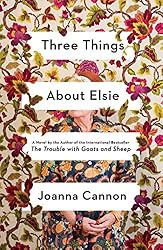
Three Things About Elsie
Joanna Cannon, 2018
Scribner
384 pp.
ISBN-13: 9781501187384
Summary
There are three things you should know about Elsie. The first thing is that she’s my best friend. The second is that she always knows what to say to make me feel better. And the third thing…might take a bit more explaining.
Eighty-four-year-old Florence has fallen in her flat at Cherry Tree Home for the Elderly.
As she waits to be rescued, she thinks about her friend Elsie and wonders if a terrible secret from their past is about to come to light.
If the charming new resident is who he claims to be, why does he look exactly like a man who died sixty years ago?
From the acclaimed, bestselling author of The Trouble with Goats and Sheep, Three Things About Elsie is a story about forever friends on the twisting path of life. As we uncover their buried secrets, we learn how the fine threads of humanity connect us all. (From the publisher.)
Author Bio
• Age—40s
• Raised—Derbyshire, England, UK
• Education—Denstone College, Uttoxeter; M.D., University of Leicester Medical School
• Currently—lives in Ashbourne, Derbershire, England
Joanna Cannon is a psychiatrist and a novelist. She grew up in Derbyshire, England, as the only child of a plumber and a giftshop owner. Although she left school at 15 with one O-level, she returned in her 30s to take her A-levels. She was spurred by her resolve to become a doctor and qualified in her early 40s..
Today, Cannon lives in England’s Peak District with her family and her dog. She is the author of Three Things About Elsie (2018) and The Trouble with Goats and Sheep (2015). (From the publisher.)
Read this Guardian article about the author.
Book Reviews
While readers are likely to guess the mysterious "third thing" about Elsie early on, and the book… depend[s on] coincidences, Cannon makes her protagonist sympathetic.… Readers may come for the mystery, but they’ll stay to spend time with Florence.
Publishers Weekly
Older characters are beginning to get their own literature, and Cannon's title is a positive addition that should resonate with elderly citizens and their caretakers everywhere. —Mary K. Bird-Guilliams, Chicago
Library Journal
[T]ender and charismatic…. Cannon effortlessly captures the home’s slow routines, along with the ways that staff and residents coexist but often know little about each other…. This heartfelt tale of friendship and aging explores letting go of the past in order to live fully in the present.
Booklist
(Starred review) Breathes with suspense, providing along the way piercing, poetic descriptions, countless tiny mysteries, and breathtaking little reveals.… [A] rich portrait of old age and friendship stretched over a fascinating frame.
Kirkus Reviews
Discussion Questions
1. Why do you think author Joanna Cannon decided to set the novel in a nursing home?
2. On page 63, Florence says, "I needed someone to hold my worrying for me." How does Elsie play this role for her?
3. The act of naming and renaming things is a recurring theme in the novel. Why do you think this is significant?
4. Did Florence’s failing memory change your understanding of events at Cherry Tree? Does it make her a less reliable narrator? Why or why not?
5. "Simon wondered where his life ended and their life began, and how we could all be stitched so tightly together, yet the threads between everybody still go unnoticed" (page 124). How does this idea of the bonds between humanity play out throughout the novel?
6. "‘You’ve got to find forgiveness, Florence,’ said Elsie. ‘You find it so easily in other people, why do you struggle so much to find it in yourself?’" (page 334). Why do you think Florence struggles to forgive herself for the past?
7. Consider the role of time in novel, especially Florence’s idea of a "long second"—when time seems to hesitate just long enough to give you a chance to make the right decision. Have you experienced any "long seconds" in your life?
8. Florence and Simon both repeat throughout the novel that they have lived very ordinary lives. Do you think this is the case? How do you think ordinary versus extraordinary is measured?
9. "Sometimes, a name is the only thing we can leave behind," Florence says on page 103. Do you think this is true? What else do you think Florence will leave behind?
10. Did the third thing about Elsie come as a surprise to you? Why or why not?
11. What do you think makes Florence ultimately realize that she has lived an extraordinary life, in the end?
(Questions issued by the publishers.)


The Three Weissmanns of Westport
Cathleen Schine, 2010
Farrar, Straus & Giroux
292 pp.
ISBN-13: 9780312680527
Summary
Jane Austen’s beloved Sense and Sensibility has moved to Westport, Connecticut, in this enchanting modern-day homage to the classic novel.
When Joseph Weissmann divorced his wife, he was seventy eight years old and she was seventy-five. He said the words "Irreconcilable differences," and saw real confusion in his wife’s eyes.
"Irreconcilable differences?" she said. "Of course there are irreconcilable differences. What on earth does that have to do with divorce?"
Thus begins The Three Weissmanns of Westport, a sparkling contemporary adaptation of Sense and Sensibility from the always winning Cathleen Schine, who has already been crowned "a modern-day Jewish Jane Austen" by People’s Leah Rozen.
In Schine’s story, sisters Miranda, an impulsive but successful literary agent, and Annie, a pragmatic library director, quite unexpectedly find themselves the middle-aged products of a broken home. Dumped by her husband of nearly fifty years and then exiled from their elegant New York apartment by his mistress, Betty is forced to move to a small, run-down Westport, Connecticut, beach cottage.
Joining her are Miranda and Annie, who dutifully comes along to keep an eye on her capricious mother and sister. As the sisters mingle with the suburban aristocracy, love starts to blossom for both of them, and they find themselves struggling with the dueling demands of reason and romance. (From the publisher.)
Author Bio
• Birth—1953
• Where—Bridgeport, Connecticut, USA
• Education— B.A., Barnard College
• Currently—lives in New York City and Venice, California
In her own words:
I tried to be a medieval historian, but I have no memory for facts, dates, or abstract ideas, so that was a bust. When I came back to New York, I tried to be a buyer at Bloomingdale's because I loved shopping. I had an interview, but they never called me back. I really had no choice. I had to be a writer. I could not get a job.
After doing some bits of freelance journalism at the Village Voice, I did finally get a job as a copy editor at Newsweek. My grammar was good, but I can't spell, so it was a challenge. My boss was very nice and indulgent, though, and I wrote Alice in Bed on scraps of paper during slow hours. I didn't have a regular job again until I wrote The Love Letter.
The Love Letter was about a bookseller, so I worked in a bookstore in an attempt to understand the art of bookselling. I discovered that selling books is an interdisciplinary activity, the disciplines being: literary critic, psychologist, and stevedore. I was fired immediately for total incompetence and chaos and told to sit in the back and observe, no talking, no touching.
I dislike humidity and vomit, I guess. My interests and hobbies are too expensive or too physically taxing to actually pursue. I like to take naps. I go shopping to unwind. I love to shop. Even if it's for Q-Tips or Post-Its.
When asked what book most influenced her career as a writer, here is her response:
When I left graduate school after a gruesome attempt to become a medieval historian, I crawled into bed and read Our Mutual Friend. It was, unbelievably, the first Dickens I had ever read, the first novel I'd read in years, and one of the first books not in or translated from Latin I'd read in years. It was a startling, liberating, exhilarating moment that reminded me what English can be, what characters can be, what humor can be. I of course read all of Dickens after that and then started on Trollope, who taught me the invaluable lesson that character is fate, and that fate is not always a neat narrative arc.
But I always hesitate to claim the influence of any author: It seems presumptuous. I want to be influenced by Dickens and Trollope. I long to be influenced by Jane Austen, too, and Barbara Pym and Alice Munro. I aspire to be influenced by Randall Jarrell's brilliant novel, Pictures from an Institution. And I read Muriel Spark when I feel myself becoming soft and sentimental, as a kind of tonic. (From a 2003 Barnes & Noble interview.)
Book Reviews
Schine gives her characters more than their fair share of luck, but she is also brave enough to let them wrestle with raw fear. Among its many gifts to the dearest sort of reader, a fully engaged one, The Three Weissmanns of Westport offers the chance for a mediation on that snake of Emily Dickinson's as it slithers through the grass—the snake that sometimes startles and frightens us, so undefended and unprepared are we, caught in our "tighter breathing, and zero at the bone."
Dominique Browning - New York Times Book Review
Schine sets the Austen machinery in perfect forward motion, and then works some lovely modern changes, keeping the pace going at a lively clip.... Spotting the similarities and differences between the early 19th century and early 21st century stories is good sport, but the greater pleasure comes from Schine’s own clever girls and their awkward attempts to find happiness.
Boston Globe
Schine has been favored in so many ways by the muse of comedy...The Three Weissmanns of Westport is full of invention, wit, and wisdom that can bear comparison to Austen’s own.
New York Review of Books
A geriatric stepfather falls in love with a scheming woman half his age in Schine's Sense and Sensibility...compulsively readable.... An Austen-esque mischief hovers over these romantic relationships as the three women figure out how to survive and thrive. It's a smart crowd pleaser with lovably flawed leads and the best tearjerker finale you're likely to read this year.
Publishers Weekly
[W]itty.... While beautifully preserving the essence of the plot, Schine skillfully manages to parallel the original novel in clever 21st-century ways—the trip to London becomes a holiday in Palm Springs; the scoundrel Willoughby becomes a wannabe actor. —Andrea Kempf, Johnson Cty. Community Coll. Lib., Overland Park, KS
Library Journal
The wide-ranging cast of characters—fools, scoundrels, poseurs, the good-hearted, and secret heroes—provides interesting interplay.Wild coincidences abound, so that Manhattan, Westport, and Palm Springs are but mere extensions of the classic drawing room. There is sadness but also love in this thoroughly enjoyable, finely crafted modern novel. —Danise Hoover
Booklist
Already recognized for her own witty romantic comedies of manners, Schine joins the onslaught of Austen imitators.... In true Austen fashion, love and money conquer all, although Schine adds some modern sorrow and a slightly off-putting disdain for her male characters.... Infectious fun, but the tweaked version never quite lives up to the original.
Kirkus Reviews
Discussion Questions
1. How do Betty and her daughters relate to men? Do the three women have the same expectations about love and relationships?
2. How do the Weissmann women define "home"? What does the Manhattan apartment mean to them? What do their reactions to the Westport cottage say about their personalities? Would you have enjoyed living there?
3. In Sense and Sensibility, Mrs. Dashwood does her best to help her family thrive despite dwindling fortunes. What challenges do women still face in such situations, even with the cultural changes that have taken place since Jane Austen was writing?
4. Which cad is worse: Schine’s Kit Maybank or Austen’s John Willoughby? If Miranda could meet Marianne, what advice would the two characters give each other?
5. The fact that Miranda and Annie are not Joseph’s biological children also mirrors Austen’s plot. Would Joseph have handled the divorce differently if the girls had been his biological daughters?
6. Is Frederick a good father to Gwen and Evan? What stokes Annie’s attraction to him throughout the novel?
7. Is Betty very much like her relatives? Which of your family members would you turn to if you were in her situation?
8. What accounts for the similarities and differences between Annie and Miranda? Are both women simply driven by their temperaments, or have they shaped each other’s personalities throughout their lives? How does their relationship compare to yours with your own siblings?
9. Schine’s work often blends humor with misfortune, such as Miranda’s undoing by authors who turn out to be plagiarists and extreme fabricators. What other aspects of the novel capture the tragicomic way life unfolds?
10. Why is it so hard for Joseph to understand why his stepdaughters are mad at him? Why does he prefer Felicity to Betty? Discuss the revelations about Amber. In what way is her romantic situation similar to Felicity’s?
11. Ultimately, how do the Weissmanns reconcile sense with sensibility? Who are the book’s most rational characters? Who is the most emotional?
12. What makes Roberts remarkable (eventually)? Who are the overlooked "characters" in your life story?
13. What aspects of the ending surprised you the most? What had you predicted for Betty, and for Leanne? Do the novel’s closing scenes reflect an Austen ending?
14. Does the storytelling style in The Three Weissmanns of Westport remind you of Schine’s other portraits of love? What makes the Weissmanns’ story unique?
(Reading Group Guide written by Amy Root / Amy Root’s Wordshop, Inc.)
top of page (summary)