


Visitation Street
Ivy Pochoda, 2013
HarperCollins
306 pp.
ISBN-13: 9780062249906
Summary
Summer in Red Hook, Brooklyn, an isolated blue-collar neighborhood where hipster gourmet supermarkets push against tired housing projects and the East River opens into the bay.
Bored and listless, fifteen-year-olds June and Val are looking for fun. Forget the boys, the bottles, the coded whistles. Val wants to do something wild and a little crazy: take a raft out onto the bay.
But on the water during the humid night, the girls disappear. Only Val survives, washing ashore in the weeds, bruised and unconscious.
This shocking event echoes through the lives of Red Hook's diverse residents. Fadi, the Lebanese bodega owner, hopes that his shop is a place to share neighborhood news, and he trolls for information about June's disappearance. Cree, just beginning to pull it together after his father's murder, unwittingly makes himself the chief suspect in the investigation, but an enigmatic and elusive guardian is determined to keep him safe. Val contends with the shadow of her missing friend and a truth she's buried deep inside. Her teacher Jonathan, a Juilliard dropout and barfly, wrestles with dashed dreams and a past riddled with tragic sins.
In Visitation Street, Ivy Pochoda combines intensely vivid prose with breathtaking psychological insight to explore a cast of solitary souls, pulled by family, love, betrayal, and hope, who yearn for a chance to break free. (From the publisher.)
Author Bio
• Birth—January 22, 1977
• Where—Brooklyn, New York City, New York, USA
• Education—B.A., Harvard College; M.F.A. Bennington College
• Currently—lives in Los Angeles, California
Ivy Pochoda is the American author of four novels: These Women (2020) Wonder Valley (2017), The Visitation (2013) and The Art of Disappearing (2009)
Pochoda grew up in Brooklyn, New York, in a house filled with books. She has a BA from Harvard College in English and Classical Greek with a focus on dramatic literature, and an MFA from Bennington College in fiction.
During her college years at Harvard, Pochoda played squash, leading the school to national championships in all four of her years on the team. She was named Ivy League Rookie of the Year, Player of the Year, and was a four-time All-American and First Team all-Ivy. In May 2013, she was inducted into the Harvard Hall of Fame.
After graduation in 1998, Pochoda played squash professionally, joining The Women's International Squash Players Association full-time. She reached a career-high world ranking of 38th in March 1999 and continued playing professionally until 2007.
In 2009, she published her first novel (The Art of Disappearing) and become the James Merrill House writer-in-residence at Bennington College, where she also obtained her Masters in 2011.
Ivy currently lives in Los Angeles with her husband, Justin Nowell. (From the publisher and Wikipedia. Retrieved 5/27/2020.)
Book Reviews
A powerfully beautiful novel
Marilyn Stasio - New York Times
A stunner of a literary thriller. Grade A-
Entertainment Weekly
Utterly transporting.
People
(Starred review.) Exquisitely written.... Examines how residents of Brooklyn’s Red Hook neighborhood deal with grief, urban development, loss, and teenage angst.... Pochoda (The Art of Disappearing) couples a raw-edged, lyrical look at characters’ innermost fears with an evocative view of Red Hook, a traditionally working-class area of Brooklyn undergoing gentrification that still struggles with racism and the aftermath of drug violence.
Publishers Weekly
(Starred review.) [R]eaders meet a full cast of utterly believable characters.... It's an opera set in one small community, and as...the neighborhood characters play their parts, large and small, Pochoda's riveting prose will keep readers enthralled until the final page. Verdict:The prose is so lyrical and detailed that readers will easily imagine themselves in Red Hook. A great read for those who enjoy urban mysteries and thrillers with a literary flair. —Amy Hoseth, Colorado State Univ. Lib., Fort Collins
Library Journal
(Starred review.) Blue-collar Red Hook, a section of Brooklyn’s waterfront in rough transition, becomes one big outdoor theater as temperatures rise in Pochoda’s beyond-category urban drama…. The mysteries of sexuality, guilt, race and class conflicts, artistic pursuits, and psychic abilities are all in play as Pochoda transforms Red Hook into a microcosm of human longing. With prose as cleansing and propelling as a sea breeze, and characters running like strong currents, Pochoda pulls us deeply into this transfixing tale of visitations both alarming and liberating.
Booklist
(Starred review.) A mystery about a missing girl and the ghosts she leaves behind. One summer evening, teenagers Val and June float on a rubber raft out into the bay off Brooklyn's Red Hook section. Only Val returns, her near-dead body washed upon the shore. But Val can't seem to tell anyone what happened to them or why June disappeared without a trace.... Who saw Val and June take the boat out? Can June possibly be alive?.... A terrific story in the vein of Dennis Lehane's fiction.
Kirkus Reviews
Discussion Questions
Use our LitLovers Book Club Resources; they can help with discussions for any book:
• How to Discuss a Book (helpful discussion tips)
• Generic Discussion Questions—Fiction and Nonfiction
• Read-Think-Talk (a guided reading chart)
Also, consider these LitLovers talking points to help get a discussion started for Visitation Street:
1. Consider the personalities of June and Val in the opening chapter. How are they different from one another? Why is Val so intent on taking the raft into the bay?
2. Red Hook—situated across the bay from Manhattan and bound by water—is both a literal and metaphorical setting in the novel. Talk about the way Red Hook isolates and traps the characters—in particular, Val, Jonathan, and Cree. In what sense does each of them feel trapped? What does each yearn for?
3. What is the thematic significance of the book's title? What is a visitation—and what does the title sugggest about the power of the past to "visit" itself upon the present? What are the ghosts in this story—are they real?
4. Follow-up to Question 3: In what way does the past take hold of each of the main characters—Jonathan, Cree, Cree's mother Gloria, and Ren?
5. What draws Val and Jonathan to one another (over and above physical attraction)? Why does Jonathan care so much about Valerie? From what does he want to save her?
6. What do you think of Ren? Why is he so protective of Cree? Why does he warn Cree to avoid Val and tell no one about his attempt to swim out to the raft. SPOILER ALERT: Was he right to hide June's body?
7. Follow-up to Question 6: Talk about the issue of race in this book? How does it affect personal relationships as well as the criminal-judicial system?
8. Although Fadi plays a small part in the outcome of the story—he is more of an observer than a participant, except at the end—why has the author given his character such prominent place in the story? What role does he play in the community? How does he view Red Hook and its residents? What is he trying to achieve with his newsletter and bulletin board? Why doesn't the newsletter increase his business?
9. Discuss the book's ending—is it satisfying? What do you think will happen to Cree, Val, and Jonathan? What about Ren?
(Questions by LitLovers. Please feel free to use them, online or off, with attribution. Thanks.)
The Vow
Denene Miller, Angela Burt-Murray, Mitzi Miller, 2005
HarperCollins
352 pp.
ISBN-13: 9780060762285
Summary
In this runaway hit novel, three best friends come together for their sorority sister's glitzy wedding in Atlanta and make a vow to get married within one year. As they embark on their search to find their soul mates, they navigate the full-contact sport known as being a SSBFLA (successful, single, black, female in L.A.) and negotiate the shark-infested waters of making a name for themselves professionally in Hollywood.
Can Trista, the hyper-driven celebrity agent, find the time to schedule a meaningful romance? Will Amaya, the sexy starlet, convince the married hip hop-label exec she has been seeing to leave his wife, or will the NBA star steal her heart in the final seconds? After undergoing a complete makeover, will Vivian, the jaded gossip columnist, win back the father of her child?
As seductive as it is empowering, The Vow is a page-turner that will keep you cheering for these women as they discover that their desire to find a husband isn't as important as finding themselves. (From the publisher.)
Author Bios
• Denene Millner is a columnist for Parenting magazine. She has worked as a senior editor at Honeyand as an entertainment and political journalist for the New York Daily News. She is also the author of The Sistahs' Rules and co-author of several books, including the novel A Love Story (with her husband, Nick Chiles), and The Angry Black Woman's Guide to Life, a humor book. Millner lives in Atlanta with her husband and their two daughters. (From the publisher.)
• Angela Burt-Murray is the editor-in-chief at Essence magazine. She has written for Essence, Honey, Parenting, and Working Mother magazines. The co-author of The Angry Black Woman's Guide to Life, Burt-Murray lives in New Jersey with her husband and two sons. (From the publisher.)
• Mitzi Miller is associate editor at Jane magazine and has written for Elle (U.K.), Parenting, and Upscale magazines. She is the former entertainment editor for Honey magazine and the co-author of The Angry Black Woman's Guide to Life. She lives in New York City. (From the publisher.)
Book Reviews
(Starred review.) Veteran author Millner (What Brothers Think, What Sistahs Know) has teamed with Burt-Murray and Miller (editors at Jane and Teen People, respectively) to produce an emotionally charged portrait of contemporary Hollywood with a cast of unforgettable characters. Reunited at a wedding on New Year's Eve, three 30-something sorority sisters pledge to become engaged within a year. Trista Gordon, a power hungry talent agent, will do whatever it takes to beat her politically connected colleague, Steven Banks, to a partnership. Beautiful actress Amaya Anderson, in line for her first leading role, juggles two boyfriends while focusing on toning down her flashy image. Slightly plump Vivian Evans, an entertainment journalist, remains hopelessly in love with her son's father, her ex-husband. Fortified with new skills meant to drive a man wild, the trio find their wants don't often meet those of their romantic prospects, who include a basketball star, a closeted gay attorney and a hip-hop artist. Readers will eagerly turn the pages of this edgy, sexy novel to learn what's happening next.
Publishers Weekly
Enter the world of California glitz and glamour as three friends navigate their way through Hollywood's chaotic dating scene. Trista is vying for partner at one of the hottest talent agencies in Los Angeles and finds herself caught between a former love and her current, slightly boring boyfriend. Amaya, an actress contending with the casting couch to improve her roles, obsesses about her affair with a married man while dating a basketball star. And newspaper reporter Vivian is still in love with her college boyfriend, the father of her son. Prompted by a New Year's resolution to be wed by the year's end, the women discover the strengths and weaknesses of their friendships, their families, and themselves. Millner (The Sistahs' Rules) and magazine editors Angela Burt-Murray and Mitzi Miller have collaborated before, in The Angry Black Woman's Guide to Life. Their latest endeavor brings fast-paced romances to life and features a trio of engaging characters. Perfect for light reading, this book is recommended for popular fiction collections, especially where Millner is popular. —Joy St. John, Henderson Dist. P.L., NV
Library Journal
The path to true love is never smooth for three sexy black Los Angeles women who set a deadline for landing Mr. Right. A New Year's Eve wedding celebration spurs best friends Trista, Amaya and Viv to make a pledge to find themselves husbands within a 12-month period. Should be simple, right? After all, they have talent, beauty and drive to spare. But finding men does not seem to be the problem, just getting the right one to commit. Earthy single mom Viv longs for a full-time family with her son's father, a successful plastic surgeon, but gets sidetracked by a smitten gangsta rapper; talent agent Trista seems to have met her match in smooth lawyer Garrett, but cannot get her college sweetheart Damon out of her mind; and starlet (and part-time hustler) Amaya hedges her bets with a strapping young basketball star in the hopes that her married music-mogul lover will become jealous enough to leave his movie star wife. This familiar story of friendship and self-realization from Millner (A Love Story, 2004, etc.), Teen People magazine executive editor Burt-Murray and Jane magazine associate editor Miller is peppered with Hollywood gossip about the African-American entertainment elite, along with several frank and funny sex scenes. These wannabe brides are far from chaste, and their unapologetic romps drive the love-yourself-first message better than some of the more conventional plot revelations. Through a series of crises that include a boyfriend on the down-low and a sick child, the friends are forced to face the flaws in their plan and deal with their own fears until they realize that they need each other far more than a ring. A warm-hearted Jackie Collins-meets-Terry McMillan ode to sisterhood, with few surprises.
Kirkus Reviews
Discussion Questions
Use our LitLovers Book Club Resources; they can help with discussions for any book:
• How to Discuss a Book (helpful discussion tips)
• Generic Discussion Questions—Fiction and Nonfiction
• Read-Think-Talk (a guided reading chart)
Also consider these LitLovers talking points to help get a discussion started for The Vow:
1. Did you enjoy the unusual structure of this book: three different voices, written by three different authors? Does the story hold together—do the authors pull it off?
2. Are the three main characters authentic and well-developed as individuals? Or do you find them stereotypic: the man's women, the woman left with a baby, and the hard-charging career worman?
3. Are the characters compelling—do you care about them? Do you have a favorite among the three—Trista, Amay, or Vivian? Do you see qualities of yourself in any one of them?
4. Does The Vow do a good job of describing the cultural issues faced by single working women who are also in the market for a mate? Are the challenges the three women face authentic?
5. What about the men? Is there one you like/dislike one more than the others? Who...and why? Are the men fully developed as characters, or are they one-dimensional caricatures?
6. How would you react if you found your boyfriend was on the down-low?
7. Viv began a self-improvement program, then back-tracked. Were you disappointed in her...or sympathetic? What about Sean's justification for leaving Viv with the baby? Does his reasoning stand up? Does Viv end up with the right guy?
8. What do you think of Amaya handing over the photos of his wife to Keith?
9. What does each of the three women start to realize in the process of finding a husband...what do they learn by the end of the book?
10. Did The Vow hold your interest? Is it a page-turner...or were there times when you lost interest?
11. Are you satisfied with the way the novel ends? Do you feel each woman gets what she truly needs...or deserves? If you could, would you change the ending...and, if so, how?
(Questions by LitLovers. Please feel free to use them, online or off, with attribution. Thanks.)
top of page
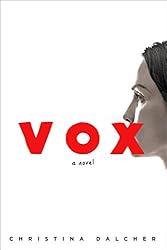
Vox
Christina Dalcher, 2018
Penguin Publishing
336 pp.
ISBN-13: 9780440000785
Summary
Set in a United States in which half the population has been silenced, Vox is the harrowing, unforgettable story of what one woman will do to protect herself and her daughter.
On the day the government decrees that women are no longer allowed more than one hundred words per day, Dr. Jean McClellan is in denial. This can't happen here. Not in America. Not to her.
This is just the beginning…
Soon women are not permitted to hold jobs. Girls are not taught to read or write. Females no longer have a voice. Before, the average person spoke sixteen thousand words each day, but now women have only one hundred to make themselves heard.
…not the end.
For herself, her daughter, and every woman silenced, Jean will reclaim her voice. (From the publisher.)
Author Bio
Christina Dalcher earned her doctorate in theoretical linguistics from Georgetown University. She specializes in the phonetics of sound change in Italian and British dialects and has taught at several universities.
Her short stories and flash fiction appear in more than one hundred journals worldwide. Recognition includes the Bath Flash Award short list, nominations for the Pushcart Prize, and multiple other awards. She lives in Norfolk, Virginia, with her husband. (From the publisher.)
Book Reviews
Christina Dalcher’s debut novel, set in a recognizable near future and sure to beg comparisons to Margaret Atwood’s dystopian The Handmaid’s Tale, asks: if the number of words you could speak each day was suddenly and severely limited, what would you do to be heard?… Considering the threat of a society in which children like the protagonist’s six-year-old daughter are deprived of language, Vox highlights the urgency of movements like #MeToo, but also of the basic importance of language.
Vanity Fair
The females in Dalcher’s electrifying debut are permitted to speak just 100 words a day—and that’s especially difficult for the novel’s protagonist, Jean, a neurolinguist. A futurist thriller that feels uncomfortably plausible.
Oprah Magazine
In Christina Dalcher’s Vox, women are only allowed to speak 100 words a day. Sounds pretty sci-fi, but the real-life parallels will make you shiver.
Cosmpolitan
Vox is a real page-turner that will appeal to people with big imaginations.
Refinery29
[P]rovocative…. [M]ost chilling is the specter of young girls being starved of language and, consequently, the capacity to think critically.… [A] muddled climax and implausible denouement fail to live up to its intriguing premise. Nevertheless,…a powerful message.
Publishers Weekly
(Starred review) Jean is multilayered, [whose] definite faults …enrich rather than detract from the story…. Verdict: Dalcher reflects current politics in a… page-turning first novel that is perfect for fans of speculative fiction [and book clubs]. —Charli Osborne, Oak Park P.L., MI
Library Journal
[C]hilling…. With its focus on the vitality of communication and human interactions, Dalcher’s tale is a fresh and terrifying contribution to the burgeoning subgenre about women-focused dystopias spearheaded by… The Handmaid’s Tale.
Booklist
The ending of the novel, while surprising, is rushed, unearned, and the least convincing part of a story that continually challenges the reader's suspension of disbelief.… Dalcher's premise is tantalizing, but the execution… quickly devolves into the stuff of workaday thrillers.
Kirkus Reviews
Discussion Questions
We'll add publisher questions if and when they're available; in the meantime, use our LitLovers Book Club Resources. They can help with discussions for any book:
• How to Discuss a Book (helpful discussion tips)
• Generic Discussion Questions—Fiction and Nonfiction
• Read-Think-Talk (a guided reading chart)
(Resources by LitLovers. Please feel free to use them, online and off, with attribution. Thanks.)
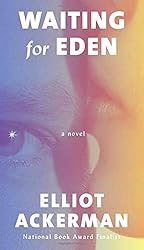
Waiting for Eden
Elliot Ackerman, 2018
Knopf Doubleday
192 pp.
ISBN-13: 9781101947395
Summary
A breathtakingly spare and shattering new novel that traces the intersection of three star-crossed lives.
Eden Malcom lies in a bed, unable to move or to speak, imprisoned in his own mind.
His wife Mary spends every day on the sofa in his hospital room. He has never even met their young daughter. And he will never again see the friend and fellow soldier who didn't make it back home—and who narrates the novel.
But on Christmas, the one day Mary is not at his bedside, Eden's re-ordered consciousness comes flickering alive.
As he begins to find a way to communicate, some troubling truths about his marriage—and about his life before he went to war—come to the surface. Is Eden the same man he once was: a husband, a friend, a father-to-be? What makes a life worth living?
A piercingly insightful, deeply felt meditation on loyalty and betrayal, love and fear, Waiting for Eden is a tour de force of profound humanity. (From the publisher.)
Author Bio
• Birth—April 12, 1980
• Where—Los Angeles, California, USA
• Education—B.A., M.A., Tufts University
• Currently—lives in Washington, D.C., and New York City
Elliot Ackerman is an American author, currently based out of Istanbul. He is the son of businessman Peter Ackerman and the brother of mathematician and wrestler Nate Ackerman.
Early life
At the age of 9, his family moved to London where he lived until the family moved back to Washington, DC, when he was 15. He studied literature and history at Tufts University, graduating summa cum laude and Phi Beta Kappa in 2003, in a special program to earn Bachelor's and Master's degrees in 5 years, rather than the usual six. He holds a Master’s degree in International Affairs from the Fletcher School of Law and Diplomacy, and has completed many of the United States military’s most challenging special operations training courses.
Career
Beginning in 2003, Ackerman spent eight years in the U.S. military as both an infantry and special operations officer. He served multiple tours of duty in the Middle East and Southwest Asia. As a Marine Corps Special Operations Team Leader, he operated as the primary combat advisor to a 700-man Afghan commando battalion responsible for capture operations against senior Taliban leadership. He also led a 75-man platoon that aided in relief operations in post-Katrina New Orleans.
Ackerman served as Chief Operating Officer of Americans Elect, a political organization founded and chaired by his father, Peter Ackerman, and continues to serve on its Board of Advisors. Americans Elect is known primarily for its efforts to stage a national online primary for the 2012 US Presidential Election. As one of its officers, Ackerman was interviewed extensively, notably on NPR's Talk of the Nation.
He has served on the board of the Afghan Scholars Initiative and as an advisor to the No Greater Sacrifice scholarship fund. Most recently, Ackerman served as a White House Fellow in the Obama Administration.
Ackerman divides his time between Washington, D.C., and New York City.
Writing
Ackerman's fiction and essays have appeared in The New Yorker, Atlantic, New Republic, New York Times Magazine, Ecotone and others. He is also a contributor to the Daily Beast, and a member of the Council on Foreign Relations. He has been interviewed in the Washington Post, New York Times, and Wall Street Journal and appeared on Charlie Rose, Colbert Report, NPR's Talk of the Nation, Meet the Press, CNN, MSNBC, Fox News, Al Jazeera and PBS NewsHour among others.
Ackerman's first novel, Green on Blue, published in 2015, with Publishers Weekly referring to the novel as "bleak and uncompromising, a powerful war story that borders on the noir." Los Angeles Review of Books describes the novel as a radical departure from veterans writing thus far due to his choice of a first person narrator, the lowly Aziz, a poor soldier in a local militia.
Military Honors
Ackerman is a decorated veteran, having earned a Silver Star and Purple Heart for his role leading a Rifle Platoon in the November 2004 Second Battle of Fallujah and a Bronze Star for Valor while leading a Marine Corps Special Operations Team in Afghanistan in 2008. Ackerman is also a recipient of the Major General Edwin B. Wheeler Award for Infantry Excellence. (Adapted from Wikipedia. Retrieved 2/10/2015.)
Book Reviews
(Starred review) This is a deeply touching exploration of resentment, longing, and loss among those who volunteer to fight and the loved ones left behind.
Publishers Weekly
(Starred review) With sparse prose and a deft pen, Ackerman writes a profound meditation on the liminal space between our past, present, and future. —Joshua Finnell, Colgate Univ., Hamilton, NY
Library Journal
(Starred review) Gorgeously constructed.… Unique.… A deeply moving portrayal of how grief can begin even while our loved ones still cling to life.… A wonderful novel.
Booklist
(Starred review) Wounded terribly in Iraq three years ago, a soldier awaits his death in a burn center in San Antonio, and we learn of his fate through a surprising, unconventional, and risky narrative strategy.… An affecting, spare, and unusual novel.
Kirkus Reviews
Discussion Questions
1. Who is the narrator of the novel? How does he know Mary and Eden’s story? How does Ackerman’s decision to narrate from this point of view deepen the reader’s understanding of Mary and Eden’s lives?
2. Examine the symbolism of the cockroaches. How does Eden understand their presence? What do they represent to him?
3. How would you describe Eden’s level of consciousness? What does he register about his reality? To what extent is his perception of reality distorted? Is there anything he is sure of? Are the nurses correct in their assessment of Eden’s level of consciousness?
4. Consider the theme of pain as it is depicted in the novel. Which characters experience pain, and what type of pain do they experience? Do you understand Eden’s pain to be greater than the pain of the other characters? Why or why not?
5. Explore Mary and Eden’s relationship. How did they meet? What were the early months of their relationship like? When and why does a rift form in their marriage?
6. Examine Gabe’s character. Who is he? Why does he take an active interest in Eden? How does Eden feel about him?
7. What is SERE school? How was Eden’s experience at SERE school similar to his experience in the hospital?
8. Explore the theme of time as it is depicted in the novel. How do the different characters perceive the passage of time? What are the characters waiting for? Can you identify any key symbols of time or waiting?
9. Why do you think Mary pursues the narrator? Is she remorseful about what happens between them, or does she stand by her decision?
10. Explore Mary’s feelings about Eden’s fate. Does she think it’s best for Eden to die, or does she want to prolong his life? Does her opinion on this matter change over the course of the novel? Consider, as you answer this question, the themes of abandonment and betrayal.
11. Examine Eden’s dream in which he reunites with the narrator. Where does this reunion take place? How would you characterize their attitude toward one another? What does Eden mean by his assertion, "You know it’s easiest on us" (137)? Do you agree with him?
12. The novel concludes with the final lines of John Milton’s Paradise Lost. How does this quotation inform your interpretation of the novel and its resolution?
(Questions issued by the publisher.)


Waiting to Exhale
Terry McMillan, 1992
Penguin Publishing
416 pp.
ISBN-13: 9780451233424
Summary
Four African-American women console and support one another in a complex friendship that helps each of them face the middle of her life as a single woman.
A wise, earthy story of a friendship between four African American women who lean on each other while “waiting to exhale”: waiting for that man who will take their breath away. (From the publisher.)
Author Bio
• Birth—October 18, 1951
• Where—Port Huron, Michigan, USA
• Education—B.A., University of California, Berkeley
• Awards— Essence Award for Excellence in Literature
• Currently—lives in northern California
Terry McMillan is an American author. Her interest in books comes from working at a library when she was sixteen. She received her BA in journalism in 1986 at University of California, Berkeley. Her work is characterized by relatable female protagonists.
Her first book, Mama, was published in 1987. She achieved national attention in 1992 with her third novel, Waiting to Exhale, which remained on the New York Times bestseller list for many months. In 1995, Forest Whitaker turned it into a film starring Whitney Houston.
Another of McMillan's novels, her 1998 novel How Stella Got Her Groove Back, was also made into a movie. Disappearing Acts (2012) was subsequently produced as a direct-to-cable feature, starring Wesley Snipes and Sanaa Lathan.
McMillan also published the best seller A Day Late and a Dollar Short in 2002 and The Interruption of Everything in 2005. Getting to Happy, the long-awaited sequel to Waiting to Exhale, was published in 2010. In 2013, she published Who Asked You?, an intimate look at the burdens and blessings of family, and in 2016, I Almost Forgot About You, a look at mid-life crises.
Personal
McMillan married Jamaican Jonathan Plummer in 1998; she was in her late 40s and he in his early 20s. He was the inspiration for the love interest of the main character in her novel How Stella Got Her Groove Back. Her life did not follow the movie when, in December 2004, Plummer told McMillan that he was gay; in March 2005, she filed for divorce. The divorce was settled for an undisclosed amount. In March 2007, McMillan sued Plummer and his lawyer for $40 million, citing an intentional strategy to embarrass and humiliate her during the divorce proceedings; McMillan eventually won a judgment of intentional infliction of emotional distress, but had withdrawn the suit before the case went to trial; Plummer was never ordered to pay the intended amount. On September 27, 2010, the two sat together with talk show host Oprah Winfrey to discuss their post-divorce relationship and partial reconciliation; both acknowledged that he fulfilled the role of boyfriend and husband before his coming-out, although McMillan stated that "he's not my BFF." McMillan has a son Solomon and lives outside San Francisco, California. (From Wikiipedia.)
Visit the author's website.
Book Reviews
[R]acy, zesty, irreverent and absorbing.... McMillan keeps us constantly guessing about which members of her lively quartet will be...rewarded. There's nothing stereotyped in her work here: it is fresh and engaging.
Publishers Weekly
.
[P]redictable plot, prose that often falls flat, and a narrative that lacks depth. [What's] stronger is the author's sharp, often humorous depiction of the strong bonds among the four friends. —Faye A. Chadwell, Univ. of South Carolina Lib., Columbia
Library Journal
[McMillan's] bawdy, vibrant, deliciously readable third novel is the story of four black women friends and their frequently disastrous encounters with black men.... [T]hey are as timeless as Molly Bloom or the Wife of Bath in their robust sensuality. A novel that...has heart and pizzazz.
Kirkus Reviews
Discussion Questions
Use our LitLovers Book Club Resources; they can help with discussions for any book:
• How to Discuss a Book (helpful discussion tips)
• Generic Discussion Questions—Fiction and Nonfiction
• Read-Think-Talk (a guided reading chart)
(We'll add specific questions if and when they're made available by the publisher.)
The Wake of Forgiveness
Bruce Machart, 2010
Houghton Mifflin Harcourt
320 pp.
ISBN-13: 9780547521947
Summary
Bruce Machart tells an epic story of a Texas family at the turn of the twentieth century: a family of men led by a father, emotionally crippled following the death of his wife while in childbirth with their fourth boy, Karel.
From an early age, Karel proves so talented on horseback that his father enlists him to ride in acreage-staked horseraces against his neighbors, culminating in the ultimate high-stakes race against a powerful Spanish patriarch and his alluring daughters. Hanging in the balance are his father’s fortune, his brothers’ futures, and his own fate. Fourteen years later, with the stake of the race still driven hard between him and his brothers, Karel is finally forced to dress the wounds of his past and salvage the tattered fabric of his family.
With rich descriptive language and a cadence as deliberate and determined as the people and horses of the story, The Wake of Forgiveness compels us to consider the inescapable connections between sons and their mothers, between landscape and family, and between remembrance and redemption. (From the publisher.)
Author Bio
• Birth—N/A
• Where—near Houston, Texas, USA
• Education—M.F.A., Ohio State University
• Currently—lives in Houston, Texas
Bruce Machart is the author of the novel, The Wake of Forgiveness, published by Houghton Mifflin Harcourt in October of 2010, and a forthcoming collection of short stories entitled Men in the Making, due out from HMH in 2011.
His fiction has been published in some of the country's finest literary magazines, including Zoetrope: All-Story, Story, One Story, Five Points, Glimmer Train, and elsewhere. His short stories have been anthologized in Best Stories of the American West and Descant: Fifty Years. The winner of numerous awards and fellowships, Bruce is a graduate of the MFA program at The Ohio State University.
A native Texan, Bruce was born and raised in the Houston area. His father grew up on a cash-crop farm in rural south Texas not far from the Lavaca County landscape of The Wake of Forgiveness, and Bruce's mother was born in the deep south (and named her son after her favorite little town: Bruce, Mississippi). After high school, Bruce worked his way through eight years of undergraduate study before leaving for the midwest and graduate work in Columbus, Ohio. He later spent three years in the Boston area, where he taught literature and writing at Berklee College of Music, Boston University, and Grub Street Writers. In 2003, he returned to Houston, where he joined the faculty of Lone Star College. He is at work on a second novel. (From the author's website.)
Book Reviews
A mesmerizing, mythic saga of four motherless brothers at war with one another and with their stern father.... Above all, as its title promises, it's a story about forgiveness and a hard-won redemption.... [Machart] has a good ear for Western speech, and he writes as convincingly about an era he never experienced as he does about such diverse topics as cotton farming, quail hunting and gelding stallions. The echoes of McCarthy are loud in his lush style, but there are also undertones of Faulkner, Larry McMurtry, Norman Maclean and Charles Frazier. Machart blends these influences into a style uniquely his. The Wake of Forgiveness is a fine debut.
Philip Caputo - New York Times
The Wake of Forgiveness, which hails from the Robert Olmstead school of western, is a dark tale about fathers and sons, missing mothers and the poison that lies at the heart of the question, "Who's to blame?"
Yvonne Zipp - Washington Post
Machart's bleak, accomplished debut opens in 1895 as a landowning Texas family faces both sides of life's spectrum: the birth of a fourth son and the death of the boy's mother during childbirth. This event resonates throughout the lives of Vaclav Skala, who lost "the only woman he'd ever been fond of," and his four sons who, 15 years later, find their youngest sibling, Karel, to be a preternaturally talented equestrian. While Vaclav's wagers on his son's races increase, so does Karel's confidence, especially when facing off against the talk of the town: Guillermo Villaseñor, a powerful, moneyed, patronizing patriarch with three beautiful daughters. Yet Karel remains haunted by the memory of his mother, often feeling "the flat cool of her absence," and a prideful father who keeps him at arm's length. The consequences of a race that has his father's land hanging in the balance play out some 14 years later when, in 1924, Karel is married with children, yet still finds himself straying and facing inter-familial discord. Machart's moving story unfolds lyrically and sensually, with little fanfare, as his thoughtful prose propels a character-driven story about family, morality, and redemption.
Publishers Weekly
A wager destroys a farm family in this risk-taking first novel about Czech immigrant landowners in early 20th-century South Texas. Hard men are grabbing land any way they can. Vaclav Skala has been softened by a loving wife, who has borne him three sons, but when she dies giving birth to a fourth (Karel), he reverts to his old self, the hardest of taskmasters. He has his boys, not horses, plow the fields; they will be marked for life by misshapen necks. In 1910, their lives are upended by the arrival of Villaseñor, a hugely rich Mexican looking for land and husbands for his three comely daughters. He proposes a horserace to Vaclav; if he wins, he'll marry off his girls. Vaclav, confident in his racehorse and Karel's riding skills, agrees. The race is a fine set piece. Villaseñor, the superior strategist, has already won over the older boys, who will ignore some dirty tricks. Karel loses to Graciela, the Mexican's youngest. There are recriminations. After a vicious fight, Vaclav banishes his three oldest, who marry the next day. What next? A violent blood feud? Not at all. Machart is after more than stirring melodrama. The cadences of his formal prose, punctuated occasionally by earthy dialogue, tell you that, just as his shuttling between 1910 and 1924 minimizes suspense. He is making a resonant statement about the deformities of a world in which men make the rules, and mothers are dead or powerless. This involves the introduction, in 1924, of benighted twins, teenage brothers, firebugs who have avenged their dead mother by burning to death the father who brutalized her. There is much more, including bootlegging rivalries and a second deadly fire, but the trouble is, Machart fails to integrate plot and theme, and the novel splinters into a variety of episodes, all of them rendered with flair. Though he navigates erratically within it, Machart has created a dense, vibrant world, achievement enough for his debut.
Kirkus Reviews
Discussion Questions
1. The book opens with Karel’s birth, which is also the occasion of his mother’s death. How does this change the family dynamic? How does it introduce the themes of guilt and shame and how do you see these themes continue throughout the book?
2. In the book’s opening pages, we see Sr. Villasenor establish himself at the local bank. When he is condescended to by the banker, how does he get his revenge? How are Villasenor and Skala different sorts of men? How are they the same?
3. Discuss Karel’s relationship with his father. Vaclav never holds his infant son; later, the narrator says, “Karel wanted his pop’s strap, the stinging and unambiguous urgency of its attention, and, for Karel, the closest he got to his father’s touch” (p. 20). Where else do you see the correlation of violence with affection? How else does this correlation play out in Karel’s life?
4. On pages 30–31, Karel recounts a nightmare in which his father is kicked by a horse, then a horseshoe is nailed to his hand. What does this image of crucifixion signify in the story? Vaclav is far from Christ-like, but what sacrifice happens in the book? What redemption?
5. Karel is haunted by the absence of his mother. How does he seek maternal love? How does he confuse maternal love with something else?
6. On page 43, Karel kicks a pregnant cow. Why does he do this? How do we know this act is premeditated? What sorts of connections might Karel have between violence and money, or value? Where would those have come from?
7. The structure of the book is not strictly chronological. Why do you think the author chose to structure the book this way? How do the characters unfold through this broken narrative? What is gained by seeing Karel and the other characters at different points in their lives?
8. Does Karel feel bonded with the Knedlik boys because of the way their fathers died? Was that a reliable trust? When you finally read the scene of Vaclav’s death, is it what you expected? Does this change how you feel about Karel?
9. Discuss the pivotal horserace between Karel and Graciela. What made this race different than any other race? How is this race different than the one Karel ran against the Dalton boy earlier in the book? What are we to understand about Karel’s sportsmanship?
10. After the race, during the fight that ensues between the Skala men, what does the author mean when he says the fight was “flawless in its wickedness”? Why does it feel like this fight was fated? What was gained, and what lost, in the fight?
11. There are a few short passages in the book told from the point of view of Father Carew. Why do you think the author chose to switch the narration for these few moments? What do we gain from his perspective?
12. Raymond Knedlik says to Karel, “‘You ain’t got any brothers, Skala, unless you’re talking about me and Joe here. Them others won’t claim you.’” (page 293). What does Karel think of this claim? What does being a brother mean to Karel? What do you think makes men into brothers?
13. The title of the book is “The Wake of Forgiveness.” Who is forgiven? Why? What comes in the “wake of forgiveness”?
top of page
The Wake of the Wind
J. California Cooper, 1998
Knopf Doubleday
384 pp.
ISBN-13: 9780385487054
Summary
A dramatic and thought-provoking novel of one family's triumph in the face of the hardships and challenges of the post-Civil War South.
The Wake of the Wind, J. California Cooper's third novel, is her most penetrating look yet at the challenges that generations of African Americans have had to overcome in order to carve out a home for themselves and their families. Set in Texas in the waning years of the Civil War, the novel tells the dramatic story of a remarkable heroine, Lifee, and her husband, Mor.
When Emancipation finally comes to Texas, Mor, Lifee, and the extended family they create from other slaves who are also looking for a home and a future, set out in search of a piece of land they can call their own. In the face of constant threats, they manage not only to survive but to succeed—their crops grow, their children thrive, they educate themselves and others. Lifee and Mor pass their intelligence, determination, and talents along to their children, the next generation to surge forward.
At once tragic and triumphant, this is an epic story that captures with extraordinary authenticity the most important struggle of the last hundred years. (From the publisher.)
Author Bio
J. California Cooper is the author of four novels, including, most recently, Some People, Some Other Place, and six collections of stories. She was honored as Black Playwright of the Year, and has received the American Book Award, the James Baldwin Writing Award, and the Literary Lion Award from the American Library Association. She lives in Portland, Oregon (From the publisher.)
More
J. California Cooper first found acclaim as a playwright. The author of seventeen plays, she was named Black Playwright of the Year in 1978.
It was through her work in the theater that she caught the attention of acclaimed poet and novelist Alice Walker. Encouraged by Walker to turn her popular storytelling skills to fiction, Cooper wrote her first collection of short stories, A Piece of Mine, in 1984. Called "rich in wisdom and insight" and "a book that's worth reading," A Piece of Mine introduced Cooper's trademark style: her intimate and energetic narration, sympathetic yet sometimes troubled characters, and the profound moral messages that underlie seemingly simple stories.
Two more story collections followed on the heels of A Piece of Mine. In 1986 came Homemade Love, winner of an American Book Award, and, in 1987, Some Soul to Keep. (Author bio from the African American Literature Book Club.)
Book Reviews
Cooper's disappointing third novel (after Family) frustrates readers with a good premise poorly executed. Mordecai and Lifee meet as slaves on a plantation in post-Civil War Texas. Forced to marry by their master before they even know each other, they fall in love just as emancipation is declared, and head east with several other newly freed companions to look for a safe place to live. Cooper conveys the mixture of hope, fear and confusion as hungry and footsore former slaves move across the country. Mor and Lifee find work at a ruined plantation in Georgia and begin a family; and in time, the owner secretly sells her property to them. The tightly knit clan of former slaves prospers, but when lynchings in the area become frequent, they are forced to leave. Eventually they settle on an abandoned farm, where they survive economic depression and other troubles. When tragedy ensues, the next generation must assume responsibility for preserving the family. Though Cooper's research about the troubled historical era provides good details, her characters are mainly two-dimensional stereotypes. The blacks are good, with pure hearts; the whites (with one exception) are duplicitous. Moreover, the prose is wooden and preachy, lacking grace or nuance. This earnest saga of freed slaves aspiring to new lives in the Reconstruction South is commendable in intent but pedestrian in execution.
Publishers Weekly
Cooper has written her third novel and another wonderfully rich tale. Two good friends in Africa, Kola and Suwaibu, are taken from Africa and brought to America as slaves. The story of their great-great-great-grandchildren, Mordecai (Mor) and Lifee, reunites these friends' families through marriage. Mor and Lifee's life together is chronicled through their marriage, freedom from slavery, the birth of their children and grand-children, and their deaths. Cooper has once again written a compelling story, reminiscent of The Children of Segu (1989) by Maryse Conde. All her fans will love this book. Lillian Lewis
Booklist
A lyrical, century-spanning family saga on the lives of several African-American families. Cooper (Some Love, Some Pain, Sometime, 1995, etc.) begins with a recitation of the brief, hard existence of two young men, Kola and Suwaibu, best friends who, in the 1760s, are captured by slavers and transported to America. Both father children "in this new world of pain," sending some essence of themselves "rushing, striving, pulsing on toward some future." A century later, Mordecai (a Suwaibu descendant) and Lifee (a Kola descendant) meet on a Southern plantation in the last days of the Civil War. Lifee, newly arrived, is slated to become the masterþs mistress. Beautiful and educated, she is driven by a fierce determination to be free. Mordecai, a skilled farmer and deeply humane, shares her desire for freedom. When the war ends, the two set out to look for a place of their own, making an epic trek across the devastated South before finding land. Cooper's narrative comes into its own with her portrait of the turbulent years following the war, as freed slaves filled the South's roads looking for lost family members and new lives. Her depiction of the ways in which Mordecai and Lifee outwit the violent whites they encounter is vivid, detailed, and stirring. Much of the story concerns the pair's almost continual battle to keep their home and secure an education for their children in the face of violent white opposition. Even if, as Lifee observes at the end of her life in 1895, the world is "still as hard on Negroes" as it can be, she and Mordecai and their equally resilient children have nonetheless managed to defy the odds, and the unpredictable "winds of life," to create a place for themselves in the world. A moving story that combines period detail, terse, flavorful language, and a swift plot to create a portrait of a redoubtable family over time.
Kirkus Reviews
Discussion Questions
1. Why does Cooper begin The Wake of the Wind with the prologue about Africa and the descriptions of Suwaibu and Kola's capture by slave traders and their years in slavery? Do they do more than serve as historical background for the story of Lifee and Mor? Are there parallels between the journeys Suwaibu and Kola make and Lifee and Mor's journey across the American South after the Civil War?
2. After Lifee gains her freedom, she tells her former mistress, "Miz Morella, white folks ain't been taking care of us. We have been taking care of white folks. Better ask what you all will do when we are gone and slavery is no more" [p. 51]. How does the novel bring to light the far-reaching repercussions of the dismantling of the slave system? How does the white population limit the freedom of African Americans even after the law has emancipated them? Which segment of white society is most responsible for the rise of racial violence after the war and why? Do Cooper's explanations of the sources of racism remain valid today?
3. What values guide Mor and Lifee as they build a life for themselves and their children? How do they impart these values not only through words but also through their actions? Do you think the portrait Cooper paints is idealized? Are her descriptions of white America (for example, Mor's conversation with his children [pp. 226-228] and Able's discussion of his experiences at college [p. 334]) accurate?
4. What do Cooper's novels share with other books, both fiction and nonfiction, that you have read about the Civil War period? Do her descriptions of the relationships between African Americans and whites before and immediately followingthe war differ from your previous impressions or beliefs? In what ways does Cooper challenge the traditional depiction of the boundaries between slave and master, black and white? Which characters or relationships do you find particularly surprising? Are the white characters as fully developed as the African Americans are?
5. Cooper touches on a wide range of social, economic, and political issues in her writing, including the historical divisions between races and classes; interracial relationships; the significance of complexion in society in general and within the African American community specifically; and the importance of education. What techniques does she use to incorporate these subjects without disrupting the flow of the stories? In what ways can fiction be more effective than nonfiction in revealing the forces that shape our world?
6. In describing Cooper's writing, Alice Walker said, "Her style is deceptively simple and direct and the vale of tears in which her characters reside is never so deep that a rich chuckle at a foolish person's foolishness cannot be heard." How do these traits mirror classic forms of storytelling, from myths and Biblical parables to the folk stories passed down through oral traditions? Why do you think Cooper may have chosen to use these timeless techniques to tell her stories?
(Questions issued by the publisher.)
top of page (summary)
|
An Interview with Crystal McVea |
|
A: When God said, “Tell them what you can remember,” He was telling me what He wanted me to do with the rest of my life. And that is a very, very powerful thing to hear directly from God. This is why He sent me back, why I’m here today and not in heaven. It’s because God still has a plan for me on Earth. And I understand now that the reason He wants me to share my life story is because of all the other people out there who are going through the same struggles and facing the same challenges as I did. God is sending them the message that He is real and He loves them and they are worthy of His love, just as He communicated that message to me. And I think the story of my time in heaven by itself wouldn’t be as powerful without the story of my life and who I was before I met God. Q: When you talk about “the enemy,” are you referring to the Devil or some other form of evil? How can we recognize “the enemy” in your estimation? A: When I say “the enemy,” I mean Satan and the demonic realm. In John 10 and many other scriptures, Jesus warns us about the enemy. So many times people believe in God but not in the enemy that Jesus tells us about. One of my favorite quotes says, “The greatest trick the Devil ever pulled off was making the world believe he didn’t exist.” Imagine the havoc that the enemy can wreak in your life if you don’t even believe he is real. I think we can recognize the work of Satan or demons by simply listening to the warning of Jesus—that the enemy comes to kill, steal, and destroy. Q: You describe the many women who have shared their stories of struggle and heartbreak after hearing your testimony. Do you find that your story is especially important for women who have endured abuse? Do you feel particularly called to empower women? A: It’s true that a lot of women have come up to me and shared their stories, but I believe my testimony is aimed at anyone who is searching for God, men and women alike. The things I went through—the abortion, the sexual abuse, abandonment—those are things that don’t only affect women. Abortions affect men, too. Sexual abuse affects everyone. Now, my story may be especially relevant to women, because it is told through a woman’s perspective, and women can relate to the things I discuss. But I truly believe my testimony is relevant to anyone and everyone who wants to know, “Is God real? Does He love me? Do I matter?” Finding the answers to these questions can empower everyone, men and women alike. Q: Talk more about the “nudges” that God gives to you. How can you tell the difference between your voice and God’s? A: When God tells me to do something, it’s usually something I don’t want to do and/or feel embarrassed about doing. It’s like the day I watched Dr. Phil and saw Laura Schroff on the show, and God nudged me to contact her about helping me with my book. And I just didn’t want to do it. I didn’t want to contact this complete stranger and tell her my whole story, and I prayed and prayed not to have to do it, but God kept nudging me, and finally I did it. And it worked out. Or the time God nudged me to give the waitress a $100 tip. That is the last thing I wanted to do, because I just didn’t have the money. But the beauty of God’s nudges is that He usually shows me why He wanted me to do something once I’ve finally done it. And I can tell the difference between God’s voice and my own voice because my own voice second-guesses everything. But God’s voice is firm. Q: Do you think the first step to believing in God’s love is forgiveness? Was that the first step you had to take in order to become a believer? A: Actually, for me the very first step toward believing in God’s love was beginning a relationship with Jesus Christ. I just started talking to him. I asked him to come into my life and my heart. I was plagued with doubt my entire life. But even when I wasn’t sure, I always kept talking to Jesus and God. From the time I was a kid to when I died, I was always asking God questions and asking Him to prove things to me. My heart was open to the possibility that God is real and that He loves me, even if my brain wasn’t. For me, the ability to forgive came later. Q: If you had to name a theme of your story, what would it be and why? A: Oh gosh, I don’t know. I just think my life is like everybody else’s, and that all of our lives are an endless pursuit of God. And God never stops pursuing us, no matter how far we stray, no matter how far we fall. So I guess the theme could be that God’s love never fails us. It never fails. And once we realize that, it changes everything. So my story is about my pursuit of God, and God’s pursuit of me. The thing is, I have always seen my story as a beautiful love story. It’s a story about all the amazing things He has done for me on this journey. It’s a love story about God’s love for me, and for all of us. * * * |
|
 In 2013 Crystal McVea sat down with her publisher at Howard Press (Simon & Schuster) to talk about the inspiration behind her memoir,

A Walk in the Woods: Rediscovering America on the Appalachian Trail
Bill Bryson, 1999
Knopf Doubleday
274 pp.
ISBN-13: 9780307279460
Summary
For reasons even he didn't understand, Bill Bryson decided in 1996 to walk the 2,100-mile Appalachian trail.
Winding from Georgia to Maine, this uninterrupted 'hiker's highway' sweeps through the heart of some of America's most beautiful and treacherous terrain. Accompanied by his infamous crony, Stephen Katz, Bryson risks snake bite and hantavirus to trudge up unforgiving mountains, plod through swollen rivers, and yearn for cream sodas and hot showers.
This amusingly ill-conceived adventure brings Bryson to the height of his comic powers, but his acute eye also observes an astonishing landscape of silent forests, sparkling lakes, and other national treasures that are often ignored or endangered. Fresh, illuminating, and uproariously funny, A Walk in the Woods showcases Bill Bryson at his very best. (From the publisher.)
See the 2015 movie with Robert Redford and Nick Nolte.
Listen to our Movies Meet Book club Podcast as Hollister and O'Toole discuss the movie and book.
Author Bio
• Birth—December 8 1951
• Where—Des Moines, Iowa, USA
• Education—B.A., Drake University
• Awards—(see below)
• Currently—lives in Norfolk, England, UK
William McGuire "Bill" Bryson is a best-selling American author of humorous books on travel, as well as books on the English language and on science. Born an American, he was a resident of North Yorkshire, UK, for most of his professional life before moving back to the US in 1995. In 2003 Bryson moved back to the UK, living in Norfolk, and was appointed Chancellor of Durham University.
Early years
Bill Bryson was born in Des Moines, Iowa, the son of William and Mary Bryson. He has an older brother, Michael, and a sister, Mary Jane Elizabeth.
He was educated at Drake University but dropped out in 1972, deciding to instead backpack around Europe for four months. He returned to Europe the following year with a high school friend, the pseudonymous Stephen Katz (who later appears in Bryson's A Walk in the Woods). Some of Bryson's experiences from this European trip are included as flashbacks in a book about a similar excursion written 20 years later, Neither Here Nor There: Travels in Europe.
Staying in the UK, Bryson landed a job working in a psychiatric hospital—the now defunct Holloway Sanatorium in Virginia Water in Surrey. There he met his wife Cynthia, a nurse. After marring, the couple moved to the US, in 1975, so Bryson could complete his college degree. In 1977 they moved back to the UK where they remained until 1995.
Living in North Yorkshire and working primarily as a journalist, Bryson eventually became chief copy editor of the business section of The Times, and then deputy national news editor of the business section of The Independent.
He left journalism in 1987, three years after the birth of his third child. Still living in Kirkby Malham, North Yorkshire, Bryson started writing independently, and in 1990 their fourth and final child, Sam, was born.
Books
Bryson came to prominence in the UK with his 1995 publication of Notes from a Small Island, an exploration of Britain. Eight years later, as part of the 2003 World Book Day, Notes was voted by UK readers as the best summing up of British identity and the state of the nation. (The same year, 2003, saw Bryson appointed a Commissioner for English Heritage.)
In 1995, Bryson and his family returned to the US, living in Hanover, New Hampshire for the next eight years. His time there is recounted in the 1999 story collection, I'm A Stranger Here Myself: Notes on Returning to American After 20 Years Away (known as Notes from a Big Country in the UK, Canada and Australia).
It was during this time that Bryson decided to walk the Appalachian Trail with his friend Stephen Katz. The resulting book is the 1998 A Walk in the Woods: Rediscovering America on the Appalachian Trail. The book became one of Bryson's all-time bestsellers and was adapted to film in 2015, starring Robert Redford and Nick Nolte.
In 2003, the Brysons and their four children returned to the UK. They now live in Norfolk.
That same year, Bryson published A Short History of Nearly Everything, a 500-page exploration, in nonscientific terms, of the history of some of our scientific knowledge. The book reveals the often humble, even humorous, beginnings of some of the discoveries which we now take for granted.
The book won Bryson the prestigious 2004 Aventis Prize for best general science book and the 2005 EU Descartes Prize for science communication. Although one scientist is alleged to have jokingly described A Brief History as "annoyingly free of mistakes," Bryson himself makes no such claim, and a list of nine reported errors in the book is available online.
Bryson has also written two popular works on the history of the English language—Mother Tongue: English and How It Got That Way (1990) and Made in America: An Informal History of the English Language in the United States (1994). He also updated of his 1983 guide to usage, Bryson's Dictionary of Troublesome Words. These books were popularly acclaimed and well-reviewed, despite occasional criticism of factual errors, urban myths, and folk etymologies.
In 2016, Bryson published The Road to Little Dribbling: Adventures of an American in England, a sequel to his Notes from a Small Island.
Honors
In 2005, Bryson was appointed Chancellor of Durham University, succeeding the late Sir Peter Ustinov, and has been particularly active with student activities, even appearing in a Durham student film (the sequel to The Assassinator) and promoting litter picks in the city. He had praised Durham as "a perfect little city" in Notes from a Small Island. He has also been awarded honorary degrees by numerous universities, including Bournemouth University and in April 2002 the Open University.
In 2006, Frank Cownie, the mayor of Des Moines, awarded Bryson the key to the city and announced that 21 October 2006 would be known as "Bill Bryson, The Thunderbolt Kid, Day."
In November 2006, Bryson interviewed the then Prime Minister of the United Kingdom Tony Blair on the state of science and education.
On 13 December 2006, Bryson was awarded an honorary OBE for his contribution to literature. The following year, he was awarded the James Joyce Award of the Literary and Historical Society of University College Dublin.
In January 2007, Bryson was the Schwartz Visiting Fellow of the Pomfret School in Connecticut.
In May 2007, he became the President of the Campaign to Protect Rural England. His first area focus in this role was the establishment of an anti-littering campaign across England. He discussed the future of the countryside with Richard Mabey, Sue Clifford, Nicholas Crane and Richard Girling at CPRE's Volunteer Conference in November 2007. (From Wikipedia. Adapted 2/1/2016.)
Book Reviews
Funny, yes. But Bryson also provides valuable lessons in history, geology, botany, zoology, meteorology, and bureaucratic failures. He’s a "walking" encyclopedia and endlessly fascinating.... Some have commented that Bryson’s jeremiads on politics, commercialism, and rural southerners are unreasonable and unfair.
A LitLovers LitPick (July '07)
Don't look to A Walk in the Woods for forced revelations about failed relationships or financial ruin or artistic insecurity. Bryson is hiking the trail because it's there, and he's great company right from the start—a lumbering, droll, neatnik intellectual who comes off as equal parts Garrison Keillor, Michael Kinsley and (given his fondness for gross-out humor) Dave Barry.
Dwight Garner - New York Times Book Review
A laugh-out-loud account....If you were to cross John Muir's writings with Dave Barry's you'd end up with A Walk in the Woods.
National Geographic Traveler
Returning to the U.S. after 20 years in England, Iowa native Bryson decided to reconnect with his mother country by hiking the length of the 2100-mile Appalachian Trail. Awed by merely the camping section of his local sporting goods store, he nevertheless plunges into the wilderness and emerges with a consistently comical account of a neophyte woodsman learning hard lessons about self-reliance. Bryson (The Lost Continent) carries himself in an irresistibly bewildered manner, accepting each new calamity with wonder and hilarity. He reviews the characters of the AT (as the trail is called), from a pack of incompetent Boy Scouts to a perpetually lost geezer named Chicken John. Most amusing is his cranky, crude and inestimable companion, Katz, a reformed substance abuser who once had single-handedly "become, in effect, Iowa's drug culture." The uneasy but always entertaining relationship between Bryson and Katz keeps their walk interesting, even during the flat stretches. Bryson completes the trail as planned, and he records the misadventure with insight and elegance. He is a popular author in Britain and his impeccably graceful and witty style deserves a large American audience as well.
Publishers Weekly
The Appalachian Trail from Springer Mountain, GA, to Mount Katahdin, ME consists of some five million steps, and Bryson (Notes from a Small Island, 1996) seems to coax a laugh, and often an unexpectedly startling insight, out of each one he traverses. It's not all yuks though it is hard not to grin idiotically through all 288 pages, for Bryson is a talented portraitist of place. He did his natural-history homework, which is to say he knows a jack-o-lantern mushroom from a hellbender salamander from a purple wartyback mussel, and can also write seriously about the devastation of chestnut blight. He laces his narrative with gobbets of trail history and local trivia, and he makes real the 'strange and palpable menace' of the dark deep woods in which he sojourns, the rough-hewn trailscape 'mostly high up on the hills, over lonely ridges and forgotten hollows that no one has ever used or coveted,' celebrating as well the 'low-level ecstasy' of finding a book left thoughtfully at a trail shelter, or a broom with which to sweep out the shelter's dross. Yet humor is where the book finds its cues—from Bryson's frequent trail companion, the obese and slothful Katz, a spacious target for Bryson's sly wit, to moments of cruel and infantile laughs, as when he picks mercilessly on the witless woman who, admittedly, ruined a couple of their days. But for the most part the humor is bright sarcasm, flashing with drollery and intelligence, even when it's a far yodel from political sensitivity. Then Bryson will take your breath away with a trenchant critique of the irredeemably vulgar vernacular strip that characterizes many American downtowns, or of other signs of decay he encounters off the trail (though the trail itself he comes to love). 'Walking is what we did,' Bryson states: 800-plus out of the 2,100-plus miles, and that good sliver is sheer comic travel entertainment.
Kirkus Reviews
Discussion Questions
Use our LitLovers Book Club Resources; they can help with discussions for any book:
• How to Discuss a Book (helpful discussion tips)
• Generic Discussion Questions—Fiction and Nonfiction
• Read-Think-Talk (a guided reading chart)
Also consider these LitLovers talking points to help get a discussion started for Walk in the Woods:
1. One of the most interesting aspects of this book is the unlikely friendship between Bryson and Katz. What is the relationship based on? Consider, especially, the episode in Maine when Katz gets lost: somehow the friendship is altered. How does Bryson's attitude toward Katz change over the course of the book? How does Katz himself change? Or does he? What was Katz's motivation, anyway, to walk the AT?
2. The book offers an excellent microscope through which to examine the meaning of friendship—our own friendships. Do the two men remind you of friends who tested your patience, but who exhibited intense loyalty?
3. In fiction a journey usually symbolizes a journey of self-discovery—at the end the protagonist comes to learn something about him/herself. Although A Walk isn't a novel, do either of the men come to greater self-awareness by the end of their journey?
4. The tone of the book veers back and forth between humor and seriousness, even anger. In fact, the book is a sort of jeremiad against environmental threats to the great wilderness areas of the country. Is Bryson's anger justified? He criticizes, but does he offer solutions? Are there solutions?
5. Katz pokes fun at rural Southerners, which some readers find funny, others find offensive. You?
6. Bryson ponders the attraction of hiking: ''You have no engagements, commitments, obligations, or duties; no special ambitions and only the smallest, least complicated of wants; you exist in a tranquil tedium, serenely beyond the reach of exasperation." If you're a hiker, backpacker, camper, are your experiences similar to or different from Bryson's? For those who aren't hikers, are there other avenues to "exist in a tranquil tedium"?
7. You might also talk about the numerous characters Bryson and Katz meet on the trail. Mary Ellen is one, for instance: how do you feel about their treatment of her?
(Questions by LitLovers. Please feel free to use them, online or off, with attribution. Thanks.)
top of page (summary)


Wander Home
Karen A. Wyle, 2012
Createspace
277 pp.
ISBN-13: 9781481167093
Summary
Death is what you make it. . . .
Eleanor never wanted to leave the daughter she loved so much. The overpowering urge to wander—to search, without knowing what she sought—drove her away. She left little Cassidy in her family's loving care. But Cassidy and the others died in an accident before Eleanor could find her way home.
Now, they are all reunited, in an afterlife where nothing is truly lost. Places once loved may be revisited, memories relived and even shared. One may be any age suitable to the mood and moment. Surely this is a place where Eleanor and her family can understand and heal. But some of the memories haunting Eleanor are of dreams she had tried to forget.
Somehow, she must solve the mystery of her life—or none of them will be at peace. (From the publisher.)
Author Bio
• Birth—August 4, 1955
• Where—Hartford, Connecticut, USA
• Education—B.A. Stanford University; J.D., Harvard Law
• Currently— Monroe County, east of Bloomington, Indiana
Karen A. Wyle was born a Connecticut Yankee, but moved every few years throughout her childhood and adolescence. After college in California, law school in Massachusetts, and a mercifully short stint in a large San Francisco law firm, she moved to Los Angeles. There she met her husband, who hates L.A. They eventually settled near Bloomington, Indiana, home of Indiana University.
Wyle has been a voracious and compulsive reader as long as she can remember. She majored in English and American Literature major at Stanford University, which suited her, although she has in recent years developed some doubts about whether studying literature is, for most people, a good preparation for enjoying it.
Wyle's voice is the product of almost five decades of reading both literary and genre fiction. It is no doubt also influenced, although she hopes not fatally tainted, by her years of practicing appellate law. Her personal history has led her to focus on often-intertwined themes of family, communication, the impossibility of controlling events, and the persistence of unfinished business.
In addition to Wander Home, Wyle has published two science fiction novels, Twin-Bred, Reach: a Twin-Bred Novel, and several short stories. She is currently in the process of revising another science fiction novel, Division, dealing with some unusual issues raised by the possibility of human cloning. She is also writing a nonfiction guide to law and lawyers, for the use of authors whose fiction involves the courtroom or other legal proceedings. (From the author.)
Visit Karen's website.
Visit Karen on Facebook.
Book Reviews
A story about the consequences of the choices we make, and the difficulty even we can have in understanding – and living with – the reach of those consequences. Wyle’s...vision of the afterlife...is one of the loveliest.... Wyle has a lovely way with language, weaving characters and setting together into a seamless tapestry.... A beautiful story, well-written and smoothly paced with characters you can’t help but fall in love with.
Jill Elizabeth - All Things Jill-Elizabeth
Wyle should be proud of the opening scene of this book as it showcases...her descriptive powers.... I love the way the concept of an afterlife is made real in Karen’s book, and the way the various characters inter-relate, re-live moments and re-visit places in their history.... Wander Home acts acts like a large, soft comfort blanket. But don’t get too comfortable. It is a barbed comfort blanket, charged with emotion. An excellent read, which I heartily recommend.
Indie Tribe - Charlie Bray
The plot is well paced and opens the imagination of the readers. The afterlife that Wyle creates is brimming with memories, places to visit, and amazing people to meet. It's written in such a way that it is truly life after death.... Wander Home is a magical story that delves to the depths of the human psyche and is definitely recommended.
Coffee Pot - Tracy Kiser
The story itself dwells on a common theme—a daughter in search of a mother’s love, a mother who so longs to provide that love but feels inadequate in face of her own search for self and a family who provides them unconditional support. The uniqueness is in the telling.... The story inspires one to stretch the imagination.... If this were a motion picture, one would be feasting in never-ending sights and sounds, visions that only the imagination can conjure.
Readers' Favorite - Teresita Rivera
[A] bittersweet story of one family’s journey both on earth and in the afterlife as they struggle to make sense out of relationships, personalities and love, for love is what the book is ultimately about.... Wyle has created characters so full of personality that you are drawn to them and really want the issues to be resolved. Amanda (Great Grandmother), Sarah and Jack, Eleanor and Cassidy are people you will remember for a long time to come.
Linda Leander - L.Leander's Reviews and Interviews
Discussion Questions
1. Does this novel have a hero or heroine? If so, who is it?
2. Is Eleanor unduly slow to realize what role Mateo and Jordana have played in her life?
3. Did Eleanor have any viable choices other than those she made in her life? Was there a way for her to play the hand she was dealt without causing so much pain?
4. Is the resolution of this story satisfying? Is it fair to all the characters?
5. Some people who come to Wander Home’s afterlife have hurt others during their lifetime. Do you think there is a degree of evil or wrong-doing that would prevent a person from reaching this afterlife? What might happen to those people, within the world created by the novel?
6. Concerning the technique of flooding troubled newcomers with happy memories to help them heal: what memories might you contribute?
7. This book features several married couples (Jack and Sarah, Amanda and Stan, Mateo and Jordana, Jordana’s parents). How do these couples demonstrate different approaches to the married state? Which marriages are the most successful, and why?
8. Do you wish you knew more about the life story of any character in the novel?
9. Could you imagine using the features of this afterlife to resolve any unfinished business from your own life, and if so, how?
10. Whether or not you believe in an afterlife, would you like the afterlife presented in this book to exist?
11. Does the afterlife in Wander Home correspond to any afterlife depicted by any established religion?
(Questions courtesy of the author.)

The Wanderers
Meg Howrey, 2017
Random House
364 pp.
ISBN-13: 9780399574634
Summary
In an age of space exploration, we search to find ourselves.
In four years, aerospace giant Prime Space will put the first humans on Mars. Helen Kane, Yoshihiro Tanaka, and Sergei Kuznetsov must prove they’re the crew for the historic voyage by spending seventeen months in the most realistic simulation ever created.
Constantly observed by Prime Space’s team of "Obbers," Helen, Yoshi, and Sergei must appear ever in control. But as their surreal pantomime progresses, each soon realizes that the complications of inner space are no less fraught than those of outer space.
The borders between what is real and unreal begin to blur, and each astronaut is forced to confront demons past and present, even as they struggle to navigate their increasingly claustrophobic quarters—and each other.
Astonishingly imaginative, tenderly comedic, and unerringly wise, The Wanderers explores the differences between those who go and those who stay, telling a story about the desire behind all exploration: the longing for discovery and the great search to understand the human heart. (From the publisher.)
Author Bio
• AKA—Magnus Flyte
• Birth—N/A
• Where—Danville, Illinois, USA
• Education—American School of Ballet
• Awards—Ovation, Best Featured Performance by an Actress
• Currently—lives in Los Angeles, California
Meg Howrey is an American ballet dancer, actress and author. Novels under her own name include The Wanderers (2017), The Cranes Dance (2012), and Blind Sight (2011). Along with Christine Lynch, Howrey has also written two books under the pseudonym Magnus Flyte: The City of Lost Dreams (2013) and The City of Dark Magic (2012).
Raised in small town Danville, Illinois, Meg claims she wanted to be a dancer from the age of three when she thrilled to her mother's recordings of Fleetwood Mac and Neil Diamond. She left home at 12 to study dance and landed in the big leagues at 15, when she went to study at The School of American Ballet and the Joffrey Ballet, both in New York City.
She went on to perform with the Joffrey in New York and on tour. Later, she danced for the City Ballet of Los Angeles and the Los Angeles Opera. In 2001 she won the Ovation Award for Best Featured Performance by an Actress for her role in the Broadway National Tour of "Contact." Howrey now makes her home in Los Angeles, California. (Adapted from various online sites.)
Book Reviews
Meg Howrey’s prose in this novel is a joy; lucid and piercing, it takes aim at a character or an idea and nails it. There’s no hiding from her gaze: she gets who we are as human beings—and the mirror she shines back is both alarming and consoling. The novel revolves around three astronauts — three of the most exceptional individuals in the world — selected for the first trip to Mars. Each carries inside of them a desperate yearning to return to the emptiness and vastness of outer space: they spend their time on earth waiting to leave it. READ MORE …
P.J. Adler - LitLovers
Howrey subtly explores the tensions between our inner and projected selves. Thanks to her wry sense of humor, it totally works.… [A]n often funny story that grows poignant in its final chapters.
Washington Post
Straddling the fine line between outer space and the world we know, The Wanderers is a breathtakingly honest and incredibly beautiful examination of the heart and soul of humankind. The further you progress into the astronaut limbo, the more difficult it becomes to parse through what’s real and what isn’t—and the more it becomes clear that this is a book that isn’t like anything you’ve ever read before.
Newsweek
(Starred review.) Three astronauts and those who know them best explore the limits of truth and love in Howrey’s genre-bending novel.… With these believably fragile and idealistic characters at the helm, Howrey’s insightful novel will take readers to a place where they too can "lift their heads and wonder."
Publishers Weekly
Compelling and timely, these parallel tales of exploration, both through the galaxy and within, should win over a wide variety of readers. —Jennifer B. Stidham, Houston Community Coll. Northeast
Library Journal
[C]onfronts ageless questions of why humans explore, what they are looking for, and what happens when they find it. Evoking the authenticity of Neal Stephenson’s Seveneves with the literary sensitivity of Ann Patchett, Howrey has made the mission-to-Mars motif an exquisite exploration of human space, inner and outer.
Booklist
(Starred review.) Three astronauts and their families must endure the effects of a pioneering deep-space mission.… Howrey, through the poetry of her writing and the richness of her characters, makes it all seem new. A lyrical and subtle space opera.
Kirkus Reviews
Discussion Questions
1. Like Luke and Nari, do you have a favorite astronaut? If so, who? What about a favorite family member?
2. On p. 20, Mireille thinks "If her mother goes to Mars, then that will be the only story of Mireille’s life. It will wipe out everything." What do you think Mireille means? Discuss Mireille and Helen’s relationship. Is Helen a good mother? Is Mireille’s resentment justified?
3. In what ways do Helen, Sergei, and Yoshi work well together? In what ways do they frustrate one another? Discuss how their dynamics change throughout the novel.
4. At one point Dmitri thinks "The thing about pride, though, is it doesn’t fully occupy you. It’s like holding a sparkler. Basically, you just stand there with a light in your hand and look up" (p. 41). How do Dmitri’s feelings about pride shape his character? How does he feel about his father’s role as an astronaut? Do his feelings toward Sergei change by the end of the novel?
5. For Eidolon, the astronauts are each allowed to bring a very small bag for personal items. Yoshi brings acorns, while Sergei has photos of his sons. What would you take to remind you of home?
6. Is Madoka an artist? Why or why not? Do you agree with her concept of art?
7. How is marriage portrayed in the novel? Do you think Yoshi and Madoka’s relationship will be different when Yoshi returns? If so, how?
8. Discuss the intersection of art and science within the novel. Do these two fields approach exploration and discovery differently? In what ways is their approach the same? What, exactly, do you think the astronauts and their families hope to discover?
9. Luke notes that the thing that is most incredible about the astronauts is their level of control. Is this control a good thing or a bad thing? How does it affect the astronauts on their mission? How does it affect their relationships with their families?
10. What did you think about the ending? What mission do you believe the astronauts were on?
11. Setting aside the realities of training, if you had the chance to go to Mars, would you? Why or why not?
(Questions issued by the publisher.)
top of page (summary)

The Wangs Vs. the World
Jade Chang, 2016
Houghton Mifflin Harcourt
368 pp.
ISBN-13: 9780544734098
Summary
Meet the Wangs, the unforgettable immigrant family whose spectacular fall from glorious riches to (still name-brand) rags brings them together in a way money never could.
Charles Wang is mad at America. A brash, bighearted immigrant businessman who built a cosmetics empire and made a fortune, he s just been ruined by the financial crisis.
Now all Charles wants is to get his kids safely stowed away so he can go to China and attempt to reclaim his family s ancestral lands and his pride.
Charles pulls Andrew, his aspiring-comedian son, and Grace, his style-obsessed daughter, out of schools he can no longer afford. Together with their stepmother, Barbra, they embark on a cross-country road trip from their foreclosed Bel-Air home to the upstate New York hideout of the eldest daughter, disgraced art-world it-girl Saina.
But with his son waylaid by a temptress in New Orleans, his wife ready to defect for a set of 1,000-thread-count sheets, and an epic smashup in North Carolina, Charles may have to choose between the Old World and the New, between keeping his family intact and finally fulfilling his dream of starting anew in China. (From the publisher.)
Author Bio
• Birth—ca. 1969-70
• Where—State of Ohio, USA
• Raised—San Fernando Valley, California
• Education—B.A., Cornell Univesity
• Currently—lives in Los Angeles, California
Jade Chang is an American editor, journalist, and author. Her debut novel, The Wangs Vs. the World, was published to wide acclaim in 2016.
Chang's parents met when the two came to the U.S. from Taiwan for graduate school. Chang herself was born in Ohio, although when she was nine, her family moved to California, a place she now considers home. She went cross-country for college, however, to Cornell University in upstate New York where she received her B.A. in English.
Over the years, Chang has written for a number of magazines but most consistently for Metropolis, a high-end New York-based architecture and design magazine. She became the west coast editor. It was from this vantage point, observing lives of the wealthy, that Chang witnessed the 2008 recession and its effect on people of means—an event that inspired The Wangs Vs. the World.
Most recently, Chang became an editor for GoodReads. Earlier in her career, she had worked with Elizabeth Khuri Chandler—before Chandler and her husband Otis started GoodReads. A number of years later, when GoodReads expanded, Chang was hired to edit the website's Young Adult newsletter.
Chang is the recipient of a Sundance Fellowship for Arts Journalism, the AIGA/Winterhouse Award for Design Criticism, and the James D. Houston Memorial scholarship from the Squaw Valley Community of Writers. She lives in Los Angeles. (From the publisher.)
Book Reviews
Jade Chang delivers a rollicking, off-beat, on-target illustration of culture clash and the American dream turned on its head. With a tight cast of characters, Chang offers a sympathetic look at the plight of one family struggling through the 2008 recession. We watch its members fumble, often hilariously, through a rocky adjustment to their new status—from the haves to the have-nots. READ MORE.
Cara Kless - LitLovers
A riches-to-rags story, an immigrant story and a quixotic road trip are bundled into Jade Chang's sharply funny first novel…This novel is overstuffed with subplots and detours, but Charles…makes the ride worthwhile, as does the author's savage takedown of the American dream.
Carmela Ciuraru - New York Times
Jade Chang is unendingly clever in her generous debut novel about the comedy of racial identity. If there is a stereotype that Asian-Americans kids are quiet, unpopular and studious, that their parents are strict disciplinarians (think Tiger Mom), then Chang has conjured up the Wangs to prove otherwise…. As much as The Wangs vs. the World is about Asian-American identity, it is also a sprawling family adventure compressed into a road trip novel. The result is a manic, consistently funny book of alternating perspectives as the Wangs make various cross-country stopovers in their '80s station wagon…. To be a first- or second-generation immigrant means wrestling with the reality that no place is ever truly home. In Chang's compassionate and bright-eyed novel, she proves that struggling with that identity can at least be funny and strange, especially when you struggle together with family.
Kevin Nguyen - New York Times Book Review
With mischievous, Dickensian glee, Chang’s prose power-drives the appealingly dysfunctional family, now a disgrace to the wet dream of capitalism, through their postfall paces.... Chang’s confident, broad-stroke, and go-for-broke style makes her fresh twist on the American immigrant saga of the woebegone Wangs one of 2016’s must-reads.... You will laugh your ass off while learning a thing or two about buying into, and then having to bail on, the American dream. But mostly, you’ll get to savor, thanks to a wildly innovative plot twist, the I Chang of this diabolical dramedy: how it’s love, not money, that really makes the world, and all the people in it, go round.
Lisa Shea - Elle
One of the best debut novels of 2016, this warmhearted, wide-ranging novel tells the wholly modern story of the Wang family: Father Charles has had his fortune decimated by the financial crisis, so he wants to corral his family, return to China, and start all over. But first, everyone—Charles, his wife, and their three children—has to sort out the tangles of their lives.
Estelle Tang - Elle
It all comes crashing down for Charles Wang, so he and his family hit the road. This endearing debut is more fun than you’d expect from a trip with this backdrop.
Marie Claire
[Chang's] book is unrelentingly fun, but it's also raw and profane—a story of fierce pride, fierce anger, and even fiercer love.... The Wangs vs. the World drives home the fact that there is no one immigrant experience—just humanity in all its glorious, sloppy complexity, doing its best to survive and thrive despite the whims of society and circumstance. With plenty of laughs, both bitter and sweet, along the way.
NPR.org
(Starred review.) [S]parkling...a family whose fortune has been lost in the 2008 financial crisis takes a cross-country road trip in an effort to regroup.... Various small crises...keep the plot percolating. Chang’s charming and quirky characters and comic observations make the novel a jaunty joy ride to remember.
Publishers Weekly
When Charles Wang's cosmetics empire comes crashing down...[he] leaves California on a road trip to upstate New York with his second wife and otherwise engaged younger children.... Incidents along the way make Charles understand that he must choose between past and family.
Library Journal
[R]eaders with a taste for outsize family dysfunction, a la Cynthia D’Aprix Sweeney’s The Nest (2016) and Emma Straub’s The Vacationers (2014), will whip through this one with smiles on their faces.
Booklist
A Chinese-American family tumbles from riches to rags in Chang’s jam-packed, high-energy debut.... [T]his debut novelist holds nothing back. Head-spinning fun with many fine moments—but the emotional aspects of the book are weakened by the barrage effect.
Kirkus Reviews
Discussion Questions
We'll add publisher questions if and when they're available; in the meantime, consider these LitLovers talking points to help start a discussion for The Wangs Vs. the World...then take off on your own:
1. Why is Charles Wang "mad at America" and "mad at history"? Does he have a right to be? To what extent is he the cause of his own misfortune? Or to what extent is he simply one of the millions of victims of the 2008 financial collapse?
2. How does this story differ from other immigrant stories you may have read? How does it differ in tone? Are Chang's characters as sympathetic as those in other coming-to-America novels? What about the characters' sense of displacement, their feeling of never being at home anywhere?
3. Describe the members of the Wang family: Charles, the patriarch; Barbra, Charles's wife; and the three children, Andrew, Grace, and Saina (pronounced Sy-na). What are their particular hopes and internal conflicts? What conflicts exist between the family members?
4. Follow-up to Question 3: Talk about the ways in which the Wang family meets the definition of "dysfunctional." Any similarities to issues within your own family?
5. The author has said that the Wangs struggle with and are influenced by "their experiences and knowledge as Chinese people...but they do not struggle over their Chineseness." What might she mean by that observation?
6. What does Chang have to say about the worlds of makeup and fashion, as well as the visual arts and stand-up comedy? What are the differing "currencies," other than money, that determine success or failure in these areas? What is valued...or how are individuals valued in these industries/markets? Do fashion, art, and comedy-performance have anything in common with one another?
7. How does the novel portray the power of the internet? What impact, for example, does the web have on Saina? The novel takes place back in 2008; is the Net different today?
8. How does Charles Wang view the American Dream? Does he consider it strictly an American invention, or does he see it as a universal longing, a dream shared by people everywhere? How do you see the American Dream?
9. In an interview with Rumpus.com, Chang was asked where she places the Wang family on the reality-to-absurdity spectrum, Chang said...
I think that real life is absurd. There are plenty of things that happen in our day-to-day lives that would be unbelievable if we saw them in a movie or read about them in a book. So, to me, the story of the Wangs is in some ways larger than life—but I don’t find any of it to be untrue. My goal was definitely emotional truth.
Do you see life as absurd? Do you see the Wang story as absurd? If so, what is the emotional truth Chang refers to? Actually, maybe one might start with a definition of "absurdity."
10. What do the characters—all of them, but in particular Charles—come to learn by the novel's end? What lessons do they learn or insights do they gain, about themselves, the world around them, and how they fit into this world?
11. Much has been made by reviewers about the book's humor. Point to some of the passages/events you find particularly funny.
(Questions by LitLovers. Please feel free to use them, online or off, with attribution. Thanks.)
The War Against Miss Winter (Rose Winter Series #1)
Kathryn Miller Haines, 2007
HarperCollins
317 pp.
ISBN-13: 9780061139789
Summary
It's 1943, and the war escalating in Europe and the Pacific seems far away. But for aspiring actress Rosie Winter, the war feels as if it were right in New York City—what with food rationing and frequent blackouts...and a boyfriend she hasn't heard word one from since he enlisted in the navy. Now her rent is coming due and she hasn't been cast in anything for six months. The factories are desperate for women workers, but Rosie the Thespian isn't about to become Rosie the Riveter, so she grabs a part-time job at a seamy, lowbrow detective agency instead.
However, there's more to the Big City gumshoe game than chasing lowlife cheating spouses. When her boss turns up dead, Rosie finds herself caught up in a ticklish high society mystery, mingling with mobsters and searching for a notorious missing script. Maybe she has no crime-fighting experience—but Rosie certainly knows how to act the role. No matter how the war against Miss Winter turns out, it's not going to end with her surrender!
Evocative, entertaining, and wonderfully original, Kathryn Miller Haines's War Against Miss Winter introduces not only an unforgettable new sleuth but also an exciting new voice in the mystery genre, with a fast-paced tale of murder and deception that brings the World War II era vividly to life. (From the publisher.)
Author Bio
• Birth—N/A
• Reared—in San Antonio, Texas, USA
• Education—B.A., Trinity University; M.F.A, University of
Pittsburgh
• Currently—lives in Western Pennsylvania
Kathryn Miller Haines is an actor, mystery writer, award-winning playwright, and artistic director of a Pittsburgh-based theater company. She grew up in San Antonio, Texas, and received her BA in English and Theatre from Trinity University in San Antonio and her MFA in English from the University of Pittsburgh. She's a member of the Mary Roberts Rinehart Chapter of Sisters in Crime and Mystery Writers of America. She lives in Western Pennsylvania with her husband, Garrett, and their three dogs.
Haines has always been fascinated by World War II, in particular how women's lives changed during the war. She thought the inherent combustibility of being a nation at war would be an interesting backdrop for Rosie's own dramas.
New York was a natural choice for the setting. It was important for Rosie to be part of a vibrant theatre world in a city where one could, logically, support themselves financially as an actor. It also needed to be someplace where there would be a connection with military activity, either because it was a destination point for soldiers on leave or because it was situated near a base.
Haines read countless books about life on the home front, poured through hundreds of articles in the New York Times during 1942 and 1943 to find out what was going on theatrically and what information about the war someone at home would legitimately have access to. She listened to old time radio shows and popular music from the period; read novels and periodicals published during the time; viewed dozens of movies set during the period; and examined photographs and maps of New York during the war.
In an interview on the publisher's website, Haines was asked to what extent she based the camaraderie and competition of her fictional actors on her own theatrical experiences. Many of her characters, she said, were created with types of people "one is always bound to encounter in the theatre world.... I've worked with megalomaniacal directors, with writers who thought every word they wrote was a gift, and with actors who honestly couldn't understand why the director had bothered to cast anyone else when their own talents were more than sufficient to fill the stage. But I've also worked with some of the most humble, creative, talented, giving people you could hope to encounter. They're the reason why I still adore performing to this day." (From the author's website.)
Book Reviews
Rosie Winter is master of the cool quip and cocky comeback—trademarks of the "hard-boiled" detective genre of the 1920's and '30's. Conjure up an image of Dashiell Hammett's Sam Spade, correct for gender by tossing in Rosalind Russell from His Girl Friday, and you've got Rosie.
A LitLovers LitPick (Sept. '07)
Set in New York City, Haines's assured debut brings the WWII era to vivid life, from a topical jump-rope song ("Whistle while you work. Hitler is a jerk...") to Automats and jive joints. On New Year's Eve 1942, actress Rosie Winter, whose day job is with a Manhattan detective agency, finds the body of her boss, Sam McCain, hanging in his office closet, his hands and neck tied with phone cord. The investigating cop calls Sam's death a well-deserved suicide, but there's a missing play that a reclusive playwright and a rich widow want found. Rosie, a fast-thinking Hepburn type, takes on the case, aided by her best pal, Jayne ("a petite blonde with... the voice of a two-year-old" dubbed "America's squeakheart"). This is a fun romp, though the author, herself a playwright and actor, provides some dark commentary on avant-garde theater and war as well as an unexpected and wicked twist in the novel's final act.
Publishers Weekly
Backstage bitchery during WWII. Now that out-of-work actress Rosie Winter has been hired as a shamus's gofer to pay her rent at a women's theatrical boarding house, she's in the perfect position to discover her boss's dead body swinging from a cord in the office closet. Did one of the clients Jim McCain was so secretive about prefer murder to bill-paying? Jim's unloving wife Eloise and stepson Edgar seem less interested in grieving than finding a script for an unproduced play by Raymond Fielding. Then a man calling himself Fielding hires Rosie to find the script first. When Jim's files disappear from his office, the suspects include a rival playwright, an ambitious director, a self-promoting actress who lies better than she acts and a couple of goons who may be under the auspices of gangster Tony B. More. Meanwhile, Rosie, hired for the opening at the People's Theatre, ends up joining Jayne and Tony's minion Al in reworking Fielding's play, which they stage amidst posters exhorting everyone to do their part for the war effort. Newcomer Haines, artistic director of a regional-theater company, knowingly describes thespian combativeness and audition politics. And she may have created the most annoying feline in fiction. But her real success is her pitch-perfect rendering of the early '40s, from rationing to java stops at the automat.
Kirkus Reviews
Discussion Questions
1. How would you characterize Rosie Winter's relationship with her boss, Jim McCain? Why does Jim hire someone to keep an eye on her?
2. Based on the author's depictions of Jayne, Rosie, and Ruby, how would you describe the typical life of a struggling young actor in New York City in the 1940s?
3. Why does Peter Sherwood seek out Rosie to audition for the play he is directing, and how sincere are his feelings for her?
4. How does Ruby Priest's involvement with the McCain family complicate Rosie's relationship with her at Shaw House and in their shared experiences in rehearsing the play, In the Dark?
5. How does Jack's absence from her life affect Rosie, and why does she refuse to correspond with him while they are separated from one another?
6. How does World War II contribute to the atmosphere of this novel, and why does it work especially well in the context of the mystery genre?
7. Why does Jayne lie to Rosie about who was responsible for her physical assault, and what does her decision to deceive Rosie reveal about the true nature of their friendship?
8. How does Churchill the cat play a role in Rosie's learning the truth about Raymond Fielding's missing play?
9. To what extent were you surprised by the revelations about Raymond Fielding? Whom did you suspect in the murders of Jim McCain and Edgar Fielding?
10. How did the cumulative effects of mystery and intrigue in the novel affect your reading experience? What was your favorite moment of suspense?
11. Why do you think Rosie feels torn about being an actor during a time of war?
12. How does Haines recreate the feel of the1940s?
13. Do you think Haines' background as an actor and playwright increased the sense of authenticity in the story?
14. Despite the fact that both Al and Tony are involved in the mob, both appear to be "good guys." How does their involvement in organized crime color your opinion about them?
15. Although Tony is vindicated, do you think he's an appropriate match for Jayne?
16. We tend to think of World War II as being the good war, yet that wasn't necessarily the perception of those who were living through the experience, especially prior to widespread knowledge about the various atrocities being committed by the Axis nations. What surprised you most about life on the homefront? Did your own knowledge about the outcome of the war color the way you perceived Rosie's complaining?
(Questions issued by publisher.)

Warlight
Michael Ondaatje, 2018
Knopf Doubleday
304 pp.
ISBN-13: 9780525521198
Summary
A mesmerizing new novel that tells a dramatic story set in the decade after World War II through the lives of a small group of unexpected characters and two teenagers whose lives are indelibly shaped by their unwitting involvement.
In a narrative as beguiling and mysterious as memory itself—shadowed and luminous at once—we read the story of fourteen-year-old Nathaniel, and his older sister, Rachel.
In 1945, just after World War II, they stay behind in London when their parents move to Singapore, leaving them in the care of a mysterious figure named The Moth.
They suspect he might be a criminal, and they grow both more convinced and less concerned as they come to know his eccentric crew of friends: men and women joined by a shared history of unspecified service during the war, all of whom seem, in some way, determined now to protect, and educate (in rather unusual ways) Rachel and Nathaniel.
But are they really what and who they claim to be? And what does it mean when the siblings' mother returns after months of silence without their father, explaining nothing, excusing nothing?
A dozen years later, Nathaniel begins to uncover all that he didn't know and understand in that time, and it is this journey—through facts, recollection, and imagination—that he narrates in this masterwork from one of the great writers of our time. (From the publisher.)
Author Bio
• Birth—September 12, 1943
• Where—Colombo, Sri Lanka
• Education—B.A. University of Toronto; M.A., Queens University (Canada)
• Awards—Man Booker Prize (more below)
• Currently—lives in Toronto, Canada
Philip Michael Ondaatje is a Sri Lankan-born Canadian poet, novelist, editor and filmmaker. He is the recipient of multiple literary awards, including the Booker Prize. Ondaatje is also an Officer of the Order of Canada, recognizing him as one of Canada's most renowned living authors. He is perhaps best known for his internationally successful novel The English Patient (1992).
Early life and education
Ondaatje was born in Colombo, Sri Lanka (formerly Ceylon), and is of Dutch, Sinhalese, and Tamil ancestry. His parents separated when he was an infant, and he lived with relatives until 1954 when he joined his mother in England.
After completing his secondary education at Dulwich College, Ondaatje emigrated to Montreal, Canada, in 1962. There he studied at Bishop's University, switching to the University of Toronto in his final year where he received a BA degree in 1965. Two years later, he received an MA from Queen's University, Kingston, Ontario.
After his formal schooling, Ondaatje began teaching English at the University of Western Ontario. In 1971, reluctant to get his Ph.D, he left his position at Western Ontario and went on to teach English literature at Glendon College, York University.
Writing
Ondaatje's work includes fiction, autobiography, poetry and film. His literary career began with poetry in 1967 and since then has published 13 books of poetry, two of which won Canada's Governor General's Award—The Collected Works of Billy the Kid (1970) and There's a Trick With a Knife I'm Learning to Do: Poems 1973–1978 (1979).
The author's first novel, Coming Through the Slaughter, debuted in 1976 and was followed over the years by seven others, including a partially fictionalized memoir (Running in the Family). Three of his works (Billy the Kid collection, Coming Through the Slaughter, and Divisadero) were adapted to the stage, and The English Patient became an internationally acclaimed film in 1996, winning the Academy Award for Best Picture, as well as for other categories.
In addition to his literary writing, Ondaatje has been an important force in helping to foster Canadian writing with two decades commitment to Coach House Press (around 1970-90), and his editorial credits on Canadian literary projects like the journal Brick, and the Long Poem Anthology (1979), among others. He has also served on the board of the Griffin Trust for Excellence in Poetry since 2000.
Public stand
In April 2015, Ondaatje was one of several members of PEN American Center who withdrew as literary host when the organization gave its annual Freedom of Expression Courage award to Charlie Hebdo. The award came in the wake of the shooting attack on the magazine's Paris offices in January, 2015. Ondaatje and several other hosts felt that while the attack on the office of Charlie Hebdo was reprehensible, the magazine's history of deliberately anti-Islam provocation was not worthy of being honored.
Honors
♦ Divisadero (2007) - Governor General's Award.
♦ Anil's Ghost (2000) - Giller Prize, Prix Medicis, Kiriyama Pacific Rim Book Prize, Irish Times International Fiction Prize, Governor General's Award.
♦ The English Patient (1992) - Booker Prize, Canada Australia Prize, Governor General's Award.
♦ In the Skin of a Lion (1987) - City of Toronto Book Award, the first "Canada Reads" competition, and Ritz Paris Hemingway Award (a finalist)
♦ Coming Through Slaughter (1976) - Books in Canada-First Novel Award
In 1988, Ondaatje was made an Officer of the Order of Canada (OC). In 2000 he became a Foreign Honorary Member of the American Academy of Arts and Letters.
Sri Lanka honored Ondaatje in 2005 with its highest award for a foreign national. In 2016 a new species of spider, Brignolia ondaatjei, discovered in Sri Lanka, was named after him.
Personal
Ondaatje has two children with his first wife, Canadian artist Kim Ondaatje. His brother Christopher Ondaatje is a philanthropist, businessman and author. Ondaatje's nephew David Ondaatje is a film director and screenwriter, who made the 2009 film The Lodger. (Adapted from Wikipedia. Retrieved 4/17/2018.)
Book Reviews
(Starred review.) [H]aunting, brilliant.… Mesmerizing from the first sentence, rife with poignant insights and satisfying subplots, this novel about secrets and loss may be Ondaatje's best work yet.
Publishers Weekly
Through archival recordings and interviews with the eccentric characters from his childhood, a mosaic slowly emerges that illuminates not only his mother's story but the forgotten lives buried under the history of war. —Joshua Finnell, Colgate Univ., Hamilton, NY
Library Journal
(Starred review.) Ondaatje’s gorgeous, spellbinding prose is precise and lustrous, witty, and tender.… [His] drolly charming, stealthily sorrowful tale casts subtle light on secret skirmishes and wounds sustained as war is slowly forged into peace.
Booklist
(Starred review.) [A] lyrical mystery that plays out in the shadow of World War II.… Ondaatje's shrewd character study plays out in a smart, sophisticated drama, one worth the long wait for fans of wartime intrigue.
Kirkus Reviews
Discussion Questions
We'll add publisher questions if and when they're available; in the meantime, use our LitLovers talking points to help start a discussion for WARLIGHT … then take off on your own:
1. One of the quandaries at the heart of Michael Ondaatje's novel is reconciling Rose Williams's bravery, indeed her patriotic heroism, and her treatment of Nathaniel and Rachel. How do readers, and especially her (fictional) children, wrap their heads around this inconsistency? How are we to consider Rose?
2. What do you make of Moth and Darter? As Nathaniel, in the opening lines, puts it, "our parents left us in the care of two men who may have been criminals."
3. Consider this passage from the novel and how it might be said to sum up one of the story's central concerns:
We never know more than the surface of any relationship after a certain stage, just as those layers of chalk, built from the efforts of infinitesimal creatures, work in almost limitless time.
4. Warlight's structure is anything but linear as it shifts back and forth in time and point of view. Is it confusing? Might the structure be a reflection of Nathaniel's own confusion: his sense of being able to see reality only dimly—as if through "warlight"?
5. Follow-up to Question 4: What are your thoughts on the second section of the novel with its sudden switch from to the third-person perspective? Did you find it difficult to integrate this outside voice into the overall narration?
6. "The lost sequence in a life, they say, is the thing we always search out," Nathaniel tells us. How has that "lost sequence" of Nathaniel's life shaped who he is? When he and Rachel discover that the reason their mother gave for leaving them was not the true reason, how did her lie make them feel? What lasting repercussions does her untruthfulness leave?
7. What does Nathaniel resolve within himself by the novel's end—what understanding has he come to? Or are things left unresolved for him—and for us? Is there a satisfactory resolution at the conclusion?
(Resources by LitLovers. Please feel free to use them, online and off, with attribution. Thanks.)
The Wartime Sisters
Lynda Cohen Loigman, 2019
St. Martin Press
304 pp.
ISBN-13: 9781250140708
Summary
A powerful novel about two sisters working in a WWII armory, each with a deep secret.
Two estranged sisters, raised in Brooklyn and each burdened with her own shocking secret, are reunited at the Springfield Armory in the early days of WWII.
While one sister lives in relative ease on the bucolic Armory campus as an officer’s wife, the other arrives as a war widow and takes a position in the Armory factories as a "soldier of production." Resentment festers between the two, and secrets are shattered when a mysterious figure from the past reemerges in their lives. (From the publisher.)
Author Bio
• Birth—ca. 1969
• Where—Longmeadow, Massachusetts, USA
• Education—B.A., Harvard College; J.D., Columbia Law School
• Currently—lives in Chappaqua, NY
Lynda Cohen Loigman grew up in Longmeadow, Massachusetts. She received a B.A. in English and American Literature from Harvard College and a law degree from Columbia Law School. She practiced trusts and estates law in New York City for eight years before moving out of the city to raise her two children with her husband.
Loigman wrote The Two-Family House while she was a student of the Writing Institute at Sarah Lawrence College. The novel was chosen by Goodreads as a best book of the month for March, 2016, and was nominee for the Goodreads 2016 Choice Awards in Historical Fiction. The Wartime Sisters is her second novel.
Book Reviews
The Wartime Sisters is an indictment of how we judge others by their looks. Lynda Loigman explores the roles women played during World War II and won freedom. Never ever the role of women during World War II was explained in such a brilliant way in a book of fiction.
Washington Book Review
Historical fiction fans will love Lynda Cohen Loigman's The Wartime Sisters―a fresh take on the World War II novel. Sisters Ruth and Millie find themselves back in each other's lives after a long estrangement when Millie and her son turn up on Ruth's doorstep needing a place to stay. While the two help the war effort by working at an armory factory in Massachusetts, their past secrets bubble to the surface.
Real Simple
This touching book tells the story of two sisters who are reunited during World War II. The problem (other than, you know, war)? One sister is living the "good" life as an officer's wife, while the other is a factory worker―causing understandable tension that strains their bond. Read this, and then give your own sister a call.
Woman's Day
Estranged sisters seek connection and purpose at the Springfield Armory during the tumult of WWII…. With measured, lucid prose, Loigman tells a moving story of women coming together in the face of difficulties, both personal and global, and doing anything to succeed.
Publishers Weekly
Loigman provides a behind-the-scenes look, in alternating points of view, at women fighting their own wars at home.… [A] heartfelt picture of women's daily life during wartime through the eyes of two extraordinary sisters. —Laura Jones, Argos Community Schs., IN
Library Journal
With a perceptive lens on the challenges of whittling away grievances that have built up over years, The Wartime Sisters is a powerful pressure cooker of a family drama.
Booklist
[F]our women negotiate the World War II homefront.… The stark, painful depiction of "looks-ism," 1930s style, undercuts the anodyne message of the novel's resolution. Though it highlights historic advances for women, this book is really about gender discrimination in the home.
Kirkus Reviews
Discussion Questions
1. What is it about the sisters’ relationship that makes it so ripe for storytelling?
2. Throughout their childhood, Ruth and Millie’s mother has vastly different expectations for them, especially in terms of the kind of men they will marry. Do you think she bears some of the blame for the poor relationship between her daughters? What about their father?
3. When Millie first meets Lenny, she is lonely and mourning the loss of her neighbor. Why else do you think Millie falls for Lenny? Why does she agree to marry him?
4. Do you think it was wrong of Ruth’s mother to expect her to bring Millie with her to her new home? Why was it so important for Ruth to have a fresh start in Springfield? Did being Jewish make it harder for Ruth to ft in at the armory?
5. Do you think Ruth’s lies to Lenny and her sister are excusable? If you were Millie, would you ever be able to forgive Ruth for what she did?
6. Do you think Millie’s secrets about Lenny and her marriage are more or less justifiable than the secrets Ruth keeps?
7. In what ways do Arietta and Lillian serve as substitute sisters for Millie? Why do you think they are so protective of her? How does the war bring these women together?
8. How does Lillian’s past shape her as an adult? Do you think she would have been able to defend Millie the way she does at the end of the story had it not been for her own unfortunate childhood experiences?
9. Ruth and Millie can’t seem to escape the roles they took on as children. Do you think family members always fall into set patterns of behavior? Can the patterns ever be broken, or are we destined to play the same roles within our family units from childhood through old age?
10. When Millie first arrives in Springfield, she has no money and almost no luggage. Do you think Ruth truly understands Millie’s predicament? Should she have been more generous? Why are class differences among adult family members so difficult to overcome?
11. How do Grace’s prejudices affect her actions? Why do you think she was so jealous of Millie? Should Ruth have come to her sister’s defense sooner?
12. Do you think Millie and Ruth will be able to move beyond their past grievances and have a sincere and positive relationship in the future?
(Questions issued by the publisher.)


Wash
Margaret Wrinkle, 2013
Grove/Atlantic
384 pp.
ISBN-13: 9780802122032
Summary
Wash introduces a remarkable new voice in American literature. In this luminous debut, Margaret Wrinkle takes us on an unforgettable journey across continents and through time, from the burgeoning American South to West Africa and deep into the ancestral stories that reside in the soul.
In early 1800s Tennessee, two men find themselves locked in an intimate power struggle. Richardson, a troubled Revolutionary War veteran, has spent his life fighting not only for his country but also for wealth and status. When the pressures of westward expansion and debt threaten to destroy everything he’s built, he sets Washington, a young man he owns, to work as his breeding sire.
Wash, the first member of his family to be born into slavery, struggles to hold onto his only solace: the spirituality inherited from his shamanic mother. As he navigates the treacherous currents of his position, despair and disease lead him to a potent healer named Pallas. Their tender love unfolds against this turbulent backdrop while she inspires him to forge a new understanding of his heritage and his place in it. Once Richardson and Wash find themselves at a crossroads, all three lives are pushed to the brink.
Author Bio
• Birth—1963
• Where—Birmingham, Alabama, USA
• Education—M.B., M.A, Yale University; M.Ed.,
University of Alabama, Birmingham
• Awards—winner, Council on Foundations' Film Festival
(for broken/ground)
• Currently—Lives in New Mexico
Born and raised in Birmingham, Alabama, Margaret Wrinkle is a writer, filmmaker, educator, and visual artist. Her award-winning documentary feature, brokenground, explores contemporary race relations in her historically conflicted hometown. brokenground was featured on NPR’s Morning Edition and won the Council on Foundations’ Film Festival.
She holds a B.A. and an M.A. in English from Yale University and a Masters in Elementary Education from University of Alabama, Birmingham. She has studied creative writing with Pinckney Benedict, Dennis Covington, Ann Cummins and AJ Verdelle, and traditional spiritual practices with Malidoma Somé. She has taught at the San Francisco Art Institute and lives in rural New Mexico. (From the publisher.)
Book Reviews
The voices of the past can't speak for themselves and must rely on the artists of the future to honor them. It's a profound responsibility and one that Margaret Wrinkle meets in her brilliant novel Wash. She shows not only the courage to submerge herself in the Stygian world of plantation slavery but also the grace and sensitivity to bring that world to life.... Narrative roles are given to Wash, fellow slaves and his succession of masters, creating a dense, hypnotic ensemble of voices similar to the effect achieved in Peter Matthiessen's momentous retelling of the life of a Florida sugar plantation owner, Shadow Country.... It's from patriarchs like Wash as well as like Richardson, Ms. Wrinkle shows, that the U.S. was born.
Sam Sacks - Wall Stree Journal
Amazing.... Never has a fictionalized window into the relationship between slave and master opened onto such believable territory.... Wash unfolds like a dreamy, impressionistic landscape.... [A] luminous book.
Atlanta Journal Constitution
A lyrical story of courageous human beings transcending the cruelty and degradation of their slave-holding society.
Dallas Morning News
The history of the South provides plenty of tense, complicated material. Even subjects we think we know well can often reveal new stories in the hands of a talented author. Margaret Wrinkle's debut novel Wash is one of those stories.
Jackson Free Press
[A] profound debut novel that takes readers on a journey into a past that left an inevitable mark in America’s history.... Wash is a powerfully haunting tale about the captor and captive. It offers a look at both through their own narrative form expressing their true feeling.
Birmingham Times
Wrinkle has spotlighted a crucial era in the American experience, writing with grace and intelligence.
New York Journal of Books
[Wrinkle] plumbs beyond the brutality and into the wisdom of the ages to compose an elegiac yet surprisingly uplifting portrait of the resilience of the human spirit.... Wash is a solemn and magnificent paean to the survival—even amid the most crushing, inhumane conditions—of the special and eternal essence within every soul.
Shelf Awareness
In this deeply researched, deeply felt debut novel, documentarian Wrinkle aims a sure pen at a crucial moment following America’s War of Independence when the founding fathers yearned to free the country from the tyranny of slavery. At the center of this story stands Revolutionary War veteran Gen. James Richardson and his slave, Wash. Like Faulkner’s Thomas Sutpen of Mississippi, Richardson had depended on slaves to “carve out of nothing” a plantation on the Tennessee frontier. Though Richardson had wanted to leave slavery behind, he’s driven by greed and still involved with it, he says, “because I can’t stay out of it.” Imagining that the waves of settlers heading further west will need even more slaves, Richardson studs out Wash to neighboring plantations and fills the region with his visage—not the “R” branded to his cheek by his keepers, but Wash’s “dark eyes that let you fall right inside,” his “thick brows...like wings” and what the midwife who becomes Wash’s lover, Pallas, upon later meeting some of Wash’s biological children, calls, “hat dead on, straight ahead way he had.” Worried that another slave, jealous over whom Wash has been forced upon, might come at Pallas for revenge, Wash says he feels “nailed down in a way I want to pull up from. But it’d take too much skin so I don’t.” Undulating between a lyrical third-person narration and the meditative first-person accounts of Wash, Pallas, and a slowly cracking Richardson, the novel well evokes the tragedy not only of the lovers’ untenable positions, but also that of their master and his fragile country
Publishers Weekly
[F]ilmmaker Wrinkle approaches historical fiction as a documentarian. She reveals fragments of the life stories of her black, white, and biracial main characters—all somehow wounded—who live either as slaves who may have grown up free or as slaveholders who deny any humanity in those they treat as property.... [A] slowly building story of human beings learning to survive as slaves under ambivalent masters. —Laurie Cavanaugh, Holmes P.L., MA
Library Journal
Heart-rending.... Wrinkle has written a remarkable first novel, one that will haunt readers with the questions it raises, and the disturbing glimpse it offers into an unfathomable world
Booklist
Wrinkle bears witness to the inhumanity of slavery in this chronicle of a Southern family in the early 19th century. Richardson, an American soldier captured during the Revolutionary War, comes out of that experience in debt and unwilling to resume his previous life, so after the war, he begins to acquire several slaves.... Mena, catches his eye, and he purchases her as well. She bears a son, Wash (or Washington), who grows up under Richardson's watchful eye. It becomes a shocking but natural progression for Richardson to analogize breeding farm animals to breeding slaves.... Wrinkle moves us effortlessly through narratives recounted by Pallas, Wash and Richardson, so we get three perspectives on the events.... A moving and heart-rending novel.
Kirkus Reviews
Discussion Questions
1. Wrinkle has a hypnotic way of enfolding the reader into backstories as characters recall their histories. How does her use of multiple narrators and overlapping chronologies fit the concerns and themes of her novel? How do the present and the past relate to one another, both in each character’s story and in the novel itself?
2. Nigerian poet and novelist Ben Okri’s The Famished Road provides the epigraph for Wash, which closes with the startling statement about living as a spirit: “We feared the heartlessness of human beings, all of whom are born blind, few of whom learn to see.” Consider what Okri might mean about learning to see, and how the characters in Wash both resist and embrace learning to see. What moments of both moral and interpersonal blindness stand out? What surprising insights, connections, and generosities sometimes occur? On the other hand, discuss how looking and seeing can be dangerous in a slave society.
3. Storytelling becomes an active art and mystery, within both the enslaved and slaveholding communities. Think about the characters’ use of storytelling to fill young minds with the fundamental tools to find their way in life. Consider the differences between what Wash is taught by his mother and what Richardson is taught by his father. What kinds of legacies are passed down and how are they accepted or rejected?
4. How does Wash’s childhood on the island provide a foundation for his sense of self and help prepare him for trials he will face later in life? What do Mena and Rufus teach Wash about how to use his mind’s eye? Discuss how the mind’s eye relates to the development of Wash’s inner place and helps him survive.
5. What do you glean from the novel about the function of altars, talismans, and rituals in the lives of the enslaved African characters? Consider what Mena means when she tells Wash, “Take your journeys in the spirit world first” (67). Why does Thompson call her teachings “mojo”?
6. How does the novel address the role of initiation in traditional African life, for both boys and girls? Mena knows that “death must draw close...but how close...and how do you meet it so it will pass on by?” (108). What is Rufus’s relationship to this ritual, both before and after his enslavement? How do Wash’s teenage trials serve as a kind of initiation? Consider whether any of the slaveholding characters face similar initiatory trials.
7. The natural world plays an important role in the lives of all the novel’s main characters in differing ways. Why might some turn to it for solace and healing while others tend to see it as a challenge to dominate and subdue? How might the power dynamics of slavery drive these different ways of relating to the natural world?
8. What role does secrecy play in the book? More specifically, how is it attached to the ideas of power and freedom? Think about secrets kept and secrets told. Mena and Wash hide their altars and talismans, Wash hides Mena’s grave just as Pallas and Richardson work together to hide his, and Richardson and Wash both hide the logbook. What are the historical ramifications of all these secrets? Why does Pallas ultimately decide to tell Wash’s children about him?
9. Wrinkle chose to tell this story using both first- and third-person narration. Why might it be important for a novel about American slavery be told from differing and often contradictory points of view? Consider how each character views the role and function of storytelling differently.
10. How are conflicting views on slavery presented in the novel? Were you surprised that slavery was a controversial issue even in Revolutionary times, or that slaveholders and abolitionists could be friends? Consider what Richardson means when he tells the combative Isobel Bryce about the dilemma faced by the Founding Fathers: “slavery was something to be endured for the sake of our brand new and extremely fragile Union” (304). How does William’s abolitionism affect his slaveholding family?
11. Are similarly conflicting views on spirituality and religion portrayed in the novel? Compare Mary’s use of the Bible as a justification for slavery with Emmaline’s use of the Bible as a talisman, or Virgil’s and Albert’s use of the twisted stick as a form of conjure. What does Richardson mean when he says, “I was so determined to believe what I’d been taught, that I had dominion” (393)? Think of all the reasons these characters need and practice religion of any kind. What expressions of spirituality seem specifically African in origin?
12. Richardson stabs Nero to avoid being strangled. How does this violent incident reverberate through both the slaveholding and enslaved communities? Why is Richardson so conflicted, both about this event and his struggle to write it down? Discuss how Wash makes sense of the incident.
13. When Wash gets hit in the head with a hammer, how does Mena help him? What meaning does he choose to make from the incident, and does he come to this understanding at the time, or later?
14. How is the encounter between Wash and the chestnut stud (212) a turning point for Wash? What is his revelation about slack and breaking point? How does the insight help him understand himself and reenvision the arc of his life?
15. Sexual exploitation is inherent to the institution of slavery. Why does Richardson decide to use Wash as his “traveling negro”? How does Wash see the advantages and disadvantages of this work as compared to the other options available to him? Consider how this work both isolates and endangers him.
16. What do you make of the incident in which Wash knocks out CeCe? How does he deal with the tendency toward violence that is brought out in him both by his past experiences and by his ongoing challenges? How do CeCe’s mother and Pallas view the incident? Discuss whether Richardson, Thompson, and Eli face similar dilemmas in their ongoing struggles to control the enslaved people they own.
17. How might the legacy of violence required and engendered by slavery continue to affect us now? Consider what other patterns laid down during slavery might still be shaping our contemporary society. Do you see any parallels between Wash’s struggles and the challenges faced by young black men today?
18. Wash and Richardson, while often utterly opposed, share certain qualities and circumstances. Each gains and abuses power, and both are isolated and disempowered in differing ways. How are Wash’s and Richardson’s respective struggles for self-mastery parallel and how are they divergent? How does each man change throughout the novel?
19. Thompson is an important bridge figure. Think about what he teaches Richardson, what the Ibos teach him, what he learns from the loss of his third son, and what he manages to give Wash. How are these lessons linked? What kind of suffering do Richardson and Thompson undergo? Why is Richardson able to tell his story to Wash but not to his own son, Lucius?
20. Consider the relationship between empathy, compassion, and perspective. What does Wash mean when he says “Same current pulls on white folks too. Sometimes I think maybe it’s worse for them. So much more pulling on em and so much less to hold on to. What little they got must feel like reeds” (48). What is this current? By what calculus might whites have “more pulling on em” and “less to hold on to” than enslaved people bereft of physical freedom and material wealth?
21. Wash says of his relationship with Pallas: “Me and Pallas, our minds are alike. Two night birds, right on each other’s tail, swooping then banking” (34). Discuss what is unusual or special in the relationship between Pallas and Wash.
22. Like Wash, Pallas also undergoes a traumatic sexual ordeal. Why does Drummond decide to lease Pallas from Miller and why does Miller agree to it? Why might it be important for Pallas to tell the story of both her trauma and her healing? Discuss how Wash and Pallas’s shared history of sexual abuse both unites and divides them. What are some of the ways in which Pallas and Wash help one another to heal?
23. Wrinkle sensitively depicts the aftereffects not just of enslavement but of specifically sexual violence as well. What does the narrative suggest about the possibilities for healing these wounds? Can any scenes be said to have healing power for readers and characters alike?
24. Martin Luther King Jr. contended that unearned suffering can be redemptive, while James Baldwin has said that if you cannot face your suffering, you can never grow up. What does this novel suggest about the potential function of trauma and suffering?
25. Consider how the enslaved characters achieve some measure of autonomy. Pallas muses, “It’s like Phoebe told me, everything’s fine so long as you find a way to manage it” (1). What are some of the ways Pallas and Wash “manage” the brutal predicament of slavery? Conversely, what hampers the autonomy of the white slaveholding characters?
26. Signs, symbols and writing are important in this novel. How do Wash, Richardson, and Pallas view writing and reading differently, and what might slavery have to do with these differences? Many of the enslaved characters come from an oral culture, are denied literacy, and are controlled through the use of written documents. How do differing kinds of literacy—textual, spiritual, emotional—come into play in this story? How and when do these various ways of reading become a matter of life and death?
27. Wash reflects on the place of written documentation and its absence in the lives of the white and black communities: “They’ll write down who they are and what they did... Put it all in a book, then close it up and put it on the shelf. Just to know it’s there so they can sleep at night.... But there ain’t no writing this down. No book to put this in. Some of us shut our eyes at night and wake up in the morning, not written down nowhere. And still don’t disappear” (6–7). What, according to this passage, is the implied role and consequence of record keeping and the writing of history? Consider the writing of the novel Wash in respect to this issue.
28. Discuss the novel’s title Wash in light of all the water imagery it contains. For instance, Thompson’s narration (57–65) recalls Wash’s initiation into the sea even while still in the womb. Richardson, too, is eased by the Rivers of Babylon psalm when he “can feel the water pouring over him” (383). At what other times—and in what other ways—are Wash, Pallas, and others redeemed, restored, and interconnected by water? Does the title Wash have multiple meanings?
29. In a traditional African paradigm, everything is interconnected and animate. The dead and the living are intended to coexist in a reciprocal arrangement, each helping the other. How does the novel speak to this potential interconnectedness? Consider the consequences of such a worldview, both for those who hold it and for those who don’t. What might the dedication mean when it refers to “all those in Deads’ Town”?
30. Which encounters between enslaved and slaveholding characters stood out? Discuss where collisions of personality, imbalances of power, and failures of understanding lead to conflict. Is there a difference between prejudice and mistrust, and did you ever feel that prejudice was every truly eroded and trust was truly built? Is this kind of cross-racial understanding possible in a slave society? What about in contemporary society?
(Questions issued by the publisher.)
top of page (summary)
Washington Black
Esi Edugyan, 2018
Knopf Doubleday
352 pp.
ISBN-13: 9780525521426
Summary
Longlisted, 2018 Man Booker Prize
From the author of the award-winning international best seller Half-Blood Blues comes a dazzling new novel, about a boy who rises from the ashes of slavery to become a free man of the world.
George Washington Black, or "Wash," an eleven-year-old field slave on a Barbados sugar plantation, is terrified to be chosen by his master's brother as his manservant.
To his surprise, the eccentric Christopher Wilde turns out to be a naturalist, explorer, inventor, and abolitionist.
Soon Wash is initiated into a world where a flying machine can carry a man across the sky, where even a boy born in chains may embrace a life of dignity and meaning—and where two people, separated by an impossible divide, can begin to see each other as human.
But when a man is killed and a bounty is placed on Wash's head, Christopher and Wash must abandon everything. What follows is their flight along the eastern coast of America, and, finally, to a remote outpost in the Arctic.
What brings Christopher and Wash together will tear them apart, propelling Wash even further across the globe in search of his true self.
From the blistering cane fields of the Caribbean to the frozen Far North, from the earliest aquariums of London to the eerie deserts of Morocco, Washington Black tells a story of self-invention and betrayal, of love and redemption, of a world destroyed and made whole again, and asks the question, What is true freedom? (From the publisher.)
Author Bio
• Birth—1977 or 1978
• Where—Calgary, Alberta, Canada
• Education—University of Victoria; Johns Hopkins University
• Awards—Giller Prize; Anisfield-Wolf Book Award
• Currently—lives in Victoria, British Columbia
Esi Edugyan is a Canadian novelist, born and raised in Calgary, Alberta, to Ghanaian immigrant parents. She studied creative writing at the University of Victoria and Johns Hopkins University before publishing her debut novel, The Second Life of Samuel Tyne, in 2004.
Despite favourable reviews for her first novel, Edugyan had difficulty securing a publisher for her second fiction manuscript. She spent some time as a writer-in-residence in Stuttgart, Germany, which inspired her to write another novel, Half-Blood Blues, about a mixed-race jazz musician in World War II-era Europe who is abducted by the Nazis as a "Rhineland Bastard."
Published in 2011, Half-Blood Blues was shortlisted for that year's Man Booker Prize, Scotiabank Giller Prize, Rogers Writers' Trust Fiction Prize, and Governor General's Award for English language fiction. She was one of two Canadian writers, alongside Patrick deWitt, to make all four award lists in 2011. On November 8, 2011 she won the Giller Prize. Again, alongside deWitt, Half-Blood Blues was also shortlisted for the 2012 Walter Scott Prize for historical fiction. In April 2012, Half-Blood Blues also won an Anisfield-Wolf Book Award.
In 2018, Edugyan released Washington Black, which was long-listed for that year's Man Booker Prize.
Edugyan lives in Victoria, British Columbia, and is married to novelist and poet Steven Price. (From Wikipedia.)
Book Reviews
Thrilling.… Washington Black is a gripping tale, made vivid by Esi Edugyan’s gifts for language and character, and by the strength of her story.… The reader feels honoured to have kept Wash company on his journeying: and moved to see him embark upon his true beginning.
Erica Wagner - New Statesman (UK)
Washington Black is deserving of its place [on the Man Booker Prize longlist]. It’s a box of treats that manages to work history, science, and politics together under the guise of a high-stakes, steampunk adventure.… For all its cinematic capers—there are snowstorms, identical twins, and searches for lost fathers—Washington Black is a profoundly humane story about false idols, the fickleness of fortune, and whether a slave, once freed, can ever truly be free.
Johanna Thomas-Corr - Times (UK)
Washington Black is as harrowing a portrayal of slavery as Colson Whitehead’s The Underground Railroad, but it also becomes a globe-trotting, page-turning adventure story. A historical epic with much to say about the present-day world.
Guardian (UK)
(Starred review) Edugyan’s magnificent third novel again demonstrates her range and gifts.… Edugyan mines the tensions between individual goodwill and systemic oppression.…. [In] supple, nuanced prose, Edugyan’s novel is both searing and beautiful.
Publishers Weekly
(Starred review) [A] remarkable coming-of-age story.… [Edugyan] delivers a vibrant, poignant tale of a man's search for selfhood in a world where some see him as less than whole. —Sally Bissell, formerly with Lee Cty. Lib. Syst., Fort Myers, FL
Library Journal
(Starred review) Wonderful.… Eloquent.… Brilliant.… Wash and Titch are so alive as to be unforgettable.… This important novel from the author of the superb Half-Blood Blues belongs in every library
Booklist
(Starred review) One of the most unconventional escapes from slavery ever chronicled.… Edugyan displays… ingenuity and resourcefulness …and the reader’s expectations are upended almost as often as her hero’s. A thoughtful, boldly imagined ripsnorter.
Kirkus Reviews
Discussion Questions
1. Big Kit tells Washington that "If you dead, you wake up again in your homeland. You wake up free." How does this line resonate at the end of the book, in the final moments as Wash asks about Dahomey and looks out into the horizon?
2. Why do you think Big Kit didn’t tell Wash that she was his mother? Do you think he would have responded to Titch’s offer differently had he known? How might his life have been different?
3. Another secret kept in the novel is when Philip delays giving Titch the news of his father’s death—which turns out not to be true. How does this lie compare to Big Kit’s? How is Titch’s response different from Wash’s?
4. Wash describes his scar from the explosion with the Cloud Cutter as "the utter destruction [that] his act had now wrought upon my life." Discuss the kinds of scars the characters sustain in the novel, both visible and invisible.
5. Tanna tells Wash, "You are like an interruption in a novel, Wash. The agent that sets things off course. Like a hailstorm. Or a wedding." How does this metaphor manifest in literal and symbolic ways throughout Wash’s journeys?
6. Wash’s final meeting with Titch calls into question Titch’s motives for educating him. Wash accuses Titch of not really treating him as more than a slave. What is Wash’s benchmark for love and trust? Do Big Kit and Tanna fill the holes in his life that send him on an "erratic pursuit of an unanswerable truth [and] calm my sense of rootlessness—solve the chaos of my origins"?
7. Describe Wash and Tanna’s relationship. What qualities and life experiences do they share that draw them together? What differences create a gulf between them?
8. How is Wash sometimes manipulated by those around him? Who would you say is the worst offender? As one example, consider the bounty Erasmus puts on his head. Do you believe Titch’s remark that it was more a way to get back at Titch than a desire to find Wash?
9. What does it mean to be a "master" in this time period and for these characters? Recall Wash’s first impression of Philip as "the oddity of a body used for nothing but satisfying urges, bloated and ethereal as sea foam, as if it might break apart. He smelled of molasses and salted cod, and of the fine sweetness of mangoes in the hot season."
10. Part of what Titch first notices in Wash is an uncanny gift for drawing. How does the ability to observe and record run through the novel as a motif? What becomes, as Titch says, "worthy of observation"?
11. What draws Wash to the beauty of the octopus? What does it mean for him, a former slave, to capture it and other specimens for study and display, even with the motive of showing people that creatures they thought were "nightmarish …were in fact beautiful and nothing to fear"?
12. Titch’s confession about how he treated Philip as a boy reveals a new side of him to Wash. Does this revelation lead you to feel more or less compassion toward him? Does it complicate his relationship with Wash?
13. The novel is set between 1830 and 1836 and takes place on multiple continents. How are the larger global and political tremors shaking the world during this time felt through the characters? For example, Titch is described as an Abolitionist and often derided for it. How does this aspect of his worldview affect the way he behaves? What about your perceptions of him as a character?
14. Today in 2018, there are many groups suffering under the oppression of cruel governments and leaders. How might a narrative of their experiences compare to Wash’s? How are today’s oppressed being given or denied a voice?
(Questions issued by the publishers.)


Washington Square
Henry James, 1880
Random House
288 pp.
ISBN-13: 9780375761225
Summary
Washington Square (1881), by Henry James, tells the story of Catherine Sloper, the plain, obedient daughter of the widowed, well-to-do Dr. August Sloper of Washington Square. When a handsome, feckless man-about-town proposes to Catherine, her father forbids the marriage because he believes the man to be after Catherine's fortune and future inheritance. The conflict between father, daughter, and suitor provokes consequences in the lives of all three that make this story one of James's most piercingly memorable. (From the publisher.)
Author Bio
• Birth—April 15, 1843
• Where—New York, New York, USA
• Education—Attended schools in France and Switzerland;
Harvard Law School
• Awards—British Order of Merit from King George V
• Died—February 28, 1916
• Where—London, England, UK
Henry James was an American-born writer, regarded as one of the key figures of 19th-century literary realism. He was the son of Henry James, Sr. and the brother of philosopher and psychologist William James and diarist Alice James.
James alternated between America and Europe for the first 20 years of his life, after which he settled in England, becoming a British subject in 1915, one year before his death. He is primarily known for the series of novels in which he portrays the encounter of Americans with Europe and Europeans.
James contributed significantly to literary criticism, particularly in his insistence that writers be allowed the greatest possible freedom in presenting their view of the world. James claimed that a text must first and foremost be realistic and contain a representation of life that is recognisable to its readers. His theatrical work is thought to have profoundly influenced his later novels and tales.
Life
James was born in New York City into a wealthy family. His father, Henry James Sr., was one of the best-known intellectuals in mid-19th-century America. In his youth James traveled back and forth between Europe and America. At the age of 19 he briefly attended Harvard Law School, but preferred reading literature to studying law. James published his first short story, A Tragedy of Error, at age 21, and devoted himself to literature. In 1866–69 and 1871–72 he was a contributor to The Nation and Atlantic Monthly.
Among James's masterpieces are Daisy Miller (1879) and The Portrait of a Lady (1881). The Bostonians (1886) is set in the era of the rising feminist movement. What Maisie Knew (1897) depicts a preadolescent girl who must choose between her parents and a motherly old governess. In The Wings of the Dove (1902) an inheritance destroys the love of a young couple. James considered The Ambassadors (1903) his most "perfect" work of art. James's most famous novella is The Turn of the Screw, a ghost story in which the question of childhood corruption obsesses a governess. Although James is best known for his novels, his essays are now attracting a more general audience.
James regularly rejected suggestions that he marry, and after settling in London proclaimed himself "a bachelor." F. W. Dupee, in several well-regarded volumes on the James family, originated the theory that he had been in love with his cousin Mary ("Minnie") Temple, but that a neurotic fear of sex kept him from admitting such affections.
James's letters to expatriate American sculptor Hendrik Christian Andersen have attracted particular attention. James met the 27-year-old Andersen in Rome in 1899, when James was 56, and wrote letters to Andersen that are intensely emotional: "I hold you, dearest boy, in my innermost love, & count on your feeling me—in every throb of your soul". In a letter from May 6, 1904, to his brother William, James referred to himself as "always your hopelessly celibate even though sexagenarian Henry". How accurate that description might have been is the subject of contention among James's biographers, but the letters to Andersen were occasionally quasi-erotic: "I put, my dear boy, my arm around you, & feel the pulsation, thereby, as it were, of our excellent future & your admirable endowment." To his homosexual friend Howard Sturgis, James could write: "I repeat, almost to indiscretion, that I could live with you. Meanwhile I can only try to live without you."
He corresponded in almost equally extravagant language with his many female friends, writing, for example, to fellow-novelist Lucy Clifford: "Dearest Lucy! What shall I say? when I love you so very, very much, and see you nine times for once that I see Others! Therefore I think that—if you want it made clear to the meanest intelligence—I love you more than I love Others."
Work
James is one of the major figures of trans-Atlantic literature. His works frequently juxtapose characters from the Old World (Europe), embodying a feudal civilization that is beautiful, often corrupt, and alluring, and from the New World (United States), where people are often brash, open, and assertive and embody the virtues—freedom and a more highly evolved moral character—of the new American society. James explores this clash of personalities and cultures, in stories of personal relationships in which power is exercised well or badly.
Critics have jokingly described three phases in the development of James's prose: "James the First, James the Second, and The Old Pretender" and observers do often group his works of fiction into three periods. In his apprentice years, culminating with the masterwork The Portrait of a Lady, his style was simple and direct (by the standards of Victorian magazine writing) and he experimented widely with forms and methods, generally narrating from a conventionally omniscient point of view. Plots generally concern romance, except for the three big novels of social commentary that conclude this period. In the second period, as noted above, he abandoned the serialised novel and from 1890 to about 1897[citation needed], he wrote short stories and plays. Finally, in his third and last period he returned to the long, serialised novel.
More important for his work overall may have been his position as an expatriate, and in other ways an outsider, living in Europe. While he came from middle-class and provincial belongings (seen from the perspective of European polite society) he worked very hard to gain access to all levels of society, and the settings of his fiction range from working class to aristocratic, and often describe the efforts of middle-class Americans to make their way in European capitals. He confessed he got some of his best story ideas from gossip at the dinner table or at country house weekends. He worked for a living, however, and lacked the experiences of select schools, university, and army service, the common bonds of masculine society. He was furthermore a man whose tastes and interests were, according to the prevailing standards of Victorian era Anglo-American culture, rather feminine, and who was shadowed by the cloud of prejudice that then and later accompanied suspicions of his homosexuality.
Major Novels
Although any selection of James's novels as "major" must inevitably depend to some extent on personal preference, the following books have achieved prominence among his works in the views of many critics. James believed a novel must be organic. Parts of the novel need to go together and the relationship must fit the form. If a reader enjoys a work of art or piece of writing, then they must be able to explain why. The very fact that every reader has different tastes, lends to the belief that artists should have artistic freedom to write in any way they choose to talk about subject matter that could possibly interest everyone.
The first period of James's fiction, usually considered to have culminated in The Portrait of a Lady, concentrated on the contrast between Europe and America. The style of these novels is generally straightforward and, though personally characteristic, well within the norms of 19th century fiction. Although the book shows some signs of immaturity—this was James's first serious attempt at a full-length novel—it has attracted favourable comment due to the vivid realisation of the three major characters.
Although Roderick Hudson featured mostly American characters in a European setting, James made the Europe–America contrast even more explicit in his next novel. In fact, the contrast could be considered the leading theme of The American (1877). This book is a combination of social comedy and melodrama concerning the adventures and misadventures of Christopher Newman, an essentially good-hearted but rather gauche American businessman on his first tour of Europe.
Washington Square (1880) is a deceptively simple tragicomedy that recounts the conflict between a dull but sweet daughter and her brilliant, domineering father. The book is often compared to Jane Austen's work for the clarity and grace of its prose and its intense focus on family relationships. James was not particularly enthusiastic about Jane Austen, so he might not have regarded the comparison as flattering. In fact, James was not enthusiastic about Washington Square itself. He tried to read it over for inclusion in the New York Edition of his fiction but found that he could not. So he excluded the novel from the edition.
In The Portrait of a Lady (1881) James concluded the first phase of his career with a novel that remains his most popular piece of long fiction. The narrative is set mainly in Europe, especially in England and Italy. Generally regarded as the masterpiece of his early phase, The Portrait of a Lady is described as a psychological novel, exploring the minds of his characters, and almost a work of social science, exploring the differences between Europeans and Americans, the old and the new worlds.
The Bostonians (1886) is a bittersweet tragicomedy that centres on Basil Ransom, an unbending political conservative from Mississippi. The storyline concerns the contest between Ransom and Olive for Verena's allegiance and affection, though the novel also includes a wide panorama of political activists, newspaper people, and quirky eccentrics.
James followed with The Princess Casamassima (1886), the story of an intelligent but confused young London bookbinder, Hyacinth Robinson, who becomes involved in far left politics and a terrorist assassination plot. The book is something of a lone sport in the Jamesian canon for dealing with such a violent political subject. But it is often paired with The Bostonians, which is also concerned with political issues.
Just as James was beginning his ultimately disastrous attempt to conquer the stage, he wrote The Tragic Muse (1890). This novel offers a wide, cheerful panorama of English life and follows the fortunes of two would-be artist. The book reflects James's consuming interest in the theatre and is often considered to mark the close of the second or middle phase of his career.
Criticism, Biographies and Fictional Treatments
James's work has remained steadily popular with the limited audience of educated readers to whom he spoke during his lifetime, and remained firmly in the British canon, but after his death American critics, such as Van Wyck Brooks, expressed hostility towards James's long expatriation and eventual naturalisation as a British citizen. Oscar Wilde once criticised him for writing "fiction as if it were a painful duty".
Despite these criticisms, James is now valued for his psychological and moral realism, his masterful creation of character, his low-key but playful humour, and his assured command of the language.
Early biographies of James echoed the unflattering picture of him drawn in early criticism. F.W. Dupee, as noted above, characterised James as neurotically withdrawn and fearful, and although Dupee lacked access to primary materials his view has remained persuasive in academic circles, partly because Leon Edel's massive five-volume work, published from 1953 to 1972, seemed to buttress it with extensive documentation.
The published criticism of James's work has reached enormous proportions. The volume of criticism of The Turn of the Screw alone has become extremely large for such a brief work. The Henry James Review, published three times a year, offers criticism of James's entire range of writings, and many other articles and book-length studies appear regularly.
Legacy
Perhaps the most prominent examples of James's legacy in recent years have been the film versions of several of his novels and stories. Three of James's novels were filmed: The Europeans (1978), The Bostonians (1984) and The Golden Bowl (2000). The Iain Softley-directed version of The Wings of the Dove (1997) was successful with both critics and audiences. Agnieszka Holland's Washington Square (1997) was well received by critics, and Jane Campion tried her hand with The Portrait of a Lady (1996) but with much less success.
Most of James's work has remained continuously in print since its first publication, and he continues to be a major figure in realist fiction, influencing generations of novelists. James has allowed the genre of the novel to become worthy of a literary critic's attention. James has formulated a theory of fiction that many today still discuss and debate.
In 1954, when the shades of depression were thickening fast, Ernest Hemingway wrote an emotional letter in which he tried to steady himself as he thought James would: "Pretty soon I will have to throw this away so I better try to be calm like Henry James. Did you ever read Henry James? He was a great writer who came to Venice and looked out the window and smoked his cigar and thought." The odd, perhaps subconscious or accidental allusion to "The Aspern Papers" is striking. More recently, James' writing was even used to promote Rolls-Royce automobiles: the tagline "Live all you can, it's a mistake not to", originally spoken by The Ambassadors' Lambert Strether, was used in one advertisement. This is somewhat ironic, considering the novel's sardonic treatment of the "great new force" of mass marketing. (Adapted from Wikipedia.)
Book Reviews
(Classic books have few, if any, mainstream press reviews online. See Amazon and Barnes & Noble for helpful customer reviews.)
In the late-19th-century world of James, upper-class New Yorkers move in an atmosphere of gentle melancholy, with just a touch of decadence. Catherine Sloper is neither brilliant nor charming, merely good. She is also the heiress Mr. Townsend wants to marry. Her father wants to protect her, or is it that he is more concerned with thwarting a defiant bounder? Her aunt uses Catherine's romance as an opportunity to add drama to her own life. Who will win? What is winning in this situation? Most of the book is devoted to a delicate exploration of the thoughts, activities, and motivations of a small group of people. William Hope delivers a clear and competent performance of the text. The question becomes, as Henry James is not a highly popular author, is there a significant audience for an abridged audio of his work? His focus on human interplay rather than plot would seem to appeal to "full text" readers. For this reason, although a very good value, this audiobook is recommended only for larger public and academic libraries.
Library Journal
Discussion Questions
1. Henry James creates an atypical heroine in the plain-faced, dull-witted Catherine Sloper. Endeavoring to be a dutiful daughter, Catherine bears her predicament with an almost unbelievable passivity. Compare her strategy of obedience and patience with her aunt’s advice to her: “You must act my dear; in your situation, the great thing is to act.” Describe how Catherine both contradicts and coincides with your perception of a literary heroine.
2. Dr. Sloper controls Catherine largely with his ironic tongue and cold sense of humor. Discuss Dr. Sloper’s reason for disliking Morris Townsend and his motive for continually objecting to Catherine’s engagement–are they one and the same, or does Dr. Sloper have another aim in seeing if Catherine “will stick.” Consider his belief that life had “played him a trick” in giving him a plain daughter, and also the language of gaming that he constantly uses when drolly referring to Catherine’s predicament.
3. Examine James’s use of setting as the plot progresses and its effect upon his characters’ behavior. Compare specifically the quaintly upholstered sitting room at Washington Square, the seedy oyster bar, and the dark precipice in the Alps. Why does Dr. Sloper “flare out” in the ungoverned setting and admit that he is “not a very good man”?
4. Cynthia Ozick refers to the theme of impersonation in the novel. Explain how Catherine, Dr. Sloper, Aunt Lavinia, and Morris Townsend figure as imposters. Who in the novel is the opposite: straightforward and real?
5. Aunt Lavinia’s meddling goes from innocent prying to treachery. Describe her attitude toward Morris Townsend and her refusal to admit his shortcomings. Is her love for him romantic, friendly, motherly? Consider whether she could ever have been happy in her own marriage to the reverend.
6. Determine who is the greater villain in the novel: Dr. Sloper or Morris Townsend. Do you think Catherine is better off as a coldly dignified spinster, or could she have found happiness as Morris Townsend’s wife? As Cynthia Ozick asks in her Introduction, “Will a wrong motive always do harm?”
(Questions issued by publisher.)

Watch Me Disappear
Janelle Brown, 2017
Random House
368 pp.
ISBN-13: 9780812989465
Summary
Who you want people to be makes you blind to who they really are.
It’s been a year since Billie Flanagan—a Berkeley mom with an enviable life—went on a solo hike in Desolation Wilderness and vanished from the trail. Her body was never found, just a shattered cellphone and a solitary hiking boot.
Her husband and teenage daughter have been coping with Billie’s death the best they can: Jonathan drinks as he works on a loving memoir about his marriage; Olive grows remote, from both her father and her friends at the all-girls school she attends.
But then Olive starts having strange visions of her mother, still alive. Jonathan worries about Olive’s emotional stability, until he starts unearthing secrets from Billie’s past that bring into question everything he thought he understood about his wife.
Who was the woman he knew as Billie Flanagan?
Together, Olive and Jonathan embark on a quest for the truth — about Billie, but also about themselves, learning, in the process, about all the ways that love can distort what we choose to see.
Janelle Brown’s insights into the dynamics of intimate relationships will make you question the stories you tell yourself about the people you love, while her nervy storytelling will keep you guessing until the very last page. (From the publisher.)
Author Bio
• Birth—September 12, 1973
• Raised—San Francisco, California
• Education—B.A., University of California-Berkley
• Currently—lives in Los Angeles, California
Janelle Brown is an American author and journalist-essayist. She was raised in San Francisco, California, and graduated from University of California-Berkeley in the 1990s. Eventually, she decamped to Los Angeles where she lives with her husband and two children.
Brown began her career as a staff writer for Wired, and then spent five years as senior staff writer for Salon. Early on she helped found and edit Maxi, an irreverent, and now defunct, women’s pop culture magazine. She has also written frequently for the New York Times, Los Angeles Times, Elle, Vogue, along with a number of other publications.
Brown, however, is most widely known for her novels — Pretty Things (2020), Watch Me Disappear (2017), This Is Where We Live (2010), and All We Ever Wanted Was Everything (2008). (Adapted from the publisher .)
Book Reviews
Brown’s novel is more than just a page-turning suspense story. It’s a gripping family drama that focuses on the choices we make and the ties that bind us to the ones we love.
Publishers Weekly
With romantic subplots and surprise elements, including an unexpected finale, this evenly paced novel is multilayered enough to have wide appeal.… [A]long the lines of The Silent Wife or The Couple Next Door, this has less overt violence and a more emotional story at its heart. —Melanie Kindrachuk, Stratford P.L., Ont.
Library Journal
Like a darker, meatier Where'd You Go Bernadette, Brown's latest explores the messy inner life of a mother just starting to feel invisible to her own family. This brilliantly layered novel is full of twists and turns, tender and biting and vibrant.… [A] tautly paced domestic drama.
Booklist
It's because the author deftly incorporates [various] themes…, however, that the book is so page-turning. Readers are likely to be unsure of which outcome would be most satisfying until the very end. Moody but restrained, this is a familiar tale that sets out to upend itself — and succeeds.
Kirkus Reviews
Discussion Questions
(We'll add specific questions if and when they're made available by the publisher. In the meantime, use our Generic Mystery Questions.)
GENERIC DISCUSSION QUESTIONS
Mystery / Crime / Suspense Thrillers
1. Talk about the characters, both good and bad. Describe their personalities and motivations. Are they fully developed and emotionally complex? Or are they flat, one-dimensional heroes and villains?
2. What do you know...and when do you know it? At what point in the book do you begin to piece together what happened?
3. Good crime writers embed hidden clues in plain sight, slipping them in casually, almost in passing. Did you pick them out, or were you...clueless? Once you've finished the book, go back to locate the clues hidden in plain sight. How skillful was the author in burying them?
4. Good crime writers also tease us with red-herrings—false clues—to purposely lead readers astray? Does your author try to throw you off track? If so, were you tripped up?
5. Talk about the twists & turns—those surprising plot developments that throw everything you think you've figured out into disarray.
- Do they enhance the story, add complexity, and build suspense?
- Are they plausible or implausible?
- Do they feel forced and gratuitous—inserted merely to extend the story?
6. Does the author ratchet up the suspense? Did you find yourself anxious—quickly turning pages to learn what happened? A what point does the suspense start to build? Where does it climax...then perhaps start rising again?
7. A good ending is essential in any mystery or crime thriller: it should ease up on tension, answer questions, and tidy up loose ends. Does the ending accomplish those goals?
- Is the conclusion probable or believable?
- Is it organic, growing out of clues previously laid out by the author (see Question 3)?
- Or does the ending come out of the blue, feeling forced or tacked-on?
- Perhaps it's too predictable.
- Can you envision a different or better ending?
8. Are there certain passages in the book—ideas, descriptions, or dialogue—that you found interesting or revealing...or that somehow struck you? What lines, if any, made you stop and think?
9. Overall, does the book satisfy? Does it live up to the standards of a good crime story or suspense thriller? Why or why not?
(Generic Mystery Questions by LitLovers. Please feel free to use them, online or off, with attribution. Thanks.)
top of page (summary)
Watching You
Lisa Jewell, 2018
Atria Books
336 pp.
ISBN-13: 9781501190070
Summary
A suspenseful page-turner about a shocking murder in a picturesque and well-to-do English town.
Melville Heights is one of the nicest neighborhoods in Bristol, England; home to doctors and lawyers and old-money academics. It’s not the sort of place where people are brutally murdered in their own kitchens.
But it is the sort of place where everyone has a secret. And everyone is watching you.
As the headmaster credited with turning around the local school, Tom Fitzwilliam is beloved by one and all—including Joey Mullen, his new neighbor, who quickly develops an intense infatuation with this thoroughly charming yet unavailable man.
Joey thinks her crush is a secret, but Tom’s teenaged son Freddie—a prodigy with aspirations of becoming a spy for MI5—excels in observing people and has witnessed Joey behaving strangely around his father.
One of Tom’s students, Jenna Tripp, also lives on the same street, and she’s not convinced her teacher is as squeaky clean as he seems. For one thing, he has taken a particular liking to her best friend and fellow classmate, and Jenna’s mother—whose mental health has admittedly been deteriorating in recent years—is convinced that Mr. Fitzwilliam is stalking her.
Meanwhile, twenty years earlier, a schoolgirl writes in her diary, charting her doomed obsession with a handsome young English teacher named Mr. Fitzwilliam...
In Lisa Jewell’s latest brilliant "bone-chilling suspense" (People) no one is who they seem—and everyone is hiding something.
Who has been murdered—and who would have wanted one of their neighbors dead? As "Jewell teases out her twisty plot at just the right pace" (Booklist, starred review), you will be kept guessing until the startling revelation on the very last page. (From the publisher.)
Author Bio
• Birth—July 19, 1968
• Where—London, England, UK
• Education—Epsom School of Art & Design
• Awards—Melissa Nathan Award For Comedy Romance
• Currently—lives in London, England
Lisa Jewell is a British author of popular fiction. Her books number some 15, including most recently The House We Grew Up In (2013), The Third Wife (2014), The Girls in the Garden (U.S. title of 2016), I found You (2016), and Watching You (2018).
She was educated at St. Michael's Catholic Grammar School in Finchley, north London, leaving school after one day in the sixth form to do an art foundation course at Barnet College followed by a diploma in fashion illustration at Epsom School of Art & Design.
She worked in fashion retail for several years, namely Warehouse and Thomas Pink.
After being made redundant, Jewell accepted a challenge from her friend to write three chapters of a novel in exchange for dinner at her favourite restaurant. Those three chapters were eventually developed into Jewell's debut novel Ralph's Party, which then became the UK's bestselling debut novel in 1999.
Jewell is one of the most popular authors writing in the UK today, and in 2008 was awarded the Melissa Nathan Award For Comedy Romance for her novel 31 Dream Street.
She currently lives in Swiss Cottage, London with her husband Jascha and two daughters. (From Wikipedia. Retrieved 6/22/2016.)
Book Reviews
[A] spine-tingling thriller… Lisa Jewell’s gripping novel Watching You unravels a tangled web of rumors—and a shocking twist.
Real Simple
Big Little Lies-esque small town drama with stakes as high as Amy from Gone Girl's IQ, Lisa Jewell's latest thriller is not to be missed.
InStyle
This suspense is going to have you turning the pages all night long.
Bustle
Eerie and bone-chilling…this page turner surprises and stuns.
Woman's World Magazine
[T]he people watching Tom… [are] the novel’s weakest link, since their respective obsessions remain baffling and at times border on the tedious. That said, prepare to be blindsided…. Jewell does a masterly job of maintaining suspense.
Publishers Weekly
(Starred Review)The novel… alternates between the past leading up to the killing and the ongoing police investigation.… Jewell weaves a taut multiperspective, domestic/community suspense story that is sure to please fans of Ruth Ware and A.J. Finn. —Susan Moritz, Silver Spring, MD
Library Journal
(Starred Review) Jewell teases out her twisty plot at just the right pace, leaving readers on the edge of their seats.… Her multilayered characters are sheer perfection, and even the most astute thriller reader won’t see where everything is going until the final threads are unknotted.
Booklist
Jewell adeptly weaves together a complex array of characters… and deftly maintains its intensity and brisk pace.… [A] third-person narration allows her to explore each family's anxieties and… makes the ending all the more unsettling.… Engrossing and haunting.
Kirkus Reviews
Discussion Questions
1. Watching You begins with a diary excerpt from 1996. How does this passage set the tone for the novel? Now that you’ve finished reading, who do you think wrote it?
2. Lisa Jewell includes a number of red herrings that lead the reader to one suspicion and then another. What were some of the red herrings you noticed in the book? Did you fall for them?
3. Early on, we see how Freddie thinks about his surveillance "project": "Freddie was not a voyeur. Voyeurism was a form of control.… He watched girls in order to understand them. He was just trying to work it all out" (p. 38). Do you agree that his intent and motivation in spying is what’s most important? And in our privacy-deprived world (where our information, photos, and even thoughts are often available online), what kind of watching is too much? How do we define an invasion of privacy?
4. Jenna Tripp describes the chat rooms her mother frequents as somewhere "she could go to have her craziness validated" (p. 130). Many people use online communities to form connections and feel less isolated, particularly if they feel misunderstood by those around them. Yet Jenna observes that her mother’s delusions are being exacerbated by talking to people with similar issues. Discuss what makes an insular community (like a chat room) supportive or detrimental. Can it be both?
5. Freddie recollects that his parents taught him not to embrace the diagnosis his doctors had given him because he would "always be so much more than a label" (p. 234). Do you think claiming an identity label, like the one Freddie eventually reclaims, is limiting? Why, or why not?
6. On page 239, Freddie tells Jenna about how his mother accommodates all of his father’s desires, from the food in the house to the temperature on the thermostat. Looking back at this passage with what you now know about their relationship, do you see this in a different light? Why do you think Nicola went to these lengths to bend to Tom’s wishes?
7. The complexities of the marital abuse described in Watching You undermine some of the assumptions we often make about what gives someone power in a relationship. What power dynamics do we see in the various marriages in the novel? How do these fit or defy our expectations?
8. A cult of personality builds around Tom Fitzwilliam, although once disillusioned, Joey wonders what she saw in him. What do you think enables someone to have such a widespread draw? Have you known anyone who amassed that type of adoration in your own life? Are there other examples from popular culture who Tom reminded you of?
9. Considering what the men in her life have told her, Joey wonders if, "while most women spent their lives searching for the perfect man, men sat around waiting to be chosen and then made the best of it" (p. 313). Do you think this is true? Why, or why not?
10. While it is normal for people, and particularly for schoolgirls, to get crushes on someone they shouldn’t become involved with, in Watching You some of these "crushes" appear to be unhealthy. Where is the line between infatuation and obsession? Who are some characters that you think fell on the infatuation side of that line? Who became dangerously obsessed? Looking at examples, what do you think distinguishes them?
(Questions issued by the publisher.)

The Water Cure
Sophie Mackintosh, 2018 (2019, U.S.)
Knopf Doubleday
288 pp.
ISBN-13: 9780385543873
Summary
A dystopic feminist revenge fantasy about three sisters on an isolated island, raised to fear men
King has tenderly staked out a territory for his wife and three daughters, Grace, Lia, and Sky.
He has lain the barbed wire; he has anchored the buoys in the water; he has marked out a clear message: Do not enter. Or viewed from another angle: Not safe to leave. Here women are protected from the chaos and violence of men on the mainland.
The cult-like rituals and therapies they endure fortify them from the spreading toxicity of a degrading world.
But when their father, the only man they've ever seen, disappears, they retreat further inward until the day two men and a boy wash ashore.
Over the span of one blistering hot week, a psychological cat-and-mouse game plays out. Sexual tensions and sibling rivalries flare as the sisters confront the amorphous threat the strangers represent. Can they survive the men?
A haunting, riveting debut about the capacity for violence and the potency of female desire, The Water Cure both devastates and astonishes as it reflects our own world back at us. (From the publisher.)
Author Bio
• Birth—1988
• Raised—Pembrokeshire, Wales, UK
• Education—University of Warwick
• Awards—Longlisted-Man Booker Prize
• Currently—lives in London, England
Sophie Mackintosh is a British novelist and short story writer. Her debut novel, The Water Cure, was nominated for the 2018 Man Booker Prize.
Mackintosh was born in South Wales and grew up in Pembrokeshire. When she started writing, her initial focus was on poetry, but gravitated towards prose fiction, which she has combined around holding various jobs during her 20s.
She is bilingual, and cites Welsh mythology and Angela Carter as influences. Mackintosh enjoys running and eating, and is working on a new novel. (From Wikipedia. Retrieved 1/28/2019.)
Book Reviews
In most apocalyptic tales, the reader is expected to accept certain baseline assumptions. The first is that the apocalypse is real; the second, that the story's main characters represent its truest victims. Sophie Mackintosh subverts both of these assumptions in her sumptuous yet sparsely written debut, The Water Cure…. Mackintosh delicately draws the reader's attention with haunting, oblique prose.
N.K. Jemisin - New York Times Book Review
An extraordinary otherworldly debut…. [Mackintosh] is writing the way that Sofia Coppola would shoot the end of the world: Everything is luminous.
Guardian (UK)
Creepy and sexy in equal measure, The Water Cure is a hypnotic portrait of three young women waking up to the world, desire, and the power of their bodies.
Independent (UK)
[A] chilling, beautifully written novel…. [T]he tautness and tension of the writing are staggering.
Judges Panel Citation - Man Booker Prize, 2018
Ingenious and incendiary
The New Yorker
Sensational…. Mackintosh’s taut novel turns a keen, unsparing eye on violence, patriarchy, and desire.
Esquire
Mackintosh’s novel follows in the footsteps of The Handmaid’s Tale… but this debut has its own alluring style, which has prompted comparisons to The Virgin Suicides for its gauzy, heady sexuality; lacy, precise prose; and the luminous sisters at its core.
Vogue
[An] intense, ambitious debut…. Mackintosh’s gripping novel is vicious in its depiction of victimhood, vibrant when victims transform into warriors, and full of outrage at patriarchal power, environmental devastation, and the dehumanization of women.
Publishers Weekly
[I]image-laden and lyrical… imagines a societal breakdown that has inflicted most of its harm on women, which seems both frightening and inevitable, offering a dark, extended metaphor on toxic male/female relations. —Reba Leiding, emerita, James Madison Univ. Lib., Harrisonburg, VA
Library Journal
[A] spare, dystopian debut.… While the narrative at times veers toward the pedantic, it's… [an] evocative coming-of-age novel that captures the fear, rage, and yearning of three women growing up in a time of heightened violence.
Kirkus Reviews
Discussion Questions
1. There has been a huge boom of feminist dystopian novels in the last few years. How does The Water Cure fit into the conversation surrounding these titles and in the culture at large right now?
2. The narrative perspective shifts throughout the novel. Sometimes we hear Lia’s voice, sometimes Grace’s, and sometimes the three sisters collectively. How do the multiple points of view affect your reading experience?
3. From the ocean they live on, to the backyard pool, to their bathtub, the girls are constantly surrounded by water. How does water function as a symbol within the novel?
4. “We hold hands very tightly, so we can blur where the I ends and the sister begins.” The concept of sisterhood is important in The Water Cure, but it’s complicated. How does The Water Cure define a sister? What obligations come along with that role?
5. The rituals and therapies invented by Mother and King are designed to eradicate emotional responses in their daughters. Why do they want to manage their daughters’ emotions? What effect do their therapies end up having on their daughters?
6. Mother and King cite safety as the reason they keep their daughters isolated from the rest of the world. What does it mean to be safe? Are Lia, Sky, and Grace safe? At what cost?
7. How did your perception of Mother change throughout the course of the novel? In your opinion, how responsible is she for the way the sisters grew up, and how much is King’s fault?
8. It’s not clear what will become of sisters after the novel ends. What do you predict will happen to them?
(Questions issued by the publisher.)
The Water Dancer
Ta-Nehisi Coates, 2019
Random House
416 pp.
ISBN-13: 9780399590597
Summary
From the National Book Award–winning author of Between the World and Me, a boldly conjured debut novel about a magical gift, a devastating loss, and an underground war for freedom.
Young Hiram Walker was born into bondage. When his mother was sold away, Hiram was robbed of all memory of her—but was gifted with a mysterious power.
Years later, when Hiram almost drowns in a river, that same power saves his life. This brush with death births an urgency in Hiram and a daring scheme: to escape from the only home he’s ever known.
So begins an unexpected journey that takes Hiram from the corrupt grandeur of Virginia’s proud plantations to desperate guerrilla cells in the wilderness, from the coffin of the Deep South to dangerously idealistic movements in the North.
Even as he’s enlisted in the underground war between slavers and the enslaved, Hiram’s resolve to rescue the family he left behind endures.
This is the dramatic story of an atrocity inflicted on generations of women, men, and children—the violent and capricious separation of families—and the war they waged to simply make lives with the people they loved.
Written by one of today’s most exciting thinkers and writers, The Water Dancer is a propulsive, transcendent work that restores the humanity of those from whom everything was stolen. (From the publisher.)
Author Bio
• Birth—September 30, 1975
• Where—Baltimore, Maryland, USA
• Education—Howard University (no degree)
• Awards—National Book Award, George Polk Award, Hillman Prize (Journalism)
• Currently—lives in New York, New York
Ta-Nehisi Coates (TAH-nə-HAH-see KOHTS) is an American writer, journalist, and educator. Coates is a National Correspondent for The Atlantic, where he writes about cultural, social and political issues, particularly as regards African-Americans. In 2015, he won the National Book Award for Between the World and Me.
Coates has worked for the Village Voice, Washington City Paper, and Time. He has contributed to the New York Times Magazine, Washington Post, Washington Monthly, O, and other publications. In 2008 he published his memoir, The Beautiful Struggle: A Father, Two Sons, and an Unlikely Road to Manhood. His second book, Between the World and Me, was published in 2015 to wide acclaim.
Early life
Coates was born in Baltimore, Maryland, to father, William Paul "Paul" Coates, a Vietnam War veteran, former Black Panther, publisher and librarian, and mother, Cheryl Waters-Hassan, who was a teacher. Coates' father founded and ran Black Classic Press, a publisher specializing in African-American titles, as a grassroots organization with a printing press in the basement of their home.
Coates grew up in the Mondawmin neighborhood of Baltimore during the crack epidemic. His father had seven children—five boys and two girls, by four women (his first wife had three children, Coates' mother had two boys, and the other two women each had one child). In Coates' family the important focus was on child-rearing. The children were raised together in a close-knit family; most lived with their mothers and often visited their father. Coates, however, said he lived with his father full-time. As a Black Panther, Coates' father adhered to the Black Panther doctrine of free love rather than monogamy.
As a child Coates, enjoyed comic books and Dungeons & Dragons. His interest in books was instilled at an early age when his mother punished bad behavior by making him write essays. Another big influence was his father's work with the Black Classic Press; Coates said he read many of the books his father published.
Coates attended a number of Baltimore-area schools, including William H. Lemmel Middle School (where some scenes for The Wire TV series were shot), Baltimore Polytechnic Institute, before graduating from Woodlawn High School. His father was hired as a librarian at Howard University, which enabled some of his children to attend with tuition remission.
After high school, he attended Howard University and left without a degree after five years to start a career in journalism. He is the only child in his family without a college degree. In summer 2014, Coates attended an intensive program in French at Middlebury College to prepare for a writing fellowship in Paris.
Journalism
Coates' first journalism job was as a reporter at the the Washington City Paper; his editor was David Carr, who later wrote for the New York Times.
From 2000 to 2007, Coates worked as a journalist at various publications, including Philadelphia Weekly, Village Voice and Time. His first article for The Atlantic, "This Is How We Lost to the White Man," about Bill Cosby and conservatism, started a new, more successful phase of his career. The article led to an appointment with a regular blog column for The Atlantic, a blog that was both popular, influential and had a high level of community engagement.
Coates became a senior editor at The Atlantic, for which he wrote feature articles as well as maintained a blog. Topics covered by the blog included politics, history, race, culture as well as sports, and music.
His writings on race, such as his September 2012 Atlantic cover piece "Fear of a Black President," and his June 2014 feature "The Case for Reparations," received special praise and won his blog a place on the Best Blogs of 2011 list by Time magazine, as well as the 2012 Hillman Prize for Opinion & Analysis Journalism. The blog's comment section has also received praise for its high level of engagement; Coates curates and moderates the comments heavily so that, "the jerks are invited to leave [and] the grown-ups to stay and chime in."
In discussing his Atlantic article on "The Case for Reparations," Coates said he had worked on the article for almost two years, reading Rutgers University professor Beryl Satter's book, Family Properties: Race, Real Estate, and the Exploitation of Black Urban America,. Satter's book is a history of redlining, which discussed the grassroots organization, the Contract Buyers League, of which Clyde Ross was one of the leaders. The focus of the article was more on the institutional racism of housing discrimination than on reparations for slavery.
Coates has worked as a guest columnist for the New York Times. He turned down an offer from them to become a regular columnist.
Books
In 2008, Coates published The Beautiful Struggle, a memoir about coming of age in West Baltimore and its effect on him. In the book, he discusses the influence of his father, a former Black Panther; the prevailing street crime of the era and its effects on his older brother; his own troubled experience attending Baltimore-area schools; and his eventual graduation and enrollment in Howard University.
Coates' second book, Between the World and Me, was published in July 2015. Coates said that one of the origins of the book came from the murder of a college friend Prince Carmen Jones Jr. who was killed by police in a case of mistaken identity. In an ongoing discussion about reparation, continuing the work of his June 2014 Atlantic article, Coates cited the bill sponsored by Representative John Conyers "H.R.40 - Commission to Study Reparation Proposals for African-Americans Act" that has been introduced every year since 1989. One of the themes of the book was about what physically affected African-American lives, their bodies being enslaved, violence, that come from slavery and various forms of institutional racism.
Teaching
Coates was the 2012–14 MLK visiting professor for writing at the Massachusetts Institute of Technology. He joined the City University of New York as its journalist-in-residence in the fall of 2014.
Personal life
Coates currently resides in Harlem with his wife, Kenyatta Matthews, and son, Samori Maceo-Paul Coates. His son is named after Samori Ture, a Mande chief who fought French colonialism, after black Cuban revolutionary Antonio Maceo Grajales, and after Coates' father. Coates met his wife when they were both students at Howard University. He is an atheist and a feminist.
Coates says that his first name, Ta-Nehisi, is an Egyptian name his father gave him that means Nubia, and in a loose translation is "land of the black." Nubia is a region along the Nile river located in current day northern Sudan and southern Egypt. (Adapted from Wikipedia. Retrieved 8/27/2015.)
Book Reviews
(Starred review) [A] wonderful novel…. In prose that sings and imagination that soars, Coates further cements himself as one of this generation’s most important writers…. This is bold, dazzling, and not to be missed.
Publishers Weekly
(Starred review) Coates brings his considerable talent for racial and social analysis to his debut novel, which captures the brutality of slavery…. Beautifully written, this is a deeply and soulfully imagined look at slavery and human aspirations.
Booklist
(Starred review) [M]agic, adventure, and antebellum intrigue.… Coates' imaginative spin on the Underground Railroad's history is as audacious as Colson Whitehead's, if less intensely realized…[but] deepened by historical facts and contemporary urgency.
Kirkus Reviews
Discussion Questions
1. Why do you think Coates uses terms like "Tasked" and "Quality" instead of "slaves" and "masters"? What do you think the novel gains from this altered language?
2. Hiram says that the Tasked are "Blessed, for we do not bear the weight of pretending pure." How does Coates define morality in the novel? In what ways does Hiram’s notion of morality differ from that of the Quality, or even Corinne?
3. What do you make of Howell Walker’s apology? To what extent does Coates humanize Howell? Why do you think he does this?
4. What roles do the concepts of motherhood and fatherhood play in the novel? How does Hiram, and perhaps by extension, Coates, define family?
5. Sophia tells Hiram, "But what you must get, is that for me to be yours, I must never be yours." What is Coates saying about the particular struggles of black women in this novel? How does Hiram’s relationship with Sophia change over time to reflect this?
6. Characters like Corrine and Seth Conklin risk their lives to work for the Underground, while also allowing Hiram and some of its other members to come to harm for the greater good of the organization. What might Coates be trying to say about the relationship between white people and racial justice with these characters?
7. Discuss Harriet’s role in the story. Did you know immediately who she was? What impact does the inclusion of a historical figure have on the narrative?
8. What is the significance of water throughout the book? Why do you think Coates chooses it as the medium for Hiram’s power?
9. Coates is best known for his works of nonfiction; The Water Dancer is his first novel. Why do you think he chose to explore the themes of slavery and the Underground Railroad through fiction? What is gained when the book isn’t tethered to historical fact? What is lost?
10. American slavery and its effects are a well-trod subject in both history and literature. What does The Water Dancer add to our understanding of how enslaved people suffered? What does the novel add to our understanding of the agency, resilience, and strength of enslaved people during that time?
11. How are the themes of The Water Dancer relevant to modern discussions of race, privilege, and power?
(Questions issued by the publisher.)

Water for Elephants
Sara Gruen, 2006
Algonquin Books of Chapel Hill
350 pp.
ISBN-13: 9781565125605
Summary
An atmospheric, gritty, and compelling novel of star-crossed lovers, set in the circus world circa 1932, by the bestselling author of Riding Lessons.
When Jacob Jankowski, recently orphaned and suddenly adrift, jumps onto a passing train, he enters a world of freaks, grifters, and misfits, a second-rate circus struggling to survive during the Great Depression, making one-night stands in town after endless town.
A veterinary student who almost earned his degree, Jacob is put in charge of caring for the circus menagerie. It is there that he meets Marlena, the beautiful young star of the equestrian act, who is married to August, the charismatic but twisted animal trainer. He also meets Rosie, an elephant who seems untrainable until he discovers a way to reach her.
Beautifully written, Water for Elephants is illuminated by a wonderful sense of time and place. It tells a story of a love between two people that overcomes incredible odds in a world in which even love is a luxury that few can afford. (From the publisher.)
Author Bio
• Birth—N/A
• Where—Vancouver, Canada
• Raised—London, Ontario
• Education—Carleton University (Ottawa)
• Currently—lives in western North Carolina
Sara Gruen is the author of the New York Times bestseller Water for Elephants and Riding Lessons. She lives in western North Carolina with her husband, three sons, and a menagerie of rescued animals. (From the publisher.)
More
Sara Gruen is a Canadian-born author, whose books deal greatly with animals; she is a supporter of numerous charitable organizations that support animals and wildlife.
Gruen moved to the U.S. from Canada in 1999 for a technical writing job. When she was laid off two years later, she decided to try her hand at writing fiction. A devoted animal lover, her first novel, Riding Lessons (2004), explored the intimate and often healing spaces between people and animals and was a USA Today bestseller. She wrote a second novel, Flying Changes (2005), also about horses.
Although her first two novels sold several hundred thousands of copies—and Riding Lessons was a best seller—her third release, Water for Elephants, was initially turned down by her publisher at the time, forcing Gruen to find another publisher. That book, of course, went on to become one of the top-selling novels of our time. Readers fell in love with its story of Jacob, the young man tossed by fate onto a rickety circus train that was home to Rosie, the untrainable elephant. This #1 New York Times bestseller has been printed in 44 languages and the movie version (2011) stars Reese Witherspoon, Christoph Waltz, and Robert Pattinson.
Gruen sold her fourth novel, Ape House (2010), on the basis of a 12-page summary to Random House, which won that and another of her novels in a bidding war with 8 other publishers. Ape House features the amazing Bonobo ape. When a number of apes are kidnapped from a language laboratory, their mysterious appearance on a reality TV show calls into question our assumptions about these animals who share 99.4% of our DNA.
Gruen has had a life-long fascination with human-ape discourse, with a particular interest in Bonobo apes. She has studied linguistics and a system of lexigrams in order to communicate with apes, and is one of the few visitors who has been allowed access to the Great Ape Trust in Des Moines, Iowa, where the apes have come to love her. In bringing her experience and research to bear on her fourth novel, she opens the animal world to us as few novelists have done.
Sara Gruen’s awards include the 2007 Book Sense Book of the Year Award, the Cosmo Fun Fearless Fiction Award, the Bookbrowse Diamond Award for Most Popular Book, the Friends of American Literature Adult Fiction Award and the ALA/Alex Award 2007. (From Wikipedia.)
Book Reviews
Circuses showcase human beings at their silliest and most sublime, and many unlikely literary figures have been drawn to their glitzy pageantry, soaring pretensions and metaphorical potential (Marianne Moore leaps to mind). Unsurprisingly, writers seem liberated by imagining a spectacle where no comparison ever seems inflated, no development impossible. For better and for worse, Gruen has fallen under the spell. With a showman's expert timing, she saves a terrific revelation for the final pages, transforming a glimpse of Americana into an enchanting escapist fairy tale.
Elizabeth Judd - The New York Times
To replicate the salty vernacular of a Depression-era circus, Gruen, in her third novel, did extensive research in archives and in the field, and her work pays off admirably. The Benzini Brothers Most Spectacular Show on Earth is a roving fleabag ensemble of “cooch tents,” “kinkers,” and “hay burners,” whose tyrannical m.c. is always on the lookout for “born freaks.” Unfortunately, Jacob Jankowski, the novel’s narrator and protagonist, carries less conviction than the period idiom. Recalling, near the end of his life, his work as a veterinarian for the circus and his love for a colleague’s wife, he comes off as so relentlessly decent—an unwavering defender of animals, women, dwarves, cripples, and assorted ethnic groups—that he ceases to be interesting as a character.
The New Yorker
With its spotlight on elephants, Gruen's romantic page-turner hinges on the human-animal bonds that drove her debut and its sequel (Riding Lessons and Flying Changes)—but without the mass appeal that horses hold. The novel, told in flashback by nonagenarian Jacob Jankowski, recounts the wild and wonderful period he spent with the Benzini Brothers Most Spectacular Show on Earth, a traveling circus he joined during the Great Depression. When 23-year-old Jankowski learns that his parents have been killed in a car crash, leaving him penniless, he drops out of Cornell veterinary school and parlays his expertise with animals into a job with the circus, where he cares for a menagerie of exotic creatures, including an elephant who only responds to Polish commands. He also falls in love with Marlena, one of the show's star performers-a romance complicated by Marlena's husband, the unbalanced, sadistic circus boss who beats both his wife and the animals Jankowski cares for. Despite her often clich d prose and the predictability of the story's ending, Gruen skillfully humanizes the midgets, drunks, rubes and freaks who populate her book.
Publishers Weekly
When his parents are killed in a traffic accident, Jacob Jankowski hops a train after walking out on his final exams at Cornell, where he had hoped to earn a veterinary degree. The train turns out to be a circus train, and since it's the Depression, when someone with a vet's skills can attach himself to a circus if he's lucky, Jacob soon finds himself involved with the animal acts-specifically with the beautiful young Marlena, the horse rider, and her husband, August. Jacob falls for Marlena immediately, and the ensuing triangle is at the center of this novel, which follows the circus across the states. Jacob learns the ins and outs of circus life, in this case under the rule of the treacherous Uncle Al, who cheats the workers and deals roughly with patrons who complain about blatant false advertising and rip-off exhibits. Jacob and Marlena are attracted to each other, but their relationship is fairly innocent until it becomes clear that August is not merely jealous but dangerously mentally deranged. Old-fashioned and endearing, this is an enjoyable, fast-paced story told by the older Jacob, now in his nineties in a nursing home. From the author of Riding Lessons; recommended for all libraries. —Jim Coan, SUNY Coll. at Oneonta
Library Journal
Gruen brings to life the world of a Depression-era traveling circus. Jacob Jankowski, a retired veterinarian living out his days in an assisted-living facility, drifts in and out of his memories: Only days before graduating from vet school in 1931, young Jake learns his parents have died and left him penniless. Leaving school, he hops a train that happens to belong to the Benzini Brothers Most Spectacular Show on Earth. When the circus's owner, Uncle Al, learns Jake's educational background, he quickly hires him as the circus vet. This position allows Jake access to the various strata of circus society, from lowly crewmembers who seldom see actual money in their pay envelopes to the performers and managers who drink champagne and dress in evening wear for dinner. Jake is soon in love, both with Marlena, an equestrienne married to the head animal trainer, August, and with Rosie, an elephant who understands only Polish (which Polish-American Jake conveniently speaks). At first, August and Marlena seem happily married, but Jake soon realizes that August's charm can quickly turn to cruelty. He is charismatic but bipolar (subtle echoes of Sophie's Choice). Worse, he beats Rosie, and comes across as having no love for animals. When August assumes Marlena and Jake are fooling around—having acknowledged their feelings, they have allowed themselves only a kiss—he beats Marlena, and she leaves him. Uncle Al tries blackmailing Jake to force him to reunite Marlena with August for the sake of the circus. Jake does not comply, and one fatality leads to another until the final blowup. The leisurely recreation of the circus's daily routine is lovely and mesmerizing, even ifreaders have visited this world already in fiction and film, but the plot gradually bogs down in melodrama and disintegrates by its almost saccharine ending. Despite genuine talent, Gruen misses the mark.
Kirkus Reviews
Discussion Questions
1. To what extent do the chapters concerning the elderly Jacob enhance the chapters recounting the young Jacob’s experiences with the Benzini Brothers circus? In what ways do the chapters about the young Jacob contribute to a deeper understanding of the elderly Jacob’s life?
2. How does the novel’s epigraph, the quote from Dr. Seuss’s Horton Hatches the Egg, apply to the novel? What are the roles and importance of faithfulness and loyalty in Water for Elephants? In what ways does Gruen contrast the antagonisms and cruelties of circus life with the equally impressive loyalties and instances of caring?
3. Who did you, upon reading the prologue, think murdered August? What effect did that opening scene of chaos and murder have on your reception of the story that follows?
4. In connection with Jacob’s formal dinner with August and Marlena in their stateroom, Jacob remarks, “August is gracious, charming, and mischievous” (page 93). To what extent is this an adequate characterization of August? How would you expand upon Jacob’s observation? How would you characterize August? Which situations in the novel reveal his true character?
5. August says of Marlena, “Not everyone can work with liberty horses. It’s a God-given talent, a sixth sense, if you will” (page 94). Both August and Jacob recognize Marlena’s skills, her “sixth sense,” in working with the horses. In what ways does that sixth sense attract each man? How do August and Jacob differ in terms of the importance each places on Marlena’s abilities?
6. After Jacob puts Silver Star down, August talks with him about the reality of the circus. “The whole thing’s illusion, Jacob,” he says, “and there’s nothing wrong with that. It’s what people want from us. It’s what they expect” (page 104). How does Gruen contrast the worlds of reality and illusion in the novel? Is there anything wrong with pandering to people’s need for illusion? Why do we crave the illusions that the circus represents?
7. Reflecting on the fact that his platitudes and stories don’t hold his children’s interest, the elderly Jacob notes, “My real stories are all out of date. So what if I can speak firsthand about the Spanish flu, the advent of the automobile, world wars, cold wars, guerrilla wars, and Sputnik—that’s all ancient history now. But what else do I have to offer?” (page 110). How might we learn to appreciate the stories and life lessons of our elders and encourage people younger than ourselves to appreciate our own?
8. Looking at himself in the mirror, the old Jacob tries “to see beyond the sagging flesh.” But he claims, “It’s no good.... I can’t find myself anymore. When did I stop being me?” (page 111). How would you answer that question for Jacob or any individual, or for yourself?
9. In what ways and to what degree do Uncle Al’s maneuvers and practices regarding the defunct Fox Brothers circus reflect traditional American business practices? How would you compare his behavior with that of major businessmen and financiers of today? What alternative actions would you prefer?
10. As he lies on his bedroll, after his night with Barbara and Nell, Jacob cannot empty his mind of troubling visions, and he reflects that “the more distressing the memory, the more persistent its presence” (page 143). How might the elderly Jacob’s memories corroborate or contradict this observation? What have been your experiences and observations in this regard?
11. In his Carnival of the Animals, Ogden Nash wrote, “Elephants are useful friends.” In what ways is Rosie a “useful” friend? What is Rosie’s role in the events that follow her acquisition by Uncle Al?
12. After Jacob successfully coaches August in Polish commands for Rosie, he observes, “It’s only when I catch Rosie actually purring under August’s loving ministrations that my conviction starts to crumble. And what I’m left looking at in its place is a terrible thing” (page 229). What is Jacob left “looking at,” how does it pertain to August’s personality and Jacob’s relationship with August, and what makes it a “terrible thing”?
13. How did you react to the redlighting of Walter and Camel, and eight others, off the trestle? How might we see Uncle Al’s cutthroat behavior as “an indictment of a lifetime spent feigning emotions to make a buck” (in the words of one reviewer)?
14. After the collapse of the Benzini Brothers circus and Uncle Al’s having“done a runner” (page 314), Jacob realizes, “Not only am I unemployed and homeless, but I also have a pregnant woman, bereaved dog, elephant, and eleven horses to take care of” (page 317). What expectations did you entertain for Jacob and Marlena’s—and their menagerie’s—future after they leave the Benzini Brothers circus? How do the elderly Jacob’s memories of Marlena and their life together confirm or alter those expectations?
15. At the end of the novel, Jacob exclaims, “So what if I’m ninety-three?...why the hell shouldn’t I run away with the circus?” (page 331). What would you project to be the elderly Jacob’s experiences after he runs away with the circus the second time? How does his decision reflect what we have learned about his early years?
16. Sara Gruen has said that the “backbone” of her novel “parallels the biblical story of Jacob,” in the book of Genesis. On the first night after his leaving Cornell, for example, Jacob—as did his biblical namesake—lies “back on the bank, resting my head on a flat stone” (page 23). In what other ways does Water for Elephants parallel the story of the biblical Jacob? How do the names of many of the characters reflect
names of characters in the biblical account?
17. In the words of one reviewer, Water for Elephants “explores...the pathetic grandeur of the Depression-era circus.” In what ways and to what extent do the words “pathetic grandeur” describe the world that Gruen creates in her novel?
(Questions by Hal Hager, of Hal Hager & Associates, Somerville, New Jersey.)
top of page (summary)
The Water is Wide
Pat Conroy, 1972
Random House
304 pp.
ISBN-13: 9780553381573
Summary
The island is nearly deserted, haunting, beautiful. Across a slip of ocean lies South Carolina. But for the handful of families on Yamacraw island, America is a world away. For years the people here lived proudly from the sea, but now its waters are not safe. Waste from industry threatens their very existence—unless, somehow, they can learn a new life. But they will learn nothing without someone to teach them, and their school has no teacher.
Here is Pat Controy's extraordinary drama based on his own experience—the true story of a man who gave a year of his life to an island and the new life its people gave him. (From the publisher.)
Author Bio
• Birth—October 26, 1945
• Where—Atlanta, Georgia, USA
• Education—B.A., The Citadel
• Currently—lives in San Francisco, California, and Fripp
Island, South, Carolina
Pat Conroy was born in Atlanta, Georgia, to a young career military officer from Chicago and a Southern beauty from Alabama, whom Pat often credits for his love of language. He was the first of seven children.
His father was a violent and abusive man, a man whose biggest mistake, Conroy once said, was allowing a novelist to grow up in his home, a novelist "who remembered every single violent act... my father's violence is the central fact of my art and my life." Since the family had to move many times to different military bases around the South, Pat changed schools frequently, finally attending the Citadel Military Academy in Charleston, South Carolina, upon his father's insistence. While still a student, he wrote and then published his first book, The Boo, a tribute to a beloved teacher.
After graduation, Conroy taught English in Beaufort, where he met and married a young woman with two children, a widow of the Vietnam War. He then accepted a job teaching underprivileged children in a one-room schoolhouse on Daufuskie Island, a remote island off the South Carolina shore. After a year, Pat was fired for his unconventional teaching practices—such as his unwillingness to allow corporal punishment of his students—and for his general lack of respect for the school's administration. Conroy evened the score when he exposed the racism and appalling conditions his students endured with the publication of The Water is Wide in 1972. The book won Conroy a humanitarian award from the National Education Association and was made into the feature film Conrack, starring Jon Voight.
Writings
Following the birth of a daughter, the Conroys moved to Atlanta, where Pat wrote his novel, The Great Santini, published in 1976. This autobiographical work, later made into a powerful film starring Robert Duvall, explored the conflicts of his childhood, particularly his confusion over his love and loyalty to an abusive and often dangerous father.
The publication of a book that so painfully exposed his family's secret brought Conroy to a period of tremendous personal desolation. This crisis resulted not only in his divorce but the divorce of his parents; his mother presented a copy of The Great Santini to the judge as "evidence" in divorce proceedings against his father.
The Citadel became the subject of his next novel, The Lords of Discipline, published in 1980. The novel exposed the school's harsh military discipline, racism and sexism. This book, too, was made into a feature film.
Pat remarried and moved from Atlanta to Rome where he began The Prince of Tides which, when published in 1986, became his most successful book. Reviewers immediately acknowledged Conroy as a master storyteller and a poetic and gifted prose stylist. This novel has become one of the most beloved novels of modern time—with over five million copies in print, it has earned Conroy an international reputation. The Prince of Tides was made into a highly successful feature film directed by Barbra Streisand, who also starred in the film opposite Nick Nolte, whose brilliant performance won him an Oscar nomination.
Beach Music (1995), Conroy's sixth book, was the story of Jack McCall, an American who moves to Rome to escape the trauma and painful memory of his young wife's suicidal leap off a bridge in South Carolina. The story took place in South Carolina and Rome, and also reached back in time to the Holocaust and the Vietnam War. This book, too, was a tremendous international bestseller.
While on tour for Beach Music, members of Conroy's Citadel basketball team began appearing, one by one, at his book signings around the country. When his then-wife served him divorce papers while he was still on the road, Conroy realized that his team members had come back into his life just when he needed them most. And so he began reconstructing his senior year, his last year as an athlete, and the 21 basketball games that changed his life. The result of these recollections, along with flashbacks of his childhood and insights into his early aspirations as a writer, is My Losing Season, Conroy's seventh book and his first work of nonfiction since The Water is Wide.
South of Broad, published in 2009, 14 years after Beach Music, tells the story of friendships, first formed in high school, that span two decades.
He currently lives in Fripp Island, South Carolina with his wife, the novelist Cassandra King. (Adapted from the author's website and Barnes & Noble.)
Book Reviews
He's not much of a stylist and his sense of humor needs work, but pat Conroy has a nice, wry perspective and a wholehearted commitment to his job. It's a hell of a job and The Water is Wide is a hell of a good story....Mr. Conroy's modesty will not allow him to claim much for his year at Yamacraw, but he...opened [his pupils'] minds to an outer world they had never even conceived of. And, most memorable of all, he taught them to trust a white man and to believe that he cared about them.
Anatole Broyard - New York Times
Pat Conroy cuts through his experiences with a sharp edge of irony.... He brings emotion, writing talent and anger to his story.
Baltimore Sun
This is not a funny book, but you will find yourself in belly-heaving laughter; this is not a sentimental book, but you will weep; this is not an angry book, but you will shiver with antagonism at man's inhumanity to man; this is not a pretty book, but you will be haunted by some of its passages.... The Water Is Wide is a great book.
Charleston Evening Post
A powerfully moving book...You will laugh, you will weep, you will be proud and you will rail...and you will learn to love the man.
Charleston News and Courier
Compelling storytelling...Conroy takes aim at our darkest emotions, lets the arrow fly and hits a bull's eye almost every time.
Milwaukee Journal Sentinel
top of page
Discussion Questions
1. How might Pat Conroy have handled the conflict with Bennington and Piedmont differently? In what ways was the outcome a foregone conclusion?
2. If Mrs. Brown was ashamed to be black, why did she teach on Yamacraw? Were there any instances when you thought Pat should have listened to her?
3. To what extent have we moved beyond the racism and segregation of the 1960s, in society and in our schools? How far do we still have to go?
4. Would today’s litigation-obsessed society allow teachers to do the things that Pat does for his students? Why or why not?
5. How has modernization affected other rural or remote places like Yamacraw?
6. Conroy uses some unorthodox teaching methods with his students. Are they effective? Why or why not? How would they work today in our educational culture of testing and accountability?
7.Why is it so important to Conroy that the children see and experience the outside world? If you were to design a field trip for them, where would you take them and why?
8.Trace the evolution of Conroy’s racial views and attitudes throughout the book. What are key events in that evolution?
9. While he could and did have an impact on the children’s lives, what might he or others have done to improve the lives of the adults on Yamacraw?
10. Politicians and the press often like to blame the ills of public education on teachers. To what extent is poor teaching responsible for those ills? What other factors are involved, and how might those be remedied?
(Questions issued by publisher.)
top of page

We Are All Completely Beside Ourselves
Karen Joy Fowler, 2013
Penguin Group USA
320 pp.
ISBN-13: 9780142180822
Summary
From the author of The Jane Austen Book Club, the story of an American family, middle class in middle America, ordinary in every way but one. But that exception is the beating heart of this extraordinary novel.
Meet the Cooke family: Mother and Dad, brother Lowell, sister Fern, and our narrator, Rosemary, who begins her story in the middle. She has her reasons. “I spent the first eighteen years of my life defined by this one fact: that I was raised with a chimpanzee,” she tells us. “It’s never going to be the first thing I share with someone. I tell you Fern was a chimp and already you aren’t thinking of her as my sister. But until Fern’s expulsion, I’d scarcely known a moment alone. She was my twin, my funhouse mirror, my whirlwind other half, and I loved her as a sister.”
Rosemary was not yet six when Fern was removed. Over the years, she’s managed to block a lot of memories. She’s smart, vulnerable, innocent, and culpable. With some guile, she guides us through the darkness, penetrating secrets and unearthing memories, leading us deeper into the mystery she has dangled before us from the start. Stripping off the protective masks that have hidden truths too painful to acknowledge, in the end, “Rosemary” truly is for remembrance. (From the publisher.)
Author Bio
• Birth—February 07, 1950
• Where—Bloomington, Indiana, USA
• Education—B.A., The University of California, Berkeley;
M.A., The University of California, Davis, 1974
• Currently—lives in Davis, California
Karen Joy Fowler, A PEN/Faulkner and Dublin IMPAC nominee, is the author of Sarah Canary, The Sweetheart Season, Black Glass: Short Fictions, and Sister Noon.
More
A genre such as science fiction, with its deeply committed fans and otherworldly subject matter, tends to stand apart from the rest of the book world. So when one writer manages to push the boundaries and achieve success with both sci-fi and mainstream fiction readers, it's a feat that signals she's worth paying attention to.
In terms of subject matter, Karen Joy Fowler is all over the map. Her first novel, 1991's Sarah Canary, is the story of the enigmatic title character, set in the Washington Territory in 1873. A Chinese railway worker's attempt to escort Sarah back to the insane asylum he believes she came from turns into more than he bargained for. Fowler weaves race and women's rights into the story, and it could be another historical novel — except for a detail Fowler talks about in a 2004 interview. "I think for science fiction readers, it's pretty obvious that Sarah Canary is an alien," Fowler says. Yet other readers are dumbfounded by this news, seeing no sign of it. For her part, Fowler refuses to make a declaration either way.
Sarah Canary was followed in 1996 by The Sweetheart Season, a novel about a 1950s women's baseball league that earned comparisons to Garrison Keillor's Lake Wobegon works; and the 2001 novel Sister Noon, which Fowler called "a sort of secret history of San Francisco." For all three novels, critics lauded Fowler for her originality and compelling storytelling as she infused her books with elements of fantasy and well-researched history.
In 2004, Fowler released her first contemporary novel, The Jane Austen Book Club. It dealt with five women and one man reading six of Austen's novels over a six-month period, and earned still more praise for Fowler. The New York Times called the novel shrewd and funny; the Washington Post said, "It's...hard to explain quite why The Jane Austen Book Club is so wonderful. But that it is wonderful will soon be widely recognized, indeed, a truth universally acknowledged." Though Fowler clearly wrote the book with Austen fans in mind — she too loves the English author of classics such as Pride and Prejudice—knowledge of Austen's works is not a prerequisite for enjoyment.
Readers who want to learn more about Fowler's sci-fi side should also seek out her short story collections. Black Glass (1999) is not a strictly sci-fi affair, but it is probably the most readily available; her Web site offers a useful bibliography of stories she has published in various collections and sci-fi journals, including the Nebula Award-winning "What I Didn't See."
Fowler also continues to be involved with science fiction as a co-founder of the James Tiptree, Jr. Award, designed to honor "science fiction or fantasy that expands or explores our understanding of gender." The award has spawned two anthologies, which Fowler has taken part in editing.
Whether or not Fowler moves further in the direction of mainstream contemporary fiction, she clearly has the flexibility and skill as a writer to retain fans no matter what. Her "category" as a writer may be fluid, but it doesn't seem to make a difference to readers who discover her unique, absorbing stories and get wrapped up in them.
Extras
From a 2004 Barnes & Noble interview:
• The first thing I ever wanted to be was a dog breeder. Instead I've had a succession of eccentric pound rescues. My favorite was a Keeshond Shepherd mix, named Tamara Press after the Russian shot-putter. Tamara went through college with me, was there when I married, when I had children. She was like Nana in Peter Pan; we were a team. I'm too permissive to deal with spaniels or hounds, as it turns out. Not that I haven't had them, just that I lose the alpha advantage.
• I take yoga classes. I eat sushi. I walk the dog. I spend way too much time on email. Mostly I read. I have cats, too. But I can't talk about them. They don't like it.
• I'm not afraid of spiders or snakes, at least not the California varieties. But I can't watch scary movies. That is, I can watch them, but I can't sleep after, so mostly I don't. Unless I'm tricked. I mention no names. You know who you are.
• I loved the television show The Night Stalker when it was on. Also The Greatest American Hero. And I Spy. And recently Buffy the Vampire Slayer, except for the final year.
• I do the crossword puzzle in the Nation every week. I don't like other crossword puzzles, only that one. It takes me two days on average."
• When asked what novel most influenced her life as a writer, here is her answer:
The Once and Future King by T. H. White. I read this book first when I was about 12. I've reread it a dozen times since. I was very imprinted by the narrative voice—omniscient shading into limited and back out. I tend to use that voice myself.
It's a very digressive book—literature, tilting, hawking, archeology, cricket. It combines history with deliberate anachronisms. The emotional range is enormous, from silly to tragic to lyrical to analytical. Parts of it are carefully documented and painstakingly realistic. Parts of it are utter fantasy. You can tell that White had a great time writing it; it's showy, and rompish. I think this book persuaded me that a writer is allowed to do absolutely anything. And that it could be fun. (Bio and interview from Barnes & Noble.)
Book Reviews
[A] novel so readably juicy and surreptitiously smart, it deserves all the attention it can get…Fowler…is a trustworthy guide through many complex territories: the historical allure and dicey ethics of experimental psychology, not to mention academic families and the college towns of Bloomington and Davis…The novel's fresh diction and madcap plot…bend the tone toward comedy, but it never mislays its solemn raison d'etre. Monkeyshines aside, this is a story of Everyfamily in which loss engraves relationships, truth is a soulful stalker and coming-of-age means facing down the mirror, recognizing the shape-shifting notion of self.
Barbara Kingsolver - New York Times Book Review
We Are All Completely Beside Ourselves isn't just about an unusual childhood experiment; it's about a lifetime spent in the shadow of grief…Rosemary's voice and her efforts to understand—and forgive—herself are moving. Fowler has such a sprightly tone, an endearing way of sloughing off profound observations that will illuminate your own past even if you have no chimps swinging in your immediate family tree…What does it mean to be human, she asks, and what does it mean to be humane? Although there's little doubt where her sympathies lie, Fowler manages to subsume any polemical motive within an unsettling, emotionally complex story that plumbs the mystery of our strange relationship with the animal kingdom—relatives included.
Ron Charles - Washington Post
Fowler’s interests here are in what sets humans apart from their fellow primates. Cognitive, language and memory skills all come into playful question. But the heart of the novel—and it has a big, warm, loudly beating heart throughout—is in its gradually pieced-together tale of family togetherness, disruption and reconciliation. We Are All Completely Beside Ourselves is Fowler at her best, mixing cerebral and emotional appeal together in an utterly captivating manner.
Seattle Times
Rosemary’s voice is achingly memorable, and Fowler’s intelligent discourse on science vs. compassion reshapes the traditional family novel into something more universally relevant. The Cookes are unlike other families and like them at the same time, and through Rosemary’s unique perspective Fowler forces us to confront some tough truths. This brave, bold, shattering novel reminds us what it means to be human, in the best and worst sense.
Miami Herald
[M]arvelous.... [A] jaw-dropping surprise at the heart of the story. Youngest daughter Rosemary is a college student acting on dangerous impulses...and the FBI are both on the lookout for her brother Lowell, who ran away after their sister Fern vanished.... Even in her most broken moments, Rosemary knows she knows things that no one else can know about what it means to be a sister, and a human being. Fowler’s (The Jane Austen Book Club) great accomplishment is not just that she takes the standard story of a family and makes it larger, but that the new space she’s created demands exploration.
Publishers Weekly
(Starred review.) In this eye-opener from New York Times best-selling author Fowler, Rosemary Cooke narrates the story of her family, paying special attention to sister Fern, who just happens to have been a chimpanzee. With a reading group guide.
Library Journal
(Starred review.) Piquant humor, refulgent language, a canny plot rooted in real-life experiences, an irresistible narrator, threshing insights, and tender emotions—Fowler has outdone herself in this deeply inquisitive, cage-rattling novel.
Booklist
(Starred review.) What is the boundary between human and animal beings and what happens when that boundary is blurred are two of many questions raised in Fowler's provocative sixth novel, the narration of a young woman grieving over her lost sister, who happens to be a chimpanzee.... Rosemary challenges readers to rethink concepts of kinship and selfhood; for Rosemary and Lowell, Fern was and will always be a sister, not an experiment in raising a chimpanzee with human children.... Readers will forgive Fowler's occasional didacticism about animal experimentation since Rosemary's voice...is so compelling and the cast of characters, including Fern, irresistible. A fantastic novel: technically and intellectually complex, while emotionally gripping.
Kirkus Reviews
Discussion Questions
1. Early on in We Are All Completely Beside Ourselves, the character Rosemary Cooke tells the reader that she will start her story "in the middle." Why is it important to her to skip the beginning?
2. Rosemary recounts many memories of the chimpanzee Fern and their brief life together. How were she and Fern, in the language of the novel, "Same" and "NotSame"? What does their relationship suggest about the compatibility of humans and primates? How are humans different from other animals?
3. How did being co-raised with a chimpanzee impact Rosemary's development? In what ways was she different from other, "normal" children? How does she still differ from them to this day?
4. Consider Rosemary's father and mother. Are they good parents? Should they have handled Fern's leaving any differently? If so, how?
5. Each member of the Cooke family was dramatically-indeed, traumatically-affected by the loss of Fern. Did they share a personal sense of guilt? Of regret? Of responsibility for what happened? If so, how did these emotions manifest themselves in each family member? How do their responses enrich our understanding of these people?
6. What is your opinion of Rosemary's brother, Lowell Cooke? Are his extreme views and actions at all justified? Does he truly have Fern's well-being at heart?
7. How does Harlow Fielding's whirlwind entrance into Rosemary Cooke's world alter Rosemary's trajectory through life?
8. Think about the significance of memory and storytelling in the novel. How is Rosemary's memory-and, consequently, her narrative-affected by the emotional trauma she has experienced?
9. Consider Harlow Fielding and Ezra Metzger's failed attempt to liberate monkeys from the primate center, both the motivations of these co-conspirators and the outcome itself. Was their mission in any way an admirable act? How were Harlow and Ezra's intentions different or similar to Lowell's?
10. Do you think Rosemary comes to find peace with her family history by the end of We Are All Completely Beside Ourselves?
11. Is animal experimentation ever justified? If so, under what circumstances?
(Questions issued by publisher.)


We are Called to Rise
Laura McBride, 2014
Simon & Schuster
320 pp.
ISBN-13: 9781476738963
Summary
Three lives are bound together by a split-second mistake, and a child’s fate hangs in the balance. What happens next will test—and restore—your faith in humanity.
Far from the neon lights of the Vegas strip, three lives are about to collide. A middle aged woman attempting to revive her marriage. A returning soldier waking up in a hospital with no memory of how he got there. A very brave eight-year-old immigrant boy.
This is a story about families—the ones we have and the ones we make. It’s a story about America today, where so many cultures and points of view collide and coexist. We Are Called to Rise challenges us to think about our responsibilities to each other and reminds us that no matter how cruel life can be in a given moment, it is ultimately beautiful to live, and live fully. (From the publisher.)
Author Bio
• Birth—ca. 1960-61
• Where—Spokane, Washington, USA
• Education—B.A., Yale University
• Currently—Las Vegas, Nevada
Laura McBride teaches at the College of Southern Nevada and lives with her husband and two children in Las Vegas. She graduated with a degree in American Studies from Yale University. She wrote part of We Are Called to Rise, her first novel, published in 2014, while in residency at Yaddo. Her second novel, 'Round Midnight, came out in 2017. (From the publisher.)
Book Reviews
The lives of four Las Vegas families collide, reminding us all that every act—no matter how insignificant it might seem—matters. You'll be thinking about these characters long after you finish this haunting, heart-wrenching and hopeful book.
Houston Chronicle
Rarely does a novel reach into my soul and leave me sobbing, but We Are Called to Rise did just that with its beautifully drawn characters, true-to-life plot, and such exquisite writing that it's hard to believe that this is Laura McBride's first book....a graceful portrait of our time.
Minneapolis Star Tribune
McBride’s characters are warm with pulsing vitality, their interior struggles as dramatic as the painful events that will alter each of their paths. The narrative is compelling enough to draw the reader along, even as it skips from one character’s point of view to another. And it is a testament to the author’s mature voice and storytelling talent that we are willing to take to heart the lessons her story offers.
Publishers Weekly
(Starred review.) How might children in crisis be helped if everyone—teachers, social workers, troubled parents, and the courts—worked together for their best interests? This is the big question at the heart of this well-written first novel by McBride.... [A]n urgent morality tale for our times in the form of this poignant and gripping debut. —Leslie Patterson, Rehoboth, MA
Library Journal
The theme of tragedy, specifically why bad things happen to good people and why good people can do bad things, is heavy-handed, though the novel is stocked with kind, professional, intuitive secondary characters who go a small way toward balancing out the horror.... Though ardently told, this novel takes on more issues than it can reasonably handle.
Kirkus Reviews
Discussion Questions
We Are Called to Rise is told in four distinct voices—an immigrant boy whose family is struggling to assimilate, a middle-aged housewife coping with an imploding marriage and a troubled son, a social worker at home in the darker corners of Las Vegas, and a wounded soldier recovering from an injury he can’t remember getting—voices that come together around a tragedy changing those four lives forever. Each of the four struggles with ramifications of the choices that have led to this event, and all four discover that our lives are connected and we are responsible for one another.
1. Which of the three main narrators—Bashkim, Avis, Luis, was the most effective?
2. The setting, Las Vegas, is so pervasive it is almost a character in its own right. Talk about how the author uses the dry desert town as a backdrop and as an integral piece of the story. Discuss the juxtaposition of glamorous casinos with the ordinary suburban lives so many of the characters lead. How does the backdrop of the world of gambling, sex, and money impact the characters in their everyday lives? Do you think this story could have taken place anywhere else?
3. The landscape of Nevada is compared several times to that of Iraq and Afghanistan. What other connections do you see between the Western state and the war zones of the East that affect so many of the characters?
4. Throughout the story Avis struggles with how much responsibility she has for her son’s actions. How does her own childhood impact the parenting decisions she makes? What about the loss of Emily? How much blame does Avis bear for what has happened to Nate throughout his life? When are parents accountable for the actions of their children?
5. Luis carries guilt for not protecting his partner, Sam, and also for accidentally shooting a boy in Iraq; when we first meet him, he is recovering from a self-inflicted gunshot wound. He suffers both mentally and physically, but which bothers him more? Is his recovery more about healing his body or his soul? How does the act of writing to Bashkim help him with both?
6. How does seeing events through Bashkim’s eyes influence our understanding of the story? Do you find Bashkim’s narrative of the novel’s more serious events to be reliable? Why or why not?
7. Roberta is, in many ways, the narrator we know the least about. She has the fewest sections, and the parts of the story she narrates are almost entirely focused on other people. How is seeing this story through the eyes of a largely unknown character different from a character’s life story that is more fleshed out?
8. Avis is heartbroken over her husband’s infidelity and desire for divorce. But we find out that she, too, has been tempted, and that she even secretly kissed another man. When Jim says that Darcy was somebody he could talk to, somebody who “helped him think about things,” Avis wonders, What does that have to do with ending our marriage? Is she questioning why Jim thought he couldn’t just have a woman friend? Or is she saying that she’d prefer to go on not knowing that Darcy and Jim are now lovers? What do you think she means by this question? (Would you want to know if your partner were cheating?)
9. We’re more than halfway through the book before we begin to see how each of the characters’ stories intersects with the others. What is the narrative impact of seeing each story unfold individually? What are the benefits of this story structure? What are the drawbacks? Do you think the way the stories come together is effective?
10. At the final court proceeding the judge says, “If, sometimes, an unspeakable horror arises from the smallest error, I choose to believe that it’s possible for an equally unimaginable grandeur to grow from the tiniest gesture of love.... Great terror is the result of a thousand small but evil choices, and great good is the outcome of another thousand tiny acts of care.” Do you agree with this?
11. “Things happen to us that are more than we can take. And we break. We break for a moment, for a while. But the break is not who we are.” These words are spoken to Luis by Dr. Ghosh. Do you agree that the break is not who we are? Or do you believe that what we do when we break shows who we truly are? How do you see each of the main characters reflected in this statement?
12. The title of this novel is quoted from an Emily Dickinson poem—the epigraph at the beginning of the book. What do you make of the poem? How do you see each of the characters in this story rising? Do you see the title as ultimately optimistic? Do you see the book the same way?
13. Anton Chekhov famously said that if a gun appears in the first act of a play, that gun must go off before the end of the story. This book opens with the discovery of a gun, but that gun is tossed away partway through the book. Guns, however, are an integral part of the plot. Discuss the role of guns in this story, both in actuality and as metaphor.
14. What do you make of the judge’s decision to place Bashkim and Tirana with Graciela and Luis? Does that seem realistic to you? Why or why not? Do you think they would have been better off with their father? What solution would you have chosen for these children?
(Questions issued by the publisher.)
top of page (summary)

We Are Never Meeting in Real Life: Essays
Samantha Irby, 2017
Knopf Doubleday
288 pp.
ISBN-13: 9781101912195
Summary
Sometimes you just have to laugh, even when life is a dumpster fire.
With We Are Never Meeting in Real Life, “bitches gotta eat” blogger and comedian Samantha Irby turns the serio-comic essay into an art form.
Whether talking about how her difficult childhood has led to a problem in making “adult” budgets, explaining …
- why she should be the new Bachelorette — she's "35-ish, but could easily pass for 60-something"
- detailing a disastrous pilgrimage-slash-romantic-vacation to Nashville to scatter her estranged father's ashes
- sharing awkward sexual encounters
- dispensing advice on how to navigate friendships with former drinking buddies who are now suburban moms—hang in there for the Costco loot
… she’s as deft at poking fun at the ghosts of her past self as she is at capturing powerful emotional truths. (From the publisher.)
Author Bio
• Birth—ca. 1976-77
• Where—Evanston, Illinois, USA
• Education—N/A
• Currently—Kalamazoo, Michigan
Samantha "Sam" Irby is the writer behind the popular blog, Bitches Gotta Eat. She is also the author of two collections of memoir/essays, We Are Never Going to Meet in Real Life (2017) and Meaty (2013).
As if that's not enough to keep her busy, Irby co-hosts Guts & Glory, a reading series featuring essayists. She has performed all over Chicago, opening for Baratunde Thurston during his "How to Be Black" tour. She has been profiled in the Chicago Sun-Times, Chicago Reader, Chicago Tribune, as well as in TimeOut Chicago. Her work has appeared on the websites, The Rumpus and Jezebel.
Personal
Irby was born and raised in Evanston, Illinois, to parents who were older (37 and 45) and in ill-health. Her mother had MS and her father was an alcoholic. As Irby put it: “We were crazy poor — Section 8, food stamps, Social Security, disability." But she was still able to attend Evanston High School, an experience for which is ever grateful.
A chunky, kind of outcast black girl could be there and be really into Dave Matthews, but also into Cypress Hill. I had a lot of black friends, but also a lot of white, lacrosse-playing friends.
Since then both her parents have died.
Irby started Bitches Gotta Eat to impress a guy. It began as a personal page on MySpace written during her off hours as a receptionist at an animal hospital in Evanston. The guy became her boyfriend, but even though they parted Irby kept writing. In 2009, she turned the personal page into a blog.
It was just this thing that I could point people to if in real life — if I couldn’t prove to them that I was worth their attention. That’s, like, the saddest shit ever, but it’s real. A lot of good things have come out of my work, but I am not noble.
Writing is a form of catharsis for Irby. As she told, Chicago Magazine, "It's not brave at all; it's freeing." Irby finally left Evanston and moved to Kalamazoo, Michigan, to live with her wife Kirsten Jennings, whom she refers to as "Mavis" in her essays. (Adapted from various online sources including Chicago Magazine.)
Book Reviews
The second book of essays from this frank and madly funny blogger.… A sidesplitting polemicist for the most awful situations.
Janet Maslin - New York Times
Essayist Samantha Irby is my very favorite sort of writer: stunningly direct, wildly hilarious, breathtakingly honest and, best of all, imminently relatable
Heidi Stevens - Chicago Tribune
Turn off the TV, let the dishes pile up, pull on your most comfy pair of sweats and settle into your reading chair. You’re going to be there awhile.
Milwaukee Journal-Sentinel
A memoir of the life of a sardonic, at times awkward, at times depressed black woman with Crohn’s (an inflammatory-bowel disease) and degenerative arthritis.… Her acerbic, raw honesty on the page — often punctuated with all-caps comic parenthetical asides — unflinchingly recounts experiences such as the humiliating intrusion of explosive diarrhea on romantic and borderline-romantic interludes.
Kera Bolonik - New York Magazine
Irby…is so authentic, entertaining, and fearless, funny seems too concise a word to describe stepping inside her thoughts for a couple hundred pages. Her writing is both confident and self-deprecating and will strike readers in that perfectly relatable space between glorious confidence and average self-doubt. Essays about how much she despises her cat and an ill-timed gastronomical adventure are mind-blowingly hilarious, as are her musings on the great outdoors, her hypothetical Bachelor application, and Zumba. Other pieces, especially those involving her mostly-absent alcoholic father and her mother’s battle with multiple sclerosis are so vulnerable and fearless that they’ll stop you in your tracks. Irby doesn’t shy away from anything, and her brand of honesty is the kind that can inspire new writers and attract legions of loyal readers dying to meet her in real life.
Molly Labell - BUST
From the blogger behind Bitches Gotta Eat comes a seriocomic essay collection that will have you crying from laughter and then just crying. A boisterous medley of awkward sex, pop culture obsession and coming-of-age.
Oprah.com
Besides having one of the season's best covers…Irby's new collection of essays is an often riotously funny, unflinching, and never not provocative look into her life. Irby tackles difficult topics, like her estrangement from her father and how growing up in poverty has lifelong repercussions, including making it impossible to understand how to do things like "save for a rainy day." … Irby writes about the ways in which our society is so focused on aspirational living, that it neglects the people who are just trying to survive. But the book is never preachy, rather it is skillful in its ability to reveal the essential realities of how so many of us live and dream and hope and fail, in ways that are inimitably our own.
NYLON
A blogger (Bitches Gotta Eat) has to laugh to keep from crying—or maybe killing somebody—in this collection of essays from the black, full-figured female perspective.… Personal embarrassment provides plenty of material for in-print or online entertainment.
Kirkus Reviews
Discussion Questions
Use our LitLovers Book Club Resources; they can help with discussions for any book:
• How to Discuss a Book (helpful discussion tips)
• Generic Discussion Questions—Fiction and Nonfiction
• Read-Think-Talk (a guided reading chart)
(We'll add publisher questions if and when they're available.)


We Are Not Ourselves
Matthew Thomas, 2014
Simon & Schuster
640 pp.
ISBN-13: 9781476756660
Summary
Born in 1941, Eileen Tumulty is raised by her Irish immigrant parents in Woodside, Queens, in an apartment where the mood swings between heartbreak and hilarity, depending on whether guests are over and how much alcohol has been consumed.
When Eileen meets Ed Leary, a scientist whose bearing is nothing like those of the men she grew up with, she thinks she’s found the perfect partner to deliver her to the cosmopolitan world she longs to inhabit. They marry, and Eileen quickly discovers Ed doesn’t aspire to the same, ever bigger, stakes in the American Dream.
Eileen encourages her husband to want more: a better job, better friends, a better house, but as years pass it becomes clear that his growing reluctance is part of a deeper psychological shift. An inescapable darkness enters their lives, and Eileen and Ed and their son Connell try desperately to hold together a semblance of the reality they have known, and to preserve, against long odds, an idea they have cherished of the future.
Through the Learys, novelist Matthew Thomas charts the story of the American Century, particularly the promise of domestic bliss and economic prosperity that captured hearts and minds after WWII. The result is a riveting and affecting work of art; one that reminds us that life is more than a tally of victories and defeats, that we live to love and be loved, and that we should tell each other so before the moment slips away.
Epic in scope, heroic in character, masterful in prose, We Are Not Ourselves heralds the arrival of a major new talent in contemporary fiction. (From the publisher.)
Author Bio
• Birth—ca. 1975-76
• Where—New York City, New York, USA
• Education—B.A., University of Chicago; M.A., Johns Hopkins University
• Currently—lives in the state of New Jersey
Matthew Thomas was born in the Bronx and grew up in Queens (both part of New York City). A graduate of the University of Chicago, he has an MA from the Writing Seminars at Johns Hopkins University and an MFA from the University of California, Irvine, where he received the Graduate Essay Award. He lives with his wife and twin children in New Jersey. (From the publisher.)
Book Reviews
[A] devastating debut novel...an honest, intimate family story with the power to rock you to your core... [a] wrenchingly credible main character...rich, sprawling.... Mr. Thomas’s narrow scope (despite a highly eventful story) and bull’s-eye instincts into his Irish characters’ fear, courage and bluster bring to mind the much more compressed style of Alice McDermott.... Part of what makes We Are Not Ourselves so gripping is the credible yet surprising ways in which it reveals the details of any neuroscientist’s worst nightmare.... This is a book in which a hundred fast-moving pages feel like a lifetime and everything looks different in retrospect. As in the real world, the reader’s point of view must change as often as those of the characters.... This is one of the frankest novels ever written about love between a caregiver and a person with a degenerative disease. The great French film Amour conveyed the emotional aspects of such a relationship, but Mr. Thomas spares nothing and still makes it clear how deeply in love these soul mates are.
Janet Maslin - New York Times
[T]he story of three generations of an Irish-American family.... Written in calm, polished prose, following one family as its members journey through the decades in an American landscape that is itself in flux, it’s a long, gorgeous epic, full of love and life and caring. It’s even funny, in places—and it’s one of the best novels you’ll read this year.
Maggie Scarf - New York Times Book Review
Stunning....The novel is a formidable tribute to the resilience of the human spirit, to the restorative and ultimately triumphant supremacy of love over life’s adversities....The joys of this book are the joys of any classic work of literature—for that is what this is destined to become—superbly rendered small moments that capture both an individual life and the universality of that person’s experience.
Alice LaPlante - Washington Post
An ambitious, beautifully written novel about ambition and what it can do and not do [that] deals with the classic American Dream in all its messy complications.
USA Today
Astonishing and powerful.... Thomas’s finely observed tale is riveting. As a reflection of American society in the late 20th century, it’s altogether epic, sweeping the reader along on a journey that’s both inexorable and poignant.
People
A great novel about hope, heartbreak, family, and failure in America.
Esquire
(Starred review.) In his powerful and significant debut novel, Thomas masterfully evokes one woman’s life in the context of a brilliantly observed Irish working-class milieu.... Her life...comes close to a definitive portrait of American social dynamics in the 20th century. Thomas’s emotional truthfulness combines with the novel’s texture and scope to create an unforgettable narrative.
Publishers Weekly
An epic tale.... Eileen Tumulty, raised by her immigrant parents in Woodside, NY, in the 1940s and 1950s, is determined not to settle for some boisterous, glad-handing type.... The portrait of a marriage and of a crucial time in American history; great for book clubs.
Library Journal
Thomas' debut opens promisingly with the outsize character of Big Mike Tumulty, an Irish immigrant and bar-stool sage possessed of "a terrible charisma."... Despite its epic size and aspirations, the novel is underpopulated and often underwritten, a quality that does make its richer moments stand out while stoking the appetite for more of those in fewer pages.
Kirkus Reviews
Discussion Questions
1. Thomas begins his novel with two epigraphs, one from Stanley Kunitz and one from King Lear. Did the epigraphs inform your reading of the novel? How did they relate to each of the members of the Leary family? Why do you think Thomas chose to use the phrase We Are Not Ourselves, taken from the King Lear epigraph, as the title of his novel?
2. When Eileen is growing up, she’s aware that "men were always quieting down around her father" (pp. 3–4), whom "everybody called…Big Mike" (p. 6). Describe Big Mike. Why does he command so much respect from the outside world? Does this influence Eileen’s behavior? In what ways? How does Big Mike’s legend compare with the reality of what he is like when he is at home with Eileen and her mother?
3. Even after Eileen buys the apartment building from the Orlando family, she’s obsessed with the idea of owning her own house. Why is this so important for Eileen?
4. When Eileen enters nursing school "she knew that even if nursing wasn’t the field she’d have chosen, she’d been training for it without meaning to from an early age" (p. 38). Describe Eileen’s childhood. How have Eileen’s experiences with her mother helped prepare her for the job? Occasionally Eileen feels the instructors are "treating her with something like professional courtesy" (p. 38), and it makes her think of the way men in the neighborhood treat her father. Why? And why does this make her uneasy?
5. When Ed turns down an offer to be the chairman of his department, he tells Eileen, "It’s all about having the right ambition" (p. 85). What does Ed think the "right" ambitions are? Why is Eileen so upset that he has turned down the job? How does his ambition conflict with Eileen’s?
6. After Ed has lost his temper and "flipped out" on Connell, Eileen tells him that "it had better not [happen again]. I don’t give a damn what your father did to you. That boy’s not him" (p. 186). Why do you think Ed is so reticent to talk about his relationship with his own father? Does Ed’s relationship with his father inform his parenting style with Connell? If so, in what ways?
7. On moving day, when Eileen arrives at her new house, "Her first thought as she took in the house through the window as that it didn’t look the way she’d remembered it" (p. 278). Contrast Eileen’s memory of her new house with the reality of what it looks like. What accounts for the change in the way that Eileen views the house? Why is she so baffled when her movers ask her where they should place her belongings within it?
8. Connell attends one of Ed’s classes in order to complete a school assignment. Describe Connell’s experience in the classroom. Although Connell is unnerved by his time in Ed’s classroom, he keeps his word to Ed and decides not to tell his mother how strange it had been. Why do you think Connell chooses to keep this information to himself? Do you agree with his decision to do so? When Ed apologizes to Connell, Connell tells him, "It’s all right . . . I already know what kind of teacher you are. You teach me every day" (p. 162). How does Ed teach his son?
9. Who is Bethany? Do you think her friendship with Eileen is healthy? Why or why not? Why does Eileen agree to accompany Bethany to the faith healer? Compare and contrast Eileen’s experiences with Vywamus with her experience going to a therapist. Why does Eileen think that going to the faith healer is "better than therapy" (p. 444). Do you think going to the faith healer has helped Eileen? How?
10. Ed is reluctant to attend a party with Eileen at the home of one of her colleagues and tells her, "They’ll never know the real me" (p. 393). What does he mean? Were you surprised by Ed’s diagnosis? Were there any instances of foreshadowing in the novel that led you to anticipate what Ed’s illness was? What were they? Who do you think is "the real" Ed?
11. When Connell tells his friend Farshid that he and his family will be moving and expresses reticence about it, Farshid tells him, "You just need to reinvent yourself" (p. 240). Do you agree with Connell that "I have to invent myself before I can reinvent myself"? (p. 240). Why does Connell tell his mother that he wants to move even though he’s ambivalent about the prospect? What does moving into a new house mean to each member of the Leary family?
12. When it comes to dating, Eileen would "rather be alone than end up with a man who was afraid" (p. 51). What traits is Eileen looking for in a partner? How does Ed measure up to Eileen’s ideal partner? Were you surprised that she ends up marrying him? Eileen sees them as "co-conspirators in a mission of normalcy" (p. 124). What does she mean? Describe their relationship. How does it evolve?
13. After Ed gets sick, Connell avoids going back home. Why is he so afraid of going home? Connell tells Eileen that caring for Ed is "too hard for me. It’s too much" and that "I’m not you.... That’s the problem right there" (p. 466). How does Eileen react? Is she justified? Compare and contrast the way that both Eileen and Connell deal with their sick parents. In what ways, if any, are they alike?
14. After Ed’s diagnosis, Eileen takes "a third path, the pragmatic one. It hadn’t happened for a reason, by they would find something to glean from it anyway" (p. 382). What does Eileen’s reaction tell us about her character? Describe your first impression of Eileen. Did you like her initially? Did your impression of Eileen change as you read on? In what ways and why?
15. Eileen’s mother tells her, "Don’t ever love anyone. All you’ll do is break your own heart" (p. 12). Why does she offer this advice to Eileen? In what ways has Eileen’s mother’s heart been broken? Do any of the other characters in We Are Not Ourselves suffer heartbreaks? What has caused those instances of suffering?
(Questions issued by the publisher.)
top of page (summary)


We Are Pirates
Daniel Handler, 2015
Bloomsbury USA
288 pp.
ISBN-13: 9781608196883
Summary
A boat has gone missing. Goods have been stolen. There is blood in the water. It is the twenty-first century and a crew of pirates is terrorizing the San Francisco Bay.
Phil is a husband, a father, a struggling radio producer, and the owner of a large condo with a view of the water. But he'd like to be a rebel and a fortune hunter.
Gwen is his daughter. She's fourteen. She's a student, a swimmer, and a best friend. But she'd like to be an adventurer and an outlaw.
Phil teams up with his young, attractive assistant. They head for the open road, attending a conference to seal a deal.
Gwen teams up with a new, fierce friend and some restless souls. They head for the open sea, stealing a boat to hunt for treasure.
We Are Pirates is a novel about our desperate searches for happiness and freedom, about our wild journeys beyond the boundaries of our ordinary lives.
Also, it's about a teenage girl who pulls together a ragtag crew to commit mayhem in the San Francisco Bay, while her hapless father tries to get her home. (From the publisher.)
Author Bio
• Aka—Lemony Snicket
• Birth—February 28, 1970
• Where—San Francisco, California, USA
• Education—B.A., Wesleyan University
• Awards—Michael L. Printz Honor Award
• Currently— lives in San Francisco, California
Daniel Handler is an American writer, best known for his work under the pen name Lemony Snicket, although he also writes under his real name.
Personal life
Handler was born in San Francisco, California, the son of Sandra Handler Day (nee Walpole), an opera singer and retired City College of San Francisco Dean (also distantly related the British writer Hugh Walpole). Daniel's father, Louis Handler, was a Jewish refugee from Germany, who worked as an accountant. Daniel has a younger sister, Rebecca.
Handler attended Commodore Sloat Elementary, Herbert Hoover Middle School and Lowell High School, and is an alumnus of the San Francisco Boys Chorus.
He graduated from Wesleyan University in 1992 and married Lisa Brown, a graphic artist, whom he met in college. They have a son Otto and live in an old Victorian house in San Francisco.
Handler is politically active and helped form LitPAC. In the June 10, 2007 edition of The New York Times Magazine, Handler reveals ambivalence toward his wealth, and the expectations it creates. He has supported the Occupy Wall Street movement.
He also describes himself as a secular humanist, claiming he is "not a believer in predetermined fates...[nor] a believer in karma.
The reason why I try to be a good person is because I think it's the right thing to do. If I commit fewer bad acts there will be fewer bad acts, maybe other people will join in committing fewer bad acts, and in time there will be fewer and fewer of them.
Books
Four of Handler's major works have been published under his own name. The first, The Basic Eight, was, according to Handler, rejected by 37 publishers, who felt the tone was too dark for its subject, the life of a teenage girl. It was finally published in 1998 by St. Martin's Press.
Watch Your Mouth, his second novel, came out in 2002. The narrative uses an operatic structure, complete with stage directions and separate acts. Described by HarperCollins as an "incest opera," it mixes Jewish mythology with modern sexuality. In the second half of the book, however, the opera trope gives way to a 12-step-recovery format, linguistically undergone by the protagonist.
2006, saw the release of Adverbs, Handler's short story collection, which he says is "about love." A third novel Why We Broke Up, released in 2011, received a 2012 Michael L. Printz honor award. His fourth novel We Are Pirates was published in 2015.
Handler also served as a judge for the PEN/Phyllis Naylor Working Writer Fellowship in 2012.
Lemony Snicket
Starting in 1999, Handler published A Series of Unfortunate Events under the Snicket pseudonym, finishing the series seven years later with a total of 13 books. The books, which became international bestsellers, revolve around three orphaned children who experience progressively terrible events after the alleged death of their parents. Snicket poses as narrator and biographer of the fictional orphans.
Handler (as Snicket) read for three consecutive audiobooks in the series, before handing the job back to Tim Curry, the original reader. He said he found it too difficult.
He has also shown up at author appearances as "Lemony Snicket's handler,"and he has appeared as Snicket in other books and media, including the commentary track for the film version of his books. Using his real name, he wrote an introduction to Lemony Snicket: The Unauthorized Autobiography.
HarperCollins published a short interview on its website posing questions regarding Lemony Snicket's "personal life." When asked about some of his hobbies, Snicket answered, "Taxidermy and playing the harpsichord."
The thirteenth (and final) book of the series was released on Friday, October 13, 2006. That morning Handler appeared on the Today show as Lemony Snicket's "representative."
Handler has also written short fiction and picture books under the Lemony Snicket pseudonym. As part of his support of Occupy Wall Street, he wrote "Thirteen Observations made by Lemony Snicket while watching Occupy Wall Street from a Discreet Distance." The piece was published on the Occupy Writers website.
Currently, Handler is working on a new series of novels, All the Wrong Questions, which serve as prequels to A Series of Unfortunate Events.
Music
Although Handler played accordion in two bands following college, it was 69 Love Songs, a three-album set by The Magnetic Fields, that finally gained notice. In the project's boxed set, he offers a lengthy interview with band leader Stephin Merritt about the project, as well as conversations about each song. Handler also appears in the 2009 documentary Strange Powers, by Kerthy Fix and Gail O'Hara, about Merritt and the Magnetic Fields.
Handler has gone on to play accordion in several other Merritt projects, including music by The Magnetic Fields, The 6ths and The Gothic Archies, the last of which provided songs for the audiobooks for the Lemony Snicket book series. In 2006, Gothic Archies released an album contained with all thirteen songs from the thirteen audiobooks.
Film
Handler has also had some scattered success in film work. He produced the screenplay for Rick, based on the Verdi opera Rigoletto, and also wrote the screenplay for Kill the Poor, based on the novel by Joel Rose.
He was involved in the screenwriting process for the film version of A Series of Unfortunate Events. He was ultimately removed from the project, having completed eight separate drafts of the film before giving up. (Robert Gordon, screenwriter of Galaxy Quest, replaced Handler, eventually receiving credit for the film's screenplay, under Handler's request.)
Handler, however, submitted commentary for the DVD version, alongside director Brad Silberling. In character as Lemony Snicket, he derides the Lemony Snicket of the film—played by Jude Law—as an impostor. At numerous times during the track he expresses sympathy for the Baudelaire children and implies that he is being held captive by the director in order to do the commentary.
Controversy
At the 2014 National Book Awards ceremony, Handler made a racist joke while announcing author Jacqueline Woodson as winner of the Young People's Literature Award. Woodson is African-American, as well as a friend of Handler. Handler attempted a joke about watermelon that backfired and caused a firestorm of criticism. He issued multiple apologies and donated $10,000 to We Need Diverse Books, promising to match donations up to $100,000.
In a New York Times op-ed article, Woodson explained that in "making light of that deep and troubled history" Handler had come from a place of ignorance. His misguided joke underscored the continued need to "give people a sense of this country's brilliant and brutal history, so no one ever thinks they can walk onto a stage one evening and laugh at another's too often painful past."
Handler referred to the incident as "a disaster of my own making.... [T]he story did not go out well and many, many people were very upset by it, and rightfully so." (From Wikipedia.)
Book Reviews
A witty adult novel by Lemony Snicket author Daniel Handler.... Lemony Snicket's gothic humor lingers over this tale of upper-middle-class despair.... [A] dark and whimsical novel.... Yes, we are pirates, but we're chained on barren land. Has that theme ever been explored in such a weird mixture of impish wit and tender sympathy?
Washington Post
Exuberant.... Handler's a master with language, crafting showstopping sentences that are fresh and funny.... [He gives] everything the feel of legend, a story burnished with each retelling, and gleaming with rich moral lessons.... Although the novel is a raucously funny adventure, it's also a tragic exploration of the restlessness in all of us, of the ways we want to claim our happiness like buried treasure that might change everything. We Are Pirates is about how we try to forge our own destinies, and if we're lucky, become heroes of our own stories.
Caroline Leavitt - San Francisco Chronicle
Full of whimsy, adventure and intrigue. There are dastardly grown-ups and children in peril, moments of high camp and utter despair.... Beneath all the trappings of make-believe and fancy dress, there is a poignant, serious story about a girl's need to find her true self, shackled to her desire to escape from the world-and the irreconcilable, sometimes bloody conflict between those two yearnings.... The exhilarating sections dealing with this caper are the book's highlights, the prose full of high-blown pirate speak that does little to hide the sincerity of all those on deck.
Daily Telegraph (UK)
This, his fifth novel for adults, retains the whimsy, intrigue and high camp of his children's fiction. Silly but poignant.
Sunday Telegraph (UK)
[D]ark and light, YA yarn and midlife doldrums—while making readers root for his 20th-century privateers. The book never quite decides how serious it wants to be..., but it does offer a jaunty and occasionally jolting, and honest take on the discomforts of youth, midlife, and old age, and how ineffective we are at dealing with them.
Publishers Weekly
As the Huffington Post says, "If it's possible to be criminally underrated yet also be a millions-selling author, then Handler is it." He's world famous as Lemony Snicket, but not everyone remembers that his last adult book, Adverbs (2006), won considerable praise for being both formally experimental and emotionally arresting. Here, conscientious-to-a-fault 14-year-old Gwen follows her dreams, rounding up a motley crew and becoming a pirate who spreads terror on San Francisco Bay.
Library Journal
(Starred review.) Handler (aka children’s author Lemony Snicket) has never been known for writing precisely happy novels, and his latest certainly doesn’t deviate. What could easily have been a slightly silly, fantastical romp becomes, instead, in Handler’s capable hands, a macabre, darkly human portrayal of family dynamics and growing up in a world running low on adventure...peppered with black humor.
Booklist
Handler is a master at depicting the existential chaos all his major characters are living through, and with warmth, sympathy and considerable humor at that. The reader will delight in Gwen and old Errol's escapade.... Affecting, lively and expertly told. Just the sort of thing to make grown-ups and teenagers alike want to unfurl the black flag.
Kirkus Reviews
Discussion Questions
Use our LitLovers Book Club Resources; they can help with discussions for any book:
• How to Discuss a Book (helpful discussion tips)
• Generic Discussion Questions—Fiction and Nonfiction
• Read-Think-Talk (a guided reading chart)
(We'll add specific questions if and when they're made available by the publisher.)


We Are Water
Wally Lamb, 2013
HaperCollins
576 pp.
ISBN-13: 9780061941023
Summary
In middle age, Annie Oh—wife, mother, and outsider artist—has shaken her family to its core. After twenty-seven years of marriage and three children, Annie has fallen in love with Viveca, the wealthy, cultured, confident Manhattan art dealer who orchestrated her professional success.
Annie and Viveca plan to wed in the Oh family's hometown of Three Rivers, Connecticut, where gay marriage has recently been legalized. But the impending wedding provokes some very mixed reactions and opens a Pandora's box of toxic secrets—dark and painful truths that have festered below the surface of the Ohs' lives.
We Are Water is an intricate and layered portrait of marriage, family, and the inexorable need for understanding and connection, told in the alternating voices of the Ohs—nonconformist Annie; her ex-husband, Orion, a psychologist; Ariane, the do-gooder daughter, and her twin, Andrew, the rebellious only son; and free-spirited Marissa, the youngest Oh. Set in New England and New York during the first years of the Obama presidency, it is also a portrait of modern America, exploring issues of class, changing social mores, the legacy of racial violence, and the nature of creativity and art.
With humor and breathtaking compassion, Wally Lamb brilliantly captures the essence of human experience in vivid and unforgettable characters struggling to find hope and redemption in the aftermath of trauma and loss. We Are Water is vintage Wally Lamb—a compulsively readable, generous, and uplifting masterpiece that digs deep into the complexities of the human heart to explore the ways in which we search for love and meaning in our lives. (From the publisher.)
Author Bio
• Birth—October 17, 1950
• Where—Norwich, Connecticut, USA
• Education—B.A., M.A., University of Connecticut;
M.F.A., University of Vermont
• Awards—(see below)
• Currently—lives in Connecticut
Wally Lamb is an American author of several novels, including She's Come Undone (1992) and I Know This Much Is True (1998), The Hour I First Believed (2008), and We Are Water (2013). The first two books were Oprah Book Club selections. Lamb was the director of the Writing Center at Norwich Free Academy in Norwich from 1989 to 1998 and has taught Creative Writing in the English Department at the University of Connecticut.
Early life
Lamb was born to a working-class family in Norwich, Connecticut. Three Rivers, the fictional town where several of his novels are set, is based on Norwich and the nearby towns of New London, Willimantic, Connecticut, and Westerly, Rhode Island. As a child, Lamb loved to draw and create his own comic books—activities which, he says, gave him "a leg up" on the imagery and colloquial dialogue that characterize his stories. He credits his ability to write in female voices, as well as male, with having grown up with older sisters in a neighborhood largely populated by girls.
After graduating from high school, Lamb studied at the University of Connecticut during the turbulent early 1970s era of anti-war and civil-rights protests and student strikes. He holds a B.A. and an M.A. in Education from the University of Connecticut and an M.F.A. in Writing from Vermont College.
Writing
Lamb began writing in 1981, the year he became a first-time father. Lamb's first published stories were short fictions that appeared in Northeast, a Sunday magazine of the Hartford Courant. "Astronauts," published in the Missouri Review in 1989, won the Missouri Review William Penden Prize and became widely anthologize
d. His first novel, She's Come Undone, was followed six years later by I Know This Much Is True, a story about identical twin brothers, one of whom develops paranoid schizophrenia. Both novels became number one bestsellers after Oprah Winfrey selected them for her popular Book Club. Lamb's third novel, The Hour I First Believed, published in 2008, interfaces fiction with such non-fictional events as the Columbine High School shooting, the Iraq War, and, in a story within the story, events of nineteenth-century America. Published the following year, Wishin' and Hopin' was a departure for Lamb: a short, comically nostalgic novel about a parochial school fifth grader, set in 1964. In We Are Water, Lamb returns to his familiar setting of Three Rivers. The novel focuses on art, 1950s-era racial strife, and the impact of a devastating flood on a Connecticut family.
Teaching
Lamb taught English and writing for 25 years at the Norwich Free Academy, a regional high school that was his alma mater. In his last years at the school, Lamb designed and implemented the school's Writing Center, where he instructed students in writing across the disciplines. As a result of his work for this program, he was chosen the Norwich Free Academy's first Teacher of the Year and later was named a finalist for the honor of Connecticut Teacher of the Year (1989). From 1997 to 1999, he was an Associate Professor in the English Department at the University of Connecticut. As the school's Director of Creative Writing, he originated a student-staffed literary and arts magazine, The Long River Review.
Prison work
From 1999 to the present, Lamb has facilitated a writing program for incarcerated women at the York Correctional Institute, Connecticut's only women's prison in Niantic, Connecticut. The program has produced two collections of his inmate students' autobiographical writing, Couldn't Keep It to Myself: Testimonies from Our Imprisoned Sisters and I'll Fly Away: Further Testimonies from the Women of York Prison, both of which Lamb edited.
The publication of the first book became a source of controversy and media attention when, a week before its release, the State of Connecticut unexpectedly sued its incarcerated contributors—not for the six thousand dollars each writer would collect after her release from prison but for the entire cost of her incarceration, calculated at $117 per day times the number of days in her prison sentence. When one of the writers won a PEN/Newman's Own First Amendment Award, given to a writer whose freedom of speech is under attack, the prison destroyed the women's writing and moved to close down Lamb's program. These actions caught the interest of the CBS 60 Minute; the State of Connecticut settled the lawsuit and reinstated the program shortly before the show was aired.
Influences
Lamb says he draws influence from masters of long- and short-form fiction, among them John Updike, Flannery O'Connor, F. Scott Fitzgerald, Willa Cather, Edith Wharton, Raymond Carver, and Andre Dubus.
He credits his perennial teaching of certain novels to high school students with teaching him about "the scaffolding" of longer stories. Among these, Lamb lists Harper Lee's To Kill a Mockingbird, Mark Twain's The Adventures of Huckleberry Finn, and J.D. Salinger's The Catcher in the Rye. He says Joseph Campbell's The Hero with a Thousand Faces and other anthropological analyses of the commonalities of ancient myths from diverse world cultures helped him to figure out the ways in which stories, ancient and modern, can illuminate the human condition. Lamb has also stated that he is influenced by pop culture and artists who work in other media. Among these he mentions painters Edward Hopper and René Magritte.
Honors and awards
Lamb's writing awards include grants from the National Endowment for the Arts and the Connecticut Commission on the Arts, the Connecticut Center for the Book's Lifetime Achievement Award, selections by Oprah's Book Club and Germany's Bertelsmann Book Club, the Pushcart Prize, the New England Book Award for Fiction, and New York Times Notable Books of the Year listings.
She's Come Undone was a finalist for the Los Angeles Times's Best First Novel Award and one of People magazine's Top Ten Books of the Year. I Know This Much Is True won the Friends of the Library USA Readers' Choice Award for best novel of 1998 and the National Alliance for the Mentally Ill's Kenneth Johnson Award for its anti-stigmatizing of mental illness.
Teaching awards for Lamb include a national Apple Computers "Thanks to Teachers" Excellence Award and the Barnes and Noble "Writers Helping Writers" Award for his work with incarcerated women. Lamb has received Honorary Doctoral Degrees from several colleges and universities and was awarded Distinguished Alumni awards from Vermont College of Fine Arts and the University of Connecticut. (From Wikipedia. Retrieved 9/14/13.)
Book Reviews
We are water: "fluid, flexible when we have to be. But strong and destructive, too." That's evident in this emotionally involving new novel.... At its heart is the Oh family: Orion, half Chinese and half Italian, a psychologist who never knew his father and has taken early retirement from his university rather than face trumped-up charges of sexual harassment; his wife, Annie, a shy, successful creator of angry installation art who survived foster care and carries a dark secret; and their three children..l. Clear and sweetly flowing; highly recommended. —Barbara Hoffert
Library Journal
Discussion Questions
1. Describe Anna and Orion Oh and their relationship. What factors drew them together and what drove them apart? What were your first impressions of each character? Did you see the characters in the same light by the novel's end? Think about their names. Are they fitting for these characters? What other elements like this did you notice throughout the novel?
2. Talk about the Oh children. How do each of them relate to their parents? Were Anna and Orion good parents? What makes a good parent? Are they equally culpable for their impact on their children? How much of our lives are shaped by our families, and how much by our own choices? Choose a character or two from the Oh family and use examples from the book to support your thoughts.
3. The story begins by talking about the artist Josephus Jones. What role does he play in the story and the Ohs' lives? He is called a narrative painter in the story. Explain that term, what it signifies for you.
4. Family, tragedy, art, violence, secrets, love, and transformation are the themes at the heart of We Are Water. By keeping things to ourselves and by sharing them inappropriately, are we doomed to keep repeating the mistakes of the past? How are Anna's secrets both destructive and productive? What about the secrets the rest of the family keeps?
5. What is the attraction between Anna and Viveca? What does Viveca offer Anna that Orion cannot? What are your impressions of Viveca?
6. As the story unfolds we learn about Anna as a mother and her relationship with Andrew, her only son. Why does she treat him the way that she does? Is she truly aware of her behavior? Why don't the children tell their father the truth about their mother? Were they protecting her?
7. Another supporting yet very important character in the novel is Kent. Share your thoughts about him. Does knowing his backstory affect your view? Do we in our hypercritical society lose sight of the fact that perpetrators are often victims themselves? What was Kent hoping for when he went to visit Anna on her wedding day?
8. Think about Orion. His profession is helping people, watching for signs, recognizing pain and rescuing his patients. How could he so spectacularly miss Anna's suppressed emotions and those of his children? Was he too busy tending to others to notice his own family's dysfunction? Could he have truly seen it or by being a part of this family was he too close?
9. Discuss Anna's art. Does it sound appealing to you? Would she have her art without her pain? How is she like Josephus Jones—what connects them?
10. After Anna shares her terrible secret with Andrew, he makes a crucial choice. What do you think of his actions? Was he morally justified? Is it good that he told his father about what happened? Would he feel better or worse if he confessed?
11. Discuss the significance of the title, We Are Water. How many meanings does it have? How does it connect to the final scene in the book?
12. How do each of the Ohs come to terms with who they are? Would you say that they—and the novel itself—have a happy ending?
13. Late in the novel, Orion mentions reading an article in the New York Times about scientists who studied the effects of reading fiction on the human brain. They found that reading fiction stimulates the brain in the same way that experiences in real life do. Why do you read fiction? Are novels and stories important, and if so, why? Does this experience match your own?
14. What did you take away from reading We Are Water? If you've read Wally Lamb's other books, how does its compare thematically?
(Questions issued by publisher.)

We Could Be Beautiful
Swan Huntley, 2016
Knopf Doubleday
352 pp.
ISBN-13: 9780385540599
Summary
A spellbinding psychological debut novel, Swan Huntley's debut is the story of a wealthy woman who has everything—and yet can trust no one.
Catherine West has spent her entire life surrounded by beautiful things. She owns an immaculate Manhattan apartment, she collects fine art, she buys exquisite handbags and clothing, and she constantly redecorates her home.
And yet, despite all this, she still feels empty.
She sees her personal trainer, she gets weekly massages, and occasionally she visits her mother and sister on the Upper East Side, but after two broken engagements and boyfriends who wanted only her money, she is haunted by the fear that she'll never have a family of her own.
One night, at an art opening, Catherine meets William Stockton, a handsome man who shares her impeccable taste and love of beauty. He is educated, elegant, and even has a personal connection—his parents and Catherine's parents were friends years ago. But as he and Catherine grow closer, she begins to encounter strange signs, and her mother, Elizabeth (now suffering from Alzheimer's), seems to have only bad memories of William as a boy.
In Elizabeth's old diary she finds an unnerving letter from a former nanny that cryptically reads: "We cannot trust anyone...." Is William lying about his past? And if so, is Catherine willing to sacrifice their beautiful life in order to find the truth?
Featuring a fascinating heroine who longs for answers but is blinded by her own privilege, We Could Be Beautiful is a glittering, seductive, utterly surprising story of love, money, greed, and family.
Author Bio
• Birth—ca. 1984
• Raised—La Jolla, California, USA
• Education—B.A., Eckerd College; M.F.A. Columbia University
• Currently—lives in northern California and Hawaii
Swan Huntley's debut novel, We Could Be Beautiful, came out in 2006. She wrote the book while living in a commune in Brooklyn (New York City) and working as a nanny for a well-off couple in SoHo. Huntley grew up in La Jolla, California, and attended Eckerd College in Florida, which also happens to be Dennis Lehane's alma mater. From there she headed to New York, where she attained an M.F.A. in creative writing at Columbia University.
Huntley knew she wanted to be a writer from a very young age:
One important moment that happened in my childhood was when I was in the fourth grade at Bird Rock (elementary school). I was very preoccupied about the state of the environment at the time, and I had written something about the rain forest. The teacher said, “You’re going to be a writer” or “You are a good writer.” I’m not sure which. But what I do remember is he said it with such feeling. And I heard him.
(Author bio adapted from The San Diego Tribune.)
Book Reviews
Catherine's hyperactive self-awareness serves multiple functions throughout We Could Be Beautiful. With her privilege pre-emptively critiqued, readers don't have to worry about doing it for her; instead, we can relax into the pleasures of gawking at, envying and deriding her 1 percent lifestyle, which is almost as much fun. Catherine's acknowledgment of her own absurdities, as well as her perilous proximity to stereotype, is also a source of much of the book's humor.… Huntley writes with wit and verve, excelling at economically hilarious descriptions….The book's strengths lie…in the zippy social satire, in the portrait of a dysfunctional family…and, most of all, in Catherine's voice—strange and funny and engaging to the very end.
Jennifer Dubois - New York Tiimes Book Review
Quite the psychological thriller that keeps readers on edge wondering how far Catherine will go and how much she'll sacrifice for the truth.… Brilliantly exposes the life of an affluent family and what greed, lies and wealth can do to them.
New York Daily News
Here's a thriller we can sink into. Deeply psychological and nuanced, Huntley's We Could Be Beautiful follows one wealthy Manhattan woman who has nearly everything. The one thing she lacks, however, is a relationship. That is, until her white knight comes along one evening. But it never quite works out that way, does it? (Not in a book like this, certainly.) Huntley's novel is a twisting, turning, secret-filled story that's worthy of your precious summer reading time.
Meredith Turits - Elle
A novel that is deeper than its heiress-meets-man-of-her-dreams setup. The reason: Huntley’s uncanny ability to detect the fault lines in Manhattan’s glitterati as if flaws in a precious diamond—and make us laugh about them.
O Magazine
A riveting psychological thriller, Huntley’s debut takes you inside the world of Manhattan’s elite—and keeps you on tenterhooks (Book of the Week).
People
A sparkling dark romance… Huntley strings you blissfully along (like a great con man)…right up until that epic twist.
Redbook
In her meditative psychological debut, Huntley explores the effect of the lies we hear from others and the ones we tell ourselves. The buildup is nicely done, but the emotional payoff doesn't live up to expectations. —Jane Jorgenson, Madison P.L., WI
Library Journal
(Starred review.) Posh Manhattanite Catherine West has everything but the family she's always wanted. But when she falls for the man of her supposed dreams, she unravels a web of deception that upends life as she knows it.... An intoxicating escape; as smart as it is fun.
Kirkus Reviews
Discussion Questions
1. How do you feel about Catherine as a character? Do these feelings change as the book progresses? If so, how?
2. Catherine says that people don’t feel sorry for you if you have money. Did you feel sorry for Catherine when she starts to lose hers?
3. Money defines Catherine’s life in obvious external ways. How does it define the way in which she sees herself on an internal level?
4. How does Catherine begin to see herself differently through her relationship with Susan? Why does Catherine question this friendship?
5. Catherine is very concerned with the idea of being a good person. Do you think she’s a good person?
6. Are Catherine and her mother similar? If so, in what ways?
7. What is it about Dan that Catherine finds so appealing?
8. Why does Catherine ignore William’s odd behavior? Why does she ignore her mother’s negative reaction when William’s name is mentioned?
9. In what ways has Catherine changed by the end of the novel?
10. What do you think is the meaning of the title “We Could Be Beautiful”?
(Questions issued by the publisher.)
We Must Be Brave
Frances Liardet, 2019
Penguin Publising
464 pp.
ISBN-13: 9780735218864
Summary
Spanning the sweep of the twentieth century, We Must Be Brave explores the fierce love that we feel for our children and the power of that love to endure. Beyond distance, beyond time, beyond life itself.
One woman. One little girl. The war that changed everything.
December 1940.
In the disorderly evacuation of Southampton, England, newly married Ellen Parr finds a small child asleep on the backseat of an empty bus. No one knows who little Pamela is.
Ellen professed not to want children with her older husband, and when she takes Pamela into her home and rapidly into her heart, she discovers that this is true: Ellen doesn't want children. She wants only Pamela.
Three golden years pass as the Second World War rages on. Then one day Pamela is taken away, screaming. Ellen is no stranger to sorrow, but when she returns to the quiet village life she's long lived, she finds herself asking: In a world changed by war, is it fair to wish for an unchanged heart?
In the spirit of We Were the Lucky Ones and The Nightingale, here is a novel about courage and kindness, hardship and friendship, and the astonishing power of love. (From the publisher.)
Author Bio
Frances Liardet (Lee-ARE-det) was born in the 1960s, a child of children of the Second World War. She has an MA in creative writing from the University of East Anglia and studied Arabic at Oxford, before traveling to Cairo to translate modern Egyptian novelists, including Naguib Mahfouz and Edwar al-Kharrat.
Liardet currently lives in Somerset, England, with her husband and daughter, and helps to run a summer writing session called Bootcamp. We Must Be Brave is her American debut. (From the publisher.)
Book Reviews
Ellen, beset by hardship from a young age, ends up happy in a marriage blanc with the much older Selwyn, and is convinced she doesn’t want children until Pamela arrives. Then she experiences an all-consuming love that Liardet captures on the page with a heartbreaking conviction.
Times (UK)
Dazzling.… As a testament to parental love and its relationship to the heartbreaking, healing, almost ungraspable passage of time, We Must Be Brave is a great success: richly observed, lovingly drawn, and determinedly clear-eyed to the last.
Guardian (UK)
Poignant and absorbing.
People
Deeply moving.… A stunningly accurate portrayal of the all-encompassing depth of a mother’s love (whether she’s the biological mother or not). Read it and weep.
AARP Magazine
Liardet’s lovely book [is] about love and loss, and our chosen families. Dare you not to weep.
Woman’s Day
Beautifully written. Its scope is ambitious, as it seeks to portray the longtime ravages that the war and its attendance upheavals perpetrated upon the home front.… [This historical war novel] is different and original.
Historical Novel Review
[A] moving American debut, set in WWII England, follows a childless woman discovering joy after she begins caring for a young girl.… Readers will be captivated by Ellen’s story, which is bolstered by a swift plot and characters who realistically and memorably grow.
Publishers Weekly
Though touted as World War II historical fiction, this tearjerker about motherhood and loss has more in common with M.L. Stedman's The Light Between Oceans.… [A] quirky cast of characters… [and a] slightly rushed ending of a story stretch[es] across several decades. —Mara Bandy Fass, Champaign P.L., IL
Library Journal
This chronicle of an Englishwoman’s life across the middle of the 20th century radiates love and suffering through a caring but incomplete marriage, war, and aching affection for other people’s children.… [An] understated yet blazing story of hearts wounded and restored.
Kirkus Reviews
Discussion Questions
1. Ellen has a tough childhood, especially once her family moves into the Absaloms. How does Ellen’s youth shape her? Were you surprised to learn of Ellen’s difficult past?
2. How did you feel about Ellen’s marriage to Selwyn? Do you agree with her decision to sacrifice the possibility of a family at such a young age? Why or why not?
3. If Ellen doesn’t want children, why does Pamela affect her as she does? Discuss how their relationship evolves. How does Pamela change Ellen?
4. In the beginning, Selwyn is less willing than Ellen to bring Pamela into their home. Why? Does his opinion change over time? How does fatherhood change Selwyn? How is his experience with Pamela different from Ellen’s?
5. Do you agree with Ellen’s decision to let Pamela leave with Aubrey? Why or why not? If you disagree, what would you have done? What life do you think would have been best for Pamela?
6. How does World War II change the villagers of Upton? How does it change Ellen? In what ways would this novel be different if it had been set in a time of peace?
7. Through poverty and success, Ellen is supported by many people in Upton. How do these friendships shape her life? Do you feel as though you have a similar community in your life? Why or why not?
8. On p. 310, Lucy and Ellen reflect on their choices, and Lucy tells Ellen if she’d married Bob Coward, she might have "got the full bowl." What does Lucy mean? How does Ellen feel about the question? Do you think she got "the full bowl" in the end?
9. How is Penny different than Pamela? Why do you think Ellen conflates the two? What does Penny teach Ellen?
10. Were you surprised by the ending? Why or why not?
(Questions issued by the publisher.)


We Need New Names
NoViolet Bulawayo, 2013
Little, Brown and Co.
296 pp.
ISBN-13: 9780316230841
Summary
Shortlisted, 2013 Man Booker Prize
The unflinching and powerful story of a young girl's journey out of Zimbabwe and to America.
Darling is only ten years old, and yet she must navigate a fragile and violent world. In Zimbabwe, Darling and her friends steal guavas, try to get the baby out of young Chipo's belly, and grasp at memories of Before. Before their homes were destroyed by paramilitary policemen, before the school closed, before the fathers left for dangerous jobs abroad.
But Darling has a chance to escape: she has an aunt in America. She travels to this new land in search of America's famous abundance only to find that her options as an immigrant are perilously few.
NoViolet Bulawayo's debut calls to mind the great storytellers of displacement and arrival who have come before her—from Junot Diaz to Zadie Smith to J.M. Coetzee—while she tells a vivid, raw story all her own. (From the publisher.)
Author Bio
• Birth—1981
• Where—Tsholotsho, Zimbabwe
• Education—B.A., M.A., Texas A&M; M.F.A., Cornell University
• Awards—Caine Prize for African Writing; National Book Awards
"5 Under 35" Award
• Currently—lives in California
NoViolet Bulawayo (pen name of Elizabeth Zandile Tshele) is a Zimbabwean author and Stegner Fellow at Stanford University (2012–2014).
NoBulawayo was born and raised in Zimbabwe and attended Njube High School and later Mzilikazi High School for her A levels. She began her college education in the US, studying at Kalamazoo Valley Community College. She earned her Bachelor’s and Master’s degrees in English from Texas A&M University-Commerce and Southern Methodist University respectively.
In 2010, she completed a Master of Fine Arts in Creative Writing at Cornell University, where her work was recognized with a Truman Capote Fellowship.
NoViolet's short story "Hitting Budapest" won the 2011 Caine Prize for African Writing. Her other work has been shortlisted for the 2009 SA PEN Studzinsi Award, and has appeared in Callaloo, The Boston Review, Newsweek, and The Warwick Review, as well as in anthologies in Zimbabwe, South Africa, and the UK.
Her 2013 novel entitled We Need New Names was shortlisted for the 2013 Man Booker Prize. This makes her the first black African woman and the first Zimbabwean to be shortlisted for that prize.
She has begun work on a memoir project. (Adapted from Wikipedia and the publisher Retrieved 10/29/2013.)
Book Reviews
[D]eeply felt and fiercely written…the voice Ms. Bulawayo has fashioned for her [narrator, Darling] is utterly distinctive—by turns unsparing and lyrical, unsentimental and poetic, spiky and meditative…Using her gift for pictorial language, Ms. Bulawayo gives us snapshots of Zimbabwe that have the indelible color and intensity of a folk art painting…Ms. Bulawayo gives us a sense of Darling's new life [in the United States] in staccato takes that show us both her immersion in and her alienation from American culture. We come to understand how stranded she often feels, uprooted from all the traditions and beliefs she grew up with, and at the same time detached from the hectic life of easy gratification in America.
Michiko Kakutani - New York Times
Bulawayo describes all this in brilliant language, alive and confident, often funny, strong in its ability to make Darling's African life immediate without resorting to the kind of preaching meant to remind Western readers that African stories are universal, our local characters globalized, our literature moving beyond the postcolonial into what the novelist Taiye Selasie has best characterized as Afropolitan…Bulawayo is clearly a gifted writer. She demonstrates a striking ability to capture the uneasiness that accompanies a newcomer's arrival in America, to illuminate how the reinvention of the self in a new place confronts the protective memory of the way things were back home.
Uzodinma Iweala - New York Times Book Review
[T]he first half of the book...is a remarkable piece of literature. Ten-year-old Darling is Virgil, leading us through Paradise, the shantytown where she and her friends...live and play.... Abruptly, Darling lands with her aunt in America.... [She] may not be worse off, but her life has not improved.... Bulawayo’s use of English is disarmingly fresh, her arrangement of words startling.
Publishers Weekly
As Bulawayo effortlessly captures the innate loneliness of those who trade the comfort of their own land for the opportunities of another, Darling emerges as the freshest voice yet to spring from the fertile imaginations of talented young writers like Chimamanda Ngozi Adichie and Dinaw Mengestu, who explore the African diaspora in America. —Sally Bissell, Lee Cty. Lib. Syst., Estero, FL
Library Journal
In Bulawayo’s engaging and often disturbing semiautobiographical first novel, 10-year-old Darling describes, with childlike candor and a penetrating grasp of language, first, her life in Zimbabwe during its so-called Lost Decade and then her life as a teenager in present-day America.... Ultimately what lingers is Bulawayo’s poignant insights into how a person decides what to embrace and what to surrender when adapting to a new culture in a new land. —Donna Chavez
Booklist
A loosely concatenated novel in which Darling, the main character and narrator of the story, moves from her traditional life in Zimbabwe to a much less traditional one in the States.... In America, Darling must put up with teasing that verges on abuse and is eager to return to Zimbabwe.... Bulawayo crafts a moving and open-eyed coming-of-age story.
Kirkus Reviews
Discussion Questions
1. As the novel opens, we see that Darling is living in a close knit community of extended family members and friends. When she moves to Detroit, Michigan, she lives in a smaller family unit, and perhaps a more conventional one. Does living with fewer people in probably more middle class circumstances give Darling a more intimate family life? Or was her family life in Zimbabwe more supportive or affirming for her? What are the advantages of living in a more open community like the community Darling is born into in Zimbabwe, and is it possible for us to achieve that kind of family structure here in the U.S?
2. When Darling is living in America, she Skypes with Chipo, who tells her that she can't refer to Zimbabwe as her country anymore. Do you think this is a fair accusation? Does Darling owe anything to Zimbabwe? And is she still entitled to a sense of ownership over the place she left behind?
3. How do Bulawayo's descriptions of Zimbabwe diverge from other portrayals of Africa? In some of the tragic moments in the book—for example, when Darling and her friends try to remove the baby from Chipo's belly—there are unexpected moments of levity. Does Bulawayo's method of depicting tragedy make the harrowing elements resonate with you in an unexpected way? In recent years, elements of the media, such as video games and movies, have been taken to task for possibly desensitizing us to tragedy. Do you think that is true? What role does literature play in how we experience and understand global tragedy and other cultures? How does Darling's voice contribute to that picture for readers?
4. Despite living in poverty, a world away from American culture, we see through the lives of Darling and her friends that lots of American pop culture makes its way firmly into the imagination of these young people—from Beyonce to McDonald's to the television show ER. Did that surprise you? How do you see pop culture moving from the U.S. to Zimbabwe? How are Darling's ideas about American pop culture affirmed or challenged when she arrives in Detroit?
5. The scene in which the aid workers visit Darling's village gives insight into the sometimes dehumanizing impact of charity: "The man starts taking pictures with his big camera...they don't care that we are embarrassed by our dirt and torn clothing...we don't complain because we know that after the picture-taking comes the giving of gifts." How did this passage make you feel? If this scene were written from the point of view of the aid workers, how do you think it would be different? What role does our intention play when we contribute to charitable causes?
6. How do you think your country of residence affects the way you read and interpreted this novel?
7. The title of the book refers to the choice that many immigrants make to give their children names that, as Darling says, "make them belong in America." How important is a name? How much weight do names hold in your family or in your culture?
8. In what ways does America change Darling's personality? Is America the reason for this shift or is it Darling herself? Does your personality change depending on where you are or who you are with?
9. How would your reading experience have been different—and how might the power of Darling's message have been affected—if the novel hadn't been written in her voice? Are there places you think you would have understood more about the story? What did Darling's particular voice bring to this story that might not have been achieved another way? What role did her voice play in establishing the moments of humor and cultural insight in this story? The prose is also full of deliberate misspellings and phonetic language—like "destroyed" Michigan. What did those choices reveal to you about Darling's experiences?
10. Since the novel's publication, NoViolet Bulawayo—and other writers published around the same time, like Taiye Selasi who wrote Ghana Must Go and Chimimanda Ngozi Adichie who wrote Americanah—have fielded questions about being labeled as "African writers." Africa is a diverse and vast continent, and yet we oftentimes lump these writers together. Is that fair? When asked about the label, Bulawayo said, "For me, I always insist that I am an African writer because it's true; I am an African. I feel that even if I deny that label, my work will scream otherwise." She added that her aesthetics and themes were all inspired by Africa and its modes of storytelling, including the oral tradition. Do you agree, or disagree, with Bulawayo?
(Questions issued by the publisher.)
top of page (summary)
We Need to Talk About Kevin
Lionel Shriver, 2003
HarperCollins
432 pp.
ISBN-13: 9780061124297
Summary
The gripping international bestseller about motherhood gone awry. Eva never really wanted to be a mother—and certainly not the mother of the unlovable boy who murdered seven of his fellow high school students, a cafeteria worker, and a much-adored teacher who tried to befriend him, all two days before his sixteenth birthday.
Now, two years later, it is time for her to come to terms with marriage, career, family, parenthood, and Kevin's horrific rampage in a series of startlingly direct correspondences with her estranged husband, Franklyn. Uneasy with the sacrifices and social demotion of motherhood from the start, Eva fears that her alarming dislike for her own son may be responsible for driving him so nihilistically off the rails. (From the publisher.)
More
In a series of compelling and introspective letters to her estranged husband, Franklin, Eva Khatchadourian dissects her married life and her mothering of her son Kevin and daughter Celia in the aftermath of Kevin's Columbine-like school slaying of seven classmates, a cafeteria worker, and a teacher.
Worried that her son's murderousness might have resulted from her deficits as a mother, Eva probes the most intimate and shocking aspects of her inner life, her marriage and her resentment of motherhood. This literary page-turner tackles the sensitive proposition that mothers can be unmoved by—and even dislike—their own children.
Eva struggles with her lack of ready emotion when Kevin is first placed in her arms and with the subsequently hellish years of parenting a boy who both refuses to speak until the age of 3 and be potty trained until the age of 6, and who seems to enjoy nothing but the taunting of his mother. Having dramatically scaled back on her satisfying and profitable career, Eva becomes a stay-at-home mom who discovers that her son, while seemingly slow, is whip-smart and vindictive—and cunning enough to play for his father with disastrous results. We Need To Talk About Kevin is a searing and complex look at the reasons couples decide to have children, the parent-child relationship, marriage, and the limits of love and loyalty. (Also from the publisher.)
Author Bio
• Birth—May 18, 1957
• Where—Gastonia, North Carolina, USA
• Education—B.A., Barnard College; M.F.A., Columbia
University
• Awards—Orange Prize
• Currently—lives in London, England.
Lionel Shriver (aka Margaret Ann Shriver) is an American journalist and author born to a deeply religious family (her father is a Presbyterian minister). At age seven, Shriver decided she would be a writer. At age 15, she informally changed her name from Margaret Ann to Lionel because she did not like the name she had been given, and as a tomboy felt that a conventionally male name fitted her better.
Shriver was educated at Barnard College, Columbia University (BA, MFA). She has lived in Nairobi, Bangkok and Belfast, and currently in London. She is married to jazz drummer Jeff Williams.
Writing
Shriver had published six novels before the 2003 We Need to Talk About Kevin. She called it as her "make or break" novel., referring to the years of "professional disappointment" and "virtual obscurity" preceding it.
Its publication in 2003, We Need to Talk About Kevin made Shriver a household name. Beautiful and deeply disturbing, the novel asks one of the toughest questions a parent can ask of themselves: have I failed my child? When Kevin Khatchadourian murders nine of his classmates at school, his vibrant mother Eva is forced to face, openly, her son's monstrous acts and her role in them.
Interestingly enough, her agent rejected the manuscript. Shriver shopped her book around on her own, and eight months later it was picked up by a smaller publishing company. The book created a good deal of controversy, but achieved success through word of mouth. As Publisher's Weekly comments, "A number of fictional attempts have been made to portray what might lead a teenager to kill a number of schoolmates or teachers, Columbine style, but Shriver's is the most triumphantly accomplished by far." Kevin won Shriver the 2005 Orange Prize.
Her experience as a journalist is wide having written for the Wall Street Journal, Financial Times, New York Times, Economist, contributed to the Radio Ulster program Talkback and many other publications. In July 2005, Shriver began writing a column for the Guardian, in which she has shared her opinions on maternal disposition within Western society, the pettiness of British government authorities, and the importance of libraries (she plans to will whatever assets remain at her death to the Belfast Library Board, out of whose libraries she checked many books when she lived in Northern Ireland).
The Post-Birthday World was issued in 2007. The novel uses a parallel-universe structure follows one woman's future as it unfolds under the influence of two drastically different men. In 2010 Shriver released So Much for That, which was subsequently named a finalist for the National Book Award in fiction. Her work The New Republic came out in 2012, and Big Brother, inspired by the morbid obesity of one of her brothers, in 2013. (Adapted from Barnes & Noble and Wikipedia [retrieved 6/11/2013].)
Book Reviews
A number of fictional attempts have been made to portray what might lead a teenager to kill a number of schoolmates or teachers, Columbine style, but Shriver's is the most triumphantly accomplished by far. A gifted journalist as well as the author of seven novels, she brings to her story a keen understanding of the intricacies of marital and parental relationships as well as a narrative pace that is both compelling and thoughtful. Eva Khatchadourian is a smart, skeptical New Yorker whose impulsive marriage to Franklin, a much more conventional person, bears fruit, to her surprise and confessed disquiet, in baby Kevin. From the start Eva is ambivalent about him, never sure if she really wanted a child, and he is balefully hostile toward her; only good-old-boy Franklin, hoping for the best, manages to overlook his son's faults as he grows older, a largely silent, cynical, often malevolent child. The later birth of a sister who is his opposite in every way, deeply affectionate and fragile, does nothing to help, and Eva always suspects his role in an accident that befalls little Celia. The narrative, which leads with quickening and horrifying inevitability to the moment when Kevin massacres seven of his schoolmates and a teacher at his upstate New York high school, is told as a series of letters from Eva to an apparently estranged Franklin, after Kevin has been put in a prison for juvenile offenders. This seems a gimmicky way to tell the story, but is in fact surprisingly effective in its picture of an affectionate couple who are poles apart, and enables Shriver to pull off a huge and crushing shock far into her tale. It's a harrowing, psychologically astute, sometimes even darkly humorous novel, with a clear-eyed, hard-won ending and a tough-minded sense of the difficult, often painful human enterprise.
Publishers Weekly
The timely topic of Shriver's (Double Fault) eighth novel is sure to guarantee lots of attention, but the compelling writing is what will keep readers engaged. This is the story, narrated in the form of letters to her estranged husband, of Eva Katchadourian, whose son has committed the most talked-about crime of the decade-a school shooting reminiscent of Columbine. From the very beginning, the reader knows that Kevin has been found guilty and is in a juvenile detention center, yet the plot is never stale. Shriver delivers new twists and turns as her narrator tells her story. Through Eva's voice, Shriver offers a complex look at the factors that go into a parent-child relationship and at what point, if any, a parent can decide if a child is a hopeless case.
Library Journal
The bad seed/nurture vs. nature theme updated as a teenaged sniper's mother tries to understand the why behind her son's criminality, in a series of letters to her not so mysteriously absent husband. Two years earlier, when he was not quite 16, Kevin Khatchadourian went on a murderous rampage and now lives in a juvenile facility, where his mother Eva visits him regularly if joylessly. Although she has won a civil suit brought by a grieving mother who held her parenting responsible for Kevin's acts, Eva does not doubt her accountability any more than she doubts Kevin's guilt. Is she a bad mother? Is he a devil child? The implied answer to both is yes. Eva and her husband Franklin were happily married until she became pregnant in her late 30s. The successful publisher of bohemian travel guides who loves her work, Eva is more ambivalent than Franklin about the prospect of parenthood. When Kevin is born, her lack of instantaneous maternal love is exacerbated by Kevin's rejection of her breast. The baby shows—or she sees—plenty of early signs that he is "different." He refuses to talk until he's three or toilet train until he's six-a matter of choice, not ability. Babysitters quit; other children fear him. Franklin, a bland, all-American type about whom Eva talks lovingly but condescendingly, notices nothing wrong. He defends Kevin against all accusations. When Eva's daughter Celia is born, the contrast between the children is startling. Celia is sweet-natured, passive, and a bit dim, and Eva is amazed how naturally she and the girl bond. Meanwhile, Kevin grows into a creepily vicious adolescent whose only hobby is archery. The impending disaster is no surprise despite Shriver's coyly dropped hints. Eva's acid social commentary and slightly arch voice only add to the general unpleasantness—which isn't to say Shriver lacks skill, since unpleasantness appears to be her aim. Not for the faint-hearted or those contemplating parenthood.
Kirkus Reviews
Discussion Questions
1. Non-maternal, ambivalent mothers are one of the last taboos — and Eva is a prime example. Were her motives for having a baby entirely selfish? And if so, how much can that have factored into the outcome of an abnormally difficult baby and apathetic child? Incontrast to Kevin, Celia was loving, needy and sweet — and her mother's favorite, if not her father's. By the very end of the novel, has Eva's love for Kevin, or at least her primitive loyalty to him, finally become unconditional? How does this fit in with the feminist ideal of motherhood?
2. Is Eva's view of Kevin colored by her ambivalence about motherhood in general, or perhaps by hindsight knowledge of his eventual violence? Is Eva responsible for creating a child she sees as a monster, or was he a monster all along?
3. Eva's tone changes throughout the course of her letter-writing. She is in turns angry, frustrated and mystified. Could you describe Eva as a loving mother — in deed if not in thought? Was Kevin overly indulged by a parenting style that let him potty train and learn at his own pace?
4. Did the inclusion of a child into Eva and Franklin's stable, loving relationship cause the rift between them? Did the fact of a child threaten their marriage? How was Kevin perceived as a threat by Eva from conception? What expectations did Eva have of motherhood and how did she meet the reality of it? Was Franklin unsupportive of Eva?
5. The irony of Eva having read Robin Hood to an ailing, needy Kevin at a time of almost shocking mother-son bonding is played out in the way Kevin massacred his fellow students and the teacher who took an interest in him. Since it is Eva who connects Kevin's fevered state with her recollection of his unusual interest in anything whatsoever, is it possible that Kevin's methods were meant to figuratively slay his mother?
6. After Eva throws Kevin across the room, she takes him to the hospital. She confesses later on to Franklin, "However much I deserved rebuke, I still preferred the slow burn of private self-excoriation to the hot lash of public reproof." Are Eva's letters to Franklin her form of self-excoriation, though she is suffering public reproof as the mother of a mass murderer?
8. Does Eva feel responsible for Kevin's series of nasty deeds and childhood "pranks?" Does she think she could have prevented any of it? Does she come to realize why Kevin would harm other children or does she give up trying to understand? How can we sympathize with a mother and father who saw all the warning signs but failed to stop the violence?
9. Given that the story is told from Eva's perspective only, can she be trusted as reliable? How do you think Franklin's version of events would have differed? Might Eva choose to portray Kevin in childhood as more wicked than he really was, if only to make her seem less culpable for his crimes as a teenager?
10. What were Eva's reasons for having a second child? Did Franklin forgive her for the deception? Was she repentant? How closely were her expectations met and was she gratified? How did Franklin's attitude toward Kevin and Celia differ?
12. Toward the end of the novel, it is revealed that Kevin has more complicated feelings about his mother and some of the 9 people he murdered. This gives us a hint as to why he might have carefully planned and carried out Thursday. Does he seem pathetic or more deserving of compassion because he may have had a motive, after all?
13. At the conclusion of the novel, did you find Eva sympathetic in a way you may not have initially? Do you think Eva has sympathy and forgiveness for herself? Is she able to accept Kevin, and to see his personality as, however uncomfortably, akin to her own?
(Questions issued by publisher.)
top of page (summary)


We Never Asked for Wings
Vanessa Diffenbaugh, 2015
Random House
320 pp.
ISBN-13: 9780553392319
Summary
From the beloved New York Times bestselling author of The Language of Flowers comes her much-anticipated new novel about young love, hard choices, and hope against all odds.
For fourteen years, Letty Espinosa has worked three jobs around San Francisco to make ends meet while her mother raised her children—Alex, fifteen, and Luna, just six—in their tiny apartment on a forgotten spit of wetlands near the bay.
But now Letty’s parents are returning to Mexico, and Letty must step up and become a mother for the first time in her life.
Navigating this new terrain is challenging for Letty, especially as Luna desperately misses her grandparents and Alex, who is falling in love with a classmate, is unwilling to give his mother a chance. Letty comes up with a plan to help the family escape the dangerous neighborhood and heartbreaking injustice that have marked their lives, but one wrong move could jeopardize everything she’s worked for and her family’s fragile hopes for the future.
Vanessa Diffenbaugh blends gorgeous prose with compelling themes of motherhood, undocumented immigration, and the American Dream in a powerful and prescient story about family. (From the publisher.)
Author Bio
• Birth—January 20, 1978
• Rasied—Chico, California, USA
• Education—B.A., Stanford University
• Currently—lives in Monterey, California.
Vanessa Diffenbaugh is the author of two novels: her bestselling debut, The Language of Flowers (2011), and the more recent We Never Asked for Wings (2015).
Vanessa was born in San Francisco and raised in Chico, California. After graduating from Stanford University, she worked in the non-profit sector, teaching art and technology to youth in low-income communities.
Following the success of The Language of Flowers, Vanessa co-founded Camellia Network, a non-profit whose mission is to connect every youth aging out of foster care to the critical resources, opportunities, and support they need to thrive in adulthood.
She currently lives in Monterey, California, with her husband and four children. (From the publisher.)
Visit the author's website.
Book Reviews
Deftly blends family conflict with reassurance: Wings is like Parenthood with class and immigration issues added for gravitas.
People
[A] gripping, heartfelt exploration of a mother’s love, resilience and redemption.
Family Circle
Diffenbaugh is a storyteller of the highest order: her simple but poetic prose makes even this most classically American story sing with a special kind of vulnerable beauty.
Bustle
This poignant story will stay in readers’ hearts long after the last page.... Diffenbaugh weaves in the plight of undocumented immigrants to her tale of first- and second-generation Americans struggling to make their way in America. Moving without being maudlin, this story avoids the stereotypes in its stark portrayal of mothers who just want the best for their children.
RT Book Reviews
Satisfying storytelling.... Diffenbaugh delivers a heartwarming journey that mixes redemption and optimistic insight [and] confirms her gift for creating shrewd, sympathetic charmers.
Kirkus Reviews
Discussion Questions
1. Maria Elena raised Alex and Luna almost as if she were their mother, even calling them “my babies," and yet she makes the incredibly difficult decision to return to Mexico and leave them alone with Letty. How do you think she justified that to herself? Do you agree with her decision? Why or why not?
2. The novel alternates between Letty’s perspective and Alex’s. Which did you find more interesting? Why?
3. From drinking heavily and working multiple jobs to leaving her children alone in the middle of the night, it’s no secret that Letty is struggling as a mother. Were you able to sympathize with her in spite of her flaws? How does Letty evolve as a mother as the book goes on?
4. Do you think Letty’s decision to hide her pregnancy from Wes was justified? Why or why not? What about the way she conceals Wes’s identity from Alex?
5. By dating Letty, Rick takes on a greater responsibility. What does that say about his personality? Do you find him to be a relatable character?
6. When Alex shows Yesenia Enrique’s feathers, he discovers a note that reads: “For my Alex, Make wings.” From Enrique’s feather art to Alex’s migratory project, there is a lot of flight-themed imagery and references throughout the book. How do you think it relates to the challenges the characters face?
7. Given the flight motif, why do you think the author chose the title We Never Asked for Wings?
8. Even though Letty slowly works to pull her life together, at different points in the novel she comes across as beaten down, and she often struggles with fear and self-confidence. At the same time, Alex is unwilling to accept that he (or Yesenia) deserves anything but the best education, no matter the risk involved. What do you think explains that difference in their outlooks?
9. "Yesenia was not a U.S. citizen. All her life she'd been here illegally, and she hadn't even known it. Alex didn't know what to say." Yesenia and Carmen reflect the reality of millions of people living in America without documentation today. How do their experiences in the novel shed light on broader social issues? Did you learn anything from the challenges they face?
10. Were you surprised by the way things worked out in the end? If you could change one thing about the novel, what would it be?
(Questions from the author's website.)
top of page (summary)


We the Animals
Justin Torres
Houghton Mifflin Harcourt
144 pp.
ISBN-13: 9780547576725
Summary
Three brothers tear their way through childhood— smashing tomatoes all over each other, building kites from trash, hiding out when their parents do battle, tiptoeing around the house as their mother sleeps off her graveyard shift. Paps and Ma are from Brooklyn—he’s Puerto Rican, she’s white—and their love is a serious, dangerous thing that makes and unmakes a family many times.
Life in this family is fierce and absorbing, full of chaos and heartbreak and the euphoria of belonging completely to one another. From the intense familial unity felt by a child to the profound alienation he endures as he begins to see the world, this beautiful novel reinvents the coming-of-age story in a way that is sly and punch-in-the-stomach powerful.
Written in magical language with unforgettable images, this is a stunning exploration of the viscerally charged landscape of growing up, how deeply we are formed by our earliest bonds, and how we are ultimately propelled at escape velocity toward our futures. An exquisite, blistering debut novel. (From the publisher.)
Author Bio
Justin Torres was raised in upstate New York. His work has appeared in Granta, Tin House, and Glimmer Train. A graduate of the Iowa Writers' Workshop, he was the recipient of a Rolón Fellowship in Literature from United States Artists and is a Wallace Stegner Fellow at Stanford. Among many other things, he has worked as a farmhand, a dog walker, a creative writing teacher, and a bookseller. (From the publisher.)
Book Reviews
A sensitive, carefully wrought autobiographical first novel…of emotional maturing and sexual awakening that is in many ways familiar…but is freshened by the ethnicity of the characters and their background, and the blunt economy of Mr. Torres's writing, lit up by sudden flashes of pained insight.
Charles Isherwood - New York Times
It's rare to come across a young writer with a voice whose uniqueness, power and resonance are evident from the very first page, or even the very first paragraph. It does happen every once in a while, though. And it's happened again, just now, with the publication of We the Animals, a slender, tightly wound debut novel by a remarkable young talent named Justin Torres...whose highly personal voice should excite us in much the same way that Raymond Carver's or Jeffrey Eugenides's voice did when we first heard it.
Jeff Turrentine - Washington Post
Three brothers and a dueling husband and wife are bound by poverty and love in this debut novel from Stegner Fellow Torres. Manny, Joel, and the unnamed youngest, who narrates, are rambunctious and casually violent. Their petite "white" mother, with her night-shift job and unstable marriage to the boys' impulsive Puerto Rican father, is left suspended in an abusive yet still often joyous home. Nothing seems to turn out right, whether it's Paps getting fired for bringing the boys to work or Ma loading them in the truck and fleeing into the woods. The short tales that make up this novel are intriguing and beautifully written, but take too long to reach the story's heart, the narrator's struggle to come of age and discover his sexuality in a hostile environment. When the narrator's father catches him dancing like a girl, he remarks: "Goddamn, I got me a pretty one." From this point the story picks up momentum, ending on a powerful note, as Torres ratchets up the consequences of being different.
Publishers Weekly
In punchy, energized language, the narrator of this dark and affecting little book relates life with his two brothers and their too young, just-making-it parents. The boys play and fight, with the first sometimes blending into the second, and though the parents can be loving with each other and with their sons, there's often trouble. Ma stops going to work when Paps briefly takes up with another woman, for instance, and becomes spiteful when he brings home a new truck with no seat belts or even backseats. The narrative moves in a straight line but is not straightforward, with the story and the texture of this family's life disclosed through a string of telling incidents. The narrator reports it all in a dispassionate, almost starry-eyed youngster's sort of way, frequently in the first person plural—"we were allowed to be what we were, frightened and vengeful—little animals, clawing at what we need"—but a creeping tension is in the air. When real anguish bursts forth at the end, you almost think it comes undeserved—and then you applaud first novelist Torres's genius ability to twist around and punch you in the gut. Highly recommended. —Barbara Hoffert
Library Journal
An exquisitely crafted debut novel—subtle, shimmering and emotionally devastating.... Upon finishing, readers might be tempted to start again, not wanting to let it go.
Kirkus Reviews
Discussion Questions
1. How does the opening chapter, “We Wanted More,” serve to introduce the rest of the novel? What do you learn about the narrator and his brothers?
2. Now look at the brothers individually—who is Manny, Joel, the youngest brother? What sets them apart? At what point do you begin to see them separate? What separates them? Why doesn’t the youngest have a name?
3. Look at the three brothers as whole—the “we” of the title. What characterizes them as a whole? How do they operate as one unit? Why is it important that there are three?
4. What exactly is the animalistic nature of boys in general, and of these boys in particular? What are the different ways throughout the book that Torres compares the boys to animals? Are the other characters in the book—their mother and father—likened to animals, too? In what ways? Are we all animals?
5. Look at all the different names for the boys—from the ones they give themselves, “Muskateers,” “monsters,” “the magic of God” (p. 24-25), to the ones others give them, “invaders, marauders, scavengers...hideaways, fugitives, punks, cityslickers, bastards... sweets, babies, innocents...Animals” (p. 35, 37)—and discuss the truth of these definitions, what words mean to these boys, how they come to discover who they are.
6. Look at the chapter “Never-Never Time.” Do you see a connection to Never-Never Land in Peter Pan? Compare the brothers in We the Animals to the Lost Boys in Peter Pan. What other elements and characters of the Peter Pan story are here?
7. “That’s how it sometimes was with Ma; I needed to press myself against something cold and hard, or I’d get dizzy” (p. 13). Discuss the mother’s role in the story. What effect does she have on the men in her life? How does she operate as the lone female? What is her power? How and when does she choose to use or not use it?
8. “Never-Never Time” and “The Lake” both end with the celebration of life. Are the lives in We the Animals joyful? Precarious? What makes life precious to them? In what ways are the characters living in extremes and what are those extremes?
9. Hunger is a theme throughout the novel. What are the different characters hungry for?
10. In what ways does violence appear and do work in the novel? How is violence related to the human and the animal? How is it tied to love? And does sex enter into these relationships as well? How are sex and violence intertwined?
11. How do the members of this family love each other? What is at stake in their loving and how do they show their affection and connection?
12. What separates the family from the rest of the community they live in? What prejudices do they experience?
13. “I used to believe we could escape,” (p. 84) Manny says in “Trash Kites.” Paps had resigned himself to the same in “Night Watch” (p. 60), saying: “We’re never gonna escape this.” What do they want to escape, exactly? And who else wants to escape? Why? And which, if any of them, can actually do it? What other books can you think of that deal with this kind of struggle?
14. How does We the Animals both resemble and defy the classic coming-of-age novel?
15. Were you surprised by the ending? What do you think is happening in the last chapter? What does it mean that the other animals “crown me prince of their rank jungles” (p. 125)?
(Questions written by Hannah Harlow for the publisher.)
top of page (summary)

We Were the Lucky Ones
Georgia Hunter, 2017
Penguin Publishing
416 pp.
ISBN-13: 9780399563089
Summary
An extraordinary, propulsive novel based on the true story of a family of Polish Jews who are separated at the start of the Second World War, determined to survive—and to reunite.
It is the spring of 1939 and three generations of the Kurc family are doing their best to live normal lives, even as the shadow of war grows closer.
The talk around the family Seder table is of new babies and budding romance, not of the increasing hardships threatening Jews in their hometown of Radom, Poland. But soon the horrors overtaking Europe will become inescapable and the Kurcs will be flung to the far corners of the world, each desperately trying to navigate his or her own path to safety.
As one sibling is forced into exile, another attempts to flee the continent, while others struggle to escape certain death, either by working grueling hours on empty stomachs in the factories of the ghetto or by hiding as gentiles in plain sight. Driven by an unwavering will to survive and by the fear that they may never see one another again, the Kurcs must rely on hope, ingenuity, and inner strength to persevere.
A novel of breathtaking sweep and scope that spans five continents and six years and transports readers from the jazz clubs of Paris to Kraków’s most brutal prison to the ports of Northern Africa and the farthest reaches of the Siberian gulag, We Were the Lucky Ones demonstrates how in the face of the twentieth century’s darkest moment, the human spirit can find a way to survive, and even triumph. (From the publisher.)
Author Bio
• Birth—ca. 1978 (?)
• Raised—Attelboro, Massachusetts; Providence, Rhode Island, USA
• Education—B.A., University of Virginia
• Currently—lives in Rowayton, Connecticut
Georgia Hunter was born in Massachusetts and raised in Providence, Rhode Island. She turned to writing at a rather early age when she penned her first book at the age of four: Charlie Walks the Beast (named after her father's recently published sci-fic novel, Softly Goes the Beast). Seven years later she submitted an article to her local paper on how she would spend her last day if all life on earth were about to end.
Years later, in 2000, Hunter received her Bachelor's degree in psychology from the University of Virginia and settled on a career in marketing and branding. After seven years in Seattle, Washington, she and her husband, Robert Farinhold, decided to head back east. Currently, Hunter freelances as a copywriter for adventure travel outfitters, including Austin Adventures and The Explorer’s Passage.
We Were the Lucky Ones
Hunter was 15 when she first learned from her grandmother of her Jewish heritage—and that her family had survived the Holocaust. Six years later, a family reunion lit the spark for her 2017 debut novel. Hosted at her parents' home, the family gathering drew 30 relatives from North America, South America, Europe, and Israel. Speaking in Portuguese, French and English, they told their family stories. As Hunter described the experience in an interview with the Gordon School alumni magazine:
A baby born in a Siberian gulag. An escape from the Radom ghetto. A secret wedding in Lvov. A romance aboard a ship full of refugees bound for Brazil. Little by little, I began to piece together a part of my family’s past which, until that day, I had no idea existed.
It took Hunter nearly a decade to begin the saga of her grandfather and his four Kurc siblings whose descendants span the globe. After creaing a color-coded timeline to keep track of the many family branches, she turned to researching archives and museums and contacting ministries and magistrates. As she tells it, she "plotted an outline and chapter summaries and from there [and] began the terrifying task of putting my story to paper!"
Hunter now lives in Connecticut with her husband and young son. (Adapted from various online sources.)
Book Reviews
The story that so grippingly comes across in the pages of We Were the Lucky Ones isn't strictly fiction—the characters and events that inhabit this Holocaust survival story are based on her family's own history.
Newsweek
Turning history into fiction can be tricky, especially when using real names and details. Hunter finesses the challenge. Her novel brings the Kurcs to life in heart-pounding detail, from passionate young love and beloved traditions to narrow escapes, heartbreaking choices, starvation, imprisonment and torture. We come to care deeply about the fate of each of these resourceful, determined characters.
Jewish Voice
[Georgia Hunter is] just as courageous as the characters her writing will never let us forget.
Harper’s Bazaar
Love in the face of global adversity? It couldn't be more timely (Best Books to Read in 2017).
Glamour
[A] gripping and moving story (15 New Authors You’re Going To Be Obsessed With This Year).
Bustle
[A] remarkable history…of a Polish Jewish family during the Holocaust.… Hunter sidesteps hollow sentimentality and nihilism, revealing instead the beautiful complexity and ambiguity of life in this extraordinarily moving tale.
Publishers Weekly
First-time novelist Hunter got the idea for this book in conversations with her grandmother .… Despite the wide-ranging encounters, we learn nothing new about the Holocaustt.… [N]onetheless [an] engrossing read. —Edward Cone, New York
Library Journal
[C]haracters remain flat and unknowable, while the novel itself is predictablet.… Too beholden to sentimentality and cliché, this novel fails to establish a uniquely realized perspective.
Kirkus Reviews
Discussion Questions
Use our LitLovers Book Club Resources; they can help with discussions for any book:
• How to Discuss a Book (helpful discussion tips)
• Generic Discussion Questions—Fiction and Nonfiction
• Read-Think-Talk (a guided reading chart)
(We'll add specific questions if and when they're made available by the publisher.)
top of page (summary)
We Were the Mulvaneys
Joyce Carol Oates, 1996
Penguin Group USA
464 pp.
ISBN-13: 9780452282827
Summary
In We Were the Mulvaneys, Joyce Carol Oates writes with piercing clarity and deep sympathy of the dissolution of the American family—and an American way of life. The Mulvaneys—parents Mike and Corinne, children Mikey Jr., Patrick, Marianne, and Judd—seemed to lead an almost charmed life on their rambling farm outside a small town in upstate New York (familiar Oates territory). Mike owned a successful roofing company; Corinne kept the semi-chaotic household bustling through the sheer force of her good humor (and devout Christianity); animals—horses, cats, dogs—thrived alongside the kids, although none was immune to the occasional scrape.
And then on Valentine's Day in 1976, a high school senior raped the Mulvaneys' beautiful, kind, sweet-natured daughter Marianne, and the bottom fell out of their world. Oates deftly, heartbreakingly traces the impact of the rape on each member of this family, exposing how swiftly and irrevocably good can be dragged down and corrupted into evil. The once-popular, respected Marianne becomes a kind of pariah, abandoned by her friends and pushed away by her parents. Her father, overwhelmed by grief and anger, lets the business slide, alienates former friends, and devotes himself to alcohol and law suits. Mikey Jr. distances himself from the family and from his former life by joining the Marines. Patrick, the family egg-head, at first retreats into his coldly rational fascination with Darwin and the theory of evolution, but once he's at Cornell becomes obsessed with a scheme to avenge Marianne. With Judd, the book's narrator, as his accomplice, Patrick stalks and abducts the boy who raped Marianne. The power of life and death is in Patrick's hands, and yet when the crucial moment comes, he refuses to act on his power. Patrick's act of mercy stands as an emotional and thematic turning point of the book, though the resolution is far from simple or painless.
As in previous works, Oates here covers many years and retraces the complicated, twisting paths that bring her characters to their present plight. But We Were the Mulvaneys departs from earlier works in the brilliance and vividness with which it evokes the tensions and pleasures of family life and family relationships. The Mulvaneys manage to be both "every family" and minutely realized individuals with their own quirky obsessions and personal tragedies. The book is also packed with the images and ideas of the decades it covers—the music, products, politics, social norms, and mores of the late 1950s through the early 1990s. This large, sharply etched, immensely readable book is an examination of the American dream, and of the harsh but also beautiful realities that have transformed that dream over those past four decades.
We Were the Mulvaneys is at once a rich textured novel of family life and love (including the abiding love of animals) and a profound discourse on themes of free will, evolution, gender, class, spirituality, forgiveness, and the nature and purpose of guilt. A master of her craft, Oates weaves a seamless web in which ideas blend perfectly with plot. (From the publisher.)
The novel was made into a 2002 TV film with Blythe Danner and Beau Brieges.
Author Bio
• Birth—June 16, 1938
• Where—Lockport, New York, USA
• Education—B.A., Syracuse Univ.; M.A., Univ. of Wisconsin
• Awards—National Book Award for Them, 1970; 14 O. Henry
Awards; six Pushcart Prizes
• Currently—lives in Princeton, New Jersey
Joyce Carol Oates is one of the most influential and important storytellers in the literary world. She has often used her supreme narrative skills to examine the dark side of middle-class Americana, and her oeuvre includes some of the finest examples of modern essays, plays, criticism, and fiction from a vast array of genres. She is still publishing with a speed and consistency of quality nearly unheard of in contemporary literature.
A born storyteller, Oates has been spinning yarns since she was a little girl too young to even write. Instead, she would communicate her stories through drawings and paintings. When she received her very first typewriter at the age of 14, her creative floodgates opened with a torrent. She says she wrote "novel after novel" throughout high school and college— a prolificacy that has continued unabated throughout a professional career that began in 1963 with her first short story collection, By the North Gate.
Oates's breakthrough occurred in 1969 with the publication of Them, a National Book Award winner that established her as a force to be reckoned with. Since that auspicious beginning, she has been nominated for nearly every major literary honor —from the PEN/Faulkner Award to the Pulitzer Prize—and her fiction turns up with regularity on the New York Times annual list of Notable Books.
On average Oates publishes at least one novel, essay anthology, or story collection a year (during the 1970s, she produced at the astonishing rate of two or three books a year!). And although her fiction often exposes the darker side of America's brightest facades—familial unrest, sexual violence, the death of innocence—she has also made successful forays into Gothic novels, suspense, fantasy, and children's literature. As novelist John Barth once remarked, "Joyce Carol Oates writes all over the aesthetical map."
Where she finds the time for it no one knows, but Oates manages to combine her ambitious, prolific writing career with teaching: first at the University of Windsor in Canada, then (from 1978 on), at Princeton University in New Jersey. For all her success and fame, her daily routine of teaching and writing has changed very little, and her commitment to literature as a transcendent human activity remains steadfast.
Extras
• When not writing, Oates likes to take in a fight. "Boxing is a celebration of the lost religion of masculinity all the more trenchant for its being lost," she says in highbrow fashion of the lowbrow sport.
• Oates's Black Water, which is a thinly veiled account of Ted Kennedy's car crash in Chappaquiddick, was produced as an opera in the 1990s. (Author bio from Barnes & Noble.)
Praise for Oates from the UK
• One of the female frontrunners for the title of Great American Novelist.— Maggie Gee, Sunday Times
• A writer of extraordinary strengths.... She has dealt consistently with what is probably the great American theme— the quest for the creation of self.... Her great subject, naturally, is love.—Ian Sansom, Guardian
• Her prose is peerless and her ability to make you think as she re-invents genres is unique. Few writers move so effortlessly from the gothic tale to the psychological thriller to the epic family saga to the lyrical novella. Even fewer authors can so compellingly and entertainingly tell a story.—Jackie McGlone, Scotland on Sunday
• Novelists such as John Updike, Philip Roth, Tom Wolfe and Norman Mailer slug it out for the title of the Great American Novelist. But maybe they're wrong. Maybe, just maybe, the Great American Novelist is a woman. —The Herald
Book Reviews
We Were the Mulvaneys works not simply because of its meticulous details and gestures.... What keeps us coming back to Oates Country is something stronger and spookier: her uncanny gift of making the page a window, with something on the other side that we'd swear was life itself.
David Gates - New York Times Book Review
The Mulvaneys get under our skin and demand that we pay attention.
New York News Day
In her gracefully sprawling new novel, Joyce Carol Oates delivers a modern family tragedy with a theme as painfully primal as Oedipus Rex. Over the course of 400-plus pages, we watch, in a kind of slow-motion horror, as life at the Mulvaneys' High Point Farm in upstate New York is wrenched apart by an act of careless brutality inflicted by an outsider upon the family's only daughter. The rape of the almost-too-perfect Marianne — spoken of in hushed voices and euphemistic language designed to efface its blunt horror — comes to haunt each member of the family in a different way.
Shocked and embarrassed by Marianne's "trouble" (and unwilling to punish the young man who brutalized her), the community of Mt. Ephraim turns upon the Mulvaneys, and they turn upon each other. Marianne's mere presence becomes intolerable to her increasingly erratic father, who is filled with rage at his daughter's defilement and at the town's betrayal of his trust. She is banished from the house; her two older brothers send themselves into exile. While at college, Patrick — as aloof and angrily obsessive as the Unabomber — plans an act of rough justice against his sister's rapist.
Reduced to the bare essence of its plot, Oates' book sounds uncomfortably like a movie-of-the-week melodrama — a high-minded plea against the horrors of date rape. With its atmosphere of secrecy and doom, it might appear merely another example of Oates' gothic imagination run amok: The Fall of the House of Mulvaney.
But this book is much more than that. Detailing the small rituals of intimacy that define a close-knit family, Oates pulls us gently into the comfortable Mulvaney world. When this world begins to break apart, we fully grasp the extent of the tragedy—and the unsettling fragility of a life that seems at first as solidly anchored as the Mulvaneys' old farm house. Oates — as obsessive as the Mulvaneys themselves — follows each thread of the story to its conclusion — a conclusion that hints at a kind of reconciliation and something close to closure. This is a novel that comes close, very close, to being as rich and as maddeningly jumbled as life itself.
David Futrelle - Salon
Elegiac and urgent in tone, Oates's wrenching 26th novel (after Zombie) is a profound and darkly realistic chronicle of one family's hubristic heyday and its fall from grace. The wealthy, socially elite Mulvaneys live on historic High Point Farm, near the small upstate town of Mt. Ephraim, N.Y. Before the act of violence that forever destroys it, an idyllic incandescence bathes life on the farm. Hard-working and proud, Michael Mulvaney owns a successful roofing company. His wife, Corinne, who makes a halfhearted attempt at running an antique business, adores her husband and four children, feeling "privileged by God." Narrator Judd looks up to his older brothers, athletic Mike Jr. ("Mule") and intellectual Patrick ("Pinch"), and his sister, radiant Marianne, a popular cheerleader who is 17 in 1976 when she is raped by a classmate after a prom. Though the incident is hushed up, everyone in the family becomes a casualty. Guilty and shamed by his reaction to his daughter's defilement, Mike Sr. can't bear to look at Marianne, and she is banished from her home, sent to live with a distant relative. The family begins to disintegrate. Mike loses his business and, later, the homestead. The boys and Corinne register their frustration and sadness in different, destructive ways. Valiant, tainted Marianne runs from love and commitment. More than a decade later, there is a surprising denouement, in which Oates accommodates a guardedly optimistic vision of the future. Each family member is complexly rendered and seen against the background of social and cultural conditioning. As with much of Oates's work, the prose is sometimes prolix, but the very rush of narrative, in which flashbacks capture the same urgency of tone as the present, gives this moving tale its emotional power.
Publishers Weekly
Everyone knows the Mulvaneys: Dad the successful businessman, Mike the football star, Marianne the cheerleader, Patrick the brain, Judd the runt, and Mom dedicated to running the family. But after what sometime narrator Judd calls the events of Valentine's Day 1976, this ideal family falls apart and is not reunited until 1993. Oates's 26th novel explores this disintegration with an eye to the nature of changing relationships and recovering from the fractures that occur. Through vivid imagery of a calm upstate New York landscape that any moment can be transformed by a blinding blizzard into a near-death experience, Oates demonstrates how faith and hope can help us endure. At another level, the process of becoming the Mulvaneys again investigates the philosophical and spiritual aspects of a family's survival and restoration. Highly recommended. —Joshua Cohen, Mid-Hudson Lib. System, Poughkeepsie, NY
Library Journal
Predictably for Oates, her impeccable psychological understanding of violence—its roots and ramifications—lies at the heart of a troubling yet ultimately inspiring story of how far down people can go but, holding on together as a family, rise to the surface again. Her legion of fans will be pleased. —Brad Hooper
Booklist
The story, from the 1950s through the 1980s, tells of roofing contractor Mike Mulvaney, his beautiful and tenderhearted wife Corinne, and their four children: "High school celebrity" and football hero Mike Jr., intellectually gifted Patrick, sweet and simple Marianne, and troubled Judd, the youngest, who narrates, mixing "conjecture" with remembered facts as he recounts both his immediate family's shared experiences and the earlier lives of their parents. The resulting panorama offers both a brilliantly detailed and varied picture of family life and a succession of dramatic set pieces, the majority of which are ingeniously related to "the events of 1976 when everything came apart for us." In that year, inexperienced Marianne either was raped or had consensual sex with a high-school boy she hardly knew—Oates keeps both possibilities teasingly in play—and in the aftermath of her disgrace, Mike Sr. became a helpless belligerent drunk, Patrick subverted his formidable powers of concentration to fantasies of "executing justice," and the once-proud Mulvaneys began their long descent into financial ruin, estrangement, and death. Their harrowing story is leavened by Oates's matchless grasp of middle-class culture, and by a number of superbly orchestrated extended scenes and flashbacks. These are people we recognize, and she makes us care deeply about them. Just when you think Oates has finally run dry, or is mired in mechanical self-repetition, she stuns you with another example of her essential kinship with the classic American realistic novelists. Dreiser would have understood and approved the passion and power of We Were the Mulvaneys.
Kirkus Reviews
Discussion Questions
1. After the rape, Marianne keeps repeating, "I am as much to blame as he is." Does the narrative back this assertion up in any way? How much does Oates actually reveal about what happened that night?
2. Both parents reject their daughter after the rape. Why? How are their reasons different? Are we meant to condemn both of them for their cruelty to Marianne? Or is their action somehow understandable and forgivable?
3. What role does the farm play in the life of this family? Is Oates making some larger point about the difficulties and tragedies of the family farm in American society?
4. Why is it Patrick—the scientist, the cold rationalist—who acts to "execute justice" on Marianne's rapist?
5. Animals are at the heart of the Mulvaney family—they not only love their cats, dogs, birds, and horses, they love each other and communicate with each other through their animals. Is this a family strength, or does it reveal something skewed in the family emotional dynamic? Have they in a sense glorified their animals by playing up their "cuddly" loving qualities and overlooking their darker instincts? Does their connection with the animals change after Marianne is raped?
6. Darwin and the theory of evolution are discussed at several points in the novel. What point is Oates trying to make with this? How does Darwinian evolution relate to the central incident of the book?
7. Marianne is a Christian and Patrick is a rationalist—yet theirs is a bond that remains most intact after the rape. Are their worldviews more closely related than either of them believes? Or does the rape and its consequences somehow reconcile them not only emotionally but intellectually and spiritually as well?
8. If Marianne's rape happened today instead of in the mid-1970s, would the impact on the family and on her life have been very different? What if the Mulvaney?s lived in a big city instead of in a small town—would the rape have a different "meaning?"
9. Does the novel's ending in a joyous family reunion come as a shock after so much misery and heartbreak? Is this meant to be a lasting redemption?
10. Does Oates encourage a traditional good-and-evil reading of her novel? Or does she lead us to reexamine these very categories?
(Questions issued by publisher.)
top of page (summary)
Weather
Jenny Offill, 2020
Knopf Doubleday
224 pp.
ISBN-13: 9780385351102
Summary
From the author of the nationwide best seller Dept. of Speculation—one of the New York Times Book Review's Ten Best Books of the Year—a hilarious and shimmering tour de force about a family, and a nation, in crisis
Lizzie Benson slid into her job as a librarian without a traditional degree. But this gives her a vantage point from which to practice her other calling: she is a fake shrink.
For years she has tended to her God-haunted mother and her recovering addict brother. They have both stabilized for the moment, but Lizzie has little chance to spend her new free time with husband and son before her old mentor, Sylvia Liller, makes a proposal.
Sylvia has become famous for her prescient podcast, "Hell and High Water," and wants to hire Lizzie to answer the mail she receives: from left-wingers worried about climate change and right-wingers worried about the decline of western civilization.
As Lizzie dives into this polarized world, she begins to wonder what it means to keep tending your own garden once you've seen the flames beyond its walls. When her brother becomes a father and Sylvia a recluse, Lizzie is forced to address the limits of her own experience.
But still she tries to save everyone, using everything she's learned about empathy and despair, conscience and collusion, from her years of wandering the library stacks…. And all the while the voices of the city keep floating in—funny, disturbing, and increasingly mad. (From the publisher.)
Author Bio
• Birth—1968
• Where—Massachusetts, USA
• Education—University of North Carolina-Chapel HIll
• Currently—New York, New York
Jenny Offill is an American author of three novels. Her first, Last Things (1999), was a New York Times Notable book and a finalist for the L.A Times First Book Award. Dept. of Speculation (2014), Ofill's second novel, received highly favorably reviews, as has her third, Weather published in (2020).
Offill is also the co-editor with Elissa Schappell of two anthologies of essays and is the author of several children's books. She has taught in the MFA programs at Brooklyn College, Columbia University and Queens University.[ She currently resides as the Writer-in-Residence at Vassar College. (From Wikipedia. Retrieved 2/24/2020.)
Book Reviews
Offill takes subjects that could easily become pedantic—the tensions between self-involvement and social engagement—and makes them thrilling and hilarious and terrifying and alive by letting her characters live on these multiple scales at once, as we all do. Weather is a novel reckoning with the simultaneity of daily life and global crisis, what it means for a woman to be all of these things: a mother packing her son's backpack and putting away the dog's "slobber frog," a sister helping her recovering-addict brother take care of his infant daughter, and a citizen of a possibly doomed planet that might be a very different place for the son whose backpack she is packing, when he packs his own son's backpack decades from now, or certainly when that someday-son does the same for his own children.
Leslie Jamison - New York Times Book Review
[M]elancholy and satirical…Offill has genuine gifts as a comic novelist. Weather is her most soulful book, as well…. Offill's humor is saving humor; it's as if she's splashing vinegar to deglaze a pan.
Dwight Garner - New York Times
Tiny in size but immense in scope, radically disorienting yet reassuringly humane, strikingly eccentric and completely irresistible…utterly exhilarating in its wit and intelligence…luminous.
Boston Globe
Genius…. [A] lapidary masterwork…. Remarkable and resonant…. The right novel for the end of the world.
Los Angeles Times
(Starred review) A librarian becomes increasingly obsessed with doomsday preparations…. Lizzie’s apocalyptic worries are bittersweet, but also always wry and wise. Offill offers an acerbic observer with a wide-ranging mind in this marvelous novel.
Publishers Weekly
Lizzie Benson, a librarian…[is] barely able to spend time with her husband and son as she fusses over her devout mother and addict brother…. [E]ventually Lizzie must look to the larger world and recognize that she can't save everyone—though she keeps trying.
Library Journal
Another crisply revelatory portrait of a marriage and family in flux…. Offill…performs breathtaking emotional and social distillation in this pithy and stealthily resonant tale of a woman trying to keep others, and herself, from "tipping into the abyss."
Booklist
(Starred review) [C]lever and seductive…. The tension between mundane daily concerns and looming apocalypse, the "weather" of our days both real and metaphorical, is perfectly captured in Offill's brief, elegant paragraphs, filled with insight and humor.
Kirkus Reviews
Discussion Questions
We'll add publisher questions if and when they're available; in the meantime, use our LitLovers Book Club Resources. They can help with discussions for any book:
• How to Discuss a Book (helpful discussion tips)
• Generic Discussion Questions—Fiction and Nonfiction
• Read-Think-Talk (a guided reading chart)
(Resources by LitLovers. Please feel free to use them, online and off, with attribution. Thanks.)
The Wedding Date
Jasmine Guillory, 2018
Penguin Publishing
320 pp.
ISBN-13: 9780399587665
Summary
A groomsman and his last-minute guest are about to discover if a fake date can go the distance in this fun and flirty multicultural romance debut by New York Times bestselling author Jasmine Guillory.
Agreeing to go to a wedding with a guy she gets stuck with in an elevator is something Alexa Monroe wouldn't normally do. But there's something about Drew Nichols that's too hard to resist.
On the eve of his ex's wedding festivities, Drew is minus a plus one. Until a power outage strands him with the perfect candidate for a fake girlfriend.
After Alexa and Drew have more fun than they ever thought possible, Drew has to fly back to Los Angeles and his job as a pediatric surgeon, and Alexa heads home to Berkeley, where she's the mayor's chief of staff. Too bad they can't stop thinking about the other...
They're just two high-powered professionals on a collision course toward the long distance dating disaster of the century—or closing the gap between what they think they need and what they truly want. (From the publisher.)
Author Bio
• Birth—ca. 1976 (?)
• Raised—Berkeley, California, USA
• Education—B.A., Wellesley College; J.D., Stanford University
• Currently—lives in Oakland, California
Jasmine Guillory is an American lawyer and author. Her novels include The Wedding Date, published early in 2018, followed by The Proposal in the fall of the same year. Both books became bestsellers.
Raised in Berkeley, California, Guillory was ingrained early on with a passion for politics, especially after watching the 1991 Clarence Thomas-Anita Hill Congressional hearings. She was further inspired by a beloved seventh-grade teacher, only ten years her senior, who left teaching to pursue a law degree. Her teacher's decision solidified Guillory's own career dreams.
After college and law school, Guillory practiced law for eight years. Yet, as she recounted to Catapult, she found she wanted something more:
After I’d been a lawyer for about eight years, I found myself longing for some sort of creative outlet. The repetitive, structured, spreadsheet-oriented nature of my work often made me feel stifled.
And so Guillory turned to writing fiction, even though she had never considered herself a writer, let alone an author—people whom she had always thought of as solitary and lonely. But Guillory loved to read, (according to family legend, she was reading at the early age of three), so she decided to try her hand at novel writing.
Guillory knew the kind of novels she wanted to write: stories about smart young black girls living in a city. To prepare herself, Guillory spent a year or more reading books about writing and reading novels to suss out the methods of character and plot development. Eventually, once her writing muscles felt strong enough, she put them to work on a romance novel, the novel we know as The Wedding Date. (Adapted from online sources, including Catapult. Retrieved 11/28/2018.)
Book Reviews
Guillory’s debut is as enchanting as her characters — bright, bold, warm and wonderful. Even better, there’s a proposal to rival any commercial that Madison Avenue can deliver.
WashingtonPost.com
The novel is a light-hearted and quick read with fully drawn characters.
Associated Press
This novel reads like a truly contemporary contemporary romance in that the hero and heroine grapple with issues anyone dating today will relate to.
NPR.com
A swoony rom-com brimming with humor and charm.
Entertainment Weekly
Kudos to Guillory, whose lively dialogue is matched by her multifaceted characters.
Essence Magazine
A romance novel that will make you believe in happily ever afters.
Nylon.com
There are some awkward, sweet, and sexy moments …[but] complications aren’t developed, and… [m]undane details and stilted dialogue add little complexity to the plot or characters …in spite of some sensual episodes.
Publishers Weekly
The writing is fast-paced… The two leads are charming, and… the characters never find a situation that doesn't turn them on at least a little bit. Guillory's debut is a mix of romance and raunch that will charm rom-com fans.
Kirkus Reviews
Discussion Questions
We'll add publisher questions if and when they're available; in the meantime, use our LitLovers talking points to help start a discussion for THE WEDDING DATE… then take off on your own:
1. The best place to start your discussion for The Wedding Date is to talk about Alexa and Drew: do you sympathize with them or dislike them … and why? Why do they make the decisions they do, what motivates them?
2. What were you expectations for the couple over the course of the novel? Did those expectations, or hopes, pan out?
3. What about your own life? Do any of the events or situations in The Wedding Date relate to something that has ever happened (or is happening) to you?
4. A number reviewers have pointed to the sensual, even "raunchy" scenes within the novel. What are your feelings about the way Jasmine Guillory handles sex? How about the Goldilocks principle: too much, too little … just right.
Also, be sure to take a look at our DISCUSSION RESOURCES … they can help with any discussion:
• How to Discuss a Book (helpful discussion tips)
• Generic Discussion Questions—Fiction and Nonfiction
• Read-Think-Talk (a guided reading chart)
(Resources by LitLovers. Please feel free to use them, online and off, with attribution. Thanks.)


The Wedding Wedding
Rachel Hauck, 2012
Thomas Nelson
352 pp.
ISBN-13: 9781595549631
Summary
Four brides. One Dress—a tale of faith, redemption, and timeless love.
Charlotte owns a chic Birmingham bridal boutique. Dressing brides for their big day is her gift...and her passion. But with her own wedding day approaching, why can’t she find the perfect dress…or feel certain she should marry Tim?
Then Charlotte discovers a vintage dress in a battered trunk at an estate sale. It looks brand-new—shimmering with pearls and satin, hand-stitched and timeless in its design.
But where did it come from? Who wore it? Who welded the lock shut and tucked the dog tags in that little sachet? Who left it in the basement for a ten-year-old girl? And what about the mysterious man in the purple vest who insists the dress had been “redeemed.”
Charlotte’s search for the gown’s history—and its new bride—begins as a distraction from her sputtering love life. But it takes on a life of its own as she comes to know the women who have worn the dress. Emily from 1912. Mary Grace from 1939. Hillary from 1968. Each with her own story of promise, pain, and destiny.
And each with something unique to share. For woven within the threads of the beautiful hundred-year-old gown is the truth about Charlotte’s heritage, the power of courage and faith, and the timeless beauty of finding true love. (From the publisher.)
Author Bio
Rachel Hauck is the New York Times, Wall Street Journal, and USA TODAY bestselling author of The Wedding Dress, which was also named Inspirational Novel of the Year by Romantic Times and was a RITA finalist. Rachel lives in central Florida with her husband and two pets and writes from her ivory tower. (From the publisher.)
Book Reviews
Charlotte Malone...discovers a beautiful hundred-year-old wedding gown in a battered trunk with a welded lock, she’s compelled to uncover the mystery of the dress.... Although her portrayals of the story’s elderly female characters are sometimes a bit “gushy,” they simply add to the charm.
AudioFile
Discussion Questions
Use our LitLovers Book Club Resources; they can help with discussions for any book:
• How to Discuss a Book (helpful discussion tips)
• Generic Discussion Questions—Fiction and Nonfiction
• Read-Think-Talk (a guided reading chart)
Also, consider these talking points to help start a discussion for The Wedding Dress...then take off on your own:
1. Consider each of the three wearers of the wedding dress—Emily, Mary Grace, and Hillary—and their stories. Talk about their personalities: is there one you identify with or prefer over the others? Also discuss the challenges and the uncertainties each faces.
2. Do you understand Charlotte's indecisiveness at the beginning of the novel? What are her concerns over marrying Tim? What do you think of Tim at the onset of the book, and does you opinion change? As Charlotte begins to solve the mysteries behind the dress, how do the revelations help, even change, her?
3. The stories are told from varying points of view, including Daniel and Tim. Were you able to keep the stories and voices straight? What do all the perspectives add the the overall story?
4. Had you figured out the mystery of the dress...or were you surprised?
5. Talk about the man in the purple vest.
(We'll add specific questions if and when they're made available by the publisher. In the meantime feel free to use these, online or off, with attribution. Thanks.)
The Wedding Girl
Madeleine Wickham (aka Sophie Kinsella), 2009
St. Martin's Press
336 pp.
ISBN-13: 9780312628208
Summary
At the age of eighteen, in that first golden Oxford summer, Milly was up for anything. Rupert and his American lover, Allan, were an important part of her new, exciting life, so when Rupert suggested to her that she and Allan should get married to keep Allan in the country, Milly didn’t hesitate.
Ten years later, Milly is a very different person and engaged to Simon—who is wealthy, serious, and believes her to be perfect. Milly’s secret history is locked away so securely she has almost persuaded herself that it doesn’t exist—until, only four days before her elaborate wedding. To have and to hold takes on a whole new meaning when one bride’s past catches up with her and bring the present crashing down.
With her trademark style of keen insight, and razor sharp wit, Madeleine Wickham introduces her fanatical fan-base, plus a host of new readers to a fresh and irresistible heroine in The Wedding Girl. (From the publisher.)
Author Bio
• Aka—Sophia Kinsella
• Birth—December 12, 1969
• Where—London, England, UK
• Education—B.A., Oxford University, M.Mus., King's College,
London
• Currently—lives in London, England
When we first meet Becky Bloomwood in Sophie Kinsella's Confessions of a Shopaholic, she's a financial journalist in London who's quickly realizing that though she may be a writer for Successful Saving magazine, she could use help practicing what she preaches. She's helplessly driving herself into debt buying things she can't afford, at one point rationalizing that buying something 30 percent off is actually saving money.
Becky was a hit with readers and spawned a franchise for Kinsella. In subsequent books, readers have followed her through a temptingly whirlwind series of adventures, with her best friend, Suze, and Luke, the love of her life, often along for the ride.
The Shopaholic books are little tours of fabulousness, where objects are introduced not as incidental to the story but as key players. Becky may not attend to certain life details such as bills or space to store all of her purchases, but she knows how to pay proper homage to the details in a dress or a vintage cocktail table. When she packs for a trip, we get the list of what she's bringing. What's more, she rationalizes and justifies purchases before you can say, "Credit or cash?" (The answer for Becky, by the way, is usually credit.
Those who value integrity or depth in their fictional characters would be well advised to steer clear of Becky; but Shopaholic fans identify with her weaknesses, finding her more sympathetic than sinister. She can be maddening in her lack of discipline or self-reflectiveness, but Kinsella has taken a cue from Jane Austen's Emma by infusing her character with enough optimism, heart, and generous spirit to overcome her faults. Becky always reassuringly lands right-side-up, making these books a fun flight of fancy.
The author has interspersed her popular series with a handful of stand-alone confections featuring protagonists as charming and deliciously funny as the Shopaholic. Fortunately for her many fans, Sophie Kinsella has a seemingly inexhaustible supply of affection for her characters. May it fuel many books to come!
Extras
Excerpts from a 2004 Barnes & Noble interview:
• I am a serial house mover: I have moved house five times in the last eight years! But I'm hoping I might stay put in this latest one for a while.
• I've never written a children's book, but when people meet me for the first time and I say I write books, they invariably reply, 'Children's books?' Maybe it's something about my face. Or maybe they think I'm J. K. Rowling!
• If my writing comes to a halt, I head to the shops: I find them very inspirational. And if I get into real trouble with my plot, I go out for a pizza with my husband. We order a pitcher of Long Island Iced Tea and start talking—and basically keep drinking and talking till we've figured the glitch out. Never fails!
• Favorite leisure pursuits: a nice hot bath, watching The Simpsons, playing table tennis after dinner, shopping, playing the piano, sitting on the floor with my two small boys, and playing building blocks and Legos.
• Least favorite leisure pursuit: tidying away the building blocks and Legos.
• When asked what book most influenced her career as a writer, here is her answer:
My earliest, most impactful encounter with a book was when I was seven and awoke early on Christmas morning to find Roald Dahl's Charlie and the Chocolate Factory in my stocking. I had never been so excited by the sight of a book—and have possibly never been since! I switched on the light and read the whole thing before the rest of my family even woke up. I think that's when my love affair with books began. (Bio and interview from Barnes & Noble.)
Book Reviews
The usually reliable Wickham ("Shopaholic" series author Sophie Kinsella's alter ego) falters with this overplotted and heavy-handed smorgasbord of weddings and family shenanigans. Upon meeting wedding photographer Alexander Gilbert, Milly Havill realizes that he had photographed her when she first married 10 years earlier. Since that wedding was done as a favor to help keep Allan Kepinski, the American half of a gay couple, in England, Milly never told anyone about it, including her now-fiancé, Simon Pinnacle. The thought of Alexander revealing her past sends Milly into a panic. But that's just the beginning: Simon is bent on bettering his multimillionaire father in business and in marriage; Milly's bitter father, James, seems to appreciate Milly's independent older sister, Isobel, more than Milly; Isobel gets pregnant and is certain the father would not want a baby; and Rupert, the other half of the couple Milly had helped out, is now a born-again Christian. Unfortunately, the characters' struggles with identity, abortion and homosexuality are filtered through strained prose and too-obvious setups. A lighter touch and a tighter story would have helped.
Publishers Weekly
What if a decision you made in your youth came back to haunt you on the eve of your wedding? Milly Havill was a free-spirited Oxford student when she consented to marry her American friend Allan so that he could stay in England with his boyfriend, Rupert. Soon after their staged wedding, Milly parted company with Allan and Rupert and then lost touch. Ten years later, Milly is engaged to marry Simon, son of a prominent English businessman, in a most elaborate affair. Suddenly, as details of her first marriage surface, conflicts arise between Milly and Simon, Simon and his estranged father, and Milly's parents. These conflicts feel real and poignant without ever tipping the scale toward melodrama. Verdict: Wickham (Sleeping Arrangements), the pen name of Sophie Kinsella ("Shopaholic" series), explores how each character views marriage and commitment to spouse and family in a way that is highly entertaining but never glosses over the real issues. This novel will please Kinsella fans but will also likely expand her audience to readers who enjoy thoughtful chick lit.
Anastasia Diamond-Ortiz - Library Journal
The hallmarks of Kinsella-Wickham's novels are charming, delightfully ditzy heroines who narrate their stories in the first person. Although Milly is cut from the same cloth, this is much more of an ensemble piece than the author's earlier books. Happily, all the characters are equally captivating, and readers will be eager to find out what's in store for them. —Kristine Huntley
Booklist
A young British woman's storybook wedding to a rich man's son is jeopardized by a long-buried secret. Milly Havill has much to be joyful for as she prepares to wed devoted beau Simon Pinnacle, and she's doing her best to suppress unease about her failure to mention the tiny fact that she's already married. As a freewheeling teen, Milly spent a summer in Oxford, where she befriended two beautiful boys, Rupert and his American lover Allan, and readily agreed to "marry" Allan so that he might remain in England. She lost touch with them soon after the all-too-legal nuptials, but figured no one would ever find out. Enter Alexander, a smarmy photographer hired by Milly's social-climbing mother Olivia to document the big day. As a scornful teenage boy, Alexander picked up Milly's wedding veil when it blew off outside the registry office, and unfortunately for her he never forgets a face. Furthermore, he has a photo of Milly with Husband No. 1 and seems inclined to show it around. His taunts spur Milly to track down Rupert and Allan; what she finds is not what she expected. Meanwhile, the rest of her family has their own problems to deal with. Milly's sensible, unmarried sister Isobel is pregnant and won't name the baby's father, while put-upon dad James contemplates leaving his wife after the ceremony. Simon resents his wealthy father Harry for trying to buy his love after abandoning him and his mother. Simon's unhappy childhood and issues with trust add further complications to Milly's lie, as the two eventually have to face facts about who they really are, and what they really want. Wickham/Kinsella (Sleeping Arrangements, 2008, etc.) shines again.
Kirkus Reviews
Discussion Questions
Use our LitLovers Book Club Resources; they can help with discussions for any book:
• How to Discuss a Book (helpful discussion tips)
• Generic Discussion Questions—Fiction and Nonfiction
• Read-Think-Talk (a guided reading chart)
Also consider these LitLovers talking points to help get a discussion started for The Wedding Girl:
1. What's the reason that Milly doesn't come clean regarding her marriage to Allan.
2. What beef does photographer Alexander have with...well, the world?
3. What beef does Simon have with his father? Is he right... wrong...time to grow up? How does his relationship with Dad drive his life?
4. When Milly finds Rupert, what's the surprise?
5. What trait does Milly's father find admirable in Isobel?
6. Despite all the entertaining shenanigans, the novel deals with the serious issue of commitment. How does each character understand...or eventually learn...about what it means to remain committed to someone?
7. Wickham structures her novel by using the different voices of various characters. Do you like her approach? Why might she have chosen the first-person over a third-person narrator? Which character—or whose dilemma—do you find most sympathetic or believable?
(Questions by LitLovers. Please feel free to use them, online or off, with attribution. Thanks.)


Wedding Night
Sophie Kinsella, 2013
Random House
464 pp.
ISBN-13: 9780812993844
Summary
Lottie just knows that her boyfriend is going to propose during lunch at one of London’s fanciest restaurants. But when his big question involves a trip abroad, not a trip down the aisle, she’s completely crushed.
So when Ben, an old flame, calls her out of the blue and reminds Lottie of their pact to get married if they were both still single at thirty, she jumps at the chance. No formal dates—just a quick march to the altar and a honeymoon on Ikonos, the sun-drenched Greek island where they first met years ago.
Their family and friends are horrified. Fliss, Lottie’s older sister, knows that Lottie can be impulsive—but surely this is her worst decision yet. And Ben’s colleague Lorcan fears that this hasty marriage will ruin his friend’s career. To keep Lottie and Ben from making a terrible mistake, Fliss concocts an elaborate scheme to sabotage their wedding night. As she and Lorcan jet off to Ikonos in pursuit, Lottie and Ben are in for a honeymoon to remember, for better...or worse. (From the publisher.)
Author Bio
• Aka—Madeleine Wickham
• Birth—December 12, 1969
• Where—London, England, UK
• Education—B.A., Oxford University, M.Mus., King's College,
London
• Currently—lives in London, England
Madeleine Sophie Wickham (born Madeleine Sophie Townley) is an English author of chick lit who is most known for her work under the pen name Sophie Kinsella.
Madeleine Wickham was born in London. She did her schooling in Putney High School and Sherborne School for Girls. She studied music at New College, Oxford, but after a year switched to Politics, Philosophy and Economics. She then worked as a financial journalist (including for Pensions World) before turning to fiction.
While working as a financial journalist, at the age of 24, she wrote her first novel. The Tennis Party (1995) was immediately hailed as a success by critics and the public alike and became a top ten bestseller. She went on to publish six more novels as Madeleine Wickham: A Desirable Residence (1996), Swimming Pool Sunday (1997), The Gatecrasher (1998), The Wedding Girl (1999), Cocktails for Three (2000), and Sleeping Arrangements (2001).
Her first novel under the pseudonym Sophie Kinsella (taken from her middle name and her mother's maiden name) was submitted to her existing publishers anonymously and was enthusiastically received. She revealed her real identity for the first time when Can You Keep a Secret? was published in 2005.
Sophie Kinsella is best known for writing the Shopaholic novels series, which focus on the misadventures of Becky Bloomwood, a financial journalist who cannot manage her own finances. The series focuses on her obsession with shopping and its resulting complications for her life. The first two Shopaholic books—Confessions of a Shopaholic (2000) and Shopaholic Takes Manhattan (2001) were adapted into a film in February 2009, with Isla Fisher playing an American Becky and Hugh Dancy as Luke Brandon. The latest addition to the Shopaholic series, Mini shopaholic came out in 2010.
Can you Keep a Secret (2004), was also published under the name Sophie Kinsella, as were The Undomestic Goddess (2006), Remember Me (2008), Twenties Girl (2009), I've Got Your Number (2012), and Wedding Night (2013). All are stand-alone novels (not part of the Shopaholic series).
A new musical adaptation by Chris Burgess of her 2001 novel Sleeping Arrangements premiered in 2013 in London at The Landor Theatre.
Personal life
Wickham lives in London with her husband, Henry Wickham (whom she met in Oxford), the headmaster of a boys' preparatory school. They have been married for 17 years and have five children. She is the sister of fellow writer, Gemma Townley. (From Wikipedia.)
Extras
Excerpts from a 2004 Barnes & Noble interview:
• "I am a serial house mover: I have moved house five times in the last eight years! But I'm hoping I might stay put in this latest one for a while.
• "I've never written a children's book, but when people meet me for the first time and I say I write books, they invariably reply, 'Children's books?' Maybe it's something about my face. Or maybe they think I'm J. K. Rowling!
• "If my writing comes to a halt, I head to the shops: I find them very inspirational. And if I get into real trouble with my plot, I go out for a pizza with my husband. We order a pitcher of Long Island Iced Tea and start talking—and basically keep drinking and talking till we've figured the glitch out. Never fails!"
• Favorite leisure pursuits: a nice hot bath, watching The Simpsons, playing table tennis after dinner, shopping, playing the piano, sitting on the floor with my two small boys, and playing building blocks and Legos.
• Least favorite leisure pursuit: tidying away the building blocks and Legos.
• When asked what book most influenced her career as a writer, here is her answer:
My earliest, most impactful encounter with a book was when I was seven and awoke early on Christmas morning to find Roald Dahl's Charlie and the Chocolate Factory in my stocking. I had never been so excited by the sight of a book—and have possibly never been since! I switched on the light and read the whole thing before the rest of my family even woke up. I think that's when my love affair with books began. (Interview from Barnes & Noble.)
Book Reviews
When [Lottie's] gap-year boyfriend Ben suddenly returns to her life and immediately proposes, Lottie jumps at the chance.... Lottie’s sister,...going through her own divorce, knows her sister’s impulsiveness well—so when Ben and Lottie head to a five-star resort in Greece for their honeymoon, Fliss uses her connections as editor of a travel magazine to try to prevent the pair from consummating their marriage.... [T]he story meanders...before delivering a surprise ending, but Kinsella fans will be charmed.
Publishers Weekly
There’s plenty of silly fun to be had in this charming comedy of errors.
Booklist
[I]t's understandable that Fliss cannot prevent Lottie from impulsively marrying Ben, her old flame, and jetting off to the Greek island of their youthful adventures. With the help of Lorcan, Ben's business partner, who's rather aghast at Ben's precipitous departure, Fliss begins to orchestrate obstacles to Ben's consummating the marriage.... Kinsella has again created a fast-paced, hilarious comedy filled with bubbly banter and a charming cast of characters. The lovers (more self-deluded than star-crossed) are delightfully flawed, and the rivals are sweetly vulnerable. Bright, bouncy, engaging and perfect for filming.
Kirkus Reviews
Discussion Questions
Use our LitLovers Book Club Resources; they can help with discussions for any book:
• How to Discuss a Book (helpful discussion tips)
• Generic Discussion Questions—Fiction and Nonfiction
• Read-Think-Talk (a guided reading chart)
We'll add specific questions if and when they're made available by the publisher.
The Wedding Officer
Anthony Capella, 2006
Random House
544 pp.
ISBN-13: 9780553384635
Summary
In the sumptuous tradition of Chocolat and Captain Corelli's Mandolin, and already optioned for a major motion picture, comes a magical tale of romantic passion, culinary delight—and Italy.
Captain James Gould arrives in wartime Naples assigned to discourage marriages between British soldiers and their gorgeous Italian girlfriends. But the innocent young officer is soon distracted by an intoxicating young widow who knows her way around a kitchen...Livia Pertini is creating feasts that stun the senses with their succulence—ruby-colored San Marzana tomatoes, glistening anchovies, and delectable new potatoes encrusted with the black volcanic earth of of Campania—and James is about to learn that his heart may rank higher than his orders.
For romance can be born of the sweet and spicy passions of food and love—and time spent in the kitchen can be as joyful and exciting as the banquet of life itself. (From the publisher.)
Author Bio
• Birth—1962
• Where—Uganda, Africa
• Education—Oxford University
• Currently—lives in London
Anthony Capella was born in Uganda, Africa in 1962. He was educated at St Peter’s College, Oxford, where he graduated with a First in English Literature.
The Food of Love, his first novel, was a Richard and Judy Summer Read in the UK. It has been translated into nineteen languages and has been optioned for the screen by Warner. His second novel, The Wedding Officer, was an international bestseller and is being made into a film by New Line. His third novel The Various Flavours of Coffee was released 2008 and The Empress of Ice Cream in 2010. (From the the author's website.)
Book Reviews
London-based culinarian Capella (Food of Love) returns with the WWII-era story of Livia Pertini, a beautiful young widow who leaves her family's destitute country osteria to try to find work in Naples. There, English Capt, James Gould has been assigned the task of discouraging British soldiers from marrying Italian women, many of whom have turned to prostitution in order to survive. At first Gould is a stickler for the rules, closing down restaurants and denying couples permission to marry. But when Angelo, the maitre d' at restaurant Zi'Teresa, tricks him into hiring Livia as the officers' cook, things loosen up considerably. Capella celebrates war-torn pleasures of the flesh with a winning in-the-moment lightness.
Publishers Weekly
Like his debut, The Food of Love, Capella's second novel is a sensory delight, highlighting the relationship between culinary pleasures and sensual romance. Wartime Naples is the setting for an unlikely love affair, which begins when British captain James Gould meets Livia Pertini, a widow who becomes James's cook. James is the so-called Wedding Officer, the soldier who approves marriage requests between local Italian women and British men, and humor is never in short supply as he repeatedly encounters prostitutes desiring to make advantageous marriages. With Livia, James experiences passion not only through their physical desire but also through Livia's food, with its rich colors and satisfying flavors. The trauma of wartime strains their relationship, however, especially when Livia must barter with an unsavory man in order to obtain medication for her ailing father. Capella's original tale is an expertly crafted work of women's fiction, complete with captivating characters and scintillating romance. Recommended for all public libraries.
Library Journal
Capella's vividly sensuous command of the arts of both food and romance will attract readers. —Mark Knoblauch
Booklist
Capella mingles amore with alimenti in this tale of a British officer who develops an appetite for all things Italian. In February 1944, Captain James Gould is sent to Naples to enforce an army policy discouraging British soldiers from marrying Italian natives. The inexperienced officer is quickly put on the offensive when confronted with bribes and brides. James clamps down on the black market and takes a hard line when dealing with locals. They devise a ploy to soften his governance by attacking his taste buds: "A man who has eaten well-he's at peace with the world . . . he wants other people to be happy." So the black marketers place beautiful and talented cook Livia Pertini in James's kitchen. He tries to resist (it's career suicide, after all), but soon the young officer is under her spell. James reverses his stance and starts approving batches of marriage applications; he even aids the locals as they attempt to reopen businesses. Livia is standoffish at first-she's a recent widow, and the Allies treated her family vilely-but eventually she succumbs to James's clumsy seductions. Capella does a capable job capturing the essence of war-torn Italy, but his prose becomes transcendent when he pours his heart into telling the story of Italian food. Readers will appreciate the recipes for sugo (a basic tomato sauce) and other classic Italian dishes; even the most fastidious dieter may consider a pasta binge. Disappointingly, the love story isn't as appetizing as Livia's fettuccine al limone. An overwrought romance spoils a lovely feast for the senses.
Kirkus Reviews
Discussion Questions
1. What aspects of Livia’s personality are illustrated in the novel’s opening scenes? What parts of her identity fade after Enzo leaves, and what aspects are intensified when she is on her own?
2. Discuss the different types of hunger described in The Wedding Officer. Which ones are the most powerful—the hunger for companionship, food, or sex? In what way do James’s and Livia’s appetites change throughout the novel?
3. Why did James’s superiors believe it was necessary to regulate the marriages between servicemen and their Italian girlfriends? What did the interview questions indicate about the gulf between reality and pretense during this episode in history?
4. Chapter twenty-one ends with Livia feeling furious because of James’s apparent lack of interest. What do their different approaches to courtship say about their cultures?
5. Initially, James says that he doesn’t have much authority. What power does he really have? What does his experience indicate about a person’s ability to make change, regardless of what the official limitations are?
6. Discuss the issue of language as it plays out in the novel. How does it help and hinder the characters to have limitations in their ability to communicate? In what ways is food a universal language? What did James’s “food language,” which forbade things like garlic and emphasized potatoes over pasta, say about his personality?
7. Livia highlights the sensual pleasures of food when she serves the officers snails and peas, all still in their shells. What other ways does she have of using food to seduce?
8. How familiar were you with Italy’s experience with the war, and the rise of Mussolini? What aspects of history and culture in The Wedding Officer surprised you?
9. How did the economics of war become a sort of weapon as well? Was James right to try to eliminate the black market? How does corruption become defined under these circumstances? Beyond the issue of nutrition, what does it do to a community to deprive them of their national cuisine?
10. In chapter thirty, James is exasperated to discover that Livia doesn’t measure any of her ingredients. What turning points does this scene capture? What do they eventually teach each other about intuition and rules?
11. Livia deeply resents the Allies. What does her story demonstrate about the role of liberators in a foreign land?
12. Would you have given in to Alberto’s demands if you had been in Livia’s position? Was the survival of her family always the top priority in her life?
13. Livia tells James she is adamant in her support of communism. What aspects of history are captured in this conversation? What makes communism so appealing to her? What is her understanding of its promise?
(Questions issued by publisher.)
top of page
The Wednesday Letters
Jason F. Wright, 2007
Penguin Group USA
280 pp.
ISBN-13: 9780425223475
Summary
The surprise New York Times bestseller, from an author who delivers "American storytelling at its best."
Jack and Laurel have been married for 39 years. They've lived a good life and appear to have had the perfect marriage. With his wife cradled in his arms, and before Jack takes his last breath, he scribbles his last "Wednesday Letter."
When their adult children arrive to arrange the funeral, they discover boxes and boxes full of love letters that their father wrote to their mother each week on Wednesday. As they begin to open and read the letters, the children begin to uncover the shocking truth about the past. In addition, each one must deal with present-day challenges. Matthew has a troubled marriage, Samantha is a single mother, and Malcolm is the black sheep of the family who has returned home after a mysterious two-year absence.
The Wednesday Letters has a powerful message about forgiveness and quietly beckons for readers to start writing their own "Wednesday Letters." (From the publisher.)
Author Bio
• Birth—February 1, 1971
• Where—Florissant, Missouri, USA
• Reared—in Germany; Virginia and Utah, USA
• Currently—lives in Woodstock, Virginia
Jason Fletcher Wright was near St. Louis, Missouri, to Willard Samuel Wright and Sandra Fletcher Wright. Within months of his birth, Jason's father was transferred to Germany and the family lived and traveled throughout Europe until 1975. They later lived in Chicago, Illinois and Charlottesville, Virginia.
Jason is a New York Times bestselling author and political pundit. He also appeared in the 1990 film Troll 2, one of the lowest-rated movies of all-time, according to the Internet Movie Database (IMDB.com).
His 2007 novel, The Wednesday Letters, reached #6 on the New York Times bestseller list. It also appeared on the Wall Street Journal and USAToday bestseller lists.
His 2005 novel, Christmas Jars, was also a New York Times bestseller, appearing on the paperback list in 2007. Film rights have been optioned by Academy Award winning director Kieth Merrill. The film is scheduled to shoot in the fall of 2008 and reach theaters in 2009.
His debut novel, The James Miracle, was first released in 2004 and will be re-released in 2009.
In addition to his novels, Jason has published opinion editorials (op/eds) on issues ranging from pop culture to politics. His articles have appeared in more than 50 newspapers and magazines across the United States including Glenn Beck's Fusion Magazine, the Washington Times, Chicago Tribune, and Forbes. He also edited and appeared in Americans on Politics, Policy, and Pop Culture: The 101 Best Opinion Editorials From OpEds.com in 2005.
Jason also works as a political and public policy consultant and is the founder of PoliticalDerby.com, a political website known for ranking the candidates running for the White House in 2008
Jason is also a public speaker who has spoken before thousands on writing, service, and various political/social issues. He appears regularly on FoxNews morning show, Fox & Friends. He has also appeared on most major cable news channels including and C-SPAN.
He met and married his wife, Kodi Erekson Wright, in 1993 in Provo, Utah. They now live with their four children in Woodstock, Virginia and are members of the The Church of Jesus Christ of Latter-day Saints. (From Wikipedia.)
Book Reviews
In the wake of his bestselling Christmas Jars comes a sweetly crafted story from Wright, a Virginia businessman. Jack and Laurel Cooper are two hardworking, loving Christian pillars of the community who die in each other's arms one night in the bed-and-breakfast that they own and operate. The event calls their three grown children home for the funeral, including their youngest son, a fugitive from the law who must face an outstanding warrant for his arrest and confront his one true love, now engaged to another man. As events unfold around the funeral, the three children discover a treasure trove of family history in the form of "Wednesday letters"-notes that Jack wrote to his wife every single week of their married lives. As they read, the children brush across the fabric of a devoted marriage that survived a devastating event kept secret all these years. It's a lovely story: heartening, wholesome, humorous, suspenseful and redemptive. It resonates with the true meaning of family and the life-healing power of forgiveness all wrapped up in a satisfying ending.
Publishers Weekly
Discussion Questions
1. Jack’s death was expected, whereas Laurel’s was a surprise. Do you think one way is preferable to the other? Are there things you can do to help prepare yourself for a loved one’s demise?
2. A&P adopts the nickname that others had given to mock her, telling herself, “nicknames mean you matter” (p. 5). Have you ever had a nickname you didn’t like? How might you have turned it around to give it a positive meaning?
3. The youngest Cooper child, Malcolm, has been away for two years. Would he have returned to Woodstock earlier if he’d known his father was dying of cancer? Should he have returned sooner?
4. When Malcolm does return home, he discovers a secret his parents kept from him. Have you ever discovered secrets held by someone you loved after he or she had passed on? How did your discovery affect your feelings about that person?
5. Why did Laurel try to keep Malcolm’s parentage a secret? Would Jack and Malcolm have been happier if she had?
6. When Sam was 17, she ran away to New York City to pursue her dream of having an acting career. Though she got a small part in a show called “Curtains” she eventually stopped pursuing her dream. How and why did this happen? Is it admirable or disappointing that Samantha puts other’s needs ahead of her dreams?
7. When reading her father’s letters, Samantha learns that he paid for the part in the show she got. Yet she’s not angry about this. Why not? Was this the act of a loving parent or a controlling father? Does learning this secret change Samantha’s view of herself?
8. Aside from the Coopers, who is your favorite character and why?
9. oe is finally able to give up alcohol because the girl he nearly killed forgave him—even visiting him and frequently writing him letters while he was in prison. What is the novel saying about the relationship between forgiveness and self-acceptance? Where else are these themes worked through the novel?
10. Matthew and Monica’s marriage is troubled by their childlessness. Would it have lasted if they hadn’t been able to adopt a child? What does a child bring to a couple like Matthew and Monica?
11. What does Nathan’s inability to trust Rain say about him? Is there such a thing as a healthy skepticism?
12. Discuss Malcolm’s development over the course of the novel. How do the letters play a part in his journey to maturity? What is it about letters that gives them such power? When was the last time you wrote a letter?
13. It takes an unusual spirit to forgive your rapist—and even welcome him into your community. Could you—like Jack and Laurel—accept Pastor Doug as a man of God?
14. Does The Wednesday Letters inspire you to start any traditions of your own?
(Questions issued by publisher.)
top of page
The Wednesday Sisters
Meg Waite Clayton, 2008
Random House
320 pp.
ISBN-13: 9781616791216
Summary
Five women, one passion, and the unbreakable bond of friendship.
When five young mothers—Frankie, Linda, Kath, Ally, and Brett—first meet in a neighborhood park in the late 1960s, their conversations center on marriage, raising children, and a shared love of books. Then one evening, as they gather to watch the Miss America Pageant, Linda admits that she aspires to write a novel herself, and the Wednesday Sisters Writing Society is born.
The five women slowly, and often reluctantly, start filling journals, sliding pages into typewriters, and sharing their work. In the process, they explore the changing world around them: the Vietnam War, the race to the moon, and a women’s movement that challenges everything they believe about themselves.
At the same time, the friends carry one another through more personal changes–ones brought about by infidelity, longing, illness, failure, and success. With one another’s support and encouragement, the Wednesday Sisters begin to embrace who they are and what they hope to become, welcoming readers to experience, along with them, the power of dreaming big. (From the publisher.)
Author Bio
• Birth—N/A
• Raised—in the USA: Washington D.C., Kansas City, Chicago,
Los Angeles, and New Jersey
• Education—J.D., University of Michigan
• Currently—lives in Palo Alto, California
Meg Waite Clayton is the author of The Language of Light, a finalist for the Bellwether Prize. Her stories and essays have appeared in Runner’s World, Writer’s Digest, and literary magazines. She is a graduate of the University of Michigan Law School and was a Tennessee Williams Scholar at the Sewanee Writers’ Conference. She lives in Palo Alto, California, with her husband and their two sons. (From the publisher.)
More
Her own words:
I didn't start out being a novelist, I started out as someone who wanted to be a novelist but had no idea how one went about that—much less any faith in my own talent. I went off to the University of Michigan thinking I would become a doctor, one of the few educational and career paths I understood. I emerged after seven years as a corporate lawyer in a tidy blue suit, and it was years later—and only at my husband's gentle reminder that I wasn't getting younger—that I got up the nerve to give writing a serious try. I was thirty-two by then, and pregnant with my second son, who was eleven when my first novel was published. Writing, I've discovered, is a lot harder than it looks.
Along the way, I wrote short stories and essays, and more than a few pages that are in the proverbial drawer. I had great luck on the first piece I ever published, an essay called "What the Medal Means" which sold quickly to the only publication I could imagine it in, Runner's World. The other short nonfiction I've published also placed relatively easily: another short essay in Runner's World, as well as pieces that appeared in Writer's Digest, Virginia Quarterly Review, and an anthology titled Searching For Mary Poppins.
My fiction, though, was slower going. I sent stories out again and again before they began to sell, revising each time before I mailed them until they did finally start appearing in publications that include Shenandoah, Other Voices, and Literary Review.
I've also been raising children all the years I've been writing, as the Wednesday Sisters do, developing the ability to write anywhere and anytime. I moved a few times in the interim as well, from Los Angeles to Baltimore to Nashville and now to Palo Alto, California. I'm used to moving, though; I'd lived in ten different houses in Washington D.C., Kansas City, Chicago, Los Angeles, and New Jersey before I went off to college. Despite all those moves, though, like Frankie in the opening scene of The Wednesday Sisters, I get nervous every time I move away from old friends.
Although my fiction is not closely autobiographical, I do draw heavily from my own emotions and experiences as I write. If you're interested in more information on how I do that, please visit the links on the right or the Writers page." (From the author's website.)
Book Reviews
Clayton captures the evolution of a decades-long friendship in an highly accessible narrative. She grabs the reader's attention—while introducing compelling and quirky characters that are easy to identify with. The Wednesday Sisters is a refreshing alternative. —Jessica Harrison
Salt Lake City Deseret News
The Wednesday Sisters poignantly illustrates the way it really was back in the days when the glass ceiling was more like the roof of a marble tomb—Though all their hopes aren't realized, the friendship these women share provides a haven for each one anyway—and for the readers of this novel. —Faye Jones
Nashville Scene
In her light second novel, Clayton chronicles a group of mothers who convene in a Palo Alto park and share their changing lives as the late 1960s counterculture blossoms around them. Linda is a runner who tracks women's progress at the Olympics. Brett has one eye on the moon, where men are living out her astronaut dreams. Southern belle Kath isn't convinced she has dreams outside the confines of her marriage (but she's open to persuasion), while quiet Ally only hopes for what the other women already have: a child. Frankie, a Chicago transplant who has followed her computer genius husband to a nascent Silicon Valley, is the story's narrator and the ladies' ringleader, inspiring them all to follow her dream of becoming a writer. They write in moments snatched from their household chores and share their stories in the park. Though the narration and story lines are so syrupy they verge on hokey, Clayton ably conjures the era's details and captures the women's changing roles in a world that expects little of them.
Publishers Weekly
Readers will be swept up by this moving novel about female friendship and enthralled by the recounting of a pivotal year in American history as seen through these young women’s eyes. —Aleksandra Walker.
Booklist
Meg Waite Clayton's stirring novel will appeal not just to those who secretly wish to be writers, but to anyone with a love of great books; anyone who has felt truly moved by a book or an author; and anyone who has had their dreams bolstered by good and faithful friends. It will speak volumes to fans of The Friday Night Knitting Club and The Jane Austen Book Club. You'll want to share The Wednesday Sisters with anyone who believes in the power of a good book—to inspire those close to us, and for those who inspire.
Bronwyn Miller - BookReporter
A story of female friendship in Palo Alto evokes the '60s, including the stirrings of second-wave feminism. Beauty-pageant protests, inequality for female athletes, daughters denied educational opportunities and many other not-so-subtle reminders of how far we've come pepper Clayton's predictable second novel, which brings together Frankie, Linda, Kath, Brett and Ally in a Californian park in 1967. Their friendship inspires a writing group, the Wednesday Sisters Writing Society, and also a support network as crises come and go: There are Ally's miscarriages; Linda's health scare; Kath's marriage problems. The women share confessions, rifts and revelations which edge them toward greater achievement, while behind them a stream of iconic '60s moments—the Olympic Black Power salute; the moon landing—and books (Love Story, The French Lieutenant's Woman) add period flavor.
Kirkus Reviews
Discussion Questions
1. What do you think draws the women together in the opening scenes of The Wednesday Sisters? Is it, as Linda suggests, a shared love of books, or is it a shared fascination with Brett’s white gloves, or is it both or something else?
2. Twice in the novel, Linda attempts to ask about Brett’s gloves, but she is cut off by one of the other Sisters. Why are they reluctant to cross that line? What do you think the gloves symbolize? Do you think young women meeting Brett today would be as gentle about her gloves? Are there generational differences in the ways women relate?
3. Ally enters the group in part based on an unspoken assumption that Carrie is her daughter, when the child is in fact her niece. Why do you think Frankie keeps this secret rather than sharing it with the others? Do you think Ally’s life would be different today, given the existence of fertility treatments and support groups?
4. Why does Kath go so far in trying to win Lee back? Did this surprise you? Do you think she would have acted differently if the success of her marriage weren’t so important to her parents? If divorce had been as prevalent then as it is now? If she had been able to provide for herself financially? Would you, like Kath’s friends, be reluctant to counsel her to leave her husband? Or can you imagine giving her different advice?
5. Linda’s breast cancer and Ally’s fertility issues cause each to doubt her own femininity, and leave their friends at a loss as to how to help them. Have you or a friend ever been through a similar crisis? What has helped you hold on to your sense of self through tough times? How have your friendships affected this experience?
6. Why do you think Frankie finds it so difficult to tell Danny she’s writing a book, when she has no trouble at all confiding this fact to her husband’s boss? Why are we sometimes reluctant to admit we have dreams?
7. The old abandoned mansion–“a Miss Havisham house,” as Frankie’s husband, Danny, calls it, after the moldering mansion in Dickens’s Great Expectations–is a haunting presence through most of the novel. What does this house seem to symbolize? Does it mean something different to each of the Sisters? What does its destruction mean?
8. Published books are mentioned throughout the novel–from The Great Gatsby to The Bell Jar to To Kill a Mockingbird. What role do these titles play in The Wednesday Sisters? Why do you think each of the Sisters chooses the “model book” she does? What model book might you choose yourself?
9. The writing group the Sisters form in The Wednesday Sisters helps its members grow in self-awareness and self-confidence. Have you been a part of a group–perhaps even a reading or writing group–that has had a similar effect on you? What do you think of the author’s message that writing doesn’t have to culminate in a book deal; that it can feed the soul of anyone who works hard at it; that with hard work, it is possible to get better; and that writing can help one make sense of one’s life?
10. In one memorable scene, the Wednesday Sisters gather in a funeral parlor and imagine what they can accomplish in their lives that will not perish with their deaths. Did this make you think about writing in a new light? What about motherhood?
11. The women’s movement provides an evolving backdrop to the lives of the women in The Wednesday Sisters. How did you relate the experiences of the Wednesday Sisters to events in your own life or in the lives of women you know who lived at that time?
12. The Wednesday Sisters make a tradition of watching the Miss America Pageant every year. How do their reactions to the pageant change over time, and why? How does the pageant itself change?
13. If the Miss America Pageant is one recurring motif in the novel, the space program is another. What similarities and differences do you see in the way the author uses these two iconic slices of Americana?
14. Brett’s novel, The Mrs. Americas, posits a future in which a spaceship crewed by women and carrying a cargo of frozen sperm takes off on a mission to propagate the human race beyond the confines of our solar system. Why do you think Clayton chose to have Brett write this particular novel?
15. In addition to exploring the empowerment of women and the prevalence of sexism, The Wednesday Sisters addresses other social issues. In what ways are race and class raised in the novel? What did you think of the Sisters’ reactions to the fact that Ally’s husband, Jim, was from India?
16. Why do you think the author chose to set the climax of her novel on the set of The Tonight Show with Johnny Carson? How does this scene compare to the Miss America Pageants described in the novel?
17. Throughout the novel, the Wednesday Sisters’ friendships are complex, constantly evolving, and occasionally downright messy. Yet even as their bonds are tested, the group endures and grows stronger. What do you think keeps their friendships growing stronger rather than breaking apart?
18. In an interview, author Meg Waite Clayton once said, “If an author makes me weep, I am theirs–though why so many of us like books that make us cry puzzles me to no end.” Do you share this sentiment? Why do you think readers respond to novels that make them cry?
(Questions issued by publisher.)
top of page (summary)
A Week in December
Sebastian Faulks, 2010
Knopf Doubleday
392 pp.
ISBN-13: 9780385532914
Summary
London, the week before Christmas, 2007. Over seven days we follow the lives of seven major characters: a hedge fund manager trying to bring off the biggest trade of his career; a professional footballer recently arrived from Poland; a young lawyer with little work and too much time to speculate; a student who has been led astray by Islamist theory; a hack book-reviewer; a schoolboy hooked on skunk and reality TV; and a Tube train driver whose Circle Line train joins these and countless other lives together in a daily loop.
With daring skill, the novel pieces together the complex patterns and crossings of modern urban life. Greed, the dehumanising effects of the electronic age and the fragmentation of society are some of the themes dealt with in this savagely humorous book. The writing on the wall appears in letters ten feet high, but the characters refuse to see it—and party on as though tomorrow is a dream.
Sebastian Faulks probes not only the self-deceptions of this intensely realised group of people, but their hopes and loves as well. As the novel moves to its gripping climax, they are forced, one by one, to confront the true nature of the world they inhabit. (From the publisher.)
Author Bio
• Birth—April 20, 1953
• Where—Donnington, in Berkshire, England, UK
• Education—Wellington College; Cambridge University
• Awards—Fellow of the Royal Society of Literature;
Commander of the Order of the British Empire (CBE)
• Currently—lives in London, England
Sebastian Faulks was born in Donnington, a village near Newbury in Berkshire on April 20, 1953. He was the younger son of Peter Faulks (1917-1998) and Pamela, nee Lawless (1923-2003). Peter Faulks was a partner in the local law firm Pitman and Bazett. He had interrupted his legal training in 1939 to enlist with the Duke of Wellington’s, a Yorkshire-based infantry regiment. He fought in Holland, France, North Africa, Italy, Palestine and Syria. He was awarded the Military Cross in Tunisia. He was wounded in North Africa and again when his company was in slit trenches at Anzio. He received further wounds when the Germans bombed the beachhead hospital while he was waiting to be evacuated. He made a full recovery and lived an active life, later sitting as a judge in London and Reading.
Pamela Faulks was the only daughter of Philip Lawless, MC, a sports reporter for The Morning Post and the Daily Telegraph, specialising in rugby and golf, which he played off a handicap of plus two. In 1945, he was reporting on the American advance into Germany across the Rhine at Remagem and was killed by enemy fire.
Faulks’s mother introduced her sons to books at a young age. She also took them to the theatre and to galleries in London. "She had the full classical canon on vinyl and we absorbed all that, though we were much keener on pop music," said Faulks. " 'Pick of the Pops' with Alan Freeman on Sunday afternoons was sacred. Later on, Edward had a rock band at school. My father was into books only, I think, not music so much—he liked Trollope, Waugh, Graham Greene. My mother knew all of Dickens backwards. Those characters were real people to her.’
Both brothers were educated at Elstree School near Reading. "It was a demanding and old-fashioned school, and we both had to rise to the challenge," said Faulks. "I liked it very much; it was a formidable education." Faulks went as top scholar to Wellington College in 1966 and in 1970 won an open exhibition to read English at Emmanuel College, Cambridge. He graduated in 1974, and was elected an Honorary Fellow in 2007.
In the year between school and university he had studied in Paris and learned to speak French. After university, he spent a year in Bristol, writing a novel. "From the age of about fourteen, I had made up my mind. I was inspired by Dickens and D.H.Lawrence among others. I set my heart on being a novelist at that young age." At the end of the year, he migrated to London where he found work teaching in a private school in Camden Town.
After two years, he got a job running a small book club called the New Fiction Society which had been set up by the Arts Council to stimulate sales of literary fiction. He took over from the novelist David Hughes, who became a lifelong friend. In 1979 Faulks joined the staff of the Daily Telegraph as the junior reporter on the diary column. "I was still writing books in the evening and at weekends," said Faulks, "but they weren’t much good." He had also been given work as freelance book reviewer, first at the Sunday Times, then at the Spectator and Books and Bookmen magazine.
He and Edward had been sharing a house, but went their different ways. "I bought a small flat in Notting Hill," said Faulks. "I had no television and I was meant to just write at night. Eventually, at about the fourth attempt I wrote something publishable. I rang up a publisher called James Michie. I didn’t really know how distinguished James was; he was just someone I’d met at a party. But I later found out he’d published Graham Greene and discovered Sylvia Plath. After some humming and hah-ing he accepted the book, which I called A Trick of the Light. I was twenty-nine. I got the news in a phone booth on Holborn Viaduct. It was a good moment; it felt like the beginning of something at last, after a long and occasionally dispiriting apprenticeship."
Faulks worked as a feature writer for the Sunday Telegraph from 1983 to 1986, when he went to join the Independent as Literary Editor. "In its early days the Independent was a great place to be. We had such a good football team, apart from anything else. We won the Fleet Street league in our first year by beating the Sun in the last match."
The Girl at the Lion d’Or came out in 1989 and, although described by one paper as "the most raved-about new novel for years," sales were modest and Faulks stayed with the Independent, becoming deputy editor of the Sunday paper when it launched in the same year. He left in 1991.
He subsequently wrote a monthly column for the Guardian, then for two years a weekly one in the Evening Standard and had a short spell as film reviewer for the Mail On Sunday. However, following the success of Birdsong, he has been able to focus his energies on books. "I haven’t had a proper job for years and would now be unemployable," he said in a 2005 interview.
In 1989, he married Veronica Youlten, formerly his assistant on the Independent books pages, later an editor at the Independent magazine. They have three children. They spent a year in south west France, near Agen, in 1995-96, while Faulks was writing Charlotte Gray, but have lived in London since then.
Sebastian Faulks was elected a Fellow of the Royal Society of Literature in 1993 and appointed CBE for services to literature in 2002. The Tavistock Clinic in association with the University of East London awarded him an honorary doctorate for his contribution to the understanding of psychiatry in Human Traces. (Adapted from the author's website.)
Book Reviews
The novel is unequivocally successful [as a] narrative . . . Readers will race through the pages like banks through cash.
Guardian (UK)
The English writer Sebastian Faulks is one of those curious novelists whose predilection for well-told stories and popularity with readers often have seemed impediments to serious regard.
Los Angeles Times
A Week in December include[s] beautifully written riffs on how money really works... [it] is vigorous, authentic and often hilarious. The novel follows a hedge fund manager, a book critic, a subway ("tube" in British parlance) driver and a student who falls under the lethal spell of Islamic fundamentalism, among many others, but it is the hedge fund manager who resonates most. He is smart, ruthless, single-minded — and fascinating, in the way a shark or a serial killer can be fascinating.... Faulks [has] set a formidable standard ... clever and convincing, [it reminds] us that fiction always has the final word.
Chicago Tribune
With clever nods to Charles Dickens, Anthony Trollope, and Tom Wolfe, Faulks create[s] a rich, human novel of contemporary manners.... Despite [occasional] misteps, A Week in December is mostly a compelling and sympathetic critique of modern life.
Bookmarks Magazine
In London, three weeks before Christmas 2007, the lives of several characters intersect and intercut each other.... Faulks’ best plotlines are those that involve relationships between people. —Marta Segal Block
Booklist
(Starred review.) Two plots-one financial, the other terrorist-are being hatched, but there's much more going on in this absorbing big-canvas view of contemporary London from Faulks (Engleby, 2007, etc.). John Veals, a middle-aged hedge fund manager and the coldest of cold fish, is planning the collapse of a major British bank. His goal? To pump even more billions of dollars into his fund. Hassan al-Rashid, a young Muslim raised in Scotland, belongs to a jihadist cell. By chance, their schemes will climax simultaneously in December 2007. Faulks uses the tried-and-true countdown device as a backbeat. In the foreground is lucid if rather too lengthy exposition. To explain Veals's strategy, Faulks leads us through the labyrinth of puts, calls, trades and more, while for Hassan he limns a credible step-by-step recruitment process. As a counterweight to the blandishments of the Koran, Faulks offers the reader the rational humanism of Gabriel Northwood, an impoverished barrister; the strident voice of the Koran reminds Gabriel uncomfortably of the voices plaguing his schizophrenic brother Adam. Gabriel's somber hospital visits are a corrective to a shockingly cruel, hugely lucrative reality show that pillories the participants, all crazies. (Veals's teenage son, a fan of the show, will join Adam after a drug-induced psychotic episode.) The light in Gabriel's sad life is a new client, Jenni Fortune, the mixed-race driver of a subway train and devotee of video games. Unlike digital seductions (another Faulks theme), the love that grows between Gabriel and Jenni is piercingly real. For light relief, there's Hassan's wealthy businessman father, panicked before an audience with the Queen, soliciting advice on Great Books from an embittered reviewer, a veteran of the literary racket. Remarkably, Faulks retains control of his material as he shows us a world in which money rules, tunnel vision destroys and love remains the touchstone and redeemer. With its inexhaustible curiosity about the way the world works, this funny, exciting work is another milestone in a distinguished career.
Kirkus Reviews
Discussion Questions
1. In the novel's opening scene, Gabriel prepares for two trials. One trial concerns the liability of Underground employees in a passenger's suicide attempt. The other involves a Muslim girl who was not allowed to wear her traditional attire to school. How do these cases set the tone for the novel? What do they say about London society in the twenty-first century?
2. Compared to the other characters, does Jenni Fortune have the best or the worst job? How does she balance tremendous responsibility with a lack of freedom on her mechanized route? How does her identity as Miranda Star measure up to her true-life persona?
3. Sebastian Faulks provides essential details about the novel's primary characters in the form of Sophie's list. What does this commentary indicate about the way Sophie perceives her husband's political circle, and her role in it? Is she naïve or perceptive?
4. What is the source of John Veals's appetite for total control? How does his life as a hedge-fund manager reward him in ways that extend well beyond money? How had your impression of John changed by the time you reached the book's final lines?
5. Why is religion closely linked to identity for Hassan but not so much for his parents? How do the jihadists define Hassan? Why is that definition appealing to him?
6. Ralph Tranter is one of the few characters who struggles financially. Is he in some ways happier than the others? If you could assign new salaries to some of the most memorable men and women in the book, how much would they earn? Who deserves to be rich? How do you personally define "rich"?
7. What does Finn need from his parents? Will Vanessa be able to heal him by herself? What was Finn hoping to experience with his purchase at the Garden of Remembrance: An escape? Or exhilaration?
8. What did it mean to Farook/Knocker to become an Officer of the Order of the British Empire? Was he selling out to an oppressor or simply reaping the rewards of life in a liberated country? What insecurities are evident as he preps for a chat about books?
9. What does Spike see in Olya that the other male characters don't? How is she able to blend erotic and wholesome qualities?
10. Do the women in the novel have an advantage over the men? What fears and temptations do the characters have in common, regardless of gender or social status?
11. What is the tipping point for this cast of characters in terms of morality? How do they distinguish corruption from purity?
12. Though the author reminds us that A Week in December is entirely a work of fiction, it illuminates reality in a new way. What does the novel say about reality television, virtual worlds, and other aspects of modern reality?
13. Did John's plan for Allied Royal Bank enlighten you about the global financial woes that have dominated headlines since 2007? How did the Information Age—with its rumor mills and day traders—make his plot possible? Would it be fair to call his actions a form of terrorism?
14. Love proves to be a powerful force in the closing chapters. What determines whether the novel's characters are "immune" to love or open to it (both in terms of romance and familial love)?
15. In what ways does A Week in December represent a departure for Sebastian Faulks? In what ways does it enhance the themes in his previous fiction?
(Questions issued by publisher.)


A Week in Winter
Maeve Binchy, 2012
Knopf Doubleday
336 pp.
ISBN-13: 9780307273574
Summary
Stoneybridge is a small town on the west coast of Ireland where all the families know one another. When Chicky Starr decides to take an old, decaying mansion set high on the cliffs overlooking the windswept Atlantic Ocean and turn it into a restful place for a holiday by the sea, everyone thinks she is crazy. Helped by Rigger (a bad boy turned good who is handy around the house) and Orla, her niece (a whiz at business), Chicky is finally ready to welcome the first guests to Stone House’s big warm kitchen, log fires, and understated elegant bedrooms.
John, the American movie star, thinks he has arrived incognito; Winnie and Lillian are forced into taking a holiday together; Nicola and Henry, husband and wife, have been shaken by seeing too much death practicing medicine; Anders hates his father’s business, but has a real talent for music; Miss Nell Howe, a retired schoolteacher, criticizes everything and leaves a day early, much to everyone’s relief; the Walls are disappointed to have won this second-prize holiday in a contest where first prize was Paris; and Freda, the librarian, is afraid of her own psychic visions.
Sharing a week with this unlikely cast of characters is pure joy, full of Maeve’s trademark warmth and humor. Once again, she embraces us with her grand storytelling. (From the publisher.)
Author Bio
• Birth—May 28, 1940
• Where—Dalkey (outside Dublin), Ireland
• Death—July 30, 2012
• Where—Dalkey, Ireland
• Education—B.A., University College, Dublin
• Awards—see below
Maeve Binchy Snell was an Irish novelist, playwright, short story writer, columnist, and speaker. She is best known for her humorous take on small-town life in Ireland, her descriptive characters, her interest in human nature and her often clever surprise endings. Her novels, which were translated into 37 languages, sold more than 40 million copies worldwide, and her death, announced by Vincent Browne on Irish television late on 30 July 2012, was mourned as the passing of Ireland's best-loved and most recognisable writer.
Her books have outsold those of other Irish writers such as Oscar Wilde, James Joyce, Samuel Beckett, W. B. Yeats, Seamus Heaney, Edna O'Brien and Roddy Doyle. She cracked the U.S. market, featuring on the New York Times best-seller list and in Oprah's Book Club. Recognised for her "total absence of malice" and generosity to other writers, she finished ahead of Jane Austen, Charles Dickens and Stephen King in a 2000 poll for World Book Day.
Early life
Binchy was born in Dalkey, County Dublin (modern-day Dún Laoghaire–Rathdown), Ireland, the oldest child of four. Her siblings include one brother, William Binchy, Regius Professor of Laws at Trinity College, Dublin, and two sisters: Renie (who predeceased Binchy) and Joan Ryan. Her uncle was the historian D. A. Binchy (1899–1989). Educated at the Holy Child Convent in Killiney and University College Dublin (where she earned a bachelor's degree in history), she worked as a teacher of French, Latin, and history at various girls' schools, then a journalist at the Irish Times, and later became a writer of novels, short stories, and dramatic works.
In 1968, her mother died of cancer aged 57. After Binchy's father died in 1971, she sold the family house and moved to a bedsit in Dublin.
Israel
Her parents were Catholics and Binchy attended a convent school. However, a trip to Israel profoundly affected both her career and her faith. As she confided in a Q&A with Vulture:
In 1963, I worked in a Jewish school in Dublin, teaching French with an Irish accent to kids, primarily Lithuanians. The parents there gave me a trip to Israel as a present. I had no money, so I went and worked in a kibbutz—plucking chickens, picking oranges. My parents were very nervous; here I was going out to the Middle East by myself. I wrote to them regularly, telling them about the kibbutz. My father and mother sent my letters to a newspaper, which published them. So I thought, It’s not so hard to be a writer. Just write a letter home. After that, I started writing other travel articles.
Additionally, one Sunday, attempting to locate where the Last Supper is supposed to have occurred, she climbed a mountainside to a cavern guarded by a Brooklyn-born Israeli soldier. She wept with despair. The soldier asked, “What’ya expect, ma’am—a Renaissance table set for 13?” She replied, “Yes! That’s just what I did expect.” Binchy was no longer a Catholic.
Marriage
Binchy, described as "six feet tall, rather stout, and garrulous", confided to Gay Byrne of the Late Late Show that, growing up in Dalkey, she never felt herself to be attractive; "as a plump girl I didn't start on an even footing to everyone else", she shared. After her mother's death, she expected to a lead a life of spinsterhood, or as she expressed: "I expected I would live at home, as I always did." She continued, "I felt very lonely, the others all had a love waiting for them and I didn't."
She ultimately encountered the love of her life, however; when recording a piece for Woman's Hour in London, she met children's author Gordon Snell, then a freelance producer with the BBC. Their friendship blossomed into a cross-border romance, with her in Ireland and him in London, until she eventually secured a job in London through the Irish Times. She and Snell married in 1977 and after living in London for a time, moved to Ireland. They lived together in Dalkey, not far from where she had grown up, until Binchy's death. She told the Irish Times:
[A] writer, a man I loved and he loved me and we got married and it was great and is still great. He believed I could do anything, just as my parents had believed all those years ago, and I started to write fiction and that took off fine. And he loved Ireland, and the fax was invented so we writers could live anywhere we liked, instead of living in London near publishers.
Ill health...and death
In 2002, Binchy "suffered a health crisis related to a heart condition," which inspired her to write Heart and Soul. The book about (what Binchy terms) "a heart failure clinic" in Dublin and the people involved with it, reflects many of her own experiences and observations in the hospital.
Towards the end of her life, Binchy had the following message on her official website: "My health isn't so good these days and I can't travel around to meet people the way I used to. But I'm always delighted to hear from readers, even if it takes me a while to reply."
She suffered with severe arthritis, which left her in constant pain. As a result of the arthritis she had a hip operation.
Binchy died on 30 July 2012 after a short illness. She was 72.] Gordon was by her side when she died in a Dublin hospital. Immediate media reports described Binchy as "beloved", "Ireland's most well-known novelist" and the "best-loved writer of her generation". Fellow writers mourned their loss, including Ian Rankin, Jilly Cooper, Anne Rice, and Jeffrey Archer. Politicians also paid tribute. President Michael D. Higgins stated: "Our country mourns." Taoiseach Enda Kenny said, “Today we have lost a national treasure.” Minister of State for Disability, Equality and Mental Health Kathleen Lynch, appearing as a guest on Tonight with Vincent Browne, said Binchy was, for her money, as worthy an Irish writer as James Joyce or Oscar Wilde, and praised her for selling so many more books than they managed.
In the days after her death tributes were published from such writers as John Banville, Roddy Doyle, and Colm Tóibín. Banville contrasted Binchy with Gore Vidal, who died the day after her, observing that Vidal "used to say that it was not enough for him to succeed, but others must fail. Maeve wanted everyone to be a success." Numerous tributes appeared in publications on both sides of the Atlantic, including the Guardian and CBC News.
Shortly before her death, Binchy told the Irish Times:
I don't have any regrets about any roads I didn't take. Everything went well, and I think that's been a help because I can look back, and I do get great pleasure out of looking back ... I've been very lucky and I have a happy old age with good family and friends still around.
Just before dying, she read her latest short story at the Dalkey Book Festival.
She once said she would like to die "... on my 100th birthday, piloting Gordon and myself into the side of a mountain." She was cremated that Friday in Mount Jerome. It was a simple ceremony, as she had requested.
Journalism
The New York Times reports: Binchy's "writing career began by accident in the early 1960s, after she spent time on a kibbutz in Israel. Her father was so taken with her letters home that "he cut off the ‘Dear Daddy’ bits,” Ms. Binchy later recounted, and sent them to an Irish newspaper, which published them." Donal Lynch observed of her first paying journalism role: the Irish Independent "was impressed enough to commission her, paying her £16, which was then a week-and-a-half's salary for her."
In 1968, Binchy joined the staff at the Irish Times, and worked there as a writer, columnist, the first Women's Page editor then the London editor, later reporting for the paper from London before returning to Ireland.
Binchy's first published book is a compilation of her newspaper articles titled My First Book. Published in 1970, it is now out of print. As Binchy's bio posted at Read Ireland describes: "The Dublin section of the book contains insightful case histories that prefigure her novelist's interest in character. The rest of the book is mainly humorous, and particularly droll is her account of a skiing holiday, 'I Was a Winter Sport.'"
Literary works
In all, Binchy published 16 novels, four short-story collections, a play and a novella. Her literary career began with two books of short stories: Central Line (1978) and Victoria Line (1980). She published her debut novel Light a Penny Candle in 1982. In 1983, it sold for the largest sum ever paid for a first novel: £52,000. The timing was fortuitous, as Binchy and her husband were two months behind with the mortgage at the time. However, the prolific Binchy—who joked that she could write as fast as she could talk—ultimately became one of Ireland's richest women.
Her first book was rejected five times. She would later describe these rejections as "a slap in the face [...] It's like if you don't go to a dance you can never be rejected but you'll never get to dance either".
Most of Binchy's stories are set in Ireland, dealing with the tensions between urban and rural life, the contrasts between England and Ireland, and the dramatic changes in Ireland between World War II and the present day. Her books were translated into 37 languages.
While some of Binchy's novels are complete stories (Circle of Friends, Light a Penny Candle), many others revolve around a cast of interrelated characters (The Copper Beech, Silver Wedding, The Lilac Bus, Evening Class, and Heart and Soul). Her later novels, Evening Class, Scarlet Feather, Quentins, and Tara Road, feature a cast of recurring characters.
Binchy announced in 2000 that she would not tour any more of her novels, but would instead be devoting her time to other activities and to her husband, Gordon Snell. Five further novels were published before her death—Quentins (2002), Nights of Rain and Stars (2004), Whitethorn Woods (2006), Heart and Soul (2008), and Minding Frankie (2010). Her final work, A Week in Winter, was published posthumously in 2012.
Binchy wrote several dramas specifically for radio and the silver screen. Additionally, several of her novels and short stories were adapted for radio, film, and television.
Awards and honours
- In 1978, Binchy won a Jacob's Award for her RTÉ play, Deeply Regretted By. A second award went to the lead actor, Donall Farmer.
- A 1993 photograph of her by Richard Whitehead belongs to the collection of the National Portrait Gallery (London) and a painting of her by Maeve McCarthy, commissioned in 2005, is on display in the National Gallery of Ireland.
- In 1999, she received the British Book Award for Lifetime Achievement.
- In 2000, she received a People of the Year Award.
- In 2001, Scarlet Feather won the W H Smith Book Award for Fiction, defeating works by Joanna Trollope and then reigning Booker winner Margaret Atwood, amongst other contenders.
- In 2007, she received the Irish PEN Award, joining such luminaries as John B. Keane, Brian Friel, Edna O'Brien, William Trevor, John McGahern and Seamus Heaney.
- In 2010, she received a lifetime achievement award from the Irish Book Awards.
- In 2012, she received an Irish Book Award in the "Irish Popular Fiction Book" category for A Week in Winter.
- There have been posthumous proposals to name a new Liffey crossing Binchy Bridge in memory of the writer Other writers to have Dublin bridges named after them include Beckett, Joyce and O'Casey.
- In 2012 a new garden behind the Dalkey Library in County Dublin was dedicated in memory of Binchy. (Author bio adapted from Wikipedia.)
Book Reviews
The late great Binchy’s last novel is an appropriately heartwarming and spirit restoring swan song. In classic Binchy-style, the gentle story is populated with a large cast of often eccentric, always endearing characters.... Stone House, a country inn on the West Coast of Ireland serves as the cozy setting for these interrelated tales of love, loss, friendship, and community.... Pour yourself a cup of tea, put your feet up, and prepare to savor this bit of comfort food for the soul
Booklist
The beloved, prolific Binchy's posthumous last novel is classic Binchy (Minding Frankie, 2011, etc.), peeking into the lives of characters from various walks of life brought together at a newly opened inn on the West Coast of Ireland. After 20 years in America and pretending she's been widowed by an American husband she never actually married, Chicky returns to her hometown of Stoneybridge to turn an elderly spinster's run-down cliffside mansion into an inn.... While Binchy's stories are sketchier than usual, perhaps understandably rushed, her fans will find solace as hearts mend and relationships sort themselves out one last time.
Kirkus Reviews
Discussion Questions
1. Why is Chicky attracted to Walter? Why does she defy her mother’s doubts and admonitions about going to New York [p. 6]? “Reality was, for Chicky, this whole fantasy world that she had invented of a bustling, successful Manhattan lifestyle” [p. 9]. Do Chicky’s deceptions blind her to Walter’s true character? Does she love him? What other feelings might explain her pleas to him to stay [p. 11]?
2. After Walter leaves, Chicky vows she will never go back to Stoneybridge. Is she motivated by pride and stubbornness or does her decision reflect realistic concerns about the reactions her return is likely to generate? How do her periodic visits home influence her feelings about her family and Stoneybridge [p. 15]?
3. Step-by-step, Chicky takes charge of her life in New York. What character traits help her succeed? Discuss Mrs. Cassidy’s observations when Chicky leaves for Stoneybridge after twenty years in New York [p. 22-23]. In what ways does Chicky’s temperament, as well as her skills, prepare her for life as an innkeeper?
4. In Winnie and Lillian’s antagonistic relationship, which woman initially has the upper hand and why? How does Teddy’s behavior affect their opinions and interactions? What do they learn about each other when they are trapped in the cave? What do they learn about themselves?
5. Why is John eager to hide his true identity during his stay at Stone House? What advantages does he enjoy as an actor and what toll has his career taken on his personal life? Do you think he represents a majority of celebrities? Are Orla’s insights about the nature of fame persuasive [pp. 155-60]?
6. Henry and Nicola are shaken by the deaths they have seen as doctors. Why have their attempts to create satisfying careers been futile? What does the prospect of practicing in Stoneybridge offer them both personally and professionally?
7. What does Anders’s story convey about the difficulties of making a choice when one is faced with a conflict between duty and desire? How do his mother’s and Erika’s actions and advice, as well as his relationship with his father, influence him? What aspects of his experiences in Ireland help him to clarify his goals? What does his conversation with Chicky reveal about the way we ultimately make decisions [pp. 226-27]?
8. The description of the Walls and their obsession with contests is at once humorous and touching. What does their story demonstrate about the foundations of a loving long-term marriage? How do their enthusiasms change and enrich the experiences of the group at the inn?
9. Nell Howe is the only guest unmoved by the charms of Stone House. What accounts for her resistance to the atmosphere at the inn and her critical opinions of her fellow guests? What do her conversations with Rigger [pp. 271-72] and Carmel [pp. 296-98] reveal about her and the reasons she is unable or unwilling to bond with other people? Does her stay at Stone House change her in any way?
10. Why does Freda try to ignore or repress the visions she has? How do they interfere with her everyday life and her hopes and plans for the future? Even without her special “feelings,” is she foolish to embark on a love affair with Mark? Why does she decide to tell a “group of strangers” [p. 323] about her psychic powers? Reread the predictions she makes [p. 324]. Which of them do you think will come true?
11. Talk about how Binchy introduces each of the guests at Stone House. How does she pique your interest in them? Which character makes the strongest first impression? Which one takes the longest to get to know?
12. Anders tells himself, “Problems don’t solve themselves neatly like that, due to a set of coincidences. Problems are solved by making decisions” [p. 224]. Discuss how the various stories in A Week in Winter confirm or belie this observation.
13. Minor characters are an important part of A Week in Winter. What do Miss Queenie, Orla, and Rigger and Carmel contribute to the novel? What insights do their behavior, attitudes, and ambitions provide into the connections as well as the conflicts between traditional and contemporary Irish culture and society? Why does Nuela refuse to see her son, Rigger? What makes her change her mind?
14. Binchy is well known for making the landscape of rural Ireland as vital as the characters in her novels. What descriptions of the countryside and the coast in the wintertime are particularly vivid or evocative? How do they help set the mood of the narrative?
(Questions issued by publisher.)
The Weekend
Bernhard Schlink, 2010
Knopf Doubleday
224 pp.
ISBN-13: 9780307378156
Summary
Old friends and lovers reunite for a weekend in a secluded country home after spending decades apart. They excavate old memories and pass clandestine judgments on the wildly divergent paths they’ve taken since their youth.
But this isn’t just any reunion, and their conversations about the old days aren’t your typical reminiscences: After twenty-four years, Jorg, a convicted murderer and terrorist, has been released from prison. The announcement of his pardon will send shock waves through the country, but before the announcement, his friends—some of whom were Baader-Meinhof sympathizers or those who clung to them—gather for his first weekend of freedom.
They have been summoned by Jorg’s devoted sister, Christiane, whose concern for her brother’s safety is matched only by the unrelenting zeal of Marko, a young man intent on having Jorg continue to fight for the cause.
Bernhard Schlink is at his finest as The Weekend unfolds. Passions are pitted against pragmatism, ideas against actions, and hopes against heartbreaking realities. (From the publisher.)
Author Bio
• Birth—July 6, 1944
• Where—Bielefeld, Germany
• Awards—Hans Fallada Prize (Italy); Prix Laure Bataillon
(France); Glauser Prize (Germany)
• Currently—New York, New York
Bernhard Schlink is the author of the internationally best selling novel The Reader and of four crime novels, The Gordian Knot, Self Deception, Self-Administered Justice, and Self Slaughter, which are currently being translated into English. He is a professor at the Benjamin Cardozo School of Law, Yeshiva University, in New York. (From the publisher.)
More
Bernhard Schlink is a German writer with a legal background. He became a judge at the Constitutional Court of the federal state of North Rhine-Westphalia in 1988 and is a professor for public law and the philosophy of law at Humboldt University, Berlin, Germany as of January 2006.
His career as a writer began with several detective novels with a main character named Selb—a play on the German word for "self"— (the first, Self's Punishment, co-written with Walter Popp is available in the UK). One of these, Die gordische Schleife, won the Glauser Prize in 1989.
In 1995 he published The Reader (Der Vorleser), a partly autobiographical novel about a teenager who has an affair with a woman in her thirties who suddenly vanishes but whom he meets again as a law student when visiting a trial about war crimes. The book became a bestseller both in Germany and the United States and was translated into 39 languages.
The Reader, translated by Carol Brown Janeway, was the first German book to reach the number one position in the New York Times bestseller list. In 1997 it won the Hans Fallada Prize, an Italian literary award, and the Prix Laure Bataillon for works translated into French. In 1999 it was awarded the "WELT - Literaturpreis" of the newspaper Die Welt. In 2000, Schlink published a collection of short fiction called Flights of Love.
In 2010, Schlink published The Weekend, about a pardoned German terrorist from the late 1960's, who meets with old friends and comrades in a weekend country house to recall old times. (From Wikipedia.)
Book Reviews
Schlink's latest novel...is again an ernest effort to combine high seriousness with literary appeal. It is a good sujbect.... [T]he main fault in Schilnk's novel [is] the tendency fo lecture, without humor or much element of surprise.... But good intentions are not sufficient to creat an interesting story.
Ian Buruma - New York Times Book Review
Old friends cautiously reunite at an isolated German estate after one of them is released from prison in Schlink's (The Reader) meditative novel on the past's grip on the present and the possibility—or impossibility—of redemption. Convicted of quadruple murder and numerous acts of terrorism on behalf of the radical left, Jorg spent 24 years in prison before being unexpectedly pardoned. His sister, Christiane--whose obsessive concern for her brother's welfare has turned her into a borderline recluse—arranges a gathering to welcome Jorg back into society. Among those assembled are journalist Henner, whom Jorg believes betrayed him to the police; quiet Ilse, using the weekend to begin a novel about a common friend's alleged suicide; and Marko, a young revolutionary keen on convincing Jorg to use his newly earned freedom to speak out against the current government. Schlink avoids the easy route of condemnation and salvation, never lingering too long on Jorg's crimes—though the ties to the RAF aren't cloaked—and though the past is admirably handled (sketched in, but not overbearing), the book's real strength is the finely wrought dynamics among the characters, whose relationships and histories are fraught with a powerful sense of tension and possibly untoward potential
Publishers Weekly
Would you die for a cause? Would you killfor one? Jorg was willing to kill, going after capitalists and anyone else who got in his way back in Eighties Germany. Now, after 24 years in prison, he's being released. Is he contrite? Still a firebrand? In Schlink's probing new work, it's more complicated than that. Jorg's sister Christiane has planned a get-together with old friends at the country house she shares with Margarete—a welcome-home party for a murderer. There's Henner, whom Jorg suspects of having betrayed him; Ulrich, who baits Jorg and whose daughter tries to seduce him; Karin, now an irritatingly patient and loving minister; quiet Ilse, who's writing a fictional account about another member of their group; and assorted spouses. Enter Marko, a crafty young revolutionary who wants Jorg to rejoin the cause, and an anonymous visitor who turns out to have a shattering connection to Jorg. Verdict: Schlink (The Reader) deftly manages his characters' interlocking stories yet refuses to give readers an easy answer to the central dilemma: How are we supposed to feel about Jorg? That might frustrate some readers, but the ambiguity is realistic and the book itself a beautifully crafted and stimulating read. —Barbara Hoffert
Library Journal
Discussion Questions
1. The book opens with Christiane picking Jorg up from the prison entrance. His sister has visited him every two weeks for the last twenty-four years, yet their first meeting is tense and restrained. Do you think Jorg is concerned about the way people are going to see him, or is it simply dealing with the feeling of freedom?
2. Although there are others present when Henner arrives at the estate, he is the first of Jorg’s friends to be introduced. Do you think Henner’s profession as a journalist makes him more objective when looking at Jorg’s life?
3. During the first meal at which everyone is gathered, Ulrich is particularly harsh toward Jorg. While everyone else making polite conversation, Ulrich wants to know, “What was the worst thing about jail?” When people object to Ulrich’s questions, he defends himself by saying, “Why shouldn’t I ask him about his life? He chose it—just as you chose yours and I chose mine.” Do you think Ulrich is correct? Do we have so much choice in life?
4. Ilse’s writings about Jan are a parallel plot to the main story. She seems to be trying to grant herself closure by giving Jan’s life meaning. How do you feel about her suggesting Jan had something to do with 9/11, and still giving him an emancipating end?
5. Ulrich’s daughter, Dorle, makes a big scene near the beginning of the book, but she was not one of Jorg’s friends, and seems to completely change after her initial commotion. How does the character of Dorle fit with the rest of the characters, and why do you think the author included her?
6. Jorg’s son, Ferdinand, arrives late to the gathering. He and his father haven’t been in contact, and Christiane says, “He’s become the person they brought up.” Yet Ferdinand does come for the weekend, despite his feelings about his father’s past. Do you think Jorg and Ferdinand will have a relationship afterwards?
7. Christiane has had a relationship with Henner and Margarete, but her real love is for her brother. Do you think Henner and Margarete are attracted to each other in spite of Christiane, or because of her? Has so much time passed for all of them that the past relationships don’t matter anymore?
8. Marko Hahn believes that Jorg can still live as a symbol to the revolutionary cause. Christiane believes Jorg can change his life and become something separate from his past. Andreas just wants to keep his friend out of public dealings. Do you think any of these things are possible?
9. Karin, as the vicar, tries to keep peace among the parties, but even she is torn by memories of what the friends did in their youth in the name of revolution, of passion and belief in truth. Is it moral responsibility that has changed their beliefs, or, as Marko claims, complacency in life?
10. Jorg claims that he doesn’t remember the murders he committed, and several of the others seem to have forgotten the details of what happened twenty-five years before. Do you think it is possible to thoroughly block out the details of such terrible events? Do you think, from the victim’s standpoint, it is acceptable to let them be forgotten?
11. It is revealed that Christiane was the one who led police to Jorg, because she wanted to protect him. Marko seems more angry about this betrayal than Jorg himself. What do you think about Christiane’s act?
12. Jorg claims he has paid enough for the murders, but his son disagrees. “You haven’t paid for what you did—you’ve forgiven yourself for it. Presumably even before you did it. But only the others can forgive you. And they don’t.” Jorg killed in the name of the revolution, but his son sees the individuals that were affected. Is killing in the name of truth ever acceptable?
13. What do you think of Jorg’s revelation at the end? Do you feel sorry for him? Do you think he has paid for what he has done?
14. Looking back at your own life, was there a cause that you felt passionately about that you barely remember now? Why did you let that cause go? How do you feel about it now?
15. How do you think the characters will be changed by the weekend? Who do you think will be most affected?
(Questions issued by publisher.)
The Weight of a Piano
Chris Cander, 2019
Knopf Doubleday
336 pp.
ISBN-13: 9780525654674
Summary
A tour-de-force about two women and the piano that inexorably ties their lives together through time and across continents, for better and for worse.
In 1962, in the Soviet Union, eight-year-old Katya is bequeathed what will become the love of her life: a Bluthner piano, built at the turn of the century in Germany, on which she discovers everything that she herself can do with music and what music, in turn, does for her.
Yet after marrying, she emigrates with her young family from Russia to America, at her husband's frantic insistence, and her piano is lost in the shuffle.
In 2012, in Bakersfield, California, twenty-six-year-old Clara Lundy loses another boyfriend and again has to find a new apartment, which is complicated by the gift her father had given her for her twelfth birthday, shortly before he and her mother died in a fire that burned their house down: a Bluthner upright she has never learned to play.
Orphaned, she was raised by her aunt and uncle, who in his car-repair shop trained her to become a first-rate mechanic, much to the surprise of her subsequent customers.
But this work, her true mainstay in a scattered life, is put on hold when her hand gets broken while the piano's being moved—and in sudden frustration she chooses to sell it. And what becomes crucial is who the most interested party turns out to be… (From the publisher.)
Author Bio
• Birth—ca. 1968?
• Where—Houston, Texas, USA
• Education—B.A., University of Houston
• Currently—lives in Houston, Texas
Chris Cander is a novelist, children’s book author, screenplay writer, and writer-in-residence for Houston-based Writers in the Schools. Born in Houston, Cander attended the Honors College of the University of Houston and continues to live in Houston with her husband and two children.
In 1994, she attended the Ploughshares International Fiction Writer’s Seminar at Kasteel Well, Netherlands. The following year, she attended the prestigious Bread Loaf Writer’s Conference in Vermont, where she was able to work alongside some of her favorite authors.
Cander is the author most recently of the novel, The Weight of a Piano (2019). Whisper Hollow (2015) was selected as an Indie Next pick and nominated for the Kirkus Prize in fiction, while her award-winning novel 11 Stories (2013) was included in Kirkus’s best indie general fiction.
Her children’s book The Word Burglar (2014) received the silver Moonbeam Children’s Book Awards for Reading Skills & Literacy.
Cander well knows that the pen is mightier than the sword, but she’s willing to wield one of those, too. A former fitness competitor and model, she currently holds a 3rd dan in taekwondo and is a certified women’s defensive tactics instructor.
She is a member of the American Society of Journalists and Authors, Society of Children’s Book Writers and Illustrators, the Author’s Guild, the Writers’ League of Texas, PEN, and MENSA. (Adapted from Amazon.)
Book Reviews
The Weight of a Piano is about memory and identity. A young Californian named Clara wonders if "every single thing" ever played on her Bluthner had "left an afterimage, a shadow of emotion deposited somewhere inside the case." … There’s a lot to process here, but Cander is a smart, deft storyteller who holds her Scriabin-worthy tale together. She understands how something as beloved as a piano can actually be a burden.
James Barron - New York Times Book Review
In The Weight of a Piano, two women are linked by one instrument.… Chris Cander masterfully reveals how these women’s lives connect (and how the piano came to be made) and, in the process, meditates on grief and living in the past.
Elizabeth Sile - Real Simple
(Starred review) [E]legiac and evocative.… Cander’s novel delves into… artistic inspiration and how family legacy… can both ignite imagination and limit its scope. Cander brilliantly and convincingly expresses music and visual art in her writing, capturing both within a near-alien but surprisingly stunning landscape.
Publishers Weekly
(Starred review) [T]his beautiful tale of the intersecting stories of Katya and Clara, two strong women working hard to rebuild their shattered lives, is impossible to put down and impossible to forget. —Beth Andersen, formerly with Ann Arbor Dist. Lib., MI
Library Journal
Strong characterization and attention to detail, whether in the manufacture of a piano or in the desolate beauty of Death Valley, elevate Cander's tale about learning to let go of the past.
Booklist
(Starred review) Deftly plotted and well written, a gentle meditation on the healing power of art—and its limitations.… Cander grabs the reader in her bravura, thickly detailed opening pages [and] expertly parcels out her revelations [as] she builds parallel narratives [toward] an odd but beautiful finale.
Kirkus Reviews
A charming, puzzling plot that gets more exciting and addictive the deeper you sink into it.… Cander’s unadorned prose composes some truly beautiful descriptions of the joy of music. —Leslie Hinson
BookPage
Discussion Questions
1. Why do you think the author decided to open the story with a description of the origins of the Bluthner piano? Did anything surprise you about the piano’s history? What major themes of the novel does this first chapter foretell?
2. How would you describe Clara Lundy? What has she "always prided herself on" (page 13), and why does she refuse romantic advances and offers of help from Peter? What leads to the failure of Clara’s relationships with Ryan and Bobby? What does this reveal about her ideas of love and connection? What values ultimately seem to be the most important to Clara?
3. How does Katya come to own the Bluthner piano? Who owned the piano before her, and what did people imagine about the piano’s former owner? Were they correct in their assumptions about this person? How did Katya feel about the former owner? What did Katya’s father believe about this person’s character, and what made him think this?
4. Explore the theme of memory. What does Clara remember about her parents, their relationship, and their home life together? What were "the moments Clara recalled most vividly" (page 21)? Would you say that her memory is reliable? How are the other characters impacted by their own memories? What might the novel reveal or suggest about the nature of memory?
5. Analyze the treatment of loss and grief in the novel. How does Clara cope with the loss of her parents and their home? How do her new caretakers try "to soothe her" (page 22)? What method seems to be most helpful to her? Where does she learn "how to live with her losses" (page 22)? What losses do the other characters suffer, and how do they cope with these losses and the grief that accompanies them? Are any of the characters able to overcome their grief or reach catharsis? If so, how?
6. Consider the important role that art plays in the lives of the characters. Which of the characters create art, and why do they do this? What was Katya’s first love? Why does Greg enjoy photography? What does Boris believe can be accomplished via dance and performance? How are these characters affected by their proximity to the arts? Likewise, how are the characters in the novel affected by their experience of art created by others?
7. Why does Mikhail insist that the family leave their home in Leningrad and go to America? How does Katya feel about this? What does the novel reveal about the experience of immigration and the American Dream? What does the process of immigration entail? What hardships does the family endure as they make this transition? What must they leave behind? What risks do they take? Is the family ultimately better off in America? Discuss.
8. Why does Boris visit Katya after three and a half years? What does he tell Katya is his "wish" (page 67)? What does he believe is their duty? How does Katya respond to his proposal? What makes her believe that the visit may be a test?
9. Why does Clara decide to sell the Bluthner piano, and who buys it? What does the purchaser say that he wants with the piano? What does he tell Clara he is "trying to depict" (page 74) with the piano? What does he want the piano to symbolize?
10. Who does Katya believe is talking to her once she is in America? What does she hear? Why does she ask her husband if they can visit Death Valley? How does she feel when she looks at the photographs her husband took of her there? What does she believe they reveal?
11. What fable does Katya share with her son Grisha and what is the message at the heart of this fable? What does the story reveal about its storyteller? What does Grisha not realize about the story until he is an adult?
12. What surprises Greg about Clara’s piano when he finally gets to see it in person, and why does it make him emotional? What didn’t he notice in the photographs of the piano at the time of its purchase? Why does Clara decide to follow Greg from this point on?
13. Who does Katya receive a letter from, and what message does it contain? What does the sender tell Katya will change the world? Why is Katya overjoyed after receiving the letter, and how does she offer to repay the messenger who delivers the letter? How does this decision affect her life and the life of her son?
14. What does the novel suggest about how well we can know other people—and ourselves? How well would you say the characters know themselves? How do they come to know themselves better? What causes them to misunderstand others, and what helps them to correct these misunderstandings and come to a better knowledge of one another?
15. What is remarkable about the sailing stones that Greg and Clara see in Death Valley? What does Greg think they look like they are doing? To what or to whom does he compare them?
16. Why was Greg determined to take the piano to Death Valley? What did he plan to do with the piano there? Why does he later change his mind and what does he decide to do with it instead?
17. How are Clara and Greg connected, and how does each respond to this connection? How did Clara come to own the Bluthner piano? What effect does the revelation of the piano’s provenance have on Clara, and how does it influence or alter her understanding of her own past?
18. Why do you think the author chose to include a passage told from the point of view of the piano itself? What effect did this anthropomorphism have on you as a reader? What "weight" (308) does the piano carry?
19. What choices does Clara make at the conclusion of the story? Were you surprised by her decisions? Why or why not? What becomes of the piano? What does Clara mean when she says that she doesn’t "want to be Sisyphus anymore" (311)?
(Questions issued by the publisher.)