


The Woman in the Window
A.J. Finn, 2018
HarperCollins
448 pp.
ISBN-13: 9780062678416
Summary
[A] twisty, powerful Hitchcockian thriller about an agoraphobic woman who believes she witnessed a crime in a neighboring house.
It isn’t paranoia if it’s really happening …
Anna Fox lives alone—a recluse in her New York City home, unable to venture outside. She spends her day drinking wine (maybe too much), watching old movies, recalling happier times … and spying on her neighbors.
Then the Russells move into the house across the way: a father, a mother, their teenage son. The perfect family. But when Anna, gazing out her window one night, sees something she shouldn’t, her world begins to crumble—and its shocking secrets are laid bare.
What is real? What is imagined? Who is in danger? Who is in control? In this diabolically gripping thriller, no one—and nothing—is what it seems.
Twisty and powerful, ingenious and moving, The Woman in the Window is a smart, sophisticated novel of psychological suspense that recalls the best of Hitchcock. (From the publisher.)
Author Bio
A. J. Finn has written for numerous publications, including the Los Angeles Times, Washington Post, and Times Literary Supplement (UK). A native of New York, Finn lived in England for ten years before returning to New York City. (From the publisher.)
Book Reviews
The rocket fuel propelling The Woman in the Window, the first stratosphere-ready mystery of 2018, is expertise. Its author is … a longtime editor of mystery fiction. He is well versed in the tricks of the trade … [and] clearly knows a lot about the more diabolical elements in Hitchcock movies…At heart, this is a locked-room mystery in the great Christie tradition.… Once the book gets going, it excels at planting misconceptions everywhere. You cannot trust anything you read.… A book that's as devious as this novel will delight anyone who's been disappointed too often.
Janet Maslin - New York Times
As the plot seizes us, the prose caresses us.… [Finn] has not only captured, sympathetically, the interior life of a depressed person, but also written a riveting thriller that will keep you guessing to the very last sentence.
Washington Post
The secrets of Anna’s past and the uncertain present are revealed slowly in genuinely surprising twists. And, while the language is at times too clever for its own good, readers will eagerly turn the pages to see how it all turns out.
Publishers Weekly
Finn's white-knuckler defines the term hot debut. Its heroine…sees—or thinks she sees—something shocking, and what follows has wracked nerves enough to merit Gone Girl/Girl on the Train comparisons.
Library Journal
(Starred review.) [A] neo-noir masterpiece. Grab a bottle of Merlot, and settle in to accompany Anna Fox on her nightmare journey…. An astounding debut from a truly talented writer, perfect for fans in search of more like Gone Girl and The Girl on the Train.
Booklist
Crackling with tension, and the sound of pages turning, as twist after twist sweeps away each hypothesis you come up with about what happened in Anna's past and what fresh hell is unfolding now.
Kirkus Reviews
Discussion Questions
We'll add publisher questions if and when they're available; in the meantime, please use our GENERIC MYSTERY QUESTIONS to start a discussion for The Woman in the Window … then take off on your own:
GENERIC DISCUSSION QUESTIONS
Mystery / Crime / Suspense Thrillers
1. Talk about the characters, both good and bad. Describe their personalities and motivations. Are they fully developed and emotionally complex? Or are they flat, one-dimensional heroes and villains?
2. What do you know...and when do you know it? At what point in the book do you begin to piece together what happened?
3. Good crime writers embed hidden clues in plain sight, slipping them in casually, almost in passing. Did you pick them out, or were you...clueless? Once you've finished the book, go back to locate the clues hidden in plain sight. How skillful was the author in burying them?
4. Good crime writers also tease us with red-herrings—false clues—to purposely lead readers astray? Does your author try to throw you off track? If so, were you tripped up?
5. Talk about the twists & turns—those surprising plot developments that throw everything you think you've figured out into disarray.
- Do they enhance the story, add complexity, and build suspense?
- Are they plausible or implausible?
- Do they feel forced and gratuitous—inserted merely to extend the story?
6. Does the author ratchet up the suspense? Did you find yourself anxious—quickly turning pages to learn what happened? A what point does the suspense start to build? Where does it climax...then perhaps start rising again?
7. A good ending is essential in any mystery or crime thriller: it should ease up on tension, answer questions, and tidy up loose ends. Does the ending accomplish those goals?
- Is the conclusion probable or believable?
- Is it organic, growing out of clues previously laid out by the author (see Question 3)?
- Or does the ending come out of the blue, feeling forced or tacked-on?
- Perhaps it's too predictable.
- Can you envision a different or better ending?
8. Are there certain passages in the book—ideas, descriptions, or dialogue—that you found interesting or revealing...or that somehow struck you? What lines, if any, made you stop and think?
9. Overall, does the book satisfy? Does it live up to the standards of a good crime story or suspense thriller? Why or why not?
(Generic Mystery Questions by LitLovers. Please feel free to use them, online or off, with attribution. Thanks.)
The Woman in White
Wilkie Collins, 1860
~700 pp. (Varies by publisher.)
Summary
Generally considered the first English sensation novel, The Woman in White features the remarkable heroine Marian Halcombe and her sleuthing partner, drawing master Walter Hartright, pitted against the diabolical team of Count Fosco and Sir Percival Glyde.
A gripping tale of murder, intrigue, madness, and mistaken identity, Collins's psychological thriller has never been out of print in the more than 140 years since its publication. (From the publisher.)
Author Bio
• Birth—December 8, 1824
• Where—London, England, UK
• Death—September 23, 1889
• Where—London, England
• Education—studied law at Lincoln's Inn, London
Wilkie Collins has long been overshadowed by his friend and collaborator Charles Dickens—unfortunately for readers who have consequently not discovered one of literature's most compelling writers.
His novels are ceremonious and none too brief; they are also irresistible. Take the opening lines of his 1852 story of marital deceit, Basil:
What am I now about to write? The history of little more than the events of one year, out of the twenty-four years of my life. Why do I undertake such an employment as this? Perhaps, because I think that my narrative may do good; because I hope that, one day, it may be put to some warning use.
It's a typical Collins opening, one that draws the reader in with a tone that's personal, but carries formality and import.
With his long, frizzy black beard and wide, sloping forehead, Collins looked like a grandfatherly type, even in his 30s. But his thinking and lifestyle were unconventional, even a bit ahead of his time. His characters (particularly the women) have a Henry James–like predilection for bucking social mores, and he occasionally found his work under attack by morality-mongers. Collins was well aware of his books' potential to offend certain Victorian sensibilities, and there is evidence in some of his writings that he was prepared for it, if not welcoming of it. He writes in the preface to Armadale, his 1866 novel about a father's deathbed murder confession...
Estimated by the clap-trap morality of the present day, this may be a very daring book. Judged by the Christian morality which is of all time, it is only a book that is daring enough to speak the truth.
Career
Collins began his career by writing his painter father's biography. He gained popularity when he began publishing stories and serialized novels in Dickens's publications, Household Words and All the Year Round. His best-known works are The Woman in White and The Moonstone, both of which—along with Basil—have been made into films.
Collins often alludes to fantastic, supernatural happenings in his stories; the events themselves are usually borne out by reasonable explanations. What remains are the electrifying effects one human being can have upon another, for better and for worse. His main characters are often described in terms such as "remarkable," "extraordinary," and "singular," lending their actions—and thereby the story—a special urgency. In one of his great successes, 1860's The Woman in White, Collins spins what is basically a magnificent con story into something almost ghostly: The fates of two look-alike women—a beautiful, well-off woman and a poor insane-asylum escapee—are intertwined and manipulated by two evil men. One of those is among the best fictional villains ever created, the kill-'em-with-kindness Count Fosco. Fosco is emblematic of another Collins hallmark—antagonists who manage to throw their victims off guard by some powerful charm of personality or appearance.
The Moonstone, published in 1868, is regarded by many to be the first English detective novel. Starring the unassuming Sergeant Cuff, it follows the trail of a sought-after yellow diamond from India that has fallen into the wrong hands. Like The Woman in White, the novel is told in multiple first person narratives that display Collins's gift for distinctive and often humorous voices. Whether it is servants, foreigners, or the wealthy, Collins is an equal-opportunity satirist who quietly but deftly pokes fun at human foibles even as he draws nuanced, memorable characters.
Though The Woman in White and The Moonstone are Collins's standouts, he had a productive, consistent career; the novels Armadale, No Name, and Poor Miss Finch are worthwhile reads, and his short stories will particularly appeal to Edgar Allan Poe fans. Fortunately in the case of this underappreciated writer, there are plenty of titles to appreciate. (From Barnes & Noble.)
Book Reviews
(Classic books have few, if any, mainstream reviews online. See Amazon and Barnes & Noble for helpful customer reviews.)
It all makes for delicious reading—stolen inheritance, adultery, insanity, drugs, and a mysterious unidentified figure. Poor half-sister Marian—she of the light moustache, not lovely enough to land a husband—becomes the story's most appealing character, if not in appearance surely in spirit and intelligence! Collins must have rattled some Victorian cages when he created such an independent, resourceful female figure.
A LitLovers LitPick (Nov. '09)
Discussion Questions
(Below you'll find two sets of questions: one from Penguin and the other from Random House.)
1. Laura is presented as an ideal of Victorian womanhood, obedient, respectful of social conventions, and willing to sacrifice her own wishes for others. How does her double, Anne Catherick, illuminate the dark side of that ideal?
2. "You will make aristocratic connections that will be of the greatest use to you in life," Collins's father told him when he started school. But Collins lived a life on the periphery of respectable English society that his father would not have condoned. In the novel, how is pedigree intertwined with deception and immorality? Where do the lines blur between servants and the served? How are the underprivileged used as a screen for viewing the upper-crust characters?
3. Why is Marian so mesmerized by Fosco, who she says "has interested me, has attracted me, has forced me to like him"? Why is Fosco able to see Marian, despite her physical unattractiveness, as a "magnificent creature"?
4. When Hartright returns from Honduras to restore Laura's true identity, he brings tactics he had first used "against suspected treachery in the wilds of Central America" to "the heart of civilised London." Why is he forced to work outside the laws and conventions of society to achieve his aim? Why did he have to leave England and return in order to make this change?
5. One critic has suggested that Marian and Fosco might be considered the true protagonists of The Woman in White. (In many ways they are much closer to Collins's own bohemian sensibilities than Hartright and Laura.) In what sense might this be true? How would you interpret the story's conclusion— especially Marian and Fosco's fate—in this light?
6. The use of multiple narrators was one of Collins's favorite storytelling techniques. What qualities does each narrator bring to the story? How does each change our view of the characters? Could the story have been told from a single viewpoint, and if so, whose?
(Questions issued by Penguin—cover image, top-right.)
________________
1. Wilkie Collins has been hailed as the creator of the “sensation novel”. Citing examples from The Woman in White, how would you define this Victorian literary genre?
2. In his preface to the 1860 edition of The Woman in White, Collins wrote, “An experiment is attempted in this novel, which has not (so far as I know) been hitherto tried in fiction. The story…is told throughout by the characters of the book.” Was the experiment a success? What is gained and what is lost in telling the story exclusively through first person narratives?
3. In her Introduction to this Modern Library edition, Anne Perry asks, “What is there in The Woman in White that transcends the change in culture from 1860 to the present, and beyond?” How would you answer this question?
4. Collins has been widely praised for his fully drawn portraits. Which characters stand out as the most vivid, and why?
5. Throughout the novel, how does Collins use premonitions, coincidences and dreams to foreshadow key events?
6. “Walter Hartright is very much a man of his time, ” declares Anne Perry. “His view of women is almost unbelievably naïve compared with today’s.” Drawing on Hartright’s descriptions of Marian Halcombe and her sister Laura, as well as Anne Catherick and her mother, do you agree with Perry’s comment? Do you think that Wilkie Collins shared his protagonist’s view of women?
7. Why does Mrs. Catherick allow her own daughter to be placed in an insane asylum, and how does she justify her actions?
8. In his concluding narrative, Count Fosco describes “thefirst and last weakness” of his life. What is the nature of Fosco’s self-described “deplorable and uncharacteristic fault”?
9. Throughout the novel, how does Collins explore the themes of respectability and social class?
(Questions issued by Random House.)
top of page (summary)
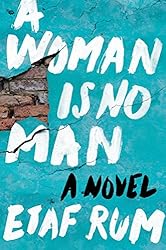
A Woman Is No Man
Etaf Rum, 2019
HarperCollins
352 pp.
ISBN-13: 9780062699763
Summary
Three generations of Palestinian-American women living in Brooklyn are torn between individual desire and the strict mores of Arab culture in this powerful debut—a heart-wrenching story of love, intrigue, courage, and betrayal that will resonate with women from all backgrounds, giving voice to the silenced and agency to the oppressed.
"Where I come from, we’ve learned to silence ourselves. We’ve been taught that silence will save us. Where I come from, we keep these stories to ourselves. To tell them to the outside world is unheard of—dangerous, the ultimate shame."
Palestine, 1990.
Seventeen-year-old Isra prefers reading books to entertaining the suitors her father has chosen for her. Over the course of a week, the naïve and dreamy girl finds herself quickly betrothed and married, and is soon living in Brooklyn. T
here Isra struggles to adapt to the expectations of her oppressive mother-in-law Fareeda and strange new husband Adam, a pressure that intensifies as she begins to have children—four daughters instead of the sons Fareeda tells Isra she must bear.
Brooklyn, 2008.
Eighteen-year-old Deya, Isra’s oldest daughter, must meet with potential husbands at her grandmother Fareeda’s insistence, though her only desire is to go to college. Deya can’t help but wonder if her options would have been different had her parents survived the car crash that killed them when Deya was only eight.
But her grandmother is firm on the matter: the only way to secure a worthy future for Deya is through marriage to the right man.
But fate has a will of its own, and soon Deya will find herself on an unexpected path that leads her to shocking truths about her family—knowledge that will force her to question everything she thought she knew about her parents, the past, and her own future.
Set in an America at once foreign to many and staggeringly close at hand, A Woman Is No Man is a story of culture and honor, secrets and betrayals, love and violence. It is an intimate glimpse into a controlling and closed cultural world, and a universal tale about family and the ways silence and shame can destroy those we have sworn to protect. (From the publisher.)
Author Bio
• Birth—N/A
• Where—Booklyn, New York City, New York, USA
• Education—B.A., B.S., M.A., North Carolina State University
• Currently—lives in Rocky Mountain, North Carolina
Etaf Rum was born and raised in Brooklyn, New York City, to Palestinian parents. Raised in a traditional family, she married young, moved to North Carolina where, at the age of 19, she gave birth to her daughter and to her son two years later.
Echoes of Rum's experience can be found in her debut novel, A Woman Is Not a Man (2019). Frustrated by the restrictions on her life and wondering why she could not pursue the kinds of things a man could, her grandmother told her, "Because. You can't do this because you're not a man."
Rejecting that dictum, Rum enrolled in North Carolina State University, where she earned a B.A. in English Language and Literature, a B.S. in Philosophy, and an M.A. in American and British Literature and Philosophy.
As she told NPR's Scott Simon,
I maintained my education despite the pressures around me to stay home and take care of my kids, and slowly, as I educated myself… I began to realize my place in the community and the cycle of trauma and oppression that I [would] be giving my daughter—if I don't speak up for what I want to accomplish with my life, if I don't stand up for myself.
In the interview, Rum went on to talk about the price she has paid for her independence: she is divorced, "with no sense of family," and believes she has let down those who needed her most.
Rum now teaches undergraduate courses at two community colleges near where she lives in North Carolina with her children. She runs the Instagram account @booksandbeans and is also a Book of the Month Club Ambassador, where she writes about her favorite books each month. (Adapted from various online sources. Retrieved 3/4/2019.)
Book Reviews
[A] pleasing debut…. Rum’s short chapters crisscross timelines with the zippy pace of a thriller, yet repetitive scenes and unwieldy dialogue deflate the narrative. Though the execution is sometimes shaky, there’s enough to make it worthwhile for fans of stories about family secrets.
Publishers Weekly
Yanked away from the books she loves, Isra leaves 1990 Palestine for marriage to a stranger who takes her to Bay Ridge, Brooklyn… [and endures] the scorn of her mother-in-law, especially after birthing four girls. Years later, her eldest daughter, too, is scorned… because she wants to go to college.
Library Journal
First-time novelist Rum’s setting… is rare: a Brooklyn Palestinian enclave in which reputation matters above all else…. The daughter of Brooklyn Palestinian immigrants, Rum was often told "a woman is no man." Overcoming her fear of community reprisal, she alchemizes that limiting warning into a celebration of "the strength and power of our women."
Booklist
In telling this compelling tale, Rum—who was born in Brooklyn to Palestinian immigrants herself—writes that she hopes readers will be moved “by the strength and power of our women.” A richly detailed and emotionally charged debut.
Kirkus Reviews
Discussion Questions
1. Why might a community or culture have a "code of silence"? What are the potential risks of such secrecy? In what ways is such silence harmful to Isra and other women and girls?
2. Beyond the literal, what does it mean for a person to have a voice? Why is it important to health and safety? What are the various forces that silence Isra’s voice?
3. Why are books so important to Isra, Sarah, and Deya? What makes the reading of books so threatening to Isra’s mother, Fareeda and the men in the novel?
4. In the frustrated words of Isra’s mother, "What does love have to do with marriage?" What is the purpose of arranged, loveless marriages? Why would her mother accuse Isra of being a sharmouta because she wanted to fall in love?
5. Isra is taught from an early age that, "Obedience [is] the only path to love." What does this mean? Why is obedience important in a society? When does obedience become oppressive or dangerous?
6. When Isra first meets Adam, he vehemently claims: "I am free." To what extent is this true or not? What forces limit personal freedom? What is a healthy balance of personal freedom and obligation to family or community?
7. Why does Fareeda believe that, "Preserving our culture is what’s most important," despite the suffering it brings to the women and girls in the family? What, more specifically, does she believe must be preserved?
8. In what different ways do Isra, Deya, Sarah, Adam, Fareeda, and Khaled assimilate to American culture?Which acts of assimilation from their children and grandchildren are acceptable to Khaled and Fareeda? Which are not? What does this reveal about their values?
9. Throughout the novel, men are forgiven for committing zina, for drinking, sexual infidelity, and violence toward women. How is this explained and justified? What is the source of this double standard that contradicts even the Quran?
10. Isra suffers the profound shaming of her daughter and of herself for giving birth only to girls. Why are girls and women thought to be of such little value in her family and culture? What vast effects do these ideas have on girls as they grow up? What can be done to resist such psychological and physical harm?
11. Of what value is Isra’s writing of letters to her mother that she never sends?
12. Despite the oppressive limits to their role and presence, how do the women and girls throughout the novel find ways to express themselves? Are there other responses that might serve them well?
13. Telling her younger sister Nora bedtime stories about their family, Deya realized that "telling a story wasn’t as simple as recalling memories." What might she mean? Why is it important to decide to leave some things unsaid in a story? In what ways is this also true in life or not?
14. Sarah and Deya disagree about whether literary stories should "protect us from the truth" or "be used to tell the truth." What does each mean? In what ways does lying or pretending, as Deya admits to doing, differ from telling a story?
15. What’s most important to Sarah in her life? What explains the courage she possesses to stand up to and defy her oppressive family? What must she sacrifice to secure her independence and identity?
16. Consider the many literary allusions in the novel—A Thousand and One Nights, Fahrenheit 451, Pride and Prejudice, The Stranger, etc. What does each bring to the novel? What is particularly important about Sylvia Plath’s The Bell Jar?
17. Fareeda concludes that despite spending "her entire life being pushed and pulled, from kitchen to kitchen, child to child…it was better to be grounded, to know your place, than to live the way these Americans lived…with no values to anchor them down." Why is it so essential to her about maintaining these values, even if they’re oppressive? What is potentially threatening about freedom or uncertainty?
18. Why does Fareeda believe Omar’s desire to love and respect his wife is "American nonsense?" How does she reconcile this with her resentment toward Khaled for not showing her love and appreciation? What is the "different kind of love" that Isra experiences when reading by the window?
19. Sarah argues that, "Being happy means being passive," and prefers discontentment in order to drive creation. What does she mean? What does it mean to be happy? What determines whether discontent is productive and motivational or oppressive?
20. What many details and forces lead to Isra’s tragic death at Adam’s hands? Why is Adam so easily forgiven and freed of responsibility by Khaled and Fareeda?
21. Fareeda believes that, "Culture could not be escaped. Even if it meant tragedy. Even if it meant death." What does she mean? What has happened to her that might explain why she remains so attached to a culture that has destroyed her family?
22. Deya strongly refuses to believe in naseeb, or destiny, saying, "I hate the idea that I have no control over my life" and later, when arguing with Fareeda about going to college, "My destiny is in my hands." What is destiny? Why is the idea of destiny so powerful or useful to many people? To what extent is a person free to make choices in his or her life? What forces work against this? How does Deya develop such independence and empowerment?
23. What is individually, socially, and culturally valuable, vital even, about women telling their own stories? What various ways throughout their lives can girls and women be supported to determine their own stories?
(Questions issued by the publisher.)


The Woman Upstairs
Claire Messud, 2013
Knopf Doubleday
272 pp.
ISBN-13: 9780307596901
Summary
From the New York Times best-selling author of The Emperor’s Children, a masterly new novel: the riveting confession of a woman awakened, transformed and betrayed by a desire for a world beyond her own.
Nora Eldridge, an elementary school teacher in Cambridge, Massachusetts, long ago compromised her dream to be a successful artist, mother and lover. She has instead become the “woman upstairs,” a reliable friend and neighbor always on the fringe of others’ achievements. Then into her life arrives the glamorous and cosmopolitan Shahids—her new student Reza Shahid, a child who enchants as if from a fairy tale, and his parents: Skandar, a dashing Lebanese professor who has come to Boston for a fellowship at Harvard, and Sirena, an effortlessly alluring Italian artist.
When Reza is attacked by schoolyard bullies, Nora is drawn deep into the complex world of the Shahid family; she finds herself falling in love with them, separately and together. Nora’s happiness explodes her boundaries, and she discovers in herself an unprecedented ferocity—one that puts her beliefs and her sense of self at stake.
Told with urgency, intimacy and piercing emotion, this brilliant novel of passion and artistic fulfillment explores the intensity, thrill—and the devastating cost—of embracing an authentic life. (From the publisher.)
Author Bio
• Birth—1966
• Where—Greenwich, Connecticut, USA
• Education—BA, Yale University; M.A. Cambridge University
• Awards—Addison Metcalf Award and Strauss Living Award,
both from the American Academy of Arts & Letters
• Currently—lives in Cambridge, Massachusetts
Claire Messud is an American novelist and literature and creative writing professor. She is best known as the author of the 2006 novel The Emperor's Children. She lives with her husband and family in Cambridge, Massachuesetts.
Born in Greenwich, Connecticut, Messud grew up in the United States, Australia, and Canada, returning to the United States as a teenager. Messud's mother is Canadian, and her father is French from French Algeria (Algeria was a French colony until 1962). She was educated at Milton Academy, Yale University, and Cambridge University, where she met her spouse, the British literary critic James Wood. Messud also briefly attended the MFA program at Syracuse University.
Writing
Messud's debut novel, When The World Was Steady (1995), was nominated for the PEN/Faulkner Award. In 1999, she published her second book, The Last Life, about three generations of a French-Algerian family. Her 2001 work, The Hunters, consists of two novellas.
Her 2006 novel, The Emperor’s Children, was longlisted for the 2006 Man Booker Prize. Messud wrote the novel while a fellow at the Radcliffe Institute for Advanced Study in 2004–2005. The Woman Upstairs came out in 2014 and her most recent, The Burning Girl, in 2017.
Teaching
Messud has taught creative writing at Kenyon College, University of Maryland, Amherst College, in the Warren Wilson College MFA Program for Writers in North Carolina, and in the Graduate Writing program at The Johns Hopkins University. Messud also taught at the Sewanee: The University of the South in Sewanee, Tennessee. Each spring semester, beginning 2009, Messud teaches a literary traditions course as a part of CUNY Hunter College's MFA Program in Creative Writing.
She is on the editorial board of the literary magazine The Common, based at Amherst College. She has contributed articles to publications such as The New York Review of Books.[6]
Honors
The American Academy of Arts and Letters has recognized Messud's talent with both an Addison Metcalf Award and a Strauss Living Award. She was considered for the 2003 Granta Best of Young British Novelists list, although none of the three passports she holds is British. As of 2010–2011, she is a fellow at the Wissenschaftskolleg zu Berlin / Institute of Advanced Study. (From Wikipedia.)
Book Reviews
“Corrosively funny.... Nora—a not-quite 40 schoolteacher as disappointed in her Katy Perry-obsessed students as she is in her own failed potential—finds her dormant creative passions awakened by a student’s worldly mother, an artist who shows in Paris. An ardent friendship unfolds, ending in a betrayal that unleashes in Nora an eloquent, primal rage. Fifty years ago, Simone de Beauvoir faulted creative women for their unwillingness to "dare to irritate, explore, explode," Two generations later, anger this combustible still feels refreshing.
Megan O’Grady - Vogue
Nora Eldridge, a schoolteacher who dreams of being an artist, is angry, cynical, and quietly desperate. Then she meets the Shahid family: Sirena, Skandar, and Reza, a student in Nora’s third-grade class.... When Sirena asks Nora to share an artists’ studio, Nora falls in love with each exotic Shahid in turn... But after freeing Nora from herself, the Shahids betray her.... As with other Messud characters, these too are hard to love; few would want to know the unpalatable Nora, so full of self-loathing, nor the self-important Shahids.
Publishers Weekly
It shows Messud at the height of her considerable powers, articulating the quandary of being alive and sentient, covetous and confused in the twenty-first century.... The Woman Upstairs is an extraordinary novel, a psychological suspense story of the highest sort that will leave you thinking about its implications for days afterward. Messud’s skills are all on display here, [in] a work of fiction that is not just beautifully observed but also palpably inhabited by its gifted writer in a manner she has not quite dared attempt before.
Daphne Merkin - Bookforum
(Starred review.) With exhilarating velocity, fury, and wit, the superlative Messud immolates an iconic figure—the good, quiet, self-sacrificing woman.... Nora, our archly funny, venomous, and raging narrator, recounts her thirty-seventh year, when she was living alone and teaching third grade after the death of her mother.... Messud’s scorching social anatomy, red-hot psychology, galvanizing story, and incandescent language make for an all-circuits-firing novel about enthrallment, ambition, envy, and betrayal. A tour de force portraying a no longer invisible or silent "woman upstairs." —Donna Seaman
Booklist
(Starred review.) A self-described "good girl" lifts her mask in Messud's scarifying new novel. "How angry am I?" Nora Eldridge rhetorically asks in her opening sentence. "You don't want to know." But she tells us anyway.... So when the exotic Shahid family enters her life in the fall of 2004, Nora sees them as saviors. Reza is in her class ... his Italian mother, Sirena, [is] the kind of bold, assertive artist Nora longs to be.... [T]he story unfolds to reveal Sirena as something of a user...though it's unwise to credit Nora's jaundiced perceptions. Her untrustworthy, embittered narration...is an astonishing feat of creative imagination: at once self-lacerating and self-pitying, containing enough truth to induce squirms....[but] inspires little confidence that Nora can actually change her ways. Brilliant and terrifying.
Kirkus Reviews
Discussion Questions
1. Note Claire Messud’s epigraphs for the novel—quotes from some very persuasive, and very powerful, male writers. How do these words set up expectations for the reader? How do these choices look to you upon finishing The Woman Upstairs? And what about the other male writers (such as Dostoyevsky and Chekhov) whose work is alluded to in Messud’s text? Do they reveal anything about the author’s own understanding of Nora’s reliability, sense of self and potential literary legacy?
2. Nora introduces herself by saying: “My name is Nora Marie Eldridge and I’m forty-two years old. . . . Until last summer, I taught third grade at Appleton Elementary School in Cambridge, Massachusetts, and maybe I’ll go back and do it again, I just don’t know. Maybe, instead, I’ll set the world on fire. I just might” (p. 5). Which choice seems more likely for Nora? How might she set the world on fire? Is the book itself an act of revenge?
3. At the beginning of the novel, Nora says: “I’ve finally come to understand that life itself is the Fun House. All you want is that door marked EXIT, the escape to a place where Real Life will be; and you can never find it” [p. 4]. Why does Nora feel that life is a Fun House? What does the Fun House represent for her? Why does she feel it’s impossible to escape? Why is Nora so drawn to each of the Shahids? What do they seem to offer her, and how do her memories inform her attraction to them?
4. What does Nora mean when she describes herself as “the woman upstairs”? What are the chief attributes of this archetype?
5. Nora asks, “How did all that revolutionary talk of the seventies land us in place where being female means playing dumb and looking good?” (p. 4). In what ways can The Woman Upstairs be read as a feminist novel? Which aspects of women’s experience does the novel illuminate?
6. Nora might be described as a self-conscious narrator. At the beginning of Chapter 7, she writes: “There was another strand in this tapestry. What does it signify that I am loath to tell you, slow to tell you?” (p. 148). What effect is created by Nora’s direct addresses to the reader and her self-questioning? How does Nora want her readers to see her? Does this honesty make her more of a reliable narrator, or does it trigger the reader to be more skeptical of her storytelling—including her observations and her claims?
7. As he walks her home one night, Skandar tells Nora, “You don’t look like a ravenous wolf,” to which Nora replies, “Well, I am. . . . I’m starving” (p. 161). What is Nora so hungry for? Where does her hunger—her longing and desire—come from?
8. Earlier in the novel, she writes that hunger is “the source of almost every sorrow” (p. 46). Is hunger at the root of her own pain? Nora understands that “the great dilemma” of her mother’s life “had been to glimpse freedom too late, at too high a price” (p. 40). Does Nora reenact her mother’s failed ambitions or go beyond them? Why did Nora give up the artist’s life and become first a management consultant and then an elementary school teacher?
9. Why does Nora choose Emily Dickinson, Virginia Woolf, Alice Neel and Edie Sedgwick as subjects for her dioramas? In what ways does she identify with, yet try to distinguish herself from, these particular writers and artists?
10. The ending of The Woman Upstairs delivers a tremendous shock to Nora and to the reader. Were there hints and warnings that a betrayal was coming? Why wasn’t Nora more wary of her involvement with the Shahids? What may have motivated Sirena to treat Nora as she does?
11. Early in the novel, Nora writes: “I’m not crazy. Angry, yes; crazy, no” (p. 5). But later she suggests that if someone else told her story to her, she’d conclude they were either crazy or a child. How is the reader to understand her mental and emotional state?
12. After visiting Sirena’s Wonderland exhibit in Paris, Nora writes: “How could I begin to explain what it meant . . . the great rippling outrage of what it meant—about each of us, about myself perhaps most of all, about the lies I’d persistently told myself these many years” (p. 252). What does the betrayal Nora suffers mean for each of them? What lies has she told herself?
13. It becomes clear by the end of the novel that Sirena was using Nora. Is Nora purely a victim of Sirena’s ruthlessness? To what extent does Nora make herself vulnerable to such humiliation? Was she also using Sirena for her own purposes?
14. Look again at the ferocious opening pages of the novel and at Nora’s self-description, written after the events the novel describes have already transpired. How has she been transformed by her experience with the Shahids? Has the experience, as painful as it was, been good for her in any way?
(Questions issued by publisher.)


The Woman Who Heard Color
Kelly Jones, 2011
Penguin Group (USA)
400 pp.
ISBN-13: 9780425243053
Summary
Lauren O'Farrell is an "art detective" who made it her mission to retrieve invaluable works stolen by the Nazis during the darkest days of World War II. Her quest leads her to the Manhattan apartment of elderly Isabella Fletcher, a woman who lives in the shadow of a terrible history—years ago her mother was rumored to have collaborated with the Nazis.
But as Isabella reveals the events of her mother's life, Lauren finds herself immersed in an amazing story of courage and secrecy as she discovers the extraordinary truth about a priceless piece of art that may have survived the war and the enduring relationship between a mother and a daughter
Based on historical events, set against a backdrop of sweeping museum purges, the warehousing of thousands of paintings in Berlin, and an auction in Lucerne on the eve of World War II, the story is ultimately one of a woman's belief in artistic freedom, her love for family, and her struggle to survive. (From the publisher.)
Author Bio
• Birth—N/A
• Raised—Twin Falls, Idaho, USA
• Education—B.A., Gonzaga University
• Currently—lives in Boise, Idaho
Kelly Jones grew up in Twin Falls, Idaho. She attended Gonzaga University in Spokane, Washington, graduating magna cum laude with a degree in English and an art minor. She spent her junior year in Italy at the Gonzaga-in-Florence program and developed a love for travel, a passion she now shares with her husband, Jim. An art history class in Florence fueled a love for the history of art, which has become an integral part of her writing.
Her latest release, The Woman Who Heard Color (2011), is a historical novel set in Munich, Berlin, and New York. A story of family loyalty, banned art, and creative freedom, it spans a period of over a century.
Her previous novels include The Seventh Unicorn (2005), inspired by The Lady and the Unicorn Tapestries in the Cluny Museum in Paris, France, and The Lost Madonna (2007), set in Florence, Italy.
She is a mother and grandmother and is married to former Idaho Attorney General Jim Jones, who now serves on Idaho's Supreme Court. They live in Boise. (From the author's website.)
Book Reviews
At the start of this intense and richly detailed novel from Jones (Lost Madonna), Lauren O’Farrell, an art detective, interviews 82-year-old Isabella Fletcher about a missing Wassily Kandinsky painting, a masterpiece last seen before WWII. Lauren’s queries open a Pandora’s box of agonizing dilemmas. Did Isabella’s mother, Hanna, whose synesthesia allowed her to “hear” colors, but dead now 60 years, collaborate with the Nazis in looting Jewish-owned art, or was she a hero, saving “degenerate” paintings from the bonfires? Through Hanna’s firm and authoritative voice, we learn of her trajectory from a naïve Bavarian farm girl to an art critic prized by the Nazis, beginning with her impulsive trip to Munich in 1900 and her employment and eventual marriage to Moses Fleischmann, an important art dealer. Hanna eventually catches the attention of Hitler himself. While at times totally implausible (would Hitler have a private lunch with the widow of a prominent Jew?), this story puts a wonderfully imaginative spin on art and history.
Publishers Weekly
Discussion Questions
1. What opportunities open up for Hanna when she becomes an employee in the Fleischmann home? How do these allow her to choose a different path from the one she might have taken had she stayed on the farm? Do you believe Hanna is a woman ahead of her times? What role do Hanna’s own choices and her early fearlessness play in determining her future?
2. Were you initially suspicious of Isabella’s story, and were you surprised by how it all unfolded? Did you find her memories to be a reliable source of information?
3. What was life like for a Jewish citizen in Germany prior to World War II? What was restricted and what were the human costs as Hitler took power? What do you think it was like for Hanna, a Christian with a Jewish husband? How did her marriage affect her relationships with her own family members, particularly her sister Leni?
4. How do you think Hanna felt as a child when she discovered that others did not hear color? Does this condition make her more empathetic with those who might be considered odd or different? Isabella describes her mother’s synesthesia as a gift rather than a liability. Do you believe Hanna came to see her blending of the senses as an asset, too?
5. What role should the government play in determining what is acceptable art? Who should decide what type of art is shown in publicly supported museums? Should certain types of art be subject to government censorship?
6. How would you describe Hanna’s role in cataloguing the confiscated art? Why does she agree to work with the Nazis in this endeavor, and how does she reconcile her complicity with her feelings of disgust? Does she have a choice? What are the consequences of her decision?
7. Though Hanna leaves Germany in 1939, before the start of World War II, do you see anything in her story, particularly relating to her involvement with the art, that might foreshadow the historical events that follow?
8. Some of those purchasing art at the auction in Lucerne come to save it, others to pick up a bargain. Do you believe these buyers realized the funds would be diverted from the museums to build up Hitler’s military strength? Should they have avoided the auction in protest? Why or why not? Do you believe the German museums should be able to reclaim this art?
9. Why is Hanna’s legacy so important to Isabella as an adult? How does Lauren play a critical part in preserving Hanna’s story, allowing her heroics to live on?
10. At one point in the story, Isabella says, “So much family history is lost just because no one listens.... Or when it’s never even told.” Lauren agrees yet has always been reluctant to ask her father about his own history. Do you think Lauren will eventually encourage her father to share more about his childhood and her grandparents’ lives? Do you have family stories that have been told through the generations? Has family history been lost? What is the effect of untold wartime histories disappearing as the World War II generation passes away? What lessons and stories must not be forgotten?
(Questions from author's website.)


The Woman Who Lost Her Soul
Bob Shacochis, 2013
Grove/Atlantic
640 pp.
ISBN-13: 9780802119827
Summary
Renowned through four award-winning books for his gritty and revelatory visions of the Caribbean, Bob Shacochis returns to occupied Haiti in The Woman Who Lost Her Soul before sweeping across time and continents to unravel tangled knots of romance, espionage, and vengeance.
In riveting prose, Shacochis builds a complex and disturbing story about the coming of age of America in a pre-9/11 world. When humanitarian lawyer Tom Harrington travels to Haiti to investigate the murder of a beautiful and seductive photojournalist, he is confronted with a dangerous landscape riddled with poverty, corruption, and voodoo.
It’s the late 1990s, a time of brutal guerrilla warfare and civilian kidnappings, and everyone has secrets. The journalist, whom he knew years before as Jackie Scott, had a bigger investment in Haiti than it seemed, and to make sense of her death, Tom must plunge back into a thorny past and his complicated ties to both Jackie and Eville Burnette, a member of Special Forces who has been assigned to protect her.
From the violent, bandit-dominated terrain of World War II Dubrovnik to the exquisitely rendered Istanbul in the 1980s, Shacochis brandishes Jackie’s shadowy family history with daring agility. Caught between her first love and the unsavory attentions of her father—an elite spy and quintessential Cold War warrior pressuring his daughter to follow in his footsteps—seventeen-year-old Jackie hatches a desperate escape plan that puts her on course to becoming the soulless woman Tom equally feared and desired.
Set over fifty years and in four countries backdropped by different wars, The Woman Who Lost Her Soul is a magnum opus that brings to life, through the mystique and allure of history, an intricate portrait of catastrophic events that led up to the war on terror and the America we are today. (From the publisher.)
Author Bio
• Birth—September 9, 1951
• Raised—McLean, Virginia, USA
• Education—B.A., University of Missouri; Iowa
Writers' Workshop
• Awards—National Book Award's First Work of Fiction
• Currently—lives in Tallahassee, Florida
Bob Shacochis is an American novelist, short story writer, and literary journalist. He teaches creative writing at Florida State University.
Shacochis was born in Pennsylvania, but grew up in McLean, Virginia, a suburb of Washington, D.C. He was educated at the University of Missouri and the Iowa Writers' Workshop at the University of Iowa and currently teaches creative writing at Florida State University.
Books
in 1985, Shacochis published his first short-story collection, Easy in the Islands. It received the National Book Award in category First Work of Fiction. The stories are set in various Caribbean locales and reflect the author's experiences as a Peace Corps volunteer in the Grenadines.
His second story collection, The Next New World, was released in 1990. It widens the author's milieu, containing stories set in Florida and the islands of the Caribbean but also in Northern Virginia and the mid-Atlantic coast.
In 1993, Shacochis published his first novel, Swimming in the Volcano, which became a finalist for the National Book Award. Heavily concerned with politics, elaborate in style and description, and immersed in descriptions of nature and outdoor pursuits, his fiction reflects the influence of Joseph Conrad, Graham Greene, J.P. Donleavy, and especially Ernest Hemingway.
The Woman Who Lost Her Soul, his second novel, published in 2013, examines U.S. foreign policy and details how espionage not only reflects a nation’s character but can also endanger its soul.
Journalism
In the years since, Shacochis has worked primarily as a journalist and war correspondent. A longtime culinary aficionado, Shacochis served as a cooking columnist for GQ magazine, writing the "Dining In" column, which combined often humorous anecdotes with recipes. The "Dining In" columns are collected in Domesticity, a hybrid cookbook/essay collection.
He is a contributing editor at Outside magazine, and was instrumental, along with other literary journalists recruited by then-editor Mark Bryant, including Jon Krakauer, Tim Cahill, and Bruce Barcott, in establishing Outside's popular and critical success.
Shacochis is also a contributing editor to Harper's, which sent him to Haiti in 1994 to cover the uprising against Jean-Bertrand Aristide, the island nation's first democratically elected President, and the subsequent intervention by US Army Special Forces, with whom Shacochis traveled for nearly a year covering the invasion.
The experience resulted in his 1999 The Immaculate Invasion, Shacochis's first full-length book of nonfiction. Shacochis's nonfiction generally fits into the tradition of the New Journalism popularized by Tom Wolfe, Norman Mailer, and Hunter S. Thompson in the 1960s and 1970s. (From Wikipedia. Retrieved 9/18/2013.)
Book Reviews
[This] novel is about not one but two contemporary wars, both of them endless: the war on terror and the war on drugs. The America Shacochis describes in this huge, carefully plotted, ideologically challenging book has somehow become one with the woman who lost her soul. But how did she lose her soul? That’s the question at the heart of the novel, but one thing we know: her father is responsible for the loss.... [T]he country the old man has helped to create seems to be on a crusade that, in its pursuit of vengeance and the endless war, looks a lot like jihad
Engrossing...a soaring literary epic about the forces that have driven us to the 9/11 age.... Shacochis darts around the globe over the span of five decades like a sorcerer of world history: Locations shift, time swirls, characters reappear in new disguises with new names. He’s always so relentlessly captivating that you don’t dare fall behind.
Ron Charles - Washington Post
This novel amounts to a prequel of sorts to the war on terror, an epic examination of American foreign policy and loss of innocence, a worthy successor to the darkest works of Graham Greene and John le Carre.... Elegiac.... [A] searching and searing meditation on the questions someone might ask a century from now: Who were these Americans? How should history judge them? And us?
Jane Ciabattari - Boston Globe
The Woman Who Lost Her Soul cannot be put down.... [I]t never loses its way or its ability to drag you along with it.... [A] wild, deadly ride. You won’t want to let go.
Glenn Garvin - Miami Herald
A big book in every sense of the word.... Shacochis is a master at the top of his game.... In this novel, he gives us real, raw-edged characters and a narrative that grips the reader from the get-go. And he does it with such gleaming word-craft and such a sure hand that the reader’s utter engagement never falters. The book is a murder-mystery, a tale of political intrigue, a love story and a fraught father-daughter psychological saga. It was 10 years in the writing and it is a masterpiece...a brilliant, beautiful page-turner.... [L]uminous writing unfurls across every blood-spattered, sweat-speckled, dust-caked page and makes The Woman Who Lost Her Soul a riveting, heartbreaking and ravishing read. It’s a novel of uncommon grace and grit that lodges like shrapnel in the psyche and works its way surely to the reader’s heart, without ever losing sight of those "terrible intimacies."
Tallahassee Democrat
A compelling and thought-provoking novel...it plays a deep game, and it will haunt your dreams... [Shacochis] controls a hugely complex plot with great skill and writes set pieces with gripping effect.... Line for line, his writing is stunning.
Colette Bancroft - Tampa Bay Times
A love story, a thriller, a family saga, a historical novel, and a political analysis of America’s tragic misadventures abroad. The novel yokes the narrative drive of the best Graham Greene and le Carré to the rhetorical force and moral rigor of Faulkner.... With a vision at once bitingly realistic and sweepingly romantic, Bob Shacochis has written what may well be the last Great American Novel. What other American writer has put as much heart into his creations, as much drive, as much history?
Askold Melnyczuk - Los Angeles Review of Books
Shacochis has written one of the most morally serious and intellectually substantive novels about the world of intelligence since Norman Mailer’s Harlot’s Ghost.
Tom Bissell - Harper's
(Starred review.) In Shacochis’s powerful novel of sex, lies, and American foreign policy....[in which] people are pulled into a vortex of personal and political destruction.... Shacochis details how espionage not only reflects a nation’s character but can also endanger its soul. Gritty characters find themselves in grueling situations against a moral and physical landscape depicted in rich language as war-torn, resilient, angry, evil, and hopeful.
Publishers Weekly
(Starred review.) [T]ruly magisterial. It opens with humanitarian lawyer Tom Harrington investigating the death of Jackie Scott, a feisty photojournalist who once whipped him around in Haiti.... Eventually, she's the woman who loses her soul, as "America…at war behind the drapery of shadows and secrets" has lost its soul. Densely detailed yet immensely readable, this eye-opener...could have been titled "Why We Are in the Middle East." —Barbara Hoffert
Library Journal
(Starred review.) A beautifully written, Norman Mailerlike treatise on international politics, secret wars, espionage, and terrorism.... A brilliant book, likely to win prizes, with echoes of Joseph Joseph Conrad, Graham Greene, and John le Carre.
Booklist
(Starred review.) [S]tunning novel of love, innocence and honor lost.... Shacochis has delivered a work that belongs alongside Joseph Conrad and Graham Greene... [The Woman Who Lost Her Soul] moves like a fast-flowing river, and it is memorably, smartly written.... An often depressing, cautionary and thoroughly excellent tale of the excesses of empire, ambition and the too easily fragmented human soul.
Kirkus Reviews
Discussion Questions
Use our LitLovers Book Club Resources; they can help with discussions for any book:
• How to Discuss a Book (helpful discussion tips)
• Generic Discussion Questions—Fiction and Nonfiction
• Read-Think-Talk (a guided reading chart)
We'll add specific questions if and when they're made available by the publisher.
A Woman's Place
Lynn Austin, 2006
Bethany House
448 pp.
ISBN-13: 9780764228902
Summary
They watched their sons, their brothers, and their husbands enlist to fight a growing menace across the seas. And when their nation asked, they answered the call as well. Virginia longs to find a purpose beyond others' expectations. Helen is driven by a loneliness money can't fulfill. Rosa is desperate to flee her in-laws' rules. Jean hopes to prove herself in a man's world.
Under the storm clouds of destruction that threaten America during the early 1940s, this unlikely gathering of women will experience life in sometimes starling new ways as their beliefs are challenged and they struggle toward a new understanding of what love and sacrifice truly mean. (From the publisher.)
Author Bio
• Birth—N/A
• Where—N/A
• Education—B.A., Southern State Connecticut University;
Southwestern Theological Seminary (graduate work)
• Awards—5 Christie Awards (see below)
• Currently—lives near outside Chicago, Illinois
For many years, Lynn Austin nurtured a desire to write but frequent travels and the demands of her growing family postponed her career. When her husband's work took Lynn to Bogota, Colombia, for two years, she used the B.A. she'd earned at Southern Connecticut State University to become a teacher. After returning to the U.S., the Austins moved to Anderson, Indiana, Thunder Bay, Ontario, and later to Winnipeg, Manitoba.
It was during the long Canadian winters at home with her children that Lynn made progress on her dream to write, carving out a few hours of writing time each day while her children napped. Lynn credits her early experience of learning to write amid the chaos of family life for her ability to be a productive writer while making sure her family remains her top priority.
Extended family is also very important to Austin, and it was a lively discussion between Lynn, her mother, grandmother (age 98), and daughter concerning the change in women's roles through the generations that sparked the inspiration for her novel Eve's Daughters.
Along with reading, two of Lynn's lifelong passions are history and archaeology. While researching her Biblical fiction series, Chronicles of the Kings, these two interests led her to pursue graduate studies in Biblical Backgrounds and Archaeology through Southwestern Theological Seminary. She and her son traveled to Israel during the summer of 1989 to take part in an archaeological dig at the ancient city of Timnah. This experience contributed to the inspiration for her novel Wings of Refuge.
Lynn resigned from teaching to write full-time in 1992. Since then she has published twelve novels. Five of her historical novels, Hidden Places, Candle in the Darkness, Fire by Night, A Proper Pursuit, and Until We Reach Home have won Christy Awards in 2002, 2003, 2004, 2008, and 2009 for excellence in Christian Fiction.
Fire by Night was also one of only five inspirational fiction books chosen by Library Journal for their top picks of 2003, and All She Ever Wanted was chosen as one of the five inspirational top picks of 2005. Lynn's novel Hidden Places has been made into a movie for the Hallmark Channel, starring actress Shirley Jones. Ms Jones received a 2006 Emmy Award nomination for her portrayal of Aunt Batty in the film. (From the author's website.)
Book Reviews
A Woman's Place is not to be confused with a simple read, heartwarming though it is. Readers will be drawn immediately into the setting by Austin's keep ability to weave story with fact, but it is the deep questions each woman must ask that will keep the pages turning.
Christian Retailing
A nice book club read with its conversation starters about racism, gender roles, overcoming a difficult past, and forgiveness.
Cindy Crosby - Faithful Reader.com
A very compelling story, A Woman's Place has found a place on my 'keeper' shelves.
Romance Designs.com
In an engrossing read, three-time Christy Award-winner Austin (All She Ever Wanted; Hidden Places) explores the lives of four women in smalltown Michigan during WWII. The unlikely quartet of heroines a mouthy Italian, a farm girl desperate to go to college, a spinster schoolteacher who's inherited a fortune, and a bored housewife meet and become fast friends when they take Rosie the Riveter jobs at a local factory. On one level, the novel is simply about the bonds that form among the principals, recalling Whitney Otto's How to Make an American Quilt and Lynne Hinton's Friendship Cake. But the subtext, as the title suggests, is about gender roles. Can and should women defy their husbands? What does the Bible say about wifely obedience? Such questions present themselves urgently to each of the four protagonists (and, one imagines, to many of Austin's female evangelical readers). Austin sprinkles some lovely images throughout a newborn's fingernails "like drops of candle wax" and a humorous depiction of inadvertently tipsy church ladies will have readers in stitches. All in all, Austin offers a very enjoyable journey to an earlier wartime America..
Publishers Weekly
Book Club Discussion Questions
1. Which character did you identify with the most: Virginia, Helen, Jean, or Rosa? What about her personality or her life did you relate to?
2. Which character underwent the greatest transformation over the course of the book? What events contributed to that change?
3. How did the historical events in the story act as catalysts for change in these women's lives? Can you recall any historical events in your lifetime that affected your beliefs or your outlook on life? Have events such as 9/11 brought about changes in your life?
4. How have women's roles changed in the past 25 years? The past 50 years? The past 100? Do you see World War II as a defining moment for women? Why or why not?
5. The four women's personalities were all very different. What word would you use to describe each one? Which women grew the closest to each other? Why was that? Do you believe the four will remain friends after the war?
6. How did each woman's faith change in the course of the novel? What events influenced her beliefs? How did they change? Which woman's faith underwent the greatest change?
7. Each of the four women had a man (or men) in her life. Which man (Harold Mitchell, Jimmy Bernard, Meinhard Kesler, Dirk Voorhees, Wolter Voorhees, Russell Benson and Earl Seaborn) did you like the best? Why? Which one did you like the least? Did you change your mind about any of them as the story progressed?
8. Do you think that attitudes toward women have changed since the time when this story took place? In what ways? Have all of these changes been for the better?
9. One of the themes that emerged in the story was the destructive nature of racism. Which characters' lives were impacted by prejudice? How? Did anyone's biases change because of the events of the story?
10. Choose one character and tell what you think will become of her after the war.
(Questions from the author's website.)

Women in Science: 50 Fearless Pioneers Who Changed the World
Rachel Ignotofsky, 2017
Ten Speed Press
128 pp.
ISBN-13: 9781607749769
Summary
It's a scientific fact: Women rock!
A charmingly illustrated and educational book, New York Times best seller Women in Science highlights the contributions of fifty notable women to the fields of science, technology, engineering, and mathematics (STEM) from the ancient to the modern world.
Full of striking, singular art, this fascinating collection also contains infographics about relevant topics such as lab equipment, rates of women currently working in STEM fields, and an illustrated scientific glossary.
The trailblazing women profiled include well-known figures like primatologist Jane Goodall, as well as lesser-known pioneers such as Katherine Johnson, the African-American physicist and mathematician who calculated the trajectory of the 1969 Apollo 11 mission to the moon.
Women in Science celebrates the achievements of the intrepid women who have paved the way for the next generation of female engineers, biologists, mathematicians, doctors, astronauts, physicists, and more! (From the publisher.)
Author Bio
• Birth—ca. 1989-90
• Where—the State of New Jersey, USA
• Education—Tyler School of Art
• Currently—lives in Kansas City, Missouri
Rachel Ignotofsky grew up in New Jersey. In 2011 she graduated with honors from Tyler School of Art in Philadelphia, Pennsylvania. She moved to Kansas City, Missouri, where she went to work as a graphic designer for Hallmark cards, all the while continuing her own freelance work.
In early 2015, one her projects was featured by Instagram in honor of International Women’s Day. Over the course of a few days, the post went viral, jumping from 1,500 to 43,000 viewers, and Rachel decided to quit Hallmark.
That project was "Women In Science,” featuring often unknown women who played important roles in the history of science. Just over a year later, in July of 2016, her project was published in book form—Women in Science: 50 Fearless Pioneers Who Changed the World. It became a New York Times bestseller.
Inspired by both science and history, Rachel has a passion for using art to make complicated, dense material accessible and engaging. She sees her work as a way to enhance learning and increase scientific literacy—and especially to spread the word that science is an open path for women. (Adapted from the author's website.)
Book Reviews
In this wittily illustrated, accessible volume, Rachel Ignotofsky highlights 50 women who changed the course of science
Wall Street Journal
I applaud Ignotofsky and her publisher for telling these important stories about women through such a rich, visual medium. The world needs more books like this.
Scientific American (online)
With the help of eye-catching artwork, Ignotofsky celebrates not just astronauts, but also the engineers, biologists, mathematicians, and physicists who’ve blazed a trail for women in STEM (science, technology, engineering, and mathematics) fields from the ancient to modern world. The book elevates this information with beautiful and instructive infographics that delve into topics like the number of women currently working in STEM fields.
Entertainment Weekly (online)
With short, inspiring stories and the accessibility of a graphic novel. . .the perfect book to share with the science- and tech-minded people (male and female, young and old) in your life. . . .The must-read, girl-power STEM book.
InStyle.com
[A]n illustrated homage to some of the most influential and inspiring women in STEM.… Ignotofsky captures the heartbreaking inequalities that only amplify the impressiveness of these women’s feats (Greatest Science Books of 2016).
Maria Popova - BrainPickings.org
[A] clever introduction to women scientists through history (Best Science Books of 2016).
Science Friday
True fact: This book is so cool that I had to go steal it back from my fifth grade daughter to review it… this book perfectly balances well-researched facts with gorgeous, whimsical illustrations making it a favorite you just can’t put down.
Cool Mom Picks
Discussion Questions
We'll add publisher questions if and when they're available; in the meanwhile, use our LitLovers talking points to help start a discussion for Women in Science…then take off on your own:
1. Perhaps the best place to start any discussion for this book is to have each member of your group select a favorite scientist. Talk about her journey, as well as her work and its contribution to the field.
2. Discuss the number of women entering STEM jobs today—compared to men. Why have women historically been underrepresented in the sciences, and to what degree is that changing (you might do some research to gather the latest statistics)? Recall the famous (or infamous) Larry Summers remark in 2005: the then-president of Harvard attempted to explain science's gender gap by pointing to "issues of intrinsic aptitude." What do you think?
3. Follow-up to Question 2: What barriers did the women in Rachel Ignotofsky's book face? To what extent have those barriers changed in the 21st century? What did it take for women in previous eras to succeed in science; what did they give up to follow their passions? What does it take today?
4. Talk about Rachel Ignotofsky's use of art to open up science and make it more exciting. Do you find her book enlightening or inspirational? The book's target is primarily girls; to what extent is it also of value to adults?
5. How much did you know about the accomplishments of women in science before reading Ignotofsky's book? Were you aware, specifically, of any of them? Were some whom you know of left out? What surprised you most? Who surprised you most?
(Questions by LitLovers. Please feel free to use them, online or off, with attribution. Thanks.)
top of page (summary)
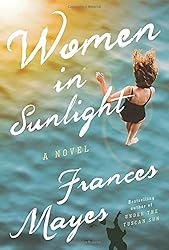
Women in Sunlight
Frances Mayes, 2018
Crown/Archetype
448 pp.
ISBN-13: 9780451497666
Summary
By the bestselling author of Under the Tuscan Sun, and written with Frances Mayes’s trademark warmth, heart, and delicious descriptions of place, food, and friendship, Women in Sunlight is the story of four American strangers who bond in Italy and change their lives over the course of an exceptional year.
She watches from her terrazza as the three American women carry their luggage into the stone villa down the hill.
Who are they, and what brings them to this Tuscan village so far from home? An expat herself and with her own unfinished story, she can’t help but question: will they find what they came for?
Kit Raine, an American writer living in Tuscany, is working on a biography of her close friend, a complex woman who continues to cast a shadow on Kit’s own life. Her work is waylaid by the arrival of three women—Julia, Camille, and Susan—all of whom have launched a recent and spontaneous friendship that will uproot them completely and redirect their lives.
Susan, the most adventurous of the three, has enticed them to subvert expectations of staid retirement by taking a lease on a big, beautiful house in Tuscany. Though novices in a foreign culture, their renewed sense of adventure imbues each of them with a bright sense of bravery, a gusto for life, and a fierce determination to thrive.
But how?
With Kit’s friendship and guidance, the three friends launch themselves into Italian life, pursuing passions long-forgotten—and with drastic and unforeseeable results.
(From the publisher.)
Author Bio
• Birth—1940
• Where—Fitzgerald, Georgia, USA
• Education—B.A., University of Florida; M.A., San Francisco
State University;
• Currently—lives in Hillsborough, North Carolina, and Corona, Italy
Frances Mayes is the author of several books about Tuscany. The now-classic Under the Tuscan Sun–which was a New York Times bestseller for more than two and a half years and became a Touchstone movie starring Diane Lane. It was followed by Bella Tuscany and two illustrated books, In Tuscany and Bringing Tuscany Home. She is also the author of the novel, Swan, six books of poetry, The Discovery of Poetry, and her most recent, Under Magnolia: A Southern Memoir (2014). Her books have been translated into more than twenty languages (From the publisher.)
More
Frances Mayes is an American university professor, poet, memoirist, essayist, and novelist. Born in Fitzgerald, Georgia, and raised in south central Georgia, Mayes attended Randolph-Macon Woman's College in Lynchburg, Virginia, and obtained her BA from the University of Florida. In 1975 she earned her MA from San Francisco State University, where she eventually became Professor of Creative Writing, director of The Poetry Center, and chair tof the Department of Creative Writing.
Mayes has published several works of poetry: Climbing Aconcagua (1977), Sunday in Another Country (1977), After Such Pleasures (1979), The Arts of Fire (1982), Hours (1984), and Ex Voto (1995). In 1996 she published the book Under the Tuscan Sun: At Home in Italy. The book is a memoir of Mayes buying, renovating, and living in an abandoned villa in rural Cortona in Tuscany, a region of Italy. It went to Number One on the New York Times Best Seller list and remained on the list for over two years.
In 2003 the film Under the Tuscan Sun was released. Adapted to the screen by director Audrey Wells, the movie was loosely based on Mayes's book. In 1999, Mayes followed this literary success with another international bestseller, Bella Tuscany: The Sweet Life in Italy, and in 2000 with In Tuscany. Mayes's first novel, Swan, was published in 2002. Her memoir, Under Magnolia, about growing up in a Southern family, came out in 2014,
Also a food-and-travel writer, Mayes is the editor of The Best American Travel Writing 2002 and the author of A Year in the World: Journeys of A Passionate Traveller (2006), tales of her and her husband's travels.
Now writing full time, she and her poet husband divide their time between homes in Hillsborough, North Carolina and Cortona, Italy, where she serves as the artist director of the annual Tuscan Sun Festival. (From Wikipedia. Updated 2/21/2014.)
Book Reviews
Even fans of Mayes’s Under the Tuscan Sun may have trouble with her latest, a trifle about three American women who impulsively rent a house in Tuscany for a year.… [F]eels like a movie, but not an especially memorable one.
Publishers Weekly
Fans will be delighted that Mayes again puts them Under the Tuscan Sun, where American writer Kit Raine is now living…. Sun and fun, food and friendship—you can’t go wrong.
Library Journal
The pleasurable descriptions of colors and tastes and various Italian tourist destinations, plus… the handmade paper made by the paper-making character, etc., are enough to keep this party going all year long.
Kirkus Reviews
Discussion Questions
1. The ingredients, cooking, and eating of food are prominent features of Women in Sunlight. What did you take the descriptions of food to represent? For instance, what is the importance of hospitality and the sharing of meals, and do you see a connection between cooking and other forms of creativity?
2. At Susan’s beach house, she and her two new friends, Camille and Julia, discuss the expectation that life should "simplify" with age. Resisting this, they move to Tuscany "where life does not simplify, it complicates" (p. 51). Do you think this vision of Italy is correct? In what ways do their lives become more complex? Does life, in fact, simplify in other ways?
3. Susan references a theory that, in dreams, houses and their rooms represent the parts of one’s self. Do you think that the spaces the women occupy reflect the current states of their hearts and minds? How might Villa Assunta in Tuscany speak differently than their houses in America or the living units at Cornwallis Meadows?
4. Consider the following passage: "Why, they wonder after family life ended, didn’t more people banish loneliness and live together? Things, they conclude. People can’t part with their stuff, their mother’s stuff, attics and basements full of stuff" (p. 91). How do the women deal with the emotional weight of their things and the history they carry? What might be the importance of learning to "let go" of material possessions?
5. What were your first impressions of Susan, Camille, and Julia? What contrasting personality traits do they have, and how might they influence or inspire one another? How are they each stimulated and transformed by life in Italy?
6. What is Margaret’s purpose in the narrative? How might her relationship with Kit compare to the friendships among the other women?
7. As the women transition to life in Europe, what are the divergences from life in America? Did you notice any cultural gaps between the American women and the Italian locals?
8. Why do you think Julia considers the women innocent when they first arrive in Tuscany? Is this a trait that inevitably comes with traveling to new places? In what moments could you see them lose aspects of this innocence?
9. Julia channels her culinary passion and publishing experience into writing Learning Italian, which chronicles her journey of cooking the country’s food and learning its language. Could you read Women in Sunlight as, like Julia’s project becomes, a newcomer’s guide to life in Italy?
10. Thinking back on her time in Boulder, Kit remarks that "[t]hough I loved the town, it was not my place in the universe." What, in your view, determines one’s place in the universe? Why is it that we are compelled to return to some places and not others?
11. How might Women in Sunlight challenge definitions of "home," or of the family as a nuclear unit? Are we readers encouraged to be more flexible in our understandings of these concepts? Do you find the idea of communal living practiced in Women in Sunlight appealing?
12. What did you make of Julia’s tenuous relationship with her daughter, Lizzie, and Wade, her estranged husband? How do you think you would react if placed in Julia’s position?
13. As she reconnects with her artistic flair, how does Camille learn to grapple with grief and the death of her husband? What were your interpretations of her "paper doors"?
(Questions issued by publisher.)

The Women in the Castle
Jessica Shattuck, 2017
HarperCollins
368 pp.
ISBN-13: 9780062563668
Summary
Three women, haunted by the past and the secrets they hold…
Set at the end of World War II, in a crumbling Bavarian castle that once played host to all of German high society, a powerful and propulsive story of three widows whose lives and fates become intertwined—an affecting, shocking, and ultimately redemptive novel from the author of the New York Times Notable Book The Hazards of Good Breeding.
Amid the ashes of Nazi Germany’s defeat, Marianne von Lingenfels returns to the once-grand castle of her husband’s ancestors, an imposing stone fortress now fallen into ruin following years of war.
The widow of a resister murdered in the failed July 20, 1944, plot to assassinate Adolf Hitler, Marianne plans to uphold the promise she made to her husband’s brave conspirators: to find and protect their wives, her fellow resistance widows.
First Marianne rescues six-year-old Martin, the son of her dearest childhood friend, from a Nazi reeducation home. Together, they make their way across the smoldering wreckage of their homeland to Berlin, where Martin’s mother, the beautiful and naive Benita, has fallen into the hands of occupying Red Army soldiers.
Then she locates Ania, another resister’s wife, and her two boys, now refugees languishing in one of the many camps that house the millions displaced by the war.
As Marianne assembles this makeshift family from the ruins of her husband’s resistance movement, she is certain their shared pain and circumstances will hold them together. But she quickly discovers that the black-and-white, highly principled world of her privileged past has become infinitely more complicated, filled with secrets and dark passions that threaten to tear them apart.
Eventually, all three women must come to terms with the choices that have defined their lives before, during, and after the war—each with their own unique share of challenges.
Written with the devastating emotional power of The Nightingale, Sarah’s Key, and The Light Between Oceans, Jessica Shattuck’s evocative and utterly enthralling novel offers a fresh perspective on one of the most tumultuous periods in history.
Combining piercing social insight and vivid historical atmosphere, The Women in the Castle is a dramatic yet nuanced portrait of war and its repercussions that explores what it means to survive, love, and, ultimately, to forgive in the wake of unimaginable hardship. (From the publisher.)
Read the author's NY Times Op-Ed article.
Author Bio
• Birth—ca. 1972
• Where—Washington, D.C., USA
• Education—B.A., Harvard University; M.F.A., Columbia University
• Currently—lives in Brookline, Massachusetts
Jessica Shattuck is the award-winning author of The Hazards of Good Breeding (2003), which was a New York Times Notable Book and finalist for the PEN/Winship Award, and of Perfect Life (2009). Her third novel The Women in the Castle (2017), was inspired by her grandparents' experiences in Germany during World War II.
Shattuck's other writing has appeared in the New York Times, New Yorker, Glamour, Mother Jones, Wired, and The Believer, among other publications. A graduate of Harvard University, she received her MFA from Columbia University. She lives with her husband and three children in Brookline, Massachusetts. (Adapted from the publisher.)
Book Reviews
In her beautiful, perceptive novel, Jessica Shattuck does an about-face from other World War II books. Most of those books, if not all, focus on victims of the fascists or on those opposing them. In a daring move, Shattuck takes as her viewpoint the Germans themselves — those who are left standing (barely) after the fall of Berlin. READ MORE.
Molly Lundquist - LitLovers
Shattuck’s characters represent the range of responses to fascism. Her achievement — beyond unfolding a plot that surprises and devastates — is in her subtle exploration of what a moral righteousness like Marianne’s looks like in the aftermath of war, when communities and lives must be rebuilt, together.
Mary Pols - New York Times Book Review
[A]n intricately woven narrative with frequent plot twists that will shock and please.…[and] a unique glimpse into what the average German was and was not aware of during World War II.… A beautiful story of survival, love, and forgiveness.
Publishers Weekly
There are too many ideas in this novel; as each emotional arc builds, the narrative abruptly switches to another character's voice, confusing the reader.… [R]eaders will have to triangulate numerous characters. —Tina Panik, Avon Free P.L., CT
Library Journal
(Starred review.)The reader is fully immersed in the experiences of these women, the choices they make, and the burdens they carry…a rich, potent, fluently written tale of endurance and survival.
Booklist
[S]imple, stark lessons on personal responsibility and morality. Inevitably, it makes for a dark tale.… [The] novel seems atypical of current World War II fiction but makes sincere, evocative use of family history to explore complicity and the long arc of individual responses to a mass crime.
Kirkus Reviews
Discussion Questions
We'll add publisher questions if and when they're available; in the meantime, please use our LitLovers talking points to start a discussion for THE WOMEN IN THE CASTLE … then take off on your own:
1. What does the novel reveal about the method and degree of Hitler's appeal to the German populace? In what way does it address the most problematic question of the War: how the German people allowed themselves to be swept away by Hitler and Nazi propaganda. Just as important, how much—and at what point—did ordinary citizens truly know about the impoundment and murder of Europe's Jewish population.
2. Describe each of the three women—Marianne, Ania, and Benita. Talk about their different views of the Hitler regime as it unfolded and their various reasons for supporting it. What was each woman's role, or position, in German society, and how did each experience the war? What about the years after the war?
3. (Follow-up to Question 2) Which woman's story do you find most compelling, frightening, or horrifying? Are you more sympathetic toward one than the other two?
4. Most of the recent books about World War II focus on the horrors of the holocaust, and for good reason. Yet ordinary Germans also suffered, especially as the war neared the end. What was it like for the country as Nazism collapsed? Consider the population at large, but most particularly the women at Burg Lingenfels. How are the three of them luckier than most survivors?
5. What roles do hope…denial…and forgiveness play in this novel? Is Jessica Shattuck's book an attempt to somehow exonerate the citizens who supported Hitler's rise to power?
6. Has reading The Women in the Castle, changed in any way your understanding of World War II?
(Questions by LitLovers. Please feel free to use them, online or off, with attribution.)
ADDITIONAL QUESTIONS
The following Questions were generously contributed to LitLovers by REBECCA DIXON from the Baldwin Public Library in Baldwin, Wisconsin—many thanks, Rebecca:
7. Was Marianne right to interfere in Benita’s romance with Muller? Do you think that relationship would have saved her, or was it doomed by his feelings of guilt?
8. What about World War I helped cause World War II?
9. There was much debate about whether assassination was the right thing to do with Hitler. How do you feel? Are you aware of the Bonhoeffer attempt?
10. How are America and American soldiers seen in the eyes of the characters?
11. Many characters in the story say they don’t believe in God or are not sure. How is our belief tested in times of war? How can we explain God’s actions or lack of them during the Holocaust?
12. Hitler is used as the definition of evil since. What other world situations have been compared to the Holocaust? Has there been anything as bad in your opinion? Do you see any situations today that cause concern?
13. Can history repeat itself? What needs to be done to make sure there are no more Naziis?
top of page (summary)
The Women of Brewster Place
Gloria Naylor, 1982
Penguin Publishing
192 pp.
ISBN-13: 9780140066906
Summary
Winner, 1983 National Book Award-First Novel
In her heralded first novel, Gloria Naylor weaves together the stories of seven women living in Brewster Place, a bleak-inner city sanctuary, creative a powerful, moving portrait of the strengths, struggles, and hopes of black women in America.
Vulnerable and resilient, openhanded and openhearted, these women forge their lives in a place that in turn threatens and protects—a common prison and a shared home.
Adapted into a 1989 ABC miniseries starring Oprah Winfrey, The Women of Brewster Place is a contemporary classic—and a touching and unforgettable read. (From the publisher.)
Author Bio
• Birth—January 25, 1950
• Born—New York, New York, USA
• Died—September 28, 2016
• Where—Christiansted, St. Croix, US Virgin Islands
• Education—B.A., Brooklyn College; M.A. Yale University
• Awards—National Book Award
Gloria Naylor was was an American novelist, known for novels including The Women of Brewster Place (1982), Linden Hills (1985) and Mama Day (1988). She was born in New York, the oldest child of Roosevelt Naylor and Alberta McAlpin.
Background and early years
The Naylors, who had been sharecroppers in Robinsonville, Mississippi, had migrated to Harlem to escape life in the segregated South and seek new opportunities in New York City. Her father became a transit worker; her mother, a telephone operator. Even though Naylor's mother had little education, she loved to read, and encouraged her daughter to read and keep a journal. Before her teen years, Gloria began writing prodigiously, filling many notebooks with observations, poems, and short stories.
In 1963, Naylor's family moved to Queens and her mother joined the Jehovah's Witnesses. An outstanding student who read voraciously, Naylor was placed into advanced classes in high school, where she immersed herself in the work of nineteenth century British novelists.
Education
Naylor's educational aspirations were delayed by the shock of the assassination of Dr. Martin Luther King Jr. in her senior year. She decided to postpone her college education, becoming a missionary for the Jehovah's Witnesses in New York, North Carolina, and Florida instead. She left seven years later as "things weren't getting better, but worse."
From 1975 to 1981 Naylor attended Medgar Evers College and then Brooklyn College while working as a telephone operator, majoring in nursing before switching to English.
It was at that time that she read Toni Morrison's novel The Bluest Eye, which was a pivotal experience for her. She began to avidly read the work of Zora Neale Hurston, Alice Walker, and other black women novelists, none of which she had been exposed to previously. She went on to earn an M.A. in African-American studies at Yale University; her thesis eventually became her second published novel, Linden Hills.
Career
Naylor's debut novel, The Women of Brewster Place, was published in 1982 and won the 1983 National Book Award in the category First Novel. It was adapted as a 1989 television miniseries of the same name by Oprah Winfrey's Harpo Productions.
Naylor went on to publish Linden Hills (1985), Mama Day (1987), and Bailey's Cafe (1992). Each of these novels garnered much attention for their exploration of the modern black American experience.
Naylor's work is featured in such anthologies as Breaking Ice: An Anthology of Contemporary African-American Fiction (1990), Calling the Wind: Twentieth-Century African-American Short Stories (1992) and Daughters of Africa (1992).
During her career as a professor, Naylor taught writing and literature at several universities, including George Washington University, New York University, Boston University, and Cornell University.
Death
Naylor died of a heart attack on September 28, 2016, while visiting St. Croix, United States Virgin Islands. She was 66. (Adapted from Wikipedia. Retrieved 5/8/2018.)
Book Reviews
[A] shrewd and lyrical portrayal of many of the realities of black life.… Miss Naylor bravely risks sentimentality and melodrama to write her compassion and outrage large, and she pulls it off triumphantly.
New York Times Book Review
Vibrating with undisguised emotion, The Women of Brewster Place springs from the same roots that produces the blues. Like them, [Naylor's] book sings of sorrow proudly borne by black women in America.
Washington Post
Naylor creates a completely believable, and very frightening, world of degradation, violence and human—very human—courage and sturdiness.
Chicago Sun-Times
[A] moving portrait of the strengths, struggles, and hopes of black women.… Gloria Naylor weaves together the truths and myths of the women's lives, creating characters who are free to determine the course of their lives, embodying the self actualization tradition of the Harlem Renaissance.
Sacred Fire
(Refers to the audio version) Tonya Pinkins reads and presents the characters very well, catching the lyricism of each woman's story; the range of emotions is a demanding task… [But] this abridgment doesn't fully capture the power of the whole or the full devastation and pride of Naylor's characters. —Joyce Kessel, Villa Maria Coll., Buffalo, N.Y.
Library Journal
Discussion Questions
1. What do you think of the novel's structure? How does each woman's individual voice reinforce the novel's themes as a whole? Does this group of women represent a cross section of women in general?
2. In what sorts of ways do each of these women find comfort in the hardships of their everyday lives? How does this reflect the strengths and weaknesses of each woman?
3. Each of these women cope with enormous loss in their lives, but each manages their grief differently. Compare, for instance, Mattie's loss of her house and her son with Ceil's loss of her baby. What could these women learn from each other?
4. How does Naylor portray the South, where many of these women came from, as both a land of plenty and a land of harsh deprivation? How are these women's lives different living in the North? are they happier? more fulfilled? more subject to racial bias? Is there more opportunity for them in Brewster Place than in the South?
5, What do you think of the way Lorraine and Theresa are treated by the other women in Brewster Place?
What is Naylor saying about prejudice? Why do you think she concluded the novel with their story?
6. Each of these women is capable of enormous love, but they are often hurt by their loved ones. What do you think Naylor is saying about a woman's capacity for love? Is this sort of love "worth it"? Would these women be happier if they had hardened their hearts to those who eventually let them down?
7. What do you think the "death" of Brewster Place means for the future of its residents? How does Brewster Place continue to live on, once it is vacant? What do you make of Mattie Michael's dream, in which the women of Brewster Place dismantle the structure, brick by brick?
(Questions issued by the publisher.)
Women Talking
Miriam Toews, 2019
Bloomsbury USA
240 pp.
ISBN-13: 9781635572582
Summary
One evening, eight Mennonite women climb into a hay loft to conduct a secret meeting.
For the past two years, each of these women, and more than a hundred other girls in their colony, has been repeatedly violated in the night by demons coming to punish them for their sins.
Now that the women have learned they were in fact drugged and attacked by a group of men from their own community, they are determined to protect themselves and their daughters from future harm.
While the men of the colony are off in the city, attempting to raise enough money to bail out the rapists and bring them home, these women—all illiterate, without any knowledge of the world outside their community and unable even to speak the language of the country they live in—have very little time to make a choice: Should they stay in the only world they’ve ever known or should they dare to escape?
Based on real events and told through the "minutes" of the women’s all-female symposium, Toews’s masterful novel uses wry, politically engaged humor to relate this tale of women claiming their own power to decide. (From the publisher.)
Author Bio
• Birth—1964
• Where—Steinbach, Manitoba, Canada
• Education—B.A., University of Manitoba; B,J., University of King's College, Halifa
• Awards—Governor General's Award for Fiction (more below)
• Currently—lives in Toronto, Ontario
Miriam Toews ("tay-vz") OM is a prize-winning Canadian writer of novels and one non-fiction. She grew up in Steinbach, Manitoba, the second daughter of Mennonite parents, both part of the Kleine Gemeinde.
Through her father, Melvin C. Toews, she is a direct descendant of one of Steinbach's first settlers, Klaas R. Reimer (1837-1906), who arrived in Manitoba in 1874 from Ukraine. Her mother, Elvira Loewen, is a daughter of the late C.T. Loewen, a respected entrepreneur who founded a lumber business that would become Loewen Windows.
As a teenager, Toews rode horses and took part in provincial dressage and barrel-racing competitions. She left Steinbach at eighteen, living in Montreal and London before settling in Winnipeg. She has a B.A. in Film Studies from the University of Manitoba, and a Bachelor of Journalism from the University of King's College, Halifax.
Life and work
Toews wrote her first novel, Summer of My Amazing Luck in 1996 while working as a freelance journalist. The novel, which explores the evolving friendship of two single mothers in a Winnipeg public housing complex, evolved from a documentary Toews was preparing for CBC Radio. The novel was shortlisted for the Stephen Leacock Memorial Medal for Humour, and the McNally Robinson Book of the Year Award. Toews won the latter prize with her second novel, A Boy of Good Breeding, released in 1998.
That same year, 1998, Toews' father, an elementary school teacher, committed suicide. Though he suffered from bipolar disorder much of his life, he was a beloved figure in the community and lobbied to establish Steinbach's first public library. After his death, the library opened the Melvin C. Toews Reading Garden in his honor.
Her father's death inspired Toews to write a memoir, using his narrative voice: Swing Low: A Life. The book, released in 2000, was greeted as an instant classic in the modern literature on mental illness; it won the Alexander Kennedy Isbister Award for Non-Fiction and the McNally Robinson Book of the Year Award.
In 2010, almost 12 years to the day her father died, Toews' older sister and only sibling, Marjorie, also died by suicide.
In addition to her books, Toews has written for CBC's WireTap, Canadian Geographic, Geist, The Guardian, The New York Times Magazine, Intelligent Life, and Saturday Night. She is the author of The X Letters, a series of personal dispatches addressed to the father of her son, which were featured on This American Life in an episode about missing parents.
All told, Toews has received some 20 awards and honors over the years.
Books
1996 - Summer of My Amazing Luck
1998 - A Boy of Good Breeding
2000 - Swing Low: A Life (non-fiction)
2004 - A Complicated Kindness
2008 - The Flying Troutmans
2011 - Irma Voth
2014 - All My Puny Sorrows
2018 - Women Talking
(Author bio adapted from Wikipedia. Retrieved 4/17/2019.)
Book Reviews
[Toews's] celebrated novels are haunted by her upbringing, but she has never written with such heartbreak, or taken such sure aim at fundamentalism and its hypocrisies, as she does in her new book, Women Talking.… Did I mention the book is funny? Wickedly so, with Toews's brand of seditious wit…The ethical questions the women quarrel over feel strikingly contemporary: What are the differences between punishment and justice? How do we define rehabilitation; how do we enforce accountability? (To see these questions explored with such complexity and curiosity, with such open grief and that rogue Toews humor, makes me long for more novels reckoning with #MeToo and fewer op-eds.)
New York Times - Parul Sehgal
Miriam Toews's scorching sixth novel… skips over the rapes and the apprehension of the rapists, cutting straight to existential questions facing the women in the aftermath. Women Talking is a wry, freewheeling novel of ideas that touches on the nature of evil, questions of free will, collective responsibility, cultural determinism and, above all, forgiveness.… [Toews] depicts the women at the center of the novel with insight, sympathy and respect. Their conversation is loose, unpredictable, occasionally profane and surprisingly funny.… By loosening the tongues of disenfranchised women and engaging them in substantive dialogue about their lives, Toews grants them agency they haven't enjoyed in life. By refusing to focus on the crimes that launched this existential reappraisal, she treats them as dignified individuals rather than props in a voyeuristic entertainment.
Jennifer Reese - New York Times Book Review
Lean, bristling… a remarkably layered and gripping story.… The book's confined setting and its tight time frame combine to superb dramatic effect.
Wall Street Journal
A painful, thought-provoking, strangely lovely gem.… At the heart of Women Talking lies the question of how women can create a better world for themselves and for those they love amid a culture of male sexual violence, the continued power of patriarchy, their own differences, and the limits of language itself. It's a question that resonates across the globe today, and in answering it, we could do much worse than to start with the manifesto of the women of Molotschna: "We want our children to be safe.… We want to be steadfast in our faith. We want to think.
Boston Globe
Astonishing.… Toews, who has written often about her own Mennonite history, has told a riveting story that is both intensely specific and painfully resonant in the wider world. Women Talking is essential, elemental.
USA Today
This stark, masterful story takes a timely look at ideas of justice and agency (Best Books to Read This Spring).
Esquire
The award-winning novelist returns with what may be her most experimental work yet, giving voice to eight women as they grapple with the trauma and power of patriarchy (50 Most Anticipated Books of 2019).
Entertainment Weekly
I would follow the Canadian author anywhere she leads—this time to a remote Mennonite colony in Bolivia where the women have been subjected to brutal attacks in the night first believed to be the work of demons. When they discover the atrocities were committed by men in their community, the women—who cannot read or write and require the group's schoolteacher to write down their conversations—must decide whether they will leave, exiting the only world they've known, or remain.
Huffington Post
[O]ne of the most anticipated books of the year for a reason. The story (based on true events) focuses on eight Mennonite women who—after being repeatedly drugged and attacked by a group of men in their community—meet in secret and decide how to reclaim their lives not just for their own future, but also for their daughters (Best Fiction Books of 2019).
Woman's Day
(Starred review) [R]eaders are able to see how carefully and intentionally the women think through their life-changing decision—critically discussing their roles in society, their love for their families and religion, and their hopes and desires for the future. This is an inspiring and unforgettable novel.
Publishers Weekly
(Starred review) [A] sharp blade of a novel.… Toews' knowing wit and grasp of dire subjects align her with Margaret Atwood, while her novel's slicing concision and nearly Socratic dialogue has the impact of a courtroom drama or a Greek tragedy.
Booklist
(Starred review) An exquisite critique of patriarchal culture.… [T]he narrator is a man, but that's of necessity. These women are illiterate and therefore incapable of recording their thoughts without his sympathetic assistance. Stunningly original and altogether arresting.
Kirkus Reviews
Discussion Questions
1. Women Talking begins with "A Note on the Novel" which explains that the story is a fictionalized account of real events. What is the difference between reading this novel versus reading a news story or nonfiction book about these events? What questions does Women Talking encourage readers to ask themselves about these events and the environment in which they occur?
2. The book is told through August Epp’s notes from the women’s meetings. Why does Toews choose Epp to narrate this story? How does his perspective, gender, and personal history affect the vantage from which the story is told?
3. The women frequently discuss the complexity of continuing to love many of the men in their community despite their fear and they contemplate the circumstances under which the men would be allowed to join them in their new society. In what ways does the novel explore questions about male experiences, perspectives, and culture?
4. Which of the options would you have taken if you were one of the women? Explain why. Consider the consequences and benefits of your choice. How would you convince the others to join you?
5. The book examines both sexual and domestic violence. How does the women’s environment and circumstances dictate how they understand, interpret, and, ultimately,deal with violence? How does this intersect with their religious faith and their beliefs about their place in the world?
6. Discuss the power of language and literacy. How would the women’s lives be changed if they could read? How does their ability to interpret the Bible for themselves change the women’s understanding of their future?
7. How does this novel engage with mainstream political and social conversations about women and their rights?
(Questions issued by the publisher.)
top of page (summary)
Women Who Run with the Wolves: Myths and Stories of the Wild Woman Archetype
Clarissa Pinkola Estes, 1992
Random House
608 pp.
ISBN-13: 9780345409874
Summary
Within every woman there lives a powerful force, filled with good instincts, passionate creativity, and ageless knowing. She is the Wild Woman, who represents the instinctual nature of women. But she is an endangered species.
For though the gifts of wildish nature belong to us at birth, society's attempt to "civilize" us into rigid roles has muffled the deep, life-giving messages of our own souls. In Women Who Run With the Wolves, Dr. Estes unfolds rich intercultural myths, fairy tales, and stories, many from her own family, in order to help women reconnect with the fierce, healthy, visionary attributes of this instinctual nature.
Through the stories and commentaries in this remarkable book, we retrieve, examine, love, and understand the Wild Woman, and hold her against our deep psyches as one who is both magic and medicine. Dr. Estes has created a new lexicon for describing the female psyche. Fertile and life-giving, it is a psychology of women in the truest sense, a knowing of the soul. (From the publisher.)
Author Bio
• Birth— January 27, 1945
• Where—near the Great Lakes, USA
• Education—Ph.D., Union Institute and University
• Currently—lives in Colorado, USA
Clarissa Pinkola Estes, Ph.D. is an American poet, psychoanalyst and post-trauma specialist who was raised in a now nearly vanished oral and ethnic tradition. She grew up in a rural village, population 600, near the Great Lakes. Of Mexican mestiza and Magyar heritages, she comes from immigrant and refugee families who could not read or write, or who did so haltingly.
Similar to William Carlos Williams and other poets who worked in the health professions, Estes is a certified psychoanalyst who has practiced clinically for 37 years. Her doctorate, from the Union Institute & University, is in ethno-clinical psychology, the study of social and psychological patterns in cultural and tribal groups. She often speaks as "distinguished visiting scholar" and "diversity scholar" at universities. She is the author of many books on the life of the soul, and her work is published in 32 languages.
She is controversial for proposing that both assimilation and holding to ethnic traditions are the ways to contribute to creative culture and to a soul-based civility. She successfully helped to petition the Library of Congress, as well as worldwide psychoanalytic institutes, to rename their studies and categorizations formerly called, among other things, "psychology of the primitives," to respectful and descriptive names, according to ethnic group, religion, culture, etc.
As post-trauma specialist, she began her work in the 1960s at hospitals caring for severely injured children, 'shell-shocked' war veterans, and their families. Her teaching of writing in prisons began in the early 1970s at the Men's Penitentiary in Colorado; the Federal Women's Prison at Dublin, CA, and in prisons throughout the Southwest. She ministers in the fields of childbearing loss, surviving families of murder victims, as well as critical incident work. She served at natural disaster sites, developing post-trauma recovery protocol for earthquake survivors in Armenia, and teaching citizens deputized to do post-trauma work on site. She recently served Columbine High School and community after the massacre, 1999-2003. She works with 9-11 survivor families on both east and west coasts.
Estes served as Governor's appointee to the Colorado State Grievance Board 1993-2006. She currently is a board member of Authors Guild, New York; an advisory board member for The National Writers Union, N.Y.; an advisory board member of The Coalition Against Censorship, NY; and as a board member of the Maya Angelou Minority Health Foundation at Wake Forest Medical School. She is an advisor to El Museo de las Americas, Colorado; a contributing editor to The Bloomsbury Review; and a member of the National Association of Hispanic Journalists.
Estes, a former hard-scrabble welfare mother, is the recipient of numerous awards including the first Joseph Campbell Keeper of the Lore Award for her work as la cantadora; and for her written work, the Gradiva Award from the National Association for the Advancement of Psychoanalysis; and The Catholic Press Association award for her writing. She received the Las Primeras Award, "the first of her kind" from the Mexican American Women's foundation, Washington D.C. She is a 2006 inductee to the Colorado Women's Hall of Fame. (From Wikipedia.)
Book Reviews
Updated with new material by the author, Women Who Run With the Wolves isn't just another book. It is a gift of profound insight, wisdom, and love. An oracle from one who knows.
Alice Walker
Stands out from the pack.... A joy and sparkle in [the] prose.... This book will become a bible for women interested in doing deep work.... It is a road map of all the pitfalls, those familiar and those horrifically unexpected, that a woman encounters on the way back to her instinctual self. Wolves.... is a gift.
Los Angeles Times
Folklore, fairy tales and dream symbols are called on to help restore women's neglected intuitive and instinctive abilities in this earthy first book by a Jungian analyst. According to Estes, wolves and women share a psychic bond in their fierceness, grace and devotion to mate and community. This comparison defines the archetype of the Wild Woman, a female in touch with her primitive side and able to rely on gut feelings to make choices. The tales here, from various cultures, are not necessarily about wolves; instead, they illuminate fresh perspectives on relationships, self-image, even addiction. An African tale of twins who baffle a man represents the dual nature of woman; from the Middle East, a story about a threadbare but secretly magic carpet shows society's failure to look beyond appearances. Three brief, ribald stories advocate a playful, open sexuality; other examples suggest ways to deal with anger and jealousy. At times, Estes's commentary—in which she urges readers to draw upon and enjoy their Wild Woman aspects—is hyperbolic, but overall her widely researched study offers usable advice for modern women.
Publishers Weekly
A feminist counterpart to Iron John—or, how "a healthy woman is much like a wolf.'' Estes, a Jungian analyst, believes that a woman's wholeness depends on her returning to the sources of her repressed instinctual nature. To illustrate the ways of the "wild woman,'' the author draws on myths, legends, and fairy tales from a vast and eclectic range of traditions. This collection of stories may well be the most valuable element of the book, which otherwise reads like unedited transcripts of the workshops Estes leads to encourage women to return to their "feral'' roots. Each story demonstrates a particular aspect of woman's experience—relationship, creativity, anger, spirituality, etc. Estes finds evidence in the most diverse tales of the necessity for women to reclaim their wildness. The precise nature of this wildness is difficult to fathom, but, at best, it seems to include a genuine capacity to access feelings and to accept one's contradictions, while, at worst, it appears to amount to the kind of self-indulgence that prevailed during the "me'' generation. Estes claims that her book is for every woman, whether you be spicy or somber, regal or roughshod''; but her underlying assumption that every woman is free to abandon what holds her back seems ignorant of social and economic realities. The author provides few concrete examples that might help women understand what she expects them to do, and her prose abounds in generalizations and oddities ("the ambitious woman...who is heartfelt toward her accomplishments'') that further undermine her credibility and her considerable scholarship. Hortatory, ecstatic, and, ultimately, irritating.
Kirkus Reviews
Discussion Questions
Use our LitLovers Book Club Resources; they can help with discussions for any book:
• How to Discuss a Book (helpful discussion tips)
• Generic Discussion Questions—Fiction and Nonfiction
• Read-Think-Talk (a guided reading chart)
Also consider these LitLovers talking points to help get a discussion started for Women Who Run with the Wolves:
• As you read, think about which particular folktale resonates with you. During the meeting, each member can discuss the one that has the most personal significance.

The Wonder
Emma Donoghue, 2016
Little, Brown & Co.
304 pp.
ISBN-13: 9780316393874
Summary
In Emma Donoghue's latest masterpiece, an English nurse brought to a small Irish village to observe what appears to be a miracle—a girl said to have survived without food for months—-soon finds herself fighting to save the child's life.
Tourists flock to the cabin of eleven-year-old Anna O'Donnell, who believes herself to be living off manna from heaven, and a journalist is sent to cover the sensation.
Lib Wright, a veteran of Florence Nightingale's Crimean campaign, is hired to keep watch over the girl.
Written with all the propulsive tension that made Room a huge bestseller, The Wonder works beautifully on many levels—a tale of two strangers who transform each other's lives, a powerful psychological thriller, and a story of love pitted against evil. (From the publisher.)
Author Bio
• Birth—October 24, 1969
• Where—Dublin, Ireland
• Education—B.A., University College Dublin; Ph.D., Cambridge University
• Awards—Irish Book Award
• Currently—lives in London, Ontario, Canada
Emma Donoghue was born in Dublin, Ireland, the youngest of eight children. She is the daughter of Frances (nee Rutledge) and academic and literary critic Denis Donoghue. Other than her tenth year, which she refers to as "eye-opening" while living in New York, Donoghue attended Catholic convent schools throughout her early years.
She earned a first-class honours BA from the University College Dublin in English and French (though she admits to never having mastered spoken French). Donoghue went on receive her PhD in English from Girton College at Cambridge University. Her thesis was on the concept of friendship between men and women in 18th-century English fiction.
At Cambridge, she met her future life partner Christine Roulston, a Canadian, who is now professor of French and Women's Studies at the University of Western Ontario. They moved permanently to Canada in 1998, and Donoghue became a Canadian citizen in 2004. She lives in London, Ontario, with Roulston and their two children, Finn and Una.
Works
Donoghue has been able to make a living as a writer since she was 23. Doing so enables her to claim that she's never had an "honest job" since she was sacked after a summer as a chambermaid. In 1994, at only 25, she published first novel, Stir Fry, a contemporary coming of age novel about a young Irish woman discovering her sexuality.
Donoghue is perhaps best known for her 2010 novel, Room—its popularity practically made her a household name. Room spent months on bestseller lists and won the Irish Book Award; it was shortlisted for the Man Booker Prize, the Orange prize, and the (Canadian) Governor General's Award. In 2015, the novel was adapted to film. Donoghue wrote the screenplay, which earned her a nomination for an Academy Award, Golden Globe, and Bafta Award.
Since Room, Donoghue has published seven books, her most recent released in 2020—The Pull of the Stars. (Adapted from the author's website and Wikipedia. Retrieved 9/22/2016.)
Book Reviews
[F]ascinating…. The book is set in the mid-19th century, but its themes—faith and logic, credulity and understanding, the confused ways people act in the name of duty and belief and love—are modern ones. While the wonder of the title refers to many things, at its core it's an examination of the mysteries of reason, responsibility and the heart…Like Ms. Donoghue's best-selling Room, the novel ultimately concerns itself with courage, love and the lengths someone will go to protect a child. Holding Anna tight, Lib knows that "she'd give her the skin off her body if she had to, the bones out of her legs." The feeling is heartbreaking and transcendent and almost religious in itself.
Sarah Lyall - New York Times Book Review
These [claustraphobic] rooms of Donoghue’s may be tiny and sealed off, yet they teem with life-and-death drama and great moral questions. Hesitant readers may think that they’d rather lose themselves in stories with a larger sweep, a little more air; but Donoghue does so many intricate things within these small spaces of hers that, for a time, they become the most compelling places to linger. What was it that the poet William Blake said about seeing "a World in a Grain of Sand . . . ?" Something of that kind of mystic expansion happens in Donoghue’s rooms.
Maureen Corrigan - Washington Post
Donoghue poses powerful questions about faith and belief all the while crafting a compelling story and an evocative portrait of 19th-century Irish provincial society
Tom Beer - Newsday
Readers of historical fiction will gravitate to this tale.
Mary Ann Gwinn - Seattle Times
A riveting allegory about the trickle-down effect of trauma.
Megan O'Grady - Vogue
Donoghue's superb thriller will keep readers hanging on to every word, pondering how far one will go to prove her faith.
Liz Loerke - Real Simple
(Starred review.) Donoghue demonstrates her versatility by dabbling in a wide range of literary styles in this latest novel.... [E]ngrossing...with descriptions of period customs and 19th-century Catholic devotional objects and prayers. Even with its tidy ending, the novel asks daring questions about just how far some might go to prove their faith.
Publishers Weekly
(Starred review.)[S]tartlingly rewarding.... Heart-hammering suspense builds as Lib monitors Anna's quickening pulse, making this book's bracing conclusion one of the most satisfying in recent fiction. —John G. Matthews, Washington State Univ. Libs., Pullman
Library Journal
(Starred review.) Outstanding.... Exploring the nature of faith and trust with heartrending intensity, Donoghue's superb novel will leave few unaffected. —Sarah Johnson
Booklist
(Starred review.) The story’s resolution seems like pure wish fulfillment, but vivid, tender scenes between Lib and Anna, coupled with the pleasing romance that springs up...will incline most readers to grant Donoghue her tentative happy ending.... [T]his gripping tale offers a welcome reminder that her historical fiction is equally fine.
Kirkus Reviews
Discussion Questions
We'll add publisher questions if and when they're available; in the meantime, use these LitLovers talking points to start a discussion for The Wonder...then take off on your own:
1. How would you describe Lib Wright (consider the name, perhaps)—especially when we first meet her? How does she approach her move to Ireland, the people, superstitions, the food? When does it become evident that there is part of Lib's past she is not revealing to us? How reliable of a narrator is she?
2. Describe the Ireland that confronts Lib, the way in which Emma Donoghue presents the country in the 19th Century after the devastation of the infamous potato famine.
3. What about Anna O'Donnell? How does she differ from expectations, both yours and Lib's? When Lib first sees her, what is the state of Anna's health—does Lib find her as healthy as everyone claims she is?
4. Talk about the very complicated reasons for Anna's fasting. Is Anna too young to understand her decision? What responsibility do the family and the church have for Anna? What about the doctor's role?
5. As the days pass and Anna's condition deteriorates, Liz begins to feel she may be complicit in girl's demise. Is she?
6. Follow-up to Question #1: How does Lib change from who she was when she first ventured into Ireland? How would you describe her as you progress through the novel?
7. The novel brings up basic philosophical and religious questions, one of which is what it means to give up the most vital necessity of life in the name of something greater than yourself. Is it admirable, mad, selfish, narcissistic?
8. Follow-up to Question #7: What is the role of an outsider, like Lib? Does she have the right to intervene or an obligation to do so? What would you say or do to Anna?
9. The journalist asks Lib if she has "ever put to Ana, fair and square, that she must eat." Has Lib done so?
10. The novel has a gothic feel to it: spooky, menacing, even harrowing. What makes for the sinister atmosphere that pervades the novel?
11. Do you find interesting the clinical detail regarding the descriptions of Anna's symptoms and the theory and practice of nursing in the 19th century?
12. Discuss the book's title. What are the multiple meanings of "The Wonder"?
13. Do you see any parallels between this story and Donoghue's earlier book, Room? Think of small confined spaces, children, fragmented time, inner strength, and the power of love.
(Questions issued by LitLovers. Please feel free to use them, online or off, with attribution. Thanks.)

Wonder Boys
Michael Chabon, 1995
Random House
368 pp.
ISBN-13: 9780812979213
Summary
Michael Chabon's Grady Tripp is one messed up college writing professor—his marriage is breaking up, his girlfriend (wife of the dean) is pregnant, his marijuana habit is taking over and his editor is just about out of a job.
Tripp has published a few moderately successful novels but is strangling his creativity with introspection and marijuana—never finishing a 2,000-plus-page novel called Wonder Boys.
When his editor and best friend, Terry Crabtree, comes to town and spreads chaos, Tripp goes along for the ride. Farcical misadventures dominate, from a picked-up transvestite to a wild ride in a stolen car that contains a tuba and the corpses of a dog and a boa constrictor.
Chabon writes with a wry, vulnerable wit that cleaves open the minds of his wonderful characters while his clean prose keeps the madcap story going so well that you'll want it to never end. (From the publisher.)
Author Bio
• Birth—May 24, 1963
• Where—Washington, D.C.
• Education—B.A., University of Pittsburgh; M.F.A., University of California-Irvine
• Awards—Pulitzer Prize
• Currently—lives in Berkeley, California
Michael Chabon (SHAY-bon) is an American novelist and short story writer. His first novel, The Mysteries of Pittsburgh, was published in 1988 when he was still a graduate student. In 2000, Chabon published The Amazing Adventures of Kavalier & Clay, a novel that New York Times's John Leonard, once referred to as Chabon's magnum opus. It received the Pulitzer Prize for Fiction in 2001. All told, Chabon has published nearly 10 novels, including a Young Adult novel, a children's book, two collection of short stories, and two collections of essays.
Early years
Michael Chabon was born in Washington, DC to Robert Chabon, a physician and lawyer, and Sharon Chabon, a lawyer. Chabon said he knew he wanted to be a writer when, at the age of ten, he wrote his first short story for a class assignment. When the story received an A, Chabon recalls, "I thought to myself, 'That's it. That's what I want to do.... And I never had any second thoughts or doubts."
His parents divorced when Chabon was 11, and he lived in Columbia, Maryland, with his mother nine months of the year and with his father in Pittsburgh, Pennsylvania, during the summertime. He has written of his mother's marijuana use, recalling her "sometime around 1977 or so, sitting in the front seat of her friend Kathy's car, passing a little metal pipe back and forth before we went in to see a movie." He grew up hearing Yiddish spoken by his mother's parents and siblings.
Chabon attended the University of Pittsburgh, where he studied under Chuck Kinder and received a Bachelor of Arts in 1984. He then went to graduate school at the University of California-Irvine, where he received a Master of Fine Arts in creative writing.
Initial success
While he was at UC, his Master's thesis was published as a novel. Unbeknownst to Chabon, his professor sent it to a literary agent—the result was a publishing contract for The Mysteries of Pittsburgh and an impressive $155,000 advance. Mysteries appeared in 1988, becoming a bestseller and catapulting Chabon to literary stardom.
Chabon was ambivalent about his new-found fame. He turned down offers to appear in a Gap ad and to be featured as one of People's "50 Most Beautiful People." Years later, he reflected on the success of his first novel:
The upside was that I was published and I got a readership.... [The] downside...was that, emotionally, this stuff started happening and I was still like, "Wait a minute, is my thesis done yet?" It took me a few years to catch up.
Personal
His success had other adverse affects: it caused an imbalance between his and his wife's careers. He was married at the time to poet Lollie Groth, and they ended up divorcing in 1991. Two years later he married the writer Ayelet Waldman; the couple lives in Berkeley, California, with their four children.
Chabon has said that the "creative free-flow" he has with Waldman inspired the relationship between Sammy Clay and Rosa Saks in The Amazing Adventures of Kavalier & Clay. Entertainment Weekly declared the couple "a famous—and famously in love—writing pair, like Nick and Nora Charles with word processors and not so much booze."
In a 2012 NPR interview, Chabon told Guy Raz that he writes from 10 p.m. to 3 a.m. each day, Sunday through Thursday. He attempts 1,000 words a day. Commenting on the rigidity of his routine, Chabon said,
There have been plenty of self-destructive rebel-angel novelists over the years, but writing is about getting your work done and getting your work done every day. If you want to write novels, they take a long time, and they're big, and they have a lot of words in them.... The best environment, at least for me, is a very stable, structured kind of life.
Novels
1988 - The Mysteries of Pittsburgh
1995 - The Wonder Boys
2000 - The Amazing Adventures of Kavalier & Clay
2002 - Summerland (Young Adult)
2004 - The Final Solution
2007 - The Yiddish Policemen's Union
2007 - Gentlemen of the Road
2012 - Telegraph Avenue
2016 - Moonglow
(Author bio adapted from Wikipedia. Retrieved 10/2/2016.)
Book Reviews
The young star of American letters…a writer not only of rare skill and wit but a self—evident and immensely appealing generosity.
Jonathan Yardley - The Washington Post Book Review
[A] wise, wildly funny story…Chabon is a flat—out wonderful writer—evocative and inventive, pointed and poignant.
Shelby Hearon - Chicago Tribune
A beguiling and wickedly smart novel....There is first-rate satirical farce in Chabon's novel but essentially it is something rarer: satirical comedy.
Richard Eder - Lost Angeles Times Book Reveiw
Mixing comic—even slapstick—events with the serious theme of bright promise gone awry, Chabon has produced an impeccably constructed novel that sparkles with inventiveness and wit neatly permeated with rue. The once-promising eponymous "wonder boys'' are Grady Tripp and Terry Crabtree, friends since college, where they both determined to make their mark in literature. Now they are self-destructive adults whose rare meetings occasion an eruption of zany events. Narrator Grady, a professor/novelist whose unfinished work-in-progress, "Wonder Boys," stands at 2000-plus endlessly revised pages, has destroyed three marriages through compulsive philandering and a marijuana habit. Terry is a devil-may-care, sexually predatory editor who has patiently endured Grady's writing block but who tells Grady, when he arrives at the annual literary conference at Grady's small Pittsburgh college, that he expects to be fired momentarily from his job. Grady and Terry, later joined by the campus's newest potential "wonder boy,'' a talented but mendacious student named James Leer, set in motion a series of darkly funny misadventures. Farcical scenes arise credibly out of multiplying contretemps, culminating in a stoned Grady's wild ride in a stolen car in whose trunk rest a tuba and the corpses of a blind dog and a boa constrictor. All of this affords Chabon a solid platform for some freewheeling satire about the yearnings, delusions and foibles of writers and other folk. Throughout, his elegant prose, breathtaking imagery and wickedly on-target dialogue precisely illuminate his characters' gentle absurdities. The pace of this vastly entertaining novel never abates for a second, as we watch Grady slide inexorably into emotional and professional chaos. Above all, though, this is a feast for lovers of writing and books, with the author's fierce understanding of what Grady calls "the midnight disease," the irresistible, destructive urge of a writer to experience his characters' fates.
Publishers Weekly
Chabon himself is something of a wonder boy; his first novel, The Mysteries of Pittsburgh, presided on the New York Times Best Sellers list for 12 weeks. Here, his eponymous heroes are Grady, an aging author attempting to write his chef-d'oeuvre, and his randy editor, Tripp.
Library Journal
This is a genuinely funny, laugh-out-loud novel, a sort of "Fear and Loathing in Academia" if you will, but infused with tenderness and a bracing skepticism about our worship of literature. Chabon is known for his glisteningly precise and graceful prose, but he is also blessed with a wickedly imaginative and energetic sense of humor. His second novel takes place during the course of one extraordinarily hectic weekend during which his crazy hero, Professor Grady Tripp, manages to ruin two marriages, cause the death of a boa constrictor and a dog, save a student's life, attend a disastrous seder and a chaotic writers' conference, and lose the only copy of his manuscript. Now don't groan when I tell you that "Wonder Boys" is also the title of the novel Tripp has wasted seven years of his disorderly life on, because this is not your typical, bloodless novel-within-a-novel. It is, instead, a simultaneously hilarious and insightful tale about the Faustian bargains writers make, the fissures the act of writing rends in the wall between fact and fantasy, and, for good measure, the basic absurdity of human endeavors. It's also an uproarious portrait of the artist as self-indulgent fool. Tripp's "wonder boys" are, like Chabon, young writers who achieve instant success. The trick, then, is to maintain it. Whereas his endearingly addled and irresistible hero fails, Chabon, for all his musing on the dark side of the writer's life, is succeeding brilliantly.
Kirkus Reviews
Discussion Questions
Use our LitLovers Book Club Resources; they can help with discussions for any book:
• How to Discuss a Book (helpful discussion tips)
• Generic Discussion Questions—Fiction and Nonfiction
• Read-Think-Talk (a guided reading chart)
Also consider these LitLovers talking points to help get a discussion started for
top of page (summary)


The Wonder Garden
Lauren Acampora, 2015
Grove / Atlantic
368 pp.
ISBN-13: 9780802124814
Summary
John likes to arrive first. He enjoys standing quietly with a house before his clients arrive, and today, although he feels pinned beneath an invisible weight, he resolves to savor this solitary moment.
It’s one of those overhauled ranches so common to Old Cranbury these days, swollen and dressed to resemble a colonial. White, of course, with ornamental shutters and latches pretending to hold them open. A close echo of its renovated sisters on Whistle Hill Road, garnished with hostas and glitzed with azaleas. He has seen too many of these to count . . .
- A man strikes an under-the-table deal with a surgeon to spend a few quiet seconds closer to his wife than he’s ever been;
- a young soon-to-be mother looks on in paralyzing astonishment as her husband walks away from a twenty-year career in advertising at the urging of his spirit animal;
- an elderly artist risks more than he knows when he’s commissioned by his newly arrived neighbors to produce the work of a lifetime.
In her stunning debut The Wonder Garden, Lauren Acampora gathers with enchanting realism the myriad lives of a suburban town and lays them bare.
These intricately interwoven stories take a trenchant look at the flawed people of Old Cranbury, the supposedly ordinary lives they lead, and the secrets they try so desperately to hide. Acampora’s characters are neighbors, lovers, friends, who, beneath their dreamy suburban surface, are nothing like they appear.
These incisive tales reveal at each turn the unseen battles we play out behind drawn blinds, the creeping truths from which we distract ourselves, and the massive dreams we haul quietly with us and hold close.
Deliciously creepy and masterfully choreographed, The Wonder Garden heralds the arrival of a phenomenal new talent in American fiction. (From the publisher.)
Author Bio
• Birth—ca. 1975-76
• Raised—suburban Connecticut, USA
• Education—B.A., Brown University; M.F.A., Brooklyn College
• Currently—lives in Westchester County, New York
Raised in Connecticut, Lauren Acampora graduated from Brown University. After college she headed to New York City where she worked at The Copoer Union and eventually as an editorial assistant at Little, Brown and Company publishers. She went on to earn her Masters in Fiction Writing in 2004 from the City University of New York, Brooklyn College.
Her debut collection of linked stories, The Wonder Garden, was published in 2015 and named "Spotlight of the Month," as well as an "Indie Next" selection.
Acampora's short fiction has also appeared in publications such as the Paris Review, Missouri Review, Prairie Schooner, New England Review, Antioch Review, and Day One.
Acampora and her husband, artist Thomas Doyle, moved to the New York suburbs of Westchester County with their young daughter. (Adapted from the publisher.)
Book Reviews
Like Wharton, Acampora seems to understand fiction as a kind of elegant design. As characters reappear in one story after another, Acampora reveals herself as a careful architect...accomplishes great depth of characterization, in no small part because Acampora doesn’t shy from the unpalatable.... There is a barbed honesty to the stories that brushes up against Acampora’s lovely prose to interesting effect. Often a single sentence twists sinuously, charged with positive and negative electricity.
Alix Ohlin - New York Times Book Review
Acampora is a brilliant anthropologist of the suburbs.... [The Wonder Garden] is reminiscent of John Cheever in its anatomizing of suburban ennui and of Ann Beattie in its bemused dissection of a colorful cast of eccentrics. But Acampora’s is entirely her own book.... Acampora’s ability to lay bare the heartaches of complex individuals within an utterly unique imaginative world is worthy of high praise.
Boston Globe
Acampora’s stories show that an Anna Karenina principle still applies: All happy families are the same; the unhappy ones are miserable in their own special way. Or to boil it down to modern terms: mo’ money, mo’ problems.... Add well-drawn characters, interesting plots, cultural zingers and dead-on critiques of consumerism and Acampora delivers a page-turner.
Dallas Morning News
In 13 sharply drawn linked stories, Acampora reveals the complexities beneath the polish and privilege of a prosperous Connecticut town.
People
A smashing debut, with range, subtlety and bite. Reading Acampora, we’re in Cheever country, with hints of Flannery O’Connor.
Jane Ciabattari - BBC.com
(Starred review.) Acampora’s debut creates a portrait of a fictional upscale New York suburb, Old Cranbury, through a series of linked stories that are intelligent, unnerving, and very often strange…In each story, Acampora examines the tensions, longings, and mild lunacies.... [Wonder Garden] rendered in crisp prose and drawing on extensive architectural detail—is as irresistible as it is disturbing.
Publishers Weekly
(Starred review.) The stories in Acampora’s first collection are so vivid, tightly plotted, and expertly woven that they make you look forward to reading more by this accomplished author.
Library Journal
(Starred review.) Acampora wields prose with the precision of a scalpel, insightfully dissecting people’s desperate emotions and most cherished hopes.... Acampora not only meticulously conveys the allure of an outwardly paradisiacal suburban community...she also clearly captures the inner turmoil of its residents...the heartaches and delusions of American suburbanites.
Booklist
(Starred review.) Spooky and fabulous... A cleareyed lens into the strange, human wants of upper-class suburbia.
Kirkus Reviews
Discussion Questions
Use our LitLovers Book Club Resources; they can help with discussions for any book:
• How to Discuss a Book (helpful discussion tips)
• Generic Discussion Questions—Fiction and Nonfiction
• Read-Think-Talk (a guided reading chart)
Also, consider these LitLovers talking points to help you start a discussion for The Wonder Garden:
1. Talk about the various stories and characters: which ones do you relate to more than others? Do you find some (characters and stories) more likable and engaging or more off-putting than others?
2. What do these stories suggest about seemingly normal individuals who populate the suburbs? Do most of us harbor secrets or hidden pasts that seem unshakable? Are we all as flawed as Acampora's characters? Or are these peoples' disillusionment and inner struggles more deeply rooted than our own? Did you at some point wonder why these well-to-do people can't be happy? Why can't they?
3. Do you find any of these stories ironic? What about the irony, for instance, with John, whose work as a house inspector depends on his strict attention to detail? How does that professional skill translate to his personal life?
4. In what way does Acampora build a sense of community in Old Cranberry? Are you able to remember the characters who appear and reappear in the different stories? Is Old Cranberry a place you would like to live?
5. What is the author's take on American culture—consumerism, for instance?
6. If you're a devotee of the TV series Mad Men, or of John Cheever's stories, do you see any parallels to Acampora's stories?
(Questions by LitLovers. Please feel free to use them, online or off, with attribution. Thanks.)
top of page (summary)

Wonder Valley
Ivy Pochoda, 2017
HaroerCollins
336 pp.
ISBN-13: 9780062656353
Summary
When a teen runs away from his father’s mysterious commune, he sets in motion a domino effect that will connect six characters desperate for hope and love, set across the sun-bleached canvas of Los Angeles.
From the acclaimed author of Visitation Street, a visionary portrait of contemporary Los Angeles in all its facets, from the Mojave Desert to the Pacific, from the 110 to Skid Row.
During a typically crowded morning commute, a naked runner is dodging between the stalled cars. The strange sight makes the local news and captures the imaginations of a stunning cast of misfits and lost souls …
♦ There's Ren, just out of juvie, who travels to LA in search of his mother.
♦ There's Owen and James, teenage twins who live in a desert commune
where their father, a self-proclaimed healer, holds a powerful sway
over his disciples.
♦ There's Britt, who shows up at the commune harboring a dark secret.
♦ There's Tony, a bored and unhappy lawyer who is inspired by the runner.
♦ And there's Blake, a drifter hiding in the desert, doing his best to fight off his most violent instincts.
Their lives will all intertwine and come crashing together in a shocking way, one that could only happen in this enchanting, dangerous city.
Wonder Valley is a swirling mix of angst, violence, heartache, and yearning—a masterpiece by a writer on the rise. (From the publisher.)
Author Bio
• Birth—January 22, 1977
• Where—Brooklyn, New York City, New York, USA
• Education—B.A., Harvard College; M.F.A. Bennington College
• Currently—lives in Los Angeles, California
Ivy Pochoda is the American author of four novels: These Women (2020) Wonder Valley (2017), The Visitation (2013) and The Art of Disappearing (2009)
Pochoda grew up in Brooklyn, New York, in a house filled with books. She has a BA from Harvard College in English and Classical Greek with a focus on dramatic literature, and an MFA from Bennington College in fiction.
During her college years at Harvard, Pochoda played squash, leading the school to national championships in all four of her years on the team. She was named Ivy League Rookie of the Year, Player of the Year, and was a four-time All-American and First Team all-Ivy. In May 2013, she was inducted into the Harvard Hall of Fame.
After graduation in 1998, Pochoda played squash professionally, joining The Women's International Squash Players Association full-time. She reached a career-high world ranking of 38th in March 1999 and continued playing professionally until 2007.
In 2009, she published her first novel (The Art of Disappearing) and become the James Merrill House writer-in-residence at Bennington College, where she also obtained her Masters in 2011.
Ivy currently lives in Los Angeles with her husband, Justin Nowell. (From the publisher and Wikipedia. Retrieved 5/27/2020.)
Book Reviews
A dizzying, kaleidoscopic thriller that refuses to let readers look away from the dark side of Southern California.… Impossible to put down.… It’s the memorable characters and beautiful prose that make the novel so successful.… Unexpected and pitch-perfect.
Michael Schaub - Los Angeles Times
Enthralling.… A compassionate look at the displaced that treats each with respect and humanity.
Associated Press Staff
Incandescent.… Pochoda keeps you guessing while bringing these lost souls wonderfully, intensely alive.
People
Audacious.… Each character is realized with vivid empathy.… A richly Californian novel, drenched in enough sunlight to illuminate the harshest of truths.
Entertainment Weekly
[A]live with empathy for the dispossessed and detailed descriptions of the California landscape…. But as sympathetic as the characters are, their stories fail to come together as a dramatic whole.
Publishers Weekly
Despite the initial confusion… vivid and sympathetic. Each of the main characters does achieve some sort of peace or resolution by the dark and often violent book's end. —Christine DeZelar-Tiedman, Univ. of Minnesota Libs., Minneapolis
Library Journal
Ambitious, absorbing.… Pochoda paints southern California with a vibrant brush, rendering an evocative landscape on which her desperate characters seek out redemption and rejuvenation.
Booklist
(Starred review.) The gritty lives of Southern California drifters are entwined first by circumstance, then by love and revenge.… Absorbing, finely detailed, nasty California noir.
Kirkus Reviews
Discussion Questions
We'll add publisher questions if and when they're available; in the meantime, please use our LitLovers talking points to help start a discussion for Wonder Valley … then take off on your own:
1. The novel opens with a naked man jogging through Los Angeles traffic. Other than the simple surprise of it, what does his nudity come to represent for the characters who witness him? How does his nakedness function as a literary symbol?
2. Talk about each of the major characters, starting with Tony. How would you describe him? What has led to his dissatisfaction with life … and why does he get out of his car to chase the jogger?
3. What about Ren, imprisoned since he was 12 years old. How has his time in custody affected him? What has he come to realize about "how breakable people are." What happens when he tracks down his mother on skid row?
4. Then there's Blake: "Sam was fearless. Blake worked hard to be." How does that observation articulate the ways Blake differs from his partner in crime? Is Blake redeemable?
5. What is Britt hoping to find, or escape from, at the commune? In other words, why is she there?
6. Describe Howling Tree Ranch, including its leader Patrick and his followers — who believe everything he does (dragging a stick through the sand) has mystical significance.
7. Why does Owen want to escape from his parents?
8. All the novel's characters exist at the fringes of society. They are in many ways flawed, broken, even violent. Whom do you find most compelling? Are any particularly sympathetic … all of them, in some fashion … none of them?
9. At one point, a character says, "your story is the only thing that belongs to you proper." Why prompts her to say that and what does she mean? How does that remark apply to all the characters within the novel? What about your own "story"? How many different ways can it be told — and who has the right to tell it? Does your story "belong to you proper"?
10. Wonder Valley might be considered a "quest" novel. How so?
11. While not a mystery or crime novel, how does Ivy Podocha manage to build suspense? Talk about the author's use of plot twists to further her story. In the end, does Wonder Valley live up to, exceed, or fall short of your expectations?
(Questions by LitLovers. Please feel free to use them, online of off, with attribution. Thanks.)

Wonder Women: 25 Innovators, Inventors, and Trailblazers Who Changed History
Sam Maggs, 2016
Quirk Publishing
240 pp.
ISBN-13: 9781594749254
Summary
A fun and feminist look at forgotten women in science, technology, and beyond, from the bestselling author of The Fangirl's Guide to the Galaxy.
You may think you know women’s history pretty well. But have you ever heard of. . .
♦ Alice Ball, the chemist who developed an effective treatment for leprosy—only to have the credit taken by a man?
♦ Mary Sherman Morgan, the rocket scientist whose liquid fuel compounds blasted the first U.S. satellite into orbit?
♦ Huang Daopo, the inventor whose weaving technology revolutionized textile production in China—centuries before the cotton gin?
Smart women have always been able to achieve amazing things, even when the odds were stacked against them. In Wonder Women, author Sam Maggs tells the stories of the brilliant, brainy, and totally rad women in history who broke barriers as scientists, engineers, mathematicians, adventurers, and inventors.
Plus, interviews with real-life women in STEM careers, an extensive bibliography, and a guide to women-centric science and technology organizations—all to show the many ways the geeky girls of today can help to build the future. (From the publisher.)
Author Bio
Sam Maggs is a Canadian writer, editor, on-air personality, and all-around "Geek Feminist" speaking out about the bias against women in the online game development community. Recently, she was hired as an assistant game writer for BioWare. She is also the bestselling author of The Fangirl’s Guide to the Galaxy (2015) and Wonder Women (2015).
Sam was born to a computer science professor at Western University in London, Ontario, where she grew up. She came to nerdom early in life she claims, in fact, before her life even began: her parents saw the original star wars some 20 times, which surely implies an inherited predilection. Once born...and a little older, her parents kept her home from school to bingewatch the Indiana Jones trilogy.
She stakes her claim as an early-developed "fangirl." She was around 12 when she discovered and then became obsessed with all things Stargate. When asked on GeekDad.com about her earliest memories of geekhood, she replied:
The hours upon hours I spent in my basement on my computer reading Stargate and West Wing fanfic instead of making friends, for sure.
She was also 10 or 12, when she found herself entranced by the world of video games, eventually mastering Doom and Myst.
Sam received her B.A. from Western University and later her M.A. at Ryerson University in Toronto. Both degrees are in English literature. She has been an Editor for the geek girl culture site, Mary Sue, and interviewed across the web about women in Geek culture. She also has her own YouTube channel.
Sam is also an accomplished on-air personality, appearing as the host of the Cineplex pre-show in front of six million Canadians a month; a frequent co-host on Teletoon; and a regular guest on MTV and Space. She’s also appeared as a regular pop culture commentator on CBC’s q, 102.1 The Edge, Newstalk 1010, and more. (Adapted from various sources, including the author's website.)
Book Reviews
[Sam Maggs’s] profiles are more than just fun, they're genuinely astounding…[and] fantastic illustrations by Sophia Foster-Dimino bring these pioneering women to life.
Village Voice
Wonder Women isn’t just filled with extraordinary tales of female scientists and inventors—though there are plenty of them—[Maggs] also includes sections on espionage and adventure, fields not traditionally associated with STEM.
Entertainment Weekly
I admire Maggs for making Wonder Women both thorough and easy to digest. When it comes to historical material like this, presentation matters…Maggs writes the descriptions of the women and their achievements in such a way that you’re inspired to take the ball and keep running.
Nerdist
Maggs condenses these storied lives effectively, and young feminists and supporters of women in STEM will applaud.
Booklist
Emphasizing {women] experts of science, medicine, espionage, innovation, and adventure, these individual profiles serve as a solid introduction.... However, readers wishing for in-depth material on specific pioneers should merely use this work as a starting point....down-to-earth and often humorous.... —Mattie Cook, River Grove PL, IL
Library Journal
Maggs' lineup of influential females is well curated and inclusive, while smart illustrations by Sophia Foster-Dimino bring the ladies to life. Wonder Women is a must-read for the girl who's a bit of a geek.
BookPage
Discussion Questions
Use our LitLovers Book Club Resources; they can help with discussions for any book:
• How to Discuss a Book (helpful discussion tips)
• Generic Discussion Questions—Fiction and Nonfiction
• Read-Think-Talk (a guided reading chart)
(We'll add specific questions if and when they're made available by the publisher.)


The Woods at Barlow Bend
Jodie Cain Smith, 2014
Deer Hawk Publications
296 pp.
ISBN-13: 9781625969705
Summary
A true story about death, loss, and redemption during one of the most tumultuous times in U.S. History, this book follows Hattie from the time she learns of her mother’s horrible death and the murder trial of her father, through her adulthood. Hattie learns of a strength she never knew she had, and that loving someone means forgiving them as well.
One shot fired deep in the pine forests of her youth was all it took to change Hattie’s life forever. At the age of fourteen, Hattie learns that her mother, Addie, is dead, and her father, Hubbard, stands accused of Addie’s murder, along with countless other shocking betrayals.
Overnight, Hattie becomes mother to her three siblings while still very much a child herself. The life she had dreamt of now seems impossible to achieve. How will Hattie break away from the father who prevents her from living the life she desperately wants? Will her heart ever be able to heal in the height of The Great Depression?
Author Bio
• Birth—August 28, 1975
• Where—Mobile, Alabama, USA
• Education—B.F.A., University of South Alabama; M.A.E., Northern Michigan University
• Currently—lives in Columbia, South Carolina
As a teen in Mobile, AL, Jodie Cain Smith listened as her grandmother told her the gripping story of an adolescence spent in 1930’s rural Alabama, the rumors surrounding her parents, and the murder trial that would alter her life. The tale took root in Jodie’s memory until at last it became The Woods at Barlow Bend, her debut novel released in 2015 by Deer Hawk Publications.
While attending the University of South Alabama, where she earned a BFA in Theatre Arts, Jodie met her husband Jay. They began their life on the Army road in 2001 and have not stopped moving since. As an Army Wife, she has lived in six different states spanning from the extreme heat of Texas to the blizzards of Michigan’s Upper Peninsula, where she earned a MAE in School Counseling at Northern Michigan University, to most recently landing in South Carolina.
Jodie Cain Smith’s feature articles and columns have appeared in Chicken Soup for the Military Spouse’s Soul, Petigru Review, Savannah Morning News, and Fort Hood Sentinel. Her second novel with Deer Hawk Publications, Jubilee Bells, will be released in 2016. (From the author.)
Vsit the author's website and her blog The Queendom.
Book Reviews
A week after finishing Jodie Cain Smith’s novel, The Woods at Barlow Bend, I can’t stop thinking about her characters and the mystery that surrounds the death of the beautiful and lively Addie Andrews.... When you open up this novel, you will forget it’s 2015 and that you have a life outside of the story.... But in a matter of seconds, after reading the author’s opening lines, the Alabama setting will be so familiar, you’ll wonder why you ever left... Because Jodie Cain Smith is such a skilled storyteller, her teenage narrator, Hattie, will wrap around your heart and settle in to stay.
Kathleen M Rodgers, author of Johnnie Come Lately and The Final Salute - Military Spouse Book Review
It was a pleasure to read a book that is so well-written. The fact that the novel is based on actual events was captivating from the start. Smith weaves magic, drawing us in to her grandmother's world. We are left not knowing what actually happened at Barlow Bend because only Hubbard Andrews knew.... Wholly satisfying.
Booklover - Amazon Customer Reviews
Cain-Smith is a passionate writer whose descriptive and captivating style grabs your attention and keeps you focused from page one to the end. You feel the fear, the courage, the grief, and the joy...in the character of Hattie.... A must read for mystery lovers as well as history lovers.
Wonderwoman - Amazon Customer Reviews
Couldn't put this book down. It was a quick read that flowed well and was easy to follow. I kept wanting to find out what happened next to Hattie and her family.... The story would be an excellent read even if it was complete fiction, but knowing it is based on a true story makes it all the more intriguing.
Christine Swadley - Amazon Customer Reviews
The book is a good read and descriptive of 1930s Alabama. Jodie Smith told the story for her family but the reading public is fortunate that she chose to share it with them too.
Jim Cox - Clarke County Democrat
"This would make a great book." It's a common thought after hearing a bit of family history, but few of us take the trouble. Kudos to Ms. Smith for sharing her well-researched family saga."
Michelle Strider, author of Homeless, Homecoming, and Hometown - Goodreads
Spirited, Strong Character Story. Great read! Really enjoyed this book. So many different characters and personalities. Lots of ups and downs...just like any of our lives if we are truly living. Highly recommended."
Sue Ann Simpson - Goodreads
Discussion Questions
1. How did you experience Hattie’s story? Did you find her compelling? Was her plight worthy of exploration?
2. What did you take away from Hattie and Hubbard’s relationship? What effect did that relationship have on Hattie’s future actions?
3. Do you think Hubbard was guilty? If so, of what? Why?
4. Describe your feelings toward Hubbard’s treatment of Millie after the trial. Do you agree with his actions?
5. Describe the significance of the inscription on Addie’s headstone: “Mother.” What do you think of the lack of the word “wife?”
6. Do you agree with Hattie’s decision to elope with Gordon? What do you think of her decision to never date or marry again after losing him at such a young age? What would you have done in her position?
7. If you could ask the author one question about the book, what would that question be?
(Questions courtesy of the author.)


The Word Exchange
Alena Graedon, 2014
Knopf Doubleday
384 pp.
ISBN-13: 9780385537650
Summary
A dystopian novel for the digital age, The Word Exchange offers an inventive, suspenseful, and decidedly original vision of the dangers of technology and of the enduring power of the printed word.
In the not-so-distant future, the forecasted "death of print" has become a reality. Bookstores, libraries, newspapers, and magazines are things of the past, and we spend our time glued to handheld devices called Memes that not only keep us in constant communication but also have become so intuitive that they hail us cabs before we leave our offices, order takeout at the first growl of a hungry stomach, and even create and sell language itself in a marketplace called the Word Exchange.
Anana Johnson works with her father, Doug, at the North American Dictionary of the English Language (NADEL), where Doug is hard at work on the last edition that will ever be printed. Doug is a staunchly anti-Meme, anti-tech intellectual who fondly remembers the days when people used email (everything now is text or videoconference) to communicate—or even actually spoke to one another, for that matter.
One evening, Doug disappears from the NADEL offices, leaving a single written clue: ALICE. It’s a code word he devised to signal if he ever fell into harm’s way. And thus begins Anana’s journey down the proverbial rabbit hole. Joined by Bart, her bookish NADEL colleague, Anana’s search for Doug will take her into dark basements and subterranean passageways; the stacks and reading rooms of the Mercantile Library; and secret meetings of the underground resistance, the Diachronic Society.
As Anana penetrates the mystery of her father’s disappearance and a pandemic of decaying language called "word flu" spreads, The Word Exchange becomes a cautionary tale that is at once a technological thriller and a meditation on the high cultural costs of digital technology. (From the publisher.)
Author Bio
• Birth—ca. 1979-80
• Where—Durham, North Carolina, USA
• Education—B.A., Brown University; M.F.A., Columbia University
• Currently—lives in Brooklyn, New York City, New York
Alena Graedon was born in Durham, North Carolina, and is a graduate of Brown University and the Columbia MFA program. She lives in Brooklyn, New York. This is her first novel. (From the publisher.)
Book Reviews
A] propulsive, twisty future-noir.... [Graedon’s] vision of the future is less alarmist than alarmingly within reach. Her attention to language—and the breakdown of language—invites comparisons to writers like Anthony Burgess and Lewis Carroll. Anana is an Alice figure, and the New York City she lives in a grim, Web 4.0 wonderland.
Daily Beast
Sharp ... dazzling ... a snappy, noir-inflected vision of a future New York suffering from an epidemic of aphasia brought on by super-smartphones.... Graedon’s language is sparklingly inventive...[and] so enjoyable...Graedon is too good a writer, it seems, to let an opportunity for linguistic play slip ... Despite all of its considerable linguistic sophistication, the novel offers a blunt message: Words are good. Reading is good. Books are good.
Slate.com
(Starred review.) [A] spectacular, ambitious debut..... With secret societies, conspiracies, and mega-corp Synchronic's menacing technologies, Graedon deploys all the hallmarks of a futuristic thriller, but avoids derivative doomsday sci-fi shtick. Instead, her novel is rife with literary allusions and philosophical wormholes that aren't only decorative but integral to characters' abilities and limitations in communicating, and it succeeds precisely because it's as full of humanity as it is of mystery and intellectual prowess.
Publishers Weekly
(Starred review.) What if we became so dependent on our gadgets that we lost our ability to speak? That's the big idea in Graedon's entertainingly scary debut... This is a remarkable first novel, combining a vividly imagined future with the fondly remembered past to offer a chilling prediction of where our unthinking reliance on technology is leading us. And, as you'd expect, Graedon's word choice is exquisite.
Booklist
(Starred review.) Language becomes a virus in this terrifying vision of the print-empty, Web-reliant culture of the 22nd century...[in this] complex thriller. In fact, the novel is as much about lexicography, communication and philosophy as it is about secret societies, conspiracies and dangerous technologies.... "The end of words would mean the end of memory and thought. In other words, our past and future." A wildly ambitious, darkly intellectual and inventive thriller about the intersection of language, technology and meaning.
Kirkus Reviews
Discussion Questions
Use our LitLovers Book Club Resources; they can help with discussions for any book:
• How to Discuss a Book (helpful discussion tips)
• Generic Discussion Questions—Fiction and Nonfiction
• Read-Think-Talk (a guided reading chart)
(We'll add specific questions if and when they're made available by the publisher.)


Work Song
Ivan Doig, 2010
Penguin Group USA
304 pp.
ISBN-13: 9781594485206
Summary
An award-winning and beloved novelist of the American West spins the further adventures of a favorite character, in one of his richest historical settings yet.
"If America was a melting pot, Butte would be its boiling point," observes Morrie Morgan, the itinerant teacher, walking encyclopedia, and inveterate charmer last seen leaving a one- room schoolhouse in Marias Coulee, the stage he stole in Ivan Doig's 2006 The Whistling Season. A decade later, Morrie is back in Montana, as the beguiling narrator of Work Song.
Lured like so many others by "the richest hill on earth," Morrie steps off the train in Butte, copper-mining capital of the world, in its jittery heyday of 1919. But while riches elude Morrie, once again a colorful cast of local characters-and their dramas-seek him out: a look-alike, sound-alike pair of retired Welsh miners; a streak-of-lightning waif so skinny that he is dubbed Russian Famine; a pair of mining company goons; a comely landlady propitiously named Grace; and an eccentric boss at the public library, his whispered nickname a source of inexplicable terror.
When Morrie crosses paths with a lively former student, now engaged to a fiery young union leader, he is caught up in the mounting clash between the iron-fisted mining company, radical "outside agitators," and the beleaguered miners. And as tensions above ground and below reach the explosion point, Morrie finds a unique way to give a voice to those who truly need one. (From the publisher.)
Work Song is the second novel in a trilogy—beginning with The Whistling Season (2006) and ending with Sweet Thunder (2013).
Author Bio
• Birth—June 27, 1939
• Where—White Sulphur Springs, Montana, USA
• Death—April 9, 2015
• Where—Seattle, Washington
• Education—B.A., M.A., Northwestern University; Ph.D., University of Washington
Ivan Doig was born in Montana to a family of home-steaders and ranch hands. After the death of his mother Berneta, on his sixth birthday, he was raised by his father Charles "Charlie" Doig and his grandmother Elizabeth "Bessie" Ringer. After several stints on ranches, they moved to Dupuyer, Pondera County, Montana in the north to herd sheep close to the Rocky Mountain front.
After his graduation from Valier high school, Doig attended Northwestern University, where he received a bachelor's degree and a master's degree in journalism. He later earned a Ph.D. in American history at the University of Washington, writing his dissertation about John J. McGilvra (1827-1903). He now lives with his wife Carol Doig, nee Muller, a university professor of English, in Seattle, Washington.
Before he became a novelist, Doig wrote for newspapers and magazines as a free-lancer and worked for the United States Forest Service. He has also published two memoirs—This House of Sky (1979) and Heart Earth (1993).
Much of his fiction (more than 10 novels) is set in the Montana country of his youth. His major theme is family life in the past, mixing personal memory and regional history. As the western landscape and people play an important role in his fiction, he has been hailed as the new dean of western literature, a worthy successor to Wallace Stegner. (From Wikipedia.)
Extras
His own words:
• Taking apart a career in such summary sentences always seems to me like dissecting a frog—some of the life inevitably goes out of it—and so I think the more pertinent Ivan Doig for you, Reader, is the red-headed only child, son of ranch hand Charlie Doig and ranch cook Berneta Ringer Doig (who died of her lifelong asthma on my sixth birthday), who in his junior year of high school (Valier, Montana; my class of 1957 had 21 members) made up his mind to be a writer of some kind.
• No one is likely to confuse my writing style with that of Charlotte Bronte, but when that impassioned parson’s daughter lifted her pen from Jane Eyre and bequeathed us the most intriguing of plot summaries—"Reader, I married him"—she also was subliminally saying what any novelist ... must croon to those of you with your eyes on our pages: "Reader, my story is flirting with you; please love it back."
• One last word about the setting of my work, the American West. I don’t think of myself as a "Western" writer. To me, language—the substance on the page, that poetry under the prose—is the ultimate "region," the true home, for a writer. Specific geographies, but galaxies of imaginative expression —we’ve seen them both exist in William Faulkner’s postage stamp-size Yoknapatawpha County, and in Gabriel Garcia Marquez’s nowhere village of Macondo, dreaming in its hundred years of solitude. If I have any creed that I wish you as readers, necessary accomplices in this flirtatious ceremony of writing and reading, will take with you from my pages, it’d be this belief of mine that writers of caliber can ground their work in specific land and lingo and yet be writing of that larger country: life. (From the author's website.)
Book Reviews
Not one stitch unravels in this intricately threaded narrative… infectious.
New York Times Book Review
Readers who fell in love with Morrie Morgan in The Whistling Season will welcome him back to Montana in Ivan Doig’s latest adventure… Richly imagined and beautifully paced.
Associated Press
If you were looking for a novel that best expresses the American spirit, you’d have to ride past a lot of fence posts before finding anything as worthy as Work Song.
Chicago Tribune
As enjoyable and subtly thought-provoking a piece of fiction as you’re likely to pick up this summer. A pleasure to read.
Los Angeles Times
A classic tale from they heyday of American capitalism by the king of the Western novel.
Daily Beast
Doig affectionately revisits Morris "Morrie" Morgan from the much-heralded The Whistling Season. Now, 10 years later, in 1919, Morrie lands in Butte, Mont.... Scoring a job is a top priority, as is getting more face time with Grace Faraday, the alluring widow who runs the boardinghouse where he stays. Things, naturally, are complicated.... Charismatic dialogue and charming, homespun characterization make Doig's latest another surefire winner.
Publishers Weekly
Morrie Morgan gets off the train in Butte, MT, "the richest hill on earth," run by Anaconda Copper.... Before long, Morrie discovers he's being shadowed by Anaconda's thugs for being a strike agitator.... Verdict: Doig delivers solid storytelling with a keen respect for the past and gives voice to his characters in a humorous and affectionate light. Recommend this to everyone you know; essential. —Donna Bettencourt, Mesa Cty. P.L., Grand Junction, CO
Library Journal
Every once in a while, critics are so divided on their opinion of a novel as to leave readers scratching their heads in bewilderment. Witness Work Song. Sure, its plot is a little thin, and it's "history lite." Yet most critics praise Doig, a veteran writer of the West, for his ability to weave a story out of the familiar Montana countryside.
Bookmarks Magazine
As usual, Doig incorporates plenty of large-canvas history into his mix of romance and human drama...and, also as usual, he tiptoes ever so carefully on the literary ledge that separates warm, character-driven drama from sentimental melodrama. He nearly loses his footing a time or two here, unlike in the perfectly balanced Whistling Season, but on the whole, this is an engaging, leisurely paced look at labor, libraries, and love in a roughneck mining town. —Bill Ott
Booklist
Returning to Montana in 1919, ten years after he pinch-hit as a rural schoolteacher in The Whistling Season (2006), Morris Morgan finds the city of Butte roiled by labor unrest. The Anaconda Copper Mining Company has just imposed a 22 percent pay cut that has union leader Jared Evans reluctantly planning a strike.... Morrie is sympathetic...but he's more interested in finding a job and getting better acquainted with Grace Faraday, the feisty widowed proprietress of his boardinghouse.... More atmospheric, pleasingly old-fashioned storytelling from Doig, whose ear for the way people spoke and thought in times gone by is as faultless as ever.
Kirkus Reviews
Discussion Questions
1. Work Song brings back Morrie Morgan, the beloved teacher from The Whistling Season, and this time he's the narrator. What is gained and what is lost by having him tell the story?
2. Think of the opening scenes in terms of movie shots. How does Ivan bring readers into the Butte of 1919?
3. How do the two Welsh boarders function in the plot? What would be lost if they weren't there?
4. Why do you think Ivan made the library central to the novel?
5. The librarian is loosely based on an actual historical character. Do you find him believable? Do you think he's supposed to be?
6. How does the character of Russian Famine illuminate life in Butte?
7. Rabrab provides a central glue for the plot. Discuss examples that illustrate her importance.
8. Which characters did you most relate to? Can you explain why?
9. Ivan immerses readers in time and place. Does he succeed in making you see and feel Butte?
10. Why show that Morrie can cook with more flair than Grace? (Ivan has a reason for everything he includes.)
11. Are you satisfied with the ending?
(Questions from the author's website.)


The World According to Garp
John Irving, 1976
Random House
624 pp.
ISBN-13: 9780345366764
Summary
This is the life and times of T. S. Garp, the bastard son of Jenny Fields—a feminist leader ahead of her times. This is the life and death of a famous mother and her almost-famous son; theirs is a world of sexual extremes—even of sexual assassinations.
It is a novel rich with "lunacy and sorrow," yet the dark, violent events of the story do not undermine a comedy both ribald and robust. This novel provides almost cheerful, even hilarious evidence of its famous last line: "In the world according to Garp, we are all terminal cases." (From the publisher.)
More
The story deals with the life of T. S. Garp. His mother, Jenny Fields, a strong-willed nurse, wants a child but not a husband. She is asexual, a trait condemned by her family and disapproved of by society.
She encounters a dying ball turret gunner known only as Technical Sergeant Garp who was reduced to a perpetually priapic mental vegetable by pieces of shrapnel that pierced his head. Jenny has intercourse with the bedridden, uncomprehending, dying Technical Sergeant Garp to impregnate herself, and names the resultant son after him ("T. S." standing only for "Technical Sergeant").
Jenny raises young Garp alone, taking a position at a boys' school. Garp grows up, interested in sex, wrestling, and writing fiction—three topics in which his mother has little interest. He launches his writing career, courts and marries the wrestling coach's daughter, and fathers three children. Meanwhile, his mother suddenly becomes a feminist icon after publishing a best-selling autobiography called A Sexual Suspect.
Garp, now a devoted parent, wrestles with anxiety for the safety of his children and a desire to keep them safe from the dangers of the world. He and his family inevitably experience dark and violent events through which the characters change and grow.
Garp learns (often painfully) from the women in his life, struggling to become more tolerant in the face of intolerance. The story is decidedly rich with (in the words of the fictional Garp's biographer) "lunacy and sorrow," and the sometimes ridiculous chains of events the characters experience resonate with painful truth. (From Wikipedia.)
The 1982 film version stars Robin Williams and Glenn Close.
Author Bio
• Birth—March 2, 1942
• Where—Exeter, New Hampshire, USA
• Education—B.A., University of New Hampshire; M.F.A., Iowa Writers' Workshop
• Awards—American Book Award (Garp); Academy Award; Best Screenplay (Cider House)
• Currently—lives in Vermont
John Irving is an American novelist and Academy Award-winning screenwriter.
Irving achieved critical and popular acclaim in 1978 after the international success of The World According to Garp in 1978. A number of of his novels, such as The Cider House Rules (1985), A Prayer for Owen Meany (1989), and A Widow for One Year (1998), have been bestsellers. He won the Academy Award for Best Adapted Screenplay in 1999 for his script The Cider House Rules.
Early years and career
Irving was born John Wallace Blunt, Jr. in Exeter, New Hampshire, the son of Helen Frances (nee Winslow) and John Wallace Blunt, Sr., a writer and executive recruiter. The couple parted during pregnancy, and Irving grew as the stepson of a Phillips Exeter Academy faculty member, Colin Franklin Newell Irving (as well as the nephew of another faculty member, H. Hamilton "Hammy" Bissell). Irving attended Phillips Exeter and participated in school wrestling program, both as a student athlete and as assistant coach. Wrestling features prominently in his books, stories, and life.
Irving's biological father, a World War II pilot, was shot down over Burma in 1943, although he survived. Irving learned of his father's heroism only in 1981 and incorporated the incident into The Cider House Rules. He never met has father, however, even though on occasion Blunt attended his son's wrestling competitions.
Irving's published his first novel, Setting Free the Bears (1968) when he was only 26. The book was reasonably well reviewed but failed to gain a large readership. In the late 1960s, he studied with Kurt Vonnegut at the University of Iowa Writers' Workshop. His second and third novels, The Water-Method Man (1972) and The 158-Pound Marriage (1974), were similarly received. In 1975, Irving accepted a position as assistant professor of English at Mount Holyoke College.
World According to Garp
Frustrated at the lack of promotion his novels were receiving from Random House, his first publisher, Irving moved to Dutton. Dutton made a strong commitment to his new novel—The World According to Garp (1978), and the book became an international bestseller and cultural phenomenon. It was a finalist for the National Book Award for Fiction in 1979 but won the award the following year when the paperback edition was issued.
The film version of Garp came out in 1982 with Robin Williams in the title role and Glenn Close as his mother; it garnered several Academy Award nominations, including nominations for Close and John Lithgow. Irving makes a brief cameo in the film as an official in one of Garp's high school wrestling matches.
After Garp
Garp transformed Irving from an obscure, academic literary writer to a household name, and his subsequent books were bestsellers. The next was The Hotel New Hampshire (1981), which sold well despite mixed reviews from critics. It, too, was adapted to film, starring Jodie Foster, Rob Lowe, and Beau Bridges. Irving also received the 1981 O. Henry Award for "Interior Space," a short story published in Fiction magazine in 1980.
In 1985, Irving published The Cider House Rules. An epic set in a Maine orphanage, the novel's central topic is abortion. Many drew parallels between the novel and Charles Dickens' Oliver Twist (1838). It took Irving nearly 10 years to develop the screenplay for Cider House, and the film—starring Michael Caine, Tobey Maguire, and Charlize Theron—was released in 1998. It was nominated for several Academy Awards, including Best Picture, and earned Irving an Academy Award for Best Adapted Screenplay.
In 1989, four years after publishing Cider House, Irving came out with A Prayer for Owen Meany, also set in a New England boarding school (and Toronto). The novel was influenced by Gunter Grass's 1959 The Tin Drum, and contains allusions to Nathaniel Hawthorne's The Scarlet Letter and works of Dickens. Owen Meany was Irving's best selling book since Garp and, today, remains on many high school reading lists.
That book, too, was later adapted to film: the 1998 Simon Birch. Irving insisted that the title and character names be changed because the screenplay was "markedly different" from the novel. He is on record, however, as having enjoyed the film.
Other works
In addition to his novels, he has also published nonfiction: The Imaginary Girlfriend (1995), a short memoir focusing on writing and wrestling; Trying to Save Piggy Sneed (1996), a collection of his writings, which includes a brief memoir and short stories; and My Movie Business (1999), an account of the protracted process of bringing The Cider House Rules to the big screen,
In 2004 he published a children's picture book, A Sound Like Someone Trying Not to Make a Sound, illustrated by Tatjana Hauptmann. It had originally been included in his 1998 novel A Widow for One Year.
Life
Since the publication of Garp, which made him independently wealthy, Irving has been able to concentrate solely on fiction writing as a vocation, sporadically accepting short-term teaching positions —including one at his alma mater, the Iowa Writers' Workshop—and serving as an assistant coach on his sons' high school wrestling teams. (Irving was inducted into the National Wrestling Hall of Fame in 1992 as an "Outstanding American.")
Irving's four most highly regarded novels—The World According to Garp, The Cider House Rules, A Prayer for Owen Meany, and the 1998 A Widow for One Year—have been published in Modern Library editions. In 2004, a portion of A Widow for One Year was adapted into The Door in the Floor, starring Jeff Bridges and Kim Basinger.
On June 28, 2005, the New York Times published an article revealing that Until I Find You (2005) contains two elements about his personal life that he had never before discussed publicly: his sexual abuse at age 11 by an older woman, and the recent entrance in his life of his biological father's family.
Works
1968 - Setting Free the Bears
1972 - The Water-Method Man
1974 - The 158-Pound Marriage
1978 - The World According to Garp
1981 - The Hotel New Hampshire
1985 - The Cider House Rules
1989 - A Prayer for Owen Meany
1994 - A Son of the Circus
1995 - The Imaginary Girlfriend (non-fiction)
1996 - Trying to Save Piggy Sneed (collection)
1998 - A Widow for One Year
1999 - My Movie Business (non-fiction)
1999 - The Cider House Rules: A Screenplay
2001 - The Fourth Hand
2004 - A Sound Like Someone Trying Not to Make a Sound (Children's book)
2005 - Until I Find You
2009 - Last Night in Twisted River
2012 - In One Person
2015- Avenue of Mysteries
(Author bio adapted from Wikipedia. Retrieved 10/12/2015.)
Book Reviews
(Pre-internet books have few, if any, mainstream press reviews on line. See Amazon and Barnes & Noble for helpful customer reviews.)
This is not going to be easy to explain. [In] John Irving's fourth novel, The World According to Garp, a truly horrifying automobile accident occurs....At this point in the story... we have grown extremely attached to the characters involved...yet one of our reactions to this catastrophe is to burst out laughing. There we are, numb with shock and sick with concern, and suddenly we are laughing. And not feeling all that guilty about doing so either....In fact, we find ourselves laughing thoughout [the novel] at some of the damndest things.
Christopher Lehmann-Haupt - New York Times (4/13/78)
(Audio version-20th aniversary). In the world according to Garp, "we're all terminal cases." This sentence ends both Irving's comic and tragic novel and its wonderful audio adaptation, read disarmingly by Michael Prichard. We hear the familiar story of T.S. Garp; his mother, Jenny Fields; and Garp's wife, family, friends, and lovers. We also see Garp's efforts to establish himself as a serious author and his involvement in sexual politics. In contrast, Jenny's memoirs establish her as a feminist leader. This work is funny, sexual, serious, and sad...as fresh today as it was when first published in 1978. —Stephen L. Hupp, Univ. of Pittsburgh at Johnstown Lib., PA
Library Journal
Discussion Questions
1. In the preceding essay, John Irving writes about his frustration in trying to determine what The World According to Garp is about. He finally accepts his young son's conclusion: "The fear of death or the death of children—or of anyone you love." In your opinion, is this the most overt theme of the novel?
2. Feminism comes in many flavors in the novel. The most obvious, perhaps, are Jenny Field's straightforward brand of feminism, Ellen Jamesian's embittered, victimized type, and Roberta Muldoon's nurturing, female-embracing style. But are there other characters who portray less distinct, murkier shades of feminism? What is feminism in the lives of Helen Holm, Charlotte the prostitute, Mrs. Ralph, and other women in the novel? And what does feminism mean to Garp?
3. How does The World According to Garp ultimately assess the prospects of understanding between the sexes? Support your opinion with examples from the novel.
4. In the novel, we read about a variety of biographers' theories on why Garp stopped writing—and what motivated him to write again—albeit for a very short-lived time. Helen agreed that Garp's collision with his own mortality brought him back to his craft. If you were the biographer of T. S. Garp, what would your theory be?
5. Garp's vehemence against "political true believers" is a major force of the novel and he maintains that they are the sworn enemy of the artist. The Ellen Jamesians are a farcical portrayal of this notion. In your opinion, what is the relationship between art and politics—and is it possible for them to successfully coexist?
6. After the terrible accident in which Duncan is maimed, many pages pass before Walt's death is acknowledged to the reader. And then, it is given a tragic-comedic twist; Garp announces in an Alice Fletcher-like lisp that he "mish him." What was the effect of this narrative device on you? Was the sorrow intensified or assuaged?
7. The narrator's voice is ironically detached and almost flippant—even when delivering the most emotionally charged, heartbreaking moments in the novel. In what ways does the narrator contrast and play against the novel's dramatic elements? How is it similar—and different—from the voice of Garp?
8. People who have read and loved The World According to Garp consistently comment on the extraordinary ability of the novel to provoke laughter and tears simultaneously. Was this your experience as well? If so, how do you think this effect is achieved?
9. What is the significance of the meta-fiction—the stories within the story? How does Garp's "writing" voice compare to our perception of him as a character?
10. Over the last fifteen years The World According to Garp has entered the canon of literature. How do you think it is perceived now in comparison to when it was first published in the late '70s? Is the American moral center much different today than it was then? For example, despite Garp's and Helen's indiscretions, their relationship is still portrayed as loving and supportive. Do you think that today's social climate is as accepting of these kind of transgressions?
11. In his afterword, John Irving admits to having been "positively ashamed of how much lust was in the book. Indeed, every character in the story who indulges his or her lust is severely punished." How do you feel about that condemnation? Is the world an arguably more precarious place because of lust?
12. What do the peripheral characters contribute to the novel? Is there a common thread they share—Mrs. Ralph, the young hippie, Dean Bodger, Ernie Holm, "Old Tinch," the Fletchers?
13. The World According to Garp has been heralded as a literary masterpiece while at the same time enjoying phenomenal commercial success—a rare feat for a novel. What are the elements of high literary merit in the novel? Likewise, what aspects of the book land it squarely into the mainstream consciousness? In your opinion, how is this balance achieved?
14. Have you read any other John Irving novels? If so, did you find any similarities between them in style or tone?
(Questions issued by publisher.)
World and Town
Gish Jen, 2010
Knopf Doubleday
400 pp.
ISBN-13: 9780307272195
Summary
From the much-loved author of Who’s Irish? and The Love Wife, a world-sized novel set in a small New England town.
Hattie Kong—the spirited offspring of a descendant of Confucius and an American missionary to China—has, in her fiftieth year of living in the United States, lost both her husband and her best friend to cancer. It is an utterly devastating loss, of course, and also heartbreakingly absurd: a little, she thinks, “like having twins. She got to book the same church with the same pianist for both funerals and did think she should have gotten some sort of twofer from the crematorium.”
But now, two years later, it is time for Hattie to start over. She moves to the town of Riverlake, where she is soon joined by an immigrant Cambodian family on the run from their inner-city troubles, as well as—quite unexpectedly—by a just-retired neuroscientist ex-lover named Carter Hatch. All of them are, like Hattie, looking for a new start in a town that might once have represented the rock-solid base of American life but that is itself challenged, in 2001, by cell-phone towers and chain stores, struggling family farms and fundamentalist Christians.
What Hattie makes of this situation is at the center of a novel that asks deep and absorbing questions about religion, home, America, what neighbors are, what love is, and, in the largest sense, what “worlds” we make of the world.
Moving, humorous, compassionate, and expansive, World and Town is as rich in character as it is brilliantly evocative of its time and place. This is a truly masterful novel—enthralling, essential, and satisfying. (From the publisher.)
Author Bio
• Birth—August 12, 1955
• Where—New York, New York, USA
• Education—B.A., Harvard University; M.F.A., Iowa Writers'
Workshop
• Awards—American Academy of Arts & Letters-Strauss Living
Award; Lannan Award for Fiction
• Currently—lives in Cambridge, Massachusetts
As a child, Chinese-American author Gish Jen read constantly, though she did not dream of becoming a writer. From pre-med at Harvard to finally finding an academic "home" in an MFA program, the author of The Love Wife, Typical American, Who's Irish?, and Mona in the Promised Land, is known for her tragi-comic sensibility and transcending stereotypes in her characters' search for identity.
Typical American, Jen's first novel, was nominated for a National Book Critics Circle Award and launched Jen into the literary limelight. The story follows three Chinese immigrants, Ralph Chang, his wife, Helen, and his sister, Theresa, as they pursue the American Dream and do battle with the pressures of greed, assimilation, and self-interest. Brilliantly funny and sad, the story takes some surprising turns in the quest to become American.
Gish Jen, whose characters undergo profound changes in the quest for identity, is herself no stranger to identity issues. After publishing two short stories with her given name, Lillian Jen, in the early eighties, she began using the name she acquired in high school, Gish Jen, after the silent film star, Lillian Gish.
Born in 1955 in New York, Jen grew up Chinese and Catholic in Queens, Yonkers and in the large Jewish community of Scarsdale. She never dreamed of being a writer. Instead she dutifully pleased her parents by first going to Harvard with plans to become a lawyer or doctor. That changed when a poetry professor suggested she at least work in publishing if she wasn't going to be a full-time writer. She took a job at Doubleday Books, but was not quite satisfied. From here, she enrolled in an M.B.A. at Stanford University, only to drop out and follow the urge to write. Finally, in the M.F.A. program at the Iowa Writers' Workshop, she found her academic and creative home.
After Jen graduated from Iowa in 1983, she married David O'Connor and lived in California until 1985, when they moved to Cambridge, Massachusetts, where they now live with their two children. During this period, she was so discouraged about a literary career that she took a typing test at Harvard. Although she passed it with flying colors, she was able to triumphantly turn down the clerical job offered because she had been accepted as a fellow at Radcliffe's Bunting Institute. It was here that Jen began writing her first novel, Typical American, which was eventually published in 1991.
Typical American was a finalist for the National Book Critics Circle Award and gave Jen literary clout and exposure. The book follows the lives of three foreign students—Ralph Chang, older sister Teresa, and Ralph's future wife Helen. When the Communists assume control of China in 1948, the three become trapped in the United States and band together, planning to achieve the American dream while keeping their Chinese values intact. However, as they encounter their own foibles and the challenges of America, the ride in this tragi-comic story is by no means smooth.
Rave reviews followed the publication of Typical American. The New York Times Book Review said, "No paraphrase could capture the intelligence of Gish Jen's prose, its epigrammatic sweep and swiftness. The author just keeps coming at you, line after stunning line. Even her incidental description seems new-minted—purely functional, bone clean yet lustrous."
Although Typical American was successful, Jen resented being labeled as just an Asian-American writer. As a reaction, she decided to complicate what that meant with her second novel, Mona in the Promised Land (1996).
The story centers on the middle-class owners of a pancake house, Helen and Ralph Chang, who have moved on up to a house in wealthy, suburban Scarshill, NY. In 1968, with Vietnam and the civil rights movement in full swing, their younger daughter Mona enters high school, joins a youth group at a synagogue, converts to Judaism, fights against other "isms" and becomes known as Mona "Changowitz." Eventually, her mother turns her back on Mona, and Mona learns that her rabbi is right in telling her, "The more Jewish you become, the more Chinese you'll be."
Jen told the journal, Ploughshares, in 2000 that Mona in the Promised Land grew out of a short story, What Means Switch?, that she had written while trying to finish Typical American. She had lost her first pregnancy, and didn't know if she'd be able to finish the novel. After running into an old high-school acquaintance, she was inspired to revisit her teen years in Scarsdale in a short story.
In the eight short stories of Who's Irish? (2000), Jen chronicles Chinese and other Americans as they take on America with sometimes comic and heart-breaking outcomes. The stories originally appeared in such publications as The New Yorker and Ploughshares. Two stories were selected for the anthology Best American Short Stories, and one that was originally published in Ploughshares, "Birthmates," was chosen by John Updike for The Best American Short Stories of the Century.
The title story of Who's Irish? is one of the best. The story's narrator is a Chinese-born grandmother, who clashes with her liberal-minded, Westernized daughter in matters of childrearing. When she tries to discipline her misbehaving granddaughter in her firm Chinese way, the child's mother, who has married an Irish-American, decides her own mother should move out. Ultimately she moves in with her Irish-American son-in-law's mother, who is just as confused as she is about their offspring's modern ways. It seems the generational clash has superceded ethnic differences.
Throughout her writing career, Jen, has chosen to take advantage of what freedom she could find rather than play such roles as expert on China, or of professional victim. In the Ploughshares interview, she said, "I have hoped to define myself as an American writer."
In her third novel, The Love Wife (2004), readers are introduced to another of Jen's "typical American families." The family is made up of a second-generation Chinese American husband named Carnegie, a blue-eyed wife named Blondie, adopted Asian daughters Wendy and Lizzie and a blond biological son, Bailey. Then from mainland China, along comes Lan, a nanny and relative who is "bequeathed" by Carnegie's mother.
The mother of two biracial children, Jen told Dale Raben in a 2004 interview for the Library Journal that their appearances helped shape one of her themes in The Love Wife.
"My children look exactly alike except that my son has straight black hair and my daughter has fine, light hair. And for whatever reason, that has caused them to be seen very, very differently by the world.
In the novel, Blondie is already worried that their family looks strange, as if she and Bailey don't belong. Lan's arrival only intensifies this pre-existing tension.
Writing from a Chinese American standpoint, Jen argues that grouping people by ethnicity is almost meaningless. Continuing her interview in the Library Journal, she said, "You have to ask, Are they immigrants or are they non-immigrants?' For the people in this book, to be first- and second-generation immigrants from a non-Western culture is very germane. How germane it will be to their children, who can say?"
In her novels and short stories, Jen liberates her characters from stereotypes by making them profoundly human and complex. In an interview published in 1993 in the journal MELUS (The Society for the Study of the Multi-Ethnic Literature) Jen said she views her work as indeterminate in its final message: "I think it has to do with the fact that I come from a culture where things can have opposite attributes at the same time, like in food, sweet and sour. The world is at once yin and yang." (From Barnes & Noble.)
Book Reviews
One of Jen's greatest strengths is her fluid point of view, which she employs beautifully here, alternating perspectives among Hattie, Sophy and a local man named Everett, whose wife is Sophy's sponsor at the Heritage Bible Church. Nothing is fixed for these unsettled characters, who keep trying to build new lives in a bewildering world, and whose victories, when they come, bring not rapture but "a defining grace, bittersweet and hard-won.
Donna Rifkind - New York Times
What a pleasure to read this smart, warm novel from Gish Jen…If you've already enjoyed Anne Tyler's Digging to America and Helen Simonson's Major Pettigrew's Last Stand, you have some idea of the tenor of World and Town. Jen's fourth novel manages, in its amiable, unhurried way, to consider the challenges of immigration, the limits of scientific rationalism and the sins of fundamentalism. Yes, it's a heavy load for such a buoyant story to carry, but, like Allegra Goodman, Jen knows how to create thoughtful characters who can talk and think about complex issues without making us take notes.
Ron Charles - Washington Post
Gish Jen’s triumph of a novel World and Town starts with all the energy of a runaway train—or actually, a runaway trailer. Jump on. You’ll enjoy the ride.... What interests the author is how we interpret family, culture and home.... From family plots to subplots, Jen orchestrates everything. In fact, there's something symphonic about the novel itself...her richest, warmest work yet.
Ellen Kanner - Miami Herald
Jen knows the rhythm of life in a small town, where swirls of gossip can set events in motion, and personal history exerts a stronger force than anything that happens in the wider world.... She’s generous to her characters, even the violent or larcenous ones. Her bighearted, rumpled novel gives them room to change directions and find new ways to live together.
Margaret Quamme - Columbus Dispatch
In this thick, satisfactory sprawl of a read...Jen gracefully introduces some of the great issues of or time: how the shock of 9/11 reverberated from city to town; how lost souls can cling meanly to fundamentalism; how it feels when a chain store bulldozes into a mom-and-pop community, or a family farm finally collapses.... When she slides into the voice of a 15-year-old Cambodian girl or the bitter old-timer angry over the loss of his farm and wife, World and Town practically sings.
Karen Valby - Entertainment Weekly
Jen (The Love Wife) unwinds another expansive story of identity and acceptance, deploying voices that are as haunting and revealing as they are original. Hattie Kong, 68 and full of unresolved longing for her dead husband, her best friend, and an old lover, finds a sort of purpose in the new neighbors, an immigrant Cambodian family. As she nurtures a friendship with the family’s teenage daughter, Sophy, Hattie learns the family’s secrets. Sophy’s father, Chhung, has survived the horrors of Pol Pot, marrying Sophy’s mother in a refugee camp and adopting her brother, Sarun. Sarun and Sophy founder in America; Sarun has gang ties, and Sophy becomes involved with manipulative evangelicals. Chhung, isolated and unable to cope with his children, spends his days digging a pit behind their cramped trailer until one day he implodes in an act of horrifying violence. While pondering how to help the family, Hattie discovers much about her own motivations and her place in the world as the daughter of an American missionary and a descendant of Confucius. Jen’s prose is unique, dense, and enthralling, and her characters are marvels of authenticity.
Publishers Weekly
Hattie Kong, a 68-year-old high school teacher, seeks solace both from 9/11 and her own personal tragedies in Riverlake, a small New England town. It's been two years since she buried her husband and best friend within a wrenchingly short time, leaving Hattie with her dogs and a crushing loneliness. The daughter of an American missionary and a Chinese father, Hattie befriends the Chhungs, her Cambodian-refugee neighbors, offering tutoring and advice as they struggle with post-traumatic stress disorder, teens in trouble (one is in a gang, two are in foster care, and 15-year-old Sophy is drawn into a Christian fundamentalist church with cascading devastating consequences). Carter, Hattie's long-ago lover, has also settled in Riverlake. A former neuroscientist, he is now teaching yoga and trying to resolve old business with Hattie. The ripple effects of 9/11 on Hattie and company are compounded by the insularity of their community. Verdict: Riverlake serves as a road map through the minefields of prejudice and fear planted in post-9/11 America. Jen's (The Love Wife) sensitivity and charming humor should vault this to the top of book groups' must-reads. —Beth E. Andersen, Ann Arbor Dist. Lib., MI
Library Journal
Sharply funny and wisely compassionate, Jen’s richly stippled novel slyly questions every assumption about existence and meaning even as it celebrates generosity, friendship, and love. A new novel by exuberant and insightful, much-loved and much-talked-about Gish Jen is big book news. —Donna Seaman
Booklist
Discussion Questions
1. The prologue is set in a beautiful and ancient Chinese graveyard in which Hattie Kong’s relatives—descendants of Confucius—are buried, a provocative opening for a book about small-town America. What does this suggest about America today? The section ends with Hattie Kong—Chinese and American, Christian and Confucian—lamenting the passing of an older, simpler order and wondering what she has to replace it. To what degree are her questions uniquely her own?
2. Hattie is the center of this novel, the person through whom all the others connect, but she has her own story as well. Why does she move to Riverlake? What do Lee and Joe represent to her? Why does Sophy mean so much to her? When Neddy Needham, in the first Town Hall scene, asks “Whose town is this?” she wonders, on the side, if it is hers. It is by the end, but how has this change come about?
3. There is a lot of doubling in this book. Chhung feels himself to have been reborn into his brother’s life; Carter Hatch seems scripted to become his father; Hattie is able to leave China thanks to her serendipitous resemblance to a girl who died. Do you see other doublings of characters or situations? What does this suggest about the nature of the self and reality?
4. Vision is a major theme in the book. Hattie’s mother has always told her, “We must see that we don’t see,” and Carter spent most of his career working on the process by which information from the outside world is filtered and made coherent. Vision, as Carter’s father says, goes with blindness, even depends on it. Do you find in the book other forms of seeing that involve blindness? And if what we see might be thought of as a “world,” does this shed light on the title of the book?
5. Hattie, by the end of the book, has embraced a new life, but she has also rejected several modes of being. Though displaced, like her fellow teacher Ginny, and betrayed, she has chosen a different road for herself. Do other characters offer reflections of what Hattie might have become, had she chosen differently? In her youth, Hattie rejects superstition and embraces science; by the end, she has modified her view somewhat. Why?
6. One of the ways in which people in this book try on new selves is by changing their hair. What are some of the things people do to their hair?
7. This book has a main narrative in three parts, with two related narratives inserted into it. What does this suggest about the nature of the main narrative and storytelling generally? Is it definitive? How might it be related to the themes of “world”-making and blindness?
(Questions issued by publisher.)


World Gone By
Dennis Lehane, 2015
HarperCollins
320 pp.
ISBN-13: 9780060004903
Summary
A psychologically and morally complex novel of blood, crime, passion, and vengeance, set in Cuba and Ybor City, Florida, during World War II, in which Joe Coughlin must confront the cost of his criminal past and present.
Ten years have passed since Joe Coughlin’s enemies killed his wife and destroyed his empire, and much has changed. Prohibition is dead, the world is at war again, and Joe’s son, Tomas, is growing up. Now, the former crime kingpin works as a consigliore to the Bartolo crime family, traveling between Tampa and Cuba, his wife’s homeland.
A master who moves in and out of the black, white, and Cuban underworlds, Joe effortlessly mixes with Tampa’s social elite, U.S. Naval intelligence, the Lansky-Luciano mob, and the mob-financed government of Fulgencio Batista. He has everything—money, power, a beautiful mistress, and anonymity.
But success cannot protect him from the dark truth of his past—and ultimately, the wages of a lifetime of sin will finally be paid in full.
Dennis Lehane vividly recreates the rise of the mob during a world at war, from a masterfully choreographed Ash Wednesday gun battle in the streets of Ybor City to a chilling, heartbreaking climax in a Cuban sugar cane field.
Told with verve and skill, World Gone By is a superb work of historical fiction from one of “the most interesting and accomplished American novelists” (Washington Post) writing today. (From the publisher.)
Author Bio
• Birth—August 4, 1965
• Where—Dorchester, Massachusetts, USA
• Education—B.A., Eckerd College; M.F.A., Florida International University
• Awards—Shamus Award, Best First Novel; Anthony Award; Dilys Award
• Currently—lives in Boston, Massachusetts
Dennis Lehane is an American author. He has written several award-winning novels, including A Drink Before the War and the New York Times bestseller Mystic River, which was later made into an Academy Award-winning film.
Another novel, Gone, Baby, Gone, was also adapted into an Academy Award-nominated film. His novel Shutter Island was adapted into a film by Martin Scorsese in 2010. Lehane is a graduate of Florida International University in Miami, Florida.
Personal Life
Lehane was born and reared in the Dorchester neighborhood of Boston, Massachusetts, and continues to live in the Boston area, which provides the setting for most of his books. He spent summers on Fieldston Beach in Marshfield. Lehane is the youngest of five children. His father was a foreman for Sears & Roebuck, and his mother worked in a Boston public school cafeteria. Both of his parents emigrated from Ireland. His brother, Gerry Lehane, who is two and a half years older than Dennis, is a veteran actor who trained at the Trinity Repertory Company in Providence before heading to New York in 1990. Gerry is currently a member of the Invisible City Theatre Company.
He was previously married to Sheila Lawn, formerly an advocate for the elderly for the city of Boston but now working with the Suffolk County District Attorney's Office as an Assistant District Attorney. Currently, he is married to Dr. Angela Bernardo, with whom he has one daughter.
He is a graduate of Boston College High School (a Boston Jesuit prep school), Eckerd College (where he found his passion for writing), and the graduate program in creative writing at Florida International University in Miami, Florida. He occasionally makes guest appearances as himself in the ABC comedy/drama TV series Castle.
Literary Career
His first book, A Drink Before the War, which introduced the recurring characters Patrick Kenzie and Angela Gennaro, won the 1995 Shamus Award for Best First P.I. Novel. The fourth book in the series, Gone, Baby, Gone, was adapted to a film of the same title in 2007; it was directed by Ben Affleck and starred Casey Affleck and Michelle Monaghan as Kenzie and Gennaro. Reportedly, Lehane "has never wanted to write the screenplays for the films [based on his own books], because he says he has 'no desire to operate on my own child.'"
Lehane's Mystic River was made into a film in 2003; directed by Clint Eastwood, it starred Sean Penn, Tim Robbins, and Kevin Bacon. The novel itself was a finalist for the PEN/Winship Award and won the Anthony Award and the Barry Award for Best Novel, the Massachusetts Book Award in Fiction, and France's Prix Mystère de la Critique.
Lehane's first play, Coronado, debuted in New York in December 2005. Coronado is based on his acclaimed short story "Until Gwen," which was originally published in The Atlantic Monthly and was selected for both The Best American Short Stories and The Best Mystery Short Stories of 2005.
Lehane described working on his historical novel, The Given Day, as "a five- or six-year project" with the novel beginning in 1918 and encompassing the 1919 Boston Police Strike and its aftermath. The novel was published in October, 2008.
On October 22, 2007 Paramount Pictures announced that they had optioned Shutter Island with Martin Scorsese attached as director. The Laeta Kalogridis-scripted adaptation has Leonardo DiCaprio playing U.S. Marshal Teddy Daniels, "who is investigating the disappearance of a murderess who escaped from a hospital for the criminally insane and is presumed to be hiding on the remote Shutter Island." Mark Ruffalo played opposite DiCaprio as U.S. Marshal Chuck Aule. Shutter Island was released on February 19, 2010.
Teaching Career
Since becoming a literary success after the broad appeal of his Kenzie and Gennaro novels, as well as the success of Mystic River, Lehane has taught at several colleges. He taught fiction writing and serves as a member of the board of directors for a low-residency MFA program sponsored by Pine Manor College in Chestnut Hill, Massachusetts. He has also been involved with the Solstice Summer Writers' Conference at Boston's Pine Manor College and taught advanced fiction writing at Harvard University, where his classes quickly filled up.
In May 2005, Lehane was presented with an honorary Doctor of Humane Letters degree from Eckerd College and was appointed to Eckerd's Board of Trustees later that year. In Spring 2009, Lehane became a Joseph E. Connor Award recipient and honorary brother of Phi Alpha Tau professional fraternity at Emerson College in Boston, MA. Other brothers and Connor Award recipients include Robert Frost, Elia Kazan, Jack Lemmon, Red Skelton, Edward R. Murrow, Yul Brynner, and Walter Cronkite. Also in Spring 2009, Lehane presented the commencement speech at Emmanuel College in Boston, Massachusetts, and was awarded an honorary degree.
Film Career
Lehane wrote and directed an independent film called Neighborhoods in the mid 1990s. He joined the writing staff of the HBO drama series The Wire in 2004. Lehane returned as a writer for the fourth season in 2006 Lehane and the writing staff won the Writers Guild of America (WGA) Award for Best Dramatic Series at the February 2008 ceremony and the 2007 Edgar Award for Best Television Feature/Mini-Series Teleplay for their work on the fourth season. Lehane remained a writer for the fifth and final season in 2008. Lehane and the writing staff were nominated for the WGA Award award for Best Dramatic Series again at the February 2009 ceremony.He served as an executive producer for Shutter Island. (Adapted from Wikipedia.)
Bibliography
The Kenzie-Gennaro Novels
1994 - A Drink Before the War
1996 - Darkness, Take My Hand
1997 - Sacred
1998 - Gone, Baby, Gone
1999 - Prayers for Rain
2010 - Moonlight Mile
Joe Coughlin Novels
2008 - The Given Day
2012 - Live by Night
2015 - World Gone By
Stand-alones
2001 - Mystic River
2003 - Shutter Island
2006 - Coronado
Book Reviews
World Gone By is…suspenseful, devious, well-constructed and as filled with ethical questions as it is with gangsters. You've been through a lot by the time you finish it, including a few figurative choruses of "Danny Boy.
Janet Maslin - New York Times
Lehane is such a master plotter, you needn't have read the previous novels to know exactly who Joe is and where he came from…. [Lehane's] mordant wit entrances readers who want more from a crime novel than endless scenes of stomach-turning violence. Which, by the way, Lehane also delivers, in a tightly coiled narrative…. Plot, wit, violence, colorful characters—what more do you want.
Marilyn Stasio - New York Times Book Review
Edgar-winner Lehane wraps up the Joe Coughlin saga...in fine fashion.... Lehane's many fans will relish this stunning conclusion to Joe Coughlin's journey.
Publishers Weekly
The closer of Lehane's trilogy featuring his Boston-bred protagonist Joe Coughlin (after 2008's The Given Day and 2012's Live by Night) follows a more mystical path than its predecessors. The book has more literary aspirations as well: it's classified as literary fiction, not crime or historical fiction. —Liz French
Library Journal
(Starred review.) A multilayered, morally ambiguous novel of family, blood and betrayal.... While this seems to lack some of the literary ambition of Lehane's best work, its cumulative thematic power and whip-crack narrative propulsion will enrich the reader's appreciation past the last page. On one level, a very moving meditation on fathers and sons; on another, an illumination of character and fate.
Kirkus Reviews
Discussion Questions
Use our LitLovers Book Club Resources; they can help with discussions for any book:
• How to Discuss a Book (helpful discussion tips)
• Generic Discussion Questions—Fiction and Nonfiction
• Read-Think-Talk (a guided reading chart)
(We'll add specific questions if and when they're made available by the publisher.)
World Made by Hand
James Howard Kunstler, 2008
Grove/Atlantic Press
336 pp.
ISBN-13: 9780802144010
Summary
In The Long Emergency celebrated social commentator James Howard Kunstler explored how the terminal decline of oil production, combined with climate change, had the potential to put industrial civilization out of business. In World Made by Hand, an astonishing work of speculative fiction, Kunstler brings to life what America might be, a few decades hence, after these catastrophes converge.
For the townspeople of Union Grove, New York, the future is nothing like they thought it would be. Transportation is slow and dangerous, so food is grown locally at great expense of time and energy, and the outside world is largely unknown. There may be a president, and he may be in Minneapolis now, but people aren’t sure.
Their challenges play out in a dazzling, fully realized world of abandoned highways and empty houses, horses working the fields and rivers, no longer polluted, and replenished with fish. With the cost of oil skyrocketing—and with it the price of food—Kunstler’s extraordinary book, full of love and loss, violence and power, sex and drugs, depression and desperation, but also plenty of hope, is more relevant than ever. (From the publisher.)
Author Bio
• Birth—1948
• Where—New York, New York, USA
• Education—B.A., State University of New York, Brockport
• Currently—lives in Saratoga Springs, New York
Kunstler was born in New York City to Jewish parents, who divorced when he was eight. His father was a middleman in the diamond trade. Kunstler spent most of his childhood with his mother and stepfather, a publicist for Broadway shows. While spending summers at a boys' camp in New Hampshire, he became acquainted with the small town ethos that would later permeate many of his works. In 1966 he graduated from New York City's High School of Music & Art, and then attended the State University of New York at Brockport where he majored in Theater.
After college Kunstler worked as a reporter and feature writer for a number of newspapers, and finally as a staff writer for Rolling Stone. In 1975, he began writing books and lecturing full-time. He lives in Saratoga Springs, New York and was formerly married to the children's author Jennifer Armstrong.
Described as a Jeremiah by the Washington Post, Kunstler is critic of suburbia and urban development trends throughout the United States, and is a proponent of the New Urbanism movement. According to Scott Carlson, reporter for the Chronicle of Higher Education, Kunstler's books on the subject have become "standard reading in architecture and urban planning courses".
Non-fiction books
Since the mid-90s, he has written four non-fiction books about suburban development and diminishing global oil supplies. According to the Columbia Journalism Review, his first work on the subject, The Geography of Nowhere, discussed the effects of "cartoon architecture, junked cities, and a ravaged countryside", as he put it. He describes America as a poorly planned and "tragic landscape of highway strips, parking lots, housing tracts, mega-malls, junked cities, and ravaged countryside that makes up the everyday environment where most Americans live and work."
In a 2001 op-ed for Planetizen.com, he wrote that in the wake of 9/11 the "age of skyscrapers is at an end", that no new megatowers would be built, and that existing tall buildings are destined to be dismantled. In his books that followed, such as Home From Nowhere, The City in Mind, and The Long Emergency (2005), he pushed hard on taboo topics like a post-oil America. He was featured in the "peak oil" documentary, The End of Suburbia, widely circulated on the internet, as well as the Canadian documentary Radiant City (2006). In his recent science fiction novel World Made by Hand (2008), he describes a future more dependent on localized production and agriculture, and less reliant on imports.
In his writings and lectures, he makes a strong case that there is no other alternative energy source on the horizon that can replace relatively cheap oil. He therefore envisions a "low energy" world that will be radically different from today's. This has contributed to his becoming an outspoken advocate for one of his solutions, a more energy-efficient rail system, and writes "we have to get cracking on the revival of the railroad system if we expect to remain a united country."
What people say...
Charles Bensinger, co-founder of Renewable Energy Partners of New Mexico, describes Kunstler's views as "fashionably fear-mongering" and uninformed regarding the potential of renewable energy, biofuels, energy efficiency and smart-growth policies to eliminate the need for fossil fuels. Contrarily, Paul Salopek of the Chicago Tribune finds that, "Kunstler has plotted energy starvation to its logical extremes" and points to the US Department of Energy Hirsch report as drawing similar conclusions while David Ehrenfeld writing for American Scientist sees Kunstler delivering a "powerful integration of science, technology, economics, finance, international politics and social change" with a "lengthy discussion of the alternatives to cheap oil."
In May 2008 oil reached $132 a barrel, lending credence to Kunstler's warnings about high energy prices. Kunstler commented on the price surge, stating...
I'm not cheerleading for doom, you understand... merely asserting that we have a problem in the USA. Our behavior and our lifestyle are not consistent with reality. The markets are registering this for the moment.
Kunstler, who has no formal training in the fields in which he prognosticates, made similar dire predictions for Y2K as he makes for peak oil. Kunstler responds to this criticism by saying that a Y2K catastrophe was averted by the hundreds of billions of dollars that were spent fixing the problem, a lot of it in secret, he claims.
Kunstler has made several failed predictions regarding U.S. stock markets. In June 2005 and again in early 2006, Kunstler predicted that the Dow would crash to 4,000 by the end of the year. The Dow in fact reached a new peak of approximately 12,500 by the end of 2006. In his predictions for 2007, Kunstler admitted his mistake, ascribing the Dow's climb to "inertia combined with sheer luck".
The Albany Times Union reviewed World Made by Hand, opening with, "James Howard Kunstler is fiddling his way to the apocalypse, one jig at a time." The reviewer calls it "a grim scenario" with "an upside" or two.
In a critique of James Howard Kunstler's weekly audio podcast, the Columbia Journalism Review called the KunstlerCast "a weekly podcast that offers some of the smartest, most honest urban commentary around—online or off."
Kunstler has faced virulent criticism for his pro-Israeli stance in the debate over the Israeli–Palestinian conflict. (From Wikipedia.)
Book Reviews
Kunstler's name is mostly associated with nonfiction works like The Long Emergency, a bleak prediction of what will happen when oil production no longer meets demand, and the anti-suburbia polemic The Geography of Nowhere. In this novel, his 10th, he visits a future posited on his signature idea: when the oil wells start to run dry, the world economy will collapse and society as we know it will cease. Robert Earle has lost his job (he was a software executive) and family in the chaos following the breakdown. Elected mayor of Union Grove, N.Y., in the wake of a town crisis, Earle must rebuild civil society out of squabbling factions, including a cultish community of newcomers, an established group of Congregationalists and a plantation kept by the wealthy Stephen Bullock. Re-establishing basic infrastructure is a big enough challenge, but major tension comes from a crew of neighboring rednecks led by warlord Wayne Karp. Kunstler is most engaged when discussing the fate of the status quo and in divulging the particulars of daily life. Kunstler's world is convincing if didactic: Union Grove exists solely to illustrate Kunstler's doomsday vision. Readers willing to go for the ride will see a frightening and bleak future
Publishers Weekly
This vision of life in upstate New York after the fall of civilization is poignant and personal compared with the main themes in other recent postapocalyptic novels-e.g., bare-knuckles survival in Cormac McCarthy's The Road, charismatic leadership in David Lozell Martin's Our American King, desperate migration in Jim Crace's The Pesthouse. Kunstler instead presents a detailed, granular perspective on the consequences that the breakdown of the government and the economy would have on everyday domestic living. He offers a real look at how people and communities would actually survive without the modern economic infrastructure upon which we rely. This novel does illustrate the violence of a lawless future, but it does so in a way that seems plausible, while maintaining some sense of hope. There is also a little mystery thrown in to sweeten the pot. This future is not completely dire, but it's grim enough to make us seriously consider how we would get by in a world made by hand. Highly recommended for all public libraries.
Henry Bankhead - Library Journal
Kunstler's latest novel fictionalizes some of the material covered in his nonfiction work The Long Emergency: Surviving the Converging Catastrophes of the Twenty-First Century (2005), which examined how a decline in oil production could have cataclysmic repercussions on modern industrial culture. After a bomb exploded in Los Angeles (attributed to an "act of Jihad"), narrator Robert Earle and his family moved to Union Grove, N.Y., but the economy has since collapsed and the citizens have found themselves atavistically involved in long-lost pursuits such as subsistence farming. The devastation has brought with it other effects, most notably the Mexican flu. Premature death, in fact, has claimed a substantial part of the populace, including Robert's daughter and his wife, who fell victim to an outbreak of encephalitis. So few single men now exist that women (even Jane Ann, wife of the Congregational minister) are shared between friends. In addition, civil authority has largely broken down (no one even knows whether Washington, D.C., still exists). Consequently, the locals are called upon to govern themselves. Into this anarchic breach step Brother Jobe and the members of the New Faith Church, a quasi-Amish band determined to reassert the rule of law. Pockets of lawlessness are rife, both in the personal corruption of local officials and in the sadistic, unholy gang of Wayne Karp, a character who leaves one begging for civilization. After a dull adventure to free a boat crew being held hostage by a local warlord on the Hudson, Robert and company return to Union City to clean up the mess. It's hard to imagine that a post-apocalyptic world could be this tedious.
Kirkus Reviews
Discussion Questions
1. What was your initial impression of the narrator Robert Earle? What kind of a man does he seem to be?
2. Kunstler has painted a grim picture of a crippled America after the end of available oil, the global economy, consumerism, jihadist bomb attacks on major cities, and the reintroduction of wide-scale plagues. Can you imagine yourself living without electricity, motorized transportation, a regular job, lack of medicines, and contact with the outside world? Do you think that you would be able to survive in this new society? What skills would you rely on? What skills would you no longer need?
3. Does the new organic farm based local economy described in World Made by Hand seem more gratifying than our contemporary life and culture? In what ways? In what ways does it seem inferior?
4. "Plenty of mayflies would still get their one ecstatic night of reproduction in the treetops. They would return to the river to die the next morning. It was called the spinner fall. They’d been doing it for millions of years before we showed up" (p. 4). Cite some of the numerous other insightful observations of the natural world throughout the book. Do you find it paradoxical?
5. At the end of the second chapter Robert says, "I tried to avoid nostalgia because it could destroy you. I was alone now..." (p. 14). Is he really alone? What is his relationship to the greater community? Do you think that his attitude is helping him or hindering him from becoming resigned to all that he has to cope with in his new reality?
6. In chapter 3, Robert says to Jane Ann, "Maybe I’m crazy. I live with hope...that we’ll recover some. Maybe not back to before, but some. I live in hope that my Daniel will walk into this house again some fine morning, and your boy with him" (p. 18). How would you describe Robert’s relationship with Jane Ann? In addition to his optimism, what helps him to be a survivor in the face of his wife and daughter’s deaths and everything else that he has suffered?
7. "The general was run at first as a public cooperative, under the illusion that the ongoing catastrophes would ebb and normality would return. But the flu and the bombing of Washington put an end to that illusion, and the general eventually came under the management of Wayne Karp and his gang of former motorheads" (p. 28). Wayne Karp is the cult leader of the remnants of the basest layer of society, who now live separately in Karptown. Their attitudes and amorality lead to young Shawn Watling’s death. What is the outcome and reaction to this senseless murder emblematic of in the new society? Did the reaction of the townspeople surprise you? What could they have done?
8. When Robert and Loren first encounter Brother Jobe and learn of his acquisition of the high school for himself and his New Faith Brotherhood, they feel a bit troubled. When the brotherhood attends Shawn’s funeral, they start to interact with the rest of the town. How are Brother Jobe and his followers different from the people of Union Grove? Why are Robert and Loren apprehensive?
9. "As the modern world came apart, and the local economy with it, Bullock took the opportunity to acquire at least eight other properties adjacent to the original family farm.... Stephen Bullock had a comprehensive vision of what was going on in our society and what would be necessary to survive in comfort, and I don’t think he ever deviated from that vision for a moment" (p. 85). After Robert introduces Brother Jobe to Stephen Bullock; he says, "That fellow is a dangerous man" (p. 92). Even though Bullock is nominally the town magistrate, his community is somewhat removed from Union Grove. What makes Brother Jobe react to him in that way? Is he another cult figure like Wayne Karp? How is his community organized? What does he offer his followers?
10. How did Brother Jobe’s influence on Robert figure in his heroic rescue of Britney Watling and her daughter from the fire, his dominance at the board of trustees meeting, and his installation as mayor?"It’s like we’ve been living in...Jell-O. Trapped. Immobilized. Watching everything around us slowly fall apart through this thick, gummy transparent prison of Jell-O, and unable to do anything about it" (p. 205). Is Robert aware of Brother Jobe’s effect on him?
11. Why does Britney Watling decide to throw her lot in with Robert? Consider Jane’s comments to Robert: "You’re quite the hero. First the fire, then you shove Dale off the plank, then the Big Breakout, and now the water system finally gets fixed" (p. 204). Did you think about how Robert could have used his new status? Many other men in this story have done less and reaped more. Who are they and how did they do it?
12. When Robert undertakes the expedition to Albany to find out what happened to Bullock’s missing boat, the Elizabeth and its crew of four men, he starts to see what has happened to the surrounding area. What experiences open his eyes to the condition of the rest of the country? Draw some contrasts between our information age and the complete absence of media in the new society. How does this affect people’s perception of each other?
13. "Brother Minor was skinny and smaller than me. He had a sharp, weasely face and a joking demeanor, and when he laughed at his own jokes, which was often; his eyes creased and seemed to close up tight, while his laughter was nearly silent, more like air huffing through a pipe. He joked incessantly" (p. 124). Brother Minor has many aspects to him in addition to being a comedian. What are the qualities that set him apart? What is your overall impression of him?
14. "I showed Minor my hand and asked him how it was possible that such an injury could actually heal overnight" (p. 151). There are a number of things in this book that seem impossible to explain. There are some parts that may seem apocryphal. Remember a few and explore their meanings?
15. "A fellow makes a few things happen and the world falls at his feet" (p. 162). What kind of a government is Dan Curry running in Albany? How is he portrayed? The search party also encounters Lieutenant Governor Eugene Furman. How does he do his job? How is he portrayed?
16. " 'Abominable wickedness the Lord hates,' Joseph screamed at her, with the tendons standing out on his neck and blue veins bulging in his forehead, while he waved his pistol at the terrified woman. 'Then the just shall rejoice to see his vengeance and bathe their feet in the blood of the wicked' " (p. 176). Joseph and the other brothers are as adept at killing as they are at other gentler skills. Why are they so sure of themselves and where do they find their justifications? Are they free to do what they please because there is no legal system, no courts, and no real rules? Do you think that they were hypocritical?
17. "The levee at Stephen Bullock’s farm was the greatest social event around Washington County in decades, even going back into the old days, when television and all the other bygone diversions held people hostage in their homes after the sun went down” (p. 208). What made the party so enjoyable? In what ways was it different from parties of today? What place does music play in Robert’s life and in the lives of the people?
18. " 'The world has become such a wicked place,' she said quietly, just a statement of fact. 'There’s goodness here, too.' 'Where is it?' 'In all the abiding virtues. Love, bravery, patience, honesty, justice, generosity, kindness. Beauty, too. Mostly love.' " (p. 226). What does Britney offer to Robert that Jane Ann couldn’t? What can Robert offer Britney? What has prepared him to accept her and Sarah into his life?
19. "Look, old son. There’s real strangeness in this world of ours. Back in the machine times, there was too much noise front and back, so to speak, to keep us from knowing what lies behind the surface of things. Now it stands out more. Am I ever going to understand what I just saw?" (p. 262) What did you make of Robert’s meeting with Mary Beth Ivanhoe? Why is he chosen? Do you think he will understand?
20. What has changed in Union Grove that makes Robert and Loren willing to go after Wayne Karp and his boys for burgling houses during the levee? Why do they also decide to prosecute Brother Jobe for the forced shavings? Did Robert and Loren take on more than they could handle when they went to Karptown to arrest Wayne? Were they testing themselves?
21. "We returned to the jail room, Brother Jobe was now kneeling at his bed with his hands clasped on the mattess, his eyes closed and his lips moving soundlessly, the way little children pray" (p. 297). Do you think Brother Jobe knew that his son, Minor, had been killed before he was told?
22. "In the days that followed, stories circulated around town about Brother Minor and Wayne Karp coming to an eerily similar end" (p. 313). Did you find the identical killings, spooky, magical, apocryphal, biblical? Kunstler speaks of news reaching Union Grove of religious hysteria in other towns. Do you think that is what is happening in Union Grove? Do you think that might explain the curious happenings? Does it matter?
23."We believe in the future, sir. Only it’s not like the world we’ve left behind," Joseph said.... "We’re building our own New Jerusalem up the river. It’s a world made by hand, now, one stone at a time, one board at a time, one hope at a time, one soul at a time. " (p. 142). In the end do you think that Brother Jobe, Robert, and the people of Union Grove were ready to begin building their New Jerusalem?
(Questions issued by publisher.)
top of page (summary)
The World to Come
Dara Horn, 2006
W.W. Norton & Co.
320 pp.
ISBN-13: 9780393329063
Summary
A million-dollar painting by Marc Chagall is stolen from a museum during a singles' cocktail hour. The unlikely thief is Benjamin Ziskind, a lonely former child prodigy who writes questions for quiz shows and who is sure the painting used to hang on a wall of his parents' living room. As Ben tries to evade the police, he and his twin sister, Sara, seek out the truth of how the painting got to the museum, whether the "original" is actually a forgery, and whether Sara, an artist, can create a convincing forgery to take its place.
Eighty years prior, in the 1920's in Soviet Russia, Marc Chagall taught art to orphaned Jewish boys. There Chagall befriended the great Yiddish novelist known by the pseudonym "Der Nister," The Hidden One. And there, with the lives of these real artists, the story of the painting begins, carrying with it not only a hidden fable by the Hidden One but also the story of the Ziskind family—from Russia to New Jersey and Vietnam.
Prize-winning author Dara Horn interweaves mystery, romance, folklore, theology, history, and scripture into a spellbinding modern tale. She brings us on a breathtaking collision course of past, present, and future—revealing both the ordinariness and the beauty of "the world to come." Nestling stories within stories, this is a novel of remarkable clarity and deep inner meaning. (From the publisher.)
Author Bio
Dara Horn was born in New Jersey in 1977 and received her Ph.D. in comparative literature from Harvard University in 2006. In 2007 Granta magazine selected Horn as one of the Best Young American Novelists.
Horn's first novel, In the Image, published when she was 25, received a 2003 National Jewish Book Award, the 2002 Edward Lewis Wallant Award, and the 2003 Reform Judaism Fiction Prize. Her second novel, The World to Come, published in 2006, received the 2006 National Jewish Book Award for Fiction, the 2007 Harold U. Ribalow Prize, was selected as an Editors' Choice in the New York Times Book Review, and as one of the Best Books of 2006 by the San Francisco Chronicle. It has been translated into eleven languages. Her third novel, All Other Nights, published in April 2009 was selected as an Editors' Choice in the New York Times Book Review.
Horn has taught courses in Jewish literature and Israeli history at Harvard and Sarah Lawrence College; she has lectured at universities and cultural institutions throughout the United States and Canada. She lives with her husband, daughter and two sons in New Jersey. (From Wikipedia.)
Book Reviews
[T]he book succeeds, in part because Horn gracefully plays off certain words and images, using them as touchstones and leitmotifs: the title phrase and the Chagall painting; the recurring references to wombs, caves, bridges and the dents that angels supposedly leave beneath our noses. Little connections leap the narrative gaps and draw story lines together. Throughout this rich, complex and haunting novel, Horn reminds us that our world poses constant threats to the artist and to art, to the individual and the creative spirit. Their very survival is a miracle: in a sense, every one of us is that bearded man flying, unaware, over Vitebsk.
Susann Cokal - New York Times Book Review
Horn writes about theology and moral imperatives and the afterlife—as though she didn't realize that such things just aren't done in sophisticated literary prose. But that daring is endearing, especially when it flows from deeply sympathetic characters, an encyclopedic grasp of 20th-century history and a spiritual sense that sees through the conventional barriers between this life and the one to come—or the one before.
Ron Charles - Washington Times
Horn’s prose sallies along with confidence and intensity, sometimes to the point of whimsy, which means that the novel is, by turns, profoundly bleak and fantastically sweet... The World to Come is the stuff of dreams, enchanting and daring ... [Horn] has a spiritual and moral intuition that transcends most of her contemporaries. This is no mean feat—especially since she combines it with a flair for fantastical storytelling.
London Times
A deeply involving tale, a family saga and a mystery... brilliantly imagined... The novel may sound over-ambitious — pogrom and privation, familial and romantic love, life after death (and before), not to mention high art and quiz shows. And yet it all seems to work—beautifully.
Wall Street Journal
Isn't there a Willy Wonka gum that tastes like all good foods at once? If so, Dara Horn's The World to Come is the literary equivalent of that confection, equal parts mystery, sprawling novel, folktale, philosophical treatise, history, biography, love story and fabulist adventure... each page of her novel is a marvel.
San Francisco Chronicle
Horn's roving, kinetic imagination and storytelling talent are on abundant display here, and there's no question that this book is the real thing.
Chicago Tribune
Piercingly beautiful... delightful and often funny... Almost romantic, almost tragic, almost comic, almost mystical— the novel suspends us between emotions, never allowing any to become predominant, and we hang there in that indeterminate space, perfectly happy, hoping that the book will never end.
Newsday (Long Island, New York)
A deeply satisfying literary mystery and a funny-sad meditation on how the past haunts the present—and how we haunt the future.
Time
Former child prodigy Ben Ziskind-5'6", 123 pounds and legally blind—steals a Marc Chagall painting at the end of an alienating singles cocktail hour at a local museum, determined to prove that its provenance is tainted and that it belongs to his family. With surety and accomplishment, Horn telescopes out into Ziskind's familial history through an exploration of Chagall's life; that of Chagall's friend the Yiddish novelist Der Nister; 1920s Soviet Russia and its horrific toll on Russian Jews; the nullifying brutality of Vietnam (where Ben's father, Daniel, served a short, terrifying stint); and the paradoxes of American suburbia, a place where native Ben feels less at home than the teenage Soviet refugee Leonid Shcharansky. Ben's relationship with his pregnant twin sister, Sara, a painter who eventually tries to render a forgery of the painting to return to the museum, is a damply compelling exposition of what it means to have someone biologically close but emotionally distant. Horn, born in 1977, expertly handles subplots and digressions, neatly bringing in everything from Yiddish lore to Nebuchadnezzar, Da Nang, the Venice Biennale, recent theories of child development, brutal Soviet politics and Daniel's job as a writer for fictional TV show American Genius. Characters like Erica Frank, of the Museum of Hebraic Art, give tart glimpses into still-claustrophobic Goodbye, Columbus territory, which Horn then unites with a much grander place that furnishes the book's title.
Publishers Weekly
Horn's accomplished second novel (after the award-winning In the Image) reads like a dynamic hybrid of Nicole Krauss's The History of Love and Milan Kundera's philosophical flights of fancy. It is an artful exploration of a Jewish American family's Eastern European roots, a rumination on forgery in art, and an inventive exploration of the work of Chagall and the forgotten writings of his Russian compatriots. Finding himself alone after his divorce and his mother's recent death, Ben Ziskind distracts himself with work, crafting questions for a TV quiz show. When he decides to steal a Chagall painting that once belonged to his mother, his actions shake him from his hermetic shell. Flashbacks to Ben's past and to the lives of Chagall and his one-time novelist friend, the Hidden One, merge together. Horn deftly weaves an intricate story steeped in folklore and family secrets. Along the way, readers are offered glimpses of the possibilities, allegorical and otherwise, of life's beginning and end. This is intelligent, compelling literary fiction; recommended for public libraries. —Misha Stone, Seattle P.L.
Library Journal
A heist with a twist, Horn's engaging second novel (after In the Image, 2003) explores the history behind a stolen painting as well as the saga of the family that owned it for nearly a century. Recognizing it from his childhood living room, Benjamin Ziskind, a socially awkward quizmaster, lifts a million-dollar Chagall during a museum cocktail hour. We quickly learn that the master painter once taught art to Ben's grandfather in a bleak Russian orphanage in the 1920s. The piece, a sketch for the famed Over Vitebsk, was a gift from the artist to his young pupil. Of additional intrigue to the museum and eventually to Ben are a series of stories written by a legendary Yiddish author (and Chagall's onetime neighbor) that are hidden in the painting's frame. As Ben is pursued—not by the police, oddly enough, but by Erica Frank, a museum staff member—Horn shuttles readers through three generations of the Ziskind family, loosely following the painting as it changes hands, crosses an ocean and withstands enormous turmoil. The family history, and Ben's own covert investigation of the painting's place within it, uncovers questions of authenticity on multiple levels and leaves him (along with his twin sister and accomplice Sara) with a heavy moral decision to make. Despite the vast oscillations in time and place, the story is remarkably coherent, and it is only in the last 50 pages that Horn runs out of gas. The romance that buds between Ben and Erica is trite and seems tacked on to the otherwise finely crafted tale. And the author's reliance on symbolism and doubles, which is subtly effective throughout, becomes unwieldy. After an appealing journey into the past, Horn should have left her readers in the present; her final chapter is a confusing and corny look into "the world to come." An engrossing adventure, in spite of its flaws. Fans of art and Judaic studies will particularly enjoy this well-researched work.
Kirkus Reviews
Discussion Questions
Use our LitLovers Book Club Resources; they can help with discussions for any book:
• How to Discuss a Book (helpful discussion tips)
• Generic Discussion Questions—Fiction and Nonfiction
• Read-Think-Talk (a guided reading chart)
Also consider these LitLovers talking points to help get a discussion started for The World to Come:
1. Start with the book's title. What is its meaning within the context of the novel? Describe in your own words "the world to come." How does it bind together past and present? Is it a vision that you can accept as your own...or simply as one presented by the author?
2. The painting at the heart of the novel is real: "A Study for 'Over Vitebsk,'" in which a bearded man moves "over the houses as if walking—unaware, in murky horizantal profile, that he was actually in flight." Talk about the painting's possible meaning—for art's ability to transport viewers. Might its image also suggest that the characters in this work (perhaps all of us) live magical lives without knowing it?
3. Considering your thoughts for Question #2, what do you make of a character's comment to Der Nister that art doesn't necessarily have meaning—"It's just color. And light. A little happiness. Do yourself a favor and don't beat it to death"? Do you agree with the remark? Does visual art lend itself to "meaning" the same way that writing does? Or is art's effect purely emotional?
4. What do you think of Ben Ziskind? Talk about his theft of the Chagall painting—is it "theft"? What prompts him to take it? Does he have a moral claim to it?
5. What is Ben's relationship with his sister Sara? Talk about her role with respect to the painting?
6. How does Erika Frank trace the painting's heist to Ben?
7. Readers have remarked on the book's otherworldly quality. Do you agree—if so, what lends it that quality? Where, or at what point, in the novel do you sense it most?
8. Dara Horn weaves folk tales into her narrative. Talk about the ways in which the tales are similar to art, even religion, in their opposition to a rational world—what we call "reality." Do you have a favorite tale from the book?
9. How does this work portray art as dangerous—for those who create it or own it? Why has art (visual or other) so often threatened the status quo of governments or society?
10. Also, consider art's uncanny ability (even if, or especially if threatened) to survive. Der Nister, for instance, hides his tales behind Chagall's painting.
11. Many have compared this work to Nicole Krauss's novel, The History of Love. Have you read Krauss's book...and if so, do you see similarities?
12. How would you describe The World to Come—as a mystery, heist story, family saga, romance, fantasy, historical fiction, or a philosophical / religious work?
13. Horn's novel moves back and forth in time and space— from the present, to Russia in the 1920s, and to Vietnam. She incorporates stories within stories. Does this structure enrich the narrative for you? Or do you find it irksome, disjointed, or hard to follow? In other words, how did you experience this novel?
(Questions by LitLovers. Please feel free to use them, online or off, with attribution. Thanks.)
top of page

World Without End
Ken Follett, 2007
Penguin Group USA
1024 pp.
ISBN-13:9780451224996
Summary
In 1989 Ken Follett astonished the literary world with The Pillars of the Earth, a sweeping epic novel set in twelfth-century England centered on the building of a cathedral and many of the hundreds of lives it affected. Critics were overwhelmed—“it will hold you, fascinate you, surround you” (Chicago Tribune)—and readers everywhere hoped for a sequel.
World Without End takes place in the same town of Kingsbridge, two centuries after the townspeople finished building the exquisite Gothic cathedral that was at the heart of The Pillars of the Earth. The cathedral and the priory are again at the center of a web of love and hate, greed and pride, ambition and revenge, but this sequel stands on its own. This time the men and women of an extraordinary cast of characters find themselves at a crossroad of new ideas— about medicine, commerce, architecture, and justice. In a world where proponents of the old ways fiercely battle those with progressive minds, the intrigue and tension quickly reach a boiling point against the devastating backdrop of the greatest natural disaster ever to strike the human race—the Black Death.
Three years in the writing, and nearly eighteen years since its predecessor, World Without End breathes new life into the epic historical novel and once again shows that Ken Follett is a masterful author writing at the top of his craft. (From the publisher.)
Author Bio
• Birth—June 5, 1949
• Where—Cardiff, Wales, UK
• Education—B.A., University College, London
• Awards—(see below)
• Currently—lives in Hertfordshire, England
Kenneth Martin Follett is a Welsh author of thrillers and historical novels who has sold more than 150 million copies of his works. Many of his books have reached number 1 on the New York Times Best Seller list, including Edge of Eternity, Fall of Giants, A Dangerous Fortune, The Key to Rebecca, Lie Down with Lions, Triple, Winter of the World, and World Without End.
Early years
Follett was born in Cardiff, Wales, the first child of four children, to Martin Follett, a tax inspector, and Lavinia (Veenie) Follett. Barred from watching films and television by his Plymouth Brethren parents, he developed an early interest in reading but remained an indifferent student until he entered his teens. His family moved to London when he was ten years old, and he began applying himself to his studies at Harrow Weald Grammar School and Poole Technical College.
He won admission in 1967 to University College London, where he studied philosophy and became involved in center-left politics. He married his wife Mary in 1968, and their son was born in the same year. After graduating in the autumn of 1970, Follett took a three-month post-graduate course in journalism, working as a trainee reporter in Cardiff on the South Wales Echo. A daughter was born in 1973.
Career
After three years in Cardiff, Follett returned to London as a general-assignment reporter for the Evening News. He eventually left journalism for publishing, having found it unchallenging, and by the late 1970s became deputy managing director of the small London publisher Everest Books.
During that time, Follett began writing fiction as a hobby during evenings and weekends. Later, he said he began writing books when he needed extra money to fix his car, and the publisher's advance a fellow journalist had been paid for a thriller was the sum required for the repairs. Success came gradually at first, but the 1978 publication of Eye of the Needle, became an international bestseller and sold over 10 million copies, earning Follett wealth and international fame.
Each of Follett's subsequent novels, some 30, has become a best-seller, ranking high on the New York Times Best Seller list. The first five best sellers were fictional spy thrillers. Another bestseller, On Wings of Eagles (1983), is a true story based on the rescue of two of Ross Perot's employees from Iran during the 1979 revolution.
Kingsbridge series
For the most part, Follett continued writing spy thrillers, interspersed with historical novels. But he usually returned to espionage. Then in 1989, Follett surprised his readers with his first non-spy thriller, The Pillars of the Earth (1989), a novel about building a cathedral in a small English village during the Anarchy in the 12th century.
Pillars was wildly successful, received positive reviews, and stayed on the New York Times Best Seller list for 18 weeks. All told, (internationally and domestically), it has sold 26 million copies and even inspired a 2017 computer game by Daedalic Entertainment of Germany.
Two sequels followed a number of years later — in 2007 and 2017. World Without End (2007) returns to Kingsbridge 200 years after Pillars and focuses on lives devastated by the Black Death. A Column of Fire (2017), a romance and novel of political intrigue, is set in the mid-16th century — a time when Queen Elizabeth finds herself beset by plots to dethrone her.
Century trilogy
Follett initiated his Century trilogy in 2010. The series traces five interrelated families — American, German, Russian, English and Welsh — as they move through world-shaking events, beginning with World War I and the Russian Revolution, up through the rise of the Third Reich and World War II, and into the Cold War era and civil-rights movements.
Adaptations
A number of Follett's novels have been made into movies and TV mini series. Eye of the Needle was made into an acclaimed film, starring Donald Sutherland. Seven novels have been adapted as mini-series: The Key to Rebecca, Lie Down with Lions, On Wings of Eagles, The Third Twin (rights were sold for a then-record price of $1,400,000), The Pillars of the Earth, World Without End, and A Dangerous Fortune.
Follett also had a cameo role as the valet in The Third Twin and later as a merchant in The Pillars of the Earth.
Awards
2013 - Grand Master at the Edgar Awards (New York)
2012 - Que Leer Prize-Best Translation (Spain) - Winter of the World
2010 - Libri Golden Book Award-Best Fiction (Hungary) - Fall of Giants
2010 - Grand Master, Thrillerfest (New York)
2008 - Honorary Doctor of Literature - University of Exeter
2007 - Honorary Doctor of Literature - University of Glamorgan
2007 - Honorary Doctor of Literature - Saginaw Valley State University
2003 - Corine Literature Prize (Bavaria) - Jackdaws
1999 - Premio Bancarella Literary Prize (Italy) - Hammer of Eden
1979 - Edgar Award-Best Novel - Eye of the Needle
Personal life
During the late 1970s, Follett became involved in the activities of Britain's Labour Party when he met the former Barbara Broer, a Labour Party official. Broer became his second wife in 1984.
Follett, an amateur musician, plays bass guitar for Damn Right I Got the Blues. He occasionally plays a bass balalaika with the folk group Clog Iron. (Adapted from Wikipedia. Retrieved 10/4/2017.)
Book Reviews
The millions of readers who enjoyed Ken Follett's Pillars of the Earth (1989) will certainly enjoy its sequel, World Without End. While it would be grossly unfair to say that it's the same book with different characters, the similarities of structure give a definite feeling of deja vu.... The novel's greatest strength lies in its well-researched, beautifully detailed portrait of the late Middle Ages. Society at every level is here, mingling in an altogether convincing way. Follett shows the workings of politicians in all their corrupt glory, in both religious and temporal spheres. Of course, the best research in the world does not a story make, but Follett also comes through with a terrifically compelling plot.
Diana Gabaldon - Washington Post
Eighteen years after Pillars of the Earth weighed in with almost 1,000 pages of juicy historical fiction about the construction of a 12th-century cathedral in Kingsbridge, England, bestseller Follett returns to 14th-century Kingsbridge with an equally weighty tome that deftly braids the fate of several of the offspring of Pillars' families with such momentous events of the era as the Black Death and the wars with France. Four children, who will become a peasant's wife, a knight, a builder and a nun, share a traumatic experience that will affect each of them differently as their lives play out from 1327 to 1361. Follett studs the narrative with gems of unexpected information such as the English nobility's multilingual training and the builder's technique for carrying heavy, awkward objects. While the novel lacks the thematic unity of Pillars, readers will be captivated by the four well-drawn central characters as they prove heroic, depraved, resourceful or mean. Fans of Follett's previous medieval epic will be well rewarded.
Publishers Weekly
(Audio version.) Best known for such tightly plotted World War II thrillers as The Key to Rebecca and more contemporary suspense novels like The Third Twin, British author Follett returns to the West Country town of Kingsbridge, the setting for his huge historical epic, Pillars of the Earth, released in 1989. In Pillars, Follett uses the building of a cathedral to portray an England torn by civil war and strife that affects all levels of society. This long-awaited sequel opens 200 years later, in 1327, and continues the story of some of Jack's descendants against a backdrop of extreme change. The action centers around four children: Merthin, inventive and later a builder himself; Caris, the protofeminist, medically inclined daughter of the town alderman; Ralph, Merthin's younger bullying brother; and Gwenda, a child of a landless, thieving laborer. Venturing into the forest outside Kingsbridge, they witness an armed conflict, and Merthin learns about a secret letter. The novel explores their intersecting lives during the next three decades, with the worlds of religion, medicine, commerce, and politics vividly if disturbingly depicted in a manner reminiscent of James Clavell or Jean Auel. Actor and playwright John Lee brings a modulated, English-accented sensibility to this story; his voices add extra vitality to the narration but do not overpower it. Recommended for libraries with large historic fiction collections and those who like well-detailed historical narratives with straightforward characters whose speech is very 21st century. [Pillars of the Earth was an Oprah Book Club selection in 2007.]
David Faucheux - Library Journal
The peasants are revolting. Some, anyway. Others—the good-hearted varlets, churls and nickpurses of Follett's latest—are just fine. In a departure from his usual taut, economical procedurals (Whiteout, 2004, etc.), Follett revisits the Middle Ages in what amounts to a sort of sequel to The Pillars of the Earth (1989). The story is leisurely but never slow, turning in the shadow of the great provincial cathedral in the backwater of Kingsbridge, the fraught construction of which was the ostensible subject of the first novel. Now, in the 1330s, the cathedral is a going concern, populated by the same folks who figured in its making: intriguing clerics, sometimes clueless nobles and salt-of-the-earth types. One of the last is a resourceful young girl—and Follett's women are always resourceful, more so than the menfolk—who liberates the overflowing purse of one of those nobles. Her father has already lost a hand for thievery, but that's an insufficient deterrent in a time of hunger, and a time when the lords "were frequently away: at war, in Parliament, fighting lawsuits, or just attending on their earl or king." Thus the need for watchful if greedy bailiffs and tough sheriffs, who make Gwenda's grown-up life challenging. Follett has a nice eye for the sometimes silly clash of the classes and the aspirations of the small to become large, as with one aspiring prior who "had only a vague idea of what he would do with such power, but he felt strongly that he belonged in some elevated position in life." Alas, woe meets some of those who strive, a fact that touches off a neat little mystery at the beginning of the book, one that plays its way out across the years and implicates dozens of characters. A lively entertainment for fans of The Once and Future King, The Lord of the Rings and other multilayered epics.
Kirkus Reviews
Discussion Questions
1. Ken Follett fills World Without End with vivid descriptions of England in the fourteenth century. Which images or scenes stood out for you?
2. Family and familial duty are at the center of the book. Talk about the important, and sometimes detrimental, role that family plays in the lives of the main characters.
3. Discuss Caris and her vocation to heal. If she wasn’t forced into the convent, do you think her life would have taken a different path?
4. The book features dozens of colorful and intriguing characters, both at the heart of the story and at its edges. Which are some that come to mind? What made them memorable?
5. Why do you think Caris and Merthin’s love endured for as long as it did? Did their eventual marriage seem like it was well deserved? Why or why not?
6. “Caris was thinking...about the passage of time, and how it can change an innocent, beloved baby into a man who commits murder,” (page 922). Who are some characters who lost their innocence during the course of the book? How did they change?
7. What does the building of the tower and the bridge represent in the novel?
8. “Merthin said to Ralph: ‘When I grow up, I want to be like that knight—always courteous, never frightened, deadly in a fight.’ ‘Me, too,’ said Ralph. ‘Deadly.’” (page 27). Talk about Merthin and Ralph, and the men they eventually became. Did Merthin’s words come true? Did Ralph’s fate come as a surprise?
9. Rumor and innuendo have enormous influence over the lives of many characters in World Without End. Why does rumor hold so much power?
10. Discuss the role of religion in the book, specifically Christianity. Name some characters whose spirituality is genuine, as well as those who use religion for exploitative or ill reasons.
11. The women in the novel endure great hardship, yet exhibit strength and fortitude. Discuss some of the notable female characters. How do they persevere?
12. Talk about the impact of the plague on the main characters. Is there significance behind who lives and who dies?
13. Have you read The Pillars of the Earth, the author’s prequel to World Without End? If so, did it enhance your experience of the latter? How? If not, will you read The Pillars of the Earth?
14. Before you started reading World Without End, what did you know about medieval Europe? What are some of the things you’ve learned? Could you have lived in the Middle Ages?
15. What does the book’s title mean?
(Questions issued by publishers.)
top of page (summary)


The World Without You
Joshua Henkin, 2012
Knopf Doubleday
336 pp.
ISBN-13: 9780375424366
Summary
Winner, 2012 Edward Lewis Wallant Award
From the author of the New York Times Notable Book Matrimony, a moving, mesmerizing new novel about love, loss, and the aftermath of a family tragedy.
It’s July 4, 2005, and the Frankel family is descending upon their beloved summer home in the Berkshires. But this is no ordinary holiday. The family has gathered to memorialize Leo, the youngest of the four siblings, an intrepid journalist and adventurer who was killed on that day in 2004, while on assignment in Iraq.
The parents, Marilyn and David, are adrift in grief. Their forty-year marriage is falling apart. Clarissa, the eldest sibling and a former cello prodigy, has settled into an ambivalent domesticity and is struggling at age thirty-nine to become pregnant. Lily, a fiery-tempered lawyer and the family contrarian, is angry at everyone. And Noelle, whose teenage years were shadowed by promiscuity and school expulsions, has moved to Jerusalem and become a born-again Orthodox Jew.
The last person to see Leo alive, Noelle has flown back for the memorial with her husband and four children, but she feels entirely out of place. And Thisbe —Leo’s widow and mother of their three-year-old son—has come from California bearing her own secret.
Set against the backdrop of Independence Day and the Iraq War, The World Without You is a novel about sibling rivalries and marital feuds, about volatile women and silent men, and, ultimately, about the true meaning of family. (From the publisher.)
Author Bio
• Birth—March 7, 1964
• Where—New York City
• Education—B.A., Harvard; M.F.A., University of Michigan
• Awards—James Fellowship for the Novel; Hopwood Award,
PEN Syndicated Fiction Award; Edward Lewis Wallant Award.
• Currently—lives in Brooklyn, New York
Joshua Henkin is the author of Swimming Across the Hudson (1997), which was selected by the Los Angeles Times as a notable book of the year; Matrimony (2007), a New York Times Nobtable Book of the Year; and The World Without You (2012), which has received wide critical acclaim. His short stories, essays, and reviews have appeared in many journals and newspapers. He has taught at Sarah Lawrence College, the 92nd St. Y in New York City, and curently directs the MFA Program in Fiction Writing at Brooklyn College. (From the publisher.)
More
His fiction has been performed at Symphony Space and broadcast on NPR's Selected Shorts; published in Spanish translation in Habra Una Vez, an anthology of young North American Writers; anthologized in 110 Stories: New York Writes After September 11; and cited for distinction in Best American Short Stories. He is the recipient of the James Fellowship for the Novel, the Hopwood Award, the PEN Syndicated Fiction Award, and a grant from the Michigan Council of the Arts. His essays and reviews have appeared in the New York Times Book Review, the Los Angeles Times Book Review, the San Francisco Chronicle, the Boston Globe, The Nation, Mother Jones, The Christian Science Monitor, and elsewhere. (From the author's website.)
Joshua Henkin also wrote a terrific essay about book clubs that received a lot of attention in the blogosphere. It's worth reading.
Book Reviews
Grief can be a divisive force, especially within families. Sorrow can’t really be shared, as Joshua Henkin illustrates in his insightful third novel, The World Without You. The book opens a year after the death of Leo Frankel, a Daniel Pearl-like journalist killed on assignment in Iraq, as his family gathers at their summer home in the Berkshires for a memorial.... The World Without You definitely favors character over plot. The most dramatic event, Leo’s death, has already happened.... Henkin rotates through his cast, moving elegantly from one perspective to another and providing ample background to illuminate the tensions each person feels in the present. The World Without You shows how loss forces people to reconceive of themselves, a painful but necessary transformation.
New York Times Book Review
It's damn difficult to make the basic unhappy-family novel distinctly one's own. Henkin does so with a one-two combination of strengths: psychological empathy for his realistic characters, and an expository modesty that draws attention away from the skilled writing itself...in order to focus, with great care, on the subtleties and complications of familial love.... Tenderness spills from these pages.
Lisa Schwarzbaum - Entertainment Weekly
Blazingly alive....[Henkin] grounds his novel in both time and place, creating a living, breathing world.... Gorgeously written, and as beautifully detailed as a tapestry, Henkin delicately probes what these family members really mean to one another....[C]ompassionate, intelligent, and shining.
Caroline Leavit - Boston Globe
A densely detailed and touching portrait.
People
The World Without You gives us a welcome portrait of the repercussions of faraway wars on people who usually consider themselves to be spectators.... [P]owerful and unexpected...compassionate and beguiling.
Jane Ciabattari - NPR Books
Could be the plot of a Chekhov play or a Woody Allen movie.... [The book explores] with subtlety and feeling the meaning of family, both those we are born with and those we choose, those we leave behind and those with whom we soldier on.”
Marion Winik - Newsday
Pleasingly old-fashioned.... [A] warm-hearted novel.”
Wendy Smith - Washington Post
Deeply felt...striking...vivid.... [T]he novel is permeated with small moments of restored intimacy. There’s a lot of tender feeling here for the American family, on the ropes for sure, but well worth fighting for, Henkin’s heartfelt novel insists.”
Andrew Furman - Miami Herald
The members of the Frankel family seem unhappy enough, in their own individual ways, but it also seems as if happiness has never really been an option for them, as if it were an item that had somehow been left off the menu of life.... [The] little details, in fact, the bits and pieces of choice and circumstance, fortune and misfortune, that make up the mosaic of each individual's life, is what this subtle and ingenious novel is about.... [A] novel for mature readers—those who like fiction providing insight into how people actually live.
Frank Wilson - Philadelphia Inquirer
Intimate and insightful.... In The World Without You, Henkin...reminds us that families are icebergs, with nine-tenths of their emotions just below the surface, capable of wreaking havoc when struck.
Glenn C. Altschuler - San Francisco Chronicle
Henkin juggles [his] large cast of characters with ease, telling a poignant story while maintaining each unique identity. This is no small trick, as the characters are neither perfect nor perfectly unlikeable. They are, in the end, a family. They do what families do, which is a complex dance of happy and sad, of distance and intimacy.
Robin Vidimos - Denver Post
A poignant and moving novel.... Henkin is a polished writer with an eye for detail...but where he really shines is in how he tenderly reveals each character’s complex personality, layer by layer.... [A] moving story and a good read, and, from start to finish, deeply honest.
Abigail Pickus - Times of Israel
Henkin is a master at letting his characters emerge in subtle but captivating ways.... [A] deeply woven and affecting novel about grief.
Wingate Packard - Seattle Times
Henkin's prose is as smooth and clear as a morning lake. You want to dip back in for the specificity of detail and feelings evoked.... The World Without You is a study of close relationships, typified by warmth and wit. The characters are sympathetic and flawed, drawn with compassionate strokes.... [T]he narrative builds tiers of tension that break unexpectedly into dramatic action, like blocks in a Jenga tower.
Jackie Reitzes - Minneapolis Star Tribune
(Starred review.) A more bittersweet version of Jonathan Tropper’s This is Where I Leave You or a less chilly variation on Jonathan Franzen’s The Corrections, Henkin...tenderly explores family dynamics in this novel about the ties that bind, and even lacerate.
Publishers Weekly
The Frankel family has gathered at their summer home in the Berkshires to attend a memorial service for their youngest sibling, Leo, who was killed while reporting in Iraq. Parents Marilyn and David are struggling with their 40-year marriage while three daughters wrestle with infertility, unemployment, urban ennui, and assorted relationship tensions. Leo's widow, Thisbe, and young son Calder fly in from California with news of their own. For the few days surrounding July 4, 2005, the family members struggle with their shared pasts, uncertain futures, and each other. Verdict: Henkin (director of Brooklyn College's MFA program in fiction writing, Matrimony; Swimming Across the Hudson) might gain some new readers with this honest and well-paced look at an American family. Point this one out to contemporary fiction fans of Jonathan Franzen's The Corrections, or the works of Rick Moody, Richard Russo, Philip Roth, and John Updike.—Jenn B. Stidham, Houston Community Coll. Northeast
Library Journal
A family melodrama that encompasses both tragedy and farce, as an upper-middle-class clan gathers to mourn a dead son and perhaps move on. When conventionalists claim, "They don't write novels like that anymore," this is the sort of novel they mean.... Which relationships will endure, which will collapse, and which will change over the course of a long weekend? A novel that satisfies all expectations in some very familiar ways.
Kirkus Reviews
Discussion Questions
1. Discuss the sibling relationships in the novel. To what extent have Noelle’s decisions been shaped by being Clarissa and Lily’s sister?
2. When Marilyn announces that she and David are separating, Clarissa, Lily, and Noelle are thrown into shock. Is separation/divorce different for children when they’re adults than when they’re younger?
3. Marilyn won’t let David tell the girls their news before everyone gets up to the Berkshires. Do you agree with this decision not to tell the family in advance?
4. “It’s been the hardest year of Thisbe’s life, yet it’s different for her. Marilyn and David were Leo’s parents.” What does the novel mean by this? In what ways is it different to lose a son than to lose a husband?
5. Marilyn thinks, “Mothers and daughters-in-law: such volatile, loaded relationships.” Is there something about Marilyn and Thisbe that makes it hard for them to be close? Is the relationship between mother-in-law and daughter-in-law inherently volatile?
6. Clarissa’s infertility plays a central role in the book. Originally, it was Nathaniel who wanted to have children and Clarissa didn’t, but now that they’re having trouble conceiving Clarissa seems more upset than Nathaniel is. Does this have to do with Leo’s death? Is infertility always harder for the woman than for the man?
7. Lily and Noelle have a particularly difficult relationship. Why is this? How do sibling relationships change as people get older? Are some siblings simply not meant to get along?
8. Marilyn and David bought kosher food and a new set of dishes so Noelle could eat in their home, but Noelle still won’t eat there. Do you agree with Noelle’s decision? In a conflict between loyalty to one’s family and loyalty to one’s beliefs, what should win out?
9. There are some very high-powered people in this novel. Nathaniel has two PhDs and may someday win the Nobel Prize. Lily clerked on the Supreme Court. Malcolm is a chef featured in magazines. Marilyn is a successful doctor. Amram and Noelle, by contrast, struggle professionally. To what extent do the characters in this book define their own success in comparison with the success of their siblings and parents?
10. Thisbe says to Lily, “Everyone who knew us says Leo and I were great together. There’s no love like the love that’s been erased.” Were Leo and Thisbe great together? How reliable is memory when someone has died? Do you think Thisbe and Leo would have worked things out if he had come home from Iraq?
11. Most of the major characters in the novel are female, yet the author is male. Does that influence the way you read this novel? Is it different for a male writer to write from the perspective of a woman?
12. Like the journalist Daniel Pearl, Leo was captured in the Middle East and executed by terrorists. More recently, a number of prominent journalists have died in the Middle East. The specter of the Iraq War hovers over this novel, and the book is populated by characters who have strong, often opposing political opinions. Yet the book takes place in the bucolic Berkshires, far from the center of the conflict. Would you describe this as a political novel?
13. Although Lily and Malcolm aren’t married, they live together and have been a couple for ten years. Why does Lily refuse to let Malcolm come to the Berkshires for Leo’s memorial? Does it say something about their relationship? About Lily herself?
14. Noelle thanks her father for being “the voice that understands there are things you can’t know.” What does she mean by that? What makes David such a likable character?
15. Amram, by contrast, is a more difficult human being. What do you think attracted Noelle to him? What attracted Amram to Noelle? The novel says that Thisbe “understands Amram’s appeal. He has a kind of bullying charisma.” Do you find Amram likable?
16. “Judaism, Lily likes to say: just another installment in the random life of Noelle Glucksman.” Later, Noelle tells Thisbe that it was random that she ended up in Israel and that she could just as easily have landed in Sweden. What role do randomness and coincidence play in Noelle’s life? In the lives of the other characters?
17. Thisbe thinks: “Everyone wants to know about the milestones—Leo’s birthday, their anniversary—and those are hard, of course, but it’s the everyday things that are the toughest.” What does Thisbe mean by that? Do you agree with her observation?
18. Gretchen’s wealth plays a role in this novel, and the family all responds to it differently. Discuss the role of money in the novel in general.
19. The book says that David “mourns for Leo no less than Marilyn does even if he isn’t bellowing it into bullhorns.... In a way he thinks his response is more dignified.” Is David’s response more dignified? Are there better and worse ways to mourn?
20. When Amram finally returns after having been gone for two days, Noelle is livid. Later, she hits Amram in the eye with a tennis ball, and Amram accuses her of having done so intentionally. Do you think Noelle hit him intentionally? Whom do you sympathize with in this scene?
21. At the book’s end, where do you think the various characters will be in ten years?
(Questions issued by publisher.)


Worthy Brown's Daughter
Phillip Margolin, 2014
HarperCollins
452 pp.
ISBN-13: 9780062195357
Summary
Known for his contemporary thrillers, Phillip Margolin explores intriguing new territory in Worthy Brown's Daughter, a compelling historical drama, set in nineteenth-century Oregon, that combines a heartbreaking story of slavery and murder with classic Margolin plot twists.
One of a handful of lawyers in the new state of Oregon, recently widowed Matthew Penny agrees to help Worthy Brown, a newly freed slave, rescue his fifteen year old daughter, Roxanne, from their former master, a powerful Portland lawyer. Worthy's lawsuit sets in motion events that lead to Worthy's arrest for murder and create an agonizing moral dilemma that could send either Worthy or Matthew to the hangman.
At the same time, hanging judge Jed Tyler, a powerful politician with a barren personal life, becomes infatuated with a beautiful gold-digger who is scheming to murder Benjamin Gillette, Oregon's wealthiest businessman. When Gillette appears to die from natural causes, Sharon Hill produces a forged contract of marriage and Tyler must decide if he will sacrifice his reputation to defend that of the woman who inspired his irrational obsession.
At Worthy's trial, Matthew reveals a stunning courtroom surprise and his attempt to stop the deadly fortune hunter ends in a violent climax. (From the publisher.)
Author Bio
• Birth—1944
• Where—New York, New York, USA
• Education—B.A., American University; J.D., New York
University
• Currently—lives in Portland, Oregon
Phillip Margolin is a writer of legal thrillers. After receiving a B.A. in Government in 1965, from American University in Washington, D.C., he worked for two years as a Peace Corps volunteer in Liberia. In 1970 he graduated from the New York University School of Law, spending 25 years as a criminal defense attorney in the Oregon Court of Appeals. It was an occupation, he said, inspired by his love of Perry Mason books.
In 1974 he published his first short story, "The Girl in the Yellow Bikini," and by 1996 became a full-time writer, penning 20 books, including a collection of short stories. He lists as his favourite writer Joseph Conrad, and Tolstoy's War and Peace among his favorite books, along with Mitchell Smith's Stone City.
Margolin was married to Doreen Stamm in 1968. They had two children, Ami and Daniel. Doreen, also a defense attorney, died from cancer in January 2007.
Margolin is also the president of Chess for Success, a non-profit organisation "dedicated to helping children develop skills necessary for success in school and life by learning chess." (From Wikipedia.)
Book Reviews
Worthy Brown’s Daughter is a fast and absorbing read, and Margolin’s law expertise makes the book’s climax…an exciting moment indeed.
Seattle Times
It is rare that we get a good western adventure but Margolin has the right stuff to make this one a classic. He takes us back to that time in our country's history when men were quick to fight for the dreams of wealth, a woman's love, or a matter of honor. If you like westerns or legal thrillers you will get both in Worthy Brown's Daughter.
Huffington Post
He captures both the haphazard legal theater—when judges ride the circuit, Portland’s "courthouse" is a loft on the third floor of the Coleman Barrel Company—and the daunting racism of the times.
Oregonian (Portland)
The author has done some homework when it comes to recreating 19th century scenes, from the informal courtrooms to the makeshift jail to the streets of Portland and San Francisco. Still, Margolin apparently has never met an adjective he didn't love and want to bring home. One of the most striking examples from this book is his description of Matthew as—"gaunt," "unwell," "always exhausted" and "morose"—all in one sentence! [Despite a] careless use of language...this energetic tale does cover interesting regional history.
Bellingham Herald
Worthy Brown’s Daughter reads something like Deadwood meets Twelve Years a Slave. The finale in the courtroom is as brilliant and exciting as any great legal drama…. [A] beautifully written story rooted in America’s brutal history of slavery and racism.
Iron Mountain News
Phillip Margolin explores intriguing new territory in Worthy Brown’s Daughter, a compelling historical drama, set in nineteenth-century Oregon, that combines a heartbreaking story of slavery and murder with classic Margolin plot twists.
Bookreporter.com
Portland, Ore., in the 1860s...a black man on trial expects a racist jury. Here, the innocent is Worthy Brown, a freed black man who asks Matthew to rescue his daughter, Roxanne, from Caleb Barbour, a crooked lawyer who illegally holds her in servitude.... On the courtroom floor...the stock characters adopt roles, albeit briefly, in a satisfying, white-knuckle climax.
Publishers Weekly
[I]nspired by a case from the 1800s in which Col. Nathaniel Ford brought a slave family from Missouri to Oregon to help him start up his farm on the condition they would be freed after it was up and running. Colonel Ford freed the parents but kept the children as indentured servants.... With plenty of action and short chapters, this historical legal thriller is a quick read. Some...plotlines are too easily and quickly tied up. ...but the lively narrative will keep readers engrossed. —Brooke Bolton, North Manchester P.L., IN
Library Journal
Legal thriller writer Margolin turns back the clock to confront murder, deceit and slavery in frontier Oregon. It's 1860... [T]here's legal wrangling, murder and romance, set against the backdrop of race and frontier life. Margolin's dialogue is sometimes affected, sometimes faintly anachronistic, but his scene-setting, knowledge of the frontier and relating of the hard task of the law make for an appealing read that, the author says, took 30 years to write.
Kirkus Reviews
Discussion Questions
Use our LitLovers Book Club Resources; they can help with discussions for any book:
• How to Discuss a Book (helpful discussion tips)
• Generic Discussion Questions—Fiction and Nonfiction
• Read-Think-Talk (a guided reading chart)
(We'll add specific questions if and when they're made available by the publisher.)
Would I Lie to You?
Trisha R. Thomas, 2004
Crown Publishing
304 pp.
ISBN-13: 9781400049035
Summary
Spirited, successful Venus Johnston is back—in the long-awaited sequel to Nappily Ever After.
Venus feels history repeating itself, and she’s not loving it. She ended a relationship with Clint because he couldn’t commit, cut off her long, processed hair, and started on a new path with a new boyfriend. But she’s been with Airic for more than two years, and they still haven’t set a wedding date. When a temporary project takes her to Los Angeles, Venus welcomes the opportunity to spend some time with her family in California and to see if a little absence makes Airic’s heart grow fonder.
But in L.A., savvy, ambitious Venus runs head-on into a new complication—the equally savvy and ambitious Jake Parsons, a former rap star turned clothing designer. Jake’s as suave as he is successful, and ten years her junior. Venus’s job is to create a marketing campaign for his urban wear. Jake’s job, it seems, is to distract her from her long-distance romance with Airic.
When Venus’s mother is diagnosed with breast cancer, her entire world seems to crumble. Everything she thought would make her happy—her new look, her successful career, her fiance—can’t fix the sadness and emptiness she feels. But before she throws in the towel, she’s offered one more chance, a chance for change, for growth, and maybe even for a new love. Will she take it? Or give in to the notion that her life will always be close but no cigar? Moving, romantic and inspiring, Would I Lie to You? is one woman’s happy, lighthearted story of giving in instead of giving up. (From the publisher.)
Author Bio
• Birth—ca. 1966
• Where—San Diego, California, USA
• Education—California State University, Los Angeles
• Awards—Finalist: Gold Pen Best New Fiction Writer; NAACP
Image Award; Essence Magazine Story Teller of the Year
• Currently—lives in Riverside, California
Trisha R. Thomas was born in San Diego, California, and now lives in Riverside, happily ever after, with her husband and two children. She is the author of six novels, including Nappily Ever After (2000), Roadrunner (2002), Would I Lie to You? (2004) Nappily Married (2007), Nappily Faithful (2008), and Nappily in Bloom (2009). (From the publisher.)
Book Reviews
Venus is a likable heroine: She has an interesting job assisting corporations with multicultural marketing, she is refreshingly bright, and her love interest—one of three, actually—is an ex-rapper turned clothing mogul.
Susan Coll - Washington Post
A soulful, romantic story that will make the reader fall in love with love again.
Black Issues Book Review
Thomas's enjoyable but flawed novel continues the story of Venus Johnston, begun in Nappily Ever After. Now 36, Venus has become the director of a Washington, D.C., marketing firm. Sent to Los Angeles to revive JPWear, the clothing brand of former rap artist Jake Parson, Venus is surprised by her powerful instant attraction to Jake. She works hard to ignore her emotions, especially because her long-time fiance, Airic, a self-made businessman, awaits her return to D.C. Jake, attracted to Venus and undeterred by her engagement, begins to weaken her resolve, until the sudden hospitalization of Venus's mother forces her to step back and carefully examine her own life. It also brings her into contact with her old flame Dr. Clint Fairchild, allowing her to express her long-held anger at their sudden breakup. She remains ambivalent about Jake's role in her life until her best friend visits Los Angeles with the disturbing news that Airic is under investigation for securities fraud. With her successful project nearly complete, Venus decides to return to Washington—more out of duty than love, though she won't admit it. Airic's case is favorably resolved, but Venus decides to end their relationship, even though she is pregnant with his child. Jake, still on the West Coast, has stayed in close touch with Venus; finally, he can be hers—but will he want to make a life with Venus and another man's child? Readers may be distracted by the plethora of bit players, and too much is crammed into the final few pages. Nonetheless, Thomas's new novel will please her fans and perhaps win new ones as well. Though a sequel, this novel easily stands alone, and compares favorably to others in the genre. Look for Thomas's numbers to rise.
Publishers Weekly
Venus Johnston picks up where she left off after ending her relationship with Clint. Although she supported him while he attended medical school, he wouldn't commit to marriage.... Readers who enjoyed Thomas' Nappily Ever After (2000) will enjoy this sequel. —Vanessa Bush
Booklist
Venus Johnston is back-and she's gotta make up her mind. After she quit fussing with her processed hair and chopped it all off in Nappily Ever After (2000), Venus dumped pediatrician Clint and met Airic, a handsome, workaholic dot-com entrepreneur putting together his first IPO. He sure looks like Mr. Right, and they've been together for two years, but they just can't seem to set a date for the wedding. Well, whatever, she's 36 and that's not old enough to worry about being an old maid, not these days. Venus ignores her mama's unsubtle nagging—especially the suggestion about freezing some eggs just in case. When a new man enters her life, Venus is flummoxed. Ex-rapper turned clothing designer Jake Parsons ain't so special—except for his deep, phone-sex voice, gentlemanly manners, good looks, style, and immense personal fortune. She feels a little guilty daydreaming about Jake when Airic works so hard and seems so devoted—but when it comes right down to it, he just won't commit. Hired to freshen up the JPWear line, Venus spends a lot of time with Jake, fighting the powerful attraction he has. She just can't cheat on Airic, not after the way Clint cheated on her, but .... And her mother's diagnosis of breast cancer teaches Venus the hard truth that life is sometimes a lot shorter than we want it to be. When she finds out she's pregnant, however, Airic isn't happy at all. Relegated to a greeting-card relationship with his two kids by a difficult ex-wife, he still doesn't want to marry, and he doesn't want to be just a checkbook daddy, either. Vowing to go it alone, Venus gives birth to a girl, Mya. Will Jake want her and another man's baby? Happy ending awaits, with a can-I-get-a-witness choir backing up her one and only as he pledges eternal love. Briskly written sequel, very likable heroine.
Kirkus Reviews
Discussion Questions
1. The novel opens with Venus' recurring nightmare: she is abandoned on her wedding day when Clint is lured away by a glamorous actress who tells him, "You know you need a real woman, someone who's going to love you and take care of you and put you first at all times." Is Venus afraid that she is truly incapable of putting someone first, or merely afraid that Clint thinks so? Why do you think this dream features Clint rather than Airic as the groom?
2. Venus does not hesitate to take the job in LosAngeles, and, in fact, is packed and ready to roll when she springs the news on Airic. However, she is irritated that Airic does not put up a fight. He is "a little too excited for her taste.…Part of her wanted him to throw drama, plead for her to stay, maybe even pout a little. What would it hurt to show that he cared, needed her? He didn't always have to be so understanding, so mature." What does this double standard tell you about Venus? Would she have cancelled her plans if Airic had begged her to?
3. How much of Jake's allure is due to the fact that he is a refreshing, baggage-free distraction from Venus' family crisis? How does Thomas set up tension with her descriptions of Jake? Are you surprised to find him a trustworthy, loveable character by the end?
4. Venus is deeply conflicted about her career: "What was she doing here in Los Angeles? She'd asked herself that question numerous times. Her answer always straight from the pages of Essence, O, and New Woman…unleashing her career potential, setting goals and overcoming fears. She was, after all, the Millennium woman…Underneath it all, she simply wanted to be loved...A husband, a baby, a home with a cuddly little dog." Is Thomas suggesting that some women are pressured by the media to strive for career success against their own gut instincts? To what extent do you think magazines like Essence and O affect women's ideas, both positively and negatively, about what they should be doing with their lives?
5. How do you explain Venus' fury at her mother's doctor? Are her feelings directed at the illness itself? The medical field for being inadequate to the task? Her mother for being mortal, or possibly passing a flawed gene on to her? Is any of this emotion aimed at Clint?
6. Alienated from her parents and confused about her men, Venus ends up relying on the kindness of strangers. Who helps her in unexpected ways? What point do you think Thomas is making with these encounters?
7. What is the significance of Venus' memory about her college boyfriend, Tony, and the tumultuous end of their relationship? What fears about herself does this memory dredge up?
8. When Jake turns on the charm during their first meeting, Venus acknowledges, "the fun was always in the chase." When she feels overwhelmed by his ardor, she admits, "She was used to doing the chasing, being the one who wanted more than she would ever receive." And when she is late to visit her mother at the hospital, she berates herself: "Always a step behind…a true sign that she was never going to catch whatever she was chasing." Discuss Venus' obsession with "the chase." Is she able to let go of this cat-and-mouse mentality in the end?
9. Venus tells Jake, "I learned a long time ago not to blame others for my unhappiness, or happiness for that matter. Either way it's my responsibility." Has she internalized this lesson? Where do you see examples of her having achieved this clarity?
10. Henry and Wendy offer Venus clashing advice about her relationship. Henry insists that liking someone (Jake, for instance) takes precedence over loyalty or even love. He tells her that "life is full of risk and danger but living is much more fun," and urges her to "start taking some chances or you gonna end up unhappy and alone." Wendy urges her to stay loyal to Airic. "You'd give up a man you've known and loved for someone who just happened to be there to pick up the pieces when you were vulnerable?…[Airic] was there for you…Now you have to stick by him." Both Henry and Wendy claim to be happily married. Whose advice do you agree with?
11. When Venus confronts Airic about his agonizing secret, she turns the conversation toward herself, rather than comfort him: "I wanted to finally be right, to finally be the person that someone could count on, through thick and thin. I wanted to be that person for you, Airic…Conviction, forgiveness, compassion, whatever it's called. I thought you saw that in me. I thought you loved me the same way I loved you. I thought you trusted me." Is Venus being fair? Is she honestly feeling injured here, or has this situation merely provided her with an easy "out" from the relationship?
12. After all her hard work on the JPWear account, Venus capitulates to "the dynamic duo" during their last meeting in LA, but not until she has a temper tantrum and balls out Legend. This is not her first loss of control in a professional setting. How do you feel about Venus abandoning her career ambitions so quickly, and in such a firestorm?
13. Discuss Airic's assessment: "Most people saw what they wanted instead of what was really there. Venus was most people."
14. Venus is delighted by the sabotage wedding that closes the novel. Is this what she has needed all along in order to make a decision—a forced, public accounting of her own feelings? How would the novel have been different if Venus had freely chosen the timing and circumstance of her wedding?
(Questions issued by publisher.)
Wounded
Claudia Mair Burney, 2008
David C. Cook Publisher
384 pp.
ISBN-13: 9781434799388
Summary
Poor in health but rich in faith, Gina Merritt—a young, broke, African-American single mother—sits in a pew on Ash Wednesday and has a holy vision. When it fades, her palms are bleeding. Anthony Priest, the junkie sitting beside her, instinctively touches her when she cries out, but Gina flees in shock and pain. A prize-winning journalist before drugs destroyed his career, Anthony is flooded with a sense of well-being and knows he is cured of his addiction.
Without understanding why, Anthony follows Gina home to find some answers. Together they search for an answer to this miraculous event and along the way they cross paths with a skeptical evangelical pastor, a gentle Catholic priest, a certifiable religious zealot, and an oversized transvestite drug dealer, all of whom lend their opinion. It's a quest for truth, sanity, and grace and an unexpected love story. (From the publisher.
Author Bio
Claudia Mair Burney is the author of the novel Zora and Nicky: A Novel in Black and White, as well as the Amanda Bell Brown Mysteries and the "Exorsista" series for teens. Her work has appeared in Discipbleship Journal, The One Year Life Verse Devotional Bible, and Justice in the Burbs. She lives in Michigan with her husband, five of their seven children, and a quirky dwarf rabbit. (From the publisher.)
Book Reviews
Burney's offbeat story, which explores what it might mean to literally share in Christ's suffering, demonstrates an edginess that both attracts and repels. Burney's protagonist, Regina "Gina" Dolores Merritt, is a 24-year-old black, health-conscious, bipolar, once suicidal single mom with fibromyalgia and migraines and a history of mental illness. It's a lot to put on one character. When she appears to receive the stigmata on Ash Wednesday at her Vineyard Church in Ann Arbor, Mich. (perhaps based on real-life pastor Ken Wilson and his church), a circus of sorts ensues. Druggie Anthony Priest shows up to help, as does Priest's alienated mother, Veronica Morelli. Events catapult toward an unexpected conclusion. Burney pushes the boundaries for her faith fiction audience sexually, especially in references to Christ as lover. The multiple first-person perspectives work well, but stories about saints seem inserted rather than integral, and a few characters feel overdrawn. However, Burney's unusual voice, gritty themes, and ecumenical blending should help this uninhibited novel find a home, especially with emergent church readers.
Publishers Weekly
Sitting in a church pew on Ash Wednesday in great physical pain, African American mother Gina Merritt prays for relief, instantly having a vision of Jesus, who kisses her hands and leaves the stigmata of two red roses. The junkie sitting next to her touches Gina, and believing he is cured of his addiction, follows her home. This original tale about the nature of miracles in modern times from the author of Zora and Nicky: A Novel in Black and White and the "Amanda Bell Brown" mystery series includes the viewpoints of a Catholic priest, a Protestant minister, and a cast of colorful characters, including a transvestite drug dealer. The subject matter may be controversial for some readers, but this thought-provoking novel deserves a place in fiction collections, especially where there is a demand for books that feature African American protagonists. Highly recommended.
Library Journal
Discussion Questions
Use our LitLovers Book Club Resources; they can help with discussions for any book:
• How to Discuss a Book (helpful discussion tips)
• Generic Discussion Questions—Fiction and Nonfiction
• Read-Think-Talk (a guided reading chart)
Also consider these LitLovers talking points to help get a discussion started for Wounded:
1. The book's title, "wounded," has numerous meanings. What is its significance? Who all in this novel is wounded—and in what ways?
2. When Gina tells Mike that "Jesus kissed [her] hand and pierced it," why does Mike think, "not this"?
3. According to Mike, "People of God go through life believing without seeing; that's the nature of faith." Then he refers to the famous quotation from Hebrews (I:1): "Faith is the substance of things hoped for, the evidence of things not seen." How does that understanding of faith affect those surrounding Gina? How easy is it for doubt to enter into our own lives—all of us? What would your reaction have been to Gina had you met her in real life?
4. Why is Gina chosen? And why is she a surprising, even unbelievable, recipient of the stigmata?
5. Gina is visited by two different men of the cloth: a Catholic priest and a Protestant minister. What are their reactions to Gina? What do they reveal about themselves...and what do you think of them?
6. Were you disturbed—or intrigued—by Burney's treatment of Jesus as both a human with human lovers and the Son of God?
7. What about the novel's structure—told in rotating voices of the main characters? Why might Burney have chosen that format—and does it work for you? Talk about how the characters (and their voices) differ from one another. Is there one in particular whom you favor?
8. Do you find the stories of the saints engaging...or do you feel they're intrusive, disrupting the plot's momentum?
9. What does Wounded suggest about human struggle and God's beneficence—and about the "types" of people who are elegible to receive grace?
10. Does this story alter, reinforce, or challenge your view of Christianity and what it means to be a person of faith?
(Questions by LitLovers. Please feel free to use them, online or off, with attribution.)
top of page
Wrapped in Rain
Charles Martin, 2005
Thomas Nelson, Inc.
340 pp.
ISBN-13: 9781595541864
Summary
The only good thing Alabama business mogul Rex Mason ever did was hire Miss Ella Rain to take care of his mansion, Waverly Hall, and to keep his boys-Tucker and Mutt-out of sight. A single and childless black woman of abiding faith, Miss Ella raised the boys, loved them like her own, and did her best to protect them during Rex's drunken rages. After she died, however, Mutt's mental disorder rapidly deteriorated and Tucker, alone and overwhelmed, committed Mutt to a mental hospital.
Now Tucker hides behind a successful career—traveling the world as an international photographer. But he can only run for so long. When Mutt escapes from the mental hospital and a childhood friend, Katie, reappears with an abusive husband on her trail, he must face the demons of his childhood. Rather than sink into tragedy, he must consider facing his father and opening his heart once again.
Wrapped in Rain is a tough and tender novel about weathering adversity and recognizing the many faces of love, regardless of who, how, where, or why. Love is a risk—but it's far more dangerous to live without it. (From the publisher.)
Author Bio
• Birth—November 3, 1969
• Education—B.A., Florida State University; M.A., Ph.D.,
Regent University
• Currently—Jacksonville, Florida, USA
Charles Martin is the author of Where the River Ends, Chasing Fireflies, Maggie, When Crickets Cry, Wrapped in Rain, The Dead Don't Dance, and The Mountain Between Us.
He earned his B.A. in English from Florida State University, and his M.A. in Journalism and Ph.D. in Communication from Regent University. He served one year at Hampton University as an adjunct professor in the English department and as a doctoral fellow at Regent. In 1999, he left a career in business to pursue his writing.
He and his wife, Christy, live a stone's throw from the St. John's River in Jacksonville, Florida, with their three boys: Charlie, John T. and Rives. (From the author's website.)
Book Reviews
Charles Martin writes with the passion and delicacy of a Louisiana sunrise—shades of shepherd's warning and a promise of thunderbolts before noon.
John Dyson - Reader's Digest
Novelist Charles Martin has been compared to Nicholas Sparks and Don J. Snyder, but that doesn't give him his due. While his skills are similar to theirs, Martin also writes from a distinctive Southern perspective, injecting each scene with that meadering storytelling style that marked the work of Twain, Faulkner, and O'Conner.
Today's Christian
Martin's writing is strong, honest, and memorable. He's an author to discover now—and then keep your eye on.
Carol Fitzgerald - Bookreporter.com
In his second novel, Martin (The Dead Don't Dance) introduces Tucker Mason, the motherless son of a wealthy, abusive alcoholic in a small Alabama town. While Dad spends most of his time in an Atlanta high-rise, Tucker grows up in an enormous manse-complete with a "chandelier made from elk horns"—tutored by an African-American widow in common courtesy, love and the gospel. After a few years, an illegitimate son turns up at the Mason compound, Tucker's half-brother, Mutt. Although Tucker eventually overcomes his gothic childhood and becomes an acclaimed international photographer, he can't escape the home place. The story picks up with Tucker's adulthood, when he makes peace with several individuals from his past, including the schizophrenic Mutt and an ex-girlfriend who's on the run from a nasty husband. This group of Southern grotesques manages to make Christmas together and, readers sense, forge a kind of family. Martin spins an engaging story about healing and the triumph of love. The novel is filled with delightful local color—at Clark's Fish Camp, you can order shrimp or catfish, and you can have them fried or fried. While the evil characters are too caricaturish and one-dimensional, and the prose is clean but hardly luminous, this is a welcome cut above run-of-the-mill inspirational fiction.
Publishers Weekly
Discussion Questions
1. What is the meaning of the title? Discuss the apparent incongruity of being "wrapped" in something that is both transparent and wet, something that most of us try to avoid getting "caught" in.
2. What are some of the roles that actual rain plays in the story's events?
3. How does Miss Ella's surname represent her role in the story?
4. Note that Mutt's first act upon returning to Waverly is to drain the water tower of dirty, "putrid" water. What does this symbolize? Why had this chore been neglected by Tucker?
5. Two important passages about Jesus and children are found in the book of Matthew: "unless you . . . become like little children, you will never enter the kingdom of heaven" and "let the little children come to me . . . for the kingdom of heaven belongs to such as these." What do you think the author wants us to understand by naming the second brother Matthew? What is the real significance of his nickname?
6. Miss Ella tells the boys repeatedly that "love always wins." What does she mean by that? Discuss the ways in which love trumps the other forces at play in the story.
7. Tucker tells us that "if Mutt was good at one thing, it was hiding." But several of the characters in the story seem to be hiding something, or hiding from something. What must each of them find in order to resolve their own conflict?
8. The author often likens Waverly to hell, or purgatory, as indicated in the descriptions of the property—from the weeping mortar of the house, to the self-created quarry used to build it, to its owner Rex. Yet the property also contains a church, reminders of Miss Ella's love and care are all over the property, and Tucker, Mutt, and Katie are all drawn to it as if to a sanctuary. Discuss the conflicting role Waverly plays in the lives of the main characters.
9. Tucker refers often to the boat resting below the surface of the spring water that fills the quarry. What other issues in the story lay below the surface, yet in plain view?
10. Imagery of fathers and sons abounds, from the father and boys at the boat dock to the substitute father Tuck represents for Jason. Yet the predominant father image is the horrible one represented by Rex. Tucker is angry with his father for abandoning him, yet Miss Ella reminds him that "you've always had a Father." What does she mean?
11. Doc tells Tuck that as a photographer, "you see things that others don't." But Tuck seems blind to many things. What role does Doc play in the story?
12. Human suffering, particularly the agony of Jesus, is one of the most powerful messages in Christianity. Discuss the ways in which Mutt is a Christ-figure in the story, from his teaching to his suffering and rebirth.
13. In baseball, even the best hitters strike out more often than they hit home runs. Discuss the author's use of baseball as a metaphor for life. Why does Miss Ella admonish Tuck with "Why're you living your life so differently than you played baseball?"
14. Mutt tells his brother that home is where Tucker is. What are the various homecomings represented in the story?
15. Baptism, and the notion of rebirth, is the most important celebration in Christian life, and Waverly, in the object of the water tower, has its own baptismal font. What symbolic "baptisms" occur in the novel? What triggers each one, and what is the significance?
16. Miss Ella asks Moses to dig Tucker's grave for him and let him fill it in. Why does she do this?
17. Both Miss Ella and Tucker refer to the Twenty-fifth Psalm as a source of comfort. Review this passage and discuss the parallels to characters and trials in the book.
18. Isaiah 11:6 contains the passage "and a little child will lead them." Discuss the ways in which Jason leads Tucker to forgiveness, and the ways Mutt leads the reconstituted family to redemption. Look at the rest of this verse and consider the meaning as it relates to the novel.
19. Mutt's "root issue," as Gibby refers to it, stems from the night he watched Rex beat Miss Ella. How does Tucker's acknowledgement that it wasn't Mutt's fault affect Mutt's stability? How does it affect Tucker? Katie?
20. Miss Ella knows that both Tucker and Mutt will be destroyed if they allow themselves to hate Rex. What changes occur after Tucker verbalizes his forgiveness to Rex and leaves the baseball bat in his room? What other events in the storyline occur only because someone chose to forgive? How might the story have ended if any one of those people had chosen to hold on to hate or anger? H ow have you seen forgiveness affect people in your life?
21. Miss Ella knew with certainty that her calling in life was to care for and protect Tucker and Mutt. What was Tuck's calling? Mutt's? What is your calling?
22. The novel contains several non-beautiful, even grotesque, characters, such as Bessie, Whitey, the pierced waitress, Judge, and Miss Ella. What role do they play in the story? What is Miss Ella trying to teach Tucker as she constantly reminds him to look below the surface when he interacts with these people? Why are the lenses through which we view the world so important?
23. Mutt is the one who is certifiably insane, but both he and Tucker hear voices. Which of the brothers do you think is the most sane? What are the differences in the voices Mutt hears and the ones Tucker hears?
24. Tucker holds baseball in high regard, especially as an important experience in the father-son relationship. Why? What is the significance of him playing baseball with Jason?
(Questions issued by publisher.)
top of page
Writers & Lovers
Lily King, 2020
Grove/Atlantic
320 pp.
ISBN-13: 9780802148537
Summary
A novel of art, love, and ambition and an unforgettable portrait of an artist as a young woman—from Lily King, the New York Times bestselling author of Euphoria.
Blindsided by her mother’s sudden death, and wrecked by a recent love affair, Casey Peabody has arrived in Massachusetts in the summer of 1997 without a plan. Her mail consists of wedding invitations and final notices from debt collectors.
A former child golf prodigy, she now waits tables in Harvard Square and rents a tiny, moldy room at the side of a garage where she works on the novel she’s been writing for six years. At thirty-one, Casey is still clutching onto something nearly all her old friends have let go of: the determination to live a creative life.
When she falls for two very different men at the same time, her world fractures even more. Casey’s fight to fulfill her creative ambitions and balance the conflicting demands of art and life is challenged in ways that push her to the brink.
Writers & Lovers follows Casey—a smart and achingly vulnerable protagonist—in the last days of a long youth, a time when every element of her life comes to a crisis.
Written with King’s trademark humor, heart, and intelligence, Writers & Lovers is a transfixing novel that explores the terrifying and exhilarating leap between the end of one phase of life and the beginning of another. (From the publisher.)
Author Bio
• Birth—1963
• Where—State of Massachusetts, USA
• Education—B.A., University of North Carolina; M.A., Syracuse University
• Awards—Whiting Writers' Award; Raymon Carver Prize; New England Book Award; 2 Maine Fiction Awards
• Currently—lives in Yarmouth, Maine
Lily King is the author of several well-regarded novels, which have achieved numerous "best novel" and "editor choice" citations, as well as literary prizes and nominations.
King grew up in Massachusetts and received her B.A. in English Literature from University of North Carolina at Chapel Hill, and her M.A. in Creative Writing from Syracuse University. She has taught English and Creative Writing at several universities and high schools in this country and abroad. She lives in Maine.
Books
1999 - The Pleasing Hour
2005 - The English Teacher
2010 - Father of the Rain
2014 - Euphoria
2020 - Writers & Lovers: A Novel
Lily is the recipient of a MacDowell Fellowship and a Whiting Writer's Award. Her short fiction has appeared in literary magazines including Ploughshares and Glimmer Train, as well as in several anthologies. (Bio adapted from the publisher 3/3/2020.)
Book Reviews
A comic and compassionate novel…. It shares with [Euphoria] a fascination with the difficulty of defining the worth of one’s life when the familiar markers of adult achievement are slow to materialize. With wit and what reads like deep insider wisdom, Ms. King captures the chronic low-level panic of taking a leap into the artsy unknown and finding yourself adrift, without land or rescue in sight.
Maureen Corrigan - Wall Street Journal
King has created a woman on the cusp of personal fulfillment and strong enough to stand on her own…. The novel is a meditation on trying itself: to stay alive, to love, to care. That point feels so fresh, so powerfully diametrically opposed to the readily available cynicism we’ve been feasting on…. King wants us to keep trying, through whatever means necessary, to beat the odds.
Boston Globe
This smooth, deliberate chronicle of creation keeps the men in their place and Casey firmly rooted at the center of her own story. Instead of casting her as a woman torn between archetypes of male creativity, Writers & Lovers portrays her as a woman in thrall to her own generative processes, a devotee to the art of (her own) attention.
Los Angeles Times
King captures the agita of an early-life crisis and the eccentricities of a writer’s life, spiking the narrative with wit, sumptuous imagery and hilarious skewerings of literary elitism.
People
[I]ntimate and vulnerable…. Lily King's novel follows a deeply relatable protagonist navigating a whole menu of crises surrounded by a cast of genuine, vivid characters…. [T]he book occupies a small space, but packs it to the brim with humanity.
Entertainment Weekly
A knowing look at the pursuit of a life in the arts, with a protagonist you'll root for.
Marie Claire
[E]legant, droll…. While King’s resolutions of Casey’s financial, emotional, and creative challenges don’t feel uniformly convincing, the nimble, astute narration appeals. This meditation on the passing of youth is touching and ruefully funny.
Publishers Weekly
(Starred review) [Written] with the skill and assurance…. [T]he book is also funny and romantic and hard to put down, full of well-observed details of restaurant culture and writer's workshops. It's hard to imagine a reader who wouldn't root for Casey. —Christine DeZelar-Tiedman, Univ. of Minnesota Libs., Minneapolis
Library Journal
(Starred review) King leaves no barrier between readers and smart, genuine, cynical, and funny Casey. A closely observed tale of finding oneself, and one's voice, while working through grief.
Booklist
(Starred review) [T]his charmingly written coming-of-age story would be an impressive debut novel. But after the originality and impact of Euphoria, it might feel a bit slight. Read this for insights about writing,… losing one's mother,… [and] dealing with a cranky sous-chef.
Kirkus Reviews
Discussion Questions
1. Set in Boston in 1997, Writers & Lovers is a transitional moment in a young woman’s life who suffers from anxiety and has trust and abandonment issues. Talk about Casey’s character, her personality, her ambitions, and her thoughts on marriage: "It was nothing I ever aspired to" (p. 72). Is she relatable? How or how not? Then discuss how your perspective of the protagonist changed over the course of the novel.
2. Geese are prominently featured in the novel and are known to be very loyal birds that mate for life and protect their young. Talk about how the geese are used as symbols in the story. Why do you think Casey chooses the geese to honor her mother’s memory? Did you also think her tribute was "weird"?
3. How do the city of Boston and the restaurant, Iris, function as characters? In what ways are the worker’s lives influenced by their place of employment? Casey comes to consider members of the staff such as Harry, Mary Hand, and Victor Silva as part of her extended family. Observe how they, in turn, affect Casey and their importance to the story.
4. Casey’s mother and father have given her plenty of reasons to mistrust them. Compare Casey’s relationship with her mother with that of her father. To which parent is she closest and why? If she hadn’t discovered her father’s voyeurism (p. 278) do you think she would have forgiven her mother and moved in with her? Explain your answers.
5. On several occasions during the novel Casey suffers extreme anxiety attacks. Persistent thoughts of her mother’s death, her father’s betrayal, crushing debt, and recent medical scares, leave Casey feeling like her "whole body is a bell" (p. 287). Speak about the ways her anxiety hinders her life and how she copes.
6. Throughout the novel, Muriel is often the calming voice of reason and the most stable relationship in Casey’s life. Talk about their friendship and how the author avoids the trope of toxic female friendships.
7. We’re introduced to Luke early in the story, but the repercussions of that failed relationship linger. Consider Luke’s role and how his actions affected Casey’s relationships with Oscar and, especially, Silas?
8. Take a closer look at how King uses Casey’s novel, Love and the Revolution, to explore the grieving process. Think of a time in your life when writing helped you to overcome a difficult period and share what you learned from that experience.
9. When Casey decides to commit to just dating Oscar, she says, "I’m done with the seesaw, the hot and cold, the guys who don’t know or can’t tell you what they want" (p. 199). How does your opinion of Oscar change after they start dating? Compare Casey’s relationship with Oscar to that of her relationship with Silas; what draws the couples together and what tears them apart? Do you agree with her choice of partner at the end of the novel? How would your decision have differed from that of Casey’s?
10. A major theme of the book is Casey’s past and current lovers and how those relationships impacted her. On page 239, Paco, her ex from Barcelona, says to her, "You hate men" (p. 239). Do you agree with him? Examine if King successfully addressed this one way or the other. Give examples to support your views.
11. On page 223, Casey says, "My father had this kind of drama in him, sudden surges of despair about life and wasted chances and breaks he never got. I figured that an actually successful man like Oscar would have outgrown all that crap." What should we make of this comparison to her father and what does it say about Oscar’s character? Do you think she was being fair? Why or why not?
12. Casey remembers, "It’s Star of Ashtabula who reminds me of my mother" (p. 241). Why do you think Silas and his story come to mean so much to her?
13. We discover later in the novel that Casey isn’t her real name her father started calling her that after his favorite poem, "Casey at the Bat." On page 213, she tells Oscar, "That’s me. Named for a guy who struck out when it mattered most." What does this say about her self-esteem and how she views herself? Why do you think Casey shared this part of herself with Oscar when she kept so many other things a secret?
14. Take the discussion a step further and consider why, after years of estrangement from her father, she still chooses to identify by that name? Reflect on the significance of the author revealing Casey’s real name, Camila, in the very next chapter when she is contacted by an agent hoping to represent her. What might King be trying to say about identity?
15. The theme of having a room of one’s own, the privacy to write to her fullest potential is always on Casey’s mind. In what ways does she compensate for not having an ideal place to write? How did learning about Casey’s writing process impact your reading and connection to the character? What do you think inspires Casey to write?
(Questions by Katurah Jenkins; issued by the publisher.)


Written in My Own Heart's Blood (Outlander Series, 8)
Diana Gabaldon, 2014
Random House
848 pp.
ISBN-13: 9780385344432
Summary
In her now classic novel Outlander, Diana Gabaldon told the story of Claire Randall, an English ex-combat nurse who walks through a stone circle in the Scottish Highlands in 1946, and disappears...into 1743. The story unfolded from there in seven bestselling novels, and CNN has called it "a grand adventure written on a canvas that probes the heart, weighs the soul and measures the human spirit across [centuries]." Now the story continues in Written in My Own Heart’s Blood.
1778: France declares war on Great Britain, the British army leaves Philadelphia, and George Washington’s troops leave Valley Forge in pursuit. At this moment, Jamie Fraser returns from a presumed watery grave to discover that his best friend has married his wife, his illegitimate son has discovered (to his horror) who his father really is, and his beloved nephew, Ian, wants to marry a Quaker. Meanwhile, Jamie’s wife, Claire, and his sister, Jenny, are busy picking up the pieces.
The Frasers can only be thankful that their daughter Brianna and her family are safe in twentieth-century Scotland. Or not. In fact, Brianna is searching for her own son, who was kidnapped by a man determined to learn her family’s secrets. Her husband, Roger, has ventured into the past in search of the missing boy . . . never suspecting that the object of his quest has not left the present. Now, with Roger out of the way, the kidnapper can focus on his true target: Brianna herself.
Written in My Own Heart’s Blood is the brilliant next chapter in a masterpiece of the imagination unlike any other. (From the publisher.)
Author Bio
• Birth—January 11, 1952
• Where—Flagstaff, Arizona, USA
• Education—B.S., Northern Arizona University; M.S., Scripps
Oceanographic Institute; Ph.D., Northern Arizona University
• Awards—Favorite Book of the Year, Romance Writers of
America, 1991 (for Outlander); Romantic Times Career
Achievement Award, 1997; Odom Heritage Award, 2000;
Quill Award for Science Fiction/Fantasy/Horror, 2006
• Currently—lives in Flagstaff, Arizona
To millions of fans, Diana Gabaldon is the creator of a complex, original, and utterly compelling amalgam of 18th-century romantic adventure and 20th-century science fiction. To the publishing industry, she's a grassroots-marketing phenomenon. And to would-be writers everywhere who worry that they don't have the time or expertise to do what they love, Gabaldon is nothing short of an inspiration.
Gabaldon wrote her first novel while juggling the demands of motherhood and career: in between her job as an ecology professor, she also had a part-time gig writing freelance software reviews. Gabaldon had never written fiction before, and didn't intend to publish this first novel, which she decided to call Outlander. This, she decided, would be her "practice novel." Worried that she might not be able to pull a plot and characters out of thin air, she settled on a historical novel because "it's easier to look things up than to make them up entirely."
The impulse to set her novel in 18th-century Scotland didn't stem—as some fans have assumed—from a desire to explore her own familial roots (in fact, Gabaldon isn't even Scottish). Rather, it came from watching an episode of the British sci-fi series Dr. Who and becoming smitten with a handsome time traveler in a kilt. A time-travel element crept into Gabaldon's own book only after she realized her wisecracking female lead couldn't have come from anywhere but the 20th century. The resulting love affair between an intelligent, mature, sexually experienced woman and a charismatic, brave, virginal young man turned the conventions of historical romance upside-down.
Gabaldon has said her books were hard to market at first because they were impossible to categorize neatly. Were they historical romances? Sci-fi adventure stories? Literary fiction? Whatever their genre (Gabaldon eventually proffered the term "historical fantasias"), they eventually found their audience, and it turned out to be a staggeringly huge one.
Even before the publication of Outlander, Gabaldon had an online community of friends who'd read excerpts and were waiting eagerly for more. (In fact, her cohorts at the CompuServe Literary Forum helped hook her up with an agent.) Once the book was released, word kept spreading, both on the Internet and off, and Gabaldon kept writing sequels. (When her fourth book, Drums of Autumn, was released, it debuted at No. 1 on the Wall Street Journal bestseller list, and her publisher, Delacorte, raced to add more copies to their initial print run of 155,000.)
With her books consistently topping the bestseller lists, it's apparent that Gabaldon's appeal lies partly in her ability to bulldoze the formulaic conventions of popular fiction. Salon writer Gavin McNett noted approvingly, "She simply doesn't pay attention to genre or precedent, and doesn't seem to care that identifying with Claire puts women in the role of the mysterious stranger, with Jamie—no wimp in any regard—as the romantic 'heroine.' "
In between "Outlander" novels, Gabaldon also writes historical mysteries featuring Lord John Grey, a popular, if minor, character from the series, and is working on a contemporary mystery series. Meanwhile, the author's formidable fan base keeps growing, as evidenced by the expanding list of Gabaldon chat rooms, mailing lists, fan clubs and web sites—some of them complete with fetching photos of red-haired lads in kilts.
Extras
• Outlander may have been Gabaldon's first novel, but she was already a published writer. Her credits included scholarly articles, political speeches, radio ads, computer manuals and Walt Disney comic books.
• Gabaldon gets 30 to 40 e-mails a day from her fans, who often meet online to discuss her work. "I got one letter from a woman who had been studying my book jacket photos (with a magnifying glass, evidently), who demanded to know why there was a hole in my pants," wrote Gabaldon on her web site. "This strikes me as a highly metaphysical question, which I am not equipped to answer, but which will doubtless entertain some chat-groups for quite a long time. (From Barnes & Noble.)
Book Reviews
(There are no mainstream press reviews online for this current installment. Below are comments for other volumes of the series.)
Outlander: History comes deliciously alive on the page.
New York Daily News
Voyager: Triumphant.... Her use of historical detail and a truly adult love story confirm Gabaldon as a superior writer.
Publishers Weekly
Drums of Autumn: Wonderful.... This is escapist historical fiction at its best.
San Antonio Express-News
The Firey Cross: Abounds with Gabaldon’s sexy combination of humor, wild adventure and, underlying it all, the redemptive power of true love.
Dallas Morning News
A Breath of Snow and Ashes: Compulsively readable mix of authentically set historical fiction and completely satisfying romance.... The large scope of the novel allows Gabaldon to do what she does best, paint in exquisite detail the lives of her characters.
Booklist
Echo in the Bone: All you’ve come to expect from Gabaldon...adventure, history, romance, fantasy.
Arizona Republic
Lord John and the Brotherhood of the Blade: First-rate.... From London’s literary salons and political intrigue to fearsome battle scenes in the Seven Years’ War, [Diana Gabaldon’s] writing is always vivid and often lyrical.
Washington Post
Lord John and the Hand of Devils: Deftly written, pleasantly concise stories about the ghosts of desire, each with its own discrete merits.... [Diana] Gabaldon’s strengths are on full display..
Kirkus Reviews
Discussion Questions
Use our LitLovers Book Club Resources; they can help with discussions for any book:
• How to Discuss a Book (helpful discussion tips)
• Generic Discussion Questions—Fiction and Nonfiction
• Read-Think-Talk (a guided reading chart)
(We'll add specific questions if and when they're made available by the publisher.)
top of page (summary)
Wuthering Heights
Emily Bronte, 1847
~400 pp. (varies by publisher)
Summary
In early nineteenth-century Yorkshire, the passionate attachment between a headstrong young girl and a foundling boy brought up by her father causes disaster for them and many others, even in the next generation.
More
Considered lurid and shocking by mid-19th-century standards, Wuthering Heights was initially thought to be such a publishing risk that its author, Emily Bronte, was asked to pay some of the publication costs. A somber tale of consuming passions and vengeance played out against the lonely moors of northern England, the book proved to be one of the most enduring classics of English literature.
The turbulent and tempestuous love story of Cathy and Heathcliff spans two generations—from the time Heathcliff, a strange, course young boy, is brought to live on the Earnshaw's windswept estate, through Cathy's marriage to Edgar Linton and Heathcliff's plans for revenge, to Cathy's death years later and the eventual union of the surviving Earnshaw and Linton heirs.
A masterpiece of imaginative fiction, Wuthering Heights remains as poignant and compelling today as it was when first published in 1847. (From Barnes and Noble.)
Author Bio
• Birth—July 30, 1818
• Where—Thornton, Yorkshire, UK
• Death—December 19, 1848
• Where—Haworth, Yorkshire
• Education—Clergy Daughters' School at Cowan Bridge in
Lancashire; Miss Wooler's School at Roe Head; Pensionnat
Heger (Belgium, to study French and German)
Emily Bronte was born on July 30, 1818, in Thornton, Yorkshire, in the north of England, the third child of the Reverend Patrick Bronte and Maria Branwell Bronte. In 1820 the family moved to neighboring Haworth, where Reverend Brontë was offered a lifetime curacy. The following year Mrs. Brontë died of cancer, and her sister, Elizabeth Branwell, moved in to help raise the six children.
The four eldest sisters—Charlotte, Emily, Maria, and Elizabeth—attended Cowan Bridge School, until Maria and Elizabeth contracted what was probably tuberculosis and died within months of each other, at which point Charlotte and Emily returned home. The four remaining siblings—Charlotte, Branwell, Emily, and Anne—entertained themselves by reading Shakespeare, Milton, Virgil and the Bible. They played on the Yorkshire moors and dreamed up fanciful, fabled worlds, creating a constant stream of tales, such as the Young Men plays (1826) and Our Fellows (1827). It was at this time that young Emily began to write stories and poetry.
Emily spent a few years as governess at Law Hill Hall in West Yorkshire and later, with Charlotte and Anne, attended the Pensionnat Heger in Belgium Brussels to study French and German. Her studies were interrupted by the death of their Aunt Branwell, and Emily alone returned to Haworth, remaining with her father, where she continued writing and editing her poems.
When Charlotte and Anne returned home, the three published their poetry in 1846 under the psuedonyms Currer, Ellis, and Acton Bell. A year later, in 1847, Emily published Wuthering Heights to (at first) mixed reviews. The novel, however, was soon hailed as an inventive and original work. Their brother Branwell died in 1848; at his funeral Emily caught cold and died soon after, on December 18, 1848. (Adapted from Penguin Classics edition of Jane Eyre.)
Book Reviews
(Older works have few, if any, mainstream press reviews online. See Amazon and Barnes & Noble for helpful customer reviews.)
Discussion Questions
1. To what extent do you think the setting of the novel contributes to, or informs, what takes place? Do you think the moors are a character in their own right? How do you interpret Bronte's view of nature and the landscape?
2. Discuss Emily Bronte's careful attention to a rigid timeline and the role of the novel as a sober historical document. How is this significant, particularly in light of the turbulent action within? What other contrasts within the novel strike you, and why? How are these contrasts important, and how do they play out in the novel?
3. Do you think the novel is a tale of redemption, despair, or both? Discuss the novel's meaning to you. Do you think the novel's moral content dictates one choice over the other?
4. Do you think Bronte succeeds in creating three-dimensional figures in
Heathcliff and Cathy, particularly given their larger-than-life metaphysical passion? Why or why not?
5. Discuss Bronte's use of twos: Wuthering Heights and Thrushcross Grange; two families, each with two children; two couples (Catherine and Edgar, and Heathcliff and Isabella); two narrators; the doubling-up of names. What is Bronte's intention here? Discuss.
6. How do Mr. Lockwood and Nelly Dean influence the story as narrators? Do you think they are completely reliable observers? What does Bronte want us to believe?
7. Discuss the role of women in Wuthering Heights. Is their depiction typical of Bronte's time, or not? Do you think Bronte's characterizations of women mark her as a pioneer ahead of her time or not?
8. Who or what does Heathcliff represent in the novel? Is he a force of evil or a victim of it? How important is the role of class in the novel, particularly as it relates to Heathcliff and his life?
(Questions issued by Penguin Classics edition—cover image, top right.)
White Privilege: Unpacking the Invisible Backpack
by Peggy McIntosh
Through the work to bring materials from Women’s Studies into the rest of the
curriculum, I have often noticed men’s unwillingness to grant that they are over-
privileged, even though they may grant that women are disadvantaged. They may say
they will work to improve women’s status, in the society, the university, or the
curriculum, but they can’t or won’t support the idea of lessening men’s. Denials which
amount to taboos surround the subject of advantages which men gain from women’s
disadvantages. These denials protect male privilege from being fully acknowledged,
lessened or ended.
Thinking through unacknowledged male privilege as a phenomenon, I realized
that since hierarchies in our society are interlocking, there was most likely a
phenomenon of white privilege which was similarly denied and protected. As a white
person, I realized I had been taught about racism as something which puts others at a
disadvantage, but had been taught not to see one of its corollary aspects, white
privilege, which puts me at an advantage.
I think whites are carefully taught not to recognize white privilege, as males are taught
not to recognize male privilege. So I have begun in an untutored way to ask what it is
like to have white privilege. I have come to see white privilege as an invisible package of
unearned assets which I can count on cashing in each day, but about which I was
‘meant’ to remain oblivious. White privilege is like an invisible weightless backpack of
special provisions, maps, passports, codebooks, visas, clothes, tools and blank checks.
Describing white privilege makes one newly accountable. As we in Women’s
Studies work to reveal male privilege and ask men to give up some of their power, so
one who writes about having white privilege must ask, “Having described it, what will I
do to lessen or end it?”
After I realized the extent to which men work from a base of unacknowledged privilege, I
understood that much of their oppressiveness was unconscious. Then I remembered
the frequent charges from women of color that white women whom they encounter are
oppressive. I began to understand why we are justly seen as oppressive, even when
we don’t see ourselves that way. I began to count the ways in which I enjoy unearned
skin privilege and have been conditioned into oblivion about its existence.
My schooling gave me no training in seeing myself as an oppressor, as an
unfairly advantaged person, or as a participant in a damaged culture. I was taught to
see myself as an individual whose moral state depended on her individual moral will.
My schooling followed the pattern my colleague Elizabeth Minnich has pointed out:
whites are taught to think of their lives as a morally neutral, normative, and average,
also ideal, so that when we work to benefit others, this is seen as work which will allow
“them” to be more like “us.”
I decided to try to work on myself at least by identifying some of the daily effects
of white privilege in my life. I have chosen those conditions which I think in my case
attach somewhat more to skin-color privilege that to class, religion, ethnic status, or
geographical location, though of course all these other factors are intricately
intertwined. As far as I can see, my African American co-worker, friends and
acquaintances with whom I come into daily or frequent contact in this particular time,
place, and line of work cannot count on most of these conditions.
- I can if I wish arrange to be in the company of people of my race most of the
time. - If I should need to move, I can be pretty sure of renting or purchasing
housing in an area which I can afford and in which I would want to live. - I can be pretty sure that my neighbors in such a location will be neutral or
pleasant to me. - I can go shopping alone most of the time, pretty well assured that I will not
be followed or harassed. - I can turn on the television or open to the front page of the paper and see
people of my race widely represented. - When I am told about our national heritage or about “civilization,” I am
shown that people of my color made it what it is. - I can be sure that my children will be given curricular materials that testify to
the existence of their race. - If I want to, I can be pretty sure of finding a publisher for this piece on white
privilege. - I can go into a music shop and count on finding the music of my race represented,
into a supermarket and find the staple foods which fit with my cultural traditions,
into a hairdresser’s shop and find someone who can cut my hair. - Whether I use checks, credit cards, or cash, I can count on my skin color not to
work against the appearance of financial reliability. - I can arrange to protect my children most of the time from people who might
not like them. - I can swear, or dress in second hand clothes, or not answer letters, without
having people attribute these choices to the bad morals, the poverty, or the
illiteracy of my race. - I can speak in public to a powerful male group without putting my race on trial.
- I can do well in a challenging situation without being called a credit to my race.
- I am never asked to speak for all the people of my racial group.
- I can remain oblivious of the language and customs of persons of color who
constitute the world’s majority without feeling in my culture any penalty for such
oblivion. - I can criticize our government and talk about how much I fear its policies and
behavior without being seen as a cultural outsider. - I can be pretty sure that if I ask to talk to “the person in charge,” I will be facing
a person of my race. - If a traffic cop pulls me over or if the IRS audits my tax return, I can be sure I
haven’t been singled out because of my race. - I can easily buy posters, postcards, picture books, greeting cards, dolls, toys,
and children’s magazine featuring people of my race. - I can go home from most meetings of organizations I belong to feeling some-
what tied in, rather than isolated, out-of-place, outnumbered, unheard, held
at a distance, or feared. - I can take a job with an affirmative action employer without having co-workers
on the job suspect that I got it because of race. - I can choose public accommodation without fearing that people of my race cannot
get in or will be mistreated in the places I have chosen. - I can be sure that if I need legal or medical help, my race will not work against
me. - If my day, week, or year is going badly, I need not ask of each negative episode
or situation whether it has racial overtones. - I can choose blemish cover or bandages in “flesh” color and have them more or
less match my skin.
I repeatedly forgot each of the realization on this list until I wrote it down. For
me white privilege has turned out to be an elusive and fugitive subject. The pressure to
avoid it is great, for in facing it I must give up the myth of meritocracy. If these things
are true, this is not such a free country; one’s life is not what one makes it; many doors
open for certain people through no virtues of their own.
In unpacking this invisible backpack of white privilege, I have listed conditions of
daily experience which I once took for granted. Nor did I think of any of these
perquisites as bad for the holder. I now think that we need a more finely differentiated
taxonomy of privilege, for some of these varieties are only what one would want for
everyone in a just society, and others give license to be ignorant, oblivious, arrogant
and destructive.
I see a pattern running through the matrix of white privilege, a pattern of
assumptions which were passed on to me as a white person. There was one main
piece of cultural turf; it was my own turf, and I was among those who could control the
turf. My skin color was an asset for any move I was educated to want to make. I could
think of myself as belonging in major ways, and of making social systems work for me. I
could freely disparage, fear, neglect, or be oblivious to anything outside of the dominant
cultural forms. Being of the main culture, I could also criticize it fairly free.
In proportion as my racial group was being make confident, comfortable, and
oblivious, other groups were likely being made less confident, uncomfortable, and
alienated. Whiteness protected me from many kinds of hostility, distress, and violence,
which I was being subtly trained to visit in turn upon people of color.
For this reason, the word “privilege” now seems to me misleading. We usually
think of privilege as being a favored state, whether earned or conferred by birth or luck.
Yet some of the conditions I have described here work to systematically overempower
certain groups. Such privilege simply confers dominance because of one’s race or sex.
I want, then, to distinguish between earned strength and unearned power
conferred systematically. Power from unearned privilege can look like strength when it
is in fact permission to escape or to dominate. But not all of the privileges on my list are
inevitably damaging. Some, like the expectation that neighbors will be decent to you, or
that your race will not count against you in court, should be the norm in a just society.
Others, like the privilege to ignore less powerful people, distort the humanity of the
holders as well as the ignored groups.
We might at least start by distinguishing between positive advantages which we
can work to spread, and negative types of advantages which unless rejected will always
reinforce our present hierarchies. For example, the feeling that one belongs within the
human circle, as Native Americans say, should not be seen as privilege of a few.
Ideally it is an unearned advantage and conferred dominance.
I have met very few men who are truly distressed about systemic, unearned
male advantage and conferred dominance. And so one question for me and others like
is whether we will get truly distressed, even outraged, about unearned race advantage
and conferred dominance and it so, what we will do to lessen them. In any case, we
need to do more work in identifying how they actually affect our daily lives. Many,
perhaps most, of our white students in the US think that racism doesn’t affect them
because they are not people of color; they do not see “whiteness” as a racial identity. In
addition, since race and sex are not the only advantaging systems at work, we need
similarly to examine the daily experience of having age advantage, or ethnic advantage,
or physical ability, or advantage related to nationality, religion or sexual orientation.
Difficulties and dangers surrounding the task of finding parallels are many.
Since racism, sexism, and heterosexism are not the same, the advantaging associated
with them should not be seen as the same. In addition, it is hard to disentangle aspects
of unearned advantage which rest more on social class, economic class, race, religion,
sex and ethnic identity than on other factors. Still, all of the oppressions are
interlocking, as the Combahee River Collective Statement of 1977 continues to remind
us eloquently.
One factor seems clear about all of the interlocking oppressions. They take both
active forms which we can see and embedded forms which as a member of the
dominant group one is taught not to see. In my class and place, I did not see myself as
a racist because I was taught to recognize racism only in individual acts of meanness by
members of my group, never in invisible systems conferring unsought racial dominance
on my group from birth.
Disapproving of the systems won’t be enough to change them. I was taught to
think that racism could end if white individuals changed their attitudes. [But] a “white”
skin in the United States opens many doors for whites whether or not we approve of the
way dominance has been conferred on us. Individual acts can palliate, but cannot end,
these problems.
To redesign social systems we need first to acknowledge their colossal unseen
dimensions. The silences and denials surrounding privilege are the key political tool
here. They keep the thinking about equality or equity incomplete, protecting unearned
advantage and conferred dominance by making these taboo subjects. Most talk by
whites about equal opportunity seems to me now to be about equal opportunity to try to
get into a position of dominance while denying that systems of dominance exist.
It seems to me that obliviousness about white advantage, like obliviousness
about male advantage, is kept strongly inculturated in the United States so as to
maintain the myth of meritocracy the myth that democratic choice is equally available to
all. Keeping most people unaware that freedom of confident action is there for just a
small number of people props up those in power, and serves to keep power in the
hands of the same groups that have most of it already.
Though systematic change takes many decades, there are pressing questions
for me and I imagine for some others like me if we raise our daily consciousness on the
perquisites of being light-skinned. What will we do with such knowledge? As we know
from watching me, it is an open question whether we will choose to use unearned
advantage to weaken hidden systems of advantage, and whether we will use any of our
arbitrarily-awarded power to try to reconstruct power systems on a broader base.
The Year of Magical Thinking
Joan Didion, 2006
Knopf Doubleday
227 pp.
ISBN-13: 9781400078431
Summary
Didion's journalistic skills are displayed as never before in this story of a year in her life that began with her daughter in a medically induced coma and her husband unexpectedly dead due to a heart attack.
This powerful and moving work is Didion's "attempt to make sense of the weeks and then months that cut loose any fixed idea I ever had about death, about illness...about marriage and children and memory...about the shallowness of sanity, about life itself." With vulnerability and passion, Joan Didion explores an intensely personal yet universal experience of love and loss.
The Year of Magical Thinking will speak directly to anyone who has ever loved a husband, wife, or child. (From the publisher.)
Author Bio
• Birth—December 5, 1934
• Where—Sacramento, California, USA
• Education—B.A., University of California at Berkeley
• Awards—National Book Award, 2005
• Currently—New York, New York
For over forty years, Joan Didion has been widely renowned as one of the strongest, wittiest, and most-acerbic voices in journalism, literature, and film. With such fierce works as Slouching Towards Bethlehem, Salvador, and The White Album, she exposed shifting cultural and political climates with humor and unflinching clarity. In classic novels such as A Book of Common Prayer, Democracy, and The Last Thing He Wanted, Didion further explored American culture and politics through the veil of fiction.
Together with her husband John Gregory Dunne, she co-wrote films like The Panic in Needle Park and Play It As It Lays. Firmly established as a heavy hitter in the field of sober political criticism, contemporary literature, and cutting humor, no one could have been more unnerved by Didion's psychological unraveling in the wake of a pair of tragedies than Didion herself — a fact she conveys in her brilliant, shattering latest work.
The Year of Magical Thinking chronicles an exceptionally unforgiving period in Didion's life. Her recently married daughter Quintana had been stricken with pneumonia and fell into a coma. Only a week later, her husband and partner of 40-years died of a heart attack. Battered by these events, Didion felt her grip on reality suddenly slipping, expecting her husband to return home at any moment. "Nothing I read about grief seemed to exactly express the craziness of it," Didion later told New York magazine, "which was the interesting aspect of it to me — how really tenuous our sanity is."
As a means of dealing with her intense grief, Didion found herself unconsciously composing the book that would help her work through the pain of losing a husband while watching a daughter slowly fade away. As she told Barnes & Noble.com...
When I began doing it, I was just writing down notes on what the doctors had said, and their telephone numbers, and their recommendations for other specialists, and then I realized that I was writing other stuff down too — and then I thought, well, I'll just write it all down, and then I realized I was thinking about how to structure it, which was kind of a clue that I was writing something.
What she was writing was The Year of Magical Thinking. She explained to New York magazine that she structured her book so that it served as a parallel to the grieving process, "the way in which you obsessively go over the same scenes again and again and again trying to make them end differently." The book ultimately fuses her finely crafted, sardonic prose with a story more personal than any she had ever told before. As Robert Pinsky of the New York Times Book Review wrote, "As in Didion's previous writing, her sense of timing, sentence by sentence and in the arrangement of scenes, draws the reader forward. Her manner is deadpan funny, slicing away banality with an air that is ruthless yet meticulous." Pinsky is not alone in his praise of Didion's latest; The Year of Magical Thinking has also received well-deserved raves from publications such as the Washington Post and Library Journal.
Most important of all is the role the book has played in Didion's own recovery from her disastrous year. "It became very useful to me," she says, "useful in terms of processing and trying to figure out what had happened."
Blue Nights about the death of her daughter...and her own impending demise was published in 2012. Kirkus Reviews called it "a slim, somber classic."
Extras
From a 2006 Barnes & Noble interview:
• "My first (and only, ever) job was at Vogue. I learned a great deal there—I learned how to use words economically (because I was writing to space), I learned how to very quickly take in enough information about an entirely foreign subject to produce a few paragraphs that at least sounded authoritative.
• "I would like my readers to know that writing never gets any easier. You don't gain confidence. You are always flying blind."
• Didion and her husband, John Gregory Dunne, co-wrote seven screenplays, including: The Panic in Needle Park (1971), Play It As It Lays (1973), A Star Is Born (1977), True Confessions (1982), Hills Like White Elephants (1990), Broken Trust (1995) and Up Close and Personal (1995).
• She is the sister-in-law of author Dominick Dunne and the aunt of actor/director Griffin Dunne.
• When asked about which book influenced her most as a writer, here is her response:
It's hard to limit this to one book, but the book from which I learned the most as a writer was Ernest Hemingway's A Farewell to Arms. I taught myself to type by tying out passages from a lot of Hemingway, but that book especially—it taught me the importance of absolute precision, of how every word and every comma and every absence of a word or comma can change the meaning, make the rhythm, make the difference.
(Author bio and interview from Barnes & Noble.)
Book Reviews
In her devastating new book, The Year of Magical Thinking, Ms. Didion writes about the year she spent trying to come to terms with what happened that terrible December.... It is an utterly shattering book that gives the reader an indelible portrait of loss and grief and sorrow, all chronicled in minute detail with the author's unwavering, reportorial eye.
Michiko Kakutani - New York Times
Though the material is literally terrible, the writing is exhilarating and what unfolds resembles an adventure narrative…As in Didion's previous writing, her sense of timing, sentence by sentence and in the arrangement of scenes, draws the reader forward. Her manner is deadpan funny, slicing away banality with an air that is ruthless yet meticulous.
Robert Pinsky - New York Times Book Review
The Year of Magical Thinking, though it spares nothing in describing Didion's confusion, grief and derangement, is a work of surpassing clarity and honesty. It may not provide "meaning" to her husband's death or her daughter's illness, but it describes their effects on her with unsparing candor. It was not written as a self-help handbook for the bereaved but as a journey into a place that none of us can fully imagine until we have been there.
Jonathan Yardley - Washington Post
A number of fictional attempts have been made to portray what might lead a teenager to kill a number of schoolmates or teachers, Columbine style, but Shriver's is the most triumphantly accomplished by far. A gifted journalist as well as the author of seven novels, she brings to her story a keen understanding of the intricacies of marital and parental relationships
Publishers Weekly
On December 30, 2003, Didion witnessed the death of her husband, John Gregory Dunne, from a massive coronary in their living room. The couple had just returned home after visiting their daughter, Quintana, who had been hospitalized and placed on life support several days earlier, diagnosed with a severe case of septic shock. Several weeks later, their daughter recovered, only to collapse two months later from a massive hematoma that required emergency brain surgery and an arduous recovery. (Quintana Roo Dunne Michael died on August 26, 2005.) This work is both a memoir of Didion's family life and a meditation chronicling the course of her grief. Throughout this account she describes her attempts to study grief, reading extensively on the topic because "information was control." While the events and emotions disclosed are tragic and uncomfortable, the author's description of her relationship with her husband and daughter lend beauty to the tragedy. —Dawn Eckenrode, Daniel A. Reed Lib., SUNY-Fredonia
Library Journal
A moving record of Didion's effort to survive the death of her husband and the near-fatal illness of her only daughter. In late December 2003, Didion (Where I Was From, 2003, etc.) saw her daughter, Quintana Roo Dunne, hospitalized with a severe case of pneumonia, the lingering effects of which would threaten the young woman's life for several months to come. As her daughter struggled in a New York ICU, Didion's husband, John Gregory Dunne, suffered a massive heart attack and died on the night of December 30, 2003. For 40 years, Didion and Dunne shared their lives and work in a marriage of remarkable intimacy and endurance. In the wake of Dunne's death, Didion found herself unable to accept her loss. By "magical thinking," Didion refers to the ruses of self-deception through which the bereaved seek to shield themselves from grief-being unwilling, for example, to donate a dead husband's clothes because of the tacit awareness that it would mean acknowledging his final departure. As a poignant and ultimately doomed effort to deny reality through fiction, that magical thinking has much in common with the delusions Didion has chronicled in her several previous collections of essays. But perhaps because it is a work of such intense personal emotion, this memoir lacks the mordant bite of her earlier work. In the classics Slouching Toward Bethlehem (1968) and The White Album (1979), Didion linked her personal anxieties to her withering dissection of a misguided culture prey to its own self-gratifying fantasies. This latest work concentrates almost entirely on the author's personal suffering and confusion—even her husband and daughter make but fleeting appearances—without connecting them to the larger public delusions that have been her special terrain. A potent depiction of grief, but also a book lacking the originality and acerbic prose that distinguished Didion's earlier writing.
Kirkus Reviews
Discussion Questions
1. Consider the four sentences in italics that begin chapter one. What did you think when you read them for the first time? What do you think now?
2. In particular, address "The question of self-pity." Does Didion pity herself? In what ways does she indulge that impulse, and in what ways does she deny it?
3. Read the Judges' Citation for the National Book Award, above. Why do you suppose they deemed the book a masterpiece of investigative journalism?
4. Discuss the notion of "magical thinking." Have you ever experienced anything like this, after a loss or some other life-changing occurrence? How did it help, or hinder, your healing?
5. Do you think Didion's "year of magical thinking" ended after one year, or did it likely continue?
6. Consider the tone Didion uses throughout the book, one of relatively cool detachment. Clearly she is in mourning, and yet her anguish is quite muted. How did this detached tone affect your reading experience?
7. How does Didion use humor? To express her grief, to deflect it, or for another purpose entirely?
8. Over the course of the book, Didion excerpts avariety of poems. Which resonated for you most deeply, and why?
9. To Didion, there is a clear distinction between grief and mourning. What differences do you see between the two?
10. One word critics have used again and again in describing this book is "exhilarating." Did you find it to be so? Why, or why not?
11. Discuss Didion's repetition of sentences like "For once in your life just let it go"; "We call it the widowmaker"; "I tell you that I shall not live two days"; and "Life changes in the instant." What purpose does the repetition serve? How did your understanding of her grief change each time you reread one of these sentences?
12. The lifestyle described in this book is quite different from the way most people live, with glamorous friends, expensive homes, and trips to Hawaii, Paris, South America, etc., and yet none of that spared Didion from experiencing profound grief. Did her seemingly privileged life color your feelings about the book at all? Did that change after reading it?
13. At several points in the book Didion describes her need for knowledge, whether it's from reading medical journals or grilling the doctors at her daughter's bedside. How do you think this helped her to cope?
14. Reread the "gilded-boy story" on pages 105-6. How would you answer the questions it raised for Didion?
15. Is there a turning point in this book? If so, where would you place it and why?
16. The last sentence of the book is "No eye is on the sparrow but he did tell me that." What does this mean?
17. Didion is adapting The Year of Magical Thinking into a play bound for Broadway. How do you imagine its transition from page to stage? Would you want to see the play?
18. Before The Year of Magical Thinking, had you ever read any of Joan Didion's work? Do you see any similar themes or motifs?
(Questions issued by publisher.)
The Year of Pleasures
Elizabeth Berg, 2005
Random House
240 pp.
ISBN-13: 9780812970999
Summary
Betta Nolan moves to a small town after the death of her husband to try to begin life anew. Though still dealing with her sorrow, Betta nonetheless is determined to find pleasure in her simple daily routines. Among those who help her in both expected and unexpected ways are the ten-year-old boy next door, three wild women friends from her college days with whom she reconnects, a young man who is struggling to find his place in the world, and a handsome widower who is ready for love.
Elizabeth Berg's The Year of Pleasures is about acknowledging the solace found in ordinary things: a warm bath, good food, the beauty of nature, music, and art. Above all, The Year of Pleasures is about the various kindnesses people can—and do—provide one another. Betta's journey from grief to joy is a meaningful reminder of what is available to us all, regardless of what fate has in store. This exquisite book suggests that no matter what we lose, life is ready to give bountifully to those who will receive. (From the publisher.)
Author Bio
• Birth—December 2, 1948
• Where—St. Paul, Minnesota, USA
• Education—A.A.S, St. Mary’s College
• Awards—(see below)
• Currently—lives in Chicago, Illinois
Before she became a writer, Elizabeth Berg spent 10 years as a nurse. It's a field, as she says on her website, that helped her to become a writer:
Taking care of patients taught me a lot about human nature, about hope and fear and love and loss and regret and triumph and especially about relationships—all things that I tend to focus on in my work.
Her sensitivity to humanity is what Berg's writing is noted for. As Publishers Weekly wrote in reviewing The Dream Lover, her 2015 portrayal of George Sand, "Berg offers vivid, sensual detail and a sensitive portrayal of the yearning and vulnerability" behind her main character.
Background
Berg was born in St. Paul Minneapolis. When her father re-enlisted in the Army, she and her family were moved from base to base—in one single year, she went to three different schools. Her peripatetic childhood makes it hard for Berg to answer the usually simple question, "where did you grow up?"
Berg recalls that she loved to write at a young age. She was only nine when she submitted her first poem to American Girl magazine; sadly, it was rejected. It was another 25 years before she submitted anything again—to Parents Magazine—and that time she won.
In addition to nursing, Berg worked as a waitress, another field she claims is "good training for a writer." She also sang in a rock band.
Writing
Berg ended up writing for magazines for 10 years before she finally turned to novels. Since her 1993 debut with Durable Goods, her books have sold in large numbers and been translated into 27 languages. She writes nearly a book a year, a number of which have received awards and honors.
Recognition
Two of Berg's books, Durable Goods and Joy School, were listed as "Best Books of the Year" by the American Library Association. Open House became an Oprah Book Club Selection.
She won the New England Booksellers Award for her body of work, and Boston Public Library made her a "literary light." She has also been honored by the Chicago Public Library. An article on a cooking school in Italy, for National Geographic Traveler magazine, won an award from the North American Travel Journalists Association.
Personal
Now divorced, Berg was married for over twenty years and has two daughters and three grandchildren. She lives with her dogs and a cat in Chicago. (Author bio adapted from the author's website.)
Book Reviews
The familiar protagonist of Berg's 13th novel (after The Art of Mending) is a Boston widow of several months, 55-year-old Betta Nolan, who fulfills her dying husband's dream of moving out to the Midwest and starting a new life. "It will give me peace to know that what you will do is exactly what we talked about," says John commandingly before dying of liver cancer; Betta, an author of children's books, sells their Beacon Hill brownstone and takes off, buying an oversized Victorian in the small town of Stewart, Ill., 49 miles from Chicago. Lonely, she finds herself tracking down three former college roommates from the late 1960s, Lorraine, Maddy and Susanna, whom she ditched once she met John. The women reappear one by one and help give her the courage to open a shop called What a Woman Wants (it'll sell "all different stuff that women loved. Beautiful things, but unusual too. Like antique birdcages with orchids growing in them"). Meanwhile, she begins to make friends in town, notably with attractive young handyman Matthew and natty oldster Tom Bartlett. Berg is a pro at putting together an affecting saga of interest to women of a certain age, yet here she seems to be writing in her sleep. There is little effort at cohesion—rather, a kind of serendipitous plot that goes every which way and a series of tentative, aborted romances. The impression readers will be left with is of a woman endlessly nurturing and rarely satisfied.
Publishers Weekly
As evidenced by this 14th novel, Berg's talents grow richer with each book. Her heroine is Betta Nolan, whose marriage boasts such strength and intimacy that she is left completely bereft at husband John's death. Seeking to begin again and following a dream that she and John had shared to move to the Midwest, Betta impulsively purchases a house in a small town. Each day is difficult, and yet by finding and celebrating the simple pleasures of life, Betta catches hope and begins to heal. Berg's unerring sense of the beauties of daily life bursts forth on every page, from her description of "barns faded to the soft red of tomato soup," through cryptic one-word notes that John has left for Betta to find and unravel, to a green bowl, eggs, and a sparrow. Poignant, intimate, and hopeful, this is a novel to read, treasure, and share. Highly recommended. —Caroline M. Hallsworth, City of Greater Sudbury, Ont.
Library Journal
Yet The Year of Pleasures may not be Berg’s best effort to date. A few reviewers criticized a relatively weak plot with its obvious message about love, life, and finding the pleasures in ordinary things—even if it’s all true.
Bookmarks Magazine
The prolific Berg champions middle-aged craziness in an impossibly sunny soap opera. Betta Nolan, 55 and a former children's book author, sells her Boston townhouse after her beloved husband John dies of cancer—and sets out for the center of the country to see what happens next. It's not purely whim that draws Betta to the Midwest; she and John had once dreamed of moving to that part of the country. "We had always been charmed by the people we'd met from there, and it seemed the right place to start a new life: exotic, at least to us, but not as difficult as, say, Prague." Her Boston house sells for $1.9 million, so she won't have to take a waitress job to make ends meet, and she eagerly plunks down a ridiculously low sum for a Victorian treasure in Stewart, Ill. There's still the matter of filling up a life, however, and between bouts of grieving, Betta does just that by looking up three old friends from college, befriending a handsome college student with a bitchy, unworthy girlfriend, and opening the store John once suggested she call "What a Woman Wants." Meanwhile, Betta tries to decipher the scrawled notes her psychiatrist husband left behind. The answer to their mystery, like all the other not-so-very complicated roadblocks in the way of Betta's starting over, is expressed in a platitude ("There is love in holding. And there is love in letting go") that only soapy characters could fathom or follow. "We're all just here, blinking in the light like kittens," Betta's friend Maddy confides. "The older I get, the more I see that nothing makes sense but to try to learn true compassion." What a woman wants, Betta discovers, is to have perfect things in a perfect place, shared with perfect—or at least perfectly interesting—friends. "You don't dishonor the one you loved by being happy," Betta learns. Unhappiness, in Berg's world, isn't an option.
Kirkus Reviews
Discussion Questions
1. Betta’s departure from Boston at the beginning of the book is abrupt, even rushed. Is her choice to move so quickly a good one? What is she running away from, and what is she running toward?
2. In the early pages of the book, while driving to the Midwest with all her belongings in tow, Betta finds a kind of freedom and relaxation on the road. What does moving, or even driving, have to do with this release Betta feels?
3. Betta refers to a belief that one is sometimes closer to someone after death than before. What does she mean when she says this? Have you experienced this, in your own life?
4. Moving to a new place fulfills a promise Betta had with John, but she makes the move alone. Discuss the ways that Betta finds strength and independence in her new life. In the moments when that strength falters, how does she cope?
5. Betta hopes to love John and to be loved by him after his death. Does she succeed? Do you think love can transcend death?
6. Do you agree with the philosopher Kierkegaard’s suggestion that no matter how many years have passed, when good friends meet again, they will simply pick up where they left off? How does this play out in the novel? In your own life?
7. Is Betta’s relationship with Tom doomed from the start? Why or why not?
8. Why do Betta and Matthew become friends? Do they want the same things from the friendship? Do you agree with the decision Betta makes, to rent the room in his apartment?
9. Betta says there are times when food is not just food. She uses food to heal, to comfort, and to seduce. Are there other ways in which food is important in this novel? In your own life, what roles do food and cooking play?
10. Finding joy in small things is important to Betta, and she uses joy as a vehicle for change. Do you agree with her philosophy? If so, what small things bring you great happiness? If not, why not?
11. What does Betta’s store symbolize? How does opening the store change her personality, and emotions? What is the importance of risk, and taking chances, in creating a new life? Have you ever undertaken a similar project?
12. A major theme of the novel is the transformation from tragedy to joy. Could Betta have found this certain kind of joy without the tragedy of losing John? How does the relationship between tragedy and joy operate, in the book and in your own life?
(Questions issued by publishers.)
The Year of the Flood
Margaret Atwood, 2009
Knopf Doubleday
448 pp.
ISBN-13: 9780307455475
Summary
The times and species have been changing at a rapid rate, and the social compact is wearing as thin as environmental stability. Adam One, the kindly leader of the God's Gardeners—a religion devoted to the melding of science and religion, as well as the preservation of all plant and animal life—has long predicted a natural disaster that will alter Earth as we know it. Now it has occurred, obliterating most human life. Two women have survived: Ren, a young trapeze dancer locked inside the high-end sex club Scales and Tails, and Toby, a God's Gardener barricaded inside a luxurious spa where many of the treatments are edible.
Have others survived? Ren's bioartist friend Amanda? Zeb, her eco-fighter stepfather? Her onetime lover, Jimmy? Or the murderous Painballers, survivors of the mutual-elimination Painball prison? Not to mention the shadowy, corrupt policing force of the ruling powers . . .
Meanwhile, gene-spliced life forms are proliferating: the lion/lamb blends, the Mo'hair sheep with human hair, the pigs with human brain tissue. As Adam One and his intrepid hemp-clad band make their way through this strange new world, Ren and Toby will have to decide on their next move. They can't stay locked away . . .
By turns dark, tender, violent, thoughtful, and uneasily hilarious, The Year of the Flood is Atwood at her most brilliant and inventive. (From the publisher.)
This is the second book in Atwood's dystopian trilogy: the first is Oryx and Crake (2003); the third is MaddAddam (2013).
Author Bio
• Birth—November 18, 1939
• Where—Ottawa, Ontario, Canada
• Education—B.A., University of Toronto; M.A. Radcliffe; Ph.D., Harvard University
• Awards—Governor General's Award; Booker Prize; Giller Award
• Currently—lives in Toronto, Canada
Early life
Born in Ottawa, Ontario, Canada, Atwood is the second of three children of Margaret Dorothy (nee Killam), a former dietitian and nutritionist, and Carl Edmund Atwood, an entomologist. Due to her father’s ongoing research in forest entomology, Atwood spent much of her childhood in the backwoods of Northern Quebec and traveling back and forth between Ottawa, Sault Ste. Marie, and Toronto. She did not attend school full-time until she was in grade 8. She became a voracious reader of literature, Dell pocketbook mysteries, Grimm's Fairy Tales, Canadian animal stories, and comic books. She attended Leaside High School in Leaside, Toronto, and graduated in 1957.
Atwood began writing at the age of six and realized she wanted to write professionally when she was 16. In 1957, she began studying at Victoria College in the University of Toronto, where she published poems and articles in Acta Victoriana, the college literary journal. Her professors included Jay Macpherson and Northrop Frye. She graduated in 1961 with a Bachelor of Arts in English (honours) and a minor in philosophy and French.
In late 1961, after winning the E.J. Pratt Medal for her privately printed book of poems, Double Persephone, she began graduate studies at Harvard's Radcliffe College with a Woodrow Wilson fellowship. She obtained a master's degree (MA) from Radcliffe in 1962 and pursued further graduate studies at Harvard University for two years but did not finish her dissertation, “The English Metaphysical Romance." She has taught at the University of British Columbia (1965), Sir George Williams University in Montreal (1967–68), the University of Alberta (1969–70), York University in Toronto (1971–72), the University of Alabama in Tuscaloosa (1985), where she was visiting M.F.A. Chair, and New York University, where she was Berg Professor of English.
Personal life
In 1968, Atwood married Jim Polk; they were divorced in 1973. She formed a relationship with fellow novelist Graeme Gibson soon after and moved to a farm near Alliston, Ontario, north of Toronto, where their daughter was born in 1976. The family returned to Toronto in 1980.
Other genres
While she is best known for her work as a novelist, she has also published fifteen books of poetry. Many of her poems have been inspired by myths and fairy tales, which have been interests of hers from an early age. Atwood has published short stories in Tamarack Review, Alphabet, Harper's, CBC Anthology, Ms., Saturday Night, and many other magazines. She has also published four collections of stories and three collections of unclassifiable short prose works.
Atwood has also produced several children's books, including Princess Prunella and the Purple Peanut (1995) and Rude Ramsay and the Roaring Radishes (2003)—delicious alliterative delights that introduce a wealth of new vocabulary to young readers
Speculative fiction vs. sci-fic
The Handmaid's Tale received the first Arthur C. Clarke Award in 1987. The award is given for the best science fiction novel that was first published in the United Kingdom during the previous year. It was also nominated for the 1986 Nebula Award, and the 1987 Prometheus Award, both science fiction awards.
Atwood was at one time offended at the suggestion that The Handmaid's Tale or Oryx and Crake were science fiction, insisting to the UK's Guardian that they were speculative fiction instead: "Science fiction has monsters and spaceships; speculative fiction could really happen." She told the Book of the Month Club: "Oryx and Crake is a speculative fiction, not a science fiction proper. It contains no intergalactic space travel, no teleportation, no Martians."
She clarified her meaning on the difference between speculative and science fiction, admitting that others use the terms interchangeably: "For me, the science fiction label belongs on books with things in them that we can't yet do.... [S]peculative fiction means a work that employs the means already to hand and that takes place on Planet Earth." She said that science fiction narratives give a writer the ability to explore themes in ways that realistic fiction cannot.
Environmentalism
Although Atwood's politics are commonly described as being left-wing, she has indicated in interviews that she considers herself a Red Tory in the historical sense of the term. Atwood, along with her partner Graeme Gibson, is a member of the Green Party of Canada (GPC) and has strong views on environmental issues. She and Gibson are the joint honorary presidents of the Rare Bird Club within BirdLife International. She has been chair of the Writers' Union of Canada and president of PEN Canada, and is currently a vice president of PEN International. In a Globe and Mail editorial, she urged Canadians to vote for any other party to stop a Conservative majority.
During the debate in 1987 over a free trade agreement between Canada and the United States, Atwood spoke out against the deal, and wrote an essay opposing the agreement.
Atwood celebrated her 70th birthday at a gala dinner at Laurentian University in Sudbury, Ontario, marking the final stop of her international tour to promote The Year of the Flood. She stated that she had chosen to attend the event because the city has been home to one of Canada's most ambitious environmental reclamation programs: "When people ask if there's hope (for the environment), I say, if Sudbury can do it, so can you. Having been a symbol of desolation, it's become a symbol of hope." (Adapted from Wikipedia. Retrieved 9/17/2013.)
Book Reviews
Atwood is funny and clever, such a good writer and real thinker that there's hardly any point saying that not everything in the novel works. Why should it? A high level of creativity has to let in some chaos…The flaws in The Year of the Flood are part of the pleasure, as they are with human beings, that species so threatened by its own impending suicide and held up here for us to look at, mourn over, laugh at and hope for. Atwood knows how to show us ourselves, but the mirror she holds up to life does more than reflect—it's like one of those mirrors made with mercury that gives us both a deepening and a distorting effect, allowing both the depths of human nature and its potential mutations. We don't know how we will evolve, or if we will evolve at all. The Year of the Flood isn't prophecy, but it is eerily possible.
Jeanette Winterson - New York Times Book Review
Ms. Atwood has loosened up in this volume and given her imagination free rein…By focusing on her characters and their perilous journeys through a nightmare world, she has succeeded in writing a gripping and visceral book that showcases the pure storytelling talents she displayed with such verve in her 2000 novel, The Blind Assassin.
Michiko Kakutani - New York Times
By its last half The Year of the Flood has turned into a heart-pounding thriller, a desperate Painball game to the death set in an already devastated world. Still, the book regularly undercuts the horrific with touches of comedy…and Atwood superbly captures the voices and attitudes of the serious Adam One, the frivolous Lucerne, the resourceful Toby and the rather simple-minded and fragile Ren. Canada's greatest living novelist undoubtedly knows how to tell a gripping story, as fans of The Blind Assassin and The Handmaid's Tale already know. But here there's a serious message, too: Look at what we're doing right now to our world, to nature, to ourselves. If this goes on....
Michael Dirda - Washington Post
(Special Review) In her 2002 speculative novel, Oryx and Crake, Margaret Atwood depicted a dystopic planet tumbling toward apocalypse. The world she envisaged was in the throes of catastrophic climate change, its wealthy inhabitants dwelling in sterile secure compounds, its poor ones in the dangerous “pleeblands” of decaying inner cities. Mass extinctions had taken place, while genetic experiments had populated the planet with strange new breeds of animal: liobams, Mo'Hairs, rakunks. At the end of the book, we left its central character, Jimmy, in the aftermath of a devastating man-made plague, as he wondered whether to befriend or attack a ragged band of strangers. The novel seemed complete, closing on a moment of suspense, as though Atwood was content simply to hint at the direction life would now take. In her profoundly imagined new book, The Year of the Flood, she revisits that same world and its catastrophe.
Like Oryx and Crake, Year of the Flood begins just after the catastrophe and then tracks back in time over the corrupt and degenerate world that preceded it. But while the first novel focused on the privileged elite in the compounds and the morally bankrupt corporations, The Year of the Flood depicts more of the world of the pleebs, an edgy no-man's land inhabited by criminals, sex workers, dropouts and the few individuals who are trying to resist the grip of the corporations.
The novel centers on the lives of Ren and Toby, female members of afundamentalist sect of Christian environmentalists, the God's Gardeners. Led by the charismatic Adam One, whose sermons and eco-hymns punctuate the narrative, the God's Gardeners are preparing for life after the prophesied Waterless Flood. Atwood plays some of their religion for laughs: their hymns have a comically bouncing, churchy rhythm, and we learn that both Ren and Toby have been drawn toward the sect for nonreligious reasons. Yet the gentleness and benignity of the Gardeners is a source of hope as well as humor. As absurd as some of their beliefs appear, Atwood seems to be suggesting that they're a better option than the naked materialism of the corporations.
This is a gutsy and expansive novel, rich with ideas and conceits, but overall it's more optimistic than Oryx and Crake. Its characters have a compassion and energy lacking in Jimmy, the wounded and floating lothario at the previous novel's center.
Each novel can be enjoyed independently of the other, but what's perhaps most impressive is the degree of connection between them. Together, they form halves of a single epic. Characters intersect. Plots overlap. Even the tiniest details tessellate into an intricate whole. In the final pages, we catch up with Jimmy once more, as he waits to encounter the strangers. This time around, Atwood commits herself to a dramatic and hopeful denouement that's in keeping with this novel's spirit of redemption.
Marcel Theroux - Publishers Weekly
Never one to rest on her laurels, famed Canadian author Atwood redeems the word sequel with this brilliant return to the nightmarish future first envisioned in Oryx and Crake. Contrary to expectations, the waterless flood, a biological disaster predicted by a fringe religious group, actually arrives. In its wake, the survivors must rely on their wits to get by, all the while reflecting on what went wrong. Atwood wins major style points here for her framing device, the liturgical year of the God's Gardeners sect. Readers who enjoy suspense will also appreciate the story's shifting viewpoint and nonlinear time line, which result in the gradual revelation of key events and character relationships. Atwood's heroines seem uniformly grim and hollow, but one can hardly expect cheerfulness in the face of the apocalypse, and the hardships of their lives both pre- and postflood are moving and disturbing. VERDICT Another win for Atwood, this dystopian fantasy belongs in the hands of every highbrow sf aficionado and anyone else who claims to possess a social conscience. —Leigh Anne Vrabel, Carnegie Lib. of Pittsburgh
Library Journal
Atwood returns to the post-apocalyptic world she imagined in Oryx and Crake (2003, etc.). In the futuristic year Twenty-Five, the world is run by corporations; genetic experiments include splicing animals like lions and lambs; and the environment is increasingly a wasteland. When the viral "waterless flood," long predicted by Adam One of a religious/environmentalist cult called The Gardeners, decimates the world's human population, there are only a few survivors. At the AnooYoo spa, which she has been managing under a pseudonym to hide from a psychopathic sexual stalker, Toby stays alive using the skills she learned as a longtime Gardener, conserving, foraging and hunting when necessary. Across the city, sex worker Ren survives because she happened to be locked in an isolation room at the Scales and Tales strip club when the virus hit. As Ren and Toby each wonder whether she is the only human left alive, both relive the last 15 years, which shaped their individual fates and led to the apocalypse. Ren knew Toby as one of the Eves, female leaders of The Gardeners, with whom she lived as a child while her mother was having an affair with mysterious renegade member Zeb. Eventually Ren and her mother returned to the HelthWyzer Compound; there teenage Ren fell in love and had her heart broken by Jimmy, protagonist of Oryx and Crake. Ren's best friend Amanda, a street kid adopted by The Gardeners, has also survived. She makes her way to Ren, the two join up with members of a splinter group of Gardeners headed by Zeb, and they all head toward AnooYoo. Unfortunately, not only Gardeners have survived. The women confront evil as well as a demented version of perfection developed by Jimmy'scrazed-genius friend Crake. Atwood wears her politics on her sleeve, but she doesn't shy away from showing the Gardeners' tendency toward self-righteous foolishness. Another stimulating dystopia from this always-provocative author, whose complex, deeply involving characters inhabit a bizarre yet frighteningly believable future.
Kirkus Reviews
Discussion Questions
1. How does the friendship between Amanda and Ren grow, despite their differences and the restrictions they face? They meet as children. Who was your greatest ally when you were that age? What do you think of Ren's treatment of Bernice?
2. What survival skills do the novel's female characters possess? Do they find security or vulnerability at Scales and Tales, the AnooYoo Spa, and within the community of Gardeners? What strength does Pilar find in nature, while Lucerne is drawn to artificial beauty?
3. How do Adam One's motivations compare to Zeb's? In their world, what advantages do men have? Are they really “advantages”?
4. Discuss Toby's parents and their fate. What does their story illustrate about the dangers of an unregulated and corrupt drug industry? What motivates Toby to become a healer?
5. How does Adam One's explanation of creation and the fall of humanity compare to more standard Judeo-Christian ideas? What does he offer his followers, beyond an understanding of the planet and the creatures that inhabit it?
6. Discuss the father figures in Ren's life: her stepfather, Zeb; her biological father, Frank; and eventually Mordis. What did they teach her about being a woman? How did they shape her expectations of Jimmy?
7. As a refugee from Texas, Amanda is an outsider, facing constant risk. Would you have harbored her? Why is Ren so impressed by her?
8. What is the result of a penal system like Painball? How does it influence the citizens' attitude toward crime?
9. Should Toby have honored Pilar's deathbed wish that she become an Eve? How did the lessons in beekeeping serve Toby in other ways as well?
10. Crake's BlyssPlus pill offers many false promises. What are they, and what was Crake really striving for (chapter 73)? If human beings are the greatest problem for the natural world, could they also provide solutions less drastic than Crake's? How?
11. In what ways do the novel's three voices—Toby's, Ren's, and Adam One's—complement one another? What unique perspective is offered in each narration?
12. Explore the lyrics from The God's Gardeners Oral Hymnbook. What do they say about the Gardener theology and the nature of their faith? Adam One does not always tell the truth to his congregation. Is well-meant lying ever acceptable?
13. Margaret Atwood's fiction often displays “gallows humor.” Can a thing be dire and funny at the same time? Must we laugh or die?
14. The Year of the Flood covers the same time period as Oryx and Crake, and contains a number of the same characters — (“Snowman,” a student at the Martha Graham Academy and “the last man on earth”) and Glenn (“Crake,” who studied at the Watson-Crick Institute), as well as Bernice, Jimmy's hostile college room-mate, Amanda, a live-in artist girlfriend, Ren (“Brenda,”) whom he remembers briefly in Oryx and Crake as a high-school fling, Jimmy's mother, who runs away to become an activist, and the God's Gardeners, whom he mentions as a fringe green cult. Re-read the final pages of both books. What do you predict for the remaining characters? Should the Gardeners execute the Painballers? Why? Why not? Would you?
15. What parallels did you see between The Year of the Flood and current headlines?
(Questions issued by publisher.)
top of page (summary)


The Year of the Runaways
Sunjeev Sahota, 2015 (2016, U.S.)
Knopf Doubleday
496 pp.
ISBN-13: 9781101946107
Summary
Shortlisted, 2015 Man Booker Prize
From one of Granta’s Best of Young British Novelists—a sweeping, urgent contemporary epic, astonishing for its richness and texture and scope, and for the utter immersiveness of its reading experience.
Three young men, and one unforgettable woman, come together in a journey from India to England, where they hope to begin something new—to support their families; to build their futures; to show their worth; to escape the past.
They have almost no idea what awaits them.
In a dilapidated shared house in Sheffield, Tarlochan, a former rickshaw driver, will say nothing about his life in Bihar. Avtar and Randeep are middle-class boys whose families are slowly sinking into financial ruin, bound together by Avtar’s secret. Randeep, in turn, has a visa wife across town, whose cupboards are full of her husband’s clothes in case the immigration agents surprise her with a visit.
She is Narinder, and her story is the most surprising of them all.
The Year of the Runaways unfolds over the course of one shattering year in which the destinies of these four characters become irreversibly entwined, a year in which they are forced to rely on one another in ways they never could have foreseen, and in which their hopes of breaking free of the past are decimated by the punishing realities of immigrant life.
A novel of extraordinary ambition and authority, about what it means and what it costs to make a new life—about the capaciousness of the human spirit, and the resurrection of tenderness and humanity in the face of unspeakable suffering. (From the publisher.)
Author Bio
• Birth—1981
• Where—Derby, England, UK
• Education—Imperial College, London
• Currently—lives in Sheffield, England
Sunjeev Sahota is a British novelist whose first novel, Ours Are the Streets, was published in 2011 and whose second novel, The Year of the Runaways, was shortlisted for the 2015 Man Booker Prize.
Background
Sahota's paternal grandparents emigrated to Britain from the Punjab in 1966. Sahota was born fifteen years later, in 1981, in Derby, England. When he was seven, the family moved to Chesterfield. After finishing school, Sahota studied mathematics at Imperial College London. As of January 2011, he was working in marketing for the insurance company Aviva. He lives with his wife and children in Sheffield, England.
Surprisingly, Sahota never read a novel until he was 18 years old. Although he studied English literature at GCSE level—reading poetry and full-length plays (including Shakespeare)—students were not required to read a full-length novel.
Then, the summer before starting college, Sahota wandered into an airport bookstore while waiting for a flight to visit his relatives in India. He picked up Salman Rushdie's Midnight's Children. Captivated, he went on to read The God of Small Things, A Suitable Boy, and The Remains of the Day.
In a January, 2011, Yorkshire Post interview, Sahota spoke of that sudden devotion to reading:
It was like I was making up for lost time—not that I had to catch up, but it was as though I couldn't quite believe this world of storytelling I had found and I wanted to get as much of it down me as I possibly could.
Works
Sahota's first novel, Ours are the Streets, was written in the evenings and on weekends, his free time from his day job. The novel tells the story of a British Pakistani youth who becomes a suicide bomber. Sahota was prompted to start writing the book by the July, 2005, London bombings.
His second novel, The Year of the Runaways, about the experience of illegal immigrants in Britain, was published in 2015 (2016, U.S.).
Recognition
In 2013 Sahota was included in a Granta list of 20 best young writers. His second novel, The Year of the Runaways, was shortlisted for the 2015 Man Booker Prize. (From Wikipedia. Retrieved 3/30/2016.)
Book Reviews
[P]owerful.... Mr. Sahota creates an ensemble portrait of young immigrants struggling to find work, to sort out their love lives, to come to terms with duty and tradition and their own confused ambitions.... Mr. Sahota…has an instinctive sense of storytelling, immersing us in the dilemmas of his characters.... Writing with unsentimental candor, Mr. Sahota has created a cast of characters whose lives are so richly imagined that this deeply affecting novel calls out for a sequel or follow-up that might recount the next installment of their lives…At the same time, he's written a novel that captures the plight of many immigrants, who count themselves lucky enough to have made it to the land of their dreams, only to worry that those dreams may be slipping out of reach.
New York Times - Michiko Kakutani
Granta magazine tapped Sunjeev Sahota as one of the 20 best young writers of the decade, and his new novel, The Year of the Runaways, was shortlisted for last year's Booker Prize, and yet it's only now reaching the United States. That seems like an intolerable delay for such a celebrated book, but America's fresh spasm of xenophobia makes this devastating story about the plight of immigrants all the more relevant now...Relentless.... Absorbing.... The great marvel of this book is its absolute refusal to grasp at anything larger than the hopes and humiliations of these few marginal people.... The story's momentum feels absolutely overwhelming.... Read this novel.
Ron Charles - Washington Post
A brilliant political novel, deeply felt, told in the most intimate of ways...Sahota knows how to turn a phrase, how to light up a scene, how to make you stay up late to learn what happens next. This is a novel that takes on the largest questions and still shines in its smallest details...a brilliant and beautiful novel.
Kamila Shamsie - Guardian
A novel of great moral intelligence...deeply impressive.
Claire Lowdon - Sunday Times
Sahota proves a wonderfully evocative storyteller...fascinating...the real thing.
Mihir Bose - Independent
Should be compulsory reading. A magnificent achievement.
John Harding - Daily Mail
The best novel of the year....judges of forthcoming literary prizes need look no further.
Cressida Connolly - Spectator
A rich, intricate, beautifully written novel, bursting and seething with energy.
Kate Saunders - London Times
Nothing short of an asteroid impact would have made me put the book down.
Irish Times
(Starred review.) Lyrical and incisive...a considerable achievement: [an]...exploration of the lives of three young Indian men, and one British-Indian woman, as their paths converge in Sheffield, England.... Sahota’s characters are wonderfully drawn, and imbued with depth and feeling. Their struggles to survive will remain vividly imprinted on the reader’s mind.
Publishers Weekly
(Starred review.) This intense and dramatically realistic novel...delves into the illegal immigrant situation in contemporary England.... Sahota depicts the culture, language, and mentality of Britain's Indian immigrant community from deep within. A harrowing and moving drama of life on the edge. —James Coan, SUNY at Oneonta Lib.
Library Journal
[A]s Sahota demonstrates...every immigrant story is wholly individual, no matter how familiar it feels.... [His] observations of our broken social system are razor-sharp. When the place you've left is burning and the one you're in doesn't want you, how do you find your way home?
Kirkus Reviews
Discussion Questions
1. Woven throughout the narrative of The Year of the Runaways is a complex exploration of class and economics. Discuss the rigidity of the class system in India. How does social class prohibit or grant economic opportunities for the characters in the novel? Does social class carry the same significance in England as it does in India?
2. What role does the gurdwara play in the community? Does it have different functions in India than it does in England? Which characters rely on it most heavily?
3. A sense of anxiety pervades throughout The Year of the Runaways, particularly regarding the prospect of raids. Discuss how this anxiety manifests for various characters. Who is most cautious in their day-to-day life?
4. Discuss Narinder’s personal evolution over the course of the novel. What is the catalyst for her rebellion? Which characters help to challenge her ideas about the roles that women can fulfill?
5. Of the three male protagonists, Randeep’s entrée into England is seemingly the least dangerous method. Discuss his experience getting to England, and his expectations for his relationship with Narinder. What hopes does he have for their marriage?
6. When Randeep and Avtar arrive in England, they initially stay in Randeep’s aunt’s home. Discuss the interaction between Avtar and Randeep’s cousin Aki on page 196. What does their conversation reveal about biases held towards immigrants? About family structure in Indian communities? Gender roles?
7. Discuss Avtar’s relationship with Dr. Cheema over the course of the novel. How does their first meeting set the tone for the rest of their interactions? How does Cheema’s own search for identity coincide with Avtar’s journey towards citizenship?
8. Tochi’s class, or caste, identity as a chamaar follows him throughout the novel. How are chamaars discussed by other characters in the novel? How is Tochi’s careful crafting of an ambiguous "immigrant identity" a means of survival? Discuss the incident with the matchmaking aunty. What does this assert about the ugly and pervasive face of classism?
9. Early in the novel, out of obligation to Randeep, Avtar chooses Avtar chooses to turn down the position that Dr. Cheema secured for him. Discuss the concept of familial obligation over personal freedom. How does this echo throughout the novel? Which characters feel that most acutely?
10. How does food serve as a form of comfort throughout The Year of the Runaways? Discuss how Tochi and Narinder’s relationship is deepened through the act of cooking.
11. On page 289, Narinder asks: "Did these women not understand that duty, that obligation, could be a form of love?" Discuss how Narinder’s understanding of her duties and obligations changes over the course of the novel. How does her faith cause familial tension? How does her relationship with Savraj expand her worldview?
12. How would you characterize Avtar and Randeep’s relationship? How much of their bond is attributed to Avtar’s obligation to Randeep’s sister? Discuss the scene wherein Avtar takes a job, leaving Randeep behind. How does the desperation for jobs strain their relationship? Other relationships in the novel?
13. Narinder and Tochi slowly forge a bond out of mutual respect and trust, and eventually realize that these feelings are that of love. Given the depth of their feelings for each other, why do you think she turns him down? Is it out of guilt? Obligation?
14. The Year of the Runaways is a novel that celebrates the incredible tenacity of the human spirit. Where does each character find hope in the most dire circumstances? What comforts them, if anything?
15. Discuss the epilogue of the novel. How would you describe the fate of each character? Which character, if any, has found happiness?
(Questions issued by the publisher.)


The Year of Wonders: A Novel of the Plague
Geraldine Brooks, 2002
Knopf Doubleday
308 pp.
ISBN-13: 9780142001431
Summary
When an infected bolt of cloth carries plague from London to an isolated village, a housemaid named Anna Frith emerges as an unlikely heroine and healer. Through Anna's eyes we follow the story of the fateful year of 1666, as she and her fellow villagers confront the spread of disease and superstition.
As death reaches into every household and villagers turn from prayers to murderous witch-hunting, Anna must find the strength to confront the disintegration of her community and the lure of illicit love. As she struggles to survive and grow, a year of catastrophe becomes instead annus mirabilis, a "year of wonders."
Inspired by the true story of Eyam, a village in the rugged hill country of England, Year of Wonders is a richly detailed evocation of a singular moment in history.
Written with stunning emotional intelligence and introducing "an inspiring heroine" (Wall Street Journal), Brooks blends love and learning, loss and renewal into a spellbinding and unforgettable read. (From the publisher.)
Author Bio
• Birth—September 14, 1955
• Raised—Ashfield, New South Wales, Australia
• Education—B.A., Sydney University; M.A. Columbia University (USA)
• Awards—Pulitzer Prize
• Currently—lives in Virginia, USA
Geraldine Brooks s an Australian American journalist and author whose 2005 novel, March, won the Pulitzer Prize for Fiction. While retaining her Australian passport, she became an United States citizen in 2002.
Early life
A native of Sydney, Geraldine Brooks grew up in its inner-west suburb of Ashfield, where she attended Bethlehem College, a secondary school for girls, and the University of Sydney.
Following graduation, she became a rookie reporter for the Sydney Morning Herald and, after winning a Greg Shackleton Memorial Scholarship, moved to New York City in the United States, completing a Master's at Columbia University Graduate School of Journalism in 1983. The following year, she married American journalist Tony Horwitz in the Southern France village of Tourrettes-sur-Loup and converted to his religion, Judaism.
Career
As a foreign correspondent for the Wall Street Journal, she covered crises in Africa, the Balkans, and the Middle East, with the stories from the Persian Gulf which she and her husband reported in 1990, receiving the Overseas Press Club's Hal Boyle Award for "Best Newspaper or Wire Service Reporting from Abroad." In 2006, she was awarded a fellowship at Harvard University's Radcliffe Institute for Advanced Study.
Brooks's first book, Nine Parts of Desire (1994), based on her experiences among Muslim women in the Middle East, was an international bestseller, translated into 17 languages. Foreign Correspondence: A Pen Pal's Journey from Down Under to All Over (1997), which won the Nita Kibble Literary Award for women's writing, was a memoir and travel adventure about a childhood enriched by penpals from around the world, and her adult quest to find them.
Her first novel, Year of Wonders, published in 2001, became an international bestseller. Set in 1666, the story depicts a young woman's battle to save fellow villagers as well as her own soul when the bubonic plague suddenly strikes her small Derbyshire village of Eyam.
Her next novel, March (2005), was inspired by her fondness for Louisa May Alcott's Little Women, which her mother had given her. To connect that memorable reading experience to her new status in 2002 as an American citizen, she researched the Civil War historical setting of Little Women and decided to create a chronicle of wartime service for the "absent father" of the March girls.
Some aspects of this chronicle were informed by the life and philosophical writings of the Alcott family patriarch, Amos Bronson Alcott, whom she profiled under the title "Orpheus at the Plow", in the 10 January 2005 issue of The New Yorker, a month before March was published. The parallel novel was generally well received by the critics. It was selected in December 2005 selection by the Washington Post as one of the five best fiction works published that year. In April 2006, it won the Pulitzer Prize for Fiction.
In her next novel, People of the Book (2008), Brooks explored a fictionalized history of the Sarajevo Haggadah. This novel was inspired by her reporting (for The New Yorker) of human interest stories emerging in the aftermath of the 1991–95 breakup of Yugoslavia. The novel won both the Australian Book of the Year Award and the Australian Literary Fiction Award in 2008.
Her 2011 novel Caleb's Crossing is inspired by the life of Caleb Cheeshahteaumauk, a Wampanoag convert to Christianity who was the first Native American to graduate from Harvard College, an achievement of the seventeenth century.
Her next work, The Secret Chord (2015) is a historical novel based on the life of the biblical King David in the period of the Second Iron Age.
Awards
2006 - Pulitzer Prize for March
2008 - Australian Publishers Association's Fiction Book of the Year for People of the Book
2009 - Peggy V. Helmerich Distinguished Author Award
2010 - Dayton Literary Peace Prize Lifetime Achievement Award
(From Wikipedia. Retrieved 10/14/2015.)
Book Reviews
In 1666 the bubonic plague appeared in a small mountain village in England, where it took hold and spread.... The author has captured the various human responses to grief, fear, hopelessness, and exhaustion. Characters are well drawn, showing both the good and evil sides of human nature —Joanna M. Burkhardt, Coll. of Continuing Education Lib., Univ. of Rhode Island, Providence
Library Journal
Painstaking re-creation of 17th-century England, swallowed by over-the-top melodramatics: a wildly uneven first novel by an Australian-born journalist.... It's all more than a bit much: Thomas Hardy crossed with Erskine Caldwell, with more than a whiff of Jane Eyre.... In between the more hysterical moments, Brooks writes quite beautifully. But Year of Wonders was a mistake.
Kirkus Reviews
Discussion Questions
1. All of the characters in this novel have their failings and as a result they are all fully human. Are you surprised by the secrets Elinor and Michael Mompellion each reveal to Anna about their marriage? How do they change your feelings about each character? Do they make either seem weaker in a way?
2. The Bradford family bears the brunt of Mompellion's rage when they leave town to save themselves. However, weren't they only doing what every other noble family did in those days: run because they had the means to run? Setting aside the events near the end of the novel (which make it clear that one would be hard-pressed to find a redeeming quality in any of them), can you really blame the Bradfords for running?
3. How much of Mompellion's push for the quarantine had to do with the secrets he shared with Elinor? Did his own dark side and self-loathing push him to sacrifice the town or was he really acting out of everyone's best interests?
4, Keeping in mind that this story takes place a good twenty-five years before the Salem witch trials in Massachusetts, what is the role of the Gowdie women in the novel? What is it about these women that drives their neighbors to murderous rage? How does their nonconformity lead to their becoming scapegoats?
5. How would you explain Anna's mental and spiritual unraveling? What are the pivotal experiences leading up to her breakdown and her eventual rebirth?
6. Discuss the feminist undertones of the story. How does each female character—Anna, Elinor, the Gowdies, and even Anna's stepmother—exhibit strengths that the male characters do not?
7. In a story where the outcome is already known from the very beginning—most of the villagers will die—discuss the ways in which the author manages to create suspense.
8. The author creates an incredible sense of time and place with richly textured language and thoughtful details—of both the ordinary (everyday life in Eyam) and the extraordinary (the gruesome deaths of the villagers). Discuss some of the most vivid images and their importance to the story and to your own experience reading it.
9. Can we relate the story of this town's extraordinary sacrifice to our own time? Is it unrealistic to expect a village facing a similar threat to make the same decision nowadays? What lessons might we learn from the villagers of Eyam?
(Questions issued by publisher.)
top of page (summary)


The Year She Left Us
Kathryn Ma, 2014
HarperCollins
336 pp.
ISBN-13: 9780062273345
Summary
The Kong women are in crisis. A disastrous trip to visit her "home" orphanage in China has plunged eighteen-year-old Ari into a self-destructive spiral. Her adoptive mother, Charlie, a lawyer with a great heart, is desperate to keep her daughter safe.
Meanwhile, Charlie must endure the prickly scrutiny of her beautiful, Bryn Mawr–educated mother, Gran—who, as the daughter of a cultured Chinese doctor, came to America to survive Mao's Revolution—and her sister, Les, a brilliant judge with a penchant for ruling over everyone's lives.
As they cope with Ari's journey of discovery and its aftermath, the Kong women will come face-to-face with the truths of their lives—four powerful, intertwining stories of accomplishment, tenacity, secrets, loneliness, and love.
Beautifully illuminating the bonds of family and blood, The Year She Left Us explores the promise and pain of adoption, the price of assimilation and achievement, the debt we owe to others, and what we owe to ourselves. Full of pathos and humor, featuring a quartet of unforgettable characters, it marks the debut of an important new voice in American fiction. (From the publisher.)
Author Bio
• Birth—N/A
• Where—Philadelphia, Pennsylvania, USA
• Education—B.A., M.A., Stanford University; J.D., University of California
• Currently—lives in San Francisco, California
Kathryn Ma is the author of the widely-praised novel The Year She Left Us. Her story collection, All That Work and Still No Boys, won the Iowa Short Fiction Award. The book was also named a San Francisco Chronicle “Notable” Book, and a Los Angeles Times “Discoveries” Book. She received the David Nathan Meyerson Prize for Fiction, and the honor of being named a San Francisco Public Library Laureate.
Born and raised in Pennsylvania, Kathryn is the daughter of parents who emigrated from China. Her stories have appeared in the Antioch Review, Kenyon Review, Northwest Review, Prairie Schooner, Slice, Southwest Review, Threepenny Review, TriQuarterly, and elsewhere. Kathryn was a Fellow at the Bread Loaf Writers’ Conference and has taught in the MFA Program in Creative Writing at the University of Oregon. In 2011, she was a Distinguished Writer-in-Residence at Saint Mary's College of California.
Kathryn holds a bachelor’s degree with distinction and a master’s degree in history from Stanford University. She earned a JD from the University of California, Berkeley and practiced law for a number of years in San Francisco. She is an active volunteer in the arts and education, serving previously as the founding board chair of the San Francisco Friends School and currently on the Board of Directors of the Oregon Shakespeare Festival in Ashland, Oregon. She’s been a member of the True to the Mood book club for thirty years. Kathryn lives with her family in San Francisco. The Year She Left Us is her first novel. (From the author's website.)
Book Reviews
The foundling may be a familiar figure in the history of the novel, most prominently in Dickens and the Brontës, but Ma gives us a striking 21st-century iteration. In 1992, China passed a law allowing foreign adoptions. Since then, Americans have brought home more than 80,000 Chinese children—most of them girls, because of China’s infamous one-child policy and a cultural prejudice that favors sons.... Like Philip Roth and, more recently, Chimamanda Ngozi Adichie, Ma is unafraid to generalize about her culture and explore its snobberies and social codes.
Mona Simpson - New York Times Book Review
A deft, raw dissection of an American family….With great cleverness, Ma injects her Chinese family with American realism.
Rebecca Liao - San Francisco Chronicle
In telling Ari Kong’s quest, Ma succeeds in creating a deeply intelligent heroine as compelling as Holden Caulfield and Alexander Portnoy….The Year She Left Us is a fresh, compelling look at the ties that bind among all the kinds of families that we create.
May-Lee Chai - Dallas Morning New
There’s much to enjoy in The Year She Left Us….It’s Ari’s voice that sets this novel on fire….The magnetism exerted by Ari’s chapters is all the more impressive because for much of the book, the character’s misery seems to float free of her circumstances.
Laura Miller - Salon
(Starred review.) Ma’s first novel is a sweeping success—a standout from the many novels about Chinese assimilation and the families of Chinese immigrants—with a fascinating protagonist with a troubling past.... This is a family saga of insight, regret, and pathos, and it is not to be missed.
Publishers Weekly
Ma turns conventional wisdom about adoption on its head in this probing novel about a young woman adopted from China as an infant. Ari is the kind of person who is abundant in real life but largely missing from fiction: a prickly, selfish, lost girl.... Ma brings all sorts of relationships.... And she painstakingly conveys that we are never just one thing, and can never be fixed by just one formula. —Lynn Weber
Booklist
A debut novel featuring a simple plot crammed with information—factual and emotional, conflicting and unreliable. The result is complicated, like real life.... The novel questions the meaning of family, background and belonging.Ma is a cagey writer, withholding and misdirecting at nearly every turn, which can be frustrating. Nonetheless, this is an impassioned, unapologetic look at tough, interesting subjects.
Kirkus Reviews
Discussion Questions
1. What are the various effects of having four different narrative voices: Ari and Gran’s chapters in first person, Charlie’s in third person and Les’s told from an omniscient point of view? Which do you find most compelling? Why?
2. Charlie names her adopted daughter Ariadne Bettina Yun-li Rose Kong as a gesture to positively influence her fate. What does each of these names represent? In what ways is naming a powerful and important act?
3. Allusions to classical mythology appear often in the novel, including the tale of Demeter and her daughter, Persephone. What does each add to the story? What purpose and place do mythological stories have in contemporary culture?
4. Gran warns Ari not to dwell in the past and to "look forward, look forward, look forward." Why is this? In what ways does she follow her own advice or not? What's the best way to handle difficult memories or past mistakes?
5. How might one explain Ari's profound act of self-injury? How does her experience in Alaska, along with her special connection to Gran, help her heal?
6. Should Ari have visited the orphanage she lived in as a baby? Why or why not? What do you make of the interesting act of holding the small, plastic camera in front of her face for much of the visit?
7. Ari’s best friend, A.J., has a very different view of visits to the orphanage than Ari does. What do the actions and feelings of the other Whackadoodle girls suggest about the range of adoption experiences?
8. Consider the forceful character of WeiWei. What does she bring to the story? How do WeiWei’s choices in life illustrate Gran’s words that “Need means there are no other options”?
9. Compare sisters Charlie and Les. What qualities does each have that are helpful or problematic for Ari? How do their professional lives affect the way they view family issues, and vice versa?
10. What do Steve and Peg Ericsson, the couple Ari lives with in Alaska, bring to the story? What do they show Ari about compassion, kindness and the nature of friendship and family?
11. What do Ari and Noah have in common, and how are their situations different? What does Ari learn from Noah that is helpful to her in her journey toward acceptance and understanding?
12. In an important moment of self-awareness, Ari wonders to herself: "If I didn't have real problems, why did I feel as if I did?" What does she mean by "real" problems? Can suffering be measured and compared in objective ways or is it always relative?
13. Burial and mourning are repeating motifs in the story. On Qingming, April 5, both Gran and Ari make visits to honor the dead. Later, Ari writes a letter to her biological parents and buries it on Lushan Mountain. Is there power in rituals, whether ancient or invented?
14. By the end of the book, we learn that each of the main characters has experienced a profound loss or separation. How do their intertwined stories build on the novel’s themes of identity, loss and healing?
(Questions issued by the publisher.)
top of page (summary)
The Year We Left Home
Jean Thompson, 2011
Simon & Schuster
336 pp.
ISBN-13: 9781439175880
Summary
Named a New York Times Editors’ Choice, a People magazine “Pick of the Week,” and an Indie Next and Midwest Connections selection, The Year We Left Home is the career-defining novel that Jean Thompson’s admirers have been waiting for: a sweeping and emotionally powerful story of a single American family during the tumultuous final decades of the twentieth century.
Stretching from the early 1970s in the Iowa farmlands to suburban Chicago and across the map of contemporary America, The Year We Left Home follows the Erickson siblings as they confront prosperity and heartbreak, setbacks and triumphs, and seek their place in a country whose only constant seems to be breathtaking change.
Ambitious and richly told, this is a vivid and moving meditation on our continual pursuit of happiness and an incisive exploration of the national character. (From the publisher.)
Author Bio
• Birth—
• Where—
• Education—
• Awards—
• Currently—lives in
Jean Thompson is the author of The Year We Left Home (2011), the acclaimed short fiction collections Do Not Deny Me (2009) and Throw Like a Girl (2007) as well as the novel City Boy; the short story collection Who Do You Love, a 1999 National Book Award finalist for fiction; and the novel Wide Blue Yonder, a New York Times Notable Book and Chicago Tribune Best Fiction selection for 2002.
Her short fiction has been published in many magazines and journals, including The New Yorker, and been anthologized in The Best American Short Stories and Pushcart Prize. Jean's work has been praised by Elle Magazine as "bracing and wildly intelligent writing that explores the nature of love in all its hidden and manifest dimensions."
Jean's other books include the short story collections The Gasoline Wars and Little Face, and the novels My Wisdom and The Woman Driver.
Jean has been the recipient of Guggenheim and National Endowment for the Arts fellowships, among other accolades, and taught creative writing at the University of Illinois—Champaign/ Urbana, Reed College, Northwestern University, and many other colleges and universities. (From the author's website.)
Book Reviews
It's [the] sense of the familiar revivified—of knowing what's coming yet being emotionally outflanked by it anyway—that best characterizes The Year We Left Home, an extraordinarily warmhearted novel whose impressive humanity and lightness of touch refresh some narrative elements so abundantly precedented that most fiction writers would have been afraid to go near them…with its episodic, home-centered structure, its stealthy gallop through time and its distribution of point-of-view duties among the increasingly estranged members of a nuclear family, [the novel] invites, and withstands, comparisons to Evan S. Connell's novels Mrs. Bridge and Mr. Bridge, two (or really one) of the great American fictions of the last century.
Jonathan Dee - New York Times Book Review
Startlingly good.... You may forget that the characters don’t really exist, that the Iowa farm family so expertly drawn by the author never drew breath themselves, that most of the events that transpire across the book’s three-decade span aren’t part of the historical record.
Julia Keller - Chicago Tribune
[A] rich, detailed, resonant, emotionally spot-on novel.... Thompson has a light, exquisite touch. The Year We Left Home feels weightless as a result. By the end of the novel, the reader knows more about the Ericksons than even the Ericksons. The effect is enormously satisfying, allowing the reader not only to connect the dots but to fill in the blanks the author shrewdly leaves wide open.
Bill Eichenberger - Pittsburgh Post-Gazette
Lovely.... Told with extraordinary grace.... The clan at the center of Jean Thompson’s spare, startlingly resonant new novel remain inextricably linked to the place that made them, even as they reach for lives richer in both geography and purpose. But even minor characters receive the full attention of the author’s prodigious talents; each one is drawn so vividly that they never feel less than utterly real.
Leah Greenblatt - Entertainment Weekly
Bookended by two wars—Vietnam and Iraq—Thompson's third novel (after the collection Do Not Deny Me) sketches the travails of an Iowa family over three decades. Matriarch Audrey neatly sums up the episodic novel's grand theme: "she'd been born into one world, hopeful and normal, and now she lived in another, full of sadness and failure." The novel opens as oldest daughter Anita, the beauty of the family, celebrates her marriage. Over the years, however, Anita confronts dissatisfaction with herself and disillusionment with her pompous husband. Her younger brother, Ryan, a high school senior as the novel opens, longs to escape his rural roots, dating a hippie poet and majoring in political science before realizing that the farmers who came before him might hold more relevance than he'd imagined. Cousin Chip comes back from Vietnam troubled and aimless, his wanderings from Seattle to Reno, Nev., to Veracruz, Mexico, offering a parallel to the spiritual restlessness all the other characters feel. Told from the point of view of more than a half-dozen characters, the vignettes that make up the narrative are generally powerful in isolation, but as a whole fail to develop into anything more than a series of snapshots of a family touched by time and tragedy.
Publishers Weekly
(Starred review.) Dazzling.... Unforgettable.... A masterful wide-angle portrait of an Iowa family over three decades.... Thompson’s ability to put these characters empathically on the page, in their special setting, over an extended period of years, with just the right dose of dark humor, rivals Richard Russo’s.... The novel is a powerful reflection on middle American life—on the changes wrought by the passing years and the values that endure.
Kirkus Reviews
Discussion Questions
1. Early on in the novel, Ryan muses "what really counted was the life you made for yourself, and the person you decided to be." (p. 11) Does this prove to be true? How does this play out in his life, and in the lives of his family members? How does this concept change for him?
2. "Something in him always stood apart, and he was not who people assumed was." (p. 27) How is this true for Ryan throughout the novel? How do the characters define themselves, and each other?
3. Which narrator did you like best: Anita, Ryan, Chip, Torrie, Audrey, Matthew, or Blake? Why do you think Thompson chose to have Ryan narrate the majority of the sections? Was there someone you wanted to hear more from?
4. Anita feels that she and her mother are always on the verge of a conversation: "Is this what it means to be a wife, a mother, a woman? Is it what you expected? Should I have gone about it differently?" (p. 105) Why don't they ever actually have that conversation? How might things be different for them, and other women in the novel, if they discussed such things with each other?
5. Why do you think Megan ruins Ryan's career with her essay? Is she crazy, or clever? Hurt, or just trying to stand out?
6. Why does Anita go to the Goodells' auction and give her relatives five thousand dollars? Does she feel responsible because her husband is a banker? Talk about Anita's concept of family and loyalty.
7. Martha's words at Anita's wedding startle Ryan: "You never can tell, looking at it from the outside. How miserable people can be in a marriage." (p. 14) How are her words prophetic? Do you think she was referring to her own marriage, which seemed so happy?
8. Discuss the many different ideas of marriage in the novel. Why does Anita marry Jeff (p. 183), and why does she stay with him? Why does Ryan get married (p. 221), and then have affairs that lead to divorce? What about Blake, whose wife everyone seems to look down on?
9. Ryan thinks to himself, "You decided that your life would go in a certain direction, and maybe it did. Or maybe you were kidding yourself, and the world was mostly a matter of being in the right or wrong place at the right or wrong time." (p. 221) Do you agree? How much of Ryan's life is shaped by his choices, and how much does he simply allow to happen to him?
10. The author states: "Everybody in America is one of two things, either in or out." (p. 288) How does this theme of insider and outsider play throughout the novel?
11. Why does Anita bring in Rhonda to live with her family? How is it true that sometimes a family needs an orphan?
12. For a while, Anita seems to be drifting through the duties of a wife and mother. What spurs her to take classes to become a realtor and get involved with Alcohol Anonymous? Did Jeff's descent into alcoholism empower her to take charge of her life, or do you think she would have done so regardless?
13. Throughout the novel, Chip is consistently an outsider who never seems to have much going for him. However, he often provides poignant insights to Ryan and others, and doesn't seem to experience the lack of fulfillment that plagues many other characters. Why do you think this is?
14. Why do you think Ryan and Chip remain close throughout the years? Is Ryan more like Chip than he might want to admit? How so?
15. Why does Ryan buy the Peerson house?
16. Referring to the Peersons, Blake remarks, "They didn't think in terms of happy." (p. 409) Do you agree that the older generations were more content with what they had, and less concerned with searching for happiness elsewhere? Discuss the characters' conceptions of happiness, and whether or not they are able to find it. What constitutes true happiness?
17. Discuss the title of the novel. Why do you think Thompson chose this title? How does it capture the spirit of the novel?
(Questions issued by publisher.)
top of page (summary)

The Years That Followed
Catherine Dunne, 2016
Simon & Schuster
352 pp.
ISBN-13: 9781501135668
Summary
Revenge is sweeter than regret…
Dublin. Calista is young, beautiful, and headstrong. When she falls in love with the charming, older Alexandros and moves to his native Cyprus, she could never imagine that her whirlwind courtship would lead to a dark and violent marriage. But Calista learns to survive. She knows she will find peace when she can finally seek retribution.
Madrid. Pilar grew up with very little means in rural Spain and finally escaped to a new life. Determined to leave poverty behind her, she plunges into a life of working hard and saving money. Enchanted by an older man, Pilar revels in their romance, her freedom, and accruing success. She’s on the road to achieving her dreams. Yet there is one thing that she is still searching for, the one thing she knows will make her truly happy.
Sweeping across the lush European backdrops of Spain, Greece, and Ireland, The Years That Followed is a gripping, modern telling of a classic story. As two wronged women plot for revenge, their intricately crafted schemes send shockwaves through their families that will echo for many generations to come. (From the publisher.)
Author Bio
• Birth—1954
• Where—Dublin, Ireland
• Education—B.A., Trinity College
• Awards—Giovanni Boccaccio International Prize (Italy)
• Currently—lives in Dublin, Ireland
Catherine Dunne is the Irish author of ten novels including, most recently, The Years That Followed (2016). Her novel 2013, The Things We Know Now, won the Giovanni Boccaccio International Prize for Fiction and was shortlisted for the Novel of the Year at the Irish Book Awards. In 2015, Dunne was recently long-listed for the inaugural Laureate for Irish Fiction Award. Her work has been translated into several languages.
She studied English and Spanish at Trinity College in Dublin and went on to teach, publishing her first novel, In the Beginning, in 1977. The Years that Followed is her U.S. debut. Dunne lives in Dublin. (Adapted from the publisher.)
Book Reviews
[T]he parallel lives of two women.... Though the two women never meet, their lives are intertwined in ways they could never guess, culminating in a surprising, grisly discovery.... [B]oth women are nuanced, sympathetic characters whose lives and loves are well developed throughout this darkly compelling story.
Publishers Weekly
In this page-turner that’s both poignant and satisfying, Dunne knows how to write the woman scorned, betrayed, and eventually reborn.
Booklist
[An] intricate saga.... Calista and Pilar are wonderful characters to watch develop...as they work to define and enrich themselves against steep, cruel odds. Lived-in, hard-earned feminism swirled with a noir tone and dark turns makes for a great read.
Kirkus Reviews
Discussion Questions
1. Calista and Pilar come from very different backgrounds. The former has grown up with all the comforts of affluence; the latter with all the particular challenges of poverty. In what ways might Calista’s wealth have influenced the choices she makes as a young woman? And how has poverty helped to shape Pilar’s view of the world?
2. The novel takes the ancient story of Agamemnon and Clytemnestra as its inspiration. Clytemnestra lived in an age when women’s voices were rarely heard in the public sphere. Their individual and collective stories were regarded as unimportant. Her modern counterpart, Calista, imposes a similar kind of silence on herself, regarding the difficulties she has in her relationship with Alexandros, particularly when he turns violent. How is this tradition of female silence dealt with in the novel? Calista begins to find her voice eventually, through her own independent work. How significant is the notion of work and economic independence for both Calista and Pilar?
3. Calista hears, at a distance, about the new movement in California for women’s liberation in the 1970s. In what ways is her life different from the life of a twenty-something young woman in 2016?
4. Pilar, on the other hand, knows nothing about the movement for women’s liberation. In the novel, she strikes out for her own freedom in many different ways. How does she achieve her goals, and what makes her life so different from Calista’s?
5. Maroulla and Petros are both products of their upper-class, privileged existence. In what ways do their behavior help to perpetuate the values of their social class?
6. Alexandros is a violent man and Calista suffers extreme domestic abuse at his hands. What do you understand about the dynamic of domestic violence, as illustrated by their relationship within the novel? Why does Calista feel that she is somehow to blame? What is it that often traps women in such relationships, making them stay much longer than they should?
7. Motherhood is a central theme in the novel: the joy of having children and the grief of losing them. How powerful a motivating force is motherhood in Calista’s search for revenge? And what is your view of the other mothers in the novel—specifically María-Luisa and Maroulla?
8. The ancient Chinese philosopher Confucius said that if one is bent on seeking revenge, then one “must dig two graves.” How do you view this in relation to what becomes of Calista by the end of the novel?
9. Pilar performs the function of the Greek Chorus in this novel. In what ways does the trajectory of her life shed light on the choices made by Calista? In what ways might her life be seen as a commentary on the fate of Calista?
10. Childhood is a formative time, psychologically and emotionally. How would you describe the childhood influences on the characters in the novel, and in what ways are these influences visible in the adults they later become? And what, in your view, will be the fate of Omiros as he steps across the threshold into adulthood?
(Questions issued by the publisher.)

The Yellow Bird Sings
Jennifer Rosner, 2020
Flatiron Books
304 pp.
ISBN-13: 9781250179760
Summary
In Poland, as World War II rages, a mother hides with her young daughter, a musical prodigy whose slightest sound may cost them their lives.
As Nazi soldiers round up the Jews in their town, Roza and her 5-year-old daughter, Shira, flee, seeking shelter in a neighbor’s barn.
Hidden in the hayloft day and night, Shira struggles to stay still and quiet, as music pulses through her and the farmyard outside beckons. To soothe her daughter and pass the time, Roza tells her a story about a girl in an enchanted garden:
The girl is forbidden from making a sound, so the yellow bird sings. He sings whatever the girl composes in her head: high-pitched trills of piccolo; low-throated growls of contrabassoon. Music helps the flowers bloom.
In this make-believe world, Roza can shield Shira from the horrors that surround them. But the day comes when their haven is no longer safe, and Roza must make an impossible choice: whether to keep Shira by her side or give her the chance to survive apart.
Inspired by the true stories of Jewish children hidden during World War II, Jennifer Rosner’s debut is a breathtaking novel about the unbreakable bond between a mother and a daughter.
Beautiful and riveting, The Yellow Bird Sings is a testament to the triumph of hope—a whispered story, a bird’s song—in even the darkest of times. (From the publisher.)
Author Bio
Jennifer Rosner is the author of If A Tree Falls: A Family's Quest to Hear and Be Heard (2010), a memoir about raising her deaf daughters in a hearing, speaking world. Her children's book, The Mitten String (2014), is a Sydney Taylor Book Award Notable.
Jennifer's writing has appeared in the New York Times, Massachusetts Review, Forward, Good Housekeeping, and elsewhere. She lives in western Massachusetts with her family. The Yellow Bird Sings (2020) is her debut novel and is being published around the world. (From the publisher.)
Book Reviews
Satisfying and sweet…. Love, empathy and fear―as well as a yellow songbird―wind through this tale of an unbreakable bond between mother and child. The novel demonstrates Ms. Rosner’s deep understanding of the terrors of the Holocaust.
Pittsburgh Post-Gazette
Jennifer Rosner hooks readers from the onset…. Readers will have empathy for Roza and Shira, and admire Roza’s courage and persistence as she faces life without her daughter, releasing her to save her, like a bird freed from a cage.
Missourian
A study of music, imagination and the power of a mother’s love.
Parade
[M]oving if unsurprising…. Rosner switches between points of view to craft a wrenching chronicle of their separate journeys, though the conclusion suffers from schmaltz. This will offer few surprises to avid readers of Holocaust fiction.
Publishers Weekly
(Starred review) Memoirist and award-winning children's author Rosner challenges the Holocaust with a touch of magic (the yellow bird appears throughout), clarifying a dangerous time and place even as she offers a vibrant, affecting portrait of the mother-daughter relationship.
Library Journal
This stunning debut novel sings with the power of a mother’s love and the heartbreaking risks she’ll endure.
Booklist
[A] Room-like twist, one that also deftly examines the ways in which art and imagination can sustain us…. [This] is impressive. A mother and her child-prodigy daughter struggle to survive the Holocaust by telling stories and remembering the power of music.
Kirkus Review
(Starred review) This stunning debut novel sings with the power of a mother’s love and the heartbreaking risks she’ll endure.
BookPage
Discussion Questions
1. What is the significance of Shira’s bird? How does it aid her? Do you think its original color, yellow, is important or telling? In what ways does the bird’s evolution mirror or not mirror Shira’s?
2. In the barn, Roza has to keep Shira—five years old and a musical prodigy—silent and still. What are her most effective strategies? Do you think she would have an easier time if Shira was younger or older?
3. When Roza asks Krystyna outright why she is helping them, Krystyna responds, "In God’s eyes your child is no different than mine. She deserves every chance to live. "What are Krystyna’s motivations for harboring Roza and Shira and, later, for arranging Shira’s transport to the convent? Do you think Krystyna knows of Henryk’s advances on Roza? If so, why doesn’t she send Roza and Shira away sooner?
4. How would you describe the relationship between Henryk and Roza? Does it change over time? From our twenty-first-century perspective, would we call it rape? Would Roza? Do you think she has any agency in their relationship? Is it still possible to think of Henryk’s decision to protect Roza and Shira, despite the risk, as heroic?
5. Judaism is fairly absent from the novel, despite it being the reason Roza’s and Shira’s lives are in danger. Why do you think that is the case? Why does Roza rarely reference her religion?
6. In the barn, Shira eats her own portion of food and whatever her mother saves for her. She also eats the special foods Krystyna gives her on outings. How does hunger, satiety, and the storing of food play out later, specifically with regard to her feelings of guilt?
7. In the convent, Zosia is permitted to speak but stays largely silent. As she grows more comfortable playing the violin, she comes to think of the sound as "safer even than silence." What does the author mean by that phrase? Discuss the importance of music in the novel. What can music express that words (or silence) can’t?
8. Although the nuns dye Zosia’s hair and teach her Catholicism, she still feels like an outsider. Discuss the various ways in which the girls, the nuns, and Pan Skrzypczak treat her otherness, and the forms of prejudice and kindness she encounters. Do you think they suspect that she is Jewish?
9. Discuss Roza’s relationship with the sisters, Miri and Chana, and Zosia’s relationship with Kasia at the convent. How is female friendship portrayed in this novel? How is it different from the relationship between mother and daughter?
10. At the camp in the woods, Roza is heartbroken to realize that other families remained intact: "Here are mothers, in the woods, in winter, who did not part from their children.They kept them with them and their children survived." Do you think she still made the right decision in sending Shira away? What would you have done in her place?
11. Roza cannot bear to hold Issi, a young child at the camp. Issi’s mother doesn’t understand, and the narrator explains, "What is whole does not comprehend what is torn until it, too, is in shreds." Do you agree that there is an inevitable limit to our empathy? Can novels like The Yellow Bird Sings expand our capacity to empathize? If so, how?
12. Over the course of the novel, Shira becomes Zosia and then Tzofia. What does she lose with each name change? In her author’s note, Jennifer Rosner rites of the hidden children who inspired her novel:
If you remember me, if there is anyone out there who recognizes me and can tell me about my family, my name, then I might discover my history, my roots: my self. For refugees of current wars and violence, children displaced and torn from their families, this question echoes on.
—Do you agree that Shira’s experiences continue to resonate today, with the global refugee crisis?
13. Why do you think Roza decides not to try to have more children once she moves to America? Do you think that was a selfish decision? Was it fair to Aron to keep it from him, or does she have the right to make that choice for herself?
14. What did you think of the novel’s ending? Do you believe that Shira and Roza will have a future together?
(Question issued by the publisher.)
top of page (summary)


The Yellow Birds
Kevin Powers, 2012
Little, Brown, & Company
230 pp.
ISBN-13: 9780316219365
Summary
A novel written by a veteran of the war in Iraq, The Yellow Birds is the harrowing story of two young soldiers trying to stay alive.
"The war tried to kill us in the spring." So begins this powerful account of friendship and loss. In Al Tafar, Iraq, twenty-one-year old Private Bartle and eighteen-year-old Private Murphy cling to life as their platoon launches a bloody battle for the city. Bound together since basic training when Bartle makes a promise to bring Murphy safely home, the two have been dropped into a war neither is prepared for.
In the endless days that follow, the two young soldiers do everything to protect each other from the forces that press in on every side: the insurgents, physical fatigue, and the mental stress that comes from constant danger. As reality begins to blur into a hazy nightmare, Murphy becomes increasingly unmoored from the world around him and Bartle takes actions he could never have imagined.
With profound emotional insight, especially into the effects of a hidden war on mothers and families at home, The Yellow Birds is a groundbreaking novel that is destined to become a classic. (From the publisher.)
See the PBS interview with Kevin Powers about The Yellow Birds.
Author Bio
• Birth—July 11, 1980
• Where—Richmond, Virginia, USA
• Education—B.A., Virginia Commonwealth University;
M.F.A., University of Texas-Austin
• Awards—Hemingway Foundation/PEN Award (see below)
• Currently—lives in Florence, Italy (as of December, 2012)
Kevin Powers is an American fiction writer, poet, and Iraq War veteran. He was born and raised in Richmond, Virginia, the son of a factory worker and a postman, and enlisted in the U.S. Army at the age of seventeen. Six years later, in 2004, he served a one-year tour in Iraq as a machine gunner assigned to an engineer unit.
Powers' first novel The Yellow Birds, which drew on his experiences in the Iraq War, garnered a lucrative advance from publisher Little, Brown. It has been called "a classic of contemporary war fiction""by the New York Times. Michiko Kakutani, book critic for the Times, subsequently named the novel one of her 10 favorite books of 2012. KakutaniW wrote, "At once a freshly imagined bildungsroman and a metaphysical parable about the loss of innocence and the uses of memory, it’s a novel that will stand with Tim O’Brien’s enduring Vietnam book, The Things They Carried, as a classic of contemporary war fiction."
In an interview, Powers explained to the Guardian newspaper why he wrote the book
One of the reasons that I wrote this book was the idea that people kept saying, "What was it like over there?" It seemed that it was not an information-based problem. There was lots of information around. But what people really wanted was to know what it felt like; physically, emotionally and psychologically. So that's why I wrote it.
Asked about what he felt was the best book of 2012, writer Dave Eggers said this to the Observer:
There are a bunch of books I could mention, but the book I find myself pushing on people more than any other is The Yellow Birds by Kevin Powers. The author fought in Iraq with the US army, and then, many years later, this gorgeous novel emerged. Next to The Forever War by Dexter Filkins, it's the best thing I've read about the war in Iraq, and by far the best novel. Powers is a poet first, so the book is spare, incredibly precise, unimproveable. And it's easily the saddest book I've read in many years. But sad in an important way.
Not all critics were so laudatory of The Yellow Birds, however. Ron Charles of the Washington Post wrote that "frankly, the parts of The Yellow Birds are better than the whole. Some chapters lack sufficient power, others labor under the influence of classic war stories, rather than arising organically from the author’s unique vision." Michael Larson of Salon argues that the book is ruined by "boggy lyricism... There’s never a sky not worthy of a few adjectives." And Theo Tait of the London Review of Books argued that the book "labours under the weight of a massive Hemingway crush.... a trainwreck, from the first inept and imprecise simile, to the tin-eared rhythms, to the final incoherent thought."
Recognition and Awards
Winner - Guardian First Book Award, 2012
Finalist - National Book Award (Fiction), 2012
Finalist - Flaherty-Dunnan First Novel Prize, 2012
Winner - Hemingway Foundation/PEN Award, 2013
As of December, 2012, Powers lives in Florence, Italy where his wife is in graduate studieds for fashion design.
(Adapted from Wikipedia. Retrieved 7/20/2013.)
Book Reviews
A remarkable first novel, one that stands with Tim O'Brien's enduring Vietnam book, The Things They Carried, as a classic of contemporary war fiction. The Yellow Birds is brilliantly observed and deeply affecting: at once a freshly imagined story about a soldier's coming of age, a harrowing tale about the friendship of two young men trying to stay alive on the battlefield in Iraq, and a philosophical parable about the loss of innocence and the uses of memory. Its depiction of war has the surreal kick of Mr. O'Brien's 1978 novel, Going After Cacciato, and a poetic pointillism distinctly its own; they combine to sear images into the reader's mind with unusual power.
Michiko Kakutani - New York Times
A first novel as compact and powerful as a footlocker full of ammo.... The fractured structure replicates the book's themes. Like a chase scene made up of sentences that run on and on and ultimately leave readers breathless, or like a concert description that stops and starts, that swings and sways, that makes us stamp our feet and clap our hands—the nonlinear design of Powers's novel is a beautifully brutal example of style matching content. War destroys. It doesn't just rip through bone and muscle, stone and steel; it fragments the mind as a fist to a mirror might create thousands of bloodied, glittering shards.... Kevin Powers has something to say, something deeply moving about the frailty of man and the brutality of war, and we should all lean closer and listen.
Benjamin Percy - New York Times Book Review
Throughout The Yellow Birds, amid the gore and the terror and the boredom, you can hear notes of Powers's work as a poet.... More than a little of that rich language would risk turning the novel florid, but Powers rarely oversteps. In the best sections, he moves gracefully between spare, factual description of the soldiers' work to simple, hard-won reflections on the meaning of war.... His lacerating honesty never feels false or fails to shock.
Ron Charles - Washington Post
This moving debut from Powers (a former Army machine gunner) is a study of combat, guilt, and friendship forged under fire. Pvt. John Bartle, 21, and Pvt. Daniel Murphy, 18, meet at Fort Dix, N.J., where Bartle is assigned to watch over Murphy. The duo is deployed to Iraq, and the novel alternates between the men’s war zone experiences and Bartle’s life after returning home. Early on, it emerges that Murphy has been killed; Bartle is haunted by guilt, and the details of Murphy’s death surface slowly. Powers writes gripping battle scenes, and his portrait of male friendship, while cheerless, is deeply felt. As a poet, the author’s prose is ambitious, which sets his treatment of the theme apart—as in this musing from Bartle: “though it’s hard to get close to saying what the heart is, it must at least be that which rushes to spill out of those parentheses which were the beginning and end of my war.” The sparse scene where Bartle finally recounts Murphy’s fate is masterful and Powers’s style and story are haunting.
Publishers Weekly
This first novel by Powers traces the story of a young soldier named John Bartle and his friend Murph during fighting in northern Iraq in 2005. Sterling, the tough sergeant of their platoon, has informally assigned Bartle the job of watching over Murph, who is young, small, and not much of a soldier, and Bartle had also promised Murph's mother that he would take care of him. As the horrors of war escalate, all the soldiers seem to lose their grip, and Murph finally snaps, leaving the compound and forcing Bartle and Sterling to search for him through the nightmarish landscape of a ravaged city. Alternating with this plot is the story of Bartle's life after his return home, as he attempts to piece together his friend's fate and come to grips with it. Verdict: Thoughtful and analytical, the novel resonates as an accurate and deeply felt portrayal of the effects of post-combat syndrome as experienced by soldiers in the disorienting war in Iraq. While the battle scenes are effectively dramatized, the main character's inner turmoil is the focal point of this well-done novel.
Library Journal
A novel about the poetry and the pity of war. The title comes from an Army marching chant that expresses a violence that is as surprising as it is casual.... As the war intensifies in Nineveh province, they witness and participate in the usual horrors that many soldiers in war are exposed to. As a result of his experiences, Murph starts to act strangely, becoming more isolated and withdrawn until he finally snaps. Eventually he, too, becomes a victim of the war, and Bartle goes home to face the consequences of a coverup in which he'd participated. Powers writes with a rawness that brings the sights and smells as well as the trauma and decay of war home to the reader.
Kirkus Reviews
Discussion Questions
Use our LitLovers Book Club Resources; they can help with discussions for any book:
• How to Discuss a Book (helpful discussion tips)
• Generic Discussion Questions—Fiction and Nonfiction
• Read-Think-Talk (a guided reading chart)
Also consider these LitLovers talking points to help get a discussion started for The Yellow Birds:
1. The Army tells the soldiers that death is the "great unifier," that it brings people "closer together than any other activity on earth." But Bartle thinks the more common belief among soldiers is that "if you die, it becomes more likely that I will not." What are your thoughts on either philosophy of death. Is the concept of death in civilian life different from war? Is death in war simply a matter of numbers, lacking any significance?
2. What do you make of the troops killing the single man, alone in front of a wall, and the older couple in the car (pg. 20-22). Why are they summarily killed? Is their killing an inevitability of war? Is the killing justified in wartime?
3. Birds, the orchard, and hyacinths are mentioned repeatedly throughout the book. What might their significance be? Dust and footprints are also referred to frequently. Why? What is their thematic significance—any ideas?
4. Talk about the colonel who addresses the troops while in front of the cameras. Do you think his concern for the troops is genuine...or is he preening before the media? He tells the soldiers that some will not return. Why does he tell them that? Should he have done so? What does Bartle think of the colonel's admission (pg. 87)?
5. The colonel also tells the troops that in the coming battle "you may not do anything more important in your life" (pg. 89). How do Murph and Bartle respond to that statement? Whose perspective do you agree with?
6. What do you think of Sterling? What does Bartle think of him? Does your opinion of Sterling change? Does Bartle's? What happens to Sterling...and why?
7. Why do U.S. troops end up fighting three times, in three years, for Al Tafar?
8. Bartle says that "we were unaware of even our own savagery now: the beatings and the kicked dogs, the searches and the sheer brutality of our presence." What do you make of that statement?
9. Murph seems to give up. What precipitates his loss of will? Does it start with his girlfriend's letter telling him she has found someone else? Bartle tortures himself that he should have been able to pinpoint the moment. To what degree is Bartle responsible for Murph?
10. What is Murph's attraction to the young female medic? Why does he sit and watch her? Even Bartle finds her compelling—why? What does she mean to both of them?
11. SPOILER ALERT: Why does Bartle not want to follow standard procedures with regard to Murph's body? Is the decision the right one? Is it—was it—fair to deprive Murph's mother of the return of her son's body? What about the old hermit with the mule—why does Sterling shoot him?
12. What is the significance of the title, The Yellow Birds? Consider the canaries from the coal mines that Murph describes to Bartle (pg. 139). What about them...and why might the book be named after them? What about all the other mentions of birds throughout the book (see Question 3)?
13. SPOILER ALERT: The following aren't questions but observations: note Bartle's mention of Murph's eyes, as early as page 7, which have already "fallen farther into his sockets." Consider how that represents a foreshadowing of his death. Also note the parallel between Bartle's floating in the James River once he's back home and the disposal of Murph's body into the Tigris.
14. On the plane home, Bartle feels he has "left the better portion" of himself behind. What does he mean? By the time he arrives in Richmond, he has lost his way—and his will—as if he had "vanished into thin air." How would you describe his condition? Is his behavior typical of returning vets?
15. SPOILER ALERT: We aren't told how Bartle's trial, or court martial, plays out, exactly what he is charged with. How—or why—do you think he ends up in prison? What is he guilty of? Is he guilty?
16. What do you think the letter to Murph's mother says? She comes to visit Bartle at Fort Knox. Why—what does she want? Bartle says she offers him no forgiveness, yet he is glad she came. Would you have visited Bartle under the circumstances.
17. Bartle's own mother has no ability to understand her son when he returns. Is there any way that any of us can grasp what a soldier's experience in battle is like? How are we ever to integrate them back into society? How are we to heal them? Can they be healed?
18. What is Bartle's emotional state by the end of the novel? Has healing occurred? What might the future hold for him? Why does the book end with Bartle's vision of Murph's floating remains?
(Questions by LitLovers. Please feel free to use them, online or off, with attribution. Thanks.)


Yellow Crocus
Laila Ibrahim, 2010
Flaming Chalice Press
240 pp.
ISBN-13: 0984502203
Summary
Mattie was never truly mine. That knowledge must have filled me as quickly and surely as the milk from her breasts. Although my family "owned" her, although she occupied the center of my universe, her deepest affections lay elsewhere. So along with the comfort of her came the fear that I would lose her some day. This is our story...
So begins Lisbeth Wainwright’s compelling tale of coming-of-age in antebellum Virginia. Born to white plantation owners but raised by her enslaved black wet nurse, Mattie, Lisbeth’s childhood unfolds on the line between two very different worlds.
Growing up under the watchful eye of Mattie, the child adopts her surrogate mother’s deep-seated faith in God, her love of music and black-eyed peas, and the tradition of hunting for yellow crocuses in the early days of spring. Yet Lisbeth has freedoms and opportunities that Mattie does not have, though the color of the girl’s skin cannot protect her from the societal expectations placed on women born to privilege. As Lisbeth grows up, she struggles to reconcile her love for her caregiver with her parent's expectations, a task made all the more difficult as she becomes increasingly aware of the ugly realities of the American slavery system.
When the inequality of her two worlds comes to a head during an act of shocking brutality, Lisbeth realizes she must make a choice, one that will require every ounce of the courage she learned from her beloved Mattie. This compelling historical novel is a richly evocative tale of love and redemption set during one of the darkest chapters of American history. (From the publisher.)
Author Bio
• Birth—N/A
• Where—Whittier, California, USA
• Education—B.A., M.A., Mills College
• Currently—lives in Berkeley, California
In her own words:
I live in Berkeley California in a small co-housing community. I was born in Whittier California and moved to the Bay Area to go to Mills College where I studied psychology and human development. I went on to get a Master's Degree in human development with a special interest in attachment theory. br />
I owned my own preschool for 13 years. I sold it in 2007 in order to travel around the world with my kids when they were 12 and 15. It sounds more glamorous than it was because out goal was to expose them to the real lives of real people which meant that we mostly rented apartments, shopped in local stores and quickly learn how to find clean drinking water every where we went. When we returned from the trip I became a professional birth doula.
Writing Yellow Crocus was a labor of love. I resisted the call to write the novel for many, many years. In 1998, I was with a group of people talking about Tiger Woods. Someone mentioned that he identifies as much as an Asian person as an African-American person. I thought to myself, "Of course he does, his mother is Asian. You form your core identity in relationship to your primary caregivers. It's a basic part of the attachment process."
Then the image of Lisbeth, a white baby, breastfeeding in the loving arms of Mattie, an enslaved wetnurse came to me in a flash. I thought about what it would be like for Lisbeth to dearly love Mattie and then be taught by society that she wasn't a full person. I wondered how it would feel for Mattie to be forced to abandon Samuel, her own child, in the slave Quarters. Then I imagined what the experience would be like for Miss Anne, the birth mother, to have her own child twist away from her to get into Mattie's arms.
These characters started to haunt me. Various scenes popped into my head. Though I had never written anything, I was being called to tell this story. Finally, for my fortieth birthday, I began the personal marathon of writing my first novel. I hope you will come to love these characters as much as I have. (Visit the author's website.)
Book Reviews
Ibrahim balances the story well, crafting immensely complex and multi-faceted characters and putting them in an atmosphere as tense as the air before a thunderstorm. Yellow Crocus is an engaging, thought-provoking story. It's a must-read for anyone who enjoys Antebellum historical fiction or is looking for a compelling story to add to their book club reading list. In fact, practically anyone who enjoys period reading will find this book as wonderful as discovering freshly bloomed crocuses poking through the snow. —Katerie Prio, ForeWord Clarin
If you loved The Help, The Secret Life of Bees or The Color Purple, you'll adore Yellow Crocus! —JustaGeekGirl
Once I started reading this book I couldn’t put it down—CoCo
Laila Ibrahim brings her characters to life and makes you feel all their anguish, fear, hope and love. —Natski
This book among many other stories of early American life is a must read. —JustTiffany
One of the best books I have read in a long time! I will definitely read it again. —Cjutte
Wow wow wow. What a strong, powerful, gut-wrenching book! I loved every second of this story and the main characters. This author knows women. Thank you for writing such an amazing novel. —Angel
WOW! I was so moved by this story. I started with a dim view since I am a black women. But I did enjoy this. —R & C
Discussion Questions
1. Who is your favorite character and why?
2. Mother-child relationships are a central theme in Yellow Crocus. How do you think the setting affected that relationship for all people?
3. In your family history, did anyone have a close relationship with a nanny or caregiver?
4. What, if any, parallels do you see between the culture and the central conflicts of the narrative in Yellow Crocus and in our current society?
5. What were some of the key experiences that Lisbeth had that changed her understanding of the world in which she lived?
6. Lisbeth reaction to Edward’s raping the field hand was naive. Miss Anne’s reaction was nonchalant. Who’s reaction was more surprising to you?
7. Early in the book, Mattie seemed certain she would never try to escape, yet by the end she did. What do you think changed for her?
8. Most people born into Lisbeth’s situation would have gone on with the status quo. If she had not seen Edward rape the field hand, do you think she would have married him?
9. What was surprising to you? Was there anything you could not believe?
10. What specific themes did the author emphasize throughout the novel? What do you think he or she is trying to get across to the reader?
11. Did certain parts of the book make you uncomfortable? If so, why did you feel that way? Did this lead to a new understanding or awareness of some aspect of your life you might not have thought about before?
12. Did the book affect the way you think about slavery? If so, how?
13. How did you feel about the ending? Did it seem realistic to you? Were there any other endings you could imagine?
(Questions provided courtesy of the author.)

The Yiddish Policemen's Union
Michael Chabon, 2007
HarperCollins
464 pp.
ISBN-13: 9780007149834
Summary
For sixty years, Jewish refugees and their descendants have prospered in the Federal District of Sitka, a "temporary" safe haven created in the wake of revelations of the Holocaust and the shocking 1948 collapse of the fledgling state of Israel.
Proud, grateful, and longing to be American, the Jews of the Sitka District have created their own little world in the Alaskan panhandle, a vibrant, gritty, soulful, and complex frontier city that moves to the music of Yiddish. For sixty years they have been left alone, neglected and half-forgotten in a backwater of history. Now the District is set to revert to Alaskan control, and their dream is coming to an end: once again the tides of history threaten to sweep them up and carry them off into the unknown.
But homicide detective Meyer Landsman of the District Police has enough problems without worrying about the upcoming Reversion. His life is a shambles, his marriage a wreck, his career a disaster. He and his half-Tlingit partner, Berko Shemets, can't catch a break in any of their outstanding cases. Landsman's new supervisor is the love of his life—and also his worst nightmare. And in the cheap hotel where he has washed up, someone has just committed a murder—right under Landsman's nose.
Out of habit, obligation, and a mysterious sense that it somehow offers him a shot at redeeming himself, Landsman begins to investigate the killing of his neighbor, a former chess prodigy. But when word comes down from on high that the case is to be dropped immediately, Landsman soon finds himself contending with all the powerful forces of faith, obsession, hopefulness, evil, and salvation that are his heritage—and with the unfinished business of his marriage to Bina Gelbfish, the one person who understands his darkest fears.
At once a gripping whodunit, a love story, an homage to 1940s noir, and an exploration of the mysteries of exile and redemption, The Yiddish Policemen's Union is a novel only Michael Chabon could have written. (From the publisher.)
Author Bio
• Birth—May 24, 1963
• Where—Washington, D.C.
• Education—B.A., University of Pittsburgh; M.F.A., University of California-Irvine
• Awards—Pulitzer Prize
• Currently—lives in Berkeley, California
Michael Chabon (SHAY-bon) is an American novelist and short story writer. His first novel, The Mysteries of Pittsburgh, was published in 1988 when he was still a graduate student. In 2000, Chabon published The Amazing Adventures of Kavalier & Clay, a novel that New York Times's John Leonard, once referred to as Chabon's magnum opus. It received the Pulitzer Prize for Fiction in 2001. All told, Chabon has published nearly 10 novels, including a Young Adult novel, a children's book, two collection of short stories, and two collections of essays.
Early years
Michael Chabon was born in Washington, DC to Robert Chabon, a physician and lawyer, and Sharon Chabon, a lawyer. Chabon said he knew he wanted to be a writer when, at the age of ten, he wrote his first short story for a class assignment. When the story received an A, Chabon recalls, "I thought to myself, 'That's it. That's what I want to do.... And I never had any second thoughts or doubts."
His parents divorced when Chabon was 11, and he lived in Columbia, Maryland, with his mother nine months of the year and with his father in Pittsburgh, Pennsylvania, during the summertime. He has written of his mother's marijuana use, recalling her "sometime around 1977 or so, sitting in the front seat of her friend Kathy's car, passing a little metal pipe back and forth before we went in to see a movie." He grew up hearing Yiddish spoken by his mother's parents and siblings.
Chabon attended the University of Pittsburgh, where he studied under Chuck Kinder and received a Bachelor of Arts in 1984. He then went to graduate school at the University of California-Irvine, where he received a Master of Fine Arts in creative writing.
Initial success
While he was at UC, his Master's thesis was published as a novel. Unbeknownst to Chabon, his professor sent it to a literary agent—the result was a publishing contract for The Mysteries of Pittsburgh and an impressive $155,000 advance. Mysteries appeared in 1988, becoming a bestseller and catapulting Chabon to literary stardom.
Chabon was ambivalent about his new-found fame. He turned down offers to appear in a Gap ad and to be featured as one of People's "50 Most Beautiful People." Years later, he reflected on the success of his first novel:
The upside was that I was published and I got a readership.... [The] downside...was that, emotionally, this stuff started happening and I was still like, "Wait a minute, is my thesis done yet?" It took me a few years to catch up.
Personal
His success had other adverse affects: it caused an imbalance between his and his wife's careers. He was married at the time to poet Lollie Groth, and they ended up divorcing in 1991. Two years later he married the writer Ayelet Waldman; the couple lives in Berkeley, California, with their four children.
Chabon has said that the "creative free-flow" he has with Waldman inspired the relationship between Sammy Clay and Rosa Saks in The Amazing Adventures of Kavalier & Clay. Entertainment Weekly declared the couple "a famous—and famously in love—writing pair, like Nick and Nora Charles with word processors and not so much booze."
In a 2012 NPR interview, Chabon told Guy Raz that he writes from 10 p.m. to 3 a.m. each day, Sunday through Thursday. He attempts 1,000 words a day. Commenting on the rigidity of his routine, Chabon said,
There have been plenty of self-destructive rebel-angel novelists over the years, but writing is about getting your work done and getting your work done every day. If you want to write novels, they take a long time, and they're big, and they have a lot of words in them.... The best environment, at least for me, is a very stable, structured kind of life.
Novels
1988 - The Mysteries of Pittsburgh
1995 - The Wonder Boys
2000 - The Amazing Adventures of Kavalier & Clay
2002 - Summerland (Young Adult)
2004 - The Final Solution
2007 - The Yiddish Policemen's Union
2007 - Gentlemen of the Road
2012 - Telegraph Avenue
2016 - Moonglow
(Author bio adapted from Wikipedia. Retrieved 10/2/2016.)
Book Reviews
Mr. Chabon’s latest novel, The Yiddish Policemen’s Union, builds upon the achievement of Kavalier & Clay, creating a completely fictional world that is as persuasively detailed as his re-creation of 1940s New York in that earlier book, even as it gives the reader a gripping murder mystery and one of the most appealing detective heroes to come along since Sam Spade or Philip Marlowe.
Michiko Kakutani - New York Times
The moving, shopworn whiz-bang of historical visions of the future — world's fairs, Esperanto, a belief that the Jews of the world will stop wandering and find a peaceful home somewhere on the planet — Chabon loves, buries and mourns these visions as beautiful but too fragile to live. The future will always be a fata morgana. In this strange and breathtaking novel, the wise, unhappy man settles for closer comforts. As Landsman says, toward the end of the book, "My homeland is in my hat."
Elizabeth McCracken - Washington Post
Chabon's storytelling, in this alternate history of a world where Jews were settled in Alaska after World War II, is vivid enough, with inventive metaphors packed in like tapestry threads, but Peter Riegert's versatile voice makes the invented society even more tangible. Told through the eyes of Meyer Landsman, a police detective investigating a murder, the novel occurs in a "strange time to be a Jew," as several characters ruefully put it: the special Jewish district will soon be controlled by Alaska again. In a bonus interview on the last disc, Chabon relates his desire to write about a place where Yiddish was an official language. The book is shot through with Yiddish phrases and names, which melodically roll off Riegert's tongue. He gives Landsman and his tough but warmhearted partner Berko similar yet distinct gruff voices that contrast well with the effeminate-sounding sect leader and the Southern-accented Americans who come to start the land reversion process. Riegert's pacing increases the enjoyment of this expertly spun mystery.
Publishers Weekly
What's washed-up cop Meyer Landsman to do when a heroin-addicted, chess-crazed denizen of the dump where he lives gets plugged in the head? He's going to find the killer, and to that end he calls in his partner (and cousin) Berko Shemets, a bear of a man who's also half-Tlingit because, you see, this is—Alaska? In this wildly inventive blackest of black comedies, the Pulitzer Prize-winning Chabon (The Amazing Adventures of Kavalier & Clay) imagines that after World War II Roosevelt decreed the yet-to-be-50th state the homeland of the Jews. Years have passed, and the Jews have settled in very nicely, thank you, re-creating the aura of the Mitteleuropa they've lost—though the black-hatted, ultra-orthodox Bobovers turn out to be real thugs. The meddling of our two boys leads them straight to powerful and dangerous Bobover leader Rebbe Gold and eventually to a plot aimed at the reclamation of Israel. It also leads them into plenty of hot water with the top brass, including their new boss—Meyer's ex-wife, Bina. Raucous, acidulous, decidedly impolite, yet stylistically arresting, this book is bloody brilliant—and if it's way over the top, that's what makes Chabon such a great writer. Highly recommended.
Barbara Hoffert - Library Journal
Imagine a mutant strain of Dashiell Hammett crossed with Isaac Bashevis Singer, as one of the most imaginative contemporary novelists extends his fascination with classic pulp. The Pulitzer Prize-winning author (The Amazing Adventures of Kavalier & Clay, 2000, etc.) returns with an alternate-history novel that succeeds as both a hardboiled detective story and a softhearted romance. In the aftermath of World War II, a Jewish homeland has been established in Alaska rather than Israel. Amid the mean streets of Sitka, the major city, Detective Meyer Landsman lives in a seedy flophouse, where alcohol has dulled his investigative instincts. His marriage to his beloved Bina couldn't survive an aborted pregnancy, after tests showed the possibility of birth defects. He also hasn't gotten over the death of his younger sister, a pilot whose plane crashed. He finds his sense of mission renewed when there's a murder in the hotel where he lives. The deceased was a heroin-addicted chess player, his slaying seemingly without motive. There's an urgency to Landsman's investigation, because the Promised Land established by the Alaskan Settlement Act is only a 50-year rental, with Jews expected to go elsewhere when the "Reversion" takes place two months hence. Thus, Landsman must solve the case before he loses his job and his home, a challenge complicated by the reappearance of his ex-wife, appointed chief of police during this transition before the Reversion. In her attempts to leave a clean slate, will she help her former husband or thwart him? Adding to the intrigue are a cult of extremists led by a gangster rabbi, a possibility that the death of Landsman's sister wasn't an accident and a conspiracy led by the U.S. government. "These are strange times to be a Jew," say various characters, like a Greek chorus, though the novel suggests that all times are strange times to be a Jew. A page-turning noir, with a twist of Yiddish, that satisfies on many levels.
Kirkus Reviews
Discussion Questions
1. Why does Meyer Landsman feel a special kinship with the murder victim in Rm. 208 of the Hotel Zamenhof, and how is that affinity responsible for his career's decline?
2. To what extent is Bina Gelbfish sympathetic to Meyer's professional situation? How does their current involvement as police department colleagues reflect the complicated nature of their history with one another?
3. Why does the prospect of Reversion compromise Meyer and Berko's ability to solve their outstanding cases, and what does that possibility mean to both of them?
4. How would you characterize the nature of the interaction of native peoples and Jewish immigrants in Sitka, Alaska, and its environs?
5. How surprising is the coincidence of the deaths of Naomi Landsman and Mendel Shpilman, given the small-world sense of "Jewish geography" in Sitka and the Alaskan panhandle?
6. Why does Willy Dick agree to help Meyer and Berko in their efforts to uncover the truth behind the Peril Strait, and what does his doing so reveal about his allegiances?
7. How does the author explore variations on the theme of fathers and sons in the relationships between Meyer and his father, Meyer and Django, Berko and Hertz, and Mendel and Rebbe Shpilman in this novel?
8. How does the author's use of copious historical facts throughout the novel impact your reading of The Yiddish Policemen's Union as a work of fiction? To what extent does the Jewish settlement in Sitka, Alaska, seem like an actual community?
9. Why do Meyer, Berko, and Bina agree to suppress their knowledge of a vast conspiracy, and what does that decision reveal about their own sense of the balance between justice and self-preservation?
10. Of the many eccentric and unforgettable characters in The Yiddish Policemen's Union, which were the most memorable to you, and why?
(Questions issued by publisher.)
top of page (summary)


The Yonahlossee Riding Camp for Girls
Anton DiSclafani, 2013
Penguin Group USA
400 pp.
ISBN-13: 9781594486401
Summary
A lush, sexy, evocative debut novel of family secrets and girls’-school rituals, set in the 1930s South
It is 1930, the midst of the Great Depression. After her mysterious role in a family tragedy, passionate, strong-willed Thea Atwell, age fifteen, has been cast out of her Florida home, exiled to an equestrienne boarding school for Southern debutantes.
High in the Blue Ridge Mountains, with its complex social strata ordered by money, beauty, and girls’ friendships, the Yonahlossee Riding Camp for Girls is a far remove from the free-roaming, dreamlike childhood Thea shared with her twin brother on their family’s citrus farm—a world now partially shattered. As Thea grapples with her responsibility for the events of the past year that led her here, she finds herself enmeshed in a new order, one that will change her sense of what is possible for herself, her family, her country.
Weaving provocatively between home and school, the narrative powerfully unfurls the true story behind Thea’s expulsion from her family, but it isn’t long before the mystery of her past is rivaled by the question of how it will shape her future. Part scandalous love story, part heartbreaking family drama, The Yonahlossee Riding Camp for Girls is an immersive, transporting page-turner—a vivid, propulsive novel about sex, love, family, money, class, home, and horses, all set against the ominous threat of the Depression—and the major debut of an important new writer. (From the publisher.)
Author Bio
• Birth—N/A
• Where—Northern Florida, USA
• Education—B.A., Emory University; M.F.A.,
Washington University
• Currently—lives in St. Louis, Missouri
Anton DiSclafani grew up in northern Florida, where she rode horses, competing nationally. She graduated from Emory University, and received her MFA from Washington University. She currently lives in Saint Louis, where she teaches creative writing at Washington University. (From the publisher.)
Book Reviews
There are echoes of A Separate Peace…as well as of Curtis Sittenfeld's more recent boarding school novel, Prep. What makes Yonahlossee emotionally engaging in its own right—this summer's first romantic page turner—is Ms. DiSclafani's sure-footed sense of narrative and place, and her decision to portray her heroine, Thea Atwell, in all her complexity: fierce, passionate, strong-willed, but also selfish, judgmental and self-destructive. By setting the novel in 1930, as America teeters on a financial cliff, and the days of debutante balls and fancy-dress parties seem numbered, Ms. DiSclafani has tried to situate the rarefied world her characters inhabit in a real-life context, even as she gives the reader some well-observed glimpses of the lifestyles of the rich and not so famous.
Michiko Kakutani - New York Times
Lush.... [T]he tensions, jealousies and triumphs are deftly blended to vividly portray the coming of age of a gathering of girls at a particular time in a particular place.
New York Daily News
DiSclafani is an insanely talented writer—her precise period details and lovely descriptions of riding and adolescence have a spellbinding effect.
Entertainment Weekly
DiSclafani's writing is smart and sexy, and her characters are flawed and worth knowing as they navigate through life and don't always make the wisest decisions.
NPR
The setup for this debut novel is delectable: it’s 1930, the country is tumbling into depression, and 15-year-old Thea has done something bad enough to get her sent from Florida to an elite year-round “camp” in North Carolina.... Thea’s narration feels flattened by history, and the characters she encounters never achieve dimensionality.... Though there are many twists and turns, the prose numbs the pleasure of reading about even the most forbidden of Thea’s trysts.
Publishers Weekly
(Starred review.) Engrossing, empathetic, and atmospheric, this debut will resonate with readers as the author eloquently portrays the inevitable missteps in coming of age. Highly recommended.
Library Journal
(Starred review.) Set in the 1930s, full of alluring descriptions, and featuring a headstrong lead character, this is a literary novel that is also full of scandal, sex, and secrets.... [Readers] will be held in thrall by the world so vividly and sensually rendered here in a novel that is as sophisticated in its writing as it is in its themes.
Booklist
(Starred review.) DiSclafani's debut chronicles a teenager's life-changing year at an elite boarding school in the North Carolina mountains. Thea arrives at the Yonahlossee Riding Camp for Girls, ... sent away from her home in central Florida for an initially mysterious offense.... In elegant prose that evokes the cadences of a vanished epoch, DiSclafani unfolds at a leisurely pace the twin narratives of Thea's odyssey at school and the charged relationship with her cousin Georgie.... An unusually accomplished and nuanced coming-of-age drama.
Kirkus Reviews
Discussion Questions
1. The author moves between the ordered, class-conscious world of Yonahlossee and the dreamlike plantation of Thea's Florida childhood. How do these two landscapes differ physically? What about socially? Is the geography of the place linked to its larger differences? How is Thea herself altered by these differences when she moves from one to the other?
2. Think about the relationship between Thea and Sam. In what ways are they more than siblings? How does their relationship change as they grow up? Would their relationship and its evolution have been different if they were not twins?
3. Thea grows up in a world where her only peers are boys. How does exposure to the world of girls change her? What does she learn from forming relationships with other girls? How do her specific relationships with Sissy and Leona differ? In what ways is Thea a friend to both girls? In what ways does she betray them?
4. Think about the men in Thea's life. What is she looking for in these relationships? What does she find? How is Thea's first romantic relationship different from her second one? Does she see the differences? How are they important to the growth of her character and to the shape of her story? By the end of the book, how has she been changed by these relationships?
5. Horses are deeply important to Thea. It could even be said that she is a different person when she is riding. Why do you think horses change her? What does she learn about herself through riding?
6. Bravery is a theme throughout the book. What does it mean to be brave? Are there times when bravery can be dangerous? How does her bravery help or hurt Thea?
7. Thea's desires are often at odds with what is expected of her. What does Thea desire? How are her desires channeled? Are there any better alternatives?
8. Why do you think the author chose to set her novel during the Depression? In what ways does the Depression figure into the book or affect the characters? Do you think of it served more as historical background or did its constant presence change the way you interpreted the story?
9. Think about the differences between Thea and Sam's family and Georgie's family. How do these differences affect the twins' relationship with their cousin and their parents' relationship with his parents? Does any of this influence Georgie's behavior toward Thea or hers toward him? How does it affect the adults' responses to what happens later?
10. How much are Thea's parents responsible for what happens to Thea? How much are they responsible for the nature of her relationship with Sam when they were children and then later as teens and adults? What do you think they could or should have done differently?
(Questions issued by publisher.)


You
Caroline Kepnes, 2014
Atria Books
448 pp.
ISBN-13: 9781476785608
Summary
From debut author Caroline Kepnes comes You, one of Suspense Magazine’s Best Books of 2014, and a brilliant and terrifying novel for the social media age.
When a beautiful, aspiring writer strides into the East Village bookstore where Joe Goldberg works, he does what anyone would do: he Googles the name on her credit card.
There is only one Guinevere Beck in New York City. She has a public Facebook account and Tweets incessantly, telling Joe everything he needs to know: she is simply Beck to her friends, she went to Brown University, she lives on Bank Street, and she’ll be at a bar in Brooklyn tonight—the perfect place for a “chance” meeting.
As Joe invisibly and obsessively takes control of Beck’s life, he orchestrates a series of events to ensure Beck finds herself in his waiting arms. Moving from stalker to boyfriend, Joe transforms himself into Beck’s perfect man, all while quietly removing the obstacles that stand in their way—even if it means murder.
A terrifying exploration of how vulnerable we all are to stalking and manipulation, debut author Caroline Kepnes delivers a razor-sharp novel for our hyper-connected digital age. You is a compulsively readable page-turner that’s being compared to Gone Girl, American Psycho, and Stephen King’s Misery. (From the publisher.)
Author Bio
• Birth—ca. 1977
• Where—Hyannis, Massachusetts, USA
• Education—B.A., Brown University
• Currently—lives in Los Angeles
Caroline Kepnes is a native of Cape Cod and the author of many published short stories. After graduating from Brown University, Caroline moved to New York where she covered pop culture for Entertainment Weekly and Tiger Beat.
She also worked as a staff writer on the first season of ABC Family's The Secret Life of the American Teenager. Caroline’s second novel, Hidden Bodies, is the follow-up to her debut novel, You, which was optioned by Showtime.
Caroline now lives in Los Angeles, where she writes fiction, drinks artificially sweetened caffeinated beverages, and avoids freeways. (From the publisher.)
Visit the author's website.
Follow Caroline on Facebook.
Book Reviews
Both original and compelling. If you only read one new thriller this year, make it this one. It will stay with you long after you have put it down.
Geoffrey Wansell - Daily Mail (UK)
This is one of the most unsettling books I’ve read this year, but despite being thoroughly creeped out, I couldn’t put it down even for a second. It’s narrated by the villain, which makes for a rather unnerving read. I even found myself accidentally rooting for him as he was about to commit pretty heinous crimes. Whoops.
Bustle
If you liked GONE GIRL’S portrayal of a marriage in decline, the demented love story at the heart of YOU will have you gripped….This book will give you Stockholm syndrome.
Harpers Bazaar (UK)
A brilliant tale of obsessive love...it's Gone Girl meets a sinister version of Girls.
Marie Claire (UK)
You think you know the story: girl meets boy, boy turns out to be a murderous stalker. US journalist Kepnes' debut is a fantastically creepy thriller...the kind of book you put your life on hold for.
Glamour
A page turner...clever and chilling.
Elle (UK)
[S]eriously unsettling.... What’s most chilling about this novel, besides its plausibility, is the way in which Kepnes makes the reader empathize with Joe during the journey into his troubled mind. Her book will have readers looking over their shoulders.
Publishers Weekly
Kepnes certainly has the creepy factor down in her debut novel, taking readers deep into Joe's thoughts and feelings, to extremely suspenseful effect. And Joe is entirely believable as the stalker from hell.... [T]his will appeal to fans of psychological horror. —Jane Jorgenson, Madison P.L., WI
Library Journal
A deeply dark yet mesmerizing first novel of two people caught in a romantic tangle with an ever-tightening knot.
Booklist
Kepnes keeps the reader guessing on just how everything will implode. There's nothing romantic about Joe's preoccupation with Beck, but Kepnes puts the reader so deep into his head that delusions approach reality.
Kirkus Reviews
Discussion Questions
1. Discuss the structure of You. What’s the effect of hearing about Beck from Joe’s point of view? As you get to know Joe better, do you trust his narration? Why or why not?
2. Before Caroline Kepnes wrote You, she worked as a writer on several television series, including The Secret Life of the American Teenager and Seventh Heaven. How do you think Kepnes’s previous work influenced her writing? Did any of the scenes in You strike you as particularly cinematic? Which ones and why? Who would you cast in the roles of Beck and Joe?
3. Booklist called You “A deeply dark yet mesmerizing first novel of two people caught in a romantic tangle with an ever-tightening knot.” Discuss Beck and Joe’s relationship. What do you think they each saw in each other?
4. Of Benji, Chana says, “ You can buy him all the books in the world and he’s still gonna be Benji.” (p. 33) What does Chana mean by this statement? Did you think that Benji was a good friend to Beck? Explain your answer.
5. When Joe meets Beck he’s instantly smitten, not least because of her book choices. What books is Beck purchasing, and what does Joe think these selections say about her? What were your initial impressions of Beck? Did your opinion of her change? If so, why?
6. Joe is continuously self-conscious about his educational and personal background. How, if at all, does his lack of a college degree affect his narrative voice?
7. Beck tells her friend Peach that she loves the movie Magnolia. Peach tells her that the movie is flawed. When Joe attempts to bond with Beck over their shared love of the movie, she takes Peach’s position. Is Beck using her opinion to gain power or is she just young and figuring herself out?
8. When Joe escorts Beck to IKEA, he is disgruntled that it is not like it is in the movie (500) Days of Summer. This is one of several instances where Joe is upset by the disparities between real life and movies. Were there movies you wanted to see to enhance your reading experience of this book? And do you relate to Joe’s frustration at all?
9. Joe is devastated when he realizes that Beck was not reading The Da Vinci Code along with him. Discuss reading as a shared experience. Do you prefer to read alone or to share your progress on Goodreads?
10. In Karen Minty, Joe finds someone who is fully available. But she is not his dream girl. Do you think Joe would have been better off trying to make it work with Karen Minty?
11. Joe is frustrated that Beck can’t make it through an intimate date without tweeting about it. Joe monitors Beck through her online activity, but he does not participate in any of it. Both are extreme reactions to our increasingly connected lifestyle. How do you find balance in your own life?
12. Joe thinks of murder as an act of compassion, euthanasia for unhappy people. Joe interacts with the police on two separate occasions, but he is never arrested or charged. How does it feel to read a book with so much crime and so little punishment administered by the police?
13. Early readers and reviewers have said that reading You changes the way they think about talking to strangers and sharing information online. Did you change your passwords when you finished? Do you feel more wary of strangers, online or off?
14. In the end, Joe says that some people are destined to read a book in bed with a loved one and others are destined to be alone. Do you think this is true?
15. Joe feels that Benji is a better person because of his time in the cage. Throughout the book, Joe speaks well of his own time imprisoned in that cage. In the movie Ruthless People, Bette Midler’s character is kidnapped and she emerges as a stronger person. Discuss incarceration in storytelling. Did you ever hope that Joe would let Benji or Beck go?
16. How is New York a character in the book? Do you think it would be harder for Joe to follow Beck in a smaller town?
17. When you finished reading, did you hope that Joe might get away with murder and find love? Or do you like to think that somehow, someway, he will be held responsible for his actions?
(Questions issued by the publisher.)