
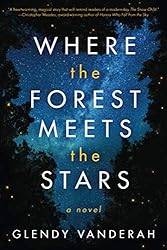

Where the Forest Meets the Stars
Glendy Vanderah, 2019
Lake Union Publishing
332 pp.
ISBN-13: 9781503904910
Summary
In this gorgeously stunning debut, a mysterious child teaches two strangers how to love and trust again.
After the loss of her mother and her own battle with breast cancer, Joanna Teale returns to her graduate research on nesting birds in rural Illinois, determined to prove that her recent hardships have not broken her.
She throws herself into her work from dusk to dawn, until her solitary routine is disrupted by the appearance of a mysterious child who shows up at her cabin barefoot and covered in bruises.
The girl calls herself Ursa, and she claims to have been sent from the stars to witness five miracles. With concerns about the child’s home situation, Jo reluctantly agrees to let her stay—just until she learns more about Ursa’s past.
Jo enlists the help of her reclusive neighbor, Gabriel Nash, to solve the mystery of the charming child. But the more time they spend together, the more questions they have.
How does a young girl not only read but understand Shakespeare? Why do good things keep happening in her presence? And why aren’t Jo and Gabe checking the missing children’s website anymore?
Though the three have formed an incredible bond, they know difficult choices must be made.
As the summer nears an end and Ursa gets closer to her fifth miracle, her dangerous past closes in. When it finally catches up to them, all of their painful secrets will be forced into the open, and their fates will be left to the stars. (From the publisher.)
Author Bio
Glendy Vanderah worked as an endangered bird specialist in Illinois before she became a writer. Originally from Chicago, she now lives in rural Florida with her husband and as many birds, butterflies, and wildflowers as she can lure to her land. Where the Forest Meets the Stars is her debut novel. (From publisher.)
Book Reviews
Though the novel appears to start as a fantasy, it evolves into a domestic drama with murder-mystery elements, all adding up to a satisfying read.
Booklist
Enchanting, insightful, and extraordinary.
Novelgossip
Vanderah’s beautifully human story reminds us that sometimes we need to look beyond the treetops at the stars to let some light into our lives.
New York Journal of Books
Where the Forest Meets the Stars is a magical little gem of a book filled with lots of love and hope.
HelloGiggles
A captivating fantasy tale of mystery and intrigue…
Fresh Fiction
A skillfully written and thoroughly entertaining novel by an author with a genuine gift for originality and a distinctive narrative-driven storytelling style.
Midwest Book Review
Where the Forest Meets the Stars, by Glendy Vanderah, is an enchanting, heartwarming, not to be missed novel that is bursting with love and hope.
Patriot Ledger
Discussion Questions
1. How did the word "changeling" in the first sentence affect how you thought about the girl and the coming story? Why do you think the author used this particular word?
2. After her mother’s death and her own battle with breast cancer, Jo isolates herself. Have you ever gone through something that you thought no one else could understand? How did you handle it?
3. How did Jo’s reaction to the girl’s unusual story conflict or agree with how you would have responded if a child told you this story? Why do you think Jo reacted as she did?
4. What was your initial impression of Gabe? Have you ever had a first impression of a person and later discovered you had misjudged them? Now that you know his story, why do you think he abruptly drove away after he met Jo and Ursa on the Kinney property?
5. Were Jo and Gabe’s decisions steered by Ursa’s clever manipulation or by their unconscious or conscious willingness to be manipulated? If they were aware of it, why did they let it happen?
6. How might Jo’s pre- and post-surgery images of herself help her relate to Ursa’s insistence that she’s an alien in a human body? Do you think Gabe had dual ways of seeing himself as well? Discuss how physical and emotional trauma changes people’s views of themselves.
7. Is Jo’s mother, in a way, still parenting her? Do you believe the lessons children learn from their parents, both good and bad, influence them all their lives? There are obvious differences between the parents of Jo, Ursa, and Gabe, but are there also similarities?
8. Why do you think Tabby and Jo got along so well? Do you think Tabby merited being Ursa’s third miracle?
9. How is the word and idea of "nest" used in different ways throughout the book? What themes in the story might nests represent? How do you think Gabe’s renaming of the Pinwheel Galaxy to ‘The Infinite Nest’ relates to those themes?
10. Have you seen bitter sibling relationships like the one between Gabe and Lacey? Was Lacey’s change at the end of the story realistic?
11. Depression can take many forms from mild to severe, and can be caused by hereditary, environmental, or both factors. Discuss how Gabe’s history with his mother, father, sister, and George could have contributed to his social anxiety and breakdown in college. Do you think Jo’s understanding of Gabe’s depression and Gabe’s own view of how severe it was were the same?
12. Do you think Jo’s ways of helping Gabe were overbearing or sensible?
13. Discuss the different ways the word "fate" is used throughout the book. Did you believe the events in this story were mostly caused by accidental twists of fate? How do you think Jo, Gabe, and Ursa would each answer that question?
14. Did the inclusion of Shakespearean characters help you see the story in new ways? What is the significance of Gabe telling Ursa she positively influenced the fates of the kittens Juliet and Hamlet?
15. How did you feel when the story suddenly shifted from the forest to the hospital? Discuss how this abrupt change of setting was important to the story.
16. Did you agree with Jo when she said the purpose of Ursa’s five miracles was to give her time to find a new home?
17. Do you think Jo should have been arrested for child endangerment? Why did Lenora Rhodes reverse her decision at the end of the story?
18. How did your view of Ursa change as you read the story? Discuss why the author chose to leave the reader questioning who Ursa is at the end of the story.
(Questions from the author's website.)
Where the God of Love Hangs Out
Amy Bloom, 2010
Random House
240 pp.
ISBN-13: 9780812977806
Summary
Love, in its many forms and complexities, weaves through this collection by Amy Bloom, the New York Times bestselling author of Away. Bloom's astonishing and astute new work of interconnected stories illuminates the mysteries of passion, family, and friendship.
Propelled by Bloom's dazzling prose, unmistakable voice, and generous wit, Where the God of Love Hangs Out takes us to the margins and the centers of real people's lives, exploring the changes that love and loss create. A young woman is haunted by her roommate's murder; a man and his daughter-in-law confess their sins in the unlikeliest of places. In one quartet of interlocking stories, two middle-aged friends, married to others, find themselves surprisingly drawn to each other, risking all while never underestimating the cost. In another linked set of stories, we follow mother and son for thirty years as their small and uncertain family becomes an irresistible tribe.
Insightful, sensuous, and heartbreaking, these stories of passion and disappointment, life and death, capture deep human truths. As The New Yorker has said, "Amy Bloom gets more meaning into individual sentences than most authors manage in whole books.". (From the publisher.)
Author Bio
• Birth—1953
• Education—B.A. Weslyan University; M.S.W. Smith College
• Awards—Costa Award
• Currently—lives in Connecticut, USA
Amy Bloom is the author of Come to Me, a National Book Award finalist; A Blind Man Can See How Much I Love You, nominated for the National Book Critics Circle Award; Love Invents Us; and Normal. Her stories have appeared in Best American Short Stories, O. Henry Prize Short Stories, The Scribner Anthology of Contemporary Short Fiction, and many other anthologies here and abroad.
She has written for The New Yorker, The New York Times Magazine, The Atlantic Monthly, Vogue, Slate, and Salon, among other publications, and has won a National Magazine Award. Bloom teaches creative writing at Yale University.
Bloom pubished her first novel, Away, in 2008. Another collection of stories, Where the God of Love Hangs Out, was published in 2010. (From the publisher.)
More
Trained as a social worker, Bloom has practiced psychotherapy and is currently a part-time lecturer of Creative Writing at the department of English at Yale University. Although not a psychologist, her involvement with psychotherapy played a role in writing the Lifetime Television network TV show, State of Mind, which takes a look at the professional lives of psychiatrists. Bloom is listed as one of the writers for the series and a co-executive producer.
Bloom received her B.A. from Wesleyan University, and a M.S.W. (Masters of Social Work) from Smith College. Bloom is divorced and has two daughters and a son. She resides in Connecticut. (From Wikipedia.)
Book Reviews
Given the range of both narratives, this work of extravagantly fine fiction cannot really be called a short-story collection. It's more of a reunion, or a set of successfully completed jigsaw puzzles. Each of the two quartets has been pieced together into a time-traveling novella filled with hindsight and passion and ever-evolving emotions. This book also includes four free-standing stories that have nothing to do with one another. But even if its format were more commonplace, Where the God of Love Hangs Out would still be something special. Ms. Bloom's characters are uncommonly fully formed, seldom young, some of them well into old age. Yet they sustain the ability to surprise one another—and themselves.
Janet Maslin - New York Times
Bloom...vividly chronicles the inner lives of people caught in emotional and physical constraints—illnesses they are striving to survive, regrets they are trying to allay, desires they often dare not fulfill. She writes in beautifully wrought prose, with spunky humor and a flair for delectably eccentric details. Her narrative talents include a fine touch with flashbacks, which she handles as suavely as any writer I can think of. Her gift for dialogue is equally terrific.... Brava, Ms. Bloom. Send us an equally sly, dashing book very soon, please.
Francine du Plessix Gray - New York Times Book Review
An antidote to the testosterone-laced worldview. These are quiet, well-executed tales of love, loss and family.
Sarah L. Courteau - Washington Post
Bloom's latest collection (after novel Away) looks at love in many forms through a keenly perceptive lens. Two sets of stories that read much like novellas form the book's soul; the first of which revolves around two couples—William and Isabel, Clare and Charles—and begins with Clare and William falling into an affair that endures divorces, remarriage and illness. Bloom has an unsettling insight into her character's minds: Clare's self-disgust is often reflected in her thoughts about William, demonstrating the complexity of their attraction as their comfort with each other grows, until she finally accepts the beauty of what they have—albeit too late. The second set of stories, featuring Lionel and Julia, is more complicated; the death of Lionel's father propels Lionel and Julia together in a night of grief, remarkable (and icky) mostly because Julia is Lionel's stepmother and his father's widow. As years go by, it is unclear whether Lionel's difficulties are due to that indiscretion, but watching Bloom work Lionel, Julia and her son through the rocky aftermath is a delight. The four stand-alone stories, while nice, have a hard time measuring up against the more immersive interlinked material, which, really, is quite sublimey.
Publishers Weekly
Bloom's new collection features two sets of connected stories that characterize the far-reaching trajectory of love within memorable groups of characters. In one grouping, William and Clare, literature professors in two parallel marriages, are drawn to each other in middle age after years as highly compatible friends. In the other, Lionel, the adolescent son of a well-known jazz musician, and Julia, recently widowed from that musician, are forced to redefine their relationship in the face of the man's death. In both sequences, realignments between children and adults are unpredictable but deeply felt. Verdict: The characters from the two sets of linked stories are so engaging that the inhabitants of the four strong stand-alone entries feel like mere walk-ons. Readers of Bloom's earlier collections will be happy to reencounter some of the characters they've already met, as two of the stories are from Come to Me and A Blind Man Can See How Much I Love You. An eminently readable new collection. —Sue Russell, Bryn Mawr, PA
Library Journal
Nine uncollected stories plus three that appeared in earlier collections are interestingly arranged and recombined in this latest from the Manhattan psychotherapist and versatile author (Away, 2008, etc.). The first four chronicle the adulterous relationship, then the sad late-life marriage of 50-somethings Clare and William, who find amorous moments together during shared vacations and visits to and with each other's unsuspecting spouses. Bloom's plainspoken, witty prose is displayed to fine effect in unglamorous snapshot revelations of self-indulgent, heart-attack-waiting-to-happen William and weary, unillusioned Clare (who sardonically asks herself, "What has it ever been between them but the rubbing of two broken wings?"). Four other interrelated stories span years of familial and less conventional love between Julia, a music journalist who becomes a black jazz musician's third wife, then his widow, and his son and namesake Lionel, a biracial heartthrob who is drawn much too closely into intimacy with his grieving stepmother. Except for the last of these four, in which Lionel is both further injured and paradoxically healed by his weakness and guilt, this is an original and moving dramatization of the complex burdens of togetherness and independence, soaring ambition and muted resignation. The remaining unrelated stories-which seem to belong in another book-are a mixed bag. "Permafrost" suggestively links a hospital social worker's compassionate identification with a young girl's sufferings to the former's lifelong fascination with the historic Shackleton Arctic expedition. "Between here and here" and "By-and-By" deal somewhat melodramatically with family-related traumas. But in the wry title story, stoic survival is persuasively incarnated in a saturnine widower who takes botched relationships, failing bodily functions, even "women OD'ing on coke in front of their children" phlegmatically in stride. Not Bloom at her very best, but impressive enough confirmation of this clever writer's ability to challenge the way we see ourselves and to show us as we are.
Kirkus Reviews
Discussion Questions
1. Why do you think Bloom chose to tell the stories of Lionel and Julia and William and Clare through a collection of interlocking stories? Does this device allow Bloom to reveal something that a single story or the novel form would not? Can you read the stories individually, or must they be read only as a collection?
2. What do the titles of these stories tell us about what is going on below the surface? For example, what does “The Old Impossible” suggest about William and Clare’s love? Or “Night Vision” about Lionel and Julia’s relationship?
3. In these stories, Bloom explores love in many forms— old friendships, marriage, parenthood. What are some of the other types of love relationships found in these stories? Which ones are unexpected? Which are forbidden or secret?
4. Which characters transgress the boundaries of their relationships with other characters? How do these transgressions change the nature of the relationship? Which actions damage a relationship forever? Which relationships cannot be repaired? What price do they pay for their transgressions?
5. Many of Bloom’s characters play multiple roles—mother, sister, daughter, wife, lover. Do these roles, such as husband or wife, provide safety? If so, what happens when these labels are undermined? Explore the many roles assumed by William and Clare at the beginning of their relationship— not only with each other but also with the other characters. How do these roles change by the end of “Compassion and Mercy”?
6. Does love change over time? What is the nature of love in the second half of life? How does love toward the end change our understanding of its beginning? In “Between Here and Here,” the daughter undergoes a transformation in her understanding of her father as he ages. How do you understand his change in behavior and her feelings toward him? How do Lionel’s feelings about Julia evolve as she ages?
7. Many love stories explore only the mysteries and wonders of love, but Bloom goes further and often writes about love’s darker side. What are some of the casualties of love in these stories? What happens when love ends, either by choice or, which it always does, death?
8. Many of the most important scenes in these stories happen around the dinner table as the characters share a meal or a drink. What role does food play in each of the stories? How do we understand William and Clare sharing nectarines in “The Old Impossible”? Or Lionel teaching Buster to eat a peach in “Fort Useless and Fort Ridiculous”? How does the family Thanksgiving tradition evolve over the Lionel and Julia stories, and what does this reveal about the family?
9. What are some of the secrets kept in these stories? How do secrets affect love? How do they define the love relationships?
10. In the story “Where the God of Love Hangs Out,” Ray and Ellie remind each other that they vowed to love each other “for better or for worse.” Do you agree that love must be able to contain both? What were some of the “for betters” in these stories? What were some of the “for worses”?
11. In Bloom’s stories, it is the small acts of everyday love and intimacy that mean the most between two people. What are some examples from this collection?
(Questions issued by publisher.)
top of page
Where the Heart Is
Billie Letts, 1995
Grand Central Publishing
384 pp.
ISBN-13: 9780446603652
Summary
Novalee Nation is seventeen, seven months pregnant, and on her way to California with her no-good boyfriend when he abandons her at a shopping mall in Oklahoma. In this contemporary fairy tale with no fairy godmother in sight, Novalee depends on herself to build a new life.
Living inside a Wal-Mart at night and on the streets during the day, Novalee patches together a family from the caring people she meets. Capturing each one on Polaroid film, she sees the goodness of each soul and finds a way to help others as they help her. (From the publisher.)
Author Bio
• Birth—1937
• Where—Tulsa, Oklahoma, USA
• Education—B.A., Southeast Missouri State University
• Awards—Percy Walker Award
• Currently—lives in Tulsa, Oklahoma
Billie Letts is the author of numerous highly acclaimed short stories and screenplay, and a former professor at Southeastern Oklahoma State University. Her first novel, Where The Heart Is, won the Walker Percy Award, sold more than three million copies, and became a major motion picture. Her second novel, The Honk and Holler Opening Soon, was named the first "Oklahoma Reads Oklahoma" selection. Her third novel, Shoot the Moon and her fourth novel, Made in the U.S.A. were both New York Times bestsellers. Billie Letts is a native Oklahoman, and currently lives in Tulsa. (From the publisher.)
More
Betts was married to professor-turned-actor Dennis Letts, from 1958 until his death from cancer in 2008. Dennis served as Billie's editor for her novels. Together they had three sons: Dana Letts; playwright and actor, Tracy Letts; jazz musician and composer, Shawn Letts. (From Wikipedia.)
Book Reviews
This crisp, tight, beautifully written work never goes a word to far.... Prizewinning writers Clyde Edgerton, E. Annie Proulx, and Barbara Kingsolver may have to move over to make room for Billie Letts.
Dallas Morning News
You can't go wrong with charactes like these.... Where The Heart Is... is quick and funny, and you absolutely love these people.
Miami Herald
A feel-good story, centered in America's heartland, where dreams can still come true and people still care enough about each other to give a leg up when it is needed.... A wonderful inspirational book that causes chuckles and tears.
Midwest Book Review
It isn't only that Billie Letts has a talent for humor and an ear for Wal-Mart vernacular, but that she has a genuine affection for her characters. Novelee and Sister and Forney are marvelously real, and they make reading [this novel] pure pleasure.
North American Review
Readers immersed in the offbeat world of Letts's lively, affecting first novel will forgive its occasional forced quirkiness. For 17-year-old Novalee Nation, seven months pregnant, the phrase "home is where your history begins" has a special meaning. Leaving behind a trail of foster homes in Tennessee trailer parks to live in a real house with her boyfriend, Willy Jack Pickens, Novalee instead finds herself abandoned in front of a Wal-Mart in Sequoyah, Okla. With nowhere to turn, she cleverly conceals herself within the store, keeping careful accounts until giving birth to the "Wal-Mart baby" turns her into a local celebrity. Happily, the community reaches out to Novalee and baby Americus. Sequoyah's one-woman welcoming committee, Sister Husband, takes them in; cultured librarian Forney Hull takes a shine to them; photographer Moses Whitecotton encourages Novalee's raw talent for photography by teaching her all he knows; Lexie Coop, who has a huge appetite for food, diet fads and the wrong men, befriends her; and legendary Wal-Mart founder Sam Walton gives her a job. Meanwhile, Willy Jack, an aspiring musician, gets a shot at the big time before hitting bottom and realizing what he's left behind. Letts's wacky characters are depicted with humor and hope, as well as an earnestness that rises above the story's uneven conceits, resulting in a heartfelt and gratifying read.
Publishers Weekly
Novalee Nation, 17 and pregnant, finds herself stranded outside a Wal-Mart in Sequoyah, Oklahoma, with $7.77 in her pocket and no one to turn to for help. This is an unlikely beginning for a humorous and hopeful novel, but that is just what this is. As she sits outside the store taking stock of her situation, plucky Novalee meets several of the town's more unusual inhabitants: Sister Husband, who presents her with a shop-worn welcome-wagon basket; black photographer Moses Whitecotton, who conveys to her the importance of a name for her unborn child; and Indian Benny Goodluck, who gives her a buckeye tree for good luck. These and other Sequoyah citizens rally around Novalee when she has her baby on the floor of Wal-Mart, and form the basis for this most enjoyable novel. —Pamela B. Rearden, Centreville Regional Library, Fairfax County, VA
School Library Journal
The tribulations of 17-year-old Novalee Nation, daughter of the Tennessee trailer parks, make up a surprisingly long, none-too-subtle tale.
Booklist
Discussion Questions
1. The theme of "home" runs throughout this novel. Would you characterize home as a place, a family, a state of mind, or, as Sister Husband says, a place "where your history begins"? As a homeless person longing for a home, Novalee's image of home is heavily influenced by the images she sees in maga-zines. How influenced are we all by portrayals of home and home life in the media, movies, and on television?
2. In the beginning of the novel, Novalee is a poor, uneducated teenage mother whose own mother abandoned her at a young age. Novalee, however, seems to be remarkably maternal and responsible in her parental role. Do you think this is a believable portrayal of teenage motherhood? Is it possible that lacking a loving mother herself she would be such a good mother? Both Novalee and Lexie defy our stereotypes of poor, single mothers. Do you think this is a strength or a weakness of the novel?
3. Novalee's superstition about the number seven intensifies after the birth of her daughter. What do you make of Novalee's seemingly irrational fears? What role do superstitions play in the lives of even the most rational of us? Are there any other patterns or cycles you recognize in the novel?
4. Despite his cruelty, women are attracted to Willy Jack and are willing to take care of him. What is the attraction of cruel men to needy women? Lexie says, "Girls like us don't get the pick of the litter." What do you think of this statement? And why do you think that Novalee decides to help Willy Jack when she learns of his plight?
5. Willy Jack's story is interspersed throughout the novel. Do you think his story is necessary to the plot? Why or why not? If this novel had been told through the eyes of Willy Jack Pickens, in what ways might we see Novalee differently?
6. Novalee takes pictures to "see something in a way nobody else ever had" and Forney reads to explore the world outside the confines of his own life. Do you think books and photography help them deal with their lives or keep them from dealing with life head on? In what other ways do we use inanimate objects to either cope with life or hide from it?
7. Children play an important role in this novel. How are their stories important? What do each of the children—Americus, Benny, Praline, Brownie--teach us about love and loss of innocence?
8. Despite their struggles, Lexie's family is incredibly loving, fun-filled, and close. This is what makes the attack on Lexie and Brownie so heart wrenching and shocking. Do you think Brownie's trust in adults can ever be fully restored? Why do you think the author decided to include such a brutal scene in a book filled with so much kindness?
9. How did you feel when Novalee spurned Forney? Did you believe they would ultimately end up together? Do you think they are well matched? Do you believe that differences in education and social class matter in a relationship, and what do you think makes it possible to bridge such differences? Or do you believe that people with similar backgrounds tend to be better matched?
10. There are no traditional families in this novel. Why do you think the author chose to write a book about home and family yet disregarded established notions of what constitutes each? Though many of us accept and embrace different forms of family life, why do you think the traditional family is still frequently portrayed as mother/father/children? Do you think this remains the "ideal"?
(Questions issued by publisher.)
top of page

Where the Light Falls: A Novel of the French Revolution
Allison and Owen Pataki, 2017
Random House
384 pp.
ISBN-13: 9780399591686
Summary
Three years after the storming of the Bastille, the streets of Paris are roiling with revolution. The citizens of France are enlivened by the ideals of liberty, equality, and fraternity.
The monarchy of Louis XVI and Marie Antoinette has been dismantled—with the help of the guillotine—and a new nation is rising in its place.
Jean-Luc, an idealistic young lawyer, moves his wife and their infant son from a comfortable life in Marseille to Paris, in the hopes of joining the cause.
Andre, the son of a denounced nobleman, has evaded execution by joining the new French army. Sophie, a young aristocratic widow, embarks on her own fight for independence against her powerful, vindictive uncle.
As chaos threatens to undo the progress of the Revolution and the demand for justice breeds instability and paranoia, the lives of these compatriots become inextricably linked. Jean-Luc, Ande, and Sophie find themselves in a world where survival seems increasingly less likely—for themselves and, indeed, for the nation.
Featuring cameos from legendary figures such as Robespierre, Louis XVI, and Thomas-Alexandre Dumas, Where the Light Falls is an epic and engrossing novel, moving from the streets and courtrooms of Paris to Napoleon’s epic march across the burning sands of Egypt.
With vivid detail and imagery, the Patakis capture the hearts and minds of the citizens of France fighting for truth above all, and for their belief in a cause greater than themselves. (From the publisher.)
Author Bio
• Birth—1984
• Raised—Garrison, New York, USA
• Education—B.A., Yale University
• Currently—lives in Chicago, Illinois
Allison Pataki is an American author and journalist and the daughter of former governor of New York, George Pataki (served 1995-2006). She was raised in Garrison, New York, across the Hudson River from West Point Military Academy, and later majored in English at Yale University. She met her husband David Levy during her sophomore, and the two married in June 2012.
Pataki has written several historical novels: The Traitor's Wife: The Woman Behind Benedict Arnold and the Plan to Betray America (2014), The Accidental Empress (2015), Sisi: Empress on Her Own (2016), and Where the Light Falls: A Novel of the French Revolution (2017), which she co-authored with her brother Owen.
In addition to historical fiction, Allison has written for ABCNews.com, The Huffington Post, FoxNews.com, Travel Girl, and other media outlets. In 2016 she wrote an article for the New York Times detailing her family's experience with traumatic brain injury and the road to recovery.
In 2015, Pataki co-founded reConnect Hungary, an educational and social immersion program for young adults of Hungarian heritage, who are born in the U.S. or Canada, to gain a better understanding of their Hungarian heritage. (Adapted from Wikipedia. Retrieved 7/15/2017.)
Book Reviews
A vivid painting of Paris during the Reign of Terror.... Devotees of Dumas and Hugo willdevour this tale of heroism and treachery…but purists may balk at the occasional anachronistic language and dialog...and other fictionalization of real people despite explanations by the authors.
Library Journal
Meticulously researched…the book succeeds in forcefully illustrating the lessons of the French Revolution for today’s democratic movements. However, sheer talkiness too often overpowers the narrative, and the swashbuckling close is too little, too late. [W]orthy but stultifying.
Kirkus Reviews
Discussion Questions
1. This novel begins with a scene at the guillotine, one of the bloodiest and most iconic symbols of the French Revolution, specifically its Reign of Terror. Why do you think the authors begin the story in this way? What role does the guillotine play throughout this novel? How does this opening scene compare to the epilogue, which plays out before Notre Dame Cathedral at the coronation of Emperor Napoleon?
2. The characters in Where the Light Falls frequently mention the ideals of the Enlightenment and its impact on the French Revolution. Do you believe the Revolution was born out of the Enlightenment? Why or why not?
3. This book has many examples of mentors or father figures guiding younger people, some more positive than others. Discuss some of these mentors. Whom did you find to be the most inspiring? Whom did you find to be the most malicious?
4. Compare the French Revolution with the American Revolution of just a few years earlier. Why do you believe they were so different? Were they similar in any way? How would the characters of Where the Light Falls compare the two?
5. Compare and contrast the two discussions Andre Valiere has on the eve of the battle of Valmy. One is with General Murat, the other with General Kellermann. What message was each older man was trying to send, and which had a stronger effect on Andre? Why?
6. In this story, Jean-Luc St. Clair struggles to balance his obligations to his family as a father and a husband with his duties as a lawyer, citizen, and republican fighting for his beliefs. Does he strike an appropriate balance between the two, or does he fall short in his obligations to one or the other? Why?
7. Sophie de Vincennes tells Andre of her forced marriage at a very young age to a count. Discuss the obstacles and opportunities women of this time period faced. Find three women from this period and list some of the obstacles they faced and how they overcame them (or did not).
8. Guillaume Lazare is a fictional character based on several real-life French revolutionaries. Who do you think were the real individuals that his character is based on, and what similarities or differences do you find between the character and the real historical figures?
9. Compare Napoleon’s expedition to Egypt with more recent interventions in the Middle East and North Africa. Are there any similarities between the conquest explored in this book and contemporary conflicts? How are they different?
10. Were you surprised by the revelation of the true identity of the writer known as Citizen Persephone? Why or why not? Why do you think the writer kept his or her identity a secret?
11. The Widow Poitier plays a small but significant recurring role throughout this novel. Discuss this powerless peasant woman and the significance of her appearances in Jean-Luc’s life.
12. Consider the character of General Thomas-Alexandre Dumas, based on the historical figure of the same name, the father of the celebrated French writer Alexandre Dumas. What did you learn from his life story? Were you surprised by the role he played in Andre’s fate?
(Questions issued by the publisher.)


Where the Moon Isn't
Nathan Filer, 2013
St. Martin's Press
320 pp.
ISBN-13: 9781250026989
Summary
While on vacation with their parents, Matthew Homes and his older brother snuck out in the middle of the night. Only Matthew came home safely.
Ten years later, Matthew tells us, he has found a way to bring his brother back...
What begins as the story of a lost boy turns into a story of a brave man yearning to understand what happened that night, in the years since, and to his very person. Unafraid to look at the shadows of our hearts, Nathan Filer's rare and brilliant debut Where the Moon Isn't shows us the strength that is rooted in resilience and love. (From the publisher.)
Author Bio
Nathan Filer is a writer and a mental health nurse. He has worked as a researcher at the academic unit of psychiatry at the University of Bristol and on in-patient psychiatric wards. Filer graduated from the prestigious Bath Spa University creative writing program with an MA in 2011, and Where the Moon Isn’t is his first novel. He lives with his family in Bristol. (From the publisher.)
Book Reviews
...Matthew, 10 years later, still blames himself for his brother’s death. Although the moon that was Simon’s face now isn’t, Matthew continues to hear his voice where he is being kept in an acute psychiatric ward. For Matthew is schizophrenic.... The story Filer tells is deeply affecting and insightful in its account of mental illness. And Matthew is a character the reader won’t soon forget. —Michael Cart.
Booklist
[Matthew is] 19, quirky, lives in Bristol, England, and comes with a lot of baggage that he's happy to share in his own way and at his own pace. Matthew is also bipolar....haunted by the fate of his older brother who years ago went missing on a family seaside holiday.... [This book] will appeal to anyone looking for a serious (but not ponderous) story that's impossible to put down. —Bob Lunn, Kansas City, MO
Library Journal
A fatal accident forever marks the life of a young British man struggling with his own demons.... [T]his debut novel by mental health nurse Filer is a startlingly authentic portrayal of the rigors and tribulations of navigating the modern health care landscape while struggling with mental illness. The novel's protagonist is Matthew Holmes, a fairly typical 19-year-old lad living in Bristol under the shadow of terrible grief.... This is a terribly unsettling novel, but it works on many levels--as family drama, as a searing indictment of Western health care and as a confession. A haunting story about how to mourn when the source of your grief will never go away.
Kirkus Reviews
Discussion Questions
1. Discuss Matthew’s relationship with his parents. How does it change throughout the novel?
2. Why does Matthew need to tell his story? Is the act of writing a cathartic process?
3. How does Matthew portray life in the psychiatric ward? Were you shocked by any of the
descriptions?
4. What is Nanny Noo’s role in the novel?
5. Discuss Matthew’s comment on page 275, ‘I guess there’s a Use By date when it comes to
blaming your parents for how messed up you are’.
6. In Matthew’s invitation to Aaron and Jenny, he writes ‘I’m really sorry if I’ve got your name
wrong. Part of me thinks it’s Gemma. Please forgive me if I got it wrong. Not making excuses, but
I am a schizophrenic.’ Is this an indication that Matthew has come to terms with his illness? Why
does he joke about it?
7. How did the novel make you feel? Would you recommend it?
8. Did you have much of an insight into schizophrenia before reading the novel? Has it made you
want to find out more about mental illness?
(Questions issued by publisher.)
Where the Truth Lies
Rupert Holmes, 2003
Random House
432 pp.
ISBN-13: 9780812972238
Summary
O’Connor, a vivacious, free-spirited young journalist known for her penetrating celebrity interviews, is bent on unearthing secrets long ago buried by the handsome showbiz team of singer Vince Collins and comic Lanny Morris.
These two highly desirable men, once inseparable (and insatiable, where women were concerned), were driven apart by a bizarre and unexplained death in which one of them may have played the part of murderer.
As the tart-tongued, eye-catching O’Connor ventures deeper into this unsolved mystery, she finds herself compromisingly coiled around both men, knowing more about them than they realize and less than she might like, but increasingly fearful that she now knows far too much. (From the publisher.)
Author Bio
• Birth—February 24, 1947
• Where—Northwich, Cheshire, UK
• Reared —in Nanuet, New York, USA
• Education—Manhattan School of Music
• Awards—Tony Awards, Edgar Awards (see below)
For his Broadway musical The Mystery of Edwin Drood, Rupert Holmes became the first person in theatrical history to solely receive Tony Awards for Best Book, Best Music, and Best Lyrics, while Drood itself won the Tony Award for Best Musical. The Mystery Writers of America gave Holmes their coveted Edgar Award for his Broadway comedy-thriller Accomplice, the second time he received their highest honor. He created and wrote all four seasons of the critically acclaimed Emmy Award–winning series Remember WENN, and also authored the Broadway hit Say Goodnight, Gracie, based on the life of George Burns.
Holmes began his career in the seventies as the writer and composer of songs so intricate that many have been included in mystery collections from Ellery Queen. The Los Angeles Times has stated that “Rupert Holmes is an American treasure.” Where the Truth Lies and was adapted into the 2005 film, starring Colin Firth and Kevin Bacon. (From the publisher.)
Book Reviews
Holmes, who has won honors galore for his inventive storytelling on Broadway and elsewhere, can be forgiven for milking the mystery of ''the Girl in New Jersey'' because he delivers such a giddy fun-house ride through bygone eras. As the go-go girl of the 70's, O'Connor tempts us to throw on a pair of bell-bottoms and dash out for some reckless sex, while Vince and Lanny invest the forgotten 50's with all the brash and vulgar celebrity glamour of a mad tea party in Las Vegas.
Marilyn Stasio - New York Times
It should be no surprise that, after his long career in music and the theater, Holmes's first novel is an insider's look at the world of show business. To be precise, it is an exceedingly clever, somewhat troubling thriller based on the lives of Dean Martin and Jerry Lewis.
Patrick Anderson - Washington Post
Where the Truth Lies is a labor of love. Every scrap of lawyerese or Mafia-speak, every tidbit of Hollywood lore, every scene of mental or physical intoxication, every tightening of the suspense — as O'Connor, entangled in her own lies, risks embarrassment, her book deal and finally her life — is beautifully rendered, polished to a sheen.
Michael Harris - Los Angeles Times
Holmes is an award-winning Broadway playwright and composer (The Mystery of Edwin Drood; Accomplice), so it's only appropriate that his hugely entertaining first novel should be set in the world of show business. It purports to be the account of one K. O'Connor (we never learn her first name), a smart, pretty and accomplished young journalist who has been commissioned to write a book about a celebrated comedy team of the '60s, Vince Collins-who sang smoothly and was a ladies' man, and Lanny Morris, who clowned around (Martin and Lewis, anyone?). At the height of their career, a dead girl was found in their hotel room, and although neither of them was accused (they had airtight alibis), the incident put an end to their act, and as the book begins, they haven't seen each other for years. O'Connor sniffs around Collins, reads some chapters Morris has set down for a book of his own and begins to wonder just where the truth does lie. Holmes has a wonderful feeling for period detail, and the '60s and '70s spring vividly back to horrific life through the brilliant narration of the romantically susceptible O'Connor. For much of its course the novel is witty, sexy and suspenseful, but eventually it morphs into a more conventional whodunit, with one of those windups in which a complicated plot is sorted out in improbable dialogue between accuser and perpetrator, and the giddy pleasures of the first two-thirds are somewhat overshadowed. That's not enough, however, to spoil what is for most of the way a glittering ride.
Publishers Weekly
Though no real-life celebrities are identified, this first novel makes it clear from the outset that it takes inspiration from a boffo comedy duo from the 1950s-one crooner, one spastic. O'Connor, a young and sexy female reporter, closes a deal to write the singer's biography, but his estranged partner keeps entering the picture; he has his own version of the team's history, including the darker avenues. There is a question of a murdered woman, and investigator though she may be, O'Connor soon realizes the risk of coming between the two icons. For all of Holmes's accomplishments (pop singer, Tony and Emmy Award winner, record producer), this is his debut in the writing world, and it's notable for its wit, snappy dialog, and uncanny sense of Hollywood glitz, backstage politics, and dirty deeds. This can't-miss novel will have wide appeal, including fans of the time period, modern mystery lovers, and anyone who likes turning pages rapidly. Highly recommended
Library Journal
Sly young reporter digs into the seamy past of a comedy team who are no longer on speaking terms. Edgar/Tony/Emmy award-winning playwright/singer/songwriter Holmes hangs his splashy and amusing plot on an unsolved murder in the bitter past of a song-and-laff-riot team unmistakably modeled on Dean Martin and Jerry Lewis-nuances may be lost on post-boomer generations, but they'll still enjoy the naughty bits (there are plenty), the jokes (ranging from Borscht Belt to Seinfeld), and the sardonic musings of our heroine K. O'Connor (full first name never given), an ambitious, clever, and foolhardy writer in her 20s. O'Connor's New York publisher has managed to extract a million-dollar contract from Vince Collins, the famously discreet singing half of the now-parted duo. Her goal is to get to the bottom of the scandal that immediately preceded Collins's split from Lanny Morris in the early '60s. The scandal had to do with the discovery of a beautiful bellhop drowned in a bathtub in New Jersey, a thousand miles from her job at the Versailles Hotel in Miami, where Collins and Morris had just performed their final polio telethon. O'Connor is unsurprised when her knees buckle in the presence of the gorgeous Vince, but she's flabbergasted when, on a flight to New York, she succumbs to the unsuspected magnetism of Lanny Morris, who is absolutely nothing like his repulsive screen image. Immediately complicating her life and setting up the story, O'Connor pretends to be her schoolteacher girlfriend Beejay Trout and lets Lanny take her to the moon. Readers who can accept the possibility of a really cool Jerry Lewis and a twentysomething reporter with the sharp wit of a fiftysomething comedy genius will have a swell time finding out how the beautiful corpse came to lose a couple of toes and what really came between the former chums. Slickly funny showbiz romp with lots of great scenery.
Kirkus Reviews
Discussion Questions
Use our LitLovers Book Club Resources; they can help with discussions for any book:
• How to Discuss a Book (helpful discussion tips)
• Generic Discussion Questions—Fiction and Nonfiction
• Read-Think-Talk (a guided reading chart)
top of page
|
Where We Belong |
|
 

Marian
* * * * *
|
|


Where We Belong
Emily Giffin, 2012
St. Martin's Press
384 pp.
ISBN-13: 9780312554187
Summary
The author of five blockbuster novels, Emily Giffin, delivers an unforgettable story of two women, the families that make them who they are, and the longing, loyalty and love that binds them together.
Marian Caldwell is a thirty-six year old television producer, living her dream in New York City. With a fulfilling career and satisfying relationship, she has convinced everyone, including herself, that her life is just as she wants it to be. But one night, Marian answers a knock on the door... only to find Kirby Rose, an eighteen-year-old girl with a key to a past that Marian thought she had sealed off forever.
From the moment Kirby appears on her doorstep, Marian’s perfectly constructed world—and her very identity—will be shaken to its core, resurrecting ghosts and memories of a passionate young love affair that threaten everything that has come to define her.For the precocious and determined Kirby, the encounter will spur a process of discovery that ushers her across the threshold of adulthood, forcing her to re-evaluate her family and future in a wise and bittersweet light.
As the two women embark on a journey to find the one thing missing in their lives, each will come to recognize that where we belong is often where we least expect to find ourselves—a place that we may have willed ourselves to forget, but that the heart remembers forever. (From the publisher.)
Read an excerpt • See the video
Author Bio
• Birth—March 20, 1979
• Where—Baltimore, Maryland, USA
• Raised—Naperville, Illinois
• Education—B.A., Wake Forest University; J.D., University of Virginia
• Currenbtly—lives in Atlanta, Georgia
Emily Giffin is the bestselling American author of eight novels commonly categorized as "chick lit." More specifically, Giffin writes stories about relationships and the full array of emotions experienced within them.
Giffin earned her undergraduate degree at Wake Forest University, where she also served as manager of the basketball team, the Demon Deacons. She then attended law school at the University of Virginia. After graduating in 1997, she moved to Manhattan and worked in the litigation department of Winston & Strawn. But Giffin soon determined to seriously pursue her writing.
In 2001, she moved to London and began writing full time. Her first young adult novel, Lily Holding True, was rejected by eight publishers, but Giffin was undaunted. She began a new novel, then titled Rolling the Dice, which became the bestselling novel Something Borrowed.
2002 was a big year for Emily Giffin. She married, found an agent, and signed a two-book deal with St. Martin's Press. While doing revisions on Something Borrowed, she found the inspiration for a sequel, Something Blue.
In 2003, Giffin and her husband left England for Atlanta, Georgia. A few months later, on New Year's Eve, she gave birth to identical twin boys, Edward and George.
Something Borrowed was released spring 2004. It received unanimously positive reviews and made the extended New York Times bestsellers list. Something Blue followed in 2005, and in 2006, her third, Baby Proof, made its debut. No new hardcover accompanied the paperback release of in 2007. Instead, Giffin spent the year finishing her fourth novel and enlarging her family. Her daughter, Harriet, was born May 24, 2007.
More novels:
2008 - Love the One You're With
2010 - Heart of the Matter
2012 - Where We Belong
2014 - The One & Only
2016 - First Comes Love
(Author bio adapted from Wikipedia.)
Visit the author's website.
Follow Emily on Twitter.
Book Reviews
Book clubs will have a field day with this one. Thorny mother-daughter relationships and secrets we keep from loved ones burn up the pages.
USA Today
After five charming relationship-themed hits, Emily Giffin had a lot to live up to with Where We Belong. Luckily, the author executes with a thoughtful finesse that makes this easily her best work yet. [Where We Belong] is that special type of story that takes priority over getting to bed on time. And the payoff is well worth it.
Boston Globe
The issue about secrets isn’t about keeping them. It’s the reveal and its consequences. That’s the challenge faced by the characters in Emily Giffin’s new, briskly paced…Where We Belong. Taking a somewhat more somber tone than she did in her [previous] bestselling novels, Giffin’s approach and style mature in this latest effort.
Philadelphia Inquirer
Emily Giffin ranks as a grand master. Over the course of five best-selling novels, she has traversed the slippery slopes of true love, lost love, marriage, motherhood, betrayal, forgiveness and redemption that have led her to be called ‘a modern-day Jane Austen.’ With Giffin’s use of humor, honesty, originality and, like Austen, a biting social commentary, this modern-day ‘woman’s novel’ sits easily on nightstands and in beach bags. Even Austen would find it hard to put down.
Chicago Sun-Times
Emily Giffin’s Where We Belong is a literary Rorschach test. The book, while thoroughly entertaining, will also prod readers to examine choices they’ve made in their lives. It will compel them to muse about things they’d like to do over, to do differently, to do better…[and] gracefully examines themes of identity, family and forgiveness.
Miami Herald
Emily Giffin has a wonderful way with words. [Where We Belong] is an emotionally powerful story that will ring true with women who have given a child away and with those who grew up wondering where they came from. Giffin may be working with a premise and plot that is fairly simple, but there’s nothing lightweight about the emotional turbulence she creates.
Ft. Worth Star-Telegram
Emily Giffin’s new novel about the legacy of adoption, Where We Belong, imagines what happens when an 18-year-old girl tracks down her birth mother…the latest in a string of provocative, imaginative novels that began in 2004 with SOMETHING BORROWED. All the characters [here] are on a journey to find ‘where we belong,’ and Giffin knits together their journeys with a masterly hand.
Seattle Times
[T]oo suspenseful to be called chick lit and too relationship-centered to be labeled a thriller. But most readers will have little time to think of a genre for Emily Giffin’s latest novel as they race through this gripping story about the reunion of a high school senior and the woman who put her up for adoption 18 years earlier.
Connecticut Post
Graceful and inviting prose, careful plotting and vivid characterizations…The coming together of two people who share a genetic heritage and little else is dramatically and emotionally risky. But Giffin makes the most of the opportunity, and Where We Belong had me riveted.
Winston-Salem Journal
Kirby Rose turns 18, hops on a Greyhound bus from St. Louis to Manhattan and with no warning, knocks on the Fifth Avenue apartment door of her birth mother, Marian Caldwel.... Giffin's moving storyline offers great pacing, believable, disparate characters and a plot that could easily careen into maudlin territory, unlikable stereotypes or over-the-top emotionalism but never does: a sweet, even-keeled winner
Kirkus Reviews
Discussion Questions
1. One of the themes in Where We Belong is what happens when we keep secrets. Discuss the reasons people keep secrets. Describe the secrets in this book and the reasons various characters had for keeping them. Do you think secrets and lies are one in the same? How do the characters in the novel accept or come to terms with the secrets they've kept or the ones that have been kept from them?
2. Discuss the issue of forgiveness in the book. Which character has the most to forgive? Do you think Conrad will ever be able to fully forgive Marian? Has Marian forgiven her parents? Has Kirby forgiven hers?
3. Kirby and Marian both change over the course of this story. What are the most significant ways they've changed? What risks do they each take? Was there any decision or action you disagree with on the part of Marian or Kirby?
4. Are people more influenced by their genes or their upbringing? How does this question relate to the events in the novel? How do you think the various characters in this book might define family?
5. Why do you think the author chose the title "Where We Belong"? What meaning, or meanings, does the title have in relation to the story and characters?
(Questions issued by publisher.)
top of page (summary)

Where'd You Go, Bernadette
Maria Semple, 2012
Little, Brown & Company
352 pp.
ISBN-13: 9780316204262
Summary
Bernadette Fox is notorious.
To her Microsoft-guru husband, she's a fearlessly opinionated partner; to fellow private-school mothers in Seattle, she's a disgrace; to design mavens, she's a revolutionary architect, and to 15-year-old Bee, she is a best friend and, simply, Mom.
Then Bernadette disappears. It began when Bee aced her report card and claimed her promised reward: a family trip to Antarctica. But Bernadette's intensifying allergy to Seattle—and people in general—has made her so agoraphobic that a virtual assistant in India now runs her most basic errands. A trip to the end of the earth is problematic.
To find her mother, Bee compiles email messages, official documents, secret correspondence—creating a compulsively readable and touching novel about misplaced genius and a mother and daughter's role in an absurd world. (From the publisher.)
Author Bio
• Birth—June, 1964
• Where—Santa Monica, California, USA
• Education—B.A., Barnard College
• Currently—lives in Seattle, Washington
Maria Keogh Semple is an American novelist and screenwriter. She is the author of three novels. Her television credits include Beverly Hills, 90210, Mad About You, Saturday Night Live, Arrested Development, Suddenly Susan and Ellen.
Early Life
Semple was born in Santa Monica, California. Her family moved to Spain soon after she was born. There her father, the screenwriter Lorenzo Semple, Jr. wrote the pilot for the television series Batman. The family moved to Los Angeles and then to Aspen, Colorado. Semple attended boarding school at Choate Rosemary Hall, then received a BA in English from Barnard College in 1986.
Film
Her first screenwriting job was in 1992, for the television show Beverly Hills, 90210. She was nominated for a Primetime Emmy, Outstanding Television Series, in 1997 for Mad About You. In 2006 and 2007, she was nominated for a Writer's Guild of America award, for Arrested Development. She appeared in the 2004 David O. Russell film I Heart Huckabees.
Novels
Semple's three novels include Today Will Be Different (2016), Where'd You Go, Bernadette (2012), and This One is Mine (2008). Her books center around women who juggle and struggle with contemporary life: work, family, love, and self-esteem. Critics have referred to her writing as witty, funny, inventive, and even "a little bit screwball" (Washington Post).
She is active in the Seattle literary community, and a founding member of Seattle 7 Writers. Her writing has appeared in The New Yorker Magazine. She has also taught fiction writing at the Richard Hugo House.
Personal Life
Semple is in a relationship with George Meyer and has one daughter with him, Poppy. They reside in Seattle. In 2007, a newly discovered species of moss frogs from Sri Lanka was named Philautus poppiae after their daughter, a tribute to Meyer's and Semple's dedication to the Global Amphibian Assessment. (Adapted from Wikipedia. Retrieved 10/28/12.)
Book Reviews
The novel lays to Ms. Semple's strengths as someone who can practice ventriloquism in many voices, skip over the mundane and utterly refute the notion that mixed-media fiction is bloggy, slack or lazy. The tightly constructed Where'd You Go, Bernadette is written in many formats—e-mails, letters, F.B.I. documents, correspondence with a psychiatrist and even an emergency-room bill for a run-in between Bernadette and Audrey. Yet these pieces are strung together so wittily that Ms. Semple's storytelling is always front and center, in sharp focus. You could stop and pay attention to how apt each new format is, how rarely she repeats herself and how imaginatively she unveils every bit of information. But you would have to stop laughing first.
Janet Maslin - New York Times
The assignment: Craft a novel from the literary equivalent of found objects. Consider the narrative possibilities contained not just in letters and e-mails, but in school report cards, emergency room bills and police reports filed by night managers at Westin Hotels. The resultant work must have a compelling plot, a strong sense of place and fully realized characters. Make it warm, dark, sad, funny—and a little bit screwball. Could we ask for a more delightful response to that assignment than Maria Semple's second novel, Where'd You Go, Bernadette.... This is an inventive and very funny novel that gets bonus points for transcending form.
Susan Coll - Washington Post
If Gillian Flynn's Gone Girl represented the dark heart of the summer literature, Maria Semple's...Bernadette embodies the sunnier, funnier side.... Semple has a flair for satire and screwball jinks, and she has produced a great gift to avid readers: a book that you never want to finish reading.
Connie Ogle - The Miami Herald
Stands to become a cult favorite.... Like Jane Austen-who set the gold standard for social satire-Semple's most ridiculous characters are convinced that they're the normal ones, and it's wonderful fun to watch as they behave abominably, believing themselves blameless.... Semple has a keen ear for the nuances of different voices, and it's a joy to get to know these people.... Bernadette is...marvelous. Her rants read like the best comedy routines.... It's the rare book that actually deserves the term "laugh-out-loud funny," but I found myself reading passages from almost every page to anyone who would listen, even as I could barely articulate the words through my own laughter.
Malena Watrous - San Francisco Chronicle
Semple paints each character with depth and tenderness while keeping the tone upbeat; no easy feat for a novel about a mother who pulls a disappearing act.
Korina Lopez - USA Today
You don't have to know Seattle to get Maria Semple's broadly satirical novel.... Underlying the nontraditional narrative are insights into the cost of thwarted creativity and the power of mother-daughter bonds, although a reader may be having too much fun to notice.
O, The Oprah Magazine
Find your patron saint of fed-up-ed-ness in our fave summer read, Where'd You Go, Bernadette.... You'll laugh your pants off, and love the takeaway-that a life gone off the rails can propel you in a bright new direction.
Redbook
[A] modern-day comic caper full of heart and ingenuity.... A compelling composite of a woman's life-and the way she's viewed by the many people who share it.... [T]he nuances of mundane interactions are brilliantly captured, and the overarching mystery deepens with each page, until the thoroughly satisfying denouement.
Publishers Weekly
[A] cleverly constructed Internet-age domestic comedy about a wife/mother/genius architect who goes a little nuts from living in that cesspool of perfection and bad weather called Seattle.... The tone is sharply witty if slightly condescending, but ultimately Semple goes for the heartstrings.
Kirkus Reviews
Discussion Questions
1. Where’d You Go, Bernadette is told from the point of view of a daughter trying to find her missing mother. Why do you think the author chose to tell the story from Bee’s perspective? What light does it shed on the bond between Bernadette and Bee?
2. What are your thoughts on Bernadette’s character? Has she become unhinged or has she always been a little crazy? What, if anything, do you think sent her over the edge? Have you ever had a moment in your own life that utterly changed you, or made you call into question your own sanity?
3. When Bernadette relocates from Los Angeles to Seattle, she must cope with being a transplant in a new city. Have you ever moved, or even stayed put but switched jobs, and had to adjust to an entirely different culture? What was it like?
4. The idea of going to Antarctica becomes too much for an already frazzled Bernadette to bear, but the trip itself, surprisingly, turns out to be exactly what she needs to get back on track. How do other characters in the novel experience their own breakthroughs? Which character is most transformed?
5. How are Audrey Griffin and Bernadette Fox more alike than they realize?
6. Bernadette often behaves as if she is an outsider. Do you think she is? If so, do you think her feelings of being an outsider are self-imposed, or is she truly different from the other members of her community? Do you ever feel like an outsider?
7. The book has a very playful structure. Do you think it works? Why do you think the author chose it rather than a more straightforward, traditional structure? Think about other books with unusual structures and how their formats influenced your reading experience.
8. What do you think of Bernadette and Elgie’s marriage? Is it dysfunctional? Is there real love there? How has their marriage changed over time? Think about romantic relationships you’ve been in that have evolved, positively or negatively, and why.
9. Where’d You Go, Bernadette is, at its core, a story about a woman who disappears, both literally and figuratively. Were you able to relate to the book? How and why? Do you feel Bernadette’s disappearance was unique, or do all women, in a sense, disappear into motherhood and marriage?
(Questions issued by publisher.)
top of page (summary)
While I Was Gone
Sue Miller, 1999
Random House
304 pp.
ISBN-13: 9780345443281
Summary
In the summer of 1968, Jo Becker ran out on the marriage and the life her parents wanted for her, and escaped — for one beautiful, idyllic year—into a life that was bohemian and romantic, living under an assumed name in a rambling group house in Cambridge. It was a time of limitless possibility, but it ended in a single instant when Jo returned home one night to find her best friend lying dead in a pool of blood on the living room floor.
Now Jo has everything she's ever wanted: a veterinary practice she loves, a devoted husband, three grown daughters, a beautiful Massachusetts farmhouse. And if occasionally she feels a stranger to herself and wonders what happened to the freedom she once felt, or how she came to be the wife, mother, and doctor her neighbors know and trust—if at times she feels as if her whole life is vanishing behind her as she's living it—she need only look at her daughters or her husband, Daniel, to recall the satisfactions of family and community and marriage.
But when an old housemate settles in her small town, the fabric of Jo's life begins to unravel: seduced again by the enticing possibility of another self and another life, she begins a dangerous flirtation that returns her to the darkest moment of her past and imperils all she loves. (From the publisher.)
Author Bio
• Birth—November 29, 1943
• Where—Chicago, Illinois, USA
• Education—B.A., Radcliffe College
• Currently—lives in Cambridge, Massachusetts
Since her iconic first novel, The Good Mother in 1986, Sue Miller has distinguished herself as one of our most elegant and widely celebrated chroniclers of family life, with a singular gift for laying bare the interior lives of her characters.
While not strictly speaking autobiographical, Miller's fiction is, nonetheless, shaped by her experiences. Born into an academic and ecclesiastical family, she grew up in Chicago's Hyde Park and went to college at Harvard. She was married at 20 and held down a series of odd jobs until her son Ben was born in 1968. She separated from her first husband in 1971, subsequently divorced, and for 13 years was a single parent in Cambridge, Massachusetts, working in day care, taking in roomers, and writing whenever she could.
In these early years, Miller's productivity was directly proportional to her ability to win grants and fellowships. An endowment in 1979 allowed her to enroll in the Creative Writing Program at Boston University. A few of her stories were accepted for publication, and she began teaching in the Boston area. Two additional grants in the 1980s enabled her to concentrate on writing fulltime. Published in 1986, her first novel became an international bestseller.
Since then, success has followed success. Two of Miller's books (The Good Mother and Inventing the Abbots) have been made into feature films; her 1990 novel Family Pictures was nominated for a National Book Critics Circle Award; Oprah Winfrey selected While I Was Gone for her popular Book Club; and in 2004, a first foray into nonfiction—the poignant, intensely personal memoir The Story of My Father—was widely praised for its narrative eloquence and character dramatization. The Senator's Wife was published in 2008, followed by The Lake Shore Limited in 2010 and The Arsonist in 2014.
Miller is a distinguished practitioner of "domestic fiction," a time-honored genre stretching back to Jane Austen, Henry James, and Leo Tolstoy and honed to perfection by such modern literary luminaries as John Updike, Flannery O'Connor, and Richard Ford.
A careful observer of quotidian detail, she stretches her novels across the canvas of home and hearth, creating extraordinary stories out of the quiet intimacies of marriage, family, and friendship. In an article written for the New York Times "Writers on Writing" series, she explains:
For me everyday life in the hands of a fine writer seems...charged with meaning. When I write, I want to bring a sense of that charge, that meaning, to what may fairly be called the domestic.
Extras
From a 2008 Barnes & Noble interview:
• I come from a long line of clergy. My father was an ordained minister in the Presbyterian church, though as I grew up, he was primarily an academic at several seminaries — the University of Chicago, and then Princeton. Both my grandfathers were also ministers, and their fathers too. It goes back farther than that in a more sporadic way.
• I spent a year working as a cocktail waitress in a seedy bar just outside New Haven, Connecticut. Think high heels, mesh tights, and the concentrated smell of nicotine. Think of the possible connections of this fact to the first fact, above.
• I like northern California, where we've had a second home we're selling—it's just too far away from Boston. I've had a garden there that has been a delight to create, as the plants are so different from those in New England, which is where I've done most of my gardening. I had to read up on them. I studied Italian gardens too—the weather is very Mediterranean. I like weeding—it's almost a form of meditation.
• I like little children. I loved working in daycare and talking to kids, learning how they form their ideas about the world's workings—always intriguing, often funny. I try to have little children in my life, always.
• I want to make time to take piano lessons again. I did it for a while as an adult and enjoyed it.
• I like to cook and to have people over. I love talking with people over good food and wine. Conversation — it's one of life's deepest pleasures.
• When asked what book most influenced her life, here is her response:
In terms of prose style or a particular way of telling a story or a story itself, there is no one book that I can select. At various times I've admired and been inspired by various books. But there is a book that made the notion of making a life in writing seem possible to me when I was about 22. It was called The Origin of the Brunists.
I opened the newspaper on a Sunday to the Book Review, and there it was, a rave, for this first novel, written by a man named Robert Coover—a man still writing, though he's more famous for later, more experimental works. The important thing about this to me, aside from the fact that the book turned out to be extraordinary and compelling (it's about a cult that springs up around the lone survivor of a coal mining disaster, Giovanni Bruno), was that I knew Robert Coover. He had rented a room in my family's house when I was growing up and while he was a graduate student at the University of Chicago, where my father taught.
Bob Coover, whose conversations with friends drifted up through the heating ducts from his basement room to mine. Bob Coover, a seemingly normal person, a person whose life I'd observed from my peculiar adolescent vantage for perhaps three years or so as he came and went. It was thrilling to me to understand that such a person, a person not unlike myself, a person not somehow marked as "special" as far as I could tell, could become a writer. If he could, well then, maybe I could. (Author bio from Barnes & Noble.)
Book Reviews
[A] riveting new novel...The narrative pacing is masterly, building tension even in its most psychologically subtle passages. The story is so well made and vividly imagined...The scenes are emotionally textured...But most impressive is the complex portrait of the protagonist.
Christopher Lehmann-Haupt - The New York Times
From The Good Mother on, she has used her fiction to explore the artificially tamed emotional wilderness inhabited by husbands and wives...While I Was Gone continues this preoccupation... It swoops gracefully between the past and the present, between a woman's complex feelings about her husband and her equally complex fantasies — and fears — about another man...a beautiful and frightening book.
Jay Parini - The New York Times Book Review
This is gripping, close-to-the-bone fiction... It is the most acomplished novel in a career that began promisingly with The Good Mother and gained strength...For the narrator keeping part of herself secret has become central to her identity... While I Was Gone urges us to consider, very carefully, what's best told and what's best kept private.
Dan Cryer - Newsday
While I Was Gone, which is the author's best effort in years.... Miller is so adept at scratching through the surface of contemporary, well-educated, politically correct life to find the emotional turbulence and ambivalence buried not that deep inside.... But that, for better and worse, is the essence of the Miller style: She creates holier-than-thou characters and then sets out to deflate them in our—and their own—eyes. She ruminates and ruminates, draws scene after scene after scene to convince you her people are like this (slow, careful, and thoughtful) only to make them soon behave like that. No one is knowable, Miller seems to be saying: not one's friends, not one's children, not one's partner, not one's parents, and of course, not one's self.... These are the kinds of wise observations we need and read Sue Miller for, and in this, her sixth novel, the beloved author doesn't disappoint.
Sara Nelson (columnist for Glamour; contributor to Newsday, Chicago Tribune, and Salon; courtesy of Barnes & Noble.)
Discussion Questions
1. In the novel's first scene Jo describes the movement of her boat upon the waters: "In the air above us swallows darted—dark, quick silhouettes—and once a cedar waxwing moved smoothly through them. Layers of life above me. Below, I could hear the lap of the deep water through the wall of the boat." How does this reflect the book's epigraph? How do this passage, and the epigraph, work together to express the novel's themes? In what sense are the "trout" in the book's epigraph, and the "deep water" in this passage, metaphors for a universal experience? What do you think they are meant to represent, and how do they foreshadow the novel's events?
2. One of the notions Miller returns to throughout the novel is the fracturing of identity, and the disparity between past and future selves. On page 11 she notes, "The impossibility of accepting new versions of oneself that life kept offering. The impossibility of the old version's vanishing." What does she mean by this? How does this relate to Jo's experience in Cambridge? How does it contribute later to her attraction for Eli?
3. The first lie Jo tells about herself when she moves into the house on Lyman Street is her name—she calls herself Felicia Stead. Is this an important lie? What about the stories Jo makes up about her background? How did you feel about this section of the novel, and about Jo/Felicia during this period? Do you think the liberties she takes with these and other details about her previous life enable her to be more herself—more honest, in a way, because thisreinvention of herself is truer to her heart than the life and the identity she fled—or do they engage her in falsehoods and deceptions that undermine the possibility of truth, and of true friendship?
4. Discuss Jo's feelings after Daniel's sermon. She has not seen him since their disagreement the night before; yet as she leaves the church she feels "such a wild reckless joy and excitement that I wanted to yell, to dance under the pelting rain. Daniel! I wanted to shout...Daniel, my husband!" What's changed?
5. Discuss the sermon itself—in particular, this notion of "memory as a god-given gift." How do themes of memory and forgetfulness reverberate in the novel as a whole? What relationship, if any, does memory have to morality? How and on what levels do you think Jo was moved by Daniel's sermon? How were you moved by it as a reader?
6. After Eli's confession Jo has to make a series of difficult choices. She could have shielded Daniel from the knowledge that she had been prepared to commit adultery, but to do so she would also have had to shield Eli. Should she have turned Eli in to the authorities? Should she have confessed her romantic intentions with Eli to Daniel? What should Jo have done? What do you think the author believes Jo should have done? What would you have done?
7. After he confesses to the murder, Eli makes the argument that his scientific achievements counterbalance his crime. "I've worked the rest of my life to assure that who I am has some meaning, some value beyond this part of my past.... And I have lived my life that way: making sure every day of its usefulness, of its meaning. I wrecked one life, yes. Dana's life...but I've given, I'm giving now, to thousands, to hundreds of thousands, of other lives." Has Eli redeemed himself? How is your response to this shaped by the fact that—financially, in stature, in his notion of his own self-worth, in the pleasure that he derives from it—Eli has benefited from this work? Can a person who has committed a murder ever be redeemed? What do you think the author believes, and why?
8. Long before Eli's confession to Jo, Eli and Jo meet for coffee and Jo makes a similar comment about her own guilt about having treated her first husband so poorly, and how her work has helped to ease her conscience: "It made me feel I'd earned my way back to a normal life." Is this legitimate? More legitimate than Eli's argument? Do you feel that either of them ever really has to face the consequences of their mistakes? Discuss the differences—and the similarities—between the ways in which the two have lived their lives.
9. After Jo's description of her second meeting with Daniel, she says, "We were married six weeks later, and I would say we have lived happily, if not ever after, at least enough of the time since. There are always compromises, of course, but they are at the heart of what it means to be married. They are, occasionally, everything." What does she mean by this? What kinds of compromises have she and Daniel made for each other? Discuss this in relation to the end of the novel. Look in particular at the scene where Daniel waits in the shadows for Jo to depart ("He's seen me in the car, and he's stopped there, waiting. He doesn't realize I've seen him. He doesn't want me to see him."), and the scene with Daniel and Jo at the airport ("I made myself register consciously the expression that had passed for a moment over his face as he moved forward to hold me: a sadness, a visible regret.")
10. When her children were young, Jo used to tell them bedtime stories about a character named Miraculotta. One night Cassie said to Jo, "I know who Miraculotta really is, Mom . . . she's you." Later, as an angry, disaffected fourteen-year-old, Cass's awe for her mother has changed to contempt: "You're so limited, " Jo recalls Cass telling her, and in response, Jo thinks, "Well yes, of course I am." What does Jo mean by this? Is she referring to herself specifically, or to all parents? What do you feel about Jo as a mother?
11. "Deliberately, playfully, I fed fantasies about Eli. I allowed them to become sexual, I gave them specific flesh. I imagined us in sundering, tearing passions in hotel rooms in Boston, in nondescript motels or inns in towns twenty or fifty miles away.... It was all right to imagine this, I said to myself...as long as I understood it wasn't going to happen." Do fantasies have a morality? Is it all right to imagine, as long as we don't follow through? Are thoughts, in and of themselves, dangerous? Immoral?
12. What do you think of Daniel and Jo's marriage? Would Jo's betrayal of Daniel have been more profound if she'd actually had an affair with Eli? What do you think the author thinks, and why?
13. At the end of the novel, several people are confronted by revelations they find shocking about people they thought they knew: Sadie discovers the murder in her mother's past; Jo discovers that her father had a previous marriage; and Daniel, of course, discovers his wife's near infidelity. In her letter to Sadie, Jo writes, "Now there's a different message, I guess, something having to do with our inability to know or guess at the secret depths of another person." Later she makes reference to a similar feeling on Daniel's part—"the momentary possibility that he didn't know me at all"—and she recalls her mother's words after her mother's confession: "We're the same, aren't we? It hasn't changed us in your eyes to know this." Is it possible to ever really know another person? Should all secrets be told?
14. Using Jo's reflections after her mother's confession ("It seems we need someone to know us as we are—with all we have done—and forgive us....") and, most particularly, her reflections in the novel's closing pages ("Perhaps it's best to live with the possibility that around any corner, at any time, may come the person who reminds you of your own capacity to surprise yourself, to put at risk everything that's dear to you. Who reminds you of the distances we have to bridge to begin to know anything about one another. Who reminds you that what seems to be—even about yourself—may not be. That like him, you need to be forgiven."), discuss the theme of forgiveness in the novel.
(Questions issued by publisher.)
top of page
While I'm Falling
Laura Moriarity, 2009
Hyperion
320 pp.
ISBN-13: 9781401310233
Summary
In While I’m Falling, Laura Moriarty presents a compelling depiction of how one young woman’s life changes when her family breaks up for good.
Ever since her parents announced that they’re getting divorced, Veronica has been falling. Hard. A junior in college, she has fallen in love. She has fallen behind in her difficult coursework. She hates her job as counselor at the dorm, and she longs for the home that no longer exists. When an attempt to escape the pressure, combined with bad luck, lands her in a terrifying situation, a shaken Veronica calls her mother for help—only to find her former foundation too preoccupied to offer any assistance at all.
But Veronica only gets to feel hurt for so long. Her mother shows up at the dorm with a surprising request—and with the elderly family dog in tow. Boyfriend complications ensue, along with her father’s sudden interest in dating. Veronica soon finds herself with a new set of problems, and new questions about love and independence.
Darkly humorous, beautifully written, and filled with crystalline observations about how families fall apart, While I’m Falling takes a deep look at the relationship between. (From the publisher.)
Author Bio
• Birth—December 24, 1970
• Where—Honolulu, Hawaii, USA
• Education—B.S.W. and M.A., University of Kansas
• Currently—Lives in Lawrence, Kansas
Laura Moriarty received her master’s degree from the University of Kansas, and was awarded the George Bennett Fellowship for Creative Writing at Phillips Exeter Academy. The Center of Everything is Moriarty's first novel. Her second, The Rest of her Life, was published in 2007, While I'm Falling in 2009, and The Chaperone in 2012. (From the publisher.)
Extras
From a 2003 Barnes & Noble interview:
• There are other Laura Moriartys I shouldn't be confused with: Laura Moriarty the poet, and Laura Moriarty the crime writer. If it helps, I'm Laura Eugenia Moriarty, though I've never used my middle name professionally.
• I got my first job when I was sixteen, cooking burgers at McDonald's. I've been a vegetarian since I was ten, so it was a little hard on me. I'm also technically inept and kind of dreamy, so I frustrated the guy who worked the toaster to the point where he threatened to strangle me on a daily basis. I kept that job for two years. I gave Evelyn a job at McDonald's too, and I made her similarly unsuccessful.
• Another job I was really bad at was tending bar. I was an exchange student at the University of Malta about ten years ago. I thought I wanted to go to medical school, so I signed up to take all these organic chemistry and physiology classes. In Malta. It was terrible. The Maltese students were into chemistry. I had a lab partner named Ester Carbone. There was a rumor my instructor had his house built in the shape of a benzene molecule. I couldn't keep up. I dropped out in February, and I needed money. Malta has pretty strict employment laws, and the only job I could get was an illegal one, working at a bar. I don't know anything about mixed drinks, and I don't speak Maltese. I think I was supposed to stand behind the bar be American and female and smile, but I ended up squinting at people a lot, so eventually, I was in the back, doing dishes. That was the year I started writing.
• The Center of Everything has a few autobiographical moments, but not many. I grew up with three sisters in Montana. When you say you're from Montana, people get this wistful look in their eyes. I think they've seen too many Brad Pitt movies. I saw A River Runs Through It, which is set in my hometown, Bozeman. That movie drove me nuts: I don't think anyone is even wearing coat in the whole movie. They can't keep filming up there in August and tricking everyone. Of course, now I live in Maine.
• I have tender hands, and the worst thing in the world, for me, is going to an event that requires a lot of hand shaking. Some people shake nicely, but some people have a death grip, and it's really painful. The thing is, you can't tell who's going to be a death gripper and who isn't. Big, strapping men have shaken my hand gently, but an elderly woman I met last month almost brought me to my knees. She was smiling the whole time. I went to a hand shaking event a month ago, and I went along with the shaking, because I didn't want to look rude or standoffish or freaky about germs. But hand shaking just kills me. I'm not sure what to do about it. I went back to Phillips Exeter a month ago, and a very polite student reintroduced himself to me and extended his hand to shake. I actually tried to high five him. He looked at me like I was a crazy person. My sister told me I should take a cue from Bob Dole and carry a pen in my right hand all the time, so I might try that.
• When asked what book most influenced her career as a writer, here is her response:
It's difficult to pick just one, of course. But I will say that while I was writing The Center of Everything, I read Carl Sagan's The Demon Haunted World, and it made a strong impression on me. I only knew about Sagan from watching the Nova Channel when I was a kid, but I happened upon an essay he'd written before he died. I was so impressed I went to the library and checked out some of his books. In The Demon Haunted World, Sagan stresses the importance of skepticism and rational reasoning when considering the mysteries of the universe.
It's easy for us today to see the insanity of the witchcraft trials, but Sagan gives a sympathetic account of how frightening the world must have seemed in those times, and how quickly our ability to reason can be dismissed in the face of fear and superstition. Today, Sagan points out, we have crop circles, alien abductions, and religious fundamentalism; the book has a great chapter called "The Baloney Detection Kit," an important tool for any open-minded skeptic. What I like most about Sagan is that he seems skeptical without coming across as cynical. He looks at the vastness of the universe and the intricacy of the natural world with so much wonder and awe, and he's able to translate it to a reader who isn't a scientist, such as myself. I also noticed how he refrains from making fun or putting down his opponents; there's such a generosity of spirit in his writing. I tried to put a bit of Sagan in Evelyn, the narrator of The Center of Everything. (Author interview from Barnes & Noble.)
Book Reviews
Moriarty exposes the underbelly of family strife in this coming-of-age college drama set near Lawrence, Kans. One day, Veronica Von Holten is happy, med-school bound, in love with her boyfriend and not far from her supportive family. Then her father finds another man in the bed he shares with his wife of 26 years. As a messy divorce ensues, Veronica struggles to keep her own life in check while her mother’s unravels, and a car accident, a house-sitting gig gone bad and an illicit kiss turn Veronica’s personal life upside down. Things come to a head when her mother shows up on Veronica’s dorm doorstep with the elderly family dog, Bowzer. Veronica is faced with the difficult task of navigating personal strife on top of her family’s struggle to define itself anew. Moriarty (The Rest of Her Life) delves into this realistic but narrow world with an inviting honesty and creates a cast of vivid and flawed characters that will hold readers rapt with a queasy sense of unease.
Publishers Weekly
Veronica Von Holten is about to learn just how badly life can spiral out of control. She's already stressed by the demands of being a premed major when a series of bad decisions and her parents' acrimonious divorce leave her dazed and confused. Within a few weeks, she finds herself sheltering her now homeless mother and aging dog Bowser in her dorm room, crashing a borrowed car in a snow storm, hosting a party that trashes an apartment, and then being stalked by the apartment's owner. Meanwhile, her mother is following a parallel trajectory when unexpected expenses leave her struggling to survive and maintain some dignity. After reluctantly joining forces, the two find unorthodox ways to sort out their lives and find joy again. Verdict: The third time proves a charm for the author of The Center of Everything and The Rest of Her Life. Veronica's story is told with a clarity and humor that make both her descent and her recovery believable. Recommended for readers who enjoy coming-of-age novels and intelligent chick lit. —Jan Blodgett, Davidson Coll., NC
Library Journal
Moriarty (The Rest of Her Life, 2007, etc.) slips inside the skin of a premed student disoriented by her parents' divorce and her own fumbling attempts to live up to others' expectations. Veronica Von Holten's father, a lawyer who raided his retirement when times grew lean, and her mother Natalie, a stay-at-home mom who had once been a teacher, separate after Dad catches a strange man asleep in his own bed. After the family house is sold in the divorce proceedings, Natalie takes the ancient and often incontinent family dog Bowzer away in her minivan with the rest of her possessions. Now strapped for money, she struggles to support herself in a world that no longer considers her skills valid or useful. Meanwhile, Veronica's life turns inside out. She's struggling with an organic-chemistry class that might as well be Mandarin for all the sense it makes to her; her rock-steady engineering-student boyfriend Tim wants her to move in with him; and she stinks at her job as a Resident Advisor in the dorm. Without a car and longing for some privacy, Veronica leaps at the chance to housesit for one of the more dubious campus characters: a guy named Jimmy, who has piercings, a shaved head, a mysterious, possibly illegal source of income and an oddly familiar girlfriend. Things don't go quite as Veronica hopes they will, and soon she's nursing a headache, heartache and bad attitude that she will later come to regret. Moriarty deftly explores the shifting ground between Veronica and each of her parents, but it is the familiar turf of mother-daughter relationships that primarily engages her. In her careful and knowing hands, Veronica, Natalie and the rest emerge as characters readers will care about.Turn off the phone, lock the door and order takeout before opening this sweet, straight-through read that leaves no loose ends dangling.
Kirkus Reviews
Discussion Questions
1. When Veronica’s father describes finding the roofer in his bed, he says he was “blinded by naiveté.” In what ways were Veronica, her mother, her father, and her sister blinded by naiveté before the divorce? What issues within their family are more visible after the divorce?
2. Veronica often proclaims that she and her mother are very much the same, while Elise and her father are similar. Do you agree? Are Veronica and her mother the same? In what ways is Veronica also like her father? How much of their family dynamic is predicated on the assumption of these similarities and differences?
3. Twice, the perspective switches from Veronica’s first-person to Natalie’s third-person. Why do you think the author does this? What is gained from the change in perspective?
4. After Veronica’s argument with her father in the restaurant, she thinks, “He was no better than she was. There are many ways to leave someone stranded.” (p. 128) In what ways do the characters in the novel strand one another?
5. Why do you think Veronica cheats on Tim? In what ways does she reenact her mother’s mistakes?
6. Natalie makes a lot of sacrifices to keep Bowzer in her life. Why? What does Bowzer represent to her? Why is putting him down so unthinkable?
7. Why does Natalie depend so much on Veronica? Why does she refuse to call Elise when she’s in trouble? Do you think Veronica and Natalie depend too much on each other?
8. Discuss the character of Haylie Butterfield. What is her place within the novel? What does she represent to Veronica? Why do you think she bails Natalie out of trouble?
9. When Elise tells her family that she is going to become a stay-at-home mom, the reaction is extreme. Why does Natalie disapprove? Why does their father disapprove?
10. Discuss Veronica’s decision to quit premed. Do you think she made the correct decision? What in the events after her parents’ divorce brought about the change?
11. Were you surprised by Natatlie’s career choice at the end of the novel? In what ways does it suit her?
12. Why does Natalie want to go look at the house in the cul-de-sac? In what ways do each of the characters find closure at the end of the novel?
13. Discuss the title of the book. In what ways is Veronica falling? When does she begin to fall? How does she stop herself? What about Natalie? In what ways do they help each other recover?
(Questions issued by publisher.)
top of page
While My Sister Sleeps
Barbara Delinsky, 2009
Knopf Doubleday
384 pp.
ISBN-13: 9780307473226
Summary
Molly and Robin Snow are sisters, and like all sisters they share a deep bond that sustains them through good times and bad. Their careers are flourishing—Molly is a horticulturist and Robin is a world-class runner—and they are in the prime of their lives. So when Molly receives the news that Robin has suffered a massive heart attack, she couldn’t be more shocked. At the hospital, the Snow family receives a grim prognosis: Robin may never regain consciousness.
As Robin’s parents and siblings struggle to cope, the complex nature of their relationship is put to the ultimate test. Molly has always lived in Robin’s shadow and her feelings for her have run the gamut, from love to resentment and back. The last time they spoke, they argued. But now there is so much more at stake. Molly’s parents fold under the devastating circumstances, and her brother retreats into the cool reserve that is shattering his own family. It’s up to Molly to make the tough decisions, and she soon makes discoveries that destroy some of her most cherished beliefs about the sister she thought she knew.
Once again New York Times bestselling author Barbara Delinsky brings us a masterful family portrait, filled with thought-provoking ideas about the nature of life itself, how emotions affect the decisions we make, and how letting go can be the hardest thing to do and the greatest expression of love all at the same time. (From the publisher.)
Author Bio
• AKA—Ruth Greenberg, Billie Douglass, Bonnie Drake
• Birth—August 9, 1945
• Where—Boston, Massachusetts, USA
• Education—B.A., Tufts University; M.A., Boston College
• Awards—Romantic Times Magazine: Special Achievement
(twice), Reviewer's Choice, and Best Contemporary
Romance Awards; from Romance Writers of America:
Golden Medallion and Golden Leaf Awards.
• Currently—lives in Newton, Massachusetts
Barbara Delinsky (born as Barbara Ruth Greenberg) is an American writer of twenty New York Times bestsellers. She has also been published under the pen names Bonnie Drake and Billie Douglass.
Delinsky was born near Boston, Massachusetts. Her mother died when she was only eight, which she describes on her website as the "defining event in a childhood that was otherwise ordinary."
In 1963, she graduated from Newton High School, in Newton, Massachusetts. She then went on to earn a B.A. in Psychology from Tufts University and an M.A. in Sociology at Boston College.
Delinsky married Steve Delinsky, a law student, when she was very young. During the first years of her marriage, she worked for the Massachusetts Society for the Prevention of Cruelty to Children. After the birth of her first child, she took a job as a photographer and reporter for the Belmont Herald newspaper. She also filled her time doing volunteer work at hospitals, and serving on the Board of Directors of the Friends of the Massachusetts General Hospital Cancer Center and their Women's Cancer Advisory Board.
In 1980, after having twins, Delinsky read an article about three female writers, and decided to try putting her imagination on paper. After three months of researching, plotting, and writing, she sold her first book. She began publishing for Dell Publishing Company as Billie Douglass, for Silhouette Books as Billie Douglass, and for Harlequin Enterprises as Barbara Delinsky. Now, she only uses her married name Barbara Delinsky, and some of her novels published under the other pseudonyms, are being published under this name. Since then, over 30 million copies of her books are in print, and they have been published in 25 languages. One of her novels, A Woman's Place, was made into a Lifetime movie starring Lorraine Bracco. Her latest work, Sweet Salt Air, is published by St. Martin's Press.
In 2001, Delinsky branched out into nonfiction with the book Uplift: Secrets from the Sisterhood of Breast Cancer Survivors. A breast cancer survivor herself, Barbara donates the proceeds of that book and her second nonfiction work to charity. With those funds she has been able to fund an oncology fellowship at the Massachusetts General Hospital that trains breast surgeons.
The Delinsky family resides in Newton, Massachusetts. Steve Delinsky has become a reputed lawyer of the city, while she writes daily in her office above the garage at her home. (From Wikipedia. Retrieved 5/21/2013.)
Visit Barbara Delinsky's website.
Book Reviews
Delinsky is a first-rate storyteller who creates believable, sympathetic characters who seem as familiar as your neighbors.
Newark Star-Ledger
[N]othing short of a beautiful story. Delinsky’s ability to take a horrifying event and weave it into a beautiful familial tale is absolutely remarkable. While My Sister Sleeps is bittersweet and extremely moving.
Daily Iowan
Delinsky picks a provocative topic and gives the reader an opportunity to explore it through an engaging story. [She] has done her homework.
Fredericksburg Free-Lance Star
Delinsky flounders on her latest, a chronicle of how a family deals with a tragedy that befalls its favorite daughter. An Olympic marathon contender, self-centered Robin Snow often rubs her younger sister, Molly, the wrong way. After many years in her sister's shadow, Molly takes out her resentment with petty actions, such as refusing to accompany Robin on a run. Fatefully, Robin has a heart attack while training and falls into a coma. As Robin's condition fails to improve, Delinsky digs tediously into the family's woes: Molly's touchy relationship with Robin's ambitious reporter ex-boyfriend; middle son Chris's dealings with a would-be blackmailer; mother Kathryn's trouble coming to terms with Robin's dire prognosis. Delinsky litters the narrative with momentum-crippling scene-setting minutiae, and the Snow family, while theatrically intense in their interactions, make for flat characters. Delinsky is adept as portraying angst, but her story would have greatly benefited from a tighter telling and more complex characters.
Publishers Weekly
[An] engaging exploration of every family’s worst nightmare.
Booklist
Molly Snow isn't worried when she gets a phone call notifying her that her sister is in the ER. A world-class runner, 32-year-old Robin Snow has had many injuries, and Molly arrives at the hospital expecting nothing worse than an ankle sprain. But Robin has had a massive heart attack while running, and the prognosis is not good. As the devastated Snow family holds a bedside vigil, they learn things about Robin that alternately surprise and distress them. Graced by characters readers will come to care about, this is that rare book that deserves to have the phrase "impossible to put down" attached to it. Delinsky (The Secret Between Us) does a wonderful and realistic job portraying family dynamics; the relationship between Molly and Robin, in particular, is spot-on. This touching and heartbreaking novel is highly recommended for public libraries where women's fiction is popular. Readers of Kristin Hannah and Patricia Gaffney will enjoy it.
Library Journal
Delinsky (The Secret Between Us), mining the same emotional field as Jodi Picoult, stumbles in this slow-moving account of two sisters, one of whom is in a coma. The Snow family defines itself thus: They are the family of a runner. Robin is a marathoner of Olympic potential (the tryouts are soon) and much of her adult life has been working toward this moment. She is the star, and her mother Kathryn and sister Molly have devoted a good portion of their lives to making Robin's easier. Though Molly experiences intense bouts of jealousy and sadness that Robin is so clearly the favorite daughter, she nonetheless adores her older sister. One evening there is a call from the hospital to the house Molly and Robin share. The news is dire. At the hospital Molly finds Robin unconscious from a heart attack. A fellow runner found her cold body on the road, administered CPR and called an ambulance, but his act of kindness has inadvertently caused the Snow family's most heartbreaking dilemma. Tests show that Robin is brain-dead, but Kathryn refuses to accept that her daughter, a lifelong fighter, is defeated. Molly too is crushed, but instead of a bedside vigil, she wants answers. She finds Robin's journal and soon all secrets are revealed: Robin was diagnosed with an enlarged heart, which she inherited from her real father (Kathryn was pregnant when she met Charlie, but he raised her as his own). There are a number of subplots: Molly begins to develop a relationship with David, the runner who found Robin; David, a high-school teacher, suspects one of his students is anorexic; brother Chris is being blackmailed by an employee Molly fired from the family's nursery. Yet none of this is able to spark the narrative to life—a week of tears and hard decisions about organ donation and ending life support is certainly emotionally fertile, but in Delinsky's hands it feels overwrought and predictable. The novel's foregone conclusion does little to help a narrow plotline to expand.
Kirkus Reviews
Discussion Questions
1. How would you characterize the relationship among Robin, Molly, and Chris? Does Chris play a different role because he is a son? How does the Snow family compare to yours?
2. How is Molly transformed during the week after Robin's heart attack? What does Molly discover about herself and about the range of emotions she and her sister evoked in each other?
3. What is at the root of Kathryn's controlling behavior? How did her past, including her experience with her own parents and her art teacher, influence her personality? Who has more power in the marriage: Kathryn or Charlie?
4. Discuss Snow Hill and what it means to Molly's family. What makes the Snows good at nurturing plants but not as good at nurturing one another? What kinds of healing does Molly experience through her work at Snow Hill?
5. What do Charlie's religious beliefs say about him and about the differences between him and the other members of his family?
6. As parents, what family memories do Chris and Erin create for their daughter, Chloe? How does their approach to parenting compare to Charlie and Kathryn's?
7. How does Alexis's illness shape the novel's storyline? What parallels exist between her situation and Kathryn's state of denial?
8. How much is Nick entitled to know, as a reporter and as a friend of Robin's? Is Robin entitled to less privacy because she is a public figure, with a wide circle of fans who are concerned about her?
9. What determines whether Liz will be a threat to Chris's marriage? How is Liz's role in the novel different from Peter's? How much does the past matter in a marriage, especially events that took place before the wedding?
10. What was it like to read Robin'sjournal after hearing so much about her? Captured in her own words, how does her life compare to other people's impressions of her?
11. What does Kathryn have to do in order to let go? What does it take to help her see the truth about her circumstances—and Robin's?
12. How is Marjorie's family affected by her dementia? What do the connections among Marjorie, Kathryn, and Molly show us about mothers and daughters? What traits, emotional and otherwise, are passed from one generation to the next in While My Sister Sleeps?
13. Why is David willing to look out for Alexis? What makes him such a caring teacher? What makes him such a tough opponent against Nick?
14. Ultimately, what legacy does Robin leave for her family? What intangible gifts does Molly inherit from her sister?
15. Discuss the medical issues raised by Robin's story. Is it unethical to keep a child from knowing the identity of his or her biological parents? How would you have handled the end-of-life-care questions raised by Robin's heart attack?
16. How do secrets affect the characters in While My Sister Sleeps and in Barbara Delinsky's other novels? When is it best to let a secret remain hidden? When is it best to reveal the truth?
(Questions issued by publisher.)

The Whisper Man
Alex North, 2020
Celadon Books
368 pp.
ISBN-13: 9781250317995
Summary
In this dark, suspenseful thriller, Alex North weaves a multi-generational tale of a father and son caught in the crosshairs of an investigation to catch a serial killer preying on a small town.
After the sudden death of his wife, Tom Kennedy believes a fresh start will help him and his young son Jake heal. A new beginning, a new house, a new town. Featherbank.
But the town has a dark past.
Twenty years ago, a serial killer abducted and murdered five residents. Until Frank Carter was finally caught, he was nicknamed "The Whisper Man," for he would lure his victims out by whispering at their windows at night.
Just as Tom and Jake settle into their new home, a young boy vanishes. His disappearance bears an unnerving resemblance to Frank Carter's crimes, reigniting old rumors that he preyed with an accomplice.
Now, detectives Amanda Beck and Pete Willis must find the boy before it is too late, even if that means Pete has to revisit his great foe in prison: The Whisper Man.
And then Jake begins acting strangely. He hears a whispering at his window. (From the publisher.)
Author Bio
Alex North (a pseudonym) was born in Leeds, England, where he now lives with his wife and son. The author is a British crime writer who has previously published under another name. The Whisper Man was his first title under the pseudonym, and The Shadows is his second. Both came out in 2020. (From the publisher.)
Book Reviews
There are two threads here—the supernatural one and the police-procedural one—and North does a fine job knitting them together. He switches narrators with each chapter, a technique that can be irritating when done badly but that works beautifully here…. What North does best, though, is ratchet up the tension, imperceptibly at first, then with increasing urgency. If you like being terrified, The Whisper Man has your name on it.
Tina Jordan - New York Times Book Review
(Starred review) [A] superb thriller, a police procedural with supernatural overtones…. Readers will have a tough time putting down this truly unnerving tale, with its seemingly unexplainable elements and glimpses of broken and dangerous minds.
Publishers Weekly
(Starred review) Each thread in the fabric of this dark story includes the bite of abandonment, the bitterness of self-loathing, and the overwhelming desire to be loved.… Though [it] hinges on [murdered] children… it [is] a tale of love between fathers and sons. Engaging. —Ann Weber, Bellarmine Coll. Prep., San Jose, CA
Library Journal
(Starred review) Brilliant…. [A]n affirmation of the power of the father-son relationship… [that] will satisfy readers of Thomas Harris and Stephen King.
Booklist
North's debut pits nasty men submerged in evil against decent men struggling to do good; several father-son pairs reflect the challenges and darker possibilities of this relationship…. A terrifying page-turner with the complexities of fatherhood at its core.
Kirkus Reviews
Discussion Questions
We'll add publisher questions if and when they're available; in the meantime, please use our generic MYSTERY QUESTIONS to start a discussion for THE WHISPER MAN … then take off on your own:
GENERIC DISCUSSION QUESTIONS
Mystery / Crime / Suspense Thrillers
1. Talk about the characters, both good and bad. Describe their personalities and motivations. Are they fully developed and emotionally complex? Or are they flat, one-dimensional heroes and villains?
2. What do you know...and when do you know it? At what point in the book do you begin to piece together what happened?
3. Good crime writers embed hidden clues in plain sight, slipping them in casually, almost in passing. Did you pick them out, or were you...clueless? Once you've finished the book, go back to locate the clues hidden in plain sight. How skillful was the author in burying them?
4. Good crime writers also tease us with red-herrings—false clues—to purposely lead readers astray? Does your author try to throw you off track? If so, were you tripped up?
5. Talk about the twists & turns—those surprising plot developments that throw everything you think you've figured out into disarray.
- Do they enhance the story, add complexity, and build suspense?
- Are they plausible or implausible?
- Do they feel forced and gratuitous—inserted merely to extend the story?
6. Does the author ratchet up the suspense? Did you find yourself anxious—quickly turning pages to learn what happened? A what point does the suspense start to build? Where does it climax...then perhaps start rising again?
7. A good ending is essential in any mystery or crime thriller: it should ease up on tension, answer questions, and tidy up loose ends. Does the ending accomplish those goals?
- Is the conclusion probable or believable?
- Is it organic, growing out of clues previously laid out by the author (see Question 3)?
- Or does the ending come out of the blue, feeling forced or tacked-on?
- Perhaps it's too predictable.
- Can you envision a different or better ending?
8. Are there certain passages in the book—ideas, descriptions, or dialogue—that you found interesting or revealing...or that somehow struck you? What lines, if any, made you stop and think?
9. Overall, does the book satisfy? Does it live up to the standards of a good crime story or suspense thriller? Why or why not?
(Generic Mystery Questions by LitLovers. Please feel free to use them, online or off, with attribution. Thanks.)

Whisper Network
Chandler Baker, 2019
Flatiron Books
352 pp.
ISBN-13: 9781250319470
Summary
Sloane, Ardie, Grace, and Rosalita have worked at Truviv, Inc. for years. The sudden death of Truviv’s CEO means their boss, Ames, will likely take over the entire company.
Each of the women has a different relationship with Ames, who has always been surrounded by whispers about how he treats women. Those whispers have been ignored, swept under the rug, hidden away by those in charge.
But the world has changed, and the women are watching this promotion differently. This time, when they find out Ames is making an inappropriate move on a colleague, they aren’t willing to let it go.
This time, they’ve decided enough is enough.
Sloane and her colleagues’ decision to take a stand sets in motion a catastrophic shift in the office. Lies will be uncovered. Secrets will be exposed. And not everyone will survive. All of their lives—as women, colleagues, mothers, wives, friends, even adversaries—will change dramatically as a result.
"If only you had listened to us," they tell us on page one of Chandler Baker's Whisper Network, "none of this would have happened." (From the publisher.)
Author Bio
• Birth—ca. 1986-87
• Rasied—Sarasota, Florida, USA
• Education—B.A., University of Pennsylvania; J.D., University of Texas
• Currently—lives in Austin, Texas
Chandler Baker lives in Austin with her husband and youg daughter where she also works as a corporate attorney. Whisper Network is her adult debut. Chandler is the author of the young adult thriller, Alive (2015), as well as the High School Horror series (2016-2018). (From the publisher.)
Book Reviews
A delicious and timely thriller.… Part soapy shocker (one of the characters is keeping a very big secret) and part legal thriller (excerpts from depositions offer a glimpse into the third act). Think Big Little Lies meets the famous 2017 list of men in the media industry accused of sexual harassment.
New York Times Book Review
Fast, sharp and funny.
New York Post
Vivid and compelling, offering an insider’s perspective on the true cost of female ambition in the workplace…. Read this novel for a spirited take on the rage that simmers just below the surface of today’s woman in the corner office, the cubicle or the break room.
USA Today
This novel opens a conversation about challenging a man in power, but also contains all of the best components of a murder mystery.
Newsweek
A sort of Big Little Lies in a Texas power suit, Whisper offers a crackling exposé of working motherhood, corporate malfeasance, and female friendship in the era of #MeToo.… Baker] captures keenly what it means to be a modern woman in an old boys’ world.
Entertainment Weekly
[A]n engrossing, bracingly funny thriller.… Baker, a corporate lawyer…, clearly knows her protagonists' conflicting professional and personal worlds, though she goes a bit overboard with plot twists toward the end. This empowering novel is sure to resonate with many readers in the #MeToo era.
Publishers Weekly
(Starred review) [T]hriller, a murder mystery, and an anthem for any woman who has ever hit a glass ceiling, been the brunt of sexual innuendo, or felt harassed in the workplace. Smart, articulate, and witty, it will resonate with a huge audience. —Susan Clifford Braun, Bainbridge Island, WA
Library Journal
(Starred review) A compulsively readable mystery with a strong message. Don't miss it.
Booklist
(Starred review) Viciously funny and compulsively readable.… It's a breezy page-turner of a book, which is the brilliance of it: Under the froth is an unmistakable layer of justified rage. Over-the-top in all the right ways.
Kirkus Reviews
Discussion Questions
1. "If only you’d listened to us, none of this would have happened," the reader is told in the prologue. Who is the "you" in this statement? Does this warning ring true by the last page of the book? How does this prophecy color your read of the intervening events?
2. Throughout the novel, Sloane seems to feel some responsibility to protect Katherine from Ames, whom she views as a threat, while Rosalita, Grace, and Ardie all have their own personal philosophies about the "problem of Ames" and their relative roles in it. What responsibility do women bear to protect other women from dangerous men? How does that answer shape your ultimate view of Katherine’s actions?
3. In Chapter 25, the chorus narrates, ". . . but whispers could only carry so far. Such was the purpose of whispering—to ensure that not everyone heard." "Intersectionality" is a term coined by black, feminist scholar Kimberle Crensha was a framework to identify how interlocking systems of power impact those groups that are marginalized. What does the chorus’s statement suggest about the efficacy of whisper networks and issues surrounding intersectionality?
4. In Chapter 15, Sloane worries over whether Ames "knew better" than to act as he did toward his female employees. In what ways, if any, should Ames’s intent factor into a discussion about the fate of his professional life?
5. What parallels can be drawn between Abigail’s experience at school and the experiences of Sloane, Grace, and Ardie in the workplace? Do you think one experience affects the other?
6. The women of Dallas create the BAD Men List to warn each other about men who exhibit predatory behavior. Was Sloane right to add Ames’s name to the list? Is the BAD Men List ethical? Do you ultimately feel such a list is a good idea or a bad one?
7. In what ways do the women in the novel support each other, and in what ways do they fail one another?
8. Chandler Baker has chosen to tell part of the story through a first-person plural ("we") point of view. What is the effect of this? Beyond issues of sexual harassment, how does the workplace experience differ for women in the novel compared to their male counterparts?
9. At the start of Chapter 20, the chorus observes, ". . . none of us thought that motherhood and work could exist harmoniously. If anything, they were two forces, diametrically opposed. We were the prisoners, strapped to the medieval stretching device, having enjoyed the rare privilege of both loving and having chosen our torturers." Can motherhood and work exist harmoniously?
10. At the end of Chapter 45, Sloane admits to herself that she is a "terrible ambassador" for the cause against Ames. Is this true? Both Sloane and Katherine seem to feel they bear some of the blame for Ames’s treatment of them. Do they?
11. Cosette Sharpe agrees to take the lead in the counter lawsuit against Ardie, Grace, and Sloane. Sloane is angry at this perceived betrayal while Cosette feels justified in her decision. Whose side do you identify more strongly with?
12. Rosalita throws away the airplane wings that Ardie gives to Solomon. Why does she do that? Is there a better way for Ardie to have helped Rosalita and Solomon?Is there any way to overcome socioeconomic inequity, even when you’re trying your best?
13. Does it seem consistent with Ardie’s character that she did not reveal her assault to anyone and stayed working at Truviv? How do you think this affected her relationship with Sloane? Do you think Ardie guessed at Solomon’s parentage before it was revealed toward the end of the novel?
14. At any point in the novel, should—or could—Ardie, Sloane, Grace, or Rosalita have handled what to do about Ames differently? If so, how? To that end, before Ardie’s and Rosalita’s personal histories with Ames are fully revealed, did you believe Ames’s behavior was actionable? Was it sexual harassment?
(Questions issued by the publisher.)

The Whistler
John Grisham, 2016
Knopf Doubleday
384 pp.
ISBN-13: 9780385541190
Summary
A high-stakes thrill ride through the darkest corners of the Sunshine State.
We expect our judges to be honest and wise. Their integrity is the bedrock of the entire judicial system. We trust them to ensure fair trials, to protect the rights of all litigants, to punish those who do wrong, and to oversee the flow of justice.
But what happens when a judge bends the law or takes a bribe?
Lacy Stoltz is an investigator for the Florida Board on Judicial Conduct. It is her job to respond to complaints dealing with judicial misconduct. After nine years with the Board, she knows that most problems are caused by incompetence, not corruption.
But a corruption case eventually crosses her desk. A previously disbarred lawyer is back in business, and he claims to know of a Florida judge who has stolen more money than all other crooked judges combined.
And not just crooked judges in Florida. All judges, from all states, and throughout United States history. And now he wants to put a stop to it.
His only client is a person who knows the truth and wants to blow the whistle and collect millions under Florida law. When the case is assigned to Lacy, she immediately suspects that this one could be dangerous.
Dangerous is one thing. Deadly is something else. (From the publisher.)
Author Bio
• Birth—February 8, 1955
• Where—Jonesboro, Arkansas, USA
• Education—B.S., Mississippi State; J.D., University of Mississippi
• Currently—lives in Oxford, Mississippi and Albermarle, Virginia
John Ray Grisham, Jr. is an American lawyer, politician, and author, best known for his popular legal thrillers. He has written more than 25 novels, a short story collection (Ford County), two works of nonfiction, and a children's series.
Grisham's first bestseller was The Firm. Released in 1991, it sold more than seven million copies. The book was later adapted into a feature film, of the same name starring Tom Cruise in 1993, and a TV series in 2012 which "continues the story of attorney Mitchell McDeere and his family 10 years after the events of the film and novel." Eight of his other novels have also been adapted into films: The Chamber, The Client, A Painted House, The Pelican Brief, Skipping Christmas, The Rainmaker, The Runaway Jury, and his first novel, A Time to Kill. His books have been translated into 29 languages and published worldwide.
As of 2008, his books had sold over 250 million copies worldwide. Grisham is one of only three authors to sell two million copies on a first printing; the others are Tom Clancy and J.K. Rowling.
Early life and education
Grisham, the second oldest of five siblings, was born in Jonesboro, Arkansas, to Wanda Skidmore Grisham and John Grisham. His father was a construction worker and cotton farmer; his mother a homemaker. When Grisham was four years old, his family started traveling around the South, until they finally settled in Southaven in DeSoto County, Mississippi. As a child, Grisham wanted to be a baseball player. neither of his parents had advanced education, he was encouraged to read and prepare for college.
As a teenager, Grisham worked for a nursery watering bushes for $1.00 an hour. He was soon promoted to a fence crew for $1.50 an hour. At 16, Grisham took a job with a plumbing contractor. Through a contact of his father, he managed to find work on a highway asphalt crew in Mississippi at the age of 17.
It was during this time that an unfortunate incident made him think more seriously about college. A fight broke out among the crew with gunfire, and Grisham ran to the restroom for safety. He did not come out until after the police had "hauled away rednecks." He hitchhiked home and started thinking about college.
His next work was in retail, as a salesclerk in a department store men's underwear section, which he described as "humiliating." He decided to quit but stayed when he was offered a raise. He was given another raise after asking to be transferred to toys and then to appliances. A confrontation with a company spy posing as a customer convinced him to leave the store. By this time, Grisham was halfway through college.
He went to the Northwest Mississippi Community College in Senatobia, Mississippi and later attended Delta State University in Cleveland. Grisham drifted so much during his time at the college that he changed colleges three times before completing a degree. He graduated from Mississippi State University in 1977, receiving a BS degree in accounting.
He later enrolled in the University of Mississippi School of Law planning to become a tax lawyer. But he was soon overcome by "the complexity and lunacy" of it. He decided to return to his hometown as a trial lawyer, but his interest shifted to general civil litigation. He graduated in 1983 with a JD degree.
Law and politics
Grisham practiced law for about a decade and also won election as a Democrat in the Mississippi House of Representatives from 1983 to 1990 at an annual salary of $8,000. By his second term at the Mississippi state legislature, he was the vice-chairman of the Apportionment and Elections Committee and a member of several other committees.
With the success of his second book The Firm, published in 1991, Grisham gave up practicing law. He returned briefly in 1996 to fight for the family of a railroad worker who had been killed on the job. It was a commitment made to the family before leaving law to become a full-time writer. Grisham successfully argued his clients' case, earning them a jury award of $683,500—the biggest verdict of his career.
Writing
Grisham said that, sometime in the mid-1980s, he had been hanging around the court one day when he overheard a 12-year-old girl telling the jury how she been beaten and raped. Her story intrigued Grisham, so he began to watch the trial, noting how members of the jury wept during her testimony. It was then, Grisham later wrote in the New York Times, that a story was born. Musing over "what would have happened if the girl's father had murdered her assailants," Grisham took three years to complete his first book, A Time to Kill.
Finding a publisher was not easy. The book was rejected by 28 publishers before Wynwood Press, an unknown publisher, agreed to give it a modest 5,000-copy printing. It was published in June 1989. The day after Grisham completed A Time to Kill, he began work on his second novel, the story of an ambitious young attorney "lured to an apparently perfect law firm that was not what it appeared." The Firm remained on the the New York Times' bestseller list for 47 weeks and became the bestselling novel of 1991.
Beginning with A Painted House in 2001, the author broadened his focus from law to the more general rural South, but continued to write legal thrillers. He has also written sports fiction and comedy fiction.
In 2005, Grisham received the Peggy V. Helmerich Distinguished Author Award. The award is presented annually by the Tulsa Library Trust.
In 2010, Grisham started writing legal thrillers for children 9-12 years old. The books featured Theodore Boone, a 13-year-old boy, who gives his classmates legal advice—everything from rescuing impounded dogs to helping their parents prevent their house from being repossessed. His daughter, Shea, inspired him to write the Boone series.
Marriage and family
Grisham married Renee Jones in 1981, and the couple have two grown children together, Shea and Ty. The family spends their time in their Victorian home on a farm outside Oxford, Mississippi, and their other home near Charlottesville, Virginia.
The Innocence Project
Grisham is a member of the Board of Directors of The Innocence Project, which campaigns to free unjustly convicted people on the basis of DNA evidence. The Innocence Project argues that wrongful convictions are not isolated or rare events but instead arise from systemic defects. Grisham has testified before Congress on behalf of the Project and appeared on Dateline on NBC, Bill Moyers Journal on PBS, and other programs. He also wrote for the New York Times in 2013 about an unjustly held prisoner at Guantanamo.
Libel suit
In 2007, former legal officials from Oklahoma filed a civil suit for libel against Grisham and two other authors. They claimed that Grisham and the others critical of Peterson and his prosecution of murder cases conspired to commit libel and generate publicity for themselves by portraying the plaintiffs in a false light and intentionally inflicting emotional distress. Grisham was named due to his publication of the non-fiction book, The Innocent Man. He examined the faults in the investigation and trial of defendants in the murder of a cocktail waitress in Ada, Oklahoma, and the exoneration by DNA evidence more than 12 years later of wrongfully convicted defendants Ron Williamson and Dennis Fritz. The judge dismissed the libel case after a year, saying, "The wrongful convictions of Ron Williamson and Dennis Fritz must be discussed openly and with great vigor."
Misc.
The Mississippi State University Libraries maintains the John Grisham Room, an archive containing materials related to his writings and to his tenure as Mississippi State Representative.
Grisham has a lifelong passion for baseball demonstrated partly by his support of Little League activities in both Oxford, Mississippi, and Charlottesville, Virginia. He wrote the original screenplay for and produced the 2004 baseball movie Mickey, starring Harry Connick, Jr. He remains a fan of Mississippi State University's baseball team and wrote about his ties to the university and the Left Field Lounge in the introduction for the book Dudy Noble Field: A Celebration of MSU Baseball.
In an October 2006 interview on the Charlie Rose Show, Grisham stated that he usually takes only six months to write a book and that his favorite author is John le Carre. (Adapted from Wikipedia. Retrieved 10/6/2013.)
Book Reviews
[A] main character [who’s] a seriously appealing woman...a whistle-blower who secretly calls attention to corruption . . . a strong and frightening sense of place.... [John Grisham’s] on his game.
Janet Maslin - New York Times
Riveting…finely drawn.... Grisham fans looking for courtroom drama might be disappointed by The Whistler, since [Judge] McDover’s questionable cases are glossed over. The book feels more like the first half of an episode of Law & Order, with much of the story focused on Stoltz and her crime-fighting squad.
Peter Lattman - New York Times Book Review
A fascinating look at judicial corruption…an entirely convincing story and one of Grisham’s best. I can’t think of another major American novelist since Sinclair Lewis who has so effectively targeted social and political ills in our society. In Grisham’s case, it is time at least to recognize that at his best he is not simply the author of entertaining legal thrillers but an important novelistic critic of our society. In more than 30 novels, he has often used his exceptional storytelling skills to take a hard look at injustice and corruption in the legal world and in our society as a whole.
Patrick Anderson - Washington Post
[John Grisham is] our guide to the byways and backwaters of our legal system, superb in particular at ferreting out its vulnerabilities and dramatizing their abuse in gripping style.
USA Today
Grisham's latest involves the rich and powerful and an abuse of the justice system. Grisham novels are crowd-pleasers because he knows how to satisfy readers who want to see injustice crushed, and justice truly prevails for those who cannot buy influence.
Associated Press
[A] tense legal thriller.... A high-stakes game of gambling, greed, and murder plays out in another page-turner from a master storyteller.
Pubishers Weekly
[A]nother blockbuster in the making from Grisham, the ascended master of the legal procedural.Yes, it’s formula.... Yes, it’s not as gritty an exercise in swamp mayhem as Hiaasen, Buchanan, or Crews might turn in. But, like eating a junk burger, even though you probably shouldn’t, it’s plenty satisfying.
Kirkus Reviews
Discussion Questions
We'll add publisher questions if and when they're available; in the meantime, consider these LitLovers talking points to help start a discussion for The Whistler...then take off on your own:
1. Talk about Lacy Stoltz. Grisham has been accused of ignoring strong females for his lead characters. Does Stoltz satisfy that lack? What do you think of her?
2. Do you find anything enviable about Lacy's life in the following passage? If so what? If you're a woman, do you ever envision a life like Stoltz's?
The truth was that, at the age of 36, Lacy was content to live alone, to sleep in the center of the bed, to clean up only after herself, to make and spend her own money, to come and go as she pleased, to pursue her career without worrying about his, to plan her evenings with input from no one else, to cook or not to cook, and to have sole possession of the remote control.m. Describe Judge Claudia McDover.
3. Grisham's writing contains some sharp observations about lawyers. Pick out a few passages, like the lawyer he describes here as a "ham-and-egg street hustler." Are Grisham's observations about the legal profession in general fair? What things does he reveal about the law that perhaps we'd rather not know?
4. Talk about the Coast Mafia and the crimes they commit. What about Vonn Dubose?
5. Had you figured out the whistle blower's motive before the reveal?
6. How does Grisham ratchet up the suspense in The Whistler? What about that mysterious late night meeting near the Tappacola reservation? Realistically, why would Lacy and Hugo have gone?
7. Can you describe the elaborate crime scheme? Did you understand it...or is it too complicated to grasp?
8. Read other Grisham novels? If so, how does this one compare?
(Questions by LitLovers. Please feel free to use them, online or off, with attribution. Thanks.)
Whistling in the Dark
Lesley Kagen, 2007
Penguin Group USA
336 pp.
ISBN-13: 9780451221230
Summary
It was the summer on Vliet Street when we all started locking our doors...
Sally O'Malley made a promise to her daddy before he died. She swore she'd look after her sister, Troo. Keep her safe. But like her Granny always said—actions speak louder than words. Now, during the summer of 1959, the girls' mother is hospitalized, their stepfather has abandoned them for a six pack, and their big sister, Nell, is too busy making out with her boyfriend to notice that Sally and Troo are on the Loose. And so is a murderer and molester.
Highly imaginative Sally is pretty sure of two things. Who the killer is. And that she's next on his list. Now she has no choice but to protect herself and Troo as best she can, relying on her own courage and the kindness of her neighbors. (From the publisher.)
Author Bio
• Birth—1950
• Where—Milwaukee, Wisconsin, USA
• Education—B.A., University of Wisconsin
• Awards—Honor Book Award, Midwest Book Assn.
• Currently—lives in Milwaukee, Wisconsin
Lesley Kagen is a writer, actress, voice-over talent, and restaurateur. She owns Restaurant Hama, one of Milwaukee's top restaurants. Her books include Whistling in the Dark (2007) and Land of a Hundred Wonders (2008). (From the publisher.)
Extras
Her own words:
I was born in Milwaukee and spent my early years in a great working class neighborhood, much like the one where Whistling in the Dark is set.
I attended Marquette University for one year, fell in love, and followed my boyfriend to New York City. I lasted about six months. I was so intimidated, I spent most of my time running from my apartment to the grocery store and back to my apartment, which was located above a 24 Hour Soul Record Store. Hence, I have the dubious ability to recite every lyric to every James Brown tune ever recorded.
After returning to Milwaukee, I enrolled in the University of Wisconsin where I majored in Radio and Television. I fell into a job as a morning drive DJ on one of the country's first alternative radio stations— WZMF. I got to interview lots of very cool rock n' rollers like Frank Zappa, Hendrix and John Lennon.
In 1976, I moved to Los Angeles, where I began a ten year career working for Licorice Pizza record chain where I produced, wrote and voiced thousands of commercials as Lesley from Licorice Pizza. When I set out to expand my career, I ended up doing on-camera commercials, a couple of Movies-Of-The-Week, and a Laverne and Shirley.
I met my husband, Peter aka Sushi Man, in Malibu, which is pretty funny considering he was from Milwaukee as well. While we both loved living in California, after the birth of our kids, Casey and Riley, we felt this overwhelming need to return to the roost, so we moved back home in 1990.
Ten years ago, we opened up Restaurant Hama. (Best sushi...bar none!)
Well, that's about it. Oh, wait. The writing. I adore it. I crave it. But it wasn't until Casey went off to college, and teenage Riley made it clear that any form of communication between us was to be restricted to—"With or without pepperoni"—that I found the opportunity to sit down and let 'er rip. I hope you love reading Whistling in the Dark and Land of a Hundred Wonders as much as I loved writing them. (Courtesy of the author's website.)
Book Reviews
One of the summer's hot reads.
Chicago Tribune
The plot is a humdinger...a certifiable Grade A summer read.
Capital Times
Innocently wise and ultimately captivating.
Milwaukee Journal Sentinel
The loss of innocence can be as dramatic as the loss of a parent or the discovery that what's perceived to be truth can actually be a big fat lie, as shown in Kagen's compassionate debut, a coming-of-age thriller set in Milwaukee during the summer of 1959. Ten-year-old Sally O'Malley fears that a child predator who has already murdered two girls, Junie Piaskowski and Sara Heinemann, will target her or her little sister, Troo, next. Sally's mom is in the hospital, while her big sister, Nell, is distracted by love and her stepdad, Hall, by the bottle, so who can save her if the killer is, as she suspects, her neighbor, David Rasmussen, a popular cop who has a photo of Junie hanging in his house? Though the mystery elements are sketchy, Kagen sharply depicts the vulnerability of children of any era. Sally, "a girl who wouldn't break a promise even if her life depended on it," makes an enchanting protagonist.
Publishers Weekly
No matter what horrible things happen...you have to go on with your life with all the stick-to-itiveness that you can muster up. In just one summer, ten-year-old Sally and her sister Troo endure the arrest of their stepfather for murder, the mysterious illness that keeps their mother hospitalized for months, and the revelation that the man Sally loved as her Daddy, who was killed in a car accident, was not her real father. Sally's biological father is a policeman, whom she suspected of being the molester/murderer of two young girls and of having her on his hit list before learning the truth. When she finally realizes the identity of the killer, Sally almost becomes his victim. Kagen presents an authentic, endearing portrayal of life in a small 1950s, multicultural neighborhood where everyone knows everyone else's business—almost. Bullies are punished and kindness is rewarded. Sally is, at times, incredibly naive and at other times loyal and understanding beyond her ten years. The characters of the children are unique and crafted with care but most adults are standard types who are either sympathetic or tough as the story line requires. Readers wanting to understand Sally and Troo's mother are given a vague personality whose questionable choices have a hurtful effect on her daughters. First-time author Kagen crams almost too much into this busy tale, as if feeling a need to include every plot thread possible. An insightful question-and-answer conversation with her is included as an epilogue. —Pam Carlson
VOYA
Discussion Questions
Use our LitLovers Book Club Resources; they can help with discussions for any book:
• How to Discuss a Book (helpful discussion tips)
• Generic Discussion Questions—Fiction and Nonfiction
• Read-Think-Talk (a guided reading chart)
Also consider these LitLovers talking points to help get a discussion started for Whistling in the Dark:
1. Sally combines childish innocence with a surprisingly mature discernment of life. You might talk about those opposite qualities—the ways in which they evidence themselves in the book. In fact, just talk about Sally as a character.
2. Do you find the adult characters as interesting—or as well drawn—as Sally and her sister? What about the girls parents and sister, as well as the community of neighbors who surround the girls?
3. West blends humor with suspense in this story. How does he achieve his humor? At what parts did you find yourself laughing?
4. How might the fact we see the story through the eyes of a 10-year-old affect the way we read, or understand, the events in the novel?
5. You might talk about Kagen's portrayal of a 1950's close-knit neighborhood—the kind of community we yearn for as offering a safe haven for growing up. Yet, in Whistling, beneath the surface lurks a darker world. For those who grew up in that era, it seemed a safer world . . . or is that being innocent, naive, like Sally?
6. Were you surprised by the ending? Or had you figured out who the murderer was? Where there clues along the way?
(Questions by LitLovers. Please feel free to use them, online or off, with attribution. Thanks.)
top of page (summary)


Whistling Past the Graveyard
Susan Crandall, 2013
Simon & Schuster
308 pp.
ISBN-13: 9781476707723
Summary
In the summer of 1963, nine-year-old spitfire Starla Claudelle runs away from her strict grandmother’s Mississippi home.
Starla hasn’t seen her momma since she was three—that’s when Lulu left for Nashville to become a famous singer. Starla’s daddy works on an oil rig in the Gulf, so Mamie, with her tsk-tsk sounds and her bitter refrain of “Lord, give me strength,” is the nearest thing to family Starla has. After being put on restriction yet again for her sassy mouth, Starla is caught sneaking out for the Fourth of July parade. She fears Mamie will make good on her threat to send Starla to reform school, so Starla walks to the outskirts of town, and just keeps walking. . . .
If she can get to Nashville and find her momma, then all that she promised will come true: Lulu will be a star. Daddy will come to live in Nashville, too. And her family will be whole and perfect. Walking a lonely country road, Starla accepts a ride from Eula, a black woman traveling alone with a white baby. The trio embarks on a road trip that will change Starla’s life forever. She sees for the first time life as it really is—as she reaches for a dream of how it could one day be. (From the publisher.)
Author Bio
• Birth—N/A
• Where—Noblesville, Indiana, USA
• Education—Harper College (in Illinois)
• Awards—RITA Award for Best First Book; two
Readers' Choice Awards
• Currently—lives in Noblesville, Indiana
Unlike so many writers, Susan Crandall did not emerge from the womb with a pen and paper in hand and a fully formed story in her mind. Instead, she was born with an incredible love for books. This must be genetic, because her father and now her son, both hated school, but are somehow addicted to books.
For much of her young life, even those exhausting years when her children were young and Susan worked in her previous profession (yes, the rumor is true, she was a dental hygienist) she was an avid reader. Susan has always been fascinated with words—those of you who catch yourself reading the dictionary when you cracked it open to look up mesopelagic you just might have a writer hiding inside you, too.
Then, her younger sister admitted that she'd been writing, secretly of course. That admission led to Susan editing her sister's work (as the older sister, Susan was never short of opinions to share). Then Susan and her sister co-authored four novels, none of which were published. Her sister decided to move on after those four books, but Susan was totally addicted. She'd learned too much about the process of writing, the craft of storytelling and the world of the written word to give it up.
Back Roads (2003) was Susan Crandall's first solo work, her first published work, and her first award winning novel, winning a RITA for Best First Book and two National Reader's Choice Awards.
Susan grew up in a small Indiana town, married a guy from that town, and then moved to Chicago for a while. She is pleased to say that she has been back in her hometown for many years and plans to stay. She and her husband have two grown children. "They make me proud every day," Susan glows. "My son, who has the heart of a poet, is also a writer. My daughter, who is both beautiful and brilliant, is about to take her first steps into the working world of science." (From the author on Facebook.)
Book Reviews
[D]erivative, if well-intentioned.... Starla’s fiery independence makes her a likeable narrator, which compensates somewhat for the underdeveloped adult characters and unbelievable plot points. While Starla’s story lacks the elegance of The Secret Life of Bees or the emotional intensity of The Dry Grass of August, fans of simple feel-good coming-of-age tales set in the 1960s...will enjoy the ride.
Publishers Weekly
When Starla runs away, worried that she will be punished for an infraction, she's offered a ride by a black woman who's herself on the run. The result: Starla comes to understand what segregation looks like in the Deep South, circa 1963. From a RITA Award winner
Library Journal
It’s not easy to keep such a young narrator convincing for more than 300 pages... Readers will take to Starla and be caught up in her story.
Booklist
Crandall delivers big with a coming-of-age story set in Mississippi in 1963 and narrated by a precocious 9-year-old. Due in part to tradition, intimidation and Jim Crow laws, segregation is very much ingrained into the Southern lifestyle in 1963.... Assisted by a black schoolteacher who shows Eula and Starla unconditional acceptance and kindness, both ultimately learn that love and kinship transcend blood ties and skin color. Young Starla is an endearing character whose spirited observations propel this nicely crafted story.
Kirkus Reviews
Discussion Questions
1. By telling the story from Starla’s point of view, we get to look at the South in 1963 through the eyes of a child. Why do you think the author chose a child narrator? What do you think this adds to the story? How do you think the book would be different if it were told from the perspective of someone like Eula or Lulu?
2. We see different sides of Mamie’s character throughout the novel. Do you think her changes are manufactured for her own benefit? Or are they genuine? Which moment convinced you one way or the other?
3. Secrets permeate the plot of the novel. As a child narrator, Starla has many secrets kept from her. Some secrets are to protect her, while others are simply too painful to share. Name a few of these secrets. Was the secret justified or would it have been better to reveal it earlier?
4. Eula claims that ultimately Wallace’s downfall is his pride. Do you agree? Do you think that this is true or that Wallace is a victim of his circumstances? Do you sympathize with him at all?
5. After leaving Wallace behind and travelling with Starla, we see Eula beginning to find herself. Do you think that there’s a specific moment when that happens?
6. Eula and Starla are both products of dysfunctional families. How different or similar are their coping mechanisms for dealing with their families? In what way do they influence each other as they grow stronger?
7. From the beginning of the novel, Starla questions the implications of the religious beliefs that she sees practiced around her. How do Starla’s thoughts on religion evolve as she meets characters such as Eula and Miss Cyrena? Do you think she comes to a conclusion by the end of her journey?
8. In Miss Cyrena’s neighborhood, Starla experiences first-hand the harsh reality of discrimination. How does her experience there change her and affect her character? She’s even called a “polar bear.” How does this affect her throughout the rest of the book?
9. Miss Cyrena claims that people never actually change, we just change our perception of them. To what degree do you think this is true? Does it apply to Wallace? Lulu? Mamie?
10. The carnival is a major recurring theme throughout the novel: Eula’s spirit is broken when her cousin is beaten and Starla faces her biggest adversary (the Jenkins brothers). What is it about this setting that you think is integral to these scenes?
11. Discuss the interplay of race and class. Mamie is vehemently against Black equality, possibly because of her low social standing. This is similar to the Jenkins brothers. How do these obstacles overlap?
12. When they make a pie crust together, Eula warns Starla against “working the dough” too much. How do you think this is symbolic of Eula’s philosophy in general? What does this teach Starla?
13. Eula tells Starla that everyone is born with many gifts, but it is up to them to discover them. What are some gifts that Eula and Starla discover during their journey? Why do you think Eula is so determined to help Starla find her gifts?
14. At the end of the story, Starla’s father lives up to her dreams, but her mother disappoints her. How did you feel about each of them at the end of the story?
15. If this novel were a movie, who do you imagine would play Starla and Eula?
(Questions issued by publisher.)
The Whistling Season
Ivan Doig, 2006
Houghton Mifflin Harcourt
352 pp.
ISBN-13: 9780156031646
Summary
"Can't cook but doesn't bite." So begins the newspaper ad offering the services of an "A-1 housekeeper, sound morals, exceptional disposition" that draws the hungry attention of widower Oliver Milliron in the fall of 1909.
And so begins the unforgettable season that deposits the noncooking, nonbiting, ever-whistling Rose Llewellyn and her font-of-knowledge brother, Morris Morgan, in Marias Coulee along with a stampede of homesteaders drawn by the promise of the Big Ditch—a gargantuan irrigation project intended to make the Montana prairie bloom.
When the schoolmarm runs off with an itinerant preacher, Morris is pressed into service, setting the stage for the "several kinds of education"—none of them of the textbook variety—Morris and Rose will bring to Oliver, his three sons, and the rambunctious students in the region's one-room schoolhouse.
A paean to a vanished way of life and the eccentric individuals and idiosyncratic institutions that made it fertile, The Whistling Season is Ivan Doig at his evocative best. (From the publisher.)
The Whistling Season is the first novel in a trilogy—followed by Work Song (2010) and ending with Sweet Thunder (2012).
Author Bio
• Birth—June 27, 1939
• Where—White Sulphur Springs, Montana, USA
• Death—April 9, 2015
• Where—Seattle, Washington
• Education—B.A., M.A., Northwestern University; Ph.D., University of Washington
Ivan Doig was born in Montana to a family of home-steaders and ranch hands. After the death of his mother Berneta, on his sixth birthday, he was raised by his father Charles "Charlie" Doig and his grandmother Elizabeth "Bessie" Ringer. After several stints on ranches, they moved to Dupuyer, Pondera County, Montana in the north to herd sheep close to the Rocky Mountain front.
After his graduation from Valier high school, Doig attended Northwestern University, where he received a bachelor's degree and a master's degree in journalism. He later earned a Ph.D. in American history at the University of Washington, writing his dissertation about John J. McGilvra (1827-1903). He now lives with his wife Carol Doig, nee Muller, a university professor of English, in Seattle, Washington.
Before he became a novelist, Doig wrote for newspapers and magazines as a free-lancer and worked for the United States Forest Service. He has also published two memoirs—This House of Sky (1979) and Heart Earth (1993).
Much of his fiction (more than 10 novels) is set in the Montana country of his youth. His major theme is family life in the past, mixing personal memory and regional history. As the western landscape and people play an important role in his fiction, he has been hailed as the new dean of western literature, a worthy successor to Wallace Stegner. (From Wikipedia.)
Extras
His own words:
• Taking apart a career in such summary sentences always seems to me like dissecting a frog—some of the life inevitably goes out of it—and so I think the more pertinent Ivan Doig for you, Reader, is the red-headed only child, son of ranch hand Charlie Doig and ranch cook Berneta Ringer Doig (who died of her lifelong asthma on my sixth birthday), who in his junior year of high school (Valier, Montana; my class of 1957 had 21 members) made up his mind to be a writer of some kind.
• No one is likely to confuse my writing style with that of Charlotte Bronte, but when that impassioned parson’s daughter lifted her pen from Jane Eyre and bequeathed us the most intriguing of plot summaries—"Reader, I married him"—she also was subliminally saying what any novelist ... must croon to those of you with your eyes on our pages: "Reader, my story is flirting with you; please love it back."
• One last word about the setting of my work, the American West. I don’t think of myself as a "Western" writer. To me, language—the substance on the page, that poetry under the prose—is the ultimate "region," the true home, for a writer. Specific geographies, but galaxies of imaginative expression —we’ve seen them both exist in William Faulkner’s postage stamp-size Yoknapatawpha County, and in Gabriel Garcia Marquez’s nowhere village of Macondo, dreaming in its hundred years of solitude. If I have any creed that I wish you as readers, necessary accomplices in this flirtatious ceremony of writing and reading, will take with you from my pages, it’d be this belief of mine that writers of caliber can ground their work in specific land and lingo and yet be writing of that larger country: life. (From the author's website.)
Book Reviews
Doig's writerly ambition is less in plotting than evoking, and it is his obvious pleasure to recreate from the ground up—or the sky down—a prior world, a prior way of being. The land and its people—the family, the neighbors—are laid out before us with a fresh, natural openness. We get uncluttered space, the no-nonsense solidity of things, a close-up registering of weather and the movement of the sun (and, under Morris's tutelage, the stars in the night sky and the once-in-a-lifetime coming of Halley's comet). Studying his surroundings, Paul notices the "smooth-buttered plain leading to Westwater," and, nearer, the "round rims of shadow on the patch of prairie where the horses we rode to school had eaten the grass down in circles around their picket stakes." Earth-seeking writers like Willa Cather and Norman Maclean come to mind.... The Whistling Season is quiet and unassuming throughout.... [T]his is a deeply meditated and achieved art.
Sven Birkerts - New York Times Book Review
Doig has been at this for a long time; he's 67 and the author of eight previous novels and three works of nonfiction, including the memoir This House of Sky. You can see the evidence of that experience in his new novel: its gentle pace, its persistent warmth, its complete freedom from cynicism—and the confidence to take those risks without winking or apologizing. When a voice as pleasurable as his evokes a lost era, somehow it doesn't seem so lost after all.
Ron Charles - Washington Post
Any writer's work should be judged solely on its own merits, yet in this fine novel by Ivan Doig, one may be forgiven for marveling at the creation of such a work at an advanced stage of this writer's illustrious career. (Wallace Stegner—to whom, as with Doig, landscape was character and event in any story, and particularly Western landscapes—comes to mind with his classic Crossing to Safety.) Like many of Doig's earlier novels, The Whistling Season is set in the past in rural eastern Montana-and addresses that time and place in distinct, uncluttered prose that carries the full enthusiasm of affection and even love—for the landscape, the characters, and the events of the story—without being sentimental or elegiac. The novel is narrated by an aging Montana state superintendent of schools, Paul Milliron, who is charged with deciding the fate of the state's last scattered rural schools, and who, in the hours preceding his meeting to determine those schools' fate, recalls the autumn of 1909, when he was 13 and attending his own one-room school in Marias Coulee. Recently widowed, Paul's father, overwhelmed by the child-rearing duties presented by his three sons, in addition to his challenging farming duties, hires a housekeeper, sight unseen, from a newspaper ad. The housekeeper, Rose, proclaims that she "can't cook but doesn't bite." She turns out to be a beguiling character, and she brings with her a surprise guest—her brother, the scholarly Morris, who, though one of the most bookish characters in recent times, also carries brass knuckles and—not to give away too much plot—somehow knows how to use them. The schoolteacher in Marias Coulee runs away to get married, leaving Morris to step up and take over her job. The verve and inspiration that he, an utter novice to the West, to children and to teaching children, brings to the task is told brilliantly and passionately, and is the core of the book's narrative, with its themes of all the different ways of knowing and learning, at any age. Doig's strengths in this novel are character and language—the latter manifesting itself at a level of old-fashioned high-octane grandeur not seen previously in Doig's novels, and few others': the sheer joy of word choices, phrases, sentences, situations, and character bubbling up and out, as fecund and nurturing as the dryland farmscape the story inhabits is sere and arid. The Whistling Season is a book to pass on to your favorite readers: a story of lives of active choice, lived actively.
Publishers Weekly
Doig, a native of Montana, has been celebrating the natural beauty of his state and depicting the pleasures and challenges of frontier life for many years now in books like This House of Sky and English Creek. Here he returns to Montana to deal with these signature themes once again, with very satisfying results. Set in the early 1900s, this novel is a nostalgic, bittersweet story about a widower, his three sons, and the year these boys spend in a one-room country schoolhouse. The novel begins with the father, Oliver, hiring a widowed housekeeper named Rose from Minneapolis (her advertisement reads "Can't Cook but Doesn't Bite"). She arrives with her unconventional brother, Morrie, in tow. Morrie is something of a scholar, and he soon finds himself pressed into service as a replacement teacher. During the course of the novel, these intriguing and unpredictable characters come together in surprising and uplifting ways. This is an affectionate, heartwarming tale that also celebrates a vanished way of life and laments its passing. Recommended for all libraries. —Patrick Sullivan, Manchester Com. Coll., CT
Library Journal
Scenes from an early-20th-century Montana childhood, from this veteran Western author (Prairie Nocturne, 2003, etc.). Lured by the government promise of free land for homesteaders, Oliver Milliron forsook his Wisconsin drayage business and brought his family to Montana. Now it's 1909, and Oliver has been able to make ends meet as a dryland farmer, weathering the death of his wife from a burst appendix. He is struggling to raise his three boys single-handedly (13-year-old Paul, the narrator, and kid brothers Damon and Toby) when he spots an ad for a housekeeper. Rose Llewellyn doesn't come cheap; she wants her fare paid from Minneapolis, plus three months wages in advance. Oliver submits, not expecting that pretty, petite Rose will have her brother Morrie in tow. Conveniently, the teacher from the one-room schoolhouse absconds, and dapper, erudite Morrie steps into the breach. Doig's story centers on the impact of these unconventional siblings on simple rural lives. While Rose gets the farmhouse shipshape, Morrie proves a surprisingly successful novice teacher. Overall, it's a sunny tale. The boys ride horseback to school. A dispute between Paul and an older bully is settled with a race, riders facing backwards. The novel is also an elegy for the "central power" of the country school as a much older Paul, in 1957 the state superintendent of schools, is charged, to his dismay, with their abolition. In 1910, the school passes its inspection with flying colors, as Halley's comet streaks across the sky and the schoolkids greet it with harmonicas. Paul hasn't developed an interest in girls yet, but he will have a man-size decision to make. Oliver has fallen for Rose and they are set to marry when Paul discovers that Rose and Morrie are on the run from a scandal. Should he tell his dad? The melodrama is a weak ending for a novel that had so far avoided it. Minor work, carried along by homespun charm.
Kirkus Reviews
Discussion Questions
1. Does the life of a homesteader in 1907 Montana, as it is portrayed in the novel, appeal to you? What is appealing about it? Would you trade the comforts and the disconnection of modern life for the simplicity and the hardships of these characters’ lives?
2. How does Doig foreshadow and hint at the novel’s plot twists? For example, when did you first realize that Rose and Morrie might not be who they claim to be? Did you have a theory about their true identities? How does this kind of foreshadowing contribute to the novel’s effect on you?
3. Do Paul’s dreams ring true to you? Why or why not? Does Doig do a good job of capturing the feeling and content of a vivid dream? What do Paul’s dreams say about him?
4. What is the significance of the verse that Aunt Eunice quotes on page 22: “Yet, Experience spake / the old ways are best; / steadfast for steadfast’s sake, / passing the eons’ test”? Do you think the adult Paul would agree with the gist of this verse? In trying to save the schoolhouses, is he being “steadfast for steadfast’s sake”? Is this novel an argument that “the old ways are best,” or is it simply an elegy to those old ways?
5. Compare the students’excitement over the arrival of Halley’s Comet with the panic over Sputnik and the quality of American education that has led to the adult Paul’s being ordered to close the schoolhouses. Why do you think Doig frames the novel with these two events?
6. What do you think of the education that the children of Marias Coulee receive? How does it differ from your own education or the education of children today? What are the advantages and disadvantages of today’s educational system relative to that of the one-room schoolhouse?
7. Was there one teacher whose effect on you was like the effect Morrie had on Paul? What makes Morrie a good teacher? Discuss the great teachers you have had, and what qualities they shared with Morrie.
8. In his review of The Whistling Season in the New York Times Book Review, Sven Birkerts wrote that Doig’s writing answered the question, “Is there any way to write nowadays...that can escape the taint of knowingness, of wised-up cynicism?” How would you describe Doig’s style of writing? Do you agree with Birkerts? Did you find the (mostly good and decent) characters believable? Compare this novel to other contemporary novels you have read recently. Are there any other contemporary writers to whom you would compare Doig?
9. Discuss the character of Brose Turley. What does he represent, and what purpose does he serve in the novel? Is it significant that he is the only character whom we see at a church service, in the revival meeting? What is the significance of his coming to Morrie when he is frightened by the signs of drought and the appearance of the comet?
10. On page 294, the adult Paul reflects that closing the one room schoolhouses will “slowly kill those rural neighborhoods.... No schoolhouse to send their children to. No schoolhouse for a Saturday night dance. No schoolhouse for election day; for the Grange meeting; for the 4-H club; for the quilting bee; for the pinochle tournament; for the reading group; for any of the gatherings that are the bloodstream of community.” Today, fifty years after the time when Paul is reflecting, do you think other gathering places have replaced the schoolhouses? What have contemporary American communities lost or gained since the days of close-knit rural neighborhoods like Marias Coulee?
11. Do you blame Morrie and Rose for keeping their identities secret from the Milliron family? Does Paul do the right thing in keeping their secret from his father? How does his decision to do so relate to the closing passage of the novel, in which the adult Paul decides to mislead the appropriations committee in an effort to save the schoolhouses?
(Questions issued by publisher.)


White Dog Fell from the Sky
Eleanor Morse, 2013
Viking Adult
368 pp.
ISBN-13: 9780670026401
Summary
An extraordinary novel of love, friendship, and betrayal for admirers of Abraham Verghese and Edwidge Danticat
Eleanor Morse’s rich and intimate portrait of Botswana, and of three people whose intertwined lives are at once tragic and remarkable, is an absorbing and deeply moving story.
In apartheid South Africa in 1976, medical student Isaac Muthethe is forced to flee his country after witnessing a friend murdered by white members of the South African Defense Force. He is smuggled into Botswana, where he is hired as a gardener by a young American woman, Alice Mendelssohn, who has abandoned her Ph.D. studies to follow her husband to Africa. When Isaac goes missing and Alice goes searching for him, what she finds will change her life and inextricably bind her to this sunburned, beautiful land.
Like the African terrain that Alice loves, Morse’s novel is alternately austere and lush, spare and lyrical. She is a writer of great and wide-ranging gifts. (From the publisher.)
Author Bio
• Birth—late 1940s-early 50s
• Raised—various places in the Northeast
and Midwest U.S.
• Education—B.A., Swarthmore College; M.F.A.,
Vermont College
• Awards—(see below)
• Currently—lives near Portland, Maine
Eleanor Morse, a graduate of Swarthmore College, spent a number of years living in Botswana in the 1970s. She earned an M.F.A. in creative writing from Vermont College.
Her novel An Unexpected Forest (2007), published by Down East Books, won the Independent Publisher's Gold Medalist Award for Best Regional Fiction in the Northeast U.S. and was also selected as the Winner of Best Published Fiction by the Maine Writers and Publishers Alliance at the 2008 Maine Literary Awards.
Morse has taught in adult education programs, in prisons, and in university systems, both in Maine and in southern Africa. She currently works as an adjunct faculty member with Spalding University's MFA Writing program in Louisville, Kentucky. She lives on Peaks Island, Maine. (From the author's website.)
Book Reviews
Eleanor Morse captures the magic of the African landscape and the terror and degradation of life under apartheid…[She] channels her fascination with the factious regions into her courageous characters, whose story roars along and arrives, finally, at hope.
Louise Ermelino - Oprah Magazine
There are not enough adjectives to describe the strength of this story. Eleanor Morse has written a character driven novel with character. White Dog Fell From the Sky has a life of its own that blends reality, insight, observation, and nuance with such ease and grace you forget you are reading.... A powerful story of love—love of a person, a people, a land and living with purpose.... Emotionally riveting, heartbreaking, and at times unbearable, while simultaneously embracing hope, insight, and a sense of perpetual mystery. Each sentence is more beuatiful than the last.
Gabriel Constans - New York Journal of Books
Morse’s third novel (after Chopin’s Garden) is both brutal and beautiful. ... Medical student Isaac Muthethe flees South Africa after white police murder his friend.... [H]e’s adopted by a persistent white dog and ... and is hired as a gardener by Alice, an American woman in a shell of a marriage.... Botswana, South Africa, and the loyal White Dog are characters as important and well-drawn as Alice and Isaac. Morse’s unflinching portrayals of extremes of loyalty and cruelty make for an especially memorable novel.
Publishers Weekly
Big issues of ecology, politics, borders, race relations, art, and history.
Booklist
As an educated black man, promising medical student, Isaac's life is in increasing danger in South Africa, so he leaves his family, his schooling and his fiancee to flee across the border to neighboring Botswana, where blacks and whites live in relative harmony. He is immediately and irrevocably adopted by the stray, overtly metaphoric dog of the title..... Morse brings the natural world of Botswana to vivid life, but her idealization of Isaac and all the black Africans as noble victims does them a disservice by making them two-dimensional in contrast to the three-dimensional whites.
Kirkus Reviews
Discussion Questions
1. The White Dog is a constant presence throughout the book—an important part of the novel but not in the forefront of the action. What does the White Dog mean to you?
2. What did you think of the way the story was told from varying points of view, alternating between chapters? Was this an effective way to tell this story?
3. In talking about Amen, Isaac says he understands why a woman could love him, "He'd mastered fear. He knew what his life was being lived for " (p. 47). Discuss the different forms of masculinity evidenced by the characters of Amen, Isaac, Lawrence, Hasse and Ian.
4. Isaac says, "Every person alive thinks they are the center of the universe, that they are everything, when in fact each of us is less than nothing" (p. 48). Do you agree?
5. Discuss the role of marriage and marital fidelity among the characters in this novel. What types of marriages and unions are forged and tested in the novel?
6. Isaac is a refugee, displaced from his home and family by necessity. Alice is an expatriate, living far from her native Cincinnati by choice. They both miss their homes. How does living as outsiders affect Alice and Isaac?
7. Alice is a part of a community of white Americans and Europeans working in southern Africa. Are they helping or hurting the native people?
8. Isaac has a great sense of duty and obligation to his family back in South Africa. He holds himself to high standards of integrity and is committed to providing a better life for his family. How does his sense of duty compare with those of the young men and women in this culture?
9. Ian has never been able to imagine a conventionally domestic life for himself. If his story hadn't ended as it did, do you believe that he and Alice would have been able to create a life together?
10. How much did you know about apartheid, the African National Congress and the political situation in South Africa before reading this novel? What did you learn from Isaac's story?
11. When Alice and Ian head off together for their time in the Tsodilo Hills, he shows her his journal in which he has recorded a story of creation from the San Bushmen: "The San people say this is where the world began...." (p. 173). What similarities does this creation story have to others you know?
12. Do you have hope for Isaac at the end of the novel?
(Questions issued by publisher.)
White Heat
M.J. McGrath, 2011
Penguin Group USA
400 pp.
ISBN-13: 9780670022489
Summary
Half Inuit and half outsider, Edie Kiglatuk is the best guide in her corner of the Arctic. But as a woman, she gets only grudging respect from the elders who ruled her isolated community on Ellesmere Island.
When a man is shot and killed while out on an "authentic" Arctic adventure under her watch, the murder attracts the attention of police sergeant Derek Palliser. As Edie sets out to discover what those tourists were really after, she is shocked by the suicide of someone very close to her. Though these events are seemingly unrelated, Edie's Inuit hunter sensibility tells her otherwise. With or without Derek's help, she is determined to find the key to this connection-a search that takes her beyond her small village, and into the far reaches of the tundra.
White Heat is a stunning debut novel set in an utterly foreign culture amid an unforgiving landscape of ice and rock, of spirit ancestors and never-rotting bones. A suspense-filled adventure story that will captivate fans of Henning Mankell's bestselling mysteries, this book marks the start of an exciting new series. (From the publisher.)
Author Bio
• Birth—N/A
• Where—Romford, Essex, UK
• Education—University of Oxford
• Currently—lives in London and on the Kentish coast
In her words
I was born in Romford, Essex, the third of four children. My parents, Peter and Margaret, had moved out of East London some time before, looking for a quieter, more spacious life. They thought of themselves as upwardly mobile, which they were. We moved a lot during my childhood, first to Basildon in Essex, then to a village in Germany, from there Kent, then north to Lancashire, south again to Buckinghamshire and so on. I tried pretty much every kind of school, from German kindergarten through catholic convent to bog standard state grammar.
After graduating high school with a mixture of arts and science A-levels, I won a place at Oxford to study Politics, Philosophy and Economics, imagining this combination would give me a grounding in ‘real life.’ Ha! I was soon writing essays on whether I could prove I wasn’t a bat and what might happen to the price of tennis rackets if tennis ball production was moved to Mars.
After graduation, I worked in book publishing, turning to writing at first part-time then full time in my late twenties. Looking back, I wish I’d had the guts to do that when I first came out of university. I always knew I wanted to write but didn’t think that Essex girls who knew how to prove they weren’t bats, and not much else, really stood a chance.
Although I am now a full time writer, I have enjoyed teaching creative writing at Roehampton University in London, at the University of North Carolina at Wilmington in the USA and at The Arvon Foundation. After spells living in Las Vegas, Nevada and Nicaragua, I am for the time being settled in London and on the Kent coast.
I have had the extraordinary privilege to be able to travel widely: to Ellesmere Island in the Canadian High Arctic, to Alaska, Iceland, Madagascar, Mali, Namibia, Ethiopia, Gabon, Malaysia, Russia, China, Guatemala, El Salvador, Mexico and many other places besides. Place occupies a large part in my heart and in my work.
Currently, I am writing fiction, nonfiction and journalism. I have also written and presented for TV and radio. (From the author's website.)
Book Reviews
British journalist McGrath (The Long Exile: A Tale of Inuit Betrayal) makes her fiction debut with a solid thriller, the first in a series featuring Edie Kiglatuk, a half Inuit/half white, Arctic guide. A recovering alcoholic, Edie makes her living leading white (or qalunaat) tourists on hunting expeditions near her tiny outpost town of Autisaq on Canada's Ellesmere Island. When Felix Wagner is fatally shot during such a hunting trip, the local council of elders hurries to declare the death an accident, despite Edie's claim that she saw strange footprints near the body. After Felix's assistant, Andy Taylor, disappears during a subsequent trip while under the supervision of Edie's beloved ex-stepson, Joe Inukpuk, she suspects there's more going on than the routine perils of life in the Arctic. A picture soon emerges that includes a fight for precious natural resources and secrets that stretch back generations. McGrath captures the frigid landscape beautifully, and her heroine personifies the tension between the Inuit and qalunaat ways of life.
Publishers Weekly
Set on the islands of the High Arctic, McGrath's first novel features Edie Kiglatuk, a half-Inuit teacher and guide. She knows Craig Island like the back of her hand and is the first choice for qalunaat (southerners) who want to hunt or fish on the island. However, things go wrong for Edie when one of her charges is killed, supposedly by a ricochet from his own gun. This death is followed by another accident on Craig and the apparent suicide of Edie's stepson. Unable to accept these accidents, Edie decides to look into the deaths, and her investigations take her from Ellesmere Island to Greenland and Etah, the home of her ancestor, the famous guide Welatok. Verdict: Award-winning British journalist McGrath (The Long Exile: A Tale of Inuit Betrayal and Survival in the High Arctic) shares a wealth of knowledge about life in the High Arctic that is central to her story. Well written and researched, her excellent adventure murder-mystery will hold readers' attention until the last page. —Lisa O'Hara, Univ. of Manitoba Libs., Winnipeg
Library Journal
Discussion Questions
1. First chapters of novels tend to play a key role in establishing the personality of the main character. How well do we know Edie Kiglatuk by the end of chapter one of White Heat? What character traits does McGrath highlight to create a bond between Edie and the reader?
2. Both Edie and Derek Palliser are of mixed race. How does the multiethnic background of each character influence his or her personality and perceptions?
3. Other characters in the novel frequently underestimate Edie because of her race and gender. How does she learn to use their prejudices to her advantage?
4. Some readers of White Heat have observed that the greatest character in the novel may be the Arctic itself. If one treats the Arctic as a character, then what is its personality? How does McGrath develop this personality over the course of the novel?
5. Within the world of White Heat, Edie Kiglatuk engages in many typically male activities. Nevertheless, do gender roles still exert an influence in the novel? Are there identifiable ways in which male and female behavior differs, even if the line between male and female tasks has been largely effaced?
6. How does the ethical code of the Inuit differ from the professed morality of "southerners"? Which moral system would you prefer to live under, and why?
7. Sergeant Palliser often seems more preoccupied with the social habits of lemmings than with enforcing the law. What does this say about the way southern laws are perceived in the Arctic?
8. Edie, a recovering alcoholic, resumes drinking and then stops again during the novel. How does McGrath deal with the problem of alcoholism, both as it relates to Edie and to the Inuit as a whole? Are you satisfied with her depiction of substance abuse in the novel?
9. Edie regards much of the prescribed "southern" curriculum—even the teaching of English spelling—as irrelevant, and she quietly introduces her own reforms. How should a dominant culture educate minority peoples? Should the focus fall on affirming traditional native values or preparing the minority to participate in the larger society and economy? What are the benefits and costs of each philosophy?
10. What attitudes are expressed in the novel toward Christian religious belief? What commentary is offered as to Inuit spirituality? What do you think of McGrath's approach to issues of religion?
11. Early reviews of White Heat have raved about the originality of McGrath's protagonist, Edie Kiglatuk. Apart from the obvious facts of her gender and ethnicity, what are the traits or behaviors that make Edie a somewhat unexpected, original character?
12. McGrath observes through Edie that "Inuit lives were like… Arctic rainbows, they ran not in lines but in circles" (p. 327). What does McGrath mean by this, and is her point borne out by the text of White Heat?
13. Speaking of the Inuit people, Edie tells Derek Palliser, "We can't escape our stories" (p. 322). In what ways, if any, do stories matter to the Inuit in manners that may not register as strongly with other peoples, and why?
(Questions issued by Penguin Group USA. Also, see the Inuktitut pronunciation guide on the publisher's website.)
top of page (summary)
The White Hotel
D.M. Thomas, 1981
Penguin Group USA
288 pp.
ISBN-13: 9780140231731
Summary
Winner, PEN-Silver Pen Award and Cheltenham Prize
By turns a dream of electrifying eroticism recounted by a young woman to her analyst, Sigmund Freud, and a horrifying yet calmly unsensational narrative of the Holocaust, The White Hotel is now recognized as a modern classic that reconciles the nightmarish with the transcendent. (From the publisher.)
Author Bio
• Birth—January 27, 1935
• Where—Redruth, Cornwall, UK
• Education—Oxford University
• Awards—PEN-Silver Pen Award; Cheltenham Prize
• Currently—lives in Cornwall, England
D.M. Thomas was born in Cornwall in 1935. After reading English at New College, Oxford, he became a teacher until he became a full-time writer. His novels include The Flute-Player, Ararat, Swallow, Sphinx, Summit, Flying into Love and Eating Pavlova. He has also published memoirs, several volumes of poetry and translations of Pushkin and Anna Akhmatova. He now lives in Cornwall, England. (From the publisher.)
More
Donald Michael Thomas, known as D. M. Thomas is a Cornish novelist, poet, and translator.
Born in Redruth, Cornwall, UK, he attended Trewirgie Primary School and Redruth Grammar School before graduating with First Class Honours in English from New College, Oxford in 1959. He lived and worked in Australia and the United States before returning to his native Cornwall.
He published poetry and some prose in the British science fiction magazine New Worlds (from 1968). The work that made him famous is his erotic and somewhat fantastical novel The White Hotel (1981), the story of a woman undergoing psychoanalysis, which has proved very popular in continental Europe and the United States. It has also elicited considerable controversy, as some of its passages are taken from Anatoly Kuznetsov's Babi Yar, a novel about the Holocaust. In general, however, Thomas's use of such "composite material" (material taken from other sources and imitations of other writers) is seen as more postmodern than plagiarist.
In the 1950s, at hight of the Cold War, Thomas studied Russian during his National Service. He retained a lifelong interest in Russian culture and literature. This culminated in a series of well-received translations of Russian poetry in the 1980s.
In all, he has published 16 works of fiction (most recently, Charlotte in 2000) ... and four works of poetry. (From Wikipedia.)
Book Reviews
(Pre-internet works have few,if any, mainstream press reviews online. See Amazon and Barnes & Noble for helpful customer reviews.)
[R]emarkable in conception and unusual in structure.... What The White Hotel sets out to perform, clearly, is the diagnosis of our epoch through the experience of an individual; and the highest praise I can give it is that for some time it comes close to achieving that goal. Indeed, the opening sections of the novel are so authoritative and imaginatively daring that I quickly came to feel I had found the book, that mythical book, that would explain us to ourselves. The letters among the analysts (Ferenczi, Sachs, Freud), for instance, are themselves quite fine: playful and somber, full of information and suffused with a sense of high, shared purpose.
Leslie Epstein - New York Times (3/15/1981)
Discussion Questions
Use our LitLovers Book Club Resources; they can help with discussions for any book:
• How to Discuss a Book (helpful discussion tips)
• Generic Discussion Questions—Fiction and Nonfiction
• Read-Think-Talk (a guided reading chart)
Also consider these LitLovers talking points to help get a discussion started for The White Hotel:
1. The narrative structure of The White Hotel consists of letters, lyrical poetry, a case study, historical fiction, and redemptive fantasy. Was it difficult to see how all the sections and stylistic variations fit together? Did the novel's last sections give you a greater understanding of all that came before? What sections of the book did you find most challenging...or most compelling?
2. Some readers find the lyrical section pornographic and disturbing. What do you think? Why would Thomas have written such sexually graphic passages?
3. In a 1983 Mademoiselle magazine interview, Thomas said he wanted to combine a story about one of Freud's analysands he had read about with the horror at Babi Yar. It struck him that "these were the poles of experience in our century: love and death, Eros and Thanatos." The book, then, is concerned with the the universal struggle between the life instinct and death instinct. Talk about Freud's concept of the "death instinct"—and how it plays out in the novel. (This might require a little research.) Consider, also, this passage from the the White Hotel section:
It was so sweet I screamed but no one heard me for the other screams as body after body fell or leapt ... Charred bodies hung from trees, he grew erect again.
4. Follow up to Question 3: Why does Lisa write her dream poem on the score of Don Giovanni (Mozart's opera)? What is the symbolic relationship of that particular story to the novel?
5. Why might Thomas have named his novel "The White Hotel"? Why not ..."Babi Yar"? Or some other title?
6. Time is a central theme in the book; in fact, the book violates linear time. Can you identify areas where time is nonlinear? Why would distorted time, or timelessness, be important to the author's purpose?
7. Follow-up to Question 6: Consider the letter from Sachs to Freud in which he says that Lisa's fantasies are like Paradise before the Fall . . .
not that love and death did not happen there, but there was no time in which they could have meaning.
What does Sachs mean—"there was no time"? How does his comment relate to the novel, especially the final section in Palestine?
8. What do you think of Freud as a character in this novel—how is he portrayed?
9. What do you think of Lisa? Why don't we learn her name until later in the novel? Discuss her Cassandra-like visions of the future (an example of time warp)? Do her visions make sense to you when you first read them...or only after you've finished the book? Freud is often frustrated with her and wishes to drop her as a patient—why? And why, then, does he change his mind and continue to treat her?
10. Freud peels off the layers of repression in Lisa's mind and diagnoses her as a latent homosexual. Is that a credible diagnosis?
11. Why is Lisa frustrated with the progress of her treatment? Does Freud cure her? Who (or what) does cure her—and how?
12. What do you think of Freud's comment to Lisa—"much will be gained if we succeed in turning your hysterical misery into common unhappiness"? (This, by the way, is an actual comment once made by Freud.) Freud then tells Lisa that she is "cured of everything but life." Comment on that one?
13. Follow-up on Question 12: Later in the Camp, Lisa asks, Richard Lyons, "Were we meant to be happy and enjoy life? What happened?" Lyons retorts with "Were we made to be happy? You're an incurable optimist, old girl!" [Author's italics.] What, finally, does make Lisa happy, or at least bring her fulfillment?
14. Who is "Wolf Man," and what role does he play in this novel? (He was an actual patient of Freud, so you might do a little research about his case.)
15. In what ways does this work challenge the value of psychoanalytic therapy? Is it possible to dissect and explain the totality of a human life—using logic and causality? Consider this passage which follows the mass murder at Babi Yar:
The soul of man is a far country, which cannot be approached or explored. Most of the dead were poor or illiterate. But every single one of them had dreamed dreams, seen visions, and had amazing experiences, even the babes in arms (perhaps especially the babes in arms). Though most of them had never lived outside the Podol slum, their lives and histories were as rich and complex as Lisa Erdman-Berenstein's. If a Sigmund Freud had been listening and taking notes from the time of Adam, he would still not fully have explored even a single group, even a single person. (p. 220)
The first sentence, a quotation from the Greek philosopher Heraclitus, appears twice in the book...45 pages apart. What does it mean? Finally, do you agree with the rest of the passage?
16. After the grave at Babi Yar has been covered up and forgotten, the narrator observes, "But all this had nothing to do with the guest, the soul, the lovesick bride, the daughter of Jerusalem." What is meant by that quotation?
17. Were you pleased with the way the book ended? Does it redeem the suffering of those at Babi Yar? Does a vision of afterlife redeem all suffering, everywhere? Is that what Thomas is getting at in the final section?
18. One critic feels the ending is weak—that it can't possibly atone for the brutality and suffering at Babi Yar. Had Thomas ended his novel after the mass shootings at Babi Yar, the novel would have stood as a powerful tragedy...and a statement about the 20th century's brutality, more fitting to the book's epigraph by Yeats. Agree? Disagree?
19. Speaking of the epigraph...talk about its relation, thematically, to the book? Why would Thomas have chosen those four lines of Yeats?
20. Thomas attempts a portrait of the 20th century by joining the imaginative reality of an individual to the historical reality of the collective. He juxtaposes the humanistic treatment of psychoanalysis with the madness and unspeakable cruelty of the Holocaust. Does his portrait succeed? Is it possible to for literature to capture the soul's intimate landscape, as well as a vast historical movement and its destruction—without diminishing either one?
21. Overall, talk about your experience reading the book. What did you like, dislike, find difficult, brilliant, funny, or compassionate...?
(Questions by LitLovers. Please feel free to use them, online or off, with attribution. Thanks.)
top of page


White Is for Witching
Helen Oyeyemi, 2009
Penguin Random House
304 pp.
ISBN-13: 9781594633072
Summary
Miranda is at home—homesick, home sick ...
As a child, Miranda Silver developed pica, a rare eating disorder that causes its victims to consume nonedible substances. The death of her mother when Miranda is sixteen exacerbates her condition; nothing, however, satisfies a strange hunger passed down through the women in her family.
And then there’s the family house in Dover, England, converted to a bed-and-breakfast by Miranda’s father. Dover has long been known for its hostility toward outsiders. But the Silver House manifests a more conscious malice toward strangers, dispatching those visitors it despises. Enraged by the constant stream of foreign staff and guests, the house finally unleashes its most destructive power.
With distinct originality and grace, and an extraordinary gift for making the fantastic believable, Helen Oyeyemi spins the politics of family and nation into a riveting and unforgettable mystery. (From the publisher.)
Author Bio
• Birth—December 10, 1984
• Where—Nigeria
• Raised—London, England, UK
• Education—Cambridge University
• Awards—Somerset Maughm Award
• Currently—lives in London, England
Helen (oh YAY a mee) Oyeyemi is a British author with five novels to her name. She was born in Nigeria and raised in London, England.
Oyeyemi studied Social and Political Sciences at Corpus Christi College, Cambridge, graduating in 2006. While at Cambridge, two of her plays, Juniper's Whitening and Victimese, were performed by fellow students to critical acclaim and subsequently published by Methuen.
Novels
She wrote her first novel, The Icarus Girl, while still at school studying for her A levels at Cardinal Vaughan Memorial School.
In 2007 Bloomsbury published her second novel, The Opposite House which is inspired by Cuban mythology.
Her third novel, White is for Witching, described as having "roots in Henry James and Edgar Allan Poe" was published in 2009. It was a 2009 Shirley Jackson Award finalist and won a 2010 Somerset Maugham Award.
Mr Fox, Oyeyemi's fourth novel was published in 2011. Aimee Bender said in a New York Times review: "Charm is a quality that overflows in this novel." Kirkus Reviews, however thought that while readers might consider Mr. Fox "an intellectual tour de force," they might also find it "emotionally chilly."
Oyeyemi's fith novel, Boy, Snow, Bird, published in 2014, is a retelling of Snow White, set in Massachusetts in the 1950s.
What Is Not Yours Is Not Yours, released in 2016, is a collection of intertwined stories, all involving locks and keys.
Extras
• Oyeyemi is a lifelong Catholic who has done voluntary work for CAFOD in Kenya.
• In 2009 Oyeyemi was recognised as one of the women on Venus Zine’s “25 under 25” list.
(Adapted from Wikipedia. Retrieved 2/18/2014.)
Book Reviews
[Oyeyemi] knows that ghost stories aren't just for kids. And White Is for Witching turns out to be a delightfully unconventional coming-of-age story.... As in Toni Morrison's Beloved or Chris Abani's Song for Night, the supernatural elements of White Is for Witching serve to remind the characters - and Oyeyemi's readers - of horrifying historical circumstances.... Oyeyemi clearly appreciates that some crimes (like slavery or genocide or, in this case, institutional racism) are so heinous that the conventions of realist fiction seem woefully inadequate to describe them. She makes us glad to suspend disbelief.
New York Times Book Review
Profoundly chilling…a slow-building neo-Gothic that will leave persevering readers breathless.
Boston Globe
Spooky and thought provoking.... The Poe-like elements of White Is for Witching are so spookily vivid, from foreboding descriptions of landscape ('The sun was setting into storm clouds; there was smoky brightness outside, as if the world was being inspected by candlelight') to the eeriness of an enchanted apple (half 'coma white' and a red that 'glowed like false fire'), that they tend steal the show. But Oyeyemi also has a convincing touch when dealing with ordinary reality. She's particularly sharp at portraying the inner life of a troubled adolescent and the alienation of immigrants…. As adept as she is at the Gothic, Oyeyemi also subverts its conventions. Here white is the colour of bewitchment and evil spells, not black. Yet the palpable aura of claustrophobic dread and menace urges the reader to conclude that the author casts the most powerful spell.
Toronto Star
[A] remarkable, shape-shifting tale.... The narrative oscillates between the mundane and the supernatural, and it is this skilful blend of the fantastic and the everyday that makes it resonate so chillingly. While ghosts may skulk inside the house, the horrors lurking outside are equally alarming.... Yet, for all this trickery, Oyeyemi's writing is vividly emotional.... In the end, this isn't a fantasy about ghosts and witches. It is really about memory and belonging, love and loss.
New Statesman (UK)
Superbly atmospheric…. [a] mesmeric exploration of alienation and loss…. This eloquent narrative delivers grandly on the promise of Oyeyemi's startling debut…. Oyeyemi's languid cadences are more burnished, her sinuous ideas more firmly embedded in the fabric of this disturbing and intricate novel. The dark tones of Poe in her haunting have also the elasticity of Haruki Murakami's surreal mental landscapes. White is for Witching has the subtle occlusions of her previous two works with a tenacious undertow, drawing the reader into its deeper currents.
Independent (UK)
Oyeyemi delivers her third passionate and unusual book, a neo-gothic tale revolving around Miranda and Eliot Silver, fraternal twins of Haitian descent raised in a British house haunted by generations of afflicted, displaced family members, including their mother. Miranda suffers from pica, an affliction that causes her to eat nonedible items, which is passed down to her via the specters from her childhood that now punctuate her nightmares. As the novel progresses, the increasingly violent nature of this bizarre, insatiable hunger reveals itself to be the ironclad grip of the dead over the living or of mother over daughter. The book is structured around multiple voices—including that of the house itself—that bleed into one another. Appealing from page one, the story, like the house, becomes extremely foreboding, as the house is "storing its collapse" and "can only be as good as" those who inhabit it. The house's protective, selfish voice carries a child's vision of loss: in the absence of a mother, feelings of anger, betrayal and bodily desire replace the sensation of connection. Unconventional, intoxicating and deeply disquieting.
Publishers Weekly
After Lily Silver is killed on assignment in Haiti, her family is left in her childhood home in Dover, England. While her widower, Luc, throws himself into the running of his bed-and-breakfast, their son, Eliot, stays away from home as much as he can, and their daughter, Miranda, begins to lose herself in her eating disorder. After Miranda returns from a psychiatric clinic, the Silver House begins to haunt her with visions of her mother, grandmother, and great-grandmother, keeping her close while driving away foreign guests. The house also drives away Miranda's African friend from Cambridge, and Miranda herself disappears into the secret passages of the house. Verdict: Oyeyemi's third novel (after The Opposite House) is eerie and compelling, employing a nonlinear style that features wisps of family history and various unreliable narrators breaking into the text that suit a gothic, ghostly story. Readers who like paranormal tales and family secrets, told in an experimental style, will enjoy this novel. —Amy Ford, St. Mary's Cty. Lib., Lexington Park, MD
Library Journal
Oyeyemi's third mystical novel weaves a tale of four generations of women and the house in Dover, England, they've inhabited—a vengeful, Gothic edifice that has always rejected strangers.... Oyeyemi's style is as enigmatic as her plot.... In all, a challenging read laced with thought-provoking story lines that end, like Miranda's fate, mysteriously. —Deborah Donovan
Booklist
Discussion Questions
Use our LitLovers Book Club Resources; they can help with discussions for any book:
• How to Discuss a Book (helpful discussion tips)
• Generic Discussion Questions—Fiction and Nonfiction
• Read-Think-Talk (a guided reading chart)
Also consider these LitLovers talking points to help get a discussion started for White Is for Witching:
1. Why does Miranda feel responsible for her mother's death?
2. Describe the house as a character in Oyeyemi's book. Talk about its history. What is the house's metaphorical significance—the xenophobia and the urge to suffocate and entrap women? What is meant by its comment: "I can only be as good as they are. We are on the inside, and we have to stay together, and we absolutely cannot have anyone else"?
3. What does this book suggest about personal identity, or the self? Eliot and Miranda reflect each other, they see themselves in the other. Is the self real...or is self-identity merely a figment of another person's perception of you?
4. What is the symbolic significance of Miranda's food disorder? Consider the line "but all they did was make Miranda hungrier for what was not there."
5. What does the ideal of perfection mean to Miranda? Why is she so drawn to the "perfect person" and to the drawing of herself, "unmarred by human flaw" she finds in Lily's studio?
6. What does the house and its ghosts want of Miranda?
7. Does Goodlady exist or is she in Miranda's imagination?
8. Why isn't Sade frightened off, as other housekeepers have been? What changes occur as a result of her staying?
9. How would you describe the atmosphere of the book—what words, imagery, and ideas does Oyeyemi use to establish mood?
10. Oyeyemi tells her story through different voices and points of view. Why might she have used this technique? Do the shifting perspectives enhance the book for you or serve to confuse or distract you?
11. What is Miranda's fate? Is she imprisoned? Has she disappeared or died?
12. What is Ore's role in the novel? Do you find her story, with its various subplots, too digressive or do they fit into the overall direction of the novel?
13. Oyeyemi is drawn to myth and folklore. What role do those types of narrative play in her novel? How does she work to blend mythical and magical elements, including Nigerian folk tales, into realistic fiction?
14. Did you find the book difficult to get into? If so, why? Was there a point in the story where you found yourself engaged, quickly turning pages to find out what happens?
15. What is the meaning of the book's title?
16. It's been suggested by one reader that re-reading the first few pages—after you've finished the book—can be rewarding. Have you done so? And if so, did it alter your understanding of the work?
17. Are there political undertones in this book? Do you read it as a statement about Britain's rejection of its foreign population? Does that add to or detract from your reading experience?
18. Overall, what was your experience reading this book?
top of page (summary)
White Oleander
Janet Fitch, 1999
Little, Brown & Co.
446 pp.
ISBN-13: 9780316284950
Summary
Astrid is the only child of a single mother, Ingrid, a brilliant, obsessed poet who wields her luminous beauty to intimidate and manipulate men. Astrid worships her mother and cherishes their private world full of ritual and mystery-but their idyll is shattered when Astrid's mother falls apart over a lover.
Deranged by rejection, Ingrid murders the man, and is sentenced to life in prison. White Oleander is the unforgettable story of Astrid's journey through a series of foster homes and her efforts to find a place for herself in impossible circumstances. Each home is its own universe, with a new set of laws and lessons to be learned. With determination and humor, Astrid confronts the challenges of loneliness and poverty, and strives to learn who a motherless child in an indifferent world can become.
Tough, irrepressible, funny, and warm, Astrid is one of the most indelible characters in recent fiction. White Oleander is an unforgettable story of mothers and daughters, burgeoning sexuality, the redemptive powers of art, and the unstoppable force of the emergent self. Written with exquisite beauty and grace, this is a compelling debut by an author poised to join the ranks of today's most gifted novelists. (From the publisher.)
The novel's film version (2002) stars Alison Lohman, Michelle Pfeiffer, Robin Wright Penn, and Renee Zellwiger.
Author Bio
• Birth—1956
• Where—Los Angeles, California, USA
• Education—B.A., Reed College
• Currently—lives in Los Angeles
Janet Fitch was born in Los Angeles, a third-generation native, and grew up in a family of voracious readers. As an undergraduate at Reed College, Fitch had decided to become an historian, attracted to its powerful narratives, the scope of events, the colossal personalities, and the potency and breadth of its themes. But when she won a student exchange to Keele University in England, where her passion for Russian history led her, she awoke in the middle of the night on her twenty-first birthday with the revelation she wanted to write fiction. "I wanted to Live, not spend my life in a library. Of course, my conception of being a writer was to wear a cape and have Adventures."
Since then, she has had more than a few Adventures. In addition, she has published short stories in literary journals such as Black Warrior Review, Rain City Review, and A Room of One's Own, briefly attended film school in the director's program at the University of Southern California, worked at various times as a typesetter, a proofreader, a graphic artist, a freelance journalist, the managing editor of American Film magazine, and the editor of the Mancos Times Tribune, a weekly newspaper in the mountains of Southwestern Colorado. Currently, she reviews books for Speak magazine in San Francisco, and teaches fiction writing privately in Los Angeles, where she lives with her husband and eight year old daughter.
"White Oleander," the story which grew into her novel, was named as a distinguished story in Best American Short Stories 1994.
Interestingly enough, the story was rejected from the Ontario Review with a note from Joyce Carol Oates, stating that while she enjoyed it, it seemed more like the first chapter of a novel than a short story. It had not occurred to Fitch to extend the story, but she decided to take a chance on this advice and wrote her novel.
Her writing process is simple.
I write all the time, whether I feel like it or not," she says. "I never get inspired unless I'm already writing. I write every day, including weekends. For writers there are no weekends. It's just that your family is around, looking mournful, wondering when you're going to pay attention to them.
Her journalistic experience proved a vaccination against writer's block.
When I had the newspaper, I had to come up with 12 or 15 stories a week regardless of whether there was anything to write about. Someone would call me up and say, "My kid just caught a big fish, come over and take a picture of it." So you'd go take a picture of the fish and then interview the kid. What do you ask a kid who caught a big fish? "What kind of bait were you using? Where'd you catch it? What time of day was it?" I learned you could always write. You just couldn't be too perfectionistic about it.
But the artistry of her work, the lines that take the reader's breath away, were hard-won. "I could always tell a story," she said, "but I needed to learn the poetics of the literary craft." She found her mentor in the writer Kate Braverman, under whom she learned to work until she found the right word, the right sound.
Poetry plays a great part in her writing of prose fiction. "I always read poetry before I write, to sensitize me to the rhythms and music of language. Their startling originality is a challenge. I like Dylan Thomas, Eliot, Sexton. There are parts of White Oleander which use cadences of Pound—whatever you think of Pound, there's a specific music to him. I like Kate Braverman's poetry and the late Donald Rawley's. A novelist can get by on story, but the poet has nothing but the words." (From the publisher.)
Book Reviews
Ms. Fitch is...concerned with the ghostlike role that the ferocious Ingrid plays in her daughter's memory once she has left for prison....What keeps White Oleander from devolving into a television mini-series is Ms. Fitch's aptitude for delineating Astrid's inner life....The...novel is frequently obvious and over the top but at the same time oddly haunting.
Michiko Kakutani - New York Times
A loosely stitched-together series of these worst nightmares: a mother who starves her young, a high-class prostitute, a suicidal fading actress, a tough-talking Russian flea-market hustler...Fitch's writing has trippy, visceral power, but the reader remains unconvinced that she hasn't just written this as an exercise in high-brow shock lit.
Alexandra Lange - New York Magazine
In Janet Fitch's first novel, White Oleander, Astrid Magnussen, a pliant 11-year-old, loses Ingrid, her mother—an arrogant feminist poet from Los Angeles—when the woman gets thrown in prison for poisoning her ex-boyfriend. By the time Astrid is 18, she is hard from years of San Fernando Valley foster care: from being shot by one "mother" for stealing her seven-fingered boyfriend, from being mauled by dogs on a suburban street, from being dropped by a high-class black hooker who's taught her about the rewards of cashmere and the weaknesses of men, from being forced into servitude by a racist blue-collar hag interested only in the bottled color of her own hair, from losing the one cultured and nurturing female in her teenage life to suicide. Despite her hardness, though, Astrid—who narrates this episodic drama—views her life always with openness and mostly with gratitude: Had her birth mother been the only woman to raise her, she would never have learned about the varieties of women and the myriad ways they suffer.
At the center of White Oleander is Astrid's ever-evolving relationship with Ingrid, pursued, for the most part, through the mail. At first the girl, more visually than verbally articulate, sends her mother drawings of the people looking after her, and Ingrid responds with sound warnings against the drug addicts and drunks she finds on the pages in front of her. After a while, though, as her daughter grows to love these women, the less than maternal inmate, angry and jealous, turns away from her and toward a growing audience of young female readers in love with the figure of the captive poet. And so Astrid suffers a double loss, emotional as well as physical. This is where Fitch does her best work: She shows that children can survive gunshot wounds, dog attacks, poverty, fatherlessness and even neglect, but that losing the love of a mother threatens them with losing themselves. It's hard to know whether the author means for her narrator to be unreliable or not. What are we supposed to think about a young woman who continues to look back with fondness on the many horrors of her childhood? Are we supposed to feel uplifted because, in spite of all the scars, she still has a heart? White Oleander has the feel of a book written over years in a workshop setting: Though the story doesn't quite add up—though it remains linear and rather simple-minded—you can appreciate the author's hard work and determination and the love of the community of women she weaves through the sentences. On occasion the book is a page-turner (it's amazing how compelling a child's misery can be), and always the characters are as real as the person who sleeps beside you. In the case of White Oleander, though, they always leave.
Trish Deitch Roher - Salon
Thirteen-year-old Astrid Magnussen, the sensitive and heart-wrenching narrator of this impressive debut, is burdened with an impossible mother in Ingrid, a beautiful, gifted poet whose scattered life is governed by an enormous ego. When Ingrid goes to prison for murdering her ex-lover, Astrid enters the Los Angeles foster care program and is placed with a series of brilliantly characterized families. Astrid's first home is with Starr, a born-again former druggie, whose boyfriend, middle-aged Ray, encourages Astrid to paint (Astrid's absent father is an artist) and soon becomes her first lover, but who disappears when Starr's jealousy becomes violent. Astrid finds herself next at the mercy of a new, tyrannical foster mom, Marvel Turlock, who grows wrathful at the girl's envy of a sympathetic next-door prostitute's luxurious life. "Never hope to find people who will understand you," Ingrid archly advises as her daughter's Dickensian descent continues in the household of sadistic Amelia Ramos, where Astrid is reduced to pilfering food from garbage cans. Then she's off to the dream home of childless yuppies Claire and Ron Richards, who shower her with gifts, art lessons and the warmth she's been craving. But this new development piques Ingrid's jealousy, and Astrid, now 17 and a high school senior, falls into the clutches of the entrepreneurial Rena Grushenka. Amid Rena's flea-market wares, Astrid learns to fabricate junk art and blossoms as a sculptor. Meanwhile, Ingrid, poet-in-prison, becomes a feminist icon who now has a chance at freedom—if Astrid will agree to testify untruthfully at the trial. Astrid's difficult choice yields unexpected truths about her hidden past, and propels her already epic story forward, with genuinely surprising and wrenching twists. Fitch is a splendid stylist; her prose is graceful and witty; the dialogue, especially Astrid's distinctive utterances and loopy adages, has a seductive pull. This sensitive exploration of the mother-daughter terrain (sure to be compared to Mona Simpson's Anywhere but Here) offers a convincing look at what Adrienne Rich has called "this womanly splitting of self," in a poignant, virtuosic, utterly captivating narrative.
Publishers Weekly
Fitch's startling debut novel is a raw and sorrow-filled exploration of the adolescence of the only child of a brilliant, selfish, and totally egocentric poet who was sentenced to life imprisonment for killing her lover. Etched with great suffering and amazing survival, White Oleander follows Astrid's torturous path from foster home to foster home, haunted by her mother's letters from jail and reflected in her own artistic vision. Alyssa Bresnahan fully inhabits the challenging and lyrical narrative through the voices of both daughter and mother, capturing the listener's full attention and heart as it becomes difficult to put aside and even harder to forget. An Oprah Book Club selection, the novel has a guaranteed popularity it richly deserves, and this audio version will win additional readers because of the perfect combination of this powerful story and characters with the skillful reading. Highly recommended. —Joyce Kessel, Villa Maria Coll., Buffalo, NY
Library Journal
Discussion Questions
1. Describe the relationship between Astrid and Ingrid early in the book. Why was Astrid fearful her mother would "fly away" if she mentioned she would have enjoyed having a father, summer camp, a Y program, or summer school?
2. Astrid said "My mother was not the least bit curious about me." (p. 10) How do you think that made this twelve year-old feel? What do you think that does to a child to come to that realization?
3. Why does Astrid express herself through her paintings and drawings versus words?
4. Discuss the symbolism of the wildfires and Astrid's coming of age, her desires, and her feelings?
5. Compare the characteristics of the white oleander to Ingrid. Then draw a comparison to the type of mother she was, and the type of prisoner she was. Can you compare any characteristics of the white oleander to Astrid?
6. Ingrid said in a passage "Isn't it funny, I'm enjoying my hatred so much more than I ever enjoyed love." (p. 34) How does this come back to haunt her?
7. Astrid takes a few of her mother's things before the child welfare people take her away. What is the significance of the ex-acto knife? Of the kimono? What solace or strength do they offer her?
8. Although Astrid tells Paul "I don't let anyone touch me" (p.265) discuss how Claire touched her. Did others touch her as well? What is it about her experiences with people that make her feel this way? Discuss the powerful ways in which Astrid touched other people.
9. Why would Astrid choose Rena as her new foster mother versus Bill and Ann Greenway? Was she in some way trying to punish herself? Why did she feel she deserved Rena?
10. Discuss the various letters from mother to daughter, especially the one on p. 303. At what point did Astrid start to pull away from her mother emotionally? At what point was she snapped back?
11. Referring to her relationship with Ray, Astrid said "I was the snake in the garden." (p.93) How does this phrase relate to Marvel, Claire and Rena?
12. Why does Astrid wait several hours before alerting Ron to Claire's death? What in Astrid died at the same time?
13. Discuss Astrid's view of men. How does Ray compare to Ron? Does she blame men for the bad things that happen to women? Are women merely pawns in a man's world? How does she rise above this?
14. Why do you think Astrid always found herself in the position of caregiver to Starr's children, Marvel's children, and Claire when she was so deeply in need of care herself?
15. Life presents us with important lessons to be learned. What was the ultimate life lesson Astrid learned in her teenage journey? Why would she consider, and desire, a new life with her mother, yet not return to her in the end?
(Questions issued by publisher.)
top of page (summary)

The White Princess: (Cousins' War, 5)
Philippa Gregory, 2013
Touchstone
528 pp.
ISBN-13: 9781451626094
Summary
Caught between loyalties, the mother of the Tudors must choose between the red rose and the white.
Philippa Gregory presents the latest Cousins’ War novel, the remarkable story of Elizabeth of York, daughter of the White Queen.
When Henry Tudor picks up the crown of England from the mud of Bosworth field, he knows he must marry the princess of the enemy house—Elizabeth of York—to unify a country divided by war for nearly two decades.
But his bride is still in love with his slain enemy, Richard III—and her mother and half of England dream of a missing heir, sent into the unknown by the White Queen. While the new monarchy can win power, it cannot win hearts in an England that plots for the triumphant return of the House of York.
Henry’s greatest fear is that somewhere a prince is waiting to invade and reclaim the throne. When a young man who would be king leads his army and invades England, Elizabeth has to choose between the new husband she is coming to love and the boy who claims to be her beloved lost brother: the rose of York come home at last. (From the publisher.)
Author Bio
• Birth—January 9, 1954
• Where—Nairobi, Kenya
• Raised—Bristol, England, UK
• Education—B.A., Sussex University; Ph.D., Edinburgh University
• Currently—lives in the North York Moors, Yorkshire, England
Philippa Gregory is a British historical novelist, writing since 1987. The best known of her works is The Other Boleyn Girl (2001), which in 2002 won the Romantic Novel of the Year Award from the Romantic Novelists' Association.
Early life and academic career
Philippa Gregory was in Nairobi, Kenya, the second daughter of Elaine (Wedd) and Arthur Percy Gregory, a radio operator and navigator for East African Airways. When she was two years old, her family moved to Bristol, England.
She was a "rebel" at Colston's Girls' School where she obtained a B grade in English and two E grades in History and Geography at A-level. She then went to journalism college in Cardiff and spent a year as an apprentice with the Portsmouth News before she managed to gain a place on an English literature degree course at the University of Sussex, where she switched to a history course.
She worked in BBC radio for two years before attending the University of Edinburgh, where she earned her doctorate in 18th-century literature. Gregory has taught at the University of Durham, University of Teesside, and the Open University, and was made a Fellow of Kingston University in 1994.
Private life
Gregory wrote her first novel Wideacre while completing a PhD in 18th-century literature and living in a cottage on the Pennine Way with first husband Peter Chislett, editor of the Hartlepool Mail, and their baby daughter, Victoria. They divorced before the book was published.
Following the success of Wideacre and the publication of The Favoured Child, she moved south to near Midhurst, West Sussex, where the Wideacre trilogy was set. Here she married her second husband Paul Carter, with whom she has a son. She divorced for a second time and married Anthony Mason, whom she had first met during her time in Hartlepool.
Gregory now lives on a 100-acre (0.40 km2) farm in the North York Moors national park, with her husband, children and stepchildren (six in all). Her interests include riding, walking, skiing, and gardening.
Writing
She has written novels set in several different historical periods, though primarily the Tudor period and the 16th century. Reading a number of novels set in the 17th century led her to write the bestselling Lacey trilogy — Wideacre, which is a story about the love of land and incest, The Favoured Child and Meridon. This was followed by The Wise Woman. A Respectable Trade, a novel of the slave trade in England, set in 18th-century Bristol, was adapted by Gregory for a four-part drama series for BBC television. Gregory's script was nominated for a BAFTA, won an award from the Committee for Racial Equality, and the film was shown worldwide.
Two novels about a gardening family are set during the English Civil War: Earthly Joys and Virgin Earth. She has also written contemporary fiction—Perfectly Correct; Mrs Hartley And The Growth Centre; The Little House; and Zelda's Cut. She has also written for children.
Some of her novels have won awards and have been adapted into television dramas. The most successful of her novels has been The Other Boleyn Girl, published in 2002 and adapted for BBC television in 2003 with Natascha McElhone, Jodhi May and Jared Harris. In the year of its publication, The Other Boleyn Girl also won the Romantic Novel of the Year and has subsequently spawned sequels—The Queen's Fool, The Virgin's Lover, The Constant Princess, The Boleyn Inheritance, and The Other Queen. Miramax bought the film rights to The Other Boleyn Girl and produced a film of the same name starring Scarlett Johansson as Mary Boleyn and co-starring Natalie Portman as Anne Boleyn, Eric Bana as Henry Tudor, Juno Temple as Jane Parker, and Kristin Scott Thomas as Elizabeth Boleyn. It was filmed in England and generally released in 2008.
Gregory has also published a series of books about the Plantagenets, the ruling houses that preceded the Tudors, and the Wars of the Roses. Her first book The White Queen (2009), centres on the life of Elizabeth Woodville the wife of Edward IV. The Red Queen (2010) is about Margaret Beaufort the mother of Henry VII and grandmother to Henry VIII. The Lady of the Rivers (2011) is the life of Jacquetta of Luxembourg, mother of Elizabeth Woodville, first married to John of Lancaster, 1st Duke of Bedford, younger brother of Henry the Fifth. The Kingmaker's Daughter (2012) is the story of Anne Neville, the daughter of the Earl of Warwick, the wife of Richard III. The next book, The White Princess (2013), centres on the life of Elizabeth of York, wife of Henry VII and the mother of Henry VIII.
Controversy
In her novel The Other Boleyn Girl, her portrayal of Henry VIII's second wife Anne Boleyn drew criticism. The novel depicts Anne as cold and ruthless, as well as heavily implying that the accusations that she committed adultery and incest with her brother were true, despite it being widely accepted that she was innocent of the charges. Novelist Robin Maxwell refused on principle to write a blurb for this book, describing its characterisation of Anne as "vicious, unsupportable." Historian David Starkey, appearing alongside Gregory in a documentary about Anne Boleyn, described her work as "good Mills and Boon" (a publisher of romance novels), adding that: "We really should stop taking historical novelists seriously as historians. The idea that they have authority is ludicrous." Susan Bordo criticized Gregory's claims to historical accuracy as "self-deceptive and self-promoting chutzpah", and notes that it is not so much the many inaccuracies in her work as "Gregory’s insistence on her meticulous adherence to history that most aggravates the scholars."
Media
Gregory is a frequent contributor to magazines and newspapers, with short stories, features and reviews. She is also a frequent broadcaster and a regular contestant on Round Britain Quiz for BBC Radio 4 and the Tudor expert for Channel 4's Time Team. She won the 29 December 2008 edition of Celebrity Mastermind on BBC1, taking Elizabeth Woodville as her specialist subject.
Charity work
Gregory also runs a small charity building wells in school gardens in The Gambia. Gardens for The Gambia was established in 1993 when Gregory was in The Gambia, researching for her book A Respectable Trade.
Since then the charity has dug almost 200 low technology, low budget and therefore easily maintained wells, which are on-stream and providing water to irrigate school and community gardens to provide meals for the poorest children and harvest a cash crop to buy school equipment, seeds and tools.
In addition to wells, the charity has piloted a successful bee-keeping scheme, funded feeding programmes and educational workshops in batik and pottery and is working with larger donors to install mechanical boreholes in some remote areas of the country where the water table is not accessible by digging alone. (From Wikipedia. Retrieved 9/22/2013.)
Book Reviews
(Starred review.) [M]arriage unites the upstart House of Tudor with its long-time enemies, the declining House of York, to rule over volatile 1485 England.... Gregory believably depicts this mostly forgotten queen, her moody husband, and the future Henry VIII.... At this novel’s core lies a political marriage seen in all its complexity, including tender moments, tense negotiations, angry confrontations.
Publishers Weekly
This is the most fascinating and complex of the series—not only in history, but in the psychological makeup of the characters, the politics of the era and the blending of actual and reimagined history. Gregory makes everything come to life.... This is why Gregory is a queen of the genre.
Romantic Times
Princess Elizabeth of York must wed King Henry to unite their warring houses.... Kept ignorant of the political scheming around her....Elizabeth is an observant narrator, and her difficult position reflects historical reality, as does her growing closeness to her beleaguered husband. [R]eplete with [I]ntrigue and heartrending drama. —Sarah Johnson
Booklist
After he returns from exile to defeat Richard III in the Battle of Bosworth, Lancastrian conqueror Henry Tudor marries Yorkist princess Elizabeth.... Henry can never escape the nagging fear that a Yorkist heir will unseat him, especially since the Yorks are so much more likable and better looking.... As usual, Gregory delivers a spellbinding (and definitely York-biased) expose.
Kirkus Reviews
Discussion Questions
1. How would you describe the grief Elizabeth experiences in the aftermath of her uncle, Richard III’s death? What notable details about their relationship does her grief expose? How does Richard’s untimely demise imperil the future of the York line?
2. “Henry Tudor has come to England, having spent his whole life in waiting…and now I am, like England itself, part of the spoils of war.” (3) Why does Elizabeth consider herself a war prize for Henry, rather than his sworn enemy for life? What role does politics play in the arrangement of royal marriages in fifteenth-century England?
3. Why are Maggie and Teddy of Warwick, the orphaned children of George, Duke of Clarence, in a uniquely dangerous position in the new court led by Henry Tudor? Why do Elizabeth and her family go to such great efforts to keep these York cousins away from Henry and his mother, Margaret, even though they know full well of their existence?
4. The mysterious disappearance of the young York princes, Richard and Edward, during their captivity in the Tower of London haunts all of the figures in The White Princess. What does the curse that Elizabeth and her mother cast on the boys’ presumed murderer reveal about their family’s belief in mysticism and witchcraft? How does the fact of this curse complicate Elizabeth’s dreams for her own offspring and their Tudor inheritance?
5. “Daughter mine, you have known for all your life that you would be married for the good of the country and the advancement of your family. You will do your duty like a princess…and I expect you to look happy as you do it.” (41) Why is Elizabeth’s betrothal to Henry Tudor, the future king of England, an especially advantageous marriage for the York family? What might their union represent to England in the aftermath of the War of the Roses? To what extent does Henry’s decision to refuse his future bride and her family at his coronation suggest about his true feelings for the Yorks?
6. How does King Henry VII justify his rape of his betrothed, Elizabeth of York? To what extent is their impending marriage a union that he desires as little as she? Why does Henry’s mother, Lady Margaret Beaufort, demand proof of Elizabeth’s fertility prior to their actual wedding? Why isn’t Elizabeth’s mother, Elizabeth Woodville, able to do more to protect her daughter from such violation?
7. “The king says he is only acting to protect Teddy. He says that Teddy might be seized by rebels and used by them as a figurehead. He says that Teddy is safer in the Tower for now.” (130) How does the rebellion against King Henry in the north of England endanger young Teddy? To what extent is King Henry justified in keeping Teddy confined to the Tower? Why does he keep him sequestered as long as he does?
8. In what ways does Elizabeth’s terror of confinement during her first pregnancy seem warranted? How have her various experiences of hiding in sanctuary and the crypt during her childhood and young adulthood affected her? How might her fears of what happened to her brothers in the Tower play into her concerns for her own confinement?
9. “He once said to me that nobody could understand the boy but him—and that nobody could understand him but the boy.” (514) How does King Henry feel about the series of young men who emerge during his reign, claiming York blood and demanding recognition by him? How does Henry’s own status as an outsider and foreigner affect his feelings toward these pretenders?
10. Describe the images of maternity that appear throughout The White Princess. How does Margaret Beaufort’s unusually close attachment to her adult son, Henry, compare to the motherly love Elizabeth Woodville expresses for her daughter, Elizabeth of York? When Elizabeth is forbidden to feed her newborn son, Arthur, and must give him up to a wet nurse, how does she come to understand her maternal obligations as queen? How does the imperative to produce male heirs for the throne define royal motherhood?
11. What does Elizabeth Woodville’s correspondence with old York families and former members of her household suggest about her fidelity to the reign of her new son-in-law, King Henry? Given that she has committed acts of treason against the king in fomenting and supporting rebellion, why does Henry allow her to live in Bermondsey Abbey? How does Elizabeth feel about her mother’s open betrayal of her husband?
12. “I have a spy in every port in England. Nobody can come or go without me knowing it within two days.” (197) How does Henry’s paranoia about treachery in his kingdom influence his governance? How does it impact his ability to lead his nation? Why does Elizabeth feel she ought to help Henry navigate the complex social expectations England has of its King?
13. Describe the curious personage of “the boy”—the golden-haired young man who is known variously at court as Pero Osbeque, Perkin Warbeck, and Peter Warboys. What is his true identity? How does Elizabeth receive him? To what extent does she believe he is her long-lost brother, Richard? Why doesn’t Henry choose to have him put to death immediately?
14. “I was once the girl that everyone watched as they turned their backs on the queen.” (p. 451) How does Elizabeth experience her husband’s infatuation with Lady Katherine Huntly, the beautiful wife of “the boy”? What does Elizabeth recognize about the pain that she caused to Queen Anne, Richard III’s wife, when she was the other woman? How would you characterize the nature of her feelings toward Lady Katherine?
15. In the final scene of The White Princess, Henry begs Elizabeth of York to forgive him for the deaths of “the boy”—either her brother, Richard of York, or an exceptionally convincing pretender—and of her innocent cousin, Teddy of Warwick. Given all that Henry has done to her family, why does Elizabeth choose to forgive him? How does the image of a broken king begging his wife for forgiveness give a clearer picture of Elizabeth’s power in their marriage?
Questions issued by publisher.)
top of page (summary)

The White Queen: (Cousins' War, 1)
Philippa Gregory, 2009
Simon & Schuster
432 pp.
ISBN-13: 9781416563693
Summary
Philippa Gregory, "the queen of royal fiction" (USA Today), presents the first of a new series set amid the deadly feuds of England known as the War of the Roses.
Brother turns on brother to win the ultimate prize, the throne of England, in this dazzling account of the wars of the Plantagenets. They are the claimants and kings who ruled England before the Tudors, and now Philippa Gregory brings them to life through the dramatic and intimate stories of the secret players: the indomitable women, starting with Elizabeth Woodville, the White Queen.
The White Queen tells the story of a woman of extraordinary beauty and ambition who, catching the eye of the newly crowned boy king, marries him in secret and ascends to royalty. While Elizabeth rises to the demands of her exalted position and fights for the success of her family, her two sons become central figures in a mystery that has confounded historians for centuries: the missing princes in the Tower of London whose fate is still unknown. From her uniquely qualified perspective, Philippa Gregory explores this most famous unsolved mystery of English history, informed by impeccable research and framed by her inimitable storytelling skills.
With The White Queen, Philippa Gregory brings the artistry and intellect of a master writer and storyteller to a new era in history and begins what is sure to be another bestselling classic series from this beloved author. (From the publisher.)
Author Bio
• Birth—January 9, 1954
• Where—Nairobi, Kenya
• Raised—Bristol, England, UK
• Education—B.A., Sussex University; Ph.D., Edinburgh University
• Currently—lives in the North York Moors, Yorkshire, England
Philippa Gregory is a British historical novelist, writing since 1987. The best known of her works is The Other Boleyn Girl (2001), which in 2002 won the Romantic Novel of the Year Award from the Romantic Novelists' Association.
Early life and academic career
Philippa Gregory was in Nairobi, Kenya, the second daughter of Elaine (Wedd) and Arthur Percy Gregory, a radio operator and navigator for East African Airways. When she was two years old, her family moved to Bristol, England.
She was a "rebel" at Colston's Girls' School where she obtained a B grade in English and two E grades in History and Geography at A-level. She then went to journalism college in Cardiff and spent a year as an apprentice with the Portsmouth News before she managed to gain a place on an English literature degree course at the University of Sussex, where she switched to a history course.
She worked in BBC radio for two years before attending the University of Edinburgh, where she earned her doctorate in 18th-century literature. Gregory has taught at the University of Durham, University of Teesside, and the Open University, and was made a Fellow of Kingston University in 1994.
Private life
Gregory wrote her first novel Wideacre while completing a PhD in 18th-century literature and living in a cottage on the Pennine Way with first husband Peter Chislett, editor of the Hartlepool Mail, and their baby daughter, Victoria. They divorced before the book was published.
Following the success of Wideacre and the publication of The Favoured Child, she moved south to near Midhurst, West Sussex, where the Wideacre trilogy was set. Here she married her second husband Paul Carter, with whom she has a son. She divorced for a second time and married Anthony Mason, whom she had first met during her time in Hartlepool.
Gregory now lives on a 100-acre (0.40 km2) farm in the North York Moors national park, with her husband, children and stepchildren (six in all). Her interests include riding, walking, skiing, and gardening.
Writing
She has written novels set in several different historical periods, though primarily the Tudor period and the 16th century. Reading a number of novels set in the 17th century led her to write the bestselling Lacey trilogy — Wideacre, which is a story about the love of land and incest, The Favoured Child and Meridon. This was followed by The Wise Woman. A Respectable Trade, a novel of the slave trade in England, set in 18th-century Bristol, was adapted by Gregory for a four-part drama series for BBC television. Gregory's script was nominated for a BAFTA, won an award from the Committee for Racial Equality, and the film was shown worldwide.
Two novels about a gardening family are set during the English Civil War: Earthly Joys and Virgin Earth. She has also written contemporary fiction—Perfectly Correct; Mrs Hartley And The Growth Centre; The Little House; and Zelda's Cut. She has also written for children.
Some of her novels have won awards and have been adapted into television dramas. The most successful of her novels has been The Other Boleyn Girl, published in 2002 and adapted for BBC television in 2003 with Natascha McElhone, Jodhi May and Jared Harris. In the year of its publication, The Other Boleyn Girl also won the Romantic Novel of the Year and has subsequently spawned sequels—The Queen's Fool, The Virgin's Lover, The Constant Princess, The Boleyn Inheritance, and The Other Queen. Miramax bought the film rights to The Other Boleyn Girl and produced a film of the same name starring Scarlett Johansson as Mary Boleyn and co-starring Natalie Portman as Anne Boleyn, Eric Bana as Henry Tudor, Juno Temple as Jane Parker, and Kristin Scott Thomas as Elizabeth Boleyn. It was filmed in England and generally released in 2008.
Gregory has also published a series of books about the Plantagenets, the ruling houses that preceded the Tudors, and the Wars of the Roses. Her first book The White Queen (2009), centres on the life of Elizabeth Woodville the wife of Edward IV. The Red Queen (2010) is about Margaret Beaufort the mother of Henry VII and grandmother to Henry VIII. The Lady of the Rivers (2011) is the life of Jacquetta of Luxembourg, mother of Elizabeth Woodville, first married to John of Lancaster, 1st Duke of Bedford, younger brother of Henry the Fifth. The Kingmaker's Daughter (2012) is the story of Anne Neville, the daughter of the Earl of Warwick, the wife of Richard III. The next book, The White Princess (2013), centres on the life of Elizabeth of York, wife of Henry VII and the mother of Henry VIII.
Controversy
In her novel The Other Boleyn Girl, her portrayal of Henry VIII's second wife Anne Boleyn drew criticism. The novel depicts Anne as cold and ruthless, as well as heavily implying that the accusations that she committed adultery and incest with her brother were true, despite it being widely accepted that she was innocent of the charges. Novelist Robin Maxwell refused on principle to write a blurb for this book, describing its characterisation of Anne as "vicious, unsupportable." Historian David Starkey, appearing alongside Gregory in a documentary about Anne Boleyn, described her work as "good Mills and Boon" (a publisher of romance novels), adding that: "We really should stop taking historical novelists seriously as historians. The idea that they have authority is ludicrous." Susan Bordo criticized Gregory's claims to historical accuracy as "self-deceptive and self-promoting chutzpah", and notes that it is not so much the many inaccuracies in her work as "Gregory’s insistence on her meticulous adherence to history that most aggravates the scholars."
Media
Gregory is a frequent contributor to magazines and newspapers, with short stories, features and reviews. She is also a frequent broadcaster and a regular contestant on Round Britain Quiz for BBC Radio 4 and the Tudor expert for Channel 4's Time Team. She won the 29 December 2008 edition of Celebrity Mastermind on BBC1, taking Elizabeth Woodville as her specialist subject.
Charity work
Gregory also runs a small charity building wells in school gardens in The Gambia. Gardens for The Gambia was established in 1993 when Gregory was in The Gambia, researching for her book A Respectable Trade.
Since then the charity has dug almost 200 low technology, low budget and therefore easily maintained wells, which are on-stream and providing water to irrigate school and community gardens to provide meals for the poorest children and harvest a cash crop to buy school equipment, seeds and tools.
In addition to wells, the charity has piloted a successful bee-keeping scheme, funded feeding programmes and educational workshops in batik and pottery and is working with larger donors to install mechanical boreholes in some remote areas of the country where the water table is not accessible by digging alone. (From Wikipedia. Retrieved 9/22/2013.)
Book Reviews
Engrossing.... Most of the story is blunt, brutal and bloody, but Gregory has a deft hand with historical imagination, making the most of ancient mysteries.... Elizabeth is narrow and stubborn, but not altogether oblivious. She realizes what her husband and his brothers have done in their rise to power: They broke the law. By which I don't mean that they contravened some statute, though they certainly do that. I mean they broke the whole concept of law, to such an extent that it no longer worked. Edward IV ignored the law of sanctuary to murder the innocent. Now his wife and daughters may be humiliated, his small sons kidnapped and murdered because they stand between the throne and someone who wants it. Good historical fiction always provides at least incidental commentary on the present (if not outright warnings). In this case, the warning is clear: Turning your back on morality for the sake of political gain will come back and bite you in the bum.
Diana Gabaldon - Washington Post
The queen of British historical fiction (The Other Boleyn Girl) kicks off a new series with the story of Elizabeth Woodville Grey, whose shifting alliances helped the War of the Roses take root. The marriage of 22-year-old Yorkist King Edward IV to 27-year-old widow Elizabeth brings a sea change in loyalties: Elizabeth's Lancastrian family becomes Edward's strongest supporters, while Edward's closest adviser, the ambitious earl of Warwick, joins with Edward's brother George to steal the English crown. History buffs from Shakespeare on have speculated about this fateful period, especially the end of Edward and Elizabeth's two sons, and Gregory invents plausible but provocative scenarios to explore those mysteries; she is especially poignant depicting Elizabeth in her later years, when her allegiance shifts toward Richard III (who may have killed her sons). Gregory earned her international reputation evoking sex, violence, love and betrayal among the Tudors; here she adds intimate relationships, political maneuvering and battlefield conflicts as well as some well-drawn supernatural elements. Gregory's newest may not be as fresh as earlier efforts, but she captures vividly the terrible inertia of war.
Publishers Weekly
A lovely young widow, Elizabeth, stands by the side of the road, hoping for a boon from the king against whom her husband fought. Her ultimate prize is far more—marriage and a crown, power, and influence. Edward of York risks much by marrying this commoner, but their union (and his new wife's fertility) brings an interlude of peace to an England tired of ongoing war. Then, Edward, never defeated in battle, is felled by a chill, leaving a child to inherit the throne. His brother Richard is to be protector, but Elizabeth does not trust him. She takes her brood into sanctuary, but her son Edward is captured en route to London. In this recounting of events leading up to Richard III's accession to the throne, Gregory shows a sure touch from beginning to end, weaving a compelling story with vivid characters. Verdict: This series launch will delight fans of Jean Plaidy and Sharon Kay Penman's The Sunne in Splendour as well as readers of sweeping historical sagas, especially those fascinated by the War of the Roses and the mystery of the princes in the Tower. —Pam O'Sullivan, Coll. at Brockport Lib., SUNY
Library Journal
Discussion Questions
1. Discuss Elizabeth's first few encounters with Edward and her motives for seeking him out. Do they marry for love? Did you find it surprising that Edward defied his mentor Warwick and upheld his secret marriage to Elizabeth? Why or why not?
2. How does Elizabeth and Edward's clandestine marriage change England's political landscape?
3. Anthony tells Elizabeth that she and Edward are creating enemies by distributing wealth to their "favorites, not the deserving" (page 204). What are your thoughts on Edward and Elizabeth as monarchs? How adept is Elizabeth at playing the political game, both before and after Edward's death?
4. What is your view of Elizabeth as a daughter, a sister, and a mother? Her daughter Elizabeth says to her, "You love the crown more than your children" (page 312). Does Elizabeth, in fact, place her ambition ahead of her children's well-being? How does she regard her daughters versus her sons?
5. Compare the Plantagenets and the House of York with the Woodvilles. What are the most apparent differences between the two families? What similarities do they share?
6. Elizabeth makes some questionable moral choices, such as standing silently by while her husband and his brothers murder Henry IV and knowingly putting a page boy in harm's way by sending him to the Tower in place of her son. Are her actions justifiable or not? How does she feel about the choices she made?
7. What is the significance of the legend of Melusina? Anthony dismisses Elizabeth's belief in Melusina and in her own mystical abilities as "part fairy tale and part Bible and all nonsense" (page 239). Is he right, or are she and Jacquetta really able to perform magic? With the penalty for witchcraft being death, why do they take the risk? What unintended consequences are there of some of their actions?
8. In what ways are women especially vulnerable during this tumultuous time? What power do women have? How do Elizabeth, Jacquetta, Cecily, and other female characters in the novel use their intelligence and influence?
9. Elizabeth is aware of and even tolerates the king's adultery. Why then does she take exception to his association with Elizabeth Shore? Why does Edward's former mistress later come to the queen's aid while she is in living in sanctuary?
10. When the younger Elizabeth pleads with her mother to come to an agreement with Duke Richard, why does she refuse to even consider the idea? How does the relationship between mother and daughter change while they are in sanctuary for the second time?
11. "Despite my own caution, despite my own fears, I start to hope," muses Elizabeth. "I start to think that if King Richard marries Elizabeth and makes her his queen I will be welcomed at court again, I will take up my place as My Lady, the Queen's Mother" (page 392). After all the bloodshed, why is she willing to risk putting her daughter on the throne?
12. The fate of the two princes in the Tower is a mystery historians have been trying to solve for centuries. What is your opinion of the way Philippa Gregory presents this aspect of the story? Richard, Duke of Gloucester, is suspected of being responsible for their deaths. Why is Elizabeth inclined to believe him when he says he did not order her sons to be killed?
13. Elizabeth paid a high price for the throne, losing her father, brothers, and two of her sons. What, if anything, do you think she would do differently if given the chance? What would you have done in her situation?
14. When Edward is overthrown and flees to France, Elizabeth says, "It is as he warned me: he could not spread out the wealth quickly enough, fairly enough, to enough people" (page 130). What does The White Queen reveal about human nature?
15. How does The White Queen compare to other works of historical fiction you have read, including books by Philippa Gregory? The novel has somewhat of a cliffhanger ending. Are you interested in reading the next book in the series? Why or why not?
(Questions issued by publisher.)
White Teeth
Zadie Smith, 2000
Knopf Doubleday
464 pp.
ISBN-13: 9780375703867
Summary
Zadie Smith’s dazzling debut caught critics grasping for comparisons and deciding on everyone from Charles Dickens to Salman Rushdie to John Irving and Martin Amis. But the truth is that Zadie Smith’s voice is remarkably, fluently, and altogether wonderfully her own.
At the center of this invigorating novel are two unlikely friends, Archie Jones and Samad Iqbal. Hapless veterans of World War II, Archie and Samad and their families become agents of England’s irrevocable transformation.
A second marriage to Clara Bowden, a beautiful, albeit tooth-challenged, Jamaican half his age, quite literally gives Archie a second lease on life, and produces Irie, a knowing child whose personality doesn’t quite match her name (Jamaican for “no problem”).
Samad’s late-in-life arranged marriage (he had to wait for his bride to be born), produces twin sons whose separate paths confound Iqbal’s every effort to direct them, and a renewed, if selective, submission to his Islamic faith.
Set against London’s racial and cultural tapestry, venturing across the former empire and into the past as it barrels toward the future, White Teeth revels in the ecstatic hodgepodge of modern life, flirting with disaster, confounding expectations, and embracing the comedy of daily existence. (From the publisher.)
Author Bio
• Birth—October 27, 1975
• Where—Hampstead, England, UK
• Education—B.A., Cambridge University
• Awards—(see below)
• Currently—lives in New York City, New York, and London, England
Early Life
Zadie Smith was born as Sadie Smith in the northwest London borough of Brent—a largely working-class area—to a Jamaican mother, Yvonne Bailey, and a British father, Harvey Smith. Her mother had grown up in Jamaica and emigrated to Britain in 1969. Zadie has a half-sister, a half-brother, and two younger brothers, one of whom is the rapper and stand-up comedian Doc Brown and the other is rapper Luc Skyz. Her parents divorced when she was a teenager.
As a child Smith was fond of tap dancing and as a teenager considered a musical theater career. When she was 14, she changed her name to "Zadie."
Education
Smith attended Cambridge University where she earned money as a jazz singer and, at first, wanted to become a journalist. Despite those earlier ambitions, literature emerged as her principal interest. While an undergrad, she published a number of short stories in a collection of new student writing called The Mays Anthology. These attracted the attention of a publisher, who offered her a contract for her first novel. Smith decided to contact a literary agent and was taken on by A.P. Watt.
Career
White Teeth was introduced to the publishing world in 1997—long before completion. The partial manuscript fueled an auction among different houses for the publishing rights, but it wasn't until her final year at Cambridge that she finished the novel. When published in 2000, White Teeth became an immediate bestseller, praised internationally and pocketing a number of awards. In 2002, Channel 4 adapted the novel for television.
In interviews Smith reported that the hype surrounding her first novel had caused her to suffer a short spell of writer's block. Nevertheless, her second novel, The Autograph Man, came out in 2002. It, too, achieved commercial success although the critical response was not as positive as it had been to White Teeth.
Following publication of The Autograph Man, Smith visited the United States as a 2002–2003 a Fellow at Harvard University. While there, she started work on a book of essays, some portions of which are included in a later essay collection titled Changing My Mind, published in 2009.
Her third novel, On Beauty came out in 2005. Set largely in and around Greater Boston, it attracted acclaim and was shortlisted for the Man Booker Prize. It won the 2006 Orange Prize.
Following a brief spell teaching fiction at Columbia University, Smith joined New York University as a tenured professor of fiction in 2010. That same year, The UK's Guardian newspaper asked Smith for her "10 rules for writing fiction." Among them, she offered up this:
Tell the truth through whichever veil comes to hand—but tell it. Resign yourself to the lifelong sadness that comes from never being satisfied.
During 2011, Smith served as the New Books editor at Harper's magazine, and in 2012, she published NW, her fourth novel, this one set in the Kilburn area of north-west London (the title refers to the area's postal code, NW6). NW was shortlisted for the Royal Society of Literature Ondaatje Prize and the Women’s Prize for Fiction.
Swing Time, Smith's fifth novel, was released in 2016, again to solid acclaim. The novel, a coming-of-age story, follows the fate of two girls of color who became fast friends through their mutual love of dance.
Personal Life
Smith met Nick Laird at Cambridge University, and the couple married in 2004. They have two children, Kathrine and Harvey, and are based between New York City and Queen's Park, London.
Awards and recognition
♦ White Teeth (2000): Whitbread First Novel Award, James Tait Black Memorial Prize, Commonwealth Writers’ First Book Award.
♦ The Autograph Man (2002): Jewish Quarterly Wingate Literary Prize
♦ On Beauty (2005): Commonwealth Writers’ Best Book Award, Orange Prize
♦ NW (2012): shortlisted for Ondaatje Prize and Women's Prize for Fiction
♦ General: Granta′s Best of Young British Novelists, 2003, 2013; Welt-Literaturpreis, 2016.
(Author bio adapted from Wikipedia. Retrieved 10/31/2016.)
Book Reviews
It's a novel that announces the debut of a preternaturally gifted new writer — a writer who at the age of 24 demonstrates both an instinctive storytelling talent and a fully fashioned voice that's street-smart and learned, sassy and philosophical all at the same time. This, White Teeth announces, is someone who can do comedy, drama and satire, and do them all with exceptional confidence and brio...In what will surely rank as one of her generation's most precocious debuts, Ms. Smith announces herself as a writer of remarkable powers, a writer whose talents prove commensurate with her ambitions.
Michiko Kakutani - The New York Times
Smith has much to say about threats to ethnic identity in the modern world, but her book's real strength lies in the way she says it. Her characters drawn with a commanding sense of detail, her writing style wonderfully sly and often downright funny, and her plot both rollicking and heartfelt, Smith makes a smashing debut on the literary scene. White Teeth just may be the first great novel of the new century.
David Wiegand - San Francisco Chronicle
This is a strikingly clever and funny book with a passion for ideas, for language, and for the rich tragicomedy of life.... [Smith's] characters always ring true; it is her ebullient, simple prose and her generous understanding of human nature that make Zadie Smith's novel outstanding. It is not only great fun to read, but full of hope.
Sunday Telegraph
The scrambled, heterogeneous sprawl of mixed-race and immigrant family life in gritty London nearly overflows the bounds of this stunning, polymathic debut novel by 23-year-old British writer Smith. Traversing a broad swath of cultural territory with a perfect ear for the nuances of identity and social class, Smith harnesses provocative themes of science, technology, history and religion to her narrative. Hapless Archibald Jones fights alongside Bengali Muslim Samad Iqbal in the English army during WWII, and the two develop an unlikely bond that intensifies when Samad relocates to Archie's native London. Smith traces the trajectory of their friendship through marriage, parenthood and the shared disappointments of poverty and deflated dreams, widening the scope of her novel to include a cast of vibrant characters: Archie's beautiful Jamaican bride, Clara; Archie and Clara's introspective daughter, Irie; Samad's embittered wife, Alsana; and Alsana and Samad's twin sons, Millat and Magid. Torn between the pressures of his new country and the old religious traditions of his homeland, Samad sends Magid back to Bangladesh while keeping Millat in England. But Millat falls into delinquency and then religious extremism, as earnest Magid becomes an Anglophile with an interest in genetic engineering, a science that Samad and Millat repudiate. Smith contrasts Samad's faith in providence with Magid's desire to seize control of the future, involving all of her characters in a debate concerning past and present, determinism and accident. The tooth—half root, half protrusion—makes a perfect trope for the two families at the center of the narrative. A remarkable examination of the immigrant's experience in a postcolonial world, Smith's novel recalls the hyper-contemporary yet history-infused work of Rushdie, sharp-edged, fluorescent and many-faceted.
Publishers Weekly
Smith has written an epic tale of two interconnected families. It begins with the suicide attempt of hapless, coin-flipping Archibald Jones on New Year's Day, 1975, and ends, after a 100-year ramble back and forth through time, on New Year's Eve, 1992, with his accidental (or preordained?) release of a poor mutant mouse programmed to do away with the randomness of creation. Smith evokes images of teeth throughout the novel. Do they symbolize some characteristic shared by all of humanity in this novel about ethnicity, class, belonging, homeland, family, adolescence, identity, blindness, and ignorance? Or are they meant to distract the reader from the all-encompassing theme of fate? Smith's characters are tossed about by decisions made deliberately, rashly, or by the flip of a coin. As Smith pieces together this story with bits of fabric from different times and places, the reader must contemplate whether our choices determine our future or whether fate leads us to an inevitable destiny. This fine first novel from Smith is most highly recommended for all libraries. —Rebecca A. Stuhr, Grinnell Coll. Libs., IA
Library Journal
Discussion Questions
1. White Teeth generated enormous interest within the publishing world, in part because it is an unusually assured first novel, produced by a writer who is still very young. What aspects of White Teeth—in terms of either style or content—strike you as most unusual in a debut novel? How is White Teeth different from other first novels you have read?
2. A few days before Archie tries to kill himself because his first wife has left him, Samad tries to console him: "You have picked up the wrong life in the cloakroom and you must return it...there are second chances; oh yes, there are second chances in life" [p. 11]. Does Archie's marriage to Clara constitute a second chance that improves greatly upon the life he had before he met her? Why does the chapter title call the marriage "peculiar" [p. 3]?
3. Why does Archie like to flip a coin in moments of indecision? What does it say about him as a person? How does the opening epigraph, from E. M. Forster's Where Angels Fear to Tread [p. 1], relate to Archie and his approach to life? Does chance play a more powerful role than will or desire in determining events for other characters in the novel too?
4. Archie "was a man whose significance in the Greater Scheme of Things could be figured along familiar ratios: Pebble: Beach. Raindrop: Ocean. Needle: Haystack" [p. 10]. Does the fact that Archie is so humble, so lacking in ambition or egotism, make him a more comical character than the serious and frustrated Samad? Is Samad's character ultimately funny as well?
5. Samad imagines a sign that he would like to wear at his restaurantjob, a sign that proclaims "I am not a waiter. I have been a student, a scientist, a soldier..." [p. 49]. Why, in all the years that pass during the novel, does Samad not pursue another job? Is it surprising that Samad doesn't seek to change his life in more active ways? Does Islam play a part in this issue?
6. Why is what happened to Samad and Archie during the war more meaningful to them than anything that will happen in their later lives? Why does Samad expect Archie to kill Dr. Sick for him? What exactly has happened in this village—what has the doctor been doing there? Why does Samad feel that the doctor must die? Would it have been out of character for Archie to execute this man?
7. The narrator notes that "it makes an immigrant laugh to hear the fears of the nationalist, scared of infection, penetration, miscegenation, when this is small fry, peanuts, compared to what the immigrant fears—dissolution, disappearance" [p. 272]. Magid and Millat both shirk their Asian roots, though in different ways. Magid begins to call himself Mark Smith while he is still a schoolboy, while Millat models himself on Robert De Niro's character Travis Bickle in the film Taxi Driver. Irie, on the other hand, is drawn to what she imagines is the "Englishness" of the Chalfens. Is the gradual loss—or active rejection—of one's family heritage an unavoidable consequence of life in a culturally mixed environment?
8. Samad and his wife, Alsana, had a traditional arranged marriage in Bangladesh. Is love irrelevant in a relationship such as theirs? Does the novel indicate that love is a simpler issue for those of the younger generation, who are sexually and emotionally more free to pursue their desires?
9. What is the effect of juxtaposing Alsana with Neena, her "Niece-of-Shame, " who is an outspoken feminist and lesbian? Why is Neena one of the novel's most pragmatic—and therefore contented—characters? Why does Alsana ask Neena to act as an intermediary with the Chalfens for Clara and herself?
10. What opportunities for self-expression and community does the sparsely attended but lively pub run by Abdul Mickey offer? Does Smith use the pub as a sort of stage for the everyday comedy and the various ironies of ethnic identity and assimilation in North London? What is funny about the timeline on page 204?
11. Fed up with her own family, Irie goes to stay with her grandmother Hortense, and begins to piece together the details of her ancestry. Does what she learns about her family's history make a difference in her sense of identity or in her ideas about the direction her life should take?
12. What effect does the introduction of the educated, middle-class Chalfen family have on the novel? Why is it significant that Marcus Chalfen comes from a Jewish background? Why are the Chalfens so patronizing toward the Iqbals and the Joneses? Considering Joyce's relationship to Irie and Millat, what is wrong with the liberal sentiments that the Chalfens represent?
13. Why does Smith include an episode in which Millat travels to Bradford with other members of KEVIN to burn copies of Salman Rushdie's The Satanic Verses? Does the fact that none of the boys have actually read the book make their ideological zeal more comical, or more frightening?
14. Why does Smith set up the circumstances of Irie's pregnancy so that it will be impossible for her to know which of the twins is the child's father? How does what we learn about Irie and her daughter on the novel's final page relate to the genealogical chart that appears on page 281?
15. Various characters, from various families in the novel, collide in the novel's climactic scenes leading up to the FutureMouse convention. What are the motivations and beliefs that have put these characters in conflict? Do the issues of religion, science, and animal rights relate to the novel's interest in personal fate and family history?
16. In an interview, Smith says of White Teeth, "I wasn't trying to write about race.... Race is obviously a part of the book, but I didn't sit down to write a book about race. The "Rabbit" books by Updike.... I could say that [these are] books about race. [Those are] book[s] about white people. [They are] exactly book[s] about race as mine is. It doesn't frustrate me. I just think that it is a bizarre attitude. So is [it that] a book that doesn't have exclusively white people in the main theme must be one about race? I don't understand that."* What are some of the indications in White Teeth that Smith is not as interested in race as she is the juxtaposition and interaction of people from different ethnic groups living their daily lives?
17. Do the children of Archie and Samad experience their ethnic or racial identities in different ways than their parents do? If so, why? Is Smith suggesting that there is a rising trend in intermarriage between members of different races and ethnicities, so that these issues become of less interest, or meaning, as time passes? Is Alsana right when she says, "you go back and back and back and it's still easier to find the correct Hoover bag than to find one pure person, one pure faith, on the globe" [p. 196]?
18. With White Teeth, Zadie Smith shows herself to be a brilliant mimic of the sounds of urban speech. In which parts of the novel does she display this skill to the greatest effect? How does her prose style work to convey the busy, noisy soundscape of a multicultural metropolis?
(Questions issued by publisher.)
top of page (summary)
The White Tiger
Aravind Adiga, 2008
Simon & Schuster
288 pp.
ISBN-13: 9781416562603
Summary
Winner, 2008 Man Booker Prize
Introducing a major literary talent, The White Tiger offers a story of coruscating wit, blistering suspense, and questionable morality, told by the most volatile, captivating, and utterly inimitable narrator that this millennium has yet seen.
Balram Halwai is a complicated man. Servant. Philosopher. Entrepreneur. Murderer. Over the course of seven nights, by the scattered light of a preposterous chandelier, Balram tells us the terrible and transfixing story of how he came to be a success in life—having nothing but his own wits to help him along.
Born in the dark heart of India, Balram gets a break when he is hired as a driver for his village's wealthiest man, two house Pomeranians (Puddles and Cuddles), and the rich man's (very unlucky) son. From behind the wheel of their Honda City car, Balram's new world is a revelation. While his peers flip through the pages of Murder Weekly ("Love—Rape—Revenge!"), barter for girls, drink liquor (Thunderbolt), and perpetuate the Great Rooster Coop of Indian society, Balram watches his employers bribe foreign ministers for tax breaks, barter for girls, drink liquor (single-malt whiskey), and play their own role in the Rooster Coop. Balram learns how to siphon gas, deal with corrupt mechanics, and refill and resell Johnnie Walker Black Label bottles (all but one). He also finds a way out of the Coop that no one else inside it can perceive.
Balram's eyes penetrate India as few outsiders can: the cockroaches and the call centers; the prostitutes and the worshippers; the ancient and Internet cultures; the water buffalo and, trapped in so many kinds of cages that escape is (almost) impossible, the white tiger. And with a charisma as undeniable as it is unexpected, Balram teaches us that religion doesn't create virtue, and money doesn't solve every problem—but decency can still be found in a corrupt world, and you can get what you want out of life if you eavesdrop on the right conversations.
Sold in sixteen countries around the world, The White Tiger recalls The Death of Vishnu and Bangkok 8 in ambition, scope, and narrative genius, with a mischief and personality all its own. Amoral, irreverent, deeply endearing, and utterly contemporary, this novel is an international publishing sensation—and a startling, provocative debut. (From the publisher.)
Author Bio
• Birth—October 23, 1974
• Where—Madras (now Chennai), India
• Education—B.A., Columbia University (US); Oxford
University (UK)
• Awards—Man Booker Prize, 2008
• Currently—lives in Mumbai, India
Aravind Adiga is a journalist and author, who holds dual Indian and Australian citizenship. His debut novel, The White Tiger, won the 2008 Man Booker Prize.
Aravind Adiga was born in Madras (now Chennaii) in 1974 to K. Madhava and Usha Adiga, Kannadiga parents hailing from Mangalore, Karnataka. He grew up in Mangalore and studied at Canara High School, then at St. Aloysius High School, where he completed his Secondary School Leaving Certificate (SSLC) in 1990. He secured first rank in the state in SSLC. After emigrating to Sydney, Australia, with his family, he studied at James Ruse Agricultural High School. He studied English literature at Columbia College, Columbia University in New York, where he studied with Simon Schama and graduated as salutatorian in 1997. He also studied at Magdalen College, Oxford, where one of his tutors was Hermione Lee.
Adiga began his journalistic career as a financial journalist, interning at the Financial Times. With pieces published in the Financial Times, Money and the Wall Street Journal, he covered the stock market and investment, interviewing, among others, Donald Trump. His review of previous Booker Prize winner Peter Carey's book, Oscar and Lucinda, appeared in The Second Circle, an online literary review. He was subsequently hired by Time, where he remained a South Asia correspondent for three years before going freelance. During his freelance period, he wrote The White Tiger. He currently lives in Mumbai, India.
Aravind Adiga's debut novel, The White Tiger, won the 2008 Booker Prize. He is the fourth Indian-born author to win the prize, after Salman Rushdie, Arundhati Roy and Kiran Desai (V. S. Naipaul is of Indian ancestry, but is not India-born). The five other authors on the shortlist included one other Indian writer (Amitav Ghosh) and another first-time writer (Steve Toltz). The novel studies the contrast between India's rise as a modern global economy and the lead character, Balram, who comes from crushing rural poverty.
At a time when India is going through great changes and, with China, is likely to inherit the world from the West, it is important that writers like me try to highlight the brutal injustices of society (Indian). That's what I'm trying to do—it's not an attack on the country, it's about the greater process of self-examination.
He explained that the criticism by writers like Flaubert, Balzac and Dickens of the 19th century helped England and France become better societies. Shortly after winning the prize it was claimed that Adiga had sacked the agent who helped him to victory—and to reach a deal with Atlantic Books at the 2007 London Book Fair. However, it later emerged that these stories were factually incorrect: Adiga had fired his agent almost a year before, in November 2007. (From Wikipedia.)
Book Reviews
Extraordinary and brilliant... At first, this novel seems like a straightforward pulled-up-by-your-bootstraps tale, albeit given a dazzling twist by the narrator's sharp and satirical eye for the realities of life for India's poor... But as the narrative draws the reader further in, and darkens, it becomes clear that Adiga is playing a bigger game... Adiga is a real writer—that is to say, someone who forges an original voice and vision. There is the voice of Halwai—witty, pithy, ultimately psychopathic... Remarkable... I will not spoil the effect of this remarkable novel by giving away ... what form his act of blood-stained entrepreneurship takes. Suffice to say that I was reminded of a book that is totally different in tone and style, Richard Wright's Native Son, a tale of the murderous career of a black kid from the Chicago ghetto that awakened 1940s America to the reality of the racial divide. Whether The White Tiger will do the equivalent for today's India—we shall see.
Adam Lively - Sunday Times (London)
Self-mocking and utterly without illusions—is as compelling as it is persuasive, and one of the triumphs of the book. Adiga has a finely alert eye and ear...Adiga has been gutsy in tackling a complex and urgent subject. His is a novel that has come not a moment too soon.
Soumya Bhattacharya - Independent (UK)
First-time author Adiga has created a memorable tale of one taxi driver's hellish experience in modern India. Told with close attention to detail, whether it be the vivid portrait of India he paints or the transformation of Balram Halwai into a bloodthirsty murderer, Adiga writes like a seasoned professional. John Lee delivers an absolutely stunning performance, reading with a realistic and unforced East Indian dialect. He brings the story to life, reading with passion and respect for Adiga's prose. Lee currently sits at the top of the professional narrator's ladder; an actor so gifted both in his delivery and expansive palette of vocal abilities that he makes it sound easy.
Publishers Weekly
This first novel by Indian writer Adiga depicts the awakening of a low-caste Indian man to the degradation of servitude. While the early tone of the book calls to mind the heartbreaking inequities of Rohinton Mistry's A Fine Balance, a better comparison is to Frederick Douglass's narrative about how he broke out of slavery. The protagonist, Balram Halwai, is initially delighted at the opportunity to become the driver for a wealthy man. But Balram grows increasingly angry at the ways he is excluded from society and looked down upon by the rich, and he murders his employer. He reveals this murder from the start, so the mystery is not what he did but why he would kill such a kind man. The climactic murder scene is wonderfully tense, and Balram's evolution from likable village boy to cold-blooded killer is fascinating and believable. Even more surprising is how well the narrative works in the way it's written as a letter to the Chinese premier, who's set to visit Bangalore, India. Recommended for all libraries.
Evelyn Beck - Library Journal
What makes an entrepreneur in today's India? Bribes and murder, says this fiercely satirical first novel. Balram Halwai is a thriving young entrepreneur in Bangalore, India's high-tech capital. China's Premier is set to visit, and the novel's frame is a series of Balram's letters to the Premier, in which he tells his life story. Balram sees India as two countries: the Light and the Darkness. Like the huddled masses, he was born in the Darkness, in a village where his father, a rickshaw puller, died of tuberculosis. But Balram is smart, as a school inspector notices, and he is given the moniker White Tiger. Soon after, he's pulled out of school to work in a tea shop, then manages to get hired as a driver by the Stork, one of the village's powerful landlords. Balram is on his way, to Delhi in fact, where the Stork's son, Mr. Ashok, lives with his Westernized wife, Pinky Madam. Ashok is a gentleman, a decent employer, though Balram will eventually cut his throat (an early revelation). His business (coal trading) involves bribing government officials with huge sums of money, the sight of which proves irresistible to Balram and seals Ashok's fate. Adiga, who was born in India in 1974, writes forcefully about a corrupt culture; unfortunately, his commentary on all things Indian comes at the expense of narrative suspense and character development. Thus he writes persuasively about the so-called Rooster Coop, which traps family-oriented Indians into submissiveness, but fails to describe the stages by which Balram evolves from solicitous servant into cold-blooded killer. Adiga's pacing is off too, as Balram too quickly reinvents himself in Bangalore, where every cop can be bought. An undisciplineddebut, but one with plenty of vitality.
Kirkus Reviews
Discussion Questions
1. The author chose to tell the story from the provocative point of view of an exceedingly charming, egotistical admitted murderer. Do Balram's ambition and charisma make his vision clearer? More vivid? Did he win you over?
2. Why does Balram choose to address the Premier? What motivates him to tell his story? What similarities does he see between himself and the Premier?
3. Because of his lack of education, Ashok calls Balram "half-baked." What does he mean by this? How does Balram go about educating himself? What does he learn?
4. Balram variously describes himself as "a man of action and change," "a thinking man," "an entrepreneur," "a man who sees tomorrow," and a "murderer." Is any one of these labels the most fitting, or is he too complex for only one? How would you describe him?
5. Balram blames the culture of servitude in India for the stark contrasts between the Light and the Darkness and the antiquated mind set that slows change. Discuss his rooster coop analogy and the role of religion, the political system, and family life in perpetuating this culture. What do you make of the couplet Balram repeats to himself: "I was looking for the key for years / but the door was always open"?
6. Discuss Balram's opinion of his master and how it and their relationship evolve. Balram says "where my genuine concern for him ended and where my self-interest began, I could not tell" (160). Where do you think his self-interest begins?
7. Compare Ashok and his family's actions after Pinky Madam hits a child to Balram's response when his driver does. Were you surprised at the actions of either? How does Ashok and his family's morality compare to Balram's in respect to the accidents, and to other circumstances?
8. Discuss Balram's reasons for the murder: fulfilling his father's wish that his son "live like a man," taking back what Ashok had stolen from him, and breaking out of the rooster coop, among them. Which ring true to you and which do not? Did you feel Balram was justified in killing Ashok? Discuss the paradox inherent in the fact that in order to live fully as a man, Balram took a man's life.
9. Balram's thoughts of his family initially hold him back from killing Ashok. What changes his mind? Why do you think he goes back to retrieve Dharam at the end of the novel? Does his decision absolve him in any way?
10. The novel offers a window into the rapidly changing economic situation in India. What do we learn about entrepreneurship and Balram's definition of it?
11. The novel reveals an India that is as unforgiving as it is promising. Do you think of the novel, ultimately, as a cautionary tale or a hopeful one?
(Questions issued by publisher.)
top of page (summary)


The White Woman on the Green Bicycle
Monique Roffey, 2012
Penguin Group USA
448 pp.
ISBN-13: 9780143119517
Summary
A beautifully written, unforgettable novel of a troubled marriage, set against the lush landscape and political turmoil of Trinidad
Monique Roffey's Orange Prize-shortlisted novel is a gripping portrait of postcolonialism that stands among great works by Caribbean writers like Jamaica Kincaid and Andrea Levy.
When George and Sabine Harwood arrive in Trinidad from England, George is immediately seduced by the beguiling island, while Sabine feels isolated, heat-fatigued, and ill-at-ease. As they adapt to new circumstances, their marriage endures for better or worse, despite growing political unrest and racial tensions that affect their daily lives. But when George finds a cache of letters that Sabine has hidden from him, the discovery sets off a devastating series of consequences as other secrets begin to emerge. (From the publisher.)
Author Bio
• Birth—1965
• Where—Porf of Spain, Trinidad
• Education—B.A., Univeristy of East Anglia; M.A., Ph.D,
Lancaster University
• Currently—divides her time between London and Port of
Spain
Monique Roffey is a Trinidadian-born British writer and memoirist.
Born in Port of Spain, Trinidad, in 1965 to a British father and mother of mixed Mediterranean origins, Roffey was educated at St Andrew’s School in Maraval, Trinidad, and then in the UK at St Maur’s Convent, and St George's College, Weybridge. She studied English and Film Studies at the University of East Anglia and later completed an MA and PhD in Creative Writing at Lancaster University. Between 2002-2006 she was a Centre Director for the Arvon Foundation and later held three posts for the Royal Literary Fund (2006–12). Roffey has taught creative writing for English PEN, the Arvon Foundation, the Writers’ Lab, Skyros and on the MA in Creative and Life Writing at Goldsmiths, University of London.
She is a member of the action group CALAG (Caribbean Literature Action Group), launched in April 2012, a twenty-strong group of writers, publishers and literary activists committed to mentoring new talent and stimulating a literary publishing industry in the Caribbean region.
She has dual nationality and divides her time between London and Port of Spain.
Works
Roffey’s early body of work comprises three novels and a memoir. Sun Dog, set in west London, is a magical realist tale of psychological estrangement, identity loss and subsequent individuation. The White Woman on the Green Bicycle (short-listed for the Orange Prize 2010 and the Encore Award 2011), is the story of European ex-colonials living in Trinidad during the island’s early Independence years and their subsequent process of creolisation. It was hailed by Commonwealth Prize-winner Olive Senior, who said: "...It breaks entirely new ground. It is a major contribution to the New Wave of Caribbean writing: energetic, uncompromising, bold in the choice of narrative devices and a great read.” It has been published to critical acclaim in the UK, USA and Europe.
Roffey's 2011 memoir, With the Kisses of His Mouth, is a personal account of a mid-life quest for sexual liberation and self-identification other than the aspirant hetero-normative model.
Archipelago, published in July 2012, written in the aftermath of a flood, examines climate change from the perspective of a man from the southern Caribbean. Andrew Miller, Costa Award Winner, 2012, said of it: "Archipelago is beautifully done. There's a warmth to it, an exuberance and a wisdom, that makes the experience of reading it feel not just pleasurable but somehow instructive. It's funny, sometimes bitingly poignant. And how well Roffey writes a male central character. A brilliant piece of storytelling.”
A writer of dual nationality and perspective, she writes about outsiders, be they the terminally awkward (August Chalmin), the left-behind Europeans in Trinidad (George and Sabine Harwood), or indeed herself. Stylistically, her work can be linked in terms of post-modern narrative choices, in that they often weave together magical realism, real-life historical characters and events, biography and autobiography to tackle themes of alienation and otherness. (Adapted from Wikipedia.)
Book Reviews
Roffey's evocation of Trinidad is extraordinarily vivid, the central relationship beautifully observed.... Deservedly short-listed for the Orange Prize.
Kate Saunders - Times (London)
Equal love and attention go into the marriage and the country at the heart of this Orange Prize short-listed novel.... It's a book packed with meaty themes, from racism to corruption to passion and loyalty."
Sunday Telegraph
A searing account of the bitter disappointment suffered by Trinidadians on securing their independence from British colonial rule and of the mixed feelings felt by a white couple who decide to stay on. An earthy, full-blooded piece of writing, steaming with West Indian heat.
London Evening Standard
[Roffey's] plot engages the reader through a gradual revelation of the past—slowly forming a melancholy whole."
Financial Times
Engaging.... A firebomb of a book, revealing a slowly disintegrating marriage, a country betrayed and a searing racism that erupts in terrible violence.... This is a stunning book, and its depiction of an aspect of Caribbean life is well worth contemplating.
Cleveland Plain Dealer
A rich and highly engaging novel.
Guardian
Roffey's Orange Prize nominated book is a brilliant, brutal study of a marriage overcast by too much mutual compromise.
Independent
Heart-rending and thought-provoking, you will never again see the Caribbean as just another holiday destination.
Elle Magazine
Roffey's explorations of longtime marriages, race, and the lingering effects of colonialism are insightful and often painful to read.... The true main character in this novel is Trinidad itself: its people, its customs, and its contradictions.
Nancy Pearl - National Public Radio
Few novels capture the postcolonial culture with such searing honesty as this Caribbean story told through the alternating viewpoints of a white British couple over the last 50 years.... The pitch-perfect voices capture the colonials' racism and sense of entitlement.
Booklist
Discussion Questions
1. Have you been to Trinidad? If so, how well do you think Monique Roffey captures the country, its politics, and its internal race relations? If you've never visited the region, how has reading this book changed or confirmed your conceptions of Trinidad?
2. Is it wise for Talbot to accept George's help? Does he have a choice?
3. In one of her many letters to Eric Williams, Sabine writes, "George has gone mad. He sleeps with other women, flaunts his charms. All this has gone to his head.... Too much rum. Too many beautiful women on this goddamn island" (p. 48). Do you—like Sabine—believe that George would have been more faithful to her if they'd remained in England?
4. Can you empathize with Sabine's fascination with Eric Williams? Have you ever felt a similar connection to a public figure?
5. If at all, how does Sabine's own mixed heritage affect her feelings toward the Trinidadian people?
6. Pascale's "children's dark skin had been a surprise to them all. They'd come out much darker than their father, who wouldn't admit he had any African in him at all" (p. 70). The novel hints that Pascale might have been fathered by a black man, yet Sabine never recollects having sexual relations with Williams. How reliable are Sabine's memories? Is she capable of "forgetting" such an affair?
7. George likes the fact that "this island was uncompromising and hard for tourists to negotiate.... Trinidad was oil-rich, didn't need tourism" (p. 78). Is his prejudice against tourists hypocritical?
8. When George interviews Eric Manning, the current prime minister harshly dismisses him, saying, "You are the past and you can stick your critique of my government, elected by the people, for the people, up your pathetic old white ass" (p. 166). Do you agree or disagree with Manning's assessment?
9. How do you think Bobby Comacho's murder will affect the novel's survivors?
10. What—if anything—do you believe the colonizers owe to their former colonies?
11. After the earthquake, George and Sabine "remained clutching each other" (p. 173) while they declare their abiding love for each other. Is fifty shared years and two children enough to mitigate the pain they've inflicted on each other? Would you call what they still feel love?
(Questions issued by publisher.)
Whiteout
Ken Follett, 2004
Penguin Group USA
480 pp.
ISBN-13: 9780451215710
Summary
As a Christmas Eve blizzard whips out of the north, several people converge on a remote family house. As the storm worsens, the emotional sparks—jealousies, distrust, sexual attraction, rivalries-crackle, desperate secrets are revealed, hidden traitors and unexpected heroes emerge. (From the publisher.)
Author Bio
• Birth—June 5, 1949
• Where—Cardiff, Wales, UK
• Education—B.A., University College, London
• Awards—(see below)
• Currently—lives in Hertfordshire, England
Kenneth Martin Follett is a Welsh author of thrillers and historical novels who has sold more than 150 million copies of his works. Many of his books have reached number 1 on the New York Times Best Seller list, including Edge of Eternity, Fall of Giants, A Dangerous Fortune, The Key to Rebecca, Lie Down with Lions, Triple, Winter of the World, and World Without End.
Early years
Follett was born in Cardiff, Wales, the first child of four children, to Martin Follett, a tax inspector, and Lavinia (Veenie) Follett. Barred from watching films and television by his Plymouth Brethren parents, he developed an early interest in reading but remained an indifferent student until he entered his teens. His family moved to London when he was ten years old, and he began applying himself to his studies at Harrow Weald Grammar School and Poole Technical College.
He won admission in 1967 to University College London, where he studied philosophy and became involved in center-left politics. He married his wife Mary in 1968, and their son was born in the same year. After graduating in the autumn of 1970, Follett took a three-month post-graduate course in journalism, working as a trainee reporter in Cardiff on the South Wales Echo. A daughter was born in 1973.
Career
After three years in Cardiff, Follett returned to London as a general-assignment reporter for the Evening News. He eventually left journalism for publishing, having found it unchallenging, and by the late 1970s became deputy managing director of the small London publisher Everest Books.
During that time, Follett began writing fiction as a hobby during evenings and weekends. Later, he said he began writing books when he needed extra money to fix his car, and the publisher's advance a fellow journalist had been paid for a thriller was the sum required for the repairs. Success came gradually at first, but the 1978 publication of Eye of the Needle, became an international bestseller and sold over 10 million copies, earning Follett wealth and international fame.
Each of Follett's subsequent novels, some 30, has become a best-seller, ranking high on the New York Times Best Seller list. The first five best sellers were fictional spy thrillers. Another bestseller, On Wings of Eagles (1983), is a true story based on the rescue of two of Ross Perot's employees from Iran during the 1979 revolution.
Kingsbridge series
For the most part, Follett continued writing spy thrillers, interspersed with historical novels. But he usually returned to espionage. Then in 1989, Follett surprised his readers with his first non-spy thriller, The Pillars of the Earth (1989), a novel about building a cathedral in a small English village during the Anarchy in the 12th century.
Pillars was wildly successful, received positive reviews, and stayed on the New York Times Best Seller list for 18 weeks. All told, (internationally and domestically), it has sold 26 million copies and even inspired a 2017 computer game by Daedalic Entertainment of Germany.
Two sequels followed a number of years later — in 2007 and 2017. World Without End (2007) returns to Kingsbridge 200 years after Pillars and focuses on lives devastated by the Black Death. A Column of Fire (2017), a romance and novel of political intrigue, is set in the mid-16th century — a time when Queen Elizabeth finds herself beset by plots to dethrone her.
Century trilogy
Follett initiated his Century trilogy in 2010. The series traces five interrelated families — American, German, Russian, English and Welsh — as they move through world-shaking events, beginning with World War I and the Russian Revolution, up through the rise of the Third Reich and World War II, and into the Cold War era and civil-rights movements.
Adaptations
A number of Follett's novels have been made into movies and TV mini series. Eye of the Needle was made into an acclaimed film, starring Donald Sutherland. Seven novels have been adapted as mini-series: The Key to Rebecca, Lie Down with Lions, On Wings of Eagles, The Third Twin (rights were sold for a then-record price of $1,400,000), The Pillars of the Earth, World Without End, and A Dangerous Fortune.
Follett also had a cameo role as the valet in The Third Twin and later as a merchant in The Pillars of the Earth.
Awards
2013 - Grand Master at the Edgar Awards (New York)
2012 - Que Leer Prize-Best Translation (Spain) - Winter of the World
2010 - Libri Golden Book Award-Best Fiction (Hungary) - Fall of Giants
2010 - Grand Master, Thrillerfest (New York)
2008 - Honorary Doctor of Literature - University of Exeter
2007 - Honorary Doctor of Literature - University of Glamorgan
2007 - Honorary Doctor of Literature - Saginaw Valley State University
2003 - Corine Literature Prize (Bavaria) - Jackdaws
1999 - Premio Bancarella Literary Prize (Italy) - Hammer of Eden
1979 - Edgar Award-Best Novel - Eye of the Needle
Personal life
During the late 1970s, Follett became involved in the activities of Britain's Labour Party when he met the former Barbara Broer, a Labour Party official. Broer became his second wife in 1984.
Follett, an amateur musician, plays bass guitar for Damn Right I Got the Blues. He occasionally plays a bass balalaika with the folk group Clog Iron. (Adapted from Wikipedia. Retrieved 10/4/2017.)
Book Reviews
Bestseller Follett sets his sights on biological terrorism, pumping old-school adrenaline into this new breed of thriller. Ex-policewoman Antonia "Toni" Gallo, head of security at a boutique pharmaceuticals company, has discovered that two doses of an experimental drug—developed as a potential cure for the deadly Madoba-2 virus—have vanished from her top-secret laboratory. This mystery is a precursor to a more serious crime being planned by Kit Oxenford, the gambling-addicted son of the company's founder, Stanley Oxenford. Kit, deeply in debt to mobster Harry Mac, sees a raid on his father's lab as a chance to score enough money to disappear and start anew in another country. Some characters are a bit familiar—the pesky, unprincipled journalist; the imbecilic police detective—but others, the mobster's psychopathic daughter in particular, show idiosyncratic originality. After a long buildup, the burglary is set in motion, and Kit's best-laid plans begin to fall apart. Eventually, good guys and bad guys end up at the Oxenford family estate, trapped in the house by a fierce snowstorm as they battle one another over the material stolen from the laboratory. A romance between the recently widowed Stanley and Toni and the unexpected addition of Toni's comically addled mother thicken the plot as Follett's agonizingly protracted, nail-biter ending drags readers to the very edge of their seats and holds them captive until the last villain is satisfactorily dispatched.
Publishers Weekly
A laboratory technician's mysterious death on Christmas Eve (think: Ebola) puts a Scottish pharmaceutical firm's security chief, Toni Gallo, on high alert. The extra attention is unfortunate for Kit Oxenford, the lab director's bright but disgraced son, who is planning a Christmas heist of antiviral medicine. Beset by huge gambling debts, Kit now has to work off his losses with a criminal team (i.e., terrorists) more interested in the virus than the cure. Meanwhile, director Stanley Oxenford and the rest of his colorful family are gathering at their remote holiday home. Smart and conscientious Toni catches wind of Kit's plans, and a dynamic game of cat and mouse ensues-in the midst of a blizzard. Implausible? Probably. Exciting? Absolutely. Holidays and viruses aren't new to the bio-thriller field, but best-selling suspense author Follett (Hornet Flight) makes the formula work with his trademark strong females, large cast of characters, and race-against-the-clock pace. Have fun suggesting this title to John J. Nance and Tess Gerritsen fans or other readers looking for high-speed escapism. Strongly recommended. —Terry Jacobsen, Santa Monica P.L.
Library Journal
With an assist from a beautiful former cop, a more or less dysfunctional Scottish family defends home and hearth against superevil Londoners. Back to the present after confounding the Nazis in Jackdaws (2001) and Hornet Flight (2002), the reliable thrillmeister again makes maximum use of wretched British weather—a freak Christmas Eve blizzard this time-to thicken the plot as a gang of brutal thieves plan to break into the ultra-secure laboratory owned by pharmaceutical mogul Stanley Oxenford, a wealthy widower. Lovely security chief Toni Gallo, late of the Glasgow police force, has already dealt with one viral crisis: the death of a bunny-loving technician infected with the dreaded Madoba-2, target of a vaccine in development at Oxenford's headquarters. Toni's latest task is complicated by her ex-lover, a stinker who drove her from her dream career as a cop and thinks nothing of leaking damaging news to scandal-hungry local telly reporters. She's also flustered by handsome Stanley's attentions. Could the 60ish but studly tycoon have a thing for her? The plot races as Toni ponders. Kit Oxenford, Stanley's dissolute only son, in gambling debt up to his eyeballs, is the thieves' secret weapon. As designer of the lab's security system, computer-savvy Kit knows how to get the gang in to steal the vaccine, a service that will supposedly wipe out his debt. He will, however, have to sneak away from the annual holiday gathering of the clan, a large cast including his two sisters, their mates, their children, stepchildren, and significant-other-children. Toni, who was supposed to be on a spa holiday with her chums, learns at the last moment that her useless sister will be unable to take care of their addled mum and is conveniently in the neighborhood when the thieves, who may be after more than vaccine, make it into the lab's inner reaches. Follett's trademark tension and breakneck pace manage (just barely) to overshadow the YA prose.
Kirkus Reviews
Discussion Questions
Use our LitLovers Book Club Resources; they can help with discussions for any book:
• How to Discuss a Book (helpful discussion tips)
• Generic Discussion Questions—Fiction and Nonfiction
• Read-Think-Talk (a guided reading chart)
Also consider these LitLovers talking points to help get a discussion started for Whiteout:
A special thanks to LitLovers reader Bethany McDonough for her generoisty in offering the following questions. She developed and used them on behalf of her book club. Thanks Bethany!
1. How does the first sentence "TWO tired men looked at Antonia Gallo with resentment and hostility in their eyes" set the tone of the book?
2. Why did the author structure the book the way he did—24 hours, detailed hour-by-hour?
3. Do any of the characters remind you of people you know or characters from other books?
3. Toni’s intrapersonal struggles and potential/former love interests are mentioned throughout the entire story. What effect do these these relationships (with Stanley, Frank, and the news reporter) have?
4. What are your thoughts on Kit and his family members’ ability or inability to forgive him of his actions?
5. Do you have a “black sheep” in your family?
6. Craig and Sophia struggle to find a private place for intimacy. Do you have a similar story?
7. Is the ending, set in the tropics a year later, satisfying? If not, how would you change it?
8. How does this book compare/contrast to Follett's other novels?
(Questions provided to LitLovers by Bethany McDonough. Please feel free to use them, online of off, with attribution. Thanks.)
top of page
Whiter Than Snow
Sandra Dallas, 2010
St. Martin's Press
292 pp.
ISBN-13: 9780312600150
Summary
A moving and powerful story of a small town after a devastating avalanche, and the life changing effects it has on the people who live there
Whiter Than Snow opens in 1920, on a spring afternoon in Swandyke, a small town near Colorado’s Tenmile Range. Just moments after four o’clock, a large split of snow separates from Jubilee Mountain high above the tiny hamlet and hurtles down the rocky slope, enveloping everything in its path including nine young children who are walking home from school. But only four children survive.
Whiter Than Snow takes you into the lives of each of these families: There’s Lucy and Dolly Patch—two sisters, long estranged by a shocking betrayal. Joe Cobb, Swandyke’s only black resident, whose love for his daughter Jane forces him to flee Alabama. There’s Grace Foote, who hides secrets and scandal that belies her genteel façade. And Minder Evans, a civil war veteran who considers his cowardice his greatest sin. Finally, there’s Essie Snowball, born Esther Schnable to conservative Jewish parents, but who now works as a prostitute and hides her child’s parentage from all the world.
Ultimately, each story serves as an allegory to the greater theme of the novel by echoing that fate, chance, and perhaps even divine providence, are all woven into the fabric of everyday life. And it’s through each character’s defining moment in his or her past that the reader understands how each child has become its parent’s purpose for living. In the end, it’s a novel of forgiveness, redemption, survival, faith and family. (From the publisher.)
Author Bio
• Birth—June 11, 1939
• Where—N/A
• Education—B.A., University of Denver
• Awards—numerous, see below
• Currently—lives in Denver, Colorado, USA
Award-winning author Sandra Dallas was dubbed “a quintessential American voice” by Jane Smiley, in Vogue magazine. Sandra’s novels with their themes of loyalty, friendship, and human dignity have been translated into a dozen foreign languages and have been optioned for films.
A journalism graduate of the University of Denver, Sandra began her writing career as a reporter with Business Week. A staff member for twenty-five years (and the magazine’s first female bureau chief,) she covered the Rocky Mountain region, writing about everything from penny-stock scandals to hard-rock mining, western energy development to contemporary polygamy. Many of her experiences have been incorporated into her novels.
While a reporter, she began writing the first of ten nonfiction books. They include Sacred Paint, which won the National Cowboy Hall of Fame Western Heritage Wrangler Award, and The Quilt That Walked to Golden, recipient of the Independent Publishers Assn. Benjamin Franklin Award.
Turning to fiction in 1990, Sandra has published eight novels. She is the recipient of the Women Writing the West Willa Award for New Mercies, and two-time winner of the Western Writers of America Spur Award, for The Chili Queen and Tallgrass. In addition, she was a finalist for the Colorado Book Award, the Mountain and Plains Booksellers Assn. Award, and a four-time finalist for the Women Writing the West Willa Award.
The mother of two daughters—Dana is an attorney in New Orleans and Povy is a photographer in Golden, Colorado— Sandra lives in Denver with her husband, Bob.
Her Own Words:
• Because of my interest in the West—I wrote nine nonfiction books about the West before I turned to fiction—I’m a sucker for women’s journals of the westward movement. I wanted The Diary of Mattie Spenser to have the elements of a novel but to read as much like a 19th century journal as possible. Mattie is a woman of her time, not a current-day heroine dressed in a long skirt, and the language is faithful to the Civil War era.
• I added dialogue to keep the diary entries from being too stilted for contemporary readers. Making the diary believable has had an unforeseen consequence: Many readers believe it is an actual journal. They’ve asked where the diary is kept and what happened to the characters after the journal ended. One reader accused me of rewriting some of Mattie’s entries because she recognized my style. Another sent me a copy of an early Denver photograph, asking if the man in the picture was one of the characters in the book. (Author bio from the author's website.)
Book Reviews
In this stilted, disjointed smalltown disaster drama, a 1920 Colorado avalanche traps nine children in a snow drift, turning their close-knit community upside-down in the process. As the children's families learn of their predicament, the complicated backstories that bind the members of sleepy Swandyke come to light; in the present, the developing tragedy, including multiple deaths, transforms the community through sorrow, forgiveness, and redemption. Unfortunately, novelist Dallas (Prayers for Sale) isn't up to the challenge of multiple plot threads, a large cast of characters, or the heavily loaded children-in-distress material; exaggerated caricature, stiff dialogue, and poorly integrated character history make for awkward, disappointing melodrama.
Publishers Weekly
Dallas is well known for her storytelling abilities, but this reads more like a valediction of a time and place faded from memory than her usual vibrant, visceral tale. Still, Dallas is a magnet. —Lynne Welch
Booklist
Dallas (Prayers for Sale, 2009, etc.) centers her eighth novel around an avalanche that strikes the mining town of Swandyke, Colo., in the 1920s, trapping nine young children under the snow. By the end of the first chapter readers know the names of the children and that only four will survive, but Dallas's interest lies with their parents. There are sisters Lucy and Dolly. Dolly stole Lucy's fiance years ago, and Lucy, though married to a man who makes her happy, has never forgiven Dolly. Then there is Grace, the wife of the mine superintendent. After her father lost the family fortune, Grace seduced her husband into marriage out of the mistaken fear she was pregnant with another man's child. Unable to fit in with the local women, she's become a lonely neurotic. The only black man in Swandyke and a single father to his daughter, Joe tries to keep a low profile since running away from Alabama after he hit the white doctor who caused his wife's death. Septuagenarian Minder Evans is raising his orphaned grandson. A Civil War vet, Minder's guilt over letting his best friend die has left him a bitter loner. Finally there is Essie, the prostitute whose secrets include her Jewish background and her daughter, being raised by another woman until Essie can pull together enough money to leave the whorehouse. The avalanche story does not pick up again until the seventh chapter, when Grace witnesses the snow slide and alerts the town. As the digging out begins, and even after the surviving children are identified, the novel remains focused on how the tragedy redeems the adults' lives. The sisters reunite. Grace finds her place in the community and becomes a novelist. Minder reaches out both to Essie,who leaves prostitution to care for him, and Joe, whose suicide he prevents. Dallas lays on the sentimentality (and Christian overtones), but her sense of time and place is pitch perfect and her affection for her characters infectious.
Kirkus Reviews
Discussion Questions
1. Why does Lucy hate Swandyke, while her sister Dolly loves it? What do the mountains represent to each girl? Why did Lucy miss Dolly more than Ted during the women’s estrangement?
2. Emancipation did not end prejudice against African Americans, and in many cases, their treatment was worse after freedom. Compare the lives of men during slavery with Joe’s life as a post-Civil War black man. How was it better and worse? When did the attitude toward blacks change, and what brought about that change?
3. Why was Grace so anxious to find a husband after she discovered her family’s fortune was gone? Did she have options other than marriage? Compare her life with Jim with what it would have been if she’d married George.
4. Should Minder have tried to save Billy Boy, even though both men would have drowned? Why didn’t Minder identify himself to Kate when he encountered her in Fort Madison? Should he have done so?
5. What made Esther more ambitious than her sister? What alternative did she have to becoming a prostitute? Does she have a future in Swandyke? Will the townspeople ever forget she was a hooker?
6. Which character in the book did you relate to most, and why?
7. You knew from the outset that only four of the nine children caught in the avalanche would live. Which ones would you have saved?
8. If an avalanche took place in a small mountain town today, how would the residents’ reactions differ from those of the townspeople in Swandyke in 1920? How would they be the same?
9. Why does tragedy bring people together? How did it change the characters in Whiter Than Snow? And how does it change people in general?
(Questions issued by publisher.)
top of page


The Whites
Richard Price (wiriting as Harry Brandt), 2015
Henry Holt & Co.
352 pp.
ISBN-13: 9780805093995
Summary
The electrifying tale of a New York City police detective under siege—by an unsolved murder, by his own dark past, and by a violent stalker seeking revenge.
Back in the run-and-gun days of the mid-1990s, when a young Billy Graves worked in the South Bronx as part of an aggressive anti-crime unit known as the Wild Geese, he made headlines by accidentally shooting a ten-year-old boy while struggling with an angel-dusted berserker on a crowded street.
Branded as a loose cannon by his higher-ups, Billy spent years enduring one dead-end posting after another. Now in his early forties, he has somehow survived and become a sergeant in Manhattan Night Watch, a small team of detectives charged with responding to all post-midnight felonies from Wall Street to Harlem. Mostly, his unit acts as little more than a set-up crew for the incoming shift, but after years in police purgatory, Billy is content simply to do his job.
Then comes a call that changes everything: Night Watch is summoned to the four a.m. fatal slashing of a man in Penn Station, and this time Billy’s investigation moves beyond the usual handoff to the day tour.
And when he discovers that the victim was once a suspect in the unsolved murder of a twelve-year-old boy—a savage case with connections to the former members of the Wild Geese—the bad old days are back in Billy's life with a vengeance, tearing apart enduring friendships forged in the urban trenches and even threatening the safety of his family.
Razor-sharp and propulsively written, The Whites introduces Harry Brandt—a new master of American crime fiction. (From the publisher.)
Author Bio
• Birth—1949
• Where—New York, New York, USA
• Education—B.A., Cornell University; M.F.A., Columbia University
• Awards—Gotham Award, 1991
• Currently—lives in New York, New York
Richard Price is an American novelist and screenwriter, known for the books The Wanderers (1974), Clockers (1992), Lush Life (2008), and The Whites (2015, writing under the pen name of Harry Brandt).
Early life
A self-described "middle class Jewish kid," Price was born in the Bronx, New York City and grew up in a housing project in the northeast Bronx. He graduated from the Bronx High School of Science in 1967 and obtained a B.A. from Cornell University and an MFA from Columbia University. He also did graduate work at Stanford University.
He has taught writing at Columbia, Yale University, and New York University. He was one of the first people interviewed on the NPR show Fresh Air when it began airing nationally in 1987. In 1999, he was inducted into the American Academy of Arts and Letters, receiving the academy's Award in Literature that year.
Novels
Price's novels explore late 20th century urban America in a gritty, realistic manner that has brought him considerable literary acclaim. Several of his novels are set in a fictional northern New Jersey city called Dempsy. In his review of Lush Life (2008), Walter Kirn compared Price to Raymond Chandler and Saul Bellow.
Price's first novel was The Wanderers (1974), a coming-of-age story set in the Bronx in 1962, written when Price was 24 years old. It was adapted into a film in 1979, with a screenplay by Rose and Philip Kaufman and directed by the latter.
Clockers (1992), nominated for the National Book Critics Circle Award, was praised for its humor, suspense, dialogue, and character development. In 1995, it was made into a film directed by Spike Lee; Price and Lee shared writing credits for the screenplay.
Screen plays
Price has written numerous screenplays including The Color of Money (1986), for which he was nominated for an Oscar, Life Lessons (the Martin Scorsese segment of New York Stories) (1989), Sea of Love (1989), Mad Dog and Glory (1993), Ransom (1996), and Shaft (2000).
He also wrote for the HBO series The Wire. Price won the Writers Guild of America Award award for Best Dramatic Series at the February 2008 ceremony for his work on the fifth season of that series. He wrote the screenplay for the 2015 film Child 44. He is often cast in cameo roles in the films he writes. His eight part HBO mini series CRIME began filming in Sept. 2014
Price did uncredited work on the film American Gangster, wrote and conceptualized the 18-minute film surrounding Michael Jackson's "Bad" video.
Other
He has published articles in the New York Times, Esquire, The New Yorker, Village Voice, Rolling Stone and others.
In July 2010, a group art show inspired by Lush Life was held in nine galleries in New York City.
Personal life
Price lives in Harlem in New York City, and is married to the journalist Lorraine Adams. (Adapted from Wikipedia. Retrieved 2/22/2015.)
Book Reviews
[R]iveting…. [Price] not only has a visceral ability to convey the gritty, day-to-day realities of [his characters'] jobs, but also a knack for using their detective work the way John le Carre has used spy stories and tradecraft, as a framework on which to build complex investigations into the human soul…. No one has a better ear for street language than [Price] does, and no one these days writes with more kinetic energy or more hard-boiled verve. His high-impact prose is the perfect tool for excavating the grisly horrors of urban life…And his ability to map his characters' inner lives—all the dreams and memories and wounds that make them tick—results in people who become as vivid to us as real-life relatives or friends…. [The Whites] is, at once, a gripping police procedural and an affecting study in character and fate.
Michiko Kakutani - New York Times
[A]s much an entertaining story as it is an examination of the job of policing…. The novel posits a simple axiom: Those who go into darkness as a matter of course and duty bring some measure of darkness back into themselves. How to keep it from spreading like a cancer, eating at your humanity, is the police officer's eternal struggle. It's this struggle that [Price] places at the heart of his storytelling. Another great so-called crime novelist, Joseph Wambaugh, has said that the best crime novels aren't about how cops work cases, they're about how cases work cops. This holds true, with fervor, in The Whites…. The routine of police procedure…is just right, depicted in its perfect shopworn way. And the dialogue…reaches the high-water mark of previous Richard Price novels…. The Whites is a work of reportage as much as it is a work of fiction…. It tells it like it is. It provides insight and knowledge, both rare qualities in the killing fields of the crime novel. It's a book that makes you feel that Price has circled the murders at this detective's side and in the process really gotten to know a city.
Michael Connelly - New York Times Book Review
A maze of a novel that alternates between scenes of intense introspection and scenes driven by dialogue…. It is not, finally, a novel of clearly delineated solutions but a novel of conscience, fraught with ambivalence and ambiguity.
Joyce Carol Oates - The New Yorker
Seven years is too long for New Yorkers to wait for the next book from Richard Price but he’s finally here again with a stunning NYPD novel….The Whites is grippingly immersive, its characters and the world they move through, indelible.
New York Daily News
(Starred review.) A gripping, gritty, Greek tragedy of cops, killers, and the sometimes-blurry line between them… Price is one whale of a storyteller by any name… The author skillfully manipulates [his] multiple story lines for peak suspense, as his arresting characters careen toward a devastating final reckoning.
Publishers Weekly
(Starred review.) This is going to be a strong contender for best crime novel of 2015…. With one-of-a-kind characters and settings so real you can smell them....it’s supercharged with complications…. In the end, The Whites isn’t about cops and killers so much as it is about the damage we all carry [and] the sins we’ve all committed.
Booklist
Fasten your seat belt… Old tragedies combine with fresh ones in Brandt's steely-jawed, carefully constructed procedural. Few crime novelists are as good at taut storytelling as Richard Price…. In the wake of rage and sorrow, ordinary people respond by going crazy and screwing up. In this far-from-ordinary novel, Price/Brandt explores the hows and whys.
Kirkus Reviews
Discussion Questions
Use our LitLovers Book Club Resources; they can help with discussions for any book:
• How to Discuss a Book (helpful discussion tips)
• Generic Discussion Questions—Fiction and Nonfiction
• Read-Think-Talk (a guided reading chart)
(We'll add specific questions if and when they're made available by the publisher. In the meantime, use our generic mystery questions.)
GENERIC DISCUSSION QUESTIONS
Mystery / Crime / Suspense Thrillers
1. Talk about the characters, both good and bad. Describe their personalities and motivations. Are they fully developed and emotionally complex? Or are they more one-dimensional heroes and villains?
2. What do you know...and when do you know it? At what point in the book do you, the reader, begin to piece together what happened?
3. Good crime writers are skillful at hiding clues in plain sight. How well does the author hide the clues in this work?
4. Does the author use red-herrings—false clues—to purposely lead readers astray?
5. Talk about plot's twists & turns—those surprising developments that throw everything you think you've figured out into disarray. Do they enhance the story, add complexity, and build suspense? Are they plausible? Or do the twists & turns feel forced and preposterous—inserted only to extend the story.
6. Does the author ratchet up the story's suspense? Did you find yourself anxious—quickly turning pages to learn what happened? How does the author build suspense?
7. What about the ending—is it satisfying? Is it probable or believable? Does it grow out of clues previously laid out by the author (see Question 2). Or does the ending come out of the blue? Does it feel forced...tacked-on...or a cop-out? Or perhaps it's too predictable. Can you envision a better, or different, ending?
8. Are there certain passages in the book—ideas, descriptions, or dialogue—that you found interesting or revealing...or that somehow struck you? What lines, if any, made you stop and think?
9. Overall, does the book satisfy? Does it live up to the standards of a good crime story or suspense thriller? Why or why not?
(Generic Mystery Questions by LitLovers. Please feel free to use them, online or off, with attribution. Thanks.)
top of page (summary)
Whitethorn Woods
Maeve Binchy, 2007
Knopf Doubleday
368 pp.
ISBN-13: 9780307455239
Summary
When a new highway threatens to bypass the town of Rossmore and cut through Whitethorn Woods, everyone has a passionate opinion about whether the town will benefit or suffer.
But young Father Flynn is most concerned with the fate of St. Ann’s Well, which is set at the edge of the woods and slated for destruction. People have been coming to St. Ann’s for generations to share their dreams and fears, and speak their prayers. Some believe it to be a place of true spiritual power, demanding protection; others think it’s a mere magnet for superstitions, easily sacrificed.
Father Flynn listens to all those caught up in the conflict, as the men and women of Whitethorn Woods must decide between the traditions of the past and the promises of the future. (From the publisher.)
Author Bio
• Birth—May 28, 1940
• Where—Dalkey (outside Dublin), Ireland
• Death—July 30, 2012
• Where—Dalkey, Ireland
• Education—B.A., University College, Dublin
• Awards—see below
Maeve Binchy Snell was an Irish novelist, playwright, short story writer, columnist, and speaker. She is best known for her humorous take on small-town life in Ireland, her descriptive characters, her interest in human nature and her often clever surprise endings. Her novels, which were translated into 37 languages, sold more than 40 million copies worldwide, and her death, announced by Vincent Browne on Irish television late on 30 July 2012, was mourned as the passing of Ireland's best-loved and most recognisable writer.
Her books have outsold those of other Irish writers such as Oscar Wilde, James Joyce, Samuel Beckett, W. B. Yeats, Seamus Heaney, Edna O'Brien and Roddy Doyle. She cracked the U.S. market, featuring on the New York Times best-seller list and in Oprah's Book Club. Recognised for her "total absence of malice" and generosity to other writers, she finished ahead of Jane Austen, Charles Dickens and Stephen King in a 2000 poll for World Book Day.
Early life
Binchy was born in Dalkey, County Dublin (modern-day Dún Laoghaire–Rathdown), Ireland, the oldest child of four. Her siblings include one brother, William Binchy, Regius Professor of Laws at Trinity College, Dublin, and two sisters: Renie (who predeceased Binchy) and Joan Ryan. Her uncle was the historian D. A. Binchy (1899–1989). Educated at the Holy Child Convent in Killiney and University College Dublin (where she earned a bachelor's degree in history), she worked as a teacher of French, Latin, and history at various girls' schools, then a journalist at the Irish Times, and later became a writer of novels, short stories, and dramatic works.
In 1968, her mother died of cancer aged 57. After Binchy's father died in 1971, she sold the family house and moved to a bedsit in Dublin.
Israel
Her parents were Catholics and Binchy attended a convent school.[12] However, a trip to Israel profoundly affected both her career and her faith. As she confided in a Q&A with Vulture:
In 1963, I worked in a Jewish school in Dublin, teaching French with an Irish accent to kids, primarily Lithuanians. The parents there gave me a trip to Israel as a present. I had no money, so I went and worked in a kibbutz — plucking chickens, picking oranges. My parents were very nervous; here I was going out to the Middle East by myself. I wrote to them regularly, telling them about the kibbutz. My father and mother sent my letters to a newspaper, which published them. So I thought, It’s not so hard to be a writer. Just write a letter home. After that, I started writing other travel articles.
Additionally, one Sunday, attempting to locate where the Last Supper is supposed to have occurred, she climbed a mountainside to a cavern guarded by a Brooklyn-born Israeli soldier. She wept with despair. The soldier asked, “What’ya expect, ma’am—a Renaissance table set for 13?” She replied, “Yes! That’s just what I did expect.” Binchy was no longer a Catholic.
Marriage
Binchy, described as "six feet tall, rather stout, and garrulous", confided to Gay Byrne of the Late Late Show that, growing up in Dalkey, she never felt herself to be attractive; "as a plump girl I didn't start on an even footing to everyone else", she shared. After her mother's death, she expected to a lead a life of spinsterhood, or as she expressed: "I expected I would live at home, as I always did." She continued, "I felt very lonely, the others all had a love waiting for them and I didn't."
She ultimately encountered the love of her life, however; when recording a piece for Woman's Hour in London, she met children's author Gordon Snell, then a freelance producer with the BBC. Their friendship blossomed into a cross-border romance, with her in Ireland and him in London, until she eventually secured a job in London through the Irish Times. She and Snell married in 1977 and after living in London for a time, moved to Ireland. They lived together in Dalkey, not far from where she had grown up, until Binchy's death. She told the Irish Times:
[A] writer, a man I loved and he loved me and we got married and it was great and is still great. He believed I could do anything, just as my parents had believed all those years ago, and I started to write fiction and that took off fine. And he loved Ireland, and the fax was invented so we writers could live anywhere we liked, instead of living in London near publishers.
Ill health...and death
In 2002, Binchy "suffered a health crisis related to a heart condition", which inspired her to write Heart and Soul. The book about (what Binchy terms) "a heart failure clinic" in Dublin and the people involved with it, reflects many of her own experiences and observations in the hospital.
Towards the end of her life, Binchy had the following message on her official website: "My health isn't so good these days and I can't travel around to meet people the way I used to. But I'm always delighted to hear from readers, even if it takes me a while to reply."
She suffered with severe arthritis, which left her in constant pain. As a result of the arthritis she had a hip operation.
Binchy died on 30 July 2012 after a short illness. She was 72.] Gordon was by her side when she died in a Dublin hospital. Immediate media reports described Binchy as "beloved", "Ireland's most well-known novelist" and the "best-loved writer of her generation". Fellow writers mourned their loss, including Ian Rankin, Jilly Cooper, Anne Rice, and Jeffrey Archer. Politicians also paid tribute. President Michael D. Higgins stated: "Our country mourns." Taoiseach Enda Kenny said, “Today we have lost a national treasure.” Minister of State for Disability, Equality and Mental Health Kathleen Lynch, appearing as a guest on Tonight with Vincent Browne, said Binchy was, for her money, as worthy an Irish writer as James Joyce or Oscar Wilde, and praised her for selling so many more books than they managed.
In the days after her death tributes were published from such writers as John Banville, Roddy Doyle, and Colm Tóibín. Banville contrasted Binchy with Gore Vidal, who died the day after her, observing that Vidal "used to say that it was not enough for him to succeed, but others must fail. Maeve wanted everyone to be a success." Numerous tributes appeared in publications on both sides of the Atlantic, including the Guardian and CBC News.
Shortly before her death, Binchy told the Irish Times:
I don't have any regrets about any roads I didn't take. Everything went well, and I think that's been a help because I can look back, and I do get great pleasure out of looking back ... I've been very lucky and I have a happy old age with good family and friends still around.
Just before dying, she read her latest short story at the Dalkey Book Festival.
She once said she would like to die "... on my 100th birthday, piloting Gordon and myself into the side of a mountain." She was cremated that Friday in Mount Jerome. It was a simple ceremony, as she had requested.
Journalism
The New York Times reports: Binchy's "writing career began by accident in the early 1960s, after she spent time on a kibbutz in Israel. Her father was so taken with her letters home that "he cut off the ‘Dear Daddy’ bits,” Ms. Binchy later recounted, and sent them to an Irish newspaper, which published them." Donal Lynch observed of her first paying journalism role: the Irish Independent "was impressed enough to commission her, paying her £16, which was then a week-and-a-half's salary for her."
In 1968, Binchy joined the staff at the Irish Times, and worked there as a writer, columnist, the first Women's Page editor then the London editor, later reporting for the paper from London before returning to Ireland.
Binchy's first published book is a compilation of her newspaper articles titled My First Book. Published in 1970, it is now out of print. As Binchy's bio posted at Read Ireland describes: "The Dublin section of the book contains insightful case histories that prefigure her novelist's interest in character. The rest of the book is mainly humorous, and particularly droll is her account of a skiing holiday, 'I Was a Winter Sport.'"
Literary works
In all, Binchy published 16 novels, four short-story collections, a play and a novella. Her literary career began with two books of short stories: Central Line (1978) and Victoria Line (1980). She published her debut novel Light a Penny Candle in 1982. In 1983, it sold for the largest sum ever paid for a first novel: £52,000. The timing was fortuitous, as Binchy and her husband were two months behind with the mortgage at the time. However, the prolific Binchy—who joked that she could write as fast as she could talk—ultimately became one of Ireland's richest women.
Her first book was rejected five times. She would later describe these rejections as "a slap in the face [...] It's like if you don't go to a dance you can never be rejected but you'll never get to dance either".
Most of Binchy's stories are set in Ireland, dealing with the tensions between urban and rural life, the contrasts between England and Ireland, and the dramatic changes in Ireland between World War II and the present day. Her books were translated into 37 languages.
While some of Binchy's novels are complete stories (Circle of Friends, Light a Penny Candle), many others revolve around a cast of interrelated characters (The Copper Beech, Silver Wedding, The Lilac Bus, Evening Class, and Heart and Soul). Her later novels, Evening Class, Scarlet Feather, Quentins, and Tara Road, feature a cast of recurring characters.
Binchy announced in 2000 that she would not tour any more of her novels, but would instead be devoting her time to other activities and to her husband, Gordon Snell. Five further novels were published before her death—Quentins (2002), Nights of Rain and Stars (2004), Whitethorn Woods (2006), Heart and Soul (2008), and Minding Frankie (2010). Her final work, A Week in Winter, was published posthumously in 2012.
Binchy wrote several dramas specifically for radio and the silver screen. Additionally, several of her novels and short stories were adapted for radio, film, and television.
Awards and honours
- In 1978, Binchy won a Jacob's Award for her RTÉ play, Deeply Regretted By. A second award went to the lead actor, Donall Farmer.
- A 1993 photograph of her by Richard Whitehead belongs to the collection of the National Portrait Gallery (London) and a painting of her by Maeve McCarthy, commissioned in 2005, is on display in the National Gallery of Ireland.
- In 1999, she received the British Book Award for Lifetime Achievement.
- In 2000, she received a People of the Year Award.
- In 2001, Scarlet Feather won the W H Smith Book Award for Fiction, defeating works by Joanna Trollope and then reigning Booker winner Margaret Atwood, amongst other contenders.
- In 2007, she received the Irish PEN Award, joining such luminaries as John B. Keane, Brian Friel, Edna O'Brien, William Trevor, John McGahern and Seamus Heaney.
- In 2010, she received a lifetime achievement award from the Irish Book Awards.
- In 2012, she received an Irish Book Award in the "Irish Popular Fiction Book" category for A Week in Winter.
- There have been posthumous proposals to name a new Liffey crossing Binchy Bridge in memory of the writer Other writers to have Dublin bridges named after them include Beckett, Joyce and O'Casey.
- In 2012 a new garden behind the Dalkey Library in County Dublin was dedicated in memory of Binchy. (Author bio adapted from Wikipedia.)
Book Reviews
A proposed highway near the Irish town of Rossmore will mean the destruction of St. Ann's Well, a shrine in Whitethorn Woods thought to deliver healing, husbands and other miracles. The shrine resides in the parish of Fr. Brian Flynn, curate of St. Augustine's. As a fracas erupts between shrine skeptics who want the highway and shrine believers who want the shrine preserved, Flynn, unsure of where he stands on the issue and questioning his place in an increasingly secular Ireland, goes to the shrine and prays that he might "hear the voices that have come to you and know who these people are." Binchy (Tara Road) goes on to deliver just that: a panoply of prosaic but richly drawn first-person characters, such as Neddy Nolan, a not-so-simple simpleton; 60-something Vera, who finds love on a singles trip meant for those much younger; and unassuming antiques magnate James, whose wife of 26 years is dying. Stories of greed, infidelity, mental illness, incest, the joys of being single, the struggles of modern career women, alcoholism, and the heartbreak of parenting span generations, simply and poignantly. Binchy takes it all in and orchestrates the whole masterfully.
Publishers Weekly
In classic Binchy style (Nights of the Rain and Stars), many diverse characters tell their own, sometimes overlapping, stories in separate chapters, beginning and ending with Catholic priest Brian Flynn in the small Irish town of Rossmore. Teenaged to elderly, rich to poor, good to bad, all characters have some connection, however slight, to Rossmore, where controversy is brewing over a proposed highway bypass. The new road would run right through the woods surrounding the cave that houses St. Ann's Well, an unofficial shrine that attracts prayerful petitioners and is a thorn in Father Flynn's side. After the unprincipled obliviously reveal their own moral failings in their own words, readers will want to call their mothers or spend time with elderly relatives to be more like the decent, unassuming, author-approved characters, or at least more like those who manage a change of heart before the end. An enjoyable peek into other people's thoughts, this new novel by a beloved author will make a good book group choice. An essential purchase for any women's fiction collection.
Laurie A. Cavanaugh - Library Journal
Inventively and intricately weaving a series of linked vignettes, Binchy astounds with the versatility of the supplicants' voices, from the diabolical machinations of a mother whose daughter has committed murder to the sad serenity of another whose child was kidnapped decades earlier. Binchy is at her best in this tender yet potent tale of a traditional land and people threatened and challenged by the forces of change. —Carol Haggas
Booklist
Binchy (Quentins, 2002, etc.) inserts questions of faith into her usual romantic braid of multiple storylines, in this case concerning the troubled residents, former residents and descendents of residents of an Irish town where an obscure shrine faces demolition. Father Brian Flynn, his commitment to the priesthood already shaky, is furious at the superstitious faith people place in the shrine at St. Ann's Well outside Rossmore, but after visiting the shrine himself, he vows to hear and help his parishioners himself. Then a proposed new highway threatens to run right through the site of the well. The efforts of Father Flynn and his congregants, particularly the saintly Neddy Nolan, whose practical wisdom has been mislabeled as simpleminded, to resolve the highway dilemma form the plot that snakes around a slew of subplots. These are often fully realized stories that stand on their own. Some of the characters actually visit the well, like the two pairs of lovers who together find a perfect living arrangement thanks to the shrine, or like Father Flynn's sister Judy, who returns home to pray for a husband. Others, like the insane Becca, who arranges for the murder of her romantic rival, and her mother, who sells Becca's story to the tabloids, live in Rossmore but pointedly do not visit the shrine. The majority share only a geographical connection to Rossmore, as in the case of Emer and Ken. Although their story smacks of heavenly intervention, the intermediary who kindles Emer and Ken's romance is a gallant cab driver, not St. Ann. In Binchy's world, well-meaning characters find happiness while an ungrateful son or an adulterous husband can expect comeuppance. Her sentimental morality may be predictable, but Binchy's lilting Irish zest is undeniably addictive.
Kirkus Reviews
Discussion Questions
1. Discuss the observations Father Flynn makes about religion in the first chapter. Although his concerns and frustrations are specific to the Catholic Church, what do they reveal about the struggles clergy of every religion face today? Beyond preserving religious traditions and rites (“people still had to be baptized, given first Communion, have their confessions heard; they needed to be married and buried” [p. 6]), do religious institutions have a meaningful role to play in the twenty-first century? If so, are they fulfilling this role?
2. Neddy Nolan begins his narrative by saying, “nobody expects too much from Soft Neddy so I more or less get away with my way of looking at things” [p. 24]. How do the various stories he tells about himself—from the incident with Nora to his life in London and his marriage to Clare—reflect the contrast between the perceptions of others and Neddy’s own point of view? What advantages does his apparent lack of sophistication give him?
3. In describing her childhood, Clare says, “I was both proud and ashamed when I was a schoolgirl. Proud that I was able to stay out of my uncle’s messy clutches. And ashamed because I came from a family that wouldn’t look after me but left me to fight my own battles against things I didn’t understand” [p. 40]. Do you think this reaction is common among abused children? How does the combination of fear and pride shape Clare, both as a child and as a young woman out on her own?
4. The stories of Vera and Sharon provide a lighthearted look at love and romance through the perspectives of two generations. How does Binchy bring to life the idiosyncrasies of love at different stages in our lives?
In what ways do the stories speak to the timeless needs, desires, and hopes that underlie the search for love?
5. Friendship takes center stage in “Malka” and “Rivka.” Why has Binchy chosen Israel, a setting far from home for both protagonists, as the meeting place for the women? Would these two women have become friends in either Ireland or America, their respective homelands? What role do less-than-perfect marriages play in their deep attachment to and dependence on each other? Do you agree with Rivka’s opinion that “friendship was better than love in a way, it was more generous” [p. 98]?
6. What was your initial reaction to “Becca”? Were you surprised to come upon this chilling story? Does the portrait of Gabrielle change your understanding of Becca’s horrific act [pp. 125–138]? What do the two stories represent in terms of the themes of the novel and the fictional world Binchy is creating?
7. In “Barbara” and “Someone from Dad’s Office,” Binchy explores the transformations that occur when people see one another in unfamiliar contexts. What factors shape the assumptions Barbara and her coworkers make about one another in the office? What parallels exist between the way the narrator views his father in “Someone from Dad’s Office”and the way adults form their opinions in “Barbara”? Do you think the new relationships among the characters will last, or will the old patterns inevitably reemerge?
8. “Dr. Dermot” and “Chester’s Plan” focus on the transition from the past to the present (and the future), and its impact on individuals and communities. What specific details and observations in the stories highlight common reactions to change and progress? Discuss, for example, how the conflict between Dr. Dermot and Dr. White represents more than the clash of two personalities and two different styles of practicing medicine. In what ways does Chester Kovac epitomize the image that people in other countries have of Americans and how this image affects his interactions with the local population?
9. What do Helen’s and James’s accounts reveal about the nature of marriage and the ties that bind people together? How does Binchy treat Helen’s act of desperation and its repercussions? Does she make moral judgments, or does she leave this up to the reader?
10. June and Lucky are the youngest narrators in Whitethorn Woods. What do their perspectives reflect about the significance of roots and of family in contemporary times? What insights do they offer into the complicated terrain of mother-daughter relationships?
11. Binchy paints a wry portrait of courtship in “Emer” and “Hugo.” What distinguishes Binchy’s take on modern romance from the stories told in popular movies, on television, and in “chick-lit” novels? In what ways are the characters, and the way the plot unfolds, reminiscent of traditional fairy tales?
12. What expectations and assumptions—emotional, psychological, and societal—lie at the heart of the relationship between Pearl and her adult children? Is Pearl’s willingness to make excuses for her children naïve, or does it reflect a universal maternal instinct? What does it say about John and Amy that they ignore or are ashamed of their roots? And what does it reveal about Linda’s character that she breaks up with John? What do the characters’ self-deceptions and pretenses demonstrate about family dynamics in general?
13. Poppy’s tale and her sister’s complementary account deal with the same, straightforward “facts,” but make very different impressions on the reader. At the conclusion of her story, Jane asks, “Was it at all possible that Poppy could have been right? Poppy, whose skin had never been cherished, whose hair had never been styled and whose wardrobe was a joke, a bad joke. Surely Poppy couldn’t have discovered the secret of life? That would be too unfair for words” [p. 332]. To what extent does Poppy represent humanity’s most admirable qualities and values? In what ways does she fall short of your definition of the “ideal” person?
14. In “Pandora” and “Bruiser’s Business” Binchy uses the everyday interactions at a beauty parlor to shed light on the secrets, misunderstandings, and false assumptions that too often rule people’s behavior. How does Binchy both use and defy conventional stereotypes (about class, marriage, and sexual preference, for example) to make her characters believable?
15. Why are the stories of Melanie and Caroline coupled under the heading “The Intelligence Test”? What characteristics link the protagonists and their attempts to establish independent, meaningful lives? Were you satisfied with the way the conflicts were resolved?
16. Several of the stories in Whitethorn Woods deal with marriage and the way husbands and wives communicate with each other; others explore the relationships between parents and children as well as among siblings. What do the intricacies of family life tell us about human nature in general? In what ways does the novel deepen your understanding of what constitutes a good marriage and family?
17. The cast of characters includes simple country people, educated and sophisticated people, believers and skeptics. Which characters deal most successfully with the changes in their personal lives and the changes coming to Rossmore? In what ways do their stories redefine and add a new, modern meaning to the concept of faith?
top of page


Who Asked You?
Terry McMillan, 2013
Viking Adult
432 pp.
ISBN-13: 9780451417022
Summary
Family ties are tested and transformed in the new novel from #1 New York Times bestselling author of Waiting to Exhale and How Stella Got Her Groove Back.
With her wise, wry, and poignant novels of families and friendships—Waiting to Exhale, Getting to Happy, and A Day Late and a Dollar Short among them—Terry McMillan has touched millions of readers. Now, in her eighth novel, McMillan gives exuberant voice to characters who reveal how we live now—at least as lived in a racially diverse Los Angeles neighborhood.
Kaleidoscopic, fast-paced, and filled with McMillan’s inimitable humor, Who Asked You? opens as Trinetta leaves her two young sons with her mother, Betty Jean, and promptly disappears. BJ, a trademark McMillan heroine, already has her hands full dealing with her other adult children, two opinionated sisters, an ill husband, and her own postponed dreams—all while holding down a job delivering room service at a hotel.
Her son Dexter is about to be paroled from prison; Quentin, the family success, can’t be bothered to lend a hand; and taking care of two lively grandsons is the last thing BJ thinks she needs. The drama unfolds through the perspectives of a rotating cast of characters, pitch-perfect, each playing a part, and full of surprises.
Who Asked You? casts an intimate look at the burdens and blessings of family and speaks to trusting your own judgment even when others don’t agree. McMillan’s signature voice and unforgettable characters bring universal issues to brilliant, vivid life. (From the publisher.)
Author Bio
• Birth—October 18, 1951
• Where—Port Huron, Michigan, USA
• Education—B.A., University of California, Berkeley
• Awards— Essence Award for Excellence in Literature
• Currently—lives in northern California
Terry McMillan is an American author. Her interest in books comes from working at a library when she was sixteen. She received her BA in journalism in 1986 at University of California, Berkeley. Her work is characterized by relatable female protagonists.
Her first book, Mama, was published in 1987. She achieved national attention in 1992 with her third novel, Waiting to Exhale, which remained on the New York Times bestseller list for many months. In 1995, Forest Whitaker turned it into a film starring Whitney Houston.
Another of McMillan's novels, her 1998 novel How Stella Got Her Groove Back, was also made into a movie. Disappearing Acts (2012) was subsequently produced as a direct-to-cable feature, starring Wesley Snipes and Sanaa Lathan.
McMillan also published the best seller A Day Late and a Dollar Short in 2002 and The Interruption of Everything in 2005. Getting to Happy, the long-awaited sequel to Waiting to Exhale, was published in 2010. In 2013, she published Who Asked You?, intimate look at the burdens and blessings of family, and in 2016, I Almost Forgot About You, a look at mid-life crises.
Personal
McMillan married Jamaican Jonathan Plummer in 1998; she was in her late 40s and he in his early 20s. He was the inspiration for the love interest of the main character in her novel How Stella Got Her Groove Back. Her life did not follow the movie when, in December 2004, Plummer told McMillan that he was gay; in March 2005, she filed for divorce. The divorce was settled for an undisclosed amount. In March 2007, McMillan sued Plummer and his lawyer for $40 million, citing an intentional strategy to embarrass and humiliate her during the divorce proceedings; McMillan eventually won a judgment of intentional infliction of emotional distress, but had withdrawn the suit before the case went to trial; Plummer was never ordered to pay the intended amount. On September 27, 2010, the two sat together with talk show host Oprah Winfrey to discuss their post-divorce relationship and partial reconciliation; both acknowledged that he fulfilled the role of boyfriend and husband before his coming-out, although McMillan stated that "he's not my BFF." McMillan has a son Solomon and lives outside San Francisco, California. (From Wikiipedia.)
Visit the author's website.
Book Reviews
Three generations take a long hard look at each other—and, finding lots not to like, try to outrun, ignore, or beat the demons pulling them together in this well-crafted story of acceptance, forgiveness, and hope. McMillan deftly weaves her tale of a black Los Angeles family’s disharmony...as they watch their kids stumble into adulthood.
Publishers Weekly
Transplanted from New Orleans in her youth, Betty Jean (BJ) is now a middle-aged, well-established Angeleno, living in a racially diverse working-class neighborhood with her share of heartaches and hardships.... Told from the perspectives of several of the characters, the novel offers an array of personalities and everyday life challenges within a story of close friends, family, and neighbors as they grow and change over many years. —Vanessa Bush
Booklist
The years pass, and McMillan's (Waiting to Exhale, 1992, etc.) characters have moved from buppiedom to grandmotherhood.... Moving from character to character and their many points of view, McMillan writes jauntily and with customary good humor, though the sensitive ground on which she's treading is not likely to please all readers; even so, her story affirms the value of love and family.... McMillan turns in a solid, well-told story.
Kirkus Reviews
Discussion Questions
Use our LitLovers Book Club Resources; they can help with discussions for any book:
• How to Discuss a Book (helpful discussion tips)
• Generic Discussion Questions—Fiction and Nonfiction
• Read-Think-Talk (a guided reading chart)
We'll add specific questions if and when they're made available by the publisher.


Who Do You Love
Jennifer Weiner, 2015
Atria
400 pp.
ISBN-13: 9781451617818
Summary
An unforgettable story about true love, real life, and second chances . . .
Rachel Blum and Andy Landis are just eight years old when they meet one night in an ER waiting room. Born with a congenital heart defect, Rachel is a veteran of hospitals, and she’s intrigued by the boy who shows up alone with a broken arm. He tells her his name. She tells him a story. After Andy’s taken back to a doctor and Rachel’s sent back to her bed, they think they’ll never see each other again.
Rachel grows up in an affluent Florida suburb, the popular and protected daughter of two doting parents. Andy grows up poor in Philadelphia with a single mom and a rare talent for running.
Yet, over the next three decades, Andy and Rachel will meet again and again—linked by chance, history, and the memory of the first time they met, a night that changed the course of both of their lives.
A sweeping, warmhearted, and intimate tale, Who Do You Love is an extraordinary novel about the passage of time, the way people change and change each other, and how the measure of a life is who you love. (From the publisher.)
Author Bio
• Birth—March 28, 1970
• Where—De Ridder, Louisiana, USA
• Raised—Simsbury, Connecticut
• Education—B.A., Princeton University
• Currently—lives in Philadelphia, Pennsylvania
Jennifer Weiner is an American writer, television producer, and former journalist. She is based in Philadelphia, Pennsylvania.
Background
Weiner was born in DeRidder, Louisiana, where her father was stationed as an army physician. The next year, her family (including a younger sister and two brothers) moved to Simsbury, Connecticut, where Weiner spent her childhood.
Weiner's parents divorced when she was 16, and her mother came out as a lesbian at age 55. Weiner has said that she was "one of only nine Jewish kids in her high school class of 400" at Simsbury High School. She entered Princeton University at the age of 17 and received her bachelor of arts summa cum laude in English in 1991, having studied with J. D. McClatchy, Ann Lauterbach, John McPhee, Toni Morrison, and Joyce Carol Oates. Her first published story, "Tour of Duty," appeared in Seventeen magazine in 1992.
After graduating from college, Weiner joined the Centre Daily Times in State College, Pennsylvania, where she managed the education beat and wrote a regular column called "Generation XIII" (referring to the 13th generation following the American Revolution), aka "Generation X." From there, she moved on to Kentucky's Lexington Herald-Leader, still penning her "Generation XIII" column, before finding a job with the Philadelphia Inquirer as a features reporter.
Novels and TV
Weiner continued to write for the Inquirer, freelancing on the side for Mademoiselle, Seventeen, and other publications, until after her first novel, Good in Bed, was published in 2001.
In 2005, her second novel, In Her Shoes (2002), was made into a feature film starring Cameron Diaz, Toni Collette and Shirley MacLaine by 20th Century Fox. Her sixth novel, Best Friends Forever, was a No. 1 New York Times bestseller and made Publishers Weekly's list of the longest-running bestsellers of the year. To date, she is the author of 10 bestselling books, including nine novels and a collection of short stories, with a reported 11 million copies in print in 36 countries.
In addition to writing fiction, Weiner is a co-creator and executive producer of the (now-cancelled) ABC Family sitcom State of Georgia, and she is known for "live-tweeting" episodes of the reality dating shows The Bachelor and The Bachelorette. In 2011, Time magazine named her to its list of the Top 140 Twitter Feeds "shaping the conversation." She is a self-described feminist.
Personal
Weiner married attorney Adam Bonin in October of 2001. They have two children and separated amicably in 2010. As of 2014 she lives in Philadelphia, Pennsylvania, with her partner Bill Syken.
Gender bias in the media
Weiner has been a vocal critic of what she sees as the male bias in the publishing industry and the media, alleging that books by male authors are better received than those written by women, that is, reviewed more often and more highly praised by critics. In 2010, she told Huffington Post,
I think it's a very old and deep-seated double standard that holds that when a man writes about family and feelings, it's literature with a capital L, but when a woman considers the same topics, it's romance, or a beach book—in short, it's something unworthy of a serious critic's attention.... I think it's irrefutable that when it comes to picking favorites—those lucky few writers who get the double reviews AND the fawning magazine profile AND the back-page essay space AND the op-ed...the Times tends to pick white guys.
In a 2011 interview with the Wall Street Journal blog Speakeasy, she said, "There are gatekeepers who say chick lit doesn’t deserve attention but then they review Stephen King." When Jonathan Franzen's novel Freedom was published in 2010 to critical acclaim and extensive media coverage (including a cover story in Time), Weiner criticized what she saw as the ensuing "overcoverage," igniting a debate over whether the media's adulation of Franzen was an example of entrenched sexism within the literary establishment.
Though Weiner received some backlash from other female writers for her criticisms, a 2011 study by the organization VIDA bore out many of her claims, and Franzen himself, in an interview with the Daily Telegraph, agreed with her:
To a considerable extent, I agree. When a male writer simply writes adequately about family, his book gets reviewed seriously, because: "Wow, a man has actually taken some interest in the emotional texture of daily life," whereas with a woman it’s liable to be labelled chick-lit. There is a long-standing gender imbalance in what goes into the canon, however you want to define the canon.
As for the label "chick lit", Weiner has expressed ambivalence towards it, embracing the genre it stands for while criticizing its use as a pejorative term for commercial women's fiction.
I’m not crazy about the label because I think it comes with a built-in assumption that you’ve written nothing more meaningful or substantial than a mouthful of cotton candy. As a result, critics react a certain way without ever reading the books.
In 2008, Weiner published a critique on her blog of a review by Curtis Sittenfeld of a Melissa Bank novel. Weiner deconstructs Sittenfeld's review, writing,
The more I think about the review, the more I think about the increasingly angry divide between ladies who write literature and chicks who write chick lit, the more it seems like a grown-up version of the smart versus pretty games of years ago; like so much jockeying for position in the cafeteria and mocking the girls who are nerdier/sluttier/stupider than you to make yourself feel more secure about your own place in the pecking order.
(Author bio adapted from Wikipedia. Retrieved 5/21/2014.)
Book Reviews
Compulsively readable.... Weiner’s skill is in the specifics. There’s no doubt she knows how to delivers a certain kind of story, and well.
New York Times Book Review
A must read... This roller-coaster romance—of two people from two very different sides of the track—proves we can’t choose who we love.
New York Post
This is Weiner's first-ever straightforward love story, centering on two characters,Rachel and Andy, who meet as children in the hospital waiting room. The book chronicles their journey through adulthood, as they determine whether they're soul mates despite wildly different backgrounds: Rachel, from a wealthy family and born with a congenital heart defect; and Andy, from a poor neighborhood in Philadelphia with dreams of running in the Olympics.
Washington Post
Overwhelmingly this is an affecting novel about how people carry the heavy burdens that came with their lives—and how they set them down so they can goon... Weiner draws her characters with empathy and nuance. We take the 30-year journey with them, and root for them along the way.
Philadelphia Inquirer
Readers will laugh, cry and find themselves caught up in the story, as Weiner explores the idea: 'Do soul mates really exist?' Weiner brings the characters to life with intricate details...It's a story about love gained and lost, and love eternal.
Associated Press
Weiner ventured into new territory in her latest entry in her signature genre:popular, smart fiction for and about grown-up women. Who Do You Love opens with Rachel and Andy actually meeting briefly as 8-year-olds in a busy hospital ER waiting room, then quickly separates them for the first time—but not the last—in the story that spans three decades. Told in chapters that alternate between Rachel's and Andy's lives, it's a first for Weiner in that the man essentially gets equal time in one of her books.
Atlanta Journal-Constitution
Jennifer Weiner returns with what might be her best love story yet. The sure-to-be smash is a classic love story, told over the course of two decades, twisted up with modern cultural observations and maybe just a miniature ode to Save the Last Dance and When Harry Met Sally.
Austin Chronicle
It’s The Fault in Our Stars all grown-up: Two kids meet in an ER, cross paths later—and don’t die. Thank you, book gods.
Glamour
A tale of love against the odds...Weiner's latest is a summer heart-warmer.
People
"Weiner has made a career out of conjuring women who have body image problems, falling out of love regularly and are generally relatable to the rest of us... From her first novel, Weiner has a mastery of the telling detail. Her latest novel has a notably more serious tone from her past work. The main characters meet in the hospital when they're both eight years old and spend the rest of the novel moving in and out of each other's lives.
Jewish Forward
(Starred review.) Readers will simultaneously want to savor and devour Weiner’s latest... With her well-known humor and charm, she conveys the essence of first love, particularly the adage that true love never dies. Complete with a riveting, realistic recounting of 9/11 and a plot twist that will make your jaw drop, Weiner’s brilliantly written novel will capture your heart.
Library Journal
(Starred review.) Weiner’s latest is pure romance and utterly heart tugging, showcasing her ability to write characters that readers will instantly connect with, flaws and all. There is a special delight here in getting to know Rachel and Andy from childhood to adulthood, and readers will find themselves laughing, crying, and hoping right along with the pair.
Booklist
This moving story of love that spans a lifetime is Weiner at her heartstring-tugging best... There are plenty of twists and turns in their relationship, and it's satisfying to watch them wind their ways toward the novel's perfectly realized conclusion.
Kirkus Reviews
Discussion Questions
1. How did the novel’s prologue frame your reading experience? Who did you imagine had broken Rachel’s heart, and were you surprised when you ultimately learned who Brenda was?
2. "She hadn’t said goodbye to me. She hadn’t told me enough about what it was like, when you knew you weren’t going to get better. She hadn’t told me if it had hurt" (page 34). How does Alice influence Rachel, and how does this early loss shape her sense of self in the years to come? You might also discuss the symbolism of the Ouija board in this scene. How does this childhood game take on greater meaning for both Alice and Rachel?
3. Compare Rachel’s initial impression to Andy’s first memory of Lori, "his beautiful mom with her red-lipsticked mouth and her hair that fell in ripples down her back." How does Andy’s perception of his mother change as he grows older, and what causes this shift? In what ways is Andy driven by how others perceive him, both for better and for worse?
4. While Andy is growing up, he sometimes worries that his mother "just [doesn’t] like him very much" (page 40). How do you feel the dynamics between Andy and Lori affect the other relationships in Andy’s life? Ultimately, how did you feel Lori’s parenting style positively served Andy—and in what ways did it hurt him?
5. Turn to page 69, where Nana and Rachel are discussing Mrs. Blum’s outburst during the bat mitzvah service. What do you think it means to be "a woman of valor," and why do you think Nana reminds Rachel of this, and the line from Proverbs, at this particular moment? How does Rachel live up to this ideal and in what ways does she fall short over the course of the novel?
6. How did you initially perceive Bethie Botts? As a teenager, do you think you would have acted differently toward her than Rachel and Marissa did on the youth retreat? How did Andy’s treatment of Bethie in the scene on page 130 affect your perspective on each of the characters involved—including Andy himself—and who did you feel for most deeply here? What did you make of Rachel and Bethie’s (now Elizabeth) interaction at their high school reunion? Was there a Bethie in your life—and if so, what would you say to them now?
7. Rachel and Andy’s relationship evolves in starts and stops. What are the external factors that work against them? Compare and contrast how the expectations of others affect how Andy and Rachel see each other, as well as their own expectations of what a happily coupled life should look like. Consider the roles that both time and timing play in their relationship. How does timing pull them apart while time brings them back together?
8. 9/11 is a turning point in the novel, and of course, was a pivotal moment for the world. Like Andy and Rachel, is there someone you would feel compelled to reach out to during a similar kind of crisis? Why do you think most of us have that person in our past whose memory we can’t quite let go of, who we yearn to reach out to when disaster strikes, whether it’s personal or global? Where does that yearning come from—and under normal conditions, what stands in the way of acting on it?
9. Did you feel that Jay and Maisie were better matches for Rachel and Andy? Why or why not? What does the novel seem to say about the roles that compatibility, stability, and desire play in lasting relationships—and how does the notion of "opposites attract" play into this?
10. Mr. Sills proves to be a formative mentor for Andy, but in what ways does he fail him? How do you feel his last words of advice affect Andy’s choices later in the novel?
11. How does the novel illustrate the ways that we love differently at each stage of our lives? How do Andy and Rachel love each other—and those around them—differently over the course of the novel? Does their connection change or is it at its core still the same?
12. A recurring theme in Who Do You Love is brokenness; the most obvious example is Rachel’s "broken heart." Where else do we see how both Rachel and Andy are broken? Despite coming from very different backgrounds, each character is also struggling with self-identity throughout the novel. Compare and contrast the ways in which Andy and Rachel work to fix their brokenness by carving out their own identities—Andy’s focus and drive to achieve a singular goal, as opposed to Rachel’s sometimes messy and circuitous road toward career and family. Where do these two very different paths leave them, and are they still broken at the end of the novel? Ultimately, do you think they help each other heal, or do they heal themselves?
(Questions issued by the publisher.)

Who is Rich?
Matthew Klam, 2017
Random House
336 pp.
ISBN-13: 9780812997989
Summary
Every summer, a once-sort-of-famous cartoonist named Rich Fischer leaves his wife and two kids behind to teach a class at a weeklong arts conference in a charming New England beachside town.
It’s a place where, every year, students—nature poets and driftwood sculptors, widowed seniors, teenagers away from home for the first time—show up to study with an esteemed faculty made up of prizewinning playwrights, actors, and historians; drunkards and perverts; members of the cultural elite; unknown nobodies, midlist somebodies, and legitimate stars—a place where drum circles happen on the beach at midnight, clothing optional.
Once more, Rich finds himself, in this seaside paradise, worrying about his family’s nights without him and trying not to think about his book, now out of print, or his future as an illustrator at a glossy magazine about to go under, or his back taxes, or the shameless shenanigans of his colleagues at this summer make-out festival. He can’t decide whether his own very real desire for love and human contact is going to rescue or destroy him.
A warped and exhilarating tale of love and lust, Who Is Rich? goes far beyond to address deeper questions: of family, monogamy, the intoxicating beauty of children, and the challenging interdependence of two soulful, sensitive creatures in a confusing domestic alliance. (From the publisher.)
Author Bio
• Birth—1964
• Where—N/A
• Education—B.A, Hollins College, M.A., University of New Hampshire
• Awards—Whiting Writer’s Award; O Henry Award
• Currently—lives in a suburb of Washington, D.C.
Matthew Klam was named one of the 20 best fiction writers in America under 40 by The New Yorker. He’s a recipient of a Guggenheim Fellowship, a Robert Bingham/PEN Award, a Whiting Writer’s Award, and an O Henry Award.
His first book, Sam The Cat and Other Stories, a finalist for the Los Angeles Times Book of the Year in the category of first fiction, was selected as a Notable Book of the Year by the New York Times, Esquire Magazine, Los Angeles Times, Kansas City Star, and by the Borders for their New Voices series.
His work has been featured in The New Yorker, Harper’s Magazine, Esquire, GQ Magazine, and the New York Times Magazine. He is a graduate of the University of New Hampshire and Hollins College, and has taught creative writing in many places including Johns Hopkins University (where he currently teaches), St. Albans School, American University, and Stockholm University in Sweden. (From the publisher.)
Book Reviews
As a literary theme, [aged men and their cheating hearts] is about as played out as a dog barking in the distance on a stormy night, but sometimes, miraculously, a writer manages to breath some new life into the subject, even if it takes some hard-core CPR to do it. Matthew Klam…turns out to be one of those writers.… Who Is Rich? is funny, maddening and, despite the well-worn subject matter, defiantly original.
Matthew Schaub - New York Times Book Review
This is an irresistible comic novel that pumps blood back into the anemic tales of middle-aged white guys. Klam may be working in a well-established tradition, but he’s sexier than Richard Russo and more fun than John Updike, whose Protestant angst was always trying to transubstantiate some man’s horniness into a spiritual crisis.… In paragraphs that flow like conversation with a witty, troubled friend, Klam captures Rich’s squirrelly consciousness, swinging from lust to despair, turning his comic eye on others and then on himself.
Ron Charles - Washington Post
Klam explores excess and penury, conspicuous consumption and tortured artistic production, as well as monogamy and its discontents in an acidly funny portrait of a has-been cartoonist..… [A] worthy addition to American literature’s distinguished line of hapless antiheroes.
Publishers Weekly
Rich once had a modest career as a cartoonist, Amy studies narrative painting, and they so enjoyed their fling that they returned the following year to see whether sparks would fly again. They do, setting off a conflagration that burns down their lives.
Library Journal
There are a few too many scenes of Rich's maudlin musings and philanderer's rationalizations, but when Klam sustains a satirical mode…the novel sings, making Rich a fascinating figure despite his flaws.… A tale of middle-aged ennui that gets sharper as it gets funnier.
Kirkus Reviews
Discussion Questions
We'll add publisher questions if and when they're available; in the meantime, consider using our LitLovers talking points to help start a discussion for Who Is Rich? ... then take off on your own:
1. Start your discussion with Rich Fischer. Describe the state of his life—his career, marriage, finances—that make him particularly susceptible to Amy? Pay due diligence to his relationship with his wife: what are his feelings toward her and their marriage?
2. What do you think of Rich? Are you sympathetic toward him in spite of his infidelity and the draining of his family savings?
3. Rich has come to see "the lonely existence of fatherhood and monogamy as submission and defeat." Is that how you would describe modern family life? Does his perception of fatherhood echo some women's complaints about the drudgery of housework and raising young children? Do Rich's feelings of defeat give him an excuse for adultery…or perhaps make it understandable?
4. When Rich hooks up with Amy, how does her privileged lifestyle make him feel?
5. Do you enjoy the drawings by John Cuneo? Do they enhance the narrative…or are they distracting?
6. In what way is the novel a reflection on its title? How does Rich view himself? Does he have any illusions about this own value?
7. Talk about the way Rich mines his own life—his experience, wife's stories, and his friends' confidences. How else does a creative person create art (including fiction)?
8. Overall, what do you think of the book? Do you find it funny, frustrating, sad, thought-provoking? Are you satisfied with the way the novel ended?
(Questions by LitLovers. Please feel free to use them, online or off, with attribution. Thanks.)
The Whole World Over
Julia Glass, 2006
Knopf Doubleday
576 pp.
ISBN-13: 9781400075768
Summary
From the author of the beloved novel Three Junes comes a rich and commanding story about the accidents, both grand and small, that determine our choices in love and marriage. Greenie Duquette, openhearted yet stubborn, devotes most of her passionate attention to her Greenwich Village bakery and her four-year-old son, George. Her husband, Alan, seems to have fallen into a midlife depression, while Walter, a traditional gay man who has become her closest professional ally, is nursing a broken heart.
It is at Walter's restaurant that the visiting governor of New Mexico tastes Greenie's coconut cake and decides to woo her away from the city to be his chef. For reasons both ambitious and desperate, she accepts-and finds herself heading west without her husband. This impulsive decision will change the course of several lives within and beyond Greenie's orbit. Alan, alone in New York, must face down his demons; Walter, eager for platonic distraction, takes in his teenage nephew. Yet Walter cannot steer clear of love trouble, and despite his enforced solitude, Alan is still surrounded by women: his powerful sister, an old flame, and an animal lover named Saga, who grapples with demons all her own. As for Greenie, living in the shadow of a charismatic politician leads to a series of unforeseen consequences that separate her from her only child. We watch as folly, chance, and determination pull all these lives together and apart over a year that culminates in the fall of the twin towers at the World Trade Center, an event that will affirm or confound the choices each character has made-or has refused to face.
Julia Glass is at her best here, weaving a glorious tapestryof lives and lifetimes, of places and people, revealing the subtle mechanisms behind our most important, and often most fragile, connections to others. In The Whole World Over she has given us another tale that pays tribute to the extraordinary complexities of love. (From the publisher.)
Author Bio
• Birth—March 23, 1956
• Where—Boston, Massachusetts, USA
• Education—B.A., Yale College
• Awards—Tobias Wolff Award for Fiction, 1999; Nelson Algren
Fiction Awards, 1993, 1996, 2000; National Book Award for
Fiction, 2002
• Currently—lives in New York, New York
After graduating from Yale with a degree in art, Julia Glass received a fellowship to study figurative painting in Paris. Upon her return, she moved to New York, where she became involved in the city's vibrant art scene, worked as a copy editor, and wrote the occasional magazine column. She had always been a good writer, but her energies were initially focused on an art career. Finally, the pull to write became too strong. Glass put down her paint brush and picked up her pen.
One of her earliest short stories, never published, was a semi-autobiographical piece called "Souvenirs." Loosely based on her experiences as a student traveling in Greece, the story was (by Glass's own admission) pretty formulaic. Yet, she found herself returning to it over the years, haunted by the faint memory of someone she had met on that trip: an older man whose wife had recently died.
Then, during the early 1990s, Glass experienced some serious setbacks in her life: Within the space of a few years, her marriage ended in divorce, she was diagnosed with breast cancer, and her beloved younger sister—a dynamic woman with a seemingly wonderful life—committed suicide. Devastated by her sister's death, Glass turned to writing as a way of working through her grief and loss. Suddenly, the memory of the sad widower in Greece took on a melancholy resonance. She retrieved "Souvenirs" from her desk drawer for one final rewrite, expanded it to novella length, and spun it from a different point of view. Renamed "Collies," the story won the Pirate's Alley Faulkner Society Medal in 1999. It also became the first section of Glass's remarkable 2002 debut novel, the National Book Award winner Three Junes.
After a spate of "postmodern" bestsellers, Three Junes was like a breath of fresh air, harkening back to an era of more straightforward, gimmick-free writing. Spanning a period of ten years (1989-1999), the novel covers three disparate, event-filled months in the lives of a well-to-do Scottish family named McLeod, weaving a cast of colorful, interconnected characters into a tapestry of contemporary social mores that would do Glass's 19th-century role model George Eliot proud.
The same dazzling sprawl that distinguished her acclaimed debut has characterized Glass's subsequent efforts—rich, dense narratives that unfold from multiple points of view and illuminate the full, complicated spectrum of relationships (among parents and children, brothers and sisters, husbands and wives, friends and lovers). In an interview with NPR, she explained her penchant for ensemble casts and panoramic multidimensional stories: "I see life as increasingly complex, vivid, colorful, crazy, chaotic. That's the world I write about...the world I live in."
Extras
From a 2002 Barnes & Noble interview:
• Glass's first published writing was a regular column on pets called "Animal Love" that ran in Glamour magazine for two years in the late eighties. Says Glass, "I grew up in a home where animals were ever-present and often dominated our lives. There were always horses, dogs, and cats, as well as a revolving infirmary of injured wildlife being nursed by my sister the aspiring vet. Without any conscious intention on my part, animals come to play a significant role in my fiction: in Three Junes, a parrot and a pack of collies; in The Whole World Over, a bulldog named The Bruce. To dog lovers, by the way, I recommend My Dog Tulip by J. R. Ackerley—by far the best 'animal book' I've ever read."
• She is an avid rug-hooker in her free time. She explains that "unlike the more restrictive needlepoint, this medium permits me to work with yarn in a fluid, painterly fashion." Several of her rugs were reproduced in a book called Punch Needle Rug Hooking, by Amy Oxford (Schiffer Books).
• Glass considers herself a "confirmed, unrepentant late bloomer." She explains, "I talked late, swam late, did not learn to ride a bike until college —and might never have walked or learned to drive a car if my parents hadn't overruled my lack of motivation and virtually forced me to embrace both forms of transportation. I suspect I was happy to sit in a corner with a book. Though I didn't quite plan it that way, I had my two sons at just about the same ages my mother saw me and my sister off to college, and my first novel was published when I was 46. This 'tardiness' isn't something I'm proud of, but I'm happy to be an inspiration to others who arrive at these milestones later than most of us do."
• When asked what book most influenced her life as a writer, here is how she responded:
I cannot imagine how many books I've read in my life so far — and to name a "favorite" would be impossible, but the most influential, hands down, was Daniel Deronda, by George Eliot, because, though it's certainly flawed, it's the book that put me to work writing fiction as an adult. As a child, and through college, I had always loved reading and writing, but the notion of "being a writer" wasn't one I thought much about pursuing; perhaps writing came so naturally to me from an early age that I took it for granted, saw it as a means rather than a possible "end," a life's labor unto itself. My professional sights were set on the visual arts; In college I majored in art, then won a fellowship to spend a year painting abroad after graduation, and then, like so many artists, found myself in New York City holding down a day job as a copy editor and painting at night. I was showing my work here and there, but I was also reading a great deal.
Having adored Middlemarch in college, I picked up Daniel Deronda—and fell so deeply in love with the experience of reading it that, now in my late twenties, I began to yearn to write fiction for the first time since high school. George Eliot's astonishingly beautiful use of language, her nearly contemptible yet ultimately captivating heroine—Gwendolen Harleth, who remains one of my favorite all-time characters—and the daring structure of the novel itself, the way it leaves major characters offstage for significant stretches, all made me think at length about what an extraordinary thing a book really is—and suddenly I wanted, fiercely, to be making up stories of my own. (Author bio and interview from Barnes & Noble .)
Book Reviews
Dejected, depressed...I'd just finished a number of books by well-known authors but couldn't recommend any of them. Then I picked up this beautiful book. Glass weaves her characters' lives together—deftly, without being overly manipulative or controlling. Her characters' stories are beautifully rendered....
A LitLovers Pick (Oct. '07)
Glass is too capable to need recipes and four-legged friends to make her fiction a pleasure. It's a tribute to this unassuming but conspicuously talented novelist that even with far too many of them, The Whole World Over so often manages to sing.
Lorraine Adams - The New York Times
Greenie Duquette loves her cozy life in the West Village, her work as a pastry chef, and her precocious young son. But she is fed up with her husband, Alan, an underemployed psychotherapist whose once passionate beliefs are ossifying into reflexive bitterness. When, in early 2000, the brash Republican governor of New Mexico offers her a lucrative job, she jumps at it; Alan is free to follow her if he chooses. In Glass’s sprawling follow-up to her award-winning novel Three Junes, a dozen or so characters are plunged into the tumultuous dissatisfactions and challenges of middle age, their paths crossing and recrossing with a pleasing mixture of chance and inevitability. Glass is fascinated by the ways people gamble both with and for their happiness, but her characters are a little too decent, generous, and forgiving. Even as we watch their dramas unfold in the shadow of 9/11, the potential horror of irrevocable choices eludes us.
The New Yorker
(Starred review.) In her second rich, subtle novel, Glass reveals how the past impinges on the present, and how small incidents of fate and chance determine the future. Greenie Duquette has a small bakery in Manhattan's West Village that supplies pastries to restaurants, including that of her genial gay friend Walter. When Walter recommends Greenie to the governor of New Mexico, she seizes the chance to become the Southwesterner's pastry chef and to take a break from her marriage to Alan Glazier, a psychiatrist with hidden issues. Taking their four-year-old son, George, with her, Greenie leaves for New Mexico, while figures from her and Alan's pasts challenge their already strained marriage. Their lives intersect with those of such fully dimensional secondary characters as Fenno McLeod, the gay bookseller from Three Junes; Saga, a 30-something woman who lost her memory in an accident; and Saga's Uncle Marsden, a Yale ecologist who takes care of her. While this work is less emotionally gripping than Three Junes, Glass brings the same assured narrative drive and engaging prose to this exploration of the quest for love and its tests—absence, doubt, infidelity, guilt and loss.
Publishers Weekly
How does one follow up a National Book Award? Glass (Three Junes) creates an array of full-bodied yet vulnerable characters whose intersecting lives converge on September 11. Greenie Duquette owns a patisserie in a basement space in Manhattan. Her husband, Alan Glazier, is a psychotherapist with a dwindling practice. Restaurateur Walter recommends Greenie to the governor of New Mexico, who is looking for a chef. Walter has the hots for lawyer Gordie, whose longtime partner, Stephen, suddenly wants a baby. The men take their troubles to Alan, now alone at home while Greenie (really Charlotte) moves their five-year-old son, George, to the wilds of Santa Fe. Saga works for an animal rescue group and suffers from memory loss following an accident; she persuades Alan to adopt a puppy. And bookstore owner Fenno returns from Junes as a foundational piece of this intriguing tapestry. As a poster in Fenno's shop declares about birds, they "fly the whole world over" but always find their way back home." Glass's long but always captivating tale is a quilt of many colors and motivations whose strongest threads are love of family and sense of self. Highly recommended for all libraries. —Bette-Lee Fox
Library Journal
Discussion Questions
1. Julia Glass is a master at creating vivid, believable Places. Describe the various places you remember from the novel—New York City's West Village, Santa Fe, the small island in Maine, Uncle Marsden's house in Connecticut, Marion's neighborhood in Berkeley. What are the crucial differences between the various settings? How does place influence lifestyle, life choices, and even the temperaments and the personalities of the characters? Where is "home" for Greenie? For Saga? What about Walter?
2. Describe the structure of the novel. Why does Glass divide her novel into three parts with various chapters? How does she note the passage of time over almost two years? Why do you think the seasons and the holidays are so crucial to this story? Much of Three Junes, Glass's first novel, was narrated in the first person and in the present tense. Here, however, she's told the story almost entirely in the past tense and in the third person, from alternating points of view. How is the reader affected differently by these choices? And what about the switch, in the final pages of this novel, to the present tense? Why do you think the author made this switch?
3. Why does Greenie take the opportunity to go to New Mexico? Do you think it was a good decision? Was it in character for her to go? Would you have gone if you were Greenie? Would you have returned to New York in the end?
4. How is teenage love portrayed in the novel? Describe Scott and Sonya's relationship. Do you think it will last? Why do both Alan and Greenie reconnect with their adolescent "loves"? Is it nostalgia, memory of youth, or is there something more powerful going on? Is it curiosity about the path not taken?
5. The past seeps into the novel through the various characters' memories. Greenie does occasionally use recipes and she glances through cookbooks, but much of her cooking is done from memory and experimenting. For what else in her life does she rely on her memory? For Saga, who has lost a great deal of her memory, remembering is the key to being normal again. What is Alan's take on this? How important are stories of our past in defining who we are in the present? Discuss the importance of family stories in this novel, particularly in connection with Saga and Walter.
6. What kind of mother is Greenie to George? Do you think being a mother defines her? Describe the other mothers in the novel—Alan's depressed mother; the stylish, well-mannered Olivia Duquette; the Lutheran grandmother who raised Walter. How important in the characters' lives are memories of their mothers? What do you think about the choices made by Joya and Marion—and Stephen—in their quests for parenthood? What happens to Saga when she learns she was pregnant at the time of her accident? How do you think it will affect her life beyond the end of the novel?
7. The two epigraphs to this novel are from a cookbook and a Dr. Seuss book. How do they set up or relate to the themes of the novel? To its tone? In Greenie's interactions with her son, who has just learned to read, and then in certain scenes with Saga, Glass also alludes to or quotes from a number of other children's books. Do you notice ways in which she's used specific books to add another dimension to the story that she is writing?
8. There are so many intersecting relationships in The Whole World Over. If you like, try making an actual diagram or map of these relationships. Does this reveal connections you did not notice before? Even Fenno, from Glass's earlier novel Three Junes, appears and plays an important part in this novel. If you've read Three Junes, do you think Fenno has changed or grown from the last novel to this one? Have the other characters changed by the end of this novel?
9. Choosing the right food for the right occasion is an important part of any chef's job. Food can be used as manipulation—for instance, in the scene where Ray McCrae asks Greenie to prepare a soufflé for the contentious Water Boys, suggesting that a fancier dessert will "placate" them. Discuss how different kinds of food influence the ways in which people relate. Have you ever used food to get something you wanted?
10. The first time Greenie takes Alan to her parents' summer home in Maine, she quickly jumps into the cold ocean water, urging Alan to "just make a run for it," joking that this is her personal motto. Alan retorts that his own motto is "Always test the waters." How do their chosen careers reflect their personalities? Describe their marriage. Why is it falling apart? Do you think it's salvageable? From what you learn about Greenie's and Alan's parents, how do you think those earlier marriages have shaped their own?
11. Alan remarks to his sister that "honesty can do more harm than good" in a marriage at times. Do you agree with him? If so, in what situations?
12. Why do you think Glass chose to make the monumental, historic events of September 11, 2001, so prominent in a novel about intimate emotions and relationships? Talk about the notion of destiny versus individual determination in this novel. To what extent does each of the major characters freely choose his or her own individual fate?
13. What about the theme of betrayal and forgiveness? Notice how many of the characters betray the people they care about, in subtle as well as obvious ways—not just by being unfaithful, as Gordie, Greenie, and Alan all are, but by threatening the confidence and stability of those around them. What's going on, for instance, when Joya suggests to Alan that she's told Greenie about Marion? Or when Greenie's mother speaks unflatteringly about her daughter to Alan? When Michael criticizes his father's continuing indulgence of Saga? Does Greenie, in some way, betray her own son as well as her husband when she becomes involved with Charlie? And what about the sexual infidelities? Can you empathize with the characters who have strayed from their commitments? Do you think there will be lasting consequences?
(Questions issued by publisher.)
top of page


Why Are You So Sad?
Jason Porter, 2014
Penguin Group (USA)
224 pp.
ISBN-13: 9780142180587
Summary
Have we all sunken into a species-wide bout of clinical depression?
Porter’s uproarious, intelligent debut centers on Raymond Champs, an illustrator of assembly manuals for a home furnishings corporation, who is charged with a huge task: To determine whether or not the world needs saving.
It comes to him in the midst of a losing battle with insomnia—everybody he knows, and maybe everybody on the planet, is suffering from severe clinical depression. He’s nearly certain something has gone wrong. A virus perhaps. It’s in the water, or it’s in the mosquitoes, or maybe in the ranch flavored snack foods. And what if we are all too sad and dispirited to do anything about it?
Obsessed as he becomes, Raymond composes an anonymous survey to submit to his unsuspecting coworkers—"Are you who you want to be?", "Do you believe in life after death?", "Is today better than yesterday?"—because what Raymond needs is data.
He needs to know if it can be proven. It’s a big responsibility. People might not believe him. People, like his wife and his boss, might think he is losing his mind. But only because they are also losing their minds. Or are they?
Reminiscent of Gary Shteyngart, George Saunders, Douglas Coupland and Jennifer Egan, Porter’s debut is an acutely perceptive and sharply funny meditation on what makes people tick. (From the publisher.)
Author Bio
• Birth—1972
• Rasied—Ann Arbor, Michigan, USA
• Education—M.F.A., Hunter College
• Currently—lives in Brooklyn, New York City, New York
Jason Porter was born and raised in Michigan. He is a graduate of the Hunter College MFA program. He has been an English teacher, customer support representative, landlord, traveling musician, and the overnight editor for Yahoo! News and New York Times. Currently, he writes fiction. Why Are You So Sad? (2014), his first novel, was shortlisted for the Paris Literary Prize. He lives in Brooklyn, with his girlfriend and their two dogs. (Adapted from the publisher and author's website.)
Book Reviews
Porter is a gleefully odd stylist. It's hard to think of a young writer who captures disassociation so well.
John Freeman -Toronto Star
Porter's humorous insight into the human condition is a highbrow/lowbrow tightrope walk between philosophical quandary and human desire.
NPR
(Starred review.) The book toggles deftly between its narrator's bummer of a worldview and his riotous, biting snark, peppered throughout with dashes of surprisingly transcendent philosophies. Porter's is a smart, compact debut that, despite sometimes hitting a nerve when it's aiming for the funny bone, resonates on both tragic and comic levels.
Publishers Weekly
(Starred review.) The only people who will be depressed are those who find themselves on the last page of Porter's novel and realize there's nothing more to read.
Shelf Awareness
An office drone uses absurdist surveys to measure the happiness of himself and his co-workers.... This exercise in satirizing the cookie-cutter lives of First-World suburbanites may prove taxing to many readers, especially those who crave a satisfying conclusion. The author pulls out a few tricks at the end,...[but] the finale falls flat, failing to lend our hero the sympathy he's intended to inspire.
Kirkus Reviews
Discussion Questions
Use our LitLovers Book Club Resources; they can help with discussions for any book:
• How to Discuss a Book (helpful discussion tips)
• Generic Discussion Questions—Fiction and Nonfiction
• Read-Think-Talk (a guided reading chart)
(We'll add specific questions if and when they're made available by the publisher.)


Why LA? Pourquoi Paris? An Artistic Pairing of Two Iconic Cities
Diane Ratican, 2014
Benna Books
256 pp.
ISBN-13: 9780991131501
Summary
This unique book is about exploring Paris and Los Angeles, a mixing and pairing of yesterday and today, the monumental and the everyday, the people and things, all shared through text and illustrations that tell the stories of these two very different, yet similar, cities.
For the first time, the cities of Los Angeles and Paris are illustrated in parallel. Why LA? Pourquoi Paris? represents a visionary approach to a comparative study of two major, contemporary metropolises. As a long-time resident of both cities and a successful entrepreneur, author Diane Ratican curates visual pairings of Los Angeles and Paris with a newfound appreciation for their similarities, differences and eccentricities.
Why LA? Pourquoi Paris? features full-color illustrations by famed artists Eric Giriat (Paris) and Nick Lu (Los Angeles), highlighting the Yin-Yang relationship of everyday life between two of the world’s great cities. Primarily an art book, this visual publication playfully “connects the dots” between respective architectural icons, historical legends, fashion trends, and cultural peculiarities.
With the added benefit of historic information, cultural trivia, and a guide to the author’s favorite “addresses,” Why LA? Pourquoi Paris? is a unique visual guide for visitors to Los Angeles and/or Paris who want to experience the cultural milieu of these two distinguished cities.
Author Bio
It is as though there was never a time I did not love Paris. The minute I arrived and got a glimpse of the cityscape, I knew that I was born to be there. I am able to experience the privilege of a lifetime in being who I am―and this awareness has brought bliss to my life in Los Angeles, created a harmony between the two cities, and opened doors I didn't know existed.
Diane Ratican, educated at University of California Berkeley in History and Sociology, then at UCLA with a Masters in Sociology and Education, started her career educating gifted children, and then moved on to become a risk-taking entrepreneur. This background uniquely prepared her to engage in this latest endeavor, as writer, conjuror of images, and artistic director.
Sharing her enchantment with, and knowledge of, both Los Angeles and Paris has become a complex project with all the depth and nuances of a richly textured tapestry. As an entrepreneur, Ratican built a highly successful business importing children's clothing from France for upscale retailers across the U.S.
Ratican's excitement and infatuation with Paris, her second home, plus her enthusiasm for her resident city, Los Angeles, uniquely positions her to engage readers to develop their own love affair of both these dynamic destinations. Ratican is a devoted wife, mother, and grandmother living in Pasadena, California. (From the author.)
Visit the author's website.
Follow Diane on Facebook.
Book Reviews
In this travel guide and visual ode to the two cosmopolitan cities, Ratican....celebrates the [two] cities' shared qualities as iconic birthplaces of cinema and excellence in cuisine.... Illustrators Giriat and Lu not only capture the author's joyous esteem for her subjects, but steal the show with their whimsical pop-art illustration depicting famed locales and various ephemera.
Publishers Weekly
Discussion Questions
1. What is the books message? What was the author’s purpose in creating the book?
2. What did you think of the style, design and use of art to talk about the similarities and differences between Paris and Los Angeles?
3. How did the author use pairings to tell the story? Is one picture worth a thousand words?
4. How did you feel about the author’s use of quotes to connect the pairs?
Why do you think the author used quotes? What was your favorite quote/quotes?
5. What criteria do you think the author had in mind in selecting the “pairs” for the book?
6. How would you review the book?
7. What was your favorite pairing and why?
8. What was your favorite illustration and why?
9. Was there a personal connection to any part of the book that triggered a memory from the past or created a future fantasy?
10. What new things did you learn about LA or Paris and do you now have a desire to visit or revisit either city?
11. What emotions did you feel while reading the book and seeing the art work?
12. If you could ask the author one question, what would it be?
13. If you could ask the artist on question, what would it be?
14. What did you like best about the book?
15. If you could change something about the book, what would it be?
16. Give examples of how this book is a travel book, art book, or personal journey of the author.
(Questions issued courtesy of the author.)


Wicked: The Life and Times of the Wicked Witch of the West
Gregory Maguire, 1995
HarperCollins
406 pp.
ISBN-13: 9780061350962
Summary
Following the traditions of Gabriel García Marquez, John Gardner and J.R.R. Tolkien, Wicked is a richly woven tale that takes us to the other, darker side of the rainbow as novelist Gregory Maguire chronicles the Wicked Witch of the West's odyssey through the complex world of Oz—where people call you wicked if you tell the truth.
Years before Dorothy and her dog crash-land, another little girl makes her presence known in Oz. This girl, Elphaba, is born with emerald-green skin—no easy burden in a land as mean and poor as Oz, where superstition and magic are not strong enough to explain or to overcome the natural disasters of flood and famine. But Elphaba is smart, and by the time she enters the university in Shiz, she becomes a member of a charmed circle of Oz' most promising young citizens.
Elphaba's Oz is no utopia. The Wizard's secret police are everywhere. Animals—those creatures with voices, souls and minds—are threatened with exile. Young Elphaba, green and wild and misunderstood, is determined to protect the Animals—even it means combating the mysterious Wizard, even if it means risking her single chance at romance. Even wiser in guilt and sorrow, she can find herself grateful when the world declares her a witch. And she can even make herself glad for that young girl from Kansas.
In Wicked, Gregory Maguire has taken the largely unknown world of Oz and populated it with the power of his own imagination. Fast-paced, fantastically real and supremely entertaining, this is a novel of vision and re-vision. Oz never will be the same again. (From the publisher.)
Author Bio
• Birth—June 9, 1954
• Where—Albany, New York, USA
• Education—B.A., State University of New York, Albany; M.A., Simmons College; Ph.D., Tufts
University
• Currently—lives near Boston, Massachusetts
Gregory Maguire is an American novelist. Most famously, he is the author of Wicked: The Life and Times of the Wicked Witch of the West; Confessions of an Ugly Stepsister; After Alice; and more than 30 other novels for adults and children.
Education
Maguire, born and raised in Albany, New York, is the middle child of seven. Schooled in Catholic institutions through high school, he received a B.A. in English and Art from the State University of New York at Albany, an M.A. in Children's Literature from Simmons College, and a Ph.D. in English and American Literature from Tufts University. His doctoral thesis was about English-language fantasy written for children between 1938 and 1988.
Early career
Maguire was 24 when, in 1978, he published his first novel for children. He has since published more than 20 books for young people and, alongside his creative work, has devoted much of his professional life to literacy and literature education.
In 1979, Maguire began teaching at Simmons College, where he became co-director at the Simmons College Center for the Study of Children's Literature. He remained at Simmons until 1986.
In 1987, he co-founded a nonprofit educational charity, Children's Literature New England, Inc., and served as co-director for twenty-five years.
Children's novels
Starting with that first book in 1978, The Lightning Time, Maguire has published over 20 books for young readers, including his well-known "The Hamlet Chronicles." That seven book series includes Seven Spiders Spinning (1994), Six Haunted Hairdos (1997), Five Alien Elves (1998), Four Stupid Cupids (2000), Three Rotten Eggs (2002), A Couple of April Fools (2004), and One Final Firecracker (2005). Though he is best known as a fantasy writer, Maguire has also written picture books, science fiction, realistic and historic fiction.
Adult novels
In 1995, Maguire turned to adult novels with the first book of his "Wicked Years" series: Wicked: The Life and Times of the Wicked Witch of the West (1995). That book transforms the Wicked Witch of the West from L. Frank Baum's The Wonderful Wizard of Oz and its 1939 film adaption into the misunderstood green-skinned Elphaba Thropp. The novel became the blockbuster Broadway musical Wicked and, at its height, had nine companies running simultaneously around the world.
Next in "The Wicked Years" line-up came Son of a Witch (2005), A Lion Among Men (2008), and Out of Oz (2011).
Maguire's other adult novels, most of which were also inspired by classic children's tales, include Confessions of an Ugly Stepsister (1999), Lost (2001), Mirror, Mirror (2003), and After Alice (2015), which was published on the 150th anniversary of Lewis Carroll's Alice's Adventures in Wonderland.
Other
Maguire is an occasional reviewer for the New York Times Book Review. He has contributed and performed original material for NPR's All Things Considered and has lectured widely around the world on literature and culture.
In addition to his writing, Maguire has been a board member of the National Children's Book and Literacy Alliance. He has also served on boards at the Isabella Stewart Gardner Museum, the Board of Associates of the Boston Public Library, and the Concord Free Press, among others.
Personal
Maguire met the American painter Andy Newman in 1997, and in 1999 they adopted the first of their three children. Two others followed in 2001 and 2002. Maguire and Newman were married in June 2004, shortly after gay marriage became legal in Massachusetts. Maguire and his family were featured on Oprah, and he was the subject of a New York Times Magazine profile by Alex Witchel. (Adapted from Wikipedia. Retrieved 10/29/2015.)
Book Reviews
Listen up, Munchkins. Stop your singing, stop the dancing. The Wicked Witch is no longer dead. But not to worry. Gregory Maguire's shrewdly imagined and beautifully written first novel, Wicked: The Life and Times of the Wicked Witch of the West, not only revives her but re-envisions and redeems her for our times.
Newsday
It's a staggering feat of wordcraft, made no less so by the fact that its boundaries were set decades ago by somebody else. Maguire's larger triumph here is twofold: First, in Elphaba, he has created (re-created? renovated?) one of the great heroines in fantasy literature: a fiery, passionate, unforgettable and ultimately tragic figure. Second, Wicked is the best fantasy novel of ideas I've read since Mervyn Peake's Gormenghast or Frank Herbert's Dune. Would that all books with this much innate consumer appeal were also this good. And vice versa.
Los Angeles Times
Children—children of all ages, as Maguire reminds us in this splendid novel—need witches. Gregory Maguire has taken this figure of childhood fantasy and given her a sensual and powerful nature that will stir adult hearts with fear and longing all over again. It's a brilliant trick—and a remarkable treat.
New Orleans Times - Picayune
Born with green skin and huge teeth, like a dragon, the free-spirited Elphaba grows up to be an anti-totalitarian agitator, an animal-rights activist, a nun, then a nurse who tends the dying?and, ultimately, the headstrong Wicked Witch of the West in the land of Oz. Maguire's strange and imaginative postmodernist fable uses L. Frank Baum's Wonderful Wizard of Oz as a springboard to create a tense realm inhabited by humans, talking animals (a rhino librarian, a goat physician), Munchkinlanders, dwarves and various tribes. The Wizard of Oz, emperor of this dystopian dictatorship, promotes Industrial Modern architecture and restricts animals' right to freedom of travel; his holy book is an ancient manuscript of magic that was clairvoyantly located by Madam Blavatsky 40 years earlier. Much of the narrative concerns Elphaba's troubled youth (she is raised by a giddy alcoholic mother and a hermitlike minister father who transmits to her his habits of loathing and self-hatred) and with her student years. Dorothy appears only near novel's end, as her house crash-lands on Elphaba's sister, the Wicked Witch of the East, in an accident that sets Elphaba on the trail of the girl from Kansas—as well as the Scarecrow, the Tin Woodsman and the Lion—and her fabulous new shoes. Maguire combines puckish humor and bracing pessimism in this fantastical meditation on good and evil, God and free will, which should, despite being far removed in spirit from the Baum books, captivate devotees of fantasy.
Publishers Weekly
(Young Adult) Elphaba, the future Wicked Witch of the West, has gotten a bum rap. Her mother is embarrassed and repulsed by her bright-green baby with shark's teeth and an aversion to water. At college, the coed experiences disapproval and rejection by her roommate, Glinda, a silly girl interested only in clothes, money, and popularity. Elphaba is a serious and inquisitive student. When she learns that the Wizard of Oz is politically corrupt and causing economic ruin, Elphaba finds a sense of purpose to her life—to stop him and to restore harmony and prosperity to the land. A Tin Man, Cowardly Lion, Scarecrow, and an unknown species called a "Dorothy" appear in very small roles... The story presents Elphaba in a sympathetic and empathetic manner-readers will want her to triumph! The conclusion, however, is the same as L. Frank Baum's. The book has both idealism and cynicism in its discussion of social, religious, educational, and political issues present in Oz, and, more pointedly, present in our day and time. The idealism is whimsical and engaging; the cynicism is biting. Sometimes the earthy language seems appropriate and adds to the sense of place; sometimes the four-letter words and sexual explicitness distract from the charm of the tale. The multiple threads to the plot proceed unevenly, so that the pace of the story jumps rather than moves steadily forward. Wicked is not an easy rereading of The Wizard of Oz. It is for good readers who like satire, and love exceedingly imaginative and clever fantasy. —Judy Sokoll, Fairfax County Public Library, VA
School Library Journal
Discussion Questions
Introduction: It's hard to pin down the aspect of Gregory Maguire's Wicked that is likely to fascinate book clubs the most. Is it the detail with which the author reimagines L. Frank Baum's fantasy world of Oz? The care with which Maguire takes the classic work and uses it to explore modern issues like justice and equal rights, superficial notions of beauty and ugliness, ecological concerns and domestic violence? Or, perhaps, is it the sheer delight in watching an immensely gifted writer take a set of familiar characters and imbue them with an entirely new life.
Of course, it is the Wicked Witch of the West herself who dominates this time around: Elphaba, as she is called, is now the complicated centerpiece of a story that once seemed to belong to the relatively simple Dorothy. Brilliant, troubled, passionate, and powerful, Elphaba stands in marked contrast to the girl from Kansas, who, on the whole, takes a backseat to the natives of Oz in this version. Maguire's method with Elphaba's tale is to unpack the simple idea of a "wicked witch" and ask the question, How do you get to be "wicked"? The novel offers the possibility that what from one perspective is a simple case of villainy could be, from another point of view, a life that doesn't resolve into a simple set of "good" or "bad" actions. Book clubs will be particularly interested in following how, as a heroine, Elphaba is a strong, deeply modern woman, whose intelligence is both her great strength and a curse almost as powerful as her more fantastic features, emerald skin and monstrous teeth.
Beyond the issues of moral character raised by Elphaba's story, Wicked provides readers with a host of delights, some of which echo the original Oz books and some of which are completely original. Reading groups will find that Maguire's language, and particularly his facility for making the world of Oz both contemporary yet fairy tale–like, provides fertile grounds for conversation about just where the difference between the "fantastic" and the "realistic" can be drawn, a skill which may invite comparisons to writers like Gabriel García Márquez and Salman Rushdie.
Reading groups will perhaps find their greatest pleasure in discussing what Maguire has taken from the original book, and how he has altered or mutated Baum's world. Book clubs may even be interested in comparing the famed film version of The Wizard of Oz with the novel, to see what the author has borrowed from that source. In this sense Wicked is far more than a cleverly twisted tale about good and evil witches, Munchkin society, and talking animals — it is a book that shows how a children's story can become a larger myth for an entire society. Maguire invites us to think about how and why we read fantasy, what we take from it as children, and what we can see in it as adults. Wicked may be "updating" L. Frank Baum's original work, but it also reveals how the original remains so captivating to generations of readers, young and old. —Bill Tipper for Barnes & Noble Reviews
_______________
1. When Dorothy triumphed over the Wicked Witch of the West in L. Frank Baum's classic tale, we heard only her side of the story. But what about her arch-nemesis, the mysterious witch? Where did she come from? How did she become so wicked? And what is the true nature of evil?
2. Gregory Maguire fashioned the name of Elphaba (pronounced EL-fa-ba) from the initials of the author of The Wizard of Oz, Lyman Frank Baum-L-F-B-Elphaba. Wicked derives some of its power from the popularity of its source material. Does meeting up with familiar characters and famous fictional situations require more patience and effort on the part of the reader, or less?
3. Wicked flips the Oz we knew from the classic movie on its head. To what extent does Maguire's vision of Oz contradict the Oz we're familiar with? How have Dorothy and the other characters changed or remained the same? Has Wicked changed your conception of the original? If so, how?
4. The novel opens with a scene in which the Witch overhears Dorothy, the Lion, the Scarecrow, and theTin Woodman gossiping about her. She's "possessed by demons," they say. "She was castrated at birth...she was an abused child...she's a dangerous tyrant." How does this scene set the stage for the story, and what themes does it introduce?
5. What is the significance of Elphaba's green skin? What are the rewards of being so different, and what are the drawbacks? In Oz — and in the real world — what are the meanings associated with the color green, and are any of them pertinent to Elphaba's character?
6. One of Wicked's key themes is the nature and roots of evil. What are the theories that Maguire sets out? Is Elphaba evil? Are her actions evil? Is there such a thing as evil, a free-floating power in the universe like time or gravity? Or is evil an attribute of the actions of human beings? (Hint: Turn to pages 231 and 370 for scenes that will draw you into the conversation.)
7. Discuss the importance of the Clock of the Time Dragon. Does the Clock simply reflect events, or does it shape them? Why is it significant that Elphaba was born inside it? That Turtle Heart was killed by it? What revelations does it offer to Elphaba and the reader when she reencounters it at the end of the book?
8. The first section of the book ends powerfully but enigmatically when the young Elphaba is discovered under the dock, cradled in the paws of a magical beast as if sitting on a throne. How do you interpret this scene, and what do you think it foretells, if anything?
9. The place of Animals in society is an important theme in Wicked. Why does Elphaba make it her mission to fight for Animal rights? How else does social class define Oz, and why?
10. [Galinda] reasoned that because she was beautiful she was significant, though what she signified, and to whom, was not clear to her yet" (page 65). Discuss the transformation of Galinda, shallow Shiz student, to Glinda the Good Witch. How does she change — and by how much? What is her eventual "significance," both in Oz and in the story?
11. Discuss the ways in which Elphaba's determination and willfulness lend purpose and order to her life, and the cost of being such a strong character. Elphaba isn't the only strong female character in Wicked. How do Nessarose, Glinda, and Sarima deal with the issues of power and control? Where do each of them draw strength from? Is the world of Maguire's Oz more or less patriarchal than millennial America?
12. Wicked is an epic story, built along the lines of a Shakespearean or Greek tragedy, in which the seeds of Elphaba's destiny are all sown early in the novel. How much of Elphaba's career is predestined, and how much choice does she have? Do you think that she was no more than a puppet of the Wizard or Madame Morrible, as she fears?
13. Early in their unlikely friendship, Galinda catches a glimpse of Elphaba and thinks she "looked like something between an animal and an Animal, like something more than life but not quite Life" (pages 78-79). Discuss the dual, and sometimes contradictory, nature of Elphaba's character. Why does Elphaba insist that she doesn't have a soul?
14. Who or what is Yackle? Where does she appear in the story, and what role does she serve in Elphaba's life? Is she good or evil — both or neither?
15. Was Elphaba's story essentially a tragedy or a triumph? Did she fail at every major endeavor, and thus fail at life; or because she refused to give up or change to suit the opinions of others, was her life a success? Is there a possibility that Dorothy's "baptismal splash" redeemed Elphaba on her deathbed, or was this the final indignity in a life of miserable mistakes?
(Questions issued by publisher.)
top of page (summary)
Wide Sargasso Sea
Jean Rhys, 1966
W.W. Norton & Co.
189 pp.
ISBN-13: 9780393308808
Summary
A sensual and protected young woman, Antoinette Cosway grows up in the lush, natural world of the Caribbean. She is sold into marriage to the coldhearted and prideful Rochester, who succumbs to his need for money and his lust.
Yet he will make her pay for her ancestors' sins of slaveholding, excessive drinking, and nihilistic despair by enslaving her as a prisoner in his black British home. (From the publisher.)
Author Bio
• Birth—August 24, 1890
• Where—Dominica (Caribbean)
• Death—May 14, 1979
• Where—Exeter, Devonshire, England
• Education—Perse School for Girls, England, UK
Rhys was born in Roseau, Dominica. Her father, William Rees Williams, was a Welsh doctor and her mother, Minna Williams, was a third-generation Dominican Creole of Scottish ancestry.
Rhys was educated at the Convent School and moved to England when she was sixteen, sent there to live with her aunt Clarice. She attended the Perse School for girls where she was mocked because of her accent and outsider status. She also attended Cambridge from 1907–08 and spent two terms at the Royal Academy of Dramatic Art in London in 1909.
The instructors at RADA despaired of Rhys ever being able to speak what they considered "proper English" and advised her father to take her away. Unable to train as an actress and refusing to return to the Caribbean, as her parents wished, she worked with varied success as a chorus girl, adopting the names Vivienne, Emma or Ella Gray.
After her father died in 1910 Rhys drifted into the demimonde. Having fallen in love with a wealthy stockbroker, Lancelot Grey Hugh ("Lancey") Smith (1870–1941), she became his mistress. Although Smith was a bachelor he never offered to marry Rhys and their affair ended within two years, though he continued to be an occasional source of financial help.
Distraught both by the end of the affair and by the experience of a near-fatal abortion (not Smith's child), Rhys began writing an account which later became the basis of her novel Voyage In The Dark. In need of money, she posed nude for an artist in Britain, probably Dublin-born William Orpen, in 1913.
During World War I, Rhys served as a volunteer worker in a soldiers' canteen. In 1918 she worked in a pension office.
In 1919 Rhys married the French-Dutch journalist, spy and songwriter Willem Johan Marie (Jean) Lenglet, the first of her three husbands. She lived with him from 1920 wandering through Europe, mainly in London, Paris and Vienna. They had two children a son who died young and a daughter. They divorced in 1933. She married an editor, Leslie Tilden-Smith in 1934. They moved to Devon in 1939, where she lived for many years. He died in 1945, and two years later, in 1947 she married Tilden-Smith's cousin Max Hamer, a solicitor, who spent much of their marriage in jail. He died in 1966.
Writings
In 1924 Rhys' work was introduced to English writer Ford Madox Ford and they met in Paris, Rhys thereafter writing short stories under his patronage. Ford praised her "singular instinct for form" and recognized that her outsider status gave her a unique viewpoint. "Coming from the Antilles, he declared, with a terrifying insight and...passion for stating the case of the underdog, she has let her pen loose on the Left Banks of the Old World." At that time her husband was in jail for eight months for what Rhys described as currency irregularities: Rhys moved in with Ford and his longtime partner, Stella Bowen and an affair with Ford quickly ensued.
In Voyage in the Dark, published in 1934, the portrayal of the mistreated, rootless woman continued. In Good Morning, Midnight, published in 1939, Rhys used a modified stream-of-consciousness technique to portray the consciousness of an aging woman.
In the 1940s, Rhys all but disappeared from public view, eventually being traced to Cheriton Fitzpaine, in Devon. After her absence from writing and the public eye she published Wide Sargasso Sea in 1966, which won the prestigious WH Smith Literary Award in 1967.
In Wide Sargasso Sea, Rhys returned again to the theme of dominance and dependence, through the relationship between a self-assured European man and a powerless woman. Diana Athill of Andre Deutsch's publishing house helped return Rhys' work to a wider audience and was responsible for choosing to publish Wide Sargasso Sea.
Later years
In a brief interview shortly before her death, Rhys questioned whether any novelist, not least herself, could ever be happy for any length of time. She said that: "If I could choose I would rather be happy than write.... If I could live my life all over again, and choose ...."
Rhys died in Exeter on May 14, 1979 before completing her autobiography. In 1979, the incomplete text appeared posthumously under the title Smile Please: An Unfinished Autobiography. (From Wikipedia.)
Book Reviews
(Older works have few, if any, mainstream press reviews online. See Amazon and Barnes & Noble for helpful customer reviews.)
The novel is a triumph of atmosphere-of what one is tempted to call Caribbean Gothic atmosphere.... It has an almost hallucinatory quality.
New York Times
Working a stylistic range from moody introspection to formal elegance, Miss Rhys has us traveling under Antoinette's skin. It is an eerie and memorable trip.
The Nation
Discussion Questions
1. As a child, Antoinette Cosway wonders why the nuns at the convent do not pray for happiness. When Antoinette and Mr. Rochester arrive at their house after their wedding and journey, they drink a toast with two tumblers of rum punch. Antoinette says, "to happiness." Why does happiness elude her? When is she happy and what happens to those moments of happiness?
2. Antoinette's childhood is heavily overcast by threat. What are the threats from outside her household? What are the threats from within? To whom and to what does she turn for protection?
3. What is the racial situation as Antoinette is growing up? What does it mean that she gets called "white cockroach" and "white nigger?" How well do Antoinette and her mother understand the mindset of recently liberated slaves? What about the outsiders like Mr. Mason and Mr. Rochester?
4. How does Antoinette's experience of her mother's rejection shape her life? Is Antoinette like her mother? Could she have escaped her inherited madness? At what point is it too late? Is she really mad?
5. Sandi, Antoinette's cousin who is black, makes an appearance in each of the three sections of the novel. Were you surprised by Antoinette and Sandi's last scene together? What are the barriers that keep these two characters apart? In your opinion, could these barriers have been surmounted?
6. Mr. Rochester seems to marry Antoinette for money, or perhaps for lust, or perhaps for power. Mr. Rochester makes love to Antoinette in part to gain power over her. Antoinettte persuades Christophine to use the power of her obeah to entice Mr. Rochester to her bed. Amelie has sex with Mr. Rochester for her own purposes, and Mr. Rochester sleeps with Amelie for his. What are the relationships between money, lust, sex, and power in the novel?
7. Perspective switches two times in the novel. What is the effect of reading the same story from different people's points of view? Which narrative voice do you trust more? Why?
8. For Antoinette, England is a dream; for Mr. Rochester, the Caribbean is a dream. How do these perceptions keep them from understanding each other? Do they want to understand each other? How does it protect each of them to remain distant?
9. Many of the characters are mad and many are drunk. How do madness and drunkenness serve the characters? Do they give the characters freedom? protection? the ability to see the truth? the ability to hide from it?
10. Whose account of Christophine seems closest to the truth to you? How does her obeah work or not work under these circumstances? How good is her advice? Can Antoinette follow it?
11. Language plays an important role in the novel. Mr. Rochester cannot understand patois. Does this give his "servants" power over him?
12. Mr. Rochester starts to call Antoinette "Bertha," instead of her real name. "Names are important," she says toward the end of the novel. Does changing her name separate her from her family and her home?
13. In Jane Eyre the madwoman in the attic is a very unsympathetic character, an obstacle that stands in the way of the union of Mr. Rochester and Jane Eyre. Charlotte Brontë portrays Mr. Rochester as a man with a dark past who nevertheless is not to blame for the burden with which he is saddled. Wide Sargasso Sea obviously sees this situation from a different angle. What are some of the factors that might have led to the difference between Charlotte Brontë's version and that of Jean Rhys?
14. Wide Sargasso Sea has two fires—one in the first section and one in the last. How are these fires related? Who dies, who goes crazy, who is set free? Is there a parallel between the parrot in the first fire and Antoinette in the second?
(Questions issued by publisher.)
top of page (summary)
Summary | Author | Book Reviews | Discussion Questions
The Wide Smiles of Girls
Jennifer Manske Fenske, 2009
St. Martin's Press
320 pp.
ISBN-13: 9780312379919
In Brief
Sisters Mae Wallace and March are two years apart, and worlds away from being anything alike. Mae Wallace is the dependable, older sister, who weighs her words before she speaks, and sees the world as a project to be saved. March, happily overweight and charismatic, has the world on a string. Babies, men, and teachers love March, and she loves them right back. Mae Wallace doesn’t so much live in her sister’s shadow as be amused by it, and generally try to manage her younger sister’s scrapes.
But a tragic accident tears them apart, and all of a sudden the vivacious March is incapacitated and Mae Wallace bears the guilt from the incident. Relocated to a small island-town in South Carolina where March undergoes therapy, Mae Wallace befriends a local artist who is still grieving his wife’s mysterious death. As the two become closer, their mutual pain turns into a budding friendship. But Mae Wallace must free herself from guilt if she’s ever to live and love again—and March must grapple with the loss of her vibrant self, and accept the new realities of her life and sisterhood./
The Wide Smiles of Girls is a poignant ode to the bond of two sisters, the grief we sometimes have to overcome, and the redemptive power of love that can make us smile again. (From the publisher.)
top of page
About the Author
• Birth—N/A
• Education—B.A., Clemson University; M.A., State University
of New York, Stony Brook
• Currently—lives outside Denver, Colorado, USA
Jennifer Manske Fenske is the author of the novel, Toss the Bride. Her essays have been published in the Atlanta Journal-Constitution, Arizona Republic, and Milwaukee Journal-Sentinel as well as New Parent and The Lutheran magazines.
Jennifer is a graduate of Clemson University, where she studied fiction writing with Mark Steadman. She received her M.A. degree at the State University of New York at Stony Brook, and was a student of Richard Elman's fiction workshop. After graduation, Jennifer worked at several writing jobs, including newspaper reporter, website content developer, and scribe for an international nonprofit agency.
She lives outside of Denver, Colorado with her husband and two young daughters. (From the publisher.)
More
(Q & A from the author's website)
Q: Where did you get the inspiration for The Wide Smiles of Girls?
A few years ago, I found myself in Pensacola, Florida, traveling across a new bridge that was next to an older bridge in the process of being dismantled. Someone had created a sign and attached it to the old bridge with the words, "Miss Your Lips Ruth." It struck me as poetic and I jotted it down in my writing notebook. Many months later, I began to imagine who painted those words. Was he lovesick? Grieving? And how did he climb up on the bridge?
Q: Do you get along with your sister? And does she ever go horseback riding with you?
I adore my sister. She works in the magazine industry in New York, and she is about as far away from March as one could imagine. And although I am not really like Mae Wallace, I used my love for my own sister as a model for the sisters' relationship in the novel. Mae Wallace truly loves her sister, and that's why their damaged relationship bothers her so.
As for horses, that was kind of my thing growing up. I still try to ride whenever I can but I have resisted owning a horse. I simply don't have enough time to devote to the care they require.
Q: Was it hard to write your second novel?
I seem to have this habit of making babies and publishing books at the same time. So, yes, it was difficult to write while pregnant, working and then raising my first daughter. I was half done with Wide Smiles when I found out we were expecting another child. I made it my goal to finish the book before the baby arrived. I made it, but the editing process was a lot slower this go round. For the first time in my writing life, I had to ask for more time from my editor. Lucky for me, she is extremely patient and understanding.
The hardest times were in the first trimester with my second daughter, and I had worked all day and would come home to an energetic toddler. The word "zombie-like" comes to mind. I think I fell asleep most nights at 8 p.m. There wasn't much writing being done in those days.
The actual writing was fast, as the story unspooled onto the page. I could have written an entire novel about Ruth. I really love her and Hale's relationship, but the story Mae Wallace had to tell spoke to me, too.
Q: This is your second book featuring an artist. What gives?
I am married to Jonathan Fenske, a visual artist who exhibits his paintings out of a gallery in Atlanta. Art is an important topic in our house, although Jonathan and I joke that we want our daughters to be bankers or dentists. It's hard to make a living as an artist, and we want them to have an easier life.
That being said, we talk a lot about art, architecture and writing. Jonathan is also my biggest inspiration for continuing to get up and write. My books would not exist without him, it's as simple as that.
I was thinking the other day that it would be neat if Jonathan created some of Hale's work from the novel. I would love to see what My Neighbor at the Bridge, Quick to Save looks like. I know how I imagine it in my mind, but it would be fascinating to get my husband's take on it.
Critics Say . . .
(Sorry. Some books have few, if any, mainstream press reviews online. See Amazon and Barnes & Noble for helpful customer reviews.)
Book Club Discussion Questions
1. As Mae Wallace approaches Langdon Island, she encounters a strange new place, road construction, and the mysterious Miss Your Lips Ruth signs. Discuss the trials that await her. Have you ever started over in an unknown place?
2. The first part of the novel introduces Mae Wallace and March's late childhood, college, and post-college years. In what ways does Mae Wallace show her love for her sister? In what ways does she reinforce March's irresponsibility?
3. How would you characterize Mae Wallace and March's relationship? What kind of sister is March? Do you think she understands Mae Wallace's desperation at the rift in their relationship?
4. Mae Wallace seeks out a career in the non-profit world. Why do you think she does this? How does Mae Wallace's devotion to various "causes" affect her life? What about those around her?
5. The "lovely and talented Ruth" consumes much of Hale's thoughts, yet he is ready by novel's end to move on with his life. Discuss why March seems only mildly threatened by Ruth. Why do you think Hale is attracted to March? How is she different from Ruth?
6. What is the significance of the title, The Wide Smiles of Girls? In what ways does the sisters' idyllic childhood help or hamper their ability to relate to each other as adults?
7. Mae Wallace has trouble telling others what she feels. In what ways does this affect the relationship she has with Hale? Discuss why you think Hale and Mae Wallace form an important bond. Do you know someone like Mae Wallace? Like Hale?
8. Ruth is known and unknown in the book. Why do you think Mae Wallace is so fascinated with Ruth? In your family life, is there a relative you have never met who is fascinating to you?
9. Langdon Island forms an important touchstone for the sisters. In what ways is it a prison and a place of healing or something in between? What is the island for Hale?
10. Discuss Vince and Mae Wallace's relationship. Does he give Mae Wallace room to grieve her sister's accident or is he justifiably impatient with her conflicting emotions? Does her treatment of Vince seem understandable or is Mae Wallace cruel to her boyfriend?
11. Langdon is the scene of Hale's darkest hours. But it also gives him the inspiration for his bridge series paintings. Discuss how the bridge figures prominently into Hale's art and his personal tragedy.
12. Ruth's final climb is witnessed by many people, but only one woman sees her tragic end. Do you think Ellen will ever tell what she saw? How does Hale's uncertainty about Ruth's death affect him?
13. Discuss what happens to March and Hale after the novel ends. What happens to Mae Wallace? What might a sequel look like?
(Questions issued by publisher.)


The Widow
Fiona Barton, 2016
Penguin Publishing
336 pp.
ISBN-13: 9781101990261
Summary
An electrifying thriller that will take you into the dark spaces that exist between a husband and a wife.
When the police started asking questions, Jean Taylor turned into a different woman. One who enabled her and her husband to carry on, when more bad things began to happen...
But that woman’s husband died last week. And Jean doesn’t have to be her anymore.
There’s a lot Jean hasn’t said over the years about the crime her husband was suspected of committing. She was too busy being the perfect wife, standing by her man while living with the accusing glares and the anonymous harassment.
Now there’s no reason to stay quiet. There are people who want to hear her story. They want to know what it was like living with that man. She can tell them that there were secrets. There always are in a marriage.
The truth—that’s all anyone wants. But the one lesson Jean has learned in the last few years is that she can make people believe anything (From the publisher.)
Author Bio
• Birth—1957
• Where—Cambridge, England, UK
• Education—N/A
• Awards—National Press Awards-Reporter of the Year
• Currently—lives in southwest France
Fiona Barton is a British journalist and novelist, born in Cambridge and now living in the southwest of France. She built a career in journalism: as senior writer at the Daily Mail, news editor at the Daily Telegraph, and chief reporter at the Mail on Sunday. It was while working for that paper that she won Britain's National Press Award for Reporter of the Year.
Then, toward the end of 2004, in a "light bulb moment" over bad Chinese food, Barton and her husband, Gary, wondered what it would take to change the direction of their lives. As she told the Daily Mail:
I was 48 and a journalist, a job I’d loved and succeeded in for 25 years—Gary, 52, was a builder with his own business. We had two adult children, mortgages and all the paraphernalia of a full working life. Yet the idea of volunteering was so powerful that I remember it made our teeth chatter with excitement. We did lots of research talked to our family and, three years later, applied to Voluntary Services Overseas (VSO). It was both exhilarating and terrifying—we lived on £140 a month in a small flat, washing our clothes under a cold outside tap and coping with the occasional rat and cockroach. A year later [in 2008], we boarded a plane to Colombo in Sri Lanka to begin a two-year placement.
In Sri Lanka, Barton trained journalists facing exile and sometimes physical danger because of their work. Since then, she has worked with journalists from around the globe.
It was Barton's familiarity with news stories, however, that gave her ideas for novels she'd always hoped to write. Once liberated from the daily grind of deadlines, she was was able to turn to fiction. Her 2016 debut, The Widow, a story about a wife who suspects her husband of murder, became a bestseller and sold in 36 countries.
Next, in 2017, came The Child, which also grew out of a news story—the skeleton of a child discovered in a building site. Barton continues her writing, in the early morning, in bed, as she says on her website. Her only distraction is her noisy cockerel, Twitch. (Adapted from the author's website.)
Book Reviews
Jean is full of contradictions. She’s a fascinating puzzle.... Barton knows how to ramp up tension, but when she leaves Jean to focus on the detective and the reporter, the story loses some steam. All three have secrets, and they all lie, but Jean is lying to herself, which makes her far more interesting.
Chelsea Cain - New York Times Book Review
Motives and methodology are well set out, and the journalistic scenes ring very true—Barton has decades of experience in this field. She cleverly details how each individual copes with a long investigation without ever lessening the tension. The Widow is a tribute to those professionals who never let go of a story, or a case, however cold.
Independent (UK)
[Barton] delivers the goods...Richly character-driven in a way that is both satisfying and engrossing.
Washington Post
The Widow never loses sight of the dark secrets that define ordinary lives, the gray areas where deception gives way to the truth. This is one book in which such subtleties matter as much as the plot.
Chicago Tribune
A twisted psychological thriller you’ll have trouble putting down.
People
Both a taut reconstruction of a crime and a ruthless examination of marriage…A smartly crafted, compulsively readable tale about the lies people tell each other, and themselves, when the truth is the last thing they really want to know.
Entertainment Weekly
Gone Girl fans will relish this taut, psychological thriller.
US Weekly
[The Widow] will keep you in suspense late into the night.
Good Housekeeping
(Starred review.) What would you do if your spouse suddenly became the prime suspect in the kidnapping of a two-year-old girl?... Though Barton stumbles slightly down the homestretch, tipping what should be her biggest bombshell, she tells her tale with a realism and restraint that add to its shattering impact.
Publishers Weekly
Though the characters are flatly drawn, the mystery of what actually happened...will draw in readers until the final page. Verdict: Barton's first novel is one of suspense and intrigue that keeps the pages turning. —Kristen Calvert Nelson, Marion Cty. P.L. Syst., Ocala, FL
Library Journal
[The idea of a] woman whose recently deceased husband was the prime suspect in a horrific crime...[and] who stands beside an alleged monster is an intriguing one, and very nearly well-executed here, if it weren't bogged down with other too-familiar plotlines.
Kirkus Reviews
Discussion Questions
1. Discuss the structure of the book and why the author chose to write the story in this way. What is the effect of alternating between the perspectives of the Widow, the Reporter, the Detective and the Mother? How did this narrative structure impact your reading of the novel and your opinions about the various characters and events?
2. Discuss the character of Jean. What were your initial impressions of her? Do you think the image she presented was sincere? Why or why not? Did your opinions about her change as the novel unfolded. If so, how?
3. What do you think finally pushed Jean into telling her story? Do you think she wanted to tell her story all along? If so, what held her back?
4. What did you think of Kate’s investigative methods? How does her presence in the story affect how it unfolds? Do you think the media help or hinder the police during crime investigations? Give some examples from the book to illustrate your points.
5. Discuss Jean and Glen—separately and together as a couple. How would you describe the quality of their relationship? Did your feelings about Jean change as you learned more about her and her marriage to Glen?
6. Bella’s disappearance captivated the public’s attention. Why do you think people were so interested in this crime and the people involved? Do you think society’s morbid fascination with this crime helped or hurt the investigation? How do you think our fascination with these types of crimes affects real-life investigations?
7. Jean harbors a lot of anger toward Bella’s mother, Dawn Elliott, and repeatedly accuses her of being a “bad mother” throughout the book. It’s one of the rare instances where Jean gets worked up and outwardly emotional. Why do you think her reaction to Dawn is so strong? After learning about more about Dawn, do you agree with Jean?
8. Do you think Jean was as ignorant about her husband’s actions as she claimed to be? Why do you think that she stood by him through the investigation and trial? If you were in her shoes, what would you have done? What might you have done differently?
9. Discuss the role that addiction and obsession play in the novel. How are the characters defined by their addictions and obsessions, and how do they drive their actions?
10. Do you think the unorthodox method of investigation—posing undercover in an Internet chat room to befriend and expose their suspect—employed by Detective Sparkes and his team was justified? Do you think they should have tried to find a link in another way? Or do you think that the ends justify the means in some cases?
11. This novel poses some difficult questions about moral choices, as the lines between guilt and innocence are repeatedly blurred. Do you think Jean is justified in doing any of the things she does throughout the book? If so, which ones?
12. Jean is not always completely truthful. How reliable is she as a narrator? Identify moments where you trusted her and moments where you doubted her. What techniques does the author use to make Jean seem both reliable and unreliable at various points in the novel?
13. Discuss the story’s ending. Were you surprised by Jean’s revelations? Did you think that the ending would turn out the way that it did? If not, what didn’t you see coming?
14. What do you think will happen to the Widow, the Reporter, the Detective and the Mother? How do you think the revelations at the end will impact each of their lives?
15. What was your emotional reaction to The Widow? Would you call it a page-turner, and, if so, how does the author ratchet up the suspense? Discuss specific moments that were jarring for you as a reader and how the author kept you on edge.
(Questions issued by the publisher.)

The Widow of the South
Robert Hicks, 2005
Grand Central Publishing
448 pp.
ISBN-13: 9780446697439
Summary
In 1894 Carrie McGavock is an old woman who has only her former slave to keep her company…and the almost 1,500 soldiers buried in her backyard.
Years before, rather than let someone plow over the field where these young men had been buried, Carrie dug them up and reburied them in her own personal cemetery.
Now, as she walks the rows of the dead, an old soldier appears. It is the man she met on the day of the battle that changed everything. The man who came to her house as a wounded soldier and left with her heart. He asks if the cemetery has room for one more.
In an extraordinary debut novel, based on a remarkable true story, Robert Hicks draws an unforgettable, panoramic portrait of a woman who, through love and loss, found a cause. Known throughout the country as "the Widow of the South," Carrie McGavock gave her heart first to a stranger, then to a tract of hallowed ground—and became a symbol of a nation's soul.
The novel flashes back thirty years to the afternoon of the Battle of Franklin, five of the bloodiest hours of the Civil War. There were 9,200 casualties that fateful day. Carrie's home—the Carnton plantation—was taken over by the Confederate army and turned into a hospital; four generals lay dead on her back porch; the pile of amputated limbs rose as tall as the smoke house.
And when a wounded soldier named Zachariah Cashwell arrived and awakened feelings she had thought long dead, Carrie found herself inexplicably drawn to him despite the boundaries of class and decorum. The story that ensues between Carrie and Cashwell is just as unforgettable as the battle from which it is drawn
The Widow of the South is a brilliant novel that captures the end of an era, the vast madness of war, and the courage of a remarkable woman to claim life from the grasp of death itself. (From the publisher.)
Author Bio
• Birth—January 30, 1951
• Where—West Palm Beach, Florida, USA
• Education—unspecified college in Nashville, Tennessee
• Currently—lives in Franklin, Tennessee
Robert Hicks is the author of New York Times bestseller, The Widow of the South (2005) and two other novels in the Southern saga, A Separate Country (2009) and The Orphan Mother (2016). Hicks was born and raised in South Florida, moving to Williamson County, Tennessee, in 1974. He now lives at "Labor in Vain," his late-eighteenth-century log cabin near the Bingham Community.
Because of his writing, as well as his work in music, art, and historical preervation, Hicks made the #2 spot in the "Top 100 Reasons to Love Nashville." The list was featured in a 2015 issue of Nashville Lifestyles, which dubbed Hicks "Nashville's Master of Ceremonies."
Music and art
Hicks's interest in the arts are varied: over the years he has worked in music as a publisher and an artistic manager in both country and alternative-rock music. He has also been a partner in the B. B. King's Blues Clubs—located in Nashville, Memphis, Orlando, and Los Angeles—and continues to serve as the company's "Curator of Vibe."
As a lifelong art collector, Hicks was the first Tennessean ever to be listed among Art & Antiques's Top 100 Collectors in America. He focuses on artists such as Howard Finster and B.F. Perkins, as well as on different genres, such as Tennesseana and Southern Material Culture.
Hicks has also served as curator of the exhibition "Art of Tennessee" at the First Center for the Visual Arts in Nashville. The exhibition—first conceived at Hicks's kitchen table—was seven years in the making, opening in September 2003. Hicks also co-edited of the exhibition's award winning catalog, Art of Tennessee.
Historic preservation
Hicks has long been fascinated by the Battle of Franklin, Tennessee, on November 30, 1864—a particularly bloody fight that weakened the Confederate's ability to win the Civil War. Hick's interest led him to found Franklin's Charge, an organization that saved what remained of the eastern flank of the battlefield—turning it into a public battlefield park. It was a massive project, considered "the largest battlefield reclamation in North American history" by the American Battlefield Protection Program.
By the end of 2005, Franklin's Charge had already raised over 5 million dollars toward this goal, surpassing anything ever achieved by other communities in America to preserve battlefield open space. As Jim Lighthizer, President of the Civil War Preservation Trust said, "There is no 'close second' in any community in America, to what Robert Hicks and Franklin's Charge has done in Franklin."
In addition to his work for the battlefield park, Hicks has served on the boards of the Historic Carnton Plantation (a focal point of the Franklin Battle), Tennessee State Museum, The Williamson County Historical Society, and the Museum of Early Southern Decorative Arts in Winston-Salem, North Carolina. He presently serves on the board of directors of the Ogden Museum of Southern Art in New Orleans.
Historical novels
Hicks's interest in the Franklin battlefield—and a chance meeting with Civil War historian and author Shelby Foote—inspired an idea for a book, eventually leading to The Widow of the South, his first novel, which was published in 2005. Hick's intent for the book was to bring national attention to those five bloody hours on the Franklin battlefield and the impact the battle had in remaking us a nation.
A Separate Country, Hicks's second novel published in 2009, takes place in New Orleans in the years after the Civil War. It is based on the life of John Bell Hood, one of the most controversial generals of the Confederate Army—and one of its most tragic figures.
In 2016, Hicks released his third book in the Civil War saga, The Orphan Mother. The story follows Mariah Reddick, former slave to Carrie McGavock—the "Widow of the South"—who has built a new life for herself as a midwife during the post-war Reconstruction Era.
Other writing
Hicks has written other works in addition to his novels. His first book, published in 2000, is a collaboration with French-American photographer Michel Arnaud: Nashville: the Pilgrims of Guitar Town. In 2008, he co-edited (with Justin Stelter and John Bohlinger) the story collection, A Guitar and A Pen: Short Stories and Story-Songs By Nashville Songwriters.
He has also written the introduction to two books on historic preservation authored by photographer Nell Dickerson, GONE: A Photographic Plea for Preservation and Porch Dogs.
Hicks's essays on regional history, southern material culture, furniture and music have appeared in numerous publications over the years. He also writes op-eds for the New York Times on contemporary politics in the South and is a regular contributor to Garden & Gun.
More
Hicks travels throughout the nation speaking on a variety of topics ranging from "Why The South Matters" to "The Importance of Fiction in Preserving History to Southern Material Culture" and "A Model for the Preservation of Historic Open Space for Every Community."
In January 2016 Hicks was a panelist and featured speaker at the third annual Rancho Mirage Writers Festival in California. Along with American historian H.W. Brands, Hicks took part in the panel discussion "The War that Forged a Nation: Why the Civil War Matters."
To commemorate the 150th anniversary of the Battle of Franklin, in 2014 Hicks released the first small batch of his bourbon whiskey Battlefield Bourbon. Each of the 1,864 bottles is numbered and signed by Hicks. (Adapted from Wikipedia. Retrieved 9/14/2016.)
Book Reviews
A new Civil War title arrived at No. 10 on the [ New York Times ] fiction list: The Widow of the South, by the first-time novelist Robert Hicks, a music publisher and manager in Nashville. It's the fictional story of the real-life Carrie McGavock, who turned her Tennessee plantation house into a makeshift hospital for Confederate soldiers after the bloody Battle of Franklin in 1864, which left nearly 2,000 dead. McGavock had almost 1,500 of the bodies buried in her own private cemetery on the Carnton plantation. In spite of some negative reviews, the book has been selling briskly, ... and it has also received a lot of attention in the Southern press. The Tennessean speculated it might do for the Carnton plantation what Gone With the Wind did for Atlanta: increase tourism.
Rachel Donadio - New York Times
Carrie McGavock's convoluted internal monologues about why she feels impelled to rescue the wounded and bury the dead halt the narrative in its tracks. Better to stick with Cashwell; he alone is worth the read. I'd follow him anywhere, wooden leg and all.
Paulette Jiles - Washington Post
Hicks's big historical first novel, based on true events in his hometown, follows the saga of Carrie McGavock, a lonely Confederate wife who finds purpose transforming her Tennessee plantation into a hospital and cemetery during the Civil War. Carrie is mourning the death of several of her children, and, in the absence of her husband, has left the care of her house to her capable Creole slave Mariah. Before the 1864 battle of Franklin, Confederate Gen. Nathan Bedford Forrest commandeers her house as a field hospital. In alternating points of view, the battle is recounted by different witnesses, including Union Lt. Nathan Stiles, who watches waves of rebels shot dead, and Confederate Sgt. Zachariah Cashwell, who loses a leg. By the end of the battle, 9,000 soldiers have perished, and thousands of Confederates are buried in a field near the McGavock plantation. Zachariah ends up in Carrie's care at the makeshift hospital, and their rather chaste love forms the emotional pulse of the novel, while Carrie fights to relocate the buried soldiers when her wealthy neighbor threatens to plow up the field after the war. Valiantly, Hicks returns to small, human stories in the midst of an epic catastrophe. Though occasionally overwrought, this impressively researched novel will fascinate aficionados.
Publishers Weekly
John McGavock, the husband of our eponymous heroine, isn't even dead when she begins wearing black, but the mantle of mourning seems to fit Carrie McGavock. Having lost three young children, it is perhaps appropriate that she becomes the caretaker of over 1500 Confederate dead, all killed at the Battle of Franklin, TN, in 1864. Based on a true story, music publisher Hicks's first novel brings the reader onto the battlefield and into the lives of its survivors, including Zachariah Cashwell, an Arkansas soldier whose presence at the makeshift hospital established in the McGavock home shakes Carrie out of her stupor: "I had discovered why I had been drawn to him," she says. "He is a living thing, not a dying one." And it is life, after all, that drives Hicks's story. We know from the outset about Carrie's cemetery, but her journey to that place is compellingly told. Highly recommended for all libraries.
Library Journal
A thunderous, action-rich first novel of the Civil War, based on historical fact. Music publisher Hicks treats a long-overlooked episode of the war in this account of the Battle of Franklin, Tenn., which took place in November 1864 near Nashville. As a field hospital is pitched in her field, Carrie McGavock, an iron-spined farm woman and upstanding citizen of the town, takes it upon herself to tend after the Confederate wounded; later, she and her husband will rebury 1,500 of the fallen on their property. Hicks centers much of the story on Carrie, who has seen her own children die of illness and who has endurance in her blood. "I was not a morbid woman," Carrie allows, "but if death wanted to confront me, well, I would not turn my head. Say what you have to say to me, or leave me alone." Other figures speak their turn. One is a young Union officer amazed at the brutal and sometimes weird tableaux that unfold before him; as the bullets fly, he pauses before a 12-year-old rebel boy suffocating under the weight of his piled-up dead comrades. "Suffocated. I had never considered the possibility," young Lt. Stiles sighs. Another is an Arkansas soldier taken prisoner by the Yankees: "I became a prisoner and accepted all the duties of a prisoner just as easily as I'd picked up the damned colors and walked forward to the bulwarks." Yet another is Nathan Forrest, who would strike fear in many a heart as a Confederate cavalryman, and later as the founder of the Ku Klux Klan. Hicks renders each of these figures with much attention to historical detail and a refreshing lack of genre cliche, closing with a subtle lament for the destruction of history before the bulldozer: "One longs to know that somethings don't change, that some of us will not be forgotten, that our perambulations upon the earth are not without point or destination. "An impressive addition to the library of historical fiction on the Civil War, worthy of a place alongside The Killer Angels, Rifles for Watie and Shiloh.
Kirkus Reviews
Discussion Questions
1. It seems that Carrie doesn't come alive until literally everyone around her is dying. Why do you think it took her home being taken over by the Confederate Army and turned into a hospital to awaken Carrie out of her stupor?
2. Do you believe that Zachariah really wanted to die when he picked up the colors on the battlefield? Why does Nathan Stiles spare Zachariah on the battlefield specifically, when others carrying the colors were killed? Is Zachariah grateful to be spared, or is he regretful, or a little of both, and why?
3. Does John McGavock undergo a character transformation from the beginning of the novel, when he and Theopolis encounter the gang of ruffians in the woods, to the end, when we see scenes him of him wandering around Franklin somewhat aimlessly? How do you think he views the war? How do you think he views his role, or his non-role, in the war? And how does this compare with Carrie's attitude towards the war?
4. In the author's note Robert Hicks says of Mariah, "I have concluded that Mariah may well have been the most complete human of them all." Mariah never let her enslavement define her. Do you agree?
5. Discuss how the death of their children affected both Carrie and John. What is the difference between the attachment mothers and fathers have with their children? Do you think John would have begun drinking whether his children had died or not? And do you think Carrie had a propensity for eccentricity and seclusion?
6. When Carrie first notices Zachariah in her upstairs guest room, she remarks: "Unlike most of the men, he looked ready to die. He looked as if he were welcoming it, urging it along…I wanted his eyes on me." Why does Carrie take to Zachariah, and why does she later give him special treatment? Do you think it was purely physical attraction? Does Zachariah's welcoming of his own death conflict with Carrie's values?
7. Faith plays a large part in each character's motivations. Discuss the role of belief in a higher power and how it guides Carrie, Zachariah, and Mariah in their actions. For most of us, our belief system changes or 'grows' over the span of our lives, one way or the other. How did Carrie's faith change over the span of the novel?
8. Why do you think Carrie beats Zachariah on the porch? Were you surprised by this or did you understand it?
9. Zachariah and Carrie have an intense love affair yet it's never consummated sexually. Do you think the fact they never were physically intimate takes away or adds to their relationship, or does it matter?
10. At one point Carrie tells Mariah, "You always could have left, even when you weren't allowed. I would have never stopped you." Do you think this is true? Carrie seems to think of Mariah as her best friend, but she was really her property, a "gift" her father gave to her as a child. Do you think Carrie tries to make herself appear a better friend/owner than she really was? Discuss Carrie and Mariah's relationship. Could friendship really transcend enslavement?
11. Among the political issues leading up to the Civil War was the South's strong adherence to the doctrine of 'state's rights.' Among the issues to come out of the war was the emancipation of the enslaved in the 'slave states,' whether they had remained loyal to the union or had seceded and joined the Confederacy. Yet, neither of these political issues is ever addressed 'head-on' in the book. Why do you think that is?
12. Carrie comes from a rich, educated family. She is "learned." Zachariah is poor, and almost illiterate. Yet do you think one is wiser than the other?
Robert Hicks has said, "good writing is about transformation." We see transformation in Carrie, Zechariah and in their relationship, in John, in his and Carrie's relationship, in Mariah and her relationship with Carrie. Are we left with any sense that Mr. Baylor ever comes to any real peace about what has happened?
13. What does Carrie mean when she says the following to Zachariah: "You are my key. You will explain things I have not been able to understand…I want you to explain to me why I wanted you to live and why I was able to make you live. Because I don't understand, not really, and the answer is very important to me." What is Carrie not able to understand about herself, and what answer does she think Zachariah will be able to provide?
14. Carrie takes Eli into her home and he quickly assumes the role of a surrogate son and Winder's surrogate brother. How do Carrie's actions speak to her changing perceptions of family? Has her work running the hospital changed her maternal instincts or is she simply responding to the nature of war?
15. At the town party, Carrie remarks about how she doesn't fit in with the other women; Mrs. McEwen pokes fun of her efforts and jokingly calls her "St. Carrie." Why do these women resent Carrie, and does it bother her? Does Carrie see herself as saintly?
16. In 1894, after John has died, and Mariah, Carrie and Zachariah are all elderly, why does Zachariah not profess his love for Carrie more overtly? Over time, did his love become more of respect and admiration for her heroism, or are his feelings for her just as romantically intense?
(Questions issued by publisher.)
top of page (summary)


The Widow Waltz
Sally Koslow, 2013
Penguin Group USA
352 pp.
ISBN-13: 9780670025640
Summary
Georgia Waltz has much of what most people only dream of—two healthy and bright daughters and a husband with whom she”s madly in love, even after decades of marriage; a plush Manhattan apartment overlooking Central Park; a Hamptons beach house; a driver; club memberships; fine art. It”s only when Ben suddenly drops dead from a massive coronary while training for the New York City Marathon that Georgia discovers that her husband—a lawyer who always provided well for his family—has left them exactly nothing. Their idyllic life together, it turns out, was built on lies.
As the family attorney attempts to trace the missing money and explain the mortgaged property, and worthless insurance policies, Georgia has to come to grips with her new reality. Not only must she learn how to manage her household finances with what little income she has left, she needs to face the revelation that Ben was not the perfect husband he appeared to be. Between her efforts to protect his legacy for the sake of their daughters and coping with her critical brother and dementia–afflicted mother, Georgia is fighting to keep her spirits intact.
Meanwhile, her two daughters, now living at home, must also reevaluate their plans in the wake of their father's death—Nicola's globetrotting search for a career and Luey's education at Stanford are now untenable. With no trust funds to fall back on, both young women confront the challenges of adult responsibility even as they come of age and navigate complicated romantic relationships.
When Georgia's suspicions about Ben's secrets start to produce leads, through her own detective work she ultimately uncovers truths she would rather not have known. This sudden midlife shift forces Georgia to consider who she is and what she values. The results, including a tender new friendship with romantic potential, surprise everyone—most of all, her.
Told through the alternating perspectives of her female leads, Sally Koslow's fourth novel offers a droll but heartfelt look at how to summon resilience in a time of crisis and explores the challenges of redefining one's life in the face of devastating loss. The Widow Waltz is a warm, honest, and contemporary story that will appeal to readers of Elizabeth Berg, Anna Quindlen, and J. Courtney Sullivan. (From the publisher.)
Author Bio
• Birth—N/A
• Where—Fargo, North Dakota, USA
• Education—University of Wisconsin
• Currently—lives in New York City, New York
Sally was born and raised in Fargo, North Dakota. While editing her high school newspaper and interning on her hometown newspaper, she dreamed of someday landing a job in publishing. The dream came true. After graduating from the University of Wisconsin in Madison, she moved to New York and was hired by Mademoiselle magazine....
Rising in the ranks at Mademoiselle and other magazines, she became the editor-in-chief of McCall’s in 1994. At the time, MaCall's was the country’s oldest women’s magazine. Eight years later, Sally became "corporate editor" when the magazine was transformed into the short-lived Rosie, edited by the celebrity Rosie O’Donnell. Later that year Sally went on to create a magazine prototype for Lifetime Television for Women, owned by Disney and Hearst Magazines, and became the first editor-in-chief of the magazine, which was called Lifetime.
Writing
After the job at Lifetime ended, Sally signed up for a workshop in the hopes of learning to write a book. Her first submimssion to the workshop became her first chapter in her first book, Lirtle Pink Slips, in 2007. Her second novel, The Late, Lamented Molly Marx, followed in 2009 and With Frinds Like These in 2010.
Slouching Toward Adulthood: Observations to the Not-So-Empty Nest, published in 2012, is her first non-fiction book. It grew out of observations of her two sons and their friends as they moved into adulthood. Her novel, The Widow Waltz, published in 2013, is Sally's fifth book.
In addition to her books, Sally has contributed essays and articles to O the Oprah Magazine, More, Real Simple, Ladies’ Home Journal, Health, Reader’s Digest, and Good Housekeeping. She has also contributed to two anthologies, Dirt: The Quirks, Habits and Passions of Keeping House and Wedding Cake for Breakfast, where writers recount their first year of marriage.
On TV she has been featured on Today, Good Morning America, Entertainment Tonight, Fox & Friends, Good Day New York, and news programs affiliated with MSNBC, CNN, and CNBC. Sally has lectured at Yale University, Columbia University, New York University, University of Chicago, University of Wisconsin, and other colleges, professional associations, community and synagogue groups.
Sally has taught at The Writing Institute at Sarah Lawrence College and is on the faculty of the New York Writer’s Workshop. She is married to Robert Koslow, her college boyfriend. They are the parents of Jed Koslow, an attorney, and Rory Koslow, who works in the film industry. (Adapted from the author's website.)
Book Reviews
Witty and insightful.
People
Lovers of breezy beach read...will enjoy the journey.
Real Simple
Koslow (Little Pink Slips) illustrates how a family upheaval can prompt personal change in this entertaining but ultimately uninspired novel. Fifty-year-old Georgia Waltz’s husband Ben Silveer...dies during a marathon training run, [and] Georgia discovers that their life of luxury has been built on lies.... Koslow’s novel is diverting, and the three different viewpoints add interest, but Georgia’s romance is tepid and unconvincing, and the resolution is abrupt and overly tidy.
Publishers Weekly
Well-written, page-turning domestic fiction about a family’s reinvention and healing that will attract fans of Elizabeth Berg.
Library Journal
Former McCall's editor-in-chief Koslow (Slouching toward Adulthood, 2012, etc.) choreographs an entertaining but lightweight story.... Thanks to [husband] Ben's lucrative law practice, Georgia's lived a pampered life, and the couple has always indulged their two daughters.... But when mother and daughters find themselves virtually penniless...they come together, not always harmoniously, and do what they have to do to survive... [A]lthough there are a few missteps, particularly toward the end when the resolution seems hard to swallow, the perfectly frothy, romantic story will appeal to readers who want a few hours to engage in a different world.
Kirkus Reviews
Discussion Questions
1. When Georgia's husband dies suddenly, she learns that he's left their family nothing. How does she respond to this news? How would you have responded?
2. Georgia was oblivious to her husband”s secret life. What prevented her from seeing the truth? Do you think this happens to many wives?
3. The "Silver-Waltz” daughters, Nicola and Luey, are as unlike as honey and sardines. How are they different from each other and how does Georgia relate to each of them? Do you think she prefers one daughter to the other? How does the novel comment on nature versus nurture in addressing having an adopted child as well as a biological one?
4. Sally Koslow alternates perspectives throughout the novel. How does this stylistic choice affect the telling of the story? How do you imagine The Widow Waltz would be different if it was told entirely in the third person?
5. Georgia's relationship with her brother Stephan has always been troubled. How do her newfound circumstances change their dynamic and attitude toward one another? Do you know siblings who have grown much closer in middle age?
6. How do Georgia's feelings about Ben evolve and shift over the course of the book?
7, How do Georgia's feelings about her mother evolve and shift over the course of the book?
8. Georgia must eventually accept her revised reality and attempt to rebuild her life. Do you feel Georgia made the right process in this process? If faced with this challenge, how do you imagine you would move forward?
9. After Ben's death, Nicola and Luey must also make hard decisions about their futures, including career choices and relationships. What factors come into play that affect their choices? Do you like one sister better than the other and if so, why?
10. Not all readers may agree with the big choices Luey had to make. What advice would you have given her?
11. Georgia ultimately discovers what happened to her fortune. How would you have reacted in the same situation?
12. Consider the meaning of true forgiveness. What allows people to move on from betrayals such as the one Georgia experiences?
13. Although The Widow Waltz is in many ways a tale of loss and desperation, it is told with witty barbs. What is the role of humor in this book? Imagine how The Widow Waltz might be different without this element.
(Questions issued by publisher.)
The Widow's War
Sally Gunning, 2006
HarperCollins
336 pp.
ISBN-13: 9780060791582
Summary
Married for twenty years to Edward Berry, Lyddie is used to the trials of being a whaler's wife in the Cape Cod village of Satucket, Massachusetts—running their house herself during her husband's long absences at sea, living with the daily uncertainty that Edward will simply not return.
When her worst fear is realized, she finds herself doubly cursed. She is overwhelmed by grief, and her property and rights are now legally in the hands of her nearest male relative: her daughter's overbearing husband, whom Lyddie cannot abide. Lyddie decides to challenge both law and custom for control of her destiny, but she soon discovers the price of her bold "war" for personal freedom to be heartbreakingly dear. (From the publisher.)
Author Bio
Her own words:
I came to writing at a young age, driven to it in desperation one rainy day when I ran out of books; my main influences at the time being Dr. Seuss and parents who heartily subscribing to the puritan work ethic, my first effort was a poem about making my bed. I continued to tinker with poems and snippets through Winnie-the-Pooh and my brother's Hardy Boys books, but when I hit Salinger's Catcher in the Rye I knew that sooner or later I was going to have to try to write a book. It turned out to be later—after going to college and working as a chambermaid, a stewardess on a cruise ship, a tour guide in a Revolutionary War museum, and staff of one in an old-fashioned country doctor's office.
But one day that doctor decided to do a novel thing—he decided to take a day off, and he liked it so much he decided to do it once a week. That extra day off turned into my writing day—I sealed myself in the dining room with my typewriter; I told friends and family not to call; I didn't shop, clean, do laundry mow the lawn, or go to the beach. Another kind of writer might have entered that room immediately aspiring to the heights of one her writing idols—Harper Lee or Jane Austen in my case—but Lee and Austen had already taught me my first important lesson: I didn't yet know how to write. So I walked into that room thinking Hardy Boys instead.
I thought of that first book as an exercise in novel-writing, a way to teach myself about plot, pace, and structure—in other words, as an exercise in learning how to tell a story. It never occurred to me that very first book would actually sell, or that it would result in a series of contracts that kept me writing mystery novels for the next ten years of my life. But ten years later I found myself asking, wasn't there another kind of story I needed to tell?
I'm often asked where the switch from mystery to historical fiction came from; although there's the usual long answer to the question, the short answer is that it came out of the ground. My husband Tom and I live in Brewster, Massachusetts, on Cape Cod, a place my ancestors had discovered for us about three hundred years before we rode into town. Every day we walk over ancient Indian paths and colonial roads past houses that were built when my ancestors first arrived; we can look out our window at an ocean that cost more than one ancestor his life; we've lived through storms that have left us without heat, light, water, and gasoline for as long as five days, plunging us, however briefly, into the kind of life those ancestors lived.
Living so physically and psychically close to the past inevitably led me to want to know more about it; I began to read every book on Cape Cod history I could find, and bit by bit the Cape's past began to make its way into my novels. That was a start, but it wasn't enough; from own family's history I knew there were stories out there that hadn't yet surfaced. I began to dig out old wills, deeds, diaries, town records, business accounts. I found that the same mix of large-hearted, small-minded, lustful, self-righteous humanity filled the past as filled the present, and when I found Lyddie Berry I knew I'd found the story I needed to tell. The Widow's War was that story. And out of an eighteenth century diary I discovered while writing The Widow's War I found Alice Cole, the indentured servant whose story gave birth to my next novel, Bound. I have no doubt that my next story is back there somewhere in the past, waiting for its chance to connect with the present. (From the author's website.)
Book Reviews
Many historical novels die on the page, the characters never having drawn breath. In Gunning's capable hands, a novel of history is allowed to be as vivid as the smell of a man: "Tobacco and sweat, but a different sweat, and something like sassafras but not sassafras."
Anita Shreve - Washington Post
Heartrending ... Gunning's vibrant portrayal of Lyddie's journey shows that the pursuit of happiness is not for the faint of heart.
Boston Globe
Mystery author Gunning moves to literary historical with this provocative tale of a whaling widow determined to forge a new life in colonial Cape Cod. When Lyddie Berry's husband drowns in 1761, her grief is compounded by the discovery that he's willed her the traditional widow's share-one-third use, but not ownership, of his estate. Lyddie's care, and the bulk of the estate, have been entrusted to their closest male relative, son-in-law Nathan Clarke, husband to their daughter Mehitable and a man used to ordering a household around. Lyddie's struggle to maintain a place in her radically changed home soon brings her into open conflict with an increasingly short-tempered Nathan and his children from two previous marriages. Gunning infuses the story with suspense and intrigue, as Lyddie's plight brings her into the orbit of local Indian Sam Cowett; community censure then brings her an ally in sympathetic lawyer Ebeneezer Freeman. Gunning resists easy generalizations and stereotypes while the story pulls in 18th-century law and Anglo-Indian relations, but the dull period dialogue, of which there is a great deal, reads awkwardly. Yet she makes Lyddie's struggle to remake her life credible and the world she inhabits complex.
Publishers Weekly
In 1761, Massachusetts-born attorney James Otis challenged the British government's right to impose legal writs on the American Colonies. He was also an outspoken abolitionist and supporter of women's suffrage. In her latest novel, Gunning (Fire Water) uses Otis as a catalyst for change in the life of Lyddia Berry. While most people find the lawyer's sentiments appalling, she is quietly thrilled-in fact, Otis's speeches inspire Lyddia to defy her son-in-law, a pompous businessman who assumed legal responsibility for her following the accidental death of her fisherman husband. Gunning exposes the sexism of the era-married women were denied the right to own property and were barred from signing contracts, while widows were under the thumb of male heirs and granted use of only one-third of their deceased husband's property-and juxtaposes it with the racism of the white Colonists against Native Americans. By merging historical fact with riveting fiction, she offers readers an intimate peak into the daily life of pre-Revolutionary War Satucket, MA. Along the way, they'll get a vivid sense of the race, gender, and class dynamics of America's foreparents while enjoying a wonderful story. This is historical fiction at its best; highly recommended. —Eleanor J. Bader, Brooklyn, NY
Library Journal
The crisp prose is flavored with the stinging salty atmosphere of a New England community witnessing one individual's war for independence. Good choice for book clubs. —Kaite Mediatore
Booklist
Gunning's quietly compelling historical novel places the limited rights of 18th-century New England married women, particularly widows, within the context of a pre-Revolutionary America in which rebellious attitudes toward English rule foment new ideas about freedom and individual rights. When her husband dies in a whaling accident, 39-year-old Cape Codder Lyddie Berry is entitled only to a widow's third of her husband's estate. She is expected to move in with her daughter Mehitable and avaricious son-in-law Nathan Clarke, who, as Lyddie's closest male relative, now controls her life. Her only ally is her husband's lawyer, widower Eben Freeman. While Nathan is a stingy, narrow-minded Puritan, Eben, whose friend James Otis's suit against Britain's Writs of Assistance is a precursor to the Revolution, is more open-minded. Unable to live with Clarke, Lyddie defies social norms and moves back into her home—or one-third of it. Clarke's plan to sell the cottage is thwarted because Lyddie's neighbor Sam Cowett, a local Indian semi-accepted by the townspeople, refuses to relinquish his timber rights to the Berry property. When Sam's wife Rebecca comes down with brain fever, a financially desperate Lyddie works as her paid nurse. Despite malicious gossip concerning her relationship with recently widowed Sam, Eben proposes marriage. A happy outcome seems possible until Lyddie finds herself unwilling to put herself at a man's mercy, even reasonable Eben's. Gunning (Dirty Water, 2004, etc.) paints the ethical, emotional and financial dilemmas of her refreshingly adult characters in surprisingly lively shades of gray.
Kirkus Reviews
Discussion Questions
1. Lyddie Berry, a woman very much of her time, ends up making a series of choices that put her at odds with the social, legal, and religious strictures of her time. What external and internal events cause this transformation? Do you think other women of this time, facing the same series of events, would have evolved in this same way? If not, what characteristics make Lyddie unique to her situation?
2. Are there other options that Lyddie ignores which might have peacefully achieved her goal of controlling her own destiny? If so, why do you think Lyddie ignores them?
3. What factors draw Lyddie Berry and Sam Cowett into their relationship? What factors cause them to back away? What parallels or contrasts do you see in the relationship between Lyddie and Eben Freeman?
4. Considering the time in which she lives, do you believe a long term relationship with Sam Cowett is a viable option for Lyddie? Does the relationship serve only as a source of physical comfort as Lyddie initially implies?
5. At one point Lyddie Berry blames Sam Cowett for alienating her from her religion. How fair is this a statement?
6. Considering the time in which he lives, do you believe Eben Freeman is forward thinking in regard to women?
7. What factors shape Lyddie's relationship with her daughter? How might they have acted to better protect the mother/daughter bond? Why don't they?
8. Sam Cowett claims that of the two Clarke brothers, Silas is the greater menace. Do you agree? Do you find any redeeming features in either brother?
9. Considering the methods of travel and communication in 1761, how do limited access and long delays affect the characters and events in this novel?
10. What is the actual significance of the Berry house in Lyddie's life? If the house had burned to the ground in the fire, do you think Lyddie would have been better able to accept living in her son-in-law's home?
11. If you were Lyddie Berry, what options would you have considered and which would you have rejected in order to make your way? Has Lyddie fully explored all her options? If not, why not?
12. Compare the political philosophies of Eben Freeman and James Otis. Who is the greater idealist? Is Lyddie an idealist or a realist?
13. If you were alive in 1761 America, how would you have responded to the ideas of James Otis? How do you imagine today's politicians would have responded to them?
14. How would you explain Lyddie's attitude toward Mercy Otis Warren and her accomplishments? How does her attitude define her times?
(Questions issued by publisher.)
The Widower's Tale
Julia Glass, 2010
Knopf Doubleday
416 pp.
ISBN-13: 9780307377920
Summary
In a historic farmhouse outside Boston, seventy-year-old Percy Darling is settling happily into retirement: reading novels, watching old movies, and swimming naked in his pond. His routines are disrupted, however, when he is persuaded to let a locally beloved preschool take over his barn. As Percy sees his rural refuge overrun by children, parents, and teachers, he must reexamine the solitary life he has made in the three decades since the sudden death of his wife. No longer can he remain aloof from his community, his two grown daughters, or, to his shock, the precarious joy of falling in love.
One relationship Percy treasures is the bond with his oldest grandchild, Robert, a premed student at Harvard. Robert has long assumed he will follow in the footsteps of his mother, a prominent physician, but he begins to question his ambitions when confronted by a charismatic roommate who preaches—and begins to practice—an extreme form of ecological activism, targeting Boston’s most affluent suburbs.
Meanwhile, two other men become fatefully involved with Percy and Robert: Ira, a gay teacher at the preschool, and Celestino, a Guatemalan gardener who works for Percy’s neighbor, each one striving to overcome a sense of personal exile. Choices made by all four men, as well as by the women around them, collide forcefully on one lovely spring evening, upending everyone’s lives, but none more radically than Percy’s.
With equal parts affection and satire, Julia Glass spins a captivating tale about the loyalties, rivalries, and secrets of a very particular family. Yet again, she plumbs the human heart brilliantly, dramatically, and movingly. (From the publisher.)
Author Bio
• Birth—March 23, 1956
• Where—Boston, Massachusetts, USA
• Education—B.A., Yale College
• Awards—Tobias Wolff Award for Fiction, 1999; Nelson Algren
Fiction Awards, 1993, 1996, 2000; National Book Award for
Fiction, 2002
• Currently—lives in New York, New York
Julia Glass is an artist of many talents. After graduating from Yale University with an art degree, she received a fellowship to study figurative painting in Paris. Upon her return, she moved to New York City. She became involved in the city's energetic art scene, showing her works in group installations around town. Glass had a day job as a copy editor, and she wrote the occasional column for magazines. She had always been a good writer, but was initially focused on the possibility of a career in the visual arts. Eventually, the pull to write would become too strong. Glass put down the paint brush and picked up the pen.
One of her first short stories, never published, was titled Souvenirs. Its main character was a young art student touring Greece. It was based on her real-life experiences in Greece, yet another event from Glass' trip was to be the turning point in her career, although she couldn't have known it at the time. She met an older gentleman while on a tour, and in their brief conversation, the man mentioned that his wife had recently passed away... but what Glass remembered most was the mournful expression on his face and the stark, white, Grecian architecture.
Writing was a kind of therapy for Glass. While working on Souvenirs, she endured previously unimaginable tragedies. Her marriage ended, she was diagnosed with breast cancer, and her older sister passed away. The memory of the sad widower in Greece took on much deeper meaning, and she decided to rewrite the story from his point of view. This rewrite eventually becomes Collies, which won the Pirate's Alley Faulkner Society medal for novellas.
At her editor's urging, Glass continued writing the story, and Collies became the first part of her stunning debut novel, Three Junes.
It's rare that a first novel is widely considered to be brilliant, but brilliance is what you'll find in Three Junes. Her training as an artist is evident in each sentence where even the smallest moment —a gesture or an object—is labored over and paid the attention it deserves. And like the visual arts, in Three Junes even the slightest elements are suggestive of its whole.
The father and eldest son of the McLeod family live on opposite sides of the Atlantic and lead very different lives as they both deal with similar losses and passions. The first part of the novel takes place in June of 1989. Paul, the patriarch of the family, lives in Scotland. He visits Greece while still grieving for the loss of his wife and meets Fern, a young art student also on the tour. His brief time with Fern allows him a chance at passion when he least expected it.
The second part of the novel is told from another voice. Fenno, Paul's oldest son, is central to the story as a whole, and his presence connects his family's past to its future. In June of 1995, Fenno is a loveable, slightly repressed gay man who has moved to New York City and opened a bookstore. Glass captures the cosmopolitan West Village, setting the scene for Fenno to open his heart to love and face the rest of his family upon Paul's death.
The final story in the novel is the chance meeting between Fenno and Fern in June of 1999. Like his father before him, Fenno captivates Fern. All of their loves and losses over the past decade begin to be reconciled over one magical night's dinner. The web of people attached to their lives is revealed, surprising them at how a previous generation's choices have become their obstacles. In the end, though, their wounds are deep, but they're not paralyzing.
The book won the 2002 National Book Award for Fiction. It is praised for its perfect pacing, attention to the slightest degrees of human behavior, and the gentle humor we must all have when dealing with the ones we love. It's an extraordinary first novel.
Extras
Glass's first published writing was a regular column on pets called "Animal Love" that ran in Glamour magazine for two years in the late eighties. Says Glass, "I grew up in a home where animals were ever-present and often dominated our lives. There were always horses, dogs, and cats, as well as a revolving infirmary of injured wildlife being nursed by my sister the aspiring vet. Currently, I have no pets, yet inescapably, without any conscious intention on my part, animals come to play a significant role in my fiction: in Three Junes, a parrot and a pack of collies; in my new novel, a bulldog named The Bruce. To dog lovers, by the way, I recommend My Dog Tulip by J. R. Ackerley — by far the best 'animal book' I've ever read."
She is an avid rug-hooker in her free time. She explains that "unlike the more restrictive needlepoint, this medium permits me to work with yarn in a fluid, painterly fashion." In November 2002, several of her rugs will be reproduced in a book called Punch Needle Rug Hooking, by Amy Oxford (Schiffer Books).
Glass considers herself a "confirmed, unrepentant late bloomer." She explains, "I talked late, swam late, did not learn to ride a bike until college—and might never have walked or learned to drive a car if my parents hadn't overruled my lack of motivation and virtually forced me to embrace both forms of transportation. I suspect I was happy to sit in a corner with a book. Though I didn't quite plan it that way, I had my two sons at just about the same ages my mother saw me and my sister off to college, and my first novel was published when I was 46. This 'tardiness' isn't something I'm proud of, but I'm happy to be an inspiration to others who arrive at these milestones later than most of us do." (Author bio from Barnes & Noble.)
Book Reviews
Among the many astute touches in The Widower's Tale is the fact that the action takes place within the orbit of two educational institutions looming large in the minds of today's affluent, consumerist parents: an exclusive "progressive" preschool and Harvard. If we can somehow shepherd our children through the first and then into the other, the communal fantasy goes, they'll land safely in some dreamy sphere of the elite, where there's no suffering, no strife, no failure, where the workers are invisible and all the real estate is light-filled. This energized, good-humored novel…smashes through that illusion, beginning as satire, becoming stealthily suspenseful and ending up with a satisfyingly cleareyed and compassionate view of American entitlement and its fallout.
Maria Russo - New York Times Book Review
Each strand of this narrative macramé is surprisingly supple, offering a convincing illusion of lives roundly lived. The effect is one of remarkable expansiveness, in which a rather modest small-town story is able to incorporate all kinds of contemporary social issues, including illegal immigration, eco-terrorism, health-care coverage, divorce and gay marriage…Glass propels her characters through a world that is sometimes dire but also sweetly normal and often joyful. It's the Glass-half-full version of Lorrie Moore's grief-stricken novel A Gate at the Stairs.
Donna Rifkind - Washington Post
Tremendously engaging.... It's a large, endearing cast, bursting with emotional and social issues, and Glass slips effortlessly between their individual and enmeshed dramas. As she well proved in her National Book Award-winning Three Junes, Glass crafts dense and absorbing reads that are as charming as they are provocative.
Karen Valby - Entertainment Weekly
Glass effortlessly ping-pongs between three dramas to show how everyday love and lies can make—or completely destroy—a life. This one’s perfect for when you’ve got the night all to yourself and want to keep thinking long after the last page is turned.
Redbook
(Starred review.) Percy Darling, 70, the narrator of Glass's fourth novel, takes comfort in certitudes: he will never leave his historic suburban Boston house, he is done with love (still guilty about his wife's death 30 years ago), and his beloved grandson Robert, a Harvard senior, will do credit to the family name. But Glass (Three Junes) spins a beautifully paced, keenly observed story in which certainties give way to surprising reversals of fortune. Percy is an opinionated, cantankerous, newly retired Harvard librarian and nobody's "darling," who decides to lease his barn to a local preschool, mainly to give his daughter Clover, who has abandoned her husband and children in New York, a job. Percy's other daughter is a workaholic oncologist in Boston who becomes important to a young mother at the school with whom Percy, to his vast surprise, establishes a romantic relationship. Meanwhile, Percy's grandson, Robert, falls in with an ecoterrorist group. Glass handles the coalescing plot elements with astute insights into the complexity of family relationships, the gulf between social classes, and our modern culture of excess to create a dramatic, thought-provoking, and immensely satisfying novel
Publishers Weekly
At 70, retired Harvard librarian Percy Darling has turned into a bit of a crank. The gentrification of his quaint New England village and the technological shift in libraries are among his many gripes. The latest assault on Percy's peace and contentment is the presence of a day care he has allowed his daughter to build on his historic property. Multistranded plotlines intersect and connect the others who orbit Percy's world: single mother Sarah, with whom Percy forms an attachment after years of self-imposed monkhood; Percy's daughters Trudy, a renowned breast cancer consultant, and Clover, suffering through a messy custody dispute; his grandson, Robert, whose friends are involved in underground environmental activism; Celestino, a Guatemalan gardener with immigration problems; and Ira, a gay day care worker who had been falsely accused of improper conduct at his previous school. VERDICT As she has done so compellingly in earlier novels (e.g., Three Junes), Glass brings together familiar themes, sympathetic characters, and multiple story lines in a harmonious mashup that is sure to enchant her many fans. —Barbara Love, Kingston Frontenac P.L., Ont.
Library Journal
(Starred review.) Elaborately plotted and luxuriously paced, Glass’s inquisitive, compassionate, funny, and suspenseful saga addresses significant and thorny social issues with emotional veracity, artistic nuance, and a profound perception of the grand interconnectivity of life.
Booklist
(Starred review.) Glass’s perfect plot gives each character his or her due, in an irresistible pastoral tragicomedy that showcases the warmth and wisdom of one of America’s finest novelists, approaching if not already arrived at her peak.
Kirkus Reviews
Discussion Questions
1. From the stories that the characters remember and tell, what kind of mother (and wife) was Poppy Darling? How would you explain the very different kinds of mothers her two daughters, Trudy and Clover, have become? Discuss the choices these two women have made and how they affect their relationships with their children. And how about Sarah? What kind of mother is she? Does being a mother define any or all of these women?
2. How do Percy's age, background, and profession shape the way he thinks about the world around him? How does the way he sees himself differ from the way other characters see him? How has being a single father and now an involved grandfather defined him? How do you think he would have been a different father and man had Poppy lived?
3. By the end of the novel, how has Percy changed/evolved?
4. Why do you think Percy chose to avoid romantic or sexual involvement for so many years after Poppy's death? Is it habit and routine, nostalgia and commitment to his wife, or guilt over her death; or a combination of all three? Why do you think he falls so suddenly for Sarah after all that time alone? Why now?
5. The novel takes place over the course of a year, with chapters varying from Percy's point of view (looking back from the end of that year) to those of Celestino, Robert, and Ira. Why do you think Julia Glass chose to narrate only Percy's chapters in a first-person voice, the rest in the third person? (Does this make you think of the way she handled voice in her previous books?) And why do you think, when there are so many important female characters in this novel, that she chose to tell the story only through the eyes of men?
6. What do you think of the allusion in this book s title to Chaucer's Canterbury Tales?
7. This is a novel about family, the intricacies of the intertwining relationships among parents and children, grandparents and grandchildren, siblings and cousins, in-laws and girlfriends. Discuss and compare some of the central familial relationships here (particularly those between Percy and the various members of his extended clan). Do any of these relationships ring particularly true to your own family experiences? Which ones fascinate or move you the most?
8. Celestino is an outsider and a loner in the eyes of the law, an illegal alien who was brought to the United States by a stroke of good fortune, only to lose his favored status and end up in a precarious situation with little money and no close friends. Discuss the circumstances that bring him into Percy's circle and the way in which he becomes so important in Robert's and Percy's lives? What destiny do you imagine for him beyond the end of the novel?
9. Discuss Celestino and Isabelle's teenage relationship as compared with the way they view each other once they are reunited as adults. Do you think that it would have worked out differently under other circumstances, or do culture and class sometimes present insurmountable obstacles? Compare Celestino and Isabelle's youthful relationship with the one between Robert and Clara.
10. What do you think of Robert's relationship with his mother? Talk about the way he sees her in the college essay he wrote versus the way he sees her after the argument they have in the car the night before Thanksgiving and Robert finds out about the sibling he almost had. How is Robert's intimate view of Trudy, as her son and only child, different from Percy's fatherly view of Trudy as one of two daughters? Compare Robert's and Percy's different visions of her professional life: Robert's summer working in the chemo clinic versus Percy's first visit to the hospital when he seeks Trudy's advice about Sarah. Is there a generational difference to the way they encounter the world of modern medicine?
11. What about Percy' s relationship with Clover? What do you think about his sacrifice of the barn to help her out? Is it entirely altruistic? What are the unintended consequences to their love for each other? Why does Clover resent her father and betray both him and her nephew, Robert, at the end of the novel?
12. Why does Robert, the good student and good son, allow himself to become involved in Arturo's missions ? Discuss Robert's friendship with Arturo and why Arturo is so appealing to Robert. What do you think of the observation that Turo is of everywhere and nowhere?
13. What do you think about Turo's activist group, the DOGS, and their acts of eco-vandalism? Do you agree with Turo that conservation efforts like recycling and organic lawn care aren't dramatic enough to make a dent (p. 148) in society s lazy, consumerist ways that true change will come about only through extremism?
14. Discuss the importance of the tree house in the novel. What does it represent, if anything, to each of the four main characters?
15. What do you think of Ira and his relationship with Anthony? How have Ira s fears influenced his relationships in general? How do you imagine the crisis at the end of the book has changed him, if at all?
16. Homes often seem like characters in Julia Glass novels; compare Percy's house with key houses in her other novels, if you ve read them (e.g., Tealing, Fenno McLeod's childhood house in Three Junes; Uncle Marsden's run-down seaside mansion in The Whole World Over). Describe Percy's house and its significance to various members of the Darling family. Discuss its tie to the neighboring house and the revelation at the end about the two brothers who built the houses. Why is this important?
17. How have libraries changed over the course of Percy's working life, through his youth, his daughters youth, and now Robert's youth? Percy doesn t seem to approve of the direction libraries are going and the way in which society regards books. Do you?
18. "Daughters. This word meant everything to me in that moment: sun, moon, stars, blood, water (oh curse the water!), meat, potatoes, wine, shoes, books, the floor beneath my feet, the roof over my head" (p. 108). Compare and contrast Percy's two daughters.
19. Why is Sarah so evasive and even hostile when Percy confronts her about the lump in her breast and even after she starts cancer treatment with Trudy? What do you think about her decision to marry her ex-boyfriend when he offers her the lifeline of his health insurance and to keep this a secret from Percy? What does it say about Sarah and her feelings for Percy? Do you think the relationship, at the end of the book, is salvageable in any form?
20. While visiting a museum, Percy's friend Norval asks, So what sort of landscape are you? Percy replies, A field. Overgrown and weedy. Norval then suggests, Or a very large, gnarled tree (p. 278). How would you describe Percy? How about yourself; what sort of landscape are you?
21. How is The Widower's Tale both a tale of our time and a story specific to its place, to New England?
(Questions issued by publisher.)
The Widows of Eastwick
John Updike, 2008
Knopf Doubleday
320 pp.
ISBN-13: 9780307269607
Summary
More than three decades have passed since the events described in John Updike’s The Witches of Eastwick. The three divorcées—Alexandra, Jane, and Sukie—have left town, remarried, and become widows.
They cope with their grief and solitude as widows do: they travel the world, to such foreign lands as Canada, Egypt, and China, and renew old acquaintance. Why not, Sukie and Jane ask Alexandra, go back to Eastwick for the summer? The old Rhode Island seaside town, where they indulged in wicked mischief under the influence of the diabolical Darryl Van Horne, is still magical for them.
Now Darryl is gone, and their lovers of the time have aged or died, but enchantment remains in the familiar streets and scenery of the village, where they enjoyed their lusty primes as free and empowered women. And, among the local citizenry, there are still those who remember them, and wish them ill.
How they cope with the lingering traces of their evil deeds, the shocks of a mysterious counterspell, and the advancing inroads of old age, form the burden of Updike’s delightful, ominous sequel. (From the publisher.)
Author Bio
• Birth—March 18, 1932
• Where—Reading, Pennsylvania, USA
• Death—January 27, 2009
• Where—Danvers, Massachusetts
• Education—A.B., Harvard University; also studied at the
Ruskin School of Drawing and Fine Art in Oxford, England
• Awards—National Book Award for The Centaur, 1964;
Pulitzer Prizer, National Book Critics Circle Award, and
National Book Award for Rabbit Is Rich, 1982; Pulitzer Prize
and National Book Critics Circle Award for Rabbit at Rest,
1990
With an uncommonly varied oeuvre that includes poetry, criticism, essays, short stories, and novels, two-time Pulitzer Prize winner John Updike has helped to change the face of late-20th-century American literature.
Born in Reading, Pennsylvania, Updike graduated summa cum laude from Harvard in 1954. Following a year of study in England, he joined the staff of The New Yorker, establishing a relationship with the magazine that continues to this day. Since 1957, he has lived in two small towns in Massachusetts that have inspired the settings for several of his stories.
In 1958, Updike's first collection of poetry was published. A year later, he made his fiction debut with The Poorhouse Fair. But it was his second novel, 1960's Rabbit, Run, that forged his reputation and introduced one of the most memorable characters in American fiction. Former small-town basketball star Harry "Rabbit" Angstrom struck a responsive chord with readers and critics alike and catapulted Updike into the literary stratosphere.
Updike would revisit Angstrom in 1971, 1981, and 1990, chronicling his hapless protagonist's jittery journey into undistinguished middle age in three melancholy bestsellers: Rabbit Redux, Rabbit Is Rich, and Rabbit at Rest. A concluding novella, "Rabbit Remembered," appears in the 2001 story collection Licks of Love.
Although autobiographical elements appear in the Rabbit books, Updike's true literary alter ego is not Harry Angstrom but Harry Bech, a famously unproductive Jewish-American writer who stars in his own story cycle. In between—indeed, far beyond—his successful series, Updike has gone on to produce an astonishingly diverse string of novels. In addition, his criticism and short fiction remain popular staples of distinguished literary publications.
Extras
• Updike first became entranced by reading when he was a young boy growing up on an isolated farm in Pennsylvania. Afflicted with psoriasis and a stammer, he escaped from his into mystery novels.
• He decided to attend Harvard University because he was a big fan of the school's humor magazine, The Harvard Lampoon.
• Updike has basically won every major literary prize in America, including the Guggenheim Fellow, the Rosenthal Award, the National Book Award in Fiction, the O. Henry Prize, the American Book Award, the National Book Critics Circle Award, the Union League Club Abraham Lincoln Award, the National Arts Club Medal of Honor, and the National Medal of the Arts. (Author bio from Barnes & Noble.)
Book Reviews
More emotionally credible work than its predecessor. Mr. Updike is less interested here in scoring didactic points against feminism than he is in exploring the wages of time and age shared by men and women alike, and there is an elegiac tone to the novel not dissimilar to that in the last Rabbit novel, Rabbit at Rest (1990). The mood here reflects his characters' realization that the past now weighs more than the future in the scale of their lives, and that the noisy imperatives of sex, which once got them in to so much trouble, have given way to whispered worries about bodily ailments and medical woes.... His leading ladies are more compelling not as supernatural sorceresses but as ordinary women, haunted by the sins of their youth, frightened of the looming prospect of the grave and trying their best to get by, day by day by day.
Michiko Kakutani - New York Times
Updike's predictably ingenious sequel, set 30-plus years later. The mood and tone are very different—relaxed and contemplative…The genius inheres in the precise observation, in the equally precise language, but above all in the illusion that the image has been received and processed in real time, when in truth Updike has slowed events to a dreamlike pace and given them a dream's hyperreality, so that the distinction between the actual and the imagined feels erased.
Sam Tanenhaus - New York Times Book Review
Motivated by advancing age, loneliness, latent guilt and a sense of unfinished business, the erstwhile Witches of Eastwick return to their former Rhode Island coastal town in this tepid sequel to the 1984 novel. Alexandra, the fleshy Earth Mother; Jane, the wasp-tongued snob; and Sukie, a would-be a sexpot operating beyond her expiration date, have each survived the second marriages that took place following their flight from Eastwick in the early '70s, after a rival, Jenny Gabriel, died as a result of their spell. Where before they were strong, sassy, lusty and empowered, now in late middle-age they are vulnerable, fearful and in thrall to their aging bodies. Witchcraft is now beyond them; when they try to resurrect their supernatural powers to atone for their guilt, an inadvertent death ensues. While Updike remains amazingly capable of capturing women's thoughts about their bodies and their sex lives, the plot never gains momentum; the first hundred pages, in fact, are tedious travelogues covering the widows' travels to Egypt and China. Updike's observations about culture and social disharmony flash with their customary brilliance—a less than sparkling Updike novel is still an Updike novel.
Publishers Weekly
Twenty-four years after they flew into our lives, those audacious and lovable Witches of Eastwick are back. Now widowed and living in various parts of the country, Alexandra, Jane, and Sukie get together for a return trip to the Rhode Island village that they haunted so many years ago and that was the scene of one of their most murderous acts. Once they arrive, they find the welcome mat rolled up and the village's citizens angry, bewildered, anxious, and vengeful. As they meet up with old lovers, children, and friends, the three soon find themselves tangled in a mysterious and magical web of fateful events that ruins their trip and alters their lives forever. Like most of his recent novels—with the exception of Terrorist—this latest is an unsatisfying rumination on the loss of sexual vitality and death. As elegant a writer as he is, Updike has not quite been able to create fully drawn women characters who have vital lives and personalities of their own. Still, fans of The Witches of Eastwick who have always wondered what happened to the trio will want to read this novel, and most libraries will want to own any Updike novel.
Library Journal
Once again summoning characters from his previous books, Updike catches up with the fetching trio of amateur sorceresses introduced in The Witches of Eastwick (1984). Though they share the state of widowhood, geographical distance and the whims of fortune have long since separated the women. There's Junoesque Alexandra ("Lexa," the eldest, having reached 70-something), surviving in Taos, N.M., on her late husband's modest estate; tightly wound Jane, who married money and now has oodles of it; and resourceful Sukie, who has channeled her pert sexuality into a string of bestselling romance novels. Deflecting mortality's momentum by compulsive traveling (Canada, China, Egypt—each "done" memorably, thanks to Updike's unerring grasp of revelatory indigenous detail), the reunited trio undertake a summer in Rhode Island, where their "coven" was formed, and dangerous mischief was performed. Old acquaintances, victims and enemies greet and threaten them, and Lexa's nagging fears of bodily breakdown and looming death create an inhibiting atmosphere of entrapment. Their former collaborator in sexual malfeasance, Darryl Van Horne (memorably enacted on film by a leering Jack Nicholson), has left potent traces of his influence. This is a most curious novel. Updike haters will quickly point out its lax pacing, encyclopedic sufficiency of laboriously assimilated information and tedious fixation on lubricious sexual detail. Admirers will note its seamless blending of dexterously plotted narrative with penetrating characterizations that evoke with nearly Tolstoyan poignancy the weary, resigned clairvoyance of old age (e.g., Lexa's intuition that "the cells of my body are getting impatient with me. They're bored with housing my spirit"). A work of old age that takes its time, gently drawing us into its knowing orbit. We inhabit this story as we do the later stages of our own lives. Some will not like the book, but it is a vital part of the Updike experience.
Kirkus Reviews
Discussion Questions
Use our LitLovers Book Club Resources; they can help with discussions for any book:
• How to Discuss a Book (helpful discussion tips)
• Generic Discussion Questions—Fiction and Nonfiction
• Read-Think-Talk (a guided reading chart)
top of page

The Widows of Malabar Hill (A Mystery of 1920s Bombay, 1)
Sujata Massey, 2018
Soho Press
400 pp.
ISBN-13: 9781616957780
Summary
1920s India: Perveen Mistry, Bombay’s first female lawyer, is investigating a suspicious will on behalf of three Muslim widows living in full purdah when the case takes a turn toward the murderous. The author of the Agatha and Macavity Award-winning Rei Shimura novels brings us an atmospheric new historical mystery with a captivating heroine.
Inspired in part by the woman who made history as India’s first female attorney, The Widows of Malabar Hill is a richly wrought story of multicultural 1920s Bombay as well as the debut of a sharp and promising new sleuth.
Perveen Mistry, the daughter of a respected Zoroastrian family, has just joined her father’s law firm, becoming one of the first female lawyers in India.
Armed with a legal education from Oxford, Perveen also has a tragic personal history that makes women’s legal rights especially important to her.
Mistry Law has been appointed to execute the will of Mr. Omar Farid, a wealthy Muslim mill owner who has left three widows behind. But as Perveen examines the paperwork, she notices something strange: all three of the wives have signed over their full inheritance to a charity.
What will they live on?
Perveen is suspicious, especially since one of the widows has signed her form with an X—meaning she probably couldn’t even read the document. The Farid widows live in full purdah—in strict seclusion, never leaving the women’s quarters or speaking to any men.
Are they being taken advantage of by an unscrupulous guardian?
Perveen tries to investigate, and realizes her instincts were correct when tensions escalate to murder. Now it is her responsibility to figure out what really happened on Malabar Hill, and to ensure that no innocent women or children are in further danger. (From the publisher.)
Author Bio
• Birth—March 4, 1964
• Where—Sussex, England, UK
• Raised—California, Pennsylvania, and Minnesota, USA
• Education—B.A., Johns Hopkins University
• Awards—Agatha Award; Macivity Award
• Currently—lives in Baltimore, Maryland
Sujata Massey was born in England to parents from India and Germany. She immigrated with her family to the United States in the late 1960s, ultimately settling in Saint Paul, Minnesota. She graduated with a bachelor’s degree in the Writing Seminars from the Johns Hopkins University in Baltimore Maryland.
After college, Sujata spent five years as a features reporter for The Baltimore Evening Sun. She then moved to Japan with her husband, who was serving as a medical officer with the US Navy. Sujata took up the study of Japanese, ikebana and cooking, all the while teaching English and traveling throughout Japan.
In her home in the Yokohama suburbs, she began writing her first mystery novel about Rei Shimura, a young Japanese-American woman in Tokyo. That book, The Salaryman’s Wife won the Agatha Award for Best First Mystery of 1997 and was followe by ten more books that mixed the Japanese cultural arts with murder.
A decade ago, Sujata put Japan on pause to write about India, a country that she has visited with her family since the time she was nine. Her interest especially grew after the adoption of her two children, who were born in Kerala.
Sujata decided to write fiction set in Calcutta during the late colonial period because she was intrigued by the untold stories of the Indians and Europeans who’d once inhabited landmark buildings that were being knocked down so shopping malls and mega apartment towers could go up. (From the publisher.)
Book Reviews
(Starred review.) [An] outstanding series launch…. The period detail and thoughtful characterizations, especially of the capable, fiercely independent lead, bode well for future installments.
Publishers Weekly
(Starred review.) [Massey] does a wonderful job of taking life in India at the beginning of the 20th century.… The two plotlines wonderfully depict the development of the main character and the mystery as it unfolds.… Fresh and original.
Library Journal
(Starred review.) [A]n…unusual perspective on women’s rights and relationships, [while] readers are treated to a full viewof historical downtown Bombay…. Each of the many characters is uniquely described…. [A] well-constructed puzzle.
Booklist
Lorem ipsum dolor sit amet, nascetur neque iaculis vestibulum, sed nam arcu et, eros lacus nulla aliquet condimentum, mauris ut proin maecenas, dignissim et pede ultrices ligula elementum. Sed sed donec rutrum, id et nulla orci. Convallis curabitur mauris lacus, mattis purus rutrum porttitor arcu quis
Kirkus Reviews
Discussion Questions
1. Perveen Mistry is in a historically groundbreaking role: she is representing the rights of female clients, some of whom have never before had any access to legal protection because of religious law, limited education, or patriarchal restrictions that greatly disadvantage them. Perveen is the perfect female lawyer to represent women’s rights, since she herself has had terrible legal problems and has seen how frustrating it is to have no power under the law. How much moredifficultiPerveen’sjobthan a contemporaryfemalelawyer’s?Did any of her encounters particularly frustrate or anger you as a reader? Did she face problems that you couldn’t imagine a lawyer today facing? On the other hand, have things not changed as much as we think?
2. What do you make of Perveen’s last meeting with Cyrus? How would you have felt in her position?
3. The difference between "modern" and "orthodox" religiosity is an important one in this book. Perveen’s parents, the Mistrys, are depicted as modern Parsis who educate their daughter and hope she will have a career. The Sodawallas, meanwhile are orthodox Parsis who still obey ancient purity laws that are now thought to be unhealthy and who expect their new daughter-in-law to leave her education behind and be a traditional housewife. The gap in the two families’ beliefs becomes violent and heartbreaking. How has this conversation about religious orthodoxy changed since the 1920s? How does it still relate to our 21st-century societies?
4. Why do you think Behnoush Sodawalla is so insistent that Perveen isolate herself? What do you think are the real reasons behind her strict Parsi traditionalism?
5. Meanwhile, in the Farid house in Bombay, the Muslim widows live in purdah, another form of religious orthodoxy. How do the Muslim and Parsi restrictions on women differ? How do they overlap? From each of the Farid widows’ points of view, what would you say are the advantages and disadvantages of living in purdah? Were you surprised by their decision to leave purdah at the end of the book?
6. What role does class play in the novel? How different would Perveen’s choices have been if she had not been from such a wealthy family? Do you think she would have been more or less likely to marry Cyrus, or more or less likely to leave him? What other choices of hers would have been impossible if she had come from a poor or middle-class family?
7. Meanwhile, Perveen is very accepting of her best friend’s homosexuality, but Alice’s parents are clearly not. How do you think Alice’s situation might have been different if she had not been as wealthy? How much advantage does she have as an expatriate? How do you think the flowering women’s rights movement will affect her? Do you think she’ll end up finding more freedom and happiness in India, as she hopes, or do you think she will eventually find gender roles and sexuality there to be just as stifling?
(Questions issued by the publisher.)
The Wife
Meg Wolitzer, 2003
Simon & Schuster
224 pp.
ISBN-13: 9781594483547
Summary
"The moment I decided to leave him, the moment I thought, enough, we were thirty-five thousand feet above the ocean, hurtling forward but giving the illusion of stillness and tranquility. Just like our marriage."
So opens Meg Wolitzer's compelling and provocative novel The Wife, as Joan Castleman sits beside her husband on their flight to Helsinki. Joan's husband, Joseph Castleman, is "one of those men who own the world...who has no idea how to take care of himself or anyone else, and who derives much of his style from the Dylan Thomas Handbook of Personal Hygiene and Etiquette." He is also one of America's preeminent novelists, about to receive a prestigious international award to honor his accomplishments, and Joan, who has spent forty years subjugating her own literary talents to fan the flames of his career, has finally decided to stop.
From this gripping opening, Wolitzer flashes back fifty years to 1950s Smith College and Greenwich Village — the beginning of the Castleman relationship — and follows the course of the famous marriage that has brought them to this breaking point, culminating in a shocking ending that outs a carefully kept secret.
Wolitzer's most important and ambitious book to date, The Wife is a wise, sharp-eyed, compulsively readable story about a woman forced to confront the sacrifices she's made in order to achieve the life she thought she wanted. But it's also an unusually candid look at the choices all men and women make for themselves, in marriage, work, and life. With her skillful storytelling and pitch-perfect observations, Wolitzer invites intriguing questions about the nature of partnership and the precarious position of an ambitious woman in a man's world. (From the publisher.)
Author Bio
• Birth—May 28. 1959
• Where—Brooklyn, New York, USA
• Education—B.A., Brown University
• Awards—National Endowment for the Arts grant, 1994; Best
American Short Stories, 1999; Pushcart Prize; 1998
• Currently—New York, New York
Meg Wolitzer grew up around books. Her mother, Hilma Wolitzer, published two novels while Meg was still in school, and weekly trips to the library were a ritual the entire family looked forward to. Not surprisingly, Meg served as editor for her junior high and high school literary magazines. She graduated from Brown University in 1981. One year later, she published her debut novel, Sleepwalking, the story of three college girls bonded by an unhealthy fascination with suicidal women poets. It marked the beginning of a successful writing career that shows no sign of slacking.
Over the years, Wolitzer has proven herself a deft chronicler of intense, unconventional relationships, especially among women. She has explored with wit and sensitivity the dynamics of fractured families (This Is Your Life, The Position); the devastating effects of death (Surrender, Dorothy), the challenges of friendship (Friends for Life), and the prospective minefield of gender, identity, and dashed expectations (Hidden Pictures, The Wife, The Ten-Year Nap, The Interestings).
In addition to her bestselling novels, Wolitzer has written a number of screenplays. Her short fiction has appeared in The Best American Short Stories and The Pushcart Prize, and she has also taught writing at the University of Iowa Writers' Workshop and at Skidmore College.
Extras
From a Barnes & Noble interview:
• First of all, I am obsessed with playing Scrabble. It relaxes me between fits of writing, and I play online, in a bizarro world of anonymous, competitive players. It's my version of smoking or drinking—a guilty pleasure. The thing is, I love words, anagrams, wordplay, cryptic crossword puzzles, and anything to do with the language.
• I also love children's books, and feel a great deal of nostalgia for some of them from my own childhood (Harriet the Spy and The Phantom Tollbooth among others) as well as from my children's current lives. I have an idea for a kids' book that I might do someday, though right now my writing schedule is full up.
• Humor is very important to me in life and work. I take pleasure from laughing at movies, and crying at books, and sometimes vice versa. I also have recently learned that I like performing. I think that writers shouldn't get up at a reading and give a dull, chant-like reading from their book. They should perform; they should do what they need to do to keep readers really listening. I've lately had the opportunity to do some performing on public radio, as well as singing with a singer I admire, Suzzy Roche, formerly of the Roches, a great group that started in 1979. Being onstage provides a dose of gratification that most writers never get to experience.
• But mostly, writing a powerful novel—whether funny or serious, or of course both—is my primary goal. When I hear that readers have been affected by something I've written, it's a relief. I finally have come to no longer fear that I'm going to have to go to law school someday....
• When asked what book most influenced her career as a writer, here is her response:
Mrs. Bridge by Evan S. Connell—this is the perfect modern novel. Short, concise, moving, and about a character you come to care about, despite her limitations. It reminds me of life. It takes place over a span of time, and it's hilarious, tragic, and always stirring. (Author bio and interview from Barnes & Noble.)
Book Reviews
Here are three words that land with a thunk: "gender," "writing" and "identity." Yet in The Wife, Meg Wolitzer has fashioned a light-stepping, streamlined novel from just these dolorous, bitter-sounding themes. Maybe that's because she's set them all smoldering: rage might be the signature emotion of the powerless, but in Wolitzer's hands, rage is also very funny.... As a portrait of deception, this small, intelligently made novel rivals "The Dangerous Husband," by Jane Shapiro, and John Lanchester's "Debt to Pleasure."... But if The Wife is a puzzle and an entertainment, it is also a near-heartbreaking document of feminist realpolitik.
Claire Dederer - New York Times Book Review
To say that The Wife is Wolitzer's most ambitious novel to date is an understatement. This important book introduces another side of a writer we thought we knew: Never before has she written so feverishly, so courageously. It almost becomes possible to imagine a female Philip Roth: The keen intelligence, rage, neurosis and humor are certainly equal to his, but this is not to say the book is derivative. Hers is a wholly original voice, as she tells the story not only of a marriage built on uneven compromises, but also of a woman's poignant self-discovery. Readers born after 1970 may not appreciate what motivates Joan Castleman, but it is crucial to know this woman — many of us already do and don't even realize it.
Kera Bolonik - Washington Post
Meg Wolitzer has ripened into a chanteuse of a writer, a Dietrich of fiction; her smoky humor, her languid look at life, her breathless sentences are all let loose a little more than usual in The Wife. Joan is 64, married to a literary lion, Joe Castleman, one of the big men in the world who "derived much of his style from 'The Dylan Thomas Handbook of Personal Hygiene and Etiquette.' " They are on their way to Helsinki where he will receive the prestigious Helsinki Prize, $525,000, awarded to a writer, one step down from the Nobel. This is as far as Joan will climb with him, though he does not yet know it. While their three children have grown in various states of contortion around his ego and their marriage, she is the real writer in the marriage, and she has borne him all the way: his affairs, successes, setbacks with a grace that is the envy of their friends and acquaintances. But now she's done. Not mad, just ready to have her own life.
It has by no means been a life of quiet suffering. It was a life she chose as a young student at Smith College, a promising writer in her own right, who fell in love with her professor, Castleman, and seduced him knowingly, so that he was eventually forced to leave his wife and baby daughter. She became the "alpha wife" at literary conferences and parties, and she enjoys it with a kind of Mrs. Ramsey–like artfulness.
Various literary women make an impression on her and haunt her decisions: "Mary McCarthy and Lillian Hellman and Carson McCullers.… If I opened the lid, their heads would pop out like jack-in-the-box clowns on springs, mocking me, reminding me that they existed, that women could occasionally become important writers with formidable careers." Wolitzer's world is John Updike's world, but her writing is at once grittier and bigger. It's hard to tell how old she is because she writes with so little bitterness. I hope that The Wife might appeal to both men and women. It is as much about the male psyche as it is about the woman's.
Susan Salter Reynolds - Los Angeles Times
Wolitzer opens her latest tale in the first-class cabin of an airplane. Joan, a still-striking 64-year-old woman, observes her husband, the "short, wound-up, slack-bellied" famous novelist Joe Castleman, as he lolls in his seat and accepts the treats and attention offered him by the flight attendants. The couple are on their way to Finland, where Joe will receive the fictional Helsinki Prize, not quite as prestigious as the Nobel, but worth a small fortune-the crown jewel in a spectacular career. Yet as the once blonde Smith College co-ed looks over at the once handsome creative writing teacher who seduced her, she realizes that she must end this marriage. The reader is prepared for a tale of witty disillusionment. Here is Joan on the literary fame game: "You might even envy us-him for all the power vacuum-packed within his bulky, shopworn body, and me for my twenty-four-hour-access to it, as though a famous and brilliant writer-husband is a convenience store for his wife, a place she can dip into anytime for a Big Gulp of astonishing intellect and wit and excitement." As the narrative flows from the glamorous present back to the past, tracing the bohemian Greenwich Village beginnings of the couple's relationship and Joe's skyrocketing success and compulsive philandering, an almost subliminal psychological horror tale begins to unfold. Wolitzer delicately chips away at this seemingly confident and detached narrator and her swaggering "genius" husband, inserting a sly clue here and there, until the extent of Joan's sacrifice is made clear. There is no cheap, gratifying Hollywood ending to make it all better. Instead, Wolitzer's crisp pacing and dry wit carry us headlong into a devastating message about the price of love and fame. If it's a story we've heard before, the tale is as resonant as ever in Wolitzer's hands.
Publishers Weekly
Joan Castelman is en route to Finland to watch her husband, renowned author Joe Castleman, win the Helsinki Prize when she decides to leave him. What follows is Joan's fascinating recollection of their marriage, his career, and her fading dreams. Telling her story in alternating segments, she starts in the 1950s with the beginning of the couple's professor-student relationship and continues through to the present, their 40 years of marriage stacking up the unspoken regrets that lead to Helsinki. This is Wolitzer's sixth novel (following Surrender, Dorothy ), and she's as sharp as ever. Her funny yet harshly bitter book features amazingly crafted prose, and the story of what Joan sacrifices to support her husband and his illustrious career is just as astounding. Complete with a staggering twist ending, this is not one to miss. For most fiction collections. —Beth Gibbs, Davidson, NC
Library Journal
Forty-five years of a bad marriage laid out in pat detail, by the author, most recently, of Surrender Dorothy (1999). On the way to Helsinki, where her novelist husband Joe is to receive a major literary award, 64-year-old Joan Castleman relives their years together as she steels herself to tell Joe she’s leaving him. They met during her freshman year at Smith, where he was her English professor. All the girls were smitten by the young, darkly handsome Jew whose wife had just had his baby, but Joan was the one he noticed, both for her blond beauty (and impeccable debutante WASP credentials) and for her natural writing talent. Soon they began a torrid affair, dampened only slightly when she read a less than brilliant story he’d published. After his wife throws Joe out, Joan happily drops out of college to set up house with him in Greenwich Village, where she works as an editorial assistant to support them while he writes his first novel. The book, based on their affair, is a hit, launching his career. Having lost touch with his child from his first wife, Joe has been a less than involved father to the three he’s had with Joan: two daughters, one whose gayness seems completely gratuitous, and an emotionally troubled son who threatened his father one night (the vague, pulled-punches quality of that scene typifying the story as a whole). While Joe has always given Joan credit for helping him with his work, he’s also had frequent dalliances with other women (and, if Joan’s brittle narration is any clue, it might seem hard to blame him). Eventually, Joan drops the bomb: just as her kids always suspected, she wrote the books for which Joe took credit. After his fatal coronary, will she keep her secret to preserve his reputation? Connect-the-dots predictable except for those occasional tasty morsels of nastiness.
Kirkus Reviews
Discussion Questions
1. After attempting her first short story in the library stacks at Smith College, Joan, the protagonist of The Wife, imagines "what it was like to be a writer: Even with the eyes closed, you could see." Explain how this observation could also be made of wives. What does Joan see even when other people think her eyes are closed?
2. In Chapter Two, Joan meets the writer Elaine Mozell who warns Joan against trying to get the attention of the literary men's club. How might Joan's life have been different without Elaine's discouraging advice haunting her?
3. On a trip to Vietnam with Joe, Joan finds herself on an airstrip, in a segregated clump, with the wives. But Lee, the famous female journalist, chats with the men. Joan laments to herself "I shouldn't be here! I wanted to cry. I'm not like the rest of them!" How is Joan different from the rest of the wives who appear throughout the novel? In what ways is she similar?
4. Joe's friend, Harry Jacklin, praises Joe's work, telling him, "You've got that extra gene, that sensitivity toward women" s. Indeed, we discover that Joe's "sensitivity" is primarily thanks to his wife. How do you think Joan would have been received in the literary world if her name had been attached to the same material? Do you think she would have been as successful?
5. After Joe receives the call confirming he has won the Helsinki Prize, Joan envisions the days ahead, realizing that "I wasn't going to handle this well; it would inflame me with the worst kind of envy." Discuss envy, regret and loss with respect to Joan's choices regarding her writing career.
6. Over the years, many people come to admire Joan for her steely resolve in the face of blatant betrayal and infidelity. Is Joan, in fact, an admirable character? Why do you think Joan waits so long to decide to leave Joe?
7. There is a lot of talk from the women about "The Men." Specifically, Joan describes Joe as "one of those men who own the world," and Elaine Mozell harbors contempt for the men who conspire to "keep the women's voices hushed and tiny...." What is your opinion of Joe and the men he represents? Considering that the reader sees him through the eyes of his wife, do you think he is presented fairly?
8. On being a wife, Joan admits: "I liked the role at first, assessed the power it contained, which for some reason many people don't see, but it's there." Discuss the quiet power of wives, particularly during the late fifties when Joan is initiated into wifehood. Do you think the power wives wield is more visible today?
9. Towards the end of the novel, Joan reveals the secret that she and Joe long shared about his career. Joan acknowledges that, among others, her "children, each in their own separate ways, had suspicions." As a reader, are you surprised by Joan's revelation or does Joe's sudden merit as a writer seem suspect? What clues support your hunch?
10. At one point their children David and Alice go so far as to confront both Joan and Joe about their secret. Do you think the children are convinced by Joan's staunch denial? If Joan were your mother, would you be disappointed or proud of her?
(Questions issued by publisher.)
top of page


Wife 22
Melanie Gideon, 2012
Random House
2012 pp.
ISBN-13: 9780345527950
Summary
For fans of Helen Fielding’s Bridget Jones’s Diary and Allison Pearson’s I Don’t Know How She Does It comes an irresistible novel of a woman losing herself...and finding herself again...in the middle of her life.
Maybe it was those extra five pounds I’d gained. Maybe it was because I was about to turn the same age my mother was when I lost her. Maybe it was because after almost twenty years of marriage my husband and I seemed to be running out of things to say to each other.
But when the anonymous online study called “Marriage in the 21st Century” showed up in my inbox, I had no idea how profoundly it would change my life. It wasn’t long before I was assigned both a pseudonym (Wife 22) and a caseworker (Researcher 101).
And, just like that, I found myself answering questions.
- 7. Sometimes I tell him he’s snoring when he’s not snoring so he’ll sleep in the guest room and I can have the bed all to myself.
- 61. Chet Baker on the tape player. He was cutting peppers for the salad. I looked at those hands and thought, I am going to have this man’s children.
- 67. To not want what you don’t have. What you can’t have. What you shouldn’t have.
- 32. That if we weren’t careful, it was possible to forget one another.
Before the study, my life was an endless blur of school lunches and doctor’s appointments, family dinners, budgets, and trying to discern the fastest-moving line at the grocery store. I was Alice Buckle: spouse of William and mother to Zoe and Peter, drama teacher and Facebook chatter, downloader of memories and Googler of solutions.
But these days, I’m also Wife 22. And somehow, my anonymous correspondence with Researcher 101 has taken an unexpectedly personal turn. Soon, I’ll have to make a decision—one that will affect my family, my marriage, my whole life. But at the moment, I’m too busy answering questions.
As it turns out, confession can be a very powerful aphrodisiac. (From the publisher.)
Author Bio
Melanie Gideon is the author of the memoir The Slippery Year: A Meditation on Happily Ever After, an NPR and San Francisco Chronicle Best Book of 2009, and a New York Times bestseller, as well as three young adult novels. Her novel, Wife 22 (translated into 30 languages and currently in development with Working Title Films) was published in May 2012. She has written for the New York Times, the San Francisco Chronicle, More, Shape, Marie Claire, the London Times, the Daily Mail and other publications. She was born and raised in Rhode Island and now lives in the Bay Area with her husband and son. (From the author's website.)
Book Reviews
This modern-day, mixed-media comedy of manners is as up-to-the-minute as your favorite Twitter feed.… Wife 22 channels the playful but incisive vibe of Nora Ephron's You've Got Mail. Like Ephron, Gideon is especially adept at puncturing contemporary vanities…. In the crowded pool of novels about midlife crises, Wife 22 has the buoyancy of water wings.
Washington Post
Superb.... Comprising a tapestry of traditional narrative, e-mails, Facebook chats, and other digital media, Gideon’s work is an honest assessment of a woman’s struggle to reconcile herself with her desires and responsibilities, as well as a timely treatise on the anonymity and intimacy afforded by digital communiques. Fully formed supporting characters and a nuanced emotional story line make Gideon’s fiction debut shimmer.
Publishers Weekly
Chick-lit fans over the age of 30 will want to rush home from work, kick off their shoes, mix themselves tart cocktails, and settle down to read this wry debut novel.... It will take its rightful place in the chick-lit canon alongside Helen Fielding’s Bridget Jones’s Diary, Anna Maxted’s Getting Over It, and Allison Pearson’s I Don’t Know How She Does It.
Library Journal
Discussion Questions
1. Consider the epigraph by E. M. Forster: “Only connect.” How did this inform your interpretation of the novel before and after reading? What is the significance of this quote in a book that so often satirizes our reliance on technology in achieving immediate and constant connectivity?
2. What do you make of the structure of the novel unraveling in part through Alice’s narrative and elsewhere through Google searches, Facebook status updates, and email and text messages? Did you find this made for an organic reading experience, considering how much social media is enmeshed in our daily lives? What did this mode of storytelling reveal about the characters that you might not have otherwise learned? How about the effect of seeing the answers to the marriage survey without first having read the questions? When you arrived at the appendix, did you then match any of the inquiries to their respective responses? Did you find anything surprising?
3. Of her marriage, Alice says that she and William are “floating around on the surface of our lives like kids in a pool propped up on those Styrofoam noodles.” She longs for a deeper connection to her husband, yet struggles to move beyond the monotonies apparent in everyday life. Why, then, does she find it so natural to be candid with Researcher 101? Do you think it’s that much easier to confess truths about ourselves under a veil of anonymity?
4. Researcher 101 writes,
Waiting is a dying art. The world moves at a split-second speed now and I happen to think that’s a great shame, as we seem to have lost the deeper pleasures of leaving and returning.
Do you agree that our access to people and information comes at the expense of developing meaningful connections over time, through patience and dedication? Is it possible to cultivate this kind of slow-budding relationship in a digital age, or are we too hardwired for instant gratification?
5. Alice’s answer to the question of what she used to do—“run, dive, pitch a tent, bake bread, build bonfires”—is much at odds with what she does now—“make lunches, suggest to family they are capable of making better choices; alert children to BO.” Why is it that Alice, in William’s words, insists on keeping herself from the things she loves? How does she go about reclaiming these pieces of her former self throughout the novel, and in what ways do you think she’s transformed by the end?
6. Alice struggles with crossing the threshold into her tipping point year, when she will turn the same age her mother was when she died. She sees this as having to say goodbye; as facing the fact that her mother will never age, never meet William, never watch Zoe and Peter grow. When, if ever, does she begin to perceive this milestone as not so much leaving something behind, but moving into a new future?
7. At one point, Alice recognizes that she “can be overbearing and intense” when it comes to parenting. In what ways do you think her relationships with Zoe and Peter have been affected by her mother’s untimely death? How does Alice’s realization that she has more than just her children enable her to take responsibility for her own life?
8. Much of the novel deals with Alice’s feelings of displacement, of wandering off the trail and trying to find the lamppost. But whenever she strays, William is always the one to remain on course and bring her back home. Why do you think that in an attempt to save their marriage, he finds it necessary to search for Alice behind a guise and not “in real life?”
9. A principal theme of the novel deals with relationships between mothers and daughters, particularly between Alice and her mother, Zoe, Bunny and the Mumble Bumbles. What do the Mumble Bumbles teach Alice about what being a parent means and how does this uniquely constituted group function in her life in general? Did you detect any instances in which Alice was invited to assume the role of a daughter, and how does she apply the lessons learned therein to her relationship with Zoe?
10. How does Gideon use humor to address the challenges inherent in love, marriage, parenthood, friendship and life?
11. Alice admits that she hopes for a richer life with William—“rich in the ability to feel things as they’re happening, to not constantly be thinking of the next thing.” Do you think she’s achieved this after all?
(Questions issued by publisher.)