


The Queen of the Tearling (Queen of the Tearling Series, 1)
Erika Johansen, 2014
HarperCollins
448 pp.
ISBN-13: 9780062290366
Summary
Magic, adventure, mystery, and romance combine in this epic debut in which a young princess must reclaim her dead mother’s throne, learn to be a ruler—and defeat the Red Queen, a powerful and malevolent sorceress determined to destroy her.
On her nineteenth birthday, Princess Kelsea Raleigh Glynn, raised in exile, sets out on a perilous journey back to the castle of her birth to ascend her rightful throne. Plain and serious, a girl who loves books and learning, Kelsea bears little resemblance to her mother, the vain and frivolous Queen Elyssa.
But though she may be inexperienced and sheltered, Kelsea is not defenseless: Around her neck hangs the Tearling sapphire, a jewel of immense magical power; and accompanying her is the Queen’s Guard, a cadre of brave knights led by the enigmatic and dedicated Lazarus. Kelsea will need them all to survive a cabal of enemies who will use every weapon—from crimson-caped assassins to the darkest blood magic—to prevent her from wearing the crown.
Despite her royal blood, Kelsea feels like nothing so much as an insecure girl, a child called upon to lead a people and a kingdom about which she knows almost nothing. But what she discovers in the capital will change everything, confronting her with horrors she never imagined.
An act of singular daring will throw Kelsea’s kingdom into tumult, unleashing the vengeance of the tyrannical ruler of neighboring Mortmesne: the Red Queen, a sorceress possessed of the darkest magic. Now Kelsea will begin to discover whom among the servants, aristocracy, and her own guard she can trust.
But the quest to save her kingdom and meet her destiny has only just begun—a wondrous journey of self-discovery and a trial by fire that will make her a legend . . . if she can survive. (From the publisher.)
This is the first book of the series. The second is The Invasion of the Tearling, and the third is The Fate of the Tearling is the third.
Author Bio
Erika Johansen grew up and lives in the San Francisco Bay Area. She went to Swarthmore College, earned an MFA from the Iowa Writers' Workshop, and eventually became an attorney, but she never stopped writing. (From the publisher.)
Read Erika's Buzzfeed article: Why We Need "Ugly" Heroines
Book Reviews
[A]n addictive and enjoyable adventure. Once you accept that sword and sorcery will be intermingled with references to electronics and books from the 20th century, the Tear is just as easy to get sucked into as Westeros or Hogwarts or Panem. Johansen may have created a complex kingdom, but you'll never feel lost in it.
Kelly Lawler - USA Today
Johansen starts strongly, with a forceful, memorable heroine...forced to make dynamic, if overly idealistic, decisions. While the setting and backstory could stand further explanation..., and many elements fall apart under closer scrutiny, this trilogy launch is still an engaging page-turner.
Publishers Weekly
[A] solid fantasy that doesn't stray very far from the traditional playbook. Intriguing references to a "great crossing" that happened 2,000 years ago and led to the immigrants' civilization losing access to higher technology could.... The novel does have a strong heroine...[and a] movie is already in the works with Emma Watson set to star.
Library Journal
Following the death of her mother, the queen, when she was just a toddler, Princess Kelsea has been raised in exile by foster parents. On her nineteenth birthday, it is time for her to take her rightful place as ruler.... This is book one in a series and, as befits a series starter, there are a great many unanswered questions looming despite the moment of triumph upon which the book concludes (Ages 15 to 18). — Sherrie Williams
VOYA
(Starred review.) In an impressive start to a series, Johansen expertly incorporates magic necklaces, political intrigue, questions of honor, well-drawn characters, and a bit of mystery into a compelling and empowering story. As much is (understandably) left unexplained, it will be interesting to see where future installments take this series. —Kerri Price
Booklist
Chick lit meets swords and sorcery in the perfect commodity for a hot demographic. But is it art? Debut novelist Johansen turns in a fantasy novel that’s derivative of Tolkien, as so many books in the genre are—it’s got its merry band of warriors, its struggle for a throne that has a long and tangled history, its battle for good and evil.... A middling Middle Earth–ian yarn.
Kirkus Reviews
Discussion Questions
1. Often in mythic tales the hero is separated from his or her parents and raised by another. What is significant about this element of the story?
2. Consider Kelsea's foster parents, Carlin and Barty. What does each contribute to her development and character?
3. A number of times Kelsea laments her isolation growing up, her not having siblings or close friends. How might this affect her behavior once she returns to the Keep?
4. Mace is a complex and mysterious character. What essential qualities does he possess? What kind of life experience might have formed these?
5. Kelsea is clearly drawn to the Fetch, despite his criminal and even violent ways. What does she see in him? How can a person who does such morally questionable things still be likable?
6. Kelsea is often said to have an "ungovernable temper." What might be the source of this anger? How does it serve her throughout the novel?
7. For much of her life, Kelsea idealizes her estranged mother, Queen Elyssa, but then finds her to be a flawed person. How does this affect Kelsea’s character?
8. It is said that Queen Elyssa wasn't evil but was weak. How are these different?
9. What is the significance of Kelsea's dreams and nightmares?
10. An epigraph from THE ARVATH ARCHIVE suggests that often, true heroic deeds are done in secret. What does such secrecy add? How might this be important to contemporary times of social media?
11. Much is made throughout the novel of Kelsea's "plain" appearance. What various effects might this lack of physical beauty have on her as a person and as a queen?
12. Consider the term "fey," seeing one's own death and exalting in it. How is it important to an understanding of Kelsea?
13. Javel assists the brutal work of Arlen Thorne as a way to possibly be reunited with Allie, his love lost to the slave trade. Does this justify his involvement? How would you describe his character?
14. Kelsea admits that Andalie possesses the qualities of a queen perhaps more than she does. What might she mean?
15. What's important about Marguerite, Thomas' beautiful slave freed by Kelsea?
16. Why is Kelsea so enamored of books and the idea of creating a new library, building a new printing press?
17. Kelsea experiences three wounds throughout the story to add to her burn scar. What's significant about these marks?
18. What do you think is next for the Queen of the Tearling?
(Questions issued by the publisher.)
top of page (summary)


Queen's Gambit
Elizabeth Fremantle, 2013
Simon & Schuster
424 pp.
ISBN-13: 9781476703060
Summary
Widowed for the second time at age thirty-one Katherine Parr falls deeply for the dashing courtier Thomas Seymour and hopes at last to marry for love.
However, obliged to return to court, she attracts the attentions of the ailing, egotistical, and dangerously powerful Henry VIII, who dispatches his love rival, Seymour, to the Continent. No one is in a position to refuse a royal proposal so, haunted by the fates of his previous wives—two executions, two annulments, one death in childbirth—Katherine must wed Henry and become his sixth queen.
Katherine has to employ all her instincts to navigate the treachery of the court, drawing a tight circle of women around her, including her stepdaughter, Meg, traumatized by events from their past that are shrouded in secrecy, and their loyal servant Dot, who knows and sees more than she understands. W
ith the Catholic faction on the rise once more, reformers being burned for heresy, and those close to the king vying for position, Katherine’s survival seems unlikely. Yet as she treads the razor’s edge of court intrigue, she never quite gives up on love. (From the publisher.)
Author Bio
• Birth—N/A
• Where—London, England, UK
• Education—B.A., M.A., University of London
• Currently—lives in London, England
Elizabeth Fremantle was born in London where she still lives. As a fashion editor she contributed to titles such as Vogue, Elle and the (London) Sunday Times, and spent some time in Paris with French Vogue.
By then the mother of two small children, she left Paris and, subsquently, enrolled at Birkbeck College of the University of London, as a mature student. She received her B.A. in English and an M.A. in Creative Writing. Following that worked for Anne Louise Fisher literary scouts.
Her fascination with early modern culture led to her debut novel Queen's Gambit the first of a Tudor trilogy. Lots more information about Elizabeth can be found on her website. (From Amazon, UK)
Book Reviews
In Queen’s Gambit, Parr had hoped, after her much older second husband died, to be able to marry for love. Instead, she finds herself shackled to a violent, ill, grossly overweight Henry, while pining for the handsome Thomas Seymour. Parr is too smart to indulge in an affair like her doomed predecessor, but her reformist religious views could just as easily get her killed.... A subplot involving Parr’s maid, Dot Fownten (a real historical figure), is particularly well done. In this case, physical labor aside, downstairs in the palace may be the safer place to be.
Washington Post
Spellbinding...fascinating.... Smart, sensual and suspenseful as a thriller, Gambit is a must-read for Philippa Gregory fans—and heralds a brilliant new player in the court of royal fiction.
People
Filled with all the intrigue, fear and secrecy that Tudor-era aficionados love, Fremantle’s earthy, vivid descriptions bring the era and her characters—especially wise and compassionate Katherine—to life.
Romance Times
Fremantle... [traces] Katherine Parr’s passage from grieving widow to Henry VIII’s sixth and last wife, the one who survives.... Fremantle details the dangers of 16th-century sexual politics while humanizing powerful women.... Fremantle carves out no new literary territory, but like Katherine, she navigates Tudor terrain with aplomb.
Publishers Weekly
Just when historical fiction fans were beginning to feel the dearth of new works, Fremantle fills the void with this outstanding debut novel that follows twice-widowed Katherine Parr... compelled to marry King Henry VIII. The author manages to do something that few authors of historical fiction can: delve into the hopes, dreams, and desires of one of Henry's wives. —Audrey Jones, Arlington, VA
Library Journal
Once more unto the six wives of Henry VIII, this time for the story of Katherine Parr, the older wife with healing skills who survived the king. Sins, secrets and guilt dominate the landscape.... Life at court is perilous. Katherine is strong when the king favors her but threatened by political factions... With not much plot to drive her narrative, Fremantle's emphasis is on intrigue, character portraits and the texture of mid-16th-century life. Solid and sympathetic.
Kirkus Reviews
Discussion Questions
1. Elizabeth Wilhide has praised Queen’s Gambit, saying, “Fremantle…sheds an intriguing new light on Katherine Parr, one of history’s great survivors.” Aside from surviving her marriage to Henry VIII, in what ways is Katherine Parr a survivor? What do you think her greatest act of survival is? Why?
2. Neither Katherine nor Meg will talk about what happened at Snape. How have the events affected each of the women? Do you agree with Dot’s decision to keep Meg’s secret? Why does Dot finally tell Katherine the truth about what Meg endured at Snape?
3. Clothing is important throughout Queen’s Gambit. The first time we encounter Henry, he is “absurd in his minstrel garb.” (p. 25) How does this color your impression of him? Why does Henry wear this costume? Katherine, too, places a lot of importance on her jewels. She “insists on wearing her finest things, the most bejeweled of her dresses, her heaviest hoods, in spite of the cloying heat,” and, although she tells Dot that she would give up all of her jewels, “still she insists on wearing them.” (p. 218) Why do you think Katherine adamant about wearing her heavy clothing and jewels? Do you believe her when she says that jewels mean nothing to her?
4. The first time we encounter Henry, he invites Katherine to play against him in a game of chess. When she makes her first play, she employs the queen’s gambit. Henry accepts the play and tells her “You mean to route me at the centre of the board.” (p. 28) How does this game foreshadow Katherine’s relationship with Henry? Why do you think that Fremantle has chosen Queen’s Gambit as the book’s title?
5. When Katherine becomes regent, she thinks “My enemy’s enemy is my friend.” (p. 145) In what ways do you see this sentiment playing out in the Tudor court? Are there any allegiances that were surprising to you? Which ones?
6. Although Huicke is originally sent to care for the dying Lord Latymer in order to gather information about Katherine for Henry, the two forge an close friendship. Why do you think that Huicke reveals the true purpose of his visits to Katherine? When back at court, Huicke will not tell his peers “of his genuine fondness for her. The air is too thin for friendship at court, so this is precious to him.” (p. 149) How does their friendship evolve as Katherine’s favor with the King ebbs and flows? Why is the friendship so valuable to both Katherine and Huicke?
7. The power of the written word is a major conceit throughout the novel. While the papers, containing the last testimony of Anne Askew, that are found on Dorothy’s person lead to her imprisonment, it is her ability to read them that saves her. In what other instances does the written word prove dangerous? How does the book that Elwyn gives Dorothy while she is imprisoned cause her to rethink Anne Askew’s actions?
8. Elizabeth Tudor tells Jane Grey, “Think of the power. I would like the feeling of that, to have all the women in the world do your bidding. I would make a good man I think.” (p. 323) What do you think she means when she says, “I would make a good man”? What sort of power do the men in the Tudor court wield over the women? Do they abuse their power?
9. When Dot visits her mother after being married, she “felt distant from her, as if she was a foreigner and a great ocean separated them.” (p. 295) In what ways has Dot changed? Why is Dot’s mother unwilling to meet William? Do you agree with her decision?
10. Both Katherine and Dot “had married for love. A daft thing to do really”. (p. 319) Why is marrying for love seen as folly in the Tudor Court? Compare and contrast Katherine’s and Dot’s marriages. Do your opinions of Thomas Seymour and William Savage change throughout the course of the book? In what ways?
11. When Katherine ultimately marries Thomas Seymour, she does so without the blessing of the king although she could be charged with treason for doing so. Why do you think that she agrees to go along with the clandestine wedding? Why do you think that Seymour delays asking the king for permission?
12. Although Katherine is committed to religious reform, when Henry dies, she stops the archbishop from praying over him in English, asking that instead that they pray “In Latin. He would have liked that.” (p. 285) Why do you think she does so? Although Katherine’s beliefs remain, her “dreams of bearing the torch are gone.” (p. 307) What do you think precipitated this change in her?
13. Family is particularly important to Katherine. When Huicke suggests that Elizabeth be sent away after it seems she’s gotten too close with Seymour, Katherine will not because “that would mean breaking up her fragile family and she will not do that.” (p. 306) Why does Katherine ultimately sent Elizabeth away? Do you think that she is justified in doing so? Compare Katherine’s views on family to that of her brother Will who “has never really thought of [Katherine’s] happiness.” (p. 287)
14. Before Katherine sends Elizabeth to Lord Denny’s house at Chestnut, Katherine tells Elizabeth, “There are events in life from which we learn our most profound lessons and sometimes those events are the ones of which we are most ashamed.” (p. 317) Do you agree with Katherine? What shameful things has Katherine done throughout the course of her life? Do you think that she’s learned any lessons as a result? If so, what sort of lessons has she learned?
(Questions issued by publisher.)
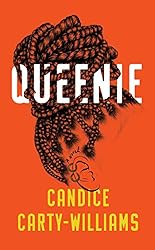

Queeie
Candice Carty-Williams, 2019
Gallery/Scout Press
336 pp.
ISBN-13: 9781501196010
Summary
Bridget Jones’s Diary meets Americanah in this disarmingly honest, boldly political, and truly inclusive novel that will speak to anyone who has gone looking for love and found something very different in its place.
Queenie Jenkins is a 25-year-old Jamaican British woman living in London, straddling two cultures and slotting neatly into neither. She works at a national newspaper, where she’s constantly forced to compare herself to her white middle class peers.
After a messy break up from her long-term white boyfriend, Queenie seeks comfort in all the wrong places… including several hazardous men who do a good job of occupying brain space and a bad job of affirming self-worth.
As Queenie careens from one questionable decision to another, she finds herself wondering, "What are you doing? Why are you doing it? Who do you want to be?"—all of the questions today’s woman must face in a world trying to answer them for her.
With "fresh and honest" (Jojo Moyes) prose, Queenie is a remarkably relatable exploration of what it means to be a modern woman searching for meaning in today’s world. (From the publisher.)
Author Bio
• Birth—1989
• Where—South London, England, UK
• Education—University of Sussex
• Currently—lives in London
Candice Carty-Williams was born in London to a Jamaican-Indian hospital receptionist and a Jamaican taxicab driver. When she was two weeks old, her father came to visit. By his side (surprise!) was his pregnant wife and three children. It was the last she saw him.
Carty-Williams grew up as a lonely and unsure child, moving with her mother from place to place, all in South London, eventually living with her grandmother. It was a "really shitty" childhood, she told Fiona Sturges of the UK Guardian. Often overlooked by her elders—and compared to a more beautiful, older cousin—Carty-Williams she felt that she "would never be able to achieve anything."
But then, like so many shy children, Carty-Williams found refuge books, spending hours and days in the public library. Much later, in her early 20s, she discovered Chimamanda Ngozi Adichie’s Americanah: "I thought, Wow, someone gets it! The hair stuff!"
The idea of writing was a revelation, yet working full-time and in debt, Carty-Williams never believed she would be able to write a book. In recognition of that uphill battle—for untested and underrepresented writers—in 2016 she created and launched the Guardian and 4th Estate BAME Short Story Prize to champion and celebrate their talents.
Later the same year, she saw that JoJo Myers (of Me Before You fame) was offering a week-long writing workshop at her home in Suffolk. Carty-Williams applied and was accepted into the program. That week she began writing … and writing … and writing. By the end of the week she had piled up 40,000 words—for what would become her first book. "It felt a bit like an outpouring. I think Queenie had been brewing for a very long time," she told the Guardian.
Three years later, in 2019, her novel Queenie was published, garnering solid reviews. Still, despite all the attention Queenie sent her way, Carty-Williams has kept her day job: working as a senior marketing executive at Vintage.
She has also contributed regularly to i-D, Refinery29, BEAT Magazine, and more, and her pieces, especially those about blackness, sex, and identity, have been shared globally. (Adapted from the publisher and The Guardian.)
Book Reviews
An irresistible portrait of a young Jamaican-British woman living in London that grows deeper as it goes.
Entertainment Weekly
Meet Queenie Jenkins, a 25-year-old Jamaican British woman who works for a London newspaper, is struggling to fit in, is dealing with a breakup, and is making all kinds of questionable decisions. In other words, she's highly relatable. A must read for 2019.
Woman's Day
They say Queenie is Black Bridget Jones meets Americanah. But she stands in her own right—nothing can and will compare. I can't articulate how completely and utterly blown away I am.
Black Girls Book Club
You'll likely feel seen while reading this (yes, it's that relatable), an example of what happens when you go looking for love and find something else instead.
PopSugar
You’ll read Queenie, a novel about a young Jamaican British woman trying to find her place in London, in one day. It’s that good.
Hello Giggles
(Starred review) [S]mart, fearless…. Carty-Williams doesn’t shy from the messiness of sexual relationships, racial justice…and the narrative is all the more effective for its boldness. This is an essential depiction of life as a black woman… told in a way that makes Queenie dynamic and memorable.
Publishers Weekly
(Starred review) Carty-Williams creates an utterly knowable character in Queenie, who's as dimensional and relatable as they come as she tries to balance her own desires with what everyone else seems to want for her... This smart, funny, and tender debut embraces a modern woman's messiness.
Booklist
(Starred review) The life and loves of Queenie Jenkins, a vibrant, troubled 25-year-old Jamaican Brit who is not having a very good year. Why she ever fell for that drip Tom… [is] never at all clear, but perhaps that's how these things go. A black Bridget Jones, perfectly of the moment.
Kirkus Reviews
Discussion Questions
1. What were your first impressions of Queenie? Did you like her? Were you surprised to hear the story behind Queenie’s name? How does hearing the story from Sylvie affect Queenie? Do you think that Sylvie chose a fitting name for Queenie? Explain your answer.
2. Queenie tells Tom, "Well, your family; it’s what a family should be" (p. 293). Discuss her statement. What is it about Tom’s family that Queenie finds so appealing? Compare her family to Tom’s. Did you find Queenie’s family to be supportive? Why or why not?
3. Describe the structure of Queenie. What’s the effect of the shifting time frame? How do the flashbacks help you better understand Queenie and her relationship with Tom? Do the texts and emails that are included also help you better understand what Queenie is thinking? If so, how?
4. When Cassandra says that Kyazike’s name is "like Jessica without the ‘ic’ in the middle," Kyazike corrects her, saying, "No. Like my own name. Not some… Western name. Chess. Keh" (p. 170). Explain her reaction. Why is it important for Kyazike to correct Cassandra’s assertion? Why does hearing Kyazike’s name impress Queenie when they first meet?
5. After Queenie pitches an article designed to shine a light on the Black Lives Matter movement, one of her colleagues responds by saying, "All that Black Lives Matter nonsense.… All lives matter" (p. 376). Discuss Queenie’s reaction to this assertion. What’s her counterargument? Why is it so important for her to cover the movement?
6. Gina tells Queenie, "Whenever I’ve had a huge upheaval, my mother has always said, 'Keep one foot on the ground when two are in the air'" (p. 224). Why does she offer Queenie this advice? Were you surprised by the kindness that she shows Queenie? Do you think Gina is a good boss? Would you want to work for her? Why or why not?
7. After a conversation with Darcy, Queenie thinks, "I wished that well-meaning white liberals would think before they said things that they thought were perfectly innocent" (p. 178). What does Darcy say that leads to Queenie’s reaction? Think about the comment. Why is it so charged? How does Darcy’s comment highlight the differences between Queenie’s and Darcy’s experiences?
8. What did you think of Guy? Why does Queenie spend time with him? How does she describe their interactions to her friends? Contrast the reality of their interactions to what Queenie tells her friends. Why do you think that Queenie romanticizes the details?
9. According to Queenie, Darcy, Cassandra, and Kyazike "all represented a different part of my life, had all come to me at different times; why they’d all stuck with me I was constantly trying to work out" (p. 174). What part of Queenie’s life does each woman represent? Describe their friendships. What does each woman bring to Queenie’s life? Do you think that they’re good friends to her? Why or why not?
10. Queenie’s grandmother tells her, "If you are sad, you have to try not to be," causing Queenie to muse that "all of my grandmother’s responses come with a Caribbean frame of reference that forces me to accept that my problems are trivial" (p. 46). How does Queenie’s grandmother deal with problems? How does she react when Queenie broaches the subject of getting counseling, and why?
11. Janet asks Queenie "what do you see, when you look in the mirror, when you think about yourself as a person" (p. 510)? Why is this such a difficult question for Queenie to answer? How would you describe her? If someone posed this question to you, how would you answer it?
12. What did you think of Queenie’s lists? Are they effective in helping her navigate stressful situations? What’s the effect of including them in the novel? How do the lists help propel the story forward? Did you learn anything interesting about Queenie from her list of New Year’s Resolutions? If so, why?
13. Sylvie feels that she "let [Queenie] down, I should have been better to her, that way she might have been better herself" (p. 315). Why did Sylvie leave? How did her departure affect Queenie? Describe their relationship. How does it evolve throughout the novel?
(Questions issued by the publisher.)
Quentins
Maeve Binchy, 2002
Penguin Group USA
416 pp.
ISBN-13: 9780451223913
Summary
Is it possible to tell the story of a generation and a city through the history of a restaurant? Ella Brady thinks so. She wants to film a documentary about Quentins that will capture the spirit of Dublin from the 1970s to the present day. After all, the restaurant saw the people of a city become more confident in everything from their lifestyles to the food that they chose to eat.
And Quentins has a thousand stories to tell. But as Ella uncovers more of what has gone on at Quentins, she begins to wonder whether some secrets should be kept that way. (From the publisher.)
Author Bio
• Birth—May 28, 1940
• Where—Dalkey (outside Dublin), Ireland
• Death—July 30, 2012
• Where—Dalkey, Ireland
• Education—B.A., University College, Dublin
• Awards—see below
Maeve Binchy Snell was an Irish novelist, playwright, short story writer, columnist, and speaker. She is best known for her humorous take on small-town life in Ireland, her descriptive characters, her interest in human nature and her often clever surprise endings. Her novels, which were translated into 37 languages, sold more than 40 million copies worldwide, and her death, announced by Vincent Browne on Irish television late on 30 July 2012, was mourned as the passing of Ireland's best-loved and most recognisable writer.
Her books have outsold those of other Irish writers such as Oscar Wilde, James Joyce, Samuel Beckett, W. B. Yeats, Seamus Heaney, Edna O'Brien and Roddy Doyle. She cracked the U.S. market, featuring on the New York Times best-seller list and in Oprah's Book Club. Recognised for her "total absence of malice" and generosity to other writers, she finished ahead of Jane Austen, Charles Dickens and Stephen King in a 2000 poll for World Book Day.
Early life
Binchy was born in Dalkey, County Dublin (modern-day Dún Laoghaire–Rathdown), Ireland, the oldest child of four. Her siblings include one brother, William Binchy, Regius Professor of Laws at Trinity College, Dublin, and two sisters: Renie (who predeceased Binchy) and Joan Ryan. Her uncle was the historian D. A. Binchy (1899–1989). Educated at the Holy Child Convent in Killiney and University College Dublin (where she earned a bachelor's degree in history), she worked as a teacher of French, Latin, and history at various girls' schools, then a journalist at the Irish Times, and later became a writer of novels, short stories, and dramatic works.
In 1968, her mother died of cancer aged 57. After Binchy's father died in 1971, she sold the family house and moved to a bedsit in Dublin.
Israel
Her parents were Catholics and Binchy attended a convent school.[12] However, a trip to Israel profoundly affected both her career and her faith. As she confided in a Q&A with Vulture:
In 1963, I worked in a Jewish school in Dublin, teaching French with an Irish accent to kids, primarily Lithuanians. The parents there gave me a trip to Israel as a present. I had no money, so I went and worked in a kibbutz — plucking chickens, picking oranges. My parents were very nervous; here I was going out to the Middle East by myself. I wrote to them regularly, telling them about the kibbutz. My father and mother sent my letters to a newspaper, which published them. So I thought, It’s not so hard to be a writer. Just write a letter home. After that, I started writing other travel articles.
Additionally, one Sunday, attempting to locate where the Last Supper is supposed to have occurred, she climbed a mountainside to a cavern guarded by a Brooklyn-born Israeli soldier. She wept with despair. The soldier asked, “What’ya expect, ma’am—a Renaissance table set for 13?” She replied, “Yes! That’s just what I did expect.” Binchy was no longer a Catholic.
Marriage
Binchy, described as "six feet tall, rather stout, and garrulous", confided to Gay Byrne of the Late Late Show that, growing up in Dalkey, she never felt herself to be attractive; "as a plump girl I didn't start on an even footing to everyone else", she shared. After her mother's death, she expected to a lead a life of spinsterhood, or as she expressed: "I expected I would live at home, as I always did." She continued, "I felt very lonely, the others all had a love waiting for them and I didn't."
She ultimately encountered the love of her life, however; when recording a piece for Woman's Hour in London, she met children's author Gordon Snell, then a freelance producer with the BBC. Their friendship blossomed into a cross-border romance, with her in Ireland and him in London, until she eventually secured a job in London through the Irish Times. She and Snell married in 1977 and after living in London for a time, moved to Ireland. They lived together in Dalkey, not far from where she had grown up, until Binchy's death. She told the Irish Times:
[A] writer, a man I loved and he loved me and we got married and it was great and is still great. He believed I could do anything, just as my parents had believed all those years ago, and I started to write fiction and that took off fine. And he loved Ireland, and the fax was invented so we writers could live anywhere we liked, instead of living in London near publishers.
Ill health...and death
In 2002, Binchy "suffered a health crisis related to a heart condition", which inspired her to write Heart and Soul. The book about (what Binchy terms) "a heart failure clinic" in Dublin and the people involved with it, reflects many of her own experiences and observations in the hospital.
Towards the end of her life, Binchy had the following message on her official website: "My health isn't so good these days and I can't travel around to meet people the way I used to. But I'm always delighted to hear from readers, even if it takes me a while to reply."
She suffered with severe arthritis, which left her in constant pain. As a result of the arthritis she had a hip operation.
Binchy died on 30 July 2012 after a short illness. She was 72.] Gordon was by her side when she died in a Dublin hospital. Immediate media reports described Binchy as "beloved", "Ireland's most well-known novelist" and the "best-loved writer of her generation". Fellow writers mourned their loss, including Ian Rankin, Jilly Cooper, Anne Rice, and Jeffrey Archer. Politicians also paid tribute. President Michael D. Higgins stated: "Our country mourns." Taoiseach Enda Kenny said, “Today we have lost a national treasure.” Minister of State for Disability, Equality and Mental Health Kathleen Lynch, appearing as a guest on Tonight with Vincent Browne, said Binchy was, for her money, as worthy an Irish writer as James Joyce or Oscar Wilde, and praised her for selling so many more books than they managed.
In the days after her death tributes were published from such writers as John Banville, Roddy Doyle, and Colm Tóibín. Banville contrasted Binchy with Gore Vidal, who died the day after her, observing that Vidal "used to say that it was not enough for him to succeed, but others must fail. Maeve wanted everyone to be a success." Numerous tributes appeared in publications on both sides of the Atlantic, including the Guardian and CBC News.
Shortly before her death, Binchy told the Irish Times:
I don't have any regrets about any roads I didn't take. Everything went well, and I think that's been a help because I can look back, and I do get great pleasure out of looking back ... I've been very lucky and I have a happy old age with good family and friends still around.
Just before dying, she read her latest short story at the Dalkey Book Festival.
She once said she would like to die "... on my 100th birthday, piloting Gordon and myself into the side of a mountain." She was cremated that Friday in Mount Jerome. It was a simple ceremony, as she had requested.
Journalism
The New York Times reports: Binchy's "writing career began by accident in the early 1960s, after she spent time on a kibbutz in Israel. Her father was so taken with her letters home that "he cut off the ‘Dear Daddy’ bits,” Ms. Binchy later recounted, and sent them to an Irish newspaper, which published them." Donal Lynch observed of her first paying journalism role: the Irish Independent "was impressed enough to commission her, paying her £16, which was then a week-and-a-half's salary for her."
In 1968, Binchy joined the staff at the Irish Times, and worked there as a writer, columnist, the first Women's Page editor then the London editor, later reporting for the paper from London before returning to Ireland.
Binchy's first published book is a compilation of her newspaper articles titled My First Book. Published in 1970, it is now out of print. As Binchy's bio posted at Read Ireland describes: "The Dublin section of the book contains insightful case histories that prefigure her novelist's interest in character. The rest of the book is mainly humorous, and particularly droll is her account of a skiing holiday, 'I Was a Winter Sport.'"
Literary works
In all, Binchy published 16 novels, four short-story collections, a play and a novella. Her literary career began with two books of short stories: Central Line (1978) and Victoria Line (1980). She published her debut novel Light a Penny Candle in 1982. In 1983, it sold for the largest sum ever paid for a first novel: £52,000. The timing was fortuitous, as Binchy and her husband were two months behind with the mortgage at the time. However, the prolific Binchy—who joked that she could write as fast as she could talk—ultimately became one of Ireland's richest women.
Her first book was rejected five times. She would later describe these rejections as "a slap in the face [...] It's like if you don't go to a dance you can never be rejected but you'll never get to dance either".
Most of Binchy's stories are set in Ireland, dealing with the tensions between urban and rural life, the contrasts between England and Ireland, and the dramatic changes in Ireland between World War II and the present day. Her books were translated into 37 languages.
While some of Binchy's novels are complete stories (Circle of Friends, Light a Penny Candle), many others revolve around a cast of interrelated characters (The Copper Beech, Silver Wedding, The Lilac Bus, Evening Class, and Heart and Soul). Her later novels, Evening Class, Scarlet Feather, Quentins, and Tara Road, feature a cast of recurring characters.
Binchy announced in 2000 that she would not tour any more of her novels, but would instead be devoting her time to other activities and to her husband, Gordon Snell. Five further novels were published before her death—Quentins (2002), Nights of Rain and Stars (2004), Whitethorn Woods (2006), Heart and Soul (2008), and Minding Frankie (2010). Her final work, A Week in Winter, was published posthumously in 2012.
Binchy wrote several dramas specifically for radio and the silver screen. Additionally, several of her novels and short stories were adapted for radio, film, and television.
Awards and honours
- In 1978, Binchy won a Jacob's Award for her RTÉ play, Deeply Regretted By. A second award went to the lead actor, Donall Farmer.
- A 1993 photograph of her by Richard Whitehead belongs to the collection of the National Portrait Gallery (London) and a painting of her by Maeve McCarthy, commissioned in 2005, is on display in the National Gallery of Ireland.
- In 1999, she received the British Book Award for Lifetime Achievement.
- In 2000, she received a People of the Year Award.
- In 2001, Scarlet Feather won the W H Smith Book Award for Fiction, defeating works by Joanna Trollope and then reigning Booker winner Margaret Atwood, amongst other contenders.
- In 2007, she received the Irish PEN Award, joining such luminaries as John B. Keane, Brian Friel, Edna O'Brien, William Trevor, John McGahern and Seamus Heaney.
- In 2010, she received a lifetime achievement award from the Irish Book Awards.
- In 2012, she received an Irish Book Award in the "Irish Popular Fiction Book" category for A Week in Winter.
- There have been posthumous proposals to name a new Liffey crossing Binchy Bridge in memory of the writer Other writers to have Dublin bridges named after them include Beckett, Joyce and O'Casey.
- In 2012 a new garden behind the Dalkey Library in County Dublin was dedicated in memory of Binchy. (Author bio adapted from Wikipedia.)
Book Reviews
It's as good as she gets, which is very good, indeed.
Maureen Corrigan - National Public Radio
Fans of the bestselling Binchy will be grateful that the basic formula is still intact—decent people pulling through hard times—and that some favorite characters from previous novels reappear: Cathy Scarlet from Scarlet Feather, Nora from Evening Class, Ria from Tara Road and others. When Dubliner Ella Brady's affair with a married financial consultant turns sour—he bilks his clients of their hard-earned money and then hightails it to Spain—she decides to throw herself into something productive: she agrees to help with a documentary about Quentins, a once-modest Dublin restaurant whose increasing success and sophistication over the past 30 years mirrors the changing fortunes of the city itself. Ella collects stories of customers who recall celebrating life's milestones at Quentins. These vignettes (about a man who learns he's to be a grandfather, a girl who finishes school with honors, and other regular folks) are meant to fill out the too-thin tale, but most of them end a little too neatly to be satisfying. Binchy doesn't exactly trade in suspense (can there ever be any doubt that a Binchy heroine will do the right thing? Or that goodness will ultimately be rewarded?), but this novel is more tepid than other works in her oeuvre. Still, readers who love hardworking, honest-living characters with strong values can get their fix here.
Publishers Weekly
In Binchy's latest, fans will encounter familiar characters from Evening Class, Tara Road, and Scarlet Feather—which is sometimes a distraction. The novel primarily chronicles Ella Brady and her involvement with Dublin's finest restaurant, Quentins. Ella wants to make a documentary film about Quentins that will capture the dramas revolving around restaurant life. The film's financial backer, Derry King, becomes Ella's suitor after she has a terrible experience with a married, thieving investment advisor. This advisor—and his possible suicide—brings a bit of suspense to an otherwise ordinary tale. Not Binchy's best, this will still certainly be demanded by your patrons. Recommended for all public libraries. —Carol J. Bissett, New Braunfels P.L., TX
Library Journal
(Adult /High School.) This book continues Binchy's stories set in modern Dublin (Evening Class, 1997; Tara Road, 1999; and Scarlet Feather 2002). In this Dublin of euros and international cuisine, there is nary a leprechaun—or even a kindly priest—in sight. Its inhabitants are proud of their cosmopolitan attitudes, but underlying their lives and choices are strengths of family and friendship, and a loving kindness, that still confirm the outsider's hopeful expectations about traditional Irish culture. Here, Ella Brady, a young woman emerging from a charmed childhood, hits her first major snag in life when her lover, a well-known financier, turns out to be a swindler (this comes as no surprise to readers). When he disappears along with his clients' money, just about everyone in Dublin seems to suffer some loss, but Ella's is also deeply personal. To keep busy, she helps put together a documentary film project centering on Quentins, a famous restaurant that embodies, in its own history, the social modernization and economic progress of the city and its people. With the help and unconditional support of family and friends, Ella sorts out her emotional life, but there is some suspense in the process. Binchy's fans will be gratified and comforted by this paradoxically cozy tale of a painful coming-of-age. —Christine C. Menefee, Fairfax County Public Library, VA
School Library Journal
With some familiar characters amid the new, Binchy offers a sweetly affirming—with just enough redemptive vinegar—read in the story of Quentins, a hot Dublin restaurant. Ella Brady first dined at Quentins when she was a poised six-year-old and only child of Tim, who worked for an investment broker, and Barbara, a legal secretary, but in her 20s she met Don Richardson, a handsome financier, noted philanthropist, and married him. Ella wasn't worried about it, as she was badly smitten. But Don was no good—he embezzled his clients' money as well as that of Tim Brady, who'd been impressed with him—then fled to Spain with his family. Determined to pay her parents back what they'd lost, Ella quits her job as a poorly paid teacher and starts tutoring the memorable twins introduced in Scarlet Feather (2001) as well as working at Quentins, and helping filmmaker friends Nick and Sandy. When Ella comes up with an idea that's accepted by the prestigious King Foundation in the US—to illustrate the changes in Ireland by telling the story of Quentins—the story detours into key moments in the restaurant's history: its founding by Quentin Barry, a restaurant employee with big dreams who was helped by an unexpected gift; the hiring as manager and chef of childless couple Brenda and Patrick Brennan; Mon Harris, an Australian waitress, falling in love and marrying a customer; and Nora-the Signora from Evening Class (1997), back from Italy—having her new love celebrated in best Quentins style. Meanwhile, Ella, in New York, meets Derry King, head of the King Foundation, who accompanies her home when she learns that Don has apparently committed suicide—leaving her with his computer, which contains incriminating documents. Ella is soon in danger as Don's henchman stalks her, but handsome Derry helps, as do all the crew at Quentins. A leisurely paced treat, filled with goodwill.
Kirkus Reviews
Discussion Questions
Use our LitLovers Book Club Resources; they can help with discussions for any book:
• How to Discuss a Book (helpful discussion tips)
• Generic Discussion Questions—Fiction and Nonfiction
• Read-Think-Talk (a guided reading chart)
Also consider these LitLovers talking points to help get a discussion started for Quentins:
1. This book is a compilation of vignettes, bringing together various characters and their stories under one roof, or novel. There are Martin and his son Jody; Maggie; Drew; Mon; Yvonne, Frank and his three daughters; Laura; and Quentin himself. Which characters and their stories do you find most compelling? Which characters do you come to care most about?
2. What kind of character is Ella—how would you describe her? Why is she drawn to Quentins as the locale for her documentary?
3. How does Quentins reflect the new Dublin, a city burgeoning with new-found wealth in the 1990s? How has the restaurant and its clientele changed to reflect the new Dublin?
4. If you've read some of Binchy's other works how do you feel about the reappearance of some of the characters in this novel—Signora and Aidan (from Evening Class); Tom, Cathy, Simon and Maud (from Scarlett Feather); as well as Ria (from Tara Road)? Do you feel the characters have the same vibrancy they evinced in those other works?
5. Does Binchy's technique—of separate narratives linked together by a single location or individual—feel unified to you...or disjointed? Do you enjoy moving from character to character and learning their individual stories? Or do you prefer to follow the story of one central character?
6. Maeve Binchy is known for her gift of rich characterization. However, episodic structures, such as used in this work, risk presenting under-developed rather than fully-developed characters. In your opinion, does Binchy succeed in creating well-rounded, life-like characters in Quentins...or not? (Remember, please, this is only opinion!)
7. What about the side storyline of the missing money? Does that create a degree of suspense?
8. What do you think the future holds for Ella's relationship with Derry King?
9. In what way can this be seen as a coming-of-age story? What does Ella come to learn about herself and/or the world by the end of the novel?
(Questions by LitLovers. Please feel free to use them, online or off, with attribution. Thanks.)
top of page


The Quest
Nelson DeMille, 2013
Center Street
464 pp.
ISBN-13: 9781455576425
Summary
An earlier, shorter version of The Quest was published in paperback in 1975.
In 2013, I rewrote The Quest and doubled its length, making it, I hope, a far better story than the original, without deviating from the elements that made the story so powerful and compelling when I first wrote it. In other words, what made The Quest worth rewriting remains, and whatever is changed is for the better.
I was happy and excited to have this opportunity to rewrite and republish what I consider my first "big" novel, and I hope you enjoy it as much as I did when I first wrote it.
A sweeping adventure that's equal parts thriller and love story, Nelson DeMille's newest novel takes the reader from the war torn jungles of Ethiopia to the magical city of Rome.
While the Ethiopian Civil War rages, a Catholic priest languishes in prison. Forty years have passed since he last saw daylight. His crime? Claiming to know the true location of Christ's cup from the Last Supper. Then the miraculous happens—a mortar strikes the prison and he is free!
Old, frail, and injured, he escapes to the jungle, where he encounters two Western journalists and a beautiful freelance photographer taking refuge from the carnage. As they tend to his wounds, he relates his incredible story.
Motivated by the sensational tale and their desire to find the location of the holiest of relics, the trio agrees to search for the Grail.
Thus begins an impossible quest that will pit them against murderous tribes, deadly assassins, fanatical monks, and the passions of their own hearts.
The Quest is suspenseful, romantic, and filled with heart-pounding action. Nelson DeMille is at the top of his game as he masterfully interprets one of history's greatest mysteries. (From the publisher.)
Author Bio
• Aka—Jack Cannon, Kurt Ladner, Brad Matthews, Michael
Weaver, Ellen Kay
• Birth—August 22, 1943
• Where—New York, New York, USA
• Education—B.A., Hofstra University
• Awards—Estabrook Award
• Currently—lives on Long Island, New York
Nelson DeMille has a over a dozen bestselling novels to his name and over 30 million books in print worldwide, but his beginnings were not so illustrious. Writing police detective novels in the mid-1970s, DeMille created the pseudonym Jack Cannon: "I used the pen name because I knew I wanted to write better novels under my own name someday," DeMille told fans in a 2000 chat.
Between 1966 and 1969, Nelson DeMille served in the U.S. Army in Vietnam. When he came home, he finished his undergraduate studies (in history and political science), then set out to become a novelist. "I wanted to write the great American war novel at the time," DeMille said in an interview with January magazine. "I never really wrote the book, but it got me into the writing process." A friend in the publishing industry suggested he write a series of police detective novels, which he did under a pen name for several years.
Finally DeMille decided to give up his day job as an insurance fraud investigator and commit himself to writing full time—and under his own name. The result was By the Rivers of Babylon (1978), a thriller about terrorism in the Middle East. It was chosen as a Book of the Month Club main selection and helped launch his career. "It was like being knighted," said DeMille, who now serves as a Book of the Month Club judge. "It was a huge break."
DeMille followed it with a stream of bestsellers, including the post-Vietnam courtroom drama Word of Honor (1985) and the Cold War spy-thriller The Charm School (1988) Critics praised DeMille for his sophisticated plotting, meticulous research and compulsively readable style. For many readers, what made DeMille stand out was his sardonic sense of humor, which would eventually produce the wisecracking ex-NYPD officer John Corey, hero of Plum Island (1997) and The Lion's Game (2000).
In 1990 DeMille published The Gold Coast, a Tom Wolfe-style comic satire that was his attempt to write "a book that would be taken seriously." The attempt succeeded, in terms of the critics' response: "In his way, Mr. DeMille is as keen a social satirist as Edith Wharton," wrote The New York Times book reviewer. But he returned to more familiar thrills-and-chills territory in The General's Daughter, which hit no. 1 on The New York Times' Bestseller list and was made into a movie starring John Travolta. Its hero, army investigator Paul Brenner, returned in Up Country (2002), a book inspired in part by DeMille's journey to his old battlegrounds in Vietnam.
DeMille's position in the literary hierarchy may be ambiguous, but his talent is first-rate; there's no questioning his mastery of his chosen form. As a reviewer for the Denver Post put it, "In the rarefied world of the intelligent thriller, authors just don't get any better than Nelson DeMille."
Extras
From a Barnes & Noble interview:
• DeMille composes his books in longhand, using soft-lead pencils on legal pads. He says he does this because he can't type, but adds, "I like the process of pencil and paper as opposed to a machine. I think the writing is better when it's done in handwriting."
• In addition to his novels, DeMille has written a play for children based on the classic fairy tale "Rumpelstiltskin."
• DeMille says on his web site that he reads mostly dead authors—"so if I like their books, I don't feel tempted or obligated to write to them." He mentions writing to a living author, Tom Wolfe, when The Bonfire of the Vanities came out; but Wolfe never responded. "I wouldn't expect Hemingway or Steinbeck to write back—they're dead. But Tom Wolfe owes me a letter," DeMille writes.
• When ashed what book most influenced his career as a writer, here is what he said:
Atlas Shrugged by Ayn Rand. I read this book in college, as many of my generation did, and I was surprised to discover that it said things about our world and our society that I thought only I had been thinking about, i.e., the ascendancy of mediocrity. It was a relief to discover that there was an existing philosophy that spoke to my half-formed beliefs and observations.
(Bio and interview from Barnes & Noble.)
Book Reviews
Nelson DeMille is at the absolute peak of his powers in The Quest, an epic tale that's broad in both scope and vision...as it brings the action in Africa of the mid-1970s. That's where an old priest named Father Armando emerges from a bombed-out prison after decades in captivity with the location of nothing less than the Holy Grail tucked in his mind.... From there, staged against the backdrop of the endless Ethiopian civil war, the quest of the title begins in search of it, undertaken by a trio of intrepid journalists....This is adventure on the grandest of scales and richest of tapestries.... A masterpiece fashioned by a storyteller who simply has no rival.
Providence Sunday Journal
DeMille dispatches three knights errant in search of the Holy Grail in this major revamping of his first novel.... DeMille's adept enough with this age-old theme, but he stumbles with a long Rome-based middle section where the three retreat to plan anew. .. DeMille also poses threats that never materialize, like the fierce Galla tribe roaming about. Despite some rollicking good action...DeMille's quest's conclusion may leave readers thinking, "Is that all there is?"
Kirkus Reviews
Discussion Questions
Use our LitLovers Book Club Resources; they can help with discussions for any book:
• How to Discuss a Book (helpful discussion tips)
• Generic Discussion Questions—Fiction and Nonfiction
• Read-Think-Talk (a guided reading chart)
We'll add specific questions if and when they're made available by the publisher.

Quichotte
Salman Rushdie, 2019
Random House
416 pp.
ISBN-13: 9780593132982
Summary
A dazzling Don Quixote for the modern age—a tour de force that is as much an homage to an immortal work of literature as it is to the quest for love and family, by Booker Prize–winning, internationally bestselling author Salman Rushdie.
Inspired by the Cervantes classic, Sam DuChamp, mediocre writer of spy thrillers, creates Quichotte, a courtly, addled salesman obsessed with television who falls in impossible love with a TV star.
Together with his (imaginary) son Sancho, Quichotte sets off on a picaresque quest across America to prove worthy of her hand, gallantly braving the tragicomic perils of an age where "Anything-Can-Happen."
Meanwhile, his creator, in a midlife crisis, has equally urgent challenges of his own.
Just as Cervantes wrote Don Quixote to satirize the culture of his time, Rushdie takes the reader on a wild ride through a country on the verge of moral and spiritual collapse.
And with the kind of storytelling magic that is the hallmark of Rushdie’s work, the fully realized lives of DuChamp and Quichotte intertwine in a profoundly human quest for love and a wickedly entertaining portrait of an age in which fact is so often indiscernible from fiction. (From the publisher.)
Author Bio
• Birth—June 19, 1947
• Where—Bombay, Maharashtra, India
• Education—M.A., King's College, Cambridge, UK
• Awards—Booker Prize, 1981; Best of the Bookers, 1993 (the best novel to win the Booker
Prize in its first twenty-five years); Whitbread Prize, 1988 and 1995
• Currently—lives in New York, New York
Sir Ahmed Salman Rushdie is a British Indian novelist and essayist. His second novel, Midnight's Children (1981), won the Booker Prize in 1981. Much of his fiction is set on the Indian subcontinent. He is said to combine magical realism with historical fiction; his work is concerned with the many connections, disruptions and migrations between East and West.
His fourth novel, The Satanic Verses (1988), was the centre of a major controversy, provoking protests from Muslims in several countries, some violent. Death threats were made against him, including a fatwa issued by Ayatollah Ruhollah Khomeini, the Supreme Leader of Iran, on February 14, 1989.
Rushdie was appointed Commandeur de l'Ordre des Arts et des Lettres of France in January 1999. In June 2007, Queen Elizabeth II knighted him for his services to literature. In 2008, The Times ranked him thirteenth on its list of the fifty greatest British writers since 1945.
Since 2000, Rushdie has lived in the United States, where he has worked at the Emory University and was elected to the American Academy of Arts and Letters. His most recent book is Joseph Anton: A Memoir, an account of his life in the wake of the Satanic Verses controversy.
Career
Rushdie's first career was as a copywriter, working for the advertising agency Ogilvy & Mather, where he came up with "irresistibubble" for Aero and "Naughty but Nice" for cream cakes, and for the agency Ayer Barker, for whom he wrote the memorable line "That'll do nicely" for American Express. It was while he was at Ogilvy that he wrote Midnight's Children, before becoming a full-time writer. John Hegarty of Bartle Bogle Hegarty has criticised Rushdie for not referring to his copywriting past frequently enough, although conceding: "He did write crap ads...admittedly."
His first novel, Grimus, a part-science fiction tale, was generally ignored by the public and literary critics. His next novel, Midnight's Children, catapulted him to literary notability. This work won the 1981 Booker Prize and, in 1993 and 2008, was awarded the Best of the Bookers as the best novel to have received the prize during its first 25 and 40 years. Midnight's Children follows the life of a child, born at the stroke of midnight as India gained its independence, who is endowed with special powers and a connection to other children born at the dawn of a new and tumultuous age in the history of the Indian sub-continent and the birth of the modern nation of India. The character of Saleem Sinai has been compared to Rushdie. However, the author has refuted the idea of having written any of his characters as autobiographical, stating...
People assume that because certain things in the character are drawn from your own experience, it just becomes you. In that sense, I’ve never felt that I’ve written an autobiographical character.
After Midnight's Children, Rushdie wrote Shame, in which he depicts the political turmoil in Pakistan, basing his characters on Zulfikar Ali Bhutto and General Muhammad Zia-ul-Haq. Shame won France's Prix du Meilleur Livre Étranger (Best Foreign Book) and was a close runner-up for the Booker Prize. Both these works of postcolonial literature are characterised by a style of magic realism and the immigrant outlook that Rushdie is very conscious of as a member of the Indian diaspora.
Rushdie wrote a non-fiction book about Nicaragua in 1987 called The Jaguar Smile. This book has a political focus and is based on his first-hand experiences and research at the scene of Sandinista political experiments.
His most controversial work, The Satanic Verses, was published in 1988 (see below). Rushdie has published many short stories, including those collected in East, West (1994). The Moor's Last Sigh, a family epic ranging over some 100 years of India's history was published in 1995. The Ground Beneath Her Feet presents an alternative history of modern rock music. The song of the same name by U2 is one of many song lyrics included in the book, hence Rushdie is credited as the lyricist. He also wrote Haroun and the Sea of Stories in 1990.
Rushdie has had a string of commercially successful and critically acclaimed novels. His 2005 novel Shalimar the Clown received, in India, the prestigious Hutch Crossword Book Award, and was, in Britain, a finalist for the Whitbread Book Awards. It was shortlisted for the 2007 International IMPAC Dublin Literary Award.
In his 2002 non-fiction collection Step Across This Line, he professes his admiration for the Italian writer Italo Calvino and the American writer Thomas Pynchon, among others. His early influences included James Joyce, Günter Grass, Jorge Luis Borges, Mikhail Bulgakov, and Lewis Carroll. Rushdie was a personal friend of Angela Carter and praised her highly in the foreword for her collection Burning your Boats.
Other Activities
Rushdie has quietly mentored younger Indian (and ethnic-Indian) writers, influenced an entire generation of Indo-Anglian writers, and is an influential writer in postcolonial literature in general. He has received many plaudits for his writings, including the European Union's Aristeion Prize for Literature, the Premio Grinzane Cavour (Italy), and the Writer of the Year Award in Germany and many of literature's highest honours. Rushdie was the President of PEN American Center from 2004 to 2006 and founder of the PEN World Voices Festival.
He opposed the British government's introduction of the Racial and Religious Hatred Act, something he writes about in his contribution to Free Expression Is No Offence, a collection of essays by several writers.
In 2007 he began a five-year term as Distinguished Writer in Residence at Emory University in Atlanta, Georgia, where he has also deposited his archives.
In May 2008 he was elected a Foreign Honorary Member of the American Academy of Arts and Letters.
Though he enjoys writing, Salman Rushdie says that he would have become an actor if his writing career had not been successful. Even from early childhood, he dreamed of appearing in Hollywood movies (which he later realised in his frequent cameo appearances).
Rushdie includes fictional television and movie characters in some of his writings. He had a cameo appearance in the film Bridget Jones's Diary based on the book of the same name, which is itself full of literary in-jokes.
On May 12, 2006, Rushdie was a guest host on The Charlie Rose Show, where he interviewed Indo-Canadian filmmaker Deepa Mehta, whose 2005 film, Water, faced violent protests. He appears in the role of Helen Hunt's obstetrician-gynecologist in the film adaptation of Elinor Lipman's novel Then She Found Me. In September 2008, and again in March 2009, he appeared as a panellist on the HBO program Real Time with Bill Maher.
Rushdie is currently collaborating on the screenplay for the cinematic adaptation of his novel Midnight's Children with director Deepa Mehta. The film will be released in October, 2012.
Rushdie is a member of the advisory board of The Lunchbox Fund, a non-profit organisation which provides daily meals to students of township schools in Soweto of South Africa. He is also a member of the advisory board of the Secular Coalition for America, an advocacy group representing the interests of atheistic and humanistic Americans in Washington, D.C. In November 2010 he became a founding patron of Ralston College, a new liberal arts college that has adopted as its motto a Latin translation of a phrase ("free speech is life itself") from an address he gave at Columbia University in 1991 to mark the two-hundredth anniversary of the first amendment to the U.S. Constitution.
The Satanic Verses and the fatwa
The publication of The Satanic Verses in September 1988 caused immediate controversy in the Islamic world because of what was perceived as an irreverent depiction of the prophet Muhammad. The title refers to a disputed Muslim tradition that is related in the book. According to this tradition, Muhammad (Mahound in the book) added verses (sura) to the Qur'an accepting three goddesses who used to be worshipped in Mecca as divine beings. According to the legend, Muhammad later revoked the verses, saying the devil tempted him to utter these lines to appease the Meccans (hence the "Satanic" verses). However, the narrator reveals to the reader that these disputed verses were actually from the mouth of the Archangel Gibreel. The book was banned in many countries with large Muslim communities.
On February 14, 1989, a fatwa requiring Rushdie's execution was proclaimed on Radio Tehran by Ayatollah Ruhollah Khomeini, the spiritual leader of Iran at the time, calling the book "blasphemous against Islam." A bounty was offered for Rushdie's death, and he was thus forced to live under police protection for several years. On March 7, 1989, the United Kingdom and Iran broke diplomatic relations over the Rushdie controversy.
The publication of the book and the fatwa sparked violence around the world, with bookstores firebombed. Muslim communities in several nations in the West held public rallies, burning copies of the book. Several people associated with translating or publishing the book were attacked and even killed.
On September 24, 1998, as a precondition to the restoration of diplomatic relations with Britain, the Iranian government gave a public commitment that it would "neither support nor hinder assassination operations on Rushdie."
Hardliners in Iran have continued to reaffirm the death sentence. In early 2005, Khomeini's fatwa was reaffirmed by Iran's current spiritual leader, Ayatollah Ali Khamenei, in a message to Muslim pilgrims making the annual pilgrimage to Mecca. Additionally, the Revolutionary Guards have declared that the death sentence on him is still valid. Iran has rejected requests to withdraw the fatwa on the basis that only the person who issued it may withdraw it, and the person who issued it – Ayatollah Khomeini – has been dead since 1989.
Rushdie has reported that he still receives a "sort of Valentine's card" from Iran each year on February 14 letting him know the country has not forgotten the vow to kill him. He said, "It's reached the point where it's a piece of rhetoric rather than a real threat."
A memoir of his years of hiding, Joseph Anton, was published in 2012. Joseph Anton was Rushdie's secret alias.
In 2012, following uprisings over an anonymously posted YouTube video denigrating Muslims, a semi-official religious foundation in Iran increased the reward it had offered for the killing of Rushdie from $2.8 million to $3.3 million dollars. Their stated reason: "If the [1989] fatwa had been carried out, later insults in the form of caricature, articles and films that have continued would have not happened."
Knighthood
Rushdie was knighted for services to literature in the Queen's Birthday Honours on June 16, 2007. He remarked, "I am thrilled and humbled to receive this great honour, and am very grateful that my work has been recognised in this way." In response to his knighthood, many nations with Muslim majorities protested. Several called publicly for his death. Some non-Muslims expressed disappointment at Rushdie's knighthood, claiming that the writer did not merit such an honour and there were several other writers who deserved the knighthood more than Rushdie.
Al-Qaeda has condemned the Rushdie honour. The Al-Qaeda leader Ayman al-Zawahiri is quoted as saying in an audio recording that Britain's award for Indian-born Rushdie was "an insult to Islam", and it was planning "a very precise response."
Religious Beliefs
Rushdie came from a Muslim family though he is an atheist now. In 1990, in the "hope that it would reduce the threat of Muslims acting on the fatwa to kill him," he issued a statement claiming he had renewed his Muslim faith, had repudiated the attacks on Islam in his novel and was committed to working for better understanding of the religion across the world. However, Rushdie later said that he was only "pretending".
Personal Life
Rushdie has been married four times. He was married to his first wife Clarissa Luard from 1976 to 1987 and fathered a son, Zafar (born 1980). His second wife was the American novelist Marianne Wiggins; they were married in 1988 and divorced in 1993. His third wife, from 1997 to 2004, was Elizabeth West; they have a son, Milan (born 1999). In 2004, he married the Indian American actress and model Padma Lakshmi, the host of the American reality-television show Top Chef. The marriage ended on July 2, 2007, with Lakshmi indicating that it was her desire to end the marriage.
In 1999 Rushdie had an operation to correct ptosis, a tendon condition that causes drooping eyelids and that, according to him, was making it increasingly difficult for him to open his eyes. "If I hadn't had an operation, in a couple of years from now I wouldn't have been able to open my eyes at all," he said.
Since 2000, Rushdie has "lived mostly near Union Square" in New York City. (Adapted from Wikipedia. Retrieved 2012.)
Book Reviews
The novels [of Rushdie] are imaginative as ever, but they are also increasingly wobbly, bloated and mannered. He is a writer in free fall…. Rushdie’s narrative impulses… lie in tossing in celebrity cameos and literary allusions, in sending new plots into orbit in the hope they might lend glitter and ballast to a work sorely in need of both.
Parul Sehgal - New York Times
Say his name like this: Key-shot. His quest is a long shot, and there’s a gun involved. (Trigger warning: The gun talks.)…. How we see the world—and how the world sees us—are the big themes of Cervantes’s epic. Rushdie’s version holds true to that tale.… Rushdie has always written as though the impossible and the actual have the same right to exist…. [With a] lovely, unsentimental, heart-affirming ending.
New York Times Book Review
It is a novel of magical realism that bends the notions of "magical" and "realism" so far…. A fantasy missing all the signifiers of fantasy. A comedy where every single joke fails to land completely. It's got so much music in the words it almost demands to be read aloud. Its so inconstant you'd need one of those serial-killer boards made of index cards and string just to unpack the plot.
NPR
Quichotte, Rushdie’s Trump-era reworking of Cervantes’s Don Quixote, is a frantically inventive take on "the Age of Anything-Can-Happen"… a concoction of narratives within narratives that blends the latest news headlines with apocalyptic flights of fancy.… Rushdie doesn’t offer much hope for our dispiriting times. But in a frayed and feverish way, he captures their flavor exactly.
Boston Globe
Salman Rushdie’s Quichotte is a behemoth of a novel, and with reason. A postmodern dystopian tale, it tackles everything from global warming to the rise of white supremacism to the opioid crisis—which is to say, most of the ills of contemporary society… . There’s much that feels absorbing and true in Rushdie’s latest work.
Christian Science Monitor
Rushdie weaves together all of his subjects, sharply observed, with extraordinary elegance and wit…. At least here’s something worth reading as civilization crumbles around us, before we succumb to our fates. Right?
Entertainment Weekly
A fantastical dream within a dream… a brilliant, funny, world-encompassing wonder…. As [Rushdie] weaves the journeys of the two men nearer and nearer, sweeping up a full accounting of all the tragicomic horrors of modern American life in the process, these energies begin to collapse beautifully inward, like a dying star. His readers realize that they would happily follow Rushdie to the end of the world.
Time
[A] modern Don Quixote…. Rushdie has created something that feels wholly original.… Lucky for us, there are true storytellers and Rushdie is near the top of that list. If you haven’t read him before, this is a good book to start with—it’s fabulist and funny while revealing an awful lot about the world we live in today.
Associated Press
Rushdie’s Booker-longlisted fourteenth novel is certainly the work of a frisky imagination.… You can’t help being charmed by Rushdie’s largesse.
Guardian (UK)
(Starred review) [R]ambunctious…. Rushdie’s uproarious comedy, which talks to itself while packing a good deal of historical and political freight, is a brilliant rendition of the cheesy, sleazy, scary pandemonium of life in modern times.
Publishers Weekly
(Starred review) [N]othing but extraordinary.…This incisively outlandish but lyrical meditation on intolerance, TV addiction, and the opioid crisis operates on multiple planes, with razor-sharp topicality and humor. Highly recommended. —Henry Bankhead, San Rafael P.L., CA
Library Journal
(Starred review) [A] splendid mess that, in the end, becomes a meditation on storytelling, memory, truth, and other hallmarks of a disappearing civilization…. Humane and humorous. Rushdie is in top form, serving up a fine piece of literary satire.
Kirkus Reviews
Discussion Questions
We'll add publisher questions if and when they're available; in the meantime, use our LitLovers Book Club Resources. They can help with discussions for any book:
• How to Discuss a Book (helpful discussion tips)
• Generic Discussion Questions—Fiction and Nonfiction
• Read-Think-Talk (a guided reading chart)
(Resources by LitLovers. Please feel free to use them, online and off, with attribution. Thanks.)


The Quick
Lauren Owen, 2014
Random House
544 pp.
ISBN-13: 9780812993271
Summary
A novel of epic scope and suspense that conjures up all the magic and menace of Victorian London . . .
1892: James Norbury, a shy would-be poet newly down from Oxford, finds lodging with a charming young aristocrat. Through this new friendship, he is introduced to the drawing-rooms of high society and finds love in an unexpected quarter.
Then, suddenly, he vanishes without a trace. Alarmed, his sister, Charlotte, sets out from their crumbling country estate determined to find him. In the sinister, labyrinthine London that greets her, she uncovers a hidden, supernatural city populated by unforgettable characters: a female rope walker turned vigilante, a street urchin with a deadly secret, and the chilling “Doctor Knife.”
But the answer to her brother’s disappearance ultimately lies within the doors of the exclusive, secretive Aegolius Club, whose predatory members include the most ambitious, and most bloodthirsty, men in England.
In her first novel, Lauren Owen has created a fantastical world that is both beguiling and terrifying. The Quick will establish her as one of fiction’s most dazzling talents. (From the publisher.)
Author Bio
• Birth—1985
• Rasied—Yorkshire, England, UK
• Education—Oxford University; University of East Anglia
• Awards—Curtis Brown Prize
• Currently—lives in Northern England
Lauren Owen grew up in the grounds of a boarding school in Yorkshire. Her first attempts at writing as a teenager were Harry Potter fan fiction. She is a graduate of St Hilda's, Oxford, holds an MA in Victorian Literature, and is completing a PhD on Gothic writing and fan culture. She is the recipient of the University of East Anglia creative-writing programme's prestigious Curtis Brown Prize. The Quick is her first novel. (From the UK publisher.)
Book Reviews
[R]eaders might think they’re about to embark on a highhanded version of the Gothic novel, full of metafictions and literary allusions. These do appear, along with some beautiful language, but by Page 100, when the first neck is about to be bitten, The Quick drops its cloak and becomes a good old-fashioned vampire novel.... To cover such well-worn narrative ground, a novelist has to either invent new possibilities or invent new storytelling devices. Owen has chosen the latter, and the novel proceeds by looping back over the previous episodes, each time from a different character’s perspective. This has the pleasant effect of plunging us into invention and then, slowly, into recognition.
Andrew Sean Greer - New York Times Book Review
[A] creepy debut...a thrilling tale.... This book will give you chills even on a hot day
Minneapolis Star Tribune
Forget Jack the Ripper—it’s the curiously pale aristocratic types you need to beware of in this supernatural Gothic nightmare.... Owen’s stylishly sinister world of betrayal and Lovecraftian monsters will have you sleeping with the lights on.
Oprah Magazine
The first quarter of this debut novel is a lovely, poetic tale.... The last half is entirely bonkers and totally unexpected. Read it with the lights on.
New Republic
The book’s energy, its wide reach and rich detail make it a confident example of the "unputdownable" novel.
Economist
(Starred review.) Owen sets her seductive book in 1892, in a late-Victorian London with a serious vampire problem..... [A]n old-fashioned, leisurely pace,...Owen's sentence-by-sentence prose is extraordinarily polished—a noteworthy feat for a 500-page debut—and she packs many surprises into her tale, making it a book for readers to lose themselves in.
Publishers Weekly
An intriguing blend of historical, gothic, and supernatural fiction.... [The Quick features] wonderful atmospheric writing.
Library Journal
An intricate, sinister epic....an impressive feat....Owen proves a master at anticipating readers’ thoughts about future happenings and then crumbling them into dust. Her world building is exceptional, and readers will simultaneously embrace and shrink from the atmosphere’s elegant ghastliness.
Booklist
An elegantly written gothic epic that begins with children isolated in a lonely manor house.... A book that seems to begin as a children's story ends in blood-soaked mayhem; the journey from one genre to another is satisfying and surprisingly fresh considering that it's set in a familiar version of gothic London among equally familiar monsters.
Kirkus Reviews
Discussion Questions
1. What genre (or genres) would you say The Quick falls into? How does it embrace or subvert the conventions of those genres?
2. What literary influences do you see in The Quick?
3. Emily Richter figures into many of the book’s most pivotal early scenes. How much do you think she knows or doesn’t know about James and Christopher’s relationship, and about Eustace’s change? Why do you think she tells James to “be careful”?
4. Discuss the figure of the owl throughout the book.
5. Characters agree to the Exchange for different reasons. Why reasons do you think Adeline’s fiancé, John had? Are there any reasons that would tempt you to join the Aegolius Club?
6. Why do you think Mrs. Price turns children? How does their group compare to other family units in the book?
7. Why do the Club members refer to the living as the “Quick”?
8. How does Mould change over the course of the book? Do you think he remains a man of science to the end? Why might Edmund have delayed so long in giving Mould what he wanted?
9. Charlotte’s quiet life is altered drastically by the book’s events. In what ways does it change for the better? When in the book do you think she is happiest?
10. Had you heard of a priest hole before reading The Quick? Why do you think Owen chose to begin and end the book there?
11. The ending of The Quick seems to beg for a sequel. What do you think happened to James? What directions could you imagine a sequel going in? Whose stories might it follow? When and where might it take place?
(Questions issued by the publisher.)
top of page (summary)
A Quiet Flame (Bernie Gunther Series, #5)
Phillip Kerr, 2008
Gale Group
368 pp.
ISBN-13: 9780143116486
Summary
Bernie Gunther, Berlin's hardest-boiled private eye, returns in this his latest outing. Moving the plot from pre-war Germany to the dangers of Argentina in 1950 and the post-war world of Hitler's most notorious war criminals, Kerr yet again delivers a powerful, compelling thriller.
Posing as an escaping Nazi war criminal Bernie Gunther arrives in Buenos Aires and, having revealed his real identity to the local chief of police, discovers that his reputation as a detective goes before him.
A young girl has been murdered in peculiarly gruesome circumstances that strongly resemble Bernie's final case as a homicide detective with the Berlin police during the dog days of the Weimar Republic. A case he had failed to solve.
Circumstances lead the chief of police in Buenos Aires to suppose that the murderer may be one of several thousand ex-Nazis who have fetched up in Argentina since 1945. And, therefore, who better than Bernie Gunther to help him track that murderer down? Reluctantly Bernie agrees to help the police and discovers much more than he, or even they, bargained for.
Redolent with atmosphere and featuring compelling portraits of real characters, such as Eva and Juan Peron, Adolf Eichmann, and Otto Skorzeny, this novel ends up asking some highly provocative questions about the true extent of Argentina's Nazi collaboration and anti-Semitism under the Perons. (From the publisher.)
Author Bio
• Aka—P.B. Kerr
• Birth—1956
• Where—Edinburgh, Scotland
• Education—University of Birmingham
• Currently—lives in London and Cornwall, UK
Philip Kerr is a British author born in Edinburgh. He studied at the University of Birmingham and worked as an advertising copywriter for Saatchi and Saatchi before becoming a full-time writer.
He has written for the Sunday Times, Evening Standard and the New Statesman. Kerr has published eleven novels under his full name and a children's series, Children of the Lamp, under the name P.B. Kerr. He is married to novelist Jane Thynne. (From the author's website.)
<Book Reviews
[Phillip Kerr] brilliantly evokes the atmosphere of post-war period in one of the most gripping and accomplished detective novels published this year.
London Sunday Times
He's in a league with John le Carre and Alan Furst.
Washington Post
One of the great achievements of contemporary crime fiction.... Powerful and impressive.
The Observer
A bleak tale but a funny and thrilling one.... Kerr digs deeper into his hero's inner life than Chandler ever did...
Daily Telegraph
(Starred review.) At the start of Kerr's stellar fifth Bernie Gunther novel (after The One from the Other), the former Berlin homicide detective seeks exile in Argentina in 1950, along with others connected to the Nazi past (one of his fellow ship passengers is Adolf Eichmann). A few weeks after Gunther arrives in Buenos Aires, a local policeman, Colonel Montalban, asks his help in solving the savage murder of 15-year-old Grete Wohlauf. Montalban has noticed similarities between this crime and two unsolved murders Gunther investigated in 1932 Germany. Another teenage girl's disappearance heightens the urgency of the inquiry. In exchange for free medical treatment for his just diagnosed thyroid cancer, Gunther agrees to subtly grill members of the large German community. A secret he stumbles on soon places his life in jeopardy. Kerr, who's demonstrated his versatility with high-quality entries in other genres, cleverly and plausibly grafts history onto a fast-paced thriller plot.
Publishers Weekly<
Discussion Questions
Use our LitLovers Book Club Resources; they can help with discussions for any book:
• How to Discuss a Book (helpful discussion tips)
• Generic Discussion Questions—Fiction and Nonfiction
• Read-Think-Talk (a guided reading chart)
Also consider these LitLovers talking points to help get a discussion started for A Quiet Flame:
1. Mysteries are informed by Realism, a world view that presupposes the existence of Truth—which can be uncovered using the powers of logic and reason. (This is in opposition to, say, Romanticism or Modernism/Post-Modernism.) To what degree is realism's world view prominent in Kerr's book? What is the "truth" at the heart of the mystery?
2. Be sure to check out the discussion of literary realism in LitCourse 2, one of LitLovers' free online mini courses. The course reading is a Sherlock Holmes mystery, a perfect example of realistic fiction.
3. In terms of plot, mysteries are based on "suspended revelation" — a plot device in which writers withhold information from readers in order to build suspense. Ask yourself what does Kerr let you know...and when do you know it.
4. A skillful mystery writer embeds clues within the storyline. The revelation at the end is organic, flowing out of what comes before. (Not-so-skillful writers tack on surprise endings...which appear out of nowhere.) What clues does Kerr hide...and how well does he hide them. See also LitCourse 6 on plot and suspended revelation. The course reading is a wonderful short story/mystery by William Faulkner with a brilliant display of suspended revelation. Don't miss this one!
(Questions by LitLovers. Please feel free to use them, online or off, with attribution. Thanks.)
top of page
Rabbit at Rest(Rabbit Quartet, #4)
John Updike, 1990
Random House
480 pp.
ISBN-13: 9780449911945
Summary
Pulitizer Prize winner, 1991
In John Updike's fourth and final novel about ex-basketball player Harry "Rabbit" Angstrom, the hero has acquired heart trouble, a Florida condo, and a second grandchild. His son, Nelson, is behaving erratically; his daughter-in-law, Pru, is sending out mixed signals; and his wife, Janice, decides in mid-life to become a working girl. As, though the winter, spring, and summer of 1989, Reagan's debt-ridden, AIDS-plagued America yields to that of George Bush, Rabbit explores the bleak terrain of late middle age, looking for reasons to live. (From the publisher.)
Author Bio
• Birth—March 18, 1932
• Where—Reading, Pennsylvania, USA
• Death—January 27, 2009
• Where—Danvers, Massachusetts
• Education—A.B., Harvard University; also studied at the
Ruskin School of Drawing and Fine Art in Oxford, England
• Awards—National Book Award for The Centaur, 1964;
Pulitzer Prizer, National Book Critics Circle Award, and
National Book Award for Rabbit Is Rich, 1982; Pulitzer Prize
and National Book Critics Circle Award for Rabbit at Rest,
1990
With an uncommonly varied oeuvre that includes poetry, criticism, essays, short stories, and novels, two-time Pulitzer Prize winner John Updike has helped to change the face of late-20th-century American literature.
Born in Reading, Pennsylvania, Updike graduated summa cum laude from Harvard in 1954. Following a year of study in England, he joined the staff of The New Yorker, establishing a relationship with the magazine that continues to this day. Since 1957, he has lived in two small towns in Massachusetts that have inspired the settings for several of his stories.
In 1958, Updike's first collection of poetry was published. A year later, he made his fiction debut with The Poorhouse Fair. But it was his second novel, 1960's Rabbit, Run, that forged his reputation and introduced one of the most memorable characters in American fiction. Former small-town basketball star Harry "Rabbit" Angstrom struck a responsive chord with readers and critics alike and catapulted Updike into the literary stratosphere.
Updike would revisit Angstrom in 1971, 1981, and 1990, chronicling his hapless protagonist's jittery journey into undistinguished middle age in three melancholy bestsellers: Rabbit Redux, Rabbit Is Rich, and Rabbit at Rest. A concluding novella, "Rabbit Remembered," appears in the 2001 story collection Licks of Love.
Although autobiographical elements appear in the Rabbit books, Updike's true literary alter ego is not Harry Angstrom but Harry Bech, a famously unproductive Jewish-American writer who stars in his own story cycle. In between—indeed, far beyond—his successful series, Updike has gone on to produce an astonishingly diverse string of novels. In addition, his criticism and short fiction remain popular staples of distinguished literary publications.
Extras
• Updike first became entranced by reading when he was a young boy growing up on an isolated farm in Pennsylvania. Afflicted with psoriasis and a stammer, he escaped from his into mystery novels.
• He decided to attend Harvard University because he was a big fan of the school's humor magazine, The Harvard Lampoon.
• Updike has basically won every major literary prize in America, including the Guggenheim Fellow, the Rosenthal Award, the National Book Award in Fiction, the O. Henry Prize, the American Book Award, the National Book Critics Circle Award, the Union League Club Abraham Lincoln Award, the National Arts Club Medal of Honor, and the National Medal of the Arts. (Author bio from Barnes & Noble.)
Book Reviews
Taken together, this quartet of novels has given readers a wonderfully vivid portrait of one Harry (Rabbit) Angstrom.... The books have also created a Kodachrome-sharp picture of American life...from the somnolent 50s...into the uncertainties of the 80s. (Refers to all four Rabbit Angstrom novels.)
New York Times
The being that most illuminates the Rabbit quartet is not finally Harry Angstrom himself but the world through which he moves in his slow downward slide, meticulously recorded by one of the most gifted American realists.... The Rabbit novels, for all their grittiness, constitute John Updike's surpassingly eloquent valentine to his country. (Refers to all four Rabbit Angstrom novels.)
Joyce Carol Oates - New York Times Book Review
Rabbit at Rest is certainly the most brooding, the most demanding, the most concentrated of John Updike's longer novels.... One begins virtually to share, with the doomed Harry Angstrom, a panicky sense of the body's terrible finitude, and of its place in a world of other, competing bodies: ''You fill a slot for a time and then move out; that's the decent thing to do: make room.''
Joyce Carol Oates - New York Times Book Review
Harry "Rabbit" Angstrom, morbidly depressed, overweight and living with wife Janice in a Florida retirement community, recovers from a heart attack and is led astray by his libido one last time. Updike is razor-sharp and mordantly funny. If this novel is in some respects an elegy to Rabbit's bewildered existence, it is also a poignant, humorous, instructive guidebook to the aborted American dream. The book took a Pulitzer Prize.
Publishers Weekly
Harry "Rabbit" Angstrom is back in this final installment of Updike's four-decade chronicle. Now 55 and semi-retired, Harry spends half the year in Florida with wife Janice while Nelson, their son, runs the family business. Yet Harry's "golden years" are far from happy: he has ballooned to 230 pounds and suffers from angina. Janice is becoming increasingly independent. Nelson's cocaine habit is bankrupting Springer Motors. Harry sees decline on all sides, and the novel's great strength is how Updike links Harry's decline to that of his country, giving his sense of loss an elegiac feel. Despite some flaws—excessive length, a weak characterization of Nelson—the novel measures up well against the rest of the series. This is the saddest and deepest of the "Rabbit" novels, an aching portrait of America at the end of the Reagan era. —Lawrence Rungren, Bedford Free Public Library, MA
Library Journal
Updike is one of the most exquisite masters of prose style produced by 20th century America. Yet, his novels have been faulted for lacking any sense of action or character development. It appears at times that his ability to spin lovely phrases of delicate beauty and nuance overwhelm his desire to tell a simple, important story in the lives of his characters. Updike's novels raise the question of whether beauty of expression, the lyrical telling of a captured moment of human time is, itself, enough to justify a great work of art. In contrast, his short stories are seen by many as masterful in every respect, both for their prose style that approaches poetic expression and for the stories they convey. Some critics believe that had Updike produced only short stories and poems, his role in American letters would be even more celebrated. But it is Updike's novels that have brought him the greatest fame and attention and which resulted in his appearance on the covers of Time magazine two times during his career.
Wikipedia.
Discussion Questions
Use our LitLovers Book Club Resources; they can help with discussions for any book:
• How to Discuss a Book (helpful discussion tips)
• Generic Discussion Questions—Fiction and Nonfiction
• Read-Think-Talk (a guided reading chart)
top of page

Rabbit Cake
Annie Hartnett, 2017
Tin House
287pp.
ISBN-13: 9781941040560
Summary
A darkly comic novel about a young girl named Elvis trying to figure out her place in a world without her mother.
Twelve-year-old Elvis Babbitt has a head for the facts: she knows science proves yellow is the happiest color, she knows a healthy male giraffe weighs about 3,000 pounds, and she knows that the naked mole rat is the longest living rodent.
She knows she should plan to grieve her mother, who has recently drowned while sleepwalking, for exactly eighteen months. But there are things Elvis doesn’t yet know—like how to keep her sister Lizzie from poisoning herself while sleep-eating or why her father has started wearing her mother's silk bathrobe around the house.
Elvis investigates the strange circumstances of her mother's death and finds comfort, if not answers, in the people (and animals) of Freedom, Alabama. As hilarious a storyteller as she is heartbreakingly honest, Elvis is a truly original voice in this exploration of grief, family, and the endurance of humor after loss. (From the publisher.)
Author Bio
• Birth—ca. 1985-86
• Where—N/A
• Education—M.A., Middlebury College; M.F.A., University of Alabama
• Awards—Writer in Residence, Boston Public Library
• Currently—lives in Providence, Rhode Island
Annie Hartnett is the author of the 2017 debut novel Rabbit Cake. She received her MFA in Fiction from the University of Alabama and an MA from Middlebury College's Bread Loaf School of English.
Hartnett was the 2013-2014 winner of the Writer in Residence Fellowship for the Associates of the Boston Public Library and has received awards and honors from the Bread Loaf School of English, McSweeney's, and Indiana Review.
She teaches at Grub Street, an independent writing center in Boston and lives in Providence, Rhode Island, with her husband and their beloved border collie.
Personal touch
• Hartnett had an episode of sleepwalking in college after working on a paper for several nights in a row. She woke up in her plaid pajamas at a frat part; fortunately, she hasn't done it since.
• Hartnett's mother made rabbit cakes for Easter, and she herself has started making them, a lot of them. She takes the cakes with her when she visits bookstores on tour.
• When she was young, Hartnett drew comics. One was called "T-Rex & Bunnny-wunny-wunny," inspired by Calvin & Hobbes. It was about a dino who loved his stuffed bunny but couldn't stop himself from tearing it to shreds. His dino mother had to sew Bunny-wunny-wunny up again and again.
• Dolly Parton has been an obsession of Hartnett for years. The author admires Parton's humor, her straightforwardness, and the pride she takes in her work. (Adapted from the publisher and various online sources.)
Book Reviews
Think off-the-wall, think totally weird, think Harriet the Spy meets A Confederacy of Dunces, and there you have it — Rabbit Cake. The rabbit cakes, of which there are many as this novel proceeds, were once a family favorite, made by sleepwalker/biologist Eva Rose Babbitt for her family.
Keddy Ann Outlaw - LitLovers
(Starred review.) [W]inning.… Hartnett’s quirky, Southern-tinged debut relies heavily on Elvis’s relative naivete for dramatic irony.… [The] story is affecting, exploring how a fragile but precocious girl strives to define herself after a tragedy.
Publishers Weekly
(Starred review.) [B]rilliant… moving… funny…a stunning combination of youthful and astute.… How a whip-smart young girl handles the loss of her mother and the reorientation of her family; charming and beautifully written.
Kirkus Reviews
Discussion Questions
1. What did you think of Mrs. Bernstein's therapy sessions? Is she a good guidance counselor?
2. Do you think it helped or hurt Elvis to have the grieving chart? Do you think 18 months is a realistic time to spend grieving someone?
3. Do you think Elvis emphasizes more with animals than she does with humans? Why?
4. The parrot, Ernest Hemingway, becomes a key member of the family. What did you think of the parrot's role in the family?
5. Why did Lizzie bake rabbit cakes? Was it really about the Guinness World Record?
6. Should the father have gone to get Lizzie after she ran away with Soda? If you were Lizzie's parent, what would you have done?
7. Vanessa is a self-proclaimed pathological liar. Do you think she's the only character in the book that lies? How reliable are the stories that the characters tell?
8. What did you think of the religious elements in the book, such as the Ocean Jesus statue and the mother's belief in reincarnation? Did religion help Elvis cope with her mother's death?
9. Should the Babbitts have had a proper funeral for the mother? Was that a mistake that the father made?
10. Elvis has felt overshadowed by Lizzie her entire life. How did Elvis come into her own by the end of the novel? How did she become her own animal?
11. What do you think the Babbitts will be up to 20 years from now? What will Elvis be like as an adult?
(Questions found on the author's website.)
top of page (summary)
Rabbit Is Rich (Rabbit Quartet, #3)
John Updike, 1981
Random House
432 pp.
ISBN-13: 9780449911822
In Brief
Winner, 1982 Pulitizer Prize
Ten years after Rabbit Redux, Harry Angstrom has come to enjoy prosperity as the Chief Sales Representative of Springer Motors. The rest of the world may be falling to pieces, but Harrry's doing all right. That is, until his son returns from the West, and the image of an old love pays a visit. (From the publishers.)
Author Bio
• Birth—March 18, 1932
• Where—Reading, Pennsylvania, USA
• Death—January 27, 2009
• Where—Danvers, Massachusetts
• Education—A.B., Harvard University; also studied at the
Ruskin School of Drawing and Fine Art in Oxford, England
• Awards—National Book Award for The Centaur, 1964;
Pulitzer Prizer, National Book Critics Circle Award, and
National Book Award for Rabbit Is Rich, 1982; Pulitzer Prize
and National Book Critics Circle Award for Rabbit at Rest,
1990
With an uncommonly varied oeuvre that includes poetry, criticism, essays, short stories, and novels, two-time Pulitzer Prize winner John Updike has helped to change the face of late-20th-century American literature.
Born in Reading, Pennsylvania, Updike graduated summa cum laude from Harvard in 1954. Following a year of study in England, he joined the staff of The New Yorker, establishing a relationship with the magazine that continues to this day. Since 1957, he has lived in two small towns in Massachusetts that have inspired the settings for several of his stories.
In 1958, Updike's first collection of poetry was published. A year later, he made his fiction debut with The Poorhouse Fair. But it was his second novel, 1960's Rabbit, Run, that forged his reputation and introduced one of the most memorable characters in American fiction. Former small-town basketball star Harry "Rabbit" Angstrom struck a responsive chord with readers and critics alike and catapulted Updike into the literary stratosphere.
Updike would revisit Angstrom in 1971, 1981, and 1990, chronicling his hapless protagonist's jittery journey into undistinguished middle age in three melancholy bestsellers: Rabbit Redux, Rabbit Is Rich, and Rabbit at Rest. A concluding novella, "Rabbit Remembered," appears in the 2001 story collection Licks of Love.
Although autobiographical elements appear in the Rabbit books, Updike's true literary alter ego is not Harry Angstrom but Harry Bech, a famously unproductive Jewish-American writer who stars in his own story cycle. In between—indeed, far beyond—his successful series, Updike has gone on to produce an astonishingly diverse string of novels. In addition, his criticism and short fiction remain popular staples of distinguished literary publications.
Extras
• Updike first became entranced by reading when he was a young boy growing up on an isolated farm in Pennsylvania. Afflicted with psoriasis and a stammer, he escaped from his into mystery novels.
• He decided to attend Harvard University because he was a big fan of the school's humor magazine, The Harvard Lampoon.
• Updike has basically won every major literary prize in America, including the Guggenheim Fellow, the Rosenthal Award, the National Book Award in Fiction, the O. Henry Prize, the American Book Award, the National Book Critics Circle Award, the Union League Club Abraham Lincoln Award, the National Arts Club Medal of Honor, and the National Medal of the Arts. (Author bio from Barnes & Noble.)
Book Reviews
Taken together, this quartet of novels has given readers a wonderfully vivid portrait of one Harry (Rabbit) Angstrom.... The books have also created a Kodachrome-sharp picture of American life...from the somnolent 50s...into the uncertainties of the 80s. (Refers to all four Rabbit Angstrom novels.)
New York Times
The being that most illuminates the Rabbit quartet is not finally Harry Angstrom himself but the world through which he moves in his slow downward slide, meticulously recorded by one of the most gifted American realists.... The Rabbit novels, for all their grittiness, constitute John Updike's surpassingly eloquent valentine to his country. (Refers to all four Rabbit Angstrom novels.)
Joyce Carol Oates - New York Times Book Review
Someone once said that reading a John O'Hara novel is like reading the Sears catalogue. Updike can be like that too, since once he starts on...the way it was, he usually goes until exhausted. So the book is too long.... But...the sentence-by-sentence writing here is, at least by Updike's lush standards, not excessive at all...For me Rabbit Is Rich is the first book in which Updike has fulfilled the fabulous promise he offered with Rabbit Run and The Centaur.
John Sears - New York Times Book Review
The power of the novel comes from a sense, not absolutely unworthy of Thomas Hardy, that the universe hangs over our fates like a great sullen hopeless sky. There is real pain in the book, and a touch of awe.
Noman Mailer - Esquire
Updike is one of the most exquisite masters of prose style produced by 20th century America. Yet, his novels have been faulted for lacking any sense of action or character development. It appears at times that his ability to spin lovely phrases of delicate beauty and nuance overwhelm his desire to tell a simple, important story in the lives of his characters. Updike's novels raise the question of whether beauty of expression, the lyrical telling of a captured moment of human time is, itself, enough to justify a great work of art. In contrast, his short stories are seen by many as masterful in every respect, both for their prose style that approaches poetic expression and for the stories they convey. Some critics believe that had Updike produced only short stories and poems, his role in American letters would be even more celebrated. But it is Updike's novels that have brought him the greatest fame and attention and which resulted in his appearance on the covers of Time magazine two times during his career.
Wikipedia.
Discussion Questions
Use our LitLovers Book Club Resources; they can help with discussions for any book:
• How to Discuss a Book (helpful discussion tips)
• Generic Discussion Questions—Fiction and Nonfiction
• Read-Think-Talk (a guided reading chart)
top of page
Rabbit Redux (Rabbit Quartet, #2)
John Updike, 1971
Random House
368 pp.
ISBN-13: 9780449911938
Summary
This second novel of the Rabbit quartet finds the former high-school basketball star working a dead-end job and approaching middle age in the downtrodden and fictional city of Brewer, Pennsylvania, the city of his birth. When his wife leaves him for another man, Harry and his twelve-year-old son are at a loss, and the chaotic state of the nation circa 1969 finds its way into Harry's home.
Updike's recurring themes of guilt, sex, and death are joined here by racism, as Harry plays host to an African-American named Skeeter, a cynical, drug-dealing Vietnam vet who engages Harry in debates about the war and race relations. A wealthy white teenager fleeing suburban Connecticut, Jill, enthralls Harry and his son, and the four of them make a scandalous household emblematic of the Summer of Love's most confusing implications. (From Wikipedia.)
Author Bio
• Birth—March 18, 1932
• Where—Reading, Pennsylvania, USA
• Death—January 27, 2009
• Where—Danvers, Massachusetts
• Education—A.B., Harvard University; also studied at the
Ruskin School of Drawing and Fine Art in Oxford, England
• Awards—National Book Award for The Centaur, 1964;
Pulitzer Prizer, National Book Critics Circle Award, and
National Book Award for Rabbit Is Rich, 1982; Pulitzer Prize
and National Book Critics Circle Award for Rabbit at Rest,
1990
With an uncommonly varied oeuvre that includes poetry, criticism, essays, short stories, and novels, two-time Pulitzer Prize winner John Updike has helped to change the face of late-20th-century American literature.
Born in Reading, Pennsylvania, Updike graduated summa cum laude from Harvard in 1954. Following a year of study in England, he joined the staff of The New Yorker, establishing a relationship with the magazine that continues to this day. Since 1957, he has lived in two small towns in Massachusetts that have inspired the settings for several of his stories.
In 1958, Updike's first collection of poetry was published. A year later, he made his fiction debut with The Poorhouse Fair. But it was his second novel, 1960's Rabbit, Run, that forged his reputation and introduced one of the most memorable characters in American fiction. Former small-town basketball star Harry "Rabbit" Angstrom struck a responsive chord with readers and critics alike and catapulted Updike into the literary stratosphere.
Updike would revisit Angstrom in 1971, 1981, and 1990, chronicling his hapless protagonist's jittery journey into undistinguished middle age in three melancholy bestsellers: Rabbit Redux, Rabbit Is Rich, and Rabbit at Rest. A concluding novella, "Rabbit Remembered," appears in the 2001 story collection Licks of Love.
Although autobiographical elements appear in the "Rabbit" books, Updike's true literary alter ego is not Harry Angstrom but Harry Bech, a famously unproductive Jewish-American writer who stars in his own story cycle. In between—indeed, far beyond—his successful series, Updike has gone on to produce an astonishingly diverse string of novels. In addition, his criticism and short fiction remain popular staples of distinguished literary publications.
Extras
• Updike first became entranced by reading when he was a young boy growing up on an isolated farm in Pennsylvania. Afflicted with psoriasis and a stammer, he escaped from his into mystery novels.
• He decided to attend Harvard University because he was a big fan of the school's humor magazine, The Harvard Lampoon.
• Updike has basically won every major literary prize in America, including the Guggenheim Fellow, the Rosenthal Award, the National Book Award in Fiction, the O. Henry Prize, the American Book Award, the National Book Critics Circle Award, the Union League Club Abraham Lincoln Award, the National Arts Club Medal of Honor, and the National Medal of the Arts. (Author bio from Barnes & Noble.)
Book Reviews
Taken together, this quartet of novels has given readers a wonderfully vivid portrait of one Harry (Rabbit) Angstrom.... The books have also created a Kodachrome-sharp picture of American life...from the somnolent 50s...into the uncertainties of the 80s.
New York Times
The being that most illuminates the Rabbit quartet is not finally Harry Angstrom himself but the world through which he moves in his slow downward slide, meticulously recorded by one of the most gifted American realists.... The Rabbit novels, for all their grittiness, constitute John Updike's surpassingly eloquent valentine to his country. (Refers to all four Rabbit Angstrom novels.)
Joyce Carol Oates - New York Times Book Review
I can think of no stronger vindication of the claims of essentially realistic fiction than this extraordinary synthesis of the disparate elements of contemporary experience. Rabbit Redux is a great achievement, by far the most audacious and successful book Updike has written
Richard Locke - New York Times Book Review
Updike owns a rare verbal genius, a gifted intelligence and a sense of tragedy made bearable by wit. A masterpiece.
Time
An awesomely accomplished writer...For God's sake, read the book. It may even—will probably change your life.
Anatole Broyar
Updike is one of the most exquisite masters of prose style produced by 20th century America. Yet, his novels have been faulted for lacking any sense of action or character development. It appears at times that his ability to spin lovely phrases of delicate beauty and nuance overwhelm his desire to tell a simple, important story in the lives of his characters. Updike's novels raise the question of whether beauty of expression, the lyrical telling of a captured moment of human time is, itself, enough to justify a great work of art. In contrast, his short stories are seen by many as masterful in every respect, both for their prose style that approaches poetic expression and for the stories they convey. Some critics believe that had Updike produced only short stories and poems, his role in American letters would be even more celebrated. But it is Updike's novels that have brought him the greatest fame and attention and which resulted in his appearance on the covers of Time magazine two times during his career.
Wikipedia
Discussion Questions
Use our LitLovers Book Club Resources; they can help with discussions for any book:
• How to Discuss a Book (helpful discussion tips)
• Generic Discussion Questions—Fiction and Nonfiction
• Read-Think-Talk (a guided reading chart)
top of page


Rabbit, Run (Rabbit Quartet, #1)
John Updike, 1960
Random House
272 pp.
ISBN-13: 9780449911655
Summary
Harry Angstrom was a star basketball player in high school and that was the best time of his life. Now in his mid-20s, his work is unfulfilling, his marriage is moribund, and he tries to find happiness with another woman. But happiness is more elusive than a medal, and Harry must continue to run—from his wife, his life, and from himself, until he reaches the end of the road and has to turn back. (From the publishers.)
Author Bio
• Birth—March 18, 1932
• Where—Reading, Pennsylvania, USA
• Death—January 27, 2009
• Where—Danvers, Massachusetts
• Education—A.B., Harvard University; also studied at the
Ruskin School of Drawing and Fine Art in Oxford, England
• Awards—National Book Award for The Centaur, 1964;
Pulitzer Prizer, National Book Critics Circle Award, and
National Book Award for Rabbit Is Rich, 1982; Pulitzer Prize
and National Book Critics Circle Award for Rabbit at Rest,
1990
With an uncommonly varied oeuvre that includes poetry, criticism, essays, short stories, and novels, two-time Pulitzer Prize winner John Updike has helped to change the face of late-20th-century American literature.
Born in Reading, Pennsylvania, Updike graduated summa cum laude from Harvard in 1954. Following a year of study in England, he joined the staff of The New Yorker, establishing a relationship with the magazine that continues to this day. Since 1957, he has lived in two small towns in Massachusetts that have inspired the settings for several of his stories.
In 1958, Updike's first collection of poetry was published. A year later, he made his fiction debut with The Poorhouse Fair. But it was his second novel, 1960's Rabbit, Run, that forged his reputation and introduced one of the most memorable characters in American fiction. Former small-town basketball star Harry "Rabbit" Angstrom struck a responsive chord with readers and critics alike and catapulted Updike into the literary stratosphere.
Updike would revisit Angstrom in 1971, 1981, and 1990, chronicling his hapless protagonist's jittery journey into undistinguished middle age in three melancholy bestsellers: Rabbit Redux, Rabbit Is Rich, and Rabbit at Rest. A concluding novella, "Rabbit Remembered," appears in the 2001 story collection Licks of Love.
Although autobiographical elements appear in the "Rabbit" books, Updike's true literary alter ego is not Harry Angstrom but Harry Bech, a famously unproductive Jewish-American writer who stars in his own story cycle. In between—indeed, far beyond—his successful series, Updike has gone on to produce an astonishingly diverse string of novels. In addition, his criticism and short fiction remain popular staples of distinguished literary publications.
Extras
• Updike first became entranced by reading when he was a young boy growing up on an isolated farm in Pennsylvania. Afflicted with psoriasis and a stammer, he escaped from his into mystery novels.
• He decided to attend Harvard University because he was a big fan of the school's humor magazine, The Harvard Lampoon.
• Updike has basically won every major literary prize in America, including the Guggenheim Fellow, the Rosenthal Award, the National Book Award in Fiction, the O. Henry Prize, the American Book Award, the National Book Critics Circle Award, the Union League Club Abraham Lincoln Award, the National Arts Club Medal of Honor, and the National Medal of the Arts. (Author bio from Barnes & Noble.)
Book Reviews
Taken together, this quartet of novels has given readers a wonderfully vivid portrait of one Harry (Rabbit) Angstrom.... The books have also created a Kodachrome-sharp picture of American life...from the somnolent 50s...into the uncertainties of the 80s. (Refers to all four Rabbit Angstrom novels.)
New York Times
The being that most illuminates the Rabbit quartet is not finally Harry Angstrom himself but the world through which he moves in his slow downward slide, meticulously recorded by one of the most gifted American realists.... The Rabbit novels, for all their grittiness, constitute John Updike's surpassingly eloquent valentine to his country. (Refers to all four Rabbit Angstrom novels.)
Joyce Carol Oates - New York Times Book Review
Brilliant and poignant...By his compassion, clarity of insight and crystal-bright prose, he makes Rabbit's sorrow his and our own.
Washington Post
Precise, graceful, stunning, he is an athlete of words and images. He is also an impeccable observer of thoughts and feelings.
Village Voice
Updike is one of the most exquisite masters of prose style produced by 20th century America. Yet, his novels have been faulted for lacking any sense of action or character development. It appears at times that his ability to spin lovely phrases of delicate beauty and nuance overwhelm his desire to tell a simple, important story in the lives of his characters. Updike's novels raise the question of whether beauty of expression, the lyrical telling of a captured moment of human time is, itself, enough to justify a great work of art. In contrast, his short stories are seen by many as masterful in every respect, both for their prose style that approaches poetic expression and for the stories they convey. Some critics believe that had Updike produced only short stories and poems, his role in American letters would be even more celebrated. But it is Updike's novels that have brought him the greatest fame and attention and which resulted in his appearance on the covers of TIME magazine two times during his career.
Wikipedia
Discussion Questions
Use our LitLovers Book Club Resources; they can help with discussions for any book:
• How to Discuss a Book (helpful discussion tips)
• Generic Discussion Questions—Fiction and Nonfiction
• Read-Think-Talk (a guided reading chart)
top of page


Radiance of Tomorrow
Ishmael Beah, 2014
Farrar, Straus and Giroux
256 pp.
ISBN-13: 9780374246020
Summary
A haunting, beautiful first novel by the bestselling author of A Long Way Gone.
When Ishmael Beah’s A Long Way Gone was published in 2007, it soared to the top of bestseller lists, becoming an instant classic: a harrowing account of Sierra Leone’s civil war and the fate of child soldiers that “everyone in the world should read” (The Washington Post). Now Beah, whom Dave Eggers has called “arguably the most read African writer in contemporary literature,” has returned with his first novel, an affecting, tender parable about postwar life in Sierra Leone.
At the center of Radiance of Tomorrow are Benjamin and Bockarie, two longtime friends who return to their hometown, Imperi, after the civil war. The village is in ruins, the ground covered in bones. As more villagers begin to come back, Benjamin and Bockarie try to forge a new community by taking up their former posts as teachers, but they’re beset by obstacles—a scarcity of food; a rash of murders, thievery, rape, and retaliation; and the depredations of a foreign mining company intent on sullying the town’s water supply and blocking its paths with electric wires. z
As Benjamin and Bockarie search for a way to restore order, they’re forced to reckon with the uncertainty of their past and future alike. With the gentle lyricism of a dream and the moral clarity of a fable, Radiance of Tomorrow is a powerful novel about preserving what means the most to us, even in uncertain times. (From the publisher.)
Author Bio
• Birth—November 23, 1980
• Where—Mogbwemo, Sierra Leone
• Education—B.A., Oberlin College
• Currently—lives in New York New York
Ishmael Beah is a former Sierra Leonean child soldier and the author of the 2007 published memoir, A Long Way Gone: Memoirs of a Boy Soldier. His first novel, Radiance of Tomorrow, about the aftermath of that war was published in 2014.
Civil War
Beah was 11 years old when civil war overtook Sierra Leone in 1991. Rebels invaded his hometown of Mogbwemo in the Southern Province of Sierra Leone, forcing Beah to flee. Separated from his family, he spent months wandering south with a group of other boys. At the age of 13, he was forced to become a child soldier, spending the next three years fighting for the government army against the rebels.
Beah says he doesn't remember how many people he killed. He and other soldiers smoked marijuana and sniffed amphetamines and "brown-brown," a mix of cocaine and gunpowder. He blames the addictions and the brainwashing for his violence and cites them and the pressures of the army as reasons for his inability to escape on his own: "If you left, it was as good as being dead."
Rescue and transition
Rescued in 1996 by a coalition of UNICEF and NGOs, Beah went to live with an uncle in Freetown, Sierra Leone, where he attended school. That year he was invited to speak at the United Nations in New York. He returned to Sierra Leone, but in 1997 Freetown was overrun by both rebels and the Army, who had since joined forces. With the violence escalating, Beah contacted Laura Simms, whom he had met the year before in New York.
Again, with the help of UNICEF, Beah made his way back to the US. There he lived in New York City with Simms, who became his foster mother, and attended the United Nations International School. He later enrolled in Ohio's Oberlin College, graduating with a Political Science degree in 2004.
Following his 2007 publication of A Long Way Gone, Beah appeared on The Daily Show, telling Jon Stewart that he had found the transition back to civilian life difficult. It was harder to return to society than to become a child soldier, he claimed—because dehumanizing children is a relatively easy task.
Beah credits Nurse Esther, a UNICEF volunteer, with having the patience and compassion required to bring him through the difficult period. She recognized his interest in American rap music and reggae, gave him a Walkman and a Run DMC cassette, and used music as his bridge to his past, his childhood prior to the violence. Slowly, he accepted Esther's assurances that "it's not your fault."
If I choose to feel guilty for what I have done, I will want to be dead myself. I live knowing that I have been given a second life, and I just try to have fun, and be happy and live it the best I can.
Books and recognition
A Long Way Gone was nominated for a Quill Award in the Best Debut Author category for 2007. Time magazine's Lev Grossman named it one of the Top 10 Nonfiction Books of 2007, ranking it at #3, and praising it as "painfully sharp", and its ability to take "readers behind the dead eyes of the child-soldier in a way no other writer has."
In 2009, as a 29-year-old, Beah traveled home to Sierra Leone with an ABC News camera, a return that he describes as bittersweet. Later in February, 2013, he traveled to Calgary and spoke at the My World Conference.|
Beah published his first novel in 2014. Radiance of Tomorrow tells of the difficulty of rebuilding a war-torn community for both the victims of violence and its perpetrators. The novel has received wide praise for its compassion and elegant, nuanced style.
Controversy
The accuracy of the events and chronology presented in A Long Way Gone have been called into question, particularly the claim that Beah became a child soldier in 1993, rather than in 1995 as the timeline of events in Sierra Leone's civil war suggests. (Adapted from Wikipedia. 1/12/2014.)
Book Reviews
Written with the moral urgency of a parable and the searing precision of a firsthand account...There is an allegorical richness to Beah's storytelling and a remarkable humanity to his characters. We see tragedy arriving not through the big wallops of war, but rather in corrosive increments.
Sara Corbett - New York Times Book Review
[A] muted, emotionally nimble story of return and rebuilding.... Beah has a resilient spirit and a lyrical style all his own. Even as a multitude of wearying failures mounts, his characters retain their hopefulness in a way that’s challenging and inspiring: “We must live in radiance of tomorrow, as our ancestors have suggested in their tales,” Mama Kadie tells her neighbors. “For what is yet to come tomorrow has possibilities, and we must think of it.... That will be our strength. That has always been our strength.”
Ron Charles - Washington Post
A breathtaking and unselfpitying account of how a gentle spirit survives a childhood from which all innocence has suddenly been sucked out. It's a truly riveting memoir.
Time
Beah has written an actual novel—his first—not about the [Sierra Leon] war itself, but about its aftermath. What happens when those who have committed atrocities or have been the victims of them return to what is left of their homes?... [A] formidable and memorable novel—a story of resilience and survival, and, ultimately, rebirth. —Edwidge Danticat
Publishers Weekly
(Starred review.) Beah, who broke our hearts with the haunting memoir of his life as a boy soldier (Long Way Gone), will render readers speechless with the radiance of his storytelling in this novel of grace, forgiveness, and a vision of a tomorrow without conflict. —Sally Bissell, Lee Cty. Lib. Syst., Fort Myers, FL
Library Journal
(Starred review.) This first novel from Sierra Leone–born author Beah features characters who face the challenges of returning to normalcy after the horrors of civil war in Sierra Leone. At times, it's hard to discern what predominates, the savagery of war and its aftermath or the promise of the book's title.... Beah writes lyrically and passionately about ugly realities as well as about the beauty and dignity of traditional ways.
Kirkus Reviews
Discussion Questions
1. As you read the opening scenes, what did you discover about the reasons Mama Kadie and Pac Moiwa returned to their village, despite the tragedies that occurred there? Do you feel a similar connection to your homeland? How do you feel about your community or homeland?
2. How are the people of Imperi sustained by their relationship to the natural world? When their water supply becomes contaminated, how does this reflect the other contaminations—spiritual, emotional, and physical—of their community?
3. Discuss the role of education in rebuilding Imperi. What fosters the students’ respect for their teachers? How do uniforms and other mandates keep the schools from being truly “public”? Is the principal, Mr. Fofanah, a sinister man or simply a skilled survivor? What accounts for the corruption within the Educational Ministry of Lion Mountain (Sierra Leone)?
4. What choice did Benjamin and Bockarie have when they abandoned teaching in order to work in the mines? How is their friendship affected by their decision? What are the consequences for a society that has essentially no middle class?
5. How did you react to Colonel’s approach to security? For his fellow villagers who survived the atrocities of civil war, what determines the difference between being paranoid and being naïve?
6. How is family life in Imperi distorted by the raiders and the mining company? What do you predict for the “tomorrow” generation of Miata and Abu?
7. What did the novel’s elders teach you about living and leading?
8. Discuss the author’s poetic use of language, which he discusses in the author’s note. What do his colorful images say about the way a community can experience the world?
9. Chapter 8 describes the vulnerability of women as the village itself becomes vulnerable to outsiders. As rape and prostitution rise, parents recall a time when they didn’t fear letting their daughters go out simply to fetch water. How is the power of Imperi’s women transformed throughout the novel?
10. What will be the legacy of villagers like those featured in the novel, even as the modern world threatens to erase their traditions? Is the Western materialism described in the book—from cell phone addiction to flashy cars—ever a positive force?
11. If we read Radiance of Tomorrow as a parable, what is its lesson?
12. F or decades, writers have exposed numerous incidents of devastation wrought by mining. In 2012, particularly shocking headlines appeared when South African police fatally shot more than thirty striking workers during a protest at the Lonmin platinum mine in Marikana. As consumers, what can we do to become agents for change?
13. Discuss Kula’s tale, which forms the novel’s closing scene. As a reader, how would you describe the necessity of storytelling? How did Radiance of Tomorrow enrich your experience of Ishmael Beah’s memoir, A Long Way Gone?
(Questions issued by publisher.)

The Radium Girls: The Dark Story of America's Shining Women
Kate Moore, 2016 (2017, U.S.A.)
Source Books
4496 pp.
ISBN-13: 9781492649359
Summary
The incredible true story of the women who fought America's Undark danger
The Curies' newly discovered element of radium makes gleaming headlines across the nation as the fresh face of beauty, and wonder drug of the medical community. From body lotion to tonic water, the popular new element shines bright in the otherwise dark years of the First World War.
Meanwhile, hundreds of girls toil amidst the glowing dust of the radium-dial factories. The glittering chemical covers their bodies from head to toe; they light up the night like industrious fireflies. With such a coveted job, these "shining girls" are the luckiest alive — until they begin to fall mysteriously ill.
But the factories that once offered golden opportunities are now ignoring all claims of the gruesome side effects, and the women's cries of corruption. And as the fatal poison of the radium takes hold, the brave shining girls find themselves embroiled in one of the biggest scandals of America's early 20th century, and in a groundbreaking battle for workers' rights that will echo for centuries to come.
Written with a sparkling voice and breakneck pace, The Radium Girls fully illuminates the inspiring young women exposed to the "wonder" substance of radium, and their awe-inspiring strength in the face of almost impossible circumstances. Their courage and tenacity led to life-changing regulations, research into nuclear bombing, and ultimately saved hundreds of thousands of lives. (From the publisher.)
Author Bio
Kate Moore is a the author of The Radium Girls: The Dark Story of America's Shining Women (UK title, The Radium Girls: They Paid with Their Lives. Their Final Fight Was for Justice).
Prior to becoming a writer, Moore worked for 12 years in publishing, as an editorial director for Penguin Random House. In 2014 she turned to freelance—ghostwriting memoir, biography, and history.
It was in 2015, while directing a London version of the play, These Shining Lives, the story of women in Ottowa, Canada, who worked with radium, that Moore realized no account of the tragedy existed from the perspective of the women. That led her to conduct her own research and eventually write The Radium Girls. (Adapted from the publisher and Goodreads.)
Book Reviews
[A] fascinating social history—one that significantly reflects on the class and gender of those involved [is] Catherine Cookson meets Mad Men.…The importance of the brave and blighted dial-painters cannot be overstated.
Sunday Times (UK)
Kate Moore…writes with a sense of drama that carries one through the serpentine twists and turns of this tragic but ultimately uplifting story. She sees the trees for the wood: always at the center of her narrative are the individual dial painters, so the list of their names at the start of the book becomes a register of familiar, endearing ghosts
Spectator (UK)
In this thrilling and carefully crafted book, Kate Moore tells the shocking story of how early 20th-century corporate and legal America set about silencing dozens of working-class women who had been systematically poisoned by radiation.… Moore [writes] so lyrically (Five stars).
Mail on Sunday (UK)
Radium Girls spares us nothing of their suffering; though at times the foreshadowing reads more like a true-crime story, Moore is intent on making the reader viscerally understand the pain in which these young women were living, and through which they had to fight in order to get their problems recognized.…The story of real women at the mercy of businesses who see them only as a potential risk to the bottom line is haunting precisely because of how little has changed; the glowing ghosts of the radium girls haunt us still.
NPR Books
A perfect blend of the historical, the scientific, and the personal, this richly detailed book sheds a whole new light on this unique element and the role it played in changing workers' rights. The Radium Girls makes it impossible for you to ignore these women's incredible stories, and proves why, now more than ever, we can't afford to ignore science, either.
Bustle
In giving voice to so many victims, Moore overburdens the story line…[yet she] details what was a “ground-breaking…accomplishment” for worker’s rights.… [A]n emotionally charged…long, sad book.
Publishers Weekly
(Starred review.) Moore's well-researched narrative is written with clarity and a sympathetic voice that brings these figures and their struggles to life…a must-read for anyone interested in American and women's history, as well as topics of law, health, and industrial safety.
Library Journal
(Starred review.) This timely book celebrates the strength of a group of women, whose determination to fight improved both labor laws and scientific knowledge of radium poisoning. Written in a highly readable, narrative style, Moore's chronicle of these inspirational women's lives is sure to provoke discussion-and outrage-in book groups.
Booklist
Lorem ipsum dolor sit amet, nascetur neque iaculis vestibulum, sed nam arcu et, eros lacus nulla aliquet condimentum, mauris ut proin maecenas, dignissim et pede ultrices ligula elementum. Sed sed donec rutrum, id et nulla orci. Convallis curabitur mauris lacus, mattis purus rutrum porttitor arcu quis
Kirkus Reviews
Discussion Questions
We'll add publisher questions if and when they're available; in the meantime, use our LitLovers talking points to help start a discussion for The Radium Girls…then take off on your own:
1. Trace the emotional trajectory of the women who worked with radium paint—from their initial excitement about their jobs to their realization that it was killing them.
2. What do you find most horrifying about the suffering the women endured as their health deteriorated? Was this too difficult to read? Or did you get through it?
3. Talk about the response of the United States Radium Corporation to the women's complaints—how much did it truly understood about the hazards of radium? What arguments did the company enlist against the health claims of the women?
4. What most outraged you about the treatment the women received? The dentist who approached the company for hush money, for instance? What else?
5. To what extent do today's laws offer workers protection against hazardous materials and other dangers in the workplace? Consider OSHA, for instance. How far have we come? What relevance does this story have in the 21st century?
(Questions by LitLovers. Please feel free to use them, online or off, with attribution. Thanks.)
top of page (summary)

The Radleys
Matt Haig, 2010
Free Press
400 pp.
ISBN-13: 9781451610338
Summary
Just about everyone knows a family like the Radleys. Many of us grew up next door to one.
They are a modern family, averagely content, averagely dysfunctional, living in a staid and quiet suburban English town. Peter is an overworked doctor whose wife, Helen, has become increasingly remote and uncommunicative. Rowan, their teenage son, is being bullied at school, and their anemic daughter, Clara, has recently become a vegan.
They are typical, that is, save for one devastating exception: Peter and Helen are vampires and have—for seventeen years—been abstaining by choice from a life of chasing blood in the hope that their children could live normal lives.
One night, Clara finds herself driven to commit a shocking—and disturbingly satisfying—act of violence, and her parents are forced to explain their history of shadows and lies. A police investigation is launched that uncovers a richness of vampire history heretofore unknown to the general public
When the malevolent and alluring Uncle Will, a practicing vampire, arrives to throw the police off Clara’s trail, he winds up throwing the whole house into temptation and turmoil and unleashing a host of dark secrets that threaten the Radleys’ marriage.
The Radleys is a moving, thrilling, and radiant domestic novel that explores with daring the lengths a parent will go to protect a child, what it costs you to deny your identity, the undeniable appeal of sin, and the everlasting, iridescent bonds of family love.
Read it and ask what we grow into when we grow up, and what we gain—and lose—when we deny our appetites. (From the publisher.)
Author Bio
• Birth—July 3, 1975
• Where—Sheffield, Yorkshire, UK
• Education—B.A., Hulls University; M.A., Leeds University
• Currently—lives in Brighton, England
Matt Haig is a British novelist and journalist, writing both fiction and non-fiction for children and adults, often in the speculative fiction genre. He was born in Sheffield and studied English and history at the University of Hull.
Writing
His novels are often dark and quirky takes on family life. The Last Family in England (2004) retells Shakespeare's Henry IV, Part 1 with the protagonists as dogs. His second novel Dead Fathers Club (2006) is based on Hamlet, telling the story of an introspective 11-year-old dealing with the recent death of his father and appearance of his father's ghost.
His third adult novel, The Possession of Mr Cave (2008), deals with an obsessive father desperately trying to keep his teenage daughter safe. Shadow Forest (2007), a children's novel, is a fantasy that begins with the horrific death of the protagonists' parents. It won the Nestle Children's Book Prize in 2007. A year later, he followed it with a sequel, Runaway Troll (2008).
The Radleys (2011) is a domestic drama about a family of vampires, and The Humans (2013) is the story of an alien posing as a university lecturer whose work in mathematics threatens the stability of the planet. In How to Stop Time (2018), a man who appears to be 40 years old is, in fact, more than 400 years old. The film adaption is scheduled to star Benedict Cumberland.
At the age of 24, Haig suffered from severe depression, which he wrote about in his memoir Reasons to Stay Alive (2015). The book was a number one Sunday Times (London) bestseller and was in the UK top 10 for 46 weeks.
Personal life
Haig resides in Brighton, England, with his wife Andrea Semple. He homeschools their two children. (Adapted from Wikipedia. Retrieved 2/13/2018.)
Book Reviews
The vampire novel is a crowded genre these days. To distinguish itself, a book will need inventiveness, wit, beauty, truth and a narrative within which these attributes can flourish. The Radleys, by Matt Haig, has got them…As befits a vampire story, the wit tends to be sharp, and is often aimed at the mores and folkways of suburban life.
Matthew Sharpe - New York Times
Very original spin on the myth...The bite-size chapters guide the reader from one viewpoint to another....Haig's depiction of teen politics is spot on....insightful, frightening and uplifting....Uncle Will [is] a splendidly evil yet believable character...Haig pays just about enough respect to the conventions of the genre that the average vampire fan should find lots to enjoy, but it's the blackly comic dissection of the family that makes this book stand out.
Guardian (UK)
In his witty vampire novel from British author Haig (The Possession of Mr. Cave) provides what jaded fans of the Twilight series need, not True Blood exactly, but some fresh blood in the form of a true blue family. Dr. Peter Radley and his wife, Helen, have fled wild London for the village of Bishopthorpe, where they live an outwardly ordinary life. The Radleys, who follow the rules of The Abstainer's Handbook (e.g., "Be proud to act like a normal human being"), haven't told their 15-year-old vegan daughter, Clara, and 17-year-old son, Rowan, who's troubled by nightmares, that they're really vampires. A crisis occurs when a drunken classmate of Clara's, Stuart Harper, attacks her on her way home from a party and inadvertently awakens the girl's blood thirst. Peter's call for help to his brother, Will, a practicing vampire, leads to scary consequences. The likable Clara and Rowan will appeal to both adult and teen readers.
Publishers Weekly
Dark humor pervades Haig's (The Possession of Dr. Cave) entertaining vampire family soap opera. While Helen was engaged to Peter Radley 17 years ago, his brother Will secretly whisked her off for one sex-filled "vampire conversion" night in Paris. A pregnant Helen then told Peter the baby was his, and together they decided to live like normal people and follow the guidelines set down by the Abstainer's Handbook, written for those who no longer wish to live the traditional vampire life. Complications arise as their children, Rowan (Will's biological son) and Clara, begin to acquire vampire characteristics. Clara is the first to change when one night a thuggish classmate attacks her. The fangs pop out, and Clara does what any vampire would naturally do. At last Helen agrees with Peter that it is time to explain their heritage to the children. At first the Radleys seem to be the stereotypical dysfunctional family, but each of them gradually shows a depth of character that helps them to pull together when outside forces attempt to destroy them. Verdict: This witty novel offers a refreshing take on an oversaturated genre. —Patricia Altner, Columbia, MD
Library Journal
Discussion Questions
1. In the opening lines the author describes the Radley household as one that "you would observe . . . and think that this is the property of perfectly normal human beings who pose no threat to the outside world. If you let yourself think this, you would be wrong" (p. 6). How "normal" are the Radleys? Despite their vampire background, do they have the same struggles as every other "normal" family?
2. What is The Abstainer's Handbook? What do Peter and Will each think about it? Why do you think the author chose to interject various quotes from The Abstainer's Handbook throughout the course of the novel?
3. On the surface, Rowan and Clara Radley seem to suffer from the same problems of every adolescent: bullies, schoolwork, popularity, etc. How are their adolescent issues magnified by the fact that they are vampires? Does life get easier or harder once they find out their family secret?
4. What causes Helen to realize that their "nurture over nature" parenting lifestyle has failed? Do you believe that an incident like Clara's was bound to happen sooner or later?
5. After Clara's incident each member of the Radley family struggles with the temptation to indulge in their thirst for blood. Discuss how each family member responds to the temptation. Whose response shocked you the most and why?
6. When we first meet Uncle Will he seems to be the complete opposite of his brother Peter. As the novel progresses, we discover they are more alike than we think they are. How so? What caused the rift between them? What are Will's arguments against an "unblood" lifestyle? What happens to Will over the course of his visit to the Radley household?
7. All of the main characters in The Radleys struggle with their desires. The Abstainer's Handbook states: "We have to learn that the things we desire are very often the things which could lead to our own self-destruction." (p. 88) Discuss this quotation with respect to Will, Peter, Helen, and Jared.
8. Clara argues, "Everyone represses everything." (p. 287) Do you believe this to be true? Is The Radleys an argument for denying or embracing who you really are?
9. The Unnamed Predator Unit hunts vampires but operates under the logic that by "granting immunity to some of the most depraved [vampires], they were able to exert an influence on them and curb some of their activities." (p. 165)Do you agree with this mentality? Why do you think Will is removed from their "immunity" list? Do you think the "new" Radleys have anything to worry about from the UPU?
10. Near the end of The Radleys there is an excerpt from The Abstainer's Handbook that reads "If you weaken, if you choose pleasure over principle . . . then you will never be able to know tomorrow . . . is it really worth rolling the dice?"(p. 351) How do you think the Radley family would answer? How would you answer?
11. The Radleys seem like a perfectly normal family except for the fact that they are vampires. How are the problems they face similar to or different from that of any other normal family? How many of their problems do you think are actually rooted in them being vampires?
12. Do you think their vampirism functions as a metaphor for something else? If so, what could their being vampires represent?
13. What do you think of the ending? How has embracing their true natures enabled the Radleys to live more fully? How does it affect other people in their lives?
(Discussion Questions issued by publisher.)
top of page (summary)


Rage is Back
Adam Mansbach, 2013
Penguin Group USA
304 pp.
ISBN-13: 9780670026128
Summary
Welcome to the Great American Graffiti Novel
Number one New York Times bestselling author Adam Mansbach returns with a blockbuster tale of revenge, redemption, and the world’s most beautiful crime. Dondi Vance is the son of two famous graffiti artists from New York City’s “golden era” of subway bombing. Recently kicked out of his prestigious prep school for selling weed—and his mother’s Brooklyn apartment for losing his scholarship— he’s couch-surfing his way through life, compulsively immune to rumors that his long-lost father, Billy Rage, has returned after sixteen years on the lam.
But Dondi’s old man really is back—what’s left of him, that is. A wizened shell of his former self, Billy is still reeling from a psychic attack by an angry sha-man in the Amazon basin when Dondi finds him at the top of a pseudo-magical staircase in DUMBO. The uneasy reunion comes just in time: Anastacio Bracken, the transit cop who ruined Billy’s life and shattered his crew back in 1987, is running for mayor. Only by rallying the forgotten writers of the eighties for an epic, game-changing mission can Billy and Dondi bring Bracken down.
In this mind-bending journey through a subterranean world of epic heroes, villains, and eccentrics, Adam Mansbach balances an intricately plotted, high-stakes caper with a wildly inventive tale of time travel and shamanism, prodigal fathers and sons, and the hilariously intertwined realms of art, crime, and spirituality. Moving throughout New York City’s unseen communities, from the tunnel camps of the Mole People to the drug dens of Crown Heights, Rage Is Back is a kaleidoscopic tour de force from a writer at the top of his game. (From the publisher.)
Author Bio
Adam Mansbach is an American author, and has previously been a visiting writer and professor of literature at Rutgers University-Camden, with their New Voices Visiting Writers program (2009-2011). Mansbach wrote the "children's book for adults" Go the Fuck to Sleep. Other books Mansbach has written include Angry Black White Boy and The End of the Jews (for which he won the California Book Award for fiction in 2008). He lives in Berkeley, California and co-hosted a radio show, "Father Figures."(From Wikipedia.)
Book Reviews
Rage Is Back is uneven, flashing bits of brilliance like a beautifully burned train clacking over a few minutes of elevated rail only to vanish into a labyrinth of digressions and affectations.... Whatever promise this plot may have held is undermined by a sort of literary attention deficit disorder. Mansbach’s characters tend to be as thin as rolling papers, and people and plot points alike are dropped and forgotten for little reason. Even Bracken, the chief villain, barely appears in the book.... Mansbach can write with real talent, maybe crazy talent. He ought to trust himself and put it up there for all of us to see.
Kevin Baker - New York Times Book Review
The novel...has a wild-style collage form that also ties in plot points involving a hallucinogenic vision-quest, the so-called "mole people" said to live in the city's tunnels, and time travel, because why not? Such a surfeit seems inspired by Jonathan Lethem's Brooklyn-centric magic realism, but it needlessly clutters up the story. At the center of Mr. Mansbach's paean to graffiti art should be Dondi's reconciliation with his father, but their relationship gets painted over with all the embellishments.
Wall Street Journal
Mansbach has clearly had a play date with Michael Chabon and Junot Diaz, and his fresh, witty novel is one that hip readers will relish once the kids have finally, mercifully, nodded off. Laced with zaniness and cultural bling, it's a nostalgic tribute to the glory days of street art, back when New York City had character, when those bubbly letters shouted from rambling subway cars and people loved to spot their favorite artists…What's more, it's invigorating to find a white writer willing to crash the color barrier…In the sweet and obscene voice of mixed-race Dondi, Mansbach has created a sharp commentator on the persistent nervousness of our integrated society.
Ron Charles - Washington Post
Mansbach’s wild ride will likely earn cult-classic status—and deservedly so.... In Dondi, Mansbach has created an unforgettable narrator who combines elements of Holden Caulfield, Oscar Wao, and even a hint of Ignatius J. Reilly.
Eric Liebetrau - Boston Globe
A hilarious revenge thriller...[that reads] something like watching a Quentin Tarantino film or listening to a Wu-Tang Clan album—perhaps simultaneously. This is a great thing.... Rage Is Back has humor and horror and humanity and is altogether fresh.
Kevin Coval - Chicago Tribune
A rollicking, frenetic and hilarious jaunt through the (literal and figurative) New York City underworld...[that] does for graffiti what Michael Chabon's The Amazing Adventures of Kavalier & Clay did for comic books.... [Rage is Back] mashes up disparate linguistic registers with an effortlessness that brings to mind Junot Diaz’s perennial narrator, Junior.... Beneath all the weed and spray paint, it’s a warmhearted story about a son searching for his father and for himself, a trip through the past and present of an American art form.
David Lukas - San Francisco Chronicle
A muscular ode to New York City’s 1980s art underground.... Combines a poet's touch with the wild sparks of a subway train speeding through a graffiti-splashed tunnel.
Elle
In this slick, outlandish novel by bestselling author Mansbach (Go the F**k to Sleep), 18-year-old biracial Kilroy Dondi Vance, a “lightskinned cat,” is expelled from a New York City private academy for peddling hydroponic marijuana. Sixteen years earlier, in 1989, Dondi’s white father, Billy Rage, a popular graffiti artist, had a violent encounter with NYPD’s Vandal Squad, led by Anastacio Bracken....[and] fled to Mexico. Now, in 2005, Dondi finds Billy back in town... [and] resolves to bring [Bracken] down via a new graffiti campaign. Though Dondi’s voice, a combination of sophistication and raw urban slang, feels at time forced, Mansbach’s novel is a fun and exciting read.
Publishers Weekly
Mansbach was minding his own business as a respected novelist, poet, and essayist when he pulled an extraordinary coup by writing the No. 1 New York Times best-selling Go the F**k To Sleep. Biracial Brooklynite Kilroy Dondi Vance, pot dealer and prep school scholarship student, is the son of renowned graffiti writer Billy Rage—back in town to challenge his old nemesis, Metropolitan Transit Authority chief Anastacio Bracken, who's running for mayor.
Library Journal
Mansbach (Seriously, Just Go To Sleep, 2012, etc.) returns to fictionalizing the untidy corners of the New York City culture wars. Our admittedly unreliable narrator is Dondi Vance, a biracial scholarship student and part-time hydro dealer.... [H]is papa, Billy Rage, the city's most infamous graffiti artist, vanished in 1989 after his best friend's murder. Now everyone on the scene is clashing with Billy's nemesis, corrupt transit authority bureaucrat Anastacio Bracken. As a narrator, Dondi wields a fantastic but implausible voice that is electric with rhythm, riddled with bullshit and wise beyond its years.... Dondi's story proves thrilling: The book is peppered with grandfatherly revolutionaries, slang-slinging young bloods and an army of paint-wielding ninjas who unite with military precision on an ambitious plan to graffiti-bomb every single train car on the MTA.
Kirkus Reviews
Discussion Questions
1. What was your opinion of graffiti before reading this book? Has your opinion changed in any way?
2. Some artists such as Banksy and Shepard Fairey use the medium of graffiti to create work that is considered “high art” and respected by critics and the public. Fairey’s portrait of Obama, for example, was used in the 2008 presidential campaign. If you’re unfamiliar with their work, take a moment to look it up. What do you think of it? Why is their graffiti treated differently from the type of work described by Mansbach?
3. Dondi strains against the rules of society in ways both large and small. Have you ever broken the law? Challenged authority? Rebelled against the expectations placed on you by parents?
4. Rage Is Back plays with the typical narrative form. The majority of chapter 8 is taken up by Theo Polhemus’s short story, and Cloud 9 narrates chapter 10. How did this affect your engagement with the story? Why did Mansbach do this?
5. Dondi says that “rupture is...hardwired into everything my parents’ generation of New Yorkers built” (page 229). What does he mean?
6. Many of the characters are more sympathetic than one might expect; some are darker than they first seem. Which characters did you respond to in ways that surprised you?
7. Dondi struggles to understand his father. Do you believe that Billy is a good man? Explain.
8. Although Bracken is the dark counterpart to Billy’s hero, he appears very few times in the novel. What were his motives in pursuing graffiti artists in general, and Billy in particular? Was there something otherworldly in the tunnels that influenced his behavior?
9. On page 274, Dondi admits that he wants to be recognized as the kind of person who is “pointed at, whispered about.” How does this play into his feelings toward his father, who is just such a person?
10. Karen is the only prominent female character, but she more than holds her own against all the male graffiti artists. What was your response to her? At one point, Dondi mentions that she had a psychotic break due to exhaustion from worrying about his health. Is the resulting psychological imbalance demonstrated in the course of the book?
11. What if Billy Rage had stayed in New York after the death of Amuse? Would Dondi and Karen have benefited from his presence in their lives?
(Questions issued by publisher.)
Ragtime
E.L. Doctorow, 1975
Random House
336 pp.
ISBN-13: 9780812978186
Summary
This classic novel, published in 1975, chronicles the lives of three families in early twentieth-century New York. Three tales are relayed as separate stories initially, then are interwoven gradually.
The families' stories: that of rich white people, blacks from Harlem, and immigrant Jews, capture the spirit of the country in this era (1906-1915), and examine the shimmering, shattering forces that converged, evoking wonder as well as terror, in an age when everything seemed possible. Doctorow reminds readers that our life is not one "story." Rather, we are who we are because of the combination of our experiences.
The story opens in 1906 in New Rochelle, New York, at the home of an affluent American family. One lazy Sunday afternoon, the famous escape artist Harry Houdini swerves his car into a telephone pole outside their house. And almost magically, the line between fantasy and historical fact, between real and imaginary characters, disappears. Henry Ford, Emma Goldman, J. P. Morgan, Evelyn Nesbit, Sigmund Freud, and Emiliano Zapata slip in and out of the tale, crossing paths with Doctorow's imagined family and other fictional characters, including an immigrant peddler and a ragtime musician from Harlem whose insistence on a point of justice drives him to revolutionary violence.. (From the publisher.)
Author Bio
• Birth—January 6, 1931
• Where—New York, New York, USA
• Education—A.B., Kenyon College; Columbia University
• Awards—3 National book Critics Circle Awards; National
Book Aware; PEN/Faulkner Award
• Currently—lives in the New York City area
E. L. Doctorow, one of America's preeminent authors, has received the National Book Critics Circle Award (three times), the National Book Award, the PEN/Faulkner Award, the Edith Wharton Citation For Fiction, and the William Dean Howells medal of the American Academy of Arts and Letters. He has also published a volume of selected essays Jack London, Hemingway, and the Constitution, and a play, Drinks Before Dinner, which was produced by the New York Shakespeare Festival. (From the publisher.)
More
Edgar Lawrence Doctorow is an American author whose critically acclaimed and award-winning fiction ranges through his country’s social history from the Civil War to the present. Doctorow was born in the Bronx, New York City, the son of second-generation Americans of Russian Jewish descent. He attended city public grade schools and the Bronx High School of Science where, surrounded by mathematically gifted children, he fled to the office of the school literary magazine, Dynamo, where he published his first literary effort, The Beetle, which he describes as ”a tale of etymological self-defamation inspired by my reading of Kafka.”
He returned to New York after his military service and took a job as a reader for a motion picture company where he said he had to read so many Westerns that he was inspired to write what became his first novel, Welcome to Hard Times. He began the work as a parody of the Western genre, but the piece evolved into a novel that asserted itself as a serious reclamation of the genre before he was through. It was published to positive reviews in 1960
Doctorow had married a fellow Columbia drama student, Helen Setzer, while in Germany and by the time he had moved on from his reader’s job in 1960 to become an editor at the New American Library, (NAL) a mass market paperback publisher, he was the father of three children. To support his family he would spend nine years as a book editor, first at NAL working with such authors as Ian Fleming and Ayn Rand, and then, in 1964 as Editor-in-chief at The Dial Press, publishing work by James Baldwin, Norman Mailer, Ernest J. Gaines and William Kennedy, among others.
In 1969 Doctorow left publishing in order to write, and accepted a position as Visiting Writer at the University of California, Irvine, where he completed The Book of Daniel, a freely fictionalized consideration of the trial and execution of Julius and Ethel Rosenberg for allegedly giving nuclear secrets to the Soviet Union during the Cold War. Published in 1971 it was widely acclaimed, called a “masterpiece” by The Guardian, and it launched Doctorow into "the first rank of American writers" according to the New York Times.
Doctorow’s next book, written in his home in New Rochelle, New York, was Ragtime (1975), since accounted one of the hundred best novels of the 20th century by the Modern Library Editorial Board
Doctorow’s subsequent work includes the award winning novels World's Fair (1985), Billy Bathgate (1989), The March (2005) and Homer and Langley (2010); two volumes of short fiction, Lives of the Poets I (1984) and Sweetland Stories (2004); and two volumes of selected essays, Jack London, Hemingway, and the Constitution (1993) and Creationists (2006). He is published in over thirty languages. (From Wikipedia.)
Book Reviews
(Pre-internet works have few, in any, mainstream press reviews online. See Amazon and Barnes & Noble for helpful customer reviews.)
[It] is in this excellent novel, whose silhouettes and rags not only make fiction out of history but also reveal the fictions out of which history is made. It incorporates the fictions and realities of the era of ragtime while it rags our fictions about it. It is an anti-nostalgic novel that incorporates our nostalgia about its subject. It is cool, hard, controlled, utterly unsentimental, an art of sharp outlines and clipped phrases. yet it implies all we could ask for in the way of texture, mood, character and despair.
George Stade - New York Times (Books of the Centiury)
Ragtime is as exhilarating as a deep breath of pure oxygen... At times, the swift, short sentences suggest the pristine flicker of silent film; at others, the sharp angles and sardonic deployment of detail in Citizen Kane... The grace and surface vivacity of Ragtime make it enormous fun to read. But beneath its peppy, bracing rhythms sound the neat, sad waltz of Gatsby and the tunes of betrayed promise. History resonates with special clarity here. Doctorow has found a fresh way to orchestrate the themes of American innocence, energy, and inchoate ambition.
Newsweek
Discussion Questions
1. When the story opens, the narrator describes life in the early 1900s, noting that “There were no negroes. There were no immigrants.” Is this description accurate? What might this statement propose about the accuracy of historical accounts?
2. Why might the author have chosen to name the characters as he did? Why do some of the characters have general names such as Mother’s Younger Brother while others have proper names like Coalhouse Walker, Jr.? Does this affect the way we relate to them?
3. Describe the narrator of the story. Can we be certain of who it is, or does the point of view shift throughout the story? How does Doctorow’s method of narration relate to historical texts?
4. Why did the author choose the title "Ragtime" for this novel? What is ragtime music? What are its origins and how does it relate to other genres of music? What does it reveal about the society in which it was created? What literary devices does the author use to reference or re-interpret ragtime?
5. Why might the author have chosen not to use quotation marks? Does this affect the rhythm of the story?
6. Describe the setting of Ragtime. When and where does the story take place? Why might an author have chosen to write about this time period and these places and events?
7. When was Ragtime written? What was happening at the time? How might readers then have related to the story? How do we relate to it today? Is it simply a historical narrative or does it reveal things about contemporary society?
8. Why do you think that Mother’s Younger Brother chose to help Coalhouse Walker, Jr.?
9. Doctorow chooses to incorporate historical figures in a fictional context. Who does he include? Why might he have chosen to include these people? Does his portrayal of them match historical accounts?
10. The story takes place during a time of technological progress and industrialization. What are some of the innovations represented in the book? How does their presence affect the characters? Is the impact good or bad? Explain.
11. The quest for freedom and peace is a key theme of Ragtime. How does the author use Harry Houdini to illuminate the complexity of this quest?
12. While the characters represent different classes and races, they share much in common. Discuss some of these commonalities. How are the characters different?
13. What imagery does the author use in the first chapter to set the scene? What does it tell us about life in the early 1900s? What might the purpose be in revealing the murder of the architect Stanford White? Does it change our initial impression of American life during this time?
14. When Evelyn Nesbit meets The Little Girl in the Pinafore, she is tied with rope to her father’s wrist so she won’t be stolen. How does the author make connections between Evelyn, The Little Girl, and Mameh? Why is Evelyn drawn to Tateh and The Little Girl?
15. When Father returns to New Rochelle, the mirror “gave back the gaunt, bearded face of a derelict, a man who lacked a home.” What does this mean? What has changed since Father left home? How does he adapt to these changes?
16. Why might J.P. Morgan be so fascinated with Egyptology? Do his fortune and his collection of valuable objects bring him peace? Why do you think he invites Henry Ford to meet with him?
17. The notion of value is prominent in the book. What do each of the characters value? What consequences does this have for them?
18. Does Coalhouse Walker, Jr. obtain justice? What does he sacrifice in the process? How do his actions affect those around him? How does this scenario relate to the justice system and civil rights struggles in today’s society?
19. Why does Tateh reinvent himself as a baron? What does it mean for his identity? How does the style and imagery of the novel relate to the advent of cinema? How does this invention change our perception of history?
20. Many of the characters struggle for what they believe is right. Are they successful? How are these struggles tied in to the notion of identity or societal definitions of identity?
21. )The author uses his characters allegorically. What groups are represented? Do you feel the portrayals are accurate? Why or why not?
22. The author presents many representations of family and relationships. Describe some. Which are most successful? Why do you think this is?
23. Why do you think that Mother and Tateh end up together? What draws them together? How would this relationship have been viewed in the early 1900s? How would it be viewed today?
24. Why do you think that the author chose the quotation by Scott Joplin as the novel’s epigraph? What does it signify?
(Questions from Random House "Teacher's Guide.)


Rainshadow Road (Friday Harbor, 2)
Lisa Kleypas, 2012
St. Martin's Press
336 pp.
ISBN-13: 9780312605889
Summary
Lucy Marinn is a glass artist living in mystical, beautiful, Friday Harbor, Washington. She is stunned and blindsided by the most bitter kind of betrayal: her fiance Kevin has left her. His new lover is Lucy’s own sister. Lucy's bitterness over being dumped is multiplied by the fact that she has constantly made the wrong choices in her romantic life. Facing the severe disapproval of Lucy's parents, Kevin asks his friend Sam Nolan, a local vineyard owner on San Juan Island, to "romance" Lucy and hopefully loosen her up and get her over her anger.
Complications ensue when Sam and Lucy begin to fall in love, Kevin has second thoughts, and Lucy discovers that the new relationship in her life began under false pretenses. Questions about love, loyalty, old patterns, mistakes, and new beginnings are explored as Lucy learns that some things in life—even after being broken—can be made into something new and beautiful. (From the publisher.)
Author Bio
• Birth—1964
• Where—N/A
• Education—B.A., Wellesley College
• Awards—RITA Award (twice)
• Currently—lives in Washington, USA
Lisa Kleypas is a best-selling American author of historical and contemporary romance novels.
Kleypas has always loved to read, especially within the romance genre. She began writing her own romance novels during her summer breaks from studying political science at Wellesley College, Her parents agreed to support her for a few months after her graduation so that she could finish her latest manuscript. Approximately two months later, at age 21, Kleypas sold her first novel.
At approximately the same time, the 5'2" Kleypas was named Miss Massachusetts. During her competition at the Miss America pageant, Kleypas sang a song she had written, earning her a "talented nonfinalist" award.
Kleypas has been a full-time romance writer since selling that first book. Her novels have ranked high on major best-seller lists, sold millions of copies around the globe and have been translated into fourteen different languages.
In October 1998, Kleypas's Texas home flooded within a matter of hours after heavy rains inundated their town. She and her family lost everything except the clothes they were wearing and her purse. Within days,her colleagues at Avon sent boxes of clothes and books to help the family recover. For Kleypas, though, the defining moment was the after the flood, when she and her mother (whose home had also flooded), made a quick trip to the store to purchase toothbrushes, clean clothes, and other necessities. Separately, each of them had also chosen a romance novel, a necessity to them in helping them escape the stress they were currently under. To Kleypas, this realization validated her decision to write romance novels instead of more literary works.
Though primarily known for her historical romance novels, Kleypas made an announcement in early 2006 concerning her momentary departure from historical romances to delve into the contemporary romance genre. She does plan to write historical romances again in the future.
Lisa lives in Washington with her husband, Gregory, and their two children. (From Wikipedia.)
Book Reviews
Kleypas launches the Friday Harbor trilogy with a delightful portrait of a picturesque town where people know everything about everyone and look out for each other. Friday Harbor, Wash., gets claustrophobic for Lucy Marinn when her boyfriend of two years dumps her in favor of her younger sister, Alice. Lucy meets and falls for Sam Nolan and they discover how to love and trust together against the backdrop of his vineyard and her work on a stained glass window. The subtle element of magic is unnecessary, but it evokes sweetness and gives Sam and Lucy a way to build their trust. The relationship between Lucy and Alice is complex, dating back to their childhood, and gives Alice more definition than the usual man-stealing antagonist. Kleypas enchantingly weaves together additional connections with relatives and friends, leaving many dangling threads that will lead the reader straight to book [three].
Publishers Weekly
Shaken when her boyfriend of two years throws her over for her younger, self-centered sister, glass artist Lucy Marinn is not about to be drawn into another serious relationship—especially not with the attractive man she encounters on the beach right after her breakup. Vintner Sam Nolan isn't into committed relationships either, so a casual, no-strings affair with Lucy is the perfect thing—until their feelings get in the way. Verdict: A hero who's afraid of commitment, a heroine who never felt loved quite enough, and an abundance of memorable characters combine in a story that brings families and their varying dynamics into sharp focus. With a dash of enchantingly believable magic, Kleypas nicely progresses the story begun in the series opener, Christmas Eve at Friday Harbor.
Library Journal
(Starred review.) In the latest flawlessly written addition to her contemporary Friday Harbor books and the first in a new trilogy, Kleypas brings together richly nuanced characters, an emotionally riveting plot, and a subtle touch of the paranormal to create an unforgettable romance that is pure reading magic.
Booklist
A little romance and a little magic make for a surprising page-turner as a glass artist falls for a vintner on an island in the Puget Sound. It comes as quite a shock when Kevin tells Lucy their relationship is over.... Reeling from the news, Lucy takes a walk on the beach and runs into Sam Nolan, a handsome, rakish grape grower and confirmed bachelor. The two strike up a saucy friendship, but agree that anything more would be disastrous.... They both resist the sexual energy, but then confess their deepest secrets: Lucy can convert glass into living things (like fireflies) and Sam can will plants to grow. Will Sam admit he's in love with Lucy? Will Kevin and Alice really marry? Will Lucy take the art grant in New York or stay pining for Sam? Strengthened by characters with depth and something interesting to say, this winning first installment in a trilogy is sure to thrill fans of modern romantic fiction.
Kirkus Reviews
Discussion Questions
1. How can adult siblings move past the old conflicts of their shared childhood? Is there anything parents can do to help prevent rivalry between their children, or is it inevitable?
2. Is there any acceptable way for someone to have a relationship with one person and then have a relationship with that person’s sibling? What about two best friends? What about two acquaintances? Where would you draw the line?
3. Justine advises Lucy to “lower her standards” in order to find a decent guy to go out with. Do you know anyone whose standards are too high? Is there any merit in “settling” for someone?
4. According to Sam, “sex is the canary in the coal mine” of a relationship—do you agree?
5. Sam and Mark are both concerned about their brother Alex’s drinking. How would you handle it if you felt that a close friend or sibling was drinking too much?
6. Are there any benefits to a “no strings attached” relationship, or is it always a bad idea?
7. Lucy’s parents, Phillip and Cherise Marinn, have experienced a strain in their marriage because the memory of his first wife is still between them. What is the difference between “moving on” and “letting go” for a widow or widower?
8. Lucy tells Kevin that he and Alice seem to believe “happiness is this thing you have to chase after, like a child with a shiny toy.” What is true happiness, and how do you achieve it?
9. Many women struggle with choices between career and personal life. Have you ever given up a career opportunity for the sake of a personal relationship or a family member? Did you regret your choice, or was it worth it?
10. Do you feel that every person in this novel got what he or she deserved? Why, or why not?
11. What would you love to see happen in subsequent Friday Harbor novels?
(Questions issued by publisher.)


Rama’s Labyrinth
Sandra Wagner-Wright, 2015
Wagner-Wright Enterprises
546 pp.
ISBN-13: 9780996384513
Summary
A biographical historical novel about Pandita Ramabai, an Indian reformer based in Pune, India who rescued high caste child widows and famine victims.
Rama spent her childhood visiting Hindu shrines. She wanted a home. But no. The family wandered until death left Rama alone.
Twenty years old, erudite and womanly, Rama arrived in Calcutta. She met her husband and was content until death again destroyed her life.
A single parent, Rama crossed the water to England and the United States, educated herself, and returned to India a Christian. Ready to open a school for child widows, Rama faced prejudice. Could she be trusted?
At every point, Rama pushed against a labyrinth of isolating false starts. Engulfed by controversy, without resources, and determined to fight death, Rama built a home for famine victims. Would this be her labyrinth’s center or another dead end?
Author Bio
Sandra Wagner-Wright holds the doctoral degree in history and taught women’s and global history at the University of Hawai`i. Rama’s Labyrinth is her first work of historical fiction.
When she’s not researching or writing, Sandra enjoys travel, including trips to India, South Africa, and the Galapagos Islands. Sandra particularly likes writing about strong women who make a difference. She lives in Hilo, Hawai`i. (From the author.)
Visit the author's website.
Follow the author on Facebook.
Book Reviews
[A] thoroughly convincing dramatic take on a strand of Indian history rarely touched on in fiction.
Steve Donoghue - Historical Novel Society
Cleanly written, subtle in the treatment of intimacies, with excellent sensorial immediacy, Rama’s Labyrinth is a weekend’s engaging pursuit.
David Lloyd Sutton - San Francisco Book Review
Wagner-Wright’s novel is an informative exploration of one of history’s many forgotten heroines.
Kirkus Reviews
Discussion Questions
1. Characterize the members of Rama’s family. What do Anant Shastri, Laxmibai, Srinivas, and Krishna want? What keeps them from achieving their desires?
2. What do the first eight chapters reveal about a woman’s position in the family? Does she have any control over her life? Is there anything unusual about the women in Rama’s family?
3. What does it mean when Anant Shastri names Rama as a scholar? How does Rama’s family react? How does Rama’s life change?
4. How do Rama and her family members react and relate to the gods? Why do they participate in continuous pilgrimages?
5. Laxmibai makes her son Srinivas swear to protect and provide for his sisters. How will this affect his life? How will it affect Rama?
6. At Varanasi Rama overhears her father speaking to a former student. The student’s last words were Yeshu Khrista. What did Anant Shastri mean when he said, "Strange how belief can change and yet remain the same."
7. Upon investigation, Srinivas declares the Seven Floating Hills to be a fraud. How does this declaration affect Rama?
8. Compare the responses of Srinivas and Rama to the deaths of their family members. Why does Srinivas finally decide Rama can recite?
9. Srinivas tells Rama: "You’re like Father. Strong, committed, unwavering." Is he correct?
10. What was the purpose of Rama’s examination in Sanskrit, and how does her success change her life?
11. Rama tells her brother: "There is no escaping men’s desires." What do you think she meant?
12. What did you think of Rabindranath Tagore’s poem, "Unending Love"? What was Bipin trying to express to Rama?
13. After her brother’s death, Rama agrees to marry Bipin. How much of her decision is due to her promise to Srinivas, her affection for Bipin, and/or the fact that she had no family?
14. Rama encourages Reverend Allen to tell her about Christianity. Despite the fact she finds many aspects illogical, Rama is drawn to the religion. Why?
15. What issues does Rama face as a single parent? Could she have made other arrangements?
16. Why does Rama decide to go to England? How does she propose to support herself?
17. Why does Rama decide she and her daughter will be baptized? What does she actually believe?
18. Rama launches a public speaking tour in America. But first she sends Mano away. How does she justify sending her child back to Sister Geraldine?
19. What are some of the cultural difficulties Rama has in America?
20. As Rama leaves America to return to India, she wonders: “How many lives a person can live in one lifetime.” What does she mean?
21. What brings students to Rama’s school?
22. Do you think Rama was right in her decision to leave her door open so students could join/hear her prayers?
23. One in Pune, Rama begins a spiritual crisis. What do you think brought on her unhappiness and doubt? How does this affect the school?
24. Where does Rama take Judith on their tour of India? How does Rama react to being in Varanasi again? In Agra? Do you get a sense that Rama’s life is coming full circle?
25. Rama’ sends her daughter away for education, first to a local school and then to England. How does Mano respond? Do you think Rama thought through the decision to send Mano to England? If so, why does she transfer Mano to an American school?
26. As Rama moves away from Hinduism, does she become more or less like her father?
27. How does Rama orchestrate the atmosphere at Mukti before and after the Revival begins?
28. What is life like at Mukti, especially after the Revival begins? Does life at Mukti remind you of Rama’s experiences at Wantage convent and Cheltenham Ladies’ College?
29. After Mano completes her education, is there any change in the relationship with her mother? Is Mano becoming her own woman, or does she remain in Rama’s shadow? Is Mano like her mother?
30. Compare Rama’s reaction to Mano’s death to her reactions after other family members died.
31. Is Rama at peace when she dies? Does she have regrets? Has she achieved her destiny?
32. What sections of Rama’s Labyrinth resonated with you?
(Questions courtesy of the author.)


The Ramblers
Aiden Donnelley Rowley, 2016
HarperCollins
400 pp.
ISBN-13: 9780062413314
Summary
A gorgeous and absorbing novel of a trio of confused souls struggling to find themselves and the way forward in their lives, set against the spectacular backdrop of contemporary New York City.
Set in the most magical parts of Manhattan—the Upper West Side, Central Park, Greenwich Village—The Ramblers explores the lives of three lost souls, bound together by friendship and family.
During the course of one fateful Thanksgiving week, a time when emotions run high and being with family can be a mixed blessing, Rowley’s sharply defined characters explore the moments when decisions are deliberately made, choices accepted, and pasts reconciled.
Clio Marsh, whose bird-watching walks through Central Park are mentioned in New York Magazine, is taking her first tentative steps towards a relationship while also looking back to the secrets of her broken childhood. Her best friend, Smith Anderson, the seemingly-perfect daughter of one of New York’s wealthiest families, organizes the lives of others as her own has fallen apart. And Tate Pennington has returned to the city, heartbroken but determined to move ahead with his artistic dreams.
Rambling through the emotional chaos of their lives, this trio learns to let go of the past, to make room for the future and the uncertainty and promise that it holds.
The Ramblers is a love letter to New York City—an accomplished, sumptuous novel about fate, loss, hope, birds, friendship, love, the wonders of the natural world and the mysteries of the human spirit. (From the publisher.)
Author Bio
• Birth—ca. 1978
• Where—New York City, New York, USA
• Education—B.A., Yale University; J.D., Columbia University
• Currently—New York City, New York, USA
Aidan Donnelley Rowley doesn't apologize for her long name. It is, simply, her name: first, maiden and married. Period. Aidan has been a lawyer and is now a mother of three, a novelist and a blogger. She was born in New York City and resides there today—all in the same neighborhood: the Upper West Side.
Aidan received her BA from Yale and her law degree from Columbia (also on the Upper West Side). She practiced law for a large corporate firm but departed once she realized she wanted to write full-time.
In 2009, she started her blog, then called "Ivy League Insecurities," as a haven to write and to share "bits and pieces" of herself. The blog is now called "ADR," and Aiden continues to try out ideas surrounding identity, motherhood, marriage, family and loss—the big issues that make up our lives.
Aidan's first novel, Life After Yes, was published in 2010. Her second novel, The Ramblers, came out in 2016. Both novels are set in New York. (Adapted from the author's blog.)
Book Reviews
A trio of New Yorkers leading charmed lives must overcome everyday complications.... Propelled by the kinds of rote sitcom-style misunderstandings..., this tale is light on plot, but Rowley’s Manhattan provides a vivid and charming setting for her nuanced (if not always sympathetic) characters to evolve.
Publishers Weekly
(Starred review.) Rowley...captures the bright dialog, urban and romantic insecurities, and stylish lifestyle of...mid-30s Manhattanites who defy the jaded stereotypes and will have readers rooting for them as they stumble their way to happiness. Irresistible. —Beth Andersen, formerly with Ann Arbor Dist. Lib., MI
Library Journal
A week of soul-searching and lovemaking among Yale alumni in New York.... Enjoyable if at times overly earnest.
Kirkus Reviews
Discussion Questions
Use our LitLovers Book Club Resources; they can help with discussions for any book:
• How to Discuss a Book (helpful discussion tips)
• Generic Discussion Questions—Fiction and Nonfiction
• Read-Think-Talk (a guided reading chart)
(We'll add specific questions if and when they're made available by the publisher.)
Rant: An Oral Biography of Buster Casey
Chuck Palahniuk, 2007
Knopf Doubleday
336 pp.
ISBN-13: 9780307275837
Summary
Rant takes the form of a (fictional) oral history of Buster “Rant” Casey, in which an assortment of friends, enemies, admirers, detractors, and relations have their say on this evil character, who may or may not be the most efficient serial killer of our time
Buster Casey was every small kid born in a small town, searching for real thrills in a world of video games and action/adventure movies. The high school rebel who always wins—and a childhood murderer?—Rant Casey escapes from his hometown of Middleton into the big city and becomes the leader of an urban demolition derby called Party Crashing, where, on designated nights, the participants recognize each other by dressing their cars with tin-can tails, "Just Married" toothpaste graffiti, and other refuse, then look for special markings in order to stalk and crash into each other. It’s in this violent, late-night hunting game that Casey makes three friends. And after his spectacular death, these friends gather the testimony needed to build an oral history of his short life. Their collected anecdotes explore the charges that his saliva infected hundreds, causing a silent, urban plague of rabies.
Expect hilarity, horror, and blazing insight into the desperate and surreal contemporary human condition as only Chuck Palahniuk can deliver it. He’s the postmillennial Jonathan Swift, the man to watch to learn what’s, uh-oh, coming next. (From the publisher.)
Author Bio
• Birth—February 21, 1962
• Where—Pasco, Washington, USA
• Education—B.A., University of Oregon
• Currently—lives in Portland, Oregon
Readers of Chuck Palahniuk's novels must gird themselves for the bizarre, the violent, the macabre, and the just plain disturbing. Having done that, they can then just enjoy the ride.
The story goes that Palahniuk wrote Fight Club out of frustration. Believing that his first submission to publishers (an early version of Invisible Monsters) was being rejected as too risky, he decided to take the gloves off, so to speak, and wrote something he never expected to see the light of day. Ironically, Fight Club was accepted for publication, and its subsequent filming by directory David Fincher earned the author an obsessive cult following.
The apocalyptic, blackly humorous story of a loner's entanglement with a charismatic but dangerous underground leader, Fight Club was the first in a series of controversial fiction that would keep Palahniuk in the spotlight. Since then, he has crafted strange, disturbing tales around unlikely subjects: a disfigured model bent on revenge (the revised Invisible Monsters) ... the last surviving member of a death cult (Survivor) ... a sex addict who resorts to a bizarre restaurant scam to pay the bills (Choke) ... a lethal African nursery rhyme (Lullaby) ... and so the list continues.
Although Palahniuk makes occasional forays into nonfiction, (e.g., Fugitives and Refugees and Stranger than Fiction), it is his novels that generate the most buzz. His outre plots and jump-cut storytelling are definitely not for everyone—some have likened them to the horrible accident you can't tear your eyes away from—but even critics can't help but be impressed by his flair for language, his talent for satire, and his sheer originality. Newsday wrote, "Palahniuk is one of the freshest, most intriguing voices to appear in a long time. He rearranges Vonnegut's sly humor, DeLillo's mordant social analysis, and Pynchon's antic surrealism (or is it R. Crumb's?) into a gleaming puzzle palace all his own."
Palahniuk has said that he has heard a lot from readers who were never readers before they saw his books, from boys in schools where his books are banned. This might be the best evidence that Palahniuk is a writer for a new age, introducing a (mostly male) audience to worlds on the page that usually only exist in technicolor nightmares.
Extras
From a 2004 Barnes & Noble interview:
• Palahniuk (pronounced paul-a-nik) worked as a diesel mechanic for a trucking company before he became an author, jotting story notes for The Fight Club under trucks he was supposed to be working on.
• Palahniuk's family has had a sad history of violence: His grandfather killed his grandmother and then committed suicide; later in life, his divorced father was murdered in 1999 by a girlfriend's ex-husband. The killer was convicted and sentenced to death in October, 2001. Palahniuk's book, Choke, was driven by an attempt to look at how sexual compulsion can destroy.
• When not working on his novels, Palahniuk has written features for Gear magazine, through which he befriended shock rocker Marilyn Manson. While writing, Palahniuk has said he listens to Nine Inch Nails, Marilyn Manson, and Radiohead.
• To a reader who asked in a Barnes & Noble.com chat why the novel Invisible Monsters was not released in hardcover, Palahniuk responded: "My original request was not to have any of my books released as hardcovers because I felt guilty asking for over $20 for anything I had done. With Invisible Monsters I finally got my way."
• Invisible Monsters was inspired by fashion magazines Palahniuk was reading at his laundromat, according to an interview with the Village Voice. "I love the language of fashion magazines. Eighteen adjectives and you find the word sweater at the end. 'Ethereal. Sacred.' I thought, Wouldn't it be fun to write a novel in this fashion magazine language, so packed with hyperbole?"
•When asked what book most influenced his career as a writer, here is his response:
The Great Gatsby by F. Scott Fitzgerald. It showed me how to write a "hero" story by using an apostle as the narrator. Really, it's the basis of the triangle of two men and one woman in my book, Fight Club. I read the book at least once a year and it continues to surprise me with layers of emotion.
(Bio and interview from Barnes & Noble.)
Book Reviews
Mr. Palahniuk doesn't write for tourists. He writes for hard-core devotees drawn to the wild, angry imagination on display and the taboo-busting humor.
New York Times
One of the most feverish imaginations in American letters.... More than your weekly prescribed dose of humor and humanity, cleverness and outrage.
Washington Post
Brilliant...extremely fun.... With his love of contemporary fairytales that are gritty and dirty rather than pretty, Palahniuk is the likeliest inheritor of Vonnegut's place in American writing.
San Francisco Chronicle
Palahniuk is no Studs Terkel, but Terkel's heartland probably looks more like Palahniuk's nowadays. —Keir Graff
Booklist
Buster Casey, destined to live fast, die young and murder as many people as he can, is the rotten seed at the core of Palahniuk's comically nasty eighth novel (after Haunted; Lullaby; Diary; etc.). Set in a future where urbanites are segregated by strict curfews into Daytimers and Nighttimers, the narrative unfolds as an oral history comprising contradictory accounts from people who knew Buster. These include childhood friends horrified by the boy's macabre behavior (getting snakes, scorpions and spiders to bite him and induce instant erections; repeatedly infecting himself with rabies), policemen and doctors who had dealings with the rabies "superspreader"; and Party Crashers, thrill-seeking Nighttimers who turn city streets into demolition derby arenas. After liberally infecting his hometown peers with rabies, Buster hits the big city and takes up with the Party Crashers. A series of deaths lead to a police investigation of Buster (long-since known as "Rant"—the sound children make while vomiting) that peaks just as Buster apparently commits suicide in a blaze of car-crash glory. This dark religious parable (there's even a resurrection) from the master of grotesque excess may not attract new readers, but it will delight old ones.
Publishers Weekly
Viciously incisive and lethally funny social commentary in a novel cast as an oral biography. Palahniuk's latest (Haunted, 2005, etc.) provides a parody of the oral biography format (Edie, Capote), offers homage to both James Dean and J.G. Ballard's Crash and serves to show just how much teenage angst has degenerated since the innocence of Holden Caulfield—all this before a time-warped finale that turns genealogy into some sort of Mobius strip. Though his voice appears minimally in the narrative, the hero (or is he?) of the novel is Buster (or Buddy) "Rant" Casey, who lives a short life of escalating destruction just to be able to do something, feel something and escape from the rural town that is living death to those who don't manage to leave it. A boy of peculiarly (even mystically) sensual intuition, he initially amuses himself by seeking bites from various animals and insects, launching a rabies epidemic as he passes his infections along through sexual encounters. With his move to the bigger city, he attracts a posse of "Party Crashers," joy riders who spend their evenings in wedding attire crashing into each others' vehicles. One crash kills Rant, who is dead (or is he?) as the novel begins and is eulogized by a Greek chorus of friends, neighbors, relatives and enemies, along with an eyewitness reporter for DRVR Radio Graphic Traffic and an historian whose involvement in the proceedings sustains a mystery through much of the novel. Many of the themes in the author's exploration of the dark underbelly of modern life and culture will be familiar to his ardent fans, but the formal inventiveness of the fictional oral biography provides a fresh twist. Not for everyone, but readers who like to walk on the novelist's wild side will rave.
Kirkus Reviews
Discussion Questions
Use our LitLovers Book Club Resources; they can help with discussions for any book:
• How to Discuss a Book (helpful discussion tips)
• Generic Discussion Questions—Fiction and Nonfiction
• Read-Think-Talk (a guided reading chart)
Also consider these LitLovers talking points to help get a discussion started for Rant:
1. Are you a Chuck Palahniuk fan or not? If this is your first foray into his strange world, is he too funny to put down...or too macabre to enjoy? Or both?
2. Palahniuk always his sets his sights on a wider world than his fictional one. What is he taking aim at in this book?
3. What is Rant's problem? Why is he addicted to spider bites or car crashes...or any of this other violent behaviors? What is he searching for? Or is he at heart a nihilist?
4. Talk about the humor, the dark humor, in this book. What parts do you find especially funny, or maybe sardonic would be a better term.
5. Is Rant dead?
6. Why would Palahniuk portray his character through such widely divergent viewpoints? In what way are the accounts of Rant contradictory?
7. Talk about the phrase "boosting peaks" and how it applies to the process of reading this work.
8. What about Wallace Boyer, the car salesman? In what way is he a stand-in for Palahniuk?
9. Are you satisfied with the ending? Did you pick up on clues as you were reading...or did you have to go back and find them afterward?
10. What other books have you read by Palahniuk? If so, how does this one compare? (By the way, what about Rant's reference to Fight Club?) If you haven't read any other works, does this one inspire you to do so?
(Questions by LitLovers. Please feel free to use them, online or off, with attribution. Thanks.)
top of page
The Raw Shark Texts
Steven Hall, 2007
Canongate
428 pp.
ISBN-13: 9781847671745
Summary
Eric Sanderson wakes up in a house one day with no idea who or where he is. Instructed by a mysterious note to visit a Dr. Randle, Eric learns that the agony of losing the love of his life in a scuba-diving accident three years before has destroyed his memory.
But there may be more to the story, or it may be a different story altogether. As Eric begins to examine letters and papers left in the house by “the first Eric Sanderson,” a staggeringly different explanation for what is happening to Eric emerges, and he and the reader embark on a quest to recover the truth and escape the remorseless predatory forces that threatens to devour him.
The Raw Shark Texts is a kaleidoscopic novel about the magnitude of love and the devastating effect of losing that love. (From the publisher.)
Author Bio
• Birth—1975
• Where—Derbyshire, England, UK
• Education—Sheffield Hallum University
• Currently—lives in Hull, England
Steven Hall was born in Derbyshire, England, in 1975. After completing a fine arts degree at Sheffield Hallum University, he became one of the founding members of Manchester's WetNana and has produced a number of plays, music videos, conceptual art pieces and short stories. His "Stories for a Phone Book" appeared in New Writing 13 (2005). The Raw Shark Texts is his first novel. (From the publisher.)
Book Reviews
The Raw Shark Texts, the first novel by the British writer Steven Hall, which will be published in the U.S. this month, revolves around "conceptual" sharks who track down humans and devour their memories, a horror-dystopic-philosophical mash-up that has critics drawing comparisons to Borges, The Matrix and Jaws.
Tom Shone - New York Times Magazine
How all this will read in 20 years, or even two, is hard to say, although one suspects that what seemed so vertiginously modern will ultimately seem like so much cyber-age psychedelia — as depthless and woozy as paisley-patterned shirts. Hollywood, needless to say, has taken the bait; the book was a big hit at the most recent London book fair, and the movie rights were fiercely contested and finally sold for a sum in the mid- to high six figures. But I would advise producers to tread cautiously: we could be in for a replay of The Beach, by Alex Garland. Novels so in hock to the movies have a habit of evaporating by the time they get to the screen.
Tom Shone - New York Times Book Review
It's all a lot of fun, yet there is also a surprising emotional resonance in seeing Second Eric, like Beckett's Krapp with his tapes, reading and rereading First Eric's journals as he obsesses over the experiences that the Ludovician has chomped out of his head. And to hear Second Eric's voice take on the snap of his predecessor's is especially satisfying.
Tyler Knox - Washington Post
Steven Hall's The Raw Shark Texts is a psychological thriller with shades of Memento and The Matrix and the fiction of Mark Danielewski; page-turning, playful and chilling by turns, it explores the construction of identity through the adventures of an amnesiac who is guided by letters from his former self and menaced by a conceptual shark. —Justine Jordan
Guardian
The book justifies the hype.... An innovative, postmodern, metafictional novel.... The most original reading experience of the year.... A literary novel that's more out there than most science fiction.... Genuinely isn't like anything you have ever read before, and could be as big an inspiration to the next generation of writers as Auster and Murakami have been to Hall.—Matt Thorne
Independent
An avant-garde thriller in which these devil-fish of the unconscious somehow escape the symbolic realm, or rather, we join them on their side of the border....Ian is a splendid character: a self-important misanthropist, invariably with 'thundery disgust and disappointment all over his big flat ginger face.' . . . The novel's great virtue is its structure.... Information is released in pieces, like time-release drugs in a capsule, their order derived from the progressive revelation of truths rather than the forward march of events....The Raw Shark Texts unfolds not in sleek cyberspace, but inside the post-Freudian human self, with its layers, its pungent humours, its debris left over from construction, and its monsters of the deep....Jaws meets Alice in Wonderland. —Sarah Bakewell
Times Literary Supplement (London)
Readers who are prepared to tolerate (or be amused by) a few typographical gimmicks and manipulations, as well as an engaging story, are in for a treat.
Booklist
Hall's debut, the darling of last year's London Book Fair, is a cerebral page-turner that pits corporeal man against metaphysical sharks that devour memory and essence, not flesh and blood. When Eric Sanderson wakes from a lengthy unconsciousness, he has no memory. A letter from "The First Eric Sanderson" directs him to psychologist Dr. Randle, who tells Eric he is afflicted with a "dissociative condition." Eric learns about his former life—specifically a glorious romance with girlfriend Clio Aames, who drowned three years earlier—and is soon on the run from the Ludovician, a "species of purely conceptual fish" that "feeds on human memories and the intrinsic sense of self." Once he hooks up with Scout, a young woman on the run from her own metaphysical predator, the two trek through a subterranean labyrinth made of telephone directories (masses of words offer protection, as do Dictaphone recordings), decode encrypted communications and encounter a series of strange characters on the way to the big-bang showdown with the beast. Though Hall's prose is flabby and the plethora of text-based sight gags don't always work (a 50-page flipbook of a swimming shark, for instance), the end result is a fast-moving cyberpunk mashup of Jaws, Memento and sappy romance that's destined for the big screen.
Publishers Weekly
Discussion Questions
Use our LitLovers Book Club Resources; they can help with discussions for any book:
• How to Discuss a Book (helpful discussion tips)
• Generic Discussion Questions—Fiction and Nonfiction
• Read-Think-Talk (a guided reading chart)
Also consider these LitLovers talking points to help get a discussion started for The Raw Shark Texts:
1. In an interview Hall claims that Eric's story and the shark's story are "actually very much the same thing." What do you think he means?
2. Hall has also said...
The brains of the book are a little further under the surface, there's a lot which isn't spelled out.... If readers want to see the book as just a fast adventure thriller, then that's fine.... But if they want more than that, then the whole book is riddled with clues, tricks and traps, references and readings—so if you know things about Zen (for example), then the avenues you could spot could be different from those you might spot if you have a grasp of Many Worlds Theory....
Were there "avenues" in the book that you found you could explore? Did you find references that made reading Raw Shark a richer experience for you?
3. What is your understanding of the Un-Space Exploration Committee? What is un-space, how and where does it exist or operate?
4. Is Second Eric and same individual as First Eric? The question has a lot to do with identity, memory, and concsciousness. Without memory of our past lives, how do we determine who we are?
5. Eric is our narrator, telling us what he believes is happening to him. Is he reliable? Is he sane or mentally unstable (as one might gather from the second part of the light bulb fragment)? In other words is the conceptual world real—or is Eric delusional?
6. Do you get the play on words with Mycroft Ward—who wants to take over the world? How is he different than the Ludovician?
7. Discuss the different fragments and how they function in the novel. How do they help further the story?
8. Talk about the killing off of the Ludovician, the conceptual sea and boat, and throwing a laptop hooked up to the Mycroft Ward database into the mouth of the shark. Is there some sort of metaphorical significance (other than being diabolically funny)? What do you make of it?
9. Talk about the book's ending? Why does Eric make the choice he does? Is he dead...or still alive? Are Clio and Scout the same person?
10. Raw Shark has been compared to The Matrix and to Memento, even to Alice in Wonderland. If you know those films and book do you see any parallels? Are there parallels to other works you can think of?
(Questions by LitLovers. Please feel free to use them, online or off, with attribution. Thanks.)
top of page

Razon Girl
Carl Hiaasen, 2016
Knopf Doubleday
352 pp.
ISBN-13: 9780385349741
Summary
The new full-tilt, unstoppably hilarious and entertaining novel from the best-selling author of Skinny Dip and Bad Monkey
When Lane Coolman's car is bashed from behind on the road to the Florida Keys, what appears to be an ordinary accident is anything but (this is Hiaasen!).
Behind the wheel of the other car is Merry Mansfield—the eponymous Razor Girl—and the crash scam is only the beginning of events that spiral crazily out of control while unleashing some of the wildest characters Hiaasen has ever set loose on the page.
There's Trebeaux, the owner of Sedimental Journeys—a company that steals sand from one beach to restore erosion on another . . . Dominick "Big Noogie" Aeola, a NYC mafia capo with a taste for tropic-wear . . . Buck Nance, a Wisconsin accordionist who has rebranded himself as the star of a redneck reality show called Bayou Brethren . . . a street psycho known as Blister who's more Buck Nance than Buck could ever be . . . Brock Richardson, a Miami product-liability lawyer who's getting dangerously—and deformingly—hooked on the very E.D. product he's litigating against . . . and Andrew Yancy—formerly Detective Yancy, busted down to the Key West roach patrol after accosting his then-lover's husband with a Dust Buster.
Yancy believes that if he can singlehandedly solve a high-profile murder, he'll get his detective badge back. That the Razor Girl may be the key to Yancy's future will be as surprising as anything else he encounters along the way—including the giant Gambian rats that are livening up his restaurant inspections. (From the publisher.)
Razor Girl is a sequel to Hiaasen's 2013 Bad Monkey.
Author Bio
• Birth—March 12, 1953
• Where—Plantation, Florida, USA
• Education—B.A., University of Florida
• Awards—Newbery Honor Award
• Currently—lives in Tavernier, Florida
When one thinks of the classics of pulp fiction, certain things—gruff, amoral antiheroes, unflinching nihilism, and a certain melodramatic self-seriousness—inevitably come to mind. However, the novels of Carl Hiaasen completely challenge these pulpy conventions. While the pulp of yesteryear seems forever chiseled in an almost quaint black and white world, Hiaasen's books vibrate with vivid color. They are veritable playgrounds for wild characters that flout clichés: a roadkill-eating ex-governor, a bouncer/assassin who takes care of business with a Weed Wacker, a failed alligator wrestler named Sammy Tigertail. Furthermore, Hiaasen infuses his absurdist stories with a powerful dose of social and political awareness, focusing on his home turf of South Florida with an unflinching keenness.
Hiaasen was born and raised in South Florida. During the 1970s, he got his start as a writer working for Cocoa Today as a public interest columnist. However, it was his gig as an investigative reporter for the Miami Herald that provided him with the fundamentals necessary for a career in fiction. "I'd always wanted to write books ever since I was a kid," Hiaasen told Barnes & Noble.com. "To me, the newspaper business was a way to learn about life and how things worked in the real world and how people spoke. You learn all the skills—you learn to listen, you learn to take notes—everything you use later as a novelist was valuable training in the newspaper world. But I always wanted to write novels."
Hiaasen made the transition from journalism to fiction in 1981 with the help of fellow reporter Bill Montalbano. Hiaasen and Montalbano drew upon all they had learned while covering the Miami beat in their debut novel Powder Burn, a sharp thriller about the legendary Miami cocaine trade, which the New York Times declared an "expertly plotted novel." The team followed up their debut with two more collaborative works before Hiaasen ventured out on his own with Tourist Season, an offbeat murder mystery that showcased the author's idiosyncratic sense of humor.
From then on, Hiaasen's sensibility has grown only more comically absurd and more socially pointed, with a particular emphasis on the environmental exploitation of his beloved home state. In addition to his irreverent and howlingly funny thrillers (Double Whammy, Sick Puppy, Nature Girl, etc), he has released collections of his newspaper columns (Kick Ass, Paradise Screwed) and penned children's books (Hoot, Flush). With his unique blend of comedy and righteousness ("I can't be funny without being angry."), the writer continues to view hallowed Florida institutions—from tourism to real estate development—with a decidedly jaundiced eye. As Kirkus Reviews has wryly observed, Hiassen depicts "...the Sunshine State as the weirdest place this side of Oz.
Extras
• Perhaps in keeping with his South Floridian mindset, Hiaasen keeps snakes as housepets. He says on his web site, "They're clean and quiet. You give them rodents and they give you pure, unconditional indifference."
• Hiaasen is also a songwriter: He's co-written two songs, "Seminole Bingo" and "Rottweiler Blues", with Warren Zevon for the album Mutineer. In turn, Zevon recorded a song based on the lyrics Hiaasen had written for a dead rock star character in Basket Case.
• In Hiaasen's novel Nature Girl, he gets the opportunity to deal with a long-held fantasy. "I'd always fantasized about tracking down one of these telemarketing creeps and turning the tables—phoning his house every night at dinner, the way they hassle everybody else," he explains on his web site. "In the novel, my heroine takes it a whole step farther. She actually tricks the guy into signing up for a bogus ‘ecotour' in Florida, and then proceeds to teach him some manners. Or tries. (Bio fom Barnes & Noble.)
Book Reviews
There’s something unhinged about Hiaasen. In fact, it would be fun to live inside his mind and watch the synapses spark that high-octane imagination of his. Really, how on God’s good earth does anyone come up with a car accident involving a woman driving 60 miles an hour down a highway while shaving her, well…her bikini area. That’s Hiassen's opening shot, and it only gets wackier.
P.J. Adler - LitLovers
Carl Hiaasen's irresistible Razor Girl meets his usual sky-high standards for elegance, craziness and mike-drop humor. But this election-year novel is exceptionally timely, too. It illustrates the dog-whistle effects of bigotry that take the form of entertainment, with a plot that revolves around a Duck Dynasty-type reality show, the sermons delivered by one of its stars and a crazed fan who decides to follow what he thinks are the star's teachings. Mr. Hiaasen—and probably only Mr. Hiaasen—could weave this into a book that's still so funny.
Janet Maslin - New York Times
[A] good part of the pleasure of Razor Girl is in the casual, no-sweat way he sets it all up. Once it's in motion, things happen fast, new people (and animals) keep turning up to play their parts in the comedy, and the whole complicated apparatus gives off a soothing hum, like a smooth-running motor on a fishing boat. You'd think the engine would overheat, but somehow it never does; it doesn't even sputter. The secret is Hiaasen's premium, high-grade comic prose, which keeps everything at the right temperature…By the end of this complicated story, some of his characters get what they want, many do not, an unfortunate few get what they deserve, and the great state of Florida remains just as it was, implacably weird. But, thanks to Carl Hiaasen, it feels kind of renourished.
Terrence Rafferty - New York Times Book Review
[B]reezy, enjoyable sequel to 2013’s Bad Monkey.... [R]eaders will be hoping that Yancy and the other quirky denizens of Hiassen’s Florida will soon be back for another screwball adventure.
Publishers Weekly
Since this is Hiaasen, expect wild characters, starting with Razor Girl (aka Merry Mansfield), perpetrator of car-crash scams and linked to Andrew Yancy, who lost his detective badge after confronting his ex-lover's husband with a Dust Buster but seeks to get it back by solving a murder.
Library Journal
(Starred review.) [An] immensely entertaining wild ride.... Merry Mansfield, the Razor Girl, is sharp, that's for sure, and one of the coolest characters Hiaasen has ever brought to the page.... [F]or anyone with a taste for Hiaasen’s skewed view of a Florida slouching toward Armageddon.
Booklist
(Starred review.) Rejoice.... South Florida's master farceur is back to reassure you that fiction is indeed stranger than truth.... [Hiaasen'] delirious plotting...fits right into his antic world. Relax, enjoy, and marvel anew at the power of unbridled fictional invention.
Kirkus Reviews
Discussion Questions
We'll add specific questions if and when they're made available by the publisher. In the meantime, use our generic mystery questions.)
GENERIC DISCUSSION QUESTIONS
Mystery / Crime / Suspense Thrillers
1. Talk about the characters, both good and bad. Describe their personalities and motivations. Are they fully developed and emotionally complex? Or are they flat, one-dimensional heroes and villains?
2. What do you know...and when do you know it? At what point in the book do you begin to piece together what happened?
3. Good crime writers embed hidden clues in plain sight, slipping them in casually, almost in passing. Did you pick them out, or were you...clueless? Once you've finished the book, go back to locate the clues hidden in plain sight. How skillful was the author in burying them?
4. Good crime writers also tease us with red-herrings—false clues—to purposely lead readers astray? Does your author try to throw you off track? If so, were you tripped up?
5. Talk about the twists & turns—those surprising plot developments that throw everything you think you've figured out into disarray.
- Do they enhance the story, add complexity, and build suspense?
- Are they plausible or implausible?
- Do they feel forced and gratuitous—inserted merely to extend the story?
6. Does the author ratchet up the suspense? Did you find yourself anxious—quickly turning pages to learn what happened? A what point does the suspense start to build? Where does it climax...then perhaps start rising again?
7. A good ending is essential in any mystery or crime thriller: it should ease up on tension, answer questions, and tidy up loose ends. Does the ending accomplish those goals?
- Is the conclusion probable or believable?
- Is it organic, growing out of clues previously laid out by the author (see Question 3)?
- Or does the ending come out of the blue, feeling forced or tacked-on?
- Perhaps it's too predictable.
- Can you envision a different or better ending?
8. Are there certain passages in the book—ideas, descriptions, or dialogue—that you found interesting or revealing...or that somehow struck you? What lines, if any, made you stop and think?
9. Overall, does the book satisfy? Does it live up to the standards of a good crime story or suspense thriller? Why or why not?
(Generic Mystery Questions by LitLovers. Please feel free to use them, online or off, with attribution. Thanks.)
top of page (summary)


The Razor's Edge
W. Somerset Maugham, 1944
Knopf Doubleday
320 pp.
ISBN-13: 9781400034208
Summary
The Great War changed everything and the years following it were tumultuous—most of all for those who lived the war first-hand.
Maugham himself is a character in this novel of self-discovery and search for meaning, but the protagonist is a character named Larry. Battered physically and spiritually by the war, Larry's physical wounds heal, but his spirit is changed almost beyond recognition.
He leaves his betrothed, the beautiful and devoted Isabel. He studies philosophy and religion in Paris. He lives as a monk. He witnesses the exotic hardships of Spanish life. All of life that he can find—from an Indian Ashrama to labor in a coal mine—becomes Larry's spiritual experiment as he spurns the comfort and privilege of the Roaring '20s.
Maugham's theme is the contrast of spiritual content between Larry and the growing materialism and sophistication of those he left behind—and the surprising irony of where both of those paths lead. (From the publisher.)
Author Bio
• Birth—January 25, 1874
• Where—Paris, France
• Raised—England, UK
• Death—December 16, 1965
• Where—Cap Ferrat, France
• Education—Univerity of Heidelberg (no degree); M.D., St. Thomas's Hospital (Kings College)
William Somerset Maugham was a British playwright, novelist and short story writer. He was among the most popular writers of his era and reputedly the highest paid author during the 1930s.
Boyhood
Born in Paris to English parents, Maugham lost both mother and father by the age of 10. He was sent to England where he was raised by an aunt and paternal uncle, the vicar of Whitstable, who proved a cruel and emotionally distant guardian. As a boy, his short stature and a severe stutter hampered him socially.
At King’s School in Canterbury he became the victim of bullying and retreated into his studies. Unhappy both at his school and his uncle's vicarage, the young Maugham developed a talent for wounding remarks to those who displeased him, a trait reflected in some of Maugham's literary characters.
Medical school
Rather than continuing on to Oxford to study law as had his father and three older brothers, Maugham traveled instead to Germany where he spent time as an unregistered student at the University of Heidelberg. To appease his uncle, he eventually trained and qualified as a physician; however, he had already decided he would be a writer. Although he earned his medical degree, he never practiced. His first novel, Liza of Lambeth, came out in 1897, the same year he graduated. Its initial run sold out so rapidly that Maugham gave up medicine to write full-time.
While studying medicine, Maugham kept his own lodgings and took pleasure in furnishing them. He filled many notebooks with literary ideas, and continued writing nightly while also studying. His first novel drew on details from his experiences doing midwifery work in Lambeth, a South London slum.
Later, Maugham would recall those years in St. Thomas's Hospital (now part of King's College London), viewing them not as a detour from writing but as vaulable inspiration. He met a swath of humanity he would not have met otherwise, seeing individuals at a time of anxiety and heightened meaning: "I saw how men died. I saw how they bore pain. I saw what hope looked like, fear and relief."
Writing life
His book earnings enabled Maugham to travel and live in places such as Spain and Capri for the next decade, but his next ten works never came close to rivaling the success of Liza.
This changed, however, in 1907 with the success of his play Lady Frederick. By the next year, he had four plays running simultaneously in London. The plays gained such popularity that Punch published a cartoon of Shakespeare biting his fingernails, looking worriedly at the billboards.
By 1914, Maugham was famous—with 10 plays and 10 novels to his name. Too old to enlist when the World War I broke out, he served in France as a member of the British Red Cross—in what became known as the "Literary Ambulance Drivers," a group of some 24 well-known writers, including the Americans John Dos Passos, E. E. Cummings, and Ernest Hemingway.
During this time, he met Frederick Gerald Haxton, a young San Franciscan, who became his companion and lover until Haxton's death in 1944. Throughout this period, Maugham continued to write. He proofread Of Human Bondage at a location near Dunkirk during a lull in his ambulance duties.
When first published in 1915, Of Human Bondage was criticized in both the UK and the US. The New York World described the romantic obsession of the protagonist Philip Carey as "the sentimental servitude of a poor fool." It took Theodore Dreiser, the influential American novelist and critic, to rescue the novel's reputation. Dreiser referred to it as a work of genius, likening it to a Beethoven symphony. His praise gave the book a needed lift, and it has never been out of print since.
Maugham indicates in his foreword that he derived the novel's title from a passage in Baruch Spinoza's Ethics:
The impotence of man to govern or restrain the emotions I call bondage, for a man who is under their control is not his own master...so that he is often forced to follow the worse, although he see the better before him.
Of Human Bondage somewhat parallels Maugham's life: Philip Carey has a club foot rather than Maugham's stammer, the vicar of Blackstable resembles the vicar of Whitstable, and Carey becomes a medic. The close relationship between fictional and non-fictional became a Maugham trademark. In 1938 he wrote: "Fact and fiction are so intermingled in my work that now, looking back on it, I can hardly distinguish one from the other."
Intelligence work
Maugham returned to England from his ambulance duties to promote Of Human Bondage. But he was eager to assist the war effort again and was introduced to a high-ranking intelligence officer known as "R" Maugham and recruited in 1915. He began work in Switzerland as part of a network of British agents, operating against the Berlin Committee. He lived in Switzerland as a writer.
Quiet and observant, Maugham had a good temperament for intelligence work; he believed he had inherited from his lawyer father a gift for cool judgement and the ability to be undeceived by facile appearances.
In June 1917, he was asked to undertake a special mission in Russia. It was part of an attempt to keep the Provisional Government in power—and Russia in the war—by countering German pacifist propaganda. Two and a half months later, the Bolsheviks took control. Maugham subsequently said that if he had been able to get there six months earlier, he might have succeeded.
Maugham later used his spying experiences as the basis for Ashenden: Or the British Agent, a 1928 collection of short stories about a gentlemanly, sophisticated, aloof spy. The character is considered to have influenced Ian Fleming's later series of James Bond novels.
Marriage and family
Although attracted to men, Maugham entered into a relationship with Syrie Wellcome, the wife of Henry Wellcome, an American-born English pharmaceutical magnate. They had a daughter named Mary Elizabeth Maugham (1915–1998). Henry Wellcome sued his wife for divorce, naming Maugham as co-respondent.
In May 1917, Syrie Wellcome and Maugham were married. Syrie Maugham became a noted interior designer, who in the 1920s popularized "the all-white room." But the couple was unhappy, and Syrie divorced Maugham in 1929, finding his relationship and travels with Haxton too difficult to live with.
1920s and 30s
In 1916, during the war, Maugham had traveled to the Pacific to research The Moon and Sixpence, his novel based on the life of Paul Gauguin. It was the first of numerous journeys that would continue through the late-Imperial British world of the 1920s and 30s. The trips served as inspiration for his novels.
Maugham became known for his portrayal of the waning days of colonialism in India, Southeast Asia, China, and the Pacific. On all his journeys, he was accompanied by Haxton, whom he regarded as indispensable to his success as a writer. Maugham was painfully shy, and Haxton, ever the extrovert, gathered human material which the author converted to fiction.
On A Chinese Screen, a collection of 58 ultra-short story sketches, was published in 1922. Maugham had written them during his 1920 travels through China and Hong Kong, and he dedicated the book to Syrie.
In 1926, Maugham bought the Villa La Mauresque, on nine acres at Cap Ferrat on the French Riviera. It became home for most of his life, and it was where he hosted one of the great literary and social salons of the 1920s and 30s. He continued to be highly productive, writing plays, short stories, novels, essays and travel books.
In his 1933 novel, An Appointment in Samarra, death is both the narrator and a central character. It is based on an ancient Babylonian myth, and the American writer John O'Hara credited Maugham's novel as a creative inspiration for his own 1934 novel, titled Appointment in Samarra.
By 1940, with the collapse of France and its occupation by the German Third Reich, Maugham was forced to leave the French Riviera, he was a refugee—but certainly one of the wealthiest and most famous in the English-speaking world.
Maugham spent most of World War II in the US, first in Hollywood, where he was one of the first authors to make significant money from film adaptations, and later in the South. Then in his 60s, he was asked by the British government to make patriotic speeches in an effort to induce the US to aid Britain, if not necessarily become an allied combatant.
Grand old man of letters
When his companion Gerald Haxton died in 1944, Maugham moved back to England. In 1946, after the war, he returned to his villa in France, where he lived, interrupted by frequent and long travels, until his death.
Maugham began a relationship with Alan Searle, whom he had first met in 1928. A young man from the London slum area of Bermondsey, Searle had already been kept by older men. He proved a devoted if not a stimulating companion. One of Maugham's friends, describing the difference between Haxton and Searle, said simply: "Gerald was vintage, Alan was vin ordinaire."
Maugham's love life was almost never smooth. He once confessed:
I have most loved people who cared little or nothing for me and when people have loved me I have been embarrassed ... In order not to hurt their feelings, I have often acted a passion I did not feel.
In 1962 Maugham sold a collection of paintings, some of which had already been assigned to his daughter Liza by deed. She sued her father and won a judgment of £230,000. Maugham publicly disowned her and claimed she was not his biological daughter. He adopted Searle as his son and heir, but the adoption was annulled.
In his 1962 volume of memoirs, Looking Back, Maugham attacked the late Syrie Maugham and wrote that Liza had been born before they married. The memoir cost him several friends and exposed him to much public ridicule. Liza and her husband Lord Glendevon contested the change in Maugham's will in the French courts, and it was overturned.
But, in 1965 Searle inherited £50,000, the contents of the Villa La Mauresque, Maugham's manuscripts and his revenue from copyrights for 30 years. Thereafter the copyrights passed to the Royal Literary Fund.
Maugham died in 1965, at the age of 91, in Cap Feret, France. There is no grave: his ashes were scattered near the Maugham Library, The King's School, Canterbury. Liza Maugham, Lady Glendevon, died in 1998 at the age of 83, survived by her four children (a son and a daughter by her first marriage to Vincent Paravicini, and two more sons to Lord Glendevon).
Reputation
Commercial success with high book sales, successful theatre productions, and a string of film adaptations, backed by astute stock market investments, allowed Maugham to live a very comfortable life. Even as a boy, small in stature, Maugham had been proud of his stamina, and in his adult years, he was openly proud of his ability to continue turning out book after play after book.
Yet, despite his triumphs, he never attracted the highest respect from the critics or his peers. Maugham attributed this to his lack of "lyrical quality," his small vocabulary, and failure to make expert use of metaphor in his work.
Maugham wrote at a time when more experimental modernist literature such as that of William Faulkner, Thomas Mann, James Joyce and Virginia Woolf was gaining increasing popularity and winning critical acclaim. His own view of his abilities remained modest—toward the end of his career he placed himself "in the very first row of the second-raters."
Maugham began collecting theatrical paintings before the World War II and continued building his collection through the years until it became second only to that of the Garrick Club. From 1951, some 14 years before his death, his paintings began their exhibition life. Bequeathed to the Trustees of the National Theatre, they were were placed on loan to the Theatre Museum in Covent Garden in 1994. (Adapted from Wikipedia and Penguin Random House. Retrieved 12/4/2105.)
Book Reviews
The story is carried forward with Maugham's usual deftness and ingenuity of manipulation. Everything has been provided for from the start: no loose ends are left trailing. In some points the technique is tiresome and outmoded—the set elaborate descriptions...nothing left to the imagination. The writing is direct.... [T]here is no attempt to avoid the conventional turn; the reader has no impulse to dwell on a passage for its special rightness of phrasing or perception... [and] few intentions that life much deeper than the surface.
New York Times
[Maugham’s] excessively rare gift of story-telling...is almost the equal of imagination itself.
Sunday Times (London)
It is very difficult for a writer of my generation, if he is honest, to pretend indifference to the work of Somerset Maugham.... He was always so entirely there.
Gore Vidal
Maugham remains the consummate craftsman.... [His writing is] so compact, so economical, so closely motivated, so skillfully written, that it rivets attention from the first page to last.
Saturday Review of Literature
Discussion Questions
Use our LitLovers Book Club Resources; they can help with discussions for any book:
• How to Discuss a Book (helpful discussion tips)
• Generic Discussion Questions—Fiction and Nonfiction
• Read-Think-Talk (a guided reading chart)
Also consider these LitLovers talking points to help get a discussion started for The Razor's Edge:
1. What is the significance of the novel's title and epigraph?
The sharp edge of a razor is difficult to pass over;
thus the wise say the path to Salvation is hard.
What does the proverb mean, and how does it compare to the Christian belief in salvation—is it similar or dissimilar?
2. How would you describe Larry Darrell? What drives him: is he searching for something, or running away from something? Are you sympathetic or unsympathetic toward him? What do you think of the fact that Larry has a small inheritance? Does that make his rejection of materialism less courageous...or is it irrelevant?
3. What are the differences between Elliot Templeton and Larry Darrell? What aspect of society does Elliot represent? At the end of his life, Elliot's friends dessert him. What does that suggest about the path he has chosen in life?
4. A follow-up to Question #3: How do Elliot Templeton's religious beliefs differ from Larry's? Consider Larry's attraction to John of Ruysbroeck—what draws him to the Flemish mystic?
5. Is Isabel a sympathetic character? If you were Isabel, how would you react to Larry—would you be understanding...or impatient...or angry? Would you agree to delay the marriage? Would you accept, or reject, his later request to travel and give up a life of material comfort? Does your attitude toward Isabel change during the course of the novel? Larry appears to forgive her at the end. Why? Would you forgive her...do you?
6. What is the spiritual connection between Sophie Macdonald and Larry? Why does Larry ask Sophie to marry him? How are the two alike...and what path does Sophie take to alleviate her vision of evil?
7. Larry meets Kolti in the mines. How does he influence Larry—what does Larry learn from him? (Is there some symbolic significance to the mines?)
8. Larry spends several months with the Benedictines. Why does he eventually reject their conception of God? In what way does their religious faith not fulfill his needs?
9. What is elightement? What is its purpose. Why do people seek it? Is enlightenment the same as salvation?
10. A central question of the novel is, how can the spirit maintain itself in a world of corruption? What answer to that question does Hindu mysticism offer? Do you find the selflessness of mysticism a satisfying alternative to materialism? Are there other paths, different alternatives, for those who seek to live a good life in a corrupt world?
11. What is Maugham critiquing in both European and American society? Where does his eye alight to find satire? Do those same failings exist today? Are things better...or worse in the 21st century?
12. A follow-up to Question #1: Has Larry traveled along the razor's edge? Has he achieved salvation? Does he, at least, find what he's looking for?
13 What about your own spiritual state? Are you enlightened? Have you traveled along the razor's edge? Do you wish to?
14. Why would Maugham have written himself into the novel? What role does he play?
15. Do you find the ending satisfying? Do characters get what they want? Is fairness or, perhaps, goodness, achieved?
16. Have you read other novels or short stories by Maugham? If so, how does this novel compare? If not, are you inspired to do read more of him?
17. Consider playing clips from either film version (1946 Tyrone Power; 1984 Bill Murray). Compare the book and film.
(Questions by LitLovers. Please feel free to use them, online or off, with attribution. Thanks.)


The Reader
Bernhard Schlink, 1995
Knopf Doubleday
224 pp.
ISBN-13: 9780375707971
Summary
The Reader is both a literary surprise and a moral challenge: a riveting, provocative, and deeply moving novel about a young boy's erotic awakening in a passionate, clandestine love affair with an older woman, and what happens to them both when the secrets in her past are revealed.
Fifteen-year-old Michael Berg becomes ill on the way home from school. A woman takes care of him. Later, the boy arrives at her home with a bunch of flowers to thank her. And then comes back again.
Hanna is the first woman he has ever desired. But there is something slightly off-key about her. His questions about her family and her life go unanswered. One day Hanna simply disappears.
Michael's life goes on, but he can't forget her. Years later, as a law student observing a trial in Germany, Michael is shocked to realize that the person in the dock is Hanna.
The woman he had loved so passionately is a criminal. Much about her behavior during the trial makes no sense. But then, suddenly and terribly, it does—Hanna is not only obliged to answer for a horrible crime, she is also desperately concealing an even deeper secret.
As the past erupts into the present—both Michael's past with Hanna, and the past of Germany itself—Michael must accept that he will never be free of either of them. (From the publisher.)
The 2008 film version of The Reader stars Kate Winslet and Ralph Fiennes.
Author Bio
• Birth—July 6, 1944
• Where—Bielefeld, Germany
• Awards—Hans Fallada Prize (Italy); Prix Laure Bataillon
(France); Glauser Prize (Germany)
• Currently—New York, New York
Bernhard Schlink is the author of the internationally best selling novel The Reader and of four crime novels, The Gordian Knot, Self Deception, Self-Administered Justice, and Self Slaughter, which are currently being translated into English. He is a professor at the Benjamin Cardozo School of Law, Yeshiva University, in New York. (From the publisher.)
More
Bernhard Schlink is a German writer with a legal background. He became a judge at the Constitutional Court of the federal state of North Rhine-Westphalia in 1988 and is a professor for public law and the philosophy of law at Humboldt University, Berlin, Germany as of January 2006.
His career as a writer began with several detective novels with a main character named Selb—a play on the German word for "self"— (the first, Self's Punishment, co-written with Walter Popp is available in the UK). One of these, Die gordische Schleife, won the Glauser Prize in 1989.
In 1995 he published The Reader (Der Vorleser), a partly autobiographical novel about a teenager who has an affair with a woman in her thirties who suddenly vanishes but whom he meets again as a law student when visiting a trial about war crimes. The book became a bestseller both in Germany and the United States and was translated into 39 languages.
The Reader, translated by Carol Brown Janeway, was the first German book to reach the number one position in the New York Times bestseller list. In 1997 it won the Hans Fallada Prize, an Italian literary award, and the Prix Laure Bataillon for works translated into French. In 1999 it was awarded the "WELT - Literaturpreis" of the newspaper Die Welt. In 2000, Schlink published a collection of short fiction called Flights of Love.
In 2010, Schlink published The Weekend, about a pardoned German terrorist from the late 1960's, who meets with old friends and comrades in a weekend country house to recall old times. (From Wikipedia.)
Book Reviews;
A counterpointing of two stories, or a story and a history, of victim and victimizer, culpability and disavowal, indictment and extenuation...Bernhard Schlink has taken on a grievously formidable subject.... We praise books that, as we say, make us think. The Reader makes us think...about things we would rather not think about, issues which the book leaves open and we might wish to have closed one way or another.
D. J. Enright - The New York Review of Books
A formally beautiful, disturbing and finally morally devastating novel. From the first page, [The Reader] enshares both heart and mind.
Los Angeles Times
Another in the spate of soul-searching post-Holocaust German novels that have made their way here, this elegant if derivative triptych chronicles the relationship of narrator Michael Berg, a young bourgeois man who becomes a legal historian, with working-class Hanna Schmitz, 20 years his senior and (as it turns out) a former SS officer. They meet in the 1950s, when he is 15: she rescues him when he falls ill in the street from the effects of hepatitis. His thank-you visit results in months of trysts; the lovers develop a routine that involves Michael reading aloud from the German classics. Part Two opens at Hanna's trial 10 years later for war crimes: assigned by chance to observe the trial, Michael continues his strange role as her reader, sending her tapes in prison until, in Part Three, the two finally, and tragically, meet again. Some readers may object to Schlink's insistently withheld moral judgments: he never treats Hanna as just a villain. Yet this well-translated novel indisputably offers a philosophical look at the 'numbness' that settled over German culture during the war and that (Schlink seems to say) infects it to this day.
Publishers Weekly
After falling ill on the street in the German town where he lives, 15-year-old Michael is helped by a woman named Hanna. When he returns to her apartment to thank her several months later, he begins a passionate love affair with her. In time, she demands that he read aloud to her before they make love, and they essay some of Germany's and the world's great literature together. One day, however, Hanna disappears without saying farewell, and Michael grieves and believes it to be his fault. He finds her again years later when, as a law student, he encounters her as the defendant in a court case. To reveal more of the plot would be unfair, but this very readable novel by German author Schlink probes the nature of love, guilt, and responsibility while painting a sympathetic portrait of Michael and an achingly complex picture of Hanna. —Towson State University, MD
Michael T. O'Pecko - Library Journal
A compact portrayal of a teenaged German boy's love affair with an emotionally remote older woman, and the troubled consequence of his discovery of who she really is and why she simultaneously needed him and rejected him. Seven years after their intimacy, university student Michael Berg accidentally learns that (now) 40ish Hannah Schmitz had concealed from him a past that reaches back to Auschwitz and had burdened her with nightmares from which her young lover was powerless to awaken her. Toward its climax, the novel becomes, fitfully, frustratingly abstract, but on balance this is a gripping psychological study that moves skillfully toward its surprising and moving conclusion.
Kirkus Reviews
Discussion Questions
1. At what point does the significance of the book's title become clear to you? Who is "The Reader"? Are there others in the story with an equally compelling claim to this role?
2. When does the difference in social class between Hanna and Michael become most clear and painful? Why does Hanna feel uncomfortable staying overnight in Michael's house? Is Hanna angry about her lack of education?
3. Why is the sense of smell so important in this story? What is it about Hanna that so strongly provokes the boy's desire? If Hanna represents "an invitation to forget the world in the recesses of the body" [p. 16], why is she the only woman Michael seems able to love?
4. One reviewer has pointed out that "learning that the love of your life used to be a concentration camp guard is not part of the American baby-boomer experience." [Suzanna Ruta, New York Times Book Review, July 27, 1997: 8] Is The Reader's central theme—love and betrayal between generations—particular to Germany, given the uniqueness of German history? Is there anything roughly parallel to it in the American experience?
5. In a novel so suffused with guilt, how is Michael guilty? Does his narrative serve as a way of putting himself on trial? What verdict does he reach? Is he asking readers to examine the evidence he presents and to condemn him or exonerate him? Or has he already condemned himself?
6. When Michael consults his father about Hanna's trial, does his father give him good advice? Why does Michael not act upon this advice? Is the father deserving of the son's scorn and disappointment? Is Michael's love for Hanna meant, in part, to be an allegory for his generation'simplication in their parents' guilt?
7. Do you agree with Michael's judgment that Hanna was sympathetic with the prisoners she chose to read to her, and that she wanted their final month of life to be bearable? Or do you see Hanna in a darker light: do the testimonies about her cruelty and sadism ring true?
8. Asked to explain why she didn't let the women out of the burning church, Hanna remembers being urgently concerned with the need to keep order. What is missing in her reasoning process? Are you surprised at her responses to the judge's attempt to prompt her into offering self-defense as an excuse?
9. Why does Hanna twice ask the judge, "what would you have done?" Is the judge sympathetic toward Hanna? What is she trying to communicate in the moment when she turns and looks directly at him?
10. Why does Michael visit the concentration camp at Struthof? What is he seeking? What does he find instead?
11. Michael comments that Enlightenment law (the foundation of the American legal system as well as the German one) was "based on the belief that a good order is intrinsic to the world" [p. 181]. How does his experience with Hanna's trial influence Michael's view of history and of law?
12. What do you think of Michael's decision to send Hanna the tapes? He notices that the books he has chosen to read aloud "testify to a great and fundamental confidence in bourgeois culture" [p. 185]. Does the story of Hanna belie this faith? Would familiarity with the literature she later reads have made any difference in her willingness to collaborate in Hitler's regime?
13. One might argue that Hanna didn't willfully collaborate with Hitler's genocide and that her decisions were driven only by a desire to hide her secret. Does this view exonerate Hanna in any way? Are there any mitigating circumstances in her case? How would you have argued for her, if you were a lawyer working in her defense?
14. Do you agree with the judgment of the concentration camp survivor to whom Michael delivers Hanna's money at the end of the novel? Why does she accept the tea tin, but not the money? Who knew Hanna better--Michael or this woman? Has Michael been deluded by his love? Is he another of Hanna's victims?
15. Why does Hanna do what she does at the end of the novel? Does her admission that the dead "came every night, whether I wanted them or not" [pp. 198-99] imply that she suffered for her crimes? Is complicity in the crimes of the Holocaust an unforgivable sin?
16. How does this novel leave you feeling and thinking? Is it hopeful or ultimately despairing? If you have read other Holocaust literature, how does The Reader compare?
(Questions issued by publisher.)
top of page


The Readers of Broken Wheel Recommend
Katarina Bivald, 2013 (2016, U.S.)
Sourcebooks
400 pp.
ISBN-13: 9781492623441
Summary
Once you let a book into your life, the most unexpected things can happen...
Broken Wheel, Iowa, has never seen anyone like Sara, who traveled all the way from Sweden just to meet her book-loving pen pal, Amy.
When she arrives, however, she finds Amy's funeral guests just leaving. The residents of Broken Wheel are happy to look after their bewildered visitor—there's not much else to do in a dying small town that's almost beyond repair.
You certainly wouldn't open a bookstore. And definitely not with the tourist in charge. You'd need a vacant storefront (Main Street is full of them), books (Amy's house is full of them), and...customers.
The bookstore might be a little quirky. Then again, so is Sara. But Broken Wheel's own story might be more eccentric and surprising than she thought.
A heartwarming reminder of why we are booklovers, this is a sweet, smart story about how books find us, change us, and connect us. (From the publisher.)
Author Bio
Katarina Bivald, born in 1983, lives outside of Stockholm, Sweden. The Readers of Broken Wheel Recommend, published in 2013 (2016 in the U.S.), is her first novel.
When she was 15, Katarina began working part time in a small independent bookshop and did so for the next 10 years. "In a way," she says, "you can say I grew up in one." When she began writing Broken Wheel she decided to fill it with everything she knew—mostly books. But she came to realize that the people who read books, who visit bookstores, who linger there and chat, would become the real center of her story.
Surprisingly, when she started Broken Wheel, Katarina had never stepped foot in the U.S.—and she certainly never visited small-town American where her book is set. It didn't matter though: she feels she's "spent a lifetime knowing the U.S. through books and television and movies." (Adapted from an American Booksellers Association interview. Retrieved 2/3/2016.)
Book Reviews
Charmingly original....sweet, quirky.
Bethanne Patrick - Washington Post
A heartwarming tale about literature's power to transform..
People
This charming, book-loving story captures readers' hearts from the very first page.... This is a must-read for book lovers who enjoy a witty, feel-good story that goes beyond the surface.
Romance Times Review
(Starred review.) [A] delight.... Bivald fills the pages with book references, chief among them Austen and Bridget Jones, but it is her characters that will win readers over.... As in [Jane] Austen, love conquers but just who and how will come as a pleasant surprise.
Publishers Weekly
(Starred review.) [A] heartwarming and utterly charming debut by Swedish author Bivald. This gentle, intelligent Midwestern tale will captivate fans of Antoine Laurain's The Red Notebook, Nina George's The Little Paris Bookshop, and Gabrielle Zevin's The Storied Life of A.J. Fikry. An ideal book group selection, it reminds us why we are book lovers and why it's nice to read a few happy endings. —Susan Clifford Braun, Bainbridge Island, WA
Library Journal
In this sleepy charmer, a Swedish bookseller finds friendship, love, and more books in the small town of Broken Wheel, Iowa..... [I]f she and her neighbor Tom can admit their feelings for each other, she might be there for good.... [R]eaders won't want to leave Broken Wheel, either.
Kirkus Reviews
Discussion Questions
Use our LitLovers Book Club Resources; they can help with discussions for any book:
• How to Discuss a Book (helpful discussion tips)
• Generic Discussion Questions—Fiction and Nonfiction
• Read-Think-Talk (a guided reading chart)
Also, consider these LitLovers talking points to help start a discussion for The Readers of Broken Wheel Recommend...and then take it from there.
1. One of the themes in The Readers of Broken Wheel Recommend is how a single individual can strengthen a community or repair fragile lives. First, why does Sara Lundqvist decide that the people of Broken Wheel need a bookstore? Next, how does she become a catalyst for change—what is it about Sara that gives her such influence?
2. Discuss the nature and contents of Sara and Amy Harris's two-year correspondence. What do the letters reveal about each of them. Amy, for instance, writes the following:
John says I think about historic injustices too much. Maybe he’s right, but it’s just that it doesn’t feel historic to me. We never seem to be able to accept responsibility for them. First, we say that’s just how things are, then we shrug our shoulders and say that’s just how things were, that things are different now. No thanks to us, I want to reply, but no one ever seems to want to hear that.
—What do you make of Amy's view of human indifference to injustice. Is she cynical, overly idealistic, or realistic?
—What about Sara? What do the letters reveal about her character?
3. Have you ever had a long-lasting correspondence with someone you didn't know...or even with someone you did know? Can letter writing form as deep a relationship as personal contact?
4. What do you think of Sara's emotional engagement with books:
Sara couldn’t help but wonder what life might be like if you couldn’t daydream about Mr Fitzwilliam Darcy...because you yourself had created him.
—Is your attachment to books as strong as Sara's? Do you sometimes wonder if your involvement with them takes precedence over your real life?
5. Another theme in Broken Wheel is the power of books to change lives. What gives them such power—what's their secret? What is the town of Broken Wheel like when Sara arrives, and how does it change by the book's end.
6. Follow-up to Question 5: Now talk about specific characters in the novel and how individual lives are changed through reading. Which character's story engaged you most?
7. What book has changed your life...or the life of someone close to you?
8. What other works does The Readers of Broken Wheel Recommends bring to mind? Have you read, for instance, The Guernsey Literary and Potato Peel Pie Society, 84 Charing Cross Road, or The Storied Life of A.J. Fikry? If so, how does this book compare to any of those?
(Questions by LitLovers. Please feel free to use them, online or off, with attribution. Thanks.)
The Reading Group: A Novel
Elizabeth Noble, 2003
HarperCollins
464 pp.
ISBN-13: 9780060760441
Summary
A bestseller in the UK, The Reading Group is about a group of women who meet regularly to read and discuss books, and how their lives become intertwined, both with the books they read and with each other's lives.
What starts out as a good idea born from a glass of wine and the need to socialize, turns into much more. Over the span of a year, Clare, Harriet, Nicole, Polly and Susan—five women of different ages, backgrounds and contrasting dilemmas — transform themselves through the shared community of a book group.
Their reading group becomes a forum for each of the women's views, expressed initially by the book they're reading and increasingly openly as the bonds of friendship cement. As the months pass, these women's lives become more and more intertwined.
In the The Reading Group, Nobel reveals the many complicated paths in life we all face as well as the power and importance of friendship. (From the publisher.)
Author Bio
• Birth—December 22, 1968
• Where—High Wycombe, Buckinghamshire, England
• Education—B.A., Oxford University
• Currently—Wonersh, Guildford, Surrey, England
Elizabeth Noble was born in Buckinghamshire, England. She was educated in England and Canada, where the family lived for several years in Toronto.
In 1990 she graduated from St. Edmund Hall, Oxford University, with a B.A. (Honors) in English language and literature. But it was the diploma (Intensive Secretarial) that she was awarded by the typing school above the Italian café in Covent Garden that got her into her chosen career— publishing. Over a six year period she worked in the editorial, marketing, publicity, and sales departments of several big publishing houses—moving every couple of years, once she had made a big enough mess in the filing (note to bewildered successors: check under "m" for miscellaneous). This makes her a tricky author. She speaks fluent publishing.
She took a career break — she called it "retired" — to have her two daughters, after her marriage in 1996. When her youngest daughter was ready to go to nursery school, and real work beckoned, she decided to try what she had been threatening to do for years, and wrote a hundred pages of The Reading Group.
Then it took her nine months to work up the courage to send it to an agent. The Reading Group was published in the UK in January 2004 and went straight to the number-one position in (London's) Sunday Times's Fiction Bestseller list. She was supposed to be signing stock in London bookshops the day the chart was announced, but she had grown bored and was trying on trousers—they didn't fit—in a ladies' clothing store when the call came. So she was literally caught with her pants down.
The book has since sold almost a quarter of a million copies in the UK. But the other day her elder daughter, Tallulah, told her she would rather she got a job in a chicken plucking factory because then she would be at home more, so she doesn't think there is much danger of her getting conceited.
She has recently finished her second novel— there were no vacancies at the chicken plucking factory—and begun her third.
She lives with her husband and their ungrateful children in a haunted vicarage in "the safest village in Surrey," England. They obviously don't know about the ghost.
Extras
From a 2005 interview with Barnes & Noble:
• Researching my novels has changed my life. This year alone, in the name of research, I have abseiled 100 feet off of a viaduct, learnt how to gamble, and danced on stage in a Las Vegas show. At the ripe old age of 36, I've finally realized that you are only here once, and I'm never going to say no to a new experience again (so long as its legal!).
• I am perpetually engaged in a quest to be thinner, fitter, have better hair, and look more stylish. I'm usually losing.
• Each morning, I pump up the volume on the stereo and dance about the living room with my five- and seven-year-old daughters. It's the best ten minutes of every day.
• I am incredibly close to my parents and siblings. We have gone in very different directions—my brother teaches mathematics in France, and my sister is a midwife—but we all have a strong sense of family.
• My friends are hugely important to me, and spending time with them is a precious part of my life.
• I like chocolate, floral white wines, cinema, and being lazy. I love U.S. import TV—Sex and the City, The West Wing, Desperate Housewives, and Six Feet Under (God bless HBO!).
• I dislike almost all politicians, pushy parents, and bad manners. And I hate, hate, hate cell phones, and the fact that they mean you can never be ‘unavailable.'
• I unwind in a hot bath with a big glass of wine, and my ultimate luxury would be 12 hours sleep a night (but my children do not agree).
• When asked what book most influenced her career as a writer, here's her answer:
A thousand books have influenced my life as a writer...but since you're making me, I'm going to name the classic A Tree Grows in Brooklyn by Betty Smith, which I read as a girl and remember as the first novel that gripped me and made me say, as I reluctantly got to the end, "I want to write one day." I absolutely loved, and felt for, Francie Nolan.
(Author bio from Barnes & Noble and the author's website.)
Book Reviews
Tremendous amounts of female bonding, some witty byplay and very well-considered characters.
Seattle Times
A hot, soapy bubble bath of a novel. Go ahead and sink in.
Entertainment Weekly
Noble keeps engagement high as her characters connect and interconnect. Since the Briticisms are usually decipherable in context, this entertaining read is very accessible for Americans. —Whitney Scott
Booklist
Perfect indulgence for the eponymous set-or pandering to an anticipated audience? Or maybe both? As the London Evening Standard put it, The blurb has [the author] down as a simple Surrey housewife who knocked this out between the Hoovering and the hot sex, but further investigation reveals her to be a veteran of book marketing married to the head of Time Warner UK. Go figure! Well, either way, this U.K. bestseller is a frothy page-turner that dissects the relationships, desires and discoveries of five English women, all members of a book club. Over the course of a year, the women read 12 novels (including Atonement, Rebecca and The Alchemist) and, through their playful but intimate discussions (few of which revolve around the books), they bond closely while coping with such matters as a philandering husband, a mother with dementia, a pregnant but unmarried daughter, an infertility crisis, a wedding and a funeral. It's a testament to Noble's characterizations and plotting that the novel is not overwhelming, despite its numerous (perhaps too many) points of view, complicated backstories and interweaving contemporary crises. Light but never flip, this is funny, contemplative and touching reading, and the group's familiar book choices allow readers to feel as if they're part of the gang, too, as they race to the end, eager to find out what happens, why it does and what it all means.
Publishers Weekly
When five women get together to start a book group, they never envision how their lives will change, become intertwined, and be reflected in their books of choice. Their meetings draw them into a surprising sisterhood as they work through a year of caring for an aging parent, unexpectedly becoming a grandmother, marital infidelity, a marriage gone stale, and infertility. Each chapter opens with the group's reading pick and uses it to frame the chapter, mirroring the plot and character development along a particular theme. Fast paced and funny, this is women's fiction worth staying up past your bedtime for. Noble's portrayal of each character remains steady throughout, and readers will readily relate to these women. Highly recommended for all libraries. —Amy Brozio-Andrews, Albany P.L., NY
Library Journal
British chick-lit bestseller hits all the right marketing buttons. Uplifting, interconnected stories of women in a reading club overcoming crises? Check. Twelve months' worth of mini book reviews? Check. And first-novelist Noble packages it so neatly, outlining the books and characters for reference before her story even begins. Harriet and Nicole are stay-at-home moms in their 30s whose husbands work "in the City." Harriet doubts she still loves sweet, upright Tim; Nicole loves philandering Gavin too much. Polly and Susan are a decade older. Polly, a divorced paralegal with a teenaged son and a college-aged daughter, has just accepted a marriage proposal from dashing lawyer Jack. Susan runs a soft-goods business; she and perfect husband Roger, a doctor, are dealing with her beloved mother's suddenly failing health. The club's fifth and most expendable member is Claire, the deeply depressed daughter of Susan's employee. A midwife who can't have children, Claire has withdrawn from long-suffering husband Elliot. Each month's chapter begins with a club meeting at which lightweight intellectual discussion takes place (hot for Heartburn, cool to Atonement), then follows the women's evolving situations. Harriet pulls back from the brink of adultery and wakes up to her real love for Tim once he threatens to walk. Catching Gavin in the act, Nicole finally finds the gumption to throw him out. When Polly's daughter Cressida announces that she's pregnant and doesn't want to marry the father, Polly decides to keep the child for her so that Cressida can finish her education. Jack balks at first, but the baby's charms win him over. Their mother's death brings together Susan and her bitter, long-absent older sister after they realize that Susan was actually adopted. Shocked to learn that Elliot is the father of Cressida's child, Claire finds her calling as a nurse in Romania. Bound to be a hit, but depressingly adept at perfecting the formula.
Kirkus Reviews
Book Club Discussion Questions
1. Consider the epigraph by Margaret Atwood: "the real, hidden subject of a book group discussion is the book members themselves." What does each member reveal by her book selection and contribution to the discussion every month? Is it possible to read a novel objectively, without filtering it through the prism of one's own life experiences?
2. As a reader, Harriet says, "I care so much more about the characters women create. And if I don't care, really care, by about page fifty, forget it." If Harriet judges a book by the emotional bonds she forms with the characters, what criteria do the other reading group members use in evaluating a good book? Consider the Harriet-led conversations on male authors, and on discerning a novel's timelessness. Do you agree with Harriet that, when reading classic literature, "you have to be able to apply what you call modern values to it and still find something relevant and pertinent in it?"
3. At the meeting to discuss The Alchemist, Harriet critiques the book saying, "I've heard the same points made more succinctly by Hallmark." As the women argue and analyze the book's relevance to their own lives, do they convince Harriet of the profundity inherent in simple truths?
4. When Polly, Susan, Harriet, and Nicole discuss Clare's infertility, what do they reveal about changing cultural attitudes toward pregnancy?
5. Compare Tim and Harriet's marriage to Jack and Polly's relationship. Are the crises that arise in each pairing similar? What happens when Tim acts on the lyrics, "If you love someone, set them free?" Does Polly do the same? How is Tim and Polly's situation different from Nicole's? How is it possible to differentiate between a love that needs to be set free, and a love that has to end?
6. Why does Susan think of motherhood as, "the steel ribbons that bind us — Mary and Clare, me and Mum, Polly and Cressida, Cressida and her unborn baby?" How is the strength of each woman's bond tested? What does Susan mean when she says, "we're all mothers, aren't we? Different stages maybe, different problems, but the love is the same. The instinct for self-sacrifice is the same." Do you agree that motherhood is intrinsic to each stage of womanhood?
7. Why does Rob become uncomfortable and embarrassed when Tim reveals the details of his marriage? Why does he think, "It might be okay for women to talk about that stuff?" What seems to be missing from the male characters' relationships with each other? As a "man's woman" with not a "single girlfriend left from school or university," do you think Nicole was handicapped in her relationship with Gavin? How has the "feminine cocoon" of The Reading Group strengthened Nicole? Where, do you suppose, the author might stand on the nature vs. nurture debate on gender and emotional bonding?
8. How would you describe Susan's relationship with her sister Margaret? Are the ties that bind real sisters more prone to jealousy and misunderstanding of female friendship? How does the revelation of Alice's enormous act of generosity and sister-love affect Susan and Margaret?
9. When Jack picks up baby Spencer for the first time, he felt, "something instinctive, quite beyond his control." And when Spencer smiles, Jack "felt as if he'd won first prize. He wanted to make him smile again." Cressida's pregnancy seriously jeopardized her future, almost destroyed Polly's chance for marriage and love a second time around, and leaves Polly with a baby to raise during her retirement years. But in the face of these massive complications what simple, powerful truth does baby Spencer represent? Conversely, was Nicole's decision to deny the truth an act of courage or selfishness, given her changed circumstances?
10. As a member of the "sandwich generation," Susan cares for her children as well as for her Alzheimers afflicted mother. Polly raised her daughter Cressida to maturity, but now cares for her daughter's child, as well. Alice rescues her sister, and keeps her secret to her grave. Are all the women in The Reading Group caretakers, of one sort or another? Where does their unhesitating instinct for self-sacrifice come from? How does the reading group help the women sort through their complicated lives?
11. How does Elizabeth Noble's fictional reading group resemble your own? Has your group become more friendly over book discussions?
(Questions issued by publisher.)
top of page


Ready Player One
Ernest Cline, 2011
Broadway Books
384 pp.
ISBN-13: 9780307887443
Summary
At once wildly original and stuffed with irresistible nostalgia, Ready Player One is a spectacularly genre-busting, ambitious, and charming debut—part quest novel, part love story, and part virtual space opera set in a universe where spell-slinging mages battle giant Japanese robots, entire planets are inspired by Blade Runner, and flying DeLoreans achieve light speed.
It’s the year 2044, and the real world is an ugly place.
Like most of humanity, Wade Watts escapes his grim surroundings by spending his waking hours jacked into the OASIS, a sprawling virtual utopia that lets you be anything you want to be, a place where you can live and play and fall in love on any of ten thousand planets.
And like most of humanity, Wade dreams of being the one to discover the ultimate lottery ticket that lies concealed within this virtual world. For somewhere inside this giant networked playground, OASIS creator James Halliday has hidden a series of fiendish puzzles that will yield massive fortune—and remarkable power—to whoever can unlock them.
For years, millions have struggled fruitlessly to attain this prize, knowing only that Halliday’s riddles are based in the pop culture he loved—that of the late twentieth century. And for years, millions have found in this quest another means of escape, retreating into happy, obsessive study of Halliday’s icons. Like many of his contemporaries, Wade is as comfortable debating the finer points of John Hughes’s oeuvre, playing Pac-Man, or reciting Devo lyrics as he is scrounging power to run his OASIS rig.
And then Wade stumbles upon the first puzzle.
Suddenly the whole world is watching, and thousands of competitors join the hunt—among them certain powerful players who are willing to commit very real murder to beat Wade to this prize. Now the only way for Wade to survive and preserve everything he knows is to win. But to do so, he may have to leave behind his oh-so-perfect virtual existence and face up to life—and love—in the real world he’s always been so desperate to escape.
A world at stake ... A quest for the ultimate prize ... Are you ready? (From the publisher.)
Author Bio
• Birth—1972
• Where—Ashland, Ohio, USA
• Education—N/A
• Currently—lives in Austin, Texas
Ernest Cline is an American novelist, spoken word artist and screenwriter. In his past, he worked as a short-order cook, fish gutter, plasma donor, elitist video store clerk, and tech support drone. His primary occupation, however, has always been geeking out, and he eventually threw aside those other promising career paths to express his love of pop culture fulltime as a spoken word artist and screenwriter. His 2009 film Fanboys, much to his surprise, became a cult phenomenon
Spoken word
From 1997-2001, Cline performed his original work at the Austin Poetry Slam venues. He was the Austin Poetry Slam Champ in 1998 and 2001, and competed on the Austin Poetry Slam Teams at the 1998 Austin National Poetry Slam and the 2001 Seattle National Poetry Slam
His most popular spoken word pieces include: "Dance, Monkeys, Dance", "Nerd Porn Auteur" and "When I Was a Kid." Paulo Ang, a UCSD student, created a popular flash cartoon out of Ernie's track "Dance Monkeys Dance." Cline himself subsequently reworked "Dance Monkeys Dance" into a faux educational filmstrip, which became a popular viral video that has now been translated into 29 different languages.
In 2001, Cline self-published a chapbook collection of his spoken word writing, The Importance of Being Ernest and released an album, The Geek Wants Out, both sold through his website.
Screenwriting
In 1996, Cline wrote a sequel (Buckaroo Banzai Against the World Crime League) to W. D. Richter's 1984 film The Adventures of Buckaroo Banzai Across the 8th Dimension and made it available on the Internet.
In 1998, Cline's screenplay, Fanboys, generated local interest in Austin, TX, including mention on Harry Knowles' website Ain't It Cool News. In late 2005, the Weinstein Company purchased Ernest Cline's script for Fanboys film, casting Sam Huntington, Chris Marquette, Dan Fogler, Jay Baruchel and Kristen Bell as the five main characters. Fanboys was released in 2009.
Also in the summer of 2008, Lakeshore Entertainment announced that they would be producing Cline's screenplay, Thundercade. Thundercade follows the story of a video game junkie in his mid-30's who learns that a young gamer has beaten a record he set when he was a teenager. He then travels with his friends to the world's largest gaming championship, Thundercade, to restore his former glory.
Fiction
In June 2010 Cline sold his first novel Ready Player One in a bidding war. The film rights to the novel were sold the following day to Warner Bros. with Cline attached to write the screenplay. Ten months after the hardcover release and coinciding with the paperback release, Cline revealed on his blog that both the paperback and hardcover editions of Ready Player One contained an elaborately hidden easter egg. This clue will form the first part of a series of staged video gaming tests, similar to the plot of the novel. Cline also revealed that the competition's grand prize would be a 1981 DeLorean.
Personal life
Like the hero of Ready Player One, Cline spent much of his young adulthood working a series of low-paying tech support jobs that allowed him to surf the Internet while on the clock and research his many pop-culture obsessions. He's a huge fan of the Back to the Future film series and owns a 1982 DeLorean DMC-12 sports car that has been modified to look like the time-travelling vehicle from the films. Cline’s all-time favorite video game is Black Tiger, which figures prominently into the plot of Ready Player One.
Cline lives in Austin, Texas with his wife and daughter. (From Wikipedia. Retrieved 7/25/13.)
Book Reviews
The science-fiction writer John Scalzi has aptly referred to Ready Player One as a "nerdgasm" [and] there can be no better one-word description of this ardent fantasy artifact about fantasy culture.... But Mr. Cline is able to incorporate his favorite toys and games into a perfectly accessible narrative.
Janet Maslin - New York Times
A most excellent ride.... [T]he conceit is a smart one, and we happily root for [the heroes] on their quest....[F]ully satisfying.
Boston Globe
Gorgeously geeky, superbly entertaining, this really is a spectacularly successful debut.
Daily Mail (UK)
Enchanting.... Willy Wonka meets the Matrix. This novel undoubtedly qualifies Cline as the hottest geek on the planet right now. [But] you don't have to be a geek to get it.
USA Today
A fun, funny and fabulously entertaining first novel.... This novel's large dose of 1980s trivia is a delight...[but] even readers who need Google to identify Commodore 64 or Inky, Blinky, Pinky and Clyde, will enjoy this memorabilian feast.
Cleveland Plain Dealer
Incredibly entertaining.... Drawing on everything from Back to the Future to Roald Dahl to Neal Stephenson's groundbreaking "Snow Crash," Cline has made Ready Player One a geek fantasia, '80s culture memoir and commentary on the future of online behavior all at once.
Austin American-Statesman
Triggers memories and emotions embedded in the psyche of a generation.... [Cline crafts] a fresh and imaginative world from our old toy box, and finds significance in there among the collectibles.
Entertainment Weekly
Ridiculously fun and large-hearted, and you don't have to remember the Reagan administration to love it.... [Cline] takes a far-out premise and engages the reader instantly.... You'll wish you could make it go on and on.
NPR.org
The grown-up's Harry Potter.... [T]he mystery and fantasy in this novel weaves itself in the most delightful way, and the details that make up Mr. Cline's world are simply astounding. Ready Player One has it all.
Huffington Post
A treasure for anyone already nostalgic for the late 20th century.... But it’s also a great read for anyone who likes a good book.
Wired.com
[An] adrenaline shot of uncut geekdom, a quest through a virtual world.... In a bleak but easily imagined 2044, Wade Watts...lives primarily online, alongside billions of others, via a massive online game, OASIS....The science fiction, video game, technology, and geeky musical references pile up quickly, sometimes a bit much so, but sweet, self-deprecating Wade, whose universe is an odd mix of the real past and the virtual present, is the perfect lovable/unlikely hero
Publishers Weekly
[A] geeky kid named Wade Watts...gets caught up in a worldwide virtual utopia called Oasis. There he finds himself on a virtual treasure hunt for a very real treasure. Described by Firstshowing.net as a blend of Avatar, The Matrix, and Willy Wonka and the Chocolate Factory, this book promises to be really, really big. Get it, probably in multiples.
Library Journal
(Starred review.) An exuberantly realized, exciting, and sweet-natured cyber-quest. Cline’s imaginative and rollicking coming-of-age geek saga has a smash-hit vibe.
Booklist
The real world, in 2045, is the usual dystopian horror story. So who can blame Wade, our narrator, if he spends most of his time in a virtual world? The 18-year-old, orphaned at 11, has no friends in his vertical trailer park in Oklahoma City, while the OASIS has captivating bells and whistles, and it's free. Its creator, the legendary billionaire James Halliday, left a curious will. He had devised an elaborate online game, a hunt for a hidden Easter egg. The finder would inherit his estate.....[C]lever but not exciting. Even a romance with another avatar and the ultimate "epic throwdown" fail to stir the blood.
Kirkus Reviews
Discussion Questions
1. The OASIS becomes a part of daily life for users around the globe. What virtual realms (Google, Facebook, iCloud) do you depend on? What is at stake in the war against IOI, the internet service provider that wants to overturn Halliday’s affordable, open-source approach? Is it dangerous to mix profit and dependence on technology?
2. Explore the question of identity raised in the novel. What do the characters’ avatars tell us about their desires and their insecurities? In reality, does our physical appearance give false clues about who we really are? How does Parzival, transformed into a celebrity gunter, become Wade’s true self?
3. With a narrator who vividly captures the human experience, Ready Player One delivers a world that is easy for us to imagine. In the novel, what was at the root of the grim downturn for Earth’s inhabitants? Could your community start looking like the stacks by the year 2044?
4. How does love affect Wade’s rational mind? Would you have given Art3mis the tip about playing on the left side to defeat the lich (page 99, chapter ten)? Did you predict that she would turn out to be a friend or a foe?
5. How does public school in the OASIS compare to your experience in school? Has author Ernest Cline created a solution to classroom overcrowding, student apathy, and school violence?
6. In his Columbus bunker, Wade puts on so many pounds that he can no longer fit comfortably in his haptic chair. How would you fare in his weight-loss program, described in chapter nineteen, featuring a simulation gym, coaching from Max, and a lockout system that restricts his diet and forces him to exercise?
7. Wade’s OASIS pass phrase is revealed on page 199, at the end of chapter nineteen: “No one in the world ever gets what they want and that is beautiful.” What does this philosophy mean to him at that point in his life?
8. How is the novel shaped by the 1980s backdrop, featuring John Hughes films, suburban shows like Family Ties, a techno-beat soundtrack, and of course, a slew of early video games? Did Halliday grow up in a utopia?
9. Discuss Bryce Lynch’s financial situation, rigged so that Wade could infiltrate IOI. When does Wade become willing to “die trying”? How did you react to the image of debtors being forced into indentured servitude?
10. Wade doesn’t depend on religion to make moral decisions or overcome life-threatening challenges. What does the novel say about humanity’s relationship to religion? What sort of god is Halliday, creator of the OASIS universe?
11. Despite their introverted nature, the book’s characters thrive on friendship. Discuss the level of trust enjoyed by Halliday and Og, and among Wade, Aech, Art3mis, Daito, and Shoto. How is true power achieved in Ready Player One?
12. In the closing scenes, Halliday’s reward proves to be greater than mere wealth. What is Halliday’s ultimate prize? How did the rules of Halliday’s game help him determine the type of player who would likely win?
13. In his quest for the three keys, Wade is required to inhabit many imaginary worlds, including movies, video games, and a simulation of Halliday’s childhood home. Which of these virtual realities appealed to you the most? What sort of virtual reality is provided by a novel?
(Questions issued by publisher.)

The Reason You're Alive
Matthew Quick, 2017
HarperCollins
240 pp.
ISBN-13: 9780062424303
Summary
A timely novel featuring his most fascinating character yet, a Vietnam vet embarking on a quixotic crusade to track down his nemesis from the war.
After sixty-eight-year-old David Granger crashes his BMW, medical tests reveal a brain tumor that he readily attributes to his wartime Agent Orange exposure. He wakes up from surgery repeating a name no one in his civilian life has ever heard—that of a Native American soldier whom he was once ordered to discipline.
David decides to return something precious he long ago stole from the man he now calls Clayton Fire Bear. It may be the only way to find closure in a world increasingly at odds with the one he served to protect. It may also help him to finally recover from his wife’s untimely demise.
As David confronts his past to salvage his present, a poignant portrait emerges: that of an opinionated and good-hearted American patriot fighting like hell to stay true to his red, white, and blue heart, even as the country he loves rapidly changes in ways he doesn’t always like or understand.
Hanging in the balance are Granger’s distant art-dealing son, Hank; his adoring seven-year-old granddaughter, Ella; and his best friend, Sue, a Vietnamese American who respects David’s fearless sincerity.
Through the controversial, wrenching, and wildly honest David Granger, Matthew Quick offers a no-nonsense but ultimately hopeful view of America’s polarized psyche. By turns irascible and hilarious, insightful and inconvenient, David is a complex, wounded, honorable, and loving man.
The Reason You’re Alive examines how the secrets and debts we carry from our past define us; it also challenges us to look beyond our own prejudices and search for the good in us all. (From the publisher.)
Author Bio
• Birth—October 23, 1972
• Raised—Oaklyn, New Jersey, USA
• Education—B.A., LaSalle University; M.F.A, Goddard College
• Currently—lives in Holden, Massachusetts
Matthew Quick is an American author of young adult and fiction novels. His debut novel, The Silver Linings Playbook, was adapted into a movie, starring Bradley Cooper and Jennifer Lawrence, with Robert De Niro, Jackie Weaver, and Chris Tucker.
His other novels include Sorta Like a Rockstar (2010), Boy21 (2012), Forgive Me, Leonard Peacock (2013), The Good Luck for Right Now (2014), and The Reason You're Alive. Quick was finalist for a 2009 PEN/Hemingway Award, and his work has been translated into several languages.
Quick grew up in Oaklyn, New Jersey. He has a degree in English literature from La Salle University and an MFA from Goddard College. He left his job as a tenured English teacher in Haddonfield, New Jersey, to write his first novel while living in Collingswood, New Jersey. He now lives in Holden, Massachusetts with his wife, novelist Alicia Bessette. (From Wikipedia. Retrieved 02/17/2014.)
Book Reviews
Inspiring.… Matthew Quick has a way with wounded characters.
Boston Globe
The author of The Silver Linings Playbook delivers another engaging and screen-ready dramedy about an irascible misfit on a mission for closure.
Atlanta Journal-Constitution
The role of David Granger may someday be played by an Oscar-hungry actor. But that shouldn’t distract from the vivid, high-definition protagonist that already glows from the page.... That candor and honesty gives this first-person narrative its potency. It also supplies the humor.
St. Louis Post-Dispatch
It’s impossible not to love each of these deeply flawed characters.… As funny as it is touching, Quick’s latest effort is on par with Silver Linings.
USA Today
A gratifying romp.… Fans of The Silver Linings Playbook know Quick’s penchant for emotionally troubled, big-hearted characters, and Good Luck will satisfy those readers and new ones alike.
People
Meet David Granger, the bigoted 68-year-old Vietnam veteran and narrator of Quick’s dark, funny, and surprisingly tender new novel.… Granger’s life is rife with instances that either prove or belie his reputation as a xenophobic, racist homophobe.
Publishers Weekly
Quick delivers an exceptional novel; its themes of war and memory as well as its unforgettable characters, especially the ornery David, fast pace, and insightful dialog will connect with readers of Tim O'Brien's The Things They Carried. —Russell Michalak, Goldey-Beacom Coll. Lib., Wilmington, DE
Library Journal
A scorching family drama.…narrated with ire and eloquence by David Granger... It’s as if Holden Caulfield grew up to be a reflective, even soulful, Archie Bunker.… A touching, old-fashioned drama about the ties that sometimes choke, but always bind.
BookPage
A veteran tries to come to terms with the traumatic experiences he had a generation earlier in Vietnam.… A valuable addition to fiction about the tangled aftereffects of Vietnam on soldiers in the field.
Kirkus Reviews
Discussion Questions
1. How would you categorize this novel? Is it a father/son drama, a tale about war’s aftermath, a tragic love story, a political commentary, or something different altogether?
2. How does David’s voice affect the story? How would the story be different if it were told in third person? Or from Henri’s point of view? From Ella’s? Sue’s? Teddy’s? Johnny’s? Timmy’s? Femke’s? Frank’s?
3. How are David and Henri different? How are they similar?
4. If you met David’s son would you call him Henri or Hank? Explain your answer.
5. David was highly influenced by his father’s WWII experience and adopted a worldview that matched his old man’s. Henri was highly influenced by David’s Vietnam War experience, yet David and Henri ended up on opposite ends of the political spectrum. Why?
6. Are words more important than actions, or are actions more important than words?
7. Discuss the women in the story. Why does David love and admire his mother, Jessica, Ella, and Sue? Why does David dislike Femke, Femke’s mother, and Frank’s wife? Why does he mistrust the woman who is recording his confession?
8. Is David’s relationship with his granddaughter, Ella, healthy?
9. Do you think Femke is as insufferable as David makes her out to be? Do you believe that Femke and David will work out their differences in the end? Is that possible?
10. His politically correct minded son labels David a bigot, yet—while he does harbor some antiquated ideas about race and sexuality—David has a diverse group of friends and business associates. What makes Henri think his father is a bigot? Discuss David’s criteria when it comes to separating those he respects from “the morons.”
11. How does David help his wife, Jessica? Reading between the lines, how might David have made things difficult for Jessica?
12. Discuss Jessica’s painting, The Reason You’re Alive. What role does art play in this story?
13. Why does Clayton Fire Bear keep Jessica’s painting? Why does he hang a portrait of his abuser in his home?
14. Why does David assign his Vietnam War nemesis a nom de guerre?
15. Does David’s mistrust of the government (and most authority figures) ever seem exaggerated or comical? Is he paranoid, or is his doubt justified?
16. If David Granger—in full military-issued camouflage—approached you in public and tried to strike up a conversation about politics, how would you react?
17. Is David Granger an honorable human being?
(Questions issued by the publisher.)


Rebecca
Daphne du Maurier, 1938
HarperCollins
384 pp.
ISBN-13: 9780380778553
Summary
Last night I dreamt I went to Manderley again.
So the second Mrs. Maxim de Winter remembered the chilling events that led her down the turning drive past ther beeches, white and naked, to the isolated gray stone manse on the windswept Cornish coast.
With a husband she barely knew, the young bride arrived at this immense estate, only to be inexorably drawn into the life of the first Mrs. de Winter, the beautiful Rebecca, dead but never forgotten...her suite of rooms never touched, her clothes ready to be worn, her servant— the sinister Mrs. Danvers—still loyal.
And as an eerie presentiment of evil tightened around her heart, the second Mrs. de Winter began her search for the real fate of Rebecca...for the secrets of Manderley. (From the publisher.)
Author Bio
• Birth—May 13, 1907
• Where—London, England, UK
• Death—April 19, 1989
• Where—Cornwall, England
• Education—finishing school near Paris
• Recognition—Dame of the British Empire (DBE)
Daphne du Maurier, who was born in 1907, was the second daughter of the famous actor and theatre manager-producer, Sir Gerald du Maurier, and granddaughter of George du Maurier, the much-loved Punch artist who also created the character of Svengali in the novel Trilby.
After being educated at home with her sisters, and then in Paris, she began writing short stories and articles in 1928, and in 1931 her first novel, The Loving Spirit, was published. Two others followed. Her reputation was established with her frank biography of her father, Gerald: A Portrait, and her Cornish novel, Jamaica Inn. When Rebecca came out in 1938 she suddenly found herself to her great surprise, one of the most popular authors of the day. The book went into thirty-nine English impressions in the next twenty years and has been translated into more than twenty languages.
There were fourteen other novels, nearly all bestsellers. These include Frenchman's Creek (1941), Hungry Hill (1943), My Cousin Rachel (1951), Mary Anne (1954), The Scapegoat (1957), The Glass-Blowers (1963), The Flight of the Falcon (1965) and The House on the Strand (1969).
Besides her novels she published a number of volumes of short stories, Come Wind, Come Weather (1941), Kiss Me Again, Stranger (1952), The Breaking Point (1959), Not After Midnight (1971), Don't Look Now and Other Stories (1971), The Rendezvous and Other Stories (1980) and two plays—The Years Between (1945) and September Tide (1948).
She also wrote an account of her relations in the last century, The du Mauriers, and a biography of Branwell Brontë, as well as Vanishing Cornwall, an eloquent elegy on the past of a country she loved so much. Her autobiography, Growing Pains, appeared in 1977 and The Rebecca Notebook and Other Memories in 1981. Her books have translated well to the cinema. Sir Laurence Olivier starred in the filmed version of Rebecca; Jamaica Inn, Hungry Hill and Frenchman's Creek have also been notable successes; as well as The Birds and Don't Look Now, both adapted from a short story.
Daphne du Maurier was made a D.B.E. in 1969. She was married to Lieutenant-General Sir Frederick Browning K.C.V.O., D.S.O. She died in 1989 at her home in Cornwall. Margaret Forster wrote in a tribute to her, "No other popular novelist has so triumphantly defied classification as Daphne du Maurier. She satisfied all the questionable criteria of popular fiction and yet satisfied too the exacting requirements of ‘real literature', something very few novelists ever do. (From Wikipedia.)
Book Reviews
(Sorry. Older works have few, if any, mainstream press reviews online. See Amazon and Barnes & Noble for helpful customer reviews.)
Discussion Questions
Use our LitLovers Book Club Resources; they can help with discussions for any book:
• How to Discuss a Book (helpful discussion tips)
• Generic Discussion Questions—Fiction and Nonfiction
• Read-Think-Talk (a guided reading chart)
Also consider these LitLovers talking points to help get a discussion started for Rebecca:
1. Du Maurier admitted that her heroine has no name because she could never think of an appropriate one—which in itself is a telling comment. What effect does it have on the novel that the heroine has no first name?
2. What kind of character is our heroine—as she presents herself at the beginning of her flashback? Describe her and her companion, Mrs. Hopper.
3. What kind of character is Maxim de Winter, and why does a man of his stature fall in love with the young heroine? What draws him to her?
4. The heroine describes Maxim thus: "His face...was arresting, sensitive, medieval in some strange inexplicable way...rob him of his English tweeds, and put him in black, with lace at his throat and wrists, he would stare down at us in our new world from a long distant past—a past where men walked cloaked at night, and stood in the shadow of old doorways, a past of narrow stairways and dim dungeons, a past of whispers in the dark, of shimmering rapier blades, of silent, exquisite courtesy." Why is this an apt description? In other words, how does it set the tone and foretell the events of the novel?
5. In what way does the relationship between the young heroine and Maxim change during the months after their arrival to Manderley?
6. What role does Mrs. Danvers play in this story—in her relationships to the characters (dead and alive) and also in relation to the suspense within the novel?
7. What is the heroine led to believe about Rebecca? In what way does the dead woman exert power over Manderley? At this point, what are your feelings about the new Ms. de Winter? Are you sympathetic toward her plight...or impatient with her lack of assertion? Or are you confused and frightened along with her?
8. What is the heroine's relationship with Maxim's sister Beatrice and her husband Giles? What about the advice Beatrice offers the heroine? ?
9. Both Beatrice and Frank Crawley talk to the heroine about Rebecca. Beatrice tells the heroine, "you are so very different from Rebecca." Frank Crawley says that "kindliness, and sincerity, and...modesty...are worth far more to a man, to a husband, than all the wit and beatufy in the world." What are both characters trying to convey to the heroine...and how does she interpret their words?
10. What are some of the other clues about Rebecca's true nature that the author carefully plants along the way?
11. How might the costume ball—and the heroine's appearance in Rebecca's gown—stand as a symbol for young Mrs. de Winter's situation at Manderley?
12. Were you suprised by the twist the plot takes when Rebecca's body is found...and when Maxim finally tells the truth about his and Rebecca's marriage? Did the strange details of plot fall into place for you?
13. How, if at all, do Maxim's revelations change your attitude toward him? Did you feel relief upon first reading his confessions? Can you sympathsize with his predicament, or do you censure his actions? What do you think of the heroine's reaction? In her place, how might you have reacted?
14. How does this new knowledge alter the heroine's behavior and her sense of herself?
15. After Favell threatens to blackmail him, Maxim calls on Colonel Julyan. Why? Why does Maxim act in a way that seems opposed to his own best interests?
16. In the end, what really happened to Rebecca? What is the full story of her death? Is it right that Maxim is absolved of any crime? Was he caught in an untenable position? Was Rebecca simply too evil—did she end up getting what she deserved?
17. How do you view the destruction of Manderley? Is it horrific...or freeing...or justified vengeance on Rebecca's part? Would the de Winters have had a fulfilling life at Manderley had it not burned?
18. Now return to the beginning of the book. How would you put into words, or explain, the sense of loss and exile that permeates tone of the opening? (You might think about a spiritual as well as physical exile.)
(Questions by LitLovers, Please feel free to use them, online or off, with attribution. Thanks.)
top of page (summary)


The Recipe Box
Sandra Lee, 2013
Hyperion
272 pp.
ISBN-13: 9781401310837
Summary
Sandra Lee's debut novel is a heartwarming story about food, family, and forgiveness.
Grace Holm-D'Angelo is at her wit's end, trying to create a new life from broken pieces. Newly divorced, she is navigating suddenly becoming a single mother to her fourteen-year-old daughter. Emma, resentful about being uprooted from Chicago to LA and still reeling from the divorce, is generally giving her mother a hard time.
Then Grace's best friend, Leeza, succumbs to breast cancer after a long battle, and Grace realizes that you don't get a second chance at life. She returns to her hometown of New London, Wisconsin, to try to reconcile with her own mother, Lorraine, with whom she's been estranged for longer than she cares to remember.
Over the course of the summer, Grace rediscovers the healing powers of cooking, coming to terms with your past, and friendship, and learns you can go home again, and sometimes that's exactly where you belong.
The Recipe Box celebrates mothers, daughters, and friendships, and also features Sandra's delicious original recipes. (From the publisher.)
Author Bio
• Birth—July 3, 1966
• Where—Los Angeles, California, USA
• Raised—Onalaska, Wisoconsin
• Education—University of Wisconsin-La Crosse; Le Cordon Bleu, Ottawa, Canada
• Awards—Daytime Emmy Award
• Currently—lives in Chappaqua, New York
Sandra Lee Christiansen is an American television chef and author. She is known for her "Semi-Homemade" cooking concept, which Lee describes as using 70 percent pre-packaged products and 30 percent fresh items.
Early life
Sandra and her sister Cindy lived with their paternal grandmother, Lorraine, who was a formative influence on her culinary habits and whose tips are featured throughout her various cooking books. By 1972, her parents had divorced; her mother remarried, moving them to Sumner, Washington. When Sandra was 11, her mother divorced for a second time.
After her mother's divorce, Sandra took on the role of mother for her four younger siblings, which included buying groceries, preparing the meals, and handling the family finances. She graduated from Onalaska High School in Onalaska, Wisconsin. She then attended the University of Wisconsin-La Crosse and attended Le Cordon Bleu in Ottawa, Canada.
Career
In the early 1990s, Lee created a product called "Sandra Lee Kraft Kurtains," a home decorating tool that used a wire rack and sheets or other fabric samples to create decorative drapery. The product was sold via infomercials and cable shopping networks. QVC, the home-shopping network, hired her as on-air talent; in her first 18 months on the network, Lee sold $20 million worth of products.
Semi-Homemade Cooking with Sandra Lee premiered on the Food Network in 2003. Each episode contains an arts and crafts element, in which Lee decorates the table setting in accordance with the theme of the meal that she just prepared. She refers to these as "tablescapes."
Her second Food Network series, Sandra's Money Saving Meals, aired in 2009. The addition of two new shows—Sandra’s Restaurant Remakes and Sandra Lee’s Taverns, Lounges & Clubs—makes four successful shows on cable TV.
In addition to television, Lee also has 25 books to her name—including Sandra Lee Semi-Homemade: Cool Kids Cooking (2006); a memoir, Made From Scratch (2006); and a novel, The Recipe Box (2013). She is editor-in-chief of the magazine Sandra Lee, launched in 2009.
In 2012, Lee won the Daytime Emmy Award for Outstanding Lifestyle/Culinary Host for Semi-Homemade Cooking.
Philanthropy
Lee's primary charity focus is on the issues of hunger, poverty and homelessness. She serves as national spokesperson for Share our Strength’s No Kid Hungry Campaign and anchors their their largest annual fundraiser, The Great American Bake Sale. She also works with Food Banks across New York state and America and with Citymeals-on-Wheels.
In addition to hunger programs, Lee is involved with Rheumatoid Arthritis. Inspired by her grandmother who suffered from the disease, Lee created the "I Can With RA" program, which helps cooks living with the condition to "shop, organize their kitchens and whip up delicious dishes in a way that causes the least discomfort."
Lee also works with the Elton John Aids Foundation, as well as with the Central Park Conservancy. She is a founding member of UNICEF's Board of Directors-Los Angeles chapter. In recognition of her many efforts, Lee received both the President’s Volunteer Service Award and the Ellis Island Medal of Honor.
Critical reaction
Amanda Hesser wrote in the New York Times that Lee "seems more intent on encouraging people to create excuses for not cooking than on encouraging them to cook wholesome simple foods."
The Charlotte Observer, while summarizing the criticism from food critics and nutritionists, noted that Lee has both harsh critics and adoring fans. When the Observer asked Lee about the criticism, she replied that she "was surprised by the reaction on both sides," adding "that's how you know it's meaningful, when you get a reaction."
When the Seattle Post-Intelligencer ran a review of Lee's cookbook Semi-Homemade Cooking, which criticized both her recipe and her "Semi-Homemade" concept, the review's author received a response "that was more impassioned than I anticipated." Although most readers agreed with the article, a number took issue with it. As one reader wrote, "Lots of people who don't want to take the time to shred a cup of carrots want to cook a good meal."
Kurt Soller, writing for Newsweek, compared Lee's impact upon television cooking with that of Julia Child, noting that although Lee's show "is the furthest from Child's methods," both women "filled a niche that hasn't yet been explored".
Personal life
From 2001 to 2005 Lee was married to KB Home CEO and philanthropist Bruce Karatz. In fall of 2005, she entered a relationship with Governor of New York, Andrew Cuomo. The two share a house in Chappaqua, New York. (Adapted from Wikipedia and the author's website. Retrieved 10/27/2014.)
Book Reviews
Lee’s writing is more tell than show and heavy-handed with moral messages, but her straightforward style and humorous dialogue allow the plot to move along at a pleasantly zippy pace.... Lee’s original recipes, scattered throughout, enhance the narrative and allow the reader to form a visceral connection to this foodcentric narrative. —Emily Roth
Booklist
Slow in some parts, and with some awkward storytelling...the book still offers a generally heartwarming tale of a mother and daughter who are facing real-life problems and show the courage and determination to confront them, along with some clever details that flesh out the story in unique, surprising ways.
Kirkus Reviews
Discussion Questions
(The following questions were offered to LitLovers by Angela at Ligonier Public Library, Ligonier, IN. Thank you, Angela.)
1. Sandra Lee is famous for her television show on the Food Network, books, and magazines; all of which are non-fiction. How successful was her first voyage into fiction in the form of The Recipe Box.
2. Sandra Lee is especially known for her recipes that focus around Semi-Homemade and Keeping it Simple. What did you think of the recipes included in the book? Was there any that you wanted to make copies of? Did you find the recipe index helpful?
3. Did you agree with Ken about the secret of the recipe box, is it something to get over and leave in the past, or with Grace that it changed her whole view on the world and the connections she had?
4. Is there that much difference in Lorraine hiding the secret of Grace’s father and Grace hiding the secret of the reasons of her divorce from her daughter? Then later, the larger secret of Grace not truly knowing who the father of Emma truly is? Why does Grace not see, especially when trouble arises with Emma, that honesty may be the needed element.
5. Do you think Grace is like the recipe box—“a hard, weather shell hiding a heart-shattering truth in plain sight”?
6. What do you think of Grace’s relationships with the four men in her life: Von, Brian, Mike, and Ken?
7. Later Grace sees the real value of the recipe box. That instead of causing her pain, it instead was the source of so many good things such as history, heritage, and love. Do you have anything passed through your family that is like this?
8. The relationship between Grace and Emma dramatically changes from beginning to end. What was she failing on as a mother and what did Emma really need from her? What was the best move Grace made in dealing with Emma?
(Questions courtesy of Angela at Ligonier Public Library, Ligonier, IN. Please feel free to use them, online or off, with attribution. Thanks.)
Recipe for a Perfect Wife
Karma Brown, 2019
Penguin Publishing
342 pp.
ISBN-13: 9781524744939
Summary
After reluctantly leaving New York City for the suburbs, newlywed Alice struggles with shifting roles at home and achieving domestic bliss in a new fixer-upper.
When she discovers a vintage cookbook in her basement, the allure of cooking up Baked Alaska and Chicken a la King soon leads her into the darker story of the woman who previously owned the house, unfolding in notes tucked into the book.
As Alice discovers striking parallels between this woman’s life and her own, she is finally forced to focus on the trajectory of her own life, questioning the foundation of her marriage and what it means to be a wife fighting for her place in a patriarchal society.
This mesmerizing dual narrative of a modern-day woman and a quintessential 1950s housewife is at once witty and charming and dark and sinister—much like its focus characters. With great care and gravity, this book offers a satisfying look at the lies we tell to feed the secrets we keep. (From the publisher.)
Author Bio
Karma Brown is an award-winning Canadian journalist and bestselling author of the novels Come Away With Me, The Choices We Make, In This Moment, and The Life Lucy Knew. In addition to her novels, Brown's writing has appeared in publications such as Self, Redbook, Canadian Living, Today's Parent, and Chatelaine. (From the publisher.)
Book Reviews
[It] turns out Nellie has a lot more to teach Alice about being a wife and a woman than how to bake a good batch of cookies. The most important? Take those trappings you resent so much—cooking, gardening, bearing children—embrace them, then wield them like weapons.
Jenny Rosenstrach - New York Times Book Review
A captivating read, full of twists and turns. Brown weaves a thrilling story that parallels the lives of two characters who struggle with being strong, independent women in a patriarchal world.
Associated Press
(Starred review) Chapters alternate between Alice and Nellie…. Brown kills it; her latest is a winner so captivating that fans of modern and old-fashioned stories about women could easily read it in one day.
Library Journal
[Brown] excels at bringing the complexities of women’s lives to the page, and her latest novel questions how much has really changed for women over the last 60 years. The pacing is brisk, the characters are appealing, and both timelines are equally well realized. Thoughtful, clever, and surprisingly dark.
Booklist
With plentiful historical details (including recipes and depressingly hilarious marriage advice), the pages devoted to Nellie come to life. …An engaging and suspenseful look at how the patriarchy shaped women’s lives in the 1950s and continues to do so today.
Kirkus Reviews
Strong, well-drawn women anchor Brown's deeply thought-provoking, feminist novel. The spellbinding dual stories complement each other, raising themes of self-discovery, self-preservation and liberation for two women living eras apart.
Shelf Awareness
Discussion Questions
1. What similar challenges do Alice and Nellie face in their marriages? What are differences between these two relationships? Do you think these similarities and differences are products of the different personalities at play, or of the different eras that these relationships occur in?
2. Food plays a role in bonding the characters in this book together, and also in creating power dynamics. Do you see food playing a similar role in your own life, ever? Did you relate to the ways Alice and Nellie emotionally connected with the dishes they prepared?
3. Was it a mistake for Alice to agree to leave Manhattan? Does running away from your problems ever work out? What personal experiences have you had trying to start over in a new place?
4. Were you surprised by the quotes from old books and women’s magazines? What did you make of them?
5. Were you surprised by the plot twist in Nellie’s point of view?
6. Do you have a collection of old family recipes like Elise left Nellie? What is your favorite recipe passed down by family?
7. Do you see anything symbolic or metaphorical about Nellie’s tending to the garden? Does she remind you of other women from literature or mythology because of her skill for planting?
8. Do you identify more with Nellie or with Alice? Why?
9. Is there a parallel in Nellie’s life to the situation Alice is forced to endure with James Dorian?
(Questions issued by the publisher.)


Reconstructing Amelia
Kimberly McCreight, 2013
HarperCollins
382 pp.
ISBN-13: 9780062225436
Summary
When Kate, single mother and law firm partner, gets an urgent phone call summoning her to her daughter's exclusive private school, she's shocked. Amelia has been suspended for cheating, something that would be completely out of character for her over-achieving, well-behaved daughter.
Kate rushes to Grace Hall, but what she finds when she finally arrives is beyond comprehension. Her daughter Amelia is dead.
Despondent over having been caught cheating, Amelia has jumped from the school's roof in an act of impulsive suicide. At least that's the story Grace Hall and the police tell Kate. In a state of shock and overcome by grief, Kate tries to come to grips with this life-shattering news. Then she gets an anonymous text:
Amelia didn't jump.
The moment she sees that message, Kate knows in her heart it's true. Clearly Amelia had secrets, and a life Kate knew nothing about. Wracked by guilt, Kate is determined to find out what those secrets were and who could have hated her daughter enough to kill. She searches through Amelia's e-mails, texts, and Facebook updates, piecing together the last troubled days of her daughter's life.
Reconstructing Amelia is a stunning debut page-turner that brilliantly explores the secret world of teenagers, their clandestine first loves, hidden friendships, and the dangerous cruelty that can spill over into acts of terrible betrayal. (From the publisher.)
Author Bio
Kimberly McCreight attended Vassar College and graduated cum laude from the University of Pennsylvania Law School. After several years as a litigation associate at some of New York City’s biggest law firms, she left the practice of law to write full-time. Her work has appeared in such publications as Antietam Review, Oxford Magazine, Babble, and New York Magazine online. She lives in Park Slope, Brooklyn, with her husband and two daughters. (From the publisher.)
Book Reviews
Like Gone Girl, Reconstructing Amelia seamlessly marries a crime story with a relationship drama. And like Gone Girl, it should be hailed as one of the best books of the year.
Entertainment Weekly
After her teenage daughter Amelia’s mysterious suicide, litigation attorney Kate Baron becomes an unlikely amateur sleuth in McCreight’s diverting, if busy, debut.... [A] series of anonymous text messages intimating[e] that Amelia was actually murdered.... Amelia’s first-person narration provides the most human note, as McCreight portrays the darkness of adolescence, complete with doomed love, bullies, poisonous friendship, and insecurity. Fans of literary thrillers will enjoy the novel’s dark mood and clever form, even if the mystery doesn’t entirely hold together.
Publishers Weekly
Alternating perspectives from Kate and Amelia reveal the inner lives of a woman trying to balance motherhood with a demanding career and a teenager struggling with her blossoming sexuality while dealing with severe bullying. Despite a plot heavily dependent on coincidence, this is a compulsively readable novel that will appeal to Jodi Picoult fans. —Michele Leber, Arlington, VA
Library Journal
An elaborately plotted mystery.... A harrowing story.... McCreight does a fne job of building suspense and creating characters, notably Kate and Amelia, whom the target audience—both adults and older teens—will care about and empathize with.
Booklist
Former attorney McCreight pens a multilayered legal thriller. Single mom Kate Baron struggles with the unholy demands that come with being an associate at a high-powered New York City law firm while raising her 15-year-old daughter, Amelia.... Amelia has fallen from the school roof, a victim of her own failure..., but Kate]doesn't believe Amelia killed herself.... The author tells the story in flashbacks, alternating between Kate's and Amelia's point of view, leading up to the day Amelia died.... [T]he book never bogs down and comes to a seamless and unanticipated conclusion.... [A] solid debut novel.
Kirkus Reviews
Discussion Questions
1. What is Amelia's relationship like with her mother? Why doesn't she share more with Kate? Why are adolescents often so reluctant to talk to their parents about the events in their lives—especially problems they are having with friends?
2. Describe Amelia. Is she a typical teenager? Talk about her friendship with Sylvia. What drew the girls together? What about her relationships with Zadie and Dylan? What made her feel so close to her Internet friend, Ben?
3. Might Amelia's situation have been different if she'd had a larger family around her? What if that family had been larger, but more filled with conflict?
4. Is Kate a good mother? She believes she knows her daughter well, but does she? What does she discover about Amelia that surprises her? What does she discover that confirms her deepest beliefs about Amelia and their relationship?
5. What kind of a support network does Kate have to rely on? Does she bear any blame for the events that occur? Is there any way she could have prevented the tragedy? What about Grace Hall—how much, if any, responsibility does the school bear for Amelia's death? Who can you turn to for help in handling a problem involving your child?
6. Why is being popular so important in adolescence? Has the Internet and social networking added to the pressures teenagers must cope with?
7. What impact does class play in the story? What about sexuality—Amelia's recognition of her own desires? What about Amelia's need to be perfect—her drive to be a good student?
8. Why does such a smart girl like Amelia fall into the trap of the secret clubs? Why isn't she more suspicious of the Magpies and the boys around them? How did her keeping the secret about the Maggies impact her relationship with Sylvia? Why are some children cruel to others? Did your school have a hierarchy or clubs like the Magpies? Where did you fit it?
9. If you have a child, how much do you know about his or her life? How far should parents go to monitor their child's life? Do children have a right to privacy the way adults do? What might someone learn if they tried to "reconstruct" you from your emails, correspondence, texts, tweets, messages, blog posts, and Facebook updates? Does social media make us too connected? What is your opinion of social media—do you think it's a positive development or an erosion of who we are and how we interact?
10. How does the author ratchet up the suspense in the story? What clues does she provide to point you toward the truth—or away from it?
11. Bullying is a major topic across the media and throughout society. Do you believe it is a serious issue, or do you think it's a phase that all children go through? How has the rise of the Internet contributed to the severity of bullying and to our awareness of it? Can we decrease the incidents of bullying? How do we learn to stand up to mean people?
12. Does Kate get closure when she discovers the truth? Where do you think she will go from here?
13. What inspired you or your group to choose Reconstructing Amelia? Did it meet your expectations? Is it an accurate representation of modern parenting and growing up in twenty-first century America? What did you take away from reading the book?
(Questions issued by publisher.)

Recursion
Blake Crouch, 2019
Random House
336 pp.
ISBN-13: 9781524759797
Summary
Reality is broken.
At first, it looks like a disease. An epidemic that spreads through no known means, driving its victims mad with memories of a life they never lived.
But the force that’s sweeping the world is no pathogen. It’s just the first shock wave, unleashed by a stunning discovery—and what’s in jeopardy is not our minds but the very fabric of time itself.
In New York City, Detective Barry Sutton is closing in on the truth—and in a remote laboratory, neuroscientist Helena Smith is unaware that she alone holds the key to this mystery … and the tools for fighting back.
Together, Barry and Helena will have to confront their enemy—before they, and the world, are trapped in a loop of ever-growing chaos. (From the publisher.)
Author Bio
• Birth—1978
• Where—Statesville, North Carolina, USA
• Education—B.A., Univerfsity of North Carolina-Chapel Hill
• Currently—lives in Durango, Colorado
Blake Crouch is an American author, known for his 2012-14 Wayward Pines Trilogy, which was adapted into the 2015 television series Wayward Pines. In 2016, he published Dark Matter and in 2019, Recursion, both science fiction thrillers, both achieving wide acclaim.
Early life and career
Crouch was born near the piedmont town of Statesville, North Carolina in 1978. He attended the University of North Carolina at Chapel Hill and graduated in 2000 with degrees in English and Creative Writing. He published his first two novels, Desert Places and Locked Doors, in 2004 and 2005.
In addition to his novels, his short stories have appeared in Ellery Queen's Mystery Magazine, Alfred Hitchcock's Mystery Magazine, Thriller 2 and other anthologies.
Crouch lives in Durango, Colorado. (From Wikipedia. Retrieved 7/29/2016.)
Book Reviews
[A] fantastic philosophical thriller [with] ingenious plotting, cinematic action and unflappable characters.
Minneapolis Star Tribune
A mind-bending thriller.
USA Today
[Crouch] has sketched out the rules for a new reality.… [Recursion] has a thrumming pulse that moves beyond big ideas and into their effects on a larger, more complex world.
Jason Sheehan - NPR
[Recursion] will keep you up all night—first because you can't stop reading it, and then because you can't stop thinking about it.
BuzzFeed
[An] epic page-turner.
Good Housekeeping
Suffice it to say that, having tackled the subject of alternative dimensions in 2016’s Dark Matter, the author tackles another familiar science fiction trope here. And, as was the case with that previous book, he breathes fresh life into the matters with a mix of heart, intelligence, and philosophical musings.… Recursion is definitely one not to forget when you’re packing for vacation.
Etertainment Weekly
[I]ntriguing, adventurous, terrifying, emotional, philosophical, and even inspirational…. Blake Crouch may be a daredevil, unafraid of any speculative heights, but he’s an incredibly talented writer and thinker, too. His surefootedness… is well worth every ooh and aah it collects. Bravo.
Washington Independent Review of Books
[I]ntelligent, mind-bending thriller.… Crouch effortlessly integrates sophisticated philosophical concepts—such as the relationship of human perceptions of what is real to actual reality—into a complex and engrossing plot. Michael Crichton’s fans won’t want to miss this one.
Publishers Weekly
Completely engrossing… highly recommended, especially for readers who enjoy suspenseful, fast-moving, well-crafted, science-based Sci-Fi.
Library Journal
Crouch fills his follow-up to Dark Matter (2016) with mind-bending science, mounting suspense, and some romance. Readers may have to accept that they might not get the physics of what’s going on, but, in a peculiar way, that’s part of the fun.
Booklist
Crouch delivers a bullet-fast narrative and raises the stakes to a fever pitch. A poignant love story is woven in with much food for thought on grief and the nature of memories and how they shape us, rounding out this twisty and terrifying thrill ride.
Kirkus Reviews
Discussion Questions
1. If put in Helena’s position, would you have accepted Jee-woon’s offer, especially without knowing who you’d be working for?
2. Who would benefit/suffer most from the creation of the chair?
3. What are the pros and cons of the chair?
4. When Helena laments her lack of personal relationships and work-life imbalance, Slade says, "I think balance is for people who don’t know why they’re here.” (p. 39). Do you agree?
5. Do you think Helena’s tunnel vision about building the chair blinds her to its potential for evil? Or is she aware of all of its capabilities—both good and bad?
6. Is there anything to be learned from the characters in the book about reconciling with the past?
7. Which of the two protagonists do you find more relatable—Barry or Helena? In what ways, if any, can you relate to Slade? Explain.
8. Does the view of time presented in the book make you think differently about déjà vu or memories in general? How so?
9. What do you think of Marcus Slade’s obsession with (re)creating the chair? Can you empathize with him? If you were in his situation, would you be tempted to do the same?
10. Would you use the chair for self-gain or for humanitarian purposes, if put in Slade’s position?
11. If you could relive a treasured moment of your past without consequences, would you? What moment would you choose?
12. Is there some moment in your past you would go back to and do differently, even if it meant your loved ones experiencing dead memories?
13. Helena feels solely responsible for the fate of the world due to her creation of the chair. Is she right for feeling this way?
14. What lesson, if any, does Barry learn throughout the course of the book and how does it contrast with the view of the past that Slade endorses?
15. The author leaves the book somewhat open-ended. Do you believe Barry and Helena will eventually be together again?
(Questions issued by the publisher.)
Red at the Bone
Jacqueline Woodson, 2019
Penguin Publishing
208 pp.
ISBN-13: 9780525535270
Summary
An extraordinary new novel about the influence of history on a contemporary family, from the New York Times-bestselling and National Book Award-winning author of Another Brooklyn and Brown Girl Dreaming.
Two families from different social classes are joined together by an unexpected pregnancy and the child that it produces.
Moving forward and backward in time, with the power of poetry and the emotional richness of a narrative ten times its length, Jacqueline Woodson's extraordinary new novel uncovers the role that history and community have played in the experiences, decisions, and relationships of these families, and in the life of this child.
As the book opens in 2001, it is the evening of sixteen-year-old Melody's coming of age ceremony in her grandparents' Brooklyn brownstone. Watched lovingly by her relatives and friends, making her entrance to the soundtrack of Prince, she wears a special custom-made dress.
But the event is not without poignancy. Sixteen years earlier, that very dress was measured and sewn for a different wearer: Melody's mother, for her own ceremony-- a celebration that ultimately never took place.
Unfurling the history of Melody's parents and grandparents to show how they all arrived at this moment, Woodson considers not just their ambitions and successes but also the costs, the tolls they've paid for striving to overcome expectations and escape the pull of history.
As it explores sexual desire and identity, ambition, gentrification, education, class and status, and the life-altering facts of parenthood, Red at the Bone most strikingly looks at the ways in which young people must so often make long-lasting decisions about their lives--even before they have begun to figure out who they are and what they want to be. (From the publisher.)
Author Bio
• Birth— February 12, 1963
• Where—Columbus, Ohio, USA
• Raised—Geenville, South Carolina, and Brooklyn, New York
• Education—B.A., Adelphi University
• Awards—(see below)
• Currently—lives in New York City, New York
Jacqueline Woodson is an American writer of books for children and teens. She is best known for her 2014 Bown Girl Dreaming, which won the National Book Award and a Newbery Honor. In 2016, she published her first adult novel, Another Brooklyn, and in 2019 she released her second adult novel, Red at the Bone, both to wide praise.
Woodson's youth was split between South Carolina and Brooklyn. In a 2002 interview with Publishers Weekly she recalled:
The South was so lush and so slow-moving and so much about community. The city was thriving and fast-moving and electric. Brooklyn was so much more diverse: on the block where I grew up, there were German people, people from the Dominican Republic, people from Puerto Rico, African-Americans from the South, Caribbean-Americans, Asians.
After college at Adelphi University, Woodson went to work for Kirchoff/Wohlberg, a literary agent for children's authors. She caught the attention of a book agent, and athough the partnership did not work out, it got her first manuscript out of a drawer.
She later enrolled in Bunny Gable's children's book writing class at the New School in New York, where an editor at Delacorte, heard a reading from Last Summer with Maizon and requested the manuscript. Delacorte bought the manuscript and published Woodson's first six books.
Writing
As an author, Woodson is known for the detailed physical landscapes she writes into each of her books. She places boundaries everywhere—social, economic, physical, sexual, racial—then has her characters break through both the physical and psychological boundaries to create a strong and emotional story.
She is also known for her optimism. She has said that she dislikes books that do not offer hope. She has offered William H. Armstrong's 1969 novel Sounder as an example of "bleak" and "hopeless"; on the other hand, A Tree Grows in Brooklyn offers "moments of hope and sheer beauty" despite the family's poverty. She uses this philosophy in her own writing, saying, "If you love the people you create, you can see the hope there."
Woodson has tackled topics such as interracial coupling, teenage pregnancy, and homosexuality—subjects not commonly or openly discussed when her books were published. Overall, she explores issues of class, race, family ties, and history in ground-breaking ways, and she does so by placing sympathetic characters into realistic situations. Many of her characters, who might be considered "invisible" in the eyes of society, engage in a search for self-identity rather than equality or social justice.
Some of the content in Woodson's books, however, has raised flags—homosexuality, child abuse, harsh language, and teen pregnancy have led to threats of censorship. In an NPR interview Woodson said that her books contain few curse words and that the difficulty adults have with her subject matter has more to do with their own discomfort than what young people should be thinking about. She suggests parents and teachers assess the many cultural influences over teens and then make a comparison with how her books treat those same issues.
Honors
Woodson's books have won numerous awards, including four Newbery Honors for Brown Girl Dreaming (2014), After Tupac & D Foster (2008), Feathers (2007), and Show Way (2005). Miracle's Boys (2000) won the Loretta Scott King Award. In 2005 Woodson won the Margaret Edwards Award for her lifetime contribution as a children's writer.
In 2014 Brown Girl Dreaming won the national Book Award for Young People's Literature. That same year she was the U.S. nominee to the international Hans Christian Andersen Awards and became one of the Award's six finalists. In 2015 the Poetry Foundation named Woodson the Young People's Poet Laureate.
Racial joke
When Woodson received her National Book Award in November, 2014, author Daniel Handler, the evening's emcee, made a joke about watermelons. In a New York Times Op-Ed piece, "The Pain of the Watermelon Joke," Woodson explained that "in making light of that deep and troubled history," Handler had come from a place of ignorance. She underscored the need for her mission to "give people a sense of this country's brilliant and brutal history, so no one ever thinks they can walk onto a stage one evening and laugh at another's too often painful past."
Handler, a friend of Woodson, issued multiple apologies and donated $10,000 to We Need Diverse Books, promising to match donations up to $100,000. "It was a disaster of my own making, he said. "[M]any, many people were very upset by it, and rightfully so."
Personal
Woodson is a lesbian with a partner and two children, a daughter named Toshi Georgianna and a son named Jackson-Leroi. (Adapted from Wikipedia. Retrieved 8/17/2016.)
Book Reviews
Woodson manages to remember what cannot be documented, to suggest what cannot be said.
Washington Post
Woodson does for young black girls what short story master Alice Munroe does for poor rural ones: She imbues their everyday lives with significance.
Elle
Woodson writes lyrically about what it means to be a girl in America, and what it means to be black in America. Each sentence is taut with potential energy, but the story never bursts into tragic flames; it stays strong and subtle throughout.
Huffington Post
Emotionally transfixing.
Entertainment Weekly
A slim novel with tremendous emotional power.
Real Simple
Red at the Bone is fall’s hottest novel.
Town & Country
[A]s teenage Melody takes part in a coming-of-age ceremony, the history of her New York family unfurls, and three generations of longing and ambition come into razor-sharp focus.
Vanity Fair
Slender miracle of a novel [that] performs a magic trick with time…. Woodson skips back and forth between the decades so deftly that it feels like it all happens in a heartbeat.
Family Circle
(Starred review) [A] beautifully imagined novel.… Woodson’s nuanced voice evokes the complexities of race, class, religion, and sexuality in fluid prose and a series of telling details. This is a wise, powerful, and compassionate novel.
Publishers Weekly
Oft-crowned children's/YA author Woodson… [offers] a tale of two families separated by class, ambition, gentrification, sexual desire, and unexpected parenthood.
Library Journal
(Starred review) [E]motionally rich…. Woodson channels deeply true-feeling characters, and [i]n spare, lean prose, she reveals rich histories and moments in swirling eddies, while also leaving many fateful details for readers to divine. —Annie Bostrom
Booklist
(Starred review) [E]motionally rich…. Woodson channels deeply true-feeling characters, all of whom read Woodson famously nails the adolescent voice. But so, too, she burnishes all her characters' perspectives…. In Woodson, at the height of her powers, readers hear the blues: "beneath that joy, such a sadness."
Kirkus Reviews
Discussion Questions
1. In Red at the Bone, two families from different social classes are brought together by an unexpected pregnancy. How do you think the lives of the characters—from each family—might have been different if Melody had never been conceived? Which characters gained or lost the most, ultimately, as a result of this unplanned child? Consider all the many ways in which their fortunes were altered.
2. Consider the title and how it works with the story. Why do you think the author chose it? What does the phrase mean to you?
3. The author dedicates the book to “the ancestors, a long long line of you bending and twisting.” How does the story explore the idea of legacy? How does it look at the passing down of regret and loss and trauma and history, and also of love and guidance and wisdom and experience? Discuss your own legacies: What have you inherited in this way from your ancestors, and what will be passed on to future generations? How do these legacies compare to the legacies in Red at the Bone?
4. The story begins and ends in Brooklyn, but incorporates the stories of how both Iris and Aubrey’s families came to live there, and also watches Iris experiment with living elsewhere. In your own experience, how strong or important is the connection between people and place? Do you think people and their lives are shaped by their relationships with the places they are from and their feelings about home? Do you see this illustrated in the story, in any particular characters or storylines? What do you think of Iris’s decision to stay away from her family? Can you empathize with her?
5. The theme of mothers and daughters is one that plays throughout the book, and we begin and end the novel with Iris and Melody. How would you describe their relationship? Do you think their relationship has progressed, regressed, or otherwise changed by the conclusion of the novel? In what ways are Iris and Melody similar and in what ways are they different?
6. When Aubrey first brings Iris to his house, he feels a kind of shame about his mother and his way of life that he never experienced before. Consider the different ways in which Aubrey and Iris’s class differences manifest within their relationship. How do those differences affect their relationship as teenagers? As adults? How do other characters in the novel grapple with their class? Consider the upbringings of CathyMarie, Aubrey, Sabe, Melody, and Iris. What do you think the novel is saying about the relationship between race, class, and education?
7. Some of the big historic events that happen in the background of the narrative include the Tulsa massacre of 1921, the crack epidemic of the 1980s and ’90s, and the attacks on the Twin Towers in 2001. How does the author use these events in the book? What do they provide to the structure of the story and time line? What do they contribute to our emotional understanding of the characters? Are the individual characters changed by these events? Do you see this history influencing their outlooks and their ambitions or their legacies? As a child Iris fought with Sabe about the Tulsa story, claiming it wasn’t her history. Is Iris right? Can history truly belong to someone? And who is allowed to tell the story?
8. Discuss the use of musical references in the novel. How does “Darling Nikki” shape our impression of Melody in the first chapter? How does music aid in telling the stories of the other characters and their respective generations: Sabe and Po’Boy? Iris and Aubrey? Slip Rock and CathyMarie?
9. What do we learn about the characters from the way they show their love to each other: From Aubrey’s love of his mother? From Iris’s love of Jam? From Sabe’s love of Po’Boy? From Melody’s love of Malcolm, and vice versa? How does time away from the loved one affect that love? Are there right ways and wrong ways to love, and if so, who exemplifies them within the novel?
10. What do you think the author is saying, ultimately, about generational trauma? Sabe declares: “I carry the goneness. Iris carries the goneness. And watching her walk down those stairs, I know now that my grandbaby [Melody] carries the goneness too.” What do you think she means by this? How does this goneness affect their lives and relationships with others? Is there an opposite to goneness, and if so, is it achievable for any of the characters?(Questions issued by the publisher.)

Red Clocks
Leni Zumas, 2018
Little, Brown and Co.
368 pp.
ISBN-13: 9780316434812
Summary
Five women. One question. What is a woman for?
In this ferociously imaginative novel, abortion is once again illegal in America, in-vitro fertilization is banned, and the Personhood Amendment grants rights of life, liberty, and property to every embryo.
In a small Oregon fishing town, five very different women navigate these new barriers alongside age-old questions surrounding motherhood, identity, and freedom.
- Ro is a single high-school teacher, trying to have a baby on her own while also writing a biography of Eivor, a little-known 19th-century female polar explorer.
- Susan is a frustrated mother of two trapped in a crumbling marriage.
- Mattie is the adopted daughter of doting parents and one of Ro's best students, who finds herself pregnant with nowhere to turn.
- Gin is the gifted, forest-dwelling herbalist, or "mender," who brings all their fates together when she's arrested and put on trial in a frenzied modern-day witch hunt.
Red Clocks is at once a riveting drama, whose mysteries unfold with magnetic energy, and a shattering novel of ideas. In the vein of Margaret Atwood and Eileen Myles, Leni Zumas fearlessly explores the contours of female experience, evoking The Handmaid's Tale for a new millennium.
This is a story of resilience, transformation, and hope in tumultuous-even frightening-times. (From the publisher.)
Author Bio
• Birth—1972
• Where—N/A
• Education—B.A., Brown University; M.F.A., University of Massachusetts
• Currently—lives in Portland, Oregon
Leni Zumas is the author of three books of fiction: Red Clocks (2018), The Listeners (2012), and Farewell Navigator: Stories (2008). Her fiction has appeared in numerous literary magazines, including Columbia: A Journal of Art and Literature, Quarterly West, Keyhole, Salt Hill, Gigantic, Open City, and New York Tyrant.
A graduate of Brown University and the University of Massachusetts Amherst MFA Program, Zumas is an associate professor of English at Portland State University. She has also taught at Columbia University, Hunter College, Eugene Lang College, the University of Massachusetts Amherst, the Great Smokies Writing Program at UNC Asheville, and the Juniper Summer Writing Institute. (From Wikipedia. Retrieved 2/4/2018.)
Book Reviews
Zumas has a perfectly tuned ear for the way measures to restrict women's lives and enforce social conformity are couched in the moralizing sentimentalism of children's imagined needs…Zumas is a skillful writer, expertly keeping each of her characters in balanced motion, never allowing one to dominate the rest. Her cunning device of not revealing the name of each character in the sections she narrates grants us a multidimensional perspective on all four women, highlighting their roles in one another's stories. It's a beautiful metaphor for the interdependence of women's lives—for the way that…the laws that imprison or criminalize one of us narrow the options for all of us.
Naomi Alderman - New York Times Book Review
[P]owerful…. [With her]…consistently engaging tone [Zumas] illustrates the extent to which the self-image of modern women is shaped by marriage, career, or motherhood. Dark humor further … [makes] this a thoroughly affecting and memorable political parable.
Publishers Weekly
(Starred review) [P]oetic and political…[with] characters who are strong and determined.… Zuma's work is not nearly as dystopic or futuristic [as The Handmaid's Tale], only serving to make it that much more believable. Highly recommended. —Faye Chadwell, Oregon State Univ., Corvallis
Library Journal
(Starred review) Shattering.… With its strong point of view … Zumas has raised [her novel] … to the level of literature, which readers will find deeply moving.… [B]eautifully realized…compulsively readable…. The result is powerful and timely.
Booklist
Following the current fashion for braided narratives, this story is told from five perspectives. [C]haracters are entangled in complicated …ways, as is usual in this type of fractured narrative.… A good story energized by a timely premise but perhaps a bit heavy on the literary effects.
Kirkus Reviews
Discussion Questions
1. The novel begins with an epigraph from Virginia Woolf’s To the Lighthouse: "For nothing was simply one thing. The other Lighthouse was true too." How do you see this quote pertaining to Red Clocks?
2. Five women are at the novel's center: the Biographer, the Wife, the Daughter, the Mender, and the Polar Explorer. Which character do you identify with most, and why?
3. The characters' threads intertwine at the level of plot, but also at the level of form, as the narrative perspective keeps shifting among five different points of view. How does this "braided" structure affect your experience of the novel? What does it suggest about the boundaries between self and other, individual and collective, history and present moment?
4. Ro, Mattie, and Gin are all significantly impacted by new federal restrictions on abortion, fertility treatments, and adoption. How do you respond to their fictional experiences in light of current realities in American politics?
5. During the courtroom trial, the mender reflects:
This predicament is not new. The mender is one of many. They aren’t allowed to burn her, at least, though they can send her to a room for ninety months. Officials of the Spanish Inquisition roasted them alive. If the witch was lactating, her breasts exploded when the fire grew high (p. 257).
Do you think Gin Percival is a witch? Why or why not?
6. Absent loved ones are recurring shadows in Red Clocks. Ro’s mother and brother, Gin’s mother and aunt, Mattie’s best friend Yasmine—all are gone, yet they leave significant traces. What roles do grief and loss play in the novel?
7. In the school music room, after a painful conversation with Mattie, Ro rips a poster of pirates ("THEY CAN HIT THE HIGH C’S!") off the wall (p. 303). Pirates, shipwrecks, and nautical adventure are juxtaposed against domestic/personal crisis throughout the novel. What do you make of this contrast? And how do whales—from Moby-Dick to the stranded bodies Mattie mourns on the beach—figure in?
8. How does Red Clocks define motherhood?
(Questions issued by the publisher.)
top of page (summary)

Red Dress in Black & White
Elliot Ackerman, 2020
Knopf Doubleday
288 pp.
ISBN-13: 9780525521815
Summary
From the widely acclaimed author of Waiting for Eden: a stirring, timely new novel that unfolds over the course of a single day in Istanbul: the story of an American woman attempting to leave behind her life in Turkey—to leave without her husband.
Catherine has been married for many years to Murat, an influential Turkish real estate developer, and they have a young son together, William.
But when she decides to leave her marriage and return home to the United States with William and her photographer lover, Murat determines to take a stand.
He enlists the help of an American diplomat to prevent his wife and child from leaving the country—but, by inviting this scrutiny into their private lives, Murat becomes only further enmeshed in a web of deception and corruption.
As the hidden architecture of these relationships is gradually exposed, we learn the true nature of a cast of struggling artists, wealthy businessmen, expats, spies, a child pulled in different directions by his parents, and, ultimately, a society in crisis.
Riveting and unforgettably perceptive, Red Dress in Black and White is a novel of personal and political intrigue that casts light into the shadowy corners of a nation on the brink. (From the publisher.)
Author Bio
• Birth—April 12, 1980
• Where—Los Angeles, California, USA
• Education—B.A., M.A., Tufts University
• Currently—lives in Washington, D.C., and New York City
Elliot Ackerman is an American author, currently based out of Istanbul. He is the son of businessman Peter Ackerman and the brother of mathematician and wrestler Nate Ackerman.
Early life
At the age of 9, his family moved to London where he lived until the family moved back to Washington, DC, when he was 15. He studied literature and history at Tufts University, graduating summa cum laude and Phi Beta Kappa in 2003, in a special program to earn Bachelor's and Master's degrees in 5 years, rather than the usual six. He holds a Master’s degree in International Affairs from the Fletcher School of Law and Diplomacy, and has completed many of the United States military’s most challenging special operations training courses.
Career
Beginning in 2003, Ackerman spent eight years in the U.S. military as both an infantry and special operations officer. He served multiple tours of duty in the Middle East and Southwest Asia. As a Marine Corps Special Operations Team Leader, he operated as the primary combat advisor to a 700-man Afghan commando battalion responsible for capture operations against senior Taliban leadership. He also led a 75-man platoon that aided in relief operations in post-Katrina New Orleans.
Ackerman served as Chief Operating Officer of Americans Elect, a political organization founded and chaired by his father, Peter Ackerman, and continues to serve on its Board of Advisors. Americans Elect is known primarily for its efforts to stage a national online primary for the 2012 US Presidential Election. As one of its officers, Ackerman was interviewed extensively, notably on NPR's Talk of the Nation.
He has served on the board of the Afghan Scholars Initiative and as an advisor to the No Greater Sacrifice scholarship fund. Most recently, Ackerman served as a White House Fellow in the Obama Administration.
Ackerman divides his time between Washington, D.C., and New York City.
Writing
Ackerman's fiction and essays have appeared in The New Yorker, Atlantic, New Republic, New York Times Magazine, Ecotone and others. He is also a contributor to the Daily Beast, and a member of the Council on Foreign Relations. He has been interviewed in the Washington Post, New York Times, and Wall Street Journal and appeared on Charlie Rose, Colbert Report, NPR's Talk of the Nation, Meet the Press, CNN, MSNBC, Fox News, Al Jazeera and PBS NewsHour among others.
Ackerman's first novel, Green on Blue, published in 2015, with Publishers Weekly referring to the novel as "bleak and uncompromising, a powerful war story that borders on the noir." Los Angeles Review of Books describes the novel as a radical departure from veterans writing thus far due to his choice of a first person narrator, the lowly Aziz, a poor soldier in a local militia.
Military Honors
Ackerman is a decorated veteran, having earned a Silver Star and Purple Heart for his role leading a Rifle Platoon in the November 2004 Second Battle of Fallujah and a Bronze Star for Valor while leading a Marine Corps Special Operations Team in Afghanistan in 2008. Ackerman is also a recipient of the Major General Edwin B. Wheeler Award for Infantry Excellence. (Adapted from Wikipedia. Retrieved 2/10/2015.)
Book Reviews
[E]ntirely absorbing…. [The] characters, despite their vividness and their claims on our sympathy, are carried by a mighty undertow of self-interest. What lasts is the book’s emphasis on hidden machinations of power…. This reminder of unseen forces … provides the resonance… that ends the book—a musing on America’s overseas intrusions.
New York Times Book Review
Shrewd, intricately plotted, propulsive…. With all the intersecting perspectives, past-action leaps, socio- and geopolitical intrigue, and the need to contextualize modern Istanbul, the novel can feel a bit labyrinthine. But… there’s something of Graham Greene, too, in the insights and authority on foreign affairs, the combination of moral complexity with entertainment.
Washington Post
Cunning, atmospheric and filled with surprises in ways that call to mind the fiction of Joseph Conrad and John le Carré. Partly an ethical Rorschach test and partly a thriller in the vein of The Year of Living Dangerously, it’s the best novel yet from Ackerman…. It’s also a ton of tangled fun…. Splendidly gnarly.
Seattle Times
At once suspenseful and delicate, Red Dress in Black and White deftly depicts love in a brutal time.
Elle.com
In Ackerman’s wry if convoluted latest, the story of an unhappy marriage is suffused with pointed commentary on Turkey.… Still, the big reveal arrives too late and doesn’t quite offer enough payoff to justify such dense plotting. This falls short of Ackerman’s best work.
Publishers Weekly
(Starred review) This absolutely riveting novel moves rapidly…. An attention-grabbing, cleverly plotted, character-driven yarn…. In Agatha Christie fashion, Ackerman gathers his characters for what appears to be the grand finale but saves the true reveal for the very end. —Michael Russo, Louisiana State Univ., Baton Rouge
Library Journal
Ackerman’s trademark prose evocatively captures the strained nature of contemporary Turkish life…. Deftly hints at a shadowy world that exists just out of frame and is one that lives long in the memory.
Booklist
The novel is deftly plotted, though the characters themselves seem more like pawns in the author’s narrative scheme, lacking much flesh-and-blood depth…. A novel in which relationships develop more from pragmatism than passion.
Kirkus Reviews
Discussion Questions
We'll add publisher questions if and when they're available; in the meantime, use our LitLovers talking point to help start a discussion for THE RED DRESS IN BLACK & WHITE … then take off on your own:
1. What do you think of Catherine? Is she a sympathetic character? What is her reason for wanting to return to the U.S?
2. Talk about Murat and his business practices. Our initial proclivity is to dislike him for his greed and dishonesty, as well as for a comment such as this: "he loves the idea of [his family] while, at times, he isn't certain if he's capable of actually loving them." Gradually, though, Murat becomes more sympathetic. How does the author humanize him?
3. What role does Kristen play in all of this?
4. Talk about the way state corruption directs the characters and their actions in this novel? Describe, if you can, the intricate, circuitous dealings within the government—and how Catherine, Peter, and Murat are manipulated without their knowledge.
5. How do the protests in Gezi Park propel the plot?
6. The book slips back in time frequently, making the story anything but linear. Did you have trouble following the many flashbacks, feeling perhaps that they overly complicate the plot? Or do you think the flashbacks add context and depth?
7. What is the significance of the photo of the woman in the red dress at Gezi Park—and why the book's title?
(Questions by LitLovers. Please feel free to use them, online and off, with attribution. Thanks.)


The Red Garden
Alice Hoffman, 2011
Crown Publishing
270 pp.
ISBN-13: 9780307405975
Summary
The Red Garden introduces us to the luminous and haunting world of Blackwell, Massachusetts, capturing the unexpected turns in its history and in our own lives.
In exquisite prose, Hoffman offers a transforming glimpse of small-town America, presenting us with some three hundred years of passion, dark secrets, loyalty, and redemption in a web of tales where characters' lives are intertwined by fate and by their own actions.
From the town's founder, a brave young woman from England who has no fear of blizzards or bears, to the young man who runs away to New York City with only his dog for company, the characters in The Red Garden are extraordinary and vivid: a young wounded Civil War soldier who is saved by a passionate neighbor, a woman who meets a fiercely human historical character, a poet who falls in love with a blind man, a mysterious traveler who comes to town in the year when summer never arrives.
At the center of everyone’s life is a mysterious garden where only red plants can grow, and where the truth can be found by those who dare to look.
Beautifully crafted, shimmering with magic, The Red Garden is as unforgettable as it is moving. (From the publisher.)
About the Author
• Birth—March 16, 1952
• Where—New York, New York, USA
• Education—B.A., Adelphi Univ.; M.A., Stanford Univ.
• Currently—lives in Boston, Massachusetts
Born in the 1950s to college-educated parents who divorced when she was young, Alice Hoffman was raised by her single, working mother in a blue-collar Long Island neighborhood. Although she felt like an outsider growing up, she discovered that these feelings of not quite belonging positioned her uniquely to observe people from a distance. Later, she would hone this viewpoint in stories that captured the full intensity of the human experience.
After high school, Hoffman went to work for the Doubleday factory in Garden City. But the eight-hour, supervised workday was not for her, and she quit before lunch on her first day! She enrolled in night school at Adelphi University, graduating in 1971 with a degree in English. She went on to attend Stanford University's Creative Writing Center on a Mirrellees Fellowship. Her mentor at Stanford, the great teacher and novelist Albert Guerard, helped to get her first story published in the literary magazine Fiction. The story attracted the attention of legendary editor Ted Solotaroff, who asked if she had written any longer fiction. She hadn't — but immediately set to work. In 1977, when Hoffman was 25, her first novel, Property Of, was published to great fanfare.
Since that remarkable debut, Hoffman has carved herself a unique niche in American fiction. A favorite with teens as well as adults, she renders life's deepest mysteries immediately understandable in stories suffused with magic realism and a dreamy, fairy-tale sensibility. (In a 1994 article for the New York Times, interviewer Ruth Reichl described the magic in Hoffman's books as a casual, regular occurrence — "...so offhand that even the most skeptical reader can accept it.") Her characters' lives are transformed by uncontrollable forces — love and loss, sorrow and bliss, danger and death.
Hoffman's 1997 novel Here on Earth was selected as an Oprah Book Club pick, but even without Winfrey's powerful endorsement, her books have become huge bestsellers — including three that have been adapted for the movies: Practical Magic (1995), The River King (2000), and her YA fable Aquamarine (2001).
Hoffman is a breast cancer survivor; and like many people who consider themselves blessed with luck, she believes strongly in giving back. For this reason, she donated her advance from her 1999 short story collection Local Girls to help create the Hoffman Breast Center at Mt. Auburn Hospital in Cambridge, MA
Extras
From a 2003 Barnes & Noble interview:
• Hoffman has written a number of children's books, including Fireflies: A Winter's Tale (1999), Horsefly (2000), and Moondog (2004).
• Aquamarine was written for Hoffman's best friend, Jo Ann, who dreamed of the freedom of mermaids as she battled brain cancer.
• Here on Earth is a modern version of Hoffman's favorite novel, Wuthering Heights.
• Hoffman has been honored with the Massachusetts Book Award for her teen novel Incantation.
• When asked what books most influenced her life or career, here's what she said:
Edward Eager's brilliant series of suburban magic: Half Magic, Magic by the Lake, Magic or Not, Knight's Castle, The Time Garden, Seven-Day Magic, The Well Wishers. Anything by Ray Bradbury, Shirley Jackson, J. D. Salinger, Grace Paley. My favorite book: Emily Brontë's Wuthering Heights. (Author bio and interview from Barnes & Noble.)
Book Reviews
Hoffman has developed her own brand of magical realism. Lulling and thought-provoking, she conjures soothing places where readers, like the children to whom we tell fairy tales, can learn with pleasure…"A story can still entrance people even while the world is falling apart," Hoffman writes in "The Fisherman's Wife," a story about gossip during the Depression. These tall tales, with their tight, soft focus on America, cast their own spell.
Anne Trubek - Washington Post
Hoffman brings us 200 years in the history of Blackwell, a small town in rural Massachusetts, in her insightful latest.... The result is a certain ethereal detachment as Hoffman's deft magical realism ties one woman's story to the next even when they themselves are not aware of the connection. The prose is beautiful, the characters drawn sparsely but with great compassion.
Publishers Weekly
This collection of interrelated stories from the talented Hoffman chronicles the 300-year history of Blackwell, MA, a mythical town tucked deep in the Berkshire Mountains.... Hoffman has done it again, crafting a poignant, compelling collection of fairy tales suffused with pathos and brightened by flashes of magic. Her fans, as well as those of magical realism in general, will be enchanted. —Jeanne Bogino, New Lebanon Lib., NY
Library Journal
According to the critics, The Red Garden is among Alice Hoffman’s recent best. She can occasionally be melodramatic, her stories overrun by fairy tale syntax. Although the magical abounds here—women become eels—there is little, if anything, that is overdone.
Bookmarks Magazine
(Starred review.) In gloriously sensuous, suspenseful, mystical, tragic, and redemptive episodes, Hoffman subtly alters her language, from an almost biblical voice to increasingly nuanced and intricate prose reflecting the burgeoning social and psychological complexities her passionate and searching characters face in an ever-changing world. —Donna Seaman
Booklist
In 14 freestanding but consecutive stories, Hoffman traces the life of the town of Blackwell, Mass., from its founding in 1750 up to the present as the founders' descendents connect to the land and each other.... Fans of Hoffman's brand of mystical whimsy will find this paean to New England one of her most satisfying.
Kirkus Reviews
Discussion Questions
Use our LitLovers Book Club Resources; they can help with discussions for any book:
• How to Discuss a Book (helpful discussion tips)
• Generic Discussion Questions—Fiction and Nonfiction
• Read-Think-Talk (a guided reading chart)
Also consider these LitLovers talking points to help get a discussion started for Red Garden:
1. What is the symbolic significance of the red garden at the center of this collection of stories? And why red? What are all the permutations of the color red which turn up in this story (e.g., the Boston Red Sox on tv)?
2. In its review of Hoffman's book, BookPage says that the author "manages to communicate a yearning interpretation of the life we all live...." What is the yearning that's referred to in the review? How does Hoffman use magical realism to examine yearning, open it up, or fulfill it? How is yearning evidenced in The Red Garden? Or another question: why does Hoffman use magical realism in this novel? What does she use it to express?
3. Consider the town of Blackwell as a character. How is it fleshed out in the book—describe the town's characteristics and the ethos of those who live there, present and past. How does it change over time?
4. What are some of the themes that tie these stories together—the central ideas they share with one another or that are carried from one story to another? Consider, say, love and loss, or connection of the present with the past. How are those—and other—ideas developed?
5. Follow-up to Question 4: What is the idea behind the bear? And how is the idea of the bear transformed, by time and repetition, so that when it's finally uncovered, it has attained a different, larger significance than it had in the initial story?
6. Ghosts play a recurring role in these stories. Explain their presence in each story...and the reasons Hoffman might be using them? What is she getting at?
7. At one point, in the first story, Hallie often "gazed out the window, as if there was someplace she wanted to be, some other life that was more worth living." What makes Hallie long for a different life? Do you ever have a desire similar to Hallie's? What life do you long for?
8. Many of the stories are concerned with the human connection to the natural world. How would you describe that relationship, how does it change over time in this book? Or does it change?
9. What about Hoffman's blending of fictional characters with real historical figures—the appearance of Emily Dickenson and Johnny Appleseed. Why might she have incorporated them into her story? For what purpose?
10. Of the 14 stories, which story do you like most? Which do you find most intriguing ... or magical ... or moving? Do any disappoint you?
11. Alice Hoffman has always been hailed as a remarkable prose stylist. What passages of particular beauty, or keen insight, struck you as you read this book?
Red Hook Road
Ayelet Waldman, 2010
Knopf Doubleday
343 pp.
ISBN-13: 9780385517867
Summary
As lyrical as a sonata, Ayelet Waldman’s follow-up novel to Love and Other Impossible Pursuits explores the aftermath of a family tragedy.
Set on the coast of Maine over the course of four summers, Red Hook Road tells the story of two families, the Tetherlys and the Copakens, and of the ways in which their lives are unraveled and stitched together by misfortune, by good intentions and failure, and by love and calamity.
A marriage collapses under the strain of a daughter’s death; two bereaved siblings find comfort in one another; and an adopted young girl breathes new life into her family with her prodigious talent for the violin.
As she writes with obvious affection for these unforgettable characters, Ayelet Waldman skillfully interweaves life’s finer pleasures—music and literature—with the more mundane joys of living. Within these resonant pages, a vase filled with wildflowers or a cold beer on a hot summer day serve as constant reminders that it’s often the little things that make life so precious. (From the publisher.)
Author Bio
• Birth—December 11, 1964
• Where—Jerusalem, Israel
• Raised—Montreal, Canada; Rhode Island; Ridgewood, New
Jersey, USA
• Education—B.A., Weslyan University; J.D., Harvard
University
• Currently—lives in Berkeley, California
Ayelet (eye-YELL-it—"gazelle") Waldman is novelist and essayist who was formerly a lawyer. She is noted for her self-revelatory essays, and for her writing (both fiction and non-fiction) about the changing expectations of motherhood. She has written extensively about juggling the demands of children, partners, career and society, in particular about combining paid work with modern motherhood, and about the ensuing maternal ambivalence.
Waldman is the author of seven mystery novels in the series The Mommy-Track Mysteries and has published four novels of general interest, Daughter's Keeper (2003), Love and Other Impossible Pursuits (2006) Red Hook Road, (2010), and Love and Treasure (2014), as well as a collection of personal essays entitled Bad Mother: A Chronicle of Maternal Crimes, Minor Calamities, and Occasional Moments of Grace (2009).
Personal Life
Waldman was born in Jerusalem, Israel. After the 1967 Six-Day War, when she was two and a half, her family moved to Montreal, Canada, then to Rhode Island, finally settling in Ridgewood, New Jersey. By then she was in sixth grade.
Waldman graduated from Wesleyan University, where she studied psychology and government and studied in Isreal for her her junior year. She returned to Israel after college, to live on a kibbutz, but finding it unsatisfying returned to the US. She entered Harvard University and earned her a J.D. in 1991 (she was a class-mate of Barack Obama’s).
After receiving her law degree, Waldman clerked for a federal court judge and worked in a large corporate law firm in New York for a year.
In 1993 she married Pulitzer Prize-winning author Michael Chabon, whose novels include The Yiddish Policemen's Union, The Amazing Adventures of Kavalier & Clay and Wonder Boys. They met on a blind date, when both were living in New York City. They were engaged in three weeks and married a year later, in 1993.
After moving to California with Chabon, Waldman became a public defence lawyer and later taught law at the University of California at Berkeley. She left the legal profession altogether after the birth of her second child and, although she still calls herself a lawyer on her tax returns, says she will not be returning to the legal profession—preferring to work at home with her husband and their now four children.
Writing
She and Chabon work from the same office in the backyard of their home, often discussing and editing each other's work—critiquing each other's work in what Chabon has called a "creative freeflow."
While working as a university professor, Waldman attempted to research legal issues with a view to writing articles for legal journals and thus increasing her chances of a tenured job teaching law. She has said that every time she tried to write those scholarly articles she because bored or intimidated, so she began writing fiction instead.
Waldman has said that her fiction is all about being a bad mother. She has said she chose to write because it was not as time-consuming a career as the law, it gave her something to do during nap times, kept her entertained, because it gave her a way of putting off going back to work full-time. She has also written several times about her 2002 diagnosis of bipolar disorder, a disease that runs in her family, and has spoken publicly on parenting while having a mental illness. She has said, "When I write about being bipolar, I feel queasy and ashamed, but I also feel really strongly that I shouldn't feel this way, that this is a disease, like diabetes."
Waldman started writing mystery novels, thinking they would be “easy ... light and fluffy." At first she wrote in secret, then with her husband's encouragement. She has said that she chose mysteries because they are primarily about plot. Her Mommy-Track" series, seven mysteries in all, features "part-time sleuth and full-time mother" Juliet Applebaum.
She has also published three literary novels of general interest: Daughter's Keeper (2003) drew on Waldman's experience as a criminal defense lawyer and features a young woman who inadvertently becomes involved in the trafficking of drugs; Love and Other Impossible Pursuits (2006) is about a Harvard-educated lawyer dealing with a precocious step-son and the loss of a newborn child to SIDS; and Red Hook Road (2010) revolves around two bereaved families in a small village in Maine.
Waldman has also published short stories in McSweeney's anthologies, as well as essays in the New York Times, Guardian (UK), San Francisco Chronicle, Elle Magazine, Vogue, Allure, Cookie, Child, Parenting, Real Simple, Health and other publications.
Controversy
Waldmen became the center of controversy for an essay, "Motherlove," in which she wrote, "I love my husband more than I love my children." She went on to say that she could survive the death of her children, but not that of her husband, and summarized her ideal family dynamic as follows: "He [her husband, Chabon] and I are the core of what he cherishes ... the children are satellites, beloved but tangential.” The essay led to extensive and vitriolic debate on television shows like "The View" and "Oprah" (on which she was a guest). (Adapted from Wikipedia.)
Book Reviews
Some of these relationships seem unlikely, but Waldman knits them together with the pleasing symmetry of a doily, her cool attention to the quotidian details of food, furnishings and personal dress forming a sturdy backdrop for the novel's occasionally soap-operatic plot turns. She also constructs an impressive parallel between the vocations of shipbuilding and playing a stringed instrument. But…what is ultimately prized here is the restoration of domestic harmony… Red Hook Road has its bumps, but readers will enjoy the ride.
Alexandra Jacobs - New York Times
This engagingly complex examination of two close families is a leap ahead for the essayist and author.
O Magazine
Waldman (Love and Other Impossible Pursuits) delivers a dense story of irreparable loss that tracks two families across four summers. After John Tetherly and Becca Copaken die in a freak car accident an hour after their wedding, their families are left to bridge stark class and cultural divides, and eventually forge deep-rooted bonds thanks to the twin deities of love and music. Becca's family is well off, from New York, and summers in Red Hook, Maine, a small coastal town where John's blue-collar single mother, Jane, cleans houses for a living. They interact, awkwardly, over how to bury the couple, the staging of an anniversary party, and over Jane's adopted niece, whose amazing musical talent makes a connection to Becca's ailing grandfather, a virtuoso violinist, who agrees to give her lessons. Becca's younger sister, Ruthie, a Fulbright scholar, meanwhile, falls in love with John's younger brother, Matt, the first Tetherly to go to college, before he drops out to work at a boatyard and finish restoring his brother's sailboat, which he plans on sailing to the Caribbean. Though Waldman is often guilty of overwriting here, the narrative is well crafted, and each of the characters comes fully to life.
Publishers Weekly
It's a beautiful summer day in Maine and perfect weather for the smiling young couple who just got married. Never mind that the groom's mother, Jane, doesn't really like John's marrying a "from awayer"—the name the locals give to people who just spend their summers in East Red Hook near the water. Jane is a Tetherly and, having lived her whole life in East Red Hook, considers her family real Mainers. The bride's mother, Iris Hewins Copaken, insists that she is native since her family's summer home was built in 1879, but since she and husband Daniel spend most of their time in New York City, Jane doesn't see it that way. Now, the guests are waiting for the young couple to show up, but when John's brother, Matt, arrives with two policemen, life as the Tetherlys and Copakens knew it ends. Over the course of four summers, they work through grief, new beginnings, and more loss. Verdict: Waldman has written a tale of two families forced together through love and tragedy. Fans of Waldman's work and readers who enjoy family sagas will find this book a pleasure. —Robin Nesbitt, Columbus Metropolitan Lib., OH
Library Journal
Critics diverged over Waldman's dissection of the aftermath of tragedy, loneliness, and grief. While some felt drawn in by the intriguing plot, characters, and portrait of grief, no matter how bleak, others felt hoodwinked by an overly depressing, cliched story of fairytale romance and family relationships gone terribly awry.
Bookmarks Magazine
[A] lyrical tale of love and loss...Waldman's startling premise—a newly married couple dies in an automobile accident enroute to their reception—sets the scene for this searing, soul-searching examination of human emotions and reactions
Booklist
Discussion Questions
Use our LitLovers Book Club Resources; they can help with discussions for any book:
• How to Discuss a Book (helpful discussion tips)
• Generic Discussion Questions—Fiction and Nonfiction
• Read-Think-Talk (a guided reading chart)
Also consider these LitLovers talking points to help get a discussion started for Red Hook Road:
1. Why might Waldman have chosen to open her novel with the taking of photos after the wedding? What effect does the scene have on the emotional impact of the accident?
2. How would you describe Iris Copaken, mother of the bride?
3. What about Jane Tetherley, mother of the groom—how would you describe her? How does she feel toward Iris? Is Jane's opinion accurate...or does it stem from resentment?
4. Waldman describes a funny—and very human—reaction that always seems to occur whenever Jane talks to Iris. Jane makes Iris...
so uncomfortable that she inevitably found herself fulfilling what she imagined to be Jane's worst expectations of the fancy-pants New York from-away....her voice crept into a high shrill register and she said the most absurd things.
Why does Jane make Iris uncomfortable? Does the passage excuse Iris's behavior—perhaps make her transgressions not so intentional but rather a result of anxiety?
5. How does each of the different characters—parents and siblings—cope with grief?
6. What does Emil Kimmelbrod do for the families? What does he teach them? What have the Holocaust and his music taught Emil about life and death?
7. How—and why—does Waldman draw the parallel between boatbuilding and playing a stringed instrument?
8. How do the two families differ—how does Waldman use them to reflect the clash of culture and class?
9. Can Iris ever truly belong to the Maine community she loves...to which she has such deep ties? Is it her personality that keeps her an outsider, a "from-away," or the fact that the family spends only its summers there?
10. What are the fault lines in Iris and Daniel's marriage? Talk about the impact of the accident on the couple. Absent the tragedy of losing their daughter, would the two have split...or remained together?
11. Care to comment on this passage?
A long marriage, like a classic wooden boat, could be a thing of grace, but only if great effort was devoted to its maintenance.
12. Is the novel's end satisfying...or too much melodrama?
(Questions by LitLovers. Pleas feel free to use them, online of off, with attribution. Thanks.)
top of page


The Red House
Mark Haddon, 2012
Knopf Doubleday
272 pp.
ISBN-13: 978-0385535779
Summary
The set-up of Mark Haddon's brilliant new novel is simple: Richard, a wealthy doctor, invites his estranged sister Angela and her family to join his for a week at a vacation home in the English countryside. Richard has just re-married and inherited a willful stepdaughter in the process; Angela has a feckless husband and three children who sometimes seem alien to her. The stage is set for seven days of resentment and guilt, a staple of family gatherings the world over.
But because of Haddon's extraordinary narrative technique, the stories of these eight people are anything but simple. Told through the alternating viewpoints of each character, The Red House becomes a symphony of long-held grudges, fading dreams and rising hopes, tightly-guarded secrets and illicit desires, all adding up to a portrait of contemporary family life that is bittersweet, comic, and deeply felt. As we come to know each character they become profoundly real to us. We understand them, even as we come to realize they will never fully understand each other, which is the tragicomedy of every family.
The Red House is a literary tour-de-force that illuminates the puzzle of family in a profoundly empathetic manner—a novel sure to entrance the millions of readers of The Curious Incident of the Dog in the Night-Time. (From the publisher.)
Author Bio
• Birth—September 26, 1962
• Where—Northampton, UK
• Education—Oxford University
• Awards—Whitbread Book of the Year; Common-
wealth Writer's Prize
• Currently—lives in Oxford, England
Mark Haddon was born in Northampton and educated at Uppingham School and Merton College, Oxford, where he studied English. In 2003, Haddon won the Whitbread Book of the Year Award and in 2004, the Commonwealth Writers' Prize Overall Best First Book for his novel The Curious Incident of the Dog in the Night-time, a book which is written from the perspective of a boy with Asperger syndrome. Haddon's knowledge of Asperger syndrome, a condition on the autism spectrum, comes from his work with autistic people as a young man. In an interview at Powells.com, Haddon claimed that this was the first book that he wrote intentionally for an adult audience; he was surprised when his publisher suggested marketing it to both adult and child audiences.
His second adult novel, A Spot of Bother, was published in September 2006, and The Red House in 2012.
Mark Haddon is also known for his series of Agent Z books, one of which, Agent Z and the Penguin from Mars, was made into a 1996 Children's BBC sitcom. He also wrote the screenplay for the BBC television adaptation of Raymond Briggs's story Fungus the Bogeyman, screened on BBC1 in 2004. In 2007 he wrote the BBC television drama Coming Down the Mountain.
Haddon is a vegetarian, and enjoys vegetarian cookery. He describes himself as a 'hard-line atheist'. In an interview with The Observer, Haddon said "I am atheist in a very religious mould". His atheism might be inferred from The Curious Incident of the Dog in the Night-time in which the main character declares that those who believe in God are stupid.
In 2009, he donated the short story "The Island" to Oxfam's 'Ox-Tales' project, four collections of UK stories written by 38 authors. Haddon's story was published in the Fire collection. (From Wikipedia.)
Book Reviews
[Haddon] is almost unrivalled at the notoriously tricky task of giving an authentic voice to children, and his ability to pinpoint the comic aspects of the everyday scenarios.
Sunday Times (UK)
Hugely enjoyable, sympathetic novel would make perfect reading for those setting out on holiday.
Observer (UK)
"[Haddon] writes like a dream. Never showy, but often lyrically descriptive, he takes the reader with him to the core of this crazy family. Secondly, he has a true understanding of the human heart.
Spectator (UK)
It’s every bit as charmingly idiosyncratic as his brilliant The Curious Incident of the Dog in the Night-Time.
Daily Mirror (UK)
Engaging....From the first page in which the train carrying Dominic and Angela's family "unzips the fields", there is a vigor to Haddon's prose which carries you along. I read it twice, both times with enjoyment.
Independent (UK)
The story unfolds from all eight characters’ points of view, a tricky strategy that pays off, letting Haddon dig convincingly into all of the failures, worries and weaknesses that they can’t leave behind.
Entertainment Weekly
Haddon (The Curious Incident of the Dog in the Night-Time) sets his sights on the modern social novel with a seriously dysfunctional family. Radiologist Richard, newly remarried to Louisa, who has something of a “footballer’s wife” about her, hosts his resentful sister Angela and her family at his vacation home in the English countryside for the week. Both Richard’s new wife, and her cold-blooded 16-year-old daughter, Melissa, arouse the attentions of Angela’s teenage children: son Alex, and daughter Daisy, whose sexual curiosity might lead her to trouble. Angela’s uninterested husband, Dominic; their youngest son, Benjy; and the lurking ghost of their stillborn child round out the family. But most of all there’s the universe of media—from books and iPods to DVDs and video games—that fortifies everyone’s private world; intrudes upon a week of misadventures, grudges, and unearthed secrets; and illuminates Haddon’s busy approach to fairly sedate material, a choice that unfortunately makes the payoffs seldom worth the pages of scattershot perspective. Characters are well-drawn (especially regarding the marital tensions lurking below facades of relative bliss), but what emerges is typical without being revelatory, familiar without becoming painfully human. The tiresomely quirky Haddon misses the epochal timbre that Jonathan Franzen hit with Freedom, and his constantly distracted novel is rarely more than a distraction itself.
Publishers Weekly
Wealthy doctor Richard, having recently married trophy wife Louisa and inherited a teenage stepdaughter, the classically disaffected, aggressive Melissa, is feeling bad about his estrangement from sister Angela, particularly after Mum's death. So he invites Angela and her family—husband Dominic and three children—for a holiday at a rented house on the Welsh border. Could anything sound more grim and humdrum, not simply for the vacationers but for the reader? In fact, in the capable hands of British author Haddon (The Curious Incident of the Dog in the Night-Time), this is a stunning and absorbing read. The not unexpected happens—Richard and Angela scrap over who fared better in childhood; Angela's older son, Alex, struggles to shrug off teen dopiness and get it on with Melissa; misfit daughter Daisy, in a devout Christian phase, comes to a shattering new personal place; feckless Dominic's sins are revealed; and Benjy, still unplugged from adult tensions, plays Batman. Verdict: Refreshingly, Haddon takes the risk of making the ordinary extraordinary and succeeds; each character is poignantly real and each small trauma a revelation. And the language! Highly recommended. —Barbara Hoffert
Library Journal
(Starred review.) Surprising and deeply moving....the set-up ensures that there will be revelations, twists and shifts in the family dynamic....sustaining suspense....while enriching the developing relationships among people....organic rather than contrived, the characters convincing throughout, the tone compassionate and the writing wise. A novel to savor.
Kirkus Reviews
Discussion Questions
1. What role does the Welsh landscape play in The Red House? How might this story be different if it portrayed an American family? Where would you set the story and what points of American culture would you add?
2. To what extent, if at all, did you see your family or your own family vacations reflected in The Red House?
3. What roles do death and absence play in the narrative? Discuss mortality as it relates to the characters of Angela, Richard, Karen, and Melissa.
4. Which character did you identify with most? Which characters would you want to spend a week with in a secluded vacation setting? Who seemed the most likable? The most perplexing?
5. Discuss the dining room table as a microcosm of the familial vacation experience. How do shifting places at the table reflect changing relationships and characters’ internal and external struggles? Talk about the role seating order plays in your own family or groups of friends.
6. Discuss inner monologue as a plot device. What are the recurring themes of the inner monologue of each character? Give examples of how the characters’ inner monologues come to light and come to the attention of other characters. How do the involved parties deal with the divulgence of these intimacies?
7. Romance, lust and longing weave themselves through the novel. Discuss the romantic and sexual urges of Louisa, Alex, Dominic, and Daisy. Are there any parallels between them? How do romantic overtures affect the other inhabitants of the red house?
8. What role does the house itself play in this novel? How might a different physical structure bring about alternate results for the characters? On another structural note, the novel is broken into sections, each titled with a day of the week.
9. Ian McEwan, Shakespeare, and the Legend of the Willow (Koong-se and Chang) all make appearances in the novel. What functions do these literary references serve in plot and character development?
10. On page 116, Daisy is reading Dracula, which Haddon quotes: “We need have no secrets amongst us. Working together and with absolute trust, we can surely be stronger than if some of us were in the dark.” What resonance does this quote have in this context? How does it relate to matters at hand between the members of Richard’s and Angela’s family? To your own family?
11. From the start of the book, photography comes into play as a method of immortalizing landscape and human experience. What visual snapshots stick with you from the novels?
12. Where do you think the members of Richard and Angela’s families will find themselves in two months? Five years? Two decades? How might incidents from the vacation play themselves out in the future?
13. Benjy’s inscription in the visitor’s book reads, "I liked walking up the hill and the rain storm and shepherds pie at the granary." Do you think this is poignant? Explain why or why not. What is left out?
(Questions issued by publisher.)

The Red Lotus
Chris Bohjalian, 2020
Knopf Doubleday
400 pp.
ISBN-13: 9780385544801
Summary
A twisting story of love and deceit: an American man vanishes on a rural road in Vietnam and his girlfriend, an emergency room doctor trained to ask questions, follows a path that leads her home to the very hospital where they met.
The first time Alexis saw Austin, it was a Saturday night. Not in a bar, but in the emergency room where Alexis sutured a bullet wound in his arm.
Six months later, on the brink of falling in love, they travel to Vietnam on a bike tour so that Austin can show her his passion for cycling and he can pay his respects to the place where his father and uncle fought in the war.
But as Alexis sips white wine and waits at the hotel for him to return from his solo ride, two men emerge from the tall grass and Austin vanishes into thin air. The only clue he leaves behind is a bright yellow energy gel dropped on the road.
As Alexis grapples with this bewildering loss, navigating the FBI, Austin's prickly family, and her colleagues at the hospital, Alexis uncovers a series of strange lies that force her to wonder: Where did Austin go? Why did he really bring her to Vietnam? And how much danger has he left her in?
Set amidst the adrenaline-fueled world of the emergency room, The Red Lotus is a global thriller about those who dedicate their lives to saving people, and those who peddle death to the highest bidder. (From the publisher.)
Author Bio
• Birth—1960
• Where—White Plains, New York, USA
• Education—Amherst College
• Awards—Anahid Literary Award, 2000; New England Book Award, 2002
• Currently—lives in Lincoln, Vermont
Christopher Aram Bohjalian, who goes by the pen name Chris Bohjalian, is an American novelist. Bohjalian is the author of nearly 20 novels, including New York Times bestsellers Midwives, Secrets of Eden, The Law of Similars, Before You Know Kindness, The Double Bind, Skeletons at the Feast, and The Night Strangers.
Bohjalian is the son of Aram Bohjalian, who was a senior vice president of the New York advertising agency Romann & Tannenholz. Chris Bohjalian graduated summa cum laude from Amherst College, where he was a member of the Phi Beta Kappa Society. In the mid-1980s, he worked as an account representative for J. Walter Thompson advertising agency in New York.
He and his wife lived in a co-op in Brooklyn until March 1986, when the two were riding in a taxicab in which the driver refused to let them out of the car for 45 minutes, ignoring all traffic lights and stop signs. Around midnight, the driver dropped them off at a near-deserted street in front of a crack house, where the police were conducting a raid and Bohjalian and his wife were forced to drop to the ground for their protection. The incident prompted the couple to move from Brooklyn; Bohjalian said, "After it was all over, we just thought, "Why do we live here?" A few days later, the couple read an ad in The New York Times referencing the "People's Republic of Vermont," and in 1987 the couple moved to Lincoln, Vermont.
Early career
After buying their house, Bohjalian began writing weekly columns for local newspaper and magazine about living in the small town, which had a population of about 975 residents. The Concord Monitor said of Bohjalian during this period, "his immersion in community life and family, Vermont-style, has allowed him to develop into a novelist with an ear and empathy for the common man." Bohjalian continued the column for about 12 years, writing about such topics as his own daily life, fatherhood and the transformation of America. The column has run in the Burlington Free Press since 1992. Bohjalian has also written for such magazines as Cosmopolitan, Reader's Digest and the Boston Globe Sunday Magazine.
Bohjalian's first novel, A Killing in the Real World, was released in 1988. Almost two decades after it was released, Bohjalian said of the book, "It was a train wreck. I hadn't figured things out yet." His third novel, Past the Bleachers, was released in 1992 and adapted as a Hallmark Channel television movie in 1995.
In 1998, Bohjalian wrote his fifth book, Midwives, a novel focusing on rural Vermont midwife Sibyl Danforth, who becomes embroiled in a legal battle after one of her patients died following an emergency Caesarean section.
The novel was critically acclaimed and was selected by Oprah Winfrey as the October 1998 selection of her Oprah's Book Club, which helped push the book to great financial success. It became a New York Times and USA Today bestseller. Victoria Blewer has often described her husband as having "a crush" on the Sybil Danforth character. In 2001, the novel was adapted into a Lifetime Movie Network television film starring Sissy Spacek in the lead role. Spacek said the Danforth character appealed to her because "the heart of the story is my character's inner struggle with self-doubt, the solo road you travel when you have a secret."
Later career
Bohjalian followed Midwives with the 1999 novel The Law of Similars, about a widower attorney suffering from nameless anxieties who starts dating a woman who practices alternative medicine. The novel was inspired by Bohjalian's real-life visit to a homeopath in an attempt to cure frequent colds he was catching from his daughter's day care center. Bohjalian said of the visit, "I don't think I imagined there was a novel in homeopathy, however, until I met the homeopath and she explained to me the protocols of healing. There was a poetry to the language that a patient doesn't hear when visiting a conventional doctor."
The protagonist, a father, is based in part on Bohjalian himself, and his four-year-old daughter is based largely on Bohjalian's daughter, who was three when he was writing the book., Liz Rosenberg of The New York Times said the novel shared many similarities with Midwives but that it paled in comparison; Rosenberg said, "Unlike its predecessor, it fails to take advantage of Bohjalian's great gift for creating thoughtful fiction featuring characters in whom the reader sustains a lively interest." Megan Harlan of The Boston Phoenix described it as "formulaic fiction" and said Bohjalian focused too much on creating a complex plot and not enough of complex characterizations. The Law of Similars, like Midwives, made the New York Times bestsellers list.
He won the New England Book Award in 2002, and in 2007 released "The Double Bind," a novel based on Fitzgerald's The Great Gatsby.
In 2008, Bohjalian released Skeletons at the Feast, a love story set in the last six months of World War II in Poland and Germany. The novel was inspired by an unpublished diary written by German citizen Eva Henatsch from 1920 to 1945. The diary was given to Bohjalian in 1998 by Henatsch's grandson Gerd Krahn, a friend of Bohjalian, who had a daughter in the same kindergarten class as Bohjalian's daughter. Bohjalian was particularly fascinated by Henatsch's account of her family's trek west ahead of the Soviet Army, but he was not inspired to write a novel from it until 2006, when he read Armageddon: The Battle for Germany, Max Hastings' history of the final years of World War II. Bohjalian was struck not only by how often Henatsch's story mirrored real-life experiences, but also the common "moments of idiosyncratic human connection" found in both. Skeletons of the Feast was considered a departure for Bohjalian because it was not only set outside of Vermont, but set in a particular historical moment.
His 2010 novel, Secrets of Eden, was also a critical success, receiving starred reviews from three of the four trade journals (Booklist, Library Journal, and Publishers Weekly), as well as many newspapers and magazines. It debuted at # 6 on The New York Times bestseller list.
His next novel, The Night Strangers, published in 2011, represents yet another departure for Bohjalian. The is both a gothic ghost story and a taut psychological thriller.
He has written a weekly column for Gannett's Burlington Free Press since February 1992 called "Idyll Banter." His 1,000th column appeared in May 2011.
Personal comments
In a 2003 Barnes & Noble interview, Bohjalian offered up these personal comments:
I was the heaviest child, by far, in my second-grade class. My mother had to buy my pants for me at a store called the "Husky Boys Shop," and still she had to hem the cuffs up around my knees. I hope this experience, traumatizing as it was, made me at least marginally more sensitive to people around me.
I have a friend with Down syndrome, a teenage boy who is capable of remembering the librettos from entire musicals the first or second time he hears them. The two of us belt them out together whenever we're driving anywhere in a car.I am a pretty avid bicyclist. The other day I was biking alone on a thin path in the woods near Franconia Notch, New Hampshire, and suddenly before me I saw three bears. At first I saw only two, and initially I thought they were cats.
Then I thought they were dogs. Finally, just as I was approaching them and they started to scurry off the path and into the thick brush, I understood they were bears. Bear cubs, to be precise. Which is exactly when their mother, no more than five or six feet to my left, reared up on her hind legs, her very furry paws and very sharp claws raised above her head in a gesture that an optimist might consider a wave and guy on a bike might consider something a tad more threatening. Because she was standing on a slight incline, I was eye level with her stomach—an eventual destination that seemed frighteningly plausible. I have never biked so fast in my life in the woods. I may never have biked so fast in my life on a paved road.
I do have hobbies—I garden and bike, for example—but there's nothing in the world that gives me even a fraction of the pleasure that I derive from hanging around with my wife and daughter.
He lives with his wife and daughter in Lincoln, Vermont, where he is active in the local church and the Vermont theater community—always off-stage, never on.
Writing style
Bohjalian novels often focus on a specific issue, such as homelessness, animal rights and environmentalism, and tend to be character-driven, revolving around complex and flawed protagonists and secondary characters.
Bohjalian uses characteristics from his real life in his writings; in particular, many of his novels take place in fictional Vermont towns, and the names of real New Hampshire towns are often used throughout his stories. Bohjalian said, "Writers can talk with agonizing hubris about finding their voices, but for me, it was in Vermont that I discovered issues, things that matter to me."
His novels also tend to center around ordinary people facing extraordinarily difficult situations resulting from unforeseen circumstances, often triggered by other parties. (From Wikipedia.)
Book Reviews
[T]errific…. What to withhold, what to reveal, when to dole out information and in what manner—these are among the hardest decisions for an author to make in any thriller, particularly one with this many moving parts. Bohjalian strikes a fine balance between disclosure and secrecy…. [He] is a pleasure to read. He writes muscular, clear, propulsive sentences…. As suspenseful as it is, The Red Lotus is also unexpectedly moving—about friendship, about the connections between people and, most of all, about the love of parents for children and of children for parents. Bohjalian is a writer with a big heart and deep compassion for his characters.
Sarah Lyall - New York Times Book Review
[W]ritten through the alternate perspectives of a number of well-drawn characters…. The… hunches of Alexis and her allies propel her closer to the truth… [but] deductive reasoning can take you only so far in a thriller as full of surprises as this one. Those who… [relish] sudden shocks and well-timed twists… should be well-pleased by his latest book, whose unexpected revelations extend to the final sentence.
Wall Street Joiurnal
[R]eaders who crave suspense will get it, along with a grim chill…. They will get, as well, a resolution that swiftly unsnarls the many narrative threads, metes out punishments to the evil and (mostly) spares the good…. Bohjalian’s focus on current problems in his novels is admirable, and in this case feels prescient; but the villains in The Red Lotus are such sociopaths, and some of the plot twists so farfetched, that the specter of biological warfare begins to feel improbable instead of truly threatening.
Washington Post
[An] intricately plotted thriller…. Each character, including secondary players, is carefully drawn, and Bohjalian keeps the tension high all the way to the surprising finale. Bohjalian’s many fans and newcomers alike will be satisfied.
Publishers Weekly
Bohjalian reinvents himself with each new novel, and… he's at it again. Here, ER doctor Alexis falls for Austin…, and six months later they're taking a bicycle trip through Vietnam.… Then he vanishes, leaving Alexis wondering how much danger she's in.
Library Journal
[A] breathless thriller…. Abetted by shifting points of view, seemingly disparate elements eventually converge to create a burgeoning sense of dread.… [With] tantalizing questions…, Bohjalian manages to keep us guessing and turning pages until the very end
Kirkus Reviews
Discussion Questions
1. Alexis’s work as an emergency room doctor has shown her that life is short—and full of unexpected horrors. How do you think the trauma she’s seen in her career affects the choices she makes early in her relationship with Austin?
2. What initially attracts Alexis to Austin? How does their "meet-cute" in the ER set the tone for their relationship even before Austin disappears?
3. The Vietnam that Alexis experiences on the bike trip is full of natural beauty and thriving cities, but references are made often to the destruction that the country faced during the war. How do events of the Vietnam War loom over the action of the book despite it being set in the present? Have you ever traveled somewhere that felt deeply immersed in its past?
4. Rats are a recurring motif throughout the narrative and noted for their ability to survive chemical warfare and wreak havoc by carrying pathogens. They’re also a common—albeit loathed—aspect of life in cities like New York and Ho Chi Minh City. How are rats being used as a metaphor in this story? What "rat-like" qualities do characters like Austin and Douglas possess?
5. Why do you think Alexis insists on investigating Austin’s death when she returns home from Vietnam? What reasons might she have for trying to solve the mystery beyond the fact that the victim was her boyfriend?
6. Ken Sarafian connects personally to different aspects of Austin’s murder: he’s a Vietnam vet, and his daughter was the same age as Alexis. Do you think these personal connections help or hinder him more as he moves through the investigation?
7. Alexis’s relationship with her mother is complicated, but loving. How do you think Alexis grows to understand her mother more after Austin’s death?
8. Taleen Sarafian observes that the “red lotus” plague is named after a beautiful flower that "sinks at night" and "rises again at dawn." Where else in the novel do you see themes of resurrection?
9. Can you think of recent health crises or pandemics that you found particularly frightening? Why do you think stories about biological warfare and "new plagues" are so consistently scary?
10. How did you understand the motivation behind the creation of the "red lotus" pathogen? Do you think it was solely about money, or was there another reason so many doctors and scientists might have collaborated on something so dangerous?
11. The Red Lotus is Chris Bohjalian’s 20th novel. It’s a diverse collection. What qualities—of plot, character, theme, mood, and style—make his novels uniquely "Bohjalian"?
(Questions issued by the publisher.)

The Red Queen (Cousins' War, 2)
Philippa Gregory, 2010
Touchstone
432 pp.
ISBN-13: 9781476746302
Summary
Heiress to the red rose of Lancaster, Margaret Beaufort never surrenders her belief that her house is the true ruler of England and that she has a great destiny before her.
Her ambitions are disappointed when her sainted cousin Henry VI fails to recognize her as a kindred spirit, and she is even more dismayed when he sinks into madness. Her mother mocks her plans, revealing that Margaret will always be burdened with the reputation of her father, one of the most famously incompetent English commanders in France.
But worst of all for Margaret is when she discovers that her mother is sending her to a loveless marriage in remote Wales.
Married to a man twice her age, quickly widowed, and a mother at only fourteen, Margaret is determined to turn her lonely life into a triumph. She sets her heart on putting her son on the throne of England regardless of the cost to herself, to England, and even to the little boy. Disregarding rival heirs and the overwhelming power of the York dynasty, she names him Henry, like the king; sends him into exile; and pledges him in marriage to her enemy Elizabeth of York’s daughter.
As the political tides constantly move and shift, Margaret charts her own way through another loveless marriage, treacherous alliances, and secret plots. She feigns loyalty to the usurper Richard III and even carries his wife’s train at her coronation.
Widowed a second time, Margaret marries the ruthless, deceitful Thomas, Lord Stanley, and her fate stands on the knife edge of his will. Gambling her life that he will support her, she then masterminds one of the greatest rebellions of the time—all the while knowing that her son has grown to manhood, recruited an army, and now waits for his opportunity to win the greatest prize.
In a novel of conspiracy, passion, and coldhearted ambition, number one bestselling author Philippa Gregory has brought to life the story of a proud and determined woman who believes that she alone is destined, by her piety and lineage, to shape the course of history. (From the publisher.)
Author Bio
• Birth—January 9, 1954
• Where—Nairobi, Kenya
• Raised—Bristol, England, UK
• Education—B.A., Sussex University; Ph.D., Edinburgh University
• Currently—lives in the North York Moors, Yorkshire, England
Philippa Gregory is a British historical novelist, writing since 1987. The best known of her works is The Other Boleyn Girl (2001), which in 2002 won the Romantic Novel of the Year Award from the Romantic Novelists' Association.
Early life and academic career
Philippa Gregory was in Nairobi, Kenya, the second daughter of Elaine (Wedd) and Arthur Percy Gregory, a radio operator and navigator for East African Airways. When she was two years old, her family moved to Bristol, England.
She was a "rebel" at Colston's Girls' School where she obtained a B grade in English and two E grades in History and Geography at A-level. She then went to journalism college in Cardiff and spent a year as an apprentice with the Portsmouth News before she managed to gain a place on an English literature degree course at the University of Sussex, where she switched to a history course.
She worked in BBC radio for two years before attending the University of Edinburgh, where she earned her doctorate in 18th-century literature. Gregory has taught at the University of Durham, University of Teesside, and the Open University, and was made a Fellow of Kingston University in 1994.
Private life
Gregory wrote her first novel Wideacre while completing a PhD in 18th-century literature and living in a cottage on the Pennine Way with first husband Peter Chislett, editor of the Hartlepool Mail, and their baby daughter, Victoria. They divorced before the book was published.
Following the success of Wideacre and the publication of The Favoured Child, she moved south to near Midhurst, West Sussex, where the Wideacre trilogy was set. Here she married her second husband Paul Carter, with whom she has a son. She divorced for a second time and married Anthony Mason, whom she had first met during her time in Hartlepool.
Gregory now lives on a 100-acre (0.40 km2) farm in the North York Moors national park, with her husband, children and stepchildren (six in all). Her interests include riding, walking, skiing, and gardening.
Writing
She has written novels set in several different historical periods, though primarily the Tudor period and the 16th century. Reading a number of novels set in the 17th century led her to write the bestselling Lacey trilogy — Wideacre, which is a story about the love of land and incest, The Favoured Child and Meridon. This was followed by The Wise Woman. A Respectable Trade, a novel of the slave trade in England, set in 18th-century Bristol, was adapted by Gregory for a four-part drama series for BBC television. Gregory's script was nominated for a BAFTA, won an award from the Committee for Racial Equality, and the film was shown worldwide.
Two novels about a gardening family are set during the English Civil War: Earthly Joys and Virgin Earth. She has also written contemporary fiction—Perfectly Correct; Mrs Hartley And The Growth Centre; The Little House; and Zelda's Cut. She has also written for children.
Some of her novels have won awards and have been adapted into television dramas. The most successful of her novels has been The Other Boleyn Girl, published in 2002 and adapted for BBC television in 2003 with Natascha McElhone, Jodhi May and Jared Harris. In the year of its publication, The Other Boleyn Girl also won the Romantic Novel of the Year and has subsequently spawned sequels—The Queen's Fool, The Virgin's Lover, The Constant Princess, The Boleyn Inheritance, and The Other Queen. Miramax bought the film rights to The Other Boleyn Girl and produced a film of the same name starring Scarlett Johansson as Mary Boleyn and co-starring Natalie Portman as Anne Boleyn, Eric Bana as Henry Tudor, Juno Temple as Jane Parker, and Kristin Scott Thomas as Elizabeth Boleyn. It was filmed in England and generally released in 2008.
Gregory has also published a series of books about the Plantagenets, the ruling houses that preceded the Tudors, and the Wars of the Roses. Her first book The White Queen (2009), centres on the life of Elizabeth Woodville the wife of Edward IV. The Red Queen (2010) is about Margaret Beaufort the mother of Henry VII and grandmother to Henry VIII. The Lady of the Rivers (2011) is the life of Jacquetta of Luxembourg, mother of Elizabeth Woodville, first married to John of Lancaster, 1st Duke of Bedford, younger brother of Henry the Fifth. The Kingmaker's Daughter (2012) is the story of Anne Neville, the daughter of the Earl of Warwick, the wife of Richard III. The next book, The White Princess (2013), centres on the life of Elizabeth of York, wife of Henry VII and the mother of Henry VIII.
Controversy
In her novel The Other Boleyn Girl, her portrayal of Henry VIII's second wife Anne Boleyn drew criticism. The novel depicts Anne as cold and ruthless, as well as heavily implying that the accusations that she committed adultery and incest with her brother were true, despite it being widely accepted that she was innocent of the charges. Novelist Robin Maxwell refused on principle to write a blurb for this book, describing its characterisation of Anne as "vicious, unsupportable." Historian David Starkey, appearing alongside Gregory in a documentary about Anne Boleyn, described her work as "good Mills and Boon" (a publisher of romance novels), adding that: "We really should stop taking historical novelists seriously as historians. The idea that they have authority is ludicrous." Susan Bordo criticized Gregory's claims to historical accuracy as "self-deceptive and self-promoting chutzpah", and notes that it is not so much the many inaccuracies in her work as "Gregory’s insistence on her meticulous adherence to history that most aggravates the scholars."
Media
Gregory is a frequent contributor to magazines and newspapers, with short stories, features and reviews. She is also a frequent broadcaster and a regular contestant on Round Britain Quiz for BBC Radio 4 and the Tudor expert for Channel 4's Time Team. She won the 29 December 2008 edition of Celebrity Mastermind on BBC1, taking Elizabeth Woodville as her specialist subject.
Charity work
Gregory also runs a small charity building wells in school gardens in The Gambia. Gardens for The Gambia was established in 1993 when Gregory was in The Gambia, researching for her book A Respectable Trade.
Since then the charity has dug almost 200 low technology, low budget and therefore easily maintained wells, which are on-stream and providing water to irrigate school and community gardens to provide meals for the poorest children and harvest a cash crop to buy school equipment, seeds and tools.
In addition to wells, the charity has piloted a successful bee-keeping scheme, funded feeding programmes and educational workshops in batik and pottery and is working with larger donors to install mechanical boreholes in some remote areas of the country where the water table is not accessible by digging alone. (From Wikipedia. Retrieved 9/22/2013.)
Book Reviews
[C]olorful, convincing, and full of conflict, betrayal, and political maneuvering. Gregory gives readers Margaret Beaufort...who stops at nothing to see her son on England’s throne.... Gregory clones have made historical novels from a woman’s perspective far too familiar to make this seem as fresh as her earlier works. Yet...Gregory puts her many imitators to shame by dint of unequalled energy, focus, and unwavering execution.
Publishers Weekly
The second entry in Gregory's new series, "The Cousins War," presents a main character far less sympathetic than Elizabeth Woodville of The White Queen....but [her] qualities enable her to persist against overwhelming odds in her quest to see her son crowned king of England.... [E]xcellent characterization and a well-researched story. —Pam O'Sullivan, Coll. at Brockport Lib., SUNY
Library Journal
While England seethes with discord during the turbulent Wars of the Roses, Margaret [Beaufort's] transformation from powerless innocent to political mastermind progresses believably as rival heirs to England's throne are killed in battle, executed, or deliberately eliminated.... Gregory's vivid, confident storytelling makes this devout and ruthlessly determined woman a worthy heroine for her time. —Sarah Johnson
Booklist
Discussion Questions
1. In the beginning of The Red Queen, young Margaret Beaufort is an extremely pious young girl, happy to have “saints’ knees” when she kneels too long at her prayers. Discuss the role of religion throughout Margaret’s life. What does she see as God’s role for her?
2. As a pious young girl, Margaret wants to live a life of greatness like her heroine, Joan of Arc. However, her fate lies elsewhere, as her mother tells her, “the time has come to put aside silly stories and silly dreams and do your duty.” (Page 26). What is Margaret’s duty and how does she respond to her mother’s words?
2. At the tender age of twelve, Margaret is married to Edmund Tutor and fourteen months later she bears him the son who will be the heir to the royal Lancaster family line. During the excruciating hours of labor, Margaret learns a painful truth about her mother and the way she views Margaret. Discuss the implications of what Margaret learns from her mother, and what is “the price of being a woman.” (63)
3. How does Jasper Tudor aid Margaret in her plans for herself and her son, Henry? What does he sacrifice in order to keep Henry Tudor safe? In what ways are Jasper and Margaret alike?
4. After the death of Edmund Tudor, Margaret marries the wealthy Sir Henry Stafford. How is Stafford different from Edmund? Margaret laments that she is “starting to fear that my husband is worse than a coward” (p. 105). What are her reasons for this? Do you see any sense in Stafford’s careful diplomacy?
5. On Easter of 1461, violence breaks out between the armies of Lancaster and York. This time, Sir Henry Stafford goes out to fight for Lancaster, only to witness a terrible battle. What does he understand about war and politics and why are these truths so difficult for Margaret to grasp?
6. Ever since she was a young girl, Margaret believed she was destined for greatness. How does her pride in her destiny manifest itself throughout the story? Identify key moments where Margaret’s pride overwhelms her judgment.
7. In the spring of 1471, Stafford sides with York and supports Edward in his quest to take the throne of England once and for all. Do you understand Stafford’s reasons for doing this? Is Margaret’s rage at her husband’s decision understandable?
8. Sir Henry Stafford suffers a mortal wound in battle. After his death, Margaret decides she must be strategic in her next marriage and so she approaches Thomas, Lord Stanley, who Jasper describes as “a specialist of the final charge” (217). What does Jasper mean by this? How is Stanley different from Stafford and what does it mean for Margaret that she decides to unite her fortunes with this man?
9. In April 1483, Margaret tries to enlist Stanley in helping to get her son, Henry, and Jasper back on English shores. An argument ensues between the two of them, and the ever-shrewd Stanley confronts Margaret with his view of her true nature, much to her horror (236). Do you think Stanley’s assessment of her is correct? Why is this so significant?
10. Discuss Margaret’s feelings towards the White Queen, Elizabeth Woodville. Why does she cause her so much anger? How does Margaret’s view of Elizabeth change as she becomes her lady-in-waiting, and then as she actively plots with her—and against her—for the throne of England?
11. Once King Richard has installed himself on the throne, Margaret and Lord Stanley scheme to replace him with her son, Henry Tudor. Margaret must make the difficult decision about whether to sacrifice the two princes in the Tower for her own ambitions (271). Is there any way to justify Margaret’s actions? Do you sympathize with her plight?
12. In the winter of 1483-84, Margaret despairs when her plans fail miserably. Under house arrest by the king, she looks back on her schemes and declares, “the sin of ambition and greed darkened our enterprise” (305). Discuss Margaret’s conclusion about her behavior. Do you think she takes responsibility for her actions? What blame does she place on Elizabeth Woodville?
13. As the fortunes of England shift once again, Margaret finds herself playing host to the young Lady Elizabeth, the beautiful daughter of Elizabeth Woodville. Discuss the interaction between these two headstrong women. How does Lady Elizabeth treat Margaret and what does she say on page 344 that leaves Margaret stunned into silence?
14. Discuss the final battle scenes in The Red Queen. How does Henry Tudor, young and inexperienced, eventually gain the upper hand, and how does King Richard lose his throne, and his life?
15. By the end of the book, Margaret, now Margaret Regina, the King’s mother, has achieved all she wanted. Do you respect her and her ideals? Do you think her achievement justifies her actions?
(Questions issued by publisher.)
top of page (summary)
The Red Scarf
Kate Furnivall, 2008
Penguin Group USA
480 pp.
ISBN-13: 9780425221648
Summary
Davinsky Labor Camp, Siberia, 1933: Only two things in this wretched place keep Sofia from giving up hope: the prospect of freedom, and the stories told by her friend and fellow prisoner Anna, of a charmed childhood in Petrograd, and her fervent girlhood love for a passionate revolutionary named Vasily.
After a perilous escape, Sofia endures months of desolation and hardship. But, clinging to a promise she made to Anna, she subsists on the belief that someday she will track down Vasily. In a remote village, she's nursed back to health by a Gypsy family, and there she finds more than refuge-she also finds Mikhail Pashin, who, her heart tells her, is Vasily in disguise. He's everything she has ever wanted—but he belongs to Anna.
After coming this far, Sofia is tantalizingly close to freedom, family—even a future. All that stands in her way is the secret past that could endanger everything she has come to hold dear. (From the publisher.)
Author Bio
• Birth—N/A
• Raised—Penarth, Wales, UK
• Education—London University
• Currently—lives in Devon, England
Kate Furnivall was raised in Penarth, a small seaside town in Wales. Her mother, whose own childhood was spent in Russia, China and India, discovered at an early age that the world around us is so volatile, that the only things of true value are those inside your head and your heart. These values Kate explores in The Russian Concubine.
Kate went to London University where she studied English and from there she went into publishing, writing material for a series of books on the canals of Britain. Then into advertising where she met her future husband, Norman. She travelled widely, giving her an insight into how different cultures function which was to prove invaluable when writing The Russian Concubine.
By now Kate had two sons and so moved out of London to a 300-year old thatched cottage in the countryside where Norman became a full-time crime writer. He won the John Creasey Award in 1987, writing as Neville Steed. Kate and Norman now live by the sea in the beautiful county of Devon, only 5 minutes from the home of Agatha Christie!
It was when her mother died in 2000 that Kate decided to write a book inspired by her mother's story. The Russian Concubine contains fictional characters and events, but Kate made use of the extraordinary situation that was her mother's childhood experience — that of two White Russian refugees, a mother and daughter, stuck without money or papers in an International Settlement in China. (From the author's website.)
Book Reviews
Sophia Morozova's relationship with fragile Anna Fedorina begins through a small act of kindness at a 1930s Siberian labor camp. As the two inmates struggle daily to survive, they increasingly rely on each other for hope and comfort; when Anna falls ill, Sophia escapes, intending to find Anna's lifelong love, Vasily, and rescue Anna. Beautiful and charismatic, Sophia quickly becomes a force to reckon with in the town of Tivil, where she hopes to find Vasily, and her connections with powerful gypsy Rafik, the handsome factory director Mikhail Pashin and the stern but unreadable Aleksei Fomenko become satisfying sources of danger and desire. Furnivall (The Russian Concubine) paints a stark picture of rampant scarcity, grim regimentation and blaring propaganda in pre-WWII Soviet Russia. In pushing the limits of Sophia and Anna's love and friendship, she nicely pits small lives against a monolithic state, paradoxically composed of watchful villages.
Publishers Weekly
Can a Russian Gypsy with mystical powers protect a wretched village from marauding soldiers and commissars? Does the daughter of a murdered priest succeed in springing her best friend from a Siberian labor camp? Will an innocent victim of the Gulag find her true love? Furnivall, whose previous novel, The Russian Concubine, was set in 1920s China, now moves to Siberia in 1933, when Stalin's agricultural collectivization policies sent millions to their deaths. Following the path of Dr. Zhivago and the more recent The People's Act of Love, this romantic confection can make a reader shiver with dread for the horrors visited on the two heroines imprisoned in a labor camp and quiver with anticipation for their happy endings. Furnivall shows she has the narrative skills to deliver a sweeping historical epic, but we get too much of a good thing with a too-convoluted plot and repetitive sufferings. Still, the novel arrives in time for great beach reading and will fit well into the popular fiction collections of most large public libraries.
Barbara Conaty - Library Journal
Beautifully detailed descriptions of the land and the compelling characters who move through a surprisingly upbeat plot make this one of the year’s best reads. —Jen Baker
Booklist
Discussion Questions
Use our LitLovers Book Club Resources; they can help with discussions for any book:
• How to Discuss a Book (helpful discussion tips)
• Generic Discussion Questions—Fiction and Nonfiction
• Read-Think-Talk (a guided reading chart)
Also consider these LitLovers talking points to help get a discussion started for The Red Scarf:
1. Talk about the conditions of the labor camp and how they foreshadow the Nazi concentration camps 10 years later. What is the camp's purpose, and how realistic do you think the novel's descriptions are?
2. Sofia and Anna form a deep friendship in the camp. Do you think bonds of friendship become more intense under the harsh conditions of a labor camp?
3. Sofia escapes to find Vasily in hopes that he can rescue Anna. After hearing stories about him, has Sofia fallen in love with him before she has even met him? Talk about Sofia's belief that Mikahil is Vasily—and how her growing attraction to him strains or tests the bonds of loyalty to Anna.
4. Discuss the mystical side of the novel. Are the gypsy Rafik's powers believable? Do you think they enhance or detract from what is otherwise a realistic story line?
5. When the Soviets banned the practice of religion, villagers took their faith underground. Why would the regime find religion a threat to the political order? And why will people go to such dangerous lengths to uphold their beliefs?
6. What about the title? What thematic significance does Sofia's red scarf carry in the novel?
7. Do you find the characters believable? Does Furnivall develop them into rich, psychologically complex individuals? Or do you find them flat, stereotypical figures—pure good vs. pure evil? Or something in between?
8. Were you surprised by the novel's reversal of events, the twists and turns of the plot? Did you feel manipulated...or is that how real life sometimes unfolds?
(Questions by LitLovers. Please feel free to use them online or off with attribution. Thanks.)
top of page

Red Sky at Noon (Moscow Trilogy, 3)
Simon Sebag Montefiore, 2018
Pegasus Books
416 pp.
ISBN-13: 9781681776736
Summary
The stunning new novel from the New York Times bestselling author of The Romanovs and Jerusalem, set during an epic cavalry ride across the hot grasslands outside Stalingrad during the darkest times of World War II.
“The black earth was already baking and the sun was just rising when they mounted their horses and rode across the grasslands towards the horizon on fire."
Imprisoned in the Gulags for a crime he did not commit, Benya Golden joins a penal battalion made up of Cossacks and convicts to fight the Nazis. He enrolls in the Russian cavalry, and on a hot summer day in July 1942, he and his band of brothers are sent on a suicide mission behind enemy lines.
But is there a traitor among them?
The only thing Benya can truly trust is his horse, Silver Socks, and that he will find no mercy in onslaught of Hitler’s troops as they push East.
Spanning ten epic days, between Benya’s war on the grasslands of southern Russia and Stalin’s intrigues in the Kremlin, between Benya’s intense affair with an Italian nurse and a romance between Stalin’s daughter and a war correspondent, this is a sweeping story of passion, bravery, and survival—where betrayal is a constant companion, death just a heartbeat away, and love, however fleeting, offers a glimmer of redemption. (From the publisher.)
Author Bio
• Birth—June 27, 1965
• Where—London, England, UK
• Education—B.A., Ph.D., Cambridge University
• Awards—(see below)
• Currently—lives in London, England
Simon Jonathan Sebag Montefiore is a British historian, television presenter, and award-winning author of popular history books and novels.
Early life
Montefiore, born in London is descended from a line of wealthy Sephardi Jews, originating from Morocco and Italy, who became diplomats and bankers throughout Europe. At the start of the 19th century, Simon's great-great-uncle, Sir Moses Montefiore, was an international financier who worked with the Rothschild family and who became a noted philanthropist.
His mother, Phyllis April Jaffe, comes from a Lithuanian Jewish family of scholars. Fleeing the Russian Empire in the early 20th century, her parents had bought tickets for New York City but were somebow cheated and, instead of the U.S., were dropped off in Ireland. Because of the Limerick boycott against Jews in 1904, his grandfather Henry Jaffe left the country and moved to Newcastle, England.
Simon Montefiore was educated at Ludgrove School and Harrow School. He read history at Gonville and Caius College, Cambridge where he received his Ph.D. He won an Exhibition to Caius College. Early on, he worked as a banker, then a foreign affairs journalist and war correspondent covering the fall of the Soviet Union.
Fiction
Montefiore published his debut novel King's Parade in 1991. The Spectator called it "embarrassing" and "extremely silly." Eventually, however, he went on to write his widely acclaimed Moscow Trilogy: Sashenka (2008), One Night in Winter (2013), which won the Political Novel of the Year Prize, and Red Sky at Noon (2018).
Nonfiction
His nonfiction work includes several well regarded histories.
- Catherine the Great & Potemkin (2001) was shortlisted for the Samuel Johnson Prize, the Duff Cooper Prize, and the Marsh Biography Award.
- Stalin: The Court of the Red Tsar (2003) won History Book of the Year at the 2004 British Book Awards.
- Young Stalin (2007) won the LA Times Book Prize for Best Biography, the Costa Book Award, the Bruno Kreisky Award for Political Literature, Le Grand Prix de la Biographie Politique, and was shortlisted for the James Tait Black Memorial Prize.
- Jerusalem: The Biography (2011) was a number one non-fiction Sunday Times bestseller and won The Book of the Year Prize from the Jewish Book Council.
- His latest history is The Romanovs, 1613–1918 (2016).
Montefiore is a Fellow of the Royal Society of Literature and Visiting Professor of Humanities at the University of Buckingham. He lives in London with his wife, the novelist Santa Montefiore, and their two children. (Adapted from Wikipedia. Retreived 1/20/2018.)
Book Reviews
Montefiore is a natural storyteller who brings his encyclopedic knowledge of Russian history to life in language that glitters. Montefiore shows that the historian seeking the truth must call upon creativity as much as upon meticulous research. Here’s hoping we get more spellbinding historical fiction from him.
Washington Post
The worthy conclusion to [the Moscow Trilogy]. The vivid interplay between a war story and a love story, and between the Kremlin and the frontline, grants the novel its momentum. Like so much historical fiction, Red Sky at Noon keeps readers turning pages not to learn the end but to better understand the individuals who brought about this end. A gripping adventure, a compelling history, and a work that adds humanity to stories we thought we already knew.
Wall Street Journal
For the sheer pleasure of being swept away in an epic tale of love and war by a master storyteller, Red Sky At Noon by Simon Sebag Montefiore had me enthralled from beginning to end. This is the final part of his Moscow trilogy—a series of compelling historical novels in the great tradition of Scott, Thackeray and Tolstoy.
Sunday Herald (UK)
The gripping final installment of The Moscow Trilogy tells of a man wrongly imprisoned in the Gulags and his fight for redemption. Meticulously researched. In this searing tale of love and war, most moving is the redemptive relationship between a soldier and a nurse that blooms amid the brutality. An homage to the author's favorite Russian writers and the Western masterpieces of Larry McMurtry, Cormac McCarthy and Elmore Leonard, such influences pervade this atmospheric tale told in the author's distinct own voice.
Observer (UK)
A gripping novel. Montefiore is brilliant at depicting brooding menace. As the penal battalions are given increasingly risky missions, it is Benya's journey on horseback that we follow behind enemy lines in the grasslands of southern Russia. An epic tale. The language is arresting. It's all beautifully done: a western on the eastern front.
Daily Telegraph (UK)
Mythic and murderous violence in Russia…there are power-drunk Nazis and Soviet traitors, including a particularly memorable villain. Written with brio & deep knowledge of its fascinating subject matter. Red Sky at Noon is a deeply satisfying page turner. There are atrocities on all sides and a smidgen of love as Benya falls for a brave Italian nurse. A subplot follows the ill-starred affair between Stalin's daughter and a Jewish writer. But Benya's struggle to keep his humanity is the memorable spine of the book.
Times (UK)
Amidst the killing and the chaos, a group of prisoners are offered a chance of redemption on a secret mission behind enemy lines on horseback. Montefiore has a keen sense of place and an eye of unexpected details. Switching between the frontline on the Russian steppes and Stalin in the Kremlin, this is an exciting and fast-paced adventure and a lament for love in dark and brutal times.
Mail on Sunday (UK)
Montefiore's skill with imagery is such that he immerses the reader in an utterly ethereal landscape, only to snap them into horror as men emerge from rippling sunflowers with "swords streaked with blood and grass," and that soft horizon is suddenly filled "squadrons of tanks like steel cockroaches." Montefiore can effortlessly meld beauty with battle. Vivid and impeccably researched.
Times Literary Supplement (UK)
(Starred review.) Montefiore’s third novel in his Moscow Trilogy.… Montefiore’s immersive portrayal of the Eastern Front makes this a gripping, convincing tale.
Publishers Weekly
Montefiore has legions of fans…, but his "Moscow Trilogy" opens the floodgates to the imaginative re-creation of archival facts.… World War II fiction aficionados will want to read this. —Barbara Conaty, Falls Church, VA
Library Journal
(Starred review.) [Montefiore's]…latest demonstrates his deftness in crafting a deeply engaging story that is only enriched by his skills as a historian and biographer. Offering historical accuracy, a fine empathy for his characters…Red Sky at Noon is brilliant on multiple levels.
Booklist
A novel this ambitious could use a little more moral nuance, as the characters are either all good or (in most cases) all evil. Yet the gritty war scenes and the lovers' pursuit keep the pages turning.
Kirkus Reviews
Discussion Questions
We'll add publisher questions if and when they're available; in the meantime, use our LitLovers talking points to help start a discussion for Red Sky at Noon … then take off on your own:
1. Describe the conditions for prisoners in the Gulags … which are then traded for conditions at the front. Which is the more horrific—the forced labor camp or warfare?
2. How would you describe Benya's relationship with Silver Socks? How do they give one another strength?
3. What have you learned about the Cossacks: their history and their role in World War II?
4. Benya is an odd man out when it comes to his comrades in arms: he is a Jew, an intellectual, a political prisoner, and an urbanized man. What is his relationship with his fellow soldiers?
5. The novel contains two romances. How well do you think the author handles them? Do they add to the novel's poignancy … or feel cumbersome? Do they enhance the narrative … or feel extraneous? Does it make a difference in knowing that Svetlana's romance is based on real life?
6. What are your overall reactions to Red Sky at Noon? Is it a "page turner"?
7. Is it necessary to have read the first two volumes of Montefiore's trilogy to appreciate this final one? If you've read the other two—Shashenka (2008) and/or One Night in Winter (2013)—how does this final installment stack up? If you haven't read the other two, do you think you might?
(Questions by LitLovers. Please feel free to use them, online and off, with attribution. Thanks.)


The Red Tent
Anita Diamant, 1997
St. Martin's Press
336 pp.
ISBN-13: 9780312427298
Summary
Deeply affecting, The Red Tent combines rich storytelling with a valuable contribution in modern fiction: a new perspective of female life in biblical society. It is a vast and stirring work described as what the Bible might have been had it been written by God's daughters instead of sons.
Far beyond the traditional women-of-the-Bible sagas in both impact and vigor, The Red Tent is based upon a mention in Genesis of Jacob's only female offspring—his daughter, Dinah.
Author Anita Diamant, in the voice of Dinah, gives an insider's look at the details of women's lives in biblical times and a chronicle of their earthy stories and long-ignored histories. The red tent of the title is the place where women were sequestered during their cycles of birthing, menses, and illness. It is here that Dinah hears the whispered stories of her four mothers—Jacob's wives Leah, Rachel, Zilpah, and Bilhah—and tells their tales to us in remarkable and thought-provoking oratories. Familiar passages from the Bible take on new life as Dinah fills in what the Bible has left out—the lives of women. Dinah tells us of her initiation into the religious and sexual practices of the tribe; Jacob's courtship with Rachel and Leah; the ancient world of caravans, farmers, midwives, and slaves; her ill-fated sojourn in the city of Sechem; her years in Canaan; and her half-brother Joseph's rise in Egypt.
Skillfully interweaving biblical tales with characters of her own invention, the author re-creates the life of Dinah providing an illuminating portrait of a courageous woman and the life she might have lived. A new view of the panorama of life in biblical times emerges from the female perspective, and the red tent itself becomes a symbol of womanly strength, love, and wisdom.
The Red Tent is one of those extremely rare publishing phenomenons—a little promoted, but dynamically successful book (over 250,000 copies sold) that owes its success to enthusiastic word-of-mouth endorsements. (From the publisher.). (From the publisher.)
Author Bio
• Birth—June 27, 1951
• Where—New York, New York, USA
• Education—B.A., Washington University; M.A., State University of New York, Binghamton
• Currently—lives in Newton, Massachusetts
Anita Diamant is an American author of fiction and non-fiction books. She is best known for her novel, The Red Tent, a New York Times best seller. She has also written several guides for Jewish people, including The New Jewish Wedding and Living a Jewish Life.
Early life and education
Diamant spent her early childhood in Newark, New Jersey, and moved to Denver, Colorado, when she was 12 years old. She attended the University of Colorado Boulder and transferred to Washington University in St. Louis, Missouri, where she earned a bachelor's degree in Comparative Literature in 1973. She then went on to receive a master's degree in English from State University of New York at Binghamton in 1975.
Career
Diamant began her writing career in 1975 as a freelance journalist. Her articles have been published in the Boston Globe magazine, Parenting, New England Monthly, Yankee, Self, Parents, McCalls, and Ms.
She branched out into books with the release of The New Jewish Wedding, published in 1985, and has since published seven other books about contemporary Jewish practice.
Her debut as a fiction writer came in 1997 with The Red Tent, followed by the novels, Good Harbor and The Last Days of Dogtown, an account of life in a dying Cape Ann, Massachusetts village, Dogtown, in the early 19th century. Day After Night, is a novel about four women who survived the Holocaust, and find themselves detained in a British displaced persons camp. The Boston Girl, published in 2014, is the story of a young Jewish woman growing up in early 20th century Boston.
Diamant is the founding president of Mayyim Hayyim: Living Waters Community Mikveh and Education Center, a community-based ritual bath in Newton, Massachusetts.
She lives in Newton, is married, and has one daughter. (Adapted from Wikipedia. Retrieved 12/9/2014.)
Book Reviews
Diamant vividly conjures up the ancient world of caravans, shepherds, farmers, midwives, slaves, and artisans.... Her Dinah is a compelling narrator that has timeless resonance.
Merle Rubin - Christian Science Monitor
Skillfully interweaving biblical tales with events and characters of her own invention, Diamant's (Living a Jewish Life, 1991) sweeping first novel re-creates the life of Dinah, daughter of Leah and Jacob, from her birth and happy childhood in Mesopotamia through her years in Canaan and death in Egypt. When Dinah reaches puberty and enters the Red Tent (the place women visit to give birth or have their monthly periods), her mother and Jacob's three other wives initiate her into the religious and sexual practices of the tribe. Diamant sympathetically describes Dinah's doomed relationship with Shalem, son of a ruler of Shechem, and his brutal death at the hands of her brothers. Following the events in Canaan, a pregnant Dinah travels to Egypt, where she becomes a noted midwife. Diamant has written a thoroughly enjoyable and illuminating portrait of a fascinating woman and the life she might have lived. Recommended for all public libraries. —Nancy Pearl, Washington Ctr. for the Book, Seattle
Library Journal
Cubits beyond most Woman-of-the-Bible sagas in sweep and vigor, this fictive flight based on the Genesis mention of Dinah, offspring of Jacob and Leah, disclaims her as a mere "defiled" victim and, further, celebrates the ancient continuity and unity of women. Dinah was the cherished only daughter of "four mothers," all of whom bore sons by Jacob. It is through daughters, though, that the songs, stories, and wisdom of the mothers and grandmothers are remembered. Dinah tells the mothers' tales from the time that that shaggy stranger Jacob appears in the land of his distant kin Laban. There are Jacob's marriages to the beautiful Rachel and the competent Leah, "reeking of bread and comfort." Also bedded are Zilpah, a goddess worshipper who has little use for men, and tiny, dark, and silent Bilhah. Hard-working Jacob is considerate to the equally hard-working women, who, in the "red tent"—where they're sequestered at times of monthly cycles, birthing, and illness—take comfort and courage from one another and household gods. The trek to Canaan, after Jacob outwits Laban, offers Dinah wonders, from that "time out of life" when the traveling men and women laugh and sing together, on to Dinah's first scent of a great river, "heady as incense, heavy and dark." She observes the odd reunion of Jacob and Esau, meets her cruel and proud grandmother, and celebrates the women's rite of maturity. She also loves passionately the handsome Prince Shalem, who expects to marry her. Dinah's tale then follows the biblical account as Jacob's sons trick and then slaughter a kingdom. Diamant's Dinah, mad with grief, flees to Egypt, gives birth to a son, suffers, and eventually finds love and peace. With stirring scenery and a narrative of force and color, a readable tale marked by hortatory fulminations and voluptuous lamentations. For a liberal Bible audience.
Kirkus Reviews
Discussion Questions
1. Read Genesis 34 and discuss how The Red Tent changes your perspective on Dinah's story and also on the story of Joseph that follows. Does The Red Tent raise questions about other women in the Bible? Does it make you want to re-read the Bible and imagine other untold stories that lay hidden between the lines?
2. Discuss the marital dynamics of Jacob's family. He has four wives; compare his relationship with each woman?
3. What do you make of the relationships among the four wives?
4. Dinah is rich in "mothers." Discuss the differences or similarities in her relationship with each woman.
5. Childbearing and childbirth are central to The Red Tent. How do the fertility childbearing and birthing practices differ from contemporary life? How are they similar? How do they compare with your own experiences as a mother or father?
6. Discuss Jacob's role as a father. Does he treat Dinah differently from his sons? Does he feel differently about her? If so, how?
7. Discuss Dinah's twelve brothers. Discuss their relationships with each other, with Dinah, and with Jacob and his four wives. Are they a close family?
8. Female relationships figure largely in The Red Tent. Discuss the importance of Inna, Tabea, Werenro, and Meryt.
9. In the novel, Rebecca is presented as an Oracle. Goddesses are venerated along with gods. What do you think of this culture, in which the Feminine has not yet been totally divorced from the Divine? How does El, the God of Abraham, Isaac, and Jacob, fit into this?
10. Dinah's point of view is often one of an outsider, an observer. What effect does this have on the narrative? What effect does this have on the reader?
11. The book travels from Haran (contemporary Iraq/Syria), through Canaan and into Shechem (Israel), and into Egypt. What strikes you about the cultural differences Dinah encounters vis-a-vis food, clothing, work, and male-female relationships.
12. In The Red Tent, we see Dinah grow from childhood to old age. Discuss how she changes and matures. What lessons does she learn from life? If you had to pick a single word to describe the sum of her life, what word would you choose? How would Dinah describe her own life experience?
(Questions issued by publisher.)
top of page (summary)

The Red-Haired Woman
Orhan Pamuk (transl. Ekin Oklap), 2017
Knopf Doubleday
272 pp.
ISBN-13: 9780451494429
Summary
A fable of fathers and sons and the desires that come between them.
On the outskirts of a town thirty miles from Istanbul, a master well digger and his young apprentice are hired to find water on a barren plain.
As they struggle in the summer heat, excavating without luck meter by meter, the two will develop a filial bond neither has known before — not the poor middle-aged bachelor nor the middle-class boy whose father disappeared after being arrested for politically subversive activities. The pair will come to depend on each other and exchange stories reflecting disparate views of the world.
But in the nearby town, where they buy provisions and take their evening break, the boy will find an irresistible diversion. The Red-Haired Woman, an alluring member of a travelling theatre company, catches his eye and seems as fascinated by him as he is by her.
The young man's wildest dream will be realized, but, when in his distraction a horrible accident befalls the well digger, the boy will flee, returning to Istanbul. Only years later will he discover whether he was in fact responsible for his master's death and who the redheaded enchantress was.
A beguiling mystery tale of family and romance, of east and west, tradition and modernity, by one of the great storytellers of our time. (From the publisher.)
Author Bio
• Birth—June 7, 1952
• Where—Istanbul, Turkey
• Education—Istanbul Technical University; graduated from the
Institute of Journalism, Uiversity of Istanbul
• Awards—Nobel Prize, 2006; Milliyet Press Novel Contest;
Orhan Kemal Novel Prize; Madarali Novel Prize; Prix de la
Decourverte Europeenne; Independent Award for Foreign
Fiction; IMPAC Dublin Award.
• Currently—teaches at Columbia University (New York City)
Ferit Orhan Pamuk is a Turkish novelist. He is also the Robert Yik-Fong Tam Professor in the Humanities at Columbia University, where he teaches comparative literature and writing.
One of Turkey's most prominent novelists, his work has sold over seven million books in more than fifty languages, making him the country's best-selling writer. Pamuk is the recipient of numerous literary awards, including the 2006 Nobel Prize for Literature—the first Nobel Prize to be awarded to a Turkish citizen.
Pamuk was born in Istanbul in 1952 and grew up in a wealthy yet declining bourgeois family; an experience he describes in passing in his novels, The Black Book and Cevdet Bey and His Sons, as well as more thoroughly in his personal memoir Istanbul. He was educated at Robert College secondary school in Istanbul and went on to study architecture at the Istanbul Technical University since it was related to his real dream career, painting. He left the architecture school after three years, however, to become a full-time writer, and graduated from the Institute of Journalism at the University of Istanbul in 1976. From ages 22 to 30, Pamuk lived with his mother, writing his first novel and attempting to find a publisher. He describes himeself as a "cultural" Muslim, who associates the historical and cultural identification with the religion.
Pamuk married Aylin Türegün, a historian, in 1982. From 1985 to 1988, while his wife was a graduate student at Columbia University, Pamuk assumed the position of visiting scholar there, using the time to conduct research and write his novel The Black Book in the university's Butler Library. This period also included a visiting fellowship at the University of Iowa.
Pamuk returned to Istanbul, a city to which he is strongly attached. He and his wife had a daughter named Rüya born in 1991, whose name means "dream" in Turkish. In 2001, he and Aylin were divorced.
In 2006, Pamuk returned to the US to take up a position as a visiting professor at Columbia. Pamuk is currently a Fellow with Columbia's Committee on Global Thought and holds an appointment in Columbia's Middle East and Asian Languages and Cultures Department and at its School of the Arts.
Orhan Pamuk started writing regularly in 1974. In 1983 he won the Turkish Orhan Kemal Novel Prize for Mr. Cevdet and His Sons. The book tells the story of three generations of a wealthy Istanbul family living in Nişantaşı, the district of Istanbul where Pamuk grew up.
More prizes came his way. His second novel, The Silent House, won both the 1984 Turkish Madarali Novel Prize and the 1991 Prix de la Decourverte Europeenne (for the book's French translation). His historical novel, The White Castle, published in Turkish in 1985, won the 1990 Independent Award for Foreign Fiction and extended his reputation abroad. The New York Times Book Review wrote, "A new star has risen in the east—Orhan Pamuk." He started experimenting with postmodern techniques in his novels, a change from the strict naturalism of his early works.
Popular success took a bit longer to come to Pamuk, but his 1990 novel, The Black Book, became one of the most controversial and popular readings in Turkish literature, due to its complexity and richness. Pamuk's fourth novel, New Life, caused a sensation in Turkey upon its 1995 publication and became the fastest-selling book in Turkish history. By this time, Pamuk had also become a high-profile figure in Turkey, due to his support for Kurdish political rights. In 1995, Pamuk was among a group of authors tried for writing essays that criticized Turkey's treatment of the Kurds.
Pamuk's international reputation continued to increase when he published My Name is Red in 2000. The novel blends mystery, romance, and philosophical puzzles in a setting of 16th century Istanbul. That book won international literature's most lucrative prize, the IMPAC Dublin Award in 2003.
Pamuk's next novel was Snow in 2002, which takes place in the border city of Kars and explores the conflict between Islamism and Westernism in modern Turkey. The New York Times listed Snow as one of its Ten Best Books of 2004. In 2003, Pamuk published his memoirs, Istanbul: Memories and the City. The Museum of Innocence was first published in 2008.
Pamuk's books are characterized by a confusion or loss of identity brought on in part by the conflict between Western and Eastern values. They are often disturbing or unsettling, but include complex, intriguing plots and characters of great depth. His works are also redolent with discussion of and fascination with the creative arts, such as literature and painting. Pamuk's work often touches on the deep-rooted tensions between East and West and tradition and modernism/secularism.
In 2006 Pumak was awarded te the Nobel Prize for Literature. His acceptance speech, given in Turkish, viewed the relations between Eastern and Western Civilizations:
What literature needs most to tell and investigate today are humanity's basic fears: the fear of being left outside, and the fear of counting for nothing, and the feelings of worthlessness that come with such fears; the collective humiliations, vulnerabilities, slights, grievances, sensitivities, and imagined insults, and the nationalist boasts and inflations that are their next of kin....
Whenever I am confronted by such sentiments, and by the irrational, overstated language in which they are usually expressed, I know they touch on a darkness inside me. We have often witnessed peoples, societies and nations outside the Western world—and I can identify with them easily— succumbing to fears that sometimes lead them to commit stupidities, all because of their fears of humiliation and their sensitivities.
I also know that in the West—a world with which I can identify with the same ease—nations and peoples taking an excessive pride in their wealth, and in their having brought us the Renaissance, the Enlightenment, and Modernism, have, from time to time, succumbed to a self-satisfaction that is almost as stupid.
—Orhan Pamuk, Nobel Lecture (translation by Maureen Freely)
(Autho bio adapted from Wikipedia.)
Book Reviews
[B]y the end of the book, the contemplation of fatherly themes feels heavy-handed and…melodramatic…. Pamuk’s power continues to lie not with the theatrical but with the quiet and the slow.
Publishers Weekly
(Starred review.) Reality and myth intertwine to create a twist that will send readers back to page one with hurried excitement.… [T] this novel will both appease fans…and delight first-time readers. —Joshua Finnell, Los Alamos National Lab., NM
Library Journal
(Starred review.) Pamuk masterfully contrasts East with West, tradition with modernity, the power of fables with the inevitability of realism…As usual, Pamuk handles weighty material deftly, and the result is both puzzling and beautiful.
Booklist
[A] brooding novel … [with] Pamuk's customary wealth of atmospheric detail…. It's also ham-fistedly obvious and relentlessly overdetermined.… A disappointment, though no book by this skillful and ambitious writer is without interest.
Kirkus Reviews
Discussion Questions
1. At the start of the story, we are told that Cem’s father has disappeared, but that it is not the first time he has disappeared and he "didn’t always disappear for the same reason" (5). What are the reasons for his disappearances and how does his absence affect young Cem? Does Cem ever come to terms with his father’s disappearance?
2. The Red-Haired Woman is said to be a novel in the tradition of the conte philosophique, or philosophical tale. How does the novel fit in with this genre and what are some of the philosophical and social ideas and arguments the novel puts forth?
3. Evaluate Cem’s relationship with Master Mahmut. Would you characterize it as a father-son relationship? Why or why not? How does it differ from Cem’s relationship with his own father?
4. A motif of storytelling runs through the novel. Which of the characters are storytellers, and what kinds of stories do they share? Do their stories have anything in common? What seems to be the role or purpose of storytelling?
5. When Cem shares his version of the story of Oedipus with Master Mahmut, Mahmut replies, "Nobody can escape their fate" (46). Do you agree with him? Why or why not? Does the story ultimately support or overturn the notion of fate? How much do the characters seem to be driven by forces beyond their control and how much seems to be the result of their own actions and free will?
6. When does Cem believe he is "most completely [him]self" (63)? How does he believe a father’s presence affects this? Do you agree with him?
7. The Red-Haired Woman tells Cem that he should simply find a new father. "We all have many fathers in this country" (86). What does she mean? Who or what are some of the other father figures to which she refers?
8. Why does Cem ultimately abandon the dig and return home? How does his decision affect him in the years ahead? What does Cem decide is "the best thing to do" (117)? Do you agree with him?
9. Through detailed descriptions of the landscape, the author provides a snapshot of a rapidly changing world. Does the book ultimately offer a statement about progress and modernization versus tradition? Is the modernization of Turkish culture as represented in the book primarily positive? What has changed? What, if anything, seems to remain the same despite modernization?
10. In chapter 28, Cem notices the major difference between the story of Oedipus from the West and the story of Rostam and Sohrab from the East. What is this difference and why might it be notable?
11. After visiting with Mrs. Fikriye the librarian, Cem realizes a new commonality between Oedipus and Sohrab. What is it and how does it affect Cem’s understanding of the events of his own past? What do both stories say about loyalty?
12. Why does Ayşe call in a panic when she realizes that Cem has attended the Sohrab meeting even though he said he would not? What happens to Cem, and who is responsible? Does the book seem to suggest whether this outcome could have been avoided? If so, how?
13. When Gülcihan ends up at the same table as another woman with red hair who challenges the authenticity of her appearance, how does she respond? What does she see as the main difference between her and the other woman? How does this new knowledge contribute to the book’s more expansive dialogues about identity, desire, choice, and fate?
14. Evaluate the corresponding themes of innocence and guilt. Where do these themes surface in the book? Is it easy to determine which of the characters in the book are innocent and which are guilty? Why or why not? Does the book ever answer the question of how one’s innocence or guilt is determined? Why does Cem come to the conclusion that Oedipus and Rostam may be considered innocent, for instance? Through its exploration of these two overlapping themes, what view of morality does the author ultimately offer?
15. Gülcihan wishes to talk to Ayşe to tell her "as women, we were not responsible for what happened, for it had all been dictated by myth and history" (246). What does she mean by this? Do you agree with her? Why or why not? Are the Red-Haired Woman and Ayşe truly innocent, or are they somehow complicit or even responsible for what has happened?
(Questions issued by publisher.)

Red, White & Royal Blue
Casey McQuiston, 2019
St. Martin's Press
432 pp.
ISBN-13: 9781250316776
Summary
What happens when America's First Son falls in love with the Prince of Wales?
When his mother became President, Alex Claremont-Diaz was promptly cast as the American equivalent of a young royal. Handsome, charismatic, genius—his image is pure millennial-marketing gold for the White House.
There's only one problem: Alex has a beef with the actual prince, Henry, across the pond. And when the tabloids get hold of a photo involving an Alex-Henry altercation, U.S./British relations take a turn for the worse.
Heads of family, state, and other handlers devise a plan for damage control: staging a truce between the two rivals.
What at first begins as a fake, Instragramable friendship grows deeper, and more dangerous, than either Alex or Henry could have imagined.
Soon Alex finds himself hurtling into a secret romance with a surprisingly unstuffy Henry that could derail the campaign and upend two nations and begs the question: Can love save the world after all?
Where do we find the courage, and the power, to be the people we are meant to be? And how can we learn to let our true colors shine through? Casey McQuiston's Red, White & Royal Blue proves: true love isn't always diplomatic. (From the publisher.)
Author Bio
• Birth—ca. 1990-91 (?)
• Where—Baton Rouge, Louisiana, U.S.A.
• Education—Louisiana State University
• Currently—lives in New York, New York
Casey McQuiston is the New York Times bestselling author of Red, White & Royal Blue, as well as a pie enthusiast. She writes books about smart people with bad manners falling in love. Born and raised in southern Louisiana, she now lives in New York City with her poodle mix and personal assistant, Pepper. (From the publisher.)
Book Reviews
[A n] exquisite debut…. McQuiston masterfully navigates two very different political realms, conjuring the quick-fire decision-making of a progressive White House and the iron-grip traditionalism of Buckingham Palace with equal skill. That would be impressive enough, but it's nothing compared to the consuming vividness of Alex and Henry. They shine as individuals… and when they fall in love, the intensity of their infatuation, youthful but not immature, is intoxicating…. McQuiston manages to make her characters believably, truly flawed while still utterly lovable…. It's hard to watch [Alex] fall in love with Henry without falling in love a bit yourself—with them, and with this brilliant, wonderful book.
Jaimie Green - New York Times Book Review
Effervescent and empowering on all levels, Red, White & Royal Blue is both a well-written love story and a celebration of identity. McQuiston may not be royal herself, but her novel reigns as must read rom-com.
NPR
[A] fireworks in the sky, glitter in your hair joyous royal romance that you’ll want to fall head over heels in love with again and again. A+
Entertainment Weekly
[An] escapist masterpiece…. It’s a truly glorious thing to live inside the world of this book and to imagine it becoming reality, too.
Vogue
The super specific love story you never knew you needed.
Cosmopolitan
(Starred review) [O]utstanding…. The impossible relationship between Alex and Henry is portrayed with quick wit and clever plotting. The drama… is both irresistible and delicious. Readers will be eager to see more from McQuiston after this extremely promising start.
Publishers Weekly
(Starred review) [With] quick-witted dialog and a complicated relationship…, McQuiston's debut is an irresistible, hopeful, and sexy romantic comedy that considers real questions about personal and public responsibility.
Library Journal
(Starred review) In between sweet and steamy love scenes, Red, White & Royal Blue allows readers to imagine a world where coming out involves no self-loathing; where fan fiction and activist Twitter do actual good…. This Blue Wave fantasy could be the feel-good book of the summer.
Booklist
(Starred review) The much-loved royal romance genre gets a fun and refreshing update…. The love affair between Alex and Henry is intense and romantic… [with] poetic emails that manage to be both funny and steamy. A clever, romantic, sexy love story.
Kirkus Reviews
Discussion Questions
1. Red, White & Royal Blue has fun with a number of romance tropes. Which ones are your favorites and why are they so appealing?
2. At the beginning of the novel, Alex and Henry are enemies, then they become friends, and eventually lovers. Why does their relationship work so well? How do they balance each other out?
3. What’s the most swoon-worthy moment in this book (if you can pick one)? What do you think is the biggest turning point for Alex and Henry’s relationship? Discuss.
4. McQuiston adds a great deal of LGBTQ+ historical context for Alex’s journey throughout the novel. In what ways is this important for both Alex and the reader?
5. Alex and Henry’s communication escalates from texts to phone calls, and eventually to intense emails that quote the love letters of historical figures. How does their correspondence add to the story?
6. While the book is about a romantic relationship at its core, there are a number of other relationships with friends, parents, and siblings throughout. How are these relationships important to Alex and Henry, and how do they enhance the story?
7. McQuiston has provided a rich cast of supporting characters. Who is your favorite supporting character and why? Do you have any favorite secondary pairings? If so, who and why?
8. How do the concepts of community and found family play a part in the novel? How might Alex and Henry’s journey have differed without a support system of friends and family in place?
9. Red, White & Royal Blue takes place in a United States and United Kingdom that closely resemble our own but ultimately exist in an alternate universe. How do the politics in the book reflect what’s happening in the real world? Who are your favorite fictional political or royal figures in the book and why?
10. Why do readers have royal fever? What is it about royalty that sparks such interest? What did you think of this royal family? Did it make you think differently about real-life royal families?
11. The book ends with Alex’s Democrat mom, Ellen Claremont, winning a second term as President of the United States and Alex and Henry making plans for the future. What happens afterward for this cast of characters? Where do you see Alex and Henry in five years, in ten?
(Questions issued by publisher.)
A Redbird Christmas
Fannie Flagg, 2004
Random House
240 pp.
ISBN-13: 9780345480262
Summary
With the same incomparable style and warm, inviting voice that have made her beloved by millions of readers far and wide, New York Times bestselling author Fannie Flagg has written an enchanting Christmas story of faith and hope for all ages that is sure to become a classic.
Deep in the southernmost part of Alabama, along the banks of a lazy winding river, lies the sleepy little community known as Lost River, a place that time itself seems to have forgotten. After a startling diagnosis from his doctor, Oswald T. Campbell leaves behind the cold and damp of the oncoming Chicago winter to spend what he believes will be his last Christmas in the warm and welcoming town of Lost River.
There he meets the postman who delivers mail by boat, the store owner who nurses a broken heart, the ladies of the Mystic Order of the Royal Polka Dots Secret Society, who do clandestine good works. And he meets a little redbird named Jack, who is at the center of this tale of a magical Christmas when something so amazing happened that those who witnessed it have never forgotten it. (From the publisher.)
Author Bio
• Real Name—Patricia Neal
• Birth—September 21, 1944
• Where—Birmingham, Alabama, USA
• Education—University of Alabama
• Currently—lives in Montecito, California
Fannie Flagg began writing and producing television specials at age nineteen and went on to distinguish herself as an actress and writer in television, films, and the theater. She is the author of the New York Times bestsellers Daisy Fay and the Miracle Man, Fried Green Tomatoes at the Whistle Stop Cafe (which was produced by Universal Pictures as Fried Green Tomatoes), Welcome to the World, Baby Girl!, Standing in the Rainbow, and A Redbird Christmas. Flagg’s script for Fried Green Tomatoes was nominated for both the Academy and Writers Guild of America awards and won the highly regarded Scripters Award. Flagg lives in California and in Alabama.
Before her career as a novelist, Flagg was known principally for her on-screen television and film work. She was second banana to Allen Funt on the long-running Candid Camera, perhaps the trailblazer for the current crop of so-called reality television. (Her favorite segment, she told Entertainment Weekly in 1992, was driving a car through the wall of a drive-thru bank.) She appeared as the school nurse in the 1978 film version of Grease, and on Broadway in The Best Little Whorehouse in Texas. And she was a staple of the Match Game television game shows in the '70s.
Quite early on in her writing career, Fannie Flagg stumbled onto the holy grail of secrets in the publishing world: what editors are actually good for.
Attending the Santa Barbara Writer's Conference in 1978 to see her idol, Eudora Welty, Flagg won first prize in the writing contest for a short story told from the perspective of a 11-year-old girl, spelling mistakes and all—a literary device that she figured was ingenious because it disguised her own pitiful spelling, later determined to be an outgrowth of dyslexia. But when a Harper & Row editor approached her about expanding the story into a full-length novel, she realized the jig was up. In 1994 she told the New York Times:
I just burst into tears and said, "I can't write a novel. I can't spell. I can't diagram a sentence." He took my hand and said the most wonderful thing I've ever heard. He said, "Oh, honey, what do you think editors are for?"
Writing
And so Fannie Flagg—television personality, Broadway star, film actress and six-time Miss Alabama contestant—became a novelist, delving into the Southern-fried, small-town fiction of the sort populated by colorful characters with homespun, no-nonsense observations. Characters that are known to say things like, "That catfish was so big the photograph alone weighed 40 pounds."
Her first novel, an expanded take on that prize-winning short story, was Coming Attractions: A Wonderful Novel, the story of a spunky yet hapless girl growing up in the South, helping her alcoholic father run the local bijou. But it was with her second novel where it all came together. Fried Green Tomatoes at the Whistle Stop Cafe—a novel, for all its light humor, that infuses its story with serious threads on racism, feminism, spousal abuse and hints at Sapphic love -- follows two pairs of women: a couple running a hometown café in the Depression-era South and an elderly nursing home resident in the late 1980s who strikes up an impromptu friendship with a middle-aged housewife unhappy with her life.
The result was not only a smash novel, but a hit movie as well, one that garnered Flagg an Academy Award nomination for adapting the screenplay. She won praise from the likes of Erma Bombeck, Harper Lee and idol Eudora Welty, and the Los Angeles Times critic compared it to The Last Picture Show. The New York Times called it, simply, "a real novel and a good one."
As a writer, though, this Birmingham, Alabama native found her voice as a chronicler of Southern Americana and life in its self-contained hamlets. "Fannie Flagg is the most shamelessly sentimental writer in America," The Christian Science Monitor wrote in a 1998 review of her third novel. "She's also the most entertaining. You'd have to be a stone to read Welcome to the World, Baby Girl! without laughing and crying. The cliches in this novel are deep-fat fried: not particularly nutritious, but entirely delicious."
The New York Times, also reviewing Baby Girl, took note of the spinning-yarns-on-the-front-porch quality to her work: "Even when she prattles—and she prattles a great deal during this book—you are always aware that a star is at work. She has that gift that certain people from the theater have, of never boring the audience. She keeps it simple, she keeps it bright, she keeps it moving right along—and, most of all, she keeps it beloved."
But, lest she be pegged as simply a champion of the good ol’ days, it's worth noting that her writing can be something of a clarion call for social change. In Fried Green Tomatoes, Flagg comments not only on the racial divisions of the South but also on the minimization of women in both the 1930s and contemporary life. Just as Idgie Threadgoode and Ruth Jamison commit to a life together—without menfolk—in the Depression-era days of Whistle Stop, Alabama, middle-aged Evelyn Couch in modern-day Birmingham discovers the joys of working outside the home and defining her life outside meeting the every whim of her husband.
On top of her writing, Flagg has also stumped for the Equal Rights Amendment.
I think it's time that women have to stand up and say we do not want to be seen in a demeaning manner," Flagg told a Premiere magazine reporter in an interview about the film adaptation of Fried Green Tomatoes.
Extras
• Flagg approximated the length of her first novel by weight. Her editor told her a novel should be around 400 pages. "So I weighed 400 pages and it came to two pounds and something," she told the Los Angeles Times in 1987." I wrote until I had two pounds and something, and, as it happened, the novel was just about done."
• She landed the Candid Camera gig while a writer at a New York comedy club. When one of the performers couldn't go on, Flagg acted as understudy, and the show's host, Allen Funt, was in the audience.
• Flagg went undiagnosed for years as a dyslexic until a viewer casually mentioned it to her in a fan letter. (Author bio from Barnes & Noble.)
Book Reviews
Lured by a brochure his doctor gives him after informing him that his emphysema has left him with scarcely a year to live, 52-year-old Oswald T. Campbell abandons wintry Chicago for Lost River, Ala., where he believes he'll be spending his last Christmas. Bestselling author Flagg makes this down-home story about good neighbors and the power of love sparkle with wit and humor, as she tells of Oswald's new life in a town with one grocery store and a resident cardinal (or redbird, as the natives call it). Frances Cleverdon, one of four widows and three single women in town, hopes to fix him up with her sister, Mildred—if only Mildred wouldn't keep dying her hair outrageous colors every few days. The quirky story takes a heartwarming turn when Frances and Oswald become involved in the life of Patsy Casey, an abandoned young girl with a crippled leg. As Christmas approaches, the townspeople and neighboring communities-even the Creoles, whose long-standing feud with everybody else keeps them on the other side of the river-rally round shy, sweet Patsy. Flagg is a gifted storyteller who knows how to tug at readers' heartstrings, winding up her satisfying holiday tale with the requisite Christmas miracle.
Publishers Weekly
Flagg's latest work is just the thing this holiday season for anyone who loves warm, cuddly, feel-good books. Much like Jan Karon's popular "Mitford" series, the story takes place in a small town full of interesting characters. But Lost River, AL, is even smaller, and the story is set sometime in the recent past. Oswald T. Campbell leaves snowy Chicago for Lost River either to regain his health or to spend his last few months in peace. Instead, he's welcomed into this tiny community with open arms and discovers not only his health but also love, acceptance, and a whole new life. Along with Oswald's cure are other examples of love's power. Despite some unfortunate stereotypes, Flagg's gentle humor and positive life view should make the book popular. The selected recipes will bring back fond memories for many; expect regional outbreaks of the Mystic Order of the Royal Polka Dots. —Rebecca Kelm, Northern Kentucky Univ. Lib., Highland Heights
Library Journal
One more Christmas, one more chance. Diagnosed with terminal emphysema, Oswald T. Campbell leaves wintry Chicago for a friendly little town in Alabama recommended by his doctor. Lost River seems as good a place as any to spend his last Christmas on earth; and Oswald, a cheerful loser all his life, believes in going with the flow. Turns out that the people of Lost River are a colorful bunch: Roy Grimmit, the strapping owner of the grocery/bait/beer store, hand-feeds a rescued fledgling named Jack (the redbird of the title) and doesn't care who thinks he's a sissy. Many of the local women belong to the Mystic Order of the Royal Polka Dots, which does good things on the sly, like fixing up unattached men. Betty Kitchen, former army nurse, coaxes Oswald's life story out of him. Seems he was an orphan named for a can of soup—could there be anything sadder? Oswald is quite taken with the charms of Frances Cleverdon, who has a fabulous collection of gravy boats and a pink kitchen, too. Back to Jack, the redbird: it's a favorite of Patsy, a crippled little girl abandoned by her worthless parents. She'll be heartbroken when she finds out that Jack died, so the townsfolk arrange for a minor miracle. Will they get it? Yes—and snow for Christmas, too. Charming tale, sweet as pie, with a just-right touch of tartness from the bestselling Flagg.
Kirkus Reviews
Discussion Questions
Use our LitLovers Book Club Resources; they can help with discussions for any book:
• How to Discuss a Book (helpful discussion tips)
• Generic Discussion Questions—Fiction and Nonfiction
• Read-Think-Talk (a guided reading chart)
Also consider these LitLovers talking points to help get a discussion started for A Redbird Christmas:
1. Describe Oswald Campbell at the beginning of the story. How did he come by his name...and how might his naming incident be symbolic of the life he has led (so far)?
2. Fannie Flagg seems to be having fun with names in this novel: not just Oswald's name, but also the name of Lost River. In what way do many of its residents fit the name of the town? What have some of them lost...or missed out on...?
3. Who are your favorites among the cast of characters and why—Betty Kitchen, Roy Grimmitt, Frances Cleverdon, Claude Underwood, Mildred, Dottie ...? (Exclude Jack or Patsy; we'll get to them next.)
4. Jack, the redbird...do you love him? How does he "serve" the community? In what way does he foreshadow what happens to both Patsy and Oswald?
5. Talk about Patsy and her plight. Why is she so drawn to Jack? And why is Lost River so drawn to her?
6. Healing is a central motif in this novel. Who gets healed in this book—and it what ways? And, more importantly, what enables healing to occur? What is Flagg suggesting about the power of community?
7. Can you relate the sense of community in A Redbird Christmas to where you live? What are the attractions, or drawbacks, of a tightly-knit group of people? What other types of community are there? In other words, what do we mean by "community"... what makes a community?
8. Why is this book and its title centered around the Christmas holiday?
9. Talk about the ways in which this book might be considered a fable, as well as a novel?
10. Do you find this book satisfying—is it what you hoped for? Is it too sweet, or saccharine, for your taste? Or is it just right—its sweetness cut by Fannie Flagg's wit? If you've read other works by Flagg, how does this one compare?
(Questions by LitLovers. Please feel free to use them, online or off, with attribution. Thanks.)
top of page


Redeemed (House of Night Series, 12)
P.C. Cast, Kristin Cast, 2014
St. Martin's Press
320 pp.
ISBN-13: 9780312594442
Summary
The final electrifying installment in the #1 New York Times bestselling vampyre series...
Zoey Redbird is in trouble. Having released the Seer Stone to Aphrodite, and surrendered herself to the Tulsa Police, she has isolated herself from her friends and mentors, determined to face the punishment she deserves—even if that means her body will reject the change, and begin to die. Only the love of those closest to her can save her from the Darkness in her spirit; but a terrible evil has emerged from the shadows, more powerful than ever…
Neferet has finally made herself known to mortals. Crowning herself a Dark Goddess, she is evil unleashed and is enslaving the citizens of Tulsa. The vampyres of the House of Night have banded with the police, and are gathering every last resource they have, but they know that no single vampyre is strong enough to vanquish her—unless that vampyre has the power to summon the elements as well as the ability to wield Old Magick. Only Zoey is heir to such power…but because of the consequences of using Old Magick, she is unable to help.
In the final novel in the House of Night series, an epic battle of Light versus Darkness will decide who is redeemed…and who is forever lost.
The House of Night series by P.C. Cast and Kristin Cast is an international phenomenon, reaching #1 on U.S., German, and UK bestseller lists, and remaining a fixture on The New York Times Children’s Series bestseller list for nearly 160 weeks and counting, with more than 12 million copies in print and rights sold in thirty–eight countries to date. (From the publisher.)
Author Bio
• Birth—1960
• Raised—the states of Oklahoma and Illinois, USA
• Education—
• Awards—
• Currently—lives in Tulsa, Oklahoma
Phyllis Christine Cast is an American romance/fantasy author, best known for the House of Night series she writes with her daughter Kristin Cast.
On her own, she has written the Goddess Summoning and Partholon book series, beginning with her first book, Goddess by Mistake (2001). The book won the Prism, Holt Medallion, and Laurel Wreath awards, and was a finalist for the National Readers' Choice Award. Her subsequent books have won a variety of prizes.
In 2005, she and her daughter began co-writing the House of Night series. In the wake of the current popularity of vampire fiction led by Stephenie Meyer's Twilight series, the Casts' books have enjoyed substantial and increasing critical and commercial success. In March 2009, the fifth book in their series, Hunted, opened as #1 on the best-seller lists of USA Today and Wall Street Journal.
According to the author, the concept for the House of Night novels came from her agent, who suggested the idea of a vampire finishing school. The books take place in an alternative universe version of Tulsa, Oklahoma, inhabited by both humans and "vampyres." (Cast uses this alternative spelling in the books, explaining it as a choice she made "just 'cause I like the way it looks.) The protagonist, Zoey Redbird, age 16, is "marked" as a "fledgling" and moves to the "House of Night" school to undergo her transformation.
Personal information
Born in Watseka, Illinois, P.C. Cast lives in Tulsa, Oklahoma, where she taught high school English. She has been married and divorced three times. In June 2010, Cast wrote about her marriages and her current personal relationship with Seoras Wallace, a Scottish historian and chieftain of Clan Wallace, whom she met while researching her novel The Avenger. (Adapted from Wikipedia. Retrieved 9/11/2014.)
Book Reviews
Twilight meets Harry Potter
MTV.com (on The House of Night series)
This amazing writing pair once again weaves together a world where rising darkness threatens and brave teens risk everything (4 ½ stars).
RT Book Reviews (on Destined)
The saga of the House of Night series continues to smolder in Burned . . . fast paced and packed with mystery, suspense, and romance, this book is a hard one to put down.
Voya (on Burned)
Both intense and thoroughly entertaining....this outing will not disappoint House of Night fans.
Kirkus Reviews (on Destined)
Discussion Questions
Use our LitLovers Book Club Resources; they can help with discussions for any book:
• How to Discuss a Book (helpful discussion tips)
• Generic Discussion Questions—Fiction and Nonfiction
• Read-Think-Talk (a guided reading chart)
(We'll add specific questions if and when they're made available by the publisher.)