
Not My Daughter
Barbara Delinsky, 2010
Knopf Doubleday
352 pp.
ISBN-13: 9780307473233
Summary
When Susan Tate's seventeen-year-old daughter, Lily, announces she is pregnant, Susan is stunned. A single mother, she has struggled to do everything right. She sees the pregnancy as an unimaginable tragedy for both Lily and herself.
Then comes word of two more pregnancies among high school juniors who happen to be Lily's best friends—and the town turns to talk of a pact. As fingers start pointing, the most ardent criticism is directed at Susan. As principal of the high school, she has always been held up as a role model of hard work and core values.
Now her detractors accuse her of being a lax mother, perhaps not worthy of the job of shepherding impressionable students. As Susan struggles with the implications of her daughter's pregnancy, her job, financial independence, and long-fought-for dreams are all at risk.
The emotional ties between mothers and daughters are stretched to breaking in this emotionally wrenching story of love and forgiveness. Once again, Barbara Delinsky has given us a powerful novel, one that asks a central question: What does it take to be a good mother? (From the publisher.)
Author Bio
• AKA—Ruth Greenberg, Billie Douglass, Bonnie Drake
• Birth—August 9, 1945
• Where—Boston, Massachusetts, USA
• Education—B.A., Tufts University; M.A., Boston College
• Awards—Romantic Times Magazine: Special Achievement
(twice), Reviewer's Choice, and Best Contemporary
Romance Awards; from Romance Writers of America:
Golden Medallion and Golden Leaf Awards.
• Currently—lives in Newton, Massachusetts
Barbara Delinsky (born as Barbara Ruth Greenberg) is an American writer of twenty New York Times bestsellers. She has also been published under the pen names Bonnie Drake and Billie Douglass.
Delinsky was born near Boston, Massachusetts. Her mother died when she was only eight, which she describes on her website as the "defining event in a childhood that was otherwise ordinary."
In 1963, she graduated from Newton High School, in Newton, Massachusetts. She then went on to earn a B.A. in Psychology from Tufts University and an M.A. in Sociology at Boston College.
Delinsky married Steve Delinsky, a law student, when she was very young. During the first years of her marriage, she worked for the Massachusetts Society for the Prevention of Cruelty to Children. After the birth of her first child, she took a job as a photographer and reporter for the Belmont Herald newspaper. She also filled her time doing volunteer work at hospitals, and serving on the Board of Directors of the Friends of the Massachusetts General Hospital Cancer Center and their Women's Cancer Advisory Board.
In 1980, after having twins, Delinsky read an article about three female writers, and decided to try putting her imagination on paper. After three months of researching, plotting, and writing, she sold her first book. She began publishing for Dell Publishing Company as Billie Douglass, for Silhouette Books as Billie Douglass, and for Harlequin Enterprises as Barbara Delinsky. Now, she only uses her married name Barbara Delinsky, and some of her novels published under the other pseudonyms, are being published under this name. Since then, over 30 million copies of her books are in print, and they have been published in 25 languages. One of her novels, A Woman's Place, was made into a Lifetime movie starring Lorraine Bracco. Her latest work, Sweet Salt Air, is published by St. Martin's Press.
In 2001, Delinsky branched out into nonfiction with the book Uplift: Secrets from the Sisterhood of Breast Cancer Survivors. A breast cancer survivor herself, Barbara donates the proceeds of that book and her second nonfiction work to charity. With those funds she has been able to fund an oncology fellowship at the Massachusetts General Hospital that trains breast surgeons.
The Delinsky family resides in Newton, Massachusetts. Steve Delinsky has become a reputed lawyer of the city, while she writes daily in her office above the garage at her home. (From Wikipedia. Retrieved 5/21/2013.)
Visit Barbara Delinsky's website.
Book Reviews
A pregnancy pact between three teenaged girls puts their mothers' love to the ultimate test in this explosive new novel from Barbara Delinsky, “a first- rate storyteller who creates characters as familiar as your neighbors.
Boston Globe
In her new family drama, Barbara Delinsky examines the roles people unconsciously play in families. This is fast-paced, commercial entertainment.
USA Today
Provocative.... Delinsky is interested in how the lies we tell for love can destroy us instead—and she lays out this particular deception so painstakingly that even the most honest reader will sympathize.
People
Thought-provoking tale of three smart, popular teenage girls who make a pact to become pregnant and raise their babies together. Lily, Mary Kate, and Jess also happen to be the daughters of best friends Susan, Kate, and Sunny, and the mothers are thrown into a tailspin by this unexpected news.... Susan, the principal of the town's high school, has the most to lose, when the schools superintendent and editor of the local newspaper question her abilities as a leader and mother.... Timely, fresh, and true-to-life, this novel explores multiple layers of motherhood and tackles tough questions.
Publishers Weekly
Popular author Delinsky [tackles] tough issues...balances out the emotional angst [with] an absorbing story that will appeal to the author's substantial fan base.... Teen girls will [also] be drawn in by this accessible novel's focus on mother-daughter relationships and pact behavior.
Booklist
Three high-school seniors form a pact to become pregnant.... But Lily, Mary Kate and Jess are the top girls, academically, athletically and socially, in the Maine coastal village of Zaganack. Boasting old roots and rigid values, this company town for an upscale retailer is scandalized. Most of the scandal comes from the fact that Lily's mother Susan is the high-school principal. The old men on the school board are outraged at the example the three girls have set, and all fingers are pointing in Susan's direction.... Delinsky has a knack for exploring the battlefields of contemporary life, and this emotionally intelligent, though formulaic, new novel offers her fans what they want—high drama and romantic realism.
Kirkus Reviews
Book Club Discussion Questions
1. What do the novel’s opening pages tell you about Susan’s relationship with her daughter? What advantages and disadvantages did Susan experience as a single parent? Would you have married Rick at age 18 if you had been in her situation?
2. How does Susan’s life compare to the lives of the other moms in the book, Kate, Sunny, and Pam? What do their daughters (Lily, Mary Kate, Jess, and Abby) have in common? Are there any similarities between the way the mothers interact and the girls’ circle of friendship?
3. How did you react when Abby revealed why she had wanted to form a motherhood pact with her friends? What longings were they each hoping to fill by becoming pregnant? Were they seeking unconditional love, or rebellion against their parents, or something else altogether? How did their motivations change throughout the novel?
4. Though Not My Daughter is entirely a work of fiction, in the summer of 2008, media coverage erupted over a group of teenage girls in Gloucester, Massachusetts, who allegedly made a pact to become pregnant and raise their babies together. What does this say about the way our idea of motherhood has changed over generations? Do pregnancy and parenting mean something different to modern women, compared to our grandmothers’ generation?
5. Jess’s extended family is full of interesting contradictions. How was she shaped by Samson and Delilah, and by the ongoing friction between them and Sunny? Is Sunny right to think of Martha and Hank as “Normal with that capital N”? How does Jess define normal, based on her family life?
6. The girls have unrealistic ideas about how much it costs to raise a child. Already living on a tight budget, Will and Kate are especially upset by the financial implications of Mary Kate’s news. How does money affect parenting? Who are the best parents in the novel?
7. How did Rick and Susan’s relationship change over time? Is Lily the only reason they stayed connected, or were there other constants that gave them an emotional attachment into adulthood?
8. How would you have responded to Lily if she had been your daughter? Would you have wanted her to have the baby, and if so, would you have wanted her to give up the child for adoption? Would you offer to raise your children’s children?
9. How is Lily transformed by the unsettling news of CDH? Was she prepared for the ultimate parenting job of managing a crisis and responding to events that are beyond her control?
10. Why does Lily resist Robbie? Is there a difference between girls’ and boys’ responsibilities when a teen pregnancy occurs? Should fully adult dads have more rights than teenage ones?
11. PC Wool represents a dream fulfilled for Susan. What do the colors, the creativity, and the camaraderie mean to her? If Perry & Cass is a metaphor for family, what kind of family is it? How was Abby affected by her parents’ wealth, and the Perry legacy?
12. Discuss the relationship between Susan and her brother, Jackson. Why do he and Ellen have so much animosity toward her? How does Lily feel about family after she attends her grandfather’s funeral? How does Susan’s understanding of her mother change with the revelation that Big Rick and Ellen were once very close?
13. How did you respond to George Abbott’s editorial in Zaganack Gazette? Was Susan in any way responsible for Lily’s pregnancy? Whose responsibility is it to prevent teen pregnancy: schools? parents? the media? someone else? On some level, was Lily trying to embarrass her mother by letting history repeat itself?
14. Discuss the novel’s title and the way it captures some parents’ belief that their children are immune from peer pressure. How much do you trust your children? How much did your parents trust you?
15. How did the epilogue compare to the ending you had predicted? What did all children in the novel (adults and infants alike) teach their mothers?
16. What truths about the gifts of motherhood are illustrated in Not My Daughter, and in other novels by Barbara Delinsky? What is special about the way she portrays the bonds between parents and their children?
(Questions from author's webpage.)
top of page (summary)
The Notebook
Nicholas Sparks, 1996
Grand Central Publishing
256 pp.
ISBN-13: 9780446605236
Summary
A man picks up a very special notebook and begins reading to his beloved wife, his voice recalling the story of their poignant and bittersweet journey to happiness...so begins The Notebook, a touching novel that is a dual tale of love lost and found, and of a couple's gentle efforts to retrieve the most cherished moments of their lives. The Notebook is irrepressibly romantic and has become a classic. (From the publisher.)
The book was adapted into a 2004 film, starring Ryan Gosling and Rachel McAdams.
Author Bio
• Birth—December 31. 1965
• Where—Omaha, Nebraska, USA
• Education—B.A., University of Notre Dame
• Currently—lives in New Bern, North Carolina
Nicholas Charles Sparks is an American novelist, screenwriter and producer. He has published some 20 novels, plus one non-fiction. Ten have been adapted to films, including Message in a Bottle, A Walk to Remember, The Notebook, Nights in Rodanthe, Dear John, The Last Song, The Lucky One, and most recently The Longest Ride.
Background
Sparks was born to Patrick Michael Sparks, a professor of business, and Jill Emma Marie Sparks (nee Thoene), a homemaker and an optometrist's assistant. He was the middle of three children, with an older brother and a younger sister, "Dana", who died at the age of 33 from a brain tumor. Sparks said that she is the inspiration for the main character in his novel A Walk to Remember.
His father was pursuing graduate studies at University of Minnesota and University of Southern California, and the family moved a great deal, so by the time Sparks was eight, he had lived in Watertown, Minnesota, Inglewood, California, Playa del Rey, California, and Grand Island, Nebraska, which was his mother's hometown during his parents' one year separation.
In 1974 his father became a professor of business at California State University, Sacramento teaching behavioral theory and management. His family settled in Fair Oaks, California, and remained there through Nicholas's high school days. He graduated in 1984 as valedictorian from Bella Vista High School, then enrolled at the University of Notre Dame under a full track and field scholarship. In his freshman year, his team set a record for the 4 x 800 relay.
Sparks majored in business finance and graduated from Notre Dame with honors in 1988. He also met his future wife that year, Cathy Cote from New Hampshire, while they were both on spring break. They married in 1989 and moved to New Bern, North Carolina.
Writing career
While still in school in 1985, Sparks penned his first (never published) novel, The Passing, while home for the summer between freshman and sophomore years at Notre Dame. He wrote another novel in 1989, also unpublished, The Royal Murders.
After college, Sparks sought work with publishers or to attend law school, but was rejected in both attempts. He then spent the next three years trying other careers, including real estate appraisal, waiting tables, selling dental products by phone and starting his own manufacturing business.
In 1990, Sparks co-wrote with Billy Mills Wokini: A Lakota Journey to Happiness and Self-Understanding. The book was published by Random House sold 50,000 copies in its first year.
In 1992, Sparks began selling pharmaceuticals and in 1993 was transferred to Washington, DC. It was there that he wrote another novel in his spare time, The Notebook. Two years later, he was discovered by literary agent Theresa Park, who picked The Notebook out of her agency's slush pile, liked it, and offered to represent him. In October 1995, Park secured a $1 million advance for The Notebook from Time Warner Book Group. The novel was published in 1996 and made the New York Times best-seller list in its first week of release.
With the success of his first novel, he and Cathy moved to New Bern, NC. After his first publishing success, he began writing his string of international bestsellers.
Personal life and philanthropy
Sparks continues to reside in North Carolina with his wife Cathy, their three sons, and twin daughters. A Roman Catholic since birth, he and his wife are raising their children in the Catholic faith.
In 2008, Entertainment Weekly reported that Sparks and his wife had donated "close to $10 million" to start a private Christian college-prep school, The Epiphany School of Global Studies, which emphasizes travel and lifelong learning.
Sparks also donated $900,000 for a new all-weather tartan track to New Bern High School. He also donates his time to help coach the New Bern High School track team and a local club track team as a volunteer head coach.
In addition to track, he funds scholarships, internships and annual fellowship to the Creative Writing Program (MFA) at the University of Notre Dame. (Adapted from Wikipedia.)
Book Reviews
In 1932, two North Carolina teenagers from opposite sides of the tracks fall in love. Spending one idyllic summer together in the small town of New Bern, Noah Calhoun and Allie Nelson do not meet again for 14 years. Noah has returned from WWII to restore the house of his dreams, having inherited a large sum of money. Allie, programmed by family and the "caste system of the South" to marry an ambitious, prosperous man, has become engaged to powerful attorney Lon Hammond. When she reads a newspaper story about Noah's restoration project, she shows up on his porch step, re-entering his life for two days. Will Allie leave Lon for Noah? The book's slim dimensions and clich-ridden prose will make comparisons to The Bridges of Madison County inevitable. What renders Sparks's (Wokini: A Lakota Journey of Happiness and Self-Understanding) sentimental story somewhat distinctive are two chapters, which take place in a nursing home in the '90s, that frame the central story. The first sets the stage for the reading of the eponymous notebook, while the later one takes the characters into the land beyond happily ever after, a future rarely examined in books of this nature. Early on, Noah claims that theirs may be either a tragedy or a love story, depending on the perspective. Ultimately, the judgment is up to readers be they cynics or romantics. For the latter, this will be a weeper.
Publishers Weekly
Written in the opaque language of a fable, the novel opens in a nursing home as 80-year-old Noah Calhoun, "a common man with common thoughts," reads a love story from a notebook; it is his own story.... If you want to read a novel in which the romance is grounded in something real, and the magic is truly magical, read the work of Alice Hoffman. If you want to read an upscale Harlequin romance with great crossover appeal, then read The Notebook.
Booklist
Sparks's debut is a contender in the Robert Waller book sweeps for most shamelessly sentimental love story, with honorable mention for highest octane schmaltz throughout an extended narrative. New Bern is the Carolina town where local boy Noah Calhoun and visitor Allison Nelson fall in love, in 1932, when Noah is 17 and Allie 15 ("as he...met those striking emerald eyes, he knew...she was the one he could spend the rest of his life looking for but never find again"). Allie's socially prominent mom, however, sees their Romeo-and-Juliet affair differently, intercepting Noah's heartrendingly poetic love-letters, while Allie, sure he doesn't love her, never even sends hers. Love is forever, though, and in 1946 Allie sees a piece in the paper about Noah (he's back home after WW II, still alone, living in a 200-year-old house in the country) and drives down to see him, telling the socially prominent lawyer she's engaged to that she's gone looking for antiques (" 'And here it will end, one way or the other,' she whispered"). And together again the lovers come indeed, during a thunderstorm, before a crackling fire, leaving the poetic Noah to reflect that "to him, the evening would be remembered as one of the most special times he had ever had." So, will Allie marry her lawyer? Will Noah live out his life alone, rocking on his porch, paddling up the creek, "playing his guitar for beavers and geese and wild blue herons"? Suffice it to say that love will go on, somehow, for 140 more pages, readers will find out what the title means and may or may not agree with Allie, of Noah: "You are the most forgiving and peaceful man I know. God is with you, He must be, for you are the closest thing to an angel that I've ever met." An epic of treacle, an ocean of tears, made possible by a perfect, ideal, unalloyed absence of humor. Destined, positively, for success.
Kirkus Reviews
Discussion Questions
1. "The first time you fall in love it changes your life forever, and no matter how hard you try, the feelin' never goes away. This girl you been tellin' me about was your first love. And no matter what you do, she'll stay with you forever." Do you think this is true? Can you remember your first love?
2. The restored house Noah lives in plays an integral role in the novel. In fact, an article about the restoration is what draws Allie back to New Bern. What do you think the house represents? What does this say about the importance of place? Does Noah restore anything else in the novel?
3. When Allie decides to come down to see Noah "one last time," do you think she wanted to see him just to say good-bye, or was she secretly hoping to fall in love with him again? Was it right for Allie, who had already agreed to marry Lon, to make this visit? Would your answer be different if she were already married?
4. When asked by her mother, Allie claims to be in love with both Noah and Lon. Do you think this is true? While it is possible to love more than one person equally, is it possible to be in love with two people at the same time?
5. Allie's mother regrets having hid Noah's letters to Allie for so many years. Why does Allie's mother change her mind, especially when Allie's wedding is less than three weeks away? Can you understand Allie's mother's motivation for hiding the letters in the first place? As a parent, wasn't she responsible for watching out for her daughter?
6. Were you at all surprised when it is revealed that Allie had decided to marry Noah, or was there never any question in your mind?
7. Noah and Allie's love for each other at the end of the novel seems as pure and as powerful as it was in the beginning. Is it possible for the intensity of first love to last that long? Is it unrealistic to expect it to?
8. Although he's not in the best shape himself, Noah goes to Allie's bedside and reads "The Notebook" to her every day. As a result, Allie is in much better shape than the other Alzheimer's patients. Do you think this is plausible? Is her stable health a result of her hearing the story of her life every day, or are greater forces at work? What does Noah's devotion suggest about marriage? About the nature of love itself?
9. The letters Noah and Allie write to each other, the poems they share, "The Notebook" Noah reads to Allie every day are all integral parts of this novel. And during World War II, a book of poetry actually saves Noah's life. What does this suggest about the power of the written word? Why is this power such an important part of The Notebook?
10. I has been a best-seller not only in America, but also around the world. Why do you think this is? What is it about the book that speaks to such a broad range of people?
(Questions issued by publisher.)


Nothing to See Here
Kevin Wilson, 2019
HarperCollins
272 pp.
ISBN-13: 9780062913463
Summary
From the author of The Family Fang, a moving and uproarious novel about a woman who finds meaning in her life when she begins caring for two children with a remarkable ability.
Lillian and Madison were unlikely roommates and yet inseparable friends at their elite boarding school. But then Lillian had to leave the school unexpectedly in the wake of a scandal and they’ve barely spoken since.
Until now, when Lillian gets a letter from Madison pleading for her help.
Madison’s twin stepkids are moving in with her family and she wants Lillian to be their caretaker. However, there’s a catch: the twins spontaneously combust when they get agitated, flames igniting from their skin in a startling but beautiful way.
Lillian is convinced Madison is pulling her leg, but it’s the truth.
Thinking of her dead-end life at home, the life that has consistently disappointed her, Lillian figures she has nothing to lose. Over the course of one humid, demanding summer, Lillian and the twins learn to trust each other—and stay cool—while also staying out of the way of Madison’s buttoned-up politician husband.
Surprised by her own ingenuity yet unused to the intense feelings of protectiveness she feels for them, Lillian ultimately begins to accept that she needs these strange children as much as they need her—urgently and fiercely. Couldn’t this be the start of the amazing life she’d always hoped for?
With white-hot wit and a big, tender heart, Kevin Wilson has written his best book yet—a most unusual story of parental love. (From the publisher.)
Author Bio
• Birth—1978
• Where—Winchester, Tennessee, USA
• Education—B.A., Vanderbilt University; M.F.A., University of Florida
• Awards—Shirley Jackson Award
• Currently—lives in Swanee, Tennessee
Kevin Wilson is the author of the novels Family Fang (2011) and Perfect Little World (2017). His short story collection, Tunneling to the Center of the Earth (2009), received an Alex Award from the American Library Association and the Shirley Jackson Award.
Wilson's fiction has appeared in Ploughshares, Tin House, One Story, A Public Space, and elsewhere, and has appeared in four volumes of the New Stories from the South: The Year’s Best anthology as well as The PEN/O. Henry Prize Stories 2012. He has received fellowships from the MacDowell Colony, Yaddo, Rivendell, and the KHN Center for the Arts.
Born and raised in Tennessee, Wilson now lives in Sewanee, Tennessee, with his wife, the poet Leigh Anne Couch, and his sons, Griff and Patch. He is an Associate Professor in the English Department at Sewanee: The University of the South. (Adapted from the author's website.)
Book Reviews
It’s a giddily lunatic premise, one that author Kevin Wilson grounds with humor and deadpan matter-of-factness.… Wilson’s observational humor is riotous in its specificity.… The writing dazzles.… But what dazzles most are the warmly rendered dynamics of an ad hoc, dysfunctional family that desperately wants to work.
USA Today
Darkly funny yet quietly devastating.… Wilson crafts a stunning portrait of the push and pull of parenthood.
Time
A peculiar, entertaining and insightful book about the hazards of child-rearing and the value of friends.
People
Winningly bizarre.
Vanity Fair
Wilson turns a bizarre premise into a beguiling novel about unexpected motherhood.… Lillian’s deadpan observations zip from funny to heartbreaking…. Wilson captures the wrenching emotions of caring for children in this exceptional, and exceptionally hilarious, novel.
Publishers Weekly
Wilson is a remarkable writer…. One of his greatest strengths is the ability to craft an everyday family drama and inject it with one odd element that turns the story on its head. He's done it again here…. A funny and touching fable about love for kids.
Kirkus Reviews
Discussion Questions
1. The twins in Nothing to See Here spontaneously combust when they get agitated. The fire they generate can burn others, but leaves them unharmed. What might the nature of this condition represent? Did your perception of the condition change at all throughout the book? Did you become more used to it? Less?
2. This novel offers a unique perspective on the complexities of love and what it means to look beyond a person’s differences. What sort of preconceived notions does Lillian bring to this job? How do Bessie and Roland challenge those notions?
3. Lillian works hard to establish and maintain a bond with the twins. What is it about Lillian that makes her uniquely equipped for this job? Why is she able to connect with them while others have failed?
4. Throughout the book, many characters look for ways to control or cure the twins' condition. Think about the variety of methods put forward. What did you think of each method? What might the methods suggested reveal about each person who suggested them?
5. At the end of chapter three, Lillian expresses surprise that the children’s hair remains unsinged after they burst into flames:
I don’t know why, with these demon children bursting into flames right in front of me, their bad haircuts remaining intact was the magic that fully amazed me, but that’s how it works, I think. The big thing is so ridiculous that you absorb only the smaller miracles.
Do you relate to this sentiment? What other “smaller miracles” are present in the story?
6. The novel offers examples of how class dynamics can shape an individual's experience: Lillian and Madison’s differing experiences at their elite high school, for instance, or Lillian’s early days as an employee on the Roberts estate alongside Carl and Mary. How does wealth and privilege shape the story? Which characters most feel the impact of this?
7. How does Lillian’s dark sense of humor amplify the book’s themes of love, acceptance, and parenting? Did you enjoy the use of humor throughout the novel? What did it tell you about Lillian’s character?
8. Lillian makes a big life change at the end of the novel. What did you think about her journey from Madison’s high school roommate to eventual caretaker to her step-kids? What do you think she ultimately saw in Roland and Bessie that led her to make such a change?
9. Madison and Lillian have a complicated relationship that veers from deep affection to intense rivalry to bitter resentment to uneasy allies. Do you think they’re foils for one another or something else? How does their competitive edge play into their relationship? And do you think their relationship will live on after the events of the novel?
10. Nothing to See Here explores different representations of family structure and dynamic. How do the family units presented at the beginning of the book evolve and change? What does Lillian value in family? Which characters share those values, and which characters differ?
(Questions issued by the publisher.)
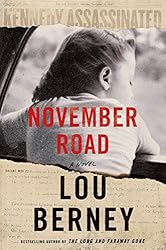
November Road
Lou Berney, 2018
HarperCollins
320 pp.
ISBN-13: 9780062663849
Summary
Set against the assassination of JFK, a poignant and evocative crime novel that centers on a desperate cat-and-mouse chase across 1960s America—a story of unexpected connections, daring possibilities, and the hope of second chances from the Edgar Award-winning author of The Long and Faraway Gone.
Frank Guidry’s luck has finally run out.
A loyal street lieutenant to New Orleans’ mob boss Carlos Marcello, Guidry has learned that everybody is expendable. But now it’s his turn—he knows too much about the crime of the century: the assassination of President John F. Kennedy.
Within hours of JFK’s murder, everyone with ties to Marcello is turning up dead, and Guidry suspects he’s next: he was in Dallas on an errand for the boss less than two weeks before the president was shot. With few good options, Guidry hits the road to Las Vegas, to see an old associate—a dangerous man who hates Marcello enough to help Guidry vanish.
Guidry knows that the first rule of running is "don’t stop," but when he sees a beautiful housewife on the side of the road with a broken-down car, two little daughters and a dog in the back seat, he sees the perfect disguise to cover his tracks from the hit men on his tail. Posing as an insurance man, Guidry offers to help Charlotte reach her destination, California. If she accompanies him to Vegas, he can help her get a new car.
For her, it’s more than a car—it’s an escape. She’s on the run too, from a stifling existence in small-town Oklahoma and a kindly husband who’s a hopeless drunk.
It’s an American story: two strangers meet to share the open road west, a dream, a hope—and find each other on the way.
Charlotte sees that he’s strong and kind; Guidry discovers that she’s smart and funny. He learns that’s she determined to give herself and her kids a new life; she can’t know that he’s desperate to leave his old one behind.
Another rule—fugitives shouldn’t fall in love, especially with each other. A road isn’t just a road, it’s a trail, and Guidry’s ruthless and relentless hunters are closing in on him. But now Guidry doesn’t want to just survive, he wants to really live, maybe for the first time.
Everyone’s expendable, or they should be, but now Guidry just can’t throw away the woman he’s come to love.
And it might get them both killed. (From the publisher.)
Author Bio
• Birth—ca. 1964-65
• Where—Oklahoma City, Oklahoma, USA
• Education—Loyola University, New Orleans; University of Massachuesetts, Amherst
• Awards—Edgar Award (Best Paperback)
• Currently—lives in Oklahoma City
Lou Berney is the author of several novels, including November Road (2018), The Long and Faraway Gone (2015), Whiplash River (2012), and Gutshot Straight (2010), as well as a collection of short stories, The Road to Bobby Joe (1991).
His short fiction has appeared in publications such as The New Yorker, Ploughshares, and the Pushcart Prize anthology, and he has written feature screenplays and created television pilots for, among others, Warner Brothers, Paramount, Focus Features, ABC, and Fox. He teaches in the Red Earth MFA program at Oklahoma City University. (From the publisher.)
Book Reviews
[T]his superior novel from Edgar winner Lou Berney melds crime fiction with a tale about people reinventing themselves, played out during a cross-country automobile trip.…An emotional story about the power of love and redemption through sacrifice with the backdrop of a crucial historical moment.
Associated Press
(Starred review) [A] moving novel.… While Berney creates nail-biting suspense …, the book’s power derives from Charlotte, who finds hidden strength as she confronts unexpected challenges. This is much more than just another conspiracy thriller.
Publishers Weekly
(Starred review) [Berney] explores relationships between two complicated and realized characters. With depth and genre crossover appeal, this literary crime thriller will please fans of Dennis Lehane or George Pelecanos and also satisfy a wider audience. —Gregg Winsor, Johnson Cty. Lib., Overland Park, KS
Library Journal
(Starred review) Berney bends his notes exquisitely, playing with the melody, building his marvelously rich characters while making us commit completely to the love story, even though we hear the melancholy refrain and see the noir cloud lurking in the sky. Pitch-perfect fiction.
Booklist
(Starred review) As a shocked nation mourns the assassination of John F. Kennedy, two lost souls looking for a new chance at life find each other along the wide-open Western highways.… As the title suggests, there is an autumnal, melancholic sense of loss at the heart of the novel, yet… [it] is the kind of loss that gives way to a new world order. Perfectly captures these few weeks at the end of 1963.
Kirkus Reviews
Discussion Questions
We'll add publisher questions if and when they're available; in the meantime, use our LitLovers talking points to help start a discussion for NOVEMBER ROAD ... then take off on your own:
1. How would you describe Frank Guidry at the beginning of November Road? Were you confused as to whether he was the hero or the villain of the story? How do your views of Guidry change over the course of the novel?
2. What was Guidry's relationship with Carlos Marcello? Before reading November Road, were you at all aware of the real-life Marcello—his hatred for and stated intent to kill President John F. Kennedy?
3. After the Kennedy assassination, how did Guidry's world shift? Why is Paul Barone after him?
4. Talk about Charlotte Roy. What do you think of her decision to pack up her daughters (plus dog) and leave her husband? Other than putting distance between herself and Dooley, what else does Charlotte want? What is she looking for? What are her ambitions for herself and her daughters>
5. Talk about the ways in which both Guidry and Charlotte change during the course of the novel? What attracts each of them to the other?
6. What is the symbolic meaning of the journey, the road?
7. Why is the novel titled "November Road"? Consider the month of November—not only is it the month of the JFK assassination in the novel, but it traditionally signals the end of fall and beginning of winter. Considering the national culture, how might November be seen as a sort of watershed in the national culture: an end to something and the beginning of something else?
8. How does JFK's assassination affect events and people Frank and Charlotte meet along the way?
9. If you are old enough to have lived through the JFK assassination, talk about what you recall of that weekend. If you are too young, what have you been told about it?
(Questions by LitLovers. Please feel free to use them, online and off, with attribution. Thanks.)


Now & Then
Jacqueline Sheehan, 2009
HarperCollins
400 pp.
ISBN-13: 9780061547782
Summary
Living a dog's life...now and then.
Anna O'Shea has failed at marriage, shed her job at a law firm, and she's trying to re-create herself when she and her recalcitrant nephew are summoned to the past in a manner that nearly destroys them.
Her twenty-first-century skills pale as she struggles to find her nephew in nineteenth-century Ireland. For one of them, the past is brutally difficult, filled with hunger and struggle. For the other, the past is filled with privilege, status, and a reprieve from the crushing pain of present-day life. For both Anna and her nephew, the past offers them a chance at love.
Will every choice they make reverberate down through time? And do Irish Wolfhounds carry the soul of the ancient celts?
The past and present wrap around finely wrought characters who reveal the road home. Mystical, charming, and fantastic, New York Times bestselling author Jacqueline Sheehan's Now & Then is a poignant and beautiful tale of a remarkable journey.
It is a miraculous evocation of a breathtaking place in a volatile age filled with rich, unforgettable, deeply human characters and one unforgettable dog named Madigan. (From the publisher.)
Author Bio
Jacqueline Sheehan, Ph.D., is a fiction writer and essayist. She is a New Englander through and through, but spent twenty years living in the western states of Oregon, California, and New Mexico doing a variety of things, including house painting, freelance photography, newspaper writing, clerking in a health food store, and directing a traveling troupe of high school puppeteers.
Currently on the faculty of Writers in Progress and Grub Street in Massachusetts, she also offers international workshops on the combination of yoga and writing. She writes travel articles about lesser-known destinations and lives in Massachusetts.
Novels
Sheehan's books include Truth (2003), reissued as The Comet's Tale: A Novel About Sojurner Truth (2011); Now & Then (2009); two Peaks Island novels, Lost & Found (2007) and Picture This (2012); and, most recently, The Center of the World (2015). (Adapted from the publisher.)
Book Reviews
[S]pellbinding.... Anna O'Shea becomes a time-traveling ex-wife when she returns from a vacation in Ireland and is enlisted to pick up her brother Patrick's son from jail in Newark.... Throw in loyal Irish wolfhound Madigan, and you've got an altogether enjoyable romantic adventure.
Publishers Weekly
Sheehan basically transforms a contemporary novel into a historical one, with all the period detail and sense of place for which such works are judged and appreciated. She reminds us that those who came before were no less savvy...and that by accepting the past, we might just change the future. —Bette-Lee Fox
Library Journal
Discussion Questions
1. Anna and Joseph’s time traveling experience is dreamlike, with aquatic and primal overtones. Their journey to the past leaves them barely alive. Did the descriptions of time travel in Now & Then surprise you? What notions of time travel do you have that Now & Then either defied or complied with?
2. Glenis says to Anna, ‘You say yes or no like the English do, as if all the world fits only one way or the other. We don’t think that way. You see, the hope can’t be scratched out of us. There is always a place where a thing is mostly not, or tis, but for a wee bit. We Irish are much more specific about what is and what is not.” How do you think living in the ‘modern world’ has shaped our relationship with language as a society, and for you as an individual?
3. In the past, Anna “had started to adjust to the interminable pauses between sentences that people of this time used. No one talked over the middle of someone else’s sentence. And they were profoundly good listeners… No one was multitasking here.” Do you think, with the role technology plays in our lives today, that we’ve lost a bit of our ability to communicate with each other, or that our quality of communication has changed?
4. Anna and Joseph find themselves in vastly different circumstances upon their ‘rescue’ in Ireland. Anna must quickly conform to a hard-scrabble existence of living off the land, while Joseph falls into the lap of luxury living at the colonel’s estate. What do they learn from their experiences on the end of the quality-of-life spectrum? How do you think the story would have been different if Anna had been rescued by the colonel’s men, and Joseph had to pull his weight on Glenis and Tom’s farm?
5. Anna and Joseph both find love in the past. What do their romances in Ireland teach them about the people they were, and the people they can become?
6. Taleen’s outburst sheds new light onto the O’Shea’s troubled family line, where fathers and sons are incapable of expressing love toward each other. What is revealed about Joseph’s peculiar place in his lineage? Do you believe curses can run through families?
7. It’s mentioned several times that there are severe penalties facing Irish who are caught speaking Gaelic, their native language. What other ways does the English rule try to break the spirit of the Irish people?
8. All of the women Anna and Joseph encounter in Ireland are strong and willful in their own way --- Glenis, Deidre, Taleen, Biddy Early. What do Anna and Joseph --- strangers from another time --- admire most about them, and what are the important lessons they learn from them?
9. What aspects of life in 1844 Ireland struck you as most surprisingly different from how we live today? What would you miss most if the modern amenities we are used to suddenly weren’t at your disposal?
10. What significance do the Irish Wolfhounds and Madigan have in Now & Then? Do you feel the magical and mystical elements in the story seem more believable in the story that takes place in the past versus the present-day plot?
(We'll add specific questions if and when they're made available by the publisher.)

Now That You Mention It
Kristan Higgins, 2017
Harlequin
416 pp.
ISBN-13: 9781335903358
Summary
Kristan Higgins welcomes you home in this witty, emotionally charged novel about the complications of life, love and family.
One step forward. Two steps back.
The Tufts scholarship that put Nora Stuart on the path to becoming a Boston medical specialist was a step forward. Being hit by a car and then overhearing her boyfriend hit on another doctor when she thought she was dying? Two major steps back.
Injured in more ways than one, Nora feels her carefully built life cracking at the edges. There’s only one place to land: home.
But the tiny Maine community she left fifteen years ago doesn’t necessarily want her. At every turn, someone holds the prodigal daughter of Scupper Island responsible for small-town drama and big-time disappointments.
With a tough islander mother who’s always been distant, a wild-child sister in jail and a withdrawn teenage niece as eager to ditch the island as Nora once was, Nora has her work cut out for her if she’s going to take what might be her last chance to mend the family.
Balancing loss and opportunity, dark events from her past with hope for the future, Nora will discover that tackling old pain makes room for promise … and the chance to begin again. (From the publisher.)
Author Bio
• Birth—ca. 1965
• Raised—Whiteyville, Connecticut, USA
• Education—B.A., College of the Holy Cross
• Awards—2 RITA Awards
• Currently—lives in Durham, Connecticut
Kristan Higgins is the New York Times, Publishers Weekly and USA Today bestselling author or nearly 20 books. Her works books have been translated into more than 20 languages. She has received dozens of awards and accolades, including starred reviews from Publishers Weekly, Library Journal, The New York Journal of Books and Kirkus.
Kristan lives in Connecticut with her heroic firefighter husband, two atypically affectionate children, a neurotic rescue mutt and an occasionally friendly cat. (From the publisher.)
Book Reviews
(Starred review.) Many readers will relate to the family saga and rough past, and the light romance and humor sprinkled throughout will suit a wide audience. Readers won't want to put down this highly recommended title. —Brooke Bolton, Boonville-Warrick Cty. P.L., IN
Library Journal
(Starred review.) Nora has lots to unpack and sift through, but figuring out who she is…is a powerful, entertaining journey. Balancing emotion, humor, and a redemptive theme, Higgins hits all the right notes with precision, perception, and panache.
Kirkus Reviews
Discussion Questions
We'll add publisher questions if and when they're available; in the meantime, please use our LitLovers talking points to help start a discussion for Now That You Mention It … then take off on your own:
1. How would you describe Nora Stuart? Why is she dissatisfied with her life, a life that would be the envy of many? She has it all, doesn't she?
2. Follow-up to Question 1: How has Nora's upbringing on Scupper Island shaped her life? In what ways is the past (and its people) still a part of her life — even though she'd rather not admit it?
3. As the novel progresses and our knowledge of Nora deepens, what stands out about her most to you? What do you find especially striking about her personality — the way she relates to the world around her?
4. What is Nora's relationship with her mother and with her sister Lily? Describe both women.
5. What about the other characters: Nora's niece Poe, Sully and Audrey, and her school pal Xiaowen? Whom do you like most?
6. Talk about the community's reaction to Nora's return. Why do the islanders dislike, or at least resent, her? Should Nora feel guilty for winning the scholarship and for Luke Fletcher's subsequent downward spiral? Or is guilt a normal human response?
7. Did the book make you laugh? The dinner party on the houseboat, for instance? Or the ham dinner at Nora's mother's house? The witty banter back and forth between characters? Maybe Nora's internal monologues? Does "Oh fuckety fucking McFuckster" qualify? Anything else?
8. How does Nora change during the course novel? How does she eventually make peace with her family, her past, and her own identity? What does she learn?
(Questions by LitLovers. Please feel free to use them, online and off, with attribution. Thanks.)

Nutshell
Ian McEwan, 2016
Knopf Doubleday
208 pp.
ISBN-13: 9780385542074
Summary
Trudy has betrayed her husband, John. She's still in the marital home—a dilapidated, priceless London townhouse—but John's not there.
Instead, she's with his brother, the profoundly banal Claude, and the two of them have a plan.
But there is a witness to their plot: the inquisitive, nine-month-old resident of Trudy's womb.
Told from a perspective unlike any other, Nutshell is a classic tale of murder and deceit from one of the world’s master storytellers. (From the publisher.)
Author Bio
• Birth—June 21, 1948
• Where—Aldershot, England, UK
• Education—B.A., University of Sussex; M.A. University of East Anglia
• Awards—(see blow)
• Currently—lives in Oxford, England
Ian Russell McEwan is an English novelist. He was born in Aldershot, Hampshire, the son of David McEwan and Rose Lilian Violet (nee Moore). His father was a working class Scotsman who had worked his way up through the army to the rank of major. As a result, McEwan spent much of his childhood in East Asia (including Singapore), Germany and North Africa (including Libya), where his father was posted. His family returned to England when he was twelve.
McEwan was educated at Woolverstone Hall School; the University of Sussex, receiving his degree in English literature in 1970; and the University of East Anglia, where he was one of the first graduates of Malcolm Bradbury and Angus Wilson's pioneering creative writing course.
Career
McEwan's first published work was a collection of short stories, First Love, Last Rites (1975), which won the Somerset Maugham Award in 1976. He achieved notoriety in 1979 when the BBC suspended production of his play Solid Geometry because of its alleged obscenity. His second collection of short stories, In Between the Sheets, was published in 1978.
The Cement Garden (1978) and The Comfort of Strangers (1981) were his two earliest novels, both of which were adapted into films. The nature of these works caused him to be nicknamed "Ian Macabre." These were followed by The Child in Time (1987), winner of the 1987 Whitbread Novel Award; The Innocent (1990); and Black Dogs (1992). McEwan has also written two children's books, Rose Blanche (1985) and The Daydreamer (1994). His 1997 novel, Enduring Love, about the relationship between a science writer and a stalker, was popular with critics and adapted into a film in 2004.
In 1998, he won the Man Booker Prize for Amsterdam. His next novel, Atonement (2001), received considerable acclaim; Time magazine named it the best novel of 2002, and it was shortlisted for the Booker Prize. In 2007, the critically acclaimed movie Atonement, directed by Joe Wright and starring Keira Knightley and James McAvoy, was released in cinemas worldwide. His next work, Saturday (2005), follows an especially eventful day in the life of a successful neurosurgeon. Saturday won the James Tait Black Memorial Prize for 2005, and his novel On Chesil Beach (2007) was shortlisted for the 2007 Booker Prize.
McEwan has also written a number of produced screenplays, a stage play, children's fiction, an oratorio and a libretto titled For You with music composed by Michael Berkeley.
In 2008 at the Hay Festival, McEwan gave a surprise reading of his then novel-in-progress, eventually published as Solar (2010). The novel includes a scientist hoping to save the planet from the threat of climate change and got its inspiration from a 2005 Cape Farewell expedition. McEwan along with fellow artists and scientists spent several weeks aboard a ship near the north pole.
McEwan's twelfth novel, Sweet Tooth (2012), is historical in nature and set in the 1970. In an interview with the Scotsman newspaper, McEwan revealed that the impetus for writing the novel was a way for him to write a "disguised autobiography." McEwan's 13th novel, The Children Act (2014), is about a high court judge.
Controversy
In 2006 McEwan was accused of plagiarism, specifically a passage in Atonement that closely echoed one from a 2012 memoir, No Time for Romance, by Lucilla Andrews. McEwan acknowledged using the book as a source for his work; in fact, he had included a brief note at the end of the book referring to Andrews's autobiography, among several other works. Writing in the Guardian in November 2006, a month after Andrews' death, McEwan professed innocence of plagiarism while acknowledging his debt to the author.
The incident recalled critical controversy over his debut novel The Cement Garden, key plot elements that closely mirrored some of those in Our Mother's House, a 1963 novel by Julian Gloag, which had also been made into a film. McEwan denied charges of plagiarism, claiming he was unaware of the earlier work.
In 2011 McEwan caused controversy when he accepted the Jerusalem Prize for the Freedom of the Individual in Society. In the face of pressure from groups and individuals opposed to the Israeli government, specifically British Writers in Support of Palestine (BWISP), McEwan wrote a letter to the Guardian in which he said...
There are ways in which art can have a longer reach than politics, and for me the emblem in this respect is Daniel Barenboim's West-Eastern Divan Orchestra—surely a beam of hope in a dark landscape, though denigrated by the Israeli religious right and Hamas. If BWISP is against this particular project, then clearly we have nothing more to say to each other.
He announced that he would donate the ten thousand dollar prize money to Combatants for Peace, an organization that brings together Israeli ex-soldiers and Palestinian ex-fighters.
Recognition
McEwan has been nominated for the Man Booker prize six times to date, winning the Prize for Amsterdam in 1998. His other nominations were for The Comfort of Strangers (1981, Shortlisted), Black Dogs (1992, Shortlisted), Atonement (2001, Shortlisted), Saturday (2005, Longlisted), and On Chesil Beach (2007, Shortlisted). McEwan also received nominations for the Man Booker International Prize in 2005 and 2007.
He is a Fellow of the Royal Society of Literature, a Fellow of the Royal Society of Arts, and a Fellow of the American Academy of Arts and Sciences. He was awarded the Shakespeare Prize by the Alfred Toepfer Foundation, Hamburg, in 1999. He is also a Distinguished Supporter of the British Humanist Association. He was awarded a CBE in 2000. In 2005, he was the first recipient of Dickinson College's Harold and Ethel L. Stellfox Visiting Scholar and Writers Program Award, in Carlisle, Pennsylvania, U.S. In 2008, McEwan received an honorary degree of Doctor of Literature by University College, London, where he used to teach English literature. In 2008, The Times (of London) featured him on their list of "The 50 greatest British writers since 1945".
Personal
McEwan has been married twice. His 13-year marriage to spiritual healer and therapist Penny Allen ended in 1995 and was followed by a bitter custody battle over their two sons. His second wife, Annalena McAfee, was formerly the editor of the Guardian's Review section.
In 2002, McEwan discovered that he had a brother who had been given up for adoption during World War II when his mother was married to a different man. After her first husband was killed in combat, McEwan's mother married her lover, and Ian was born a few years later. The brothers are in regular contact, and McEwan has written a foreword to Sharp's memoir. (Excerpted and adapted from Wikipedia. Retrieved 9/4/2014.)
Book Reviews
A narrator who speaks to us from his mother’s womb—spouting off about philosophy, politics, and the state of the world. And one other little matter: he frets over his mother’s plans to murder his father. If you can accept the outlandish premise, you’ll find Ian McEwan’s newest book a brilliant, thrilling, often hilarious ride. READ MORE.
Molly Lundquist - LitLovers
Ian McEwan has performed an incongruous magic trick, mashing up the premises of Shakespeare's Hamlet and Amy Heckerling's 1989 movie, Look Who's Talking, to create a smart, funny and utterly captivating novel…Nutshell is a small tour de force that showcases all of Mr. McEwan's narrative gifts of precision, authority and control, plus a new, Tom Stoppard-like delight in the sly gymnastics that words can be perform. The restrictions created by the narrator's situation…seem to have stimulated a surge of inventiveness on Mr. McEwan's part, as he mischievously concocts a monologue…that plays on Hamlet, even as it explores some of his own favorite themes (the corruption of innocence, the vulnerability of children and the sudden skid of ordinary life into horror).... It's preposterous, of course, that a fetus should be thinking such earthshaking thoughts, but Mr. McEwan writes here with such assurance and élan that the reader never for a moment questions his sleight of hand.
Michiko Kakutani - New York Times
Nutshell is an orb, a Venetian glass paperweight of a book.... It is a consciously late, deliberately elegiac masterpiece, a calling together of everything McEwan has learned and knows about his art.
Guardian (UK)
In Nutshell, McEwan is a pentathlete at the top of his game, doing several very different things equally well. Current literary culture rarely awards gold medals for comedy, but this is one performance—agile, muscular, swift—you should not miss.
Sunday Times (UK)
A creative gamble that pays off brilliantly. Witty and gently tragic, this short, bewitching novel is an ode to humanity’s beauty, selfishness and inextinguishable longing.
Mail on Sunday (UK)
There is far more going on in this fiercely intelligent novel than first meets the eye. At once playful and deadly serious, delightful and frustrating, it is one of McEwan's hardest to categorize works, and all the more interesting for it.
London Times (UK)
McEwan has thrown in Gone Girl intrigue with The Girl on the Train suspense and given us his take on how toxic a marriage can get when spliced with a Shakespearean cast. Who knew McEwan could mix high and low literary genres to create such a bizarrely readable mash-up?
Independent (UK)
(Starred revicew.) McEwan’s latest novel is short, smart, and narrated by an unborn baby.... Packed with humor and tinged with suspense, this gem resembles a sonnet the narrator recalls hearing his father recite: brief, dense, bitter, suggestive of unrequited and unmanageable longing, surprising, and surprisingly affecting.
Publishers Weekly
(Starred revicew.) [McEwan's most ]rovocative work to date.... [A]n expansive meditation on stability and identity from a confined perspective. —Joshua Finnell, Los Alamos National Lab., NM
Library Journal
(Starred revicew.) McEwan can be counted on to make the implausible plausible and the outrageous reasonable, and his talent in that regard is put to its consummate test in his latest novel.... [An] ingenious tour de force.... As soon as words gets out, any new novel by this best-selling, Booker Prize–winning novelist causes a reader frenzy.
Booklist
Speaking from the womb of his 28-year-old mother, this slim entertainment’s precocious narrator tells of sex and booze and something rotten in London.... Catching those allusions [to Hamlet] can be a fun sort of parlor game, but what they add up to, if anything, is unclear. Clever, likable, and yet unsatisfying, this tale too often bears out the narrator’s early claim: "I take in everything, even the trivia—of which there is much."
Kirkus Reviews
Discussion Questions
We'll add publisher questions if and when they're available; in the meantime, consider these LitLovers talking points to help start a discussion for Nutshell...then take off on your own:
1. One obvious place to start a discussion is with the entire conceit: a brilliant, verbally gifted fetus talking to us from his mother's womb. Does McEwan pull it off? Are you able to suspend your disbelief in order to be drawn into baby Hamlet's nutshell of a world? Or are you put off by the whole conceit?
2. Another discussion opener would be the many allusions to Shakespeare's Hamlet. The title itself is taken from a line in the Act II, in which Hamlet says,
Oh god, I could be bounded in a nutshell and count myself a king of infinite space—were it not that I have bad dreams.
Beyond the obvious (i.e., womb = nutshell), how else does does Hamlet's line resonate in Ian McEwan's novel? What, for instance, are this neonatal Hamlet's "bad dreams"? What are some of the other parallels to the Bard's play, especially the play Hamlet's famous "to be or not to be" dilemma. Many other literary allusions can be found within—can you identify some of them (i.e., John Donne, Macbeth, Lolita, Kafka, to name a few)?
3. Describe the three adult characters: John, Trudy, and Claude. Do you find any of them likable? Who is the Ophelia?
4. Our narrator also comments on the world at large. Consider, for instance, "Europa's secular dreams of union may dissolve before the old hatreds." What other disasters or fears are on his horizon? And what else does McEwan, as a satirist, take aim at. How do modern-day Londoners come off?
7. By virtue of his location in the womb, this miniature Hamlet has a "front row" seat in his mother's life: he has access to her most intimate conversations and actions, including her sexual relationship with Claude. Would you consider him a reliable narrator...or unreliable? In other words, does he fully comprehend the outside world? Is he objective in his observations and judgments, or do his own interests cloud his understanding?
7. Did you laugh?
8. Consider reading this interview with McEwan in the Wall St. Journal for some thoughts about the author's inspiration for his fetus as a narrator.
(Questions by LitLovers. Please feel free to use them, online or off, with attribution. Thanks.)


NW
Zadie Smith, 2012
Penguin Group USA
416 pp.
ISBN-13: 9781594203978
Summary
This is the story of a city.
The northwest corner of a city. Here you’ll find guests and hosts, those with power and those without it, people who live somewhere special and others who live nowhere at all. And many people in between.
Every city is like this. Cheek-by-jowl living. Separate worlds.
And then there are the visitations: the rare times a stranger crosses a threshold without permission or warning, causing a disruption in the whole system. Like the April afternoon a woman came to Leah Hanwell’s door, seeking help, disturbing the peace, forcing Leah out of her isolation...
Zadie Smith’s brilliant tragi-comic new novel follows four Londoners—Leah, Natalie, Felix and Nathan—as they try to make adult lives outside of Caldwell, the council estate of their childhood. From private houses to public parks, at work and at play, their London is a complicated place, as beautiful as it is brutal, where the thoroughfares hide the back alleys and taking the high road can sometimes lead you to a dead end.
Depicting the modern urban zone—familiar to town-dwellers everywhere—Zadie Smith’s NW is a quietly devastating novel of encounters, mercurial and vital, like the city itself. (From the publisher.)
Author Bio
• Birth—October 27, 1975
• Where—Hampstead, England, UK
• Education—B.A., Cambridge University
• Awards—(see below)
• Currently—lives in New York City, New York, and London, England
Early Life
Zadie Smith was born as Sadie Smith in the northwest London borough of Brent—a largely working-class area—to a Jamaican mother, Yvonne Bailey, and a British father, Harvey Smith. Her mother had grown up in Jamaica and emigrated to Britain in 1969. Zadie has a half-sister, a half-brother, and two younger brothers, one of whom is the rapper and stand-up comedian Doc Brown and the other is rapper Luc Skyz. Her parents divorced when she was a teenager.
As a child Smith was fond of tap dancing and as a teenager considered a musical theater career. When she was 14, she changed her name to "Zadie."
Education
Smith attended Cambridge University where she earned money as a jazz singer and, at first, wanted to become a journalist. Despite those earlier ambitions, literature emerged as her principal interest. While an undergrad, she published a number of short stories in a collection of new student writing called The Mays Anthology. These attracted the attention of a publisher, who offered her a contract for her first novel. Smith decided to contact a literary agent and was taken on by A.P. Watt.
Career
White Teeth was introduced to the publishing world in 1997—long before completion. The partial manuscript fueled an auction among different houses for the publishing rights, but it wasn't until her final year at Cambridge that she finished the novel. When published in 2000, White Teeth became an immediate bestseller, praised internationally and pocketing a number of awards. In 2002, Channel 4 adapted the novel for television.
In interviews Smith reported that the hype surrounding her first novel had caused her to suffer a short spell of writer's block. Nevertheless, her second novel, The Autograph Man, came out in 2002. It, too, achieved commercial success although the critical response was not as positive as it had been to White Teeth.
Following publication of The Autograph Man, Smith visited the United States as a 2002–2003 a Fellow at Harvard University. While there, she started work on a book of essays, some portions of which are included in a later essay collection titled Changing My Mind, published in 2009.
Her third novel, On Beauty came out in 2005. Set largely in and around Greater Boston, it attracted acclaim and was shortlisted for the Man Booker Prize. It won the 2006 Orange Prize.
Following a brief spell teaching fiction at Columbia University, Smith joined New York University as a tenured professor of fiction in 2010. That same year, The UK's Guardian newspaper asked Smith for her "10 rules for writing fiction." Among them, she offered up this:
Tell the truth through whichever veil comes to hand—but tell it. Resign yourself to the lifelong sadness that comes from never being satisfied.
During 2011, Smith served as the New Books editor at Harper's magazine, and in 2012, she published NW, her fourth novel, this one set in the Kilburn area of north-west London (the title refers to the area's postal code, NW6). NW was shortlisted for the Royal Society of Literature Ondaatje Prize and the Women’s Prize for Fiction.
Swing Time, Smith's fifth novel, was released in 2016, again to solid acclaim. The novel, a coming-of-age story, follows the fate of two girls of color who became fast friends through their mutual love of dance.
Personal Life
Smith met Nick Laird at Cambridge University, and the couple married in 2004. They have two children, Kathrine and Harvey, and are based in New York City and Queen's Park, London.
Awards and recognition
♦ White Teeth (2000): Whitbread First Novel Award, James Tait Black Memorial Prize, Commonwealth Writers’ First Book Award.
♦ The Autograph Man (2002): Jewish Quarterly Wingate Literary Prize
♦ On Beauty (2005): Commonwealth Writers’ Best Book Award, Orange Prize
♦ NW (2012): shortlisted for Ondaatje Prize and Women's Prize for Fiction
♦ General: Granta′s Best of Young British Novelists, 2003, 2013; Welt-Literaturpreis, 2016.
(Author bio adapted from Wikipedia. Retrieved 10/31/2016.)
Book Reviews
This is a book in which you never know how things will come together or what will happen next... NW represents a deliberate undoing; an unpacking of Smith’s abundant narrative gifts to find a deeper truth, audacious and painful as that truth may be. The result is that rare thing, a book that is radical and passionate and real.
Anne Enright - New York Times Book Review
A boldly Joycean appropriation, fortunately not so difficult of entry as its great model... Like Zadie Smith’s much-acclaimed predecessor White Teeth (2000), NW is an urban epic."
Joyce Carol Oates - New York Review of Books
Smith has never been a writer who travels directly from A to B.... Smith is not interested in exploring the unbroken line of cause and effect. What NW does offer, in abundance, is the sense of being plunged with great immediacy into the lives of these characters and their neighborhood. How wonderful to have a new version of London to explore.
Boston Globe
A complicated novel that's endlessly fascinating.... The impression of Smith's casual brilliance is what constantly surprises, the way she tosses off insights about parenting and work that you've felt in some nebulous way but never been able to articulate. While her own voice can seem crisp and clinical, it's tinged with irony, and her dialogue ripples off the page in full stereo.... At times, reading NW is like running past a fence, catching only strips of light from the scene on the other side. Smith makes no accommodation for the distracted reader—or even the reader who demands a clear itinerary. But if you're willing to let it work on you, to hear all these voices and allow the details to come into focus when Smith wants them to, you'll be privy to an extraordinary vision of our age.
Ron Charles - Washington Post
If our everyday world suddenly turns dark, zany and lyrically weird one day, it's probably because Zadie Smith has learned how to control us all. In NW, Ms. Smith takes her courageous forays into the vernacular to new heights, using perspectives that are perhaps more native to her but in a form that feels brand new.
Pittsburgh Post-Gazette
[NW is] a real sign of how Smith has developed and grown. It is a terrific novel: deeply ambitious, an attempt to use literature as a kind of excavation, while at the same time remaining intensely readable, intensely human, a portrait of the way we live.
Los Angeles Times
[An] excellent and captivating new novel, in which the lines dividing neighbors from strangers are not always clear or permanent.... Smith's masterful ability to suspend all these bits and parts in the amber which is London refracts light, history, and the humane beauty of seeing everything at once.
Publishers Weekly
It's been seven years since Smith last published a novel, so we're all really chaffing to read this one. NW stands for northwest, that is, northwest London, where a group of friends living on an estate make their way through school and on to adulthood, staying more or less true to their ideals.
Library Journal
A wildly ambitious jigsaw puzzle of a nove.... Smith takes big risks here, but some might need to read this twice before all the pieces fit together, and more conventionally minded readers might abandon it in frustration.
Kirkus Reviews
Discussion Questions
Use our LitLovers Book Club Resources; they can help with discussions for any book:
• How to Discuss a Book (helpful discussion tips)
• Generic Discussion Questions—Fiction and Nonfiction
• Read-Think-Talk (a guided reading chart)
Specific discussion questions will be added if and when they are made available by the publisher.


The Obituary Writer
Ann Hood, 2013
W.W. Norton & Co.
304 pp.
ISBN-13: 9780393081428
Summary
A sophisticated and suspenseful novel about the poignant lives of two women living in different eras.
On the day John F. Kennedy is inaugurated, Claire, an uncompromising young wife and mother obsessed with the glamour of Jackie O, struggles over the decision of whether to stay in a loveless marriage or follow the man she loves and whose baby she may be carrying.
Decades earlier, in 1919, Vivien Lowe, an obituary writer, is searching for her lover who disappeared in the Great San Francisco Earthquake of 1906. By telling the stories of the dead, Vivien not only helps others cope with their grief but also begins to understand the devastation of her own terrible loss. The surprising connection between Claire and Vivien will change the life of one of them in unexpected and extraordinary ways.
Part literary mystery and part love story, The Obituary Writer examines expectations of marriage and love, the roles of wives and mothers, and the emotions of grief, regret, and hope. (From the publisher.)
Author Bio
• Birth—1956
• Where—West Warwick, Rhode Island, USA
• Education—B.A., University of Rhode Island; graduate studies, New York University
• Awards—Pushcart Prize (twice); Best American Spiritual Writing Award; Paul Bowles
Prize for Short Fiction
• Currently—lives in Providence, Rhode Island
Ann Hood is an American novelist and short story writer; she has also written nonfiction. The author of thirteen books, her essays and short stories have appeared in many journals and magazines, including the Paris Review, Ploughshares, and Tin House. Hood is a regular contributor to the New York Times "Home Economics" column.
Hood is the winner of a number of awards: Paul Bowles Prize for Short Fiction, two Pushcart Prizes, and a Best American Spiritual Writing Award. She is a faculty member in the MFA in Creative Writing program at The New School in New York City. She lives in Providence with her husband and their children.
Early Years
Hood was born in West Warwick, Rhode Island and earned her BA in English from the University of Rhode Island. After college she worked for the now-defunct airlines TWA as a flight attendant, living in Boston and Saint Louis and later moving to New York City. She attended graduate school at New York University, studying American Literature.
Hood began writing her first novel Somewhere Off The Coast Of Maine in 1983 while working as a flight attendant—and while attending graduate school—writing whenever she could during train rides to JFK airport or in the galleys of the airplane while passengers slept. During a furlough from the airline, she worked at the Spring Street Bookstore in Soho and Tony Roma's while writing Somewhere Off The Coast Of Maine.
Like much of her work, the novel draws upon her own life. Hood says the book began as a series of short stories about three women who went to college together in the 1960s. A year earlier, her older brother, Skip, died in a freak accident and Hood was struggling with how to cope with the loss. At a writer’s conference, Hood was convinced by the writer Nicholas Delbanco that she was really writing a novel, and from there she began to connect the stories. The book was published in 1987.
Hood’s flight attendant career ended in 1986 when TWA went on strike and the flight attendants found themselves soon “replaced.” With more time to devote to writing, her stories and essays began to appear in Mademoiselle, Redbook, Story, Self, Glamour, New Woman, among others.
Personal life
Hood lives with her husband, businessman Lorne Adrain, her teenage son Sam and her daughter Annabelle in Providence, Rhode Island.
On April 18, 2002, Hood's five-year-old daughter, Grace, died from a virulent form of strep. For two years Hood found herself unable to write or even read. She took solace in learning to knit and in knitting groups. She gradually made her way back to her craft, writing short essays about Grace and grief.
To make sense of her own grief, in fall of 2004 Hood began to write her novel The Knitting Circle, about a woman whose five-year-old daughter dies from meningitis. The woman joins a knitting group of others also struggling to heal from loss. Hood’s best-selling memoir Comfort: A Journey Through Grief chronicles her own struggle after her daughter’s sudden death. That memoir was named one of the top ten non-fiction books of 2008 by Entertainment Weekly and was a New York Times Editor's Choice.
The summer after Grace died, Hood and Adrain decided to adopt a child and in 2005 traveled to China, where they adopted Annabelle. Hood’s experience adopting in China became the inspiration for her 2010 novel The Red Thread, which follows a woman struggling with the accidental death of her young daughter. The woman, Maya Lange, begins an adoption agency for Chinese babies.
Work
Hood’s short story "Total Cave Darkness," about an alcoholic woman who runs away with a Protestant minister nine years younger than she is, appeared in the Paris Review in 2000. It is also the opening story in her collection of stories An Ornithologist's Guide To Life. The title story of that collection appeared in Glimmer Train in 2004 and revolves around a young girl who slowly discovers her mother is having an affair with their neighbor. Her stories have also appeared in Tin House, Ploughshares, Good Housekeeping, Story, Five Points, and others.
In addition to Somewhere Off The Coast of Maine, The Knitting Circle, and The Red Thread, Hood has written seven other novels: The Obituary Writer (2013) Waiting To Vanish (1988), Three-Legged Horse (1989), Something Blue (1991), Places To Stay The Night (1993), The Properties of Water (Doubleday), and Ruby (1998).
Hood, in addition to her memoir, has written an addition work of nonfiction: Do Not Go Gentle: My Search For Miracles in a Cynical Time (1999) follows Hood’s travels to Chimayo, New Mexico in search of a miracle cure for her father’s lung cancer. The dirt at El Santuario de Chimayo, a Roman Catholic church, is believed to have healing properties and thousands flock to the site each year. Her father’s tumor did disappear, but he later died from complications from chemotherapy. Hood initially wrote about this experience in an essay for Doubletake magazine. That essay went on to win a Pushcart Prize. Hood’s editor at Picador urged her to turn it into a book. (Adapted from Wikipedia.)
Book Reviews
Pushcart Prize winner Hood (Red Thread) artfully blends two stories that converge in an emotional, poignant ending. Vivien Lowe is an obituary writer in San Francisco obsessed with finding her lover, lost in the 1906 earthquake.... Meanwhile, decades into the future, privileged housewife Claire is bored with her marriage to Peter.... Claire attends the 80th birthday party of her formidable mother-in-law, Birdie. Birdie's illness at the party unites the lives of Vivien and Claire, and their astonishing connection is revealed. Verdict: A well-constructed story.... —Donna Bettencourt, Mesa County Libs., Grand Junction, CO
Library Journal
Connections between an unhappy wife in the Kennedy era and an independent obituarist in early-20th-century California are artfully if predictably spliced in the latest from Hood (The Red Thread, 2010, etc.).... As President John F. Kennedy is inaugurated, [Claire] is both preoccupied with the color of Jackie's outfit and skeptical about her marriage.... In a parallel narrative set on the West Coast in 1919, we meet Vivien Lowe, who, as an obituary writer, has learned to "speak the language of grief" and is in love with a ghost.... A crisis involving Peter's 80-year-old mother, Birdy, leads to the settlement of all the women's fates. Hood's fluent storytelling and empathy will ensure popularity, but her heroines' destinies are devoid of surprises.
Kirkus Reviews
Discussion Questions
1. The Obituary Writer takes place in two different eras. Describe some of the period details in the novel that help bring these two different eras to life. How has the world changed between 1919 and 1961, and how has it stayed the same? In what ways are Claire and Vivian defined by the eras in which they live?
2. Claire fixates on the inauguration of John F. Kennedy and, in particular, on the glamour of Jackie Kennedy. Why do you think Claire is so interested in Jackie? What does the myth of the Kennedys represent to Claire?
3. What is it about the disappearance of Dougie Daniels that causes Claire to reexamine her own life?
4. What do Claire and Vivian have in common as characters? Who is stronger, and who is weaker? What kind of strength does each possess?
5. Vivian loses a lover. Lotte loses a child. Peter loses his mother. Describe the different ways in which the characters in the novel experience loss.
6. Love takes both women by surprise. What does Claire’s love affair with Miles have in common with Vivian’s affair with David? How do they differ?
7. The “Claire” chapters of the novel all begin with epigraphs from Emily Post. What role do manners, etiquette, and the expectations of society have to play in the novel?
8. What does Vivian have to teach Claire, in the end? What has Vivian’s life taught her, and what wisdom does she impart?
9. Vivian says of grief, “It never really goes away, it just changes shape.” How has Vivian’s grief changed shape over the course of her life?
10. In the end, Claire asks Vivian the same question that Vivian has asked so many strangers: “Tell me about your loved one.” Do both women help each other to move on in the end?
11. In listening to mourners and telling the stories of their loved ones, Vivian finds a way of processing her own terrible loss. In your own life, do you find that sharing stories helps people process emotion and come to terms with grief? Does hearing the stories of others help?
(Questions issued by publisher.)
Object Lessons
Anna Quindlen, 1997
Random House
288 pp.
ISBN-13: 9780449001011
Summary
It is the 1960s, in suburban New York City. Maggie and her family, are in the thrall of her powerful grandfather Jack Scanlan. In the summer of her twelfth year, Maggie is despertately trying to master the object lessons her grandfather fills her head with. But there is too much going on to concentrate. Everything at home is in upheaval, her grandfather is changing, and Maggie is unsure if what she wants is worth having. (From the publisher.)
Author Bio
• Birth—July 8, 1952
• Where—Philadelphia, PA, USA
• Education—B.A., Barnard College
• Awards—Pulitzer Prize for her New York Times column
• Currently—New York, New York
Anna Quindlen could have settled onto a nice, lofty career plateau in the early 1990s, when she had won a Pulitzer Prize for her New York Times column; but she took an unconventional turn, and achieved a richer result.
Quindlen, the third woman to hold a place among the New York Times' Op-Ed columnists, had already published two successful collections of her work when she decided to leave the paper in 1995. But it was the two novels she had produced that led her to seek a future beyond her column.
Quindlen had a warm, if not entirely uncritical, reception as a novelist. Her first book, Object Lessons, focused on an Irish American family in suburban New York in the 1960s. It was a bestseller and a New York Times Notable Book of 1991, but was also criticized for not being as engaging as it could have been. One True Thing, Quindlen's exploration of an ambitious daughter's journey home to take care of her terminally ill mother, was stronger still—a heartbreaker that was made into a movie starring Meryl Streep. But Quindlen's fiction clearly benefited from her decision to leave the Times. Three years after that controversial departure, she earned her best reviews yet with Black and Blue, a chronicle of escape from domestic abuse.
Quindlen's novels are thoughtful explorations centering on women who may not start out strong, but who ultimately find some core within themselves as a result of what happens in the story. Her nonfiction meditations—particularly A Short Guide to a Happy Life and her collection of "Life in the 30s" columns, Living Out Loud—often encourage this same transition, urging others to look within themselves and not get caught up in what society would plan for them. It's an approach Quindlen herself has obviously had success with.
Extras
• To those who expressed surprise at Quindlen's apparent switch from columnist to novelist, the author points out that her first love was always fiction. She told fans in a Barnes & Noble.com chat, "I really only went into the newspaper business to support my fiction habit, but then discovered, first of all, that I loved reporting for its own sake and, second, that journalism would be invaluable experience for writing novels."
• Quindlen joined Newsweek as a columnist in 1999. She began her career at the New York Post in 1974, jumping to the New York Times in 1977.
• Quindlen's prowess as a columnist and prescriber of advice has made her a popular pick for commencement addresses, a sideline that ultimately inspired her 2000 title A Short Guide to a Happy Life Quindlen's message tends to be a combination of stopping to smell the flowers and being true to yourself. Quindlen told students at Mount Holyoke in 1999, "Begin to say no to the Greek chorus that thinks it knows the parameters of a happy life when all it knows is the homogenization of human experience. Listen to that small voice from inside you, that tells you to go another way. George Eliot wrote, 'It is never too late to be what you might have been.' It is never too early, either. And it will make all the difference in the world."
• Studying fiction at Barnard with the literary critic Elizabeth Hardwick, Quindlen's senior thesis was a collection of stories, one of which she sold to Seventeen magazine. (From Barnes & Noble.)
Book Reviews
(Notable Book of the Year) This engaging, entertaining first novel concerns a huge Irish Catholic family; its focus is the coming of age of Maggie Scanlan, age 13.
New York Times
Anna Quindlen's first novel is about an experience that is the same for everyone and different for us all: the time when we suddenly see our family with an outsider's eye and begin the separation that marks our growing up.... Quindlen knows that all the things we ever will be can be found in some forgotten fragment of family.
Washington Post Book World
Readers of her "Life in the 30s" column in the New York Times (collected in Living Out Loud ) know Quindlen as an astute observer of family relationships. Her first novel is solid proof that she is equally discerning and skillful as a writer of fiction. To sensitive Maggie Scanlan, the summer when she turns 13 is "the time when her whole life changed." Aware that her father, Tommy, had outraged the wealthy Scanlan clan by marrying the daughter of an Italian cemetery caretaker, Maggie is a bridge between her "outcast" mother and her grandfather, whose favorite she is. Domineering, irascible, intolerant John Scanlan looks down on both Pope John XXII and President Kennedy for deviating from traditional Catholic doctrine. His iron hand crushes his wife and grown children, and when he decides that Maggie's parents and their soon-to-be-five offspring should move from their slightly shabby Irish Catholic Bronx suburb to a large house in Westchester which he has purchased for them, tension between her parents escalates and Maggie's loyalties are tested. But other unexpected events—her grandfather's stroke, her mother's attraction to a man of her own background, her best friend's defection, her first boyfriend—serve both to unsettle Maggie and to propel her across the threshold to adulthood. Quindlen's social antennae are acute: she conveys the fierce ethnic pride that distinguishes Irish and Italian communities, their rivalry and mutual disdain. Her character portrayal is empathetic and beautifully dimensional, not only of Maggie but of her mother, who experiences her own wrenching rite of passage. This absorbing coming-of-age novel will draw comparisons with the works of Mary Gordon, but Quindlen is a writer with her own voice and finely honed perceptions.
Publishers Weekly
This first novel by former New York Times columnist, and now syndicated columnist, Quindlen is a well-written but not particularly engaging reflection on growing up. Maggie Scanlan, product of an Irish father and an Italian mother, lives in a New York City suburb in the 1960s. We follow her through her 12th summer, as she endures the trials and tribulations of the transition to adolescence. Maggie is not particularly insightful, though, and none of the other characters give her much insight into growing up. The characters themselves are not as lively as they might be, and the plot is standard: marriage problems, family quarrels, a problem pregnancy. —Gwen Gregory, U.S. Courts Lib., Phoenix, AZ
Library Journal
This first novel is an insightful family chronicle, an informed commentary on the '60s, and the coming-of-age depiction of a mother and daughter. As 13-year-old Maggie struggles with her identity within the boisterous Scanlan clan, her mother also finds her own place within the patriarchal family that has never accepted her. Both women experience rites of passage during the fateful summer that a housing development is being built behind their home, infringing on their emotional and physical spaces. A fast-paced plot involves small fires set in the development by Maggie's friends and romantic tension between her mother and a man from her past. Readers will appreciate Maggie's dilemmas as she grapples with peer pressure and sexual bewilderment, and as she begins to understand her mother, whose discontent oddly parallels her own. —Jackie Gropman, Richard Byrd Library, Springfield, VA
School Library Journal
An affecting, if slightly predictable, first novel about a young girl's coming of age from popular New York Times columnist Quindlen (the nonfiction collection Living Out Loud, 1988). The time is a summer in the early 1960's, and the place is Kenwood, a small town just outside of the Bronx. For Maggie Scanlan, it is the summer of big changes—the fields behind her house are chopped up to make way for a subdivision; her powerful grandfather, John Scanlan, has a stroke and is hospitalized; her mother, Connie, gets pregnant again and learns to drive a car; and, finally, Maggie herself changes. She celebrates her 13th birthday, officially becoming a teen-ager. But, as it turns out, these are only the obvious changes. What really stirs Maggie are the things nobody talks about: the shifting of power in the Scanlan family, her mother's preoccupation with another man, her cousin Monica's pregnancy, and the example and advice of a neighbor, Helen Malone. All of this seems inextricably linked, somehow, to the building going on behind Maggie's house, so that even years later, whenever she smells "the peculiar odor of new construction, of pine planking and plastic plumbing pipes," she is taken back to this troubling, mystifying and, ultimately, liberating summer. The Scanlan family is a richly complicated group—from grandpa, who had made a fortune manufacturing religious paraphernalia, to Maggie's father, the black sheep of the family, stubbornly independent. Quindlen never lets these characters sink into stereotype, and while her writing here seems somewhat less charged than in her columns, her talent for revealing the small, hard truths of family life is plenty apparent. Not a new recipe, but the best kind of home cooking, simply served, with plenty to chew on.
Kirkus Reviews
Discussion Questions
1. Object Lessons unfolds mostly through the eyes of twelve-year-old Maggie. In which ways is Maggie older and more perceptive than her age would suggest? How is she naive? How do you envision Maggie’s evolution as she grows older and away from her family?
2. Does the book have the elements of a traditional coming-of-age novel? If so, what are they? Do you agree with Connie’s assessment at the end of the book that her daughter has become a woman? In what ways is Maggie still a little girl?
3. What does the development being built near Tommy and Connie’s house represent to the various Scanlans? To the neighborhood kids, including Maggie, Debbie, Bruce, and Richard? To the town of Kenwood as a whole? How does it represent a larger theme or symbol in the novel?
4. How do Maggie and Connie have a typical mother-daughter rapport? An atypical one? How is Connie’s attitude toward Maggie influenced by the attitudes of her parents toward her?
5. What factors motivated Tommy and Connie to marry? What initially draws one to the other? How are they well-matched? What causes their marriage to flounder?
6. Why is it significant that Joey Martinelli appears on Connie’s doorstep when he does? How has she become a different person from the girl he once knew? What attributes would she like to bring to the surface once again?
7. When he learns of Connie’s driving lessons, Tommy thinks that he “could take her anywhere she needed to go.” Why does he view her learning to drive as a betrayal? Are Connie’s driving lessons symbolic? If so, how?
8. What role does the Roman Catholic Church play in Object Lessons? How does the Church and its rituals represent a spiritual force for the characters? In which ways is it a business entity?
9. At the beginning of Object Lessons, John Scanlan rules over the family as an indomitable patriarch. What about his personality is so arresting, both to those within the family and outside of it? How does he inspire emotion—whether it’s fear, respect, or loathing? Why do he and Maggie get along so well? How do you see the family evolving as they adjust to his death?
10. Whom does Maggie look up to as a role model, both within her family and outside of it? What attributes do these people have in common? Why does she so dislike her cousin Monica?
11. The friendship between Maggie and Debbie Malone evaporates during the course of the book. Why do you think that Debbie turns on Maggie? How is their friendship different from the relationship Connie has with Celeste?
12. What does the Malone family represent to Maggie? Why does Debbie’s sister, Helen, take a liking to Maggie?
13. After his stroke, John Scanlan says, “It’s not the dying I mind, it’s the changing.” How is this statement typical of his character? Which members of his family would agree with him; who in this novel would disagree?
14. How do Maggie’s two grandfathers compare and contrast with each other? Which attributes from each does Maggie seem to have? To which one does she seem most similar? Why?
15. Debbie decries always being known as “Helen Malone’s sister”; Maggie counters that she’s always “John Scanlan’s granddaughter.” How do the two girls grapple with the idea of identity, especially as it relates to their relationship to other family members? How does each girl try to form her own individuality? How do names and nicknames play a part in identity in Object Lessons?
16. “Until this horrible sweaty summer, lines had been drawn,” Maggie recalls sadly. What connections and boundaries are erased from Maggie’s life during the course of the book? Which fissures are the most apparent? How does Maggie handle the disintegration of these connections?
17. In your opinion, why do the kids begin setting fires in the development? Why does Maggie initially participate? At the last fire, are Maggie’s actions heroic or cowardly, or a combination of the two? Why? Do you think that her behavior hastens the end of her friendship with Debbie?
18. In which ways does John’s death free Mary Frances? Why is she consumed by the memory of her dead daughter, and why does she want to be buried with her? Why does Mary Frances prefer Connie and Tommy living with her to her other children?
19. At the beginning of Object Lessons, Maggie “listens too much”; by the end of the novel, she’s found her voice. Why did it take so long for her true self to emerge? How do you think she’ll merge her newfound consciousness with the competing voices of her past influences?
(Questions issued by publisher.)
top of page
An Object of Beauty
Steve Martin, 2011
Grand Central Publishing
295pp.
ISBN-13: 9780446573641
Summary
Lacey Yeager is young, captivating, and ambitious enough to take the NYC art world by storm.
Groomed at Sotheby's and hungry to keep climbing the social and career ladders put before her, Lacey charms men and women, old and young, rich and even richer with her magnetic charisma and liveliness. Her ascension to the highest tiers of the city parallel the soaring heights—and, at times, the dark lows—of the art world and the country from the late 1990s through today. (From the publisher.)
Author Bio
• Birth—August 14, 1945
• Where—Waco, Texas USA
• Raised—Orange County, California
• Education—B.A., University of California, L.A.
• Awards—2 Emmy Awards; 2 Grammy Awards;
Life Time Achievement–American Comedy Awards
• Currently—lives in Beverly Hills, California
"If Woody Allen is the archetypal East Coast neurotic, Steve Martin is the ultimate West Coast wacko," Maureen Orth wrote for Newsweek in 1977. At the time, Martin was a star on the standup comedy circuit, known for his nose glasses, bunny ears and sudden attacks of "happy feet." More than 20 years later, the idea that the two are counterparts still seems apt: Like Woody Allen, Steve Martin has gone from comedy writer and performer to scriptwriter, director, playwright and book author. But while Woody Allen's transformation from angst-ridden intellectual into Bergman-inspired auteur was something fans might have anticipated, who would have guessed that the wild and crazy guy with the arrow through his head harbored a passion for philosophy, art and literature?
Early years
Growing up in Orange County, California, Martin worked afternoons, weekends and summers at Disneyland, where he learned to do magic tricks, make balloon animals and perform vaudeville routines. By the time he was 18, he was performing at Knott's Berry Farm while attending junior college. He was a bright but unenthusiastic student until a girlfriend (and her loan of Somerset Maugham's The Razor's Edge) inspired him to transfer to Long Beach State and major in philosophy. There, he delved into metaphysics, semantics and logic before concluding that he was meant for the arts. He transferred again, to the theater department at UCLA, and started performing comedy in local clubs. Truth in art, he later said, "can't be measured. You don't have to explain why, or justify anything. If it works, it works. As a performer, non sequiturs make sense, nonsense is real." (Aha -- there was a philosophical impulse behind those bunny ears.)
Career
After a string of successful T.V. comedy-writing gigs, Martin got back into performing, and a few years later, he was landing spots on "The Tonight Show" and guest-hosting "Saturday Night Live," where he performed his famous King Tut routine. His first album, Let's Get Small, won a Grammy and was the best-selling comedy album of 1977. His first book, Cruel Shoes, was a collection of comic vignettes with titles like "How to Fold Soup" and "The Vengeful Curtain Rod." And his starring role in The Jerk kicked off a highly successful film career that includes more than 20 hit movies, including Roxanne and L.A. Story, both of which Martin wrote and directed.
Early on, critics classed Steve Martin with comedians like Martin Mull and Chevy Chase—goofy white guys whose slapstick comedy had no overt political message, though it might have a postmodern touch of self-critique. But Martin kept scaling the heights of absurdity until he'd reached an altitude all his own. Beginning in 1994, he took two years off from movie acting to concentrate on his writing. The result was Picasso at the Lapin Agile, a surreal comedy about Picasso and Einstein that won critical and popular acclaim: "More laughs, more fun and more delight than anything currently on the New York stage," raved The New York Observer.
Though Martin went back to the movies, he also kept on writing, turning out several more plays and a series of ingeniously demented essays for The New Yorker and The New York Times, many of which are collected in book form in Pure Drivel. Then, in 2000, he surprised readers with his bestselling book Shopgirl, a tender, insightful novella about a Neiman Marcus clerk and her two suitors. These days, Martin is recognized as a "gorgeous writer capable of being at once melancholy and tart, achingly innocent and astonishingly ironic" (Elle). He's also been tapped to host ceremonies for the prestigious National Book Awards. It seems the man who once defined comedy as "acting stupid so other people can laugh" is in fact one of the smartest guys ever to emerge from L.A.
Extras
• As a stand-up comedian on "The Tonight Show", Martin was demoted to guest-host nights for a while because Johnny Carson didn't think his act — which could include reading from the phone book or telling jokes to four dogs onstage — was funny.
• After he became nationally famous as a comedian, Martin joked that his new wealth had allowed him to buy "some pretty good stuff. Got me a $300 pair of socks, got a fur sink ... let's see ... an electric dog-polisher, a gasoline-powered turtleneck sweater ... and of course I bought some dumb stuff, too." Actually, Martin is a serious art collector whose purchases include paintings and drawings by Roy Lichtenstein, Francis Bacon, Pablo Picasso and David Hockney.
• Martin's marriage to the actress Victoria Tennant ended in 1994. But it was his subsequent breakup with actress Anne Heche that really broke his heart, he hinted in an Esquire interview. "I spent about a year recovering, and searching out myself and asking why things happened the way they did. I wrote a play about it, Patter for the Floating Lady. Oh, I shouldn't have told you that. I should have said I made it up." (From Barnes & Noble.)
Book Reviews
What really animates this book is Mr. Martin's own sense of how the upward-mobility game is played at galleries, auction houses and art-world watering holes. This book does a wonderfully nostalgic job of capturing the "fresh and clean New York," so full of new money, beautiful young things and Gatsbyesque promise, that facilitates Lacey's uphill climb.
Janet Maslin - New York Times
The expertise of Martin, himself a longtime collector…is dazzlingly in evidence here. The text is as useful an idiosyncratic art-history primer as it is a piece of fiction…As fiction, though, it is thoroughly delightful, evoking a vanished gilded age with impertinence but never contempt…Though Martin is merciless at parsing the pretension of the contemporary art scene…its suffusion with international cash clearly thrills and animates him. His minor characters…are as carefully drawn as his major ones.
Alexandra Jacobs - New York Times Book Review
A graceful novel. If Martin isn't a talented art critic himself, he does a convincing imitation of one. Insightful but modest, sophisticated but deeply skeptical of po-mo gobbledygook, he offers engaging commentary on Milton Avery, Picasso, Warhol and many others…Given Martin's capacity for zaniness, the subtlety of his fiction is always something of a surprise, particularly in this case when the claptrap of so much contemporary art makes a ripe subject for comedy. There's certainly humor in An Object of Beauty, but Martin doesn't waste much powder on the easy targets.
Ron Charles - Washington Post
Lacey is a wonderfully enigmatic heroine...Martin sketches his characters deftly, evoking their world with ease...But the real objects of beauty are the art works themselves. Described lovingly, and illustrated with colour plates, it is evident why this medium is a passion for our characters and the author himself. Martin is illuminating and informative and has many a wise word...those with no prior interest in art should also reach the final page enlightened and captivated.
Daily Express (UK)
Substantial and profound...Martin casts the same sharp eye over Lacey's manipulation of her lovers as over her manipulation of the market. He launches a blistering attack on the banalities of conceptual art—not least when a billionaire collector grabs a Joseph Beuys Felt Suit from his wall after his tuxedo is stained. This is a rich and illuminating novel that neither relies on nor suffers from its author's celebrity status.
Daily Mail (UK)
Martin compresses the wild and crazy end of the millennium and finds in this piercing novel a sardonic morality tale. Lacey Yeager is an ambitious young art dealer who uses everything at her disposal to advance in the world of the high-end art trade in New York City. After cutting her teeth at Sotheby's, she manipulates her way up through Barton Talley's gallery of "Very Expensive Paintings," sleeping with patrons, and dodging and indulging in questionable deals, possible felonies, and general skeeviness until she opens her own gallery in Chelsea. Narrated by Lacey's journalist friend, Daniel Franks, whose droll voice is a remarkable stand-in for Martin's own, the world is ordered and knowable, blindly barreling onward until 9/11. And while Lacey and the art she peddles survive, the wealth and prestige garnered by greed do not. Martin (an art collector himself) is an astute miniaturist as he exposes the sound and fury of the rarified Manhattan art world. If Shopgirl was about the absence of purpose, this book is about the absence of a moral compass, not just in the life of an adventuress but for an entire era.
Publishers Weekly
The multitalented comedian, musician, and author of The Pleasure of My Company examines the New York fine arts scene from its late-1990s heyday to the present. Lacey Yeager is an up-and-coming art dealer who uses her beauty, ingenuity, and lack of social conscience to rise from lowly Sotheby's staffer to owner of an exclusive gallery. Daniel Franks, a mild-mannered freelance art writer and Lacey's one-time lover, chronicles her calculated transformation much like Nick Carraway does with Daisy Buchanan in The Great Gatsby—as an outsider, fascinated by an enigmatic woman whom Daniel describes as "curiously, disturbingly guilt-free." Verdict: While the ending is abrupt and unsatisfying and the character of Daniel is marginally pathetic, Lacey is an intriguing puzzle. Some readers may be shocked at the vulgar language and frank sexuality; others will find it honest. Plates of paintings mentioned in the text are a welcome addition. Martin's celebrity alone is reason to purchase this title; his agile musings on art and the business of art will give book clubs much to discuss. —Christine Perkins, Bellingham P.L., WA
Library Journal
Most [critics] agreed that An Object of Beauty, more than a simple comic tale, is both a smart satire and a serious novel of manners. Martin shares his ample knowledge of Lacey’s profession and the art world; indeed, his ruminations enlightened more than a few reviewers.
Bookmarks Magazine
This page-turner is likely to make readers feel like they have been given a backstage pass to an elite world few are privileged to observe.... The best-selling author draws on his experience as a renowned art collector for this clever, convincingly detailed depiction of NYC’s art scene. —Joanne Wilkinson
Booklist
The NYC art world, seen through the eyes of its most impartial constituents. In his latest novel, Martin (Born Standing Up, 2007, etc.) unveils an ambitious and heartfelt analysis of both the complexity and absurdity of the Manhattan art market. It begins, appropriately enough, with a confession. "I am tired, so very tired of thinking about Lacey Yeager, yet I worry that unless I write her story down, and see the manuscript bound and tidy on my bookshelf, I will be unable to ever write about anything else." This declaration spills from arts writer David Franks, who finds a small universe encapsulated in the life of his subject, ex-lover Lacey. From this humble beginning, David chronicles the rise and fall of the fine-art market from the late '90s through the present day, complete with record-breaking prices, art thefts and the premature globalization of a complex system. After college, Lacey and David enter the burgeoning artistic world, Lacey as a grunt at Sotheby's, David as a struggling writer. David habitually profiles Lacey, an insanely determined dealer with a passion for creativity and wealth. Martin offers fascinating literary capers, mixing in real-life elements like a fictional run-in with novelist John Updike and the spectacular $500 million dollar theft at Boston's Isabella Stewart Gardner museum. As Lacey graduates to art speculation and gallery ownership, Martin populates her world with a host of compelling characters, among them a desperately infatuated Parisian broker, a manipulative and powerful mentor, and Pilot Mouse, a minor boyfriend who reinvents himself as a Banksy-like artistic guerrilla. To add to the reader's experience, Martin includes reproductions of artwork referenced in the text, lending another layer of sophistication to an already absorbing story. An artfully told tale of trade, caste and the obsessive mindset of collectors.
Kirkus Reviews
Discussion Questions
Use our LitLovers Book Club Resources; they can help with discussions for any book:
• How to Discuss a Book (helpful discussion tips)
• Generic Discussion Questions—Fiction and Nonfiction
• Read-Think-Talk (a guided reading chart)
Also consider these LitLovers talking points to help get a discussion started for An Object of Beauty:
1. The first line of the book reads:
I am tired, so very tired of thinking about Lacey Yeager, yet I worry that unless I write her story down, and see the manuscript bound and tidy on my bookshelf, I will be unable to ever write about anything else.
Why is Daniel so obsessed with Lacey? Why will he be unable to write about anything else? What does he mean when he claims to veiw her as a "science project"?
2. How would you describe Daniel? Why do you think Martin uses his character to tell the story? Why, for instance, doesn't Lacey tell her own story? Or why not use a meta-narrator, an omniscient voice outside the plot itself?
3. What do you think of Lacey Yeager? Is she an endearing innocent, corrupted by a corrupt system? Is she a predator or simply an opportunist? What drives her? Do you like or dislike Lacey? Why?
4. Follow-up to Question 3: If you dislike Lacey, the book's central character, did your dislike of her detract from your enjoyment of reading the book?
5. In what sense does Lacey see herself in the de Kooning painting, "Woman I"? Have you ever had a similar experience, seen yourself in a painting?
6. Is Lacey stirred by art's aesthetic power? Does she have a genuine passion for art? Or is she infatuated with the status that her expertise lends her?
7. Follow-up to Question 6: What do you make of the episode when Lacey buys the Warhol painting, Flowers, even though there "was somethig that exerted no effort at all"? What does her purchase of it say about Lacey...and what does it say about the world of art?
8. Talk about the way Steve Martin portrays the art world and collectors—the pretension and greed. How do collectors distort the value of the work they collect? Does it affect the way you read this book to know that Martin, himself, is a serious collector...that he is an insider to this world?
9. Comparisons of this book have been made to The Great Gatsby. If you've read Fitzgerald's classic, what are the similarities between these two books?
10. Was your understanding of art and art history enlarged after reading this work? What have you learned? Do the color plates enhance the novel? Do you enjoy the way Martin works real art...and real people into his storyline?
11. What is the significance of the title, an object of beauty?
12. Does the art world that Martin portrays do justice to the art in which it traffics? Does the buying and selling denegrate a painting's true worth...or establish it's true worth?
13. Is the ending of the book satisfying for you? Why or why not?
(Questions by LitLovers. Please feel free to use them, online or off, with attribution. Thanks.)


Objects of My Affection
Jill Smolinski, 2012
Touchstone Press
320 pp.
ISBN-13: 9781451660753
Summary
In the humorous, heartfelt new novel by the author of The Next Thing on My List, a personal organizer must somehow convince a reclusive artist to give up her hoarding ways and let go of the stuff she’s hung on to for decades.
Lucy Bloom is broke, freshly dumped by her boyfriend, and forced to sell her house to send her nineteen-year-old son to drug rehab. Although she’s lost it all, she’s determined to start over. So when she’s offered a high-paying gig helping clear the clutter from the home of reclusive and eccentric painter Marva Meier Rios, Lucy grabs it.
Armed with the organizing expertise she gained while writing her book, Things Are Not People, and fueled by a burning desire to get her life back on track, Lucy rolls up her sleeves to take on the mess that fills every room of Marva’s huge home. Lucy soon learns that the real challenge may be taking on Marva, who seems to love the objects in her home too much to let go of any of them.
While trying to stay on course toward a strict deadline—and with an ex-boyfriend back in the picture, a new romance on the scene, and her son’s rehab not going as planned—Lucy discovers that Marva isn’t just hoarding, she is also hiding a big secret. The two form an unlikely bond, as each learns from the other that there are those things in life we keep, those we need to let go—but it’s not always easy to know the difference. (From the publisher.)
Author Bio
• Birth—N/A
• Where—Troy, Michigan, USA
• Education—B.A., Central Michigan University
• Currently—lives near Los Angeles, California
Jill Smolinski is the author of the novels The Next Thing on My List and Flip-Flopped, as well as nine non-fiction titles on subjects including origami, travel games and supermodels. Her work has appeared in major women's magazines, as well as in an anthology of short stories, American Girls About Town. A transplanted midwesterner, she now lives in Los Angeles with her son (From the publishers.)
Extras
• At six years of age, Jill was invited to participate in a young authors conference because of a short story she wrote. From then on, she wanted to be a writer.
• She actually works, as June does, for a non-profit group that promotes carpooling or bus-riding. "Over the years, I've become somewhat of a rideshare expert—I can rattle off statistics and facts about carpooling in California so extensively...that I'm rarely invited to dinner parties anymore." (From the author's website.)
Book Reviews
Smolinski's (The Next Thing on My List) latest novel revolves around two completely different women brought together under unordinary circumstances. Lucy is broke and homeless, as she has sold everything to pay for her teenage son's rehab. Hired as a professional organizer to clean the home of the great artist Marva Meier Rios, Lucy soon discovers that Marva is difficult, withdrawn, and an incessant hoarder. Helping Marva sort through her possessions is a challenge made even more difficult when there is a fast-approaching deadline. As the two women work together, Lucy literally uncovers a secret that Marva is hoarding, and Marva learns a thing or two about the detached Lucy. Can the stubborn Marva make room for people in her overcluttered space before it's too late? Verdict: This is a pleasant and engaging novel with likable protagonists who evolve; however, the relationships among the book's other characters aren't as fully explored, and the resolution seems hurried and flat. —Anne M. Miskewitch, Chicago P.L.
Library Journal
A moving look at the dangers of holding on to both objects and one’s misconceptions, Smolinski’s third novel will draw readers in through her flawed but sympathetic characters.
Booklist
If things are not people, then why do they seem to matter so much? A hoarder and organizational expert clash in this light, amusing novel from Smolinski (The Next Thing on my List, 2007, etc.). Lucy Bloom...help[s] Marva Meier Rios clear her house of clutter.... Of course the reclusive artist makes the job impossible, forcing Lucy to debate the merits of every fork, candlestick and flamingo-shaped umbrella holder.... And Lucy may have let go of a lot of things, but she hasn't released the memories—some true, some misremembered—that bind her to Ash and Daniel. A charmingly breezy tone marks this warm appraisal of our addiction to stuff.
Kirkus Reviews
Discussion Questions
1. Lucy and Marva’s relationship gets off to a rocky start, and Lucy initially finds her new employer both intimidating and crass. In what ways did Lucy’s view of Marva change throughout the course of the novel? What were some of the turning points in their relationship? What was the most important one?
2. How do you think Marva’s hoarding tendencies developed? Do you believe she truly intended to clear out her house? Why now?
3. Lucy admits she initially refused to grasp the severity of her son’s drug problems. Why do you think that is?
4. Compare Marva and Lucy as mothers. Are they as different as they appear on the surface? What scares Lucy about Will’s relationship to Marva, and how does that affect Lucy’s approach to dealing with Ash?
5. When discussing how her house burned down years ago with Fillippe still in it, Marva states: “He always did have a flair for the dramatic.” Do you think Fillippe purposely set the fire? How did this event influence Marva’s future? Was it still realistic that she keep her promise to him?
6. Daniel and Lucy’s quest to rescue Grimm’s Fairy Tales from the storage warehouse is a rare screwball comedy moment for the otherwise serious Lucy. Is there anything you’d go to such lengths to rescue?
7. At the beginning of the novel, Lucy has sacrificed her home and virtually all of her belongings to send Ash to rehab. How did you feel when Lucy finds out Ash has checked himself out of the facility? Did you agree with her actions that followed? Would you have done anything differently if you were in Lucy’s position?
8. Lucy comes close to selling her cherished car, but at the last minute changes her mind, saying that it’s the idea of the car and how it makes her feel that is difficult to let go. Do you think Lucy’s refusal to sell her car is justified? Do you think that an object’s importance is related to the feeling that a person associates with the object, rather than the object itself? What is such an object in your life?
9. At the end of the book Marva is painting over her most famous painting, “Woman Freshly Tossed.” She says she is “giving it a second life.” Were you surprised by her actions? Do you think she did the right thing?
10. Lucy may be the organizing expert, but it soon becomes clear both of these women have something to teach the other. Other than how to de-clutter her home, what did Marva ultimately learn from Lucy? And were you surprised by what Lucy learned from Marva?
(Questions issued by publisher.)
top of page (summary)


Obsessive Genius: The Inner World of Marie Curie
Barbara Goldsmith, 2004
W.W. Norton
320 pp.
ISBN-13: 9780393327489
Summary
The myth of Marie Curie—the penniless Polish immigrant who through genius and obsessive persistence endured years of toil and deprivation to produce radium, a luminous panacea for all the world's ills, including cancer—has obscured the remarkable truth behind her discoveries.
Madame Curie's shrewd but controversial insight was that radioactivity was an atomic property that could be used to discover new elements. While her work won her two Nobel prizes and transformed our world, it did not liberate her from the prejudices of either the male-dominated scientific community or society.
In Obsessive Genius, the acclaimed author and historian Barbara Goldsmith has discovered the woman behind the icon we have come to believe in—an all too human woman trying to balance a spectacular scientific career with the obligations of family, the prejudice of society, the constant search for adequate funding, and the battle for recognition.
Using original research (diaries, letters, and family interviews) to peel away the layers of myth, Goldsmith offers a dazzling portrait of Marie Curie, her amazing discoveries, and the immense price she paid for fame. (Hardcover inside flap.)
Author Bio
• Birth—1937
• Where—New York City, New York, USA
• Education—B.A., Wellesley College
• Currently—lives in New York City
Barbara Goldsmith is an American author, journalist, and philanthropist. She has received critical and popular acclaim for her best selling books, essays, articles and her philanthropic work. She was born in New York City and received a Bachelor of Arts from Wellesley College, after which she took art courses at Columbia University.
Her first assignments as a journalist were in the art field, where she simultaneously amassed an art collection comprising mostly contemporary American painting and sculpture. In her early twenties, she wrote a series of prize-winning profiles of such Hollywood luminaries as Clark Gable, Cary Grant, Joan Crawford, and Audrey Hepburn.
In the late 1960s she initiated the "The Creative Environment" series of the creatie process, based on in-depth interviews with Marcel Breuer, I.M. Pei, George Balanchine and Pablo Picasso, among others. The series caught the eye of Clay Felker, editor of the Sunday magazine supplement of the New York Herald Tribune. In 1967, after the Tribune failed, Goldsmith provided Felker with the money to purchase the name “New York.” In 1968 she became a founding editor and writer of New York magazine, where she wrote not only about art, but also about the colorful characters in the art world.
In 1968 Goldsmith wrote "Bacall and the Boys," a television special about Lauren Bacall in Paris with then young, unproven avant-garde designers—Yves St. Laurent, Giorgio Armani, Pierre Cardin, and Marc Bohan of Dior. This earned her an Emmy award.
In 1974 Goldsmith became Senior Editor of Harper’s Bazaar, attracting top writers to the publication. But somewhere along the way she declared that at magazines she "got tired of making other writers look good through my re-writing." Since the mid-1970s, she concentrated on writing books while still continuing to write for the New Yorker and the New York Times among other publications
Biography & Books
Goldsmith completed her first book in 1975, The Straw Man, a novel about the New York art world. The book reached #1 on the bestseller lists and was praised in New York magazine by reviewer John Kenneth Galbraith as “brilliant social criticism.”
Her second book Little Gloria...Happy At Last was published in 1980. The work tracks the 1930s custody battle for Gloria Vanderbilt (Little Gloria, then). The book reached the top of the New York Times and was adapated to both film and and an NBC mini-series of the same name. The TV version starred Bette Davis, Angela Lansbury, Christopher Plummer, and Maureen Stapleton.
Johnson v. Johnson, Goldsmith’s third book, issued in 1987, recounts the longest, most expensive will contest in United States history between Basia Johnson, the widow of pharmaceutical heir J. Seward Johnson, and his children from previous marriages.
Other Powers: The Age of Suffrage, Spiritualism and the Scandalous Victoria Woodhull, out in 1998, chronicles the women of the Gilded Age who fought for equality and the right to vote.
Her 2005 work Obsessive Genius: The Inner World of Marie Curie is based on the workbooks, letters, and diaries of Marie Curie, which had been sealed for sixty years because they were still radioactive. It won the prize for the Best Book of 2006 from the American Institute of Physics.
Recognition
In 2013, Goldsmith was awarded the Wellesley Alumnae Achievement Award, the highest honor given by her alma mater. That same year, she also received the Erwin Piscator Honorary Award for her writing. She has been awarded four honoris causa doctorates; she has been elected to the American Academy of Arts and Sciences, two Presidential Commissions, and the New York State Council on the Arts; she has been honored by the New York Public Library Literary Lions as well as the Literacy Volunteers, American Academy in Rome, Authors Guild, and Guild Hall Academy of Arts for Lifetime Achievement. In 2009, she received the Knight’s Cross of the Order of Merit medal from the Republic of Poland.
Philanthropy
Goldsmith spearheaded a project to convert books and documents to permanent paper that wold lastng 300 years instead of disintegrating in 30. She secured $20 million from the Federal government for the work. Other literary preservation efforts include the donation of two preservation and conservation laboratories at The New York Public Library and at New York University. She also funded a state-of-the-art rare book library at the American Academy in Rome and a preservation and conservation treatment facility at Wellesley College. She served on the Presidential Commission on Preservation and Access during the Clinton administration and received the American Archival Association’s top award. Earlierin 1968, she helped found the Center for Learning Disabilities at Albert Einstein College of Medicine.
In 1987 she founded and still funds the PEN/Barbara Goldsmith Freedom-to-Write Award in order to spotlight writers of conscience in 113 countries who have disappeared, were tortured, or in prison at the time of the awards. The award was instrumental in starting the campaign that led to the Chinese writer Liu Xiaobo winning the 2010 Nobel Peace Prize. Since the award's inception, 34 out of 37 imprisoned writers have been released, often within months of the award. (Adapted from Wikipedia. Retrieved 5/2/2014.)
Book Reviews
Feminism is one of the most distorting of lenses. To see Marie Curie forced to sit among the audience in Stockholm while her husband, Pierre, gave the lecture following their joint receipt of the Nobel Prize in 1903 is infuriating. What a way to treat a woman! One of the strengths of Obsessive Genius, Barbara Goldsmith's excellent short biography of Marie Curie, is its suppression of anger.... [A] poignant—and scientifically lucid—portrait.
Brenda Maddox - New York Times
Goldsmith leads the reader through a wonderland of facts with just the right blend of science and story.
San Francisco Chronicle
Goldsmith's straightforward biography illuminates both the public Curie, a tireless scientist obsessed with work, and the private one, a woman who suffered bouts of severe depression, was distant from her children and scarred deeply by the accidental death of her scientist husband, Pierre.... [Goldsmith] is weakest at explaining the theoretical basis for Curie's scientific breakthroughs.
Publishers Weekly
Goldsmith has produced a finely detailed and well-researched biography.... [She] focuses on the social and economic hurdles that Curie had to overcome to manage the roles of scientist, wife, mother, and staunch French wartime ally. She also provides an excellent portrait of the age in which Marie Curie was to do so much for the world. —Hilary Burton, formerly with Lawrence Livermore National Lab, CA
Library Journal
Best-selling historian Goldsmith incisively chronicles the intensely dramatic life of the first woman scientist to win the Nobel Prize, neatly explicating both scientific breakthroughs and complex personal and societal conflicts.... Marie Curie's life, Goldsmith concludes, was "tragic and glorious." Her powerful portrait reveals a woman of great passion, genius, and pain who changed the world in ways she would have deplored. —Donna Seaman
Booklist
[A] sharp, sprightly, refreshing portrait of the brilliant, melancholic scientist, affording a sensible look into her head and into the body of her work..... In a world of vicious, institutionalized sexism, Curie was as "rare as a unicorn." Nothing came easy, notes Goldsmith.... Opens the door on Curie as she opened the door on atomic science (15 photos).
Kirkus Reviews
Discussion Questions
1. Her own illness and those of her family defined Marie Curie's life. In what way can you point to her scientific drive as a way to cope with the repercussions of illness? How did Marie's own bipolar illness affect her career?
2. As the young Polish Manya, how did Marie's distant relationship with her mother shape her personality? To what extent did Marie, as a mother, pattern herself after her own mother?
3. How did the inherent contradiction of Marie Curie's childhood—growing up Polish under a repressive Russian tsar—play itself out throughout Marie's adult life? How, in some ways, did this early schism help her control her emotions?
4. Marie Curie's achievements are astonishing and her success as a female scientist in a sexist scientific climate is a further tribute to her character and conviction. How has the mythology of Marie's life, and the misattribution of her merits (she is better remembered for the discovery of radium than for the inroads she made into radioactivity and atomic science), eroded the impact of her work? How did Marie's partnership with her husband enable her to make a great discovery? How did this partnership affect her standing as a scientist? Reviewing Marie's insatiable desire for knowledge, would she, in your opinion, have succeeded in her discoveries, with or without Pierre?
5. Marie planned to return to Poland upon finishing her degree at the Sorbonne, but she remained in France for the rest of her life. Do you think she would have left Warsaw for Paris, knowing this? What effect did her decision to remain in France have on her patriotism?
6. A week before his death, Wladyslaw Sklodowski wrote to his daughter, then Marie Curie, about her success at isolating radium. "What a pity it is that this work has only theoretical interest." How do you understand his remark?
7. In contrast to her unwavering sensibility as a scientist, Marie Curie's ability to judge amorous relationships proved somewhat impaired: twice she suffered the debilitating effects of unrealistic love affairs. Discuss this fundamental lack in her understanding of the mores of society.
8. Marie Curie's relationship with her daughters was complex. Her relationship with her younger daughter, Eve, took years to fully develop. Was Marie's treatment of Eve understandable? In what ways do you think Marie was insensitive to Eve's differences? Was she helpful or hurtful to her older daughter, Irene?
9. What do you think of Eve Curie's description of her mother, after the death of Pierre Curie, as "a pitiful and incurably lonely woman"? How would you describe Marie's communication with Pierre even after his death? How did her loyalty to his memory influence her later work?
10. As the winner of two Nobel Prizes, did Marie Curie effectively secure the future of women in science?
11. Marie Curie seemed oblivious to the dangers of working with radium. Barbara Goldsmith attributes her denial of the dangers of the substance to "love." How else might you explain Marie's denial?
12. When the author visited Helene Langevin-Joliot, the granddaughter of Marie Curie, Helene, asked her, "Haven't we [Curies] all had wonderful lives?" Discuss this statement with regard to what we know of Marie, her daughters, and her granddaughter.
13. Did Marie realize the full implications of radioactivity (a word she coined)? When Irene said she was glad her mother died before the advent of the atomic bomb, what did she mean by this statement?
(Questions issued by the publisher.)


An Obstinate, Headstrong Girl (by a Lady)
Abigail Bok, 2014
St. Martin's Press
350 pp.
ISBN-13: 9781631320057
Summary
Have you ever looked around at the modern world and asked yourself, "What would Jane Austen say?" about the follies of the day. This is your opportunity to discover the answer.
The peaceful hamlet of Lambtown, in central California’s ranch country, is cast into disarray after the Bennet family appears on the scene. From Mrs. Bennet’s social climbing to her youngest children’s dissolute behavior, the newcomers provoke universal censure. Eldest daughter Lizzy, a landscaper, challenges decorum with a series of social experiments aimed at improving the lot of the Spanish-speaking poor. And her gentle brother John offends many by virtue of his romance with local entrepreneur Charlie Bingley.
Nobody is more outraged by the Bennets than thoroughbred breeder Catherine de Bourgh and her amanuensis, Morris Collins. While Collins at first imagines that Lizzy is a promising prospect, she will have none of him, attracted instead to the elusive Jorge Carrillo. Unbeknownst to Lizzy, she has also been noticed by Fitzwilliam Darcy, scion of the founding family of Lambtown. Darcy, tantalized by her spirit but disapproving of her social crusades, makes an awkward pass that is spurned.
How will hearts be healed and peace return to a divided community? Who will move beyond their pride and prejudices to achieve lasting happiness?
Author Bio
• Birth—1775
• Where—Steventon, Hampshire, England
• Education—(The author's helper attended Princeton University,
earning an A.B. degree)
• Currently—lives in Richmond, California
About the author: The humble author of this volume finds herself much discomposed by her journey in the time travel device into which, in a moment of inattention to the niceties of comportment, she inadvertently strayed. She is even further bewildered by the world in which she finds herself; but, striving for the appearance at least of equanimity, is determined to inscribe a faithful record of all she observes here. Perhaps, by continuing to be true to her nature in such an odd circumstance, she will find her way home at last.
About the author's helper: Abigail Bok has been a Jane Austen addict since the age of thirteen, when she was given a collected edition of Austen's novels. She wrote her undergraduate thesis on one of Austen's unfinished novels, and published "A Dictionary of Jane Austen's Life and Work" as part of The Jane Austen Companion in 1986.
Imagine her astonishment when she discovered a more-surprised-than-pleased Miss Jane, suddenly transported into the late twentieth century and lost in America. But Ms. Bok immediately took her idol in hand and pledged to serve as her Cassandra, arranging all life's mundanities so that Miss Jane could turn her attention to what she does best--revealing with her pen all the inconsistencies and absurdities of daily life. This book is the result. (From the author's helper.)
For more information on An Obstinate, Headstrong Girl or to read an excerpt, kindly visit the website. Follow the author's helper on Goodreads.
Book Reviews
When I picked up An Obstinate, Headstrong Girl, I confess I didn't expect much—but hope began to rise with the first, witty sentence—and by the time I had finished page one, I was irrevocably hooked. Delicate, clever, wise, completely true to both the eighteenth century and to the twenty-first, this book is absolute perfection. A dizzying debut for a stunningly good writer
Mary Sheldon, author - Amazon Review
What a pleasure to find a modern-day Pride and Prejudice written in the voice of a modern-day Jane Austen! So many authors try to give it to us, but cannot achieve the kind affection for her characters that lies beneath the intelligent irony.... Those of us who consume Austen and her followers for breakfast, lunch, and dinner have found an author who delivers the inimitable voice of our true heroine.
Robin Schachat
Discussion Questions
1. Did you find yourself believing that this novel was actually written by Jane Austen?
2. If you have never read Pride and Prejudice or seen one of the film adaptations, did the story work for you on its own terms?
3. Did the story of Pride and Prejudice translate convincingly to rural California at the turn of the twenty-first century? What changed in the characters and storyline, and did those changes make sense?
4. Some characters from Pride and Prejudice were eliminated, and some new characters were added. Did you miss the missing, and/or did you enjoy the newcomers?
5. The narration is written in Jane Austen's voice but the characters speak in contemporary language. Did you find this juxtaposition awkward, or did it enhance the humor?
6. Some of the themes of this book are overtly political. Were there political undertones in any of Jane Austen's novels, and do modern readers recognize those undertones or overlook them?
7. Some Jane Austen characters have sex, but her novels never have sex scenes. By contrast, modern-day romances nearly always have a sexual element. An Obstinate, Headstrong Girl follows Jane Austen's lead in leaving out any explicit sex. Did the way this was handled in the modern context make sense to you?
8. Have you read any other books in the Austenesque genre of fiction? Discuss the different forms Austenesque literature can take.
(Questions courtesy of the author's helper.)
top of page (summary)


The Ocean at the End of the Lane
Neil Gaiman, 2013
HarperCollins
192 pp.
ISBN-13: 9780062255655
Summary
Sussex, England. A middle-aged man returns to his childhood home to attend a funeral. He is drawn to the farm at the end of the road, where, when he was seven, he encountered a most remarkable girl, Lettie Hempstock. He hasn't thought of Lettie in decades, and yet sitting by the pond (a pond that she'd claimed was an ocean), the unremembered past comes flooding back.
Forty years earlier, a man committed suicide in a stolen car at this farm at the end of the road. Like a fuse on a firework, his death lit a touchpaper and resonated in unimaginable ways. The darkness was unleashed, something scary and thoroughly incomprehensible to a little boy. And Lettie—magical, comforting, wise beyond her years—promised to protect him, no matter what.
A groundbreaking work from a master, The Ocean at the End of the Lane is told with a rare understanding of all that makes us human, and shows the power of stories to reveal and shelter us from the darkness inside and out. A stirring, terrifying, and elegiac fable as delicate as a butterfly's wing and as menacing as a knife in the dark. (From the publisher.)
Author Bio
• Birth—1960
• Where—Portchester, Hampshire, England, UK
• Education—N/A
• Awards—See below
• Currently—Lives near Minneapolis, Minnesota, USA
Early life
Gaiman's family is of Polish and other Eastern European Jewish origins; his great-grandfather emigrated from Antwerp before 1914 and his grandfather eventually settled in the Hampshire city of Portsmouth and established a chain of grocery stores. His father, David Bernard Gaiman, worked in the same chain of stores; his mother, Sheila Gaiman (nee Goldman), was a pharmacist. He has two younger sisters, Claire and Lizzy.
After living for a period in the nearby town of Portchester, Hampshire, where Neil was born in 1960, the Gaimans moved in 1965 to the West Sussex town of East Grinstead where his parents studied Dianetics at the Scientology centre in the town; one of Gaiman's sisters works for the Church of Scientology in Los Angeles. His other sister, Lizzy Calcioli, has said, "Most of our social activities were involved with Scientology or our Jewish family. It would get very confusing when people would ask my religion as a kid. I’d say, 'I’m a Jewish Scientologist.'" Gaiman says that he is not a Scientologist, and that like Judaism, Scientology is his family's religion.
Gaiman was able to read at the age of four. He said...
I was a reader. I loved reading. Reading things gave me pleasure. I was very good at most subjects in school, not because I had any particular aptitude in them, but because normally on the first day of school they'd hand out schoolbooks, and I'd read them-which would mean that I'd know what was coming up, because I'd read it.
One work that made a particular impression on him was J. R. R. Tolkien's The Lord of the Rings from his school library, although it only had the first two books in the trilogy. He consistently took them out and read them. He would later win the school English prize and the school reading prize, enabling him to finally acquire the third book in the trilogy.
For his seventh birthday, Gaiman received C. S. Lewis's The Chronicles of Narnia series. Years later, he said...
I admired his use of parenthetical statements to the reader, where he would just talk to you.... I'd think, 'Oh, my gosh, that is so cool! I want to do that! When I become an author, I want to be able to do things in parentheses.' I liked the power of putting things in brackets.
Narnia also introduced him to literary awards, specifically the 1956 Carnegie Medal won by the concluding volume. When he won 2010 Medal himself, the press reported him recalling, "....It had to be the most important literary award there ever was" and observing, "if you can make yourself aged seven happy, you're really doing well – it's like writing a letter to yourself aged seven."
Lewis Carroll's Alice's Adventures in Wonderland was another childhood favourite, and "a favourite forever. Alice was default reading to the point where I knew it by heart." He also enjoyed "Batman" comics as a child.
Gaiman was educated at several Church of England schools, includging Fonthill School in East Grinstead, Ardingly College (1970–74), and Whitgift School in Croydon (1974–77). His father's position as a public relations official of the Church of Scientology was the cause of the seven-year-old Gaiman being blocked from entering a boys' school, forcing him to remain at the school that he had previously been attending. He lived in East Grinstead for many years, from 1965–1980 and again from 1984–1987. He met his first wife, Mary McGrath, while she was studying Scientology and living in a house in East Grinstead that was owned by his father. The couple were married in 1985 after having their first child, Michael.
Early Writings
As a child and a teenager, Gaiman read the works of C. S. Lewis, J. R. R. Tolkien, Lewis Carroll, James Branch Cabell, Edgar Allan Poe, Michael Moorcock, Ursula K. Le Guin, Harlan Ellison, Rudyard Kipling, Lord Dunsany and G. K. Chesterton. He later became a fan of science fiction, reading the works of authors as diverse as Alan Moore, Samuel R. Delany, Roger Zelazny, Robert A. Heinlein, H. P. Lovecraft, Thorne Smith, and Gene Wolfe.
In the early 1980s, Gaiman pursued journalism, conducting interviews and writing book reviews, as a means to learn about the world and to make connections that he hoped would later assist him in getting published. He wrote and reviewed extensively for the British Fantasy Society. His first professional short story publication was "Featherquest", a fantasy story, in Imagine Magazine in May 1984, when he was 24.
When waiting for a train at Victoria Station in 1984, Gaiman noticed a copy of Swamp Thing written by Alan Moore, and carefully read it. Moore's fresh and vigorous approach to comics had such an impact on Gaiman that he would later write; "that was the final straw, what was left of my resistance crumbled. I proceeded to make regular and frequent visits to London's Forbidden Planet shop to buy comics".
In 1984, he wrote his first book, a biography of the band Duran Duran, as well as Ghastly Beyond Belief, a book of quotations, with Kim Newman. Even though Gaiman thought he did a terrible job, the book's first edition sold out very quickly. When he went to relinquish his rights to the book, he discovered the publisher had gone bankrupt. After this, he was offered a job by Penthouse. He refused the offer.
He also wrote interviews and articles for many British magazines, including Knave. As he was writing for different magazines, some of them competing, and "wrote too many articles", he sometimes went by a number of pseudonyms: Gerry Musgrave, Richard Grey, "along with a couple of house names". Gaiman ended his journalism career in 1987 because British newspapers can "make up anything they want and publish it as fact."
In the late 1980s, he wrote Don't Panic: The Official Hitchhiker's Guide to the Galaxy Companion in what he calls a "classic English humour" style. Following on from that he wrote the opening of what would become his collaboration with Terry Pratchett on the comic novel Good Omens, about the impending apocalypse.
Comics and Graphic Novels
After forming a friendship with comic book writer Alan Moore, Gaiman started writing comic books, picking up "Marvelman" after Moore finished his run on the series. Gaiman and artist Mark Buckingham collaborated on several issues of the series before its publisher, Eclipse Comics, collapsed, leaving the series unfinished. His first published comic strips were four short "Future Shocks for 2000 AD" in 1986–7. He wrote three graphic novels with his favorite collaborator and long-time friend Dave McKean: "Violent Cases", "Signal to Noise", and "The Tragical Comedy or Comical Tragedy of Mr. Punch". Impressed with his work, DC Comics hired him, and he wrote the limited series "Black Orchid". Karen Berger, who later became head of DC Comics's Vertigo, read "Black Orchid" and offered Gaiman a job: to re-write an old character, The Sandman, but to put his own spin on him.
"The Sandman" tells the tale of the ageless, anthropomorphic personification of Dream that is known by many names, including Morpheus. The series began in December 1988 and concluded in March 1996: the 75 issues of the regular series, along with an illustrated prose text and a special containing seven short stories, have been collected into 12 volumes that remain in print.
In 1989, Gaiman published "The Books of Magic" (collected in 1991), a four-part mini-series that provided a tour of the mythological and magical parts of the DC Universe through a frame story about an English teenager who discovers that he is destined to be the world's greatest wizard. The miniseries was popular, and sired an ongoing series written by John Ney Rieber.
In the mid-90s, he also created a number of new characters and a setting that was to be featured in a title published by Tekno Comix. The concepts were then altered and split between three titles set in the same continuity: "Lady Justice, Mr. Hero the Newmatic Man, and Teknophage".They were later featured in Phage: Shadow Death and Wheel of Worlds. Although Gaiman's name appeared prominently on all titles, he was not involved in writing of any of the above-mentioned books (though he helped plot the zero issue of Wheel of Worlds).
Gaiman wrote a semi-autobiographical story about a boy's fascination with Michael Moorcock's anti-hero Elric of Melniboné for Ed Kramer's anthology Tales of the White Wolf. In 1996, Gaiman and Ed Kramer co-edited The Sandman: Book of Dreams. Nominated for the British Fantasy Award, the original fiction anthology featured stories and contributions by Tori Amos, Clive Barker, Gene Wolfe, Tad Williams, and others.
Asked why he likes comics more than other forms of storytelling Gaiman said “One of the joys of comics has always been the knowledge that it was, in many ways, untouched ground. It was virgin territory. When I was working on Sandman, I felt a lot of the time that I was actually picking up a machete and heading out into the jungle. I got to write in places and do things that nobody had ever done before. When I’m writing novels I’m painfully aware that I’m working in a medium that people have been writing absolutely jaw-droppingly brilliant things for, you know, three-four thousand years now. And you go, well, I don’t know that I’m as good as that and that’s two and a half thousand years old. But with comics I felt like I can do stuff nobody has ever done. I can do stuff nobody has ever thought of. And I could and it was enormously fun.”
In 2009, Gaiman wrote a two-part "Batman" story for DC Comics to follow "Batman R.I.P." It is titled "Whatever Happened to the Caped Crusader?" a play off of the classic Superman story "Whatever Happened to the Man of Tomorrow?" by Alan Moore. He also contributed a twelve-page "Metamorpho" story drawn by Mike Allred for Wednesday Comics, a weekly newspaper-style series.
Novels
In a collaboration with author Terry Pratchett (best known for his series of Discworld novels), Gaiman's first novel Good Omens was published in 1990. In recent years Pratchett has said that while the entire novel was a collaborative effort and most of the ideas could be credited to both of them, Pratchett did a larger portion of writing and editing if for no other reason than Gaiman's scheduled involvement with "Sandman".
The 1996 novelization of Gaiman's teleplay for the BBC mini-series Neverwhere was his first solo novel. The novel was released in tandem with the television series though it presents some notable differences from the television series. In 1999 first printings of his fantasy novel Stardust were released. The novel has been released both as a standard novel and in an illustrated text edition.
American Gods became one of Gaiman's best-selling and multi-award winning novels upon its release in 2001. A special 10th Anniversary edition was released, with the "author's preferred text" 12,000 words longer than the original mass-market editions. This is identical to the signed and numbered limited edition that was released by Hill House Publishers in 2003. This is also the version released by Headline, Gaiman's publisher in the UK, even before the 10th Anniversary edition. He did an extensive sold-out book tour celebrating the 10th Anniversary and promoting this edition in 2011.
In 2005, his novel Anansi Boys was released worldwide. The book deals with Anansi ('Mr. Nancy'), a supporting character in American Gods. Specifically it traces the relationship of his two sons, one semi-divine and the other an unaware Englishman of American origin, as they explore their common heritage. It debuted at number one on The New York Times Best Seller list.
In late 2008, Gaiman released a new children's book, The Graveyard Book. It follows the adventures of a boy named Bod after his family is murdered and he is left to be brought up by a graveyard. It is heavily influenced by Rudyard Kipling's The Jungle Book. As of late January 2009, it had been on the New York Times Bestseller children's list for fifteen weeks.
As of 2008, Gaiman has several books planned. After a tour of China, he decided to write a non-fiction book about his travels and the general mythos of China. Following that, will be a new 'adult' novel (his first since 2005's Anansi Boys). After that, another 'all-ages' book (in the same vein as Coraline and The Graveyard Book). Following that, Gaiman says that he will release another non-fiction book called The Dream Catchers. In December 2011, Gaiman announced that in January 2012 he would begin work on what is essentially, American Gods 2.
Literary Allusions
Gaiman's work is known for a high degree of allusiveness. Meredith Collins, for instance, has commented upon the degree to which his novel Stardust depends on allusions to Victorian fairy tales and culture. Particularly in The Sandman, literary figures and characters appear often; the character of Fiddler's Green is modelled visually on G. K. Chesterton, both William Shakespeare and Geoffrey Chaucer appear as characters, as do several characters from within A Midsummer Night's Dream and The Tempest. The comic also draws from numerous mythologies and historical periods. Such allusions are not unique to Sandman; Stardust, for example, also has a character called Shakespeare.
Clay Smith has argued that this sort of allusiveness serves to situate Gaiman as a strong authorial presence in his own works, often to the exclusion of his collaborators. However, Smith's viewpoint is in the minority: to many, if there is a problem with Gaiman scholarship and intertextuality it is that "...His literary merit and vast popularity have propelled him into the nascent comics canon so quickly that there is not yet a basis of critical scholarship about his work."
David Rudd takes a more generous view in his study of the novel Coraline, where he argues that the work plays and riffs productively on Sigmund Freud's notion of the Uncanny, or the Unheimlich.
Though Gaiman's work is frequently seen as exemplifying the monomyth structure laid out in Joseph Campbell's The Hero with a Thousand Faces, Gaiman says that he started reading The Hero with a Thousand Faces but refused to finish it: "I think I got about half way through The Hero with a Thousand Faces and found myself thinking if this is true – I don’t want to know. I really would rather not know this stuff. I’d rather do it because it’s true and because I accidentally wind up creating something that falls into this pattern than be told what the pattern is."
Awards
British Fantasy Award
British Sci-Fi Awards (2)
Bram Stoker Awards (4)
Carnegie Medal
Eisner Awards (19)
Geffen Awards (3)
Hugo Awards (4)
International Horror Guild Award
Locus Awards (5)
Nebula Awards (2)
Newberry Medal
Mythopoeic Awards (2)
(Author bio from Wikipedia. Retrieved 9/27/2013.)
Book Reviews
The protagonist, an artist, returns to his childhood home in the English countryside to recover his memory of events that nearly destroyed him and his family when he was seven. The suicide of a stranger opened the way for a deadly spirit who disguised herself as a housekeeper.... Gaiman has crafted a fresh story of magic, humanity, loyalty, and memories “waiting at the edges of things,” where lost innocence can still be restored as long as someone is willing to bear the cost.
Publishers Weekly
(Starred review.) Gaiman mines mythological typology--the three-fold goddess, the water of life (the pond, actually an ocean)—and his own childhood milieu to build the cosmology and theater of a story he tells more gracefully than any he’s told since Stardust...[a] lovely yarn.
Booklist
(Starred review.) From one of the great masters of modern speculative fiction: Gaiman's first novel for adults since Anansi Boys (2005). An unnamed protagonist and narrator returns to his Sussex roots to attend a funeral.... Memories begin to flow.... Forty years ago...a South African opal miner, gambled his fortune away, then committed suicide in the Hempstock farmyard. Something dark, deadly and far distant heard his dying lament and swooped closer.... [I]t reappears as his family's new housekeeper, the demonic Ursula Monkton.... Poignant and heartbreaking, eloquent and frightening, impeccably rendered, it's a fable that reminds us how our lives are shaped by childhood experiences, what we gain from them and the price we pay.
Kirkus Reviews
Discussion Questions
1. It would be easy to think of the Hempstocks as the "triple goddess" (the Maiden, the Mother, and the Crone) of popular mythology. In what ways do they conform to those roles? In what ways are they different?
2. The narrator has returned to his hometown for a funeral (we never learn whose). Do you think that framing his childhood story with a funeral gives this story a pessimistic outlook, rather than anoptimistic one?
3. Because the narrator is male and most of the other characters are female, this story has the potential to become a stereotypical narrative where a male character saves the day. How does the story avoid that pitfall?
4. The story juxtaposes the memories of childhood with the present of adulthood. In what ways do children perceive things differently an adults? Do you think there are situations in which a child's perspective can be more "truthful" than an adult's?
5. One of Ursula Monkton's main attributes is that she always tries to give people what they want. Why is this not always a good thing? What does Ursula want? How does Ursula use people's desires against them to get what she wants?
6. Water has many roles in this story—it can give and take life, reveal and hide. How does it play these different roles?
7. One of the many motivators for the characters in this story is loneliness. What characters seem to suffer from loneliness? How do adults and children respond to loneliness in different ways? In the same ways?
8. On page 18, the narrator tells us that his father often burnt their toast and always ate it with apparent relish. He also tells us that later in life, his father admitted that he had never actually liked burnt toast, but ate it to avoid waste, and that his father's confession made the narrator's entire childhood feel like a lie: "it was as if one of the pillars of belief that my world had been built upon had crumbled into dry sand." What other "pillars of belief" from childhood does he discover to be false? How do these discoveries affect him? Are there any beliefs from your own childhood that you discovered to be false?
9. When the narrative returns to the present, Old Mrs. Hempstock tells our narrator, "You stand two of you lot next to each other, and you could be continents away for all it means anything" (p. 173). What does she mean by this? Why is it "easier" for people, our narrator especially, to forget certain things that are difficult to reconcile?
10. Though the narrator has a sister, he doesn't seem to be particularly close to her. Why do you think it is that he has trouble relating to other children? Why do you think his sister is not an ally for him?
(Questions issued by the publisher. )


Odds Against Tomorrow
Nathaniel Rich, 2013
Farrar, Straus and Giroux
320 pp.
ISBN-13: 9781250043641
Summary
New York City, the near future: Mitchell Zukor, a gifted young mathematician, is hired by a mysterious new financial consulting firm, FutureWorld. The business operates out of a cavernous office in the Empire State Building; Mitchell is employee number two.
He is asked to calculate worst-case scenarios in the most intricate detail, and his schemes are sold to corporations to indemnify them against any future disasters. This is the cutting edge of corporate irresponsibility, and business is booming.
As Mitchell immerses himself in the mathematics of catastrophe—ecological collapse, global war, natural disasters—he becomes obsessed by a culture’s fears. Yet he also loses touch with his last connection to reality: Elsa Bruner, a friend with her own apocalyptic secret, who has started a commune in Maine.
Then, just as Mitchell’s predictions reach a nightmarish crescendo, an actual worst-case scenario overtakes Manhattan. Mitchell realizes he is uniquely prepared to profit. But at what cost?
At once an all-too-plausible literary thriller, an unexpected love story, and a philosophically searching inquiry into the nature of fear, Nathaniel Rich’s Odds Against Tomorrow poses the ultimate questions of imagination and civilization. The future is not quite what it used to be. (From the publisher.)
Author Bio
• Birth—March 5, 1980
• Where—New York, New York, USA
• Education—B.A., Yale University
• Currently—lives in New Orleans
Nathaniel Rich is an American novelist and essayist. He is the author of the 2013 novel, Odds Against Tomorrow, the 2008 novel, The Mayor's Tongue and the 2005 nonfiction book, San Francisco Noir: The City in Film Noir from 1940 to the Present. Rich has written essays and criticism for the New York Review of Books, Vanity Fair, New York Times Magazine, Harper's Magazine, Rolling Stone, and Slate.
Rich is an alumnus of Yale University, where he studied literature. After graduation he worked on the editorial staff of the New York Review of Books. He moved to San Francisco to write San Francisco Noir, which the San Francisco Chronicle named one of the best books of 2005, the same year he was hired as an editor by the Paris Review.
The Mayor's Tongue was described by Carolyn See in the Washington Post as a "playful, highly intellectual novel about serious subjects—the failure of language, for one, and how we cope with that failure in order to keep ourselves sane." A number of prominent artists and book designers, as well as readers, have contributed to an ongoing project to design cover art for books by the fictional Constance Eakins, a central character in the novel.
NPR's Alan Cheuse called Odds Against Tomorrow a "brilliantly conceived and extremely well-executed novel...a knockout of a book." Cathleen Schine wrote, in the New York Review of Books, "Let's just, right away, recognize how prescient this charming, terrifying, comic novel of apocalyptic manners is.... Rich is a gifted caricaturist and a gifted apocalyptist. His descriptions of the vagaries of both nature and human nature are stark, fresh, and convincing, full of surprise and recognition as both good comedy and good terror must be." (From Wikipedia. Retrieved 6/4/2013.)
Book Reviews
[Rich's] precise, journalistic prose is that of, in Saul Bellow's words, "a first-class noticer"…Any sentence from Rich is worth reading, any thought worth pondering in this ambitious novel of ideas about the way we die now. I'm excited to see what he'll predict next…and also a little terrified.
Teddy Wayny - New York Times Book Review
Scarily prescient and wholly original.
Elissa Schappell - Vanity Fair
Let's just, right away, recognize how prescient this charming, terrifying, comic novel of apocalyptic manners is...Rich is a gifted caricaturist and a gifted apocalyptist. His descriptions of the vagaries of both nature and human nature are stark, fresh, and convincing, full of surprise and recognition as both good comedy and good terror must be.
Catherine Schine - New York Review of Books
This brilliantly conceived and extremely well-executed novel [is] the opposite of a disaster, a knockout of a book by a young writer to keep your eye on from now on.
Alan Cheuse - NPR's All Things Considered
Mitchell Zukor works for a unique consulting firm, FutureWorld, predicting disasters that companies can indemnify themselves against...—earthquakes, nuclear war, terrorist attacks, pandemics, financial meltdowns, tsunamis.... It is almost impossible to read this novel without indelible images of Hurricane Sandy coming to mind. The novel succeeds on its own terms in envisioning such a disaster in terrifyingly visceral terms. And Mitchell’s intensely fraught journey from man of intellect to man of action is one the reader will not soon forget.
Publishers Weekly
This literary thriller is blessed with a propulsive plot, macabre humor, several richly developed characters, and serious ethical and philosophical issues, all lightly clothed in skillful writing. Highly recommended.
Booklist
A mathematician with a combination of unusual gifts sees the worst coming in this strange rumination on catastrophe prediction. Mitchell Zukor is the protagonist of this open-ended exercise in paranoia by Rich.... Zukor's impossibly accurate prediction makes him a cult figure of sorts, the visionary held hostage by his own fear.... [T]his book is not comfortable reading, but it's also nearly impossible to put down. An oddly affectionate portrait of disaster relief that deftly mocks the indemnity mindset of a culture under siege.
Kirkus Reviews
Discussion Questions
Use our LitLovers Book Club Resources; they can help with discussions for any book:
• How to Discuss a Book (helpful discussion tips)
• Generic Discussion Questions—Fiction and Nonfiction
• Read-Think-Talk (a guided reading chart)
We'll add specific questions if and when they're made available by the publisher.


Of Angels and Orphans
Barbara T. Cerny, 2009
Strategic Book Publishing
351 pp.
ISBN-13: 9781631353413
Summary
Orphaned Nate will do anything for his Angel Audra. However, is he willing to become the most wanted jewel thief in the kingdom for her?
Audra Markham is a ten-year-old girl born into privilege, but only in the sense of wealth. The granddaughter of a Viscount, Audra is the object of ridicule in her spoiled and spiteful family. Alone and unloved, Audra seeks solace in the comfort of food.
In another part of London thirteen-year-old Nathaniel Abbot lives a wretched life, forced to steal food in order to survive. Living in squalid conditions at the local orphanage, Nathaniel and three of his friends are spared further suffering when Audra “rescues” them from their plight.
Two lost souls that cannot find their place in the word suddenly find a place in each other’s hearts. Follow the lives of Audra and Nate as they grow from loyal childhood companions to inseparable young lovers, struggling through the perils of their own lives and facing difficult decisions that threaten to keep them apart.
Author Bio
• Birth—N/A
• Where—Denver, Colorado, USA
• Education—A.S., Mesa State College; B.S., Arizona State University; M.S., Lehigh University
• Currently—Oakwood, Ohio
Author Barbara T. Cerny grew up in Grand Junction, Colorado, which at that time was a small town of 30,000 people.
She left that little burg to see the world, garner three college degrees, and to serve in the US Army. After eight years on active duty and fourteen years in the reserves, she retired as a lieutenant colonel in 2007.
While deployed to the Middle East in 2005, Ms. Cerny finally figured out she had to get going on the real love of her life, writing. She wrote her first two novels during that time and hasn’t stopped. She is presently working on novels number seven, eight, and nine.
When not writing, Ms. Cerny works as an information technology specialist and supervisor for the US Air Force. She lives with her loving husband, their two active teenagers, two needy cats, and two turtles. The turtles patiently watch her write and listen to her intently as she discusses plot lines with them. (From the author.)
Visit the author's website.
Follow Barbara on Facebook...and Twitter.
Book Reviews
A wonderful, incredibly touching, incredibly well-done story about the quiet power of personal connection.
Steve Donahue - Historical Novel Society.
5-stars! I really loved the narration style and the picturesque way the story is presented. Taking the readers to the old Georgian era is not a small feat. The cobbled streets, the cobbler, the smithy or even the highwayman, all contributed in creating the aura of that era. Each character was well etched. The change in the atmosphere of the story from England to America was subtle, yet present. A job well done Ms. Cerny.
Rubina Ramesh - The Book Club.
5-stars! I was given this book by the author in return for an honest review. What an exceptionally well written story. I fell in love with this book and its characters. Set in the 18th century it tells the story of a love between an orphan and a rich child that only grows as they grow. The lengths that they will go to in order to be together is remarkable!!! This is a truly wonderful story and I can’t wait to read more by this author!
Janie Lucas, #38 Top Reader - Goodreads
Discussion Questions
1. OAAO is set in the late 1700's early 1800s. Does this time period work best for this story? Could this story happen today?
2. Audra thinks of herself as fat, ugly, and unloved by her family. Why do you think she feels this way? Did you ever feel this way while you were growing up --- as if you weren't actually a part of your own family? Do you think that’s a common feeling for some children?
3. Nate, Audra, Jack, and Joey commit a crime to save Audra from having to marry the Duke. Do you think this was the right move for them? Did the author over step the boundaries of her moral authority to make these teens commit such a horrible act?
4. Nate falls in love with 10-year old Audra nearly immediately. Is this possible? Was it love or gratitude? Have you ever had immediate chemistry with someone you've met, either in a friendship or a romantic relationship? Do you believe it's a physical response or an emotional one?
5. Audra is forced to kill her own brother in a fencing match to the death. Where do you think she found the strength, fortitude, or hatred (whatever you want to call it) to do that final, fatal action against her brother?
6. The author originally wrote this as a full romance novel, complete with sex scenes (still found in eBook version). She took them out to allow her daughter to read it. Do you feel it would have been better/worse/different with the sex scenes added back in? Which scenes? Lady Sarah seduces Nate and he spends that summer at the estate as her lover? Audra invites Nate to her (twice) before her marriage as she can't imagine if things fell through, giving herself first to Cleveland? In the bell tower of the church? Jack with Moira when the others left for the pub? Indy with Joey when she crept into his room?
7. If you were writing the ending of Nate and Audra's story, what would it be?
8. What did you think of Jack's interesting way of taking the jewels during the kidnapping? Did it do anything for the story? For Jack's character?
(Questions courtesy of the author.)


Of Human Bondage
W. Somerset Maugham, 2015
Signet Classics
640 pp.
ISBN-13: 9780140185225
Summary
Modern Library - one of the 100 best novels of all time.
From a tormented orphan with a clubfoot, Philip Carey grows into an impressionable young man with a voracious appetite for adventure and knowledge. His cravings take him to Paris at age eighteen to try his hand at art, then back to London to study medicine.
But even so, nothing can sate his nagging hunger for experience. Then he falls obsessively in love, embarking on a disastrous relationship that will change his life forever.…
Although not an autobiography as he once claimed, Of Human Bondage is marked by countless similarities to Maugham’s own life. Based on what he knew, fact and fiction are inexorably mingled—heightened by emotions that are all his own. (Adapted from the publisher.)
Author Bio
• Birth—January 25, 1874
• Where—Paris, France
• Raised—England, UK
• Death—December 16, 1965
• Where—Cap Ferrat, France
• Education—Univerity of Heidelberg (no degree); M.D., St. Thomas's Hospital (Kings College)
William Somerset Maugham was a British playwright, novelist and short story writer. He was among the most popular writers of his era and reputedly the highest paid author during the 1930s.
Boyhood
Born in Paris to English parents, Maugham lost both mother and father by the age of 10. He was sent to England where he was raised by an aunt and paternal uncle, the vicar of Whitstable, who proved a cruel and emotionally distant guardian. As a boy, his short stature and a severe stutter hampered him socially.
At King’s School in Canterbury he became the victim of bullying and retreated into his studies. Unhappy both at his school and his uncle's vicarage, the young Maugham developed a talent for wounding remarks to those who displeased him, a trait reflected in some of Maugham's literary characters.
Medical school
Rather than continuing on to Oxford to study law as had his father and three older brothers, Maugham traveled instead to Germany where he spent time as an unregistered student at the University of Heidelberg. To appease his uncle, he eventually trained and qualified as a physician; however, he had already decided he would be a writer. Although he earned his medical degree, he never practiced. His first novel, Liza of Lambeth, came out in 1897, the same year he graduated. Its initial run sold out so rapidly that Maugham gave up medicine to write full-time.
While studying medicine, Maugham kept his own lodgings and took pleasure in furnishing them. He filled many notebooks with literary ideas, and continued writing nightly while also studying. His first novel drew on details from his experiences doing midwifery work in Lambeth, a South London slum.
Later, Maugham would recall those years in St. Thomas's Hospital (now part of King's College London), viewing them not as a detour from writing but as vaulable inspiration. He met a swath of humanity he would not have met otherwise, seeing individuals at a time of anxiety and heightened meaning: "I saw how men died. I saw how they bore pain. I saw what hope looked like, fear and relief."
Writing life
His book earnings enabled Maugham to travel and live in places such as Spain and Capri for the next decade, but his next ten works never came close to rivaling the success of Liza.
This changed, however, in 1907 with the success of his play Lady Frederick. By the next year, he had four plays running simultaneously in London. The plays gained such popularity that Punch published a cartoon of Shakespeare biting his fingernails, looking worriedly at the billboards.
By 1914, Maugham was famous—with 10 plays and 10 novels to his name. Too old to enlist when the World War I broke out, he served in France as a member of the British Red Cross—in what became known as the "Literary Ambulance Drivers," a group of some 24 well-known writers, including the Americans John Dos Passos, E. E. Cummings, and Ernest Hemingway.
During this time, he met Frederick Gerald Haxton, a young San Franciscan, who became his companion and lover until Haxton's death in 1944. Throughout this period, Maugham continued to write. He proofread Of Human Bondage at a location near Dunkirk during a lull in his ambulance duties.
When first published in 1915, Of Human Bondage was criticized in both the UK and the US. The New York World described the romantic obsession of the protagonist Philip Carey as "the sentimental servitude of a poor fool." It took Theodore Dreiser, the influential American novelist and critic, to rescue the novel's reputation. Dreiser referred to it as a work of genius, likening it to a Beethoven symphony. His praise gave the book a needed lift, and it has never been out of print since.
Maugham indicates in his foreword that he derived the novel's title from a passage in Baruch Spinoza's Ethics:
The impotence of man to govern or restrain the emotions I call bondage, for a man who is under their control is not his own master...so that he is often forced to follow the worse, although he see the better before him.
Of Human Bondage somewhat parallels Maugham's life: Philip Carey has a club foot rather than Maugham's stammer, the vicar of Blackstable resembles the vicar of Whitstable, and Carey becomes a medic. The close relationship between fictional and non-fictional became a Maugham trademark. In 1938 he wrote: "Fact and fiction are so intermingled in my work that now, looking back on it, I can hardly distinguish one from the other."
Intelligence work
Maugham returned to England from his ambulance duties to promote Of Human Bondage. But he was eager to assist the war effort again and was introduced to a high-ranking intelligence officer known as "R" Maugham and recruited in 1915. He began work in Switzerland as part of a network of British agents, operating against the Berlin Committee. He lived in Switzerland as a writer.
Quiet and observant, Maugham had a good temperament for intelligence work; he believed he had inherited from his lawyer father a gift for cool judgement and the ability to be undeceived by facile appearances.
In June 1917, he was asked to undertake a special mission in Russia. It was part of an attempt to keep the Provisional Government in power—and Russia in the war—by countering German pacifist propaganda. Two and a half months later, the Bolsheviks took control. Maugham subsequently said that if he had been able to get there six months earlier, he might have succeeded.
Maugham later used his spying experiences as the basis for Ashenden: Or the British Agent, a 1928 collection of short stories about a gentlemanly, sophisticated, aloof spy. The character is considered to have influenced Ian Fleming's later series of James Bond novels.
Marriage and family
Although attracted to men, Maugham entered into a relationship with Syrie Wellcome, the wife of Henry Wellcome, an American-born English pharmaceutical magnate. They had a daughter named Mary Elizabeth Maugham (1915–1998). Henry Wellcome sued his wife for divorce, naming Maugham as co-respondent.
In May 1917, Syrie Wellcome and Maugham were married. Syrie Maugham became a noted interior designer, who in the 1920s popularized "the all-white room." But the couple was unhappy, and Syrie divorced Maugham in 1929, finding his relationship and travels with Haxton too difficult to live with.
1920s and 30s
In 1916, during the war, Maugham had traveled to the Pacific to research The Moon and Sixpence, his novel based on the life of Paul Gauguin. It was the first of numerous journeys that would continue through the late-Imperial British world of the 1920s and 30s. The trips served as inspiration for his novels.
Maugham became known for his portrayal of the waning days of colonialism in India, Southeast Asia, China, and the Pacific. On all his journeys, he was accompanied by Haxton, whom he regarded as indispensable to his success as a writer. Maugham was painfully shy, and Haxton, ever the extrovert, gathered human material which the author converted to fiction.
On A Chinese Screen, a collection of 58 ultra-short story sketches, was published in 1922. Maugham had written them during his 1920 travels through China and Hong Kong, and he dedicated the book to Syrie.
In 1926, Maugham bought the Villa La Mauresque, on nine acres at Cap Ferrat on the French Riviera. It became home for most of his life, and it was where he hosted one of the great literary and social salons of the 1920s and 30s. He continued to be highly productive, writing plays, short stories, novels, essays and travel books.
In his 1933 novel, An Appointment in Samarra, death is both the narrator and a central character. It is based on an ancient Babylonian myth, and the American writer John O'Hara credited Maugham's novel as a creative inspiration for his own 1934 novel, titled Appointment in Samarra.
By 1940, with the collapse of France and its occupation by the German Third Reich, Maugham was forced to leave the French Riviera, he was a refugee—but certainly one of the wealthiest and most famous in the English-speaking world.
Maugham spent most of World War II in the US, first in Hollywood, where he was one of the first authors to make significant money from film adaptations, and later in the South. Then in his 60s, he was asked by the British government to make patriotic speeches in an effort to induce the US to aid Britain, if not necessarily become an allied combatant.
Grand old man of letters
When his companion Gerald Haxton died in 1944, Maugham moved back to England. In 1946, after the war, he returned to his villa in France, where he lived, interrupted by frequent and long travels, until his death.
Maugham began a relationship with Alan Searle, whom he had first met in 1928. A young man from the London slum area of Bermondsey, Searle had already been kept by older men. He proved a devoted if not a stimulating companion. One of Maugham's friends, describing the difference between Haxton and Searle, said simply: "Gerald was vintage, Alan was vin ordinaire."
Maugham's love life was almost never smooth. He once confessed:
I have most loved people who cared little or nothing for me and when people have loved me I have been embarrassed ... In order not to hurt their feelings, I have often acted a passion I did not feel.
In 1962 Maugham sold a collection of paintings, some of which had already been assigned to his daughter Liza by deed. She sued her father and won a judgment of £230,000. Maugham publicly disowned her and claimed she was not his biological daughter. He adopted Searle as his son and heir, but the adoption was annulled.
In his 1962 volume of memoirs, Looking Back, Maugham attacked the late Syrie Maugham and wrote that Liza had been born before they married. The memoir cost him several friends and exposed him to much public ridicule. Liza and her husband Lord Glendevon contested the change in Maugham's will in the French courts, and it was overturned.
But, in 1965 Searle inherited £50,000, the contents of the Villa La Mauresque, Maugham's manuscripts and his revenue from copyrights for 30 years. Thereafter the copyrights passed to the Royal Literary Fund.
Maugham died in 1965, at the age of 91, in Cap Feret, France. There is no grave: his ashes were scattered near the Maugham Library, The King's School, Canterbury. Liza Maugham, Lady Glendevon, died in 1998 at the age of 83, survived by her four children (a son and a daughter by her first marriage to Vincent Paravicini, and two more sons to Lord Glendevon).
Reputation
Commercial success with high book sales, successful theatre productions, and a string of film adaptations, backed by astute stock market investments, allowed Maugham to live a very comfortable life. Even as a boy, small in stature, Maugham had been proud of his stamina, and in his adult years, he was openly proud of his ability to continue turning out book after play after book.
Yet, despite his triumphs, he never attracted the highest respect from the critics or his peers. Maugham attributed this to his lack of "lyrical quality," his small vocabulary, and failure to make expert use of metaphor in his work.
Maugham wrote at a time when more experimental modernist literature such as that of William Faulkner, Thomas Mann, James Joyce and Virginia Woolf was gaining increasing popularity and winning critical acclaim. His own view of his abilities remained modest—toward the end of his career he placed himself "in the very first row of the second-raters."
Maugham began collecting theatrical paintings before the World War II and continued building his collection through the years until it became second only to that of the Garrick Club. From 1951, some 14 years before his death, his paintings began their exhibition life. Bequeathed to the Trustees of the National Theatre, they were were placed on loan to the Theatre Museum in Covent Garden in 1994. (Adapted from Wikipedia and Penguin Random House. Retrieved 12.4.2015.)
Book Reviews
A gorgeous read, as interesting and valuable at the beginning as at the end. Compact of the experiences, the dreams, the hopes, the fears, the disillusionments, the ruptures, and the philosophizing of a strangely starved soul, it is a beacon light by which the wanderer may be guided.
Theodore Dreiser - New Republic
The modern writer who has influenced me the most.
George Orwell
It is very difficult for a writer of my generation, if he is honest, to pretend indifference to the work of Somerset Maugham. He was always so entirely there.
Gore Vidal
One of my favorite writers.
Gabriel García Marquez
[A]n entirely new departure. Maugham, who usually cultivates a fastidious detachment, shows in this work a personal commitment that was unusual, sweeping the reader up in his own passionate intensity. Compelling and uncompromising, written with an unflagging energy and drive, the work could hardly be more different from any he had previously published.... The story closely follow[s] the events of Maugham’s early life, with at its centre the terrifying experience of a masochistic sexual obsession.
Selina Hastings - author, Maugham biographer
Discussion Questions
1. When Mr. Perkins, the headmaster of King’s School, tries to persuade Philip to go to Oxford, we are told that Philip "felt himself slipping. He was powerless against the weakness that seemed to well up in him" (p. 81). Is Philip’s refusal to be ordained or to at least go to Oxford a weakness or a strength?
2. While Hayward believes in "the Whole, the Good, and the Beautiful" (p. 112), Weeks, defining himself as a Unitarian, says he "believes in almost everything that anybody else believes" (p. 114). How do these two outlooks compare with each other and with Philip’s interpretation, at the end of the novel, of the Persian carpet design as a metaphor for the meaning of life?
3. After realizing that he no longer believes in God, why does Philip say to himself, "If there is a God after all and He punishes me because I honestly don’t believe in Him I can’t help it" (p. 119)?
4. When Philip starts to see how reality differs from his ideals, the narrator says that the young "must discover for themselves that all they have read and all they have been told are lies, lies, lies; and each discovery is another nail driven into the body on the cross of life" (p. 121). Why does Maugham use a religious image associated with Christ’s suffering to describe the suffering of disillusionment?
5. When discussing Philip’s initial disillusionment, the narrator says, "The strange thing is that each one who has gone through that bitter disillusionment adds to it in his turn, unconsciously, by the power within him which is stronger than himself" (p. 121). What is this power?
6. After Philip leaves Heidelberg, why does the narrator tell us that Philip "never knew that he had been happy there" (p. 130)?
7. Why does Philip subject himself with masochistic obstinacy to Mildred’s cruelty?
8. Do Philip’s life choices reflect Cronshaw’s theory about pleasure being the only motive for human action?
9. Why is Philip happy when he casts aside his desire for happiness?
10. Why does Philip think of "the words of the dying God" (p. 604) as he forgives humanity’s defects, Griffiths’s treachery, and Mildred’s cruelty?
11. Why does Maugham end the novel with Philip and Sally’s engagement?
12. Does Philip ever rid himself of idealism?
13. At the end of the novel, are we meant to think that Philip has found the freedom he has been looking for?
(Questions issued by Penguin Classics.)
Of Love and Dust
Ernest J. Gaines, 1967
Knopf Doubleday
288 pp.
ISBN-13: 9780679752486
Summary
Of Love and Dust has power and fascination. It zeros in on an explosion in the making between two men, one black and one white, trapped in the vise of Southern back country prejudice.
When young Marcus is bonded out of jail, he is sent to the Hebert Plantation to work in the fields. He treats Sidney Bonbon, the Cajun overseer, with contempt and Bonbon retaliates by working him nearly to death. Marcus decides to take his revenge. (From the publisher.)
Author Bio
• Birth—January 15, 1933
• Where—Pointe Coupee, Louisiana, USA
• Education—B.A., San Francisco State University; fellowiship
to Stanford University
• Awards—Wallace Stegner Fellow, 1957; National Endowment
for the Arts grant, 1967; Dos Passos Prize, 1993; MacArthur
Foundation fellow, 1993; National Book Critics Award, 1993;
National Humanities Medal, 2000; he American Academy of
Arts and Letters, 2000; Chevalier, Order of Arts and Letters
(France), 2000.
• Currently—lives in San Francisco and Oscar, Louisiana
Ernest Gaines was born on a plantation in Pointe Coupee Parish near New Roads, Louisiana, which is the Bayonne of all his fictional works. He is writer-in-residence emeritus at the University of Louisiana at Lafayette. In 1993 Gaines received the John D. and Catherine T. MacArthur Foundation Fellowship for his lifetime achievements.
In addition to The Autobiography of Miss Jane Pittman, Mr. Gaines is also the author of A Lesson Before Dying, A Gathering of Old Men, Bloodline, and Of Love and Dust.
In 1996 he was named a Chevalier de l’Ordre des Arts et des Lettres, one of France’s highest decorations. He and his wife, Dianne, live in Oscar, Louisiana. (From Wikipedia.)
Book Reviews
(Books prior to the Internet have few, if any, mainstream press reviews online. See Amazon and Barnes & Noble for helpful reviews.)
Ernest J. Gaines has set out to tell us a familar story and told it well—the tragedy of Mracus, a young Louisian Negro rebel brave and desperate enough to pit his life againsst the Olympus of the Southern power structure.... [I]n general, the false notes are few. Aside from occasional technical awkwardness, the writing is clean, and Mr. Gaines paints some vivid scenes and fine portraits.... Yet despite these qualities, Mr. Gaines's second novel is still an "undergraduate" work, in which the author trusts craft formula too much, himself too little. Perhaps he will dig the same ground a little deeper next time and turn up a little more of himself—and me.
Robert Granat - New York Times (1967)
Discussion Questions
Use our LitLovers Book Club Resources; they can help with discussions for any book:
• How to Discuss a Book (helpful discussion tips)
• Generic Discussion Questions—Fiction and Nonfiction
• Read-Think-Talk (a guided reading chart)
Also consider these LitLovers talking points to help get a discussion started for Of Love and Dust:
1. Describe the character of Marcus. What do you find admirable in him...as well as troubling? Does he ever show remorse for his actions? Does he gain in stature as the story progresses...or the opposite?
2. What are conditions like on the Herbert plantation? How do you explain BonBon, the overseer's treatment of Marcus? In what way is Marcus's presence there a threat?
3. Discuss BonBon's statement: "Me and you—what is we? We little people.... They make us do what they want us to do, and they don't tell us nothing. We don't have nothing to say 'bout it, do we?" How does Marcus respond to that sense of powerlessness?
4. Why might Gaines have chosen Jim to narrate the story? What do you think of him?
5. Was the ending of this book inevitable—a working out of fate as in Greek tragedy? Is Marcus a tragic hero, punished by the gods of Olympus because of his hubris, his insistence on challenging the powers that be?
(Questions by LitLovers. Please feel free to use them, online or off, with attribution. Thanks.)
top of page


Of Mice and Men
John Steinbeck, 1937
Penguin Group USA
112 pp.
ISBN-13: 9780140177398
Summary
An intimate portrait of two men who cherish the slim bond between them and the dream they share in a world marred by petty tyranny, misunderstanding, jealousy, and callousness.
Clinging to each other in their loneliness and alienation, George and his simple-minded friend Lenny dream, as drifters will, of a place to call their own—a couple of acres and a few pigs, chickens, and rabbits back in Hill Country where land is cheap.
But after they come to work on a ranch in the fertile Salinas Valley of California, their hopes, like “the best laid schemes o’mice an’ men,” begin to go awry.
Of Mice and Men also represents an experiment in form, as Steinbeck described his work, “a kind of playable novel, written in novel form but so scened and set that it can be played as it stands.” A rarity in American letters, it achieved remarkable success as a novel, a Broadway play, and three acclaimed films.
Steinbeck’s tale of commitment, loneliness, hope, and loss remains one of America’s most widely read and beloved novels. (From Penguin Classics.)
Author Bio
• Birth—February 27, 1902
• Where—Salinas, California USA
• Death—December 20, 1968
• Where—New York, NY
• Education—Studied marine biology at Stanford University,
1919-25
• Awards—Pulitzer Prize and National Book Award, 1940;
Nobel Prize, 1962.
John Ernst Steinbeck, Nobel and Pulitzer Prize winner, was born in Salinas, California February 27, 1902. His father, John Steinbeck, served as Monterey County Treasurer for many years. His mother, Olive Hamilton, was a former schoolteacher who developed in him a love of literature. Young Steinbeck came to know the Salinas Valley well, working as a hired hand on nearby ranches in Monterey County.
In 1919, he graduated from Salinas High School as president of his class and entered Stanford University majoring in English. Stanford did not claim his undivided attention. During this time he attended only sporadically while working at a variety jobs including on with the Big Sur highway project, and one at Spreckels Sugar Company near Salinas.
Steinbeck left Stanford permanently in 1925 to pursue a career in writing in New York City. He was unsuccessful and returned, disappointed, to California the following year. Though his first novel, Cup of Gold, was published in 1929, it attracted little literary attention. Two subsequent novels, The Pastures of Heaven and To A God Unknown, met the same fate.
After moving to the Monterey Peninsula in 1930, Steinbeck and his new wife, Carol Henning, made their home in Pacific Grove. Here, not far from famed Cannery Row, heart of the California sardine industry, Steinbeck found material he would later use for two more works, Tortilla Flat and Cannery Row.
With Tortilla Flat (1935), Steinbeck's career took a decidedly positive turn, receiving the California Commonwealth Club's Gold Medal. He felt encouraged to continue writing, relying on extensive research and personal observation of the human drama for his stories. In 1937, Of Mice and Men was published. Two years later, the novel was produced on Broadway and made into a movie. In 1940, Steinbeck won the Pulitzer Prize for fiction for Grapes of Wrath, bringing to public attention the plight of dispossessed farmers.
After Steinbeck and Henning divorced in 1942, he married Gwyndolyn Conger. The couple moved to New York City and had two sons, Thomas and two years later, John. During the war years, Steinbeck served as a war correspondent for the New York Herald Tribune. Some of his dispatches reappeared in Once There Was A War. In 1945, Steinbeck published Cannery Row and continued to write prolifically, producing plays, short stories and film scripts. In 1950, he married Elaine Anderson Scott and they remained together until his death.
Steinbeck received the Nobel Prize for Literature in 1962 "for his realistic as well as imaginative writings, distinguished by a sympathetic humor and keen social perception." In his acceptance speech, Steinbeck summarized what he sought to achieve through his works:
Literature is as old as speech. It grew out of human need for it and it has not changed except to become more needed. The skalds, the bards, the writers are not separate and exclusive. From the beginning, their functions, their duties, their responsibilities have been decreed by our species.... Furthermore, the writer is delegated to declare and to celebrate man's proven capacity of greatness of heart and spirit—gallantry in defeat, for courage, compassion and love. In the endless war against weakness and despair, these are the bright rally flags of hope and emulation. I hold that a writer who does not passionately believe in the perfectibility of man has no dedication nor any membership in literature...
Steinbeck remained a private person, shunning publicity and moving frequently in his search for privacy. He died on December 20, 1968 in New York City, where he and his family made a home. But his final resting place was the valley he had written about with such passion. At his request, his ashes were interred in the Garden of Memories cemetery in Salinas. He is survived by his son, Thomas. (Author bio from Barnes & Noble, courtesy of the National Steinbeck Center.)
Book Reviews
(Older works have few, if any, mainstream press reviews online. See Amazon and Barnes & Noble for helpful customer reviews.)
Of Mice and Men is a thriller, a gripping tale running to novelette length that you will not set down until it is finished. It is more than that; but it is that.... In sure, raucous, vulgar Americanism, Steinbeck has touched the quick in his little story.
New York Times
Brutality and tenderness mingle in these strangely moving pages.... The reader is fascinated by a certainty of approaching doom.
Chicago Tribune
A short tale of much power and beauty. Mr. Steinbeck has contributed a small masterpiece to the modern tough-tender school of American fiction.
Times Literary Supplement (London)
Discussion Questions
1. Why does George "take so much trouble for another guy" (p. 21)?
2. Why does George shoot Lennie?
3. Why is the dream recited repeatedly?
4. What does Slim mean when he says, "A guy got to sometimes" (p. 102)?
5. Why does the book begin and end at the pond?
6. Why does Candy feel he should have shot his dog himself?
7. Is Curley's wife to blame for Lennie's death?
8. Why doesn't Slim share in the other men's dreams?
9. Why does Carlson get the last word?
10. What is the meaning of the book's title?
11. Did migrant workers have any options for a better life?
12. Did George do the right thing by shooting Lennie?
(Questions from the publisher.)
top of page (summary)
Off Season
Anne Rivers Siddons
Grand Central Publishing
368 pp.
ISBN-13: 9780446698290
Summary
For as long as she can remember, they were Cam and Lilly—happily married, totally in love with each other, parents of a beautiful family, and partners in life.
Then, after decades of marriage, it ended as every great love story does...in loss. After Cam's death, Lilly takes a lone road trip to her and Cam's favorite spot on the remote coast of Maine, the place where they fell in love over and over again, where their ghosts still dance. There, she looks hard to her past—to a first love that ended in tragedy; to falling in love with Cam; to a marriage filled with exuberance, sheer life, and safety—to try to figure out her future.
It is a journey begun with tender memories and culminating in a revelation that will make Lilly re-evaluate everything she thought was true about her husband and her marriage. (From the publisher.)
Author Bio
• Birth—January 9, 1936
• Where—Atlanta, Georgia, USA
• Education—B.A., Auburn University; Atlanta School of Art
• Currently—lives in Charleston, South Carolina and Maine
Born in 1936 in a small town near Atlanta, Anne Rivers Siddons was raised to be a dutiful daughter of the South — popular, well-mannered, studious, and observant of all the cultural mores of time and place. She attended Alabama's Auburn University in the mid-1950s, just as the Civil Rights Movement was gathering steam. Siddons worked on the staff of Auburn's student newspaper and wrote an editorial in favor of integration. When the administration asked her to pull the piece, she refused. The column ran with an official disclaimer from the university, attracting national attention and giving young Siddons her first taste of the power of the written word.
After a brief stint in the advertising department of a bank, Siddons took a position with the up and coming regional magazine Atlanta, where she worked her way up to senior editor. Impressed by her writing ability, an editor at Doubleday offered her a two-book contract. She debuted in 1975 with a collection of nonfiction essays; the following year, she published Heartbreak Hotel, a semi-autobiographical novel about a privileged Southern coed who comes of age during the summer of 1956.
With the notable exception of 1978's The House Next Door, a chilling contemporary gothic compared by Stephen King to Shirley Jackson's classic horror novel The Haunting of Hill House, Siddons has produced a string of well-written, imaginative, and emotionally resonant stories of love and loss —all firmly rooted in the culture of the modern South. Her books are consistent bestsellers, with 1988's Peachtree Road (1988) arguably her biggest commercial success. Described by her friend and peer, Pat Conroy, as "the Southern novel for our generation," the book sheds illuminating light on the changing landscape of mid-20th-century Atlanta society.
Although her status as a "regional" writer accounts partially for Siddons' appeal, ultimately fans love her books because they portray with compassion and truth the real lives of women who transcend the difficulties of love and marriage, family, friendship, and growing up.
Extras
• Although she is often compared with another Atlanta author, Margaret Mitchel, Siddons insists that the South she writes about is not the romanticized version found in Gone With the Wind. Instead, her relationship with the region is loving, but realistic. "It's like an old marriage or a long marriage. The commitment is absolute, but the romance has long since worn off...I want to write about it as it really is: I don't want to romanticize it."
• Siddons' debut novel Heartberak Hotel was turned into the 1989 movie Heart of Dixie, starry Ally Sheedy, Virginia Madsen, and Phoebe Cates. (From Barnes & Noble.)
Book Reviews
(Audio version.) In Siddons's stirring novel, the recently widowed Lily Constable returns to her childhood summer home in Maine to sift through formative memories of her parents and her first love. It's difficult to imagine a more marvelous performance than Jane Alexander's. Alexander captures the strength and vulnerability of Lily from childhood to late middle age, and perfectly renders the physical weight of Lily's grief at her losses. She skillfully navigates the novel's cast of characters, from the slow, deep and thoughtful drawl of Lily's father to the high-pitched, false charm of the vicious young neighbor whose poison darts put tragic events in motion. Alexander also brings to life the great unnamed character in the book—the natural world, giving voice to birds and even a talking cat, and intuitively understanding the life-giving power of the sea. This is an example of how a good novel can become magnificent when it is beautifully told.
Publishers Weekly
Returning to her beloved Maine home to scatter her husband's ashes, Lilly reconstructs her past and makes peace with her future. Fourtime OscarA Award nominee Jane Alexander uses her acting chops to keep New York Times bestselling author Siddons's sweetly sentimental story from toppling into sappiness. She imbues Lilly's childhood voice with selfabsorbed innocence, gradually morphing it into that of an adult. When Lilly's husband arrives, her father's importance dwindles-a good thing, since their voices were indistinguishable. While this isn't Siddons's best, her descriptions will have listeners hearing the birds and smelling the ocean.
Library Journal
Her family’s cottage on the coast of Maine is haunted, and that suits Lilly Constable just fine. Returning to Edgewater after the death of her beloved husband, Cam, Lilly takes comfort in carrying on detailed conversations with the spirit that she feels pervades the site of so much joy, and yet so much tragedy, in her life. Revisiting the happy times of her marriage and their unconventional courtship also propels Lilly further down memory lane, however, forcing her to recall the years spent living in isolation with her widowed father after her mother’s death from breast cancer, and the summer she turned 11 and her first love, Jon, died in a tragic boating accident. As Lilly works through her grief for her husband, mother, and old friend, she uncovers startling revelations about the very people she thought she knew best. With a powerhouse ending dazzling in its stealth and ambiguity, master storyteller Siddons delivers a dramatically evocative tale that magically summons a bygone time of innocence and intrigue. —Carol Haggas
Booklist
A widow returns to her family cottage in Maine, her late husband's ashes and ornery cat in tow, and ponders her first experience of love and loss. Siddons frames the story around the sudden death of Cam McCall, Virginia architect, while at his wife Lilly's Maine seashore cottage, Edgewater. Though portrayed as eminently trustworthy, Cam has, unbeknownst to Lilly, visited the unheated cottage many times during the Off Season while supposedly traveling elsewhere on business. After wrangling about the disposition of Cam's cremains with her spoiled yuppie daughters, Lilly heads north with Silas, Cam's cranky, subliminally conversational cat, and the urn. In her cottage, Lilly revisits the pivotal summer of 1962, when, a wiry 11-year-old tomboy, she led a gang of other kids on a spate of mostly wholesome outdoor activities, occasionally ruffling feathers in this WASP-ruled vacation enclave. Lilly's preadolescence is thorny. She's overshadowed by her charismatic painter mother, who yearns to enter Jackie Kennedy's social circle, and her father, a professor at George Washington University, is too supportive to rebel against. On a lonely ramble to a nearby cliff, Lilly encounters a boy named Jon and is immediately smitten. The two are inseparable until a prissy, meddlesome neighbor child, Peaches, exposes the fact that Jon's father is Jewish, a secret his father had kept from him and his mother. Shocked by the deception, Jon sails into a fog in Lilly's sailboat, and drowns. Lilly retreats into a cocoon of denial and becomes obsessed with underwater swimming. Her isolation is exacerbated when her mother dies of breast cancer and her father keeps her cloistered in benevolent but stifling domesticity as the turbulent '60s unfold. In contrast to Siddons's usual heroine, who struggles to achieve self-sufficiency, Lilly is overcome by passivity, which deepens as she's repeatedly blindsided by loss. The inadequately foreshadowed surprise ending involves an ultimate betrayal that will dismay readers almost as much as it does Lilly.
Kirkus Reviews
Discussion Questions
1. What is your first impression of Elizabeth, Lilly’s mother? Does your opinion of her change throughout the course of the novel? How so? Discuss how Lilly’s discovery of her mother and Brooks Burns during the summer of 1962 changes Lilly’s view of her mother? How does it change Lilly?
2. The epigraph that opens the book quotes Dylan Thomas: “After the first death, there is no other.” How do you understand this quote? Does this quote apply in any way to your own life?
3. Lilly narrates the book as an adult, looking back at her life. The novel is, in part, about adolescence and the ways in which that period of our lives is so defining. How does Lily change and grow as a character throughout the book? How does she stay the same?
4. Siddons writes, “It was the full flowering of Camelot, the New Frontier, and the glamour and rigor of the young Kennedy administration brought with it strong feelings...It was, too, a time of exploration and flaming new cultural concepts, and the sound of tumbling mores was loud in the land.” How does the historical and social context manifest itself throughout the novel? Is it meaningful that Siddons chose to set this book during the 1960s? Why or why not?
5. Lilly’s mother believes that “magic is just as necessary for human beings as food and shelter, but most of us have forgotten it.” It can be said that there are moments of magic in this book, and Edgewater, in particular, seems to be a magical place for many of the characters. Do you agree that magic is a ‘necessary’ part of life? What do you think Siddons means by this?
6. Midway through the novel Lilly says, “Never think that the very young cannot love. Never think that. They love with a fierce, direct love.” Jon and Lilly have a very mature relationship for such young people. Do you think it’s possible for the ‘very young’ to experience mature and enduring love?
7. What do you make of Peaches? Is Lilly too hard on her when they are younger?
8. It can be said that Edgewater is its own "character" in Off Season and early in the novel Lilly tells Cam that she was a different person at Edgewater, “a creature of water and wind and tides and rock.” What role does Edgewater play in Lilly’s life? Do you agree with Lilly that certain places have the power to completely change a person?
9. Is Lilly’s father too protective of Lilly after her mother dies? Do you think he is a good parent to Lilly? How does Lilly’s relationship with her father affect her relationship with Cam?
10. Lilly falls in love with Cam instantly. Is their love believable? Do you believe that love at first sight is possible?
11. Why doesn’t Lilly tell Cam about Jon? Why doesn’t Cam tell Lilly about his sister? Do you think it’s sometimes necessary keep childhood secrets even from those closest to you in adulthood?
12. The characters in this novel love very deeply. What price do they pay for this love? Does the novel suggest that it is important to love this deeply despite the risks involved in doing so?
13. When Lilly begins dating Cam she thinks, “Love and safety. Love and safety forever. I had never dreamed I could find both outside [my father’s] house.” What role does ‘safety’ play in Lilly’s marriage to Cam? Why does Lilly place so much value on safety?
14. The novel has a surprising ending. Discuss what happens in the final chapters and what the ending means for Lilly, her life, and her marriage.
(Questions issued by publisher.)
top of page


An Officer and A Spy
Robert Harris, 2014
Knopf Doubleday
448 pp.
ISBN-13: 9780385349581
Summary
Robert Harris returns to the thrilling historical fiction he has so brilliantly made his own. This is the story of the infamous Dreyfus affair told as a chillingly dark, hard-edged novel of conspiracy and espionage.
Paris in 1895. Alfred Dreyfus, a young Jewish officer, has just been convicted of treason, sentenced to life imprisonment at Devil’s Island, and stripped of his rank in front of a baying crowd of twenty-thousand. Among the witnesses to his humiliation is Georges Picquart, the ambitious, intellectual, recently promoted head of the counterespionage agency that “proved” Dreyfus had passed secrets to the Germans.
At first, Picquart firmly believes in Dreyfus’s guilt. But it is not long after Dreyfus is delivered to his desolate prison that Picquart stumbles on information that leads him to suspect that there is still a spy at large in the French military. As evidence of the most malignant deceit mounts and spirals inexorably toward the uppermost levels of government, Picquart is compelled to question not only the case against Dreyfus but also his most deeply held beliefs about his country, and about himself.
Bringing to life the scandal that mesmerized the world at the turn of the twentieth century, Robert Harris tells a tale of uncanny timeliness—a witch hunt, secret tribunals, out-of-control intelligence agencies, the fate of a whistle-blower—richly dramatized with the singular storytelling mastery that has marked all of his internationally best-selling novels. (From the publisher.)
Author Bio
• Birth—March 7, 1957
• Where—Nottingham, England, UK
• Education—B.A., Cambridge University
• Awards—Cesar Award for Best Adapted Screenplay
• Currently—lives near Newberry, England
Robert Dennis Harris is an English novelist. He is a former journalist and BBC television reporter. Although he began his career in non-fiction, his fame rests upon his works of historical fiction. Beginning with the best-seller Fatherland, Harris focused on events surrounding the Second World War, followed by works set in ancient Rome. His most recent works centre on contemporary history.
Early life
Born in Nottingham, Harris spent his childhood in a small rented house on a Nottingham council estate. His ambition to become a writer arose at an early age, from visits to the local printing plant where his father worked. Harris went to Belvoir High School in Bottesford, and then King Edward VII School, Melton Mowbray, where a hall is now named after him. There he wrote plays and edited the school magazine. Harris read English literature at Selwyn College, Cambridge, where he was president of the Union and editor of the student newspaper Varsity.
Early career
After leaving Cambridge, Harris joined the BBC and worked on news and current affairs programmes such as Panorama and Newsnight. In 1987, at the age of thirty, he became political editor of The Observer. He later wrote regular columns for the Sunday Times and Daily Telegraph.
Personal
Harris lives in a former vicarage near Newbury, with his wife Gill Hornby, herself a writer and sister of best-selling novelist Nick Hornby. They have four children. Harris contributed a short story, "PMQ", to Hornby's 2000 collection Speaking with the Angel.
Non-fiction (1982–90)
Harris's first book appeared in 1982. A Higher Form of Killing, a study of chemical and biological warfare, was written with fellow BBC journalist Jeremy Paxman. Other non-fiction works followed: Gotcha, the Media, the Government and the Falklands Crisis (1983), The Making of Neil Kinnock (1984), Selling Hitler (1986), an investigation of the Hitler Diaries scandal, and Good and Faithful Servant (1990), a study of Bernard Ingham, Margaret Thatcher's press secretary.
Fiction
• Fatherland (1992)
Harris's million-selling alternative-history first novel Fatherland has as its setting a world where Germany has won World War II. Publication enabled Harris to become a full-time novelist. HBO made a film based on the novel in 1994. According to Harris, the proceeds from the book enabled him to buy a house in the country, where he still lives.
• Enigma (1995)
His second novel Enigma portrayed the breaking of the German Enigma code during World War II at Bletchley Park. It too became a film, with Dougray Scott and Kate Winslet starring and with a screenplay by Tom Stoppard.
• Archangel (1998)
Archangel was another international best seller. It follows a British historian in contemporary Russia as he hunts for a secret notebook, believed to be Stalin's diary. In 2005 the BBC made its story into a mini-series starring Daniel Craig.
• Pompeii (2003)
In 2003 Harris turned his attention to ancient Rome with his acclaimed Pompeii, yet another international best-seller. The novel is about a Roman aqueduct engineer, working near the city of Pompeii just before the eruption of Vesuvius in 79 AD. As the aqueducts begin to malfunction, he investigates and realizes the volcano is shifting the ground and damaging the system and is near eruption. Meanwhile, he falls in love with the young daughter of a powerful local businessman who was illicitly dealing with his predecessor to divert municipal water for his own uses, and will do anything to keep that deal going.
• Imperium (2006)
He followed this in 2006 with Imperium, the first novel in a trilogy centered on the life of the great Roman orator Cicero.
• The Ghost (2007)
Harris was an early and enthusiastic backer of British Prime Minister Tony Blair (a personal acquaintance) and a donor to New Labour, but the war in Iraq blunted his enthusiasm. "We had our ups and downs, but we didn't really fall out until the invasion of Iraq, which made no sense to me," Harris has said.
In 2007, after Blair resigned, Harris dropped his other work to write The Ghost. The title refers both to a professional ghostwriter, whose lengthy memorandum forms the novel, and to his immediate predecessor who, as the action opens, has just drowned in gruesome and mysterious circumstances.
The dead man has been ghosting the autobiography of a recently unseated British prime minister called Adam Lang, a thinly veiled version of Blair. The fictional counterpart of Cherie Blair is depicted as a sinister manipulator of her husband. Harris told The Guardian before publication: "The day this appears a writ might come through the door. But I would doubt it, knowing him."
Harris said in a US National Public Radio interview that politicians like Lang and Blair, particularly when they have been in office for a long time, become divorced from everyday reality, read little and end up with a pretty limited overall outlook. When it comes to writing their memoirs, they therefore tend to have all the more need of a ghostwriter.
Harris hinted at a third, far less obvious, allusion hidden in the novel's title, and, more significantly, at a possible motive for having written the book in the first place. Blair, he said, had himself been ghostwriter, in effect, to President Bush when giving public reasons for invading Iraq: he had argued the case better than had the President himself.
The New York Observer, headlining its otherwise hostile review "The Blair Snitch Project," commented that the book's "shock-horror revelation" was "so shocking it simply can't be true, though if it were it would certainly explain pretty much everything about the recent history of Great Britain."
• Lustrum (2009)
The second novel in the Cicero trilogy, Lustrum, was published in October 2009. It was released in February 2010 in the US under the alternative title of Conspirata.
• The Fear Index (2011)
His novel, The Fear Index, focusing on the 2010 Flash Crash was published by Hutchinson in September 2011. It follows an American expat hedge fund operator living in Geneva who activates a new system of computer algorithms that he names VIXAL-4, which is designed to operate faster than human beings, but which begins to become uncontrollable by its human operators.
• An Officer and a Spy (2013)
Harris's latest novel is the true story of French officer Georges Picquart, who is promoted in 1895 to run France's Statistical Section, its secret intelligence division. He gradually realizes that Alfred Dreyfus has been unjustly imprisoned for acts of espionage committed by another man who is still free and still spying for the Germans. He risks his career and his life to expose the truth.
• Third Cicero novel
Harris has said his next novel will be his long-promised conclusion to his Cicero trilogy.
Work with Roman Polanski
Harris wrote a screenplay of his novel Pompeii for director Roman Polanski. The film, to be produced by Summit Entertainment, was announced at the Cannes Film Festival in 2007 as potentially the most expensive European film ever made, set to be shot in Spain. Media reports suggested Polanski wanted Orlando Bloom and Scarlett Johansson to play the two leads. The film was cancelled as a result of the actors' strike.
Polanski and Harris then turned to Harris's bestseller, The Ghost. They co-wrote a script and Polanski announced filming for early 2008, with Nicolas Cage, Pierce Brosnan, Tilda Swinton, and Kim Cattrall starring. The film was then postponed by a year, with Ewan McGregor and Olivia Williams replacing Cage and Swinton.
The film, retitled The Ghost Writer in all territories except the UK, was shot in early 2009 in Berlin and on the island of Sylt in the North Sea, which stood in for London and Martha's Vineyard respectively, owing to Polanski's inability to travel legally to those places. In spite of his incarceration, he oversaw post-production from his house arrest and the film premiered at the Berlin Film Festival in February 2010, with Polanski winning the Silver Bear for Best Director award. Harris and Polanski later shared a Cesar Award for Best Adapted Screenplay.
Harris was inspired to write his most recent novel, An Officer and a Spy, by Polanski's longtime interest in the Dreyfus Affair. He has written a screenplay based on the story, which Polanski is set to direct. The screenplay is titled D, after the initial famously written on the secret file that secured Dreyfus's conviction.
TV and radio appearances
Harris has appeared on the BBC satirical panel game Have I Got News for You in episode three of the first series in 1990, and in episode four of the second series a year later. In the first he appeared as a last-minute replacement for the politician Roy Hattersley. He made a third appearance on the programme on 12 October 2007, seventeen years, to the day, after his first appearance. Since the gap between his second and third appearance was nearly 16 years, Harris enjoys the distinction of the longest gap between two successive appearances in the show's history.
On 2 December 2010, Harris appeared on the radio programme Desert Island Discs, when he spoke about his childhood and his friendships with Tony Blair and Roman Polanski.
Harris appeared on the American PBS show Charlie Rose on 10 February 2012. Harris discussed his novel The Fear Index which he likened to a modern day Gothic novel along the lines of Mary Shelley's Frankenstein. Harris also discussed the adaptation of his novel, The Ghost, directed by Roman Polanski.
Columnist
Harris was a columnist for the Sunday Times, but gave it up in 1997. He returned to journalism in 2001, writing for the Daily Telegraph. He was named "Columnist of the Year" at the 2003 British Press Awards. (From Wikipedia. Retrieved 2/26/2014.)
Book Reviews
Robert Harris, in his fine novel An Officer and a Spy, lucidly retells the famous, bizarrely complicated and chilling story.… Drawing on the vast trove of books about the [Dreyfus] affair and some newly available materials, Harris tells a gripping tale.
Louis Begley - New York Times Book Review
(Starred review.) [E]asily the best fictional treatment of the Dreyfus Affair yet, in this gripping thriller told from the vantage point of French army officer Georges Picquart.... Picquart pursues the truth, at personal and professional risk.... Harris perfectly captures the rampant anti-Semitism that led to Dreyfus’s scapegoating, and effectively uses the present tense to lend intimacy to the narrative.
Publishers Weekly
Maj. Georges Picquart, a rising star in the French military circa 1895....is a fascinating protagonist and narrator, personally flawed but determined to pursue the truth even when government resistance threatens his career, his life, and everyone around him. His story draws an uncomfortable parallel to current events; as Valerie Plame, Edward Snowden, and Julian Assange can attest, 21st-century governments still resent troublemakers who reveal embarrassing truths. —Bradley Scott, Corpus Christie, TX
Library Journal
Col. Georges Picquart...begins to have doubts about [Drefus's] guilt and is fairly sure espionage is continuing.... [But] much of the population, inflamed by the popular press, already sees Dreyfus as a traitor and delights in conveying their virulent anti-Semitism. Espionage, counterespionage, a scandalous trial, a coverup and a man who tries to do right make this a complex and alluring thriller.
Kirkus Reviews
Discussion Questions
Use our LitLovers Book Club Resources; they can help with discussions for any book:
• How to Discuss a Book (helpful discussion tips)
• Generic Discussion Questions—Fiction and Nonfiction
• Read-Think-Talk (a guided reading chart)
Also, consider these LitLovers talking points to help start a discussion for An Officer and a Spy:
1. Describe the Paris of the late 19th century, with its demimonde decadence, pugnacious press, and political enmities. How well does Harris do in bring the ambience of the city to life? Are there any parallels to our current time?
2. What is the effect of France's loss of Alsace and Lorraine to the Germans? How does that set the stage for the events that occur in the novel?
3. Talk about France's anti-Semitism. How deeply does it run permeate the culture and why?
4. What made Dreyfus such a satisfying target for the French public? What does Picquart mean when he reflects, after the Dreyfus's conviction, that it is "as if all the loathing and recrimination bottled up since the defeat of 1870 has found an outlet in a single individual"?
5. Why does the military stonewall Picquart's later finding of Dreyfus's innocence? Why is is so difficult for institutions to admit to wrong doing or mistakes?
6. General Gonse asks an interesting question of Picquart: "I know your views on the Chosen Race—really, when all is said and done, what does it matter to you if one Jew stays on Devil's Island?" Exactly, Does it matter...in the larger scope of events? Why or why not?
7. What happens when institutions place their own survival above all else? Does this occur today? Do we have institutions in government, business, religion, education that are concerned with their own preservation at the expense of their integrity—that place their continued existence over what is morally right?
8. History is rife with "cover-ups"—we've seen them time and again. Why is it so difficult to follow a moral path in public life?
9. What do you think of the final scene (no spoilers here) between Picquart and Dreyfus?
(Questions by LitLovers. Please feel free to use them, online or off, with attribution. Thanks.)
The Old Drift
Namwali Serpell, 2019
Crown/Archetype
576 pp.
ISBN-13: 9781101907146
Summary
An electrifying debut from the winner of the 2015 Caine Prize for African writing, The Old Drift is the Great Zambian Novel you didn’t know you were waiting for.
On the banks of the Zambezi River, a few miles from the majestic Victoria Falls, there was once a colonial settlement called The Old Drift.
Here begins the epic story of a small African nation, told by a mysterious swarm-like chorus that calls itself man’s greatest nemesis.
The tale? A playful panorama of history, fairytale, romance and science fiction. The moral? To err is human.
In 1904, in a smoky room at the hotel across the river, an Old Drifter named Percy M. Clark, foggy with fever, makes a mistake that entangles the fates of an Italian hotelier and an African busboy. This sets off a cycle of unwitting retribution between three Zambian families (black, white, brown) as they collide and converge over the course of the century, into the present and beyond.
As the generations pass, their lives—their triumphs, errors, losses and hopes—form a symphony about what it means to be human.
From a woman covered with hair and another plagued with endless tears, to forbidden love affairs and fiery political ones, to homegrown technological marvels like Afronauts, microdrones and viral vaccines—this gripping, unforgettable novel sweeps over the years and the globe, subverting expectations along the way.
Exploding with color and energy, The Old Drift is a testament to our yearning to create and cross borders, and a meditation on the slow, grand passage of time. (From the publisher.)
Author Bio
• Birth—1980
• Where—Lusaka, Zambia
• Raised—Baltimore, Maryland, USA
• Education—B.A., Yale; Ph.D., Havard
• Awards—Rona Jaffee Writers' Award; Caine Prize for African Writing
• Currently—lives in San Francisco, California
Carla Namwali Serpell is a Zambian writer and academic raised in the US. Her debut novel, The Old Drift, was published in 2019.
Serpell was born in Lusaka, Zambia. Her father, a British-Zambian father was a professor of psychology at the University of Zambia, and her mother an economist. When she was nine, the family moved to Baltimore, Maryland, in the US. Serpell received her B.A. in literature from Yale and her Ph.D. in American and British fiction at Harvard.
She has lived since 2008 in California, where she is an associate professor of English at the University of California, Berkeley. She returns to Lusaka for visits annually.
In addition to her 2019 novel, The Old Drift, Serbell has been recognized for her short stories. She won the 2015 Caine Prize for African Writing for her story, "The Sack." Her first published story, "Muzungu," was selected for The Best American Short Stories 2009, shortlisted for the 2010 Caine Prize, and anthologized in The Uncanny Reader.
In 2014, she was chosen as one of the Africa 39, a Hay Festival project to identify the most promising African writers under 40. In 2011, she received a Rona Jaffe Foundation Writers’ Award. (Adapted from Wikipedia and from the author's website. Retrieved 3/4/2019.)
Book Reviews
It’s hard to believe this is a debut, so assured is its language, so ambitious its reach, and yet The Old Drift is indeed Namwali Serpell’s first novel, and it signifies a great new voice in fiction. Feeling at once ancient and futuristic, The Old Drift is a genre-defying riotous work that spins a startling new creation myth for the African nation of Zambia.… Serpell’s voice is lucid and brilliant, and it’s one we can’t wait to read more of in years to come.
Nylon
★ Recalling the work of Toni Morrison and Gabriel García Márquez as a sometimes magical, sometimes horrifically real portrait of a place, Serpell’s novel goes into the future of the 2020s, when the various plot threads come together in a startling conclusion. Intricately imagined, brilliantly constructed, and staggering in its scope, this is an astonishing novel.
Publishers Weekly
★ Three multicultural families' pasts and presents, told by a swarming chorus of voices, culminate in a tale as mysterious as it is timeless.… This stunning cross-genre debut draws on Zambian history and… reinforces the far-flung exploration of humanity.
Library Journal
★ In this smartly composed epic, magical realism and science fiction interweave with authentic history…. Serpell’s novel is absorbing, occasionally strange, and entrenched in Zambian culture—in all, an unforgettable original.
Booklist
★ Comparisons with Gabriel García Marquez are inevitable and likely warranted. But this novel's generous spirit, sensory richness, and visionary heft make it almost unique among magical realist epics.
Kirkus Reviews
Discussion Questions
We'll add publisher questions if and when they're available; in the meantime, use our LitLovers Book Club Resources. They can help with discussions for any book:
• How to Discuss a Book (helpful discussion tips)
• Generic Discussion Questions—Fiction and Nonfiction
• Read-Think-Talk (a guided reading chart)
(Resources by LitLovers. Please feel free to use them, online and off, with attribution. Thanks.)
Oligarchy: A Novel
Scarlett Thomas, 2019 (2020, U.S.)
Counterpoint Press
208 pp.
ISBN-13: 9781640093065
Summary
It’s already the second week of term when Natasha, the daughter of a Russian oligarch, arrives at a vast English country house for her first day of boarding school.
She soon discovers that the headmaster gives special treatment to the skinniest girls, and Tash finds herself thrown into the school’s unfamiliar, moneyed world of fierce pecking orders, eating disorders, and Instagram angst.
The halls echo with the story of Princess Augusta, the White Lady whose portraits—featuring a hypnotizing black diamond—hang everywhere and whose ghost is said to haunt the dorms. It’s said that she fell in love with a commoner and drowned herself in the lake.
But the girls don’t really know anything about the woman she was, much less anything about one another. When Tash’s friend Bianca mysteriously vanishes, the routines of the school seem darker and more alien than ever before.
Tash must try to stay alive—and sane—while she uncovers what’s really going on.
Hilariously dark, Oligarchy is The Prime of Miss Jean Brodie for the digital age, exploring youth, power, and privilege. Scarlett Thomas captures the lives of privileged teenage girls, in all their triviality and magnitude, seeking acceptance and control in a manipulative world.
(From the publisher.)
Author Bio
• Birth—1972
• Where—Hammersmith, England, UK
• Education—Chelmsford College; University of East London
• Awards—Elle Style Award-Best Young Writer;
• Currently—teachers at University of Kent
Scarlett Thomas is the British author of some 10+ novels, including PopCo (2005), The End of Mr. Y (2006), and Our Tragic Universe (2011), and Oligarchy (2019). She teaches English literature at the University of Kent.
She is the daughter of Francesca Ashurst, and attended a variety of schools, including a state junior school in Barking, and a boarding school for eighteen months. She studied for her A levels at Chelmsford College and achieved a First in a degree in Cultural Studies at the University of East London from 1992-1995.
Her first three novels feature Lily Pascale, an English literature lecturer who solves murder mysteries. Each of the succeeding novels is independent of the others.
In 2008 she was a member of the Edinburgh International Film Festival jury, along with Director Iain Softley and presided over by actor Danny Huston.
She has taught English Literature at the University of Kent since 2004, and has previously taught at Dartmouth Community College, South East Essex College and the University of East London. She reviews books for the Literary Review, Independent on Sunday, and Scotland on Sunday.
Thomas shares with Ariel, her protagonist in The End of Mr. Y, a wish to know everything:
I'm very much someone who wants to work out the answers. I want to know what's outside the universe, what's at the end of time, and is there a God? But I think fiction's great for that--it's very close to philosophy.
In 2001 she was named by the Independent as one of 20 Best Young Writers.
In 2002 she won Best New Writer in the Elle Style Awards, and also featured as an author in New Puritans, a project led by the novelists Matt Thorne and Nicholas Blincoeconsisting of both a manifesto and an anthology of short stories. (From Wikipedia.)
Book Reviews
One of the funniest novels in recent years…. It takes a special kind of audacity to write a comic novel about teenagers with eating disorders, but Thomas’s humor has a sharp, rhythmic perfection. Her prose is fast-thinking, entertaining and punchy, her dialogue fully authentic without sinking into the tedium of real-life conversation…. Oligarchy is a study in obsessiveness pinned to a vague, whodunit structure we don’t really need, with a couple of barely felt deaths thrown in. But in Thomas’s hands we don’t care…. Intriguing, fluid and frequently funny interior monologues are what Thomas does best.
Lydia Millet - New York Times Book Review
[A] British writer who excels at delivering novels about difficult subjects, turns her brilliant, incisive gaze to a boarding school.… It’s a bracing reminder that no matter how obsessively young people measure themselves against one another, their self-worth also comes from the grown-ups around them… a strange but urgent glimpse into society’s often conflicting expectations of girls.
Bethanne Patrick - Washington Post
Thomas executes it brilliantly…. It's Thomas' boldness, as well as her writing―every sentence seems painstakingly constructed―that make Oligarchy such a remarkable novel. It's brash, bizarre and original, an unflinching look at a group of young women who have become "hungry ghosts, flickering on the edge of this world."
Michael Schaub - NPR
[A] fast, fizzy read… Thomas is satirically attuned to the intricate frustration of teen life, the ignoble obsessions of puerile minds and the speed at which hygiene, decorum and false pretences vanish in a single-sex boarding institution. This makes for an entertaining, irreverent and wrong-hilarious read… The novel is full of brilliant lines.… [Thomas] is on a red-hot streak of invention right now and these narratives succeed because of the novelist’s deep understanding of the cracks and quirks of such communities…. Despite the occasional spangles of darkness, this is hugely enjoyable. It’s about as menacing as a cool girl’s black glitter nail polish—and just as much fun.
Guardian (UK)
In this delicious Gothic set in a British boarding school, the daughter of a massively rich Russian finds herself menaced equally by Instagram, an anorexia epidemic, and a spectral ancestor whose haunting portraits seem to watch her every move.
Oprah Magazine
Thomas has a perfectly pitched ear for human cruelty and self-delusion… and all the wild tortures young girls subject themselves to just to feel pretty in the world.
Entertainment Weekly
[S]atisfying, keenly observed…. Though Thomas’s characters get a lot of flak for being insufferable rich girls from outsiders in the novel—and they are—she’s captured with an empathetic eye all the brutal, visceral, and surprisingly funny aspects of teenage girlhood. This is a sharp, astute novel.
Publishers Weekly
Thomas has penned a sharp-eyed novel about the pressure society, adults, and peers put on girls to look and behave a certain way…. Thomas deftly explores exactly what those cost are, and the toll they take on young women.
Booklist
(Starred review) Thomas does a fantastic job of capturing the mental and verbal style of a contemporary teen…. This is a weird, twisty book… [with] the kind of dark humor that is only possible from a writer of profound compassion. Strong stuff. Another strange delight from one of the United Kingdom's most interesting authors.
Kirkus Reviews
Discussion Questions
We'll add publisher questions if and when they're available; in the meantime, use our LitLovers Book Club Resources. They can help with discussions for any book:
• How to Discuss a Book (helpful discussion tips)
• Generic Discussion Questions—Fiction and Nonfiction
• Read-Think-Talk (a guided reading chart)
(Resources by LitLovers. Please feel free to use them, online and off, with attribution. Thanks.)

Olive Again
Elizabeth Strout, 2019
Random House
304 pp.
ISBN-13: 9780812996548
Summary
The New Yorker has said that Elizabeth Strout "animates the ordinary with an astonishing force."
She has never done so more clearly than in these pages, where the iconic Olive struggles to understand not only herself and her own life but the lives of those around her in the town of Crosby, Maine.
Whether with a teenager coming to terms with the loss of her father, a young woman about to give birth during a hilariously inopportune moment, a nurse who confesses a secret high school crush, or a lawyer who struggles with an inheritance she does not want to accept, the unforgettable Olive will continue to startle us and to move us.
In Strout’s words, Olive will inspire us "to bear the burden of the mystery with as much grace as we can." (From the publisher.)
Author Bio
• Birth—January 6, 1956
• Where—Portland, Maine, USA
• Education—B.A., Bates College; J.D. and Certificate of Gerontology, Syracuse University
• Awards—Pulitzer Prize
• Currently—lives in Brooklyn, New York, and in Maine.
Elizabeth Strout is an American writer of fiction. She was born in Portland, Maine, and raised in small towns in Maine and New Hampshire. Her father was a science professor, and her mother taught high school.
After graduating from Bates College, Strout spent a year in Oxford, England, followed by studies at law school for another year. In 1982 she graduated with honors, and received both a law degree from the Syracuse University College of Law and a Certificate of Gerontology from the Syracuse School of Social Work. That year her first story was published in New Letters magazine.
Strout moved to New York City, and continued to write stories that were published in literary magazines, as well as in Redbook and Seventeen. It took her six or seven years to write Amy and Isabelle, which when published was shortlisted for the 2000 Orange Prize and nominated for the 2000 PEN/Faulkner Award for fiction. The novel was made into a television movie starring Elisabeth Shue and produced by Oprah Winfrey's studio, Harpo Films.
During the fall semsester of 2007, Strout was a NEH (National Endowment for the Humanities) professor at Colgate University, where she taught creative writing at both the introductory and advanced level. She was also on the faculty of the MFA program at Queens University of Charlotte in Charlotte, North Carolina.
In 2009 Strout was honored with a Pulitzer Prize for Fiction for Olive Kitteridge (2008), a collection of connected short stories about a woman and her immediate family and friends on the coast of Maine. In 2010, Italian booksellers voted Olive Kitteridge and Strout as the winner of the Premio Bancarella award in the medieval Piazza della Repubblica in Pontremoli, Italy. Her new book, The Burgess Boys, was published in 2013.
Strout is married to former Maine Attorney General James Tierney, who currently serves as the Director of the National State Attorney General Program at Columbia Law School. She divides her time between New York and Maine. (From Wikipedia.)
Extras
From a 2006 Barnes & Noble interview:
• My first job was when I was about 12, cleaning houses in the afternoons for different elderly women in town. I hated it. I would be so bored scrubbing at some kitchen tile, that my mind would finally float all over the place, to the beach, to a friend's house...all this happened in my mind as I scrubbed those tiles, so it was certainly good for my imagination. But I did hate it."
• Without a doubt my mother was an inspiration for my writing. This is true in many ways, but mostly because she is a wonderful storyteller, without even knowing it. I would listen, as a child, when some friend of hers came to visit, and they would gossip about the different people they knew. My mother had the most fascinating stories about people's families, murderers, mental illnesses, babies abandoned, and she delivered it all in a matter-of-fact way that was terribly compelling. It made me believe that there was nothing more interesting than the lives of people, their real hidden lives, and this of course can lead one down the path of becoming a fiction writer.
• Later, in college, one of my favorite things was to go into town and sit at the counter at Woolworth's (so tragic to have them gone!) and listen to people talking; the waitresses and the customers — I loved it. I still love to eavesdrop, but mostly I like the idea of being around people who are right in the middle of their lives, revealing certain details to each other — leaving the rest for me to make up.
• I love theater. I love sitting in an audience and having the actors right there, playing out what it means to be a human being. There is something about the actual relationship that is going on between the audience and the actors that I just love. I love seeing the sets and costumes, the decisions that have been made about the staging...it's a place for the eye and the ear to be fully involved. I have always loved theater."
• I also like cell phones. What I mean by that is I hear many people complain about cell phones; they can't go anywhere without hearing someone on a cell phone, etc. But I love that chance to hear half a conversation, even if the person is just saying, ‘Hi honey, I'll be home in ten minutes, do you want me to bring some milk?' And I'm also grateful to have a cell phone, just to know it's there if I need it when I'm out and about. So I'm a cell phone fan.
• I don't especially like to travel, not the way many people do. I know many people that love to go to far-off and different places, and I've never been like that. I seem to get homesick as quickly as a child. I may like being in some new place for a few days, but then I want to go home and return to my routine and my familiar corner stores. I am a real creature of habit, without a doubt.
• When asked what book most inluenced her life as a writer, she answered:
Perhaps the book that had the greatest influence on my career as a writer was The Journals of John Cheever. Of course many, many books had influenced me before I read that, but there was something about the honesty found in Cheever's journals that gave me courage as a writer. And his ability to turn a phrase, to describe in a breath the beauty of a rainstorm or the fog rising off the river... all this arrived in my life as a writer at a time when I seemed ready to absorb his examples of what a sentence can do when written with the integrity of emotion and felicity of language.
Book Reviews
In the first chapter of Elizabeth Strout’s Olive, Again… the man who will become Olive’s second husband writes, "Dear Olive Kitteridge, I have missed you and if you would see fit to call me or email me or see me, I would like that very much." Jack Kennison might be speaking for fans of Strout’s Pulitzer Prize–winning Olive Kitteridge, which inspired an Emmy-winning HBO mini-series and now this sequel. However, like its iconic heroine, this book is capable of standing alone.… [Olive] is as indelible as the ink on Jack Kennison’s paper. If you know Olive, you know how she would respond to the hoopla: with an eye roll and an "Oh Godfrey." It’s good to have her back.
Elisabeth Egan - New York Times Book Review
Strout dwells with uncanny immediacy inside the minds and hearts of a dazzling range of ages: the young (with their confusion, wonder, awakening sexuality), the middle-aged (envy, striving, compromise), the old (failing bodies, societal shunning, late revelations).… I have long and deeply admired all of Strout’s work, but Olive, Again transcends and triumphs. The naked pain, dignity, wit and courage these stories consistently embody fill us with a steady, wrought comfort.
Washington Post
Olive is a brilliant creation not only because of her eternal cantankerousness but because she’s as brutally candid with herself about her shortcomings as she is with others. Her honesty makes people strangely willing to confide in her, and the raw power of Ms. Strout’s writing comes from these unvarnished exchanges, in which characters reveal themselves in all of their sadness and badness and confusion.… The great, terrible mess of living is spilled out across the pages of this moving book. Ms. Strout may not have any answers for it, but she isn’t afraid of it either.
Wall Street Journal
A magnificent achievement on its own terms…. We see Olive acquiring a view of herself, and coming to recognize as valuable the other people who grant that vision. In the process, she shares in the alchemy that she continues to perform for us and elicits our unexpected, abiding love.
Boston Globe
In thirteen poignant interconnected stories, Strout follows the cantankerous, truth-telling Mainer as she ages, experiencing a joyful second marriage and the evolution of her difficult relationship with her son. In her blunt yet compassionate way, Olive grapples with loneliness, infidelity, mortality and the question of whether we can ever really know someone—ourselves included.
People
The lovable, irascible Olive Kitteridge is back…. In this novel—set against the backdrop of a rapidly changing Maine, ravaged by opioid addiction and economic neglect—Strout wields great pathos out of life and all its attendant tragedies.
BuzzFeed
Strout aims the spotlight on her wry heroine and the characters of Crosby, Maine, in another book that’s sure to have you flipping pages long into the night.
Bustle
(Starred review) As direct, funny, sad, and human as its heroine,… [this is a] welcome follow-up to Olive Kitteridge.… Strout again demonstrates her gift for zeroing in on ordinary moments in the lives of ordinary people to highlight their extraordinary resilience.
Publishers Weekly
(Starred review) Olive may offer blunt honesty that defies societal norms, but her clarity is refreshing and never cruel.… Strout wrote that Olive… demanded [she] write these new stories. Of course Olive did that: it’s so…Olive. Thank goodness Olive prevailed. Exquisite.
Library Journal
Love, loss, regret, the complexities of marriage, the passing of time, and the astonishing beauty of the natural world are abiding themes, along with "the essential loneliness of people' and the choices they make 'to keep themselves from that gaping darkness." Unmissable.
Booklist
(Starred review) The thorny matriarch of Crosby, Maine, makes a welcome return.… Beautifully written and alive with compassion, at times almost unbearably poignant. A thrilling book in every way.
Kirkus Reviews
Discussion Questions
1. Olive Kitteridge is a fascinating character. Some readers might see her as abrasive and unlikeable; others might see her as honest and sympathetic. How do you characterize Olive? What do you appreciate about her? What irks you about her? Is she someone you’d like to meet in real life?
2. If you read Olive Kitteridge, do you feel Olive has changed in Olive, Again? If so, in what ways? If not, what about her has stayed the same?
3. During a fight with her son, Christopher, Olive realizes "that she had been frightened of her son for years." How does she come to this realization? How does it influence how Olive thinks of herself as a mother?
4. Watching Ann yell at Christopher, Olive realizes she had yelled at her late husband, Henry, in much the same way. What does she come to accept about herself as a person? How does she ask for forgiveness?
5. In today’s climate of increased awareness about sexual harassment, how did you feel reading "Cleaning," the chapter about Kayley and Mr. Ringrose? Would you qualify it as a type of harassment, or did you feel Kayley was empowered and exploring her sexuality? Does the fact that Mr. Ringrose left Kayley money complicate any of your feelings?
6. Consider this passage: "These were openings into the darkness of a relationship one saw by mistake, as if inside a dark barn, the door had been momentarily blown off and one saw things not meant to be seen." Do you think all relationships have a secret darkness that outsiders don’t see, or do only troubled relationships have this?
7. Strout writes that there were a few nights during Jack’s marriage to Olive where "he had sat on the front porch and had—half drunk—wept, because he wanted to be with Betsy instead." How did you interpret this? Did it feel like a betrayal (even involuntarily) to you, or simply a fact of life?
8. Bernie and Suzanne have an interesting relationship. What are the different secrets and experiences that bond them together? How did they both help each other? Do you think it’s rare to see an emotionally—but not physically—intimate relationship like theirs in fiction? What about in real life?
9. Bernie tells Suzanne she doesn’t need to tell her husband about her affair. She clearly believes it’s a mistake and isn’t planning to repeat it. Do you agree with Bernie’s advice? Is it ever smarter to keep a secret like that, or do you believe one must always tell the truth?
10. Olive and Cindy, who might be terminally ill, have an interesting conversation about death. They both admit to being afraid of it, but Olive—in her special way—comforts Cindy by reminding her, "The truth is—we’re all just a few steps behind you. Twenty minutes behind you, and that’s the truth." Was this notion a comfort to you? What do you think would happen if people, even those who aren’t terminally ill, started speaking more openly about death?
11. When Olive is talking about her marriage to Jack with Cindy, she says, "Imagine at my age, starting over again." Then she adds, "But it’s never starting over, Cindy, it’s just continuing on." Why do you think she corrects herself in this way? What different connotations do those two phrases—starting over and continuing on—hold?
(Questions issued by the publisher.)


Olive Kitteridge
Elizabeth Strout, 2008
Random House
286 pp.
ISBN-13: 9780812971835
Summary
Winner, 2009 Pulitizer Prize
At times stern, at other times patient, at times perceptive, at other times in sad denial, Olive Kitteridge, a retired schoolteacher, deplores the changes in her little town of Crosby, Maine, and in the world at large.
But she doesn’t always recognize the changes in those around her: a lounge musician haunted by a past romance; a former student who has lost the will to live; Olive’s own adult child, who feels tyrannized by her irrational sensitivities; and her husband, Henry, who finds his loyalty to his marriage both a blessing and a curse.
As the townspeople grapple with their problems, mild and dire, Olive is brought to a deeper understanding of herself and her life–sometimes painfully, but always with ruthless honesty. Olive Kitteridge offers profound insights into the human condition–its conflicts, its tragedies and joys, and the endurance it requires. (From the publisher.)
Author Bio
• Birth—January 6, 1956
• Where—Portland, Maine, USA
• Education—B.A., Bates College; J.D. and Certificate of Gerontology, Syracuse University
• Awards—Pulitzer Prize
• Currently—lives in Brooklyn, New York, and in Maine.
Elizabeth Strout is an American writer of fiction. She was born in Portland, Maine, and raised in small towns in Maine and New Hampshire. Her father was a science professor, and her mother taught high school.
After graduating from Bates College, Strout spent a year in Oxford, England, followed by studies at law school for another year. In 1982 she graduated with honors, and received both a law degree from the Syracuse University College of Law and a Certificate of Gerontology from the Syracuse School of Social Work. That year her first story was published in New Letters magazine.
Strout moved to New York City, and continued to write stories that were published in literary magazines, as well as in Redbook and Seventeen. It took her six or seven years to write Amy and Isabelle, which when published was shortlisted for the 2000 Orange Prize and nominated for the 2000 PEN/Faulkner Award for fiction. The novel was made into a television movie starring Elisabeth Shue and produced by Oprah Winfrey's studio, Harpo Films.
During the fall semsester of 2007, Strout was a NEH (National Endowment for the Humanities) professor at Colgate University, where she taught creative writing at both the introductory and advanced level. She was also on the faculty of the MFA program at Queens University of Charlotte in Charlotte, North Carolina.
In 2009 Strout was honored with a Pulitzer Prize for Fiction for Olive Kitteridge (2008), a collection of connected short stories about a woman and her immediate family and friends on the coast of Maine. In 2010, Italian booksellers voted Olive Kitteridge and Strout as the winner of the Premio Bancarella award in the medieval Piazza della Repubblica in Pontremoli, Italy. Her new book, The Burgess Boys, was published in 2013.
Strout is married to former Maine Attorney General James Tierney, who currently serves as the Director of the National State Attorney General Program at Columbia Law School. She divides her time between New York and Maine. (From Wikipedia.)
Extras
From a 2006 Barnes & Noble interview:
• My first job was when I was about 12, cleaning houses in the afternoons for different elderly women in town. I hated it. I would be so bored scrubbing at some kitchen tile, that my mind would finally float all over the place, to the beach, to a friend's house...all this happened in my mind as I scrubbed those tiles, so it was certainly good for my imagination. But I did hate it."
• Without a doubt my mother was an inspiration for my writing. This is true in many ways, but mostly because she is a wonderful storyteller, without even knowing it. I would listen, as a child, when some friend of hers came to visit, and they would gossip about the different people they knew. My mother had the most fascinating stories about people's families, murderers, mental illnesses, babies abandoned, and she delivered it all in a matter-of-fact way that was terribly compelling. It made me believe that there was nothing more interesting than the lives of people, their real hidden lives, and this of course can lead one down the path of becoming a fiction writer.
• Later, in college, one of my favorite things was to go into town and sit at the counter at Woolworth's (so tragic to have them gone!) and listen to people talking; the waitresses and the customers — I loved it. I still love to eavesdrop, but mostly I like the idea of being around people who are right in the middle of their lives, revealing certain details to each other — leaving the rest for me to make up.
• I love theater. I love sitting in an audience and having the actors right there, playing out what it means to be a human being. There is something about the actual relationship that is going on between the audience and the actors that I just love. I love seeing the sets and costumes, the decisions that have been made about the staging...it's a place for the eye and the ear to be fully involved. I have always loved theater."
• I also like cell phones. What I mean by that is I hear many people complain about cell phones; they can't go anywhere without hearing someone on a cell phone, etc. But I love that chance to hear half a conversation, even if the person is just saying, ‘Hi honey, I'll be home in ten minutes, do you want me to bring some milk?' And I'm also grateful to have a cell phone, just to know it's there if I need it when I'm out and about. So I'm a cell phone fan.
• I don't especially like to travel, not the way many people do. I know many people that love to go to far-off and different places, and I've never been like that. I seem to get homesick as quickly as a child. I may like being in some new place for a few days, but then I want to go home and return to my routine and my familiar corner stores. I am a real creature of habit, without a doubt.
• When asked what book most inluenced her life as a writer, she answered:
Perhaps the book that had the greatest influence on my career as a writer was The Journals of John Cheever. Of course many, many books had influenced me before I read that, but there was something about the honesty found in Cheever's journals that gave me courage as a writer. And his ability to turn a phrase, to describe in a breath the beauty of a rainstorm or the fog rising off the river... all this arrived in my life as a writer at a time when I seemed ready to absorb his examples of what a sentence can do when written with the integrity of emotion and felicity of language.
Book Reviews
Strout's previous novels, Abide with Me and Amy and Isabelle, were also set in New England and explored similar themes: family dynamics, small-town gossip, grief. Those books were good; this one is better. It manages to combine the sustained, messy investigation of the novel with the flashing insight of the short story. By its very structure, sliding in and out of different tales and different perspectives, it illuminates both what people understand about others and what they understand about themselves.
Louisa Thomas - New York Times
There are glimmers of warmth, of human connection, in even the darkest of these stories. Strout's benevolence toward her characters forms a slender bridge between heartbreak and hope, a dimly glimpsed path through minefields of despair. The stifled sorrows she writes of here are as real as our own, and as tenderly, compassionately understood.
Molly Gloss - Washington Post
Funny, wicked and remorseful, Mrs. Kitteridge is a compelling life force, a red-blooded original. When she’s not onstage, we look forward to her return. The book is a page-turner because of her.
San Francisco Chronicle
Perceptive, deeply empathetic . . . Olive is the axis around which these thirteen complex, relentlessly human narratives spin themselves into Elizabeth Strout’s unforgettable novel in stories.
O, The Oprah Magazine
The whitecaps in the harbor, some familiar piano chords, the doughnut a man brings to his wife after visiting his lover—Strout animates the ordinary with an astonishing force. These linked stories introduce the inhabitants of Crosby, Maine, where the pull of domestic tragedy is stronger for rarely being spoken of. Angela doesn’t mention the bruises she’s noticed on her mother’s arm at the nursing home; Marlene learns of her husband’s infidelity only after his funeral; Kevin plans to shoot himself, like his mother before him. And there in every story, like a tree that’s been blackened by lightning but still leafs in the spring, stands Olive Kitteridge, a retired math teacher who loves her tulips, bullies her husband, and barks at anyone foolish enough to irritate her. You loathe this woman at the book’s beginning; you long for her at its finish. Strout makes us experience not only the terrors of change but also the terrifying hope that change can bring: she plunges us into these churning waters and we come up gasping for air.
The New Yorker
(Starred review.) Thirteen linked tales from Strout present a heart-wrenching, penetrating portrait of ordinary coastal Mainers living lives of quiet grief intermingled with flashes of human connection.... [T]he collection is easy to read and impossible to forget. Its literary craft and emotional power will surprise readers unfamiliar with Strout.
Publishers Weekly
Strout tracks Olive Kitteridge's adult life through 13 linked stories.... Even when Olive is kept in the background of some of the tales, her influence is apparent. Readers will have to decide for themselves whether it's worth the ride to the last few pages to witness Olive's slide into something resembling insight. —Beth E. Andersen, Ann Arbor Dist. Lib., MI
Library Journal
(Starred review.) Though loneliness and loss haunt these pages, Strout also supplies gentle humor and a nourishing dose of hope. —Mary Ellen Quinn
Booklist
The abrasive, vulnerable title character sometimes stands center stage, sometimes plays a supporting role in these 13 sharply observed dramas of small-town life from Strout... Strout's sensitive insights and luminous prose affirm life's pleasures.... A perfectly balanced portrait of the human condition, encompassing plenty of anger, cruelty and loss without ever losing sight of the equally powerful presences of tenderness, shared pursuits and lifelong loyalty.
Kirkus Reviews
Discussion Questions
1. Do you sympathize with Olive Kitteridge as a character?
2. Have you ever met anyone like Olive Kitteridge, and if so, what similarities do you see between that person and Olive?
3. How would you say Olive changed as a person during the course of the book?
4. Discuss the theme of suicide. Which characters are most affected (or fascinated) by the idea of killing themselves?
5. What freedoms do the residents of Crosby, Maine, experience in contrast with those who flee the town for bigger “ponds” (California, New York)? Does anyone feel trapped in Crosby, and if so, who? What outlets for escape are available to them?
6. Why does Henry tolerate Olive as much as he does, catering to her, agreeing with her, staying even-keeled when she rants and raves? Is there anyone that you tolerate despite their sometimes overbearing behavior? If so, why?
7. How does Kevin (in “Incoming Tide”) typify a child craving his father’s approval? Are his behaviors and mannerisms any way like those of Christopher Kitteridge? Do you think Olive reminds Kevin more of his mother or of his father?
8. In “A Little Burst,” why do you think Olive is so keen on having a positive relationship with Suzanne, whom she obviously dislikes? How is this a reflection of how she treats other people in town?
9. Does it seem fitting to you that Olive would not respond while others ridiculed her body and her choice of clothing at Christopher and Suzanne’s wedding?
10. How do you think Olive perceives boundaries and possessiveness, especially in regard to relationships?
11. Elizabeth Strout writes, “The appetites of the body were private battles” (“Starving,” page 89). In what ways is this true? Are there “appetites” that could be described as battles waged in public? Which ones, and why?
12. Why does Nina elicit such a strong reaction from Olive in “Starving”? What does Olive notice that moves her to tears in public? Why did witnessing this scene turn Harmon away from Bonnie?
13. In “A Different Road,” Strout writes about Olive and Henry: “No, they would never get over that night because they had said things that altered how they saw each other” (p. 124). What is it that Olive and Henry say to each other while being held hostage in the hospital bathroom that has this effect? Have you experienced a moment like this in one of your close relationships?
14. In “Tulips” and in “Basket of Trips,” Olive visits people in difficult circumstances (Henry in the convalescent home, and Marlene Bonney at her husband’s funeral) in hopes that “in the presence of someone else’s sorrow, a tiny crack of light would somehow come through her own dark encasement” (p. 172). In what ways do the tragedies of others shine light on Olive’s trials with Christopher’s departure and Henry’s illness? How do those experiences change Olive’s interactions with others? Is she more compassionate or more indifferent? Is she more approachable or more guarded? Is she more hopeful or more pessimistic?
15. In “Ship in a Bottle,” Julie is jilted by her fiancé, Bruce, on her wedding day. Julie’s mother, Anita, furious at Bruce’s betrayal, shoots at him soon after. Julie quotes Olive Kitteridge as having told her seventh-grade class, “Don’t be scared of your hunger. If you’re scared of your hunger, you’ll just be one more ninny like everyone else” (p. 195). What do you think Olive means by this phrase? How does Olive’s life reflect this idea? Who is afraid of his or her hunger in these stories?
16. In “Security,” do you get the impression that Olive likes Ann, Christopher’s new wife? Why does she excuse Ann’s smoking and drinking while pregnant with Christopher’s first child (and Henry’s first grandchild)? Why does she seem so accepting initially, and what makes her less so as the story goes on?
17. Was Christopher justified in his fight with Olive in “Security”? Did he kick her out, or did she voluntarily leave? Do you think he and Ann are cruel to Olive?
18. Do you think Olive is really oblivious to how others see her– especially Christopher? Do you think she found Christopher’s accusations in “Security” shocking or just unexpected?
19. What’s happened to Rebecca at the end of “Criminal”? Where do you think she goes, and why do you think she feels compelled to go? Do you think she’s satisfied with her life with David? What do you think are the reasons she can’t hold down a job?
20. What elements of Olive’s personality are revealed in her relationship with Jack Kennison in “River”? How does their interaction reflect changes in her perspective on her son? On the way she treated Henry? On the way she sees the world?
(Questions issued by publisher.)
top of page (summary)

Oliver Loving
Stefan Merrill Block, 2018
Flatiron Books
400 pp.
ISBN-13: 9781250169730
Summary
A family in crisis, a town torn apart, and the boy who holds the secret has been cocooned in a coma for ten years.
One warm, West Texas November night, a shy boy named Oliver Loving joins his classmates at Bliss County Day School’s annual dance, hoping for a glimpse of the object of his unrequited affections, an enigmatic Junior named Rebekkah Sterling.
But as the music plays, a troubled young man sneaks in through the school’s back door. The dire choices this man makes that evening—and the unspoken story he carries—will tear the town of Bliss, Texas apart.
Nearly ten years later, Oliver Loving still lies wordless and paralyzed at Crockett State Assisted Care Facility, the fate of his mind unclear.
Orbiting the stillpoint of Oliver’s hospital bed is a family transformed: Oliver’s mother, Eve, who keeps desperate vigil; Oliver’s brother, Charlie, who has fled for New York City only to discover he cannot escape the gravity of his shattered family; Oliver’s father, Jed, who tries to erase his memories with bourbon. And then there is Rebekkah Sterling, Oliver’s teenage love, who left Texas long ago and still refuses to speak about her own part in that tragic night.
When a new medical test promises a key to unlock Oliver’s trapped mind, the town’s unanswered questions resurface with new urgency, as Oliver’s doctors and his family fight for a way for Oliver to finally communicate— and so also to tell the truth of what really happened that fateful night.
A moving meditation on the transformative power of grief and love, a slyly affectionate look at the idiosyncrasies of family, and an emotionally-charged page-turner, Stefan Merill Block's Oliver Loving is an extraordinarily original novel that ventures into the unknowable and returns with the most fundamental truths. (From the publisher.)
Author Bio
• Birth—1982
• Where—Plano, Texas, USA
• Education—B.A., Washington University
• Currently—lives in Brooklyn, New York City, New York
Stefan Merrill Block grew up in Plano, Texas. His first novel, The Story of Forgetting, won Best First Fiction at the Rome International Festival of Literature, the 2008 Merck Serono Literature Prize and the 2009 Fiction Award from The Writers’ League of Texas. The Story of Forgetting was also a finalist for the debut fiction awards from IndieBound, Salon du Livre and The Center for Fiction. The Storm at the Door (2011) is his second novel, and Oliver Loving (2018) his third. Block lives in Brooklyn. (From the publisher.)
Read author interview.
Book Reviews
In Stefan Merrill Block’s psychologically astute novel, the damaged people that surround Oliver try to piece together their own versions of what happened that night and since then, even as doctors prepare a new treatment that might help Oliver communicate again.
Esquire
A moving novel of love, family, and loss, Stefan Merrill Block's Oliver Loving pulls on every heart string and leaves no stone unturned throughout one man's quest to escape the paralysis that has ensconced him and live a normal, happy life.
Pop Sugar
Block discloses the truth…by telling [his] story from different perspectives. Though the lead-up to the big reveal is perhaps too long to sustain itself, the book poses big questions about what constitutes a life worth living.
Publishers Weekly
(Starred review.) Block's powerful, ambitious third novel examines the … psychological trauma [of] families and communities when sudden, violent loss of life occurs.… A beautifully rendered meditation on … forgiveness.
Library Journal
(Starred review.) Block has done an excellent job of building … characters and … setting, which lives vividly on the page, all heat and dust and decrepitude. [T]imely and timeless, this is an exciting story that rewards reader interest.
Booklist
Block has serious chops; he should trust the reader more, repeat and analyze a little less. A topic both timely and timeless, psychologically astute and vividly rendered, with strong characters and a rich sense of place.
Kirkus Reviews
Discussion Questions
We'll add publisher questions if and when they're available; in the meantime, use our LitLovers talking points to help start a discussion for Oliver Loving … then take off on your own:
1. Talk about the school shooting and its devastatingly long impact on the three surviving members of Oliver's family. As a parent or a sibling, do you find their responses to the trauma believable?
2. How has the shooting also affect Rebekkah Sterling? She refuses to talk about that night. As you were reading, did you find yourself becoming suspicious, wondering if she knew more than she let on?
3. Follow-up to Questions 1 and 2: In what way are all the narrators of this novel weighed down by guilt, about things they did or didn't do, the feeling that, if they'd done something differently, things would have turned out different ly? Are those reasonable, rational responses, or are they purely emotional reactions to any trauma? In other words, life is contingent: how responsible are we for much of what happens? How much of life is within our control?
4. The author uses a second-person narrative for Oliver's point of view. Why might he have chosen such an unusual, even daring (because it's difficult for a writer to pull off) narrative technique?
5. Were you able to identify with Oliver despite his extreme condition? Thought experiment: try imagining yourself in his position, prone on a bed, trapped in your body, yelling and yelling "until you had exhausted yourself, fell asleep and woke up, rejuvenated for another day's muted warfare." Would you even want to live, to wake up the next day and engage in that "muted warfare" all over again?
6. Prior to the end of the novel, how did you suppose Oliver was able to think and communicate his thoughts? Was it clear he was fully conscious … or did you think it merely an artistic conceit … or that Oliver was in a parallel universe ? Or … ?
7. What happened to the town of Bliss after the tragedy. In way did the shooting become a cause celebre, "a story that people told to serve their own ends"?
8. Eve says to an acquaintance, "My son is in pieces. He's scattered all over the world. And I have to pick them up." What does she mean?
9. Some readers/reviewers have mentioned the book's wordiness. What are your thoughts?
10. Oliver ponders from this bed:
The tragedy of love, you had learned from ten years spent looking up at your mother, is that it is only possible to love perfectly a person who is lost to you; only a lost person, lodged in a place before the narrow, clumsy gates of language, could ever understand you perfectly.
Care to unpack that observation? What does Oliver mean? Is he correct in that "it is only possible to love perfectly a person who is lost to you"?
11. Talk about the reactions to the possibility that Oliver could be conscious.
12. Was the ending what you'd hoped for, or what you expected? Do you find it satisfying or not?
(Questions by LitLovers. Please feel free to use them, online and off, with attribution. Thanks.)
On Beauty
Zadie Smith, 2005
Penguin Group USA
445 pp.
ISBN-13: 9780143037743
Summary
Howard Belsey, a Rembrandt scholar who doesn't like Rembrandt, is an Englishman abroad and a long-suffering professor at Wellington, a liberal New England arts college. He has been married for thirty years to Kiki, an American woman who no longer resembles the sexy activist she once was. Their three children passionately pursue their own paths: Levi quests after authentic blackness, Zora believes that intellectuals can redeem everybody, and Jerome struggles to be a believer in a family of strict atheists. Faced with the oppressive enthusiasms of his children, Howard feels that the first two acts of his life are over and he has no clear plans for the finale. Or the encore.
Then Jerome, Howard's older son, falls for Victoria, the stunning daughter of the right-wing icon Monty Kipps, and the two families find themselves thrown together in a beautiful corner of America, enacting a cultural and personal war against the background of real wars that they barely register. An infidelity, a death, and a legacy set in motion a chain of events that sees all parties forced to examine the unarticulated assumptions which underpin their lives. How do you choose the work on which to spend your life? Why do you love the people you love? Do you really believe what you claim to? And what is the beautiful thing, and how far will you go to get it?
Set on both sides of the Atlantic, Zadie Smith's third novel is a brilliant analysis of family life, the institution of marriage, intersections of the personal and political, and an honest look at people's deceptions. It is also, as you might expect, very funny indeed. (From the publisher.)
Author Bio
• Birth—October 27, 1975
• Where—Hampstead, England, UK
• Education—B.A., Cambridge University
• Awards—(see below)
• Currently—lives in New York City, New York, and London, England
Early Life
Zadie Smith was born as Sadie Smith in the northwest London borough of Brent—a largely working-class area—to a Jamaican mother, Yvonne Bailey, and a British father, Harvey Smith. Her mother had grown up in Jamaica and emigrated to Britain in 1969. Zadie has a half-sister, a half-brother, and two younger brothers, one of whom is the rapper and stand-up comedian Doc Brown and the other is rapper Luc Skyz. Her parents divorced when she was a teenager.
As a child Smith was fond of tap dancing and as a teenager considered a musical theater career. When she was 14, she changed her name to "Zadie."
Education
Smith attended Cambridge University where she earned money as a jazz singer and, at first, wanted to become a journalist. Despite those earlier ambitions, literature emerged as her principal interest. While an undergrad, she published a number of short stories in a collection of new student writing called The Mays Anthology. These attracted the attention of a publisher, who offered her a contract for her first novel. Smith decided to contact a literary agent and was taken on by A.P. Watt.
Career
White Teeth was introduced to the publishing world in 1997—long before completion. The partial manuscript fueled an auction among different houses for the publishing rights, but it wasn't until her final year at Cambridge that she finished the novel. When published in 2000, White Teeth became an immediate bestseller, praised internationally and pocketing a number of awards. In 2002, Channel 4 adapted the novel for television.
In interviews Smith reported that the hype surrounding her first novel had caused her to suffer a short spell of writer's block. Nevertheless, her second novel, The Autograph Man, came out in 2002. It, too, achieved commercial success although the critical response was not as positive as it had been to White Teeth.
Following publication of The Autograph Man, Smith visited the United States as a 2002–2003 a Fellow at Harvard University. While there, she started work on a book of essays, some portions of which are included in a later essay collection titled Changing My Mind, published in 2009.
Her third novel, On Beauty came out in 2005. Set largely in and around Greater Boston, it attracted acclaim and was shortlisted for the Man Booker Prize. It won the 2006 Orange Prize.
Following a brief spell teaching fiction at Columbia University, Smith joined New York University as a tenured professor of fiction in 2010. That same year, The UK's Guardian newspaper asked Smith for her "10 rules for writing fiction." Among them, she offered up this:
Tell the truth through whichever veil comes to hand—but tell it. Resign yourself to the lifelong sadness that comes from never being satisfied.
During 2011, Smith served as the New Books editor at Harper's magazine, and in 2012, she published NW, her fourth novel, this one set in the Kilburn area of north-west London (the title refers to the area's postal code, NW6). NW was shortlisted for the Royal Society of Literature Ondaatje Prize and the Women’s Prize for Fiction.
Swing Time, Smith's fifth novel, was released in 2016, again to solid acclaim. The novel, a coming-of-age story, follows the fate of two girls of color who became fast friends through their mutual love of dance.
Personal Life
Smith met Nick Laird at Cambridge University, and the couple married in 2004. They have two children, Kathrine and Harvey, and are based in New York City and Queen's Park, London.
Awards and recognition
♦ White Teeth (2000): Whitbread First Novel Award, James Tait Black Memorial Prize, Commonwealth Writers’ First Book Award.
♦ The Autograph Man (2002): Jewish Quarterly Wingate Literary Prize
♦ On Beauty (2005): Commonwealth Writers’ Best Book Award, Orange Prize
♦ NW (2012): shortlisted for Ondaatje Prize and Women's Prize for Fiction
♦ General: Granta′s Best of Young British Novelists, 2003, 2013; Welt-Literaturpreis, 2016.
(Author bio adapted from Wikipedia. Retrieved 10/31/2016.)
Book Reviews
Somewhere in the middle of this book, a character wonders "was anyone ever genuinely attached to anything?" She hits on the problem readers may encounter: it's hard at first to feel "genuinely attached" to this book—because none of the characters seem to love anything or anyone, least of all themselves. Ironically, that question became the tipping point for me. From then on it was impossible to put On Beauty down. As it turns out the characters are far more compelling than first realized.
A LitLovers LitPick (Sept. '08)
On Beauty opens out to provide the reader with a splashy, irreverent look at campus politics, political correctness and the ways different generations regard race and class, but its real focus is on personal relationships — what E. M. Forster regarded as "the real life, forever and ever." Like Forster, Ms. Smith possesses a captivating authorial voice — at once authoritative and nonchalant, and capacious enough to accommodate high moral seriousness, laid-back humor and virtually everything in between — and in these pages, she uses that voice to enormous effect, giving us that rare thing: a novel that is as affecting as it is entertaining, as provocative as it is humane.
Michiko Kakutani - The New York Times
White Teeth brought Zadie Smith worldwide acclaim when she was in her early twenties, leading some people to fear she might be one of those brilliant one-shot hotshots. But after The Autograph Man and now On Beauty, it's evident that Smith is a writer for the long haul, an artist whose books we will look forward to every few years, a real and deeply satisfying novelist. E.M. Forster would be proud.
Michael Dirda - The Washington Post
(Audio version.) This is a superb novel, a many-cultured Middlemarch, but it's a rough one for an actor. James juggles a large cast of Brits and Yanks, middle- and working-class white, African-American, West Indian and African men and women, as well as street teens, wannabe street teens and don't-wannabe street teens. James has a beautiful, deep voice that at first seems antithetical to Smith's ship of fools, but he enhances the humor and pathos with vocal understatement. He helps give characters their rightful place in the saga. The parade of characters swirl around two antagonistic Rembrandt scholars in a Massachusetts college town. Howard Belsey is a self-absorbed, working-class British white man married to African-American Kiki and father to three cafe-au-lait children. Monty Kipps is a West Indian stuffed-shirt married to the generous Carlene, with a gorgeous daughter, Veronica. The book is funny and infuriating, crammed with multiple shades of love and lust, midlife and teenlife crises. Class, race and political conflicts are generally an integral part of a story that occasionally strays from its center. The theme of beauty as counterpoint to individual, family, cultural and social foibles and failures ribbons through the novel and wraps it up, perhaps to say that Beauty is, finally, the only Truth.
Publishers Weekly
Smith was highly praised for her debut novel, White Teeth, and it probably set high expectations for this third novel, but she may have tried to be too faithful to the book's inspiration, E.M. Forster's Howard's End. As much as Smith updates the class war with modern references to big-box stores, iPods, politics, and such, the academically based battle between the Kipps and the Belseys is more frozen in Forster's drawing room sensibilities than its contemporary urban settings. The characters are too strained and generally unsympathetic to engage one in their troubles or dreams. Yet Smith's descriptions of some of the personas, particularly the opposing matriarchs and their younger children, suggest a looser story that could have been a lot more fun. The work doesn't live up to the hype, although Peter Francis James's reading is appropriately earnest. Disappointing. —Joyce Kessel, Villa Maria Coll., Buffalo, NY
Library Journal
An academic comedy of multicultural manners finds Smith recapturing the sparkle of White Teeth (2000). Following her sophomore slump with The Autograph Man (2002), the British author returns to biting, frequently hilarious form with a novel that concerns two professors who are intellectual enemies but whose families become intertwined. Radical theorist Howard Belsey, a British art historian married to the African-American Kiki, detests the cultural conservatism of Monty Kipps, a Caribbean scholar based in England. Kipps apparently has the best of their rivalry, having raised his profile with a well-received book on Rembrandt that stands in stark contrast to Belsey's attempts to complete a counter-argument manuscript. Through a series of unlikely coincidences, Belsey's son becomes engaged to Kipps's irresistibly beautiful daughter, Kipps accepts an invitation to become guest lecturer at the Massachusetts college where Belsey is struggling for tenure and the wives of the two discover that they are soul mates. As Smith details the generation-spanning interactions of various minorities within a predominantly white, liberal community, she finds shades of meaning in shades of skin tone, probing the prickly issues of affirmative action, race relations and cultural imperialism while skewering the political correctness that masks emotional honesty. As the author acknowledges in an afterword, her story's structure pays homage to E.M. Forster's Howards End, recasting the epistolary beginning of that book as a series of e-mails, while incorporating all sorts of contemporary cultural allusions to hip-hop, academic theory and the political climate in the wake of 9/11. Though much of the plot concerns the hypocrisies and occasional buffoonery of the professors, along with the romantic entanglements and social crises of their offspring, the heart and soul of the novel is Kiki Belsey, who must decide whether to continue to nurture a husband who doesn't deserve her. While some characters receive scant development, the personality that shines through the narrative most strongly is that of Smith. In this sharp, engaging satire, beauty's only skin-deep, but funny cuts to the bone.
Kirkus Reviews
Discussion Questions
1. On Beauty, Zadie Smith’s third novel, is both a tribute to and a riff on English novelist E. M. Forster’s Howards End, updated as an exploration of the politics of contemporary life. In a book as bold and funny as it is precise and insightful, Smith applies her dazzling powers of description to a middle-class family in the United States. The Belseys are based at a fictional college called Wellington, where earthy African American Kiki, abstract—and English—Howard, and their three searching children seem the picture of modern liberal success. Yet in spite of their outward harmony and privilege, all are eagerly pursuing private agendas. Jerome, the eldest child, is alienated from his secular and liberal family by his conversion to Christianity and attraction to conservatism. Zora, the only daughter, aggressively follows her father’s path, attending Wellington where she adopts a veneer of sophistication and maturity that disguises her insecure heart. The youngest, Levi, longing for an authentic “blackness,” is absorbed into a countercultural identity that belies his class status.
2. The novel unfolds through a series of unexpected disruptions to the Belsey’s idyllic life. First comes the arrival in town of the Kippses, led by Monty, Howard’s bitter rival in theory and politics. Kipps and his family are, on paper, the Belseys’ opposites: the polished men epitomize a conservative ethic while the decorative women are expected to follow traditional gender roles. Yet the mothers, Carlene and Kiki, form a bond as wives of willful men and as lovers of beauty, a bond that disturbs the balance of distrust between the two families. Additional troubles add to the fray: Howard and Kiki’s marriage is in danger; Jerome falls deeply in love with Monty Kipps’s daughter Victoria; an educated young spoken-word artist enters the Wellington world and Zora’s life; recent immigrants from Haiti transform Levi; and at Wellington Monty Kipps and Howard are on a collision course that threatens Howard’s hard-won status. In these conflicts Smith considers the impact of lies, the humiliation of unrequited love, and the battle between the will of the mind and the desires of the body as each member of the Belsey family questions their previous assumptions about family, race, and morality.
3. On Beauty is a hilarious, scathing, and emotionally profound novel of human aspiration and failure, an unfailingly perceptive portrait of a struggling marriage, and an empathetic depiction of adolescent struggle. It is also an outsider’s witty look at American cultural life floundering under the weight of political and cultural divisions. Will Howard and Kiki’s marriage survive? How will the feud between Howard and Monty be resolved? Which of the Belsey children are poised to find a true and lasting identity, and which are teetering toward heartbreak? Who will find their true place, and will it be found in family or home, in nationality, abstract theory, or religion? This is Zadie Smith on beauty—exploring who possesses it and who longs for it, who embraces it and who denies it, who exploits it and who is destroyed by it—in a novel both entertaining and wise that consolidates her position as one of the most spellbinding writers of her generation.
4. At the start of the novel, Howard’s betrayal of Kiki has already set the family reeling off its orbit. What are the effects of his infidelity on the children? How do they react and whom do they side with? He and Kiki interpret the meaning of his act differently? Can you understand both sides? Why do you think Howard is tempted toward sexual betrayal? Where do you imagine their relationship is heading at the end?
5. The Belsey children are all searching for an adult identity. Jerome has become religious, Zora is imitating her father, and Levi is in search of what he believes will be an authentic ethnicity. What characteristics do the three children share, and how are they like their parents? Which of their current activities do you see as “phases” in their lives, and which do you think are meant to suggest what they will harden into as adults? Which of them do you identify with the most?
6. The Belseys’ house, beautifully evoked by Smith as the calm center around which the whirlwind of family life turns, embodies the family’s comfortable middle class stature. What does the home represent, both practically and emotionally, to various members of the family? Think about some of the other living spaces in the book—the Kippses’ or Howard’s father’s—and compare them to the Belseys’. What do you think a good house can provide?
7. Kiki, the most grounded of the characters on the surface, is also struggling to find a place. Her husband and children have embarked on paths different from her own, and she feels alienated by Wellington and Howard’s colleagues there. How do people treat Kiki, and what do both her race and size have to do with this? She says at one point that she gave up her life for Howard; what does she mean by this? Do you think she is more empowered over the course of the novel, or less?
8. Howard’s academic work is a deconstruction of traditional ideas of genius; he is attempting a book on Rembrandt that is meant to deflate the myth of his originality. His friend Erskine says that “only a man who had such pleasure at home could be ... so against pleasure in his work.” Why do you think that Howard feels so antagonistic toward representational beauty in art? What does this suggest about the rest of his life? Do you find his ideas interesting or persuasive? Or do you think he is missing something crucial about art or life? What does his visit to his father add to your understanding of him?
9. Smith quotes Elaine Scarry saying that “a university is among the precious things that can be destroyed.” How would you describe Wellington University; as precious, or something else? What about it as an educational institution is appealing, for the characters or for you? Which of its practices or people does Smith seem critical of? Consider how this college might be representative of both virtues and failings in American culture. How might a university be precious—or beautiful—and how might this be threatened?
10. The opposition between liberal and conservative seems to be encapsulated in the competing ethics of the Belseys and the Kippses. Yet, for the children as well as for the adults, the lived reality turns out to be somewhat more complex. Consider the various members of the two families. How would you describe each one’s politics or belief system? How do they struggle to fully act on those beliefs in their daily lives? Does anyone really live true to their ideals?
11. Women’s body issues recur throughout the novel; as Kiki says, “It was in the air ... this hatred of women and their bodies.” Kiki finds herself too fat, while fading Carlene is too thin; eighteen-year old Vee wildly explores her newly blossomed figure, while the poet Clare seems infantilized in her childlike body. Are their bodies at all accurate representations of who they are? How do they struggle with, or come to terms with, their physical selves? How does someone like Zora, with dueling models Kiki and Clare, feel about her body? Does anyone have a healthy (and sustainable) physical regard for themselves? Why or why not?
12. The brief friendship between Carlene and Kiki creates a strange but profound connection between the two families, despite the dueling patriarchs. What does Carlene provide for Kiki that her own family does not, and vice versa? Return to their few brief encounters and examine the effect that they have on each other. How does the subject of art and beauty enter into their conversations and thoughts? Do these small moments explain to you why Carlene makes her bequest to Kiki? What is she communicating through that gesture?
13. Some people have described Smith’s writing as satire—that is, work that exposes human folly, offering it up for ridicule. Do you think her depictions of characters are satirical? Some more than others? Think over times in the novel when you feel that characters have become ridiculous, or when they seem more like caricatures than real people. Which characters or moments in the book transcend such stereotype? Are there characters who are both ridiculous and real?
14. All of the character’s lives change over the course of the novel—most dramatically, neither the Belseys nor the Kippses retain the same family structure. Whose life is transformed for the better by these changes and who do you feel are still struggling? Who, in the end, finds peace, and by what means? Try to describe this peace or any other satisfactions you think the characters have attained. What are some conclusions that are arrived at concerning art, home, or love? Think about Howard and Kiki’s divergent paths, or the possible futures of Zora, Jerome, or Vee. Whose position would you most like to be in?
15. The title On Beauty refers to many things: Howard’s theories about art; Kiki’s physical grandeur; the attractiveness of youths like Carl and Victoria; paintings by Rembrandt and other artists; Levi’s sense of the organic flow of street life; Zora’s frustration at her lack of sex appeal; Jerome’s sense of religious transcendence. All of these characters express radically different ideas about the meaning and role of beauty in their lives. What do you think it means, in this novel’s terms, to embrace beauty? What does it mean to be without it? What, to Smith and to you, are truly beautiful things?
(Questions issued by publishers.)
top of page (summary)

On Chesil Beach
Ian McEwan, 2007
Random Hosue
224 pp.
ISBN-13: 9780307386175
Summary
Ian McEwan's emotionally charged novel follows an inexperienced young couple through their disastrous wedding night at a Dorset hotel in 1962. Very much in love, Edward and Florence are predictably nervous, but for different reasons.
He longs to consummate the marriage; she is repelled by the very idea. Locked in their inhibitions and utterly unable to discuss their fears and needs, they are victims not only of personal experience but of a distinctively British brand of repression destined to crumble in the sexual revolution.
One of McEwan's greatest skills is his ability to limn the precise, irrevocable moment in which life changes forever.
And although that moment is telegraphed within the first few pages of this rueful tale, it loses none of its tragic, devastating force when it occurs. Brief and elegiac, On Chesil Beach spotlights the talents of a literary grand master at the top of his game. (From Barnes & Noble .)
Author Bio
• Birth—June 21, 1948
• Where—Aldershot, England, UK
• Education—B.A., University of Sussex; M.A. University of East Anglia
• Awards—(see blow)
• Currently—lives in Oxford, England
Ian Russell McEwan is an English novelist. He was born in Aldershot, Hampshire, the son of David McEwan and Rose Lilian Violet (nee Moore). His father was a working class Scotsman who had worked his way up through the army to the rank of major. As a result, McEwan spent much of his childhood in East Asia (including Singapore), Germany and North Africa (including Libya), where his father was posted. His family returned to England when he was twelve.
McEwan was educated at Woolverstone Hall School; the University of Sussex, receiving his degree in English literature in 1970; and the University of East Anglia, where he was one of the first graduates of Malcolm Bradbury and Angus Wilson's pioneering creative writing course.
Career
McEwan's first published work was a collection of short stories, First Love, Last Rites (1975), which won the Somerset Maugham Award in 1976. He achieved notoriety in 1979 when the BBC suspended production of his play Solid Geometry because of its alleged obscenity. His second collection of short stories, In Between the Sheets, was published in 1978.
The Cement Garden (1978) and The Comfort of Strangers (1981) were his two earliest novels, both of which were adapted into films. The nature of these works caused him to be nicknamed "Ian Macabre." These were followed by The Child in Time (1987), winner of the 1987 Whitbread Novel Award; The Innocent (1990); and Black Dogs (1992). McEwan has also written two children's books, Rose Blanche (1985) and The Daydreamer (1994). His 1997 novel, Enduring Love, about the relationship between a science writer and a stalker, was popular with critics and adapted into a film in 2004.
In 1998, he won the Man Booker Prize for Amsterdam. His next novel, Atonement (2001), received considerable acclaim; Time magazine named it the best novel of 2002, and it was shortlisted for the Booker Prize. In 2007, the critically acclaimed movie Atonement, directed by Joe Wright and starring Keira Knightley and James McAvoy, was released in cinemas worldwide. His next work, Saturday (2005), follows an especially eventful day in the life of a successful neurosurgeon. Saturday won the James Tait Black Memorial Prize for 2005, and his novel On Chesil Beach (2007) was shortlisted for the 2007 Booker Prize.
McEwan has also written a number of produced screenplays, a stage play, children's fiction, an oratorio and a libretto titled For You with music composed by Michael Berkeley.
In 2008 at the Hay Festival, McEwan gave a surprise reading of his then novel-in-progress, eventually published as Solar (2010). The novel includes a scientist hoping to save the planet from the threat of climate change and got its inspiration from a 2005 Cape Farewell expedition. McEwan along with fellow artists and scientists spent several weeks aboard a ship near the north pole.
McEwan's twelfth novel, Sweet Tooth (2012), is historical in nature and set in the 1970. In an interview with the Scotsman newspaper, McEwan revealed that the impetus for writing the novel was a way for him to write a "disguised autobiography." McEwan's 13th novel, The Children Act (2014), is about a high court judge.
Controversy
In 2006 McEwan was accused of plagiarism, specifically a passage in Atonement that closely echoed one from a 2012 memoir, No Time for Romance, by Lucilla Andrews. McEwan acknowledged using the book as a source for his work; in fact, he had included a brief note at the end of the book referring to Andrews's autobiography, among several other works. Writing in the Guardian in November 2006, a month after Andrews' death, McEwan professed innocence of plagiarism while acknowledging his debt to the author.
The incident recalled critical controversy over his debut novel The Cement Garden, key plot elements that closely mirrored some of those in Our Mother's House, a 1963 novel by Julian Gloag, which had also been made into a film. McEwan denied charges of plagiarism, claiming he was unaware of the earlier work.
In 2011 McEwan caused controversy when he accepted the Jerusalem Prize for the Freedom of the Individual in Society. In the face of pressure from groups and individuals opposed to the Israeli government, specifically British Writers in Support of Palestine (BWISP), McEwan wrote a letter to the Guardian in which he said...
There are ways in which art can have a longer reach than politics, and for me the emblem in this respect is Daniel Barenboim's West-Eastern Divan Orchestra—surely a beam of hope in a dark landscape, though denigrated by the Israeli religious right and Hamas. If BWISP is against this particular project, then clearly we have nothing more to say to each other.
He announced that he would donate the ten thousand dollar prize money to Combatants for Peace, an organization that brings together Israeli ex-soldiers and Palestinian ex-fighters.
Recognition
McEwan has been nominated for the Man Booker prize six times to date, winning the Prize for Amsterdam in 1998. His other nominations were for The Comfort of Strangers (1981, Shortlisted), Black Dogs (1992, Shortlisted), Atonement (2001, Shortlisted), Saturday (2005, Longlisted), and On Chesil Beach (2007, Shortlisted). McEwan also received nominations for the Man Booker International Prize in 2005 and 2007.
He is a Fellow of the Royal Society of Literature, a Fellow of the Royal Society of Arts, and a Fellow of the American Academy of Arts and Sciences. He was awarded the Shakespeare Prize by the Alfred Toepfer Foundation, Hamburg, in 1999. He is also a Distinguished Supporter of the British Humanist Association. He was awarded a CBE in 2000. In 2005, he was the first recipient of Dickinson College's Harold and Ethel L. Stellfox Visiting Scholar and Writers Program Award, in Carlisle, Pennsylvania, U.S. In 2008, McEwan received an honorary degree of Doctor of Literature by University College, London, where he used to teach English literature. In 2008, The Times (of London) featured him on their list of "The 50 greatest British writers since 1945".
Personal
McEwan has been married twice. His 13-year marriage to spiritual healer and therapist Penny Allen ended in 1995 and was followed by a bitter custody battle over their two sons. His second wife, Annalena McAfee, was formerly the editor of the Guardian's Review section.
In 2002, McEwan discovered that he had a brother who had been given up for adoption during World War II when his mother was married to a different man. After her first husband was killed in combat, McEwan's mother married her lover, and Ian was born a few years later. The brothers are in regular contact, and McEwan has written a foreword to Sharp's memoir. (Excerpted and adapted from Wikipedia. Retrieved 9/4/2014.)
Book Reviews
The bulk of On Chesil Beach consists of a single sex scene, one played, because of the novel’s brevity and accessibility, in something like “real time.” Edward and Florence have retreated, on their wedding night, to a hotel suite overlooking Chesil Beach. Edward wants sex, Florence is sure she doesn’t. The situation is miniature and enormous, dire and pathetic, tender and irrevocable. McEwan treats it with a boundless sympathy, one that enlists the reader even as it disguises the fact that this seeming novel of manners is as fundamentally a horror novel as any McEwan’s written, one that carries with it a David Cronenberg sensitivity to what McEwan calls “the secret affair between disgust and joy.”
Jonathan Lethem - New York Times
This breathtaking novel, Ian McEwan's 11th, tells the story of that night. Like a number of his previous books—among them The Cement Garden, The Comfort of Strangers, Black Dogs and Amsterdam—On Chesil Beach is more a novella than a novel, weighing in at around 40,000 words, but like those other books it is in no important sense a miniature. Instead, it takes on subjects of universal interest—innocence and naiveté, self-delusion, desire and repression, opportunity lost or rejected—and creates a small but complete universe around them. McEwan's prose is as masterly as ever, here striking a remarkably subtle balance between detachment and sympathy, dry wit and deep compassion. It reaffirms my conviction that no one now writing in English surpasses or even matches McEwan's accomplishment.
Jonathan Yardley - Washington Post
(Audio version.) It should not come as a surprise that Florence and Edward, newlyweds who cannot discuss their previous sexual experiences (or lack thereof), do not communicate out loud with one another until all their emotions boil over at the conclusion of the first night of their honeymoon. That their lives are constructed as narratives and memories makes this novella a particularly good choice for McEwan to perform his own work. McEwan provides a deft sense of cadence, timing and emphasis. McEwan reads this poignant, sad and occasionally amusing gem with entrancing skill, precision and perfect pace. In short, McEwan's performance is mesmerizing. An excellent addition to the recording is a thoughtful interview with the author. The conversation provides insight into McEwan's choice of setting, time period (1962) and characters. McEwan reveals that he tries out his works in progress on audiences, a technique that pays off beautifully. This author-read work is outstanding.
Publishers Weekly
(Starred Review.) Conventional in construction and realistic in its representation of addled psychology, the novel is ingenious for its limited but deeply resonant focus. —Brad Hooper.
Booklist
Most critics found McEwan's vivid prose both wry and heartrending.... Some critics complained about the novel's narrow focus, unlikable characters, and explicit descriptions of the newlyweds' attempts to consummate their marriage. Others, however, appreciated McEwan's obvious compassion for the Mayhews.
Bookmarks Magazine
Discussion Questions
1. What do the novel’s opening lines tell us about Edward and Florence? How did your perceptions of them change throughout the subsequent pages? What details did you eventually know about them that they never fully revealed to one another?
2. Is Edward’s libido truly the primary reason he proposes marriage, or were other factors involved (perhaps ones he did not even admit to himself)? Are relationships harmed or helped by cultural restrictions against sex before marriage? Would this marriage have taken place if the couple had met when birth–control pills were no longer just a rumor?
3. Edward replays the words “with my body I thee worship” in his mind. What might have been the intention in including that line when this version of the marriage ceremony was written? How does it make Edward feel?
4. Ian McEwan describes the novel’s time period as an era when youth was not glorified but adulthood was. We are also told that Edward was born in 1940, while his parents contemplated possible outcomes of the war with Germany. At what point did Edward and Florence’s solemnity become viewed as old–fashioned? What contributed to that shift? What are your recollections, or those shared by relatives who lived it, of the emerging youth culture of the late 1960s and ’70s?
5. Were Florence and Edward incompatible in ways beyond sexual ones? What do their difficulties in bed say about their relationship altogether? Or is sex an isolated aspect of a marriage?
6. Chapter two describes how Florence and Edward met; the first paragraph tells us that they were too sophisticated to believe in destiny. How would you characterize the kind of love they developed? What made them believe they were perfect for one another? Are any two people perfect for one another?
7. What did Edward’s decision to go to London for college indicate about his goals? What was Florence’s dream for her future? Was marriage a greater social necessity for her, as a woman? Would her career as a classical musician necessarily have been sacrificed if she had remained with Edward?
8. Compare Edward’s upbringing to Florence’s. How did their parents affect their attitudes toward life? How did the limitations of Edward’s mother shape his feelings about responsibility and women? Was Florence drawn to her mother’s competitiveness?
9. To what extent was the financial gulf between Edward and Florence a source of trouble? How might the relationship have unfolded, particularly during this time period, if Edward, not Florence, had been the spouse with financial security?
10. Chapter four recounts the moment when Edward tells Florence he loves her because she’s “square,” not in spite of it. Are their opposing tastes the product of their temperaments or the episodes in their young lives? What is your understanding of her revulsion to sex?
11. Discuss the novel’s setting, which forms its title. What is the effect of the creaky hotel McEwan creates, and the crashing permanent waves on a beach where the temperatures are still chilly in June? What does it say about the newlyweds that this is the scene of their wedding night?
12. In the end, Edward explores various “what ifs.” Would their marriage have lasted if he had consented to her request for platonic living arrangements? What are the best ways to predict whether a couple can sustain a marriage?
13. How would Edward and Florence have fared in the twenty–first century? Has the nature of love changed as western society has evolved?
14. The author tells us that the marriage ended because Edward was callous, and that as Florence ran from him, she was at the same time desperately in love with him. Why did Edward respond the way he did? Why was it so difficult for them to be honest about their feelings? How would you have reacted that night?
15. Discuss the structure of On Chesil Beach . What is the effect of reading such a compressed storyline, weaving one night with the years before and after it? How did it shape your reading to see only Edward’s point of view in the end? What might Florence’s perspective have looked like?
16. In what ways does On Chesil Beach represent a departure for Ian McEwan? In what ways does it enhance the themes in his previous fiction.
(Questions issued by publisher.)
top of page (summary)


On Mystic Lake
Kristin Hannah, 1999
Random House
420 pp.
ISBN-13: 9780345471178
Summary
Annie Colwater’s husband has just confessed that he’s in love with a younger woman. Devastated, Annie retreats to the small town where she grew up. There, she is reunited with her first love, Nick Delacroix, a recent widower who is unable to cope with his silent, emotionally scarred young daughter.
Together, the three of them begin to heal. But just when Annie believes she’s been given a second chance at happiness, her world is turned upside down again, and she is forced to make a choice that no woman in love should ever have to make. (From the publisher.)
Author Bio
• Birth—September, 1960
• Where—Southern California, USA
• Reared—Western Washington State
• Education—J.D., from a school in Washington (state )
• Awards—Golden Heart Award; Maggie Award; National Reader's Choice
• Currently—lives on Bainbridge Island, Washington.
Her own words:
I was born in September 1960 in Southern California and grew up at the beach, making sand castles and playing in the surf. When I was eight years old, my father drove us to Western Washington where we called home.
After working in a trendy advertising agency, I decided to go to law school. "But you're going to be a writer" are the prophetic words I will never forget from my mother. I was in my third-and final-year of law school and my mom was in the hospital, facing the end of her long battle with cancer. I was shocked to discover that she believed I would become a writer. For the next few months, we collaborated on the worst, most clichéd historical romance ever written.
After my mom's death, I packed up all those bits and pieces of paper we'd collected and put them in a box in the back of my closet. I got married and continued practicing law.
Then I found out I was pregnant, but was on bed rest for five months. By the time I'd read every book in the house and started asking my husband for cereal boxes to read, I knew I was a goner. That's when my darling husband reminded me of the book I'd started with my mom. I pulled out the boxes of research material, dusted them off and began writing. By the time my son was born, I'd finished a first draft and found an obsession.
The rejections came, of course, and they stung for a while, but each one really just spurred me to try harder, work more. In 1990, I got "the call," and in that moment, I went from a young mother with a cooler-than-average hobby to a professional writer, and I've never looked back. In all the years between then and now, I have never lost my love of, or my enthusiasm for, telling stories. I am truly blessed to be a wife, a mother, and a writer. (From the author's website.)
Book Reviews
Hannah is superb at delving into her main characters' psyches and delineating nuances of feeling.
Washington Post
You know a book is a winner when you devour it in one evening and hope there's a sequel. Such was the case with Kristin Hannah's new novel, On Mystic Lake, which is both a touching love story and a fascinating study of a woman's compassion for a small child...this page-turner has enough twists and turns to keep the reader up until the wee hours of the morning.
USA Today
Brimming with the kinds of emotions that tug at the heartstrings…Hannah's writing is all her romance fans have come to expect. It is as rich as the fertile Pacific Northwest rain forest she writes about and as soft around the edges as the fog on Mystic Lake.
Cleveland Plain Dealer
In her first hardcover after a distinguished career in paperback romance (Home Again), Hannah shows what it takes for an author to make that defining leap. Never one to gush, she is more than ever disciplined in her writing, and the result is a clean, deep thrust into the reader's heart. Annie Colwater knows she's in for a spell of loneliness when her 17-year-old daughter, Natalie, leaves Southern California for a summer in London, but the teary airport farewell is just the beginning of a chaotic time. Blake, Annie's husband, tells her that he wants a divorce so he can start a new life with his sweetheart, a young partner in his law firm. Blake's a cad—a habitual philanderer, and the sort of father who forgets birthdays--but we don't totally blame him for bailing out. Annie is Natalie's doting mother, Blake's dutiful wife and otherwise barely there. In search of the self she must find to survive, Annie goes back to Mystic, Wash., and the home of her father, gruffly loving Hank Borne, who did his best to raise her after the early death of her mother. Maternal loss is a terrain Hannah seems to know to a harrowing fare-thee-well. Annie's redemption begins with her profound kindness to six-year-old Isabella Delacroix, whose mother, Kathy—once Annie's best friend—has recently died. A romance with alcoholic cop Nick, Isabella's father, unfolds tenderly and with suspense, for all its inevitability. When Annie discovers she is pregnant with Blake's child, and then gives birth prematurely to a tiny girl who may not survive, the phrase "page-turner" is redefined. In Hannah's world, nothing can be taken for granted and triumph must be earned, with hard work, truthful reckoning and tears.
Publishers Weekly
The life of Annie Bourne Colwater has always revolved around her family's happiness, so she is unprepared for the day her husband announces he wants a divorce. Adrift in an unfamiliar and painful emotional landscape, she escapes to her childhood home in Mystic Lake, WA. What she finds are people needier than herself, especially her old friend Nick and his motherless, traumatized six-year-old daughter, Izzie. Annie welcomes the love she finds, but, more importantly, she unearths her own dormant soul. When life throws her yet another curve, it is a more dimensional Annie who rises to meet it. Susan Ericksen gives a stunning performance, capturing the very essences of Annie, Nick, and little Izzie, silent and frightened and disappearing one small finger at a time. This is essential for every public library along with a sticker warning against reading while driving and requiring a full pack of tissues. Expect Hannah, a notable romance author, to become a major player in mainstream women's fiction. —Jodi L. Israel, Jamaica Plain, MA
Library Journal
Hannah, after eight paperbacks, abandons her successful time-travelers for a hardcover life of kitchen-sink romance. Everyone must have got the Olympic Peninsula memo for this spring because, as of this reading, authors Hannah, Nora Roberts, and JoAnn Ross have all placed their newest romances in or near the Quinault rain forest. Here, 40ish Annie Colwater, returns to Washington State after her husband, high-powered Los Angeles lawyer Blake, tells her he's found another (younger) woman and wants a divorce. Although a Stanford graduate, Annie has known only a life of perfect wifedom: matching Blake's ties to his suits and cooking meals from Gourmet magazine. What is she to do with her shattered life? Well, she returns to dad's house in the small town of Mystic, cuts off all her hair (for a different look), and goes to work as a nanny for lawman Nick Delacroix, whose wife has committed suicide, whose young daughter Izzy refuses to speak, and who himself has descended into despair and alcoholism. Annie spruces up Nick's home on Mystic Lake and sends "Izzy-bear" back into speech mode. And, after Nick begins attending AA meetings, she and he become lovers. Still, when Annie learns that shes pregnant not with Nick's but with Blake's child, she heads back to her empty life in the Malibu Colony. The baby arrives prematurely, and mean-spirited Blake doesn't even stick around to support his wife. At this point, it's perfectly clear to Annie and the reader that she's justified in taking her newborn daughter and driving back north. Hannah's characters indulge in so many stages of the weeps, from glassy eyes to flat-out sobs, that tear ducts are almost bound to stay dry.
Kirkus Reviews
Discussion Questions
1. On Mystic Lake opens with two scenes of leaving—Natalie fleeing California for England, and Blake quitting his marriage. How do these two acts set the tone for the rest of the book? How is it significant that Annie has little agency, or choice, in these decisions?
2. At the beginning of the novel, how is Annie, in effect, trapped by her own image? How has she fashioned that persona, and how is it the creation of her husband, Blake?
3. Why do you think Kristin Hannah tells the story through several narrative points of view, including those of Annie, Blake, Nick, and Izzy? What does this add to your understanding of the novel? Is there one character that you consider to be the true voice of On Mystic Lake?
4. After Blake asks for a divorce, Annie admits that she's put her family's needs above her own. What events in her past have spurred her to do so? How has she been rewarded for her selflessness, and how has it been damaging to her development?
5. Annie and Nick are both linked by loss in their families. How does learning to live alone—and discovering yourself in the process—constitute a theme of thebook? In your opinion, who is the most successful at forging his or her own identity? Why?
6. Why didn't Kathy and Annie keep in touch after high school? Do you think that Annie felt guilty about losing contact? Why or why not?
7. Why do you think Nick chooses to date and marry Kathy, in lieu of Annie? How does this decision affect the dynamic of the "gruesome threesome"? Ultimately, do you think Nick made the correct choice? Based on his memories of Kathy, do you think he truly loved his wife? Why or why not?
8. How does Annie react when she learns of Kathy's suicide? What do you think drove Kathy to end her life? How has it affected Nick and, most notably, Izzy?
9. Why is taking care of Nick and Izzy so important to Annie? What tools does she use to appeal to Izzy, and to make the child feel cherished and cared for? What is it about Annie that appeals to Izzy, and vice versa? How does Annie's relationship with Natalie parallel the rapport she enjoys with Izzy?
10. The relationships between fathers and daughters are integral to the development of both parties in On Mystic Lake. Compare and contrast the relationships of Hank and Annie, Blake and Natalie, and Nick and Izzy. What does each daughter want from her father? As the story unfolds, do the fathers change to become more receptive to their daughters' needs, and if so, how? In your opinion, who has the greatest chance to establish and maintain a successful father-daughter relationship?
11. What does the compass symbolize to Annie? Why does she stop wearing it around her neck, and why does she begin to wear it again later? Why does she give it to Izzy?
12. "It doesn't matter," Annie says to Nick about her love for him. At that point, why doesn't she believe that her passion for Nick can guide her life? How is she a pragmatist, and how is she a romantic? Ultimately, what compels her to change her mind and leave Blake?
13. Kathy didn't want to "live in the darkness." How do each of the characters in the book deal with grief, depression, and loneliness? What coping mechanisms do they use to cope and grow?
14. What shakes Nick into seeking help for his drinking problem? How does his drinking mirror his mother's? In what ways is he a product of the nature versus nurture argument?
15. Why does Izzy stop talking? What compels her to speak again, and how is Annie instrumental in drawing Izzy out? Why is she wary of speaking to Nick, and how do the two slowly rebuild a rapport? How does Annie facilitate mending the breach between father and daughter?
16. "Our lives are mapped out long before we know enough to ask the right questions," says Nick. What questions do you think Nick would like to ask? In what ways are Nick and Annie trapped by having to do what is ex pected of them? Ultimately, how do they exercise free will over their own lives? How do the other characters in the novel do the same?
17. Annie's known in various ways—including Annie Bourne, Annalise Colwater, Mrs. Blake Colwater, mother, wife. How does each name or designation constitute a different identity? At the end of the book, has she embraced one or the other of these identities, or has she developed a new one? How does she incorporate each of these identities into a newly forged character?
18. What compels Blake to end his affair with Suzannah and call Annie? Why doesn't she immediately return to him and to her marriage? How does he view her as a prize to be won? Does he exhibit love toward her? How?
19. How does Annie's relationship with her daughter change once Natalie goes to England? In which ways does Natalie look up to and admire Annie? With what aspects of her mother's character does Natalie find fault? Do you think Natalie's personality is at all similar to her father's? How?
20. How does Annie's pregnancy represent a turning point for her? Why does she return to Blake after she realizes she's carrying his child? Why doesn't she remain with Nick?
21. How does Nick help Annie grapple with her fear and concern about the premature baby? How do his actions contrast with Blake's behavior? Why doesn't Annie's husband connect with children?
22. How do you think Annie would act and feel after signing her divorce papers? How is this character different than the one we meet at the beginning of the book? Why does Annie feel buoyant at the end of the book?
23. Do you believe that at the end of the story Annie will have a joyous reunion with Nick and Izzy? Do you think she'll open that bookstore in Mystic? Why or why not?
(Questions issued by publisher.)
top of page


On Such a Full Sea
Chang-rea Lee, 2014
Penguin Group USA
368 pp.
ISBN-13: 9781594486104
Summary
A highly provocative, deeply affecting story of one woman’s legendary quest in a shocking, future America.
On Such a Full Sea takes Chang-rae Lee’s elegance of prose, his masterly storytelling, and his long-standing interests in identity, culture, work, and love, and lifts them to a new plane. Stepping from the realistic and historical territories of his previous work, Lee brings us into a world created from scratch. Against a vividly imagined future America, Lee tells a stunning, surprising, and riveting story that will change the way readers think about the world they live in.
In a future, long-declining America, society is strictly stratified by class. Long-abandoned urban neighborhoods have been repurposed as highwalled, self-contained labor colonies. And the members of the labor class—descendants of those brought over en masse many years earlier from environmentally ruined provincial China—find purpose and identity in their work to provide pristine produce and fish to the small, elite, satellite charter villages that ring the labor settlement.
In this world lives Fan, a female fish-tank diver, who leaves her home in the B-Mor settlement (once known as Baltimore), when the man she loves mysteriously disappears. Fan’s journey to find him takes her out of the safety of B-Mor, through the anarchic Open Counties, where crime is rampant with scant governmental oversight, and to a faraway charter village, in a quest that will soon become legend to those she left behind. (From the publisher.)
Author Bio
• Birth—July 29, 1965
• Where—Seoul, Korea
• Education—B.A., Yale University; M.F.A., University of
Oregon (USA)
• Awards—PEN/Hemingway Award; Anisfield-Wolf Prize;
NAIBA Book Award
• Currently—lives in Princeton, New Jersey, USA
Chang-rae Lee landed on the literary scene in 1995 with Native Speaker, a detective story about much more than just another crime. Critics responded, and Lee's debut received a string of recognition, including a Hemingway Foundation/PEN Award. Biography/Critical Appreciation. Everyone agreed that Chang-rae Lee was a writer to watch. Over the nearly two decades since then, he has published four more novels, all to wide acclaim.
Lee and his family emigrated from Seoul, South Korea to the United States in 1968. His family settled in Westchester, New York, and Lee eventually attended Yale and the University of Oregon, where he earned his M.F.A.
Lee's first novel, Native Speaker (1995), won numerous awards including the PEN/Hemingway Award. The novel centers around a Korean American industrial spy, explores themes of alienation and betrayal as felt or perpetrated by immigrants and first-generation citizens, and played out in local politics.
In 1999, he published his second novel, A Gesture Life. This elaborated on his themes of identity and assimilation through the narrative of an elderly Japanese-American doctor who remembers treating Korean comfort women during World War II. For this book, Lee received the Asian American Literary Award.
His 2004 novel Aloft received mixed notices from the critics and featured Lee's first protagonist who is not Asian American, but a disengaged and isolated Italian-American suburbanite forced to deal with his world. It received the 2006 Asian/Pacific American Award for Literature in the Adult Fiction category.
His 2010 novel The Surrendered won the 2011 Dayton Literary Peace Prize and was a nominated finalist for the 2011 Pulitzer Prize for Fiction.
In 2014 Lee published On Such A Full Sea, a dystopian novel set in a future version of the American city of Baltimore, Maryland called B-Mor where the main character, Fan, is a Chinese-American laborer working as a diver in a fish farm.
Lee a writer and a teacher, as well as the director of the M.F.A. Program at Hunter College of City University in New York City. Those fortunate enough to be his students get to learn from the man who knows the stuff of human nature—that the aftereffect of any act is the core of every great story, and that even the most conventional characters can bear the weight of unconventional story lines. (Adapted from Barnes & Noble and Wikipedia. Retrieved 1/12/2014.)
Extras
(From a 2004 Barnes & Noble interview):
• If I weren't a writer," Lee reveals in our interview, "I'd probably be working in the food and/or wine business, perhaps running a wine or coffee bar—or even an Asian noodle soup shop."
• When asked what book most influenced his life or career as a writer, here is his response:
"The Book" doesn't quite exist for me—there are too many that influenced me in incalculable ways.... These, in no particular order, are several of my many, many favorites:
Dubliners by James Joyce—Stories so luminous that one would be instantly blinded by their beauty were it not for the revelatory poignancy of their narratives.
On the Road by Jack Kerouac—This is a wild and inspiring book, and was especially so for someone like me, a middle-class suburban kid who was always taught to color within the lines.
Rabbit Is Rich by John Updike—One of the few novels I might consider calling "perfect" —it's all here, in a virtuosic and utterly unified presentation: voice, characterization, narrative sequencing, keen social commentary, metaphorical/pictorial wizardry. Updike at the height of his powers.
The Confessions of Nat Turner by William Styron—A torrential display of Styron's prodigious imagination and lyricism.
The Names by Don DeLillo—A brilliant, complex, brooding inquiry into the uses—and essential position—of language. A "novel of ideas" that goes beyond rgumentation and ultimately soars with the force of poetry.
(Autho nterview from Barnes & Noble.)
Book Reviews
Watching a talented writer take a risk is one of the pleasures of devoted reading, and On Such a Full Sea provides all that and more. It's a wonderful addition not only to Chang-rae Lee's body of work but to the ranks of "serious" writers venturing into the realm of dystopian fantasy…Lee has always been preoccupied by the themes of hope and betrayal, by the tensions that arise in small lives in the midst of great social change. His marvelous new book…takes on those concerns with his customary mastery of quiet detail—and a touch of the fantastic…A reader hoping for weird mutants and wild conflagrations has picked up the wrong book; Lee's influence is more Philip Roth than Philip K. Dick. Although he peppers On Such a Full Sea with some genre pleasures…Fan's journey through a mysterious future turns out to be a timeless exploration of the human condition.
Andrew Sean Greer - New York Times Book Review
Genius… With this strange and magically grim book, Chang-rae Lee has allowed us to leave the familiar behind, all so we can see it more clearly.
Boston Globe
I've never been a fan of grand hyperbolic declarations in book reviews, but faced with On Such a Full Sea, I have no choice but to ask: Who is a greater novelist than Chang-rae Lee today? His new, his fifth — where have you been? — book seals this deal. A chilling, dark, unsettling ride into a dystopia in utopia's guise, this is a novel that might divide but will no doubt conquer where it matters most.
Los Angeles Times
[On Such a Full Sea is] not just a fully realized, time-jumping narrative of an audacious young girl in search of lost loved ones, but an exploration of the meaning and function of narrative, of illusion and delusion, of engineered personalities and faint promises of personhood, and of one powerful nation's disappearance and how that indelibly affects another.
Chicago Tribune
The adventures of this feisty yet wary protagonist, together with a bleak but arresting vision of the future, keep the reader rapt and concerned for the fate of both beleaguered character and battered brave new world… There is a final surprise in store at Fan's journey's end, but it polishes what already shines. In Lee's richly imagined and skillfully executed work, the joy of traveling far outpaces the satisfaction in arriving.
Minneapolis Star-Tribune
(Starred review.) Lee's (The Surrendered) latest novel is set in a dystopic future world in which....city dwellers spend their lives in happy serfdom, working day jobs to produce goods (mostly food) for the richer Charter communities. But when Fan, an unassuming 16-year-old...[goes] in search of her vanished boyfriend, Reg, the fabric of orderly B-Mor begins to fray.... [A] fantastic blend of imagination and interpretation.
Publishers Weekly
(Starred review.) Once revealed in context, this book's title alone is an astonishing feat of encapsulated genius from the inimitable Lee. Control, individuality, nature, perfection, reality, society—all that and more fill this dystopic treatise about a not-so-futuristic, ruined America.... [Lee's] versatility ensures...appreciation among readers who enjoy a heart-thumping adventure and doctoral students in search of a superlative dissertation text. —Terry Hong, Smithsonian BookDragon, Washington, DC
Library Journal
(Starred review.) A harrowing and fully imagined vision of dystopian America from Lee, who heretofore has worked in a more realist mode.... Lee has written an allegory of our current predicaments, and the narration, written in the collective voice of [his characters], gives the novel the tone of a timeless and cautionary fable. Welcome and surprising proof that there's plenty of life in end-of-the-world storytelling.
Kirkus Reviews
Discussion Questions
1. The novel is narrated by a collective voice of B-Mor residents, telling the story of Fan from a distance of some years. Why do you think the author chose to narrate the book this way? What does the collective narration add to the book? How might it read differently if it had been told as a much closer third-person narration? What if it had been told by Fan herself?
2. How does the author implicitly explain this narrator's ability to describe events that happened beyond the physical limits of B-Mor?
3. Legend and storytelling are major themes in the story itself-from the legend of Fan as it is narrated by the collective B-Mor residents to (within that larger story) the story Quig tells Fan about his past, the tale that Fan has heard about the brother she never really knew, and the stories represented on the murals of the kept girls in the charter village. Do these stories have anything in common with one another, either in their telling or their effect on their audience? What about the stories' effect on the tellers themselves? What do you think the author is saying about the nature of storytelling?
4. Fan's journey is a quest narrative, a storytelling form that traditionally tells about a hero's transformation. Fan, though, doesn't fundamentally change from the start of the novel to the end. Why do you think this is true? What has changed over the course of the novel?
5. By the time the events of the novel begin, Reg has already disappeared. Why do you think the author has chosen not to introduce us to Reg as an active character during the novel?
6. There is a period of growing discontent within B-Mor. What do you think accounts for this situation? How is it resolved? Do you think Fan would have left B-Mor if Reg had not disappeared? Do you think any of the discontent within B-Mor would have occurred if Fan had not gone after Reg?
7. Think about race and how it is used in the book. In some ways this is a postracial America, but in other important ways, old prejudices linger. In addition, new divisions seem to have sprung up in place of racial discord. What are some of these divisions and how do they affect the characters and their lives? What do you think the author was trying to accomplish in this way?
8. What do you think are the most significant quality-of-life differences between the settlements and the charter villages? Where are people the happiest, and why? What are the appeals of life in the Open Counties? Why haven't more B-Mor residents like Fan ever left their settlement? Where do you think that you would be the happiest?
(Questions issued by publisher.)


On the Island
Tracy Garvis Graves, 2011
Penguin Group USA
336 pp.
ISBN-13: 9780142196724
Summary
Two people stranded on an island struggle to survive—and slowly fall in love.
Anna Emerson is a thirty-year-old English teacher desperately in need of adventure. Worn down by the cold Chicago winters and a relationship that’s going nowhere, she jumps at the chance to spend the summer on a tropical island tutoring sixteen-year-old T.J.
T.J. Callahan has no desire to go anywhere. His cancer is in remission and he wants to get back to his normal life. But his parents are insisting he spend the summer in the Maldives catching up on all the school he missed last year.
Anna and T.J. board a private plane headed to the Callahan’s summer home, and as they fly over the Maldives’ twelve hundred islands, the unthinkable happens. Their plane crashes in shark-infested waters. They make it to shore, but soon discover that they’re stranded on an uninhabited island.
At first, their only thought is survival. But as the days turn to weeks, and then months, the castaways encounter plenty of other obstacles, including violent tropical storms, the many dangers lurking in the sea, and the possibility that T.J.’s cancer could return. As T.J. celebrates yet another birthday on the island, Anna begins to wonder if the biggest challenge of all might be living with a boy who is gradually becoming a man. (From the publisher.)
Author Bio
Tracey Garvis Graves lives in a suburb of Des Moines, Iowa, with her husband, two children, and hyper dog Chloe. This is her first novel. She loves hearing from her fans. (From the publisher.)
Book Reviews
(This book has few if any, mainstream press reviews online. See Amazon and Barnes & Noble for helpful customer reviews.)
The relationship between Anna and TJ was sweet and sexy and very real...the idea of their age difference was neither a shock nor unbelievable. The bonds created between individuals under duress are strong and enduring. And the romantic in me loved it as well..
Mostly Romance
Discussion Questions
1. The first sentence of the book tells you there is going to be a plane crash, and yet the author builds tension even before the crash. On page (tk) Anna buys two bottles of water and tells T.J. to put one in his backpack, and as readers, we are probably aware that Mick will have a heart attack even before Anna does. Why do you think the author structured it this way? How did it enhance the read?
2. What were your first impressions of Anna and T.J.? And how did they change? At what point do you think Anna started seeing T.J. as an adult? When did you see him as an adult?
3. Anna wishes desperately that the bag containing all the summer reading she packed for her trip would wash ashore. Of all the trappings of civilization she yearns for, it’s reading and books that she seems to miss the most. What five books would you pack if you knew you were facing years alone on a desert island?
4. Anna and T.J. face a number of hardships on the island and talk about their greatest fears. Which would you fear the most? Losing the one person you are stranded with? Dying of rabies or dehydration or an allergic reaction? Running out of water?
5. Do you think it was realistic that Anna and T.J. waited so long to be together? Would you have waited that long?
6. How do Anna and T.J. change and evolve throughout the course of the story? What events trigger such changes?
7. Strangely, 2004’s devastating South Asian tsunami is what ends up saving Anna and T.J. More than 200,000 people died in the tsunami—if you were Anna or T.J., how would you feel about the event?
8. Imagine you were the one getting the call that a loved one was still alive after all those years. Do you think your reaction would be similar to Anna’s sister’s?
9. The press conference scene was particularly dramatic for Anna and T.J. How would you handle becoming an overnight celebrity?
10. After three and a half years of only talking to one other person, imagine how overwhelming it would be to try and fit back into society. What do you think would be the most difficult thing to get used to?
11. What do you think about T.J.’s parents and the way they reacted to his relationship with Anna?
12. What did you think about John and Anna’s relationship? Do you know anyone in a situation similar to John and Anna’s (his failure to commit after 8 years together)? Do you think that Anna would have stayed with him if she hadn’t been stranded on the island?
13. The age difference between T.J. and Anna is 14 years. How would you feel about dating someone 14 years older or younger than you? How do you think your friends and family and the general public would react to that situation?
Do you think Anna made the right decision in breaking things off with T.J.? Do you think she made the right decision to follow her heart and marry him?
14. In the end, which character did you like the most and why? Which character did you like the least and why?
15. What major emotion or emotions did the story evoke in you as a reader?
16. Did the characters seem real and believable? Can you relate to their predicaments? To what extent do they remind you of yourself or someone you know?
(Questions issued by publisher.)
On the Occasion of My Last Afternoon
Kaye Gibbons, 1998
Penguin Group USA
273 pp.
ISBN-13: 9780060797140
Summary
Emma Garnet Tate, the daughter of a rich plantation owner on the James River in Virginia, is the narrator of Kay Gibbons¹s extraordinary sixth novel, a journey into the past and into the heart of a woman. Although she lives a pampered life, wrapped in the love of her gentle mother and cared for by the warm and feisty servant Clarice, she must bear the crude dictates of her father, a self-made man who has acquired the trappings of wealth but remains marked by his humble origins and the dark secrets of his own childhood.
Emma Garnet refuses to conform to the ideal of Southern womanhood, reading books supposedly not fit for a girl, disturbed by the "peculiar institution" of slavery, indifferent to developing the charms and wiles to attract a well-born Southern husband. When she marries Quincy Lowell, a doctor and the scion of a famous Northern family, her father ceases to communicate with her.
Accompanied by Clarice, she and Quincy settle in Raleigh, where their comfortable life is soon swept aside by the advent of the Civil War. Through the long years of strife, Emma Garnet nurses horribly wounded young men and watches as the ways of the Old South shatter around her. The war reaches deep into her life; when the conflict ends, both Quincy and Clarice succumb to its destructive powers. With her three daughters, Emma Garnet begins life anew in her husband's hometown of Boston.
For her, however, there is only one true home, and she returns to Raleigh to help build a new South, in which all people are treated with respect and humanity. On the occasion of her last afternoon, exploring the poignant, horrific, and joyful events of more than fifty years, she faces death with equanimity, proud of her accomplishments, and at peace with herself. (Also from the publisher.)
Author Bio
• Birth—May 05, 1960
• Where—Nash County, North Carolina, USA
• Education—North Carolina State University and University of
North Carolina at Chapel Hill
• Awards—Hemingway Award Citation, 1987; PEN/Revson
Award, 1988; NEA Grant, 1989; Knighthood of the Order of
Arts & Letters, Paris, 1998; Kaufman Prize, American
Society of Arts & Letters
• Currently—lives in Raleigh, North Carolina, and New York
Kaye Gibbons is the author of eight novels beginning with Ellen Foster. Her later works include, A Virtuous Woman, A Cure for Dreams, and Charms for the Easy Life, Sights Unseen, On the Occasion of My Last Afternoon, Divining Women, The Life All Around Me by Ellen Foster. She lives in Raleigh, North Carolina, with her husband and five children.
More
Kaye Gibbons was born in Nash County, North Carolina and attended Rocky Mount Senior High School, North Carolina State University, and the University of North Carolina at Chapel Hill. Her first novel, Ellen Foster, was awarded the Sue Kaufman Prize for First Fiction of the American Academy and Institute of the Arts and Letters and a special citation from the Ernest Hemingway Foundation. She has been the recipient of a National Endowment for the Arts Fellowship and was recently awarded the PEN/Revson Fellowship for A Cure for Dreams. She is writer-in-residence at the Library of North Carolina State University. She and her husband, Michael, and their three daughters Mary, Leslie and Louise, live in Raleigh.
In 1987, a novel detailing the hardships and heartbreaks of a tough, witty, and resolute 11-year-old girl from North Carolina found its way into the hearts of readers all over the country. Ellen Foster was the story of its namesake, who had suffered years of tough luck and cruelty until finding her way into the home of a kind foster mother. Now,
In 2006, some nineteen years later, author Kaye Gibbons wrote a continuation of Ellen's story. Ellen is now fifteen and living in a permanent household with her new adoptive mother. However, Ellen still feels unsettled an incomplete. Due to "the surplus of living" she had "jammed" into the years leading up to this point in her life, Ellen feels as though she is deserving of early admission into Harvard University. However, when this dream does not come to be, she re-embarks on her soul-searching journey, drawing her back to those she left behind in North Carolina.
Good-bye, Ellen Foster?
While it took Gibbons nearly two decades to return to her most-beloved character, she never truly let go of Ellen Foster, even as she was penning bestsellers and critical favorites such as A Cure For Dreams and Charms For the Easy Life. "She is like a fourth child in my house," Gibbons said in an audio interview with Barnes&Noble.com. "Ellen is really like the kid who came to spend the weekend and stayed for twenty years."
Perhaps Gibbons's close association with the little orphan is the result of her own personal connection to the character. She claims that the Ellen Foster books were "emotionally" autobiographical and helped her to come to terms with the most painful experience of her life. When Gibbons was a child, her ailing mother committed suicide—an event that placed her on the same pathless quest for love and belonging as Ellen.
The untimely death of Gibbons's mother provided much of the impetus for her to revisit Ellen in the 2006 sequel. "Before I wrote The Life All Around Me," she confides, "I wasn't obsessed by my mother's suicide, but I was angry about it... and it's something that I thought about every few minutes of the day, and I always wondered what my life would have been like had she stayed. She had extremely awful medical problems and had just had open-heart surgery, and back then we didn't know what we know now about the hormonal changes after heart surgery and the depression that's so typical after it. After I wrote The Life All Around Me, I was amazed that I didn't think about it as much as I did, and I found that I'd forgiven her and understood it."
Now that she has set some of her old demons to rest with Ellen Foster's sequel, which Booklist called "compelling and unique," Gibbons has vowed not to allow another nineteen years to pass before completing the next chapter in Ellen's story. She ensures that Ellen's adventures are just beginning and ultimately intends to tell the tale of her entire life.
I decided to recreate the life of a woman in literature. I always liked to have a big job to do... and I thought about how marvelous it would be at the end of my life to have created a free-standing woman; a walking, talking all-but-breathing person on paper.
Ambitious as this project may sound, a woman who has faced the challenges that Gibbons has shall surely prove herself to be up to the task.
Her Own Words:
From a 2006 Barnes & Nobel interview:
• I wrote A Virtuous Woman while nursing two babies simultaneously, typing with my arms wrapped around them. I turned in stained pages but never called them to anyone's attention for fear they'd be horrified.
• I got a C on an Ellen Foster paper I rewrote for a daughter's tenth-grade English class.
• Writing serious work one wants to be read and to last isn't like a hobby that can be picked up and put down, it's a lovely obsession and a very demanding joy.
• Getting involved with things that don't matter in life will get in the way of it, as they will with anything, like family and home, that do matter.
• To unwind, I watch movies and do collages with old photographs from flea markets or make jewelry with my daughter, and the best way to clear my mind is to walk around New York, where I write most of the time in a tiny studio apartment with random mice I've named Willard and Ben, though I can't tell any of those guys apart!
• My writing is powered by Diet Coke, very cold and in a can. If Diet Coke was taken off the market, I'm afraid I'd never write again!
• When asked what book most influenced her life as a writer, her is her response:
One Hundred Years of Solitude by Gabriel García Márquez. There's a staggering density to the novel as well as an ethereal, magical lightness, and I'm constantly studying passages to divine how García Márquez was able to do both with such uncompromising intellectual conviction.
(Author bio and interview from Barnes & Noble.)
Book Reviews
A plea for racial tolerance is the subtext of Gibbons's estimable new novel, her first foray into historical fiction. Like her previous books (Ellen Foster, 1997, etc.), it is set in the South, but this one takes place during the Civil War era. Now 70 and near death, Emma Garnet Tate begins her account by recalling her youth as a bookish, observant 12-year-old in 1842, living on a Virginia plantation in a highly dysfunctional family dominated by her foulmouthed father, a veritable monster of parental tyranny and racial prejudice. Samuel Tate abuses his wife and six children but he also studies the classics and buys paintings by old masters. Emma's long-suffering mother, of genteel background and gentle ways, is angelic and forgiving; her five siblings' lives are ruined by her father's cruelty; and all are discreetly cared for by Clarice, the clever, formidable black woman who is the only person Samuel Tate respects. (Clarice knows Samuel's humble origins and the dark secret that haunts him, which readers learn only at the end of the book.) Gibbons authentically reproduces the vocabulary and customs of the time: Emma's father says "nigger" while more refined people say Negroes. "Nobody said the word slave. It was servant," Emma observes. At 17, Emma marries one of the Boston Lowells, a surgeon, and spends the war years laboring beside him in a Raleigh hospital. Through graphic scenes of the maimed and dying, Gibbons conveys the horror and futility of battle, expressing her heroine's abolitionist sympathies as Emma tends mangled bodies and damaged souls. By the middle of the book, however, Emma's narration and the portrayal of Clarice as a wise and forbearing earthmother lack emotional resonance. Emma, in fact, is far more interesting as a rebellious child than as a stoic grown woman. One finishes the novel admiring Emma and Clarice but missing the compelling narrative voice that might have made their story truly moving.
Publishers Weekly
Though she remains focused on the South and has created yet another affecting heroine, Gibbons's book is something of a departure: Emma Garnett Tate was born before the Civil War, and before her long life is over (she tells this story from the vantage point of old age), she'll head north and marry a Boston Lowell. Emma's father is, predicably, astonishingly cruel to his family and slaves alike, her mother long-suffering, and Emma herself "too eager to know matters that would do her no good in making a marriage." Gibbons gets all the historical details just right, and the novel opens with a murder that effectively sums up the contradictions of antebellum culture, but in the end this tale does not draw readers in like Ellen Foster and other vintage Gibbons works. Emma's voice is a bit still, a bit bland, though Gibbons has enough power left over to invest her with some very moving moments.
Library Journal
Gibbons's first outing after anointment by Oprah is a Civil War tale that's historically researched to a fault but psychologically the stuff of melodrama. On what may be the last day of her life, Emma Garnet Lowell, ne‚ Tate, sets out to tell all, from childhood in tidewater Virginia (where she was born in 1830) through marriage, childbirth, the war itself, widowhood, and old age. Everything about the telling in setting and in people is writ large. Of characters who are bad, central and most horrendous by far is Emma's father, Samuel Tate, a crude, tyrannical, pro-slavery plantation owner who's raised himself from nothing, kills one of his own slaves, collects Titians, and prizes his Latin studies. Least bad is Emma's mother Alice, saint and central martyr to this ruffian and gout-plagued husband and father who curses Emma's unborn children when she marries Dr. Quincy Lowell of the Boston Lowells, and moves to Raleigh, North Carolina, taking with her the faithful, kind, stalwart, true household servant Clarice Washington. In Raleigh will be born the couple's three perfect daughters, and there the war will rage, taking an always-greater toll as the years grind on, supplies grow meager, and both Quincy and Emma work beyond endurance in the horrors of the military hospital. History throughout is summoned up in the tiniest of details "her frock, deep green velvet with red grosgrain running like Christmas garlands around her skirt" and though Emma's voice is intended to be of its period, it unfortunately tends also toward the wearying ("Without my brother, I would not have known to use books as a haven, a place to go when pain has invaded my citadel"). A book of saints, sinners,and sorrows offering much pleasure for history-snoopers (hospital scenes among the best) but finding no new ground for the saga of the South.
Kirkus Reviews
Discussion Questions
1. As a prelude to this novel, Gibbons offers poetry by Allen Tate and Robert Lowell, poets who share her heroine's surnames. How do the poems foreshadow the events and mood of the novel? What do they, and the novel itself, reveal about the legacy of the Civil War?
2. What insights do Emma Garnet's initial reaction to her father's murder of Jacob give you into the society in which she grew up? How does she conform to antebellum Southern beliefs and behavior, and in what ways does she defy them?
3. Why, despite his impressive accomplishments as a self-educated man, is her father so hostile to his bookish son and so critical of Emma Garnet's interest in learning? Why does he prefer his daughter Maureen? What circumstances beyond his personal background influence the way he treats his children?
4. Why doesn¹t Alice Tate protest her husband's behavior? What, if anything, could Emma Garnet have done to make her mother's life easier?
5. Emma Garnet and Quincy acknowledge Clarice's freedom when they arrive in North Carolina, yet they tell the other servants, who are in fact free as well, that Clarice owns them. Is there any justification for their lie? Do you think Charlie, Mavis, and Martha would have remained with the Lowells, as Clarice did, had Emma Garnet and Quincy been honest with them from the beginning? Why do the three leave immediately when they learn the truth from Clarice?
6. When war breaks out, why does Quincy refuse to take a commission but agree to assume command of a Southern hospital? Given his background and his beliefs, do you think he should have returned to the North? Why does Emma Garnet work so hard in the hospital despite her ambivalence about the Southern cause? Looking back many years later, she writes, "I still hold that it was a conflict perpetrated by rich men and fought by poor boys against hungry women and babies." Do you think this is an accurate portrayal of the Civil War? Is it true of every war?
7. Do you feel any sympathy for Samuel Tate when he arrives in Raleigh after Seven Oaks is taken over? What does Quincy hope to accomplish by telling his father-in-law about the horrors he sees in the hospital every day and reading him newspaper reports about the battles that are devastating the Confederate army? What does Quincy's destruction of the Titian painting symbolize? Do you think that the means by which Samuel Tate dies can be justified?
8. -Just before she dies, Clarice reveals the terrible secret that shaped Samuel Tate's life. Would it have made a difference in their relationship if Emma Garnet had known the truth about her father earlier in life?
9. What kind of life would Emma Garnet have had without Clarice? If she hadn¹t married Quincy? What particular strengths did she get from each of them, and how does she express what she learned in the life she creates for herself after their deaths?
10. How does Emma Garnet's view of the Civil War differ from accounts you¹ve read in history books and gleaned from other novels or movies? Kaye Gibbons is from North Carolina; keeping that in mind, do you think the novel reflects a Southern woman's perspective, or does it embrace a broader point of view?
(Questions issued by publisher.)
top of page
The Once and Future King
T.H. White, 1958
Penguin Group USA
640 pp.
ISBN-13: 9780441627400
Summary
The whole world knows and loves this book. It is the magical epic of King Arthur and his shining Camelot; of Merlin and Owl and Guinevere; of beasts who talk and men who fly, of wizardry and war. It is the book of all things lost and wonderful and sad. It is the fantasy masterpiece by which all others are judged. (From the publisher.)
Author Bio
• Birth—May 29, 1906
• Where—Bombay, India
• Death—January 17, 1964
• Where—Athens, Greece
• Education—Cambridge University
Terence Hanbury White was an English author best known for his sequence of Arthurian novels, The Once and Future King, first published together in 1958.
White was born in Bombay, British India to English parents, Garrick Hansbury White, an Indian police superintendent, and Constance White. Terence White had a discordant childhood, with an alcoholic father and an emotionally frigid mother, and his parents separated when Terence was fourteen.
White went to Cheltenham College in Gloucestershire, a public school, and Queens' College, Cambridge, where he was tutored by the scholar and occasional author L. J. Potts. Potts became a lifelong friend and correspondent, and White later referred to him as "the great literary influence in my life."
While at Queens' College, White wrote a thesis on Thomas Malory's Le Morte d'Arthur (without reading it), and graduated in 1928 with a first-class degree in English.
White then taught at Stowe School, Buckinghamshire, for four years. In 1936 he published England Have My Bones, a well-received memoir about a year spent in England. The same year, he left Stowe and lived in a workman's cottage, where he wrote and "revert[ed] to a feral state", engaging in falconry, hunting, and fishing.
White also became interested in aviation, partly to conquer his fear of heights. White wrote to a friend that in autumn 1937, "I got desperate among my books and picked [Malory] up in lack of anything else. Then I was thrilled and astonished to find that (a) The thing was a perfect tragedy, with a beginning, a middle and an end implicit in the beginning and (b) the characters were real people with recognizable reactions which could be forecast[...] Anyway, I somehow started writing a book."
The novel, which White described as "a preface to Malory", was titled The Sword in the Stone and told the story of the boyhood of King Arthur. White was also influenced by Freudian psychology and his lifelong involvement in natural history. The Sword in the Stone was well-reviewed and was a Book of the Month Club selection in 1939.
In February 1939, White moved to Doolistown, Ireland, where he lived out the international crisis and the Second World War itself as a de facto conscientious objector. It was in Ireland that he wrote most of what would later become The Once and Future King; two sequels to The Sword and the Stone were published during this time: The Witch in the Wood (later retitled The Queen of Air and Darkness) in 1939, and The Ill-Made Knight in 1940.
The version of The Sword in the Stone included in The Once and Future King differs in several respects from the earlier version. It is darker, and some critics prefer the earlier version. White's indirect experience of the war had a profound effect on these tales of King Arthur, which include commentaries on war and human nature in the form of a heroic narrative.
In 1946, White settled in Alderney, third largest of the Channel Islands, where he lived for the rest of his life. The same year, White published Mistress Masham's Repose, a children's book in which a young girl discovers a group of Lilliputians (the tiny people in Swift's Gulliver's Travels) living near her house. Mistress Masham's Repose was influenced by John Masefield's book The Midnight Folk. He hosted Julie Andrews, her then-husband Tony, and became close friends with them at this time.
In 1947, he published The Elephant and the Kangaroo, in which a repetition of Noah's Flood occurs in Ireland. In the early 1950s White published two non-fiction books: The Age of Scandal (1950), a collection of essays about 18th-century England, and The Goshawk (1951), an account of White's attempt to train a hawk in the traditional art of falconry. In 1954 White translated and edited The Book of Beasts, an English translation of a medieval bestiary originally written in Latin.
In 1958 White completed the fourth book of The Once and Future King sequence, The Candle in the Wind, though it was first published with the other three parts and has never been published separately. White lived to see his work adapted as the Broadway musical Camelot (1960) and the animated film The Sword in the Stone (1963), both based on The Once and Future King. He died of a heart ailment on 17 January 1964 aboard ship in Piraeus (Athens, Greece), en route to Alderney from a lecture tour in the United States. He is buried in First Cemetery of Athens.
In 1977 The Book of Merlyn, a conclusion to The Once and Future King, was published posthumously.
Personal life
According to Sylvia Townsend Warner's 1967 biography, White was "a homosexual and a sado-masochist." He came close to marrying several times but had no enduring romantic relationships, and wrote in his diaries that "It has been my hideous fate to be born with an infinite capacity for love and joy with no hope of using them."
Broadcaster Robert Robinson has published an account of a bizarre conversation with White, in which he claimed to be attracted to small girls. Robinson concluded that this was really a cover for homosexuality. Julie Andrews wrote in her auto-biography, "I believe Tim may have been an unfulfilled homosexual, and he suffered a lot because of it."
However, White's long time friend and literary agent, David Higham, wrote "Tim was no homosexual, though I think at one time he had feared he was [and in his ethos fear would have been the word]." Higham gave Warner the address of one of White's lovers "so that she could get in touch with someone so important in Tim's story. But she never, the girl told me, took that step. So she was able to present Tim in such a light that a reviewer could call him a raging homosexual. Perhaps a heterosexual affair would have made her blush."
White was also an agnostic, and towards the end of his life a heavy drinker. Warner wrote of him, "Notably free from fearing God, he was basically afraid of the human race."
Influence
Science-fiction writer Michael Moorcock enjoyed White's The Once and Future King, and was especially influenced by the underpinnings of realism in his work. Moorcock eventually engaged in a "wonderful correspondence" with White, and later recalled that "White [gave] me some very good advice on how to write."
J. K. Rowling has said that T. H. White's writing strongly influenced the Harry Potter books; several critics have compared Rowling's character Albus Dumbledore to White's absent-minded Merlyn, and Rowling herself has described White's Wart as "Harry's spiritual ancestor." When asked about the similarities between Harry Potter and his earlier character Timothy Hunter, Neil Gaiman stated he did not think Rowling had based her character on Hunter, stating "I said to [the reporter] that I thought we were both just stealing from T. H. White: very straightforward."
Gregory Maguire was influenced by "White's ability to be intellectually broadminded, to be comic, to be poetic, and to be fantastic" in the writing of his 1995 novel Wicked, and crime fiction writer Ed McBain also cited White as an influence.
Lev Grossman also paid homage to White in The Magicians (2009), in which magicians-in-training at Brakebill College are transformed into geese. (From Wikipedia.)
Book Reviews
(Older works have few, if any, mainstream press reviews online. See Amazon and Barnes & Noble for helpful customer reviews.)
[An] impressive work of literature, a far more remarkable flight of imagination, than readers of the earlier versions of The Sword in the Stone, The Witch in the Wood...and The Ill-made Knight could have guessed it would finally be....Mr. White has concluded his dealings with King Arthur by giving us much more than fun. Thought follows laughter..
Ben Ray Redman - New York Times (8/24/58)
Reading these enchanted pages, laughing at their wild comedy, smiling at their ironic humor, delighting in their revelation of the beauty and wonder of life in...once might conclude too soon that this is only an inspire and irreverent reworking of Thomas Malory. But the deeper one penetrates into Mr. White's Forest Sauvage the more one is aware of unseen presences, of dark broodings on the mysteries of human character, the tragic failures of high hopes and the relentless doom that drives men to kill each other in unending wars.
Orville Prescott - New York Times (8/25/1958)
[T]the single finest fantasy novel written in our time, or for that matter, ever written, is, must be, by any conceivable standard, T. H. White's The Once and Future King. I can hardly imagine that any mature, literate person who has read the book would disagree with this estimate. White is a great writer.
Len Carter (fantasy historian and writer)
Discussion Questions
Use our LitLovers Book Club Resources; they can help with discussions for any book:
• How to Discuss a Book (helpful discussion tips)
• Generic Discussion Questions—Fiction and Nonfiction
• Read-Think-Talk (a guided reading chart)
Also consider these LitLovers talking points to help get a discussion started for The Once and Future King:
1. What lessons does Arthur learn from each of his transformations—into fish, hawk, ant, goose, and badger?
2. What does Merlyn mean that Might does not make Right? In what way does his concept challenge the existing ideals of medieval society? How is that concept apropos the history of the 20th century—or any era of history?
3. In what ways does White satirize war in his book? What is his concept of war? Do you agree?
4. The first sections of the book were written during the run-up to, and early years of, World War II, during which time White declared himself a conscientious objector. Does knowing that have any effect on how you read/understand/interpret The Once and Future King?
5. What is the point of Badger's "dissertation"?
6. How—and why—does White play tricks with time? Consider not only Merlyn's living by reverse time, but also the frequent use of anachronisms (modern references).
7. The various castles in The Once and Future King are different, each with its own setting and character. Talk about their variations...and how each embodies the hopes and fears of its inhabitants.
8. What is Arthur's attitude toward the love affair between Lancelot and Guenever. Why does he react the way he does? Do you think he should have reacted differently?
9. What is the meaning of The Round Table? What does Arthur hope to accomplish through its design?
10. What is the significance of the quest for the Holy Grail—and the knights failure to find it?
11. What is the literal—and symbolic—significance of the book's title? What does it mean in the larger scope of history?
12. White suggests in this retelling that good intentions and innocence are not enough in the struggle against evil. What, then, is enough? Is he saying that hope for justice and goodness is futile?
(Questions by LitLovers. Please feel free to use them, online or off, with attribution. Thanks.)
Once on a Moonless Night
Dai Sijie, 2009
Knopf Doubleday
288 pp.
ISBN-13: 9780307456731
Summary
From the author of the beloved best seller Balzac and the Little Chinese Seamstress, a haunting tale of love and of the beguiling power of a lost language.
When Puyi, the last emperor, was exiled to Manchuria in the early 1930s, it is said that he carried an eight-hundred-year-old silk scroll inscribed with a lost sutra composed by the Buddha. Eventually the scroll would be sold illicitly to an eccentric French linguist named Paul d'Ampère, in a transaction that would land him in prison, where he would devote his life to studying the ineffably beautiful ancient language of the forgotten text.
Our unnamed narrator, a Western student in China in the 1970s, hears this story from the greengrocer Tumchooq—his name the same as that of the language in which the scroll is written—who has recently returned from three years of reeducation. She will come again and again to Tumchooq's shop near the gates of the Forbidden City, drawn by the young man and his stories of an estranged father.
But when d'Ampère is killed in prison, Tumchooq disappears, abandoning the narrator, now pregnant with his child. And it is she, going in search of her lost love, who will at last find the missing scroll and discover the truth of the Buddha's lesson that begins “Once on a moonless night...” in this story that carries us across the breadth of China's past, the myth and the reality. (From the publisher.)
Author Bio
• Birth—March 2, 1954
• Where—Chengu, Sichuan, China
• Education—re-education camp
• Awards—Prix Femina, 2003
• Currently—lives in Paris, France
• Occupation—filmmaker and novelist
Born in China in 1954, Dai Sijie is a filmmaker who was himself “re-educated” between 1971 and 1974.
He left China in 1984 for France, where he has lived and worked ever since. Blazac and the Little Chinese Seamstress, his first novel, is semi-autobiographical; it was an overnight sensation when it appeared in France in 2000, becoming an immediate best-seller and winning five prizes. Rights to the novel have been sold in nineteen countries.
His second novel, Mr. Muo's Traveling Couch won the French Prix Femina award in 2003. Once on a Moonless Night was published in 2007 (English trans., 2009) (From the publisher.)
More
Because Dai Sijie came from an educated middle-class family, the Maoist government sent him to a reeducation camp in rural Sichuan from 1971 to 1974, during the Cultural Revolution. After his return, he was able to complete high school and university, where he studied art history.
In 1984, he left China for France on a scholarship. There, he acquired a passion for movies and became a director. Before turning to writing, he made three critically-acclaimed feature-length films: China, My Sorrow (1989) (original title: Chine, ma douleur), Le mangeur de lune and Tang, le onzième. He also wrote and directed an adaptation of Balzac and the Little Chinese Seamstress, released in 2002. He lives in Paris and writes in French.
A new novel, Par une nuit où la lune ne s'est pas levée (Once on a Moonless Night), appeared in 2007 (and in English in 2009).
L'acrobatie aérienne de Confucius was released in 2008.
Novels
His first book, the semi-autobiographical Balzac et la Petite Tailleuse chinoise (Balzac and the Little Chinese Seamstress) (2000), was made into a 2002 movie, which he himself adapted and directed. It recounts the story of a pair of friends who become good friends with a local seamstress while spending time in a countryside village, where they have been sent for 're-education' during the Cultural Revolution. They steal a suitcase filled with classic Western novels from another man being reeducated, and decide to enrich the seamstress' life by exposing her to great literature. These novels also serve to sustain the two companions during this difficult time. The story principally deals with the cultural universality of great literature and its redeeming power. The novel has been translated into twenty-five languages, and finally into his mother tongue after the movie adaptation.
His second book, Le Complexe de Di won the Prix Femina for 2003. It recounts the travels of a Chinese man whose philosophy has been influenced by French psychoanalyst thought. The title is a play on "le complexe d'Oedipe", or "the Oedipus complex". The English translation (released in 2005) is titled Mr. Muo's Traveling Couch. ("More" from Wikipedia.)
Book Reviews
Dai Sijie is a wonderful storyteller.... Once on a Moonless Night is full of tales within tales and worlds within worlds, ranging from ancient Chinese empires through communist China to modern Beijing….Everything in all these interwoven tales is extreme, from intellectual obsession to the cruelty of empresses, from the mountain landscapes to cabbages….Sijie writes wonderful descriptions….There is always a sense of the pressure of numbers of people and things, which seems to provoke in the characters a ferocious determination to be individuals, to make their own fates, single-mindedly. Places and events are shocking….the reader feels a readerly excitement, even pleasure, as he or she is swept along from disaster to disaster.
A.S. Byatt - Guardian (UK)
An unlikely love affair twists and turns through Dai’s story...but it is the stops along the way, in which we visit the lost and unforgiven of Chinese history, that give the novel its real meaning….the knotty truths of China’s past are habitually ironed out by ‘official’ historiography, whether it is compiled by the communists or shot in Technicolor by western filmmakers. The result is a collective memory shot through with holes, and Dai’s pantheon of anti-heroes and forgotten souls is an attempt to patch the gaps.... Once on a Moonless Night evokes the past with all the eerie clarity of a dream, its outlines blurred, but every tiny, telling detail extraordinarily alive. Anyone in search of a brief history of China would do well to begin right here.
Margaret Hillenbrand - Financial Times (UK)
Once on a Moonless Night takes the reader deeper, into stories within stories and myths within myths about China’s real and imaginary past.... Startling undercurrents sway this mysterious narrative: Dai Sijie’s inventiveness enfolds it in some extreme stories...show how language, which we (and many modern Chinese) think of as free, may be treacherous and incomplete...this shy, complex novel, which speaks its concerns so quietly, remains a forceful lament, infused with incident and dramatic storytelling.”
Julian Evans - The Daily Telegraph (UK)
Acclaimed novelist Sijie has written another novel that has already caused a stir in France. Narrated by an unnamed Western student in China in the 1970s, the story begins centuries before, with the Emperor Huizong, a calligrapher and great art collector, who acquired a silk scroll with a Buddhist sutra written upon it in an ancient lost language. The last emperor of Japan inherits the scroll and then in 1952, Paul d'Ampère, a French linguist, becomes obsessed with translating the scroll and goes to prison for 25 years for illegally acquiring it. When the narrator falls in love with a greengrocer, Tumchooq, who tells her the story, she begins to witness the life-altering consequences of the scroll—consequences that will change her own life and send her on a journey to seek truth and understanding. Sijie's breathtaking story shows the beauty and horrors that make up China's history while the poetry of Sijie's words is revealed in Hunter's magnificent translation. It's fitting that a story of a love affair with language should be written so beautifully.
Publishers Weekly
"Once on a moonless night a lone man is traveling..." and, stumbling, clings to the side of an abyss. No, this doesn't actually happen in Dai's magisterial new work; it's reputedly the beginning of a lost Buddhist sutra, written on a scrap of silk belonging to China's last emperor. As Dai would have it, the exiled emperor tosses it from a plane, and the daughter of the man who claims it is pursued by French linguist Paul d'Ampere—he's fascinated because the sutra is written in the lost language of Tumchooq. Their son, named Tumchooq, keeps the story of the sutra alive and shares it with a Western student who becomes obsessed with it—and pregnant with Tumchooq's child. Dai's latest is structurally more complex than his international hit, Balzac and the Little Chinese Seamstress, whose power lies partly in its singular clarity. But it's just as rich and evocative and powerfully delivers the idea that language (even more than literature, as in Balzac) truly defines us. This should be almost as big as Balzac; highly recommended.
Library Journal
A scroll containing a Buddhist sutra written in an unknown language causes no end of trouble in Sijie's meandering novel (Mr. Muo's Travelling Couch, 2005, etc.). The unnamed narrator, a French student of Chinese literature at the University of Peking, first hears of the mysterious sutra in 1978, when she is acting as a translator during a meeting about The Last Emperor. Puyi, the subject of that film, inherited the second- or third-century scroll, which resided in the collection of a 12th-century emperor-and anyone who thinks that description is opaque should try reading the longwinded account given to the narrator by an elderly Chinese historian. When Puyi was taken prisoner by the Japanese, the historian says, he tore the scroll in half and flung both halves from the plane. Now the narrator backtracks to describe her meeting with Tumchooq, a vegetable seller on a street near the university, whose name is also the name of the ancient language in which the Buddhist scroll was written. Paul d'Ampere, the French scholar who figured this out in 1952, just happens to be Tumchooq's father; indeed, he may have married Tumchooq's mother, now a curator at the museum of the Forbidden City, to get his hands on the half of the scroll that her elderly relative picked up after it was flung from the plane. D'Ampere ends up in prison; his death there a quarter-century later sends Tumchooq into self-imposed exile. The narrator aborts his baby and returns to France, but soon she's learning new languages and traveling again, for no discernable reason except to make sure that she picks up Tumchooq's trail again in Burma in 1990. He's still looking for the complete text of the sutra, but the missing portion won't surface until after Tumchooq has been arrested and deported to Laos. By then, only the most patient readers will care. Intended to celebrate the art of storytelling, this tedious work merely illustrates the perils of authorial self-indulgence.
Kirkus Reviews
Discussion Questions
1. What is this book about? What are Dai's major themes?
2. Who is the narrator? What do we know about her? Do you like her?
3. On pages 31-32, Professor Tang Li describes Puyi's fascination with an ancient language made up purely of nouns: “No verbs, therefore no concerns.” What does this mean? Why did Puyi conflate verbs with concerns?
4. Discuss the role of language itself throughout the novel. Why does it hold such power for Paul d'Ampère? For Tumchooq? For the narrator?
5. The narrator states that filial love “lies at the heart of the Chinese moral code” (p. 59). Why is this significant?
6. How does the murder of White-Tuft change the course of the novel?
7. Why does Tumchooq tell the story of Mr. Liu (pp. 82-85)? What message is he trying to convey to the narrator? Why is Mr. Liu so important to him?
8. Discuss the incident with Ma at the Exhibition of Ancient Chinese Punishments and Tortures. Why did Tumchooq do what he did? And why does he tell the story the way he does? What does this scene say about truth and deception?
9. Is there such a thing as a true friend in this novel? What about Hu Feng?
10. How are women treated in the novel? Why aren't the narrator and Tumchooq's mother identified by name?
11. Is Tumchooq like his father? In what ways?
12. Why does Paul d'Ampère turn his back on France? Does the narrator? How does pride of country affect the events in the novel?
13. Reread Tumchooq's letter on page 175. Why does his father's death affect him so deeply?
14. Discuss the notion of choice. How does Dai distinguish “choice” from “decision”?
15. On pages 197-198, Mr. Tarakesa tells the narrator that d'Ampère couldn't find the scroll because he was a Westerner, that “finding the end of a teaching like that requires an entirely oriental mind.” Why is the narrator so taken aback? Where else does bigotry come into play? In this novel, does it work both ways?
16. Do you agree with the narrator's assertion, on page 202, that “in literature there is just one true masterpiece to which different writers give a particular form”? Do you think Dai agrees?
17. What is signified by d'Ampère's blank headstone? Do you agree with Tumchooq's interpretation on page 230?
18. Discuss the epilogue. What does it mean that Peking has changed so thoroughly?
19. What did you think of the revelation about Tumchooq's mother, on pages 268-69?
20. Reread the end of the sutra, the last lines of the novel. What is the significance?
21. Did the ending satisfy you? Why or why not?
(Questions issued by publisher.)
top of page
Once Upon a River
Diane Setterfield, 2019
Atria/Emily Bestler Books
480 pp.
ISBN-13: 9780743298070
Summary
A richly imagined, powerful new novel about the wrenching disappearance of three little girls and the wide-reaching effect it has on their small town.
On a dark midwinter’s night in an ancient inn on the river Thames, an extraordinary event takes place.
The regulars are telling stories to while away the dark hours, when the door bursts open on a grievously wounded stranger. In his arms is the lifeless body of a small child.
Hours later, the girl stirs, takes a breath and returns to life. Is it a miracle? Is it magic? Or can science provide an explanation? These questions have many answers, some of them quite dark indeed.
Those who dwell on the river bank apply all their ingenuity to solving the puzzle of the girl who died and lived again, yet as the days pass the mystery only deepens. The child herself is mute and unable to answer the essential questions: Who is she? Where did she come from? And to whom does she belong? But answers proliferate nonetheless.
Three families are keen to claim her.
- A wealthy young mother knows the girl is her kidnapped daughter, missing for two years.
- A farming family reeling from the discovery of their son’s secret liaison, stand ready to welcome their granddaughter.
- The parson’s housekeeper, humble and isolated, sees in the child the image of her younger sister.
But the return of a lost child is not without complications and no matter how heartbreaking the past losses, no matter how precious the child herself, this girl cannot be everyone’s. Each family has mysteries of its own, and many secrets must be revealed before the girl’s identity can be known.
Once Upon a River is a glorious tapestry of a book that combines folklore and science, magic and myth.
Suspenseful, romantic, and richly atmospheric, the beginning of this novel will sweep you away on a powerful current of storytelling, transporting you through worlds both real and imagined, to the triumphant conclusion whose depths will continue to give up their treasures long after the last page is turned. (From the publisher.)
Author Bio
• Birth—August 22, 1964
• Where—Berkshire, England, UK
• Education—B.A., Ph.D., University of Bristol
• Currently—lives in Oxford, England
Diane Setterfield is a British author whose 2006 debut novel, The Thirteenth Tale, became a New York Times No. 1 best-seller. Written in the Gothic tradition, the book contains echoes of Jane Eyre and Wuthering Heights. The novel was adapted for television by Christopher Hampton. Starring Vanessa Redgrave, Olivia Colman, and Sophie Turner, The Thirteenth Tale was televised on BBC2 in December 2013.
Setterfield's second novel, Bellman and Black, was published in 2013, and Once Upon a River in 2019.
Before she turned to writing, Setterfield studied French Literature at the University of Bristol, earning a bachelor of arts in 1986 and a PhD in 1993. Her Ph.D. is on "autobiographical structures in Andre Gide's early fiction." Setterfield taught at numerous schools, as well as privately, before leaving academia in the late 1990s.
Setterfield currently lives in Oxford, England. (Adapted from Wikipedia. Retrieved 1/4/2019.)
Book Reviews
Utterly enthralling.
New York Journal of Books
(Starred Review) Setterfield braids miracle and mystery in this marvelous tale.… By combining …a hint of Austen’s domestic stories, a tinge of Tolkien’s more folkloric elements, and a dash of mystery from Christie—Setterfield has created a tale not to be missed.
Publishers Weekly
(Starred Review) The heart of the story are the relationships that twist and turn, as if they also follow the river. Recommended to readers who enjoy popular or historical fiction with gothic twistse. —Jennifer Funk, McKendree Univ. Lib., Lebanon, IL
Library Journal
Setterfield fills this richly layered plot with a fascinating cast of memorable characters who weave in and out of each other's lives
Booklist
(Starred Review) Setterfield masterfully assembles an ensemble of wounded, vulnerable characters.… [The book] celebrates the timeless secrets of life, death, and imagination—and the enduring power of words. Fans, rejoice!
Kirkus Reviews
Discussion Questions
1. The Swan Inn, Buscot Lodge, and the towns and villages along the river Thames create a very specific atmosphere for the story that unfolds. What role does the Swan itself play? Could this story have taken place anywhere else?
2. To judge by such details as photography and transport as described in the novel, the events appear to be set in the 1870s or thereabouts. Could the novel have been set at another time in history? What would have had to be different if the author had chosen another period?
3. What is the significance of the river?
4. By the time Vaughan had written a concise two-page account of Amelia’s kidnapping to his father in New Zealand, "the horror of it was quite excised." What effect does the act of storytelling have on Vaughan? What about the other characters?
5. A wedge is driven between the Vaughans as they struggle to come to terms with the loss of Amelia. In the end, what brings them together? How?
6. How does Robert Armstrong, raised outside family life in circumstances of financially cushioned neglect, turn out to be such a good man?
7. Do you agree with Armstrong’s lament at the end of the book? (See below.) Is it possible if he had been a different kind of father things might have turned out differently for Robin?
Sometimes I think there is nothing more a man can do. A child is not an empty vessel, Fleet, to be formed in whatever way the parent thinks fit. They are born with their own hearts and they cannot be made otherwise, no matter what love a man lavishes on them.
8. Is Lily White responsible for her actions?
9. Consider the importance of family in the novel. What does it mean to Robert Armstrong? What does family mean to Daunt and Rita? And Victor? What about Lily?
10. It’s easy to get carried away talking about the key families in the plot, the Vaughans, the Armstrongs, and Lily and her brother, but what about the family at the inn? What important functions do they perform? And what do the drinkers—largely unnamed—add?
11. Storytelling is central to Once Upon a River. The story of Quietly the ferryman is an invention of the author, but it contains many elements from traditional or mythological tales. Does it remind you of any other stories in particular?
12. How many types or styles of story are told in Once Upon a River? Be as wide in your interpretation of "story" as you like!
13. Folk beliefs are still alive on the riverbank—changelings, witches, and dragons are all still real to some, and the Armstrongs believe Bess has a Seeing eye. What are the real-life consequences of these stories? Which characters have faith in these stories, and which do not? How does it affect their actions?
14. In the context of women’s lives in the nineteenth century, what do you make of Rita’s reluctance to marry? What brings her to reconsider?
15. Is the fortune-telling pig mere light relief or something more?
16. The identity of the girl is one of the driving mysteries of Once Upon a River. What were your early thoughts about who she really was, and did they alter as the story developed? What did you think of the way this question was resolved at the end?
17. The ending elaborates on the "return to life" of children apparently drowned. Did this come as a surprise to you?
(Questions issued by the publisher.)


Once We Were Brothers
Ronald H. Balson, 2009
Berwick Court Publishing
384 pp.
ISBN-13: 9780615351919
Summary
From Nazi-occupied Poland to a Chicago courtroom Elliot Rosenzweig, a respected civic leader and wealthy philanthropist, is attending a fundraiser when he is suddenly accosted and accused of being a former Nazi SS officer named Otto Piatek. Although the charges are denounced as preposterous, his accuser, Ben Solomon, is convinced he is right.
Solomon urges attorney Catherine Lockhart to take his case, revealing that Otto Piatek was abandoned as a child and raised by Solomon's family only to betray them during the Nazi occupation. But has he accused the right man?
Once We Were Brothers is the compelling tale of two boys and a family that struggles to survive in war-torn Poland. It is also the story of a young lawyer who must face not only a powerful adversary, but her own self-doubts.
Two lives, two worlds and sixty years all on course to collide in a fast-paced legal thriller.
The author, Ronald H. Balson, is a Chicago trial attorney and educator. His practice has taken him to international venues, including small villages in Poland, which have inspired this novel. (From the publisher.)
This book's 2015 sequel is Saving Sophie.
Author Bio
Ronald H. Balson is an attorney practicing with the firm of Stone, Pogrund and Korey in Chicago. The demands of his trial practice have taken him into courts across the United States and into international venues.
An adjunct professor of business law at the University of Chicago for twenty-five years, he now lectures on trial advocacy in federal trial bar courses.
Travels to Warsaw and southern Poland in connection with a complex telecommunications case inspired his first novel, Once We Were Brothers. His second novel, a sequel, Saving Sophie, was published in 2015. (From the publisher.)
Book Reviews
Blending intrigue, court room drama, and facing the struggles of life that drive us for all those involved—the accused, the accuser, and the lawyers. Once We Were Brothers is riveting and unique reading, highly recommended.
Small Press Bookwatch - Midwest Book Review
[W]hen the oral retelling really starts it is a book I could not put down and the writing is superb. Balson has debuted with an outstanding historical piece of fiction and we hope to see more from him in the near future. Readers will not go wrong by picking up this book. Four stars.
Chicago Bar Association Record
Extraordinary story. I started on Saturday morning and finished Saturday night, ignoring all of my errands. I could not put it down. The legal scenes are authentic and compelling.
Richard Kling, Professor, Chicago-Kent College of Law
A terrific read and an important portrayal of actual legal work performed by real-life lawyers committed to pursuing those who assisted in Nazi atrocities and then lied to gain US citizenship
Steven Biskupic, former federal prosecutor
If you enjoy a good story, if you like novels, if accidentally learning something significant gives you a charge, buy this book and I PROMISE you that you will be glad you did.
David Templer, Attorney, Miami, FL
Discussion Questions
1. Does it trouble you to think that remnants of the Nazi era may remain? Of the 600,000 SS members, only a few thousand were actually brought to justice. Most escaped. Some to America. Was Ben’s quest after all these years, in spite of Rosenzweig’s civic contributions, justified? Is there a time to move on or forgive?
2. They say that "First impressions are lasting ones." What were your first impressions of the principal characters? At what point did your opinion change? Why?
3. Was there a part of the story that was particularly moving to you, that stayed with you the longest?
4. Did Once We Were Brothers compliment your understanding of the period? Did the story give you a perspective you didn’t have before?
5. Why did the Solomons remain in Zamosc?
6. If the story were to continue, what do think would happen next to each of the characters? How might their lives be affected?
7. From the diaries of survivors, there are many stories of extraordinary heroism, of ordinary people, who in the darkest moments find unbelievable strength and courage. Have you known such people? Where do you think they find such courage?
8. If you had the opportunity to speak to any of the characters at any moment of the story, who would you choose to talk to, what advice would you give and what would you say?
9. Ben was a religious man, as was Catherine. How does a religious person accept the existence of the Holocaust in God’s world? Do you accept Ben’s explanation?
(Questions from the author's website.)


The One & Only
Emily Giffin, 2014
Random House
432 pp.
ISBN-13: 9780345546906
Summary
An extraordinary story of love and loyalty—and an unconventional heroine struggling to reconcile both.
Thirty-three-year-old Shea Rigsby has spent her entire life in Walker, Texas—a small college town that lives and dies by football, a passion she unabashedly shares. Raised alongside her best friend, Lucy, the daughter of Walker’s legendary head coach, Clive Carr, Shea was too devoted to her hometown team to leave. Instead she stayed in Walker for college, even taking a job in the university athletic department after graduation, where she has remained for more than a decade.
But when an unexpected tragedy strikes the tight-knit Walker community, Shea’s comfortable world is upended, and she begins to wonder if the life she’s chosen is really enough for her. As she finally gives up her safety net to set out on an unexpected path, Shea discovers unsettling truths about the people and things she has always trusted most—and is forced to confront her deepest desires, fears, and secrets.
Thoughtful, funny, and brilliantly observed, The One & Only is a luminous novel about finding your passion, following your heart, and, most of all, believing in something bigger than yourself . . . the one and only thing that truly makes life worth living. (From the publisher.)
Author Bio
• Birth—March 20, 1979
• Where—Baltimore, Maryland, USA
• Raised—Naperville, Illinois
• Education—B.A., Wake Forest University; J.D., University of Virginia
• Currenbtly—lives in Atlanta, Georgia
Emily Giffin is the bestselling American author of eight novels commonly categorized as "chick lit." More specifically, Giffin writes stories about relationships and the full array of emotions experienced within them.
Giffin earned her undergraduate degree at Wake Forest University, where she also served as manager of the basketball team, the Demon Deacons. She then attended law school at the University of Virginia. After graduating in 1997, she moved to Manhattan and worked in the litigation department of Winston & Strawn. But Giffin soon determined to seriously pursue her writing.
In 2001, she moved to London and began writing full time. Her first young adult novel, Lily Holding True, was rejected by eight publishers, but Giffin was undaunted. She began a new novel, then titled Rolling the Dice, which became the bestselling novel Something Borrowed.
2002 was a big year for Emily Giffin. She married, found an agent, and signed a two-book deal with St. Martin's Press. While doing revisions on Something Borrowed, she found the inspiration for a sequel, Something Blue.
In 2003, Giffin and her husband left England for Atlanta, Georgia. A few months later, on New Year's Eve, she gave birth to identical twin boys, Edward and George.
Something Borrowed was released spring 2004. It received unanimously positive reviews and made the extended New York Times bestsellers list. Something Blue followed in 2005, and in 2006, her third, Baby Proof, made its debut. No new hardcover accompanied the paperback release of in 2007. Instead, Giffin spent the year finishing her fourth novel and enlarging her family. Her daughter, Harriet, was born May 24, 2007.
More novels:
2008 - Love the One You're With
2010 - Heart of the Matter
2012 - Where We Belong
2014 - The One & Only
2016 - First Comes Love
(Author bio adapted from Wikipedia.)
Visit the author's website.
Follow Emily on Twitter.
Book Reviews
(Reviews below are for Giffin's work in general. There are as yet no mainstream online reviews for The One & Only. See Amazon for helpful customer reviews.)
A dependably down-to-earth, girlfriendly storyteller.
New York Times
Emily Giffin ranks as a grand master.... She has traversed the slippery slopes of true love, lost love, marriage, motherhood, betrayal, forgiveness and redemption that have led her to be called "a modern-day Jane Austen."
Chicago Sun-Times
[Giffin] excels at creating complex characters and quick-to-read stories that ask us to explore what we really want from our lives.
Atlanta Journal-Constitution
When it comes to writing stories that resonate with real women, bestselling author Emily Giffin has hit her stride.
San Francisco Chronicle
Giffin’s writing is true, smart, and heartfelt.
Entertainment Weekly
Giffin’s talent lies in taking relatable situations and injecting enough wit and suspense to make them feel fresh.
People
Discussion Questions
Use our LitLovers Book Club Resources; they can help with discussions for any book:
• How to Discuss a Book (helpful discussion tips)
• Generic Discussion Questions—Fiction and Nonfiction
• Read-Think-Talk (a guided reading chart)
(We'll add specific questions if and when they're made available by the publisher.)

One Amazing Thing
Chitra Banerjee Divakaruni, 2010
Hyperion/ Everywoman's Voice
220 pp.
ISBN-13: 9781401341589
Summary
Late afternoon sun sneaks through the windows of a passport and visa office in an unnamed American city. Most customers and even most office workers have come and gone, but nine people remain.
—A punky teenager with an unexpected gift.
—An upper-class Caucasian couple whose relationship is disintegrating.
—A young Muslim-American man struggling with the fallout of 9/11.
—A graduate student haunted by a question about love.
—An African-American ex-soldier searching for redemption.
—A Chinese grandmother with a secret past.
—Two visa office workers on the verge of an adulterous affair.
When an earthquake rips through the afternoon lull, trapping these nine characters together, their focus first jolts to their collective struggle to survive.
There's little food. The office begins to flood. Then, at a moment when the psychological and emotional stress seems nearly too much for them to bear, the young graduate student suggests that each tell a personal tale, "one amazing thing" from their lives, which they have never told anyone before. And as their surprising stories of romance, marriage, family, political upheaval, and self- discovery unfold against the urgency of their life-or-death circumstances, the novel proves the transcendent power of stories and the meaningfulness of human expression itself.
From Chitra Divakaruni, author of such finely wrought, bestselling novels as Sister of My Heart, The Palace of Illusions, and The Mistress of Spices, comes her most compelling and transporting story to date. One Amazing Thing is a passionate creation about survival—and about the reasons to survive. (From the publisher.)
Author Bio
• Birth—July 29, 1956
• Where—Kolkata, India
• Education—B.A., Kolkata University; Ph.D., University of California, Berkeley
• Currently—lives in Houston, Texas and San Jose, Calif.
Chitra Banerjee Divakaruni is the author of the bestselling novels Queen of Dreams, Mistress of Spices, Sister of My Heart, and The Vine of Desire, and of the prizewinning story collections Arranged Marriage and The Unknown Errors of Our Lives. Her writings have appeared in more than 50 magazines, including Atlantic Monthly and The New Yorker.
Divakaruni was born in India and came to the United States at 19. She put herself through Berkeley doing odd jobs, from working at an Indian boutique to slicing bread in a bakery. She lives in Houston, Texas, and teaches creative writing at the University of Houston. (Adapted from the publisher.)
Extras
Excerpts from a 2004 Barnes & Noble interview:
• During graduate school, I used to work in the kitchen of the International House at the University of California, Berkeley. My favorite task was slicing Jell-O.
• I love Chinese food, but my family hates it. So when I'm on book tour I always eat Chinese!
• I almost died on a pilgrimage trip to the Himalayas some years back—but I got a good story out of it. The story is in The Unknown Errors of Our Lives—let's see if readers can figure out which one it is!
• Writing is so central to my life that it leaves little time/desire/need for other interests. I do a good amount of work with domestic violence organizations—I'm on the advisory board of Asians Against Domestic Violence in Houston. I feel very strongly about trying to eradicate domestic violence from our society.
• My favorite ways to unwind are to do yoga, read, and spend time with my family.
• When asked what book most influenced her career as a writer, here is her answer:
Maxine Hong Kingston's The Woman Warrior. I read this when I was in grad school, and it really made me examine my own role as a woman of color living in the U.S. It made me want to start writing about my own experiences. It made me think that perhaps I, too, had something worthwhile to write about. ("Extras" from Barnes & Noble.)
Book Reviews
The appeal of these life stories, like that of Chaucer's Canterbury Tales, is that they throw the spotlight onto varied lives, each with its own joys and miseries. Together, the stories show how easy it is to divert young lives into unforeseen and restrictive channels, and how hard it is for people to realize their early dreams. Their shared experiences and fears form the frame that holds together this compendium of short stories into an absorbing novel....At the end of her novel, her readers are fully engaged in what will happen to those nine people.
Washington Post
The plot of Chitra Banerjee Divakaruni's new novel could be ripped from the horrifying headlines about Haiti in a strange case of art imitating life.... One Amazing Thing, which was written well before the Haiti earthquake, is receiving high praise.
USA Today
Masterful storyteller Chitra Banerjee Divakaruni examines such stories in an apropos novel for our times. Her suspenseful tale of nine souls who suddenly don't know if they will live or die is a tribute—on many levels—to hope and survival. But it is also, most successfully, a ringing rebuke to rushes to judgment. It's an adult, literary version of The Breakfast Club, with dire circumstances. 'Hell is other people,' Uma thinks as she looks at one of her fellow distraught victims. But redemption can be other people, too, Uma and the others soon understand.One more amazing thing we've learned from Divakaruni.
Miami Herald
In a soggy treatment of catastrophe and enlightenment, Divakaruni (The Mistress of Spices) traps a group of nine diverse people in the basement of an Indian consulate in an unidentified American city after an earthquake. Two are émigrés who work for the consulate; the others are in the building to apply for visas. With very little food, rising flood water, dwindling oxygen, and no electricity or phone service, the victims fend off panic by taking turns at sharing the central stories of their lives. Oddly, the group spends little time brainstorming ways to escape, even when they run out of food and water, and sections of ceiling collapse around them. They wait in fatalistic resignation and tell their tales. Some are fable-like, with captivating scene-setting and rush-to-moral conclusions, but the most powerful are intimate, such as the revelations an accountant shares about his impoverished childhood with an exhausted mother, her boyfriend, and a beloved kitten. Despite moments of brilliance, this uneven novel, while vigorously plumbing themes of class struggle, disillusionment, and guilt, disappoints with careless and unearned epiphanies.
Publishers Weekly
Nine people of diverse backgrounds trapped by an earthquake in the basement of the Indian consulate in an unidentified American city—that's the situation Divakaruni (The Palace of Illusions) sets for herself here. The thoroughly American Uma immigrated with her parents as an infant and is now a graduate student. She tries to concentrate on reading Chaucer while waiting to apply for a visa to visit her parents, who have moved back to India, but spends more time speculating about the people around her. When the earthquake hits, African American army veteran Cameron takes charge, while Uma encourages each of these modern-day pilgrims to share a story of "one amazing thing." The pilgrims range from a young Muslim man hoping that he can visit his parents' ancestral home to an upper-class Caucasian couple planning a trip to the Taj Mahal. As the stories unfold, they tell as much about the diversity of Indian culture as they do about the American "melting pot," which lets some groups Americanize more successfully than others. Verdict: Writing with great sensitivity, Divarkaruni presents snapshots that speak volumes about the characters, so unexpectedly drawn together. Highly recommended. —Debbie Bogenschutz, Cincinnati State Technical & Community Coll.
Library Journal
After the glorious complexity of The Palace of Illusions (2008), Divakaruni...presents a wise and beautifully refined drama.... A storyteller of exquisite lyricism and compassion, Divakaruni weaves a suspenseful, astute, and unforgettable survivors’ tale. —Donna Seaman
Booklist
A diverse group trapped in the aftermath of a disaster shares tales of love, loss and desire. Divakaruni's latest (The Palace of Illusions, 2008, etc.) harkens back to her earlier collections of short stories more than it coalesces as a convincing novel. Seven visa applicants wait for the services of two bureaucrats in the basement-level visa office of an Indian consulate somewhere in America. "It was not uncommon, in this city, to find persons of different races thrown together," Divakaruni writes. "Still, Uma thought, it was like a mini UN summit in here. Whatever were all these people planning to do in India?" Suddenly, a massive earthquake strikes, trapping them in the dark and forcing them to confront each other. An angry young man named Tariq Husein seethes as Cameron Grant, an African-American veteran, assumes leadership of the trapped group. Mr. Pritchett, who had hoped a trip to India would lift his wife's depression, endangers them all by trying to light a cigarette despite a gas leak. Malathi, a clerk at the consulate, stands up to him when he takes away Mrs. Pritchett's medication. Jiang, an elderly Chinese woman injured in the quake, tries to protect her granddaughter Lily. In the midst of their ordeal, Uma, a grad student first glimpsed reading "The Wife of Bath's Tale," comes up with the idea of having each person relate an incident from his or her life. "Everyone has a story," she says. "I don't believe anyone can go through life without encountering at least one amazing thing." The individual tales are engaging, but the mechanical setup and the lack of resolution in the primary narrative make it difficult to fully embrace all that follows. Compassionate stories, many of them inspired, suspended in half of a novel.
Kirkus Reviews
Discussion Questions
1. If you were to tell the story of one amazing thing that had happened in your life, what would it be? Would it be a memory of a gift, an experience, a person that you met, or an event that you witnessed? What made it amazing, and how did it change your life?
2. Would the experience of reading One Amazing Thing have been different had the narrative been from the point of view of just one person, or if the story was told by an outside figure removed from the events in the book?
3. If you were trapped in a similar dangerous situation as the characters in One Amazing Thing, how do you think you’d react? Was there an action or behavior by a character that resonated with you?
4. Out of the nine people in the visa office, did you identify with any in particular? Which one(s) and why?
5. Why was each character’s “one amazing thing” remarkable?
6. The book begins and ends with Uma Sinha, the graduate student. Why did the author choose Uma’s story to “bookend” the novel in this way? What about Uma set her apart from the members of the group, in your mind?
7. Which character’s story did you find the most unexpected? Conversely, were you able to predict what was to happen in any of the stories?
8. Refresh your memory with the stories of the female characters in the book. Did these stories have anything in common?
9. “Apologize to a woman and she would gain the upper hand. Mangalam knew better than to let that happen” (pg. 55). What did you first think of Mr. Mangalam, and did this change after you learned his story?
10. Discuss Mr. and Mrs. Pritchett. Were you surprised, as their stories unfolded, to discover their reasons for going to India?
11. Almost all of the characters experience or perpetuate some kind of cultural misunderstanding. What did you learn about some of the cultures and religions explored in the book?
12. What did you think of the book’s ending? What do you think the group’s fate was? Why did Uma’s story end where it did?
(Questions issued by publisher.)


One Breath Away
Heather Gudenkauf, 2012
Mira Books
384 pp.
ISBN-13: 9780778313656
Summary
In the midst of a sudden spring snowstorm, an unknown man armed with a gun walks into an elementary school classroom. Outside the school, the town of Broken Branch watches and waits.
Officer Meg Barrett holds the responsibility for the town’s children in her hands. Will Thwaite, reluctantly entrusted with the care of his two grandchildren by the daughter who left home years earlier, stands by helplessly and wonders if he has failed his child again. Trapped in her classroom, Evelyn Oliver watches for an opportunity to rescue the children in her care. And thirteen-year-old Augie Baker, already struggling with the aftermath of a terrible accident that has brought her to Broken Branch, will risk her own safety to protect her little brother.
As tension mounts with each passing minute, the hidden fears and grudges of the small town are revealed as the people of Broken Branch race to uncover the identity of the stranger who holds their children hostage. (From the publisher.)
Author Bio
• Birth—Birth—N/A
• Where—Wagner, South Dakota, USA
• Education—B.A., University of Iowa
• Awards—Edgar Award Finalist
• Currently—lives in Dubuque, Iowa
Heather Gudenkauf was born in Wagner, South Dakota, the youngest of six children. At one month of age, her family returned to the Rosebud Indian Reservation in South Dakota where her father was employed as a guidance counselor and her mother as a school nurse. At the age of three, her family moved to Iowa, where she grew up.
Having been born with a profound unilateral hearing impairment (there were many evenings when Heather and her father made a trip to the bus barn to look around the school bus for her hearing aids that she often conveniently would forget on the seat beside her), Heather tended to use books as a retreat, would climb into the toy box that her father's students from Rosebud made for the family with a pillow, blanket, and flashlight, close the lid, and escape the world around her. Heather became a voracious reader and the seed of becoming a writer was planted.
Gudenkauf graduated from the University of Iowa with a degree in elementary education, has spent the last sixteen years working with students of all ages and is currently an Instructional Coach, an educator who provides curricular and professional development support to teachers.Heather lives in Dubuque, Iowa with her husband, three children, and a very spoiled German Shorthaired Pointer named Maxine. In her free time Heather enjoys spending time with her family, reading, hiking, and running.
Novels
2009 - The Weight of Silence
2011 - These Things Hidden
2012 - One Breath Away
2014 - Little Mercies
2016 - Missing Pieces
(Adapted from the author's website.)
Book Reviews
(Starred review.) As Edgar-finalist Gudenkauf’s chilling third suspense novel opens, elementary school children and their teachers in Broken Branch, Iowa, are anxiously awaiting the dismissal that will herald the beginning of their spring vacation. Suddenly, the voice of the school secretary comes over the intercom: “Teachers, this is a Code Red Lockdown. Go to your safe place.” A gunman has entered the school. The police rush to the scene, followed by anxious parents, while teachers deal with distraught children. Veteran teacher Evelyn Oliver must contend with the gunman himself, who holds her third graders hostage, doing all she can to protect her students. Eighth-grader Augie Thwaite bravely does her bit in an effort to rescue her little brother, P.J., a captive in Mrs. Oliver’s classroom. Gudenkauf (These Hidden Things) uses multiple viewpoints to keep the tension high and the reader glued to the pages.
Publishers Weekly
Discussion Questions
1. One Breath Away is set in a sudden snow storm. What role does the weather play in the story, both literally and metaphorically?
2. Stuart asks “What kind of town is this? Doesn’t anyone know who their father is?” What role do fathers play in One Breath Away? Discuss the different relationships between fathers and children.
3. Discuss the influence of the small town setting on the characters.
4. One Breath Away is told from multiple points of views. What do we learn about the characters from the perspective of their families? What do we learn about Holly from her father? About Augie from her grandfather? About Mrs. Oliver from Cal?
5. The gunman in the story poses a physical threat to the children in Broken Branch and several characters are determined to protect the children—Mrs. Oliver, Meg, Augie. In what other ways do characters try to protect each other? How do they succeed? How do they fail?
6. On the day the gunman arrives in the school, Will is awaiting the birth of the calves. How are the seasons and the cyclical nature of life evoked in this novel?
7. The students as at the Broken Branch School have a day to remember. What is your most vivid school memory? What made it so memorable?
(Questions from author's website.)


One Day
David Nicholls, 2009
Knopf Doubleday
448 pp.
ISBN-13: 9780307474711
Summary
It's 1988 and Dexter Mayhew and Emma Morley have only just met. They both know that the next day, after college graduation, they must go their separate ways. But after only one day together, they cannot stop thinking about one another. As the years go by, Dex and Em begin to lead separate lives—lives very different from the people they once dreamed they'd become. And yet, unable to let go of that special something that grabbed onto them that first night, an extraordinary relationship develops between the two.
Over twenty years, snapshots of that relationship are revealed on the same day—July 15th—of each year. Dex and Em face squabbles and fights, hopes and missed opportunities, laughter and tears. And as the true meaning of this one crucial day is revealed, they must come to grips with the nature of love and life itself. (From the publisher.)
Author Bio
• Birth—November 30, 1966
• Where—Hampshire, England, UK
• Education—B.A., Bristol University; American Musical and Dramatic Academy
• Currently—lives in London, England
David Nicholls is an English novelist and screenwriter. His novels include Starter for Ten (2003), The Understudy (2005), One Day (2009), and Us (2014).
Early years
He attended Barton Peveril sixth-form college at Eastleigh, Hampshire, from 1983 to 1985 (taking A-levels in drama and theatre studies—like his elder and younger siblings—English, physics and biology), and playing a wide range of roles in college drama productions.
He then attended Bristol University in the 1980s (graduating with a BA in Drama and English in 1988) before training as an actor at the American Musical and Dramatic Academy in New York. Throughout his twenties, he worked as a professional actor, using the stage name David Holdaway. He played small roles at various theatres, including the West Yorkshire Playhouse and, for a three year period, at the Royal National Theatre.
Screenwriter
As a screenwriter, he co-wrote the adapted screenplay of Simpatico and contributed four scripts to the third series of Cold Feet (both 2000). For the latter, he was nominated for a British Academy Television Craft Award for Best New Writer (Fiction). He created the Granada Television pilot and miniseries I Saw You (2000, 2002) and the Tiger Aspect six-part series Rescue Me (2002). Rescue Me lasted for only one series before being cancelled. Nicholls had written four episodes for the second series before being told of the cancellation. His anger over this led to him taking a break from screenwriting to concentrate on writing his first novel, Starter for Ten. When he returned to screenwriting, he adapted Much Ado About Nothing into a one-hour segment of the BBC's 2005 ShakespeaRe-Told season.
In 2006, his film adaptation Starter for 10 was released in cinemas. The following year, he wrote And When Did You Last See Your Father?, an adaptation of the memoir by Blake Morrison. He penned an adaptation of Tess of the D'Urbervilles for the BBC, which aired in 2008, and an adaptation of Far From the Madding Crowd for BBC Films. He has also adapted Great Expectations; the screenplay has been listed on the 2009 Brit List, an annual industry poll of the best unmade scripts outside of the United States.
In 2005 he wrote Aftersun for the Old Vic's 24-Hour Play festival and later developed it into a one-off comedy for BBC One, broadcast in 2006. (From Wikipedia.)
Book Reviews
A wonderful, wonderful book: wise, funny, perceptive, compassionate and often unbearably sad ... the best British social novel since Jonathan Coe’s What a Carve Up! ... Nicholls’s witty prose has a transparency that brings Nick Hornby to mind: it melts as you read it so that you don’t notice all the hard work that it’s doing.
London Times
With a nod to When Harry Met Sally, this funny, emotionally engaging third novel from David Nicholls traces the unlikely relationship between Emma Morley and Dexter Mayhew.... Told with toe-curlingly accurate insight and touching observation.... If you left college sometime in the eighties with no clear idea of what was going to happen next, or who your lifelong friends might turn out to be, this one’s a definite for your holiday suitcase. If you didn’t, it still is.... The feel good film must surely be just around the corner. I can’t wait.
Daily Mail (UK)
Just as Nicholls has made full use of his central concept, so he has drawn on all his comic and literary gifts to produce a novel that is not only roaringly funny but also memorable, moving and, in its own unassuming, unpretentious way, rather profound.
Guardian (UK)
Nicholls captures superbly the ennui of post graduation.... The writing is almost faultless, there’s a great feeling for the period and it’s eminently readable.
London Herald
Will Dex and Emma get together before it's too late? Will they ever act on the lone un-self-conscious thought Emma has been able to hold in her head since the day she walked away from Dexter, when she was 22 and he was 23, as his parents drove him home from college into his still unblemished future? "Love and be loved," she had told herself, "if you ever get the chance." It's something you may want to find out this summer at poolside. And if you do, you may want to take care where you lay this book down. You may not be the only one who wants in on the answers.
Lisa Schillinger - New York Times
The Hollywood-ready latest from Nicholls (The Understudy) makes a brief pit stop in book form before its inevitable film adaptation (in 2011). The episodic story takes place during a single day each year for two decades in the lives of Dex and Em. Dexter, the louche public school boy, and Emma, the brainy Yorkshire lass, meet the day they graduate from college in 1988 and run circles around one another for the next 20 years. Dex becomes a TV presenter whose life of sex, booze, and drugs spins out of control, while Em dully slogs her way through awful jobs before becoming the author of young adult books. They each take other lovers and spouses, but they cannot really live without each other. Nicholls is a glib, clever writer, and while the formulaic feel and maudlin ending aren't ideal for a book, they'll play in the multiplex.
Publishers Weekly
Emma Morley and Dexter Mayhew get together (almost) following their graduation in 1988. We catch up with them annually on July 15, St. Swithin's Day, the British equivalent of Groundhog Day but with rain. Here, it's a prognosticator of how their lives are turning out. She's been in love with Dex for years, while he's been in bed with more women than we can count. He gets a job in "media" as a late-night TV presenter on music/rock star interview shows. She works at a crappy Mexican restaurant before altering course and becoming a teacher. Do they eventually find their way back to each other? Nicholls (The Understudy) doesn't take the easy route, throwing lots of relationships and obstacles in our protagonists' paths. Verdict: This tale of youthful dreams coming true and perhaps not being so dreamy is written with great verve and charm, reminiscent of the works of Mike Gayle. A coming-of-age story for all of us who might still be wondering what we want to be when we grow up. —Bette-Lee Fox
Library Journal
Discussion Questions
1. To what extent do Emma’s thoughts and assumptions about Dexter [pp. 5-6] and Dexter’s sketch of Emma [pp. 8-9] rely on facile stereotypes they each harbor? In what ways do they embody more measured reflections? How accurate are their assessments? Does their initial encounter make the reader more sympathetic to one of the characters? In what ways might the reader’s gender, experiences, and prejudices affect their feelings about Emma and Dexter?
2. What determines the path Emma follows in her post-university years? In addition to being a wonderfully comic interlude, how does her stint with Sledgehammer Theater Cooperative enrich the portrait of the time in which the novel is set? Is Emma’s explanation of why she ended up working at the tacky Mexican restaurant—“there was a recession on and people were clinging to their jobs.... the government had ended student grants” [p. 56]—honest? Have circumstances and “the city defeated her” or is she responsible for her own plight?
3. In his unsent letter Dexter writes, “I think you’re scared of being happy.... that you actually get a kick out of being disappointed and under-achieving, because it’s easier....”[p. 42]. How do Dexter’s insights into Emma compare to her own? Is he more perceptive about her than he is about himself? Does Emma underestimate her talents and potential? Despite its carefree tone, does Dexter’s letter betray certain doubts or misgivings about himself?
4. Does Dexter’s meteoric rise in television change the fundamental dynamics between Dexter and Emma? What aspects of their relationship remain unchanged? What influences the things they say and, perhaps more importantly, what they don’t say, during their afternoon on Primrose Hill [p. 60-72]? Were you surprised to find them vacationing together in Greece the following year? Who is more aware of—and affected by—the sexual tensions and temptations they both experience?
5. Is Dexter’s idle vision of his future [p. 9] realized during “the late twenties” (chapters six through nine)? In what ways is the actuality of his life an ironic comment on his expectations? Does he act in ways that undermine his happiness? Discuss, for example, his visit to his parents [pp. 120-135]; his humiliating debut on Late-Night Lock-In [pp. 176-7]; his hostile, crude manner at dinner with Emma [pp. 205-210]; and his glib excuses and rationalizations for his actions [p.190]. What glimpses are there of his more vulnerable side? Do they make him a more appealing character?
6. “At twenty-seven, Emma wonders if she is getting old” [p. 115]. Do Emma’s feelings about both the satisfactions and regrets that come with being “grown-up” ring true? What explains Emma’s relationship with Ian? Is she willingly deceiving herself (and Ian)? Despite her impatience with him and his desperately unfunny comedy routines, does she have genuine feelings for Ian?
7. At the disastrous dinner on July 15, 1995, Emma declares, “Dexter, I love you so much... and I probably always will. I just don’t like you any more. I’m sorry” [p. 210]. Does Dexter recognize why his behavior leads to this break? Does he care? Could the dinner have ended differently?
8. Compare Dexter’s reaction to his agent’s report on how he is perceived [pp. 240, 243] and Emma’s reaction to her unsuccessful interview with a publishing executive [p. 245]. What do they reveal how each of them approaches life’s ups-and-downs?
9. “Now that she was actually involved in an affair—its paraphernalia of secret looks, hands held under tables, fondles in the stationery cupboard—she was surprised at how familiar it all was, and what a potent emotion lust could be, when combined with guilt and self-loathing” [p. 221]. What does the affair with Mr. Godalming reflect about Emma’s state of mind as she approaches her mid-thirties? What satisfaction does it give her? To what extent is she influenced by the romantic notions and expectations society imposes on unmarried women?
10. When he meets Sylvie Cope, Dexter thinks, “And yet, despite all this, the downturn in professional fortunes, he is fine now, because he has fallen in love with Sylvie, beautiful Sylvie....” [p. 251]. In what ways does the affair open Dexter’s eyes to new possibilities and a different way of life? What flaws in their relationship does he fail to grasp fully and why? What consequences does this have on the course of their marriage?
11. What is the significance of the wedding Dexter and Emma attend [p. 269-296]? What do they learn about themselves and each other that surprises, pleases, or unsettles them? What do their conversations [pp. 286, 290, 293, for example] represent in terms of their personal development as well as the evolution of their friendship?
12. What does the rendezvous in Paris share with Emma and Dexter’s trip to Greece nine years earlier? What impact does Emma’s success as an author and Dexter’s failed marriage have on the “balance of power” between them? Discuss the factors—including age, their individual circumstances, and the length of their friendship—that contribute to their willingness to be more honest and open with each other.
13. Do Emma’s musings about where life has taken her [p. 381] resonate with you? What do Emma and Dexter at forty have in common with the people they were on graduation night? How does Nicholls simultaneously capture the ways people change and the persistence of individual characteristics through the passage of time?
14. What demands does the unusual structure of One Day make on the reader? Discuss how the yearlong gaps between chapters; the focus on sometimes-mundane happenings rather than “big” events; and the alternation between Dexter’s and Emma’s journeys within each section increase your curiosity and engagement with the novel.
15. Callum is casually mentioned as mutual friend in Chapter 2 [p. 21] and chapter 6 [p. 109] and Ian makes his first appearance simply as Emma’s co-worker in Chapter 3 [p. 37]; both will become significant figures. What other secondary characters become more important than the protagonists—and the reader—anticipate? What do these “surprises” reflect about the way lives unfold?
16. What does One Day share with traditional boy-meets-girl stories you are familiar with from books or movies? What does it suggest about the relationship between love and happiness?
17. How well does the novel capture society and culture over the twenty-year period? What specific details (references to books, television programs, political events, etc.) help bring the different periods to life? In what ways do the characters embody the qualities, good and bad, of their generation?
18. Throughout the novel, Dexter and Emma withhold or suppress their feeling for one another. Is one of them more guilty of this and, if so, why? What role does fate (e.g. Dexter’s unsent letter, missed phone calls, etc.), along with the characters’ assumptions and misinterpretations, play in the plot? The final section of the novel is introduced with a quote from Tess of the D’Ubervilles and in the acknowledgments [p. 437] Nicholls says, “A debt is owed to Thomas Hardy.” If you are familiar with Tess or Hardy’s other novels, discuss how his works might have influenced Nicholls in writing One Day.
(Questions issued by publisher.)
top of page (summary)
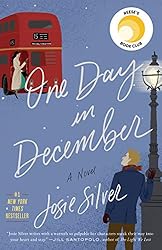
One Day in December
Josie Silver, 2018
Crown/Archetype
416 pp.
ISBN-13: 9780525574682
Summary
Two people. Ten chances. One unforgettable love story.
Laurie is pretty sure love at first sight doesn't exist anywhere but the movies.
But then, through a misted-up bus window one snowy December day, she sees a man who she knows instantly is the one. Their eyes meet, there's a moment of pure magic...and then her bus drives away.
Certain they're fated to find each other again, Laurie spends a year scanning every bus stop and cafe in London for him. But she doesn't find him, not when it matters anyway.
Instead they "reunite" at a Christmas party, when her best friend Sarah giddily introduces her new boyfriend to Laurie. It's Jack, the man from the bus. It would be.
What follows for Laurie, Sarah and Jack is ten years of friendship, heartbreak, missed opportunities, roads not taken, and destinies reconsidered. One Day in December is a joyous, heartwarming and immensely moving love story to escape into and a reminder that fate takes inexplicable turns along the route to happiness. (From the publisher.)
Author Bio
Josie Silver is an unashamed romantic who met her husband when she stepped on his foot on his twenty-first birthday. She lives with him, her two young sons, and their cats in a little town in England called Wolverhampton. (From the publisher.)
Book Reviews
Consider setting aside some time and prepare to be charmed as author Josie Silver takes readers on a captivating journey—where female friendship is as important as romantic love.… One Day in December is an unmistakable winner.
USA Today
A must-read. In Josie Silver’s charming rom-com, Laurie experiences love at first sight through her bus window… then the car pulls away.… What follows is a decade of heartache, betrayal, and destiny.
US Weekly
In Josie Silver’s One Day in December, a chance encounter on a London bus turns into a Bridget Jones-inspired romp.
Cosmopolitan
Love at first sight! But he’s her BFF’s new BF. What to do? Do you really have to ask?
Entertainment Weekly
[L]ovely…. Silver’s propulsive narrative is enjoyable, and the mix of tension and affection between Jack and Laurie is charming, addictive, and effective. Readers who like quirky love stories will be satisfied by this cinematic novel.
Publishers Weekly
[A]sweetly romantic novel.… Readers who enjoy contemporary romance will root for Laurie and Jack as they work through laughter-through-tears experiences and toward a happily-ever-after worth fighting for. —Charli Osborne, Southfield P.L., MI
Library Journal
Silver writes with verve and charm in this debut, and readers will be pulling for Laurie and Jack as they detour through missteps and misunderstandings.
Booklist
The pacing is just right, the tone warm, and the characters sympathetic.… Anyone who believes in true love or is simply willing to accept it as the premise of a winding tale will find this debut an emotional, satisfying read.
Kirkus Reviews
Discussion Questions
1. How would you describe the connection Laurie felt upon first seeing Jack? How do you think he perceived her when he saw her from the bus stop? Have you ever felt a similar connection with someone?
2. Why didn’t Laurie tell Sarah that Jack was the person she’d been looking for?
3. How similar are Laurie and Sarah? In what ways do their personalities differ? Which character do you identify with?
4. Why do you think Jack doesn’t admit to Laurie that he remembers her from the bus stop?
5. Should Sarah have noticed the tension between Laurie and Jack?
6. Is it realistic for Laurie and Jack to try to be friends considering their feelings for each other? Why do you think they try so hard to remain friendly?
7. How does Laurie’s relationship with Oscar compare to her relationship with Jack? Is it possible for her to love them both simultaneously?
8. On page 209 Laurie notes that she’s been conflicted about "how much information constitutes the truth, how much omission constitutes lying." Do you think she’s lying to Oscar and/or Sarah considering what she hasn’t revealed to each of them?
9. Laurie describes the flowers Jack sends her as "lush and extravagant… but then in the shortest time they’re not very lovely at all. They wilt and they turn the water brown, and soon you can’t hold on to them any longer." Do any of her relationships also fit this description?
10. How does Laurie cope with loss, in terms of family members, romantic interests, and friends?
11. By the end of the story both Laurie and Jack have grown and changed significantly. How do these changes affect their relationship?
12. How do Laurie’s New Year’s resolutions evolve through the years?
(Questions issued by the publishers.)
One Fifth Avenue
Candace Bushnell, 2008
Voice Publishers
448 pp.
ISBN-13: 9781401341404
Summary
One Fifth Avenue, the Art Deco beauty towering over one of Manhattan's oldest and most historically hip neighborhoods, is a one-of-a-kind address, the sort of building you have to earn your way into — one way or another.
For the women in Candace Bushnell's new novel, One Fifth Avenue, this edifice is essential to the lives they've carefully established — or hope to establish. From the hedge fund king's wife to the aging gossip columnist to the free-spirited actress (a recent refugee from L.A.), each person's game plan for a rich life comes together under the soaring roof of this landmark building."
This book is a modern-day story of old and new money, that same combustible mix that Edith Wharton mastered in her novels about New York's Gilded Age and F. Scott Fitzgerald illuminated in his Jazz Age tales. Many decades later, Bushnell's New Yorkers suffer the same passions as those fictional Manhattanites from eras past: they thirst for power, for social prominence, and for marriages that are successful — at least to the public eye.
But Bushnell is an original, and One Fifth Avenue is so fresh that it reads as if sexual politics, real estate theft, and fortunes lost in a day have never happened before. (From the publisher.)
Author Bio
• Birth—December 1, 1958
• Where—Glastonbury, Connecticut, USA
• Education—attended Rice University
• Currently—lives in New York City
Candace Bushnell is an American author and columnist based in New York City. She is best known for writing a sex column that was turned into a book, Sex and the City, which became the basis of the immensely popular television series of the same name, and its subsequent film adaptation. Bushnell married New York City American Ballet Theater ballet artist Charles Askegaard on July 4, 2002.
Bushnell was born in Glastonbury, Connecticut. Upon dropping out of Rice University in the late 1970s, she was known throughout New York City as a party-goer and socialite. One of her favorite places was Studio 54. Later on in life, she got a job as a columnist in the New York Observer.
In 1994, her editor-in-chief asked her if she wanted to write a column for the paper, and she accepted the job. She wanted a column based on the adventures she and her friends usually spoke about, and she called it "Sex and the City."
In 1998, HBO started airing a show, Sex and the City, based on, but not exactly like, Bushnell's column. The Sex and the City television show enhanced Bushnell's already growing fame. The television series ceased original production in 2004, with the last episode airing on HBO in February 2004. It is now in syndication.
Many other writers have compared the Carrie Bradshaw character on the television show to Bushnell because Carrie, like Bushnell, is also a newspaper sex and lifestyles columnist who enjoys the New York nightlife and, indeed, Candace's initials are the same as Carrie's. Bushnell has stated in several interviews that Carrie Bradshaw is her alter ego. Bushnell was one of three judges for the 2005 reality television show Wickedly Perfect on CBS. (From Wikipedia.)
Book Reviews
One Fifth Avenue is less of a novel than it is an aggregation of characters who periodically bump into one another. Ms. Bushnell’s way of dividing her text into Acts I, II, III, IV and V confirms the not-strictly-literary nature of its ambitions.... Peeping into glamorous lives is Ms. Bushnell’s specialty — and she is less interesting about the blandly affluent than she is about the disgruntled. Thus Mindy Gooch and Lola sound like her most honestly observed creatures. They also come closest to providing humor, which is something that One Fifth Avenue could have used in larger doses. Its funniest sections involve Lola’s flagrant ploys for extorting favors from various men, which turns out to be the second thing she is very good at.... Lola is different from the book’s other characters... [she] is sure of herself. And there’s something else that separates her from Ms. Bushnell’s more seasoned New Yorkers, and from the grim undercurrent running through One Fifth Avenue: She isn’t terrified of growing old.
Janet Maslin - New York Times
One Fifth Avenue is definitely not a book to read for plot…This is a book you read because it takes some of the challenges of modern, middle-age urban life and has the characters try to meet them amid a swirl of heliports and Hamptons visits, and because Bushnell has a track record of channeling the N.Y.C. zeitgeist.
Claudia Deane - Washington Post
Sex in the City goes middle-aged, mordant and slapstick in Bushnell's chronicle of writers, actors and Wall Street whizzes clashing at One Fifth Avenue, a Greenwich Village art deco jewel crammed with regal rich, tarty upstarts and misguided lovers. When a "Queen of Society" dies, a vicious scramble for her penthouse apartment ensues, and it's attorney Annalisa and her hedge-funder husband, Paul Rice, who land the palatial pad, roiling the building's rivalries. There's Billy Litchfield, an art dealer who slobbers over the wealthy; strivers Mindy and James Gooch, and their tech-savvy 13-year-old Sam, the most hilariously bitter (and strangely successful) family in the building; gossip columnist Enid Merle and her screenwriter nephew, Philip Oakland, who struggle to uphold traditions and their souls; actress Schiffer Diamond, who lands a hit TV series, and her old love; and Lola Fabrikant, a cunning Atlanta gold digger whose greatest ambition is to become Carrie Bradshaw. Here are bloggers and bullies, misfits and misanthropes, dear hearts and black-hearts, dogfights and catty squalls spun into a darkly humorous chick-lit saga.
Publishers Weekly
Bushnell most definitely had a good summer. The movie version of Sex and the City was a hit, and the NBC based a drama on her last novel, Lipstick Jungle. [One Fifth Avenue is her] entertaining new novel. Female friendship is usually Bushnell's uniting theme, but, here, it's a landmark building and a beyond-fashionable address that connects the myriad characters introduced: an aging but still beautiful actress named Schiffer Diamond; Enid, a powerful gossip columnist; Annalisa, a former lawyer and now the hesitant wife of a hedge-fund manager; Lola, an obnoxious young social climber determined to manipulate her way to the top of society; and Mindy, the owner of the building's least glamorous apartment yet head of the building's board. Bushnell is at her best here—frothy and fun but also absolutely sharp. There are even a few sly references to Carrie Bradshaw and Mr. Big thrown in for good measure. Recommended for all public libraries.
Library Journal
The residents of a historic Manhattan building are thrown for a loop when an elderly socialite dies, leaving her spectacular apartment up for grabs. In the glittering world of Bushnell's latest (Lipstick Jungle, 2006, etc.), where you live is easily as important as how (and with whom) you live. So when Louise Houghton passes away a few weeks shy of her 100th birthday, her Greenwich Village neighbors are anxious to have a say in who ends up living in her coveted 7,000 square-foot space. The players include octogenarian gossip columnist Enid Merle, her successful screenwriter nephew Philip Oakland, and the embittered middle-aged head of the co-op board, Mindy Gooch. Long resentful of the fact that her family inhabits One Fifth's "worst" apartment, Mindy pushes through a quickie sale of Louise's place seemingly just to thwart Enid. The new residents, Paul and Annalisa Rice, certainly seem suitable. Annalisa is a down-to-earth beauty who gave up her law practice to accompany her math-genius husband to New York, where he is developing some super-secret financial software. Paul, unlike his wife, is cold and entitled, and as his fortunes grow, a sinister, paranoid side of him emerges that alienates everyone in the building, including Annalisa. But is Paul just a creep, or something worse? Philip's love life, meanwhile, takes a complicated turn when movie star ex-girlfriend Schiffer Diamond moves back after years of living in Los Angeles. The two share a deep connection, but reconciliation seems iffy when Philip starts sleeping with his 22-year-old "researcher" Lola Fabrikant. A pampered schemer who sets her sights on marriage—and Philip's apartment—Lola hedges her bets by dallying with snarky celebrity blogger Thayer Core, who in turn uses her for information. Mindy's hen-pecked novelist husband James also develops a crush on the lissome Lola, who begins paying attention to him when his new book becomes a surprise success. With a breezy pace that brings to mind a Gilded Age comedy of manners, the novel might not have anything new to say about New York society, but there are enough twists to keep it fun.
Kirkus Reviews
Discussion Questions
Use our LitLovers Book Club Resources; they can help with discussions for any book:
• How to Discuss a Book (helpful discussion tips)
• Generic Discussion Questions—Fiction and Nonfiction
• Read-Think-Talk (a guided reading chart)
One Flew Over the Cuckoo's Nest
Ken Kesey, 1962
Penguin Group USA
312 pp.
ISBN-13: 9780141181226
Summary
An international bestseller and the basis for a hugely successful film, Ken Kesey's One Flew Over the Cuckoo's Nest was one of the defining works of the 1960s.
A mordant, wickedly subversive parable set in a mental ward, the novel chronicles the head-on collision between its hell-raising, life-affirming hero Randle Patrick McMurphy and the totalitarian rule of Big Nurse. McMurphy swaggers into the mental ward like a blast of fresh air and turns the place upside down, starting a gambling operation, smuggling in wine and women, and egging on the other patients to join him in open rebellion. But McMurphy's revolution against Big Nurse and everything she stands for quickly turns from sport to a fierce power struggle with shattering results. (From the publisher.)
More
Boisterous, ribald, and ultimately shattering, Ken Kesey's One Flew Over the Cuckoo's Nest is the seminal novel of the 1960s that has left an indelible mark on the literature of our time. Here is the unforgettable story of a mental ward and its inhabitants, especially the tyrannical Big Nurse Ratched and Randle Patrick McMurphy, the brawling, fun-loving new inmate who resolves to oppose her. We see the struggle through the eyes of Chief Bromden, the seemingly mute half-Indian patient who witnesses and understands McMurphy's heroic attempt to do battle with the awesome powers that keep them all imprisoned. (Also from the publisher.)
Author Bio
• Birth—September 17, 1935
• Where—La Junta, Colorado, USA
• Death—November 10, 2001
• Where—Pleasant Hill, Oregon
• Education—B.A., University of Oregon; studied at Stanford
University
Ken Kesey was an American author, best known for his novel One Flew Over the Cuckoo's Nest (1962) and as a counter-cultural figure who considered himself a link between the Beat Generation of the 1950s and the hippies of the 1960s. "I was too young to be a beatnik, and too old to be a hippie," Kesey said in a 1999 interview with Robert K. Elder.
Kesey was born in La Junta, Colorado to dairy farmers Frederick A. Kesey and Geneva Smith. In 1946, the family moved to Springfield, Oregon. A champion wrestler in both high school and college, he graduated from Springfield High School in 1953.
In 1956, while attending college at the University of Oregon in neighboring Eugene, Kesey eloped with his high-school sweetheart, Norma "Faye" Haxby, whom he had met in seventh grade. They had three children, Jed, Zane, and Shannon; Kesey had another child, Sunshine, in 1966 with fellow Merry Prankster Carolyn Adams.
Kesey attended the University of Oregon's School of Journalism, where he received a degree in speech and communication in 1957, where he was also a brother of Beta Theta Pi. He was awarded a Woodrow Wilson National Fellowship in 1958 to enroll in the creative writing program at Stanford University, which he did the following year. While at Stanford, he studied under Wallace Stegner and began the manuscript that would become One Flew Over the Cuckoo's Nest.
Psychoactive drugs
At Stanford in 1959, Kesey volunteered to take part in a CIA-financed study named Project MKULTRA at the Menlo Park Veterans Hospital. The project studied the effects of psychoactive drugs, particularly LSD, psilocybin, mescaline, cocaine, AMT, and DMT on people. Kesey wrote many detailed accounts of his experiences with these drugs, both during the Project MKULTRA study and in the years of private experimentation that followed. It was this role as a medical guinea pig, as well as his stint working at a state veterans' hospital, that inspired him to write One Flew Over the Cuckoo's Nest in 1962.
The success of this book, as well as the sale of his residence at Stanford, allowed him to move to La Honda, California, in the mountains south of San Francisco. He frequently entertained friends and many others with parties he called "Acid Tests" involving music (The Warlocks, later known as the Grateful Dead), black lights, fluorescent paint, strobes and other "psychedelic" effects, and, of course, LSD. These parties were noted in some of Allen Ginsberg's poems and are also described in Tom Wolfe's The Electric Kool-Aid Acid Test, as well as Hell's Angels: The Strange and Terrible Saga of the Outlaw Motorcycle Gangs by Hunter S. Thompson and Freewheelin Frank, Secretary of the Hell's Angels by Frank Reynolds.
Cuckoo's Nest
In 1959, Kesey wrote Zoo, a novel about the beatniks living in the North Beach community of San Francisco, but it was never published. In 1960, he wrote End of Autumn, about a young man who leaves his working class family after he gets a scholarship to an Ivy League school, also unpublished.
The inspiration for One Flew Over the Cuckoo's Nest came while working on the night shift (with Gordon Lish) at the Menlo Park Veterans' Hospital. There, Kesey often spent time talking to the patients, sometimes under the influence of the hallucinogenic drugs with which he had volunteered to experiment. Kesey did not believe that these patients were insane, rather that society had pushed them out because they did not fit the conventional ideas of how people were supposed to act and behave.
Published in 1962, Cuckoo's Nest was an immediate success; in 1963, it was adapted into a successful stage play by Dale Wasserman; in 1975, Milos Forman directed a screen adaptation, which won the "Big Five" Academy Awards: Best Picture, Best Actor (Jack Nicholson), Best Actress (Louise Fletcher), Best Director (Forman) and Best Adapted Screenplay (Lawrence Hauben, Bo Goldman).
Kesey was originally involved in creating the film, but left two weeks into production. He claimed never to have seen the movie because of a dispute over the $20,000 he was initially paid for the film rights. Kesey loathed the fact that, unlike the book, the film was not narrated by the Chief Bromden character, and he disagreed with Jack Nicholson being cast as Randle McMurphy (he wanted Gene Hackman). Despite this, Faye Kesey has stated that Ken was generally supportive of the film and pleased that it was made.
Merry Pranksters
When the publication of his second novel, Sometimes a Great Notion in 1964 required his presence in New York, Kesey, Neal Cassady, and others in a group of friends they called the "Merry Pranksters" took a cross-country trip in a school bus nicknamed "Furthur." The trip, described in Tom Wolfe's The Electric Kool-Aid Acid Test (and later in Kesey's own screenplay "The Further Inquiry") was the group's attempt to create art out of everyday life. In New York, Cassady introduced Kesey to Jack Kerouac and Allen Ginsberg, who then turned them on to Timothy Leary. Sometimes a Great Notion was made into a 1971 film starring and directed by Paul Newman; it was nominated for two Academy Awards, and in 1972 was the first film shown by the new television network HBO, in Wilkes-Barre, Pennsylvania.
Legal trouble
Kesey was arrested for possession of marijuana in 1965. In an attempt to mislead police, he faked suicide by having friends leave his truck on a cliffside road near Eureka, along with an elaborate suicide note, written by the pranksters. Kesey fled to Mexico in the back of a friend's car. When he returned to the United States eight months later, Kesey was arrested and sent to the San Mateo County jail in Redwood City, California, for five months. On his release, he moved back to the family farm in Pleasant Hill, Oregon, in the Willamette Valley, where he spent the rest of his life. He wrote many articles, books (mostly collections of his articles), and short stories during that time.
Twister
In 1994 he toured with members of the Merry Pranksters performing a musical play he wrote about the millennium called Twister: A Ritual Reality. Many old and new friends and family showed up to support the Pranksters on this tour that took them from Seattle's Bumbershoot, all along the West Coast including a sold out two-night run at The Fillmore in San Francisco to Boulder, Colorado, where they coaxed (or pranked) the Beat Generation poet Allen Ginsberg into performing with them. Kesey, always a friend to musicians since his days of the Acid Test, enlisted the band Jambay, one of the original bands of the jam band genre, to be his "pit orchestra." Jambay played an acoustic set before each Twister performance and an electric set after each show.
Final years
Kesey mainly kept to his home life in Pleasant Hill, preferring to make artistic contributions on the Internet, or holding ritualistic revivals in the spirit of the Acid Test.
In 1984, Kesey's son Jed, a wrestler for the University of Oregon, was killed on the way to a wrestling tournament when the team's bald-tired van crashed. This deeply affected Kesey, who later said Jed was a victim of conservative, anti-government policy that starved the team of proper funding. There is a memorial dedicated to Jed on the top of Mount Pisgah, which is near the Keseys' home in Pleasant Hill. At a Grateful Dead Halloween concert just days after promoter Bill Graham died in a helicopter crash, Kesey appeared on stage in a tuxedo and delivered a eulogy while the Grateful Dead was playing the song Dark Star, and he mentioned that Graham had paid for Jed's mountain-top memorial.
His last major work was an essay for Rolling Stone magazine calling for peace in the aftermath of the September 11, 2001 attacks.
In 1997, health problems began to take their toll on Kesey, starting with a stroke that year. Then soon after his stroke he was diagnosed with diabetes. On October 25, 2001 Kesey had surgery on his liver to remove a tumor. He never recovered from the operation and died of complications on November 10, 2001, aged 66. (From Wikipedia.)
Book Reviews
(Older works have few, if any, mainstream press reviews online. See Amazon and Barnes & Noble for helpful customer reviews.)
The world of this brilliant first novel is Inside—inside a mental hospital and inside the blocked minds of its inmates. Sordid sights and sounds abound, but novelist Kesey has not descended to mere shock treatment or isolation-ward documentary. His book is a strong, warm story about the nature of human good and evil, despite its macabre setting.
Time
Kesey's new introduction to this anniversary edition could very well be the last thing he worked on before shuffling off this mortal coil in 2001. Additionally, 25 sketches he drew while working at a mental institution in the 1950s, the inspiration for the novel, are littered throughout. Critics are divided on the meaning of the book: Is it a tale of good vs. evil, sanity over insanity, or humankind trying to overcome repression amid chaos? Whichever, it is a great read.
Library Journal
Discussion Questions
Use our LitLovers Book Club Resources; they can help with discussions for any book:
• How to Discuss a Book (helpful discussion tips)
• Generic Discussion Questions—Fiction and Nonfiction
• Read-Think-Talk (a guided reading chart)
Also consider these LitLovers talking points to help get a discussion started for One Flew Over the Cuckoo's Nest:
1. In what way is Kensey's novel representative of the 1960s? (If you are too young to have experienced the '60s, you might want to do a little research into the era.) The book, issued in 1962, is nearly 50 years old. Are the thematic concerns of Cuckoo's Nest still relevant today, do they speak to the 21st century...or are they outdated?
2. Cuckoo's Nest centers around a classic plot device—the introduction of disorder into an ordered environment. How does Randlel McMurphy destabilize the psychiatric ward? First, discuss how "order" is maintained...who enforces it...and what form "order" takes. Then talk about what happens when McMurphy enters the story.
3. Was Chief Bromden mentally insane when he was committed to the hospital 10 years ago? How does he appear when we first meet him? What is the cause of his hallucinatory fog—his medications or his paranoia or...?
4. Trace the change in Bromden that occurs over the course of the novel. What does he come to understand about himself? Why he has he presented himself as "deaf and dumb"? Why does he believe he has lost his once prodigious strength? What effect does McMurphy have on him?
5. At one point, Bromden pleas with the reader to believe him. He says, "But it's the truth even if it didn't happen." What does he mean—how can something be true if it's not based in reality?
6. Is McMurphy crazy? Under what circumstances does he enter the hospital ward? If this is a parable...or allegory, what does McMurphy represent symbolically? Can he be seen as a Christ figure, one who sacrifices himself for the good of others? Yes...or no.
7. What is Dr. Spivey's theory of the Therapeutic Community—and how does McMurphy challenge it? What does he mean when he compares the process to a flock of chickens?
8. As a follow-up to Question 4, what does Nurse Ratched represent? What's funny, by the way, about her name? Talk about her ability to disguise her true "hideous self, which she shows readily to Bromden and the aides, from the patients. Bromden sees her as a combine...and nicknames her "Big Nurse." What are the implications of those words?
9. How does Ratched maintain power over her patients?
10. How does Ratched eventually gain control over McMurphy? Why does he gradually submit to her—and why does the newly subdued McMurphy confuse the other patients? What has he become to them?
11. Talk about the fishing trip that McMurphy arranges for the inmates. What does McMurphy teach the other patients about being on the outside? What's the symbolic significance of the fishing expedition?
12. Why doesn't McMurphy escape from the ward the night that Billy has his "date" with Candy?
13. Ultimately, Ratched looses her hold over the ward. Why?
14. What is this novel about? What dichotomy is being suggested by Ratched and the hospital vs. the patients? Good vs. evil? Power & authority vs. freedom. Repression vs. expression? Women vs. men? The machine vs. nature? War vs. humanity?
15. Why does Bromden narrate rather than McMurphy?
16. Ultimately, how does Ken Kensey challenge societal notions of sanity and insanity? Who is sick, according to Kensey?
17. Who is the book's hero?
18. What is the title's significance"
(Questions by LitLovers. Please feel free to use them, online or off, with attribution. Thanks.)
top of page (summary)
One Good Turn
Kate Atkinson, 2006
Little, Brown & Co.
448 pp.
ISBN-13: 9780316012829
Summary
It is summer, it is the Edinburgh Festival. People queuing for a lunchtime show witness a road-rage incident — a near-homicidal attack which changes the lives of everyone involved: the wife of an unscrupulous property developer, a crime writer, a washed-up comedian. Jackson Brodie, ex-army, ex-police, ex-private detective, is also an innocent bystander — until he becomes a murder suspect.
Stephen King called Case Histories the best mystery of the decade: One Good Turn sees the return of its irresistible hero Jackson Brodie. As the body count mounts, each character's story contains a kernel of the next, like a set of nesting Russian dolls. Everyone in the teeming Dickensian cast is looking for love or money or redemption or escape: but what each actually discovers is their own true self. (From the publisher.)
This is the second in the Jackson Brodie series, following Case Histories. The third in the series is When Will There Be Good News.
Author Bio
• Birth—1951
• Where—York, England, UK
• Education—M.A., Dundee University
• Awards—Whitbread Award; Woman's Own Short Story Award; Ian St. James Award;
Saltire Book of the Year Award; Prix Westminster
• Currently—lives in Edinburgh, Scotland, UK
Kate Atkinson was born in York, and studied English Literature at the University of Dundee, gaining her Masters Degree in 1974. She subsequently studied for a doctorate in American Literature which she failed at the viva stage. During her final year of this course, she was married for the first time, although the marriage lasted only two years.
After leaving the university, she took on a variety of miscellaneous jobs from home help to legal secretary and teacher. She lived in Whitby, Yorkshire for a time, before moving to Edinburgh, where she taught at Dundee University and began writing short stories. She now lives in Edinburgh.
Writing
She initially wrote for women's magazines after winning the 1986 Woman's Own Short Story Competition. She was runner-up for the Bridport Short Story Prize in 1990 and won an Ian St James Award in 1993 for her short-story "Karmic Mothers," which she later adapted for BBC2 television as part of its Tartan Shorts series.
Atkinson's breakthrough was with her first novel, Behind the Scenes at the Museum, which won the 1995 Whitbread Book of the Year award, ahead of Salman Rushdie's The Moor's Last Sigh and Roy Jenkins biography of William Ewart Gladstone. The book has been adapted for radio, theatre and television. She has since written several more novels, short stories and a play. Case Histories (2004) was described by Stephen King as "the best mystery of the decade." The book won the Saltire Book of the Year Award and the Prix Westminster.
Her work is often celebrated for its wit, wisdom and subtle characterisation, and the surprising twists and plot turns. Four of her novels have featured the popular former detective Jackson Brodie—Case Histories (2004), One Good Turn (2006), When Will There Be Good News (2008), and Started Early, Took My Dog (2010). She has shown that, stylistically, she is also a comic novelist who often juxtaposes mundane everyday life with fantastic magical events, a technique that contributes to her work's pervasive magic realism.
Life After Life (2013) revolves around Ursula Todd's continual birth and rebirth. Janet Maslin of the New York Times called it "a big book that defies logic, chronology and even history in ways that underscore its author's fully untethered imagination."
A God in Ruins (2015), the companion book to Life After Life, follows Ursula's brother Todd who survived the war, only to succumb to disillusionment and guilt at having survived.
Atkinson was appointed Member of the Order of the British Empire (MBE) in the 2011 Birthday Honours for services to literature. (Adapted from Wikipedia.)
Book Reviews
In the past Ms. Atkinson has played the minor time trick of letting events almost converge and then replaying them from slightly different points of view. She does that here to the same smart, unnerving effect. And she frequently brings up the image of Russian dolls, each hidden inside another, to illustrate how her storytelling tactics work. By the apt ending of One Good Turn a whole series of these dolls has been opened. In the process the book has borne out one of Jackson’s favorite maxims: "A coincidence is just an explanation waiting to happen.
Janet Maslin - New York Times
The suspense ratchets up quickly and palpably, as surely as when the doctor experiments with different settings for your new pacemaker.... One Good Turn is full of a zippy satire that provides a smooth skating surface for the reader to whiz through. This is clean, purposeful prose that drives the plot, wickedly funny in places, sometimes quietly insightful and fairly faithful to the traditional mystery form. Atkinson’s novel is like something her detective might drink in the wee hours after knocking around the docks, something straight up with a twist.
Globe and Mail (Canada)
The second installment of the author's Jackson Brodie detective series is a complex jigsaw: when the driver of a rented Peugeot collides with a bat-wielding thug in a Honda Civic during the Edinburgh Fringe Festival, the outcome is seen through the eyes of numerous characters, including the whey-faced writer of cozy mysteries who comes to the driver's aid, the sardonic wife of a crooked real-estate developer, and Brodie himself, now retired and disgruntled about getting involved. The first Brodie book, Case Histories, was propelled by a nuanced, psychological portrait of loss; here Atkinson's authoritative voice emerges only sporadically, and abrupt changes of scene disrupt the flow. Still, some of the characters, such as a snappy, overwhelmed single mother and cop, are finely rendered.
The New Yorker
Having won a wide following for her first crime novel (and fifth book), Case Histories (2004), Atkinson sends Det. Jackson Brodie to Edinburgh while girlfriend Julia performs in a Fringe Festival play. When incognito thug "Paul Bradley" is rear-ended by a Honda driver who gets out and bashes Bradley unconscious with a baseball bat, the now-retired Jackson is a reluctant witness. Other bystanders include crime novelist Martin Canning, a valiant milquetoast who saves Bradley's life, and tart-tongued Gloria Hatter, who's plotting to end her 39-year marriage to a shady real estate developer. Jackson walks away from the incident, but keeps running into trouble, including a corpse, the Honda man and sexy, tight-lipped inspector Louise Monroe. Everyone's burdened by a secret-infidelity, unprofessional behavior, murder-adding depth and many diversions. After Martin misses a visit from the Honda man (Martin's wonderfully annoying houseguest isn't so lucky), he enlists Jackson as a bodyguard, pulling the characters into closer orbit before they collide on Gloria Hatter's lawn. Along the way, pieces of plot fall through the cracks between repeatedly shifting points of view, and the final cataclysm feels forced. But crackling one-liners, spot-on set pieces and full-blooded cameos help make this another absorbing character study from the versatile, effervescent Atkinson.
Publishers Weekly
Whitbread Award winner Atkinson puts a thoroughly enjoyable spin on this character-driven detective novel, the follow-up to Case Histories. After receiving a surprise bequest, quitting his job, and moving to a French village, former detective Jackson Brodie is torn between wanting to live a quiet, idyllic life and feeling purposeless. He's visiting Edinburgh with his self-involved, increasingly distant lover, Julia, who's acting in a minor play in an arts festival. At loose ends, Brodie witnesses a road-rage incident that sets off a dazzling chain of coincidences involving a hired assassin, a meek historical mystery writer, an obnoxious stand-up comedian, Russian prostitutes, and a loathsome real estate developer and his stoic, long-suffering wife. Atkinson skillfully links the characters to one another, revealing twists from their various points of view, and in Brodie creates a likable star. Once involved in the case, he reverts to a pleasingly take-charge, strong-but-silent type who will leave readers eagerly awaiting his next outing. Highly recommended. —Christine Perkins, Burlington P.L., WA
Library Journal
Atkinson has a lot of fun playing against type, portraying writers and actors as leading small, unimaginative lives while revealing the hidden depths in an unassuming, longtime housewife. Although it's not as wonderful as its predecessor, this still makes for delightfully witty reading. —Joanne Wilkinson
Booklist
A murder mystery with comic overtones from the award-winning British storyteller. Resurrecting Jackson Brodie, the private eye from Case Histories (2004), Atkinson confects a soft-hearted thriller, short on menace but long on empathy and introspection. Her intricate, none-too-serious plot is triggered by an act of road rage witnessed by assorted characters in Edinburgh during the annual summer arts festival. Mysterious possible hit man "Paul Bradley" is rear-ended by Terence Smith, a hard-man with a baseball bat who is stopped from beating Bradley to a pulp by mild-mannered crime-novelist Martin Canning, who throws his laptop at him. Other onlookers include Brodie, accompanied by his actress girlfriend, Julia; Gloria Hatter, wife of fraudulent property-developer Graham Hatter (of Hatter Homes, Real Homes for Real People); and schoolboy Archie, son of single-mother policewoman Louise Monroe, who lives in a crumbling Hatter home. Labyrinthine, occasionally farcical plot developments repeatedly link the group. Rounding out the criminal side of the story are at least two dead bodies; an omniscient Russian dominatrix who even to Gloria seems "like a comedy Russian"; and a mysterious agency named Favors. Brodie's waning romance with Julia and waxing one with Louise; a dying cat; children; dead parents and much more are lengthily considered as Atkinson steps away from the action to delve into her characters' personalities. Clearly, this is where her heart lies, not so much with the story's riddles, the answers to which usually lie with Graham Hatter, who has been felled by a heart attack and remains unconscious for most of the story. There are running jokes and an enjoyable parade of neat resolutions, but no satisfying denouement. Everything is connected, often amusingly or cleverly, but nothing matters much. A technically adept and pleasurable tale, but Atkinson isn't stretching herself.
Kirkus Reviews
Discussion Questions
1. Kate Atkinson has said that Gloria "is the moral center of the book." Did you find this to be true? Do you think that a novel with so many irreverent characters requires a moral center?
2. During Gloria's discussion with Tatiana she realizes, "It was strange how something you weren't expecting could, nonetheless, turn out to be no surprise at all" (page 78). To what extent are the characters in One Good Turn expecting the predicaments that befall them?
3. Atkinson writes, "Once, the eye of God watched people, now it was the camera lens" (page 28). How does technology figure into Jackson's investigation? How does the "camera" compete with religion as a deterrent from illegal behavior?
4. Early on, Martin Canning, an innocent bystander, successfully stops the road-rage assault only to become the assailant's next target. Do you agree with Martin's decision? Would you do the same if you were in his position?
5. At the beginning of One Good Turn, we meet a changed Jackson Brodie—instead of working as a private detective in England, as he did in Case Histories, he lives in France as a retired millionaire and is dating Julia. How does this sea change affect Jackson's outlook? What about him would you like to change in Kate Atkinson's next novel?
6. While Jackson and Julia first appeared in Case Histories, Atkinson introduces several new characters in One Good Turn. Which new character did you enjoy the most?
7. Discuss the novel's title. Do you think the adage from which it is derived influences the characters' behavior?
8. Jackson is described as a man who "had money and behaved as if he hadn't," while Julia "never had any money, yet she always behaved as if she had" (page 36). Do all the characters share this complicated relationship with money? How does greed affect their actions?
9. One Good Turn is set during the Edinburgh Fringe Festival, one of the largest arts festivals in the world. How does this unique setting serve as a backdrop for the events that transpire?
10. Several unexpected friendships are forged during the novel—Jackson and Martin, Gloria and Tatiana. How important are these new friendships to the story? Are there two characters in One Good Turn who did not meet and whom you hoped would cross paths?
(Questions issued by publisher.)
top of page


One Hundred Years of Solitude
Gabriel Garcia Marquez, 1967
HarperCollins
417 pp.
ISBN-13: 9780060883287
Summary
A New York Times Book of the Century
One of the 20th century's enduring works, One Hundred Years of Solitude is a widely beloved and acclaimed novel known throughout the world, and the ultimate achievement in a Nobel Prize–winning career.
The novel tells the story of the rise and fall of the mythical town of Macondo through the history of the Buendía family. It is a rich and brilliant chronicle of life and death, and the tragicomedy of humankind. In the noble, ridiculous, beautiful, and tawdry story of the Buendía family, one sees all of humanity, just as in the history, myths, growth, and decay of Macondo, one sees all of Latin America.
Love and lust, war and revolution, riches and poverty, youth and senility — the variety of life, the endlessness of death, the search for peace and truth — these universal themes dominate the novel. Whether he is describing an affair of passion or the voracity of capitalism and the corruption of government, Gabriel García Márquez always writes with the simplicity, ease, and purity that are the mark of a master.
Alternately reverential and comical, One Hundred Years of Solitude weaves the political, personal, and spiritual to bring a new consciousness to storytelling. Translated into dozens of languages, this stunning work is no less than an accounting of the history of the human race. (From the publisher.)
More
The mythic village of Macondo lies in northern Colombia, somewhere in the great swamps between the mountains and the coast. Founded by Jose Arcadio Buendia, his wife Ursula, and nineteen other families, "It was a truly happy village where no one was over thirty years of age and where no one had died."
At least initially. One Hundred Years of Solitude chronicles, through the course of a century, life in Macondo and the lives of six Buendia generations — from Jose Arcadio and Ursula, through their son, Colonel Aureliano Buendia (who commands numerous revolutions and fathers eighteen additional Aurelianos), through three additional Jose Arcadios, through Remedios the Beauty and Renata Remedios, to the final Aureliano, child of an incestuous union.
As babies are born and the world's "great inventions" are introduced into Macondo, the village grows and becomes more and more subject to the workings of the outside world, to its politics and progress, and to history itself. And the Buendias and their fellow Macondons advance in years, experience, and wealth ... until madness, corruption, and death enter their homes.
From the gypsies who visit Macondo during its earliest years to the gringos who build the banana plantation, from the "enormous Spanish galleon" discovered far from the sea to the arrival of the railroad, electricity, and the telephone, Gabriel Garcia Marquez's classic novel weaves a magical tapestry of the everyday and the fantastic, the humdrum and the miraculous, life and death, tragedy and comedy — a tapestry in which the noble, the ridiculous, the beautiful, and the tawdry all contribute to an astounding vision of human life and death, afull measure of humankind's inescapable potential and reality. (Also from the publisher.)
Author Bio
• Birth—March 06, 1928
• Where—Aracataca, Colombia
• Education—Universidad Nacional de Colombia; Universidad
de Cartagena
• Awards—Nobel Prize, 1982
• Currently—lives in Mexico City, Mexico
Gabriel García Márquez is the product of his family and his nation. Born in the small coastal town of Aracataca in northern Colombia, he was raised by his maternal grandparents. As a child, he was mesmerized by stories spun by his grandmother and her sisters — a rich gumbo of superstitions, folk tales, and ghost stories that fired his youthful imagination. And from his grandfather, a colonel in Colombia's devastating Civil War, he learned about his country's political struggles. This potent mix of Liberal politics, family lore, and regional mythology formed the framework for his magical realist novels.
When his grandfather died, García Márquez was sent to Sucre to live (for the first time) with his parents. He attended university in Bogota, where he studied law in accordance with his parents' wishes. It was here that he first read The Metamorphosis by Franz Kafka and discovered a literature he understood intuitively — one with nontraditional plots and structures, just like the stories he had known all his life. His studies were interrupted when the university was closed, and he moved back north, intending to pursue both writing and law; but before long, he quit school to pursue a career in journalism.
Writing
In 1954 his newspaper sent García Márquez on assignment to Italy, marking the start of a lifelong self-imposed exile from the horrors of Colombian politics that took him to Barcelona, Paris, New York, and Mexico. Influenced by American novelist William Faulkner, creator of the fictionalized Yoknapatawpha County, and by the powerful intergenerational tragedies of the Greek dramatist Sophocles, García Márquez began writing fiction, honing a signature blend of fantasy and reality that culminated in the 1967 masterpiece One Hundred Years of Solitude. This sweeping epic became an instant classic and set the stage for more bestselling novels, including Love in the Time of Cholera, Love and Other Demons, and Memories of My Melancholy Whores. In addition, he has completed the first volume of a shelf-bending memoir, and his journalism and nonfiction essays have been collected into several anthologies.
In 1982, García Márquez was awarded the Nobel Prize for Literature. In his acceptance speech, he called for a "sweeping utopia of life, where no one will be able to decide for others how they die, where love will prove true and happiness be possible, and where the races condemned to one hundred years of solitude will have, at last and forever, a second opportunity on earth." Few writers have pursued that utopia with more passion and vigor than this towering 20th-century novelist.
Extras
• Gabriel José García Márquez' affectionate nickname is Gabo.
• García Márquez' first two novellas were completed long before their actual release dates, but might not have been published if it weren't for his friends, who found the manuscripts in a desk drawer and a suitcase, and sent them in for publication. (Bio from Barnes and Noble.)
Book Reviews
This book is the granddaddy of magical realism. Written less than 40 years ago, it was recognized immediately as a classic, one of the great works of all time. So buckle your seat belts—because you're in for a ride. Marquez has created an epic.... Read more
A LitLovers LitPick (Feb. '08)
One Hundred Years of Solitude is the first piece of literature since the Book of Genesis that should be required reading for the entire human race....Mr. García Márquez has done nothing less than to create in the reader a sense of all that is profound, meaningful, and meaningless in life."
William Kennedy - New York Times Book Review
It is not easy to describe the techniques and themes of the book without making it sound absurdly complicated, labored and almost impossible to read. In fact, it is none of these things. Though concocted of quirks, ancient mysteries, family secrets and peculiar contradictions, it makes sense and gives pleasure in dozens of immediate ways.
Robert Kiely - New York Times
The fecund, savage, irresistable...you have the sense of living, along with the Buendias (and the rest), in them, through them and in spite of them, and all their loves, madnesses and wars, their alliances, compromises, dreams and deaths...the characters rear up large and rippling with life against the green texture of nature itself.
Paul West - Bookworld
Discussion Questions
1. What kinds of solitude occur in the novel (for example, solitude of pride, grief, power, love, or death), and with whom are they associated? What circumstances produce them? What similarities and differences are there among the various kinds of solitude?
2. What are the purposes and effects of the story's fantastic and magical elements? How does the fantastic operate in the characters' everyday lives and personalities? How is the magical interwoven with elements drawn from history, myth, and politics?
3. Why does Garcia Marquez make repeated use of the "Many years later" formula? In what ways does this establish a continuity among past, present, and future? What expectations does it provoke? How do linear time and cyclical time function in the novel?
4. To what extent is Macondo's founding, long isolation, and increasing links with the outside world an exodus from guilt and corruption to new life and innocence and, then, a reverse journey from innocence to decadence?
5. What varieties of love occur in the novel? Does any kind of love transcend or transform the ravages of everyday life, politics and warfare, history, and time itself?
5. What is the progression of visitors and newcomers to Macondo, beginning with the gypsies? How does each new individual and group affect the Buendias, the town, and the story?
6. What is the importance of the various inventions, gadgets, and technological wonders introduced into Macondo over the years? Is the sequence in which they are introduced significant?
7. What is Melquiades's role and that of his innovations, explorations, and parchments? What is the significance of the "fact" that Melquiades "really had been through death, but he had returned because he could not bear the solitude"? Who else returns, and why?
8. When and how do politics enter the life of Macondo? With what short-term and long-term consequences? Do the social-political aspects of life in Macondo over the years parallel actual events and trends?
9. What types of women (from Ursula and Pilar to Meme and Amaranta Ursula) and what types of men (from Jose Arcadio to Aureliano Babilonia) are distinguishable? What characteristics do the men share? What characteristics do the women share?
10. What dreams, prophecies, and premonitions occur in the novel? With which specific characters and events are they associated, and what is their purpose?
11. When, how, and in what guises does death enter Macondo? With what consequences?
12. On the first page we are told that "The world was so recent that many things lacked names." What is the importance of names and of naming (of people, things, and events) in the novel?
12. How do geography and topography — mountains, swamps, river, sea, etc. — affect Macondo's history, its citizens' lives, and the novel's progression?
14. What aspects of the Buendia family dynamics are specific to Macondo? Which are reflective of family life everywhere and at any time? How do they relate to your experience and understanding of family life?
15. How does Garcia Marquez handle the issue and incidence of incest and its association with violence beginning with Jose Arcadio and Ursula's marriage and the shooting of Prudencio Aguilar? Is the sixth-generation incest of Aureliano Babilonia and Amaranta Ursula inevitable?
(Questions issued by publishers.)
top of page (summary)


The One I Left Behind
Jennifer McMahon, 2013
HarperCollins
422 pp.
ISBN-13: 9780062122551
Summary
The summer of 1985 changes Reggie’s life. An awkward thirteen-year-old, she finds herself mixed up with the school outcasts. That same summer, a serial killer called Neptune begins kidnapping women. He leaves their severed hands on the police department steps and, five days later, displays their bodies around town.
Just when Reggie needs her mother, Vera, the most, Vera’s hand is found on the steps. But after five days, there’s no body and Neptune disappears.
Now, twenty-five years later, Reggie is a successful architect who has left her hometown and the horrific memories of that summer behind. But when she gets a call revealing that her mother has been found alive, Reggie must confront the ghosts of her past and find Neptune before he kills again. (From the publisher.)
Author Bio
• Birth—1968
• Where—suburban, Connecticut, USA
• Education—B.A., Goddard College; M.F.A., Vermont College
• Currently—Montpelier, Vermont
In her words
I was born in 1968 and grew up in my grandmother’s house in suburban Connecticut, where I was convinced a ghost named Virgil lived in the attic. I wrote my first short story in third grade.
I graduated with a BA from Goddard College in 1991 and then studied poetry for a year in the MFA in Writing Program at Vermont College. A poem turned into a story, which turned into a novel, and I decided to take some time to think about whether I wanted to write poetry or fiction.
After bouncing around the country, I wound up back in Vermont, living in a cabin with no electricity, running water, or phone with my partner, Drea, while we built our own house. Over the years, I have been a house painter, farm worker, paste-up artist, Easter Bunny, pizza delivery person, homeless shelter staff member, and counselor for adults and kids with mental illness—I quit my last real job in 2000 to work on writing full time.
In 2004, I gave birth to our daughter, Zella. These days, we're living in an old Victorian in Montpelier, Vermont. Some neighbors think it looks like the Addams family house, which brings me immense pleasure. (From the author's website.)
Book Reviews
McMahon expertly ratchets up the suspense, but it’s her full-blooded characters that make this thriller stand out from the serial-killer pack.
People
Totally engrossing... Hard to put down... A quick read that is highly entertaining.
Oklahoma City Oklahoman
A mesmerizing psychological thriller.... McMahon fills The One I Left Behind with unpredictable twists and turns as she explores that great mystery of the human heart.
South Florida Sun Sentinel
(Starred review.) At the start of this haunting work of literary suspense from bestseller McMahon (Don’t Breathe a Word), Vermont architect Reggie Dufrane receives a startling phone call—her idolized mother, Vera, who was snatched by the notorious serial killer known as Neptune when Reggie was 13, has been found alive. Flashback 25 years to 1985 Brighton Falls, Conn. Even before her mother’s severed right hand, like those of Neptune’s other female victims, shows up on the police station steps, followed by lurid revelations about Vera’s life, the fatherless teen has been struggling as a vulnerable outsider, far too enmeshed with fellow outcasts Charlie, the detective’s son on whom she has an unrequited crush, and Tara, the daring goth. Now, for the first time in decades, mother and daughter return to Brighton Falls, where they discover, to their peril, that Neptune may be back. Grippingly plotted, this intricate, character-driven story seamlessly shifts time as McMahon explores such favorite themes as dark familial secrets, flawed relationships, and the potentially destructive power of sex, all anchored in a vividly evoked suburban Connecticut landscape. You won’t soon forget Reggie, fierce yet fragile, but likely to stick with you even longer is the central conundrum of the extent to which our pasts enslave us and how much we can set ourselves free.
Publishers Weekly
(Starred review.) Although the title seems irrelevant to the plot, McMahon scores a solid touchdown in this creepy but engrossing thriller. Reggie returns to her hometown of Brighton Falls when her aunt Lorraine calls to tell her that Reggie's mom is in the hospital after spending a couple of years in a homeless shelter. Both Reggie and her mother's sister are astounded that Vera has surfaced since they, along with the police and the entire town, assumed Vera died years ago after being kidnapped by a serial killer known only as Neptune.... If McMahon has one sin where this novel is concerned, it's that she allows the adult Reggie to occasionally behave like the teenager in one of those horror flicks who ventures down into the basement because she heard a noise. Readers will find themselves unable to turn the pages fast enough in this perfectly penned thriller.
Kirkus Reviews
Discussion Questions
1. As an adult, Reggie has done everything she can to put the past behind her, and has told almost no one about what happened to her mother. How did the events of that summer shape the woman she becomes? Do you think we can choose how tragedy shapes us? Is it ever possible to truly put the past behind us?
2. Reggie's mother, Vera, is a very complicated character and Reggie spends much of the book (in both the 1985 sections and those set in the present) trying to understand her. What are Vera's motivations for all the lies she tells? Are there times when it's okay for a parent to fabricate a story? Do you think Vera's stories affected the way Reggie relates to others?
3. We meet most of the characters in 1985 and then again in 2010. How have they changed? In what ways are they the same? Do you think you carry the same person inside you that you did when you were 13? If you could go back and give your thirteen-year-old self one piece of advice, what would it be?
4. Toward the beginning of the book, Reggie tells Len that people are not trees and are not meant to put down roots; that our ancestors were hunter-gatherers and life is about movement. How does this change by the end of the book? How do you think these changes will affect Reggie's life and work?
5. One of the things at the heart of The One I Left Behind is the friendship between Reggie and Tara. They are both outsiders, but with very different personalities and secrets. At one point, Tara tells Reggie, "You're just like me. I've known it all along." Is Tara right? In what ways are they alike? What do you think draws them to each other? Does anything positive come of their friendship?
6. One of the secrets of the summer of 1985 is what really happened to Sid. How did this incident and the way each character dealt with it shape Reggie over the years? What do you think of Stu Berr's part in the kids' silence?
7. There are a lot of physical scars in the book—Reggie's ear and Vera's hand; the scars Reggie and Tara share. Why do you think the author chose to include these scars? What do they symbolize to you?
8. Reggie is an award-winning architect known for blurring lines and merging unlikely ideas and objects. How do the skills that have brought her success in her career come into play when she finds herself tracking down Neptune?
9. Reggie has a strained relationship with her aunt Lorraine. Do you sympathize with Lorraine at all? Is she responsible for what happens to Vera? Do your feelings about Lorraine change throughout the book?
10. Len's astrology chart shows that Reggie has Neptune in the 12th house. Reggie imagines herself as having a little piece of the killer inside her; when she finds herself in dire straits she draws upon this idea to give her strength. Do you think that good can come from accessing the darker, more hidden parts of ourselves?
(Questions issued by publisher.)

One Indian Girl
Chetan Bhagat, 2016
Rupa Publications
280 pp.
ISBN-13: 9788129142146
Summary
Hi, I'm Radhika Mehta and I'm getting married this week.
I work at Goldman Sachs, an investment bank.
Thank you for reading my story.
However, let me warn you. You may not like me too much. One, I make a lot of money. Two, I have an opinion on everything. Three, I have had a boyfriend before. Ok, maybe two.
Now if all this was the case with a guy, one might be cool with it. But since I am a girl these three things I mentioned don't really make me too likeable, do they?
Bestselling author Chetan Bhagat, writing for the first time in a female voice, brings to you One Indian Girl, the heart-warming story of a modern Indian girl. (From the publisher.)
Author Bio
• Birth—April 22, 1974
• Where—New Dehli, India
• Education—M.E., Indian Inst. of Technology; M.B.A, Indian Inst. of Management
• Awards—Time's 100 Most Influential People list
• Currently—lives in Mumbai, India
Chetan Bhagat is the Indian author of numerous bestselling books. These include the novels Five Point Someone (2004), One Night @ the Call Center (2005), The 3 Mistakes of My Life (2008), 2 States (2009), Revolution 2020 (2011), Half Girlfriend (2014), and One Indian Girl (2016). He has also published two collections of speeches, columns, and essays, What Young India Wants (2012) and Making India Awesome (2015).
Chetan’s books have remained bestsellers since their release, and several of the novels have been adapted into Bollywood films. The New York Times called Chetan the "the biggest selling English language novelist in India’s history." Time magazine named him among the "100 most influential people in the world" and Fast Company, USA, listed him as one of the world’s "100 most creative people in business."
In addition to his books, Chetan writes columns for leading English and Hindi newspapers, focusing on youth and national development issues. He is also a motivational speaker and screenplay writer. In 2009 he quit his international investment banking career to devote himsself to full-time writing and to making change happen in the country.
He lives in Mumbai with his wife, Anusha, who was his classmate at the Indian Institute of Management, and their twin boys, Shyam and Ishaan. (From the author's webpage.)
Book Reviews
Bhagat’s first ever female narrator is a strong, female character that one can root for.But you can’t help spot the problems. Why are all the women in the book set up in opposition to each other? Her mother nags her to get married, her sister is obsessed with appearances, but Radhika never rises above her contempt for them. Bhagat gets some things right. He captures perfectly the discomfort a modern woman might feel when she’s expected to act like a shy, obedient dulhan. When relatives flock to see the bride-to-be, she wryly remarks: “The monkey was out of the cage and there was a free sighting in the lobby.” She says all the right things about how giving women the right to choose is not enough—they need to have the right to choose the things they want, not what men want.
India Express
Two things make you wince in this book. The biggest is how Bhagat lays on the feminism too thick. The stereotypes he paints are far removed from reality—that an intelligent woman has to be a nerd who has never had her legs waxed, or is clueless on how to interact with men.... Goldman Sachs is the second pain in the book. As per Bhagat, there can’t be a more sympathetic, fair, just and great place to work at. It just might be, but the author didn’t have to extoll the virtues of Goldman Sachs on every page,
Financial Express
Discussion Questions
Use our LitLovers Book Club Resources; they can help with discussions for any book:
• How to Discuss a Book (helpful discussion tips)
• Generic Discussion Questions—Fiction and Nonfiction
• Read-Think-Talk (a guided reading chart)
(We'll add specific questions if and when they're made available by the publisher.)


One More Thing: Stories and Other Stories
B.J. Novak, 2014
Knopf Doubleday
288 pp.
ISBN-13: 9780385353687
Summary
B.J. Novak's One More Thing: Stories and Other Stories is an endlessly entertaining, surprisingly sensitive, and startlingly original debut that signals the arrival of a brilliant new voice in American fiction.
A boy wins a $100,000 prize in a box of Frosted Flakes—only to discover that claiming the winnings might unravel his family. A woman sets out to seduce motivational speaker Tony Robbins—turning for help to the famed motivator himself. A new arrival in Heaven, overwhelmed with options, procrastinates over a long-ago promise to visit his grandmother. We also meet Sophia, the first artificially intelligent being capable of love, who falls for a man who might not be ready for it himself; a vengeance-minded hare, obsessed with scoring a rematch against the tortoise who ruined his life; and post-college friends who try to figure out how to host an intervention in the era of Facebook. Along the way, we learn why wearing a red T-shirt every day is the key to finding love, how February got its name, and why the stock market is sometimes just...down.
Finding inspiration in questions from the nature of perfection to the icing on carrot cake, One More Thing has at its heart the most human of phenomena: love, fear, hope, ambition, and the inner stirring for the one elusive element that just might make a person complete. Across a dazzling range of subjects, themes, tones, and narrative voices, the many pieces in this collection are like nothing else, but they have one thing in common: they share the playful humor, deep heart, sharp eye, inquisitive mind, and altogether electrifying spirit of a writer with a fierce devotion to the entertainment of the reader. (From the publisher.)
Author Bio
• Birth—July 31, 1979
• Where—Newton, Massachusetts, USA
• Education—
• Awards—
• Currently—
Benjamin Joseph Manaly "B. J." Novak is an American actor, stand-up comedian, screenwriter, author, and director. He is known for being a writer and co-executive producer of The Office, in which he also played Ryan Howard, as well as appearing in Inglourious Basterds and Saving Mr. Banks.
Novak was born and raised in Newton, Massachusetts, the son of Linda (nee Manaly) and author William Novak. Novak's family is Jewish. His father co-edited The Big Book of Jewish Humor, and has ghostwritten memoirs for Nancy Reagan, Lee Iacocca, and others; his parents also established a Jewish matchmaking service. Novak has two younger brothers, Jesse, a composer, and Lev, a graduate of Tufts University.
B.J. attended Newton South High School with future Office costar John Krasinski, and the two graduated in 1997. Novak attended Harvard University, where he was a member of the Harvard Lampoon and the Hasty Pudding Club. He majored in English and Spanish literature and wrote his honors thesis on the films of Shakespeare's Hamlet. In addition to the Lampoon, he occasionally staged and performed in a variety show called The B.J. Show with fellow Harvard student B. J. Averell. Novak graduated from Harvard University in 2001.
Career
Following graduation, Novak moved to Los Angeles, California, and began working in clubs as a comedian. His first live stand-up performance took place in 2001, at the Hollywood Youth Hostel. He was named one of Variety's "Ten Comedians To Watch" in 2003. He has also performed on Comedy Central's Premium Blend and on Late Night with Conan O'Brien.
He became a writer for the short-lived The WB sitcom Raising Dad. But his television acting career began on MTV's Punk'd. He was the lead accomplice to Ashton Kutcher on the show's second season in 2003, and has played pranks on Hilary Duff, Rachael Leigh Cook, Usher, and Mya.
After hearing Novak's opening joke at a comedy club, executive producer Greg Daniels immediately decided to include Novak in his upcoming project: a U.S. version of the hit British series The Office. Novak was cast as Ryan Howard, becoming the first cast member. On July 21, 2010, news reports indicated Novak had signed a contract to remain with the show for its seventh and eighth seasons; under the new terms, he would be made a full executive producer midway through Season 7 and also direct two episodes of the show, as well as becoming the latest cast member to also have a deal with NBC to develop other shows. In a June 2009 interview with the Philadelphia Inquirer, Novak spoke about sharing the success of The Office with his Newton South High School classmate John Krasinski:
Sometimes when this feels too good to be true, I think that if this were all a dream, that would be what should have tipped me off. I'd wake up saying, "I was in this incredible TV show and it was a big hit and the star was John Krasinski from high school. Isn't that weird?"
In addition to his television credits, Novak has appeared in the films Unaccompanied Minors, Reign Over Me, The Internship, Knocked Up and Quentin Tarantino's Inglourious Basterds. He appeared in the 2013 film Saving Mr. Banks, and as the villain role of Alistair Smythe in 2014's The Amazing Spider-Man 2.
His book of 22 stories titled, One More Thing: Stories and Other Stories, was published in 2014 to high praise by the New York Times, Washington Post, Hollywood Reporter, and Publishers Weekly.
Novak has a close friendship with Mindy Kaling, whom he met through writing for The Office. The two dated on and off while writing and acting on the show, sometimes mirroring the on-again, off-again nature of the relationship between their characters, Ryan Howard and Kelly Kapoor. Novak also served as a consulting producer for Season 1 of Kaling's show, The Mindy Project. (From Wikipedia.)
Book Reviews
In one of the longer entries in his very funny debut collection of stories, B. J. Novak describes a writer and translator named J. C. Audetat, who has a gift for “the off-the-cuff vernacular of his day” — or what might be called “the poetry of everyday conversations.” The same might be said of Mr. Novak, whose athletic imagination and ear for “the language of his own time and place” (that is, the vernacular of that 21st-century genus of young, hip Americans, known to frequent urban habitats on the East and West Coasts) are showcased in this volume.
Michiko Kakutani - New York Times
It isn’t easy to make a reader laugh out loud. Even when confronted with the sharpest, funniest prose, many people will respond with nothing more than a quiet chuckle.... Whatever the reason, all I can say is good luck chuckling quietly during One More Thing, the wonderfully cockeyed, consistently hilarious debut from B.J. Novak.... Given his background in TV comedy writing as well as stand-up, it’s not surprising that Novak knows how to stick a great line or milk a funny premise with the right amount of squeeze. What’s more striking is the wild imagination he brings to these pages, taking familiar narrative constructs — a woman and a man on a blind date—and infusing them with the unexpected.... A gifted observer of the human condition and a very funny writer capable of winning that rare thing: unselfconscious, insuppressible laughter.
Jen Chaney - Washington Post
B.J. Novak meets—no, exceeds—expectations in One More Thing, firmly establishing him as one of the best humor writers around.... The varied length of the stories adds to the pleasure—it's like sampling a multicourse meal instead of gorging just on pizza.... Novak's writing mirrors his acting in that both rely on dry wit and dead-pan delivery. His influences run from celebrated New Yorker humorist James Thurber to Steve Martin to the Harvard Lampoon style of comedy (no wonder, as Novak was a member of the publication in college) to stand-up comedian Steven Wright. But he synthesizes those influences and has delivered something wholly original.... The longer stories avoid easy laugh-out-loud punch lines in favor of quirky, offbeat twists that showcase his skill as a storyteller.... Novak has found success as an actor, screenwriter and producer, but it turns out that the “one more thing” he added to his resume—author—might be where his greatest talent lies.
Andy Lewis - Hollywood Reporter
Novak’s debut contains a buckshot 64 fun and funny short stories crammed into a single volume. Part Etgar Keret, part McSweeney’s, these tidy tales from the alum of TV’s The Office depart from the ‘how I became famous’ comedian’s biography for a decidedly more literary turn... The bulk of Novak’s stories are comedic, and more than a few are surprisingly tender.... Written by an author in complete control of his craf
Publishers Weekly
Novak excels at topsy-turvy improvisations on a dizzying array of subjects, from Aesop’s fables to tabloid Elvis to our oracular enthrallment to the stock market.... Baseline clever and fresh, at best spectacularly perceptive, and always commanding, Novak’s ingeniously ambushing stories...reveal the quintessential absurdities and transcendent beauty of our catch-as-catch-can lives.
Booklist
Discussion Questions
Use our LitLovers Book Club Resources; they can help with discussions for any book:
• How to Discuss a Book (helpful discussion tips)
• Generic Discussion Questions—Fiction and Nonfiction
• Read-Think-Talk (a guided reading chart)
Also, consider these LitLovers talking points to help start a discussion for: One More Thing:
1. Consider all the stories; which did you find especially humorous—and what makes them funny? What does Novak take aim at, or critique, in his humor?
2. Talk about the ways Novak is able to channel the voices of contemporary young hipsters—the way they think and talk? Has he caught the tenor of today's youth?
3. Do you recognize your own life situations in any of the stories? For instance, in "The Rematch," have you ever experienced something like the hare's depression after having failed to attain what should have been an easy victory?
4. Other stories surpass humor to show us life's absurdity, and Novak, obviously, has an eye for the absurd. Which stories do you find especially zany...or that touch on something particularly ridiculous in our culture? Perhaps "Quantum Nonlocality and the Death of Elvis Presley"?
5. In "Kellogg’s," talk about the unraveling of the family and its underlying cause, as well as the inherent irony of a windfall that causes loss.
5. Favorite story? Least favorite?
6. What are the three lines of "Romance, Chapter One" about?
(Questions by LitLovers. Please feel free to use them, online or off, with attribution. Thanks. If you've developed your own, we'd love to include them and give you credit.)
top of page (summary)

One Perfect Lie
Lisa Scottoline, 2017
St. Martin's Press
368 pp.
ISBN-13: 9781250099563
Summary
A handsome stranger moves to the small Pennsylvania town of Central Valley, and his name is Chris Brennan. He’s applying for a job as a teacher and varsity baseball coach at the local high school, and he looks perfect, on paper.
But his name is an alias, his resume is false, and everything about him is a lie. And he has a secret plan — for which he needs a pawn on the baseball team.
Susan Sematov loves her younger son Raz, the quirky and free-spirited pitcher of the team. But Raz’s adored father died only a few months ago, and the family is grief-stricken. Secretly, Raz is looking to fill the Daddy-shaped hole in his heart.
Heather Larkin is a struggling single mother who’s dedicated to her only son Justin, the quiet rookie on the team. But Justin’s shy and reserved nature renders him vulnerable to attention, including that of a new father-figure.
Mindy Kostis is the wife of a busy surgeon and the queen bee of the baseball boosters, where her super-popular son Evan is the star catcher. But she doesn’t realize that Evan’s sense of entitlement is becoming a full-blown case of affluenza, and after he gets his new BMW, it’s impossible to know where he’s going — or whom he’s spending time with.
The lives of these families revolve around the baseball team — and Chris Brennan. What does he really want? How far will he go to get it? Who among them will survive the lethal jeopardy threatening them, from the shadows?
Enthralling and suspenseful, One Perfect Lie is an emotional thriller and a suburban crime story that will keep readers riveted to the shocking end, with killer twists and characters you won’t soon forget. (From the publisher.)
Author Bio
• Birth—July 1, 1955
• Where—Philadelphia, Pennsylvania, USA
• Education—B.A., J.D., University of Pennsylvania
• Awards—Edgar Award
• Currently—lives in Philadelphia, Pennsylvania
Lisa Scottoline is the New York Times bestselling author and Edgar award-winning author of some two dozen novels and several nonfiction books. She also writes a weekly column with her daughter Francesca Serritella for the Philadelphia Inquirer titled "Chick Wit" which is a witty and fun take on life from a woman's perspective.
These stories, along with many other never-before-published stories, have been collected in four books including their most recent, Have a Nice Guilt Trip, and the earlier, Meet Me at Emotional Baggage Claim, Best Friends, Occasional Enemies, Why My Third Husband Will Be a Dog, which has been optioned for TV, and My Nest Isn't Empty, It Just Has More Closet Space.
Lisa reviews popular fiction and non-fiction, and her reviews have appeared in the New York Times, Washington Post and Philadelphia Inquirer. Lisa has served as President of Mystery Writers of America and has taught a course she developed, "Justice and Fiction" at The University of Pennsylvania Law School, her alma mater.
Lisa is a regular and much sought after speaker at library and corporate events. Lisa has over 30 million copies of her books in print and is published in over 35 countries. She lives in the Philadelphia area with an array of disobedient pets, and she wouldn't have it any other way.
Lisa's books have landed on all the major bestseller lists including the New York Times, USA Today, Wall Street Journal, Publisher's Weekly, Washington Post, and Los Angeles Times, and Look Again was named "One of the Best Novels of the Year" by the Washington Post, and one of the best books in the world as part of World Book Night 2013.
Lisa's novels are known for their emotionality and their warm and down-to-earth characters, which resonate with readers and reviewers long after they have finished the books. When writing about Lisa’s Rosato & Associates series, Janet Maslin of the New York Times applauds Lisa's books as "punchy, wisecracking thrillers" whose "characters are earthy, fun and self-deprecating" and distinguishes her as having "one of the best-branded franchise styles in current crime writing."
Recognition
Lisa's contributions through her writing has been recognized by organizations throughout the country. She is the recipient of the Edgar Award, the Mystery Writer's of America most prestigious honor, the Fun, Fearless, Fiction Award by Cosmopolitan Magazine, and named a PW Innovator by Publisher's Weekly.
Lisa was honored with AudioFile's Earphones Award and named Voice of the Year for her recording of her non-fiction book, Why My Third Husband Will Be a Dog. The follow up collection, My Nest Isn't Empty, It Just Has More Closet Space has garnered both Lisa and her daughter, Francesca, an Earphones Award as well. In addition, she has been honored with a Distinguished Author Award from Scranton University, and a "Paving the Way" award from the University of Pennsylvania, Women in Business.
Personal
Lisa's accomplishments all pale in comparison to what she considers her greatest achievement, raising, as a single mom, her beautiful (a completely unbiased opinion) daughter, an honors graduate of Harvard, author, and columnist, who is currently working on her first novel.
Lisa believes in writing what you know, and she puts so much of herself into her books. What you may or may not learn about Lisa from her books is that...
♦ she is an incredibly generous person
♦ an engaging and entertaining speaker
♦ a die-hard Eagles fan
♦ a good cook.
♦ She loves the color pink, her Ipod has everything from U2 to Sinatra to 50 Cent, she is proud to be an American, and nothing makes her happier than spending time with her daughter.
Dogs
Lisa is also a softie when it comes to her furry family. Nothing can turn Lisa from a professional, career-minded author, to a mushy, sweet-talking, ball-throwing woman like her beloved dogs. Although she has owned and loves various dog breeds, including her amazing goldens, she has gone crazy for her collection of King Charles Spaniels.
Lisa first fell in love with the breed when Francesca added her Blehneim Cavalier, Pip, to the mix. This prompted Lisa to get her own, and she started with the adorable, if not anatomically correct (Lisa wrote a "Chick Wit" column about this), Little Tony, her first male dog. Little Tony is a black and tan Cavalier King Charles Spaniel.
But Lisa couldn't stop at just one and soon added her little Peach, a Blehneim King Charles Cavalier. Lisa is now beyond thrilled to be raising Peach’s puppies, Daniel Boone and Kit Carson, and for daily puppy pictures, be sure to follow Lisa on Facebook or Twitter. Herding together the entire pack is Lisa’s spunky spit-fire of a Corgi named Ruby. The solitude of writing isn't very quiet with her furry family, but she wouldn't have it any other way.
Cats
Not to be outshined by their canine counterparts, Lisa's cats, Vivi and Mimi, are the princesses of the house, and have no problem keeping the rest of the brood in line. Vivi is a grey and white beauty and is more aloof than her cuddly, black and white partner, Mimi.
When Lisa’s friend and neighbor passed, Lisa adopted his beloved cat, Spunky, a content and beautiful ball of fur.
Chickens
Lisa loves the coziness of her farmhouse, and no farm is complete without chickens. Lisa has recently added a chicken coop and has populated it with chicks of different types, and is overjoyed with each and every colorful egg they produce. Watching over Lisa's chicks are her horses, which gladly welcomed the chicks and all the new excitement they bring. (Author bio adapted from the author's website.)
Visit the author's website.
Follow Lisa on Facebook.
Book Reviews
[An] entertaining thriller.… This fast-paced read culminates in a daring chase that would play well on the big screen, and readers may anticipate the outcome of Curt’s budding romance with Heather as eagerly as they do the resolution of the terror plot.
Publishers Weekly
Scottoline slams the plot into reverse at midpoint and accelerates at full speed. Throw in sexting, cheating, drinking, and grieving to draw in the other protagonists, including teachers, three mothers, and their teenage sons.… This stand-alone suspense novel is not to be missed. —Wendy W. Paige, Shelby Cty. P.L., Morristown, IN
Library Journal
Scottoline keeps the pace relentless as she drops a looming threat into the heart of an idyllic suburban community, causing readers to hold their breath in anticipation..… Best-selling Scottoline’s latest promises plot twists that will keep readers flipping pages. — Erin Downey Howerton
Booklist
To say [too much] would undermine several whopping surprises Scottoline has in store, but readers can be assured that…even if they spot every twist coming from a mile away, they're still in for one thrilling ride on the roller coaster.
Kirkus Reviews
Discussion Questions
1. The tagline for One Perfect Lie is “The most perfect lie is the one you tell yourself.” Confession time! What is the biggest lie that you tell yourself? Have you ever been fooled by someone who pretended to be someone they weren’t? Why were you fooled, in retrospect? How did you deal with them?
2. In One Perfect Lie, the setting seems like the ideal suburban town, but things are not as rosy behind the scenes. The same thing happens with social media where everyone’s life seems so perfect. Are you on social media? In what ways is it good, and what ways bad? What do you like and dislike about it? What kind of Facebook poster are you? Only happy things? Never post, just comment on others? Post everything including your meals?
3. The moms in this book are “baseball moms,” meaning their boys (or girls) play baseball, and they support them in their sport. Sports are such a vital part of our culture and children’s childhoods, yet the term “baseball mom or soccer mom” almost has a negative connotation. Why do you think that is so? In what ways are moms vital to the youth sports in America? What do you think of the youth sports culture today and how has it changed since you were young? What is your proudest mom moment, sports related or otherwise?
4. In the book, we see how competition can come between best friends. With sports comes competition, it is inevitable, but it can also cause problems. How do you define healthy competition? When does it become unhealthy? Have you ever lost a friendship over competitiveness? Have you even had a situation with your child where competitiveness became an issue? In what ways have professional sports increased the competitive nature of sports?
5. Evan, one of the teen boys, suffers from “affluenza.” What is your understanding of what that means? Do you think affluenza can serve as an excuse for bad behavior? Do you blame the child, the parent, or both, in cases where teens act out of control? How do parents of financial means balance giving their children a good life with spoiling them beyond repair? In what ways are the teens of today better off than the older generation, and in what ways are they facing worse conditions?
6. Without giving anything away, there is an “ends justifies the means” situation in the book. How do you feel about this philosophy? Have you ever used this as a justification for something you have done in your life? If so, when? Has someone ever used it as an excuse for something they have done to you? How did it make you feel? Did you agree or disagree?
7. There are many different family configurations represented in One Perfect Lie. Which family do you relate to the best? What are the benefits of each situation, and what are the negatives? Have we, as a society, become more accepting of non-traditional families? Do we do enough to support single parents? What can be done to make absentee parents more responsible for their children. Do you think it is better for a child to have their parent in their life even if they are a bad influence, or are they better off never seeing them?
9. Parenting teenagers is not easy, just as being a teenager is not easy. What are the challenges of parenting teens? What are the challenges of being a teen today? In what ways can we as a society try to bridge the gap between parents and teenagers? What kind of teen were you? How did your parents react? What things did you emulate from your parents, and what things did you vow to not duplicate?
10. Sexting, or sending naked or sexual texts, are common place these days among teens. Why do you think that is happening? Who do you think is responsible for the increased sexual activity of our young children? How can we protect our children, while still allowing them some freedom and showing we trust them? Have you experienced any situations where your child made a mistake with something they posted on social media? What was the fall-out, and how did you react? Should we let children make a mistake before we monitor them? Do you monitor your child’s social media? Do they know it?
11. In the book, Jordan’s mom reprimands Raz, with good reason. How would you feel if another parent scolded your child, no matter what the age? Do you believe it takes a village to raise a child? If you observe a child you know doing something wrong, do you say something to the child? To the parent? Have you ever informed a parent of another child’s actions? What was their response? Would you do it again?
(Questions from the author's website.)