


A Medical Affair
Anne McCarthy Strauss, 2013
Booktrope
~350 pp.
AISN: B00FJBLSCY (Kindle)
Summary
Until the night of her first asthma attack, Heather Morrison is a successful New York City executive in the process of adopting a daughter from China. On the first night in her newly-purchased condo on the Upper West Side, she awakens in a panic, fighting for breath.
Moments later, her panic-stricken eyes meet those of Dr. Jeffrey Davis, a pulmonary specialist, in the emergency room at Lenox Hill Hospital. Jeff gets Heather's breathing under control, but their mutual attraction is undeniable. Despite the fact that he is married, Jeff Davis soon steps beyond the bounds of ethically correct behavior to pursue Heather, resulting in a late-night tryst in his office that escalates quickly into a passionate but dangerous affair.
Despite her increasing discomfort with the situation, Heather rationalizes her relationship with Jeff, hoping for a happy ending she knows deep down won't occur. Six months into it, Jeff's wife discovers his involvement with Heather, driving him to abruptly break off the affair, but not before Heather begins, with the help of friends, to understand the ethical and legal impropriety and seriousness of what has transpired. Emotionally overwrought and fragile after the breakup, Heather also struggles with an addiction to several medications Jeff prescribed while she was under his care.
With initial misgivings, she begins the process of bringing Jeff to justice, discovering to her horror after initiating legal action that by doing so, she has jeopardized her chances of adopting the daughter she has dreamed of adopting for so long. Heather's life comes crashing down around her as she sinks into the depths of humiliation and despair, only to find the strength within her, through the help of friends and compassionate professionals, to fight her way back into life. (From the publisher.)
Author Bio
• Birth—August 8, 1952
• Where—New York City, New York, USA
• Education—B.A., Marquette University
• Currently—lives on Long Island, New York
Anne McCarthy Strauss is a versatile writer, researcher and public relations professional. She is also an avid supporter of victims’ rights. She has spent the last decade educating women and men on the seldom revealed but all too frequent occurrence of affairs between doctors and their patients. Her novel, A Medical Affair, is the story of a doctor who violates a sacred trust by having an affair with one of his patients.
Anne’s byline has appeared in Old House Journal, Waterfront Home & Design, Design Trade Magazine, Design New England, Distinction, Log Home Design Ideas and Florida Design Review. She has been a regular contributor to Martha’s Vineyard Magazine and Vineyard Style.
The veteran of dozens of MediaBistro courses and Maui Writers Retreats, she is a staunch advocate of lifelong learning. She is a member of the American Society of Journalists and Authors (ASJA), and holds a B.A. in Journalism from Marquette University in Milwaukee, Wisconsin.
A lifelong New Yorker, Anne lives on Long Island with her husband and their two Cavalier King Charles Spaniels. (From the author.)
Book Reviews
I need to warn anyone and everyone of what this book can do to your love/obsession with reading. First, I finished this book over a period of two days. I started A Medical Affair on Friday evening and finished it by Saturday night. I literally could not put this book down on Saturday to which my Kindle Fire battery needed to be recharged by mid-afternoon.
My Kindle Fire took a few hours to recharge and during that time, I tried to occupy my time until I could read again. When I wasn’t reading A Medical Affair, I was thinking about the characters and the storyline and how it would play out.
Heather meets Dr. Jeff Davis in the ER after he treats her asthma attack. Both of them feel a little attraction and sparks for one another.
Heather and Jeff’s love affair is started by Jeff. In my mind, he is a predator. He knew exactly what he was doing. He had an agenda the entire time. He knew what to say to Heather to make her go along with it. He used medicine to control her as well.
I enjoyed reading A Medical Affair. The book had everything I love about reading. There was mystery, romance, suspense, and strong characters and a great storyline. Most of all, the book kept my eyes glued to each page.
Beauty Brite (http://beautybrite.com)
Discussion Questions
1. Having read A Medical Affair, do you believe, given the imbalance of power in the doctor-patient relationship, that it is ever possible for a patient to have a consensual affair with her doctor?
2. As you read the back story, you learn that Heather Morrison came from a dysfunctional family of origin and was sexually abused as a child. Do you think these facts contributed to her having been unable to resist the advances of Dr. Jeffrey Davis?
3. Do you think Hope for Children Adoption Agency should have allowed Heather to adopt Lin despite what they learned about her when she went to China?
4. Heather quickly develops serious addictions to prescription drugs during her affair with Jeff. Do you think her stay at a rehabilitation facility will enable her to overcome her dependency and move forward in her life as a single mother?
5. Heather’s friendships with Trista and Miguel are a large part of her support system. Do you think the portrayal of these friendships was realistic? How do they compare with your own friendships?
6. Heather showed tremendous strength when she reported Jeff to the Office of Professional Medical Conduct and initiated a law suit against him. Would most women find the strength to go after a predator the way Heather did? Would you?
(Questions provided courtesy of the author.)
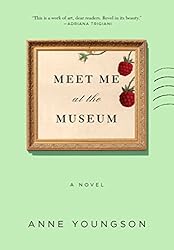

Meet Me at the Museum
Anne Youngson, 2018
Flatiron Books
288 pp.
ISBN-13: 9781250295163
Summary
In Denmark, Professor Anders Larsen, an urbane man of facts, has lost his wife and his hopes for the future. On an isolated English farm, Tina Hopgood is trapped in a life she doesn’t remember choosing. Both believe their love stories are over.
Brought together by a shared fascination with the Tollund Man, subject of Seamus Heaney’s famous poem, they begin writing letters to one another.
And from their vastly different worlds, they find they have more in common than they could have imagined. As they open up to one another about their lives, an unexpected friendship blooms.
But then Tina’s letters stop coming, and Anders is thrown into despair. How far are they willing to go to write a new story for themselves? (From the publisher.)
Author Bio
• Birth—ca. 1947
• Where—England, UK
• Education—B.A., Brimingham University; Ph.D., Oxford Brookes (in progress)
• Currently—lives in Oxfordshire, England
Anne Youngson worked for 30 years at major car company, the one that produced Austin, Morris, and Land Rover vehicles. She entered industry after studying English at the University of Birmingham: although she hoped one day to become a writer, she turned to industry first because that was where the jobs were. Working in product development—where the next line-up of vehicles was shaped—she quickly attained management level, running teams of engineers and designers.
In the early 1980s, Youngson was one of the first women in management to take maternity leave (Britain had just passed statutory maternity legislation). She gave birth to a daughter and later a son.
Then at 56 she took retirement—starting life anew. She enrolled in a two-year undergraduate diploma in creative writing at Oxford University, trying out a wide range of genres: from poems to plays and short fiction.
She followed this with a Ph.D. at Oxford Brookes, which is where she began work on Meet Me at the Museum, at first a short story. After expanding it—by then, to 10,000 words—her tutor introduced her to an agent. In what is every writer's dream come true, a large publisher snapped up the rights within 48 hours of receiving the manuscript.
She has supported many charities in governance roles, including Chair of the Writers in Prison Network, which provided residencies in prisons for writers. She lives in Oxfordshire and is married with two adult children and three grandchildren to date. Meet Me at the Museum, her debut, has been published around the world. (Adapted from various sources on the web.)
Book Reviews
The charmer of the summer.… A touching, hopeful story about figuring out what matters and mustering the courage to make necessary changes.
NPR
How subtle. How perceptive…Meet Me at the Museum is gently provoking, delving into how we interact with our children, our spouses, our communities, but mostly with ourselves.
Minneapolis Star Tribune
A farmer’s wife and a museum curator begin a life-changing correspondence in this lovely book by Anne Youngson, a first-time novelist at age 70 (Editor’s Choice).
Woman’s Day
Beautifully written and deeply moving, Meet Me at the Museum is a superb—and tenderhearted—debut that will interest anyone who's ever questioned how they became the person they are today.
Shelf Awareness
A thoughtful meditation on buried passions, regrets, love, grief, and loneliness. But Youngson’s debut offers hope for change in its tender exploration of what it means to have experienced a life well-lived.
Guardian (UK)
Already being hailed as a classic.… Absolutely beautiful, about loss and the life choices we make.
Daily Mail
A debut novel that tells the unlikely story of an English farm wife and a Danish museum curator through their spirited correspondence. Loneliness draws them together.… Though well-crafted, this genteel novel never quite achieves liftoff.
Kirkus Reviews
Discussion Questions
1. Meet Me at the Museum is an epistolary novel, meaning it is written entirely in letters. How is reading an epistolary novel different than reading more traditional first-person narration? What is lost and gained in this form?
2. Is there anyone in your life with whom you regularly correspond, rather than meeting in person or talking on the phone? Discuss the differences between those types of interactions.
3. In her first letter, Tina writes, "I am writing to you to see if you can help me make sense of some of the thoughts that occur to me. Or maybe I am hoping that just writing will make sense of them." Later, she tells Anders, "I have become clearer to myself as I made myself clear to you." How does writing to one another change the way the characters approach their lives and identities?
4. Tina and her best friend, Bella, always planned to go to Denmark together to visit the Tollund Man, but they never made it. Is there something you’ve always meant to do yet keep putting off? What has stopped you?
5. The Tollund Man provides the initial reason for Tina and Anders’ correspondence, and he frequently comes up in their letters. What does he represent for Tina? For Anders?
6. Anders tells Tina about a debate he has at work about making up names for the bog people in the museum(i.e.,naming the Tollund Man "Knut"): "To give them names, said the marketing people, would make them seem more human. But, I said (and not only me, fortunately), to give them names would make them only human, rob them of their mystery." What do you think he means? Do you agree? Have you had a particularly memorable, powerful experience at a natural history or archaeology museum?
7. Anders argues: "Superstition is such a scornful word, applied by rational people to anything that appears not to be a rational belief, not seeing there is beauty and meaning and purpose in putting aside everything that can be explained and imagining something quite miraculous in, for example, an unfurling fern frond." Do you agree? Discuss the importance of superstition, myth, and ritual in this novel. How does the natural world (i.e.,a fern) play into that?
8. Tina describes a main difference between her lifestyle and Anders’ as "mine in the midst of the landscape and change, yours caught up with objects fixed by time. "How does that difference affect their outlooks? Which is more similar to your own lifestyle?
9.Tina tells Anders:
Whenever I pick raspberries, I go as carefully as possible down the row, looking for every ripe fruit. But however careful I am, when I turn round to go back the other way, I find fruit I had not seen approaching the plants from the opposite direction. Another life, I thought, might be like a second pass down the row of raspberry canes; there would be good things I had not come across in my first life, but I suspect I would find much of the fruit was already in my basket.
What does she mean? How does this analogy resonate throughout the novel? What are the metaphorical raspberries in your own life that you would like to pick on a second pass?
10. Anders and Tina often discuss their adult children.
Anders writes: "I am ashamed to say I don’t remember ever having understood it was my job to make my children happy."
Tina agrees, and takes it further: "We should look inside ourselves for fulfillment. It is not fair to burden children or grandchildren with the obligation to make us whole. Our obligation to them is to make them safe and provide them with an education."
Do you agree with this approach to parenting? Why or why not?
11. We aren’t told how old Anders and Tina are, but they are both grandparents. Anders tells Tina:
Our letters have meant so much to us because we have both arrived at the same point in our lives. More behind us than ahead of us. Paths chosen that define us. Enough time left to change.
How does age affect the way these characters approach their relationship? How would their story differ if they were in their twenties, for instance? Discuss the ways in which Anders and Tina change over the course of the novel.
12. Discuss Anders and Tina’s first marriages. Why do they stay with their spouses, when Birgitt was so difficult to live with and Edward has so little in common with Tina? Was staying the right thing to do?
13. Do you think there is any similarity between Tina’s friendship with Anders and her husband Edward’s affair with Daphne Trigg? Why or why not? Did you feel any sympathy for Edward or Daphne?
14. The ending of the novel is left ambiguous: we never see Tina and Anders actually meet. Do you believe they will? What do you imagine their lives looking like in a year? In five years?
(Questions issued by the publisher.)
top of page (summary)


Megan's Way
Melissa Foster, 2009
Outskirts Press
304 pp.
ISBN-13: 9781432744427
Summary
What would you give up for the people you love?
When Megan Taylor, a single mother and artist living on Cape Cod, receives the shocking news that her cancer has returned, she's faced with the most difficult decision she's ever had to make. The love she has for her daughter, Olivia, and her closest friends will be stretched and frayed.
Megan’s illness reawakens the torment of her best friend, Holly Townsend, whose long-held secrets and years of betrayal come back to haunt her. How does one choose between a daughter and a life-long best friend? Can the secret she has been keeping be revealed after years of lying without destroying everyone in its wake?
Meanwhile, fourteen-year-old Olivia's world is falling apart right before her eyes, and there's nothing she can do about it. She finds herself acting in ways she cannot even begin to understand. When her internal struggles turn to dangerous behavior, even the paranormal connection she shares with her mother might not be enough to save her—her life will hang in the balance.
Megan’s Way is a journey of self discovery and heartfelt emotions, exploring the depth of the mother-daughter bond, and the intricacies of friendship. (From the publisher.)
Author Bio
Melissa Foster is the award-winning author of three International bestselling novels, Megan's Way, Chasing Amanda, and Come Back to Me. She has also been published in Indie Chicks, an anthology.
She is the founder of the Women's Nest, a social and support community for women, and the World Literary Cafe (previously WoMen's Literary Cafe), a cross-promotional site for authors, reviewers, bloggers, and readers. Melissa is currently collaborating in the film production of Megan's Way.
Melissa hosts an annual Aspiring Authors contest for children, she's written for Calgary's Child magazine and Women Business Owners magazine, and has painted and donated several murals to The Hospital for Sick Children in Washington, DC. Melissa lives in Maryland with her family. Melissa's interests include her family, reading, writing, painting, friends, helping women see the positive side of life, and visiting Cape Cod. (From the author's website.)
Book Reviews
A vivid portrayal of each character's journey through life; of the joys and travails of putting one's heart on the line and making oneself vulnerable through the act of giving the heart.
Writer's Digest Self-Published Book Awards
Megan's Way is beautifully written, thought-provoking and inspiring. You can not read this book without looking at your own life and those around you. You will be touched and moved emotionally. Megan's Way by Melissa Foster will change your thoughts, your reflections and your outlook. This is a powerful story and the author peels away the layers with perfect pace and tone.
Page One Lit
Cancer is a harsh companion that has an annoying tendency to return to lives. Megan's Way is a novel exploring the cancerous fate of Megan Taylor as the single mother deals with the reemergence of her disease. The tale follows Megan and her daughter Olivia as they deal with the way their lives are torn apart. "Megan's Way" is a fine and fascinating read that many will find hope in.
Midwest Book Review
Melissa Foster does an excellent job describing the physical deterioration of cancer. As the novel progresses, you feel Megan fading physically while striving desperately to stay strong for Olivia. And Foster also masters the confusion and rage of a teenager who knows she’s being lied to by her parent. Down to committing a rash act which puts her life and her mother’s in jeopardy. She also draws the circle of friends well—life long friends all there for one another, banding together in times of sorrow, celebrating as one in good times.
LL Book Review
This is a deep and moving book that speaks to men as well as women, and I urge you all to put it on your reading list.
Thomas Elliott - Mensa Bulletin
As I read this book I was reminded of one of my favorite movies, Beaches. I tried putting myself in Megan’s place, would I make the same decisions she made? Would I tell the truth or withhold it? I’m not sure. This book has five key characters; they each have a strong connection. That connection is what makes this tale so special. Melissa Foster has done a superb job of placing just the right emphasis on the drama of the situation. Foster took a paint brush and dipped it in words to paint a beautiful canvas.
Anne B. - Readers Favorite Awards
Megan's Way by Melissa Foster is an emotionally moving book.
Jeanette Stingley - Bella Online
Discussion Questions
(You may wish to refrain from reading these questions until you finish reading Megan's Way.)
1. In Megan’s Way, Megan imposes a treacherous decision upon herself: should she get further treatments for her terminal illness, or should she refrain? If you were in Megan’s situation, what would you have done? What, in your life, would impact that decision the most? Why do you think Megan felt compelled to hide her illness?
3. At the tender age of 14, Olivia was already in a stage of her life when most girls are selfabsorbed and act out toward their parents. Do you think Olivia’s age added to her angst about not knowing who her father was? Do you think she could have handled it in a mature and respectful way had Megan revealed her true father, or do you think that as a teen, it would be more likely that at any fit of anger or rebellion, she’d have used it against Megan?
4. Peter’s mother left him at a very early age, and he clearly never dealt with his abandonment issues. After Megan dies, he reevaluates his life and opens his heart. Do you think his angst would have been equal, more, or less, had his father left instead of his mother? Do you think it is possible to get past those issues?
5. At the beginning of the book, a fortuneteller foresees death, passage, and truth. She also states, “One will be released, and returned after death.” She states, “She will need you, and you will know.” She also casts a spell on one of them as they leave the tent. Do you believe there are people that can see the future? Do you think there are people who are capable of casting such spells? Do you believe in other paranormal connections, like the one between Megan and Olivia?
6. Holly and Jack have a seemingly strong marriage, and yet it is undermined by Holly’s lie, the enormity of which could land her in jail. Do you think she should have told Jack? Do you think their marriage would survive such deception?
7. Everyone keeps secrets of some sort. What types of secrets do you think are the most harmful to relationships? Infidelity? Financial problems? Former relationships?
8. The friendship between Megan, Holly, Jack, and Peter is very strong. It appears, throughout the book, that they are all there for each other, no matter what is going on in their own lives. And they all rallied around Olivia after Megan’s passing. Do you think such strong bonds can really exist within a group of this size? Do you have this strong of a friendship with anyone, male or female? What do you think drew these friends together and bonded them throughout the years?
9. After Megan’s death, Olivia meets Jason, who has also lost his parents. Do you think Jason helps Olivia grieve and deal with her mother’s death? What other role do you think Jason plays in Olivia’s life?
10. If you were Holly or Jack, what might you have done to help Olivia through her mother’s death? Would you have done anything differently?
11. Megan’s Way brings to the reader more than one moral dilemma. Discuss the ethical and moral values that might weigh into the decisions the characters have made. Did you feel angry at any of the characters? Did your emotions change as you progressed through the story? At the end of Megan’s Way, did you agree or disagree with the characters’ decisions?
(Questions issued by publisher.)
top of page (summary)

Melmoth
Sarah Perry, 2018
HarperCollins
288 pp.
ISBN-13: 9780062856395
Summary
For centuries, the mysterious dark-robed figure has roamed the globe, searching for those whose complicity and cowardice have fed into the rapids of history’s darkest waters—and now, in Sarah Perry’s breathtaking follow-up to The Essex Serpent, it is heading in our direction.
It has been years since Helen Franklin left England.
In Prague, working as a translator, she has found a home of sorts—or, at least, refuge.
That changes when her friend Karel discovers a mysterious letter in the library, a strange confession and a curious warning that speaks of Melmoth the Witness, a dark legend found in obscure fairy tales and antique village lore.
As such superstition has it, Melmoth travels through the ages, dooming those she persuades to join her to a damnation of timeless, itinerant solitude. To Helen it all seems the stuff of unenlightened fantasy.
But, unaware, as she wanders the cobblestone streets Helen is being watched. And then Karel disappears. (From the publisher.)
Author Bio
• Birth—1979
• Where—Chelmsford, England, UK
• Education—Ph.D., Royal Holloway University
• Currently—lives in Norwich, England
Sarah Perry is an English author. She has had two novels published: The Essex Serpent (2016) and After Me Comes the Flood (2014). Perry was born in Chelmsford, Essex, into a family of devout Christians who were members of a Strict Baptist church.
Perry grew up with little, if any, access to contemporary art, culture, and writing. She filled her time with classical music, classic novels and poetry, and church-related activities. She says this early immersion in old literature and the King James Bible profoundly influenced her writing style.
She has a PhD in creative writing from Royal Holloway University where her supervisor was English novelist and poet, Sir Andrew Motion. Her doctoral thesis was on the Gothic in the writing of Iris Murdoch, and Perry has subsequently published an article on the Gothic in Aeon magazine.
I wrote about the power of place in my PhD thesis, particularly the importance of buildings in the Gothic (a genre which I find myself inhabiting without ever having meant to). Fiction in the Gothic inheritance makes much of the potent importance of the interior, from the castle where Jonathan Harker finds himself holed up to Thornfield, and from the suburban homes in Hilary Mantel’s Beyond Black to the ghastly crypts in The Monk.
Recognition
Perry's second nove, The Essex Serpent, was nominated in the Novel category for the 2016 Costa Book Awards and was named Waterstones Book Of The Year 2016. It was placed on the long list for the 2017 Baileys Women's Prize for Fiction. In 2013 she was a writer in residence at Gladstone's Library. She won the 2004 Shiva Naipaul Memorial prize for travel writing for "A Little Unexpected," an article about her experiences in the Philippines. (From Wikipedia. Retrieved 6/12/2017.)
Book Reviews
Each detour in Melmoth could be its own novel, and I was often sorry to leave them. There is a clarity to these historical sections, a care and restraint. Perry could be describing her own well-appointed sentences when she writes of a home, "Everything in it was so affectionately chosen that it did not seem furnished so much as inhabited."… The novel reels you in, using the same trick of all the best ghost stories, from The Turn of the Screw on: Is there really a ghost before you? Or do you see the projection of your own secret sins and desires? What is more frightening than the human? For all the…special effects, it's the simple, domestic details that shine in this book: the hard snow that falls like "a table-salt glitter," the "consoling noises" of the teakettle, the way Perry brings a character to life in a few swift slashes…For all the swirling jackdaws and oppressive doom , this book has a ruddy optimism at its core…if suffering is never in short supply nor are opportunities for intercession, as Helen learns, to live according to the virtues of compassion, courage, self-sacrifice. "Look!" is the first word in several chapters. It is the book's moral injunction. Pay attention, Perry bids us. Don't leave the lonely to Melmoth.
Perul Sehgal - New York Times
Masterful…scary and smart, working as a horror story but also a philosophical inquiry into the nature of will and love. Perry did as much in her richly praised novel The Essex Serpent, but this is a deeper, more complex novel and more rewarding.
Washington Post
Ms. Perry, whose last book, The Essex Serpent, was a breakout hit, again proves herself a master of atmosphere.
Wall Street Journal
Perry’s masterly piece of postmodern gothic is one of the great achievements of the century and deserves all the prizes and praise that will be heaped upon it.
Guardian (UK)
Ingenious.… haunting, disquieting and memorable, and showcase[s] Perry’s dazzling creative powers.
Minneapolis Star Tribune
[A] spine-tingling, gloriously creepy tale … this is horror done masterfully.
Globe and Mail (Toronto)
The last few years have brought a glut of fashionably affectless and amoral fiction....Sarah Perry’s fierce, full-hearted books about love and ethics feel like an antidote to that elegant apathy....In a world that feels desperate, chaotic, and unredeemable, Melmoth asks us to be witnesses for each other.
NPR
The author of The Essex Serpent casts another haunting spell in this exquisitely written gothic novel.
People
(Starred review) [A]n unforgettable achievement.… Though rich in gothic tropes and sinister atmosphere, the novel transcends pastiche. Perry’s heartbreaking, horrifying monster confronts the characters …with humanity’s complicity in history’s darkest moments …and its longing for both companionship and redemption.
Publishers Weekly
(Starred review) This fever dream of a novel will prove as compelling and all-consuming as The Essex Serpent.
Library Journal
(Starred review) [A] stylized, postmodern work by a masterly writer… a sobering, disturbing, yet powerful and moving book that cannot fail to impress. The stories-within-stories and the Jewish themes recall Dara Horn’s The World to Come and Donna Tartt’s The Goldfinch, although Melmoth presents different kinds of nightmares.
Booklist
(Starred review) In rich, lyrical prose, Perry weaves history and myth, human frailty and compassion, into an affecting gothic morality tale for 2018.… Perry is changing what a modern-day ghost story can look like…. A chilling novel.
Kirkus Reviews
Discussion Questions
We'll add publisher questions if and when they're available; in the meantime, use our LitLovers Book Club Resources. They can help with discussions for any book:
• How to Discuss a Book (helpful discussion tips)
• Generic Discussion Questions—Fiction and Nonfiction
• Read-Think-Talk (a guided reading chart)
(Resources by LitLovers. Please feel free to use them, online and off, with attribution. Thanks.)


The Member of the Wedding
Carson McCullers, 1946
Houghton Mifflin Harcourt
176 pp.
ISBN-13: 9780618492398
Summary
Many consider Carson McCullers’s third novel, The Member of the Wedding, her masterpiece. Set in a small southern town in the 1940s, the book examines a crucial turning point in adolescence.
Twelve-year-old Frankie Addams is utterly, hopelessly bored with life until she hears about her older brother’s wedding. Bolstered by lively conversations with the family’s servant, Bernice, and her six-year-old cousin John Henry—not to mention her own unbridled imagination—Frankie takes an overly active role in the wedding, even hoping to go on the honeymoon, so deep is her desire to be a member of something larger, more accepting than herself. (From the publisher.)
Author Bio
• Birth—February 19, 1917
• Where—Columbus, Georgia, USA
• Death—1967
• Where—Nyack, New York, USA
• Education—New York University; Columbia University
Carson McCullers was born Lula Carson Smith on February 19, 1917, in Columbus, Georgia. A promising pianist, McCullers enrolled in the Juilliard School of Music in New York when she was seventeen, but lacking the money for tuition, she did not attend classes. Eventually she studied writing at New York University and Columbia University, which ultimately led to the publication of her first short story, "Wunderkind," in Story magazine. In 1937, Carson married fellow writer James Reeves McCullers.
Less than three years later, when she was twenty-three, she published her first novel, The Heart Is a Lonely Hunter. She went on to write Reflections in a Golden Eye, The Member of the Wedding, The Ballad of the Sad Café, and Clock Without Hands, among other works. The recipient of two Guggenheim fellowships, McCullers also won awards for her Broadway stage adaptation of The Member of the Wedding. Plagued by a series of strokes, attributed to a misdiagnosed and untreated case of childhood rheumatic fever, Carson McCullers died in Nyack, New York, at age fifty.
With a body of work including five novels, two plays, twenty short stories, more than two dozen nonfiction pieces, a book of verse for children, a small number of poems, and an unfinished autobiography, McCullers is considered among the most significant American writers of the twentieth century. (From the publisher.)
Book Reviews
Rarely has emotional turbulence been so delicately conveyed. Carson McCullers’s language has the freshness, quaintness, and gentleness of a sensitive child.
New York Times
[The Member of the Wedding] is poignant and arresting, amazingly perceptive and exquisitely wrought.
Boston Herald
There is an almost perfect harmony between the theme of this book and the prose in which it is expressed, for the prose is lyrical and sensitive and always fresh.
Chicago Tribune
A marvelous study of the agony of adolescence.
Detroit Free Press
Discussion Questions
1. At the beginning of The Member of the Wedding, McCullers writes: “Standing beside the arbor, with the dark coming on, Frankie was afraid. She did not know what caused this fear, but she was afraid” (6). What do you think Frankie is so afraid of? Does she overcome her fears in the novel, and if so, how?
2. Regarding The Member of the Weddingg, McCullers told Tennessee Williams: “I was trying to recreate the poetry of my own childhood.” Although the novel takes place in the 1940s, many of the emotions Frankie experiences are timeless. In what ways does McCullers present a universal portrait of adolescence? How does Frankie’s discussion of the circus freaks in Part One relate to her own experiences?
3. Part Two begins: “The day before the wedding was not like any day that F. Jasmine had ever known” (44). How does Frankie’s sudden feeling of belonging to something affect her entire perspective?
4. As a result of this feeling of belonging, Frankie’s behavior and attitude significantly alter in the span of a day. How does McCullers make this rapid change and Frankie’s reaction to the wedding believable?
5. Bernice states: “You have a name and one thing after another happens to you, and you behave in various ways and do things, so that soon the name begins to have meaning. Things have accumulated around the name” (108). What does Bernice mean by this? Do the names Frankie, F. Jasmine, and Frances have different meanings? If you could change your name, what name would you choose?
6. Frankie says about people, “People loose and at the same time caught. Caught and loose. All these people and you don’t know what joins them up ” (115). What is Frankie trying to convey to Bernice here? In what ways are people both caught and loose? In what ways is Frankie herself caught and loose?
7. Frankie states: “It was better to be in a jail where you could bang the walls than in a jail you could not see (148).” What is Frankie’s jail? What jails surround Bernice and John Henry? Do you have such jails in your own life?
8. Carson McCullers is one of the twentieth century’s most prominent southern writers. In what ways does McCullers evoke the South and its culture in her writing? How representative of the South do you think The Member of the Wedding is?
9. Although the wedding is a central focus in the novel, little is said about the actual event. Why do you think McCullers chose to limit the wedding scenes? How does this reflect on Frankie’s obsession with the wedding?
10. Frankie frequently states that Jarvis and Janice are “the we of me.” Why does Frankie have such a strong need to belong to something? What prompts her to decide that the wedding is what she most wants to be a part of?
11. Many characters who play very significant roles in Frankie’s life are on the periphery of the novel, such as Mr. Addams, Jarvis, Janice, and the soldier. How does McCullers portray these characters adequately in a limited amount of space? What are the advantages of focusing the novel on just three main characters?
12. The Member of the Wedding has been made into a successful play and a major motion picture. Why do you think people are so drawn to this story?
(Questions issued by publisher.)
Memoirs of a Geisha
Arthur Golden, 1997
Knopf Doubleday
503 pp.
ISBN-13: 9781400096893
Summary
In this literary tour de force, novelist Arthur Golden enters a remote and shimmeringly exotic world.
For the protagonist of this peerlessly observant first novel is Sayuri, one of Japan's most celebrated geisha, a woman who is both performer and courtesan, slave and goddess. We follow Sayuri from her childhood in an impoverished fishing village, where in 1929, she is sold to a representative of a geisha house, who is drawn by the child's unusual blue-grey eyes. From there she is taken to Gion, the pleasure district of Kyoto. She is nine years old.
In the years that follow, as she works to pay back the price of her purchase, Sayuri will be schooled in music and dance, learn to apply the geisha's elaborate makeup, wear elaborate kimono, and care for a coiffure so fragile that it requires a special pillow. She will also acquire a magnanimous tutor and a venomous rival. Surviving the intrigues of her trade and the upheavals of war, the resourceful Sayuri is a romantic heroine on the order of Jane Eyre and Scarlett O'Hara. And Memoirs of a Geisha is a triumphant work—suspenseful, and utterly persuasive. (From the publisher.)
Author Bio
• Birth—1956
• Where—Chattanooga, Tennessee, USA
• Education—B.A., Harvard; M.A., Columbia University; M.A.,
Boston College
• Currently—lives in Brookline, Massachusetts
A member of the Ochs-Sulzberger family (owners of the New York Times), Golden was educated at the Baylor School (then a boys-only school for day and boarding students) in Chattanooga, Tennessee. He attended Harvard College and received a degree in art history, specializing in Japanese art. In 1980, he earned an M.A. in Japanese history at Columbia University, and also learned Mandarin Chinese. After a summer at Beijing University, he worked in Tokyo. When he returned to the United States, he earned an M.A. in English at Boston University. He currently lives in Brookline, Massachusetts.
After its release in 1997, Memoirs of a Geisha spent two years on The New York Times bestseller list. It has sold more than four million copies in English and has been translated into thirty-two languages around the world.
The novel Memoirs of a Geisha was written after interviewing a number of geisha, including Mineko Iwasaki, for background information about the world of the geisha, although Golden fictionalized key aspects of Geiko life including the notion that they participated in ritualized prostitution.
After the Japanese edition of Memoirs of a Geisha was published, Arthur Golden was sued for breach of contract and defamation of character by Iwasaki. The plaintiff claimed that Golden had agreed to protect her anonymity, if she told him about her life as a geisha due to the traditional code of silence about their clients. The case was settled out of court for an undisclosed amount.
In 2005, Memoirs of a Geisha was made into a feature film starring Ziyi Zhang and Ken Watanabe, and directed by Rob Marshall, garnering three Academy Awards. (From Wikipedia.)
Book Reviews
Part historical novel, part fairy tale, part Dickensian romance, Memoirs of a Geisha is not only a richly sympathetic portrait of a woman, but a finely observed picture of an anomalous and largely vanished world.... An impressive and unusual debut.
New York Times
Golden's storytelling is rich and slow-paced. Like Austen, he lavishes attention on the minute details that regulate and define social distinctions. In the raising of a teacup or an eyebrow there are worlds of implication. The prose style is simple and strangely satisfying, perfectly attuned to its time and place. Golden manages to find the simile for every occasion. "That startling month in which I first came upon the Chairman again...made me feel like a pet cricket that has at last escaped its wicker cage. For the first time in ages I could go to bed at night believing that I might not always draw as little notice in Gion as a drop of tea spilled onto the mats." Golden deftly makes use of a culture that deflects emotion and makes direct communication taboo to create a world of intrigue and romance. Depression and war remain in the background while Sayuri imbibes wisdom from her mentor, Mameha, battles her rival, Hatsumomo, and yearns for the attentions of the Chairman. Memoirs of a Geisha is an intelligent entertainment.
Dan Cryer - Salon
Arthur Golden's brilliant debut novel, Memoirs of a Geisha, is a reminder of just how silly the exhortation "write what you know!" can be. Clearly Golden, a 40-something American male, has never lived anything remotely similar to the experiences of a geisha coming of age in the 1930s, the glory days of Kyoto's Gion pleasure district. Yet it is precisely this vanished world that he re-creates with subtlety, sensuality, and supreme authority, bringing to life characters so complete and idiosyncratic—so fully sprung from the eras he has evoked—that his novel ultimately overwhelms us, as seductive and beguiling as the geisha of its title.... Like a gorgeously layered kimono, Memoirs gradually unfolds to reveal the courage, love, daring, and hope of an intensely human—and, it turns out, surprisingly modern—woman. Sayuri's voice, alternately poetic and mischievous, lends the narrative an immediacy that provides a beguiling counterpoint to the exquisitely detailed rituals—such as the lacquered mask Sayuri learns to apply so expertly—that make up so much of geisha life in prewar Gion. Like Kazuo Ishiguro's An Artist of the Floating World, Memoirs of a Geisha revives a long-vanished world and makes us experience, however briefly, its fragile, mothlike, and indelible beauty.
Sarah Midori Zimmerman (Writer-editor, New York)
"I wasn't born and raised to be a Kyoto geisha.... I'm a fisherman's daughter from a little town called Yoroido on the Sea of Japan." How nine-year-old Chiyo, sold with her sister into slavery by their father after their mother's death, becomes Sayuri, the beautiful geisha accomplished in the art of entertaining men, is the focus of this fascinating first novel. Narrating her life story from her elegant suite in the Waldorf Astoria, Sayuri tells of her traumatic arrival at the Nitta okiya (a geisha house), where she endures harsh treatment from Granny and Mother, the greedy owners, and from Hatsumomo, the sadistically cruel head geisha. But Sayuri's chance meeting with the Chairman, who shows her kindness, makes her determined to become a geisha. Under the tutelage of the renowned Mameha, she becomes a leading geisha of the 1930s and 1940s. After the book's compelling first half, the second half is a bit flat and overlong. Still, Golden, with degrees in Japanese art and history, has brilliantly revealed the culture and traditions of an exotic world, closed to most Westerners.
Wilda Williams - Library Journal
Cherry-blossom delicate, with images as carefully sculpted as bonsai, this tale of the life of a renowned geisha, one of the last flowers of a kind all but eliminated by WW II, marks an auspicious, unusual debut. Japan is already changing, becoming industrialized and imperialistic, when in 1929 young Chiyo's fisherman father sells her to a house in Kyoto's famous Gion district. The girl's gray-eyed beauty is startling even in childhood, so much so that her training is impeded by the jealousy of her house's primary geisha, the popular, petty Hatsumomo. Caught trying to run away, Chiyo loses her trainee status until taken under the wing of Mameha, a bitter rival of Hatsumomo.
Chiyo flourishes with Mameha as her guide, soon receiving her geisha name, Sayuri, and having her mentor skillfully arrange the two main events vital to a geisha's success: the sale of Sayuri's virginity (for a record price), and the finding of a sugar-daddy to pay her way. Seeing the implications of Japan's militarism, Mameha pairs Sayuri with the general in charge of army provisions, so that as WW II drags on she and her house have things no one else in Gion can obtain. After the war, with her general dead and others vying for her attention, Sayuri pines anew for the only man she ever loved—an electrical-corporation chairman whose kindness to a crying Chiyo years before altered the course of her future.
Though incomparable in its view of a geisha's life behind the scenes, the story loses immediacy as it goes along. When modern times eclipse Gion's sheltered world, the latter part of Sayuri's life—compared to the incandescent clarity of its first decades—seems increasingly flat.
Kirkus Reviews
Discussion Questions
1. Many people in the West think of geisha simply as prostitutes. After reading Memoirs of a Geisha, do you see the geisha of Gion as prostitutes? What are the similarities, and what are the differences? What is the difference between being a prostitute and being a "kept woman, " as Sayuri puts it [p. 291]?
2. "The afternoon when I met Mr. Tanaka Ichiro, " says Sayuri, "really was the best and the worst of my life" [p. 7]. Is Mr. Tanaka purely motivated by the money he will make from selling Chiyo to Mrs. Nitta, or is he also thinking of Chiyo's future? Is he, as he implies in his letter, her friend?
3. In his letter to Chiyo, Mr. Tanaka says "The training of a geisha is an arduous path. However, this humble person is filled with admiration for those who are able to recast their suffering and become great artists" [p. 103]. The word "geisha" in fact derives from the Japanese word for art. In what does the geisha's art consist? How many different types of art does she practice?
4. Does Sayuri have a better life as a geisha than one assumes she would have had in her village? How does one define a "better" life? Pumpkin, when offered the opportunity to run away, declines [p. 53]; she feels she will be safer in Gion. Is her decision wise?
5. How does Sayuri's status at the Nitta okiya resemble, or differ from, that of a slave? Is she in fact a slave?
6. Are Mother and Granny cruel by nature, or has the relentless life of Gion made them what they are? If so, why is Auntie somewhat more human? Does Auntie feel real affection for Sayuri and Pumpkin, or does she see them simply aschattel?
7. "We must use whatever methods we can to understand the movement of the universe around us and time our actions so that we are not fighting the currents, but moving with them" [p. 127]. How does this attitude differ from the Western notion of seizing control of one's destiny? Which is the more valid? What are Sayuri's feelings and beliefs about "free will"?
8. Do you see Sayuri as victimized by Nobu's attentions, or do you feel pity for Nobu in his hopeless passion for Sayuri? Do you feel that, in finally showing her physical scorn for Nobu, Sayuri betrayed a friend, or that real friendship is impossible between a man and a woman of their respective stations?
9. How do Japanese ideas about eroticism and sexuality differ from Western ones? Does the Japanese ideal of femininity differ from ours? Which parts of the female body are fetishized in Japan, which in the West? The geisha's ritual of preparing herself for the teahouse is a very elaborate affair; how essentially does it differ from a Western women's preparation for a date?
10. Does the way in which the Kyoto men view geisha differ from the way they might view other women, women whom they might marry? What are the differences? How, in turn, do geisha view men? Is the geisha's view of men significantly different from that of ordinary women?
11. Do you find that the relationship between a geisha and her danna is very different from that between a Western man and his mistress? What has led Sayuri to think that "a geisha who expects understanding from her danna is like a mouse expecting sympathy from a snake" [p. 394]?
12. As the older Sayuri narrates her story, it almost seems as though she presents Chiyo and Sayuri as two different people. In what ways are Chiyo and Sayuri different? In what ways are they recognizably the same person?
13. Pumpkin believes that Sayuri betrayed her when she, rather than Pumpkin, was adopted by the Nitta okiya. Do you believe that Sayuri was entirely blameless in this incident? Might she have helped to make Pumpkin's life easier while they were in the okiya together? Or has Pumpkin's character simply been corrupted by her years with Hatsumomo and the entire cruel system that has exploited her?
14. Sayuri senses that she shares an en, a lifelong karmic bond, with Nobu [p. 295]. How might a Western woman express this same idea?
15. During Sayuri's life, Japan goes through a series of traumas and unprecedented cultural change: the Great Depression, the War, the American Occupation. How do the inhabitants of Gion view political events in the outside world? How much effect do such events have upon their lives? How aware are they of mainstream Japanese culture and life?
16. What personal qualities do Sayuri and Mameha have that make them able to survive and even prosper in spite of the many cruelties they have suffered? Why is Hatsumomo, for example, ultimately unable to survive in Gion?
17. Is Sayuri the victim of a cruel and repressive system, a woman who can only survive by submitting to men? Or is she a tough, resourceful person who has not only survived but built a good life for herself with independence and even a certain amount of power?
18. Why might Golden have chosen to begin his narrative with a "Translator's Note"? What does this device accomplish for him?
19. In Memoirs of a Geisha, Arthur Golden has done a very daring thing: he, an American man, has written in the voice of a Japanese woman. How successfully does he disguise his own voice? While reading the novel, did you feel that you were hearing the genuine voice of a woman?
(Questions issued by publisher.)
|
Memoirs of an Imaginary Friend – pg. 2 |
|
 
Excerpt (cont.)
__________ FIVE
|
|
|
Memoirs of an Imaginary Friend – pg. 3 |
|
|
Excerpt (cont'd.)
__________ Max is the only boy I have ever seen who makes toy soldiers retreat or surrender. Every other boy makes them die instead.
|
|
|
Memoirs of an Imaginary Friend–pg. 1 |
|
|
__________
___________
__________
|
|
Memoirs of an Imaginary Friend
Matthew Dicks, 2012
St. Martin's Press
320 pp.
ISBN-13: 9781250031853
Summary
I am not imaginary...
Budo is lucky as imaginary friends go. He's been alive for more than five years, which is positively ancient in the world of imaginary friends. But Budo feels his age and thinks constantly of the day when eight-year-old Max Delaney will stop believing in him. When that happens, Budo will disappear.
Max is different from other children. Some people say he has Asperger’s, but most just say he’s “on the spectrum.” None of this matters to Budo, who loves Max unconditionally and is charged with protecting him from the class bully, from awkward situations in the cafeteria, and even in the bathroom stalls. But he can’t protect Max from Mrs. Patterson, a teacher in the Learning Center who believes that she alone is qualified to care for this young boy.
When Mrs. Patterson does the unthinkable, it is up to Budo and a team of imaginary friends to save Max—and Budo must ultimately decide which is more important: Max’s happiness or his own existence.
Memoirs of an Imaginary Friend is a triumph of courage and imagination that touches on the truths of life, love, and friendship as it races to a heartwarming...and heartbreaking conclusion. (From the publisher.)
Read an excerpt.
Visit Matthew on Facebook
Author Bio
• Birth—N/A
• Raised—Blackstone, Massachusetts, USA
• Education—Manchester Community College;
Trinity College; St. Joseph's College
• Currently—lives in Newington, Connecticut
Matthew Dicks is the author of the novels Memoirs of an Imaginary Friend, Something Missing and Unexpectedly, Milo and the rock opera The Clowns. When he is not hunched over a computer screen, he fills his days as an elementary school teacher, a wedding DJ, a storyteller and a life coach. He is a former West Hartford Teacher of the Year and a three-time Moth StorySLAM champion.
Matthew is married to friend and fellow teacher, Elysha, and they have a daughter named Clara and a son named Charlie. Matthew grew up in the small town of Blackstone, Massachusetts, where he made a name for himself by dying twice before the age of eighteen and becoming the first student in his high school to be suspended for inciting riot upon himself.
In his words
My name is Matthew Dicks. I am an author, a storyteller and a teacher.
In the spring of 2008, under the guidance of my agent, Taryn Fagerness, I sold my first novel, Something Missing, to Broadway Books, an imprint of Doubleday, and thus made one of my childhood dreams come true. Something Missing was published in August of 2009 and has since been translated into six different languages.
My career as an author was born.
One year later, in the fall of 2010, I published my second novel, Unexpectedly, Milo. It has been translated into three languages.
My third novel, Memoirs of an Imaginary Friend, published in the United States in August of 2012 with St. Martin’s Press. It has been translated into 17 languages worldwide.
At the request of my UK publisher, I am published under the name Matthew Green in the UK and its affiliated markets. Green is my wife’s maiden name.
In addition to novels, I’ve also written a rock opera, The Clowns, and am working on a memoir and several children’s books. In addition to fiction, I write poetry, essays and a daily blog. I have published pieces in newspapers, poetry journals, online news sites and educational journals throughout the United States.
In addition to writing, I am also a storyteller. I tell stories for The Moth on a regular basis and am a three-time Moth Story Slam champion. I also tell stories for a variety of storytelling organizations including The Story Collider and Literary Death Match. My wife and I also host out own storytelling series in Connecticut called Speak Up! In addition to storytelling, I also occasionally work as a public speaker, addressing issues related to publishing, writing, education, productivity and more.
I grew up in the small town of Blackstone, Massachusetts with two siblings, two lost-but-recently-found step-siblings, a loving mother, and an evil step-father. I was a Boy Scout, a pole-vaulter, a flutist and bassoonist, and a proud member of my school’s drum corps. I also have the distinction of having died twice by the age of eighteen before being revived by paramedics both times.
Sorry. No white light.
I left home at eighteen and worked in a variety of dead-end jobs for the next five years until I was robbed at gunpoint at the age of twenty-three. This brush with death finally convinced me to get off my ass and make something of my life.
Six months later, I was sitting in my first college classroom (a class ironically called On Death and Dying), hoping to one day become a teacher and an author. I would often tell friends and family that my goal was to one day write for a living and teaching for pleasure. While I have not yet realized this goal, I am closer than I would have ever imagined.
I worked my way through college, managing McDonald’s restaurants, opening a small business, and working on campus as a writing tutor. I graduated from Manchester Community College with a liberal arts degree in 1996 and Trinity College with an English degree and Saint Joseph’s College with a teaching degree in 1999.
Following graduation, I went to work as an elementary school teacher and have been teaching ever since. I currently teach fifth grade but have taught second and third grade as well. In 2005 I was named West Hartford’s Teacher of the Year and was a finalist for Connecticut’s Teacher of the Year.
Extras
• In addition to my teaching career, I also own and operate a DJ company that performs weddings throughout Connecticut. I also serve as an occasional, albeit fairly heathen, minister and a life coach.
• In 2006 I married my wife and colleague, Elysha, after proposing to her in front of friends and family on the main landing of Grand Central Station in New York. We live in Newington, CT with our daughter, Clara, our son, Charlie, our Lhasa Apso, Kaleigh, and our enormous, slightly insane house cat named Owen.
• When not teaching, writing or playing with my children, I spend my free time listening to music, eating poorly and dodging phone calls.
• I’m an avid, albeit awful, golfer and a much better basketball and poker player. I am an enormous fan of the New England Patriots and a season ticket holder and an equally rabid fan of the Yankees, Celtics and Bruins.
• I would play more football if my fragile friends were more willing.
• I also read a great deal, consume an enormous number of audio books, and listen to about three dozen podcasts on a daily and weekly basis.
• I also run a occasionally-annual race throughout Connecticut modeled after CBS’s The Amazing Race called The A-Mattzing Race, and this keeps me busy planning and coordinating the next event. (From the author's website.)
Book Reviews
[A] fun read and engaging exploration of the vibrant world of a child's imagination.
Publishers Weekly
Funny, poignant.... Budo's world is as realistic as he is imaginary. We would all be lucky to have Budo at our sides. Reading his memoir is the next best thing.
Library Journal
An incredibly captivating novel about the wonder of youth and the importance of friendship, whether real or imagined. Delightfully compelling reading.
Booklist
Quirky and heartwarming
Kirkus Reviews
Discussion Questions
1. “I am not imaginary,” says Budo. Do you believe him?
2. Might you relate differently to Max if the story was told from another character’s point of view? How does Budo’s voice shape your understanding of Max?
3. Max’s mother wants desperately to understand what is wrong with Max, while his father wants desperately to believe that there is nothing wrong. Who do you side with?
4. Budo seems to watch a lot of television. How do his viewing habits shape his perception of the world?
5. Budo straddles many worlds: child and adult; real and imaginary. Could the same be said for other characters in this book?
6. Mrs. Patterson did a terrible thing. But is there any way in which her actions may have been beneficial to Max?
7. What does Budo fear most? Why does he think that Max’s mom and dad are his biggest danger?
8. The author, Matthew Dicks, is an elementary school teacher. In what ways can you see the influence of this “day job” on his writing?
(Questions issued by publisher.)
The Memory Keeper's Daughter
Kim Edwards, 2005
Penguin Group USA
432 pp.
ISBN-13: 9780143037149
Summary
On a winter night in 1964, Dr. David Henry is forced by a blizzard to deliver his own twins. His son, born first, is perfectly healthy. Yet when his daughter is born, he sees immediately that she has Down's Syndrome. Rationalizing it as a need to protect Norah, his wife, he makes a split-second decision that will alter all of their lives forever. He asks his nurse to take the baby away to an institution and never to reveal the secret.
But Caroline, the nurse, cannot leave the infant. Instead, she disappears into another city to raise the child herself. So begins this beautifully told story that unfolds over a quarter of a century in which these two families, ignorant of each other, are yet bound by the fateful decision made that long-ago winter night.
A brilliantly crafted, stunning debut, The Memory Keeper's Daughter explores the way life takes unexpected turns, and how the mysterious ties that hold a family together help us survive the heartache that occurs when long-buried secrets burst into the open. (From the publisher.)
Author Bio
• Reared—Skaneateles, New York, USA
• Education—B.A., Colgate University; M.F.A., Iowa Writers'
Workshop; M.A., University of Iowa
• Awards—Nelson Algren Award, 1990; Pushcart Prize, 1995;
Whiting Writers' Award, 2002
• Currently—lives in Lexington, Kentucky
Kim Edwards is the author of the short story collection The Secrets of a Fire King, which was an alternate for the 1998 PEN/Hemingway Award, and she has won both the Whiting Award and the Nelson Algren Award. A graduate of the Iowa Writer's Workshop, she currently teaches writing at the University of Kentucky. (From the Hardcover edition.)
More
In the late ‘90s, Edwards was making a major splash on the literary scene. Her recently published short story collection would soon be pegged for a Whiting Award and the Nelson Algren Award, and would also be an alternate for the PEN/Hemingway Award. Around this charmed time, Edwards heard a story that would ultimately propel her toward a career as a bestselling novelist.
"A few months after my story collection, The Secrets of a Fire King, was published, one of the pastors of the Presbyterian church I'd recently joined said she had a story to give me," she explained in an interview on the Penguin Group USA web site. "It was just a few sentences, about a man who'd discovered late in life that his brother had been born with Down syndrome, placed in an institution at birth, and kept a secret from his family, even from his own mother, all his life. He'd died in that institution, unknown. I remember being struck by the story even as she told it, and thinking right away that it really would make a good novel. It was the secret at the center of the family that intrigued me. Still, in the very next heartbeat, I thought: Of course, I'll never write that book."
Despite Edwards's quick dismissal of the idea, it would not unhand her. She let several years slip by without going to work on the story, but she never forgot it. When she was invited to run a writing workshop for mentally disabled adults, the experience affected Edwards so profoundly that she started mulling over the pastor's story more seriously. It would be another year before Edwards actually began working on The Memory Keeper's Daughter, but once she did, she found that it came quickly and surprisingly well-developed.
In The Memory Keeper's Daughter, a man named David discovers that his newly born son is in fine health, but the child's twin sister is stricken with Down Syndrome. So, the distraught father, who harbors painful memories of his own sister's chronic illness, makes a quick but incredibly difficult decision: he asks the attending nurse to take his daughter to an institution where she might receive better care. Although he tells his wife that the child was stillborn, David's decision goes on to affect the lives of himself and his wife for the following 25 years.
Haunting, dramatic, and moving, The Memory Keeper's Daughter went on to become a big seller and a critical favorite. The Library Journal hailed it as "an enthralling page-turner" and Kirkus Reviews declared that Edwards "excels at celebrating a quiet wholesomeness..."
Now that Edwards has broken into novel-writing in a big way, she is hard at work on her follow up to her smash debut. "I have begun a new novel, called The Dream Master," she says. "It's set in the Finger Lakes area of upstate New York where I grew up, which is stunningly beautiful, and which remains in some real sense the landscape of my imagination. Like The Memory Keeper's Daughter, this new novel turns on the idea of a secret—that seems to be my preoccupation as a writer—though in this case the event occurred in the past and is a secret from the reader as well as from the characters, so structurally, and in its thematic concerns, the next book is an entirely new discovery." (From Barnes and Noble.)
Extras
From a 2007 Barnes & Noble interview:
• Although Edwards had been interested in writing ever since she was a little girl, she didn't actually write her first story "Cords" until she was in a fiction workshop while attending Colgate University.
• Among the many fans that Edwards has won with The Memory Keeper's Daughter is beloved novelist Sue Monk Kidd (The Secret Life of Bees), who said of Edwards's first novel, "I loved this riveting story with its intricate characters and beautiful language."
Her own words:
• My first job was in a nursing home—a terrible place in retrospect. It was in an old house, and the residents were so lonely. People rarely visited them. I only stayed there a couple of months, but it made a strong impression on me. Just before I left I went to get one woman for dinner, and discovered that she had died—a powerful experience when you're 17.
• Though my stories aren't autobiographical, I do sometimes use things from my life. ‘The Way It Felt to be Falling,' a story from my collection The Secrets of a Fire King, uses sky-diving as a metaphor. Like my character, I did jump out of the first plane I ever flew in. It was an amazing experience, but I've never had the urge to do it again.
• One of my greatest times of inspiration is when I'm traveling or living in a new country-there's a tremendous freedom that comes from being unfettered by your own, familiar culture, and by seeing the world from a different point of view.
• I love to swim, and I love being near water.
• When asked what book most influenced her life as a writer, here is what she said:
Well, there are so many. It's hard to choose. But I think I'd have to go with a very early influence, which was Louisa May Alcott's Little Women. I read this book several times when I was quite young, and I was particularly drawn to the character of Jo, who of course was the writer, the story-teller. I'm sure it also was important to me, though perhaps not consciously so, that the novel was written by a woman. (Author bio and interview from Barnes & Noble.)
Book Reviews
Dark secrets that lie deep in the heart always find their way to the surface. That's the premise of The Memory Keeper's Daughter, a painful but beautiful book about how lies corrode the human soul.
A LitLovers LitPick (Nov. '06)
Edwards's assured but schematic debut novel (after her collection, The Secrets of a Fire King) hinges on the birth of fraternal twins, a healthy boy and a girl with Down syndrome, resulting in the father's disavowal of his newborn daughter. A snowstorm immobilizes Lexington, Ky., in 1964, and when young Norah Henry goes into labor, her husband, orthopedic surgeon Dr. David Henry, must deliver their babies himself, aided only by a nurse. Seeing his daughter's handicap, he instructs the nurse, Caroline Gill, to take her to a home and later tells Norah, who was drugged during labor, that their son Paul's twin died at birth. Instead of institutionalizing Phoebe, Caroline absconds with her to Pittsburgh. David's deception becomes the defining moment of the main characters' lives, and Phoebe's absence corrodes her birth family's core over the course of the next 25 years. David's undetected lie warps his marriage; he grapples with guilt; Norah mourns her lost child; and Paul not only deals with his parents' icy relationship but with his own yearnings for his sister as well. Though the impact of Phoebe's loss makes sense, Edwards's redundant handling of the trope robs it of credibility. This neatly structured story is a little too moist with compassion.
Publishers Weekly
This is a haunting, tragic, and distressing family tale, an enthralling page-turner primarily because it centers on an abysmal act by one individual that affects everyone for whom he cares. David Henry leads the perfect life; he's an orthopedic surgeon married to a wonderful, beautiful woman. It is 1964, and there's a terrible snowstorm in Lexington, KY, when his wife goes into labor. The bad weather keeps Norah's ob/gyn from making it to the hospital, so her husband, along with his nurse, Caroline Gill, decides to deliver the baby in his clinic. Under sedation, Norah gives birth to a healthy boy. As David is thrilled by the birth of his son, Norah starts to have more contractions. He quickly sedates her again, and she gives birth to a girl with Down syndrome. Wanting to protect Norah and feeling she would not be able to cope with a mentally challenged child, David gives the baby to Caroline and asks her to place her in an institution and never reveal their secret. The novel, read by Martha Plimpton, is told through different characters' points of view, moving from one person's thoughts to another, always keeping the secret at the center of the story. The Memory Keeper's Daughter, while ultimately hopeful, tells much of the dark side of human understanding and relationships. Recommended. —Carol Stern, Glen Cove P.L., NY
Library Journal
One well-intentioned lie causes deep fissures in a family. David Henry had a hard childhood in West Virginia. His family was dirt poor and his sister June, always sickly, died of a heart defect at 12. Vowing to do good, David left home to become an orthopedic surgeon in Lexington, Ky. He's 33 when he meets Norah Asher in a department store. The year is 1964, and it's love at first sight. David delivers his and Norah's own twins-a boy (Paul) who's fine, and a girl (Phoebe) who is damaged with Down's syndrome. Hoping to spare her the pain he underwent with his sister, David tells Norah that the girl is stillborn and instructs his nurse, Caroline, to deliver the infant to an institution. Secretly in love with David, Caroline, who is shocked by his subterfuge and shocked again by the grim shelter, decides to move away and raise Phoebe on her own. Over the next 25 years, parallel stories unfold. In Lexington, the loss of the supposedly dead baby corrodes David and Norah's marriage. Neither they nor son Paul can be warmed by life together, each keeping busy with pet projects. In Pittsburgh, meanwhile, Caroline lands on her feet, securing a good job and a good man, and raising Phoebe with a fierce devotion. Unfortunately, after its fast and sure-footed start, the story sags: Edwards insists heavy-handedly on the consequences of David's lie but fails to deliver any true catharsis, and when David does confess, it's not to Norah. Visiting his childhood home, he is surprised by a squatter, a pregnant runaway of 16 who ties him up—and his story tumbles out. It's a bold scene, rekindling the excitement of the start yet remaining a solitary flash in a humdrum progression. When the family finally learns the truth, the impact is minimal. First-novelist Edwards (stories: The Secrets of a Fire King, 1997) excels at celebrating a quiet wholesomeness but stumbles over her storyline.
Kirkus Reviews
Discussion Questions
1. When David hands his baby girl over to Caroline and tells Norah that she has died, what was your immediate emotional reaction? At this early point, did you understand David’s motivations? Did your understanding grow as the novel progressed?
2. David describes feeling like “an aberration” within his own family (p. 7) and describes himself as feeling like “an imposter” in his professional life as a doctor (p. 8). Discuss David’s psyche, his history, and what led him to make that fateful decision on the night of his children’s birth.
3. When David instructs Caroline to take Phoebe to the institution, Caroline could have flatly refused or she could have gone to the authorities. Why doesn’t she? Was she right to do what she did and raise Phoebe as her own? Was Caroline morally obligated to tell Norah the truth right from the beginning? Or was her moral obligation simply to take care of Phoebe at whatever cost? Why does she come to Norah after David’s death?
4. Though David wanted no part of her, Phoebe goes on to lead a full life, bringing much joy to Caroline and Al. Her story calls into question how we determine what kind of life is worth living. How would you define such a life? In contrast to Phoebe’s, how would you describe the quality of Paul’s life as he grew up?
5. Throughout the novel, the characters often describe themselves as feeling as if they are watching their own lives from the outside. For instance, David describes the moment when his wife is going into labor and says “he felt strangely as if he himself were suspended in the room...watching them both from above” (p. 10). What do you think Edwards is trying to convey here? Have you ever experienced similar feelings in your own life?
6. There is an obvious connection between David and Caroline, most aptly captured by a particular moment described through David’s point of view: “Their eyes met, and it seemed to the doctor that he knew her—that they knew each other—in some profound and certain way” (p. 12). What is the significance of this moment for each of them? How would you describe the connection between them? Why do you think David married Norah and not Caroline?
7. After Norah has successfully destroyed the wasps’ nest, Edwards writes that there was something happening in Norah’s life, “an explosion, some way in which life could never be the same” (p. 139). What does she mean, and what is the significance of Norah’s “fight” with these wasps?
8. When David meets Rosemary (p. 267) it turns out to be a cathartic experience for him. What is it about her that enables David to finally speak the truth? Why does he feel compelled to take care of her?
9. The secret that David keeps is enormous and ultimately terribly destructive to himself and his family. Can you imagine a circumstance when it might be the right choice to shield those closest to you from the truth?
10. What do you think Norah’s reaction would have been if David had been honest with her from the beginning? How might Norah have responded to the news that she had a daughter with Down syndrome? How might each of their lives have been different if David had not handed Phoebe to Caroline that fateful day?
(Questions issued by publisher.)
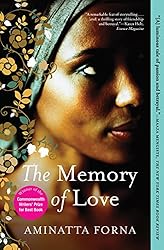
The Memory of Love
Aminatta Forna, 2010
Grove Atlantic
464 pp.
ISBN-13: 9780802145680
Summary
Winner, 2011 Commonwealth Writers’ Prize-Best Book
In contemporary Sierra Leone, a devastating civil war has left an entire populace with secrets to keep. In the capital hospital, a gifted young surgeon is plagued by demons that are beginning to threaten his livelihood.
Elsewhere in the hospital lies a dying man who was young during the country’s turbulent postcolonial years and has stories to tell that are far from heroic.
As past and present intersect in the buzzing city, these men are drawn unwittingly closer by a British psychologist with good intentions, and into the path of one woman at the center of their stories.
A work of breathtaking writing and rare wisdom, The Memory of Love seamlessly weaves together two generations of African life to create a story of loss, absolution, and the indelible effects of the past—and, in the end, the very nature of love. (From the publisher.)
Author Bio
• Birth—1964
• Where—Bellshill, Lanarkshire, Scotland, UK
• Education—University College London
• Awards—Commonwealth Prize-Best Fiction
• Currently—lives in London, England
Aminatta Forna, OBE is a Scottish and Sierra Leonean writer. She is the author of a memoir, The Devil That Danced on the Water (2003), and four novels: Ancestor Stones (2006), The Memory of Love (2010), The Hired Man (2013), and Happiness (2018). Her novel The Memory of Love was awarded the Commonwealth Writers' Prize for Best Book in 2011, and was also shortlisted for the Orange Prize for Fiction.
Background
Forna was born in Bellshill, Scotland, to a Sierra Leonean father, Mohamed Forna, and a Scottish mother, Maureen Christison. When she was six months old the family traveled to Sierra Leone, where Mohamed Forna worked as a physician. He later became involved in politics and entered government, only to resign citing a growth in political violence and corruption.
Between 1970 and 1973 Dr. Forna was imprisoned and declared an Amnesty Prisoner of Conscience. He was hanged on charges of treason in 1975. The events of Forna's childhood and her investigation into the conspiracy surrounding her father's death are the subject of her 2003 memoir, The Devil That Danced on the Water.
Forna studied law at University College London and was a Harkness Fellow at the University of California, Berkeley.
Early career
Between 1989 and 1999 Forna worked for the BBC, both in radio and television, as a reporter and documentary maker in the spheres of arts and politics. She is also known for her Africa documentaries: Through African Eyes (1995), Africa Unmasked (2002), and The Lost Libraries of Timbuktu (2009).
Forna is married to the furniture designer Simon Westcott and lives in south-east London.
In 2013 she assumed a post as Professor of Creative Writing at Bath Spa University.
Milestones and honors
In addition to her 2011 Commonwealth Prize, Forna received the 2014 Windham–Campbell Literature Prize for Fiction. She was appointed Officer of the Order of the British Empire (OBE) for Services to Literature in 2017. She is also a Fellow of the Royal Society of Literature.
In 2013, Forna served as a judge for The Man Booker International Prize. In 2015 she was a judge for Sunday Times EFG Private Bank Short Story Award and, in 2017, a judge for the Baileys Women's Prize for Fiction (formerly the Orange Prize).
Forna is a board member of the Royal National Theatre and sits on the advisory committee for the Royal Literary Fund, as well as the Caine Prize for African Writing. She continues to champion the work of up-and-coming diverse authors. (Adapted from Wikipedia. Retrieved 11/5/2018.)
Book Reviews
[A] luminous tale of passion and betrayal.… [Forna] forces us to see past bland categorizations like "postcolonial African literature," showing that the world we inhabit reaches beyond borders and ripples out through generations. She reminds us that what matters most is that which keeps us grounded in the place of our choosing. And she writes to expose what remains after all the noise has faded: at the core of this novel is the brave and beating heart, at once vulnerable and determined, unwilling to let go of all it has ever loved.
Maaza Mengiste - New York Times Book Review
[Forna] threads her stories like music.… One is left hauntingly familiar with the distant and alien; not quite able to distinguish the emotional spirits of fiction from the scars of real experience.
Times (UK)
[Forna is] among the most powerful of new voices from Africa.… A novel about the persistence of hope and the redemptive power of love.
Toronto Globe and Mail
[An] elegantly rendered novel of loss and rehabilitation… [that] coalesces into an ambitious exploration of trauma and storytelling.
San Francisco Chronicle
A remarkable feat of storytelling.… [and] a thrilling story of friendship and betrayal.
Karen Holt - Essence
A sprawling, epic novel of love in Sierra Leone from Aminatta Forna, a rising literary star.
Marie Claire
The real pleasure of Forna’s storytelling is in her scrutiny of her characters' inner lives and her ability to connect their choices to the moral dilemmas of a traumatized society
The New Yorker
Forna’s] visceral appreciation of her troubled country is evident on every page of The Memory of Love. So, too, is her probing intelligence—and her compassion.
Salon.com
To read The Memory of Love is to experience, not simply learn about, the inner existences of its characters, even as they lapse in and out of their lives.
Anjali Joseph - Times Literary Supplement (UK)
[A]dmirable if uneven.… Forma's material doesn't measure up to the book's length..… [S]cenes that drag or come off as forced, certainly [don't] ruin the experience, but [they do] occasionally glut what amounts to a heartening cry for moral responsibility.
Publishers Weekly
Forna's second novel after her well-regarded memoir, The Devil That Danced on the Water, takes place in Sierra Leone and weaves stories, past and present, involving Kai, a young surgeon; Elias, an older patient; and Adrian, a British psychiatrist.
Library Journal
Fate and tragedy intertwine in this stunning and powerful portrait of a country in the aftermath of a decade of civil war. —Kristen Huntley
Booklist
(Starred review.) A soft-spoken story of brutality and endurance.… Forna’s insight, elegance and elegiac tone never falter. Tragedy and its aftermath are affectingly, memorably evoked in this multistranded narrative from a significant talent.
Kirkus Reviews
Discussion Questions
1. At the start of the story, a dying old man, Elias Cole, is chronicling his life to Adrian, a British psychologist. He says,
This is how it is when you glimpse a woman for the first time, a woman you know you could love. People are wrong when they talk of love at first sight. It is neither love nor lust. No. As she walks away from you, what you feel is loss. A premonition of loss (p. 1).
How does the premonition reappear in the course of the story?
2. Cole’s narrative introduces two of the principal characters, Saffia and Julius Kamara. What first impressions of these people do you get from Elias’s description? Were the impressions accurate? Is the storytelling more confessional than therapeutic? Is Cole creating a myth or unburdening himself?
3. What brought Adrian Lockheart to post-conflict Sierra Leone? What keeps him there?
Adrian’s empathy sounded slight, unconvincing in his own ears. So he nudged his patients along with questions aware of the energy it cost him to obtain a sliver of trust (p. 21).
How do his sessions with his patients affect him? Did you find the name "Lockheart" symbolic? How does Adrian relate to his patients, their experiences, and their culture? What is the divide he cannot cross?
4. A dramatic medical emergency immediately precedes the first meeting between Kai Mansaray, an orthopedic surgeon, and Adrian. How do their differing reactions serve to clarify the differences between the two men? "In the days and weeks that follow, the rhythms of their lives begin to intertwine" (p. 51). In what ways do they start to connect? How does this affect each of them? What is the importance of the friendship to each of them?
5. Elias Cole unravels his story to Adrian, very slowly and very carefully. Why? From his portrayal of his own interaction with the Dean, what do you gather about the nature of his character? Why is he mesmerized by Saffia?
6. When they first meet, Ileana is cold to Adrian. "You should have been here from the start. But of course you weren’t. Nobody was. You all turn up when it’s over" (p. 85). Why does Ileana feel this way, and is her anger justified? What makes her experience different from Adrian’s? Which other characters share her opinion? When he leaves, has Adrian verified or disproved her initial judgment? What is different about her that makes her ask to stay?
7. "And the bridge is the one Elias Cole described. Exactly as he described, Adrian is certain of it. Julius’s bridge" (p. 89). This bridge is mentioned several times in the novel. Why is it "Julius’s bridge?" Why is it significant? Talk about some of the other connecting elements of the story.
8. "Agnes is searching for something. Something she goes out looking for and fails to find. Time after time" (p. 116). Adrian is anxious and troubled by his patient—Kai calls her his holy grail. Talk about her unusual condition—an obsessive traveler, a fuguer, and how it connects with her wartime experience. Is Adrian’s concern just clinical? Can he help her? Why is she so compelling?
9. "The man on the table has dreams, he dreams of marrying" (p. 117). What is the nature of Kai’s interest in his patient Foday? How does he separate his professional and personal lives? What do you know about Kai from his relationships with his old friend Tejani, and later with Adrian? How do these friendships differ?
10. The July 1969 moon landing, as remembered by Elias Cole, is a watershed event in the novel.
"To fly," repeated Julius. "To test the limits of our endeavour, of our courage." He was serious. "Otherwise what point is there in being alive?" (p. 150).
How are the various characters affected, are they changed? Discuss the significance to the story.
11. "Elias Cole. How that name takes Kai back to another time, drops him down into a place in the past he doesn’t want to go" (p. 176). How do the secrets that are guarded keep people from confronting the past? How does it affect the present? Who are the characters who encircle Elias Cole? How are they connected?
12. Memory is a central theme of the book. Talk about the memories of war and of terror, of love, and of pain. Which characters are most haunted by the past? How does each of them endure?
13. Adrian first notices Mamakay when she is with Babagaleh, Elias Cole’s manservant.
As he walked away, he had been suddenly and shockingly aware of something fleetingly and exquisitely possible. So much so, he almost turned back, to say something to Babagaleh—anything—to find a reason to look at her again (p. 137).
Why is Adrian drawn to Mamakay? Do you think there are some parallels between this relationship and the one between Elias Cole and Saffia? What are the differences?
14. How is Adrian changed by his relationship with Mamakay? How does it affect his views of the country and its people?
15. "A lot of people here believe in dreams. So do you, don’t you? Psychologists?" (p. 278). Mamakay tells Adrian. People sleep and wake and dream throughout the story. What shapes the dreams? What is their impact?
16. Consider this passage:
Much later, after they have swum together, he watches Abass play on alone in the waves, crashing through the surf over and over. And he feels his love for the boy rise in his chest, pressing against his ribcage, crushing his lungs and his heart, as if it would suffocate him (p. 262).
Freetown is located on the coast, and the closeness of the sea is always present in the novel. What role does the sea play? Why does Kai feel like a "drowning man watching a ship sail by" (p. 342)? Find other references to the sea in the book.
17. What is the nature of Kai’s relationship with Abass? Why is it such a visceral one? What does Kai do for Abass and what does Abass do for Kai?
18. Late in the book Attila, the head psychiatrist of the mental hospital, says to Adrian,
When I ask you what you expect to achieve for these men, you say you want to return them to normality. So then I must ask you, whose normality? Yours? Mine? (p. 319).
Discuss the nature of each man’s normality. Have Adrian’s ideas about normality changed since the beginning of the book?
19. "But the hope has to be real—Attila’s warning to Adrian. I fall down. I get up. Westerners Adrian has met despise the fatalism. But perhaps it is the way people have found to survive" (p. 320). What do you think of this hypothesis? Do you believe, as is suggested, that the population as a whole is suffering from PTSD? Is that everyone’s secret?
20. Did you find Elias Cole’s final revelation concerning Vanessa shocking? How do Cole’s secrets differ from some of the other characters secrets? Do you think Adrian has gotten to the "point of Elias Cole" (p. 401)? Is Cole a sympathetic character?
21. Read the following passage:
Kai is right. For years nobody wanted to know about the killings, the rapes. The outside world shifted its gaze, by a fraction, it was sufficient. The fragmentation of the conscience. What indeed did Adrian think he was doing here? The truth—he had never known for sure" (pp. 424-425).
What do you think Adrian was doing in Sierra Leone? Why did he stay and why did he decide to leave?
22. In the end, why didn’t Kai leave?
They do not see, for they cannot, as they cross the peninsula bridge, the letter traced by a boy’s forefinger into cement on the far side of the bridge wall half a century ago, beneath the initials of the men who once worked the bridge. J. K. (p. 445).
Are there some distances that cannot be brdged?
(Questions issued by the publishers.)
The Memory of Love
Linda Olsson, 2011 (The Kindness of Your Nature, New Zealand)
Penguin Publishing
240 pp.
ISBN-13: 9780143122432
Summary
From the beloved author of Astrid & Veronika, a moving tale of friendship and redemption … Olsson is doing what she does best: illuminating the terrain of friendship and examining the many forms that love can take.
Marion Flint, in her early fifties, has spent fifteen years living a quiet life on the rugged coast of New Zealand, a life that allows the door to her past to remain firmly shut.
But a chance meeting with a young boy, Ika, and her desire to help him force Marion to open the Pandora’s box of her memory. Seized by a sudden urgency to make sense of her past, she examines each image one-by-one: her grandfather, her mother, her brother, her lover.
Perhaps if she can create order from the chaos, her memories will be easier to carry. Perhaps she’ll be able to find forgiveness for the little girl that was her. For the young woman she had been. For the people she left behind.
Olsson expertly interweaves scenes from Marion’s past with her quest to save Ika from his own tragic childhood, and renders with reflective tenderness the fragility of memory and the healing power of the heart. (From the publisher.)
Author Bio
• Birth—1948
• Where—Stockholm, Sweden
• Education—J.D., University of Stockholm; University of Wellington
• Currently—lives in Auckland, New Zealand
Linda Olsson is a Swedish-born novelist who lives in Auckland, New Zealand. Published in 2003, her first novel, Astrid and Veronika, became an international best seller and was translated into 15 languages. She writes all of her novels in both English and Swedish.
Born and raised in Stockholm, Olsson attended the University of Stockholm. After graduating with a law degree, she worked in banking and finance, eventually getting married and giving birth to three boys.
In 1986, her family left Sweden for Africa where Olsson initially intended to take up a post in Kenya. But she traveled on to Singapore, Britain, and Japan, finally settling in New Zealand with her family in 1990. She continued her studies at the University of Wellington, graduating in English and German literature.
During her time in London, Olsson signed up for a course in creative writing and was encouraged to begin writing short stories. In 2003, after arriving in New Zealand, she won a short story competition run by the Sunday Star Times. She then enrolled in a postgraduate course, "Writing the Novel," and was inspired to try her hand at long-form fiction.
Olsson's first novel was completed in 2005. Astrid and Veronika (originally titled "Let Me Sing You Gentle Songs") became a Swedish bestseller. Subsequent novels include Sonata for Miriam (2009), The Memory of Love (2011—The Kindness of Your Nature in New Zealand ), The Blackbird Sings at Dusk (2016—not available in the U.S.), and A Sister in My House (2016, 2018 in the U.S.).
Under the pen name Adam Sarafis, OLsson has also collaborated with Thomas Sainsbury on the thriller Something is Rotten (2015). (Adapted from Wikipedia. Retrieved 11/6/2018.)
Book Reviews
Exquisitely rendered…quietly gripping.
Cleveland Plain Dealer
Haunting and beautiful, [The Memory of Love] is a reminder of the fragility of happiness and the impossibility of living without hope.
Otago Times (New Zealand)
Linda Olsson writes beautifully, capturing the fragile nature of her characters and the beauty of the rugged landscape around her with great precision and subtlety. A hugely evocative book. The story gets under your skin and will live on long after the final page has been turned.
Gisborne Herald (New Zealand)
The emotional weather of the story is changeable and dramatic, with storm clouds sometimes threatening, unpredictable tides and winds of inner conflict, and chance meetings.… It is the storytelling, of course, that is most seductive, with the right balance between the disclosure and holding back of information to keep us reading to the end—appreciating at every twist a writer delighting in her craft.
Sunday Star Times (New Zealand)
[A] tender, loving story…concerned with searching and healing.… You sense an author of real integrity.
Weekend Herald (New Zealand)
Olsson's lyrical style is perfectly suited to the reflective tenderness that characterises Marion's narrative voice.… The tragedies of the novel, combined with the powerful resonance of the windswept and lonely coast, makes [The Memory of Love] a heavily atmospheric novel of great emotional weight.
Listener (New Zealand)
Olsson successfully intertwines New Zealand and Sweden to create a beautiful and compelling story.
Mahrangimatters (New Zealand)
One of the most stirring and sensitive books I have read for a long time.… An outstanding read.
Star (New Zealand)
[A] touching, if far-fetched, tale.… The author’s prose is at times pinched and lapidary, while at others, effusive and overstated, and sometimes both.… [Yet] Olsson handles Marion and Ika’s story in a beautifully natural fashion.
Publishers Weekly
[A] deeply poetic novel...and a credit to Olsson’s narrative technique….Fans of Jennifer Haigh and Heidi W. Durrow will appreciate this darkly emotional novel.
Booklist
Discussion Questions
1. What is the particular appeal of reading this kind of emotionally rich and complex novel? Does witnessing Marion’s struggle to make sense of her life help you to make sense of your own?
2. How is little Marianne affected by being taken from her grandfather to live with her mother and Hans in Stockholm? What coping strategies does she develop to manage her loneliness, fear, and confusion?
3. What is the effect of the narrative moving back and forth between Marion’s past and present? What are some of the most surprising and traumatic moments in her personal history? Why would Olsson choose to reveal these moments gradually rather than all at once?
4. Late in the novel, Marion tries to look at her relationship with Ika objectively and asks herself, “Had I used him? Was he simply a tool for me to give my soul peace? Redeem myself? Could I ever isolate my feelings for Ika from my past? See him as he was, see his true needs?” (p. 171). In what ways might Marion’s personal history have colored her relationship with Ika? Is she using him to fulfill her own needs or is she motivated more by compassion than selfishness?
5. In what ways does her relationship with Ika change Marion? Why would a mostly silent, slightly autistic nine-year-old boy lead to such major transformations in her? In what ways does he serve as a doorway into her buried past?
6. What is the significance of Marion first finding Ika lying on the beach? Does it remind her of earlier events in her life?
7. Marion, Ika, and George have all suffered major losses. Marion has lost her parents, her brother, and her grandfather, as well as her husband through divorce. Ika’s mother died soon after giving birth to him, and he never knew his father. George has lost his wife. “My home died with my wife,” he says (p. 156). In what ways might these losses have prepared them to create a new family, and a new home, with each other? Is there any way these terribly painful experiences can be seen as gifts?
8. Why does Marion feel compelled to make sense of her life, her history? Why is it so important to put the events of her life in some kind of order, to see it “as a whole”? (p. 9). How does she find that wholeness and accept her past by the end of the book?
9. Why does Olsson end the novel with George taking Marion and Ika on a helicopter flight over the project Marion and Ika have been working on? What is the significance of this heightened perspective and of Marion and Ika being able to see their project in its entirety rather than just its individual parts?
(Questions issued by the publisher.)
The Memory of Running
Ron McLarty, 2005
Penguin Group USA
384 pp.
ISBN-13: 9780143036685
Summary
Every decade seems to produce a novel that captures the public's imagination with a story that sweeps readers up and takes them on a thrilling, unforgettable ride.
Ron McLarty's The Memory of Running is this decade's novel. By all accounts, especially his own, Smithson "Smithy" Ide is a loser. An overweight, friendless, chain-smoking, forty-three-year-old drunk, Smithy's life becomes completely unhinged when he loses his parents and long-lost sister within the span of one week.
Rolling down the driveway of his parents' house in Rhode Island on his old Raleigh bicycle to escape his grief, the emotionally bereft Smithy embarks on an epic, hilarious, luminous, and extraordinary journey of discovery and redemption. (From the publisher.)
Author Bio
• Birth—April 14, 1947
• Where—Providence, Rhode Island, USA
• Education—Rhode Island College
• Currently—lives in New York, New York
Ron McClarty is an actor best known for his work on television shows such as Sex in the City, Law & Order, The Practice, Judging Amy, and Spenser: For Hire. He has also appeared in films and onstage, where he has directed a number of his own plays, and has narrated more than fifty audio books. (From the publisher.)
More
Hear the name Stephen King and the likely images that spring to mind are those of vampires, blood-soaked prom queens, and killer St. Bernards. However, for Ron McLarty, Stephen King was more guardian angel than conjurer of terror. McLarty had been a character actor and struggling writer for countless years before the master of the macabre helped him publish his first novel at the age of 58.
Before the publication of The Memory of Running, McLarty was best known as a familiar face on television, holding down regular roles on Spencer: For Hire and Steven Bochco's short-lived prime-time experiment Cop Rock, as well as making appearances on everything from Sex and the City to Law and Order. He also became a regular fixture on the books-on-tape circuit, recording readings of more than 100 books by his own calculations. Meanwhile, McLarty had aspirations to make his way into the other end of the publishing world, composing an increasingly weighty body of unpublished work.
Still having little luck actually getting any of his work in print, McLarty managed to cajole a small Internet-only company called Recorded Books to release a book-on-tape version of his 1988 novel The Memory of Running. Inspired by the death of McLarty's parents following a car accident, The Memory of Running is a funny, moving, grim yarn about an overweight drunken couch potato named Smithson "Smithy" Ide who becomes reengaged in the world during a cross-country bike ride in the wake of the death of his parents and his emotionally-troubled sister.
As far as McLarty was concerned, that was the end of the line for The Memory of Running. Discouraged after years of rejection, he even visited a Screen Actor's Guild appointed psychiatrist to get help with his writing addiction. Still the muse refused to unhand him, and he continued producing new material in vain.
Some time later, Ron McLarty auditioned for a role in the miniseries Kingdom Hospital, Stephen King's U.S. adaptation of Lars von Trier's Danish cult-classic TV series Riget. According to McLarty in his interview with Meet the Writers, the audition was a disaster. "I did the worst audition in the world at the ABC studios. I mean, an actor knows when he stinks, and I was awful," he recalls. "I was trying to run out of the room, and Stephen King stands up and he says, ‘Are you Ron McLarty the novelist?'" At that point, King was only familiar with McLarty by name, having seen it in a catalog while recovering from his own well-publicized collision with a car in 1999. McLarty expeditiously rectified the situation, though. He raced to Recorded Books, dug up a copy of The Memory of Running, and mailed it off to the famed writer.
Next thing McLarty knew, Stephen King included The Memory of Running in a list of "The Best Books You Cannot Read" in an article in Entertainment Weekly. Then came the flood. A publishers bidding war for the rights to the novel ensued, and McLarty signed with Viking for over two-million dollars. Upon its publication in December of 2005, The Memory of Running has deservedly garnered more than its share of glowing notices. The School Library Journal deemed it "a great first novel" and Publisher's Weeky described it as "funny, poignant..." Now his darkly comic tale of self-discovery is being made into a motion picture by esteemed director Alfonso Cuaron (Y Tu Mama Tambien; Harry Potter and the Prisoner of Azkaban), McLarty himself having penned the screenplay. He also has a second novel on the way.
In spite of McLarty's recent magnificent success, he still has not lost the cynical edge that gave birth to his gloomy debut novel. Though he remains unfailingly thankful for the opportunity afforded him by King's endorsement in Entertainment Weekly, he still has trouble viewing the glass as half-full. "Although I do believe it took kismet for my work to get any credibility, it's important that I express how hard I labored over this novel. I learned from a myriad of failures. I found my voice, lost it and found it again. Sometimes, frankly, it's discouraging to think that this and subsequent work will be viewed by many as luck, as if I sat down one day, popped a beer and scribbled it down... I still have 37 years of the whipped dog in me."
Extras
From a 2005 Barnes & Noble interview:
• According to McLarty, he has scribed a total of 44 plays and 10 novels. All of his work begins with a poem, which he then develops into a more substantial piece.
• McLarty's Stephen King connection does not end with King's recommendation in Entertainment Weekly. He was also the voice chosen to read the book-on-tape version of King's Faithful: Two Diehard Boston Red Sox Fans Chronicle the Historic 2004 Season.
• When asked what book most influenced hiw career as a writer, here's what he said:
I was most influenced as a writer (and as an actor) by the collected poems of Kenneth Patchen. The poems flow from his imagination into your own imagination. A kind of truth as he saw it. I wanted to put my own inventions on paper so they might become real.
("More" and "Extras" from Barnes & Noble.)
Book Reviews
The novel will doubtless find a wide audience, in large part because Smithy Ide is a character readers will root for. They'll root for him because Ron McLarty clearly loves him. My only hope for McLarty's next novel is that all of his characters, small and large, earn that love.
John McNally - Washington Post
In The Memory of Running, professional actor and long aspiring novelist Ron McLarty has invented a character so fully and elegantly defined that the book soars with originality and life.
San Francisco Chronicle
Captivating.... McLarty unspools passage after passage of devastating grace and melancholy, and his taciturn hero hooks himself to your heart.
Entertainment Weekly
Smithy Ide is a really nice guy. But he's also an overweight, friendless, womanless, hard-drinking, 43-year-old self-professed loser with a breast fetish and a dead-end job, given to stammering "I just don't know" in life's confusing moments. When Smithy's entire family dies, he embarks on a transcontinental bicycle trip to recover his sister's body and rediscover what it means to live. Along the way, he flashes back to his past and the hardships of his beloved sister's schizophrenia, while his dejection encourages strangers to share their life stories. The road redeems the innocent Smithy: he loses weight; rescues a child from a blizzard; rebuffs the advances of a nubile, "apple-breasted" co-cyclist after seeing a vision of his dead sister; and nurtures a telephone romance with a paraplegic family friend as he processes his rocky past. McLarty, a playwright and television actor, propels the plot with glib mayhem-including three tragic car accidents in 31 pages and a death by lightning bolt-and a lot of bighearted and warm but faintly mournful humor. It's a funny, poignant, slightly gawky debut that aims, like its protagonist, to please-and usually does. Stephen King hailed this as "the best book you can't read" (it was an audiobook only) in a now-famous 2003 Entertainment Weekly column.
Publishers Weekly
Stuck without a publisher for this first novel, actor McLarty did an audio original with Recorded Books that Stephen King raved about in Entertainment Weekly. But how many people know that it was actually librarian Tia Maggio (Middleburg PL, VA) who brought the book to the attention of agent Jeff Kleinman? Maggio fell in love with the tape, used it in a book group (some listeners cried), and even got the author to come and read from the manuscript. "The characters are all so real," she explains of the book's appeal. Eventually, the book was sold to Viking for $2 million, with a Warner's deal and the sale of rights to 12 countries quickly following. Not bad for the gentle tale of washed-up Smithy Ide, who takes an impulsive bike ride across America to search for his sister.
Library Journal
(Adult/High School) This is a great first novel. Smithson Ide, 43, is a heavy drinker who weighs 279 lbs. As a teen, his beautiful sister slowly descended into mental illness. The family got him a Raleigh bicycle so that he might find Bethany more quickly when she ran away. Eventually, she disappeared, and the Ides couldn't seem to go on. Smithy begins his story as he learns that his parents have been seriously injured in an accident. At their wake, he finds a letter that states that Bethany's body is in a morgue in Los Angeles. Drunk, dressed in a suit, and with no money, Smithy gets on his bike and begins to pedal west. Readers are hooked once his odyssey begins. He meets unique characters and experiences many perils, and is supported throughout his trip by phone conversations with his neighbor, who has always loved him. The real story, though, is about Smithy's visceral response to the plight of his family, whose dignity has been beaten down because of their years of struggle. In the tradition of literary heroes, Smithy Ide rallies as he rides west to rescue his sister one last time. McLarty's writing is notable for its juxtaposition of humor and heartbreak. Smithy's matter-of-fact tone belies the often surprising and laugh-out-loud situations that he unwittingly falls into. At the same time, readers get a sense of his gentleness as he tries to cope with a world that for the most part treats him badly or ignores him. —Catherine Gilbride, Farifax County Public Library, VA
School Library Journal
The pain of the loser permeates actor/playwright McLarty's first novel, part road story, part tragedy. It was released as an audiobook in 2000. Vital statistics: Smithson Ide is 43, but he's also 279 pounds, having survived for 20 years on beer and pretzels. He once weighed 121, running or biking everywhere. But now (it's 1990) he's a couch potato, single, living in a small Rhode Island town, working in a toy factory. As the story opens, his parents are killed in a car accident. They'd been a close-knit family, and he hates it that he's drunk at the wake, drunk at the funeral. Then he learns that his older sister Bethany is in a Los Angeles morgue, and the shock impels Smithy to heave his fat self onto his childhood bike. His aimless start turns into a cross-country ride, and chapters alternate between his adventures on the road and Bethany's sad history. Somewhere in her teens, she slipped into madness, posing stock-still for hours on end, or raking her skin, or speaking in a vile croak as if possessed by an alien spirit. Sometimes she'd just disappear. There were shrinks and hospital stays, and she recovered enough to date and marry, only to disappear for good on the honeymoon. Smithy has his own problems. He hates to touch or be touched. His only sex has been with ten-dollar whores in Vietnam, where he was badly wounded. Nam and Bethany were too much for him, and the beanpole became a porker filled with self-loathing. The long ride west is good for him, despite bizarre and improbable encounters (a dying AIDS patient, a gun-toting black man). Smithy stops drinking, loses 50 pounds, and is sustained by long-distance conversations with Norma, a wheelchair-bound former neighbor, every bit as lonely as Smithy. The two lost souls will come together in the Los Angeles morgue. A dreary tale of woe, with none of the dark places illuminated.
Kirkus Reviews
Discussion Questions
1. Smithy Ide's bicycle odyssey begins on a whim—something he just falls into—but it winds up transforming his life. Do you think that people can change their lives profoundly without initially intending to do so? What does the novel seem to be saying about redemption and second chances?
2. As a youth, Smithy was a "running boy" who "made beelines," first on foot and later on a bike. His sister, Bethany, was always running away. And Smithy's cross-country ride is yet another kind of running. What other significance does "running" have in the book?
3. The novel intersperses chapters describing Smithy's parents' death and his ride with chapters about his youth. The present chapters are all consecutive, but his memories of the past jump around somewhat. How do the chapters about the past reflect or relate to the story of Smithy's present?
4. At the beginning of the book, Smithy is an alcoholic, and throughout the book he encounters others whose lives have been overwhelmed by alcohol or drugs. What do you think the author is saying about addiction and the stress and strain of daily life? 5. Smithy reads a number of novels about the American West while on the road. How do these relate to his own story?
6. In the book, Smithy's schizophrenic sister, Bethany, goes through periods of near normalcy, only to disappear or hurt herself when she begins to hear "the voice." She is treated by a succession of psychiatrists, none of whom seem to recognize the nature of her problems or to do her much good. Yet Bethany is always the one who tells Smithy the truth. What do you think the author is saying about madness?
7. Smithy came out of Vietnam with twenty-one bullet wounds, yet his sister's madness and disappearances seem to have wounded him much more seriously. Why do you think this is? Why is Smithy haunted by his sister's apparition?
8. On the road, Smithy encounters many people—a compassionate priest, an eccentric Greenwich Village artist, a man dying of AIDS, an angry black youth, a Colorado family, a seductive fellow cyclist, a truck driver haunted by the past, and an empathetic Asian mortician, among others. Most of the encounters are marked by kindness, some by violence, and some by both. How is Smithy changed by the people he meets? What do these people tell us about the American character?
9. As a young man, Smithy rejects Norma's schoolgirl crush on him and turns away from her altogether once she's paralyzed. His junior prom is a disaster. The prostitutes he patronizes in Vietnam hate him. And he rebuffs the advances of an attractive young woman he meets on the road. Why does Smithy seem to have so much trouble with women? Do you think his rekindled romance with Norma will work out?
10. Stephen King has called Smithy Ide an "American original" and placed him in the company of Mark Twain's Huckleberry Finn, J. D. Salinger's Holden Caulfield (of The Catcher in the Rye), and Joseph Heller's Yossarian (of Catch-22). Are there other fictional characters you would also compare him to?
(Questions issued by publisher.)


A Memory of Violets: A Novel of London's Flower Sellers
Hazel Gaynor, 2015
HarperCollins
432 pp.
ISBN-13: 9780062316899
Summary
An unforgettable historical novel. Step into the world of Victorian London, where the wealth and poverty exist side by side. This is the story of two long-lost sisters, whose lives take different paths, and the young woman who will be transformed by their experiences.
In 1912, twenty-year-old Tilly Harper leaves the peace and beauty of her native Lake District for London, to become assistant housemother at Mr. Shaw’s Home for Watercress and Flower Girls. For years, the home has cared for London’s flower girls—orphaned and crippled children living on the grimy streets and selling posies of violets and watercress to survive.
Soon after she arrives, Tilly discovers a diary written by an orphan named Florrie—a young Irish flower girl who died of a broken heart after she and her sister, Rosie, were separated.
Moved by Florrie’s pain and all she endured in her brief life, Tilly sets out to discover what happened to Rosie. But the search will not be easy. Full of twists and surprises, it leads the caring and determined young woman into unexpected places, including the depths of her own heart. (From the publisher.)
Author Bio
• Birth—May 16, 1971
• Where—Yorkshire, England, UK
• Education—B.A., Manchester Metropolitan University
• Award—Cecil Day Lewis Award for Emerging Writers
• Currently—lives in County Kildare, Ireland
Hazel Gaynor is an author and freelance writer in Ireland and the UK and was the recipient of the Cecil Day Lewis Award for Emerging Writers. The Girl Who Came Home: A Novel of the Titanic is her first novel. Her second novel, published in 2015, is A Memory of Violets: A Novel of London's Flower Sellers.
Hazel is a regular guest blogger and features writer for national Irish writing website for which she has interviewed authors such as Philippa Gregory, Sebastian Faulks, Cheryl Strayed, and Mary Beth Keane.
Hazel has appeared on TV and radio and her writing has been featured in the Irish Times and the Sunday Times Magazine. Originally from Yorkshire, England, Hazel now lives in Ireland with her husband, two young children and an accident-prone cat. (From the author.)
Visit the author's webpage.
Follow Hazel on Facebook.
Book Reviews
Given the awards she has already received, we are sure to hear much more from Hazel Gaynor-and that is a good thing.
New York Journal of Books
All of the loose ends come together in a satisfying, understandable ending. Gaynor has written a masterpiece of a story, one that will linger long in the memory of readers.
Jo Ann Mathews - Mrytle Beach Sun News
Gaynor’s talent for evoking a time and place, as well as her ability to write a beautifully heart-wrenching story with realistic characters, enables her to touch readers. The unexpected twists and turns of the plot and jumping of timelines holds readers’ attention to the satisfying climax (4 stars).
RT Book Reviews
Historical details and the unique perspective of penniless, physically challenged young girls could make Gaynor’s second historical novel a good book club choice. A tidy ending and sweet romance will satisfy readers hoping to exhale a long, contented sigh as they finish the last page.
Library Journal
Gaynor once again brings history to life. With intriguing characters and a deeply absorbing story, her latest is a fascinating examination of one city’s rich history and the often forgotten people who lived in it.
Booklist
Discussion Questions
1. The role of the "little mother" was very common among London’s poor, with the eldest siblings (often no older than six or seven years themselves) taking responsibility for younger sisters and brothers. What was your response to reading about Flora’s life and her relationship with Rosie? What are your thoughts about the lives of child street sellers in Victorian England?
2. The unique relationship between sisters is explored throughout the novel. To what extent do the relationships between Tilly and Esther, and Florrie and Rosie differ? Are there any ways in which they are similar?
3. Marguerite Ingram is determined to raise Violette as her own child. Do you think she is justified in her conviction that this is the best thing for the child? Is she right to keep the truth from Violette for so many years?
4. While Tilly’s mother cannot find love for her in the same way she does for Esther, Marguerite loves Violette almost instantly. Why is this? How have their experiences of motherhood influenced the two women’s emotions?
5. The novel is written in alternating periods, Tilly’s story in 1912 and that of Florrie, Rosie/Violette, and Marguerite from the late 1800s. In what ways do the two story lines reflect each other and in what ways do they differ?
6. One of the main themes of the novel is forgiveness. Do you think Violette should forgive Marguerite for hiding the truth about her past? Should Tilly be forgiven for her feelings toward Esther? Should Esther forgive Tilly for the accident? Should Tilly forgive her step-mother for her feelings toward her?
7. There are many other themes in the novel—second chances, hope, family bonds, overcoming adversity. Which themes resonated with you the most?
8. Disability was very much a hidden or ignored part of society in Victorian London. The Flower Homes and the orphanage were pioneering approaches to assisting those who were disadvantaged. Now that you have read the novel, what are your thoughts about attitudes toward disability in Victorian England? How have attitudes toward disability changed?
9. The language of flowers was well known among the Victorians, and the flowers hidden within Florrie’s journal convey very specific messages and emotions. What are your thoughts about the "language of flowers"?
10. Landscape plays a large part in the storytelling of the novel, with the settings moving from the cramped streets of London to the mountains of the Lake District and the open seascapes of Clacton. How do these landscapes reflect the emotions of the characters?
11. Through flower making, the girls and women of the Flower Homes were given a way out of hardship and a way to become independent. Why did Albert Shaw insist on the girls working for a living, rather than simply providing them with charity?
(Questions issued by the publisher.)
Men and Dogs
Katie Crouch, 2010
Little, Brown & Co.
279 pp.
ISBN-13: 9780316002134
Summary
When Hannah Legare was 11, her father went on a fishing trip in the Charleston harbor and never came back. And while most of the town and her family accepted Buzz's disappearance, Hannah remained steadfastly convinced of his imminent return.
Twenty years later Hannah's new life in San Francisco is unraveling. Her marriage is on the rocks, her business is bankrupt. After a disastrous attempt to win back her husband, she ends up back at her mother's home to "rest up," where she is once again sucked into the mystery of her missing father.
Suspecting that those closest are keeping secrets—including Palmer, her emotionally closed, well-mannered brother and Warren, the beautiful boyfriend she left behind—Hannah sets out on an uproarious, dangerous quest that will test the whole family's concepts of loyalty and faith. (From the publisher.)
Author Bio
• Birth—N/A
• Reared—Charleston, South Carolina, USA
• Education—Brown University; M.F.A., Columbia University
• Awards—Sewanee Walter Dakin and MacDowell Fellowships
• Currently—lives in San Francisco, California
Katie Crouch is the author of the New York Times bestselling novel Girls in Trucks and Men and Dogs (2010)
Her writing has also appeared in the New York Observer, Tin House, Glamour, and McSweeney's. She received her M.F.A. at Columbia University, and was awarded a Sewanee Walter Dakin Fellowship and a MacDowell Fellowship. She currently lives in San Francisco. (From the publisher.)
Book Reviews
Wonderful.... Despite her quick wit and caustic humor, Hannah is a haunted figure—she's never come to terms with the loss of her father, who disappeared without a trace on a fishing trip, presumed to have drowned, when she was 11 years old.... Crouch is too smart a writer to craft a damaged-woman-goes-home-again-and-finds-healing-and-redemption story. She knows that real life all too often disappoints.... Men and Dogs is an absorbing mystery.... Yet it's a compelling family drama, too....
Carmela Ciuraru - San Francisco Chronicle
Prepare to have your heart broken while laughing out loud at this breathtaking, scathingly sardonic novel. From her opening line—"Two days before Hannah's father disappeared, he took her out in his boat"—Crouch grabs you and never lets go.... In the hands of a less adept author, this tightly wound tale of one woman's unraveling and redemption might seem more grim than guffaw-worthy. But with Crouch in charge, the reader is assured of a reflective yet riotous ride." Four stars.
Meredith Maran - People
Crouch's accomplished sophomore novel kicks off with a flashback: 20-odd years ago, Buzz Legare vanished while on a fishing trip. The fallout of his disappearance and presumed death appears in his 30-something children: Hannah drinks too much, her business is failing, and her husband has kicked her out after her repeated adultery. Hannah's gay brother, Palmer, refuses to let anyone get too close—he's ready to end his yearlong relationship when his partner brings up the idea of adopting a baby. After Hannah injures herself trying to break into her husband's apartment, she heads home to Charleston, S.C., to get her life back on track, but instead finds herself pursuing the past. Damaged and vulnerable, she zigzags through her past—an old boyfriend, questions about her parents' fidelity, and finally facing down where her unwillingness to accept love has gotten her. There's nothing unique about the premise—woman in crisis goes home and discovers herself by exhuming the past—but Crouch (Girls in Trucks) handles it deftly; her dialogue is snappy, the situations darkly funny, Hannah and Palmer are unlikable but sympathetic, and there's just enough mystery to keep the pages turning.
Publishers Weekly
When Hannah Legare was a young girl, her father disappeared on a routine fishing trip. Years later, Hannah finally confronts her past when she is forced to recuperate at home in Charleston, SC, after a drunken accident in San Francisco. This is not Hannah's best moment. Her marriage is failing, owing to her serial adultery; her sex-toy business is tanking; she drinks too much; and she holds her mother, stepfather, and brother Palmer at a distinct distance. By digging into the past—her father's disappearance, the state of her parents' marriage, and unfinished business with her high school boyfriend—Hannah doesn't really discover the answers but learns just enough about love and herself that she can face her present reality. Verdict: Hannah is not exactly a likable character, but she reflects enough humor in her brokenness to be memorable. Crouch's second novel sounds formulaic, but as in her best-selling Girls in Trucks, she writes with a dark, twisty, but approachable Southern charm. —Andrea Griffith
Library Journal
The collapse of her marriage, not to mention a three-story fall, sends a woman back home to Charleston, S.C., to investigate her father's disappearance, in Crouch's sardonic second (Girls in Trucks, 2008). Hannah, 35, and her now-estranged husband Jon are sudden San Francisco millionaires—their online sex-toy business has taken off. Her drinking and infidelity have driven Jon away. Hannah suffered her most intractable emotional wound 24 years before, the day her father Buzz, a successful doctor, motored out alone into Charleston harbor, accompanied only by the family dog, Tucker. He never showed up for his son Palmer's soccer game that afternoon. His boat was found, containing only Tucker. Buzz's body was never recovered. His beautiful wife, Daisy, moved on and married DeWitt, Charleston's wealthiest man. Hannah has always compared her looks—she resembles her father, whose features look too big on her—unfavorably to her mother's. After drunkenly scaling Jon's apartment building to prove her love, and losing her footing thanks to a yapping terrier, she wakes up in the hospital. Jon and Daisy give her a choice: recuperation in Charleston, or rehab. Rooting among old photos in DeWitt's mansion, she discovers some unsettling clues. One snapshot shows Daisy and Buzz at a party with a group of stoned, hippie-like friends. Hovering in the background is DeWitt. But Daisy claimed not to have met DeWitt until after Buzz vanished. Palmer, a veterinarian, is quarreling with his boyfriend Tom over whether they want a child—as if gay life in Charleston wasn't challenging enough. In his mind, Palmer obsessively revisits his father's last day— was Buzz driven to suicide after accidentally spotting Palmerin flagrante with another boy? Only Hannah still thinks Buzz may be alive. But if he is, why did he abandon her? Although it's believable, one senses Hannah's quest for Buzz is merely a pretext—self-knowledge and redefinition of family are the real goals here. Sunny outlook with enough clouds to keep it interesting.
Kirkus Reviews
Discussion Questions
1. When Hannah was a girl, she idolized her father. Which of his traits do you think had the greatest effect on her? Do you see some of Buzz Legare in Hannah as an adult?
2. What do you think really happened to Buzz? How would Hannah’s life have been different if he had been confirmed drowned soon after he went missing?
3. How does Hannah’s obsession over what might have happened to her father shape the person she becomes? Do you think the absence of her father contributed to her “fall” in some way?
4. Some of Hannah’s trouble might be said to be the result of self-sabotage. Could you relate to the way that she pushed her own marriage to the limit?
5. Palmer is ambivalent about taking his relationship to the next level with Tom. How would you compare their situation to Hannah and Jon’s relationship?
6. Do you think Tom is justified in being upset when Palmer balks at the idea of adoption?
7. When Hannah returns home after her fire-escape catastrophe, why is Palmer so reluctant to see her? What do you make of Hannah’s relationship with her mother, Daisy?
8. At first, Hannah has little patience or respect for her stepfather, DeWitt. If you were her, would you feel the same way? How does her opinion of him change?
9. Which of the book’s main characters do you most relate to?
10. Back home, Hannah seeks out her first love, Warren, and she’s surprised that he’s become a minister. What do you make of the paths that each of them has chosen? What might their lives have been like if they had stayed together?
11. Palmer had a fraught relationship with his childhood friend, Shawn. Could things have fallen out differently for them? What do you make of their reunion, decades later?
12. Warren tells Hannah that, despite the trouble in her relationships, “You’re the most faithful person I know.” What do you think of his statement?
13. At one point Palmer rises to the defense of canines when Hannah says, “Men are such...dogs.” Who do you side with? What’s your take on the book’s title?
(Questions issued by publisher.)

Men Without Women
Haruki Murakami, 2017
Knopf Doubleday
240 pp.
ISBN-13: 9780451494627
Summary
A dazzling new collection of short stories--the first major new work of fiction from the beloved, internationally acclaimed, Haruki Murakami.
Across seven tales, Haruki Murakami brings his powers of observation to bear on the lives of men who, in their own ways, find themselves alone.
Here are vanishing cats and smoky bars, lonely hearts and mysterious women, baseball and the Beatles, woven together to tell stories that speak to us all.
Marked by the same wry humor that has defined his entire body of work, in this collection Murakami has crafted another contemporary classic. (From the publisher.)
Author Bio
• Birth—January 12, 1949
• Where—Kyoto, Japan
• Education—Waseda University
• Awards—(see below)
• Currently—lives near Tokyo
Haruki Murakami is a contemporary Japanese writer. Murakami has been translated into 50 languages and his best-selling books have sold millions of copies.
His works of fiction and non-fiction have garnered critical acclaim and numerous awards, both in Japan and internationally, including the World Fantasy Award (2006) and the Frank O'Connor International Short Story Award (2006), while his oeuvre garnered among others the Franz Kafka Prize (2006) and the Jerusalem Prize (2009). Murakami's most notable works include A Wild Sheep Chase (1982), Norwegian Wood (1987), The Wind-Up Bird Chronicle (1994-1995), Kafka on the Shore (2002), and 1Q84 (2009–2010). He has also translated a number of English works into Japanese, from Raymond Carver to J. D. Salinger.
Murakami's fiction, often criticized by Japan's literary establishment as un-Japanese, was influenced by Western writers from Chandler to Vonnegut by way of Brautigan. It is frequently surrealistic and melancholic or fatalistic, marked by a Kafkaesque rendition of the recurrent themes of alienation and loneliness he weaves into his narratives. He is also considered an important figure in postmodern literature. Steven Poole of The Guardian praised Murakami as "among the world's greatest living novelists" for his works and achievement.
In recent years, Haruki Murakami has often been mentioned as a possible recipient of the Nobel Prize in Literature. Nonetheless, since all nomination records are sealed for 50 years from the awarding of the prize, it is pure speculation. When asked about the possibility of being awarded the Nobel Prize, Murakami responded with a laugh saying "No, I don't want prizes. That means you're finished.
Recognition / Awards
1982 - Noma Literary Prize for A Wild Sheep Chase.
1985 - Tanizaki Prize for Hard-Boiled Wonderland and the End of the World.
1995 - Yomiuri Prize for The Wind-Up Bird Chronicle.
2006 - World Fantasy Award for Kafka on the Shore.
2006 - Franz Kafka Prize
2007 - Kiriyama Prize for Fiction
2007 - honorary doctorate, University of Liege
2008 - honorary doctorate, Princeton University
2009 - Jerusalem Prize
2011 - International Catalunya Prize
2014 - honorary doctorate, Tufts University
Controversy
The Jerusalam Award is presented a biennially to writers whose work deals with themes of human freedom, society, politics, and government. When Murakami won the award in 2009, protests erupted in Japan and elsewhere against his attending the award ceremony in Israel, including threats to boycott his work as a response against Israel's recent bombing of Gaza. Murakami chose to attend the ceremony, but gave a speech to the gathered Israeli dignitaries harshly criticizing Israeli policies. Murakami said, "Each of us possesses a tangible living soul. The system has no such thing. We must not allow the system to exploit us."
Murakami donated his €80,000 winnings from the Generalitat of Catalunya (won in 2011) to the victims of the earthquake and tsunami, and to those affected by the Fukushima nuclear disaster. Accepting the award, he said in his speech that the situation at the Fukushima plant was "the second major nuclear disaster that the Japanese people have experienced... however, this time it was not a bomb being dropped upon us, but a mistake committed by our very own hands." According to Murakami, the Japanese people should have rejected nuclear power after having "learned through the sacrifice of the hibakusha just how badly radiation leaves scars on the world and human wellbeing." (Adapted from Wikipedia. Retrieved 8/19/2014.)
Book Reviews
[A] beguilingly irresistible book. Like a lost lover, it holds on tight long after the affair is over.… Part allegory, part myth, part magic realism, part Philip Marlowe, private eye.… Murakami puts the performance in performance art.
New York Times Book Review
Men Without Women has the familiar signposts and well-worn barstools that will reconnect with longtime readers of Murakami: magical realism, Beatles tracks and glasses of whiskey. Yet, except for a few tales, the magic is watered down and it’s reality that is now poured stiff.… This collection is a sober, clear-eyed attempt to observe the evasion and confrontation of suffering and loss, and to hope for something better.
New York Daily News
Mesmerizing tales of profound alienation.… Murakami is a master of the open-ended mystery.
Washington Post
Classic Murakami.… [His] voice—cool, poised, witty, characterized by a peculiar blend of whimsy and poignancy, wit and profundity—hasn’t lost its power to unsettle even as it amuses.
Boston Globe
Time and again in these seven stories, Murakami displays his singular genius.… The stories in this collection find their power within the confines of common but momentous disturbances that linger on in memory.
Los Angeles Times
Wise stories.… Moody and melancholic as [they] can be, some of them offer comparable hope that these men without women might emerge from their long and isolating loneliness, acknowledging the hurt, pain and even rage they feel rather than folding in on themselves and ceasing to fully live.
Milwaukee Journal Sentinel
Beautifully rendered.… Murakami at his whimsical, romantic best.… [He] writes of complex things with his usual beguiling simplicity — the same seeming naivety found in the Beatles songs that are so often his reference points. The stories read like dirges for ‘all the lonely people’ but they are strangely invigorating to read.
Financial Times
A whimsical delight.… The seven stories in his fourth story collection present another captivating treasure hunt of familiar Murakami motifs—including cats, jazz, whiskey, certain cigarettes, the moon, baseball, never-named characters, and—of course—the many men without women.… Murakami always manages to entertain, surprise, and satisfy.… Sanity might be overrated, but Murakami is surely not.
Christian Science Monitor
It’s been a few years since we’ve gotten something new from Japan’s master of magical realism, but this new seven-story collection draws us right back into his signature realm — one of lonely men with wandering imaginations, mysterious cats, and subtle-yet-surreal narratives that reveal the supernatural layer operating beneath our everyday lives.
W Magazine
Although the plotting can be repetitive, Murakami’s ability to center the stories on sentimental but precise details creates a long-lasting resonance.
Publishers Weekly
Compellingly odd.… A glimpse into the strange worlds people invent by the always inventive [author].… Not groundbreaking but certainly vintage Murakami: a little arch, a little tired, but always elegant.
Kirkus Reviews
Discussion Questions
1. The title of the collection is Men Without Women. Consider the ways in which the men in these stories find themselves alone, not just without women but, in many cases, without friends as well. Are there similarities between their situations? What does it mean to be a man without women, both in the title story and throughout the collection?
2. Kafuku, the protagonist of "Drive My Car," divides people into groups. For example, he says female drivers are either "a little too aggressive or a little too timid" (3) and identifies two types of drinkers: "those who drank to enhance their personalities, and those who sought to rid themselves of something" (29). What’s the effect of classifying people in this way? What does it reveal about how Kafuku sees the world? Do you think there’s any truth to these kinds of classifications?
3. Kafuku has a "blind spot" in his vision that prevents him from driving, but also a "sixth sense" that enables him to know his wife is cheating on him. How is he — and other men in this collection — both aware of and oblivious to what’s going on around him?
4. Why does Kitaru want the narrator to date his girlfriend, Erika Kuritani? Why do Kitaru and Erika eventually break up? Do you think they are ultimately destined to be together? Do you think it is possible for the men in these stories to have platonic relationships with women?
5. Kitaru makes up his own lyrics to the song "Yesterday." Why do you think Kitaru plays with the words, and how does the narrator react? How does this mirror the ways in which both Kitaru and the narrator want to become "a totally different person" (45)? How do they each accomplish this? Does either of them succeed?
6. What kind of person is Dr. Tokai? He is described as "not the sort of person with an excessive amount of room for misunderstanding" (78), yet the narrator seems to have complicated feelings about him, calling him both a "principled soul" and also someone lacking "intellectual acuity" (77) who "only thought of himself" (91). How does he come across throughout the story? Does the narrator’s perception of him change by the end? Does your own?
7. What is the "independent organ" Dr. Tokai believes in? How does it impact men and women in different ways?
8. In both "An Independent Organ" and "Scheherazade," lovesickness is presented as an actual medical condition. What is the effect of treating the relationships between men and women in this way? Why do you think Murakami chose to do so?
9. "Scheherazade" (as Habara, the main character of this story, nicknames her), claims to have been a lamprey in a previous life, "fastened to a rock" (120), but it is Habara who now seems stuck in one place, unable to leave his house. Why do you think he has to remain at home? How can each of their lives be seen as lamprey-like?
10. In high school, Scheherazade became addicted to housebreaking. How does her obsession compare and contrast with Habara’s need for her stories — and his fear of losing them?
11. Kamita tells the two yakuza that visit Kino’s bar, "Memories can be useful" (157). What do you think he means by this? Are memories helpful for Kamita later in the story?
12. Kino’s aunt calls snakes "essentially ambiguous creatures" (172). Do you agree, based on the role they play in the story? Are they, as she suggests, harbingers of disaster, or guides, or something else?
13. "Samsa in Love" is a reversal of Franz Kafka’s story "The Metamorphosis," in which a man finds himself transformed into an insect. How does Gregor Samsa view the world — and people — differently after having been a bug? Why do you think Murakami chose to retell the story in this way?
14. How does the narrator of "Men Without Women" respond to finding out that his ex-girlfriend has killed herself? Why do you think he reacts this way? Do his feelings cause him to look inward or outward?
15. What does the narrator mean when he says he’s "trying to write about essence, rather than the truth" (218)? Are there other stories or novels you’ve read that also deal with the distinction between the two?
16. Haruki Murakami’s stories are famous for their fantastical elements — talking cats and parallel universes. Do any of these elements appear in the stories in this collection? What purpose do you think they serve?
17. Acting — or "becoming somebody different" (23) — is a major theme throughout the stories in this collection. In "Yesterday," the narrator says that "you can’t just change your personality" (68); nonetheless, many characters do try to reinvent themselves. Do you believe that it’s possible to become a different person? What do the examples in these stories suggest?
18. Music is a constant presence in these stories — as it is in all of Haruki Murakami’s books. In "Yesterday," the narrator remarks, "Music has that power to revive memories, sometimes so intensely that they hurt" (75). Do you agree? What role does music play in this collection?
19. Consider the roles of fate, luck, and predestination in these stories. Do the characters in these stories believe in these things?
20. Have you read any other books by Murakami? How were they similar or different to the stories in Men Without Women? Are there common themes that tie them together?
(Questions issued by the publisher.)


Mending Stone
Sharon Duerst, 2012
White Spring
320 pp.
ISBN-13: 9780985537807
Summary
Something is amiss in the "good life" of “Mia” Casinelli Edwards. Unable to shake her devastation after the loss of a baby, Mia is haunted by dreams of a mysterious woman.
Compelled into action, Mia makes a shocking discovery. She leaves her husband, Tim, and their Portland, Oregon business in shambles, and finds herself miles away, bruised and shaking in the bed of a stranger. But even strong and gentle Gerald can't quell her growing disquiet.
Disturbing questions, odd clues, and a nagging voice inside lead Mia to Mexico in search of someone, somewhere, with answers.
Catching Rain (2014) is the sequel to Mending Stone.
Watch the book video.
Author Bio
• Birth—1955
• Where—the state of Idaho, USA
• Raised—the state of Oregon
• Education—B.S., University of Oregon
• Currently—lives in Bend, Oregon
When not writing or walking or tackling creative challenges, Sharon Duerst enjoys family and friends and many opportunities to appreciate the beauty of nature. After growing up in Idaho and the Columbia River Gorge, Sharon finished college in the Willamette Valley, and started her career in education and long-term care on the Oregon Coast. Now living on the high desert of Central Oregon, with wide spaces of time and landscape to explore, she finds great inspiration in natural environments. (From the author.)
Visit the author's website.
Book Reviews
More than 50 READERS - including book club members and writers' groups - have commented or written REVIEWS on Facebook, email, and Amazon!!! Some are listed here:
Mending Stone warmed my heart. It filled my spirit with uplifting whispers of the oft times mystical bond between mother and child, the reality of intuition, and the wisdom of listening to and following your heart. — Sue Patton Thoele, author of The Mindful Woman
It is REALLY good. I couldn’t wait to see what was going to happen! It reminds me of a Nicholas Sparks story. And everyone can relate to characters looking to find "sweetness." — Judy Bair
An enthralling read! Well researched, richly descriptive in a unique writing style fitting the story. I wanted to keep reading! — Lisa Anderson, freelance writer/reviewer
A very real account of a woman struggling with grief and self-discovery. Vivid descriptions with true-to-life experiences. The poetry added a thoughtful angle to what was happening. I enjoyed the story within a story. I put the book aside with 36 pages left to read—I didn’t want the story to end! A wonderful book! I can’t wait for the next one. — Simone Neall
A captivating story—it took me to unknown places that now seem familiar. — Karen Martell
Beautiful. Descriptive. And touching. A perfect read with love, death, mystery, thrills, and humor. A must read for anyone who loves the craft of writing and a spellbinding story. — JD
I enjoyed reading this story of a woman learning what it means to have loved and lost, and to travel a path to understanding, healing, and strength. My favorite scene involves her finally claiming her power. And, I loved discovering the answers to the mystery of her family. — Maria Carlos
Enjoyable. Thought provoking. I found myself asking, "What if..." — Shari Austin
Part romance...Scenes with Gerald are full of sexual tension and intrigue; a reader can't help but fall for him...Landscapes are vivid...The mystery unfolds in snippets...Engaging story with developed characters and a sweet satisfying ending! — GH
Excellent. Fabulous. I will read it again! And I want to send a copy to several family members. — Kathryn Olmstead, senior reader
The descriptive vision brings us directly into the story. I love the interplay of storylines. We’re carried with excellent detail into the dramatic story of Rosa, the pace of her hard life. A fun book to read! — Diane Conroy
I loved it! The story held me to the very end—and then, I cried. — Anna Aram
A spiritual journey pebbled with friends, family, and Native Americans, from the Pacific Northwest to Texas. — Ginger Dehlinger, author of Brute Heart
I finished Mending Stone in one day! I loved it! I can’t wait for the sequel to see what else happens! — Jet McCann
Reading late into the night, I had to know: why were the two women brought together in such a haunting way? So many questions drew me from page to page to page! The ending was satisfying and sweet—but still I want more! — AnnaMariah Nau
Portraits of betrayal, friendship, and loss—with a satisfying outcome of hope. — Debbie Wiemeyer, avid reader & former library worker
A gem of a read. It was well written and very descriptive. It reinforced my sense that women should rely on their instincts. I can’t wait to read more about Mia and Gerald in the next book. — Kay DeBast
I couldn’t put the book down! — Kathy Bingham
Sharon...Just finished your book, reading the last 1/3 in one sitting! I thoroughly enjoyed it, and can't wait for more! — Dianne Espy
Loved your book, read the first 50 pages (in the car) between The Dalles and the Oregon Coast. I can't believe this is your first book! It is so good! I know I will love the sequel, too! — Janet Clark Thomas
Hi Sharon, I started your book this weekend and could not put it down and finished quickly. It was really good and you are very talented. Is there a sequel? It would be read! MOVE over Danielle Steel! WOW Sharon... — Katrena Meyer
Very engaging! I really enjoyed it! An interesting adventure! — Bradley Lorang
Sharon, this is a haunting story that has triggered all manner of questions for me! I paid very little attention to my parents' stories when I was growing up and now they are not available to tell their tales. I found Mia's journey riveting, not just the sleuthing out her roots, but her reflections on her relationships and development of new ones. What a gifted storyteller you are. Thank you. — CP
Great job! Can't wait for the sequel! This book brought back great memories of the area I'm from. — Connie Van Sickle
Haunting. This book cast a spell over me and drew me through Mia's story like a magnet. Hers is a calling that we can relate to, but not many of us have the courage to pursue. Thanks to the author for such a compelling read. — NW, Amazon customer
I'm reading your book and enjoying it. I have friends standing in line to read it. — MB
Nice little touches. Romance is definitely part of it...A slight overlay of fate...Nicely done...Wonderful descriptions. — Rodger Nichols, Haystack Broadcasting
Discussion Questions
1. What is unique about this story?
2. How does setting influence the mood and action?
3. Questions of faith, fidelity, heritage and lifestyle plague the characters. Can you relate to their challenges?
4. Does anything in the novel “speak” to you?
5. What recurring themes do you notice?
6. Do you find anything surprising or disturbing?
7. What do you like about this story, or characters?
8. Do you have lingering questions?
(Questions courtesy of the author.)

Mercury
Margot Livesey, 2016
HarperCollins
336 pp.
ISBN-13: 9780062437501
Summary
Donald believes he knows all there is to know about seeing. An optometrist in suburban Boston, he is sure that he and his wife, Viv, who runs the local stables, are both devoted to their two children and to each other.
Then Mercury—a gorgeous young thoroughbred with a murky past—arrives at Windy Hill and everything changes.
Mercury’s owner, Hilary, is a newcomer to town who has enrolled her daughter in riding lessons. When she brings Mercury to board at Windy Hill, everyone is struck by his beauty and prowess, particularly Viv.
As she rides him, Viv begins to dream of competing again, embracing the ambitions that she had harbored, and relinquished, as a young woman. Her daydreams soon morph into consuming desire, and her infatuation with the thoroughbred escalates to obsession.
Donald may have 20/20 vision but he is slow to notice how profoundly Viv has changed and how these changes threaten their quiet, secure world. By the time he does, it is too late to stop the catastrophic collision of Viv’s ambitions and his own myopia.
At once a tense psychological drama and a taut emotional thriller exploring love, obsession, and the deceits that pull a family apart, Mercury is a riveting tour de force that showcases this "searingly intelligent writer at the height of her powers." (Jennifer Egan). (From the publisher.)
Author Bio
• Birth—July 24, 1953
• Where—Perth, Scotland, UK
• Education—B.A., University of York, England
• Awards—L.L. Winship/PEN New England Award
• Currently—Boston, Massachusetts, USA
Margot Livesey is a Scottish born writer. She is the author of eight novels, numerous short stories, and essays on the craft of writing fiction.
Livesey came to North America during the 1970s where she worked to get her fiction published, reportedly because her boyfriend at the time was also a writer.
Her work has appeared in The New Yorker, Atlantic Monthly, and a number of literary quarterlies. She is also the Fiction Editor at Ploughshares, a renowned literary journal. Livesey served as a judge for the PEN/Bellwether Prize for Socially Engaged Fiction in 2012.
She currently lives in the Boston area and is the writer-in-residence at Emerson College and at the Iowa Writers' Workshop. She has formally served as a professor at Boston University, Bowdoin College, Tufts University, Carnegie Mellon University, Brandeis University, Cleveland State University, Williams College, and at the University of California, Irvine. (From Wikipedia. Retrieved 9/16/2016.)
When asked by Barnes and Noble editors in 2004, what book influenced her the most, Livesey had this to say:
This sounds self-centered but the book that had the biggest impact on me as a writer was the novel I wrote when I was twenty-two and traveling around Europe and North Africa. When I reread it at the end of the year I was amazed at how completely I had failed to be influenced by the many wonderful books I'd read. My characters were unbelievable, their conversations preposterous, the plot simultaneously dull and far-fetched, etc., etc. Seeing the enormous gap between the books I loved and my own was what made me want to be a writer in a serious way.
Book Reviews
[F]iercely intelligent.... [T]he novel unfolds patiently, through a chain of small and mostly well-intentioned deceptions that nevertheless yield catastrophe. [R]ich imagery that interweaves seamlessly with its textured evocation of everyday life.
Publishers Weekly
A prolific author and esteemed professor at the Iowa Writers' Workshop, Livesey has written a tangled morality tale not about a horse but about a marriage and friendships disintegrating under the steady drip of secrets and half-truths. There's plenty for discussion here. —Sally Bissell, formerly with Lee Cty. Lib. Syst., Fort Myers, FL
Library Journal
Livesey’s story of loyalty, deceit, ambition, and moral ambiguity is a read-in-one-sitting, sublimely nuanced psychological exploration of personal ethics and responsibility ideal for book-discussion groups. —Carol Haggas
Booklist
(Starred review.) Another probing study of the way character shapes our destinies from [Margot Livesey].... A sharply sketched supporting cast adds to the depth and cumulative power of this grimly great novel. Uncharacteristically dark, yet more evidence of Livesey's formidable gifts.
Kirkus Reviews
Discussion Questions
We'll add publisher questions if and when they're available; in the meantime, use these LitLovers talking points to start a discussion for Mercury...then take off on your own:
1. What is the state of Donald and Viv's marriage when we first meet them? What are the fault lines in their relationship that you begin to detect early on? What are they like as individual characters—how would you describe each of them?
2. (Follow-up to Question 1): When Donald first moved the the U.S. as a boy, he wrote for years to his best friend, only to stop when he had to admit he wasn't coming back. What does this say about him? Talk about other ways that Donald, even as an adult, confronts painful emotions.
3. (Follow up to Question 1): Talk about Viv and her attachment to Mercury. How might the death of Viv's previous horse have heightened her passion for the new horse? What affect does her obsession with riding Mercury to victory? Is she delusional?
4. At what point in the plot did you begin to sense impending danger? When do events become foreboding?
5. Donald is the primary narrator of the novel. Why might Livesey have chosen to tell the story through his eyes? And speaking of eyes, what is the irony of the fact that Donald is an optometrist?
6. Talk about Mercury as a literary symbol? Think about Mercury as a Greek deity, a chemical element, and a planet. How do all those symbolic references come into play in this novel?
7. What does this story reveal about the way in which personal character can shape destiny?
(Questions by LitLovers. Please feel free to use them, on online or off, with attribution. Thanks.)
A Mercy
Toni Morrison, 2008
Knopf Doubleday
176 pp.
ISBN-13: 9780307276766
Summary
Set in the 1680s, in the early stages of the slave trade, A Mercy gives voice to a remarkable group of characters: Jacob, an Anglo-Dutch farmer, trader, and lender; his wife, Rebekka, newly arrived from England; their servant woman, the Native American Lina, whose tribe has been wiped out by smallpox; Florens, the slave girl he reluctantly accepts as payment for a bad loan; and the permanently shipwrecked Sorrow, daughter of a sea captain killed in a storm off the coast of the Carolinas. These characters take turns narrating the story, and their voices carry the physical and emotional scars of the struggles of their lives.
A Mercy is a visceral, intricately textured novel that takes readers right to the origins of America, a place where the seeds of the racial, religious, and class tensions that would later come to fruition in revolution and civil war were already being sown. It is a place where people are forced to make wrenching decisions. Jacob does not wish to take a slave as payment for a bad debt, but he feels it’s the best option available. Nor does he wish to traffic in slavery—he prides himself on his honest work—though he is willing to make huge profits off the slave labor of sugar plantations in Barbados. Florens's mother does not want to part with her daughter, but feels that Florens will be better off with Jacob than with her own cruel master. Rebekka knows that even as a white woman, the only choices open to her are wife, servant, and prostitute. Florens, Lina, and Sorrow, who are servants, know that if both their master and mistress die, their already circumscribed choices will disappear completely and they will be fair game for anyone. This is a world in which women—white, black, and Native American—are especially vulnerable, literally at the mercy of the men who hold power over them.
But A Mercy is as much a novel of experience as ideas, and it is the vividness and immediacy of these characters that makes the novel so powerful. These are voices that have not been heard before, voices silenced first by cruelty and then by history.
In A Mercy they are free to speak at last. (From the publisher.)
Author Bio
• Aka—Chloe Anthony Wofford
• Birth—February 18, 1931
• Where—Lorain, Ohio, USA
• Education—B.A., Howard University; M.A., Cornell,
• Awards—Nobel Prize, 1993, National Book Critics' Circle
Award, 1977; Pulitzer Prize, 1988.
• Currently—lives in Princeton, NJ and New York, NY
With her incredible string of lyrical, imaginative, and adventurous modern classics Toni Morrison lays claim to being one of America's best novelists. Race issues are at the heart of many of Morrison's most enduring novels, from the ways that white concepts of beauty affect a girl's self image in The Bluest Eye to themes of segregation in Sulu and slavery in her signature work Beloved. Through it all, Morrison relates her tales with lyrical eloquence and spellbinding mystery.
Born Chloe Anthony Wofford, Morrison's unique approach to writing stems from a childhood spent steeped in folklore and mythology. Her family reveled in sharing these often tales, and their commingling of the fantastic and the natural would become a key element in her work when she began penning original tales of her own.
The other majorly influential factor in her writing was the racism she experienced firsthand in, as Jet magazine described it, the "mixed and sometimes hostile neighborhood" of Lorain, Ohio. When Morrison was only a toddler, her home was set afire by racists while her family was still inside of it. During times such as these, she found strength in her father, who instilled in her a great sense of dignity. This pride in her cultural background would heavily influence her debut novel.
In The Bluest Eye, an eleven-year old black girl named Pecola prays every night for blue eyes, seeing them as the epitome of feminine beauty. She believes these eyes, symbolizing commonly held white concepts of attractiveness, would put an end to her familial woes, an end to her father's excessive drinking and her brother's meandering. They would give her self-esteem and purpose. The Bluest Eye is the first of Toni Morrison's cries for racial pride and it is an auspicious debut told with an eerie poeticism.
Morrison next tackled segregation in Sulu, which chronicles the friendship between two women who, much like the author, grew up in a small, segregated village in Ohio. Song of Solomon followed. Arguably her first bona fide classic and certainly her most lyrical work, Song of Solomon breathed with the mythology of Morrison's youth, a veritable modern folktale pivoting on an eccentric whimsically named Milkman Dead who spends his life trying to fly. This is one of Morrison's most breathtaking, most accomplished and fully dimensional novels, a story of powerful convictions told in an unmistakably original manner.
In Song of Solomon, Morrison created a distinct world where the supernatural commingles comfortably with the mundane, a setting that would reappear in her masterpiece, Beloved. Beloved is a ghost story quite unlike any other, a tale of guilt and love and the horrendous legacy of slavery. Taking place not long after the end of the Civil War, Beloved finds Sethe, a former slave, being haunted by the daughter she murdered to save the child from being sold into slavery. It is a gut wrenching story that is buoyed by its fantastical plot device and the sheer beauty of Morrison's prose.
Beloved so moved Morrison's literary peers that forty-eight of them signed an open letter published in the New York Times demanding she be recognizing for this major effort. Subsequently, the book won her a Pulitzer Prize. A year after publishing her next novel Jazz in 1992, she would become the very first African American to win the Nobel Prize for Literature.
Towards the end of the century, Morrison's work became increasingly eclectic. She not only published another finely crafted, incendiary novel in Paradise, which systematically tracks the genesis of an act of mob violence, but she also published her first children's book The Big Box. In 2003, she published Love, her first novel in five years, a complex meditation on family and the way one man fuels the obsessions of several women. The following year she assembled a collection of photographs of school children taken during the era of segregation. What makes Remember: The Journey to School Integration so particularly haunting is that Morrison chose to compose dialogue imagining what the subjects of each photo may have been thinking. In 2008, Morrison published A Mercy.
That imagination, that willingness to take chances, to examine history through a fresh perspective, is such an integral part of Morrison's craft. She is as vital as any contemporary artist, and her stories may focus on the black American experience, but the eloquence, imaginativeness, and meaningfulness of her writing leaps high over any racial boundaries.
Extras
• Chloe Anthony Wofford chose to publish her first novel under the name Toni Morrison because she believed that Toni was easier to pronounce than Chloe. Morrison later regretted assuming the nom de plume.
• In 1986, the first production of Morrison's sole play Dreaming Emmett was staged. The play was based on the story of Emmett Till, a black teen murdered by racists in 1955.
• Morrison's prestigious status is not limited to her revered novels or her multitude of awards. She also holds a chair at Princeton University. (Author bio from Barnes & Noble.)
Book Reviews
[A] small, plangent gem of a story that is, at once, a kind of prelude to Beloved and a variation on that earlier book's exploration of the personal costs of slavery…Set some 200 years before Beloved, A Mercy conjures up the beautiful, untamed, lawless world that was America in the 17th century with the same sort of lyrical, verdant prose that distinguished that earlier novel…Ms. Morrison has rediscovered an urgent, poetic voice that enables her to move back and forth with immediacy and ease between the worlds of history and myth, between ordinary daily life and the realm of fable.
Michiko Kakutani - New York Times
[A] spellbinding companion to Beloved…Her old themes rise up in A Mercy like a fever dream: the horrible sacrifice a mother makes to protect her child, the deadly vanity of benevolent slaveholders, the abandonment of a past too painful to remember. But this is a smaller, more delicate novel, a fusion of mystery, history and longing that stands alongside Beloved as a unique triumph in Morrison's body of work…Morrison, who has written so powerfully of catastrophe, cruelty and horror, here adds to that song of tragedy equally thrilling chords of desire and wonder, which in their own way are no less tragic. Whereas Beloved ends with the cathartic exhaustion of an exorcism, A Mercy concludes with an ambiguous kind of prayer, redolent with possibility and yearning but inspired by despair. This rich little masterpiece is a welding of poetry and history and psychological acuity that you must not miss.
Ron Charles - Washington Post
Nobel laureate Morrison returns more explicitly to the net of pain cast by slavery, a theme she detailed so memorably in Beloved. Set at the close of the 17th century, the book details America's untoward foundation: dominion over Native Americans, indentured workers, women and slaves. A slave at a plantation in Maryland offers up her daughter, Florens, to a relatively humane Northern farmer, Jacob, as debt payment from their owner. The ripples of this choice spread to the inhabitants of Jacob's farm, populated by women with intersecting and conflicting desires. Jacob's wife, Rebekka, struggles with her faith as she loses one child after another to the harsh New World. A Native servant, Lina, survivor of a smallpox outbreak, craves Florens's love to replace the family taken from her, and distrusts the other servant, a peculiar girl named Sorrow. When Jacob falls ill, all these women are threatened. Morrison's lyricism infuses the shifting voices of her characters as they describe a brutal society being forged in the wilderness. Morrison's unflinching narrative is all the more powerful for its relative brevity; it takes hold of the reader and doesn't let go until the wrenching final-page crescendo.
Publishers Weekly
In this prequel to Beloved, a Catholic plantation owner satisfies a debt by offering Anglo-Dutch trader Jacob Vaark a young slave girl-whose mother hopes she will find a better life. What follows is a tale of love, disease, and the brutality of slavery.
Ann Burns - Library Journal
Abandonment, betrayal and loss are the somber themes of this latest exploration of America's morally compromised history from Morrison. All the characters she sets down in the colonial landscape circa 1690 are bereft, none more evidently so than Florens, 16-year-old slave of Jacob Vaark and his wife Rebekka. Eight years earlier, Anglo-Dutch farmer and trader Jacob reluctantly took Florens in settlement of a debt from a Maryland landowner. Her own mother offered her—so as not to be traded with Florens' infant brother, the girl thinks. (The searing final monologue reveals it was not so simple.) Florens joined a household of misfits somewhere in the North. Jacob was a poor orphan who came to America to make a new start; Rebekka's parents essentially sold her to him to spare themselves her upkeep. The couple has shared love, but also sadness; all four of their offspring died in childhood. They take in others similarly devastated. Lina, raped by a "Europe," has been cast out by her Native American tribe. Mixed-race Sorrow survived a shipwreck only to be made pregnant by her rescuer, who handed her over to Jacob. Willard and Scully are indentured servants, farmed out to labor for Jacob by their contract holders, who keep fraudulently extending their time. Only the free African blacksmith who helps Jacob construct his fancy new house—and who catches Florens' love-starved eye—seems whole and self-sufficient, though he eventually falls prey to Florens' raging fear of abandonment. Morrison's point, made in a variety of often-melodramatic plot developments, is that America was founded on the involuntary servitude of blacks and whites, that the colonies are rife with people whobelong nowhere else and anxiously strive to find something to hold onto in the New World. Gorgeous language and powerful understanding of the darkest regions in the human heart compensate for the slightly schematic nature of the characters and the plot. Better seen as a lengthy prose poem than a novel, this allusive, elusive little gem adds its own shadowy luster to the Nobel laureate's shimmering body of work.
Kirkus Reviews
Discussion Questions
1. Florens addresses her story to the blacksmith she loves and writes: "You can think what I tell you a confession, if you like, but one full of curiosities familiar only in dreams and during those moments when a dog's profile plays in the steam of a kettle" (page 3). In what sense is her story a confession? What are the dreamlike "curiosities" it is filled with?
2. Florens writes to the blacksmith, "I am happy the world is breaking open for us, yet its newness trembles me" (page 5), and later, "Now I am knowing that unlike with Senhor, priests are unlove here" (page 7). In what ways is Florens's use of language strikingly eccentric and poetic? What does the way she speaks and writes reveal about who she is and what her experience has been?
3. What does A Mercy reveal about Colonial America that is startling and new? In what ways does Morrison give this period in our history an emotional depth that cannot be found in text books?
4. A Mercy is told primarily through the distinctive narrative voices of Florens, Lina, Jacob, Rebekka, Sorrow, and, lastly, Florens's mother. What do these characters reveal about themselves through the way they speak? What are the advantages of such a multivocal narrative over one told through a single voice?
5. Jacob Vaark is reluctant to traffic in human flesh and determined to amass wealth honestly, without "trading his conscience for coin" (page 28). How does he justify making money from trading sugar produced by slave labor in Barbados? What larger point is Morrison making here?
6. How does Jacob's attitude toward his slaves/workers differ from that of the farmer who owns Florens's mother?
7. When Rebekka falls ill, Lina treats her with a mixture of herbs: devil's bit, mugwort, Saint-John's-wort, maidenhair, and periwinkle. She also considers "repeating some of the prayers she learned among the Presbyterians, but since none had saved Sir, she thought not" (page 50). What fundamental differences are suggested here between the practical, earth-based healing knowledge of Lina and the more ethereal prayers of the Presbyterians? What larger role does healing play in the novel?
8. Rebekka knows that even as a white woman, her prospects are limited to "servant, prostitute, wife, and although horrible stories were told about each of those careers, the last one seemed safest" (pages 77–78). And Lina, Sorrow, and Florens know that if their mistress dies, "three unmastered women … out here, alone, belonging to no one, became wild game for anyone" (page 58). What does the novel as a whole reveal about the precarious position of women, European and African, free and enslaved, in late-17th-century America?
9. Rebekka says she does not fear the violence in the colonies—the occasional skirmishes and uprisings—because it is so much less horrifying and pervasive than the violence in her home country of England. In what ways is "civilized" England more savage than "savage" America?
10. What role does the love story between Florens and the blacksmith play in the novel? Why does the blacksmith tell Florens that she is "a slave by choice" (page 141)?
11. When Florens asks for shelter on her journey to find the blacksmith, she is taken in by a Christian widow and her apparently "possessed" daughter Jane, whose soul she is trying to save by whipping her. And Rebekka experiences religion, as practiced by her mother, as "a flame fueled by a wondrous hatred" (page 74). How are Christians depicted in the novel? How do they regard Florens, and black people generally?
(Questions issued by publisher.)


Mercy Snow
Tiffany Baker, 2014
Grand Central Publishing
336 pp.
ISBN-13: 9781455512737
Summary
In the tiny town of Titan Falls, New Hampshire, the paper mill dictates a quiet, steady rhythm of life. But one day a tragic bus accident sets two families on a course toward destruction, irrevocably altering the lives of everyone in their wake.
June McAllister is the wife of the local mill owner and undisputed first lady in town. But the Snow family, a group of itinerant ne'er-do-wells who live on a decrepit and cursed property, have brought her—and the town—nothing but grief.
June will do anything to cover up a dark secret she discovers after the crash, one that threatens to upend her picture-perfect life, even if it means driving the Snow family out of town. But she has never gone up against a force as fierce as the young Mercy Snow.
Mercy is determined to protect her rebellious brother, whom the town blames for the accident, despite his innocence. And she has a secret of her own. When an old skeleton is discovered not far from the crash, it beckons Mercy to solve a mystery buried deep within the town's past. (From the publisher.)
Author Bio
Tiffany Baker is the author of The Gilly Salt Sisters and The Little Giant of Aberdeen County, which was a New York Times and San Francisco Chronicle bestseller. She holds an MFA (creative writing) and a PhD (Victorian Literature) from UC Irvine, and lives in the San Francisco Bay Area with her husband and three children. (From the publisher.)
Book Reviews
Strength and quiet beauty mark Baker's writing.... Her style perfectly suits the mood, time and place of this tale. Though it tells an old story that extends back at least to Shirley Jackson's "The Lottery," Mercy Snow provides an authentic universe of damaged souls and a fantastical heroine.
Anita Shreve - Washington Post
As the families' secrets come pouring out, Baker deftly balances personal grievances with broader concerns about pollution, economic justice and corporate responsibility in small-town America.
San Jose Mercury News
Baker is masterful at creating elegantly flawed characters who are both believably ordinary and extraordinary.
Family Circle
New York Times bestselling author Baker (The Little Giant of Aberdeen County) shines once again in her third novel, like its predecessors set in smalltown America. This time, the scene is Titan Falls, N.H., in the mid-1990s—a paper mill town on the brink of economic collapse. Nineteen-year-old Mercy Snow has returned to her family’s plot of land in Titan Falls with her older brother, Zeke, and younger sister, Hannah. The Snow siblings have nothing but a rusted-out RV and a reputation for trouble that they owe to their parents and grandparents. One night, a bus returning from a high school trip is run off the road, killing a local girl. Locals blame Zeke, whose crashed car was found not far from the bus. But Mercy knows it wasn’t Zeke’s fault and is determined to clear her brother’s name. The McAllisters, who own the paper mill and therefore run the town, are just as determined to stop Mercy before her quest uncovers the family’s long-buried secrets. Baker slowly but confidently unravels a gripping tale of love, justice, and redemption, set in a town where all three seem just a little out of reach.
Publishers Weekly
In her captivating third novel (after The Gilly Salt Sisters, 2012), Baker vividly renders the small town of Titan Falls, New Hampshire, and its denizens. The tiny burg has long been dominated by the fortunes of the paper mill that is its only industry and inundated by the stink of the Androscoggin River, which carries the factory runoff. At one end of the spectrum lies June McAllister, the well-off mill owner’s wife, who doggedly devotes herself to charitable causes, seeking to make her mark on the town for the sake of appearances. On the other end of town is orphan Mercy Snow and her two siblings. They have recently inherited the run-down property of their uncle and are grateful for it. When the locals, led by June, attempt to pin the blame for a school-bus accident on Mercy’s brother, she proves herself an adept advocate for his innocence and for their need to finally be able to call someplace home. Melding a rich atmosphere with vulnerable characters and an engrossing plot, Baker once again proves herself to be a first-rate storyteller. --Joanne Wilkinson
Booklist
A tiny New Hampshire river town, whose main industry is a paper mill, is rocked by a tragic accident. By the mid-1990s, small American manufacturing operations are already losing ground, and jobs, to foreign competitors. However, Titan Falls, teetering on the steep banks of the polluted Androscoggin River, is still dependent on the Titan Mill, which converts lumber into paper and has been owned since time immemorial by the McAllister family. The mill employs most of the men, and June, spouse of the mill's current scion, Cal McAllister, rules the wives--membership in her knitting circle is de rigueur. The orphaned, nomadic Snow children, Zeke and his fey sisters, Mercy and Hannah, have arrived in a rickety RV to claim the plot of land vacated by their late father, Pruitt. Hannah senses that the ghost of ancestor Gert Snow, a recluse who died under suspicious circumstances, hovers nearby, making mischief. Gert's worst intervention is the event that launches the main plot--on the night before Thanksgiving, a church youth-group bus skids off a cliff while rounding an icy hairpin turn. Nate, June and Cal's teenage son, and other passengers sustain only minor injuries, but Nate's childhood best friend and secret love, Suzie, is killed. The bus driver, Fergus, husband of local sheepherder Hazel, hovers, comatose, on life support. (The skeletal remains of Gert are ominously recovered during the crash investigation.) The accident is pinned on Zeke, whose battered pickup is found nearby, crumpled against a tree. But what was one of Suzie's bright red mittens, knitted from Hazel's artisanal dyed yarn, doing in Cal's pocket, June wonders. From such minutiae, Baker crafts her appealing, occasionally cloying mélange of magic realism, mystery and social commentary. Baker (The Gilly Salt Sisters, 2012, etc.) has managed to carve out her own niche in this rocky North Woods terrain, largely due to her deeply flawed but likable characters.
Kirkus Reviews
Discussion Questions
Use our LitLovers Book Club Resources; they can help with discussions for any book:
• How to Discuss a Book (helpful discussion tips)
• Generic Discussion Questions—Fiction and Nonfiction
• Read-Think-Talk (a guided reading chart)
(We'll add specific questions if and when they're made available by the publisher.)


Mercy Train
Rae Meadows, 2012
St. Martin's Press
288 pp.
ISBN-13: 9781250009180
Summary
A rich, luminous novel of three remarkable women connected across a century by a family secret and by the fierce brilliance of their love
Samantha’s mother has been dead almost a year when the box arrives on her doorstep. In it, she finds recipe cards, keepsakes, letters—relics of her mother Iris’s past. But as Sam sifts through these family treasures, she uncovers evidence that her grandmother, Violet, had a much more difficult childhood then she could have ever imagined.
And Sam, a struggling new mother herself, begins to see her own burdens in a completely different light. Moving from the tempered calm of contemporary Madison, Wisconsin to the seedy underbelly of early twentieth century New York, we come face to face with a haunting piece of America’s past: From 1854 to 1929 orphan trains from New York transported 150,000 to 200,000 destitute, orphaned or abandoned children across the country to find homes on farms in the Midwest.
Rae Meadows takes us on our own journey of discovery in Mercy Train (originally published as Mothers & Daughters), an affecting and wonderfully woven novel about three generations of motherhood, family, and the surprising sacrifices we make for the people we love. (From the publisher.)
Author Bio
Rae Meadows is the author of Mercy Train; Calling Out, which received the 2006 Utah Book Award for fiction; and No One Tells Everything, a Poets & Writers Notable Novel. She lives with her husband and two daughters in Minneapolis, Minnesota. (From the publisher.)
Book Reviews
Wonderful.... A perfect book-club pick…. It will prime conversations about your own choices, which may change your whole sense of self, or at least make you feel not so alone
Minneapolis Star Tribune
A poignant look at three generations struggling with loss and love.
Good Housekeeping
A book you’ll want to sit and read straight through.... It will have you considering your own choices and those of your mother: What has she chosen not to tell you? What happened before you? What do you want to know?
Bookpage
[Mercy Train] showcases Meadow’s ability to create generations of fully formed women as they navigate life-defining moments…This is the story of how much we often don’t know about the people who raise us.
Bookslut
Discussion Questions
1. How much did you know about orphan trains before reading this novel? What touched you most about Violet’s story? Did reading Mercy Train make you want to learn more?
2. We are introduced to Violet as a rambunctious young girl living with an adventurous zeal for life—that is, until she is sent off on the orphan train. In what ways has Violet changed from a little girl to the older woman Iris remembers as her mother? Why do you think she has changed? How has she remained the same?
3. Which mother/daughter relationship resonated most with you? Why?
4. Has there ever been a time in your life when you’ve been forced to make a hard decision regarding a loved one’s health like Sam is? What do you think of the decision she ultimately made?
5. Do you think each of the mothers in this book represents her particular generation? What about them is specific to the environment in which they grew up?
6. Iris tells Sam that women don’t know what they will be like as mothers. Why do you think she tells her this? Do you think this is true? Do women really have no control over the mothers they become?
7. There is a running theme of identity and self throughout the novel. Iris feels that she put up a façade as a mother. Samantha loses her will to create art after having Ella. Is losing one’s identity part of becoming a mother? Do the women in this novel think that motherhood is worth the sacrifice?
8. There are a lot of secrets that are kept by the women in the novel (eg., Violet’s abandonment by her mother; Iris’s trip to the Drake Hotel; Sam’s abortion). Why do you think they keep these secrets—even from those closest to them?
9. Are there any questions that this book brought up that you’ve ever wanted to ask your mother but couldn’t? What are they?
10. Iris’s reading played a big role in this novel. Are there any books that you and your mother or children have connected over? Why?
11. Did reading this novel make you think about your own family history? What memories did it bring up? Did it make you want to learn more about your family’s past?
12. Violet chooses her path and suggests being sent on the orphan train. “She wanted what her mother could never give her.” Do you think she made the right decision? How would her life have been different?
13. How are Violet, Iris, and Sam similar? How are they different? What do you think Ella’s inheritance will be from the family?
(Questions issued by publisher.)
top of page (summary)
The Mermaid and Mrs. Hancock
Imogen Hermes Gowar, 2018
HarperCollins
496 pp.
ISBN-13: 9780062859952
Summary
In 1780s London, a prosperous merchant finds his quiet life upended when he unexpectedly receives a most unusual creature—and meets a most extraordinary woman—in this much-lauded, atmospheric debut. The novel examines our capacity for wonder, obsession, and desire—with all the magnetism, originality, and literary magic of The Essex Serpent.
One September evening in 1785, Jonah Hancock hears an urgent knocking on his front door near the docks of London. The captain of one of Jonah’s trading vessels is waiting eagerly on the front step, bearing shocking news.
On a voyage to the Far East, he sold Jonah’s ship for something rare and far more precious: a mermaid. Jonah is stunned—the object the captain presents him is brown and wizened, as small as an infant, with vicious teeth and claws, and a torso that ends in the tail of a fish.
It is also dead.
As gossip spreads through the docks, coffee shops, parlors and brothels, all of London is curious to see this marvel in Jonah Hancock’s possession. Thrust from his ordinary existence, somber Jonah finds himself moving from the city’s seedy underbelly to the finest drawing rooms of high society.
At an opulent party, he makes the acquaintance of the coquettish Angelica Neal, the most desirable woman he has ever laid eyes on—and a shrewd courtesan of great accomplishment. This meeting sparks a perilous liaison that steers both their lives onto a dangerous new course as they come to realize that priceless things often come at the greatest cost.
Imogen Hermes Gowar, Britain’s most-heralded new literary talent, makes her debut with this spellbinding novel of a merchant, a mermaid, and a madam—an unforgettable confection that explores obsession, wonder, and the deepest desires of the heart with bawdy wit, intrigue, and a touch of magic. (From the publisher.)
Author Bio
• Birth—1987
• Where—in the UK
• Education—B.A., M.A., University of East Anglia
• Awards—Curtis Brown Award
• Currently—lives in London, England
Imogen Hermes Gowar studied Archaeology, Anthropology and Art History at the University of East Anglia’s (UEA) Sainsbury Centre for Visual Arts before going on to work in museums. She began to write small pieces of fiction inspired by the artefacts she worked with and around, and in 2013 won the Malcolm Bradbury Memorial Scholarship to study for an MA in Creative Writing at UEA.
She won the Curtis Brown Prize for her dissertation, which grew into what would become her debut novel—The Mermaid and Mrs Hancock. An early draft was a finalist in the MsLexia First Novel Competition 2015, and it was also one of three entries shortlisted for the inaugural Deborah Rogers Foundation Writers’ Award. (From the publisher.)
Book Reviews
A gripping… study of the intertwined lives of sex workers and high society in Georgian London…. Themes… —of independence, love, class, death and gender stereotypes—are skilfully explored here through a late 18th-century lens.
Financial Times (UK)
Superb…. A cracking historical novel… by turns intriguing, touching, funny, sad and heartwarming…. The cast of endlessly engaging characters will keep you turning the pages until you get to the wholly satisfying ending…. The novel immerses you in a world in a way that reminds me of Susanna Clarke’s Jonathan Strange & Mr Norrell.
Times (UK)
A swift, rollicking read…. Richly descriptive…. Like the recent historical-fiction hits Francis Spufford’s Golden Hill, Sarah Perry’s The Essex Serpent, and Jessie Burton’s The Miniaturist, this is a novel pungent in historical detail.
Sunday Times (UK)
Historical fiction at its finest, combining myth and legend with the brutal realities of the past, chief among them the mistreatment of women and black people and the inequality that existed among the classes. Comparisons will be drawn to the works of contemporary authors Sarah Waters and Michael Faber… but The Mermaid and Mrs Hancock has more in common with the novels of Dickens and Austen.
Irish Times (UK)
There is much to chew on here, and much to savour, presented with wit and showmanship…. The elan of this book is female, from the madams running their girls, to the book’s most obvious literary forebear, Angela Carter’s Nights at the Circus. Imogen Hermes Gowar is the real deal.
Guardian (UK)
From the first page of this dazzling debut novel, you are pitched into a sumptuously detailed adventure set in the bustle and swagger of 18th century London.… The result is a wonderfully written and richly descriptive novel, its brilliantly drawn characters driven by heady and dangerous desires.
Sunday Express (UK)
(Starred review) [D]elightful…. This is, indeed, a kind of fairy tale, one whose splendid combination of myth and reality testifies to Gowar’s imagination and talent.
Publishers Weekly
(Starred review) Concerned with the issue of women’s freedom, Gowar offers a panoramic view of Georgian society, from its coffeehouses and street life to class distinctions and multicultural populace.… {A] sumptuous historical feast.
Booklist
(Starred review) Brilliantly written and redolent with evocative historical detail, this debut novel is as much a portrait of Georgian London as it is of the characters inhabiting it. —Cynthia Johnson, formerly with Cary Memorial Lib., Lexington, MA
Kirkus Reviews
Discussion Questions
We'll add publisher questions if and when they're available; in the meantime, use our LitLovers talking points to help start a discussion for THE MERMAID AND MRS. HANCOCK ... then take off on your own:
BEWARE OF PLOT SPOILERS.
1. How would you describe Jonah Hancock? Do you consider him an honest man? An opportunist? A simpleton? Is he interesting enough character to carry the bulk of the novel?
2. Bet Chappell: what do you think of her? What does her pornographic mermaid burlesque say about her understanding of society's mores in the late 1700s?
3. Angelica Neal is a prostitute who beguiles Jonah into turning over his mermaid to Chappell. How else would you describe her? She is in love with George Rockingham, so were you surprised that she agreed to marry Jonah? Clearly the two make an unlikely couple: what do you think of the marriage?
4. What do you make of the remark to the newly married Angelica that "You are helpless. You are kept… Perhaps you mistake this for independence, but you are still a whore"?
5. Follow-up to Question 4: Consider the thematic parallels that Imogen Hermes Gowar sets up between the mermaid and the female characters in the novel. Talk about the way the author combines myth and legend with the brutal realities, especially for women (and slaves) of 18th century life.
6. How surprised were you (unless you knew beforehand from book reviews) to learn of the live mermaid Jonah kept in the grotto in the back garden?
7. The author writes that the mermaid, contained in her saltwater vat, is a "great voluptuous sorrow rolling over." What does that statement mean? Talk about the affect the trapped mermaid has over Jonah's Greenwich household and his marriage.
8. What do you make of Angelica's change in personality toward the end? Is it convincing?
9. Which other characters were you particularly taken with—in a positive and/or negative way.
10. To what degree does the author's background working in museums reveal itself in her novel? What difference does it make in the juxtaposition of reality and fantasy?
(Questions by LitLovers. Please feel free to use them, online and off, with attribution. Thanks.)
The Mermaid Chair
Sue Monk Kidd, 2005
Penguin Group USA
368 pp.
ISBN-13: 9780143036692
Summary
In her remarkable follow-up to the widely acclaimed The Secret Life of Bees, Sue Monk Kidd tells a beautiful and haunting story centered around forty-two-year-old Jessie Sullivan, a woman in quiet crisis whose return home to the island of a mermaid saint becomes a pilgrimage to self-awakening. In this powerful exploration of mid-life marriage and the intersection of the spiritual and the erotic in the feminine soul, Kidd illustrates the sacredness of belonging to oneself and the healing mercy of love and forgiveness.
Jessie's journey begins in the winter of 1988 when she receives an early-morning call from her mother Nelle's close friend Kat. Nelle has inexplicably and deliberately severed her own finger and Kat is calling to ask Jessie to return home to Egret Island, South Carolina, to care for her.
Though Jessie has been somewhat estranged from her mother for the last five years, she departs immediately—realizing that despite the disturbing circumstances awaiting her, she feels relief in leaving and having some time away from her husband, Hugh, a psychiatrist. Jessie loves Hugh, but twenty years into their picture-perfect marriage, with their only child away at college, she has begun to feel a groundswell of restlessness or, as she puts it, “the feeling of time passing, of being postponed, pent up.” Understanding herself primarily through her relationship to her husband and to her daughter, she is baffled by her discontent, by her sudden resistance to creating her small “art boxes” that have been her only tenuous link to the passion she once had to be an artist. She has lost “the little river of sparks” that runs through life, but mostly she has lost her deep connection to herself.
Once on Egret Island, Jessie finds herself ill equipped to handle her mother's continuing erratic behavior, much less to comprehend what lies behind her enigmatic act of self-violence. She senses that it's related to her father's death-a death that is still surrounded by unanswered questions thirty years later. As she tries to piece together Nelle's tormented past, Jessie reconnects with the two women who, along with her mother, once formed an inseparable female trio, bound together by rituals and secrets only they shared. When Jessie finally discovers the truth about Nelle and her father's death, it unlocks a dark, painful secret. Its revelation, however, will begin to heal the relationships in both women's lives.
Near Nelle's home is a Benedictine monastery that houses a mysterious and beautiful chair carved with mermaids and dedicated to Saint Senara, who, legend says, was a mermaid before her conversion. The abbey and the chair have always been special to Jessie. There, she meets Whit, a junior monk who sought refuge at the monastery after suffering a devastating loss. Only months away from taking his final vows, he isn't completely certain whether he has come to the abbey in search of God or in search of immunity from life.
Jessie's powerful attraction to Whit awakens an immense sexual and spiritual longing inside her, as well as a pulsing new sense of aliveness. Amid the seductive salt marshes and tidal creeks of the island, she abandons herself to the long-buried passions of her body and the yearnings of her creative spirit and embarks upon a descent into her own uncharted and shadowy depths in search of a place inside herself that is truly her own. Torn between the force of her desire and her enduring marriage, Jessie grapples with excruciating choices, ultimately creating a “marriage” with herself.
In this novel Kidd takes on the darker, more complex elements of the psyche and human relationships-spiritual emptiness, infidelity, death, mental illness and euthanasia—with a steady gaze and compassion not often found in modern fiction. Above all, The Mermaid Chair is a book that embraces the sensual pull of the mermaid and the divine pull of the saint, the commitment to oneself and the commitment to a relationship—and their ability to thrive simultaneously in every woman's soul. Kidd's candid and redemptive portrayal of a woman lost in the “smallest spaces” of her life ultimately becomes both an affirmation of ordinary married love and the sacredness of always saving a part of your soul for yourself. (From the publisher.)
About the Author Bio
• Birth—August 12, 1948
• Where—Sylvester, Georgia, USA
• Education—B.S., Texas Christian University
• Awards—Poets and Writers Award; Katherine Anne Porter
Award
• Currently—lives in Charleston, South Carolina
Sue Monk Kidd's first novel, The Secret Life of Bees, spent more than one hundred weeks on the New York Times bestseller list, has sold more than four million copies, and was chosen as the 2004 Book Sense Paperback Book of the Year and Good Morning America's "Read This!" Book Club pick. She is also the author of several acclaimed memoirs and the recipient of numerous awards, including a Poets & Writers award. She lives near Charleston, South Carolina.
More
Sue Monk Kidd first made her mark on the literary circuit with a pair of highly acclaimed, well-loved memoirs detailing her personal spiritual development. However, it was a work of fiction, The Secret Life of Bees, that truly solidified her place among contemporary writers. Although Kidd is no longer writing memoirs, her fiction is still playing an important role in her on-going journey of spiritual self-discovery.
Despite the fact that Kidd's first published books were nonfiction works, her infatuation with writing grew out of old-fashioned, Southern-yarn spinning. As a little girl in the little town of Sylvester, Georgia, Kidd thrilled to listen to her father tell stories about "mules who went through cafeteria lines and a petulant boy named Chewing Gum Bum," as she says on her web site. Inspired by her dad's tall tales, Kidd began keeping a journal that chronicled her everyday experiences.
Such self-scrutiny surely gave her the tools she needed to pen such keenly insightful memoirs as When the Hearts Waits and The Dance of the Dissident Daughter, both tracking her development as both a Christian and a woman. "I think when you have an impulse to write memoir you are having an opportunity to create meaning of your life," she told Barnes & Noble.com, "to articulate your experience; to understand it in deeper ways... And after a while, it does free you from yourself, of having to write about yourself, which it eventually did for me."
Once Kidd had worked the need to write about herself out of her system, she decided to get back to the kind of storytelling that inspired her to become a writer in the first place. Her debut novel The Secret Life of Bees showed just how powerfully the gift of storytelling charges through Kidd's veins. The novel has sold more than 4.5 million copies, been published in over twenty languages, and spent over two years on the New York Times bestseller list.
Even as Kidd has shifted her focus from autobiography to fiction, she still uses her writing as a means of self-discovery. This is especially evident in her latest novel The Mermaid Chair, which tells the story of a woman named Jessie who lives a rather ordinary life with her husband Hugh until she meets a man about to take his final vows at a Benedictine monastery. Her budding infatuation with Brother Thomas leads Jessie to take stock of her life and resolve an increasingly intense personal tug-of-war between marital fidelity and desire.
Kidd feels that through telling Jessie's story, she is also continuing her own journey of self-discovery, which she began when writing her first books. "I think there is some part of that journey towards one's self that I did experience. I told that particular story in my book The Dance of the Dissident Daughter and it is the story of a woman's very-fierce longing for herself. The character in The Mermaid Chair Jessie has this need to come home to herself in a much deeper way," Kidd said, "to define herself, and I certainly know that longing."
Extras
Kidd lives beside a salt marsh near Charleston, South Carolina, with her husband, Sandy, a marriage and individual counselor in private practice. (From Barnes & Noble.)
Book Reviews
Jessie Sullivan, the protagonist of this rewarding second novel by the author of the bestselling The Secret Life of Bees, is awakened by a shrilling phone late one night to horrifying news: her mother, who has never recovered from her husband Joe's death 33 years earlier, has chopped off her own finger with a cleaver. Frantic with worry, and apprehensive at the thought of returning to the small island where she grew up in the shadow of her beloved father's death and her mother's fanatical Catholicism, 42-year-old Jessie gets on the next plane, leaving behind her psychiatrist husband, Hugh, and college-age daughter, Dee. On tiny Egret Island, off the coast of South Carolina, Jessie tries to care for her mother, Nelle, who is not particularly eager to be taken care of. Jessie gets help from Nelle's best friends, feisty shopkeeper Kat and Hepzibah, a dignified chronicler of slave history. To complicate matters, Jessie finds herself strangely relieved to be free of a husband she loves—and wildly attracted to Brother Thomas, a junior monk at the island's secluded Benedictine monastery. Confusing as the present may be, the past is rearing its head, and Jessie, who has never understood why her mother is still distraught by Joe's death, begins to suspect that she's keeping a terrible secret. Writing from the perspective of conflicted, discontented Jessie, Kidd achieves a bold intensity and complexity that wasn't possible in The Secret Life of Bees, narrated by teenage Lily. Jessie's efforts to cope with marital stagnation; Whit's crisis of faith; and Nelle's tormented reckoning with the past will resonate with many readers. This emotionally rich novel, full of sultry, magical descriptions of life in the South, is sure to be another hit for Kidd.
Publishers Weekly
According to Kidd's follow-up to The Secret Life of Bees, there's nothing like a little soulful adultery to get an anemic marriage back on track. Atlanta housewife and part-time artist Jessie Sullivan has been in a mild funk since her daughter Dee started college. Then she and her sensitive but controlling husband, Hugh, receive news that her obsessively devout mother, Nelle, has purposely cut off a finger—whether out of misplaced piety or mental illness isn't known. With trepidation, Jessie returns to the South Carolina barrier island where she was raised to care for Nelle. She still carries guilt that a spark from the pipe she had given her father supposedly caused the boating accident that killed him when she was nine. Since then, Nelle has cooked for the neighboring monks, whose patron saint, Saint Senare, was an Irish mermaid before she found God. Jessie meets and is immediately attracted to the newest addition to the monastery, Father Thomas. A former lawyer whose wife and unborn child died in a freak accident, Father Thomas, who has yet to take his final vows, is in charge of the rookery, so he spends his days paddling alone down various creeks. Soon, Jessie is paddling with him while delving into her own sensuality and selfhood. No pure lust, but a spiritual coupling has taken place as evidenced, at least, by the pictures she creates of a mermaid diving deep toward the ocean floor, while there's much talk of being "damned and saved both." Jesse learns she isn't to blame for her father's death, but her relief is short-lived, since Nelle cuts off another finger. Loyal Hugh shows up to help and discovers Jessie's affair. Once the truth of Jessie's father's death is revealed, Nelle begins a real recovery, while a wiser, stronger Jessie returns to the ever-patient Hugh, who vows to be a better husband. Bestselling Kidd (The Secret Life of Bees, 2002) has a gift for language, but the saccharine aftertaste won't go away.
Kirkus Reviews
Discussion Questions
1. How does a woman like Jessie become “molded to the smallest space possible”? What signs might appear in her life? What did Jessie mean when she said part of the problem was her chronic inability to astonish herself?
2. Jessie comes to believe that an essential problem in her marriage is not that she and Hugh have grown apart, but that they have grown “too much together.” What do you think she means by that? How important is it for Jessie to find her “solitude of being”? How does a woman balance apartness and togetherness in a relationship?
3. How would you describe Nelle before and after her husband's death? What is your interpretation of the mysterious factors that led her to cut off her finger? What do her fingers symbolize? How does the myth of Sedna—the Inuit mermaid whose severed fingers became the first sea creatures—shed light on Nelle's state of mind?
4. Jessie feels that she has found a soul mate in Whit. Do you find this word inviting or repellent? When we speak of looking for a soul mate, what do we mean? Is there really such a thing?
5. Why do you think Whit came to the monastery? Would you describe him as having a crisis of faith? In what ways does he vacillate between falling into life and transcending it? What do you think of his decision at the end about whether to leave or to stay?
6. Islands are often places of personal trial and distillation of self—such as Shakespeare's The Tempest or Golding's Lord of the Flies. What are the emotional islands upon which each character is stranded? What is the significance of the Egret Island setting? How does each character finally escape the island of his or her making? What does the trial on the enchanted island reveal about each character?
7. St. Senara only becomes a saint once an abbot hides her fish tail and prohibits her from returning to the sea. On one hand, she has lost her wild nature and freedom to swim away, but on the other hand, she has gained sainthood among the humans she has grown to love. What is the significance of this tale in Jessie's life? When she leaves her husband to return to Egret Island, is she the wild mermaid or the stranded saint? How does the duality of the mermaid and the saint play out in women's lives? Can a woman contain both? Why do you think mystics and poets have drawn comparisons between sensual delight and godly delight?
8. The mermaid chair is a central image in the novel. What does it symbolize? What role does it play in the novel? In Jessie's life? In her father's? How does it become a place of dying and rebirth for both of them, literally and figuratively?
9. How would you describe Jessie's relationship with her father? How did having an absent father affect her? How did it affect her relationship to Hugh? What do you think Kidd was suggesting by the image of the whirley girl?
10. Jessie breaks away from creating her tiny art boxes and begins to paint, finding her true gift. Why is she unable to take up her authentic creative life before this? What role do her paintings play in her metamorphosis? How does Jessie's series of paintings of diving women reflect her own experience? What role does the motif of diving play in the novel?
11. The novel celebrates the hallowed bonds of women and suggests how a true community of women can become a maternal circle that nurtures a woman toward self-realization and helps her to give birth to a new life. How do Kat, Hepzibah, and even Benne play a role in Jessie's transformation? What has been the importance of female communities in your own life?
12. In perhaps the most moving and cathartic moment in the novel, Jessie goes to Bone Yard beach and speaks vows of commitment to herself—“'Jessie. I take you, Jessie...for better or worse...to love and to cherish.'” What does it mean to make a “marriage” to your self? Paradoxically, Jessie discovered that belonging to herself allowed her to belong more truly to Hugh. Does an inviolate commitment to oneself enhance one's commitment to a relationship?
13. In your mind, was Jessie's father's death a sin? Jessie isn't sure if choosing to end one's life in order to spare oneself and one's family extreme suffering was horning in on God's territory and usurping “the terrifying power to say when,” or whether it was usurping God's deep heart by laying down one's life as a sacrifice. What do you think?
14. The Mermaid Chair suggests that a love affair may be a common response to a marriage that has lost its way, but that in the end it is not a solution. In what way do you think the novel is a cautionary tale? Why do you think Jessie is unable to heed the warnings from Kat and Hepzibah? How could Jessie have found awakening without betraying her marriage?
15. Upon her return home, Jessie says, “There would be no grand absolution, only forgiveness meted out in these precious sips. It would well up from Hugh's heart in spoonfuls and he would feed it to me. And it would be enough.” Why does Jessie return to Hugh? Why is Hugh able to accept her back into his life? How has their relationship changed since she left for Egret Island? How has Jessie changed?
(Questions issued by publisher.)
top of page


Mermaids in Paradise
Lydia Millet, 2015
W.W. Norton & Co.
304 pp.
ISBN-13: 9780393245622
Summary
Mermaids, kidnappers, and mercenaries hijack a tropical vacation in this genre-bending sendup of the American honeymoon.
On the grounds of a Caribbean island resort, newlyweds Deb and Chip—our opinionated, skeptical narrator and her cheerful jock husband who's friendly to a fault—meet a marine biologist who says she's sighted mermaids in a coral reef.
As the resort's "parent company" swoops in to corner the market on mythological creatures, the couple joins forces with other adventurous souls, including an ex–Navy SEAL with a love of explosives and a hipster Tokyo VJ, to save said mermaids from the "Venture of Marvels," which wants to turn their reef into a theme park.
Mermaids in Paradise is Lydia Millet's funniest book yet, tempering the sharp satire of her early career with the empathy and subtlety of her more recent novels and short stories. This is an unforgettable, mesmerizing tale, darkly comic on the surface and illuminating in its depths. (From the publisher.)
Author Bio
• Birth—December 5, 1968
• Where—Boston, Massachusetts, USA
• Raised—Toronto, Ontario, Canada
• Education—B.A., University of North Carolina at Chapel Hill; M.S., Duke University
• Awards—PEN Center USA Award for Fiction; Pulitizer finalist
• Currently—lives near Tuscon, Arizona
Lydia Millet is an American novelist. Her third novel, My Happy Life, won the 2003 PEN Center USA Award for Fiction, and she has been a finalist for the Pulitzer Prize and the Los Angeles Times Book Prize. Salon wrote of Millet's work, "The writing is always flawlessly beautiful, reaching for an experience that precedes language itself."
Millet was born in Boston, Massachusetts and raised in Toronto, Canada. She holds a BA in interdisciplinary studies, with highest honors in creative writing, from the University of North Carolina at Chapel Hill and a Master's in environmental policy from Duke University. Millet lives in Tucson, Arizona with her two children. She worked for Natural Resources Defense Council for two years before joining the Center for Biological Diversity in 1999 as a staff writer.
Works
Millet is best known for her dark sense of humor, stylistic versatility, and political bent. Her first book, Omnivores (1996), is a subversion of the coming-of-age novel, in which a young girl in Southern California is tormented by her megalomaniac father and invalid mother and finally sold in marriage to a real estate agent. Her second, George Bush, Dark Prince of Love (2000), is a political comedy about a trailer-park woman obsessed with the 41st American President.
Brief but weighty, her third book, My Happy Life (2002), is a poetic, language-oriented work about a lonely misfit trapped in an abandoned hospital, who writes the poignant story of her life on the walls. It is narrated by, as the Village Voice glowing deems her, "an orphan cruelly mistreated by life who nevertheless regards her meager subsistence as a radiant gift." Despite the horrors that amount to her life, she still calls herself happy.
Jennifer Reese of the New York Times Book Review commented on Millet's new approach to the treatment of the literary victim, saying "Millet has created a truly wretched victim, but where is the outrage? She has coolly avoided injecting so much as a hint of it into this thin, sharp and frequently funny novel; one of the narrator's salient characteristics is an inability to feel even the mildest indignation. The world she inhabits is a savage place, but everything about it interests her, and paying no attention to herself, she is able to see beauty and wonder everywhere."
Millet's fourth novel, Everyone's Pretty (2005), is a picaresque tragicomedy about an alcoholic pornographer with messianic delusions, based partly on Millet's stint as a copy editor at Larry Flynt Publications. Sarah Weinman of the Washington Post Book World called it "both prism and truth" "With a sharp eye for small details, a keen sense of the absurd and strong empathy for its creations," Millet creates a kaleidoscope of quirky characters. The New York Times Book Review called her fifth novel, Oh Pure and Radiant Heart (2005), an "extremely smart…resonant fantasy." It brings three of the physicists responsible for creating the atomic bomb to life in modern-day New Mexico, where they acquire a cult following and embark on a crusade for redemption.
How the Dead Dream (2008) is "a frightening and gorgeous view of human decline," according to Utne Reader. It features a young Los Angeles real estate developer consumed by power and political ambitions who, after his mother's suicide attempt and two other deaths, begins to nurture a curious obsession with vanishing species. Then a series of calamities forces him from a tropical island, the site on one of his developments, onto the mainland where he takes a Conrad-esque journey up a river into the remote jungle. Eye Weekly summarized this black comedy, noting "American culture loves its stories of hubris, downfall and ruin as of late, but it takes a writer of Millet's sensitivity to enjoy the way down this much."
Love in Infant Monkeys (2010) is a short story collection featuring vignettes about famous historical and pop culture icons and their encounters with other species.
Her 2011 novel Ghost Lights made best-of-the-year lists in the New York Times and San Francisco Chronicle and received strong critical attention. The novel stars an IRS bureaucrat named Hal—a man baffled by his wife’s obsession with her missing employer. In a moment of drunken heroism, Hal embarks on a quest to find the man, embroiling himself in a surreal tropical adventure (and an unexpected affair with a beguiling German woman). Ghost Lights is beautifully written, engaging, and full of insight into the heartbreaking devotion of parenthood and the charismatic oddity of human behavior. The Boston Globe called it "[An] odd and wonderful novel," while the Cleveland Plain Dealer wrote, "Millet is that rare writer of ideas who can turn a ruminative passage into something deeply personal. She can also be wickedly funny, most often at the expense of the unexamined life."
Ghost Lights was the second in an acclaimed cycle of novels that began with How the Dead Dream in 2008. The third, Magnificence (2012) completes the cycle.
Magnificence introduced Susan Lindley, a woman adrift after her husband’s death and the dissolution of her family. Embarking on a new phase in her life after inheriting her uncle’s sprawling mansion and its vast collection of taxidermy, Susan decides to restore the extensive collection of moth-eaten animal mounts, tending to "the fur and feathers, the beaks, the bones and shimmering tails." Meanwhile an equally derelict human menagerie—including an unfaithful husband and a chorus of eccentric old women—joins her in residence. In a setting both wondrous and absurd, Susan defends her legacy from freeloading relatives and explores the mansion’s unknown spaces. Jonathan Lethem, writing for the Guardian, called it "elegant, darkly comic…with overtones variously of Muriel Spark, Edward Gorey and J. G. Ballard, full of contemporary wit and devilish fateful turns for her characters, and then also to knit together into a tapestry of vast implication and ethical urgency, something as large as any writer could attempt: a kind of allegorical elegy for life on a dying planet. Ours, that is." The book was nominated for an L.A. Times Book Prize.
The September 2012 release of Shimmers in the Night was the second in The Dissenters, an eco-fantasy series for young adults. Beginning with The Fires Beneath the Sea, the plot follows two young siblings as they search for their mother, a shapeshifting character who is fighting against forces who wants to make the planet over in their own image.
Pills and Starships (2014) is a young adult novel set in "a dystopic future brought by global warming."
Mermaids in Paradise (2015) tempers the sharp satire of Millet's early career with the empathy and subtlety of her more recent novels and short stories. In a sendup of the American honeymoon, Mermaids in Paradise takes readers to the grounds of a Caribbean island resort, where newlyweds Deb and Chip—the opinionated, skeptical narrator and her cheerful jock husband—meet a marine biologist who says she's sighted mermaids in a coral reef.
"Karen Russell" wrote "leave it to Lydia Millet to capsize her human characters in aquamarine waters and upstage their honeymoon with mermaids. I am awed to know there's a mind like Millet's out there—she's a writer without limits, always surprising, always hilarious. (From Wikipedia. Retrieved 1/13/2015.)
Book Reviews
It's a bold move to make mermaids the center of a grown-up story, even in a novel as hilariously funny as this one. But Lydia Millet's novels raise the bar for boldness. Through the window of the unlikeliest events or plot twists, she poses the questions many contemporary writers shy away from, or simply skirt…Millet's writing—witty, colorful, sometimes poetic—is, line by line, a joy to read, and her storytelling is immensely compelling. But there's always an equally compelling philosophical discussion humming beneath everything. In Mermaids in Paradise that discussion is about the different ways people see the world, and how perceptions form belief…In her most original way, Millet dares us to examine how we ever know when to be "hard core," or when it's safe to let down our guard. It's a testament to her novel's power that these mermaids retain their mystery, and that the ending of Mermaids in Paradise is one of the most luminous and unsettling in recent fiction
Rene Steinke - New York Time Book Review
Millet, with her keen sense of the absurd, brings the book to a surprising conclusion, and makes a point about corporate greed and the destruction of the environment without being heavy-handed.
Moira Hodgson - Wall Street Journal
A hilarious genre-bender that strikes some serious chords.
Jane Ciabattari - BBC.com
Suspenseful, philosophical, and tropical—the funniest you’ll ever read on ecotourism and the wisest you’ll ever read on mermaids.
Natalie Beach - Oprah Magazine
[A] deft satire…. Millet ramps up the suspense.
Melissa Maerz - Entertainment Weekly
(Starred review.) Absurdity and paranoia permeate the latest novel from Millet [Characters] brainstorm...how to save the mythical creatures—namely with videos, social media, and celebrity connections. In an era of uncharted connectivity, Millet comically deflates clear-cut distinctions between truth, fiction, and moral high ground.... [A] thrilling piece of fabulist fiction.
Publishers Weekly
(Starred review.) [S]mart and funny.... Millet means to criticize a rapacious culture that wants to simplify and categorize everything, from the resort profiteers to churchy types who see the mermaids as symbols of godlessness.... An admirable example of a funny novel with a serious message that works swimmingly. Dive in.
Kirkus Reviews
Discussion Questions
Use our LitLovers Book Club Resources; they can help with discussions for any book:
• How to Discuss a Book (helpful discussion tips)
• Generic Discussion Questions—Fiction and Nonfiction
• Read-Think-Talk (a guided reading chart)
(We'll add specific questions if and when they're made available by the publisher.)
Message in a Bottle
Nicholas Sparks, 1998
Grand Central Pub
000 pp.
ISBN-13: 9780446606813
Summary
1996 The Notebook by Nicholas Sparks captured the hearts and imaginations of readers around the world. It spent more than a year on the New York Times bestseller list and was the No. 1 bestselling hardcover fiction title of 1997.
Message in a Bottle, Nicholas Sparks's eagerly anticipated second novel, proves that this author can uncork the magic again. The film industry caught on to the buzz immediately. Warner Brothers snapped up movie rights within 12 hours of submission, and Kevin Costner, Robin Wright, and Paul Newman starred in the 1999 film.
The book is a heart-wrenching tale of self-discovery, renewal, and the courage it takes to love again. Teresa Osborne, a 36-year-old single mother, finds a bottle washed up on a Cape Cod beach. The scrolled-up message inside is a passionate love letter written by a heartbroken man named Garrett who is grieving over "his darling Catherine." Teresa is so moved by the stranger's poignant words that she vows to find the penman and publishes the letter in her syndicated Boston newspaper column. Questions linger in her mind and heart: Who is Garrett? Who is Catherine? What is their story? And most importantly, why did this bottle find its way to her?
Imagining that Garrett is the type of man she has always been seeking, Teresa sets out on an impulsive, hope-filled search. Her journey, her discovery, and the wisdom gained from this voyage of self-discovery changes her life forever. Love's unimaginable strength as well as its tremendous fragility echoes on each page of Sparks's newest gem. (From the publisher.)
Author Bio
• Birth—December 31. 1965
• Where—Omaha, Nebraska, USA
• Education—B.A., University of Notre Dame
• Currently—lives in New Bern, North Carolina
Nicholas Charles Sparks is an American novelist, screenwriter and producer. He has published some 20 novels, plus one non-fiction. Ten have been adapted to films, including Message in a Bottle, A Walk to Remember, The Notebook, Nights in Rodanthe, Dear John, The Last Song, The Lucky One, and most recently The Longest Ride.
Background
Sparks was born to Patrick Michael Sparks, a professor of business, and Jill Emma Marie Sparks (nee Thoene), a homemaker and an optometrist's assistant. He was the middle of three children, with an older brother and a younger sister, "Dana", who died at the age of 33 from a brain tumor. Sparks said that she is the inspiration for the main character in his novel A Walk to Remember.
His father was pursuing graduate studies at University of Minnesota and University of Southern California, and the family moved a great deal, so by the time Sparks was eight, he had lived in Watertown, Minnesota, Inglewood, California, Playa del Rey, California, and Grand Island, Nebraska, which was his mother's hometown during his parents' one year separation.
In 1974 his father became a professor of business at California State University, Sacramento teaching behavioral theory and management. His family settled in Fair Oaks, California, and remained there through Nicholas's high school days. He graduated in 1984 as valedictorian from Bella Vista High School, then enrolled at the University of Notre Dame under a full track and field scholarship. In his freshman year, his team set a record for the 4 x 800 relay.
Sparks majored in business finance and graduated from Notre Dame with honors in 1988. He also met his future wife that year, Cathy Cote from New Hampshire, while they were both on spring break. They married in 1989 and moved to New Bern, North Carolina.
Writing career
While still in school in 1985, Sparks penned his first (never published) novel, The Passing, while home for the summer between freshman and sophomore years at Notre Dame. He wrote another novel in 1989, also unpublished, The Royal Murders.
After college, Sparks sought work with publishers or to attend law school, but was rejected in both attempts. He then spent the next three years trying other careers, including real estate appraisal, waiting tables, selling dental products by phone and starting his own manufacturing business.
In 1990, Sparks co-wrote with Billy Mills Wokini: A Lakota Journey to Happiness and Self-Understanding. The book was published by Random House sold 50,000 copies in its first year.
In 1992, Sparks began selling pharmaceuticals and in 1993 was transferred to Washington, DC. It was there that he wrote another novel in his spare time, The Notebook. Two years later, he was discovered by literary agent Theresa Park, who picked The Notebook out of her agency's slush pile, liked it, and offered to represent him. In October 1995, Park secured a $1 million advance for The Notebook from Time Warner Book Group. The novel was published in 1996 and made the New York Times best-seller list in its first week of release.
With the success of his first novel, he and Cathy moved to New Bern, NC. After his first publishing success, he began writing his string of international bestsellers.
Personal life and philanthropy
Sparks continues to reside in North Carolina with his wife Cathy, their three sons, and twin daughters. A Roman Catholic since birth, he and his wife are raising their children in the Catholic faith.
In 2008, Entertainment Weekly reported that Sparks and his wife had donated "close to $10 million" to start a private Christian college-prep school, The Epiphany School of Global Studies, which emphasizes travel and lifelong learning.
Sparks also donated $900,000 for a new all-weather tartan track to New Bern High School. He also donates his time to help coach the New Bern High School track team and a local club track team as a volunteer head coach.
In addition to track, he funds scholarships, internships and annual fellowship to the Creative Writing Program (MFA) at the University of Notre Dame. (Adapted from Wikipedia.)
Book Reviews
Glows with moments of tenderness.... Has the potential to delve deeply into the mysteries of eternal love.
Cleveland Plain Dealer
Brew the tea or pour a glass of wine—whatever is your pleasure. And settle in for Nicholas Sparks's latest book.... You're in for another treat.
Oakland Press
A three-hanky love story.
Arkansas Democrat-Gazette
Avoiding a sophomore slump, Sparks follows The Notebook with another sentimental candidate for the bestseller lists. Boston parenting columnist Theresa Osborne has lost faith in the dream of everlasting love. Three years after divorcing her cheating husband, the single mother is vacationing on Cape Cod when she finds a bottle washed up on the shore. Inside, a message begins: "My Dearest Catherine, I miss you." Subsequent publication of the poignant missive in her column turns up two more letters, found by others, from the same mysterious writer, Garrett Blake. Piqued by his epistolary constancy, Theresa follows the trail to North Carolina, where she discovers that Garrett has been mourning his late wife for three years; writing the sea-borne messages is his only solace. Theresa also finds that Garrett just might be ready to love again...and that she might be the woman for him. There are few surprises here as we watch the couple learn to love in Catherine's slowly waning shadow. By the time they do, Sparks has proved that a man who romantically (and manually) pens missives to his lost lady love in the era of e-mail is a welcome hero in this fin-de-millennium fax-happy world. (Knowing that Kevin Costner has been slated to play Garrett on screen doesn't hurt, either.)
Publishers Weekly
Sparks' second novel proves that his best-selling The Notebook (1996) was no fluke as, once again, he offers his audience a deeply moving, beautifully written, and extremely romantic love story. Theresa Osborne is a divorced mother and Boston newspaper columnist, disillusioned with the single men she meets and yearning for someone special. When her son goes to California to stay with her ex-husband, she decides to go on a vacation to the Cape with Deanna, her editor and best friend. While jogging on the beach, Theresa discovers a bottle with a letter tucked inside from a man named Garrett to a woman named Catherine in which he describes the heartache of losing her. The letter moves Theresa to tears, so Deanna convinces her to print it in her column, thereby setting off a surprising chain reaction: it turns out that others have also found letters by Garrett. Imagining that this is the sort of man she has been seeking, Theresa sets out to find him, following various clues found in the letters. She succeeds and discovers that, indeed, he is everything she hoped he would be, including sincere, and therein lies the problem. His profound attachment to Catherine is a serious threat to their burgeoning relationship. Sparks' tale about the obstacles people face in second relationships is sensitive, wonderfully bittersweet, and ultimately hopeful. —Pat Engelmann
Library Journal
Famous from the best-sellerdom of The Notebook (1996), Sparks sails again into the waters of many tearsthough this time, thanks to fewness of charms in the writing and diminished reason to suspend disbelief, Kleenex sales are likely to remain stable. Boston Times columnist Theresa Osborne finds a bottle on the Cape Cod beach where shes vacationing. Inside? Well, a letter from one love-lorn Garrett to a sadly missed Catherine. Reading it brings the not-long-ago divorced Theresa Osborne to tears, though others may have their own responses (I miss you, my darling, as I always do, but today is especially hard because the ocean has been singing to me...). Theresa runs the letter in her Times column (though her beat is really parenting), and, remarkably (But what did it all mean?), another Garrett-Catherine letter surfaces, in the possession of a Norfolk, Virginia, reader of the column. Suffice it so say (I think of you, I dream of you, I conjure you up when I need you most), especially after a third letter comes to light, Theresa really wants to meet Garrett. So after little detective work she flies to Wrightsville Beach, North Carolina, visits the docks (She stepped out of her car, brushed the hair from her face, and started toward the entrance), boards Garretts sailing boat, the Happenstance, and meets the remarkable Garrett himself (There was something mysterious and different about the way he acted, something masculine). An evening sail, some more hair-tossing, and a new romance is well underway though the question remains whether Garrett can free himself from his grief and love for the tragically dead Catherine, his wife of nine years. Telling wouldnt be fair, though Theresa says at one point: "I love you, too, Garrett. But sometimes love isnt enough." Prizes: Worst writing: Garretts letters. Best scene: storm at sea. Most unbelievable scene: same storm at sea. Worst example of.... But enough already.
Kirkus Reviews
Discussion Questions
1. In the first letter, Garrett Blake mentions a dream he has of his deceased wife Catherine, in which he longs to be with her, but cannot join her. Is such a dream realistic? Have you ever had dreams that seem to carry such symbolic meaning in your own life?
2. sailboat that Garrett Blake restores is an important setting for many of the major scenes in the novel. He'd been restoring it with Catherine, it was there she first told him she was pregnant, it was also the scene of Garrett and Theresa's first date and Garrett's death. What does the sailboat represent? Could another setting have worked as well? Does the destruction of the sailboat at the end of the novel say anything important to you?
3. Garrett Blake is plagued by memories of his deceased wife throughout his courtship of Theresa. In the end, we learn that Catherine was pregnant when she died. How did this affect Garrett's relationship with Kevin?
4. When Theresa comes down to "meet" Garrett Blake for the first time, was she secretly hoping to fall in love with him, or was it as she implied, simply because she wanted to meet someone "who could love like that?" Was it right or wrong for her not to have told him about the messages she'd found right away? What would you have done in that situation?
6. When asked by his father, Garrett tries to deny his new feelings for Theresa, but his father doesn't accept his answer. Do you think he did this because he thought Garrett was lying, or because he wanted to believe that Garrett was lying? Is there a difference between the two? Was he speaking as a father or friend, or both?
7. Theresa regrets hiding the letters and knows she has to tell Garrett about them eventually. But Garrett learns about their existence before she does so and he storms out of the house, thinking that she's lied to him from the beginning. Why does Garrett change his mind about Theresa in the days following their argument? Did that discovery lead to Garrett's death, or would he have sent the final letter anyway? Did Garrett's discovery make him love Theresa more or less? Why?
8. Were you surprised when Garrett took the boat out, knowing that a storm was coming? What does this say about Garrett Blake? Had he not died, would he and Theresa have gotten married? If so, where would they have lived?
9. Garrett loved Catherine with all his heart. Had his love been romanticized by her loss? Did he love Theresa with the same intensity? Knowing that Catherine had been pregnant when she died, did Theresa's son Kevin add to their relationship or detract from it?
10 Was the fact that Theresa Osborne was able to find evidence of three letters plausible? Why or why not? What role does coincidence play in their relationship?
(Questions issued by publisher.)
The Messenger
Daniel Silva, 2006
Penguin Group USA
512 pp.
ISBN-13: 9780451221728
Summary
Sometime Israeli secret agent Gabriel Allon would prefer to pursue his love of art restoration, but threats of terrorism keep calling him back. In The Messenger, the computer of a dead al-Qaeda operative holds scattered clues to a massive future attack. To thwart that offensive, Allon must move with speed and stealth. Filled with trapdoors and plot surprises, this is a first-class post-9/11 thriller. (From Barnes & Noble.)
Author Bio
• Birth—November 30, 1959
• Where—Michigan, USA
• Raised—California
• Currently—lives in Washington, D.C.
Daniel Silva was attending graduate school in San Francisco when United Press International offered him a temporary job covering the 1984 Democratic National Convention. Later that year, the wire service offered him full-time employment; he quit grad school and went to work for UPI—first in San Francisco, then in Washington, D.C., and finally as a Middle East Correspondent posted in Cairo. While covering the Iran-Iraq War in 1987, he met NBC correspondent Jamie Gangel. They married, and Silva returned to Washington to take a job with CNN.
Silva was still at CNN when, with the encouragement of his wife, he began work on his first novel, a WWII espionage thriller. Published in 1997, The Unlikely Spy became a surprise bestseller and garnered critical acclaim. ("Evocative.... Memorable..." said the Washington Post; "Briskly suspenseful," raved the New York Times). On the heels of this somewhat unexpected success, Silva quit his job to concentrate on writing.
Other books followed, all earning respectable reviews; but it was Silva's fourth novel that proved to be his big breakthrough. Featuring a world-famous art restorer and sometime Israeli agent named Gabriel Allon, The Kill Artist (2000) fired public imagination and soared to the top of the bestseller charts. Gabriel Allon has gone on to star in several sequels, and his creator has become one of our foremost novelists of espionage intrigue, earning comparisons to such genre superstars as John le Carre, Frederick Forsythe, and Robert Ludlum. Silva's books have been translated into more than 25 languages and have been published around the world. (From Barnes & Noble.)
Book Reviews
[The book] is written in broad strokes, with villains more loathsome, terrorist attacks more spectacular and a plot more melodramatic than he's given us in the past. In terms of controversy, it won't hurt that his chief villain is a Saudi billionaire who finances terrorist attacks and is, in truth, a stand-in for the House of Saud itself, which "started the fire of the global jihad movement in the first place," Silva says. The author is quite serious in his contempt for the Saudis—and U.S. officials who are seduced by them—and yet, in an interview that accompanied the book, he jokes that he wants The Messenger to be a good beach read. There is, of course, nothing wrong with a writer wanting to have it both ways.
Patrick Anderson - Washington Post
Bestseller Silva continues to warrant comparisons to John le Carre, as shown by his latest thriller starring Israeli art restorer and spymaster Gabriel Allon. Ahmed bin Shafiq, a former chief of a clandestine Saudi intelligence unit, targets the Vatican for attack, in particular Pope Paul VII and his top aide, Monsignor Luigi Donati, who both appeared in Silva's previous novel, Prince of Fire. Shafiq, who now heads his own terrorist network, is allied with a militant Islamic Saudi businessman known as Zizi, a true believer committed to the destruction of all infidels. Gabriel's challenge is to infiltrate Zizi's organization, a task he assigns to a beautiful American art expert, Sarah Bancroft. Gabriel promises he'll protect her, but plans go awry, and by the end Sarah faces torture and death. While Sarah's fate is never in doubt, the way Silva resolves his plot will keep readers right where he wants them: on the edges of their seats.
Publishers Weekly
Echoes of 9/11 haunt Silva's sixth Gabriel Allon thriller. An attack on the Vatican leads the art restorer and Mossad agent on the trail of a wealthy Saudi suspected of financing al-Qaeda. Because Zizi collects Impressionist art, Gabriel creates a fake Van Gogh and enlists Sarah Bancroft, an American art historian, to infiltrate the ruthless billionaire's entourage. The author masterfully weaves together the worlds of art, espionage, and terrorism; few thriller writers balance entertainment and serious issues so well. The novel's structure is unusual for Silva, with Gabriel becoming secondary to Sarah in the second half, but the fears she faces are gripping. Recommended for all collections.
Michael Adams - Library Journal
The five previous spy thrillers featuring Gabriel Allon addressed topics including the Munich Olympics massacre, Yasir Arafat, and the Vatican. The Messenger, about global terrorism and Islamic fundamentalism, resounded just as loudly with critics. Fortunately, Daniel Silva has also written an ingenious, thrilling, and entertaining book with complex characters and settings, from London and Jerusalem to Rome, that serve the plot well. While one critic cited Silva's bias toward Israel, the majority felt that the author created characters with different perspectives and left readers to form their own opinions. In the end, they agreed with the assess-ment of the Philadelphia Inquirer: "Gabriel Allon remains one of the most intriguing heroes of any thriller series."
Bookmarks Magazine
(Starred review.) An engrossing and beautifully written contemporary spy thriller. —Connie Fletcher
Booklist
Discussion Questions
Use our LitLovers Book Club Resources; they can help with discussions for any book:
• How to Discuss a Book (helpful discussion tips)
• Generic Discussion Questions—Fiction and Nonfiction
• Read-Think-Talk (a guided reading chart)
Also consider these LitLovers talking points to help get a discussion started for The Messenger:
1. What is the significance of Gabriel's name? How does he fit his name? Consider, too, his last name—Allon—which according to Silva means oak tree in Hebrew.
2. Talk about Gabriel Allon's back story—what in his life has inspired his devotion to Israel and his work in stopping international terrorism?
3. How does Silva portray Saudia Arabia and its involvement in both international terrorism and U.S. political life? What, for instance, makes the involvement of Abdul Aziz al-Bakari difficult for the American president and the C.I.A? Do you find Silva's depiction of the Saudis accurate or stretched?
4. Talk about Silva's characters—Sarah Bancroft, for example. Which are more fully developed and emotionally complex...and which are more one-dimensional?
5. What derails Gabriel's carefully laid plans with Sarah? Who (or what) is at fault?
5. What about Silva's depiction of torture? How did it affect your reading? Did it heighten your feeling of suspense or instill dread, fear, anger...what?
6. Silva raises difficult a number of issues: how to punish criminals/terrorists in the absence of a court of law; what stance should religious people take in the face of terrorism; how far can a country go to protect itself? All of these questions remain topical to modern geo-politics. Where do you stand on any one, or all, of these issues?
6. What do you know about the history of jihad, and how accurate do you feel The Messenger depicts terrorism's history? Some readers/critics have criticized Silva's worldview: feeling that Silva unfairly portrays all Arabs negatively—as evil or potential terrorists—and all Israelis as good. Agree...or not?
7. Did you enjoy the detailed information about the art world? Or did you find it distracting?
8. The Messenger is the second in a trilogy of books dealing with terrorism in today's world—Prince of Fire is the first and The Secret Servant is the third. Have you read either of these books...or any others in the Gabriel Allon series (totalling 8 in all)? If so, how does this book compare with the others?
9. Has this book altered your view of the roots of international terrorism...or how it should be confronted? If so, how. If not, why not?
10. Is the book's ending a satisfying one? Predictable or not?
(Questions by LitLovers. Please feel free to use them, online or off, with attribution. Thanks.)
top of page

Mexican Gothic
Silvia Moreno-Garcia, 2020
Random House
320 pp.
ISBN-13: 9780525620785
Summary
An isolated mansion. A chillingly charismatic aristocrat. And a brave socialite drawn to expose their treacherous secrets.
After receiving a frantic letter from her newly-wed cousin begging for someone to save her from a mysterious doom, Noemí Taboada heads to High Place, a distant house in the Mexican countryside.
She’s not sure what she will find—her cousin’s husband, a handsome Englishman, is a stranger, and Noemí knows little about the region.
Noemí is also an unlikely rescuer: She’s a glamorous debutante, and her chic gowns and perfect red lipstick are more suited for cocktail parties than amateur sleuthing.
But she’s also tough and smart, with an indomitable will, and she is not afraid: Not of her cousin’s new husband, who is both menacing and alluring; not of his father, the ancient patriarch who seems to be fascinated by Noemí; and not even of the house itself, which begins to invade Noemi’s dreams with visions of blood and doom.
Her only ally in this inhospitable abode is the family’s youngest son.
Shy and gentle, he seems to want to help Noemí, but might also be hiding dark knowledge of his family’s past. For there are many secrets behind the walls of High Place. The family’s once colossal wealth and faded mining empire kept them from prying eyes, but as Noemí digs deeper she unearths stories of violence and madness.
And Noemí, mesmerized by the terrifying yet seductive world of High Place, may soon find it impossible to ever leave this enigmatic house behind. (From the publisher.)
Author Bio
• Birth—April 25, 1981
• Where—Baja California, Mexico
• Education—M.A., University of British Columbia
• Currently—lives in Vancourer, British Columbia, Canada
Silvia Moreno-Garcia is a Mexican-born author who has adopted Canada as her home. Her novels include Gods of Jade and Shadow (2019), The Beautiful Ones (2017), Certain Dark Things (2016), Signal to Noise (2015), and the science fiction novella Prime Meridian (2018).
Moreno-Garciae has also edited several anthologies, including the World Fantasy Award-winning She Walks in Shadows (2015, aka Cthulhu's Daughters). She lives in Vancouver, British Columbia. (From the publisher.)
Book Reviews
[T]he turn from mannered mystery to twisted horror will seem as inevitable as the nightmare logic of a Grimm fairy tale. Yet Mexican Gothic has an ending that turns Western fairy tales upside down. In the process of surprising us one last time, Moreno-Garcia proves that it’s possible to create a believable female protagonist who defies… the patriarchy of her time… and to fight for what she knows is a more righteous future.
Bethanne Patrick - Los Angeles Time
High Place is an ominous presence, and Moreno-Garcia uses its grim atmosphere to great effect…. But this is a novel about powerful women…. It’s as if a supernatural power compels us to turn the pages of the gripping Mexican Gothic. The true identity of the Doyles and the fate of these women is an intoxicating mystery that allows us, for a little while, to forget the horror story taking place in the real world during the summer of Covid-19.
Carol Memmott - Washington Post
[A] thoroughly enjoyable, thought-provoking novel…. There is a gradual rise of dread… [that] never quite falls off, even at the end, which I loved for its satisfying ambiguity; this is a novel that will leave you wary even after the last page.… This is Silvia Moreno-Garcia's greatness as a storyteller: She makes you uneasy about invisible things by writing around them…. Mexican Gothic is a pitch-perfect Gothic novel.
Jessica P. Wick - NPR
[This] romp through the gothic genre is delightfully bonkers.… [With its] debt to the nightmarish horror and ornate language of H.P. Lovecraft… [r]eaders who find the usual country house mystery too tame… won’t have that problem here.
Publishers Weekly
Noemí confronts the predestined, secretive pathos of the family, hoping to rectify its corruption. This original, well-paced novel from Moreno-Garcia has great gothic elements with a little VanderMeer creativity thrown in. —Tina Panik, Avon Free P.L., CT
Library Journal
A shiver-inducing tale…The ever-present imagery of twisting vines and snakes swallowing their tails blends with ghostly memories of death and disease to create a fascinating atmosphere of dark dreams and intrigue.
Booklist
Moreno-Garcia offers a terrifying twist on classic gothic horror, set in 1950s Mexico.… Fans of gothic classics like Rebecca will be enthralled as long as they don’t mind a heaping dose of all-out horror.
Kirkus Reviews
Discussion Questions
We'll add publisher questions if and when they're available; in the meantime, use our LitLovers talking points to start a discussion for MEXICAN GOTHIC … then take off on your own:
1. How would you describe Noemi Taboada, the heroine of Mexican Gothic? As the novel progresses, in what ways does Noemi defy expectations of her image as a privileged socialite with which the story opens?
2. Noemi's cousin Catalina has claimed that High Place "stinks of decay, brims with every single evil and cruel sentiment." Is this a melodramatic hyperbole… or an apt description of High Place? How would you describe the Doyle county manor?
3. (Follow-up to Question 2) How would you describe the Doyle family, both past and present? Consider Howard, Virgil, and Francis. Also, Catalina? Is she a sterotypical damsel in distress?
4. If you're a gothic fiction fan (think Daphne du Maurier, Emily Bronte, or Mary Shelley), pick out some of the gothic elements that author Moreno-Garcia incorporates into her story. At what point, however, does gothic evolve into horror?
5. What do you make of Noemi's lurid dreams of Virgil. She dreams of him at night but finds him repugnant by day. What is going on?
5. Talk about the family's mysterious symbol: a circular snake swallowing its own tail, known as an ouroboros. Akin to a coat-of-arms, what does this signify for the family—along with the motto, "One is All." Also, what are the ways the ouroboros functions metaphorically within the framework of the novel itself?
6. Discuss the role of eugenics in this family, again, both past and present? How does Noemi learn that Catalina, too, has become part of the Doyle family's secrets?
7. What is the source of the Doyle family's power? How does it intersect with colonialism and racism?
8. Were you surprised at the story's finale? The ending is ambiguous: is it satisfyingly so? Or less than satisfying? What kind of an ending would you have hoped for?
(Questions by LitLovers. Please feel free to use them, online and off, with attribution. Thanks.)
Middlemarch
George Eliot, 187-72
~800 pp. (varies by publisher)
Summary
Often called the greatest nineteenth-century British novelist, George Eliot (the pen name of Mary Ann Evans) created in Middlemarch a vast panorama of life in a provincial Midlands town.
At the story’s center stands the intellectual and idealistic Dorothea Brooke—a character who in many ways resembles Eliot herself. But the very qualities that set Dorothea apart from the materialistic, mean-spirited society around her also lead her into a disastrous marriage with a man she mistakes for her soul mate. In a parallel story, young doctor Tertius Lydgate, who is equally idealistic, falls in love with the pretty but vain and superficial Rosamund Vincy, whom he marries to his ruin.
Eliot surrounds her main figures with a gallery of characters drawn from every social class, from laborers and shopkeepers to the rising middle class to members of the wealthy, landed gentry. Together they form an extraordinarily rich and precisely detailed portrait of English provincial life in the 1830s.
But Dorothea’s and Lydgate’s struggles to retain their moral integrity in the midst of temptation and tragedy remind us that their world is very much like our own. Strikingly modern in its painful ironies and psychological insight, Middlemarch was pivotal in the shaping of twentieth-century literary realism. (From the Barnes & Noble edition.)
Author Bio
• Aka—Mary Anne Evans
• Birth—November 22, 1819
• Where—Warwickshire, England, UK
• Death—December 22, 1880
• Where—London, England
• Education—private girls' schools from ages 5-16
Mary Anne Evans, better known by her pen name George Eliot, was an English novelist, journalist and translator, and one of the leading writers of the Victorian era.
She is the author of seven novels, including Adam Bede (1859), The Mill on the Floss (1860), Silas Marner (1861), Romola (1863), Relix Holt, the Radical (1866), Middlemarch (1871–72), and Daniel Deronda (1876), most of them set in provincial England and well known for their realism and psychological insight.
She used a male pen name, she said, to ensure her works were taken seriously. Female authors were published under their own names during Eliot's life, but she wanted to escape the stereotype of women only writing lighthearted romances. An additional factor in her use of a pen name may have been a desire to shield her private life from public scrutiny and to prevent scandals attending her relationship with the married George Henry Lewes, with whom she lived for over 20 years.
Early life
Mary Anne Evans was the third child of Robert Evans (1773–1849) and Christiana Evans (nee Pearson), the daughter of a local farmer, (1788–1836). When born, Mary Anne, sometimes shortened to Marian, had two teenage siblings, a half-brother, Robert (1802–64), and sister, Fanny (1805–82), from her father's previous marriage to Harriet Poynton (?1780–1809).
Her father was the manager of the Arbury Hall Estate for the Newdigate family in Warwickshire, and Mary Anne was born on the estate at South Farm. In early 1820 the family moved to a house named Griff, between Nuneaton and Bedworth. Her full siblings were Christiana, known as Chrissey (1814–59), Isaac (1816–1890), and twin brothers who survived a few days in March 1821.
The young Evans was obviously intelligent and a voracious reader. Because of Evans' lack of physical beauty and thus slim chance of marriage, and because of her intelligence, her father invested in an education not often afforded females. From ages five to nine, she boarded with her sister Chrissey at Miss Latham's school in Attleborough; from ages nine to thirteen, at Mrs. Wallington's school in Nuneaton; and from ages thirteen to sixteen, at Miss Franklin's school in Coventry. At Mrs. Wallington's school, she was taught by the evangelical Maria Lewis—to whom her earliest surviving letters are addressed. In the religious atmosphere of the Miss Franklin's school, Evans was exposed to a quiet, disciplined belief opposed to evangelicalism.
After age sixteen, Eliot had little formal education. Thanks to her father's important role on the estate, she was allowed access to the library of Arbury Hall, which greatly aided her self-education and breadth of learning. Her classical education left its mark; Christopher Stray has observed that "George Eliot's novels draw heavily on Greek literature (only one of her books can be printed correctly without the use of a Greek typeface), and her themes are often influenced by Greek tragedy." Her frequent visits to the estate also allowed her to contrast the wealth in which the local landowner lived with the lives of the often much poorer people on the estate, and different lives lived in parallel would reappear in many of her works. The other important early influence in her life was religion. She was brought up within a narrow low church Anglican family, but at that time the Midlands was an area with a growing number of religious dissenters.
Move to Coventry
In 1836 her mother died and Evans (then 16) returned home to act as housekeeper, but she continued correspondence with her tutor Maria Lewis. When she was 21, her brother Isaac married and took over the family home, so Evans and her father moved to Foleshill near Coventry. The closeness to Coventry society brought new influences, most notably those of Charles and Cara Bray. Charles Bray had become rich as a ribbon manufacturer and had used his wealth in building schools and other philanthropic causes.
Evans, who had been struggling with religious doubts for some time, became intimate friends with the progressive, free-thinking Brays, whose home was a haven for people who held and debated radical views. The people whom the young woman met at the Brays' house included Robert Owen, Herbert Spencer, Harriet Martineau and Ralph Waldo Emerson. Through this society, Evans was introduced to more liberal theologies, and writers such as David Strauss and Ludwig Feuerbach, who cast doubt on the literal veracity of Biblical stories. In fact, her first major literary work was translating into English Strauss' Life of Jesus (1846), which she completed after it had been begun by another member of the Rosehill circle. A road in Coventry, George Eliot Road, has been named after her in Foleshill.
When Evans lost her religious faith, her father threatened to throw her out, although that did not happen. Instead, she respectably attended church for years and continued to keep house for him until his death in 1849, when she was 30. Five days after her father's funeral, she travelled to Switzerland with the Brays. She decided to stay in Geneva alone, living first on the lake at Plongeon (near the present United Nations buildings) and then at the Rue de Chanoines (now the Rue de la Pelisserie) with François and Juliet d’Albert Durade on the second floor ("one feels in a downy nest high up in a good old tree"). Her stay is recorded by a plaque on the building. She read avidly and took long walks amongst a natural environment that inspired her greatly. François painted a portrait of her.
Move to London
On her return to England the following year (1850), she moved to London with the intent of becoming a writer and calling herself Marian Evans. She stayed at the house of John Chapman, the radical publisher whom she had met at Rosehill and who had printed her translation. Chapman had recently bought the campaigning, left-wing journal Westminster Review, and Evans became its assistant editor in 1851. Although Chapman was the named editor, it was Evans who did much of the work in running the journal, contributing many essays and reviews, from the January, 1852 number until the dissolution of her arrangement with Chapman in the first half of 1854.
Women writers were not uncommon at the time, but Evans's role at the head of a literary enterprise was. The mere sight of an unmarried young woman mixing with the predominantly male society of London at that time was unusual, even scandalous to some. Although clearly strong-minded, she was frequently sensitive, depressed, and crippled by self-doubt. She was considered to have an ill-favoured appearance, and she formed a number of embarrassing, unreciprocated emotional attachments, including that to her employer, the married Chapman, and Herbert Spencer.
Relationship with George Lewes
The philosopher and critic George Henry Lewes met Evans in 1851, and by 1854 they had decided to live together. Lewes was married to Agnes Jervis, but they had agreed to have an open marriage, and in addition to the three children they had together, Agnes had also had several children by other men. Since Lewes was named on the birth certificate as the father of one of these children despite knowing this to be false, and was therefore considered complicit in adultery, he was not able to divorce Agnes.
In July 1854 Lewes and Evans travelled to Weimar and Berlin together for the purpose of research. Before going to Germany, Evans continued her interest in theological work with a translation of Feuerbach's Essence of Christianity, and while abroad she wrote essays and worked on her translation of Baruch Spinoza's Ethics, which she completed in 1856, but which was not published in her life-time.
The trip to Germany also served as a honeymoon as Evans and Lewes now considered themselves married, with Evans calling herself Marian Evans Lewes, and referring to Lewes as her husband. It was not unusual for men and women in Victorian society to have affairs; Charles Bray, John Chapman, Charles Dickens, Friedrich Engels and Wilkie Collins all had affairs, though more discreetly than Lewes and Evans. What was scandalous was the Leweses' open admission of the relationship.
First publication
George Eliot lived at 4 Cheyne Walk, Chelsea, London, the house where she died in December 1880. While continuing to contribute pieces to the Westminster Review, Evans had resolved to become a novelist, and she set out a manifesto for herself in one of her last essays for the Westminster Review, "Silly Novels by Lady Novelists" (1856). The essay criticised the trivial and ridiculous plots of contemporary fiction by women.
In other essays she praised the realism of novels written in Europe at the time, and an emphasis placed on realistic storytelling would become clear throughout her subsequent fiction. She also adopted a new nom-de-plume, the one for which she would become best known: George Eliot. This masculine name was chosen partly in order to distance herself from the lady writers of silly novels, but it also quietly hid the tricky subject of her marital status.
In 1858 (when she was 39) "Amos Barton," the first of the Scenes of Clerical Life, was published in Blackwood's Magazine and, along with the other Scenes, was well received. Her first complete novel, published in 1859, was Adam Bede and was an instant success, but it prompted an intense interest in who this new author might be. Scenes of Clerical Life was widely believed to have been written by a country parson or perhaps the wife of a parson. With the release of the incredibly popular Adam Bede, speculation increased markedly, and there was even a pretender to the authorship, one Joseph Liggins. In the end, the real George Eliot stepped forward: Marian Evans Lewes admitted she was the author.
The revelations about Eliot's private life surprised and shocked many of her admiring readers, but this apparently did not affect her popularity as a novelist. Eliot's relationship with Lewes afforded her the encouragement and stability she so badly needed to write fiction, and to ease her self-doubt, but it would be some time before they were accepted into polite society. Acceptance was finally confirmed in 1877, when they were introduced to Princess Louise, the daughter of Queen Victoria, who was an avid reader of George Eliot's novels.
After the popularity of Adam Bede, she continued to write popular novels for the next fifteen years. Within a year of completing Adam Bede, she finished The Mill on the Floss in 1860.
Middlemarch was originally published in installments between 1871 and 1872. The novel presents the stories of a number of denizens of a small English town and is notable for its deep psychological insight and sophisticated character portraits.
Her last novel was Daniel Deronda, published in 1876, whereafter she and Lewes moved to Witley, Surrey; but by this time Lewes's health was failing and he died two years later on 30 November 1878. Eliot spent the next two years editing Lewes's final work Life and Mind for publication, and she found solace with John Walter Cross, an American banker whose mother had recently died.
Marriage to John Cross and death
On 16 May 1880 George Eliot courted controversy once more by marrying a man twenty years younger than herself, and again changing her name, this time to Mary Anne Cross. The legal marriage at least pleased her brother Isaac, who sent his congratulations after breaking off relations with his sister when she had begun to live with Lewes. John Cross was a rather unstable character, and apparently jumped or fell from their hotel balcony into the Grand Canal in Venice during their honeymoon. Cross survived and they returned to England. The couple moved to a new house in Chelsea but Eliot fell ill with a throat infection. This, coupled with the kidney disease she had been afflicted with for the past few years, led to her death on 22 December 1880 at the age of 61.
Eliot was not buried in Westminster Abbey because of her denial of the Christian faith and her "irregular" though monogamous life with Lewes. She was interred in Highgate Cemetery (East), Highgate, London in the area reserved for religious dissenters or agnostics, next to George Henry Lewes; Karl Marx's memorial is nearby. In 1980, on the centenary of her death, a memorial stone was established for her in the Poets’ Corner.
Several key buildings in her birthplace of Nuneaton are named after her or titles of her novels. For example George Eliot Hospital, George Eliot Community School and Middlemarch Junior School. (From Wikipedia.)
Book Reviews
(Classic works have few if any mainstream press reviews online. See Amazon or Barnes & Noble for helpful customer reviews.)
This is one of the great works in English literature.... For starters there is the plot, rich and highly complex. Its multiple strands weave together some 20 or so characters, all of whom live in the fictional town of Middlemarch. Their separate lives impinge on one another in unforeseen ways. They fall in love, marry, and fall out of love; pursue dreams, fail and succeed. Read more ...
LitLovers LitPick (Oct. '07)
One of the few English novels written for grown-up people.
Virginia Woolf
The most profound, wise and absorbing of English novels … and, above all, truthful and forgiving about human behaviour.
Hermione Lee
Discussion Questions
Use our LitLovers Book Club Resources; they can help with discussions for any book:
• How to Discuss a Book (helpful discussion tips)
• Generic Discussion Questions—Fiction and Nonfiction
• Read-Think-Talk (a guided reading chart)
Also consider these LitLovers talking points to help get a discussion started for Middlemarch:
1. Marriage is a central concern in the novel. Does it portray marriage as a source of happiness in life? Or does it suggest that personal happiness comes from some other source?
2. Compare the various couplings with one another: Dorothea's failed marriage with that of her sister. Or the Lydgate and the Garth marriages. In what way do they suggest differing approaches to marriage? Does Elliot offer a model union?
3. Dorothea at one point says of marriage...
I mean, marriage drinks up all of our power of giving or getting any blessedness in that sort of love. I know it may be very dear—but it murders our marriage—and then the marriage stays with us like a murder—and everything else is gone.
What is she suggesting about romantic love and marriage? Is there any truth in her remark, or is this simply the rambling of a distraught woman?
4. How does the novel portray Dorothea Brooke and Tertius Lydgate as the heroes in this work? In what ways do they differ from the others in the cultural milieu of Middlemarch? What drives each of them? Are they similar?
5. Others in the novel also serve as models for virtue: members of the Garth family and Camden Farebrother, for instance? In what way can they be seen as secondary heroes of Middlemarch? Any others?
6. Does Rosamond elicit sympathy from you? She is vain, of course, but might her upbringing be somewhat responsible for her faults? In what way does she represent the prevalent societal norms?
7. The narrator is a very funny and wry satirist. Dorothea, for example, is passionate about horseback riding yet eager to renounce it, because in sacrificing her pleasure, she will prove her devotion to Christianity. What or who else do you find humorous in the novel? And what is she satirizing?
8. What do you think of Camden Farebrother, especially his gambling? Is it wrong? What makes him successful at gambling, as compared to Fred Vincy?
9. What about Mary Garth's refusal to burn the second will after Featherstone's death. What would you have done?
10. Talk about how social conventions, based on money and class, affect the behavior and relationships in this novel. In what way does this novel challenge those conventions? What does the novel champion...and what does it condemn?
11. What symbolic (as well as literal) role does the portrait of Ladislaw's grandmother play in the novel? Why does Dorothea offer it to Ladislaw as a parting gift...why does he refuse the offer...and what does his refusal suggest?
12. What do the main characters learn by the novel's end? Do either Dorothea or Lydgate get the life they deserve?
13. What roles do Raffles and Nicholas Bulstrode play? Look at Raffles as representing the past...as well as chance or coincidence.
14. Middlemarch, the town, is almost a character in itself. In what sense does Elliot use the idea of community? Does she portray it as antithetical to human freedom—in that it judges, restricts, or interferes in its inhabitants lives? Or is it presented as a positive force—in that it offers moral guidance, friendship, and solace?
15. View clips of the excellent 1994 BBC miniseries and compare to the book.
(Questions by LitLovers. Please feel free to use them, online or off, with attribution. Thanks.)


Middlesex
Jeffrey Eugenides, 2002
Picador
544 pp.
ISBN-13: 9780312427733
Summary
Winner, 2003 Pulitizer Prize
In the spring of 1974, Calliope Stephanides, a student at a girls' school in Grosse Pointe, finds herself drawn to a chain-smoking, strawberry blond clasmate with a gift for acting. The passion that furtively develops between them along with Callie's failure to develop leads Callie to suspect that she is not like other girls. In fact, she is not really a girl at all.
The explanation for this shocking state of affairs takes us out of suburbia—back before the Detroit race riots of 1967, before the rise of the Motor City and Prohibition, to 1922, when the Turks sacked Smyrna and Callie's grandparents fled for their lives. Back to a tiny village in Asia Minor where two lovers, and one rare genetic mutation, set in motion the metamorphosis that will turn Callie into a being both mythical and perfectly real: a hermaphrodite.
Spanning eight decades and one unusually awkward adolescence, Jeffrey Eugenides's long-awaited second novel is a grand, utterly original fable of crossed bloodlines, the intricacies of gender, and the deep, untidy promptings of desire. It marks the fulfillment of a huge talent, named one of America's best young novelists by both Granta and The New Yorker. (From the publisher.)
Author Bio
• Birth—March 8, 1960
• Where—Detroit, Michigan, USA
• Education—B.A., Brown University; M.A., Stanford
University
• Awards—Whiting Writer's Award; Guggenheim
Fellowship; Pulitzer Prize
• Currently—lives in Princeton, New Jersey
Jeffrey Kent Eugenides is an American Pulitzer Prize-winning novelist and short story writer. Eugenides is most known for his three acclaimed novels, The Virgin Suicides (1993), Middlesex (2002), and The Marriage Plot (2011).
Eugenides was born in Detroit, Michigan, of Greek and Irish descent. He attended Grosse Pointe's private University Liggett School. He took his undergraduate degree at Brown University, graduating in 1983. He later earned an M.A. in Creative Writing from Stanford University.
In 1986 he received the Academy of Motion Picture Arts and Sciences Nicholl Fellowship for his story "Here Comes Winston, Full of the Holy Spirit." His 1993 novel, The Virgin Suicides, gained mainstream interest with the 1999 film adaptation directed by Sofia Coppola. The novel was reissued in 2009.
Eugenides is reluctant to disclose details about his private life, except through Michigan-area book signings in which he details the influence of Detroit and his high-school experiences on his writings. He has said that he has "a perverse love" of his birthplace. "I think most of the major elements of American history are exemplified in Detroit, from the triumph of the automobile and the assembly line to the blight of racism, not to mention the music, Motown, the MC5, house, techno." He also says he has been haunted by the decline of Detroit.
He lives in Princeton, New Jersey, with his wife, Karen Yamauchi, and their daughter, Georgia. In the fall of 2007, Eugenides joined the faculty of Princeton University's Program in Creative Writing.
His 2002 novel, Middlesex, won the Pulitzer Prize for fiction and the Ambassador Book Award. Part of it was set in Berlin, Germany, where Eugenides lived from 1999 to 2004, but it was chiefly concerned with the Greek-American immigrant experience in the United States, against the rise and fall of Detroit. It explores the experience of the intersexed in the USA. Eugenides has also published short stories, primarily in The New Yorker. His 1996 "Baster" became the basis for the 2010 romantic comedy The Switch (with Jennifer Aniston and Jason Bateman).
His third novel, The Marriage Plot (2011), has been called by Carlin Romano in the Chronicle of Higher Education" the most entertaining campus novel since Wolfe's I Am Charlotte Simmons. The plot is based on graduation day at Brown University in 1982.
Eugenides is the editor of the collection of short stories titled My Mistress's Sparrow is Dead. The proceeds of the collection go to the writing center 826 Chicago, established to encourage young people's writing. (From Wikipedia.)
Book Reviews
An uproarious epic, at once funny and sad, about misplaced identities and family secrets.... Mr. Eugenides has a keen sociological eye for 20th-century American life.... But it's his emotional wisdom, his nuanced insight into his characters' inner lives, that lends this book its cumulative power.
Michiko Kakutani - The New York Times
Eugenides is one of those rare writers who can manage sympathy and detachment simultaneously-and work small wonders with words while he's at it. As The Virgin Suicides puts its heroines through hell, its readers, weirdly enough, will be delighted.
David Gates - Newsweek
Beautifully written.... The most wonderful thing about this book is Eugenides's ability to feel his way into the girl, Callie, and the man, Cal. It's difficult to imagine any serious male writer of earlier eras so effortlessly transcending the stereotypes of gender."
Publishers Weekly
(Audio version.) Without a doubt, this audio edition of Eugenides's long-awaited second novel (after The Virgin Suicides) represents an acme of the audiobook genre: the whole equals much more than the sum of its parts. This is simultaneously the tale of a gene passed down through three generations and the story of Calliope Stephanides, the recipient of that gene. Never quite feeling at home in her body, Callie discovered at the age of 14 that she is, in fact, genetically, if not completely anatomically, a boy. From this point on she becomes Cal, and it is Cal, the 41-year-old man, who narrates the story, dipping all the way back in history to the time of his grandparents' incestuous relationship in war-torn Turkey. Tabori's performance of the text is phenomenal. His somewhat high-register, wavering voice, reminiscent of a young Burgess Meredith, is completely convincing as both the young female Callie and the older male Cal. Not only are his interpretations of the characters astonishingly credible, but his internalization of the narrative is nothing short of amazing. Listeners will feel this exhilarating story is being told personally to them for the very first time. Additionally, the intro music at the beginning of each of the 28 sides is different, with each snippet offering a different style of music, reflecting the current timeline and mood of the story. This adds a subtle but wonderful effect.
Publishers Weekly
Eugenides's second novel (after The Virgin Suicides) opens "I was born twice: first, as a baby girl...in January of 1960; and then again, as a teenage boy...in August of 1974." Thus starts the epic tale of how Calliope Stephanides is transformed into Cal. Spanning three generations and two continents, the story winds from the small Greek village of Smyrna to the smoggy, crime-riddled streets of Detroit, past historical events, and through family secrets. The author's eloquent writing captures the essence of Cal, a hermaphrodite, who sets out to discover himself by tracing the story of his family back to his grandparents. From the beginning, the reader is brought into a world rich in culture and history, as Eugenides extends his plot into forbidden territories with unique grace. His confidence in the story, combined with his sure prose, helps readers overcome their initial surprise and focus on the emotional revelation of the characters and beyond. Once again, Eugenides proves that he is not only a unique voice in modern literature but also well versed in the nature of the human heart. Highly recommended.
Library Journal
Discussion Questions
1. Describing his own conception, Cal writes: "The timing of the thing had to be just so in order for me to become the person I am. Delay the act by an hour and you change the gene selection" (p. 11). Is Cal's condition a result of chance or of fate? Which of these forces governs the world as Cal sees it?
2. Middlesex begins just before Cal's birth in 1960, then moves backward in time to 1922. Cal is born at the beginning of Part 3, about halfway through the novel. Why did the author choose to structure the story in this way? How does this movement backward and forward in time reflect the larger themes of the work?
3. When Tessie and Milton decide to try to influence the sex of their baby, Desdemona disapproves. "God decides what baby is," she says. "Not you" (p. 13). What happens when characters in the novel challenge fate?
4. "To be honest, the amusement grounds should be closed at this hour, but, for my own purposes, tonight Electric Park is open all night, and the fog suddenly lifts, all so that my grandfather can look out the window and see a roller coaster streaking down the track. A moment of cheap symbolism only, and then I have to bow to the strict rules of realism, which is to say: they can't see a thing" (pp. 110-11). Occasionally, Cal interrupts his own narrative, calling attention to himself and the artifice inherent in his story. What purpose do these interruptions serve? Is Cal a reliable narrator?
5. "I've never had the right words to describe my life, and now that I've entered my story, I need them more than ever," Cal writes (p. 217). How does Cal narrate the events that take place before his birth? Does his perspective as a narrator change when he is recounting events that take place after he is born?
6. "All I know is this: despite my androgenized brain, there's an innate feminine circularity in the story I have to tell" (p. 20). What does Cal mean by this? Is his manner of telling his story connected to the question of his gender? How?
7. How are Cal's early sexual experiences similar to those of any adolescent? How are they different? Are the differences more significant than the similarities?
8. Why does Cal decide to live as a man rather than as a woman?
9. How does Cal's experience reflect on the "nature vs. nurture" debate about gender identity?
10. Who is Jimmy Zizmo? How does he influence the course of events in the novel?
11. What is Dr. Luce's role in the novel? Would you describe him as a villain?
12. Calliope is the name of the classical Greek muse of eloquence and epic poetry. What elements of Greek mythology figure in Cal's story? Is this novel meant to be a new "myth"?
13. How is Cal's experience living within two genders similar to the immigrant experience of living within two cultures? How is it different?
14. Middlesex is set against the backdrop of several historical events: the war between Greece and Turkey, the rise of the Nation of Islam, World War II, and the Detroit riots. How does history shape the lives of the characters in the novel?
15. What does America represent for Desdemona? For Milton? For Cal? To what extent do you think these characters' different visions of America correspond to their status as first-, second-, and third-generation Greek Americans?
16. What role does race play in the novel? How do the Detroit riots of 1967 affect the Stephanides family and Cal, specifically?
17. Describe Middlesex. Does the house have a symbolic function in the novel?
18. "Everything about Middlesex spoke of forgetting and everything about Desdemona made plain the inescapability of remembering," Cal writes (p. 273). How and when do Desdemona's Old World values conflict with the ethos of America and, specifically, of Middlesex?
19. The final sentence of the novel reads: "I lost track after a while, happy to be home, weeping for my father, and thinking about what was next" (p. 529). What is next for Cal? Does the author give us reason to believe that Cal's relationship with Julie will be successful?
20. "Watching from the cab, Milton came face-to-face with the essence of tragedy, which is something determined before you're born, something you can't escape or do anything about, no matter how hard you try" (p. 426). According to this definition, is Cal's story a tragedy?
(Questions issued by publisher.)
top of page (summary)

The Middlesteins
Jami Attenberg, 2012
Grand Central Publishing
288 pp.
ISBN-13: 9781455547777
Summary
For more than thirty years, Edie and Richard Middlestein shared a solid family life together in the suburbs of Chicago.
But now things are splintering apart, for one reason, it seems: Edie's enormous girth. She's obsessed with food—thinking about it, eating it—and if she doesn't stop, she won't have much longer to live.
When Richard abandons his wife, it is up to the next generation to take control. Robin, their schoolteacher daughter, is determined that her father pay for leaving Edie. Benny, an easy-going, pot-smoking family man, just wants to smooth things over. And Rachelle—a whippet thin perfectionist—is intent on saving her mother-in-law's life, but this task proves even bigger than planning her twin children's spectacular b'nai mitzvah party.
Through it all, they wonder: do Edie's devastating choices rest on her shoulders alone, or are others at fault, too?
With pitch-perfect prose, huge compassion, and sly humor, Jami Attenberg has given us an epic story of marriage, family, and obsession. The Middlesteins explores the hopes and heartbreaks of new and old love, the yearnings of Midwestern America, and our devastating, fascinating preoccupation with food. (From the publisher.)
Author Bio
• Birth—1971
• Raised—Buffalo Grove, Illinois, USA
• Education—B.A., John Hopkins University
• Currently—lives in New Orleans, Louisiana
Jami Attenberg is an American writer of fiction and essays. She grew up in Buffalo Grove, Illinois, and is a graduate of Johns Hopkins University with a degree in Writing.
Her early works were published in numerous zines and in a 2003 chapbook called Deli Life. Her first book, Instant Love, a collection of interconnected short stories, was published in 2006. That work has been followed by a series of novels:
2008 - The Kept Man
2010 - The Melting Season
2012 - The Middlesteins
2015 - Saint Mazie
2017 - All Grown Up
2019 - All This Could Be Yours
Attenberg's work has appeared in a number of anthologies and magazines, including Nerve and The New York Times. She lives in New Orleans, Louisiana. (Adapted from Wikipedia. First retrieved 10/28/2012.)
Book Reviews
Expansive heart and sly wit.... Throughout this poignant novel, the characters wrestle with two defining questions: What do we owe each other after a life together? What do we owe ourselves?
Abbe Wright, O Magazine
A panoply of neurotic characters fills Attenberg’s multigenerational novel about a Midwestern Jewish family. Shifting points of view tell the story of...Edie and Richard Middlestein’s nearly 40-year marriage as Edie slowly eats herself to death.... [A] wonderfully messy and layered family portrait.
Publishers Weekly
Edie Middlestein is digging her grave with her teeth, as the saying goes. Previously a successful Chicago attorney, Edie has sought comfort in food all her life; she craves fattening treats the way an alcoholic craves booze.... Attenberg seamlessly weaves comedy and tragedy in this warm and engaging family saga of love and loss. —Leslie Patterson, Rehoboth, MA
Library Journal
While the novel focuses intensely on each member of the family, it also offers a panoramic, more broadly humorous, verging-on-caricature view of the Midwestern Jewish suburbia.... But as the Middlesteins... move back and forth in time, their lives take on increasing depth individually and together. A sharp-tongued, sweet-natured masterpiece of Jewish family life.
Kirkus Reviews
Discussion Questions
1. Why can’t Edie divorce herself from her relationship with food? What makes her eat? When the story begins, her health is far gone. Do you think she could have learned to curb her appetite? If so, when?
2. Do you believe Richard made the right decision, breaking off his marriage with Edie? Why or why not? Did their subsequent dates with other people change your opinion? Did their children’s reactions?
3. At the beginning of the novel, Rachelle gives the impression her marriage with Benny is democratic. “At any given moment, she could never be sure who was in control in their relationship” (p. 31). How does this change over the course of the novel? Do you think Rachelle has right to pressure Benny to talk to his parents, or do you think she should have spoken with each of them directly?
4. Each of the characters struggles with their responsibility to Edie. Why didn’t Edie’s family act sooner? Why didn’t the neighbors step in? Are the other characters at fault here, or do you believe it is Edie’s responsibility to care for herself? Do you think Rachelle overreacts?|
5. Emily is described as resembling her Aunt Robin, since they share black, beady eyes and a surly temperament. What other similarities did you notice between the family members? Do you think Benny is like his father, or Robin like her mother?
6. What is the significance of the suburban Chicago setting in this novel? How has the Jewish community there shifted since Richard opened his first pharmacy?
7. What role does Jewish heritage play for Robin, when she feels so conflicted about her faith? Why do you think she tries so hard to avoid going to Daniel’s family Seder? Do you think her romance with Daniel changes her relationship with her faith?
8. Were you surprised that Edie’s boyfriend was the one to find her when she finally passed? At the end of this chapter, one sentence reveals a lot about Kenneth’s heartbreak: “No one was entitled to anything in his life, least of all love.” Do you agree or disagree? What does this tell you about Kenneth’s love life?
9. How does the funeral change Richard’s feelings for Edie? Why do you think he blames the neighbors for buying food without letting him chip in? How has his relationship with his community been affected by the divorce? Do you think he’ll be able to repair the damage after Edie’s death?
10. The narration often skips ahead in time, so we know which statements the characters make are true and which ones are not. An example is p. 268, where Richard says Robin will regret calling herself an orphan, and she doesn’t until he passes away. How does this narrative style change the story for you? How do the multiple perspectives differ in the telling? Did you sympathize the most with one character above the others? If so, who?
11. Do you believe the last sentence, that the family was close in the end? Why or why not?
(Questions issued by publisher.)


The Midnight Assassin: Panic, Scandal, and the Hunt for America's First Serial Killer
Skip Hollandsworth, 2016
Henry Holt & Company
336 pp.
ISBN-13: 9780805097672
Summary
A sweeping narrative history of a terrifying serial killer—America's first--who stalked Austin, Texas in 1885
In the late 1800s, the city of Austin, Texas was on the cusp of emerging from an isolated western outpost into a truly cosmopolitan metropolis.
But beginning in December 1884, Austin was terrorized by someone equally as vicious and, in some ways, far more diabolical than London's infamous Jack the Ripper.
For almost exactly one year, the Midnight Assassin crisscrossed the entire city, striking on moonlit nights, using axes, knives, and long steel rods to rip apart women from every race and class. At the time the concept of a serial killer was unthinkable, but the murders continued, the killer became more brazen, and the citizens' panic reached a fever pitch.
Before it was all over, at least a dozen men would be arrested in connection with the murders, and the crimes would expose what a newspaper described as "the most extensive and profound scandal ever known in Austin." And yes, when Jack the Ripper began his attacks in 1888, London police investigators did wonder if the killer from Austin had crossed the ocean to terrorize their own city.
With vivid historical detail and novelistic flair, Texas Monthly journalist Skip Hollandsworth brings this terrifying saga to life. (From the publisher.)
Author Bio
• Birth—
• Where—
• Education—
• Awards—
• Currently—
Lorem ipsum dolor sit amet, nascetur neque iaculis vestibulum, sed nam arcu et, eros lacus nulla aliquet condimentum, mauris ut proin maecenas, dignissim et pede ultrices ligula elementum. Sed sed donec rutrum, id et nulla orci. Convallis curabitur mauris lacus, mattis purus rutrum porttitor arcu quis. (From .)
Book Reviews
Skip Hollandsworth knows his way around a crime scene.... Fans of Erik Larson's 2003 hit, The Devil in the White City...will find similar pleasures here. Mr. Hollandsworth doesn’t have the amount of raw material Mr. Larson did, and he doesn’t have a known villain. But if you don’t mind turning the last page without knowing who done it, this is true crime of high quality.... The Midnight Assassin is chilling.
John Williams - New York Times Book Review
(Starred review.) Gripping and atmospheric...This true crime page-turner is a balanced and insightful examination of one of the most stirring serial killing sprees in American history, and certainly one of the least well-known.
Publishers Weekly
[A]series of brutal attacks...terrorized [Austin, TX] for two-and-a-half years before disappearing without a trace.... Verdict: The lively social history of a town on the brink combines with a riveting true crime story that will make this a favorite in regional history collections —Deirdre Bray Root, MidPointe Lib. Syst., OH
Library Journal
(Starred review.) This is a painstakingly researched book written by a Texas native that examines prejudices, which still keep justice at bay. Verdict: This work introduces students to a grisly piece of American history and models footnote and bibliographic research —Georgia Christgau, Middle College High School, Long Island City, NY
School Library Journal
Hollandsworth's theory about the killings is intriguing, and he subtly introduces it in such a way that it seems almost obvious that the killer has been pinpointed, but ultimately, there is no real resolution.... Not entirely satisfying but an engaging true-crime tale nonetheless.
Kirkus Reviews
Discussion Questions
We'll add the publisher's questions if and when they're made available. In the meantime, use our LitLovers talking points to help start a discussion for The Midnight Assassin...then take off on your own:
1. Comparisons to Erik Larson's The Devil in the White City have been made with regards to The Midnight Assassin. If you've read Larson's book, what are some of the similarities?
2. Talk about the role that racism played in the hunt for the Austin killer. And politics?
3. One of the most perplexing questions is how a murderer, who killed so blantantly, could go undetected in a small city the size of Austin. What do you think? Had these killings taken place today, given our current investigative technology, how might both the search and outcome have been different?
4. What do you make of the hypothesis that the Austin killer crossed the Atlantic and became London's Jack the Ripper? What are the similarities as well as differences between the Texas and British attacks?
5. The murders were particularly grisly. Does Skip Hollandsworth sensationalize the brutality, or do you feel he shows restraint when describing the crime scenes?
6. Mystified by the crimes, the Austin police force calls upon more experienced detectives from Houston and Chicago. Talk about the funny moment (which will go unspoiled here) that occurs when the detective from Chicago is summoned to help solve the case.
7. Did this book terrify you?
(Questions by LitLovers. Please feel free to use them, online or off, with attribution. Thanks.)

Midnight at the Bright Ideas Bookstore
Matthew Sullivan, 2017
Scribner
336 pp.
ISBN-13: 9781501116841
Summary
When a bookshop patron commits suicide, his favorite store clerk must unravel the puzzle he left behind in this fiendishly clever debut novel from an award-winning short story writer.
Lydia Smith lives her life hiding in plain sight. A clerk at the Bright Ideas bookstore, she keeps a meticulously crafted existence among her beloved books, eccentric colleagues, and the BookFrogs—the lost and lonely regulars who spend every day marauding the store’s overwhelmed shelves.
But when Joey Molina, a young, beguiling BookFrog, kills himself in the bookstore’s upper room, Lydia’s life comes unglued. Always Joey’s favorite bookseller, Lydia has been bequeathed his meager worldly possessions. Trinkets and books; the detritus of a lonely, uncared for man.
But when Lydia flips through his books she finds them defaced in ways both disturbing and inexplicable. They reveal the psyche of a young man on the verge of an emotional reckoning. And they seem to contain a hidden message. What did Joey know? And what does it have to do with Lydia?
As Lydia untangles the mystery of Joey’s suicide, she unearths a long buried memory from her own violent childhood. Details from that one bloody night begin to circle back. Her distant father returns to the fold, along with an obsessive local cop, and the Hammerman, a murderer who came into Lydia’s life long ago and, as she soon discovers, never completely left.
Bedazzling, addictive, and wildly clever, Midnight at the Bright Ideas Bookstore is a heart-pounding mystery that perfectly captures the intellect and eccentricity of the bookstore milieu and will keep you guessing until the very last page. (From the publisher.)
Author Bio
• Birth—N/A
• Where—near Denver, Colorado, USA
• Education—B.A., University of San Francisco; M.F.A., University of Idaho
• Awards—Robert Olen Butler Fiction Prize
• Currently—lives in the state of Washington
Matthew J. Sullivan, author of the novel Midnight at the Bright Ideas Bookstore (2017), was one of eight children growing up outside of Denver, Colorado. He received his BA from the University of San Francisco and an MFA from the University of Idaho.
He has been a resident writer at Yaddo, Centrum, and the Vermont Studio Center. His short stories have been awarded the Robert Olen Butler Fiction Prize and the Florida Review Editor’s Prize for Fiction and have been published in many journals, including The Chattahoochee Review, Painted Bride Quarterly, Fugue, Evansville Review, and 580-Split.
In addition to working for years at Tattered Cover Book Store in Denver and at Brookline Booksmith in Boston, he currently teaches writing, literature, and film at Big Bend Community College in the high desert of Washington State. He is married to a librarian and has two children. (Adapted from the publisher.)
Book Reviews
If you can pass up a mystery with a bookstore in the title, you have great willpower. Personally, I couldn't resist Matthew Sullivan's Midnight at the Bright Ideas Bookstore, an appealing first novel…The oddball characters and layered plot make this puzzle mystery both charming and challenging.
Marilyn Stasio - New York Times Book Reviews
Shocking, charming and thrilling.… With compelling characters and rich descriptions, Sullivan’s writing is spot-on. Sullivan nails it, delivering a captivating conflict plus masterfully executed prose.
Associated Press
A strong debut.… [P]owerful, intricate tale of broken friendship and family loyalties.
Seattle Times
(Starred review.) Quirky characters and a keen sense of place distinguish this multigenerational tale of abandonment, desperation, and betrayal. Sullivan’s writing occasionally calls too much attention to itself and a surfeit of coincidence strains credulity, but this inventive and intricately plotted mystery still largely satisfies.
Publishers Weekly
Though darker than other beloved novels set in bookstores, this story will appeal to fans of Gabrielle Zevin’s The Storied Life of A.J. Fikry and Katarina Bivald’s The Readers of Broken Wheel. Recommended. Mystery readers will also appreciate the clever connections between the characters and the crimes.
Library Journal
This quirky debut novel will have particular appeal for puzzle solvers and booklovers.
Booklist
This quirky debut novel will have particular appeal for puzzle solvers and booklovers.
BookPage
[A] nicely paced tale about a horrifying incident with a woman at its core who must put aside her ordered life to find out what really happened all those years ago, where the truth, in the end, may be stranger than fiction. An intriguingly dark, twisty story and eccentric characters make this book a standout.
Kirkus Reviews
Discussion Questions
1. While talking with Raj, Lydia reminisces about her relationship with Gas 'n Donuts: "but her nostalgia for the place had never been strong enough to outweigh her dread of dredging up the past" (138). How is Lydia’s relationship with the past presented, and how do you see it evolve over the course of the novel?
2. What were your initial impressions of the characters, specifically Lydia’s father? How did these impressions change over the course of the novel?
3. As Lydia assess her own muddied memories of the Hammerman, she visits Moberg, who has long suspected that Lydia’s father was the murderer. Hurting and suspicious, Lydia also seems to believe that her father might be behind the murders. Did you find yourself believing that her father might be guilty? At what point did you realize it was Raj’s father who had committed the murders?
4. Sullivan weaves a tight web of a story with characters whose lives are significantly intertwined yet all of these characters feel acute loneliness and isolation. Explore these themes with your group. What other themes do you see at work?
5. Mrs. Patel feels immense guilt about the O’Toole murders, believing that "their blood was on [her] hands" (302). Once she learns of Joey’s suicide, she experiences further emotional upheaval. Take a moment to think about the "justice" of Mrs. Patel’s final act. Did it take you by surprise? How did it resonate with you?
6. Lydia lives her life hiding in plain sight among books; discuss with your group this aspect of her character along with the one of the quotes Sullivan selected for the epigraph (from Steven Millhauser, "August Eschenburg"):
All words are masks, and the lovelier they are, the more they are meant to conceal.
7. Lydia’s familiarity with books and the bookstore setting are crucial to the plot of the novel. Discuss with your group the significance of Joey’s cutouts in books as a means of communication. Contemplate what metaphorical gesture Sullivan might be making.
8. Using the quote below as a starting point, discuss Lydia’s drive to uncover the mystery. How do your own philosophical ideals align with these philosophies?
"But then not having answers had always been the point: the point of her childhood, the product of her hours in the library, the sum of [her father’s] philosophy when she was a little girl. You leave yourself open to answers, he’d always taught her. You keep turning pages, you finish chapters, you find the next book. You seek and you seek and you seek, and no matter how tough things become, you never settle" (208).
9. Despite her long-term relationship with David, Lydia is still "fully aware of the one thing she could never reveal: her night with the Hammerman" (137). Once Lydia discovers that David has been communicating with her father, and he knows about the night of the murders she feels betrayed (213). Did you imagine that Lydia and David would ever recover from the secrecy? What values do you place on a relationship?
10. Sullivan ends the novel with Raj and Lydia happening upon a television show about the O'Toole murders and "Little Lydia," ending the novel with this line:
"And though [Lydia] wanted to close her eyes and feel the promise of this moment, she couldn’t help but look beyond his shoulder, hoping to see for one last time the girl he’d just erased from the screen."
Where do you think Sullivan leaves us with Lydia and her relationship to the murders and to herself?
(Questions issued by the publisher.)
Midnight at the Dragon Cafe
Judy Fong Bates, 2005
Counterpoint
336 pp.
ISBN-13: 9781582431895
Summary
Set in the 1960s, Judy Fong Bates’s much-talked-about debut novel is the story of a young girl, the daughter of a small Ontario town’s solitary Chinese family, whose life is changed over the course of one summer when she learns the burden of secrets. Through Su-Jen’s eyes, the hard life behind the scenes at the Dragon Cafe unfolds.
As Su-Jen’s father works continually for a better future, her mother, a beautiful but embittered woman, settles uneasily into their new life. Su-Jen feels the weight of her mother’s unhappiness as Su-Jen’s life takes her outside the restaurant and far from the customs of the traditional past. When Su-Jen’s half-brother arrives, smouldering under the responsibilities he must bear as the dutiful Chinese son, he forms an alliance with Su-Jen’s mother, one that will have devastating consequences.
Written in spare, intimate prose, Midnight at the Dragon Cafe is a vivid portrait of a childhood divided by two cultures and touched by unfulfilled longings and unspoken secrets. (From the publisher.)
Author Bio
• Birth—1949
• Where—China
• Reared—Ontario, Canada
• Education—N/A
• Currently—lives in Toronto, Canada
Judy Fong Bates came to Canada from China as a young girl and grew up in several small Ontario towns. She is the author of a collection of short stories, China Dog, and a novel, Midnight at the Dragon Cafe. Her stories have been broadcast on CBC Radio and published in literary journals and anthologies.
Book Reviews
The sexual crime at the center of this story is almost Sophoclean, but Bates's unpretentious prose keeps the potential melodrama in check. By the end, when Su-Jen looks back at her parents and the small, painful world they created to give her a "lucky" childhood, she realizes how truly costly their efforts were. Everyone's life, she reminds us, is a story of immigration, a bracing journey to new perspectives that make home "a distant place."
Ron Charles - Washington Post
In this deeply affecting debut novel by the author of the short story collection China Dog, intrepid Su-Jen Chou, the only daughter of parents who flee Communist China in the 1950s to become proprietors of a Chinese restaurant in an isolated Ontario town, watches as her family unravels. In Irvine, it is "so quiet you can hear the dead," and Su-Jen's mother, Jing, beautiful and bitter, laments her imprisonment in an unfamiliar country. To Jing's chagrin, Su-Jen's father, Hing-Wun, much older than his wife, believes in the traditional method for obtaining wealth: endless hard work. When Su-Jen's handsome older half-brother, Lee-Kung, comes to live with the family and help out in the restaurant, Su-Jen is happy, but soon she notices her mother and Lee-Kung exchanging veiled glances and realizes they're keeping some dangerous secret. Increasingly, Su-Jen finds herself caught between her parents, who have "settled into an uneasy and distant relationship... their love, their tenderness, they give to their daughter." She seeks relief in books and in the Chinese tales her father loves to tell, but the trouble festering comes to a head when a mail-order bride arrives for her brother. Bates conveys with pathos and generosity the anger, disappointment, vulnerability and pride of people struggling to balance duty and passion.
Publishers Weekly
When Su-Jen and her mother, Lai-Jing, left Communist China in the 1950s for Canada, they spoke no English, and Su-Jen had never met her father. In Ontario, they are the only Chinese family, set apart but for the fact that Su-Jen's father owns the local Chinese restaurant, The Dragon Cafe. Su-Jen's elderly father and beautiful young mother live unhappily as strangers, not even sleeping in the same bed. Su-Jen's mother is miserable with their poverty in this new small town. The balance of this family shifts when Su-Jen's half brother, Lee-Kung, comes to live with them and work in the restaurant. Soon Lai-Jing no longer shares her daughter's bed, as she and her stepson begin a torrid affair to which Su-Jen is the only witness. As Su-Jen's family unravels before her eyes, she is rapidly adapting to life in Canada. She becomes fluent in English; she is given the school name of Annie; and she develops friendships among the Canadian girls. The best of these friends is Charlotte, a spirited girl who behaves in a way that is older than her years. Little does Annie realize that the fate a fortuneteller predicted for her would befall her best friend. Midnight at the Dragon Cafe is a quietly lyrical coming-of-age novel about a young girl who is adapting and thriving while watching her family struggle to maintain their cultural identity as they impotently fight against racism and poverty. The writing in this novel is beautifully simple and perfectly complements the out-of-context Chinese culture, which exists at the heart of the story. The style is accessible, and although the character of Su-Jen is young, the portrayal of her disenchantment with her family as well as her awkward assimilationof Canadian culture will ring true with the older teens to whom this book might appeal. Recommended for senior high school students, advanced students, and adults.
Heather Lisowiski - KLIATT
First-novelist Bates (stories: China Dog, 2002) explores the Chinese immigrant experience in Canada in a heartbreaking but muted love story. Su-Jen Chou is seven years old in 1957 when she and her mother come from China to join her father, who has bought into a small restaurant in a town near Toronto. Su-Jen, who becomes Annie when she begins school, narrates the story of her parents' lives and her own developing awareness with an eye for the telling detail, though her understanding evolves with appropriate slowness. Annie quickly assimilates, making friends and becoming a star student, but her still young and beautiful mother, who speaks no English, is deeply unhappy, missing China, where her family had wealth and prestige before the Communist takeover. She argues constantly with Annie's elderly father, who has lived on and off in Canada for many years. The two share no affection, sleeping with Annie in the bed between them until her father eventually moves into another room. After Annie's much older brother, Lee-Kung, who has been working elsewhere in Canada, comes to help run the restaurant, Annie learns that both parents had previous marriages and children who died, that Lee-Kung is only her half-brother, and that his mother may have committed suicide. Inevitably, Annie's mother and Lee-Kung are drawn toward each other. While Annie witnesses the affair with disgust, she's also caught up in the less interesting complexities of her own pubescent life, particularly her friendship with Charlotte, one of those golden children doomed in fiction to early death. Annie's mother becomes pregnant around the same time that Lee-Kung's bride arrives for the marriage arranged at his father's insistence. Annie sees looks exchanged, hears snatches of conversation. What in lesser hands could have become overwrought remains bittersweet and elegiac as the family struggles to maintain dignity and unity. Deeply satisfying: a lovely sensuality pervades in spite of the harshness of the world Bates portrays so eloquently.
Kirkus Reviews
Discussion Questions
1. With Midnight at the Dragon Cafe, Judy Fong Bates produces a work that is both quintessentially Canadian and yet powerfully conveys the Chinese immigrant perspective. What makes the novel feel as classically Canadian as anything by Margaret Laurence or Alice Munro? Consider setting (where the story unfolds) and character.
2. What details does Bates use to allow the reader to fully enter the particular point of view of a newly settled Chinese family? How does the mother, Lai-Jing, view her new surroundings? How does she feel about her neighbours, the lo fons (white people), of Irvine?
3. How does Su-Jen see her new community? The school, the river,the stores, her father's restaurant and her schoolmates? Are your feelings about small-town Canada modified in any way by experiencing it through the eyes of the Chou family?
4. What overt acts of racism does Su-Jen endure among her female peers? What are the more subtle forms? Consider the school play: Was it realistic or racist for Su-Jen's friends to dissuade her from auditioning for the lead role? Why? How do name-calling and racist assumptions affect Su-Jen?
5. In what ways is Su-Jen a child caught between two cultures? How does this affect her world view?
6. By what means do Su-Jen's father, Hing-Wun, mother, Lai-Jing, and Uncle Yat keep Chinese culture alive in Canada? Consider their beliefs, values, and daily activities.
7. What role do the arts—stories and music—play in the novel, particularly in the lives of Hing-Wun and Su-Jen?
8. Sacrifice is an important theme in the novel. How does each character's understanding of sacrifice affect the lives of Su-Jen's father, mother, and brother? How does Su-Jen's own understanding of sacrifice change over the course of the novel?
9. How are the events in the story influenced by the Chou family's isolation from the larger urban Chinese community?
10. Why do the Chinese characters in the novel seem so obsessed with money? Give some examples from the novel of the characters' absorption with money and status. Consider Aunt Hai-Lan and also the Chongs (the family interested in arranging a marriage for their daughter). What does this tell the reader about how the Chou family sees itself in their new home?
11. What are some of the ways in which the Chou family reveals their preoccupation with money? How do these concerns shape their lives? Are their fiscal and social concerns realistic? Is the Chou family more money conscious than their Canadian-born neighbours? To what extent are the residents of Irvine also conscious of money and status?
12. What qualities draw Su-Jen to Charlotte Heighington? What does this tell us about Su-Jen?
13. Su-Jen is attracted not only to Charlotte, but to the entire Heighington household, particularly Charlotte's mother. Why might the Heighingtons be considered odd by the rest of the town? In what ways does Mrs. Heighington differ from Su-Jen's mother? What qualities, if any, do the two women share?
14. A love affair between a married woman and her stepson would be shocking regardless of the circumstances. What makes it feel even more so in Midnight at the Dragon Café? How does the inclusion of Lai-Jing and Lee Kung's affair allow the novel to transcend the category of "immigrant story"?
15. Does the affair cause you to identify more with the family, or less? Do you sympathize with Lai-Jing's behavior? How do you feel about Lee-Kung? Is anyone to blame? Does Hing-Wun deserve a portion of the blame?
16. Did the affair cause you to question Lai-Jing's love for Su-Jen? Are these two separate but parallel kinds of love, or two competing ones? Is Lai-Jing really as trapped as she feels?
17. In what very specific ways do politics and history influence the Chou family? Consider World War I, World War II, Canada's immigration policies, and Japan's 1937 Invasion of China. Has coming to Canada freed the Chou family from its past? Is anyone ever free of the past?
(Questions issued by publisher.)
top of page (summary)


Midnight in Europe
Alan Furst, 2014
Random House
272 pp.
ISBN-13: 9781400069491
Summary
Paris, 1938. As the shadow of war darkens Europe, democratic forces on the Continent struggle against fascism and communism, while in Spain the war has already begun. Alan Furst, whom Vince Flynn has called "the most talented espionage novelist of our generation," now gives us a taut, suspenseful, romantic, and richly rendered novel of spies and secret operatives in Paris and New York, in Warsaw and Odessa, on the eve of World War II.
Cristian Ferrar, a brilliant and handsome Spanish emigre, is a lawyer in the Paris office of a prestigious international law firm. Ferrar is approached by the embassy of the Spanish Republic and asked to help a clandestine agency trying desperately to supply weapons to the Republic’s beleaguered army—an effort that puts his life at risk in the battle against fascism.
Joining Ferrar in this mission is a group of unlikely men and women: idealists and gangsters, arms traders and aristocrats and spies. From shady Paris nightclubs to white-shoe New York law firms, from brothels in Istanbul to the dockyards of Poland, Ferrar and his allies battle the secret agents of Hitler and Franco.
And what allies they are: there's Max de Lyon, a former arms merchant now hunted by the Gestapo; the Marquesa Maria Cristina, a beautiful aristocrat with a taste for danger; and the Macedonian Stavros, who grew up "fighting Bulgarian bandits. After that, being a gangster was easy." Then there is Eileen Moore, the American woman Ferrar could never forget.
In Midnight in Europe, Alan Furst paints a spellbinding portrait of a continent marching into a nightmare—and the heroes and heroines who fought back against the darkness. (From the publisher.)
Author Bio
• Birth—February 20, 1941
• Where—New York, New York, USA
• Education—B.A., Oberlin College; M.A., Pennsylvania State University
• Currently—lives in Sag Harbor (Long Island), New York
Alan Furst, an American author of historical spy novels, has been called "an heir to the tradition of Eric Ambler and Graham Greene," whom he cites along with Joseph Roth and Arthur Koestler as important influences. Most of his novels since 1988 have been set just prior to or during the Second World War and he is noted for his successful evocations of Eastern Europe peoples and places during the period from 1933 to 1944.
Biography
Born in New York City, and raised on the Upper West Side of Manhattan where he attended the Horace Mann School, Furst received a B.A. from Oberlin College in 1962 and an M.A. from Penn State in 1967.
While attending general studies courses at Columbia University, he became acquainted with Margaret Mead, for whom he later worked. Before becoming a full-time novelist, Furst worked in advertising and wrote magazine articles, most notably for Esquire, and as a columnist for the International Herald Tribune.
Early writings
Furst's papers were obtained by the Harry Ransom Humanities Research Center at The University of Texas at Austin. They include a 1963 letter from his grandfather, Max Stockman, urging Furst to become a teacher and "write as a sideline" in his spare time. The collection also includes early articles on a wide variety of topics, published in many magazines for which no common denominator can be found, including Architectural Digest, Elle, Esquire, 50 Plus, International Herald Tribune, Islands, New Choices, New York, New York Times, Pursuits, Salon, and Seattle Weekly.
The Ransom collection remarks: "Of note is the April 1984 Esquire article, "The Danube Blues," which sparked Furst's interest in writing espionage novels. Numerous slides of his 1983 Danube trip are also available.
His early novels (1976–1983) achieved limited success. One item, held in the Ransom collection, includes the manuscript for "One Smart Cookie" (with Debbi Fields, 1987), a commissioned biography of the owner of the Mrs. Fields Cookies company.
The year 1988 saw publication of Night Soldiers— inspired by his 1984 trip to Eastern Europe on assignment for Esquire—which invigorated his career and led to a succession of related titles. His output since 1988 includes more than a dozen works. Furst been called "an heir to the tradition of Eric Ambler and Graham Greene, whom he cites along with Joseph Roth and Arthur Koestler as important influences. He is especially noted for his successful evocations of Eastern Europe peoples and places during the period from 1933 to 1944. While all his historical espionage novels are loosely connected (protagonists in one book might appear as minor characters in another), only The World at Night and Red Gold share a common plot.
Writing in the New York Times, the novelist Justin Cartwright says that Furst, who lives in Sag Harbor, Long Island, "has adopted a European sensibility." Awarded a Fulbright teaching fellowship in 1969, Furst moved to Sommieres, France, outside of Montpellier, and taught at the University of Montpellier. He later lived for many years in Paris, a city that he calls "the heart of civilisation" which figures significantly in all his novels.
In 2011, the Tulsa Library Trust in Tulsa, Oklahoma selected Furst to receive its Helmerich Award, a literary prize given annually to honor a distinguished author's body of work. (From Wikipedia. Retrieved 4/24/2014.)
Book Reviews
After a slow start, this spy thriller set in 1938...settles into a lazy pace, as it charts the attempts of two part-time arms dealers...to serve the Spanish Republic and its beleaguered army while most of the continent has its eye on Berlin.... As usual, Furst manages to capture the fragile, itinerant nature of European life during the interwar period, dropping in hints of the horror to come, but this is one of his less memorable efforts.
Publishers Weekly
(Starred review.) Through multiple novels, Furst has illuminated moments of reluctant courage and desperate love in a world teetering on the edge of destruction. He does so again here, and, as always, he does it exquisitely.... Furst is a master of mood, but, above all, he is able to show how the most personal of emotions—love, especially—drives the actions of men and women caught in a time of peril.
Booklist
Discussion Questions
Use our LitLovers Book Club Resources; they can help with discussions for any book:
• How to Discuss a Book (helpful discussion tips)
• Generic Discussion Questions—Fiction and Nonfiction
• Read-Think-Talk (a guided reading chart)
(We'll add specific questions if and when they're made available by the publisher.)

Midnight Sun (Twilight Series 5)
Stephanie Meyer, 2020
Little, Brown and Company
672 pp.
ISBN-13: 9780316707046
Summary
Stephenie Meyer makes a triumphant return to the world of Twilight with this highly anticipated companion: the iconic love story of Bella and Edward told from the vampire's point of view.
When Edward Cullen and Bella Swan met in Twilight, an iconic love story was born. But until now, fans have heard only Bella's side of the story.
At last, readers can experience Edward's version in the long-awaited companion novel, Midnight Sun.
This unforgettable tale as told through Edward's eyes takes on a new and decidedly dark twist. Meeting Bella is both the most unnerving and intriguing event he has experienced in all his years as a vampire.
As we learn more fascinating details about Edward's past and the complexity of his inner thoughts, we understand why this is the defining struggle of his life. How can he justify following his heart if it means leading Bella into danger?
In Midnight Sun, Stephenie Meyer transports us back to a world that has captivated millions of readers and brings us an epic novel about the profound pleasures and devastating consequences of immortal love. (From the publisher.)
Author Bio
• Birth—December 24, 1973
• Where—Harford, Connecticut
• Education—B.A., Bringham Young University
• Currently—lives in Phoenix, Arizona
Stephenie Meyer's life changed dramatically on June 2, 2003. The stay-at-home mother of three young sons woke up from a dream featuring seemingly real characters that she could not get out of her head.
"Though I had a million things to do, I stayed in bed, thinking about the dream. Unwillingly, I eventually got up and did the immediate necessities, and then put everything that I possibly could on the back burner and sat down at the computer to write—something I hadn't done in so long that I wondered why I was bothering."
Meyer invented the plot during the day through swim lessons and potty training, and wrote it out late at night when the house was quiet. Three months later she finished her first novel, Twilight. With encouragement from her older sister (the only other person who knew she had written a book), Meyer submitted her manuscript to various literary agencies. Twilight was picked out of a slush pile at Writer's House and eventually made its way to the publishing company Little, Brown where everyone fell immediately in love with the gripping, star-crossed lovers.
Twilight was one of 2005's most talked about novels and within weeks of its release the book debuted at #5 on the New York Times bestseller list. Among its many accolades, Twilight was named an "ALA Top Ten Books for Young Adults," an Amazon.com "Best Book of the Decade...So Far", and a Publishers Weekly Best Book of the Year.
The highly-anticipated sequel, New Moon, was released in September 2006, and spent more than 25 weeks at the #1 position on the New York Times bestseller list.
In 2007, Eclipse literally landed around the world and fans made the Twilight Saga a worldwide phenomenon! With midnight parties and vampire-themed proms the enthusiasm for the series continued to grow.
On May 6, 2008, Little, Brown and Company released The Host, Meyer's highly-anticipated novel for adults which debuted at #1 on the New York Times and Wall Street Journal bestseller lists. The Host still remains a staple on the bestseller lists more than a year after its debut.
On August 2, 2008, the final book in the Twilight Saga, Breaking Dawn was released at 12:01 midnight. Stephenie made another appearance on Good Morning America and was featured in many national media outlets, including Entertainment Weekly, Newsweek, People Magazine and Variety. Stephenie headlined the Breaking Dawn Concert Series with Justin Furstenfeld (lead singer of Blue October) to celebrate the release in four major markets across the US. Breaking Dawn sold 1.3 million copies in its first 24 hours.
The Twilight movie, directed by Catherine Hardwicke and starring Robert Pattinson and Kristen Stewart, was released on November 21, 2008. Twilight debuted at #1 at the box office with $70 million, making it the highest grossing opening weekend for a female director.
Stephenie lives in Arizona with her husband and three sons. (From the author's website.)
Book Reviews
Stephenie Meyer spent over a decade writing Midnight Sun and Twilight fans will be well-rewarded for the wait. At long last we get to see Edward and Bella’s story from Edward’s perspective.…[N]ow, thanks to Midnight Sun, we can see the whole picture.
Seira Wilson - Amazon Book Review
Discussion Questions
We'll add publisher questions if and when they're available; in the meantime, use our LitLovers talking points to hlep start a discussion for MIDNIGHT SUN … then take off on your own:
1. Talk about how Edward's perspective in Midnight Sun alters the tone of the previous four books in the Twilight series.
2. Now that Stephanie Meyers has fleshed out Edward's past, what do we learn about him? How does his history shed light why Bella so unnerves him?


Midnight Sun
Jo Nesbo, 2015 (U.S., 2016)
Knopf Doubleday
266 pp.
ISBN-13: 9780385354202
Summary
The internationally acclaimed author of Blood on Snow and the Harry Hole novels now gives us the tightly wound tale of a man running from retribution, a renegade hitman who goes to ground far above the Arctic circle, where the never-setting sun might slowly drive a man insane.
He calls himself Ulf—as good a name as any, he thinks—and the only thing he’s looking for is a place where he won’t be found by Oslo’s most notorious drug lord: the Fisherman.
He was once the Fisherman’s fixer, but after betraying him, Ulf is now the one his former boss needs fixed—which may not be a problem for a man whose criminal reach is boundless. When Ulf gets off the bus in Kasund, on Norway’s far northeastern border, he sees a "flat, monotonous, bleak landscape...the perfect hiding place. Hopefully."
The locals—native Sami and followers of a particularly harsh Swedish version of Christianity—seem to accept Ulf’s explanation that he’s come to hunt, even if he has no gun and the season has yet to start.
And a bereaved, taciturn woman and her curious, talkative young son supply him with food, the use of a cabin deep in the woods, a weapon—and companionship that stirs something in him he thought was long dead.
But the agonizing wait for the inevitable moment when the Fisherman’s henchmen will show—the midnight sun hanging in the sky like an unblinking, all-revealing eye—forces him to question if redemption is at all possible or if, as he’s always believed, "hope is a real bastard." (From the publisher.)
Author Bio
• Birth—March 29, 1960
• Where—Oslo, Norway
• Education—Norwegian School of Economics
• Currently—lives in Oslo
Jo Nesbo is a Norwegian author, musician, and former business analyst, whose books have been translated into over 50 languages and sold 23 million copies.
Personal
Nesbo grew up in Molde. He played top-flight football (soccer) for Molde FK until he tore the cruciate ligaments in his knee at the age of 18. When he could no longer play sports, he signed up for military service, spending spent three years in Norway's far north. Later he applied to and was accepted at the Norwegian School of Economics.
Graduating with a degree in Economics and Business Administration, Nesbo worked as a stockbroker and then financial analyst. He also found time to form a rock band as main vocalist and songwriter. Although the band—Di Derre (Them There)—topped the Norwegian charts with its second album—and their concerts were all sell-outs—Nesbo continued crunching numbers by day while gigging at night.
Eventually exhausted and burned out, Nesbo took flight, literally, to Australia. On the airplane for 30 hours, he fleshed out a story on his laptop—about a guy named Harry—and the rest is publishing history.
In addition to writing and music, Nesbo is a dedicated rock climber and has climbed sport routes up to French grade 7c. He lives close to his former wife and their daughter in Oslo.
Harry Hole
Nesbo is primarily known for his 10 crime novels featuring Inspector Harry Hole, a tough detective working for Crime Squad and later with the National Criminal Investigation Service (Kripos). His investigations take him from Oslo to Australia and the Congo Republic. Hole takes on seemingly unconnected cases, involving a range of criminals: serial killers, bank robbers, gangsters, or the establishment. But he also spends a significant amount of time battling alcoholism and his own demons. The Harry Hole novels are multi-layered, violent and often feature women in peril.
Doctor Proctor
Reminiscent of Roald Dahl's books, Nesbo's four Doctor Proctor books for young readers focus on the antics of a crazy professor, his next-door neighbor Lisa, and and Lisa's peculiar friend Nilly.The books are concerned with self-identify, imagination, and courage
Stand-alones
Blood on Snow follows Olav Johansen, a fixer for Oslo crime boss Daniel Hoffman. Olav has just found the woman of his dreams; the only problem is that she's his boss' wife and that his boss has hired him to kill her.
Midnight Sun features Jon, or Ulf as he calls himself, a hapless criminal on the run from his boss, an Oslo drug lord known as the Fisherman. (Author bio adapted from Wikipedia and the author's website. Retrieved 2/17/2016.)
Book Reviews
Nesbo's prose is generally fast and functional, but it would be a stretch to call it good. Land is "stony and flat as a pancake"; Lea's laughter is "a well. No, a slowly flowing river."... Yet even without good prose or a thrilling plot, Midnight Sun manages to be a fun read, with a likable protagonist and a brisk, page-turning pace. Nesbo is a talented storyteller and his narrative intuition is on full display, even without the usual guns and guts.
Steph Cha - Los Angeles Times
When you are ineluctably and unarguably tse reigning king of Scandinavian crime fiction—as the charismatic Jo Nesbo is...can you afford to rest on your laurels? In Nesbo's case, the answer is probably yes.... But even a cursory examination of...Midnight Sun, shows that this is simply not the case. [T]his latest entry...may be slim, but [its] aim is focused: to deliver... kinetic excitement... from a writer who has honed the skills of his craft.
Barry Forshaw - Independent (UK)
[An] uncharacteristically genial, almost optimistic stand-alone novel.... The obligatory scenes of violence are fewer than in the Harry Hole novels. There are...a few surprises as to who are the good guys and the bad—and what their motives turn out to be. A plot twist at the end is jarring and unconvincing, although it comes so late as to hardly matter. Terse and unsentimental, this tale is a many-leveled parable of the human condition, intensified by the stark uncompromising setting of man against nature in one of the world’s most inhospitable locales.
Pittsburgh Post-Gazette
(Starred review.) [An] excellent standalone from Edgar-finalist Nesbo.... Immaculately plotted and perfectly paced, the book is also darkly funny and deadly serious. Scandinavian gloom notwithstanding, it has a neatly satisfying and surprisingly moving ending.
Publishers Weekly
Nesbo delivers a tale of hope and redemption in this brief story of a man who blunders into a life of crime and then tries to extricate himself with a minimum of damage to those around him. Although this is unlike the author's gritty "Harry H ole" stories, it is wholeheartedly recommended for...[its] strong character development. —Deb West, Gannon Univ. Lib., Erie, PA
Library Journal
The world's worst hit man goes aground in a little Norwegian town far above the Arctic Circle in this sharp, spare, postcard-sized tale.... Wasting not a word, Nesbo paints an indelible portrait of a criminal loser who...[is] faced with the supreme threat to his existence.
Kirkus Reviews
Discussion Questions
Use our LitLovers Book Club Resources; they can help with discussions for any book:
• How to Discuss a Book (helpful discussion tips)
• Generic Discussion Questions—Fiction and Nonfiction
• Read-Think-Talk (a guided reading chart)
(We'll add specific questions if and when they're made available by the publisher. In the meantime, use our generic mystery questions.)
GENERIC DISCUSSION QUESTIONS
Mystery / Crime / Suspense Thrillers
1. Talk about the characters, both good and bad. Describe their personalities and motivations. Are they fully developed and emotionally complex? Or are they more one-dimensional heroes and villains?
2. What do you know...and when do you know it? At what point in the book do you, the reader, begin to piece together what happened?
3. Good crime writers are skillful at hiding clues in plain sight. How well does the author hide the clues in this work?
4. Does the author use red-herrings—false clues—to purposely lead readers astray?
5. Talk about plot's twists & turns—those surprising developments that throw everything you think you've figured out into disarray. Do they enhance the story, add complexity, and build suspense? Are they plausible? Or do the twists & turns feel forced and preposterous—inserted only to extend the story.
6. Does the author ratchet up the story's suspense? Did you find yourself anxious—quickly turning pages to learn what happened? How does the author build suspense?
7. What about the ending—is it satisfying? Is it probable or believable? Does it grow out of clues previously laid out by the author (see Question 2). Or does the ending come out of the blue? Does it feel forced...tacked-on...or a cop-out? Or perhaps it's too predictable. Can you envision a better, or different, ending?
8. Are there certain passages in the book—ideas, descriptions, or dialogue—that you found interesting or revealing...or that somehow struck you? What lines, if any, made you stop and think?
9. Overall, does the book satisfy? Does it live up to the standards of a good crime story or suspense thriller? Why or why not?
(Generic Mystery Questions by LitLovers. Please feel free to use them, online or off, with attribution. Thanks.)
top of page (summary)
Midnight's Children
Salman Rushdie, 1981
Random House
560 pp.
ISBN-13: 9780812976533
Summary
Saleem Sinai is born at the stroke of midnight on August 15, 1947, the very moment of India’s independence. Greeted by fireworks displays, cheering crowds, and Prime Minister Nehru himself, Saleem grows up to learn the ominous consequences of this coincidence. His every act is mirrored and magnified in events that sway the course of national affairs; his health and well-being are inextricably bound to those of his nation; his life is inseparable, at times indistinguishable, from the history of his country. Perhaps most remarkable are the telepathic powers linking him with India’s 1,000 other “midnight’s children,” all born in that initial hour and endowed with magical gifts.
This novel is at once a fascinating family saga and an astonishing evocation of a vast land and its people—a brilliant incarnation of the universal human comedy. Twenty-five years after its publication, Midnight’s Children stands apart as both an epochal work of fiction and a brilliant performance by one of the great literary voices of our time. (From the publisher.)
Author Bio
• Birth—June 19, 1947
• Where—Bombay, Maharashtra, India
• Education—M.A., King's College, Cambridge, UK
• Awards—Booker Prize, 1981 (named the best novel to win
the Booker Prize in its first twenty-five years in 1993);
Whitbread Prize, 1988 and 1995
• Currently—lives in New York, New York
Sir Ahmed Salman Rushdie is a British Indian novelist and essayist. His second novel, Midnight's Children (1981), won the Booker Prize in 1981. Much of his fiction is set on the Indian subcontinent. He is said to combine magical realism with historical fiction; his work is concerned with the many connections, disruptions and migrations between East and West.
His fourth novel, The Satanic Verses (1988), was the centre of a major controversy, provoking protests from Muslims in several countries, some violent. Death threats were made against him, including a fatwa issued by Ayatollah Ruhollah Khomeini, the Supreme Leader of Iran, on February 14, 1989.
Rushdie was appointed Commandeur de l'Ordre des Arts et des Lettres of France in January 1999. In June 2007, Queen Elizabeth II knighted him for his services to literature. In 2008, The Times ranked him thirteenth on its list of the fifty greatest British writers since 1945.
Since 2000, Rushdie has lived in the United States, where he has worked at the Emory University and was elected to the American Academy of Arts and Letters. His most recent book is Joseph Anton: A Memoir, an account of his life in the wake of the Satanic Verses controversy.
Career
Rushdie's first career was as a copywriter, working for the advertising agency Ogilvy & Mather, where he came up with "irresistibubble" for Aero and "Naughty but Nice" for cream cakes, and for the agency Ayer Barker, for whom he wrote the memorable line "That'll do nicely" for American Express. It was while he was at Ogilvy that he wrote Midnight's Children, before becoming a full-time writer. John Hegarty of Bartle Bogle Hegarty has criticised Rushdie for not referring to his copywriting past frequently enough, although conceding: "He did write crap ads...admittedly."
His first novel, Grimus, a part-science fiction tale, was generally ignored by the public and literary critics. His next novel, Midnight's Children, catapulted him to literary notability. This work won the 1981 Booker Prize and, in 1993 and 2008, was awarded the Best of the Bookers as the best novel to have received the prize during its first 25 and 40 years. Midnight's Children follows the life of a child, born at the stroke of midnight as India gained its independence, who is endowed with special powers and a connection to other children born at the dawn of a new and tumultuous age in the history of the Indian sub-continent and the birth of the modern nation of India. The character of Saleem Sinai has been compared to Rushdie. However, the author has refuted the idea of having written any of his characters as autobiographical, stating...
People assume that because certain things in the character are drawn from your own experience, it just becomes you. In that sense, I’ve never felt that I’ve written an autobiographical character.
After Midnight's Children, Rushdie wrote Shame, in which he depicts the political turmoil in Pakistan, basing his characters on Zulfikar Ali Bhutto and General Muhammad Zia-ul-Haq. Shame won France's Prix du Meilleur Livre Étranger (Best Foreign Book) and was a close runner-up for the Booker Prize. Both these works of postcolonial literature are characterised by a style of magic realism and the immigrant outlook that Rushdie is very conscious of as a member of the Indian diaspora.
Rushdie wrote a non-fiction book about Nicaragua in 1987 called The Jaguar Smile. This book has a political focus and is based on his first-hand experiences and research at the scene of Sandinista political experiments.
His most controversial work, The Satanic Verses, was published in 1988 (see below). Rushdie has published many short stories, including those collected in East, West (1994). The Moor's Last Sigh, a family epic ranging over some 100 years of India's history was published in 1995. The Ground Beneath Her Feet presents an alternative history of modern rock music. The song of the same name by U2 is one of many song lyrics included in the book, hence Rushdie is credited as the lyricist. He also wrote Haroun and the Sea of Stories in 1990.
Rushdie has had a string of commercially successful and critically acclaimed novels. His 2005 novel Shalimar the Clown received, in India, the prestigious Hutch Crossword Book Award, and was, in Britain, a finalist for the Whitbread Book Awards. It was shortlisted for the 2007 International IMPAC Dublin Literary Award.
In his 2002 non-fiction collection Step Across This Line, he professes his admiration for the Italian writer Italo Calvino and the American writer Thomas Pynchon, among others. His early influences included James Joyce, Günter Grass, Jorge Luis Borges, Mikhail Bulgakov, and Lewis Carroll. Rushdie was a personal friend of Angela Carter and praised her highly in the foreword for her collection Burning your Boats.
His latest novel is Luka and the Fire of Life, published in November 2010. Earlier in the same year, he announced that he was writing his memoirs, entitled Joseph Anton: A Memoir, which was published in September 2012.
In 2012, Salman Rushdie became one of the first major authors to embrace Booktrack (a company that synchronises ebooks with customised soundtracks) when he published his short story "In the South" on the platform.
Other Activities
Rushdie has quietly mentored younger Indian (and ethnic-Indian) writers, influenced an entire generation of Indo-Anglian writers, and is an influential writer in postcolonial literature in general. He has received many plaudits for his writings, including the European Union's Aristeion Prize for Literature, the Premio Grinzane Cavour (Italy), and the Writer of the Year Award in Germany and many of literature's highest honours. Rushdie was the President of PEN American Center from 2004 to 2006 and founder of the PEN World Voices Festival.
He opposed the British government's introduction of the Racial and Religious Hatred Act, something he writes about in his contribution to Free Expression Is No Offence, a collection of essays by several writers.
In 2007 he began a five-year term as Distinguished Writer in Residence at Emory University in Atlanta, Georgia, where he has also deposited his archives.
In May 2008 he was elected a Foreign Honorary Member of the American Academy of Arts and Letters.
Though he enjoys writing, Salman Rushdie says that he would have become an actor if his writing career had not been successful. Even from early childhood, he dreamed of appearing in Hollywood movies (which he later realised in his frequent cameo appearances).
Rushdie includes fictional television and movie characters in some of his writings. He had a cameo appearance in the film Bridget Jones's Diary based on the book of the same name, which is itself full of literary in-jokes. On May 12, 2006, Rushdie was a guest host on The Charlie Rose Show, where he interviewed Indo-Canadian filmmaker Deepa Mehta, whose 2005 film, Water, faced violent protests. He appears in the role of Helen Hunt's obstetrician-gynecologist in the film adaptation of Elinor Lipman's novel Then She Found Me. In September 2008, and again in March 2009, he appeared as a panellist on the HBO program Real Time with Bill Maher.
Rushdie is currently collaborating on the screenplay for the cinematic adaptation of his novel Midnight's Children with director Deepa Mehta. The film will be released in October, 2012.
Rushdie is a member of the advisory board of The Lunchbox Fund, a non-profit organisation which provides daily meals to students of township schools in Soweto of South Africa. He is also a member of the advisory board of the Secular Coalition for America, an advocacy group representing the interests of atheistic and humanistic Americans in Washington, D.C. In November 2010 he became a founding patron of Ralston College, a new liberal arts college that has adopted as its motto a Latin translation of a phrase ("free speech is life itself") from an address he gave at Columbia University in 1991 to mark the two-hundredth anniversary of the first amendment to the U.S. Constitution.
The Satanic Verses and the fatwa
The publication of The Satanic Verses in September 1988 caused immediate controversy in the Islamic world because of what was perceived as an irreverent depiction of the prophet Muhammad. The title refers to a disputed Muslim tradition that is related in the book. According to this tradition, Muhammad (Mahound in the book) added verses (sura) to the Qur'an accepting three goddesses who used to be worshipped in Mecca as divine beings. According to the legend, Muhammad later revoked the verses, saying the devil tempted him to utter these lines to appease the Meccans (hence the "Satanic" verses). However, the narrator reveals to the reader that these disputed verses were actually from the mouth of the Archangel Gibreel. The book was banned in many countries with large Muslim communities.
On February 14, 1989, a fatwa requiring Rushdie's execution was proclaimed on Radio Tehran by Ayatollah Ruhollah Khomeini, the spiritual leader of Iran at the time, calling the book "blasphemous against Islam." A bounty was offered for Rushdie's death, and he was thus forced to live under police protection for several years. On March 7, 1989, the United Kingdom and Iran broke diplomatic relations over the Rushdie controversy.
The publication of the book and the fatwa sparked violence around the world, with bookstores firebombed. Muslim communities in several nations in the West held public rallies, burning copies of the book. Several people associated with translating or publishing the book were attacked and even killed.
On September 24, 1998, as a precondition to the restoration of diplomatic relations with Britain, the Iranian government gave a public commitment that it would "neither support nor hinder assassination operations on Rushdie."
Hardliners in Iran have continued to reaffirm the death sentence. In early 2005, Khomeini's fatwa was reaffirmed by Iran's current spiritual leader, Ayatollah Ali Khamenei, in a message to Muslim pilgrims making the annual pilgrimage to Mecca. Additionally, the Revolutionary Guards have declared that the death sentence on him is still valid. Iran has rejected requests to withdraw the fatwa on the basis that only the person who issued it may withdraw it, and the person who issued it – Ayatollah Khomeini – has been dead since 1989.
Rushdie has reported that he still receives a "sort of Valentine's card" from Iran each year on February 14 letting him know the country has not forgotten the vow to kill him. He said, "It's reached the point where it's a piece of rhetoric rather than a real threat."
A memoir of his years of hiding, Joseph Anton, was published in 2012. Joseph Anton was Rushdie's secret alias.
In 2012, following uprisings over an anonymously posted YouTube video denigrating Muslims, a semi-official religious foundation in Iran increased the reward it had offered for the killing of Rushdie from $2.8 million to $3.3 million dollars. Their stated reason: "If the [1989] fatwa had been carried out, later insults in the form of caricature, articles and films that have continued would have not happened."
Knighthood
Rushdie was knighted for services to literature in the Queen's Birthday Honours on June 16, 2007. He remarked, "I am thrilled and humbled to receive this great honour, and am very grateful that my work has been recognised in this way." In response to his knighthood, many nations with Muslim majorities protested. Several called publicly for his death. Some non-Muslims expressed disappointment at Rushdie's knighthood, claiming that the writer did not merit such an honour and there were several other writers who deserved the knighthood more than Rushdie.
Al-Qaeda has condemned the Rushdie honour. The Al-Qaeda leader Ayman al-Zawahiri is quoted as saying in an audio recording that Britain's award for Indian-born Rushdie was "an insult to Islam", and it was planning "a very precise response."
Religious Beliefs
Rushdie came from a Muslim family though he is an atheist now. In 1990, in the "hope that it would reduce the threat of Muslims acting on the fatwa to kill him," he issued a statement claiming he had renewed his Muslim faith, had repudiated the attacks on Islam in his novel and was committed to working for better understanding of the religion across the world. However, Rushdie later said that he was only "pretending".
Personal Life
Rushdie has been married four times. He was married to his first wife Clarissa Luard from 1976 to 1987 and fathered a son, Zafar (born 1980). His second wife was the American novelist Marianne Wiggins; they were married in 1988 and divorced in 1993. His third wife, from 1997 to 2004, was Elizabeth West; they have a son, Milan (born 1999). In 2004, he married the Indian American actress and model Padma Lakshmi, the host of the American reality-television show Top Chef. The marriage ended on July 2, 2007, with Lakshmi indicating that it was her desire to end the marriage.
In 1999 Rushdie had an operation to correct ptosis, a tendon condition that causes drooping eyelids and that, according to him, was making it increasingly difficult for him to open his eyes. "If I hadn't had an operation, in a couple of years from now I wouldn't have been able to open my eyes at all," he said.
Since 2000, Rushdie has "lived mostly near Union Square" in New York City. (Adapted from Wikipedia.)
Book Reviews
This is a book to accept on its own terms.... As a Bombay book, which is to say, a big-city book, 'Midnight's Children is coarse, knowing, comfortable with Indian pop culture and, above all, aggressive.... The flow of the book rushes to its conclusion in counterpointed harmony: myths intact, history accounted for, and a remarkable character fully alive.
Clark Blaise - New York Times
Extraordinary... One of the most important [novels] to come out of the English-speaking world in this generation.
New York Review of Books
The literary map of India is about to be redrawn.... Midnight’s Children sounds like a continent finding its voice.
New York Times
In Salman Rushdie, India has produced a glittering novelist– one with startling imaginative and intellectual resources, a master of perpetual storytelling.
The New Yorker
A marvelous epic.... Rushdie’s prose snaps into playback and flash-forward...stopping on images, vistas, and characters of unforgettable presence. Their range is as rich as India herself.
Newsweek
Burgeons with life, with exuberance and fantasy.... Rushdie is a writer of courage, impressive strength, and sheer stylistic brilliance.
Washington Post Book World
Pure story—an ebullient, wildly clowning, satirical, descriptively witty charge of energy.
Chicago Sun-Times
Discussion Questions
1. Midnight's Children is clearly a work of fiction; yet, like many modern novels, it is presented as an autobiography. How can we tell it isn't? What literary devices are employed to make its fictional status clear? And, bearing in mind the background of very real historical events, can "truth" and "fiction" always be told apart?
2. To what extent has the legacy of the British Empire, as presented in this novel, contributed to the turbulent character of Indian life?
3. Saleem sees himself and his family as a microcosm of what is happening to India. His own life seems so bound up with the fate of the country that he seems to have no existence as an individual; yet, he is a distinct person. How would you characterise Saleem as a human being, set apart from the novel's grand scheme? Does he have a personality?
4. "To understand just one life, you have to swallow the world.... do you wonder, then, that I was a heavy child?" (p. 109). Is it possible, within the limits of a novel, to "understand" a life?
5. At the very heart of Midnight's Children is an act of deception: Mary Pereira switches the birth-tags of the infants Saleem and Shiva. The ancestors of whom Saleem tells us at length are not his biological relations; and yet he continues to speak of them as his forebears. What effect does this have on you, the reader? How easy is it to absorb such a paradox?
6. "There is no escape from form" says Saleem (p. 226); and later, he speaks of his own "overpowering desire for form" (p. 317). Set against this is the chaos of Indian life which is described in such detail throughout the book. How is this coherence achieved? What role does mythology play in giving form to events in the novel?
7. "There is no magic on earth strong enough to wipe out the legacies of one's parents" (p. 402). Saleem is speaking here of an injury; but has he inherited anything more positive? Is there anything inherited which aids rather than hinders him?
8. Saleem's father says of Wee Willie Winkie, "That's a cheeky fellow; he goes too far." The Englishman Methwold disagrees: "The tradition of the fool, you know. Licensed to provoke and tease." (p. 102). The novel itself provokes and teases the reader a good deal. Did you feel yourself "provoked"? Does the above exchange shed any light on Rushdie's own plight since The Satanic Verses?
9. How much affection is there between fathers and sons in Midnight's Children? Why is Saleem so drawn to father-figures? What does he gain from his many adopted fathers?
10. "What is so precious to need all this writing-shiting?" asks Padma (p. 24). What is the value of it for Saleem?
11. "...is not Mother India, Bharat-Mata, commonly thought of as female?" asks Saleem; "And, as you know, there's no escape from her" (p. 404). Elsewhere he speaks of "...the long series of women who have bewitched and finally undone me good and proper" (p. 241). To what extent are women "held for blame" for Saleem's misfortunes?
12. Saleem often appears to be an unreliable narrator, mixing up dates and hazarding details of events he never witnessed. He also draws attention to his own telling of the story: "Like an incompetent puppeteer, I reveal the hands holding the strings..." (p. 65). How much faith do you put in his version of events?
13. Saleem pleads, "...believe that I am falling apart." (p. 37); he never arrives at a certain image of himself without being thrown into chaos again (e.g. p.164-165). But a child on an advertising hoarding is described as "flattened by certitude" (p. 153). Is there, then, value in uncertainty? What is it?
14. With the birth of Saleem's giant-eared son, history seems about to repeat itself; but Saleem senses that this time round, things will be different. How have circumstances changed?
15. Midnight's Children is a novel about India, and attempts to map the modern Indian mind, with all its contradictions. In your discussions, how much difficulty have you had in addressing the novel from a Western perspective? Is there an 'otherness' which makes it hard to assimilate, or are the novel's concerns universal and easily understood?
(Questions issued by publisher.)
top of page (summary)
The Midwife of Venice
Robert Rich, 2012
Gallery
352 pp.
ISBN-13: 9781451657470
Summary
Hannah Levi is renowned throughout Venice for her gift at coaxing reluctant babies from their mothers—a gift aided by the secret “birthing spoons” she designed.
But when a count implores her to attend to his wife, who has been laboring for days to give birth to their firstborn son, Hannah is torn. A Papal edict forbids Jews from rendering medical treatment to Christians, but the payment he offers is enough to ransom her beloved husband, Isaac, who has been captured at sea. Can Hannah refuse her duty to a suffering woman?
Hannah’s choice entangles her in a treacherous family rivalry that endangers the baby and threatens her voyage to Malta, where Isaac, believing her dead in the plague, is preparing to buy his passage to a new life. Not since The Red Tent or People of the Book has a novel transported readers so intimately into the complex lives of women centuries ago or so richly into a story of intrigue that transcends the boundaries of history. (From the publisher.)
Author Bio
• Birth—N/A
• Where—Buffalo, New York, USA
• Education—N/A
• Currently—lives in Vancouver, BC, Canada and Colima, Mexico.
In her words
I was born on January 9th. Not the best time to be born if your birthplace happens to be the buckle on the snow belt, Buffalo, New York. Buffalo remained my home until I struck out on my own and managed to get 73 miles down the New York State Freeway to Rochester. My life took a turn for the better- better climate, better opportunities....
I live in Vancouver, B.C. and in Colima, Mexico. I have one husband, one daughter, three step-children, a German Shepherd, tropical fish and many over sexed parakeets. When in Mexico, I nurture my husband, and my vanilla vines. (From the author's website.)
Book Reviews
Roberta Rich introduces a unique heroine, and her wry humour leavens a serious subject. Not wholly an intense social drama or an over-the-top adventure, The Midwife of Venice is a quirky blend of both.
Toronto Globe & Mail
Rich skillfully incorporates a wealth of historical detail into her riveting tale of a heroine who won't give up on her marriage.
Chicago Tribune
Rich paints vivid imagery...The Midwife of Venice offers much for readers to learn in the ways of Renaissance-era midwifery, the slave trade and even the diabolical tricks of 16th century courtesans.
Winnipeg Free Press
compelling... those who are curious about religion, birthing or 16th century history will enjoy this book.
Vancouver Sun
In her U.S. debut, Rich successfully captures the seedy side of 16th-century Venice—the Jewish ghetto, the plague, the confluence of religious and legal authority—but stumbles with unevenly rendered main characters. Hannah, a midwife, and Isaac Levi are Venetian Jews. Isaac, a trader, is captured at sea and held for ransom in Malta by the Knights of St. John. Hannah is legally forbidden to treat Christians, but as a healer—and a woman suddenly in need of money—she cannot refuse the request of a high-born Venetian to help his wife give birth. Though she delivers the baby safely, the infant faces mortal danger and Hannah’s involvement deepens, leaving her susceptible to charges of murder and witchcraft. To evade authorities, she must rely on her estranged sister, a courtesan. Meanwhile, Isaac languishes on Malta. His kidnappers sell him as a slave to a nun, who in turn sells him to a brutish peasant. Using his wits to survive (selling his writing skills and helping woo a beautiful woman), he escapes captivity, but his and Hannah’s harrowing efforts to reunite are stymied at every turn. Both characters demonstrate intelligence, but only Isaac comes to full life: his thoughts, feelings, humor, and behavior leap off the page.
Publishers Weekly
It's one crisis after another for a 16th-century Italian-Jewish midwife and her merchant husband struggling to be reunited. Religious persecution, sexism, pestilence and murderous, scheming siblings are just a few of the hurdles confronting Hannah Levi and her husband Isaac.... [A]fter multiple plot twists, the story screeches to a breathless halt. Overstuffed is an understatement for this heavily researched but lightweight historical adventure.
Kirkus Reviews
Discussion Questions
1. How does Rich bring the worlds of sixteenth-century Venice and Malta to life, using the senses of sound, smell, and taste? What passages were most viscerally powerful for you?
2. Do you think the Conte’s love of his wife is genuine? Why or why not?
3. Rabbi Ibraiham warns Hannah that by choosing to save the life of her husband, she is endangering the life of the entire ghetto. (p 15) What do you think of this statement? Is she making the right choice? What would you do?
4. Discuss the uneasy truce between the Venetian Jews and Christians. Do you get a sense that the ghetto gates are there to keep the Jews in, or the Christians out?
5. As he is being auctioned, Isaac stands up to taunts, with the rationale that “He who tolerates insults invites injury.” (p 28) What do you think of this sentiment?
6. Sister Assunta offers Isaac a slice of apple as she attempts to coerce him into conversion. (p 62) Hannah inhales the scent of oranges in the bedclothes as a means of conjuring Isaac’s memory. (p 3) Discuss these and other passages in which Rich employs the symbolism of fruit.
7. Discuss the character of Sister Assunta. Did you feel she was a sympathetic character, or a villain, or something in between? Do you think her business deal with Isaac will succeed? Why or why not?
8. Who do you think is the wealthy benefactor who has collaborated with Rabbi Ibraiham to ransom Isaac, as long as he divorces Hannah?
9. Discuss the means by which Hannah and Isaac cling to their faith, despite the many temptations to convert. How are their approaches to the Jewish faith similar, in your opinion? How are they different, and why?
10. The title of the book, as well as the location, period, and other details (such as the character of Jessica) appear to be a spin on Shakespeare’s The Merchant of Venice. If you have read this play, discuss some of the ways Rich mines this literary territory.
11. When terrified about his escape, Isaac considers the words of the philosopher Maimonides: “The risk of a wrong decision is preferable to the terror of indecision.” (p 273) What do you think of this idea?
12. Hannah hangs the shadai around Matteo’s neck at his birth, as an amulet of protection. Does it ultimately work? If so, how?
13. What do you think the future holds for Hannah and her family?
14. Can you imagine this book translated into film? What details would you keep, and what would you change? If you were casting the film, what actors would you choose?
(Questions from author's website.)


Midwives
Chris Bohjalian, 1998
Random House
372 pp.
ISBN-13: 9780375706776
Summary
In the pastoral community of Reddington, Vermont, during the harsh winter of 1981, Sibyl Danforth makes a life-or-death decision based on fifteen years of experience as a respected midwife—a decision intended to save a child, a decision that will change her life forever.
In the midst of a brutally cold night, cut off from the area hospital and even from the rescue squad by an ice storm that has downed phone lines and made roads impassable, Sibyl Danforth feels she has no alternative except to attempt to save the baby of a woman in her care who she fears has died of a stroke during a long and difficult labor.
Later that day, however, the midwife's assistant tells the police that she believes the mother was still very much alive when the cesarean section was performed in the cold and isolated farmhouse.
The story of this tragedy and its aftermath is narrated by Sibyl's daughter, Connie, now an obstetrician, who is remembering the events that occurred the year she turned fourteen, when her mother's freedom and her family's fate rested in the hands of twelve men and women. (From the publisher.)
Author Bio
• Birth—1960
• Where—White Plains, New York, USA
• Education—Amherst College
• Awards—Anahid Literary Award, 2000; New England Book Award, 2002
• Currently—lives in Lincoln, Vermont
Christopher Aram Bohjalian, who goes by the pen name Chris Bohjalian, is an American novelist. Bohjalian is the author of 15 novels, including New York Times bestsellers Midwives, Secrets of Eden, The Law of Similars, Before You Know Kindness, The Double Bind, Skeletons at the Feast, and The Night Strangers.
Bohjalian is the son of Aram Bohjalian, who was a senior vice president of the New York advertising agency Romann & Tannenholz. Chris Bohjalian graduated summa cum laude from Amherst College, where he was a member of the Phi Beta Kappa Society. In the mid-1980s, he worked as an account representative for J. Walter Thompson advertising agency in New York.
He and his wife lived in a co-op in Brooklyn until March 1986, when the two were riding in a taxicab in which the driver refused to let them out of the car for 45 minutes, ignoring all traffic lights and stop signs. Around midnight, the driver dropped them off at a near-deserted street in front of a crack house, where the police were conducting a raid and Bohjalian and his wife were forced to drop to the ground for their protection. The incident prompted the couple to move from Brooklyn; Bohjalian said, "After it was all over, we just thought, "Why do we live here?" A few days later, the couple read an ad in The New York Times referencing the "People's Republic of Vermont," and in 1987 the couple moved to Lincoln, Vermont.
Early career
After buying their house, Bohjalian began writing weekly columns for local newspaper and magazine about living in the small town, which had a population of about 975 residents. The Concord Monitor said of Bohjalian during this period, "his immersion in community life and family, Vermont-style, has allowed him to develop into a novelist with an ear and empathy for the common man." Bohjalian continued the column for about 12 years, writing about such topics as his own daily life, fatherhood and the transformation of America. The column has run in the Burlington Free Press since 1992. Bohjalian has also written for such magazines as Cosmopolitan, Reader's Digest and the Boston Globe Sunday Magazine.
Bohjalian's first novel, A Killing in the Real World, was released in 1988. Almost two decades after it was released, Bohjalian said of the book, "It was a train wreck. I hadn't figured things out yet." His third novel, Past the Bleachers, was released in 1992 and adapted as a Hallmark Channel television movie in 1995.
In 1998, Bohjalian wrote his fifth book, Midwives, a novel focusing on rural Vermont midwife Sibyl Danforth, who becomes embroiled in a legal battle after one of her patients died following an emergency Caesarean section. The novel was critically acclaimed and was selected by Oprah Winfrey as the October 1998 selection of her Oprah's Book Club, which helped push the book to great financial success. It became a New York Times and USA Today bestseller. Victoria Blewer has often described her husband as having "a crush" on the Sybil Danforth character. In 2001, the novel was adapted into a Lifetime Movie Network television film starring Sissy Spacek in the lead role. Spacek said the Danforth character appealed to her because "the heart of the story is my character's inner struggle with self-doubt, the solo road you travel when you have a secret."
Later career
Bohjalian followed Midwives with the 1999 novel The Law of Similars, about a widower attorney suffering from nameless anxieties who starts dating a woman who practices alternative medicine. The novel was inspired by Bohjalian's real-life visit to a homeopath in an attempt to cure frequent colds he was catching from his daughter's day care center. Bohjalian said of the visit, "I don't think I imagined there was a novel in homeopathy, however, until I met the homeopath and she explained to me the protocols of healing. There was a poetry to the language that a patient doesn't hear when visiting a conventional doctor." The protagonist, a father, is based in part on Bohjalian himself, and his four-year-old daughter is based largely on Bohjalian's daughter, who was three when he was writing the book., Liz Rosenberg of The New York Times said the novel shared many similarities with Midwives but that it paled in comparison; Rosenberg said, "Unlike its predecessor, it fails to take advantage of Bohjalian's great gift for creating thoughtful fiction featuring characters in whom the reader sustains a lively interest." Megan Harlan of The Boston Phoenix described it as "formulaic fiction" and said Bohjalian focused too much on creating a complex plot and not enough of complex characterizations. The Law of Similars, like Midwives, made the New York Times bestsellers list.
He won the New England Book Award in 2002, and in 2007 released "The Double Bind," a novel based on Fitzgerald's The Great Gatsby.
In 2008, Bohjalian released Skeletons at the Feast, a love story set in the last six months of World War II in Poland and Germany. The novel was inspired by an unpublished diary written by German citizen Eva Henatsch from 1920 to 1945. The diary was given to Bohjalian in 1998 by Henatsch's grandson Gerd Krahn, a friend of Bohjalian, who had a daughter in the same kindergarten class as Bohjalian's daughter. Bohjalian was particularly fascinated by Henatsch's account of her family's trek west ahead of the Soviet Army, but he was not inspired to write a novel from it until 2006, when he read Armageddon: The Battle for Germany, Max Hastings' history of the final years of World War II. Bohjalian was struck not only by how often Henatsch's story mirrored real-life experiences, but also the common "moments of idiosyncratic human connection" found in both. Skeletons of the Feast was considered a departure for Bohjalian because it was not only set outside of Vermont, but set in a particular historical moment.
His 2010 novel, Secrets of Eden, was also a critical success, receiving starred reviews from three of the four trade journals (Booklist, Library Journal, and Publishers Weekly), as well as many newspapers and magazines. It debuted at # 6 on The New York Times bestseller list.
His next novel, The Night Strangers, published in 2011, represents yet another departure for Bohjalian. The is both a gothic ghost story and a taut psychological thriller.
He has written a weekly column for Gannett's Burlington Free Press since February 1992 called "Idyll Banter." His 1,000th column appeared in May 2011.
Personal comments
In a 2003 Barnes & Noble interview, Bohjalian offered up these personal comments:
I was the heaviest child, by far, in my second-grade class. My mother had to buy my pants for me at a store called the "Husky Boys Shop," and still she had to hem the cuffs up around my knees. I hope this experience, traumatizing as it was, made me at least marginally more sensitive to people around me.
I have a friend with Down syndrome, a teenage boy who is capable of remembering the librettos from entire musicals the first or second time he hears them. The two of us belt them out together whenever we're driving anywhere in a car.I am a pretty avid bicyclist. The other day I was biking alone on a thin path in the woods near Franconia Notch, New Hampshire, and suddenly before me I saw three bears. At first I saw only two, and initially I thought they were cats. Then I thought they were dogs. Finally, just as I was approaching them and they started to scurry off the path and into the thick brush, I understood they were bears. Bear cubs, to be precise. Which is exactly when their mother, no more than five or six feet to my left, reared up on her hind legs, her very furry paws and very sharp claws raised above her head in a gesture that an optimist might consider a wave and guy on a bike might consider something a tad more threatening. Because she was standing on a slight incline, I was eye level with her stomach—an eventual destination that seemed frighteningly plausible. I have never biked so fast in my life in the woods. I may never have biked so fast in my life on a paved road.
I do have hobbies—I garden and bike, for example—but there's nothing in the world that gives me even a fraction of the pleasure that I derive from hanging around with my wife and daughter.
He lives with his wife and daughter in Lincoln, Vermont, where he is active in the local church and the Vermont theater community—always off-stage, never on.
Writing style
Bohjalian novels often focus on a specific issue, such as homelessness, animal rights and environmentalism, and tend to be character-driven, revolving around complex and flawed protagonists and secondary characters. Bohjalian uses characteristics from his real life in his writings; in particular, many of his novels take place in fictional Vermont towns, and the names of real New Hampshire towns are often used throughout his stories. Bohjalian said, "Writers can talk with agonizing hubris about finding their voices, but for me, it was in Vermont that I discovered issues, things that matter to me." His novels also tend to center around ordinary people facing extraordinarily difficult situations resulting from unforeseen circumstances, often triggered by other parties. (From Wikipedia.)
Book Reviews
Superbly crafted...powerful. It will thrill readers who cherish their worn copies of To Kill a Mockingbird.
People
Among the many achievements of this gripping, insightful novel is the remarkable fullness with which Bohjalian (Water Witches) writes about both the physicality and the spirituality of childbirth.
OB/GYN physician Connie Danforth looks back on the events of a wrenching summer when she was 14 and her mother, Sibyl, a Vermont midwife and ex-hippie with a "distaste for most traditional and institutional authority," was on trial for murder. Sybil has successfully home-delivered more than 500 babies, but one freezing March night, the phone line down and the roads impassable, the laboring woman she is attending suddenly suffers what appears to be a fatal stroke. Sibyl saves the child with an emergency C-section only to find herself arrested after her assistant tells police that the operation was performed on a still-living woman. Is there, in fact, blood on Sibyl's hands? Or is she just a target of the hostile New England medical community, whose persecution of midwives dates back to the 17th-century expulsion of Anne Hutchinson from the Massachusetts Bay? As Connie wrestles with increasing doubts about whether or not her mother acted correctly, the Danforth family struggles to remain intact in the face of community ostracism and unrelenting media scrutiny.
Readers will find themselves mesmerized by the irresistible momentum of the narrative and by Bohjalian's graceful and lucid, irony-laced prose. His warm, vivid evocations of child-bearing capture the wonder and terror of bringing a baby into the world. With acutely sensitive character delineation, he manages to present all the participants in this drama, from the family members to the grieving widower, as complex, fully realized individuals. This is a story with no obvious villains or heroes, which only renders the tragedy all the more haunting.
Publishers Weekly
Bohjalian (Water Witches, 1995, etc.) blends some provocative moral, medical, and political issues into a classic coming-of-age story in this To Kill a Mockingbird-like reminiscence of the murder trial of a midwife, as witnessed by her teenaged daughter.
From the day back in the '60s when Sibyl Danforth stepped forward in an emergency to help a pregnant friend give birth, she fell in love with the birthing process and dedicated herself to a calling as a lay midwife in rural Vermont. But as her obstetrician daughter, Connie, points out, Sibyl never bothered to obtain certification from the American College of Nurse-Midwives. Still, neighbors who wanted to have their babies at home felt comfortable calling on her. Among Sibyl's patients in 1981, the year Connie turned 14, was a minister's wife named Charlotte Bedford, a fragile woman whose incredibly difficult labor led to a stroke and what appeared to be Charlotte's death. Prevented by a heavy snowstorm from getting Charlotte to a hospital, Sibyl frantically tried to save the baby's life by performing an emergency cesarean on the presumably dead woman. Only after Charlotte is carted away does the question arise: Was the woman actually dead when Sibyl cut her open? In a strong, ruminative voice, Connie re-creates that terrible year when the state's attorney, Charlotte Bedford's family, the local medical community, and even members of the Danforths' small hometown seemed to conspire to put not just Sibyl but the entire practice of home birthing on trial. Connie, fearing witch-huntstyle reprisals, eventually broke the law to protect her beloved mother's freedom. But the question remains: Did Sibyl kill Charlotte for the sake of her baby?
Rich in moral ambiguity, informative to a fault on the methods and politics of childbirth, and perceptive regarding the whipsawing desires and loyalties of a perfectly normal teenaged girl: a compelling, complex novel and the strongest yet from the talented Bohjalian.
Kirkus Reviews
Discussion Questions
1. By the time Sibyl was of college age, her daughter says, "She had already developed what was then a popular distaste for most traditional or institutional authority" [p. 31]. How does Sibyl continue to maintain an "anti-establishment" stance throughout her life? How does the legacy of the sixties continue to shape the lives, and the self-images, of Sibyl, Rand, and Stephen?
2. "My mother never came quickly or lightly to the decision that one of her patients should go to a hospital" [p. 62]. Why not? What does the act of home birth symbolize for Sibyl, her patients, and the other midwives?
3. Does Anne Austin do the right thing by calling Dr. Hewitt, or does she act out of hostility towards Sibyl? Why doesn't she call Sibyl before talking to the doctor? Should she have done so?
4. Sibyl notes that bankers, lawyers, doctors, and architects choose to have babies at the hospital rather than at home. What point is she trying to make?
5. Tom compares doctors with "pack animals" [p. 95]. Stephen, at the trial, says, "The whole idea that a midwife can do what they do—and do it better—drives some of them crazy, and so they're persecuting my client" [p. 232]. Are these accusations fair, or unfair, to doctors?
6. After Charlotte's death, Tom says to Connie, "So, they're going to have to blame someone" [p. 101]. Do you think this is true? Is Sibyl blamed because people must blame someone? Should someone be held accountable for every death of this sort, or can some be simply attributed to tragic accident?
7. Sibyl carries Pitocin and Ergotrate in case of emergencies during labor. For a lay practitioner to do so is illegal, "but," as Connie states, "every midwife carried them. My mother wasn't unique" [p. 64]. How does this affect midwifery's position as a natural way of delivery? Does the fact that every midwife does so make it all right, or should use of these drugs be limited, as the law prescribes, to licensed doctors and nurses?
8. How alike, basically, are Rand and Sibyl? Has Rand changed more or less than Sibyl from their hippie days? How compatible is he with Sibyl and what she stands for? Do you see their marriage as essentially happy?
9. Do you think that the relationship that develops between Sibyl and Stephen is simply a flirtation, or is it more than a flirtation? What role do Rand's behavior and attitude during the trial play in fostering this relationship?
10. Some of the male and female reporters who cover Sibyl's trial try to avert their eyes from the breasts of the many nursing mothers in the courtroom [p. 213]. Does this reflect to you an essential discomfort with the human body in our culture? Might such a discomfort explain society's disapproval of people like Sibyl Danforth?
11. In the final analysis, do you think that Sibyl behaves irresponsibly during Veil Bedford's birth? Should she, as the prosecution claims, have been more alert to potential weather problems and to Charlotte's health history? Is she precipitate in performing the cesarean section without checking Charlotte's life signs a final time after Asa and Anne returned with the knife, or is it imperative that she rush in order to save the child's life?
12. Do you believe that Connie makes the right choice in shielding her mother from the law? "My mother's conviction would not bring back Charlotte Bedford. It would merely destroy a second woman," Connie reflects [p. 295]. What about the principle involved? Should Sibyl in fact have been allowed to continue to practice as a midwife?
13. "My choice of profession was neither an indictment of my mother's profession nor a slap at her persecutors," says Connie [p. 143]. Is this true? What does Connie mean when she says that "atonement," "reparation," "compensation," and "justice" entered into her decision to become an obstetrician [p. 303]?
14. Did Sibyl's final diary entry [pp. 309-310] change any of the opinions you formed during the course of reading about the trial? If you had any firm ideas about home versus hospital birth, have they been changed by reading this book? Do you think that lay midwives should be allowed to practice? Would you trust yourself to the care of a midwife, or would you go to a hospital for delivery by a doctor?
15. Connie quotes physicians as saying: "But we've lost our collective memory of the fact that although labor is natural, it's dangerous. Let's face it, there was a time when women and babies died all the time in labor.... A hospital is like an infant car seat: If something unexpected should occur and there's some kind of collision, we have the tools to pull the baby out of the oven" [p. 18]. The midwives argue: "What's the price of attempting to eliminate chance, or trying to better the odds? A sterile little world with bright hospital lights?" [p. 123]. By which of the two points of view do you find yourself persuaded?
(Questions issued by publisher.)
top of page (summary)
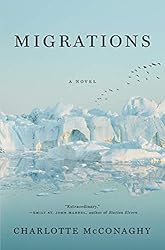
Migrations: A Novel
Charlotte McConaghy, 2020
Flatiron Books
220 pp.
ISBN-13: 9781250204028
Summary
A novel set on the brink of catastrophe, as a young woman chases the world’s last birds—and her own final chance for redemption.
Franny Stone has always been a wanderer. By following the ocean’s tides and the birds that soar above, she can forget the losses that have haunted her life.
But when the wild she loves begins to disappear, Franny can no longer wander without a destination.
She arrives in remote Greenland with one purpose: to find the world’s last flock of Arctic terns and track their final migration. She convinces Ennis Malone, captain of the Saghani, to take her onboard, winning over his eccentric crew with promises that the birds will lead them to fish.
As the Saghani fights its way south, Franny’s dark history begins to unspool. Battered by night terrors, accumulating a pile of unsent letters, and obsessed with pursuing the terns at any cost, Franny is full of secrets.
When her quest threatens the safety of the entire crew, Franny must ask herself what she is really running toward—and running from.
Propelled by a narrator as fierce and fragile as the terns she is following, Charlotte McConaghy's Migrations is both an ode to our threatened world and a breathtaking page-turner about the lengths we will go for the people we love. (From the publisher.)
Author Bio
Charlotte McConaghy is an author and screenwriter based in Sydney, Australia. She holds a Masters Degree in Screenwriting from the Australian Film Television and Radio School and has published eight young adult books in Australia, including the "Chronicles of Kaya" series.
Migrations, released in 2020, is Conaghy's first adult novel and her U.S. debut. Widely praised, reviewers have referred to Migrations as both adventure-thriller and literary fiction. (From the publisher.)
Book Reviews
Visceral and haunting… [and]a first-rate work of climate fiction…. This novel’s prose soars with its transporting descriptions of the planet’s landscapes and their dwindling inhabitants, and contains many wonderful meditations on our responsibilities to our earthly housemates…. Migrations is a nervy and well-crafted novel, one that lingers long after its voyage is over.
New York Times Book Review
The beauty and the heartbreak of this novel is that it’s not preposterous. It feels true and affecting, elegiac and imminent…. The fractured timeline fills each chapter with suspense and surprises, parceled out so tantalizingly that it took disciplined willpower to keep from skipping down each page to see what happens…. Ultimately hopeful.
Washington Post
An aching and poignant book… often devastating in its depictions of grief… of living in a world that has changed catastrophically…. But it’s also a book about love, about trying to understand and accept the creatureliness that exists within our selves, and what it means to be a human animal, that we might better accommodate our own wildness within the world.
Guardian (UK)
A good nautical adventure…. Migrations moves at a fast, exciting clip, motored as much by love for "creatures that aren’t human" as by outrage at their destruction.
Wall Street Journal
Powerful…. Vibrant…. Unique…. McConaghy has a gift for sketching out enveloping, memorable characters using only the smallest of strokes…. Migrations, rather than struggle to convince readers of some plan of environmental action, instead puts humans in their place.
Los Angeles Times
Thrilling…. McConaghy creates a detailed portrait of a woman on the cusp of collapse, consumed with a world that is every bit as broken as she is.… In understanding how nature can heal us, McConaghy underlines why it urgently needs to be protected.
Time
[The] cunky chronicle of Franny Stone, a troubled woman who follows a flock of endangered Arctic terns…. While McConaghy’s plot is engaging, her writing can be a heavy-handed distraction…. Lovers of ornithology and intense drama will find what they need in this uneven tale.
Publishers Weekly
(Starred review) [A] thrillerlike dimension… [and] consummate blend of issue and portrait, warning and affirmation, this heartbreaking, lushly written work is highly recommended. —Barbara Hoffert
Library Journal
(Starred review) [T]ransfixing, gorgeously precise…. Some may find this darkly enrapturing work of ecofiction too heavily plotted, but all the violence, shock, and loss Franny navigates do aptly, and unnervingly, foreshadow a possible environmental apocalypse.
Booklist
Toggling back and forth in time and from place to place, the plot floats through gut-wrenching vignettes of Franny’s escapades, strung together like clues on a life-or-death scavenger hunt…. Prepare to mourn a bleak image of the future and to embrace an everlasting hope in Franny’s heroic example.
BookPage
Discussion Questions
1. The novel’s epigraph is taken from a poem by Rumi: "Forget safety. / Live where you fear to live." How does that directive resonate throughout Franny’s life? Do you think it’s good advice?
2. Discuss the novel’s first lines: "The animals are dying. Soon we will be alone here." How does the disappearance of wildlife in mass extinctions shape the characters and plot? What are the similarities and differences between Franny’s world and our own? Would you describe this novel as dystopian? Why or why not?
3. Arctic terns have the longest natural migration of any animal, and during their lives they may travel the equivalent distance of to the moon and back three times. What do Arctic terns symbolize in the novel, and why are Franny and Niall so drawn to them in particular?
4. The first time Franny sees Niall lecture, he quotes Margaret Atwood:
We ate the birds. We ate them. We wanted their songs to flow up through our throats and burst out of our mouths, and so we ate them. We wanted their feathers to bud from our flesh. We wanted their wings, we wanted to fly as they did, soar freely among the treetops and the clouds, and so we ate them. We speared them, we clubbed them, we tangled their feet in glue, we netted them, we spitted them, we threw them onto hot coals, and all for love, because we loved them. We wanted to be one with them.
Why does he pick that passage? How do the themes of love and destruction echo throughout the novel?
5. What does Ireland represent for Franny? Australia? Discuss the importance of home and belonging in this novel, and how Franny’s search for it shapes her life.
6. Franny says: "It isn’t fair to be the kind of creature who is able to love but unable to stay." Why does she have so much trouble staying, even with the people she most loves? Did you find that aspect of her character sympathetic? Right before their car accident, Niall tells Franny, "There’s a difference between wandering and leaving. In truth, you’ve never once left me." Do you agree?
7. Anik tells Franny: "The stronger you are, the more dangerous the world." What does he mean? Discuss this statement with regard to Franny and Ennis in particular.
8. Franny’s conscience is split between protesting destructive fishing practices and depending on a fishing vessel to follow the terns. She and Niall devote much of their lives together to conservation, although their lifestyle sometimes runs counter to that effort (for instance, they still drive, fly, smoke, etc.). Did you sympathize with these contradictions?
9. At the Mass Extinction Reserve (MER) base, the conservationists prioritize saving animals that help humanity, such as pollinators, rather than, in Franny’s words, "the animals that exist purely to exist, because millions of years of evolution have carved them into miraculous being." Is that prioritization selfish or justifiably practical? What do we lose in allowing the wild to disappear?
10. Niall and the other scientists at MER argue over the best way to protect birds. Niall believes that migration is inherent to their nature, while Harriet counters that they should learn to survive without migration, as a necessary adaptation. Whose argument do you find more convincing?
11. In one of his lectures, Niall says of wildlife: "They are being violently and indiscriminately slaughtered by our indifference. It has been decided by our leaders that economic growth is more important." How does that resonate in our world, as leaders debate the appropriate response to climate change? What is our responsibility to the planet?
12. Franny loves the sea "with every breath of me, every beat of me." What does the sea represent for her? Why is she so drawn to it?
13. Franny describes her life up until she decides to follow the terns as "a migration without a destination." Why do you think she spends so much of her life without ambition or direction? What are the positives and negatives of that sort of existence?
14. When Ennis tells Franny about his wife, Saoirse, asking him to leave so he won’t see her Huntington’s disease progress, Franny is adamant: "You have to go back to your family. You don’t understand how important it is." Do you think Ennis was right to do what his wife asked? Is his inability to stay similar to Franny’s?
15. Ennis tells Franny about Point Nemo, "the remotest place in the world, farther from land than anywhere else." When she asks what it’s like, he replies, "There’s nowhere crueler or lonelier…. It’s quiet." Why are Ennis and Franny so drawn to Point Nemo? How does it resonate with the rest of the novel?
16. Franny believes "the fear world is worse than death. It is worse than anything." Do you agree? What is she afraid of?
17. Why does Franny take responsibility for the deaths of Niall and Greta? Do you think she is right to blame herself and plead guilty?
18. At a few key moments in the novel, including on the last page, Franny remembers her mother’s advice: "Look for the clues to life, they’re hidden everywhere." What does she mean? Discuss the role of fate vs. free will in these characters’ lives.
19. What does Franny hope to accomplish by following the terns on their last migration? What about Ennis? What do you think the future holds for them?
(Questions issued by the publisher.)
top of page (summary)
Milk Glass Moon: (Big Stone Gap series #3)
Adriana Trigiani, 2002
Random House
256 pp.
ISBN-13: 9780345445858
Summary
(Third in the "Big Stone Gap" quartet.)
Milk Glass Moon, the third book in Adriana Trigiani's bestselling "Big Stone Gap" series, continues the life story of Ave Maria Mulligan MacChesney as she faces the challenges and changes of motherhood with her trademark humor and honesty. With twists as plentiful as those found on the holler roads of southwest Virginia, this story takes turns that will surprise and enthrall the reader.
Transporting us from Ave Maria's home in the Blue Ridge Mountains to the Italian Alps, from New York City to the Tuscan countryside, Milk Glass Moon is the story of a shifting mother-daughter relationship, of a daughter's first love and a mother's heartbreak, of an enduring marriage that contains its own ongoing challenges, and of a community faced with seismic change.
All of Trigiani's beloved characters are back: Jack Mac, Ave Maria's true love, who is willing to gamble security for the unknown; her best friend and confidant, bandleader Theodore Tip-ton, who begins a new life in New York City; librarian and sexpert Iva Lou Wade Makin, who faces a life-or-death crisis. Meanwhile, surprises emerge in the blossoming of crusty cashier Fleeta Mullins, the maturing of mountain girl turned savvy businesswoman Pearl Grimes, and the return of Pete Rutledge, the handsome stranger who turned Ave Maria's world upside down in Big Cherry Holler.
In this rollicking hayride of upheaval and change, Ave Maria is led to places she never dreamed she would go, and to people who enter her life and rock its foundation. As Ave Maria reaches into the past to find answers to the present, readers will stay with her every step of the way, rooting for the onetime town spinster who embraced love and made a family. Milk Glass Moon is about the power of love and its abiding truth, and captures Trigiani at her most lyrical and heartfelt. (From the publisher.)
Author Bio
• Birth—1960
• Where—Big Stone Gap, Virginia, USA
• Education—B.A., St. Mary’s College, Indiana, USA
• Currently—lives in New York, New York
As her squadrons of fans already know, Adriana Trigiani grew up in Big Stone Gap, a coal-mining town in southwest Virginia that became the setting for her first three novels. The "Big Stone Gap" books feature Southern storytelling with a twist: a heroine of Italian descent, like Trigiani, who attended St. Mary's College of Notre Dame, like Trigiani. But the series isn't autobiographical—the narrator, Ave Maria Mulligan, is a generation older than Trigiani and, as the first book opens, has settled into small-town spinsterhood as the local pharmacist.
The author, by contrast, has lived most of her adult life in New York City. After graduating from college with a theater degree, she moved to the city and began writing and directing plays (her day jobs included cook, nanny, house cleaner and office temp). In 1988, she was tapped to write for the Cosby Show spinoff A Different World, and spent the following decade working in television and film. When she presented her friend and agent Suzanne Gluck with a screenplay about Big Stone Gap, Gluck suggested she turn it into a novel.
The result was an instant bestseller that won praise from fellow writers along with kudos from celebrities (Whoopi Goldberg is a fan). It was followed by Big Cherry Holler and Milk Glass Moon, which chronicle the further adventures of Ave Maria through marriage and motherhood. People magazine called them "Delightfully quirky... chock full of engaging, oddball characters and unexpected plot twists."
Critics sometimes reach for food imagery to describe Trigiani's books, which have been called "mouthwatering as fried chicken and biscuits" (USA Today) and "comforting as a mug of tea on a rainy Sunday" (New York Times Book Review). Food and cooking play a big role in the lives of Trigiani's heroines and their families: Lucia, Lucia, about a seamstress in Greenwich Village in the 1950s, and The Queen of the Big Time, set in an Italian-American community in Pennsylvania, both feature recipes from Trigiani's grandmothers. She and her sisters have even co-written a cookbook called, appropriately enough, Cooking With My Sisters: One Hundred Years of Family Recipes, from Bari to Big Stone Gap. It's peppered with anecdotes, photos and family history. What it doesn't have: low-carb recipes. "An Italian girl can only go so long without pasta," Trigiani quipped in an interview on GoTriCities.com.
Her heroines are also ardent readers, so it comes as no surprise that book groups love Adriana Trigiani. And she loves them right back. She's chatted with scores of them on the phone, and her Web site includes photos of women gathered together in living rooms and restaurants across the country, waving Italian flags and copies of Lucia, Lucia.
Trigiani, a disciplined writer whose schedule for writing her first novel included stints from 3 a.m. to 8 a.m. each morning, is determined not to disappoint her fans. So far, she's produced a new novel each year since the publication of Big Stone Gap.
I don't take any of it for granted, not for one second, because I know how hard this is to catch with your public," she said in an interview with The Independent. "I don't look at my public as a group; I look at them like individuals, so if a reader writes and says, 'I don't like this,' or, 'This bit stinks,' I take it to heart.
Extras
From a 2004 Barnes & Noble interview:
• I appeared on the game show Kiddie Kollege on WCYB-TV in Bristol, Virginia, when I was in the third grade. I missed every question. It was humiliating.
• I have held the following jobs: office temp, ticket seller in movie theatre, cook in restaurant, nanny, and phone installer at the Super Bowl in New Orleans. In the writing world, I have been a playwright, television writer/producer, documentary writer/director, and now novelist.
• I love rhinestones, faux jewelry. I bought a pair of pearl studded clip on earrings from a blanket on the street when I first moved to New York for a dollar. They turned out to be a pair designed by Elsa Schiaparelli. Now, they are costume, but they are still Schiaps! Always shop in the street—treasures aplenty.
• When asked what book most influenced her life as a writer, here is what she said:
Jane Eyre by Charlotte Brontë. When I was a girl growing up in Big Stone Gap, Virginia, I was in the middle of a large Italian family, but I related to the lonely orphan girl Jane, who with calm and focus, put one foot in front of the other to make a life for herself after the death of her parents and her terrible tenure with her mean relatives. She survived the horrors of the orphanage Lowood, losing her best friend to consumption, became a teacher and then a nanny. The love story with the complicated Rochester was interesting to me, but what moved me the most was Jane's character, in particular her sterling moral code. Here was a girl who had no reason to do the right thing, she was born poor and had no connections and yet, somehow she was instinctively good and decent. It's a story of personal triumph and the beauty of human strength. I also find the book a total page turner- and it's one of those stories that you become engrossed in, unable to put it down. Imagine the beauty of the line: "I loved and was loved." It doesn't get any better than that!
(Bio and interview from Barnes & Noble.)
Book Reviews
In the [third] of the "Big Stone Gap" trilogy, Adriana Trigiani returns to the Virginia mountain setting of her first two bestselling novels, 2000's Big Stone Gap and 2001's Big Cherry Holler. Ave Maria, that Italian-American girl from Cracker's Neck Holler, is now teetering on the precipice of middle age. Still married to house contractor Jack MacChesney, she faces the new challenge of raising her quickly developing daughter, Etta.... Smith chronicles the modernization of southern Appalachia, exploring the complex effects of lumber and coal companies that...hover menacingly outside the borders of Big Stone Gap, Trigiani creates and sustains a sweet, nostalgic portrait of bucolic mountains and simple small-town folk. However, those looking for a complex treatment of this region and its people will not find it in this novel.
Book Magazine
The third book in Trigiani's series about the middle-aged but young-at-heart Ave Maria of Big Stone Gap in the Blue Ridge Mountains is simply made for the ear. The author colorfully and flawlessly captures the characters' southern and Italian accents, transporting listeners into Ave Maria's charmed world. She's a pharmacist in a small Virginia town but has relatives in Italy; and her daughter Etta has just entered her teen years, causing Ave Maria much heartache and uncertainty. She's torn between wanting Etta to mature and wishing Etta was much younger. She cheerfully discusses affairs from the daily chatter at the drugstore counter to more serious matters, such as the death of her son years earlier and her best friend Iva Lou's breast cancer. The dialogue is always snappy (e.g., after Ave Maria has seen a man she's attracted to, Iva Lou quips, "That's how they keep us hooked... those rats").
Publishers Weekly
The last in the "Big Stone Gap" trilogy (Big Stone Gap, Big Cherry Holler) brings us back to Ave Maria and Jack Mac during daughter Etta's teenage years. Despite upheaval and family tensions, this is a happy book, sprinkled with gentle, down-home humor and a rich sense of place the mountains of both Virginia and Italy. The advice from the Wise County Fair fortune-teller to "redream" or reinvent one's life is perfect for readers of all ages. Trigiani does a fine job of resolving 20-year story lines while still leaving readers wanting more. Fans of the previous novels will savor this title as well while anticipating the film version of Big Stone Gap. —Rebecca Sturm Kelm, Northern Kentucky Univ. Lib., Highland Heights.
Library Journal
Windup of the Big Stone Gap trilogy. Big Stone Gap (2000) led us into the sleepy Virginia town of that name via the memories of Ave Maria Mulligan, a spinster pharmacist who learned that her real father was an Italian boy from Bergamo and tracked him down. In Big Cherry Holler (2001), Ave was married with a ten-year-old daughter Etta, grieving memories of a son who died of leukemia, and suspicions that husband Mac had a dish on the side. This last installment is at heart a mother/daughter story. Ave arrives in her 50s, menopausal, worried, and scared. She goes to a fortuneteller who knows all and predicts certain events that the reader awaits to see fulfilled. Etta, verging on adulthood, looks forward to studies in architecture at the University of Virginia in Charlottesville and to a trip to Italy—Bergamo, in fact. This throws Ave deep into trauma, but she comes to learn, as she tells us, "Love may not be enough, but when it's right, it's plenty." Down-home dialogue gives a big lift to Ave's agonies.
Kirkus Reviews
Discussion Questions
Milk Glass Moon, the third book in Adriana Trigiani's bestselling Big Stone Gap series, continues the life story of Ave Maria Mulligan MacChesney as she faces the challenges and changes of motherhood with her trademark humor and honesty. With twists as plentiful as those found on the holler roads of southwest Virginia, this story takes turns that will surprise and enthrall the reader.
Transporting us from Ave Maria's home in the Blue Ridge Mountains to the Italian Alps, from New York City to the Tuscan countryside, Milk Glass Moon is the story of a shifting mother-daughter relationship, of a daughter's first love and a mother's heartbreak, of an enduring marriage that contains its own ongoing challenges, and of a community faced with seismic change.
All of Trigiani's beloved characters are back: Jack Mac, Ave Maria's true love, who is willing to gamble security for the unknown; her best friend and confidant, bandleader Theodore Tip-ton, who begins a new life in New York City; librarian and sexpert Iva Lou Wade Makin, who faces a life-or-death crisis. Meanwhile, surprises emerge in the blossoming of crusty cashier Fleeta Mullins, the maturing of mountain girl turned savvy businesswoman Pearl Grimes, and the return of Pete Rutledge, the handsome stranger who turned Ave Maria's world upside down in Big Cherry Holler.
In this rollicking hayride of upheaval and change, Ave Maria is led to places she never dreamed she would go, and to people who enter her life and rock its foundation. As Ave Maria reaches into the past to find answers to the present, readers will stay with her every step of the way, rooting for the onetime town spinster whoembraced love and made a family. Milk Glass Moon is about the power of love and its abiding truth, and captures Trigiani at her most lyrical and heartfelt.
1. Milk Glass Moon is the final book in the Big Stone Gap trilogy. Does it stand on its own as an individual novel? Which themes from Big Stone Gap and Big Cherry Holler carry over into Milk Glass Moon?
2. What does the symbol of the milk glass moon signify? Also, through Etta's interest in astrology, Trigiani presents stars as prominent reoccurring images. What significance do the stars have in the novel?
3. Why does Ave Maria experiences so much friction with Etta, when they have had such a good relationship in the past? Do you think their problems arise from normal adolescence angst, or do they stem from deeper issues? How do you think Ave Maria and Etta's relationship would be if Ave Maria's own mother were still alive?
4. Is Ave Maria too hard on Etta for her mistakes, in particular the coal and drinking incidents? Do you think she overreacts, given the fact that she had very different perceptions from the other characters, or is she justified in her decisions? How do you think Ave Maria's actions would appear to the reader if she were portrayed in third person, without the inner dialogue we are privy to?
5. Ave Maria and Jack's display apparent differences in their reactions and outlooks throughout Milk Glass Moon, especially in the area of parenting. How do you think they have sustained their marriage? What sacrifices have they made for each other? Why does their marriage work?
6. When Ave Maria sees Pete in New York City, old feelings stir within her. Why does Trigiani bring Pete back into the picture? What do you think would have happened if Ave Maria had chosen Pete over Jack? How would their marriage be different? Do you think Ave Maria's physical reactions to Pete are problematic?
7. Ave Maria describes Pete as being the only person who can see the girl in her. What does she mean? Which qualities in particular does Pete pull out of her? Would you pick comfort over excitement, like Ave Maria ultimately does, or vice-versa?
8. Ave Maria believes that it's easier for women to have close relationships and intimate friendships than men. Do you agree with her? Given the history between Ave Maria and Pete, what do you think about Pete and Jack's friendship?
9. Ave Maria is presented with choices throughout the course of Milk Glass Moon; she is tugged between locations, men, and time frames. How do you think she goes about making decisions? If you were her, would you have made the same choices?
10. Ave Maria sometimes seems to be torn between her desire to live in a small town and her wish to explore the allure and excitement of places like New York City and Italy. Throughout the novel, Ave Maria explores the downsides as well as the upsides of living in a small town, and in certain moments, it appears that Ave Maria hasn't quite gotten over the difficulties she long ago experienced in her transition to a small town. Where do you think she ultimately belongs and feels most comfortable? Do you think she and Jack would be happy living in Italy, as their plan at the end of the novel suggests? What kind of environment are you most comfortable in, and why?
11. Does Ave Maria's personality change when she's in a location other than Big Stone Gap? Which hidden qualities we don't usually see in her persona emerge?
12. Etta tells her mother that she knew she was meant to marry Stefano when she was eight years old. How do issues of fate and destiny play out in Milk Glass Moon? In general, do you think every event has a reason for happening?
13. According to Etta, Ave has trouble getting attached to people. Do you think her statement is true? What are some examples that either support or disagree with it?
14. Three different kinds of marriages are explored throughout the novel … those of Ave Maria and Jack, Iva Lou and Louis, and Etta and Stefano. How do they compare?
15. Throughout the course of three books, Ave clearly progresses through various encounters she never planned on facing. How do you think she has changed from the beginning of the trilogy? Which kind of strengths has she gained? Which personality traits has she held onto?
16. Does Trigiani wrap up everything neatly, or does she leave room for any future developments in Big Stone Gap world? Is there anything from these characters that you would like to see more of? Do the themes and characters' situations in Milk Glass Moon come full circle or is anything left unresolved?
(Questions issued by publisher.)
top of page
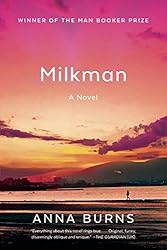
Milkman
Anna Burns, 2018
Graywolf Press
360 pp.
ISBN-13: 9781644450000
Summary
Winner, 2018 Man Booker Prize
In an unnamed city, middle sister stands out for the wrong reasons. She reads while walking, for one. And she has been taking French night classes downtown.
So when a local paramilitary known as the milkman begins pursuing her, she suddenly becomes “interesting,” the last thing she ever wanted to be.
Despite middle sister’s attempts to avoid him―and to keep her mother from finding out about her maybe-boyfriend―rumors spread and the threat of violence lingers.
Milkman is a story of the way inaction can have enormous repercussions, in a time when the wrong flag, wrong religion, or even a sunset can be subversive. Told with ferocious energy and sly, wicked humor, Milkman establishes Anna Burns as one of the most consequential voices of our day. (From the publisher.)
Author Bio
• Birth—ca. 1962
• Where—Belfast, Northern Ireland, UK
• Education—studied Russian, no degree
• Awards—Man Booker Prize
• Currently—lives in East Sussex, England
Anna Burns is the the author of several novels, most famously, Milkman (2018) for which she won the 2018 Man Booker Prize, the first author from Northern Ireland to do so.
Burns was born in Belfast to a working-class family with seven children. She lived with her aunt nearby, an arrangement not uncommon among large Irish families with small homes and an arrangement that gave Burns quiet time to read after a day with her raucous siblings.
The family was a bookish one, Burns told the UK's Guardian during an interview, and library cards were precious family commodities. Someone was forever taking someone else's card in order to sign out extra books.
Burns left Belfast for London where she studied Russian. She never attained a degree, however. Turning to writing was almost serendipitous. One morning she woke up and began to record her dream in a beautiful sketchbook she'd bought sometime before. One page, then another page; then she began keeping a sort of journal about the day.
In 2002 Burns published her first novel, No Bones; the novel was shortlisted for the (then) Orange Prize. Constructions came next in 2007 and Milkman in 2018.
Four years before Milkman, however, a surgical injury had left Burns with excruciating back pain, and she found herself unable to write. Struggling to make ends meet, she house-sat for various people around England and was forced to depend on food banks. The pain was so bad, she was unsure she would be able to finish Milkman.
When Burns finally completed the novel, it was turned down by several publishers before being taken up by Graywolf Press. Then along came the Man Booker Prize and £50,000. (Adapted from various sources online, primarily The Guardian.)
Book Reviews
A “challenging, experimental” novel that might be easier to understand if read aloud has brought Northern Ireland its first success in the Man Booker prize. Milkman by Anna Burns was the “unanimous” choice of the panel of jurors, whose chairman, Kwame Anthony Appiah, said that it was “enormously rewarding…if you persist with it.”
David Sanderson - Times (UK)
[A] strange and intriguing novel that tackles the Northern Ireland conflict from the perspective of an 18-year-old girl.... Milkman calls to mind several seminal works of Irish literature.... But for all the comparisons, Milkman has its own energy, its own voice.... The narrator...is original, funny, disarmingly oblique and unique: different. The same can be said of this book.
Claire Kilroy - Guardian (UK)
Eccentric and oddly beguiling.… What makes it memorable is the funny, alienated, common-sensical voice of middle sister, who refuses to join in the madness.
Sunday Times (UK)
Milkman is delivered in a breathless, hectic, glorious torrent.… It’s an astute, exquisite account of Northern Ireland’s social landscape.… A potent and urgent book, with more than a hint of barely contained fury.
Irish Independent
I haven’t stopped talking about Anna Burns’s astonishing Milkman. The voice is dazzling, funny, acute.… Like all great writing it invents its own context, becomes its own universe.
Eoin McNamee - Irish Times
From the opening page her words pull us into the daily violence of her world—threats of murder, people killed by state hit squads—while responding to the everyday realities of her life as a young woman.
Kwame Anthony Appiah - Chair, Man Booker Prize panel
[A]n acute, chilling, and often wry portrait of a young woman—and a district—under siege.… There is a touch of James Joyce's Stephen Dedalus in the… narrator of this claustrophobic yet strangely buoyant tale.… This is an unforgettable novel.
Publishers Weekly
Discussion Questions
We'll add publisher questions if and when they're available; in the meantime, use our LitLovers talking points to help start a discussion for MILKMAN … then take off on your own:
m. Describe middle-sister. She's 18 years old and bookish. What else? She says she prefers 19th century books "because I did not like the 20th century." What does that statement (or any of her others) suggest about her?
m. What is it about the middle-sister that draws Milkman to her? Reviewers call him creepy. Do you agree? How else would you describe him: agressive, violent, obsessive intimidating ... all of the above, none of the above, something else?
m. When Milkman finally prevails in his pursuit, middle-sister says, "I'd been thwarted into a carefully constructed nothingness by that man. Also by the commuity, by the very mental atmosphere, that minutiae of invastion." There's a lot to unpack in that sentence, which encapsulates the primary tension within the novel. Care to talk about what the statement means, say, phrase by phrase?
m. How would you describe the society in which the book is set (presumaly Belfast, though never acknowledged). Consider the city's atmosphere, the sense of totalitarian oppression.
m. The book is concerned with power. How does power operate in Milkman—on a personal as well as societal level? Who has power and for what purpose? How is power used and over whom?
m. Milkman is also about tribalism. Talk about how group identity functions in this novel. Consider the us versus them allegiances, even down to the brand of butter or tea.
m. Did you find the author's stream-of-consciousness style difficult?
m. What about the lack of character names? The author says that in her initial writing that she used names, but that the book never worked until she removed them. Why might the writing have gone more smoothly without names? Does the lack of names lend a dystopian quality to the work?
m. The author wrote Milkman years before the onset of the #MeToo movement, yet its subject of sexual predation is timely. How did you experience the book in light of today's more aware society. How might you have read it several years ago…or even (if you're old enough) 40 years ago when the events of the book supposedly (thought not specifically) take place?
(Questions by LitLovers. Please feel free to use them, online and off, with attribution. Thanks.)


The Mill River Recluse
Darcie Chan, 2011
e-Book
Summary
New York Times and USA Today bestseller
Disfigured by the blow of an abusive husband, and suffering her entire life with severe social anxiety disorder, the widow Mary McAllister spends almost sixty years secluded in a white marble mansion overlooking the town of Mill River, Vermont. Her links to the outside world are few: the mail, the media, an elderly priest with a guilty habit of pilfering spoons, and a bedroom window with a view of the town below.
Most longtime residents of Mill River consider the marble house and its occupant peculiar, though insignificant, fixtures. An arsonist, a covetous nurse, and the endearing village idiot are among the few who have ever seen Mary. Newcomers to Mill River—a police officer and his daughter and a new fourth grade teacher—are also curious about the reclusive old woman. But only Father Michael O'Brien knows Mary and the secret she keeps--one that, once revealed, will change all of their lives forever.
The Mill River Recluse is a story of triumph over tragedy, one that reminds us of the value of friendship and the ability of love to come from the most unexpected of places. (From the author.)
Author Bio
• Birth—N/A
• Where—Wisconsin, USA
• Raised—Wisconsin, Colorado, and Indiana
• Education—B.A., Indiana University; J.D.,
University of Baltimore
• Currently—lives in Westchester County, New York
Darcie Chan was born in Wisconsin and grew up in the small towns of Brandon, Wisconsin; La Junta and Cheraw, Colorado; and Paoli, Indiana. She has two younger sisters.
Thanks to loving and supportive parents who are both educators, she learned to read and write at an early age. As a child, she fell in love with books and became quite obsessed with Walter Farley's Black Stallion series of books, among many others. Her passion for reading and writing continued through college at Indiana University, Bloomington, and law school at the University of Baltimore.
Currently, Darcie works as an attorney and lives in northern Westchester County, New York, with her husband, their son, and two cats. In her spare time, Darcie enjoys reading, writing fiction, gardening, playing piano, and cooking.
The Mill River Recluse is her first novel. (From the author's website.)
Book Reviews
[A] real page-turner.
IndieReader.com
Chan's sweet novel displays her talent.... A comforting book about the random acts of kindness that hold communities together.
Kirkus Reviews
Discussion Questions
1. The Mill River Recluse is not written in a single timeline, but instead with alternating timelines that link near the end. What did you think of this structure? Did you find it difficult to follow? Was it effective in driving the story forward, or was it disorienting or annoying? Did you prefer one timeline over the other?
2. Of all the characters in The Mill River Recluse, with which one did you most identify, and why?
3. The opening scene of The Mill River Recluse is of Mary McAllister taking her own life to avoid having to suffer further agonizing pain and certain eventual natural death resulting from her metastatic cancer. Do you think Father O’Brien knew Mary planned to take her own life when he left the marble mansion that last night? What do you think about Mary’s decision to take things into her own hands? Did this scene give you pause about whether you wanted to continue reading the story?
4. How does Mary McAllister evolve from a shy teenager into a woman held prisoner by social anxiety and agoraphobia? Do you agree with the way in which Father O’Brien tried to help her? Would you have done anything differently had you been in his position?
5. Patrick McAllister is shockingly cruel, particularly toward the most vulnerable people and animals in his life. His parents fawn over him, catering to his every whim without adequate discipline, while Conor McAllister, his grandfather, struggles to exert what good influence he can. Do you think that Patrick became the person he did because of his parents and their relationship with him?
(Questions courtesy of the author.)


Miller's Valley
Anna Quindlen, 2016
Random House
368 pp.
ISBN-13: 9780812996081
Summary
In a small town on the verge of big change, a young woman unearths deep secrets about her family and unexpected truths about herself.
For generations the Millers have lived in Miller’s Valley. Mimi Miller tells about her life with intimacy and honesty.
As Mimi eavesdrops on her parents and quietly observes the people around her, she discovers more and more about the toxicity of family secrets, the dangers of gossip, the flaws of marriage, the inequalities of friendship and the risks of passion, loyalty, and love.
Home, as Mimi begins to realize, can be “a place where it’s just as easy to feel lost as it is to feel content.”
Miller’s Valley is a masterly study of family, memory, loss, and, ultimately, discovery, of finding true identity and a new vision of home. As Mimi says, “No one ever leaves the town where they grew up, even if they go.” Miller’s Valley reminds us that the place where you grew up can disappear, and the people in it too, but all will live on in your heart forever.
(From the publisher.)
Author Bio
• Birth—July 8, 1952
• Where—Philadelphia, PA, USA
• Education—B.A., Barnard College
• Awards—Pulitzer Prize for her New York Times column
• Currently—New York, New York
Anna Quindlen could have settled onto a nice, lofty career plateau in the early 1990s, when she had won a Pulitzer Prize for her New York Times column; but she took an unconventional turn, and achieved a richer result.
Quindlen, the third woman to hold a place among the New York Times' Op-Ed columnists, had already published two successful collections of her work when she decided to leave the paper in 1995. But it was the two novels she had produced that led her to seek a future beyond her column.
Quindlen had a warm, if not entirely uncritical, reception as a novelist. Her first book, Object Lessons, focused on an Irish American family in suburban New York in the 1960s. It was a bestseller and a New York Times Notable Book of 1991, but was also criticized for not being as engaging as it could have been. One True Thing, Quindlen's exploration of an ambitious daughter's journey home to take care of her terminally ill mother, was stronger still—a heartbreaker that was made into a movie starring Meryl Streep. But Quindlen's fiction clearly benefited from her decision to leave the Times. Three years after that controversial departure, she earned her best reviews yet with Black and Blue, a chronicle of escape from domestic abuse.
Quindlen's novels are thoughtful explorations centering on women who may not start out strong, but who ultimately find some core within themselves as a result of what happens in the story. Her nonfiction meditations—particularly A Short Guide to a Happy Life and her collection of "Life in the 30s" columns, Living Out Loud—often encourage this same transition, urging others to look within themselves and not get caught up in what society would plan for them. It's an approach Quindlen herself has obviously had success with.
Extras
• To those who expressed surprise at Quindlen's apparent switch from columnist to novelist, the author points out that her first love was always fiction. She told fans in a Barnes & Noble.com chat, "I really only went into the newspaper business to support my fiction habit, but then discovered, first of all, that I loved reporting for its own sake and, second, that journalism would be invaluable experience for writing novels."
• Quindlen joined Newsweek as a columnist in 1999. She began her career at the New York Post in 1974, jumping to the New York Times in 1977.
• Quindlen's prowess as a columnist and prescriber of advice has made her a popular pick for commencement addresses, a sideline that ultimately inspired her 2000 title A Short Guide to a Happy Life Quindlen's message tends to be a combination of stopping to smell the flowers and being true to yourself. Quindlen told students at Mount Holyoke in 1999, "Begin to say no to the Greek chorus that thinks it knows the parameters of a happy life when all it knows is the homogenization of human experience. Listen to that small voice from inside you, that tells you to go another way. George Eliot wrote, 'It is never too late to be what you might have been.' It is never too early, either. And it will make all the difference in the world."
• Studying fiction at Barnard with the literary critic Elizabeth Hardwick, Quindlen's senior thesis was a collection of stories, one of which she sold to Seventeen magazine. (From Barnes & Noble.)
Book Reviews
What does home really mean? Is it the people around you who make a place familiar and loved, or is it the tie to land that’s been in your family for generations? Anna Quindlen’s mesmerizing new novel investigates both,.... What do you do when your way of life is gone? Who do you become? And what do you now consider home? Quindlen makes her characters so richly alive, so believable, that it’s impossible not to feel every doubt and dream they harbor, or share every tragedy that befalls them.
Caroline Leavitt - New York Times Book Review
Memories flow like fast-moving water in Miller's Valley, Anna Quindlen's new family novel, a coming-of-age story that reminds us that the past continues to wash over us even as we move away from the places and events that formed us.... [T]he Millers and their neighbors... maintain an uncanny resemblance to our own friends and families.... Quindlen's provocative novel will have you flipping through the pages of your own family history and memories even as you can't stop reading about the Millers.
Carol Memmott - Chicago Tribune
[A] moving exploration of family and notions of home.... Though the pacing is somewhat uneven, Quindlen’s prose is crisp and her insights resonant. This coming-of-age story is driven as much by the fully realized characters as it is by the astute ideas about progress and place.
Publishers Weekly
[A young girl] comes to terms with life as it should be versus life as it is. This is vintage Quindlen,...a compelling family tale rich in recognizable characters, resplendent storytelling, and reflective observations. It is also an affectionate and appreciative portrait of a disappearing way of life. —Carol Haggass
Booklist
[A] young woman buffeted by upheavals in her personal life.... Perhaps there is a bit too much summing up in the book’s final chapter, but it still manages to be quite stirring.... [F]amliar elements in this story...are synthesized in a fresh way in this keenly observed, quietly powerful novel.
Kirkus Reviews
Discussion Questions
We'll add specific questions when they become available from the publisher. In the meantime, use these LitLovers talking points to start a discussion for Miller's Valley...then take off on your own:
1. How would you describe Mimi as the book opens, and how does she change over the course of the novel? What does she come to learn, as she matures, about place and home?
2. Mimi's mother Miriam feels trapped in Miller Valley, yet her husband Bud is tied to the land. How do their positions reflect their individual personalities...and affect their relationship as a couple. In other words, describe Miriam and Bud and their marriage. With whom do your sympathies lie—with one more than another, or with both equally?
3. Why is Mimi so tied the valley? "I knew there was a world outside," she says, "I just had a hard time imagining it." When her mother tells Mimi that her grades in school mean a "road to something better than this," Mimi balks. Is her reluctance merely a childish fear to move beyond a familiar world? Or is it something else? If you were Mimi's mother, or an elderly friend, would you urge her to move on?
4. Mimi says she "felt lost most of the time," as if there was a "big rattly empty space between her stomach and heart." She wonders "whether other people felt the same way without showing it." What does she mean? Is she speaking of basic loneliness, or something else? Has she expressed a feeling common to many (most) of us?
5. Talk about Ruth and her agoraphobia. Why does she inspire bitterness on the part of her sister Miriam? Did you sense what Ruth's secret was, or were you surprised once it was revealed?
6. The book asks an important question about how closely our identities are tied to our origins, both place and family. Do we change when we adapt to new experiences and when we lose what we treasure? Do we ever really leave the past behind us?
7. The book takes place in the 1960s. If you were alive at that time, how well does Quindlen bring the era to life? Was it a different time from now—culturally or sociologically?
(We'll add specific questions if and when they're made available by the publisher.)


The Million Dollar Demise
R.M. Johnson, 2009
Simon & Schuster
320 pp.
ISBN-13: 9781416596271
Summary
Picking up where The Million Dollar Deception left off, Freddy Ford knocks on Nate Kenny's door, storms into the house, and shoots both Nate and Nate's ex-wife Monica. But he doesn't stop there — before driving off, Freddy manages to escape with little Nathaniel, Nate and Monica's beloved adopted son, while little Layla sleeps upstairs.
Nate is expected to survive the brutal attack, but Monica is left in a coma, and doctors are not certain that she will ever recover. When Lewis Waters — Freddy's best friend and Layla's actual father — visits the hospital to see Monica, Nate bargains with him: if Lewis can get Freddy arrested, Nate will give him back his little girl.
Meanwhile, Daphanie Coleman, the woman Nate had planned to marry before he sought revenge on Monica, rushes to Nate's side with plans to get him back by making herself available to him in his time of crisis. By chance, she meets Lewis while visiting Monica's bedside, and the two devise a plan so both get what they want.
When Monica finally awakens, she opens her eyes to a world in which Daphanie and Nate are hiding an affair, Lewis and Daphanie are harboring nasty secrets, and Nate has plotted to steal another man's child in the name of revenge. Will Monica forgive Nate, whom she was about to remarry? Will she uncover the truth behind the love triangle of Daphanie, Lewis, and Nate? And, more important, can the tragic lovers escape a second attempt on their lives? (From the publisher.)
Author Bio
• Aka—R. Marcus Johnson
• Birth—N/A
• Where—Chicago, Illinois, USA
• Education—B.S., University of Louisian; M.F.A, Chicago State
University
• Currently—lives in Chicago, Illinois
RM Johnson was born and raised in Chicago, Illinois. After high school, he served five years in the United States Army. After which he received his Bachelors degree in science, from the University of Louisiana. He worked as an x-ray technologist, and radiation therapist for a number of years while continuously working on his writing, and earned a Masters degree in creative writing from Chicago State University
In 1996, RM wrote The Harris Men, published in 1999. Since then, RM Johnson has written nine novels, including the best-sellers, The Harris Family, Dating Games, and his "Million Dollar" trilogy. Stacie and Cole was his first young adult novel, published in December 2007 by Hyperion Books.
Johnson's "Million Dollar" trilogy includess The Million Dollar Divorce (2004), followed by The Million Dollar Deception (2008) and The Million Dollar Demise (2009).
In June of 2009, RM threw his ring into the non-fiction ring with Why Men Fear Marriage. (Adapted fom the author's website.)
Book Reviews
The crazed conclusion of Johnson's "Million Dollar" trilogy opens with a literal bang. Freddy Ford shoots millionaire Nate Kenny and Nate's ex-wife, Monica, at the couple's Chicago mansion and kidnaps their three-year-old adopted son, Nathaniel. The reason? Nate reneged on rewarding Freddy for his part in a blackmail scheme that led to the arrest of Freddy's best friend, Lewis Waters, in the previous book, The Million Dollar Deception (2008). Lewis was getting too cozy with Monica, whom Nate is eager to remarry. As a result of their serious gunshot wounds, Nate and Monica (who's in a coma) miss Lewis's hearing, at which he's set free. In a weird twist of fate, Lewis agrees to help Nate find Freddy, who's holding Nathaniel for $5 million ransom—but only if Nate will do Lewis a favor. Meanwhile, Nate's spurned lover, Daphanie Coleman, pregnant with another man's child, plots her revenge. The rushed ending suggests the duplicitous Nate could return to commit further mischief in a sequel.
Publishers Weekly
Johnson ties up the loose threads of his fast-paced, thuggish trilogy. In The Million Dollar Divorce (2004) and The Million Dollar Deception (2008), Nate Kenny manipulated, interfered, bought off and blackmailed his way into the life he wanted; when wife Monica couldn't bear him a child, he hired Lewis Waters to seduce her so he could save his fortune in a no-contest divorce. But everything has repercussions, and this final installment opens with the appearance of Freddy Ford, Lewis' best friend, who has lost everything he loves thanks to Nate. Freddy shows up at Nate's house, shoots him four times, shoots Monica in the head (the two were reconciling) and kidnaps their adopted son Nathaniel. He leaves Chicago for Atlanta, killing a cop on the way, to hide out with old girlfriend Joni while he figures out what to do with the toddler in the back seat and the law on his trail. Against all odds Nate survives, and Monica lies in a coma with good chances for a full recovery. The story is complicated by Daphanie, Nate's girlfriend before he reconciled with Monica. Daphanie, pregnant by Trevor, tells Nate that the baby is really his in an attempt to woo him back while Monica is still out of commission. Lewis is trying to regain custody of his daughter Layla, who lives at Monica and Nate's house, though he is not sure he is her biological father. Deceptions, more killing, a budding romance between Lewis and a social worker—it's a lot of plot in one book. There are some strange, sad moments, as when Freddy and Joni reassure themselves they'd make great parents, and no one survives intact in this kind of modern pulp noir, driven by a nihilism that sees deception as the world's lingua franca. The over-fed conclusion to an African-American soap opera.
Kirkus Reviews
Discussion Questions
Use our LitLovers Book Club Resources; they can help with discussions for any book:
• How to Discuss a Book (helpful discussion tips)
• Generic Discussion Questions—Fiction and Nonfiction
• Read-Think-Talk (a guided reading chart)
Also consider these LitLovers talking points to help get a discussion started for The Million Dollar Demise:
1. If you have read the previous two installments in Johnson's Million Dollar series, how does this one stack up? Is it as suspenseful or compelling? Are the characters consistent with their roles in the previous novel(s)?
2. What is Freddy's motive for shooting Nate at the opening of the book? Can Freddy be held blameless for his anger toward Nate?
3. What kind of character is Nate? What drives him? Does this man have any redeeming qualities? What is it that makes scoundrels appealing—either as real life individuals or as fictional characters?
4. What about Monica? How do you feel about her reconciliation with Nate?
5. How does it happen that Lewis agrees to help Nate find Freddy and Nate's son Nathaniel? Is Lewis nuts?!
6. What about Daphne Coleman? What is her stake in all of this?
7. Is there any kind of future for Freddy and Joni? What kind of parents would they make?
8. Were you surprised by the ending? Are you satisfied with how the book ends—does The Million Dollar Demise deliver for you—in terms of page-turning suspense and narrative power?
9. It looks as if Johnson is setting readers up for another installment in his series. Want to try to guess what shape it might take?
10. Deception and betrayal are at the heart of this book. Is this the way the real world works? In other words, is this book a depiction of life?
11. Finally, does anyone in this book/series have a redeeming quality? Which characters, if any, do you find sympathetic? Anyone you find yourself rooting for? If you had to choose one character, who you would want to find in your own life?
(Questions by LitLovers. Please feel free to use them, online or off, with attribution. Thanks.)
top of page
Minding Frankie
Maeve Binchy, 2011
Knopf Doubleday
400 pp.
ISBN-13: 9780307273567
Summary
Maeve Binchy is back with a tale of joy, heartbreak and hope, about a motherless girl collectively raised by a close-knit Dublin community.
When Noel learns that his terminally ill former flame is pregnant with his child, he agrees to take guardianship of the baby girl once she’s born. But as a single father battling demons of his own, Noel can’t do it alone.
Fortunately, he has a competent, caring network of friends, family and neighbors: Lisa, his unlucky-in-love classmate, who moves in with him to help him care for little Frankie around the clock; his American cousin, Emily, always there with a pep talk; the newly retired Dr. Hat, with more time on his hands than he knows what to do with; Dr. Declan and Fiona and their baby son, Frankie’s first friend; and many eager babysitters, including old friends Signora and Aidan and Frankie’s doting grandparents, Josie and Charles.
But not everyone is pleased with the unconventional arrangement, especially a nosy social worker, Moira, who is convinced that Frankie would be better off in a foster home. Now it’s up to Noel to persuade her that everyone in town has something special to offer when it comes to minding Frankie. (From the publisher.)
Author Bio
• Birth—May 28, 1940
• Where—Dalkey (outside Dublin), Ireland
• Death—July 30, 2012
• Where—Dalkey, Ireland
• Education—B.A., University College, Dublin
• Awards—see below
Maeve Binchy Snell was an Irish novelist, playwright, short story writer, columnist, and speaker. She is best known for her humorous take on small-town life in Ireland, her descriptive characters, her interest in human nature and her often clever surprise endings. Her novels, which were translated into 37 languages, sold more than 40 million copies worldwide, and her death, announced by Vincent Browne on Irish television late on 30 July 2012, was mourned as the passing of Ireland's best-loved and most recognisable writer.
Her books have outsold those of other Irish writers such as Oscar Wilde, James Joyce, Samuel Beckett, W. B. Yeats, Seamus Heaney, Edna O'Brien and Roddy Doyle. She cracked the U.S. market, featuring on the New York Times best-seller list and in Oprah's Book Club. Recognised for her "total absence of malice" and generosity to other writers, she finished ahead of Jane Austen, Charles Dickens and Stephen King in a 2000 poll for World Book Day.
Early life
Binchy was born in Dalkey, County Dublin (modern-day Dún Laoghaire–Rathdown), Ireland, the oldest child of four. Her siblings include one brother, William Binchy, Regius Professor of Laws at Trinity College, Dublin, and two sisters: Renie (who predeceased Binchy) and Joan Ryan. Her uncle was the historian D. A. Binchy (1899–1989). Educated at the Holy Child Convent in Killiney and University College Dublin (where she earned a bachelor's degree in history), she worked as a teacher of French, Latin, and history at various girls' schools, then a journalist at the Irish Times, and later became a writer of novels, short stories, and dramatic works.
In 1968, her mother died of cancer aged 57. After Binchy's father died in 1971, she sold the family house and moved to a bedsit in Dublin.
Israel
Her parents were Catholics and Binchy attended a convent school.[12] However, a trip to Israel profoundly affected both her career and her faith. As she confided in a Q&A with Vulture:
In 1963, I worked in a Jewish school in Dublin, teaching French with an Irish accent to kids, primarily Lithuanians. The parents there gave me a trip to Israel as a present. I had no money, so I went and worked in a kibbutz — plucking chickens, picking oranges. My parents were very nervous; here I was going out to the Middle East by myself. I wrote to them regularly, telling them about the kibbutz. My father and mother sent my letters to a newspaper, which published them. So I thought, It’s not so hard to be a writer. Just write a letter home. After that, I started writing other travel articles.
Additionally, one Sunday, attempting to locate where the Last Supper is supposed to have occurred, she climbed a mountainside to a cavern guarded by a Brooklyn-born Israeli soldier. She wept with despair. The soldier asked, “What’ya expect, ma’am—a Renaissance table set for 13?” She replied, “Yes! That’s just what I did expect.” Binchy was no longer a Catholic.
Marriage
Binchy, described as "six feet tall, rather stout, and garrulous", confided to Gay Byrne of the Late Late Show that, growing up in Dalkey, she never felt herself to be attractive; "as a plump girl I didn't start on an even footing to everyone else", she shared. After her mother's death, she expected to a lead a life of spinsterhood, or as she expressed: "I expected I would live at home, as I always did." She continued, "I felt very lonely, the others all had a love waiting for them and I didn't."
She ultimately encountered the love of her life, however; when recording a piece for Woman's Hour in London, she met children's author Gordon Snell, then a freelance producer with the BBC. Their friendship blossomed into a cross-border romance, with her in Ireland and him in London, until she eventually secured a job in London through the Irish Times. She and Snell married in 1977 and after living in London for a time, moved to Ireland. They lived together in Dalkey, not far from where she had grown up, until Binchy's death. She told the Irish Times:
[A] writer, a man I loved and he loved me and we got married and it was great and is still great. He believed I could do anything, just as my parents had believed all those years ago, and I started to write fiction and that took off fine. And he loved Ireland, and the fax was invented so we writers could live anywhere we liked, instead of living in London near publishers.
Ill health...and death
In 2002, Binchy "suffered a health crisis related to a heart condition", which inspired her to write Heart and Soul. The book about (what Binchy terms) "a heart failure clinic" in Dublin and the people involved with it, reflects many of her own experiences and observations in the hospital.
Towards the end of her life, Binchy had the following message on her official website: "My health isn't so good these days and I can't travel around to meet people the way I used to. But I'm always delighted to hear from readers, even if it takes me a while to reply."
She suffered with severe arthritis, which left her in constant pain. As a result of the arthritis she had a hip operation.
Binchy died on 30 July 2012 after a short illness. She was 72.] Gordon was by her side when she died in a Dublin hospital. Immediate media reports described Binchy as "beloved", "Ireland's most well-known novelist" and the "best-loved writer of her generation". Fellow writers mourned their loss, including Ian Rankin, Jilly Cooper, Anne Rice, and Jeffrey Archer. Politicians also paid tribute. President Michael D. Higgins stated: "Our country mourns." Taoiseach Enda Kenny said, “Today we have lost a national treasure.” Minister of State for Disability, Equality and Mental Health Kathleen Lynch, appearing as a guest on Tonight with Vincent Browne, said Binchy was, for her money, as worthy an Irish writer as James Joyce or Oscar Wilde, and praised her for selling so many more books than they managed.
In the days after her death tributes were published from such writers as John Banville, Roddy Doyle, and Colm Tóibín. Banville contrasted Binchy with Gore Vidal, who died the day after her, observing that Vidal "used to say that it was not enough for him to succeed, but others must fail. Maeve wanted everyone to be a success." Numerous tributes appeared in publications on both sides of the Atlantic, including the Guardian and CBC News.
Shortly before her death, Binchy told the Irish Times:
I don't have any regrets about any roads I didn't take. Everything went well, and I think that's been a help because I can look back, and I do get great pleasure out of looking back ... I've been very lucky and I have a happy old age with good family and friends still around.
Just before dying, she read her latest short story at the Dalkey Book Festival.
She once said she would like to die "... on my 100th birthday, piloting Gordon and myself into the side of a mountain." She was cremated that Friday in Mount Jerome. It was a simple ceremony, as she had requested.
Journalism
The New York Times reports: Binchy's "writing career began by accident in the early 1960s, after she spent time on a kibbutz in Israel. Her father was so taken with her letters home that "he cut off the ‘Dear Daddy’ bits,” Ms. Binchy later recounted, and sent them to an Irish newspaper, which published them." Donal Lynch observed of her first paying journalism role: the Irish Independent "was impressed enough to commission her, paying her £16, which was then a week-and-a-half's salary for her."
In 1968, Binchy joined the staff at the Irish Times, and worked there as a writer, columnist, the first Women's Page editor then the London editor, later reporting for the paper from London before returning to Ireland.
Binchy's first published book is a compilation of her newspaper articles titled My First Book. Published in 1970, it is now out of print. As Binchy's bio posted at Read Ireland describes: "The Dublin section of the book contains insightful case histories that prefigure her novelist's interest in character. The rest of the book is mainly humorous, and particularly droll is her account of a skiing holiday, 'I Was a Winter Sport.'"
Literary works
In all, Binchy published 16 novels, four short-story collections, a play and a novella. Her literary career began with two books of short stories: Central Line (1978) and Victoria Line (1980). She published her debut novel Light a Penny Candle in 1982. In 1983, it sold for the largest sum ever paid for a first novel: £52,000. The timing was fortuitous, as Binchy and her husband were two months behind with the mortgage at the time. However, the prolific Binchy—who joked that she could write as fast as she could talk—ultimately became one of Ireland's richest women.
Her first book was rejected five times. She would later describe these rejections as "a slap in the face [...] It's like if you don't go to a dance you can never be rejected but you'll never get to dance either".
Most of Binchy's stories are set in Ireland, dealing with the tensions between urban and rural life, the contrasts between England and Ireland, and the dramatic changes in Ireland between World War II and the present day. Her books were translated into 37 languages.
While some of Binchy's novels are complete stories (Circle of Friends, Light a Penny Candle), many others revolve around a cast of interrelated characters (The Copper Beech, Silver Wedding, The Lilac Bus, Evening Class, and Heart and Soul). Her later novels, Evening Class, Scarlet Feather, Quentins, and Tara Road, feature a cast of recurring characters.
Binchy announced in 2000 that she would not tour any more of her novels, but would instead be devoting her time to other activities and to her husband, Gordon Snell. Five further novels were published before her death—Quentins (2002), Nights of Rain and Stars (2004), Whitethorn Woods (2006), Heart and Soul (2008), and Minding Frankie (2010). Her final work, A Week in Winter, was published posthumously in 2012.
Binchy wrote several dramas specifically for radio and the silver screen. Additionally, several of her novels and short stories were adapted for radio, film, and television.
Awards and honours
- In 1978, Binchy won a Jacob's Award for her RTÉ play, Deeply Regretted By. A second award went to the lead actor, Donall Farmer.
- A 1993 photograph of her by Richard Whitehead belongs to the collection of the National Portrait Gallery (London) and a painting of her by Maeve McCarthy, commissioned in 2005, is on display in the National Gallery of Ireland.
- In 1999, she received the British Book Award for Lifetime Achievement.
- In 2000, she received a People of the Year Award.
- In 2001, Scarlet Feather won the W H Smith Book Award for Fiction, defeating works by Joanna Trollope and then reigning Booker winner Margaret Atwood, amongst other contenders.
- In 2007, she received the Irish PEN Award, joining such luminaries as John B. Keane, Brian Friel, Edna O'Brien, William Trevor, John McGahern and Seamus Heaney.
- In 2010, she received a lifetime achievement award from the Irish Book Awards.
- In 2012, she received an Irish Book Award in the "Irish Popular Fiction Book" category for A Week in Winter.
- There have been posthumous proposals to name a new Liffey crossing Binchy Bridge in memory of the writer Other writers to have Dublin bridges named after them include Beckett, Joyce and O'Casey.
- In 2012 a new garden behind the Dalkey Library in County Dublin was dedicated in memory of Binchy. (Author bio adapted from Wikipedia.)
Book Reviews
Bestseller Binchy is a national treasure in her homeland of Ireland, and her latest novel is a perfect illustration of why. Old-fashioned and newfangled are totally compatible in contemporary Dublin, where lonely, hard-drinking slacker Noel Lynch discovers he's about to be a single dad now that the one-night-stand/mother of his child, Stella, is dying. Suddenly, the salt-of-the-earth residents of St. Jarlath's Crescent and Noel's resourceful American cousin, Emily, spring into action to keep Noel sober, fire up his ambitions, appease militant social worker Moira, and help raise baby Frankie. It's a hair-raising, heartwarming juggling act for Noel, his quirky roommate Lisa, do-gooder Emily, and a neighborhood crowded with eccentric characters and adorable pooches—including one with a handsome inheritance. Binchy (Heart and Soul) straddles improbable and possible in her touching saga, and if your mind can't quite wrap itself around St. Jarlath's Crescent, your heart will have no trouble recognizing the landscape.
Publishers Weekly
Fans of Irish author Binchy will welcome the return of some familiar faces (from Quentins; Heart and Soul; Scarlet Feather) and also enjoy meeting new characters in her latest. Frankie is a little girl born as her mother Stella is dying of cancer. During the last stages of her life, Stella contacts Noel, a one-night stand whom she claims is the father. Noel has a host of his own problems but decides to pull things together for the child. Friends and family help out, but the social worker assigned to the case cannot accept the arrangements. Having never dealt with her own troubled childhood, she works to find proof that Frankie would be better off in foster care. The brief appearances of so many characters from previous works might be annoying, but the stories of Noel, his cousin Emily, and his friend Lisa, along with the social worker who wants to pull them apart and the little girl who pulls them together, make this novel fresh and appealing. Verdict: An enjoyable novel about life, love, and second chances. —Beth Blakesley, Washington State Univ. Libs., Pullman
Library Journal
A Dublin neighborhood full of many of the characters who frequently pass through Binchy's Irish novels (Heart and Soul, 2009, etc.) bands together to help a young single father raise his daughter. Aware she will not survive her baby's birth, fatally ill Stella tells alcoholic loner Noel that he is the father. He doesn't remember having actual sex with Stella and is far from certain he wants or can handle the responsibility. But with the help and encouragement of his cousin Emily, in Dublin on an extended visit from New York, Noel stops drinking and takes custody of baby Frankie after Stella's death at St. Brigid's Hospital. His transformation from loser to responsible, loving father and his struggle to convince his uptight social worker that he is fit to raise Frankie forms the central plot. But once Noel's in AA and night school, he pales as a character. After so many novels, Binchy's recurring characters have become so numerous that even devotees may have trouble keeping track. Here, hospital administrator Frank Ennis is the one to watch as he reaches out to the grown son he never knew he had. As usual, Binchy's supporting characters steal the show. Social worker Moira seems like the stereotypical uptight bureaucrat at first, but her loneliness and painful self-awareness of her failure to connect to others become increasingly heart-wrenching. Moira has to overcome an unhappy family situation, as does Lisa, a graphic artist who moves in as Noel's platonic housemate to escape her parents' sham marriage, although she's in her own sham love affair with a flashy restaurateur. Circling everywhere, boringly perfect Emily has an uncanny ability to ask the right question and solve problems—everyone in Noel's life has a story. A dram of sorrow leavens the predictably happy ending. Binchy remains the queen of spiritual comfort, but this time round she's stretched interest thin with ups and downs too many and too mild.
Kirkus Reviews
Discussion Questions
1. Have you read any of Maeve Binchy's other novels? How does this one compare?
2. If you've read other Binchy books, which characters did you recognize? Are there any you'd like to see in a future novel?
3. There are many parents in the book. Who would you say does the best job, and why?
4. There are a number of recent retirees, voluntary and otherwise, who become an important part of Frankie's life. What kind of roles do her grandparents, Josie and Charles, take on? What about Dr. Hat and Muttie? More generally, what do the very young and the very mature have to offer each other? Which generation do you think needs the other more?
5. Emily told herself that she must not try to change the world. But there were some irresistible forces that could never be fought with logic and practicality. Emily Lynch knew this for certain (page 22). What irresistible forces does she mean? How does she fight them?
6. It's clear what Noel gets from his relationship with Emily, but what does she get? How does the effect of alcoholism bond them?
7. Discuss Lisa's relationship with Anton. Why is she so oblivious to his less attractive qualities? What is her turning point?
8. Why is Moira so obsessed with Frankie's fate? Is it just fear, or is there something more going on?
9. How does Moira define family ? How does Emily?
10. Lisa says to Moira, "I have a lot of worries and considerations in my life, but minding Frankie sort of grounds me. It gives it all some purpose, if you know what I mean" (page 239). Among Frankie's caretakers, who else might say this?
11. Discuss the ethics of Moira's dealings with Eddie Kennedy. Should she have told him about her father?
12. Anton says to Lisa, "I'm not the villain here, you know," and Lisa responds, "I know. That's why I'm angry. I got it so wrong" (page 314). What does she mean?
13. What did you think of Di Kelly's reason for staying with her husband? What would you have done?
14. What is your opinion of Noel's decision to get a DNA test? How would you have handled the results he received?
15. Many of the characters go through major upheavals in their lives. Who responds best, and why? Whose attitude changes the most?
16. What did you think of Stella's letter to Frankie? What did we learn from it?
(Questions issued by publisher.)

The Miniaturist
Jessie Burton, 2014
HarperCollins
416 pp.
ISBN-13: 9780062306845
Summary
On a brisk autumn day in 1686, eighteen-year-old Nella Oortman arrives in Amsterdam to begin a new life as the wife of illustrious merchant trader Johannes Brandt.
But her new home, while splendorous, is not welcoming. Johannes is kind yet distant, always locked in his study or at his warehouse office—leaving Nella alone with his sister, the sharp-tongued and forbidding Marin.
Nella's life changes when Johannes presents her with an extraordinary wedding gift: a cabinet-sized replica of their home. To furnish her gift, Nella engages the services of a miniaturist—an elusive and enigmatic artist whose tiny creations mirror their real-life counterparts in eerie and unexpected ways...
Johannes's gift helps Nella pierce the closed world of the Brandt household. But as she uncovers its unusual secrets, she begins to understand—and fear—the escalating dangers that await them all.
In this repressively pious society where gold is worshipped second only to God, to be different is a threat to the moral fabric of society, and not even a man as rich as Johannes is safe. Only one person seems to see the fate that awaits them. Is the miniaturist the key to their salvation...or the architect of their destruction?
Enchanting, beautifully written, and exquisitely suspenseful, The Miniaturist is a magnificent story of love and obsession, betrayal and retribution, appearance and truth. (From the publisher.)
Author Bio
• Birth—1982
• Where—London, England, UK
• Education—Oxford University
• Currently—lives in London, England
Jessie Burton was born in London in 1982. She studied at Oxford University and the Central School of Speech and Drama, and still works as an actress in London. She lives in southeast London, not far from where she grew up. (From the publisher.)
Book Reviews
A fabulously gripping read that will appeal to fans of Girl With a Pearl Earring and The Goldfinch, but Burton is a genuinely new voice with her visceral take on sex, race and class.
Guardian
This debut novel, set in 17th-century Amsterdam, hits all the marks of crossover success: taut suspense, a pluck heroine- and a possibly clairvoyant miniature-furniture designer.
New York magazine
[A] haunting debut.
Good Housekeeping
A standout portrayal of the wide range of women’s ingenuity.
Booklist
As in Donna Tartt’s The Goldfinch, the pleasure lies in giving in to well-wrought illusions, and the result is a beach read with meat on its bones - perfect for the Labor Day transition from play to work.
New York magazine/Vulture.com
The Miniaturist is one of the year’s most hyped novels, and it’s easy to see why. Burton conjures every scent and crackle of Nella’s world (A-).
Entertainment Weekly
Rich in 17th century atmosphere…Debut novelist Jessie Burton has a terrific subject... All those severe portraits of people in dark clothes and starched white ruffs, along with those glossy, death-scented still lifes, spring to life.
Cleveland Plain Dealer
The Miniaturist is a masterpiece of atmosphere and tension …. The themes Burton explores are as relevant today as they were long ago …. a thoroughly engaging, beautifully written work of historical fiction.
Washington Independent Review of Books
[A] sumptuous backdrop...about a young Dutch girl from the village of Assendelft...chosen to be the bride of...wealthy merchant with a shocking secret.... Strangely enough, however, the central mystery, the miniaturist’s uncanny knowledge of the future, is never solved, and the reader is left unsatisfied.
Publishers Weekly
(Starred review.) A talented new writer of historical fiction evokes 17th-century Amsterdam, the opulent but dangerous Dutch capital, where an innocent young wife must navigate the intrigues of her new household.... With its oblique storytelling, crescendo of female empowerment and wrenching ending, this novel establishes Burton as a fresh and impressive voice.
Kirkus Reviews
Discussion Questions
(The questions below were kindly submitted to LitLovers by Joanna Brown and Wendy Mazenauer, who developed them for their book club discussion. Thank you, Joanna and Wendy!)
1. In retrospect, we realise the identity of the very first character we meet in the church. She plays the part of a fleeting observer. Does this allure to her importance in the story?
2. It wasn't a conventional marriage and initially, Johannes is very cold towards Nell. How did you perceive their marriage?
3. "Words are water in this city. One drop of rumour could drown us." says Marin. Discuss the irony of this statement.
4. Peebo's escape could almost be marked as symbolic of events to come. Discuss?
5. In what way did Nella's discovery of her husband's homosexuality change her personality?
6. What part does Cornelia play in the narrative? How does her cooking add to this?
7. Throughout the novel, Nella is often referred to as "childlike". In what way would you say this is so? How do we see her mature?
8. When Nella discovers that the Miniaturist is a woman, her whole perception of the person changes. Discuss this and the effect that the Miniaturist has on the storyline.
9. Given Miren's puritanical exterior, how do you feel about her more worldly, private acceptance of her brother's homosexuality and her own secret life? Does she gain your respect?
10. How do Nella's feelings towards Johannes change as the story progresses?
11. Do you see Johannes as a victim or a hero?
12. In this novel we are confronted with the still-life subject matter of the Dutch painters during the 17th century. These painters were often depicting political innuendoes. How does this subject matter (‘natures mortes’—death in life: rotting fruit with insects crawling through it; slaughtered animals; dying plants etc) relate to the state of Holland at that time? Think also of the starling trapped in the church; the moulding sugar and the phrase “things can change."
(Questions kindly submitted by Joanna Brown and Wendy Mazenauer, two LitLovers readers.)

The Ministry of Special Cases
Nathan Englander, 2007
Random House
352 pp.
ISBN-13: 9780375704444
Summary
The long-awaited novel from Nathan Englander, author of For the Relief of Unbearable Urges. Englander’s wondrous and much-heralded collection of stories won the 2000 Pen/Malamud Award and was translated into more than a dozen languages.
From its unforgettable opening scene in the darkness of a forgotten cemetery in Buenos Aires, The Ministry of Special Cases casts a powerful spell.
In the heart of Argentina’s Dirty War, Kaddish Poznan struggles with a son who won’t accept him; strives for a wife who forever saves him; and spends his nights protecting the good name of a community that denies his existence—and denies a checkered history that only Kaddish holds dear.
When the nightmare of the disappeared children brings the Poznan family to its knees, they are thrust into the unyielding corridors of the Ministry of Special Cases, the refuge of last resort.
Nathan Englander’s first novel is a timeless story of fathers and sons. In a world turned upside down, where the past and the future, the nature of truth itself, all take shape according to a corrupt government’s whims, one man—one spectacularly hopeless man—fights to overcome his history and his name, and, if for only once in his life, to put things right.
Here again are all the marvelous qualities for which Englander’s first book was immediately beloved: his exuberant wit and invention, his cosmic sense of the absurd, his genius for balancing joyfulness and despair.
Through the devastation of a single family, Englander captures, indelibly, the grief of a nation. The Ministry of Special Cases, like Englander’s stories before it, is a celebration of our humanity, in all its weakness, and—despite that—hope. (From the publisher.)
About the Author Bio
• Birth—1970
• Where—West Hempstead, Long Island , New York, USA
• Education—State University of New York, Binghampton
• Awards—PEN/Malamud Award; Frank O'Connor Short Story Award
• Currently—lives in New York City
Nathan Englander is an American short story writer and novelist. His debut short story collection, For the Relief of Unbearable Urges, was published in 1999; his second, What We Talk About When We Talk About Anne Frank (2012), won the Frank O'Connor International Short Story Award and was a finalist for the Pulitzer Prize. His novels include The Ministry of Special cases (2007) and Dinner at the Center of the Earth (2017).
Biography
Englander was born and raised in West Hempstead on Long Island, New York, in what is part of the Orthodox Jewish community. He attended the Hebrew Academy of Nassau County for high school and graduated from the State University of New York at Binghamton and the Iowa Writers' Workshop at the University of Iowa. In the mid-1990s, he moved to Israel, where he lived for five years.
Englander now lives both in Brooklyn, New York, and in Madison, Wisconsin. He has taught fiction at City University of New York - Hunter College in the MFA Creative Writing program. He currently teaches fiction in the MFA program at New York University.
Literary career
Since the 1999 publication of For the Relief of Unbearable Urges, Englander has received a Guggenheim Fellowship, the Bard Fiction Prize, and a fellowship at the Dorothy and Lewis B. Cullman Center for Scholars and Writers at the New York Public Library.
Four of his short stories have appeared in editions of The Best American Short Stories:
— "The Gilgul of Park Avenue" (2000 ed.: guest editor, E.L. Doctorow
— "How We Avenged the Blums" (2006 ed.): guest ed.,r Ann Patchett
— "Free Fruit for Young Widows" (2011 ed.): guest ed., Geraldine Brooks
— "What We Talk About When We Talk About Anne Frank" (2012 ed.): guest ed., Tom Perrotta.
The Ministry of Special Cases, Englander's 2007 novel is set in 1976 in Buenos Aires during Argentina's "Dirty War." His 2017 novel, Dinner at the Center of the Earth is concerned with the Israel-Palestinian conflict and has elements of a political thriller.
Englander has also served as juror for Canada's 2017 Scotiabank Giller Prize. (Adapted from Wikipedia. Retrieved 10/3/2017.)
Book Reviews
Beautifully written, The Ministry of Special Cases nonetheless presents a conundrum. Englander does in fiction what his absent God cannot: create a world. And then he peoples that world with characters that he treats better than history ever would. Such decency is not a large failing in a young novelist. If only the junta had been half so kind.
Will Blythe - New York Times Book Review
A mesmerizing rumination on loss and memory.... It's a family drama layered with agonized and often comical filial connections that are stretched to the snapping point by terrible circumstance...builds with breathtaking, perfectly wrought pacing and calm, terrifying logic.
Los Angeles Times
A tour-de-force....A few pages into The Ministry of Special Cases, it becomes clear how much [Englander] has to bring to the topic: pitch-black humor, a skeptical affection for his characters, and the narrative ability to trace the impact of fascism-with-a-modern-face on a cluster of lives.
Seattle Times
Wonderful.... Since much of the book’s power comes from its relentlessly unfolding plot, it’s not fair even to tell who disappears, let alone whether that person reappears.... Englander maintains an undertone of quirky comedy almost to the end of his country.
Newsweek
Englander's prose moves along with a tempered ferocity — simple yet deceptively incisive.... Englander’s book isn’t so much about the search for a lost boy. It’s about fathers and sons and mothers and faith and community and war and hope and shame. Yes, that’s a lot to pack into 339 pages. But not when a book reads at times with the urgency of a thriller.
Esquire
Resonates of Singer, yes, but also of Bernard Malamud and Lewis Carroll, plus the Kafka who wrote The Trial.... You will wonder how a novel about parents looking for and failing to find their lost son, about a machinery of state determined to abolish not only the future but also the past, can be horrifying and funny at the same time. Somehow...this one is.
Harper's
(Audio version.) Morey's dulcet theatrical tones offset the messy lives of the characters in Englander's first novel about Jewish residents of 1970s Buenos Aires who live in fear of Argentina's vicious military dictatorship. Against the backdrop of the dirty war conducted against leftists and activists, Kaddish Poznan scratches together a living vandalizing the gravestones of Jewish criminals who are embarrassments to their families, even in eternal slumber. Morey struggles manfully with the book's religious terminology and outbursts of Spanish, but his reading is too mannered to render the vibrancy of Englander's prose. His pauses are often too long, and his line readings sometimes lean awkwardly, and puzzlingly, on certain words. Nonetheless, Morey's professional assurance means that, certain flaws notwithstanding, his reading flows along without overly noticeable interruption, accurately conveying the menace lurking behind every word, every sentence of Englander's death-haunted tale.
Publishers Weekly
Kaddish Poznan, who's been scraping along at the edge of society, suddenly finds himself in the middle of Argentina's infamous Dirty War when his son disappears. We've waited many years for Englander to follow up his remarkable story collection, For the Relief of Unbearable Urges, with a first novel.
Library Journal
This is a staggeringly mature work, gracefully and knowledgeably set in a milieu far from the author’s native New York.... Four p’s best describe this work: poignant, powerful, political, and yet personal.
Booklist
The fate of Argentina's Jews during the 1976-83 "Dirty War" is depicted with blistering emotional intensity in this stark first novel from the author of the story collection For the Relief of Unbearable Urges (1999). Englander focuses tightly on the family of Kaddish Poznan, who scrapes together a living by obliterating despised surnames (those of "the famous Jewish pimps of Buenos Aires . . . [and] their . . . whores") from gravestones in a cemetery unvisited by their scandalized relatives. This earns him little respect from his wife, Lillian, who works for a life-insurance firm, and their 19-year-old son Pablo (nicknamed "Pato"), a university student whose political idealism estranges him from his parents' strategies for survival, as their country's ruling junta hunts down "undesirables" and innocent citizens swell the ranks of "the disappeared." A context of uncertainty and terror is gradually defined: Lillian invests in a steel door for their apartment; Kaddish trades his services to a plastic surgeon for rhinoplasties that may make him and Lillian look "less Jewish"; and the precautionary burning of their son's books in the family's bathtub sends Pato angrily away from them and into the clutches of their oppressors. Englander's perfectly engineered plot then takes the distraught parents into the belly of the beast as they importune the police and the eponymous Ministry (a Kafkaesque nightmare of doubletalk and indifferent brutality). They have a chilling confrontation with a prosperous general and his heartless wife and more despairing encounters with a phlegmatic relief worker, a priest who can do good only by circumventing moral action and a self-described "monster" who survives by performing the dirty war's dirtiest deeds. One stunning twist discloses Pato's fate in a way neither parent will ever accept, and the novel climaxes where it began, in a cemetery, where Kaddish hopes, against hope, to beat the murderers at their own game. A political novel anchored, unforgettably, in the realm of the personal. Englander's story collection promised a brilliant future, and that promise is here fulfilled beyond all expectations.
Kirkus Reviews
Discussion Questions
1. Kaddish is the only one of the children of the Society of the Benevolent Self—“a disgrace beyond measure for every Argentine Jew”—who is willing to acknowledge his heritage. Yet he makes his living from obliterating the names on tombstones in the sealed-off cemetery that contains his heritage. How does Kaddish see himself: as a servant of the truth and of history, or as an opportunist with no particular loyalties?
2. Why does Kaddish force Pato to work with him in the graveyard, and why does he force him to strike the chisel that will obliterate the name from the stone? As they drive home from the hospital Pato tells Kaddish, “You're lazy. You're a failure. You've kept us down. You embarrass us. You cut off my finger. You ruined my life.” The narrator goes on to refer to “the grand Jewish tradition of the dayeinu.... And central to the form is the notion that each accusation, if that had been Kaddish's only shortcoming, still it would have been enough” [p. 61]. How complicated are Pato's feelings for his father? Why does Kaddish so often make poor decisions?
3. The Ministry of Special Cases is rooted in Argentina's history from the time of the Zvi Migdal—a criminal organization of Jewish gangsters who were active in Buenos Aires and ran the brothels—to the time of the military junta of 1976-1983, during which thousands of Argentine citizens, mostly young people, vanished without a trace. Do some research into this history, and discuss with your group how it affects your reading of the story.
4. Kaddish's mother, Favorita, was the victim of another kind of kidnapping, a form of white slavery [p. 21]. Beginning in the second half of the nineteenth century, poor young women from Russian shetls were seduced into false marriages and sold into prostitution in the brothels of Buenos Aires. How much control do the people in this novel have over their lives? We're told that Kaddish had “never expected a happy life; only moments of joy to carry him through” [pp. 94-95]. How does Kaddish's background influence his approach to life?
5. Kaddish's negotiations with Mazursky, and the fallout from his acceptance of the offer of two nose jobs, constitute an absurdist episode in a largely tragic story. How does Englander manage to mingle comedy with his darker plot? What is the effect of his narrative style for you as a reader?
6. A chain of books including Chekhov, Lermontov, and Voltaire tells how Pato chose his patrimony: “Each book begat another. For a boy whose entire family history dead-ended on his father's side, this is how Pato traced his line” [pp. 93-94]. The second struggle—a fateful one—between father and son takes place after Kaddish has tried to burn Pato's books. What do the books tell us about Pato, and why does he attempt to save them even though he understands the risk to himself if these books are discovered? Why does Kaddish curse his son [p. 116]? What does Pato mean by his parting statement, “Fathers are always fathers. Sons always sons” [p. 122]?
7. Look closely at the descriptive prose, the tone, and the pacing of Chapter 17, and discuss what this passage demonstrates about Englander as a writer.
8. It is a matter of historical fact that during the junta young people suspected of having politically subversive views were arrested, interrogated and tortured, drugged and thrown out of airplanes. Infant children of the disappeared were sometimes adopted by military families—as happens here with the general and his wife [pp. 107-08]. These facts seem, perhaps, utterly surreal and fictional. How does Englander want his readers to experience history in this story?
9. Given the fact that no one (except the extremely brave woman in the bakery) will help Kaddish and Lillian recover their son, and that in their loss the parents too are negated, the novel implies that the Argentine people capitulated, in their silence, to the corruption and savagery of the junta. As Cacho says, “Everyone is sleeping deeply” [p. 126]. Does the novel imply that people get the government they deserve? What might cause such passivity and acquiescence in a population?
10. What are the key elements of Lillian's character, and how does she differ from Kaddish in her attempts to deal with Pato's disappearance? Do you identify more with her continuing hope than with Kaddish's belief that Pato is dead? Or the reverse?
11. What is ironic about the concept of habeus corpus as a legality by which the junta protects itself from accusations of kidnapping? Why do Kaddish and Lillian need a witness in order to get a writ of habeus corpus for Pato [pp. 209, 223-27]?
12. What strategies does The Ministry of Special Cases use in dealing with the families of the disappeared? What do the people who work there, including the military priest who takes Lillian's money, hope to achieve? How does Kaddish attempt to deal with the impossible demands being made by the priest and with Lillian's desire to meet them?
13. Discuss Englander's decision, in Chapter 43, to introduce the character of the unnamed girl who finds Pato's notes to his parents and dies without ever delivering these notes. “The memory is the girl's alone, and that's how it will stay. Still, in this horrible time when the junta would weave a nation's truth from lies, Lillian would have been happy and Kaddish would have been happy that, independent of them, one fine girl for one fine day believed in Pato Poznan—both living and dead” [p. 304]. What is interesting about this situation in which one desaparecido bears witness, silently, to the existence of another?
14. The novel is deeply concerned with the questions of identity: we see the changing or the removal of names, the alteration of faces and of the past. In contrast to all this, the girl who finds the notes on which Pato has written his name thinks, “It was such a civilized act, writing one's name, a concrete act. It made her think she could leave a history herself” [p. 302]. Why are these two sentences so important to the novel?
15. The rabbi who named Kaddish said, “Let his name be Kaddish to ward off the angel of death. A trick and a blessing. Let this child be the mourner instead of the mourned” [p. 8]. Does Kaddish's name suit him? What resonance do the rabbi's words take on, given the arc of the whole story?
16. The episode of the girl in the cell reveals the fact that Pato was held there as well, and that he undoubtedly shared the same fate as the girl who finds his notes in the foam mattress. So Kaddish is right about his son's fate, while Lillian is wrong. How does this knowledge affect your reading of the last final chapters?
17. Kaddish's desire to bury and to mourn his son meets with frustration when a rabbi tells him, in an ironic return to the habeus corpus problem, that he cannot bury his son if he has no body to bury. Does this constitute a final estrangement from the Jewish community for Kaddish, especially since the desire to give the dead the proper rites of burial accords with an ancient Jewish tradition? What do you make of Kaddish's attempt to trick Lillian into accepting the bones of a stranger for her son's?
18. Englander says that in writing the novel, “I became obsessed with the almost quantum-mechanical evil that is a byproduct of disappearing people. To kill a person is to deny that person a future—the basic act that is murder. To 'disappear' that same person is also, oddly, to reach in and undo the past. It's not to make them no-more. It's to make them, not-ever. It is to be undone. It's a way of fracturing the seeming unbreakable link between future and past. The question that flows through much of this novel, I guess, is: Despite the best intentions how do we–as individuals, or societies (take your pick)—contribute to our own undoing?” How would you address the ideas here, as well as the final question?
19. What is the effect of the novel's final pages? How do you imagine the rest of life for Kaddish and Lillian? Does the conclusion provide a sense of closure, or does it refuse to do so?
(Questions issued by publisher.)
top of page

The Ministry of Utmost Happiness
Arundhati Roy, 2017
Knopf Doubleday
464 pp.
ISBN-13: 9781524733155
Summary
A dazzling, richly moving new novel by the internationally celebrated author of The God of Small Things
The Ministry of Utmost Happiness takes us on an intimate journey of many years across the Indian subcontinent — from the cramped neighborhoods of Old Delhi and the roads of the new city to the mountains and valleys of Kashmir and beyond, where war is peace and peace is war.
It is an aching love story and a decisive remonstration, a story told in a whisper, in a shout, through unsentimental tears and sometimes with a bitter laugh. Each of its characters is indelibly, tenderly rendered. Its heroes are people who have been broken by the world they live in and then rescued, patched together by acts of love—and by hope.
The tale begins with Anjum—who used to be Aftab—unrolling a threadbare Persian carpet in a city graveyard she calls home. We encounter the odd, unforgettable Tilo and the men who loved her—including Musa, sweetheart and ex-sweetheart, lover and ex-lover; their fates are as entwined as their arms used to be and always will be.
We meet Tilo’s landlord, a former suitor, now an intelligence officer posted to Kabul. And then we meet the two Miss Jebeens: the first a child born in Srinagar and buried in its overcrowded Martyrs’ Graveyard; the second found at midnight, abandoned on a concrete sidewalk in the heart of New Delhi.
As this ravishing, deeply humane novel braids these lives together, it reinvents what a novel can do and can be. The Ministry of Utmost Happiness demonstrates on every page the miracle of Arundhati Roy’s storytelling gifts. (From the publisher.)
Author Bio
• Birth—November 21, 1961
• Where—Shillong, Meghalaya, India
• Education—School of Planning and Architecture, New Delhi
• Awards—Booker Prize, 1997
• Currently—lives in New Dheli, India
Arundhati Roy was trained as an architect and is also an award-winning screenwriter. The God of Small Things is her first novel, winning the 1997 Man Booker Prize. Her second novel, The Ministry of Utmost Happiness was published in 2017. It too received rave reviews. Like her twin protagonists in Small Things, she was raised near her grandmother's pickle factory in Kerala, India. She now resides in New Delhi.
Roy was born in Shillong, Meghalaya to a Keralite Syrian Christian mother, the women's rights activist Mary Roy, and a Bengali Hindu father, a tea planter by profession. She spent her childhood in Ayamenem in Kerala, and went to school in Corpus Christi, Kottayam, followed by The Lawrence School, Lovedale in the Nilgiris, Tamil Nadu. She then studied architecture at the School of Planning and Architecture, New Delhi, where she met her first husband, architect Gerard DaCunha.
Roy met her second husband, filmmaker Pradip Krishen, in 1984, and became involved in film-making under his influence. She played a village girl in the award-winning movie Massey Sahib.
Roy is a niece of the prominent media personality Prannoy Roy and lives in New Delhi.
Roy began writing her first novel, The God of Small Things in 1992, completing it in 1996. The book is semi-autobiographical and a major part captures her childhood experiences in Ayemenem. The book received the 1997 Man Booker Prize for Fiction, was listed as one of the New York Times Notable Books of the Year for 1997. The book reached fourth position in the New York Times Bestsellers list for Independent Fiction. She received half a million pounds as an advance, and rights to the book were sold in 21 countries.
The God of Small Things received good reviews, including one from John Updike in The New Yorker. Carmen Callil, chair of the Booker judges panel in 1996 though, called The God of Small Things "an execrable book" and said it should never have reached the shortlist.
Roy wrote the screenplays for In Which Annie Gives it Those Ones (1989) and Electric Moon (1992) and a television serial The Banyan Tree. She also wrote the documentary DAM/AGE: A Film with Arundhati Roy (2002).
Since publishing her first novel in 1997, Roy has devoted herself to nonfiction and politics, publishing two more collections of essays, as well as working for social causes. She is a figure-head of the anti-globalization/alter-globalization movement and a vehement critic of neo-imperialism and of the global policies of the United States. She also criticizes India's nuclear weapons policies and the approach to industrialization and rapid development as currently being practiced in India, including the Narmada Dam project and the power company Enron's activities in India.
More
Roy has campaigned along with activist Medha Patkar against the Narmada dam project, saying that the dam will displace half a million people, with little or no compensation, and will not provide the projected irrigation, drinking water and other benefits. Roy donated her Booker prize money as well as royalties from her books on the project to the Narmada Bachao Andolan.
Arundhati Roy's opposition to the Narmada Dam project has been criticised as "anti-Gujarat" by Congress and BJP leaders in Gujarat.
In 2002, Roy was convicted of contempt of court by the Indian Supreme Court for accusing the court of attempting to silence protests against the Narmada Dam Project. In its judgement, the Supreme Court Of India noted "we feel that the ends of justice would be met if she is sentenced to symbolic one day's imprisonment besides paying a fine of Rs. 2000." Roy served the prison sentence and paid the fine.
Environmental historian Ramachandra Guha has been critical of Roy's Narmada dam activism. While acknowledging her "courage and commitment" to the cause, Guha writes that her advocacy is hyperbolic and self-indulgent, "Ms. Roy's tendency to exaggerate and simplify, her Manichean view of the world, and her shrill hectoring tone, have given a bad name to environmental analysis". He faults Roy's criticism of Supreme Court judges who were hearing a petition brought by the Narmada Bachao Andolan as careless and irresponsible.
Roy counters that her writing is intentional in its passionate, hysterical tone — "I am hysterical. I'm screaming from the bloody rooftops. And he and his smug little club are going 'Shhhh…you'll wake the neighbours!' I want to wake the neighbours, that's my whole point. I want everybody to open their eyes." (From Wikipedia.)
Book Reviews
Compelling…musical and beautifully orchestrated. Roy’s depiction of furtive romance has a cinematic quality, as well as genuine poignancy and depth of emotion. Her gift is for the personal: for poetic description [and an] ability to map the complicated arithmetic of love and belonging.… Ministry manages to extract hope from tragedies witnessed.
Michiko Kakutani - New York Times
Roy the artist [is] fully and brilliantly intact: prospering with stories and writing in gorgeous, supple prose…Again and again beautiful images refresh our sense of the world…Roy, in her nonfiction, has taken a sharp interest in Kashmir, and it is evident in this novel, which is blazing with details about the Indian government's occupation and the Kashmiri people's ensuing sorrow. She knows everything from the frighteningly euphemistic military terminology of the region…to the natural landscape.… She looks into homes, into bomb sites, into graveyards, into torture centers, into the "glassy, inscrutable" lakes. And she reveals for us the shattered psychology of Kashmiris who have been fighting the Indian Army and also occasionally collaborating with it. These sections of the book filled me with awe—not just as a reader, but as a novelist—for the sheer fidelity and beauty of detail.
Karah Mahajan - New York Times Book Review
A gem—a great tempest of a novel: a remarkable creation, a story both intimate and international.… Here is writing that swirls so hypnotically it doesn’t feel like words on paper so much as ink on water. This vast novel will leave you awed by the heat of its anger and the depth of its compassion.
Ron Charles - Washington Post
Fearless…staggeringly beautiful—a fierce, fabulously disobedient novel …so fully realized it feels intimate, yet vibrates with the tragicomedy of myth.… Roy is writing at the height of her powers. Once a decade, if we are lucky, a novel emerges from the cinder pit of living that asks the urgent question of our global era. Roy’s novel is this decade’s ecstatic and necessary answer."
John Freeman - Boston Globe
Powerful and moving…reminds us what fiction can do. Roy’s exquisite prose is [a] rare instrument. She captures the horrors of headlines, and the quiet moments when lovers share poems and dreams. Ministry is infused with so much passion that it vibrates. It may leave you shaking, too. Roy’s is a world in which love and hope sprout against all odds, like flowers pushing through cracked pavement.
Heller McAlpin - San Francisco Chronicle
Glorious…remarkable, colorful and compelling.… Roy has a passionate following, and her admirers will not be disappointed. This ambitious new novel, like its predecessor, addresses weighty themes in an intermittently playful narrative voice. You will [be] granted a powerful sense of the complexity, energy and diversity of contemporary India, in which darkness and exuberant vitality and inextricable intertwined.
Claire Messud - Financial Times (UK)
Magisterial, vibrant.… Roy’s second novel works its empathetic magic upon a breathtakingly broad slate—inviting us to stand with characters who refuse to be stigmatized or cast aside.
Liesel Schillinger - Oprah Magazine
Ministry is the follow-up we’ve been longing for—a poetic, densely populated contemporary novel in the tradition of Dickens and Tolstoy. From its beginning, one is swept up in the story. If The God of Small Things was a lushly imagined, intimate family novel slashed through with politics, Ministry encompasses wildly different economic, religious, and cultural realms across the Indian subcontinent and as far away as Iraq and California. Animating it is a kaleidoscopic variety of bohemians, revolutionaries, and lovers.… With her exquisite and dynamic storytelling, Roy balances scenes of suffering and corruption with flashes of humor, giddiness, and even transcendence.
Daphne Beal - Vogue
(Starred Review) [O]riginal, haunting…fuses tenderness and brutality, mythic resonance and the stuff of front-page headlines.… [S]ometimes densely topical, the novel can be a challenging read. Yet its complexity feels essential to Roy's vision of a bewilderingly beautiful, contradictory, and broken world.
Publishers Weekly
(Starred Review) Roy's first novel since her 1997 Booker Prize-winning debut, The God of Small Things, is well worth the wait.… The uncanny intersecting of these and many other characters' lives, along with fables, songs, and literary quotes, create a brilliant bricolage. —Kate Gray, Boston P.L., MA
Library Journal
(Starred Review) Roy constructs a busy world in which characters cross boundaries of ethnicity, religion, and gender to find, yes, that utmost happiness…. An assured novel borne along by a swiftly moving storyline that addresses the most profound issues with elegant humor.
Kirkus Reviews
Discussion Questions
1. The novel opens with a vignette describing the mysterious death of vultures—and how "not many noticed the passing of the friendly old birds" (page 5). How does this occurrence set the stage and tone for the rest of the novel with regard to the state of India’s society and the unrest that the characters experience within themselves and with the outside world? How does that mood transition into the graveyard setting of the first part of the book?
2. Discuss the complications of Aftab’s upbringing and his parents’ reactions to their child’s gender. What does the family dynamic suggest about the role that biology plays in determining one’s true family versus an individual’s ability to create or choose one’s family?
3. Anjum is told that a Hijra is "a living creature that is incapable of happiness.… The riot is inside us. The war is inside us" (page 27). To what extent do you see this manifest in Anjum’s character throughout the book, and in what ways does she defy that definition?
4. What roles do magic and superstition play throughout the novel? Which characters are more inclined to subscribe to unconventional beliefs, and do they seem more comforted or disillusioned by those beliefs in the face of harsh realities
5. Discuss the following idea: "What mattered was that [the moment] existed. To be present in history, even as nothing more than a chuckle, was a universe away from being absent from it, from being written out of it altogether" (page 55). How does the formal inventiveness and variation of the novel’s narrative—which is told through documents, written and oral histories, and other archival materials passed among characters or left in their absence—attest to this sense of one’s relevance in history at any given moment? What are the different characters’ motives for leaving an impression of their existence?
6. How does the variety of perspectives that the documents in the novel afford you as a reader—from Tilo’s notebooks to the letter from Miss Jebeen the Second’s real mother—different, if not conflicting, portraits of the political conflict going on in Kashmir? Overall, did they allow you to more clearly see one side’s argument over another’s? What kind of texture did the shifts in narrative form create in your overall reading experience?
7. What is the intersection between death and life in the novel? Consider the ways in which Anjum’s graveyard/funeral parlor prospers and grows throughout the novel, and the notion that "Dying became just another way of living" (page 320).
8. How does Roy create the atmosphere and emotional tenor of the novel’s primary cities/places in India? What sensory details or descriptions stuck with you the most as the backdrop for the characters’ somewhat nomadic existence?
9. Did you find there to be more similarities or differences between places or scenes where protesting and violence occur in contrast to those where there is relative peace and civility? How does the point of view from which a given scene is narrated affect how you see a place?
10. How is parenthood, and, more specifically, motherhood, explored in the novel? Discuss in particular the mother-child bonds that Anjum, Tilo, and both Miss Jebeens experience.
11. How is religion a defining feature for characters in the novel and a main source of conflict in the society depicted? How do the differing beliefs and political loyalties affect events that transpire in the novel’s different geographical areas of conflict?
12. What role does gender play in the novel, in terms of how characters are expected and allowed to behave as well as how they respond to certain emotions, events, and treatments? Is gender the primary way a person identifies instead of by religion, political party, ethnicity/country of origin, or even profession?
13. The Landlord’s chapters are the only sections written in the first person. How does that point of view color your understanding of the relationship among him, Tilo, Naga, and Musa, including the knowledge that they met on the set of a play? What makes this web of love so intricate, and how does the war intensify their bonds even as it threatens to shatter them?
14. Musa is one character whose identity must be repressed in various ways to ensure his safety, and even his most arduous disguises are not always successful. What does his struggle and that of others in similar situations (people who disappear and/or transform into others) suggest about the mutability of one’s identity—whether it be by necessity or by organic change? How might you interpret the line "Only the dead are free" in that context (page 361)?
15. Discuss the lines of poetry that Tilo writes the end of the book, "How / to / tell / a / shattered / story? / By / slowly / becoming / everybody. /No. / By slowly becoming everything" (page 442). How do the main characters—Tilo, Musa, Naga, and Anjum—embody the idea of telling a story through the assimilation of its many fragments?
16. By the end of the novel, how did you interpret the meaning of its title?
(Questions issued by the publisher.)