


Lila
Marilynne Robinson, 2014
Farrar, Straus and Giroux
272 pp.
ISBN-13: 9780374187613
Summary
Marilynne Robinson, one of the greatest novelists of our time, returns to the town of Gilead in an unforgettable story of a girlhood lived on the fringes of society in fear, awe, and wonder.
Lila, homeless and alone after years of roaming the countryside, steps inside a small-town Iowa church—the only available shelter from the rain—and ignites a romance and a debate that will reshape her life. She becomes the wife of minister, John Ames, and begins a new existence while trying to make sense of the life that preceded her newfound security.
Neglected as a toddler, Lila was rescued by Doll, a canny young drifter, and brought up by her in a hardscrabble childhood. Together they crafted a life on the run, living hand to mouth with nothing but their sisterly bond and a ragged blade to protect them.
Despite bouts of petty violence and moments of desperation, their shared life was laced with moments of joy and love. When Lila arrives in Gilead, she struggles to reconcile the life of her makeshift family and their days of hardship with the gentle Christian worldview of her husband which paradoxically judges those she loves.
Revisiting the beloved characters and setting of Robinson’s Pulitzer Prize–winning Gilead and Home, a National Book Award finalist, Lila is a moving expression of the mysteries of existence that is destined to become an American classic. (From the publisher.)
Author Bio
• Birth—November 26, 1943
• Where—Sandpoint, Idaho, USA
• Education—B.A., Brown University
• Awards—PEN/Hemingway Award;National Book Critics Circle Award; Pulitzer Prize; Orange Prize
• Currently—Iowa City, Iowa
Marilynne Robinson was born and raised in Idaho, where her family has lived for several generations. She recieved a B.A. from Brown University in 1966 and a Ph.D. in English literature from the University of Washington in 1977.
Housekeeping, her first novel, was published in 1981 and won the PEN/Hemingway Award for First Fiction and the American Academy and Institute's Richard and Hinda Rosenthal Award. Mother Country, an examination of Great Britain's role in radioactive environmental pollution, was published in 1989. Robinson published Gilead in 2004 and Home in 2008. Home won the 2009 Orange Prize. She lives in Iowa City, Iowa, with her family. (From the publisher.)
More
For someone who has labored long in the literary vineyard, Marilynne Robinson has produced a remarkably slim oeuvre. However, in this case, quality clearly trumps quantity. Her 1980 debut, Housekeeping, snagged the PEN/Hemingway Award for best first novel and was nominated for the Pulitzer Prize for Fiction.
Twenty-four years later, her follow-up novel, Gilead, won the National Book Critics Circle Award, the Ambassador Book Award, and the Pulitzer Prize. And in between, her controversial extended essay Mother Country: Britain, the Welfare State and Nuclear Pollution (1989) was shortlisted for the National Book Award.
Robinson is far from indolent. She teaches at several colleges and has written several articles for Harper's, Paris Review, the New York Times Book Review, and other publications. Still, one wonders—especially in the face of her great critical acclaim—why she hasn't produced more full-length works. When asked about these extended periods of literary dormancy, Robinson told Barnes & Noble.com, "I feel as if I have to locate my own thinking landscape... I have to do that by reading—basically trying to get outside the set of assumptions that sometimes seems so small or inappropriate to me." What that entails is working through various ideas that often don't develop because, as she says, "I couldn't love them."
Still, occasionally Robinson is able to salvage something important from the detritus—for example, Gilead's central character, Reverend John Ames. "I was just working on a piece of fiction that I had been fiddling with," Robinson explains. "There was a character whom I intended as a minor character... he was a minister, and he had written a little poem, and he transformed himself, and he became quite different—he became the narrator. I suddenly knew a great deal about him that was very different from what I assumed when I created him as a character in the first place."
This tendency of Robinson's to regard her characters as living, thinking beings may help to explain why her fictional output is so small. While some authors feel a deep compulsion to write daily, approaching writing as a job, Robinson depends on inspiration which often comes from the characters themselves. She explains, "I have to have a narrator whose voice tells me what to do—whose voice tells me how to write the novel."
As if to prove her point, in 2008, Robinson crafted the luminous novel Home around secondary characters from Gilead: John Ames's closest friend, Reverend Robert Boughton, his daughter Glory, and his reprobate son Jack. Paying Robinson the ultimate compliment, Kirkus Reviews declared that the novel "[c]omes astonishingly close to matching its amazing predecessor in beauty and power."
However, the deeply spiritual Robinson is motivated by a more personal directive than the desire for critical praise or bestsellerdom. Like the writing of Willa Cather—or, more contemporaneously, Annie Dillard—her novels are suffused with themes of faith, atonement, and redemption. She equates writing to prayer because "it's exploratory and you engage in it in the hope of having another perspective or seeing beyond what is initially obvious or apparent to you." To this sentiment, Robinson's many devoted fans can only add: Amen.
Extras
• Robinson doesn't just address religion in her writing. She serves as a deacon at the Congregational Church to which she belongs.
• One might think that winning a Pulitzer Prize could easily go to a writer's head, but Robinson continues to approach her work with surprising humility. In fact, her advice to aspiring writers is to always "assume your readers are smarter than you are."
• Robinson is no stranger to controversy. Mother Country, her indictment of the destruction of the environment and those who feign to protect it, has raised the ire of Greenpeace, which attempted to sue her British publisher for libel. (Author bio from Barnes & Noble.)
Book Reviews
Literary lioness Robinson—she's won a Pulitzer Prize for fiction, a Hemingway Foundation/PEN Award, and a National Book Critics Circle Award, among other laurels—continues the soaring run of novels with loosely connected story lines and deep religious currents that she launched a decade ago, almost a quarter century after her acclaimed fiction debut, Housekeeping . . . Lila's journey—its darker passages illuminated by Robinson's ability to write about love and the natural world with grit and graceful reverence—will mesmerize both longtime Robinson devotees and those coming to her work for the first time.
Elle
(Starred review.) This third of three novels set in the fictional plains town of Gilead, Iowa, is a masterpiece of prose in the service of the moral seriousness that distinguishes Robinson’s work. This time the narrative focuses on Lila, the young bride of elderly Reverend Ames, first met in Gilead.... Robinson carefully crafts this provocative and deeply meaningful spiritual search for the meaning of existence.
Publishers Weekly
(Starred review.) This is a lovely and touching story that grapples with the universal question of how God can allow his children to suffer. Recommended for fans of Robinson as well as those who enjoyed Elizabeth Strout's Olive Kitteridge, another exploration of pain and loneliness set against the backdrop of a small town. —Evelyn Beck
Library Journal
(Starred review.) Robinson has created a tour de force, an unforgettably dynamic odyssey, a passionate and learned moral and spiritual inquiry, a paean to the earth, and a witty and transcendent love story—all within a refulgent and resounding novel so beautifully precise and cadenced it wholly transfixes and transforms us. —Donna Seaman
Booklist
Robinson, ever the Calvinist (albeit a gentle and compassionate one), is a master at plumbing the roiling depths below calm surfaces. In this installment, she turns to the title character, Ames' wife, who has figured mostly just in passing in Gilead (2004) and Home (2008).... What secrets does she bear?.... Fans of Robinson will wish the book were longer—and will surely look forward to the next.
Kirkus Reviews
Discussion Questions
1. The novel’s opening paragraphs vividly capture the deprivations experienced by young Lila. How do these experiences affect her immersion in the culture of Gilead? As she reaches adulthood,what does Lila believe about the nature of life?
2. How did your perception of Doll shift throughout the novel? What motivates her to rescue Lila? What do the two girls teach each other about loyalty and its limitations?
3. Lila recalls the day she ventured into John Ames’s candlelit church (echoing Ames’s tender recollection of that scene, which was presented in Gilead). Doane had told Lila, "Churches just want your money," yet she needed refuge. What does Ames’s church want from Lila?
4. As she copies difficult passages from the Bible, Lila continually returns to questions about human suffering and misfortune. What is your response to this debate? How does Lila’s practical wisdom compare to the philosophical wisdom of Ames and Boughton?
5. What is the significance of Doll’s knife—both literally (as a weapon) and as a metaphor? Can someone from Ames’s world of gentleness have the capacity to understand what the knife means to Lila?
6. What lies at the heart of Lila and Ames’s decision to marry? What needs and longings do they share? How does their relationship reflect the broader needs and longings of humanity?
7. Which of the novel’s Bible quotations resonated most strongly with you? How were you taught to approach a sacred text?
8. Does the age difference between Lila and Ames create an imbalance in their marriage?
9. How is Lila’s sense of self affected by her days in St. Louis? Was she wounded or empowered by that chapter of her life?
10. While Gilead and Home emphasize the relationships between fathers and their children (particularly their sons), Lila accentuates the perspective of women. How does this affect the storyline and the imagery?
11. What beliefs does Doll instill in Lila about nurturing a child?
12. Discuss the time and place depicted in Lila. What were your family’s circumstances during the mid-twentieth century? Is contemporary America less connected to the natural world and to the contemplative aspects of life? What insight can an urban reader in the Information Age gain from Lila and Ames?
13. Discuss the concept of trust as it plays out in Lila. What are the characters’ greatest barriers to trust? What does it take to quell such fear? Is it as simple as sharing all that we know—especially our most vulnerable moments? In the novel, how is trust distinguished from faith?
14. How does Lila reconcile her husband’s religious views with her life before she arrived in Gilead? Does she undergo a conversion in Gilead or does she arrive at something else entirely?
15. What do the closing lines of Lila tell us about life, and the absence of life?
(Questions issued by the publisher.)
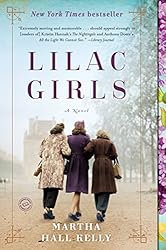

Lilac Girls
Martha Hall Kelly, 2016
Random House
496 pp.
ISBN-13: 9781101883075
Summary
For readers of The Nightingale and Sarah’s Key, inspired by the life of a real World War II heroine, this powerful debut novel reveals an incredible story of love, redemption, and terrible secrets that were hidden for decades.
New York socialite Caroline Ferriday has her hands full with her post at the French consulate and a new love on the horizon.
But Caroline’s world is forever changed when Hitler’s army invades Poland in September 1939—and then sets its sights on France.
An ocean away from Caroline, Kasia Kuzmerick, a Polish teenager, senses her carefree youth disappearing as she is drawn deeper into her role as courier for the underground resistance movement. In a tense atmosphere of watchful eyes and suspecting neighbors, one false move can have dire consequences.
For the ambitious young German doctor, Herta Oberheuser, an ad for a government medical position seems her ticket out of a desolate life. Once hired, though, she finds herself trapped in a male-dominated realm of Nazi secrets and power.
The lives of these three women are set on a collision course when the unthinkable happens and Kasia is sent to Ravensbrück, the notorious Nazi concentration camp for women. Their stories cross continents—from New York to Paris, Germany, and Poland—as Caroline and Kasia strive to bring justice to those whom history has forgotten.
In Lilac Girls, Martha Hall Kelly has crafted a remarkable novel of unsung women and their quest for love, freedom, and second chances. It is a story that will keep readers bonded with the characters, searching for the truth, until the final pages. (From the publisher.)
Visit the author's website for background on LiLac Girls.
Author Bio
Martha Hall Kelly is a native New Englander who splits her time between Atlanta, Georgia; New York City; and Martha's Vineyard, Massachusetts. She spent a number of years in the advertising world as a copy writer before turning to writing historical fiction. Lilac Girls, her bestselling debut was published in 2016, which was followed in 2019 with that novel's prequel, Lost Roses.
She has three (mostly grown) children. (Adapted from Atlanta History Center.)
Book Reviews
Kelly’s compelling first novel follows three women through the course of World War II and beyond.... Despite some horrific scenes, this is a page-turner demonstrating the tests and triumphs civilians faced during war, complemented by Kelly’s vivid depiction of history and excellent characters.
Publishers Weekly
Kelly’s three narrators are based on actual people whose destinies converged in or around Ravensbruck, Hitler’s concentration camp for women.... Kelly vividly re-creates the world of Ravensbruck but is less successful integrating the wartime experience of Caroline, whose involvement with the surviving Rabbits comes very late.
Kirkus Reviews
Discussion Questions
We'll add specific questions if and when they're made available by the publisher. In the meantime, use our talking points to help start a discussion for Lilac Girls...then take off on your own:
1. What role did—could—compassion play in the horrific conditions of Nazified Europe? What were the dangers to those who attempted to act compassionately? How might you have chosen if faced with such a dire dilemma: compassion vs. risk?
2. Talk about the different backgrounds of Caroline, Kasia, and Herta, and how their lives are shaped by their upbringing.
3. Both Caroline and Kasia make foolish mistakes. Does that affect your ability to elicit sympathy for the two characters?
4. "Man's inhumanity to man" is one of the main concerns of LiLac Girls. Talk about the "slippery slope" on which Herta finds herself. How did she end up in the untenable situation in which she finds herself? How culpable is she?
5. Were parts of this book too difficult to read? Is there a need to continue writing about these experiments?
(Questions by LitLovers. Please feel free to use them, online or off, with attribution. Thanks.)

Lillian Boxfish Takes a Walk
Kathleen Rooney, 2017
St. Martin's Press
303 pp.
ISBN-13: 9781250113320
Summary
She took 1930s New York by storm, working her way up writing copy for R.H. Macy’s to become the highest paid advertising woman in the country. It was a job that, she says, “in some ways saved my life, and in other ways ruined it.”
Now it’s the last night of 1984 and Lillian, 85 years old but just as sharp and savvy as ever, is on her way to a party.
It’s chilly enough out for her mink coat and Manhattan is grittier now—her son keeps warning her about a subway vigilante on the prowl—but the quick-tongued poetess has never been one to scare easily.
On a walk that takes her over 10 miles around the city, she meets bartenders, bodega clerks, security guards, criminals, children, parents, and parents-to-be, while reviewing a life of excitement and adversity, passion and heartbreak, illuminating all the ways New York has changed—and has not.
A love letter to city life in all its guts and grandeur, Lillian Boxfish Takes a Walk by Kathleen Rooney paints a portrait of a remarkable woman across the canvas of a changing America: from the Jazz Age to the onset of the AIDS epidemic; the Great Depression to the birth of hip-hop.
Lillian figures she might as well take her time. For now, after all, the night is still young. (From the publisher.)
Author Bio
• Birth—ca. 1980
• Where—Beckley, West Virginia, USA
• Education—B.A., George Washington University; M.A., Emerson College
• Awards— Eric Hoffer Award for Poetry
• Currently—lives in Chicago, Illinois
Kathleen Rooney is an American writer, publisher, editor, and educator. She was born in Beckley, West Virginia and raised in the Midwest. She earned a B.A. from the George Washington University and an M.F.A. in Writing, Literature, and Publishing from Emerson College. While at Emerson, she was awarded a 2003 Ruth Lilly Fellowship from Poetry Magazine.
Rooney's first book, Reading with Oprah: The Book Club That Changed America, an in-depth analysis of the cultural and literary impacts of Oprah's Book Club, was published by University of Arkansas Press in 2005 and reissued in 2008. Her first poetry collection, Oneiromance won the 2007 Gatewood Prize from feminist publisher Switchback Books.
Rooney was named one of the Best New Voices of 2006 by Random House, which included her essay "Live Nude Girl" in their influential anthology Twentysomething Essays by Twentysomething Writers. A book-length version, Live Nude Girl: My Life as an Object, was published by University of Arkansas Press in 2009.
In 2006, Rooney and Abigail Beckel co-founded Rose Metal Press, an independent not-for-profit publisher of hybrid genres (short short, flash, and micro-fiction; prose poetry; novels-in-verse; book-length linked narrative poems).
Rooney is a frequent collaborator with the poet Elisa Gabbert, with whom she has co-authored the collections Something Really Wonderful (2007), That Tiny Insane Voluptuousness (2008), Don't ever stay the same; keep changing (2009), and The Kind of Beauty That Has Nowhere to Go (2013).
In 2011, with poets Dave Landsberger and Eric Plattner, Rooney co-founded the Chicago not-for-profit poetry collective Poems While You Wait, which composes typewritten poetry on demand at local libraries, street & music festivals, museums, & art galleries.
Rooney's 2012 novel-in-verse Robinson Alone, inspired by the life and work of poet Weldon Kees and his alter-ego persona-character "Robinson," won the 2013 Eric Hoffer Award for Poetry. Her debut novel, O, Democracy!, was released by Fifth Star Press in Spring 2014. Her novel, Lillian Fishbox Takes a Walk, based on the life of the 1930s R.H. Macy ad writer and poet, came out in 2017.
A former U.S. Senate Aide, Rooney is currently a visiting assistant professor at DePaul University. She lives in Chicago with her husband, the writer Martin Seay. (Adapted from Wikipedia. Retrieved 1/8/2017.)
Book Reviews
(Starred review.) Inspired by Margaret Fishback, poet and Macy’s ad-writing phenom.... Elegantly written, Rooney creates a glorious paean to a distant literary life and time—and an unabashed celebration of human connections that bridge the past and future.
Publishers Weekly
(Starred review.) Rooney takes us on a delightful stroll with a colorful character..., sprinkling just the right details and arch bons mots appropriate to Lillian's reputation as a woman of words. —Christine Perkins, Whatcom Cty. Lib. Syst., Bellingham, WA
Library Journal
(Starred review.) Rooney's delectably theatrical fictionalization is laced with strands of tart poetry and emulates the dark sparkle of Dorothy Parker, Edna St. Vincent Millay, and Truman Capote. Effervescent with verve, wit, and heart, Rooney’s nimble novel celebrates insouciance, creativity, chance, and valor.
Booklist
(Starred review.) While the book effectively underscores the fierce struggles of career women like Lillian in a pre-feminist time, it can also feel schematic.... There is plenty of charm and occasional poignance here even if the novel makes you long for a proper biography.
Kirkus Reviews
Discussion Questions
1. How do Lillian’s feelings regarding her mother compare to her feelings regarding her Aunt Sadie Boxfish? And how do these relationships shapeLillian’s ambitions and sense of self?
2. What initially attracts Lillian to poetry and how does it remain significant throughout her life and career, in advertising and otherwise?
3. Why are Lillian and her son Gian’s reactions to the Subway Vigilante and his crime so different? Why does Lillian love New York City unconditionally whereas Gian has come to fear it?
4. Have you ever loved a city or a place so much that you never wanted to leave it? Describe, saying where and why, or why not.
5. Why are manners and kindness so important to Lillian? How does civility relate to empathy and even to democracy?
6. How do Lillian’s achievements and struggles at the office at Macy’s—with her boss, Chester; with getting paid as much as her male colleagues; with her friend and rival coworkers, Helen McGoldrick and Olive Dodd—relate to the workplace as we know it today?
7. Why does Artie, Lillian’s editor, want to change the title of her debut poetry collection from "Oh, Do Not Ask for Promises" to "Frequent Wishing on the Gracious Moon"? And why does she refuse? Do you think he was right or wrong, and were you pleased or disappointed when she said no? Explain why.
8. In what ways does walking in the city feed Lillian’s poetry, her advertising work, and her curiosity? How does her relationship to walking change over time, as both she and her city get older?
9. Why is Lillian ambivalent toward motherhood, and how does her friendship with Wendy differ from her relationship with her son Gian?
10. Why, after scoffing at love and convention for so long, does Lillian fall so hard for Max? What is it about Max that she finds so irresistible?
11. Were you surprised by all the chance encounters that Lillian has with different people on her walk through the city? Why or why not? Do you also like to strike up conversations with strangers? Why or why not?
12. How worried, if at all, did you feel about Lillian as she made her way across Manhattan? Were you troubled by any of her encounters? Heartened? Both? Which ones and why?
13. Lillian can’t stand the new and ugly Penn Station, built in 1968, that replaced the old and beautiful original—are there structures in your past that were torn down that you miss, too? What were they like?.
(Questions by the publisher.)

Lily and the Octopus
Steven Rowley, 2016
Simon & Schuster
370 pp.
ISBN-13: 9781501126222
Summary
An epic adventure of the heart. When you sit down with Lily and the Octopus, you will be taken on an unforgettable ride.
The magic of this novel is in the read, and we don’t want to spoil it by giving away too many details.
We can tell you that this is a story about that special someone: the one you trust, the one you can’t live without.
For Ted Flask, that someone special is his aging companion Lily, who happens to be a dog.
Lily and the Octopus reminds us how it feels to love fiercely, how difficult it can be to let go, and how the fight for those we love is the greatest fight of all.
Remember the last book you told someone they had to read?
Lily and the Octopus is the next one.. (From the publisher.)
Author Bio
• Birth—ca. 1971-72
• Raised—Portland, Maine, USA
• Education—B.A., Emerson College
• Currently—lives in Los Angeles, California
Steven Rowley is an American author with two bestselling books to his name: his debut, Lily and the Octupus, published in 2016, and his second novel, The Editor, which was released in 2019.
Rowley, at the time, a 43-year-old paralegal and screenwriter, had sold several unproduced screenplays before writing a short story about the death of his dachshund, Lily, to cope with his grief. Rowley's boyfriend encouraged him to expand it into an novel.
Rowley wrote Lily and the Octopus in 100 days and submitted it to approximately 30 literary agents, who all declined to represent him. Rowley said of the manuscript, "I was proud of it as a piece of writing, but I never thought that this was going to change my life."
Intending to self-publish, Rowley hired freelance editor Molly Pisani, who later pitched the novel to her former colleague, Karyn Marcus of Simon & Schuster. Impressed by the quality of the book, Marcus forwarded it to Simon & Schuster editor-in-chief Marysue Rucci. According to Marcus:
I woke up to an email that [Ms. Rucci] had sent me at 3 in the morning, saying "this book is incredible, I wept real tears, you must buy it." … We knew immediately it was going to be a big book for us, and the advance certainly reflected that.
In April 2015, Publishers Weekly reported that Marcus had acquired the novel for Simon & Schuster in a "nearly seven-figure" book deal. The Hollywood Reporter noted that the offer "was made with unusual speed," with The New York Observer calling it "a timeline unheard of in the slow-paced publishing industry." (Adapted from Wikipedia. Retrieved 7/17/2016.)
Book Reviews
If you’re a dog lover, or better yet a Dachshund owner, you will instantly recognize the staccato language of Lily’s yips: “LOOK! AT! THIS! IT! IS! THE! MOST! AMAZING! THING! I’VE! EVER! SEEN! IT’S! A! GREAT! TIME! TO! BE! ALIVE!” A promising start: we hope Lily is right, that it is indeed a "great time to be alive." But then again, we also know where animal stories usually end up—and in Steven Rowley’s book, the end, embodied by an ever-growing octopus, shows up on page 2. So how, we wonder, is this possibly a great time to be alive? READ MORE.
Fiona Lawrence - LitLovers
Lily and the Octopus is the dog book you must read this summer…. Reading this heart-wrenching but ultimately breathtaking novel was a very profound experience…. As Lily might say, ‘YOU! MUST! READ! THIS! BOOK!"
Washington Post
Startlingly imaginative… Lily and the Octopus is a love story sure to assert its place in the canine lit pack...Be prepared for outright laughs and searing or silly moments of canine and human recognition. And grab a tissue: THERE! WILL! BE! EYE! RAIN!
Newsday.
The connection between man and dog is loud and clear in this sweet novel.
Fort Worth Star-Telegram
Author Steven Rowley uses humor and pop-culture references to tell a whimsical story of courage in the face of heartbreaking reality. Philosophical and introspective, "Lily and the Octopus" also looks at the transformative power of love, the importance of forgiveness and the beauty of really living, letting ourselves be seen instead of hiding in plain sight…I laughed, I sobbed, and at the end, I felt as if I’d caught up with a friend over coffee.
Free Lance-Star
You don’t need to be a dog lover to enjoy Steven Rowley’s new book, ‘Lily and the Octopus,’ but if you’ve realized you like your dog more than most humans you encounter, this is one you won’t want to miss."
Newport Beach Independent
A whimsical, touching tale.
People
[A] sensitive, hilarious, and emotionally rewarding debut novel explores the effect that pets can have on human lives.... In generous helpings of bittersweet humanity, Rowley has written an immensely poignant and touchingly relatable tale that readers (particularly animal lovers) will love.
Publishers Weekly
This funny and heartbreaking first novel will appeal to dog lovers, especially those who have had to face the harder aspects of giving their love to a creature who will return that adoration perfectly but for a far too brief time. —Dan Forrest, Western Kentucky Univ. Libs., Bowling Green
Library Journal
(Starred review.) An exceedingly authentic, keenly insightful, and heartbreakingly poignant tribute to the purity of love between a pet and its human.
Booklist
A lonely writer and his aging dachshund confront a mythic enemy.... In his funny, ardent, and staunchly kooky way, Rowley expresses exactly what it's like to love a dog.
Kirkus Reviews
Discussion Questions
1. Ted agonizes over the fact that Lily’s octopus has gone unnoticed by both of them for so long. Discuss how he internalizes his grief, transforming it into guilt. How would you react in his shoes?
2. The book is divided into eight sections, each with an octopus-related theme. What other octopus imagery and symbolism did you find in the book?
3. Ted hates "living in the not knowing" (p. 31). How does this aversion to uncertainty affect his personal relationships? Do you think this attitude changes over the course of the novel?
4. There is a level of trust shared between Ted and Lily that does not seem to extend to the humans in his life. Discuss how trust requires a kind of courage that humans find difficult to muster. Is it possible to replicate the unconditional love of a dog? Why or why not?
5. Ted notes that Lily has been the closest witness to his life. Discuss why this is clarifying for him. How can new perspectives become powerful?
6. Throughout the novel, we learn that omens can be just as bad as they are good. What happens when Ted goes looking for more omens? Where do they lead him?
7. What role does forgiveness play in this novel? Who does Ted ultimately make peace with, and at what point?
8. Lily admits that she has not held onto a single bad memory. In fact, she does not have many memories at all. Still, she adores Ted’s stories. Discuss how memories can become their own forms of storytelling. What does Ted learn from distilling their shared history?
9. The vet has warned Ted that as she gets older, Lily may start to encounter Enclosed World Syndrome. How is this syndrome mirrored in Ted’s own life? Do you recognize the phenomenon?
10. Ted catches a glimpse of himself in the glass door by the pool and recognizes the octopus. Discuss the meaning of this scene. Why do you think this conflation of identity occurs in his mind’s eye?
11. The tattoo artist, Kal, claims to enjoy the permanence of his work. Ted is skeptical that permanence even exists. Did you see anything in the novel that you felt to be permanent? If so, what was it?
12. One idea that Ted is partial to is karma. Karma implies a sense of causality and order to the universe. Do you think that his opinion evolves as Lily gets sicker?
13. Discuss the scene in which Ted finally acknowledges that the octopus is, in fact, a tumor. What has changed? Did he kill the octopus? What is the significance of this semantic twist?
14. Lily loves her red ball. Ted even goes so far as to suggest that hers is not a life without it. Discuss the symbolism of the ball, especially in Ted’s dream when he loses Lily in a storm of them.
15. What does Ted see in Byron? Do you see a happy future for the two of them?
(Questions issued by the publisher.)
Lincoln
Gore Vidal, 1984
Random House
672 pp.
ISBN-13: 9780795331824
Summary
Gore Vidal's Lincoln opens early on a frozen winter morning in 1861, when President-elect Abraham Lincoln slips into Washington, flanked by two bodyguards. The future president is in disguise, for there is talk of a plot to murder him.
During the next four years there will be numerous plots to murder this man who has sworn to unite a disintegrating nation. Isolated in a ramshackle White House in the center of a proslavery city, Lincoln presides over a fragmenting government as Lee's armies beat at the gates. In this profoundly moving novel, a work of epic proportions and intense human sympathy, Lincoln is observed by his loved ones and his rivals.
The cast of characters is almost Dickensian: politicians, generals, White House aides, newspapermen, Northern and Southern conspirators, amiably evil bankers, and a wife slowly going mad. Vidal's portrait of the president is at once intimate and monumental, stark and complex, drawn with the wit, grace, and authority of one of the great historical novelists.
To most Americans, Abraham Lincoln is a monolithic figure, the Great Emancipator and Savior of the Union, beloved by all. In Gore Vidal's Lincoln we meet Lincoln the man and Lincoln the political animal, the president who entered a besieged capital where most of the population supported the South and where even those favoring the Union had serious doubts that the man from Illinois could save it.
Far from steadfast in his abhorrence of slavery, Lincoln agonizes over the best course of action and comes to his great decision only when all else seems to fail. As the Civil War ravages his nation, Lincoln must face deep personal turmoil, the loss of his dearest son, and the harangues of a wife seen as a traitor for her Southern connections. Brilliantly conceived, masterfully executed, Gore Vidal's Lincoln allows the man to breathe again.
Lincoln is the cornerstone of Vidal's fictional American chronicle, which includes Burr, 1876, Washington, D.C., Empire, and Hollywood. The Empire series spans the history of the United States from the Revolution to the post-World War II years. With their broad canvas and large cast of fictional and historical characters, the novels in this series present a panorama of the American political and imperial experience as interpreted by one of its most worldly, knowing, and ironic observers. (From the publisher.)
Author Bio
• Also named—Edgar Box (mystery writer)
• Birth—October 03, 1925
• Where—West Point, New York, USA
• Education—Phillips Exeter Academy (Prep school)
• Awards—National Book Critics Circle Award, 1982; National
Book Award, 1993
• Currently—lives in Ravello, Italy; Los Angeles, California
As a prominent post-WWII novelist, socialite and public figure, Gore Vidal has lived a life of incredible variety. Throughout his career, he has rubbed shoulders and crossed swords with many of the foremost cultural and political figures of our century: from Jack Kennedy to Jack Kerouac, Truman Capote to William F. Buckley.
From his early arrival on the literary scene, Vidal's fascinations with politics, power and public figures have informed his writing. He takes his first name from his maternal grandfather, Thomas Pryor Gore, a populist Senator from Oklahoma for whom neither blindness nor feuds with FDR could prevent a long, distinguished career (Incidentally, T.P. Gore belonged to the same political dynasty into which Al Gore was born). Vidal's best-received historical fictions, like Julian, Burr, and Lincoln, re-imagine the personal and political lives of powerful figures in history. In his essays, he frequently chooses political subjects, as he did with his damaging assessment of Robert Kennedy-for-President in an Esquire article in 1963.
At the same time, Vidal's assets as a writer have made him a dangerous public figure in his own right. His sharp wit has discomposed the unrufflable (William F. Buckley) and the frequently ruffled (Norman Mailer) alike, and did so terrify his congressional campaign opponent J. Ernest Wharton that the latter refused to engage Vidal in debate. Even since he's left his aspirations as a politician behind, Vidal's attraction to controversial political issues continues in his provocative essays and public appearances. (From Barnes & Noble.)
Book Reviews
Though Lincoln: A Novel is an obsessively political work, covering in exhaustive detail the bumpy course of the Civil War as viewed from the White House, its narrative pace is slow and leisurely; multitiered rather than sweeping, it accommodates a variety of characters in orbit about the President, or, like young David Herold (a potential co-conspirator of John Wilkes Booth), stationed across the street from him, in a pharmacy. Since it is the author's strategy to keep Lincoln mysterious and secretive, we are never privy to his thoughts, as we were to Aaron Burr's; but, by degrees, we come to know him well through the eyes of his witnesses."
Joyce Carol Oates - New York Times Book Review
A portrait of America's great president that is at once intimate and public, stark and complex, and that will become for future generations the living Lincoln, the definitive Lincoln.... Richly entertaining...history lessons with the blood still hot.
Washington Post
Lincoln is in Vidal's version at once more complex, mysterious and enigmatic, more implacably courageous and, finally, more tragic than the conventional images, the marble man of the memorial. He is honored in the book.
Chicago Tribune
Vidal's book is a potpourri of his own inventions and bits and pieces he has picked up from other authors—bits and pieces mostly long discredited.... At many points it is hard to know whether his version of Lincoln's life and times is an outright invention, a dubious interpretation, or simply a mistake. He is wrong on big as well as little matters. He grossly distort's Lincoln's character and role in history by picturing him as ignorant of economics, disregardful of the Constitution, and unconcerned with the rights of blacks.... Vidal has created an oversimplified and fragmentary character, while the nonfiction writers come much closer to depicting him as he really was, in all the complexities and ambiguities of his life and times. Readers who want to know the real Abraham Lincoln (as well as he can be known from a single volume) will turn to the biography by Benjamin P. Thomas or the one by Stephen B. Oates. Readers who prefer the fantasizings of a fictionist will continue to pick up Vidal's book. They are welcome to it.
Richard N. Current, historian - New York Review of Books
Discussion Questions
Use our LitLovers Book Club Resources; they can help with discussions for any book:
• How to Discuss a Book (helpful discussion tips)
• Generic Discussion Questions—Fiction and Nonfiction
• Read-Think-Talk (a guided reading chart)
Also consider these LitLovers talking points to help get a discussion started for Lincoln:
1. You might start by reading the (very long) exchange in the New York Review of Books between Vidal and two Lincoln historians, from which the above critical excerpt by Richard Current is taken. A good question, then, is how important is it for historical fiction be factual? Is "poetic license" fair or ethical...or does the reader understand that fiction is, well...fiction, and that a degree of embellishment is expected?
2. How—and why—do the men in Lincoln's cabinent underestimate him? Does Lincoln encourage their underestimation...intentionally? What advantages would he gain by doing so? Do any of the cabinent members change their opinions of Lincoln?
3. Talk about General McClellan—how is he portrayed in this book? Why is he so beloved by the public? Why does he refuse to prosecute the war more aggressively? Why does Lincoln put up with him...and why does he finally dismiss him.
4. How is Ulysses S. Grant protrayed? Compare him to McClellan?
5. Talk about Abraham and Mary Todd Lincoln's marriage? What do you think of Mary Todd? Is she a good helpmate for her husband? Was she fairly treated by the press?
6. What is Lincoln's attitudes toward African-Americans, slavery, and emancipation? Why was he so tardy in emancipating the slaves?
7. What did you learn from reading Vidal's Lincoln ... what new insights did you gain into Lincoln as a man and as a president? ... and into the Civil War period?
8. If you haven't already, you might consider reading Doris Kearn Goodwin's Team of Rivals: The Political Genius of Abraham Lincoln (2005). It would be interesting to see how Goodwin's historical account compares with Vidal's fictional approach.
(Questions by LitLovers. Please feel free to use them, online or off, with attribution. Thanks.)

Lincoln in the Bardo
George Saunders, 2017
Random House
368 pp.
ISBN-13: 9780812995343
Summary
*Winner, 2017 Man Booker Prize
A moving and original father-son story featuring none other than Abraham Lincoln, as well as an unforgettable cast of supporting characters, living and dead, historical and invented.
February 1862. The Civil War is less than one year old. The fighting has begun in earnest, and the nation has begun to realize it is in for a long, bloody struggle.
Meanwhile, President Lincoln’s beloved eleven-year-old son, Willie, lies upstairs in the White House, gravely ill. In a matter of days, despite predictions of a recovery, Willie dies and is laid to rest in a Georgetown cemetery.
“My poor boy, he was too good for this earth,” the president says at the time. “God has called him home.” Newspapers report that a grief-stricken Lincoln returns, alone, to the crypt several times to hold his boy’s body.
From that seed of historical truth, George Saunders spins an unforgettable story of familial love and loss that breaks free of its realistic, historical framework into a supernatural realm both hilarious and terrifying. Willie Lincoln finds himself in a strange purgatory where ghosts mingle, gripe, commiserate, quarrel, and enact bizarre acts of penance. Within this transitional state—called, in the Tibetan tradition, the bardo—a monumental struggle erupts over young Willie’s soul.
Lincoln in the Bardo is an astonishing feat of imagination and a bold step forward from one of the most important and influential writers of his generation. Formally daring, generous in spirit, deeply concerned with matters of the heart, it is a testament to fiction’s ability to speak honestly and powerfully to the things that really matter to us.
Saunders has invented a thrilling new form that deploys a kaleidoscopic, theatrical panorama of voices to ask a timeless, profound question: How do we live and love when we know that everything we love must end? (From the publisher.)
Author Bio
• Birth—December 2, 1958
• Where—Amarillo, Texas, USA
• Education—B.S., Colorado School of Mines; M.F.A., Syracuse University
• Awards—Man Booker Award; PEN/Malamud Award (more below)
• Currently—lives in Syracuse, New York
George Saunders is an American writer of short stories, essays, novellas and children's books. His writing has appeared in The New Yorker, Harper's, McSweeney's and GQ. He also contributed a weekly column, "American Psyche," to the weekend magazine of The Guardian (UK) until October 2008. In 2017, he won the Man Booker Prize for his first novel, Lincoln in the Bardo.
Early life and education
Saunders was born in Amarillo, Texas. He grew up in the south suburbs of Chicago, graduating from Oak Forest High School in Oak Forest, Illinois. In 1981 he received a B.S. in geophysical engineering from Colorado School of Mines in Golden, Colorado.
In 1988, Saunders was awarded an M.A. in creative writing from Syracuse University. While at Syracuse he met fellow writer and future wife Paula Redick: "we [got] engaged in three weeks, a Syracuse Creative Writing Program record that, I believe, still stands," he wrote.
Early career
From 1989 to 1996, Saunders worked as a technical writer and geophysical engineer for Radian International, an environmental engineering firm in Rochester, New York. He also worked for a time with an oil exploration crew in Sumatra.
Of his scientific background, Saunders has said:
...any claim I might make to originality in my fiction is really just the result of this odd background: basically, just me working inefficiently, with flawed tools, in a mode I don't have sufficient background to really understand. Like if you put a welder to designing dresses.
Welders and dresses aside, those years also proved highly productive for Saunders in terms of fiction writing. In 1994 and 1996, he won the National Magazine Award for his short stories, "The 400-Pound CEO" and "Bounty," respectively. Both were published in Harper's. In 1996 he published his first short-story collection, CivilWarLand in Bad Decline, which became a finalist for the 1996 PEN/Hemingway Award. That same year, another story, "The Falls," appeared in The New Yorker, and a year later won second prize in the 1997 O. Henry Awards.
It was in 1997 that Saunders joined the faculty of Syracuse University where he still teaches creative writing in the school's MFA program. He has continued to publish fiction and nonfiction.
From 2000 on
Saunders won his third National Magazine Award in 2000 for his short story, "The Barber's Unhappiness,"published in The New Yorker. His his fourth NMA came in 2004 for the "The Red Bow," published in Esquire.
In 2006, he was awarded two highly regarded fellowships: a MacArthur Fellowship (with its prize of $500,000) and a Guggenheim Fellowship. His first nonfiction collection, The Braindead Megaphone came out in 2007. In 2009, Saunders received an award from the American Academy of Arts and Letters.
In 2013, Saunders won the PEN/Malamud Award for Excellence in the Short Story, and in 2014, he was elected to the Academy of Arts and Sciences.
Saunders gained national attention with his 2013 publication of Tenth of December, a collection of short stories. The book won the 2013 Story Prize for short-story collections and was a finalist for the National Book Award. Editors of the New York Times named it one of the "10 Best Books of 2013,"and the headline for a cover story in the paper's Magazine, called it "the best book you'll read this year."
Lincoln in the Bardo, Saunders' long awaited first novel, came out in 2017 to wide acclaim.
Thematic concerns
Saunders's fiction often focuses on the absurdity of consumerism, corporate culture and the role of mass media. While many reviewers mention the satirical tone in Saunders's writing, his work also raises moral and philosophical questions. The tragicomic element in his writing has earned Saunders comparisons to Kurt Vonnegut, whose work inspired Saunders.
In a November 2015 conversation with American writer Jennifer Egan for the New York Times Saunders said that he was writing a novel set in the 19th century, which while "ostensibly historical" was also closer to science fiction than much of his previous work.
Saunders considered himself an Objectivist in his twenties but is now repulsed by the philosophy, comparing it to neoconservative thinking. He is now a student of Nyingma Buddhism. (Adapted from Wikipedia. Retrieved 2/8/2017.)
Book Reviews
The hype surrounding the book’s release is well deserved: this is a wildly imaginative story of Abraham Lincoln’s near paralyzing grief over the death of his youngest son. Saunders then deftly unites that personal grief with the grief of an entire nation in the throes of civil war. READ MORE.
Molly Lundquist - LitLovers
Saunders's short stories…tend to vacillate between two impulses: satire and black comedy, reminiscent of Nathanael West and Kurt Vonnegut; and a more empathetic mode, closer to [Sherwood] Anderson and William Trevor. Though there are moments of dark humor in some of the ghost stories here, Bardo definitely falls into the more introspective part of that spectrum. In these pages, Saunders's extraordinary verbal energy is harnessed, for the most part, in the service of capturing the pathos of everyday life…. Saunders's novel is at its most potent and compelling when it is focused on Lincoln: a grave, deeply compassionate figure, burdened by both personal grief and the weight of the war, and captured here in the full depth of his humanity. In fact, it is Saunders's beautifully realized portrait of Lincoln—caught at this hinge moment in time, in his own personal bardo, as it were—that powers this book over its more static sections and attests to the author's own fruitful transition from the short story to the long-distance form of the novel.
Michiko Kakutani - New York Times
[A]n extended national ghost story, an erratically funny and piteous seance of grief. [T]he Bardo...refers to an intermediate plane between our world and the next…. [The book] seems at first a clever clip-job, an extended series of brief quotations from letters, diaries, newspaper articles, personal testimonies.... Lincoln in the Bardo teaches us how to read it. The quotations gathered from scores of different voices begin to cohere into a hypnotic conversation…. Stirred heavily into the mix…are dead people…corpses in Georgetown’s Oak Hill Cemetery.... Saunders’s deep compassion shines…[i]n the darkness of that cemetery, [as] the president realizes…his own grief has already been endured by tens of thousands of fathers and mothers across the country.
Ron Charles - Washington Post
Ingenious…Saunders—well on his way toward becoming a twenty-first-century Twain—crafts an American patchwork of love and loss, giving shape to our foundational sorrows.
Vogue
The novel beats with a present-day urgency—a nation at war with itself, the unbearable grief of a father who has lost a child, and a howling congregation of ghosts, as divided in death as in life, unwilling to move on.
Vanity Fair
A brilliant, Buddhist reimagining of an American story of great loss and great love…. Saunders has written an unsentimental novel of Shakespearean proportions, gorgeously stuffed with tragic characters, bawdy humor, terrifying visions, throat-catching tenderness, and a galloping narrative, all twined around the luminous cord connecting a father and son and backlit by a nation engulfed in fire.
Elle
(Starred review.) Saunders’s mesmerizing historical novel is also a moving ghost story. A Dantesque tour through a Georgetown cemetery…[where] Abraham Lincoln visits the grave of his recently interred 11-year-old son, Willie.… [A] haunting American ballad that will inspire increased devotion among Saunders’s admirers.
Publishers Weekly
(Starred review.) A stunningly powerful work, both in its imagery and its intense focus on death, this remarkable work of historical fiction gives an intimate view of 19th-century fears and mores through the voices of the bardo's denizens. —Reba Leiding, emeritus, James Madison Univ. Lib., Harrisonburg, VA
Library Journal
(Starred review.) Among Saunders' most essential insights is that, in his grief over Willie, Lincoln began to develop a hard-edged empathy, out of which he decided that "the swiftest halt to the [war] (therefore the greatest mercy) might be the bloodiest."…Saunders asserts a complex and disturbing vision in which society and cosmos blur.
Kirkus Reviews
Discussion Questions
We'll add publisher questions if and when they're available; in the meantime, consider our LitLovers talking points to start a discussion for Lincoln in the Bardo … then take off on your own:
1. What is the bardo, and how does it function in George Saunder's book? In what way does the bardo apply to those who are living as well as the dead?
2. Talk about the various denizens of the cemetery, the ghosts who narrate and chatter among themselves. Which ghost stories did you find particularly engaging …funny …moving …sad …even irritable? Were you disoriented, even put off, by the multiplicity of voices, or were you able to maintain your footing? Was there a point at which the ghosts took on a "life" of their own … when their actions developed into a cohesive plot?
3. Follow-up to Question 2: How do the ghosts' feelings — their anger, resentments, and desires — reflect the events of their previous lives?
4. Talk about the ghosts' reactions to Lincoln's loving attention to his son. Why were they surprised by the fact that he cradled Will in his arms?
5. What does Lincoln come to understand, through his own personal loss, about the carnage of the war and the cost in lives and misery for an entire nation?
6. Talk about the two old codgers, Hans Vollman and Roger Bevins III. Would you consider them the "heroes" of the novel? Why are they so eager to have Will leave the cemetery. Where do they want him to go? What will happen should he "tarry"?
7. Why is the Reverend, unlike all the other spirits, willing to admit he is dead? And why is he convinced he will be excluded from heaven?
8. In what way does the cemetery reflect the class structure of the 19th Century? What do you make of the Rev. Thomas's explanation: "It is not about wealth. It is about comportment. It is about, let us say, being 'wealthy in spirit.'" Who among the spirits, if any of them, are "wealthy in spirit"?
9. Although the preponderant mood of the novel is dark, there is also a fair amount of hilarity. Can you you point to some passages/episodes that you found particularly funny? The bachelor ghosts, for instance?
(Questions by LitLovers. Please feel free to use them, online and off, with attribution. Thanks.)
top of page (summary)


Lincoln's Final Hours: Conspiracy, Terror, and the Assassination of America's Greatest President
Kathryn Canavan, 2015
University Press of Kentucky
248 pp.
ISBN-13: 9780813166087
Summary
When John Wilkes Booth fired his derringer point blank into President Lincoln's head, he set in motion a series of consequences that would upend the lives of ordinary Americans for generations to come.
Lincoln's Final Hours tells the stories of the ordinary people caught up in an extraordinary evening in American history, an evening that would tilt the rest of their lives.
The intended consequences of Booth's split-second action included a fortuitous marriage, a public death outside Smithsonian Castle and a high-society murder that rocked Albany, N.Y.
Author Bio
• Birth—November 15, 1949
• Where—Princeton, New Jersey, USA
• Education—B.S., Murray State University
• Fellowship—National Health Journalism, University of Southern California, Annenberg School
• Currently—lives in Wilmington, Delaware
At 65, Kathryn Canavan is a first-time author.
It is natural that she write about the Lincoln assassination, the most consequential crime in American history, because Canavan started her journalism career as a crime reporter.
She eventually worked as reporter or editor in four states, but left the full-time newsroom to serve as a caregiver for her terminally ill parents.
Her freelance writing has been published in USA Today, Philadelphia Inquirer and Prevention magazine. She was named a National Health Journalism Fellow at the University of Southern California’s Annenberg School of Communications and Journalism in 2011. Her fellowship project, "No Child Allowed Outside," chronicled the health effects of gun violence on young children.
To get a story, Canavan has reported at gunpoint, lived with the Moonies, negotiated with a killer, joined Tug McGraw in the Phillies dugout and spent weeks in archives.
Canavan began researching the unintended consequences of the Lincoln assassination in 2009.
She is a former dinosaur docent at the Academy of Natural Sciences in Philadelphia and former long-time volunteer with Cub Pack 506, the nation’s first Cub Scout pack exclusively for boys living in shelters or on the streets. (From the author.)
Visit the author's website.
Book Reviews
While Lincoln’s assassination has been covered in numerous books and articles, Canavan offers a fresh look at the subject. Her use of sources goes well beyond that which most scholars have used, and she writes with a flair not often found in historical works.
Edward Steers, Jr., author of Blood on the Moon and The Lincoln Assassination: The Evidence
Just when you thought there wasn’t anything new to say about Abe Lincoln’s assassination, along comes Ms. Canavan to reveal elements of the saga that will startle and enthrall even the most hard-core of Lincoln aficionados, including what must rank as the single most petty act by any one individual in the history of America—but I’ll save that for the book.
Erik Larson, bestselling author of Devil in the White City, In the Garden of the Beasts, and Dead Wake
By the words spilled upon these pages the author has magically allowed us to walk with Lincoln on his last day toward the nightmare that enveloped the world in April 1865.
Joan Chaconas, historian at the Surratt House Museum
While there have been thousands of books written about Lincoln's assassination, Lincoln's Final Hours is a welcome addition to a crowded field. Fast-paced, dramatic and exciting, the reader will be hard pressed to put it down. The author, with her exquisite writing, has ensured this.
Frank J. Williams, founding chair of The Lincoln Forum
Canavan has performed excellent research in winnowing out myriad human interest details on all of the characters involved, from Booth himself, to photographer Julius Ulke taking an eloquent image of the blood-soaked death bed just minutes after Lincoln’s body was removed. The result is a fast-paced, moving, yet authoritative account of the people caught up in the fallout of Booth’s mad act.
History Book Club review - William C. Davis, author of Jefferson Davis: The Man and His Hour
Discussion Questions
1. Recall what 9-11 was like for Americans who lived through it. Imagine what assassination night was like for ordinary Washingtonians who heard snippets of news on the street corners and were without benefit of internet, television or even radio.
2. Was Mary Lincoln reviled because she had a sharp wit, was a spot-on mimic and had a better education than even most wealthy men of her time?
3. Mary Todd Lincoln's family was a microcosm of the nation as a whole. The Todds lost three sons and a beloved son-in-law in the first four years of the Civil War, and, days after Gen. Lee surrendered, they lost a second son-in-law, this one at Ford's Theatre. The war killed more than 750,000 American soldiers—North and South. How do you think President Lincoln was feeling the last week of his life, after he had finally led the country back together?
4. John Wilkes Booth's father, Shakespearean actor Junius Booth, had two families, a legal one in London and another wife and 10 children in Maryland. Booth was a youngster when his father's first wife found out about his other family, traveled to America and berated Booth and his mother in public places. It is said the Booth was a kind and joyous boy until that happened. Then he became vindictive, earned a reputation as having a hair-trigger temper, and even beat his own younger brother until his face was unrecognizable. Could bullying by the first Mrs. Booth really change the trajectory of a young boy's life?
(Questions courtesy of the author.)
The Line of Beauty
Alan Hollinghurst, 2004
Bloomsbury USA
400 pp.
ISBN-13: 9781582345086
Summary
Winner, 2004 Man Booker Prize
In the summer of 1983, twenty-year-old Nick Guest moves into an attic room in the Notting Hill home of the Feddens: conservative Member of Parliament Gerald, his wealthy wife Rachel, and their two children, Toby—whom Nick had idolized at Oxford—and Catherine, highly critical of her family's assumptions and ambitions.
As the boom years of the eighties unfold, Nick, an innocent in the world of politics and money, finds his life altered by the rising fortunes of this glamorous family. His two vividly contrasting love affairs, one with a young black clerk and one with a Lebanese millionaire, dramatize the dangers and rewards of his own private pursuit of beauty, a pursuit as compelling to Nick as the desire for power and riches among his friends. Richly textured, emotionally charged, disarmingly comic, this is a major work by one of our finest writers. (From the publisher.)
Author Bio
• Birth—May 26, 1954
• Where—Stroud, Gloucestershire, England, UK
• Education—Oxford University
• Awards—Man Booker Prize; Newdigate Prize for Poetry.
• Currently—lives in London, England
Alan Hollinghurst is an English novelist and winner of the 2005 Man Booker Prize for The Line of Beauty. His 2011 novel, The Stranger's Child was longlisted for the Man Booker.
The only child of James Kenneth Holinghurst (a bank manager) and his wife Lilian, he attended Canford School in Dorset. He read English at Magdalen College, Oxford graduating in 1975; and subsequently took the further degree of Master of Literature (1979). While at Oxford he shared a house with Andrew Motion, and was awarded the Newdigate Prize for poetry in 1974, the year before Motion.
In the late 1970s he became a lecturer at Magdalen, and then at Somerville College and Corpus Christi College, Oxford. In 1981 he moved on to lecture at University College London. In 1997, he went on an Asia book tour in Singapore.
In 1981 he joined The Times Literary Supplement and was the paper's deputy editor from 1982 to 1995. Hollinghurst is openly gay and lives in London. (From Wikipedia.)
Book Reviews
It is highly characteristic of Hollinghurst to oscillate between the high and the low, often within the same paragraph: consider the moment of weird hilarity as Nick, ever the aesthete, absently recalls the details of a Gothic-style church seen through the windshield of his drug dealer's car. The pathos of old buildings is later reprised as Nick surveys the tearing down of a Victorian workshop, a melancholy intimation that beautifully dovetails with the sudden dramatic unraveling of his family idyll. It is also of a piece with the elegiac close, rendered with a grace and decorum entirely appropriate to this outstanding novel.
Anthony Quinn - New York Times
Edmund White has said that Alan Hollinghurst "writes the best prose we have today." I might not go that far—White himself is no slouch with a sentence—but if you value style, wit and social satire in your reading, don't miss this elegant and passionate novel.
Michael Dirda - Washington Post
Line for line, Hollinghurst's novel about London during the 1980s is the most exquisitely written book I've read in years. Witty observations about politics, society, and family open like little revelations on every page.
Christian Science Monitor
She is either Muse or she is nothing," Robert Graves wrote. After the Renaissance, the Greek goddesses of artistic inspiration were replaced by real—if idealized—women (think Dante and Beatrice). In these well-researched essays, Prose examines the lives of nine women who inspired some of history's most prominent artists and writers, including Samuel Johnson, Man Ray, and John Lennon. Nearly all these muse-artist relationships were distinguished by tragedy, and only five were sexually consummated; as Prose notes, "The power of longing is more durable than the thrill of possession." What emerges by the end of the book, oddly, is a case for the singularity of artistic influence: the author shows that Lewis Carroll's attachment to Alice Liddell was not at all like Nietzsche's sense of intellectual kinship with Lou Andreas-Salomé, nor was Yoko Ono's involvement with John Lennon as fruitful as Suzanne Farrell's with George Balanchine. The strongest essays here, on Liddell, Farrell, Ono, and Lee Miller (a Vogue model and photographer who posed for and worked with Man Ray), pointedly refute the notion that the role of the muse is a passive one, and offer in its place a complicated vision of the necessary contradictions of artistic life—including the desire for both feverish devotion and artistic independence, and a sense of the truth of beauty and the transience of it. Prose's broader conclusions about culture can seem hasty, but the book's achievement is its quiet reëvaluation of the received notion that genius is solitary in nature.
The New Yorker
Mr. Hollinghurst's great gift as a novelist is for social satire as sharp and transparent as glass, catching his quarry from an angle just an inch to the left of the view they themselves would catch in the mantelpiece mirror. The Line of Beauty is unlikely to be surpassed.
New York Observer
Among its other wonders, this almost perfectly written novel, recently longlisted for the Man Booker, delineates what's arguably the most coruscating portrait of a plutocracy since Goya painted the Spanish Bourbons. To shade in the nuances of class, Hollingsworth uses plot the way it was meant to be used-not as a line of utility, but as a thematically connected sequence of events that creates its own mini-value system and symbols. The book is divided into three sections, dated 1983, 1986 and 1987. The protagonist, Nick Guest, is a James scholar in the making and a tripper in the fast gay culture of the time. The first section shows Nick moving into the Notting Hill mansion of Gerald Fedden, one of Thatcher's Tory MPs, at the request of the minister's son, Toby, Nick's all-too-straight Oxford crush. Nick becomes Toby's sister Catherine's confidante, securing his place in the house, and loses his virginity spectacularly to Leo, a black council worker. The next section jumps the reader ahead to a more sophisticated Nick. Leo has dropped out of the picture; cocaine, three-ways and another Oxford alum, the sinisterly alluring, wealthy Lebanese Wani Ouradi, have taken his place. Nick is dimly aware of running too many risks with Wani, and becomes accidentally aware that Gerald is running a few, too. Disaster comes in 1987, with a media scandal that engulfs Gerald and then entangles Nick. While Hollinghurst's story has the true feel of Jamesian drama, it is the authorial intelligence illuminating otherwise trivial pieces of story business so as to make them seem alive and mysteriously significant that gives the most pleasure. This is Nick coming home for the first and only time with the closeted Leo: "there were two front doors set side by side in the shallow recess of the porch. Leo applied himself to the right hand one, and it was one of those locks that require tender probings and tuggings, infinitesimal withdrawals, to get the key to turn." This novel has the air of a classic. Forecast: Widely praised for his three previous novels, Hollinghurst (The Swimming-Pool Library) is primed for even greater acclaim and sales with this masterful volume, the latest in a wave of Jamesian novels.
Publishers Weekly
(Starred review.) Hollinghurst's first novel, The Swimming Pool (1988), won major acclaim and many awards. His latest novel engages similar themes—a young man new to both his sexuality and the manners of high society.... The material and social excesses of the 1980s are deftly portrayed in Hollinghurst's latest success. —Michael Spinella
Booklist
Britisher Hollinghurst (The Spell, 1998, etc.) isn't shy: At 400-plus pages sprinkled with references to Henry James, his fourth outing aspires to the status of an epic about sex, politics, money, and high society. Though he's best known for his elegant descriptions of gay male life and pitch-perfect prose, Hollinghurst is most striking here for his successful, often damning, observations about the vast divides between the ruling class and everyone else. It's 1983, and narrator Nick Guest, age 20, is literally a guest in the household of Conservative MP Gerald Fedden, whose son, Toby, Nick befriended at Oxford. Given an attic room and loosely assigned the task of looking after the Feddens' unstable manic-depressive daughter Catherine, Nick is given entree into a world of drunken, drug-laced parties at ancestral manors, high-stakes financial transactions, and politicians all obsessed with catching a glimpse of "The Lady"-Thatcher herself (who finally does make a cameo-hilariously-toward the end). Nick pursues his studies in James (though they may seem overkill in a novel already so saturated in the Jamesian) and his search for love-with a young Jamaican office worker, then with a closeted and cokehead Lebanese millionaire-though, as becomes clear, both his scholarship and sexuality are painfully peripheral in the world he's chosen to inhabit. Oddly, Nick is less interesting as a character than as an observer: His youthful affairs do gain gravitas as the '80s progress under the specter of AIDS, but over the story's course he goes from a virginal 20-year-old to a wizened 24-year-old. More fascinating are Hollinghurst's incisive depictions of the brilliance and ease that insulate and animatethe Feddens—especially the witty and difficult Gerald and the spectacular mess that is Catherine—and the crushing realization that Nick, unlike those around him, does not have the casual luxury to crash up his own life and survive. A beautifully realized portrait of a decade and a social class, but without a well-developed emotional core.
Kirkus Reviews
Discussion Questions
Use our LitLovers Book Club Resources; they can help with discussions for any book:
• Generic Discussion Questions
• Read-Think-Talk About a Book
Also, consider these LitLovers talking points to help get a discussion started for The Line of Beauty:
1. Very early on in the novel, Nick meets his landlady's neurotic, self-destructive daughter and disarms her, removing knives from her possession. Is there a symbolic or thematic significance to this episode? Is it somehow a foreshadowing of future events in the book?
2. In what way could Catherine be seen as the moral conscience of this novel?
3. Describe Nick: what kind of character is he? In what way can The Line of Beauty be seen as a coming-of-age story for Nick? Does he change during the course of the novel? If so, in what way? What, if anything, does he come to learn by the end?
4. Consider the significance of Nick's last name. How is it a reference to his larger societal status?
5. The book is set in the 1980's, the era of Prime Minister Margaret Thatcher. In what way is this wider political context important to the novel? Put another way: why might the author have chosen to set his novel in this time period?
6. The Line of Beauty is described as social comedy, a sly commentary on the world of politics, affluence, Thatcherism and homosexuality—with the attendant pride, hypocrisy, corruption and hedonism those things entail. The Fedden family stands in for much of what this novel critiques. For starters, what kind of people are the Feddens, what is important to them, what drives the various family members? What function, for instance, does art play in their home—is their appreciation genuine...or something else? Talk about Gerald's obsession with Maggie Thatcher—and the visit which she pays them.
7. Discuss the book's title and where it comes from. What is an "ogee," and what are the ways in which Nick applies the word? How does Wani's father misunderstand the word? Do you see an ironic significance in that misinterpretation?
8. What role do drugs play in this novel? Does the book celebrate or disparage drug use? Consider this passage: "Nick loved the etiquette of the thing, the chopping with a credit card, the passing of the rolled note, the procedure courteous and dry, 'all done with money,' as Wani said." How does this quotation reflect the book's portrayal of London's societal values?
9. What are the attitudes of the various characters, and London society (as portrayed in the novel), toward gay people? What about the book's sexual episodes—do you feel they are overly explicit or gratuitous? Or do they form an integral part of the novel's plot and thematic meaning?
10. How does the widening shadow of AIDS affect this story—both its tone and plot?
11. Class distinctions are also on display in this book. Consider Leo's introduction to the Fedden household and, moments later, the arrival of Lady Partridge and her greeting to Leo. Also consider "the shock of class difference" when Nick visits Leo's family.
12. While reading, could you sense the impending calamities toward which the novel builds? What were the signs, if any, that dire things were going to happen?
13. Is this novel a cautionary tale? If so, what are we being warned against?
14. Hollinghurst's novel is hugely literary, with explicit allusions and implicit references to other famous works, each of which may (or may not) carry some symbolic meaning for this story.
• Consider, for instance, the name Nick, which seems to reference both Nick Carraway in The Great Gatsby and Nicholas Jenkins in A Dance to the Music of Time. If you are familiar with either of those works, how does Hollinghurst's character relate to the other Nicks?
• Comparisons have also been made of this work to Evelyn Waugh's Brideshead Revisited. If you know that work, what similarities do you see?
• The works of Henry James are also mentioned by critics as forebears of this novel. And James is outwardly alluded to at a dinner party when Nick is asked what James would have made of the guests. He replies, ''He'd have been very kind to us, he'd have said how wonderful we were and how beautiful we were, he'd have given us incredibly subtle things to say, and we wouldn't have realized until just before the end that he'd seen right through us." How does this observation about Henry James relate to Hollinghurst's own work?
• What other literary references or allusions can you find?
(Questions by LitLovers. Please feel free to use them, online or off, with attribution. Thanks.)
The Lion (John Corey Series #5)
Nelson DeMille, 2010
Grand Central Publishing
437 pp.
ISBN-13: 9780446580830
Summary
In this eagerly awaited follow-up to The Lion's Game, John Corey, former NYPD Homicide detective and special agent for the Anti-Terrorist Task Force, is back. And, unfortunately for Corey, so is Asad Khalil, the notorious Libyan terrorist otherwise known as "The Lion."
Last we heard from him, Khali had claimed to be defecting to the US only to unleash the most horrific reign of terrorism ever to occur on American soil. While Corey and his partner, FBI agent Kate Mayfield, chased him across the country, Khalil methodically eliminated his victims one by one and then disappeared without a trace.
Now, years later, Khalil has returned to America to make good on his threats and take care of unfinished business. "The Lion" is a killing machine once again loose in America with a mission of revenge, and John Corey will stop at nothing to achieve his own goal—to find and kill Khahil. (From the publisher.)
Author Bio
• Aka—Jack Cannon, Kurt Ladner, Brad Matthews, Michael
Weaver, Ellen Kay
• Birth—August 22, 1943
• Where—New York, New York, USA
• Education—B.A., Hofstra University
• Awards—Estabrook Award
• Currently—lives on Long Island, New York
Nelson DeMille has a over a dozen bestselling novels to his name and over 30 million books in print worldwide, but his beginnings were not so illustrious. Writing police detective novels in the mid-1970s, DeMille created the pseudonym Jack Cannon: "I used the pen name because I knew I wanted to write better novels under my own name someday," DeMille told fans in a 2000 chat.
Between 1966 and 1969, Nelson DeMille served in the U.S. Army in Vietnam. When he came home, he finished his undergraduate studies (in history and political science), then set out to become a novelist. "I wanted to write the great American war novel at the time," DeMille said in an interview with January magazine. "I never really wrote the book, but it got me into the writing process." A friend in the publishing industry suggested he write a series of police detective novels, which he did under a pen name for several years.
Finally DeMille decided to give up his day job as an insurance fraud investigator and commit himself to writing full time—and under his own name. The result was By the Rivers of Babylon (1978), a thriller about terrorism in the Middle East. It was chosen as a Book of the Month Club main selection and helped launch his career. "It was like being knighted," said DeMille, who now serves as a Book of the Month Club judge. "It was a huge break."
DeMille followed it with a stream of bestsellers, including the post-Vietnam courtroom drama Word of Honor (1985) and the Cold War spy-thriller The Charm School (1988) Critics praised DeMille for his sophisticated plotting, meticulous research and compulsively readable style. For many readers, what made DeMille stand out was his sardonic sense of humor, which would eventually produce the wisecracking ex-NYPD officer John Corey, hero of Plum Island (1997) and The Lion's Game (2000).
In 1990 DeMille published The Gold Coast, a Tom Wolfe-style comic satire that was his attempt to write "a book that would be taken seriously." The attempt succeeded, in terms of the critics' response: "In his way, Mr. DeMille is as keen a social satirist as Edith Wharton," wrote The New York Times book reviewer. But he returned to more familiar thrills-and-chills territory in The General's Daughter, which hit no. 1 on The New York Times' Bestseller list and was made into a movie starring John Travolta. Its hero, army investigator Paul Brenner, returned in Up Country (2002), a book inspired in part by DeMille's journey to his old battlegrounds in Vietnam.
DeMille's position in the literary hierarchy may be ambiguous, but his talent is first-rate; there's no questioning his mastery of his chosen form. As a reviewer for the Denver Post put it, "In the rarefied world of the intelligent thriller, authors just don't get any better than Nelson DeMille."
Extras
From a Barnes & Noble interview:
• DeMille composes his books in longhand, using soft-lead pencils on legal pads. He says he does this because he can't type, but adds, "I like the process of pencil and paper as opposed to a machine. I think the writing is better when it's done in handwriting."
• In addition to his novels, DeMille has written a play for children based on the classic fairy tale "Rumpelstiltskin."
• DeMille says on his web site that he reads mostly dead authors—"so if I like their books, I don't feel tempted or obligated to write to them." He mentions writing to a living author, Tom Wolfe, when The Bonfire of the Vanities came out; but Wolfe never responded. "I wouldn't expect Hemingway or Steinbeck to write back—they're dead. But Tom Wolfe owes me a letter," DeMille writes.
• When ashed what book most influenced his career as a writer, here is what he said:
Atlas Shrugged by Ayn Rand. I read this book in college, as many of my generation did, and I was surprised to discover that it said things about our world and our society that I thought only I had been thinking about, i.e., the ascendancy of mediocrity. It was a relief to discover that there was an existing philosophy that spoke to my half-formed beliefs and observations.
(Bio and interview from Barnes & Noble.)
Book Reviews
The Lion reminds us what makes DeMille one of the greatest storytellers of ours or any time.
Providence Journal
Authors just don't gett any better than Nelson DeMille.
Denver Post
A chilling reminder of how vulernable we still are despite all our homeland security measures.
Chattanooga Times Free Press
Scott Brick, narrator of 2000’s The Lion’s Game, has wisely been brought back to give voice to this sequel in which the titular master assassin Asad Khalil returns to the U.S. to murder everyone who ruined his fun the first time around, including wisecracking hard-boiled federal agent John Corey and his wife, FBI agent Kate Mayfield. The shocking first strike against Kate occurs in the middle of a recreational sky dive, smartly written by DeMille and heart-thumpingly enacted by Brick. The unwavering Khalil speaks in a slithery, chilling whisper, while series protagonist Corey is full of brashness and bravura. But as the plot proceeds like “a straight ball down the middle,” a description provided by the author in an interview with the narrator, both of the antagonists begin to display signs of strain. Thanks to Brick, they sound a little more anxious, uncertain, and human the closer they come to their final mano a mano confrontation.
Publishers Weekly
Corey is a more developed character this time around, and Khalil is every bit as intelligent, cold, and compelling as he was in The Lion's Game. If the book has a flaw, it's that it might be a little close... to the earlier book. On the other hand, Khalil is a single-minded guy, and it doesn't stretch credibility at all to imagine that he'd pick up right where he left off. —David Pitt
Booklist
Discussion Questions
Use our LitLovers Book Club Resources; they can help with discussions for any book:
• How to Discuss a Book (helpful discussion tips)
• Generic Discussion Questions—Fiction and Nonfiction
• Read-Think-Talk (a guided reading chart)
Also consider these LitLovers talking points to help get a discussion started for The Lion:
1. Khalil is single-minded in his desire to kill. What motivates him—what are the roots of his actions? Do you consider Khalil the essence of evil...or is there some justification, even if warped, for his killing? Is revenge ever a justification?
2. What difficulties does New York area law enforcement officials face as they try to combat terrorists? Do those issues ring true in real life? How does John Corey rise above those difficulties—or does he?
3. Is Corey a likable character? Do you enjoy his sarcasm and wise-cracks, finding them funny and refreshing? Or do you find them tiresome and inappropriate? Is Corey fully developed as a real character, or is he a one-dimensional "good guy"? What about the other characters—his wife, Kate Mayfield, or his adversary, Asad Khalil? Another way to put it: does DeMille emphasize plot over character...or character over plot? And what's the difference?
4. What are Corey's views, which he expresses early on in the book, toward the countries of the Middle East and especially Iran? Do you agree with him?
5. Talk about the different skills that the hero and protagonist bring to their struggle? How is each trained? How do the two match up against one another—are Corey and Khalid equally matched, or does one seem to out match the other?
6. What does Corey see as Khalil's weakness...and how does he plan to use it against him?
7. Is Khalil's failure to kill Kate believable? How does she manage to survive?
8. What is Khalil's connection to the terrorist mission? How critical is his role in their truck bomb plot—or is that part of the story confusing?
9. Does this book give you pause to think about the security of the U.S. (and other Western countries) in the face of true terrorism? Does Khalil's fanaticism mirror real life terrorists? How realistic is Khalil from everything you've heard and read about actual terrorists?
10. A number of readers felt that (1) the book's opening sky diving scene is exciting; (2) the book's middle section drags and lacks suspense; (3) the ending is suspenseful, but confusing. Do you agree—or disagree—with that assessment?
11. Overall, does this book "deliver" as a top-notch thriller? Is it fast-paced with surprising twists? Or is it ponderous and predictable? Is the ending satisfying...does it wrap up loose strings? Or is it ambiguous, leaving issues unresolved?
12. Have you read other books in the John Corey series? If so how does this one compare, especially with its prequel, The Lion's Game? If you haven't read other Corey thrillers, does this book inspire you to do so?
13. Should there be a movie version? If so, how would you cast it?
(Questions by LitLovers. Please feel free to use them, online or off, with attribution. Thanks.)
top of page
The Lion, the Witch and the Wardrobe (The Chronicles of Narnia Series, 2)
C.S. Lewis, 1959
HarperCollins
224 pp.
ISBN-13: 9780064471046
Summary
Narnia. The land beyond the wardrobe, the secret country known only to Peter, Susan, Edmund, and Lucy — the place where the adventure begins.
Lucy is the first to find the secret of the wardrobe in the professor's mysterious old house. At first, no one believes her when she tells of her adventure in the land of Narnia. But soon Edmund and then Peter and Susan discover the Magic and meet Aslan, the Great Lion, for themselves. In the blink of an eye, their lives are changes forever. (From the publisher.)
Author Bio
• Birth—November 29, 1898
• Where—Belfast, Northern Ireland, UK
• Death—November 22, 1963
• Where—Headington, England
• Education—Oxford University
• Awards—Fellow, British Academy; Carnegie Medal for The
Last Battle
C. S. Lewis was famous both as a fiction writer and as a Christian thinker, and his biographers and critics sometimes divide his personality in two: the storyteller and the moral educator, the "dreamer" and the "mentor." Yet a large part of Lewis's appeal, for both his audiences, lay in his ability to fuse imagination with instruction. "Let the pictures tell you their own moral," he once advised writers of children's stories. "But if they don't show you any moral, don't put one in.... The only moral that is of any value is that which arises inevitably from the whole cast of the author's mind."
Storytelling came naturally to Lewis, who spent the rainy days of his childhood in Ireland writing about an imaginary world he called Boxen. His first published novel, Out of the Silent Planet, tells the story of a journey to Mars; its hero was loosely modeled on his friend and fellow Cambridge scholar J.R.R. Tolkien. Lewis enjoyed some popularity for his "Space Trilogy" (which continues in Perelandra and That Hideous Strength), but nothing compared to that which greeted his next imaginative journey, to an invented world of fauns, dwarfs, and talking animals—a world now familiar to millions of readers as Narnia.
The Lion, the Witch and the Wardrobe, the second book of the seven-volume "Chronicles of Narnia", began as "a picture of a Faun carrying an umbrella and parcels in a snowy wood," according to Lewis. Years after that image first formed in his mind, others bubbled up to join it, producing what Kate Jackson, writing in Salon, called "a fascinating attempt to compress an almost druidic reverence for wild nature, Arthurian romance, Germanic folklore, the courtly poetry of Renaissance England and the fantastic beasts of Greek and Norse mythology into an entirely reimagined version of what's tritely called 'the greatest story ever told.'"
The Chronicles of Narnia was for decades the world's bestselling fantasy series for children. Although it was eventually superseded by Harry Potter, the series still holds a firm place in children's literature and the culture at large. (Narnia even crops up as a motif in Jonathan Franzen's 2001 novel The Corrections). Its last volume appeared in 1955; in that same year, Lewis published a personal account of his religious conversion in Surprised by Joy. The autobiography joined his other nonfiction books, including Mere Christianity, The Screwtape Letters, and The Great Divorce, as an exploration of faith, joy and the meaning of human existence.
Lewis's final work of fiction, Till We Have Faces, came out in 1956. Its chilly critical reception and poor early sales disappointed Lewis, but the book's reputation has slowly grown; Lionel Adey called it the "wisest and best" of Lewis's stories for adults. Lewis continued to write about Christianity, as well as literature and literary criticism, for several more years. After his death in 1963, The New Yorker opined, "If wit and wisdom, style and scholarship are requisites to passage through the pearly gates, Mr. Lewis will be among the angels."
Extras
• The imposing wardrobe Lewis and his brother played in as children is now in Wheaton, Illinois, at the Wade Center of Wheaton College, which also houses the world's largest collection of Lewis-related documents, according to the Christian Science Monitor.
• The 1994 movie, Shadowlands, based on the play of the same name, cast Anthony Hopkins as Lewis. It tells the story of his friendship with, and then marriage to, an American divorcee named Joy Davidman (played by Debra Winger), who died of cancer four years after their marriage. Lewis's own book about coping with that loss, A Grief Observed, was initially published under the pseudonym N. W. Clerk.
• Several poems, stories, and a novel fragment published after Lewis's death have come under scrutiny as possible forgeries. On one side of the controversy is Walter Hooper, a trustee of Lewis's estate and editor of most of his posthumous works; on the other is Kathryn Lindskoog, a Lewis scholar who began publicizing her suspicions in 1988. Scandal or kooky conspiracy theory? The verdict's still out among readers. (From Barnes & Noble.)
Book Reviews
The captivating story of Lucy, Peter, Susan, and Edmund who step through the wardrobe into the magical land of Narnia. There, they battle against the evil White Witch and her minions and free Narnia from everlasting winter. The world with its talking creatures is entirely believable, as are the siblings who must overcome their own failings to become the heroes and heroines of Narnia.
Children's Literature
In this opening volume, Lewis "presents a world corrupted with powerful evil, full of dangerous temptations; humanity is seen as often weak and prone to erring ways," David L. Russell explained, "but with the capacity for devotion and even heroism if guided by the unconditional love of the godhead.
Gale Research
Something about a story—could be the characters, could be the setting, could be anything—fills me with the most desperate longing to fall into the pages and live the fantasy. That was how I felt while reading this book. What I wouldn't give to be able to press my hand against the wood of that wardrobe door, with the surly English rain pounding away outside. The coats, I'm sure, are the softest you can imagine. Most of all, though, I want to feel the snow. I dearly want to experience that moment of realization when the wardrobe is no longer a wardrobe, when there's suddenly snow beneath my feet and a lamppost shining in the distance.
Blog Critics.org
By the time I was in college, I...discovered a whole new dimension to the Narnia books, the spiritual truths that the wise author embedded inside them. As I grew older, I got to experience the new delight of sharing the books with my own sons. If I had to make a list of my top ten favorite books, this set (I couldn’t possibly exclude any of them, so I’d cheat and count them as one.) would definitely be on that list. C. S. Lewis took an idea that had fascinated him from childhood—a world where animals could talk and mythical creatures were alive—and he asked himself what it would be like if Jesus came to that world. The books are not allegories, but they do contain riches of insight as to what God is like, as seen by one of his intelligent and dedicated servants.
Sondra Ecklund - Sonderbooks.com
Discussion Questions
1. Each of the children undergoes some changes throughout the course of the novel. Discuss how these changes impact their characters. How does sibling interaction shape both them and the plot?
2. Symbolism is quite prevalent in this book. Discuss what Narnia and Aslan symbolize and how their portrayals shape Lewis's message. Who or what else is symbolic? How?
3. In agreeing to sacrifice himself in Edmund's place without divulging to the White Witch that he could return, Aslan might be considered somewhat deceitful. What other variances are there on the traditional definitions of good and evil?
4. When Lucy tries to minister to her wounded brother, Aslan hurries her along to tend to others. Does the theme of the greater good vs. the individual arise elsewhere in the story? What other themes arise?
(Questions issued by the publisher. See our Chronicles of Narnia reading guide for questions to the complete series.)
The Listener
Taylor Caldwell, 1960
Random House
288 pp.
Summary
Nobody has time to listen to anyone, not even those who love you and would die for you. Your parents, your children, your friends: they have no time.... Here in a novel of unusual honesty and touching simplicity, Taylor Caldwell has written an inspiring story of how the desperate, the troubled and the unloved find help and inner peace.... The Listener remained concealed...but would reveal himself to those who truly suffered...the rich, the poor, the scoffing, and the faithful...discovered the real source of true happiness....
Through a series of modern parables, Caldwell shows what desperation and spiritual aridity can result when fundamental faith is lost or allowed to wither. (From the publisher.)
Author Bio
• Birth—September 7, 1900
• Where—Manchester, UK
• Death—1985
• Where—Greenwich, Copnnecticut, USA
• Education—University of Buffalo (New York)
Janet Miriam Holland Taylor Caldwell (1900–1985) was an Anglo-American novelist and prolific author of popular fiction, also known by the pen names Marcus Holland and Max Reiner, and by her married name of J. Miriam Reback.
She used often in her works real historical events or persons. Taylor Caldwell's best-known works include Dynasty of Death (1938), an epic story about intrigues and alliances of two Pennsylvania families involved in the manufacture of armaments, "Dear and Glorious Physician" (about St.Luke), and "Captains and Kings". Her last major novel, Answer as a Man, appeared in 1980.
Early Life
Taylor Caldwell was born in Manchester, England, into a family of Scottish background. Her family descended from the Scottish clan of MacGregor of which the Taylors are a subsidiary clan. In 1907 she emigrated to the United States with her parents and younger brother. Her father died shortly after the move, and the family struggled. At the age of eight she started to write stories, and in fact wrote her first novel, The Romance of Atlantis, at the age of twelve¹ (although it was to remain unpublished until 1975). In 1919 she married William F. Combs, had "Peggy" and divorced in 1931. Between the years 1918 and 1919 she served in the United States Navy Reserve. From 1923 to 1924 she was a court reporter in New York State Department of Labor in Buffalo, New York and from 1924 to 1931 a member of the Board of Special Inquiry at the Department of Justice in Buffalo.
In 1931 she graduated from the University at Buffalo. In collaboration with her second husband, Marcus Reback, she wrote several bestsellers, the first of which was Dynasty of Death. Caldwell had started to write the story in 1934. It begins from the year 1837 and focuses on the entangled relationships of two families, who control a huge munitions trust. Joseph Barbour is a servant, who becomes a successful businessman and arms manufacturer. His son Martin is not interested in money, he is an idealist and altruist. Ernest, the elder son, is an egoist and believes that money is the greatest power in the world. Ernest loves Amy Drumhill, the niece of Gregory Sessions, owner of a steel factory. However, she marries Martin, who establishes a hospital, and dies in the American Civil War. Ernest's hardness ruins Joseph, and he is cursed by his mother. Dynasty of Death attracted wide attention when it was revealed that behind the male pseudonym was a woman. The story was continued in The Eagles Gather (1940) and The Final Hour (1944).
Writing
As a writer Caldwell was praised for her intricately plotted and suspenseful stories, which depicted family tensions and the development of the U.S. from an agrarian society into the leading industrial state of the world. Caldwell's heroes are self-made men of pronounced ethnic background, such as the German immigrants in The Strong City (1942) and The Balance Wheel (1951). Her themes are ethnic, religious and personal intolerance (The Wide House, 1945), the failure of parental discipline (Let Love Come Last, 1949) and the conflict between the desire for power and money and the human values of love and sense of family, presented in such works as Melissa (1948), A Prologue to Love (1962) and Bright Flows the River (1978).
In her later works Caldwell explored the American Dream and wrote "from rag to riches" stories, among them Answer as a Man (1981). Caldwell's historical novels include The Arm and the Darkness, a fictionalized account of Cardinal Richelieu; A Pillar of Iron (1965), a fictional biography of Cicero, the Roman senator and orator; and The Earth Is the Lord's (1941), a fictional biography of Genghis Khan. Religious themes were prominent in several works. Answer as a Man begins with the clamour of the bells of a little church and ends with renewed faith.
During her career as a writer Caldwell's books sold over thirty million copies. She received several awards, among them the National League of American Pen Women gold medal (1948), Buffalo Evening News Award (1949), and Grand Prix Chatvain (1950). Caldwell was married four times altogether—the third time to William Everett Stancell, and the fourth and final time to William Robert Prestie, who was a follower of Subud (he died in 2002). She had two daughters, Judith and Mary (Judith died in 1979). She was an outspoken conservative and for a time wrote for the John Birch Society's monthly journal American Opinion and even associated with the anti-Semitic Liberty Lobby. Her memoir, On Growing Up Tough, appeared in 1971, consisting of many edited-down articles from American Opinion. Caldwell continued writing until 1980, when a stroke left her deaf and unable to speak. She died of pulmonary failure in Greenwich, Connecticut on September 2, 1985.
Insights
From On Growing Up Tough:
We, perhaps, have corrupted our children and our grandchildren by heedless affluence, by a lack of manliness, by giving the younger generation more money and liberty than their youth can handle, by indoctrinating them with sinister ideologies and false values, by permitting them, as young children, to indulge themselves in imprudence to superiors and defiance of duly constituted authority, by lack of prudent, swift punishment when the transgressed, by coddling and pampering them when they were children and protecting them from a very dangerous world—which always was and always will be. We gave them no moral arms, no spiritual armor. (Chapter - "On Hippies")
The nature of human beings never changes; it is immutable. The present generation of children and the present generation of young adults from the age of thirteen to eighteen is, therefore, no different from that of their great-great-grandparents. Political fads come and go; theories rise and fall; the scientific ‘truth’ of today becomes the discarded error of tomorrow. Man’s ideas change, but not his inherent nature. That remains. So, if the children are monstrous today —even criminal—it is not because their natures have become polluted, but because they have not been taught better, nor disciplined. (Chapter - "The Purple Lodge") (Author bio from Wikipedia.)
Book Reviews
(For older books, there are few, if any, mainstream press reviews online. See Amazon and Barnes & Noble for helpful customer reviews.)
Discussion Questions
Use our LitLovers Book Club Resources; they can help with discussions for any book:
• How to Discuss a Book (helpful discussion tips)
• Generic Discussion Questions—Fiction and Nonfiction
• Read-Think-Talk (a guided reading chart)
Also consider these LitLovers talking points to help get a discussion started for The Listener:
1. Which story(ies) did you find most affecting? Or which did you most relate to on a personal level?
2. Take one story at a time: what is the central conflict of each visitor? Is it internal, external, or both?
3. How does each visitor achieve solace? What does each come to learn? What insights are gained?
4. What is the motiviation of the listener—why does he offer his services? What is his purpose...if he has one?
5. What does it mean to truly listen? Are most of us, any of us, capable of truly listening to others? Does anyone truly listen to us?
7. Everyone has his/her own story. How important is it to tell our stories? Does it matter to whom you tell them? What do you look for when you tell your story?
6. Is the emphasis of this work spiritual, psychological, emotional, or all three? In other words, in what arena can we find solace? (This will vary among members.)
7. Is Caldwell working with larger issues (symbols and themes) here?
(Questions by LitLovers. Please feel free to use them, online or off, with attribution. Thanks.)


Summary
Little Bee, a young Nigerian refugee, has just been released from the British immigration detention center where she has been held under horrific conditions for the past two years, after narrowly escaping a traumatic fate in her homeland of Nigeria.
Alone in a foreign country, without a family member, friend, or pound to call her own, she seeks out the only English person she knows. Sarah is a posh young mother and magazine editor with whom Little Bee shares a dark and tumultuous past.
They first met on a beach in Nigeria, where Sarah was vacationing with her husband, Andrew, in an effort to save their marriage after an affair, and their brief encounter has haunted each woman for two years.
Now together, they face a disturbing past and an uncertain future with the help of Sarah's four-year-old son, Charlie, who refuses to take off his Batman costume. A sense of humor and an unflinching moral compass allow each woman, and the reader, to believe that even in the face of unspeakable odds, humanity can prevail. (From the publisher.)
Author Bio
• Birth—1973
• Where—London, England, UK
• Where—raised in both Buckinghamsire (UK) and Cameroon
• Education—Oxford University
• Awards—Somerset Maughm Award; Prix des Lecteurs
• Currently—lives in London
Chris Cleave is a British author of four novels and has been a journalist for London's Guardian newspaper, where from 2008 until 2010 he wrote the column "Down With the Kids."
Novels
His first novel, Incendiary, was published in 2005 and released in 20 countries. It won the 2006 Somerset Maugham Award and the Prix Special du Jury at the 2007 French Prix des Lecteurs. In 2008, the novel was adapted to film starring Ewan McGregor and Michelle Williams.
His second novel, Little Bee, was inspired by his childhood in West Africa. It was shortlisted for the prestigious Costa Award for Best Novel. Gold, his third novel, came out in 2012, and his fourth, Everyone Brave Is Forgiven, was published in 2016. That novel is based on his grandparents' experience during the London Blitz of World War II.
Cleave lives in London with his French wife and three mischievous Anglo-French children. (Adapted from Wikipedia. Retrieved 4/24/2016.)
Visit the author's website.
Book Reviews
Immensely readable and moving.... While the pretext of Little Bee initially seems contrived—two strangers, a British woman and a Nigerian girl, meet on a lonely African beach and become inextricably bound through the horror imprinted on their encounter—its impact is hardly shallow. Rather than focusing on postcolonial guilt or African angst, Cleave uses his emotionally charged narrative to challenge his readers' conceptions of civility, of ethical choice.
Caroline Elkins - New York Times
Little Bee will blow you away.... [Cleave] has carved two indelible characters whose choices in even the most straitened circumstances permit them dignity—if they are willing to sacrifice for it. Little Bee is the best kind of political novel: You're almost entirely unaware of its politics because the book doesn't deal in abstractions but in human beings.
Sarah L. Courteau - Washington Post
Utterly enthralling page-turner...... Novelist Cleave does a brilliant job of making both characters not only believable but memorable.... These compelling voices grip the reader's heart and do not let go even after the book's hyper-tense final page. Little Bee is a harrowing and heartening marvel of a novel
Seattle Post-Intelligencer
Every now and then, you come across a character in a book whose personality is so salient and whose story carries such devastating emotional force it's as if she becomes a fixed part of your consciousness. So it is with the charmingly named title character in Chris Cleave's brilliant and unforgettable Little Bee.
Oregonian
The voice that speaks from the first page of Chris Cleave's Little Bee is one you might never have heard—the voice of a smart, wary, heartsick immigrant scarred by the terrors of her past.... Read this urgent and wryly funny novel for its insights into simple humanity, the force that can disarm fear
O Magazine
A violent incident on a Nigerian beach has tragic echoes in posh London in Cleave's beautifully staged if haphazardly plotted second novel. British couple Andrew O'Rourke and his wife, Sarah, are on vacation when they come across two sisters, Little Bee and Nkiruka, on the run from the killers who have massacred everyone else in their village—and what happens there with this unlikely encounter, is the mystery that propels the novel. Two years later, Little Bee, in possession of Andrew's license, shows up at Sarah's house to learn that it is the day of Andrew's funeral. He's committed suicide. Sarah is determined to help Little Bee get refugee status despite Little Bee's later revelation concerning Andrew's death. Cleave (Incendiary) has a sharp cinematic eye, and humanizes disturbing issues around refugees and the situation in Africa, but the story is undermined by weak motivations and coincidences.
Publishers Weekly
Book clubs in search of the next Kite Runner need look no further than this astonishing, flawless novel about what happens when ordinary, mundane Western lives are thrown into stark contrast against the terrifying realities of war-torn Africa. Their marriage in crisis, Andrew and Sarah O'Rourke impulsively accept a junket to a Nigerian beach resort as a last-ditch attempt to reconcile. When machete-wielding soldiers appear out of the jungle and force them to determine the fate of two African girls, everyone's lives are irrevocably shattered. Two years later in a London suburb, one of the girls, now a refugee, reconnects with Sarah. Together they face wrenching tests of a friendship forged under extreme duress. Best-selling author Cleave (Incendiary) effortlessly moves between alternating viewpoints with lucid, poignant prose and the occasional lighter note. A tension-filled dramatic ending and plenty of moral dilemmas add up to a satisfying, emotional read. Highly recommended for all libraries and book clubs.
Library Journal
(Starred review.) Little Bee, smart and stoic, knows two people in England, Andrew and Sarah, journalists she chanced upon on a Nigerian beach after fleeing a massacre in her village.... After sneaking into England...she arrives at Andrew and Sarah’s London suburb home only to find that the violence that haunts her has also poisoned them. Cleave is a nerves-of-steel storyteller of stealthy power, and this is a novel as resplendent and menacing as life itself. — Donna Seaman
Booklist
Cleave follows up his outstanding debut (Incendiary, 2005) with a psychologically charged story of grief, globalization and an unlikely friendship. The story opens in a refugee detention center outside of London. As the Nigerian narrator-who got her nickname "Little Bee" as a child-prepares to leave the center, she thinks of her homeland and recalls a horrific memory. "In the immigration detention center, they told us we must be disciplined," she says. "This is the discipline I learned: whenever I go into a new place, I work out how I would kill myself there. In case the men come suddenly, I make sure I am ready." After Little Bee's release, the first-person narration switches to Sarah, a magazine editor in London struggling to come to terms with her husband Andrew's recent suicide, as well as the stubborn behavior of her four-year-old son, Charlie, who refuses to take off his Batman costume. While negotiating her family troubles, Sarah reflects on "the long summer when Little Bee came to live with us." Cleave alternates the viewpoints of the two women, patiently revealing the connection between them. A few years prior, Sarah and Andrew took a vacation to the Nigerian coast, not realizing the full extent to which the oil craze had torn the country apart. One night they stumble upon Little Bee and her sister, who are fleeing a group of rapacious soldiers prowling the beach. The frightening confrontation proves life-changing for everyone involved, though in ways they couldn't have imagined. A few years later Sarah and Little Bee come together again in the suburbs of London, and their friendship—in addition to that between Little Bee and Charlie—provides some salvation for each woman. Thoughless piercing and urgent than his debut, Cleave's narrative pulses with portentous, nearly spectral energy, and the author maintains a well-modulated balance between the two narrators. A solid sophomore effort, and hopefully a sign of even better things to come.
Kirkus Reviews
Discussion Questions
1. "Sad words are just another beauty. A sad story means, this storyteller is alive" (p. 9). For Little Bee and other asylum seekers, the story of their life thus far is often all they have. What happens to the characters that carrytheir stories with them, both physically and mentally? What happens when we try to forget our past? How much control over their own stories do the characters in the book seem to have?
2. Little Bee tells the reader, "We must see all scars as beauty. Okay? This will be our secret. Because take it from me, a scar does not form on the dying. A scar means, I survived" (p. 9). Which characters in the story are left with physical scars? Emotional scars? Do they embrace them as beautiful? Do you have any scars you've come to embrace? Did you feel more connected to Little Bee as a narrator after this pact?
3. Little Bee strives to learn the Queen's English in order to survive in the detention center. How does her grasp of the language compare with Charlie's? How does the way each of these two characters handle the English language help to characterize them?
4. How did it affect your reading experience to have two narrators? Did you trust one woman more than the other? Did you prefer the voice of one above the other?
5. Little Bee credits a small bottle of nail polish for "saving her life" while she was in the detention center (p. 7). Is there any object or act that helps you feel alive and beautiful, even when everything else seems to be falling apart?
6. Of the English language Little Bee says, "Every word can defend itself. Just when you go to grab it, it can split into two separate meanings so the understanding closes on empty air" (p. 12). What do you think she means by this? Can you think of any examples of English words that defend themselves? Why is language so important to Little Bee?
7. Little Bee says of horror films, "Horror in your country is something you take a dose of to remind yourself that you are not suffering from it" (p. 45). Do you agree? Was reading this novel in any way a dose of horror for you? How did it help you reflect on the presence or lack of horror in your own life?
8. Little Bee figures out the best way to kill herself in any given situation, just in case "the men come suddenly." How do these plans help Little Bee reclaim some power? Were you disturbed by this, or were you able to find the humor in some of the scenarios she imagines?
9. What does Udo changing her name to Little Bee symbolize for you? How does her new name offer her protection? Do you think the name suits her?
10. "To have an affair, I began to realize, was a relatively minor transgression. But to really escape from Andrew, to really become myself, I had to go the whole way and fall in love" (p. 161-162). Do you agree with Sarah that an affair is a minor transgression? How did falling in love with someone else help Sarah become herself? What role did Andrew play in perpetuating Sarah's extramarital affair?
11. When Little Bee finds that Andrew has hanged himself she thinks, "Of course I must save him, whatever it costs me, because he is a human being." And then she thinks, "Of course I must save myself, because I am a human being too" (p. 194). How do the characters in the story decide when to put themselves first and when to offer charity? Is one human life ever more valuable than another? What if one of the lives in question is your own?
(Questions issued by publisher.)
top of page (summary)
Little Bird of Heaven
Joyce Carol Oates, 2009
HarperCollins
442 pp.
ISBN-13: 9780061829840
Summary
Joyce Carol Oates returns with a dark, romantic, and captivating tale, set in the Great Lakes region of upstate New York.
Set in the mythical small city of Sparta, New York, this searing, vividly rendered exploration of the mysterious conjunction of erotic romance and tragic violence in late-twentieth-century America returns to the emotional and geographical terrain of acclaimed author Joyce Carol Oates's previous bestsellers We Were the Mulvaneys and The Gravedigger's Daughter.
When a young wife and mother named Zoe Kruller is found brutally murdered, the Sparta police target two primary suspects, her estranged husband, Delray Kruller, and her longtime lover, Eddy Diehl. In turn, the Krullers' son, Aaron, and Eddy Diehl's daughter, Krista, become obsessed with each other, each believing the other's father is guilty.
Told in halves in the very different voices of Krista and Aaron, Little Bird of Heaven is a classic Oates novel in which the lyricism of intense sexual love is intertwined with the anguish of loss, and tenderness is barely distinguishable from cruelty. By the novel's end, the fated lovers, meeting again as adults, are at last ready to exorcise the ghosts of the past and come to terms with their legacy of guilt, misplaced love, and redemptive yearning. (From the publisher.)
Author Bio
• Birth—June 16, 1938
• Where—Lockport, New York, USA
• Education—B.A., Syracuse Univ.; M.A., Univ. of Wisconsin
• Awards—National Book Award for Them, 1970; 14 O. Henry
Awards; six Pushcart Prizes
• Currently—lives in Princeton, New Jersey
Joyce Carol Oates is one of the most influential and important storytellers in the literary world. She has often used her supreme narrative skills to examine the dark side of middle-class Americana, and her oeuvre includes some of the finest examples of modern essays, plays, criticism, and fiction from a vast array of genres. She is still publishing with a speed and consistency of quality nearly unheard of in contemporary literature.
A born storyteller, Oates has been spinning yarns since she was a little girl too young to even write. Instead, she would communicate her stories through drawings and paintings. When she received her very first typewriter at the age of 14, her creative floodgates opened with a torrent. She says she wrote "novel after novel" throughout high school and college—a prolificacy that has continued unabated throughout a professional career that began in 1963 with her first short story collection, By the North Gate.
Oates's breakthrough occurred in 1969 with the publication of them, a National Book Award winner that established her as a force to be reckoned with. Since that auspicious beginning, she has been nominated for nearly every major literary honor—from the PEN/Faulkner Award to the Pulitzer Prize—and her fiction turns up with regularity on the New York Times annual list of Notable Books.
On average Oates publishes at least one novel, essay anthology, or story collection a year (during the 1970s, she produced at the astonishing rate of two or three books a year!). And although her fiction often exposes the darker side of America's brightest facades—familial unrest, sexual violence, the death of innocence—she has also made successful forays into Gothic novels, suspense, fantasy, and children's literature. As novelist John Barth once remarked, "Joyce Carol Oates writes all over the aesthetical map."
Where she finds the time for it no one knows, but Oates manages to combine her ambitious, prolific writing career with teaching: first at the University of Windsor in Canada, then (from 1978 on), at Princeton University in New Jersey. For all her success and fame, her daily routine of teaching and writing has changed very little, and her commitment to literature as a transcendent human activity remains steadfast.
Extras
• When not writing, Oates likes to take in a fight. "Boxing is a celebration of the lost religion of masculinity all the more trenchant for its being lost," she says in highbrow fashion of the lowbrow sport.
• Oates's Black Water, which is a thinly veiled account of Ted Kennedy's car crash in Chappaquiddick, was produced as an opera in the 1990s.
• In 2001, Oprah Winfrey selected Oates's novel We Were the Mulvaneys for her Book Club. (From Barnes & Noble.)
Praise for Oates from the UK
• One of the female frontrunners for the title of Great American Novelist.— Maggie Gee, Sunday Times
•A writer of extraordinary strengths...she has dealt consistently with what is probably the great American theme— the quest for the creation of self...Her great subject, naturally, is love.—Ian Sansom, Guardian
• Her prose is peerless and her ability to make you think as she re-invents genres is unique. Few writers move so effortlessly from the gothic tale to the psychological thriller to the epic family saga to the lyrical novella. Even fewer authors can so compellingly and entertainingly tell a story.—Jackie McGlone, Scotland on Sunday
• Novelists such as John Updike, Philip Roth, Tom Wolfe and Norman Mailer slug it out for the title of the Great American Novelist. But maybe they're wrong. Maybe, just maybe, the Great American Novelist is a woman. —The Herald
Book Reviews
Little Bird of Heaven starts with the urgency of a thriller, then turns into something more existential as the years (and pages) go by with no developments in the case. This is a tragedy on a classical scale. Oates more than winks at the Greeks by naming the town Sparta, the murdered woman Zoe (which means "life"). Like the original Spartans, these people are stuck in a world where physicality dominates and runs violent... Oates has been chided for a tendency toward melodrama, and the emotions in Little Bird of Heaven are definitely intense. Krista often sounds florid. But melodrama is a valid tool, one the Greeks used as well to dramatize the height of passion. In real melodrama, there's a stark line between villains and innocents. In this novel, it's not that straightforward. Oates has written a feminist novel with empathy for men, especially men without power, with no voice besides violenc.
Malena Watrous - New York Times
This is a powerful novel. Oates's feel for the rhythms of hardscrabble life and its sour mix of alcoholism, suicide, drug abuse, adultery and murder is as keen as ever. In Sparta she has created a fictional universe to stand beside Faulkner's Yoknapatawpha County or Cheever's Shady Hill. Her descriptions of the geography of urban decay—the rusted bridges, tangled back alleys and trash-strewn lots—are as vivid as any naturalist's portrayal of more felicitous scenes. Her unsentimental language makes a high-lonesome kind of poetry out of otherwise sordid and unremarkable circumstance.
Michael Lindgren - Washington Post
[This novel]...has an unnerving clarity about the power of sexual desire...it cleaves to the mind like a strong memory, and after you've read it, you may find yourself dreaming about the imaginary town of Sparta, and wondering what the people are doing now.
Chicago Sun Times
Beneath the Sturm und Drang of Oates's third book of 2009 is the archetypal fairy tale: beauty and the beast. The beauties are the narrator, Krista Diehl, and Zoe Kruller, a waitress and singer who was murdered in Sparta, N.Y., in 1983. The beasts are the men, most notably Krista's father, Eddy, who, as Zoe's lover, is suspected in her murder, and Aaron Kruller, who discovers his mother's body and grows up repressing the thought that his father might have killed her. While the women are torn between attraction to the men and the need to escape them, the men must eventually be blooded, psychically and, in Eddy's case, physically. Eddy starts out a predator, with “tufts of animal-hair” sticking out of his undershirt, and ends up at the wrong end of a barrage of police bullets. While Zoe's murder and Eddy's suicide-by-cop five years later are the story's anchors, the heart of this novel is how Krista and Aaron are drawn together, however briefly. Oates unfolds the central gothic intuition—that beauty and the beast are complements—in a way that Charlotte Bronte would highly approve.
Publishers Weekly
Oates once again takes us to deteriorating upstate New York, this time the city of Sparta, where, as in We Were the Mulvanys, a tragic incident has devastating effects on two families. When Zoe Kruller is found brutally murdered, suspicion falls on husband Delray and on lover Eddy Diehl. Neither man is arrested, but each is forced to live under a veil of continued suspicion. In this story, it's the children who suffer the most, and they also narrate: first Eddy's daughter Krista and then Delray's son Aaron. Eddy separates from his wife and family and leaves Sparta, but Krista believes in her father's innocence, recounting life before and after the crime and offering her recollections of Zoe. Aaron recounts finding his mother's body and the bitterness of living with such notoriety. In typical Oates irony, Krista develops a crush on Aaron, climaxing in a deeply emotional scene; 15 years later they find out who killed Zoe. VERDICT Not Oates's best work, but her readers will find the psychological suspense combined with tragedy and redemption a good read. Josh Cohen Mid-Hudson Lib. Syst., Poughkeepsie, NY
Library Journal
Typically overstuffed chronicle of sexual violence and family implosion, closest in kinship within the author's family of novels to We Were the Mulvaneys (1996) and You Must Remember This (1987). En route to challenging Balzac's lifetime stats, Oates is now somewhere in Trollope territory with her 36th novel and third book-length fiction published in 2009. She divides this one between the narrative of Krista Diehl, passionately adoring daughter of Eddie, a known adulterer and suspected murderer, and the story of Aaron Kruller, the part-Native American son of the murdered woman. Zoe Kruller, Eddie's mistress before he was accused of killing her, was a seductive, reputedly round-heeled waitress and aspiring band singer; the title alludes to a gritty country-and-western ballad. Oates succeeds best when depicting downbeat real life and sentimental dreams of something better in the fictional upstate hamlet of Sparta, N.Y. But boastful, hair-trigger-tempered Eddie, his spiteful, betrayed wife Lucille and Krista's sullen older brother Ben are all recycled from earlier books, and Krista's emotional defense of her doting daddy is as devoid of conviction or resonance as it is creepy. When Oates shifts to Aaron's story, however, the book starts to fly. The misshapen product of unconscionable parenting and a racist environment, Aaron seethes with an I'll-get-those-bastards fury that all but burns holes in the pages. This small-town Caliban, a hound of hell powered by unquenchable rage and vindictiveness, is one of Oates's most unforgettable characters. If only Krista's bloated narrative had had one-tenth the concentrated heat of Aaron's seemingly foreordained decline and fall. One-half of a masterpiece.
Kirkus Reviews
Discussion Questions
Use our LitLovers Book Club Resources; they can help with discussions for any book:
• How to Discuss a Book (helpful discussion tips)
• Generic Discussion Questions—Fiction and Nonfiction
• Read-Think-Talk (a guided reading chart)
Also consider these LitLovers talking points to help get a discussion started for Little Bird of Heaven:
1. With whose narrative voice in the novel, Krista's or Aaron's, do you most sympathasize? Is one more trustworthy than the other?
2. Why is Krista so supported of, enamored with her father—and so certain he is not the killer of Zoe?
3. Did you at one time suspect one of the fathers over the other, say, Eddie over Delray, or vice versa? When the murder is finally found, were you suprised?
4. But the story is not really about the murder, or even solving it. The point of the story is the stain of sin and violence that befalls the children of Eddie and Zoe. In a sense, Krista and Aaron are almost as much victims as Zoe was. In what ways are the two shaped by the murder; how does the tragedy come to define their lives? How might Aaron's life, for instance, have been different had his mother lived?
5. What underlies the passion, or compulsion, that propels the two young people together, even if only briefly?
6. What finally makes Krista realize, at the end, that even though their attraction is as powerful as ever, she realizes she cannot be with him?
7. In this, as in many of her works, Oates is concerned with the relationship of passion and violence. How does that play out in Little Bird of Heaven?
(Questions by LitLovers. Please feel free to use them, online or off, with attribution. Thanks.)
top of page


The Little Black Dress
Susa McBride, 2011
HarperCollins
320 pp.
ISBN-13: 9780062027191
Summary
Two sisters whose lives seemed forever intertwined are torn apart when a magical little black dress gives each one a glimpse of an unavoidable future.
Antonia Ashton has worked hard to build a thriving career and a committed relationship, but she realizes her life has gone off track. Forced to return home to Blue Hills when her mother, Evie, suffers a massive stroke, Toni finds the old Victorian where she grew up as crammed full of secrets as it is with clutter. Now she must put her mother’s house in order—and uncover long-buried truths about Evie and her aunt, Anna, who vanished fifty years earlier on the eve of her wedding.
By shedding light on the past, Toni illuminates her own mistakes and learns the most unexpected things about love, magic, and a little black dress with the power to break hearts… and mend them. (From the publisher.)
Author Bio
Susan McBride is the author of Little Black Dress (2011) and The Cougar Club (2010) selected by Target Stores as a Bookmarked Breakout Title and named a Midwest Connections Pick by the Midwest Booksellers Association. Cougar also made MORE Magazine's list of "February Books We're Buzzing About." Foreign editions of The Cougar Club will be published in Croatia, France, and Turkey. The Cougar Club centers on three 45-year-old childhood pals from St. Louis who reconnect and discover that you're never too old to follow your heart. After Little Black Dress, Susan will write Little White Lies, another women's fiction book for HarperCollins/Morrow, as well as Dead Address, a young adult thriller for Random House/Delacorte.
On the personal front, Susan calls herself an "Accidental Cougar" after meeting a younger man in 2005 when she was a St. Louis Magazine Top Single. They were married in February 2008 and live happily ever after in a suburb of St. Louis. Susan is a breast cancer survivor and often speaks to women's groups about her experience.
Additionally, Susan has written five award-winning Debutante Dropout Mysteries (HarperCollins/Avon), including Blue Blood, The Good Girl's Guide To Murder, The Lone Star Lonely Hearts Club, Night Of The Living Deb, and Too Pretty To Die. She has authored several YA series books for Random House about debutantes in Houston, the debut in 2008 appropriately titled The Debs and followed by Love, Lies, And Texas Dips in 2009. Gloves Off, the third book, is in pub date limbo.
Susan was the cover girl for the February 2009 issue of St. Louis Woman Magazine, where she was featured in the article, "Paperback Princess." (From the author's website.)
Book Reviews
[A] well-told tale of a mother-daughter relationship is fraught with secrets, disappointment, and unspoken love...well-paced love story to those who can appreciate three...sexy heroines who know history and have rich ones of their own.
Publishers Weekly
Discussion Questions
1. How are sisters Evie and Anna different? Are they alike in any way?
2. Do you see a parallel between the sisters’ difficult relationship and Toni’s relationship with Evie? Is it a case of history repeating itself (i.e., Evie’s relationship with Anna) or something else?
3. Anna was instantly drawn into the Gypsy’s shop while Evie wanted nothing to do with it. While Anna seemed mesmerized by the tale of the black dress and easily accepted that it was magical, Evie thought her foolish. What makes Anna so reckless and Evie so cautious?
4. Toni is as wary of the dress as Evie. Does she handle glimpsing her fate any better than Evie or Anna?
5. Once Evie had experienced the power of the dress, did it help her to understand why Anna left? Or did it further confuse her?
6. Toni resisted going back to Blue Hills because she felt like her past was behind her; instead she discovered that so much of who she is relates to her own history and that of her family. Did she have to leave home to find herself? Or did Toni truly discover who she is once she returned to Blue Hills?
7. When Anna walks into the river with the baby, Evie wishes her gone and can’t imagine ever forgiving her. Do you think Anna’s punishment was enough or too much? Why does it take so long for Evie to forgive? Do you think what Anna did was unforgivable?
8. Is there any one thing that makes Toni realize she isn’t in love with Greg, or is it a case of absence giving her clarity rather than making the heart grow fonder?
9. What is the significance of Toni taking part in the ice harvest?
10. The novel is full of water imagery as water is a life-giver but also has the power to take lives. How does this imagery symbolize what each main character goes through? (For example, Evie’s sense of treading water while she’s in a coma.)
11. Should Anna and Evie have told Toni the truth about her birth? Was Anna right to want to keep it a secret for the time being? Is there ever a case when keeping secrets is less damaging than telling the truth?
12. Do you have a personal belonging that holds some “magic” for you? Does it make you feel better, happier, or more secure?
(Questions issued by LitLovers.)


The Little Bride
Anna Solomon, 2011
Penguin Group USA
320 pp.
ISBN-13: 9781594485350
Summary
When 16-year-old Minna Losk journeys from Odessa to America as a mail- order bride, she dreams of a young, wealthy husband, a handsome townhouse, and freedom from physical labor and pogroms. But her husband Max turns out to be twice her age, rigidly Orthodox, and living in a one-room sod hut in South Dakota with his two teenage sons. The country is desolate, the work treacherous.
Most troubling, Minna finds herself increasingly attracted to her older stepson. As a brutal winter closes in, the family's limits are tested, and Minna, drawing on strengths she barely knows she has, is forced to confront her despair, as well as her desire. (From the publisher.)
Author Bio
• Birth—ca. 1976
• Raised—Gloucester, Massachusetts, USA
• Education—B.A., Brown University; M.A., Iowa Writers' Workshop
• Awards—Pushcart Prize (twice); Missouri Review Editor Prize
• Currently—lives in Providence, Rhode Island
Anna Solomon is an American journalist and the author of two novels—The Little Bride (2011) and Leaving Lucy Pear (2016).
Raised in Gloucester, Massachusetts, Solomon received her B.A. from Brown University. After college, she moved back home to try her hand at writing, enrolling in workshops at GrubStreet writing center in Boston.
When her year at home was up, Solomon took an internship with National Public Radio's Living On Earth in Cambridge, Massachusetts. The position led to a full-time reporting job and eventually to radio producing, working both in Cambridge and Washington, D.C., on award-winning stories about environmental policy and politics. Although Solomon says she loved working in radio (and may some day return to it), she was still committed to becoming a novelist, so she used her commuting time to write fiction.
An M.F.A. at Iowa Writers' Workshop came next. Needing steady income following her graduate work, Solomon turned to teaching. All the while, she continued writing—short stories and essays—for periodicals.
She also married a classmate from Brown, by then a professor in environmental climate law. The couple has two children.
In 2011 Solomon published her first novel, The Little Bride; five years later she released Leaving Lucy Pear. Both books have been well received.
Solomon’s short fiction has appeared in One Story, Georgia Review, Harvard Review, Missouri Review, Shenandoah, and elsewhere. Her stories have twice been awarded the Pushcart Prize, have won The Missouri Review Editor’s Prize, and have been nominated for a National Magazine Award.
Her essays have been published in the New York Times Magazine, Slate’s Double X, and Kveller. (Adapted from Wikipedia and Glen Urquhart School bio. Retrieved 9/20/2016.)
Also see Anna's interview with Erika Driefus.
Book Reviews
In her emotionally honest debut novel, The Little Bride, Anna Solomon draws on an 1880s U.S. homesteading movement called Am Olam. Jewish newcomers were encouraged to settle out west as pioneers. The result wasn't some cheerful "little shtetl on the prairie," as Solomon's heroine discovers. Impoverished Minna Losk is a 16-year-old Jewish mail- order bride from Odessa and one of the more realistic pioneers depicted in recent historical fiction. Suffering hasn't hewn her into a plucky stereotype. Instead, she is someone the reader instantly empathizes with. She wants love, and ends up with a husband twice her age. She craves comfort, and ends up in a South Dakota one-room sod hut. A fascinating if sometimes bleak page turner.
USA Today
An engrossing slice of history...[that] offers a precious glimpse of the wondrously strange story of Jewish immigration evoked by Anna Solomon in her debut novel. Like other talented young Jewish—American novelists Jonathan Safran Foer and Dara Horn, Solomon fruitfully imagines faraway times and climes in The Little Bride— Europe's Odessa and America's Dakota Territory in the late 19th century, specifically - and creates a winning 16-year-old heroine in Minna Losk.... [A] moving debut.
Miami Herald
(Staff pick.) A friend gave me Anna Solomon’s The Little Bride and I haven’t been able to put it down. It’s the story of a Russian mail-order bride who ends up in the American West with a rigidly Orthodox husband—but really, that’s just scratching the surface. Last week, we fielded an advice question from a woman wondering about “good reads” that also had literary merit—I wish I’d finished this one at the time, as it matches that description perfectly.
Sadie Stein - Paris Review
Solomon's intensely scripted debut was inspired by the Am Olam movement of the late 19th century in which hundreds of Jews fleeing persecution were drawn to a utopian vision of communal agrarian life across the United States. Unfortunately, Solomon abandons the fertile promise of the novel's Tolstoy-worthy premise, and limits the story's scope to one eccentric family in self-imposed exile from an Am Olam community in South Dakota, and tells the tale from the narrow point of view of a disgruntled mail-order bride.... Solomon does deliver plenty of atmosphere and crisis, if not a convincing story, and establishes herself as a writer to watch.
Publishers Weekly
Late 1880s Russia offers few choices for 16-year-old Minna Losk...[who] leaves the hopelessness, the pogroms, and the poverty for a farm in South Dakota, where, as a mail-order bride, she receives an unfriendly welcome from her husband-to-be.... Verdict: Solomon writes unsparingly of the harsh realities that women like Minna faced on the American frontier. Although the concluding chapters seem rushed, most readers will feel compelled to stay with this page-turner to its solemn finish. A strong debut novel, highly recommended for those who appreciate exceptional historical fiction.—Donna Bettencourt, Mesa Cty. P.L., Grand Junction, CO
Library Journal
Discussion Questions
1. What destiny is Minna trying to escape in fleeing Odessa? Do you think she'd have been better served by staying and marrying a man her aunts would have recommended over taking a blind leap of faith?
2. The author infuses The Little Bride with sweeping historical details and lush portraits of not only the teeming cities but the vast Western landscape. While reading the novel, did you feel as though you'd been transplanted to the great, vibrant plains of South Dakota? What was life like for these colonists? What challenges awaited them as they pulled away from the bigger cities, especially as the seasons changed?
3. Why do you think the mail-order bride business thrived and appealed to some participants? What reasons did Max have to summon Minna to South Dakota? What was he hoping for in his "little bride"? What role was Minna stepping into?
4. Minna undergoes many hardships during her journey to America. What life is she expecting there? What parts of herself did she want to leave behind?
5. How does working with the earth on Max's farm change Minna? What skills does she possess when she first arrives, and how does she build her self-reliance? How does being in survival mode cause her to mature?
6. How does the absence of Minna's mother echo throughout her life, and over the course of the novel? How is this loss—and the lessons and wisdom Minna would never receive from her—mirrored in Samuel and Jacob's lives, who also have had their mother leave them?
7. Think about the idea of faith. Max is ostensibly the most faithful character, but how is his faith a weakness? Which other characters exhibit faith? How does Minna have faith?
8. What similarities are there between Max and Minna's father? How are both marked by the grief of losing their wife, and how does each choose to live afterward?
9. How would you describe Minna's relationship to Jacob and Samuel? Do you believe Minna when she admits to coming to feel love for her husband and stepsons? What is the turning point for her, and does she later reverse this feeling?
10. How is a woman's worth tied into her fertility—then and even now? In the book, how is this demand heightened on the frontier versus in the more urban, settled cities? Why?
11. The idea of virtue is important throughout the novel. Which characters do you think are virtuous? How do they express their virtue? Is virtue always a good quality?
12. Minna makes a choice for herself at the end of the novel. Do you think this is a sign of maturity? What do you think she has learned from her experience?
(Questions issued by publisher.)

Little Broken Things
Nicole Baart, 2017
Atria Books
368 pp.
ISBN-13: 9781501133602
Summary
An engrossing and suspenseful novel for fans of Liane Moriarty and Amy Hatvany about an affluent suburban family whose carefully constructed facade starts to come apart with the unexpected arrival of an endangered young girl.
"I have something for you."
When Quinn Cruz receives that cryptic text message from her older sister Nora, she doesn’t think much of it. They haven’t seen each other in nearly a year and thanks to Nora’s fierce aloofness, their relationship consists mostly of infrequent phone calls and an occasional email or text.
But when a haunted Nora shows up at the lake near Quinn's house just hours later, a chain reaction is set into motion that will change both of their lives forever.
Nora’s "something" is more shocking than Quinn could have ever imagined: a little girl, cowering, wide-eyed, and tight-lipped. Nora hands her over to Quinn with instructions to keep her safe, and not to utter a word about the child to anyone, especially not their buttoned-up mother who seems determined to pretend everything is perfect.
But before Quinn can ask even one of the million questions swirling around her head, Nora disappears, and Quinn finds herself the unlikely caretaker of a girl introduced simply as Lucy.
While Quinn struggles to honor her sister’s desperate request and care for the lost, scared Lucy, she fears that Nora may have gotten involved in something way over her head — something that will threaten them all. But Quinn’s worries are nothing compared to the firestorm that Nora is facing. It’s a matter of life and death, of family and freedom, and ultimately, about the lengths a woman will go to protect the ones she loves. (From the publisher.)
Author Bio
Nicole Baart is the mother of five children from four different countries. The cofounder of a non-profit organization, One Body One Hope, she lives in a small town in Iowa. She is the author of seven previous novels, including, most recently, The Beautiful Daughters. Find out more at NicoleBaart.com. (From the publisher.)
Book Reviews
[M]esmerizing…. This is an accomplished exploration of the fragile bonds of a family as they attempt to overcome obstacles they never saw coming.
Publishers Weekly
Baart’s pacing keeps the novel driving forward, while a core group of narrators offers different perspectives on the murky facts of Lucy’s upbringing. Full of twists and turns, this is a great addition to the recent surge in suspenseful domestic fiction.
Booklist
Discussion Questions
1. Little Broken Things explores motherhood in all its many forms. Tiffany and Liz are official parents, but Nora and Quinn also take on mothering roles in the book. What makes a good mother? Would you consider these women good mothers?
2. Liz is unlike the other characters in the novel. She’s old-fashioned, patriarchal, and even a little racist. How does she change throughout the book? What do you think prompts this change?
3. In the novel, Nora sacrifices a great deal for Tiffany and Everlee. Why do you think she does that? Would you have done the same in her position?
4. Remembering her late husband, Liz says:
Jack Sanford had not been a good man. True, he was steady and levelheaded and hardworking. He had made a way for himself in a world that favored the lucky, the people who were born with privilege and a place at the table. Jack Sr. had none of those things. But he took a small farmer’s inheritance and made something of it, built a legacy for his wife and kids and fought for it every day of his life. If he argued the validity of a bootstraps philosophy, it was only because he pulled himself up by them. A success story.
Do you feel that Jack’s challenges and determination in any way justify his actions?
5. Tiffany’s story is one of heartbreak and loss. She leaves because she believes her daughter will be better off without her. Is this act sacrificial or selfish? Do you agree with her decision?
6. Nora thinks of her sister as "perfect little Quinn." In what ways does Quinn live up to that reputation? In what ways does she defy her sister’s expectations?'
7. Why do you think Tiffany named her daughter Everlee?
8. Although Liz is loath to admit that she and Walker have something in common, they are indeed both artists. Throughout the novel, what are some ways these two characters’ art influences their worldviews?
9. Who is your favorite character in Little Broken Things? Why? Is there a character you don’t like or don’t understand? Explain.
10. Why do you think Liz’s relationship with her daughters is so strained, and who—if anyone—is to blame? Do you have hope for them at the end of the book?
11. Throughout the novel, Everlee’s paternity is in question. How does the revelation of her real father affect your reading of the novel? Does it change your perspective of certain characters?
12. Toward the end of the novel, Liz tells Macy: "I think I have a God complex." Do you agree that this affliction could apply to a multiple characters in Little Broken Things? If so, which ones?
13. At the end of the novel, Tiffany makes a very deliberate decision that ends in Donovan’s death. Is she a killer?
14. Walker names his sculpture Elizabeth Undone. Why do you think he does this? Is that an appropriate title for his piece?
(Questions issued by publisher.)


Little Century
Anna Keesey, 2012
Farrar, Straus and Giroux
336 pp.
ISBN-13: 9780374192044
Summary
In the tradition of such classics as My Antonia and There Will Be Blood, Anna Keesey’s Little Century is a resonant and moving debut novel by a writer of confident gifts.
Orphaned after the death of her mother, eighteen-year-old Esther Chambers heads west in search of her only living relative. In the lawless frontier town of Century, Oregon, she’s met by her distant cousin, a laconic cattle rancher named Ferris Pickett. Pick leads her to a tiny cabin by a small lake called Half-a-Mind, and there she begins her new life as a homesteader. If she can hold out for five years, the land will join Pick’s already impressive spread.
But Esther discovers that this town on the edge of civilization is in the midst of a range war. There’s plenty of land, but somehow it is not enough for the ranchers—it’s cattle against sheep, with water at a premium. In this charged climate, small incidents of violence swiftly escalate, and Esther finds her sympathies divided between her cousin and a sheepherder named Ben Cruff, a sworn enemy of the cattle ranchers. As her feelings for Ben and for her land grow, she begins to see she can’t be loyal to both.
Little Century maps our country’s cutthroat legacy of dispossession and greed, even as it celebrates the ecstatic visions of what America could become. (From the publisher.)
Author Bio
Anna Keesey is a graduate of Stanford University and of the Iowa Writers’ Workshop. Her work has appeared in a number of journals and anthologies, including Best American Short Stories. She is the recipient of a National Endowment for the Arts Creative Writing Fellowship and has held residencies at MacDowell, Bread Loaf, Yaddo, and Provincetown. Keesey teaches English and creative writing at Linfield College in McMinnville, Oregon. (From the publisher.)
Book Reviews
There are staples we've come to expect in the American frontier novel.... Mishandled, these western standbys can seem like threadbare, dime-novel cliches. Handled deftly, these conventions are the stuff of American myth.... While Anna Keesey's first novel...may walk a well-worn path, the familiar is rendered vividly through fluid and restrained prose, solid plotting and a keen eye for detail…. Keesey…treads this familiar territory competently, imbuing her characters with palpable motives, rich contradictions and fully realized pasts. She also stays atop the rising action of the story, upping the stakes for her characters and the town of Century as she herds us efficiently toward the conclusion. At the same time, she knows not to hurry readers along without letting them soak up the atmosphere.
Jonathan Evison - New York Times Book Review
Keesey's writing is so accomplished and easy-seeming.... Her words are clear as lake water…. "Tender" is a word Keesey uses again and again to describe her characters. She mothers them, cares about them like children, wants to protect them from the hell they have been so intent upon making. She persuades the reader to cherish them, as well.
Carolyn See - Washington Post
[A] briskly romantic, nontraditional Western.... It’s Willa Cather with a sense of humor... Keesey portrays her men and women as deeply flawed but so achingly vulnerable that it is impossible not to identify with them.
O, The Oprah Magazine
There’s not a single sentence in this novel that reads like it took hard work. The characters, sprung from another time, living in a place as removed as another planet, come to life on the page, and all their flaws feel as consistent and true as the flaws of our dearest loved ones in this work of near perfection.
Elizabeth Word Gutting - The Rumpus
Confidently energetic.... While Keesey offers a variety of characters with intriguing stories of their own, it is the richly depicted setting—from desert to dry good store—that showcases her talent.
Publishers Weekly
In the year 1900, at age 18, newly orphaned Esther Chambers leaves Chicago for the high desert of Oregon. Her distant cousin, a cattle rancher named Pick, steers her into claiming a homestead adjoining his land. He assures her that eventually he will buy it from her. At first Esther feels lonely and alienated, but once she gets to know her cousin and their neighbors in the small town of Century, she feels more at home. She learns to ride a horse and takes up typewriting and typesetting. Although Esther tries to stay out if it, she is swept up in escalating tensions between the cattle ranchers and sheep farmers. With an eye toward marriage, Pick begins to appreciate Esther's amicable intelligence. But Esther has started to care for one of the young sheep farmers. Then a murder turns the town inside out. Verdict: How Esther perseveres and finds her place among the buckaroos and an assortment of oddball settlers makes for highly entertaining reading. First novelist Keesey has produced a top-notch novel of Western Americana.—Keddy Ann Outlaw, formerly with Harris Cty. P.L., Houston, TX
Library Journal
The title refers to a little town in the midst of the vastness of Oregon, where at the turn of the 20th century, sheepmen and cattlemen vie for grazing territory as well as for the love of 18-year-old Esther Chambers. Recently orphaned, Esther travels from Chicago in search of Ferris "Pick" Pickett, a distant relative about 10 years older than she is. Pick is friendly but taciturn, and he takes her out to Half-a-Mind, a property that had recently been abandoned by a farmer.... Esther quickly discovers that much of the conflict out West lies in the hatred between cattlemen and sheepmen, for they're constantly fighting about who has the rights to free rangeland.... Amidst this growing violence Esther finds herself attracted to Pick, cautious spokesperson for the cattlemen, and Ben Cruff, a sheepman who almost by definition is hostile to the cattle ranchers.... Keesey writes lyrically and examines the ferocity of frontier life with an unromantic and penetrating gaze.
Kirkus Reviews
Discussion Questions
1. Discuss the setting of frontier Oregon as if it were a character: Is it seductive, comforting, dangerous? How does Esther’s perception of it change throughout the novel?
2. What did Esther’s mother teach her about survival? How did being raised by a woman affect Esther’s sense of self?
3. When Pick takes Esther to Mr. Grist so that she can claim the homestead near Half-a-Mind, what do his actions say about the history of America’s expansion in the Pacific Northwest, and about humanity’s approach to natural resources such as water?
4. What motivates Pick to be a rancher? Is he in it for the power or is he simply attached to the land? What separates him from the buckaroos? How is his relationship to the land different from Esther’s or Ben’s?
5. How is Esther shaped by her talent as a woman of words: a diary writer, typist, typesetter, court reporter, journalist?
6. What gives Jane and Violet authority in their community? What did Jane’s secret past predict about her future? Ultimately, were her actions heroic or shameful?
7. Would you have chosen Pick or Ben? Discuss the differences between rancher and shepherd as they play out in Little Century.
8. How is the story line affected by the major events of the time period, especially the railroad expansion and America’s intervention in the Philippines during the Spanish-American War? How do these events reflect the greed that spurs Century’s range war?
9. How do Esther’s memories of Chicago compare with her life on the frontier? What freedoms and constraints does she experience in each place?
10. Is Delores’s ancestry the sole reason Pick rejects her and Marguerite? How does Esther help him understand his place in Delores and Marguerite’s world?
11. The novel’s animals—sheep, horses, and cats in particular—play important roles. How do their needs and instincts compare with those of humans?
12. Why is Esther concerned enough—even more so than the coroner—to uncover the truth about Joe’s death?
13. The author writes of the “net of cousins” comprising all creatures, in which friend and foe, hunter and hunted, are ultimately related. What prevents humanity from functioning as a generous, vast family?
14. Discuss the closing images of Esther: What were her greatest sources of fulfillment in life?
(Questions issued by publisher.)
Little Children
Tom Perrotta, 2005
St. Martin's Press
368 pp.
ISBN-13: 9780312315733
Summary
Tom Perrotta's thirtyish parents of young children are a varied and surprising bunch. There's Todd, the handsome stay-at-home dad dubbed "The Prom King" by the moms at the playground, and his wife, Kathy, a documentary filmmaker envious of the connection Todd has forged with their toddler son. And there's Sarah, a lapsed feminist surprised to find she's become a typical wife in a traditional marriage, and her husband, Richard, who is becoming more and more involved with an internet fantasy life than with his own wife and child. And then there's Mary Ann, who has life all figured out, down to a scheduled roll in the hay with her husband every Tuesday at nine P.M.
They all raise their kids in the kind of quiet suburb where nothing ever seems to happen—until one eventful summer, when a convicted child molester moves back to town, and two parents begin an affair that goes further than either of them could ever have imagined. (From the publisher.)
Author Bio
• Birth—August 13, 1961
• Where—Summit, New Jersey, USA
• Education—B.A., Yale University; M.A., Syracuse University
• Awards—Fellowship, Bread Loaf Writer's Conference
• Currently—Belmont, Massachusetts
Tom Perrotta is the author of several works of fiction, including Joe College, Election, Little Children and The Leftovers. Both Election and Little Children were adapted to film: Election, in 1999, starred Reese Witherspoon and Matthew Broderick; Little Children, in 2006, starred Kate Winslet and Jennifer Connelly.
Perrotta has taught expository writing at Yale and Harvard University and has been called "one of our true genius satirists" by Mystic River author, Dennis LeHane. Newsweek hailed him as "one of America's best-kept literary secrets...like an American Nick Hornby." Perrotta lives with this wife and two children in Belmont, Massachusetts. (Adapted from the publisher.)
More
That Tom Perrotta struggled into his early 30s to find success should come as no surprise to fans of his work. A Yale grad, Perrotta studied writing under Thomas Berger and Tobias Wolff before moving on to teach creative writing at Yale and Harvard. It was during this period that he began work on the stories that would comprise his first release, Bad Haircut. He had finished two more novels (including Election, which would prove to be his breakthrough book) before Bad Haircut was finally picked up by a publisher in 1994.
It wasn't until a chance introduction with a screenwriter that Perrotta finally moved into the public eye. The result of that encounter was the publication of Election (1998), which was made into the much-beloved film starring Matthew Broderick and Reese Witherspoon. At last, Perrotta was able to call himself a working novelist.
The theme of ordinary people trapped in lives they never imagined runs throughout Perrotta's novels. Success for his characters is always just out of reach, and the world is always just outside of their control. Characters that seem destined for success serve as foils to the true protagonists, constant reminders of the unfairness of life.
Which is not to say that Perrotta's novels are depressing. On the contrary, his razor-sharp observations of the human condition are often side-splittingly funny, and the compassion he exhibits in his writing makes even the most ostensibly unlikable characters sympathetic. Perotta does not create caricatures; his novels work because he has a basic understanding that life is complex, and everyone has a story if you take the time to listen.
Extras
When asked in a 2004 Barnes & Noble interview what book most influenced his career as a writer, here's his response:
I read The Great Gatsby in high school and was hypnotized by the beauty of the sentences and moved by the story about the irrevocability of lost love. I've reread it several times since then and have discovered lots of other layers—Nick's idolization of Gatsby, the perverse Horatio Alger narrative of Gatsby's rise in the world, Fitzgerald's keen eye for the hard realities of social class in America—and I still maintain that even if there's no such thing as a perfect novel, Gatsby's about as close as we're going to get.
(Author bio and interview from Barnes & Noble.)
Book Reviews
This soccer-mom Bovary, like the original, grasps the fundamental sadness of characters trapped in middle-class stability and yearning for adventures gone by. But Mr. Perrotta is too generous a writer to trivialize that. What distinguishes Little Children from run-of-the-mill suburban satire is its knowing blend of slyness and compassion.
Janet Maslin - New York Times
Little Children, like all Perrotta's work, is a virtuoso set of overlapping character studies, the sort of book where both a remorseless Stepford mom and an accused child molester can inspire pity and show themselves more than capable of their own sorts of compassion.... Tom Perrotta is, indeed, all grown up now, and Little Children, is a greatly auspicious and instructive encounter with the dread world of maturity.
Chris Lehmann - Washington Post
The eponymous children in this satirical novel are actually adults who, chafing at the burdens of parenthood, try to re-create their unencumbered youth. Sarah, an overeducated young homemaker, likens her tantrum-prone daughter to a “brooding Russian epileptic” out of Dostoevsky, and pines for lost college days of feminism and bisexuality. While her husband orders used panties online, she has furtive sex with a stay-at-home dad whose repeated failure to pass the bar has earned him the contempt of his gorgeous wife. The humor is sometimes cruel, but Perrotta never betrays the complexity of his characters. For all Sarah’s sins—neglecting her child, wallowing in romantic delusions—there’s something almost brave about her refusal to join the supermoms drilling their toddlers with dreams of Harvard, and about her yearning for more than “a painfully ordinary life."
The New Yorker
[I]ntelligent, absorbing tale of suburban angst…. Perrotta views his characters with a funny, acute and sympathetic eye…. Once again, he proves himself an expert at exploring the roiling psychological depths beneath the placid surface of suburbia.
Publishers Weekly
[A] penetrating and absorbing portrait of three suburban couples and their failed marriages.… Perrotta's poignant and unflinching prose skillfully evokes both sympathy for his characters and disdain for the convenience they have chosen. Highly recommended. — Karen T. Bilton, Somerset Cty. Lib., Bridgewater, NJ.
Library Journal
[A] complex, fast-moving plot. Darker than such sprightly entertainments as Joe College (2000) and The Wishbones (1997).… Perrotta charts his several characters' interconnected misadventures are handled with masterly authority. An accomplished comic novelist extends his range brilliantly. Perrotta's best.
Kirkus Reviews
Discussion Questions
Use our LitLovers Book Club Resources; they can help with discussions for any book:
• How to Discuss a Book (helpful discussion tips)
• Generic Discussion Questions—Fiction and Nonfiction
• Read-Think-Talk (a guided reading chart)
Also consider these LitLovers talking points to help get a discussion started for Little Children:
1. Is Little Children an appropriate or deceptive title for this novel? Can you think of the different ways the phrase is employed within the book? To what characters does it best apply? In the end, is the title simply descriptive, or does it work on multiple levels?
2. Which characters do you sympathize most with in the novel, and why? Which characters are the least sympathetic? Do your sympathies shift over course of the novel?
3. What does Todd want from Sarah? What does Sarah want from Todd? Are they in love, or simply using each other to escape from bad marriages and/or unhappy lives?
4. Very few criminals in our culture are more vilified than pedophiles. What do you make of the portrayal of Ronnie McGorvey? Is he a uniquely evil character in the novel? Or is he more similar to some of the other characters than they'd like to admit? Is he treated fairly by the people in the town?
5. Is Larry justified in his obsession with Ronnie? Are his methods simply unorthodox, or he is a bully who's lost his moral compass? In the end, does he do more harm than good?
6. How are children portrayed in this novel? What do you make of such details as Aaron's jester's hat, Big Bear, and the games Train Wreck and Car Doctor? Do Todd and Sarah have different attitudes toward their children, and toward themselves as parents?
7. What role does sports play in the novel? Why is Todd so fascinated with the skateboarders? What need does the football team address in his life?
8. When Sarah and Mary Ann argue about Madame Bovary at the book group, what are they really arguing about? Which one makes the most convincing argument about Emma Bovary, and by extension, about the characters in Little Children?
9. How do the characters' pasts influence their behaviors within the novel? Who is trying to escape the past? Who is trying to relive it? Who is simply repeating it?
10. A critic has suggested that "all the noncriminal [characters] in this story are better off in the end than they were at the start." Is this true? Can you think of any exceptions?
11. Critics have differed a great deal in characterizing the tone of the novel. One called it a "gentle satire," while another claimed that "Perrotta has moved into the suburbs with a wrecking ball." Which critic do you agree with? How do you account for this discrepancy in these descriptions?
(Questions issued by the publisher.)

Little Deaths
Emma Flint, 2017
Hatchette Books
320 pp.
ISBN-13: 9780316272476
Summary
It's 1965 in a tight-knit working-class neighborhood in Queens, New York, and Ruth Malone—a single mother who works long hours as a cocktail waitress—wakes to discover her two small children, Frankie Jr. and Cindy, have gone missing.
Later that day, Cindy's body is found in a derelict lot a half mile from her home, strangled. Ten days later, Frankie Jr.'s decomposing body is found. Immediately, all fingers point to Ruth.
As police investigate the murders, the detritus of Ruth's life is exposed.
Seen through the eyes of the cops, the empty bourbon bottles and provocative clothing which litter her apartment, the piles of letters from countless men and Ruth's little black book of phone numbers, make her a drunk, a loose woman—and therefore a bad mother. The lead detective, a strict Catholic who believes women belong in the home, leaps to the obvious conclusion: facing divorce and a custody battle, Malone took her children's lives.
Pete Wonicke is a rookie tabloid reporter who finagles an assignment to cover the murders. Determined to make his name in the paper, he begins digging into the case. Pete's interest in the story develops into an obsession with Ruth, and he comes to believe there's something more to the woman whom prosecutors, the press, and the public have painted as a promiscuous femme fatale.
Did Ruth Malone violently kill her own children, is she a victim of circumstance—or is there something more sinister at play?
Inspired by a true story, Little Deaths, like celebrated novels by Sarah Waters and Megan Abbott, is compelling literary crime fiction that explores the capacity for good and evil in us all. (From the publisher.)
Author Bio
• Birth—1974
• Where—Newcastle-upon-Tyne, England, UK
• Education—University of St. Andrews
• Currently—lives in London, England
Emma Flint is a British writer and novelist, whose debut work, Little Deaths, was published in 2017. The book is based on true-life events in New York City in 1965. Flints works as a technical writer in London, where she lives.
Flint was born in Newcastle upon Tyne in northeast England. She studied English and History at the University of St Andrews and is a graduate of the Faber Academy writing program in London. Since her childhood, Flint has read true-crime accounts, developing an encyclopedic knowledge of real-life murder cases and of notorious historical figures, as well as a fascination with unorthodox women--past, present and fictional. Little Deaths is her first novel. (Adapted from the publisher.)
Book Reviews
Little Deaths, Emma Flint’s mesmerizing debut, works well as a look at misogyny, gossip, morals and the rush to judge others when a child goes missing.... While Flint bases her novel on the real case of Alice Crimmins and her controversial conviction, she turns Little Deaths into a poignant look at a woman fighting for her emotional independence, who keeps her grief, heartbreak and frustrations deep inside her soul.
Oline H. Dogdill - AP/Washington Post
[D]eftly done.... Flint describes [Ruth's] grief, loss and loneliness with a tough delicacy that is both exact and heart-wrenching.... The opening chapters are gripping....[and] Flint writes powerfully of Ruth’s stunned grief.... The last third of the book, her trial, is absolutely riveting. The ending may or may not convince you, but that is perhaps immaterial: Little Deaths is a strong and confident addition to...novels about flawed, angry, hurt women navigating hostile social and intimate milieus that turn viciously punitive when those women rebel.
Margie Orford - Guardian (UK)
[An] excellent debut...Flint is unsparing and convincing in her portrayal of Malone, a woman of little education and flawed habits, fighting a society that believes she could not be a good mother.
Times (UK)
Wonderfully atmospheric.... Simmering with tension, Little Deaths is a stylish, troubling look at how appearances can deceive.
Express (UK)
This thrilling suspense story will make you question your loyalties at every turn.
Harper's Bazaar
I read this with a dry mouth and a pounding heart—and can think of no higher praise for a literary crime novel.
The Bookseller (UK)
(Starred review.) [A]ffecting, achingly beautiful debut.... This stunning novel is less about whodunit than deeper social issues of motherhood, morals, and the kind of rush to judgment that can condemn someone long before the accused sees the inside of a courtroom.
Publishers Weekly
(Starred review.) Inspired by true events, Flint explores how people respond to extreme circumstances and how quick observers can be to judge. Verdict: This accomplished debut novel will intrigue fans of both true crime and noir fiction. Flint...is a welcome addition to the world of literary crime fiction. —Gloria Drake, Oswego P.L. Dist., IL
Library Journal
(Starred review.) Compelling.... [T]he closing scene is a jaw-dropper.... This is absolutely absorbing literary crime fiction.
Booklist
One hot summer in New York, 1965, a sexy, troubled cocktail waitress is suspected of murdering her children.... Since we know where it begins, it seems we know how it must turn out—but there are a few surprises left. Sharply rendered literary noir, compelling enough to forgive a slightly left-field resolution.
Kirkus Reviews
Discussion Questions
We'll add publisher questions if and when they're available; in the meantime, use our LitLovers talking points to start a discussion for Little Deaths...then take off on your own:
1. Describe Ruth Malone. How does the author portray her? Talk about the way Ruth uses make-up (as a mask?) and seems obsessed with her appearance. What about her behavior after the deaths of her children?
2. Follow-up to Question 1: Equally important, how does Emma Flint portray Ruth's life as a single mother of two children, living in a working-class neighborhood in Queens Borough, New York City? Does the author do a good job of depicting the struggle of daily life for Ruth?
3. Why do the police detectives immediately focus in on Ruth; why are they so convinced she is a murderer? Does their alleged motive hold water? How does her behavior solidify their suspicions.
4. Whenever the cops accuse her, Ruth thinks to herself, "They knew nothing of guilt. They were not mothers.” Does this way of thinking—in your eyes—implicate her in anyway, or justify her, or excuse her?
5. What about Pete Wonicke? What motivates him to pursue the case on his own? What makes him suspicious of the police? Or is that he is simply fascinated by or attracted to Ruth?
6. Talk about the social mores of the day and how those mores drove the press and public, to say nothing of the police, toward a condemnation of Ruth. To what degree, if any, have those attitudes changed in the past 50-so years?
7. Were you taken by surprise by the way the ended?
(Questions by LitLovers. Please feel free to use them, online or off, with attribution. Thanks.)


Little Failure: A Memoir
Gary Shteyngart, 2014
Random House
368 pp.
ISBN-13: 9780679643753
Summary
At the age of five, Igor Shteyngart became a professional writer. For his first novel, entitled Lenin and His Magical Goose, this diminutive Leningrad native received from his patron grandmother exactly one piece of cheese per page.
Unfortunately, greater fame and sustenance would have to wait for the future novelist (Super Sad True Love Story; Absurdistan). Until then, he would become a major disappointment for his loving, but materialistic mother, who crowned him with the neologism Failurchka.
Little Failure recaptures the excitement, expectations, and steep learning curve of the family's move to the United States when Igor (soon to be Gary) was only seven. Combining hilarious stories and refreshing insights, this memoir reinforces Shteyngart's reputation as a talented storyteller. (From the publisher.)
Author Bio
• Birth—July 5, 1972
• Where—Leningrad, USSR
• Education—B.A., Oberlin College (Ohio); M.F.A.,
Hunter College (NYC)
• Awards—Stephen Crane Award; National Jewish
Book Award
• Currently—lives in New York, New York
Gary Shteyngart (born Igor Semyonovich Shteyngart) is an American writer born in Leningrad, USSR. Much of his work is satirical and relies on the invention of elaborately fictitious yet somehow familiar places and times.
Background
Shteyngart spent the first seven years of his childhood living in a square dominated by a huge statue of Vladimir Lenin in what is now St. Petersburg, Russia; (he alternately calls it "St. Leningrad" or "St. Leninsburg"). He comes from a Jewish family and describes his family as typically Soviet. His father worked as an engineer in a LOMO camera factory; his mother was a pianist.
In 1979 when Gary was 7, the Shteyngart family immigrated to the United States, where he was brought up with no television in his family's New York City apartment and where English was not the household language. He did not shed his thick Russian accent until the age of 14.
Later Shteyngart traveled to Prague, an experience that inspired his first novel, set in the fictitious European city of Prava. He is a graduate of Stuyvesant High School in New York City; Oberlin College in Ohio, where he earned a degree in politics; and Hunter College of the City University of New York, where he earned an MFA in Creative Writing.
Writing career
Shteyngart took a trip to Prague which inspired his first novel, The Russian Debutante's Handbook (2002), which is set in the fictitious European city of Prava. He has published two more novels: Absurdistan (2006) and Super Sad True Love Story (2010). His fourth book, Little Failure (2014), is a memoir recounting his family's emigration to the U.S. in 1979.
His other writing has appeared in The New Yorker, Slate, Granta, Travel and Leisure, and The New York Times.
Shteyngart's work has received numerous awards. The Russian Debutante's Handbook won the Stephen Crane Award for First Fiction, the Book-of-the-Month Club First Fiction Award and the National Jewish Book Award for Fiction. It was named a New York Times Notable Book and one of the best debuts of the year by The Guardian. In 2002, he was named one of the five best new writers by Shout NY Magazine. Absurdistan was chosen as one of the ten best books of the year by the New York Times Book Revieww and Time magazine, as well as a book of the year by the Washington Post, Chicago Tribune, San Francisco Chronicle and many other publications. In June 2010, Shteyngart was named as one of The New Yorker magazine's "20 under 40" luminary fiction writers. Super Sad True Love Story won the 2011 Bollinger Everyman Wodehouse Prize for comic literature.
Personal
Shteyngart now lives in New York City. He has taught writing at Hunter College, and currently teaches writing at Columbia University. During the Fall of 2007, he also had a fellowship at the American Academy in Berlin, Germany.
Shteyngart is married to Esther Won who is of Korean descent. In October 2013, they became parents to Johnny Won Shteyngart. (Adapted from Wikipedia. Retrieved 2/14/2014.)
Book Reviews
Of the many enormously gifted authors now writing about the immigrant experience…Gary Shteyngart is undoubtedly the funniest…[His] evocative new memoir…is as entertaining as it's moving…he poignantly conveys his parents' hard-fought efforts to make new lives for themselves in America, while using humor to chronicle his own difficulties in trying to bridge the dislocations of two cultures…the closing chapter, recounting a 2011 return trip with his parents to Russia, provides a fitting end to this keenly observed tale of exile, coming-of-age and family love: It's raw, comic and deeply affecting, a testament to Mr. Shteyngart's abilities to write with both self-mocking humor and introspective wisdom, sharp-edged sarcasm and aching—and yes, Chekhovian—tenderness
Michiko Kakutani - New York Times
[H]ilarious and moving…Little Failure is so packed with humor, it's easy to overlook the rage, but it's there, and it's part of what makes the book so compelling…Thanks to Little Failure, the army of readers who love Gary Shteyngart is about to get bigger.
Andy Borowitz - New York Times Book Review
Little Failure...puts the lure in failure.
Wall Street Journal
An ecstatic depiction of survival, guilt and perseverance.... Russia gave birth to that master of English-language prose named Vladimir Nabokov. Half a century later, another writer who grew up with Cyrillic characters is gleefully writing American English as vivid, original and funny as any that contemporary U.S. literature has to offer.
Los Angeles Times
Surely some enterprising scholar is already gnawing at the question of why two of the brilliant outliers of American writing were Russian immigrants. One, of course, was the great Vladimir Nabokov. The other is the youngish Shteyngart. They both have the qualities of sly humor, secret griefs.
San Francisco Chronicle
What a beautiful mess!... [Shteyngart has] not just his own distinct identity, but all the loose ends and unresolved contradictions out of which great literature is made.
Charles Simic - New York Review of Books
The tragic story of what makes a great comic writer.
Lev Grossman - Time
Hilarious . . . an affectionate take on growing up in gray Leningrad and Technicolor Queens.
People
Shteyngart is a great writer—there’s no arguing his literary merit—but he’s also very, very funny, which is a rare quality in literature these days.
GQ
Literary gold...[a] bruisingly funny memoir.
Vogue
Funny, unflinching, and, title notwithstanding, a giant success.... The innate humor of Shteyngart’s storytelling is dotted with touching sadness, all of it amounting to an engrossing look at his distinct, multilayered Gary-ness.
Entertainment Weekly
Shteyngart possesses a rare trait for a serious novelist: he is funny—and not just knowing-nod, wry-smile funny, but laugh-aloud, drink-no-liquids-while-reading funny.
Economist
Moving....and laugh-out-loud funny.
USA Today
(Starred review.) In his typical laugh-aloud approach, the acclaimed novelist carries us with him on his journey, from his birth in Leningrad and his decision to become a writer at age five to his immigration to America and his family's settling in New York City in 1979.... Shteyngart's self-deprecating humor contains the sharp-edged twist of the knife of melancholy in this take of a young man "desperately trying to have a history, a past."
Publishers Weekly
Honest, poignant, hilarious.... Shteyngart's stalwart refusal to cast himself as a victim sets this book apart from the majority of American memoirs, whose authors seem hell-bent on passing judgement on the people who raised them.... Shteyngart seems to have made a deal with some minor devil (a daredevil?) stipulating that if he exposed every crack and fissure in himself, laid bare every misstep, fuckup, and psychic flaw, his memoir would be a deep and original book. If so, the payoff here was absolutely worth it. —Kate Christensen
Bookforum
(Starred review.) An immigrant's memoir like few others, with as sharp an edge and as much stylistic audacity as the author's well-received novels.... Shteyngart traces his family history from the atrocities suffered in Stalinist Russia, through his difficulties assimilating as the "Red Nerd" of schoolboy America.... [A] memoir [that's] compelling and entertaining—one that frequently collapses the distinction between comedy and tragedy.
Kirkus Reviews
Discussion Questions
Use our LitLovers Book Club Resources; they can help with discussions for any book:
• How to Discuss a Book (helpful discussion tips)
• Generic Discussion Questions—Fiction and Nonfiction
• Read-Think-Talk (a guided reading chart)
(We'll add specific questions if and when they're made available by the publisher.)
Little Faith
Nickolas Butler, 2019
HarperCollins
336 pp.
ISBN-13: 9780062469717
Summary
In this moving new novel from celebrated author Nickolas Butler, a Wisconsin family grapples with the power and limitations of faith when one of their own falls under the influence of a radical church.
Lyle Hovde is at the onset of his golden years, living a mostly content life in rural Wisconsin with his wife, Peg, daughter, Shiloh, and six-year old grandson, Isaac.
After a troubled adolescence and subsequent estrangement from her parents, Shiloh has finally come home.
But while Lyle is thrilled to have his whole family reunited, he’s also uneasy: in Shiloh’s absence, she has become deeply involved with an extremist church, and the devout pastor courting her is convinced Isaac has the spiritual ability to heal the sick.
While reckoning with his own faith—or lack thereof—Lyle soon finds himself torn between his unease about the church and his desire to keep his daughter and grandson in his life.
But when the church’s radical belief system threatens Isaac’s safety, Lyle is forced to make a decision from which the family may not recover.
Set over the course of one year and beautifully evoking the change of seasons, Little Faith is a powerful and deeply affecting intergenerational novel about family and community, the ways in which belief is both formed and shaken, and the lengths we go to protect our own. (From the publisher.)
Author Bio
• Birth—October 2, 1979
• Raised—Eau Claire, Wisconsin, USA
• Education—University of Wisconsin; Iowa Writers' Workshop
• Currently—lives in Wisconsin
Nickolas Butler, author of several novels, is perhaps best known for Shotgun Lovesongs and, most recently, Little Faith. Butler was raised in Eau Claire, Wisconsin, and attended the University of Wisconsin. He is also a graduate of the Iowa Writers' Workshop.
Butler has worked as a meatpacker, a Burger King maintenance man, a liquor store clerk, a coffee roaster, an office manager, an author escort, an inn-keeper (twice), and several other odd vocations.
Aside from his novels, Butler's writings have appeared in Narrative Magazine, Ploughshares, The Kenyon Review Online, The Progressive, The Christian Science Monitor, and elsewhere.
He lives on 16 acres of land in rural Wisconsin adjacent to a buffalo farm. He is married with two children.
Novels
2014 - Shotgun Lovesongs
2015 - Beneath the Bonfire
2016 - The Hearts of Men
2019 - Little Faith
Book Reviews
[A] tender and perceptive novel.… An open-minded inquiry into the nature of religious belief, in both its zealous and low-key forms.… Little Faith is [Butler’s] best so far, unafraid of sentiment yet free of the kitsch.
Wall Street Journal
[Peopled with] regular folks, behind whose plain-spoken reserve and dry humor beats the heart of the country, at once practical and passionate, poetic and earthbound.… Butler is very good at getting… the routines and rituals as subtly infused with personal history as with the changing of the seasons.
Minneapolis Star Tribune
Butler’s prose is very much a reflection of his characters, particularly Lyle—simple but not austere, forthright yet reverent. And he pragmatically poses questions of faith through his characters.… The story's pace begins slowly but steadily builds to a climactic ending. Readers may love or hate where and how Butler chooses to end the story, but there is no doubt their reaction will be informed by their own faith.
USA Today
★ [B]reathtaking yet devastating…. Butler weaves questions surrounding faith, regret, and whether it’s possible to love unconditionally.… Secondary plots, including Lyle’s friend Hoot’s slow decline from cancer, Shiloh’s adoption story, and Peg and Lyle’s early courtship, are brief but equally resonant. This is storytelling at its finest.
Publishers Weekly
★ A beautifully realized meditation on the nature of parenting and living in a perplexing (and often cruel) world. Enthusiastically recommended for parents and fans of literary fiction.
Library Journal
Exploring the complexities of faith and family, Butler… also tackles the power and pitfalls of devout Christianity.… Butler’s sense of place, which lets seasonal shifts and harvest cycles, propel the novel forward. Little Faith is quietly and deeply moving.
Booklist
The novel is like a favorite flannel shirt, relaxed and comfortable, well-crafted even as it deals with issues of life and death, faith and doubt.… Though the plot builds toward a dramatic climax, it ends with more of a quiet epiphany.
Kirkus Reviews
Discussion Questions
We'll add publisher questions if and when they're available; in the meantime, use our LitLovers talking points to help start a discussion for LITTLE FAITH … then take off on your own:
1. You might start id a discussion of Little Faith by talking about the Hovde family relationships. How do the family dynamics among the four set them up to react the way each does when the crisis unfolds?
2. Years ago Lyle and Peg lost their baby son; as a result Lyle has struggled with his faith. Is Lyle's doubt understandable, or is there a way forward—to reconcile tragedy with belief? (This is a branch of philosophy called theodicy, which is often expressed more colloquially as "why do bad things happen to good people?")
3. Other than religious, what other kinds of faith exist in this book? What about faith in the bonds of family and community, or faith in what seems to be right? Does/should religious faith take precedence over other faiths?
4. What are your thoughts about Steven, especially his influence over Shiloh? How do you see Shiloh as a parent?
5. Where do your sympathies lie in this novel? Whom do you find fault with most?
6. The end of the novel offers no easy answers or resolutions. Do you find the ending satisfying, or would you have preferred a more definitive conclusion? Perhaps the author intended to leave it up to the reader to supply the novel's ending. If so, how would you write it?
(Questions by LitLovers. Please feel free to use them, online and off, with attribution. Thanks.)

Little Fires Everywhere
Celeste Ng, 2017
Penguin Publishers
352 pp.
ISBN-13: 9780735224292
Summary
From the bestselling author of Everything I Never Told You, a riveting novel that traces the intertwined fates of the picture-perfect Richardson family and the enigmatic mother and daughter who upend their lives.
In Shaker Heights, a placid, progressive suburb of Cleveland, everything is planned — from the layout of the winding roads, to the colors of the houses, to the successful lives its residents will go on to lead.
And no one embodies this spirit more than Elena Richardson, whose guiding principle is playing by the rules.
Enter Mia Warren – an enigmatic artist and single mother — who arrives in this idyllic bubble with her teenaged daughter Pearl, and rents a house from the Richardsons. Soon Mia and Pearl become more than tenants: all four Richardson children are drawn to the mother-daughter pair.
But Mia carries with her a mysterious past and a disregard for the status quo that threatens to upend this carefully ordered community.
When old family friends of the Richardsons attempt to adopt a Chinese-American baby, a custody battle erupts that dramatically divides the town — and puts Mia and Elena on opposing sides. Suspicious of Mia and her motives, Elena is determined to uncover the secrets in Mia's past. But her obsession will come at unexpected and devastating costs.
Little Fires Everywhere explores the weight of secrets, the nature of art and identity, and the ferocious pull of motherhood – and the danger of believing that following the rules can avert disaster. (From the publisher.)
Author Bio
• Birth—ca. 1980-81
• Raised—Pittsburgh, Pennsylvania; Shaker Heights, Ohio, USA
• Education—Harvard University; M.F.A., Michigan University
• Awards—Hopwood Award; Pushcart Prize
• Currently—lives in Cambridge, Massachusetts
Celeste Ng [pronounced "ing"] grew up in Pittsburgh, Pennsylvania, and Shaker Heights, Ohio, in a family of scientists. She attended Harvard University and earned an MFA from the University of Michigan (now the Helen Zell Writers’ Program at the University of Michigan), where she won the Hopwood Award.
Her debut novel, Everything I Never Told You (2014) was a New York Times bestseller and was also included as one of the paper's Notable Books of the Year. It was named a best book of the year by more than a dozen other publications, won several awards, and was a finalist for others.
Little Fires Everywhere (2017), Ng's second novel, was also published to rave and starred reviews.
Her fiction and essays have appeared in One Story, TriQuarterly, Bellevue Literary Review, Kenyon Review Online, and elsewhere, and she is the recipient of the Pushcart Prize. She lives in Cambridge, Massachusetts, with her husband and son. (Adapted from the publisher.)
Book Reviews
Celeste Ng’s fine new novel is a perfect demonstration of mathematics’ chaos theory — the idea that small changes in organized systems lead to large variations in outcome (the butterfly effect). Or maybe it’s Murphy’s law — if something can go wrong, it will.… Ng is a young writer who has already revealed her gifts with her 2014 debut, Everything I Never Told You. In this second novel, she continues to astound us with the maturity of her insights, complicated characters, and impressive writing. Highly recommended.
P.J. Adler - LitLovers
[Ng’s] descriptions are so dead-on you can practically see the Cleveland skyline as you ride shotgun with these characters.
Glamour
Takes unerring aim at upper-middle-class America’s blind spots.… [A] nuanced study of mothers and daughters and the burden of not belonging to our families or our communities.
Vogue
Totally absorbing, each character drawn so well it makes it impossible to decide whose side you’re on.
Marie Claire
Fans of novelist Celeste Ng…can rejoice.…The story drifts effortlessly between characters; each is full and memorable as they coax the novel to its fiery climax. Ng reminds us that action is a choice, and you’ll want to keep readiing until the last irreversible actions play out.
Bust
A captivating examination of motherhood, identity, family, privilege, and community.
Buzzfeed
Ng’s uncanny ability to embody multiple viewpoints makes for a powerful, revelatory novel.
BBC
The un-put-downable story that everyone will be talking about…. A must read for book clubs.
PopSugar
(Starred review.) An intricate and captivating portrait of an eerily perfect suburban town with its dark undertones not-quite-hidden from view and a powerful and suspenseful novel about motherhood.… [A]n impressive accomplishment.
Publishers Weekly
(Starred review.) Shaker Heights native Ng writes what she knows into a magnificent, multilayered epic that's perfect for eager readers and destined for major award lists. —Terry Hong, Smithsonian BookDragon, Washington, DC
Library Journal
(Starred review.) Ng’s stunning second novel is a multilayered examination of how identities are forged and maintained, how families are formed and friendships tested, and how the notion of motherhood is far more fluid than bloodlines would suggest.… [A] tour de force
Booklist
(Starred review.) The characters she creates here are wonderfully appealing…. With her second novel, Ng further proves she's a sensitive, insightful writer with a striking ability to illuminate life in America.
Kirkus Reviews
Discussion Questions
We'll add publisher questions if and when they're available; in the meantime, use our LitLovers talking points to help start a discussion for Little Fires Everywhere … then take off on your own:
1. How would you describe Mrs. Richardson and Mia, the two mothers in this novel? In what ways are they different? Why might the former always be referred to as "Mrs." rather than Elena, while Mia is always referred to by her first name? Clearly it is done purposely by the author: how does it shape the way we feel about the two women?
2. Talk about the four Richardson children, Lexi, Trip, Moody, and Izzy. Are any of the four more sympathetic than others? What is their relationship to one another? How does their affluence shape their outlooks on life?
3. Now consider Pearl: what is she like a character? How has her peripatetic upbringing, being uprooted frequently, shape her view of things? What draws her to the Richardsons?
4. Why is Moody drawn to Pearl? What does she offer him? What attracts Lexi to Pearl, certainly an unlikely friendship? In fact, overall, how is Pearl thought of/treated in the family? What does Mia think of her daughter's involvement with the Richardsons?
5. What about Izzy? Why is Mrs. Richardson more impatient with and critical of her than with the others? From the novel's first paragraph, we are told that people always thought Izzy somewhat of a "lunatic." Is that a fair assessment? As the novel progresses, what do you learn about her lunacy.
6. Why is Izzy drawn to Mia, and vice versa? What do the two see in one another?
7. What were your thoughts regarding the Mirabelle McCullough / May Ling Chow case? Whose side were on? Did your allegiance change?
8. How are class and race treated in this novel? What impact do they have on the story's events and the way the characters respond?
9. Describe Shaker Heights and its sense of itself as a refuge and "a little bit of heaven on earth." Would you enjoy living there or somewhere like it? Consider why Celeste Ng might have set her novel in such a place?
10. The novel's opening begins with the fire and then goes backward in time to trace events leading up to it. Why might Celeste Ng have structured her novel to begin with the ending and the most dramatic event? How does the reverse structure affect your reading of the story?
11. How does Mrs. Richardson respond to the fire — immediately and then later at night. What does she come to realize about Izzy and her role in her daughter's behavior. Does she gain your sympathy at the end?
12. What do you think/hope will happen to Izzy, Mia, and Pearl?
13. What is the significance of the title: to what do the "little fires everywhere" refer?
(Questions by LitLovers. Please feel free to use them, online or off, with attribution. Thanks.)


The Little Friend
Donna Tartt, 2002
Knopf Doubleday
640 pp.
ISBN-13: 9781400031696
Summary
Bestselling author Donna Tartt returns with a grandly ambitious and utterly riveting novel of childhood, innocence and evil.
The setting is Alexandria, Mississippi, where one Mother’s Day a little boy named Robin Cleve Dufresnes was found hanging from a tree in his parents’ yard. Twelve years later Robin’s murder is still unsolved and his family remains devastated.
So it is that Robin’s sister Harriet—unnervingly bright, insufferably determined, and unduly influenced by the fiction of Kipling and Robert Louis Stevenson--sets out to unmask his killer. Aided only by her worshipful friend Hely, Harriet crosses her town’s rigid lines of race and caste and burrows deep into her family’s history of loss.
Filled with hairpin turns of plot and “a bustling, ridiculous humanity worthy of Dickens” (The New York Times Book Review), The Little Friend is a work of myriad enchantments by a writer of prodigious talent. (From the publisher.)
Author Bio
• Birth—December 23, 1963
• Where—Greenwood, Mississippi, USA
• Education—B.A., Bennington College
• Awards—WH Smith Literary Award
• Currently—lives in New York, New York
Donna Tartt is an American writer and author of the novels The Secret History (1992), The Little Friend (2002), and The Goldfinch (2013). She won the WH Smith Literary Award for The Little Friend in 2003.
Early life
Tartt was born in Greenwood, Mississippi, in the Mississippi Delta, and raised in the nearby town of Grenada.
Enrolling in the University of Mississippi in 1981, her writing caught the attention of Willie Morris while she was a freshman. Following a recommendation from Morris, Barry Hannah, then an Ole Miss Writer-in-Residence, admitted eighteen-year-old Tartt into his graduate short story course. "She was deeply literary," says Hannah. "Just a rare genius, really. A literary star."
Following the suggestion of Morris and others, she transferred to Bennington College in 1982, where she was friends with fellow students Bret Easton Ellis, Jill Eisenstadt, and Jonathan Lethem, and studying classics with Claude Fredericks. She dated Ellis for a while after sharing works in progress, her own The Secret History and Ellis's Less Than Zero.
Novels
• Secret History
Tartt began writing her first novel, originally titled "The God of Illusions" and later published as The Secret History, during her second year at Bennington. She graduated from Bennington in 1986. After Ellis recommended her work to literary agent Amanda Urban, The Secret History was published in 1992, and sold out its original print-run of 75,000 copies, becoming a bestseller. It has been translated into 24 languages.
The Secret History is set at a fictional college and concerns a close-knit group of six students and their professor of classics. The students embark upon a secretive plan to stage a bacchanal. The narrator reflects on a variety of circumstances that lead ultimately to murder within the group.
The murder, the location and the perpetrators are revealed in the opening pages, upending the familiar framework and accepted conventions of the murder mystery genre. Critic A.O. Scott labelled it "a murder mystery in reverse." The book was wrapped in a transparent acetate book jacket, a retro design by Barbara De Wilde and Chip Kidd. According to Kidd, "The following season acetate jackets sprang up in bookstores like mushrooms on a murdered tree."
• The Little Friend
Tartt's second novel, The Little Friend, was published in October 2002. It is a mystery centered on a young girl living in the American South in the late 20th century. Her implicit anxieties about the long-unexplained death of her brother and the dynamics of her extended family are a strong focus, as are the contrasting lifestyles and customs of small-town Southerners.
• The Goldfinch
Tartt's long-awaited third novel, The Goldfinch, was published in 2013. The plot centers on a a young boy in New York City whose mother is killed in an accident. Alone and determined to avoid being taken in by the city as an orphan, Theo scrambles between nights in friends’ apartments and on the city streets. He becomes enthralled by a small, mysteriously captivating painting of a goldfinch, which reminds him of his mother...and which soon draws him into the art underworld. (From Wikipedia. Retrieved 9/14/13.)
Book Reviews
The Little Friend The seems destined to become a special kind of classic.... It grips you like a fairy tale, but denies you the consoling assurance that it's all just make-believe.
New York Times Book Review
At times humorous, at times heartbreaking, The Little Friend is most surprising when it is edge of the seat scary.
USA Today
Harriet [is] one of the most engaging and rounded characters you are likely to find.... Tartt’s writing: gorgeous, fluent, visual.
London Times
Languidly atmospheric... psychologically acute.... A rich novel that takes you somewhere worth going.
The New Yorker
Tartt's second novel confirms her talent as a superb storyteller.... The death of nine-year-old Robin Cleve Dufresnes...destroyed his family,...and 12 years later—it is the early '70s—Harriet...vows to solve the mystery of her brother's death and unmask the killer.... [Tartt has] achieved perfect control over her material, melding suspense, character study and social background.... The double standard of justice in a racially segregated community is subtly reinforced.... Wisely, this novel eschews a feel-good resolution. What it does provide is an immensely satisfying reading experience.
Publishers Weekly
Set in small-town Mississippi, her new work centers on the family of Harriet Cleve, shattered forever after the murder by hanging of Harriet's nine-year-old brother, Robin, when Harriet was still a baby.... Harriet grows up an ornery and precocious child who at age 12 determines that she will finally uncover her brother's murderer.... Harriet in particular is an extraordinary creation; she's a believable child who is also persuasively wise beyond her years. —Barbara Hoffert
Library Journal
[A]very long, very overheated, yet absorbing novel.... [Y]ounger sister Harriet...[is]persuaded that she knows who killed her brother (the murder was never solved).... Despite an overload of staggered false climaxes, it's all quite irrationally entertaining. Direct allusions and glancing references alike make clear that The Little Friend is Tartt's homage to the romantic adventure novels of Twain and Stevenson-and, for much of its length, a rather bald-faced imitation of To Kill a Mockingbird. Still, the characters are gritty and appealing, and the story holds you throughout. Tartt appears to have struck gold once again.
Kirkus Reviews
Discussion Questions
1. The prologue offers glimpses of the household before Robin’s body is discovered. What do the descriptions of Charlotte, Edie, the great-aunts, and Ida Rhew show about the individual characters and the family dynamics? Do the reactions of Charlotte and Edie to the tragedy simply reinforce an established pattern or does a more profound change occur? How do their stories about Robin—their “exquisite delineation of his character—painstakingly ornamented over a number of years” [p. 19]—differ from their embellished and often improvised memories of life at Tribulation and other family stories?
2. Tartt writes “From the time she was old enough to talk, Harriet had been a slightly distressing presence in the Cleve household. . . . Harriet was not disobedient, exactly, or unruly, but she was haughty and somehow managed to irritate nearly every adult with whom she came in contact” [pp. 27–28]. Does Harriett live up to this description? Does she change over the course of the novel?
3. “She did not care for children’s books in which the children grew up, as what ‘growing up’ entailed (in life as in books) was a swift and inexplicable dwindling of character” [p. 157]. How do the adventure stories Harriet prefers inform her notions of what “growing up” entails? What does her choice of books reveal about her perceptions of how the world works and the things she will need to survive? Does she have a greater understanding of the adult world than most children her age?
4. The elderly Cleve sisters all have clear places in the family’s self-portrait. Edie, for example, “was both field marshal and autocrat, the person of greatest power in the family and the person most likely to act” [p. 28]. Do the other sisters fall as easily into general characterizations? Are Charlotte, Allison, and Harriet contemporary versions of the older generation? How do Tartt’s descriptions of minor characters like Mrs. Fountain [pp. 33–35] and Hely’s mother [pp. 212–14] help to bring the central female figures into sharper focus?
5. “Because her father was so quarrelsome and disruptive, and so dissatisfied with everything, it seemed right to Harriet that he did not live at home” [p. 68]. Why does Harriet see her father in such a stark, uncompromising way? What insight does this offer into Harriet’s approach to her emotions and her experiences? Are there incidents in the novel that present a different, more sympathetic view of Dix?
6. Harriet pieces together her case against Danny Ratliff from conversations with Pemberton Hull [pp. 105–108] and Ida Rhew [pp. 143–50], information she’s gleaned from local newspapers, and “random little scraps she’d picked up here and there over the years” [p. 119]. Does the evidence Harriet collects provide convincing proof of Danny’s guilt? What factors contribute to Harriet’s confidence that she has solved the mystery of Robin’s death? What makes Harriet decide to track down Robin’s killer? Does Harriet understand the emotions that trigger her need to find Robin’s killer? Why is she so sure that Danny is guilty of the crime? How valid is her reasoning and where does it fall apart?
7. How do the physical settings help to establish the social landscape of the novel? Why does Tartt call Tribulation an “extinct colossus” [p. 43], for example? What is the significance of the mounting chaos and disarray in Harriet’s own home? What does the new housing development, Oak Lawn Estates [pp. 165–66], represent?
8. The account of Harriet and Hely’s attempt to steal a poisonous snake from Eugene’s apartment and their confrontation with the Ratliff brothers [pp. 300–330] is almost unbearably frightening and intense. What devices does Tartt use to build and sustain the suspense?
9. A collection of misfits, fanatics, and criminals, the Ratliff family seems to embody Edie’s view of the white underclass: “The poor white has nothing to blame for his station but his own character. Well, of course, that won’t do. That would mean having to assume some responsibility for his own laziness and sorry behavior” [p. 146]. Do the portraits of the Ratliff brothers reinforce or belie Edie’s assumptions? What redeeming characteristics do Danny and Eugene have and how does Tartt make them apparent? Why has Tartt included Curtis in the family? How does his presence add to our understanding of the family?
10. A strong matriarch presides over both Harriet’s family and the Ratliffs. What qualities do Edie and Gum have in common? How does each exercise her power? To what extent are their approaches to life defined by their social status and personal experiences? Does Gum’s own life, for example, justify “the main lesson she had drilled into her grandsons: not to expect much from the world” [p. 357]? In what ways do the lessons Edie imposes, either explicitly or implicitly, reflect her own strengths and weaknesses? What comparisons can be drawn between Danny and Harriet’s families and, in particular, between Danny and Harriet themselves?
11. Why does Ida Rhew play such a critical role in Harriet’s life? How does Ida’s position in the household illuminate the shortcomings not only of Charlotte, but of the other adults in Harriet’s life? How do the family’s reaction to her departure and Ida’s response to being fired [pp. 357–67] undermine Harriet’s vision of her world? In what ways do the emotions she experiences reflect both her perspective as a child and her emerging awareness and acceptance of adult uncertainties and moral ambiguities?
12. What do you make of the end of the novel? Hely thinks, “The mission was accomplished, the battle won; somehow—incredibly—she had done exactly what she said she would, and got away with the whole thing” [p. 624]. Harriet decides “She’d learned things she never knew, things she had no idea of knowing, and yet in a strange way it was the hidden message of Captain Scott, the part of the story she’s never seen until now: that victory and collapse were sometimes the same thing” [p. 544]. What do you think of these two very different assessments? How do they reflect the natures of the two characters? Does it matter that Robin’s murder remains unsolved or do you accept, as Libby says, that “the world is full of things we don’t understand” [p. 140]?
13. The Little Friend explores the relationships between blacks and whites in Alexandria from several perspectives. The blatant racism of the Ratliffs is clearly shown in such incidents as the shooting at the river [p. 142]. In which ways does Harriet’s family also exhibit a deep-seated, if more subtle, strain of racial prejudice? Is Harriet’s shocked reaction to Ida’s story about the church burning [pp. 146–47] a sign of her naiveté or does it reveal a sense of morality that distinguishes her (and by extension, her peers) from past generations?
14. The novel begins with stretches of long, languorous prose but later the pace quickens. What techniques does Tartt use to achieve this?
15. The term “Southern Gothic” is often used to describe writing set in the American South, from Tennessee Williams’ and Carson McCullers’ tales of families shaped by tragedy, insanity, and alcoholism to Anne Rice’s Vampire Chronicles. Are there elements in The Little Friend that can be described as Southern Gothic and, if so, what are they? Were you reminded of other literary styles or authors while reading the book?
16. The novel’s epigraphs come from St. Thomas Aquinas and Harry Houdini. Why is this rather odd coupling of a religious scholar and saint and a magician appropriate to the story Tartt tells? What lesson is implicit in both quotations? Has Harriet gained “the slenderest knowledge of the highest things” by the novel’s end?


Little Known Facts
Christine Sneed, 2013
Bloomsbury USA
304 pp.
ISBN-13: 9781608199587
Summary
The people who orbit around Renn Ivins, an actor of Harrison Ford-like stature—his girlfriends, his children, his ex-wives, those on the periphery—long to experience the glow of his flame.
Anna and Will are Renn's grown children, struggling to be authentic versions of themselves in a world where they are seen as less important extensions of their father. They are both drawn to and repelled by the man who overshadows every part of them. Most of us can imagine the perks of celebrity, but Little Known Facts offers a clear-eyed story of its effects—the fallout of fame and fortune on family members and others who can neither fully embrace nor ignore the superstar in their midst.
With Little Known Facts, Christine Sneed emerges as one of the most insightful chroniclers of our celebrity-obsessed age, telling a story of influence and affluence, of forging identity and happiness and a moral compass; the question being, if we could have anything on earth, would we choose correctly? (From the publisher.)
Author Bio
• Birth—N/A
• Raised—Green Bay, Wisconsin; Libertyville,
Illinois, USA
• Education—B.A., Georgetown University; M.F.A.,
Indiana University
• Awards—AWP Grace Paley Prize
• Currently—lives in Evanston, Illinois
Christine M. Sneed is an author and visiting professor at DePaul University. Her short story collection, Portraits of a Few of the People I’ve Made Cry, won the 2009 AWP Grace Paley Prize. Her debut novel Little Know Facts was published in 2013. Sneed's work has appeared in 2008 Best American Short Stories, Ploughshares, New England Review, Southern Review, Meridian, Pleiades, Massachusetts Review, Greensboro Review.
Sneed grew up in Green Bay, Wisconsin, and Libertyville, Illinois. She graduated from Georgetown University, and from Indiana University with an MFA. She lives in Evanston, Illinois. (Adapted from Wikipedia.)
Book Reviews
Impressive... hypnotic...hard to put down...Little Known Facts is juicy enough to appeal to our prurience but smart enough not to make us feel dirty afterward…. Sneed is such a gifted writer.... Her depiction of both proximity to celebrity and celebrity itself had me totally convinced.
Curtis Sittenfeld - NewYork Times Book Review
An entertaining, formally inventive read...the world that Sneed creates in Little Known Facts— a blend of truth and fiction that weaves real life actors and directors into Renn's everyday life—makes for a clever take and a fun read.
Los Angeles Times
Christine Sneed's impressive debut novel, Little Known Facts, is a Hollywood tale that aspires to complicate the traditional Hollywood narrative. Its characters want to swap sincerity for surface, real anxiety for contrived problems.
Mark Athitakis - Minneapolis Star Tribune
In Sneed's unimaginative debut novel, middle-aged Hollywood heartthrob Renn Ivins, blessed with fame, fortune, and good looks, is unable to keep his personal life from falling apart. He philanders and makes questionable decisions, disappointing and confounding his children (rudderless 20-something Billy and young medical intern Anna), not to mention his ex-wives and lovers. On a sentence level, Sneed's prose is confident and seamless. She expends a great deal of narrative time fleshing out the insecurities and emotions of Renn and his entourage. Chapters unfold with eight different points of view, but instead of adding complexity or perspective to what has already been represented, these shifts are mostly skin-deep, revealing tawdry but predictable details, romantic betrayals, and other "little known facts" one might find in the tabloids.... While real-life fans may zealously follow the ups and downs of their idols' lives, Sneed (Portraits of a Few People I've Made Cry) takes for granted that readers will feel the same fascination for her fictional superstar and his private struggles.
Publishers Weekly
Sneed's Portraits of a Few People I've Made Cry won AWP's 2009 Grace Paley Prize in Short Fiction, among other awards, so the cognoscenti will want her first novel. Here, the glow from legendary actor Renn Ivins blots out his ex-wives, girlfriends, and two grown children.
Library Journal
An ensnaring first novel that delves into the complex challenges and anguish of living with and in the shadow of celebrity. Sneed’s wit, curiosity, empathy, and ability to divine the perfect detail propel this psychologically exquisite, superbly realized novel of intriguing, caricature-transcending characters and predicaments… As Sneed illuminates each facet of her percussively choreographed plot via delectably slant disclosures—overheard conversations, snooping, tabloids, confessions under duress, and journal entries, among them—she spotlights "little known facts" about the cost of fame, our erotic obsession with movie-star power, and where joy can be found.
Booklist
Sneed's debut novel, which follows a short story collection (Portraits of a Few People I've Made Cry, 2010), goes beyond the tabloid headlines and chronicles the lives of those who orbit a famous actor. Celebrity has its perks as well as its drawbacks, and revered movie icon Renn Ivins' life is no exception. Adored by fans throughout the world, those closest to him also are affected by his aura and not necessarily in a positive way. His earnings provide financial security for his children, ex-wives, family members and girlfriends, but Ivins' fame is a double-edged sword.... Sneed effectively blurs the line between fact and fiction and brings each character to life.
Kirkus Reviews
Discussion Questions
Use our LitLovers Book Club Resources; they can help with discussions for any book:
• How to Discuss a Book (helpful discussion tips)
• Generic Discussion Questions—Fiction and Nonfiction
• Read-Think-Talk (a guided reading chart)
We'll add specific questions if and when they're made available by the publisher.

A Little Life
Hanya Yanagihara, 2015
Knopf Doubleday
736 pp.
ISBN-13: 9780804172707
Summary
Brace yourself for the most astonishing, challenging, upsetting, and profoundly moving book in many a season. An epic about love and friendship in the twenty-first century that goes into some of the darkest places fiction has ever traveled and yet somehow improbably breaks through into the light.
When four classmates from a small Massachusetts college move to New York to make their way, they're broke, adrift, and buoyed only by their friendship and ambition.
There is kind, handsome Willem, an aspiring actor; JB, a quick-witted, sometimes cruel Brooklyn-born painter seeking entry to the art world; Malcolm, a frustrated architect at a prominent firm; and withdrawn, brilliant, enigmatic Jude, who serves as their center of gravity. Over the decades, their relationships deepen and darken, tinged by addiction, success, and pride.
Yet their greatest challenge, each comes to realize, is Jude himself, by midlife a terrifyingly talented litigator yet an increasingly broken man, his mind and body scarred by an unspeakable childhood, and haunted by what he fears is a degree of trauma that he’ll not only be unable to overcome—but that will define his life forever.
In rich and resplendent prose, Yanagihara has fashioned a tragic and transcendent hymn to brotherly love, a masterful depiction of heartbreak, and a dark examination of the tyranny of memory and the limits of human endurance. (From the publisher.)
See our Reading Guide for Hanya Yanagihara's The People in the Trees.
Author Bio
• Birth—ca. 1974-75
• Where—Los Angeles, California, USA
• Raised—in New York City, Baltimore, states of Texas and Hawaii
• Education—B.A., Smith College
• Awards—Man Booker Prize (long-list)
• Currently—lives in New York, New York
Hanya Yanagihara is an American novelist and travel writer of Hawaiian ancestry. Her first novel, The People in the Trees, based on the real-life case of the virologist Daniel Carleton Gajdusek, was widely praised as one of the best novels of 2013.
In 2015, her second novel, A Little Life was published, also to highly favorable reviews—and was long-listed for the Man Booker Prize. Yanagihara was also an editor-at-large at Conde Nast Traveler. She is now a deputy editor at T: The New York Times Style Magazine. (Adapted from Wikipedia. Retrieved 9/1/2015.)
Book Reviews
[A] stunning work of fiction.
Sherryl Connelly - New York Daily News
Yanagihara’s immense new book, A Little Life, announces her, as decisively as a second work can, as a major American novelist. Here is an epic study of trauma and friendship written with such intelligence and depth of perception that it will be one of the benchmarks against which all other novels that broach those subjects (and they are legion) will be measured.
Sam Sacks - Wall Street Journal
Yanagihara's most impressive trick is the way she glides from scenes filled with those terrifying hyenas to moments of epiphany. "Wasn't it a miracle to have survived the unsurvivable? Wasn't friendship its own miracle, the finding of another person who made the entire lonely world seem somehow less lonely? Wasn't this house, this beauty, this comfort, this life a miracle?" A Little Life devotes itself to answering those questions, and is, in its own dark way, a miracle.
Marion Winik - Long Island Newsday
Through insightful detail and her decade-by-decade examination of these people’s lives, Yanagihara has drawn a deeply realized character study that inspires as much as devastates. It’s a life, just like everyone else’s, but in Yanagihara’s hands, it’s also tender and large, affecting and transcendent; not a little life at all.
Nicole Lee - Washington Post
A Little Life floats all sorts of troubling questions about the responsibility of the individual to those nearest and dearest and the sometime futility of playing brother’s keeper. Those questions, accompanied by Yanagihara’s exquisitely imagined characters, will shadow your dreamscapes.
Jan Stuart - Boston Globe
There are truths here that are almost too much to bear—that hope is a qualified thing, that even love, no matter how pure and freely given, is not always enough. This book made me realize how merciful most fiction really is, even at its darkest, and it's a testament to Yanagihara's ability that she can take such ugly material and make it beautiful.
Steph Cha - Los Angeles Times
Astonishing... It’s not hyperbole to call this novel a masterwork—if anything that word is simply just too little for it.
Caroline Leavitt, San Francisco Chronicle
A Little Life is a harrowing novel with no happy ending, yet Yanagihara writes so well that it’s difficult to put it down, even in the midst of sobbing. Somehow, it’s an ordeal to read and a transformative experience, not soon forgotten.
Anna Andersen - Minneapolis Star-Tribune
With her sensitivity to everything from the emotional nuance to the play of light inside a subway car, Yanagihara is superb at capturing the radiant moments of beauty, warmth and kindness that help redeem the bad stuff. In A Little Life, it's life's evanescent blessings that maybe, but only maybe, can save you.
John Powers - NPR
A Little Life becomes a surprisingly subversive novel—one that uses the middle-class trappings of naturalistic fiction to deliver an unsettling meditation on sexual abuse, suffering, and the difficulties of recovery. And having upset our expectations once, Yanagihara does it again, by refusing us the consolations we have come to expect from stories that take such a dark turn…. Yanagihara’s novel can also drive you mad, consume you, and take over your life. Like the axiom of equality, A Little Life feels elemental, irreducible—and, dark and disturbing though it is, there is beauty in it.
Jon Michaud - The New Yorker
This exquisite, unsettling novel follows four male friends from their meeting as students at a prestigious Northeastern college through young adulthood and into middle age.... The book shifts from a generational portrait to something darker and more tender: an examination of the depths of human cruelty, counterbalanced by the restorative powers of friendship.
The New Yorker (in "Briefly Noted")
Spring's must-read novel.... If [Yanagihara's] assured 2013 debut, The People in the Trees, a dark allegory of Western hubris, put her on the literary map, her massive new novel...signals the arrival of a major new voice in fiction."
Megan O'Grady - Vogue
[The] book has so much richness in it—great big passages of beautiful prose, unforgettable characters, and shrewd insights into art and ambition and friendship and forgiveness.
Leah Greenblatt - Entertainment Weekly
[A] monument of empathy, and that alone makes this novel wondrous.
Claire Fallon - Huffington Post
[A]n epic American tragedy.... There is real pleasure in following characters over such a long period, as they react to setbacks and successes, and, in some cases, change. By the time the characters reach their 50s and the story arrives at its moving conclusion, readers will...find them very hard to forget.
Publishers Weekly
Yanagihara fearlessly broaches difficult topics while simultaneously creating... [a] carring and sensitive] environment.... [F]for those strong of stomach or bold enough to follow the characters' road of friendship, this heartbreaking story certainly won't be easily forgotten. —Shirley Quan, Orange Cty. P.L., Santa Ana, CA
Library Journal
(Starred review.) Four men who meet as college roommates move to New York and spend the next three decades gaining renown in their professions...and struggling with demons in their intertwined personal lives.... The phrase "tour de force" could have been invented for this audacious novel.
Kirkus Reviews
Discussion Questions
Use our LitLovers Book Club Resources; they can help with discussions for any book:
• How to Discuss a Book (helpful discussion tips)
• Generic Discussion Questions—Fiction and Nonfiction
• Read-Think-Talk (a guided reading chart)
Also, consider these LitLovers talking points to help start a discussion for A Little Life:
1. Why the title, A Little Life? Certainly Jude's life is hardly insignificant or small. Here's what Hanya Yanagihara said when asked by Newsweek if the title is ironic: "All life is small.... Life will end in death and unhappiness, but we do it anyway." The Newsweek interviewer referred to the author's view of life as tragic and futile. Does that make it small? What do you think?
2. An editor once advised Yanagihara to trim the amount of time spent on Jude's childhood, arguing that concentrating so heavily on his physical and psychological deprivations would repulse readers. Yanagihara refused to cut. What do you think? Should she have trimmed the sections? How difficult or painful were those passages for you?
3. Talk about the four main characters: Willem, JB, and Malcolm, as well as Jude. How are they similar, how are they different, and what is behind the strength of their long-lasting friendships? How would you compare their male friendship to those among women?
4. A Little Life focuses heavily on the inner lives of its characters, with very little attention paid to exterior surroundings. Do you feel the interiority slows the book down, makes it drag in parts? Or do you find the inward focus enriches the story, making it compelling, even enthralling?
5. Were you disappointed with the lack of central, well-developed female characters? Yanagihara, again in Newsweek, said that “men are offered a much, much smaller emotional vocabulary to work with,” which makes them more challenging to write about. Women, on the other hand, have a well-trod emotional landscape and are less interesting to her as a writer. What are your thoughts?
(Questions by LitLovers. Please feel free to use them, online or off, with attribution. Thanks.)


Little Mercies
Heather Gudenkauf, 2014
Harlequin
320 pp.
ISBN-13: 9780778316336
Summary
In her latest ripped-from-the-headlines tour de force, New York Times bestselling author Heather Gudenkauf shows how one small mistake can have life-altering consequences…
Veteran social worker Ellen Moore has seen the worst side of humanity—the vilest acts one person can commit against another. She is a fiercely dedicated children's advocate and a devoted mother and wife.
But one blistering summer day, a simple moment of distraction will have repercussions that Ellen could never have imagined, threatening to shatter everything she holds dear, and trapping her between the gears of the system she works for.
Meanwhile, ten-year-old Jenny Briard has been living with her well-meaning but irresponsible father since her mother left them, sleeping on friends' couches and moving in and out of cheap motels. When Jenny suddenly finds herself on her own, she is forced to survive with nothing but a few dollars and her street smarts.
The last thing she wants is a social worker, but when Ellen's and Jenny's lives collide, little do they know just how much they can help one another.
A powerful and emotionally charged tale about motherhood and justice, Little Mercies is a searing portrait of the tenuous grasp we have on the things we love the most, and of the ties that unexpectedly bring us together. (From the publisher.)
Author Bio
• Birth—Birth—N/A
• Where—Wagner, South Dakota, USA
• Education—B.A., University of Iowa
• Awards—Edgar Award Finalist
• Currently—lives in Dubuque, Iowa
Heather Gudenkauf is the author of several novels. She was born in Wagner, South Dakota, the youngest of six children. At one month of age, her family returned to the Rosebud Indian Reservation in South Dakota where her father was employed as a guidance counselor and her mother as a school nurse. At the age of three, her family moved to Iowa, where she grew up.
Having been born with a profound unilateral hearing impairment (there were many evenings when Heather and her father made a trip to the bus barn to look around the school bus for her hearing aids that she often conveniently would forget on the seat beside her), Heather tended to use books as a retreat, would climb into the toy box that her father's students from Rosebud made for the family with a pillow, blanket, and flashlight, close the lid, and escape the world around her. Heather became a voracious reader and the seed of becoming a writer was planted.
Gudenkauf graduated from the University of Iowa with a degree in elementary education, has spent the last sixteen years working with students of all ages and is currently an Instructional Coach, an educator who provides curricular and professional development support to teachers.
Heather lives in Dubuque, Iowa with her husband, three children, and a very spoiled German Shorthaired Pointer named Maxine. In her free time Heather enjoys spending time with her family, reading, hiking, and running.
Novels
2009 - The Weight of Silence
2011 - These Things Hidden
2012 - One Breath Away
2014 - Little Mercies
2016 - Missing Pieces
(Adapted from the author's website.)
Book Reviews
[T]wo linked stories narrated in alternating chapters.... With its compelling premise, Ellen’s story is more gripping than Jenny’s. But its hurried denouement feels false and sentimental, denying the more nuanced resolution her complex situation deserves.
Publishers Weekly
[R]iveting, fast-paced.... [Little Mercies] combines page-turning intensity with deep questions about priorities and the sacrifices women make in their lives.... [F]ull of hope, despite a sometimes harrowing focus on abused children. —Jan Marry, Williamsburg Regional Lib., VA
Library Journal
Gudenkauf's prose is searingly raw....Thrilling and emotionally tender, this novel, with its driving pace, will appeal to fans of Lisa Scottoline and Jodi Picoult.
Booklist
Discussion Questions
1. Like many parents, Ellen struggles to balance her personal and professional lives. Discuss how you face maintaining that precarious balance between home and work.
2. Ellen’s former client Jade stepped in to save Avery’s life and Ellen found herself being seen as an unfit mother. Talk about this reversal of roles. How do you think this changed Ellen’s view of the parents she works with, how they think of Ellen? Does this change your opinion of parents who might have experience in the child welfare system?
3. Discuss the ways parenthood and adult-child relationships are portrayed in the novel. Think about Jenny’s relationships with her father, mother, Maudene, her father’s friend-girls and Ellen’s relationship with her own children and the children she works with as a social worker.
4. Ellen’s distractions had catastrophic effects on her daughter’s health, her family, and her professional life as a social worker. Talk about a time when you may have had a close call in your life. How did you feel? How did the experience change you?
5. Ellen was charged with a felony and potentially faced a prison sentence. Do you think she should have had to serve time behind bars? Why or why not?
6. What scenes or developments in the novel affected you most?
7. Adam quickly forgives Ellen for leaving Avery in the hot car. How would you react in a similar situation? Does Ellen deserve forgiveness? Do you think she will be able to forgive herself?
8. Maudene places herself in a precarious situation by taking a wayward Jenny into her home. Discuss the possible implications of this decision. What would you have done if faced with a similar situation?
9. How do Ellen and Jenny change over the course of the novel? Which character changes the most, which the least?
10. How did your opinion of Jenny’s mother change over the course of the novel? Why or why not?
11. In Jenny’s young life she has already faced so many obstacles: poverty, abuse, struggles with school, a runaway mother and an unpredictable father. What do you think will become of Jenny?
12. What does the title "Little Mercies" mean to you?
(Questions issued by the publisher.)

The Little Paris Bookshop
Nina George, (trans., Simon Pare) 2015
Crown Publishing Group
416 pp.
ISBN-13: 9780553418798
Summary
Monsieur Perdu can prescribe the perfect book for a broken heart. But can he fix his own?
Monsieur Perdu calls himself a literary apothecary. From his floating bookstore in a barge on the Seine, he prescribes novels for the hardships of life. Using his intuitive feel for the exact book a reader needs, Perdu mends broken hearts and souls.
The only person he can't seem to heal through literature is himself; he's still haunted by heartbreak after his great love disappeared. She left him with only a letter, which he has never opened.
After Perdu is finally tempted to read the letter, he hauls anchor and departs on a mission to the south of France, hoping to make peace with his loss and discover the end of the story. Joined by a bestselling but blocked author and a lovelorn Italian chef, Perdu travels along the country’s rivers, dispensing his wisdom and his books, showing that the literary world can take the human soul on a journey to heal itself.
Internationally bestselling and filled with warmth and adventure, The Little Paris Bookshop is a love letter to books, meant for anyone who believes in the power of stories to shape people's lives. (From the publisher.)
Author Bio
• Birth—August 30, 1973
• Where—Bielfeld, Germany
• Education—high school
• Awards—(see below)
• Currently—lives in Concarneau, France
Nina George is a German writer, most recently known as the author of The Little Paris Bookshop (2015), an international bestseller, that has been translated in more than 28 languages. All told, she has published more than 25 books (novels, mysteries and non-fiction), as well as over one hundred short stories.
As a cop reporter, columnist and managing editor, George has also published more than 600 columns. She has worked as a for a wide range of publications, including Hamburger Abendblatt, Die Welt, Der Hamburger, as well as TV Movie and Federwelt.
Life and work
George dropped out of school in 1991 before finishing high school and worked in various catering establishments from the age of fourteen. Since 1993, she has written as a freelance journalist and columnist for magazines like Cosmopolitan, Penthouse, TV Movie, Frau im Trend. In 1997, she wrote her first book, Good Girls Do It in Bed, Bad Ones Everywhere, under the pseudonym Anne West. She was living in Hamburg. In 2008, she appeared under the name Nina Kramer in Thriller A Life Without Me about women's reproductive health.
It was after her father's death that George wrote The Little Paris Bookshop, a semi-autobiographical novel, which talks about bibliotherapy, how the fear of death holds us back from living life to the fullest, the mourning process, and travel on river boat from Paris to the south of Provence.
The novel also contains meta-literary references to many famous works and authors, including Erich Kästner's idea of a list of books as remedies for different afflictions. At the end there's an appendix where she offers an alphabetical list of books and what she recommends them for, starting with The Hitchhiker's Guide to the Galaxy by Douglas Adams. She finds inspiration for her writing in reading authors such as Jon Kalman Stefansson, Anna Gavalda, Dominique Manotti, Erica Jong, and Dorothea Brande.
George lives in Concarneau in France with her husband Jo Kramer.
Pseudonyms
George writes under three pen-names. Under Anne West, she writes non-fiction about issues of love, sexuality and eroticism. Under Nina Kramer, her married name, she wrote a thriller in 2008. She also wrote detective novels with her husband and co-writer Jo Kramer, their pseudonym being Jean Bagnol.
Awards
In 2012 and 2013 she won the DeLiA and the Glauser-Prize. Her first bestselling novel The Little Paris Bookshop (first published in German as "Das Lavendelzimmer" on May 2, 2013).
Associations
George is a member of PEN, Das Syndikat (association of German-language crime writers), the Association of German Authors (VS), the Hamburg Authors’ Association (HAV), BücherFrauen (Women in Publishing), the IACW/AIEP (International Association of Crime Writers), the GEDOK (Association of female artists in Germany), PRO QUOTE and Lean In. Nina George sits on the board of the Three Seas Writers’ and Translators’ Council (TSWTC), whose members come from 16 different countries.
In 2014, she delivered the keynote address in Berlin at the German Writer’s Conference to 140 attending writers. (Adapted from Wikipedia. Retrieved 8/19/2015.)
Book Reviews
Hits the sweet spot of bestsellers—it’s about old Europe, it’s about a bookseller, it’s got Paris in the title…and it’s got that kind of woo-woo mystical thing going on, like that other big translated fiction title The Alchemist.
New York Times Book Review
The settings are ideal for a summer-romance read…Who can resist floating on a barge through France surrounded by books, wine, love, and great conversation?
Christian Science Monitor
Nina George tells us clever things about love, about reading that 'puts a bounce in your step,' about tango in Provence, and about truly good food. . . . One of those books that gets you thinking about whom you need to give it to as a gift even while you're still reading it, because it makes you happy and should be part of any well-stocked apothecary.
Hamburger Morgenpost (Germany)
Enchanting and moving.... Rarely have I read such a beautiful book!
Tina magazine (Germany)
Though George’s prose is sometimes a bit overwrought and the "physician, heal thyself" plot device has been done to death, her cast of engaging characters keeps the story moving. Her sumptuous descriptions of both food and literature will leave readers unsure whether to run to the nearest library or the nearest bistro.
Publishers Weekly
This newly translated German bestseller is a warmhearted, occasionally sentimental account of letting go of the old loves to make room for new.... A charming novel that believes in the healing properties of fiction, romance, and a summer in the south of France.
Kirkus Reviews
Discussion Questions
1. "Memories are like wolves. You can’t lock them away and hope they leave you alone." The Little Paris Bookshop begins when Monsieur Perdu opens the room he’s kept sealed off for two decades. What are your first impressions of Perdu, and do you think he’s justified in shutting out the past?
2. "Perdu reflected that it was a common misconception that booksellers looked after books. They looked after people." Monsieur Perdu helps countless people find books that heal them. In your life, have you ever felt that a book restored you to yourself? If there was a Literary Apothecary where you lived, would you visit?
3. In Chapter 3, Perdu refuses to sell a copy of Max Jordan’s Night to a customer, because he feels it would upset her. How would you react if this happened to you? Is there such thing as a dangerous book?
4. On their journey South, Perdu forges a powerful friendship with both Max and Cuneo. What do the three characters teach each other?
5. The death of the deer is an emotionally charged scene that serves to ignite something within Perdu. What do you think it represented for the three men?
6. We come to know Manon through Perdu’s account of her, and her travel diary. What did you think of her as a character? Do you believe it is possible to love more than one person at once, as she does?
7. In Chapter 32, Samy says there are three kinds of love: sexual love, logical love, and a love that "comes from your chest or your solar plexus, or somewhere in between." What do you think she means by this, and do you agree?
8. The time to mourn, or "hurting time," becomes important for nearly every character in The Little Paris Bookshop. Do you believe a period of grieving is necessary when a loved one is lost? Does it depend on the circumstances in which they left your life?
9. Perdu finally arrives in Bonnieux, where he asks Manon’s husband Luc for forgiveness. Does Luc provide Perdu with the sense of closure he lacks? Does Perdu offer anything to Luc?
10. The text that is perhaps most vital to Perdu’s emotional journey is Sanary’s Southern Lights. Were you surprised to discover the author’s true identity? Why or why not?
11. The novel includes pages from Manon’s journal, letters between Perdu and Catherine, recipes, and a reading list. Did these artifacts make your reading experience a richer one?
12. Love and friendship, the power of stories to heal—of these, what do you think this novel is most about?
(Questions issued by the publisher.)

The Little Red Chairs
Edna O'Brien, 2015
Little, Brown & Co.
320 pp.
ISBN-13: 9780316378239
Summary
A woman discovers that the foreigner she thinks will redeem her life is a notorious war criminal.
Vlad, a stranger from Eastern Europe masquerading as a healer, settles in a small Irish village where the locals fall under his spell. One woman, Fidelma McBride, becomes so enamored that she begs him for a child.
All that world is shattered when Vlad is arrested, and his identity as a war criminal is revealed.
Fidelma, disgraced, flees to England and seeks work among the other migrants displaced by wars and persecution. But it is not until she confronts him—her nemesis—at the tribunal in The Hague, that her physical and emotional journey reaches its breathtaking climax.
The Little Red Chairs is a book about love, and the endless search for it. It is also a book about mankind's fascination with evil, and how long, how crooked, is the road towards Home. (From the publisher.)
Author Bio
• Birth—December 15, 1930
• Where—Tuamgraney, County Clare, Ireland
• Education—University College, Dublin
• Awards—(see below)
• Currently— lives in London, England
Edna O'Brien is an Irish novelist, memoirist, playwright, poet and short story writer. Philip Roth has described her "the most gifted woman now writing in English," while former President of Ireland Mary Robinson has cited her as "one of the great creative writers of her generation."
O'Brien's works often revolve around the inner feelings of women, and their problems in relating to men, and to society as a whole. Her first novel, The Country Girls (1960), is often credited with breaking silence on sexual matters and social issues during a repressive period in Ireland following World War II. The book was banned, burned and denounced from the pulpit, and O'Brien left Ireland behind.
O'Brien now lives in London. She received the Irish PEN Award in 2001. Her 2011 story collection, Saints and Sinners, won the Frank O'Connor International Short Story Award, the world's richest prize for a short story collection. Her memoir, Country Girl, was published in 2012.
Earlier years
O'Brien was born in 1930 at Tuamgraney, County Clare, Ireland, a place she would later describe as "fervid" and "enclosed." Her family once had money and position, but by the time of her birth in 1930 all of that was gone and life was difficult, all the more so because her father was distant and often drunk. According to O'Brien, her mother was a strong, controlling woman who had emigrated temporarily to America, and worked for a time as a maid in Brooklyn, New York, for a well-off Irish-American family before returning to Ireland to raise her own family.
O'Brien was the youngest in what she called "a strict, religious family." In the years 1941-46 she was educated by the Sisters of Mercy—a circumstance that contributed to a "suffocating" childhood.
I rebelled against the coercive and stifling religion into which I was born and bred. It was very frightening and all pervasive. I'm glad it has gone.
Her 1970 novel, A Pagan Place, centered on her growing-up years. Her mother strongly disapproved of her daughter's career as a writer; in fact, both parents were vehemently opposed to all things related to literature. Her mother even tried to burn a Sean O'Casey book in her daughter's possession.
She studied pharmacy at University College in Dublin, was awarded her license in 1950, and worked as a pharmacist in Dublin for several years. In 1954, she married Irish writer Ernest Gebler against her parents' wishes. The couple moved to London in 1959 where they raised two sons, Carlo and Sasha. The marriage lasted for 10 years and was dissolved in 1964. Gebler died in 1998.
It was during her marriage that O'Brien bought Introducing James Joyce, with an introduction written by T. S. Eliot. Learning that A Portrait of the Artist as a Young Man was autobiographical, it made her realize that she might turn to writing: "Unhappy houses are a very good incubation for stories," she said.
She worked for an English publishing house and was eventually advanced £50 to write her own novel. The Country Girls, her first book, was result. Published in 1960, the book became the first in a trilogy which included The Lonely Girl (1962) and Girls in Their Married Bliss (1964). Because of their frank portrayal of sex, the books were banned—even burned—in Ireland shortly after publication. Later, in 1987, the three volumes were collected and issued as "The Country Girls Trilogy."
Celebrity life
During the 1960s, O''Brien became a well-known beauty at the center of swinging London, and her glamour and fame became a part of her identity as a writer. She befriended famous celebrities—Paul McCartney, Lord Snowdon, Richard Burton, Sean Connery, Maggie Smith, and Samuel Beckett. She had a house in Carlyle Square which was often filled with the great names, from Harold Wilson to Ingrid Bergman.
In New York her experiences also glittered with celebrities—historian and Kennedy aide Arthur Schlesinger, Al Pacino, Norman Mailer—and with a rewarding, and vivid, friendship with Jacqueline Onassis, who once told Edna that she was one of the three people in the world she loved most
Legacy
According to Scottish novelist Andrew O'Hagan, her place in Irish letters is assured. "She changed the nature of Irish fiction; she brought the woman's experience and sex and internal lives of those people on to the page, and she did it with style, and she made those concerns international." Irish novelist Colum McCann avers that O'Brien has been "the advance scout for the Irish imagination" for over fifty years.
Novels
The Country Girls (1960) ♦ The Lonely Girl (later Girl with Green Eyes, 1962) ♦ Girls in Their Married Bliss (1964) ♦ August Is a Wicked Month (1965) ♦ Casualties of Peace (1966) ♦ A Pagan Place (1970) ♦ Zee & Co. (1971) ♦ Night (1972) ♦ Johnny I Hardly Knew You (1977) ♦ The High Road (1988) ♦ Time and Tide (1992) ♦ House of Splendid Isolation (1994) ♦ Down by the River (1996) ♦ Wild Decembers (1999) ♦ In the Forest (2002) ♦ The Light of Evening (2006) ♦ The Little Red Chairs (2015).
Short story collections
The Love Object and Other Stories (1968) ♦ A Scandalous Woman and Other Stories (1974) ♦ Mrs Reinhardt and Other Stories (1978) ♦ Some Irish Loving (1979) ♦ Returning (1982) ♦ A Fanatic Heart (1985) ♦ Lantern Slides (1990) ♦ Saints and Sinners (2011) ♦ The Love Object: Selected Stories (2013, a fifty-year retrospective)
Nonfiction
Mother Ireland (1976) ♦ James Joyce (1999-biography) ♦ Byron in Love (2009-biography) ♦ Country Girl (2012, memoir)
Poetry
On the Bone (1989) ♦ "Watching Obama" (2009-poem, The Daily Beast)
Awards and honors
Kingsley Amis Award (1962-The Country Girls) ♦ Premio Grinzane Cavour (1991-Girl with Green Eyes) ♦ European Prize for Literature (1995-House of Splendid Isolation) ♦ Irish PEN Award (2001) ♦ Bob Hughes Lifetime Achievement Award (2009) ♦ Frank O'Connor International Short Story Award (2011-Saints and Sinners) ♦ Irish Book Awards-Irish NonFiction (2012-Country Girl)
(Adapted from Wikipedia. Retrieved 4/21/2016.)
Book Reviews
Edna O'Brien's boldly imagined and harrowing new novel…is both an exploration of those themes of Irish provincial life from the perspective of girls and women for which she has become acclaimed and a radical departure, a work of alternate history in which the devastation of a war-torn Central European country intrudes upon the "primal innocence, lost to most places in the world," of rural Ireland. Here, in addition to O'Brien's celebrated gifts of lyricism and mimetic precision, is a new, unsettling fabulist vision that suggests Kafka more than Joyce, as her portrait of the psychopath "warrior poet" Vladimir Dragan suggests Nabokov in his darker, less playful mode…. O'Brien is not interested in sensationalizing her material, and The Little Red Chairs is not a novel of suspense, still less a mystery or a thriller; it is something more challenging, a work of meditation and penance.
Joyce Carol Oates - New York Times Book Review
[An] extraordinary articulation of the lingering effects of trauma.... In the end, what leaves one in humbled awe of The Little Red Chairs is O'Brien's dexterity, her ability to shift without warning—like life—from romance to horror, from hamlet to hell, from war crimes tribunal to midsummer night's dream. And through it all, she embeds the most perplexing moral challenge ever conceived.... At a time when our best writers are such delightfully showy stylists, O'Brien...practices a darker, more subtle magic. Surprise and transformation lurk in even the smallest details, the most ordinary moments.
Ron Charles - Washington Post
O'Brien achieves a tone at once mythical and contemporary, archetypal and particularized, and does wonderful things with voice and tense.... The Little Red Chairs has much to recommend it: beautiful writing, immense ambition, a vivid cast of supporting characters, and a rigorous humanitarian ethos.
Priscilla Gilman - Boston Globe
A memorable work of art for our unsettled times.... [O'Brien's] prose is as lyrically arresting as ever, her vision as astute, and as delicate. The Little Red Chairs is notable for its interweaving of the near-mythical and the urgent present, and for its unflinching exploration of the complex and lasting effects of human brutality.... At once arduous and beautiful, The Little Red Chairs marries myth and fact in a new form that journeys, as we do now, from Cloonoila to The Hague, from fairytale to contemporary agon.
Claire Messud - Financial Times (UK)
A spectacular piece of work, massive and ferocious and far-reaching.... Holding you in its clutches from first page to last, it dares to address some of the darkest moral questions of our times while never once losing sight of the sliver of humanity at their core.... It's impossible not to be knocked out by the sly perfection of O'Brien's prose (A Best Book of 2015).
Julie Myerson - Guardian (UK)
Magnificent.... A joyful reminder of why O'Brien's literary career has spanned so many years: she repeatedly finds the sweet spot between tight craft and unhinged brilliance.... A timely and defiant book.
Lucy Atkins - Sunday Times (UK)
The title refers to the 11,541 empty chairs set out in Sarajevo in 2012 as a national monument to represent people killed during the siege by Bosnian Serb forces.) Against this dark subterranean thread O’Brien interjects lines from classic poets...who attest to the enduring power of love. Fidelma’s eventual redemption seems forced, but O’Brien’s eerily potent gaze into the nature of evil is haunting.
Publishers Weekly
(Starred review. ) O'Brien retains every element of her gorgeous writing [in] her new novel.... Dark fairy-tale threads give the story a magic-realism effect, but ultimately...the author's twenty fourth book is starkly realistic. O'Brien speaks to contemporary political violence in a suitably audible voice.
Booklist
(Starred review. ) [O'Brien] delivers noble truths as well as atrocities. Her fictional depiction of Serbian war criminal Radovan Karadic will chill readers not only because it convincingly exposes the egoism of a rational madman but also because these horrors happened. O'Brien's mastery of symbolism and natural description remain unmatched in modern fiction. —John G. Matthews, Washington State Univ. Libs., Pullman
Library Journal
(Starred review. ) An Irish town is touched by the war crimes in Sarajevo when an outsider sleeps with a local woman and she's driven by shame and brutality into exile.... O'Brien's writing in this rich, wrenching book can be both lyrical and hard-edged, which suits a world where pain shared or a tincture of kindness can help ease the passage from losses.
Kirkus Reviews
Discussion Questions
We'll add the publisher's questions if they're made available. In the meantime, use these LitLovers talking points to kick off a discussion for The Little Red Chairs...then take off on your own:
1. How would you describe Dr. Vlad when we first meet him? To one person, he seems to resemble a "holy man," to another a figure of hope, to children he's simply looks "a bit funny." The schoolteacher alone is suspicious...why?
2. What do you make of Father Damien, who at first is wary of Dr. Vlad, especially on learning that he's a sex therapist: "Chastity," he say, "is our No. 1 commandment." He later tells Dr. Vlad that many of the local residents "feel a vacuum in their lives." How so? Is he being insightful or full of cliches? The priest goes on to say that "repentance and sorrow for sin is woven into our DNA." What do you think?
3. How would you describe the lives of the women of Cloonoila? Why are they so susceptible to Dr. Vlad's charms—why do they fall under his spell? Does he, in fact, fill that "vacuum" that Father Damien referred to (see Question 2)?
4. Talk about Fidelma, both her marriage and her affair with Dr. Vlad. Is her attraction to Dr. Vlad a consequence of naivete or lust? In what way is her story treated in the manner of a fairy tale, written with a near mythical quality?
5. Talk about Dr. Vlad's dream. It is written in a narrative style very different from the rest of the book, as it it were inserted as a separate piece of text. What was your experience reading it?
6. Talk about the punishment Fidelma later receives, a punishment way out of proportion to the offense. It is painful, almost impossible, to read...did you? Explore a thematic connection between Fidelma's brutal treatment at the hands of her townspeople and the brutality of the Bosnian war?
7. Can Fidelma atone for her interaction with evil? Trace her spiritual development: how does she work her way toward redemption? Why for instance, why does she choose to live among the homeless—"the hunted, the haunted, the raped, the defeated, the mutilated, the banished, the flotsam of the world, unable to go home"? What do they represent to her?
8. Fidelma chooses "not to look at the prison wall of life, but to look up at the sky." Will this be enough for her? Is it enough for any of us?
9. Given the nature of the world and its capacity for evil, Edna O'Brien seems to be asking whether innocence and naivete are self-destructive—and whether skepticism, distrust or cynicism are justified. What do you think? What should our response be to the world?
10. O'Brien has said about her book, "I wanted to take a dreadful situation and the havoc and harm that it yields, and show how it spirals out into the world at large." How does she go about accomplishing that in The Little Red Chairs?
11. Why is memory so important in this story? During one of their last encounters, Dr. Vlad tells Fidelma, "Start forgetting...everything." Yet one of the displaced persons insists, "It is essential to remember, nothing must be forgotten." What is our responsibility as human beings: should we try to forget and forge ahead with life...or to remember and bear witness?
12. How much did you know about the Bosnian war before reading The Little Red Chairs? For instance, the character of Vladimir Dragan is based on "the Butcher of Bosnia” Radovan Karadzic—whose 2016 conviction of war crimes at the Hague coincided with the U.S. publication of the book. Consider doing some research on the conflict to enrich your book discussion.
(Questions by LitLovers. Please feel free to use them, online or off, with attribution. Thanks.)
The Little Stranger;
Sarah Waters, 2009
Penguin Group USA
528 pp.
ISBN-13: 9781594484469
Summary
In this chilling and vividly rendered ghost story set in postwar Britain...Sarah Waters revisits the fertile setting of Britain in the 1940s—and gives us a sinister tale of a haunted house, brimming with the rich atmosphere and psychological complexity that have become hallmarks of Waters’s work.
The Little Stranger follows the strange adventures of Dr. Faraday, the son of a maid who has built a life of quiet respectability as a country doctor. One dusty postwar summer in his home of rural Warwickshire, he is called to a patient at Hundreds Hall. Home to the Ayres family for more than two centuries, the Georgian house, once grand and handsome, is now in decline—its masonry crumbling, its gardens choked with weeds, the clock in its stable yard permanently fixed at twenty to nine.
But are the Ayreses haunted by something more ominous than a dying way of life? Little does Dr. Faraday know how closely, and how terrifyingly, their story is about to become entwined with his.Abundantly atmospheric and elegantly told, The Little Stranger is Sarah Waters’s most thrilling and ambitious novel yet. (From the publisher.)
Author Bio
• Birth—July 21, 1966
• Where—Neyland, Pembrokeshire, Wales, UK
• Education—B.A., University of Kent; M.A., Lancaster University; Ph.D., University of London
• Awards—(see below)
• Currently—lives in London, England
Sarah Waters grew up in Wales in a family that included her father Ron, mother Mary, and sister. Her mother was a housewife and her father an engineer who worked on oil refineries. She describes her family as "pretty idyllic, very safe and nurturing." Her father, "a fantastically creative person," encouraged her to build and invent.
Waters said, "When I picture myself as a child, I see myself constructing something, out of plasticine or papier-mâché or Meccano; I used to enjoy writing poems and stories, too." She wrote stories and poems that she describes as "dreadful gothic pastiches," but had not planned her career.
“I don’t know if I thought about it much, really. I know that, for a long time, I wanted to be an archaeologist — like lots of kids. And I think I knew I was headed for university, even though no one else in my family had been. I was always bright at school, and really enjoyed learning. I remember my mother telling me that I might one day go to university and write a thesis, and explaining what a thesis was; and it seemed a very exciting prospect. I was clearly a bit of a nerd.”
Waters was a "completely tomboyish child", but "got into" femininity in her teenage years. She had always been attracted to boys, and it was not until university that she first fell in love with a woman.
After Milford Haven Grammar School, Waters attended university, and earned degrees in English literature. She received a BA from the University of Kent, an MA from Lancaster University, and a PhD from Queen Mary, University of London. The work for her PhD dissertation, ('Wolfskins and togas : lesbian and gay historical fictions, 1870 to the present' i(available as a free download from the British Library's ETHOS service) served as inspiration and material for future books. As part of her research, she read 19th-century pornography, in which she came across the title of her first book, Tipping the Velvet.
Waters lives in a top-floor Victorian flat in Kennington, south-west London. The rooms, which have very high ceilings, used to be servant quarters. Waters lives with her two cats.
Writing
Before writing novels, Waters worked as an academic, earning a doctorate and teaching. Waters went directly from her doctoral thesis to her first novel. It was during the process of writing her thesis that she thought she would write a novel; she began as soon as the thesis was complete. Her work is very research-intensive, which is an aspect she enjoys. Waters was a member of the long-running London North Writers circle, whose members have included the novelists Charles Palliser and Neil Blackmore, among others.
With the exception of her most recent book, The Little Stranger, all of her books contain lesbian themes, and she does not mind being labeled a lesbian writer. She said, "I'm writing with a clear lesbian agenda in the novels. It's right there at the heart of the books." She calls it "incidental," because of her own sexual orientation. "That's how it is in my life, and that's how it is, really, for most lesbian and gay people, isn't it? It's sort of just there in your life."
Waters' novels include: Tipping the Velvet (1998), Affinity (1999), Fingersmith (2002), The Night Watch (2006), The Little Stranger (2009), and The Paying Guests (2014).
Awards
Sarah Waters was named as one of Granta's 20 Best of Young British Writers in January 2003. The same year, she received the South Bank Award for Literature. She was named Author of the Year at the 2003 British Book Awards. In both 2006 and 2009 she won "Writer of the Year" at the annual Stonewall Awards. She was elected a Fellow of the Royal Society of Literature in 2009. She has been shortlisted for the Man Booker Prize three times and Orange Prize twice. (Adapted from Wikipedia.)
Book Reviews
Sarah Waters is an excellent, evocative writer, and this is an incredibly gripping and readable novel.
Scarlett Thomas - New York Times
Sarah Waters ain't afraid of no ghost. Her new novel, a deliciously creepy tale called The Little Stranger, is haunted by the spirits of Henry James and Edgar Allan Poe. Waters is just one turn of the screw away from The Fall of the House of Usher…What saves The Little Stranger from sinking into a fetid swamp of cliche is the author's restraint, her ability, like James's, to excite our imagination through subtle suggestion alone. The supernatural creaks and groans that reverberate through this tale are accompanied by malignant strains of class envy and sexual repression that infect every perfectly reasonable explanation we hear. The result is a ghost story as intelligent as it is stylish.
Ron Charles - Washington Post
Waters (The Night Watch) reflects on the collapse of the British class system after WWII in a stunning haunted house tale whose ghosts are as horrifying as any in Shirley Jackson's The Haunting of Hill House. Doctor Faraday, a lonely bachelor, first visited Hundreds Hall, where his mother once worked as a parlor maid, at age 10 in 1919. When Faraday returns 30 years later to treat a servant, he becomes obsessed with Hundreds's elegant owner, Mrs. Ayres; her 24-year-old son, Roderick, an RAF airman wounded during the war who now oversees the family farm; and her slightly older daughter, Caroline, considered a "natural spinster" by the locals, for whom the doctor develops a particular fondness. Supernatural trouble kicks in after Caroline's mild-mannered black Lab, Gyp, attacks a visiting child. A damaging fire, a suicide and worse follow. Faraday, one of literature's more unreliable narrators, carries the reader swiftly along to the devastating conclusion.
Publishers Weekly
Few authors do dread as well as Waters (The Night Watch). Her latest novel is a ghost story with elements of both The Fall of the House of Usher and Brideshead Revisited. In post-World War II Britain, the financially struggling Dr. Faraday is called to Hundreds Hall, home of the upper-class Ayreses, now fallen on hard times. Ostensibly there to treat Roderick Ayres for a war injury, Faraday soon sees signs of mental decline-first in Roderick and later in his mother, Mrs. Ayres. Waters builds the suspense slowly, with the skeptical Faraday refusing to accept the explanations of Roderick or of the maid Betty, who believe that there is a supernatural presence in the house. Meanwhile, Faraday becomes enamored of Roderick's sister Caroline and begins to dream of building a family within the confines of the ruined Hundreds Hall. This spooky, satisfying read has the added pleasure of effectively detailing postwar village life, with its rationing, social strictures, and gossip, all on the edge of Britain's massive change to a social state.
Devon Thomas - Library Journal
A sinister ancestral hoe in an advanced state of decay, a family terrorized by its own history, and a narrator drawn into these orbits dominate this creepy novel from Waters (The Night Watch, 2006, etc.). Shortly after the end of World War II, and nearly 30 years after first seeing magnificent Hundreds Hall as an awestruck ten-year-old, hardworking Doctor Faraday is summoned to the now-shabby Warwickshire estate to treat a young housemaid's illness. Widowed Mrs. Ayres, her son Roderick, crippled and traumatized by injuries sustained during his wartime tenure as a RAF pilot, and bluff, pleasant daughter Caroline quickly accept Faraday as a friend, and he is initially enchanted by the family's stoical perseverance as Hundreds Hall falls into ruin and farmlands are sold to pay off mounting debts. But worse awaits: The family's gentle dog Gyp unaccountably and severely bites a visiting young girl, and neither Faraday's continuing professional ministrations nor his growing love for plucky Caroline can save these reclusive prewar relics from the supernatural presences seemingly arisen from their past. Waters' scrupulously engineered plot builds efficiently to a truly scary highpoint halfway through her long narrative. But tensions relax perilously, as the doctor's repeated emergency visits to Hundreds Hall become almost risibly indistinguishable, and even crucial dramatic moments are muffled by fervent conversations among the four major characters. Furthermore, too many crucial pieces of information are relayed secondhand, as Faraday summarizes accounts of other people's experiences. Still, Waters has extended her range agreeably, working in traditions established by Edgar Allan Poe, Sheridan, and Wilkie Collins, expertly teasing us with suggestive allusions to the classics of supernatural fiction. A subtle clue planted in one character's given name neatly foreshadows, then explains, the Ayres family's self-destructive insularity. Flawed but nevertheless often gripping thriller from one of the most interesting novelists at work today.
Kirkus Reviews
Discussion Questions
1. Faraday describes Hundreds Hall early in the novel as “blurred and slightly uncertain—like an ice...just beginning to melt in the sun” [1]. How does this description set the tone for the story to come? How is the physical structure of Hundreds Hall reminiscent of an age past?
2. Faraday’s friend Seeley presents the reader with two theories, the first being that Hundreds was “defeated by history, destroyed by its own failure to keep pace with a rapidly changing world,” with the Ayreses “opting for retreat;” the other that Hundreds was “consumed by some dark germ, some ravenous shadow-creature, some ‘little stranger,’ spawned from the troubled unconscious of someone connected with the house itself”[463]. Do you think the author leads us toward one of these more strongly than the other? To both? To neither?
3. “Do you really think this family’s worth saving?” Roderick asks at one point [182]. What is the role of family in The Little Stranger? Does pride and shame with regard to family influence decisions made by the main characters—including Faraday? How does his relationship to the ideal as well as the reality of family differ from Caroline’s and Roddie’s?
4. Mrs. Ayres says of Gillian Baker-Hyde: “The child will be horribly disfigured. It’s a frightful thing to happen to any parent” [105]. Discuss the motif of disfigurement in the novel.
5. In reference to Roderick’s difficulties, Faraday says, “What a punishing business it is, simply being alive” [144]. Discuss this idea: Is Faraday speaking only from observation, do you think? Or is he expressing a deep conviction?
6. Faraday says, “We family doctors are like priests. People tell us their secrets, because they know we won’t judge them.... Some doctors don’t like it. I’ve known one or two who’ve seen so much weakness they’ve developed a sort of contempt for mankind” [144]. How much truth do you think there is to this statement—are doctors and other professionals who hold confidences likely to develop either particular contempt or particular compassion for mankind? How would you characterize Faraday’s own position on the human race in general? Does it change over the course of the novel?
7. “Love isn’t a thing that can be weighed or measured,” Faraday says [204]. Do you agree?
8. Is Faraday a reliable narrator? Why or why not? Discuss other narrators about whom this question could be asked. A few examples might be Humbert Humbert, in Lolita by Vladimir Nabokov; Tarquin Winot, in The Debt to Pleasure by John Lanchester; and Antonio Salieri, in Peter Shaffer’s play (later a film) Amadeus—you will probably be able to think of others.
9. How does the “Baker-Hyde polish” [82] compare to the impression the Ayreses make on others? Why do the Ayreses find the fact that the Baker-Hydes are ripping out the panelling at Standish so offensive? What does the author have to say about “new money” versus “old money?”
10. Despite the strange happenings at Hundreds Hall that he relates throughout the novel, Dr. Faraday remains a voice of reason as narrator. Compare his attitude to that of each of the Ayreses with regard to these happenings. What do you think the author is suggesting about rationality, the supernatural, delusion, even madness? Are reason and the supernatural incompatible?
11. Memory and history are powerful forces attracting the characters to the house. How does Faraday’s history with Hundreds affect his feelings about it? About the Ayreses? How does Mrs. Ayres’s personal history affect her feelings about Hundreds?
12. Do you find Caroline and Dr. Faraday’s romance a strange one? Do you think Caroline was ever invested in the relationship? Was Faraday? Do you think their marriage could have been a success, for one or both parties?
13. England has just come out of a bloody world-wide war that has changed so much for everyone. How did WWII specifically affect Faraday? Caroline? Discuss how the post-war world might have looked for Caroline if she had never had to come home to care for Roddie.
14. How has the war changed society generally and how has it shaken up the British class system? Do you think Faraday will “fit” more comfortably in the coming years than he seems to have thus far in his life? Why or why not? What do you think about Hilary Mantel’s description of The Little Stranger as “a perverse hymn to decay, to the corrosive power of class resentment as well as the damage wrought by the war.”
15. The gothic literary tradition is often associated with horror, romance and melodrama. Merriam-Webster’s Dictionary defines it as “characterized by the use of desolate or remote settings and macabre, mysterious, or violent incidents.” In what ways does The Little Stranger fit into this tradition? How does it compare to other gothic texts—from the 19th, 20th, and 21st centuries—that you may have read? In what ways is The Little Stranger not like them?
(Questions issued by publisher.)
top of page

Little Women
Louisa May Alcott, 1868 and 1869
~500 pp. (varies by publisher)
Summary
Set in a small New England town during the Civil War years and Reconstruction, Little Women introduces Alcott's remarkable heroines, the March sisters, and above all her alter ego Jo March, with her literary ambition and independent spirit. The novel chronicles the episodes, large and small, of the sisters' progress toward adulthood: their amateur theatricals, sibling rivalries and reconciliations, friendships and romance, lessons about work and charity, and the loss of loved ones. (From the Library of America edition.)
More
Little Women is one of the best loved books of all time. Lovely Meg, talented Jo, frail Beth, spoiled Amy: these are hard lessons of poverty and of growing up in New England during the Civil War. Through their dreams, plays, pranks, letters, illnesses, and courtships, women of all ages have become a part of this remarkable family and have felt the deep sadness when Meg leaves the circle of sisters to be married at the end of Part I. Part II, chronicles Meg's joys and mishaps as a young wife and mother, Jo's struggle to become a writer, Beth's tragedy, and Amy's artistic pursuits and unexpected romance. Based on Louise May Alcott's childhood, this lively portrait of nineteenth- century family life possesses a lasting vitality that has endeared it to generations of readers. (From the Penguin Classics edition.)
Author Bio
• Birth—November 29, 1832
• Where—Philadelphia, Pennsylvania, USA
• Reared—Concord, Massachusetts
• Died—March 6, 1888
• Where—Boston, Massachusetts
• Education—tutored by father Bronson Alcott and by Henry
David Thoreau
Alcott was a daughter of noted Transcendentalist Amos Bronson Alcott and Abigail May Alcott. Louisa's father started the Temple School; her uncle, Samuel Joseph May, was a noted abolitionist. Though of New England parentage and residence, she was born in Germantown, which is currently part of Philadelphia, Pennsylvania. She had three sisters: one elder (Anna Alcott Pratt) and two younger (Elizabeth Sewall Alcott and Abigail May Alcott Nieriker). The family moved to Boston in 1834 or 1835, where her father established an experimental school and joined the Transcendental Club with Ralph Waldo Emerson and Henry David Thoreau.
During her childhood and early adulthood, she shared her family's poverty and Transcendentalist ideals. In 1840, after several setbacks with the school, her family moved to a cottage on two acres along the Sudbury River in Concord, Massachusetts.
The Alcott family moved to the Utopian Fruitlands community for a brief interval in 1843-1844 and then, after its collapse, to rented rooms and finally to a house in Concord purchased with her mother's inheritance and help from Emerson. Alcott's early education had included lessons from the naturalist Henry David Thoreau but had chiefly been in the hands of her father. She also received some instruction from writers and educators such as Ralph Waldo Emerson, Nathaniel Hawthorne, and Margaret Fuller, who were all family friends.
She later described these early years in a newspaper sketch entitled "Transcendental Wild Oats," afterwards reprinted in the volume Silver Pitchers (1876), which relates the experiences of her family during their experiment in "plain living and high thinking" at Fruitlands.
As she grew older, she became both an abolitionist and a feminist. In 1847, the family housed a fugitive slave for one week. In 1848 Alcott read and admired the "Declaration of Sentiments" published by the Seneca Falls Convention on women's rights.
Early Writings
Due to the family's poverty, she began work at an early age as an occasional teacher, seamstress, governess, domestic helper, and writer — her first book was Flower Fables (1854), tales originally written for Ellen Emerson, daughter of Ralph Waldo Emerson. In 1860, Alcott began writing for the Atlantic Monthly. She was nurse in the Union Hospital at Georgetown, D.C., for six weeks in 1862-1863. Her letters home, revised and published in the Commonwealth and collected as Hospital Sketches (1863, republished with additions in 1869), garnered her first critical recognition for her observations and humor. Her novel Moods (1864), based on her own experience, was also promising.
A lesser-known part of her work are the passionate, fiery novels and stories she wrote, usually under the pseudonym A. M. Barnard. These works, such as A Long Fatal Love Chase and Pauline's Passion and Punishment, were known in the Victorian Era as "potboilers" or "blood-and-thunder tales." Her character Jo in Little Women publishes several such stories but ultimately rejects them after being told that "good young girls should [not] see such things." Their protagonists are willful and relentless in their pursuit of their own aims, which often include revenge on those who have humiliated or thwarted them. These works achieved immediate commercial success and remain highly readable today.
Alcott also produced moralistic and wholesome stories for children, and, with the exceptions of the semi-autobiographical tale Work (1873), and the anonymous novelette A Modern Mephistopheles (1875), which attracted suspicion that it was written by Julian Hawthorne, she did not return to creating works for adults.
Success
Louisa May Alcott's overwhelming success dated from the appearance of the first part of Little Women: or Meg, Jo, Beth and Amy, (1868) a semi-autobiographical account of her childhood years with her sisters in Concord, Massachusetts. Part two, or Part Second, also known as Good Wives, (1869) followed the March sisters into adulthood and their respective marriages. Little Men (1871) detailed Jo's life at the Plumfield School that she founded with her husband Professor Bhaer at the conclusion of Part Two of Little Women. Jo's Boys (1886) completed the "March Family Saga."
Most of her later volumes, An Old-Fashioned Girl (1870), Aunt Jo's Scrap Bag (6 vols., 1871–1879), Eight Cousins and its sequel Rose in Bloom (1876), and others, followed in the line of Little Women, remaining popular with her large and loyal public.
Although the Jo character in Little Women was based on Louisa May Alcott, she, unlike Jo, never married. Alcott explained her "spinsterhood" in an interview with Louise Chandler Moulton, "... because I have fallen in love with so many pretty girls and never once the least bit with any man."
In 1879 her younger sister, May, died. Alcott took in May's daughter, Louisa May Nieriker ("Lulu"), who was two years old. The baby was named after her aunt, and was given the same nickname.
In her later life, Alcott became an advocate of women's suffrage and was the first woman to register to vote in Concord, Massachusetts in a school board election.
Alcott, along with Elizabeth Stoddard, Rebecca Harding Davis, Anne Moncure Crane, and others, were part of a group of female authors during the U.S. Gilded Age to address women’s issues in a modern and candid manner. Their works were, as one newspaper columnist of the period commented, "among the decided 'signs of the times'" (“Review 2 – No Title” from The Radical, May 1868, see References below).
Despite worsening health, Alcott wrote through the rest of her life, finally succumbing to the after-effects of mercury poisoning contracted during her American Civil War service: she had received calomel treatments for the effects of typhoid. She died in Boston on March 6, 1888 at age 55, two days after visiting her father on his deathbed. Her last words were "Is it not meningitis?" (Author bio from Wikipedia.)
Book Reviews
(Older works have few, if any, mainstream press reviews online. See Amazon and Barnes & Noble for helpful customer reviews.)
Discussion Questions
1. In the first two chapters, the girls use John Bunyan's The Pilgrim's Progress as a model for their own journey to becoming "little women." What was Alcott trying to say by using such a strongly philosophical piece of literature as the girls' model?
2. What purpose does Beth's death serve? Was Alcott simply making a sentimental novel even more so, or was this a play on morality and philosophy? Do you think Beth was intended to be a Christ figure?
3. Consider the fact that Beth will never reach sexual maturity or marry. What do you think this says about the institution of marriage and, more important, about womanhood?
4. Consider Jo's writing: While we are treated to citations from "The Pickwick Portfolio" and the family's letters to one another, we are never presented with an excerpt from Jo's many literary works, though the text tells us they are quite successful. Why is this?
5. Do you find it surprising that once Laurie is rejected by Jo, he falls in love with Amy? Do you feel his characterization is complete and he is acting within the "norm" of the personality Alcott has created for him, or does Alcott simply dispose of him once our heroine rejects him?
6. Some critics argue that the characters are masochistic. Meg is the perfect little wife, Amy is the social gold digger, and Beth is the eternally loving and patient woman. Do you believe these characterizations are masochistic? If so, do you think Alcott could have characterized them any other way while maintaining the realism of the society she lived in? And if this is true, what of Jo's character?
7. The last two chapters find Jo setting aside her buddingliterary career to run a school with her husband. Why do you think Alcott made her strongest feminine figure sacrifice her own life plans for her husband's?
8. Alcott was a student of transcendentalism. How and where does this philosophy affect Alcott's writing, plot, and characterization?
9. Do you believe this is a feminine or a feminist piece of work?
(Questions issued for the Random House edition.)


Live and Let Die
Bianca Sloane, 2012
CreateSpace
290 pp.
ISBN-13: 9781301050918
Summary
On a bitterly cold January evening, Tracy Ellis went for a jog along Chicago’s snowy lakefront and disappeared. Her body was discovered days later, her beautiful face bashed in with a rock. Police determine her brutal death to be a mugging gone wrong and drop the matter into their cold case files.
Over a year later, Tracy’s sister, Sondra, still can’t come to grips with what happened. She throws herself into her work as a documentary filmmaker to try and forget the cruelty of her sister’s death. However, a chance encounter with a man from Tracy’s past rips the wound open and sends Sondra on a desperate search for answers about the secrets from her sister’s life that may have led to her death.
As Sondra struggles to uncover what happened to Tracy, she’s launched into a tangled web of deceit and danger that put her on a collision course with life and death. (From the author.)
Author Bio
• Birth—N/A
• Where—Little Rock, Arkansas, USA
• Education—University of Miami
• Currently—lives in Chicago, Illinois
Bianca Sloane is the author of the psychological suspense novel, Live and Let Die, which was chosen as “Thriller of the Month” (May 2013) by e-thriller.com, a leading online reviewer of “e-thrillers” from independent and traditionally published authors.
Sloane began her career as a bookseller for Barnes and Noble, which included a stint as community relations coordinator, where she interacted with such authors as David Sedaris, Elizabeth Berg, and Raymond Benson. Sloane moved on to the world of public relations and advertising, where she worked in industries as varied as education, real estate and healthcare.
In addition to penning suspense novels, Sloane’s works as a freelance writer, producing press releases, bylined articles and speeches for corporate clients. (From the author .)
Book Reviews
Thriller of the Month (May 2013)
e-thriller.com
[A] cross between Sleeping with the Enemy and a superb murder mystery.
acrimereadersblog.wordpress.com
Live and Let Die is a book that will leave the reader scratching their head trying to figure out the villain. And, just when the reader thinks they have it all figured out—think again—AND AGAIN!
Examiner.com (New Orleans)
If you love puzzles and you like it when the author fools you all the way to the last page, you can’t go wrong with Live and Let Die.
Ionia Martin - Readful Things Blog
For a debut novel, Live and Let Die flows very smoothly - or perhaps I should say "gallops," because I was reading at a frantic pace to discover what happens next.
SheTreadsSoftly.Blogspot.com
This is one of those novels that will keep you turning the pages wondering what kind of secrets are going to be unearthed.
OOSA Online Book Club
A gripping suspense read.
WiLoveBooks.Blogspot.com
It’s been a really long time since I’ve read a thriller book that just completely wowed me as much as this one did. Considering that I am a huge suspense and thriller fan of many authors that have books that have just blown my mind, for a debut novel I think [Bianca Sloane] did outstanding!
Whatisthatbookabout.com
This is American author Bianca Sloane’s first novel. You wouldn’t know it. This is a great story that carries you along with it from the first page… enjoy the ride!
e-thriller.com
Discussion Questions
1.Given the stark differences in their personalities, were you surprised at how strong the bond was between sisters Sondra and Tracy?
2.When Tracy, who is African American, disappears, Sondra can’t help but notice the disparity in media coverage between her sister and the disappearances of white women. Is this something you’ve ever noticed when watching or reading news coverage of women who go missing?
3. The character of Paula is a very traditional housewife, focusing all of her attention and energies towards being completely devoted to her husband. In this modern age, how did it make you feel to read about a character with such traditional views and values?
4. How did you feel about the relationship between Phillip and Paula? What about Phillip’s relationship with Tracy?
5.The main characters of Live and Let Die are African American. How did this book compare to other books you’ve read where the main characters were African American? What were the differences or similarities you noticed?
6.What character did you most identify with and why?
7.In some ways, Live and Let Die follows the conventions of the mystery/suspense genre. How does it differ from other mystery/suspense novels you’ve read? What surprised you the most? Did you guess any of the plot twists?
8.Taking the entire story into account, what significance does the title of the book hold for you?
9. What were some of the recurring themes of the story? Where there some that were more prominent than others?
10.What is the most satisfying aspect of the book? Is there anything you would have wished turned out differently?
(Questions provided courtesy of the author.)


Live by Night (Joe Coughlin Novel, 2)
Dennis Lehane, 2012
HarperCollins
416 pp.
ISBN-13: 9780060004873
Summary
Boston, 1926. The '20s are roaring. Liquor is flowing, bullets are flying, and one man sets out to make his mark on the world.
Prohibition has given rise to an endless network of underground distilleries, speakeasies, gangsters, and corrupt cops. Joe Coughlin, the youngest son of a prominent Boston police captain, has long since turned his back on his strict and proper upbringing. Now having graduated from a childhood of petty theft to a career in the pay of the city's most fearsome mobsters, Joe enjoys the spoils, thrills, and notoriety of being an outlaw.
But life on the dark side carries a heavy price. In a time when ruthless men of ambition, armed with cash, illegal booze, and guns, battle for control, no one—neither family nor friend, enemy nor lover—can be trusted. Beyond money and power, even the threat of prison, one fate seems most likely for men like Joe: an early death. But until that day, he and his friends are determined to live life to the hilt.
Joe embarks on a dizzying journey up the ladder of organized crime that takes him from the flash of Jazz Age Boston to the sensual shimmer of Tampa's Latin Quarter to the sizzling streets of Cuba.
Live by Night is a riveting epic layered with a diverse cast of loyal friends and callous enemies, tough rumrunners and sultry femmes fatales, Bible-quoting evangelists and cruel Klansmen, all battling for survival and their piece of the American dream. At once a sweeping love story and a compelling saga of revenge, it is a spellbinding tour de force of betrayal and redemption, music and murder, that brings fully to life a bygone era when sin was cause for celebration and vice was a national virtue. (From the publisher.)
Author Bio
• Birth—August 4, 1965
• Where—Dorchester, Massachusetts, USA
• Education—B.A., Eckerd College; M.F.A., Florida International University
• Awards—Shamus Award, Best First Novel; Anthony Award; Dilys Award
• Currently—lives in Boston, Massachusetts
Dennis Lehane is an American author. He has written several award-winning novels, including A Drink Before the War and the New York Times bestseller Mystic River, which was later made into an Academy Award-winning film.
Another novel, Gone, Baby, Gone, was also adapted into an Academy Award-nominated film. His novel Shutter Island was adapted into a film by Martin Scorsese in 2010. Lehane is a graduate of Florida International University in Miami, Florida.
Personal Life
Lehane was born and reared in the Dorchester neighborhood of Boston, Massachusetts, and continues to live in the Boston area, which provides the setting for most of his books. He spent summers on Fieldston Beach in Marshfield. Lehane is the youngest of five children. His father was a foreman for Sears & Roebuck, and his mother worked in a Boston public school cafeteria. Both of his parents emigrated from Ireland. His brother, Gerry Lehane, who is two and a half years older than Dennis, is a veteran actor who trained at the Trinity Repertory Company in Providence before heading to New York in 1990. Gerry is currently a member of the Invisible City Theatre Company.
He was previously married to Sheila Lawn, formerly an advocate for the elderly for the city of Boston but now working with the Suffolk County District Attorney's Office as an Assistant District Attorney. Currently, he is married to Dr. Angela Bernardo, with whom he has one daughter.
He is a graduate of Boston College High School (a Boston Jesuit prep school), Eckerd College (where he found his passion for writing), and the graduate program in creative writing at Florida International University in Miami, Florida. He occasionally makes guest appearances as himself in the ABC comedy/drama TV series Castle.
Literary Career
His first book, A Drink Before the War, which introduced the recurring characters Patrick Kenzie and Angela Gennaro, won the 1995 Shamus Award for Best First P.I. Novel. The fourth book in the series, Gone, Baby, Gone, was adapted to a film of the same title in 2007; it was directed by Ben Affleck and starred Casey Affleck and Michelle Monaghan as Kenzie and Gennaro. Reportedly, Lehane "has never wanted to write the screenplays for the films [based on his own books], because he says he has 'no desire to operate on my own child.'"
Lehane's Mystic River was made into a film in 2003; directed by Clint Eastwood, it starred Sean Penn, Tim Robbins, and Kevin Bacon. The novel itself was a finalist for the PEN/Winship Award and won the Anthony Award and the Barry Award for Best Novel, the Massachusetts Book Award in Fiction, and France's Prix Mystère de la Critique.
Lehane's first play, Coronado, debuted in New York in December 2005. Coronado is based on his acclaimed short story "Until Gwen," which was originally published in The Atlantic Monthly and was selected for both The Best American Short Stories and The Best Mystery Short Stories of 2005.
Lehane described working on his historical novel, The Given Day, as "a five- or six-year project" with the novel beginning in 1918 and encompassing the 1919 Boston Police Strike and its aftermath. The novel was published in October, 2008.
On October 22, 2007 Paramount Pictures announced that they had optioned Shutter Island with Martin Scorsese attached as director. The Laeta Kalogridis-scripted adaptation has Leonardo DiCaprio playing U.S. Marshal Teddy Daniels, "who is investigating the disappearance of a murderess who escaped from a hospital for the criminally insane and is presumed to be hiding on the remote Shutter Island." Mark Ruffalo played opposite DiCaprio as U.S. Marshal Chuck Aule. Shutter Island was released on February 19, 2010.
Teaching Career
Since becoming a literary success after the broad appeal of his Kenzie and Gennaro novels, as well as the success of Mystic River, Lehane has taught at several colleges. He taught fiction writing and serves as a member of the board of directors for a low-residency MFA program sponsored by Pine Manor College in Chestnut Hill, Massachusetts. He has also been involved with the Solstice Summer Writers' Conference at Boston's Pine Manor College and taught advanced fiction writing at Harvard University, where his classes quickly filled up.
In May 2005, Lehane was presented with an honorary Doctor of Humane Letters degree from Eckerd College and was appointed to Eckerd's Board of Trustees later that year. In Spring 2009, Lehane became a Joseph E. Connor Award recipient and honorary brother of Phi Alpha Tau professional fraternity at Emerson College in Boston, MA. Other brothers and Connor Award recipients include Robert Frost, Elia Kazan, Jack Lemmon, Red Skelton, Edward R. Murrow, Yul Brynner, and Walter Cronkite. Also in Spring 2009, Lehane presented the commencement speech at Emmanuel College in Boston, Massachusetts, and was awarded an honorary degree.
Film Career
Lehane wrote and directed an independent film called Neighborhoods in the mid 1990s. He joined the writing staff of the HBO drama series The Wire in 2004. Lehane returned as a writer for the fourth season in 2006 Lehane and the writing staff won the Writers Guild of America (WGA) Award for Best Dramatic Series at the February 2008 ceremony and the 2007 Edgar Award for Best Television Feature/Mini-Series Teleplay for their work on the fourth season. Lehane remained a writer for the fifth and final season in 2008. Lehane and the writing staff were nominated for the WGA Award award for Best Dramatic Series again at the February 2009 ceremony.He served as an executive producer for Shutter Island. (Adapted from Wikipedia.)
Bibliography
The Kenzie-Gennaro Novels
1994 - A Drink Before the War
1996 - Darkness, Take My Hand
1997 - Sacred
1998 - Gone, Baby, Gone
1999 - Prayers for Rain
2010 - Moonlight Mile
Joe Coughlin Novels
2008 - The Given Day
2012 - Live by Night
2015 - World Gone By
Stand-alones
2001 - Mystic River
2003 - Shutter Island
2006 - Coronado
Book Reviews
Live by Night is Crime Noir 101, as taught by the best of its current practitioners.... Sophisticated, literary and barbed.... A sentence-by-sentence pleasure. You are in the hands of an expert. And you'll know it.
Janet Maslin - New York Times
Reduced to a bare-bones summary, Live by Night might sound like the sort of standard crime saga we've all encountered far too many times. In Lehane's hands, however, it becomes something larger and infinitely more complex. With its fresh, precise language, its acute sympathy for the passions that shape—and sometimes warp—its central characters and its lovingly detailed recreation of an earlier age, Live by Night transcends the familiar and assumes an unimpeachable reality of its own.... [A] meticulously crafted portrait of our violent national past.
Bill Sheehan - Washington Post
Bestseller Lehane (The Given Day) chronicles the Prohibition-era rise of Joe Coughlin, an Irish-American gangster, in this masterful crime epic. While most hard-working stiffs are earning their wages by day in 1926 Boston, 19-year-old Joe and his friends live by night, catering to the demand for prostitution, narcotics, and bootleg alcohol. When Joe falls for a competing mobster’s gun moll, he sets in motion a chain of events that land him in prison, with the girl missing and presumed dead. In the joint, Joe meets aging Mafia don Thomaso “Maso” Pescatore, who becomes his mentor. On Joe’s release, Maso sets Joe up in Tampa, Fla., as his point man. Years pass, and Joe creates a huge empire in the illegal rum trade. He marries Graciela Corrales, a fiery Cuban revolutionary, and eventually builds a life for himself in Batista’s Cuba, soothing his conscience by doing good works with his dirty money. This idyllic existence can’t last forever, though, especially in the night, with its shifting alliances and fated clashes. Lehane has created a mature, quintessentially American story that will appeal to readers of literary and crime fiction alike.
Publishers Weekly
(Starred review.) Lehane’s novel carves its own unique place in the Prohibition landscape.... This is an utterly magnetic novel on every level, a reimagining of the great themes of popular fiction—crime, family, passion, betrayal—set against an exquisitely rendered historical backdrop.
Booklist
The acclaimed mystery writer again tries his hand at historical fiction, combining period detail from the Prohibition era with the depth of character and twists of plot that have won him such a devoted readership. Though this novel serves as a sequel to The Given Day (2008), it can be read independently of Lehane's previous historical novel.... Its protagonist is Joe Coughlin, the morally conflicted youngest son of a corrupt Boston police official.... He ultimately builds a bootlegging empire in Tampa, backed by a vicious gang lord whose rival had tried to kill Joe, and he falls in love with a Cuban woman whose penchant for social justice receives a boost from his illegal profits.... Neither as epic in scope nor as literarily ambitious as its predecessor, the novel builds to a powerful series of climaxes, following betrayal upon betrayal, which will satisfy Lehane's fans and deserves to extend his readership as well. Power, lust and moral ambiguity combine for an all-American explosion of fictional fireworks.
Kirkus Reviews
Discussion Questions
1. Live by Night begins with Joe Coughlin in a tub of cement surrounded by armed men on a boat heading out to sea. How does this opening foreshadow the story that unfolds?
2. Joe, the youngest son of Thomas Coughlin, a high-ranking member of the Boston Police Department, was born into a socially respected and accomplished family. How did he fall into a life of crime? Think about his relationship with his father. How are the two men alike? Did they love each other? Did they respect each other?
3. Talk about Prohibition America as it is portrays in Live by Night. Do you see any similarities with twenty-first-century America? Why does Joe thrive in this world?
4. Joe's first boss, Tim Hickey, tells him, "the people we service, they visit the night. But we live in it. They rent what we own." What is the "night"? What is the significance of the title Live by Night? Joe tells his older brother Danny, "the night. It's got it's own set of rules." What are those rules? What is the darkness inside Joe that draws him to the night? Why does he prefer the night's rules to those of the day? Joe also tells him, "there are no rules but the ones a man makes for himself." How does making individual rules work in Joe's world? If we all made our own rules, what kind of society would we have?
5. Tim also offers Joe several pieces of advice. "The smallest mistake sometimes cast the longest shadow," and "when a house falls down, the first termite to bite into it is just as much to blame as the last." How do you interpret Tim's wisdom? How are his insights reflected in the events of Joe's life? What about Joe's future bosses, Albert White and Maso Pescatore?
6. Everything changes for Joe when he meets Emma Gould. Why does Joe fall in love with her? When his father meets her, he tells Joe she's "dead inside." Explain his observation. Emma does not like Joe's father either, and classifies him as one of those people, "who confuse being lucky with being better." She tells Joe, "We're not less than you." Who is the "we" she is talking about and why does she say this? Do successful people—especially those who have done well financially—think they are better than those less well off? Does wealth make someone "better"? Are the assessments Emma Gould and Thomas Coughlin make about each other correct?
7. Throughout the story, Joe insists that he isn't a gangster, he's an outlaw. How does he define each? Do you think they are different? If Joe isn't a gangster, who is? Joe believes his father—"a pillar of the City on the Hill, the Athens of America, Hub of the Universe"—was more criminal than he could ever be, thanks to a lifetime of "payoffs and kickbacks and graft." Is he right? Does Joe's honesty about himself make him nobler—or just more honest—than his father?
8. Joe's father tells him, "People don't fix each other, Joseph. And they never become anything but what they've been." He also tells him, "the foundation of all lives is luck." What do you think of both of these statements? Can we change our circumstances and our lives? Does luck make a person's life? What does it say for those who are successful and those who are not? Joe argues with his father, "You make your luck, Dad." Can we make our own luck? How can we do so and how do we recognize it when happens? Do you think most people recognize luck when it comes their way?
9. Talk about Joe's relationship with Maso Pescatore. What kind of man is Maso? How does he stand up to comparisons with Thomas Coughlin? What does Joe learn from Maso?
10. Thomas Coughlin gives Joe his beloved pocket watch. Why? What significance does the watch hold for both father and son? Do you think Joe will pass the watch down to his own child?
11. Joe says he doesn't believe in an afterlife. "You didn't die and go to a better place; this was the better place because you weren't dead. Heaven wasn't in the clouds; it was the air in your lungs." If there is nothing else besides this life, what stops people from taking all they can? Do we need religious values to keep us moral? Is Joe and ethical man? Does he have his own code of honor? How would you define it?
12. How does Joe's life change when he meets Graciela? What draws the two together? Does she remind him of Emma? What does she offer him that the night does not?
13. When Joe arrives in Ybor, he meets its lawman, Chief Irving Figgis. Figgis tells Joe he's "incorruptible." Is anyone free from temptation? How does the chief's daughter, Loretta, test this assessment? What impact does she have on Joe and his business? How would Joe characterize Loretta?
14. Joe occasionally dreams of a panther. What does the animal represent and when does it appear to him?
15. Religious revivals and bootleg liquor were embraced throughout the 1930s. What draws people to either—or both—during hard times like the Depression?
16. Where would Joe fit in today's world?
17. Live by Night interweaves themes of class, race, money, power, honor, and betrayal. Choose one and trace its arc through the story, showing how it reverberates in any of the characters' lives. What insights does it offer for our lives today? How much has America changed since the 1930s?
18. What intrigued you most while reading Live by Night?
(Questions issued by publisher.)
The Living
Annie Dillard, 1992
HarperCollins
464 pp.
ISBN-13: 9780060924119
Summary
Annie Dillard evokes the frontier generation of the 19th century in Washington state's Puget Sound. Focusing primarily on three men and the settlement of Whatcom, Dillard presents us with a brilliant array of characters, their optimism and charity in the face of hardship, as well as racism, brutality and greed.
We watch as the inexorable rise of civilization rushes in upon the settlement, changing the region, the lives and fortunes of those who live there. (From the publisher.)
Author Bio
• Birth—April 30, 1945
• Where—Pittsburgh, Pennsylvania, USA
• Education—B.A., M.A., Hollins College
• Awards—Pulitzer Prize (1975); Academy Award for
Literature, American Academy of Arts & Letters; National
Endowment for the Arts Grant; New York Public LIbrary
Literary Lion; Guggenheim Foundation Grant.
• Currently—lives in New York City
Annie Dillard is a Pulitzer Prize-winning American author, best known for her narrative nonfiction. She has also published poetry, essays, literary criticism, autobiography, and fiction. She is married to the historical biographer Robert D. Richardson, Jr.
Dillard describes her childhood at length in An American Childhood. She is the oldest of three daughters, born to affluent parents who raised her in an environment that encouraged humor, creativity, and exploration. Her mother was a non-conformist and incredibly energetic. Her father taught her everything from plumbing to economics to the intricacies of the novel On The Road. Dillard's childhood was filled with days of piano and dance classes, rock and bug collecting, and devouring the books on the shelves of the public library. But there were also many troubles—like the horrors of war, which she often read about.
After graduating from high school, Dillard attended Hollins College (Hollins University since 1998), in Roanoke, Virginia, where she studied literature and creative writing. She married her writing teacher, the poet R. H. W. Dillard (her maiden name is Doak)—the person she says "taught her everything she knows" about writing. In 1968 she graduated with a Masters in English, after writing a 40-page thesis on Thoreau's Walden, which focused on the use of Walden Pond as "the central image and focal point for Thoreau's narrative movement between heaven and earth." The next couple of years after graduation Dillard spent painting and writing. During this time, she published several poems and short stories.
Dillard's family did not attend Presbyterian church but when she was a child she and her sister did. She also spent a few summers at a fundamentalist summer camp. During her rebellious teenage years, she quit church because of the "hypocrisy." When she told her minister, he gave her a stack of books by C. S. Lewis, which ended this rebellion. After her college years, Dillard became, as she says, "spiritually promiscuous," incorporating the ideas of many religious systems into her own religious understanding. Not only are there references to Christ and the Bible in her first prose book, Pilgrim at Tinker Creek, but also to Judaism, Buddhism, Sufism, and even Eskimo spirituality. In the 1990s, Dillard converted to Roman Catholicism.
Writing
After a near-fatal bout of pneumonia in 1971, Dillard decided that she needed to experience life more fully and began work on Pilgrim at Tinker Creek. She spent four seasons living near Tinker Creek, a suburban area surrounded by forests, creeks, mountains, and myriad animal life. When she wasn't in the library, she spent her time outdoors, walking and camping. After living there for about a year, Dillard began to write about her experiences near the creek. She started by transposing notes from her twenty-plus-volume reading journal. It took her eight months to turn the notecards into the book. Towards the end of the eight months, she was so absorbed that she sometimes wrote for fifteen hours a day, cut off from society without interest in current events (like the Watergate scandal).
The finished book brought her a Pulitzer Prize in 1975 at the age of twenty-nine. Her other books in this vein include Holy the Firm, Teaching a Stone to Talk, and For the Time Being. She has also written a memoir about growing up in Pittsburgh, An American Childhood, and two novels, The Living, and 2007's The Maytrees.
Dillard spent some years as a faculty member in the English department at Wesleyan University, in Middletown, Connecticut. (From Wikipedia.)
Book Reviews
The Living is an august celebration of human frenzy and endurance. Her living are hectically alive, her dead recur in furious memory. And Annie Dillard, sometimes by an apparent crabwise indirection but with utter thoroughness, proves herself a fine novelist.
Thomas Keneally - New York Times Book Review
The kind of book a reader sinks into completely.... The characters are so compelling, the setting so detailed, so convincing, so absolutely complete.... The Living is an extraordinary accomplishment, one of those rare occasions when the written word results through the magic and talent of the author in the creation of the whole world
Boston Sunday Globe
The Living is an impressive piece of fiction and a riveting hunk of history.... The many readers who have been drawn in the past to Dillard's work for its elegant and muscular use of language won't be disappointed in these pages.... She has given herself a landscape large enough to challenge her talents.
Los Angeles Times
Pulitzer Prize-winner Dillard (Pilgrim at Tinker Creek, 1974) turns her hand to fiction with this historical novel of the American Northwest in the late 19th century. Focusing on the settlement at Whatcom on Bellingham Bay (near Puget Sound), Dillard offers a compelling portrait of frontier life. The novel has a large and richly varied cast of characters, from the engaging frontiersman Clare Fishburn and Eastern socialite-turned-pioneer Minta Honer to the disturbed and violent Beal Obenchain and kleptomaniac Pearl Sharp. The Living is unflinching in its delineations of pioneer life at its worst and best—racism and brutality on the one hand and optimism and charity in adversity on the other. Dillard's view of "the living" in its many senses is a fine novel that is an essential purchase for all fiction collections. — Dean James, Houston Acad. of Medicine/Texas Medical Center Library.
Library Journal
The popular Pulitzer-winning Dillard (An American Childhood, 1987, The Writing Life, 1989, etc.) has come up with a novel at last—a panoramic and engrossing re-creation of 19th-century pioneer life in the Pacific Northwest—complete with gentlemanly gold miners, avuncular railroad speculators, misty-eyed sweethearts, assorted schemers and dreamers, and even a three-card- monte player or two. Ada and Rooney Fishburn were barely into their early 20s when they set off by covered wagon for the untamed western coastland just south of Canada. Youthful ignorance and optimism proved to be their greatest assets, though, as they arrived at Whatcom, a minuscule settlement in Bellingham Bay, and threw themselves into a lifelong battle against the physical hardship, grueling labor, and frequent tragedies of frontier life. With the help of other settlers and a tribe of friendly Lummi Indians, the Fishburns managed to survive—long enough to watch with amazement as gold, railroads, and real estate brought undreamed-of fortune and calamity to their isolated shore. By the time the two surviving Fishburn sons were grown, an ever-increasing influx of shopkeepers, politicians, and entrepreneurs arriving from the Midwest, the East Coast, and Europe had quickened the rhythms of the town sufficiently to send all of Whatcom's fortunes reeling. New personalities joined the fray, including John Ireland Sharp, the soul-searching school principal forever marked by the poverty he witnessed in New York City; Minta and June Randall, Baltimore heiresses who bet their hearts and their inheritances on this coastland; Johnny Lee, a Chinese railway worker whose younger brother was deliberately drowned; andbrooding, depraved Beal Obenchain, who toyed with his fellow settlers' psyches as a form of recreation. As usual in Dillard's work, sparkling prose and striking insights abound, though a tendency toward overdescription, plus a certain emotional distance from her many characters—who must regularly vacate the stage to let others have a turn—take some of the power out of her punch. Otherwise: a triumph of narrative skill and faithful research—headed for success.
Kirkus Reviews
Discussion Questions
1. Talk about the role of women in this story—especially the competing views by Eustace Honer and the Noosack chief, Kulshan Jim. Both feel the other culture mistreats its women. What do you make of the comparison?
2. Many of Dillard's characters are an eccentric bunch—but they are also richly drawn. Which ones do you have particular sympathy for—or find repellant—and why? In particular, talk about Ada and Rooney Fishburn: are they equipped for what faces them? John Ireland Sharp and his idealism? Minta and June Randall and the choices they make?
3. Death is ever present in this work. Discuss the ways in which Dillard uses the crab (pincers of death?) as a symbol of life's tenuous hold, death's constant presence.
4. The structure of this novel is interesting: Dillard covers the events at the beginning of the book in a breath-taking pace, and then revisits them. As a result, she has removed much of the suspense—readers know what happens. How does her unusual plot structure strike you? Why might she have written in this manner?
5. Consider the different cultures that bump up against each other. How do they impact one another—do they assimilate with or learn from each other...or remain untouched? In what way is this slice of frontier similar or different from the nation as a whole?
6. How does the influx of civilization—gold, the railroad, and real estate—affect Whatcom and its residents? In your view, are changes for the better or worse...or both?
7. Talk about how the dream of brotherhood is turned on its head with the brutal treatment of the socialists and unionists toward the Celestials and Terrestials.
(Questions by LitLovers. Please feel free to use them, online or off, with attribution. Thanks.)
top of page
The Living Blood (Immortal Brethren series #2)
Tananarive Due, 2002
Simon & Schuster
528 pp.
ISBN-13: 9780671040840
Summary
Acclaimed for her riveting fiction, which tests the boundaries of supernatural suspense, Tanarive Due returns with a gloriously imagined tale of an ancient cult's undying powers—now embodied by a child who can grow to become either monster or savior.
Jessica Jacobs-Wolde worked hard to rebuild her life in Maimi after the disappearance of her husband, David, and the death of her daughter Kira at his hand. Four years later, she is still coming to terms with a shocking truth: David, who is part of an ancient group of immortals—a hidden African clan that has survived for more than a thousand years—gave Jessica and their second daughter, Fana, the gift of his healing blood.
Now Jessica is running an isolated clinic in Botswana—one that has swiftly earned a reputation for its astounding success rate in curing desperately ill children—and she hopes to find the tribe of souls with whom Fana truly belongs. Just three and a half years old, the girl is displaying signs of tremendous power—conjuring storms, editing her mother's memories, and striking people down with a thought. Her growing abilities need to be tamed—and soon. Already Fana's dreams are haunted by a shadowy entity, someone—or something—she can only call the Bee Lady.
Unaware that they are being tracked by Lucas Shepard, a doctor from Florida who hopes to save his dying son, and by a group of fortune hunters who will stop at nothing to exploit the power coursing through her veins, Jessica journeys to Ethiopia in search of the Life Brothers. There, she will be reunited with her immortal beloved. There, the full force of Fana's powers will be revealed. And there, Jessica,David, Fana, and the good doctor Shepard, though himself a mere mortal, will engage in an epic and transcontinental battle over the ultimate fate of humanity.
Blending the supernatural with a thrilling vision of our times, this is a powerful and sweeping tale of love, horror, immortality, and redemption from an astounding storyteller. (From the publisher.)
This is the second in Due's "African Immortals" series, which begins with My Soul to Keep (1997). The third book in the series is Blood Colony (2008).
Author Bio
• Birth—N/A
• Education—B.A., Northwestern (USA); M.A., University of
Leeds (UK)
• Awards—American Book Award, 2002
• Currently—lives in Southern California, USA
Tananarive Due—pronounced tah-nah-nah-REEVE doo—is the American Book Award-winning author of nine books, ranging from supernatural thrillers to a mystery to a civil rights memoir.
Her most recent novel, Blood Colony (2008), is the long-awaited sequel to her 2001 thriller The Living Blood and 1997’s My Soul to Keep, a reader favorite that Stephen King said "bears favorable comparison to Interview with the Vampire."
Due also collaborates with her husband, novelist and screen-writer Steven Barnes. Due and Barnes published Casanegra: A Tennyson Hardwick Novel, which they wrote in collaboration with actor Blair Underwood. Publishers Weekly called Casanegra "seamlessly entertaining." In the Night of the Heat, is the second in the series.
The Living Blood, which received a 2002 American Book Award, "should set the standard for supernatural thrillers of the new millennium," said Publishers Weekly, which named The Living Blood and My Soul to Keep among the best novels of the year. The Good House was nominated as Best Novel by the International Horror Guild. The Black Rose, based on the life of business pioneer Madam C.J. Walker, was nominated for an NAACP Image Award. My Soul to Keep and The Good House are both in film development at Fox Searchlight.
Due’s novel Joplin’s Ghost blends the supernatural, history and the present-day music scene as a rising R&B singer’s life is changed forever by encounters with the ghost of Ragtime King Scott Joplin. Due also brought history to life in The Black Rose, a historical novel based on the research of Alex Haley—and Freedom in the Family: A Mother-Daughter Memoir of the Fight for Civil Rights, which she co-authored with her mother, civil rights activist Patricia Stephens Due. Freedom in the Family was named 2003's Best Civil Rights Memoir by Black Issues Book Review. (Patricia Stephens Due took part in the nation’s first “Jail-In” in 1960, spending 49 days in jail in Tallahassee, Florida, after a sit-in at a Woolworth lunch counter). In 2004, alongside such luminaries as Nobel Prize-winner Toni Morrison, Due received the "New Voice in Literature Award”" at the Yari Yari Pamberi conference co-sponsored by New York University’s Institute of African-American Affairs and African Studies Program and the Organization of Women Writers of Africa.
Due has a B.S. in journalism from Northwestern University and an M.A. in English literature from the University of Leeds, England, where she specialized in Nigerian literature as a Rotary Foundation Scholar. Due currently teaches creative writing in the MFA program at Antioch University Los Angeles. Due has also taught at the Hurston-Wright Foundation’s Writers’ Week, the Clarion Science Fiction and Fantasy Writers’ Workshop, and the summer Imagination conference at Cleveland State University. She is a former feature writer and columnist for the Miami Herald.
Due lives in Southern California with her husband, Steven Barnes; their son, Jason; and her stepdaughter, Nicki. (From www.tananarivedue.com.)
Book Reviews
Like the hurricane that threatens Florida at its climax, this stunning sequel to My Soul to Keep (1997) is an event of sustained power and energy. Its predecessor introduced Jessica Jacob-Wolde, a journalist who belatedly discovers that her "perfect" husband, David, is a renegade from a secretive 1,000-year-old clan of Ethiopian immortals who will kill to prevent members from sharing their life-extending blood with mortals. David has returned to Africa to do penance among his Life Brothers, and Jessica, whom he resurrected from the dead with a transfusion from himself, follows close behind, setting up a jungle clinic to dispense dilutions of her blood as medicine. Jessica's daughter Fana, whom David did not know Jessica was pregnant with when he transfused her, has begun to show magical powers, and her precocious divinity is the catalyst for a volatile brew of subplots that includes a violent schism among the Life Brothers, an alternative medicine guru's desperate efforts to save his leukemic son with Jessica's blood and a force of unspeakable evil trying to channel itself through Fana. Due exercises assured control over her wildly gyrating story, exploring its drama in terms of African culture, African-American experience and a variety of parent-child relationships. What's more, she fuses clich d themes from a variety of genres jungle adventure, transcontinental espionage, natural disaster into an amalgam that reclaims their powers to excite. A rare example of a sequel that improves upon the original, this novel also should set a standard for supernatural thrillers of the new millennium. My Soul to Keep was one of the most talked-about debuts in the horror field since the advent of Stephen King. Expect heavy interest sales for this sequel.
Publishers Weekly
In this sequel to My Soul To Keep, protagonist Jessica Jacobs-Wolde has joined the ranks of immortals thanks to a ceremonial infusion of magical blood from her husband, David, a member of an ancient, secret society the Life Brothers. After being accused of murder, David disappears, leaving Jessica alone in Florida to await the birth of their daughter, Fana. Two years later, Jessica and Fana move first to South Africa and then to Botswana. With rising horror, Jessica watches as little Fana begins to demonstrate tremendous psychic powers that give her control of life and death over mortals. Jessica believes that with their age-old knowledge, only David and his Brothers can give Fana the guidance she needs. So Jessica ventures into Ethiopia to find the Colony to which her husband has retreated. How unfortunate that this intriguing plot is so poorly executed. The writing is flaccid, and the story moves at a glacial pace. Better editing might have made this a more readable novel. Not recommended.
Library Journal
Readers will be glad to see the resurrection of the characters from Due's last novel, My Soul to Keep (1997), but there is nothing to keep readers new to the author from enjoying this sequel. It reunites Jessica and Dawit for the rearing of their daughter, Fana, and in the many pages of this mesmerizing narrative, Due shares the lives of Jessica and her sister, Alex, since they learned of Dawit's existence as a Life Brother. From Miami to South Africa to Botswana to Tallahassee, these women are constantly reminded of Dawit's extraordinary curse-gift through the positive powers and negative abilities of the child Fana. These women's determination to use the living blood in a healing and charitable way to help children is the decision that sets this novel on its course. In five compelling sections, Due explores human behavior, scientific discovery, medical and natural healing practices, and religious ideology. Due ends the novel at a place to begin the next installment. — Lillian Lewis
Booklist
This supernatural thriller continues the story of reporter Jessica Jacobs-Wolde, four years after the death of her first child and the disappearance of her husband. She has revealed the secret of the living blood (from book one) to her sister, a doctor, and together with Fana, the child she gave birth to nine months after her husband's disappearance, the sisters live as quietly as possible in remote African villages. The constant action takes Jessica and Fana eventually to Ethiopia, to the place where the immortals live, to be reunited with Fana's father, Jessica's husband. It doesn't stop there, however, and the suspense builds as the action goes from Africa back to the States in a desperate chase to save a small boy's life, to protect the miraculous blood, to find a way to live in the world as immortals. Due is a wonderful storyteller. She is a young woman who already has an impressive career as a writer and journalist. As an African American, writing about African Americans, she brings layers of cultural nuance to an already complex story. The living blood obviously has religious significance, and there is much in this story that ties African Americans to African culture and history. One of the Christian churches that traces back to the early centuries of Christianity is the Ethiopian church, an important fact that pulls this story together thematically. Most readers will want to search the Internet or the library for photographs of the underground churches in Ethiopia so vividly described in this thriller. Recommended for senior high school students, advanced students, and adults. — Claire Rosser
KLIATT
Discussion Questions
Use our LitLovers Book Club Resources; they can help with discussions for any book:
• How to Discuss a Book (helpful discussion tips)
• Generic Discussion Questions—Fiction and Nonfiction
• Read-Think-Talk (a guided reading chart)
Also consider these LitLovers talking points to help get a discussion started for The Living Blood:
1. Based on the evidence he had, was it cowardly or courageous of Lucas Shepard to leave his dying son to search for the magic blood? Did he truly believe it was real, or was he only fooling himself?
2. In what ways has Jessica changed since My Soul to Keep and in what ways is she still the same?
3. In what ways has David changed since My Soul To Keep and in what ways is he still the same?
4. If you were Jessica—or David—would you be able to forgive your partner for the events of the past? Why/why not?
5. Did you always believe David and Jessica would be reunited? Why/why not?
6. Why does David hesitate to see Jessica in the Life Colony in Lalibela?
7. What parenting mistakes, if any, does Jessica make with her daughter, Fana (Bee-Bee)? What one thing should she have done differently?
8. Do you believe Fana is good, evil or neither?
9. What do you think of Khaldun’s separatist philosophy? Based on the events in this book, do you think he was right or wrong to keep mortals and immortals apart?
10. If you had Living Blood, would you share it with the world? At what price? What precautions would you take?
11. What are the Shadows?
12. Do you believe the Living Blood is really the blood of Christ, or is that a story Khaldun has made up? Why might he lie?
13. What is the role of fate and destiny in this story regarding Lucas? Jessica? Fana?
14. What do you think Fana will be like in the future?
(Questions from www.tananarivedue.com.)
top of page


Living the Dream
Carmen K. Glenn, 2013
Dog Ear Publising
209 pp.
ISBN-13: 9781457519420
Summary
Good-looking, educated and charming Jeremiah Cole has always had it easy with the ladies. Even at forty-two, he's still able to rival men half his age and the steady flow of women has not slowed since he was a teenager, especially now that his is a successful lawyer. Not even following his proposal of marriage to his leading lady, the beautiful and successful Judge Jasmine Pratt. Soaring in their careers and flying high on life, they are Living The Dream.
Inevitably lives so perfect do not remain unsoiled. As adversity moves in, the newly engaged couple begins to question their commitment, their dreams and their future together.
Author Bio
• Birth—August 24, 1968
• Where—Cincinnati, Ohio, USA
• Education—B.A., Central State University; M.A., Ball
State University
• Currently—lives in Indianapolis, Indiana
Carmen K. Glenn is a graduate of Central State University and Ball State University. She currently resides in Indianapolis, Indiana, with her husband and two children.
Indianapolis is the setting for Carmen's trilogy of inter-office politics: Overdrive, Ambition and Office Gossip.
Carmen has been a member of Go On Girl Book Club, for thirteen years. Her book club membership has been an inspiration for her writing. She hopes her writing will give the reader food for thought and interesting discussion. (From the author.)
Visit the author's website.
Book Reviews
In her debut effort, Glenn provides a page-turner that rivals some primetime soaps with the tension, deceit and relentless chase of external and material gratification, along with a health dose of satisfaction by the last page.
C. Denise Johnson - Pittsburgh Courier
Discussion Questions
1. Discuss the nature of Jeremiah and Jasmine's romance.
2. Discuss the impact of infidelity in relationships.
3. Can men and women in a committed relationship also have platonic friends of the opposite sex?
4. Give your thoughts on the dynamics of the Pratt sisters. Jasmine, Nicole and Toni.
5. What are you willing to forgive in a relationship?
6. What are you unwilling to forgive of your lover?
(Questions provided courtesy of the author.)


Local Souls
Allan Gurganus, 2013
Liveright Publishing
352 pp.
ISBN-13: 9780871403797
Summary
With the meteoric success of Oldest Living Confederate Widow Tells All, Allan Gurganus placed himself among America’s most original and emotionally engaged storytellers. If his first comic novel mapped the late nineteenth-century South, Local Souls brings the twisted hilarity of Flannery O’Connor kicking into our new century.
Through memorable language and bawdy humor, Gurganus returns to his mythological Falls, North Carolina, home of Last Confederate Widow. This first work in a decade offers three novellas mirroring today’s face-lifted South, a zone revolutionized around freer sexuality, looser family ties, and superior telecommunications, yet it celebrates those locals who have chosen to stay local.
In doing so, Local Souls uncovers certain old habits—adultery, incest, obsession—still very much alive in our New South, a "Winesburg, Ohio" with high-speed Internet.
Wells Tower says of Gurganus, "No living writer knows more about how humans matter to each other." Such ties of love produce hilarious, if wrenching, complications: "Fear Not" gives us a banker's daughter seeking the child she was forced to surrender when barely fifteen, only to find an adult rescuer she might have invented. In "Saints Have Mothers," a beloved high school valedictorian disappears during a trip to Africa, granting her ambitious mother a postponed fame that turns against her. And in a dramatic "Decoy," the doctor-patient friendship between two married men breaks toward desire just as a biblical flood shatters their neighborhood and rearranges their fates.
Gurganus finds fresh pathos in ancient tensions: between marriage and Eros, parenthood and personal fulfillment. He writes about erotic hunger and social embarrassment with Twain's knife-edged glee. By loving Falls, Gurganus dramatizes the passing of Hawthorne’s small-town nation into those Twitter-nourished lives we now expect and relish.
Four decades ago, John Cheever pronounced Allan Gurganus "the most technically gifted and morally responsive writer of his generation." Local Souls confirms Cheever’s prescient faith. It deepens the luster of Gurganus’s reputation for compassion and laughter. His black comedy leaves us with lasting affection for his characters and the aching aftermath of human consequences. Here is a universal work about a village. (From the publisher.)
Author Bio
• Birth—June 11, 1947
• Where—Rocky Mount, North Carolina, USA
• Education—B.A., Sarah Lawrence College; Iowa
Writers' Workshop
• Awards—Sue Kaufman Prize (American Academy of
Arts and Letters); Lambda Literary Award
• Currently—lives in North Carolina
Allan Gurganus is an American novelist, short story writer, and essayist whose work, which includes Oldest Living Confederate Widow Tells All (1989) and Local Souls (2013), is often influenced by and set in his native North Carolina.
Gurganus was born in Rocky Mount, North Carolina. He first trained as a painter, studying at the University of Pennsylvania and the Pennsylvania Academy of Fine Arts. He served three years with the United States Navy during the Vietnam War and began writing during his time on the USS Yorktown.
He graduated from Sarah Lawrence College where he studied with Grace Paley. He studied with John Cheever and Stanley Elkin at the University of Iowa in the Iowa Writers' Workshop. Cheever sold Gurganus's short story "Minor Heroism" to The New Yorker without telling Gurganus beforehand.
In addition to later teaching at both Sarah Lawrence and the Iowa Writers' Workshop, he has also taught at Stanford and Duke Universities.
His best known work is his 1989 debut novel, Oldest Living Confederate Widow Tells All, which was on the New York Times Best Seller list for eight months. It won the Sue Kaufman Prize from The American Academy of Arts and Letters, was a main selection of the Book-of-the-Month Club, and sold over four million copies. It was made into a CBS television play, with Cicely Tyson winning one of its four Emmy Awards as best supporting actress in the role of the freed slave Castalia. The novel was also adapted for a one-woman Broadway play, starring Ellen Burstyn, in 2003.
Gurganus's other works include White People (1990), a collection of short stories and novellas; Plays Well With Others (1997), a novel; The Practical Heart (1993/2001), a collection of four novellas, which won a 2001 Lambda Literary Award in the Gay Men's Fiction category; and Local Souls (2013), a novel. His shorter fiction has been published in The New Yorker, Atlantic Monthly, and Paris Review, in addition to being included in the O. Henry Prize Collection and the Norton Anthology of Short Fiction.
After living in New York City for a number of years, Gurganus returned to North Carolina, where he co-founded the political group Writers Against Jesse Helms and, as a result, appeared as himself in Tim Kirkman's 1998 documentary Dear Jesse. Gurganus has also taken a position against the Iraq War, most notably by citing his Vietnam War experience in an essay published in The New York Times Magazine, "The War at Home," published April 6, 2003, a few weeks after the invasion. Gurganus was also the inaugural guest editor of New Stories From the South, an annual collection of notable fiction by Southern writers published by Algonquin Books of Chapel Hill, in 2006.
He is the recipient of an Ingram Merrill Award and a 2006 Guggenheim fellowship.
In an editorial about the Duke University lacrosse players accused of rape, Gurganus stated, "When the children of privilege feel vividly alive only while victimizing, even torturing, we must all ask why." The players were acquitted of all charges, and later settled with the university for an undisclosed sum. (Adapted from Wikipedia. Retrieved 11/01/2013.)
Book Reviews
"Decoy" is the most dignified and searching of these novellas. It's got a lot to say about class—the narrator's family has "barely made the broad-jump from clay tobacco fields to red clay courts"—and just as much about the ways communities emotionally expand and contract. It has a soulful pang of heartache, especially over abandonment by close friends.
Dwight Garner - New York Times
It’s been 12 years since Gurganus last published a full-length work—but if there remains any doubt of [Gurganus's] literary greatness…Local Souls should put it to rest forever…[it] is a tour de force in the tradition of Hawthorne. It shows that Gurganus's vast creative and imaginative powers, still rooted in the local, are increasingly universal in scope and effect. The book is an expansive work of love…The prose is taut with the electric charge of internal rhyme, assonance and alliteration. Each touch yields an invigorating shock…Like Chekhov and Cheever before him, Gurganus registers an enormous amount of compassion for the characters he holds to the fire. These local souls may be "fallen," but Gurganus seems well aware that the biblical fall also implies a promise: the chance to earn forgiveness, and perhaps even redemption.
Jamie Quatro - New York Times Book Review
Gurganus unearths Falls's piquant, humanizing secrets. If the gossip seems cruel, it's always meant with affection. "Small towns, being untraveled literalists, do tend to tease a lot," Mr. Gurganus writes. "What big cities might call Sadism little towns name Fun.
Wall Street Journal
Allan Gurganus proves once again that small-town life in the New South can be as tragic and twisted as anything out of an ancient Greek playbook…. The chatty, roundabout storytelling, the wicked humor and sense of the absurd often disguise the gravity of these investigations into life’s tendency to ‘retract its promise overight,’ to ‘become a vale of tears breaking over you in sudden lashing.’ Hidden above the safe confines of the Falls, Zeus readies his lightning bolts.
Gina Webb - Atlanta Journal-Constitution
Occasionally shocking, consistently understated and knowing, Local Souls deploys three related novellas that deal with people who don't fit in. The world of Allan Gurganus' first new work of fiction in a dozen years is both familiar and eccentric…. Just as all-American as the folks Sherwood Anderson brought to life in Winesburg, Ohio nearly a century ago….Giving away the ending would be to give away a secret. Mr. Gurganu—imaginative, kind, even humorous—builds toward that secret so skillfully, our arrival at it becomes a pact with the characters themselves.
Carlo Wolff - Pittsburgh Post-Gazette
Gurganus [is] fearfully gifted…. The gem of Local Souls is the gorgeous Decoy, in which Gurganus removes the gloves and delivers the literary equivalent of a bare-knuckled knockout. Decoy is so good that you want to lob all sorts of adjectives its way: warm, humane, profound, sagacious, hilarious, nostalgic, and incisive…. The last pages of Local Souls prove once again that there is no writer alive quite like Allan Gurganus.
Laura Albritton - Miami Herald
The first-person voice’s capacity for lifelikeness and oral illusion has been Gurganus’s great Southern storytelling inheritance… Local Souls stays true to its author’s vocal aesthetic.
Thomas Mallon - New Yorker
[A]n astounding testament to Gurganus's narrative vibrancy, faultless plotting, and Everyman/mythic vision…. Of living novelists in English, only Martin Amis and Cormac McCarthy can match Gurganus's pyrotechnical aptitude for language, for forging a verbiage both rapturous and exact. He's categorically incapable of crafting a dull sentence…. [He is] one of the most exciting fiction writers alive.
William Giraldi - Oxford American
"Fear Not" subjects a smalltown golden girl to horrific loss, an unplanned pregnancy, and a lifetime of wondering about the fate of her baby. The protagonist of "Saints Have Mothers" reluctantly sees her luminous, gifted daughter off on a global adventure, and has her worst fears realized.... In "Decoy," a family history gets spun out as a backdrop to the retirement of the town's senior physician.... In these layered, often funny narratives...Gurganus exposes humanity as a strange species.
Publishers Weekly
(Starred review.) In this first work in 12 years, Gurganus offers three luscious, perceptively written pieces, each as rich as any full-length novel and together exploring the depth of our connections.... These pieces are so fresh and real that the reader has the sense of walking through a dissolving plate-glass window straight into the lives of the characters. Highly recommended. —Barbara Hoffert
Library Journal
Vivid language, provocative sentence structure, and metaphors that elevate the reader’s consciousness. [Gurganus] shares with his southern cohorts a delight in discovering the quotidian within lives led under extraordinary, even bizarre circumstances.
Booklist
(Starred review.) A witty and soulful trio of novellas by master storyteller Gurganus who....manages the neat hat trick of blending the stuff of everyday life with Faulkner-ian gothic and Chekhov-ian soul-searching, all told in assured language that resounds, throughout all three novellas... [T]he novellas have a conversational tone and easy manner that are a testimony to the author's craftsmanship. A gem.
Kirkus Reviews
Discussion Questions
Use our LitLovers Book Club Resources; they can help with discussions for any book:
• How to Discuss a Book (helpful discussion tips)
• Generic Discussion Questions—Fiction and Nonfiction
• Read-Think-Talk (a guided reading chart)
We'll add specific questions if and when they're made available by the publisher.
Loitering with Intent(Stone Barrington Series, 16)
Stuart Woods, 209
Penguin Group USA
304 pp.
ISBN-13: 9780451228567
Summary
Dumped by his glamorous Russian girlfriend during dinner at Elaine's, and running low on cash, Stone Barrington is having a bad week. So his luck seems to be improving when he's hired to locate the missing son of a very wealthy man—lucky because the job pays well, and because the son is hiding in the tropical paradise of Key West.
But when Stone and his sometime running buddy Dino Bacchetti arrive in the sunny Keys, it appears that someone has been lying in wait. When Stone very nearly loses his life after being blindsided at a local bar, he realizes that the young man he's been hired to track may have good reason for not wanting to be found.
Suddenly Key West is looking less like Margaritaville and more like the mean streets of New York. (From the publisher.)
Author Bio
• Birth—January 9, 1938
• Where—Manchester, Georgia, USA
• Education—B.A., University of Georgia
• Awards—Edgar Award for Chiefs, 1981; Grand Prix de
Litérature Policière for Imperfect Strangers, 1995
• Currently—lives in Key West, Florida; Mt. Desert, Maine;
New York City
Stuart Woods was born in 1938 in Manchester, Georgia. After graduating from college and enlisting in the Air National Guard, he moved to New York, where he worked in advertising for the better part of the 1960s. He spent three years in London working for various ad agencies, then moved to Ireland in 1973 to begin his writing career in earnest.
However, despite his best intentions, Woods got sidetracked in Ireland. He was nearly 100 pages into a novel when he discovered the seductive pleasures of sailing. "Everything went to hell," he quips on his web site "All I did was sail." He bought a boat, learned everything he could about celestial navigation, and competed in the Observer Singlehanded Transatlantic Race (OSTAR) in 1976, finishing respectably in the middle of the fleet. (Later, he took part in the infamous Fastnet Race of 1979, a yachting competition that ended tragically when a huge storm claimed the lives of 15 sailors and 4 observers. Woods and his crew emerged unharmed.)
Returning to the U.S., Woods wrote two nonfiction books: an account of his transatlantic sailing adventures (Blue Water, Green Skipper) and a travel guide he claims to have written on a whim. But the book that jump-started his career was the opus interruptus begun in Ireland. An absorbing multigenerational mystery set in a small southern town, Chiefs was published in 1981, went on to win an Edgar Award, and was subsequently turned into a television miniseries starring Charlton Heston.
An amazingly prolific author, Woods has gone on to pen dozens of compelling thrillers, juggling stand-alone novels with installments in four successful series. (His most popular protagonists are New York cop-turned-attorney Stone Barrington, introduced in 1991's New York Dead, and plucky Florida police chief Holly Barker, who debuted in 1998's Orchid Beach.) His pleasing mix of high-octane action, likable characters, and sly, subversive humor has made him a hit with readers—who have returned the favor by propelling his books to the top of the bestseller lists.
Extras
• His first job was in advertising at BBDO in New York, and his first assignment was to write ads for CBS-TV shows. He recalls: "They consisted of a drawing of the star and one line of exactly 127 characters, including spaces, and I had to write to that length. It taught me to be concise.
• He flies his own airplane, a single-engine turboprop called a Jetprop, and tours the country every year in it, including book tours.
• He's a partner in a 1929 motor yacht called Belle and spends two or three weeks a year aboard her.
• In 1961-62, Woods spent 10 months in Germany with the National Guard at the height of the Berlin Wall Crisis.
• In October and November of 1979, he skippered a friend's yacht back across the Atlantic, with a crew of six, calling at the Azores, Madeira, and the Canary Islands and finishing at Antigua in the Caribbean. (From Barnes & Noble.)
Book Reviews
Never one to avoid a glamorous vacation spot, Stone Barrington travels to Key West, Fla., in this easygoing entry in bestseller Woods's long-running series (Hot Mahogany, etc.) to feature the New York cop turned lawyer. Stone is supposed to track down Evan Keating, a young man whose signature is needed on documents allowing his father to sell the family business, except that Evan doesn't want to be found and when he is, doesn't want to sign the papers. Meanwhile, there's always time to enjoy good food and romance. Stone and Dino Bacchetti, his former NYPD partner, eat a lot of conch, while a beautiful Swedish doctor, Annika Swenson, learns the hard way that being involved with Stone is the most dangerous job in America. Woods handles the proceedings with dispatch and good humor, the pages fly by, and contented readers will sit back and eagerly await the next installment.
Publishers Weekly
After a less than thrilling turn in Hot Mahogany (2008), Stone Barrington is back in top form with this twist-filled page-turner.... An exciting entry in prolific Woods’ long-running series.
Booklist
Beneath the excruciatingly apt title lurks a welcome return to detection, more or less, for jet-setting New York attorney Stone Barrington. Offered a hefty sum to sell the family business, chemist Warren Keating has already won the reluctant blessing of his ancient father Eli. But company rules require him to get the permission of his son as well. That's a bit awkward, because Warren hasn't seen Evan since the boy's college graduation five years ago, and a recent postcard Evan sent from Key West doesn't sound as if it's laying the groundwork for a reunion. Deputized to fly to Key West and get Evan's signature on the appropriate documents, Stone packs light—an easy job since his girlfriend, Tatiana Orlovsky, has just returned to her unworthy husband. With the help of his ex-partner Lt. Dino Bacchetti and Dino's old buddy Lt. Tommy Sculley, who retired from the NYPD to police Key West, Stone quickly traces Evan to a convenient barstool, makes his pitch and gets decked for his trouble—not by Evan, but by his enterprising girlfriend Gigi Jones. Stone awakens to find comely Dr. Annika Swenson bending over him. Since she doesn't have any American hang-ups about sex, she's soon putting Stone through his paces, leaving him panting for sleep and another round of conch fritters. Meanwhile, Evan's schoolmate Charley Boggs has been identified as a likely drug mule, then becomes a murder victim, and Evan has accused his father of poisoning his later brother Harry, who ran the company, and trying to hire a hit man to kill Evan. For a while everything seems confusing and uncertain. Luckily for Stone's legion of fans, the guilt is swiftly fixed to a professional killer you just know is going to be left free at journey's end to decimate the casts of future Stone adventures. Middling for this wildly uneven series. Readers who quit halfway through won't miss a thing.
Kirkus Reviews
Discussion Questions
Use our LitLovers Book Club Resources; they can help with discussions for any book:
• How to Discuss a Book (helpful discussion tips)
• Generic Discussion Questions—Fiction and Nonfiction
• Read-Think-Talk (a guided reading chart)
Also consider these LitLovers talking points to help get a discussion started for Loitering with Intent:
1. What kind of character is Evan Keating? Why does he seem to be the target of other's schemes?
2. Why is Evan so illusive and then uncooperative when Stone finally tracks him down? What did you come to suspect about Evan? Do his alibi's pan out...or is he lying?
3. What is the reason that Evan's girlfriend attacks Stone? Is an explanation ever offered?
4. How 'bout that Swedish doctor? An charming diversion to the plot...or tiresome and dispensible?
5. At what point did you begin to suspect that Warren Keating might be on the up and up? Were you stumped by all the twists and turns the story takes?
6. Do you find the ending satisfying...does it wrap up all the loose ends and offer a few suprises along the way? Or did you find the end predictable...with a few explanations still missing?
(Questions by LitLovers. Please feel free to use them, online or off, with attribution. Thanks.)
top of page

Lolita
Vladimir Nabokov, 1955
Knopf Doubleday
317 pp.
ISBN-13: 9780679723165
Summary
Nabokov's Lolita was originally published in 1955 and immediately became embroiled in its own censorship battles.
The story is admittedly, purposefully, a shocking one: Humbert Humbert, an emigré academic, has a thing for young girls. Nymphets, he calls them, prepubescent girls who betray some precocious awareness of their own sensuality. Upon accepting a position at a new college, Humbert rents a room in town and falls madly, passionately, horrifyingly in love with his landlady's 12-year-old daughter, Dolores Haze, the Lolita of the novel's title. He marries Dolores's mother in order to maintain proximity to Dolores herself, and his relationship with her very quickly exceeds the bounds of stepfatherly affection.
There are several upsetting things about this story, not the least of which is that, it appears, Lolita herself is the seducer, and Humbert the seducee. Hence the ubiquitous comparisons of any precociously sexual, slightly dangerous girl to this character (for example, the "Long Island Lolita"). These comparisons—and the moral censorship to which the novel has been subject—are, however, based on a most superficial reading of the book, one that overlooks a basic literary concept: the unreliable narrator.
Humbert Humbert is the one who tells us the story. From an insane asylum. He's a child molester and, ultimately, a murderer. Why on earth should we take his word for how it happened?
This, in fact, is the real story of Lolita. The novel is about the ways in which a reader can be manipulated to feel sympathy for—even to identify with—the most horrifying person imaginable. That early readers of the novel were so shocked by Dolores's behavior—so shocked, in fact, that governments moved to ban the book—is precisely Nabokov's point: Rather than acknowledge the ultimate evil that lies under the otherwise charming persona, we as a culture are more inclined to turn him into a tragic hero, a victim. (From the editors at Barnes and Noble.)
Author Bio
• Birth—April 23, 1899
• Where—St. Petersburg, Russia
• Death—July 02, 1977
• Where—Montreux, Switzerland
• Education—Trinity College, Cambridge
The eldest son of Vladimir Dmitrievich Nabokov and his wife Elena, née Elena Ivanovna Rukavishnikova, he was born to a prominent and aristocratic family in St. Petersburg, where he also spent his childhood and youth. Nabokov's childhood, which he called "perfect", was remarkable in several ways. The family spoke Russian, English and French in their household, and Nabokov was trilingual from an early age. In fact, much to his father's patriotic chagrin, Nabokov could read and write English before he could Russian. In Speak, Memory Nabokov recalls numerous details of his privileged childhood, and his ability to recall in vivid detail memories of his past was a boon to him during his permanent exile, as well as providing a theme which echoes from his first book Mary all the way to later works such as Ada or Ardor: A Family Chronicle.
The Nabokov family left Russia in the wake of the 1917 February Revolution for a friend's estate in Crimea, where they remained for 18 months. At this point the family did not expect to be out of Russia for very long, when in fact they would never return. Following the defeat of the White Army in Crimea in 1919, the Nabokovs left Russia for exile in western Europe. The family settled briefly in England, where Vladimir enrolled in Trinity College, Cambridge and studied Slavic and Romance languages where his experiences would later help him to write the novel Glory.
In 1923, Nabokov graduated from Cambridge and relocated to Berlin, where he gained a reputation within the colony of Russian émigrés as a novelist and poet, writing under the pseudonym Vladimir Sirin. He married Véra Slonim in Berlin in 1925. Their son, Dmitri, was born in 1934.
In 1922, Nabokov's father was assassinated in Berlin by Russian monarchists as he tried to shelter their real target, Pavel Milyukov, a leader of the Constitutional Democratic Party-in-exile. This episode of mistaken, violent death would echo again and again in the author's fiction, where characters would meet their violent deaths under mistaken terms. In Pale Fire, for example, the poet Shade is mistaken for a judge who resembles him and is murdered.
Nabokov was a synesthete* and described aspects of synesthesia in several of his works. In his memoir Speak, Memory, he notes that his wife also exhibited synesthesia; like her husband, her mind's eye associated colors with particular letters. They discovered that Dmitri shared the trait, and moreover that the colors he associated with some letters were in some cases blends of his parents' hues—"which is as if genes were painting in aquarelle".
Nabokov left Germany with his family in 1937 for Paris and in 1940 fled from the advancing German troops to the United States. It was here that he met Edmund Wilson, who introduced Nabokov's work to American editors, eventually leading to his international recognition.
Nabokov came to Wellesley College in 1941 as resident lecturer in comparative literature. The position, created specifically for him, provided an income and free time to write creatively and pursue his lepidoptery. Nabokov is remembered as the founder of Wellesley's Russian Department. His lecture series on major nineteenth-century Russian writers was hailed as "funny," "learned," and "brilliantly satirical." During this time, the Nabokovs resided in Cambridge, Massachusetts. Following a lecture tour through the United States, Nabokov returned to Wellesley for the 1944-45 academic year as a lecturer in Russian. He served through the 1947–48 term as Wellesley's one-man Russian Department, offering courses in Russian language and literature. His classes were popular, due as much to his unique teaching style as to the wartime interest in all things Russian. At the same time he was curator of lepidoptery at Harvard's Museum of Comparative Biology. After being encouraged by Morris Bishop, Nabokov left Wellesley in 1948 to teach Russian and European literature at Cornell University. In 1945, he became a naturalized citizen of the United States.
Also in 1945, Vladimir Nabokov was told by a relative that his homosexual brother, Sergei, who had lived most of his adult life in Paris and Austria, had died in a Nazi concentration camp at Neuengamme, Germany.
Nabokov wrote his novel Lolita while traveling in the Western United States. In June, 1953 he and his family came to Ashland, Oregon, renting a house on Meade Street from Professor Taylor, head of the Southern Oregon College Department of Social Science. There he finished Lolita and began writing the novel Pnin. He roamed the nearby mountains looking for butterflies, and wrote a poem "Lines Written in Oregon". On October 1, 1953, he and his family left for Ithaca, New York.
After the success of Lolita, Nabokov was able to move to Europe and devote himself to writing. From 1960 to the end of his life he lived in the Montreux Palace Hotel in Montreux, Switzerland. (From Wikipedia)
*Synesthesia is a neurological condition in which two or more bodily senses are coupled. In one common form, known as color synesthesia, letters or numbers are perceived as inherently colored. (From Wikipedia.)
Book Reviews
Lolita has achieved iconic status as a literary masterpiece. But it's disturbing, highly disturbing, because of its subject matter, pedophilia. Even worse, you find yourself taking the side of...rooting for... identifying with...ohgod-ohgod...a pedophile. And you find yourself laughing. The pedophile is a wickedly funny narrator. How does Nabokov do it?
A LitLovers LitPick (Sept. '08)
[Lolita's] illicit nature will both shock the reader into paying attention and prevent sentimentally false sympathy from distorting his judgment. Contrariwise, I believe, Mr. Nabokov is slyly exploiting the American emphasis on the attraction of youth and the importance devoted to the “teen-ager” in order to promote an unconscious identification with Humbert’s agonies. Both techniques are entirely valid. But neither, I hope, will obscure the purpose of the device: namely, to underline the essential, inefficient, painstaking and pain-giving selfishness of all passion, all greed—of all urges, whatever they may be, that insist on being satisfied without regard to the effect their satisfaction has upon the outside world. Humbert is all of us.
Elizabeth Janeway - The New York Times, 1958
Discussion Questions
1. Lolita begins with an earnest foreword, purportedly written by one John Ray, Jr., Ph.D., author of Do the Senses Make Sense? (whose initials—"J.R., Jr."— echo as suspiciously as "Humbert Humbert"). Why might Nabokov have chosen to frame his novel in this fashion? What is the effect of knowing that the narrative's three main characters are already dead—and, in a sense, nonexistent, since their names have been changed?
2. Why might Nabokov have chosen to name his protagonist "Humbert Humbert"? Does the name's parodic double rumble end up distancing us from its owner's depravity? Is it harder to take evil seriously when it goes under an outlandish name? What uses, comic and poetic, does Nabokov make of this name in the course of Lolita?
3. Humbert's confession is written in an extraordinary language. It is by turns colloquial and archaic, erudite and stilted, florid and sardonic. It is studded with French expressions, puns in several other languages, and allusions to authors from Petrarch to Joyce. Is this language merely an extension of Nabokov's own—which the critic Michael Wood describes as "a fabulous, freaky, singing, acrobatic, unheard-of English" (Michael Wood, The Magician's Doubts: Nabokov and the Risks of Fiction. Princeton: Princeton University Press, 1995, p. 5.) — or is Humbert's language appropriate to his circumstances and motives? In what way does it obfuscate as much as it reveals? And if Humbert's prose is indeed a veil, at what points is this veil lifted and what do we glimpse behind it?
4. Humbert attributes his pedophilia (or "nympholepsy") to his tragically aborted childhood romance with Annabel Leigh. How far can we trust this explanation? How do we reconcile Humbert's reliance on the Freudian theory of psychic trauma with his corrosive disdain for psychiatrists?
5. In the early stages of his obsession Humbert sees Lolita merely as a new incarnation of Annabel, even making love to her on different beaches as he tries to symbolically consummate his earlier passion. In what other ways does Humbert remain a prisoner of the past? Does he ever succeed in escaping it? Why is Lolita singularly impervious to the past, to the extent that she can even shrug off the abuse inflicted on her by both Humbert and Quilty?
6. How does Humbert's marriage to Valeria foreshadow his relationships with both Charlotte and Lolita? How does the revelation of Valeria's infidelity prepare us for Lolita's elopement with Quilty? Why does Humbert respond so differently to these betrayals?
7. On page 31 we encounter the first of the "dazzling coincidences" that illuminate Lolita like flashes of lightning (or perhaps stage lightning), when Humbert flips through a copy of Who's Who in the Limelight in the prison library. What is the significance of each of the entries for "Roland Pym," "Clare Quilty," and "Dolores Quine." In what ways do their names, biographies, and credits prefigure the novel's subsequent developments? Who is the mysterious "Vivian Darkbloom," whose name is an anagram for "Vladimir Nabokov"? Where else in Lolita does Nabokov provide us with imaginary texts that seem to lend verisimilitude to Humbert's narrative and at the same time make us question the factuality of the world in which it is set?
8. Humbert Humbert is an émigré. Not only has he left Europe for America, but in the course of Lolita he becomes an erotic refugee, fleeing the stability of Ramsdale and Beardsley for a life in motel rooms and highway rest stops. How does this fact shape his responses to the book's other characters and their responses to him? To what extent is the America of Lolita an exile's America? In what ways is Humbert's foreignness a corollary of his perversion? Is it possible to see Lolita as Nabokov's veiled meditation on his own exile?
9. We also learn that Humbert is mad—mad enough, at least, to have been committed to several mental institutions, where he took great pleasure in misleading his psychiatrists. Is Humbert's madness an aspect of his sexual deviance or is it something more fundamental? Can we trust a story told by an insane narrator? What is Humbert's kinship with the "mad" narrators of such works as Dostoyevsky's Notes from Underground and Gogol's Diary of a Madman?
10. What makes Charlotte Haze so repugnant to Humbert? Does the author appear to share Humbert's antagonism? Does he ever seem to criticize it? In what ways does Charlotte embody the Russian word poshlust which Nabokov translated as "not only the obviously trashy but also the falsely important, the falsely beautiful, the falsely clever, the falsely attractive?" (Cited by Alfred Appel, Jr., in The Annotated Lolita. New York: McGraw-Hill, 1970, pp. xlix-1.)
11. To describe Lolita and other alluring young girls, Humbert coins the word "nymphet." The word has two derivations: the first from the Greek and Roman nature spirits, who were usually pictured as beautiful maidens dwelling in mountains, waters, and forests; the second from the entomologist's term for the young of an insect undergoing incomplete metamorphosis. Note the book's numerous allusions to fairy tales and spells; the proliferation of names like "Elphinstone," "Pisky," and "The Enchanted Hunters," as well as Humbert's repeated sightings of moths and butterflies. Also note that Nabokov was a passionate lepidopterist, who identified and named at least one new species of butterfly. How does the character of Lolita combine mythology and entomology? In what ways does Lolita resemble both an elf and an insect? What are some of this novel's themes of enchantment and metamorphosis as they apply both to Lolita and Humbert, and perhaps to the reader as well?
12. Before Humbert actually beds his nymphet, there is an extraordinary scene, at once rhapsodic, repulsive, and hilarious, in which Humbert excites himself to sexual climax while a (presumably) unaware Lolita wriggles in his lap. How is this scene representative of their ensuing relationship? What is the meaning of the sentence "Lolita had been safely solipsized" [p. 60], "solipsism" being the epistemological theory that the self is the sole arbiter of "reality"? Is all of Lolita the monologue of a pathological solipsist who is incapable of imagining any reality but his own or of granting other people any existence outside his own desires?
13. Can Humbert ever be said to "love" Lolita? Does he ever perceive her as a separate being? Is the reader ever permitted to see her in ways that Humbert cannot?
14. Humbert meets Lolita while she resides at 342 Lawn Street, seduces her in room 342 of The Enchanted Hunters, and in one year on the road the two of them check into 342 motels. Before Lolita begins her affair with Clare Quilty, her mother mentions his uncle Ivor, the town dentist, and sends Lolita to summer at Camp Q (near the propitiously named Lake Climax). These are just a few of the coincidences that make Lolita so profoundly unsettling. Why might Nabokov deploy coincidence so liberally in this book? Does he use it as a convenient way of advancing plot or in order to call the entire notion of a "realistic" narrative into question? How do Nabokov's games of coincidence tie in with his use of literary allusion (see Questions 4, 15, and 16) and self-reference (see Question 7)?
15. Having plotted Charlotte's murder and failed to carry it out, Humbert is rid of her by means of a bizarre, and bizarrely fortuitous, accident. Is this the only time that fate makes a spectacular intrusion on Humbert's behalf? Are there occasions when fate conspires to thwart him? Is the fate that operates in this novel—a fate so preposterously hyperactive that Humbert gives it a name— actually an extension of Humbert's will, perhaps of his unconscious will? Is Humbert in a sense guilty of Charlotte's death? Discuss the broader question of culpability as it resonates throughout this book.
16. Quilty makes his first onstage appearance at The Enchanted Hunters, just before Humbert beds Lolita for the first time. Yet rumors and allusions precede him. Does the revelation of Quilty's identity come as a surprise? Is it the true climax of Lolita? How does Nabokov prepare us for this revelation? Since the mystery of Quilty's identity turns this novel into a kind of detective story (in which the protagonist is both detective and criminal), it may be useful to compare Lolita to other examples of the genre, such as Poe's The Purloined Letter, Arthur Conan Doyle's "Sherlock Holmes" stories, or Agatha Christie's A Murder Is Announced, all of which are alluded to in the text.
17. Among our early clues about Quilty is his resemblance to Humbert (or Humbert's resemblance to him). This resemblance is one of the reasons that Lolita finds her mother's boarder attractive, and we are reminded of it later on when Humbert believes for a brief time that Quilty may be his uncle Trapp. How does Quilty conform to the archetype of the double or Doppelgänger? In its literary incarnations, a double may represent the protagonist's evil underself or his higher nature. What sort of double is Quilty? Are we ever given the impression that Humbert may be Quilty's double?
18. If we accept Humbert at his word, Lolita initiates their first sexual encounter, seducing him after he has balked at violating her in her sleep. Yet later Humbert admits that Lolita sobbed in the night—"every night, every night—the moment I feigned sleep" [p. 176]. Should we read this reversal psychologically: that what began as a game for Lolita has now become a terrible and inescapable reality? Or has Humbert been lying to us from the first? What is the true nature of the crimes committed against Lolita? Does Humbert ever genuinely repent them, or is even his remorse a sham? Does Lolita forgive Humbert or only forget him?
19. Humbert is not only Lolita's debaucher but her stepfather and, after Charlotte's death, the closest thing she has to a parent. What kind of parent is he? How does his behavior toward the girl increasingly come to resemble Charlotte's? Why, during their last meeting, does Lolita dismiss the erotic aspect of their relationship and "grant" only that Humbert was a good father?
20. As previously mentioned, Lolita abounds with games: the games Humbert plays with his psychiatrists, his games of chess with Gaston Godin, the transcontinental games of tag and hide-and-go-seek that Quilty plays with Humbert, and the slapstick game of Quilty's murder. There is Humbert's poignant outburst, "I have only words to play with!" [p. 32]. In what way does this novel itself resemble a vast and intricate game, a game played with words? Is Nabokov playing with his readers or against them? How does such an interpretation alter your experience of Lolita? Do its game-like qualities detract from its emotional seriousness or actually heighten it?
21. The last lines of Lolita are: "I am thinking of aurochs and angels, the secret of durable pigments, prophetic sonnets, the refuge of art. And this is the only immortality you and I may share, my Lolita" [p. 309]. What is the meaning of this passage? What does art offer Humbert and his beloved that sexual passion cannot? Is this aesthetic appeal merely the mask with which Humbert conceals or justifies his perversion, or is the immortality of art the thing that Humbert and his creator have been seeking all along? In what ways is Lolita at once a meditation on, and a re-creation of, the artistic process?
(Questions issued by publisher.)
top of page (summary)


Lone Wolf
Jodi Pioult, 2012
Simon & Schuster
432 pp.
ISBN-13: 9781439102749
Summary
A life hanging in the balance...a family torn apart. The #1 internationally bestselling author Jodi Picoult tells an unforgettable story about family secrets, love, and letting go.
In the wild, when a wolf knows its time is over, when it knows it is of no more use to its pack, it may sometimes choose to slip away. Dying apart from its family, it stays proud and true to its nature. Humans aren’t so lucky.
Luke Warren has spent his life researching wolves. He has written about them, studied their habits intensively, and even lived with them for extended periods of time. In many ways, Luke understands wolf dynamics better than those of his own family. His wife, Georgie, has left him, finally giving up on their lonely marriage. His son, Edward, twenty-four, fled six years ago, leaving behind a shattered relationship with his father. Edward understands that some things cannot be fixed, though memories of his domineering father still inflict pain. Then comes a frantic phone call: Luke has been gravely injured in a car accident with Edward’s younger sister, Cara.
Suddenly everything changes: Edward must return home to face the father he walked out on at age eighteen. He and Cara have to decide their father’s fate together. Though there’s no easy answer, questions abound: What secrets have Edward and his sister kept from each other? What hidden motives inform their need to let their father die...or to try to keep him alive? What would Luke himself want? How can any family member make such a decision in the face of guilt, pain, or both? And most importantly, to what extent have they all forgotten what a wolf never forgets: that each member of a pack needs the others, and that sometimes survival means sacrifice?
Another tour de force by Picoult, Lone Wolf brilliantly describes the nature of a family: the love, protection, and strength it can offer—and the price we might have to pay for those gifts. What happens when the hope that should sustain a family is the very thing tearing it apart? (From the publisher.)
Author Bio
• Birth—May 19, 1966
• Where—Nesconset (Long Island), New York, USA
• Education—B.A., Princeton University; M.Ed., Harvard University
• Currently—lives in Hanover, New Hampshire
Jodi Lynn Picoult is an American author. She was awarded the New England Bookseller Award for fiction in 2003. Picoult currently has approximately 14 million copies of her books in print worldwide.
Early life and education
Picoult was born and raised in Nesconset on Long Island in New York State; when she was 13, her family moved to New Hampshire. Even as a child, Picoult had a penchant for writing stories: she wrote her first story— "The Lobster Which Misunderstood"—when she was five.
While still in college—she studied writing at Princeton University—Picoult published two short stories in Seventeen magazine. To pay the bills, after graduation she worked at a variety of jobs, including copy writing and editing textbooks; she even taught eighth-grade English and attained a Masters in Education from Harvard University.
In 1989, Picoult married Timothy Warren Van Leer, whom she met in college, and while pregnant with their first child, wrote her first book. Song of the Humpbacked Whale, her literary debut, came out in 1992. Two more children followed, as did a string of bestseller novels. All told, Picoult has more than 20 books to her name.
Writing
At an earlier time in her life, Picoult believed the tranquility of family life in small-town New England offered little fodder for writing; the truly interesting stuff of fiction happened elsewhere. Ironically, it is small-town life that has ended up providing the settings for Picoult's novels. Within the cozy surroundings of family and friends, Picoult weaves complex webs of relationships that strain, even tear apart, under stress. She excels at portraying ordinary people who find themselves in extraordinary circumstances. Disoriented by some accident of chance, they stumble, whirl, and attempt to regain a footing in what was once their calm, ordered world.
Nor has Picoult ever shied from tackling difficult, controversial issues: school shooting, domestic violence, sexual abuse, teen suicide, and racism. She approaches painful topics with sympathy—and her characters with respect—while shining a light on individual struggles. Her legions of readers have loved and rewarded her for that compassion—and her novels have been consistent bestsellers.
Personal life
Picoult and her husband Timothy live in Hanover, New Hampshire. They have three children and a handful of pets. (Adapted from a 2003 Barnes and Noble interview and from Wikipedia. Retrieved 9/28/2016.)
Book Reviews
Picoult tackles this sensitive subject with her usual flawless research and convincing characters ... as is Picoult's signature style, the reader is left just as torn as the characters over the best solution. Thought-provoking and gripping.
SHE
Jodi Picoult takes a controversial and provocative subject and uses it as a backdrop to a touching and emotional drama. Her characters are believable and well drawn and the book is all the more powerful for it.
Sunday Express (UK)
You can always rely on Jodi Picoult to spin a riveting read around an issue of our times.
Good Housekeeping
Picoult returns with two provocative questions: can a human join a wolf pack, and who has the right to make end-of-life decisions? Luke Warren, a vital free spirit, has devoted himself to understanding wolf behavior, to the point of having once abandoned his family to live with wolves. Now divorced and raising his 17-year-old daughter, Cara, near his wolf compound, Luke sustains a traumatic brain injury in an accident. His ex-wife, Georgie, remarried to a lawyer, summons Cara’s brother, Edward, from Thailand, where he’s lived for years alienated from his family, who assume the estrangement stems from his father’s rejection of Edward’s homosexuality. Cara wants to keep her father on life support; Edward struggles with resentment but believes his father wouldn’t want to exist in a vegetative state. As Cara and Edward navigate their own conflicts and Luke languishes in a coma, Picoult folds in mesmerizing excerpts of Luke’s book about life with the wolves. There are no surprises, as Picoult (My Sister’s Keeper) as usual probes intriguing matters of the heart while introducing her fans to subjects they might not otherwise explore. You can always count on Picoult for a terrific page-turner about a compelling subject.
Publishers Weekly
Luke Warren has spent decades learning the inner workings of wolf packs. Yet his relationship with his own family is strained. Divorced from his wife and estranged from his son, Edward, Luke remains close to his daughter, Cara. When the two are involved in a car accident that leaves Luke in a coma, Edward must return home to make important medical decisions regarding life-sustaining measures. With facts that aren't always clear and emotional baggage getting in the way, Cara and Edward find themselves on opposite sides regarding what is best for their father. Verdict: Picoult (Sing You Home) once again has written a compelling story involving current issues and family drama with a unique twist. The inclusion of Luke's relationship with wolves adds an element of depth, and details like these are why readers find Picoult's books impossible to put down. Her many fans won't be disappointed. —Madeline Solien, Deerfield P.L., IL
Library Journal
The thoroughly researched wolf lore is fascinating; the rest of the story is a more conventional soap opera of hospital, and later courtroom histrionics. Readers will care less about Luke's prospects for survival than they will about the outcome for his wild companions.
Kirkus Reviews
Discussion Questions
1. Edward and Cara strongly disagree over whether to keep Luke on life support. Which character did you think was most likely to know Luke’s wishes? Did your opinion change over the course of the novel?
2. What emotions, such as guilt and anger, influence Edward and Cara’s decisions about how to handle their father’s coma? In your opinion, how much weight should the paper Luke signed before he went to Canada have carried? Should Cara’s age have prevented her from being next-of-kin?
3. Cara sees her father as a hero whereas to Edward he is all too human. Why was Cara so much closer to her father than Edward was? Did this portrayal of a family’s dynamic remind you of any relationships in your own life?
4. At the scene of the accident, an EMT tells Cara that if it wasn’t for her, her father might not be alive. She thinks: “Later, I will wonder if that comment is the reason I did everything I did…Because I know her words couldn’t be farther from the truth.” (p. 8) When you learn what Cara means, does it justify her actions, including accusing her brother of attempted murder? If she hadn’t felt such guilt, do you think she would have been less opposed to ending her father’s life? Why or why not?
5. What motivates Edward to arrange for the termination of his father’s life after Cara says, “I can’t do this. I just want it to be over.”? (p. 143) Why does he overlook her earlier objections? How did you react to the scene in which Edward pulls the plug on the ventilator?
6. Luke is the most enigmatic character in the book—a man in a coma, a man torn between the wolf and human world. How do his chapters balance what you learn about him from the other characters? How would the novel and your understanding of Luke and his relationship with wolves have been different without those chapters?
7. Georgie knows Luke is unusual from the moment she meets him, and she’s attracted to his rawness and vigor. Was it fair of Georgie to expect Luke to live a conventional life? Was it unfair of Luke to expect Georgie to sacrifice her own hopes?
8. Luke seems torn between his love for his wolf family and for his human family; and ultimately his human family suffers. Do you think he loved his wolves more, as Edward believed? Do you think he ever could have found a happy medium between the two worlds?
9. Consider the role each member of the Warren family plays in the family unit both before and after the family dissolves. How does the family compare to a wolf pack, where “everyone has a position in it; everyone’s expected to pull his own weight.”? (p. 14) Do you think the Warrens know and understood each other as well as the wolves seem to know each other? Is there one person to blame for the family’s break-up? What could the family have done differently to prevent the collapse?
10. Discuss the Warrens’ family issues that have long gone unspoken or misunderstood, such as Edward’s reason for leaving. What other issues have the Warren family avoided? What were the repercussions of doing so? How would you characterize the way they relate?
11. Why do you think Edward kept his reason for leaving a secret for so long? When he reveals the truth in court, how do Cara and Georgie react? Do his revelations about Luke have a bearing on the hearing?
12. Georgie says of her children, “You may never admit it out loud, but the one you love the most is the one who needs you more desperately than his siblings.” (p. 271) Do you agree? Discuss why and how she favors each of her children at different points in the novel. How does it affect her relationship with Joe to be on the other side of the aisle during the hearing?
13. The moment when Luke opens his eyes and seems to follow Cara is a compelling one, but Dr. Saint-Clare explains that it is merely a reflex. Did you agree with Cara’s perception or the doctor’s? Did it change how you felt about Luke’s chances?
14. Picoult writes: “Hope and reality lie in inverse proportions inside the walls of a hospital.” (p. 70) How do Cara, Georgie, and Edward’s experiences give truth to this statement? Did Dr. Saint-Clare’s testimony affect your belief in the kind of medical miracles Cara hoped for?
15. Ultimately, both the advocate and the judge reach the same conclusions about whether Luke would want to live or die. After reading the chapters from Luke’s point of view, what do you think he would have wanted? In a situation such as this, can there be an answer that is wholly right or wholly wrong? Discuss.
(Questions issued by publisher.)


The Lonely City: Adventures in the Art of Being Alone
Olivia Laing, 2016
Picador
336 pp.
ISBN-13: 9781250039576
Summary
A dazzling work of memoir, biography and cultural criticism on the subject of loneliness, told through the lives of six iconic artists.
What does it mean to be lonely? How do we live, if we're not intimately engaged with another human being? How do we connect with other people? Does technology draw us closer together or trap us behind screens?
When Olivia Laing moved to New York City in her mid-thirties, she found herself inhabiting loneliness on a daily basis. Increasingly fascinated by this most shameful of experiences, she began to explore the lonely city by way of art.
Moving fluidly between works and lives - from Edward Hopper's Nighthawks to Andy Warhol's Time Capsules, from Henry Darger's hoarding to David Wojnarowicz's AIDS activism - Laing conducts an electric, dazzling investigation into what it means to be alone.
Humane, provocative and deeply moving, The Lonely City is about the spaces between people and the things that draw them together, about sexuality, mortality and the magical possibilities of art. It's a celebration of a strange and lovely state, adrift from the larger continent of human experience, but intrinsic to the very act of being alive. (From the publisher.)
Author Bio
Olivia Laing, born in 1977, is a British writer, author, and critic.
Her first book, To the River: A Journey Beneath the Surface, was published in 2011. It was shortlisted for the Ondaatje Prize and named a Book of the Year by a number of British papers: Independent, Evening Standard, Financial Times, and Scotsman. The Trip to Echo Spring: On Writers and Drinking, her second book, came out in 2013, and her third, The Lonely City: Adventures in Being Alone was released in 2016. The latter books have both been widely praised.
Laing has served as the deputy books editor of the Observer and also writes for the Guardian, New Statesman, and Granta, among other publications.
She has been a MacDowell and Yaddo Fellow and Writer in Residence at the British Library. She lives in Cambridge, England. (Adapted from the publisher.)
Book Reviews
Olivia Laing, in her new book, The Lonely City, picks up the topic of painful urban isolation and sets it down in many smart and oddly consoling places. She makes the topic her own.... Perhaps the best praise I can give this book is to concur with Ms. Laing’s dedication: "If you’re lonely, this one’s for you."
Dwight Garner - New York Times
This book serves as both provocation and comfort, a secular prayer for those who are alone―meaning all of us.
Ada Calhoun - New York Times Book Review
[Laing] is a brave writer whose books, in their different ways, open up fundamental questions about life and art…. What’s startling is that her book succeeds in offering its readers a redemptive experience comparable to the one she’s describing. Reading it at a lonely moment, I found that I responded easily to the confident muscularity of her prose and the intimate way she described emotional states. I became swiftly less lonely as I did so, earthed by the company of Wojnarowicz, Warhol and Laing herself….This triumphant book is in part an appeal for us to value the kind of loneliness that can be rendered, by the intimacy of art, both tolerable and shareable.
Daily Telegraph (UK)
[A] lovely thing. Exceptionally skillful at changing gears, Ms. Laing moves fluently between memoir, biography (not just of her principal cast but of a large supporting one), art criticism and the fruits of her immersion in "loneliness studies."... She writes about Darger and the rest with insight and empathy and about herself with a refreshing lack of exhibitionism.…every page of The Lonely City exudes a disarming, deep-down fondness for humanity.
Wall Street Journal
Laing, who used group biography to examine the connections between alcoholism and literature in The Trip to Echo Spring, here performs an almost magical trick: Reminding us of how it feels to be lonely, this book gently affirms our connectedness.
Boston Globe
An uncommonly observant hybrid of memoir, history and cultural criticism... [A] book of extraordinary compassion and insight.
San Francisco Chronicle
Laing is an astute and consistently surprising culture critic who deeply identifies with her subjects' vulnerabilities... absolutely one of a kind.
Maureen Corrigan - NPR's Fresh Air
It's not easy to pull off switching between criticism and confession―and like Echo Spring, The Lonely City is an impressive and beguiling combination of autobiography and biography, a balancing act that Laing effortlessly performs. Her gift as a critic is her ability to imaginatively sympathize with her subject in a way that allows the art and life of the artist to go on radiating meaning after the book is closed.
Elle
One of the finest writers of the new non-fiction...compelling and original.
Harper's Bazaar
Laing is always circling back toward a piercingly relevant observation. And, oh, those observations! ... Laing is a great critic, not least because she understands that art can and often does manifest multiple conflicting meanings and desires at once.
Laura Miller - Slate
[An] acute, nervy and personal investigation into urban solitude….[Laing] writes with lyrical clarity, empathy, and a knack for taking a wandering, edgy path, stretching themes (and genres), while never losing an underlying urgency…. A group biography all in one, which takes a difficult, almost taboo, subject and deftly turns it over anew.
New Statesman
By focusing on four artists…Laing’s writing becomes expansive, exploring their biographies, sharing art analysis, and weaving in observations.... She invents new ways to consider how isolation plays into art or even the Internet.... For once, loneliness becomes a place worth lingering.
Publishers Weekly
(Starred review.) [An] imaginative and poignant quest….Through her ardent research, empathetic response, original thought, courageous candor, and exquisite language, Laing [is one of the authors] transforming memoir into a daring and dynamic literary form of discovery.
Booklist
[An] absorbing melding of memoir, biography, art essay, and philosophical meditation...[An] illuminating, enriching book.
Kirkus Reviews
Discussion Questions
We'll add specific questions if and when they're made available by the publisher. In the meantime, use these LitLovers talking points to start a discussion for The Lonely City...then take off on your own:
1. Olivia Laing writes of loneliness in a large city—New York, specifically—and after a relationship break-up. If you don't live in a metropolitan area, however, does this book resonate with you? Is the urban loneliness that Laing dissects in her book different than loneliness felt elsewhere...or under different conditions?
2. Laing talks about loneliness in these terms:
What does it feel like to be lonely? It feels like being hungry: like being hungry when everyone around you is readying for a feast. It feels shameful and alarming, and over time these feelings radiate outwards, making the lonely person increasingly isolated, increasingly estranged.
What do you make of this particular passage? In reading it—or others in the book—were you consoled to think that others have a deep sense of isolation, that you are not alone in your loneliness? In other words, did you become less lonely reading this book?
3. Laing writes about feelings common to loneliness: that we're unattractive or sexually undesirable. Is that a cause or an effect of loneliness?
4. Talk about your own loneliness and isolation—the times when you felt cut off, ashamed. Were there (are there) specific times or events in your life that have brought on loneliness?
5. What is Laing's take regarding our online lives? How does the internet contribute to a sense of isolation? Do you agree?
6. Talk about the four artists Laing researches, considering them one by one. Discuss how their work is bound up with the concept of loneliness—or in providing the author insights into her own. Which artist biographies do you find most interesting? Were Laing's choice of artists apt...or does she force fit her subjects to the topic at hand?
(Questions by LitLovers. Please feel free to use them, online of off, with attribution. Thanks.)
The Lonely Polygamist
Brady Udall, 2010
W.W. Norton & Co.
602 pp.
ISBN-13: 9780393062625
Summary
Golden Richards, husband to four wives, father to twenty-eight children, is having the mother of all midlife crises. His construction business is failing, his family has grown into an overpopulated mini-dukedom beset with insurrection and rivalry, and he is done in with grief: due to the accidental death of a daughter and the stillbirth of a son, he has come to doubt the capacity of his own heart.
Brady Udall, one of our finest American fiction writers, tells a tragicomic story of a deeply faithful man who, crippled by grief and the demands of work and family, becomes entangled in an affair that threatens to destroy his family’s future. Like John Irving and Richard Yates, Udall creates characters that engage us to the fullest as they grapple with the nature of need, love, and belonging.
Beautifully written, keenly observed, and ultimately redemptive, The Lonely Polygamist is an unforgettable story of an American family—with its inevitable dysfunctionality, heartbreak, and comedy—pushed to its outer limits. (From the publisher.)
Author Bio
• Birth—N/A
• Raised—St. Johns, Arizona, USA
• Education—B.A., Brigham Young University; Iowa Writers'
Workshop
• Currently—lives in Boise, Idaho
Brady Udall grew up in a large Mormon family in St. Johns, Arizona. He graduated from Brigham Young University and later attended the Iowa Writers' Workshop at the University of Iowa. He was formerly a faculty member of Franklin & Marshall College starting in 1998, then Southern Illinois University, and now teaches writing at Boise State University.
A collection of his short stories titled Letting Loose the Hounds was published in 1998, and his debut novel The Miracle Life of Edgar Mint was first published in 2001. The characterization and structure of the latter has been favorably compared to the work of John Irving. Thematically it has been compared to Charles Dickens. Michael Stipe has optioned a film adaptation of Miracle, with United Artists hiring Michael Cuesta to direct.
In 2010 he published The Lonely Polygamist to both critical and popular acclaim and which climbed rapidly on the best seller lists.
Extras
• In July 2007, Udall appeared on an episode of This American Life.
• Udall is a member of the Udall family, a U.S. political family rooted in the American West. Its role in politics spans over 100 years and four generations and includes his great-uncles former U.S. congressman and Interior Secretary Stewart Udall and former congressman and presidential candidate Morris Udall. (From Wikipedia.)
Book Reviews
It is funny, it can be moving, it is ambitious and it is tender about man's endless absurdities and failings.... Sometimes, reading The Lonely Polygamist, one wishes the author had a little less respect, but then the book might be that much less charming.
Eric Weinberger - New York Times
In Brady Udall's audacious, frequently funny new novel, the polygamous patriarch is just a poor, henpecked schmo.... Udall's blunt, empathetic portrait paints the polygamist as a beleaguered and bewildered Everyman. Golden can't keep his three households from warring with one another, let alone make their inhabitants happy.... Telling a story that perpetually unsettles our expectations, Udall whipsaws between moods and roves among points of view.
Wendy Smith - Washington Post
A family drama with stinging turns of dark comedy, the latest from Udall (The Miracle Life of Edgar Mint) is a superb performance and as comic as it is sublimely catastrophic. Golden Richards is a polygamist Mormon with four wives, 28 children, a struggling construction business, and a few secrets. He tells his wives that the brothel he's building in Nevada is actually a senior center, and, more importantly, keeps hidden his burning infatuation with a woman he sees near the job site. Golden, perpetually on edge, has become increasingly isolated from his massive family—given the size of his brood, his solitude is heartbreaking—since the death of one of his children. Meanwhile, his newest and youngest wife, Trish, is wondering if there is more to life than the polygamist lifestyle, and one of his sons, Rusty, after getting the shaft on his birthday, hatches a revenge plot that will have dire consequences. With their world falling apart, will the family find a way to stay together? Udall's polished storytelling and sterling cast of perfectly realized and flawed characters make this a serious contender for Great American Novel status.
Publishers Weekly
Udall's long-awaited novel (after The Miracle Life of Edgar Mint) depicts a lively, humorous, and sometimes tragic picture of Golden Richards, his four demanding wives, and his 28 children. They are an unruly Mormon clan, scattered among three separate houses in rural Utah. Richards, a hapless graying contractor with a limp and a sinus condition, supports them with his less-than-successful construction business. To avoid bankruptcy, he takes a job in Nevada, a project he tells everyone is a senior citizens' home but in fact it is a bordello. That's only one of Golden's secrets. The sister wives hold weekly summits to schedule Golden's visits from wife to wife, house to house. He doesn't have a home of his own, so he frequently takes refuge in a playhouse built for a daughter who died in a tragic accident. In trying to help, he often makes things worse, but he valiantly makes one last effort to bring harmony to his fractious family. Verdict: Udall observes with a keen eye for the ridiculous while showing compassion. Think of the zany theatrics of Carl Hiaasen paired with the family drama of Elizabeth Berg. Enthusiastically recommended. —Donna Bettencourt, Mesa Cty. P.L., Grand Junction, CO
Library Journal
Unhappy families are different, quoth Leo Tolstoy—even when they're headed by the same patriarch, the situation from which Udall's (The Miracle Life of Edgar Mint, 2001, etc.) latest unfolds. "There's hard things we have to do in this life," says a wizened desert rat to an existentially confused Golden Richards, the protagonist. "We bite our lip and do 'em. And we pray to God to help us along the way." Golden is in need of such guiding words. At 48, he calls three houses home, each of them stuffed full of children. Things aren't going well out in the world that he's unsuccessfully tried to keep at bay; his construction business is mired in recession, and he's working in Nevada, far away from the comforts of home(s). To complicate matters, Golden, though already blessed or burdened with three wives, has taken up with another woman, a fringe effect of which is that now he has a fondness for mescal. Golden's life occasions a series of hard choices and often-rueful meditations, and Udall smartly observes how each plays out. His novel opens with a tumultuous welter of children who, though tucked away in a remote corner of Utah, have access to all the media and know, aptly, what a zombie is. As Golden's saga progresses, he learns about the mysteries of such things as condoms (as a friend meaningfully says, "so you don't go fucking yourself out of a spot at the dinner table") and the endless difficulties and intrigues of family politics, with all their plots against the patriarchal throne. Udall layers on real history with the tragedy of atomic testing in the Southwestern deserts of old, and imagined tragedy with some of the unexpected losses Golden must endure. In the end, Udall's story has some of the whimsy of John Nichols's The Milagro Beanfield War but all the complexity of a Tolstoyan or even Faulknerian production—and one of the most satisfying closing lines in modern literature, too. Fans of the HBO series Big Love will be pleased to see an alternate take on the multi-household problem, and lovers of good writing will find this a pleasure, period.
Kirkus Reviews
Discussion Questions
1. What were your views on polygamy before reading the book? Did they change after you finished reading?
2. Discuss Golden’s progression from lonely polygamist to social polygamist. How does a renewal of faith assist this transformation?
3. Compare and contrast Golden’s behavior at the two funerals. How are they similar? In what ways are they different?
4. How does Glory affect the other family members and Golden in particular?
5. Discuss the motifs of creation and destruction that appear throughout the novel.
6. Do you think Rusty is a representative figure for all of the Richards children in the novel, or is he in some ways unique?
7. Trish is one of the most conflicted mothers in the novel. What do you think of her decision at the end? Was it the right thing to do?
8. How has the family changed at the conclusion of the novel? Do you think they are happy with their decisions?
9. Discuss Rose-of-Sharon’s reaction to Rusty’s accident. Do you think you would have reacted the same way if you were in her place?
10. Why do you think Golden isn’t able to consummate his affair with Huila?
11. Physical appearance is described with exacting clarity throughout the novel. Golden is described as bucktoothed and “Sasquatch,” and Glory as “lopsided” and “overstuffed.” Why do you think there is such a heightened awareness of the body?
12. What is the effect of polygamy on the women in the novel? How do you think their lives and personalities would be different if they weren’t in a polygamous relationship?
(Questions issued by publisher.)
Lonesome Dove
Larry McMurtry, 1986
Simon & Schuster
864 pp.
ISBN-13: 9781451606539
Summary
Winner of the 1986 Pulitzer Prize
Bestselling winner of the 1986 Pulitzer Prize, Lonesome Dove is an American classic. First published in 1985, Larry McMurtry's epic novel combined flawless writing with a storyline and setting that gripped the popular imagination, and ultimately resulted in a series of four novels and an Emmy-winning television miniseries. Now, with an introduction by the author, Lonesome Dove is reprinted in an S&S Classic Edition.
Lonesome Dove, by Larry McMurtry, the author of Terms of Endearment, is his long-awaited masterpiece, the major novel at last of the American West as it really was.
A love story, an adventure, an American epic, Lonesome Dove embraces all the West — legend and fact, heroes and outlaws, whores and ladies, Indians and settiers — in a novel that recreates the central American experience, the most enduring of our national myths.
Set in the late nineteenth century, Lonesome Dove is the story of a cattle drive from Texas to Montana — and much more. It is a drive that represents for everybody involved not only a daring, even a foolhardy, adventure, but a part of the American Dream — the attempt to carve out of the last remaining wilderness a new life.
Augustus McCrae and W. F. Call are former Texas Rangers, partners and friends who have shared hardship and danger together without ever quite understanding (or wanting to understand) each other's deepest emotions. Gus is the romantic, a reluctant rancher who has a way with women and the sense to leave well enough alone. Call is a driven, demanding man, a natural authority figure with no patience for weaknesses, and not many of his own. He is obsessed with thedream of creating his own empire, and with the need to conceal a secret sorrow of his own. The two men could hardly be more different, but both are tough, redoubtable fighters who have learned to count on each other, if nothing else.
Call's dream not only drags Gus along in its wake, but draws in a vast cast of characters:
- Lorena, the whore with the proverbial heart of gold, whom Gus (and almost everyone else) loves, and who survives one of the most terrifying experiences any woman could have...
- Elmira, the restless, reluctant wife of a small-time Arkansas sheriff, who runs away from the security of marriage to become part of the great Western adventure...
- Blue Duck, the sinister Indian renegade, one of the most frightening villains in American fiction, whose steely capacity for cruelty affects the lives of everyone in the book...
- Newt, the young cowboy for whom the long and dangerous journey from Texas to Montana is in fact a search for his own identity...
- Jake, the dashing, womanizing exRanger, a comrade-in-arms of Gus and Call, whose weakness leads him to an unexpected fate...
- July Johnson, husband of Elmira, whose love for her draws him out of his secure life into the wilderness, and turns him into a kind of hero...
Lonesome Dove sweeps from the Rio Grande (where Gus and Call acquire the cattle for their long drive by raiding the Mexicans) to the Montana highlands (where they find themselves besieged by the last, defiant remnants of an older West).
It is an epic of love, heroism, loyalty, honor, and betrayal — faultlessly written, unfailingly dramatic. Lonesome Dove is the novel about the West that American literature — and the American reader — has long been waiting for. (From the publisher.)
Author Bio
• Birth—June 3, 1936
• Where—Wichita Falls, Texas, USA
• Education—B.A., North Texas State University; M.A., Rice
University; studied at Stanford University
• Awards—Pulitzer Prize, 1986
• Currently—Archer City, Texas
Back in the late 60s, the fact that Larry McMurtry was not a household name was really a thorn in the side of the writer. To illustrate his dissatisfaction with his status, he would go around wearing a T-shirt that read "Minor Regional Novelist." Well, more than thirty books, two Oscar-winning screenplays, and a Pulitzer Prize later, McMurtry is anything but a minor regional novelist.
Having worked on his father's Texas cattle ranch for a great deal of his early life, McMurtry had an inborn fascination with the West, both its fabled history and current state. However, he never saw himself as a life-long rancher and aspired to a more creative career. He achieved this at the age of 25 when he published his first novel. Horseman, Pass By was a wholly original take on the classic western. Humorous, heartbreaking, and utterly human, this story of a hedonistic cowboy in contemporary Texas was a huge hit for the young author and even spawned a major motion picture starring Paul Newman called Hud just two years after its 1961 publication. Extraordinarily, McMurtry was even allowed to write the script, a rare honor for such a novice.
With such an auspicious debut, it is hard to believe that McMurtry ever felt as though he'd been slighted by the public or marginalized as a minor talent. While all of his books may not have received equal attention, he did have a number of astounding successes early in his career. His third novel The Last Picture Show, a coming-of-age-in-the-southwest story, became a genuine classic, drawing comparisons to J. D. Salinger and James Jones. In 1971, Peter Bogdonovich's screen adaptation of the novel would score McMurtry his first Academy award for his screenplay. Three years later, he published Terms of Endearment, a critically lauded urban family drama that would become a hit movie starring Jack Nicholson and Shirley MacLaine in 1985. A sequel, Evening Star, was published in 1992 and adapted to film in 1996.
That year, McMurtry published what many believe to be his definitive novel. An expansive epic sweeping through all the legends and characters that inhabited the old west, Lonesome Dove was a masterpiece. All of the elements that made McMurtry's writing so distinguished — his skillful dialogue, richly drawn characters, and uncanny ability to establish a fully-realized setting — convened in this Pulitzer winning story of two retired Texas rangers who venture from Texas to Montana. The novel was a tremendous critical and commercial favorite, and became a popular miniseries in 1989.
Following the massive success of Lonesome Dove, Larry McMurtry's prolificacy grew. He would publish at least one book nearly every year for the next twenty years, including Texasville, a gut-wrenching yet hilarious sequel to The Last Picture Show, Buffalo Girls, a fictionalized account of the later days of Calamity Jane, and several non-fiction titles, such as Crazy Horse.
Interestingly, McMurtry would receive his greatest notoriety in his late 60s as the co-screenwriter of Ang Lee's controversial film Brokeback Mountain. The movie would score the writer another Oscar and become one of the most critically heralded films of 2005. The following year he published his latest novel. Telegraph Days is a freewheeling comedic run-through of western folklore and surely one of McMurtry's most inventive stories and enjoyable reads. Not bad for a "minor regional novelist."
Extras
McMurtry comes from a long line of ranchers and farmers. His father and eight of his uncles were all in the profession.
The first printing of McMurtry's novel In a Narrow Grave is one of his most obscure for a rather obscure reason. The book was withdrawn because the word "skyscrapers" was misspelled as "skycrappers" on page 105. (From Barnes & Noble.)
Book Reviews
(Books prior to the internet have few, if any, mainstream press reviews online. See Amazon and Barnes & Noble for helpful customer reviews.)
Weaves a dense web of subplots involving secondary characters and out-of-the-way places, with the idea of using the form of a long old-fashioned realistic novel to create an accurate picture of life on the American frontier.... The Great Cowboy Novel.
Nicholas Lemann - New York Times
If you only read one western novel in your life, read Lonesome Dove.
USA Today
Discussion Questions
Use our LitLovers Book Club Resources; they can help with discussions for any book:
• How to Discuss a Book (helpful discussion tips)
• Generic Discussion Questions—Fiction and Nonfiction
• Read-Think-Talk (a guided reading chart)
top of page (summary)


The Long and Faraway Gone
Lou Berney, 2015
HarperCollins
464 pp.
ISBN-13: 9780062292438
Summary
Winner-2016 Edgar Award, Best Paperback
In the summer of 1986, two tragedies rocked Oklahoma City. Six movie-theater employees were brutally killed in an armed robbery. Then a teenage girl vanished from the annual state fair.
Neither crime was ever solved.
Twenty-five years later, the reverberations of those unsolved cases continue to echo through the lives of those devastated by the crimes. Wyatt, the one teenage employee who inexplicably survived the movie-theater massacre, is now a private investigator in Las Vegas. A case unexpectedly brings him back to a hometown and a past he's tried to escape—and drags him deeper into the harrowing mystery of the movie-house robbery that left six of his friends dead.
Like Wyatt, Julianna struggles with the past—specifically the day her beautiful older sister, Genevieve, disappeared at the fair. When Julianna discovers that one of the original suspects has resurfaced, she'll stop at nothing to find answers.
As Wyatt's case becomes more complicated and dangerous, and Julianna seeks answers from a ghost, their obsessive quests not only stir memories of youth and first love, but also begin to illuminate dark secrets of the past. Even if they find the truth, will it help them understand what happened and why they were left behind that long and faraway gone summer? Will it set them free—or ultimately destroy them? (From the publisher.)
Author Bio
• Birth—ca. 1964-65
• Where—Oklahoma City, Oklahoma, USA
• Education—Loyola University, New Orleans; University of Massachuesetts, Amherst
• Awards—Edgar Award
• Currently—lives in Oklahoma City
Lou Berney is the author of several novels, including November Road (2018), The Long and Faraway Gone (2015), Whiplash River (2012), and Gutshot Straight (2010), as well as a collection of short stories, The Road to Bobby Joe (1991).
His short fiction has appeared in publications such as The New Yorker, Ploughshares, and the Pushcart Prize anthology, and he has written feature screenplays and created television pilots for, among others, Warner Brothers, Paramount, Focus Features, ABC, and Fox. He teaches in the Red Earth MFA program at Oklahoma City University. (From the publisher.)
Book Reviews
The two key players [Wyatt and Julianna] in Lou Berney's superb regional mystery…suffer from separate but equally crushing cases of survivor guilt…Berney tells both their stories with supreme sensitivity, exploring "the landscape of memory" that keeps shifting beneath our feet, opening up the graves of all those ghosts we thought we'd buried
Marilyn Stasio - New York Times Book Review
[T]hat rare literary gem—a dark, quintessentially cool noir novel that is both deeply poignant, and very funny...as hip, hilarious, and entertaining as it is wrenching, beautiful, and ultimately redemptive.
Huffington Post
(Starred review.) Edgar Award–finalist Berney will raise a lump in the throats of many of his readers with this sorrowful account of two people's efforts to come to terms with devastating trauma.... The leads' struggles are portrayed with painful complexity, and Berney, fittingly, avoids easy answers.
(Starred review.) Focused, very insightfully, on love, loss, and memory . . . fully realized creations that readers won’t soon forget. A genuinely memorable novel of ideas.
Booklist
So much to love here...easy to read yet difficult to forget.... Berney is a mighty fine wordsmith whose name should be mentioned more often than it is during discussions of new bright lights in the literary world.
Bookreporter.com
(Starred review.) Twenty-five years after a devastating shooting and the unrelated disappearance of a teenage girl, the survivors of both events struggle to find out what really happened so they can move on with their separate lives.... The novel smartly avoids being coy.... But both characters do achieve their own kind of closure.... A mystery with a deep, wounded heart. Read it.
Kirkus Reviews
Discussion Questions
We'll add specific questions if and when they're made available by the publisher. In the meantime, use our LitLovers generic mystery questions.)
GENERIC DISCUSSION QUESTIONS
Mystery / Crime / Suspense Thrillers
1. Talk about the characters, both good and bad. Describe their personalities and motivations. Are they fully developed and emotionally complex? Or are they flat, one-dimensional heroes and villains?
2. What do you know...and when do you know it? At what point in the book do you begin to piece together what happened?
3. Good crime writers embed hidden clues in plain sight, slipping them in casually, almost in passing. Did you pick them out, or were you...clueless? Once you've finished the book, go back to locate the clues hidden in plain sight. How skillful was the author in burying them?
4. Good crime writers also tease us with red-herrings—false clues—to purposely lead readers astray? Does your author try to throw you off track? If so, were you tripped up?
5. Talk about the twists & turns—those surprising plot developments that throw everything you think you've figured out into disarray.
- Do they enhance the story, add complexity, and build suspense?
- Are they plausible or implausible?
- Do they feel forced and gratuitous—inserted merely to extend the story?
6. Does the author ratchet up the suspense? Did you find yourself anxious—quickly turning pages to learn what happened? A what point does the suspense start to build? Where does it climax...then perhaps start rising again?
7. A good ending is essential in any mystery or crime thriller: it should ease up on tension, answer questions, and tidy up loose ends. Does the ending accomplish those goals?
- Is the conclusion probable or believable?
- Is it organic, growing out of clues previously laid out by the author (see Question 3)?
- Or does the ending come out of the blue, feeling forced or tacked-on?
- Perhaps it's too predictable.
- Can you envision a different or better ending?
8. Are there certain passages in the book—ideas, descriptions, or dialogue—that you found interesting or revealing...or that somehow struck you? What lines, if any, made you stop and think?
9. Overall, does the book satisfy? Does it live up to the standards of a good crime story or suspense thriller? Why or why not?
(Generic Mystery Questions by LitLovers. Please feel free to use them, online or off, with attribution. Thanks.)
top of page (summary)

Long Bright River
Liz Moore, 2020
Penguin Publisher
496 pp.
ISBN-13: 9780525540670
Summary
Two sisters travel the same streets, though their lives couldn't be more different. Then one of them goes missing.
In a Philadelphia neighborhood rocked by the opioid crisis, two once-inseparable sisters find themselves at odds.
One, Kacey, lives on the streets in the vise of addiction. The other, Mickey, walks those same blocks on her police beat. They don't speak anymore, but Mickey never stops worrying about her sibling.
Then Kacey disappears, suddenly, at the same time that a mysterious string of murders begins in Mickey's district, and Mickey becomes dangerously obsessed with finding the culprit—and her sister—before it's too late.
Alternating its present-day mystery with the story of the sisters' childhood and adolescence, Long Bright River is at once heart-pounding and heart-wrenching: a gripping suspense novel that is also a moving story of sisters, addiction, and the formidable ties that persist between place, family, and fate. (From the publisher.)
Author Bio
• Birth—May 25, 1983
• Raised—Framingham, Massachusetts, USA
• Education—B.A., Barnard College; M.F.A., Hunter College
• Awards—Rome Prize in Literature
• Currently—lives in Philadelphia, Pennsylania
Liz Moore is an American author with several novels under her name. Raised in Massachusetts, she attended Barnard College for her BA and Hunter College for an M.F.A. in Creative Writing. Both colleges are in New York City.
Her decision to remain in New York, working as a musician, inspired her first novel, The Words of Every Song (2007). Following its publication, Moore shifted her focus to writing, subsequently publishing the novels Heft (2012) and The Unseen World (2016).
Moore received the 2014 Rome Prize in Literature from the American Academy in Rome, and Heft was longlisted for the International IMPAC Dublin Literary Award.
Moore now lives in Philadelphia, the city on which she based her third novel, Long Bright River, a police procedural and family drama centered on addiction. She lives there with her husband and daughter. (Adapted from Wikipedia. Retrieved 2/24/2020.)
Book Reviews
"Satisfyingly, the characters’ interior lives are as important as the mysteries that propel the action (10 Books to Watch for January].
New York Times
[E]xtraordinary…. [T]he mundane has been made menacing…. Moore is an astute social observer. Her depictions of Mickey’s isolation are sharp-eyed to the point of pain…. Moore is every bit as deft in constructing suspense… nervously twists, turns and subverts readers’ expectations till its very last pages. Simultaneously, it also manages to grow into something else: a sweeping, elegiac novel about a blighted city. As Chandler did for various sections of Los Angeles, Moore—who lives in Philadelphia—excavates Kensington and surrounding areas in Philadelphia, illuminating the rot, the shiny facades of gentrification and the sturdy endurance of small pockets of community life.
Maureen Corrigan - Washington Post
[A] novel 10 years in the making that bears witness to the author’s extensive research and first-hand experience of the lives of those who fall through the cracks… is being marketed as a thriller, but, as with the best crime novels, its scope defies the constraints of genre; it is family drama, history and social commentary wrapped up in the compelling format of a police procedural…. [A]lthough the tropes are familiar to the point of cliche, the result feels startlingly fresh.… At the heart of the novel are questions about moral responsibility, and what it means to be honourable. It’s also an exploration of the vulnerability and strength of women. Moore—who volunteers with women’s groups in the area—has created a memorable portrait of the devastation created by poverty and addiction, and the compassion and courage that can rise to meet it.
Guardian (UK)
Deftly plotted with strong, vivid characters, Liz Moore’s outstanding Long Bright River works as solid crime fiction and an intense family thriller.… Moore skillfully explores the sisters' bond from their closeness during their toxic upbringing to the decay of their relationship that seems almost irreparable…. The clever plot and involving characters of Long Bright River set a high standard for this new year.
Associated Press
[E]ectrifying…. In taut, propulsive sentences, Moore draws on the police procedural in conjuring a community on the brink while exploring tensions between two sisters on either side of the thin blue line.… Moore navigates assuredly through plot twists and big reveals… equal parts literary and thrilling—a compassionate, multidimensional look at an epidemic that surrounds us.… it’s got all the ingredients that make for an unputdownable mystery, but it’s got something more, a narrator who leads you into unexpected places, and keeps surprising you until the end.
Oprah Magazine
Moore weaves a police procedural and a family drama into a captivating novel.… Mickey’s personal journey [which] runs parallel to her pursuit is smartly crafted. Filled with strong characters and a layered plot, this will please fans of both genre and literary fiction.
Publishers Weekly
(Starred review) In her fourth novel, Rome Prize–winning author Moore blends the reality of today’s deadly opioid crisis with a complicated family dynamic to create an intense mystery with stunning twists and turns. Impossible to put down, impossible to forget. —Beth Anderson, formerly of Ann Arbor Dist. Library
Library Journal
(Starred review) One of the pleasures of this deeply moving, absolutely page-turning novel is the way Moore…slowly peels back layer after layer, revealing the old-boy’s network in the Philadelphia police force…. Give this to readers who like character-driven crime novels with a strong sense of place.
Booklist
A young Philadelphia policewoman searches for her addicted sister on the streets.… The pace is frustratingly slow…, then picks up…toward the end…. With its flat, staccato tone and mournful mood, it's almost as if the book itself were suffering from depression.
Kirkus Reviews
Discussion Questions
1. The author sets Long Bright River against one city’s experience of the opioid epidemic, informed by her own research. To what degree do you think the drug crisis in Kensington represents the situation in other regions of the United States? Did reading the plight of Kacey, and its impact on her sister and larger family, make you think about the epidemic any differently? How did the portrayal in the book compare with your understanding of the problem from news, or from your personal life?
2. In this novel, the author combines a crime story with a family drama, as she moves back and forth between present and past, and sets it all against a real and researched city and culture. Which elements moved or compelled you most? Did knowing it was influenced by real life make it more or less powerful for you?
3. While Kacey and Mickey grew up in the same house, they followed vastly diverging paths in adolescence. In what ways were the girls different by nature? Or was it a matter of nurture? Which differences do you think most influenced their fates, and why? What impact did these differences have on their relationship as children, and as adults? What do you think the author is ultimately saying about the connection between family and fate?
4. The author explores the pressures that are put on single parents, juggling child care and an unpredictable work schedule. Did Mickey’s life make you see this in a new way? How did you feel about the ways she manages this juggling? What about the ways she manages her child’s relationship with his father? Do you think such pressures would be different for a man?
5. The vividly drawn neighborhood of Kensington plays a crucial role in the book, becoming almost a character itself, with its own history. How does the author’s portrayal of Kensington contribute to the larger story? Consider the different characters’ feelings about this place, its role in their personal lives, histories, and struggles.
6. Mickey’s Philadelphia is a melting pot of haves and have-nots. What do we learn about class and privilege, and the way they are manifested in the lives of the characters? Consider in particular the times when social tensions emerge as a result of class. Do any of the characters demonstrate class mobility or the ability to socialize across these carefully-drawn lines?
7. How does Mickey’s outlook on justice and the methods and culture of the police department compare with that of her superiors and partners? How do these outlooks compare with your own observations and opinions? In this time of heightened tensions between civilians and police, what do you think about the larger relationship between the police and the community as seen in Long Bright River? Do you think it’s an authentic portrayal?
8. The author explores the concept of addiction in multiple ways in this story. Beyond the obvious heroin addiction, what other kinds of compulsion do you see? For instance, addiction to work, to the chase, to power, to a certain kind of sex or love or support? What role do these other forms of compulsion play in the story? In what ways is the author interested not just in the effects addiction has on the person suffering from it, but also in the effects on that person’s family and friends and, ultimately, community? Which scenes or relationships show this most powerfully?
9. Over the course of her life, Mickey has had many mentors, including Officer Cleare, Mrs. Powell, and even Truman. What impact does each relationship have on the development of Mickey’s character? In what ways do these mentorships dictate her future decisions?
10. Do you think Mickey’s life and profession would have turned out differently if she had been able to go to college as she initially hoped? Would such an education have changed her fate? Why or why not? If not, what would have changed her fate? Or did she end up in the best place for herself, regardless?
11. After their mother, Lisa, dies, Mickey and Kacey are left to live with their grandmother Gee, but Mickey begins to play the role of a pseudo-mother to Kacey. Analyze the mother-daughter relationships presented in the novel: Gee to Lisa; Lisa to Mickey; Gee to Mickey and Kacey; Mickey to Kacey; Mickey to Thomas. How are these parenting styles different, and in what ways are they similar?
12. What is the novel saying about the development of community and the importance of neighbors? Consider the role of Mrs. Mahon in the story, and of the informal network of relationships that Mickey and Truman have with shopkeepers and others on the Avenue. What different types of communities are portrayed in the book?
13. The author launches several mysteries in the course of the story. The biggest and most obvious are established early on: Who is killing young women in the neighborhood, and what has happened to Kacey? Were you surprised by the resolutions of these questions in the end? Were you more surprised by the information that is revealed, or by the way in which emerged Did you have competing suspicions or theories?
14. There are also several smaller mysteries or questions propelling the storytelling, such as what is going on with Truman, or with Gee, or with Mickey’s other relatives, or what happened in Mickey’s past to bring her and her child to this new apartment. Some of these are mysteries only to the reader, as certain information is slowly released by the narrative; and some of these are mysteries to Mickey as well. Which unknowns compelled you most, and why? Which surprised you most? Did you see any of the revelations coming, and if so, when and why?
(Questions issued by the publisher.)
The Long Fall
Walter Mosley, 2009
Little, Brown & Co.
368 pp.
ISBN-13: 9780451230256
Summary
His name is etched on the door of his Manhattan office: LEONID McGILL—PRIVATE INVESTIGATOR.
It's a name that takes a little explaining, but he's used to it. "Daddy was a communist and great-great-Granddaddy was a slave master from Scotland. You know, the black man's family tree is mostly root. Whatever you see above ground is only a hint at the real story."
Ex-boxer, hard drinker, in a business that trades mostly in cash and favors: McGill's an old-school P.I. working a city that's gotten fancy all around him. Fancy or not, he has always managed to get by—keep a roof over the head of his wife and kids, and still manage a little fun on the side—mostly because he's never been above taking a shady job for a quick buck.
But like the city itself, McGill is turning over a new leaf, "decided to go from crooked to slightly bent."
New York City in the twenty-first century is a city full of secrets—and still a place that reacts when you know where to poke and which string to pull. (From the publisher.)
Author Bio
• Birth—January 12, 1952
• Where—Los Angeles, California, USA
• Education—B.A., Johnson State College
• Awards—Mystery Writers Grand Master; Shamus Award, Private Eye Writers of America; Grammy Award for Best Album Notes
• Currently—lives in New York City
When President Bill Clinton announced that Walter Mosley was one of his favorite writers, Black Betty (1994), Mosley's third detective novel featuring African American P.I. Easy Rawlins, soared up the bestseller lists. It's little wonder Clinton is a fan: Mosley's writing, an edgy, atmospheric blend of literary and pulp fiction, is like nobody else's. Some of his books are detective fiction, some are sci-fi, and all defy easy categorization.
Mosley was born in Los Angeles, traveled east to college, and found his way into writing fiction by way of working as a computer programmer, caterer, and potter. His first "Easy Rawlins" book, Gone Fishin' didn't find a publisher, but the next, Devil in a Blue Dress (1990) most certainly did—and the world was introduced to a startlingly different P.I.
More
Part of the success of the Easy Rawlins series is Mosley's gift for character development. Easy, who stumbles into detective work after being laid off by the aircraft industry, ages in real time in the novels, marries, and experiences believable financial troubles and successes. In addition, Mosley's ability to evoke atmosphere—the dangers and complexities of life in the toughest neighborhoods of Los Angeles—truly shines. His treatment of historic detail (the Rawlins books take place in Los Angeles from the 1940s to the mid-1960s) is impeccable, his dialogue fine-tuned and dead-on.
In 2002, Mosley introduced a new series featuring Fearless Jones, an Army vet with a rigid moral compass, and his friend, a used-bookstore owner named Paris Minton. The series is set in the black neighborhoods of 1950s L.A. and captures the racial climate of the times. Mosley himself summed up the first book, 2002's Fearless Jones, as "comic noir with a fringe of social realism."
Despite the success of his bestselling crime series, Mosley is a writer who resolutely resists pigeonholing. He regularly pens literary fiction, short stories, essays, and sci-fi novels, and he has made bold forays into erotica, YA fiction, and political polemic. "I didn't start off being a mystery writer," he said in an interview with NPR. "There's many things that I am." Fans of this talented, genre-bending author could not agree more!
Extras
From a 2004 Barnes & Noble interview:
• Mosley is an avid potter in his spare time.
• He was a computer programmer for 15 years before publishing his first book. He is an avid collector of comic books. And ahe believes that war is rarely the answer, especially not for its innocent victims.
• When asked what book most influenced his career as a writer, here is what he said:
The Stranger by Albert Camus probably had the greatest impact on me. I suppose that's because it was a novel about ideas in a very concrete and sensual world. This to me is the most difficult stretch for a writer—to talk about the mind and spirit while using the most pedestrian props. Also the hero is not an attractive personality. He's just a guy, a little removed, who comes to heroism without anyone really knowing it. This makes him more like an average Joe rather than someone beyond our reach or range.
(Bio and interview from Barnes & Noble .)
Book Reviews
While nowhere near as charming as Rawlins, McGill is easy to like, given the character-building temptations that come his way as he tries to be an honest investigator and a good family man.... All things considered, McGill is someone you can definitely settle down with.
Marilyn Stasio - New York Times
After Easy Rawlins and Paris Minton, Mosley's best-known creations, McGill is a welcome conundrum. A detective in the classic noir style—cynical, romantic, doomed—who exists not in the 1940s but in today's New York City.... We follow eagerly, seduced by Mosley's laconic style and by a newly arrived hero who seems to have been around forever.
Washington Post - Anna Mundow
Mosley leaves behind the Los Angeles setting of his Easy Rawlins and Fearless Jones series (Devil in a Blue Dress, etc.) to introduce Leonid McGill, a New York City private detective, who promises to be as complex and rewarding a character as Mosley's ever produced. McGill, a 53-year-old former boxer who's still a fighter, finds out that putting his past life behind him isn't easy when someone like Tony "The Suit" Towers expects you to do a job; when an Albany PI hires you to track down four men known only by their youthful street names; and when your 16-year-old son, Twill, is getting in over his head with a suicidal girl. McGill shares Easy's knack for earning powerful friends by performing favors and has some of the toughness of Fearless, but he's got his own dark secrets and hard-won philosophy. New York's racial stew is different than Los Angeles's, and Mosley stirs the pot and concocts a perfect milieu for an engaging new hero and an entertaining new series.
Publishers Weekly
Mosley, a master of detective stories best known for his Easy Rawlins series, introduces Leonid McGill, a reformed bad man who strives to hold to his own principles in the roughest situations. Cops don't trust him, hard guys pressure him, and most people underestimate him. His wife abandoned him but now wants him back, two of their kids aren't his, and he's in love with a beautiful woman who's trying to kick him out of his office. McGill is hired to find the names and addresses of four men. Soon, they're all dead, and he wants to know why. The violence escalates, but he refuses to give up. Mosley always tells a compelling story, and this is no exception. But, unlike the Rawlins novels, it has an air of the formulaic. It takes too many digressions to explain McGill's past, and while the Rawlins's Mouse comes across persuasively as a particularly lethal product of the harsh ghettos, McGill's Hush, an ex-hit man who now drives a limousine, seems too good (or bad) to be real. For all its flaws, though, once you start reading this mystery, you won't want to stop. Recommended.
David Keymer - Library Journal
The creator of Easy Rawlins, Socrates Fortlow and Fearless Jones introduces a new detective struggling to live down his checkered past in present-day New York. Leonid McGill has never killed anyone maliciously, but he's done plenty of other bad things. Still working as a private eye in his 50s, he's decided to expiate his sins by going "from crooked to only slightly bent." So he's not eager to help Albany shamus Ambrose Thurman track down four men for vague and unpersuasive reasons, especially after he learns that one is dead, a second is in prison and a third is in a holding cell. Who pays $10,000 to locate men like these unless some further crime is involved? McGill isn't any happier about finding a union accountant for midlevel mobster Tony "The Suit" Towers. And he's deeply troubled when his computer spying in his own home tells him that Twill, his wife Katrina's 16-year-old son, plans to kill the father of a girl who's been sending him distraught e-mails. But the PI's heart drops to his shoes when he realizes that someone is executing the men he's been hired to locate for Thurman. Plotting has never been Mosley's strong point, but McGill, a red-diaper baby, ex-boxer and a man eternally at war with himself, may be his most compelling hero yet.
Kirkus Reviews
Discussion Questions
Use our LitLovers Book Club Resources; they can help with discussions for any book:
• How to Discuss a Book (helpful discussion tips)
• Generic Discussion Questions—Fiction and Nonfiction
• Read-Think-Talk (a guided reading chart)
Also consider these LitLovers talking points to help get a discussion started for The Long Fall:
1. What do you think of Mosley's new detective hero, Leonid Trotter McGill? How would you describe him...his personality and the code of ethics he lives by—having changed from being "crooked to slightly bent"? If you're a fan of the "Private I" genre, how is LT similar to or different from other PI's...in either in Mosley's or other authors' works?
2. Much of literature is concerned with how the past never leaves us, how it dogs the present. In what way is that especially true of McGill? How does he struggle to live down his past? Is it possible to escape the past, especially a past like McGill's?
3. Talk about McGill's Buddhist approach toward life: "Throwing a punch is the yang of a boxer's life. The Yin is being able to avoid getting hit." How does that translate into LT's life "philosophy" (or anyone's life philosophy)?
4. Comment on this statement by McGill: "One thing I had learned in fifty-three hard years of living is that there's a different kind of death waiting for each and every one of us — each and every day of our lives. There's drunk drivers behind the wheels of cars, subways, trains, planes, and boats; there's banana peels, diseases and the cockeyed medicines that supposedly cure them; you got airborne viruses, indestructible microbes in the food you eat, jealous husbands and wives, and just plain bad luck." Is that a realistic view of life...tragic... cynical...or absurdly pessimistic?
5. What is McGill's relationship with his wife...and what about his mistress? How does he relate to his children? Talk about their problems, especially Twill's.
6. Mosley introduces a large cast of characters fairly early on in the book. Did you find their number confusing...or were you able to follow along easily?
7. Why does McGill accept Thurman's job offer to locate the four young men ... even though he has misgivings? How is LT used to extract revenge, thus becoming an accomplice to murder? To what degree is McGill "responsible" for the various deaths that occur?
8. Talk about the plot. Did you find the novel's twists and turns suspenseful? Or were they predictable...formulaic...or simply confusing?
9. What is the significance of the title? What is the "long fall"?
10. Mosley uses a degree of stream-of-consciousness in The Long Fall. Did that narrative technique work for you? Why might the author have used it, as opposed, say, to straightforward exposition?
11. The works of the great noir mystery writers (Hammett, Spillane, Chandler) serve as lenses through which to view a culture of time and place. How is Mosley's work such a lens for New York City?
12. Is the ending satisfying? Why or why not? Were you surprised by the book's conclusion...or did you "see it coming"?
13. The Long Fall is the first in a planned new series based on Leonid McGill. Is the series off to a good start? Are you intrigued enough to read newer installments as they're added.
(Questions by LitLovers. Please feel free to use them, online or off, with attribution. Thanks.)
top of page


A Long Long Way
Sebastian Barry, 2005
Penguin Group (USA)
304 pp.
ISBN-13: 9780143035091
Summary
History is made up of memory, and memory is a storyteller. Sebastian Barry knows this, and knows that the vast movement of history, politics, and war is a cloth woven of the threads of personal experience, of the ways in which we come to cherish personal beliefs.
In A Long Long Way, Barry uses his exceptional gifts to tell the story of Ireland’s entry into the First World War through the heart and mind of one young soldier.
Willie Dunne, brother of Annie from Barry’s previous novel Annie Dunne, joins the Royal Dublin Fusiliers at age seventeen because he is less than six feet tall. Six feet is the height requirement for becoming a policeman. Willie’s father is a policeman and is disappointed that his son cannot follow in his footsteps. Willie becomes a soldier instead. While many around him are willing to fight because of the promise of home rule for Ireland, such beliefs are still foggy in Willie’s young mind. Like so many young men, he wants to please his father and prove himself a man. One of the many truths revealed in this story is the way in which the relentless violence of war is fueled by such simple motivations.
The history of Ireland’s role in the Great War is not well remembered, and Barry is a master at embodying political issues in the hearts of his characters, with all the ambivalence and emotion of the human heart. Willie’s father is devoted to king and country while Willie must question many familiar assumptions as he develops the ability to hold his own opinion. The hideous daily violence of war and the larger political beliefs that seem to make it necessary are the raw material that Barry uses to ask a more fundamental question: How does a person come to think for him- or herself?
As one character says to Willie, "The curse of the world is people thinking thoughts that are only thoughts which have been given to them. They’re not their own thoughts. They’re like cuckoos in their heads. Their own thoughts are tossed out and cuckoo thoughts put in instead" (p. 9). Barry is asking what makes people think and behave as they do. Almost one hundred years after the events in this novel, with the world still engaged in war after war, could any question be more important?
Barry, who is also a poet, writes with a lyrical power that makes this lost world pulse with reality. The music and beauty of Irish speech is everywhere here and is all the more poignant when brought to bear on the terror and madness of life in the trenches.
Barry’s knowledge of his characters is deeply felt, and their story is shared by all of us who live in a world continually threatened by war and by unexamined beliefs. A Long Long Way is a work of profound sadness and beauty that rings with the truth of what it is to be human. (From the publisher.)
Author Bio
• Birth—July 5, 1955
• Where—Dublin, Ireland
• Education—Catholic University School and Trinity College
• Awards—Costa Book of the Year; James Tait Black Memorial Prize;
Cezam Prix Litteraire Inter CE (France); Walter Scott Prize
• Currently—lives in Wicklow, Ireland
Sebastian Barry, an Irish playwright, novelist and poet is considered one of his country's finest writers, noted for his dense literary writing style. Born in Dublin, his mother was the late Irish actress Joan O'Hara. He attended Catholic University School and Trinity College, Dublin, where he read English and Latin.
Barry's literary career began in poetry before he began writing plays and novels. In recent years his fiction writing has surpassed his work in the theatre in terms of success, having once been considered a playwright who wrote occasional novels.
He has twice been shortlisted for the Man Booker Prize for his novels A Long Long Way (2005) and The Secret Scripture (2008), the latter of which won the 2008 Costa Book of the Year and the James Tait Black Memorial Prize. His 2011 novel On Canaan's Side (2011) was longlisted for the Booker, and his most recent novel was published in 2014, The Temporary Gentleman.
Novels and plays
Barry started his literary career with the novel Macker's Garden in 1982. This was followed by several books of poetry and a further novel The Engine of Owl-Light in 1987 before his career as a playwright began with his first play produced in 1988 at the Abbey theatre, Boss Grady's Boys.
Barry's maternal great-grandfather, James Dunne, provided the inspiration for the main character in his most internationally known play, The Steward of Christendom (1995). The main character, named Thomas Dunne in the play, was the chief superintendent of the Dublin Metropolitan Police from 1913–1922. He oversaw the area surrounding Dublin Castle until the Irish Free State takeover on 16 January 1922. One of his grandfathers belonged to the British Army Corps of Royal Engineers.
Both the play The Steward of Christendom (1995) and the novel The Whereabouts of Eneas McNulty (1998) are about the dislocations (physical and otherwise) of loyalist Irish people during the political upheavals of the early 20th century. The title character of the latter work is a young man forced to leave Ireland by his former friends in the aftermath of the Anglo-Irish War.
He also wrote the satirical Hinterland (2002), based loosely on former Irish Taoiseach Charles Haughey, the performance of which caused a minor controversy in Dublin. The Sunday Times, called it "feeble, puerile, trite, shallow, exploitative and gratuitously offensive", while The Telegraph called it “as exciting as a lukewarm Spud-U-Like covered in rancid marge and greasy baked beans.”
Barry's work in fiction came to the fore during the 1990s. His novel A Long Long Way (2005) was shortlisted for the Man Booker Prize, and was selected for Dublin's 2007 One city one book event. The novel tells the story of Willie Dunne, a young recruit to the Royal Dublin Fusiliers during the First World War. It brings to life the divided loyalties that many Irish soldiers felt at the time following the Easter Rising in 1916. (Willie Dunne, son of the fictional Thomas Dunne, first appears as a minor but important character in his 1995 play The Steward of Christendom.)
His novel The Secret Scripture (2008) won the James Tait Black Memorial Prize for fiction (the oldest such award in the UK), the Costa Book of the Year; the French translation Le testament cache won the 2010 Cezam Prix Litteraire Inter CE. It was also a favourite to win the 2008 Man Booker Prize, narrowly losing out to Aravind Adiga's The White Tiger.
Barry's most recent play is Andersen's English (2010), inspired by children's writer Hans Christian Andersen coming to stay with Charles Dickens and his family in the Kent marshes.
On Canaan's Side (2011), Barry's fifth novel, concerns Lily Bere, the sister of the character Willy Dunne from (the 2005 novel) A Long Long Way and the daughter of the character Thomas Dunne from (the 1995 play) The Steward of Christendom, who emigrates to the US. The novel was longlisted for the Man Booker Prize and won the 2012 Walter Scott Prize.
His most recent novel, The Temporary Gentleman (2014), tells the story of Jack McNulty—an Irishman whose commission in the British army in WWII was never permanent. Sitting in his lodgings in Accra, Ghana, in 1957, he’s writing the story of his life with desperate urgency.
Academia
Barry's academic posts have included Honorary Fellow in Writing at the University of Iowa (1984), Villanova University (2006) and Writer Fellow at Trinity College, Dublin (1995–1996).
Personal
Barry lives in County Wicklow with his wife, actress Alison Deegan, and their three children. (From Wikipedia. Retreived 5/8/2014.)
Book Reviews
After four years of brutal trench fighting, Willie Dunne...is still a "long long way" from home.... Barry lingers too long on the particulars of the battlefield... [and the book] often lacks the nonsoldier human faces necessary to fully counterpoint the coarseness of military conflict.
Publishers Weekly
This novel of Ireland and World War I wears a cloak of gloom and doom.... Those not familiar with British-Irish history may find some of the personal conflicts and politics in the novel confusing, but nevertheless a compellingly sad, if difficult, read. —Marta Segal
Booklist
Barry's prequel to the fine Annie Dunne (2002) turns to WWI for the story of a young Dublin soldier who loses love, crown, country, and family in the war-torn desolation.... Willie's end will be alone—and utterly, utterly pointless. Flawless, honest, humane, moving.
Kirkus Reviews
Discussion Questions
1. Gretta’s father, Mr. Lawlor, tells Willie, "I don’t care what a man thinks as long as he knows his own mind," (p. 90) and he is also the character who talks about "cuckoo thoughts," as quoted in the introduction above. Does Willie come to know his own mind in the course of this story? What is it that he comes to know? Is it a matter of knowing what his political opinions are or something more?
2. Willie enlists because he isn’t tall enough to become a policeman, and other characters reveal their motivations for joining the war to be just as personal: poverty, family circumstances, a wife’s burned hand. Does this mean that these young soldiers are not affected by the larger issues of the war or by the question of home rule for Ireland? How do they come to terms with these larger political questions? How do personal motivations interact with political beliefs for these young men?
3. Willie’s father is loyal to England, and as a teenager Willie has no reason to question his father’s viewpoint. But as he begins to see more of the world and its politics, he must struggle to make sense of ambiguity and conflicting emotions. Barry writes, "The Parliament in London had said there would be Home Rule for Ireland at the end of the war; therefore, said John Redmond, Ireland was for the first time in seven hundred years in effect a country. So she could go to war as a nation at last—nearly—in the sure and solemnly given promise of self-rule. The British would keep their promise and Ireland must shed her blood generously" (p. 14). How does Barry represent the complexities of this historical struggle through his characters? Are they naïve? Are they exploited by political forces beyond their understanding?
4. Barry’s descriptions of life in the trenches are detailed and vivid. He writes, "When they came into their trench he felt small enough. The biggest thing there was the roaring of Death and the smallest thing was a man" (p. 24). Willie spends most of the war in these trenches, where one can’t see out, can’t see the enemy, has little or no idea of what is happening, and has only one’s immediate neighbors for comfort or sources of information. Is this a useful metaphor for war itself? How does Willie’s experience in these trenches influence his developing ideas about the war, the enemy, nationalism, and his own life?
5. The larger issues in this novel are all based in history: The Royal Dublin Fusiliers are real, and the story of Ireland’s role in World War I, and of the war’s influence on Ireland’s struggle for Home Rule, is true. How does Barry represent these historical events through his characters’ thoughts and emotions? Is this an effective way of revealing deeper truths about historical events? Do the personal struggles of these characters add to an understanding of what happened in Ireland at the beginning of the twentieth century?
6. Willie and his father are different in many ways, as they come to hold very different beliefs about the war and about Ireland. In what ways are they the same?
7. One of the most powerful passages in the novel describes Willie’s first encounter with mustard gas and its horrible effects. Part of what makes it so fearful is the fact that the soldiers have no idea what it is or what it will do to them. And after they learn what it is, they consider it a sign that the Germans do not respect the rules of war. "Now they knew it was a filthy gas sent over by the filthy Boche to work perdition on them, a thing forbidden, it was said, by the articles of war. No general, no soldier could be proud of this work; no human person could take the joy of succeeding from these tortured deaths" (p. 51). Why would one form of killing be considered more respectable than another? Why is this form of attack considered less "human" than direct combat? Would it be seen in the same way today?
8. Why does Jesse Kirwan want to talk to Willie before he dies? What is the significance of this character in this story? What does he know that Willie does not know, and what does Willie learn from him? What meaning does Kirwan’s execution have, both to Willie personally and to the Irish army?
9. In what ways are women important in this story? How do Gretta and his sisters influence Willie? What do they represent to him? How does the war affect the roles of men and women in Irish society?
10. As the war approaches its end, Willie wonders how to go on in life when so many of his cherished ideals have been undermined. "How could a fella go out and fight for his country when his country would dissolve behind him like sugar in the rain?....How could a fella like Willie hold England and Ireland equally in his heart, like his father before him, like his father’s father, and his father’s father’s father, when both now would call him a traitor, though his heart was clear and pure, as pure as a heart can be after three years of slaughter?" (p. 282). What kinds of answers might Willie’s story suggest to these questions? Does the novel resolve any of the ambiguity it raises in the conflict between the personal and the political? What kind of meaning seems important to Barry in the face of the bleak suffering of this story?
(Questions issued by the publisher.)
A Long Petal of the Sea
Isabel Allende, 2020
Random House
336 pp.
ISBN-13: 9781984820150
Summary
Allende's epic novel spanning decades and crossing continents follows two young people as they flee the aftermath of the Spanish Civil War in search of a place to call home.
In the late 1930s, civil war grips Spain.
When General Franco and his Fascists succeed in overthrowing the government, hundreds of thousands are forced to flee in a treacherous journey over the mountains to the French border.
Among them is Roser, a pregnant young widow, who finds her life intertwined with that of Victor Dalmau, an army doctor and the brother of her deceased love. In order to survive, the two must unite in a marriage neither of them desires.
Together with two thousand other refugees, they embark on the SS Winnipeg, a ship chartered by the poet Pablo Neruda, to Chile: “the long petal of sea and wine and snow.” As unlikely partners, they embrace exile as the rest of Europe erupts in world war.
Starting over on a new continent, their trials are just beginning, and over the course of their lives, they will face trial after trial. But they will also find joy as they patiently await the day when they will be exiles no more.
Through it all, their hope of returning to Spain keeps them going. Destined to witness the battle between freedom and repression as it plays out across the world, Roser and Victor will find that home might have been closer than they thought all along.
A masterful work of historical fiction about hope, exile, and belonging, A Long Petal of the Sea shows Isabel Allende at the height of her powers. (From the publisher.)
Author Bio
• Birth—August 2, 1942
• Where—Lima, Peru
• Education—private schools in Bolivia and Lebanon
• Awards—Dorothy and Lillian Gish Prize, 1998; Sara Lee Foundation Award, 1998; WILLA
Literary Award, 2000
• Currently—lives in San Rafael, California, USA
Isabel Allende is a Chilean writer whose works sometimes contain aspects of the "magic realist" tradition. Author of more than 20 books—essay collections, memoirs, and novels, she is perhaps best known for her novels The House of the Spirits (1982), Daughter of Fortune (1999), and Ines of My Soul (2006). She has been called "the world's most widely read Spanish-language author." All told her novels have been translated from Spanish into over 30 languages and have sold more than 55 million copies.
Her novels are often based upon her personal experience and pay homage to the lives of women, while weaving together elements of myth and realism. She has lectured and toured many American colleges to teach literature. Fluent in English as a second language, Allende was granted American citizenship in 2003, having lived in California with her American husband since 1989.
Early background
Allende was born Isabel Allende Llona in Lima, Peru, the daughter of Francisca Llona Barros and Tomas Allende, who was at the time the Chilean ambassador to Peru. Her father was a first cousin of Salvador Allende, President of Chile from 1970 to 1973, making Salvador her first cousin once removed (not her uncle as he is sometimes referred to).
In 1945, after her father had disappeared, Isabel's mother relocated with her three children to Santiago, Chile, where they lived until 1953. Allende's mother married diplomat Ramon Huidobro, and from 1953-1958 the family moved often, including to Bolivia and Beirut. In Bolivia, Allende attended a North American private school; in Beirut, she attended an English private school. The family returned to Chile in 1958, where Allende was briefly home-schooled. In her youth, she read widely, particularly the works of William Shakespeare.
From 1959 to 1965, while living in Chile, Allende finished her secondary studies. She married Miguel Frias in 1962; the couple's daughter Paula was born in 1963 and their son Nicholas in 1966. During that time Allende worked with the United Nations Food and Agriculture Organization in Santiago, Chile, then in Brussels, Belgium, and elsewhere in Europe.
Returning to Chile in 1996, Allende translated romance novels (including those of Barbara Cartland) from English to Spanish but was fired for making unauthorized changes to the dialogue in order to make the heriones sound more intelligent. She also altered the Cinderella endings, letting the heroines find more independence.
In 1967 Allende joined the editorial staff for Paula magazine and in 1969 the children's magazine Mampato, where she later became editor. She published two children's stories, Grandmother Panchita and Lauchas y Lauchones, as well as a collection of articles, Civilice a Su Troglodita.
She also worked in Chilean television from 1970-1974. As a journalist, she interviewed famed Chilean poet Pablo Neruda. Neruda told Allende that she had too much imagination to be a journalist and that she should become a novelist. He also advised her to compile her satirical columns in book form—which she did and which became her first published book. In 1973, Allende's play El Embajador played in Santiago, a few months before she was forced to flee the country due to the coup.
The military coup in September 1973 brought Augusto Pinochet to power and changed everything for Allende. Her mother and diplotmat stepfather narrowly escaped assassination, and she herself began receiving death threats. In 1973 Allende fled to Venezuela.
Life after Chile
Allende remained in exile in Venezuela for 13 years, working as a columnist for El Nacional, a major newspaper. On a 1988 visit to California, she met her second husband, attorney Willie Gordon, with whom she now lives in San Rafael, California. Her son Nicolas and his children live nearby.
In 1992 Allende's daughter Paula died at the age of 28, the result of an error in medication while hospitalized for porphyria (a rarely fatal metabolic disease). To honor her daughter, Allenda started the Isabel Allende Foundation in 1996. The foundation is "dedicated to supporting programs that promote and preserve the fundamental rights of women and children to be empowered and protected."
In 1994, Allende was awarded the Gabriela Mistral Order of Merit—the first woman to receive this honor.
She was granted U.S. citizenship in 2003 and inducted into the American Academy of Arts and Letters in 2004. She was one of the eight flag bearers at the Opening Ceremony of the 2006 Winter Olympics in Turin, Italy.
In 2008 Allende received an honorary Doctor of Humane Letters from San Francisco State University for her "distinguished contributions as a literary artist and humanitarian." In 2010 she received Chile's National Literature Prize.
Writing
In 1981, during her exile, Allende received a phone call that her 99-year-old grandfather was near death. She sat down to write him a letter wishing to "keep him alive, at least in spirit." Her letter evolved into The House of the Spirits—the intent of which was to exorcise the ghosts of the Pinochet dictatorship. Although rejected by numerous Latin American publishers, the novel was finally published in Spain, running more than two dozen editions in Spanish and a score of translations. It was an immense success.
Allende has since become known for her vivid storytelling. As a writer, she holds to a methodical literary routine, working Monday through Saturday, 9:00 A.M. to 7:00 P.M. "I always start on 8 January,"Allende once said, a tradition that began with the letter to her dying grandfather.
Her 1995 book Paula recalls Allende's own childhood in Santiago, Chile, and the following years she spent in exile. It is written as an anguished letter to her daughter. The memoir is as much a celebration of Allende's turbulent life as it is the chronicle of Paula's death.
Her 2008 memoir The Sum of Our Days centers on her recent life with her immediate family—her son, second husband, and grandchildren. The Island Beneath the Sea, set in New Orleans, was published in 2010. Maya's Notebook, a novel alternating between Berkeley, California, and Chiloe, an island in Chile, was published in 2011 (2013 in the U.S.). Three movies have been based on her novels—Aphrodite, Eva Luna, and Gift for a Sweetheart. (Adapted from Wikipedia. Retrieved 5/23/2013.)
Book Reviews
Allende… has deftly woven fact and fiction, history and memory, to create one of the most richly imagined portrayals of the Spanish Civil War to date, and one of the strongest and most affecting works in her long career.
Paula McClain - New York Times Book Review
Less interested in scene than in sweep, Allende nonetheless describes her characters' emotions with great detail,… but I didn’t, at any point, forget that these characters were fictional.… [T]heir interiority felt forced…. A Long Petal of the Sea… [needed] a rigorous editorial process to support Allende’s noblesse oblige.
Kristen Millares Young - Washington Post
Allende’s latest… marks a return to the time and setting of the book that jump-started her literary career, The House of the Spirits, but with far less supernatural elements and a more expansive engagement of revolution, exile and the determination of the human spirit.… A page-turning story rich with history and surprising subplots that keep the novel unpredictable to the end.
Rigoberto Gonzalez - Los Angeles Times
Isabel Allende’s A Long Petal of the Sea gets to the heart of immigrant struggle… [It] begins, as it ends, with the heart… Victor and Roser’s story is compelling.… Allende’s prose is both commanding and comforting. The author writes eloquently on the struggle of letting go of one culture to embrace a new one and shows that one’s origin story is not the whole story.… While debate and policy surround the issues of refugees and immigration, Allende reminds us that these issues, at their core, are made up of individuals and their love stories.
USA Today
[A] sweeping saga.… Allende aims to explore something deeper about love than free and raw passion, though Petal has plenty of spicy pages and couples who yearn for each other.… At present, our culture seems to cherish stories that examine the cyclical rise of our darkest impulses.… Isabel Allende makes a similar point in a real-world way.… For while A Long Petal of the Sea is a historical love story penned in the lush and propulsive prose familiar to Allende’s millions of fans worldwide, it is also suffused with an additional noble and philosophical consciousness that feels excitingly new.
San Fracisco Chronicle
Isabel Allende has time and again proven herself a master of magical realism. Her latest novel… serves as a paean to human love and endurance.
Elle
Allende fans have been waiting with bated breath for her latest novel, and A Long Petal of the Sea doesn’t disappoint.
Marie Claire
(Starred review) Majestic… both timeless and perfectly timed for today.… Allende’s assured prose vividly evokes her fictional characters [and] historical figures… seamlessly juxtaposing exile with homecoming, otherness with belonging, and tyranny with freedom.
Publishers Weekly
(Starred review) A tale that is seductively intimate and strategically charming… a virtuoso of lucidly well-told, utterly enrapturing fiction.… Allende deftly addresses war, displacement, violence, and loss in a novel of survival and love under siege. —Donna Seaman
Booklist
Two refugees from the Spanish Civil War…. Allende tends to describe emotions and events rather than delve into them,… but she is an engaging storyteller.… A trifle facile, but this decades-spanning drama is readable and engrossing throughout.
Kirkus Reviews
Discussion Questions
We'll add publisher questions if and when they're available; in the meantime, use our LitLovers Book Club Resources. They can help with discussions for any book:
• How to Discuss a Book (helpful discussion tips)
• Generic Discussion Questions—Fiction and Nonfiction
• Read-Think-Talk (a guided reading chart)
(Resources by LitLovers. Please feel free to use them, online and off, with attribution. Thanks.)


The Long Walk Home
Will North, 2008
Crown Publishing
312 pp.
ISBN-13: 9780307383037
Summary
The miracle of love after loss and longing
The Long Walk Home is a story about grief and hope, about love and loss, and about two people struggling with the agonizing complexities of fidelity–to a spouse, to a moral code, to each other, and to a passion neither thought would ever appear again.
By turns lyrical and gripping, set amid a landscape of breathtaking beauty and unpredictable danger, this is a story you will not soon forget. (From the publisher.)
Author Bio
His own words:
I think we can safely blame it on Margaret D’Ascoli, though I suppose Henry Wadsworth Longfellow may bear some responsibility as well.
Mrs. D’Ascoli was my eighth grade English teacher, Longfellow was the author of—among other things—the epic poem, Evangeline, about which we had to write a critical essay. When the day came for the papers to be handed back, the class was awash in anxiety. Mrs. D’Ascoli was one tough cookie, and an even tougher grader. She walked through the aisles returning the essays to everyone but me, then went back to the front of the room and stood before the class until the rustle of papers ceased. Holding one last paper in her hand, she said, “As you know, I always give grades for both style and content. I have here a paper to which I have awarded not two, but three A’s: one for style, one for content, and one for something I cannot begin to explain to you. Then she handed me my essay. There was a silence like death, followed by excited whispers. I wanted to crawl into a hole and quietly die from embarrassment.
It wasn’t until later, on the walk home from school, that I felt excited, and it wasn’t because of the three A’s. It was because, at an age when you know with absolute certainty that you’re a totally worthless speck in the universe, I’d learned there was something I could do better than anyone else I knew: I could write.
Ever since then, writing’s been my “meal ticket.” It was my ticket out of a chaotic and sometimes frightening family in a steadily deteriorating neighborhood in Yonkers, just over the New York City border. It was my ticket to scholarships for an undergraduate degree in English, and then a graduate degree in journalism. It carried me through a series of jobs and ultimately, at the tender age of 30, to an appointed position in the Carter Administration. Much as I loved that job, one of the best things that ever happened to me was the election of Ronald Reagan, who promptly fired me and forced me to choose between holding a job and becoming an author. I chose the latter.
Over the years, I’ve written more than a dozen books, all non-fiction. Initially, they were about what might be called “progressive public policy issues.” Somewhere along the line, I also became a ghostwriter—for a President, a Vice-President, a famous mountaineer and explorer, a team of Everest climbers, a group of dinosaur-hunters, and a couple of pioneering doctors. I also wrote a series of off-the-beaten-track guidebooks to the place I love most in the world: Britain.
And I married. Twice. And divorced. Twice—though I remained friends with both of my ex-wives. I have an achingly wonderful son and a splendid grandson (yikes!) and daughter-in-law.
One last thing: If you Google “Will North” you won’t find any of my nonfiction books. “North” is my pen name. I’m not trying to be mysterious; my real surname is nearly unpronounceable unless you have a lisp, and virtually impossible to remember—not a good thing for a novelist. (From the author's website.)
Book Reviews
The Long Walk Home movingly conveys the life-changing effects of love between two middle-aged people with a lot of unshared history.
Seattle Times
North's bittersweet, romantic novel has invited some early comparisons with the bestselling work of Nicholas Sparks and Robert James Waller.
Seattle Post-Intelligencer
In this lyrical first novel about love and loss by a ghostwriter for Bill Clinton and Al Gore, Alec, a former speech writer for Jimmy Carter, walks like a pall bearer from Heathrow Airport to North Wales to scatter the ashes of his late wife. Along the way, he meets and begins an affair with Fiona Edwards, the spirited and married operator of a Welsh bed-and-breakfast. Fiona's marriage to her shepherd husband David is foundering on the shoals of mutual lack of interest and David's pesticide-related illness that keeps him relegated to separate quarters. There are moral dilemmas aplenty, most notably when Alec discovers David near death in the same treacherous region where he just released his wife's remains. North offers vivid descriptions of the Welsh countryside, capturing its local dialect, flora and fauna, and wild weather, but his romantic boomer tale—which includes some overwrought poetry and a few witty words on Carter's handling of the Iran hostage crisis—is sometimes too idyllic. If Nicholas Sparks set a novel in North Wales, it would read a lot like this.
Publishers Weekly
How we perceive love and acknowledge its obligations is at the core of this first novel by ghostwriter North.... If visions of Clint Eastwood and Meryl Streep come to mind, which they did briefly for this reviewer, the similarity to Robert Waller's The Bridges of Madison County ends there. Fi and Alec do share an immediate connection, but their witty exchanges and the fascinating descriptions of climbing, cooking (yes, Alec can do it in the kitchen), and lambing are absorbing from the very first. Alec has experienced loss and doesn't want any more of it; Fi accepts that her dreams might have to remain just that.... A joy to read.
Library Journal
New Yorker Alec Hudson is a man with a mission. Determined to fulfill his ex-wife's dying request to have her ashes scattered on a remote Welsh mountain, the site of one of their happiest times in life, Alec decides to work through the mourning process by walking from Heathrow to North Wales. There he meets Fiona Edwards, the proprietor of a quaint farmhouse bed-and-breakfast. Prevented from scaling the mountain by inclement weather, Alec is drawn into life on the farm, helping out with lambing season and falling into an easy companionship with the outgoing Fiona, whose reclusive husband is suffering the ill effects of poisoning from a cleansing agent used on the sheep. When Alec and Fiona finally recognize and act on their mutual attraction, lifelong notions of loyalty and duty endlessly complicate their relationship. With its exploration of love at midlife, this debut novel will remind readers of the megahit Bridges of Madison County. —Wilkinson, Joanne
Booklist
Discussion Questions
1. Alec and Gwynne have been divorced for years, yet when she becomes ill he cares for her. Do you know of someone who has been called upon to care for a dying former spouse? Can you imagine yourself in such a situation?
2. When Alec decides to walk to Wales with Gwynne’s ashes, what do you think he’s trying to accomplish? Have you ever done anything for similar motives? Can you see yourself ever doing something extreme like that?
3. When Alec arrives at Fiona’s farm, he is a man of few words. What is it about Fiona that changes him? What is it about Alec that changes Fiona—unlocking her own pain and her own capacity to love fully?
4. Fiona and Alec share a central emotional characteristic: they are both caretakers by nature and upbringing. Because of this, what do they bring to, and bring out of, each other?
5. Fiona and Alec both lost a parent when they were young: Fiona’s father drowned, Alec’s father drank himself to death. How has each of them been affected?
6. British-born novelist Jonathan Raban has said of The Long Walk Home that it is the mountain, “capricious Cadair Idris,” to which the reader must look “for the story’s deeper implications.” What do you think he means by that? Is the mountain itself a character in the story?
7. Will North admits to being, well...a guy. Do you think he succeeds in understanding and revealing Fiona’s head and heart?
8. Ultimately, despite the fact that she is married, Fiona and Alec become lovers. Both of them understand that this is wrong...and yet believe it is also utterly right. How can that be? And why do we find ourselves rooting for them?
9. Fiona has been caring for her ailing husband for three years. Do you think she should have anticipated his attempted suicide?
10. When Alec discovers David dying on the mountain, he knows that one option is to do nothing. There must be a moment, a fraction of a second, when Alec sees how life would be made simpler by David’s death. Given what happens to David—given what happens to Fiona and Alec—do you think he made the right decision?
11. Fiona’s daughter, Meaghan, is so close to and protective of her father that she sometimes behaves as if she believes she would be a better caretaker for him than his own wife. Does that ring true to you? How well do you think Fiona handles Meaghan’s possessiveness?
12. The Long Walk Home is a book about fidelity. Beyond its most obvious form—fidelity to a spouse—what other issues of fidelity do these characters wrestle with? If you were Alec, how would you choose? If you were Fiona, what would you do?
(Questions issued by publisher.)


The Long Way Home (Inspector Gamache Series, 10)
Louise Penny, 2014
St. Martin's Press♥
384 pp.
ISBN-13: 9781250022066
Summary
Happily retired in the village of Three Pines, Armand Gamache, former Chief Inspector of Homicide with the Surete du Quebec, has found a peace he’d only imagined possible. On warm summer mornings he sits on a bench holding a small book, The Balm in Gilead, in his large hands. “There is a balm in Gilead,” his neighbor Clara Morrow reads from the dust jacket, “to make the wounded whole.”
While Gamache doesn’t talk about his wounds and his balm, Clara tells him about hers. Peter, her artist husband, has failed to come home. Failed to show up as promised on the first anniversary of their separation. She wants Gamache’s help to find him.
Having finally found sanctuary, Gamache feels a near revulsion at the thought of leaving Three Pines. “There’s power enough in Heaven,” he finishes the quote as he contemplates the quiet village, “to cure a sin-sick soul.” And then he gets up. And joins her.
Together with his former second-in-command, Jean-Guy Beauvoir, and Myrna Landers, they journey deeper and deeper into Quebec. And deeper and deeper into the soul of Peter Morrow—a man so desperate to recapture his fame as an artist that he would sell that soul. And may have.
The journey takes them further and further from Three Pines, to the very mouth of the great St. Lawrence river. To an area so desolate, so damned, the first mariners called it The land God gave to Cain. And there they discover the terrible damage done by a sin-sick soul. (From the publisher.)
Author Bio
• Birth—1958
• Where—Toronto, Canada
• Education—B.A, Ryerson University
• Awards—Agatha Award (4 times) "New Blood" Dagger Award;
Arthur Ellis Award; Barry Award, Anthony Award; Dilys Award.
• Currently—lives in Knowlton, Canada (outside of Montreal)
In her words
I live outside a small village south of Montreal, quite close to the American border. I'd like to tell you a little bit about myself. I was born in Toronto in 1958 and became a journalist and radio host with the Canadian Broadcasting Corporation, specializing in hard news and current affairs. My first job was in Toronto and then moved to Thunder Bay at the far tip of Lake Superior, in Ontario. It was a great place to learn the art and craft of radio and interviewing, and listening. That was the key. A good interviewer rarely speaks, she listens. Closely and carefully. I think the same is true of writers.
From Thunder Bay I moved to Winnipeg to produce documentaries and host the CBC afternoon show. It was a hugely creative time with amazingly creative people. But I decided I needed to host a morning show, and so accepted a job in Quebec City. The advantage of a morning show is that it has the largest audience, the disadvantage is having to rise at 4am.
But Quebec City offered other advantages that far outweighed the ungodly hour. It's staggeringly beautiful and almost totally French and I wanted to learn. Within weeks I'd called Quebecers "good pumpkins", ordered flaming mice in a restaurant, for dessert naturally, and asked a taxi driver to "take me to the war, please." He turned around and asked "Which war exactly, Madame?" Fortunately elegant and venerable Quebec City has a very tolerant and gentle nature and simply smiled at me.
From there the job took me to Montreal, where I ended my career on CBC Radio's noon programme.
In my mid-thirties the most remarkable thing happened. I fell in love with Michael, the head of hematology at the Montreal Children's Hospital. He'd go on to hold the first named chair in pediatric hematology in Canada, something I take full credit for, out of his hearing.
It's an amazing and blessed thing to find love later in life. It was my first marriage and his second. He'd lost his first wife to cancer a few years earlier and that had just about killed him. Sad and grieving we met and began a gentle and tentative courtship, both of us slightly fearful, but overcome with the rightness of it. And overcome with gratitude that this should happen to us and deeply grateful to the family and friends who supported us.
Fifteen years later we live in an old United Empire Loyalist brick home in the country, surrounded by maple woods and mountains and smelly dogs.
Since I was a child I've dreamed of writing and now I am. Beyond my wildest dreams (and I can dream pretty wild) the Chief Inspector Gamache books have found a world-wide audience, won awards and ended up on bestseller lists including the New York Times. Even more satisfying, I have found a group of friends in the writing community. Other authors, booksellers, readers—who have become important parts of our lives. I thought writing might provide me with an income—I had no idea the real riches were more precious but less substantial. Friendships.
There are times when I'm in tears writing. Not because I'm so moved by my own writing, but out of gratitude that I get to do this. In my life as a journalist I covered deaths and accidents and horrible events, as well as the quieter disasters of despair and poverty. Now, every morning I go to my office, put the coffee on, fire up the computer and visit my imaginary friends, Gamache and Beauvoir and Clara and Peter. What a privilege it is to write. I hope you enjoy reading the books as much as I enjoy writing them.
Chief Inspector Gamache was inspired by a number of people, and one main inspiration was this man holding a copy of En plein coeur. Jean Gamache, a tailor in Granby. He looks slightly as I picture Gamache, but mostly it was his courtesy and dignity and kind eyes that really caught my imagination. What a pleasure to be able to give him a copy of En plein coeur! (From the author's website with permission.)
Book Reviews
I’m on record suggesting that Penny has become an equal to P.D. James in the psychological depth of her characters and their emotional connection to place, but in The Long Way Home it’s just not enough.... Once again the inner lives of Penny’s characters are at the forefront, attempting to heal their "sin-sick" souls, but this time it’s at the expense of a plot that’s sluggish and lacks suspense.
Carole E. Barrowman - Minneapolis Star Tribune
[P]erceptive, perfectly paced.... Clara turns to Gamache for help in locating Peter.... At times, the prose is remarkably fresh, filled with illuminating and delightful turns of phrase (e.g., Clara notices “her own ego, showing some ankle”), though readers should also be prepared for the breathless sentence fragments that litter virtually every chapter.
Publishers Weekly
(Starred review.) As with all the author’s other titles, Penny wraps her mystery around the history and personality of the people involved. By this point in the series, each inhabitant of Three Pines is a distinct individual, and the humor that lights the dark places of the investigation is firmly rooted in their long friendships, or, in some cases, frenemyships. The heartbreaking conclusion will leave series readers blinking back tears.
Library Journal
(Starred review.) Penny dexterously combines suspense with psychological drama, overlaying the whole with an all-powerful sense of landscape as a conduit to meaning.... Another gem from the endlessly astonishing Penny.
Booklist
Armand Gamache...understands better than most that danger never strays far from home..... The emotional depth accessed here is both a wonder and a joy to uncover.... Gamache's 10th outing culminates in one breathless encounter, and readers may feel they weren't prepared for this story to end. The residents of Three Pines will be back, no doubt, as they'll have new wounds to mend.
Kirkus Reviews
Discussion Questions
1. When Leo invited Daphne and Claire to come stay for a weekend in Scotland, Daphne decided to go alone to have time to judge herself whether to continue their unorthodox relationship. The visit resulted in a proposal of marriage that Daphne decided to accept. Claire was her one big responsibility. Do you think she was considerate enough of this in accepting Leo’s proposal?
2. When Marcus and Charity decided to return to London directly after Daphne’s funeral, how did you react? Putting yourself in their shoes, and understanding that they had come all the way from London to attend the funeral of their stepmother whom they despised, were they at all justified in their actions?
3. When Claire encounters Jonas in Leo’s office, it is the first time she has spoken to him or even seen him since the day that their friendship came to an end eighteen years before. Outwardly, Claire’s emotions seemed to display anger at Jonas’s involvement with Leo’s affairs, but what else do you feel was going on in her mind?
4. It is quite apparent after the ultrasmart Kerr-Jamieson party in London what really drives Charity. What do you think of her character and her motivations?
5. When Jonas eventually reveals to Claire why he ended their friendship, was he right in keeping it from her for all those years? Discuss the implications on everyone if it had come out into the open.
6. Only Leo knew the truth, almost from the moment it happened. His own children carried out a premeditated course of action to irrevocably damage his stepdaughter’s friendship with Jonas, and as a result, she left his house and never returned. What emotions would this have evoked in Leo over the years?
(Questions issued by publisher.)
top of page (summary)


Longbourn
Jo Baker, 2013
Knopf Doubleday
352 pp.
ISBN-13: 9780385351232
Summary
Pride and Prejudice was only half the story...
If Elizabeth Bennet had the washing of her own petticoats, Sarah often thought, she’d most likely be a sight more careful with them.
In this irresistibly imagined belowstairs answer to Pride and Prejudice, the servants take center stage. Sarah, the orphaned housemaid, spends her days scrubbing the laundry, polishing the floors, and emptying the chamber pots for the Bennet household.
But there is just as much romance, heartbreak, and intrigue downstairs at Longbourn as there is upstairs. When a mysterious new footman arrives, the orderly realm of the servants’ hall threatens to be completely, perhaps irrevocably, upended.
Jo Baker dares to take us beyond the drawing rooms of Jane Austen’s classic—into the often overlooked domain of the stern housekeeper and the starry-eyed kitchen maid, into the gritty daily particulars faced by the lower classes in Regency England during the Napoleonic Wars—and, in doing so, creates a vivid, fascinating, fully realized world that is wholly her own. . (From the publisher.)
Author Bio
• Birth—N/A
• Where—Lancashire, England, UK
• Education—B.A., Oxford University; Ph.D. Queen's
University-Belfast
• Currently—lives in Lancaster (in Lancashire), England
Jo Baker was born in Lancashire, England, and educated at Oxford University and Queen’s University Belfast. Although she has published three previous novels in the UK, The Undertow was her first US publication. It was released in 2012, followed by Longbourn in 2013.
Her previous UK novels are Offcomer, The Mermaid’s Child, and The Telling. She lives in Lancaster. (Adapted from the publisher.)
Book Reviews
A triumph: a splendid tribute to Austen’s original but, more importantly, a joy in its own right, a novel that contrives both to provoke the intellect and, ultimately, to stop the heart.... Like Austen, Baker has written an intoxicating love story but, also like Austen, the pleasure of her novel lies in its wit and fierce intelligence.... Baker not only creates a richly imagined story of her own but recasts Austen’s novel in a startlingly fresh light.... Inspired.
Guardian (UK)
Impressive.... Baker takes ownership of this world without mimicking Austen’s style, asserting instead her own distinctive, authentic voice. Longbourn is not just nicely packaged fan fiction, or an Austenian Downton Abbey; it’s an engrossing tale we neither know nor expect.
Daily Telegraph (UK)
This clever glimpse of Austen’s universe through a window clouded by washday steam is so compelling it leaves you wanting to read the next chapter in the lives below stairs rather than peer at the reflections of any grand party in the mirrors of Netherfield.
Daily Express (UK)
A splendid page-turner.... The much-loved Pride and Prejudice is shaken up and given the grit that Jane Austen could never include—with great success.... Baker’s imaginative leaps are stunningly well done, both historically and emotionally.
Evening Standard (UK)
(Starred review.) The servants of the Bennett estate manage their own set of dramas in this vivid re-imagining of Pride and Prejudice. While the marriage prospects of the Bennett girls preoccupy the family upstairs, downstairs the housekeeper Mrs. Hill has her hands full managing the staff that keeps Longbourn running smoothly.... Baker takes many surprising risks in developing the relationships between the servants and the Bennetts, but the end result steers clear of gimmick and flourishes as a respectful and moving retelling.
Publishers Weekly
(Starred review.) While the drama of husband-hunting takes place largely offstage..., the real drama unfolds when the enigmatic James Smith arrives as a footman and catches the eye of Sarah, the young housemaid with dreams of a world beyond Longbourn.... [D]ensely plotted and achingly romantic...exquisitely reimagined —Barbara Love, Kingston Frontenac P.L., Ont.
Library Journal
(Starred review.) [I]rresistible.... Baker comes at Jane Austen's most celebrated novel from below stairs, offering a working-class view of the Bennet family of Longbourn House.... Baker is at her best when touching on the minutiae of work, of interaction, of rural life.... Sequels and prequels rarely add to the original, but Baker's simple yet inspired reimagining does. It has best-seller stamped all over it.
Kirkus Reviews
Discussion Questions
1. "He was such a frustrating mixture of helpfulness, courtesy and incivility that she could indeed form no clear notion of him" (p. 39). What lies at the heart of Sarah's confusion about James? Are her feelings based on misapprehensions of James's attitude toward her? Is James responsible for creating the false impressions and mixed signals Sarah finds so frustrating? If so, what does it reflect about his confusion and lack of experience? Are James's perceptions of Sarah as limited as her perceptions of him? Why or why not?
2. Despite the great difference between their stations in life, in what ways are both Sarah and Elizabeth defined by the social strictures of the time? Are their assumptions about what they can and cannot achieve dictated by society or do they reflect their individual personalities?
3. Why is Sarah attracted to Mr. Bingley's servant Ptolemy? What effect does his attention have on her and her sense of herself as a woman? Does their flirtation influence her behavior with James? In the end, what does James offer her that is lacking in her relationship with Ptolemy?
4. Discuss the significance of the discoveries Sarah makes when she secretly explores James's room (pp. 64-65). What does the scene reveal about Sarah's grasp of the emotional complexities behind James's carefully constructed façade? In what respects in this a turning point in the novel?
5. What similarities are there between the progression of the courtships of Sarah and James and of Elizabeth and Darcy? What part does pride play in the way Sarah initially responds to James? Is Elizabeth guilty of the same kind of misplaced pride in her rejection of Darcy's first marriage proposal?
6. Are James and Sarah more open and honest with themselves and with each other than Darcy and Elizabeth? Is Sarah able to act on her feelings and make decisions in a way that the Bennet girls cannot? How does this affect the way her relationship with James unfolds? Discuss, for example, Sarah's and James's lack of inhibitions about (and downright enjoyment of) sex.
7. Baker details the harsh daily life of Sarah and the other servants. In addition to the descriptions of the backbreaking work they perform-from hauling water on freezing mornings and emptying chamber pots to scrubbing dishes, laundering mud-spattered petticoats, and washing rags soaked with menstrual blood-how does she illustrate the more subtle yet no less humiliating aspects of being a servant? What particular interactions between the Bennets and various members of the staff bring out the true nature of the relationship between the classes?
8. Baker also draws a sweeping historical picture that is largely absent from Pride and Prejudice, including insights into economic and social realities that influence everything from the privileges enjoyed by the wealthy to institutions such as the military. Does the fact that Mr. Bingley's wealth comes from sugar and tobacco, industries dependent on the exploitation of slave labor, affect your understanding of the world the Bennets inhabitant? Discuss the difference between what the Militia represents in Pride and Prejudice and the way it is depicted in Longbourn.
9. Why do you think Baker includes the long section devoted to James's experiences during the Napoleonic Wars (pp. 246-59)? Were you taken aback by the brutality Baker describes? What do James's actions and their consequences show about the prejudices and injustices suffered by young men like James? What facets of his character come to light? How does his experience as a soldier enhance James's role as a romantic hero?
10. Baker continues her story a bit beyond the ending of Pride and Prejudice. Do you find her speculations about what happens to Mr. and Mrs. Bennet, their daughter Mary, Mr. and Mrs. Hill, and Polly, satisfying (pp. 325-27)?
11. Polly and Sarah are both orphans, a common character in nineteenth-century novels, including such well-known works as Wuthering Heights and Jane Eyre. Why is a child who has lost or been abandoned by her parents such a persistent and powerful figure? Are there similarities between Sarah and Brontë’s Jane Eyre?
12. Another motif Longbourn shares with several nineteenth-century novels (particularly works in the Gothic tradition) is the mysterious or hidden background of a significant character—James in this work, Heathcliff in Wuthering Heights, the woman in the attic in Jane Eyre. What hints does Baker give about James’s origins when he first appears? How does the truth about him evolve and become clearer for both Sarah and the reader? Are the connections between James and members of the household believable? How do you think Jane Austen, whose Northanger Abbey is a famous parody of the Gothic novel, would react to this aspect of Longbourn?
13. Are there aspects of Longbourn that you were surprised to find in a literary novel set in the nineteenth century? In what ways does Longbourn reflect and embrace the sensibilities of the twenty-first century? Discuss, for example, Mr. Hill's secret life; the portrayal of Mr. Bingley's servant Ptolemy; the graphic descriptions of Sarah and James's sexual encounters; and Sarah's decision to leave Pemberley and set out on her own.
14. Does a reader's enjoyment of Longbourn depend on a familiarity with Pride and Prejudice? How does Baker assert an independent voice and vision while using the framework of Austen's novel?
15. Several books inspired by Pride and Prejudice have recently been published. How does Longbourn compare to other books you have read about the lives of the Bennets and the Darcys? Why do you think reworkings of Austen have become so popular?
(Questions issued by the publisher.)
top of page (summary)