


Invincible Summer
Alice Adams, 2016
Little, Brown and Company
320 pp.
ISBN-13: 9780316391177
Summary
Four friends. Twenty years. One unexpected journey.
Inseparable throughout college, Eva, Benedict, Sylvie, and Lucien graduate in 1997, into an exhilarating world on the brink of a new millennium.
Hopelessly in love with playboy Lucien and eager to shrug off the socialist politics of her upbringing, Eva breaks away to work for a big bank. Benedict, a budding scientist who's pined for Eva for years, stays on to complete his PhD in physics, devoting his life to chasing particles as elusive as the object of his affection. Siblings Sylvie and Lucien, never much inclined toward mortgages or monogamy, pursue more bohemian existences-she as an aspiring artist and he as a club promoter and professional partyer.
But as their twenties give way to their thirties, the group struggles to navigate their thwarted dreams. Scattered across Europe and no longer convinced they are truly the masters of their fates, the once close-knit friends find themselves filled with longing for their youth—and for one another.
Broken hearts and broken careers draw the foursome together again, but in ways they never could have imagined.
A dazzling depiction of the highs and lows of adulthood, Invincible Summer is a story about finding the courage to carry on in the wake of disappointment, and a powerful testament to love and friendship as the constants in an ever-changing world. (From the publisher.)
Author Bio
Alice Adams is half Australian but has lived in England for most of her life—growing up in a house without a TV and as a result becoming a voracious reader. Career-wise, she's done everything from waitressing to investment banking, and in addition to a BA in philosophy, she has a multitude of geeky math, finance, and computer qualifications.
She lives in North London but escapes into the wilderness as often as possible. Invincible Summer is her first novel and she's hard at work on a second. (From the publisher.)
Book Reviews
There's a long list of reasons that Alice Adams's debut novel, Invincible Summer, shouldn't work. But it clicks anyhow. Ms. Adams has managed to combine…a familiar plot…and pigeonhole-ready characters and spin their story into a heart tugger with seemingly honest appeal. This amazing feat doesn't rival those of the Large Hadron Collider, which plays a cameo role in Invincible Summer. But it's close…. Ms. Adams [has a] gift for making her characters so changeable, so vulnerable, so universally familiar. They all make terrible decisions…and the book's main satisfaction comes from watching them adapt and cope.
Janet Maslin - New York Times
A crackerjack storyteller who deeply inhabits her characters—deploying pitch-perfect dialogue to poignant and hilarious effect—Adams uses the conventions of the form to examine larger ideas about class and commerce, art and science, friendship and family at the time of the most recent fin de siècle.... Ultimately, though, this is a novel that strives to define a generation...and it falters when Adams overreaches, struggling to establish her characters as representatives of their era, shaped by the historical events of their day.... [T]his charming novel derives its power less from its author’s reductive attempts at answers and more from her restless questioning.
Joanna Rakoff - New York Times Book Review
[A] moving...bittersweet and compassionate novel.... Like your favorite Austen novel, Invincible Summer reconciles the cultural reality of an era with the personal lives of its characters. But Eva is not as reflective as, say, Elizabeth Bennet.
Sophie McManus - Washington Post
Perfect for the beach, but it's got some substance as well.... Think of this as The Big Chill for millennials.
Deborah Dundas - Toronto Star
Easy yet not insubstantial, this debut is a sweet toast to enduring friendship.
Meredith Turits - Elle
Adulthood has never been so endearing.
Steph Opitz - Marie Claire
Adams movingly depicts the tough steps we take into adulthood.
Good Housekeeping
Adams does an incredible job [of] conveying life's ups and downs with both humor and compassion, [and] shows herself to be especially skilled at crafting charming, empathetic (albeit troubled) characters you can't help but cheer on.
Sadie L. Trombetta - Bustle
[A] fun and memorable debut.... Adams’s characters have many ups and downs, disappointments and adjustments, but they are believable due to her understated exposition of the characters’ psychologies. The reader will stick with the book...because the characters are such good company.
Publishers Weekly
Adams'...characters are nearly impossible not to root for, and she captures their often troubled dynamics with tremendous empathy and charming wit. And while the novel wraps up just a touch too neatly...there is something pleasantly satisfying about its profound sense of hope. Breezy with substance...absorbing.
Kirkus Reviews
Discussion Questions
1. "Is it impossible for an Englishman to open his mouth without making some other Englishman hate or despise him?" or so said George Bernard Shaw, and it's certainly true that it's difficult to write about the UK without at the very least a nod to class. To what degree do you think the friends' lives and aspirations are shaped by their social class?
2. The novel aims to give a nuanced portrayal of the London's financial world and the characters in it; do you feel it succeeds in providing a good portrayal of the workings of finance and the motivations of the people working in the field? Did you come away more of less sympathetic to bankers than when you started the book?
3. We follow Eva, Benedict, Sylvie, and Lucien across 20 years and through some of the most formative experiences of their lives, including job lay-offs, divorce, prison, and raising a disable child. Do the characters respond to these challenges in a convincing and interesting way?
4. One of the central themes in the novel is finding the hope and courage to carry on despite life's disappointments and tragedies. Although the characters do not find simple solutions to their problems,do you feel the overall message is redemptive? If so, in what way? If not, why not?
5. What is the significance of the book's title? It comes from a line by Albert Camus: "In the depths of winter, I finally learned that there lay within me an invincible summer." What does Camus mean? And how does the line relate to Alice Adams's book?
6. Invincible Summer takes place over two decades in a number of historical events, including 9/11, the credit crunch, and the discovery of the Higgs boson. How much did you feel the characters were masters of their own fates, and how much were they buffeted by forces of economics and history far greater than themselves?
7. Do you feel satisfied with the way the book ends? Would you have preferred a different ending? If so, what might that ending look like?
(Questions issued by the publisher.)
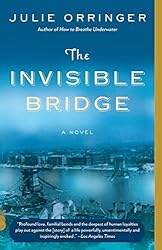
The Invisible Bridge
Julie Orringer, 2010
Knopf Doubleday
784 pp.
ISBN-13: 9781400034376
Summary
A grand love story set against the backdrop of Budapest and Paris, an epic tale of three brothers whose lives are ravaged by war, and the chronicle of one family’s struggle against the forces that threaten to annihilate it.
Paris, 1937.
Andras Levi, a Hungarian-Jewish architecture student, arrives from Budapest with a scholarship, a single suitcase, and a mysterious letter he has promised to deliver to C. Morgenstern on the rue de Sevigne.
As he falls into a complicated relationship with the letter’s recipient, he becomes privy to a secret history that will alter the course of his own life.
Meanwhile, as his elder brother takes up medical studies in Modena and their younger brother leaves school for the stage, Europe’s unfolding tragedy sends each of their lives into terrifying uncertainty. At the end of Andras’s second summer in Paris, all of Europe erupts in a cataclysm of war.
Orringer takes us from the small Hungarian town of Konyar to the grand opera houses of Budapest and Paris, from the lonely chill of Andras’s room on the rue des Ecoles to the deep and enduring connection he discovers on the rue de Sevigne, from the despair of Carpathian winter to an unimaginable life in forced labor camps and beyond.
The Invisible Bridge is the story of a love tested by disaster, of brothers whose bonds cannot be broken, of a family shattered and remade in history’s darkest hour, and of the dangerous power of art in a time of war.
Expertly crafted, magnificently written, emotionally haunting, and impossible to put down, The Invisible Bridge resoundingly confirms Julie Orringer’s place as one of today’s most vital and commanding young literary talents. (From the publisher.)
Author Bio
• Birth—June 12, 1973
• Where—Miami, Florida, USA
• Education—B.A., Cornell University; M.F.A., University of Iowa; Stegner Fellowship, Stanford University
• Awards—Ploughshares Cohen Award; Paris Review’s Plimpton Prize for Fiction
• Currently—lives in Brooklyn, New York City, New York
Julie Orringer is a short story writer and author of two higly acclaimed works of historical fiction. Both were bestsellers. The Invisible Bridge was published in 2010, and The Flight Portfolio in 2019.
Orringer is a graduate of the Iowa Writers' Workshop and Cornell University, and was a Stegner Fellow in the Creative Writing Program at Stanford University. Her stories have appeared in the Paris Review, Yale Review, Ploughshares, Pushcart Prize Anthology, and Zoetrope: All-Story. She lives in Brooklyn, New York City. (From the publisher.)
Book Reviews
[T]he horrors of war never become Ms. Orringer's primary subject. She devotes far more attention to conveying the intricacies of Jewish life and describing the ways in which they were cherished and preserved. This is a book in which one family's cooking rituals can take on an almost totemic importance.... Andras's most enduring wish…is to create a kind of family memorial. And Ms. Orringer, writing with both granddaughterly reverence and commanding authority, has done it for him.
Janet Maslin - New York Times
We all know what happened in the Holocaust, even if few among us can ever understand it, and the close of the novel demonstrates the refreshing trust Orringer has in her audience. The Invisible Bridge provides another literary glimpse of the day-to-day horrors of that time, and also reminds us of the potential contributors to the postwar world—the architects and painters, the professionals and tradesmen—who were lost from Mitteleuropa…The strength of The Invisible Bridge lies in Orringer's ability to make us care so deeply about the people of her all-too-real fictional world. For the time it takes to read this fine novel, and for a long time afterward, it becomes our world too.
Andrew Ervin - New York Times Book Review
Orringer uses the symbolism of invisible bridges in many inventive ways, re-engineering traditional dimensions of time and space, calibrating the immensity of world-war deaths against the specifics of one family's life, and building emotional connections between parents and children, husbands and wives, the preserved and the obliterated…She maintains a fine balance between the novel's intimate moments…and its panoramic set-pieces. Even those monumental scenes manage to display a tactful humility: This is a story, they keep reminding us, and it's not bringing anybody back. With its moving acknowledgment of the gap between what's been lost and what can be imagined, this remarkably accomplished first novel is itself, in the continuing stream of Holocaust literature, an invisible bridge.
Donna Rifkind - Washington Post
Orringer's stunning first novel far exceeds the expectations generated by her much-lauded debut collection, How to Breath Underwater. In this WWII saga, Orringer illuminates the life of Andras Levi, a Hungarian Jew of meager means whose world is upended by a scholarship to the Ecole Speciale d'Architecture in Paris. There, he makes an unlikely Hasz), a woman nine years his senior whose past links her to a wealthy Hungarian family familiar to Andras. Against the backdrop of grueling school assignments, exhausting work at a theater, budding romance, and the developing kinship between Andras and his fellow Jewish students, Orringer ingeniously depicts the insidious reach of the growing tide of anti-Semitism that eventually lands him back in Hungary. Once there, Orringer sheds light on how Hungary treated its Jewish citizens—first, sending them into hard labor, though not without a modicum of common decency—but as the country's alliance with Germany strengthens, the situation for Jews becomes increasingly dire. Throughout the hardships and injustices, Andras's love for Claire acts as a beacon through the unimaginable devastation and the dark hours of hunger, thirst, and deprivation. Orringer's triumphant novel is as much a lucid reminder of a time not so far away as it is a luminous story about the redemptive power of love.
Publishers Weekly
In September 1937, Andras Levi leaves Budapest for Paris, where he will study at the Ecole Speciale on a scholarship. Before he leaves, he encounters Elza Hasz, who asks him to carry a letter to Paris addressed to C. Morgenstern. Andras posts the letter and begins his studies, getting help from a Hungarian professor, a desperately needed job from a theater director he met on the train, and an introduction to some friends from an actress at the theater. The daughter is sullen and disinterested, but the mother turns out to be Claire Morgenstern, recipient of the mysterious letter, and it is with Claire that Andras launches a tumultuous affair. Soon, a painful secret about Claire's past emerges—and then war comes to sweep everything aside. Verdict: With historic detail, a complex cast of characters, and much coincidental crossing, this book has a big, sagalike feel. Unfortunately, it also has a paint-by-the-numbers feel, as if the author were working too hard to get through every point of the story she's envisioned. The result is some plain writing, not the luminous moments we remember from her story collection, How To Breathe Underwater. Nevertheless, this should appeal to those who like big reads with historic significance. —Barbara Hoffert
Library Journal
A long, richly detailed debut novel from prizewinning short-story writer Orringer (How to Breathe Underwater, 2003), unfolding from a little-explored area of the Holocaust. The brothers Andras and Tibor Levi, Hungarian Jews, are models of aspiration. As the narrative opens, Andras is bound for Paris to study architecture, Tibor for Italy to study medicine. The year is 1937, far enough along in the proceedings that neither should be surprised to learn that bad things are about to happen; yet both are so resolutely set on their paths that, it seems, the outside world does not always figure. Andras is helped along by a few fellow Jews at the Parisian academy, as well as a seemingly sympathetic artist who inspires him to contemplate, at 22, converting to "become a Christian, and not just a Christian-a Roman Catholic, the Christians who'd imagined houses of God like Notre-Dame, like the Saint-Chapelle, like the Matyas Templom or the Basilica of Szent Istvan in Budapest." This will not be the first time Andras gives free play to lofty-mindedness, but the mood gives way to earthlier concerns when he meets a woman who has an engagingly complex past-and whose story will travel alongside Andras's through the labor-camp system and, eventually, the Nazi death machine. Tibor's story is a quieter version of Andras's; indeed, the reader sometimes wonders whether Orringer has forgotten about him, though only for a time. The author works large themes of family, loyalty and faith across a huge sweep of geography and history. Her settings are the smart avenues of world capitals, snowy dirt tracks on the road to Stalingrad, even the woods of upstate New York. Her story develops without sentimentality or mawkishness, though it is full of grand emotions. Though the events of the time, especially in Hungary, are now the stuff of history books and increasingly fewer firsthand memories, Orringer writes without anachronism, and convincingly. Written with the big-picture view of Doctor Zhivago or Winds of War.
Kirkus Reviews
Discussion Questions
1. What does the opening chapter establish about the cultural and social milieu of prewar Budapest? What do Andras’s reactions to Hasz household reveal about the status of Jews within the larger society? How do the differences between the Hasz and Levi families affect their assumptions and behavior during the war? Which scenes and characters most clearly demonstrate the tensions within the Jewish community?
2. Why do Andras and his friends at the Ecole Speciale tolerate the undercurrent of anti-Semitism at the school even after the verbal attack on Eli Polaner (pp. 39–40) and the spate of vandalism against Jewish students (p. 94)? To what extent are their reactions shaped by their nationalities, political beliefs, or personal histories? Why does Andras agree to infiltrate the meeting of Le Grand Occident (pp. 97–102)? Is his belief that “[the police] wouldn’t deport me... Not for serving the ideals of France” (p. 102), as well as the reactions of Professor Vago and Andras’s father to the German invasion of Czechoslovakia (p. 266) naïve, or do they represent widespread opinions and assumptions?
3. Andras and Klara’s love blossoms against the background of uncertainties and fear. Is Klara’s initial lack of openness about her background justified by her situation? Why does she eventually begin an affair with Andras? Are they equally responsible for the arguments, break-ups, and reconciliations that characterize their courtship? Do Klara’s revelations (pp. 214–34) change your opinion of her and the way she has behaved?
4. Despite the grim circumstances, Andras and Mendel produce satirical newspapers in the labor camps. What do the excerpts from "The Snow Goose" (p. 331), The Biting Fly (pp. 360–61), and The Crooked Rail (p. 437) show about the strategies that helped laborers preserve their humanity and their sanity? What other survival techniques do Andras and his fellow laborers develop?
5. In Budapest, the Levi and Hasz families sustain themselves with small pleasures, daily tasks at home and, in the case of the men, working at the few jobs still available to Jews (pp. 352–55, pp. 366–77, pp. 405–10). Are they driven by practical or emotional needs, or both? Does the attempt to maintain ordinary life represent hope and courage, or a tragic failure to recognize the ever-encroaching danger? What impact do the deprivations and degradations imposed by the Germans have on the relationship between the families? Which characters are the least able or willing to accept the threats to their homeland and their culture?
6. What details in the descriptions of Banhida (pp. 356–63, pp. 392–99), Turka (pp. 486–503), and the transport trains (pp. 558–66) most chillingly capture the cruelty perpetrated by the Nazis? In addition to physical abuse and deprivation, what are the psychological effects of the camps’ rules and the laws imposed on civilian populations?
7. General Marton in Banhida (pp. 399–402), Captain Erdo, and the famous General Vilmos Nagy in Turka all display kindness and compassion. Miklós Klein engages in the tremendously dangerous work of arranging emigrations for fellow Jews (pp. 422–23). What motivates each of them to act as they do? What political ideals and moral principles lie at the heart Nagy’s stirring speech to the officers-in-training (pp. 506–7)? (Because of his refusal to support official anti-Semitic policies, Nagy was eventually forced to resign from the Hungarian army; in 1965, he was the first Hungarian named as a Righteous Among the Nations by the Yad Vashem Institute.)
8. Why does Klara refuse to leave Budapest and go to Palestine (p. 510)? Is her decision the result of her own set of circumstances, or does it reflect the attitudes of other Jews in Hungary and other countries under Nazi control?
9. “He could no sooner cease being Jewish than he could cease being a brother to his brothers, a son to his father and mother” (p. 46). Discuss the value and importance of Jewish beliefs and traditions to Andras and other Jews, considering such passages as Andras’s feelings in the above quotation and his thoughts on the High Holidays (pp. 201–3); the weddings of Ben Yakov and Ilana (pp. 255–56) and of Andras and Klara (p. 317); the family seder in wartime Budapest (pp. 352–55); and the prayers and small rituals conducted in work camps.
10. The narrative tracks the political and military upheavals engulfing Europe as they occur. What do these intermittent reports demonstrate about the failure of both governments and ordinary people to grasp the true objectives of the Nazi regime? How does the author create and sustain a sense of suspense and portending disaster, even for readers familiar with the ultimate course of the war?
11. Throughout the book there are descriptions of Andras’s studies, including information about his lessons and the models he creates and detailed observations of architectural masterpieces in Paris. What perspective does the argument between Pingsson and Le Corbusier offer on the role of the architect in society (pp. 273–74)? Whose point of view do you share? What aspects of architecture as a discipline make it particularly appropriate to the themes explored in the novel? What is the relevance of Andras’s work as a set designer within this context?
12. Andras’s encounters with Mrs. Hász (p. 6) and with Zoltan Novak (pp. 19–20) are the first of many coincidences that determine the future paths of various characters. What other events in the novel are the result of chance or luck? How do the twists and turns of fortune help to create a sense of the extraordinary time in which the novel is set?
13. Does choice also play a significant role in the characters’ lives? What do their decisions (for example, Klara’s voluntary return to Budapest; Gyorgy’s payments to the Hungarian authorities; and even Joszef’s attack on Andras and Mendel (p. 492)) demonstrate about the importance of retaining a sense of independence and control in the midst of chaos?
14. The Holocaust and other murderous confrontations between ethnic groups can challenge the belief in God. “(Andras) believed in God, yes, the God of his fathers, the one to whom he’d prayed...but that God, the One, was not One who intervened in the way the needed someone to intervene just then. He had designed the cosmos and thrown its doors open to man, and man had moved in.... The world was their place now” (p. 432). What is your reaction to Andras’s point of view? Have you read or heard explanations of why terrible events come to pass that more closely reflect your personal beliefs?
15. What did you know about Hungary’s role in World War II before reading The Invisible Bridge? Did the book present information about the United States and its Allies that surprised you? Did it affect your views on Zionism and the Jewish emigration to Palestine? Did it deepen your understanding of the causes and the course of the war? What does the epilogue convey about the postwar period and the links among past, present, and future?
16. “In the end, what astonished him the most was not the vastness of it all—that was impossible to take in, the hundreds of thousands dead from Hungary alone, and the millions from all over Europe—but the excruciating smallness, the pinpoint of which every life was balanced” (p. 558). Does The Invisible Bridge succeed in capturing both the “vastness of it all” and the “excruciating smallness” of war and its impact on individual lives?
17. Why has Orringer chosen “Any Case” by the Nobel Prize–winning Polish poet Wislawa Szymborkska as the coda to her novel? What does it express about individuals caught in the flow of history and the forces that determine their fates?
(Questions issued by publisher.)
top of page (summary)

The Invisible Life of Ivan Isaenko
Scott Stambach, 2016
St. Martin's Press
336 pp.
ISBN-13: 9781250081865
Summary
The Fault In Our Stars meets One Flew Over the Cuckoo's Nest.
Seventeen-year-old Ivan Isaenko is a life-long resident of the Mazyr Hospital for Gravely Ill Children in Belarus.
For the most part, every day is exactly the same for Ivan, which is why he turns everything into a game, manipulating people and events around him for his own amusement.
Until Polina arrives.
She steals his books. She challenges his routine. The nurses like her.
She is exquisite. Soon, he cannot help being drawn to her and the two forge a romance that is tenuous and beautiful and everything they never dared dream of. Before, he survived by being utterly detached from things and people.
Now, Ivan wants something more: Ivan wants Polina to live. (From the publisher.)
Author Bio
• Birth—N/A
• Where—Rochester, New York, USA
• Education—B.A., B.S., State University of New York-Buffalo; M.S., University of
California-San Diego
• Currently—lives in San Diego, California
Scott Stambach is an American author and physics professor. His first novel, The Invisible Life of Ivan Isaenko, was published in 2016 and referred to as an "auspicious, gut-wrenching, wonderful debut" by Kirkus Reviews.
Stambach lives in San Diego where he teaches physics and astronomy at Grossmont and Mesa colleges. He also collaborates with Science for Monks, a group of educators and monastics working to establish science programs in Tibetan Monasteries throughout India. He has written about his experiences working with monks of Sera Jey monastery and has published short fiction in several literary journals including Ecclectica, Stirring, and Convergence. (Adapted from the author's website.)
Book Reviews
Scott Stambach’s wonderful debut prods us to question everything—reality, religion, morality, even the value of life itself—and he does it through the voice of 17- year-old Ivan Isaenko. If you’re trapped in a mutated body, but you also happen to be a prodigy—well-versed in Russian literature, say, and astrophysics—how could you not question the very things the rest of us accept as settled wisdom? READ MORE.
Molly Lundquist - LitLovers
[I]mpressive, well-structured debut.... Stambach’s surprising, empathetic novel takes on heavy themes of illness, suffering, religion, patience, and purpose, with a balanced mix of humor and heart.
Publishers Weekly
(Starred review.) [S]easoned with humor, wit, and astute observation.... What's more, despite the presence of a corrupt health care bureaucracy, the story highlights the ways random acts of kindness can illuminate individual lives and make the seemingly unbearable tolerable, if not wholly acceptable. An auspicious, gut-wrenching, wonderful debut.
Kirkus Reviews
Discussion Questions
We'll add publisher questions if and when they're available; in the meantime, use these LitLovers talking points to help start a discussion for The Invisible Life of Ivan Isaenko...then take off on your own:
1. In a confrontation with Nurse Natalya, Ivan says he would rather be mentally "deficient" than mentally cogent living at Mazyr Hospital for Gravely Ill Children. Natalya responds that "self-awareness is what makes life worth living." What do you think?
2. Why does Ivan work so hard to learn how to change Max's diaper? Why is the two-year-old so important to him that he takes Polina to see him?
3. What is the state of Ivan's faith? He says he once believed "there was a set amount of bad to be distributed to all people." What made him question, even change, his belief in the fairness of the world? Another time he asks Natalya, "Should I be angry with God?" Natasha says, "God didn't do this to you, Ivan." What would you say to Ivan to answer his doubts?
4. Talk about Nurse Natalya, Ivan says she is the closest person to a mother he has ever had. Why is her kindness so rare? Consider the myriad duties of nurses at the Mazyr Hospital. Does that kind of overloaded schedule sap one's ability to sympathize? Might there be other reasons (of course, the author never develops any of the personalities, but we're allowed to conjecture on our own).
5. The unfairness of Dr. Ridick's ability to cure the "heart-hole" children is a conflicting emotion for Ivan. Talk about his feelings toward them. He paraphrases Nabokov: "the world needs happy endings no matter how unethical." (See quote below.) Why does Ivan draw upon that quotation? How, in his mind, does it apply to the ethics of curing the heart-hole children?
6. What are the Interlopers, and why is Ivan wary of them?
7. Ivan considers Polina an Interloper, at first. Talk about Ivan's initial reactions to her: he hates—and fears—her the very moment he lays eyes on her. Why? He lists his reasons for despising her, one of which is that "she obliterated the edges of my world." What does he mean by that phrase? More to the point: what do the particular reasons for his hatred—to say nothing of the list itself—reveal about Ivan?
8. (Follow-up to Question 7): A few pages later, after he discovers Polina reading Gogol, Ivan says of her:
[S]he was someone who could see my reality and reflect it back to me. She was someone who could make me feel I was not just a ghost haunting the hallways.
What does Ivan mean, and why is it so disturbing to him?
9. The Invisible Life of Ivan Isaenko has numerous moments of humor, sometimes to the point of hilarity. Consider the episodes with his therapists, particularly with Dr. Moisey Sokolov who he treats as the patient. What other comments, conversations, or observations of Ivan's do you find funny?
10. One of the most poignant chapters of the book concerns Ivan's mother, or the mother he envisions. Talk about his ideal and what it reveals about Ivan's state.
(Questions by LitLovers. Please feel free to use them, online or off, with attribution. Thanks.)
The actual quote is from Nabokov's 1953 novel Pnin: "Some people—and I am one of them—hate happy ends. We feel cheated. Harm is the norm. Doom should not jam. The avalanche stopping in its tracks a few feet above the cowering village behaves not only unnaturally but unethically."


Invisible Man
Ralph Ellison, 1952
Knopf Doubleday
581 pp.
ISBN-13: 9780679732761
Summary
Winner, 1953 National Book Award
Invisible Man is a milestone in American literature, a book that has continued to engage readers since its appearance in 1952. A first novel by an unknown writer, it remained on the bestseller list for sixteen weeks, won the National Book Award for fiction, and established Ralph Ellison as one of the key writers of the century.
The nameless narrator of the novel describes growing up in a black community in the South, attending a Negro college from which he is expelled, moving to New York and becoming the chief spokesman of the Harlem branch of "the Brotherhood", and retreating amid violence and confusion to the basement lair of the Invisible Man he imagines himself to be.
The book is a passionate and witty tour de force of style, strongly influenced by T.S. Eliot's The Waste Land, Joyce, and Dostoevsky. (From the publisher.)
Author Bio
• Birth—1914
• Where—Oklahoma City, Oklahoma, USA
• Died—April 16, 1994
• Where—New York, New York
• Education—Tuskegee Institute
• Awards—National Book Award
Ralph Ellison was born in 1914 in Oklahoma City, the son of Lewis Ellison, a construction worker, and his wife, Ida, a domestic. He was introduced to literature by his mother, who used to bring him books she borrowed from the homes she cleaned. A further exposure was provided by the ironies of segregation: in the 1920s, Oklahoma City had no black library, and books from the library's main branch were shelved haphazardly in a pool hall, where the young Ralph might find a volume of fairy tales alongside one of Freud—with no well-meaning librarian telling him what a child ought or ought not to be reading.
Ellison attended Alabama's Tuskegee Institute on a music scholarship, but in 1936 he moved to New York City, where he began writing short stories while supporting himself as a free-lance photographer and audio engineer. After serving in the Merchant Marine during World War II, he spent seven years writing Invisible Man, working out of an office located at the back of a jewelry store on Fifth Avenue. The book was published in 1952 and was awarded the National Book Award. It has been translated into seventeen languages.
The manuscript of Ellison's second novel was destroyed by a fire in 1967. He spent the remaining years of his life painstakingly reconstructing it, while publishing two volumes of nonfiction, Shadow and Act (1964) and Going to the Territory (1986). He taught and lectured widely, was appointed to the American Academy of Arts and Letters, served on the National Council on the Arts and Humanities and the Carnegie Commission on public television, and was a trustee of the John F. Kennedy Center for the Performing Arts.
Ralph Ellison died of cancer on April 16, 1994, at his home in New York City. (From the publisher.)
Book Reviews
With this book the author maps a course from the underground world into the light. Invisible Man belongs on the shelf with the classical efforts man has made to chart the river Lethe from its mouth to its source (New York Times Books of the Century).
Wright Morris - New York Times (April, 1952)
Unquestionably, Ellison's book is a work of extraordinary intensity—powerfully imagined and written with a savage, wryly humorous gusto.
Atlantic Monthly
[O]ne of the lasting masterpieces of American literature. It chronicles the existential journey of an unnamed black man attempting to discover his identity and role in a hostile and confusing world that refuses to acknowledge his existence. Within the story of the protagonist's quest for definition, Ellison offers a vivid and unforgiving examination of the shortcomings of the self-serving black bourgeoisie, clumsy white philanthropists, dehumanizing American industry, and unrealistic revolutionary movements.... [A]n essential book,
Sacred Fire
Ralph Ellison's 1952 novel tells truths about the nature of bigotry and its effect on the minds of victims and perpetrators (Grade 11 and up).
School Library Journal
Discussion Questions
1. What makes Ellison's narrator invisible? What is the relationship between his invisibility and other people's blindness—both involuntary and willful? Is the protagonist's invisibility due solely to his skin color? Is it only the novel's white characters who refuse to see him?
2. One drawback of invisibility is that "you ache with the need to convince yourself that you do exist in the real world" [p. 4]. How does the narrator try to prove that he exists? Does this sentence provide a clue to the behavior of other characters in the book?
3. What are the narrator's dreams and goals? How are these variously fulfilled or thwarted in the course of the book?
4. Is the reader meant to identify with the narrator? To sympathize with him? How do you think Ellison himself sees his protagonist?
5. What is the significance of the grandfather's deathbed speech [p.16]? Whom or what has he betrayed? What other characters in this book resort to the same strategy of smiling betrayal?
6. Throughout the novel the narrator gives speeches, or tries to give them, to audiences both black and white, at venues that range from a whites-only "smoker" to the funeral of a black street vendor murdered by the police. What role does oratory—and, more broadly, the spoken word—play in Invisible Man?
7. The "battle royal" sequence portrays black men fighting each other for the entertainment of whites. Does Ellison ever portray similar combats between blacks and whites? To what end?
8. Throughout the book the narrator encounters a number of white benefactors, including a millionaire college trustee, an amiable playboy, and the professional agitator Brother Jack. What does the outcome of these relationships suggest about the possibility of friendship or cooperation between the races?
9. What black men does the protagonist choose as mentors or role models? Do they prove to be any more trustworthy than his white "benefactors"? What about those figures whose authority and advice the narrator rejects—for example, the vet in The Golden Day and the separatist Ras the Exhorter? What characters in Invisible Man, if any, represent sources of moral authority and stability?
10. What cultural tendencies or phenomena does Ellison hold up for satire in this novel? For example, what were the real-life models for the Founder, the Brotherhood, and Ras the Exhorter? How does the author convey the failures and shortcomings of these people and movements?
11. Why might Tod Clifton have left the Brotherhood to peddle demeaning dancing Sambo dolls? What does the narrator mean when he says: "It was as though he [Clifton] had chosen...to fall outside of history"? How would you describe Ellison's vision of history and the role that African-Americans play within it?
12. Invisible Man may be said to exemplify the paranoid style of American literature. How does Ellison establish an atmosphere of paranoia in his novel, as though the reader, along with the narrator, "had waded out into a shallow pool only to have the bottom drop out and the water close over my head" [p.432]? Why is this style particularly appropriate to Ellison's subject matter?
13. Where in Invisible Man does Ellison—who was trained as a musician—use language to musical effect? (For example, compare the description of the college campus on pages 34-7 to Trueblood's confession on 51-68, to the chapel scene on 110-135, and Tod Clifton's funeral on 450-461.) What different sorts of language does Ellison employ in these and other passages? How does the "music" of these sections—their rhythm, assonance, and alliteration—heighten their meaning or play against it?
14. More than sixty years after it was first published, Invisible Man is still one of the most widely read and widely taught books in the African-American literary canon. Why do you think this is so? How true is this novel to the lives of black Americans in the 1990s?
15. In spite of its vast success (or perhaps because of it), Ellison's novel—and the author himself—were fiercely criticized in some circles for being insufficiently "Afrocentric." Do you think this is true? Do you think Ellison made artistic compromises in order to make Invisible Man accessible to white readers?
(Questions issued by the publisher.)


The Invisible Ones
Stef Penney, 2012
Penguin Group USA
416 pp.
ISBN-13: 9780399157714
Summary
Small-time private investigator Ray Lovell veers between paralysis and delirium in a hospital bed. But before the accident that landed him there, he'd been hired to find Rose Janko, the wife of a charismatic son of a traveling Gypsy family, who went missing seven years earlier.
Half Romany himself, Ray is well aware that he's been chosen more for his blood than his investigative skills. Still, he's surprised by the intense hostility he encounters from the Jankos, who haven't had an easy past. Touched by tragedy, they're either cursed or hiding a terrible secret-whose discovery Ray can't help suspecting is connected to Rose's disappearance. (From the publisher.)
Author Bio
• Birth—1969
• Where—Edinburg, Scotland, UK
• Education—Bristol University
• Awards—Costa (Whitbread) Award
• Currently—lives in London, England
Stef Penney was born and grew up in Edinburgh. After earning a degree in philosophy and theology from Bristol University, she turned to filmmaking, studying film and TV at Bournemouth College of Art. On graduation she was selected for the Carlton Television New Writers Scheme. She is a screenwriter. Her debut novel, The Tenderness of Wolves, won the 2006 Costa Award. She published The Invisible Ones in 2012. (From the publisher.)
Book Reviews
The mystery element of the story is adroitly handled, as clues and subtle inconsistencies in the Janko story are dropped in. Yet its destination is a total surprise, and if that is because it stretches the bounds of credibility, Penney is confident enough to let her characters say exactly that. The Invisible Ones is a book about love, deception, growing up, belonging, being an outsider and about how all our presents are haunted by our pasts. Its author is a supreme story-teller on top form.
London Times
Penney is a good storyteller. She unfurls various mysterious plot possibilities and unearths the insecurities that lurk in families and relationships. She imagines the Romany world carefully, avoiding cliche or judgement or anything too negative ... there are moments of transcendence here, moments where Penney's writing really excels.
Sunday Times (UK)
[A] haunting tale...this is a beautifully crafted novel with skilful characterisation and a plot which twists and turns.... [T]his story of loss, deceit and family tragedy lingers long after you've finished the book,
Daily Express (UK)
Penney's portrayal of the gypsy way of life is sympathetic. Seemingly bizarre customs are given a context; strong love is set against deadening control.... Ivo's return trip to Lourdes with JJ, Christo and their grandmother is a marvellously atmospheric piece of writing.
Financial Times
In her mesmerizing sophomore outing, Penney wraps a riddle in a mystery inside an enigma that intrigues from the very first page. As the tale—set in the ’80s—begins, private eye Ray Lovell wakes up in an English hospital with little memory and partial paralysis. While he recovers, other problems present. Lovell Price Investigations is broke and most of its cases involve adultery, about which Ray says: “These sorts of cases... can depress you if you let them.” Then Ray, who is half-Gypsy himself, is offered a job by a fellow Gypsy, Leon Wood, who wants Ray to find his daughter, Rose, who he hasn’t seen or spoken to in seven years, ever since she married Ivo Janko, another Gypsy (or traveler, as the British often call them). Why Leon wants to find Rose after so much time begins the mystery. He tells Ray it’s because her mother has died and she should know, but Leon suspects foul play even though Rose’s husband claims she ran off with a “gorjio” right after having a child, but Leon suspects foul play. Given his Gypsy heritage, Ray is able to insert himself into the itinerant lifestyle of that world—exactly the reason why Leon has hired him. But even with his knowledge of the traveling life, Ray is surprised by the stonewalling and half-truths he encounters while trying to learn the Janko family’s secrets. The narrative slides seamlessly between Ray’s point of view and that of J.J., Ivo’s cousin’s son, giving the reader a balanced perspective—and serving up two truly shocking twists at the story’s end. Fast-paced, with characters who will live in full color inside the reader’s head, Penney delivers an impressive follow-up to her debut bestseller, The Tenderness of Wolves.
Publishers Weekly
Penney's Costa Award-winning debut, The Tenderness of Wolves, offers edge-of-civilization suspense in Canada's Northern Territory in the 1860s. Set in 1980s England, her new novel might seem like a departure, but it's not; here Penney probes the edge-of-civilization otherness of England's Romany (or Gypsies) while presenting a mystery rooted in the stranglehold of family. As the novel opens, Det. Ray Lovell gets a visit from Leon Wood, a Gypsy whose daughter, Rose, went missing years ago after marrying into the Janko family. Since Lovell has Gypsy roots, he's the only investigator Wood trusts. Trying to breach the silence surrounding Rose's disappearance, Lovell goes up against the entire Janko clan, including patriarch Tener; Tener's son Ivo, husband to Rose and father to Christo, who's languishing from an inherited disease that has killed off much of the family; Sandra, Ivo's cousin and the mother of JJ; and JJ himself, who's 14, smart, and the family's bridge to the outer world. Told alternately from Lovell's and JJ's perspectives, the story ends with a bone-rattling surprise that conveys how much the Jankos have endured. Verdict: Another stunner from Penney; highly recommended. —Barbara Hoffert
Library Journal
Perhaps one of the first novels involving a half-Gypsy as a detective. Penney uses the missing-person plot rather than the whodunit to provide a thread for her narrative. One day Romany Leon Wood shows up at Ray Lovell's failing detective agency to hire him to find his missing daughter, Rose. Lovell has some immediate concerns about the case, primarily because Rose has been missing for seven years. Leon has a Gypsy's reluctance to go to the police about the case but trusts Lovell because he's half Romany—his father was born in a field in Kent while his mother was gorjio, or non-Romany. The novel starts with Lovell in a hospital, partially paralyzed and vaguely remembering a recent sexual encounter, though he's unsure whether this was memory or hallucination. As he gets well, he takes us back to his initial steps in tracing Rose's disappearance. Besides Lovell, Penney uses JJ Janko, a Romany teenager, as her other narrator. JJ is concerned about Ivo, his uncle, but especially about Ivo's son Christo, who's suffering from a rare and seemingly incurable disease, one that Ivo himself had had as a child and "miraculously" recovered from. (Ivo had made a pilgrimage to Lourdes, where they also take Christo in a desperate attempt to cure him.) Fortunately, Lovell has a pediatrician friend who's able to give insight into the nature of Christo's illness and how it's genetically transmitted from generation to generation...and it turns out that it's impossible for Ivo to be Christo's father. Penney gives her plot plenty of twists and saves the best for the end, with a truly unforeseen and unpredictable conclusion.
Kirkus Reviews
Discussion Questions
1. The author chose to tell this story with two narrators, each of whom offers a different view into Romany culture. Would the story have been stronger or weaker with just one narrator? Do the narrators’ positions affect your perspective on the culture?
2. Why do you think the author chose JJ to illustrate Romany culture? How would the story have been influenced by a different narrator—Tene or Sandra, for example? What effect does JJ’s voice have on the story?
3. JJ reflects on a disastrous study date with a classmate at the end of chapter 16, saying that he and Stella are “like trains on tracks that run more or less parallel but will never meet. I can’t go on her tracks, and she can’t go on mine.” In what ways is Romany culture different from the outside world? In what ways is it the same?
4. Romany face a significant amount of prejudice and stereotyping. What are some examples in the novel? What impact does this have on the characters? How are Romany themselves prejudiced against outsiders? How does Ray Lovell walk the line between his two cultures?
5. Ray Lovell’s viewpoint moves between his past and his present. How does solving the mystery "alongside" him enhance your reading experience?
6. “Pure blood” is a significant concern through this novel. How does pure blood shape the “one of us” mentality? How has the desire for pure blood affected the Janko family? Are there other cultures or instances in history where “pure blood” has been a valuable trait?
7. The Jankos visit the healing bathhouses at Lourdes in an attempt to cure Christo’s mysterious disease, through prayer and holy water. JJ says that his family is not religious, though we learn that their culture is rich in folklore. How does their belief in the healing power of Lourdes align with their folkloric traditions? Are there ways in which it conflicts?
8. Luck is a prevalent theme in the novel. Are the Jankos lucky or unlucky? Explain with specific instances that the Jankos attribute to luck.
9. The Invisible Ones is set in the 1980s. Why do you think the author chose this time period? In what ways does it affect your reading experience?
10. Sandra and Lulu have very different reactions to Ray’s revelation about Ivo. Sandra is arguably much closer to Ivo, but she responds much more calmly to the news. Were you surprised by this? Why do you think the two reacted so differently?
(Questions issued by publisher.)
Use a numeral "one" not upper-case "I" ...
Not to worry ... it's an easy mistake.


IRAN (The de'Conte Series, 6)
Nicholas Borelli, 2016
CreateSpace
314 pp.
ISBN-13: 9781523678792
Summary
Niccolo Cervantes de'Conti is an international attorney with global clientele based in New York's prestigious Rockefeller Center.
He represents clients in Europe, the Middle East, Africa and Asia who do business with Iranian companies. The United States government would like an "introduction" to some of his clients’ Iranian counter-parties to effect covert foreign policy.
The U.S. spies know that Iran has cheated on the nuclear arms deal and has a stash of weapons grade uranium and plutonium hidden deep underground in the Iranian desert. Nick de'Conti will join a CIA-led team to effect U.S. covert operations.
Author Bio
• Birth—1951
• Where—New York City, New York, USA
• Education—B.M.E., Pratt Institute; M.B.A., Fordham University
• Currently—Wilton, Connecticut
Nicholas Borelli, a New England based author, has and continues to write the de'Conti series.
The novels currently include Let No Man Be My Albatross, A Convoluted Defense, The Machiavelli Imperative, FATA! The Act of the Vengeance, At Last Reconciled and IRAN. Mr. Borelli is writing two more novels: Dahij and A Special Prosecution.
These works feature the protagonist Niccolo Cervantes de'Conti. Mr. Borelli has conceived and developed a central character based on his knowledge of and first-hand experience with the gritty New York inner city of his youth. Nick de'Conti is an ethnic mixture of Basque and Southern Italian. He has a penchant for independent thought and action, and a passion with which he approaches everything in his life. He is a prominent lawyer, an aristocrat. The arc of his life is developed from the depths of his childhood poverty in East Harlem in the cruel, inner city streets of New York City to his unimagined success—albeit troubled, conflicted and, at times, ethically bereft.
These novels are edgy, raw, graphic and thought-provoking.
Although de'Conti is a former New York City prosecutor and United States Attorney, his hard life as a child in the inner city of East Harlem sometimes causes him to mete out as much street justice as he does the legal kind. He abhors the abuse of women, his own college-age daughter having been murdered at the hands of male predators. He will revert to instincts he developed as an inner city kid, even though he lives in a Fifth-Avenue penthouse on a high floor across from New York's Central Park. (From the author.)
Visit borellibooks.com.
Follow Nicholas on Instagram.
Book Reviews
In Borelli’s latest thriller, a New York lawyer gets caught up in a U.S. operation to neutralize weapons-grade material hidden in Iran.... It’s riveting stuff, though the finale includes a jarring personnel shift. Not the most likable protagonist but watching him confront danger may garner interest in his previous tales.
Kirkus Reviews
[A] page turner.... Didn't want to put it down!
Mary L., Amazon Customer Review
[R]ead this book. It's so plausibly realistic you cannot put it down.
Kindle User, Amazon Customer Review
[F]illed with intrigue.... Fast-paced enjoyable read.
Marsha N, Amazon Customer Review
Discussion Questions
1. The author obviously has technical knowledge of nuclear physics. Does the protagonist’s scientific proposals to President Obama seem plausible?
2. What do you think of Nick de’Conti’s relationship with Laleh Sassani?
3. Nick de’Conti has multiple woman in his life, including his wife Katherine Sheffield and Gabriella Desjardins, his African American beauty. Who do you think he will ultimately settle down with?
4. Nick de’Conti always reverts too his old, childhood friend in Harlem, Victor Armstrong, aka The Pig. Why do you think he relies on him so much?
5. How does this book’s premise compare to what is actually taking place between Iran and the United States on the nuclear front?
6. Do you think this world view given by the author is possible?
7. Do you like President Obama’s demeanor better in real life or the novel?
8. Do Nick de’Conti and President Obama have a good relationship?
9. What do you think of the book’s cover?
10. Would this novel make for a good feature film?
(Questions courtesy of the author.)
Irma Voth
Miriam Toews, 2011
HarperCollins
272 pp.
ISBN-13: 9780062070180
Summary
That rare coming-of-age story able to blend the dark with the uplifting, Irma Voth follows a young Mennonite woman, vulnerable yet wise beyond her years, who carries a terrible family secret with her on a remarkable journey to survival and redemption.
Nineteen-year-old Irma lives in a rural Mennonite community in Mexico. She has already been cast out of her family for marrying a young Mexican ne'er-do-well she barely knows, although she remains close to her rebellious younger sister and yearns for the lost intimacy with her mother. With a husband who proves elusive and often absent, a punishing father, and a faith in God damaged beyond repair, Irma appears trapped in an untenable and desperate situation. When a celebrated Mexican filmmaker and his crew arrive from Mexico City to make a movie about the insular community in which she was raised, Irma is immediately drawn to the outsiders and is soon hired as a translator on the set. But her father, intractable and domineering, is determined to destroy the film and get rid of the interlopers. His action sets Irma on an irrevocable path toward something that feels like freedom.
A novel of great humanity, written with dry wit, edgy humor, and emotional poignancy, Irma Voth is the powerful story of a young woman's quest to discover all that she may become in the unexpectedly rich and confounding world that lies beyond the stifling, observant community she knows. (From the publisher.)
Author Bio
• Birth—1964
• Where—Steinbach, Manitoba, Canada
• Education—University of Manitoba; University
of Kings College
• Awards—Governor General's Award, Rogers
Writers Trust Fiction Prize, Writers’ Trust
Engel/Findley Award
• Currently—lives in Toronto, Canada
Miriam Toews (prounced "Tayvz") is a Canadian writer of Mennonite descent. She grew up in Steinbach, Manitoba and has lived in Montreal and London, before settling in Winnipeg, Manitoba. She moved to Toronto in 2009.
Toews studied at the University of Manitoba and the University of King's College in Halifax, and has also worked as a freelance newspaper and radio journalist. Her non-fiction book Swing Low: A Life was a memoir of her father, a victim of lifelong depression.
Her 2004 novel A Complicated Kindness was her breakthrough work, spending over a year on the Canadian bestseller lists and winning the Governor General's Award for English Fiction. The novel, about a teenage girl who longs to escape her small Dutch Mennonite town and hang out with Lou Reed in the slums of New York City, was also nominated for the Giller Prize and was the winning title in the 2006 edition of Canada Reads.
A series of letters she wrote in 2000 to the father of her son were published on the website www.openletters.net and were profiled on the radio show This American Life in an episode about missing parents.
In 2007 she made her screen debut in the Mexican film Luz silenciosa directed by Carlos Reygadas, which screened at the Cannes Film Festival. She was nominated for Best Actress at Mexico's Ariel Awards for her performance in the film.
The Flying Troutmans was published in 2008. The novel is about a 28-year-old woman from Manitoba who takes her 15-year-old nephew and 11-year-old niece on a road trip to California after their mentally ill mother has been hospitalized. That novel won the 2008 Rogers Writers' Trust Fiction Prize. In 2010 she received the prestigious Writers’ Trust Engel/Findley Award for her body of work. Her novel, Irma Voth, came out in 2011. (From Wikipedia.)
Book Reviews
[F]or all its slow-burn funniness and faith in the redeeming power of art, the novel is built on an awareness that Irma can never fully escape her family's history of pain, suffering and loss…[Toews] writes with an instinctive grasp of the adolescent point of view, in which concepts like personal freedom and self-determination have the highest emotional charge and adults are powerful but slightly irrelevant beings.
Melissa Russo - New York Times Book Review
Miriam Toews has a remarkably light touch. She combines a playfully sardonic humour with crushing pathos.
Times Literary Supplement (UK)
In this compelling and beautiful novel, Toews’s quirky and authentic voice shows increasing range and maturity. She is well on her way to fulfilling her promise as an important and serious writer.
Montreal Gazette
A strong and skillful novel…a parable of redemption, a powerful theme…that leaves the reader with a comforting glow of hope.
Annie Proulx - Financial Times
A witty and thoughtful coming-of-age story…a novel about parenthood and sisterhood, and about redefining those relationships as people grow…it succeeds tremendously.
Washington Independent Review of Books
Toews…combines an intimate coming-of-age tale with picaresque and extremely effective prose.
Publishers Weekly
A literary novel marked by charm, wit and an original approach to language.
Kirkus Reviews
Discussion Questions
1. Who is Irma Voth? What is she like when the novel opens? Is she the same person by the book’s end? What changes about her—and what does not?
2. What are your impressions of her family? What is her role among the Voths? What are the dynamics like between Irma, her parents, and her siblings? Do you like her parents? Can you understand their choices?
3. Irma has been raised in a strict Mennonite community. Is religion important to Irma? Does she believe in the same God her father does? How has it shaped her character?
4. How would you describe her marriage? Why did she marry Jorge—and why did he marry her? Was it love?
5. Early in the story, Irma poses a question to herself. “How do I behave in this world without following the directions of my father, my husband, or God?” How would you answer Irma? How might she answer this question herself by the novel’s end?
6. What does the film crew’s arrival hold for Irma and her family? How does meeting Diego, Marijke, Wilson affect the young woman?
7. Diego talks to Irma about rebellion, and asks her a question. “Do you feel that we can rebel against our oppressors without losing our love, our tolerance, and our ability to forgive?” What would your response to Diego be? What are they all rebelling against?
8. Why does Diego suggest Irma keep a diary of her experiences on the shoot? What does she write about? What wisdom does her writing offer her and how does that wisdom affect her choices?
9. Marijke introduces Irma to Epicurus’s “four-part cure”—Don’t fear God. Don’t worry about death. What is good is easy to get, and what is terrible is easy to endure.” Is this a good philosophy to live by? Does it illuminate Irma’s struggle? How do events in her lrma’s life address all four tenets? Use examples from the story to illustrate your points.
10. What draws Irma to Wilson? She asks him to ponder a question. “if you knew this was your last day on earth what kind of story would you write?” By the end, Irma has her own answer. Explain her ultimate response, and how she came to it. What would your answer be?
11. What adjectives would you use to describe Irma? What about Aggie? Irma calls her baby sister Ximena, “honest.” Why? Can a baby be honest? Is Irma honest? What about Aggie and the rest of the people in Irma’s life?
12. When they arrive in Mexico City, Aggie discovers a Diego Rivera mural. How does the mural affect Aggie? What about Irma? How does Rivera’s message reflect the girls’ experience?
13. What role does art play in Irma’s life? Her father says, “Art is a lie.” Why? Wilson tells her that art, “comes from the same desire to live.” Later, in Mexico City, Hubertus joyfully tells Irma, “When life is a shit storm your best umbrella is art.” Analyze each of these men’s viewpoints. What do their opinions tell us about their characters? What does Irma think about art? How would she define it? Is art necessary for life—even if it is a lie? Does it shelter us from life’s vicissitudes? How? What would life be like without art?
14. A jacaranda tree saved Natalie from despair and suicide. What, in your opinion, saved Irma?
15. Was Irma right to feel guilty about what happened in Canada? Could she have known the outcome of her actions? How did her knowledge of the truth and her role transform her relationship with her father? Does Irma’s revelation influence your opinion of her?
16. At its heart, Irma Voth is the story of young woman discovering herself and finding meaning in her life. It touches on many themes—defiance, freedom, independence, beauty, sacrifice, guilt, family, art, God, forgiveness, love. Choose one or two and trace them through the course of the story, using examples from Irma’s life and those around her.
17. Towards the end of the novel, Irma sees Diego’s film. How does she feel watching it? Can she ever forgive herself for all that has passed? Do you think she will ever be reconciled with the family she left behind?
(Questions issued by publisher.)
top of page (summary)
The Irresistible Henry House
Lisa Grunwald, 2010
Random House
432 pp.
ISBN-13: 9781400063000
Summary
It is the middle of the twentieth century, and in a home economics program at a prominent university, real babies are being used to teach mothering skills to young women. For a young man raised in these unlikely circumstances, finding real love and learning to trust will prove to be the work of a lifetime. In this captivating novel, bestselling author Lisa Grunwald gives us the sweeping tale of an irresistible hero and the many women who love him.
From his earliest days as a “practice baby” through his adult adventures in 1960s New York City, Disney’s Burbank studios, and the delirious world of the Beatles’ London, Henry remains handsome, charming, universally adored—and never entirely accessible to the many women he conquers but can never entirely trust.
Filled with unforgettable characters, settings, and action, The Irresistible Henry House portrays the cultural tumult of the mid-twentieth century even as it explores the inner tumult of a young man trying to transcend a damaged childhood. For it is not until Henry House comes face-to-face with the real truths of his past that he finds a chance for real love. (From the publisher.)
Author Bio
• Birth—1959
• Where—N/A
• Education—N/A
• Currently—lives in New York City
Lisa Grunwald is the author of the novels Whatever Makes You Happy, New Year’s Eve, The Theory of Everything, and Summer. Along with her husband, journalist Stephen J. Adler, she edited the bestselling anthologies Women’s Letters and Letters of the Century. Grunwald is a former contributing editor to Life and a former features editor of Esquire. She and Adler live in New York City with their two children. (From the publisher.)
Book Reviews
Epic and thoroughly engrossing.... House sweeps along with such page-turning vitality that [Henry's] story is indeed irresistible. Grade: A
Leah Greenblat - Entertainment Weekly
A smart, enjoyable read that will leave you with a pleasing thought: Even for guys who just aren't that into anyone, there's hope.
Kim Hubbard - People
Imaginatively picaresque and often gut-wrenching.
Alex Kuczynski - O Magazine
Like T.S. Garp, Forrest Gump or Benjamin Button, Henry House , the hero of Grunwald’s imaginative take on a little known aspect of American academic life, has an unusual upbringing. In 1946, orphaned baby Henry is brought to all-girl’s Wilton College as part of its home economics program to give young women hands-on instruction in child-rearing (such programs really existed). Henry ends up staying on at the practice house and growing up under the care of its outwardly stern but inwardly loving program director, Martha Gaines. As a protest against his unusual situation, Henry refuses to speak and is packed off to a special school in Connecticut, where his talents as an artist and future lover of women bloom. After he drops out of school, Henry finds work as an animator, working on Mary Poppins, then on the Beatles’ Yellow Submarine. With cameos by Dr. Benjamin Spock, Walt Disney and John Lennon, and locations ranging from a peaceful college campus to swinging 1960s London, Grunwald nails the era just as she ingeniously uses Henry and the women in his life to illuminate the heady rush of sexual freedom (and confusion) that signified mid-century life.
Publishers Weekly
For several decades beginning in the 1920s, some college home economic departments had practice houses, complete with practice babies for students to learn scientific principles of child and home care. The babies were orphans who spent a year tended by students before being adopted. Grunwald explores what life might have been like for one such baby. Henry House, the tenth Wilton College practice baby, earns his title of irresistible by learning early how to please eight different mothers. He's a master at keeping women engaged while never showing a preference. He learns how to imitate but not to create, a skill that helps him become a competent cartoon illustrator but not a true cartoonist. Not until he comes close to losing the one friend who knows him best does he begin to break the patterns learned as a baby. Verdict: This welcome variation of coming-of-age tales shares with Grunwald's previous novels (Whatever Makes You Happy; Summer) a compelling web of characters and emotions that will please will please the author's fans and readers interested in novels with emotional depth. —Jan Blodgett, Davidson Coll. Lib. NC
Library Journal
Grunwald has created a wonderfully well-written story about a charming, lovable man who must learn to trust and love the women in his life. —Carolyn Kubisz
Booklist
A "practice baby" grows up to be the most indifferent guy, in this multilayered new novel from Grunwald. As the baby boom begins in 1946, fictional Wilton College in Pennsylvania works hard to prepare young women for that all important MRS. degree. It even provides a home economics "practice house," where coeds can hone their mother craft by caring for an infant on loan from the local orphanage. Each foundling is surnamed House by decree of Wilton's middle-aged, widowed and childless doyenne of domestic science, Martha Gaines. Three-month-old Henry, the current rental baby, is diapered, bathed and bottle-fed by alternating shifts of college students under Martha's hypercritical supervision. Though she's firmly wedded to the parenting wisdom of that era (e.g., babies must be trained, not indulged), Martha finds long-dormant maternal yearnings awakened by winsome Henry. Through guile and well-placed blackmail she adopts him, and he remains at Wilton under the care of successive practice mothers. Manipulating multiple moms teaches Henry to view women as interchangeable pushovers. Female demands-especially Martha's-repel him. A talented artist, Henry finds a haven with his beatnik art teachers in boarding school, until the birth of their child displaces him. His birth mother Betty, now a Manhattan career girl, offers temporary asylum from Martha, then unceremoniously abandons him. He finds work in Hollywood as a Disney animator, painting penguins for Mary Poppins (another story about a mother substitute). Then he moves on to London at the height of the Swinging Sixties to help animate the Beatles' Yellow Submarine. Henry is both irresistible and impervious to women other than his childhood friend Mary Jane, adept at the approach-avoidance game that is his Achilles' heel. Then, one day Henry meets his narcissistic match in another former practice baby. The near-omniscient narration perfectly suits this story, which often reads like a rueful but wry case study of nurture as nightmare.
Kirkus Reviews
Discussion Questions
1. Trust is a recurring theme in Lisa Grunwald’s novel. Which characters are most deeply affected by its presence or absence? What makes us trust another person, and what happens if that trust is betrayed? Can a relationship recover after trust has been broken?
2. For Martha Gaines, “there was no future for her without Henry. There was only her tiny world, bordered by practice walls and practice floors.” (p. 113) Why does Martha become so attached to Henry, and how would you describe their relationship?
3. Is it possible to love a person too much? Have you ever felt smothered by love? Is there a secret to building a relationship where both people feel equally loved?
4. According to Martha, “a child was something to manage, not to be managed by.” (p. 44). Do you agree with her ideas on raising children? Describe and compare the different child-rearing approaches that are explored in this story. Are they all outdated now, or do any of them still hold weight?
5. How does Henry’s early experience—being tended by a number of devoted practice mothers—affect his personality as he grows up? What is the downside to his unusual upbringing? What are the benefits?
6. As a child, Henry covers the walls of his closet with his own drawings, so that the closet becomes “a place of deep colors, vast distances, and great possibilities.” (p. 141) How is Henry’s life shaped by his artistic gifts? In what ways do these gifts fall short? How are these shortcomings reflected in his relationships with women?
7. “Henry’s silence gave him a refuge, an excuse not to participate, but it was also a weapon for keeping Martha at bay.” (p. 145) What brings on Henry’s silent period and what pulls him out of it? Why is silence such a powerful weapon? What other psychological weapons do we use against those closest to us?
8. Why is Henry drawn to Charles and Karen at the Humphrey School, and why is the couple’s home so important to him? How does their marriage compare with other romantic relationships depicted in The Irresistible Henry House?
9. At Martha’s funeral service, what does Henry discover as he describes her accomplishments? Do you think his epiphany is a momentary vision or a permanent change of heart? Is there anything truly redeeming about Martha?
10. What makes Henry choose Peace Jacobs, after so many girls and women have pursued him in vain?
11. Discuss the lifelong relationship between Henry and Mary Jane. How does Henry’s blinding of Mary Jane affect their friendship? What makes their connection to each other unique?
12. What does Grunwald’s portrayal of the lives and career options of women like Martha, Betty, and Ethel say about the opportunities for women in the mid-twentieth century? How much has changed since then?
13. As the author depicts Henry’s journey from practice baby to grown man, vivid historical details are revealed. When you look back at the various locations and decades that are depicted in The Irresistible Henry House, which scenes strike you as the most memorable, and why?
14. Over the course of the novel, Henry uses, betrays, and lies to nearly all the women who trust him. Do you consider Henry a likeable character despite this? To what extent can we blame his behavior on his upbringing? Is there a point at which we must take responsibility for our own actions?
15. Henry never meets his father or discovers his identity. Discuss the effects of this absence on Henry’s relationships with other men. What characters act as father figures for Henry?
16. Near the end of the book, Henry expresses gratitude toward Betty for choosing to go through with her pregnancy and giving him life. Beyond this initial gift, has Betty given anything to Henry as a mother? Has Henry inherited any of her characteristics?
17. Henry longs to find lasting love and a home of his own, but he finds himself chronically incapable of trust. Do you think there is hope for Henry? Can we ever truly transcend the effects of our upbringing?
18. What do you think will happen after the novel ends? Will Henry get to live in the home that he and Haley are drawing?
(Questions issued by publisher.)


Is Everyone Hanging Out Without Me? (And Other Concerns)
Mindy Kaling, 2011
Crown/Archetype
240 pp.
ISBN-13: 9780307886279
Summary
Mindy Kaling has lived many lives: the obedient child of immigrant professionals, a timid chubster afraid of her own bike, a Ben Affleck–impersonating Off-Broadway performer and playwright, and, finally, a comedy writer and actress prone to starting fights with her friends and coworkers with the sentence “Can I just say one last thing about this, and then I swear I’ll shut up about it?”
Perhaps you want to know what Mindy thinks makes a great best friend (someone who will fill your prescription in the middle of the night)
. . . or what makes a great guy (one who is aware of all elderly people in any room at any time and acts accordingly)
. . . or what is the perfect amount of fame (so famous you can never get convicted of murder in a court of law)
. . . or how to maintain a trim figure (you will not find that information in these pages).
If so, you’ve come to the right book . . . mostly!
In Is Everyone Hanging Out Without Me?, Mindy invites readers on a tour of her life and her unscientific observations on romance, friendship, and Hollywood, with several conveniently placed stopping points for you to run errands and make phone calls.
Mindy Kaling really is just a Girl Next Door—not so much literally anywhere in the continental United States, but definitely if you live in India or Sri Lanka. (From the publisher.)
Author Bio
• Birth—June 24, 1979
• Where—Cambridge, Massachesetts, USA
• Education—B.A., Darthmouth College
• Awards—Emmy
• Currently—lives in West Hollywood, California
Vera Mindy Chokalingam, known professionally as Mindy Kaling, is an American actress, comedian, and writer. She is the creator and star of the Fox and Hulu sitcom The Mindy Project, and also serves as executive producer and writer for the show. She is also known for her work on the NBC sitcom The Office, where she portrayed the character Kelly Kapoor and served as executive producer, writer and director.
Her memoir Is Everyone Hanging Out Without Me? (And Other Concers) was published in 2011. Her second book, Why Not Me? was released in 2015. Both became top sellers.
Early life
Kaling was born in Cambridge, Massachusetts, to a Tamil father, Avu Chokalingam, an architect, and a Bengali mother, Dr. Swati Chokalingam (nee Roysircar), an obstetrician/gynecologist.
Both of Kaling's parents are Hindus from India, who met while working at the same hospital in Nigeria. Kaling's mother was working as an OBGYN, and her father was overseeing the building of a wing of the hospital. The family emigrated in 1979, the same year Kaling was born. Kaling's mother died of pancreatic cancer in 2012. Kaling has an older brother, anti-affirmative action activist Vijay Jojo Chokalingam.
Kaling graduated from Buckingham Browne & Nichols, a private school in Cambridge, Massachusetts, in 1997. The following year, she entered Dartmouth College where she graduated with a B.A. in Playwriting.
While at Dartmouth, she was a member of the improvisational comedy troupe, The Dog Day Players, and the a cappella singers, The Rockapellas. She was creator of the comic strip Badly Drawn Girl in The Dartmouth (the college's daily newspaper), and a writer for the Dartmouth Jack-O-Lantern (the college's humor magazine). She was a Classics major for much of college, studying Latin, which she had not studied since 7th grade.
Career
While a 19-year-old sophomore at Dartmouth, Kaling was an intern on Late Night with Conan O'Brien. She described herself as a terrible intern, "less of a 'make copies' intern and more of a 'stalk Conan' intern."
After college, Kaling moved to Brooklyn and took what she said was one of her "worst job" experiences"—a production assistant for three months on the Crossing Over With John Edward psychic show. At the same time, Kaling did stand-up in New York City.
In August 2002, Kaling and Brenda Withers, a college friend, wrote an off=Broadway play called Matt & Ben, Kaling played Ben Afflect to Brenda Withers' Matt Damon. The play was named one of Time magazine's "Top Ten Theatrical Events of The Year" and was "a surprise hit" at the 2002 New York International Fringe Festival. The play reimagined how Damon and Affleck came to write the movie Good Will Hunting.
Kaling also wrote a popular blog called "Things I’ve Bought That I Love," which reemerged on her website on September 29, 2011. The blog was written under the name Mindy Ephron, "a name Kaling chose because she was amused by the idea of her 20-something Indian-American self as a long-lost Ephron sister."
The Office
When working in 2004 to adapt The Office from its BBC progenitor, producer Greg Daniels hired Kaling as a writer-performer after reading a spec script she wrote. Daniels called Kaling "very original," saying that "if anything feels phony or lazy or passé, she’ll pounce on it."
Kaling joined the The Office, as the only woman on a staff of eight. She was only 24. She took on the role of character Kelly Kapoor, debuting in "Diversity Day"—the series’ second episode. Since then she wrote at least 22 episodes, including "Niagara," for which she was co-nominated for an Emmy with Greg Daniels. Kaling both wrote and directed the webisode "Subtle Sexuality" in 2009.
In a 2007 interview with The A.V. Club, she stated that her character Kelly is "an exaggerated version of what I think the upper-level writers believe my personality is." After the "Diwali" episode, Kaling appeared with Daniels on NPR's Fresh Air.
Kaling's contract was set to expire at the end of Season 7. But in September, 2011, she signed a new contract to stay for Season 8; she was promoted to full Executive Producer status. Her Universal Television contract included a development deal for a new show (eventually titled The Mindy Project), in which she appears as an actor and contributes as a writer.
The Mindy Project
In 2012, Kaling pitched a single-camera comedy to Fox called The Mindy Project, which she wrote and produced. Fox began airing the series in 2012. Although canceled by Fox in May 2015, the series was later picked up by Hulu for a 26 episode fourth season.
Additional TV and film
Kaling's TV appearances include a 2005 episode of Curb Your Enthusiasm, playing Richard Lewis's assistant. She is featured on the CD Comedy Death-Ray and guest-wrote parts of an episode of Saturday Night Live in April 2006.
After her film debut in The 40-Year-Old Virgin with Steve Carell, Kaling appeared as a waitress in the film Unaccompanied Minors. In 2007 she held a small part in License to Wed starring fellow The Office actors John Krasinski, Angela Kinsey, and Brian Baumgartner.
She was also in the 2009 film Night at the Museum: Battle of the Smithsonian as a Smithsonian National Air and Space Museum tour guide and voiced Taffyta Muttonfudge in Disney's animated comedy film, Wreck-It Ralph. In 2011 she played the role of Shira, a doctor who is a roommate and colleague of the main character Emma (played by Natalie Portman) in No Strings Attached. Kaling also made an appearance as Vanetha in The Five-Year Engagement (2012). She also did voiced the role Disgust in the 2015 Pixar animated film, Inside Out.
Personal life
Kaling has said she has never been called Vera, her first name,[15] but has been referred to as Mindy since her mother was pregnant with her while her parents were living in Nigeria. They were already planning to move to the United States and wanted, Kaling said, a "cute American name" for their daughter, and liked the name Mindy from the TV show Mork & Mindy. The name Vera is, according to Kaling, the name of the "incarnation of a Hindu goddess."[15]
When Kaling started doing stand-up, the emcees could never pronounce her last name, Chokalingam, so they made fun of it. Eventually she changed it to Kaling. She stopped doing stand-up because it required a lot more time than she had. She toured solo as well as with Craig Robinson before he was on The Office.
Kaling has said that she never saw a family like hers on TV, which gave her a dual perspective she uses in her writing.[2] The "everyone against me mentality" is what she thinks she learned as a child of immigrants.[2] She loves reading books by Jhumpa Lahiri, even naming her Mindy Lahiri character after her.[29]
Kaling considers herself Hindu. She lives in West Hollywood, California. (From .)
Book Reviews
[A] breezy, intermittently amusing and somewhat unfocused first essay collection....The problem is that Is Everyone Hanging Out Without Me? doesn’t provide enough strong evidence of this awesomeness. A mix of childhood memoir, inside-Hollywood confessional and commentary on important cultural matters...the book takes unnecessary detours that sometimes do it a disservice.... What she says is entertaining and makes you want to be her BFF, but some of the details will fade as quickly as those tannins leave the tongue
Washington Post
The fashion opinions of Kelly Kapoor mixed with a Miss Manners-esque advice column.
EW.com
If you love Kelly and think the three minutes or so allotted her on episodes of The Office are too few, you can take home Mindy.
The New Yorker
[H]ilarious and relatable—just like Kaling’s classic Tweets.
Ladies Home Journal
(Audio version.) Kaling charts the course of her varied life, while offering often hilarious, sometimes poignant tips and words of wisdom mined from her childhood and adult life.... Kaling’s fresh humor, one-liners, and analogies...make this audio worth listening to a second time and sharing with friends.
Publishers Weekly
Discussion Questions
Use our LitLovers Book Club Resources; they can help with discussions for any book:
• How to Discuss a Book (helpful discussion tips)
• Generic Discussion Questions—Fiction and Nonfiction
• Read-Think-Talk (a guided reading chart)
Also consider these LitLovers talking points to help start a discussion for Is Everyone Hanging Out Without Me?:
1. Mindy Kaling knows, and admits in the book's introduction, that the book will be (has been) compared to Tina Fey's Bossy Pants. Is she correct? Have you read Fey's book...and if so, what do you think? Perhaps, more to the point, why the comparisons to begin with? What do the two women have in common?
2. Discuss Kaling's background—her childhood, family, and education—and how it shaped her success in the entertainment field, as a writer, a comic, and an actress.
3. Talk about speciic moments in Is Everyone Hanging Out Without Me? that you found especially relatable to your own life: her embarrassments and disappointments, her triumphs, or her observations about contemporary culture.
4. Do you find the book humorous? Which parts are particularly funny to you...and why? Do any parts of the book make you sad or angry (the People magazine photo shoot with only size 0 clothing)?
5. Do you come away liking Mindy Kaling more after having read her book...or less?
(Questions by LitLovers. Please feel free to use them, online or off, with attribution. Thanks.)
Island Beneath the Sea
Isabel Allende, 2010
HarperCollins
464 pp.
ISBN-13: 9780061988240
Summary
Born a slave on the island of Saint-Domingue, Zarite—known as Tete—is the daughter of an African mother she never knew and one of the white sailors who brought her into bondage. Though her childhood is one of brutality and fear, Tete finds solace in the traditional rhythms of African drums and in the voodoo loas she discovers through her fellow slaves.
When twenty-year-old Toulouse Valmorain arrives on the island in 1770, it’s with powdered wigs in his baggage and dreams of financial success in his mind. But running his father’s plantation, Saint Lazare, is neither glamorous nor easy. It will be eight years before he brings home a bride—but marriage, too, proves more difficult than he imagined. And Valmorain remains dependent on the services of his teenaged slave.
Spanning four decades, Island Beneath the Sea is the moving story of the intertwined lives of Tete and Valmorain, and of one woman’s determination to find love amid loss, to offer humanity though her own has been battered, and to forge her own identity in the cruellest of circumstances. (From the publisher.)
Author Bio
• Birth—August 2, 1942
• Where—Lima, Peru
• Education—private schools in Bolivia and Lebanon
• Awards—Dorothy and Lillian Gish Prize, 1998; Sara Lee
Foundation Award, 1998; WILLA Literary Award, 2000
• Currently—lives in San Rafael, California, USA
Isabel Allende is a Chilean writer whose works sometimes contain aspects of the "magic realist" tradition. Author of more than 20 books—essay collections, memoirs, and novels, she is perhaps best known for her novels The House of the Spirits (1982), Daughter of Fortune (1999), and Ines of My Soul (2006). She has been called "the world's most widely read Spanish-language author." All told her novels have been translated from Spanish into over 30 languages and have sold more than 55 million copies.
Her novels are often based upon her personal experience and pay homage to the lives of women, while weaving together elements of myth and realism. She has lectured and toured many American colleges to teach literature. Fluent in English as a second language, Allende was granted American citizenship in 2003, having lived in California with her American husband since 1989.
Early background
Allende was born Isabel Allende Llona in Lima, Peru, the daughter of Francisca Llona Barros and Tomas Allende, who was at the time the Chilean ambassador to Peru. Her father was a first cousin of Salvador Allende, President of Chile from 1970 to 1973, making Salvador her first cousin once removed (not her uncle as he is sometimes referred to).
In 1945, after her father had disappeared, Isabel's mother relocated with her three children to Santiago, Chile, where they lived until 1953. Allende's mother married diplomat Ramon Huidobro, and from 1953-1958 the family moved often, including to Bolivia and Beirut. In Bolivia, Allende attended a North American private school; in Beirut, she attended an English private school. The family returned to Chile in 1958, where Allende was briefly home-schooled. In her youth, she read widely, particularly the works of William Shakespeare.
From 1959 to 1965, while living in Chile, Allende finished her secondary studies. She married Miguel Frias in 1962; the couple's daughter Paula was born in 1963 and their son Nicholas in 1966. During that time Allende worked with the United Nations Food and Agriculture Organization in Santiago, Chile, then in Brussels, Belgium, and elsewhere in Europe.
Returning to Chile in 1996, Allende translated romance novels (including those of Barbara Cartland) from English to Spanish but was fired for making unauthorized changes to the dialogue in order to make the heriones sound more intelligent. She also altered the Cinderella endings, letting the heroines find more independence.
In 1967 Allende joined the editorial staff for Paula magazine and in 1969 the children's magazine Mampato, where she later became editor. She published two children's stories, Grandmother Panchita and Lauchas y Lauchones, as well as a collection of articles, Civilice a Su Troglodita.
She also worked in Chilean television from 1970-1974. As a journalist, she interviewed famed Chilean poet Pablo Neruda. Neruda told Allende that she had too much imagination to be a journalist and that she should become a novelist. He also advised her to compile her satirical columns in book form—which she did and which became her first published book. In 1973, Allende's play El Embajador played in Santiago, a few months before she was forced to flee the country due to the coup.
The military coup in September 1973 brought Augusto Pinochet to power and changed everything for Allende. Her mother and diplotmat stepfather narrowly escaped assassination, and she herself began receiving death threats. In 1973 Allende fled to Venezuela.
Life after Chile
Allende remained in exile in Venezuela for 13 years, working as a columnist for El Nacional, a major newspaper. On a 1988 visit to California, she met her second husband, attorney Willie Gordon, with whom she now lives in San Rafael, California. Her son Nicolas and his children live nearby.
In 1992 Allende's daughter Paula died at the age of 28, the result of an error in medication while hospitalized for porphyria (a rarely fatal metabolic disease). To honor her daughter, Allenda started the Isabel Allende Foundation in 1996. The foundation is "dedicated to supporting programs that promote and preserve the fundamental rights of women and children to be empowered and protected."
In 1994, Allende was awarded the Gabriela Mistral Order of Merit—the first woman to receive this honor.
She was granted U.S. citizenship in 2003 and inducted into the American Academy of Arts and Letters in 2004. She was one of the eight flag bearers at the Opening Ceremony of the 2006 Winter Olympics in Turin, Italy.
In 2008 Allende received an honorary Doctor of Humane Letters from San Francisco State University for her "distinguished contributions as a literary artist and humanitarian." In 2010 she received Chile's National Literature Prize.
Writing
In 1981, during her exile, Allende received a phone call that her 99-year-old grandfather was near death. She sat down to write him a letter wishing to "keep him alive, at least in spirit." Her letter evolved into The House of the Spirits—the intent of which was to exorcise the ghosts of the Pinochet dictatorship. Although rejected by numerous Latin American publishers, the novel was finally published in Spain, running more than two dozen editions in Spanish and a score of translations. It was an immense success.
Allende has since become known for her vivid storytelling. As a writer, she holds to a methodical literary routine, working Monday through Saturday, 9:00 A.M. to 7:00 P.M. "I always start on 8 January,"Allende once said, a tradition that began with the letter to her dying grandfather.
Her 1995 book Paula recalls Allende's own childhood in Santiago, Chile, and the following years she spent in exile. It is written as an anguished letter to her daughter. The memoir is as much a celebration of Allende's turbulent life as it is the chronicle of Paula's death.
Her 2008 memoir The Sum of Our Days centers on her recent life with her immediate family—her son, second husband, and grandchildren. The Island Beneath the Sea, set in New Orleans, was published in 2010. Maya's Notebook, a novel alternating between Berkeley, California, and Chiloe, an island in Chile, was published in 2011 (2013 in the U.S.). Three movies have been based on her novels—Aphrodite, Eva Luna, and Gift for a Sweetheart. (Adapted from Wikipedia. Retrieved 5/23/2013.)
Book Reviews
Allende brings women to the forefront of the story of the rebellion.... Ultimately, however, Allende has traded innovative language and technique for a fundamentally straightforward historical pageant. There is plenty of melodrama and coincidence in Island Beneath the Sea, but not much magic.
Gaiutra Bahadur - New York Times Book Review
Exuberant passions, strong heroines and intricate plots...a world as enchanted—and enchanting—as it is brutal and unjust.... A page-turning drama.
San Francisco Chronicle
A remarkable feat of prescience…Island Beneath the Sea is rich in drama, setting, themes, characters, dialogue and symbolism…. An intriguing and wonderfully woven story.
San Antonio Express-News
Epic scope and sweep…[Allende’s] characters, linked by blood, love triangles and even incest, have a depth and complexity that…imbues the proceedings with a lushness bordering on magic realism.
Associated Press
[With] gorgeous place descriptions, a keen eye for history and a predilection for high drama…. There are few more charming storytellers in the world than Isabel Allende.
National Public Radio.org
Of the many pitfalls lurking for the historical novel, the most dangerous is history itself. The best writers either warp it for selfish purposes (Gore Vidal), dig for the untold, interior history (Toni Morrison), or both (Jeannette Winterson). Allende, four years after Ines of My Soul, returns with another historical novel, one that soaks up so much past life that there is nowhere left to go but where countless have been. Opening in Saint Domingue a few years before the Haitian revolution would tear it apart, the story has at its center Zarite, a mulatto whose extraordinary life takes her from that blood-soaked island to dangerous and freewheeling New Orleans; from rural slave life to urban Creole life and a different kind of cruelty and adventure. Yet even in the new city, Zarite can't quite free herself from the island, and the people alive and dead that have followed her. Zarite's passages are striking. More than merely lyrical, they map around rhythms and spirits, making her as much conduit as storyteller. One wishes there was more of her because, unlike Allende, Zarite is under no mission to show us how much she knows. Every instance, a brush with a faith healer, for example, is an opportunity for Allende to showcase what she has learned about voodoo, medicine, European and Caribbean history, Napoleon, the Jamaican slave Boukman, and the legendary Mackandal, a runaway slave and master of black magic who has appeared in several novels including Alejo Carpentier's Kingdom of This World. The effect of such display of research is a novel that is as inert as a history textbook, much like, oddly enough John Updike's Terrorist, a novel that revealed an author who studied a voluminous amount of facts without learning a single truth. Slavery as a subject in fiction is still a high-wire act, but one expects more from Allende. Too often she forgoes the restraint and empathy essential for such a topic and plunges into a heavy breathing prose reminiscent of the Falconhurst novels of the 1970s, but without the guilty pleasure of sexual taboo. Sex, overwritten and undercooked, is where opulent hips slithered like a knowing snake until she impaled herself upon his rock-hard member with a deep sigh of joy. Even the references to African spirituality seem skin-deep and perfunctory, revealing yet another writer too entranced by the myth of black cultural primitivism to see the brainpower behind it. With Ines of My Soul one had the sense that the author was trying to structure a story around facts, dates, incidents, and real people. Here it is the reverse, resulting in a book one second-guesses at every turn. Of course there will be a forbidden love. Betrayal. Incest. Heartbreak. Insanity. Violence. And in the end the island in the novel's title remains legend. Fittingly so, because to reach the Island Beneath the Sea, one would have had to dive deep. Allende barely skims the surface.
Publishers Weekly
Zarieté, known as Tete, is born a slave in Haiti, then called Saint-Domingue, in 1700. She is bought by Toulouse Valmorain, a young Frenchman whose ideals quickly disappear in the brutality of life on a sugar plantation. Tete tenderly cares for Valmorain's son and, since she is her master's property, bears two of the master's children herself. She helps Valmorain and the children escape just as the bloody violence of the slave revolt reaches the plantation. They set sail for New Orleans, a raucous city where Tete finds more family drama and, finally, love and freedom. Verdict: Confining Allende's trademark magic realism to the otherworldly solace Tete finds in the island's voodoo, this timely and absorbing novel is another winning Allende story filled with adventure, vivid characters, and richly detailed descriptions of life in the Caribbean at that time. Sure to be popular with Allende's many fans. —Leslie Patterson, Brown Univ. Lib., Providence
Library Journal
In a many-faceted plot, Allende animates irresistible characters authentic in their emotional turmoil and pragmatic adaptability.... Allende is grace incarnate in her evocations of the spiritual energy that still sustains the beleaguered people of Haiti and New Orleans. Demand will be high for this transporting, remarkably topical novel of men and women of courage risking all for liberty. —Donna Seaman
Booklist
Given recent events, the timing couldn't be better for this historical fiction from Allende, which follows a slave/concubine from Haiti during the slave uprisings to New Orleans in time for the Louisiana Purchase. In 1770, Toulouse Valmorain arrives in Haiti from France to take over his dying father's plantation. He buys the child Zarite to be his new Spanish wife Eugenia's maidservant and has her trained by the mulatto courtesan Violette Boisier, whose charisma could carry a book on its own. Barely into puberty, Zarite is raped by Valmorain, who gives the resulting son to Violette and her French army officer husband to raise as their own. Eugenia bears Valmorain one legitimate heir before she descends into madness. Zarite, who is devoted to pathetic Eugenia until her early death, lovingly raises baby Maurice and runs the household with great competence. She also submits to sexual relations with Valmorain whenever he wants. When Zarite's daughter is born, Valmorain assumes the child Rosette is his and allows her to remain in the household as Maurice's playmate. Actually Rosette's father is Gambo, a slave who has joined the rebels and become a lieutenant to the legendary Toussaint Louverture. When the rebels destroy Valmorain's plantation, Gambo and Zarite help him escape. In return Valmorain promises to free Zarite, who stays with him, she thinks temporarily, for the children's sake. Valmorain relocates to Louisiana, where Eugenia's brother has purchased him land. His new wife, jealous and vindictive Hortense, makes life unbearable for both Zarite and Maurice, who is sent to school in Boston. While Valmorain, less a villain than a man of his time, finally grants Zarite the freedom he's promised, more tragedies await strong-willed Rosette and sensitive, idealistic Maurice, whose love crosses more than racial boundaries. Still Zarite, along with the reader, finds solace in the cast of secondary characters, who also journey from Haiti to New Orleans. A rich gumbo of melodrama, romance and violence.
Kirkus Reviews
Discussion Questions
Use our LitLovers Book Club Resources; they can help with discussions for any book:
• How to Discuss a Book (helpful discussion tips)
• Generic Discussion Questions—Fiction and Nonfiction
• Read-Think-Talk (a guided reading chart)
Also consider these LitLovers talking points to help get a discussion started for Island Beneath the Sea:
1. The story of this novel is steeped in historical events, yet it centers around the fictional slave girl, Zarite. How would you describe her? Zarete, for instance, demonstrates an indomitable strength of character yet at the same time submits passivly to Valmorain at his asking.
2. Tete describes her "island beneath the sea" as a paradise where "rhythm is born...it shakes the earth, it cuts through me like a lightning bolt and rises toward the sky...." What does Tete mean? What is the thematic significance of her island to this novel?
3. How would you describe Toulouise Valmorain. Is he a monstrous villain...or is he a more complicated individual, forced to subvert his ideals to the pressures of plantation life?
4. Aside from master/slave, what are the complications in the relationship between Valmorain and Tete? In what ways are the two dependent upon one another?
5. What insights into the conditions of slavery does this book provide?
6. Some readers/reviewers have criticized this novel as melodramatic (excessive prose style, stereotypical characters (all good or all evil), sex-drenched scenes, disaster-prone plot). Others see the the work as an exciting, complex portrait of history and characters. Where do you stand?
7. Talk about the role of Voodoo in this work. What is the loa...and who is Erzulie, a name that becomes a refrain throughout the book? What does she represent? Voodo continues to exists today—how you account for its power and endurance? Also, talk about how the two faiths, Voodoo and Christianity, occasionally mingle in this book.
8. How does Allende depict the life and culture of the wealthy French who control the island of Saint-Dominque before the rebellion?
9. How well does Allende combine historical events with her fictional narrative? Some believe her overlaying of history onto the story is clumsy; others say the history is beautifully interwoven. What is your opinionl...and can you point to examples that support your views?
10. Talk about New Orleans section of the novel. How different is life there from Saint Dominique?
11. This book is particularly rich in secondary characters— Violette, Etienne Rilais, Gambo, Tante Rose, Permentier. Which ones do you find most interesting...or sympathetic?
12. Does this book end on a note of hope...or despair? In what way is the second generation a window on the future?
(Questions by LitLovers. Please feel free to use them, online or off, with attribution. Thanks.)
top of page (summary)


Island of a Thousand Mirrors
Nayomi Munaweera, 2012 (2014, U.S.)
St. Martin's Press
288 pp.
ISBN-13: 9781250051875
Summary
A family epic set against the backdrop of the Sri Lankan civil war comes to poignant and powerful life in this lyrical and riveting debut novel by Nayomi Munaweera.
Before violence tore apart the tapestry of Sri Lanka and turned its pristine beaches red, there were two families; two young women, ripe for love with hopes for the future; and a chance encounter that leads to the terrible heritage they must reckon with for years to come.
One tragic moment that defines the fate of these women and their families will haunt their choices for decades to come. In the end, love and longing promise only an uneasy peace.
A sweeping saga with the intimacy of a memoir that brings to mind epic fiction like The Kite Runner and The God of Small Things, Nayomi Munaweera's Island of a Thousand Mirrors strikes mercilessly at the heart of war.
It offers an unparalleled portrait of a beautiful land during its most difficult moments. (From the publisher.)
Author Bio
• Birth—1973
• Where—Colombo, Sri Lanka
• Raised—Los Angeles, California, USA
• Education—B.A., University of California (UCAL), Irving; M.A., UCAL, Riverside
• Awards—Commonwealth Book Prize (Asian Region)
• Currently—lives in the San Francisco Bay area
Nayomi Munaweera is a Sri Lankan American writer and author of two novels. Her 2012 debut Island of a Thousand Mirrors won Commonwealth Book Prize for the Asian Region in 2013 and was shortlisted for a number of other awards. In 2016 she released her second novel What Lies Between Us.
Nayomi Munaweera was born in Sri Lanka, but her family left to escape the ravages of the civil war. They went first to Nigeria then eventually settled in Los Angeles, California, where Munaweera spent her teenage years. She holds Bachelor's degree in Literature from the University of California, Irvine, and a Master's degree in South Asian Literature from the University of California, Riverside.
Novels
Island of a Thousand Mirrors, Munaweera's debut novel, was published in South Asia in 2012 and in the U.S. in 2014. It tells the story of the conflict between two main ethnic groups in Sri Lanka from the perspective of two girls who witness the horror of the civil war. The war officially began in 1983 and continued until 2009.
What Lies Between Us is the story of a young Sri Lankan teenager who outwardly has taken up the mantel of American adolescence. Underneath, however, she struggles to reconcile her life in the U.S. with her traumatic past. (From Wikipedia. Retrieved 3/52016.)
Book Reviews
The uneasy relationship between "liberation movements" and those they seek to liberate is convincingly captured, as are the constant negotiations civilians have to make to survive in a war zone…. The beating heart of Island of a Thousand Mirrors is not so much its human characters but Sri Lanka itself and the vivid, occasionally incandescent, language used to describe this teardrop in the Indian Ocean.
Nadifa Mohamed - New York Times Book Review
The paradisiacal landscapes of Sri Lanka are as astonishing as the barbarity of its revolution, and Munaweera evokes the power of both in a lyrical debut novel.... The book leaves the reader with two lingering smells that perfectly capture the conflict that nearly destroyed Munaweera’s home country: gasoline and jasmine.
Publishers Weekly
Munaweera's storytelling and lyrical writing easily pull readers into the world of her characters (all strongly drawn, especially the females), and the book as a whole is an eye-opening look at lives and cultures intersecting during a turbulent and disturbing historical period of civil unrest. —Shirley Quan, Orange Cty. P.L., Santa Ana, CA
Library Journal
The Sri Lankan civil war's traumatic effect on the island nation's people—and one family in particular—is the subject of this verdantly atmospheric first novel.... Munaweera's depiction of war-torn Sri Lanka, though harrowing, seems rushed and journalistic, more reported than experienced.
Kirkus Reviews
Discussion Questions
1. In this book, Munaweera takes on the point of views of both a Sinhala woman and a Tamil woman. Why do you think she made this decision? What does it mean to try and express both points of view when the subject is a civil war? Do you think she was more successful in painting one or the other of these women? Which one and why do you think so?
2. Did your reading of the Prologue change after you finished reading the book? How?
3. This is a book partly about the process of immigration. Do you think Munaweera successfully captured the pleasures and pains of immigration? Did she successfully express the divided nature of the immigrant? Did she do so in ways that reminded you of other authors or was the experience of reading this book quite different?
4. This novel has been compared to The God of Small Things, Anil’s Ghost, and The Kite Runner. If you’ve read these books, do you think these are fair comparisons? Why or why not? Are there other authors/books Munaweera’s style reminds you of?
5. Visaka and Ravan’s love is thwarted but their children go on to fall in love. What dose Munaweera seem to be saying about destiny, the acts/sins of parents, the nature of love?
6. The big white house on the seaside in Colombo figures prominently in this book. It is where Visaka grows up, where Yasodhara is brought after she is born and where the Upstairs-Downstairs wars take place. What does this house seem to represent in the book?
7. The riots in 1983 are described as a pivot point in the history of Sri Lanka and in the plot of the book. Were these scenes similar to painful moments in other parts of the world? Saraswathie grows up with aspirations of becoming a teacher. Do you think what happens to her subsequently is plausible? Do you think Munaweera properly describes the process by which a normal girl might become a suicide bomber?
9. The scene of Saraswathie’s rape is extremely traumatic and Munaweera has admitted that it was quite difficult for her to write. Do you think the scene was necessary in the book or should literature stay away from depicting the most painful events in a character’s life? Why do you think Munaweera chose to include this scene?
10. Would you describe this book as a feminist work? If so, why?
11. Munaweera has admitted that this is a book obsessed with food. Did you find this to be true? Did the book make you interested in finding out more about Sri Lankan cuisine?
12. What does the ending message of the book seem to be?
(Questions issued by the publisher.)


Island of Lost Girls
Jennifer McMahon, 2008
HarperCollins
272 pp.
ISBN-13: 9780061445880
Summary
One summer day, at a gas station in a small Vermont town, six-year-old Ernestine Florucci is abducted by a person wearing a rabbit suit while her mother is buying lottery tickets. Twenty-three year old Rhonda Farr is the only witness, and she does nothing as she watches the scene unfold—little Ernie goes with the rabbit so casually, confidently getting into the rabbit’s Volkswagen bug, smiling while the rabbit carefully fastens her seatbelt.
The police are skeptical of Rhonda’s story and Ernie’s mother blames her outright. The kidnapping forces Rhonda to face another disappearance, that of her best friend from childhood—Lizzy Shale, whose brother, Peter just so happens to be a prime suspect in Ernie’s abduction.
Unraveling the present mystery plunges Rhonda headlong down the rabbit hole of her past. She must struggle to makes sense of the loss of the two girls, and to ask herself if the Peter she grew up with—and has secretly loved all her life—could have a much darker side. (From the publisher.)
Author Bio
• Birth—1968
• Where—suburban, Connecticut, USA
• Education—B.A., Goddard College; M.F.A., Vermont College
• Currently—Montpelier, Vermont
In her words
I was born in 1968 and grew up in my grandmother’s house in suburban Connecticut, where I was convinced a ghost named Virgil lived in the attic. I wrote my first short story in third grade.
I graduated with a BA from Goddard College in 1991 and then studied poetry for a year in the MFA in Writing Program at Vermont College. A poem turned into a story, which turned into a novel, and I decided to take some time to think about whether I wanted to write poetry or fiction.
After bouncing around the country, I wound up back in Vermont, living in a cabin with no electricity, running water, or phone with my partner, Drea, while we built our own house. Over the years, I have been a house painter, farm worker, paste-up artist, Easter Bunny, pizza delivery person, homeless shelter staff member, and counselor for adults and kids with mental illness—I quit my last real job in 2000 to work on writing full time.
In 2004, I gave birth to our daughter, Zella. These days, we're living in an old Victorian in Montpelier, Vermont. Some neighbors think it looks like the Addams family house, which brings me immense pleasure. (From the author's website.)
Book Reviews
[H]aunting.... [R]ecent college grad Rhonda Farr witnesses a child abduction in front of a convenience store.... McMahon expertly shifts between pivotal events in the past and present-day action, building tension to a resolution both poignant and shattering. (May)
Publishers Weekly
As in her assured debut novel, Promise Not to Tell, McMahon offers a moving if bittersweet portrait of childhood.... [R]eaders will be hooked on both the mystery element and the coming-of-age aspects of this atmospheric novel.
Booklist
[W]ell-crafted-if formulaic. As Rhonda Farr...witnesses the unthinkable: Someone dressed in a rabbit suit snatches a small child from a car and drives away.... Rhonda and Warren become a team, linking up to scout for clues and eventually beginning a romantic relationship. But the hunt also forces her to confront....a trove of intricate family secrets.
Kirkus Reviews
Discussion Questions
1. When the rabbit kidnaps Ernie, Rhonda finds herself unable to act because she's so completely caught off guard by what she sees. Have you ever been so surprised (or overcome with any emotion) you were paralyzed?
2. Island of Lost Girls moves back and forth through time, essentially following two interweaving storylines. Do you think this was an effective structure? How did it affect your reading of the book?
3. Rhonda has two love interests: Peter and Warren. How are they different? In what ways are they similar? And how does the Peter of Rhonda's youth compare to the man he is as an adult?
4. What are your observations about the different roles that fantasy, imagination, and make-believe play in the lives of both the children and adults? Do any of the characters really live in the here and now? Are these forms of escapism helpful or harmful?
5. Justine seems passive and removed, but later, Rhonda comes to believe that Justine didn't just see what was going on, but may have had a hand in hiding evidence to protect the children. Do you see her as weak or strong? A victim or a protector?
6. Daniel and Clem had been friends since boyhood. How did this affect Clem's vision of Daniel? Did it give him blind spots? And how does Rhonda's childhood friendship with Peter influence her judgment about his possible involvement in Ernie's kidnapping?
7. Ella Starkee says, "Sometimes, what a person needs most is to be forgiven." What did you think of how themes of forgiveness are played out in Island of Lost Girls? Are there unforgivable acts?
8. Some of the townspeople blame Trudy Florucci for Ernie's abduction, for being a"bad mother." Trudy blames Rhonda, and Rhonda blames herself. Ultimately, is there any one person at fault for what happens to Ernie? Why do you think people are so eager to find someone to take the blame?
(Questions issued by the publisher.)
The Island of Sea Women
Lisa See, 2019
Scribner
384 pp.
ISBN-13: 9781501154850
Summary
A new novel about female friendship and family secrets on a small Korean island.
Mi-ja and Young-sook, two girls living on the Korean island of Jeju, are best friends that come from very different backgrounds.
When they are old enough, they begin working in the sea with their village’s all-female diving collective, led by Young-sook’s mother. As the girls take up their positions as baby divers, they know they are beginning a life of excitement and responsibility but also danger.
Despite their love for each other, Mi-ja and Young-sook’s differences are impossible to ignore.
The Island of Sea Women is an epoch set over many decades, beginning during a period of Japanese colonialism in the 1930s and 1940s, followed by World War II, the Korean War and its aftermath, through the era of cell phones and wet suits for the women divers.
Throughout this time, the residents of Jeju find themselves caught between warring empires. Mi-ja is the daughter of a Japanese collaborator, and she will forever be marked by this association. Young-sook was born into a long line of haenyeo and will inherit her mother’s position leading the divers in their village.
Little do the two friends know that after surviving hundreds of dives and developing the closest of bonds, forces outside their control will push their friendship to the breaking point.
This beautiful, thoughtful novel illuminates a world turned upside down, one where the women are in charge, engaging in dangerous physical work, and the men take care of the children.
A classic Lisa See story—one of women’s friendships and the larger forces that shape them—The Island of Sea Women introduces readers to the fierce and unforgettable female divers of Jeju Island and the dramatic history that shaped their lives. (From the publisher.)
Author Bio
• Birth—February 18, 1955
• Where—Paris, France
• Education—B.A., Loyola Marymount University
• Currently—lives in Los Angeles, California
Lisa See is an American writer and novelist. Her Chinese-American family (See has one Chinese great-grandparent) has had a great impact on her life and work. Her books include On Gold Mountain: The One-Hundred-Year Odyssey of My Chinese-American Family (1995) and the novels Flower Net (1997), The Interior (1999), Dragon Bones (2003), Snow Flower and the Secret Fan (2005), Peony in Love (2007), Shanghai Girls (2009), which made it to the 2010 New York Times bestseller list, and China Dolls (2014).
Flower Net, The Interior, and Dragon Bones make up the Red Princess mystery series. Snow Flower and the Secret Fan and Peony in Love focus on the lives of Chinese women in the 19th and 17th centuries respectively. Shanghai Girls chronicles the lives of two sisters who come to Los Angeles in arranged marriages and face, among other things, the pressures put on Chinese-Americans during the anti-Communist mania of the 1950s. See published a sequel titled Dreams of Joy.
Writing under the pen name Monica Highland, See, her mother Carolyn See, and John Espey, published three novels: Lotus Land (1983), 110 Shanghai Road (1986), and Greetings from Southern California (1988).
Biography
Lisa See was born in Paris but has spent many years in Los Angeles, especially Los Angeles Chinatown. Her mother, Carolyn See, is also a writer and novelist. Her autobiography provides insight into her daughter's life. Lisa See graduated with a B.A. from Loyola Marymount University in 1979.
See was West Coast correspondent for Publishers Weekly (1983–1996); has written articles for Vogue, Self, and More; has written the libretto for the opera based on On Gold Mountain, and has helped develop the Family Discovery Gallery for the Autry Museum, which depicts 1930s Los Angeles from the perspective of her father as a seven-year-old boy. Her exhibition On Gold Mountain: A Chinese American Experience was featured in the Autry Museum of Western Heritage, and the Smithsonian. See is also a public speaker.
She has written for and led in many cultural events emphasizing the importance of Los Angeles and Chinatown. Among her awards and recognitions are the Organization of Chinese Americans Women's 2001 award as National Woman of the Year and the 2003 History Makers Award presented by the Chinese American Museum. See has served as a Los Angeles City Commissioner. (From Wikipedia. Retrieved 5/21/2014.)
Book Reviews
Lorem ipsum dolor sit amet, nascetur neque iaculis vestibulum, sed nam arcu et, eros lacus nulla aliquet condimentum, mauris ut proin maecenas, dignissim et pede ultrices ligula elementum. Sed sed donec rutrum, id et nulla orci. Convallis curabitur mauris lacus, mattis purus rutrum porttitor arcu quis
Publishers Weekly
Lorem ipsum dolor sit amet, nascetur neque iaculis vestibulum, sed nam arcu et, eros lacus nulla aliquet condimentum, mauris ut proin maecenas, dignissim et pede ultrices ligula elementum. Sed sed donec rutrum, id et nulla orci. Convallis curabitur mauris lacus, mattis purus rutrum porttitor arcu quis
Library Journal
Lorem ipsum dolor sit amet, nascetur neque iaculis vestibulum, sed nam arcu et, eros lacus nulla aliquet condimentum, mauris ut proin maecenas, dignissim et pede ultrices ligula elementum. Sed sed donec rutrum, id et nulla orci. Convallis curabitur mauris lacus, mattis purus rutrum porttitor arcu quis
Booklist
Lorem ipsum dolor sit amet, nascetur neque iaculis vestibulum, sed nam arcu et, eros lacus nulla aliquet condimentum, mauris ut proin maecenas, dignissim et pede ultrices ligula elementum. Sed sed donec rutrum, id et nulla orci. Convallis curabitur mauris lacus, mattis purus rutrum porttitor arcu quis
Kirkus Reviews
Discussion Questions
1. The story begins with Young-sook as an old woman, gathering algae on the beach. What secrets or clues about the past and the present are revealed in the scenes that take place in 2008? Why do we only understand the beginning of the novel only after we have finished it?
2. When Young-sook and Mi-ja are fifteen, Young-sook’s mother says to them: "You are like sisters, and I expect you to take care of each other today and every day as those tied by blood would do" (p. 13). How are these words of warning? The friendship between Young-sook and Mi-ja is just one of many examples of powerful female relationships in the novel. Discuss the ways in which female relationships are depicted and the important role they play on Jeju.
3. On page 17, Young-sook’s mother recites a traditional haenyeo aphorism: Every woman who enters the sea carries a coffin on her back. But she also says that the sea is like a mother (p. 22). Then, on page 71, Grandmother says, "The ocean is better than your natal mother. The sea is forever." How do these contradictory ideas play out in the novel? What do they say about the dangerous work of the haenyeo?
4. In many ways, the novel is about blame, guilt, and forgiveness. In the first full chapter, Yu-ri has her encounter with the octopus. What effect does this incident have on various characters moving forward: Mother, Young-sook, Mi-ja, Do-saeng, Gu-ja, Gu-sun, and Jun-bu? Young-sook is also involved in the tragic death of her mother. To what extent is she responsible for these sad events? Is her sense of guilt justified?
5. Later, on page 314, Clara recites a proverb attributed to Buddha: To understand everything is to forgive. Considering the novel as a whole, do you think this is true? Young-sook’s mother must forgive herself for Yu-ri’s accident, Young-sook must forgive herself for her mother’s death, Gu-sun forgives Gu-ja for Wan-soon’s death. On a societal level, the people of Jeju also needed to find ways to forgive each other. While not everyone on Jeju has found forgiveness, how and why do you think those communities, neighbors, and families have been able to forgive? Do you think anything can be forgiven eventually? Should it? Does Young-sook take too long to forgive given what she witnessed?
6. Mi-ja carries the burden of being the daughter of a Japanese collaborator. Is there an inevitability to her destiny just as there’s an inevitability to Young-sook’s? Another way of considering this aspect of the story is, are we responsible for the sins of our fathers (or mothers)? Later in the novel, Young-sook will reflect on all the times Mi-ja showed she was the daughter of a collaborator. She also blames Yo-chan for being Mi-ja’s son, as well as the grandson of a Japanese collaborator. Was Young-sook being fair, or had her eyes and heart been too clouded?
7. The haenyeo are respected for having a matrifocal culture—a society focused on women. They work hard, have many responsibilities and freedoms, and earn money for their households, but how much independence and power within their families and their cultures do they really have? Are there examples from the story that illustrate the independence of women but also their subservience?
8. What is life like for men married to haenyeo? Compare Young-sook’s father, Mi-ja’s husband, and Young-sook’s husband.
9. On page 189, there is mention of haenyeo from a different village rowing by Young-sook’s collective to share gossip. How fast did information travel around the island and from the mainland? Was the five-day market a good source of gossip or were there other places that were better? On page 201, Jun-bu mentions his concern about believing information broadcast on the radio, "but can we trust anything we hear?" Were there specific instances when information from the radio was misleading or false? What affects how people hear and interpret the news?
10. Confucianism has traditionally played a lesser role on Jeju than elsewhere in Korea, while Shamanism is quite strong. What practical applications did Shamanism have for the haenyeo? Do the traditions and rituals help the haenyeo conquer the fears and anxieties they have about their dangerous work? Does it bring comfort during illness, death, and other tragedies? Does Young-sook ever question her beliefs, and why?
11. On page 39, Young-sook’s mother recites the aphorism If you plant red beans, then you will harvest red beans. Jun-bu repeats the phrase on page 199. How do these two characters interpret the saying? How does this saying play out for various characters?
12. At first it would seem that the visit of the scientists to the island is a digression. What important consequences does the visit have for Young-sook and the other haenyeo?
13. The aphorism "Deep roots remain tangled underground," is used to describe Young-sook’s and Mi-ja’s friendship, and it becomes especially true when it’s revealed that their children, Joon-lee and Yo-chan, are getting married. How else does this aphorism manifest itself on Jeju, especially in the context of the islanders’ suffering and shared trauma? Do you think it’s true that we cannot remove ourselves from the connections of our pasts?
14. On page 120, Young-sook’s mother-in-law, Do-Saeng, says, "There's modern, and then there's tradition." How does daily life on Jeju change between 1938 and 2008? Discuss architecture, the arrival of the scientists and the studies they conduct, the introduction of wet suits and television and other changes. How does Young-sook reconcile her traditional haenyeo way of life with the encroaching modern world? Do you think it’s possible to modernize without sacrificing important traditional values?
15. The characters have lived through Japanese colonialism, the Sino-Japanese War, World War II, the Korean War, the 4.3 Incident, and the Vietnam War. How do these larger historic events affect the characters and island life?
16. Mi-ja's rubbings are critical to the novel. How do they illustrate the friendship between Mi-ja and Young-sook? How do they help Young-sook in her process of healing?
(Questions issued by the publishers.)

It Ends With Us
Colleen Hoover, 2016
Atria Books
384 pp.
ISBN-13: 9781501110368
Summary
Sometimes it is the one who loves you who hurts you the most.
Lily hasn’t always had it easy, but that’s never stopped her from working hard for the life she wants. She’s come a long way from the small town in Maine where she grew up—she graduated from college, moved to Boston, and started her own business.
So when she feels a spark with a gorgeous neurosurgeon named Ryle Kincaid, everything in Lily’s life suddenly seems almost too good to be true.
Ryle is assertive, stubborn, maybe even a little arrogant. He’s also sensitive, brilliant, and has a total soft spot for Lily. And the way he looks in scrubs certainly doesn’t hurt.
Lily can’t get him out of her head. But Ryle’s complete aversion to relationships is disturbing. Even as Lily finds herself becoming the exception to his "no dating" rule, she can’t help but wonder what made him that way in the first place.
As questions about her new relationship overwhelm her, so do thoughts of Atlas Corrigan—her first love and a link to the past she left behind. He was her kindred spirit, her protector. When Atlas suddenly reappears, everything Lily has built with Ryle is threatened.
With this bold and deeply personal novel, Colleen Hoover delivers a heart-wrenching story that breaks exciting new ground for her as a writer. Combining a captivating romance with a cast of all-too-human characters, It Ends With Us is an unforgettable tale of love that comes at the ultimate price. (From the publisher.)
Author Bio
• Birth—December 11, 1979
• Where—Sulphur Springs, Texas, USA
• Raised—Saltillo, Texas
• Education—B.A., Texas A&M-Commerce
• Currently—lives in Sulphur Springs, Texas
Born in Sulphur Springs, Texas, Colleen Hoover grew up in Saltillo, Texas, and graduated from Texas A&M-Commerce with a degree in Social Work. After college, she took a number of social work and teaching jobs before becoming a bestselling novelist.
Hoover began writing her first novel, Slammed, in 2011 with no intentions of getting published. Inspired by a lyric—"decide what to be and go be it"—from an Avett Brothers song, "Head Full of Doubt/Road Full of Promise" and ended up incorporating Avett Brothers lyrics throughout the story.
After a few months, her novel was reviewed and given 5 stars by book blogger, Maryse Black. From that point on, sales increased rapidly: both Slammed and its sequel, Point of Retreat, ended up making the New York Times Best Seller list.
Since then Colleen has written and published over a dozen books.
In addition to her writing, Colleen is the founder of The Bookworm Box, a book subscription service which donates 100% of its profit to charity. She also owns a specialty bookstore of the same name, Bookworm Box, located in Sulphur Springs, Texas.
The author married Heath Hoover in 2000. The two have three sons and a pig named Sailor. (Adapted from Wikipedia. Retrieved 1/3/2017.)
Book Reviews
What a glorious and touching read, a forever keeper. The kind of book that gets handed down.
USA Today
[T]tackles tough subject matter with a deft and confident hand.
Huffington Post
(Starred review.) Fans of Hoover's emotional stories, conflicted characters and intense romances will gleefully devour her new novel.... It Ends with Us is a perfect example of the author's writing chops and her ability to weave together uplifting, romantic and somber plotlines. No matter your level of fandom, readers will love and respect protagonist Lily and learn something from her struggles.
Romance Times Book Reviews
Best-selling Hoover’s latest valiant and compelling...novel packs her trademark emotional punch... The power and pain of the relationship will stay with readers even as Hoover offers hope.
Booklist
(Starred review.) The relationships are portrayed with compassion and honesty, and the author's note at the end that explains Hoover's personal connection to the subject matter is a must-read. Packed with riveting drama and painful truths, this book powerfully illustrates the devastation of abuse—and the strength of the survivors.
Kirkus Reviews
Discussion Questions
We'll add publisher questions if and when they're available; in the meantime, use our LitLovers talking points to help start a discussion for It Ends With Us...then take off on your own:
1. Lily Bloom gave an uncomplimentary eulogy for her abusive father. Was Lily right to give the kind of eulogy she did? What might you have done—what kind of eulogy might you have given had you been in Lily's shoes? Or...perhaps you have been in her shoes.
2. Why is Lily hesitant at first to become involved with Ryle? Is it his name: is it just too damn perfect to be true? Or is there something else that makes her hold back initially?
3. Talk about Atlas and Lily's young relationship. What drew them together? What happens when they reconnect in Boston?
4. Why does Lily agree to marry Ryle after having rediscovered Atlas...and especially after witnessing Ryle's displays of anger? Is her decision understandable? What would you have advised had she asked you?
5. No Spoiler here: In the end, does Lily make the right decision? What did you want to have happened? What would you have done? Or, again, if you have been in Lily's shoes (or know someone has), what choices did you make?
6. How did learning about Hoover's own familly history affect your reading of her novel?
7. What message have you taken away form this book? Does Hoover overly humanize Ryle, make him too attractive? Or does she give him voice and depth so that we come to understand him?
8. What does the title mean?
(Questions by LitLovers. Please feel free to use them, online or off, with attribution. Thanks.)

It's Always the Husband
Michele Campbell, 2017
St. Martin's Press
336 pp.
ISBN-13: 9781250081803
Summary
Kate, Aubrey, and Jenny first met as college roommates and soon became inseparable, despite being as different as three women can be.
Kate was beautiful, wild, wealthy, and damaged. Aubrey, on financial aid, came from a broken home, and wanted more than anything to distance herself from her past. And Jenny was a striver—brilliant, ambitious, and determined to succeed.
As an unlikely friendship formed, the three of them swore they would always be there for each other.
But twenty years later, one of them is standing at the edge of a bridge, and someone is urging her to jump.
How did it come to this?
Kate married the gorgeous party boy, Aubrey married up, and Jenny married the boy next door. But how can these three women love and hate each other? Can feelings this strong lead to murder? When one of them dies under mysterious circumstances, will everyone assume, as is often the case, that it’s always the husband?
A suspenseful, absorbing novel that examines the complexities of friendship, It’s Always the Husband will keep readers guessing right up to its shocking conclusion. (From the publisher.)
Author Bio
• Aka—Michele Martinez
• Birth—ca. 1962-63
• Raised—state of Connecticut, USA
• Education—B.A., Harvard University; J.D, Stanford University
• Currently—lives in the state of New Hampshire
Michele Campbell, an American author of police procedurals and, most recently, a crime thriller, was raised in Connecticut. Her father owned an aerospace manufacturing company and her mother was an office manager.
Campbell received her Bachelor's from Harvard and law degree from Stanford. She worked for three years at a New York City law firm before leaving the practice to join the U.S. Attorney’s Office for the Eastern District of New York. She spent eight years as a federal prosecutor, serving as deputy chief of the Narcotics Unit.
In the 2000's she wrote a series of police procedurals under the name Michele Martinez. The novels, which feature fictional prosecutor Melanie Vargas, include Notorious (2008); Cover Up (2007); Finishing School (2006); and Most Wanted (2005).
Around the same time, Campbell said her goodbyes to the big city law and moved with her husband and two children to New England where, in addition to writing, she teaches law at Vermont Law School.
Like the female characters in her 2017 thriller, It's Always the Husband, Campbell says she has had many close female friends, a few frenemies, and only one husband, who — to the best of her knowledge — has never tried to kill her. (From various online sources.)
Book Reviews
It's Always the Husband has great character development, allowing readers to really get inside the minds of the characters until the very end, where a shocking twist leaves readers stunned (A "top pick").
Romantic Times
Readers will be left in an adrenaline inducing "whodunit" game, until the completely unpredictable conclusion. This book is perfect for fans of Liane Moriarty’s Big Little Lies.
Redbook Magazine
[A] suspenseful if soapy debut from former federal prosecutor Campbell.… Demonstrating diabolical plotting chops and an ability to convincingly conjure settings, Campbell crafts a twisty page-turner that might have been even more powerful if so many of the principals didn’t prove rotten at the core.
Publishers Weekly
Twists, turns, and a puzzling mix of suspects …will keep readers turning the pages.
Booklist
[A] page-turner…. At times, the characters' self-involvement detracts from the suspense of the novel…. However, perhaps this is part of Campbell's larger point: complicity through silence contributes as much to each of the crimes as the acts of violence. Moody and dark in its portrayal of friendship and marriage.
Kirkus Reviews
Discussion Questions
1. What is it about the college setting that allows three girls as different as Kate, Jenny and Aubrey to bond? What attracts them to one another? What repels them? If nothing terrible had happened at the end of freshman year, do you think their friendship would have had a future, or would they have gone their separate ways?
2. Kate, Jenny and Aubrey come from very different backgrounds. How is each character shaped by her upbringing and family circumstances? Can the characters’ flaws be explained by their difficult childhoods or their complicated relationships with their parents – or is this just an excuse for bad behavior?
3. Kate is at the center of two love triangles that shape the book. She gets involved with Lucas despite knowing he was Jenny’s high school boyfriend, and she has an affair with Ethan, who is Aubrey’s husband. What forces compel Kate to behave so badly? Is she simply pursuing these men in order to take them away from her best friends, or do you believe her feelings for them? How does the sense of betrayal Jenny and Aubrey feel when Kate steals their men influence their actions toward her?
4. The story cuts back and forth in time between freshman year at Carlisle and the roommates’ reunion twenty years later. Over those two decades, how do the three main characters change? Do they grow up at all? Does marriage, motherhood or career make them wiser, or kinder? At the end of the book, which of the three do you believe is the happiest, or best adjusted?
5. When Kate meets Owen Rizzo in the bar during the thunderstorm, she tells him her name is Maggie Price. Why? What role does Maggie Price’s suicide play in Kate’s inner life over the years? Do you believe she feels guilt for it? Does she feel genuine guilt for what happened to Lucas at the bridge? Is Kate capable of true remorse?
6. Why does Griff love Kate so much? What did you think of his actions toward her throughout the course of their marriage, and at the very end? Throughout the second half of the book, did you believe he killed her? Does he seem remorseful, or not? What do you think his future holds?
7. The three roommates wind up in three very different marriages to three very different men. Were the problems in these marriages a reflection of the women’s innate character flaws? Were they inevitable? If you had to pick one of the three men to be married to — Griff, Ethan or Tim — which would you pick?
8. Which of the three roommates did you like best? Which would you most like to have as a friend? Which is most like you — are you a Kate, an Aubrey or a Jenny, or some combination of the three?
(Questions from the author's website.)

The Italian Teacher
Tom Rachman, 2018
Penguin Publishing
352 pp.
ISBN-13: 9780735222694
Summary
A masterful novel about the son of a great painter striving to create his own legacy, by the bestselling author of The Imperfectionists.
Conceived while his father, Bear, cavorted around Rome in the 1950s, Pinch learns quickly that Bear's genius trumps all.
After Bear abandons his family, Pinch strives to make himself worthy of his father's attention—first trying to be a painter himself; then resolving to write his father's biography; eventually settling, disillusioned, into a job as an Italian teacher in London.
But when Bear dies, Pinch hatches a scheme to secure his father's legacy—and make his own mark on the world.
With his signature humanity and humor, Tom Rachman examines a life lived in the shadow of greatness, cementing his place among his generation's most exciting literary voices. (From the publisher.)
Author Bio
• Birth—1974
• Where—London, England, UK
• Raised—Vancouver, Canada
• Education—B.A., University of Toronto; M.A., Columbia University
• Currently—lives in London
Tom Rachman was born in London and raised in Vancouver, Canada. A graduate of the University of Toronto and the Columbia School of Journalism, he has been a foreign correspondent for the Associated Press, stationed in Rome. From 2006 to 2008, he worked as an editor at the International Herald Tribune in Paris. He lives in London.
The Imperfectionsists (2010) is his first novel; The Rise and Fall of Great Powers (2014) his second, followed by The Italian Teacher (2018). (Adapted from the publisher and Wikipedia. Retrieved 6/09/2014.)
Book Reviews
The reliably excellent Rachman this time offers a nuanced, fascinating portrait of a celebrated painter looking ahead to his legacy.
Entertainment Weekly
Pencils down, brushes up: Rachman goes beyond the base coat with THE ITALIAN TEACHER, a portrait of a son his large-scale father.
Vanity Fair
(Starred review) [An] artful page-turner…. Spanning the 1950s to the present, the novel… makes for a satisfying examination of authorship and authenticity, and… how crafting an identity independent of one’s parents can be a lifelong, worthwhile project.
Publishers Weekly
long with the skewering of art-world and academic pretensions, there is humor, humanity, and compassion in Rachman’s writing. For most fiction readers.
Library Journal
(Starred review) A momentous drama of a volatile relationship and the fundamental will to survive.
Booklist
[P]oignant …[with] an ironic conclusion that also shimmers with love and regret.… A sensitive look at complicated relationships that's especially notable for the fascinatingly conflicted protagonist.
Kirkus Reviews
Discussion Questions
We'll add publisher questions if and when they're available; in the meantime, use our LitLovers talking points to help start a discussion for THE ITALIAN TEACHER … then take off on your own:
1. What was it like to grow up under the shadow of Bear Bavinsky? What was the damage imposed on his son, Pinch? How has Pinch emerge from his childhood and young adult years: what scars has he been nursing all these years? In other words, how would you describe Pinch? Do you find yourself sympathetic toward him … or perhaps a little frustrated by him?
2. What do you make of Bear—the father of 17 children who has sprinkled the world with his abandoned spouses and ashes of burned paintings? Of all the things he says and/or does to Pinch, which do you find the most egregious, the most damaging?
3. What role does Pinch's mother Natalie play in the family dynamics and throughout Pinch's life? What happens to her life as an artist? How would you describe Pinch's relationship with her?
4. Nattty tells Pinch at one point that "you need to be selfish as an artist—that's why it's so much harder for a woman." What do you make of her statement?
5. Follow-up to Question 4: in the end, who in the family proves to be the strongest?
6. Bear tells Pinch, "Nobody sees themselves." Cynical? Perceptive? What does he mean?
7. Of all of Bear's children, most of whom keep their distance from their father, Pinch is the one who works to maintain a relationship. Why? Over the years, how does the balance of power shift between father and son? Do you have sympathy for Bear at some point...at any point...or at no point?
8. Were you surprised, pleased, disappointed at the novel's ending? How has Pinch changed by the end … has he grown?
(Questions by LitLovers. Please feel free to use them, online and off, with attribution. Thanks.)


J: A Novel
Howard Jacobson, 2014
Crown Publishing
352 pp.
ISBN-13: 9780553419559
Summary
Finalist, 2014 Man Booker
Man Booker Prize–winner Howard Jacobson’s brilliant and profound new novel, J, "invites comparison with George Orwell’s 1984 and Aldous Huxley’s Brave New World" (Sunday Times, London). Set in a world where collective memory has vanished and the past is a dangerous country, not to be talked about or visited, J is a boldly inventive love story, both tender and terrifying.
Kevern Cohen doesn’t know why his father always drew two fingers across his lips when he said a word starting with a J. It wasn’t then, and isn’t now, the time or place to be asking questions.
When the extravagantly beautiful Ailinn Solomons arrives in his village by a sea that laps no other shore, Kevern is instantly drawn to her. Although mistrustful by nature, the two become linked as if they were meant for each other. Together, they form a refuge from the commonplace brutality that is the legacy of a historic catastrophe shrouded in suspicion, denial, and apology, simply referred to as WHAT HAPPENED, IF IT HAPPENED.
To Esme Nussbaum, Ailinn’s guardian, Ailinn and Kevern are fragile shoots of hopefulness. As this unusual pair’s actions draw them into ever-increasing danger, Esme is determined to keep them together—whatever the cost.
In this stunning, evocative, and terribly heartbreaking work, where one couple’s love affair could have shattering consequences for the human race, Howard Jacobson gathers his prodigious gifts for the crowning achievement of a remarkable career. (From the publisher.)
Author Bio
• Birth—August 25, 1942
• Where—Manchester, England, UK
• Education—Cambridge University
• Awards—Man Booker Prize
• Currently—lives in London, England
Howard Jacobson is a British author and journalist, best known for his comic novels that often revolve around the dilemmas of British Jewish characters. Born in Manchester, Jacobson was brought up in Prestwich and was educated at Stand Grammar School in Whitefield, before going on to study English at Downing College, Cambridge under F. R. Leavis. He lectured for three years at the University of Sydney before returning to England to teach at Selwyn College, Cambridge. His later teaching posts included a stint at Wolverhampton Polytechnic in the 1970s.
Although Jacobson has described himself as "a Jewish Jane Austen" (in response to being described as "the English Phillip Roth"), he also states, "I'm not by any means conventionally Jewish. I don't go to shul. What I feel is that I have a Jewish mind, I have a Jewish intelligence. I feel linked to previous Jewish minds of the past. I don't know what kind of trouble this gets somebody into, a disputatious mind. What a Jew is has been made by the experience of 5,000 years, that's what shapes the Jewish sense of humour, that's what shaped Jewish pugnacity or tenaciousness." He maintains that "comedy is a very important part of what I do."
Writing
His time at Wolverhampton was to form the basis of his first novel, Coming from Behind, a campus comedy about a failing polytechnic that plans to merge facilities with a local football club. The episode of teaching in a football stadium in the novel is, according to Jacobson in a 1985 BBC interview, the only portion of the novel based on a true incident. He also wrote a travel book in 1987, titled In the Land of Oz, which was researched during his time as a visiting academic in Sydney.
His fiction, particularly in the novels he has published since 1998, is characterised chiefly by a discursive and humorous style. Recurring subjects in his work include male–female relations and the Jewish experience in Britain in the mid- to late-20th century. He has been compared to prominent Jewish-American novelists such as Philip Roth, in particular for his habit of creating doppelgängers of himself in his fiction. Jacobson has been called "the English Philip Roth", although he calls himself the "Jewish Jane Austen."
His 1999 novel The Mighty Walzer, about a teenage table tennis champion, won the Bollinger Everyman Wodehouse Prize for comic writing. It is set in the Manchester of the 1950s and Jacobson, himself a table tennis fan in his teenage years, admits that there is more than an element of autobiography in it. His 2002 novel Who's Sorry Now?—the central character of which is a Jewish luggage baron of South London—and his 2006 novel Kalooki Nights were longlisted for the Man Booker Prize. Jacobson described Kalooki Nights as "the most Jewish novel that has ever been written by anybody, anywhere."
As well as writing fiction, he also contributes a weekly column for The Independent newspaper as an op-ed writer. In recent times, he has, on several occasions, attacked anti-Israel boycotts, and for this reason has been labelled a "liberal Zionist."
In October 2010 Jacobson won the Man Booker Prize for his novel The Finkler Question, which was the first comic novel to win the prize since Kingsley Amis's The Old Devils in 1986. The book, published by Bloomsbury, explores what it means to be Jewish today and is also about "love, loss and male friendship." Andrew Motion, the chair of the judges, said: "The Finkler Question is a marvellous book: very funny, of course, but also very clever, very sad and very subtle. It is all that it seems to be and much more than it seems to be. A completely worthy winner of this great prize." Jacobson—at the age of 68—was the oldest winner since William Golding in 1980.
Jacobson's 2014 dystopian novel, J, was shortlisted for the Man Booker Prize.
Broadcasting
He has also worked as a broadcaster. Two recent television programmes include Channel 4's Howard Jacobson Takes on the Turner, in 2000, and The South Bank Show in 2002 featured an edition entitled "Why the Novel Matters." An earlier profile went out in the series in 1999 and a television documentary entitled "My Son the Novelist" preceded it as part of the Arena series in 1985. His two non-fiction books—Roots Schmoots: Journeys Among Jews (1993) and Seriously Funny: From the Ridiculous to the Sublime (1997—were turned into television series.
In 2010 Jacobson presented "Creation," the first part of the Channel 4 series The Bible: A History. (From Wikipedia.)
Book Reviews
A masterwork of imagination flavored with grief.
Jenni Laidman - Chicago Tribune
A fascinating cautionary tale about the paradoxical dangers of assimilation and tranquility.
Sam Sacks - Wall Street Journal
Remarkable... Comparisons do not do full justice to Jacobson’s achievement in what may well come to be seen as the dystopian British novel of its times.
John Burnside - Guardian
J is a snarling, effervescent, and ambitious philosophical work of fiction that poses unsettling questions about our sense of history, and our self-satisfied orthodoxies. Jacobson’s triumph is to craft a novel that is poignant as well as troubling from the debris.
Independent (UK)
J is a dystopia that invites comparison with George Orwell’s 1984 and Aldous Huxley’s Brave New World.
Sunday Times (UK)
Mystifying, serious, and blackly funny... J shows that, for a writer working at the peak of his powers, with the themes of his imagined future very much part of our present, laughter in the dark is the only kind.
Independent on Sunday (UK)
Brilliant...J is a firework display of verbal invention, as entertaining as it is unsettling.
Jewish Chronicle
J is a remarkable achievement: an affecting, unsettling—and yes, darkly amusing—novel that offers a picture of the horror of a sanitized world whose dominant mode is elegiac, but where the possibility of elegy is everywhere collectively proscribed.
National (UK)
Contemporary literature is overloaded with millenarian visions of destroyed landscapes and societies in flames, but Jacobson has produced one that feels frighteningly new by turning the focus within: the ruins here are the ruins of language, imagination, love itself.
Telegraph (UK)
[J]’s success owes much to the fine texture of its dystopia... As a conspiracy yarn examining the manipulation of collective memory, J has legs, and it’s well worth its place on this year’s Man Booker longlist... Jacobson has crafted an immersive, complex experience with care and guile.
Observer (UK)
Jacobson...goes from strength to strength. This is a new departure: futuristic, dystopian, not, it seems, the world as we know it. But as we peer through the haze we see something take shape. It’s horrible. It’s monstrous. Read this for yourself and you’ll see what it is
Evening Standard (UK)
J is a rare combination of moral vision and subtle emotional intelligence...superb.
Lancet (UK)
A provocative dystopian fantasy to stack next to Kazuo Ishiguro’s Never Let Me Go, J has the kind of nightmarish twist which makes you want to turn back to page one immediately and read the whole thing again.
Sunday Express (UK)
Set in a quiet village after a global cataclysm.... Jacobson's fusion of village comedy and dystopian sci-fi is a tour de force.... The chilling sketch that finally coheres about the fate that has befallen humanity may make readers lament not having had a more straightforward approach.... [A] unique entry in the [dystopian] genre.
Publishers Weekly
(Starred review.) J delivers a gut punch of a plot twist that rests somewhere between hope and devastation. This is a major novel, a rare work that makes readers think as much as feel.
Shelf Awareness
(Starred review.) Readers...will find plenty to think and talk about in Jacobson’s remarkable, disturbing book.
Booklist
(Starred review.) [A]n enigmatic tale of the near future....from angst-y comedy to dystopian darkness.... The laughs come fewer and farther between than in Jacobson's recent string of men-lost-in-middle-age yarns.... A pleasure, as reading Jacobson always is....
Kirkus Reviews
Discussion Questions
Use our LitLovers Book Club Resources; they can help with discussions for any book:
• How to Discuss a Book (helpful discussion tips)
• Generic Discussion Questions—Fiction and Nonfiction
• Read-Think-Talk (a guided reading chart)
(We'll add specific questions if and when they're made available by the publisher.)
The Jane Austen Book Club
Karen Joy Fowler, 2004
Penguin Group USA
288 pp.
ISBN-13: 9780452286535
Summary
In California's central valley, five women and one man join to discuss Jane Austen's novels. Over the six months they get together, marriages are tested, affairs begin, unsuitable arrangements become suitable, and love happens. With her eye for the frailties of human behavior and her ear for the absurdities of social intercourse, Karen Joy Fowler has never been wittier nor her characters more appealing. The result is a delicious dissection of modern relationships. Dedicated Austenites will delight in unearthing the echoes of Austen that run through the novel, but most readers will simply enjoy the vision and voice that, despite two centuries of separation, unite two great writers of brilliant social comedy. (From the publisher.)
Author Bio
• Birth—February 07, 1950
• Where—Bloomington, Indiana, USA
• Education—B.A., The University of California, Berkeley;
M.A., The University of California, Davis, 1974
• Currently—lives in Davis, California
Karen Joy Fowler, A PEN/Faulkner and Dublin IMPAC nominee, is the author of Sarah Canary, The Sweetheart Season, Black Glass: Short Fictions, and Sister Noon.
More
A genre such as science fiction, with its deeply committed fans and otherworldly subject matter, tends to stand apart from the rest of the book world. So when one writer manages to push the boundaries and achieve success with both sci-fi and mainstream fiction readers, it's a feat that signals she's worth paying attention to.
In terms of subject matter, Karen Joy Fowler is all over the map. Her first novel, 1991's Sarah Canary, is the story of the enigmatic title character, set in the Washington Territory in 1873. A Chinese railway worker's attempt to escort Sarah back to the insane asylum he believes she came from turns into more than he bargained for. Fowler weaves race and women's rights into the story, and it could be another historical novel — except for a detail Fowler talks about in a 2004 interview. "I think for science fiction readers, it's pretty obvious that Sarah Canary is an alien," Fowler says. Yet other readers are dumbfounded by this news, seeing no sign of it. For her part, Fowler refuses to make a declaration either way.
Sarah Canary was followed in 1996 by The Sweetheart Season, a novel about a 1950s women's baseball league that earned comparisons to Garrison Keillor's Lake Wobegon works; and the 2001 novel Sister Noon, which Fowler called "a sort of secret history of San Francisco." For all three novels, critics lauded Fowler for her originality and compelling storytelling as she infused her books with elements of fantasy and well-researched history.
In 2004, Fowler released her first contemporary novel, The Jane Austen Book Club. It dealt with five women and one man reading six of Austen's novels over a six-month period, and earned still more praise for Fowler. The New York Times called the novel shrewd and funny; the Washington Post said, "It's...hard to explain quite why The Jane Austen Book Club is so wonderful. But that it is wonderful will soon be widely recognized, indeed, a truth universally acknowledged." Though Fowler clearly wrote the book with Austen fans in mind — she too loves the English author of classics such as Pride and Prejudice—knowledge of Austen's works is not a prerequisite for enjoyment.
Readers who want to learn more about Fowler's sci-fi side should also seek out her short story collections. Black Glass (1999) is not a strictly sci-fi affair, but it is probably the most readily available; her Web site offers a useful bibliography of stories she has published in various collections and sci-fi journals, including the Nebula Award-winning "What I Didn't See."
Fowler also continues to be involved with science fiction as a co-founder of the James Tiptree, Jr. Award, designed to honor "science fiction or fantasy that expands or explores our understanding of gender." The award has spawned two anthologies, which Fowler has taken part in editing.
Whether or not Fowler moves further in the direction of mainstream contemporary fiction, she clearly has the flexibility and skill as a writer to retain fans no matter what. Her "category" as a writer may be fluid, but it doesn't seem to make a difference to readers who discover her unique, absorbing stories and get wrapped up in them.
Extras
From a 2004 Barnes & Noble interview:
• The first thing I ever wanted to be was a dog breeder. Instead I've had a succession of eccentric pound rescues. My favorite was a Keeshond Shepherd mix, named Tamara Press after the Russian shot-putter. Tamara went through college with me, was there when I married, when I had children. She was like Nana in Peter Pan; we were a team. I'm too permissive to deal with spaniels or hounds, as it turns out. Not that I haven't had them, just that I lose the alpha advantage.
• I take yoga classes. I eat sushi. I walk the dog. I spend way too much time on email. Mostly I read. I have cats, too. But I can't talk about them. They don't like it.
• I'm not afraid of spiders or snakes, at least not the California varieties. But I can't watch scary movies. That is, I can watch them, but I can't sleep after, so mostly I don't. Unless I'm tricked. I mention no names. You know who you are.
• I loved the television show The Night Stalker when it was on. Also The Greatest American Hero. And I Spy. And recently Buffy the Vampire Slayer, except for the final year.
• I do the crossword puzzle in the Nation every week. I don't like other crossword puzzles, only that one. It takes me two days on average."
• When asked what novel most influenced her life as a writer, here is her answer:
The Once and Future King by T. H. White. I read this book first when I was about 12. I've reread it a dozen times since. I was very imprinted by the narrative voice—omniscient shading into limited and back out. I tend to use that voice myself.
It's a very digressive book—literature, tilting, hawking, archeology, cricket. It combines history with deliberate anachronisms. The emotional range is enormous, from silly to tragic to lyrical to analytical. Parts of it are carefully documented and painstakingly realistic. Parts of it are utter fantasy. You can tell that White had a great time writing it; it's showy, and rompish. I think this book persuaded me that a writer is allowed to do absolutely anything. And that it could be fun. (Bio and interview from Barnes & Noble.)
Book Reviews
One man and five women, all great readers who are passionate about literature, get together to read Jane Austen's six works. We're invited to join in...in the club and also in members' lives.
A LitLovers LitPick (May '08)
The thoughts are more than literary discussion. They bring out the characters and emotions of the participants along with the tensions and sympathies that flit and filter among them. Ms. Fowler has the genial notion to see in the book club—that newish American cultural phenomenon—a society resembling nothing so much as one of those sets of country gentry among which Austen constructed a social comedy where irony stiffens sentiment, and pain is a cool afterthought.
Richard Eder - New York Times
In her portrait of a California reading group, Karen Joy Fowler turns a mirror on the gawking, voyeuristic presence that lurks in every story: the reader. What results is Fowler's shrewdest, funniest fiction yet, a novel about how we engage with a novel. You don't have to be a student of Jane Austen to enjoy it, either. At the end are plot synopses of all six Austen novels for the benefit of the forgetful, the uninitiated or the nostalgic.
Patricia T. O'Conner - New York Times Book Review
It's just as hard to explain quite why The Jane Austen Book Club is so wonderful. But that it is wonderful will soon be widely recognized, indeed, a truth universally acknowledged.
Michael Dirda - Washington Post
With its many section breaks and point-of-view shifts, Fowler's newest book (following Sister Noon) poses significant challenges for a single narrator. But stage actress Schraf overcomes these obstacles with ease, her voice taking on just a touch of haughtiness for the chapters told from the "we" perspective and then switching back to an unassuming tone for the third-person sections. It may take listeners a short while to grasp the story's structure, but once they do, they'll be hopelessly snared by this witty look at the lives and loves of six people, all members of Central Valley, California's "all-Jane-Austen-all-the-time book club." As the members discuss Austen's stance on marriage, social status and love, the narrative meanders, touching on defining moments in the characters' lives and then drifting back to describe their current dilemmas: single, middle-aged Jocelyn has never been in love; French teacher Prudie can't stop thinking about men other than her husband; chatty Bernadette has decided to "let herself go"; warm-hearted Sylvia still loves her soon-to-be-ex-husband; emotional Allegra has left her girlfriend; and sci-fi aficionado Grigg is infatuated with someone who may not share his affection. Through subtle alterations of tone and inflection, Schraf neatly conveys the emotions and idiosyncrasies of each character, from Prudie's impossibly pretentious French asides to Bernadette's airy, endless storytelling. Playful and intelligent, this audiobook embodies the best of both the written and aural worlds.
Publishers Weekly
Fowler's book, for all intents and purposes, is a character study of six people who meet regularly over several months to discuss six of Austen's works. Jocelyn, in her 50s and never married, is the originator of the club, a control freak who handpicked all the members; Sylvia, her good friend, is in a funk because her husband of 32 years has just left her for another woman; Sylvia's daughter, Allegra, is an attractive 30-year-old lesbian who recently broke up with her lover; Prudie is a twentysomething high school French teacher; the much-married Bernadette, 67, is now single; and Grigg, in his 40s, would love to get married. The group sits around drinking and making aimless, often pointless, conversation about Austen, and into these light, roundabout discussions Fowler intertwines some clever and funny stories. There is not much depth to the characters, the plots are weak, and little happens until the last chapter. Read by Kimberly Schraf, this atypical but deliberate novel is recommended for larger public libraries. —Carol Stern, Glen Cove P.L., NY
Library Journal
The estimable Fowler (Sister Noon, 2001, etc.) offers a real delight as she follows the lives of six members of a book club. Not a moment passes without its interest as we meet Jocelyn (who raises Rhodesian Ridgebacks); her best friend since girlhood, Sylvia (nee Sanchez); Sylvia's daughter Allegra, an artist who's now 30 and a lesbian; high-school French teacher, Prudie, 28 and flighty; the talkative Bernadette, turning 67 and the oldest; and the only man, Grigg Harris, unmarried, in his 40s, new to the neighborhood-and a science-fiction buff who's never read Jane Austen. Month by month, the group meets at one house or another to discuss the agreed-upon book, and all the while Fowler keeps things moving with a fine and inventive dexterity, lingering in the present at one moment, dipping way back into the adolescent years of Jocelyn and Sylvia at another (Sylvia marries Jocelyn's boyfriend; Jocelyn remains single), sometimes touching on the life of Austen herself, then popping back to escort us through Grigg's plain but fascinating history (he had three sisters, no brother), or to let us in on what makes Prudie flighty, how many husbands Bernadette had, or what happened when Allegra jumped from an airplane. Much of the charm lies in the book discussions themselves-never dry, ever revealing, always on the psychological mark-and much indeed also lies in the many perfect Austen-esque moments, situations, misunderstandings, recognitions, and reversals that make up the web and woof of the novel. We learn early that after 30 years of perfect marriage Sylvia's husband has left her. That event, in one way or another, will touch on everyone, and before the end there'll be a positively lovely re-sorting of relationships, places, and positions, all done in today's most perfect emulation of Jane that you could ever imagine. Bright, engaging, dexterous literary entertainment for everyone, though with many special treats and pleasures for Janeites.
Kirkus Reviews
Discussion Questions
1. The author opens the novel with a quote from Jane Austen, part of which reads, "Seldom, very seldom does complete truth belong to any human disclosure." Do you agree with this sentiment? Why do you think the author chooses to open the novel with this quote? How might this statement apply to each of the characters in the book?
2. When the group is first being formed, Bernadette suggests that it should consist exclusively of women: "The dynamic changes with men. They pontificate rather than communicate. They talk more than their share. ' (page 3). What do you think of her statement? How does Grigg affect the group’s dynamic? How would things have been different without him?
3. While the group is reading Sense and Sensibility and discussing Mrs. Dashwood, Sylvia mentions that "the problems of older women don’t interest most writers" (page 46) and is thrilled that Austen seems to care. Do you agree with this, that most writers aren’t interested in older women? What about society in general? How does Fowler approach older women? Later, Prudie says that "An older man can still fall in love. An older woman better not." (page 47) Do you agree? How does Fowler deal with this issue?
4. On page 228 Sylvia asks, "Why should unhappiness be so much more powerful than happiness?" How would you answer her? How does each character find her/his own happiness in the novel?
5. The book club meets from March through August. How does the group change over these six months? "I always like to know how a story ends," Bernadette says on page 199. How do you think this story ends (the "epilogue to the epilogue")? Does Bernadette have a happy marriage with Senor Obando? Do Allegra and Corinne stay together? How about Jocelyn and Grigg? Daniel and Sylvia?
6. At the end of the novel, Jocelyn reluctantly agrees to read some science fiction, including the work of Ursula Le Guin, and really likes it. What other authors do you think the group might like? Although they would have to change the name of their group, what author would you suggest for the Central Valley/River City all-Jane-Austen-all-the-time book club to read next? What do you suggest for your own group?
7. If you’re new to Jane Austen, are you now interested in reading her work? Based on what you’ve learned from Karen Jay Fowler, which novel would you go to first? If you are already a "dedicated Janeite," how has reading The Jane Austen Book Club made you feel about your favorite author? How would you describe your own "private Austen"? What novel would you recommend to first-time readers of Austen?
(Questions issued by publisher.)
top of page (summary)

The Jane Austen Society
Natalie Jenner, 2020
St. Martin's Press
320 pp.
ISBN-13: 9781250248732
Summary
Just after the Second World War, in the small English village of Chawton, an unusual but like-minded group of people band together to attempt something remarkable.
One hundred and fifty years ago, Chawton was the final home of Jane Austen, one of England's finest novelists. Now it's home to a few distant relatives and their diminishing estate.
With the last bit of Austen's legacy threatened, a group of disparate individuals come together to preserve both Jane Austen's home and her legacy.
These people—a laborer, a young widow, the local doctor, and a movie star, among others—could not be more different and yet they are united in their love for the works and words of Austen.
As each of them endures their own quiet struggle with loss and trauma, some from the recent war, others from more distant tragedies, they rally together to create the Jane Austen Society.
A powerful and moving novel that explores the tragedies and triumphs of life, both large and small, and the universal humanity in us all, Natalie Jenner's The Jane Austen Society is destined to resonate with readers for years to come. (From the publisher.)
Author Bio
Natalie Jenner was born in England, raised in Canada, and graduated from the University of Toronto with consecutive degrees in English Literature and Law.
She worked for decades in the legal industry and also founded the independent bookstore Archetype Books in Oakville, Ontario, where she lives with her family and two rescue dogs. A lifelong devotee of all things Jane Austen, The Jane Austen Society is her first published novel. (From the publisher.)
Book Reviews
[Delightful…. Jenner’s immersive character development is juxtaposed against her study of Austen’s characters, providing clever insight into how the trials of Austen’s life were revealed through her books.
Publishers Weekly
Readers who enjoy character-driven novels will want to read this book. Like Mary Ann Shaffer and Annie Barrows’s The Guernsey Literary and Potato Peel Pie Society, it’s a must-purchase for libraries of all sizes.
Library Journal
(Starred review) Just like a story written by Austen herself, Jenner's first novel is brimming with charming moments, endearing characters, and nuanced relationships.… Readers won't need previous knowledge of Austen and her novels to enjoy this tale's slow revealing of secrets that build to a satisfying and dramatic ending.
Booklist
[Seven] lost souls, who have been misjudged by society and/or misjudge themselves, find healing…. [T]hanks to Jenner’s psychologically astute portrayals, the society founders… are very real and thoroughly sympathetic. Readers will root for these characters.
Kirkus Reviews
Discussion Questions
1. There is a wide range of major characters in The Jane Austen Society. Which of the eight main characters was your favorite? Which of their personal stories did you find the most satisfying? Which one do you most identify with and why?
2. Jane Austen’s writing—and the characters’ love of her writing—is what brings them together. If you area fan of Jane Austen, what is your favorite book and why? If not, then which of her books are you now most interested in reading?
3. Several of the characters are living with—and, to differing extents, dealing with—the grief of losing a close loved one. Did you find yourself sympathizing with one of them more than the others? What about their story touched you the most?
4. Most of The Jane Austen Society takes place in the 1940s, right after World War II. Given that it was a very different time, with very different attitudes, what aspect revealed in the novel seemed the most familiar to your experience? What seemed the most changed since that time?
5. Mimi Harrison is in sharp contrast to the rest of the characters—she’s from the U.S., she’s a movie star, she has wealth far beyond the rest of the characters. Beyond their shared love of Jane Austen’s work, what traits do you think she has most in common with the rest of the characters? Which other character does she best complement?
6. Adam Berwick has to make an important decision—one that will not only affect the Society but his family as well. Do you think he made the right decision? Why?
7. What surprised you the most about the book? Were there any plot developments you did not expect?
8. There are many obvious and more subtle allusions to Austen’s own plots and characters throughout the book. If you’re familiar with Austen, which parallels did you particularly notice? Which ones most delighted you?
9. What expectations did you have of this book entitled The Jane Austen Society? What plot lines surprised you? Which ones developed in the way you expected?
10. What do you imagine happened to the Society and to the members after the end of the book?
(Questions issued by the publisher.)


Jane Eyre
Charlotte Bronte, 1847
Vintage Classics
600 pp.
ISBN-13: 9780307455192
Summary
Orphaned at an early age, Jane Eyre leads a lonely life until she finds work as a governess at Thornfield Hall, where she meets the mysterious Mr. Rochester and sees a ghostly woman who roams the halls by night.
This is a story of passionate love, travail and final triumph. The relationship between the heroine and Mr. Rochester is only one episode, albeit the most important, in a detailed fictional autobiography in which the author transmuted her own experience into high art.
In this work the plucky heroine is outwardly of plain appearance, but possesses an indomitable spirit, a sharp wit and great courage. She is forced to battle against the exigencies of a cruel guardian, a harsh employer and a rigid social order which circumscribes her life and position. (From Simon & Schusters Collector's Series.)
Author Bio
• Birth—April 21, 1816
• Where—Thornton, Yorkshire, England
• Death—March 31, 1855
• Where—Haworth, West Yorkshire, England
• Education—Clergy Daughters' School at Cowan Bridge in
Lancashire; Miss Wooler's School at Roe Head; Pensionnat
Heger (Belgium, to study French and German)
Bronte was born on April 21, 1816, in Thornton, Yorkshire, in the north of England, the third child of the Reverend Patrick Bronte and Maria Branwell Bronte. In 1820 the family moved to neighboring Haworth, where Reverend Brontë was offered a lifetime curacy. The following year Mrs. Brontë died of cancer, and her sister, Elizabeth Branwell, moved in to help raise the six children.
The four eldest sisters—Charlotte, Emily, Maria, and Elizabeth—attended Cowan Bridge School, until Maria and Elizabeth contracted what was probably tuberculosis and died within months of each other, at which point Charlotte and Emily returned home. The four remaining siblings—Charlotte, Branwell, Emily, and Anne—played on the Yorkshire moors and dreamed up fanciful, fabled worlds, creating a constant stream of tales, such as the Young Men plays (1826) and Our Fellows (1827).
Reverend Bronte kept his children abreast of current events; among these were the 1829 parliamentary debates centering on the Catholic Question, in which the Duke of Wellington was a leading voice. Charlotte's awareness of politics filtered into her fictional creations, as in the siblings' saga The Islanders (1827), about an imaginary world peopled with the Brontë children's real-life heroes, in which Wellington plays a central role as Charlotte's chosen character.
Throughout her childhood, Charlotte had access to the circulating library at the nearby town of Keighley. She knew the Bible and read the works of Shakespeare, George Gordon, Lord Byron, and Sir Walter Scott, and she particularly admired William Wordsworth and Robert Southey. In 1831 and 1832, Charlotte attended Miss Wooler's school at Roe Head, and she returned there as a teacher from 1835 to 1838. After working for a couple of years as a governess, Charlotte, with her sister Emily, traveled to Brussels to study, with the goal of opening their own school, but this dream did not materialize once she returned to Haworth in 1844.
Midlife
In 1846 the sisters published their collected poems under the pen names Currer (Charlotte), Ellis (Emily), and Acton (Anne) Bell. That same year Charlotte finished her first novel, The Professor, but it was not accepted for publication.
However, she began work on Jane Eyre, which was published in 1847 and met with instant success. Though some critics saw impropriety in the core of the story—the relationship between a middle-aged man and the young, naive governess who works for him—most reviewers praised the novel, helping to ensure its popularity. One of Charlotte's literary heroes, William Makepeace Thackeray, wrote her a letter to express his enjoyment of the novel and to praise her writing style, as did the influential literary critic G. H. Lewes.
Following the deaths of Branwell and Emily Bronte in 1848 and Anne in 1849, Charlotte made trips to London, where she began to move in literary circles that included such luminaries as Thackeray, whom she met for the first time in 1849; his daughter described Bronte as "a tiny, delicate, serious, little lady." In 1850 she met the noted British writer Elizabeth Gaskell, with whom she formed a lasting friendship and who, at the request of Reverend Bronte, later became her biographer. Charlotte's novel Villette was published in 1853.
In 1854 Charlotte married Arthur Bell Nicholls, a curate at Haworth who worked with her father. Sadly, less than a year later, Bronte died during her first pregnancy. While her death certificate lists the cause of death as "phthisis" (tuberculosis), there is a school of thought that believes she may have died from excessive vomiting caused by morning sickness. At the time of her death, Charlotte Brontë was a celebrated author. The 1857 publication of her first novel, The Professor, and of Gaskell's biography of her life only heightened her renown. (Bio from Barnes and Noble Classic Edition.)
Book Reviews
(Older works have few, if any, mainstream press reviews online. See Amazon and Barnes & Noble for helpful customer reviews.)
Possibly no book, other than Pride and Prejudice, has been as beloved by women as Jane Eyre, a Cinderella novel if ever there was one.... On its surface, Jane Eyre is a simple romance: a young girl, brought low by circumstance and maltreated by the very institutions that should have protected her (family and school), wins the love of a wealthy, accomplished man. At its core, however, Jane Eyre is much, much more. (Read more...)
LitLovers Book Reviews - April 2013
The detailed exploration of a strong female character's consciousness has made readers in recent decades consider Jane Eyre as an influential feminist text. The novel works both as the absorbing story of an individual woman's quest and as a narrative of the dilemmas that confront so many women. Its mythic quality is enhanced by the fact that at the time of its writing its author was, like her heroine, unmarried and unremarked, and considered unattractive. In Jane Eyre, Charlotte Brontë created a fully imagined character defined by her strength of will. Though Jane is nothing more than an impoverished governess, she can retort to her haughty employer Rochester: "Do you think, because I am poor, obscure, plain, and little, I am soulless and heartless?—You think wrong!" (p. 284). Jane's willfulness scandalized many contemporary critics, who called her (and the novel) "coarse" and "unfeminine." Such criticisms were powerless against the novel's popularity, and Jane's indomitable voice continues to enthrall readers more than 150 years after the novel's original publication.
Penguin Classic Edition (excerpt)
Discussion Questions
(There are two sets of questions—from the Penguin [first set] and Random House editions)
1. Why does Bronte juxtapose Jane's musings about women's social restraints with the mysterious laugh that Jane attributes to Grace Poole (p. 125-26)?
2. Rochester tells Jane, "if you are cast in a different mould to the majority, it is no merit of yours; Nature did it" (p. 153-54). Are we intended to agree or disagree with this statement?
3. After Mason's visit to Thornfield, Jane asks herself, "What crime was this, that lived incarnate in this sequestered mansion, and could neither be expelled nor subdued by the owner?" (p. 237). What crime does Bertha represent? Why does Rochester keep her at Thornfield?
4. Does Rochester ever actually intend to marry Blanche Ingram? If so, when does he change his mind? If not, why does he go to such lengths to make Jane believe he does?
5. Rochester's disastrous marriage to Bertha was based on passion, while St. John refuses to marry Rosamund because of his passion for her. What is Brontë saying about the role passion should play in marriage?
6. What does St. John feel for Jane? Why does Jane end her story with his prayer?
7. Jane asserts her equality to Rochester (p. 284), and St. John (p. 452). What does Jane mean by equality, and why is it so important to her?
8. When Jane first appears at Moor House, Hannah assumes she is a prostitute, but St. John and his sisters do not. What distinguishes the characters who misjudge Jane from those who recognize her true nature?
9. When Jane hears Rochester's voice calling while he is miles away, she says the phenomenon "is the work of nature" (p. 467). What does she mean by this? What are we intended to conclude about the meaning of this experience?
10. Brontë populates the novel with many female characters roughly the same age as Jane—Georgiana and Eliza Reed, Helen Burns, Blanche Ingram, Mary and Diana Rivers, and Rosamund Oliver. How do comparisons with these characters shape the reader's understanding of Jane's character?
11. What is the balance of power between Jane and Rochester when they marry? Does this balance change from the beginning of the marriage to the time ten years later that Jane describes at the end of the novel (p. 500-501)?
12. In a romantic relationship, does one partner inevitably dominate the other?
13. Should an individual who holds a position of authority be granted the respect of others, regardless of his or her character?
(This set of questions issued by Penguin Classics Edition.)
_________________
More Questions
1. In Jane Eyre, nothing can better show a man's moral worth than the way in which he treats the women in his life. How is Rochester's character reflected in the way he treats Jane, Adele, Bertha Mason, and Miss Ingram, and in his reported treatment of Celine Varens? How is St. John's character reflected in the way he treats Jane, Miss Oliver, and Diana and Mary? Why does this serve as such a good gauge of a man's morality and worth? What other relationships serve similar functions in the novel?
2. Throughout the novel, questions of identity are raised. From her identity as an orphan and stranger in the hostile environment of Gateshead Hall to that of a ward of the church at Lowood; from her being a possible wife of Rochester, then of St. John, to being the cousin of Diana and Mary, Jane is constantly in transition. Trace these changes in identity and how they affect Jane's view of herself and the world around her. Describe the final discovery of her identity that becomes apparent in the last chapter of the novel and the events that made that discovery possible.
3. Throughout the novel, Charlotte Brontë uses biblical quotes and religious references. From the church-supported school she attended that was run by Mr. Brocklehurst to the offer of marriage she receives from St. John, she is surrounded by aspects of Christianity. How does this influence her throughout her development? How do her views of God and Christianity change from her days as a young girl to the end of the novel? How is religion depicted in the novel, positively or negatively?
4. Many readers of Jane Eyre feel that the story is composed of two distinct parts, different in tone and purpose. The first part (chapters 1-11) concerns her childhood at Gateshead and her life at Lowood; the second part is the remainder of the story. Is creating such a division justified? Is there a genuine difference of tone and purpose between the two sections as they have been described? Some critics and readers have suggested that the first part of Jane Eyre is more arresting because it is more directly autobiographical. Do you find this to be true?
5. Upon publication, great speculation arose concerning the identity of the author of Jane Eyre, known only by the pen name Currer Bell. Questions as to the sex of the author were raised, and many critics said that they believed it to be the work of a man. One critic of her time said, "A book more unfeminine, both in its excellence and defects, it would be hard to find in the annals of female authorship. Throughout there is masculine power, breadth and shrewdness, combined with masculine hardness, coarseness, and freedom of expression." Another critic of the day, Elizabeth Rigby, said that if it was the product of a female pen, then it was the writing of a woman "unsexed." Why was there such importance placed on the sex of the author and why was it questioned so readily? What does it mean that people believed it to be the product of a man rather than of a woman?
6. Scenes of madness and insanity are among the most important plot devices in Jane Eyre. From the vision Jane sees when locked in the bedroom at Gateshead to her hearing the "goblin laughter" she attributes to Grace Poole, to the insanity and wretchedness of Bertha Mason, madness is of central importance to the plot and direction of the story. Give examples of madness in the text, and show how they affect the reader's understanding of the character experiencing the madness and how these examples affect the reader's understanding of the characters witnessing it.
7. There is probably no single line in the whole of Jane Eyre that has, in itself, attracted as much critical attention as the first line of the last chapter: "Reader, I married him." Why is the phrasing of this line so important? How would the sense be different-for the sentence and for the novel as a whole-if the line read, "Reader, we were married"?
(This set of questions issued by Random House—cover image, top right.)
top of page (summary)


Jane Steele
Lyndsay Faye, 2016
Penguin Publishing
432 pp.
ISBN-13: 9780399169496
Summary
A reimagining of Jane Eyre as a gutsy, heroic serial killer, from the author whose work the New York Times described as "riveting" and the Wall Street Journal called "thrilling."
Reader, I murdered him.
A sensitive orphan, Jane Steele suffers first at the hands of her spiteful aunt and predatory cousin, then at a grim school where she fights for her very life until escaping to London, leaving the corpses of her tormentors behind her.
After years of hiding from the law while penning macabre "last confessions" of the recently hanged, Jane thrills at discovering an advertisement. Her aunt has died and her childhood home has a new master: Mr. Charles Thornfield, who seeks a governess.
Burning to know whether she is in fact the rightful heir, Jane takes the position incognito, and learns that Highgate House is full of marvelously strange new residents—the fascinating but caustic Mr. Thornfield, an army doctor returned from the Sikh Wars, and the gracious Sikh butler Mr. Sardar Singh, whose history with Mr. Thornfield appears far deeper and darker than they pretend.
As Jane catches ominous glimpses of the pair’s violent history and falls in love with the gruffly tragic Mr. Thornfield, she faces a terrible dilemma: can she possess him—body, soul, and secrets—without revealing her own murderous past?
A satirical romance about identity, guilt, goodness, and the nature of lies, by a writer who Matthew Pearl calls "superstar-caliber" and whose previous works Gillian Flynn declared "spectacular," Jane Steele is a brilliant and deeply absorbing book inspired by Charlotte Bronte’s classic Jane Eyre. (From the publisher.)
Author Bio
• Birth—ca. 1980
• Raised—Pacific Northwest, USA
• Education—B.A., Notre Dame de Namur University
• Currently—lives in Ridgewood, Queens, New York City
Lyndsay Faye is the American author of several crime novels with an historical-fiction bent. She was born in Northern California, raised in the Pacific Northwest, and graduated from Notre Dame de Namur University in the San Francisco Bay Area with a dual degree in English and Performance.
Her early career kept her in the Bay Area working as a professional actress, "nearly always," she says, "in a corset, and if not a corset then… heels and lined stockings." In 2005 she made the move to Manhattan to audition for acting jobs, working in a restaurant as her day job...until it was bulldozed to the ground by developers.
Novels
Sans restaurant job, and with more time on her hands, an initial foray into writing payed off. In 2009 Faye published her first novel, Dust and Shadow: An Account of the Ripper Killings by Dr. John H. Watson. The book pays tribute to Sherlock Holmes and his sidekick Watson, the duo whose adventures first captivated Faye as a child.
Faye's innate curiosity next spurred her to delve into the history of the New York Police Department, by which she learned that the department's founding coincided with the Irish Potato Famine in 1845. That research inspired her three Timothy Wilde novels—The Gods of Gotham (2012), Seven for a Secret (2013), and The Fatal Flame (2015). The novels follow ex-bartender Timothy Wilde as he learns the perils of police work in a violent and racially divided city during the pre-Civil War era.
Her next novel Jane Steele, released in 2016, re-imagines Jane Eyre as a gutsy, heroic serial killer who battles for justice with methods inspired by Darkly Dreaming Dexter.
Faye has been nominated for an Edgar Award, a Dilys Winn Award, and is honored to have been selected by the American Library Association's RUSA Reader's List for Best Historical. She is an international bestseller and her Timothy Wilde Trilogy has been translated into 14 languages.
Lyndsay and her husband Gabriel live in Ridgewood, Queens, a borough of New York. They have two cats, Grendel and Prufrock. She is a member of Actor’s Equity Association, the Adventuresses of Sherlock Holmes, the Baker Street Babes, the Baker Street Irregulars, Mystery Writers of America, and Girls Write Now. And always, she is hard at work on her next novel. (Adapted from the author's website.)
Book Reviews
Jane Steele, an orphan turned governess, is a "murderess five times over." Perhaps more unforgivable, her crimes are wonderfully entertaining.... How can a serial killer also be a heroine? The answer lies in [Charlotte Bronte's words in the second edition of Jane Eyre:]...Conventionality is not morality....” Jane Steele adopts these words as her moral compass, slaying seemingly respectable villains who actually commit heinous deeds.
Abigail Meisel - New York Times
An entertaining riff on Jane Eyre.... [S]heer mayhem meets Victorian propriety.
USA Today
Jane Eyre gets a dose of Dexter. In a story that's equal parts romance, thriller, and satire, the Bronte heroine is made over into a fighter with a shadowy past.
Cosmopolitan
Set in Victorian England, this intriguing tribute to Jane Eyre from Edgar-finalist Faye reimagines Charlotte Brontë’s heroine as a killer.... The arresting narrative voice is coupled with a plot that Wilkie Collins fans will relish.
Publishers Weekly
(Starred review.) Young Jane Steele's favorite book, Charlotte Bronte's Jane Eyre, mirrors her life both too little and too much....In an arresting tale of dark humor and sometimes gory imagination, Faye has produced a heroine worthy of the gothic literature canon but reminiscent of detective fiction. —Jennifer Funk, McKendree Univ. Lib., Lebanon, IL
Library Journal
(Starred review.) Faye’s skill at historical mystery was evident in her nineteenth-century New York trilogy, but this slyly satiric stand-alone takes her prowess to new levels. A must for Bronte devotees; wickedly entertaining for all.
Booklist
Each chapter begins with a short excerpt from Charlotte Bronte's work, and Jane's interpretation of the classic novel lifts her story out of standard romance and into conversations about identity, guilt, and truth.... A novel that explores great torment and small mercies.
Kirkus Reviews
Discussion Questions
1. When Jane Steele sets out to write her confession, she says she is doing so because she is reading Jane Eyre, and the work inspires her to "imitative acts." Has a book ever directly inspired you to create something yourself? If so, was this when you were you a child or an adult?
2. From the beginning of the novel, Jane is threatened by men who pose a direct danger to her. If you are female, did you find this peril realistic or unrealistic? If you are male, did you think Jane’s vulnerability rang true, or did it seem like melodrama?
3. The sadistic-headmaster trope, here embodied by Vesalius Munt, was very popular in the Victorian era among social justice writers. At the time, children were expected to be silent, obedient, and hardworking. Children are treated very differently today. What do you think a Victorian childhood would have been like? How would it have affected you?
4. Jane is convinced from the day she kills her cousin that she is irredeemably evil. Do you agree with her that she "murdered" her cousin? Why or why not? Do you think Jane’s later murders would have occurred if she had never caused Edwin’s death?
5. When Jane discovers erotica, she is repulsed by Mr. Munt’s letters, but she greatly enjoys the book published by Clarke’s family in which consensual polyamorous relationships are explored. Do men and women experience the erotic differently? If so, in what ways?
6. Jane Steele and Clarke have a passionate friendship, one that eventually puts both their lives on the line. The theme of "best friends" is common in literature, for instance Sherlock Holmes and John Watson, and Aibileen and Minny in The Help. Which friendships in fiction do you most identify with?
7. In London, Jane makes her living writing last confessions of the recently hanged. Many people are fascinated by the macabre; are you? Why or why not? Why are darkness and death such popular subjects when they are actually unpleasant topics?
8. Jane Steele enters the mysterious Gothic mansion thinking herself the owner, while Jane Eyre arrives as a governess. How does the power dynamic change the sorts of actions each of these characters takes after arriving? What are the biggest contrasts between Jane Steele and the character she loves? What are the greatest similarities?
9. Highgate House is full of mysteries—men with a dark past, unexpected and sinister visitors, and a forbidden cellar not unlike the forbidden attic in Jane Eyre. What is it we love about Gothic mansions? Can a house itself have secrets? A major component of the plot is the contested claim to Highgate House. In what ways may the property be considered a character?
10. Charles Thornfield and Edward Fairfax Rochester are both Byronic men plagued by their pasts, and yet they react to trauma in very different ways. In Jane Eyre, which lover is the pursuer, and which the pursued? What about in Jane Steele?
11. Sardar Singh is disgusted by the tragedy that befell his empire, and at one point he asks Jane which is worse, a rapist or a pimp—meaning the East India Company or the Sikh royalty who betrayed their country. How would you answer his question? In what ways has Sardar turned his back on his culture, and in what ways does he still cherish it?
12. There are many types of love in this novel—among others, the romantic love Jane feels for Mr. Thornfield, the unrequited love Clarke feels for Jane, the platonic love the asexual Mr. Singh feels for Mr. Thornfield. What other varieties of love are evident, and how do they drive the characters' actions? Which are the most compelling to you personally? Do you think making choices that are morally wrong is excusable if it is done for the sake of a loved one? Why or why not?
(Questions issued by the publisher.)

The Japanese Lover
Isabel Allende, 2015
Atria Books
336 pp.
ISBN-13: 9781501116995
Summary
An exquisitely crafted love story and multigenerational epic that sweeps from San Francisco in the present-day to Poland and the United States during the Second World War.
In 1939, as Poland falls under the shadow of the Nazis, young Alma Belasco’s parents send her away to live in safety with an aunt and uncle in their opulent mansion in San Francisco.
There, as the rest of the world goes to war, she encounters Ichimei Fukuda, the quiet and gentle son of the family’s Japanese gardener. Unnoticed by those around them, a tender love affair begins to blossom. Following the Japanese attack on Pearl Harbor, the two are cruelly pulled apart as Ichimei and his family—like thousands of other Japanese Americans—are declared enemies and forcibly relocated to internment camps run by the United States government.
Throughout their lifetimes, Alma and Ichimei reunite again and again, but theirs is a love that they are forever forced to hide from the world.
Decades later, Alma is nearing the end of her long and eventful life. Irina Bazili, a care worker struggling to come to terms with her own troubled past, meets the elderly woman and her grandson, Seth, at San Francisco’s charmingly eccentric Lark House nursing home. As Irina and Seth forge a friendship, they become intrigued by a series of mysterious gifts and letters sent to Alma, eventually learning about Ichimei and this extraordinary secret passion that has endured for nearly seventy years.
Sweeping through time and spanning generations and continents, The Japanese Lover explores questions of identity, abandonment, redemption, and the unknowable impact of fate on our lives.
Written with the same attention to historical detail and keen understanding of her characters that Isabel Allende has been known for since her landmark first novel The House of the Spirits, The Japanese Lover is a profoundly moving tribute to the constancy of the human heart in a world of unceasing change. (From the publisher .)
Author Bio
• Birth—August 2, 1942
• Where—Lima, Peru
• Education—private schools in Bolivia and Lebanon
• Awards—Dorothy and Lillian Gish Prize, 1998; Sara Lee Foundation Award, 1998; WILLA
Literary Award, 2000
• Currently—lives in San Rafael, California, USA
Isabel Allende is a Chilean writer whose works sometimes contain aspects of the "magic realist" tradition. Author of more than 20 books—essay collections, memoirs, and novels, she is perhaps best known for her novels The House of the Spirits (1982), Daughter of Fortune (1999), and Ines of My Soul (2006). She has been called "the world's most widely read Spanish-language author." All told her novels have been translated from Spanish into over 30 languages and have sold more than 55 million copies.
Her novels are often based upon her personal experience and pay homage to the lives of women, while weaving together elements of myth and realism. She has lectured and toured many American colleges to teach literature. Fluent in English as a second language, Allende was granted American citizenship in 2003, having lived in California with her American husband since 1989.
Early background
Allende was born Isabel Allende Llona in Lima, Peru, the daughter of Francisca Llona Barros and Tomas Allende, who was at the time the Chilean ambassador to Peru. Her father was a first cousin of Salvador Allende, President of Chile from 1970 to 1973, making Salvador her first cousin once removed (not her uncle as he is sometimes referred to).
In 1945, after her father had disappeared, Isabel's mother relocated with her three children to Santiago, Chile, where they lived until 1953. Allende's mother married diplomat Ramon Huidobro, and from 1953-1958 the family moved often, including to Bolivia and Beirut. In Bolivia, Allende attended a North American private school; in Beirut, she attended an English private school. The family returned to Chile in 1958, where Allende was briefly home-schooled. In her youth, she read widely, particularly the works of William Shakespeare.
From 1959 to 1965, while living in Chile, Allende finished her secondary studies. She married Miguel Frias in 1962; the couple's daughter Paula was born in 1963 and their son Nicholas in 1966. During that time Allende worked with the United Nations Food and Agriculture Organization in Santiago, Chile, then in Brussels, Belgium, and elsewhere in Europe.
Returning to Chile in 1996, Allende translated romance novels (including those of Barbara Cartland) from English to Spanish but was fired for making unauthorized changes to the dialogue in order to make the heriones sound more intelligent. She also altered the Cinderella endings, letting the heroines find more independence.
In 1967 Allende joined the editorial staff for Paula magazine and in 1969 the children's magazine Mampato, where she later became editor. She published two children's stories, Grandmother Panchita and Lauchas y Lauchones, as well as a collection of articles, Civilice a Su Troglodita.
She also worked in Chilean television from 1970-1974. As a journalist, she interviewed famed Chilean poet Pablo Neruda. Neruda told Allende that she had too much imagination to be a journalist and that she should become a novelist. He also advised her to compile her satirical columns in book form—which she did and which became her first published book. In 1973, Allende's play El Embajador played in Santiago, a few months before she was forced to flee the country due to the coup.
The military coup in September 1973 brought Augusto Pinochet to power and changed everything for Allende. Her mother and diplotmat stepfather narrowly escaped assassination, and she herself began receiving death threats. In 1973 Allende fled to Venezuela.
Life after Chile
Allende remained in exile in Venezuela for 13 years, working as a columnist for El Nacional, a major newspaper. On a 1988 visit to California, she met her second husband, attorney Willie Gordon, with whom she now lives in San Rafael, California. Her son Nicolas and his children live nearby.
In 1992 Allende's daughter Paula died at the age of 28, the result of an error in medication while hospitalized for porphyria (a rarely fatal metabolic disease). To honor her daughter, Allenda started the Isabel Allende Foundation in 1996. The foundation is "dedicated to supporting programs that promote and preserve the fundamental rights of women and children to be empowered and protected."
In 1994, Allende was awarded the Gabriela Mistral Order of Merit—the first woman to receive this honor.
She was granted U.S. citizenship in 2003 and inducted into the American Academy of Arts and Letters in 2004. She was one of the eight flag bearers at the Opening Ceremony of the 2006 Winter Olympics in Turin, Italy.
In 2008 Allende received an honorary Doctor of Humane Letters from San Francisco State University for her "distinguished contributions as a literary artist and humanitarian." In 2010 she received Chile's National Literature Prize.
Writing
In 1981, during her exile, Allende received a phone call that her 99-year-old grandfather was near death. She sat down to write him a letter wishing to "keep him alive, at least in spirit." Her letter evolved into The House of the Spirits—the intent of which was to exorcise the ghosts of the Pinochet dictatorship. Although rejected by numerous Latin American publishers, the novel was finally published in Spain, running more than two dozen editions in Spanish and a score of translations. It was an immense success.
Allende has since become known for her vivid storytelling. As a writer, she holds to a methodical literary routine, working Monday through Saturday, 9:00 A.M. to 7:00 P.M. "I always start on 8 January,"Allende once said, a tradition that began with the letter to her dying grandfather.
Her 1995 book Paula recalls Allende's own childhood in Santiago, Chile, and the following years she spent in exile. It is written as an anguished letter to her daughter. The memoir is as much a celebration of Allende's turbulent life as it is the chronicle of Paula's death.
Her 2008 memoir The Sum of Our Days centers on her recent life with her immediate family—her son, second husband, and grandchildren. The Island Beneath the Sea, set in New Orleans, was published in 2010. Maya's Notebook, a novel alternating between Berkeley, California, and Chiloe, an island in Chile, was published in 2011 (2013 in the U.S.). Three movies have been based on her novels—Aphrodite, Eva Luna, and Gift for a Sweetheart. (Adapted from Wikipedia. Retrieved 5/23/2013.)
Book Reviews
(Starred review.) [Allende's] sweeping tale focuses on two survivors of separation and loss.... Allende sweeps these women up in the turmoil of families torn apart by WWII and ravaged by racism, poverty, horrific sexual abuse—and old age, to which Allende pays eloquent attention. .... Befitting the unapologetically romantic soul...love is what endures.
Publishers Weekly
Alma Belasco...and Ichimei Fukuda, the Japanese gardener's son, fall in love but are wrenched apart when thousands of Japanese Americans are interned during the war. Through the decades, they keep their passion alive—and secret.
Library Journal
Themes of lasting passion, friendship, reflections in old age, and how people react to challenging circumstances all feature in Allende’s newest saga, which moves from modern San Francisco back to the traumatic WWII years. As always, her lively storytelling pulls readers into her characters’ lives immediately.
Booklist
[A] saga of a couple that keeps its affair secret for the better half of a century.... Vividly and pointedly evoking prejudices "unconventional" couples among the current-day elderly faced (and some are still battling), Allende, as always, gives progress and hopeful spirits their due.
Kirkus Reviews
Discussion Questions
1. As Alma Belasco reflects on her long life and the decisions she made to leave Ichimei and marry Nathaniel, do you think she would have done anything differently if she had had the chance? Why or why not?
2. At the beginning of her time at Lark House, Irina observes, “In itself age doesn’t make anyone better or wiser, but only accentuates what they have always been.” (p. 13) Do you think this is true of Alma Belasco? Why or why not?
3. Alma and Samuel Mendel are just two of many people who were forced to flee Europe during World War II—leaving their homes and loved ones behind. How does this affect the rest of their lives? How does it impact their view of family?
4. Consider this passage as the Fukudas and other Japanese and Japanese-American families board the buses to the internment camp at Topaz:
“The families gave themselves up because there was no alternative and because by so doing they thought they were demonstrating their loyalty toward the United States and their repudiation of Japan’s attack on Pearl Harbor. This was their contribution to the war effort.” (p. 88)
How does the experience at Topaz affect each of the Fukudas’ sense of patriotism and their experiences as Americans? How does this change for each character over the course of internment?
5. Compare and contrast how the Belascos, a very formal family, uphold tradition, versus how the Fukudas, a family of recent immigrants and nisei, respect tradition while embracing their new Americanism.
6. Alma and Ichimei both experience the tragedy and loss of WWII firsthand. How does it affect each of them as children? How does it contribute to their understanding of one another as adults later?
7. Ichimei Fukuda and Nathaniel Belasco are the two great loves of Alma’s life. How are they able to coexist in her heart?
8. What role does race play in the choices Alma makes about her relationship with Ichimei? How would their relationship have played out in a different time period? Compare this with the choices that Megumi makes in her relationship with the soldier Boyd Anderson.
9. How do the choices of each mother throughout the novel change the lives of their children? Consider Alma, Lillian, and Heideko.
10. In reconstructing her life story for Seth’s book, Alma had the opportunity to piece “together the fragments of her biography, spicing them with touches of fantasy, allowing herself some exaggeration and white lies” (p. 177). How does it affect Alma, nearing the end of her life, to be able to control the narrative of her own life? Why do you think she chooses to leave out the stories about Ichimei at first? Why does she eventually decide to tell Seth and Irina the full story?
11. Consider this statement which Ichimei writes in a letter to Alma: “Love and friendship do not age.” (p. 176) Is Ichimei right about this? Why or why not? Consider the way that their relationship changes throughout the novel.
(Questions issued by the publisher.)
Summary | Author | Book Reviews | Discussion Questions
Jarrettsville
Cornelia Nixon, 2009
Counterpoint
352 pp.
ISBN-13: 9781582435121
In Brief
Based on a true story from the author’s family history, Jarrettsville begins in 1869, just after Martha Jane Cairnes has shot and killed her fiancé, Nicholas McComas, in front of his Union cavalry militia as they were celebrating the anniversary of the Confederate surrender at Appomattox.
To find out why she murdered him, the story steps back to 1865, six days after the surrender, when President Lincoln has just been killed by John Wilkes Booth. Booth belongs to the same Rebel militia as Martha’s hot-headed brother Richard, who has gone missing along with Booth. Martha is loyal to her brother but in love with Nicholas McComas, a local hero of the Union cause, and their affair is fraught with echoes of the bloody conflict just ended.
The story is set in Northern Maryland, six miles below the Mason-Dixon line, where brothers literally fought on opposing sides, and former slave-owners live next door to abolitionists and freed men. Such tension proves key to Martha’s motives in killing the man she loves, and why — astonishingly — she is soon acquitted by a jury of her peers, despite more than fifty eyewitnesses to the crime. (From the publisher.)
top of page
About the Author
• Birth—N/A
• Where—N/A
• Education—B.A., University of California, Irvine;
M.A., San Francisco State University; Ph.D.
University of California-Berkeley
• Awards—Michael Shaara prize; First prize O. Henry
Award; O. Henry Award; Carl Sandburg Award;
National Endowment for the Arts; Pushcart Prize (twice);
Carnegie Fellowship to the Mary Ingraham Bunting
Institute. at Radcliff
• Currently—teaches in Oakland, California
Cornelia Nixon is an American novelist, short-story writer, and teacher. She is most well known for her literary works and critical writings. She has authored three novels, a book of literary criticim, and many stories, which have appeared in periodicals and earned top prizes.
Nixon attended the University of California, Irvine where she earned her B.A.. She received an M.F.A. from San Francisco State University and the Ph.D. from the University of California, Berkeley.
She served as a teacher at Indiana University in Bloomington, Indiana from 1981 to 2000. Then she joined the faculty at Mills College in Oakland, California, in 2000 and continues to teach there today.
Nixon's first book was Lawrence's Leadership Politics and the Turn Against Women a critical essay that examined what Nixon felt to be the negative portrayal of women in D. H. Lawrence's Women in Love.
In 1991, Nixon authored Now You See It, a novel in stories. The book earned acclaim from several critics at prominent periodicals such as the New York Times, Wall Street Journal, and Mademoiselle.
Nixon's next literary work, Angels Go Naked, published in 2000, is a collection of interrelated short stories that together form a larger narrative. This work also received critical acclaim from periodicals such as the New York Times Book Review, Library Journal, Booklist, and the Washington Post. Jarrettsville, Nixon's most recent novel, came out in 2009. It was reviewed, in the New York Times, Washington Post, Kirkus Reviews, Publishers Weekly, and San Francisco Magazine.
Nixon has also contributed to several periodicals such as the New England Review, Iowa Review and Ploughshares. (From Wikipedia.)
top of page
Critics Say . . .
[Cynthai Nixon] ably conveys the dark atmosphere of Reconstruction, which, in a place like Jarrettsville, could be more brutal—and even, at times, more bloody—than the wartime period itself.... Yet Nixon fumbles repeatedly when it comes to the finer details of history that, woven together, form a credible fabric of the past. For anyone who knows a bit about American history, it’s irksome when—to pick out just a couple of examples—she talks about the supposed cotton plantations of antebellum Maryland or uses the 20th-century word “segregationist".... Such errors are all the more jarring because the book’s various chapters are written in what purport to be 19th-century voices.
Adam Goodheart - New York Times Book Review
On April 10, 1869, in Jarrettsville, Md., a young mother shoots her lover to death in the middle of the main street with 50 witnesses looking on in horror and then sits down with her victim's head in her lap, weeping uncontrollably, asking to be hanged before dark. How this remarkable scene came to pass and its equally remarkable aftermath make up Cornelia Nixon's fine and compelling new novel. Jarrettsville describes the tangled and ultimately tragic romance between Martha Jane Cairnes and Nick McComas. Their story is inextricable from the history of their small town, six miles below the Mason-Dixon line, and of the still unended agony of the Civil War.
Robert Goolrick - Washington Post
Post–Civil War tensions complicate the romance between an abolitionist's son and the spirited sister of a rebel sympathizer in Nixon's uneven latest (after Angels Go Naked). Four years after the war, in Jarrettsville, Md., Martha Cairnes kills her fiance, Nicholas McComas, and demands to be arrested and hanged. The narrative then moves backward to explain how the lovers came together: Martha falls for Nick even though he has a reputation as a scoundrel. Nick, meanwhile, thinks marriage is out of the question, especially after it's revealed that his father, killed under mysterious circumstances, has left behind a mountain of debt. Yet the two are soon engaged, and Martha's brother, who may have been involved in the assassination of Abraham Lincoln, resents Nick's efforts to support three former Cairnes slaves, and a tangle of crossed loyalties wreak havoc on the engagement. Nixon tells the tale a la Shadow Country, with a chorus of narrators, but here the variety of voices and the disparate narrative elements—historical account, tragic romance, courtroom drama—renders unclear what kind of story the author is trying to tell, and the riveting beginning is sabotaged by the restrained conclusion.
Publishers Weekly
The tragic end of a love affair precipitates an epic court case in a small Maryland town riven by the Civil War. Martha Jane Cairnes shoots Nicholas McComas to death at a celebration of the fourth anniversary of the Confederate surrender at Appomattox. Nixon (Angels Go Naked, 2000, etc.) stitches together multiple narratives and points of view to describe the murder, then backtracks to explore the events that led Martha to kill. From the time they fall in love at the war's end, Nicholas and Martha are caught in its residual grudges. He comes from abolitionist ilk, while she boasts a proud Southern heritage. Various narrators economically relate their story in relay, seldom overlapping and rendering the community in lively, lifelike perspective. From the former slaves who act as nurses to the doctor who witnesses Nicholas' dying throes and his son's birth, the entire community is involved in the strangulation of an innocent love affair. Nicholas' sympathy for the newly freed slaves puts him afoul of Confederate thugs like Martha's brother Richard. Yet he is not immune from the racist mores of the day and is haunted by accusations, after she is seen regularly visiting a hurt freedman, that Martha has engaged in miscegenation. For many in Jarrettsville, codes of honor trump federally imposed law, and when Nicholas gets cold feet concerning the engagement, rumors of scandal run amok. His portions of the narrative painfully trace faltering will, self-doubt and moral decline. At Martha's murder trial, more than just one young woman stands accused. Thrilling and cathartic, this imaginative, well-crafted historical fiction meditates on morality and the complexity of motivation.
Kirkus Reviews
top of page
Book Club Discussion Questions
Use our LitLovers Book Club Resources; they can help with discussions for any book:
• How to Discuss a Book (helpful discussion tips)
• Generic Discussion Questions—Fiction and Nonfiction
• Read-Think-Talk (a guided reading chart)
Also consider these LitLovers talking points to help get a discussion started for Jarrettsville:
1. Why might Cornelia Nixon begin, rather than end, her novel with the shooting? What difference does it make in how you read the novel?
2. Does the author fully develop her characters? How would you describe both Martha Jane Cairnes and Nicholas McComas? Are the two well-suited to one another? What kind of character is Martha's brother Richard? Of the primary characters, which do you most admire? Least admire?
3. Was the romance between Martha and Nick doomed? Given the hostile environment and personalities and prjeudices of the those involved, was the tragedy inevitable? Could the shooting have been avoided?
4. The novel indicates that the Civil War, while officially over, had yet to end in places like Jarrettsville. Were you suprised by the level of animosity in the wake of the war?
5. Follow-up to Question 4: How did the Civil War affect the families and community of Jarrettsville. Talk about the ways in which it tore at the social fabric of the town.
6. How are African Americans treated in Jarrettsville? Are the freed slaves better off after the war than they were as slaves before the war?
7. Discuss the friendship between Martha and Tim—what is it's nature? How does that friendship get manipulated and corrupted? Should Martha have been more cautious? Should she, could she, have known the repercussions?
8. Did you detect the double-standard between men and women, especially with regards to Martha and Isie?
9. At what point did you come to understand why Martha shot Nick? Do you sympathasize with her? If so, how does an author go about building sympathy for a murderer? If you have no sympathy for Martha, why is that?
10. Nixon uses shifting perspectives in telling her story. Does her use of multiple voices as a narrative technique appeal to you? Why or why not? Was there a particular narrator you liked more than others? Any you disliked more than others?
11. How thoroughly does Cornelia Nixon establish the novel's 19th-century setting? Does she bring to life both the era and its people? If so, how does she accomplish this? If not, why not?
12. Does the ending hold up? Were you suprised...or let down by the way the novel ended?
13. Did you learn something new by reading this historical novel, perhaps something about the aftermath of the Civil War, the treatment of freed slaves, or the hostilities that continued after the war.


Jerusalem Maiden
Talia Carner, 2011
William Morrow
464 pp.
ISBN-13: 9780062004376
Summary
Esther Kaminsky knows that her duty is to marry young and produce many sons to help hasten the Messiah’s arrival: that is what expected of young ultra-Orthodox women in Jerusalem at the end of the Ottoman Empire’s rule.
But when a teacher catches Esther's extraordinary doodling and gives her art lessons, Esther wonders if God has a special destiny for her: maybe she is meant to be an artist, not a mother; maybe she is meant to travel to Paris, not stay in Jerusalem. However, Esther sacrifices her own yearnings and devotes herself instead to following God’s path as an obedient “Jerusalem maiden.”
In the coming years, Esther struggles between comfort and repression in God’s decrees, trusting the rituals of faith while suppressing her desires—until a surprising opportunity forces itself into her pre-ordained path. As her beliefs clash with the passions she has staved off her entire life, Esther must confront the hard questions: What is faith? Is there such thing as destiny? And to whom must she be true, to God or to herself? (From the publisher.)
Author Bio
• Birth—N/A
• Where—Tel Aviv, Israel
• Education—B.A. ,Hebrew University (Jerusalem); M.A.,
State University of New York, Stony Brook
• Awards—Forward National Literature Award
• Currently—lives in Bridgehampton, Long Island and New
York City, NY
Before turning to fiction writing, Talia Carner worked for Redbook magazine and served as the publisher of Savvy Woman magazine. An adjunct professor of marketing at Long Island University and a marketing consultant to Fortune 500 companies, she was a volunteer counselor and lecturer for the Small Business Administration and a member of United States Information Agency missions to Russia, teaching women entrepreneurial skills.
Carner’s activities in women’s organizations led to her participation at the 1995 International Women’s Conference in Beijing, where she learned of the atrocities of The Dying Rooms—the Chinese orphanages where the documented death rate was 80%—and about the U.S.’s courts betrayal of molested children.
Helping African women to develop a campaign against clitoridectomy, she was exposed to the plight of women in societies that subjected millions of girls to this brutal mutilation. Her education about violence against women continued when she assisted Indian women in a campaign to end the burning of brides over dowry disputes. A sought-after keynote lecturer at renowned organizations, Carner speaks on both universal and culture-specific issues facing today’s women across the globe.
As Carner researched and wrote about the difficulties women face, she examined her own family’s ten-generation history in Jerusalem. Because her grandmother, with whom she had been close, had been blocked from developing her extraordinary artistic talent, Carner set out to explore the religious world in which obedient 12- to 14-year-olds were expected to hasten the Messiah’s arrival and save the world Jewry by procreating. Her novel Jerusalem Maiden (2011) depicts a woman’s struggle for self-expression against her society’s religious dictates.
In the early 1980s, while at Redbook magazine, Carner was the first to define the characteristics of female baby-boomers as having a later marriage-age and being more educated, career-oriented, and health- and civic-conscious than their older counterparts. While the publisher of Savvy Woman magazine—then one of only four females to head a major American magazine—she was the first to document the demographics of female business owners.
Launching her own marketing consulting firm to Fortune 500 companies, Carner commissioned independent research and challenged both public perceptions and the U.S. government’s definition of entrepreneurship, a debate that ultimately established the White House Oversight Committee and brought changes to the way the Office of Labor Statistics gathered and analyzed data about husband-wife business ownership.
In 1993, on Carner’s second U.S. Information Agency (USIA) mission to Russia, she was caught in the uprising of the parliament against then-president Boris Yeltsin. Her report to the USIA about her escape was the seed for her first (unpublished) novel and the start of her fiction-writing career.
Carner’s first published novel, Puppet Child, launched The Protective Parent Reform Act, a law now passed in several stares and under consideration in many others, and has become the platform of two State Senatorial candidates. Her second novel, China Doll, was the platform for her 2007 presentation at the U.N. about infanticide in China—the first in U.N. history.
In addition to published articles on issues of family court, infanticide in China, and women’s plights in developing societies, Carner’s award-winning personal essays have appeared in the New York Times, Chocolate for Women, Cup of Comfort and Chicken Soup anthologies, as well as The Best Jewish Writing 2003.
Her short stories have been published in literary magazines such as Midstream, Lynx Eye, River Sedge, Moxie, Lilith, Rosebud, Confrontation, North Atlantic Review, Litro, and Midwest Literary Magazine. An excerpt from Jersusalem Maiden is included in The Best New Writing 2011 as the “Editor’s Choice Award” and was nominated to the prestigious Pushcart Prize. The book-length novel Jerusalem Maiden won the Forward National Literature Award in the “historical fiction” category.
A 7th generation Sabra born in Tel Aviv, Israel, Ms. Carner served in the Israel Defense Force (IDF.) She received a B.A. degree from Hebrew University in Jerusalem in Psychology and Sociology and a Master's degree in Economics from the State University of New York at Stony Brook.
Talia Carner is a board member of Hadassah-Brandeis Institute, (HBI) the Jewish women research center at Brandeis University. She is also an honorary board member of several anti-domestic violence and child abuse intervention organizations.
She and her husband, Ron Carner, (president of Maccabi USA) have four grown children. The couple lives in Bridgehampton, Long Island and in Manhattan, New York. (From the author's website.)
Book Reviews
A fascinating look at a little-known culture and time.... Tuck Jerusalem Maiden in your beach bag.
Minneapolis Star Tribune
Talia Carner uses beautiful language, exquisite storytelling, and detailed research to transport the reader into the world of old Jerusalem.... This is a book to savor and discuss.
Jewish Book World
Engaging.... Carner renders Esther’s world with great authority and detail, revealing intimate familial rituals within the larger political and socioeconomic context.
Publishers Weekly
A welcome glimpse into a little-understood world.
Kirkus Reviews
Discussion Questions
1. “The Greenwald girl” represents a concept of a young woman who followed her heart—and her non-Jewish lover—and brought a chain of disasters upon her family. Discuss Esther's action in light of this concept. Did she become “A Greenwald girl?”
2. Girls’ innocence and purity are sacred in the ultra-Orthodox world of Jerusalem Maiden. Even today, many women in religious societies—Jewish, Christian, Hindu or Islam—live in even worse oppressive enclaves both in the West and in the Middle East, Asia and Africa. What are the tools used to control them in various places? Do these women share responsibility for their own insulation? Can they change their fate? Should we interfere in their cultural or religious practices?
3. In Esther's ultra-Orthodox society, adherence to all Commandments and decrees is paramount. Discuss the difference with what you know of today’s Jewish Orthodox societies in the USA—their child-rearing practices, education and the status of women.
4. Esther does not desert her faith. She only rebels against the religious establishment. Have you experienced that gap?
5. What kind of medical practices were available at the time of the story? Discuss the role of the midwife as a medical practitioner.
6. Discuss the relationship between Esther and her mother during Esther's adolescence—and her view of that relationship as an adult. What were her mother’s expectations, and what were Esther's?
7. When Aba recites Woman of Valor from the Book of Proverbs, Esther finds the expectations unattainable. What expectations exist today that reflect an unfeasibility similar to that of the Woman of Valor?
8. Esther felt she never belonged in her world—neither in Me’ah She’arim, nor in Jaffa. Was there anything she should have done differently? Was it “her, or them,” as Nathan asks?
9. Twice in the novel Esther physically emerges from a dark place where she connected with her ancestors—at Rachel’s Tomb and at Hezekiah Tunnel. Discuss the physical and spiritual illumination. Have you had similar experiences?
10. Was Mlle. Thibaux an early feminist, or was she just a “back-street” mistress? Discuss her character and her life’s choices. Would she have been a different person had she been married?
11. Esther's marriage to Nathan was not a bad one. She was comfortable and safe. Yet she was willing to throw it all away. Discuss her character and her dissatisfaction with what would have been many women’s dream.
12. Esther’s relationship with guilt fluctuates as she ages, accompanying rebellion, acquiescence, indignation and impetuousness. Throughout her life, how do her desires produce guilt, and how does she reconcile it at each step?
13. Chaim Soutine is the one true-to-life character in this novel. Read about him and check out his art—and if possible travel the Philadelphia-based Barnes Collection.
14. Esther's sojourn in Paris is supposed to be a vacation. Discuss the point at which it turns to abandonment of her children. Also, is her settling in Paris a betrayal of the Holy Land?
15. Even in today’s open, free society, many women do not follow their hearts or their dreams to discover “The Primordial Light.” Why? Discuss what it takes for a woman to focus and to fully develop her talents.
16. Relationship between sisters can be complex. Discuss Esther and Hanna’s, starting in their childhood and how their different personalities and choices played a role.
17. In the end, Esther gives up the only two things she loves and which let her be who she is. Discuss her double sacrifice. What kind of a woman will she be in Jaffa and what life will she have back there?
(Questions issued by publisher.)
Jetsetters
Amanda Eyre Ward, 2020
Random House
352 pp.
ISBN-13: 9780399181894
Summary
When seventy-year-old Charlotte Perkins submits a sexy essay to the Become a Jetsetter contest, she dreams of reuniting her estranged children:
Lee—an almost-famous actress;
Cord—a handsome Manhattan venture capitalist who can’t seem to find a partner;
Regan—a harried mother who took it all wrong when Charlotte bought her a Weight Watchers gift certificate for her birthday.
Charlotte yearns for the years when her children were young, when she was a single mother who meant everything to them.
When she wins the contest, the family packs their baggage—both literal and figurative—and spends ten days traveling from sun-drenched Athens through glorious Rome to tapas-laden Barcelona on an over-the-top cruise ship, the Splendido Marveloso.
As lovers new and old join the adventure, long-buried secrets are revealed and old wounds are reopened, forcing the Perkins family to confront the forces that drove them apart and the defining choices of their lives.
Can four lost adults find the peace they’ve been seeking by reconciling their childhood aches and coming back together?
In the vein of The Nest and The Vacationers, The Jetsetters is a delicious and intelligent novel about the courage it takes to reveal our true selves, the pleasures and perils of family, and how we navigate the seas of adulthood. (From the publisher.)
Author Bio
• Birth—1972
• Raised—Rye, New York, USA
• Education—B.A., Williams College; M.F.A., University of Montana
• Currently—lives in Austin, Texas
Amanda Eyre Ward is the author of seven novels, including How to Be Lost (2005), Close Your Eyes (2011), The Same Sky (2015), and The Nearness of You (2017). Her most recent is The Jetsetters (2020). She has also published a collection of short stories, Love Stories in This Town (2009).
Ward has lived, worked, and studied in such far-flung places as Montana and Greece… Egypt and Maine… South Africa and Cape Cod. She is now settled in Austin, Texas, where she lives with her family. (From the publisher.)
Book Reviews
[Amanda] Ward reveals she has a way with humor.… The author’s eye for forced fun is exquisite.… There is a real poignancy in this novel, as wounded characters struggle to regain childhood loyalties. Ward nails how family expeditions are ruined and saved, over and over again, by fleeting moments of connection and the consensus to survive without killing one another.
Nre York Times Book Review
[T]he Perkins’ desperate attempts to both keep up appearances and tell their truths are interrupted by…mandatory cruise-ship fun. [D]ysfunctions run deep, and each plot twist threatens to sink their sanity, resulting in a funny, moving tale of the complications of familial love.
Booklist
Author Ward… has created a complex story that explores the tragedies and long-term effects of withheld love, verbal abuse, alcoholism, and depression…. Open, optimistic, caring, romantic, and thoughtful Giovanni—Cord’s fiance—is a highlight of the book.
Kirkus Reviews
Discussion Questions
We'll add publisher questions if and when they're available; in the meantime, use our LitLovers Book Club Resources. They can help with discussions for any book:
• How to Discuss a Book (helpful discussion tips)
• Generic Discussion Questions—Fiction and Nonfiction
• Read-Think-Talk (a guided reading chart)
(Resources by LitLovers. Please feel free to use them, online and off, with attribution. Thanks.)
The Jewel in the Crown: The Raj Quartet: I
Paul Scott, 1966
University of Chicago Press
462 pp.
ISBN-13: 9780226743400
Summary
"The Raj Quartet," Paul Scott's epic study of British India in its final years, has no equal. Tolstoyan in scope and Proustian in detail but completely individual in effect, it records the encounter between East and West through the experiences of a dozen people caught up in the upheavals of the Second World War and the growing campaign for Indian independence from Britain.
The first novel, The Jewel in the Crown, describes the doomed love between an English girl and an Indian boy, Daphne Manners and Hari Kumar. This affair touches the lives of other characters in three subsequent volumes, most of them unknown to Hari and Daphne but involved in the larger social and political conflicts which destroy the lovers. In The Day of the Scorpion, Ronald Merrick, a sadistic policeman who arrested and prosecuted Hari, insinuates himself into an aristocratic British family as World War II escalates.
On occasions unsparing in its study of personal dramas and racial differences, the "Raj Quartet" is at all times profoundly humane, not least in the author’s capacity to identify with a huge range of characters. It is also illuminated by delicate social comedy and wonderful evocations of the Indian scene, all narrated in luminous prose. (From the publisher.)
Author Bio
• Birth—March 25, 1920
• Where—Southgate (north London), England, UK
• Death—March 1, 1978
• Where—London, Englan
• Awards—Booker Prize—1971, 1977
Paul Mark Scott was a British novelist, playwright, and poet, best known for his monumental tetralogy "The Raj Quartet." His novel Staying On won the Booker Prize for 1977.
Paul Scott was born in Southgate, north London, the younger of two sons. His father, Thomas (1870-1958), was a Yorkshireman who moved to London in the 1920s and was a commercial artist specialising in furs and lingerie. His mother, Frances, née Mark (1886-1969) was the daughter of a labourer from south London, socially inferior to her husband but with artistic and social ambitions. In later life Scott differentiated between his mother’s creative drive and his father’s down-to-earth practicality.
He was educated at Winchmore Hill Collegiate School (a private school) but was forced to leave suddenly, and without any qualifications, when 14, at a time that his father’s business was in severe financial difficulty. He worked as an accounts clerk for CT Payne and took evening classes in bookkeeping. He started writing poetry in his spare time. It was in this environment that he came to understand the rigid social divisions of suburban London, so that when he went to British India he had an instinctive familiarity with the interactions of caste and class in an imperial colony.
He was called up (conscripted) in to the army as a private in early 1940 near the start of World War II and was assigned to Intelligence Corps. He met and married his wife, Penny, née Avery, in Torquay in 1941.
In 1943 he was posted as an Officer Cadet to India, where he was commissioned. He ended the war as a Captain in the Indian Army Service Corps organizing logistics for the Fourteenth Army’s reconquest of Burma, which had fallen to the Japanese in 1942. Despite being initially appalled by the attitudes of the British, the heat and dust, the disease and poverty and the sheer numbers of people, he, like so many others, fell deeply in love with India.
After demobilisation in 1946 he was employed as an accountant for two small publishing houses and remained until 1950. His two daughters (Carol and Sally) were born in 1947 and 1948. In 1950 Scott moved to the literary agent Pearn, Pollinger & Higham (later to be split into Pollinger Limited and David Higham Associates) and subsequently became a director. Whilst there he was responsible for representing Arthur C Clarke, Morris West, M M Kaye, Elizabeth David, Mervyn Peake, and Muriel Spark, amongst others.
Scott published a collection of three religious poems under the title I, Gerontius in 1941, but his writing career began in earnest with his first novel Johnny Sahib in 1952; despite seventeen rejections it met with modest success. He continued to work as a literary agent to support his family, but managed to publish regularly. The Alien Sky (US title, Six Days in Marapore) appeared in 1953, and was followed by A Male Child (1956), The Mark of the Warrior (1958), and The Chinese Love Pavilion (1960). He also wrote two radio-plays for the BBC, Lines of Communication (1952) and Sahibs and Memsahibs (1958). All the novels were respectfully received though selling only moderately, but in 1960 Scott decided to try to earn a living as a full time author, and resigned from his literary agency.
More
His novels persistently draw on his experiences of India and service in the armed forces with strong subtexts of uneasy relationships between male friends or brothers; both the social privilege and the oppressive class and racial stratifications of empire are represented, and novel by novel the canvas broadens. The Alien Sky remains the principal fictional exploration of a very light-skinned Eurasian (mixed race, British-Indian) woman who has married a white man by pretending to be white; A Male Child is set principally in London and deals with the domestic effects of losing a family member to imperial service; and The Chinese Love Pavilion, after an Indian opening, is largely concerned with events in Malaya under Japanese occupation.
In retrospect these novels can be seen as studies towards "The Raj Quartet," and one of its minor characters appears by name in The Birds of Paradise (1962), but the lack of commercial success forced Scott to broaden his range. His next two novels, The Bender (1963), a satirical comedy, and The Corrida at San Feliu (1964), comprising multiple linked texts and drawing extensively on family holidays to the Costa Brava, are a clear attempt to experiment with new forms and locales. However, while still well received neither was especially successful, either financially or artistically, and Scott decided that he must either write the novel of the Raj of which he believed himself capable, or return to salaried work.
Scott flew to India in 1964 to see old friends, both Indian and Anglo-Indian, make new acquaintances in independent India, and recharge his batteries by reconfronting the place that obsessed him. Artistically he felt drained and a failure, feelings that were reinforced by financial straits and physical weakness. Scott had since serving in India suffered from undiagnosed amoebic dysentery, which can seriously affect mood as well as digestion, and had managed to handle it by what his biographer, Hilary Spurling, describes as “alarming” quantities of alcohol. The condition was exacerbated by the visit and on his return he had to undergo painful treatment, but afterwards felt better than he had for years.
The Raj Quartet
In June 1964, Scott began to write The Jewel in the Crown, the first novel of what was to become "The Raj Quartet". It was published in 1966 to minor and muted enthusiasm. The remaining novels in the sequence were published over the next nine years – The Day of the Scorpion (1968), The Towers of Silence (1971) and A Division of the Spoils (1974). Scott wrote in relative isolation and only visited India twice more during the genesis of "The Raj Quartet", in 1968 and in 1971, latterly for the British Council. He worked in an upstairs room at his home in Hampstead overlooking the garden and Hampstead Garden Suburb woodland – a far cry from the archetypal administrative province, between the Ganges and the foothills of the Himalaya, in which the novels were set. He supplemented his earnings from his books with writing reviews for the Times, the Times Literary Supplement, New Statesman and Country Life.
The Jewel in the Crown engages with and rewrites E. M. Forster's A Passage to India (1924), and so is necessarily set in a small, Hindu-majority rural town with an army garrison, but the wider province is implicit, and the later novels spread out to the cold-weather capital on the plains, the hot-weather capital in the hills, a neighbouring Muslim-ruled Princely State, and the railways-lines that bind them together — as well as Calcutta, Bombay, and the Burmese theatre of war. The cast also expands to include at least 24 principals, more than 300 named fictional characters, and a number of historical figures including Churchill, Gandhi, Jinnah, Wavell, and Slim. The story is initially that of the gang rape of a young British woman in 1942, but follows the ripples of the event as they spread out through the relatives and friends of the victim, the child of the rape, those arrested for it but never charged and subsequently interned for political reasons, and the man who arrested them. It also charts events from the Quit India riots of August 1942 to the violence accompanying the Partition of India and creation of Pakistan in 1946-7, and so represents the collapse of imperial dominance, a process Scott describes as 'the British coming to the end of themselves as they were'.
Scott's wife Penny had supported him throughout the writing of "The Raj Quartet" despite his heavy drinking and sometimes violent behaviour, but once it was complete she left him and filed for divorce. Forced to reassess his life and options he turned to teaching, and in 1976 and 1977 he was visiting Professor at the University of Tulsa in the U.S. state of Oklahoma. His coda to "The Raj Quartet", Staying On, was published in 1977 just before his second visit. Soon after its publication, and while he was in Tulsa, Scott was diagnosed with colon cancer.
At the time of their publication, the novels of "The Raj Quartet" were, individually and collectively, received with little enthusiasm. Only The Towers of Silence and Staying On achieved success with the award of the Yorkshire Post Fiction Award and the Booker Prize in 1971 and 1977 respectively. Sadly, Scott was too ill to attend the Booker presentation in November 1977. He died at the Middlesex Hospital, London on 1 March 1978.
Scott stated that “For me, the British Raj is an extended metaphor [and] I don’t think a writer chooses his metaphors. They choose him.” From his earliest experiences in north London, he felt himself an outsider in his own country. As his biographer comments,
Probably only an outsider could have commanded the long, lucid perspectives he brought to bear on the end of the British raj, exploring with passionate, concentrated attention a subject still generally treated as taboo, or fit only for historical romance and adventure stories. However Scott saw things other people would sooner not see, and he looked too close for comfort. His was a bleak, stern, prophetic vision and, like Forster's, it has come to seem steadily more accurate with time.
The Jewel in the Crown has at its heart the confrontation between Hari Kumar, the young, English-public-school educated Indian liberal, and the grammar-school scholarship-boy turned police superintendent Ronald Merrick who both hates and is attracted to Kumar and seeks to destroy him after Daphne Manners, the English girl who is in love with Kumar and has been courted by Merrick, is raped.
Critics have seen this conflict as one fundamentally influenced by Scott’s own deeply-divided bisexual nature, with Kumar representing everything young, bright, and forward-looking that had been brutally crushed in Scott’s own youth. At the same time Merrick, probably (but not absolutely certainly) a repressed homosexual, with authoritarian leanings and an arrogant sense of his own racial standing, is partly a self-portrait in which Scott confronted his own and his compatriots' defensive impulse to racial and personal self-aggrandisement, and to moral and political pretence. The result is widely seen as a substantial, and to date definitive, fictional exploration both of the underbelly and of the moral workings of the Raj in India.
In 1980, Granada Television filmed Staying On, with Trevor Howard and Celia Johnson as Tusker Smalley and his wife Lucy, famously advertised at the time as "Reunited for the first time since Brief Encounter". The success of its first showing on British television in December 1980 encouraged Granada Television to embark on the much greater project of making "The Raj Quartet" into a major fourteen-part television series known as The Jewel in the Crown, first broadcast in the UK in early 1984 and subsequently in the US and many Commonwealth countries. It was rebroadcast in the UK in 1997 as part of the 50th anniversary celebrations of Indian independence, and in 2001 the British Film Institute voted it as 22nd in the all time best British television programmes. It has also been adapted as a nine-part BBC Radio 4 dramatisation under its original title in 2005. (From Wikipedia.)
Book Reviews
A major work, a glittering combination of brilliant craftsmanship, psychological perception and objective reporting
New York Times
The strength, assurance and stamina displayed in The Day of the Scorpion are quite outstanding. [Scott is a] writer who has thoroughly mastered his material, and who can...work through a maze of fascinating detail without for a moment losing sight of distant and considerable objectives
Times Literary Supplement (London)
An epic of genius.
Philadelphia Inquirer
An artful triumph.... [The Jewel in the Crown] goes forward with considerable power and urgency.... Besides storytelling, Mr. Scott uses his remarkable techniques to portray a place and a time, a society and its social arrangements, that are now history.
The New Yorker
Far more even than E.M. Forster, in whose long literary shadow he has to work, Paul Scott is successful in exploring the provinces of the human heart
Life
Discussion Questions
Use our LitLovers Book Club Resources; they can help with discussions for any book:
• How to Discuss a Book (helpful discussion tips)
• Generic Discussion Questions—Fiction and Nonfiction
• Read-Think-Talk (a guided reading chart)
Also consider these LitLovers talking points to help get a discussion started for The Jewel in the Crown
1. Describe Daphne Manners. What kind of person is she? How does Daphne feel about British attitudes in India? What is the symbolic/ironic play on her name?
2. What about Hari Kumar? What does Daphne mean when she says Hari is "an English boy"? Is he Harry Coomer or Hari Kumar? Exactly where does he fit within Raj society—within the Indian or British culture? (Raj means "reign," so Raj society refers to the British rule over India.)
3. What motivates Ronald Merrick's anger and especially his hatred of Hari Kumar? What does Hari represent to Merrick? Is Merrick genuinely attracted to Daphne Manners? Is Merrick gay?
4. How does Hari act (and why) at Lady Chatterjee's party, the one where he first meets Daphne? What makes Lady Chatterjee wary of Hari and his attentions to Daphne?
5. In what way do Lady Chatterjee and Hari Kumar blur the Anglo-Indian social and ethnic distinctions so carefully established by the British? Actually, what are those distinctions—and why is Lady Chatterjee more secure in her position than Hari is in his?
6. After Mr. Chaudhuri's murder, Edwina Crane tells Ronald Merrick that "there is nothing I can do." What is the larger implication of that remark? And in what way does the sentence reverberate with other characters in the book?
7. Why does Miss Crane take down the portrait of Ghandi in her classroom? She replaces it with the painting, The Jewel in the Crown. What is the allegory in the painting? Discuss the significance of the painting in terms of its meaning both regarding British rule over India and the title of this book.
8. Talk about the incident on the cricket patch with Hari Kumar and Colin Lindsey? What was the relationship between the two young men...and how has it changed?
9. After the brutal rape and attack, why does Daphne make Hari promise not to reveal his presence at the scene? And what makes Hari keep his promise to her (i.e., what code is he operating under)?
10. In this story, a child is born through violence. How might this be seen as symbolic of the history of British colonialism in India and India's eventual independence?
11. Scott uses many points of view, different characters, to tell his story. Did you find the variety of perspective engaging, or would you have preferred a seamless 3rd-person narrative? Why might Scott have chosen to structure his novel this way?
12. At the time the book was published, one reviewer wrote the following assessment. Read it and decide whether you agree...or not, and why.
Mr. Scott is not bitter. He knows that he is not writing just about callous or insolent or arrogant English men and women, or about noble and resentful Indians. He is writing about many kinds of people involved in a situation they did not make themselves, conforming to traditions of long standing, and acting according to their natures and innermost convictions. There are some unpleasant individuals satirically viewed...but no villains. —Emanuel Perlmutter - New York Times (7-29-1966)
13. What is the role of women in the novel? How does each woman impact the plot, drive it forward? What position do British women in particular occupy in the British Raj?
14. Comparisons of this novel to E.M. Forster's A Passage to India have been made many times over. In fact, it seems Paul Scott had Forster's book in mind with the rape of Daphne (ah...there's a mythical allusion in that event, come to think of it....) with the imaginary rape scene in Passage. Have you read Forster's work, and if so, how to you compare the two novels?
(Questions by LitLovers. Please feel free to use them, online or off, with attribution. Thanks.)


The Jewels of Paradise
Donna Leon, 2012
Grove/Atlantic
256 pp.
ISBN-13: 9780802120656
Summary
Donna Leon has won heaps of critical praise and legions of fans for her best-selling mystery series featuring Commissario Guido Brunetti. With The Jewels of Paradise, Leon takes readers beyond the world of the Venetian Questura in her first standalone novel.
Caterina Pellegrini is a native Venetian, and like so many of them, she’s had to leave home to pursue her career. With a doctorate in baroque opera from Vienna, she lands in Manchester, England. Manchester, however, is no Venice. When Caterina gets word of a position back home, she jumps at the opportunity.
The job is an unusual one. After nearly three centuries, two locked trunks, believed to contain the papers of a baroque composer have been discovered. Deeply-connected in religious and political circles, the composer died childless; now two Venetians, descendants of his cousins, each claim inheritance. Caterina’s job is to examine any enclosed papers to discover the “testamentary disposition” of the composer.
But when her research takes her in unexpected directions she begins to wonder just what secrets these trunks may hold. From a masterful writer, The Jewels of Paradise is a superb novel, a gripping tale of intrigue, music, history and greed. (From the publisher.)
Author Bio
• Birth—1942
• Where—Montclair, New Jersey, USA
• Education—N/A
• Awards—Crime Writers' Association Silver Dagger Award
• Currently—lives in Venice
Donna Leon is the American author of a series of crime novels set in Venice and featuring the fictional hero Commissario Guido Brunetti. Her 2013 novel, The Jewels of Paradise is her first stand alone mystery novel.
Leon has lived in Venice for over 25 years. She was a lecturer in English Literature for the University of Maryland University College-Europe (UMUC-Europe) in Italy, and then worked as a Professor from 1981 to 1999 at the American military base of Vicenza (Italy. She stopped teaching and concentrated on writing and other cultural activities in the field of music (especially Baroque music).
The Commissario Brunetti novels are all situated in or around Venice. They are written in English and translated into many foreign languages, but not into Italian, at Leon's request. The ninth Brunetti novel, Friends in High Places, won the Crime Writers' Association Silver Dagger in 2000. German Television has produced 18 Commissario Brunetti mysteries for broadcast. (From Wikipedia. Retrieved 7/14/2013.)
Book Reviews
Leon's first stand-alone mystery, and, while it is undeniably strange to be wandering through Venice without the protection of Brunetti's solid presence, the young heroine of this novel is so winning that readers should find themselves forgiving the commissario his absence.... The Jewels of Paradise is as much a tale about a young woman wising up and learning to fight more effectively for her own happiness as it is a mystery.... Commissario Brunetti is allowed to take a vacation once in a while, but only if his replacements are as wry and erudite as Caterina.
Maureen Corrigan - Washington Post
Written with all Leon's elegant delicacy combined with her ability to reveal the truth almost without your noticing, this a little gem of a book, immersed as it is in Leon's own love for the baroque.
Geoffrey Wansell - Daily Mail (UK)
Bestseller Leon debuts a stand-alone. Opera expert Caterina Pellegrini, who’s been teaching in Manchester, England, returns home to Venice to...[research] the contents of recently discovered trunks believed to have belonged to a once renowned baroque composer.... Despite the intriguing setup, Leon uncharacteristically fails to mine the premise for maximal emotion....and finally, out of the blue, there’s a slapdash deus ex machina ending. Consider this one a paradise lost.
Publishers Weekly
[S]et in present-day Venice. Caterina Pellegrini, a researcher and music scholar, is...presented with two trunks that hold the papers of a 17th-century composer. She discovers not only unpublished scores but references to a hidden treasure.... Caterina investigates the composer and the cousins to discover the truth of the mysterious jewels. Verdict: Steeped in the language and music of the past, this novel lingers between the baroque era and the modern world, leading the reader on an informed ramble through Venice. —Catherine Lantz, Morton Coll. Lib., Cicero, IL
Library Journal
Fascinating.... [Leon's] first stand-alone
boasts the same sensitivity to human behavior that distinguishes her Guido Brunetti series.
Bill Ott - Booklist
A veteran mystery maven weaves present-day Venice into a 300-year-old puzzle in this engaging stand-alone. Caterina Pellegrini....has accepted a commission from two venal cousins and their suave lawyer to examine the contents of two locked trunks...believed to contain the papers of a long-dead composer.... Along the way, she discovers the hidden story of the composer's tragic life and, perhaps, puts her own back on track.... While the plot can get a bit academic at times—mixing Catholic Church politics with music and legal terms—...[and] while lacking some of the warmth of the Brunetti series, Leon's stand-alone still packs the charms of Venice into a smart whodunit.
Kirkus Reviews
Discussion Questions
1. Why is Caterina Pellegrini so eager to return to Venice at the start of the novel? Why did she leave Italy in the first place? Are her negative feelings towards Manchester—her horror at its “physical ugliness,” for one—inspired by the place, or by her own sense of displacement?
2. What sort of institution is La Fondazione Musicale Italo-Tedesca? What does Roseanna Salvi tell Caterina about the Foundation’s prospects, and why did Caterina’s employers decide to base her research project there? What are they hoping she discovers?
3. The subject of Caterina’s research, the composer Steffani, also turns out to have spent much of his professional life outside of Italy. What other possible reason does Caterina find for the “unbearable sadness” she reads on Steffani’s face in a famous portrait of the musician? What would this potential condition have implied for Steffani’s life, and which aspect of it seems to most affect Caterina?
4. What is Caterina’s first impression of Dr. Moretti? What about him does she admire, and which of his qualities is she ambivalent about? What does she learn about him when they go to lunch?
5. What kind of a relationship does Caterina have with her sister Cristina? In what ways are they similar? How do they negotiate the sharp differences in the choices they’ve made in their lives? How is their epistolary friendship different because they correspond via email, rather than by letter?
6. Several emails into the sisters’ exchange, Cristina confesses that she’s “thinking of jumping ship...I’m deeply tired of it and of having to close an eye and then close the other one and then close the third one if I had it.” (p. 157). What is Christina referring to in this instance? Is hers a crisis of faith in God or the Catholic Church? Are there other reasons behind her desire for a change?
7. Caterina tries to make the case to Moretti that most things—not unlike religious articles such as the Book of Mormon or the Shroud of Turin—are “what enough people choose to believe” they are (p. 166), that is, either priceless relics or “nonsense.” All of Caterina’s examples are religious, but are there secular examples of objects invested with powerful meaning? From what do they derive their power?
8. What was the nature of Steffani’s relationship with the “original” cousins? Why is Caterina troubled by the tone of the letters she finds?
9. As their relationship continues to swing towards flirtation, Dr. Moretti continues to suggest opportunities for personal, rather than official, contact with Caterina. Increasingly, he also seems to show his aversion for his clients, the cousins. Why does a seemingly careful professional man insist on blurring these lines? What finally leads Caterina to conclude that he is a “coldhearted bastard?” Who is Dr. Moretti working for?
10. When Steffani’s will and the Jewels of Paradise are finally discovered by Caterina, what are the reactions of the cousins? Of Dr. Moretti? How does Caterina’s interpretation of Steffani’s bequest differ from Dr. Moretti’s?
11. Caterina’s mysterious patron—the Romanian who recommends her for the Venetian job—resurfaces several times throughout Caterina’s stay, whether in her memories of an ally in Manchester or as the owner of an email account Caterina easily accesses when she believes hers to be hacked. What is the nature of their relationship?
(Questions issued by publisher.)


Jewelweed
David Rhodes, 2013
Milkweed Editions
448 pp.
ISBN-13: 9781571311009
Summary
With his 2008 novel Driftless, "the best work of fiction to come out of the Midwest in many years" (Alan Cheuse, NPR), Rhodes brought Words, Wisconsin, to life in a way that resonated with readers across America.
Now, with Jewelweed, this beloved author returns to the Driftless Region, and introduces a cast of characters who all find themselves struggling to find a new sense of belonging in the present moment—sometimes with the help of peach preserves or mashed potato pie.
After serving time for a conviction, Blake Bookchester returns home, enthralled by the philosophy of Spinoza and yearning for the woman he loves. Having agitated for his release, Reverend Winifred Helm slowly comes to understand that she is no longer fulfilled by the ministry.
Winnie’s precocious son, August, and his best friend, Ivan, befriend a hermit and roam the woods in search of the elusive Wild Boy. And Danielle Workhouse, Ivan’s single mother and Blake’s former lover, struggles to do right by her son. These and other inhabitants of Words—all flawed, deeply human, and ultimately universal—approach the future with a combination of hope and trepidation, increasingly mindful of the importance of community to their individual lives.
Rich with a sense of empathy and wonder, Jewelweed offers a vision in which the ordinary becomes mythical, and the seemingly mundane is transformed into revelatory beauty. (From the publisher.)
Author Bio
• Birth—1946
• Raised—outside Des Moines, Iowa, USA
• Education—B.A., Marlboro College; M.F.A., Iowa
Writers' Workshop
• Currently—lives in Wonewoc, Wisconsin
David Rhodes is an American novelist. He has published five books—Jewelweed in 2013 and before that Driftless in 2008. Both books, along with Rock Island Line before them, take place in the fictional small town of Word, Wisconsin.
Rhodes grew up outside Des Moines, Iowa. As a young man, he worked in fields, hospitals, and factories across the state. He earned a Bachelor of Arts degree from Marlboro College in 1969 and a Master of Fine Arts degree from The Iowa Writers' Workshop in 1971. Soon after, he published three acclaimed novels: The Last Fair Deal Going Down (1972), The Easter House (1974), and Rock Island Line (1975).
In 1976, a motorcycle accident left Rhodes partially paralyzed. In 2008, he returned to the literary scene with Driftless, a novel hailed as “the best work of fiction to come out of the Midwest in many years” (Alan Cheuse). He was awarded a Guggenheim Fellowship in 2010, to support the writing of Jewelweed, published three years later.
Rhodes lives with his wife, Edna, in rural Wonewoc, Wisconsin. (Adapted from the pubisher and Wikipedia. Retrieved 6/4/2013.)
Book Reviews
I liked Driftless, but his emotionally rich new novel, Jewelweed, a sequel of sorts, is even better. The novel emits frequent solar flares of surprise and wonder.
Cleveland Plain Dealer
[A] deeply moving meditation on the resonance of each individual life on a small Wisconsin town.
Wisconsin State Journal
Jewelweed is a novel of forgiveness, a generous ode to the spirit’s indefatigable longing for love.
Minneapolis Star Tribune
There’s a benevolent sort of rural American magical realism in Rhodes’s latest ensemble novel, set in the Driftless region of southeast Wisconsin, where recently paroled Blake Bookchester returns from prison after serving over 10 years for drug trafficking. In the oddly isolated town of Words, Wis., Blake haltingly reintegrates himself into a vividly real landscape.... Rhodes sometimes bear[s] down too hard to make the point that actions and words of this size and simplicity have profound redemptive qualities.
Publishers Weekly
The novel is filled with vibrant, skillfully drawn characters whose lives will surprise readers.... Rhodes also has important things to say about humble, hardworking Americans at odds with contemporary American culture, which he finds predatory, corporate, and soulless. Verdict: An impressive and emotionally gratifying novel. —Patrick Sullivan, Manchester Community Coll., CT
Library Journal
[A] rhapsodic, many-faceted novel of profound dilemmas, survival, and gratitude.... Rhodes portrays his smart, searching, kind characters with extraordinary dimension as each wrestles with what it means to be good and do good.
Booklist
Discussion Questions
1. Did the justice system fail Blake? Was his prison sentence an appropriate length? Can he escape that part of his past? How do the other characters view the prison system? Does Jewelweed make a larger commentary on prisons?
2. How does the Midwestern landscape affect the story? Is there a “Midwestern” voice at play? Would you know Jewelweed takes place in the Midwest if it wasn’t specified? What makes something “Midwestern”?
3. Food is a key element in Jewelweed. Beginning with the breakfast pie Nate eats in the first chapter, food, taste and smell all seem critical to this story. What are some other instances where food is central to the narrative? How has food played an important role in your life? How is memory connected to food?
4. Early in the novel, Winnie considers “how she might know herself better” (35). In what ways are the other characters trying to know themselves better? Are any characters avoiding selfreflection? Which characters are the most successful?
5. The characters in Jewelweed all seem to be yearning for freedom. Freedom looks different for each of the characters, but can the concept be distilled? Do any of the characters find the freedom they seek?
6. There are glimpses of the fantastic throughout Jewelweed—the giant turtle that evades capture, the Wild Boy’s ability to be largely unseen, the extraordinarily lifelike statues Lester Mortal creates and then burns as a way of letting go of parts of his past. Much of the novel is imbued with a subtle sense of magic despite its grounding in a rural landscape. How does Rhodes make the ordinary seem extraordinary? Does his writing style evoke the fantastic, or does the content? Is it some combination form and content?
7. What function does the Wild Boy serve? When the details of the Wild Boy are fleshed out as Jewelweed comes to a close, does your opinion of Lester Mortal change?
8. At one point Blake says to Jacob, “do you ever think maybe there are some things you weren’t supposed to get over? Things that would take you the rest of your life to work through?” (209) What hasn’t Blake gotten over? Is this notion universal? What have other characters been unable to let go of?
9. Why do Ivan and August have such a strong bond? How does August’s worldview impact his relationship with other characters?
10. Faith is a central theme in Jewelweed—religious and otherwise. How does Winnie’s faith evolve throughout the course of the book? Do you think the characters are trying “to find the sacred in the ordinary”? (284) How does Rhodes create the sacred through language?
(Questions issued by the publisher.)


Jo Joe
Sally Wiener Grotta, 2013
Pixie Hall Press
312 pp.
ISBN-13: 9780988387119 (paperback); 9780988387157 (ebook)
Summary
Jo Joe is a mystery of the heart about Judith Ormand who learned hate and bigotry early in life. As a child, she was the only Black—and the only Jew—in a small insular mountain village where she was raised by her white Christian grandparents. Now, she must reluctantly break her vow to never return to the town she learned to hate.
During her one week visit, she buries and mourns her beloved grandmother, is forced to deal with the white boy who cruelly broke her heart, and is menaced by an old enemy. But with her traumatic discovery of a long buried secret, Judith finds more questions than answers about the prejudice that scarred her childhood. (From the publisher.)
Read an excerpt.
Author Bio
Whether she is writing books or taking photographs, Sally Wiener Grotta is the consummate storyteller. Her words and pictures reflect her deep humanism and appreciation for the poignancy of life. As an award-winning, internationally respected journalist, she has authored literally many hundreds of articles, columns and reviews for scores of glossy magazines, newspapers and online publications, plus numerous non-fiction books. Her features, columns, reviews and books are marked by a narrative style that entertains as well as informs.
Having traveled on assignment throughout the world to all continents (including three visits to Antarctica) and numerous exotic islands (such as Papua New Guinea), Sally’s work has appeared a wide range of publications including: Woman’s Day, American Heritage, Islands, The Robb Report, Popular Science, and others.
Her numerous non-fiction books were published by John Wiley, McGraw-Hill and other major houses. Her short fiction has appeared in The North Atlantic Review. She is also the photographer/storyteller behind the widely acclaimed American Hands narrative portrait project (www.AmHands.com), which has received over three dozen grants and other honors.
Jo Joe is Sally’s first novel; her next one The Winter Boy will be published by Pixel Hall Press in the last quarter of 2013.
Sally Wiener Grotta is a popular speaker on the business and art of writing at conferences and other events, as well as on photography and the traditional tradespeople of American Hands. Sally welcomes invitations to participate in discussions with book clubs (sometimes in person, more often via Skype or phone), and to do occasional readings. To arrange a discussion, please visit Sally's website—where you can also connect with her through Facebook, Twitter and Linked in. (From the publisher.)
Book Reviews
The book is too new to have been reviewed by mainstream press. The publishers have sent the following samples of reader reviews found online.
Brilliant!... Skillfully woven.
Peter Simpson
Thought provoking and inspiring.
Margo Crispino Azzarelli
A riveting read. Astute, psychologically believable and movin
Rabbi Peg Kershenbaum
I read it through in a single sitting.... masterfully developed. –
Professor Claire Herschfeld
Storytelling at its Best! This is one of those books that will stay with me for a long time.
Dottie Resnick
Beautifully written prose with a compelling style, emotional descriptions hit with a visceral punch, and stay long after the book is shelved.
Gaele Hince
Ultimately, this fine book, with its deliciously descriptive passages of life on the Schmoyer farm and suspense simmering throughout each page, is quite interesting to read.
Joanne Manuel
Engaging… both simple & complex… brought me to tears…. A page turner for sure.
L.E. Ryan
Heartwarming, sad, insightful, and encouraging.
Pat Viera
So realistic. I couldn't stop reading—I needed to know how it ended.
Bonnie Fladung
Discussion Questions
1. Is there a difference between prejudice and bigotry?
2. Do you know anyone of mixed race and/or religion? How do you think their lives are different?
3. Do you think Joe made the right choice when they were children? Why?
4. If Joe and Judith had married, would it have lasted? Why? What do you think their life together would have been like?
5. [spoiler] Why didn't Joe become like his father and brother? Is bigotry and hatred inherited?
6. Would the story have been different if they had gone to high school today rather than 20 years ago? In what way?
7. Would the story have been different if it had been before or after President Obama's election? In what way?
8. Does being black affect Judith's Judaism? Does being Jewish affect her heritage as a black woman?
9. How would Judith's life have been different if she had been raised a Christian?
10. What do you honestly think of the grandmother? In what ways was she right and/or wrong?
(Questions issued by the publisher.)
Summary | Author | Book Reviews | Discussion Questions
Journal of a UFO Investigator
David Halperin, 2011
Penguin Group USA
304 pp.
ISBN-13: 9780670022458
In Brief
A sparkling debut novel set in the sixties about a boy's emotional and fantastical journey through alien worlds and family pain.
Against the backdrop of the troubled 1960s, this coming-of-age novel weaves together a compelling psychological drama and vivid outer-space fantasy. Danny Shapiro is an isolated teenager, living with a dying mother and a hostile father and without friends. To cope with these circumstances, Danny forges a reality of his own, which includes the sinister "Three Men in Black", mysterious lake creatures with insectlike carapaces, a beautiful young seductress and thief with whom Danny falls in love, and an alien/human love child who-if only Danny can keep her alive-will redeem the planet.
Danny's fictional world blends so seamlessly with his day-to-day life that profound questions about what is real and what is not, what is possible and what is imagined begin to arise. As the hero in his alien landscape, he finds the strength to deal with his own life and to stand up to demons both real and imagined. Told with heart and intellect, Journal of a UFO Investigator will remind readers of the works of Michael Chabon and Jonathan Lethem. (From the publisher.)
top of page
About the Author
David Halperin is a professor emeritus of religious studies at the University of North Carolina, Chapel Hill. He is the author of many nonfiction books and articles about myth and religion. (From the publisher.)
top of page
Critics Say . . .
Set in the mid-1960s, religious studies professor Halperin's gripping debut is less about aliens than alienation. Danny Shapiro, a 16-year-old UFO geek living in Philadelphia, grows estranged from his normal school friends. His dark fantasies lead him to hook up with a crew of teen UFO investigators who are as hardcore as they are precocious. As his seriously ill mother grows worse, Danny encounters the legendary Men in Black, flies a disk, gets lost in the middle of the earth and on the moon as well as strapped down on an alien operating table. A Jewish kid who doesn't believe in God, he studies the Bible and explores his religious heritage. Strange twists abound as Danny becomes the caretaker of a half-alien female child and gets ensnared in regional hostilities in Israel. While the science fiction talk may put off some, this heartbreaking coming-of-age story of a boy losing and finding his way in this and other worlds will resonate with many readers.
Publishers Weekly
Religion scholar Halperin’s rollicking first novel set amid the turbulent 1960s recounts the story of Danny Shapiro, an imaginative teenage loner and self-proclaimed UFO investigator from a small town near Philadelphia.... A thrilling romp through the domain of aliens and spacecraft, Halperin’s highly entertaining coming-of-age tale poses questions about the real and the imagined and suggests that fusing the two might be the only way to survive adolescence. —Jonathan Fullmer
Booklist
top of page
1. Danny encounters his first UFO at age thirteen. What is the significance of him seeing it at that particular age?
2. What is Danny's attitude toward his mother? Does it change throughout the book?
3. What role does Danny's religion play in his identity? In what ways does it help or limit him?
4. Danny's journal pivots back and forth between his otherworldly fantasy and his day-to-day reality. Which world feels more real to you?
5. In the UFO, Danny explores the notion of time. What does he learn and how is it useful to him?
6. This book is very rooted in a particular historical era—referencing Israeli independence, the Kennedy assassination, the Six-Day War, etc. What parallels do you see between that time and our own? Could this story take place in the present?
7. Many of the characters in this book prove to be untrustworthy. Are there any that you would trust?
8.When he decides to go to Israel, Danny seems to willfully ignore the question of his mother's health. Was this decision the right one for him? Why or why not?
9. What is the connection between Danny's search for UFOs and the Cuban Missile Crisis? Why did that event trigger his interest in becoming an investigator?
(SPOILER WARNING) 10. As Danny unravels the truths and falsehoods of his journal, it becomes clear that most of this story takes place in his imagination. How did you feel about this revelation? Did it change the way you thought about the book?
(Questions issued by publisher.)
top of page


Joy for Beginners
Erica Bauermeister, 2011
Penguin Group USA
288 pp.
ISBN-13: 9780425247426
Summary
What would you do with a second chance at life?
Having survived a life-threatening illness, Kate celebrates by gathering with six close friends. At an intimate outdoor dinner on a warm September evening, the women challenge Kate to start her new lease on life by going white-water rafting down the Grand Canyon with her daughter. But Kate is reluctant to take the risk.
That is, until her friend Marion proposes a pact: if Kate will face the rapids, each woman will do one thing in the next year that scares her. Kate agrees, with one provision—she didn't get to choose her challenge, so she gets to choose theirs. Whether it's learning to let go of the past or getting a tattoo, each woman's story interweaves with the others, forming a seamless portrait of the power of female friendships. From the author of The School of Essential Ingredients comes a beautifully crafted novel about daring to experience true joy, starting one small step at a time. (From the publisher.)
Author Bio
• Birth—1959
• Where—Pasadena, California, USA
• Education—Ph.D., University of Washington
• Currently—lives in Seattle, Washington
In her words:
I was born in Pasadena, California in 1959, a time when that part of the country was both one of the loveliest and smoggiest places you could imagine. I remember the arching branches of the oak tree in our front yard, the center of the patio that formed a private entrance to our lives; I remember leaning over a water faucet to run water across my eyes after a day spent playing outside. It’s never too early to learn that there is always more than one side to life.
I have always wanted to write, but when I read Tillie Olsen’s “I Stand Here Ironing” in college, I finally knew what I wanted to write – books that took what many considered to be unimportant bits of life and gave them beauty, shone light upon their meaning. The only other thing I knew for certain back in college, however, was that I wasn’t grown up enough yet to write them.
So I moved to Seattle, got married, and got a PhD. at the University of Washington. Frustrated by the lack of women authors in the curriculum, I co-authored 500 Great Books by Women: A Reader’s Guide with Holly Smith and Jesse Larsen and Let’s Hear It For the Girls: 375 Great Books for Readers 2-14 with Holly Smith. In the process I read, literally, thousands of books, good and bad, which is probably one of the best educations a writer can have. I still wrote, but thankfully that material wasn’t published. I taught writing and literature. I had children.
Having children probably had the most dramatic effect upon how I write of anything in my life. As the care-taker of children, there was no time for plot lines that couldn’t be interrupted a million times in the course of creation. I learned to multi-task, and when the children’s demands were too many, we created something called the “mental hopper.” This is where all the suggestions went — “can we have ice cream tonight?” “can we take care of the school’s pet rat over the summer?” “can I have sex at 13?” The mental hopper was where things got sorted out, when I had time to think about them. What’s interesting about the mental hopper is that when something goes in there, I can usually figure out a way to make it happen (except sex at 13).
And that is how I write now. All those first details and amorphous ideas for a book, the voices of the characters, the fact that one of them loves garlic and another one flips through the pages of used books looking for clues to the past owner’s life, all those ideas go in the mental hopper and slowly but surely they form connections with each other. Stories start to take shape. It’s a very organic process, and it suits me. So when people say being a mother is death for writers, I disagree. Yes, in a logistical sense, children can make writing difficult. In fact, I don’t think it is at all coincidental that my first novel was published after both my children were in college. But I think differently, I create the work I do, because I have had children.
It’s been more than thirty years since I first read Tillie Olsen. My children are now mostly grown. I’ve been married for three decades to the same man; I’ve lived in Italy; I’ve stood by friends as they faced death. I’ve grown up a bit, and I’ve returned, happily and naturally, to fiction.
Novels
The first result was The School of Essential Ingredients, a novel about eight cooking students and their teacher, set in the kitchen of Lillian’s restaurant. It’s about food and people and the relationships between them – about taking those “unimportant” bits of life and making them beautiful. The response to School has been a writer’s dream; the book is currently being published in 23 countries and I have received letters and emails from readers around the world.
My second novel, Joy For Beginners came out two years later (see how much more quickly you can write when the children are in college?). Joy For Beginners follows a year in the life of seven women who make a pact to each do one thing in the next twelve months that is new, or difficult, or scary – the twist is that they don’t get to choose their own challenges. It has been a marvelous experience to watch this book become a catalyst for readers and entire book clubs, and to read the letters of those who have decided to change their lives or who have simply gained insight through the characters.
My third novel was published in early 2013. The Lost Art of Mixing returns to some of the characters from The School of Essential Ingredients whose stories simply weren’t finished (although I have to say, even I was surprised to learn where those stories went). It begins one year later, and throws four completely new characters into the mix, in an exploration of miscommunication, serendipity, ritual, and (well, of course) food. (From the author's website.)
Book Reviews
In Bauermeister's sensual second novel, a party for a woman who has beaten breast cancer results in six friends reconnecting, not just to each other but also to parts of themselves they had long neglected. Admittedly an "incongruous group," with each woman at a different point in her life, Kate's friends agree that each "will do one thing in the next year that is scary or difficult." Kate selects tasks for each of her friends; undertaking the tasks will bring heartbreak, joy, and adventure to everyone. Bauermeister's (The School of Essential Ingredients) evocative prose creates a magical world where gray goo becomes "forgiving dough" in an oven and a woman protects herself from loneliness by hiding in an unruly garden. Kate's well-meaning tasks, be they as grand as a trip to Venice or as banal as baking bread, push the friends toward much-needed awakenings. A book designed to both fill you up and make you hungry for life.
Publishers Weekly
(Starred review and a "Best Book of the Year.") Bauermeister has created a cast of textured and nuanced characters who individually and as a group speak to what makes women interesting and enigmatic. Her prose is velvety smooth, revealing life at once mournful and auspicious. Joyful, indeed.
Library Journal
Discussion Questions
1. The second she touched the dough it seemed to latch on to her skin, clinging to her hands, greedy and thick, webbing her fingers. She tried to pull back, but the dough came with her, stretching off the counter, as unyielding as chewing gum. Clay was nothing like this.
Daria tells Henry that she works with clay because she likes to play in the mud. Later we learn that her mother loved to bake bread. Why has Daria embraced working with clay, yet maintained such a tenuous relationship with bread-baking? Aside from its associations with her mother, what is it about bread that makes Daria nervous?
2. At one point towards the end of their marriage, Caroline describes her desire to simply walk away and leave Jack as "almost overwhelming. Almost." And yet she can never forgive Jack "for the way he had blown open the door of their marriage first and left. Jack-in-the-box, turning his own handle, springing up and out, hands free."
Why is Caroline unable to forgive Jack for leaving, when she herself says she almost left? Why had she chosen to stay? What is Caroline really angry about?
3. Early on, Kate says that she's not used to being alone with her body, having seen it as "the property of others" for so long. Later, Caroline wonders "if she had treated more things as a part of herself rather than an accessory, perhaps everything would have turned out differently."
Does Kate ever reclaim her body? What kind of life events can make women to feel disconnected from their bodies?
4. Caroline's powerful devotion to her son, both before and after his birth, arguably marks the beginning of the rift that ultimately divides her and Jack. Kate blames the dissolution of her own marriage on the same thing, saying "My husband said he didn't want to be married to Robin's mother anymore." And yet, Sara's dedication to (and seeming inability to be separated from) her own children in no way weakens her marriage with Dan. Why is this? How is it that the same responses to the act of having children can have such different results?
5. Marion is described as "originally from the Midwest, a geographical inheritance that didn't so much cling as grow up through her." In many ways, Marion and Daria are complete opposites. How is Daria's personality shaped by being the much-younger sister? How are Marion and Daria's relationships with their mother different, and how are they shaped by those relationships?
6. How are the mothers in this circle—Sara, Kate, Marion, Caroline—shaped by their children?
7. I grew up with you, Caroline had wanted to tell [Jack], when he said he was leaving her, twenty-five years later. You are a grown-up. But she knew, looking at his face, that it wouldn't make any difference. That it was, perhaps, precisely the point.
Later, Elaine asks Ava whether anyone has ever told her that she needs "to grow down a little." What does being a "grown-up" actually mean?
8. In what ways are the themes of age and maturity explored? Are age and maturity the same thing to these women?
9. What does Hadley's garden—and Kate's challenge that she take care of it—symbolize?
10. Caroline says "You could never be certain what you would find in a book that had spent time with someone else… Bits of life tucked liked stowaways in between the chapters." Later Caroline finds Jack's biopsy report tucked into one of his abandoned thrillers at the beach house. How does this knowledge change her understanding of the rough period she and Jack went through during Kate's chemo? Had she known about the biopsy at the time, would Caroline have done anything differently? Was Jack right to conceal it from her?
11. What challenges would you give to your own loved ones? To yourself?
(Questions issued by publisher.)
The Joy Luck Club
Amy Tan, 1989
Penguin Group USA
288 pp.
ISBN-13: 9780143038092
Summary
In 1949 four Chinese women-drawn together by the shadow of their past-begin meeting in San Francisco to play mah jong, invest in stocks, eat dim sum, and "say" stories. They call their gathering the Joy Luck Club.
Nearly forty years later, one of the members has died, and her daughter has come to take her place, only to learn of her mother's lifelong wish—and the tragic way in which it has come true. The revelation of this secret unleashes an urgent need among the women to reach back and remember.
In this extraordinary first work of fiction, Amy Tan writes about what is lost-over the years, between generations, among friends-and what is saved. (From the publisher.)
Author Bio
• Also named—En-Mai Tan
• Birth—February 15, 1952
• Where—Oakland, California, USA
• Education—B.A., M.A., San Jose State University
• Currently—San Francisco, California
Amy Tan is a Chinese-American writer, many of whose works explore mother-daughter relationships. Her first novel, The Joy Luck Club (1989) brought her fame and has remained one of her most popular works. It was adapted to film in 1993.
Early yeaars
Tan is the second of three children born to Chinese immigrants John and Daisy Tan. Her father was an electrical engineer and Baptist minister who traveled to the US to escape the Chinese Revolution. Although she was born in Oakland, California, her family moved a number of times throughout her childhood.
When she was fifteen, her father and older brother Peter both died of brain tumors within six months of each other. Tan subsequently moved with her mother and younger brother, John Jr., to Switzerland, where she finished high school at the Institut Monte Rosa in Montreux.
It was during this period that Tan learned about her mother's previous marriage in China, where she had four children (a son who died in toddlerhood and three daughters). Her mother had left her husband and children behind in Shanghai — an incident that became the basis for Tan's first novel, The Joy Luck Club. In 1987, she and her mother traveled to China to meet her three half-sisters for the first time.
Tan enrolled at Linfield College in Oregon, a Baptist college of her mother's choosing. After she dropped out to follow her boyfriend to San Jose City College in California, she and her mother stopped speaking for six months. Tan ended up marrying the young man in 1974 and subsequently earned both her B.A. and M.A. in English and linguistics from San Jose State University. She began her doctoral studies in linguistics at University of California-Santa Cruz and Berkeley, but abandoned them in 1976.
Career
While in school, Tan worked odd jobs — serving as a switchboard operator, carhop, bartender, and pizza maker. Eventually, she started writing freelance for businesses, working on projects for AT&T, IBM, Bank of America, and Pacific Bell, writing under non-Chinese-sounding pseudonyms.
In 1985, she turned to fiction, publishing her first story in 1986 in a small literary journal. It was later reprinted in Seventeen magazine and Grazia. On her return from the China trip with her mmother, where she had met her half-sisters, Tan learned her agent had signed a contract for a book of short stories, only three of which were written. That book eventually became The Joy Luck Club and launchd Tan's literary career.
Extras
In addition to her novels (see below), Tan has written two children's books: The Moon Lady (1992) and Sagwa, the Chinese Siamese Cat (1994), which was turned into an animated series airing on PBS. She has also appeared on PBS in a short spot encouraging children to write.
Tan is a member of the Rock Bottom Remainders, a rock band consisting of published writers, including Barbara Kingsolver, Matt Groening, Dave Barry and Stephen King, among others. In 1994 she co-wrote, with the other band members, Mid-Life Confidential: The Rock Bottom Remainders Tour America With Three Chords and an Attitude.
In 1998, Tan contracted Lyme disease, which went undiagnosed for a few years. As a result, she suffers from epileptic seizures due to brain lesions. Tan co-founded LymeAid 4 Kids, which helps uninsured children pay for treatment, and wrote about her life with Lyme disease in a 2013 op-ed piece in the New York Times.
Tan is still married to the guy she ran off with from Linfield College and married in 1974. He is Louis DeMattei, a lawyer, and the two live in San Francisco.
Books
1989 - The Joy Luck Club
1991 - The Kitchen God's Wife
1995 - The Hundred Secret Senses
2001 - The Bonesetter's Daughter
2003 - The Opposite of Fate: A Book of Musings (Essays)
2005 - Saving Fish from Drowning
2013 - The Valley of Amazement
2017 - Where the Past Begins: A Writer's Memoir
(Author bio adapted from Wikipedia and the author's website.)
Book Reviews
Intensely poetic, startlingly imaginative and moving, this remarkable book will speak to many women, mothers and grown daughters, about the persistent tensions and powerful bonds between generations and cultures.
Publishers Weekly
What a wonderful book! The Joy Luck Club is a mah jong/storytelling support group formed by four Chinese women in San Francisco in 1949. Years later, when member Suyuan Woo dies, her daughter June (Jing-mei) is asked to take her place at the mah jong table. With chapters alternating between the mothers and the daughters of the group, we hear stories of the old times and the new; as parents struggle to adjust to America, their American children must struggle with the confusion of having immigrant parents. Reminiscent of Maxine Hong Kingston's The Woman Warrior in its vivid depiction of Chinese-American women, this novel is full of complicated, endearingly human characters and first-rate story telling in the oral tradition. It should be a hit in any fiction collection.—Ann H. Fisher, Radford P.L., VA
Library Journal
Discussion Questions
1. Although the women in The Joy Luck Club are Chinese or Chinese American, and their heritage plays an important part in their lives, they also have experiences that all of us face, regardless of culture, even today. They struggle with raising their children, contend with unhappy marriages, cope with difficult financial circumstances, and are disheartened by bad luck. Which of the eight main characters did you identify with the most? Why?
2. When Jing-mei’s aunties tell her about her sisters, they insist that she travel to China to see them, to tell them about their mother. They are taken aback when Jing-mei responds. “What will I say? What can I tell them about my mother? I don’t know anything. She was my mother” (p. 36). Jing-mei thinks that the reason this upsets the aunties is that it makes them fear that they may not know their own daughters either. How does this exchange set the stage for the stories that follow? To what extent do you think that Jing-mei is right? How well do any of the mothers and daughters know each other in this book?
3. Discuss the topic of marriage as it is represented in The Joy Luck Club. Each of the women faces difficult choices when it comes to marrying—whether it be Lindo Jong being forced into an early union with a man she loathes, Ying-Ying St. Clair starting life over with an American man after being abandoned by her first husband, or Rose Hsu Jordan, who is facing divorce from a man whose family never understood her. How are the daughters’ romantic choices influenced, if at all, by their mothers, who had fewer choices of their own?
4. When she is young, Waverly Jong is a chess prodigy. It is a common conception in the United States that young Asian children are more driven than their peers and more likely to excel because their parents demand more of them. However, it is Waverly’s mother who influences Waverly to quit chess, due to a hurtful argument. What do you think of mother and daughter’s reactions to this event? Find other examples that challenge American stereotypes of Chinese culture in The Joy Luck Club.
5. While Waverly was a prodigy and grew up to be successful in her career, Jing-mei (or “June” as she is called in America) has had more difficulty. Her parents also wished for her to be a “genius,” as if hard work alone could will it. Using Jing-mei Woo’s chapter “Best Quality” (p. 221) as a platform, discuss the differences between the daughters of the members of the Joy Luck Club. What does the dinner scene between Waverly and June say about each of their characters? How is their behavior influenced by family and culture?
6. Throughout their stories, the women in The Joy Luck Club and their daughters exhibit many signs, at different moments, of both strength and weakness. On page 170, when Lena St. Clair is describing her relationship with Harold, she claims that “I think I deserve someone like Harold, and I mean in the good sense and not like bad karma. We’re equals.” Knowing what you do about Lena and Harold’s relationship, do you think that’s true? Does a thought like this represent strength or weakness on Lena’s part? What are some other moments of strength and weakness, both major and minor, that you can identify in the women in this book?
7. The title of the book, The Joy Luck Club, is taken from Suyuan Woo’s establishment of a gathering between women, first in China, and later in San Francisco. The club has been maintained for many years and undergone many changes since its inception—for instance, the husbands of the women now attend, and they pool their money to buy stock instead of relying only on their mahjong winnings. What do you think is the significance of these meetings to the women who attend them? Why do you think these four families have continued to come together like this after so much time has passed? Can you think of any rituals that you have with friends that are similar to this?
8. In Rose Hsu Jordan’s story, “Half and Half,” a terrible tragedy befalls her youngest brother Bing while she is watching him. At first she is fearful that her parents will be angry with her, but instead her mother relies on both her Christian faith and Chinese beliefs in ancestor worship. On page 140, Rose says the following: “I think about Bing, about how I knew he was in danger, how I let it happen. I think about my marriage, how I had seen the signs, I really had. But I just let it happen. And I think now that fate is shaped half by faith, half by inattention.” What does she mean by this? Do you agree with her? Do you think that Rose’s mother, An-mei, truly lost her faith that day when they lost Bing?
9. Suyuan Woo is the only member of the Joy Luck Club who does not have her own voice in this book—she died a few months before the story begins. Why do you think the author made that choice? Why is it significant that her daughter is the main narrator, and that it is the story of her lost daughters in Kweilin that serve as a beginning and end to the book?
10. When Jing-mei visits China with her father toward the end of the book, she is constantly struck by the signs of capitalism everywhere: in the hotel she finds “a wet bar stocked with Heineken beer, Coke Classic, and Seven-Up, mini-bottles of Johnnie Walker Red, Bacardi rum and Smirnoff vodka, and packets of M&M’s, honey roasted cashews, and Cadbury chocolate bars. And again I say out loud, ‘This is communist China?’ ” (p. 319). What does she mean by this observation and question? What do you think she was expecting when she made the trip? In this scene, Jing-mei is also visiting her parents’ homeland for the first time, after hearing so many stories about it. Have you ever visited a foreign place and found it to be very different from what you had imagined?
11. What are your thoughts on the structure of The Joy Luck Club? It is not a traditional novel told by one narrator, but the stories are very intricately connected. How did that affect your reading experience? What were some of the differences you noticed in the way that you read this book as opposed to other novels or collections of stories?
12. Amy Tan’s work has been highly anthologized for students, and her books, especially The Joy Luck Club, are read in more than thirty countries around the world. Why do you think this book has such a universal appeal? What are some of the elements of the plot and aspects of the characters that make so many different kinds of people want to read it?
(Questions issued by publisher.)
top of page (summary)


Jubilee
Margaret Walker, 1966
Houghton Miflin Harcourt
512 pp.
ISBN-13: 9780395924952
Summary
Here is the classic—and true—story of Vyry, the child of a white plantation owner and his black mistress, a Southern Civil War heroine to rival Scarlett O'Hara. Vyry bears witness to the South's prewar opulence and its brutality, to its wartime ruin and the subsequent promise of Reconstruction. It is a story that Margaret Walker heard as a child from her grandmother, the real Vyry's daughter.
The author spent thirty years researching the novel so that the world might know the intelligent, strong, and brave black woman called Vyry. The phenomenal acclaim this best-selling book has achieved from readers black and white, young and old, attests to her success. (From the publisher.)
Author Bio
• Aka—Margaret Abigail Walker Alexander
• Birth—July 6, 1915
• Where—Birmingham, Alabama, USA
• Death—November 30, 1998
• Where—Chicago, Illinois
• Education—B.A., Northwestern University; M.A., Ph.D.,
University of Iowa
Margaret Walker was an African-American poet and writer. Born in Birmingham, Alabama, she wrote as Margaret Walker. One of her best-known poems is "For My People."
Walker was born to Sigismund C. Walker, a Methodist minister and Marion Dozier Walker, who helped their daughter by teaching her philosophy and poetry as a child. Her family moved to New Orleans when Walker was a young girl. She attended school there, including several years of college before she moved north.
In 1935, Margaret Walker received her Bachelors of Arts Degree from Northwestern University and in 1936 she began work with the Federal Writers' Project under the Works Progress Administration. In 1942, she received her master's degree in creative writing from the University of Iowa. In 1965, she returned to that school to earn her Ph.D.
Walker married Firnist Alexander in 1943; they had four children and lived in Mississippi. Walker was a literature professor at what is today Jackson State University (1949 to 1979). In 1968, Walker founded the Institute for the Study of History, Life, and Culture of Black People (now the Margaret Walker Alexander National Research Center) at the school. She went on to serve as the Institute's director.
Among Walker's more popular works are her poem "For My People," which won the Yale Series of Younger Poets Competition in 1942 under the judgeship of editor Stephen Vincent Benet, and her 1966 novel Jubilee, which also received critical acclaim. The book was based on her own grandmother's life as a slave.
In 1975, Walker released three albums of poetry on Folkways Records—Margaret Walker Alexander Reads Langston Hughes, P.L. Dunbar, J.W. Johnson, Margaret Walker Reads Margaret Walker and Langston Hughes, and The Poetry of Margaret Walker.
In 1988, she sued Alex Haley, claiming his novel Roots: The Saga of an American Family had violated Jubilee's copyright. The case was dismissed. (From Wikipedia.)
Book Reviews
(Older works have few, if any, mainstream press reviews online. See Amazon and Barnes & Nobel for helpful customer reviews.)
[With] a tough spirit that insists upon survival...Vyry becomes one of the memorable women of contemporary fiction.... The publishers tell us that Jubilee is "based on the true life story of the author's great-grandmother," and that for the first time such a story "is told from the Negro point of view...." What is of first importance is not the race of its author or the sources of its inspiration but its ring of artistic truth.... In it's best episodes, and in Vyry, Juliee choronicles the triumphs of a free spirit over many kinds of bondages.
Wilma Dykeman - New York Times
Do yourself a favor by picking up Jubilee.
Chicago Tribune
Discussion Questions
Use our LitLovers Book Club Resources; they can help with discussions for any book:
• How to Discuss a Book (helpful discussion tips)
• Generic Discussion Questions—Fiction and Nonfiction
• Read-Think-Talk (a guided reading chart)
Also consider these LitLovers talking points to help get a discussion started for Jubilee:
1. Upon her mother's death (at the heart-breaking age of 29, with 15 children), Vyry is sent to work in the plantation household where she encounters the cruelty of Missy Salina. Why is Vyry treated with such viciousness? Even more important, how does Vyry sustain herself through the brutality—what enables her to survive? How does Lillian treat Vyry and how does her treatment change over time?
2. What other kinds of inhuman punishments does Vyry witness?
3. Aside from the art of cooking, what else does Aunt Sally teach Vyry that will stand her in good stead in life?
4. Prior to the 1960's most accounts of slavery were written by and seen through the perspectives of white Anglo-Americans. Jubilee is one of the first books to break from that traditional telling. Talk how reading the novel through African-American eyes makes a difference in what we learn about the South's antebellum and reconstruction eras.
5. Talk about the role that faith plays in Vyry's life. How does it prevent her from falling into bitterness and despair?
6. Discuss Vyry's dream about a door to freedom and the man who will not give her the key? Symbolically, what might the dream represent?
7. Why does Vyry remain to help Miss Lillian after the war is over? What keeps her on the plantation when other former slaves, May Liza, Caline and Jim, leave?
8. What was the irony of the long hoped for Emancipation? In what ways were the Reconstruction years more frightening, perhaps even more painful, than the years of slavery? What about Jim's observation that freedom seems to do them no good when all they do is work with little to show for their efforts?
9. Some reviewers felt it was unfortunate that Walker drew on stereotypes to move the story forward. On the other hand, some of the characters, while not fully developed, represent an aggregate of historic individuals: cruel overseer, poor whites, angry black men, spoiled masters, and so on. Point out which characters seem to represent types...and which "types."
10. How do you feel about Vyry's choice in the end between Innis and Randall Ware?
11. In what way can this book be seen as a "coming-of-age" story for Vyry—a story in which a young person matures and comes to take her place in the adult world?
12. Jubilee is a true account of Margaret Walker's great-grandmother. Talk about what you've learned as a result of reading this work? Have you gained a deeper, more personal understanding of slavery...or the politics of Reconstruction, or the activities of the Ku Klux Klan?
13. What other books have you read about this time period? Beloved by Toni Morrison? Roots by Alex Haley, Uncle Tom's Cabin by Harriet Beecher Stowe? Gone With the Wind by Margaret Mitchell? How does Jubilee compare with any of these works?
(Questions by LitLovers. Please feel free to use them, online or off, with attribution. Thanks.)
top of page (summary)
Julia's Chocolates
Cathy Lamb, 2007
Kensington Publishing
383 pp.
ISBN-13: 9780758214638
Summary
I left my wedding dress hanging in a tree somewhere in North Dakota. I don't know why that particular tree appealed to me. Perhaps it was because it looked as if it had given up and died years ago and was still standing because it didn't know what else to do . . .
In her deliciously funny, heartfelt, and moving debut, Cathy Lamb introduces some of the most wonderfully eccentric women since The Divine Secrets of the Ya-Ya Sisterhood and The Secret Life of Bees, as she explores the many ways we find the road home.
From the moment Julia Bennett leaves her abusive Boston fiancé at the altar and her ugly wedding dress hanging from a tree in South Dakota, she knows she's driving away from the old Julia, but what she's driving toward is as messy and undefined as her own wounded soul. The old Julia dug her way out of a tortured, trailer park childhood with a monster of a mother. The new Julia will be found at her Aunt Lydia's rambling, hundred-year-old farmhouse outside Golden, Oregon.
There, among uppity chickens and toilet bowl planters, Julia is welcomed by an eccentric, warm, and often wise clan of women, including a psychic, a minister's unhappy wife, an abused mother of four, and Aunt Lydia herself--a woman who is as fierce and independent as they come. Meeting once a week for drinks and the baring of souls, it becomes clear that every woman holds secrets that keep her from happiness. But what will it take for them to brave becoming their true selves? For Julia, it's chocolate. All her life, baking has been her therapy and her refuge, a way to heal wounds and make friends. Nobody anywhere makes chocolates as good as Julia's, and now, chocolate just might change her life--and bring her love when she least expects it. But it can't keep her safe. As Julia gradually opens her heart to new life, new friendships, and a new man, the past is catching up to her. And this time, she will not be able to run but will have to face it head on.
Filled with warmth, love, and truth, Julia's Chocolates is an unforgettable novel of hope and healing that explores the hurts we keep deep in our hearts, the love that liberates us, the courage that defines us, and the chocolate that just might take us there. (From the publisher.)
Author Bio
• Birth—N/A
• Where—Newport Beach, California, USA
• Raised—state of Oregon
• Education—B.A., University of Oregon
• Currently—lives in Portland, Oregon
In her words:
I was born in Newport Beach, California and spent my first ten years playing outside like a wild vagabond.
As a child, I mastered the art of skateboarding, catching butterflies in bottles, and riding my bike with no hands. When I was ten, my parents moved me, my two sisters, a brother, and two poorly behaved dogs to Oregon before I could fulfill my lifelong dream of becoming a surfer bum.
I then embarked on my notable academic career where I earned good grades now and then, spent a great deal of time daydreaming, ran wild with a number of friends, and landed on the newspaper staff in high school. When I saw my byline above an article about people making out in the hallways of the high school, I knew I had found my true calling.
After two years of partying at the University of Oregon, I settled down for the next three years and earned my bachelor’s and master’s degrees in education, and became a fourth grade teacher. I became a teacher because I wanted to become a writer. It was difficult for me to become proper and conservative but I threw out my red cowboy boots and persevered. I had no choice. I had to eat and health insurance is expensive. I loved teaching, but I also loved the nights and summers where I could write and try to build a career filled with creativity and my strange imagination.
I met my husband on a blind date. A mutual friend who was an undercover vice cop busting drug dealers set us up. My husband jokes he was being arrested at the time. That is not true. Do not believe him. His sense of humor is treacherous. It was love at third sight. We’ve now been married a long time.
Teaching children about the Oregon Trail and multiplication facts amused me until I became so gigantically pregnant with twins I looked like a small cow and could barely walk. With a three year old at home, I decided it was time to make a graceful exit and waddle on out. I left school one day and never went back. I later landed in the hospital for over six weeks with pre term labor, but that is another (rather dull) story. I like to think my students missed me.
When I was no longer smothered in diapers and pacifiers, I took a turn onto the hazardous road of freelance writing and wrote over 200 articles on homes, home décor, people and fashion for a local newspaper. As I am not fashionable and can hardly stand to shop, it was an eye opener to find that some women actually do obsess about what to wear. I also learned it would probably be more relaxing to slam a hammer against one’s forehead than engage in a large and costly home remodeling project. I also tried to write romance books, which ended ingloriously for years.
I suffer from, "I Would Rather Play Than Work Disease" which prevents me from getting much work done unless I have a threatening deadline, which is often. I like to hang with family and friends, walk, eat chocolate, travel, go to Starbucks, and I am slightly obsessive, okay very obsessive, about the types of books I read. I also like to be left alone a lot so I can hear all the bizarre and troubled characters in my head talk to each other and then transfer that oddness to paper. The characters usually don’t start to talk until 10:00 at night, however, so I am often up ‘til 2:00 in the morning with them. That is my excuse for being cranky. Really, I was just born a little cranky.
I adore my children and husband, except when he refuses to take his dirty shoes off and walks on the carpet. I will ski because my kids insist, but I secretly don’t like it at all. Too cold and I fall all the time.
I am currently working on my next novel and I’m not sleeping much. (From the author's website.)
Follow Cathy on Facebook.
Book Reviews
Lamb is an awesome storyteller and moves seamlessly from the past to the present.
RT Book Reviews
IF YOU COULD SEE WHAT I SEE: Lamb’s story is earnest, heartwarming and, at times, heartbreaking.
RT Book Reviews
THE FIRST DAY OF THE REST OF MY LIFE: The blending of three or more generations and the secrets they harbor keeps this story moving briskly, culminating in a satisfying ending that makes us believe that despite heartache and angst, there can be such a thing as happily ever after.
New York Journal of Books
SUCH A PRETTY FACE: Stevie’s a winning heroine
Publishers Weekly
HENRY’S SISTERS
An Indie Next List Notable Book.
A story of strength and reconciliation and change.
Sunday Oregonian
If you loved Terms of Endearment, the Ya Ya Sisterhood, and Steel Magnolias, you will love Henry’s Sisters. Cathy Lamb just keeps getting better and better.
Three Tomatoes Book Club
THE LAST TIME I WAS ME: Charming.
Publishers Weekly
JULIA’S CHOCOLATES: Julia's Chocolates is wise, tender, and very funny. In Julia Bennett, Cathy Lamb has created a deeply wonderful character, brave and true. I loved this beguiling novel about love, friendship and the enchantment of really good chocolate.
Luanne Rice, New York Times bestselling author
Discussion Questions
1. Julia Bennett, Lydia Thornburgh, Lara Keene, Katie Marigold, and Caroline Harper Caruthers meet at Aunt Lydia’s house for "Breast Power Psychic Night," "Getting To Know Your Vagina Psychic Night," and "Your Hormone And You Taking Over, Taking Cover, Taking Charge." How did these evenings help Julia to heal and gain strength and self esteem.
2. Would you feel comfortable having a Psychic Night with a group of girlfriends? Why or why not?
3. What did Julia learn from Aunt Lydia? What woman has been a role model for you?
4. Throughout the book we get glimpses of Julia’s lonely, abusive childhood. How did her childhood affect her adulthood? What decisions did she make that were direct results of that childhood? How did it affect her relationship with men?
5. Discuss the way the author used religion in the book. What part did faith and church play in the book? How did it define characters? Did the author accurately portray Christians?
6. Aunt Lydia constantly proclaims that, "men are pricks...They drive up in tractors, toss us lingerie that we’re supposed to model for them, making us feel downright cheap with our breasts yanked to our throats, then we’re to tickle their teensies and they drive off!" Does she really think this? Describe Stash and her relationship with him. Why had she chosen not to marry him?
7. At the end of the book, we find that Caroline Harper Caruthers has rejected all trappings of wealth. Why would she do this? Why do you think she prefers solitude and country living? How has being a psychic affected her life and emotional health? Would you want to be psychic?
8. Lara Keene leaves her husband because she needs to find herself. She says, "I can’t live like this. I’m trapped. Every day I feel like I’m acting the part of someone I’m not." Has Lara chosen to act the part of someone else or was she forced into the part? Can you relate to this statement? Can she be happy as a minister’s wife?
9. Katie Margolin stayed with her husband, despite his abuse and alcoholism. Why did she stay? How did her husband’s abuse trap her in that situation? Was she right to stay? Do you respect Katie for staying in her marriage or not?
10. Where do you see all these women in ten years? Where will you be in ten years?
(Questions courtesy of the author.)
Juliet
Anne Fortier, 2010
Random House
447 pp.
ISBN-13: 139780345516107
Summary
A young woman who discovers that her family’s origins reach all the way back to literature’s greatest star-crossed lovers...
Twenty-five-year-old Julie Jacobs is heartbroken over the death of her beloved aunt Rose. But the shock goes even deeper when she learns that the woman who has been like a mother to her has left her entire estate to Julie’s twin sister. The only thing Julie receives is a key—one carried by her mother on the day she herself died—to a safety-deposit box in Siena, Italy.
This key sends Julie on a journey that will change her life forever—a journey into the troubled past of her ancestor Giulietta Tolomei. In 1340, still reeling from the slaughter of her parents, Giulietta was smuggled into Siena, where she met a young man named Romeo. Their ill-fated love turned medieval Siena upside-down and went on to inspire generations of poets and artists, the story reaching its pinnacle in Shakespeare’s famous tragedy.
But six centuries have a way of catching up to the present, and Julie gradually begins to discover that here, in this ancient city, the past and present are hard to tell apart. The deeper she delves into the history of Romeo and Giulietta, and the closer she gets to the treasure they allegedly left behind, the greater the danger surrounding her—superstitions, ancient hostilities, and personal vendettas.
As Julie crosses paths with the descendants of the families involved in the unforgettable blood feud, she begins to fear that the notorious curse—“A plague on both your houses!”—is still at work, and that she is destined to be its next target. Only someone like Romeo, it seems, could save her from this dreaded fate, but his story ended long ago. Or did it?
From Anne Fortier comes a sweeping, beautifully written novel of intrigue and identity, of love and legacy, as a young woman discovers that her own fate is irrevocably tied—for better or worse—to literature’s greatest star-crossed lovers. (From the publisher.)
Author Bio
• Birth—November 10, 1971
• Where— Holstebro, Denmark
• Education—Ph.D., Aarhus University (Denmark)
• Currently—lives in Canada
My story began a few decades ago on the Danish North-Sea coast. I spent most of my childhood curled up in an armchair, reading and writing, hiding from the west wind. Encouraged by my wonderful mother, I managed to turn everything into a writing opportunity; no one escaped my party songs, theatre plays, and school magazines, try as they might. Believe me, I wore out several inherited typewriters before I left for college.
Armed with that brand-new contraption called a computer, I embarked upon a degree in the History of Ideas—a field perfectly suited for wannabe writers. My studies took me to many different places; Paris, Norway, Oklahoma, and Oxford to name a few, and after completing my Ph.D. I decided to immigrate to the United States. This was where I co-produced the Emmy-winning documentary Fire and Ice: The Winter War of Finland and Russia.
In 2005 my first novel was published in Denmark, with the title Hyrder paa Bjerget, which means "Shepherds on the Mountain." It is a Gothic comedy about the battle between science and religion, in which a group of mad scientists ensnare a young woman, Marie, in their wicked scheme to bring about a second Flood.
Over the years I have had the pleasure of lecturing at a number of universities in Europe and North America, addressing a variety of subjects in Classical literature, European history, and creative writing. In 2007 I joined Institute for Humane Studies in Washington D.C., and although I have now turned to full-time writing, I am still a strong supporter of IHS and its mission.
My latest book, Juliet, was bought by Ballantine/Random House in 2008 and has since been sold for publication to more than thirty countries worldwide. You can read much more about the book, the writing process, and the collaboration with my mother by visiting the official Random House book site www.julietbook.com. (From the author's website.)
Book Reviews
(Starred review.) [A] high-flying debut in which American Julie Jacobs travels to Siena in search of her Italian heritage...to discover she is descended from 14th-century Giulietta Tomei, whose love for Romeo defied their feuding families and inspired Shakespeare's Romeo and Juliet.... [W]ritten in the language of modern romance and enlivened by brisk storytelling[,] Fortier navigates around false clues and twists, resulting in a dense, heavily plotted love story.
Publishers Weekly
Most readers are familiar with Shakespeare's Romeo and Juliet, but not everyone knows that the Bard based his play on an old Italian tale in which the doomed lovers meet and die in the medieval city of Siena. Drawing on this tale, Fortier's historical debut features a plot as complicated as a Shakespearean play.... [T]his entertaining historical thriller is more in line with Dan Brown's The Da Vinci Code (but much better written!). —Jamie Kallio, Thomas Ford Memorial Lib., Western Springs, IL.
Library Journal
Fortier’s debut offers a beguiling mix of romance, intrigue, history, and Shakespeare.... Lovers of adventurous fiction will lose themselves in Fortier’s exciting, intricately woven tale. —Kristine Huntley
Booklist
Book Club Discussion Questions
1. In Anne Fortier's novel Juliet, Shakespeare's Romeo and Juliet casts a long shadow over the lives of the main characters, past and present. Looking at the "original" story of Romeo and Giulietta set in 1340, consider in what ways Fortier uses Shakespeare's great tragedy as a model for her own work, and in what ways she departs from it.
2. Discuss the ways in which the bonds of sisterhood—for good and for ill—are central to the novel. Why do you think Fortier introduces this element into her story?
3. Although there are surprising revelations about all the characters in the novel, perhaps the most shocking has to do with Umberto, Aunt Rose's faithful butler. Did you find Umberto to be a sympathetic character? Why or why not?
4. Very early in the novel, we are introduced to Julie's recurring dream—a dream that seems to foretell her own fate and to recapitulate the fate of Romeo and Guilietta centuries earlier. Is there a rational explanation for this dream, or is it a supernatural occurrence? And what about the other seemingly supernatural events or objects in the novel, such as the divine intervention of the Virgin Mary on Giulietta's wedding night with Messer Salimbeni, or the destructive powers of Romeo's signet ring; can these events be explained rationally?
5. How does the relationship of Janice and Julie evolve over the course of the novel? What are the major turning points? Did you find these changes believable? Why or why not?
6. Why does Friar Lorenzo champion the young lovers, risking his life on their behalf? Do you think he is justified in placing a curse on both the Tolomei and the Salimbeni houses?
7. Juliet is in many ways a novel about families and the secrets and obligations that hold them together...and sometimes force them apart. Consider the bonds of family, love and duty in the three families we meet in the 1340 storyline, beginning with the relationship between fathers and their children. In what ways are they different? How are they the same? And what about the present-day narrative...has anything changed?
8. Maestro Lippi occupies the studio of Maestro Ambrogio, and, like Ambrogio, he, too, has a dog named Dante. Is the author trying to suggest that Lippi is some kind of reincarnation of Ambrogio? What is the relationship between these two characters, separated by centuries?
9. What about Julie and Alessandro: are they reincarnations of Giulietta and Romeo, forced to repeat the actions of their ancestors by the terms of an ancient curse, or by some genetic inheritance? In what ways do the lives of the two sets of characters parallel or echo each other? In what ways are they different?
10. Compare the ways that the characters from 1340 think and act to the ways the present-day characters think and act. Are they more or less impulsive? More or less rational? Does love mean the same thing to them? How, for example, is the love that develops between Julie and Alessandro different from that of Romeo and Giulietta? What accounts for these differences?
11. Compare the banter between Romeo and Giulietta at their first meetings with the corresponding text of Shakespeare's Romeo and Juliet, especially in Act I, Scene V, and Act II, Scene II. Note where Fortier follows Shakespeare and where she goes her own way. Why do you think she makes those choices? How do those choices distinguish her versions of Romeo and Juliet from their more famous antecedents?
12. At one point, Alessandro tells Julie: "In my opinion, your story—and Romeo and Juliet as well—is not about love. It's about politics...." Do you agree or disagree with this statement? Why? What do you think the author's opinion is?
13. Themes of guilt, redemption, and second chances course through the novel, especially in the present-day narrative, impelling many of the characters and their actions. Consider which characters embrace the opportunity of a second chance, and which don't.
14. Another prevalent theme is that of twins and twinning. Not only are some characters born as twins, but others seem to be mirrored across the centuries. At one point in the novel, Julie sits on the front steps of the Siena Cathedral, thinking about the myth behind the black-and-white Siena coat-of-arms, the Balzana, which involves a pair of twins fleeing from their evil uncle on a black and a white horse. Why do you think Fortier has woven these threads—twinning and black-and-white—so strongly into her fictional tapestry?
15. Why does Alessandro keep his true identity a secret from Julie for so long? Is he right to do so?
16. Does Julie trust Alessandro too easily? Why does she wait so long to confront him with what she knows about his actions and his identity?
17. At the end of the novel, Julie muses: "Who knows, maybe there never was a curse. Maybe it was just us—all of us—thinking that we deserved one." Do you think there was a curse, or not?
18. Flash forward five years past the end of the novel. What has happened to Julie and Janice? What about Umberto? If there was going to be a sequel to this novel, told from Janice's point of view, what questions would you like to have answered, and what themes would you like so see further explored?
(Questions courtesy of Random House Juliet website. Visit this site for background on the book, videos, photos, and an interactive map.)
top of page
Just Too Good to Be True
E. Lynne Harris, 2008
Knopf Doubleday
336 pp.
ISBN-13: 9780385492737
Summary
Brady Bledsoe and his mother, Carmyn, have a strong relationship. A single mother, faithful churchgoer, and owner of several successful Atlanta beauty salons, Carmyn has devoted herself to her son and his dream of becoming a professional football player. Brady has always followed her lead, including becoming a member of the church's “Celibacy Circle.” Now in his senior year at college, the smart, and very handsome, Brady is a lead contender for the Heisman Trophy and a spot in the NFL. As sports agents hover around Brady, Barrett, a beautiful and charming cheerleader, sets her mind on tempting the celibate Brady and getting a piece of his multimillion-dollar future—but is that all she wants from him, and is she acting alone?
Carmyn is determined to protect her son. She’s also determined to protect the secret she’s kept from Brady his whole life. As things heat up on campus and Carmyn and Brady’s idyllic relationship starts to crumble, mother and son begin to wonder about the other—are you just too good to be true?
A sweeping novel about mothers and sons, football and beauty shops, secrets and lies, Just Too Good to be True has all the ingredients that have made E. Lynn Harris a bestselling author: family, friendship, faith, and love.
The beloved bestselling author of Any Way the Wind Blows returns with this bold, irresistible novel of football, family, and secrets. (From the publisher.)
Author Bio
• Birth—June 20, 1955
• Reared—in Little Rock, Arkansas, USA
• Died—July 23, 2009
• Where—Los Angeles, California
• Education—B.A., University of Arkansas, Fayetteville
• Awards—James L. Baldwin Award for Literary Excellence
Jackie Collins has kept the literary romance world well stocked with claws-out, upper-crust melodramas. But until E. Lynn Harris came along, the genre lacked a little...diversity. Harris brought diversity and then some, with his now-trademark “buppie” characters, questions about sexuality, and hopelessly (but deliciously) complicated relationships.
Written from both male and female points of view and featuring recurring characters, Harris’s books can be read as a veritable soap opera. The cycle begins with Invisible Life, the story of Raymond Winston Tyler Jr.— a character Harris has acknowledged bears many similarities to himself. Raymond grapples with his sexuality, developing a relationship with a man he meets in law school and jeopardizing one with his girlfriend. His coming-of-age continues over the next two novels in the trilogy, Just As I Am and Abide with Me, as he struggles with losses of friends to AIDS, the ending of a relationship with an actress, and the beginning of a new one with a man.
Another recurring Harris character, Basil Henderson, is the man readers love to hate. An arrogant, badass football player-turned-sports agent, Basil beds both women and men until he meets up with his female (and later, male) counterparts. His story is mainly told in Not a Day Goes By and Any Way the Wind Blows.
It's true that in the Basil Henderson books, Harris is taking a saucy cue or two from his female romance novel predecessors; but the author claims to be more heavily influenced by writers such as Maya Angelou and Terry McMillan, and it would be misleading to pigeonhole his books as purely guilty pleasures. Particularly in his earlier books, Harris brought to a mainstream readership the issues that many gay and bisexual men face, and added a new voice to the portrayal of black, upwardly mobile characters. And in books such as If This World Were Mine and the young adult novel Diaries of a Light-Skinned Colored Boy, he has addressed issues of race and self-realization.
Given his themes, it may seem surprising that the majority of Harris's readers are straight women; but it's also a testament to his ability to write about love and self-discovery with humor, not to mention a little steaminess.
Extras
• Harris worked as a salesman for IBM, and earned a following by self-publishing Invisible Life before getting a book deal.
• He was tapped to write the screenplay for an update of the 1976 movie Sparkle, to be produced by Whitney Houston's production company. But with the death of Aaliyah, who was attached to star, the project's future is uncertain. (From Barnes & Noble.)
Book Reviews
[Harris] tucks in plot twists bound to keep his readers turning pages late at night.
Washington Post
The storyline involving the exploitation of star athletes—a hot-button topic to be sure—is excellent.
Chicago Sun-Times
What's got audiences hooked? Harris's unique spin on the ever-fascinating topics of identity, class, intimacy, sexuality, and friendship.
Vibe
Harris has stimulated a dialogue within the African-American community desperately needed for so long about the complicated issues of sexuality.
Southern Voice
Discussion Questions
Use our LitLovers Book Club Resources; they can help with discussions for any book:
• How to Discuss a Book (helpful discussion tips)
• Generic Discussion Questions—Fiction and Nonfiction
• Read-Think-Talk (a guided reading chart)
Also consider these LitLovers talking points to help get a discussion started for Just Too Good to Be True:
1. Is Brady...well, just too good to be true? In other words, does Harris paint him as a realistic character? Is he fully developed, flaws and all, as a human being?
2. How about Barrett's character? What are her motivations? Has Harris portrayed her as a stereotypical vamp? Or has he given her more depth than is first apparent? Do we come to see something more human beneath her shallow exterior by the end of the book?
3. Carmyn and her secret: what does Harris seem to be suggesting about secrets—their ability to corrode the soul or compromise relationships based on love and truthfulness.
4. Usually people don't reveal secrets out of shame...is that a plausiable explanation for Carmyn's deception? How do you feel about Brady's reaction to his mother when the truth is revealed? Can...should forgiveness trump deception?
5. Harris explores issues surrounding the exploitation of young African-American athletes. What pressures are young players subjected to? Do you find that world unscrupulous?
6. A couple of storylines seemed to have been dropped. What happened to Naomi and the baby? Or Brady's best friend and mother? Were you annoyed that their stoylines were never concluded?
7. Then there's May Jean—and especially that email message. Funny?
8. Was the ending predictable? Or were you pleasantly surprised by how events were resolved?
(Questions by LitLovers. Please feel free to use them, online or off, with attribution. Thanks.)
top of page


Juventud
Vanessa Blakeslee, 2015
Curbside Splendor Publishing
344 pp.
ISBN-13: 9781940430584
Summary
Growing up as the only daughter of a wealthy landowner in Santiago de Cali, Colombia, teenaged Mercedes Martinez knows a world of maids, armed guards, and private drivers.
When she falls in love with Manuel, a fiery young activist with a passion for his faith and his country, she begins to understand the suffering of the desplazados who share her land. A startling discovery about her father forces Mercedes to doubt everything she thought she knew about her life, and she and Manuel make plans to run away together.
But before they can, tragedy strikes in a single violent night. Mercedes flees Colombia for the United States and a life she never could have imagined. Fifteen years later, she returns to Colombia seeking the truth, but discovers that only more questions await.
In the bristling, beautiful prose that won Vanessa Blakeslee an IPPY Gold Medal for her short story collection Train Shots, Juventud explores the idealism of youth, the complexities of a ravaged country, and the stories we tell ourselves in order to survive. (From the publisher.)
Author Bio
• Birth—August 6, 1979
• Raised—Northeastern Pennsylvania, USA
• Education—B.A., Rollins College; M.A., University of Central Florida; M.F.A., Vermont College
of Fine Arts
• Awards—IPPY Gold Metal; Bosque Fiction Prize
• Currently—lives in Maitland, Florida
Vanessa Blakeslee's debut short story collection, Train Shots, is the winner of the 2014 IPPY Gold Medal in Short Fiction and long-listed for the 2014 Frank O'Connor International Short Story Award.
Vanessa's writing has appeared in tte Southern Review, Green Mountains Review, Paris Review Daily, Toronto Globe and Mail, Kenyon Review Online, and Bustle among many others.
Winner of the inaugural Bosque Fiction Prize, she has also been awarded grants and residencies from Yaddo, the Virginia Center for the Creative Arts, The Banff Centre, Ledig House, the Ragdale Foundation, and in 2013 received the Individual Artist Fellowship in Literature from the Florida Division of Cultural Affairs.
Born and raised in northeastern Pennsylvania, she is a longtime resident of Maitland, Florida. (From the author.)
Visit the author's website
Follow the author on Facebook.
Book Reviews
A harrowing, international coming-of-age story, Juventud is unforgettable, erotic, and suspenseful. I was willing to follow the protagonist Mercedes anywhere, into the Cali nightclubs, to her shooting lessons, into bed with her lovers, and to the dangerous activist meetings and rallies that mark a point-of-no-return in her adolescence. This novel is part political thriller, part love story. It kept me up at night and that's the highest praise.
Patricia Henley, National Book Award finalist, author of Hummingbird House and In the River Sweet
Riveting, readable, and refreshingly rendered with the news of the world, Vanessa Blakeslee’s remarkable debut novel takes us inside Colombia through the eyes of Mercedes, a privileged half-Colombian girl who leaves what once was the safety of Papi’s hacienda to embark on a life conflicted by both disappointments and splendid achievements. [...] As Mercedes searches for sanctuary in the world, her story echoes the conflicts of our 21st Century’s transnational, uneasy global culture. Juventud is an important novel for our times about the end of innocence.
Xu Xi, author of Habit of a Foreign Sky
Local indie press Curbside Splendor continues to distinguish itself as a literary trendsetter with Blakeslee’s debut novel, Juventud. This is an ambitious, wide-ranging story about a privileged young Colombian woman. Class, family ties, and the blinding optimism of youth: Blakeslee isn’t shying away from some of the big, timeless issues.
Christine Sneed - Newcity Lit
Juventud makes an excellent pairing with Netflix's series "Narcos," which begins a few decades earlier and traces the rise of the Medellín Cartel. While the series—shot in Colombia—focuses on those who drove and helped maintain the violence there, Blakeslee's novel traces its eventual effects on one young woman's life. Together (and with the caveat that both take some poetic license), they're a crash course in the history of a place I didn't know at all.
Margot Harrison - The First 50 Pages
There’s plenty of moral ambiguity in Juventud (Youth) as well, but Vanessa Blakeslee’s focus is on the experiences of her narrator, Mercedes Martínez, rather than in exposing and criticizing policy. From the opening pages, rich in detail and suspense, her novel is vivid and full of life…. If Juventud does have an agenda it must be this: As Colombia seeks peace–as in any other conflict zone on this earth–Blakeslee’s novel makes us ask how a person forgives and moves on when the truth remains veiled, when you can’t even be sure who or what is to blame and therefore who you must choose or refuse to forgive.”
Diane Lefer - LA Progressive
Discussion Questions
1. What did you learn about the various forces at play in Colombia—the drug cartels, the landowners, the Catholic Church, the social justice advocates, the government, and the paramilitary?
2. Both Catholicism and Judaism encourage forgiveness among adherents. What lessons does Juventud teach readers about how and when to forgive others about perceived wrongs?
3. Throughout her life, Mercedes believes that she has convincing evidence of her father’s role in the murder of her lover, Manuel. She struggles with whether to confront and/or forgive her father. Should Mercedes forgive Diego even though he has not confessed to or acknowledged a role in Manuel’s murder? Does someone who has wronged another need to “earn” forgiveness or repent in order for the aggrieved person to forgive them?
4. Before leaving for boarding school in the U.S., Mercedes is tempted to ask her father about Manuel’s murder. (Chapter 13, page 221) She eventually confronts her father much later, as an adult, when she works at the State Department. What stopped Mercedes from confronting her father when she first left Colombia as a teen? How might an earlier confrontation have changed things between them?
5. In Miami, Mercedes is reunited with her mother, who lives in Jerusalem (Chapter 15, pages 232-236). Mercedes expects intimacy and affection from her mother. However, Paula seems distant. Why did Paula seem to struggle with her feelings about reuniting with her teenaged daughter?
6. As a young woman, Mercedes and the young, idealistic, social justice advocates with whom she associates see the world in absolutes, right and wrong, as black and white, not shades of gray—hence the story’s title, Juventud (“youth” in Spanish). How does this outlook compare to generational differences in thought and action in violence-prone areas outside of Colombia, such as Israel or Iran? Or conflicts within the U.S.?
7. After Mercedes learns the truth, what do you think she will do to “make things right” with her father? In hindsight, does Mercedes feel that she needs to ask Diego to forgive her for her suspicions of his wrongdoing?
8. At the end of the novel, how does Mercedes feel about blaming her father for Manuel’s murder for so many years? Is it regret? Remorse? What’s the difference? How does her background and upbringing inform her earlier suspicions? How much of her suspicious can she attribute to youthful naiveté or gullibility?
9. When Mercedes learns the truth about Manuel’s murder, she reflects that if he hadn’t died, she would have had an entirely different life (Chapter 20, page 331). Did this passage prompt you to recall any similar cross roads in your life and imagine a different outcome for your current life? How much of our lives, especially in young adulthood, is subject to personal decisions, and how much is dictated by external forces beyond our control?
(Questions courtesy of the author.)
Summary | Author | Book Reviews | Discussion Questions
The Kalahari Typing School for Men (No. 1 Ladies Detective Agency series #4)
Alexander McCall Smith, 2002
Knopf Doubleday
224 pp.
ISBN-13: 9781400031801
In Brief
Mma Precious Ramotswe is content. Her business is well established with many satisfied customers, and in her mid-thirties (“the finest age to be”) she has a house, two adopted children, a fine fiancé.
But, as always, there are troubles. Mr. J.L.B. Matekoni has not set the date for their marriage. Her able assistant, Mma Makutsi, wants a husband. And worse, a rival detective agency has opened in town—an agency that does not have the gentle approach to business that Mma Ramotswe’s does. But, of course, Precious will manage these things, as she always does, with her uncanny insight and her good heart. (From the publisher.)
top of page
About the Author
• Birth—August 24, 1948
• Where—Bulawayo, Rhodesia (now Zimbabwe)
• Education—Christian Brothers College; Ph.D., University
Edinburgh
• Honors—Commandre of the Order of the British Empire
(CBE); Fellow of the Royal Society of Edinburgh (FRSE)
• Currently—lives in Edinburgh, Scotland, UK
Alexander (R.A.A.) "Sandy" McCall Smith, CBE, FRSE, is a Rhodesian-born Scottish writer and Emeritus Professor of Medical Law at the University of Edinburgh. In the late 20th century, McCall Smith became a respected expert on medical law and bioethics and served on British and international committees concerned with these issues. He has since become internationally known as a writer of fiction. He is most widely known as the creator of the The No. 1 Ladies' Detective Agency series.
Alexander McCall Smith was born in Bulawayo, in what was then Southern Rhodesia and is now Zimbabwe. His father worked as a public prosecutor in what was then a British colony. He was educated at the Christian Brothers College before moving to Scotland to study law at the University of Edinburgh, where he received his Ph.D. in law.
He soon taught at Queen's University Belfast, and while teaching there he entered a literary competition: one a children's book and the other a novel for adults. He won in the children's category, and published thirty books in the 1980s and 1990s.
He returned to southern Africa in 1981 to help co-found and teach law at the University of Botswana. While there, he cowrote what remains the only book on the country's legal system, The Criminal Law of Botswana (1992).
He returned in 1984 to Edinburgh, Scotland, where he lives today with his wife, Elizabeth, a physician, and their two daughters Lucy and Emily. He was Professor of Medical Law at the University of Edinburgh at one time and is now Emeritus Professor at its School of Law. He retains a further involvement with the University in relation to the James Tait Black Memorial Prize.
He is the former chairman of the British Medical Journal Ethics Committee (until 2002), the former vice-chairman of the Human Genetics Commission of the United Kingdom, and a former member of the International Bioethics Commission of UNESCO. After achieving success as a writer, he gave up these commitments.
He was appointed a CBE in the December 2006 New Year's Honours List for services to literature. In June 2007, he was awarded the Honorary Degree of Doctor of Laws at a ceremony celebrating the tercentenary of the University of Edinburgh School of Law.
He is an amateur bassoonist, and co-founder of The Really Terrible Orchestra. He has helped to found Botswana's first centre for opera training, the Number 1 Ladies' Opera House, for whom he wrote the libretto of their first production, a version of Macbeth set among a troop of baboons in the Okavango Delta.
In 2009, he donated the short story "Still Life" to Oxfam's 'Ox-Tales' project—four collections of UK stories written by 38 authors. McCall Smith's story was published in the Air collection. (From Wikipedia.)
top of page
Critics Say . . .
Simply charming in the extreme.... This series’ huge appeal lies in its mannerly folk wisdom and wry, gentle humor, full of wit, nuance and caring. It’s an oasis in a genre that too often seems a desert of violence and inhumanity.
Chicago Sun Times
This loosely woven novel is as beguiling as Alexander McCall Smith’s earlier books about the No. 1 Ladies’ Detective Agency. His prose is deceptively simple, with a gift for evoking the earth and sky of Africa.
Seattle Times
The fourth appearance of Precious Ramotswe, protagonist of The No. 1 Ladies' Detective Agency and two sequels, is once again a charming account of the everyday challenges facing a female private detective in Botswana. In his usual unassuming style, McCall Smith takes up Ramotswe's story soon after the events described in Tears of the Giraffe. Precious and her fianc , Mr. J.L.B. Matekoni, still have not set a wedding date, but they continue to nurture the sibling orphans in their care, as well as the entrepreneurial ambitions of Precious's assistant, Mma Makutsi, who sets out to open a typing school for men. Along the way, Ramotswe handles a few cases and negotiates the arrival of a rival detective in Gaborone. The competition, a sexist detective who boasts of New York City street smarts, proves a delicious foil to his distaff counterpart. A moral component enters the story in the person of a successful engineer who wishes to atone for his past sins. He enlists Ramotswe to help him find the woman he has wronged, and this case comes to a satisfying yet hardly sentimental conclusion. But the real appeal of this slender novel is Ramotswe's solid common sense, a proficient blend of folk wisdom, experience and simple intelligence. She is a bit of a throwback to the days of courtesy and manners, and casts disapproving glances at the apprentices in her fianc 's auto shop who obsess about girls instead of garage protocol. A dose of easy humor laces the pages, as McCall Smith throws in wry observations, effortlessly commenting on the vagaries his protagonist encounters as she negotiates Botswana bureaucracy. This is another graceful entry in a pleasingly modest and wise series.
Publishers Weekly
Owner of the (until recently) only detective agency in Botswana, portly Precious Ramotswe, known courteously as "Mma," leads a quietly successful though busy life. Engaged to Mr. J.L.B. Matekoni (an auto repair person); she fosters two troubled orphans, mentors her assistant, Mma Makutsi (a would-be typing school owner); and agrees to help a rather secretive man (who raises ostriches) right some old personal wrongs. Ramotswe takes everything as it comes, reacting to most events with quiet courage and resourcefulness. The fourth title in an internationally popular series first published in England, it features an exotic African setting and charming, memorable characters. Recommended for most collections.
Library Journal
It's a good thing that Precious Ramotswe (The No. 1 Ladies' Detective Agency, 2001, etc.) has consolidated the No. 1 Ladies' Detective Agency in anticipation of consolidating her personal life—moving its headquarters back of Tlokweng Road Speedy Motors, the establishment owned by Mr. J.L.B. Matekoni, her fiancé—because the not-so-mean streets of Gaborone are teeming with problems only she can solve. Mr. Molofelo, a prosperous civil engineer from Lobatse, throws himself on her as a confessor, then asks her to find two women he wronged when he was a young man years ago: Tebogo Bathopi, the nursing student whom he insisted have the abortion he made necessary, and Mma Tsolamosese, the landlady whose radio he stole in order to finance the abortion. While Mma Ramotswe looks for the women, her assistant, Mma Grace Makutsi, looks for men: if not the gentleman friend she pines for, then prospective students for her new typing school aimed at men who want to learn secretarial skills without embarrassing themselves in front of a classful of women. Bumptious Cephas Buthelezi, who's opened the rival Satisfaction Guaranteed Detective Agency across town, has no chance against these women's patient resolve—since although men may be tougher than women, they're clearly not interested enough in other people to make good detectives. Inspector Ghote meets Mr. Parker Pyne. Readers who haven't yet discovered Mma Ramotswe will enjoy discovering how her quiet humor, understated observation, and resolutely domestic approach to detection promise to put Botswana on the sleuthing map for good.
Kirkus Reviews
Book Club Discussion Questions
1. What themes and situations recur throughout the Precious Ramotswe novels? In what ways are the books similar? What new characters and developments keep the stories fresh?
2. Mma Ramotswe observes, 'The trouble with men, of course, was that they went about with their eyes half closed for much of the time. Sometimes Mma Ramotswe wondered whether men actually wanted to see anything, or whether they decided that they would notice only the things that interestedthem' [p. 17]. Is this an accurate assessment? What other statements about the differences between men and women occur in The Kalahari Typing School for Men? What perception about male psychology allows Mma Makutsi to open the typing school?
3. What prompts Mr. Molefelo to seek out Mma Ramotswe's help? In what ways is his request different from what most people would ask of a private detective?
4. In considering the changing morality of modern times, Mma Ramotswe suggests that people are now 'far too ready to abandon their husbands and wives because they had tired of them. . . . And friends, too. They could become very demanding, but all you had to do was to walk out. Where had all this come from, she wondered. It was not African, she thought, and it certainly had nothing to do with the old Botswana morality. So it must have come from somewhere else' [p. 107]. Where might such changes in attitude have come from? What are the consequences of this weakened sense of loyalty, in the novel particularly, and in society more generally?
5. How does Mma Ramotswe respond to Motholeli's unhappiness? Why is she able to sympathize with the orphan girl's pain so strongly? What important message does Mma Ramotswe give her?
6. Discussing the relationship between education and experience, Mma Potokwani says that 'You don't have to read a book to understand how the world works. . . . You just have to keep your eyes open.' Mma Ramotswe agrees but feels a 'great respect for books. . . . One could never read enough. Never' [p. 130]. How does Mma Ramotswe herself embody a balance between knowledge gained from direct experience of life and knowledge gained from books?
7. Why does Mr. Cephas Buthelezi, the arrogant detective who tries to usurp Mma Ramotswe, decide to quit? Why do all his experience, training, and travels fail to serve him in Botswana? What does he lack that Mma Ramotswe has in abundance?
8. As Mma Ramotswe confronts Mr. Sleleipeng about his behavior toward Mma Makutsi, she refrains from lecturing him. 'I could never be a judge, she thought; I could not sit there and punish people after they have begun to feel sorry for what they have done' [p. 178]. Where else in the novel does she exhibit this ability to listen without judging? How does this ethos differ from the typical ways of dealing with the guilty in American detective fiction and American life more generally? Why is Mma Ramotswe able to feel such compassion even for those who have clearly hurt others?
9. In place of violence and revenge, the Precious Ramotswe novels substitute understanding and forgiveness. How is Alexander McCall Smith able to make this reversal of values so satisfying, in both the literary and moral senses?
10. Near the end of The Kalahari Typing School for Men, as the novel's various problems are being resolved, Mma Ramotswe observes, 'It was astonishing how life had a way of working out, even when everything looked so complicated and unpromising' [p. 183]. Does the novel resolve its problems too easily? Or do these resolutions faithfully reflect the degree to which Mma Ramotswe, Mma Makutsi, Mr J.L.B. Maketoni, Mma Potokwani, and other characters live in harmony with their world?
11. Mr. Buthelezi trumpets his 'toughness' and police-force experience in dealing with serious criminals, along with his knowledge of how detective work is done in New York and other big cities. Is Alexander McCall Smith poking fun, through the character of Mr. Buthelezi, at the kind of detective who appears in more conventional mystery novels? Why is Mr. Buthelezi so ill suited to the needs of the people of Botswana?
12. What is so appealing about the world in which Mma Ramotswe lives? In what ways is it different from contemporary American society? Are the values and attitudes of Mma Ramotswe translatable to North American soil?
(Questions issued by publisher.)
top of page
Kate Vaiden
Reynolds Price, 1986
Simon & Schuster
320 pp.
ISBN-13: 9780684846941
Summary
0ne of the most feisty, spellbinding and engaging heroines in modern fiction captures the essence of her own life in this contemporary American odyssey born of red-clay land and small-town people. We meet Kate at a crucial moment in middle age when she begins to yearn to see the son she abandoned when she was seventeen. But if she decides to seek him, will he understand her?
Kate Vaiden is a penetrating psychological portrait of an ordinary woman in extraordinary circumstances, a story as joyous, tragic, comic and compelling as life itself. (From the publisher.)
Author Bio
• Birth—February 1, 1933
• Where—Macon, North Carolina, USA
• Education—B.A., Duke University; Rhodes Scholar, Oxford
University
• Awards—National Book Critics Circle Award
• Currently—lives in North Carolina
Reynolds Price, novelist, poet, playwright and essayist, author of the bestseller Kate Vaiden and Roxanna Slade, is one of the most accomplished writers ever to come out of the South. He is an author rooted in its old life and ways; and this is his vivid, powerful memoir of his first twenty-one years growing up in North Carolina. Spanning the years from 1933 to 1954, Price accurately captures the spirit of a community recovering from the Depression, living through World War II and then facing the economic and social changes of the 1950s. In closely linked chapters focusing on individuals, Price describes with compassion and honesty the white and black men and women who shaped his youth. The cast includes his young, devoted parents; a loving aunt; his younger brother Bill; childhood friends and enemies and the teachers who fostered and encouraged his love of writing. (From the publisher.)
More
Reynolds Price is an American novelist, poet, dramatist, essayist and James B. Duke Professor of English at Duke University. Apart from English literature, Price has had a lifelong interest in ancient languages and Biblical scholarship. He is also a member of the American Academy of Arts and Letters.
Price was born in Macon, North Carolina and, after attending public schools of his native state, went to Duke University, where he graduated summa cum laude in 1955. Afterwards he went to Merton College, Oxford for three years as a Rhodes Scholar and wrote a book about life at Oxford, called 'The Source of Light'. After his return in 1958, he started teaching at Duke University, which he has been doing ever since. His first short stories were published in Duke's student literary periodical, Archive. Eudora Welty also helped Price get his first couple of books published; she sent one of his early stories, "Michael Egerton" to her own publisher, but Price's first book was not a collection of stories; it was a novel entitled A Long and Happy Life.
His other books include his memoir Clear Pictures, and his novels The Tongues of Angels, Blue Calhoun, Kate Vaiden, Roxanna Slade and The Great Circle. The recent The Good Priest's Son is an account of a 9/11 experience.
Price is a Southern writer. All his books are set in the South and more particularly in his native North Carolina. Price once replied when asked why he chose to remain in North Carolina: "It's the place about which I have perfect pitch." Price has cited Southern writer Eudora Welty as one of his early influences. He has also been noted for his sexually frank writing, and the ambiguous nature of his own sexuality, which has been of critical interest to scholars
He began teaching at Duke shortly after completing his Rhodes Scholarship in the late 1950s. For more than forty years he has taught a class on Milton, and former students include the writers Josephine Humphreys and Anne Tyler, along with the actress Annabeth Gish Chas Salmen.
Price is a favorite author of Bill Clinton, who invited him to dinner at the White House early in his first term.
Price wrote the lyrics to two songs by James Taylor: "Copperline" and "New Hymn."
Price has received numerous literary honors, including the National Book Critics Circle Award, the William Faulkner Foundation Award, and was a finalist for the Pulitzer Prize for his memoir Clear Pictures (1989). He is also a member of the American Academy and Institute of Arts and Letters. Price's book, Feasting The Heart (2000), is a collection of controversial and personal essays, originally broadcast to great acclaim on National Public Radio's All Things Considered. (From Wikipedia.)
Book Reviews
Kate Vaiden, which teems with orphans and murderous and suicidal generations—all the expected passions of a Price book —is...a forgiving, immensely readable story, set mainly in the early 1940's, almost light in feeling (although its tale of early death and frustrated passions is hardly frivolous). But the voice of Mr. Price's heroine blows like fresh air across the page.... Kate, like most of Mr. Price's creations, has to struggle under a doom not of her making, but she describes and then contrives a hedged escape from it with wit and resolution. She is feisty and full of self-knowledge, ''a real middle-sized white woman that has kept on going with strong eyes and teeth for fifty-seven years.
Rosellen Brown - New York Times Book Review
At once tender and frightening, lyrical and dramatic, this novel is the product of a storyteller working at the full height of his artistic powers, recapitulating with a new ease the themes of memory and familial love that have informed his work from the beginning.... Though Kate's story is a violent one in the best Southern Gothic tradition — the novel numbers at least half a dozen untimely deaths, as well as several stabbings — Mr. Price orchestrates it so convincingly that each event comes to feel like an inevitable act, a product equally of fate and temperament and will.
Michiko Kakutani - New York Times
Surely his finest work so far. A wise and wonderful story told by an artist at the peak of his powers...you will want to meet Kate Vaiden and get to know her. And in the end...you will want to stand up for Reynolds Price.
Chicago Tribune Book World
You won't hear many voices in your life that are as interesting as Kate Vaiden's.
USA Today
Price's new novel again is enhanced by a Southern setting, and his art as a writer transforms a rather cliched tale of an orphaned girl who never attains the capacity for love into a compelling story. From the vantage point of middle age, narrator Kate Vaiden looks back at her life, shattered at the age of 11 by the suicide-murder of her parents. She is raised by her loving aunt and uncle, who themselves have not been successful at parenting. Her cousin Swift is the serpent in Kate's future happiness. A true viper, he poisons the fond memory Kate has of her high school lover, a casualty in the first world war, and impels her to leave home. A succession of other emotional orphans become fellow wanderers through Kate's peripatetic existence. When she has a son out of wedlock, she lacks the maternal urge and abandons him to the same relatives who raised her. Thirty-five years later, she tries to discover his fate. Price's (The Source of Light) lyrical prose, blossoming with felicitous imagery and authentically grounded in the regional cadences of the characters' speech, holds the magic of a true raconteur. Though it tends toward melodrama and has some lapses in credibility, this is a touching, engrossing narrative by one of our most gifted writers.
Publishers Weekly
Kate Vaiden's story is set in Price's Macon, North Carolina, a small town where a young girl could walk alone safely because "There were killings and rapes but never by strangers, always family members.'' Kate gives an honest account of herself as a daughter, niece, young woman, and mother, inducing the reader to like her in spite of her flaws, which abound. The language is richhugging the recalcitrant black cook is like embracing "a tall thicket of polished broomsticks' 'but not ostentatious. Price has been labeled a "Southern writer," and he certainly is that, but it would be a shame if his audience were limited to those with an academic interest in Southern literature. He is a fine storyteller whose work may have its strongest appeal among Southerners, but librarians should make Kate Vaiden available to general readers everywhere. —Mary K. Prokop, CEL Regional Lib., Savannah, GA
Library Journal
Discussion Questions
Use our LitLovers Book Club Resources; they can help with discussions for any book:
• How to Discuss a Book (helpful discussion tips)
• Generic Discussion Questions—Fiction and Nonfiction
• Read-Think-Talk (a guided reading chart)
The Keep
Jennifer Egan, 2006
Knopf Doubleday
304 pp.
ISBN-13: 9781400079742
Summary
Two cousins, devastated by a childhood prank, reunite twenty years later to renovate a castle in Eastern Europe. The fortress has a bloody history that stretches back hundreds of years. Amid extreme paranoia and eerie silence, the men reenact the signal event of their youth, with even more catastrophic results.
And as the full horror of their predicament unfolds, a third party — a prisoner, jailed for an unnamed crime—recounts an unforgettable story that brings the crimes of the past and present into stunning alignment. (From the publisher.)
Author Bio
• Birth—September 7, 1962
• Where—Chicago, Illinois, USA
• Raised—San Francisco, California
• Education—University of Pennsylvania; Cambridge
University (UK)
• Awards—Pulitizer Prize; National Book Critics Circle Award
• Currently—lives in Brooklyn, New York, New York
Jennifer Egan is an American novelist and short story writer who lives in the Fort Greene section of Brooklyn, New York City. She is perhaps best known for her 2010 novel A Visit from the Goon Squad, which won both the 2011 Pulitzer Prize for fiction and National Book Critics Circle Award for fiction.
Background/early career
Egan was born in Chicago, Illinois, but grew up in San Francisco, California. She majored in English literature at the University of Pennsylvania and, as an undergrad, dated Steve Jobs, who installed a Macintosh computer in her bedroom. After graduating from Penn, Egan spent two years at St John's College at Cambridge University, supported by a Thouron Award.
In addition to her several novels (see below), Egan has published short fiction in The New Yorker, Harper's, Zoetrope: All-Story, and Ploughshares, among other periodicals. Her journalism appears frequently in The New York Times Magazine. She also published a short-story collection in 1993.
A Visit from the Goon Squad
Egan has been hesitant to classify her most noted work, A Visit from the Goon Squad, as either a novel or a short story collection, saying,
I wanted to avoid centrality. I wanted polyphony. I wanted a lateral feeling, not a forward feeling. My ground rules were: every piece has to be very different, from a different point of view. I actually tried to break that rule later; if you make a rule then you also should break it!
The book features genre-bending content such as a chapter entirely formatted as a Microsoft PowerPoint presentation. Of her inspiration and approach to the work, she said,
I don’t experience time as linear. I experience it in layers that seem to coexist.… One thing that facilitates that kind of time travel is music, which is why I think music ended up being such an important part of the book. Also, I was reading Proust. He tries, very successfully in some ways, to capture the sense of time passing, the quality of consciousness, and the ways to get around linearity, which is the weird scourge of writing prose.
Bibliography (partial)
Novels
1995 - The Invisible Circus
2001 - Look at Me
2006 - The Keep
2010 - A Visit from the Goon Squad
2017 - Manhattan Beach
Short fiction
1993 - Emerald City (short story collection; released in US in 1996)
2012 - "Black Box" (short story, released on The New Yorker's Twitter account)
(Author bio adapted from Wikipedia. Retrieved 10/3/2017.)
Book Reviews
Egan shares [John] Fowles’s unusual gift for transporting the reader into a world where magical thinking actually works. In Egan’s case it also counts for something real, durable and concrete. The result is a work both prodigiously entertaining and profoundly moving. Ray’s motives for inventing this tale are mostly left to the reader’s inference; what he and Egan show in the end is that art and the imagination are the most powerful means of healing.
Madison Smartt Bell - New York Times
Claustrophobic paranoia, intentionally mediocre writing and a transparent gimmick dominate Egan's follow-up to Look at Me, centered on estranged cousins who reunite in Eastern Europe. Danny, a 36-year-old New York hipster who wears brown lipstick (and whose body can detect Wi-Fi availability), accepts his wealthy cousin Howard's invitation to come to Eastern Europe and help fix up the castle Howard plans on turning into a luxury Luddite hotel (check your cell at the door). In doing so, Danny can't help recalling the childhood prank he played on a young Howie that left the awkward adolescent nearly dead—or so writes Ray, the druggie inmate who's penning this novel-within-a-novel for his prison writing workshop. Subsequent chapters alternate between Danny's fantastical castle travails (it's home to a caustic baroness bent on preserving her family seat) and Ray's prison drama. There are funny asides and trappings (particularly digital technology) along the way, and the sendup of castle narratives generates some chuckles. But the connection between the two narratives, which Egan reveals in intentionally tawdry fashion, feels telegraphed from the first chapter, making for a frustrating read.
Publishers Weekly
Egan's first work after National Book Award finalist Look at Me relates the story of aimless Danny, whose only talent is being in the right place at the right time and knowing the right people. He's so intent on maintaining this sense of supreme cool-which he calls alto-that he drags a satellite dish all the way to central Europe, where rich cousin Howie has bought a castle he plans to turn into a hotel. Howie is looking for a little alto of his own and wants Danny's help, never mind the ancient baroness hanging on heartlessly in the castle's keep. Soon, echoes of the past set Danny's head spinning, and he thinks Howie is out to revenge a nasty childhood prank. The histories of other people get layered in as well: there's Ray, who's writing Danny's story from a jail cell and whose connection to the events emerges slowly, and Holly, the prison writing instructor with a past. Their stories enhance Danny's, but they're not as developed and don't fit in so smoothly, somewhat roughing up the narrative arc toward the end. Yet the novel can be recommended for most collections as an engrossing narrative told in prose that's remarkably fresh and inventive. —Barbara Hoffert
Library Journal
Two cousins linked by a shameful secret, a convicted murderer and a reformed meth freak are unlikely co-conspirators in this adventurous new novel by Egan (Look at Me, 2001, etc.). Aging party boy Danny is uneasy at the castle recently purchased by his cousin Howie in a remote area of central Europe. True, a "misunderstanding" with some very tough customers made it imperative to get out of New York City, and his cousin sent him a ticket. But has Howie really forgiven Danny for abandoning him in an underground cave when they were teenagers, a trauma that led him to drugs and crime? Well, maybe, since Howie eventually became a bond trader rich enough to retire at 34 and dream of turning the castle into a unique kind of hotel. "Let people be tourists of their own imaginations," he says, explaining that the castle will be free of all electronic distractions. Danny, who panics without his cell phone and Internet connection, is incredulous; when Howie says, "Imagination! It saved my life," his guilty cousin is sure he's making reference to that fateful day in the cave. No sooner are we immersed in this intriguing setup than the author pulls back to reveal that it's the creation of Ray, who's taking a writing course to kill time in jail. This storytelling strategy is hard to pull off, since one tale is almost always more interesting than the other, but Egan's characterizations and plotting are so strong that we're eager to find out where both sets of protagonists are heading even before it becomes clear that Ray is describing something that actually happened to him. As the focus shifts once again, this time to Ray's teacher Holly, all the narrative strands come together to underscore the theme Egan movingly delineates throughout: the power of art to transform even the most twisted and hopeless lives. There are a few slow spots, and the beautiful prose doesn't entirely disguise how wildly improbable the novel's events are, but the characters' emotions are so real, the author's insights so moving, that readers will be happy to be swept away. Intelligent, challenging and exciting.
Kirkus Reviews
Discussion Questions
1. What happens when you discover that Danny, in whose story we are immersed from the opening pages, is actually a character in the story being written by Ray, who is in prison [pp. 18–19]? As you proceed, does your involvement in both Danny’s story and Ray’s story remain equal, or does one plot become primary and the other secondary? How does Egan navigate the transitions between these two plots?
2. Jennifer Egan said in an interview that The Keep arose from a visit to a medieval castle. “The revelation was: This is something new to me, something different. I just want to be here for a while. I want this feeling. And for me, that sense of time and place—of atmosphere—predates a character, a story, everything else except a few abstract notions that I want to explore [The Believer, August 2000].” Consider how the setting and situation affect you in the opening chapters. What is the feeling they evoke? How does Danny’s very modern voice affect your response?
3. Guilt plays a large role in the lives of several self-destructive characters in The Keep. How does guilt for past actions shape the present lives of Danny and Holly?
4. The Gothic novel is a genre that emerged in the eighteenth century with Horace Walpole’s novel The Castle of Otranto. Gothic novels often included crumbling ruins, dark secrets, imprisoned heroines, hidden passages, and so on. Why does Ray choose to write a modern Gothic novel, and how do elements like the castle, the baroness, and the drowned twins resonate against the hyper-modernity of the information age that Danny has so reluctantly left behind?
5. What does the catalog of Danny’s scars and injuries tell us about him? Is he particularly accident prone? Does Danny’s character change over the course of the story?
6. Danny is officially disconnected from his known world when his satellite dish, laboriously carried from Manhattan, falls into the castle’s “Imagination Pool.” Why is this funny? What are some of the other comic scenes in the novel?
7. The series of questions that arises on page 158 is one of the frequent reminders that Danny’s story is being written by a novice. Ray becomes inspired to take writing seriously when Holly tells the class to notice all the locked doors and gates surrounding them. She says, “My job is to show you a door you can open. And she taps the top of her head.” Though Ray is skeptical about Holly’s “cheesy motivational speech,” he feels “something pop in [his] chest” [p. 20]. Why does Ray respond so powerfully to Holly’s suggestion, despite the fact that “it was just figurative language” [p. 20], as he says?
8. The Keep allows us to watch the process of someone becoming a writer. Ray listens to “ghost words” from his fellow convicts’ former lives, writing them down “because every one has the DNA of a whole life in it, a life where those words fit in and made sense.... I save up those words and later on I open up the notebook where I’m keeping the journal Holly told us all to keep and I write them down one by one. And for some reason that puts me in a good mood, like money in the bank” [p. 61]. What does this suggest about close observation, words, and meaning in daily life?
9. The Keep is filled with imagery of doors, windows, towers, tunnels, and stairways. Characters climb in, climb out, explore, are locked in, emerge into the light. Why is this imagery used so consistently, and whose imagination is creating or projecting it? Another major image is the pool: “There was the pool: round, quiet, black. The Imagination Pool” [p. 155]. How are these symbolic elements related to one another?
10. Drug use plays a significant role in the story, with Mick, Danny, Holly, Ray, and many of the prisoners all having been serious addicts or occasional users. How is drug use related to the main ideas in the novel? Can drug use be seen as a corollary to writing in the ways it alters perception and reality?
11. Howard is drawn to the castle because of “the feel of it. All this...history pushing up from underneath” [p. 46]. He goes on to say that in the distant past, “people were constantly seeing ghosts, having visions—they thought Christ was sitting with them at the dinner table, they thought angels and devils were flying around.... Was everyone nuts in medieval times? Doubtful. But their imaginations were more active. Their inner lives were rich and weird” [p. 47]. Later he asks, “What’s real, Danny? Is reality TV real?...Who are you talking to on your cell phone? In the end you have no fucking idea. We’re living in a supernatural world, Danny. We’re surrounded by ghosts” [p. 137]. The baroness tells Danny, “Before my time there were eighty generations of von Ausblinkers whose blood now runs in my veins, and they built this castle and lived and fought and died in it. Now their bodies are dust—they’re part of the soil and the trees and even the air we’re breathing this very minute, and I am all of those people. They’re inside me. They are me. There is no separation between us” [p. 88]. This idea of feeling or seeing or hearing ghosts is central to The Keep. How do you interpret the meaning or meanings of “ghosts” in these and other conversations?
12. Can writing—and the imagination—be redemptive? Ray is serving time for murder; yet as he presents himself to us, it’s difficult to detect any evil in him. Is he a reliable narrator, or not? Is he a likable and even lovable character? Is Holly a reliable judge of character, and does her love for Ray influence your feelings about him?
13. Davis’s shoebox full of dust is a radio that can hear the voices of the dead; he sees this radio as having the same function as Ray’s manuscript: “All this time we’ve been doing the same thing: picking up ghosts. We’re in lockstep, brother. We’re like twins” [p. 106]. How is writing like Davis’s radio? Davis’s comment about himself and Ray as twins is also significant. What is important about this idea of twins, and how might it also include other characters in the novel? Which characters seem to be doubles or shadows of each other?
14. In their shared obsession with castles, dungeons, and the seductive powers of the imagination, are Danny and Howard both interested in reliving their pasts? Does the past return? Does Danny redeem himself for what Danny did to Howard when they were boys?
15. Can you imagine visiting a hotel such as Howard’s? Might the principles underlying the hotel actually be attractive to busy people in the world we now live in? Does Howard’s real power lie not in his money, but in his belief in the imagination, and possibly in his ability to provoke people to change their lives? Is The Keep in part a serious critique of American culture’s obsession with superficiality and the distractions of the moment?
16. Reread pages 148–149, the paragraphs leading up to and immediately following the stabbing of Ray. What elements make this writing so powerful?
17. The Keep tells the stories of three main protagonists: Danny, Ray, and Holly. Whose story is most compelling, and why? Does the final chapter resolve or leave unsettled your understanding of the relationship between these characters? What happens to the two distinct plots—the story of Ray and the story of Danny—at the end of the novel? What happens when Holly dives into the pool in the final scene?
(Questions issued by publisher.)
top of page

Keep Her Safe (Did You See Melody?, UK title)
Sophie Hannah, 2017
HarperCollins
352 pp.
ISBN-13: 9780062388322
Summary
She's the most famous murder victim in America. What if she's not dead?
Pushed to the breaking point, Cara Burrows flees her home and family and escapes to a five-star spa resort she can't afford. Late at night, exhausted and desperate, she lets herself into her hotel room and is shocked to find it already occupied — by a man and a teenage girl.
A simple mistake at the front desk… but soon Cara realizes that the girl she saw alive and well in the hotel room is someone she can't possibly have seen: the most famous murder victim in the country, Melody Chapa, whose parents are serving natural life sentences for her murder.
Cara doesn't know what to trust — everything she's read and heard about the case, or the evidence of her own eyes. Did she really see Melody? And is she prepared to ask herself that question and answer it honestly if it means risking her own life? (From the publisher.)
Author Bio
• Birth—1971
• Where—Manchester, England, UK
• Education—University of Manchester
• Currently—lives in Cambridge, England
Sophie Hannah is a British poet and fiction writer — with more than 15 novels (mostly mysteries), a dozen volumes of short stories and/or poetry, as well as several children's books. She was born in Manchester, England; her father was the academic Norman Geras and her mother the author Adele Geras. Hannah attended the University of Manchester.
At only 24, Hannah published her first book of poems, The Hero and the Girl Next Door and has gone on to publish others. In 2004, she was named one of the Poetry Book Society's Next Generation poets. Her poems are studied at GCSE, A-level and degree level across the UK.
In 2006 she turned to writing psychological crime novels, starting with Little Face, which has sold more than 100,000 copies. That novel was the first of 10 featuring detectives Simon Waterhouse and Charlie Zailer. Two of those novels — The Point of Rescue (2008) and The Other Half Lives (2009) were adapted into the TV series Case Sensitive, starring Darren Boyd (as Waterhouse) and Olivia Williams (as Zailer).
Recognition
From 1997 to 1999 Hannah was Fellow Commoner in Creative Arts at Trinity College, Cambridge, and between 1999 and 2001 a junior research fellow of Wolfson College, Oxford.
She lives with her husband and two children in Cambridge where she is a Fellow Commonor of Lucy Cavendish College. (Adapted from Wikipedia. Retrieved 10/5/2017.)
Book Reviews
Her plots are ingenious — she’s a writer in complete command of her material — and it’s O.K. if you haven’t quite kept up. She keeps you puzzled and intrigued, right until the end.
New York Times Book Review
Hannah… excels at creating credible plot twists; the two in Keep Her Safe — one at the climax, one at the denouement — evoke gasps. Deftly played and instantly addictive, Hannah’s latest novel reaffirms her excellence and further elevates her stature.
Richmond Times Dispatch
Sophie Hannah…has clearly mastered the psychological methodology [of] Gillian Flynn or Tana French. Her unreliable narrator commands our attention and even our sympathy.
NPR
[U]necessarily complex…. The present-day plot devolves into a… free-for-all, with Cara inexplicably at the center. Hannah, known for her labyrinthine plots, loses her way early on.
Publishers Weekly
As Lisa Gardner says, Hannah puts "the psycho in psychological suspense," and here's her first novel set in America, specifically, sun-bleached Arizona.
Library Journal
(Starred review.) Hannah [takes]all the reassuring certitudes mystery novels take for granted and demonstrate how much fun it is to toss them overboard. There's no point in objecting to the coincidences and implausibilities required to launch this brilliant nightmare: resistance is futile.
Kirkus Reviews
Discussion Questions
1. At the beginning of the book, Cara Burrows has temporarily abandoned her family. Do you understand her actions? Is she is a sympathetic character?
2. Would you want to stay at the Swallowtail resort? Is it lovely and luxurious, or oppressively perfect?
3. The novel features a range of parent-child relationships, and Cara is pregnant. What point or points do you think the author is trying to make about parent-child relationships?
4. Is the media a force for good or bad in this book? Can you draw any parallels between the media as it appears here and in real life?
5. Cara Burrows is, like Sophie Hannah, British. Laws surrounding the media and criminal justice are stricter in the UK than in the USA. Does Cara’s outsider perspective affect how the concept of a free press is presented?
6. Is it possible to divide the characters into "good" and "bad"? Which characters are looking for justice?
7. Is justice finally served?
8. Did the final twist change how you thought about everything you had read before?
(Questions from the author's website.)


Keep Quiet
Lisa Scottoline, 2014
St. Martin's Press
384 pp.
ISBN-13: 9781250010100
Summary
New York Times bestselling and Edgar Award winning author Lisa Scottoline is loved by millions of readers for her suspenseful novels about family and justice. Scottoline delivers once again with Keep Quiet, an emotionally gripping and complex story about one man’s split-second decision to protect his son—and the devastating consequences that follow.
Jake Buckman’s relationship with his sixteen-year-old son Ryan is not an easy one, so at the urging of his loving wife, Pam, Jake goes alone to pick up Ryan at their suburban movie theater. On the way home, Ryan asks to drive on a deserted road, and Jake sees it as a chance to make a connection.
However, what starts as a father-son bonding opportunity instantly turns into a nightmare. Tragedy strikes, and with Ryan’s entire future hanging in the balance, Jake is forced to make a split-second decision that plunges them both into a world of guilt and lies. Without ever meaning to, Jake and Ryan find themselves living under the crushing weight of their secret, which threatens to tear their family to shreds and ruin them all.
Powerful and dramatic, Keep Quiet will have readers and book clubs debating what it means to be a parent and how far you can, and should, go to protect those you love. (From the publisher.)
Author Bio
• Birth—July 1, 1955
• Where—Philadelphia, Pennsylvania, USA
• Education—B.A., J.D., University of Pennsylvania
• Awards—Edgar Award
• Currently—lives in Philadelphia, Pennsylvania
Lisa Scottoline is the New York Times bestselling author and Edgar award-winning author of some two dozen novels and several nonfiction books. She also writes a weekly column with her daughter Francesca Serritella for the Philadelphia Inquirer titled "Chick Wit" which is a witty and fun take on life from a woman's perspective.
These stories, along with many other never-before-published stories, have been collected in four books including their most recent, Have a Nice Guilt Trip, and the earlier, Meet Me at Emotional Baggage Claim, Best Friends, Occasional Enemies, Why My Third Husband Will Be a Dog, which has been optioned for TV, and My Nest Isn't Empty, It Just Has More Closet Space.
Lisa reviews popular fiction and non-fiction, and her reviews have appeared in the New York Times, Washington Post and Philadelphia Inquirer. Lisa has served as President of Mystery Writers of America and has taught a course she developed, "Justice and Fiction" at The University of Pennsylvania Law School, her alma mater.
Lisa is a regular and much sought after speaker at library and corporate events. Lisa has over 30 million copies of her books in print and is published in over 35 countries. She lives in the Philadelphia area with an array of disobedient pets, and she wouldn't have it any other way.
Lisa's books have landed on all the major bestseller lists including the New York Times, USA Today, Wall Street Journal, Publisher's Weekly, Washington Post, and Los Angeles Times, and Look Again was named "One of the Best Novels of the Year" by the Washington Post, and one of the best books in the world as part of World Book Night 2013.
Lisa's novels are known for their emotionality and their warm and down-to-earth characters, which resonate with readers and reviewers long after they have finished the books. When writing about Lisa’s Rosato & Associates series, Janet Maslin of the New York Times applauds Lisa's books as "punchy, wisecracking thrillers" whose "characters are earthy, fun and self-deprecating" and distinguishes her as having "one of the best-branded franchise styles in current crime writing."
Recognition
Lisa's contributions through her writing has been recognized by organizations throughout the country. She is the recipient of the Edgar Award, the Mystery Writer's of America most prestigious honor, the Fun, Fearless, Fiction Award by Cosmopolitan Magazine, and named a PW Innovator by Publisher's Weekly.
Lisa was honored with AudioFile's Earphones Award and named Voice of the Year for her recording of her non-fiction book, Why My Third Husband Will Be a Dog. The follow up collection, My Nest Isn't Empty, It Just Has More Closet Space has garnered both Lisa and her daughter, Francesca, an Earphones Award as well. In addition, she has been honored with a Distinguished Author Award from Scranton University, and a "Paving the Way" award from the University of Pennsylvania, Women in Business.
Personal
Lisa's accomplishments all pale in comparison to what she considers her greatest achievement, raising, as a single mom, her beautiful (a completely unbiased opinion) daughter, an honors graduate of Harvard, author, and columnist, who is currently working on her first novel.
Lisa believes in writing what you know, and she puts so much of herself into her books. What you may or may not learn about Lisa from her books is that...
♦ she is an incredibly generous person
♦ an engaging and entertaining speaker
♦ a die-hard Eagles fan
♦ a good cook.
♦ She loves the color pink, her Ipod has everything from U2 to Sinatra to 50 Cent, she is proud to be an American, and nothing makes her happier than spending time with her daughter.
Dogs
Lisa is also a softie when it comes to her furry family. Nothing can turn Lisa from a professional, career-minded author, to a mushy, sweet-talking, ball-throwing woman like her beloved dogs. Although she has owned and loves various dog breeds, including her amazing goldens, she has gone crazy for her collection of King Charles Spaniels.
Lisa first fell in love with the breed when Francesca added her Blehneim Cavalier, Pip, to the mix. This prompted Lisa to get her own, and she started with the adorable, if not anatomically correct (Lisa wrote a "Chick Wit" column about this), Little Tony, her first male dog. Little Tony is a black and tan Cavalier King Charles Spaniel.
But Lisa couldn't stop at just one and soon added her little Peach, a Blehneim King Charles Cavalier. Lisa is now beyond thrilled to be raising Peach’s puppies, Daniel Boone and Kit Carson, and for daily puppy pictures, be sure to follow Lisa on Facebook or Twitter. Herding together the entire pack is Lisa’s spunky spit-fire of a Corgi named Ruby. The solitude of writing isn't very quiet with her furry family, but she wouldn't have it any other way.
Cats
Not to be outshined by their canine counterparts, Lisa's cats, Vivi and Mimi, are the princesses of the house, and have no problem keeping the rest of the brood in line. Vivi is a grey and white beauty and is more aloof than her cuddly, black and white partner, Mimi.
When Lisa’s friend and neighbor passed, Lisa adopted his beloved cat, Spunky, a content and beautiful ball of fur.
Chickens
Lisa loves the coziness of her farmhouse, and no farm is complete without chickens. Lisa has recently added a chicken coop and has populated it with chicks of different types, and is overjoyed with each and every colorful egg they produce. Watching over Lisa's chicks are her horses, which gladly welcomed the chicks and all the new excitement they bring. (Author bio adapted from the author's website.)
Visit the author's website.
Follow Lisa on Facebook.
Book Reviews
The pace of the novel accelerates...through under-age and extra-marital sex, set-ups and cover-ups, and more murders—both attempted and completed. Twists and turns of the high drama plot come at the expense of character development but excitement builds nonetheless.
Publishers Weekly
Jake Buckman lets son Ryan drive the family car on a back road. Very bad idea. The car hits someone, and she's dead.... Very slow off the mark, though once blackmail and murder enter the picture, Scottoline moves things along with her customary professionalism, if scant credibility.
Kirkus Reviews
Discussion Questions
1. At the heart, Keep Quiet is about a parent who makes a mistake. Have you ever made a mistake, as a parent? If you did, do you understand why it happened? Jake Buckman made the mistake because he wanted to protect his child, and because he wants to make up for not having spent enough time with him in the past. He says yes to his son when he should have said no. Jake knows he has made a mistake as soon as he makes it, but he cannot unmake it. Can you imagine being in that kind of a bind? Have you
ever been?
2. Jake made his split-second decision in an emergency, with the intention of saving his son. How do you react in emergencies? Are you cool and calm under pressure, or do you get flustered? Who do you lean on in emergencies? What do you think you would have done in Jake’s position?
3. Jake and Ryan’s relationship suffered because Jake was working so many hours to build his business. What do you think motivated Jake to work so hard? Was he creating a fiscally sound base for his family, or was he feeding his own need to be successful? Either way, is there anything wrong with what he did? How do you think Jake’s own childhood contributed to his view of what it meant to be a good dad?
4. Although Pam is closer to Ryan, she is not a perfect parent either. What mistakes do you think she made, and do you understand why she made them? Did you like her? Why or why not? How would you describe her, and do you view her as a helicopter mom? Is that a bad thing? Do you think the closeness that Pam and Ryan shared sometimes squeezed Jake out of the picture? What responsibility, if any, do Pam and Ryan have for Ryan’s relationship with Jake?
5. Do you think any of the decisions that Pam and Jake made would have been different if Jake were not an only child? How does having other children in the home influence your parenting practices? What kind of pressure comes with being an only child? Do you have siblings? If so, in what ways do you think your life would have been different if you were an only child, or if you came from a family full of children?
6. Ryan spends much of his free time playing or practicing basketball, and you can feel the pressure on him, whether perceived or real, to perform. Youth sports today is no longer just recreational. Between travel teams, tournament teams and private training, do you think parents today have lost perspective on the importance and/or the benefits of being part of a youth sports team? Do you think it is harmful or beneficial for the kids? Are parents too heavily invested emotionally in the success of their children when it comes to sports or any other youth activities? Do you think kids are learning the right life lessons that should come from youth sports?
7. What punishment do you think Ryan deserved? Did he deserve to go to jail? How do you think the justice system would have handled Ryan’s case? Does the punishment always fit the crime? Teenagers make stupid mistakes. In a way, we are expecting them to. Who was more responsible for what happened, Jake or Ryan? Should Jake have faced jail time?
8. Although they say it takes a village to raise a child, what rights do other adults have to parent your child? Do you think Dr. Dave overstepped his bounds in trying to help Ryan? Have you ever had a parent reprimand your child inappropriately? Did you say anything? How do you speak to your child without undermining the authority of adults?
(Questions issued by the publisher.)

The Keeper of Lost Things
Ruth Hogan, 2017
HarperCollins
288 pp.
ISBN-13: 9780062473530
Summary
A charming, clever, and quietly moving debut novel of of endless possibilities and joyful discoveries that explores the promises we make and break, losing and finding ourselves, the objects that hold magic and meaning for our lives, and the surprising connections that bind us.
♦ Lime green plastic flower-shaped hair bobbles—Found, on the playing field, Derrywood Park, 2nd September.
♦ Bone china cup and saucer—Found, on a bench in Riveria Public Gardens, 31st October.
Anthony Peardew is the keeper of lost things. Forty years ago, he carelessly lost a keepsake from his beloved fiancee, Therese. That very same day, she died unexpectedly. Brokenhearted, Anthony sought consolation in rescuing lost objects—the things others have dropped, misplaced, or accidently left behind—and writing stories about them.
Now, in the twilight of his life, Anthony worries that he has not fully discharged his duty to reconcile all the lost things with their owners. As the end nears, he bequeaths his secret life’s mission to his unsuspecting assistant, Laura, leaving her his house and and all its lost treasures, including an irritable ghost.
Recovering from a bad divorce, Laura, in some ways, is one of Anthony’s lost things. But when the lonely woman moves into his mansion, her life begins to change.
She finds a new friend in the neighbor’s quirky daughter, Sunshine, and a welcome distraction in Freddy, the rugged gardener. As the dark cloud engulfing her lifts, Laura, accompanied by her new companions, sets out to realize Anthony’s last wish: reuniting his cherished lost objects with their owners.
Long ago, Eunice found a trinket on the London pavement and kept it through the years. Now, with her own end drawing near, she has lost something precious—a tragic twist of fate that forces her to break a promise she once made.
As the Keeper of Lost Objects, Laura holds the key to Anthony and Eunice’s redemption. But can she unlock the past and make the connections that will lay their spirits to rest?
Full of character, wit, and wisdom, The Keeper of Lost Things is heartwarming tale that will enchant fans of The Particular Sadness of Lemon Cake, Garden Spells, Mrs Queen Takes the Train, and The Silver Linings Playbook.(From the publisher.)
Author Bio
• Birth—N/A
• Where—Bedford, England, UK
• Education—University of London
• Currently—lives north of London
Ruth Hogan was born, in Bedford, England. Her mother worked in a bookshop, which no doubt influenced her daughter's love of books. From the time she was a child, Ruth read whatever she could lay her hands on, which included not only children's classics but cereal boxes and gravestones. She refers to herself back then, and now, as a “rapacious reader."
Ruth attended Goldmiths College at the University of London where she studied English and Drama. After taking her degree, she worked for ten years in human resources for senior local government. "I was a square peg in round hole, she recalls, "but it paid the bills and mortgage."
After a car accident in her early thirties left her only able to work part time, Ruth turned to writing, spending her spare time honing her craft. Then, in 2012, after a nasty bout with cancer, and chemo treatments that kept her up at night, she passed her time writing. And so was born The Keeper of Lost Things, a novel grown out of her love of collecting small "treasures." She calls herself a "magpie," a keeper of things, a trait that has its roots in childhood.
Today, Ruth lives north of London with her husband and a collection of rescue dogs. You can find her writing or thinking about writing—with notebooks, scattered throughout her old Victorian house, in which she continually jots down ideas. (Adapted from the author's website.)
Book Reviews
Interlacing plots join this cozy, clever, contemporary English story, unveiling the layers of four lives brought together by the discovery of a biscuit tin full of human ashes found on a train.… Hogan's debut pulls in readers with each crafty chapter. —Joyce Sparrow, Kenneth City, FL
Library Journal
Hogan’s first novel reveals how even discarded items have significance and seemingly random objects, people, and places are all interconnected.
Booklist
Hogan's writing has the soothing warmth of the cups of cocoa and tea her characters regularly dispense. Readers looking for some undemanding, old-fashioned storytelling with a sprinkling of magic will find it here.
Kirkus Reviews
Discussion Questions
We'll add publisher questions if and when they're available: in the meantime, use these LitLovers talking points to start a discussion for The Keeper of Lost Things...then take off on your own:
1. How would you describe Laura? Why has intimacy been such a problem for her? How does owning Peardew's house affect her? In what way does she become an agent of change and redemption?
2. Talk about the tragedy for Anthrony Peardew of losing his beloved Theressa and the effect it has had on his life. What is the impetus for his compulsion to collect lost things? Which of his imagined stories about lost items do you find most engaging—the blue jigsaw or the white umbrella, perhaps?
3. Talk about Sunshine, who describes her self as a "dancing drome." Did you appreciate her clairvoyance and connection with the irascible ghost?
4. How does the story of Eunice and Bomber relate to Laura and Anthony's story? Did you find the two plot strands difficult to juggle, perhaps too distracting? Or do the two tales enhance one another?
5. In what way are lost things symbolic of lost souls looking for a place to belong…or a lost self struggling for self-discovery? How does each lost item connect with the individual who lost it?
6. Does the book satisfy? What was our experience reading it?
(Questions by LitLovers. Please feel free to use them, online or off, with attribution. Thanks.)
top of page (summary)


The Kept
James Scott, 2014
HarperCollins
368 pp.
ISBN-13: 9780062236739
Summary
In the winter of 1897, Elspeth Howell treks across miles of snow and ice to the isolated farmstead in upstate New York where she and her husband have raised their five children. Her midwife's salary is tucked into the toes of her boots, and her pack is full of gifts for her family. But as she crests the final hill, and sees her darkened house and a smokeless chimney, immediately she knows that an unthinkable crime has destroyed the life she so carefully built.
Her lone comfort is her twelve-year-old son, Caleb, who joins her in mourning the tragedy and planning its reprisal. Their long journey leads them to a rough-hewn lake town, defined by the violence both of its landscape and of its inhabitants. There Caleb is forced into a brutal adulthood, as he slowly discovers truths about his family he never suspected, and Elspeth must confront the terrible urges and unceasing temptations that have haunted her for years. Throughout it all, the love between mother and son serves as the only shield against a merciless world.
A scorching portrait of guilt and lost innocence, atonement and retribution, resilience and sacrifice, pregnant obsession and primal adolescence, The Kept is told with deep compassion and startling originality, and introduces James Scott as a major new literary voice. (From the publisher.)
Author Bio
• Birth—ca. 1977-78
• Where—Boston, Massachusetts, USA
• Education—B.A., Middlebury College; M.F.A.,
Emerson College
• Currently—lives near Springfield, Massacusetts
James Scott was born in Boston and grew up in upstate New York. He holds a BA from Middlebury College and an MFA from Emerson College. His fiction has appeared in Ploughshares, One Story, American Short Fiction, and other publications. He lives in western Massachusetts with his wife and dog. The Kept is his first novel. (From the publisher.)
Book Reviews
If not for the author's sparse, elegant prose, twanged with puritanical patois, The Kept might be simply agonizing. Instead, it is a haunting narrative, salvaged by precise language that never overreaches or oversells. Although there are moments when Mr. Scott might have gone lighter on excruciating details—a finger probing a bullet wound, the radiating agony of a cracked fingernail, a body brutally crushed under a block of ice—for the most part, his restraint is an excellent foil for the moral and physical desolation of his story and characters.
Ivy Pochoda - New York Times Book Review
(Starred review.) Scott’s accomplished debut—a dark, brooding tale set in upstate New York in the late 19th century—follows a compulsive midwife who must deal with the tragic consequences of her actions in order to form a family.... [A] work of historical fiction that is both atmospheric and memorable, suffused with dread and suspense right up to the last page.
Publishers Weekly
This taut revenge tale, as gritty as any western, is also an unusual coming-of-age story and compelling saga of twisted secrets…Scott writes with sustained intensity and strong descriptive powers.
Booklist
(Starred review.) The crimes of a benighted woman spark horrific blowback; in its wake, this wrenching first novel from the Massachusetts-based Scott tracks two lost souls in the New York hinterland of the late 19th century.... Scott is both compassionate moralist and master storyteller in this outstanding debut.
Kirkus Reviews
Discussion Questions
Use our LitLovers Book Club Resources; they can help with discussions for any book:
• How to Discuss a Book (helpful discussion tips)
• Generic Discussion Questions—Fiction and Nonfiction
• Read-Think-Talk (a guided reading chart)
Also, consider these LitLovers talking points to help start a discussion for The Kept:
1. How would you describe Elspeth Howell? In the book's very first line, we learn that she has committed sins. How egregious are those sins? Are you able to muster sympathy for Elspeth? Why or why not? To what extent does she change, if at all, by the novel's end?
2. Motherhood is a major concern of the The Kept. How is it explored in the novel? What kind of mother is Elspeth?
3. Caleb is bent on avenging his family's death. What makes Caleb so dangerous in his obsession? Would an older, more mature Caleb be more judicious? Why doesn't Elspeth restrain him?
4. Describe Jorah, husband to Elspeth and father to Caleb. What was his effect on both mother and son? How has his death changed each of them and their relationship with one another?
5. What role does religious faith play in this novel? Why do mother and son reject religion and come, instead, to see themselves as outcasts and sinners? Are they?
6. Talk about the Elm Inn. What happens there that dissuades Caleb from pursuing his crusade? What does he come to understand?
7. To what extent does destiny pervade this novel? Do the characters have any choice in shaping their lives...or are they completely at the whim of a rather harsh fate?
8. What kind of world—upstate New York in the late 19th century—does James Scott present in The Kept?
9. Have you read Cormac McCarthy's The Road. If so, are there parallels between the two books? Where do they differ?
10. Talk about the racial and gender prejudices exposed in The Kept and the way those prejudices underpin the novel's violence.
11. How do the revelations exposed later in the novel change your understanding of the book's opening scene?
12. Is this book simply too grim and brutal to read? Or are there redeeming qualities—hope, for instance—in the story?
13. Does the novel end satisfactorily? Do you envision a different, or better, ending?
(Questions by LitLovers. Please feel free to use them, online or off, with attribution. Thanks.)


Kick Her Again; She's Irish
Mary and Colin O'Reiley, 2012
CreateSpace
143 pp.
ISBN-13: 9781475126594
Summary
Marie O’Reiley is outside screaming at the world. Her children watch through the living room window as the police come and arrest her for disturbing the peace, leaving them alone in the house.
Thus begins the astonishing true story of a family always living on the brink of disaster. The story unfolds, told through the eyes of Marie’s children. Not only are they impoverished, but they are dealing with Marie’s erratic and often bizarre behavior.
Through it all shines Marie's sense of humor and her unconventional ways of dealing with her difficult situation. How they manage to not only survive, but to grow into well-adjusted adults is a true story that shows how the miracle of love can overcome all obstacles.
Author Bio
Marie O'Reiley always said that if anyone wrote a book about her life it should be called Kick Her Again; She's Irish. The title haunted her son, Colin, through the years until his wife decided it was time to tell Marie's story. To protect the family, the names have been changed and the authors' identities will have to remain a mystery. (From the authors.)
Discussion Questions
1. How would you describe Marie’s raising of her children?
2.In today’s world, Sean, Colin and Katie would very possibly be under child protection. Do you feel Sean, Colin and Katie were better off living with their Mother or child protection?
3.Since the author did not live this experience, do you think having each sibling tell his or her story was an effective way to tell the story?
4.What did you think of the children’s different reactions to the same event?
5.Describe the different rituals the children developed to cope with their situation.
6.Katie wrote that Marie made their life fun. How do you think that helped the children cope later in life?
7.How did you react to Sean’s statement about using their Cuban renters’ electric power when he said, “They had a lot more money so they could afford it”?
8.Despite her craziness, the children were glad to have their mother home after two months with Nana. What does that say about Marie’s relationship with her children?
(Questions courtesy of the authors and the Amesbury Book Club.)
top of page (summary)


Kill Them Wherever You Find Them
David Hunter, 2014
CreateSpace
357 pp.
AISN: B00HQ16E7O (Kindle)
Summary
After a Level Four bio-hazard lab in Russia is decommissioned, terrorists acquire two deadly strains of Anthrax and Ebola which they modify and weaponize for release in the State of Israel and large cities globally with a significant Jewish population.
In response to this threat, which was uncovered by the Israeli foreign intelligence agency, the Mossad, 'The Project' is conceived as a means of using time itself to assure the two leaders of the terror organization are never born. Jeff Stauffenberg, a former Special Operations soldier from the United States, is selected for his unique background to step back in time, first as an experimental test run in the state of Virginia during the Civil War, to eliminate the head of a deadly racist clan.
His venture in the past, and subsequent movements, are hampered when he is shot in the leg and held by the Confederate Army as a Union spy. As the book unfolds he is able to carry out his objective, returning to current space-time little worse for the wear. Jeff's physical wounds will heal, emotionally he has to deal with his Mormon beliefs and the requirement to kill innocents—ancestors of the terrorists—to complete the second phase.
The initial phase a stunning success, with minimal "ripple effects" in the new time line, Phase Two is put into action. No plan is perfect, complications arise, and the bio agents are released. Heroism, betrayal, love, treason, all interweave with the main characters to bring this story to a riveting conclusion.
Author Bio
• Birth—March 15, 1957
• Where—Arvada, Colorado, USA
• Education—N/A
• Currently—lives in Phoenix, Arizona
David Honaker (pen name "David Hunter") is a husband, father(-in-law), and grandfather (“Guppy”). He served a mission for the LDS Church in Brasil, later spending a few months in the sovereign and independent State of Israel. These and other life experiences heightened his love of, and respect for, different cultures and beliefs and contributed to a deeper understanding of the complex religious-geo-political issues impacting our world.
David is an ardent political Zionist without losing sight of the worth of each individual person to be found on the various sides of the issue. He looks forward to the elusive solution for a permanent peace between Israel and her neighbors in the region, including the Palestinians.
A life-long student of major world religions with a focus on the five Abrahamic faiths (Judiasm, Christianity, Islam, Babi and Bahá'í faiths), geopolitics, languages, physics (especially Quantum, Particle, and Theoretical), mathematics, and all things geek, he interweaves these passions into his books. (From the author.)
Visit the author's website.
Book Reviews
I read constantly and this is the best book I have ever read! I stayed up very late on a work night to keep reading this book; I finished it in less than 24 hours! I've recommended it to my family and friends and even loaned my Nook to someone so they could read it, which I have never done before.
I have not read this genre before, but I will read the other two books in this thrilogy as soon as they're published. The plot is fascinating and takes you on an amazing trip into a world we hope never to meet. The characters are utterly believable and you can easily understand their emotions and what drives them. You love and hate them with your whole heart. You also feel sorry for some.
I was a little afraid of understanding the scientific and geopolitical aspects as I am not familiar with either. It was not a hindrance at all.
Thank you, Mr. Hunter, for the best book I have ever read! I have bookmarked your website and eagerly await the next book!
Lynn E. Stauff, Amazon Customer Review
Discussion Questions
1. Under what circumstances would you put love ahead of country, or would you?
2. The book deals with a terror plot. Terrorism is increasingly commonplace in the world in which we live. To what length would you go to protect your loved ones if you knew a terrorist was living in your midst?
3. This is a question posed in the book to a group of the characters, "If you knew Hitler as a child, and knew what he would be come and what he would do to millions, would and could you kill him?"
4. If you could go back and change something in time, not certain of the consequences in our own time-line, would you do so?
5. Which character resonated with you the most, and why?
(Questions provided courtesy of the author.)


Kill You Twice (Archie Sheridan and Gretchen Lowell #5)
Chelsea Cain, 2012
St. Martin's Press
336 pp.
ISBN-13: 9780312619787
Summary
Nothing makes Portland detective Archie Sheridan happier than knowing that Gretchen Lowell—the serial killer whose stunning beauty is belied by the gruesome murders she’s committed—is locked away in a psych ward. Archie can finally heal from the near-fatal physical and emotional wounds she’s inflicted on him and start moving on with his life.
To this end, Archie throws himself into the latest case to come across his desk: A cyclist has discovered a corpse in Mount Tabor Park on the eastern side of Portland. The man was gagged, skinned, and found hanging by his wrists from a tree. It’s the work of a killer bold and clever enough to torture his victim for hours on a sunny summer morning in a big public park and yet leave no trace.
And then Archie gets a message he can’t ignore—Gretchen claims to have inside knowledge about this grisly murder. Archie finally agrees to visit Gretchen, because he can’t risk losing his only lead in the case. At least, that’s what he tells himself...but the ties between Archie and Gretchen have always been stronger, deeper, and more complex than he’s willing to admit, even to himself. What game is she playing this time? And even more frightening, what long-hidden secrets from Gretchen’s past have been dredged up that someone would kill to protect?
At once terrifying and magnetic, “Beauty Killer” Gretchen Lowell returns with a vengeance in Kill You Twice, Chelsea Cain’s latest razor-sharp psychological thriller. (From the publisher.)
See the video.
Author Bio
• Birth—ca. 1972
• Raised—Bellingham, Washington, USA
• Education—B.A., University of California, Irvine;
M.F.A., Univeristy of Iowa
• Currently—lives in Portland, Oregon
Chelsea Cain is the New York Times bestselling author of The Night Season, Evil at Heart, Sweetheart, and Heartsick. Both Heartsick and Sweetheart were listed in Stephen King’s Top Ten Books of the Year in Entertainment Weekly. Chelsea lived the first few years of her life on an Iowa commune, then grew up in Bellingham, WA, where the infamous Green River killer was “the boogieman” of her youth. The true story of the Green River killer’s capture was the inspiration for the story of Gretchen and Archie. Cain lives in Portland with her husband and daughter. (From the publisher.)
Book Reviews
(Starred review.)Despite being locked away in the Oregon State Hospital, serial killer Gretchen Lowell still looms large in Det. Archie Sheridan’s life in bestseller Cain’s utterly engrossing fifth thriller featuring the pair (after 2011’s The Night Season). When Gretchen claims that the Portland police detective’s two latest murder victims—one found flayed in a local park and another burned to a crisp atop the iconic city sign—are the work of killer Ryan Motley, Archie knows better than to take Gretchen at her word, but he’s intrigued when she mentions having a child, a new twist. Meanwhile, Susan Ward, now working as a freelance reporter, is following both the current murder case and the developing situation with Gretchen, going so far as to interview her at the state hospital, where Gretchen divulges tidbits of her early life, previously uncharted territory. That blood oozes off practically every page is never in doubt. But neither is Cain’s skill in creating riveting character drama between two damaged souls.
Publishers Weekly
She's back. Gretchen Lowell, the exquisitely beautiful serial killer who has held readers in thrall, returns in the fifth installment (after The Night Season) of this popular series. Though Gretchen is locked up, she's still haunting Archie Sheridan, the detective she tortured and almost killed. Archie is working on his latest grisly murder case when Susan Ward, a journalist and sometimes friend, calls. She's been in touch with Gretchen, who claims a guy named Ryan Motley is the killer Archie seeks. She also dangles another clue, a victim whom the cops know nothing about. Verdict: Series fans will enjoy this latest book as they learn more about Gretchen. While still cagey and dangerous, Gretchen's persona deepens as Cain reveals details about her early life and relationships. Archie, still damaged by her influence, shows glimmers of hope that he may be able to move on to a new life where he has the power. A sure bet for vacation reads. —Robin Nesbitt, Columbus Metropolitan Lib., OH
Library Journal
(Starred review.) Utterly fresh and compelling. . .Cain hits the narrative throttle with all cylinders firing. Like the best thriller writers, though, she knows how to ease off the throttle, too, making room for subtle and satisfying character interplay but at the same time building tension as we wait for the narrative to burst into overdrive once again. Masterful on every level.
Booklist
A fourth match—a fifth, if you count The Night Season (2011), in which she's limited to a cameo—between Gretchen Lowell, the Beauty Killer, and Archie Sheridan, the Portland cop who alternates between locking her up and having sex with her. Gretchen claims over 200 murder victims, but how could she have killed Jake Kelly, the philanthropist who volunteered at the Life Works Center for Young Women? ...Cain's abiding determination to outdo the suspense, plot twists and gore of each previous outing is both perverse and awe-inspiring.
Kirkus Reviews
Discussion Questions
Use our LitLovers Book Club Resources; they can help with discussions for any book:
• How to Discuss a Book (helpful discussion tips)
• Generic Discussion Questions—Fiction and Nonfiction
• Read-Think-Talk (a guided reading chart)
We will add specific Discussion Questions when they are made available by the publisher.
The Killer Angels
Michael Shaara, 1974
Random House
384 pp.
ISBN-13: 9780345348104
Summary
Winner, 1975 Pulitizer Prize
In the four most bloody and courageous days of our nation's history, two armies fought for two dreams. One dreamed of freedom, the other of a way of life. Far more than rifles and bullets were carried into battle. There were memories. There were promises. There was love. And far more than men fell on those Pennsylvania fields. Shattered futures, forgotten innocence, and crippled beauty were also the casualties of war.
The Killer Angels is unique, sweeping, unforgettable—a dramatic re-creation of the battleground for America's destiny. (From the publisher.)
Author Bio
• Birth—June 23, 1929
• Where—Jersey City, New Jersey, USA
• Death—1988
• Where—Tallahassee, Florida
• Education—B.A., Rutgers University
• Awards—Pulitzer Prize
Michael Shaara was born in Jersey City in 1929 and graduated from Rutgers University in 1951. He serveda as a sergeant in the 82nd Airborne division prior to the Korean War.
His early science fiction short stories were published in Galaxy magazine in 1952. He later began writing other works of fiction and published more than seventy short stories in many magazines, including The Saturday Evening Post, Cosmopolitan, and Redbook.
His first novel, The Broken Place, was published in 1968. But it was a simple family vacation to Gettysburg, Pennsylvania, in 1966 that gave him the inspiration for his greatest achieve-ment, the Pulitzer Prize-winning novel The Killer Angels, published in 1974. Michael Shaara went on to write two more novels, The Noah Conspiracy and For Love of the Game, which was published posthumously after his death in 1988. (From the publisher.)
Before Shaara began selling science fiction stories to fiction magazines in the 1950s, he was an amateur boxer and police officer. He later taught literature at Florida State University while continuing to write fiction. The stress of this and his smoking caused him to have a heart attack at the early age of 36; from which he fully recovered. Shaara died of another heart attack in 1988. Today there is a Michael Shaara Award for Excellence in Civil War Fiction, established by Jeffrey Shaara, Michael's son and awarded yearly at Gettysburg College.
Jeffrey Shaara is also a popular writer of historical fiction; most notably sequels to his father's best-known novel. His most famous is the prequel to The Killer Angels, Gods and Generals. (Adapted from the publisher and Wikipedia.)
Book Reviews
This is no antiquarian, distant book. When the 20th Maine countercharges at Little Round Top, when Pickett's men breach the Union line at Cemetary Ridge, Shaara has a sentient observe there to register the terror and the bravery, the precarious balance of machine and man thast made Gettysburg one of the last human battles.... Always there is the fileter of intelligent personality and the attendant minutia that give the immense motions of intellect and men their reality.
Thomas LeClair - New York Times (10/20/1974)
Shaara carries [the reader] swiftly and dramatically to a climax as exciting as if it were being heard for the first time.
Seattle Times
My favorite historical novel.... A superb re-creation of the Battle of Gettysburg, but its real importance is its insight into what the war was about, and what it meant.
James C. McPherson – Author, Battle Cry of Freedom
The best and most realistic historical novel about war I have ever read.
General H. Norman Schwarzkopf
Remarkable.... A book that changed my life.... I had never visited Gettysburg, knew almost nothing about that battle before I read the book, but here it all came alive.
Ken Burns (filmmaker, The Civil War)
Discussion Questions
1. Why does General Longstreet doubt his own spy's report of the Union Army's advance toward Confederate troops in Pennsylvania? How important were spies in the fighting of this war—what purpose did they serve? Contrast their use with that of today...or their use in, say, World War II.
2. Talk about John Buford and the kind of soldier/man he was. As he tracks the Confederate Army, he stops to wave at a Rebel officer. Why would he greet an enemy in this way? What made him decide to choose Gettysburg as the spot to make a stand?
3. Why did officers under General Lee want J.E.B. Stuart courtmartialed? What was Stuart's function and why was he so important to Lee? What was his relationship with General Lee? What kind of figure was he—a "show boat" or a genuine hero?
4. How could Armistead and Hancock, on opposite sides of the fight, become close friends? In fact, discuss other relationships among friends and families that were split along North-South lines.
5. What was Fremantle's purpose in traveling with Longstreet and the Confederate army? What did he hope to learn?
6. Why does Trimble thank Longstreet for an assignment that could very likely hasten Trimble's own death?
7. How does Shaara portray General Lee in this work, especially Lee's decision to attack at Gettsyburg, despite Longstreet's advice not to? Why doesn't Longstreet want to fight at this particular spot?
8. How does Longstreet view war? Is his view different than Lee's?
9. Discuss Joshua Chamberlain and his countercharge on Little Round Top. How does a religion scholar and teacher become acclimated to a soldier's life—and be willing to take up arms and kill other men?
10. How does Shaara portray both sides of this horrific conflict? Is he balanced, or does he seem to favor one side over the other? Which character(s) does he seem to admire most?
11. Overall, who do you feel is the hero or heroes of this fictional account of Gettysburg? What makes a hero? And what prompts otherwise sane men to throw their bodies headlong into deadly flying projectiles? What motivated these men to put their limbs, literally, on the line?
(LitLovers has adapted and added to the questions from the Random House teachers' guide. Please feel free to use them, online or off, with attribution to both souces. Thanks.)
top of page (summary)
Killing Commendatore
Haruki Murakami, 2018
Knopf Doubleday
704 pp.
ISBN-13: 9780525520047
Summary
The epic new novel from the internationally acclaimed and best-selling author of 1Q84
In Killing Commendatore, a thirty-something portrait painter in Tokyo is abandoned by his wife and finds himself holed up in the mountain home of a famous artist, Tomohiko Amada.
When he discovers a previously unseen painting in the attic, he unintentionally opens a circle of mysterious circumstances.
To close it, he must complete a journey that involves a mysterious ringing bell, a two-foot-high physical manifestation of an Idea, a dapper businessman who lives across the valley, a precocious thirteen-year-old girl, a Nazi assassination attempt during World War II in Vienna, a pit in the woods behind the artist’s home, and an underworld haunted by Double Metaphors.
A tour de force of love and loneliness, war and art—as well as a loving homage to The Great Gatsby—Killing Commendatore is a stunning work of imagination from one of our greatest writers. (From the publisher.)
Author Bio
• Birth—January 12, 1949
• Where—Kyoto, Japan
• Education—Waseda University
• Awards—(see below)
• Currently—lives near Tokyo
Haruki Murakami is a contemporary Japanese writer. Murakami has been translated into 50 languages and his best-selling books have sold millions of copies.
His works of fiction and non-fiction have garnered critical acclaim and numerous awards, both in Japan and internationally, including the World Fantasy Award (2006) and the Frank O'Connor International Short Story Award (2006), while his oeuvre garnered among others the Franz Kafka Prize (2006) and the Jerusalem Prize (2009). Murakami's most notable works include A Wild Sheep Chase (1982), Norwegian Wood (1987), The Wind-Up Bird Chronicle (1994-1995), Kafka on the Shore (2002), and 1Q84 (2009–2010). He has also translated a number of English works into Japanese, from Raymond Carver to J. D. Salinger.
Murakami's fiction, often criticized by Japan's literary establishment as un-Japanese, was influenced by Western writers from Chandler to Vonnegut by way of Brautigan. It is frequently surrealistic and melancholic or fatalistic, marked by a Kafkaesque rendition of the recurrent themes of alienation and loneliness he weaves into his narratives. He is also considered an important figure in postmodern literature. Steven Poole of The Guardian praised Murakami as "among the world's greatest living novelists" for his works and achievement.
In recent years, Haruki Murakami has often been mentioned as a possible recipient of the Nobel Prize in Literature. Nonetheless, since all nomination records are sealed for 50 years from the awarding of the prize, it is pure speculation. When asked about the possibility of being awarded the Nobel Prize, Murakami responded with a laugh saying "No, I don't want prizes. That means you're finished.
Recognition / Awards
1982 - Noma Literary Prize for A Wild Sheep Chase.
1985 - Tanizaki Prize for Hard-Boiled Wonderland and the End of the World.
1995 - Yomiuri Prize for The Wind-Up Bird Chronicle.
2006 - World Fantasy Award for Kafka on the Shore.
2006 - Franz Kafka Prize
2007 - Kiriyama Prize for Fiction
2007 - honorary doctorate, University of Liege
2008 - honorary doctorate, Princeton University
2009 - Jerusalem Prize
2011 - International Catalunya Prize
2014 - honorary doctorate, Tufts University
Controversy
The Jerusalam Award is presented a biennially to writers whose work deals with themes of human freedom, society, politics, and government. When Murakami won the award in 2009, protests erupted in Japan and elsewhere against his attending the award ceremony in Israel, including threats to boycott his work as a response against Israel's recent bombing of Gaza. Murakami chose to attend the ceremony, but gave a speech to the gathered Israeli dignitaries harshly criticizing Israeli policies. Murakami said, "Each of us possesses a tangible living soul. The system has no such thing. We must not allow the system to exploit us."
Murakami donated his €80,000 winnings from the Generalitat of Catalunya (won in 2011) to the victims of the earthquake and tsunami, and to those affected by the Fukushima nuclear disaster. Accepting the award, he said in his speech that the situation at the Fukushima plant was "the second major nuclear disaster that the Japanese people have experienced... however, this time it was not a bomb being dropped upon us, but a mistake committed by our very own hands." According to Murakami, the Japanese people should have rejected nuclear power after having "learned through the sacrifice of the hibakusha just how badly radiation leaves scars on the world and human wellbeing." (Adapted from Wikipedia. Retrieved 8/19/2014.)
Book Reviews
Some novelists hold a mirror up to the world and some, like Haruki Murakami, use the mirror as a portal to a universe hidden beyond it.… He builds his self-contained world deliberately and faithfully, developing intrigue and suspense and even taking care to give each chapter a cliffhanger ending as in an old-fashioned serialized novel.… When you’re under Mr. Murakami’s trance you’re likely to keep flipping the pages.
Wall Street Journal
More of Murakami’s magical mist, but its size, beauty, and concerns with lust and war bring us back to the vividness and scale of his 1997 epic, The Wind-up Bird Chronicle.
Boston Globe
Eccentric and intriguing, Killing Commendatore is the product of a singular imagination..… Murakami is a wiz at melding the mundane with the surreal.… He has a way of imbuing the supernatural with uncommon urgency. His placid narrative voice belies the utter strangeness of his plot.… The worldview of Murakami’s novels is consistent, and it’s invigorating. In this book and many that came before it, he urges us to embrace the unusual, accept the unpredictable.
San Francisco Chronicle
Wild, thrilling.… Murakami is a master storyteller and he knows how to keep us hooked.
Sunday Times (UK)
Yes, there are mysterious portals, a strange world, a journey and a quest, but these elements are relatively minor in both scale and import in a novel that is more concerned with utterly human concerns, including aging, love, parentage, marriage, and what it means to be both a man and an adult. The fantastic elements are just a part of the narrator’s journey, the meaning and significance of which emerge only gradually for reader and narrator alike.
Toronto Star
[Killing Commendatore] marks the return of a master.
Esquire
No ordinary trip; get ready for a wild ride.
Entertainment Weekly
[A] meticulous yet gripping novel whose escalating surreal tone complements the author’s tight focus on the domestic and the mundane.… Murakami’s sense of humor helps balance the otherworldly and the prosaic, making this a consistently rewarding novel.
Publishers Weekly
While readers are kept guessing at what it all means, Murakami takes his time, slyly amusing us as he goes along. Verdict: Those familiar with the author's inventive writing will certainly devour this, as will readers seeking challenging and thoughtful fiction. —Stephen Schmidt, Greenwich Lib., CT
Library Journal
[A] sprawling epic of art, dislocation, and secrets.… requir[ing] heroic suspension of disbelief on the reader’s part. Altogether bizarre—and pleasingly beguiling, if demanding. Not the book for readers new to Murakami but likely to satisfy longtime fans.
Kirkus Reviews
Discussion Questions
1. As a painter, the narrator might be expected to have an increased sense of awareness and perceptivity. Yet more than once in the book it’s implied that he himself is more the subject of his portraits than the subjects are. Keeping in mind the fantastical element of the Commendatore coming to life, who would you say has the most control in this novel: the subject, the artist, or the audience (the one who owns the work)? Contrast the agency of the Commendatore (an "Idea") with the Man in the White Subaru Forester and Mariye (whose painting goes unfinished).
2. Discuss the role of art in the novel—not just painting but also music, such as opera, jazz, and Bruce Springsteen. Consider what the Commendatore says of Thelonius Monk: "What is important is not creating something out of nothing. What my friends need to do is discover the right thing from what is already there" (242). What does painting Mariye help each of them discover about something "already there"?
3. The narrator admits that he "prioritized the ego of the artist—myself—over you, the subject" in his painting of Menshiki (200). To his surprise, Menshiki still loves the painting. What does this tell you about Menshiki’s self-awareness and interdependence on others? How do his behaviors support this idea?
4. Menshiki’s choice to live across the water from his daughter alludes to The Great Gatsby—although this relationship is familial rather than romantic love. If you’ve read The Great Gatsby, in what other ways is that novel echoed in Killing Commendatore? In what ways are the two books similar and different?
5. Komi’s death had a profound impact on the narrator. How has losing her shaped him as a person? What is Komi’s role in the novel? What are some of the connections between Komi and the other women in the narrator’s life—Yuzu, Mariye, his girlfriend, and Muro? What does each of them possess that attracts him to them, including any artistic appeal? What is suggested by the way he responds to losing (or almost losing) them?
6. Discuss Masahiko’s revelation that people’s faces—and perhaps personalities—are not symmetrical. How does this inform the way that portraits are made in the book and the role of Long Face?
7. What is Tomohiko Amada’s role in the novel? Why is the narrator so determined to learn about Amada’s secret past? What does he discover?
8. What other kinds of asymmetries appear in the novel? Consider the juxtaposition of real and fantastical elements in addition to (mis)matches in people, time, and place.
9. Consider the role of obsession in the book. Which characters are more readily drawn into obsessive states of mind? What do they obsess about? How do they act on these feelings? For example, compare the narrator’s obsession with the pit in the woods (and painting it) with Menshiki’s obsession with Mariye.
10. Why does the narrator need to stab the Commendatore? Is their relationship just an expression of the notion that art and life reflect each other, or is it something more complicated? What kind of agency does he gain from doing so?
11. Consider the narrator’s journey along the Path of Metaphor. What does he experience along the way? Why does he embark on this quest and how does it change him?
12. The scene describing Mariye’s hiding in Menhiki’s house hands over some of the storytelling agency to her—the only time the narrator, and his mind, isn’t fully in control of the story. What does this slip into Mariye’s perspective indicate about her relationship with the narrator? Consider how closely he relates her to his younger sister and the need to protect her even from Menshiki himself.
13. Is the novel a love story? How might it meet the traditional definition of "love story," and how does it complicate the notion of love?
14. Why does the narrator get back together with his wife? Do you believe that he could really be Muro’s father?Why or why not?
15. How does the narrator come to realize the boundaries of his own knowledge vis-à-vis Mariye’s portrait and his wife’s child? In his interpretation, is not knowing a fault or a benefit?
16. Describe the nature of reality in this novel. Where do the boundaries fall between dream and waking states, conscious and unconscious actions, and truth versus fantasy? Did the time you spent in the world of this book have an impact on your worldview once you finished?
17. Have you read any other books by Murakami? How were they similar to this novel? How were they different? Are there common themes that tie them yogether?
(Questions issued by the publisher.)