


I Liked My Life
Abby Fabiaschi, 2017
St. Martin's Press
272 pp.
ISBN-13: 9781250084873
Summary
Maddy is a devoted stay-at-home wife and mother, host of excellent parties, giver of thoughtful gifts, and bestower of a searingly perceptive piece of advice or two. She is the cornerstone of her family, a true matriarch...
...until she commits suicide, leaving her husband Brady and teenage daughter Eve heartbroken and reeling, wondering what happened.
How could the exuberant, exacting woman they loved disappear so abruptly, seemingly without reason, from their lives? How they can possibly continue without her?
As they sift through details of her last days, trying to understand the woman they thought they knew, Brady and Eve are forced to come to terms with unsettling truths.
Maddy, however, isn’t ready to leave her family forever. Watching from beyond, she tries to find the perfect replacement for herself. Along comes Rory: pretty, caring, and spontaneous, with just the right bit of edge...but who also harbors a tragedy of her own.
Will the mystery of Maddy ever come to rest? And can her family make peace with their history and begin to heal? (From the publisher.)
Author Bio
• Birth—ca. 1979-80
• Where—State of Connecticut, USA
• Education—B.A., Babson College
• Currently—lives in West Hartford, Connecticut, and Park City, Utah.
After graduating from The Taft School in 1998 and Babson College in 2002, Abby climbed the corporate ladder in high technology. When her children turned three and four in what felt like one season, she resigned to pursue writing. In March, Abby signed a two-book, hardcover deal with St. Martin’s Press. Her debut upmarket women’s fiction novel, I Liked My Life, will be released January 31, 2017.
Abby is a human rights advocate interested in economic solutions to social/cultural problems. She is Director of the Board for Made By Survivors, an international nonprofit organization with a unique prosperity model that uplifts victims from sex trafficking and extreme abuse. You can learn more about her practice of systematic giving here.
She and her family divide their time between West Hartford, Connecticut and Park City, Utah. When not writing or watching the comedy show that is her children, she enjoys reading across genres, skiing, hiking, and yoga. Oh, and travel. Who doesn’t love vacation? (From the author's webpage.)
Visit the author's webpage.
Follow Abby on Facebook.
Book Reviews
The opening line for Abby Fabiaschi’s novel is a winner — ”I found the perfect wife for my husband” — and the two paragraphs that follow reveal a good deal about Maddy as she spells out the qualities of the woman who should replace her. That beginning sets the tone for I Like My Life. It’s smart, very smart: the prose, humor, and insights are sharply honed yet blunted with just the right amount of compassion. Molly Lundquist - LitLovers
I Liked My Life is… impossible-to-put-down.
Associated Press
First-time novelist Abby Fabiaschi unwinds a tale wholly compelling, altogether believable and, at times, so heartbreaking it’s hard to believe she isn’t already an established author. She demonstrates excellent timing and perfect control over the complicated narrative and never allows it to drift toward maudlin. She leaves readers a trail not of breadcrumbs, but gold coins that are irresistible. And the ending, while perhaps a bit neat and tidy, is entirely unexpected. All in all, I Liked My Life is an…impressive debut.
Kim Curtis - AP / Washington Post
An absolutely stunning book! I Liked My Life is a layered tale with meaningful things to say about life, death, grief and moving forward after tragedy…remarkable.
Romance Times Reviews
A heartbreaking and ultimately heartwarming read about life, death, and family (A Best Winter 2017 Book).
PopSugar
As Fabiaschi employs ever more convoluted narrative machinations to hide a big twist at the end, the story loses the emotional impact it needs to maintain a connection with the reader. As such, it’s hard to grieve along with Eve and Brady, and the disparate plot elements don’t fully come together.
Publishers Weekly
(Starred review.) Simultaneously heartbreaking and heartwarming, this hard-to-put-down, engrossing debut will have readers wondering until the very end. It examines life and death, despair and faith, parenthood and marriage, the choices we make, and, most of all, love—making it a perfect choice for book clubs. —Catherine Coyne, Mansfield P.L., MA
Library Journal
(Starred review.) Readers will be enveloped by the emotional impact of Fabiaschi’s writing. Warm and hopeful, this marvelous debut stands next to novels from Catherine McKenzie and Carolyn Parkhurst in taking the reader on the emotional rides that define marriage and family.
Booklist
Fabiaschi's even tone and her characters' bright intelligence inspire empathy and, for the most part, keep the proceedings away from the maudlin. Great pains are initially taken to explore the main theme: tragedy often has no reason, and those experiencing it must contend with the reasonlessness as well as the loss.... An earnest effort from a natural storyteller.
Kirkus Reviews
I Liked My Life nonetheless is an affirmation of love and the ability to survive grief and find joy again. Book clubs in particular will take delight in the wealth of emotion to ponder from this talented new voice.
Shelf Awareness
Discussion Questions
Through Madeline’s past, I Liked My Life explores the day to day of stay-at-home moms. Do you feel Maddy’s experience generally represents the realities of that lifestyle? What, if anything, would have changed if they weren’t as wealthy?
2. Motherhood is a reoccurring theme throughout the book. Was there a relationship you particularly related to—Maddy/her mother; Eve/Maddy; Rory/Linda; Meg/Lucy?
3. Brady had grown up in a religious household but, over time, lost touch with those roots. Have you carried forward childhood religious traditions? Why or why not?
4. Paige and Maddy have been friends for a decade. Did you find their backstory relatable to friendships in your life?
5. Eve finds herself mourning at a tender, uncertain time of life. As part of that process, she no longer feels connected to her group of friends, or even her age group more broadly. How does her inner dialogue compare to where you were at emotionally at 16/17?
6. Eve and Brady have a contentious relationship at the beginning of the novel. What is the turning point where they soften toward each other? Does it happen at the same time for both of them?
7. Brady asserts that Maddy was the “liaison” between he and Eve. Do you feel that’s a common role mothers play between daughters and fathers? How does that compare to your childhood?
8. Do you feel the book would have worked if Maddy had died at the hands of a more common tragedy, like cancer or a car accident? Why or why not?
9. Many themes are touched on in this novel: motherhood, family roles, marriage, mourning. Which most resonated with you?
10. In the end, Brady does not end up with Rory. How did you feel about that?
11. Brady and Eve both grieved very differently. How much do you think one’s age impacts how they mourn? Gender?
12. The story ends with a snippet into Eve’s life at 27. Was she where you would have imagined her?
13. Both Eve and Brady go to a therapist. Do you think that helped? How and when do you see therapy as a positive tool?
(Questions issued by the publisher.)


I Refuse
Per Petterson, 2012; English trans., 2015
Graywolf Press
224 pp.
ISBN-13: 9781555976996
Summary
Per Petterson's hotly anticipated new novel, I Refuse, is the work of an internationally acclaimed novelist at the height of his powers.
In his signature spare style, Petterson weaves a tale of two men whose accidental meeting one morning recalls their boyhood thirty-five years ago. Back then, Tommy was separated from his sisters after he stood up to their abusive father. Jim was by Tommy's side through it all.
But one winter night, a chance event on a frozen lake forever changed the balance of their friendship. Now Jim fishes alone on a bridge as Tommy drives by in a new Mercedes, and it's clear their fortunes have reversed.
Over the course of the day, the life of each man will be irrevocably altered. I Refuse is a powerful, unforgettable novel, and its publication is an event to be celebrated. (From the publisher.)
Author Bio
• Birth—July18, 1952
• Where—Oslo, Norway
• Education—N/A
• Awards—Norwegian Critics prize for Literature; Booksellers Best Book of the Year
Award; Independent Foreign Fiction Prize; International IMPAC Dublin Literary Award.
• Currently—lives in Oslo, Norwary
Per Petterson is a prize-winning Norwegian novelist. His debut was Aske i munnen, sand i skoa (1987), a collection of short stories.
He has since published five novels to good reviews. Til Sibir (To Siberia, 1996; nominated for The Nordic Council's Literature Prize), a novel set in the Second World War, was published in English in 1998. His novel I kjølvannet, (In the Wake, 2002), is a young man's story of losing his family in the Scandinavian Star ferry disaster in 1990.
Petterson's breakthrough, however, was Ut og stjæle hester (Out Stealing Horses, 2003). The novel received two top literary prizes in Norway—the The Norwegian Critics Prize for Literature and the Booksellers’ Best Book of the Year Award. The 2005 English language translation was awarded the 2006 Independent Foreign Fiction Prize and the 2007 International IMPAC Dublin Literary Award (the world's largest monetary literary prize for a single work of fiction published in English (€100,000). In the December 9. 2007 issue of the New York Times Book Review Out Stealing Horses was named one of the 10 best books of the year.
Out Stealing Horses has double meanings and two sets of twins. When asked “How did the Nazi Occupation of Norway translate into the plot of your novel?” Mr. Petterson responded:
Well, like I said, I do not plan, so that double meaning came up when I needed it. That is disappointing to some readers, I know. But for me it shows the strength of art. It is like carving out a sculpture from some material. You have to go with the quality of the material and not force upon it a form that it will not yield to anyway. That will only look awkward. Early in the book, in the 1948 part, I let the two fathers (of my main characters, Jon and Trond) have a problem with looking at each other. And I wondered, why is that? So I thought, well, it’s 1948, only three years after the Germans left Norway. It has to be something with the war. And then I thought, shit, I have to write about the war. You see, I hate research.
In 2012 Petterson published his ninth work of fiction, I Refuse, in Norway; the novel quickly became a best seller. By the time of its U.S. printing in 2015, rights had been sold to 16 countries.
Petterson is a trained librarian. He has worked as a bookstore clerk, translator and literary critic before becoming a full-time writer. He cites Knut Hamsun and Raymond Carver among his influences. All told, his works have been translated into nearly 50 languages. (Adated from Wikipedia. First retrieved in 2008.)
Book Reviews
(Starred review.) This...might be [Pettersen's] saddest, most powerful take yet on families torn asunder, missed opportunities, lost friendships, and regrets that span a lifetime.... [A] brilliant, meditative story about how one small, impulsive act can have an irrevocable impact upon one’s life, as well as a rippling effect upon the lives of others.
Publishers Weekly
[T]wo men meet by accident after a dark incident on a frozen lake 35 years previously shattered their relationship. Then, Jim stood by troubled Tommy; now, Tommy drives a Mercedes, while Jim fishes alone. From the author of Out Stealing Horses, an International IMPAC Dublin Literary Award winner.
Library Journal
(Starred review.) Norwegian Petterson shows his considerable gift for exploring the darker crevices of boyhood in this elegiac story.... [Two now] middle-aged men are drawn back to memories of [an] earlier time.... Don't expect redemption here, but hope for connection. Without pyrotechnics, Petterson brings his characters and working-class Norway vividly, even passionately, to life.
Kirkus Reviews
Discussion Questions
Use our LitLovers Book Club Resources; they can help with discussions for any book:
• How to Discuss a Book (helpful discussion tips)
• Generic Discussion Questions—Fiction and Nonfiction
• Read-Think-Talk (a guided reading chart)
(We'll add specific questions if and when they're made available by the publisher.)

I See You
Clare Mackintosh, 2017
Penguin Publishing
384 pp.
ISBN-13: 978110198829
Summary
A dark and claustrophobic thriller, in which a normal, everyday woman becomes trapped in the confines of her normal, everyday world…
Every morning and evening, Zoe Walker takes the same route to the train station, waits at a certain place on the platform, finds her favorite spot in the car, never suspecting that someone is watching her.
It all starts with a classified ad. During her commute home one night, while glancing through her local paper, Zoe sees her own face staring back at her; a grainy photo along with a phone number and a listing for a website called FindTheOne.com.
Other women begin appearing in the same ad, a different one every day, and Zoe realizes they’ve become the victims of increasingly violent crimes—including murder. With the help of a determined cop, she uncovers the ad’s twisted purpose…A discovery that turns her paranoia into full-blown panic. Zoe is sure that someone close to her has set her up as the next target.
And now that man on the train—the one smiling at Zoe from across the car—could be more than just a friendly stranger. He could be someone who has deliberately chosen her and is ready to make his next move. (From the publisher.)
Author Bio
• Birth—ca. 1976-77
• Raised— Aylesbury, Buckinghamshire, England, UK
• Education—B.A., Royal Holloway University, Surrey
• Awards—Theakston's Old Peculier Crime Novel of the Year; Cognac Prix du Polar Best
International Novel
• Currently—lives in the Cotswolds, Oxfordshire, England
Clare Mackintosh, a former British policewoman, is the author of the thriller novels, I Let You Go (2014) and I See You (2017). The first book was a Richard & Judy book club pick, winner of Theakston's Old Peculier Crime Novel of the Year Award (beating J.K.Rowling writing as Robert Galbraith), and the Best International Novel at France's Cognac Festival Prix du Polar awards.
Education and career
After attending Aylesbury High School in Buckinghamshire, Mackintosh went to Royal Holloway University in Surrey, taking a degree in French and management. As part of her course work, she spent a year in Paris as a bilingual secretary. Upon graduation, however, she decided she wanted to enter police work. After training, she was transfered to Chipping Norton in the Cotswolds where she was promoted to town sergeant. Later, she became Thames Valley Police operations inspector for Oxfordshire. All told, Mackintosh spent 12 years in the police force
For a number of years, Mackintosh had been writing her own blog, and in 2011 she left police work to try her hand at writing full-time. She took on feature articles as a free-lancer, became a columnist for Cotswold Life, and eventually turned to fiction. After writing what she calls "a fairly mediocre chick-lit novel"—clever enough to gain her an agent but not a publisher—she realized she needed to write on a subject she knew something about: a hit-and-run accident in Oxfordshire that took the life of a young child. Some years later, Mackintosh went through her own devastating loss as a mother. Those two tragedies led her to write I Let You Go.
Personal
In 2006, Clare and her husband Rob Mackintosh became the parents of twin boys, delivered prematurely. Their son Alex contracted meningitis and died when he was a few weeks old. When her surviving son was 15 months old, Mackintosh gave birth to a second set of twins.
Mackintosh is founder and director of the Chipping Norton Literary Festival and has become patron of the Silver Star Society, a charity supporting the John Radcliffe Hospital's work with families facing difficult pregnancies. (Adapted from Wikipedia and other online sources, including Writing Magazine. Retrieved 1/17/2017.)
Book Reviews
[A] nasty little tale by the British author (and former police officer) Clare Mackintosh.… [I]n this well-told suspense story…Mackintosh supplies refreshinglly reaslistic domestic scenes.… With the exception of a forced and truly awful ending…[the author] really hits home for daily commuters.
Marilyn Stasio - New York Times Book Review
Mackintosh understands the complexities—the endless ups and downs—of police work and family life, and she presents them with skill and sensitivity. Beyond that, her greatest gift may be her plotting. About halfway through I Let You Go, she introduced a shocking twist that turned her tale on its ear and carried it to a new level. Now, in I See You, she hits us with an equal astonishment at her story’s very end. She’s a master of surprises…[and] seems destined to do important work for many years to come.
Patrick Anderson - Washington Post
Mackintosh allots her characters the perfect amount of back story, allowing them to carry their own weight throughout the investigation. She also casts enough extras to keep readers guessing who could be behind these attacks…readers may find themselves wanting to reread this one.
Associated Press
(Starred review.) Although some shocking final twists don’t quite convince, Mackintosh scripts a hair-raising ride all the scarier because its premise—that our predictable routines make us easy targets—is sadly so plausible.
Publishers Weekly
[R]eaders will begin to believe that they, too, are being watched.… [A] chilling addition to the mystery and police procedural genres. The twists and red herrings will attract fans of Tana French and Lisa Gardner. —Natalie Browning, J. Sargeant Reynolds Community Coll. Lib., Richmond, VA
Library Journal
(Starred review.) A well-crafted blend of calculated malevolence, cunning plot twists, and redemption that will appeal to fans of Sophie Hannah, Ruth Rendell, and Ruth Ware.
Booklist
Most readers will peg the villain early on, while the epilogue will remind them of the loose ends the author—and authorities—has left dangling. The author's meticulous detail to investigative accuracy and talent in weaving a thrilling tale set her work apart from others in the field.
Kirkus Reviews
Discussion Questions
We'll add publisher questions if and when they're available; in the meantime, please use our LitLovers talking points to start a discussion for I See You…then take off on your own:
1. Talk about Zoe Walker, her personality, as well as her life above ground: job and family life. Does she make a credible and/or sympathetic character?
2. What about Kelly Swift. She's on a lousy assignment, what is considered a probationary period for having attacked a rapist. How would you describe Kelly? Author Clare Mackintosh was a policewoman in a former life; how much do you think her previous job influenced her portrayal of Kelly?
3. How does Mackintosh ratchet up the suspense in her novel, the element in any good thriller that keeps you turning the page?
4. Did you guess the villain's identity before the end? If so, how?
5. The novel's ending has everyone is talking. Did you see the twist coming? Do you think it's well done, or does it feel forced?
6. What about the epilogue. How does it affect your reading of the book? What feeling does it leave you with? Why might the author have chosen to include it?
7. Do you think the world is filled with the kind of evil that this and the many other recent thrillers would have us believe? Think of recent books, their victims, and sociopathic villains. Is the world this dangerous?
(Questions by LitLovers. Please feel free to use them, online or off, with attribution. Thanks.)
top of page (summary)
I See You Everywhere
Julia Glass, 2008
Knopf Doubleday
304 pp.
ISBN-13: 9781400075775
Summary
From the author of the best-selling Three Junes comes an intimate new work of fiction: a tale of two sisters, together and apart, told in their alternating voices over twenty-five years.
Louisa Jardine is the older one, the conscientious student, precise and careful: the one who years for a good marriage, an artistic career, a family. Clem, the archetypal youngest, is the rebel: uncontainable, iconoclastic, committed to her work but not to the men who fall for her daring nature. Louisa resents that the charismatic Clem has always been the favorite; yet as Clem puts it, “On the other side of the fence—mine—every expectation you fulfill...puts you one stop closer to that Grand Canyon rim from which you could one day rule the world—or plummet in very grand style.”
In this vivid, heartrending story of what we can and cannot do for those we love, the sisters grow closer as they move farther apart. Louis settles in New York while Clem, a wildlife biologist, moves restlessly about until she lands in the Rocky Mountains. Their complex bond, Louisa observes, is “like a double helix, two souls coiling around a common axis, joined yet never touching.”
Alive with all the sensual detail and riveting characterization that mark Glass’s previous work, I See You Everywhere is a piercingly candid story of life and death, companionship and sorrow, and the nature of sisterhood itself. (From the publisher.)
Author Bio
• Birth—March 23, 1956
• Where—Boston, Massachusetts, USA
• Education—B.A., Yale College
• Awards—Tobias Wolff Award for Fiction, 1999; Nelson Algren
Fiction Awards, 1993, 1996, 2000; National Book Award for
Fiction, 2002
• Currently—lives in New York, New York
After graduating from Yale with a degree in art, Julia Glass received a fellowship to study figurative painting in Paris. Upon her return, she moved to New York, where she became involved in the city's vibrant art scene, worked as a copy editor, and wrote the occasional magazine column. She had always been a good writer, but her energies were initially focused on an art career. Finally, the pull to write became too strong. Glass put down her paint brush and picked up her pen.
One of her earliest short stories, never published, was a semi-autobiographical piece called "Souvenirs." Loosely based on her experiences as a student traveling in Greece, the story was (by Glass's own admission) pretty formulaic. Yet, she found herself returning to it over the years, haunted by the faint memory of someone she had met on that trip: an older man whose wife had recently died.
Then, during the early 1990s, Glass experienced some serious setbacks in her life: Within the space of a few years, her marriage ended in divorce, she was diagnosed with breast cancer, and her beloved younger sister—a dynamic woman with a seemingly wonderful life—committed suicide. Devastated by her sister's death, Glass turned to writing as a way of working through her grief and loss. Suddenly, the memory of the sad widower in Greece took on a melancholy resonance. She retrieved "Souvenirs" from her desk drawer for one final rewrite, expanded it to novella length, and spun it from a different point of view. Renamed "Collies," the story won the Pirate's Alley Faulkner Society Medal in 1999. It also became the first section of Glass's remarkable 2002 debut novel, the National Book Award winner Three Junes.
After a spate of "postmodern" bestsellers, Three Junes was like a breath of fresh air, harkening back to an era of more straightforward, gimmick-free writing. Spanning a period of ten years (1989-1999), the novel covers three disparate, event-filled months in the lives of a well-to-do Scottish family named McLeod, weaving a cast of colorful, interconnected characters into a tapestry of contemporary social mores that would do Glass's 19th-century role model George Eliot proud.
The same dazzling sprawl that distinguished her acclaimed debut has characterized Glass's subsequent efforts—rich, dense narratives that unfold from multiple points of view and illuminate the full, complicated spectrum of relationships (among parents and children, brothers and sisters, husbands and wives, friends and lovers). In an interview with NPR, she explained her penchant for ensemble casts and panoramic multidimensional stories: "I see life as increasingly complex, vivid, colorful, crazy, chaotic. That's the world I write about...the world I live in."
Extras
From a 2002 Barnes & Noble interview:
• Glass's first published writing was a regular column on pets called "Animal Love" that ran in Glamour magazine for two years in the late eighties. Says Glass, "I grew up in a home where animals were ever-present and often dominated our lives. There were always horses, dogs, and cats, as well as a revolving infirmary of injured wildlife being nursed by my sister the aspiring vet. Without any conscious intention on my part, animals come to play a significant role in my fiction: in Three Junes, a parrot and a pack of collies; in The Whole World Over, a bulldog named The Bruce. To dog lovers, by the way, I recommend My Dog Tulip by J. R. Ackerley—by far the best 'animal book' I've ever read."
• She is an avid rug-hooker in her free time. She explains that "unlike the more restrictive needlepoint, this medium permits me to work with yarn in a fluid, painterly fashion." Several of her rugs were reproduced in a book called Punch Needle Rug Hooking, by Amy Oxford (Schiffer Books).
• Glass considers herself a "confirmed, unrepentant late bloomer." She explains, "I talked late, swam late, did not learn to ride a bike until college —and might never have walked or learned to drive a car if my parents hadn't overruled my lack of motivation and virtually forced me to embrace both forms of transportation. I suspect I was happy to sit in a corner with a book. Though I didn't quite plan it that way, I had my two sons at just about the same ages my mother saw me and my sister off to college, and my first novel was published when I was 46. This 'tardiness' isn't something I'm proud of, but I'm happy to be an inspiration to others who arrive at these milestones later than most of us do."
• When asked what book most influenced her life as a writer, here is how she responded:
I cannot imagine how many books I've read in my life so far — and to name a "favorite" would be impossible, but the most influential, hands down, was Daniel Deronda, by George Eliot, because, though it's certainly flawed, it's the book that put me to work writing fiction as an adult. As a child, and through college, I had always loved reading and writing, but the notion of "being a writer" wasn't one I thought much about pursuing; perhaps writing came so naturally to me from an early age that I took it for granted, saw it as a means rather than a possible "end," a life's labor unto itself. My professional sights were set on the visual arts; In college I majored in art, then won a fellowship to spend a year painting abroad after graduation, and then, like so many artists, found myself in New York City holding down a day job as a copy editor and painting at night. I was showing my work here and there, but I was also reading a great deal.
Having adored Middlemarch in college, I picked up Daniel Deronda—and fell so deeply in love with the experience of reading it that, now in my late twenties, I began to yearn to write fiction for the first time since high school. George Eliot's astonishingly beautiful use of language, her nearly contemptible yet ultimately captivating heroine—Gwendolen Harleth, who remains one of my favorite all-time characters—and the daring structure of the novel itself, the way it leaves major characters offstage for significant stretches, all made me think at length about what an extraordinary thing a book really is—and suddenly I wanted, fiercely, to be making up stories of my own.
(Author bio and interview from Barnes & Noble.)
Book Reviews
Mourning, a dish that never grows cold, is the subtext of I See You Everywhere, but it is only part of the feast. Rich, intricate and alive with emotion, the book reconstructs the complicated bonds between Louisa and Clem, making neither sister a villain, neither a hero.... In this novel, Glass has used the edges and color blocks of her own life to build an honest portrait of sister-love and sister-hate—interlocking, brave and forgiving—made whole through art, despite missing pieces in life.
Liesl Schillinger - New York Times
Nowhere are the ebbs and flows, the complex and often ugly nuances, the bonds and the breaks between sisters more achingly or piercingly explored.
USA Today
Glass writes the sort of novels that you wish would go on forever.... I See You Everywhere is a lovely and heartbreaking book, and it ends far too soon.
Miami Herald
Glass is Edith Wharton for the twenty-first century.... Wharton wrote more than forty-eight books in her lifetime. American literature could use a few more from Glass.
Pittsburgh Post-Gazette
This quietly powerful family history is the author's third novel; her debut, Three Junes, won the National Book Award. At the center of this story are two sisters: Louisa is four years older than Clement, and "also nearly four inches shorter and about four decades more full of opinions." Over the course of twenty-five years, the two grow up, fall in love with startling frequency, and confront challenges that reveal the impossibility of truly knowing another person, even a sibling. At first, the sisters seem dangerously close to stereotypes—the elder bookish and reserved, the younger boisterous and boy-crazy—but the book's almost Biblical scope does not come at the expense of strikingly sensual detail. Glass sees the bond of sisterhood as "a double helix, two souls coiling around a common axis, joined yet never touching."
The New Yorker
Glass's tale of two sisters, one who wants nothing but the best in life, the other who lives on the edge, is a refreshing look at the bonds of sisterhood. Connected no matter how great the distance between them, the sisters' relationship is analyzed in dramatic detail. Mary Stuart Masterson offers a compelling reading, at once genuine and theatrical. She reads as if she were giving an intimate soliloquy, yet sounds as if she were relating events from her own life. Glass reads the less showy role of the good sister and that, combined with Masterson working at the top of her game, produces fewer sparks in this honest and candid look at the human condition.
Publishers Weekly
National Book Award winner Glass (Three Junes) tells here of sisters Clem and Louisa, whose differing interpretations of each others' lives, loves, and losses are masterfully conveyed through the narration, voiced alternately by the author and actress Mary Stuart Masterson. These two accomplished readers make the sisters' varying experiences and memories sound like a conversation at the kitchen table. Recommended for public and academic libraries.
Beth Taylor - Library Journal
The comforting and alienating effects of family closeness are portrayed with appealing warmth and wit in the third novel from the Massachusetts author (The Whole World Over, 2006, etc.). It's a tale of two sisters: city mouse Louisa Jardine, who shapes a career and an erratic love life out of her experience in New York City's art world, and her younger sibling Clement, an ever-itinerant wildlife biologist committed only to "a wild and freewheeling life, a life of pick up and go." In juxtaposed chapters narrated by both women, we're privy to their mutually loving and dependent, and frequently combative, relationship over a 25-year period that begins when Louisa comes home to Vermont following the death of their nearly centenarian great-aunt Lucy, a free spirit whose intelligent independence has been a touchstone for both "Clem's" adventurous peregrinations and Louisa's vacillating movements toward and away from marriage and motherhood. Their mother May, a wealthy horsewoman and breeder of dogs who also manages her passive husband and influences her daughters more than they'll admit, provides the fulcrum that keeps bringing the sisters together even when they appear to have become irreparably estranged. Glass shares Anne Tyler's gift for comic plotting as a means to reveal character under stress, but a graver note is struck by her understanding of Louisa's frustrating, enervating mood swings. The arc of the novel in fact isn't comic, and its elegiac denouement and conclusion are immensely moving. There are arguably too many echoes of the patterns and emphases of Glass's NBA-winning Three Junes, but this novel digs deeper—particularly in its rich characterization of the mercurial Clem. She's as sentient and soulful as she is wayward and irritating, and we understand why men are drawn to her flame, then burn up in the intensity of her embracing orbit. Not a great novel, but a good one, and a promising extension of Glass's already impressive range.
Kirkus Reviews
Book Club Discussion Questions
1. I See You Everywhere focuses on the relationship of Louisa and Clement Jardine. Describe each sister's character. How are they like and unlike each other—also, like and unlike their parents? What do their attitudes toward work, love, and family have in common? How do they differ?
2. Especially at the beginning, Louisa's sense of her own identity depends largely on her relationship to art-her pottery and writing; later on, her work with other artists as an editor and a gallery director. What does this say about Louisa? In “Coat of Many Colors,” why does Esteban's knitting speak so deeply to her? And later, in “The World We Made,” what does Clem and Louisa's conversation about Eva Hesse's art—about what lasts and what is fleeting—illuminate about the way each woman sees the world?
3. The story of these sisters begins at the end of someone else's story—Aunt Lucy's. In fact, you could see it as the story about another set of sisters. How does this section relate to the others that follow, and what dynamic does it create between Clem and Louisa? And what is the significance, throughout the book, of Lucy's enormous, well-kept secret? What role do secrets play throughout, especially in Clem's life?
4. Glass has chosen to tell this story through alternating perspectives and, from both sides, in first person. How does this affect your reading? How do you relate to both sisters and see them differently than perhaps they are able to see each other? Take a look at the different subtitles-from “Swim to the Middle” to “The Last Word.” What do they add, if anything, to your reading of the larger story?
5. Letter writing plays an important part in several sections (e.g., the letters Clem and Louisa write to each other, Clem's letters to Ralph, the letters Louisa finds from a high-school friend in an old box). How does letter writing create a different relationship between two people than e-mail does? Does a separate sense of Clem as a person emerge in her letters? What does it mean that Clem chooses R.B. as the recipient of her final, most significant letter? Read through that letter again. Do you think it has the impact she intended on those who will see it? Do you think she suspected that R.B. would not keep it to himself? Does the letter change the way you saw and felt about her up to this point in the book?
6. Cooking is meaningful in all of Glass's fiction. What role does it play in this book?
7. From the beginning, Clem acknowledges that she is her parents' favorite and feels this places a burden on her: “Every expectation you fulfill...puts you one step higher and closer to that Grand Canyon rim from which you could one day rule the world-or plummet in very grand style.” How does this feeling of expectation influence the way Clem leads her life? Describe the sisters' relationship with their parents. Do you see these bonds echoed in your own life, with your parents or children?
8. Clem's attitude towards dying is always cavalier; she makes light of death and even describes it once as a “state of respite.” Do you agree with Ralph, that she “needed to be fearless,” that her fearlessness was a screen for fear? If so, what do you think she feared so deeply? Why do you think she is able to desire for her sister what she herself avoids—a family, a steady relationship, a certain kind of calm?
9. Both Louisa and Clem have bodies that are marked—Louisa's by illness, Clem's by accidents. Describe their relationships to their bodies and their scars. How does their experience of illness and accident relate to their attitudes toward life and death? Why do you think Clem treasures her most dramatic scar? What role does Louisa's cancer play in the story? Do you think it has any influence on Clem's ultimate, fatal decision? At the end, Louisa acknowledges to Campbell that Clem was ill. Would Clem have agreed?
10. Clem says of Tighty that he “will never see the talents he's blessed with, only the ones that he yearns for.” Do you think this is true about Clem as well? If so, what are the talents she is blessed with, and which does she yearn for?
11. Although the primary relationship in this story is the one between Louisa and Clem, their ties to many other rich and varied characters are essential as well—ties to family, friends, colleagues, as well as lovers and husbands. Which of those other relationships strike you as the most pivotal in each woman's life?
12. Think of the men with whom the two sisters become romantically aligned: Luke, Zip, Hugh, Ray, Jerry, R.B., Campbell, and others. What do these various relationships tell you about these women at different stages of their lives? Do Louisa and Clem, despite their insistence on how differently they approach men, share a certain confusion when it comes to sexual and romantic desire? What does “love” mean to each sister?
13. Louisa yearns for children, yet she does not have them with either Hugh or Ray; in the end, she becomes a mother to her stepsons and godson. Clem doesn't want children-or, perhaps, will not let herself want them. Lucy has a child who is taken from her and grows up as her sister's son. May is, in an odd way, a mother figure to Tighty. Clem cannot help seeing the animals she works with as her dependents. Discuss the different facets of caretaking—parenting and otherwise—in this story. What do they say about families and familial responsibilities in the world at large? If you've read Glass's first two novels, Three Junes and The Whole World Over, how do the families in this new story relate to the families she's written about in the past?
14. “Everyone seems to know who I am, and what I think, but me.” Clem's statement suggests a divide from the world and the understanding she has about herself. Do you think others understand her well or not at all? How well does she understand herself? Do you think this statement could apply to the other characters as well? Which ones and why?
15. What do you understand about Clem through her relationship with the outdoors and animals? Do you think, as Jerry suggests, that she's “afraid of [her] animal self”? Do you think that Danny's death is what pushes her over the edge? Why?
16. Danny dies, ultimately, because of a congenital flaw in his heart, while Clem says about her own heart, “At my worst moments, I wonder if I know what a broken heart is—or a heart before it's broken. Maybe broken is all I know.” What about love makes Clem feel broken and unable to be whole? After Danny's death, she concludes that “the opposite of happiness isn't unhappiness...,it's surrender.” What do you think about this idea?
17. At the end, Louisa says that “no one belongs to us, and we belong to no one-not in that sense. This should free us, but it never quite does.” Discuss this idea and how it fits in the novel. In what ways do we belong to one another? Relate this statement to what Ray says about Clem: “Nothing and no one were indispensable.” Are Louisa and Ray saying the same thing or something different about what we can and can't expect from the people in our lives?
(Questions issued by publisher.)
top of page (summary)


I Shall Be Near to You
Erin Lindsay McCabe, 2014
Crown Publishing
320 pp.
ISBN-13: 9780804137720
Summary
An extraordinary novel about a strong-willed woman who disguises herself as a man in order to fight beside her husband, inspired by the letters of a remarkable female soldier who fought in the Civil War.
Rosetta doesn't want her new husband Jeremiah to enlist, but he joins up, hoping to make enough money that they'll be able to afford their own farm someday. Though she's always worked by her father’s side as the son he never had, now that Rosetta is a wife she's told her place is inside with the other women. But Rosetta decides her true place is with Jeremiah, no matter what that means, and to be with him she cuts off her hair, hems an old pair of his pants, and signs up as a Union soldier.
With the army desperate for recruits, Rosetta has no trouble volunteering, although she faces an incredubous husband. She drills with the men, proves she can be as good a soldier as anyone, and deals with the tension as her husband comes to grips with having a fighting wife. Rosetta's strong will clashes with Jeremiah's while their marraige is tested by broken conventions, constant danger, and war, and she fears discovery of her secret even as they fight for their future, and for their lives.
Inspired by more than 250 documented accounts of the women who fought in the Civil War while disguised as men, I Shall Be Near To You is the intimate story, in Rosetta’s powerful and gorgeous voice, of the drama of marriage, one woman’s amazing exploits, and the tender love story that can unfold when two partners face life’s challenges side by side. (From the publisher.)
Author Bio
Erin studied literature and history at University of California, Santa Cruz, earned a teaching credential at California State University, Chico, and taught high school English for seven years before completing her MFA in Creative Writing at St. Mary’s College of California in 2010. A recipient of the 2008 Jim Townsend Scholarship for Excellence in Creative Writing and the 2009 Leonard Michaels Scholarship for Literary Excellence, Erin has taught Composition at St. Mary’s College of California and Butte College.
Erin loved writing from the moment she learned how—cutting her teeth on sock puppet plays, poems, and short stories written from the point of view of her horse. Now she prefers to focus on writing historical fiction—a perfect outlet for a former diarist and pen pal letter writer.
A California native, Erin lives in the Sierra Foothills with her husband, son, and a small menagerie that includes one dog, four cats, two horses, ten chickens, and three goats. (From the author's website.)
Book Reviews
Inspired by the actual letters of a woman who fought in the Civil War, McCabe’s debut imagines the challenges faced by newlyweds Rosetta and Jeremiah Wakefield when she decides to join him in battle.... [W]ithout being preachy or having an agenda, McCabe offers a feminine perspective on a dark time in U.S. history.
Publishers Weekly
(Starred review.) McCabe makes every sentence count, with a narrative full of authentic dialogue, historical realism, and great feeling. Loosely based on true events, including the letters of the more than 200 women who are known to have served as men in the Civil War, this beautiful novel is literary...[and] Rosetta an unforgettable heroine.
Booklist
(Starred review.) McCabe's debut novel echoes with the Civil War battlefield's ear-shattering noise and gut-wrenching smells, but its heart is a shining story of enduring love.... Based on often overlooked history, McCabe offers an extraordinary novel, one creating a memorable character through which we relive our national cataclysm.
Kirkus Reviews
Discussion Questions
Use our LitLovers Book Club Resources; they can help with discussions for any book:
• How to Discuss a Book (helpful discussion tips)
• Generic Discussion Questions—Fiction and Nonfiction
• Read-Think-Talk (a guided reading chart)
(We'll add specific questions if and when they're made available by the publisher.)

I Shall Not Hate: A Gaza Doctor's Journey on the Road to Peace and Human Dignity
Izzeldin Abuelaish, 2011
Bloomsbury USA
256 pp.
ISBN-13: 9780802779496
Summary
By turns inspiring and heartbreaking, hopeful and horrifying, I Shall Not Hate is Dr. Izzeldin Abuelaish's account of his extraordinary life.
A Harvard-educated Palestinian doctor, he was born and raised in a refugee camp in the Gaza Strip and "has devoted his life to medicine and reconciliation between Israelis and Palestinians" (New York Times).
On January 16, 2009, Abuelaish lost three of his daughters and his niece when Israeli shells hit his home in the Gaza Strip.
Instead of seeking revenge or sinking into hatred, he has called for the people of the region to come together so that his daughters will be "the last sacrifice on the road to peace between Palestinians and Israelis." (From the publisher.)
Author Bio
• Birth—February 3, 1955
• Where—Jabbalia Camp, Gaza, Palestine
• Education—M.D., Univesity of Cairo; Ob/Gyn, University of London; M.P.H., Harvard University
• Currently—lives in Toronto, Ontario, Canada
Izzeldin Abuelaish, MD, MPH, is a Palestinian physician and infertility expert who was born and raised in the Jabalia refugee camp in the Gaza Strip. He received a scholarship to study medicine in Cairo, and then received a diploma from the Institute of Obstetrics and Gynecology, University of London.
He completed a residency in the same discipline at the Soroka Medical Center in Israel, followed by a subspecialty in fetal medicine in Italy and Belgium. He then undertook a masters in public health at Harvard University.
Before his three daughters were killed in January 2009, Dr. Abuelaish worked as a senior researcher at the Gertner Institute at the Sheba Medical Center in Tel Aviv. He now lives with his family in Canada, where he is an associate professor at the Dalla Lana School of Public Health at the University of Toronto. His Web site and foundation can be found at Daughters for Life. (From the publisher.)
Book Reviews
Abuelaish's no-frills account of a life lived under siege. A man with many Israeli friends, Abuelaish puts real human beings back at the heart of one of history's more intractable conflicts.
Independent (UK)
(Starred review.) Abuelaish knows anger, but in this impassioned, committed attempt to show the reader life on the sliver of land that is Gaza, he demonstrates that "anger is not the same as hate."
Publishers Weekly
This is a serious book, often painful to read. I cannot imagine the strength of character it takes to endure the losses he has without entertaining thoughts of revenge. Hug your kids. —Therese Purcell Nielsen, "Memoir Short Takes", Booksmack!
Library Journal
Inspiring…[and] deeply affecting narrative told in a voice of poignant simplicity, punctuated by injunctions to love that are far from corny, tried as they are by the searing experiences of a righteous man striving to act decently in a place of madness.
Kirkus Reviews
Discussion Questions
The following questions were graciously submitted to LitLovers by Nuha Miley and the Lutheran Church of the Master Book Club in Coeur d Alene, Idaho. Thank you!
1. Talk about what Muslims do for their dead (p. 78).
2. Why is it so easy to hate what we don't know, and why shouldn't we hate (p. 42)?
3. What does intifada mean?
4. What made Izzeldin Abuelaish decide to become a doctor?
5. Abuelaish says anger is not the same as hate. What is the difference? How do any of us prevent one from leading to the other?
6. What lessons can all of us, individuals and countries alike, learn from Dr. Abuelaish?
7. By any standards, the hospital in Gaza is in a shocking state of disrepair. How was such a vital institution allowed to deteriorate?
(Questions by Nuha Miley. Please feel free to use them, online and off, with attribution to both Nuha and LitLovers. Thanks.)
I Still Dream About You
Fannie Flagg, 2010
Random House
336 pp.
ISBN-13: 9781400065936
Summary
The beloved Fannie Flagg is back and at her irresistible and hilarious best in I Still Dream About You, a comic mystery romp through the streets of Birmingham, Alabama, past, present, and future.
Meet Maggie Fortenberry, a still beautiful former Miss Alabama. To others, Maggie’s life seems practically perfect—she’s lovely, charming, and a successful real estate agent at Red Mountain Realty. Still, Maggie can’t help but wonder how she wound up in her present condition. She had been on her hopeful way to becoming Miss America and realizing her childhood dream of someday living in one of the elegant old homes on top of Red Mountain, with the adoring husband and the 2.5 children, but then something unexpected happened and changed everything.
Maggie graduated at the top of her class at charm school, can fold a napkin in more than forty-eight different ways, and can enter and exit a car gracefully, but all the finesse in the world cannot help her now. Since the legendary real estate dynamo Hazel Whisenknott, beloved founder of Red Mountain Realty, died five years ago, business has gone from bad to worse—and the future isn’t looking much better. But just when things seem completely hopeless, Maggie suddenly comes up with the perfect plan to solve it all.
As Maggie prepares to put her plan into action, we meet the cast of high-spirited characters around her. To Brenda Peoples, Maggie’s best friend and real estate partner, Maggie’s life seems easy as pie. Slender Maggie doesn’t have to worry about her figure, or about her Weight Watchers sponsor catching her at the Krispy Kreme doughnut shop. And Ethel Clipp, Red Mountain’s ancient and grumpy office manager with the bright purple hair, thinks the world of Maggie but has absolutely nothing nice to say about their rival Babs “The Beast of Birmingham” Bingington, the unscrupulous estate agent who hates Maggie and is determined to put her out of business.
Maggie has heartbreaking secrets in her past, but through a strange turn of events, she soon discovers, quite by accident, that everybody, it seems—dead or alive—has at least one little secret.
I Still Dream About You is a wonderful novel that is equal parts Southern charm, murder mystery, and that perfect combination of comedy and old-fashioned wisdom that can be served up only by America’s own remarkable Fannie Flagg. (From the publisher.)
Author Bio
• Real Name—Patricia Neal
• Birth—September 21, 1944
• Where—Birmingham, Alabama, USA
• Education—University of Alabama
• Currently—lives in Montecito, California
Fannie Flagg began writing and producing television specials at age nineteen and went on to distinguish herself as an actress and writer in television, films, and the theater. She is the author of the New York Times bestsellers Daisy Fay and the Miracle Man, Fried Green Tomatoes at the Whistle Stop Cafe (which was produced by Universal Pictures as Fried Green Tomatoes), Welcome to the World, Baby Girl!, Standing in the Rainbow, and A Redbird Christmas. Flagg’s script for Fried Green Tomatoes was nominated for both the Academy and Writers Guild of America awards and won the highly regarded Scripters Award. Flagg lives in California and in Alabama.
Before her career as a novelist, Flagg was known principally for her on-screen television and film work. She was second banana to Allen Funt on the long-running Candid Camera, perhaps the trailblazer for the current crop of so-called reality television. (Her favorite segment, she told Entertainment Weekly in 1992, was driving a car through the wall of a drive-thru bank.) She appeared as the school nurse in the 1978 film version of Grease, and on Broadway in The Best Little Whorehouse in Texas. And she was a staple of the Match Game television game shows in the '70s.
Quite early on in her writing career, Fannie Flagg stumbled onto the holy grail of secrets in the publishing world: what editors are actually good for.
Attending the Santa Barbara Writer's Conference in 1978 to see her idol, Eudora Welty, Flagg won first prize in the writing contest for a short story told from the perspective of a 11-year-old girl, spelling mistakes and all—a literary device that she figured was ingenious because it disguised her own pitiful spelling, later determined to be an outgrowth of dyslexia. But when a Harper & Row editor approached her about expanding the story into a full-length novel, she realized the jig was up. In 1994 she told the New York Times:
I just burst into tears and said, "I can't write a novel. I can't spell. I can't diagram a sentence." He took my hand and said the most wonderful thing I've ever heard. He said, "Oh, honey, what do you think editors are for?"
Writing
And so Fannie Flagg—television personality, Broadway star, film actress and six-time Miss Alabama contestant—became a novelist, delving into the Southern-fried, small-town fiction of the sort populated by colorful characters with homespun, no-nonsense observations. Characters that are known to say things like, "That catfish was so big the photograph alone weighed 40 pounds."
Her first novel, an expanded take on that prize-winning short story, was Coming Attractions: A Wonderful Novel, the story of a spunky yet hapless girl growing up in the South, helping her alcoholic father run the local bijou. But it was with her second novel where it all came together. Fried Green Tomatoes at the Whistle Stop Cafe—a novel, for all its light humor, that infuses its story with serious threads on racism, feminism, spousal abuse and hints at Sapphic love -- follows two pairs of women: a couple running a hometown café in the Depression-era South and an elderly nursing home resident in the late 1980s who strikes up an impromptu friendship with a middle-aged housewife unhappy with her life.
The result was not only a smash novel, but a hit movie as well, one that garnered Flagg an Academy Award nomination for adapting the screenplay. She won praise from the likes of Erma Bombeck, Harper Lee and idol Eudora Welty, and the Los Angeles Times critic compared it to The Last Picture Show. The New York Times called it, simply, "a real novel and a good one."
As a writer, though, this Birmingham, Alabama native found her voice as a chronicler of Southern Americana and life in its self-contained hamlets. "Fannie Flagg is the most shamelessly sentimental writer in America," The Christian Science Monitor wrote in a 1998 review of her third novel. "She's also the most entertaining. You'd have to be a stone to read Welcome to the World, Baby Girl! without laughing and crying. The cliches in this novel are deep-fat fried: not particularly nutritious, but entirely delicious."
The New York Times, also reviewing Baby Girl, took note of the spinning-yarns-on-the-front-porch quality to her work: "Even when she prattles—and she prattles a great deal during this book—you are always aware that a star is at work. She has that gift that certain people from the theater have, of never boring the audience. She keeps it simple, she keeps it bright, she keeps it moving right along—and, most of all, she keeps it beloved."
But, lest she be pegged as simply a champion of the good ol’ days, it's worth noting that her writing can be something of a clarion call for social change. In Fried Green Tomatoes, Flagg comments not only on the racial divisions of the South but also on the minimization of women in both the 1930s and contemporary life. Just as Idgie Threadgoode and Ruth Jamison commit to a life together—without menfolk—in the Depression-era days of Whistle Stop, Alabama, middle-aged Evelyn Couch in modern-day Birmingham discovers the joys of working outside the home and defining her life outside meeting the every whim of her husband.
On top of her writing, Flagg has also stumped for the Equal Rights Amendment.
I think it's time that women have to stand up and say we do not want to be seen in a demeaning manner," Flagg told a Premiere magazine reporter in an interview about the film adaptation of Fried Green Tomatoes.
Extras
• Flagg approximated the length of her first novel by weight. Her editor told her a novel should be around 400 pages. "So I weighed 400 pages and it came to two pounds and something," she told the Los Angeles Times in 1987." I wrote until I had two pounds and something, and, as it happened, the novel was just about done."
• She landed the Candid Camera gig while a writer at a New York comedy club. When one of the performers couldn't go on, Flagg acted as understudy, and the show's host, Allen Funt, was in the audience.
• Flagg went undiagnosed for years as a dyslexic until a viewer casually mentioned it to her in a fan letter. (Author bio from Barnes & Noble.)
Book Reviews
For a comic mystery romp, Fannie Flagg's latest book, I Still Dream About You, has a lot of talk about suicide, incest, cross-dressing and vicious backstabbing. But hey, who says those are bad things? Flagg, the author of Fried Green Tomatoes at the Whistle Stop Cafe and a half-dozen other popular books, has filled this charming new novel with quirky characters, led by a former Miss Alabama.
Sarah Pekkanen - Washington Post
Flagg's whimsical heartstring tugger (after Can't Wait to Get to Heaven) follows the continually interrupted suicide attempt of a former Birmingham, Ala., beauty queen, now 60 and a realtor. The 2008 election is hitting the home stretch as former Miss Alabama, Maggie Fortenberry, plans her exit from a world she can no longer bear. Still grieving over the loss of her best friend and unceasingly optimistic boss, Hazel Whizenknott, Maggie feels like a failure: the business is in decline, and she's lamenting a lifetime's worth of chances missed, including turning down her one true love. In fact, she's come up with 16 "perfectly good reasons to jump in the river" and only two reasons not to. Of course, there is hope to be found—professionally, personally, perhaps romantically—even in Maggie's darkest hours. Flagg gives the story some breadth with a subplot about a friend's campaign to become Birmingham's first black mayor. Maggie's quandary, meanwhile, is detailed with Flagg's trademark light touch and a sincere wit that's heavier on heart than sass.
Publishers Weekly
Discussion Questions
1. Maggie’s life hasn’t turned out the way she’d hoped, and at the beginning of the book she makes her big decision to fix it once and for all. Why do you think she feels this way, and what makes her decide that the time has come to put her plan into action? Have you ever felt the way Maggie does, and if so, what did you do to solve it?
2. Maggie’s decision comes at the end of a perfectly ordinary day, with no bells and whistles or dramatic events. In your opinion, is this typical of the way big changes happen in real life? Can you think of examples in your own life where a major event happened on an otherwise ordinary-feeling day?
3. What are Maggie’s “16 perfectly good reasons to jump in the river”? If you were making the list, what would you put in your “pros” and “cons” columns?
4. When Charles proposed to Maggie years before, she turned him down. Why did she do this? Do you think she made the right decision, given the circumstances at the time? In hindsight, should she have made a different decision? What would you have done?
5. Both Brenda and Maggie each think that the other’s life is easier and happier. Brenda is envious of Maggie’s good looks and constant cheerfulness and charm, while Maggie wishes she had Brenda’s practicality and the comfort of her big family. Why do you think they believe this—is the grass simply always greener on the other side of the fence? If you had to choose between Brenda’s and Maggie’s, which kind of life would you prefer?
6. Edwina Crocker-Sperry spent her life protecting a huge secret, one that both gave her tremendous freedom and tightly curtailed her world. What do you think that life was like for her? Would you like to have been Edwina, or to have lived a life like hers? What do you think would have happened if her secret had been discovered?
7. Everyone who meets Hazel Whisenknott falls in love with her, with her energy and enthusiasm and optimism. Even five years after she is gone, she still brightens the lives of all her friends and employees. Do you know anyone like Hazel?
8. Hazel refused to let anything get in the way of her dreams. What lessons could we all learn from Hazel’s story? What about Maggie’s?
9. At one point, Maggie meets a schoolmate who is surprised to hear that Maggie never became Miss America—the friend has been bragging about knowing Miss America for years. When Maggie tells her she was just the second runner-up, she laughs, “Honey, it’s like the Oscars; after so many years, nobody ever remembers who won, just who was nominated.” How does this change Maggie’s perspective? Do you think the observation is true, or not? Can you think of examples?
10. One effect of Maggie’s decision, she realizes, is that she no longer has to worry about the consequences of her actions. She stops going to the gym and watching the news, and starts having a lot more fun. She even speaks her mind to Babs Bingington! If you didn’t have to worry about the long-term consequences of your actions, what would you do differently? Is there anything on your list you might want to do anyway? Is there anything you might want to give up, despite the consequences?
(Questions issued by publisher.)
top of page (summary)
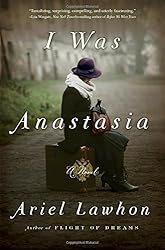
I Was Anastasia
Ariel Lawhon, 2018
Knopf Doubleday
352 pp.
ISBN-13: 9780385541695
Summary
In an enthralling new feat of historical suspense, Ariel Lawhon unravels the extraordinary twists and turns in Anna Anderson's 50-year battle to be recognized as Anastasia Romanov. Is she the Russian Grand Duchess, a beloved daughter and revered icon, or is she an imposter, the thief of another woman's legacy?
Countless others have rendered their verdict. Now it is your turn.
♦ Russia, July 17, 1918:
Under direct orders from Vladimir Lenin, Bolshevik secret police force Anastasia Romanov, along with the entire imperial family, into a damp basement in Siberia where they face a merciless firing squad. None survive. At least that is what the executioners have always claimed.
♦ Germany, February 17, 1920:
A young woman bearing an uncanny resemblance to Anastasia Romanov is pulled shivering and senseless from a canal in Berlin. Refusing to explain her presence in the freezing water, she is taken to the hospital where an examination reveals that her body is riddled with countless, horrific scars. When she finally does speak, this frightened, mysterious woman claims to be the Russian Grand Duchess Anastasia.
Her detractors, convinced that the young woman is only after the immense Romanov fortune, insist on calling her by a different name: Anna Anderson.
As rumors begin to circulate through European society that the youngest Romanov daughter has survived the massacre, old enemies and new threats are awakened. With a brilliantly crafted dual narrative structure, Lawhon wades into the most psychologically complex and emotionally compelling territory yet: the nature of identity itself.
The question of who Anna Anderson is and what actually happened to Anastasia Romanov creates a saga that spans fifty years and touches three continents. This thrilling story is every bit as moving and momentous as it is harrowing and twisted. (From the publisher.)
Author Bio
Ariel Lawhon is co-founder of the popular online book club, She Reads, a novelist, blogger, and life-long reader. She lives in the rolling hills outside Nashville, Tennessee with her husband and four young sons (aka The Wild Rumpus).
Lawhon's first novel, The Wife, the Maid, and the Mistress (2014) is centered around the still-unsolved disappearance of New York State Supreme Court Judge, Joseph Crater. Ariel believes that Story is the shortest distance to the human heart.
Her second novel, Flight of Dreams (2016) is a fictional exploration of the mystery behind the the 1937 Hindenberg blimp explosion. I Was Anastasia (2018), Lawhon's third novel, follows Anna Anderson, who claimed to be Anastasia Romonov, the lone survivor of the execution of the Czar of Russia and his family. (From the author's website.)
Book Reviews
[Lawhon's] effortless, eloquent prose transports the reader via a dramatic, suspenseful and satisfying work of historical fiction.… Lawhon brilliantly employs an inventive and non-linear dual narrative to tell the tale of how Anastasia would become Anna Anderson, or, perhaps, how Anna became Anastasia.… In the end, what Lawhon does so convincingly is shake up our notion of identity. And not just that of Anastasia and Anna. Are we who we say we are, or who others believe us to be? It's a question that lingers long after the final page.
USA Today
Lawhon’s spectacular, emotionally rich third historical thoroughly imagines the events leading up to the execution of Russia’s royal family in 1918.… This sprawling, immersive tale… [brings] ts characters to sparkling life.
Publishers Weekly
(Starred review.) De los Santos brings her signature style, wit, and charm while weaving in beloved characters from her previous novels.…This tender, genuine, and joyful novel is one to
Booklist
Anna [Anderson's]… trials and tribulations are hardto follow…. So the Anastasia story ends up being the more compelling of the two, hurtling…to its grisly ending. Then comes an interesting Author's Note…. Somewhat overcomplicated but ultimately satisfying.
Kirkus Reviews
Discussion Questions
1. I Was Anastasia is an unusually structured novel that moves backward and forward in time. Why do you think the author chose to tell the story in this way?
2. When we first meet Anna Anderson, she is not an easy character to like. As you learned more about her past, did your opinion of her change?
3. How do you interpret Anna’s hoarding tendencies, especially with regard to animals?
4. Anna’s story is told in the third person; Anastasia’s story in the first person. What are your thoughts on the different points of view? Which did you prefer?
5. People often think of Anastasia Romanov in terms of the 1997 animated film. Yet this book does not portray her as a typical Disney princess. Were you glad to see a different side to this historic figure? Or did it bother you?
6. The bombing of Hannover (October 8, 1943) is a dramatic and terrifying scene in the book. Do you think you could display the same level of resilience if you were in Anna’s shoes?
7. The longer the Romanovs were in captivity, the smaller their world became, until they were confined to a handful of rooms. They each handled the boredom and oppression differently. What would you have done in their situation?
8. Do your thoughts about Anna’s identity shift as the novel progresses? Does she become more (or less) believable as we travel back in time with her?
9. Did reading this novel inspire you to find out more about the Romanovs?
10. The Romanovs are not the only royal family to come to a tragic end, yet their story endures as few have. What do you think contributes to the timeless fascination—that of Anastasia in particular?
11. Discuss the ending of the novel. How did it affect your feelings about the novel as a whole?
12. Did the Author’s Note change your opinion about the ending?
(Questions issued by the publisher.)
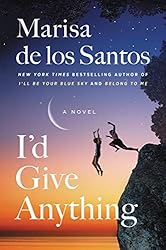
I'd Give Anything
Marisa de los Santos, 2020
HarperCollins
272 pp.
ISBN-13: 9780062844514
Summary
A profound and heart-rending story about a horrific tragedy that marks one woman and her hometown and about the explosive secrets that come to light twenty years later.
Ginny Beale is eighteen, irreverent, funny, and brave, with a brother she adores and a circle of friends for whom she would do anything.
Because of one terrible night, she loses them all—and her adventurous spirit—seemingly forever. While the town cheers on the high school football team, someone sets the school’s auditorium ablaze. Ginny’s best friend Gray Marsden’s father, a fire fighter, dies in the blaze.
While many in the town believe a notoriously troubled local teen set the fire, Ginny makes a shattering discovery that casts blame on the person she trusts most in the world. Ginny tells no one, but the secret isolates her, looming between her and her friends and ruining their friendship.
Over the next two decades, Ginny puts aside her wanderlust and her dreams. Moving back to her hometown, she distances herself from the past and from nearly everyone in it. She marries a quiet man, raises their daughter, Avery, and cares for her tyrannical, ailing mother, Adela.
But when Ginny’s husband, Harris, becomes embroiled in a scandal, Ginny’s carefully controlled life crumbles, and, just when she believes she is regaining her bearings, the secret she’s kept for twenty years emerges and threatens to destroy her hopes for the future.
With the help of fifteen-year-old Avery and of friends both old and new, Ginny must summon the courage to confront old lies and hard truths and to free herself and the people she loves from the mistakes and regrets that have burdened them for so long. (From the publisher.)
Author Bio
• Birth—August 12, 1966
• Where—Baltimore, Maryland, USA
• Education—B.A., University of Virginia; M.F.A., Sarah Lawrence College; Ph.D., University of Houston
• Currently—lives in Wilmington, Delaware
Marisa de los Santos achieved her earliest success as an award-winning poet, and her work has been published in several literary journals. In 2000, her debut collection, From the Bones Out, appeared as part of the James Dickey Contemporary Poetry Series.
De los Santos made her first foray into fiction in 2005 with the surprise bestseller Love Walked In. Optioned almost immediately for the movies, this elegant "literary romance" introduced Cornelia Brown, a diminutive, 30-something Philadelphian with a passion for classic film and an unshakable belief in the triumph of true love.
In her 2008 sequel, Belong to Me, de los Santos revisited Cornelia, now a married woman, newly relocated to the suburbs, and struggling to forge friendships with the women in her new hometown.
Her third novel, Falling Together, released in 2011, recounts the reunion of three college friends, whose friendships dissolve as everything they believed about themselves and each other is brought into question.
The Precious One, published in 2015, follows the two half-sisters who meet for the first time as they struggle to please their narcissistic, domineering father.
Extras
From a 2008 Barnes & Noble interview:
• De los Santos' love affair with books began at a young age. She claims to have risked life and limb as a child by insisting on combining reading with such incompatible activities as skating, turning cartwheels, and descending stairs.
• I'm addicted to ballet, completely head-over-heels for it. I did it as a little kid, but took about a thirty year hiatus before starting adult classes. I do it as many times a week as I can, but if I could, I'd do it every day! In my next life, I'm definitely going to be a ballerina.
• I'm terrible with plants, outdoor plants, indoor plants, annuals, perennials. I kill them off in record time. I adore fresh flowers and keep them all over my house all year round because they're beautiful and already dead, but you won't find a single potted plant in my house. So many nice people in the world and in books are growers and gardeners, but the sad truth is that I'll never be one of them.
• I'm an awful sleeper, and the thing that helps me fall asleep or fall back to sleep is reading books from my childhood. Elizabeth Enright's Melendy series and her two Gone Away Lake books, all of the Anne of Green Gables books, Little Women, The Secret Garden, the Narnia books, and a bunch of others. I have probably read some of these books twenty, maybe thirty times. I read them to pieces, literally, and then have to buy new ones.
• I am crazy-scared of sharks and almost never swim in the ocean. Yes, I know it's silly, I know my chances of getting bitten by a shark are about the same as my chances of becoming president of the United States, but I can't help it.
• My favorite way to spend an evening is eating a meal with good friends. The cheese plate, the red wine, the clink of forks, a passel of kids dancing to The Jonas Brothers and laughing their heads off in the next room, food that either I or someone else has cooked with care and love, and warm, lively conversation-give me all this and I'm happy as a clam.
• I adore black and white movies, particularly romantic comedies from the thirties and forties. I love them for the dialogue and for the whip smart, fascinating, fast-talking, funny women.
• When asked what book that most influenced her career as a writer, here is her response:
I read To Kill a Mockingbird when I was ten, I can't count how many times I've read it since, and every single time, I am utterly pulled in. I don't read it; I live it. I'm with Scout on Boo Radley's porch and in the colored courtroom balcony, and my heart breaks with hers at Tom Robinson's fate. Over and over, the book lifts me up and sets me down into her shoes. I remember the wonder I felt the first time it happened, the sudden, jarring illumination: every person is the center of his or her life the way I am the center of mine. It changed everything. I know that sounds dramatic, but it's true. That empathy is the greatest gift fiction gives us, and it's the biggest reason I write. (Author bio and interview adapted from Barnes & Noble.)
Book Reviews
With Marisa de los Santos’ beautiful descriptions of the settings and her vivid characters who, you’ll feel, are just like your friends growing up, I’d Give Anything is a piece of art.… This book is a wonderful read that will have you falling in love with its characters.
Manhattan Book Review
An engaging story about regrets and second chances.
People
A luminous exploration of wanderlust, friendship, and fire.
Entertainment Weekly
Written in gorgeous prose, I'd Give Anything is a novel about the mistakes we make, and how we can confront them and move forward.
Popsugar
With her signature warmth and wisdom, [de los Santos] explores the ripple effects of that night on Ginny's life…. This story, in true de los Santos fashion, is full of hope and people who are willing to try.
Shelf Awareness
[H]eartfelt…. Thoughtful musings, engaging dialogue, and ironic wit… add to the drama. De los Santos’s seemingly light tale is full of surprises.
Publishers Weekly
[E]exquisitely luxurious, poetic writing [tells] her characters’ stories. She knows exactly where she’s going and how… to get there. The… prose will more than please those who love the thoughtful, precise language of Anne Tyler and Joshilyn Jackson.
Booklist
While there are touching moments,…the protagonists are so flatly drawn that it’s hard to feel much empathy for their dilemmas…. Obvious plot contrivances, clunky, cringeworthy descriptions… also diminish the pleasure. A flawed tale but the author’s devoted fans will devour it.
Kirkus Reviews
Discussion Questions
We'll add publisher questions if and when they're available; in the meantime, use our LitLovers Book Club Resources. They can help with discussions for any book:
• How to Discuss a Book (helpful discussion tips)
• Generic Discussion Questions—Fiction and Nonfiction
• Read-Think-Talk (a guided reading chart)
(Resources by LitLovers. Please feel free to use them, online and off, with attribution. Thanks.)
Summary | Author | Book Reviews | Discussion Questions
I'd Know You Anywhere
Laura Lippman, 2010
HarperCollins
400 pp.
ISBN-13: 9780062070753
In Brief
There was your photo, in a magazine. Of course, you are older now. Still, I'd know you anywhere.
Suburban wife and mother Eliza Benedict's peaceful world falls off its axis when a letter arrives from Walter Bowman. In the summer of 1985, when Eliza was fifteen, she was kidnapped by this man and held hostage for almost six weeks. Now he's on death row in Virginia for the rape and murder of his final victim, and Eliza wants nothing to do with him. Walter, however, is unpredictable when ignored—as Eliza knows only too well—and to shelter her children from the nightmare of her past, she'll see him one last time.
But Walter is after something more than forgiveness: He wants Eliza to save his life . . . and he wants her to remember the truth about that long-ago summer and release the terrible secret she's keeping buried inside. (From the publisher.)
top of page
About the Author
• Birth—January 31, 1959
• Where—Atlanta, Georgia, USA
• Education—B.S., Northwestern University
• Awards—(see below)
• Currently—lives in Baltimore, Maryland
Lippman was born in Atlanta, Georgia, and raised in Baltimore, Maryland. She is the daughter of Theo Lippman Jr., a well known and respected writer at the Baltimore Sun, and Madeline Lippman, a retired school librarian for the Baltimore City Public School System. She attended high school in Columbia, Maryland, where she was the captain of the Wilde Lake High School It's Academic team.
Lippman is a former reporter for the (now defunct) San Antonio Light and the Baltimore Sun. She is best known for writing a series of novels set in Baltimore and featuring Tess Monaghan, a reporter (like Lippman herself) turned private investigator.
Lippman's works have won the Agatha, Anthony, Edgar, Nero, Gumshoe and Shamus awards. Her 2007 release, What the Dead Know, was the first of her books to make the New York Times bestseller list, and was shortlisted for the Crime Writer's Association Dagger Award. In addition to the Tess Monaghan novels, Lippman wrote 2003's Every Secret Thing, which has been optioned for the movies by Academy Award–winning actor Frances McDormand.
Lippman lives in the South Baltimore neighborhood of Federal Hill and frequently writes in the neighborhood coffee shop Spoons. In addition to writing, she teaches at Goucher College in Towson, Maryland, just outside of Baltimore. In January, 2007, she taught at the 3rd Annual Writers in Paradise at Eckerd College.
Lippman is married to David Simon, another former Baltimore Sun reporter, and creator and an executive producer of the HBO series The Wire. The character Bunk is shown to be reading one of her books in episode eight of the first season of The Wire. She appeared in a scene of the first episode of the last season of The Wire as a reporter working in the Baltimore Sun newsroom.
Awards
2015 Anthony Award-Best Novel (After I'm Gone)
2008 Anthony Award-Best Novel (What the Dead Know)
2008 Anthony Award-Best Short Story ("Hardly Knew Her")
2008 Barry Award-Best Novel (What the Dead Know)
2008 Macavity Award-Best Mystery (What the Dead Know)
2007 Anthony Award-Best Novel (No Good Deeds)
2007 Quill Award-Mystery (What the Dead Know)
2006 Gumshow Award-Best Novel (To the Power of the Three)
2004 Barry Award-Best Novel (Every Secret Thing)
2001 Nero Award (Sugar House)
2000 Anthony Award-Best Paperback Original (In Big Trouble)
2000 Shamus Award-Best Paperback Original (In Big Trouble)
1999 Anthony Award-Best Paperback Original (Butchers Hill)
1998 Agatha Award-Best Novel (Butchers Hill)
1998 Edgar Award-Best Paperback Original (Charm City)
1998 Shamus Award-Best Paperback Original (Charm City)
(Author bio adapted from Wikipedia.)
top of page
Critics Say . . .
I've read hundreds of thrillers in the past 10 years, and some have been excellent, but only a handful—thanks to their insights, their characterizations and the quality of their writing—could equal the best of today's literary fiction. Those few certainly include What the Dead Know and I'd Know You Anywhere. In both cases, Lippman began with a real crime and then used the magic of her imagination to produce novels that are not only hypnotic reading but serious meditations on the sorrows and dangers of this world. Some people would segregate Lippman as a crime or thriller writer. That's a shame. She's one of the best novelists around, period.
Patrick Anderson - Washington Post
I’d Know You Anywhere continues Laura Lippman’s extraordinary run of stand-alone novels (alternating with her lighter books about private eye Tess Monaghan). From its unsettling opening to its breathtaking conclusion, “Anywhere” exemplifies Lippman’s strengths: compassion, intense prose and deep empathy for the snares of ambiguous emotions.
Seattle Times
Laura Lippman is one of those uncommonly talented authors whose work continues to get better in every book she writes. I’d Know You Anywhere is a riveting psychological suspense novel.
Toronto Globe and Mail
I’d Know You Anywhere is a crime story, but it’s not a whodunit. Rather, it’s an exquisitely sensitive story about the psychological impact of crime on its victims. It’s a story about shame, about anger, about survivor’s guilt.
Fort Worth Star Telegram
This is a story that grips you not with suspense but with its acute psychological autopsy of a survivor. Lippman’s knack for elucidating the horrors humans can inflict on one another through violence and manipulation—while telling a compelling story—is disarming and fascinating.
USA Today
Near the start of this outstanding novel of psychological suspense from Edgar-winner Lippman (Life Sentences), Eliza Benedict, a 38-year-old married mother of two living in suburban Maryland, receives a letter from Walter Bowman, the man who kidnapped her the summer she was 15 and is now on death row. The narrative shifts between the present and that long ago summer, when Eliza involuntarily became a part of Walter's endless road trip, including the fateful night when he picked up another teenage girl, Holly Tackett. Soon after Walter killed Holly, Eliza was rescued and taken home. Eliza must now balance a need for closure with a desire to protect herself emotionally. Walter wants something specific from her, but she has no idea what, and she's not sure that she wants to know. All the relationships, from the sometimes contentious one between Eliza and her sister, Vonnie, to the significantly stranger one between Walter and Barbara LaFortuny, an advocate for prisoners, provide depth and breadth to this absorbing story.
Publishers Weekly
Eliza Benedict believed she'd put her adolescence behind her, especially the time she'd spent as a captive of Walter Bowman, until he contacts her from death row. Struggling in her relationship with her own teenage daughter and wrestling with memories of Holly Tackett, the girl who didn't get away from Walter, Eliza finds herself repeatedly coming back to the events of the last night of Holly's life. While she may no longer be his captive, Eliza is clearly anything but free. The mystery in Lippman's latest stand-alone, while still a strong element, takes a backseat to Eliza's story, set against the impending execution of Walter. The fast-paced narrative, with dynamic supporting characters and subplots that feel underused, races to a satisfying if somewhat abrupt conclusion. Verdict: Echoing Lippman's previous stand-alones, What the Dead Know and Life Sentences, this is a solid choice for mystery fans who enjoy a broader view of crime and its aftermath. —Amy Brozio-Andrews, Albany P.L., NY
Library Journal
top of page
Book Club Discussion Questions
1. Describe Eliza as an adult and as a teenager. How has she changed? What of her personality is the same? How did the trauma of her kidnapping impact her relationship with her parents, her sister, her husband, her children?
2. What did Eliza have in common with Walter's other victims? How was she different? Why didn't Walter kill her too?
3. When she visits the parents of Walter's last victim, Eliza cant help but think of their daughter and her role—or lack of it—in her death. "She hadn't killed Holly, but she hadn't saved her, either. Was that the same thing? She had resolved to live. Was her decision to live the same as willing Holly to die? She had chosen to live, which she believed meant doing whatever Walter said. Holly was the one who had fought and run." Discuss the questions Eliza raises about her own culpability. Does Eliza share any blame for Holly's death?
4. How would you characterize the relationship between Walter and the teenage Elizabeth? What about his relationship with the adult Eliza?
5. How did knowing Walter as intimately as she did save Eliza's life? Which person knew the other better? Did she owe Walter his life—or anything at all—since ultimately, he spared hers? Did he know her as well as he thought? Was he surprised by the outcome when she finally visited? Were you?
6. What does Walter want from Eliza? Why does she agree to see him? What does she want from him?
7. Walter mused about the trial that convicted him. "Shouldn't his victims have the final say? But there was Elizabeth. He hadn't been lying when he said he felt the greatest guilt toward her. What he did to her—that was a betrayal. The others, he didn't know them, they weren't real to him. But Elizabeth had been his co-pilot, his running buddy. His Charley to his Steinbeck." Why did Walter feel guilty about Elizabeth? How did he betray her?
8. Eliza had felt protected by the invisibility with which she cloaked herself, taking her husband's name, moving abroad for several years. Can we ever truly hide from those who want to find us? What is the emotional cost if we try? What was the cost for Eliza?
9. Eliza wished her son could stay young and innocent for years. "But she knew there was no spell, no magic, that could keep a child a child, or shield a child from the world at large. In fact, that was where the trouble almost always began, with a parent trying to out-think fate. Stay on the path. Don't touch the spindle. Don't speak to strangers. Don't pick the rose." Why does Eliza think this way? What does she mean by "that was where the trouble almost always began"? Do you agree with her assessment? Are we overprotective of our children? How can we gird them for the perils the world offers?
10. When she was asked if Walter deserved to die, Eliza responds, "It doesn't matter what I think. He was sentenced for the murder of Holly Tackett, and her parents made it clear that they approved of the death penalty. I wasn't consulted." Do you think Walter deserved to die? Why is it so difficult for Eliza to offer her opinion? Do you think she feels guilty for surviving?
11. Eliza's sister Vonnie accuses her of "existing.... You let life happen to you. You live the most reactive life of anyone I know. If there's one thing I would have learned from your experience, I think it would be to never let anyone else take control of my life." Is Vonnie correct in her assessment? Has Eliza learned this lesson?
(Questions issued by publisher.)
 I'll Be Seeing You
Suzanne Hayes, Loretta Nyhan, 2013
Harlequin Mira
336 pp.
ISBN-13: 9780778314950
Summary
I hope this letter gets to you quickly. We are always waiting, aren't we? Perhaps the greatest gift this war has given us is the anticipation...
It's January 1943 when Rita Vincenzo receives her first letter from Glory Whitehall. Glory is an effervescent young mother, impulsive and free as a bird. Rita is a sensible professor's wife with a love of gardening and a generous, old soul. Glory comes from New England society; Rita lives in Iowa, trying to make ends meet. They have nothing in common except one powerful bond: the men they love are fighting in a war a world away from home.
Brought together by an unlikely twist of fate, Glory and Rita begin a remarkable correspondence. The friendship forged by their letters allows them to survive the loneliness and uncertainty of waiting on the home front, and gives them the courage to face the battles raging in their very own backyards. Connected across the country by the lifeline of the written word, each woman finds her life profoundly altered by the other's unwavering support.
A collaboration of two authors whose own beautiful story mirrors that on the page, I'll Be Seeing You is a deeply moving union of style and charm. Filled with unforgettable characters and grace, it is a timeless celebration of friendship and the strength and solidarity of women. (From the publisher.)
Author Bios
Suzanne Hayes also writes under the name Suzanne Palmieri. As the latter, she is the author of The Witch of Little Italy, The Witch of Belladonna Bay, and The Witch of Bourbon Street. As Suzanne Hayes, she has co-authored I’ll Be Seeing You and Empire Girls with Loretta Nyhan. Her novels have been translated into five different languages and have earned stars from Kirkus and Booklist. She lives in a haunted farm house by the ocean with her husband and three darling witches. (From the author's website.)
Loretta Nyhan was a reader before she was a writer, devouring everything she could get her hands on, including the backs of cereal boxes and the instructions booklet for building the Barbie dream house. Later, her obsession with reading evolved into an absolute need to write. After college, Loretta wrote for national trade magazines, taught writing to college freshmen, and eventually found the guts to try fiction.
I'll Be Seeing You, her novel cowritten with Suzanne Hayes, debuted from Harlequin Mira in 2013.
Loretta also writes paranormal thrillers for HarperTeen.
When she's not writing, Loretta is knitting, baking, and doing all kinds of things her high school self would have found hilarious. She lives in the Chicagoland area with her very patient husband and two wonderful sons. (From the publisher.)
Book Reviews
The authors have composed letters that, if found in your grandmother's attic, would make you want to stay up all night reading.... Aside from the climactic sequence, the epistolary format never fully gels, as too many episodes call for a narrator's omniscience. Nevertheless, Nyhan and Hayes show us that letters from a cherished friend have a particular role to play in shepherding us through life's loves and losses
Publishers Weekly
Authentic touches bring the era alive...[and] provide a specific, everyday context for such timeless and universal passages and struggles as birth, death, grief, wartime temptations, divided loyalties, and hope.... [A] deeply satisfying tale. —Whitney Scott
Booklist
(Starred review.) [A] powerful, fascinating look at the war years and at the interesting choices and tragic consequences of a nation enduring an overseas war. Engaging, charming and moving, a beautifully rendered exploration of WWII on the homefront and the type of friendship that helps us survive all manner of battles.
Kirkus Reviews
Discussion Questions
Use our LitLovers Book Club Resources; they can help with discussions for any book:
• How to Discuss a Book (helpful discussion tips)
• Generic Discussion Questions—Fiction and Nonfiction
• Read-Think-Talk (a guided reading chart)
(We'll add specific questions if and when they're made available by the publisher.)
I'll Be Your Blue Sky
Marisa de los Santos, 2018
HarperCollins
320 pp.
ISBN-13: 9780062431936
Summary
The bestselling author revisits the characters from her beloved novels Love Walked In and Belong to Me in this captivating, beautifully written drama involving family, friendship, secrets, sacrifice, courage, and true love.
On the weekend of her wedding, Clare Hobbes meets an elderly woman named Edith Herron. During the course of a single conversation, Edith gives Clare the courage to do what she should have done months earlier: break off her engagement to her charming—yet overly possessive—fiance.
Three weeks later, Clare learns that Edith has died—and has given her another gift. Nestled in crepe myrtle and hydrangea and perched at the marshy edge of a bay in a small seaside town in Delaware, Blue Sky House now belongs to Clare. Though the former guest house has been empty for years, Clare feels a deep connection to Edith inside its walls, which are decorated with old photographs taken by Edith and her beloved husband, Joseph.
Exploring the house, Clare finds two mysterious ledgers hidden beneath the kitchen sink. Edith, it seems, was no ordinary woman—and Blue Sky House no ordinary place.
With the help of her mother, Viviana, her surrogate mother, Cornelia Brown, and her former boyfriend and best friend, Dev Tremain, Clare begins to piece together the story of Blue Sky House—a decades-old mystery more complex and tangled than she could have imagined.
As she peels back the layers of Edith’s life, Clare discovers a story of dark secrets, passionate love, heartbreaking sacrifice, and incredible courage. She also makes startling discoveries about herself: where she’s come from, where she’s going, and what—and who—she loves.
Shifting between the 1950s and the present and…lternating voices…, I’ll Be Your Blue Sky is vintage Marisa de los Santos—an emotionally evocative novel that probes the deepest recesses of the human heart and illuminates the tender connections that bind our lives. (From the publisher.)
Author Bio
• Birth—August 12, 1966
• Where—Baltimore, Maryland, USA
• Education—B.A., University of Virginia; M.F.A., Sarah Lawrence College; Ph.D., University of Houston
• Currently—lives in Wilmington, Delaware
Marisa de los Santos achieved her earliest success as an award-winning poet, and her work has been published in several literary journals. In 2000, her debut collection, From the Bones Out, appeared as part of the James Dickey Contemporary Poetry Series.
De los Santos made her first foray into fiction in 2005 with the surprise bestseller Love Walked In. Optioned almost immediately for the movies, this elegant "literary romance" introduced Cornelia Brown, a diminutive, 30-something Philadelphian with a passion for classic film and an unshakable belief in the triumph of true love.
In her 2008 sequel, Belong to Me, de los Santos revisited Cornelia, now a married woman, newly relocated to the suburbs, and struggling to forge friendships with the women in her new hometown.
Her third novel, Falling Together, released in 2011, recounts the reunion of three college friends, whose friendships dissolve as everything they believed about themselves and each other is brought into question.
The Precious One, published in 2015, follows the two half-sisters who meet for the first time as they struggle to please their narcissistic, domineering father.
Extras
From a 2008 Barnes & Noble interview:
• De los Santos' love affair with books began at a young age. She claims to have risked life and limb as a child by insisting on combining reading with such incompatible activities as skating, turning cartwheels, and descending stairs.
• I'm addicted to ballet, completely head-over-heels for it. I did it as a little kid, but took about a thirty year hiatus before starting adult classes. I do it as many times a week as I can, but if I could, I'd do it every day! In my next life, I'm definitely going to be a ballerina.
• I'm terrible with plants, outdoor plants, indoor plants, annuals, perennials. I kill them off in record time. I adore fresh flowers and keep them all over my house all year round because they're beautiful and already dead, but you won't find a single potted plant in my house. So many nice people in the world and in books are growers and gardeners, but the sad truth is that I'll never be one of them.
• I'm an awful sleeper, and the thing that helps me fall asleep or fall back to sleep is reading books from my childhood. Elizabeth Enright's Melendy series and her two Gone Away Lake books, all of the Anne of Green Gables books, Little Women, The Secret Garden, the Narnia books, and a bunch of others. I have probably read some of these books twenty, maybe thirty times. I read them to pieces, literally, and then have to buy new ones.
• I am crazy-scared of sharks and almost never swim in the ocean. Yes, I know it's silly, I know my chances of getting bitten by a shark are about the same as my chances of becoming president of the United States, but I can't help it.
• My favorite way to spend an evening is eating a meal with good friends. The cheese plate, the red wine, the clink of forks, a passel of kids dancing to The Jonas Brothers and laughing their heads off in the next room, food that either I or someone else has cooked with care and love, and warm, lively conversation-give me all this and I'm happy as a clam.
• I adore black and white movies, particularly romantic comedies from the thirties and forties. I love them for the dialogue and for the whip smart, fascinating, fast-talking, funny women.
• When asked what book that most influenced her career as a writer, here is her response:
I read To Kill a Mockingbird when I was ten, I can't count how many times I've read it since, and every single time, I am utterly pulled in. I don't read it; I live it. I'm with Scout on Boo Radley's porch and in the colored courtroom balcony, and my heart breaks with hers at Tom Robinson's fate. Over and over, the book lifts me up and sets me down into her shoes. I remember the wonder I felt the first time it happened, the sudden, jarring illumination: every person is the center of his or her life the way I am the center of mine. It changed everything. I know that sounds dramatic, but it's true. That empathy is the greatest gift fiction gives us, and it's the biggest reason I write. (Author bio and interview adapted from Barnes & Noble.)
Book Reviews
A lovely rumination on the choices we make, with characters we’ve loved for years.
Romance Times
Love and mystery surround a darker thread about the safety of women in this complex and moving tale… The author doesn’t sugarcoat the violence that the women have suffered,… [t]his novel is both lovely and powerful.
Publishers Weekly
De los Santos here revisits the next generation of her beloved characters, moving the family saga forward with this engrossing story of unshakable love, personal ethics, and a commitment to life's larger truths. —Bette-Lee Fox
Library Journal
De los Santos brings her signature style, wit, and charm while weaving in beloved characters from her previous novels.…This tender, genuine, and joyful novel is one to savor.
Booklist
The novel moves back and forth between Clare's current romantic quandary and Edith's difficult life in the '50…. De los Santos writes with disarming fluidity even when her plot takes far-fetched turns, but her heroine's inexhaustible perfection grows cloying.
Kirkus Reviews
Discussion Questions
1. When Edith first steps into Blue Sky House, she feels her husband Joseph’s presence everywhere, and she experiences the house as "forthright and decent and kind." When Clare enters the house decades later, she also feels a human presence. Have you ever found a house or some other specific place to have a personality?
2. Clare admires her fiance, Zach, as a person who "tries so hard to be good," even when it doesn’t come easily to him, and she appreciates his desire to be different from his cold, judgmental family. Have you ever known a person like this? Do you understand why Clare would be attracted to these qualities?
3. What do you make of Clare’s relationship with Zach?
4. Edith and Joseph are both photographers. How do their photographs reflect their personalities?
5. Edith feels that she does not "fit" into the social world of small town 1950s. Can you relate to her discomfort?
6. When Edith and Joseph see the flock of white herons take flight, Joseph says, "That was you. You, you. That’s what you have been to me. Exactly." What do you think he means by this?
7. What do you make of Edith’s decision to take George Graham up on his proposal, in spite of the risks?
8. Why do you think Edith decides to start keeping the "shadow ledger"?
9. What do you think of Clare’s relationship with Dev? Do you understand her decision to go to a different college from him and later to break up with him?
10. Why do you think Clare decides to ask Dev to help her solve the mystery of Blue Sky House?
11.What do you make of Edith’s friendship with John?
12. When Clare is out in Edith’s canoe, she has the realization that "[S]omethings you decide and some things you choose and some things just are." Do you know what she means? Have you ever felt this way?
13. Early in the novel, Joseph tells Edith, "I’ll be your blue sky." Later, Edith tells Clare, "The ones who look like home are home. They’re where you go." Do these sentiments resonate with you?
(Questions issued by the publisher.)


I'll See You in Paris
Michelle Gable, 2016
St. Martin's Press
400 pp.
ISBN-13: 9781250070630
Summary
Three women, born generations apart.
One mysterious book that threads their lives together.
A journey of love, discovery, and truth…
I’ll See You in Paris is based on the real life of Gladys Spencer-Churchill, the Duchess of Marlborough, a woman whose life was so rich and storied it could fill several books.
Nearly a century after Gladys’s heyday, a young woman’s quest to understand the legendary Duchess takes her from a charming hamlet in the English countryside, to a dilapidated manse kept behind barbed wire, and ultimately, to Paris, where answers will be found at last.
In the end, she not only solves the riddle of the Duchess but also uncovers the missing pieces in her own life.
At once a great love story and literary mystery, I’ll See You in Paris will entertain and delight, with an unexpected ending that will leave readers satisfied and eager for Gable’s next novel. (From the publisher.)
Author Bio
• Birth—1974
• Born—San Diego, California, USA
• Education—B.A., College of William & Mary
• Currently—lives in Cardiff by the Sea, California
Michelle Gable is an American author, a wife, mother of two, and head of investor relations for a California software company. She writes whenever possible—starting at 5:00 in the morning or 11:00 at night.
Gable, born and raised in San Diego, California, became a budding writer early on. In the fourth grade, her parents presented her with the book Someday You'll Write: from then on she wrote short stories, horrible high school novels, and turned every tween and teen social gathering into a writing party.
Despite her passion for the written word, Gable earned a bachelor's in accounting and pursued a career in finance. But she never stopped writing. Bouyed by a literary agent who stuck with her despite low sales for two initial books, Gable finally attained success a few weeks shy of her 40th birthday—with the launch of A Paris Apartment. That book, published in 2014, reached both the New York Times and USA Today lists. Her second book I'll See You in Paris came out in 2016. (Adapted from the author's website.)
Book Reviews
Gable has crafted another page-turner of a good read, filled with history, mystery and a dash of romance. This is the sort of fun, escapist read that is beloved by books clubs. There are characters to love, characters to hate, enticing settings and a requisite amount of plot twists.
Fort Worth Star-Telegram
Plot-master Gable’s affection for hidden treasures emerges again in her second absorbing novel. Readers are kept guessing ’til the end in this sweet story of love, mystery, art, literature, and Paris. As complex and moving as Naomi Wood’s Mrs. Hemingway and Liz Trenow’s The Forgotten Seamstress.
Booklist
Gable writes an engaging story, and both worlds—Annie's in 2001 and Pru's in 1973—are easy to slide into. Readers will root for both women as they uncover family secrets and discover hidden aspects of themselves. The riddle of the story is easily guessed, but that doesn't distract from the novel's overall charm. —Jennifer Mills, Shorewood-Troy Lib., IL
Library Journal
Gable tells an engaging story.... Blending fact and fiction in an entertaining but occasionally confusing way..., [some parts are] hard to believe, yet it's [a] fine tribute to a one-in-a-million [historical] character despite a few hard-to-swallow plot devices.
Kirkus Reviews
Discussion Questions
Use our LitLovers Book Club Resources; they can help with discussions for any book:
• How to Discuss a Book (helpful discussion tips)
• Generic Discussion Questions—Fiction and Nonfiction
• Read-Think-Talk (a guided reading chart)
(We'll add specific questions if and when they're made available by the publisher.)

I'll Take You There
Wally Lamb, 2016
HarperCollins
272 pp.
ISBN-13: 9780062656285
Summary
An evocative, deeply affecting tapestry of one Baby Boomer's life—Felix Funicello, introduced in Wishin’ and Hopin’—and the trio of unforgettable women who have changed it, in this radiant homage to the resiliency, strength, and power of women.
I’ll Take You There centers on Felix, a film scholar who runs a Monday night movie club in what was once a vaudeville theater.
One evening, while setting up a film in the projectionist booth, he’s confronted by the ghost of Lois Weber, a trailblazing motion picture director from Hollywood’s silent film era.
Lois invites Felix to revisit—and in some cases relive—scenes from his past as they are projected onto the cinema’s big screen.
In these magical movies, the medium of film becomes the lens for Felix to reflect on the women who profoundly impacted his life. There’s his daughter Aliza, a Gen Y writer for New York Magazine who is trying to align her post-modern feminist beliefs with her lofty career ambitions; his sister, Frances, with whom he once shared a complicated bond of kindness and cruelty; and Verna, a fiery would-be contender for the 1951 Miss Rheingold competition, a beauty contest sponsored by a Brooklyn-based beer manufacturer that became a marketing phenomenon for two decades.
At first unnerved by these ethereal apparitions, Felix comes to look forward to his encounters with Lois, who is later joined by the spirits of other celluloid muses.
Against the backdrop of a kaleidoscopic convergence of politics and pop culture, family secrets, and Hollywood iconography, Felix gains an enlightened understanding of the pressures and trials of the women closest to him, and of the feminine ideals and feminist realities that all women, of every era, must face. (From the publisher.)
Author Bio
• Birth—October 17, 1950
• Where—Norwich, Connecticut, USA
• Education—B.A., M.A., University of Connecticut; M.F.A., University of Vermont
• Awards—(see below)
• Currently—lives in Connecticut
Wally Lamb is an American author of several novels, including She's Come Undone (1992) and I Know This Much Is True (1998), The Hour I First Believed (2008), and We Are Water (2013). The first two books were Oprah Book Club selections. Lamb was the director of the Writing Center at Norwich Free Academy in Norwich from 1989 to 1998 and has taught Creative Writing in the English Department at the University of Connecticut.
Early life
Lamb was born to a working-class family in Norwich, Connecticut. Three Rivers, the fictional town where several of his novels are set, is based on Norwich and the nearby towns of New London, Willimantic, Connecticut, and Westerly, Rhode Island. As a child, Lamb loved to draw and create his own comic books—activities which, he says, gave him "a leg up" on the imagery and colloquial dialogue that characterize his stories. He credits his ability to write in female voices, as well as male, with having grown up with older sisters in a neighborhood largely populated by girls.
After graduating from high school, Lamb studied at the University of Connecticut during the turbulent early 1970s era of anti-war and civil-rights protests and student strikes. He holds a B.A. and an M.A. in Education from the University of Connecticut and an M.F.A. in Writing from Vermont College.
Writing
Lamb began writing in 1981, the year he became a first-time father. Lamb's first published stories were short fictions that appeared in Northeast, a Sunday magazine of the Hartford Courant. "Astronauts," published in the Missouri Review in 1989, won the Missouri Review William Penden Prize and became widely anthologize
d. His first novel, She's Come Undone, was followed six years later by I Know This Much Is True, a story about identical twin brothers, one of whom develops paranoid schizophrenia. Both novels became number one bestsellers after Oprah Winfrey selected them for her popular Book Club. Lamb's third novel, The Hour I First Believed, published in 2008, interfaces fiction with such non-fictional events as the Columbine High School shooting, the Iraq War, and, in a story within the story, events of nineteenth-century America. Published the following year, Wishin' and Hopin' was a departure for Lamb: a short, comically nostalgic novel about a parochial school fifth grader, set in 1964. In We Are Water, Lamb returns to his familiar setting of Three Rivers. The novel focuses on art, 1950s-era racial strife, and the impact of a devastating flood on a Connecticut family.
Teaching
Lamb taught English and writing for 25 years at the Norwich Free Academy, a regional high school that was his alma mater. In his last years at the school, Lamb designed and implemented the school's Writing Center, where he instructed students in writing across the disciplines. As a result of his work for this program, he was chosen the Norwich Free Academy's first Teacher of the Year and later was named a finalist for the honor of Connecticut Teacher of the Year (1989). From 1997 to 1999, he was an Associate Professor in the English Department at the University of Connecticut. As the school's Director of Creative Writing, he originated a student-staffed literary and arts magazine, The Long River Review.
Prison work
From 1999 to the present, Lamb has facilitated a writing program for incarcerated women at the York Correctional Institute, Connecticut's only women's prison in Niantic, Connecticut. The program has produced two collections of his inmate students' autobiographical writing, Couldn't Keep It to Myself: Testimonies from Our Imprisoned Sisters and I'll Fly Away: Further Testimonies from the Women of York Prison, both of which Lamb edited.
The publication of the first book became a source of controversy and media attention when, a week before its release, the State of Connecticut unexpectedly sued its incarcerated contributors—not for the six thousand dollars each writer would collect after her release from prison but for the entire cost of her incarceration, calculated at $117 per day times the number of days in her prison sentence. When one of the writers won a PEN/Newman's Own First Amendment Award, given to a writer whose freedom of speech is under attack, the prison destroyed the women's writing and moved to close down Lamb's program. These actions caught the interest of the CBS 60 Minute; the State of Connecticut settled the lawsuit and reinstated the program shortly before the show was aired.
Influences
Lamb says he draws influence from masters of long- and short-form fiction, among them John Updike, Flannery O'Connor, F. Scott Fitzgerald, Willa Cather, Edith Wharton, Raymond Carver, and Andre Dubus.
He credits his perennial teaching of certain novels to high school students with teaching him about "the scaffolding" of longer stories. Among these, Lamb lists Harper Lee's To Kill a Mockingbird, Mark Twain's The Adventures of Huckleberry Finn, and J.D. Salinger's The Catcher in the Rye. He says Joseph Campbell's The Hero with a Thousand Faces and other anthropological analyses of the commonalities of ancient myths from diverse world cultures helped him to figure out the ways in which stories, ancient and modern, can illuminate the human condition. Lamb has also stated that he is influenced by pop culture and artists who work in other media. Among these he mentions painters Edward Hopper and René Magritte.
Honors and awards
Lamb's writing awards include grants from the National Endowment for the Arts and the Connecticut Commission on the Arts, the Connecticut Center for the Book's Lifetime Achievement Award, selections by Oprah's Book Club and Germany's Bertelsmann Book Club, the Pushcart Prize, the New England Book Award for Fiction, and New York Times Notable Books of the Year listings.
She's Come Undone was a finalist for the Los Angeles Times's Best First Novel Award and one of People magazine's Top Ten Books of the Year. I Know This Much Is True won the Friends of the Library USA Readers' Choice Award for best novel of 1998 and the National Alliance for the Mentally Ill's Kenneth Johnson Award for its anti-stigmatizing of mental illness.
Teaching awards for Lamb include a national Apple Computers "Thanks to Teachers" Excellence Award and the Barnes and Noble "Writers Helping Writers" Award for his work with incarcerated women. Lamb has received Honorary Doctoral Degrees from several colleges and universities and was awarded Distinguished Alumni awards from Vermont College of Fine Arts and the University of Connecticut. (From Wikipedia. Retrieved 9/14/13.)
Book Reviews
It’s hard not to be touched by this sweet-natured novel.
Washington Post
A well-told story about a man whose dealings with women are as transformational as the women’s liberation movement itself.
Minneapolis Tribune
Lamb’s previous work has been quite sensitive to women, painting endearing portraits of female characters who have been ignored, shamed and often mistreated. He builds on that tradition in I’ll Take You There, a love letter to feminism and to trailblazing women-real and imagined-who have graced the silver screen or stood behind the camera.
BookPage
Discussion Questions
Use our LitLovers Book Club Resources; they can help with discussions for any book:
• How to Discuss a Book (helpful discussion tips)
• Generic Discussion Questions—Fiction and Nonfiction
• Read-Think-Talk (a guided reading chart)
(We'll add specific questions if and when they're made available by the publisher.)


I'm Glad About You
Theresa Rebeck, 2016
Penguin Books
384 pp.
ISBN-13: 9780399172885
Summary
The pathos and missed connections of One Day meet the hilarity of Crazy Rich Asians in this comedic and tender novel.
Their meeting in a parking lot outside a high school football game was both completely forgettable and utterly life-changing. Because no matter how you look at it, it is piss-poor luck to meet the love of your life before your life has even started.
Fierce and ambitious, Alison is determined to shed her Midwestern roots and emerge an actress. Kyle, all heart and spiritual yearning, believes medicine can heal the world.
What could these mismatched souls have to do with each other? Everything and nothing. Even as their fates rocket them forward and apart, neither can fully let go of the past.
When Alison gets her lucky break in New York City, she ends up on the fast track to stardom and a world far more different from Cincinnati than she could have ever imagined. Back home in Ohio, Kyle marries in haste and repents at leisure. Reluctantly embracing life in suburban hell, he becomes a pediatrician.
While Kyle’s dreams begin to molder, Alison learns that the spotlight is always circled by shadows. As their lives inevitably intersect, Alison and Kyle must face each other in the revealing light of their decisions.
I’m Glad About You is a glittering study of how far the compromises two people make will take them from the lives they were meant to live. (From the publisher.)
Author Bio
• Birth—February 19, 1958
• Where—Kenwood, Ohio, USA
• Education—B.A., University of Notre Dame; M.A., M.F.A., Ph.D., Brandeis University
• Awards—Edgar Award; Athena Film Festival Award (see below)
• Currently—lives in Brooklyn, New York City, New York
Theresa Rebeck is an American playwright, television writer, and novelist. Her work has appeared on the Broadway and Off-Broadway stage, in film, and on television. Among her awards are the Mystery Writers of America’s Edgar Award. In 2012, she received the Athena Film Festival Award for Excellence as a Playwright and Author of Films, Books, and Television.
Early life and education
Rebeck was born in Kenwood, Ohio, and graduated from Cincinnati's Ursuline Academy in 1976. She earned her undergraduate degree at the University of Notre Dame in 1980, and followed that with three degrees from Brandeis University: an MA in 1983, a M.F.A. in Playwriting in 1986, and a Ph.D. in Victorian era melodrama, awarded in 1989.
Career
Plays
Past New York productions of her work include Mauritius on Broadway at the Biltmore Theatre in a Manhattan Theater Club production; The Scene, The Water’s Edge, Loose Knit, The Family of Mann and Spike Heels at Second Stage Theatre; Bad Dates and The Butterfly Collection at Playwrights Horizons; and View of the Dome at New York Theatre Workshop.
Omnium Gatherum (co-written, finalist for the Pulitzer Prize for Drama in 2003) was featured at the Humana Festival, and had a commercial run at the Variety Arts Theatre in 2003. Her play The Understudy, premiered at the Williamstown Theatre Festival in the summer of 2008, with a cast including Reg Rogers, Bradley Cooper and Kristen Johnson, and ran in New York at the Roundabout Theatre from October 2009 - January 2010, featuring Julie White, Justin Kirk, and Mark-Paul Gosselaar in the cast.
Her play Seminar, starring Alan Rickman, opened on Broadway in 2011; it later opened at the San Francisco Playhouse, receiving outstanding reviews. Poor Behavior premiered at Los Angeles' Mark Taper Forum in 2011 and opened in 2014 at Primary Stages on Off-Broadway. Her play Fool premiered at the Alley Theatre in Houston, Texas, in 2014.
Screenplays/TV
In television, Rebeck has written for Dream On, Brooklyn Bridge, L.A. Law, American Dreamer, Maximum Bob, First Wave, and Third Watch. She has been a writer/producer for Canterbury’s Law, Smith, Law & Order: Criminal Intent and NYPD Blue. Through March 2012 she was one of the executive producers for the NBC musical series Smash, which she created, and which also debuted in 2012. Her produced feature film screenplays include Harriet the Spy, Gossip, and the independent feature Sunday on the Rocks.
Books and essays, etc.
Rebeck’s other publications include Free Fire Zone, a book of comedic essays about writing and show business. Her first novel, Three Girls and Their Brother, was published in 2008. Her second novel, I'm Glad About You, was released in 2016. She has also written for American Theatre magazine and has had excerpts of her plays published in the Harvard Review.
Recognition
She has received awards including the Mystery Writers of America’s Edgar Award, the Writers Guild of America Award for Episodic Drama, the Hispanic Images Imagen Award, and the Peabody Award, all for her work on NYPD Blue.
She has won the National Theatre Conference Award (for The Family of Mann), and was awarded the William Inge New Voices Playwriting Award in 2003 for The Bells. Mauritius was originally produced at Boston’s Huntington Theatre, where it received the 2007 IRNE Award for Best New Play as well as the Elliot Norton Award. In 2010, Rebeck was honored with the PEN/Laura Pels International Foundation for Theater Award for an American playwright in mid-career.
Rebeck is a board member of The Dramatists Guild and the Lark Play Development Center in New York City, and has taught at Brandeis University and Columbia University. In 2014 she joined the faculty of the University of Houston School of Theatre and Dance as a Distinguished Visiting Professor of Playwriting.
Rebeck lives with her husband, Jess Lynn, and two children, Cooper and Cleo, in Brooklyn. Her first novel Three Girls and their Brother is dedicated to both Cooper and Cleo.
In an article in the New York Times in September 2007, she said that her plays were about "betrayal and treason and poor behavior. A lot of poor behavior." (From Wikipedia. Retrieved 3/16/2016.)
Book Reviews
Theresa Rebeck's take of two star-crossed Midwesterners passed my screen test with flying colors. You know the one—you have a little pocket of time (15 minutes in the eye doctor's waiting room, three minutes while waiting for the coffee to perk), and you have a choice: You can check your phone or dip into a book. When you pick the book, you know you're reading a winner. I'm Glad About You is one of those novels… Allison and Kyle may fall short of Catherine and Heathcliff's iconic love, but…I still found myself more invested in them than I've been in any thwarted couple since Ross and Rachel dominated Thursday nights…satisfying…funny, heartfelt…[Allison's] a scrappy, deliciously flawed character, impossible not to root for… [I'm Glad About You] strikes a buzzworthy balance between down-home charm and Hollywood glitter. People will be talking about this one. Remember, you heard it here first.
Elisabeth Egan - New York Times Review
This tale of thwarted former high school sweethearts is a pleasurable blur of inside dish, major erotic energy and refreshing realism about love and destiny.
People
Bombshells, assemble: The Smash creator is once again training her shrewd spotlight on the inner workings of the entertainment industry, introducing a new can’t-help-but-cheer-for-her ingenue.... [A] smart, heartfelt tale about the price of our dreams—and whether they’re ultimately worth it.
Entertainment Weekly
Can small-town romance compete with big-ticket success? The award-winning playwright and creator of NBC’s Smash examines how love fits into the fame game.
Cosmopolitan
[This] unputdownable novel pairs the competing fates of two former lovers...both defined by their inability to forget the other.
Vogue.com
Rebeck’s sharply funny I’m Glad About You is a cautionary tale—choose your dreams with your eyes open.
Vanity Fair
Rebeck...puts her showbiz expertise to good use, following a young actress in NYC. While Alison’s future looks bright, she can’t shake the memory of an old flame.
Us Weekly
Rebeck takes on a lot, including the vagaries of entertainment media...as well as the problematic impact [of] religion.... [S]he entertainingly gets her message across that celebrity is not as fabulous as it looks and that people who follow their dreams need to stay true to themselves to find true happiness.
Publishers Weekly
"You never get over your first love" seems to be the premise of this novel.... Rebeck is strongest when portraying Alison's experiences in Hollywood after she's discovered in New York, no surprise given her screenwriting credentials as the creator of the television series Smash. —Christine Perkins, Whatcom Cty. Lib. Syst., Bellingham, WA
Library Journal
Rebeck’s comedic and heartbreaking love story...is anything but predictable. From Hollywood red carpets to Midwestern mansions, Rebeck takes us on a wild ride through the lives of two high-school sweethearts who just can’t seem to get it right.... [A] refreshingly honest character study that explores how flawed people attempt to build a love that thrives in a messy, complicated world.
BookPage
Like Nick Hornby and David Nicholls, Rebeck possesses an effortless prose style that edifies as much as it entertains.... Rebeck delivers some hilarious riffs on the venal nature of show business, even as she also imparts some hard truths on the need for compromise in relationships.
Booklist
(Starred review.) A rare honest story about love, ambition, and compromise.... The snappy dialogue and plot you'd expect from a veteran dramatist plus the rich exploration of character that novels are made for.
Kirkus Reviews
Discussion Questions
1. While Alison and Kyle both dream of leaving Cincinnati behind, only Alison ends up leaving. Why do you think this is? Do you think people can be constrained by younger perceptions of themselves and how their lives will be? How is your own life different from the way you thought it would turn out?
2. The novel moves between life in New York City and life in Cincinnati, Ohio. Why do you think the novel is set in these cities? How is life different in each? Which would you prefer?
3. Kyle dreams of being a Doctor Without Borders, but instead finds himself a pediatrician. Do you think that he compromised his goals? Do you think that childhood dreams are sometimes worth reevaluating? Why or why not?
4. After moving to New York, Alison seems embarrassed by her Cincinnati background. Why does she feel the need to escape her past? When she first visits Cincinnati for Christmas she looks at Dennis and thinks, "If he left Ohio he would have turned into nothing, but it would have made a man of him.... He’ll turn into nothing here and it will just make him even more bitter than he is already." What does Alison mean? Do you agree with her? Does her reading of Dennis stay true throughout the novel?
5. Catholicism is a determining factor in Kyle’s life, and a huge part of the community in which both Kyle and Alison were raised. Discuss the role of religion in the novel.
6. At first, Alison struggles to meet the physical expectations of her agent and network television, but when she stops eating she notices that even her family is impressed by her new look. Discuss how the novel handles women’s body issues in Hollywood. Do you think expectations in these industries are changing? Should Alison have fought these standards more?
7. Kyle never sleeps with Alison because "he believed what he was told: Sex is a sacrament, which belongs in marriage. He loved Alison and he refused to have sex with her" (p. 48). How did you feel when Kyle slept with Van so quickly, after waiting with Alison for so many years? Do you think Kyle made the right choice in either instance? Why or why not?
8. Van’s relationship with Kyle is continually troubled by Alison: "No matter how distant her rival was in this situation, the mere fact of Alison’s presence—her significant presence—in Kyle’s past was an unacceptable irritant" (p. 50). How do you feel about her description of their marriage? Were you surprised by the developments in Kyle and Van’s marriage?
9. Did you ever sympathize with Van? Why or why not? Would you have behaved differently if you were in her shoes?
10. Why don’t Kyle and Alison end up together? Should they have? What do you think might have happened if Alison had stayed in Cincinnati?
(Questions issued by the publisher.)

I'm Thinking of Ending Things
Iain Reid, 2016
Gallery/Scout Press
224 pp.
ISBN-13: 9781501126925
Summary
I’m thinking of ending things. Once this thought arrives, it stays. It sticks. It lingers. It’s always there. Always.
Jake once said, "Sometimes a thought is closer to truth, to reality, than an action. You can say anything, you can do anything, but you can’t fake a thought."
And here’s what I’m thinking: I don’t want to be here.
In this compelling literary thriller, debut novelist Iain Reid explores the depths of the human psyche, questioning consciousness, free will, the value of relationships, fear, and the limitations of solitude.
Reminiscent of Jose Saramago’s early work, Michel Faber’s cult classic Under the Skin, and Lionel Shriver’s We Need to Talk about Kevin, I’m Thinking of Ending Things is an edgy, haunting debut.
Tense, gripping, and atmospheric, this novel "packs a big psychological punch with a twisty story line and an ending that will leave readers breathless" (Library Journal, starred review). (From the publisher.)
Author Bio
• Birth—1981
• Where—Ottowa, Ontario, Canada
• Education—B.A., Queen’s University
• Awards—RBC Taylor Emerging Writer Award
• Currently—lives in Kingston, Ontario
Iain Reid is a Canadian writer of two memoirs and a novel, who won the RBC Taylor Emerging Writer Award in 2015.
Reid is a graduate of Queen’s University where he studied history, English literature, and philosophy. Following graduation, he established his writing career by publishing articles and columns in national magazines and newspapers. He drew the attention of the National Post, garnering a weekly column assignment. In 2015 he began appearing in US magazine and The New Yorker.
In 2014 Reid was one of six international young authors invited to teach at the inaugural Iceland Writers Retreat.
His first memoir, One Bird's Choice: A Year in the Life of an Over-educated, Underemployed Twentysomething Who Moves Back Home, was published in 2010, and was followed by The Truth About Luck: What I Learned on my Road Trip with Grandma in 2013.
His debut novel, I'm Thinking of Ending Things, an edgy suspense thriller, was published in 2016. He lives in Kingston, Ontario. (Adapted from Wickipedia. Retrieved 8/31/2016.)
Book Reviews
Iain Reid has written a creepy but enthralling new novel.... It’s a psychological thriller that keeps readers guessing.
NPR's Weekend Edition
Reid’s gradually building spookiness and plainspoken intellectualism make I’m Thinking of Ending Things a smart and unexpectedly fun book.
New York Journal of Books
This is the boldest and most original literary thriller to appear in some time.
Chicago Tribune
Your dread and unease will mount with every passing page.
Entertainment Weekly
This is a deliciously frightening novel, Reid has a light, idiosyncratic touch but never lets his vice-like grip of suspense slacken for a second. Once finished, you will be hard pressed not to start the whole terrifying journey all over again.
Independent (UK)
(Starred review.) Nonfiction author Reid fuses suspense with philosophy, psychology, and horror in his unsettling first novel set in an unspecified locale.... Capped with an ending that will shock and chill, this twisty tale invites multiple readings.
Publishers Weekly
(Starred review.) [T]he unnamed narrator is traveling with her new boyfriend Jake to visit his parents at the family farm. The novel's vague title seems to become clearer as the narrator repeatedly ponders calling off their relationship.... This slim first novel packs a big psychological punch with a twisty story line and an ending that will leave readers breathless. —Portia Kapraun, Delphi P.L., IN
Library Journal
(Starred review.) Reid's preternaturally creepy debut unfolds like a bad dream, the kind from which you desperately want to wake up yet also want to keep dreaming.... Reid's tightly crafted tale toys with the nature of identity and comes by its terror honestly, building a wall of intricately layered psychological torment so impenetrable it's impossible to escape.
Kirkus Reviews
Discussion Questions
SPOILER ALERT—proceed with caution.
1. Discuss the significance of the title. Why does Reid choose to call his novel "I’m Thinking of Ending Things"?
2. Who is the "Caller"? Describe the calls he makes to the girlfriend. How do these calls help to further the plot? Why doesn’t the girlfriend tell Jake about the caller? Do you agree with her decision to keep the calls secret? Why or why not?
3. Why is the "Girlfriend" unnamed throughout the novel? What were your original impressions of her? When you finished reading I’m Thinking of Ending Things, did your feelings about her change? If so, in what ways and why?
4. There are conversations between strangers interspersed through the girlfriend’s narration. What’s the effect of including these conversations in the novel? How do they help you understand the story? Who do you think is speaking during these conversations?
5. Were you surprised by the ending of I’m Thinking of Ending Things? If so, were there any parts you found particularly shocking? What were they?
6. The girlfriend says, "I think a lot of what we learn about others isn’t what they tell us. It’s what we observe" (p. 29). Do you agree? What do you learn about Jake and the girlfriend by seeing their interactions with Jake’s parents? Are there other examples in I’m Thinking of Ending Things where the actions of a character tell you something about him or her? Discuss them with your book club.
7. When the girlfriend asks Jake if he thinks "secrets are inherently unfair, or bad or immoral in a relationship," his answer is, "I don’t know. It would depend on the secret" (p. 30). What do you think? Are there circumstances where keeping a secret from your significant other is permissible? What are they? What secrets do Jake and the girlfriend keep from each other?
8. Jake describes himself as a "cruciverbalist" to the girlfriend when they first meet. Does his description give you any insight into his personality? If so, what does it tell you about Jake? What, if any, puzzles exist in the book that Jake attempts to solve? Is he successful?
9. Describe Jake’s parents’ farm. Was it what you expected? When Jake takes the girlfriend on a tour of the farm, she sees a chilling sight outside. How does this sight affect the girlfriend? Compare her reaction to seeing this sight to her reaction to Jake’s story about how his father had to put the pigs on the farm down. Why do you think Jake tells her about the pigs?
10. In describing the events at the school, an unnamed speaker says, "This isn’t about us" (p. 89). Do you agree with this statement? Why or why not?
11. While she is trapped in the school, the girlfriend says that "before tonight, when anyone asked me about the scariest thing that happened to me, I told them the same story. I told them about Ms. Veal. Most people I tell don’t find this story scary" (p. 172). Why does the girlfriend think the incident with Ms. Veal was scary? Did you find it frightening? If so, why?
12. The girlfriend tells Jake, "I’m glad we don’t know everything.... Questions are good. They’re better than answers" (p. 35). Why does the girlfriend feel this way? Do you agree with her? Explain your answer. Are there any questions that the girlfriend should have asked as she was getting to know Jake? What would you have asked?
13. Describe the basement in Jake’s parents’ house. Why does Jake tell the girlfriend that there is nothing in the basement? What does she find? When the girlfriend is in the basement, she remembers having a conversation with Jake where he told her, "We depend on symbols for meaning" (p. 107). What do you think makes her think of this particular conversation while she is in the basement? Are there any recurring symbols in I’m Thinking of Ending Things? Discuss them with your book club.
14. The girlfriend asks Jake, "How do we know when a relationship becomes real?" (p. 69). Discuss Jake’s answer. What do you think it takes for a relationship to be "real"? Do you consider the relationship between Jake and the girlfriend to be a real one? Why or why not?
(Questions issued by the publisher.)
Summary | Author | Book Reviews | Discussion Questions
The Ice Princess
Camilla Lackberg, 2003 (U.S. printing, 2011)
Simon & Schuster
416 pp.
ISBN-13: 9781451621747
In Brief
In this electrifying tale of suspense from an international crime-writing sensation, a grisly death exposes the dark heart of a Scandinavian seaside village.
Erica Falck returns to her tiny, remote hometown of Fjällbacka, Sweden, after her parents’ deaths only to encounter another tragedy: the suicide of her childhood best friend, Alex. It’s Erica herself who finds Alex’s body—suspended in a bathtub of frozen water, her wrists slashed. Erica is bewildered: Why would a beautiful woman who had it all take her own life? Teaming up with police detective Patrik Hedström, Erica begins to uncover shocking events from Alex’s childhood.
As one horrifying fact after another comes to light, Erica and Patrik’s curiosity gives way to obsession—and their flirtation grows into uncontrollable attraction. But it’s not long before one thing becomes very clear: a deadly secret is at stake, and there’s someone out there who will do anything—even commit murder—to protect it.
Fans of Scandinavian greats Stieg Larsson and Henning Mankell will devour Camilla Lackberg’s penetrating portrait of human nature at its darkest. (From the publisher.)
top of page
About the Author
• Birth—August 30, 1974
• Where—Fjallbacka, Sweden
• Education—Goteberg University
• Awards—Folket Prize (Sweden)
• Currently—lives in Stockholm, Sweden
Camilla Lackberg worked as an economist in Stockholm until a course in creative writing triggered a drastic career change. Her novels have all been # 1 bestsellers in Sweden and she is the most profitable native author in Swedish history. Camilla's books have been published in thirty-five countries. She lives in Stockholm. (From the pubisher.)
More
Camilla was 29 when she published her first novel, The Ice Princess, in 2003. Three years later, her prize-winning books were topping the Swedish bestseller lists. It might seem that everything’s gone smoothly for her. But Camilla actually began her professional life as an economist, the world of the novelist seeming light years away...
Camilla Lackberg was born in 1974, and grew up in Fjällbacka on the west coast of Sweden, just by the Norwegian bite. As a girl, she was always telling stories and drawing little tales that she’d put together into books. The first such book, called Tomten (The Goblin), which she wrote when she was only four or five years old, was a gory, hair-raising four-pager. Her fascination for murder mysteries has always been there – perhaps as a contrast to the idyllic tracts of her childhood home.
But writing remained merely a dream for Camilla, who went on to study economics at the School of Economics and Commercial Law at Göteborg University. After graduating, she moved to Stockholm, where she spent a couple of years working as an economist. Unhappy years, that is, with her dream of being a novelist still holding her in its thrall. She was finally given a course for Christmas by her husband, mother and brother. It was a crime-writing course organised by writers’ association Ordfront, and as she studied, she began the story that came to be her debut novel: The Ice Princess. Her tutor advised her to set the plot in a place she knew well, and where better than her childhood home?
The Ice Princess was accepted in the same week as Camilla gave birth to her son, Wille, and was published in 2003. Her second book, The Preacher, was released in 2004, followed by The Stonecutter in 2005 and The Jynx in 2006. In April 2007 it was time for her fifth novel The German Child. May 2008 saw two new books reach the shelves, one of which was a complete departure from the crime genre. The first of these was The Mermaid, the sixth book in the series about Fjällbacka residents Patrik and Erika; the second was a cookery book, which she put together with celebrity chef and childhood friend Christian Hellberg. Smakerfran Fjallbacka (The taste of Fjällbacka) is a culinary celebration of Fjällbacka and the food that Camilla and Christian associate with life on the west coast. The latest book to be published in Sweden is the seventh book about Patrik and Erika: The Lighthouse Keeper.
Camilla’s novels have enjoyed critical acclaim and her popularity has grown steadily. She is Sweden’s top-selling author, and to date she has sold over 5 million books. She won the Folket literary prize in 2006, and in the autumn of the following year found another of her dreams fulfilled when her first two books were dramatised and shown on national television. (From the author's website.)
top of page
Critics Say . . .
A top-class Scandinavian writer.
London Times
At the start of Lackberg's haunting U.S. debut, the first of her seven novels set in the Swedish coastal town of Fjallbacka, biographer Erica Falck returns home to sort through her deceased parents' belongings and work on her next book. But this is not the same hometown she grew up in. Summer tourists are turning the former fishing village into a thriving resort, and Erica's controlling brother-in-law is pressuring her to cash in by selling the family home. The apparent suicide of childhood friend Alexandra Wijkner contributes to Erica's grief. Once inseparable, they drifted apart before Alex's family abruptly moved away, and Erica feels compelled to write a novel about why the beautiful Alex would kill herself. Läckberg skillfully details how horrific secrets are never completely buried and how silence can kill the soul. A parallel between the town's downward spiral and the fate of one of Fjällbacka's wealthiest families adds texture.
Publishers Weekly
Erica Falck returns to her hometown of Fjallbacka, Sweden, now a budding resort town, to wrap up her late parents' estate and is devastated to learn of the suspicious death of her childhood friend, Alex. Writing a thinly disguised novel based on Alex's life, she becomes romantically involved with the detective on the case. Through the lives of the suspects, Läckberg reveals the sordidness of the town's wealthy families and the resounding effects of child abuse. Though this first entry in a new seven-book series, the author's U.S. debut, has been highly acclaimed on the European continent, North American audiences wanting to immerse themselves in the Swedish setting may find that narrator David Thorn's British pronunciations and dialect make for a disjointed listening experience. Recommended only where Scandinavian crime fiction does well. —Sandy Glover, Camas P.L., WA
Library Journal
This excellent thriller is a must-read for fans of Scandinavian crime literature and will especially appeal to those who enjoy Asa Larsson’s Rebecka Martinsson novels.
Booklist
top of page
Book Club Discussion Questions
1. Erica's initial involvement in the mystery of Alex's death is purely coincidental, but as time goes on she becomes obsessed with uncovering the truth about her childhood friend's past. What do you think motivates Erica to pursue this case so relentlessly?
2. Both a gifted painter and Fjallbacka's neighborhood drunk, Anders Nilsson lives a contradictory existence. As LAckberg writes, "he was born with an insatiable need for beauty at the same time that he was condemned to a life of filth and squalor" (page 142). What is your impression of Anders and how did it change as the novel progressed?
3. Alex and Anders form a close bond based on the shared trauma of their pasts, a relationship that is truly loving but also profoundly marked by sorrow. Reread Anders' description of Alex on page 191. What do you make of their relationship?
4. Erica continues to write her book about Alex's life despite having many reservations. Lackberg writes, "For the first time an idea for a book had really filled her with enthusiasm. There were so many other ideas that hadn't panned out and that she'd rejected over the years; she couldn't afford to lose this one." (page 261). Do you think the project is exploitative, or even selfish, or will Erica offer a respectful, balanced account that humanizes her subject? Do you think Erica has the right to publish this book?
5. Anna and Erica's strained relationship improves markedly after Anna leaves her abusive husband. How do both women begin to view each other differently once Lucas is out of the picture? What do you think they will resolve to do with their parents' house?
6. How do Anders's italicized passages contribute to the narrative as a whole? When did you discover the identity of the man in these scenes and what was it that tipped you off?
7. Karl-Erik and Birgit's decision to raise Julia leaves Alex with a constant reminder of the trauma of her childhood. But as Lackberg writes, "The sad thing was that—even if it was true that they had looked at Julia many times and were reminded of the horror of the past—she would never realize how much they loved her" (page 335). Do you think that Karl-Erik and Birgit were well-intentioned in their decision or were they simply trying to sweep the tragedy under the rug?
8. The Ice Princess is rife with examples of dysfunctional and adulterous relationships—from Alex and Henrik, to Dan and Pernilla, to Anna and Lucas. Do you think Lackberg intentionally paints a bleak portrait of marriage in general? Will Erica and Patrik fare any better as a couple?
9. Despite the quaint and scenic backdrop that Fjallbacka provides, the town has a dark and disturbing past. Discuss how the setting of this book influences the story. How does the uncovering of Fjallbacka's secrets parallel the demise of some of its most prominent residents?
10. The difficulty of parent/child relationships is a recurring theme in The Ice Princess, from Erica's frustration with her cold and distant mother, to Vera's fierce protectiveness of Anders, to Julia's deep-seated bitterness toward Karl-Erik and Birgit. How are the characters in this book influenced by their relationships with their parents?
11. Vera Nilsson's motive for murder stems from a desperate need to salvage her son's reputation: "'Everyone would have pointed at him and talked to him,'" she says. "'I did what I thought was right'" (page 372). Do you think Vera is at all sympathetic? Why or why not?
(Questions issued by publisher.)

Idaho
Emily Ruskovich, 2017
Random House
320 pp.
ISBN-13: 9780812994049
Summary
A stunning debut novel about love and forgiveness, about the violence of memory and the equal violence of its loss—from O. Henry Prize–winning author Emily Ruskovich.
Ann and Wade have carved out a life for themselves from a rugged landscape in northern Idaho, where they are bound together by more than love.
With her husband’s memory fading, Ann attempts to piece together the truth of what happened to Wade’s first wife, Jenny, and to their daughters.
In a story written in exquisite prose and told from multiple perspectives—including Ann, Wade, and Jenny, now in prison—we gradually learn of the mysterious and shocking act that fractured Wade and Jenny's lives, of the love and compassion that brought Ann and Wade together, and of the memories that reverberate through the lives of every character in Idaho.
In a wild emotional and physical landscape, Wade’s past becomes the center of Ann’s imagination, as Ann becomes determined to understand the family she never knew—and to take responsibility for them, reassembling their lives, and her own. (From the publisher.)
Author Bio
• Birth—N/A
• Raised—Hoodoo Mountain in Idaho
• Education—B.A., University of Montana; M.A., University of New Brunswick, Canada;
M.F.A., Iowa Writers' Workshop
• Awards—O. Henry Award
• Currently—lives in Denver, Colorado.
Emily Ruskovich is an American author, whose debut novel, Idaho, was published in 2016 to wide acclaim. She grew up in the Hoodoo Mountains in the Panhandle of northern Idaho.
Ruskovich received her B.A. from the University of Montana, her M.A. in English from the University of New Brunswick and an M.F.A from the Iowa Writers’ Workshop. She was the 2011–2012 James C. McCreight Fiction Fellow at the University of Wisconsin-Madison.
In 2015, she won an O. Henry Award for her story “Owl.” Her fiction has appeared in Zoetrope, One Story, and Virginia Quarterly Review. Ruskovich currently teaches at the University of Colorado in Denver. (From the publisher.)
Book Reviews
With an act of unspeakable violence at its heart, Idaho…is about not only loss, grief and redemption, but also, most interestingly, the brutal disruptions of memory…Ruskovich's language is itself a consolation, as she subtly posits the troubling thought that only decency can save us. When that decency expresses itself—in dozens of portraits of a missing girl, in the epiphanies of a prison poetry class—an ennobling dignity begins to suggest that a deep goodness might be a match for our madness. In any case, that's the best we're going to get. Idaho is also a very Northwestern book. Thoughts eddy here as they do in Jim Harrison's work, and Ruskovich's novel will remind many readers of the great Idaho novel, Marilynne Robinson's Housekeeping.
Smith Henderson - New York Times Book Review
Sensuous, exquisitely crafted.
Wall Street Journal
The first thing you should know about Idaho, the shatteringly original debut by O. Henry Prize winner Emily Ruskovich, is that it upturns everything you think you know about story.... You could read Idaho just for the sheer beauty of the prose, the expert way Ruskovich makes everything strange and yet absolutely familiar.... She startles with images so fresh, they make you see the world anew. . . . Idaho’s brilliance is in its ability to not tie up the threads of narrative, and still be consummately rewarding. The novel reminds us that some things we just cannot know in life—but we can imagine them, we can feel them and, perhaps, that can be enough to heal us.
San Francisco Chronicle
Mesmerizing...[an] eerie story about what the heart is capable of fathoming and what the hand is capable of executing.
Marie Claire
Idaho is a wonderful debut. Ruskovich knows how to build a page-turner from the opening paragraph.
Ft. Worth Star-Telegram
Ruskovich’s debut is haunting, a portrait of an unusual family and a state that becomes a foreboding figure in her vivid depiction.
Huffington Post
Poetic and razor sharp, Idaho is a mystery in more ways than one.... Ruskovich’s prose is lyrical but keen, a poem that never gets lost in its own rhythm...with a Marilynne Robinson-like emphasis on the private, painfully human contemplation going on inside the characters’ brains. The result is writing as bruisingly beautiful as the Idaho landscape in which the story takes place.
A.V. Club
(Starred review.) [B]eautifully constructed.... With her amazing sentences, Ruskovich draws readers into the novel’s world...[with] well-developed voices to describe various perspectives.... Shocking and heartbreaking...a remarkable love story.
Publishers Weekly
(Starred review.) [S]trains of a literary thriller...transform[ed] into a lyrical meditation on memory, loss, and grief in the American West.... Ruskovich builds poetry out of observing the smallest details—moments of narrative precision and clarity.... [F]illed to the brim with dazzling language, mystery, and a profound belief in the human capacity to love and seek forgiveness.
Kirkus Reviews
Discussion Questions
1. Though at the novel’s center is an act of shocking violence, this is also a story about many different kinds of love. What are these various forms of love? What role does love play in this novel, and how does love contribute to the feelings you are left with in the end?
2. When Wade’s memory begins to fail, Ann endures humiliation and physical pain because of his actions, which, to someone outside of the relationship, would look like domestic abuse. Discuss the ways in which she copes with these episodes. How does Ann interpret these acts of violence, and what does that say about her as a character? Did you feel nervous and uncomfortable about the fine line she is walking between her love and her safety?
3. What are other examples of sacrifice in this novel?
4. Consider the structure of the book: the shifting narrative voices and the shifting timeline, spanning nearly fifty years. How does the book’s structure influence your understanding of each character and his or her story? Discuss also the inclusion of minor perspectives, such as the bloodhound and Eliot.
5. What role does art play in this story? Consider music, painting, and poetry. How do you understand Tom Clark’s motivations?
6. Near the end of the novel, Ann remembers learning about the history of Idaho’s name. How does this history inform her own life? Why is Idaho the title of this novel? Discuss also the role the landscape plays in the interior lives of all the characters. How would you characterize this landscape?
7. Female friendship and sisterhood are major themes. Discuss the various relationships between the female characters, including the children. Is female friendship the saving grace of this story?
8. How do you interpret the act of violence that is at the heart of this story? Do you feel that Ann’s interpretation is correct? Do you feel the novel provides an absolute answer? Why do you think the author chose to tell only as much as she did?
9. Do you sympathize with Jenny, in spite of what she’s done? Why or why not? If you had to choose only one moment in the story that characterized Jenny, would it be her act of violence, or something else? How do you think she understands herself?
10. Are you surprised by the end of Ann’s story? Jenny’s? Why or why not?
(Questions issued by the publisher.)
Summary | Author | Book Reviews | Discussion Questions
The Idea of Perfection
Kate Grenville, 1999
Penguin Group USA
401 pp.
ISBN-13: 9780142002858
In Brief
Winner, 2001 Orange Prize for Fiction
Australian novelist Kate Grenville has won praise from readers and critics alike for her acute psychological portraits and her genius for portraying states of human feeling. In The Idea of Perfection, Grenville, winner of Britain's prestigious Orange Prize, brings her discerning knowledge of human strengths and frailties to bear upon a pair of unlikely soul mates. In the process, she offers an unforgettable study of the fragile structures of emotion that may either connect us to others or collapse without warning.
The Idea of Perfection is literally about a bridge: a fictitious wooden span near Karakarook in rural New South Wales. Known to the locals as Bent Bridge, it has been damaged, though not destroyed, by a mass of drifting timber that struck its central supports during a flood. Although apparently weakened, the bridge remains structurally viable, and it has become an object of fierce debate in the town. Should the bridge be saved as part of a campaign to preserve the region's heritage, or should it be torn down to make room for a more modern structure? This question divides the townsfolk yet brings together two newcomers to Karakarook—a man and a woman who yearn to build emotional bridges but fear that they lack the tools to do so.
Harley Savage, a tall, unfashionable woman with a love of folk artifacts, has come to Karakarook to help establish a heritage museum. Douglas Cheeseman, a large-eared, socially maladroit engineer, has been sent to supervise the demolition of Bent Bridge. Like the bridge, both have survived potentially crushing blows. He has been divorced. She has been divorced twice and, in a most devastating fashion, lost a third husband to suicide. Thus far, like the bridge, they have been bent but not broken, but their futures are very much in doubt. Meanwhile, a self-absorbed ex-model named Felicity Porcelline struggles to fend off middle age as she flirts with a Chinese butcher whose ethnic background both disturbs and intrigues her.
While aptly conveying the pain that comes with mature self-examination (as well as the consequences of failing to see oneself honestly), The Idea of Perfection never loses its gentle sense of irony and humor. Through Grenville's perceptive but uncondemning eyes, human failings are revealed as both funny and pathetically endearing. (From the publisher.)
top of page
About the Author
• Birth—October 14, 1950
• Where—Sydney, Australia
• Education—B.A. University of Sydney; M.A. University of
Colorado
• Awards—Vogel Award (Australia); Orange Prize;
Commonwealth Writers Prize, Short-listed, Booker Prize
• Currently—lives in Sydney, Australia
Kate Grenville was born in Sydney, Australia. After completing an Arts degree at Sydney University she worked in the film industry (mainly as an editor) before living in the UK and Europe for several years and starting to write.
In 1980 she went to the USA and completed an MA in Creative Writing at the University of Colorado, where her teachers included Ron Sukenick, Robert Steiner and Steve Katz.
On her return to Australia in 1983 she worked at the Subtitling Unit for SBS Television. In 1984 her first book, a collection of stories—Bearded Ladies—was published.
Since then she's published six novels and four books about the writing process (one co-written with Sue Woolfe).
The Secret River (2005) has won many prizes, including the Commonwealth Prize for Literature and the Christina Stead Prize, and has been an international best-seller. (It also formed the basis for a Doctorate of Creative Arts from University of Technology, Sydney) The Idea of Perfection (2000) won the Orange Prize.
Her other works of fiction have been published to acclaim in Australia and overseas and have won state and national awards. Much-loved novels such as Lilian's Story (1985), Dark Places (1995), and Joan Makes History (1988) have become classics, admired by critics and general readers alike.
Lilian's Story was filmed starring Ruth Cracknell, Toni Collette and Barry Otto. Dream House was filmed under the title Traps, starring Jacqueline MacKenzie.
Kate Grenville's novels have been widely published in translation, and her books about the writing process are used in many writing courses in schools and universities.
She lives in Sydney with her family. (From the author's website.)
Critics Say . . .
This fifth novel by Australian author Grenville (Lilian's Story, Joan Makes History) won Britain's prestigious Orange Prize last year and, at its best, it's easy to see why. It is an oddly uneven book, however, sometimes dazzlingly lyrical, compassionate and smart, but occasionally arch and rather clumsy. In the tiny backwater town of Karakarook, New South Wales, where everyone knows everyone else's business, two improbable outsiders fall very tentatively in love. Douglas Cheeseman is an engineer, sent to replace a historic bridge some townsfolk believe could be made into a tourist attraction. Museum curator Harley Savage has come from Sydney to create an exhibit of rural applied arts. The atmosphere of the town and the sunbaked, somnolent countryside is brilliantly rendered, and so, usually, are the prickly, deeply self-doubting lead characters; the use of a wonderfully observed dog as Harley's companion throughout is masterly. At other times, however, Grenville seems to be mocking her protagonists, as when Douglas is backed up to a fence by some cows, and the climactic scene, where he does something unwontedly brave, is forced. The subplot about a banker's self-regarding wife who allows herself to be seduced by a Chinese-born butcher is too coy by half. These elements are only disappointing because the book, when on target, is so remarkably clear-sighted about, yet fond of, its quirky characters. (Apr. 1) Forecast: The prize, noted on the cover, should certainly help to draw attention, and the book is readable and likable enough to earn good word of mouth. Admirers of Grenville's previous work are likely to be more critical.
Publishers Weekly
This fifth novel by renowned Australian author Grenville (Lilian's Story), winner of the Orange Prize, presents the story of two people, both divorced, who for differing reasons are residing temporarily in a small town in the Australian bush. How Douglas, an awkward engineer, and Harley, a plain, big-boned museum curator, meet up as well as connect with the townspeople they are to work with is described with a compassionate eye for human frailty. While unfolding the lives of Douglas and Harley, Grenville depicts the life of the town and some of its eccentric inhabitants, using an effective blend of humor, sensuality, and pathos. She nicely contrasts urban and rural living and shows how even those who work to preserve the historical past may themselves remain haunted by their own personal histories. Both Grenville's description of small-town life in a harsh and rugged environment and her endearing portrayal of the minds and hearts of two people make for a satisfying and memorable read. Recommended for most fiction collections. —Maureen Neville, Trenton P.L., NJ
Library Journal
Saving the picturesque Bent Bridge becomes both cause and catalyst for the most unlikely of love affairs when social outcasts Douglas Cheeseman and Harley Savage descend on a wayward village in the remote Australian outback.... Through...easily recognizable and universally human behaviors, Grenville rivals Proulx in perfectly marrying people to place in a richly textured, warmly wry portrait of quixotic characters longing for acceptance. —Carol Haggas
Booklist
There's a smile—if not an outright belly laugh-on every page of this delicious comic novel (winner of Britain's 2001 Orange Prize), the fifth from the Australian author (Albion's Story, 1994, etc.). The setting is the amiable little backwater of Karakarook in New South Wales, to which engineer Douglas Cheeseman is sent, to supervise the dismantling of the town's moribund landmark, the Bent Bridge. At the same time, Harley Savage, an irreversibly plain middle-aged woman who has left three husbands and as many sons behind her, arrives in Karakarook to help its Heritage Committee build a museum celebrating indigenous arts and crafts (Harley being a sometime curator, and an expert quilter). The tenuous, ineffably awkward relationship between Harley and Douglas is played out within a richly funny context of local folks and their doings, beginning when the two collide on the street, after which she inadvertently rescues him from an angry cow, their first "date" (for tea) leaves both with food poisoning, and they're forced to decision point when the good women of the Heritage Committee form a "blockade" against bulldozers aimed at the Bent Bridge. Meanwhile, the town banker's beautiful wife Felicity Porcelline finds herself helplessly attracted to Karakarook's Chinese butcher (and amateur photographer) Alfred Chang—with predictably disastrous seriocomic consequences. Grenville moves among their separate (and conjoined) stories with easy skill. The unfailingly delightful incidents dramatize the demolition of each major character's "idea of perfection": Felicity lives for physical beauty; Harley labors to subsume her vagrant "dangerous streak" into preservation of the environment and the past; Douglas worships the beauty of logical structures and the bountiful usefulness of concrete. All—including the stray dog that attaches itself to Harley—eventually discover the considerable pleasures of human (and animal) imperfection. Wonderful entertainment: a cockeyed romance that will have you cheering for all of these unlikely, wayward lovers.
Kirkus Reviews
top of page
Book Club Discussion Questions
1. Why does Grenville adopt different points of view to tell her story? How would the novel be different if it were narrated from only one perspective?
2. Grenville enjoys using the names of her characters to suggest aspects of their personalities. What meanings can be found in Pixie Appleby Harley Savage? In Felicity Porcelline? In other names in the novel?
3. Grenville paints the stark, blighted landscape around Karakarook in very vivid terms, as if it were another key character in the novel. What is the relationship between the natural setting and the novel's human characters?
4. Harley and Douglas are two city dwellers who feel out of place among the people of the town. At one point, Harley tells herself, "This was the bush and they did things differently here." What does the novel suggest about the kind of person who flourishes in an urban environment as opposed to a rural one?
5. In her efforts to collect artifacts for the Karakarook Heritage Museum, Harley encourages the citizens of the town to bring out all their "old horrors." What effects do various kinds of "old horrors" have on the way Grenville's characters live their lives?
6. Felicity Porcelline devotes enormous energy toward maintaining flawless appearances in her life. Why, then, does she seem to seek out a romantic liaison that, if discovered, will cause all her carefully stage-managed appearances to crumble?
7. Felicity is attracted and repelled by Freddy Chang in almost equal measures. Is this attraction/repulsion credible? How does race enter into Felicity's emotions toward Freddy?
8. The three characters whose thoughts we are permitted to know—Harley, Douglas, and Felicity—are all influenced by society's expectations about what a man or woman is supposed to be. For Harley and Douglas, the failure to fit a particular idea of gender role contributes to their status as outsiders. For Felicity, fitting the mold has become an obsession. Does Felicity's conformity make her any happier than Harley or Douglas? If so, why? If not, why not?
9. It can be argued that a person's failings and self-criticisms engage sympathy only up to a point, after which we are more likely to feel annoyance and frustration. As you read the novel, did your feelings toward Harley and Douglas ever change in this way? Did your feelings toward them evolve in any other way? Do you think you were always responding to them as the author intended?
10. Harley regards herself as having a "dangerous streak," and this sense of herself discourages her from seeking friendship and love. Is there anything really dangerous about Harley? If so, how would you describe her dangerousness?
11. Both Harley and Douglas had famous fathers. How does this fact influence the life of each?
12. Grenville's novel presents the reader with a host of symbols, including the bridge, Harley's heart trouble, and the dog that will never leave her alone. Which of the novel's symbols seem most important to you, and why?
13. Is The Idea of Perfection really about the idea of perfection? What has it made you think about what perfection means and how the idea of perfection influences our attitudes and choices?
(Questions issued by publisher.)
top of page


Identical
Scott Turow, 2013
Grand Central Publishing
384 pp.
ISBN-13: 9781455527199
Summary
State Senator Paul Giannis is a candidate for Mayor of Kindle County. His identical twin brother Cass is newly released from prison, 25 years after pleading guilty to the murder of his girlfriend, Dita Kronon.
When Evon Miller, an ex-FBI agent who is the head of security for the Kronon family business, and private investigator Tim Brodie begin a re-investigation of Dita's death, a complex web of murder, sex, and betrayal-as only Scott Turow could weave-dramatically unfolds. (From the publisher.)
Author Bio
• Birth—April 12, 1949
• Where—Chicago, Illinois, USA
• Education—B.A., Amherst; M.A. Stanford University; J.D.,
Harvard University
• Awards—Silver Dagger of British Crime Writers
• Currently—lives in Chicago, Illinois
Scott F. Turow is an American author and practicing lawyer, who has written eight fiction and two nonfiction books. His works have been translated into over 20 languages and have sold over 25 million copies. Movies have been based on several of his books.
Turow was born in Chicago, attended New Trier High School, and graduated from Amherst College in 1970. He received an Edith Mirrielees Fellowship to the Stanford University Creative Writing Center, where he attended from 1970 to 1972. In 1971, he married Annette Weisberg, a painter.
Scott Turow became a Jones Lecturer at Stanford until 1975, when he entered Harvard Law School. In 1977, Turow wrote One L, a book about his first year at law school.
After earning his Juris Doctor (J.D.) degree in 1978, Turow became an Assistant U.S. Attorney in Chicago, serving in that position until 1986. There he prosecuted several high-profile corruption cases, including the tax fraud case of state Attorney General William Scott. Turow also was lead counsel in Operation Greylord, the federal prosecution of Illinois judicial corruption cases.
Writing
After leaving the U.S. Attorney's office, Turow became a novelist, writing legal thrillers such as The Burden of Proof, Presumed Innocent, Pleading Guilty, and Personal Injuries, which Time magazine named as the Best Fiction Novel of 1999. All four became bestsellers, and Turow won multiple literary awards, most notably the Silver Dagger Award of the British Crime Writers.
Many of the characters appear in multiple books, and all of his novels take place in Kindle County. (The state is unspecified, but the county contains a tri-city conglomerate on the Mississippi between Chicago and New Orleans. —Burden of Proof p. 52.) In 1990, Turow was featured on the June 11 cover of Time, which described him as the "Bard of the Litigious Age." In 1995, Canadian author Derek Lundy published a biography of Turow, entitled Scott Turow: Meeting the Enemy (ECW Press, 1995). Also, in the 1990s a British publisher bracketed Turow’s work with that of Margaret Atwood and John Irving, republishing it in the series Bloomsbury Modern Library.
Turow is the president of the Authors Guild. He was also President from 1997 to 1998 and has served on its board.
From 1997 to 1998 Turow was a member of the U.S. Senate Nominations Commission for the Northern District of Illinois, which recommends federal judicial appointments.
Current legal work
Turow is a partner of the Chicago law firm of Sonnenschein Nath & Rosenthal. He works pro bono in most of his cases, including a 1995 case where he won the release of Alejandro Hernandez, who had spent 11 years on death row for a murder he did not commit. He was also appointed to the commission considering the reform of the Illinois death penalty by former Governor George Ryan and is currently a member of the Illinois State Police Merit Board. He and his wife Annette divorced in late 2008 with three grown children. (From Wikipedia.)
Book Reviews
Bestseller Turow is not at the top of his game in this contrived whodunit.... Assured prose compensates only in part for an overly intricate solution likely to disappoint even diehard Turow fans.
Publishers Weekly
DNA analysis...reveals startling results—unearthing long-buried secrets involving family betrayal, incest, and chilling deceit. Verdict: Turow's well-crafted legalese does nothing to hide the bizarreness of this tale of identical twins. The roller-coaster events that unfold...slowly reveal off-the-wall and improbable behaviors. Simply too much to believe. —Jerry P. Miller. Cambridge, MA
Library Journal
Turow continues his obsession with innocence.... In this strained reworking of the theme, the mystery centers on identical twins.... Much of this book is weighed down by unnecessary accounts of characters’ lives from childhood on. The interesting part has to do with the forensics of fingerprinting and DNA... All in all, a disappointment from a much-loved author. —Connie Fletcher
Booklist
Much-practiced legal proceduralist Turow steps onto Joseph Campbell turf in his latest mystery.... Turow has obvious fun with his mythological conceit...and if sometimes the joke wears a little thin, the process of discovery takes nice and sometimes unexpected twists.... Turow never loses sight of the ancient underpinnings of his story.... Classic (in more senses than one) Turow.
Kirkus Reviews
Discussion Questions
Use our LitLovers Book Club Resources; they can help with discussions for any book:
• How to Discuss a Book (helpful discussion tips)
• Generic Discussion Questions—Fiction and Nonfiction
• Read-Think-Talk (a guided reading chart)
We'll add specific questions if and when they're made available by the publisher.

The Idiot
Elif Batuman, 2017
Penguin Publishing
432 pp.
ISBN-13: 9781594205613
Summary
A portrait of the artist as a young woman. A novel about not just discovering but inventing oneself.
The year is 1995, and email is new.
Selin, the daughter of Turkish immigrants, arrives for her freshman year at Harvard. She signs up for classes in subjects she has never heard of, and befriends her charismatic and worldly Serbian classmate, Svetlana.
Almost by accident, Selin begins corresponding with Ivan, an older mathematics student from Hungary. Selin may have barely spoken to Ivan, but with each email they exchange, the act of writing seems to take on new and increasingly mysterious meanings.
At the end of the school year, Ivan goes to Budapest for the summer, and Selin heads to the Hungarian countryside, to teach English in a program run by one of Ivan's friends. On the way, she spends two weeks visiting Paris with Svetlana.
Selin's summer in Europe does not resonate with anything she has previously heard about the typical experiences of American college students, or indeed of any other kinds of people. For Selin, this is a journey further inside herself: a coming to grips with the ineffable and exhilarating confusion of first love, and with the growing consciousness that she is doomed to become a writer.
With superlative emotional and intellectual sensitivity, mordant wit, and pitch-perfect style, Batuman dramatizes the uncertainty of life on the cusp of adulthood. Her prose is a rare and inimitable combination of tenderness and wisdom; its logic as natural and inscrutable as that of memory itself.
The Idiot is a heroic yet self-effacing reckoning with the terror and joy of becoming a person in a world that is as intoxicating as it is disquieting. Batuman's fiction is unguarded against both life's affronts and its beauty — and has at its command the complete range of thinking and feeling which they entail. (From the publisher.)
Author Bio
• Birth—June 7, 1977
• Where—New York City, New York, USA
• Education—B.A., Harvard University; Ph.D., Stanford University
• Awards—Whiting Award
• Currently—lives in New York City, New York
Elif Batuman was born in New York City to Turkish parents and grew up in New Jersey. She graduated from Harvard and received her doctorate in comparative literature from Stanford University. While in graduate school, Batuman studied the Uzbek language in Samarkand, Uzbekistan.
In February 2010, Batuman published her first book, The Possessed: Adventures with Russian Books and the People Who Read Them. The essays detail her experiences as a graduate student and are based on material previously published in The New Yorker, Harper's Magazine, and n+1.
Batuman's debut novel, The Idiot, a semi-autobiographical bildingsroman, came out in 2017 to high critical praise.
From 2010 to 2013, Batuman was writer-in-residence at Koc University in Istanbul, Turkey. She now lives in New York City. (From Wikipedia. Retrieved 12/12/2017.)
Book Reviews
Small pleasures will have to sustain you oer the long haul of this novel. The Idiot builds little narrative or emotional force. It is like a beautiful neon sign made without a plug. No glow is cast.
Dwight Garner - New York Times
[A] hefty, gorgeous, digressive slab of a book.… Batuman is an energetic and charming writer…there is more oxygen, more life in this book, than in a shelf of its peers. And in the way of the best characters, Batuman's creations are not bound by the book that created them. They seem released into the world. Long after I finished The Idiot, I looked at every lanky girl with her nose in a book on the subway and thought: Selin.
Parul Sehgal - New York Times Book Review
Batuman has won a Paris Review Terry Southern Prize for humor, and her book is consistently hilarious. If this is a sentimental education, it’s one leavened by a great deal of mordant and delightful humor.… At once a cutting satire of academia, a fresh take on the epistolary novel, a poignant bildungsroman, and compelling travel literature, The Idiot is also a touching and spirited portrait of the artist as a hugely appealing young woman.
Boston Globe
Beautifully written first novel…Batuman, a staff writer for the New Yorker, has an extraordinarily deft touch when it comes to sketching character…The novel fairly brims with provocative ideas about language, literature and culture.
Associated Press
Charming, hilarious and wise debut novel.… Batuman titled the book The Idiot (after Dostoevsky’s famous novel) but it isn't an excoriation of its heroine. Instead, it's a fond reflection. Oh, you poor, silly idiot, she seems to be saying. The Idiot, a novel of innocence and experience, is infused with the generous attitude that Dag Hammarskjöld expressed in his memoir Markings, "For all that has been, Thank you. For all that is to come, Yes!"
Dallas News
With her smart and deliciously comic 2010 debut, the essay collection “The Possessed,” Elif Batuman wrote one of the 21st century’s great love letters to reading.… It was a tour de force intellectual comedy encasing an apologia for literary obsession.… A different — though no less tenuous — variety of possession is explored in “The Idiot,” Batuman’s first nove.… The book’s pleasures come not from the 400-page, low-and-slow smolder of its central relationship, which can at times feel like nothing more than two repressions circling one another; rather, it is Selin herself. Acutely self-conscious but fiercely intelligent, she consistently renders a strange, mordantly funny and precisely observed world.… Selin’s is a consciousness one does not want to part with; by the end of the book, I felt as if I were in the presence of a strange, slightly detached, utterly brilliant friend. “I kept thinking about the uneven quality of time,” she writes, “the way it was almost always so empty, and then with no warning came a few days that felt so dense and alive and real that it seemed indisputable that that was what life was, that its real nature had finally been revealed.” Batuman articulates those little moments — of revelation and of emptiness — as well as anyone writing today. The book’s legacy seems destined to be one of observation, not character — though when the observer is this gifted, is that really any wonder?
Los Angeles Times
A vibrant novel of ideas.… Like her essays, Batuman’s bildungsroman is a succession of droll misadventures built around chance encounters, peculiar conversations and sharp-eyed observations. Both on campus and abroad, she brings the ever-fresh perspective of a perpetual stranger in a strange land. Her deceptively simple declarative sentences are underpinned by a poker-faced sense of absurdity and humor so dry it calls for olives.
San Francisco Chronicle
Easily the funniest book I’ve read this year.
GQ
Masterly funny debut novel . . Erudite but never pretentious, The Idiot will make you crave more books by Batuman.
Sloane Crosley - Vanity Fair
Batuman wittily and wisely captures the tribulations of a shy, cerebral teenager struggling with love, friendship, and whether to take psycholinguistics or philosophy of language . . . Batuman’s writing is funny and deadpan, and Selin’s observations tease out many relatable human quandaries surrounding friendship, social niceties and first love. The result: a novel that may not keep readers up late turning pages feverishly, but that will quietly amuse and provoke thought.
Huffington Post
Batuman’s brainy novel is leavened with humor and a heroine incapable of artifice.
People
The Idiot is wonderful. Batuman, a staff writer at the New Yorker and the author of the sparkling autobiographical essay collection The Possessed (2010), has brave and original ideas about what a “novel” might mean and no qualms about flouting literary convention. She is endlessly beguiled by the possibilities and shortcomings of language.… It is a pleasure to watch Batuman render this process with the wit, sensitivity, and relish of someone who’s successfully emerged on the other side of it. For all of her fascination with linguistic puzzle boxes, the author tempers her protagonist’s intellectual vertigo with maturity and common sense.
Slate
The Idiot is half The Education of Henry Adams and half Innocents Abroad. Twain would have savored Selin's first international trip to Paris, Hungary and Turkey.… Our first footsteps into adulthood are often memorable. Taking them in Selin's shoes is an entertaining, intellectual journey not to be missed.
Shelf Awareness
(Starred review.) [W]onderful.… Selin narrates with fluent wit and inexorable intelligence … in prose as deceptively light as it is ambitious. One character wonders whether it’s possible "to be sincere without sounding pretentious," and this long-awaited and engrossing novel delivers a resounding yes.
Publishers Weekly
In this semiautobiographical debut novel, New Yorker writer and National Book Critics Circle finalist Batuman delightfully captures the hyperstimulation and absurdity of the first-year university experience.… [L]ighthearted and wry, with occasional laugh-out-loud zingers. —Reba Leiding, emeritus, James Madison Univ. Lib., Harrisonburg, VA
Library Journal
(Starred review.) Selin is entrancing—so smart, so clueless, so funny—and Batuman’s exceptional discernment, comedic brilliance, and soulful inquisitiveness generate a charmingly incisive and resonant tale of themessy forging of a self.
Booklist
(Starred review.) Selin is delightful company.… [H]er off-kilter relationship to the world around her is revelatory and, often, mordantly hilarious. Readers who are willing to travel with Selin at her own contemplative pace will be grateful that they did. Self-aware, cerebral, and delightful.”
Kirkus Reviews
Discussion Questions
We'll add publisher questions if and when they're available; in the meantime, please use our LitLovers talking points to help start a discussion for The Idiot … and then take off on your own:
1. How would you describe Selin as she enters Harvard in the fall of 1995? Innocent? Passive? Smart, of course … but in what ways? And how is she not so smart in other ways?
2. What about Svetlana? Describe her? How is she different from Selin? What is it about Svetlana, as well as other classmates, that Selin envies?
3. Comparing herself to those classmates, Selin says, "I went from class to class, read hundreds, thousands of pages … and nothing happened." What does she mean that nothing has happened? What does she want to happen?
4. Talk about the crush Selina develops on Ivan. What do you think of him? What is it that attracts Selin to him and makes her fall for him? How does email, which is new in 1995, affect the tenor of their correspondence? What was your feeling toward Selin as she became increasingly infatuated?
5. Selin's wishes "to live a life unmarred by laziness, cowardice, and conformity." Does she live up to her ideal? If you were to elucidate — in three words — your own values for living, what words would those be?
6. Talk about Selin's attachment to reading and to literature. Consider, for example, that she buys an overcoat because it reminded her of Gogol. Why is literature such a potent force in her life?
7. Selin believes that you can know what books really mean: "You could get the meaning, or you could miss it completely." Is her assessment of literature correct? Do you think that literature should "mean" something, that books have some overarching, or underlying, significance? Or are books, some books, say, primarily a compendium of observations and insights as to the nature of life? Does Elif Batuman's novel have meaning … or a meaning?
8. What is the point of the story about the host leaving a stuffed weasel in a guest room? — "if you really wanted to be a writer, you didn't send away the weasel."
9. Talk about the significance of the book's title? Consider that the word originally (in Greek) referred to the self, to someone who is private and keeps to herself. But it might also refer to its more common usage: a lack of intelligence or stupidity. How do you see its use as the title?
10. Selin wants to learn from books how to live life, to use novels like self-help books. Is she mistakenly naive? Can one do that? If we don't learn about diverse ways of living from literature, why do we read — purely for entertainment and escape?
11. Did you find this book "mordantly funny," even hilarious as many critics did? Smart and intellectually bracing? Too smart and intellectual? Lacking emotional urgency? Long winded? In other words, how did you experience The Idiot?
(Questions by LitLovers. Please feel free to use them, online and off, with attribution. Thanks.)

If Not for You
Debbie Macomber, 2017
Random House
384 pp.
ISBN-13: 9780425286951
Summary
An emotionally stirring novel that shows how obstacles can be overcome, differences can be strengths, and sometimes a choice can seem wrong even though it’s absolutely right.
If not for her loving but controlling parents, Beth Prudhomme might never have taken charge of her life and moved from her native Chicago to Portland, Oregon, where she’s reconnected with her spirited Aunt Sunshine and found a job as a high school music teacher.
If not for her friend Nichole, Beth would never have met Sam Carney, although first impressions have left Beth with serious doubts. Sam is everything Beth is not—and her parents’ worst nightmare: a tattooed auto mechanic who’s rough around the edges. Reserved and smart as a whip, Beth isn’t exactly Sam’s usual beer-drinking, pool-playing type of woman, either.
But if not for an awkward setup one evening, Beth might never have left early and been involved in a car crash. And if not for Sam—who witnessed the terrifying ordeal, rushed to her aid, and stayed with her until help arrived—Beth might have been all alone, or worse.
Yet as events play out, Sam feels compelled to check on Beth almost daily at the hospital—even bringing his guitar to play songs to lift her spirits. Soon their unlikely friendship evolves into an intense attraction that surprises them both.
Before long, Beth’s strong-willed mother, Ellie, blows into town spouting harsh opinions, especially about Sam, and reopening old wounds with Sunshine. When shocking secrets from Sam’s past are revealed, Beth struggles to reconcile her feelings. But when Beth goes a step too far, she risks losing the man and the life she’s come to love. (From the publisher.)
Author Bio
• Birth—October 22, 1948
• Where—Yakima, Washington, USA
• Education—high school
• Awards—Quill Award; RITA and Distinguished Lifetime Achievement (Romance Writers of America)
• Currently—Port Orchard, Washington
Debbie Macomber is a best-selling American author of over 150 romance novels and contemporary women's fiction. Over 170 million copies of her books are in print throughout the world, and four have become made-for-TV-movies. Macomber was the inaugural winner of the fan-voted Quill Award for romance in 2005 and has been awarded both a Romance Writers of America RITA and a lifetime achievement award by the Romance Writers of America.
Beginning writer
Although Debbie Macomber is dyslexic and has only a high school education, she was determined to be a writer. A stay-at-home mother raising four small children, Macomber nonetheless found the time to sit in her kitchen in front of a rented typewriter and work on developing her first few manuscripts. For five years she continued to write despite many rejections from publishers, finally turning to freelance magazine work to help her family make ends meet.
With money that she saved from her freelance articles, Macomber attended a romance writer's conference, where one of her manuscripts was selected to be publicly critiqued by an editor from Harlequin Enterprises Ltd. The editor tore apart her novel and recommended that she throw it away. Undaunted, Macomber scraped together $10 to mail the same novel, Heartsong, to Harlequin's rival, Silhouette Books. Silhouette bought the book, which became the first romance novel to be reviewed by Publishers Weekly.
Career
Although Heartsong was the first of her manuscripts to sell, Starlight was the first of her novels to be published. It became #128 of the Silhouette Special Edition category romance line (now owned by Harlequin). Macomber continued to write category romances for Silhouette, and later Harlequin. In 1988, Harlequin asked Macomber to write a series of interconnected stories, which became known as the Navy series. Before long, she was selling "huge" numbers of books, usually 150,000 copies of each of her novels, and she was releasing two or three titles per year. By 1994, Harlequin launched the Mira Books imprint to help their category romance authors transition to the single title market, and Macomber began releasing single-title novels. Her first hardcover was released in 2001.
In 2002, Macomber realized that she was having more difficulty identifying with a 25-year-old heroine, and that she wanted to write books focusing more on women and their friendships. Thursdays at Eight was her first departure from the traditional romance novel and into contemporary women's fiction.
Since 1986, in most years Macomber has released a Christmas-themed book or novella. For several years, these novels were part of the Angel series, following the antics of angels Shirley, Goodness, and Mercy. Macomber, who loves Christmas, says that she writes Christmas books as well because "Every woman I know has a picture of the perfect Christmas in her mind, the same way we do romance. Reality rarely lives up to our expectations, so the best we can do is delve into a fantasy."
In general, Macomber's novels focus on delivering the message of the story and do not include detailed descriptive passages. Her heroines tend to be optimists, and the "stories are resolved in a manner that leaves the reader with a feeling of hope and happy expectation." Many of the novels take place in small, rural town, with her Cedar Cove series loosely based on her own hometown. Because of her Christian beliefs, Macomber does not include overly explicit sexual details in her books, although they do contain some sensuality.
Over 170 million copies of her books are in print throughout the world. This Matter of Marriage, became a made-for-tv movie in 1998. In 2009, Hallmark Channel broadcast "Debbie Macomber's Mrs. Miracle," their top-watched movie of the year. The next year Hallmark Channel aired "Call Me Mrs. Miracle," based on Debbie's novel of the same name, and it was the channel's highest rated movie of 2010. In 2011 Hallmark premiered "Trading Christmas," based on Debbie's novel When Christmas Comes (2004).
Debbie also now writes inspirational non-fiction. Her second cookbook, Debbie Macomber's Christmas Cookbook, and her second children's book, The Yippy, Yappy Yorkie in the Green Doggy Sweater (written with Mary Lou Carney), were released in 2012. There is also a Debbie Macomber line of knitting pattern books from Leisure Arts and she owns her own yarn store, A Good Yarn, in Port Orchard, Washington.
Now writing for Random House, Debbie published two Ballantine hardcovers in 2012, The Inn at Rose Harbor and Angels at the Table (November). The same year also saw the publication of two inspirational non-fiction hardcovers, One Perfect Word (Howard Books) and Patterns of Grace (Guideposts April). Starting Now, the ninth in her Blossom Street series, was issued in 2013.
Recognition
Macomber is a three-time winner of the B. Dalton Award, and the inaugural winner of the fan-voted Quill Award for romance (2005, for 44 Cranberry Point). She has been awarded the Romantic Times Magazine Distinguished Lifetime Achievement Award and has won a Romance Writers of America RITA Award, the romance novelist's equivalent of an Academy Award, for The Christmas Basket. Her novels have regularly appeared on the Waldenbooks and USAToday bestseller lists and have also earned spots on the New York Times Bestseller List. On September 6, 2007 she made Harlequin Enterprises history, by pulling off the rarest of triple plays—having her new novel, 74 Seaside Avenue, appear at the #1 position for paperback fiction on the New York Times, USAToday and Publishers Weekly bestseller lists. These three highly respected bestseller lists are considered the bellwethers for a book's performance in the United States.
She threw out the first pitch in Seattle Mariners games at Safeco Field in 2007 and 2012. The Romance Writers of America presented Debbie with their prestigious 2010 Nora Roberts Lifetime Achievement Award.
Personal
Macomber has mentored young people, is the international spokesperson for World Vision’s Knit for Kids and serves on the Guideposts National Advisory Cabinet. She was appointed an ambassador for the Big Brothers Big Sisters of America national office in 1997.
Debbie and her husband, Wayne, raised four children and have numerous grandchildren. They live in Port Orchard, Washington and winter in Florida. When not writing, she enjoys knitting, traveling with Wayne and putting on Grandma Camps for her grandchildren, for whom she has built a four-star tree house behind her home in Port Orchard. (From Wikipedia. Retrieved 3/11/2015.)
Discussion Questions
1. What are the main themes of the novel? Which do you find most thought provoking?
2. While Beth is deciding whether to meet Sam for dinner in Chapter 1, Sunshine urges her, "Let go of your inhibitions, live free, fall in love; make the most of this opportunity." In addition to meeting Sam, in what other situations does Beth embrace Sunshine’s advice? How does it transform her by the end of the book?
3. Compare and contrast the atmosphere of Beth and Sam’s first blind date with the atmosphere in Beth’s hospital room during their private conversation while she’s recovering from the accident. How did the accident act as a catalyst for their relationship? Even though it brought them together, did it create any hurdles for Beth and Sam?
4. Loyalty is a running theme throughout the novel. Discuss how loyalty, and the occasional lack thereof, affects the relationships between Beth, Sam, Ellie, and Sunshine.
5. How would the story have been different if Sam had a 9-5 office job instead of being a mechanic? Do you think Beth would have fallen for him just the same? How does the difference in their careers make the end of the story even more satisfying?
6. So much of this book is about control: taking charge of it where possible, and letting go when necessary. How is that different for each character? Who are the best examples of each?
7. Discuss how Ellie tends to misconstrue situations because of her falling out with Sunshine. How does her negative outlook create a ripple effect into other areas of her life? What is the author trying to tell us about perspective?
8. The title of this book seems to gain significance as the story progresses. How did your understanding of it grow and change between the first and last chapters of the book?
9. In many ways, it seems like Beth’s and Sam’s differences are what ultimately bring them together. This is in stark contrast to how the differences between Ellie and Sunshine drive them apart. Compare and contrast these relationships. What can be learned from each?
10. Discuss how Sam’s relationships with Trish and Luci impacts how he interacts with Beth. Do you think Sam’s reaction was appropriate when Beth took him to Luci’s piano recital? Why or why not?
11. How did you feel about Sunshine’s reunion with Peter? What events set the stage for them getting back together?
12. The closing line of the novel reads, "Warning label or not, she was lost." This passage refers to Beth being lost in love with Sam, but what other areas of her life could it also speak to?
13. Discuss the role of art, both visual and audible, for each character. How does it change your perception of them?
14. Have you ever taken a big risk, like Beth did in moving to Portland? How did you grow from that experience? What would you do differently?
15. Which character did you most easily relate to? How are you similar? Different?
16. Who would you cast to play each character in a movie adaptation of If Not for You? Why?
(Questions issued by the publisher.)
top of page (summary)

If the Creek Don't Rise
Leah Weiss, 2017
Sourcebooks
320 pp.
ISBN-13: 9781492647454
Summary
He's gonna be sorry he ever messed with me and Loretta Lynn
Sadie Blue has been a wife for fifteen days. That's long enough to know she should have never hitched herself to Roy Tupkin, even with the baby.
Sadie is desperate to make her own mark on the world, but in remote Appalachia, a ticket out of town is hard to come by, and hope often gets stomped out.
When a stranger sweeps into Baines Creek and knocks things off kilter, Sadie finds herself with an unexpected lifeline …if she can just figure out how to use it.
This intimate insight into a fiercely proud, tenacious community unfolds through the voices of the forgotten folks of Baines Creek. With a colorful cast of characters that each contribute a new perspective, If the Creek Don't Rise is a debut novel bursting with heart, honesty, and homegrown grit. (From the publisher.)
Author Bio
• Birth—ca. 1947-48
• Raised—Lynchburg, Virginia, USA
• Education—Dunbarton College; Kent State University
• Currently—lives in Lynchburg, Virginia
Leah Weiss is an American author, whose debut novel, If the Creek Don’t Rise, was published in 2017. She was born in North Carolina, not far from the tobacco farm where her mother was raised; when she was 10, her family moved to Lynchburg, Virginia, at the foothills of the Blue Ridge Mountains. Both places played a role in Weiss's development. As she told the Lynchburg News & Advance:
My mother’s simple upbringing on a farm and her ability to see "rich" where others saw "poor" influenced me. My dad’s people in Virginia were the artists, a granddad who was a violinist, my namesake Leah who designed her clothes and thought nothing of laying a brick patio by herself.
An avid Nancy Drew reader when young, and member of the debating team in high school, Weiss also studied piano, a talent which won her a scholarship to Dunbarton College in Washington, D.C. She also attended Kent State University.
Weiss married after graduation, gave birth to a son, and spent the next 20 years teaching music and penning freelance articles. In 1991 she took a job with the Virginia Episcopal School (VES) as the executive assistant to the school's headmaster.
During her 24 years at VES, Weiss worked to hone her writing, attending workshops and writing conferences in her spare time. If the Creek Don't Rise grew out of a short story she submitted to a 2011 contest — and won. Four years later, Weiss retired from VES, now with a book under her belt. It was 2015, the same year she landed a literary agent. (Adapted from The News & Advance.)

If We Were Villains
M.L. Rio, 2017
Flatiron
368 pp.
ISBN-13: 9781250095282
Summary
Oliver Marks has just served ten years in jail — for a murder he may or may not have committed.
On the day he's released, he's greeted by the man who put him in prison. Detective Colborne is retiring, but before he does, he wants to know what really happened a decade ago.
As one of seven young actors studying Shakespeare at an elite arts college, Oliver and his friends play the same roles onstage and off: hero, villain, tyrant, temptress, ingenue, extra.
But when the casting changes, and the secondary characters usurp the stars, the plays spill dangerously over into life, and one of them is found dead. The rest face their greatest acting challenge yet: convincing the police, and themselves, that they are blameless.
Intelligent, thrilling, and richly detailed, If We Were Villains is a captivating story of the enduring power and passion of words. (From the publisher.)
Author Bio
• Birth—N/A
• Where—Miami, Florida, USA
• Raised—State of North Carolina
• Education—B.A., University of North Carolina; M.A., Kings College, London
• Currently—no set address
M.L. Rio is an American author of the 2017 If We Were Villains, a suspense-mystery story surrounding a group of college Shakespearean actors obsessed with The Bard.
Rio was born in Miami, Florida, and raised in North Carolina; she's spent time in Middle Earth, Neverland, Wonderland, and Hogwarts, so she tends to move around. In fact, she considers herself a bit of a nomad even today: having finished her Masters at King's College in London, she's in the U.S.enjoying the freedom of settling, well …nowhere.
Along with her childhood love of reading, Rio has been writing as early as six or seven, when she penned her first story about a girl with a pet dragon. By 14 she'd written a novel, the first of several, as she says on her website, which fall under the category of desk drawer novels.
Just as she took to writing, she also took to acting. At 14 (around the time she finished that first "novel"), Rio discovered the joys of Shakespeare, a passion that grew into full-blown Bardolatry. Since then she has played Shakespearean roles as varied as the hunchbacked Richard III and Titania, the fairy queen in Midsummer Night's Dream. Rio's love for the Bard continued unabated and spurred her on to her Master's in Shakespeare Studies.
As of this writing (2017) Rio is planning to go on for her Ph.D. (Adapted from online sources and from the author's website.)
Book Reviews
The premise of Rio’s debut novel is intriguing.… Though the plot twists may not surprise some readers, this is a solid mystery that keeps the pages turning.
Publishers Weekly
(Starred review.) Echoing such college-set novels as Donna Tartt’s The Secret History and mixing in enough Shakespearean theater to qualify readers for the stage, Rio’s debut mystery is an engrossing ride.… Rio crafts an intricate story about friendship, love, and betrayal. Recommended for readers who enjoy literary fiction by authors such as Tartt or Emily St. John Mandel.
Library Journal
A tale worthy of the Bard himself…ending in one final, astonishing twist. Recommended for readers with refined literary tastes, and those looking for "something like" Donna Tartt.
Booklist
(Starred review.) [B]loody, melodramatic, suspenseful…managing to cleverly weave a whole new story from…plots of Macbeth, Caesar, Romeo and Juliet, and King Lear.… This novel about obsession …will thoroughly obsess you.
Kirkus Reviews
Discussion Questions
1. In the very first scene, Oliver says, "We did wicked things, but they were necessary, too—or so it seemed. Looking back, years later, I’m not so sure they were…and now I wonder: Could I explain it all to Colborne?" (page 5). Having finished the story, which of the "wicked" things do you think were necessary or inevitable? Which were not? What, in the last ten years, might have caused Oliver to change his mind?
2. Throughout the story the fourth-years perform four of Shakespeare’s plays and quote the other plays and poems in their everyday conversation. Shakespeare’s works— and especially the tragedies —are saturated with love, loss, jealousy, betrayal, and violence. How do these themes manifest themselves offstage? To what degree is life imitating art? Do you, like Oliver, "blame Shakespeare" for what happens in the story, or is he simply using Shakespeare as a scapegoat?
3. How does Dellecher’s educational model affect the fourth-years’ behavior? Oliver and Colborne both hypothesize that the highly competitive nature of the school contributes to the students’ proclivity for passionate action and sometimes violence. Is this true? To what extent? Oliver remarks that "Actors are by nature volatile — alchemic creatures composed of incendiary elements, emotion and ego and envy. Heat them up, stir them together, and sometimes you get gold. Sometimes disaster" (page 53). Is this innate or learned behavior?
4. How does the usual "typecasting" of the seven fourth-years affect the course of the story? How do the changes in that typecasting affect their interpersonal relationships? To what extent does Gwendolyn’s "psychological puppeteering" (page 49) influence the students’ actions? Does she merely exacerbate existing tensions or does she create conflict where none existed before? Why do you think she does this?
5. Oliver repeatedly identifies himself as a bystander, secondary character, or interloper. How does his role as observer affect his role as storyteller? On page 102 he says, "I was quiet. Motionless. In my own estimation, pointless. A fuse with no fire and nothing to ignite." Is he really just a pawn between James and Richard, or is he more integral to the conflict from the outset?
6. A line from Pericles— "Murder’s as near to lust as flame to smoke" —is quoted twice in the story, and in Act IV Oliver observes that in his subconscious mind, violence and intimacy have become "somehow interchangeable" (page 305). How are love, sex, and violence connected in the story? Does one necessitate or provoke the other? Why might that be true of this particular group of people?
7. Are the fourth-years justified in their decision not to save Richard’s life? Are some more justified than others? What might have happened if they had? In their position, what would you do?
8. Oliver tells Colborne, "People always forget about Filippa. And later they always wish they hadn’t" (page 88). Why do you think this is? Why is she so easily overlooked, and what makes her so indispensable?
9. Oliver claims to love both James and Meredith, at different points throughout the story. Do you think he loves them in the same or different ways? Does he love one more than the other? Is it possible for him to love them equally, or simultaneously?
10. When Oliver ventures into Richard’s room the morning after the King Lear cast party, he struggles with feelings of guilt and old affection but also insists that he "would be a fool to regret for one minute that he was gone" (page 320). Is this true, and if it is, why is he feeling so remorseful now and not earlier in the story?
11. After hearing James’s confession, do you think he was justified in killing Richard? Would you categorize it as self-defense? Do you think he tells Oliver the whole truth or is there more to the story?
12. The ending of the story is deliberately ambiguous. What do you think might happen next?
(Questions issued by the publisher.)


If You Could See What I See
Cathy Lamb, 2013
Kensington Publishing
434 pp.
ISBN-13: 9780758259400
Summary
In this moving, insightful new novel, acclaimed author Cathy Lamb delves into the heart of going home again, the challenge of facing loss—and the freedom of finally letting go. . .
For decades, the women in Meggie O'Rourke's family have run Lace, Satin, and Baubles, a lingerie business that specializes in creations as exquisitely pretty as they are practical. The dynamic in Meggie's family, however, is perpetually dysfunctional. In fact, if Meggie weren't being summoned back to Portland, Oregon, by her grandmother, she'd be inclined to stay away all together.
Since her husband's death a year ago, Meggie's emotions have been in constant flux, and so has her career as a documentary film maker. Finding ways to keep the family business afloat—and dealing with her squabbling sister and cousin—will at least give her a temporary focus.
To draw customers to their website, Meggie decides to interview relatives and employees about their first bras and favorite lingerie. She envisions something flip and funny, but the confessions that emerge are unexpectedly poignant. There are stories of first loves and aching regrets, passionate mistakes and surprising rendezvous. And as the revelations illuminate her family's past, Meggie begins to find her own way forward.
With warmth and unflinching humor, If You Could See What I See explores the tender truths we keep close—and what can happen when we find the courage to bare them to the world. (From the publisher.)
Author Bio
• Birth—N/A
• Where—Newport Beach, California, USA
• Raised—state of Oregon
• Education—B.A., University of Oregon
• Currently—lives in Portland, Oregon
In her words:
I was born in Newport Beach, California and spent my first ten years playing outside like a wild vagabond.
As a child, I mastered the art of skateboarding, catching butterflies in bottles, and riding my bike with no hands. When I was ten, my parents moved me, my two sisters, a brother, and two poorly behaved dogs to Oregon before I could fulfill my lifelong dream of becoming a surfer bum.
I then embarked on my notable academic career where I earned good grades now and then, spent a great deal of time daydreaming, ran wild with a number of friends, and landed on the newspaper staff in high school. When I saw my byline above an article about people making out in the hallways of the high school, I knew I had found my true calling.
After two years of partying at the University of Oregon, I settled down for the next three years and earned my bachelor’s and master’s degrees in education, and became a fourth grade teacher. I became a teacher because I wanted to become a writer. It was difficult for me to become proper and conservative but I threw out my red cowboy boots and persevered. I had no choice. I had to eat and health insurance is expensive. I loved teaching, but I also loved the nights and summers where I could write and try to build a career filled with creativity and my strange imagination.
I met my husband on a blind date. A mutual friend who was an undercover vice cop busting drug dealers set us up. My husband jokes he was being arrested at the time. That is not true. Do not believe him. His sense of humor is treacherous. It was love at third sight. We’ve now been married a long time.
Teaching children about the Oregon Trail and multiplication facts amused me until I became so gigantically pregnant with twins I looked like a small cow and could barely walk. With a three year old at home, I decided it was time to make a graceful exit and waddle on out. I left school one day and never went back. I later landed in the hospital for over six weeks with pre term labor, but that is another (rather dull) story. I like to think my students missed me.
When I was no longer smothered in diapers and pacifiers, I took a turn onto the hazardous road of freelance writing and wrote over 200 articles on homes, home décor, people and fashion for a local newspaper. As I am not fashionable and can hardly stand to shop, it was an eye opener to find that some women actually do obsess about what to wear. I also learned it would probably be more relaxing to slam a hammer against one’s forehead than engage in a large and costly home remodeling project. I also tried to write romance books, which ended ingloriously for years.
I suffer from, “I Would Rather Play Than Work Disease” which prevents me from getting much work done unless I have a threatening deadline, which is often. I like to hang with family and friends, walk, eat chocolate, travel, go to Starbucks, and I am slightly obsessive, okay very obsessive, about the types of books I read. I also like to be left alone a lot so I can hear all the bizarre and troubled characters in my head talk to each other and then transfer that oddness to paper. The characters usually don’t start to talk until 10:00 at night, however, so I am often up ‘til 2:00 in the morning with them. That is my excuse for being cranky. Really, I was just born a little cranky.
I adore my children and husband, except when he refuses to take his dirty shoes off and walks on the carpet. I will ski because my kids insist, but I secretly don’t like it at all. Too cold and I fall all the time.
I am currently working on my next novel and I’m not sleeping much. (From the author's website.)
Follow Cathy on Facebook.
Book Reviews
Lamb is an awesome storyteller and moves seamlessly from the past to the present.
RT Book Reviews
IF YOU COULD SEE WHAT I SEE: Lamb’s story is earnest, heartwarming and, at times, heartbreaking.
RT Book Reviews
THE FIRST DAY OF THE REST OF MY LIFE: The blending of three or more generations and the secrets they harbor keeps this story moving briskly, culminating in a satisfying ending that makes us believe that despite heartache and angst, there can be such a thing as happily ever after.
New York Journal of Books
SUCH A PRETTY FACE: Stevie’s a winning heroine
Publishers Weekly
HENRY’S SISTERS
An Indie Next List Notable Book.
A story of strength and reconciliation and change.
Sunday Oregonian
If you loved Terms of Endearment, the Ya Ya Sisterhood, and Steel Magnolias, you will love Henry’s Sisters. Cathy Lamb just keeps getting better and better.
Three Tomatoes Book Club
THE LAST TIME I WAS ME: Charming.
Publishers Weekly
JULIA’S CHOCOLATES: Julia's Chocolates is wise, tender, and very funny. In Julia Bennett, Cathy Lamb has created a deeply wonderful character, brave and true. I loved this beguiling novel about love, friendship and the enchantment of really good chocolate.
Luanne Rice, New York Times bestselling author
Discussion Questions
1. If you were goion a trip, would you take Regan, Brianna, Meggie, Lacey or Tory with you? Why? Where would you go? What would you do? What advice would they give you about your life?
2. Describe Meggie. What are her strengths and weaknesses? Was she fair to the police chief, Blake Crighton? How is she as a businesswoman? A family member? What did her clothes say about her? Would you want to be friends with her?
3. Aaron Torelli did not admit to Meggie that he had severe emotional issues before he married her. Should he have? What was Meggie’s obligation to him after she found out? What should she have done differently in her marriage? What would you have done? Would you have left sooner than she did? Would you have left at all?
4. Was Meggie justified in leaving Aaron after he had an affair, despite his mental health diagnosis? Was Meggie justified in having an affair with Henry while still married to Aaron?
5. How did you like the structure of the book? Did the flashbacks to Meggie’s marriage enhance the story? What are the over arching themes? What did the tree house symbolize? What did Mt. Hood and Lace, Satin, and Baubles symbolize?
6. Discuss the sisters’ relationship. Was it realistic? Is Lacey a good mother? Can you relate to her struggles as a working mother to three unique teenagers? Did you like Tory? Was her anger merited? Did Scotty deserve the wood carving in his front yard?
7. Hayden Rockaford said,
I know I was supposed to be born a girl but something got messed up. I think that somehow, when my mom was pregnant with me, something went wrong. It’s not like I’m wrong, or I’m a mistake, and it’s not her fault, not my fault, but something didn’t connect in there right. For me, what happened is the right plumbing didn’t grow in. The plumbing was switched. That’s it. I’m in the wrong body.
What did you think of this character and his struggles? How was it handled by the author?
8. In If You Could See What I See...
Kalani Noe applied for a job at the factory as a seamstress. Her husband did not want her to have a job. A job meant independence. A job meant money. Both threats to him. Her lip was split in half. One eye was swollen shut, there was a bruise down her left cheek. During the interview, she kept dabbing at her ear, which her husband had partially bitten off.
Why did the author put Kalani in the story? Contrast Kalani’s life with the O’Rourke sisters' lives. What does her future look like?
9. Which scene did you enjoy the most? Which scenes made you laugh? Were there any scenes that made you cry or were especially touching? Were there any scenes that reminded you of your own life or struggles?
10. Of all the bra videos that Meggie took, which voice was the most memorable, the most poignant to you and why? Did the bra videos enrich the story?
11. Discuss Regan O’Rourke and her life’s journey. Did you like her? What were her goals before she died? Regan said,
I am not defined by my body or what has happened to it. I am not defined by beatings or an arching whip or a dangerous man, or by the wreckage of prostitution. I am not defined by my age. I am not defined by what others think of me. I am defined by myself. I will define myself to me. I will live, I will laugh, I will love. I will not be silenced. I will not be invisible. I will be me until the very end. And I will look beautiful… I dared to live the way I damn well wanted to live.
Are you like Regan?
12. Brianna O’Rourke says that women lose interest in sex because...
Often times women are simply not attracted to their partners anymore. Their partners are boring in bed or self centered, inane, ridiculous, abusive, or gross. It’s not what men want to hear, they want to blame their wives and girlfriends, but it’s the truth.
Sometimes women are flat out exhausted. There can be medical issues, like a thyroid problems or depression. There can be hormone issues, too, who likes blowing up in bed with night sweats? Working too hard will kill a sex drive, too, as can motherhood and its demands.
Is she right? How does Brianna’s own admission to not liking sex impact her ability to be an effective sex therapist, or does it? Was she a complicated character?
13. Brianna was not honest with Lacey and Meggie about Sperm Donor One and Two. What does that say about Brianna? How will this impact their relationship in future? What should Lacey and Meggie do? Contact the fathers or leave things alone? What would you do? If the story continued, where do you think the author would take that plot line?
14. If you were in the Fashion Story, what lingerie would you design for yourself? What would your video tape say about you?
15. Grandma Regan and the O’Rourke sisters had many adventures with the Bust Out And Shake It Adventure Club List. What’s on your list?
(Questions courtesy of the author.)

Ill Will
Dan Chaon, 2017
Random House
480 pp.
ISBN-13: 9780345476043
Summary
"We are always telling a story to ourselves, about ourselves." This is one of the little mantras Dustin Tillman likes to share with his patients, and it’s meant to be reassuring. But what if that story is a lie?
A psychologist in suburban Cleveland, Dustin is drifting through his forties when he hears the news: His adopted brother, Rusty, is being released from prison.
Thirty years ago, Rusty received a life sentence for the massacre of Dustin’s parents, aunt, and uncle. The trial came to epitomize the 1980s hysteria over Satanic cults; despite the lack of physical evidence, the jury believed the outlandish accusations Dustin and his cousin made against Rusty.
Now, after DNA analysis has overturned the conviction, Dustin braces for a reckoning.
Meanwhile, one of Dustin’s patients has been plying him with stories of the drowning deaths of a string of drunk college boys. At first Dustin dismisses his patient's suggestions that a serial killer is at work as paranoid thinking, but as the two embark on an amateur investigation, Dustin starts to believe that there’s more to the deaths than coincidence. Soon he becomes obsessed, crossing all professional boundaries—and putting his own family in harm’s way.
From one of today’s most renowned practitioners of literary suspense, Ill Will is an intimate thriller about the failures of memory and the perils of self-deception. In Dan Chaon’s nimble, chilling prose, the past looms over the present, turning each into a haunted place. (From the publisher.)
Author Bio
• Birth—1964
• Raised—Sidney, Nebraska, USA
• Education—M.F.A., Syracuse University
• Awards—Pushcart Prize; O'Henry Award; Academy Award in Literature-American Academy of Arts & Letters
• Currently—lives in Cleveland Heights, Ohio
Dan Chaon (pronounced "Shawn") is the acclaimed author of Fitting Ends and Among the Missing, a finalist for the National Book Award, which was also listed as one of the ten best books of the year by the American Library Association, Chicago Tribune, Boston Globe, and Entertainment Weekly, as well as being cited as a New York Times Notable Book.
Chaon’s fiction has appeared in numerous journals and anthologies, and won both Pushcart and O. Henry awards. Chaon teaches at Oberlin College and lives in Cleveland Heights, Ohio, with his wife and two sons. (From the publisher and Wikipedia.)
Book Reviews
In his haunting, strikingly original new novel, Ill Will, Chaon takes formidable risks, dismantling his timeline like a film editor and building the narrative with short, urgent chapters told from a few key perspectives. Intentionally fragmented, the structure echoes the illusive patterns of memory, how life-changing events return to us over long periods of time in vivid scraps and can be tweaked or embellished depending on where our lives are when we remember them…Here is a writer who doesn't shy away from difficult, confusing subjects or the troubling feelings that result. He also doesn't shy away from plot…I read the concluding sections with increasing horror; the ending, twisting in [Chaon's] assured hands like a Rubik's Cube, is at once predictable and harrowing.
Elizabeth Brundage - New York Times Book Review
Outstanding.… Following writers like Richard Matheson and Shirley Jackson, Dan Chaon writes in the spooky tradition of suburban gothic.… An unreliable narrator can often feel like a cheap trick in the novelist’s playbook, but Mr. Chaon employs it masterfully, integrating unreliability into the book’s very typography.… Mr. Chaon’s writing is cool and precise, but his story is thrillingly unstable. It also boasts, at the end, a traditional horror-novel payoff I didn’t see coming—Stephen King couldn’t have done it better.
Wall Street Journal
If you’re up for being caught in a seamy heartland underbelly of fear, superstition, and paranoia, with side excursions through urban legend and recovered-memory hysteria, Ill Will is your book.… Chaon’s powers of description are impressive.… His knack for leaving sentences tellingly unfinished and thoughts menacingly incomplete.…is perfect.
Boston Globe
The scariest novel of the year…ingenious.… By now we should all be on guard against Dan Chaon, but there’s just no effective defense against this cunning writer. The author of three novels and three collections of short stories, he draws on our sympathies even while pricking our anxieties. Before beginning his exceptionally unnerving new book, go ahead and lock the door, but it won’t help. You’ll still be stuck inside yourself, which for Chaon is the most precarious place to be.… There’s something irresistibly creepy about this story, which stems from the thrill of venturing into illicit places of the mind.… Chaon’s novel walks along a garrote stretched taut between Edgar Allan Poe and Alfred Hitchcock. By the time we realize what’s happening, we’ve gone too far to turn back. We can only inch forward into the darkness, bracing for what might come next.
Washington Post
Powerfully unsettling.… A ranking master among neo-pulp stylists, Chaon adds to the book’s disorienting effects by playing with the physical text. Some chapters take the form of parallel columns, two or three to a page. White spaces and uneven alignments push words, sentences—and thoughts—apart.… While such touches underscore the author’s playful approach, the writerly stagecraft keeps the reader off guard and sometimes on edge, in a kind of altered cognitive state. There’s a lot going on under the surface of Ill Will—more than one reading will reveal. Going back and reading this oddly compelling book again will only provide more pleasure.
Chicago Tribune
Terrifically eerie.… The thriller transcends its genre to become a fascinating study in generational trauma.… Too few writers prize atmosphere as much as narrative tautness. With Ill Will, Chaon succeeds at delivering both.
Dallas Morning News
Powerful.… Chaon is one of America’s best and most dependable writers, and in the end, Ill Will is a ruthlessly "realistic" piece of fiction about the unrealistic beliefs people entertain about their world.
Los Angeles Times
Spanning more than thirty years, this intriguing novel about a tightly wired criminal psychologist with a murky past has the tension of a thriller plus the emotional release of justice finally served.
Oprah Magazine
One of the best thrillers I’ve encountered in a very, very long time, Dan Chaon’s latest novel will chill you to the bone and keep you guessing at every turn.
Newsweek
Reading a truly terrifying novel can make you feel like you’re drowning: As much as you may want to surface and catch your breath, the plot holds you in its grip.… As Chaon moves nimbly between viewpoints, calling memories and relationships into question, a powerful undercurrent of dread begins to form beneath the story, slowly but inexorably pulling you under.
Entertainment Weekly
(Starred review.) For this exceptional and emotionally wrenching novel, Chaon plants the seeds of new manias into the hard, unforgiving ground that will be familiar to his readers.… With impressive skill, across multiple narratives that twine, fracture, and reset, Chaon expertly realizes his singular vision of American dread.
Publishers Weekly
(Starred review.) [I]ntensely readable and shadowy.… In this creepy yet fascinating work, with a bleak Ohio wintery landscape as backdrop, Chaon creates a world of tragedy, disease, and drug abuse right out of today's news and makes it real while keeping readers guessing on many levels. —James Coan, SUNY at Oneonta Lib.
Library Journal
Chaon has created another of those twilight realms of which he is an indisputable master. The book’s characters plumb the depths of deception and surpass all established measures of instability and dysfunction.… Edgar Allan Poe, Henry James, Shirley Jackson, Peter Straub, etc.…have a worthy heir in Dan Chaon
Booklist
(Starred review.) A dark genre-bending thriller.… Chaon also plays with form,…[but his] rhetorical somersaulting doesn't interfere with the main narrative, and though the novel at times feels baggy,…overall Chaon has mastered multiple psychologically complex and often fearsome characters.
Kirkus Reviews
Discussion Questions
(We'll add specific questions if and when they're made available by the publisher. In the meantime, use our generic mystery questions.)
GENERIC DISCUSSION QUESTIONS
Mystery / Crime / Suspense Thrillers
1. Talk about the characters, both good and bad. Describe their personalities and motivations. Are they fully developed and emotionally complex? Or are they flat, one-dimensional heroes and villains?
2. What do you know...and when do you know it? At what point in the book do you begin to piece together what happened?
3. Good crime writers embed hidden clues in plain sight, slipping them in casually, almost in passing. Did you pick them out, or were you...clueless? Once you've finished the book, go back to locate the clues hidden in plain sight. How skillful was the author in burying them?
4. Good crime writers also tease us with red-herrings—false clues—to purposely lead readers astray? Does your author try to throw you off track? If so, were you tripped up?
5. Talk about the twists & turns—those surprising plot developments that throw everything you think you've figured out into disarray.
- Do they enhance the story, add complexity, and build suspense?
- Are they plausible or implausible?
- Do they feel forced and gratuitous—inserted merely to extend the story?
6. Does the author ratchet up the suspense? Did you find yourself anxious—quickly turning pages to learn what happened? A what point does the suspense start to build? Where does it climax...then perhaps start rising again?
7. A good ending is essential in any mystery or crime thriller: it should ease up on tension, answer questions, and tidy up loose ends. Does the ending accomplish those goals?
- Is the conclusion probable or believable?
- Is it organic, growing out of clues previously laid out by the author (see Question 3)?
- Or does the ending come out of the blue, feeling forced or tacked-on?
- Perhaps it's too predictable.
- Can you envision a different or better ending?
8. Are there certain passages in the book—ideas, descriptions, or dialogue—that you found interesting or revealing...or that somehow struck you? What lines, if any, made you stop and think?
9. Overall, does the book satisfy? Does it live up to the standards of a good crime story or suspense thriller? Why or why not?
(Generic Mystery Questions by LitLovers. Please feel free to use them, online or off, with attribution. Thanks.)
top of page (summary)
The Illness Lesson
Clare Beams, 2020
Knopf Doubleday
288 pp.
ISBN-13: 9780385544665
Summary
At their newly founded school, Samuel Hood and his daughter Caroline promise a groundbreaking education for young women.
But Caroline has grave misgivings. After all, her own unconventional education has left her unmarriageable and isolated, unsuited to the narrow roles afforded women in 19th century New England.
When a mysterious flock of red birds descends on the town, Caroline alone seems to find them unsettling.
But it's not long before the assembled students begin to manifest bizarre symptoms: Rashes, seizures, headaches, verbal tics, night wanderings. One by one, they sicken.
Fearing ruin for the school, Samuel overrules Caroline's pleas to inform the girls' parents and turns instead to a noted physician, a man whose sinister ministrations—based on a shocking historic treatment—horrify Caroline.
As the men around her continue to dictate, disastrously, all terms of the girls' experience, Caroline's body too begins to betray her. To save herself and her young charges, she will have to defy every rule that has governed her life, her mind, her body, and her world.
Precisely observed, hauntingly atmospheric, as fiercely defiant as it is triumphant, The Illness Lesson is a spellbinding piece of storytelling. (From the publisher.)
Author Bio
Clare Beams is the author of the story collection We Show What We Have Learned, which won the Bard Prize and was a Kirkus Best Debut of 2016, as well as a finalist for the PEN/Robert W. Bingham Prize, the New York Public Library's Young Lions Fiction Award, and the Shirley Jackson Award.
With her husband and two daughters, she lives in Pittsburgh, where she teaches creative writing, most recently at Carnegie Mellon University and the Pittsburgh Center for the Arts. (From the publisher.)
Book Reviews
Think City Upon a Hill ideals and The Scarlet Letter-style misogyny, and you'll have a pretty good idea of this sly debut novel, which scarily hints that, since the 19th century, perhaps not a whole lot has changed.… Best of all is Beams's tone: ironic and arch when relaying the spirited optimism of Samuel's precious experiments, urgent and sinister when depicting their nightmarish outcomes. Astoundingly original, [an] impressive debut.
Siobhan Jones - New York Times Book Review
[U]nusual and transporting.This is Alcott meets Shirley Jackson, with a splash of Margaret Atwood. It’s dark, quirky and even titillating, in a somewhat appalling way… a series of creepy events and phenomena that balance on the edge between realism and ghost story.
Marion Winik - Washington Post
The past is a clever place from which to discuss modern preoccupations around ownership, identity and the body.… In the present-day narrative, a handful of young women choose to attend the elite boarding school. Initially well drawn and vibrant, most of these characters sadly fade to obscurity, which is a particular shame given the subject matter of the book. The problem is one of overloading—Caroline’s mother’s back story, and the mystery of her death, is given too much prominence.… Beams’ depiction of the treatment of women at the hands of men—even supposedly enlightened men—recalls The Fever by Megan Abbott. There are echoes of Arthur Miller’s The Crucible, too. Beams keeps us guessing as to the girls’ culpability, though a rushed ending sweeps them off stage, choosing instead to focus on Caroline’s story.… The Illness Lesson is a colourful, memorable story about women’s minds and bodies, and the time-honoured tradition of doubting both.
Pittsburgh Post-Gazette
[P]art horror, part case study and—I mean this as a compliment—part feminist polemic.… Reading The Illness Lesson is like watching someone with superior intelligence work out a proof. If I felt a tinge of sorrow that its characters did not necessarily surprise me, the satisfaction in seeing a problem so flawlessly worked out was a worthy substitute. The fog literally gets under their skin, and by the end of the novel, it also got under mine.
San Francisco Chronicle
[P]rovocative.… Beams excels in the details of this prescription. The sections on symptoms and their causes expose archaic misinformation and enforced misogyny.… Despite its finely wrought prose and incisive dialogue, The Illness Lesson is often overburdened by its obvious message and its telegraphed plot. Nevertheless, it is a scathing indictment of early toxic masculinity, a measured diatrbe against male-dominated medical and educational institutions.… Ultimately, it is a blistering condemnation of a patriarchal society which would deter the empowerment of independent female thinking. It also suggests that sometimes a bird is just a bird. Except when it’s not.
Washington Independent Review of Books
This masterfully considered if uneven study of gender and society cramps readers into the quarters of a 19th-century New England school for girls.…Clare Beams’ cool, cutting prose hypnotically evokes the oppression of female bodies and minds, though her rushed conclusion feels less vivid than frenetic.
Entertainment Weekly
[D]aring.… Beams excels in her depiction of Caroline, an intriguingly complex character, and in her depiction of the school, which allows the reader a clear view of changing gender roles in the period, with parallels to today’s sexual abuse scandals..… [P]owerful and resonant.
Publishers Weekly
Beams successfully shapes the characters who tell the story, capturing the mores of the times and delving deeply into the psychological aspects of the situation. The underlying secret creates a tension that is resolved only in the final pages. Readers of general fiction will enjoy.
Library Journal
(Starred review) [L]uminous.… This suspenseful and vividly evocative tale expertly explores women’s oppression as well as their sexuality through the eyes of a heroine who is sometimes maddening, at other times sympathetic, and always wholly compelling and beautifully rendered.
Booklist
(Starred review) Beams takes risk after risk…, and they all seem to pay off.… [T]he friction between the unsettling thinking of the period and its 21st century resonances make for an electrifying read.… A satisfyingly strange novel from the one-of-a-kind Beams.
Kirkus Reviews
Discussion Questions
1. Why do you think the author chose to begin the story with the red birds, or “trilling hearts”? How did they set the tone for the rest of the novel?
2. Each chapter begins with a quote from the novel-within-a-novel, The Darkening Glass, which represents a cultural touchstone for the characters. Can you think of a literary work that carries similar popularity and relevance in our current time?
3. Caroline observes that her father imagines the students as “a kind of beautiful clay: dense, rich, formless, and waiting for him.” What do you think this says about his intentions as a teacher? Have you ever had a teacher who wielded this kind of influence?
4. Eliza is the students’ ringleader and she is also the first to fall ill. How did your feelings towards Eliza change over the course of the novel?
5. The “treatment” that Dr. Hawkins administers is based on a real historical treatment for “hysteria.” What do you think his methods say about the 19th century understanding of women’s bodies?
6. How does the atmosphere of the school change after Sophia’s abrupt departure? What effect does being the only adult woman left at Trilling Heart have on Caroline?
7. What did you make of Caroline’s decision at the end of the novel? If you were in her position, do you think you would have made a different one?
(Questions issued by the publisher.)


Illumination Night
Alice Hoffman, 1987
Penguin Group USA
272 pp.
ISBN-13: 9780425183267
Summary
Beginning on the night of the Grand Illumination, a festival of lanterns held each summer on Martha’s Vineyard, this novel is a modern chronicle of a marriage and a bittersweet exploration of an extraordinary passion.
Illumination Night follows the lives of a young blond giant who is as beautiful as he is frightening; an old woman at the end of her life whose last mission is to save her granddaughter’s soul; a family torn apart by a wife’s fears and a husband’s unrealized desires—and the high school girl who comes to Martha’s Vineyard against her will, who steals husbands and cars, and who will bring everyone together in a web of yearning, sin, and ultimate redemption.
Both riveting and reflective, this is a story of parenthood and friendship, self-protection and generosity, dream and disillusionment. (From the publisher.)
Author Bio
• Birth—March 16, 1952
• Where—New York, New York, USA
• Education—B.A., Adelphi Univ.; M.A., Stanford Univ.
• Currently—lives in Boston, Massachusetts
Born in the 1950s to college-educated parents who divorced when she was young, Alice Hoffman was raised by her single, working mother in a blue-collar Long Island neighborhood. Although she felt like an outsider growing up, she discovered that these feelings of not quite belonging positioned her uniquely to observe people from a distance. Later, she would hone this viewpoint in stories that captured the full intensity of the human experience.
After high school, Hoffman went to work for the Doubleday factory in Garden City. But the eight-hour, supervised workday was not for her, and she quit before lunch on her first day! She enrolled in night school at Adelphi University, graduating in 1971 with a degree in English. She went on to attend Stanford University's Creative Writing Center on a Mirrellees Fellowship. Her mentor at Stanford, the great teacher and novelist Albert Guerard, helped to get her first story published in the literary magazine Fiction. The story attracted the attention of legendary editor Ted Solotaroff, who asked if she had written any longer fiction. She hadn't — but immediately set to work. In 1977, when Hoffman was 25, her first novel, Property Of, was published to great fanfare.
Since that remarkable debut, Hoffman has carved herself a unique niche in American fiction. A favorite with teens as well as adults, she renders life's deepest mysteries immediately understandable in stories suffused with magic realism and a dreamy, fairy-tale sensibility. (In a 1994 article for the New York Times, interviewer Ruth Reichl described the magic in Hoffman's books as a casual, regular occurrence — "...so offhand that even the most skeptical reader can accept it.") Her characters' lives are transformed by uncontrollable forces — love and loss, sorrow and bliss, danger and death.
Hoffman's 1997 novel Here on Earth was selected as an Oprah Book Club pick, but even without Winfrey's powerful endorsement, her books have become huge bestsellers — including three that have been adapted for the movies: Practical Magic (1995), The River King (2000), and her YA fable Aquamarine (2001).
Hoffman is a breast cancer survivor; and like many people who consider themselves blessed with luck, she believes strongly in giving back. For this reason, she donated her advance from her 1999 short story collection Local Girls to help create the Hoffman Breast Center at Mt. Auburn Hospital in Cambridge, MA
Extras
From a 2003 Barnes & Noble interview:
• Hoffman has written a number of children's books, including Fireflies: A Winter's Tale (1999), Horsefly (2000), and Moondog (2004).
• Aquamarine was written for Hoffman's best friend, Jo Ann, who dreamed of the freedom of mermaids as she battled brain cancer.
• Here on Earth is a modern version of Hoffman's favorite novel, Wuthering Heights.
• Hoffman has been honored with the Massachusetts Book Award for her teen novel Incantation.
• When asked what books most influenced her life or career, here's what she said:
Edward Eager's brilliant series of suburban magic: Half Magic, Magic by the Lake, Magic or Not, Knight's Castle, The Time Garden, Seven-Day Magic, The Well Wishers. Anything by Ray Bradbury, Shirley Jackson, J. D. Salinger, Grace Paley. My favorite book: Emily Brontë's Wuthering Heights.
(Author bio and interview from Barnes & Noble.)
Book Reviews
Alice Hoffman...has enough power of empathy to make her characters matter to us. Daringly mixing comedy with tragedy, and the quotidian with the fabulous, she has created a narrative that somehow makes myth out of the sticky complexities of contemporary marriage.
Christopher Lehmann-Haupt - New York Times
Subtle touches here and there make this intelligent novel shine. Ms. Hoffman knows how to tell a story in clear language and how to avoid subordinating the meanderings of temperament to logic or plot.
Gwyneth Craven - New York Times Book Review
Alice Hoffman hits bull's eyes on the incomprehensions between the young and the old, on the magic and pain of ordinary life. She is erotic and romantic...funny...clever and humane.
London Times
Not-so-delicate questions are raised in a wonderfully delicate way in Alice Hoffman’s latest novel.... Explorations of the tangled strands of parenthood and friendship, self-protection and generosity, dream and disillusionment are made achingly vivid by Hoffman’s ability to ground them in the finely etched details of her characters’ daily lives.”
Newsday (Long Island)
One of the best writers we have today-insightful, funny, intelligent, with a distinctive voice.
Cleveland Plain Dealer
With an eye for household details and respect for daily events, Hoffman (Fortune's Daughter) unleashes the mythic forcefulness of ordinary life in this polished story of love and loneliness set on the island of Martha's Vineyard. Simon is in his fourth year and small even for his age when he sees white-robed Elizabeth Renny, a neighbor in her 75th, tumble out her attic window "like a cloud.'' In her convalescence, Elizabeth is cared for by her rebellious teen-aged granddaughter Jody, sent from off-island. Jody sets her sights on Simon's father, Andre, who restores antique motorcycles, raising doubts and fears in Vonny, Simon's mother, Andre's wife. Elizabeth recovers; Jody pines and plots for the taciturn Andre; Simon doesn't grow; and Vonny's anxieties bloom into full-fledged agoraphobia. Seasons advance. Jody learns the limits of her desires and meets a freakishly tall eggman; a child dies, another grows; Elizabeth decides she'd rather live than die; and Vonny faces her fears. Illumination Night, an annual celebration on Martha's Vineyard when Victorian houses surrounding a park and bandstand are lit with hundreds of magical Japanese lanterns, provides apt title and image for this shimmering, radiant tale.
Publishers Weekly
Discussion Questions
Use our LitLovers Book Club Resources; they can help with discussions for any book:
• How to Discuss a Book (helpful discussion tips)
• Generic Discussion Questions—Fiction and Nonfiction
• Read-Think-Talk (a guided reading chart)
Also consider these LitLovers talking points to help get a discussion started for Illumination Night:
1. Try thinking of Illumination Night as a fable, with symbolic elements that reveal much about the state of its characters' lives. How, for instance, does the opening set the stage, symbolically, for the events that follow in the novel. At one point, young Simon's can't see the path he's walking on, but sees a distance filled with light. He and his mother can peer into houses, as if watching a play.
2. What do you think of Vonny? What is happening in her marriage with Andre? At one point she thinks to herself, "you are simply a woman practicing the art of real life." What does she mean? What causes her agoraphobia?
3. How would you describe Jody? What has made her so angry and rebellious? What is her relationship with her grandmother, Elizabeth Renny? Could you accept her falling in love with a giant?
4. What brings Vonny and Jody, ostensibly rivals, together?
5. The story takes place on an island, land isolated by water. In what ways are the characters like islands? And how do they begin to connect with one another?
6. Talk about the other characters: Simon, who yearns to grow and who drives his bike down a set of stairs; Elizabeth who seems to be getting smaller and younger, who is blind but suddenly sees everything; and Eddie the giant who paints miniatures and tends his garden at night; even the dog who seems to have human empathy.
7. Are you satisfied with the ending of this novel? Why...or why not?
8. Alice Hoffman has said she believes in the magic that underlies everyday life. How does that belief get expressed in Illumination Night?
9. If you've read other novels by Hoffman, how does this one compare? If not, does Illumination Night inspire you to read more of her works?
(Questions by LitLovers. Please feel free to use them, online or off, with attribution. Thanks.)
top of page (summary)


The Illusion of Separateness
Simon Van Booy, 2103
HarperCollins
211 pp.
ISBN-13: 9780062112248
Summary
The characters in Simon Van Booy's The Illusion of Separateness discover at their darkest moments of fear and isolation that they are not alone, that they were never alone, that every human being is a link in a chain we cannot see.
This gripping novel—inspired by true events—tells the interwoven stories of a deformed German infantryman; a lonely British film director; a young, blind museum curator; two Jewish American newlyweds separated by war; and a caretaker at a retirement home for actors in Santa Monica.
They move through the same world but fail to perceive their connections until, through seemingly random acts of selflessness, a veil is lifted to reveal the vital parts they have played in one another's lives, and the illusion of their separateness. (From the publisher.)
Author Bio
• Birth—N/A
• Where—Wales, UK
• Education—B.A., University of Plymouth; M.F.A.,
Long Island University
• Awards—Frank O'Connor International Short Story Award
• Currently—lives in Brooklyn, New York City
Simon Van Booy is a British writer who lives in the United States. He grew up in rural Wales, but has lived in Kentucky, Paris, Athens, New York City and the Hamptons. Love Begins in Winter won the 2009 Frank O'Connor International Short Story Award.
Fiction
Van Booy has written two collections of short stories, The Secret Lives of People in Love (2011 Finalist Award for The Vilcek Prize for Creative Promise in Literature) and Love Begins in Winter, which won the Frank O'Connor International Short Story Award, the world's richest short story prize. The New York Times said that “Incurable romantics will savor Simon Van Booy’s tender, Maupassant-like fables.” While the Los Angeles Times said of Van Booy’s, The Secret Lives of People in Love” [that], “One worries, after reading a debut short-story collection this breathtaking, what Simon Van Booy could possibly do for an encore. Write something longer?”
Van Booy's first novel, Everything Beautiful Began After, was released in 2011 and was nominated for the 2012 Indies Choice Book Award for Fiction. His second novel, The Illusion of Separateness was released in 2013. Publishers Weekly gave the novel starred review, saying "the writing is what makes this remarkable book soar."
Works of philosophy
Van Booy is the editor of three volumes of philosophy, entitled Why We Fight, Why We Need Love, and Why Our Decisions Don't Matter, which the Economist said “have an instinctive appeal.” The Wall Street Journal described Van Booy's books as “brimming with thoughts from history's pre-eminent ponderers.”
Essays
Van Booy's essays have been published in newspapers internationally, including the New York Times, New York Post, Daily Telegraph, Guardian, Mail, (London) Times. They have also been broadcast on National Public Radio. Van Booy's essays cover topics such as fashion, literacy, history, travel, and living with his daughter as a single-parent.
Stage and screen
In 2011 Van Booy delivered his first full-length stage comedy, and wrote an award-winning short film for the Morgans Hotel Group called Love Is Like Life But Longer, directed by Poppy de Villeneuve, and starring Jeremy Strong, Maya Kazan, and Joan Copeland.
Teaching and lecturing
Van Booy lectures frequently at schools, universities, and libraries in the US, UK, and China. He teaches part-time at the School of Visual Arts in New York City, and at Long Island University, C.W. Post Campus. He is an advocate of education as a means of social reform, and involved in the Rutgers University Early College Humanities program (REaCH) for young adults living in under-served communities.
Design
In 2009 Van Booy’s collection of short stories, Love Begins in Winter, was launched at Partners & Spade in New York City, a studio and storefront which “produces films, books, apparel, and conceptual products as well as marketing and branding projects for select corporate clients.” Van Booy was the curator of an exhibition of props and dioramas of dramatic scenes from his story collection, which included custom-made stethoscopes (with quotes from the stories) and vintage Renault workshop posters, all designed by Van Booy. Since 2009, Partners & Spade have carried Van Booy’s “custom vintage Antarctic explorers’ skis,” and cold-weather hats, which he designed to support research in Antarctic regions and raise awareness for the Scott Polar Research Institute at University of Cambridge. (From Wikipedia. Retrieved 7/17/2013.)
Book Reviews
[F]ractured but fine-tuned narrative revealed through the sum of its pieced-together parts. The story is based on actual events and told from the perspective of six distantly related characters in alternating chapters stretching from New York in 1939 to France throughout WWII, and to East Sussex, England, and Los Angeles, Calif., both in 2010.... Using restraint and a subtle dose of foreshadowing,...the writing is what makes this remarkable book soar.
Publishers Weekly
[A] spare, elliptical story of human connection, framed by the horror of World War II.... [T]he narrative leaps back and forth in time, introducing characters and events whose associations emerge slowly.... Verdict: At first glance, clues to what's happening seem uncomfortably scattered; at second glance, the story snaps together beautifully. A brilliant if elusive novel that shows how a single act can echo through time; definitely recommended, though not for easy-reading folks. —Barbara Hoffert
Library Journal
Wartime violence prompts a handful of lives to intersect deeply.... [T]he author retains an abiding interest in interconnectedness, and his tone remains poetic and optimistic.... [T]he overall sense is that Van Booy is foregrounding a we're-all-in-this-together theme that many novelists needlessly obscure. This gentle book feels like a retort: Why not just say how much we owe each other? And so Van Booy does.
Kirkus Reviews
Discussion Questions
1. Define the phrase "illusion of separateness." The author uses it three times—in the epitaph, as the name of a photo exhibit curated by one of the book's characters, and as the book's title. How do all three tie together? What is the author's message to the reader about "separateness"? Is it a part of the human condition that we feel isolated and alone? Describe the ways in which all the characters in the novel are connected.
2. In your group, have each member play the game "six degrees of separation." What, if any, links do you share that you had not realized—or consciously recognized—before?
3. Think about the various characters. How did their choices unite the circle of their connection? Focus on one. What might he or she have done that would have broken the link?
4. Does it matter that at the end of the novel, the various characters do not recognize their importance to each other? Is it enough that you, the reader, understand the link between them? How do such invisible links shape our lives?
5. At the beginning of the novel, after Martin discovers the truth of his existence, the author writes, "He had been reborn into the nightmare of truth. The history of others had been his all along." What is the author's conveying with these words?
6. Amelia describes being blind. "Being blind is not like you would imagine. It's not like closing your eyes and trying to see. I don't feel as though I'm lacking. I see people by what they say to others, by how they move and how they breathe." Think about this. Do you think that while sight affords us much, it also closes us off to other aspects of life, and makes us "blind" in another kind of way? Do you "see" with all of your senses? How can doing so change your perception?
7. Amelia tells us that she believes, "people would be happier if they had admitted things more often. In a sense we are all prisoners of some memory, or fear, or disappointment—we are all defined by something we can't change." Do you agree with her? How are each of the characters defined by something they cannot change? How do they adapt to this defining element? What about your own life? Is their something that you cannot change that would like to? How do you cope with this?
8. Discuss the origin of Mr. Hugo's name. Is this an apt moniker for him? Is he reminiscent of a character from a Hugo novel?
9. Analyze the structure of the novel. Why do you think the author chose this structure versus straight linear narrative? Would the story have the same emotional impact if it had been told from one or two character's points of view alone? What makes this a novel rather than a collection of short stories?
10. What was your emotional reaction to the book? Did you relate to one character more than another? What did you take away from reading The Illusion of Separateness?
(Questions issued by publisher.)

Imaginary Friends
Stephen Chbosky, 2019
Grand Central Publishing
720 pp.
ISBN-13: 9781538731338
Summary
A young boy is haunted by a voice in his head in this acclaimed epic of literary horror from the author of The Perks of Being a Wallflower.
Christopher is seven years old.
Christopher is the new kid in town.
Christopher has an imaginary friend.
We can swallow our fear or let our fear swallow us.
Single mother Kate Reese is on the run. Determined to improve life for her and her son, Christopher, she flees an abusive relationship in the middle of the night with her child.
Together, they find themselves drawn to the tight-knit community of Mill Grove, Pennsylvania. It's as far off the beaten track as they can get. Just one highway in, one highway out.
At first, it seems like the perfect place to finally settle down. Then Christopher vanishes. for six long days, no one can find him.
Until Christopher emerges from the woods at the edge of town, unharmed but not unchanged. He returns with a voice in his head only he can hear, with a mission only he can complete: Build a treehouse in the woods by Christmas, or his mother and everyone in the town will never be the same again.
Twenty years ago, Stephen Chbosky's The Perks of Being a Wallflower made readers everywhere feel infinite. Now, Chbosky has returned with an epic work of literary horror, years in the making, whose grand scale and rich emotion redefine the genre. Read it with the lights on. (From the publisher.)
Author Bio
• Birth—January 25, 1970
• Where—Pittsburgh, Pennsylvania, USA
• Education—B.A., University of Southern California
• Currently—lives in Los Angeles, California
Chbosky was born in Pittsburgh, Pennsylvania, and raised in the Pittsburgh suburb of Upper St. Clair, Pennsylvania. He is the son of Lea (nee Meyer), a tax preparer, and Fred G. Chbosky, a steel company executive and consultant to CFOs. He was raised Catholic, and has a sister, Stacy. As a teenager, Chbosky "enjoyed a good blend of the classics, horror, and fantasy." He was heavily influenced by J. D. Salinger's novel The Catcher in the Rye and the writing of F. Scott Fitzgerald and Tennessee Williams.
Chbosky graduated from Upper St. Clair High School in 1988, around which time he met Stewart Stern, screenwriter of the 1955 James Dean film Rebel Without a Cause. Stern became Chbosky's a friend and mentor, and proved a major influence on Chbosky's career.
Career
In 1992, Chbosky graduated from the University of Southern California's screenwriting program. He wrote, directed, and acted in the 1995 independent film The Four Corners of Nowhere, which got Chbosky his first agent, was accepted by the Sundance Film Festival, and became one of the first films shown on the Sundance Channel. In the late 1990s, Chbosky wrote several unproduced screenplays, including ones titled Audrey Hepburn's Neck and Schoolhouse Rock.
In 1994, Chbosky was working on a "very different type of book" than The Perks of Being a Wallflower when he wrote the line, "I guess that's just one of the perks of being a wallflower." Chbosky recalled that he "wrote that line. And stopped. And realized that somewhere in that [sentence] was the kid I was really trying to find." After several years of gestation, Chbosky began researching and writing The Perks of Being a Wallflower, an epistolary novel that follows the intellectual and emotional maturation of a teenager who uses the alias Charlie over the course of his freshman year of high school. The book is semi-autobiographical; Chbosky has said that he "relate[s] to Charlie[...] But my life in high school was in many ways different."
The book, Chbosky's first novel, was published by MTV Books in 1999, and was an immediate popular success with teenage readers; by 2000, the novel was MTV Books' best-selling title, and The New York Times noted in 2007 that it had sold more than 700,000 copies and "is passed from adolescent to adolescent like a hot potato." Wallflower also stirred up controversy due to Chbosky's portrayal of teen sexuality and drug use. The book has been banned in several schools and appeared on the American Library Association's 2006 and 2008 lists of the 10 most frequently challenged books.
In 2000, Chbosky edited Pieces, an anthology of short stories. The same year, he worked with director Jon Sherman on a film adaptation of Michael Chabon's novel The Mysteries of Pittsburgh, though the project fell apart by August 2000. Chbosky wrote the screenplay for the 2005 film adaptation of the Broadway rock musical Rent, which received mixed reviews. In late 2005, Chbosky said that he was writing a film adaptation of The Perks of Being a Wallflower.
In the mid-2000s, Chbosky decided, on the advice of his agent, to begin looking for work in television in addition to film. Finding he "enjoyed the people [he met who were working] in television," Chbosky agreed to serve as co-creator, executive producer, and writer of the CBS serial television drama Jericho, which premiered in September 2006. The series revolves around the inhabitants of the fictional small town of Jericho, Kansas, in the aftermath of several nuclear attacks. Chbosky has said the relationship between Jake Green, the main character, and his mother, reflected "me and my mother in a lot of ways." The first season of Jericho received lackluster ratings, and CBS canceled the show in May 2007. A grassroots campaign to revive the series convinced CBS to renew the series for a second season, which premiered on February 12, 2008, before being canceled once more in March 2008.
It has been announced that Chbosky has written the screenplay for the movie The Perks of Being a Wallflower and will also direct it. Production of the film adaptation took place in Spring 2011, and is now completed. The film stars Logan Lerman and Emma Watson, and was released in September, 2012. Chbosky resides in Los Angeles, California. (From Wikipedia.)
Book Reviews
Twenty years after his smash hit novel, The Perks of Being a Wallflower, Stephen Chbosky returns… [with] an ambitious tale narrated through multiple perspectives, mashing together horror, fairy tales and the (rewritten) Bible.… But Chbosky's true skill is in turning a book of absolute horrors—both fantastical and real—into an uplifting yarn. [This is] a book about so much—fate, destiny, redemption, power.… Chbosky has his eye firmly on humanity.
New York Times Book Review
Imaginary Friend is an all-out, not-for-the-fainthearted horror novel, one of the most effective and ambitious of recent years.… Perhaps its most impressive aspect is the confidence with which Chbosky deploys the more fantastical elements of his complex narrative.… A very human story with universal implications.
Washington Post
Chbosky's horror writing stands on its own… a gleeful meditation.… [T]he nine years Chbosky reportedly spent writing the book shows in his well-crafted scares, snappy pacing and finely turned plot. Imaginary Friend is well worth the time for those who dare.
Time
An epic work of horror.… Ambitious and compulsively readable… a Grand Guignol exploration of what it means to have faith, even in the face of absolute hopelessness.… His willingness to pursue and present answers to such meaningful queries is what elevates Imaginary Friend from a more than competent attempt at the horror genre to a formidable work…. Imaginary Friend is a book that far outstrips the expectations of his chosen genre.
Pittsburgh Post-Gazette
[Y]ou won't want to miss this spooky, surreal thriller.… You'll feel locked in the battle between good and evil as Kate and Christopher fight for their lives.
Good Housekeeping
[A] tale of good vs. evil that never gels.… Chbosky brings deep humanity to his characters and creates genuinely unsettling tableaux,… but… repetition extends the narrative while diminishing its impact.… This doorstopper is long on words but short on execution.
Publishers Weekly
This doorstopper literary horror novel is thematically rich and feels cinematic.… [T]he last third of the book feels overly drawn out… a bit long-winded but still impressive in scope and truly scary.
Library Journal
A creepy horror yarn that would do Stephen King proud.… The reader will want to be sure that no one is hiding behind the chair…. That's the nature of a good scary story—and this one is excellent. A pleasing book for those who like to scare themselves silly.
Kirkus Reviews
Discussion Questions
1. "I will protect you," Christopher silently resolves to his mother at the end of Chapter 1 of Imaginary Friend. Discuss the various ways that Christopher protects his mother over the course of the novel, as well as the ways Kate protects Christopher. What does it mean to protect those you love? From what should one’s loved ones be protected? Does this impulse ultimately do more harm or good, whether in your own personal experience or in Chbosky’s novel?
2. Imaginary Friend is a different genre than Chbosky’s celebrated debut novel, The Perks of Being a Wallflower. Have you read both books? If so, in what ways are the novels similar? In what ways are they different? If you haven’t read The Perks of Being a Wallflower, do you think you’ll now be seeking it out after reading Imaginary Friend? If you’ve already read Perks, do you think you’ll be rereading it after reading Chbosky’s second novel, or will you think of his debut in a different light?
3. What other novels, TV shows, or movies do you feel share a kinship with Imaginary Friend? Where in the canon of horror and contemporary literary fables does Chbosky’s novel fall, in your estimation?
4. What or who do you think was the cloud with the smiling face that first led Christopher into the Mission Street Woods?
5. Kate chooses to raise her son Catholic, so he can grow up the same way his father had grown up; Mary Katherine, who plays an important role in the story, is also religious. Discuss the role of religion and spirituality in the novel.
6. Discuss the phrase "To think it is to do it," which Chbosky uses to explore a handful of different themes in the novel. What does the phrase mean to Mary Katherine? What does it mean to Christopher?
7. Discuss the role that nightmares play in Imaginary Friend. What does Chbosky’s novel seem to suggest about the things that haunt us, whether during our waking hours or when we’re asleep?
8. What conclusions can you make about the nature of evil as Chbosky describes it? Of good as Chbosky describes it?
9. Imaginary Friend takes places in the months leading up to Christmas. Why do you think Chbosky chose to set this story then? What effect does the countdown to Christmas lend to the overall mood and tone of the read?
10. The Perks of Being a Wallflower is, in part, famous for a handful of quotable lines like "I feel infinite" and "We accept the love we think we deserve." If Imaginary Friend becomes, like Chbosky’s debut, a novel that readers continue to discuss for years to come, what lines from his newest seem most likely to you to stand the test of time? What about this novel might readers remember long after finishing it?
11. How does this book help you to better understand people with mental and/or social disabilities? Does it make you think differently about the young or old people, or see them in a different light?
12. What do you think is the scariest part of Imaginary Friend? Explain why.
13. What was your favorite part of Imaginary Friend? Explain why.
(Questions issued by the publisher.)

Imagine Me Gone
Adam Haslett, 2016
Little, Brown & Co.
368 pp.
ISBN-13: 9780316261357
Summary
From a Pulitzer Prize and National Book Award finalist, a ferociously intimate story of a family facing the ultimate question: how far will we go to save the people we love the most?
When Margaret's fiance, John, is hospitalized for depression in 1960s London, she faces a choice: carry on with their plans despite what she now knows of his condition, or back away from the suffering it may bring her.
She decides to marry him.
Imagine Me Gone is the unforgettable story of what unfolds from this act of love and faith. At the heart of it is their eldest son, Michael, a brilliant, anxious music fanatic who makes sense of the world through parody. Over the span of decades, his younger siblings—the savvy and responsible Celia and the ambitious and tightly controlled Alec—struggle along with their mother to care for Michael's increasingly troubled and precarious existence.
Told in alternating points of view by all five members of the family, this searing, gut-wrenching, and yet frequently hilarious novel brings alive with remarkable depth and poignancy the love of a mother for her children, the often inescapable devotion siblings feel toward one another, and the legacy of a father's pain in the life of a family.
With his striking emotional precision and lively, inventive language, Adam Haslett has given us something rare: a novel with the power to change how we see the most important people in our lives. (From the publisher.)
Author Bio
• Birth—December 24, 1970
• Where—Port Chester, New York, USA
• Raised—Oxfordshire, England, UK; Wellesley, Massachusetts, USA
• Education—B.A., Swarthmore College; M.F.A., University of Iowa; J.D., Yale University
• Awards—(See below)
• Currently—lives in New York City, New York
Adam Haslett is an American fiction writer. He was born in Port Chester, New York and grew up in Oxfordshire, England, and Wellesley, Massachusetts. He is a graduate of Swarthmore College (B.A., 1992), the University of Iowa (M.F.A., 1999), and Yale Law School (J.D., 2003). He has been a visiting professor at the Iowa Writers' Workshop and Columbia University. Fall 2011 he enjoyed half a year of free study work at the American Academy in Berlin. He currently lives in New York City, New York.
Books
His first book, a collection of short stories entitled You Are Not a Stranger Here, was released in 2002 and was a finalist for the 2002 National Book Award and the 2003 Pulitzer Prize and spent some time on the New York Times Best Seller list. It was also named one of the five best books of the year by Time.
Haslett has received fellowships from the Guggenheim Foundation, the Rockefeller Foundation, and the Fine Arts Work Center. His work has appeared in The New Yorker, Esquire, Nation, Atlantic, and Best American Short Stories, as well as National Public Radio's "Selected Shorts." His first novel, Union Atlantic, was released in 2010 and his second, Imagine Me Gone, in 2016.
Awards
2002 - New York Magazine Writer of the Year
2002 - National Book Award, finalist
2003 - Pulitzer Prize, finalist
2003 - L.L. Winship/PEN New England Award (You Are Not a Stranger Here)
2006 - PEN/Malamud Award
2011 - Mary Ellen von der Heyden Prize, Fiction
(Author bio adapted from Wikipedia. Retrieved 5/8/2016.)
Book Reviews
Ambitious and stirring.... With Imagine Me Gone, Haslett has reached another level, affording readers a full and luminous depiction of a mind under siege.... By putting the readers in the same position as [oldest son] Michael's family members, Haslett has pulled off something of a brilliant trick: We feel precisely what they feel-the frustration, the protectiveness, the hope and fear and, yes, the obligation. If Michael is on the page, if his thoughts or actions are laid bare, there's a grueling sense of dread. If he's out of sight, if his thinking and whereabouts are unknown, the dread becomes all but unbearable.... This is a book refreshingly replete with surprise. It sneaks up on you with dark and winning humor, poignant tenderness, and sentences so astute that they lift the spirit even when they're awfully, awfully sad.... But make no mistake, the novel's most rewarding surprise is its heart. Again and again, the characters subtly assert that despite the expense of empathy and the predictable disappointment of love, our tendency to care for one another is warranted.... Even when it's difficult or terrifying or impossible, especially when it's impossible, the impulse to calm those we hold dear is an absolute privilege
Bret Anthony Johnston - New York Times Book Review
Haslett is one of the country's most talented writers, equipped with a sixth sense for characterization and a limber, unpretentious style. Perhaps his rarest gift is the apprehension of the invisible connections that tie people together...The chapters seamlessly negotiate the passage of time.... [Oldest son] Michael comes to dominate the narrative, and Haslett perfectly captures the qualities that make him both seductive and infuriating. He is a motormouth with a fitful imagination and a wicked sense of humor; his nervous energy and 'ceaseless brain' are the battery power on which the whole family runs...Haslett is alert to the reality of others, and the insinuating power of this novel comes from its framing of mental illness as a family affair. Michael's siblings are both wholly convincing characters, shaped by the abiding question of how much, or how little, they are meant to act as their brother's keepers.... Most affecting of all is Margaret, who is treated with impatience by her children but possesses a capacious understanding...'What do you fear when you fear everything?' Michael wonders. 'Time passing and not passing. Death and life.... This being the condition itself: the relentless need to escape a moment that never ends.' That condition, Haslett's superb novel shows, is an irreducible part of the fabric of Michael's family, as true and defining as the love that binds them.
Sam Sacks - Wall Street Journal
We come to know the family at the center of Adam Haslett's powerful new novel as intimately as if they were our own.... Imagine Me Gone is the story of this family across the decades-a family that is bonded and riven and bonded again by mental illness.... [Oldest son] Michael is the center of the novel and certainly Haslett's most original character.... For the reader, as for his family, Michael is strangely dear, utterly maddening, and ultimately heartbreaking.
Tom Beer - Newsday
Powerful...a study of destructive family dynamics.... Family here is a trap as filled with love and concern as it is with exasperation and dread. Moving with penetrating wit between the points of view of a father, mother, daughter, and two sons, the novel traces how the vein of mental illness running through this family affects every membe.... Haslett, as he turns the narrative over to first one and then the other, is uncanny in nailing how their differences in personality and temperament guide their respective actions.... His sharp take on how minor family foibles become conflated with major family dysfunction introduces some unexpected comedy into the proceedings.... Haslett expertly evokes family behavioral patterns that simply repeat themselves, taxing everyone's patience, before precipitating into panic-inducing crises.... With its fugue of voices, each contributing a vital slant to the action, Imagine Me Gone offers rigorous formal pleasures. Yet while flirting with narrative artifice, Haslett stays keenly aware that in this family there is no explanation 'sufficient to account for the events.... Lives weren't works of art.' In acknowledging that, Imagine Me Gone respects the mystery of how things happen the way they happen, while brilliantly conjuring the tide-like pull with which dreaded possibilities become harsh inevitability.
Michael Upchurch - Boston Globe
A devastating family drama.... Haslett's considerable skills as a writer turn domestic conflicts into something more profound.... In one beautifully rendered scene after another, Haslett shows the family dealing with John's illness and Michael's descent while also managing their own conflicts.... Imagine Me Gone is a handsome work...the sort of writing that is guaranteed to turn heads
Michael Magras - Miami Herald
Searing... Devastating and gorgeously written.... Pure genius.... Haslett hits the nail on the head when it comes to describing just how anguishing and time-consuming psychiatric disorders can be, not only for the afflicted but also for the flailing loved ones trying their damnedest-and failing-to find a suitable fix.... Haslett writes with his eyes wide open about the pitfalls of piled-on medication, the panicked late-night phone calls, the cycles of fear, frustration, and guarded hope. And herein lies the kicker: Because these chapters are told from the alternating perspective of each of the five family members, we believe every word in them and bear witness to just how complex and multi-angled the issue of mental illness can be.... By signing on with Haslett and his characters we are given the chance to look beyond our minutiae and daily distractions in order to notice the passage of time as experienced by others. We are reminded of what it is like to be truly, if fleetingly, alive.
Alexis Burling - San Francisco Chronicle
Imagine Me Gone brilliantly captures the excruciating burden of love and the role it plays in both our survival and our destruction. Haslett suspends a sense of dread over you like an anvil from page one, cutting the rope that holds it in the brutal last act. You'd be a fool to look away.
Julia Black - Esquire
An extraordinary blend of precision, beauty, and tenderness.... Haslett's prose rises to the challenge, lushly capturing the dense fog of depression that blankets John [the father] and occasionally lbifts just enough to reveal the 'beast' moving in on him. But Haslett really shows his chops channeling [oldest son] Michael's amped-up voice.... I got caught up in the beauty of Haslett's sentences and the lives of these oh-so-human people bound by shared duress and cycles of hope. Haslett's signature achievement in Imagine Me Gone is to temper the harrowing with the humorous while keeping a steady bead on the pathos. You want sympathetic characters? You want a narrative that showcases love as a many-splendored thing capacious enough to encompass stalwart, long-suffering spouses, loyal siblings, suffocatingly obsessive crushes, and casual, noncommittal relationships (both gay and straight) that morph as if by magic into soul-sustenance? You want writing that thrums with anguish and compassion? It's all here.
Heller McAlpin - NPR
There are some bobbrred review.) [A] sprawling, ambitious epic about a family bound not only by familial love, but by that sense of impending emergency that hovers around Michael, who has inherited his father John’s abiding depression and anxiety.... This is a hypnotic and haunting novel.
Publishers Weekly
(Starred review.) [S]oaring, heartrending.... The [novel] is a polyphonic page-turner that slowly reveals its orbit around Michael, the eldest son. Michael's troubled psyche, an inheritance from his father, proves to be the troubling linchpin at the center of this intensely personal work.
Booklist
(Starred review.) [A] touching chronicle of love and pain.... As vivid and moving as the novel is, it's not because Haslett strives to surprise but because he's so mindful and expressive of how much precious life there is in both normalcy and anguish.
Kirkus Reviews
Discussion Questions
We'll add publisher questions if and when they're available; in the meantime use our LitLovers talking points to get a discussion started for Imagine Me Gone...then take off on your own:
1. Had you been Margaret—or even yourself—would you have made the same choice to marry John?
2. In attempting to explain the nature of depression to Margaret, the doctor tells her: "You could say the mind closes down. It goes into a sort of hibernation." Before reading Imagine Me Gone, what was your understanding of depression? Having read Haslett's book, have your views been altered...or confirmed?
3. Was it irresponsible of John to marry Margaret and father three children? What about his suicide?
4. Talk about the children of this union and their relationship with both their parents and with one another, especially with Michael.
5. If his father's mind is given to "hibernation," how would you describe Michael's mind? How does it differ from his father's?
6. A good deal of Michael's inner workings are revealed in his letters and his responses on medical forms. What do we learn of his reality?
7. Consider Alex's desire to spirit Michael away to Maine. Was the outcome inevitable? Was Michael naive?
8. Follow-up to Question #7 Were you taken by surprise at that outcome?
9. What does this book suggest about our responsibility to care for one another, despite constant and expected disappointment? Is there a point in which utter hopelessness gives us permission to no longer attempt active care?
(Questions by LitLovers. Please feel free to use them, online or off, with attribution. Thanks.)

The Immortalists
Chloe Benjamin, 2018
Penguin Group
352 pp.
ISBN-13: 9780735213180
Summary
If you knew the date of your death, how would you live your life?
It’s 1969 in New York City’s Lower East Side, and word has spread of the arrival of a mystical woman, a traveling psychic who claims to be able to tell anyone the day they will die. The Gold children—four adolescents on the cusp of self-awareness—sneak out to hear their fortunes.
The prophecies inform their next five decades. Golden-boy Simon escapes to the West Coast, searching for love in ’80s San Francisco; dreamy Klara becomes a Las Vegas magician, obsessed with blurring reality and fantasy; eldest son Daniel seeks security as an army doctor post-9/11; and bookish Varya throws herself into longevity research, where she tests the boundary between science and immortality.
A sweeping novel of remarkable ambition and depth, The Immortalists probes the line between destiny and choice, reality and illusion, this world and the next. It is a deeply moving testament to the power of story, the nature of belief, and the unrelenting pull of familial bonds. (From the publisher.)
Author Bio
• Birth—ca. 1988
• Where—San Francisco, California, USA
• Education—B.A., Vassar; M.F.A., University of Wisconsin
• Awards—Edna Ferber Book Award
• Currently—lives in Madison, Wisconsin
Chloe Krug Benjamin was born in San Francisco, CA. Her first novel, The Anatomy of Dreams (2014), received the Edna Ferber Fiction Book Award and was long listed for the 2014 Center for Fiction First Novel Prize. Her second novel, The Immortalists (2018) is published in over 13 countries, and TV/film rights have sold to the Jackal Group.
A graduate of Vassar College and of the M.F.A. in fiction at the University of Wisconsin-Madison, Chloe also teaches workshops on the business of publishing, from writing a novel to finding a literary agent. She lives with her husband in Madison, Wisconsin. (From the publisher.)
Book Reviews
(Starred review.) An imaginative and satisfying family saga…. The four Gold siblings are wonderful creations, and in Benjamin’s expert hands their story becomes a moving meditation on fate, faith, and the family ties that alternately hurt and heal.
Publishers Weekly
(Starred review.) The narratives [Benjamin] offers are intriguingly intertwined and beautifully rendered.… Thought-provoking and entertaining.
Library Journal
(Starred review.) Bewitching and provocative.… Benjamin has created mesmerizing characters and richly suspenseful predicaments in this profound and glimmering novel of death’s ever-shocking inevitability and life’s wondrously persistent whirl of chance and destiny.
Booklist
[T]he fortuneteller’s death dates is inexplicably credulous, though suggestions of a self-fulfilling prophecy muddy the waters a bit.… Benjamin’s premise situates her novel in magical territory, but the spell doesn't quite work,
Kirkus Reviews
Discussion Questions
1. The Immortalists explores the degree to which we shape our own destinies — do you believe that the siblings’ fate was preordained? Why or why not?
2. The novel takes place in very different settings — 1960s New York City, the San Francisco dance scene, glitzy Las Vegas hotels. In what ways do these locations affect the characters? Why do you think all four of the siblings moved away from New York City?
3. The Immortalists is narrated by the four siblings in separate sections. What was your reading experience when you switched sections? Did you identify more closely with certain siblings?
4. The power of belief — whether it be magic, religious faith, or storytelling — is an important theme in the novel. How does belief affect each of the siblings? What is different or similar about the stories they tell themselves?
5. At its heart, The Immortalists is a family love story, exploring both past and future generations of the Gold family. In what ways does family history shape us? What kind of legacies do the four siblings leave behind?
6. How do magic and reality blur in the novel? Were there any particular moments that seemed to defy logic? Why are certain characters drawn to magic and the unknowable more than others?
7. Discuss the siblings’ significant others: Raj, Mira, and Robert. How are their lives affected by the prophecy? How do romantic and familial relationships interact and contrast in The Immortalists?
8. At the end of the novel, Gertie tells Varya about the beauty and freedom in uncertainty, questioning why her children believed the fortune teller. Did you believe the fortune teller? What gives the fortune teller her power? What freedoms does uncertainty bring?
9. What do you imagine happens to Varya after the book ’s ending? How have her views on longevity and death changed?
10. Would you want to find out the date of your death? How would you live your life differently if you had this information?
(Questions issued by the publisher.)
Imperfect Birds
Anne Lamott, 2010
Penguin Group USA
288 pp.
ISBN-13: 9781594487514
Summary
A powerful and redemptive novel of love and family, from the bestselling and beloved Anne Lamott.
Rosie Ferguson is seventeen and ready to enjoy the summer before her senior year of high school. She’s smart, athletic, and beautiful—everything her mother, Elizabeth, and stepfather, James, hoped she could be.
But as the school year draws to a close, there are disturbing signs that the well-adjusted teenage life Rosie claims to be leading is a sham, and that Elizabeth’s hopes for her daughter to remain immune from the world’s darker impulses are dashed. Slowly and painfully, Elizabeth and James are forced to confront the fact that Rosie has been lying to them—and that her deceptions have profound consequences on them all. (From the publisher.)
Author Bio
• Birth—1954
• WhereSan Francisco, California, USA
• Education—Goucher College (Maryland)
• Awards—Guggenheim Fellow
• Currently—lives in Northern California
Anne Lamott's recovery from alcoholism and drug abuse helped her career in two ways. First, it marked an artistic rebound for the novelist; second, she's become an inspirational figure to fans who have read her frank, funny nonfiction books covering topics from motherhood to religion to, yes, fighting for sobriety.
Early on, Lamott's hard-luck novels were impressive chronicles of family strife punctuated by bad (but often entertaining) behavior. Everyone in Lamott's books is sort of screwed up, but she stocks them with a humor and core decency that make them hard to resist. In Hard Laughter, she tells the (semi-autobiographical) story of a dysfunctional family rocked by the father's brain tumor diagnosis. In Rosie and its 1997 sequel, Crooked Little Heart, the heroines are a sassy teenage girl and her alcoholic, widowed mom. Another precocious child provides the point of view in All New People, in which a girl rides out the waves of the 1960s with her nutty parents.
Lamott's conversational, direct style and cynical humor have always been strengths, and with All New People—the first book she wrote after getting sober—she turned a corner. Reedeming herself from the disastrous reviews of her messy (too much so, even for the endearingly messy Lamott) 1985 third novel Joe Jones, Lamott's talent came back into focus. "Anne Lamott is a cause for celebrations," the New Yorker effused. "[Her] real genius lies in capturing the ineffable, describing not perfect moments, but imperfect ones...perfectly. She is nothing short of miraculous."
That said, Lamott's sensibility is not for everyone. The faith, both human and spiritual, in her books is accompanied by her unsparing irony and a distinct disregard for wholesomeness or conventionality; and God here is for sinners as much as (if not more than) for saints. Her girls are often not girls but half-adults; her adults, vice-versa. She finds the adolescent, weak spots in all her characters, making them people to root for at the same time.
Among Lamott's most messy, troubled characters is the author herself, and she began turning this to her advantage with the 1993 memoir Operating Instructions, a single mom's meditation on the big experiment—failures included—of new parenthood. It was also in this book that Lamott "came out of the closet" with her Christianity, and earned a whole new following that grew with her subsequent memoirs, Bird by Bird: Some Instructions on Writing and Life and Traveling Mercies. However gifted Lamott was at conveying fictional stories, it was in telling her own stories that her self-deprecating humor and hard-earned wisdom really made themselves known, and loved by readers.
Extras
• Lamott's Joe Jones, which is now out of print, was so poorly received that it sent the alcoholic Lamott into a tailspin. "When Joe Jones came out I really got trashed," she told the New York Times in 1997. "I got 27 bad reviews. It was kind of exhilarating in its way. I was still drinking and I woke up every morning feeling so sick, I literally felt I was pinned to the bed by centrifugal force. I wouldn't have very many memories of what had happened the night before. I'd have to call around, and I could tell by people's reaction whether I'd pulled it off or not. I was really humiliating myself. It was bad."
• Lamott's father was a writer who instilled the belief in her that it was a privilege in life to be an artist, as opposed to having a regular job. But she stresses to students that it doesn't happen overnight; that the work has to be measured in small steps, with continual efforts to improve. She said in an NPR interivew, "I've published six books and I still worry that the phone is going to ring and [someone] is going to say, 'Okay, the jig is up, you have to get a job..."'
• In an essay accompanying Traveling Mercies: Some Thoughts on Faith, Lamott described her decision to begin writing in earnest about Christianity:
Thirteen years ago, I first lurched—very hung over—into a little church in one of the poorest communities in California. Without this church, I do not think I would have survived the last few years of my drinking. But even so, I had written about the people there only in passing. I did, however, speak about the church whenever I could, sheepishly shoehorning in a story or two. But it wasn't really until my fifth book [Operating Instructions] that I came out of the closet as a real believer.... I started to realize that there was a great hunger and thirst for regular, cynical, ragbag people to talk about God...." (Author bio and interview from Barnes & Noble.)
Book Reviews
The perspective switches back and forth from Rosie's self-destructive behavior to Elizabeth's panicked efforts to figure out what's going wrong. But Lamott remains impressively dispassionate, recording Rosie's descent without a hint of Go Ask Alice preachiness. Instead, she allows the slow burn of this tragedy to smolder. It's a startlingly honest depiction of middle-class teenage life in all its baffling contradictions.... This is a mature, thoughtful novel about an all-too-common family crisis, and in typical Lamott fashion, it doesn't ignore the pain or exalt in despair. The salvation she offers in these pages is hard-won.
Ron Charles - Washington Post
The vibrant, wilful California girl at the center of two earlier Lamott novels (Rosie and Crooked Little Heart) is back, and this time Rosie Ferguson has her mom and stepdad seriously worried. A straight-A beauty, she's started lying and dabbling in drugs—or maybe more than dabbling, since her best friend was just shipped off to rehab. Lamott, as famous for her spiritual writings as for her fiction, goes easy on the religion here, but there's plenty of Marin County therapy speak. ("You need to tell me all of your unsaids, Elizabeth," a friend tells Rosie's mother straight-facedly. "You've been using your sincereness in counterfeit ways.") The groovy talk nearly swamps the story, but Rosie and her appealing family keep you reading. And Lamott nicely captures a dilemma that will resonate with any parent of teens. "You had to let people sink or swim," Elizabeth muses, "but...how could you ask a mother to let her child sink?"
Kim Hubbard - People Magazine
Rosie Ferguson, the young heroine of Lamott’s Rosie and Crooked Little Heart, almost succumbs to the drug culture in this unsparing look at teenagers and parents who walk the tightrope between all-encompassing love and impotent fury. The former tennis star is now a straight-A high school senior, living with her mother, Elizabeth, and stepfather, James, in Marin County. Elizabeth, still susceptible to emotional breakdowns and fighting lapses into alcoholism, is acutely aware of Rosie’s vulnerability, and she and James are vigilant in watching Rosie’s behavior, knowing, as everyone does, that drug deals go down in the town’s central square, and that the kids are drinking, sexually active, and aligned against their parents. Lamott captures this gestalt with her distinctive mixture of warmth, humor, and sensitivity to volatile emotional equilibrium, going laser-sharp into teen mindsets: the craving for secrecy and excitement, the thrill of flaunting the law and parental rules. Eventually forced to confront Rosie’s peril and its potentially marriage-destroying power, Elizabeth and James take decisive action and risk their family. Straddling a line between heartwarming and heartbreaking, this novel is Lamott at her most witty, observant, and psychologically astute.
Publishers Weekly
Reprising characters from her previous novels, Rosie (1997) and Crooked Little Heart (1998), Lamott intuitively taps into the teenage drug culture to create a vivid, unsettling portrait of a family in crisis. As she eschews the cunning one-liners and wry observations that had become her signature stock-in-trade, Lamott produces her most stylistically mature and thematically circumspect novel to date. —Carol Haggas
Booklist
Lamott returns to some of her favorite characters in this exploration of raising a teenager in today's difficult world. In Rosie, Rosie was a child dealing with her mother's alcoholism. In Crooked Little Heart, she was a 13-year-old tennis champion beginning to understand boys, self-doubt, and the continued stress with her mother. In this novel, Rosie is now 17, and while she holds it together in school, her hidden life is all about drugs and alcohol. Since Rosie masks it so well, her mother, Elizabeth, now a recovered alcoholic, tries to give her room to experiment. But once the bottom falls out, Elizabeth realizes the consequences of her misplaced trust. Lamott covers faith and its part in life and personal struggles—a topic that's close to her heart and nicely portrayed through Elizabeth's best friend, the spiritual Rae. Verdict: This is a deft, moving look at an extremely fragile and codependent mother-daughter relationship and how an out-of-control teenager affects a life, a friendship, and a marriage. Lamott is consistently wonderful with this type of novel, and once again she does not disappoint.
Library Journal
Lamott, best known for nonfiction, including popular books on writing (Bird by Bird, 1994) and spirituality (Traveling Mercies, 1999), returns to the novel with a sequel of sorts to one of her earliest and best, Rosie (1983). A child in that novel with an alcoholic mother, Rosie is now 17 and her mother, Elizabeth, is generally sober through Alcoholics Anonymous, though not without the occasional relapse. More beautiful than she knows, desperate to fit in and find love, Rosie insists to her mother, "I'm a good kid, Mom." But as a friend suggests, "Even the good kids break your heart." Rosie has yet to succumb to the addictions, pregnancies, suicide attempts and car crashes so common among the "good kids" in this California coastal community, but she has frequently been caught in lies and may even have trouble facing the truth about herself. She remains a source of tension between Elizabeth and James, Rosie's stepfather, who favors more of a tough-love approach than the unconditional love Elizabeth is more likely to bestow. Yet Rosie's deceptions threaten Elizabeth's sobriety, while the weakness of Rosie's mother and the death of her father have left Rosie with an emptiness to fill. Lamott alternates between the perspectives of Elizabeth and Rosie, and both ring true. As Elizabeth realizes, "Rosie had a secret life now, was putting together her own tribe, finding her identity there, and it was great to see, and it hurt like hell." If only the novel had been able to avoid proclamations such as, "Your whole selfish generation has helped kill this planet!" and facile reflections such as, "it's good to notice that my life is pretty great, even if my mind isn't." We're all imperfect birds, in a novel that sounds a warning note to parents of "good kids," even though some might resist its climactic remedy. In the end, the strengths of central characters and believable complications overcome a tendency toward oracular psychobabble.
Kirkus Reviews
Discussion Questions
1. How do you interpret the opening sentence of the book, “There are so many evils that pull on our children?”
2. In the opening pages of the novel, Elizabeth is aware of the questionable behavior of the teenagers in Landsdale, “Rosie was apparently not nearly as awful as many of the town’s teenage girls, not by a long shot.” She sees the kids in the Parkade, she knows about the abortions the high school girls have had. How does her knowledge of what goes in on in Landsdale affect Elizabeth’s behavior?
3. Elizabeth says that living with a teenager is like “having a low grade bladder infection. It hurts, but you had to tough it out.” Do you agree? Why or why not? Do you remember what it was like to be a teenager? Did you think your parents were totally “loked” the way that Rosie thinks of James and Elizabeth? Why or why not?
4. Are Elizabeth and James good parents? Why or why not?
5. Why did Robert Tobias ask Rosie to give him tennis lessons? Do you think even his asking was inappropriate? That it gave Rosie the wrong idea? Why or why not? Where, if at all, did Mr. Tobias cross the line with Rosie? How have the lines between teacher and student changed since you were in school? Or haven’t they?
6. When Elizabeth first found the Valiums in Rosie’s jeans, her “stomach dropped” and she told herself there was a reasonable explanation and confronted Rosie. Do you think Elizabeth was right to trust Rosie’s explanation, even though she knew what other kids in the town were doing in their spare time? As the novel progresses, Elizabeth often chooses to trust Rosie over her own instincts. How could Elizabeth have acted differently? How much or how little do you think parents should trust their children?
7. In many of her books like Grace Eventually and Plan B, Anne Lamott gives us an irreverent, but positive look at the role of faith and religion in her life. Elizabeth uses faith as a way to cope with her alcoholism, Rosie’s behavior and her own actions. What do you think Anne is trying to say about faith in this book?
8. What do you think Rosie is getting out of her experimentation with drugs and alcohol? What of her relationship with Fenn? Why do you think Elizabeth and James trust Fenn?
9. Do you think the rules James and Elizabeth set up after Rosie was arrested were fair? What would you have done differently? Do you think there was a way for Elizabeth and James to discover all that Rosie was keeping from them?
10. Elizabeth is obsessed with Rosie being open and honest with her and she’s terrified of them growing apart. When does this change? And why? When does Elizabeth decide she must let go?
11. What do you think will happen to James, Rosie, and Elizabeth after Rosie comes back home from the wilderness program?
(Questions issued by publisher.)


The Imperfectionists
Tom Rachman, 2010
Random House
272 pp.
ISBN-13: 9780385343664
Summary
Set against the gorgeous backdrop of Rome, Tom Rachman’s wry, vibrant debut follows the topsy-turvy private lives of the reporters, editors, and executives of an international English language newspaper as they struggle to keep it—and themselves—afloat.
Fifty years and many changes have ensued since the paper was founded by an enigmatic millionaire, and now, amid the stained carpeting and dingy office furniture, the staff’s personal dramas seem far more important than the daily headlines.
Kathleen, the imperious editor in chief, is smarting from a betrayal in her open marriage; Arthur, the lazy obituary writer, is transformed by a personal tragedy; Abby, the embattled financial officer, discovers that her job cuts and her love life are intertwined in a most unexpected way.
Out in the field, a veteran Paris freelancer goes to desperate lengths for his next byline, while the new Cairo stringer is mercilessly manipulated by an outrageous war correspondent with an outsize ego.
And in the shadows is the isolated young publisher who pays more attention to his prized basset hound, Schopenhauer, than to the fate of his family’s quirky newspaper.
As the era of print news gives way to the Internet age and this imperfect crew stumbles toward an uncertain future, the paper’s rich history is revealed, including the surprising truth about its founder’s intentions.
Spirited, moving, and highly original, The Imperfectionists will establish Tom Rachman as one of our most perceptive, assured literary talents. (From the publisher.)
Author Bio
• Birth—1974
• Where—London, England, UK
• Raised—Vancouver, Canada
• Education—B.A., University of Toronto; M.A., Columbia University
• Currently—lives in London
Tom Rachman was born in London and raised in Vancouver, Canada. A graduate of the University of Toronto and the Columbia School of Journalism, he has been a foreign correspondent for the Associated Press, stationed in Rome. From 2006 to 2008, he worked as an editor at the International Herald Tribune in Paris. He lives in London.
The Imperfectionsists (2010) is his first novel; The Rise and Fall of Great Powers (2014) his second, followed by The Italian Teacher (2018). (Adapted from the publisher and Wikipedia. Retrieved 6/09/2014.)
Book Reviews
Mr. Rachman, a former journalist, knows and loves the myopia of his old profession, the gallows humor of its practitioners and the precariousness of the business to which they devote their lives. Armed with this knowledge and somehow free of the fashionable diffidence that too often plagues fiction about the workplace, he has written a rich, thrilling book that is both love letter to and epitaph for the newspaper world.... The Imperfectionists is a splendid original, filled with wit and structured so ingeniously that figuring out where the author is headed is half the reader's fun. The other half comes from his sparkling descriptions not only of newspaper office denizens but of the tricks of their trade, presented in language that is smartly satirical yet brimming with affection.
Janet Maslin - New York Times
This first novel by Tom Rachman, a London-born journalist who has lived and worked all over the world, is so good I had to read it twice simply to figure out how he pulled it off. I still haven't answered that question, nor do I know how someone so young...could have acquired such a precocious grasp of human foibles. The novel is alternately hilarious and heart-wrenching, and it's assembled like a Rubik's Cube. I almost feel sorry for Rachman, because a debut of this order sets the bar so high.
Christopher Buckley - New York Times Book Review
The Imperfectionists is about what happens when professionals realize that their craft no longer has meaning in the world's eyes…and that the only people who really understand them are on the same foundering ship, and that, come to think of it, they really loved that damn ship for all it made their lives hell.... Rachman is a fine observer and a funny writer—and a writer who knows how to be funny in character.
Louis Bayard - Washington Post
(Starred review.) In his zinger of a debut, Rachman deftly applies his experience as foreign correspondent and editor to chart the goings-on at a scrappy English-language newspaper in Rome.... As the ragtag staff faces down the implications of the paper's tilt into oblivion, there are more than enough sublime moments, unexpected turns and sheer inky wretchedness to warrant putting this on the shelf next to other great newspaper novels
Publishers Weekly
With its evocative Italian setting and its timely handling of an industry in flux, this polished, sophisticated debut can be relished in one sitting or read piecemeal as a satisfying series of vignettes linked by historical references to the Ott family empire. Buy it, read it, talk it up. —Sally Bissell, Lee Cty. Lib. Syst., Ft. Myers, FL
Library Journal
Characters range from a kid just out of college who learns the hard way that he doesn't want to be a reporter, to an Italian diplomat's widow. Some are instantly sympathetic, others hard to like. Each is vivid and compelling in his or her own way. The individual stories work well independently, even better as the author skillfully weaves them together.... [A] very strong debut. Funny, humane and artful.
Kirkus Reviews
Discussion Questions
Use our LitLovers Book Club Resources; they can help with discussions for any book:
• How to Discuss a Book (helpful discussion tips)
• Generic Discussion Questions—Fiction and Nonfiction
• Read-Think-Talk (a guided reading chart)
Also consider these LitLovers talking points to help get a discussion started for The Imperfectionists:
1. The book is a series of vignettes about 11 people in the newsroom of an unnamed paper. Yet The Imperfectionists is more than collection of short stories. How are the chapters connected? How does the book manage to cohere as a novel? Or does it? Perhaps you found it difficult to jump from one character to another—did you?
2. We find out at the end of the book why Cyrus Ott began the newspaper in 1953. Did you have suspicions all along...or were you caught by surprise?
3. Talk about how the headline for each chapter ties in with the fate of the character involved—particularly, say, the seemingly unrelated headline for Lloyd Burko: "Bush Slumps to New Low in the Polls."
4. Who are your favorite characters, the ones with whom you most sympathize—Kathleen Solson or Herman Cohen, perhaps? Who is the saddest—perhaps Ruby Zaga? What about your least favorite? Overall, does Rachman do a good job of fleshing out his characters—creating them as fully developed human beings? Do you come to care about any of them...some more than others?
5. What happens to Arthur Gopal at the end of the story? Why does he suddenly begin to perform beyond expectations? Why does he abandon his wife?
6. Why does Hardy never confront her boyfriend? Why does she let him get away with the theft of her belongings? What accounts for her attraction to him...in fact, is she in love with him?
7. Is Dave Bellig's behavior justifiable...or not? Was it fair that he was let go...which makes the CFO fair game?
8. Then there's Winston Cheung. Does he learn a valuable life lesson...or is he simply duped by a talented con-man? Do you find the story humorous...or irritating?
9. What is the significance of the title?
10. The fictional newspaper in this work serves as a metaphor for the press in general. Talk about the fate of newspapers— their future survival. What do you think will happen to them and why? What will be the impact of their possible demise? How important is a well-trained, professional press corp to democracy? Is the egalitarianism of news reporting on the Internet a good thing...or not?
(Questions by LitLovers. Please feel free to use them, online or off, with attribution. Thanks.)
top of page (summary)

The Impossible Fortress
Jason Rekulak, 2017
Simon & Schuster
304 pp.
ISBN-13: 9781501144417
Summary
Until May 1987, fourteen-year-old Billy Marvin of Wetbridge, New Jersey, is a nerd, but a decidedly happy nerd.
Afternoons are spent with his buddies, watching copious amounts of television, gorging on Pop-Tarts, debating who would win in a brawl (Rocky Balboa or Freddy Krueger? Bruce Springsteen or Billy Joel? Magnum P.I. Or T.J. Hooker?), and programming video games on his Commodore 64 late into the night.
Then Playboy magazine publishes photos of Wheel of Fortune hostess Vanna White, Billy meets expert programmer Mary Zelinsky, and everything changes.
A love letter to the 1980s, to the dawn of the computer age, and to adolescence—a time when anything feels possible—The Impossible Fortress will make you laugh, make you cry, and make you remember in exquisite detail what it feels like to love something—or someone—for the very first time. (From the publisher.)
Author Bio
Jason Rekulak is the publisher of Quirk Books, where he has acquired a dozen New York Times bestsellers. Some of his most notable acquisitions at Quirk include Pride and Prejudice and Zombies and the YA fantasy novel series Miss Peregrine’s Home for Peculiar Children, which has spent five years on the New York Times bestseller list. Jason lives in Philadelphia with his wife and two children. (From the publisher.)
Book Reviews
[A] charmingly vintage take on geek love, circa 1987 in New Jersey.... Rekulak’s novel will have readers of a certain age waxing nostalgic about Space Invaders and humming Hall and Oates, but it’s still a fun ride that will appeal to all.
Publishers Weekly
(Starred review.) Rekulak layers in nostalgic eighties references, like a mixtape created by Mary’s recently deceased mother, an oblique nod to Beetlejuice, and the wacky group of misfit friends with a 'really good' plan. Despite all that, in the end the plot manages to magically subvert the time period while also paying homage to it. An unexpected retro delight.
Booklist
In a small town in North Jersey in the late 1980s, a 14-year-old boy and his Commodore 64 find love and trouble.... Joyfully evoked with period details and pop-culture references, 1980s nostalgia is the only excuse for marketing this book to adults; otherwise, Rekulak's debut is a middle-grade novel all the way. A good one!
Kirkus Reviews
Discussion Questions
1. Games play a significant role in The Impossible Fortress, and throughout the novel, the characters play real and metaphorical games with one another. Give some examples. How do Mary and Billy use games to communicate? Why might they find it easier to talk through games than in real life?
2. The protagonist of the novel is known as "Billy" to his mother and friends, but identifies himself as "Will" to Mary and her father, and to players of The Impossible Fortress. Why do you think he uses variations of his name?
3. Billy is intelligent enough to program his own computer games, but his grades are abysmal. Why do you think he struggles in school? Do you know any people who struggled in high school? What are they doing now?
4. Describe Billy’s interactions with Principal Hibble. Do you think he has Billy’s best interests at heart? What did you think of Hibble’s reaction after Billy says his goal is to make video games and start his own company? In chapter 9, Billy says "[Hibble] was right. I knew no college would ever want me—but that was okay, because I didn’t want them." Why do you think Billy feels this way?
5. After Billy is suspended from school in chapter 9, his mother returns his computer to him telling him, "You promise you’re not playing Pac-Man?... Then get to work." Were you surprised by her change of heart? What motivates her decision?
6. In chapter 3, Billy says "Even though [Alf] and Clark were my best friends, I hadn’t told them about my secret plan to grow up and make video games for a living." Why is Billy reticent to share his dream with his friends? Describe their friendship. Are they supportive of each other? In what ways?
7. Discuss the structure of The Impossible Fortress. What is the effect of beginning each chapter with a passage of computer code? Did these passages deepen your understanding of the story? In what ways?
8. Explain the significance of the title. What "impossible fortresses" do the characters encounter within the novel? Did you notice any similarities between The Impossible Fortress video game and the plan to break into Zelinsky’s store? What about the plan to enter Mary’s school?
9. In chapter 20, Mary tells Billy, "If you want to know the truth, I don’t have a lot of friends right now." Why does Billy find this so hard to believe? What did you think of Mary? Did you learn anything that might explain Mary’s current social status?
10. In chapter 24, after Billy is brought to the police station, he is eager to tell the police "[My] only crime was buying a dirty magazine.... Everything else could be blamed on Tyler and Rene. They were the real bad guys." Did you agree with Billy? Is he culpable for what takes place in Zelinsky’s store? Explain your answer. What would you have done if you were in Billy’s position?
11. There are three different explanations for why Tyler is fired from Zelinsky’s store: Mary’s original explanation, Tyler’s explanation, and Mary’s revised explanation. Which story did you find most believable? How would you explain the discrepancies among the different versions? What do their lies (or omissions) say about the respective characters?
12. At the police station in chapter 25, Zelinsky tells Billy that Mary was "fooling [him] right back. [He doesn’t] know her at all. And [he’s] too dumb to even realize it." What secrets is Mary hiding from Billy? Did you find any of them shocking? Does learning Mary’s secret change your understanding of Tyler’s actions? If so, how?
13. In chapter 26, Billy says, "After passing most of my freshman year in relative anonymity, I’d finally made a name for myself." How has Billy succeeded in "making a name for himself"? Discuss his classmates’ reactions. Do you think their opinions are justified? Why or why not?
14. Early in the novel, we learn that Billy has never met his father. In chapter 12, he tells Mary, "I wish I knew why he left. That’s one thing I’ve never understood." Do any of the events in this book offer Billy a new perspective on his parents’ relationship?
(Questions issued by the publisher.)
top of page (summary)


The Impossible Knife of Memory
Laurie Halse Anderson, 2014
Viking Juvenile
400 pp.
ISBN-13: 9780670012091
Summary
For the past five years, Hayley Kincaid and her father, Andy, have been on the road, never staying long in one place as he struggles to escape the demons that have tortured him since his return from Iraq.
Now they are back in the town where he grew up so Hayley can attend school. Perhaps, for the first time, Hayley can have a normal life, put aside her own painful memories, even have a relationship with Finn, the hot guy who obviously likes her but is hiding secrets of his own.
Will being back home help Andy’s PTSD, or will his terrible memories drag him to the edge of hell, and drugs push him over? The Impossible Knife of Memory is Laurie Halse Anderson at her finest: compelling, surprising, and impossible to put down. (From the publisher.)
Author Bio
• Birth—October 23, 1961
• Where—Pottsdam, New York, USA
• Education—Asoc.A., Onondaga Community College' B.A.,
Georgetown University
• Awards—Margaret Edwards Award
• Currently—lives in northern New York State
Laurie Halse Anderson is an American writer best known for children's and young-adult novels. She received the Margaret Edwards Award from the American Library Association in 2009 for her contribution to young adult literature.
First recognized for her novel Speak (1999), Anderson gained recognition for her artistic dealings with tough topics embedded with honesty. Anderson’s ability to creatively address often avoided issues allows her to be a safe outlet for young readers. The tough themes of her novels including rape, family dysfunctions, body issues and disorders, and high academic pressures often create controversial discussions surrounding her novels.
Background
Laurie Beth Halse was born to Ronald Frank and Ingrid Halse in Northern New York State in Potsdam. She and younger sister Lisa grew up there, near the Canadian border. As a student she showed early interest in writing, specifically during the second grade. Anderson loved reading, especially science fiction and fantasy as a teenager, yet she never envisioned herself becoming a writer. Despite struggling with math, she thought she would eventually pursue the occupation of a doctor.
During Anderson’s senior year, at the age of sixteen, she moved out of her parent’s house and lived as an exchange student for thirteen months on a pig farm in Denmark. After her experience in Denmark, Anderson moved back home to begin working at a clothing store, making minimum wage. This pushed Laurie to decide to attend college.[4]
While attending Onondaga Community College, Laurie worked on dairy farm, milking cows. After graduating, two years later, with her associates, she transferred to Georgetown University in 1981 and graduated in 1984 with her Bachelor’s degree in Languages and Linguistics.
Early career
Anderson was a freelance journalist for The Philadelphia Inquirer in the early years of her career. She also began writing children and young adult novels. Despite receiving stacks of rejection letters, she persevered and, in 1996, had her first children’s novel published: Ndito Runs, based on Kenyan Olympic marathon runners who ran to and from school each day. In 1998, she published No Time For Mother’s Day, featuring the same characters from an earlier short story, "Turkey Pox."
Anderson also wrote a few pieces of non-fiction early on—a child's book on Saudi Arabia based on her experience working with that country's embassy; and a book about parenting shy children, co-authored with Dr. Ward Swallow.
Young adult novels
In 1999, she published what is arguably her most famous novel, Speak, which became a New York Times best seller and won Anderson numerous awards. It was also a finalist for the National Book Awards. The book was adapted into film in 2004, starring Kristen Stewart, and portrays the book's thirteen-year-old heroine, who becomes mute after a sexual assault.
Other novels followed in rapid succession, all to wide acclaim: Fever, 1793 (2000), Catalyst (2002); Prom (2005), Twisted (2007), Wintergirls (2009).
Historical fiction
In 2000, Anderson's Fever, 1793, set in Philadelphia during the Yellow Fever epidemic, was adapted to state in 2004 at the Gifford Family Theatre in Syracuse, New York. Thank You, Sarah! The Woman Who Saved Thanksgiving, a historical fiction picture book came out in 2002.
In 2008 Anderson issued Chains, about a teenage Revolutionary War-era slave—and the first in her planned "Seeds of America Trilogy." Chains was awarded the Scott O'Dell Award for Historical Fiction. The completed trilogy consists of Forge (2010) and Ashes (2014).
Writing
Anderson’s commitment to writing powerful, controversial and intensely serious content within her novels have led her on a journey, acting as a voice for many young readers. “I get amazing letters from readers who tell me that one of my books helped them get through a tough time, and I know this is what I am meant to do.”
Anderson uses her own experience which often intertwines itself into the life of her characters. Because of this blurred line, Anderson often feels the empathy, emotion, and feelings of what her characters experience. With the intensity of encompassing herself in often dark places, Anderson states, “I survive the process of emotional immersion by remembering the kids who write to me, reminding myself how much more difficult it is for the teen readers who are struggling with these issues in real life. At least I have the option of walking away from a story. They do not.”
Personal
Laurie Halse Anderson married Greg Anderson, and in 1985, they had their first child, Stephanie Holcomb. Two years later, they had their second child, Meredith Lauren. The couple later divorced.
Years later, after Anderson had moved away then returned to New York state, she rekindled feelings for a childhood sweetheart, Scot Larrabee. Anderson eventually married, and is still married to Larrabee. Together, they combined their families—Anderson’s two daughters and Larrabee’s two children, Jessica and Christian. (Adapted from Wikipedia. Retrieved 1/23/2014.)
Book Reviews
Anderson's portrayal of families broken by war, death, divorce and addiction is stark and honest…Despite the heavy subject matter, Anderson's signature wry observations offer just enough comic relief…This book has a lot going on, no doubt. But at its heart is a tough yet fragile girl who wants what we all want: love, friendship and stability. Instead, she lives in a world in which the foundation beneath her feet is constantly shifting, and the relentless challenge to keep balance has worn her out…Anderson's novels (and others often labeled "too dark") speak for the still-silent among us, and force all of us to acknowledge the real and painful truths that are too dangerous to ignore.
Joel Knowles - New York Times Book Review
Andy comes home from the war in Iraq honored for his service, and haunted by it. The war still goes on inside of him and threatens to make Hayley another causality. Laurie Halse Anderson is one of the best known writers of literature for young adults and children in the world.
Scott Simon - NPR Weekend Edition
The Impossible Knife of Memory isn’t always an easy read-Anderson’s gritty, authentic look at PTSD is by turns painful and heartbreaking-but it’s an important one.
Entertainment Weekly
Laurie Halse Anderson has been lauded and awarded for her ability to channel the teenage mind (and heart) dealing with tough issues. In The Impossible Knife of Memory, she takes on PTSD through the story of a girl coping with her troubled veteran dad.
Family Circle
(Starred review.) A riveting study of a psychologically scarred teenager... [T]he only family Hayley has left is her father, a veteran of Iraq and Afghanistan, whose horrific flashbacks have brought chaos into their lives.... Hayley’s anxiety about her father’s unpredictable behavior reverberates throughout the novel, overshadowing and distorting her memories of better times.
Publishers Weekly
(Starred review.) With powerful themes of loyalty and forgiveness, this tightly woven story is a forthright examination of the realities of war and its aftermath on soldiers and their families. One of Anderson's strongest and most relevant works to date. Grade 9 and up. —Allison Tran, Mission Viejo Library, CA
School Library Journal
(Starred review.) Compelling, powerful, and timely.... This is challenging material, but in Anderson's skilled hands, readers will find a light shining on the shadowy reality of living with someone who has lived through war.
Booklist
Anderson sensitively addresses...physical recovery, grief and survivor's guilt, chemical dependency, panic attacks and suicidal tendencies—that veterans can face when trying to reintegrate. This is less a bravura performance than a solid one, but Hayley's strong, wryly vulnerable voice carries the narrative toward a resolutely imperfect, hopeful conclusion (14 & up) .
Kirkus Reviews
Discussion Questions
Use our LitLovers Book Club Resources; they can help with discussions for any book:
• How to Discuss a Book (helpful discussion tips)
• Generic Discussion Questions—Fiction and Nonfiction
• Read-Think-Talk (a guided reading chart)
(We'll add specific questions if and when they're made available by the publisher.)


The Impossible Lives of Greta Wells
Andrew Sean Greer, 2013
HarperCollins
289 pp.
ISBN-13: 9780062213792
Summary
1985. After the death of her beloved twin brother, Felix, and the breakup with her longtime lover, Nathan, Greta Wells embarks on a radical psychiatric treatment to alleviate her suffocating depression. But the treatment has unexpected effects, and Greta finds herself transported to the lives she might have had if she'd been born in different eras.
During the course of her treatment, Greta cycles between her own time and alternate lives in 1918, where she is a bohemian adulteress, and 1941, which transforms her into a devoted mother and wife. Separated by time and social mores, Greta's three lives are remarkably similar, fraught with familiar tensions and difficult choices. Each reality has its own losses, its own rewards, and each extracts a different price. And the modern Greta learns that her alternate selves are unpredictable, driven by their own desires and needs.
As her final treatment looms, questions arise: What will happen once each Greta learns how to remain in one of the other worlds? Who will choose to stay in which life?
Magically atmospheric, achingly romantic, The Impossible Lives of Greta Wells beautifully imagines "what if" and wondrously wrestles with the impossibility of what could be. (From the publisher.)
Author Bio
• Birth—November 21, 1970
• Where—Washington, DC, USA
• Education—B.A., Brown University; M.F.A., University of Montana
• Currently—lives in San Francisco, California
Andrew Sean Greer is an American novelist and short story writer. Born in Washington D.C., he is the son, and identical twin, of two scientists. He attended Brown University, where he was the commencement speaker at his own graduation, with his off-the-cuff remarks criticizing Brown's admissions policies setting off a near riot.
Following graduation Greer lived in New York, working in various jobs — as a chauffeur, theater tech, television extra — to support his habit as an unsuccessful writer. After several years, he headed to graduate school at the University of Montana in Missoula where he received an M.F.A. From Missoula, he moved to Seattle and two years later to San Francisco where he now lives.
Writing
While in San Francisco, Greer began publishing his short fiction in magazines; over the years his stories have appeared in Esquire, Paris Review, New Yorker, among others, and they have been anthologized in The Book of Other People, and The PEN/ O. Henry Prize Stories 2009. His collection of stories, How It Was for Me, was released in 2000.
He published his first novel, The Path of Minor Planets, in 2001 and since then has had a string of generally well-regarded, if not always top-selling books: The Confessions of Max Tivoli (2003), perhaps his best-known; The Story of a Marriage (2008), The Impossible Lives of Greta Wells (2013); and Less (2017). (Adapted from Wikipedia. Retrieved 7/12/2013.)
Book Reviews
In Greer’s time-traveling fourth novel (following The Story of a Marriage), the eponymous Greta skips between three different eras, and her life is intertwined with the same two characters (and other incarnations of herself) in each.... While Greer too often skimps on the period details that can give time travel stories a sense of reality, the novel’s central questions—how does experience change us, and which relationships are worth sacrificing for—work to bridge its chronological jumps.
Publishers Weekly
Greer's imaginative treatment of love and relationships shines again in his third novel. It is 1985 when Greta is faced with a debilitating depression after the death of her twin brother, Felix, and shortly thereafter the end of her marriage. She seeks electroconvulsive treatment.... But with each treatment, a door is opened to a different life, [and] the relationships change and mutate in each era she experiences. —Susan Carr, Edwardsville P.L., IL
Library Journal
A woman inhabits three different selves in a time-travel novel from an author long fascinated by the manipulation of time (The Confessions of Max Tivoli, 2004, etc.). Young men are dying like flies. It's 1985, and AIDS is rampant, especially in Greenwich Village, where Greta Wells is mourning the death of her beloved twin brother, Felix. Not only that: Her longtime lover, Nathan, has left her for a younger woman. "Any time but this one" is what Greta yearns for. Her prayer is answered, sort of, when she begins a course of electroconvulsive procedures and finds herself, an earlier Greta, in 1918...[and] in 1941.... [A]ll this leads to more confusion than enlightenment.... The Confessions of Max Tivoli was more inventive and more satisfying.
Kirkus Reviews
Discussion Questions
Use our LitLovers Book Club Resources; they can help with discussions for any book:
• How to Discuss a Book (helpful discussion tips)
• Generic Discussion Questions—Fiction and Nonfiction
• Read-Think-Talk (a guided reading chart)
We'll add specific questions if and when they're made available by the publisher.

Impossible Views of the World
Lucy Ives, 2017
Penguin Publishing
304
ISBN-13: 9780735221536
Summary
A witty, urbane, and sometimes shocking debut novel, set in a hallowed New York museum, in which a co-worker's disappearance and a mysterious map change a life forever
Stella Krakus, a curator at Manhattan's renowned Central Museum of Art, is having the roughest week in approximately ever.
Her soon-to-be ex-husband (the perfectly awful Whit Ghiscolmbe) is stalking her, a workplace romance with "a fascinating, hyper-rational narcissist" is in freefall, and a beloved colleague, Paul, has gone missing.
Strange things are afoot: CeMArt's current exhibit is sponsored by a Belgian multinational that wants to take over the world's water supply, she unwittingly stars in a viral video that's making the rounds, and her mother—the imperious, impossibly glamorous Caro—wants to have lunch. It's almost more than she can overanalyze.
But the appearance of a mysterious map, depicting a 19th-century utopian settlement, sends Stella—a dogged expert in American graphics and fluidomanie (don't ask)—on an all-consuming research mission.
As she teases out the links between a haunting poem, several unusual novels, a counterfeiting scheme, and one of the museum's colorful early benefactors, she discovers the unbearable secret that Paul's been keeping, and charts a course out of the chaos of her own life.
Pulsing with neurotic humor and dagger-sharp prose, Impossible Views of the World is a dazzling debut novel about how to make it through your early thirties with your brain and heart intact. (From the publisher.)
Author Bio
• Birth—1980
• Where—New York, New York, USA
• Education—B.A., Harvard University; M.F.A., Iowa Writers' Workshop; Ph.D., New York University
• Currently—lives in New York, New York
Lucy Ives is the author of several books of poetry and short prose, including The Hermit and the novella nineties. Her writing has appeared in Artforum, Lapham’s Quarterly, and at newyorker.com.
For five years she was an editor with the online magazine Triple Canopy. A graduate of Harvard and the Iowa Writers’ Workshop, she holds a Ph.D. in comparative literature from New York University. She teaches at the Pratt Institute and is currently editing a collection of writings by the artist Madeline Gins. (From the publisher .)
Book Reviews
[An] intricate, darkly funny debut…There is so much going on in this novel, so many sharp observations packed into sentences as sensual and jarring as a Mardi Gras parade, that it bears a second look.… Ives, an accomplished poet, infuses even mundane actions with startling imagery.… Read this book on whichever level you choose: you woman coming unglued, art world mystery or museum-based episode of The Office, replete with petty workplace drama, aged PCs and the occasional colleague marching "up and down the hall, loudly, in quest of a staple remover." It’s a smart novel brimming with ideas about love, art, personal agency, a lack thereof.
Susan Coll - New York Times Book Review
Cool and bracing…a perfect summer pleasure.… An accomplished poet, Ives also knows how to delight sentence by sentence, with turns of phrase that cry to be underlined or Tweeted.… Part send-up of the Manhattan art world, part elaborate literary mystery, the novel is bound together by a voice that is at turns deadpan and warm, shot through with a crisp irony that makes it tempting to declare it the literary equivalent of an Alex Katz painting.… It’s a singular work, worthy of a place in any world-class collection.
Vogue.com
Ives maximizes her story’s humor with subtlety…. She also isn’t afraid to make her heroine unlikable, which works in the novel’s favor. Ives’s prose and storytelling feel deliberately obtuse at times…but the result is an odd and thoroughly satisfying novel.
Publishers Weekly
An original debut ringing with smart prose, engaging humor and cultivated taste…Ives’ genius is apparent in the intricate way she weaves ironic confession, romantic comedy and artful treatise with explorations into the historic art world…Full of intelligence and imagination, this relatable literary mystery will charm even the most apprentice art devotee.
BookPage
Stella is…smart, with an equal tendency toward snark and introspection…. The novel sends up the museum world, with pretentious art folks courting corporate dollars and the usual office politics, but maintains a sense of something larger, even magical, working in the background.
Booklist
(Starred review.) Ives' writing derives much of its humor from a combination of high and low—arch formulations and mini-disquisitions studded with cussing, sex, and jokes about Reddit.… A diversion and a pleasure, this novel leaves you feeling smarter and hipper than you were before.
Kirkus Reviews
Discussion Questions
We'll add publisher questions if and when they're available; in the meantime, consider these LitLovers talking points to help start a discussion for Impossible Views of the World … then take off on your own:
1. Describe Stella Krakus. How does she contribute to the mess that her own life is — impending divorce and an affair with a colleague? Does she gain your sympathy or does her frequent deprecation (snark?) of self and others put you off? Do think she a typical millennial?
2. Talk about Stella's mother Caro. What influence does she have on her daughter's life?
3. Lucy Ives is a poet. Do you see evidence of that in Impossible Views? Consider, for instance, the author's turns of phrase: "micro-tizers" or "proofreaders dressed as majorettes" or how Stella "brawls" her way out of the subway.
4. Follow-up to Question 3: Some readers on Goodreads were put off by Ives's writing, finding the novel over-written, pretentious, even confusing. Were you put off, as well?
5. Does Impossible Views of The World live up to its billing as a mystery? Is the ending, the reveal, satisfying?
6. An appendix is…well, appended to the back of the book. Did you find it helpful in following the plot? Is it a necessary inclusion?
(Questions by LitLovers. Please feel free to use them, online or off, with attribution. Thanks.)


The Imposter Bride
Nancy Richler, 2012
St. Martin's Press
368 pp.
ISBN-13: 9781250010063
Summary
The Imposter Bride by Nancy Richler is an unforgettable novel about a mysterious mail-order bride in the wake of WWII, whose sudden decision ripples through time to deeply impact the daughter she never knew
In the wake of World War II, a young, enigmatic woman named Lily arrives in Montreal on her own, expecting to be married to a man she’s never met. But, upon seeing her at the train station, Sol Kramer turns her down. Out of pity, his brother Nathan decides to marry her instead, and pity turns into a deep—and doomed—love. It is immediately clear that Lily is not who she claims to be. Her attempt to live out her life as Lily Azerov shatters when she disappears, leaving a new husband and a baby daughter with only a diary, a large uncut diamond – and a need to find the truth
Who is Lily and what happened to the young woman whose identity she stole? Why has she left and where did she go? It's up to the daughter Lily abandoned to find the answers to these questions, as she searches for the mother she may never find or truly know. (From the publisher.)
Author Bio
• Birth—1957
• Where—Montreal, Quebec, Canada
• Education—Brandeis University
• Awards—Canadian Jewish Book Award; Adel
Wizo Award; shortlist, Soctiabank Giller Prize
• Currently—lives in Montreal, Quebec
Nancy Richler is a Canadian novelist. Born in Montreal, Quebec in 1957, she spent much of her adult life and career in Vancouver, British Columbia before returning to Montreal in the early 2010s.
Richler published her first novel, Throwaway Angels, in 1996. The novel was shortlisted for an Arthur Ellis Award for Best First Novel. Her 2003 novel Your Mouth Is Lovely won the 2003 Canadian Jewish Book Award for Fiction and the 2004 Adei Wizo Award. Her 2012 novel The Impostor Bride was a shortlisted nominee for the 2012 Scotiabank Giller Prize.
She lives with her partner Vicki Trerise, a lawyer and mediator, in Montreal. (From Wikipedia.)
Book Reviews
Richler is back, and with an elegant, ambitious, accomplished new work.
Toronto Globe and Mail
A hopeful testament to the power of family and memory, and the importance and meaning of one’s name.
Winnipeg Free Press
Richler’s third novel explores emotional devastation that lasts generations, delivering a powerful punch. In post-WWII Montreal, Canada, Lily Kramer, a young refugee, marries Nathan, the brother of the man with whom she had corresponded and who, after catching his first glimpse of his bride-to-be, refused to marry her. But Lily is no saint herself, and not who she portrays herself to be. Told in alternating chapters, Lily’s life after marrying Nathan is juxtaposed with the life of her daughter, Ruth, abandoned soon after she was born. Two notebooks and a mysterious diamond are all that remain for Ruth of her mother, along with a need to know the truth (“Could a person really lose her very sense of self because the world that formed and reflected that self back to her was destroyed?”). Richler—whose previous novel, Your Mouth Is Lovely, won the 2003 Canadian Jewish Book Award—perfectly captures Lily’s heartbreak and the secrets that she keeps. Chapter by chapter the wrenching secrets of the Kramer family peel away, until finally what Lily has hidden is revealed. Once the truth comes, it is heartbreaking.
Publishers Weekly
Richler infuses her work with iconic images from the era she covers, painting a rich image of the Canadian Jewish community, their customs and family relationships, in a past century… A beautiful tale.
Kirkus Reviews
Discussion Questions
1. What does the novel suggest about whether families are born or made?
2. Why do you think Lily chose to communicate with her daughter through rocks as opposed to words?
3. There are many secrets in The Imposter Bride, beginning with Lily's true identity. What secrets do other characters keep, and how do you think the secrets ultimately help or hurt their loved ones?
4. Lily attempts to sever her childhood and the difficult years in her homeland completely from her adult life. Is that ever really possible? Is it healthier to leave everything behind?
5. Why do you think Lily went to the home of the relative of the girl whose identity she had stolen?
6. The Imposter Bride shifts time periods and narratives several times, sometimes providing different perspectives of the same event. Are there any characters you wished had revealed more of their own perspective? In what ways does this structure reflect the experience of an individual within a family?
7. Why did some people have to take the identity papers of others at the end of WW2? Why did Lily feel she had to? Do you feel she had to?
8. What purposes were served for her by assuming the identity of another person?
9. Do you feel Lily bore any responsibility in the death of the girl whose identity she stole? Do the demands of morality/moral agency shift or change when a person is in danger or has been victimized?
10. Lily's behavior toward her daughter could be perceived as cold, distant, and uncaring. How do you see her attempts to communicate, and her treatment of Ruth later in life?
11. How do the main characters perceive loyalty? Does the abandonment of a parent affect Ruth's adult relationships?
12. Many of the characters in The Imposter Bride walk the line between selfishness and compassion. What does The Imposter Bride tell you about forgiveness? Do you agree with Ruth's forgiveness of the women in her life?
13. The conclusion of Ruth's relationship with her mother may be unexpected for some readers. Do you think it's realistic? After years of romanticizing her mother, does Ruth find what she was hoping for?
14. How were you affected when Ruth read the letter from her deceased grandmother? The letter from her own mother?
15. Did you find the conclusion satisfying?
(Questions issued by publisher.)

The Improbability of Love
Hannah Rothschild, 2015 (2016, U.S.)
Knopf Doubleday
512 pp.
ISBN-13: 9781101872574
Summary
Wickedly funny, this totally engaging, richly observed first novel by Hannah Rothschild is a tour de force. Its sweeping narrative and cast of wildly colorful characters takes you behind the scenes of a London auction house, into the secret operations of a powerful art dealer, to a flamboyant eighteenth-century-style dinner party, and into a modest living room in Berlin, among many other unexpected settings.
In The Improbability of Love we meet Annie McDee, thirty-one, who is working as a chef for two rather sinister art dealers. Recovering from the end of a long-term relationship, she is searching in a neglected secondhand shop for a birthday present for her unsuitable new lover.
Hidden behind a rubber plant on top of a file cabinet, a grimy painting catches her eye. After spending her meager savings on the picture, Annie prepares an elaborate birthday dinner for two, only to be stood up.
The painting becomes hers, and as it turns out, Annie has stumbled across a lost masterpiece by one of the most important French painters of the eighteenth century. But who painted this masterpiece is not clear at first.
Soon Annie finds herself pursued by interested parties who would do anything to possess her picture. For a gloomy, exiled Russian oligarch, an avaricious sheikha, a desperate auctioneer, and an unscrupulous dealer, among others, the painting embodies their greatest hopes and fears. In her search for the painting’s identity, Annie will unwittingly uncover some of the darkest secrets of European history—as well as the possibility of falling in love again.
Irreverent, witty, bittersweet, The Improbability of Love draws an unforgettable portrait of the London art scene, but it is also an exuberant and unexpected journey through life’s highs and lows and the complexities of love and loss. (From the publisher.)
Author Bio
• Birth—May 22, 1962
• Where—England, UK
• Education—B.A., Oxford University
• Currently—lives in England
Hannah Mary Rothschild is a British writer, philanthropist and documentary filmmaker. She is the eldest child of Jacob Rothschild, 4th Baron Rothschild, and his wife Serena Dunn Rothschild. Through her father, she is a member of the Rothschild banking family.
She serves on the boards of various philanthropic trusts and museums. In 2015, she became chair of the London National Gallery's Board of Trustees—the first woman to hold the position. That same year, 2015, she published her first novel, The Improbability of Love, a satire set in the London art world.
Career
A documentary filmmaker, Rothschild's films include profiles of Frank Auerbach, Walter Sickert, R. B. Kitaj, as well as the BBC series Relative Values and The Great Picture Chase. She produced the fly-on-the-wall documentary, Mandelson: The Real PM? (2010), which concerns the UK's former Business Secretary Peter Mandelson in the run up to the 2010 general election.
Great Aunt
In 2008 Rothschild produced "The Jazz Baroness," a documentary for BBC's Storyville series and for HBO. The film is the story of her great-aunt Pannonica Rothschild de Koenigswarter, who rebelled against her family, becoming a jazz afficionado and patron, as well as a devoted follower of Thelonius Monk. The same year, Rothschild also produced a radio profile of her aunt "Nica" for BBC 4 Radio. In 2012, she published her aunt's biography—The Baroness: The Search for Nica the Rebellious Rothschild.
Philanthropy
Rothschild was appointed a trustee of the National Gallery in London in 2009 and later became the Gallery's liaison-trustee to the Tate Gallery in 2013. Six years later, in 2015, she become the first woman to chair the National Gallery's board when Mark Getty stepped down.
She is also a trustee of The Rothschild Foundation, a registered charity, whose activities include preserving Waddesdon Manor in Buckinghamshire on behalf of its owner, the National Trust.
Rothschild was formerly a trustee of the Whitechapel Gallery and the ICA. She was the co-founder of the charity Artists on Film.
Personal life
In 1994, she married William Lord Brookfield. The couple had three children but have since divorced. (Adapted from Wikipedia. Retrieved 2/21/1016.)
Book Reviews
The book may on occasion be…over-the-top, even for a satire. But Ms. Rothschild writes with such exuberance and spins such a propulsive yarn that you happily accept these excesses as part of the package…. It helps that Ms. Rothschild…knows a great deal about art…. Her erudition—about restoration, authentication, art history in general—comes through on page after page, and it's one of the incidental pleasures of reading The Improbability of Love…Ms. Rothschild makes an impassioned case for art—as a companion to the lonely, as a restorative to those in pain—and leaves us with the unambiguous impression that it speaks with equal power to angels and demons.
Jennifer Senior - New York Times
The novel is a fast-paced imbroglio of skullduggery, dirty dealing, even murder, and finishes with a sort of James Bond flourish when the British security services finally intervene.
Lynn Barber - Sunday Times (UK)
[A] satire worthy of the pen of Evelyn Waugh. A real crowd pleaser.
Vanessa Berridge - Daily Express (UK)
Though this novel goes into the darkest of dark places, the overall tone is totally delicious; conspicuous consumption on this scale hasn’t been seen since the Eighties.
Kate Saunders- London Times (UK)
This richly satisfying debut novel features Nazi-looted treasure, Russian oligarchs and romance…an ingenious meditation on the true value of art.
Hephzibah Anderson - Mail on Sunday (UK)
[A] pacy satire of the art world.… Rothschild dishes up a salmagundi of unscrupulous dealers, desperate auctioneers and dodgy art experts, with a side-order of scheming Russian oligarchs. It’s on the money.
Jackie McGlone - Sunday Herald (UK)
[A] clever, funny, beguiling and wholly humane romance…Hannah Rothschild's first novel is a meditation on both great art and human passion, and as such reads like a confection concocted by Anita Brookner and Judith Krantz.… Part of the novel's charm is that its characters, rich or poor, are all a mixture of frailties.... Rothschild understands the dance between art and mammon.… Her imagined painting of a fête galante by the greatest artist of the Rococo is as scholarly, passionate and enticing as her portrait of the fabulously wealthy, largely philistine and possibly criminal, bunch that pursues it is not.
Amanda Craig - Independent (UK)
Mischievous, fun and on the money.… This debut novel from the new chair of the National Gallery is both a satire of the art world and a romance.
Sebastian Shakespeare - Tatler (UK)
Despite some plot holes, it’s rewarding to see Rebecca viciously come into her own once she divulges Memling’s dark secret. Additionally, Rothschild packs the narrative with vivid details, especially about art and food. The book is at its best when delving into the lives of the many people affected by the Watteau.
Publishers Weekly
The painting speaks! It also thinks, feels, complains, and narrates its own story—one that began 300 years ago.... [An] irresistible blend of art, mystery, and intrigue along the lines of Donna Tartt's The Goldfinch.… This compulsively readable, immensely enjoyable novel will deeply satisfy that craving. —Barbara Love, formerly with Kingston Frontenac P.L., Ont.
Library Journal
An opulently detailed, suspensefully plotted, shrewdly witty novel of decadence, crimes ordinary and genocidal, and improbable love.… [Rothschild] is a dazzling omniscient narrator giving voice to an irresistible cast of reprobates and heroes. —Donna Seaman
Booklist
[T]he action moves through multiple, often nail-biting plot twists—yes, there are a few convenient coincidences, put across by the fast pace and vivid prose—toward a slightly hasty but nonetheless satisfying resolution. Smart, well-written, and thoroughly gripping.
Kirkus Reviews
Discussion Questions
The voice of The Improbability of Love shifts between sections. How does the oscillation between the removed third-person narrative and the "voice" of the painting contribute to the narrative progress? What does the painting’s voice reveal to readers? How would you characterize "him"?
2. The Improbability of Love provides readers with a glimpse into the high-stakes world of the art-buying market. How would you characterize the business? Discuss the tension between art for collectors (or capital gains) versus art for public consumption as explored within the novel.
3. How would you describe Annie’s personality in the beginning of The Improbability of Love? How does it shift over the course of the novel? When does she demonstrate the most self-confidence?
4. Deception and secrecy are found throughout the plotlines of The Improbability of Love. Which characters use deception to get ahead? Which people demonstrate the most authentic version of themselves to the world? Which secrets are most surprising?
5. Intrinsic to the discussion of the art market is the relationship between commerce and beauty. How is this relationship explored in the novel? For whom does art exist? What does the sudden public interest in The Improbability of Love assert about trendiness in art?
6. Viewing a painting is a highly subjective experience, informed both by emotion and intellect. What initially attracted Annie to The Improbability of Love? How does her perception of the painting change over the course of the novel?
7. Discuss the various players who are vying after the painting and their intentions behind purchasing it. Whose intentions—if any—are pure? Whose motivations are capitalistic?
8. The dinner party scenes within the novel describe a world of unfettered lavishness. How do these scenes contrast with Annie’s day-to-day life? Did you find any of the meals appealing? Discuss the concepts of "consumption" and "excess" as described throughout The Improbability of Love.
9. How would you characterize Annie’s relationship with her mother? What information about their shared history helped shape your understanding of Annie’s views on love?
10. The "voice" of the painting provides important historical and aesthetic context throughout the novel. Trace the history of ownership for The Improbability of Love. What struck you about the painting’s provenance? Why do you think the author chose to utilize this unique stylistic choice?
11. Discuss the role of Barty in the novel and his service of shaping the social elite. How is he received by his clients, particularly the Russian oligarch? What are his "rules" for making a grand entrance into high society?
12. Discuss the exclusivity of the art world in relation to class. How does the acquisition of art translate into power for various characters within the novel? Describe how Watteau’s impoverished history is contrasted with the multi-million-dollar frenzy surrounding his painting.
13. How does Annie’s view toward love change over the course of the novel? Describe her initial meetings with Jesse. When do her feelings toward him begin to shift?
14. Discuss Rebecca’s role in the art world and in her father’s business. How would you characterize her professional persona versus her personal one? When is she most powerful? Describe her moral dilemma when she finds out the truth about her father.
15. Memling’s life story is inspired by Nazi art thieves and the horrors of the Holocaust. Are there some parallels between Memling and historical figures?
16. How familiar were you with the art world before reading this novel? Did your perception of the business change or shift throughout the reading experience? Can you recall any particular works of art, exhibits, or performance pieces that elicited the same sort of frenzy described around Watteau’s work in the novel?
Questions issued by the publisher.)

Improvement
Joan Silber, 2017
Counterpoint Press
256 pp.
ISBN-13: 9781619029606
Summary
One of our most gifted writers of fiction returns with a bold and piercing novel about a young single mother living in New York, her eccentric aunt, and the decisions they make that have unexpected implications for the world around them.
Reyna knows her relationship with Boyd isn’t perfect, yet as she visits him throughout his three-month stint at Rikers Island, their bond grows tighter.
Kiki, now settled in the East Village after a journey that took her to Turkey and around the world, admires her niece’s spirit but worries that she always picks the wrong man. Little does she know that the otherwise honorable Boyd is pulling Reyna into a cigarette smuggling scheme, across state lines, where he could risk violating probation.
When Reyna ultimately decides to remove herself for the sake of her four-year-old child, her small act of resistance sets into motion a tapestry of events that affect the lives of loved ones and strangers around them.
A novel that examines conviction, connection, and the possibility of generosity in the face of loss, Improvement is as intricately woven together as Kiki’s beloved Turkish rugs, as colorful as the tattoos decorating Reyna’s body, with narrative twists and turns as surprising and unexpected as the lives all around us.
The Boston Globe says of Joan Silber: "No other writer can make a few small decisions ripple across the globe, and across time, with more subtlety and power." Improvement is Silber’s most shining achievement yet. (From the publisher.)
Author Bio
• Birth—ca. 1945
• Raised—Milburn, New Jersey, USA
• Education—B.A., Sarah Lawrence; M.A., New York University
• Awards—PEN/Hemingway Award
• Currently—lives in New York, New York
Joan Silber is an American novelist and short story writer, who grew up in Millburn, New Jersey, received her B.A. from Sarah Lawrence College and her M.A. from New York University. She taught at NYU and now teaches at Sarah Lawrence College. Silber lives in New York City.
Silber is the author of Household Words (1981), which won a PEN/Hemingway Award, and Ideas of Heaven: A Ring of Stories (2004), which was a finalist for both the 2004 National Book Award and the Story Prize. She has received grants from the Guggenheim Foundation, the National Endowment for the Arts and the New York Foundation for the Arts.
Her work has been published in The O. Henry Prize Stories and The Pushcart Prize collections, and has also appeared in The New Yorker, Ploughshares, and Paris Review.
Works
2017 - Improvement
2013 - Fools (Stories)
2008 - The Size of the World
2004 - Ideas of Heaven: A Ring of Stories
2001 - Lucky Us
2000 - In My Other Life (Stories)
1987 - In the City
1980 - Household Words
(From Wikipedia. Retreived 12/18/2017.)
Book Reviews
Silber writes her new novel, Improvement, as a series of interlinked stories, a generous structural decision that both allows characters to fully inhabit their own narratives and gives space to the lives that intersect or run parallel to them.… This is a novel of richness and wisdom and huge pleasure. Silber knows, and reveals, how close we live to the abyss, but she also revels in joy, particularly the joy that comes from intimate relationships.
Kamila Shamsie - New York Times Book Review
[I]t feels vital to love Silber’s work, which has been too little loved, too little mentioned, beyond a small readership that seems to be composed mostly of other writers.… Silber’s great theme as a writer is the way in which humans are separated from their intentions, by desires, ideas, time.… She has an American voice: silvery, within arm’s length of old cadences, but also limber, thieving, marked by occasional raids on slang and jargon, at ease both high and low, funny, tenderhearted, sharp. It gives her the rare ability to reach the deepest places in the plainest ways.
Charles Finch - Washington Post
You can feel, in those words, how tenderly Silber treats her large cast of men and women, how she deals out small moments of grace even as things go terribly wrong for them. This seems like a good place to bring up Silber’s voice: unshowy and intimate, precise and colloquial, she seems almost to be confiding the novel to us, a worldly wise aunt not unlike Kiki herself. She marshals great feeling in the course of Improvement without making it seem a big deal.… An everyday masterpiece.
Newsday
The prose serenely glides over irreversible, defining moments and how differently characters deal with the curveballs life throws at them.… Improvement is a meditation on the space of time and distance and certain defining events change people and propel them to re-calibrate their priorities in life.… The prose eloquently evinces human emotions—love and heartbreak, regret and loss, guilt and redemption.… Improvement reads like fragmented character studies of a disparate group of people, intricately woven together by chance and fate. Exquisitely woven, this is a rich tapestry of human conditions.
Chicago Review of Books
In Silber’s artfully structured new novel, the stories of a multitude of characters ricochet in cunning ways, crossing generations and continents.… [An] intriguing contemporary chronicle.
BBC Culture
If your must-read this month is a love-and-loss story seasoned with single motherhood and smuggling schemes, National Book Award finalist Joan Silber's Improvement hits the sexy sweet spot from page one.
Elle
There's always room for Joan Silber's Improvement.
Vanity Fair
[R]eminiscent of [Silber's] compact story collections in novel form, with mixed results.… With so many characters, it’s a lot of ground to cover…, and some of the subplots lack the depth needed to make this a fully cohesive ensemble novel.
Publishers Weekly
[I]nterconnected stories, in which the connections are not always initially apparent.… The subtle ripple effects of individual choices and actions are eloquently portrayed through Silber's penetrating eye in this elegant and thought-provoking novel. —Lauren Gilbert, Sachem P.L., Holbrook, NY
Library Journal
Silber weaves together character studies that examine love, money … and the ripple effects of choices made. Silber’s decision to write events of great magnitude from everyday points of view lends realism and universality to her story.
Booklist
(Starred review.) There is something so refreshing and genuine about this book, coming partly from the bumpy weave of its unpredictable story and partly from its sharply turned yet refreshingly unmannered prose. A winner.
Kirkus Reviews
Discussion Questions
We'll add publisher questions if and when they're available; in the meantime, please use our LitLovers talking points to help start a discussion for Improvement … then take off on your own:
1. How would you describe Reyna. What is the significance of the fact that her body art is "piecemeal"? In what way is Reyna's life like her tattoos? When she tries to explain to Kiki that tattoos are no different than patterns on rugs, Kiki asks her, "are you a floor"? Is she?
2. What do you think of Boyd? Why does Reyna raise no protest when Boyd comes up with his get-rich-quick scheme to smuggle cigarettes? Were you screaming an internal "nooooo!" at some of her decisions? Why is Reyna so attracted to him?
3. Talk about the similarities, or at least commonalities, between Reyna and Darisse. Why does Darisse hesitate with Silas?
4. What is the reason that Teddy falls apart after the accident? To what degree is he responsible for all the dysfunction, and now the accident, in his life?
5. As a young adventurist, Kiki led a colorful life in Turkey. But she came to see herself as "flung about by the winds of love." What does she mean? How has her experience colored her attitude toward life when we meet her early on in the novel?
6. Of the many characters in the novel (were there too many?), whom do you find most sympathetic and why? Who most exasperated you and why?
7. All of the characters reach a point at which they seem to ask a question central to the novel: how does one avoid assuming responsibility for the results of one's action and choices — all the while pretending to have control over life's outcomes? How does that question pertain to each of the characters?
How do you answer that question as regards to your own life? Are you responsible for your destiny? Are any of us? Or is life a series of accidents and random occurrences over which we have little control? Isn't it fair to say that chance far too often intervenes and throws our plans and best intentions awry (aka the butterfly effect)? Or might you say it's how we respond to random chance that determines the degree of our control? What does the novel seem to suggest the answer to the question is?
8. What role does love play in Improvement? "People thought love was everything, but … surely too much was asked of love." Even the sign at the vet's office where Reyna works warns: "New Puppy? Love is not Enough." Do you agree? Or is that a cynical view? Isn't love the very thing we need more of? Or is love "not enough" because we misunderstand the meaning of love?
9. What is the significance of the book's title, "Improvement"?
(Questions by LitLovers. Please feel free to use them, online and off, with attribution. Thanks.)


In a Dark, Dark Wood
Ruth Ware, 2015
Gallery/Scout Press
352 pp.
ISBN-13: 9781501112331
Summary
What should be a cozy and fun-filled weekend deep in the English countryside takes a sinister turn in Ruth Ware’s suspenseful, compulsive, and darkly twisted psychological thriller.
Leonora, known to some as Lee and others as Nora, is a reclusive crime writer, unwilling to leave her "nest" of an apartment unless it is absolutely necessary.
When a friend she hasn’t seen or spoken to in years unexpectedly invites Nora (Lee?) to a weekend away in an eerie glass house deep in the English countryside, she reluctantly agrees to make the trip.
Forty-eight hours later, she wakes up in a hospital bed injured but alive, with the knowledge that someone is dead. Wondering not "what happened?" but "what have I done?" Nora (Lee) tries to piece together the events of the past weekend. Working to uncover secrets, reveal motives, and find answers, Nora (Lee) must revisit parts of herself that she would much rather leave buried where they belong: in the past.
In the tradition of Paula Hawkins's instant New York Times bestseller The Girl On the Train and S. J. Watson’s riveting national sensation Before I Go To Sleep, this gripping literary debut from UK novelist Ruth Ware will leave you on the edge of your seat through the very last page. (From the publisher.)
Author Bio
• Birth—1977
• Raised—Lewes, Sussex, England, UK
• Education—B.A., Manchester University
• Currently—lives in London
Ruth Ware is the British author of mystery thrillers. She grew up in Sussex, on the south coast of England. After graduating from Manchester University she moved to Paris, before returning to the UK. She has worked as a waitress, a bookseller, a teacher of English as a foreign language, and a press officer. She now lives in London with her husband and two small children.
After her debut In a Dark, Dark Wood was published in 2015, Ware was asked by NPR's David Greene about mystery writers who had influenced her:
I read a huge amount of it as a kid. You know, Agatha Christie, Josephine Tey, Dorothy L. Sayers, Sherlock Holmes. And I didn't consciously channel that when I was writing, but when I finished and reread the book, I did suddenly realize how much this kind of structure owed to...Agatha Christie. And it wasn't consciously done, but...I would say I definitely owe a debt to Christie.
Indeed many have noticed Christie's influence in both of Ware's books, including her second, The Woman in Cabin 10, released in 2016. Ware's third novel, The Lying Game, came out in 2017, and her fourth, The Death of Mrs. Westaway in 2018.(Adapted from the publisher.)
Book Reviews
If the premise might be the sort that Agatha Christie would have toyed with had she been a 21st-century graduate, Ware’s analysis of the power-games some women revel in—and the toxicity in the undertow of some female friendships—is more reminiscent of Sophie Hannah, Christobel Kent, or even Gillian Flynn and Harriet Lane.
Patricia Nicol - Independent (UK)
In a Dark, Dark Wood packs a noirish punch that would make the Queen of Crime herself proud.
Bustle.com
Ware’s debut novel sets the stage for her to become a household name.… Engaging, suspenseful and mysterious.
RT Book Reviews
Just try to guess how sinister this plot can get (hint: VERY).
Marie Claire
You’ll find it almost impossible to put this twisting, electrifying debut down...[The] foggy atmosphere and chilling revelations will leave you breathless.
Entertainment Weekly
WARNING: This book is hot. Do not pick it up late at night or if you are in a dark, dark wood...Ruth Ware has a gift. This British author’s first foray into fiction is a hit…it delivers a punch and keeps you guessing—an ideal August psychodrama that reminds us why mysteries remain such fun—except at night.
New York Journal of Books
[S]omewhat derivative first novel, a psychological thriller.... Ware does a competent job ratcheting up the suspense, but the revelations aren’t as exciting as the buildup.
Publishers Weekly
The final reveal is pretty predictable. However, the success of the first half of the novel does speak to Ware's ability to spin a good yarn.... [Ware's] characters, while somewhat stock, have enough depth to fool even savvy mystery fans for a while.... Read it on a dark and stormy night—with all the lights on.
Kirkus Reviews
Discussion Questions
1. Nora is a mystery writer who lives an extremely predictable, routine lifestyle. As a professional, she is in control of her novels’ action, dialogue, setting, and outcome, and in her personal life, she takes utmost care to control her environment, her health, and her social life. Why is it so important for Nora to be in control of everything in her life? How do the events of the novel take that sense of control away from her? How does Nora respond as her mental state and her freedom become increasingly uncontrollable?
2. What techniques does the author use to ratchet up the tension and suspense throughout the novel? Discuss specific moments that were unnerving for you as a reader, and how the author kept you on edge. How did the author use humor to lighten the mood periodically?
3. Nora is called something different by every character she encounters in the novel—she is Nora, Lee, Leo, and Leonora depending on to whom she is speaking. Even her novels are published under a different name: L. N. Shaw. What does Nora’s ability to shift identities say about her personality and her motivations? Why is she so adamant that everyone at the hen party call her “Nora”? How do the various iterations of her name represent completely different personalities and histories? Why does Lee stutter, but Nora does not?
4. Structurally, In a Dark, Dark Wood shifts from Nora’s present experience in the hospital dealing with memory loss to her recollections of the hen party weekend at the Glass House. How did this shifting structure impact your reading of the novel and your perspective on the various characters? What is gained by switching back and forth between past and present?
5. How does the author foreshadow the events of Saturday night and who is eventually proven responsible for what happens? Did you see the twists coming, or were you surprised by the novel’s outcome?
6. Why is running so important to Nora’s well-being and her mental state? Why does Nora always feel a need to escape, and what are her fears when she is not able to run?
7. How does the Glass House become a character in the book? How does the author convey its remoteness, and how does the house take on an almost sinister quality over the course of the weekend? What did you think about Flo’s story about the house’s construction and her aunt’s struggle with the villagers?
8. Describe Nora’s relationship with James. Is it reasonable to think that her feelings toward him would be what they are after a decade?
9. What explains Flo’s extreme loyalty to Clare? Is she simply a weak person looking to latch on to someone more confident and secure, or is there something else at play in their relationship? How are Nora and Flo’s relationships with Clare similar? Why does Clare act the way she does, especially toward people like Nora and Flo? What does Clare stand to gain by identifying herself with and buoying up people who are so different from her?
10. To what extent did you find Nora to be a reliable narrator? Identify key moments where you trusted her, and key moments where you doubted her. What techniques does the author use to make Nora seem both reliable and unreliable at various points in the novel?
11. Many of the characters of the novel are actors, and there is a great deal of talk about various plays and shows—Tom met Clare while working in the theater, and Nora and James first encountered each other when Clare fell ill and Nora, the understudy, took on Clare’s leading role. The Glass House is referred to numerous times as a stage with an audience of trees beyond its windows. Why is all this talk of actors and performances so significant in the novel? Which characters are performing the most, and why? Which performances did you see through, and which did you believe?
12. What do you think happens to the characters after the novel is over? How do you think what happens at the Glass House will impact each of them in their lives and relationships going forward?
(Questions issued by the publisher.)
top of page (summary)


In a Moment
Caroline Finnerty, 2012
Poolbeg Press
359 pp.
ISBN-13: 9781842235300
Summary
Adam & Emma are a couple being torn apart by their past. Their relationship is only held together by a thread. As their marriage disintegrates around them, Adam tries desperately to salvage it—while Emma does everything in her power, not only to avoid the issue, but to avoid him.
But what has brought them to this point? Why is Emma traumatised by the very sight of him? And why is Adam having recurring nightmares?
Jean McParland has long been living her own nightmare, battling with her son Paul whose violent outbursts have terrorised her and his younger siblings in their own home. Torn between her love for her eldest son and fears for the other children, Jean has shied away from taking decisive action . . . while their lives continued to spin out of control.
Then, in just one moment, Adam, Emma and Jean’s lives became inextricably linked and were changed forever. (From the publisher.)
Author Bio
• Birth—November 6, 1980
• Where—Kildare, Ireland
• Education—N/A
• Currently—Kildare, Ireland
Caroline Finnerty is an Irish author and freelance writer living on the banks of the Grand Canal in the County Kildare countryside with her husband, their three young children and their dog. She is the author of In a Moment, The Last Goodbye, and Into the Night Sky. She also compiled the charity anthology If I Was a Child Again in aid of Barnardos.
Caroline has written articles for The Irish Daily Mail, The Star, Woman’s Way Magazine, as well as several parenting magazines. (From the author.)
Visit the author's website.
Follow Caroline on Facebook.
Book Reviews
The whole novel, in fact, wraps itself around the heartstrings and then yanks them like an overzealous bell-ringer. A great first novel—just make sure you keep a few boxes of tissues handy.
Irish Independent
An absorbing and emotional read.
Irish Examiner
So Enjoyable—an addictive and hugely moving story.
Melissa Hill, bestselling author
Discussion Questions
1. Emma takes her anger out on Adam. Why do you think it is that as humans we hurt the ones we love the most?
2. Did you find Emma to be a likeable character?
3. If Paul were your son, what, if anything, would you have done differently while raising him?
4. Do Jean’s parents do enough to help their daughter or as a grown-up, should she be left to stand on her own two feet?
5. If you were in Jean’s position, would you inform on your son?
6. It is the age-old question of "nature versus nurture," but do you think that Paul is a product of his upbringing or do you believe that he would have turned out like that anyway?
7. Are there any parallels that can be drawn between the lives of Jean and her son Paul?
8. Did you have any empathy for the character of Paul?
9. Do you think when Paul is older that he is likely to repent for his actions?
10. The book deals with how a split-second action can change the course of our lives forever. Do you believe that we can change the outcome and events in our lives by the choices that we make or are we always predestined to do certain things?
(Questions courtesy of the author.)
top of page (summary)
In Another Time
Jillian Cantor, 2019
HarperCollins
336 pp.
ISBN-13: 9780062863324
Summary
Love brought them together. But only time can save them…
A sweeping historical novel that spans Germany, England, and the United States and follows a young couple torn apart by circumstance leading up to World War II—and the family secret that may prove to be the means for survival.
1931, Germany.
Bookshop owner Max Beissinger meets Hanna Ginsberg, a budding concert violinist, and immediately he feels a powerful chemistry between them. It isn’t long before they fall in love and begin making plans for the future.
As their love affair unfolds over the next five years, the climate drastically changes in Germany as Hitler comes to power. Their love is tested with the new landscape and the realities of war, not the least of which is that Hanna is Jewish and Max is not.
But unbeknownst to Hanna is the fact that Max has a secret, which causes him to leave for months at a time—a secret that Max is convinced will help him save Hanna if Germany becomes too dangerous for her because of her religion.
In 1946, Hanna Ginsberg awakens in a field outside of Berlin.
Disoriented and afraid, she has no memory of the past ten years and no idea what has happened to Max. With no information as to Max’s whereabouts—or if he is even still alive—she decides to move to London to live with her sister while she gets her bearings.
Even without an orchestra to play in, she throws herself completely into her music to keep alive her lifelong dream of becoming a concert violinist. But the music also serves as a balm to heal her deeply wounded heart and she eventually gets the opening she long hoped for.
Even so, as the days, months, and years pass, taking her from London to Paris to Vienna to America, she continues to be haunted by her forgotten past, and the fate of the only man she has ever loved and cannot forget.
Told in alternating viewpoints—Max in the years leading up to WWII, and Hanna in the ten years after—In Another Time is a beautiful novel about love and survival, passion and music, across time and continents. (From the publisher.)
Author Bio
• Birth—N/A
• Where—near Philadelphia, Pennsylvania, USA
• Education—B.A., Pennsylvania State University; M.A., University of Arizona
• Currently—lives in the state of Arizona
Jillian Cantor is the author of teen and adult books, most recently her 2019 historical novel, In Another Time. Cantor was born and raised outside of Philadelphia, Pennsylvania; she received her B.A. from Penn State and her M.A. from University of Arizona. She lives in Arizona with her husband and two children.
Books
2009 - The September Sisters
2010 - The Life of Glass
2010 - The Transformation of Things
2013 - Margot
2014 - Searching for Sky
2015 - The Hours Count
2017 - The Lost Letter
2019 - In Another Time
(Author bio adapted from the publisher. Retrieved 3/6/2019.)
Book Reviews
Cantor stumbles with this awkward blend of historical romance and science fiction.… [She] weaves in a science fiction angle…, but this element isn’t fully developed, and the ending comes across as less a twist than a letdown.
Publishers Weekly
What might have been a truly fascinating tale of pre-Holocaust Europe asks too much of its audience. The most intriguing details come near the end, when truths are revealed. —Bette-Lee Fox
Library Journal
Compelling.… [Y]ou will be swept away by this beautiful story about the bonds of love and the strength of the human spirit.
Booklist
[A] well-researched historical novel, showing how the past impacted the future…. Cantor elevates love as a powerful force that transcends tragedy and shows how music speaks to even the cruelest hearts. A powerful story that exalts the strength of the human spirit.
Kirkus Reviews
Discussion Questions
1. The book begins with a quotation about time and ends with Hanna thinking, "The time is everything in this piece, in this concert. In Berlin." Discuss the importance of time and how it is used in multiple ways throughout the novel.Why do you think the novel is called In Another Time?
2. Max’s story begins when he first meets Hanna and ends when he believe she’s lost her, but Hanna’s story both begins and ends with her violin. Whose story is this: Hanna’s, Max’s, or both? Is this a love story? Whose love story is it?
3. The novel moves back and forth in time between prewar Germany and postwar Europe. In Berlin in 1933, Max thinks,
The city was as it always had been—busy.… Everything appeared oddly the same… except for the Nazi flags hanging up in storefronts. In 1946 London Hanna thinks, I’d.… gotten used to the sight of missing and bombed buildings, so that I barely even noticed the piles of rubble and ash anymore, tucked in among the beauty and the splendor of what still stood in the West End.
Compare and contrast prewar Germany and postwar Europe as settings. How do the conditions in both affect Hanna’s and Max’s lives and their relationships?
4. Hanna calls her violin her "greatest love" and also says "my violin was my home, and I would follow it wherever it would take me." Where does Hanna’s violin take her? How does following her passion impact Hanna’s life and her choices, both in good ways and bad? What larger role does music play in the novel?
5. Max references the Heine quote: "Where they burn books, they will, in the end, burn human beings too." Discuss why Max is so taken with this quote. Why is it important both historically and for the characters in the novel? What role do books and Max’s bookshop play in the novel?
6. Hanna says near the beginning of the novel that Julia saw Max as unreliable, that she did not know Max as Hanna did: generous, handsome, brilliant. What do you think about Julia’s perception of Max? Hanna’s? Which is accurate? How do you think the story might have turned out differently if Max had been honest about why he was disappearing for large gaps of time?
7. At the end of the novel Julia tells Hanna that she always thought she’d end up with Stuart. Hanna thinks that "Kissing Stuart was like eating a slice of black forest cake, sweet and rich and satisfying. But kissing Max was like dancing too close to the fire." Compare and contrast Max and Stuart. What do both men mean for Hanna’s life?
8. Johann and Elsa seem to have a safe, quiet, and domestic life in Berlin, even as Hitler is coming to power and danger is growing for Max and Hanna. How do Johann and Elsa act as foils for Max and Hanna? How does Elsa become a key character in the novel after the war? Why does Elsa narrate her own chapter in 1950?
9. Julia and Hanna grow up together and yet they couldn’t be more different. Julia is practical while Hanna is passionate. Julia marries, flees Germany,and starts a family, while Hanna stays devoted to her violin. Discuss Hanna’s relationship with Julia. How does their sister relationship inform the novel?
10. In the end Max says to Hanna: "I’m sorry I didn’t save you." And Hanna replies, "I saved myself." Who or what is ultimately saved in the novel? Is the ending hopeful, sad, or both?
(Questions from the author's website.)
In Country
Bobbie Ann Mason, 1985, 2005
HarperCollins
272 pp.
ISBN-13: 9780060835170
Summary
In the summer of 1984, the war in Vietnam came home to Sam Hughes, whose father was killed there before she was born. The soldier-boy in the picture never changed. In a way that made him dependable. But he seemed so innocent. "Astronauts have been to the moon," she blurted out to the picture. "You missed Watergate. I was in the second grade."
She stared at the picture, squinting her eyes, as if she expected it to come to life. But Dwayne had died with his secrets. Emmett was walking around with his. Anyone who survived Vietnam seemed to regard it as something personal and embarrassing. Granddad had said they were embarrassed that they were still alive. "I guess you're not embarrassed," she said to the picture. (From the publisher.)
The novel was adapted to film in 1989 and starred Emily Lloyd and Bruce Willis.
Author Bio
• Birth—May 1, 1940
• Where—Mayfield, Kentucy, USA
• Education—B.A., University of Kentucky; M.A.,
State University of New York, Binghamton;
Ph.D., University of Connecticut
• Awards—Ernest Hemingway Foundation Award
• Currently—lives in Kentucky
Bobbie Ann Mason is an American novelist, short story writer, essayist, and literary critic from Kentucky.
With four siblings Mason grew up on her family's dairy farm outside of Mayfield, Kentucky. As a child she loved to read, so her parents, Wilburn and Christina Mason, always made sure she had books. These books were mostly popular fiction about the Bobbsey Twins and the Nancy Drew mysteries. She would later write a book about these books that she loved to read as an adolescent titled The Girl Sleuth: A feminist guide to the Bobbsey Twins, Nancy Drew, and Their Sisters.
After high school, Mason went on to major in English at the University of Kentucky. After graduating in 1962, she took several jobs in New York City with various movie magazines, writing articles about various stars who were in the spotlight. She wrote about Annette Funicello, Troy Donahue, Fabian, and other teen stars.
She earned her master’s degree at the State University of New York at Binghamton in 1966. Next she went to graduate school at the University of Connecticut, where she subsequently received her Ph.D. in literature with a dissertation on Vladimir Nabokov's Ada in 1972. Her dissertation was published in paperback form as Nabokov's Garden two years later.
Stories
By the time she was in her later thirties, Bobbie Ann started to write short stories. In 1980 The New Yorker published her first story.
It took me a long time to discover my material. It wasn't a matter of developing writing skills, it was a matter of knowing how to see things. And it took me a very long time to grow up. I'd been writing for a long time, but was never able to see what there was to write about. I always aspired to things away from home, so it took me a long time to look back at home and realize that that's where the center of my thought was.
Mason went on to write Shiloh and Other Stories, a collection which appeared in 1982 and won the 1983 Ernest Hemingway Foundation Award for outstanding first works of fiction. Later story collections include Love and Live (1989), Midnight Magic (1998), Zigzagging Down a Wild Trail (2002), and Nancy Culpepper (2006). Over the years, her stories have appeared in Atlantic Monthly, Mother Jones, New Yorker, and Paris Review.
Mason writes about the working-class people of Western Kentucky, and her short stories have contributed to a renaissance of regional fiction in America creating a literary style that critics have labeled "shopping mall realism."
Novels and memoir
Mason wrote her first novel, In Country, in 1985. It is often cited as one of the seminal literary works of the 1980s with a protagonist who attempts to come to terms with important generational issues, ranging from the Vietnam War to consumer culture. A film version was produced in 1989, starring Emily Lloyd as the protagonist and Bruce Willis as her uncle.
She followed In Country with another novel in 1988, Spence and Lila. She has since published others: Feather Crowns (1993), An Atomic Romance (2005), and The Girl in the Blue Beret (2011).
Mason also published her memoir Clear Springs in 1999.
Mason has received a National Endowment for the Arts Fellowship and a Guggenheim Fellowship. She is currently the writer in residence at the University of Kentucky. (Adapted from Wikipedia. Retrieved 5/13/2014.)
Book Reviews
An impressive first novel.... The novel, at its most polemic, is an indictment of our Government's casual attitude toward those who survived an unpopular war but are having difficulty surviving civilian life. More comfortable with an amiable cat named Moon Pie than with his former sweetheart, Emmett expresses his distress in words that could be echoed across the country: ''There's something wrong with me. I'm damaged. It's like something in the center of my heart is gone and I can't get it back.''
Joel Conarroe - New York Times (9/15/1985)
A brilliant and moving book...a moral tale that entwines public history with private anguish.
Richard Eder - Los Angeles Times
Mason's message is simple: the war dead are us—we are them—and, whatever political stance we took with regard to Vietnam, we are all Americans united by one past, one flag, one history.
Mary Mackey - San Francisco Chronicle
The size and importance of its subject and the richness of emotion that underpins it make the novel satisfying. It’s as impressive a work of fiction as I’ve read recently, on Vietnam or any other subject.
Robert Wilson - USA Today
Sam Hughes, whose father was killed in Vietnam, lives in rural Kentucky with her uncle Emmett, a veteran whom she suspects is suffering from exposure to Agent Orange. Sam is a typical teenager, trying to choose a college, anticipating a new job at the local Burger Boy, sharing intimacies with her friend Dawn, breaking up with her high school boyfriend, and dealing with her feelings for Tom, one of Emmett's buddies. Sam feels that her life is bound to the war in Vietnam and becomes obsessed with the idea because of the reluctance of her family and Tom to talk about it. Her father's diary finally provides the insight she seeksinsight she cannot accept until she has visited the Vietnam War Memorial in Washington, D.C. In Country is both a powerful and touching novel of America that analyzes the impact of the 1960s on the culture of the 1980s and a beautiful portrayal of an often forgotten area of the country. Essential for adult and YA collections. —Thomas L. Kilpatrick, Southern Illinois Univ. at Carbondale Lib
Library Journal
Discussion Questions
Use our LitLovers Book Club Resources; they can help with discussions for any book:
• How to Discuss a Book (helpful discussion tips)
• Generic Discussion Questions—Fiction and Nonfiction
• Read-Think-Talk (a guided reading chart)
Also consider these LitLovers talking points to help get a discussion started for In Country:
1. Talk about Samantha Hughes. How would you describe her? As a 17-year-old, is her voice strong or engaging enough to carry the weight of this novel? Has Bobbie Ann Mason created a convincing teenager? Do you find her interests banal...if so, why do you think Mason might have chosen such a character to tell the story?
2. Why has Sam's family ignored—or neglected to talk to her about—her father, Dwayne? How and what should they have have told Sam about him? What has been the effect of this erasure of memory on Sam?
3. In what way does the family's neglect of Dwayne parallel America's neglect—even amnesia—of the Vietnam war itself? Why has that particular war, and its veterans, been so difficult to acknowledge?
4. Describe Sam's uncle Emmet and the toll the Vietnamese war has taken on him, as well as his three friends. Why won't they talk about the war?
5. Do you know any men or women who served in Vietnam? If so, are there similarities between them and Emmett, Tom, Earl and Pete?
6. What does Emmett mean when he says, "There's something wrong with me. I'm damaged. It's like something in the center of my heart is gone and I can't get it back"? Can that statement be true of other veterans returning from other wars—or does the Vietnam war hold a special distinction when it comes to damaged souls?
7. What is the symbolic significance of Sam's distance running—especially with regards to her uncle Emmett? How about the faulty transmission in the second-hand car she bought?
8. Mason depicts an American culture that revolves around cable TV and shopping malls. What effect has that consumer culture had on the country?
9. Are Sam's many popular cultural references—to horror movies, brand names, rock stars—meaningful to you? Why would Mason have included so many of them—what role do they play in the story?
10. How would you describe the world and people of western Kentucky, the setting of the novel?
11. Parts of this novel are very funny. Where do you see the humor? In Sam's grandmother?
12. In Country is a classic coming-of-age story. Can you trace the novel's specific coming-of-age phases: separation, isolation, and finally transformation and reintegration? What does Sam learn at the end of the novel—in what way is she transformed or enlightened?
13. The quest for the father has been a literary theme from the earliest ages of storytelling down to the present. Symbolically, what does the quest signify? Why is it such a powerful theme?
14. How does the journey to Washington mirror the journey taking place in Sam's mind? How is that journey more than "just a camping excursion," in the words of one reader? What does the inscription of her own name on the wall signify? What does it mean to Sam?
(Questions by LitLovers. Please feel free to use them, online or off, with attribution. Thanks.)
top of page (summary)


In Doubt
Drusilla Campbell, 2014
Grand Central
384 pp.
ISBN-13: 9781455510337
Summary
Defense Attorney Sophie Giraudo is about to open a new legal practice in her hometown of San Sebastian, California, when the beloved governer is shot and seriously wounded during a celebration in the town park.
The only thing more shocking than the crime itself is the identity of the would-be assassin: a seemingly gentle teenager named Donny. Driven by her desire to understand what could make a person with no history of violence suddenly commit such a terrible act, Sophie reluctantly agrees to take him on as a client, knowing that, at least, it will bring her some income.
But soon she realizes that she also has personal motivations for taking the case: a desire to prove to her overbearing mother that she is not the reckless and self-destructive tennager she used to be, to prove to her ex-husband, who happens to be the prosecuting attorney, that she can win her case, and to prove to herself that the traumatic events of her adolescence no longer define her.
As she digs deeper into Donny's past, Sophie begins to suspect that he might not be the cold-blooded killer everyone thinks he is. Does Donny's narcissistic mother really have her son's best interest in mind? Is Donny's mentor who runs Boys Into Men, a program for disadvantaged youths, the altruistic man he claims to be? Is Donny a deranged murderer, or a victim of his circumstances acting out of desperation?
As Sophie races to uncover the truth, she is forced to come to terms with her past and to fight for what she knows is right...even if it means risking her reputation and possibly her life. (From the publisher.)
Author Bio
• Birth—N/A
• Where—Melbourne, Australia
• Raised—Santa Clara Valley, California, USA
• Education—B.A., San Jose State University; M.A., American University
• Currently—lives in San Diego, California
In her words:
I wrote my first novel when I was in the sixth grade; and I’m confessing now, publicly, that I stole school paper to do it. What a thrill when I got to page one hundred.... For years I wrote nothing but first chapters, longhand, often sitting up in bed after a long day teaching school in London, Geelong and Changuinola, Panama. I traveled poor in my twenties, hitchhiking, often without money....
I never actually finished a story until the first year my husband and I lived in Washington, DC. By then I’d given up teaching and gotten an MA in Broadcast Journalism from American University. My science fiction story, "Piper, What Song" was bought and published and so was a second, "A Dream of Trumpeters." Awash in visions of runaway success, I gave up my day job—I was receptionist, secretary and an on-air personality at WAMU-FM, the District’s big NPR affiliate—and began writing fulltime....
When you read my books, I hope you find something of yourself in the women I write about. I hope their struggles and victories inspire and move you. Someone asked me why I write and though the full answer is too long to write here, it comes down to this: I write because I have always written; and if I stopped an essential part of me would stop too. I write because all my life I have loved stories, loved figuring out what makes people do the wild and weird things they do. I write because I want to connect with you, establish a bond between us based on common experiences and shared reflections. (Excerpted from the author's website.)
Visit author's website.
Follow Drusilla on Facebook.
Book Reviews
John Grisham meets Jodi Picoult.
Booklist
Campbell draws the reader into an ugly world in her excellent take on the many lines between right and wrong.
RT Book Reviews
As In Doubt winds around a tortuous road of compelling human drama, Campbell pulls the plug and creates a novel both unique and compelling in and of itself.
The Review Broads
In Doubt is undoubtedly a thought provoking novel that will make you question the meaning of justice.
Chick Lit Plus
Discussion Questions
1. Sophie and her mother have an adversarial relationship that is still based on a deep affection. What role do these women live in each other’s lives. In what way, if any, are they necessary to each other?
2. Recently a reader told me she was sick of reading about mothers and daughter relationships. Do you feel the same way? If you do, can you explain your feelings. What do books get right when dealing with mothers and daughters? Where do they go wrong?
3. Near the end of the book Roman expresses something like remorse. He says, "I want it to be different." What is the "if" he’s talking about? Is a pedophile capable of true remorse? Did you at any point find sympathy with Roman. If not, why?
4. Some readers have told me that Iva is just as guilty as Roman. How do you feel about this idea? In cases like this one, wives, mothers and girlfriends have frequently been cooperative. Sometimes by lying, sometimes by maintaining silence. Some claim not to have seen or been aware of anything. Is this possible? How do you explain it?
5. Is Iva’s love a "true love?" What is it that ties her to Roman? What drew them together in the first place?
6. What is the theory behind "restorative justice?" Is such widespread forgiveness even possible? It appears to have worked in South Africa. Why would that be so? What is required to make this psychologically challenging theory workable?
7. Why did Donny shoot the Governor? What role did Elena play in the crime, if any?
(Questions courtesy of the author.)

In Farleigh Field: A Novel of World War II
Rhys Bowen, 2017
Amazon Publishing
396 pp.
ISBN-13: 9781503941359
Summary
World War II comes to Farleigh Place, the ancestral home of Lord Westerham and his five daughters, when a soldier with a failed parachute falls to his death on the estate.
After his uniform and possessions raise suspicions, MI5 operative and family friend Ben Cresswell is covertly tasked with determining if the man is a German spy. The assignment also offers Ben the chance to be near Lord Westerham’s middle daughter, Pamela, whom he furtively loves.
But Pamela has her own secret: she has taken a job at Bletchley Park, the British code-breaking facility.
As Ben follows a trail of spies and traitors, which may include another member of Pamela’s family, he discovers that some within the realm have an appalling, history-altering agenda. Can he, with Pamela’s help, stop them before England falls?
Inspired by the events and people of World War II, writer Rhys Bowen crafts a sweeping and riveting saga of class, family, love, and betrayal. (From the publisher.)
Author Bio
• Aka—Janet Quin-Harkin
• Birth—September 24, 1941
• Where—Bath, England, UK
• Education—B.A., University of London
• Awards—2 Agatha Awards: Best Novel and Best Historical Novel
• Currently—lives in San Francisco Bay Area, California, USA
Janet Quin-Harkin is a British-born novelist who writes under her own name, as well as the nom de plum, Rhys Bowen (pronounced "Reece"). Her works are legion — children's books, a young adult series, and three mystery series totalling some 40 books and short stories. All told, Harkin-Quin has written more than 50 books and stories. In 2017 she published her first stand-alone mystery thriller, In Farleigh Fields: A Novel of World War II.
Quin-Harkin was born in Bath, England, educated at the University of London, and worked as a drama studio manager for the BBC. Producing plays by others, she decided, at 22, to try her hand at writing her own. When she finished, she dropped her newly penned script on her boss's desk, only to be called in the following day and told they had decided to produce her play.
Driven by England's cold and rainy climate, Quin-Harkin took off for Australia where she met her husband to be, also an expat Brit, who was on his way to California. She joined him, married him, and raised four children with him, all in the San Francisco area where they remain to this day.
In 1976 Quin-Harkin began writing children's books, winning awards with her first, Peter Penny's Dance. That was followed by short stories published in Parents Magazine. Then in 1982 she moved up in age to write teen romances: eight books in all, including the well-known Boyfriend Club series.
Starting in the late 1990s, Quin-Harkin turned to writing her favorite genre as a reader — mysteries. She began with the Constable Evan Evans series in 1997, then the Molly Murphy series, and the Lady Georgiana series.
Honors
2000 - finalist, Agatha and Anthony Awards, "The Seal of the Confessional"
2001 - Agatha Award for Best Novel, Murphy's Law
2002 - finalist, Agatha Award for Best Novel, Death of Riley
2004 - finalist, Anthony Award for best short story, "Doppelganger" –
2011 - Agatha Award for Best Historical Novel, Naughty in Nice
2016 - RT convention: career achievement award
As well as novels, Rhys has written many short stories, including an Anthony winner. She is an ex-chapter president of Mystery Writers of America. When not writing she loves to travel, sing, hike, paint, play her Celtic harp, and spoil her grandchildren. (Adapted from Wikipedia and the author's website. Retrieved 5/26/2017.)
Book Reviews
In Farleigh Field delivers the same entertainment mixed with intellectual intrigue and realistic setting for which Bowen has earned awards and loyal fans.
New York Journal of Books
Suspenseful and thrilling, with some espionage too, this novel will keep readers deeply involved until the end.
Portland Book Review
Well-plotted and thoroughly entertaining…With characters who are so fully fleshed out, you can imagine meeting them on the street.
Historical Novel Society
This story of war, love, and mystery is extremely suspenseful …both realistic and believable. Through the character’s eyes, readers will be drawn into the era and begin to understand the sacrifices and hardships placed on English society.
Crimespree Magazine
[A] well-crafted, thoroughly entertaining thriller…. The gripping action shifts among Farleigh Place…, London, and various hush-hush locations. Soon it’s a game of spy versus spy, and with every twist and turn, the reader is unsure whom to trust.
Publishers Weekly
In what could easily become a PBS show of its own, Bowen’s novel winningly details a World War II spy game. It features an English aristocrat’s daughter who works at London’s top-secret home of code breakers, Bletchley Park.
Library Journal
The skills Bowen brings to her several mystery series, including Molly Murphy and Royal Spyness, inform the plotting in this character-rich tale, which will be welcomed by her fans as well as by readers who enjoy fiction about the British home front.
Booklist
Discussion Questions
We'll add publisher questions if and when they're available; in the meantime, use our LitLovers talking points to help start a discussion for In Farleigh Field …then take off on your own:
1. How does author Rhys Bowen portray the early 1940s in England — the war effort sagging, the many sacrifices required, and the ever-present fear of German invasion? Is her portrait similar to, or consistent with, other works you've read (or watched) about the era?
2. Talk about the rumor of the Ring, the Nazi sympathizers within the upper ranks of society. What does the author have to say in her author's note about the historical authenticity of the group?
3. Most of the novel is told through the alternating perspectives of Pam and Ben. Occasionally, however, the author shifts to secondary characters. Why might she have done so? How do those shifts add to your understanding of the story?
4. Talk about Lord Westerham's five daughters, how they differ from one another and how they are similar. Aside from Pamela, is there another sister or two you admire...or whom you particularly disliked? Dido, for instance? What about Margot's story: how engaged were you with her plight in France?
5, How much had you known before reading this novel about the work, especially of women code-breakers, at Bletchley Park. Have you watched the BBC series?
6. Were you surprised by the revelation about the dead parachutist at the end? Did you see it coming? Does it make sense?
7. Also, what about the traitor and assassination plot Ben has been investigating? Is that plot well-developed and were you caught up in the suspense?
8. Talk about the way Pamela and Ben are forced to maneuver around the secrets they carry but cannot share. There are a few mishaps, as well as a bit of humor. How hard would it be for you to maintain such secrecy in your own life?
9. In all, does this book deliver the goods in terms of mystery and suspense?
(Questions by LitLovers. Please feel free to use, online or off, with attribution. Thanks.)
In Five Years
Rebecca Serle, 2020
Atria Books
272 pp.
ISBN-13: 9781982137441
Summary
A striking, powerful, and moving love story following an ambitious lawyer who experiences an astonishing vision that could change her life forever.
Where do you see yourself in five years?
When Type-A Manhattan lawyer Dannie Cohan is asked this question at the most important interview of her career, she has a meticulously crafted answer at the ready.
Later, after nailing her interview and accepting her boyfriend’s marriage proposal, Dannie goes to sleep knowing she is right on track to achieve her five-year plan.
But when she wakes up, she’s suddenly in a different apartment, with a different ring on her finger, and beside a very different man. The television news is on in the background, and she can just make out the scrolling date. It’s the same night—December 15—but 2025, five years in the future.
After a very intense, shocking hour, Dannie wakes again, at the brink of midnight, back in 2020. She can’t shake what has happened. It certainly felt much more than merely a dream, but she isn’t the kind of person who believes in visions. That nonsense is only charming coming from free-spirited types, like her lifelong best friend, Bella. Determined to ignore the odd experience, she files it away in the back of her mind.
That is, until four-and-a-half years later, when by chance Dannie meets the very same man from her long-ago vision.
Brimming with joy and heartbreak, In Five Years is an unforgettable love story that reminds us of the power of loyalty, friendship, and the unpredictable nature of destiny. (From the publisher.)
Author Bio
Rebecca Serle is an author and television writer, who spends her time between New York and Los Angeles. Serle received her MFA from the New School in NYC and has written a number of young adult novels. In 2017 she co-developed the hit TV series, Famous in Love, an adaptation of her YA series.
Serle published her first adult novel, The Dinner List, in 2018, followed by In Five Years, which came out in 2020. (Adapted from the publisher).
Book Reviews
[A] bewitching story of love and friendship…. While the plot hinges on well-worn tropes, the deadpan prose highlights the author’s keen sense of irony. Serle’s whimsical tale is book club catnip.
Publishers Weekly
Searle's second novel ponders the question: Where do you see yourself in five years?… Emotional hooks alongside moments of humor and self-awareness will remind readers of Jojo Moyes's Me Before You. —Melanie Kindrachuk, Stratford P.L., Ont.
Library Journal
Serle takes a fairly generic rom-com setup and turns it into something much deeper in this captivating exploration of friendship, loss, and love
Booklist
Dannie Kohan has had the perfect day.… [But] as the architecture of Dannie's overplanned life disintegrates, Serle twists and twines the remnants of her dream into a surprising future. A heartwarming portrait of a broken heart finding a little healing magic.
Kirkus Reviews
Discussion Questions
1. From the very beginning of the book, we learn that Dannie has rules and plans laid out for everything in her life. Do you believe this helps or hinders her? How does her philosophy regarding keeping everything in its place change over the course of the novel?
2. To Dannie, the law is "like poetry, but poetry with outcome, poetry with concrete meaning—with actionable power" (page 10). Later she describes the law by saying that "everything is there in black and white" (page 142). How does the law empower Dannie? To what extent do you think the law shapes how rigidly she sees the world? As the book goes on, power is often taken out of Dannie’s hands. Do you think her background makes this lack of control harder for her than it might be for others?
3. While Bella is a tragic character, she is not painted simply in an angelic light. Early on in the story, Dannie describes her as being "spoiled, mercurial, and more than a little bit magical" (page 6). Is Bella’s portrayal as a complicated, sometimes flawed character unique given the ending of the book and the typical depiction of the tragic heroine?
4. The scene between Dannie and Aaron in Chapter 3 is mirrored by the same scene in Chapter 41. How did your impressions of the two characters change over the course of the book? Why do you think the author chose to frame the story with two identical scenes that will mean different things to the reader at different points in the story?
5. Bella gifts Dannie a print by the artist Allen Grubesic that reads: I WAS YOUNG I NEEDED THE MONEY. All the characters in the book are well-off financially by the time we meet them. What do you think the print’s message means in the context of the story?
6. Dannie believes that "Bella lives in a world I do not understand, populated by phrases and philosophies that apply only to people like her. People, maybe, who do not yet know tragedy" (pages 44–45). How do you think the death of Dannie’s brother at such a young age affects her outlook? Do you think she envies Bella for not carrying a similar burden, or does she look up to her for it? How do you think the fact that Dannie has already lost someone close to her affects her when Bella’s diagnosis is revealed?
7. Bella introduces her new boyfriend as Greg, but, of course, Dannie already knows him as Aaron and has a hard time referring to him as anything other than Aaron. Why do you think he is introduced to us with two different names? Is Bella’s version of him different from Dannie’s version of him?
8. Dannie visits a therapist, Dr. Christine, once after her dream and once after she meets Aaron in real life. Why do you think she sees Dr. Christine only twice? What decisions does Dannie make after leaving these appointments?
9. How does Dannie and Bella’s relationship change after Bella’s diagnosis? How does it affect the other relationships in Dannie’s and Bella’s lives? Why do you think it’s easier for Bella to be around Aaron than it is for her to be around Dannie?
10. Were you surprised that Dannie and Aaron kissed when he reveals that the apartment is a gift from Bella? Do you think it amounts to a betrayal of Bella’s trust? How does Dannie and Aaron’s connection to Bella intensify their own relationship?
11. Fate is a concept that is played with often throughout the novel. Dannie fights to change the fate she saw laid out in her vision. Aaron told Bella he was fated to end up with her. How do fate and free will interact in the novel? Do you think the book comes down on the side of one over the other?
12. Near the end of the book, Bella tells Dannie that she is meant to have love beyond her wildest dreams because "that’s the way you love me" (page 205). How does the book portray the roles of romantic and platonic love? How did the book subvert the idea that the great love of Dannie’s life would be one of the two men we were introduced to at the beginning of the novel?
13. Were you surprised that Dannie and Aaron did not end up together? What do you think this means for Dannie’s journey and her future relationships?
14. Magical realism is an element of the story but only when it comes to Dannie’s ability to see one evening five years in her future. Why do you think there’s a magical component in this one instance but nowhere else? Did the book’s hyperrealistic premise affect your expectations for how it would end?
(Questions issued by the publisher.)


In His Stead (A Father's War)
Judith Sanders, 2012
Ironword Press
325 pp.
ISBN-13: 9781938573835
Summary
In His Stead explores the tension, devastation, strength, and love of service families during wartime through the story of one man, Retired Army Ranger Thomas Lane, as he attempts to make the greatest sacrifice for his son.
Lane once burned for the taste of gunpowder and thrill of the battle. But as he struggles to cope with his own PTSD and the death of his eldest son who was killed by an IED in Afghanistan, Lane learns that the price of war is far too dear. Now the National Guard is calling on Lane’s youngest son to serve. Consumed with sorrow, Lane knows he will do anything to save his child—even if it means going in his place.
In His Stead follows the tumultuous battle of Thomas Lane as he navigates the United States Army, its JAG corps, a vengeful officer, the very son he is desperate to save, and his own wife, who has the Solomon like choice of losing either a husband or a son. Capturing the essence of family life in wartime—the good, the bad, and the hopeful—In His Stead explores what it means to be a father and a man. (From the publisher.)
Author Bio
Judith Sanders was born in 1942 in central New Jersey, received her BS from Graceland College and worked as a registered nurse for many years, including serving the military as a civilian nurse in Maryland and Texas. Sanders, a mother of three boys, now makes writing her full time career and divides her time between her homes in New Hampshire and North Carolina. (From the publisher.)
Book Reviews
As lovers of books, don’t you wish there was some way, we had the time and could read each and every book on our TBR and Wish lists? I know I do. And this is one of those books.
Cmashlovestoread.com
Sanders rich rendering of Civil War law validated in the 21st century to save Thomas Lane's son is rare and spellbinding. The humanity linking the pages...will pierce you like a sword.
Hugh R. Overholt - Retired Judge Advocate General of the US Army
Discussion Questions
1. Did you learn something you didn’t know before? Were you aware of America’s history in forming our army? What do you think about conscription, the militia (now the National Guard), substitution, and bounty and bonus money?
2. How would you describe Thomas Lane—his personality traits, motivations, and inner qualities? Can you think of someone you know that is like Thomas Lane? Perhaps one of your own parents?
3. Did you think that Tom’s actions were justified, realistic? Do you admire or disapprove of them? What do you think of Tom and his wife Christine’s relationship with each other and their children?
4. Of the characters you met in the novel, whom would you invite for dinner, meatloaf Thursday? What would you like to talk to him/her about?
5. What main ideas—themes—does the author explore? Is the title a clue to the novel’s theme? Do you think there is moral justification for Tom’s actions? What makes Donnie refuse to go along with the exchange? Why does Donnie change his mind? How is Donnie altered through the novel if at all?
6. What passages strike you as insightful, even profound? Where there comments or dialogue that you especially enjoyed, found humorous, or that encapsulated the characters or theme?
7. If you could ask the author a question, what would you ask?
8. The plot of In His Stead brought up the issue of an all volunteer military. What are your thoughts about military service—the draft vs. volunteers? If we had the draft today how would war be different?
9. Both men and women now serve equally in the military. Could you imagine the main character as a mother, one of our many female warriors, instead of the father? What would be different?
10. The author is passionate about protecting all children from the ravages of war. Is there something one person can do to bring peace during conflict like the one in Afghanistan?
(Questions issued by publisher.)


In One Person
John Irving, 2012
Simon & Schuster
425 pp.
ISBN-13: 9781451664133
Summary
A New York Times bestselling novel of desire, secrecy, and sexual identity, In One Person is a story of unfulfilled love—tormented, funny, and affecting—and an impassioned embrace of our sexual differences.
Billy, the bisexual narrator and main character of In One Person, tells the tragicomic story (lasting more than half a century) of his life as a “sexual suspect,” a phrase first used by John Irving in 1978 in his landmark novel of “terminal cases."
In One Person is a poignant tribute to Billy’s friends and lovers—a theatrical cast of characters who defy category and convention. Not least, In One Person is an intimate and unforgettable portrait of the solitariness of a bisexual man who is dedicated to making himself “worthwhile.” (From the publisher.)
Author Bio
• Birth—March 2, 1942
• Where—Exeter, New Hampshire, USA
• Education—B.A., University of New Hampshire; M.F.A., Iowa Writers' Workshop
• Awards—American Book Award (Garp); Academy Award; Best Screenplay (Cider House)
• Currently—lives in Vermont
John Irving is an American novelist and Academy Award-winning screenwriter.
Irving achieved critical and popular acclaim in 1978 after the international success of The World According to Garp in 1978. A number of of his novels, such as The Cider House Rules (1985), A Prayer for Owen Meany (1989), and A Widow for One Year (1998), have been bestsellers. He won the Academy Award for Best Adapted Screenplay in 1999 for his script The Cider House Rules.
Early years and career
Irving was born John Wallace Blunt, Jr. in Exeter, New Hampshire, the son of Helen Frances (nee Winslow) and John Wallace Blunt, Sr., a writer and executive recruiter. The couple parted during pregnancy, and Irving grew as the stepson of a Phillips Exeter Academy faculty member, Colin Franklin Newell Irving (as well as the nephew of another faculty member, H. Hamilton "Hammy" Bissell). Irving attended Phillips Exeter and participated in school wrestling program, both as a student athlete and as assistant coach. Wrestling features prominently in his books, stories, and life.
Irving's biological father, a World War II pilot, was shot down over Burma in 1943, although he survived. Irving learned of his father's heroism only in 1981 and incorporated the incident into The Cider House Rules. He never met has father, however, even though on occasion Blunt attended his son's wrestling competitions.
Irving's published his first novel, Setting Free the Bears (1968) when he was only 26. The book was reasonably well reviewed but failed to gain a large readership. In the late 1960s, he studied with Kurt Vonnegut at the University of Iowa Writers' Workshop. His second and third novels, The Water-Method Man (1972) and The 158-Pound Marriage (1974), were similarly received. In 1975, Irving accepted a position as assistant professor of English at Mount Holyoke College.
World According to Garp
Frustrated at the lack of promotion his novels were receiving from Random House, his first publisher, Irving moved to Dutton. Dutton made a strong commitment to his new novel—The World According to Garp (1978), and the book became an international bestseller and cultural phenomenon. It was a finalist for the National Book Award for Fiction in 1979 but won the award the following year when the paperback edition was issued.
The film version of Garp came out in 1982 with Robin Williams in the title role and Glenn Close as his mother; it garnered several Academy Award nominations, including nominations for Close and John Lithgow. Irving makes a brief cameo in the film as an official in one of Garp's high school wrestling matches.
After Garp
Garp transformed Irving from an obscure, academic literary writer to a household name, and his subsequent books were bestsellers. The next was The Hotel New Hampshire (1981), which sold well despite mixed reviews from critics. It, too, was adapted to film, starring Jodie Foster, Rob Lowe, and Beau Bridges. Irving also received the 1981 O. Henry Award for "Interior Space," a short story published in Fiction magazine in 1980.
In 1985, Irving published The Cider House Rules. An epic set in a Maine orphanage, the novel's central topic is abortion. Many drew parallels between the novel and Charles Dickens' Oliver Twist (1838). It took Irving nearly 10 years to develop the screenplay for Cider House, and the film—starring Michael Caine, Tobey Maguire, and Charlize Theron—was released in 1998. It was nominated for several Academy Awards, including Best Picture, and earned Irving an Academy Award for Best Adapted Screenplay.
In 1989, four years after publishing Cider House, Irving came out with A Prayer for Owen Meany, also set in a New England boarding school (and Toronto). The novel was influenced by Gunter Grass's 1959 The Tin Drum, and contains allusions to Nathaniel Hawthorne's The Scarlet Letter and works of Dickens. Owen Meany was Irving's best selling book since Garp and, today, remains on many high school reading lists.
That book, too, was later adapted to film: the 1998 Simon Birch. Irving insisted that the title and character names be changed because the screenplay was "markedly different" from the novel. He is on record, however, as having enjoyed the film.
Other works
In addition to his novels, he has also published nonfiction: The Imaginary Girlfriend (1995), a short memoir focusing on writing and wrestling; Trying to Save Piggy Sneed (1996), a collection of his writings, which includes a brief memoir and short stories; and My Movie Business (1999), an account of the protracted process of bringing The Cider House Rules to the big screen,
In 2004 he published a children's picture book, A Sound Like Someone Trying Not to Make a Sound, illustrated by Tatjana Hauptmann. It had originally been included in his 1998 novel A Widow for One Year.
Life
Since the publication of Garp, which made him independently wealthy, Irving has been able to concentrate solely on fiction writing as a vocation, sporadically accepting short-term teaching positions —including one at his alma mater, the Iowa Writers' Workshop—and serving as an assistant coach on his sons' high school wrestling teams. (Irving was inducted into the National Wrestling Hall of Fame in 1992 as an "Outstanding American.")
Irving's four most highly regarded novels—The World According to Garp, The Cider House Rules, A Prayer for Owen Meany, and the 1998 A Widow for One Year—have been published in Modern Library editions. In 2004, a portion of A Widow for One Year was adapted into The Door in the Floor, starring Jeff Bridges and Kim Basinger.
On June 28, 2005, the New York Times published an article revealing that Until I Find You (2005) contains two elements about his personal life that he had never before discussed publicly: his sexual abuse at age 11 by an older woman, and the recent entrance in his life of his biological father's family.
Works
1968 - Setting Free the Bears
1972 - The Water-Method Man
1974 - The 158-Pound Marriage
1978 - The World According to Garp
1981 - The Hotel New Hampshire
1985 - The Cider House Rules
1989 - A Prayer for Owen Meany
1994 - A Son of the Circus
1995 - The Imaginary Girlfriend (non-fiction)
1996 - Trying to Save Piggy Sneed (collection)
1998 - A Widow for One Year
1999 - My Movie Business (non-fiction)
1999 - The Cider House Rules: A Screenplay
2001 - The Fourth Hand
2004 - A Sound Like Someone Trying Not to Make a Sound (Children's book)
2005 - Until I Find You
2009 - Last Night in Twisted River
2012 - In One Person
2015- Avenue of Mysteries
(Author bio adapted from Wikipedia. Retrieved 10/12/2015.)
Book Reviews
In One Person gives a lot. It’s funny, as you would expect. It’s risky in what it exposes.…Tolerance, in a John Irving novel, is not about anything goes. It’s what happens when we face our own desires honestly, whether we act on them or not.
Jeanette Winterson - New York Times Book Review
In One Person gives a lot. It’s funny, as you would expect. It’s risky in what it exposes.…Tolerance, in a John Irving novel, is not about anything goes. It’s what happens when we face our own desires honestly, whether we act on them or not.
Ron Charles - Washington Post
It is impossible to imagine the American—or international—literary landscape without John Irving…. He has sold tens of millions of copies of his books, books that have earned descriptions like epic and extraordinary and controversial and sexually brave. And yet, unlike so many writers in the contemporary canon, he manages to write books that are both critically acclaimed and beloved for their sheer readability. He is as close as one gets to a contemporary Dickens in the scope of his celebrity and the level of his achievement.
Time
His most daringly political, sexually transgressive, and moving novel in well over a decade.
Vanity Fair
Prep school. Wrestling. Unconventional sexual practices. Viennese interlude. This bill of particulars could only fit one American author: John Irving. His 13th novel (after Last Night in Twisted River) tells the oftentimes outrageous story of bisexual novelist Billy Abbott, who comes of age in the uptight 1950s and explores his sexuality through two decadent decades into the plague-ridden 1980s and finally to a more positive present day. Sexual confusion sets in early for Billy, simultaneously attracted to both the local female librarian and golden boy wrestler Jacques Kittredge, who treats Billy with the same disdain he shows Billy’s best friend (and occasional lover) Elaine. Faced with an unsympathetic mother and an absent father who might have been gay, Billy travels to Europe, where he has affairs with a transgendered female and an older male poet, an early AIDS activist. Irving’s take on the AIDS epidemic in New York is not totally persuasive (not enough confusion, terror, or anger), and his fractured time and place doesn’t allow him to generate the melodramatic string of incidents that his novels are famous for. In the end, sexual secrets abound in this novel, which intermittently touches the heart as it fitfully illuminates the mutability of human desire.
Publishers Weekly
What is "normal"? Does it really matter? In Irving's latest novel (after Last Night in Twisted River), nearly everyone has a secret, but the characters who embrace and accept their own differences and those of others are the most content. This makes the narrator, Bill, particularly appealing. Bill knows from an early age that he is bisexual, even if he doesn't label himself as such. He has "inappropriate crushes" but doesn't make himself miserable denying that part of himself; he simply acts, for better or for worse. The reader meets Bill at 15, living on the campus of an all-boys school in Vermont where his stepfather is on the faculty. Through the memories of a much older Bill, his life story is revealed, from his teenage years in Vermont to college and life as a writer in New York City. Bill is living in New York during the 1980s, at the height of the AIDS epidemic, and the suffering described is truly heart-wrenching. Irving cares deeply, and the novel is not just Bill's story but a human tale. Verdict: This wonderful blend of thought-provoking, well-constructed, and meaningful writing is what one has come to expect of Irving, and it also makes for an enjoyable page-turner. —Shaunna Hunter, Hampden-Sydney Coll. Lib., VA
Library Journal
Billy Dean (aka Billy Abbott) has a difficult time holding it together in one person, for his bisexuality pulls him in (obviously) two different directions. Billy comes of age in what is frequently, and erroneously, billed as a halcyon and more innocent age, the 1950s.... Billy also starts to have conflicted feelings toward Elaine, daughter of a voice teacher.... We also learn of Billy's homoerotic relationships with Tom, a college friend, and with Larry, a professor Billy had studied with overseas. And all of these sexual attractions and compulsions play out against the background of Billy's unconventional family.... Woody Allen's bon mot about bisexuality is that it doubled one's chances for a date, but in this novel Irving explores in his usual discursive style some of the more serious and exhaustive consequences of Allen's one-liner.
Kirkus Reviews
Discussion Questions
1. “Goodness me, what makes a man?” asks Miss Frost. What makes a man, or a woman, in In One Person? Discuss, with reference to as many characters as possible.
2. What are some of the different meanings of the title In One Person?
3. “All children learn to speak in codes.” What are some of the codes people speak in in the book, and how well do the characters master them?
4. What does John Irving’s choice of epigraph to the novel tell you?
5. What is the importance of other works of literature—Madame Bovary, Giovanni’s Room or The Tempest, for example—in this novel? What kind of reading list is it?
6. Who is your favourite character in the novel, and why?
7. Compare and contrast In One Person with other recent works on related themes: you could look at Middlesex by Jeffrey Eugenides, or the movie Hedwig and the Angry Inch, or The Crying Game, for example. What do all these works have in common, and how do they differ? What are they addressing in our society and in our time?
8. “You’re a solo pilot, aren’t you, Bill… You’re cruising solo—no copilot has any clout with you,” Larry Upton tells Billy. Is this a fair assessment?
9. In what ways is In One Person a book about family?
10. Plays are important to In One Person. What do the performances of Shakespeare and Ibsen add to the book? What other kinds of acting and performance are highlighted in the novel, and why?
11. Sex is notoriously hard to write well about—there’s even a “Bad Sex Award” in Britain for the worst example that comes to light each year. How does John Irving get around the pitfalls of writing about sex?
12. Billy tells us that writers are people who make up stories, and at times he forgets details of his own story. Do you trust him, as a narrator? Why, or why not?
13. “My sexual awakening also marked the fitful birth of my imagination.” What are the links between creativity (specifically writing) and sex in In One Person?
14. Why do so many characters in In One Person have difficulty pronouncing strange, foreign or important words?
15. Do you find this a shocking book? What in particular is challenging or disturbing about it? What is John Irving trying to make his readers confront?
16. As a novel, what does In One Person contribute to society’s ongoing debates about sexuality, gender and identity?
17. How do you feel at the end of the book?
18. Will you recommend In One Person to your friends? Why, or why not?
(Questions issued by publisher.)