
The Grapes of Wrath
John Steinbeck, 1939
Penguin Group USA
464 pp.
ISBN-13: 9780143039433
Summary
The Grapes of Wrath is a landmark of American literature. A portrait of the conflict between the powerful and the powerless, of one man’s fierce reaction to injustice, and of one woman’s stoical strength, the novel captures the horrors of the Great Depression and probes into the very nature of equality and justice in America.
Although it follows the movement of thousands of men and women and the transformation of an entire nation, The Grapes of Wrath is also the story of one Oklahoma family, the Joads, who are driven off their homestead and forced to travel west to the promised land of California. Out of their trials and their repeated collisions against the hard realities of an America divided into Haves and Have-Nots evolves a drama that is intensely human yet majestic in its scale and moral vision, elemental yet plainspoken, tragic but ultimately stirring in its human dignity.
First published in 1939, The Grapes of Wrath summed up its era in the way that Uncle Tom’s Cabin summed up the years of slavery before the Civil War. Sensitive to fascist and communist criticism, Steinbeck insisted that “The Battle Hymn of the Republic” be printed in its entirety in the first edition of the book—which takes its title from the first verse: “He is trampling out the vintage where "the grapes of wrath are stored.”
At once a naturalistic epic, captivity narrative, road novel, and transcendental gospel, Steinbeck’s fictional chronicle of the Dust Bowl migration of the 1930s is perhaps the most American of American Classics. (From the publisher.)
Author Bio
• Birth—February 27, 1902
• Where—Salinas, California USA
• Death—December 20, 1968
• Where—New York, NY
• Education—Studied marine biology at Stanford University,
1919-25
• Awards—Pulitzer Prize and National Book Award, 1940;
Nobel Prize, 1962.
John Ernst Steinbeck, Nobel and Pulitzer Prize winner, was born in Salinas, California February 27, 1902. His father, John Steinbeck, served as Monterey County Treasurer for many years. His mother, Olive Hamilton, was a former schoolteacher who developed in him a love of literature. Young Steinbeck came to know the Salinas Valley well, working as a hired hand on nearby ranches in Monterey County.
In 1919, he graduated from Salinas High School as president of his class and entered Stanford University majoring in English. Stanford did not claim his undivided attention. During this time he attended only sporadically while working at a variety jobs including on with the Big Sur highway project, and one at Spreckels Sugar Company near Salinas.
Steinbeck left Stanford permanently in 1925 to pursue a career in writing in New York City. He was unsuccessful and returned, disappointed, to California the following year. Though his first novel, Cup of Gold, was published in 1929, it attracted little literary attention. Two subsequent novels, The Pastures of Heaven and To A God Unknown, met the same fate.
After moving to the Monterey Peninsula in 1930, Steinbeck and his new wife, Carol Henning, made their home in Pacific Grove. Here, not far from famed Cannery Row, heart of the California sardine industry, Steinbeck found material he would later use for two more works, Tortilla Flat and Cannery Row.
With Tortilla Flat (1935), Steinbeck's career took a decidedly positive turn, receiving the California Commonwealth Club's Gold Medal. He felt encouraged to continue writing, relying on extensive research and personal observation of the human drama for his stories. In 1937, Of Mice and Men was published. Two years later, the novel was produced on Broadway and made into a movie. In 1940, Steinbeck won the Pulitzer Prize for fiction for The Grapes of Wrath, bringing to public attention the plight of dispossessed farmers.
After Steinbeck and Henning divorced in 1942, he married Gwyndolyn Conger. The couple moved to New York City and had two sons, Thomas and two years later, John. During the war years, Steinbeck served as a war correspondent for the New York Herald Tribune. Some of his dispatches reappeared in Once There Was A War. In 1945, Steinbeck published Cannery Row and continued to write prolifically, producing plays, short stories and film scripts. In 1950, he married Elaine Anderson Scott and they remained together until his death.
Steinbeck received the Nobel Prize for Literature in 1962 "for his realistic as well as imaginative writings, distinguished by a sympathetic humor and keen social perception." In his acceptance speech, Steinbeck summarized what he sought to achieve through his works:
Literature is as old as speech. It grew out of human need for it and it has not changed except to become more needed. The skalds, the bards, the writers are not separate and exclusive. From the beginning, their functions, their duties, their responsibilities have been decreed by our species.... Furthermore, the writer is delegated to declare and to celebrate man's proven capacity of greatness of heart and spirit—gallantry in defeat, for courage, compassion and love. In the endless war against weakness and despair, these are the bright rally flags of hope and emulation. I hold that a writer who does not passionately believe in the perfectibility of man has no dedication nor any membership in literature...
Steinbeck remained a private person, shunning publicity and moving frequently in his search for privacy. He died on December 20, 1968 in New York City, where he and his family made a home. But his final resting place was the valley he had written about with such passion. At his request, his ashes were interred in the Garden of Memories cemetery in Salinas. He is survived by his son, Thomas. (Author bio from Barnes & Noble, courtesy of the National Steinbeck Center.)
Book Reviews
(Older books have few, if any, mainstream press reviews online. See Amazon and Barnes & Noble customer reviews for some helpful ones.)
It's simply a beautiful book. Not only are characters richly drawn, but the narrative concerns—the power of community to affect change, the consequences of greed and self-interest, and the sacredness of everyday life and everyday people—seem particularly apt for today. But then those issues are apt for any era, which is why the book has achieved its iconic status.
A LitLovers LitPicks (July '08)
[I]n this epic novel, as well as in Of Mice and Men and The Pearl, Steinbeck seems to question whether the mysteries of human existence can ever be fully explained. In these works that span the grim decade from 1937 to 1947, Steinbeck urges the dispossessed to challenge a system that denies them both sustenance and dignity, and to seek the spiritual belonging that enables individuals to achieve their full humanity. So we have the paradox of the author apparently denouncing injustice while also exalting acceptance of the sorrows visited on humanity, whether those sorrows are wrought by nature or by humans themselves.... Steinbeck may be understood to charge literature with serving not only as a call to action, but as an expression and acceptance of paradox in our world. "There is something untranslatable about a book," he wrote. "It is itself—one of the very few authentic magics our species has created."
Penguin Classics Edition
Discussion Questions
1. Are we meant to conclude that Tom's killing of the deputy is justified?
2. What makes Casy believe that "maybe all men got one big soul ever'body's a part of" (p. 24)?
3. Why does Steinbeck devote a chapter to the land turtle's progress on the highway?
4. Why does Pa yield his traditional position in the family to Ma?
5. What does Ma mean when she says, "Bearin' an' dyin' is two pieces of the same thing" (p. 210)?
6. As Tom leaves the family, he says, "I'll be ever'where—wherever you look" (p. 419). In what sense does he mean "everywhere"?
7. Why does Steinbeck interrupt the Joads' narrative with short chapters of commentary and description?
8. Why does Rose of Sharon smile as she feeds the starving man with milk intended for her baby?
9. What does Steinbeck mean when he writes, "In the souls of the people The Grapes of Wrath are filling and growing heavy, growing heavy for the vintage" (p. 349)?
10. Why do different characters insist at different points in the book, "A fella got to eat" (p. 344, for example)?
11. Why does the book start with drought and end with floods?
12. Is the family intact at the end of the novel?
13. Why does Uncle John set the dead baby adrift rather than bury it?
14. What is the source of Ma's conviction that "we're the people—we go on" (p. 280)?
15. Does nature function as a force for either good or evil in this book?
For Further Reflection
16. As his land is destroyed, an anonymous tenant says, "We've got a bad thing made by men, and by God that's something we can change" (p. 38). Is Steinbeck suggesting that a just social order is possible?
17. When the narrator says "men ate what they had not raised, had no connection with the bread" (p. 36), the implication is that this break diminishes humanity. Can spirituality be maintained with increasing automation?
18. Casy tells Tom about a prisoner whose view of history is that "ever' time they's a little step fo'ward, she may slip back a little, but she never slips clear back.... They wasn't no waste" (p. 384). Do you agree with this view?
(Questions issued by publisher.)
top of page (summary)
The Gravedigger's Daughter
Joyce Carol Oates, 2007
HarperCollins
624 pp.
ISBN-13: 9780061236839
Summary
In 1936 the Schwarts, an immigrant family desperate to escape Nazi Germany, settle in a small town in upstate New York, where the father, a former high school teacher, is demeaned by the only job he can get: gravedigger and cemetery caretaker. After local prejudice and the family's own emotional frailty result in unspeakable tragedy, the gravedigger's daughter, Rebecca, begins her astonishing pilgrimage into America, an odyssey of erotic risk and imaginative daring, ingenious self-invention, and, in the end, a bittersweet—but very "American"—triumph. "You are born here, they will not hurt you"—so the gravedigger has predicted for his daughter, which will turn out to be true.
In The Gravedigger's Daughter, Oates has created a masterpiece of domestic yet mythic realism, at once emotionally engaging and intellectually provocative: an intimately observed testimony to the resilience of the individual to set beside such predecessors as The Falls, Blonde, and We Were the Mulvaneys. (From the publisher.)
Author Bio
• Birth—June 16, 1938
• Where—Lockport, New York, USA
• Education—B.A., Syracuse Univ.; M.A., Univ. of Wisconsin
• Awards—National Book Award for Them, 1970; 14 O. Henry
Awards; six Pushcart Prizes
• Currently—lives in Princeton, New Jersey
Joyce Carol Oates is one of the most influential and important storytellers in the literary world. She has often used her supreme narrative skills to examine the dark side of middle-class Americana, and her oeuvre includes some of the finest examples of modern essays, plays, criticism, and fiction from a vast array of genres. She is still publishing with a speed and consistency of quality nearly unheard of in contemporary literature.
A born storyteller, Oates has been spinning yarns since she was a little girl too young to even write. Instead, she would communicate her stories through drawings and paintings. When she received her very first typewriter at the age of 14, her creative floodgates opened with a torrent. She says she wrote "novel after novel" throughout high school and college— a prolificacy that has continued unabated throughout a professional career that began in 1963 with her first short story collection, By the North Gate.
Oates's breakthrough occurred in 1969 with the publication of Them, a National Book Award winner that established her as a force to be reckoned with. Since that auspicious beginning, she has been nominated for nearly every major literary honor —from the PEN/Faulkner Award to the Pulitzer Prize—and her fiction turns up with regularity on the New York Times annual list of Notable Books.
On average Oates publishes at least one novel, essay anthology, or story collection a year (during the 1970s, she produced at the astonishing rate of two or three books a year!). And although her fiction often exposes the darker side of America's brightest facades—familial unrest, sexual violence, the death of innocence—she has also made successful forays into Gothic novels, suspense, fantasy, and children's literature. As novelist John Barth once remarked, "Joyce Carol Oates writes all over the aesthetical map."
Where she finds the time for it no one knows, but Oates manages to combine her ambitious, prolific writing career with teaching: first at the University of Windsor in Canada, then (from 1978 on), at Princeton University in New Jersey. For all her success and fame, her daily routine of teaching and writing has changed very little, and her commitment to literature as a transcendent human activity remains steadfast.
Extras
• When not writing, Oates likes to take in a fight. "Boxing is a celebration of the lost religion of masculinity all the more trenchant for its being lost," she says in highbrow fashion of the lowbrow sport.
• Oates's Black Water, which is a thinly veiled account of Ted Kennedy's car crash in Chappaquiddick, was produced as an opera in the 1990s. (Author bio from Barnes & Noble.)
Praise for Oates from the UK
• One of the female frontrunners for the title of Great American Novelist.— Maggie Gee, Sunday Times
• A writer of extraordinary strengths.... She has dealt consistently with what is probably the great American theme— the quest for the creation of self.... Her great subject, naturally, is love.—Ian Sansom, Guardian
• Her prose is peerless and her ability to make you think as she re-invents genres is unique. Few writers move so effortlessly from the gothic tale to the psychological thriller to the epic family saga to the lyrical novella. Even fewer authors can so compellingly and entertainingly tell a story.—Jackie McGlone, Scotland on Sunday
• Novelists such as John Updike, Philip Roth, Tom Wolfe and Norman Mailer slug it out for the title of the Great American Novelist. But maybe they're wrong. Maybe, just maybe, the Great American Novelist is a woman. —The Herald
Book Reviews
This [book's violence] is the sort of sanguinary stuff in which Ms. Oates has been buried to the elbows for four decades; ripped-from-the-headlines crimes have fueled her work since...1966.... There is much to admire in this bittersweet tale of one woman’s triumph of the will. At 582 pages, however, Ms. Oates’s 36th work of fiction begins to sink under its own dolorous weight. Though clearly meant to have an epic sweep, The Gravedigger’s Daughter feels like a four-hour film that should have been cut by 90 minutes.... [Nonetheless,] a bit of a whopper, yes, and often schmaltzy, but engaging enough for those who don’t cling to every word.
Michelle Green - New York Times
This is neither a depressing story nor an uplifting one. Oates succeeds here, as she often does, in making such judgments feel simple-minded. What it all seems is true and therefore moving and somewhat terrible, but in an exhilarating way. Every aspect of the ungainly plot feels right, including its ungainliness. Resolutions fail to arrive; lost people fail to return. Flowing through and past it all, surfacing for these 600 pages, is Oates's turbulent, cross-currented prose, with its hot upwellings and icy eddies. It's the opposite of lapidary, and has the disadvantage of being impossible to quote effectively in a brief review, but for the enthralled reader, Oates's water will eventually have its proverbial way with other writers' stone.
Washington Post
At the beginning of Oates's 36th novel, Rebecca Schwart is mistaken by a seemingly harmless man for another woman, Hazel Jones, on a footpath in 1959 Chatauqua Falls, N.Y. Five hundred pages later, Rebecca will find out that the man who accosted her is a serial killer, and Oates will have exercised, in a manner very difficult to forget, two of her recurring themes: the provisionality of identity and the awful suddenness of male violence.
There's plenty of backstory, told in retrospect. Rebecca's parents escape from the Nazis with their two sons in 1936; Rebecca is born in the boat crossing over. When Rebecca is 13, her father, Jacob, a sexton in Milburn, N.Y., kills her mother, Anna, and nearly kills Rebecca, before blowing his own head off. At the time of the footpath crossing, Rebecca is just weeks away from being beaten, almost to death, by her husband, Niles Tignor (a shady traveling beer salesman). She and son Niley flee; she takes the name of the woman for whom she has been recently mistaken and becomes Hazel Jones. Niley, a nine-year-old with a musical gift, becomes Zacharias, "a name from the bible," Rebecca tells people. Rebecca's Hazel navigates American norms as a waitress, salesperson and finally common-law wife of the heir of the Gallagher media fortune, a man in whom she never confides her past.
Oates is our finest novelistic tracker, following the traces of some character's flight from or toward some ultimate violence with forensic precision. There are allusions here to the mythic scouts of James Fenimore Cooper's Leatherstocking Tales, who explored the same New York territory when it was primeval woods. Many of the passages are a lot like a blown-up photo of a bruise—ugly without seeming to have a point. Yet the traumatic pattern of the hunter and the hunted, unfolded in Rebecca/Hazel's lifelong escape, never cripples Hazel: she is liberated, made crafty, deepened by her ultimately successful flight. Like Theodore Dreiser, Oates wears out objections with her characters, drawn in an explosive vernacular. Everything in this book depends on Oates' ability to bring a woman before the reader who is deeply veiled—whose real name is unknown even to herself—and she does it with epic panache.
Publishers Weekly
(Starred review) Some of Oates' novels are tightly focused; others cover a larger social canvas. The Gravedigger's Daughter is a hybrid of the two.... Oates is supremely atmospheric, erotic, and suspenseful in this virtuoso novel of identity, power, and moral reckoning. —Donna Seaman Booklist
Joyce Carol Oates's 36th novel proves that more is, sometimes, more. the Seattle Times calls it an "opus," while the Oregonian describes it as her "masterpiece." .... A few reviewers cited poor writing, confusing narrative switches, and flat secondary characters, but overall, The Gravedigger's Daughter may be one of Oates's best novels in years.
Bookmarks Magazine
The lingering residue of survivor's guilt and trauma shape a battered woman's life on the run in Oates's latest novel, which is stuffed with echoes of her earlier fiction. Following a terse "Prologue" in which young wife and mother Rebecca Tignor rejects memories of her harsh immigrant father Jacob Schwart, we observe her fending off a stranger who follows her home from her factory job, addressing her as "Hazel Jones," a name that means nothing to her. Then, in juxtaposed narratives, we learn of her girlhood among a German-American family scarred by the resentment of her father (a teacher and intellectual reduced to working as a cemetery caretaker) and the violence of her older brother, and the life to which she alone escaped after a family tragedy: a hopeful marriage to traveling salesman Niles Tignor, blighted by his violent abuse of Rebecca and their young son "Niley." Escaping again, Rebecca reinvents herself (as "Hazel Jones," also renaming Niley "Zacharias"), moves around upstate New York for years and finds love with a decent older man (Chet Gallagher), who also nurtures "Zacharias's" precocious musical gift—until the pull of her own life brings Rebecca/Hazel to obsession with the nihilistic "wisdom" preached by her doubtless insane father. The arc thus traced virtually repeats that of Oates's 1967 novel A Garden of Earthly Delights (itself recently republished, in substantially rewritten form), and circumstantial details recall similar material in such novels as The Assassins (1975) and Angel of Light (1981). Furthermore, the novel ends with an exchange of letters which incorporates a short story published in her recent collection High Lonesome (2006). The resulting patchwork is an amalgam of tedious rehashing and compelling drama, whose best feature is Oates's painstaking portrayal of a woman so persistently exploited and betrayed that she loses all sense of who she actually is. A truly representative sampling of this unpredictable author's grind-it-out strengths and mind-boggling weaknesses.
Kirkus Reviews
Discussion Questions
Use our LitLovers Book Club Resources; they can help with discussions for any book:
• How to Discuss a Book (helpful discussion tips)
• Generic Discussion Questions—Fiction and Nonfiction
• Read-Think-Talk (a guided reading chart)
Also consider these LitLovers talking points to help get a discussion started for The Gravedigger's Daughter:
1. For those familiar with Oates's work, this novel like many of her others carries the theme of the ongoing, explosive threat of male violence. Is the violence in this book over the top, or is it an integral part of the plot? What precipitates her father's final act of violence? Why does her father insist that the family is not Jewish?
2. What kind of person is Anna's mother? How do she and her daughter differ in personality?
3. In what way do shame and poverty motivate and shape Rebecca's character as she claws her way in the world?
4. Rebecca is born on the ship over to the U.S.—as if to symbolically set the stage for her journey of identity. What different personas does Rebecca "try on"? Why does she eventually take on the name of Hazel Jones, the name of someone with whom she is mistaken in the prologue? Does Rebecca/Hazel ever forge a genuine identity for herself?
5. Jacob tells Rebecca that "in animal life the weak are quickly disposed of. So you must hide your weakness, Rebecca." Do you agree with that assessment of life—that human life is akin to animal life in the wild?
6. Why does Rebecca/Hazel envision her parents during her son's piano competition? Is this a result of survivor's guilt?
7. How do you feel about the last minute plot twist? Was it sprung on you unexpectedly? Or were you ready for it...did you forsee it?
8. What symbolic significance might the title have in this work? Why, af all occupations, might Oates have chosen gravedigger for Jacob Schwart?
(Questions from LitLovers. Please feel free to use them, online or off, with attribution. Thanks.)
top of page (summary)


The Graveyard Book
Neil Gaiman, 2008
HarperCollins
336 pp.
ISBN-13: 9780060530945
Summary
Winner of the following awards: 2009 Newbery Medal Winner; 1009 Hugo Award Winner for Best Novel; 2010 Carnegie Medal Winner
It takes a graveyard to raise a child.
Nobody Owens, known as Bod, is a normal boy. He would be completely normal if he didn't live in a graveyard, being raised by ghosts, with a guardian who belongs to neither the world of the living nor the dead. There are adventures in the graveyard for a boy—an ancient Indigo Man, a gateway to the abandoned city of ghouls, the strange and terrible Sleer. But if Bod leaves the graveyard, he will be in danger from the man Jack—who has already killed Bod's family. (From the publisher.)
Author Bio
• Birth—1960
• Where—Portchester, Hampshire, England, UK
• Education—N/A
• Awards—See below
• Currently—Lives in Minneapolis, Minnesota, USA
Early life
Gaiman's family is of Polish and other Eastern European Jewish origins; his great-grandfather emigrated from Antwerp before 1914 and his grandfather eventually settled in the Hampshire city of Portsmouth and established a chain of grocery stores. His father, David Bernard Gaiman, worked in the same chain of stores; his mother, Sheila Gaiman (nee Goldman), was a pharmacist. He has two younger sisters, Claire and Lizzy.
After living for a period in the nearby town of Portchester, Hampshire, where Neil was born in 1960, the Gaimans moved in 1965 to the West Sussex town of East Grinstead where his parents studied Dianetics at the Scientology centre in the town; one of Gaiman's sisters works for the Church of Scientology in Los Angeles. His other sister, Lizzy Calcioli, has said, "Most of our social activities were involved with Scientology or our Jewish family. It would get very confusing when people would ask my religion as a kid. I’d say, 'I’m a Jewish Scientologist.'" Gaiman says that he is not a Scientologist, and that like Judaism, Scientology is his family's religion.
Gaiman was able to read at the age of four. He said...
I was a reader. I loved reading. Reading things gave me pleasure. I was very good at most subjects in school, not because I had any particular aptitude in them, but because normally on the first day of school they'd hand out schoolbooks, and I'd read them-which would mean that I'd know what was coming up, because I'd read it.
One work that made a particular impression on him was J. R. R. Tolkien's The Lord of the Rings from his school library, although it only had the first two books in the trilogy. He consistently took them out and read them. He would later win the school English prize and the school reading prize, enabling him to finally acquire the third book in the trilogy.
For his seventh birthday, Gaiman received C. S. Lewis's The Chronicles of Narnia series. Years later, he said...
I admired his use of parenthetical statements to the reader, where he would just talk to you.... I'd think, 'Oh, my gosh, that is so cool! I want to do that! When I become an author, I want to be able to do things in parentheses.' I liked the power of putting things in brackets.
Narnia also introduced him to literary awards, specifically the 1956 Carnegie Medal won by the concluding volume. When he won 2010 Medal himself, the press reported him recalling, "....It had to be the most important literary award there ever was" and observing, "if you can make yourself aged seven happy, you're really doing well – it's like writing a letter to yourself aged seven."
Lewis Carroll's Alice's Adventures in Wonderland was another childhood favourite, and "a favourite forever. Alice was default reading to the point where I knew it by heart." He also enjoyed "Batman" comics as a child.
Gaiman was educated at several Church of England schools, includging Fonthill School in East Grinstead, Ardingly College (1970–74), and Whitgift School in Croydon (1974–77). His father's position as a public relations official of the Church of Scientology was the cause of the seven-year-old Gaiman being blocked from entering a boys' school, forcing him to remain at the school that he had previously been attending. He lived in East Grinstead for many years, from 1965–1980 and again from 1984–1987. He met his first wife, Mary McGrath, while she was studying Scientology and living in a house in East Grinstead that was owned by his father. The couple were married in 1985 after having their first child, Michael.
Early Writings
As a child and a teenager, Gaiman read the works of C. S. Lewis, J. R. R. Tolkien, Lewis Carroll, James Branch Cabell, Edgar Allan Poe, Michael Moorcock, Ursula K. Le Guin, Harlan Ellison, Rudyard Kipling, Lord Dunsany and G. K. Chesterton. He later became a fan of science fiction, reading the works of authors as diverse as Alan Moore, Samuel R. Delany, Roger Zelazny, Robert A. Heinlein, H. P. Lovecraft, Thorne Smith, and Gene Wolfe.
In the early 1980s, Gaiman pursued journalism, conducting interviews and writing book reviews, as a means to learn about the world and to make connections that he hoped would later assist him in getting published. He wrote and reviewed extensively for the British Fantasy Society. His first professional short story publication was "Featherquest", a fantasy story, in Imagine Magazine in May 1984, when he was 24.
When waiting for a train at Victoria Station in 1984, Gaiman noticed a copy of Swamp Thing written by Alan Moore, and carefully read it. Moore's fresh and vigorous approach to comics had such an impact on Gaiman that he would later write; "that was the final straw, what was left of my resistance crumbled. I proceeded to make regular and frequent visits to London's Forbidden Planet shop to buy comics".
In 1984, he wrote his first book, a biography of the band Duran Duran, as well as Ghastly Beyond Belief, a book of quotations, with Kim Newman. Even though Gaiman thought he did a terrible job, the book's first edition sold out very quickly. When he went to relinquish his rights to the book, he discovered the publisher had gone bankrupt. After this, he was offered a job by Penthouse. He refused the offer.
He also wrote interviews and articles for many British magazines, including Knave. As he was writing for different magazines, some of them competing, and "wrote too many articles", he sometimes went by a number of pseudonyms: Gerry Musgrave, Richard Grey, "along with a couple of house names". Gaiman ended his journalism career in 1987 because British newspapers can "make up anything they want and publish it as fact."
In the late 1980s, he wrote Don't Panic: The Official Hitchhiker's Guide to the Galaxy Companion in what he calls a "classic English humour" style. Following on from that he wrote the opening of what would become his collaboration with Terry Pratchett on the comic novel Good Omens, about the impending apocalypse.
Comics and Graphic Novels
After forming a friendship with comic book writer Alan Moore, Gaiman started writing comic books, picking up "Marvelman" after Moore finished his run on the series. Gaiman and artist Mark Buckingham collaborated on several issues of the series before its publisher, Eclipse Comics, collapsed, leaving the series unfinished. His first published comic strips were four short "Future Shocks for 2000 AD" in 1986–7. He wrote three graphic novels with his favorite collaborator and long-time friend Dave McKean: "Violent Cases", "Signal to Noise", and "The Tragical Comedy or Comical Tragedy of Mr. Punch". Impressed with his work, DC Comics hired him, and he wrote the limited series "Black Orchid". Karen Berger, who later became head of DC Comics's Vertigo, read "Black Orchid" and offered Gaiman a job: to re-write an old character, The Sandman, but to put his own spin on him.
"The Sandman" tells the tale of the ageless, anthropomorphic personification of Dream that is known by many names, including Morpheus. The series began in December 1988 and concluded in March 1996: the 75 issues of the regular series, along with an illustrated prose text and a special containing seven short stories, have been collected into 12 volumes that remain in print.
In 1989, Gaiman published "The Books of Magic" (collected in 1991), a four-part mini-series that provided a tour of the mythological and magical parts of the DC Universe through a frame story about an English teenager who discovers that he is destined to be the world's greatest wizard. The miniseries was popular, and sired an ongoing series written by John Ney Rieber.
In the mid-90s, he also created a number of new characters and a setting that was to be featured in a title published by Tekno Comix. The concepts were then altered and split between three titles set in the same continuity: "Lady Justice, Mr. Hero the Newmatic Man, and Teknophage".They were later featured in Phage: Shadow Death and Wheel of Worlds. Although Gaiman's name appeared prominently on all titles, he was not involved in writing of any of the above-mentioned books (though he helped plot the zero issue of Wheel of Worlds).
Gaiman wrote a semi-autobiographical story about a boy's fascination with Michael Moorcock's anti-hero Elric of Melniboné for Ed Kramer's anthology Tales of the White Wolf. In 1996, Gaiman and Ed Kramer co-edited The Sandman: Book of Dreams. Nominated for the British Fantasy Award, the original fiction anthology featured stories and contributions by Tori Amos, Clive Barker, Gene Wolfe, Tad Williams, and others.
Asked why he likes comics more than other forms of storytelling Gaiman said “One of the joys of comics has always been the knowledge that it was, in many ways, untouched ground. It was virgin territory. When I was working on Sandman, I felt a lot of the time that I was actually picking up a machete and heading out into the jungle. I got to write in places and do things that nobody had ever done before. When I’m writing novels I’m painfully aware that I’m working in a medium that people have been writing absolutely jaw-droppingly brilliant things for, you know, three-four thousand years now. And you go, well, I don’t know that I’m as good as that and that’s two and a half thousand years old. But with comics I felt like I can do stuff nobody has ever done. I can do stuff nobody has ever thought of. And I could and it was enormously fun.”
In 2009, Gaiman wrote a two-part "Batman" story for DC Comics to follow "Batman R.I.P." It is titled "Whatever Happened to the Caped Crusader?" a play off of the classic Superman story "Whatever Happened to the Man of Tomorrow?" by Alan Moore. He also contributed a twelve-page "Metamorpho" story drawn by Mike Allred for Wednesday Comics, a weekly newspaper-style series.
Novels
In a collaboration with author Terry Pratchett (best known for his series of Discworld novels), Gaiman's first novel Good Omens was published in 1990. In recent years Pratchett has said that while the entire novel was a collaborative effort and most of the ideas could be credited to both of them, Pratchett did a larger portion of writing and editing if for no other reason than Gaiman's scheduled involvement with "Sandman".
The 1996 novelization of Gaiman's teleplay for the BBC mini-series Neverwhere was his first solo novel. The novel was released in tandem with the television series though it presents some notable differences from the television series. In 1999 first printings of his fantasy novel Stardust were released. The novel has been released both as a standard novel and in an illustrated text edition.
American Gods became one of Gaiman's best-selling and multi-award winning novels upon its release in 2001. A special 10th Anniversary edition was released, with the "author's preferred text" 12,000 words longer than the original mass-market editions. This is identical to the signed and numbered limited edition that was released by Hill House Publishers in 2003. This is also the version released by Headline, Gaiman's publisher in the UK, even before the 10th Anniversary edition. He did an extensive sold-out book tour celebrating the 10th Anniversary and promoting this edition in 2011.
In 2005, his novel Anansi Boys was released worldwide. The book deals with Anansi ('Mr. Nancy'), a supporting character in American Gods. Specifically it traces the relationship of his two sons, one semi-divine and the other an unaware Englishman of American origin, as they explore their common heritage. It debuted at number one on The New York Times Best Seller list.
In late 2008, Gaiman released a new children's book, The Graveyard Book. It follows the adventures of a boy named Bod after his family is murdered and he is left to be brought up by a graveyard. It is heavily influenced by Rudyard Kipling's The Jungle Book. As of late January 2009, it had been on the New York Times Bestseller children's list for fifteen weeks.
As of 2008, Gaiman has several books planned. After a tour of China, he decided to write a non-fiction book about his travels and the general mythos of China. Following that, will be a new 'adult' novel (his first since 2005's Anansi Boys). After that, another 'all-ages' book (in the same vein as Coraline and The Graveyard Book). Following that, Gaiman says that he will release another non-fiction book called The Dream Catchers. In December 2011, Gaiman announced that in January 2012 he would begin work on what is essentially, American Gods 2.
Literary Allusions
Gaiman's work is known for a high degree of allusiveness. Meredith Collins, for instance, has commented upon the degree to which his novel Stardust depends on allusions to Victorian fairy tales and culture. Particularly in The Sandman, literary figures and characters appear often; the character of Fiddler's Green is modelled visually on G. K. Chesterton, both William Shakespeare and Geoffrey Chaucer appear as characters, as do several characters from within A Midsummer Night's Dream and The Tempest. The comic also draws from numerous mythologies and historical periods. Such allusions are not unique to Sandman; Stardust, for example, also has a character called Shakespeare.
Clay Smith has argued that this sort of allusiveness serves to situate Gaiman as a strong authorial presence in his own works, often to the exclusion of his collaborators. However, Smith's viewpoint is in the minority: to many, if there is a problem with Gaiman scholarship and intertextuality it is that "...His literary merit and vast popularity have propelled him into the nascent comics canon so quickly that there is not yet a basis of critical scholarship about his work."
David Rudd takes a more generous view in his study of the novel Coraline, where he argues that the work plays and riffs productively on Sigmund Freud's notion of the Uncanny, or the Unheimlich.
Though Gaiman's work is frequently seen as exemplifying the monomyth structure laid out in Joseph Campbell's The Hero with a Thousand Faces, Gaiman says that he started reading The Hero with a Thousand Faces but refused to finish it: "I think I got about half way through The Hero with a Thousand Faces and found myself thinking if this is true – I don’t want to know. I really would rather not know this stuff. I’d rather do it because it’s true and because I accidentally wind up creating something that falls into this pattern than be told what the pattern is."
Awards
British Fantasy Award
British Sci-Fi Awards (2)
Bram Stoker Awards (4)
Carnegie Medal
Eisner Awards (19)
Geffen Awards (3)
Hugo Awards (4)
International Horror Guild Award
Locus Awards (5)
Nebula Awards (2)
Newberry Medal
Mythopoeic Awards (2)
(From Wikipedia.)
Book Reviews
The Graveyard Book, by turns exciting and witty, sinister and tender, shows Gaiman at the top of his form. In this novel of wonder, Neil Gaiman follows in the footsteps of long-ago storytellers, weaving a tale of unforgettable enchantment.
New York Times Book Review
Like a bite of dark Halloween chocolate, this novel proves rich, bittersweet and very satisfying.
Washington Post
Somewhere in contemporary Britain, "the man Jack" uses his razor-sharp knife to murder a family, but the youngest, a toddler, slips away. The boy ends up in a graveyard, where the ghostly inhabitants adopt him to keep him safe. Nobody Owens, so named because he "looks like nobody but himself," grows up among a multigenerational cast of characters from different historical periods that includes matronly Mistress Owens; ancient Roman Caius Pompeius; an opinionated young witch; a melodramatic hack poet; and Bod's beloved mentor and guardian, Silas, who is neither living nor dead and has secrets of his own. As he grows up, Bod has a series of adventures, both in and out of the graveyard, and the threat of the man Jack who continues to hunt for him is ever present. Bod's love for his graveyard family and vice versa provide the emotional center, amid suspense, spot-on humor, and delightful scene-setting. The child Bod's behavior is occasionally too precocious to be believed, and a series of puns on the name Jack render the villain a bit less frightening than he should be, though only momentarily. Aside from these small flaws, however, Gaiman has created a rich, surprising, and sometimes disturbing tale of dreams, ghouls, murderers, trickery, and family. —Megan Honig, New York Public Library
School Library Journal
Neil Gaiman's fantasies have entranced both younger readers and adults; this gothic fantasy, a coming-of-age story modeled after The Jungle Book and with slight nods to Harry Potter, will appeal to all ages. By juxtaposing the world of the dead with the world of the living, Gaiman creates a fantastical world where the thoughtful protagonist comes to understand the power of family as he experiences the fear, pains, confusions, and joys of growing up. Critics praised each illustrated chapter as its own little gem, with moments both tender and terrifying—and each equally exciting. The Graveyard Book is sure to become a book to last the ages.
Bookmarks Magazine
(Starred Review) While a highly motivated killer murders his family, a baby, ignorant of the horrific goings-on but bent on independence, pulls himself out of his crib and toddles out of the house and into the night. This is most unfortunate for the killer, since the baby was his prime target. Finding his way through the barred fence of an ancient graveyard, the baby is discovered by Mr. and Mrs. Owens, a stable and caring couple with no children of their own—and who just happen to be dead. After much debate with the graveyard’s rather opinionated denizens, it is decided that the Owenses will take in the child. Under their care and the sponsorship of the mysterious Silas, the baby is named “Nobody” and raised among the dead to protect him from the killer, who relentlessly pursues him. This is an utterly captivating tale that is cleverly told through an entertaining cast of ghostly characters. There is plenty of darkness, but the novel’s ultimate message is strong and life affirming. Although marketed to the younger YA set, this is a rich story with broad appeal and is highly recommended for teens of all ages. Grades 6-10. —Holly Koelling
Booklist
Wistful, witty, wise—and creepy. This needs to be read by anyone who is or has ever been a child.
Kirkus Reviews
Discussion Questions
1. From the opening lines, Gaiman hooks readers with a distinct narrative voice and a vivid setting. Discuss how both of these elements serve the story.
2. There is a rich tradition of orphans in children’s literature as well as a tradition of child-of-destiny themes in fantasy literature. Discuss how Bod fits squarely into both categories.
3. The graveyard is populated with characters we typically think of as evil. How does Gaiman play with this idea, particularly in the characters of Silas, Miss Lupescu, and Eliza Hempstock? What do these characterizations suggest about human nature?
4. Neil Gaiman and Dave McKean are frequent collaborators. How do the illustrations contribute to your reading of The Graveyard Book?
5. If you are familiar with Rudyard Kipling’s The Jungle Book, discuss how The Graveyard Book is reminiscent of Kipling’s classic tale. How does a familiarity with The Jungle Book enhance the reading of The Graveyard Book?
6. At the close of the novel, Mrs. Owens sings about embracing the human experience: “Face your life / Its pain, its pleasure, / Leave no path untaken” (p. 306). How does this theme resonate throughout the novel?
7. “A graveyard is not normally a democracy, and yet death is the great democracy” (p. 29). How is death the great democracy? How does Gaiman explore the relationship between the dead and the living?
8. It is often said that it takes a village to raise a child. How does this graveyard come together to raise this particular child? Describe the special mentoring relationships that Bod has with Silas and Miss Lupescu.
9. Boundaries—between the living and the dead, between the graveyard and the world—are an important part of the novel. How does Bod test these boundaries? What are the consequences of Bod’s actions?
10. Bod’s human interactions are limited to a short-lived friendship with Scarlett and a brief stint at school. Discuss how these experiences change Bod. How do our friendships and associations with others affect us?
11. What do you think of the advice that Bod receives from Nehemiah Trot, the dead poet: “Do not take revenge in the heat of the moment. Instead, wait until the hour is propitious” (p. 233)?
12. How does The Graveyard Book compare to Gaiman’s first novel for young readers, Coraline? Much of Coraline’s success can be attributed to its strong and diverse following. What are some of the characteristics of Gaiman’s writing that make it appealing to young and old alike?
13. Like much of Gaiman’s work, The Graveyard Book manages to fuse elements of humor, horror, fantasy, and mystery into a single story. Identify examples of these elements and discuss how they work together. How might the story read differently if one or more of these elements were removed?
(Questions issued by publisher.)


The Gravity of Birds
Tracy Guzeman, 2013
Simon & Schuster
304 pp.
ISBN-13: 9781451689761
Summary
How do you find someone who wants to be lost?
Sisters Natalie and Alice Kessler were close, until adolescence wrenched them apart. Natalie is headstrong, manipulative—and beautiful; Alice is a dreamer who loves books and birds.
During their family’s summer holiday at the lake, Alice falls under the thrall of a struggling young painter, Thomas Bayber, in whom she finds a kindred spirit. Natalie, however, remains strangely unmoved, sitting for a family portrait with surprising indifference. But by the end of the summer, three lives are shattered.
Decades later, Bayber, now a reclusive, world-renowned artist, unveils a never-before-seen work, Kessler Sisters—a provocative painting depicting the young Thomas, Natalie, and Alice. Bayber asks Dennis Finch, an art history professor, and Stephen Jameson, an eccentric young art authenticator, to sell the painting for him. That task becomes more complicated when the artist requires that they first locate Natalie and Alice, who seem to have vanished. And Finch finds himself wondering why Thomas is suddenly so intent on resurrecting the past.
In The Gravity of Birds histories and memories refuse to stay buried; in the end only the excavation of the past will enable its survivors to love again. (From the publisher.)
Author Bio
Tracy Guzeman lives in the San Francisco Bay Area. Her work has appeared in Gulf Coast, Vestal Review, and Glimmer Train Stories. The Gravity of Birds is her first novel. (From the publisher.)
Book Reviews
If literary fiction is on the verge of extinction...Tracy Guzeman's The Gravity of Birds ought to inspire new hope for an endangered species. With its deft interweaving of psychological complexity and riveting narrative momentum, with its gorgeous prose and poetic justice, Guzeman's book is about sibling rivalry, tragedies, and resurrections. And it's irresistibly exquisite.
San Francisco Chronicle
The captivating prose of Tracy Guzeman’s first novel instantly pulls you into the lives of the Kessler sisters, Alice and Natalie, and their intertwined love story with Thomas Bayber, an attractive young artist. Forty years later, as Bayber lies dying, he sends two trusted, but disparate, colleagues to find a missing painting that the Kessler sisters possess. Clandestine love affairs, painterly clues and a world of untruths come seamlessly together in this exceptional debut.
Minneapolis Star Tribune
A compelling debut....This book is about details and secrets—and possessing the perceptiveness to notice how details can reveal secrets....Guzeman creates flesh-and-blood characters that readers come to care about.
Cleveland Plain Dealer
In this richly textured novel, two young sisters encounter art and their sensuality under the watchful gaze of a seductive painter. Forty-four years later, when a never-before-seen portrait of them is unveiled, a complex web of jealousy and heartache is exposed.
Oprah Magazine
In this riveting debut novel, a famous artist-recluse unveils a 40-year-old painting never shown before, then sends collectors on a scavenger hunt to locate two teenage girls who posed for him, but disappeared decades ago.
Good Housekeeping
Talented...ncredibly assured...her cast of endearing eccentrics and her stellar prose will win a loyal audience.
Booklist
When Thomas Bayber...runs into the Kessler sisters during a 1963 summer vacation, he unknowingly seals all their fates.... The narrative shifts to 2007.... [with Bayber] unveiling a portrait....based on that long-ago Kessler sketch.... [It] is part of a triptych: There are two other panels out there somewhere…but where?... At times burdened by overblown prose and the weight of its own ambitions, this novel exhibits, particularly in characterization and dialogue, glimmers of genius.
Kirkus Reviews
Discussion Questions
1. Reread “No Voyage” by Mary Oliver, the poem that opens the novel. Alice puzzles over this poem at the beginning of the story, trying to understand the “secrets in the lines.” (p. 9) How do you interpret the poem? Now that you have read the novel, think about the poem in the context of the characters and their situations. How would young Alice relate to these verses? How would Alice feel differently about the poem as an older woman?
2. When Alice stops by to see Thomas at his lake house, she decides: “This place was like Thomas…flawed and sad, yet perfectly true.” (p. 19) Look back at a description of each place. How do the various settings throughout the novel reflect the people who occupy them? Are the characters able to leave their pasts behind by relocating? Discuss how settings, particularly homes, preserve memories and emotions.
3. Thomas tells Alice that the job of an artist is “to make people look at things—not just at things, but at people and at places—in a way other than they normally would. To expose what’s hidden below the surface.” (p. 20) How does Thomas achieve this in his paintings of the Kesslers?
4. Alice suffers from rheumatoid arthritis for the majority of her life, and the illness almost becomes its own character with an active role in the story. Other than its obvious role in restricting Alice’s physical abilities, how else does Alice’s illness affect her life as well as the lives of the people around her?
5. The story is told from multiple perspectives: Alice, Finch, and Stephen, but never Natalie or Thomas. Discuss how this narrative style affected your reading experience. What does each person’s point of view contribute to the story? Why do you think the author chose to leave out the voices of Natalie and Thomas?
6. Finch and Stephen are both in the art world, but have contrasting ways of approaching art, even differing in their opinions as to the way art is best viewed: “…people go to museums to see an exhibition someone has told them they have to see. The implication being that unless they see this particular exhibition, and have the appropriate reaction to the work, they have no real appreciation for art.” (p. 173) Discuss whether the environment in which we see art influences our experience of it, and how you feel viewing art in a crowd versus viewing it in a more intimate setting.
7. Natalie and Alice have a strained, sometimes hostile relationship. Yet there are a few moments in the novel when Natalie is truly there for Alice. Explore some of the factors at play in this sibling relationship. Does Alice always deserve the reader’s sympathy? Do you think Natalie deserves Alice’s hatred? (p. 204) Does she deserve the reader’s hatred?
8. Alice is drawn to both Thomas and Phinneaus, two very different men. What does she see in each of them? Discuss how love can take many forms, and consider other instances of love between characters.
9. When Alice discovers her daughter is alive, she contemplates what it means to be a mother: “So she was someone’s mother…But evidently not the sort who would know, instinctively, her own daughter was alive.” (p. 259) What does it mean to be a mother? Do you think Alice is right to identify with Frankie’s mother?
10. Before Alice’s trip to Santa Fe, Agnete was unaware of her true past. Alice assumes that since “Natalie went to see her twice a year…Agnete must have loved her.” (p. 265) Imagine the conversation between Agnete and Alice, when Alice reveals what actually happened. Do you think Agnete tries to justify or excuse Natalie’s actions when she is talking to Stephen? If so, why? Talk about the role of forgiveness in the story.
11. Find descriptions of the Bayber lake house and compare them with Thomas’s rendering in Kessler Sisters. What elements does Thomas include and why? Dennis and Stephen infer things about the relationship between Bayber and the sisters based solely on the painting: “On canvas at least, the sisters seemed to have no connection to each other, circling in separate orbits, whether around their parents or Thomas.” (p. 298) Discuss how Dennis and Stephen interpret both the painting and the small sketch of the Kessler family. How accurate are their speculations?
12. When he needs advice or another opinion, Finch often turns to his “spiritual advisor”—his deceased wife, Claire. Do you think this is a healthy way for him to cope with her death? All of the characters in the novel experience some sort of loss, and each of them deals with it in their own way. How do different characters come to grips with loss in the novel?
13. Why do you think the title of the novel is
(Questions issued by the publisher.)


Gray Mountain
John Grisham, 2014
Knopf Doubleday
384 pp.
ISBN-13: 9780385537148
Summary
John Grisham has a new hero ... and she’s full of surprises.
The year is 2008 and Samantha Kofer’s career at a huge Wall Street law firm is on the fast track—until the recession hits and she gets downsized, furloughed, escorted out of the building.
Samantha, though, is one of the "lucky" associates. She’s offered an opportunity to work at a legal aid clinic for one year without pay, after which there would be a slim chance that she’d get her old job back.
In a matter of days Samantha moves from Manhattan to Brady, Virginia, population 2,200, in the heart of Appalachia, a part of the world she has only read about. Mattie Wyatt, lifelong Brady resident and head of the town’s legal aid clinic, is there to teach her how to "help real people with real problems."
For the first time in her career, Samantha prepares a lawsuit, sees the inside of an actual courtroom, gets scolded by a judge, and receives threats from locals who aren’t so thrilled to have a big-city lawyer in town. And she learns that Brady, like most small towns, harbors some big secrets.
Her new job takes Samantha into the murky and dangerous world of coal mining, where laws are often broken, rules are ignored, regulations are flouted, communities are divided, and the land itself is under attack from Big Coal. Violence is always just around the corner, and within weeks Samantha finds herself engulfed in litigation that turns deadly. (From the publisher.)
Author Bio
• Birth—February 8, 1955
• Where—Jonesboro, Arkansas, USA
• Education—B.S., Mississippi State; J.D., University of Mississippi
• Currently—lives in Oxford, Mississippi and Albermarle, Virginia
John Ray Grisham, Jr. is an American lawyer, politician, and author, best known for his popular legal thrillers. He has written more than 25 novels, a short story collection (Ford County), two works of nonfiction, and a children's series.
Grisham's first bestseller was The Firm. Released in 1991, it sold more than seven million copies. The book was later adapted into a feature film, of the same name starring Tom Cruise in 1993, and a TV series in 2012 which "continues the story of attorney Mitchell McDeere and his family 10 years after the events of the film and novel." Eight of his other novels have also been adapted into films: The Chamber, The Client, A Painted House, The Pelican Brief, Skipping Christmas, The Rainmaker, The Runaway Jury, and his first novel, A Time to Kill. His books have been translated into 29 languages and published worldwide.
As of 2008, his books had sold over 250 million copies worldwide. Grisham is one of only three authors to sell two million copies on a first printing; the others are Tom Clancy and J.K. Rowling.
Early life and education
Grisham, the second oldest of five siblings, was born in Jonesboro, Arkansas, to Wanda Skidmore Grisham and John Grisham. His father was a construction worker and cotton farmer; his mother a homemaker. When Grisham was four years old, his family started traveling around the South, until they finally settled in Southaven in DeSoto County, Mississippi. As a child, Grisham wanted to be a baseball player. neither of his parents had advanced education, he was encouraged to read and prepare for college.
As a teenager, Grisham worked for a nursery watering bushes for $1.00 an hour. He was soon promoted to a fence crew for $1.50 an hour. At 16, Grisham took a job with a plumbing contractor. Through a contact of his father, he managed to find work on a highway asphalt crew in Mississippi at the age of 17.
It was during this time that an unfortunate incident made him think more seriously about college. A fight broke out among the crew with gunfire, and Grisham ran to the restroom for safety. He did not come out until after the police had "hauled away rednecks." He hitchhiked home and started thinking about college.
His next work was in retail, as a salesclerk in a department store men's underwear section, which he described as "humiliating." He decided to quit but stayed when he was offered a raise. He was given another raise after asking to be transferred to toys and then to appliances. A confrontation with a company spy posing as a customer convinced him to leave the store. By this time, Grisham was halfway through college.
He went to the Northwest Mississippi Community College in Senatobia, Mississippi and later attended Delta State University in Cleveland. Grisham drifted so much during his time at the college that he changed colleges three times before completing a degree. He graduated from Mississippi State University in 1977, receiving a BS degree in accounting.
He later enrolled in the University of Mississippi School of Law planning to become a tax lawyer. But he was soon overcome by "the complexity and lunacy" of it. He decided to return to his hometown as a trial lawyer, but his interest shifted to general civil litigation. He graduated in 1983 with a JD degree.
Law and politics
Grisham practiced law for about a decade and also won election as a Democrat in the Mississippi House of Representatives from 1983 to 1990 at an annual salary of $8,000. By his second term at the Mississippi state legislature, he was the vice-chairman of the Apportionment and Elections Committee and a member of several other committees.
With the success of his second book The Firm, published in 1991, Grisham gave up practicing law. He returned briefly in 1996 to fight for the family of a railroad worker who had been killed on the job. It was a commitment made to the family before leaving law to become a full-time writer. Grisham successfully argued his clients' case, earning them a jury award of $683,500—the biggest verdict of his career.
Writing
Grisham said that, sometime in the mid-1980s, he had been hanging around the court one day when he overheard a 12-year-old girl telling the jury how she been beaten and raped. Her story intrigued Grisham, so he began to watch the trial, noting how members of the jury wept during her testimony. It was then, Grisham later wrote in the New York Times, that a story was born. Musing over "what would have happened if the girl's father had murdered her assailants," Grisham took three years to complete his first book, A Time to Kill.
Finding a publisher was not easy. The book was rejected by 28 publishers before Wynwood Press, an unknown publisher, agreed to give it a modest 5,000-copy printing. It was published in June 1989. The day after Grisham completed A Time to Kill, he began work on his second novel, the story of an ambitious young attorney "lured to an apparently perfect law firm that was not what it appeared." The Firm remained on the the New York Times' bestseller list for 47 weeks and became the bestselling novel of 1991.
Beginning with A Painted House in 2001, the author broadened his focus from law to the more general rural South, but continued to write legal thrillers. He has also written sports fiction and comedy fiction.
In 2005, Grisham received the Peggy V. Helmerich Distinguished Author Award. The award is presented annually by the Tulsa Library Trust.
In 2010, Grisham started writing legal thrillers for children 9-12 years old. The books featured Theodore Boone, a 13-year-old boy, who gives his classmates legal advice—everything from rescuing impounded dogs to helping their parents prevent their house from being repossessed. His daughter, Shea, inspired him to write the Boone series.
Marriage and family
Grisham married Renee Jones in 1981, and the couple have two grown children together, Shea and Ty. The family spends their time in their Victorian home on a farm outside Oxford, Mississippi, and their other home near Charlottesville, Virginia.
The Innocence Project
Grisham is a member of the Board of Directors of The Innocence Project, which campaigns to free unjustly convicted people on the basis of DNA evidence. The Innocence Project argues that wrongful convictions are not isolated or rare events but instead arise from systemic defects. Grisham has testified before Congress on behalf of the Project and appeared on Dateline on NBC, Bill Moyers Journal on PBS, and other programs. He also wrote for the New York Times in 2013 about an unjustly held prisoner at Guantanamo.
Libel suit
In 2007, former legal officials from Oklahoma filed a civil suit for libel against Grisham and two other authors. They claimed that Grisham and the others critical of Peterson and his prosecution of murder cases conspired to commit libel and generate publicity for themselves by portraying the plaintiffs in a false light and intentionally inflicting emotional distress. Grisham was named due to his publication of the non-fiction book, The Innocent Man. He examined the faults in the investigation and trial of defendants in the murder of a cocktail waitress in Ada, Oklahoma, and the exoneration by DNA evidence more than 12 years later of wrongfully convicted defendants Ron Williamson and Dennis Fritz. The judge dismissed the libel case after a year, saying, "The wrongful convictions of Ron Williamson and Dennis Fritz must be discussed openly and with great vigor."
Misc.
The Mississippi State University Libraries maintains the John Grisham Room, an archive containing materials related to his writings and to his tenure as Mississippi State Representative.
Grisham has a lifelong passion for baseball demonstrated partly by his support of Little League activities in both Oxford, Mississippi, and Charlottesville, Virginia. He wrote the original screenplay for and produced the 2004 baseball movie Mickey, starring Harry Connick, Jr. He remains a fan of Mississippi State University's baseball team and wrote about his ties to the university and the Left Field Lounge in the introduction for the book Dudy Noble Field: A Celebration of MSU Baseball.
In an October 2006 interview on the Charlie Rose Show, Grisham stated that he usually takes only six months to write a book and that his favorite author is John le Carre. (Adapted from Wikipedia. Retrieved 10/6/2013.)
Book Reviews
Expect the expected in this tepid legal thriller from bestseller Grisham that may be the debut of a series character.... [M]ost readers will rapidly turn the pages, but the subtlety and full-blooded characters that mark the author's best work are sadly absent.
Publishers Weekly
When Lehman Brothers collapsed in 2008, law firms went down, too, and third-year law associate Samantha Kofer loses her job and her dreams. She ends up as an unpaid intern at a legal aid clinic in Appalachia, where the problems are as troubling as the dangerous secret she discovers.
Library Journal
Discussion Questions
Use our LitLovers Book Club Resources; they can help with discussions for any book:
• How to Discuss a Book (helpful discussion tips)
• Generic Discussion Questions—Fiction and Nonfiction
• Read-Think-Talk (a guided reading chart)
(We'll add specific questions if and when they're made available by the publisher. In the meantime, use our generic mystery questions.)
GENERIC DISCUSSION QUESTIONS
Mystery / Crime / Suspense Thrillers
1. Talk about the characters, both good and bad. Describe their personalities and motivations. Are they fully developed and emotionally complex? Or are they more one-dimensional heroes and villains?
2. What do you know...and when do you know it? At what point in the book do you, the reader, begin to piece together what happened?
3. Good crime writers are skillful at hiding clues in plain sight. How well does the author hide the clues in this work?
4. Does the author use red-herrings—false clues—to purposely lead readers astray?
5. Talk about plot's twists & turns—those surprising developments that throw everything you think you've figured out into disarray. Do they enhance the story, add complexity, and build suspense? Are they plausible? Or do the twists & turns feel forced and preposterous—inserted only to extend the story.
6. Does the author ratchet up the story's suspense? Did you find yourself anxious—quickly turning pages to learn what happened? How does the author build suspense?
7. What about the ending—is it satisfying? Is it probable or believable? Does it grow out of clues previously laid out by the author (see Question 2). Or does the ending come out of the blue? Does it feel forced...tacked-on...or a cop-out? Or perhaps it's too predictable. Can you envision a better, or different, ending?
8. Are there certain passages in the book—ideas, descriptions, or dialogue—that you found interesting or revealing...or that somehow struck you? What lines, if any, made you stop and think?
9. Overall, does the book satisfy? Does it live up to the standards of a good crime story or suspense thriller? Why or why not?
(Generic Mystery Questions by LitLovers. Please feel free to use them, online or off, with attribution. Thanks.)
top of page (summary)


Grays Hill
Barbara T. Cerny, 2010
Strategic Book Publishing
280 pp.
ISBN-13: 9781631353420
Summary
Oksana and Rafe mix like oil and water. Can she melt his hardened heart and breathe life back into him once again or will he stay on the sidelines forever?
After her father committed suicide rather than face his mounting gambling debts, Oksana Wallingford knows she will have to work in order to keep food on the table and her younger brother, the new baron, in school. When her best friend finders her a position as the nanny of his brother's children, it is the opportunity Oksana needs. But what she didn't contend with was Rafe, the recently widowed Duke of Essex and her new employer.
Oksana and Rafe's personalities are like oil and water. However, what begins as mutual hate slowly begins to change into something more. But what future can they have when Rafe has sworn off marriage for good?
As the mismatched pair struggles to come to terms with one another, a disaster that throws everything into question strikes them both.
Author Bio
• Birth—N/A
• Where—Denver, Colorado, USA
• Education—A.S., Mesa State College; B.S., Arizona State University; M.S., Lehigh University
• Currently—Oakwood, Ohio
Author Barbara T. Cerny grew up in Grand Junction, Colorado, which at that time was a small town of 30,000 people.
She left that little burg to see the world, garner three college degrees, and to serve in the US Army. After eight years on active duty and fourteen years in the reserves, she retired as a lieutenant colonel in 2007.
While deployed to the Middle East in 2005, Ms. Cerny finally figured out she had to get going on the real love of her life, writing. She wrote her first two novels during that time and hasn’t stopped. She is presently working on novels number seven, eight, and nine.
When not writing, Ms. Cerny works as an information technology specialist and supervisor for the US Air Force. She lives with her loving husband, their two active teenagers, two needy cats, and two turtles. The turtles patiently watch her write and listen to her intently as she discusses plot lines with them. (From the author.)
Visit the author's website.
Follow Barbara on Facebook...and Twitter.
Book Reviews
Duke’s staff, his estate and his children, there will be blood. Blood boiling, curdling and pumping at the rapier speed of desire. A rapier, as fans of armed combat will recall, is a thin sword, used in fencing, thrusting attacks, and in this novel, courtship. The two will feint, stab, lunge, and add insult to injury—while trying valiantly not to fall for and over each other. Kudos to Cerny for creating a female protagonist who can match wits and parry with the best of them. Grays Hill turns romance into a fun sporting event where you find yourself cheering the opponents onto victory. Score, love.
Lucy Wang, Indie Reader
Cerny writes wonderfully, capturing the realities of her chosen time and the constraints of a stifling system, which she does with unimpeachable expertise
BookViral
I liked the relationship development. Many books are weak on that. This is not immediate lust and sex. Rafe and Oksana have interesting interactions and conflicts for a long time before that happens. What I liked best was how they "desired" each other.
Jane Stewart, Amazon Top 100 Reviewers.
Discussion Questions
1. Grays Hill is set in the late 1700's early 1800s. Does this time period work best for this story? Could this story happen today?
2. Oksana is overweight and very tall. How do you think that makes her feel in that time period? Did it add to or detract from the story? How?
3. The Duke is hiding a child with Down Syndrome. We cope with that very differently today but some countries still hide their "imperfect" people. How does that make you feel? Do you agree or disagree with hiding handicap?
4. In many romance novels, the two main characters fall into bed and love immediately. Is this realistic for the time period? How about for today? Do you like a quick fall then some conflict, or a slow build with the conflict?
5. There is a lot of fencing in the book. Do you think a woman would have actually fenced in that time period? Would a Duke allowed her to learn or even taught her?
6. The author’s favorite lead into a love scene in all her books is this one—"The only Tarkington you will every sleep with will be me!" How did that line make you feel? If a man said that to you would you swoon or run for your life?
7. If you were writing the ending of Rafe and OJ’s story, what would it be?
8. What is your take on OJ and Geoff’s friendship? Are you glad they remained friends or would you rather have seen them become lovers and have their happily ever after instead?
(Questions courtesy of the author.)


The Great Alone
Kristin Hannah, 2018
St. Martin's Press
448 pp.
ISBN-13: 9780312577230
Summary
Ernt Allbright, a former POW, comes home from the Vietnam war a changed and volatile man.
When he loses yet another job, he makes an impulsive decision: he will move his family north, to Alaska, where they will live off the grid in America’s last true frontier.
Thirteen-year-old Leni, a girl coming of age in a tumultuous time, caught in the riptide of her parents’ passionate, stormy relationship, dares to hope that a new land will lead to a better future for her family.
She is desperate for a place to belong. Her mother, Cora, will do anything and go anywhere for the man she loves, even if means following him into the unknown.
At first, Alaska seems to be the answer to their prayers.
In a wild, remote corner of the state, they find a fiercely independent community of strong men and even stronger women. The long, sunlit days and the generosity of the locals make up for the Allbrights’ lack of preparation and dwindling resources.
But as winter approaches and darkness descends on Alaska, Ernt’s fragile mental state deteriorates and the family begins to fracture.
Soon the perils outside pale in comparison to threats from within. In their small cabin, covered in snow, blanketed in eighteen hours of night, Leni and her mother learn the terrible truth: they are on their own. In the wild, there is no one to save them but themselves. (From the publisher.)
Author Bio
• Birth—September, 1960
• Where—Southern California, USA
• Raised—Western Washington State
• Education—J.D., from a school in Washington (state)
• Awards—Awards—Golden Heart Award; Maggie Award; National Reader's Choice
• Currently—lives in Bainbridge Island, Washington
In her words
I was born in September 1960 in Southern California and grew up at the beach, making sand castles and playing in the surf. When I was eight years old, my father drove us to Western Washington where we called home.
After working in a trendy advertising agency, I decided to go to law school. "But you're going to be a writer" are the prophetic words I will never forget from my mother. I was in my third-and final-year of law school and my mom was in the hospital, facing the end of her long battle with cancer. I was shocked to discover that she believed I would become a writer. For the next few months, we collaborated on the worst, most cliched historical romance ever written.
After my mom's death, I packed up all those bits and pieces of paper we'd collected and put them in a box in the back of my closet. I got married and continued practicing law.
Then I found out I was pregnant, but was on bed rest for five months. By the time I'd read every book in the house and started asking my husband for cereal boxes to read, I knew I was a goner. That's when my darling husband reminded me of the book I'd started with my mom. I pulled out the boxes of research material, dusted them off and began writing. By the time my son was born, I'd finished a first draft and found an obsession.
The rejections came, of course, and they stung for a while, but each one really just spurred me to try harder, work more. In 1990, I got "the call," and in that moment, I went from a young mother with a cooler-than-average hobby to a professional writer, and I've never looked back. In all the years between then and now, I have never lost my love of, or my enthusiasm for, telling stories. I am truly blessed to be a wife, a mother, and a writer. (From the author's website .)
Book Reviews
Hannah turns the written word into wonderful prose.… Times are difficult for so many in this novel and Hannah captures their suffering with sensitivity. The author expertly shows how love, death and birth run the full circle of life.
Romance Times
(Starred review.) Hannah skillfully situates the emotional family saga in the events and culture of the late ’70s.… But it’s her tautly drawn characters―Large Marge, Genny, Mad Earl, Tica, Tom―who contribute not only to Leni’s improbable survival but to her salvation amid her family’s tragedy.
Publishers Weekly
In this latest from Hannah, the landscape is hard and bleak but our young heroine learns to accept it and discover her true self … fans will appreciate the astuteness of the story and the unbreakable connection between mother and child.
Library Journal
Hannah vividly evokes the natural beauty and danger of Alaska and paints a compelling portrait of a family in crisis and a community on the brink of change.
Booklist
(Starred review.) There are many great things about this book.… It will thrill her fans with its combination of Greek tragedy, Romeo and Juliet-like coming of age story and domestic potboiler. She recreates in magical detail the lives of Alaska's homesteaders … and is just as specific and authentic in her depiction of the spiritual wounds of post-Vietnam America. A tour de force.
Kirkus Reviews
Discussion Questions
1. Before reading the book, what was your perception of life in Alaska? What surprised you?
2. The wild, spectacular beauty of Alaska. It was otherworldly somehow, magical in its vast expanse, an incomparable landscape of soaring glacier-filled white mountains that ran the length of the horizon, knife-tip points pressed high into a cloudless, cornflower blue sky." (22) The author describes the Alaskan landscape with such electric language—what passages did you find the most moving? Did they help you visualize the place or inspire you? Did you find the landscape to be in contrast to the violence of the story? Or do you think it complemented the breathtaking feeling of young love?
3. What aspects of the lifestyle would you find the most challenging in the wild? How would you handle the isolation, the interdependence among neighbors, the climate? Would you have what it takes to survive?
4. "Up here, there’s no one to tell you what to do or how to do it. We each survive our own way. If you’re tough enough, it’s heaven on earth." (39) What drives the settlers in The Great Alone to Alaska? They’re not all desperate people in desperate need of a fresh start like the Allbrights, but what could be attractive about this unique way of life for some? What brings Large Marge there? The Walker family? Do you think most are hunting for something—or hiding?
5. In The Great Alone, we’re transported by the author back to America in the early seventies with plot elements such as the gas shortage, shocking news headlines, counter-cultural ideas, and of course, the wardrobe choices. If you were present for these years, what was it like to see snapshots of it in the story? Did it match up with your memories, or color the story for you? What would you add?
6. Did you find Cora’s actions and liberated" mind-set to be in conflict? When we first meet Cora she’s venting about discriminatory credit practices at the bank while sipping from a feminist-messaged coffee cup, but we soon discover she’s at a tense crossroads in her personal life. What do you think holds her back?
7. Leni sees the complexity of her parents’ relationship when in such close quarters with them in the cabin—the rawness of their lives together. Did you think it was going to be the weather or the violence that killed them first?
8. Discuss the forms of love within this book—crazy and romantic love, neighborly love and compassion, love for the natural world, and a mother’s love. What else would you add?
9. A girl was like a kite; without her mother’s strong, steady hold on the string, she might just float away, be lost somewhere among the clouds." (118) If you have faced the loss of a loved one, did you find this quote to have special resonance for you? What did the author get right about this sentiment? How else would you describe a mother’s influence? Does Cora serve such a role for Leni—why and why not? Did your ideas change throughout the book?
10. Leni and Matthew compare their friendship with Sam and Frodo’s from The Lord of the Rings, but what other couples from literature do you think they’d fit neatly into the roles of ?
11. This is dangerous, she thought, but she couldn’t make herself care. All she could think about now was Matthew, and how it had felt when he kissed her, and how much she wanted to kiss him again." (233) Do you recall your own days of young love and that rush of feeling? Do you think the experience is universal?
12. How did the building of Ernt’s wall affect you as a reader? Did you find that the construction heightened the suspense—or was it suffocating?
13. Did you see Cora’s explosive act of protection coming? What did it feel like to read that scene? As a parent, do you think you’d be capable of the same act, or be able to write such a confessional letter?
14. Did you hold Leni responsible in your mind for any of Matthew’s misfortune? Why or why not? How does Leni show her devotion in the end? Did you anticipate the kind of future that is set in motion for them at the close of the book?
15. At the end of the story, Leni ends up back in Alaska—do you think there’s an ultimate place where people belong? How would you know if you got there?
(Questions issued by the publishers.)
(top of page (summary)
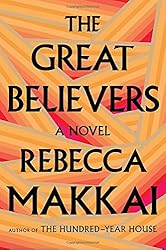
The Great Believers
Rebecca Makkai, 2018
Penguin Publishing
432 pp.
ISBN-13: 9780735223523
Summary
A dazzling new novel of friendship and redemption in the face of tragedy and loss set in 1980s Chicago and contemporary Paris
In 1985, Yale Tishman, the development director for an art gallery in Chicago, is about to pull off an amazing coup, bringing in an extraordinary collection of 1920s paintings as a gift to the gallery.
Yet as his career begins to flourish, the carnage of the AIDS epidemic grows around him. One by one, his friends are dying and after his friend Nico's funeral, the virus circles closer and closer to Yale himself.
Soon the only person he has left is Fiona, Nico's little sister.
Thirty years later, Fiona is in Paris tracking down her estranged daughter who disappeared into a cult. While staying with an old friend, a famous photographer who documented the Chicago crisis, she finds herself finally grappling with the devastating ways AIDS affected her life and her relationship with her daughter.
The two intertwining stories take us through the heartbreak of the eighties and the chaos of the modern world, as both Yale and Fiona struggle to find goodness in the midst of disaster. (From the publisher.)
Author Bio
• Birth—April 20, 1978
• Rasied—Lake Bluff, Illinois, USA
• Education—B.A., Washington and Lee University; M.F.A., Middlebury College
• Awards—Pushcart Prize
• Currently—lives near Chicago, Illinois
Rebecca Makkai is an American novelist and short-story writer, who grew up in Lake Bluff, Illinois. She is the daughter of linguistics professors Valerie Becker Makkai and Adam Makkai. Her paternal grandmother, Ignacz Rozsa, was a well-known actress and novelist in Hungary.
Makkai graduated from Washington and Lee University with a BA in English, and subsequently earned a master's degree from Middlebury College's Bread Loaf School of English. She lives with her husband and two daughters near Chicago, Illinois.
Her first novel, The Borrower, released in 2011, was a Booklist Top Ten Debut, an Indie Next pick, an O Magazine selection, and one of Chicago Magazine's choices for best fiction of 2011. It translated into seven languages.
Makkai's second novel, The Hundred-Year House, set in the Northern suburbs of Chicago, won the 2015 Novel of the Year award from the Chicago Writers Association.
Her novel about the AIDS epidemic in 1980s Chicago, titled The Great Believers, was published in 2018. It also received wide acclaim.
Makkai's short stories have been anthologized in The Best American Short Stories 2008, 2009, 2010 and 2011 and as well as in "The Best American Nonrequired Reading" 2009 and 2016; she received a 2017 Pushcart Prize and a 2014 NEA fellowship.
Her fiction has also appeared in Ploughshares, Tin House, The Threepenny Review, New England Review, and Shenandoah. Her nonfiction has appeared in Harpers and on Salon.com and the New Yorker website. Makkai's stories have also been featured on Public Radio International's Selected Shorts and This American Life.
She has taught at the Iowa Writers' Workshop, Northwestern University, Lake Forest College, Sierra Nevada College, and StoryStudio Chicago. (Adapted from Wikipedia. Retrieved 6/22/2018.)
Book Reviews
The Great Believers soars.… Makkai has full command of her multi-generational perspective, and by its end, The Great Believers offers a grand fusion of the past and the present, the public and the personal. It’s remarkably alive despite all the loss it encompasses.
Chicago Tribune
Focused on a group of friends, lovers, and family outcasts, the book highlights the way tragic illness shifts the courses of people’s lives—and how its touch forever lingers on those left behind.
Harper's Bazaar
Tearjerker.… The Great Believers asks big questions about redemption, tragedy, and connection. Makkai has written her most ambitious novel yet.
Entertainment Weekly
Makkai knits themes of loss, betrayal, friendship and survival into a powerful story of people struggling to keep their humanity in dire circumstances.
People Magazine
(Starred review) [A] striking, emotional journey through the 1980s AIDS crisis.… Makkai creates a powerful, unforgettable meditation, not on death, but rather on the power and gift of life. This novel will undoubtedly touch the hearts and minds of readers.
Publishers Weekly
At turns heartbreaking and hopeful, the novel brings the first years of the AIDS epidemic into very immediate view.… [Makkai[]… shows the compassion of chosen families and the tension and distance that can exist in our birth ones.
Library Journal
(Starred review) As her intimately portrayed characters wrestle with painful pasts and fight to love one another…, Makkai carefully reconstructs 1980s Chicago, WWI-era and present day Paris…. A tribute to the enduring forces of love and art, over everything.
Booklist
(Starred review) [Makkai's]… rich portraits of an array of big personalities…make this tender, keening novel an impressive act of imaginative empathy. As compulsively readable as it is thoughtful and moving: an unbeatable fictional combination.
Kirkus Reviews
Discussion Questions
1. Yale’s group of friends is very close. In a sense, they are his "chosen family." How is this explored in the book? How does each character relate to their family, biological and chosen? Do you have a "chosen family," and if so, what brings you all together?
2. How has the culture changed regarding LGBTQ+ voices and stories since the 1980s?
3. Chicago is such a powerful presence in this novel that it is almost a character in itself. Have you ever been to or lived in a place that exerted a strong influence on you?
4. Nora, the elderly woman donating the 1920s pieces, seems completely removed from the rest of Yale’s life, yet her story contains elements that can be compared and contrasted with Yale’s. What similarities between his and her life are there? How has her past affected the present?
5. Fiona has suffered many losses in her life. How do you think that affected her as a mother? What are the ways in which trauma and loss are passed down through generations?
6. Do you empathize more with Fiona or Claire?
7. Do you see any parallels between the state of healthcare during the 1980s and now?
8. On page 353, Asher asks Yale, "Does it really ever go anywhere?… Love. Does it vanish?" Yale replies, "I mean, we never want it to. But it does, doesn’t it?" What would you say to them?
9. Is the creation of artwork always a collaborative effort? How do you feel about the relationship between artist and muse?
10. What has been your knowledge of—or experience with, if any—AIDS or those affected by the disease? Has reading this novel changed any ideas you have previously had about the subject?
(Questions issued by the publishers.)
Great Expectations
Charles Dickens, 1860-61
500+ pp. (varies by publisher)
Summary
Pip, a poor orphan being raised by a cruel sister, does not have much in the way of great expectations between his terrifying experience in a graveyard with a convict named Magwitch and his humiliating visits with the eccentric Miss Havisham's beautiful but manipulative niece, Estella, who torments him until he is elevated to wealth by an anonymous benefactor.
Full of unforgettable characters, Great Expectations is a tale of intrigue, unattainable love, and all of the happiness money can't buy. Great Expectations has the most wonderful and most perfectly worked-out plot for a novel in the English language, according to John Irving, and J. Hillis Miller declares, Great Expectations is the most unified and concentrated expression of Dickens's abiding sense of the world, and Pip might be called the archetypal Dickens hero. (From the Penguin Classics Edition, image above right.)
Author Bio
• Birth—February 7, 1812
• Where—Portsmouth, England, UK
• Education—Home and private schooling
• Died—June 9, 1870
• Where—Kent, England
Born on February 7, 1812, Charles Dickens was the second of eight children in a family burdened with financial troubles. Despite difficult early years, he became the most successful British writer of the Victorian age.
In 1824, young Charles was withdrawn from school and forced to work at a boot-blacking factory when his improvident father, accompanied by his mother and siblings, was sentenced to three months in a debtor's prison. Once they were released, Charles attended a private school for three years. The young man then became a solicitor's clerk, mastered shorthand, and before long was employed as a Parliamentary reporter. When he was in his early twenties, Dickens began to publish stories and sketches of London life in a variety of periodicals.
It was the publication of Pickwick Papers (1836-1837) that catapulted the twenty-five-year-old author to national renown. Dickens wrote with unequaled speed and often worked on several novels at a time, publishing them first in monthly installments and then as books. His early novels Oliver Twist (1837-1838), Nicholas Nickleby (1838-1839), The Old Curiosity Shop (1840-1841), and A Christmas Carol (1843) solidified his enormous, ongoing popularity. As Dickens matured, his social criticism became increasingly biting, his humor dark, and his view of poverty darker still. David Copperfield (1849-1850), Bleak House (1852-1853), Hard Times (1854), A Tale of Two Cities (1859), Great Expectations (1860-1861), and Our Mutual Friend (1864-1865) are the great works of his masterful and prolific period.
In 1858 Dickens's twenty-three-year marriage to Catherine Hogarth dissolved when he fell in love with Ellen Ternan, a young actress. The last years of his life were filled with intense activity: writing, managing amateur theatricals, and undertaking several reading tours that reinforced the public's favorable view of his work but took an enormous toll on his health. Working feverishly to the last, Dickens collapsed and died on June 8, 1870, leaving The Mystery of Edwin Drood uncompleted. (From Barnes & Noble Classics edition.)
Book Reviews
(Older works have few, if any, online reviews from mainstream press. Take a look at customer reviews from Amazon or Barnes & Noble.)
Mr. Dickens may be reasonably proud of these volumes.... He has written a story that is new, original, powerful and very entertaining.... It is in his best vein, and although it is too slight, and bears many traces of hasty writing, it is quite worthy to stand beside Martin Chuzzlewit and David Copperfield.
Saturday Review (7/20/1861)
Discussion Questions
1. In this novel, Great Expectations, things are often not what they seem. Discuss how the theme of "expectations" is illustrated by and through the various major characters in this book. How are Pip's expectations different and similar from those of his surrogate father, Joe (the blacksmith), Miss Havisham (the eccentric recluse), Estella (the daughter of a convict and murderess) and Pip's benefactor, (the convict) Magwitch?
2. Why do you think it is one of Magwitch's principal conditions that Pip (his nickname) "always bear the name of Pip" in order to receive his financial support?
3. If Pip had not received his "Great Expectations" and never left Joe's forge, how do you think his life would have been different? Are the lessons he learns during his physical and emotional journey necessary for him to arrive at the wisdom he evinces as the middle-aged narrator of this tale? In what ways?
4. Why do you think Miss Havisham manipulates and misleads Pip into thinking she is his secret benefactor? What, if anything, does she derive from this action?
5. Given Dickens's portrayal of Estella, what do you think attracts Pip to her in the first place and what, when he learns of her cold-blooded manipulation of men such as her husband, keeps Pip devoted to her until the end, loving her, as he says, "against reason, against promise, against peace?"
6. In the final chapter Estella says to Pip: "Suffering has been stronger than all other teaching." Discuss the theme of suffering in this book—specifically how it instructs Pip, Miss Havisham and Estella.
7. In Chapter 49 Miss Havisham confesses to Pip that in adopting Estella, she "meant to save her (Estella) from misery like my own." Do you believe this, given Dickens's harsh characterization of Miss Havisham throughout the novel?
8. in the same Chapter (49) when Miss Havisham is set afire, do you believe that, given her state of mind, Dickens intends us to read this as an accident or a kind of penance/attempted suicide on her part for her cruelty to Pip and Estella?
What do you think makes Pip change his opinion of his benefactor Magwitch from one of initial repugnance to one of deep and abiding respect and love?
9. In Chapter 59, when Pip places Joe and Biddy's son (also named Pip) on the same tombstone that opens the novel, what do you think Dickens intends to tell us with this image? Given the novel's theme of how the sins of others are visited upon us, do you view this image as a foreboding one in any way?
(Questions issued by Penguin Classics; image, top right.)
top of page (summary)


The Great Gatsby
F. Scott Fitzgerald, 1925
140-50 pp. (varies by publisher)
Summary
The story is narrated by Nick Carraway, who after serving in World War I moves from the midwest to New York's Long Island. There he picks up with a college friend Tom Buchanan and his wife Daisy, Caraway's second cousin—a feckless, self-indulgent couple of privilege.
He also befriends his mysterious neighbor Jay Gatsby, whose mansion is the scene of lavish nightly parties. Gatsby reveals to Caraway that, as a young man without wealth, he had met and fallen in love with Daisy during the war. Now moneyed, Gatsby is obsessed with winning her back.
What follows are the tragic consequences of his pursuit—and Carraway's return to his roots in the midwest to contemplate, with new found cynicism, the moral decay and carelessness of privileged.
Author Bio
• Birth—September 24, 1896
• Where—St. Paul, Minnesota, USA
• Death—December 21, 1940
• Where—Hollywood, California
• Education—Princeton University
F. Scott Fitzgerald was named for his famous relative, Francis Scott Key, though he was always referred to as "Scott." Minnesota born and Princeton educated, Fitzgerald published his first novel, This Side of Paradise, in 1920 to critical and popular acclaim.
That same year, He married Zelda Sayre, the queen of Montgomery, Alabama youth society, and the two lived a boisterous, decadent life in New York City. (See LitCourse 5 with Fitzgerald's story "Babylon Revisited" for an idea of their life.) To better afford their extravagant lifestyle, the couple moved to France, where Fitzgerald befriended Hemingway and Gertrude Stein, becoming part of the legendary group of expatriate writers and artists, which Stein labeled the "Lost Generation." In Paris he wrote his finest novel, The Great Gatsby (1925).
Zelda was eventually hospitalized in 1930 for the first of many breakdowns, and Fitzgerald moved to Hollywood (William Faulkner was there, too), where his heavy drinking ended his screen writing career. In 1934 he published Tender Is the Night. He died there of a heart attack six years later at the age of 44.
More
The 1920s proved the most influential decade of Fitzgerald's development. The Great Gatsby, Scott's masterpiece, was published in 1925. Hemingway greatly admired The Great Gatsby and wrote in his A Moveable Feast "If he could write a book as fine as The Great Gatsby I was sure that he could write an even better one" (153). Hemingway expressed his deep admiration for Fitzgerald, and Fitzgerald's flawed, doomed character, when he prefaced his chapters concerning Fitzgerald in A Moveable Feast with:
His talent was as natural as the pattern that was made by the dust on a butterfly's wings. At one time he understood it no more than the butterfly did and he did not know when it was brushed or marred. Later he became conscious of his damaged wings and their construction and he learned to think and could not fly any more because the love of flight was gone and he could only remember when it had been effortless. (129)
Much of what Hemingway wrote in A Moveable Feast helped to create the myth of Fitzgerald's eventual demise and Zelda's hand in that demise. Though much of Hemingway's text is factually correct, it is always tinged with his disappointment with Fitzgerald.
Fitzgerald began working on his fourth novel during the late 1920s but was sidetracked by financial difficulties that necessitated his writing commercial short stories, and by the schizophrenia that struck Zelda in 1930. Her emotional health remained fragile for the rest of her life. In 1932, she was hospitalized in Baltimore, Maryland.
Scott rented an estate in the Baltimore suburb of Towson and began work on Tender Is the Night, the story of the rise and fall of Dick Diver, a promising young psychiatrist who falls in love with and marries one of his patients. Some critics have seen the book as a thinly-veiled autobiographical novel recounting Fitzgerald's problems with his wife, the corrosive effects of wealth and a decadent lifestyle, his own egoism and self-confidence, and his continuing alcoholism. Indeed, Fitzgerald was extremely protective of his material (their life together). When Zelda published her own version of their lives in Europe, Save Me the Waltz, Fitzgerald was angry and succeeded in getting her doctors to keep her from writing any more.
Tender was finally published in 1934, and critics who had waited nine years for the follow up to The Great Gatsby had mixed opinions about it. The novel did not sell well upon publication, but the book's reputation has since risen significantly.
Although he reportedly found movie work degrading, Fitzgerald was once again in dire financial straits and spent the second half of the 1930s in Hollywood, working on commercial short stories, scripts for Metro-Goldwyn-Mayer (including some unfilmed work on Gone with the Wind), and his fifth and final novel, posthumously published as The Last Tycoon (based on the life of film executive Irving Thalberg). Scott and Zelda became estranged; she continued living in mental institutions on the east coast, while he lived with his lover Sheilah Graham, a well-known gossip columnist, in Hollywood.
Fitzgerald had been an alcoholic since his college days, and became notorious during the 1920s for his extraordinarily heavy drinking, leaving him in poor health by the late 1930s. According to Zelda's biographer, Nancy Milford, Scott claimed that he had contracted tuberculosis. Fitzgerald suffered two heart attacks in late 1940, and on December 21, while awaiting a visit from his doctor, Fitzgerald collapsed in Sheilah Graham's apartment and died. He was 44. (Adapted from Wikipedia.)
Book Reviews
(Older works have few, if any, mainstream press reviews online. Take a look at customer reiews from Amazon and Barnes & Noble.)
The new American humor [is] a conflict of spirituality caught fast in the web of our commercial life. Both boisterous and tragic, it animates this new novel by Mr. Fitzgerald with whimsical magic and simple pathos that is realized with economy and restraint.... A curious book, a mystical, glamourous story of today. It takes a deeper cut at American life than hitherto has been essayed by Mr. Fitzgerald.
Edwin Clark - New York Times (4/19/1925)
Discussion Questions
Use our LitLovers Book Club Resources; they can help with discussions for any book:
• How to Discuss a Book (helpful discussion tips)
• Generic Discussion Questions—Fiction and Nonfiction
• Read-Think-Talk (a guided reading chart)
Also consider these LitLovers talking points to help get a discussion started for The Great Gatsby:
1. This book is infused with symbolism, particularly the green light at which Jay Gatsby gazes so intently, and the eyes of Dr. Eckleburg on the billboard. What do these symbols suggest? (Symbolic meanings are fluid, not fixed; they often mean different things to different observers/readers. See LitCourse 9 on symbolism.)
2. Is Jay Gatsby great? In other words, is Fitzgerald's title sincere...or ironic?
3. Discuss the four main characters. Who, if any, do you find most sympathetic? Most important, in what way do the events of the novel affect Nick Carraway? How, or to what degree, does he change? (Some see this work as a coming-of-age story.)
4. What statement might Fitzgerald be making about the mores or ethos of American culture—particularly the American Dream?
5. Quite frankly, I have never liked this book...or any of Fitzgerald's novels. Why?
(Questions by LitLovers. Pleae feel free to use them, online or off, with attribution. Thanks.)
top of page (summary)


Great House
Nicole Krauss, 2010
W.W. Norton & Co.
289 pp.
ISBN-13: 9780393079982
Summary
For twenty-five years, a reclusive American novelist has been writing at the desk she inherited from a young Chilean poet who disappeared at the hands of Pinochet’s secret police; one day a girl claiming to be the poet’s daughter arrives to take it away, sending the writer’s life reeling. Across the ocean, in the leafy suburbs of London, a man caring for his dying wife discovers, among her papers, a lock of hair that unravels a terrible secret. In Jerusalem, an antiques dealer slowly reassembles his father’s study, plundered by the Nazis in Budapest in 1944.
Connecting these stories is a desk of many drawers that exerts a power over those who possess it or have given it away. As the narrators of Great House make their confessions, the desk takes on more and more meaning, and comes finally to stand for all that has been taken from them, and all that binds them to what has disappeared.
Great House is a story haunted by questions: What do we pass on to our children and how do they absorb our dreams and losses? How do we respond to disappearance, destruction, and change?
Nicole Krauss has written a soaring, powerful novel about memory struggling to create a meaningful permanence in the face of inevitable loss. (From the publisher.)
Author Bio
• Birth—1974
• Reared —Old Westbury, Long Island, USA
• Education—Stanford University; Oxford University
• Awards—William Saroyan Int'l. Prize; Prix du Meilleur Livre
Etranger (France); Edward Lewis Wallant Award
• Currently—Brooklyn, New York
Nicole Krauss is an American author of several novels: Forest Dark (2017), Great House (2010), The History of Love (2005), and Man Walks into a Room (2002). Her work has achieved wide acclaim, with The New York Times referring to her as "one of America's most important authors."
Her fiction has been published in The New Yorker, Harper's, Esquire, and Granta's Best American Novelists Under 40, and has been collected in Best American Short Stories (2003 and 2008). Her novels have been translated into thirty-five languages.
Krauss was born in New York City to an English mother and an American father who grew up partly in Israel. Krauss's maternal grandparents were born in Germany and Ukraine and later emigrated to London. Her paternal grandparents were born in Hungary and Slonim, Belarus, met in Israel, and later emigrated to New York. Many of these places are central to Krauss's 2005 novel, The History of Love, and the book is dedicated to her grandparents.
At the age of 14 Krauss became serious about writing. Until she began her first novel in 2002, Krauss wrote and published mainly poetry.
Education
Krauss enrolled in Stanford University in 1992, and that fall she met Joseph Brodsky who worked closely with her on her poetry over the next three years. He also introduced her to such writers as Italo Calvino and Zbigniew Herbert, who would have a lasting influence.
In 1999, three years after Brodsky died, Krauss produced a documentary about his work for BBC Radio 3, traveling to St. Petersburg where she stood in the "room and a half" where he grew up, made famous by his essay of that title. Krauss majored in English and graduated with Honors, winning a number of undergraduate prizes for her poetry as well as the Dean's Award for academic achievement. She also curated a reading series (with Fiona Maazel) at the Russian Samovar, a NYC restaurant co-founded by Brodsky.
In 1996, she was awarded a Marshall Scholarship and enrolled in a Masters program at Oxford University where she wrote her thesis about the American artist Joseph Cornell. During the second year of her scholarship she attended the Courtauld Institute in London, where she received a Masters in Art History, specializing in seventeenth-century Dutch art, and writing a thesis on Rembrandt.
In 2004, Krauss married the novelist Jonathan Safran Foer. They live in Park Slope in Brooklyn, New York, and have two children. (From Wikipedia.)
Book Reviews
An elegiac novel...achieved through exquisitely chosen sensory details that reverberate with emotional intensity. Here [Krauss] gives us her tragic vision pure. It is a high-wire performance, only the wire has been replaced by an exposed nerve, and you hold your breath, and she does not fall.
Rebecca Newberger Goldstein - New York Times Book Review
To me the most resonant sections of Nicole Krauss' widely anticipated third novel, Great House, are those narrated by Aaron, an aging Israeli who still hasn't figured out how to relate to one of his adult sons.... The two chapters he narrates pulse with his hot-blooded heartbeat; the drama of his family rises to the level of the epic because he makes it so. As for the rest of the novel, it's well done enough, nicely written and full of cogent insights, but compared with Aaron, it feels as if it's taking place behind a sheet of glass.
David L. Ulin - Los Angeles Times
Nicole Krauss' latest novel, Great House, is precisely the kind of work of art for which the phrase "oddly compelling" was invented. Like her celebrated best-seller, The History of Love, this new novel contemplates love, loss and the oppressive weight of memory on those left behind. The plot here, though, is even murkier than it was in The History of Love.... I'm not sure what it all adds up to; I'm not even sure that Great House has one cohesive theme. But I'm willing to tolerate this confusion because of the isolated moments of psychological illumination that Krauss provides through her startling language. Reading Great House is like being lost in a pitch black room (an image that Krauss gives us more than once here) and then suddenly having a dusty corner of that room brilliantly lit up and exposed.
Maurreen Corrigan - National Public Radio
The most heartbreaking part of Great House is having to finish it.... As the mysteries of this beautifully written novel come spooling out, you’ll marvel at how profoundly one brilliantly crafted extended metaphor involving a mute wooden artifact can remind us what it means to be alive.
Elle
This stunning work showcases Krauss's consistent talent. The novel consists of four stories divided among eight chapters, all touching on themes of loss and recovery, and anchored to a massive writing desk that resurfaces among numerous households, much to the bewilderment and existential tension of those in its orbit, among them a lonely American novelist clinging to the memory of a poet who has mysteriously vanished in Chile, an old man in Israel facing the imminent death of his wife of 51 years, and an esteemed antiques dealer tracking down the things stolen from his father by the Nazis. Much like in Krauss's The History of Love, the sharply etched characters seem at first arbitrarily linked across time and space, but Krauss pulls together the disparate elements, settings, characters, and fragile connective tissue to form a formidable and haunting mosaic of loss and profound sorrow.
Publishers Weekly
In this latest from Krauss (The History of Love), a huge old desk with many drawers becomes the symbol of love and loss for a host of characters from different countries and time periods. There is the New York woman who has written all her novels at the desk, which she was keeping for a Chilean poet who has since disappeared. Then there are the poet's daughter, who comes back years later to claim the desk; the antiques dealer who tracks down meaningful items from people's pasts; the brother and sister who live isolated in a Jerusalem home filled with other people's furniture; the elderly couple in England who live with the desk and a horrible secret; and the dictatorial father who desperately tries to understand his creative son. Verdict: While each character's story is engrossing, the connection among them is at times impossible to follow. Still, Krauss deals with heavyweight themes—the Holocaust, the different ways people cope with suffering, the special cruelty of fathers, the costs of creativity—with meditative, insightful prose that makes for an intense and memorable reading experience. —Joy Humphrey, Pepperdine Univ. Law Lib., Malibu, CA
Library Journal
(Starred review.) Krauss’ masterful rendition of character is breathtaking, compelling.... This tour de force of fiction writing will deeply satisfy fans of the author’s first two books and bring her legions more. —Ellen Loughran
Booklist
Discussion Questions
Use our LitLovers Book Club Resources; they can help with discussions for any book:
• How to Discuss a Book (helpful discussion tips)
• Generic Discussion Questions—Fiction and Nonfiction
• Read-Think-Talk (a guided reading chart)
Also consider these LitLovers talking points to help get a discussion started for Great House:
1. What is this book about? How does the desk—and its 19 drawers—serve as a metaphor? A metaphor...for what?
2. The book explores the burden of memory and loss. In what way are Krauss's characters trapped by their past? What, in fact, does it mean to become a prisoner of the past? Apply that thought/question to your own life.
3. Spend time talking about each of the stories: narrators and characters. How are they related to the desk—what is the desk's importance to each?
4. Which of the narrators or characters are most sympathetic? Which ones are least sympathetic? Which story do you find most engaging? Least engaging?
5. Who is "Your Honor"—the judge whom Nadia addresses? What is the question that Nadia is pursuing in Israel? What epiphany does Nadia finally attain?
6. Recall Arthur's meditation on life's impermanence: he saw his life as...
a giant empty field where every day a circus erected and dismantled itself...from top to bottom, but never the same circus, so what hope did we really have of ever making sense of ourselves, let alone another?
What does he mean? Does his observation resonate with you? How is that observation played out over and over throughout this book?
7. Talk about Lotte's secret—and why she never shared it with her husband. Why had she never shared her secret with Arthur? Why did she do what she did? Why at the end does Arthur do what he does with the scrap of paper?
8. Why Aaron and his story about Dov included as a narrator in this work? What is the significance of the chapter title his narration, "True Kindness"? What do you think will happen when he arrives at the hospital?
9. What is the thematic significance of George Weisz's observation about his role in locating goods looted by the Nazis:
My business has always been to listen.... Like a doctor, I listen without saying a word. But there's one difference: when all of the talking is through, I provide a solution. It's true, I can't bring the dead back to life. But I can bring back the chair they once sat in, the bed where they slept.
10. What power does Weisz have over his Yoav and Leah? Why do they behave so submissively toward him? Why does Leah withhold the location of the desk from her father?
11. How do you understand the last sentences of the book. Disappointment...and relief—for what...and why?
11. Does the desk work as an organizing principle for this novel? Or does it make for a structually clumsy and confusing story?
12. What is the significance of the title, "Great House"?
13. In a New Yorker magazine interview (June 14, 2010), Krauss says that good fiction has the "ability to remind us of ourselves, of who we are in our essence, and at the same instant to deliver a revelation." Does Great House fulfill that goal for you?
14. Maureen Corrigan (NPR review) refers to Krauss as a "fiction pioneer...giving us readers the thrill of seeing the novel stretched into amorphous new shapes." Do you agree that Krauss is a "pioneer"—does this novel break new ground? Why...or why not?
15. Is this book too cerebral—too intellectually driven—to hold your attention? Do you wish it had a stronger plot? Or do you find Krauss's philosophical explorations compelling?
16. If you've read Krauss's previous book, The History of Love, how do the two novels compare with each other? What similarities do they share?
17. Nicole Krauss is married to Jonathan Safran Foer. Is that cool, or what?
(Questions by LitLovers. Please feel free to use them, online or off, with attribution. Thanks.)
top of page (summary)
Summary | Author | Book Reviews | Discussion Questions
The Great Night
Chris Adrian, 2011
Farrar, Strauss & Giroux
304 pp.
ISBN-13: 9780374166410
In Brief
Chris Adrian’s fiction has been hailed for its startling originality and provocative meditations on life and mortality. Inspired by Shakespeare’s A Midsummer Night’s Dream, The Great Night infuses Adrian’s storytelling with new levels of creative genius, bringing the imaginary kingdom of Titania and Oberon to San Francisco’s Buena Vista Park.
Midsummer’s Eve, 2008. Molly, Henry, and Will, each of them reeling from the loss of a love, set out for a party but become trapped in the park, which has become the home in exile for a madcap faerie court. Like the three mortals who are ensnared in her world that night, Queen Titania is mourning too: her adopted son has died of leukemia, a disease that defied the most potent magic. The queen’s grief has turned to rage, and on this night she unleashes an ancient beast, along with the fearsome might of her tiny Puckish followers.
As their stories unfold, the cast of characters proves to have surprising shared histories, blurring the line between memory and hope at every turn. For some, retracing the past becomes a way of flirting with immortality. For others, it’s only a reminder of how dark the mortal world can be. Culminating in a staging of the 1970s cult classic Soylent Green—indirectly produced by Titania via a homeless man who wants to bring down a seemingly sinister mayor—the novel unfolds as an unforgettable homage to the power of the imagination. (From the publisher.)
top of page
About the Author
• Birth—1970
• Where—N/A
• Education—B. A., University of Florida; M.D., Eastern
Virginia Medical School; Iowa Writer's Workshop;
Harvard Divinity School
• Awards—Guggenheim Fellowship
• Currently—lives in San Francisco, California
Chris Adrian is an American author. Adrian's writing styles in short stories vary a great deal, from modernist realism to pronounced lyrical allegory. His novels both tend toward surrealism, having mostly realistic characters experience fantastic circumstances.
He has written three novels: Gob's Grief, The Children's Hospital, and The Great Night, an updated take on Shakespeare's Midsummer's Night Dream. In 2008, he published A Better Angel, a collection of short stories.
His short fiction has also appeared in the Paris Review, Zoetrope, Ploughshares, McSweeney's, The New Yorker, Best American Short Stories, and Story. He was one of 11 fiction writers to receive a Guggenheim Fellowship in 2009.
Adrian completed his Bachelor's degree in English from the University of Florida in 1993. He received his M.D. from Eastern Virginia Medical School in 2001. He completed a pediatric residency at the University of California, San Francisco, was a student at Harvard Divinity School, and is currently in the pediatric hematology/oncology fellowship at UCSF. He is also a graduate of the Iowa Writers' Workshop. (From Wikipedia.)
top of page
Critics Say . . .
Adrian follows his masterful The Children's Hospital with a disappointing and decidedly less ambitious effort, a flabby retelling of A Midsummer Night's Dream that finds a heartbroken Titania loosening a demonic Puck on San Francisco's Buena Vista Park. Caught up in the mayhem are Henry, a neurotic gay man whose affair has just ended; Molly, a young woman turned inward after the suicide of her boyfriend; Will, a lovelorn tree doctor trying to get his lady back; and a group staging a musical remake of Soylent Green to explain the decline of San Francisco's homeless population. Adrian liberally applies surreal sex jokes and populates his adventure with bizarre fairies, impossible events, and extensive backstories, but this investigation into love's labors never ignites. Adrian occasionally channels the wayward, winsome feel of millennial San Francisco, but his characters remains wispy and his plot fails to develop satisfying turns. The book contains flashes of what makes this writer great, but he has better work in him.
Publishers Weekly
William Shakespeare's A Midsummer Night's Dream deals with illusion—in particular, the illusion that things can be set aright, as if by magic. This riff by New Yorker 20 Under 40 author Adrian (A Better Angel) is a whole lot darker, declaring that no magic can take away the memory of suffering and that in our self-serving scramble we disdain the pain (and indeed the goodness) of others. On the summer solstice in San Francisco, the fairies come out from under their hill in Buena Vista Park to celebrate Great Night. But this year there will be no celebration, for Oberon has vanished and Titania is thoroughly undone by the death of her Boy, one of the many changelings brought to her by Puck—no mischievous sprite but a malevolent spirit. Even as a rowdy bunch rehearse a play aimed at exposing the mayor's crimes against the homeless, three people are trapped in the park by the fairies' madness: uptight Molly, lovesick Will, and gentle, obsessed Henry, who still misses decamped lover Bobby and whose tragic past and connections to other characters unfold tantalizingly. Verdict: Inventive and scarily beautiful, this could wipe out casual readers, but it is an extraordinary novel. —Barbara Hoffert
Library Journal
top of page
Book Club Discussion Questions
1. The book’s epigraph is taken from lines spoken by Shakespeare’s Titania to the laborer Nick Bottom, who has been magically transformed into an ass. Under a spell, Titania has fallen in love with the donkey-headed Bottom. Is fairy life as comfortable as she says it is? Is mortal love a kind of spell, too, as Molly, Henry, and Will experience it?
2. The grim reality of the pediatric oncology ward illuminates the splendor of Titania and Oberon’s world. What does their experience with the Boy demonstrate about parenting, and about the limits of a parent who seems to have unlimited resources? What is good and bad about Titania and Oberon’s parenting? In what way do Beadle and Blork become like parents to the parents?
3. If you’re familiar with A Midsummer Night’s Dream, compare it to The Great Night. How do real and imaginary realms influence each other in both works? Do the authors have the same approach to despondent lovers?
4. As Molly mourns for Ryan, is her family’s religious history, along with her botched chaplain internship, a help or a hindrance?
5. How does Henry’s abduction affect his relationship with Bobby? What is left of Henry’s identity after Bobby leaves? How did you react to the crossroads between Henry’s and Ryan’s youth?
6. What do Will’s parents teach him about relationships and love? Which of their lessons does he unlearn with Carolina?
7. How might the novel have unfolded if it had been told from the other lovers’ points of view: Bobby, Carolina, and (from the grave) Ryan?
8. Do the mayor and Titania have similar problems as rulers?
9. Just as Shakespeare presents a play within a play, staged by Bottom, Adrian imagines a homeless performance of the 1973 cult classic Soylent Green, which is set in a dismal 2022, featuring a world consumed by overpopulation, the greenhouse effect, and a reliance on processed food rations (Soylent Green). How does it affect your reading to watch fiction unfold inside fiction?
10. How did you picture the frightening, unleashed beast? How did you feel when the fear was resolved, and Henry and Titania came to their resolution? What do you suppose the squirrel will tell Bobby?
11. Enchanting, liberating, yet gritty, how do San Francisco and Buena Vista Park mirror the characters in The Great Night?
12. How do love and longing manifest themselves differently in the novel’s two worlds? Whether the characters are mortal or not, what are the greatest sources of oppression and freedom in their lives?
13. Chris Adrian has compared The Great Night to a mixture of “odd-tasting foreign candies.” Which of the many tiny feasts in this novel was the most appealing to you?
14. What aspects of The Great Night echo the struggles captured in Adrian’s previous fiction (Gob’s Grief, featuring Walt Whitman and Victoria Woodhull; The Children’s Hospital, invoking Noah’s Ark; and A Better Angel, a story collection in which the characters contemplate the metaphysical)? Which aspects of The Great Night are unlike anything you have read before?
15. If your world were inhabited by fairies, what would they want from you? How would they manifest themselves in your workplace, your neighborhood, and your love life?
(Questions issued by publisher.)

A Great Reckoning (Inspector Gamach series, 12)
Louise Penny, 2016
St. Martin's Press
400 pp.
ISBN-13: 9781250022134
Summary
Louise Penny pulls back the layers to reveal a brilliant and emotionally powerful truth in her latest spellbinding novel.
When an intricate old map is found stuffed into the walls of the bistro in Three Pines, it at first seems no more than a curiosity. But the closer the villagers look, the stranger it becomes.
Given to Armand Gamache as a gift the first day of his new job, the map eventually leads him to shattering secrets. To an old friend and older adversary. It leads the former Chief of Homicide for the Surete du Québec to places even he is afraid to go. But must.
And there he finds four young cadets in the Surete academy, and a dead professor. And, with the body, a copy of the old, odd map.
Everywhere Gamache turns, he sees Amelia Choquet, one of the cadets. Tattooed and pierced. Guarded and angry. Amelia is more likely to be found on the other side of a police line-up. And yet she is in the academy. A protégée of the murdered professor.
The focus of the investigation soon turns to Gamache himself and his mysterious relationship with Amelia, and his possible involvement in the crime. The frantic search for answers takes the investigators back to Three Pines and a stained glass window with its own horrific secrets.
For both Amelia Choquet and Armand Gamache, the time has come for a great reckoning. (From the publisher.)
Author Bio
• Birth—1958
• Where—Toronto, Canada
• Education—B.A, Ryerson University
• Awards—Agatha Award (4 times) "New Blood" Dagger Award;
Arthur Ellis Award; Barry Award, Anthony Award; Dilys Award.
• Currently—lives in Knowlton, Canada (outside of Montreal)
In her words
I live outside a small village south of Montreal, quite close to the American border. I'd like to tell you a little bit about myself. I was born in Toronto in 1958 and became a journalist and radio host with the Canadian Broadcasting Corporation, specializing in hard news and current affairs. My first job was in Toronto and then moved to Thunder Bay at the far tip of Lake Superior, in Ontario. It was a great place to learn the art and craft of radio and interviewing, and listening. That was the key. A good interviewer rarely speaks, she listens. Closely and carefully. I think the same is true of writers.
From Thunder Bay I moved to Winnipeg to produce documentaries and host the CBC afternoon show. It was a hugely creative time with amazingly creative people. But I decided I needed to host a morning show, and so accepted a job in Quebec City. The advantage of a morning show is that it has the largest audience, the disadvantage is having to rise at 4am.
But Quebec City offered other advantages that far outweighed the ungodly hour. It's staggeringly beautiful and almost totally French and I wanted to learn. Within weeks I'd called Quebecers "good pumpkins", ordered flaming mice in a restaurant, for dessert naturally, and asked a taxi driver to "take me to the war, please." He turned around and asked "Which war exactly, Madame?" Fortunately elegant and venerable Quebec City has a very tolerant and gentle nature and simply smiled at me.
From there the job took me to Montreal, where I ended my career on CBC Radio's noon programme.
In my mid-thirties the most remarkable thing happened. I fell in love with Michael, the head of hematology at the Montreal Children's Hospital. He'd go on to hold the first named chair in pediatric hematology in Canada, something I take full credit for, out of his hearing.
It's an amazing and blessed thing to find love later in life. It was my first marriage and his second. He'd lost his first wife to cancer a few years earlier and that had just about killed him. Sad and grieving we met and began a gentle and tentative courtship, both of us slightly fearful, but overcome with the rightness of it. And overcome with gratitude that this should happen to us and deeply grateful to the family and friends who supported us.
Fifteen years later we live in an old United Empire Loyalist brick home in the country, surrounded by maple woods and mountains and smelly dogs.
Since I was a child I've dreamed of writing and now I am. Beyond my wildest dreams (and I can dream pretty wild) the Chief Inspector Gamache books have found a world-wide audience, won awards and ended up on bestseller lists including the New York Times. Even more satisfying, I have found a group of friends in the writing community. Other authors, booksellers, readers—who have become important parts of our lives. I thought writing might provide me with an income—I had no idea the real riches were more precious but less substantial. Friendships.
There are times when I'm in tears writing. Not because I'm so moved by my own writing, but out of gratitude that I get to do this. In my life as a journalist I covered deaths and accidents and horrible events, as well as the quieter disasters of despair and poverty. Now, every morning I go to my office, put the coffee on, fire up the computer and visit my imaginary friends, Gamache and Beauvoir and Clara and Peter. What a privilege it is to write. I hope you enjoy reading the books as much as I enjoy writing them.
Chief Inspector Gamache was inspired by a number of people, and one main inspiration was this man holding a copy of En plein coeur. Jean Gamache, a tailor in Granby. He looks slightly as I picture Gamache, but mostly it was his courtesy and dignity and kind eyes that really caught my imagination. What a pleasure to be able to give him a copy of En plein coeur! (From the author's website with permission.)
Book Reviews
Despite the theme of defiled innocence that makes this such a mournful story, the immense charm of the Gamache series survives in the magical setting and feisty residents of Three Pines…. Like most of the yarns we've heard about Three Pines, this one honors the town elders and respects the rituals of their quiet existence. But in a broader sense, the novel reaches beyond the living to become the saddest kind of ghost story, a lament for all "the phantom life that might have been."
Marilyn Stasio - New York Times Book Review
There’s a bit of Nancy Drew in Louise Penny’s masterful A Great Reckoning....but Penny, as ever, has something more ambitious in store.... As always in the Gamache series, the main narrative branches into more complicated patterns until all questions are resolved in a spectacular climax that cross cuts between story lines. The chief moral question that permeates the many subplots of A Great Reckoning is the vexing one of what elders owe to the young under their care.
Mureen Corrigan - Washington Post
(Starred review.) [L]yrical.... This complex novel deals with universal themes of compassion, weakness in the face of temptation, forgiveness, and the danger of falling into despair and cynicism over apparently insurmountable evils.
Publishers Weekly
(Starred review.) While this book may stand alone, fans of the series will enjoy revisiting old friends. Gamache remains admirable yet human.... This riveting read, with characters of incredible depth who only add to the strength of the plot, will keep readers guessing until the last page. —Terry Lucas, Shelter Island P.L., NY
Library Journal
(Starred review.) A compelling mystery and a rich human drama in which no character is either entirely good or evil, and each is capable of inspiring empathy.
Booklist
(Starred review.) Within a police force, some members must be trained in the science, and art, of solving murders. But does this training create people highly capable of committing them?.... A chilling story that's also filled with hope—a beloved Penny trademark.
Kirkus Reviews
Discussion Questions
(We'll add specific questions if and when they're made available by the publisher. In the meantime, use our generic mystery questions.)
GENERIC DISCUSSION QUESTIONS
Mystery / Crime / Suspense Thrillers
1. Talk about the characters, both good and bad. Describe their personalities and motivations. Are they fully developed and emotionally complex? Or are they flat, one-dimensional heroes and villains?
2. What do you know...and when do you know it? At what point in the book do you begin to piece together what happened?
3. Good crime writers embed hidden clues in plain sight, slipping them in casually, almost in passing. Did you pick them out, or were you...clueless? Once you've finished the book, go back to locate the clues hidden in plain sight. How skillful was the author in burying them?
4. Good crime writers also tease us with red-herrings—false clues—to purposely lead readers astray? Does your author try to throw you off track? If so, were you tripped up?
5. Talk about the twists & turns—those surprising plot developments that throw everything you think you've figured out into disarray.
- Do they enhance the story, add complexity, and build suspense?
- Are they plausible or implausible?
- Do they feel forced and gratuitous—inserted merely to extend the story?
6. Does the author ratchet up the suspense? Did you find yourself anxious—quickly turning pages to learn what happened? A what point does the suspense start to build? Where does it climax...then perhaps start rising again?
7. A good ending is essential in any mystery or crime thriller: it should ease up on tension, answer questions, and tidy up loose ends. Does the ending accomplish those goals?
- Is the conclusion probable or believable?
- Is it organic, growing out of clues previously laid out by the author (see Question 3)?
- Or does the ending come out of the blue, feeling forced or tacked-on?
- Perhaps it's too predictable.
- Can you envision a different or better ending?
8. Are there certain passages in the book—ideas, descriptions, or dialogue—that you found interesting or revealing...or that somehow struck you? What lines, if any, made you stop and think?
9. Overall, does the book satisfy? Does it live up to the standards of a good crime story or suspense thriller? Why or why not?
(Generic Mystery Questions by LitLovers. Please feel free to use them, online or off, with attribution. Thanks.)
top of page (summary)
The Great Santini
Pat Conroy, 1976
Bantam Books
489 pp.
ISBN-13: 9780553381559
Summary
The Great Santini takes us into the family life of a fighter pilot. Bull Meecham is the epitome of the Marine officer — as tough a disciplinarian at home as at the base. Rebellion, or even difference of opinion, is not tolerated. Objections are met with the statement "The Great Santini has spoken." As the oldest child, Ben takes the brunt of his father's criticism. His attempts to stand up for himself or his mother and sister are contemptuously dismissed. His feelings for his father are a mixture of hate and fear, reluctant pride in his prowess, and unacknowledged love.
The Marine Corps and flying are the most important things in Bull's life. Next come his image as a tough guy, the Catholic Church, his old buddies, and his wife and children. His sons are destined to become Marine pilots, his daughters to provide their husbands (Marines, naturally) with a good home and more fodder for the Corps.
Ben is eighteen and a born athlete. So his father's fierce drive for a successful son is concentrated on him, and nothing less than perfection is considered acceptable — a perfection of which Bull is the sole judge. Ben must learn that, in a game, sportsmanship should go by the board when necessary; what matters is winning, regardless of the means.
This is the story of a boy's determination to be himself, whatever that may be. It is violent, shocking, funny, moving, and overwhelmingly real. From the early pages, with Bull's wife and children waiting at the airport to welcome The Great Santini back into their midst, to the bittersweet ending, the reader's interest and emotions are fixed upon the fluctuating fortunes of the Meecham family. (From the publisher.)
The Great Santini was adapted to film in 1979 with Robert Duval as Bull Meechem and Blythe Danner as Lillian.
Author Bio
• Birth—October 26, 1945
• Where—Atlanta, Georgia, USA
• Education—B.A., The Citadel
• Currently—lives in San Francisco, California, and Fripp
Island, South, Carolina
Pat Conroy was born in Atlanta, Georgia, to a young career military officer from Chicago and a Southern beauty from Alabama, whom Pat often credits for his love of language. He was the first of seven children.
His father was a violent and abusive man, a man whose biggest mistake, Conroy once said, was allowing a novelist to grow up in his home, a novelist "who remembered every single violent act.... My father's violence is the central fact of my art and my life." Since the family had to move many times to different military bases around the South, Pat changed schools frequently, finally attending the Citadel Military Academy in Charleston, South Carolina, upon his father's insistence. While still a student, he wrote and then published his first book, The Boo, a tribute to a beloved teacher.
After graduation, Conroy taught English in Beaufort, where he met and married a young woman with two children, a widow of the Vietnam War. He then accepted a job teaching underprivileged children in a one-room schoolhouse on Daufuskie Island, a remote island off the South Carolina shore. After a year, Pat was fired for his unconventional teaching practices—such as his unwillingness to allow corporal punishment of his students—and for his general lack of respect for the school's administration. Conroy evened the score when he exposed the racism and appalling conditions his students endured with the publication of The Water is Wide in 1972. The book won Conroy a humanitarian award from the National Education Association and was made into the feature film Conrack, starring Jon Voight.
Writings
Following the birth of a daughter, the Conroys moved to Atlanta, where Pat wrote his novel, The Great Santini, published in 1976. This autobiographical work, later made into a powerful film starring Robert Duvall, explored the conflicts of his childhood, particularly his confusion over his love and loyalty to an abusive and often dangerous father.
The publication of a book that so painfully exposed his family's secret brought Conroy to a period of tremendous personal desolation. This crisis resulted not only in his divorce but the divorce of his parents; his mother presented a copy of The Great Santini to the judge as "evidence" in divorce proceedings against his father.
The Citadel became the subject of his next novel, The Lords of Discipline, published in 1980. The novel exposed the school's harsh military discipline, racism and sexism. This book, too, was made into a feature film.
Pat remarried and moved from Atlanta to Rome where he began The Prince of Tides which, when published in 1986, became his most successful book. Reviewers immediately acknowledged Conroy as a master storyteller and a poetic and gifted prose stylist. This novel has become one of the most beloved novels of modern time—with over five million copies in print, it has earned Conroy an international reputation. The Prince of Tides was made into a highly successful feature film directed by Barbra Streisand, who also starred in the film opposite Nick Nolte, whose brilliant performance won him an Oscar nomination.
Beach Music (1995), Conroy's sixth book, was the story of Jack McCall, an American who moves to Rome to escape the trauma and painful memory of his young wife's suicidal leap off a bridge in South Carolina. The story took place in South Carolina and Rome, and also reached back in time to the Holocaust and the Vietnam War. This book, too, was a tremendous international bestseller.
While on tour for Beach Music, members of Conroy's Citadel basketball team began appearing, one by one, at his book signings around the country. When his then-wife served him divorce papers while he was still on the road, Conroy realized that his team members had come back into his life just when he needed them most. And so he began reconstructing his senior year, his last year as an athlete, and the 21 basketball games that changed his life. The result of these recollections, along with flashbacks of his childhood and insights into his early aspirations as a writer, is My Losing Season, Conroy's seventh book and his first work of nonfiction since The Water is Wide.
South of Broad, published in 2009, 14 years after Beach Music, tells the story of friendships, first formed in high school, that span two decades.
In 2013, Conroy published his memoir, The Death of Santini, in which he revealed in greater detail his childhool and family life, especially the brutality of his father. Eventually, however, before his father's death, Pat and his father achieved peace, and Pat learned to forgive.
He currently lives in Fripp Island, South Carolina with his wife, the novelist Cassandra King. (Adapted from the author's website and Barnes & Noble.)
Book Reviews
Stinging authenticity.... A book that won't quit.
Atlanta Journal
A fine, funny, brawling book.... Domineering, authoritarian, selfish, arbitrary, even cruel, relegating all that is gentle or sensitive to the domain of women, his father is a Marine pilot who runs his household with all the kindness and understanding of a drill instructor shaping up a bunch of raw recruits.
National Observer
Compelling storytelling.... Conroy takes aim at our darkest emotions, lets the arrow fly and hits a bulls-eye almost every time.
Milwaukee Journal Sentinel
Few novelists write as well and not as beautifully.
Lexington Herald-Leader
Book Club Discussion Questions
Use our LitLovers Book Club Resources; they can help with discussions for any book:
• How to Discuss a Book (helpful discussion tips)
• Generic Discussion Questions—Fiction and Nonfiction
• Read-Think-Talk (a guided reading chart)
Also consider these LitLovers talking points to help get a discussion started for The Great Santini:
1. The most obvious place to start is with Bull Meecham. Describe the kind of a man he is...as a father and husband ...as well as a military commander? What "code," or set of beliefs, does he operate under?
2. What is Bull Meecham's affect on his family, particularly his son Ben? Is it possible to love such a man as Bull? Does Bull love his family?
3. Talk about those times that Meecham can be endearing and the other times he is cruel? Recall, especially, the basketball game between Ben and his father?
4. Talk about Lillian Meecham and her relationship with her husband and children, especially with Mary Anne? What role does she play in the dysfunctional household? Would you describe her as a passive southern belle?
5. What role does school play in young Ben's life? What does it provide him with that his family, especially his father, cannot?
6. Conroy has said that "one of the greatest gifts you can get as a writer is to be born into an unhappy family." Care to comment on that?
7. Ben defies his father to help a friend. Ultimately, who is more of a man in the Meecham household—young Ben or his father? In fact, what does it mean to be "a man"?
(Questions by LitLovers. Please feel free to use them, online or off, with attribution. Thanks.)
top of page (Summary)


The Greater Journey: Americans in Paris
David McCullough, 2011
Simon & Schuster
576 pp.
ISBN-13: 978-1416571766
Summary
The Greater Journey is the enthralling, inspiring—and until now, untold—story of the adventurous American artists, writers, doctors, politicians, architects, and others of high aspiration who set off for Paris in the years between 1830 and 1900, ambitious to excel in their work.
After risking the hazardous journey across the Atlantic, these Americans embarked on a greater journey in the City of Light. Most had never left home, never experienced a different culture. None had any guarantee of success. That they achieved so much for themselves and their country profoundly altered American history.
As David McCullough writes, “Not all pioneers went west.” Elizabeth Blackwell, the first female doctor in America, was one of this intrepid band. Another was Charles Sumner, who enrolled at the Sorbonne because of a burning desire to know more about everything. There he saw black students with the same ambition he had, and when he returned home, he would become the most powerful, unyielding voice for abolition in the U.S. Senate, almost at the cost of his life.
Two staunch friends, James Fenimore Cooper and Samuel F. B. Morse, worked unrelentingly every day in Paris, Cooper writing and Morse painting what would be his masterpiece. From something he saw in France, Morse would also bring home his momentous idea for the telegraph.
Pianist Louis Moreau Gottschalk from New Orleans launched his spectacular career performing in Paris at age 15. George P. A. Healy, who had almost no money and little education, took the gamble of a lifetime and with no prospects whatsoever in Paris became one of the most celebrated portrait painters of the day. His subjects included Abraham Lincoln.
Medical student Oliver Wendell Holmes wrote home of his toil and the exhilaration in “being at the center of things” in what was then the medical capital of the world. From all they learned in Paris, Holmes and his fellow “medicals” were to exert lasting influence on the profession of medicine in the United States.
Writers Ralph Waldo Emerson, Nathaniel Hawthorne, Mark Twain, and Henry James were all “discovering” Paris, marveling at the treasures in the Louvre, or out with the Sunday throngs strolling the city’s boulevards and gardens. “At last I have come into a dreamland,” wrote Harriet Beecher Stowe, seeking escape from the notoriety Uncle Tom’s Cabin had brought her. Almost forgotten today, the heroic American ambassador Elihu Washburne bravely remained at his post through the Franco-Prussian War, the long Siege of Paris and even more atrocious nightmare of the Commune. His vivid account in his diary of the starvation and suffering endured by the people of Paris (drawn on here for the first time) is one readers will never forget. The genius of sculptor Augustus Saint-Gaudens, the son of an immigrant shoemaker, and of painters Mary Cassatt and John Singer Sargent, three of the greatest American artists ever, would flourish in Paris, inspired by the examples of brilliant French masters, and by Paris itself.
Nearly all of these Americans, whatever their troubles learning French, their spells of homesickness, and their suffering in the raw cold winters by the Seine, spent many of the happiest days and nights of their lives in Paris. McCullough tells this sweeping, fascinating story with power and intimacy, bringing us into the lives of remarkable men and women who, in Saint-Gaudens’s phrase, longed “to soar into the blue.” The Greater Journey is itself a masterpiece. (From the publisher.)
Author Bio
• Birth—July 7, 1933
• Where—Pittsburgh, Pennsylvania, USA
• Education—B.A., Yale University
• Awards—National Book Award (twice); Pulitzer Prize (twice); Presidential Medal of Honor
• Currently—lives in Boston, Massachusetts
David McCullough is an American author, narrator, historian, and lecturer. He is a two-time winner of the Pulitzer Prize and the National Book Award and a recipient of the Presidential Medal of Freedom, the United States' highest civilian award.
McCullough's first book was The Johnstown Flood (1968), and he has since written nine more on such topics as Harry S. Truman, John Adams, the Brooklyn Bridge, and the Wright Brothers. McCullough has also narrated numerous documentaries, such as The Civil War by Ken Burns, as well as the 2003 film Seabiscuit, and he hosted American Experience for twelve years.
McCullough's two Pulitzer Prize-winning books, Truman (1992) and John Adams (2001), have been adapted by HBO into a TV film and a mini-series, respectively. McCullough's history, The Greater Journey (2011), is about Americans in Paris from the 1830s to the 1900s.
Youth and education
McCullough was born in Pittsburgh, Pennsylvania, the son of Ruth (nee Rankin) and Christian Hax McCullough. He is of Scots-Irish descent. He was educated at Linden Avenue Grade School and Shady Side Academy, in his hometown of Pittsburgh.
One of four sons, McCullough had a "marvelous" childhood with a wide range of interests, ranging from sports to drawing cartoons. McCullough's parents and his grandmother, who read to him often, introduced him to books at an early age. His parents often talked about history, a topic he says should be discussed more often. McCullough "loved school, every day"; he contemplated many career choices, everything from architect, actor, painter, writer, to lawyer, and contemplated attending medical school for a time.
McCullough attended Yale University, graduating with honors in English in 1955. He considered it a "privilege" to study at Yale because of faculty members such as John O'Hara, John Hersey, Robert Penn Warren, and Brendan Gill. He occasionally ate lunch with the Pulitzer Prize-winning novelist and playwright Thornton Wilder. Wilder, says McCullough, taught him that a competent writer maintains "an air of freedom" in the storyline, so that a reader will not anticipate the outcome, even if the book is non-fiction.
While at Yale, he became a member of Skull and Bones. He served apprenticeships at Time, Life, the United States Information Agency, and American Heritage, where he enjoyed research. "Once I discovered the endless fascination of doing the research and of doing the writing, I knew I had found what I wanted to do in my life."
Early career
After graduation, McCullough moved to New York City, where Sports Illustrated hired him as a trainee. He later worked as an editor and writer for the United States Information Agency in Washington, D.C. After working for twelve years, including a position at American Heritage, in editing and writing, McCullough reached a point where he believed he "could attempt something" on his own.
Although he had no idea that he would end up writing history, McCullough "stumbled upon" a story that he felt was "powerful, exciting, and very worth telling." After three years of writing in his spare time (while still at American Heritage), he published The Johnstown Flood. The book, a chronicle of one of the worst flood disasters in United States history, was published in 1968 to high praise. John Leonard, of the New York Times, said of McCullough, "We have no better social historian." Despite precarious financial times, but encouraged by his wife Rosalee, he decided to become a full-time writer.
People often ask me if I'm working on a book. That's not how I feel. I feel like I work in a book. It's like putting myself under a spell. And this spell, if you will, is so real to me that if I have to leave my work for a few days, I have to work myself back into the spell when I come back. It's almost like hypnosis.
Recognition
After the success of The Johnstown Flood, two new publishers offered him contracts, one to write about the Great Chicago Fire and another about the San Francisco earthquake. Not wishing to become "Bad News McCullough," he decided to write about people who "were not always foolish and inept or irresponsible." He also remembered Thornton Wilder telling told him that "he got an idea for a book or a play when he wanted to learn about something. Then, he'd check to see if anybody had already done it, and if they hadn't, he'd do it."
McCullough decided to write a history of the Brooklyn Bridge, which he had walked across many times.
To me history ought to be a source of pleasure. It isn't just part of our civic responsibility. To me it's an enlargement of the experience of being alive, just the way literature or art or music is.
Published in 1972, critics hailed The Great Bridge (1972) as "the definitive book on the event."
Five years later, The Path Between the Seas: The Creation of the Panama Canal was released, gaining McCullough widespread recognition. The book won the National Book Award in History, the Samuel Eliot Morison Award, the Francis Parkman Prize, and the Cornelius Ryan Award.
In 1977, McCullough traveled to the White House to advise Jimmy Carter and the United States Senate on the Torrijos-Carter Treaties, which would give Panama control of the Canal. Carter later said that the treaties, which were agreed upon to hand over ownership of the Canal to Panama, would not have passed, had it not been for the book.
Other works
McCullough's fourth work was his first biography, reinforcing his belief that "history is the story of people." Released in 1981, Mornings on Horseback tells the story of seventeen years in the life of Theodore Roosevelt, the 26th President of the United States. The work ranged from 1869, when Roosevelt was ten years old, to 1886, and tells of a "life intensely lived." The book won McCullough's second National Book Award, his first Los Angeles Times Prize for Biography, and New York Public Library Literary Lion Award.
Next, he published Brave Companions, a collection of essays written over a period of twenty years. Essays cover historical or literary figures such as Louis Agassiz, Alexander von Humboldt, John and Washington Roebling, Harriet Beecher Stowe, Conrad Aiken, and Frederic Remington.
McCullough's next book, his second biography, Truman (1993), was about the 33rd president. That book won McCullough his first Pulitzer Prize for "Best Biography or Autobiography" and his second Francis Parkman Prize. Two years later, the book was adapted as an HBO television movie by the same name, with Gary Sinise in the role of Truman. Commenting on his subject, Truman said
I think it's important to remember that these men are not perfect. If they were marble gods, what they did wouldn't be so admirable. The more we see the founders as humans the more we can understand them.
Seven years later, in 2001, McCullough published his third biography John Adams, about the life of the second US president. One of the fastest-selling non-fiction books in history, it won McCullough's second Pulitzer Prize for "Best Biography or Autobiography." He intended the book to be about the two founding fathers and back-to-back presidents, John Adams and Thomas Jefferson, but he became so intrigued with Adams that he decided to focus on Adams alone. In 2008 HBO adapted the book as a seven-part miniseries by the same name, with Paul Giamatti in the title role.
Published in 2005, McCullough's 1776, tells the story of the founding year of the US, focusing on George Washington, the amateur army, and other struggles for independence. Because of McCullough's popularity, its initial printing was 1.25 million copies, many more than the average history book. Upon its release, the book became a number-one bestseller in the US.
McCullough considered writing a sequel to 1776 but instead wrote about Americans in Paris between 1830 and 1900. The Greater Journey, published in 2011, covers 19th-century Americans, including Mark Twain and Samuel Morse, who migrated to Paris and went on to achieve importance in culture or innovation. Others included in the book are Elihu Washburne, the American ambassador to France during the Franco-Prussian War, and Elizabeth Blackwell, the first female doctor in the US.
Personal life
David McCullough lives in Boston, Massachusetts, and is married to Rosalee Barnes McCullough, whom he met at age 17 in Pittsburgh. The couple has five children and nineteen grandchildren. He enjoys sports, history and art, including watercolor and portrait painting.
His son David Jr., an English teacher at Wellesley High School in the Boston suburbs, achieved sudden fame in 2012 with his commencement speech. He told graduating students, "you're not special" nine times, and his speech went viral on YouTube. (Adapted from Wikipedia. Retrieved 9/2/2015.)
Book Reviews
[McCullough] explores the intellectual legacy that France settled on its 19th-century visitors. The result is an epic of ideas, as well as an exhilarating book of spells…McCullough's grand tour is impressionistic and discursive, proceeding by way of crossed paths and capsule biographies. This is history to be savored rather than sprinted through, like a Parisian meal. It amounts to a meaty collection of short stories, expertly and flavorfully assembled, free of gristly theory.
Stacy Schiff - New York Times
The Greater Journey is a lively and entertaining panorama, with abundant details along the way. A parade must keep moving, and McCullough is a practiced hand at managing such a cast. His specialty is clarity. His voice is straightforward, more journalistic than literary despite its largely artistic subject matter.
Michael Sims - Washington Post
There is not an uninteresting page here as one fascinating character after another is explored at a crucial stage of his development.... Wonderful, engaging writing full of delighting detail.
John Barron - Chicago Sun-Times
From a dazzling beginning that captures the thrill of arriving in Paris.... The Greater Journey will satisfy McCullough's legion of loyal fans...it will entice a whole new generation of Francophiles, armchair travelers and those Americans lucky enough to go to Paris before they die.
Bruce Watson - San Francisco Chronicle
(Starred review.) One of America’s most popular historians and a two-time Pulitzer Prize winner, McCullough (1776) has hit the historical jackpot. Travelers before the telephone era loved to write letters and journals, and McCullough has turned this avalanche of material into an entertaining chronicle of several dozen 19th-century Americans who went to Paris, an immense, supremely civilized city flowing with ideas, the arts, and elegance, where no one spit tobacco juice or defaced public property. They discovered beautiful clothing, delicious food, the art of dining ("The French dine to gratify, we to appease appetite," wrote John Sanderson). Paris had not only pleasures but professional attractions as well. Artists such as Samuel F.B. Morse, Whistler, Sargent, and Cassatt came to train. At a time when American medical education was fairly primitive, Oliver Wendell Holmes Sr. and other prospective physicians studied at the Sorbonne’s vast hospitals and lecture halls—with tuition free to foreigners. Authors from Cooper to Stowe, Twain, and James sometimes took up residence. McCullough mixes famous and obscure names and delivers capsule biographies of everyone to produce a colorful parade of educated, Victorian-era American travelers and their life-changing experiences in Paris.
Publishers Weekly
(Starred review.) A highly readable and entertaining travelogue of a special sort, an interdisciplinary treat from a tremendously popular Pulitzer Prize-winning historian.... Highly recommended.
Library Journal
(Starred review.) McCullough’s research is staggering to perceive, and the interpretation he lends to his material is impressive to behold.... Expect his latest book to ascend the best-seller lists and be given a place on the year-end best lists.
Booklist
(Starred review.) An ambitious, wide-ranging study of how being in Paris helped spark generations of American genius.... A gorgeously rich, sparkling patchwork, eliciting stories from diaries and memoirs to create the human drama McCullough depicts so well
Kirkus Reviews
Discussion Questions
1. The Greater Journey opens with a quotation by the sculptor Augustus Saint-Gaudens: “For we constantly deal with practical problems, with moulders, contractors, derricks, stonemen, trucks, rubbish, plasterers, and what-not-else, all while trying to soar into the blue.” How does this quotation set the stage for The Greater Journey? What kinds of “practical problems” did Americans in Paris face, and how did they manage to “soar into the blue?”
2. What were some of the challenges travelers faced on the journey from America to Paris? “Great as their journey had been by sea, a greater journey had begun, as they already sensed, and from it they were to learn more, and bring back more, of infinite value to themselves and their country than they yet knew.” What is the “greater journey” that these Americans began after their voyage across the ocean? Why do you think McCullough chose the title The Greater Journey for this book?
3. Describing Augustus Saint-Gaudens, McCullough writes, “he had something he was determined to accomplish, and thus became accomplished himself.” What were some of the reasons that Americans made the trip to Paris? What did they need to accomplish in Paris, and how did they become accomplished there?
4. Describe the role of women within the community of Americans in Paris. What unique problems did women face in the city during the 19th century? How did female students, artists, and wives write about their experiences in Paris, as compared to their male counterparts?
5. Describe the friendship between James Fenimore Cooper and Samuel F. B. Morse. What seems to have drawn these men of different backgrounds and professions to each other? What kind of support did Cooper offer Morse during the creation of Gallery of the Louvre, and how did Morse include the Cooper family within the painting?
6. The painter George Healy sailed to Paris in the 1830s, and according to his granddaughter, “His love of France and the French never changed him from an out-and-out American.” Which of the other travelers within The Greater Journey would you also describe as out-and-out Americans? How did they express their patriotism while they lived overseas?
7. Consider the significance of letters and journals within the book. What kind of information does McCullough draw from historical letters and diaries? How would you compare the importance of letters and journals in the 19th century to the present day? How have issues of privacy, diplomacy, and record-keeping changed?
8. In The Greater Journey, we see France in political turmoil—Restoration, Franco-Prussian War, and Commune-led Paris—through the eyes of the young sculptor Augustus Saint-Gaudens, medical student Mary Putnam, and the diplomat Elihu Washburne. What perspective on politics and violence does each of them offer? How do their motivations and opinions on war and revolution differ?
9. Oliver Wendell Holmes called medicine “the noblest of arts.” How is medical study portrayed in The Greater Journey? What advances in the profession does the book chronicle? What are some major differences between medical practice in 19th-century Paris and medicine as we know it today?
10. Compare the two painters who dominate the final chapters of The Greater Journey: Mary Cassatt and John Singer Sargent. How were their lives and work similar, and how were they different?
11. How would you classify The Greater Journey—is it the history of a community, the history of a place, or both? What is McCullough’s particular style of narrating history? Which of McCullough’s “narrators”—the men and women who witnessed the history of Paris—provides the clearest view of his or her environment?
12. If you could tour Paris with any of the historical figures in The Greater Journey, who would it be? Would you want to explore the Louvre with Samuel Morse, discuss politics with Elihu Washburne, attend a concert with Louis Moreau Gottschalk, witness surgery with Elizabeth Blackwell, or appraise canvases with John Singer Sargent? Explain your answer.
(Questions issued by publisher.)

Green: A Novel
Sam Graham-Felson, 2018
Random House
320 pp.
ISBN-13: 9780399591143
Summary
A coming-of-age novel about race, privilege, and the struggle to rise in America, written by a former Obama campaign staffer and propelled by an exuberant, unforgettable narrator.
Boston, 1992.
David Greenfeld is one of the few white kids at the Martin Luther King, Jr., Middle School. Everybody clowns him, girls ignore him, and his hippie parents won’t even buy him a pair of Nikes, let alone transfer him to a private school.
Unless he tests into the city’s best public high school—which, if practice tests are any indication, isn’t likely—he’ll be friendless for the foreseeable future.
Nobody’s more surprised than Dave when Marlon Wellings sticks up for him in the school cafeteria. Mar’s a loner from the public housing project on the corner of Dave’s own gentrifying block, and he confounds Dave’s assumptions about black culture: He’s nerdy and neurotic, a Celtics obsessive whose favorite player is the gawky, white Larry Bird.
Before long, Mar’s coming over to Dave’s house every afternoon to watch vintage basketball tapes and plot their hustle to Harvard. But as Dave welcomes his new best friend into his world, he realizes how little he knows about Mar’s. Cracks gradually form in their relationship, and Dave starts to become aware of the breaks he’s been given—and that Mar has not.
Infectiously funny about the highs and lows of adolescence, and sharply honest in the face of injustice, Sam Graham-Felsen’s debut is a wildly original take on the American dream. (From the publisher.)
Author Bio
• Birth—May 18, 1981
• Where—Boston, Massachusetts, USA
• Education—B.A. Harvard University
• Currently—lives in Brooklyn, New York City
Samuel Graham-Felsen is an American author, blogger, and journalist who was the blog director of the presidential campaign of Barack Obama in 2008. His debut coming-of-age novel, Green, was published in 2018.
Early life
Graham-Felsen grew up in Jamaica Plain, a neighborhood in Boston, Massachusetts. He attended Boston public schools, including the William Monroe Trotter school and Boston Latin School. He graduated cum laude from Harvard University in 2004 with a degree in social studies. He was a writer and columnist for The Harvard Crimson, the daily student newspaper of the university.
Career
From 2004 to 2007, he worked for The Nation magazine, covering youth politics. He also produced videos for Current TV, filing reports from France, Cambodia, and Pakistan.
From 2008 to 2009 he was content director at Blue State Digital, a Washington, D.C.-based Internet strategy and technology firm. He is currently a featured speaker for the American Program Bureau and travels worldwide covering his experience with the Obama campaign and other new media campaigns.
Obama campaign
Graham-Felsen was a member of the presidential campaign staff of Barack Obama in 2008. As the blog director of the New Media committee, he wrote for and oversaw BarackObama.com/blog, worked with key national and state bloggers to promote the campaign's message, helped direct the campaign's online rapid response operation, and produced and collaborated on dozens of online videos for the campaign. (From Wikipedia, Retrieved 1/30/2018.)
Book Reviews
[P]rickly and compelling…Graham-Felsen lets boys be boys: messy-brained, impulsive, goatish, self-centered, outwardly gutsy but often inwardly terrified. The voice with which Graham-Felsen equips Green, overseasoned with hip-hop slang, is the epitome of this. At first blush it suggests Holden Caulfield as translated by Vanilla Ice.… Yet as the novel advances, and this street stud pose starts splintering, the voice itself gathers a kind of dorky poignancy, the reader sensing an unseen wobble upon Green's stiff, pale lip. Is it linguistic blackface, with all that implies, or a 12-year-old's guileless attempt to cobble together a voice of his own from what's nearest at hand?
Jonathan Miles - New York Times Book Review
One of the most original voices you’ll read this year.
Southern Living
(Starred review.) [S]ubtly humorous, surprisingly touching…. Where Graham-Felsen shines is in his depiction of the pressures put on Marlon to rise above his circumstances and to cope with his mother’s mental illness.… [M]emorable and moving.
Publishers Weekly
[Green] poignantly captures the tumultuous feelings of adolescence against the historical backdrop of a racially segregated city and country (Fall Pick).
Library Journal
(Starred review.) [S]uperb … a memorable first novel.… [Green is replete with] wonderful characters, fully realized and multidimensional.
Booklist
A white boy in a majority-black Boston middle school gets an education on race and friendship..… A well-turned if familiar race-themed bildungsroman.
Kirkus Reviews
Discussion Questions
We'll add publisher questions if and when they're available; in the meantime, use our LitLovers talking points to help start a discussion for Green … then take off on your own:
1. Talk about the role that both class and race play in Graham-Felson's novel. Is one more significant than the other in determining friendships and in shaping young peoples' paths in life? Consider, for instance, the boys' snow shoveling business. Or when Dave is caught cheating from Marlon during an exam. Does Dave get a pass because he's white?
2. Talk about Lou and Liz Greenfield, Dave's parents. What is their reason for sending Dave to Martin Lutheran King Middle School? Is their idealism heartfelt or a pretense? Why do they refuse to move Dave to Latin? Would you have moved him or kept him in King?
3. What's "mad ghetto"?
4. What are the things that matter to Dave? Is he typical of most middle-schoolers? Despite all of his privilege, why does Dave feel sorry for himself? Do you like Dave?
4. What are the small events that make Dave begin to understand just how privileged he is and to grasp the reality of racial inequality? In your own life, what prompted your awareness of the diffferences between black and white and between privilege and poverty.
5. What draws Dave and Marlon together as friends—what connects them? On more than one occasion, Marlon "ices" Dave, turning away from their friendship. Does he have cause to do so?
6. What pressures does Marlon have to face that make it difficult to rise above his circumstances?
7. Dave insists that the force "isn’t some Jedi bullshit; the force I’m talking about is real, and its energies are everywhere, working on everyone." What is the "force" — is it racism, or race consciousness, or society's idea of racial difference?
8. "I wish I had what he has," Dave says of Marlon at one point. "All I came up with was confusion." What does Dave mean?
9. The author says much of his inspiration for Green came from the TV sit-com, Freaks and Geeks. If you're familiar with the series, what similarities do you see between the show and the novel?
10. At the end, Dave says of his and Marlon's friendship, "But the more I think about it, the more I wonder if we were meant to be shards from the start. Not just me and Mar—everyone. Look around.… The force is everywhere, prying us apart." Was their friendship doomed from the beginning to fall apart; was it's failure inevitable?
11. What's the significance of the cover art (hardcover edition)?
(Questions by LitLovers. Please feel free to use them, online and off, with attribution. Thanks.)


Green Island
Shawna Yang Ryan, 2016
Knopf Doubleday
400 pp.
ISBN-13: 9781101874257
Summary
A stunning story of love, betrayal, and family, set against the backdrop of a changing Taiwan over the course of the 20th century.
February 28, 1947
Trapped inside the family home amid an uprising that has rocked Taipei, Dr. Tsai delivers his youngest daughter, the unnamed narrator of Green Island, just after midnight as the city is plunged into martial law.
In the following weeks, as the Chinese Nationalists act to crush the opposition, Dr. Tsai becomes one of the many thousands of people dragged away from their families and thrown into prison. His return, after more than a decade, is marked by alienation from his loved ones and paranoia among his community—conflicts that loom over the growing bond he forms with his youngest daughter.
Years later, this troubled past follows her to the United States, where, as a mother and a wife, she too is forced to decide between what is right and what might save her family—the same choice she witnessed her father make many years before.
As the novel sweeps across six decades and two continents, the life of the narrator shadows the course of Taiwan’s history from the end of Japanese colonial rule to the decades under martial law and, finally, to Taiwan’s transformation into a democracy.
But, above all, Green Island is a lush and lyrical story of a family and a nation grappling with the nuances of complicity and survival, raising the question: how far would you be willing to go for the ones you love? (From the publisher.)
Author Bio
• Birth—1976
• Where—Sacramento, California, USA
• Education—B.A., University of California (UCLA), Berkeley; M.A., UCLA, Davis
• Awards—Elliot Cades Emerging Writer Award
• Currently—lives in Honolulu, Hawaii
Shawna Yang Ryan is a Taiwanese American novelist, short story writer, and creative writing professor, who currently teaches at the University of Hawai'i at Manoa. She is the author of two novels: Water Ghosts (2009) and Green Island (2016).
Ryan was born in Sacramento, California, to parents who met during the Vietnam War: her mother was born in Taiwan and the daughter of Chinese immigrants who fled the mainland in 1949 with Chiang Kai-shek. Her Caucasian father was born in Berlin, Germany, and grew up all around Europe and America, eventually meeting her mother while stationed in Taiwan.
She graduated from the University of California, Berkeley, where she received her B.A., and the University of California, Davis, where she received her M.A. in Creative Writing. She was also a Fulbright Scholar in Taiwan during 2002. Ryan currently lives in Honolulu, Hawaii.
Stories
In addition to two novels, Ryan's short stories have appeared in ZYZZYVA, Swill Magazine, Asian American Literary Review, Kartika Review, and Berkeley Fiction Review. Her short story "Marginalia," published in the Fall 2013 issue of Asian American Literary Review was nominated for a Pushcart Prize that year.
Accolades
In 2015, Ryan received the Elliot Cades Emerging Writer Award from the Hawai'i Literary Arts Council. (From Wikipedia. Retrieved 2/29/2016.)
Book Reviews
Gripping: a triumph of sustained focus on unusually thorny material.... But Green Island is much more than a historical novel. It’s also a family epic.
Claire Hopley - Washington Times
Ryan paints a chilling, convincing picture of Taiwan [that] stands as a tribute to the flawed survivors of [its] history.
Steph Cha - Los Angeles Times
An intricate, gracefully told tale that blends war history, suspense and a woman’s coming-of-age and beyond.... The pages bloom with description, with a photolike sense of place.... And throughout Green Island is an aching sense of the idea of home.
Moira Macdonald - Seattle Times
Remarkably compelling.... As much a gripping narrative of an evolving Taiwan as an exquisitely crafted story of one family’s devotion and compromises.
Janine Oshiro - Honolulu Star Advertiser
A sweeping story, as epic in scope as the story is intimate.
Barbara VanDenburgh - Arizona Republic
(Starred review.) [An] engrossing epic.... Absorbing and affecting, this powerful tale explores the bond between a father and daughter, the compromises they are forced to make, and the prices they pay in their quest for freedom. —Kristine Huntley
Booklist
An epic political novel focusing on post-World War II dissidents in Taiwan and especially on its repressive government.... The narrative works movingly on many different levels but especially on the personal and the political.
Kirkus Reviews
Discussion Questions
1. Why do you think that the author chose "Green Island" as the title of her book? How might it suggest or otherwise echo some of the major themes of the novel?
2. Who narrates Green Island? Why do you think that the author chose to never name her? How does the narrator become privy to the information and stories that she shares? Do you think that she is a reliable narrator? Why or why not?
3. Why is Dr. Tsai taken away? What is he accused of? How does he react to this charge? How do the other three men with him react to what they are charged with? How does Dr. Tsai’s imprisonment change him? What feelings does his wife have upon his return and in the time after? Is her response to his return surprising?
4. In Chapter 4, what does the narrator say is Baba’s flaw? Are there any other characters who seem to share this same flaw? Explain.
5. Evaluate the role of women in the story. What rights do the women have and what is their place in society? What does it mean to be a wife and mother? What restrictions are placed upon them as a result of their being women? How does the female experience seem to differ for the younger generations of women represented in the book?
6. Consider the themes of ethics and morality. Do you believe that Dr. Tsai and his daughter made the right choices in the major decisions they faced? Did they have any other choice? What motivated their decisions to do what they did? How did their choices ultimately impact their lives and the lives of others? What does this suggest about ethics and morality? Is there always a right and wrong choice?
7. Evaluate the motif of superstition in the book. What are some of the examples of superstitious rituals or beliefs practiced by the characters? Why do the characters seem to maintain these beliefs or perform these rituals?
8. What role does faith play in the novel? In what ways do the characters find faith? What causes their faith to waiver? Why do Ah Zhay and her mother turn to the church? Other than religious faith, what other kinds of faith are depicted in the book?
9. Consider examples of loyalty and betrayal in the book. To whom are the characters loyal? Conversely, what are some examples of betrayal found in the book? Who are some of the perpetrators and what causes them to betray someone else? Do they confess their betrayal or infidelity? If so, are they forgiven? Do they forgive themselves? Does the book ultimately suggest where one’s primary loyalty should lie?
10. How are terms like "family," "citizen," and "home" defined within the novel? What do the three have in common? At the end of the book, what does the narrator say it means to be a citizen? Do you agree with her? Discuss.
11. What kinds of love are depicted in the book? Does one type of love seem to be stronger or more resilient than other kinds? Explain. How does the narrator’s view of marriage and love compare to her mother’s? How does the narrator’s definition of love change or else remain consistent over the course of the story?
12. What does the book suggest about the United States’ reaction to international tragedy? Do you agree? Why or why not? Likewise, how do the people of Taiwan respond to the tragedies happening within their own borders? What influences or else confines their responses and reactions?
13. Consider literature as a motif within in the novel. What examples of literature and literature as propaganda are contained therein? Which of the characters in the story are writers? Why does Jia Bao want to write a book? Why is it considered a danger? What does this suggest about the power of the written word?
14. How does freedom come to be defined within the novel? Would you say that the characters in the novel are free? Why or why not? According to the book, what determines whether or not one is free?
15. Consider some of the secrets kept by the characters in the novel. Why do they keep these secrets and what impact does their secret keeping have on themselves and those around them? Do you agree with their choices to keep secrets? In other words, are there some instances where it is best to keep secrets? Discuss.
16. In Chapter 50, what did the narrator mean when she said "the whole country existed in metaphor" (308)?
17. How does the narrator come to know her parents better over the course of their lives? How do her opinions change from those she held as a young girl living with them and what incites these changes? What do we learn about the parent-child relationship from the narrator’s relationship with her own children and the way that her children perceive her?
18. Some of the characters in the novel question the activism of their family members, as they believe it will threaten their safety. Do you feel that their activism was worthwhile, necessary even? Was their activism successful or futile? Explain.
19. Before the narrator leaves Taipei, she visits a few memorials. How does she seem to feel about these memorials? What does she mean when she says, "We have to remind ourselves to remember" (377)? Are memorials sufficient reminders?
20. At the conclusion of the book the narrator speaks of the experience of her family and says: "It was more than a story. It was like this, wasn’t it?" (381). What do you think she means by this?
21. The leaders of China and Taiwan recently had a formal meeting for the first time in sixty-six years, and it made major international news. Having read Green Island, why do you think this event was so momentous? How do you think the characters of the novel would react to it?
(Questions issued by the publisher.)


Green on Blue
Elliot Ackerman, 2015
Scribner
272 pp.
ISBN-13: 9781476778563
Summary
From a decorated veteran of the Iraq and Afghan Wars, and White House Fellow, a stirring debut novel about a young Afghan orphan and the harrowing, intractable nature of war.
Aziz and his older brother Ali are coming of age in a village amid the pine forests and endless mountains of eastern Afghanistan. There is no school, but their mother teaches them to read and write, and once a month sends the boys on a two-day journey to the bazaar. They are poor, but inside their mud-walled home, the family has stability, love, and routine.
When a convoy of armed men arrives in their village one day, their world crumbles. The boys survive and make their way to a small city, where they sleep among other orphans. They learn to beg, and, eventually, they earn work and trust from the local shopkeepers. Ali saves their money and sends Aziz to school at the madrassa, but when US forces invade the country, militants strike back. A bomb explodes in the market, and Ali is brutally injured.
In the hospital, Aziz meets an Afghan wearing an American uniform. To save his brother, Aziz must join the Special Lashkar, a US-funded militia. No longer a boy, but not yet a man, he departs for the untamed border. Trapped in a conflict both savage and entirely contrived, Aziz struggles to understand his place. Will he embrace the brutality of war or leave it behind, and risk placing his brother—and a young woman he comes to love—in jeopardy?
Having served five tours of duty in Afghanistan and Iraq, Elliot Ackerman has written a gripping, morally complex debut novel, an astonishing feat of empathy and imagination about boys caught in a deadly conflict. (From the publisher.)
Author Bio
• Birth—April 12, 1980
• Where—Los Angeles, California, USA
• Education—B.A., M.A., Tufts University
• Currently—lives in Washington, D.C., and New York City
Elliot Ackerman is an American author, currently based out of Istanbul. He is the son of businessman Peter Ackerman and the brother of mathematician and wrestler Nate Ackerman.
Early life
At the age of 9, his family moved to London where he lived until the family moved back to Washington, DC, when he was 15. He studied literature and history at Tufts University, graduating summa cum laude and Phi Beta Kappa in 2003, in a special program to earn Bachelor's and Master's degrees in 5 years, rather than the usual six. He holds a Master’s degree in International Affairs from the Fletcher School of Law and Diplomacy, and has completed many of the United States military’s most challenging special operations training courses.
Career
Beginning in 2003, Ackerman spent eight years in the U.S. military as both an infantry and special operations officer. He served multiple tours of duty in the Middle East and Southwest Asia. As a Marine Corps Special Operations Team Leader, he operated as the primary combat advisor to a 700-man Afghan commando battalion responsible for capture operations against senior Taliban leadership. He also led a 75-man platoon that aided in relief operations in post-Katrina New Orleans.
Ackerman served as Chief Operating Officer of Americans Elect, a political organization founded and chaired by his father, Peter Ackerman, and continues to serve on its Board of Advisors. Americans Elect is known primarily for its efforts to stage a national online primary for the 2012 US Presidential Election. As one of its officers, Ackerman was interviewed extensively, notably on NPR's Talk of the Nation.
He has served on the board of the Afghan Scholars Initiative and as an advisor to the No Greater Sacrifice scholarship fund. Most recently, Ackerman served as a White House Fellow in the Obama Administration.
Ackerman divides his time between Washington, D.C., and New York City.
Writing
Ackerman's fiction and essays have appeared in The New Yorker, Atlantic, New Republic, New York Times Magazine, Ecotone and others. He is also a contributor to the Daily Beast, and a member of the Council on Foreign Relations. He has been interviewed in the Washington Post, New York Times, and Wall Street Journal and appeared on Charlie Rose, Colbert Report, NPR's Talk of the Nation, Meet the Press, CNN, MSNBC, Fox News, Al Jazeera and PBS NewsHour among others.
Ackerman's first novel, Green on Blue, published in 2015, with Publishers Weekly referring to the novel as "bleak and uncompromising, a powerful war story that borders on the noir." Los Angeles Review of Books describes the novel as a radical departure from veterans writing thus far due to his choice of a first person narrator, the lowly Aziz, a poor soldier in a local militia.
Military Honors
Ackerman is a decorated veteran, having earned a Silver Star and Purple Heart for his role leading a Rifle Platoon in the November 2004 Second Battle of Fallujah and a Bronze Star for Valor while leading a Marine Corps Special Operations Team in Afghanistan in 2008. Ackerman is also a recipient of the Major General Edwin B. Wheeler Award for Infantry Excellence. (Adapted from Wikipedia. Retrieved 2/10/2015.)
Book Reviews
In Ackerman’s debut novel, young Aziz Iqtbal and his older brother, Ali, live in the remote agriculture hamlet of Sperkai, Afghanistan, until a mortar round fired by the Taliban leader Garzan destroys their home and family.... Ackemna’s novel is bleak and uncompromising, a powerful war story that borders on the noir.
Publishers Weekly
The lives of the characters are immensely complicated by the violence and political situation that surround them, and along the way, we witness their wrestling with the compromises they feel compelled to make.... Ackerman...does justice to the political and moral difficulties of contemporary Afghanistan.
Kirkus Reviews
Discussion Questions
Use our LitLovers Book Club Resources; they can help with discussions for any book:
• How to Discuss a Book (helpful discussion tips)
• Generic Discussion Questions—Fiction and Nonfiction
• Read-Think-Talk (a guided reading chart)
(We'll add specific questions if and when they're made available by the publisher.)
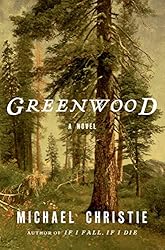
Greenwood
Michael Christie, 2020
Random House
528 pp.
ISBN-13: 9781984822000
Summary
A magnificent generational saga that charts a family’s rise and fall, its secrets and inherited crimes, from one of Canada’s most acclaimed novelists.
It’s 2038 and Jacinda (Jake) Greenwood is a storyteller and a liar, an overqualified tour guide babysitting ultra-rich vacationers in one of the world’s last remaining forests.
It’s 2008 and Liam Greenwood is a carpenter, sprawled on his back after a workplace fall, calling out from the concrete floor of an empty mansion.
It’s 1974 and Willow Greenwood is out of jail, free after being locked up for one of her endless series of environmental protests: attempts at atonement for the sins of her father’s once vast and violent timber empire.
It’s 1934 and Everett Greenwood is alone, as usual, in his maple-syrup camp squat, when he hears the cries of an abandoned infant and gets tangled up in the web of a crime, secrets, and betrayal that will cling to his family for decades.
And throughout, there are trees: a steady, silent pulse thrumming beneath Christie’s effortless sentences, working as a guiding metaphor for withering, weathering, and survival.
A shining, intricate clockwork of a novel, Greenwood is a rain-soaked and sun-dappled story of the bonds and breaking points of money and love, wood, and blood—and the hopeful, impossible task of growing toward the light. (From the publisher.)
Author Bio
• Birth—ca. 1976
• Where—Thunder Bay, Ontario, Canada
• Education—Simon Fraser University
• Awards—
• Currently—lives in Victoria and on Galiano Island, British Columbia
Michael Christie is a Canadian novelist and short story writer. He was born and raised in Thunder Bay, Ontario, later moving to San Francisco and traveling the world as a professional skateboarder. Eventually, Christie landed in Vancouver, British Columbia, where he studied psychology at Simon Fraser University. After earning his degree, he spent several years working in social services.
In 2008 Christie enrolled in the University of British Columbia's creative writing program. Less than years later, in early 2011, Christie published his first story collection, The Beggar's Garden, which was nominated for the Scotiabank Giller Prize and the Rogers Writers' Trust Prize.
Christie's first novel, If I Fall, If I Die, came out 2015, and Greenwood, his second, came out in 2019 it. Both novels received nominations for the Scotiabank Giller Prize.
Today, Christie divides his time between Victoria, BC's capital, located on Vancouver Island, and Galiano Island, some two hours north, where he lives with his wife and two sons in a timber-frame house he built himself. (Adapted from Wikipedia and the publisher. Retrieved 3/1/2020.)
Read a more indepth (and much more interesting!) bio in the Quill & Quire.
Book Reviews
(Starred review) A rugged, riveting novel.… This superb family saga will satisfy fans of Richard Powers’s The Overstory while offering a convincing vision of potential ecological destruction.
Publishers Weekly
(Starred review) Celebrated Canadian author Christie dazzles with this richly woven historical tracking five generations of the "trouble-plagued" Greenwood clan and the environmental devastation wrought by its lucrative timber empire. —Annalisa Pesek
Library Journal
(Starred review) Christie takes us to the end of the world and shows how we got there. … [The author] skillfully teases out the details in a page-turner…. Beguilingly structured, elegantly written: eco-apocalyptic but with hope that somehow we’ll make it.
Kirkus Reviews
Discussion Questions
1. Greenwood is part of a new genre of novels known as CliFi (climate fiction). What makes it fall under that category? Do any of the novel’s environmental themes resonate with you?
2. At its heart, Greenwood is a family saga. How did the boyhoods of brothers Everett and Harris make them into the men they became? How do you think Willow’s nomadic life affected her son Liam? How did Jake’s orphaning influence the person she became?
3. The Great Withering began with the trees—“the wave of fungal blights and insect infestations, to which old growth was particularly defenseless.” What environmental stresses do you see in your life today? How do you personally address these issues?
4. “The best sacrifices, Willow knows, are always made in solitude, with not a camera in sight.” Characters make many sacrifices in Greenwood—Everett for his brother during the war, Temple for the downtrodden, Feeney out of love for his principles. What other sacrifices did you notice in the novel? Which character’s sacrifice moved you most and why?
5. How did you feel about Meena’s reaction to Liam’s painstakingly created gift, a homemade viola that replicated the Stradivarius Meena so loved? Were her actions necessary? Cruel? What did her reaction say about their relationship?
6. The word “roots” has many meanings in Greenwood—a tree’s stability, a family’s ancestry, a person’s connection to place. Which meaning resonated most with you and why?
7. “Time, Liam has learned, is not an arrow.” Greenwood travels back and forth through time—deepening characters and their backstories, connecting characters in unforeseen ways, twisting the plot like roots. In fact, the book’s timeline, starting and ending with the most recent years, and with the earliest events tucked into the middle, is structured like the rings of a tree. How did this structure affect your reading experience? How would the reading experience have changed if the story was told linearly?
8. Why do you think author Michael Christie chose to write the center section—1908—in the voice of a Greek chorus of townspeople? How does this perspective enhance our understanding of the Greenwood boys’ upbringing?
9. Christie writes that nature has taught Temple “things she’d never speak in polite conversation. Like the fact that Mother Nature’s true aim is to convert us people back into the dust we came from, just as quick as possible.” Like Temple, people tend to view Mother Nature as either the great destroyer (earthquakes, floods, the Dust Bowl), or the great nurturer (providing food, shelter, oxygen, and more). Which view did each character take? Which do you lean toward? Do you think both can be true? Why or why not?
10. What do you think of Jake’s final actions at the end of the book? Did she make the right decisions? How would you have handled the revelations?
(Questions issued by the publisher.)

Grief Cottage
Gail Godwin, 2017
Bloomsbury USA
336 pp.
ISBN-13: 9781632867049
Summary
The haunting tale of a desolate cottage, and the hair-thin junction between this life and the next, from bestselling National Book Award finalist Gail Godwin.
After his mother's death, eleven-year-old Marcus is sent to live on a small South Carolina island with his great aunt, a reclusive painter with a haunted past.
Aunt Charlotte, otherwise a woman of few words, points out a ruined cottage, telling Marcus she had visited it regularly after she'd moved there thirty years ago because it matched the ruin of her own life. Eventually she was inspired to take up painting so she could capture its utter desolation.
The islanders call it "Grief Cottage," because a boy and his parents disappeared from it during a hurricane fifty years before. Their bodies were never found and the cottage has stood empty ever since.
During his lonely hours while Aunt Charlotte is in her studio painting and keeping her demons at bay, Marcus visits the cottage daily, building up his courage by coming ever closer, even after the ghost of the boy who died seems to reveal himself.
Full of curiosity and open to the unfamiliar and uncanny given the recent upending of his life, he courts the ghost boy, never certain whether the ghost is friendly or follows some sinister agenda.
Grief Cottage is the best sort of ghost story, but it is far more than that—an investigation of grief, remorse, and the memories that haunt us. The power and beauty of this artful novel wash over the reader like the waves on a South Carolina beach. (From the publisher.)
Author Bio
• Birth—June 18, 1937
• Where—Birmingham, Alabama, USA
• Raised—Ashville, North Carolina
• Education—B.A., University of North Carolina, Chapel Hill;
M.A. and Ph.D., University of Iowa, Writers' Workshop
• Currently—lives in Woodstock, New York
Gail Kathleen Godwin, an American novelist and short story writer, has published one non-fiction work, two collections of short stories, and eleven novels, three of which have been nominated for the National Book Award and five of which have made the New York Times Bestseller List.
Personal life
Godwin was born in Birmingham, Alabama but raised in Asheville, North Carolina by her divorced mother and grandmother. She attended Peace College in Raleigh, North Carolina (a women's college founded by Presbyterians in 1857) from 1955 to 1957, but graduated with a B.A. in Journalism from the University of North Carolina at Chapel Hill in 1959. She worked briefly as a reporter for the Miami Herald and married a Herald photographer named Douglas Kennedy. After the job and the marriage finished (by firing and by divorce, respectively), she worked as waitress back home in North Carolina to save money to travel to Europe.
In the early 1960s, Godwin worked for the U.S. Travel Service at the U.S. Embassy in London and wrote novels and short stories in her spare time. She returned to the United States and worked briefly as an editorial assistant at the Saturday Evening Post before attending the University of Iowa, earning her M.A. (1968) from the Iowa Writers' Workshop and PhD (1971) in English Literature.
Godwin's body of work has garnered many honors, including three National Book Award nominations, a Guggenheim Fellowship, National Endowment for the Arts grants for both fiction and libretto writing, and the Award in Literature from the American Academy and Institute of Arts and Letters. Five of her novels have been on the New York Times best seller list.
Godwin lives and writes in Woodstock, New York. Her family includes her half-brother Rebel A. Cole and half-sister Franchelle Millender.
Writings
Godwin’s eighteen books have established her as a leading voice in American literature along several currents. Her first few novels, published in the early 1970s, explored the worlds of women negotiating restrictive roles. The Odd Woman (1974) was a National Book Award finalist, as was her fourth novel, Violet Clay (1978), in which she modernized the Gothic novel and explored such themes as villainy and suicide.
A Mother and Two Daughters (1982) marked a turning point in Godwin’s career. It encompassed a community, Mountain City, based on her hometown of Asheville, North Carolina, and carried out her empathetic method of entering many characters’ minds within a fluid narrative. Voted a National Book Award finalist, it also became Godwin’s first best-seller. Between it and her next four best-sellers, Godwin interposed Mr. Bedford and the Muses (1983), her second short story collection after Dream Children (1976).
Dream Children had been Godwin’s offering, with some additions, of work she’d created at the Iowa Writer’s Workshop, studying with advisors Kurt Vonnegut and Robert Coover. It exhibits her early interest in allegory made real on a psychological level. The Iowa years come alive in her edited journals, The Making of a Writer, Journals, 1963-1969 (2010). A previous volume, The Making of a Writer, Journals, 1961-1963 (2006), presents her years in Europe after a do-or-die decision to become a writer. The novella, "Mr. Bedford," which leads her second story collection, derives from her time in London. Narrated in the first person, it achieves the author’s quest for timelessness through a look into a living room window.
"Last night I dreamed of Ursula DeVane," begins Godwin’s sixth novel, The Finishing School (1984), again employing a first person reverie, and turning it toward one of Godwin’s fertile interests, the effect of a powerful personality on a developing one. The suspense that tragically ensues relates to her next novel, A Southern Family, which returns to Mountain City, but is darker than A Mother and Two Daughters, as it involves a murder-suicide that sends shock waves and melancholy through a family. All of Godwin’s second three novels were published additionally as mass market paperbacks.
Father Melancholy’s Daughter (1991), also a best-seller, represented Godwin’s independence from the best-seller niche being marketed for her. The daughter of the title navigates her relationships with her father, an Episcopal minister; and with a classic Godwin character, a bewitching theatrical auteur. Theology, and its non-doctrinal meaning in spiritual life, became one of the areas in which Godwin began to act as a leading explorer. The subject is embraced in Evensong, her 1999 sequel to Father Melancholy’s Daughter; and in her 2010 novel, Unfinished Desires. It also informs her non-fiction book, Heart: A Natural History of the Heart-Filled Life (2001), illustrated by stories from her life and from her constant reading.
Godwin ninth novel, The Good Husband (1994), makes use of a form she’d emulated as a 24-year-old in Europe, Lawrence Durrell’s quartet (as in The Alexandria Quartet), by which a story is told through four related characters. Godwin’s new direction—not just in form, but also in choice of characters—did not reach the best-seller list. Evensong, her tenth novel, did; and then she engaged in another literary experiment, "Evenings at Five" (2003), a novella that explores, through a distinctive kind of stream-of-consciousness, the presence that follows the death of a long-term companion. It is based on her relationship with composer Robert Starer, with whom she collaborated on nine libretti. Regarding Evenings at Five, Godwin said she wanted "to write a different kind of ghost story." The trade paperback edition of the book, with Godwin’s autobiographical "Christina Stories" added, became one of eight works of her fiction published as Ballantine Readers Circle trade paperbacks, with interviews and reader’s guides.
For her twelfth novel, Queen of the Underworld, Godwin fashioned a Bildungsroman, derived from her years as a Miami Herald reporter, 1959-60. Her experience included close familiarity with the Cuban emigre community, with whom, at times, she conversed in Spanish.
Unfinished Desires (2010) exemplified her empathetic method by inhabiting the minds and enunciating the voices of more than a dozen full characters. Set at a girls’ school run by nuns, it makes the connection between religious devotion and artistic seriousness. The novel openly reveals girls in adolescence, as well as their elders, who bequeath them their deep-set issues. Suspense comes from multi-punch power plays, as well as from characters’ struggles to be good. The novel’s original title, "The Red Nun," refers to the statue of a tragic novitiate, whose story becomes the subject of a school play, which in turns becomes an arena for acting out. The play’s the thing, dramatically, metaphorically, and psychologically. (From Wikipedia. Retrieved 7/2/2010.)
Book Reviews
(Starred review.) A young boy obsessed with a haunted beach shack searches for meaning amid catastrophic loss in National Book Award–finalist Godwin’s chilling novel.… His choice and its consequences will echo with readers, and Godwin’s forceful prose captivates with the quiet, renewing power of a persistent tide.
Publishers Weekly
Like Henry James's classic, The Turn of the Screw, Grief Cottage is less a paranormal thriller than an exploration of the psyche's creative tactics to survive trauma.… Godwin shows she is still at the top of her craft, using the fragile link between living and spirit to illuminate a young man's coming of age in this keenly observed, powerful novel.
BookPage
(Starred review.) Godwin's riveting and wise story of the slow coalescence of trust and love between a stoic artist and a grieving boy… subtly and insightfully explores different forms of haunting and vulnerability, strength and survival.… Word will spread quickly about Godwin's tender and spellbinding supernatural novel
Booklist
Echoes of the mysterious isolation in Marcus' family's past sound throughout the novel…. Godwin approaches many of her usual melancholic themes from a different angle and raises the question of whether we get what we want or we get what we need.
Kirkus Reviews
Discussion Questions
1. Consider the novel’s epigraph: "Not everybody gets to grow up. First you have to survive your childhood, and then begins the hard work of growing into it." Childhood and survival are central themes for this novel. Charlotte, Marcus, and his mother all had traumatic childhoods that influenced their behavior as adults. What tools do each of them employ to help them survive? What does it mean to "grow into" one’s childhood? Who in the book is a good example of that?
2. The turtle migration is a central fixture in Marcus’s new life; he convenes with the eggs each day, monitors their temperature closely, and is devastated when he misses their historic sprint from nest to ocean. Before the migration, he explains to them, "The reason we can’t pick you up and carry you is because you need to do the walk yourselves so you can smell the sand and remember your way back to this beach when you’re grown up" (151). Why are the turtles a source of comfort for Marcus? Compare and contrast their ancient ritual for survival to Marcus own journey towards growth and safety. How does the turtles’ journey serve as a foil for the other character’s attempts at survival?
3. Because of his relationship with Johnny’s ghost, Marcus often feels as if he straddles the line between sanity and insanity. He thinks, "The ghost-boy was related to my life, yet he was also an entity on his own terms.… Didn’t something have to be one thing or the other, either real or imagined?" (156) Discuss Marcus’s question: is it possible for something to be both real and imagined? In your opinion, does Marcus actually see a ghost in Grief Cottage or is he merely hallucinating an imaginary friend of sorts? How does this ghost story in particular challenge our preconceived notions of the boundaries of reality?
4. At a town hall, a scientist tells the crowd of island locals that their insistence on preservation will always fail: "The only losers will be the property owners fighting a hopeless battle to make nature stand still" (299). Many characters in the novel refuse to move forward or accept the inevitable: Marcus is scared to grow up, Charlotte won’t acknowledge her addiction; and Charlie Coggins tries diligently to sell Grief Cottage, even though it lies on a precarious stretch of beach that will soon erode into the ocean. Explore how the novel’s main characters find the strength to overcome their "hopeless battles." Discuss how Grief Cottage serves as a metaphor for how precarious and mysterious life can be.
5. The past and present are at constant odds throughout the novel: Marcus’s confidant Lachicotte is enamored with restoring the antique; the turtles prepare to embark on an annual, ancient tradition; Marcus finds himself obsessed with the fate of a family who inhabited the island over fifty years ago, only to develop a present-day relationship with the ghost of their teenage son. What point, if any, does the novel make about the function of time? Does the novel advocate for attempting to preserve the past or for letting it go? How do the characters reckon with, honor, and run from their pasts?
6. Despite receiving praise from his aunt, Marcus is constantly wracked with anxiety that she will find him unsatisfactory and send him away. When Charlotte leaves for surgery, Marcus has a mental breakdown and is tormented by "Cutting Edge," a malicious voice urging him to take his own life. Cutting Edge taunts Marcus with his worst fear, "You aren’t wanted, you weren’t wanted, and you’re not going to be missed" (269). Discuss this part of Marcus’s personality. How does it impact his life and relationships? Why does Marcus feel unwanted despite reassurance? In your opinion, what is the seed of his insecurity?
7. Before his overdose is complete, Marcus races to see Johnny’s ghost at Grief Cottage. He thinks, "You were my sure. You were my lifeline…" (271). Explore Marcus’s inexplicable connection to Johnny’s ghost; in what ways are the boys similar or different? Why does Marcus feel closer to Johnny than any of living friends he has made so far? Marcus believes that "since ghosts don’t have living brains, the work must be done by the living person. The living person had to offer his brain as the dwelling place for the ghost" (133). Why does Marcus give himself to Johnny as a place to dwell? Likewise, why does Johnny choose Marcus as his host?
8. Discuss the significance of Marcus’s friendship with Wheezer. He often remembers their boyhood closeness fondly but is still haunted by Wheezer’s accusation. When Marcus returns to visit Wheezer years later, how has their relationship changed? How has it stayed the same? When the two friends catch up, Marcus learns that Wheezer also attempted suicide in his younger years. What brings each of these two boys, who have very different backgrounds, to the brink of death?
9. Charlotte begins painting a secret project when she loses the use of her right hand. Under the influence of Cutting Edge, Marcus sneaks into her studio to find "Only to you, my little sheets," an intimate and grotesque set of paintings about her abusive past. Later, in rehab, Charlotte tells her art students "your unpracticed hand will waver and wobble into places your controlling hand would never let you near" (290). How does her discomfort allow her to come to terms with her own ghosts? How does this logic apply to other aspects of the novel? Who else benefits from their discomfort, and how?
10. Discuss the significance of putting the soul to rest. William, Marcus’s interim guardian before Charlotte, implores him to bury his mother soon so "you’ll know you can always come back and find her in the same place" (148). By the end of the novel, Marcus has to bury not only his mother, but the bones of Johnny Dace as well. He chooses Lachicotte’s suggestion for both headstones: "May the earth lie lightly on thee." Explore the implications of this engraving and why it feels so right to Marcus. Does finding Johnny’s bones help Marcus on from the death of his mom?
11. Marcus grows up to become a child psychiatrist. In his studies, he is struck by the following passage: "The idea of a ghost, a disembodied spirit, derives from this lack of essential anchoring of the psyche in the soma, and the value of the ghost story lies in its drawing attention to the precariousness of the psychesoma existence" (282). Why is this precariousness important? What does it teach Marcus about hischildhood self? In what other ways can a ghost story, with its emphasis on the supernatural, teach us about human existence?
12. At the end of the novel, Marcus finally learns the truth about the man in his mother’s photo. Long thought to be a fake, the picture turned out to be a class photo of Wheezer’s notorious late Uncle Henry. What is the significance of this discovery? Discuss how Henry’s brilliant and disastrous life reflects on Marcus. The novel ends soon after this revelation. How do you imagine Marcus felt about learning the identity of his father and being related to his best friend all along?
13. Marcus and his elderly neighbor Carol Upchurch have a special bond over the loss of their loved ones. Ever since the death of her son, Coral Upchurch has been attempting to undergo an "archaeology of herself": "What would be left of the essential me without any of my roles?" (243) How does Marcus attempt his own "archaeology of self?" What are his roles throughout the novel and how to they evolve? He believes that love is the answer to the question of everyone’s essential role. Do you agree? Discuss all of roles you play in life; who do you become if your roles disappear?
14. "I realized that below all our mes that become known to others is a self that nobody else can ever fully know. No self can ever share its entire being with another self, no matter how much love there is between them." (244) Even though Marcus makes strong connections with his island neighbors, his experience with the ghost of Johnny Dace is the most impactful. Is Marcus connecting to Johnny, or to himself? Do you agree with Coral? Explain why or why not.
15. Consider Marcus’s suicide attempt. Cutting Edge forces him to remember his thoughts the night his mother died. Faced with the reality that he had envisioned a better life without his mother, Marcus resents himself enough to end his own life. Discuss Marcus’s choice: was it fueled by insanity, insecurity, selflessness, or something else entirely? Earlier in the novel, Marcus admires Johnny’s ghost: "It’s all over for you. Your life is a complete thing. I envy that." (140) Why does Marcus envy Johnny? How does this novel challenge the idea that anyone’s life is every truly "complete"? How is this a pivotal moment for Marcus on his journey to forgiving himself?
(Questions developed by Zoe Gould for Bloomsbury USA, publishers.)

Grief is the Thing with Feathers
Max Porter, 2016
Greywolf Press
128 pp.
ISBN-13: 9781555977412
Summary
Winner, 2016 International Dylan Thomas Prize
Here he is, husband and father, scruffy romantic, a shambolic scholar—a man adrift in the wake of his wife's sudden, accidental death.
And there are his two sons who like him struggle in their London apartment to face the unbearable sadness that has engulfed them. The father imagines a future of well-meaning visitors and emptiness, while the boys wander, savage and unsupervised.
In this moment of violent despair they are visited by Crow—antagonist, trickster, goad, protector, therapist, and babysitter. This self-described "sentimental bird," at once wild and tender, who "finds humans dull except in grief," threatens to stay with the wounded family until they no longer need him.
As weeks turn to months and the pain of loss lessens with the balm of memories, Crow's efforts are rewarded and the little unit of three begins to recover: Dad resumes his book about the poet Ted Hughes; the boys get on with it, grow up.
Part novella, part polyphonic fable, part essay on grief, Max Porter's extraordinary debut combines compassion and bravura style to dazzling effect. Full of angular wit and profound truths, Grief Is the Thing with Feathers is a startlingly original and haunting debut by a significant new talent. (From the publisher.)
Author Bio
• Birth—1981
• Where—High Wycombe, Buckinghamshire, England, UK
• Education—M.A., University of London–Courtauld Institute of Art
• Awards—International Dylan Thomas Prize
• Currently—lives in South London, England
Lorem ipsum dolor sit amet, nascetur neque iaculis vestibulum, sed nam arcu et, eros lacus nulla aliquet condimentum, mauris ut proin maecenas, dignissim et pede ultrices ligula elementum. Sed sed donec rutrum, id et nulla orci. Convallis curabitur mauris lacus, mattis purus rutrum porttitor arcu quis. (From .)
Book Reviews
Although charged throughout with high emotion, the novel is rarely sentimental. Porter resists the static register of the maudlin, creating instead a fabric of constant shifts and calibrations in voice, moving from rage to madness to profanity and humor. He has an excellent ear for the flexibility of language and tone, juxtaposing colloquialisms against poetic images and metaphors. The result is a book that has the living, breathing quality of the title's "thing with feathers."
Katie Kitamura - New York Times Book Review
Like a book of hours for the bereaved.... Mr. Porter gives expression to grief in all its emotional manifestations.... Unpredictably playful, [filled] with sarcasm, absurdity and black-winged humor.
Wall Street Journal
As resonant, elliptical and distilled as a poem, Grief Is the Thing With Feathers is one of the most moving, wildly inventive first novels you're likely to encounter this year. It's funny ― in a jet-black way yet also fiercely emotional, capturing the painful sucker-punch of loss with a fresh immediacy that rivals Joan Didion's The Year of Magical Thinking.... Like C.S. Lewis' A Grief Observed, Julian Barnes' Levels of Life, Helen MacDonald's H is for Hawk...Porter's unusual novel puts grief in its place not by dismissing it, but by confronting it dead-on as a painful but inescapable part of life. Grief is the Thing With Feathers is a wondrous, supremely literary, ultimately hopeful little book.
NPR.org
[A] bizarre and brilliant debut.... What keeps the story from being excessively familiar is Porter's sense of detail...as well as his imaginative and elegant approaches to structure and style.... Simultaneously straightforward and mysterious, the book illustrates the need for and calls into question moving on, as a concept.
Chicago Tribune
Grief Is the Thing With Feathers argues that books, literature and poetry can help save us. This book is a sublime and painful conjuring of a family’s grief and the misfit creature with the power to both haunt and help them. It is a complex story, not simply-told or sparse: Nothing is missing. Let it be a call for more great books of this length to be recognized for what they are―whole. Extraordinary is a book with feathers.
Los Angeles Times
A powerful, surreal novella-poem of grief and healing. Devastated by the loss of his wife, Dad struggles to take care of his boys, himself, and finish his book on the poetry of Ted Hughes. Crow (a man-size black bird) moves in, taking the role of wild but tender shepherd to the family.
San Francisco Chronicle
Piercing the wordplay and abstractions and flights of fancy are the sharp specifics that make the family's loss clear and their grief that much more real... . [Grief Is the Thing with Feathers transforms] the indescribable absence that is grief into palpable, undeniable life.
Minneapolis Star Tribune
A heartbreaking and life-affirming meditation on the dislocating power of grief.... Porter’s characters express their feelings through observations that are profound and simply phrased....The powerful emotions evoked in this novel will resonate with anyone who has experienced love, loss, and mourning.
Publishers Weekly
(Starred review.)[R]emarkable....a man grief-stricken by his wife's sudden death.... Like a prose poem in its splendid language but with its own swift flow, this is highly recommended for ambitious readers.
Library Journal
(Starred review.) Porter delivers a staggering tale of a father grappling with the sudden loss of his wife in this sharply poetic and darkly stunning debut novel.... A truly exceptional work of fiction.... Readers will not soon forget Porter’s distinct style.
Booklist
(Starred review.) Porter’s daringly strange story skirts disbelief to speak, engagingly and effectively, of the pain this world inflicts, of where the ghosts go, and of how we are left to press on and endure it all. Elegant, imaginative, and perfectly paced. A contribution to the literature of grief and to literature in general.
Kirkus Reviews
Discussion Questions
Use our LitLovers Book Club Resources; they can help with discussions for any book:
• How to Discuss a Book (helpful discussion tips)
• Generic Discussion Questions—Fiction and Nonfiction
• Read-Think-Talk (a guided reading chart)
(We'll add specific questions if and when they're made available by the publisher.)

Grist Mill Road
Christopher J. Yates, 2018
Picador
352 pp.
ISBN-13: 9781250150288
Summary
26 years ago Hannah had her eye shot out. Now she wants justice. But is she blind to the truth?
Christopher J. Yates’s cult hit Black Chalk introduced that rare writerly talent: a literary writer who could write a plot with the intricacy of a brilliant mental puzzle, and with characters so absorbing that readers are immediately gripped.
Yates’s new book does not disappoint.
Grist Mill Road is a dark, twisted, and expertly plotted Rashomon-style tale.
The year is 1982; the setting, an Edenic hamlet some ninety miles north of New York City. There, among the craggy rock cliffs and glacial ponds of timeworn mountains, three friends—Patrick, Matthew, and Hannah—are bound together by a terrible and seemingly senseless crime.
Twenty-six years later, in New York City, living lives their younger selves never could have predicted, the three meet again—with even more devastating results. (From the publisher.)
Author Bio
• Birth—1972
• Raised—Kent, England, UK
• Education—J.D., Oxford University
• Currently—lives in New York, New York, USA
Christopher J. Yates was born and raised in Kent, England, and studied law at Oxford University before working as a puzzle editor in London. He now lives in New York City with his wife and dog. His first book, Black Chalk, was an NPR "Best of the Year" selection. (From the publisher.)
Read article on the author in Literary Hub.
Book Reviews
[A] whydunnit that delves deep into the secrets linking the main characters.… Yates's previous book, Black Chalk, had a delicious premise: an escalating game of dare over the years among friends who meet at Oxford.… [Grist Mill Road] is more sophisticated, starting from the fully realized stories the characters are awarded in the service of an elegant narrative…You have to work hard to follow the winding road Yates sends us down, and the drive is full of pleasantly unpleasant surprises.
Sarah Lyall - New York Times
(Starred review.) [A]n edgy, intelligent thriller…. The reader’s sympathies shift as each character brings a different perspective to the events that shaped them. Unexpected twists keep the tension high.
Publishers Weekly
[A] fun-house mirror of a single, horrific incident that defines three lives.… This fast-paced, suspenseful journey through the minds of these characters will fascinate … readers who enjoy twisty, intellectual thrillers and unreliable narration. —Charli Osborne, Oak Park P. L., MI
Library Journal
The intensity of the storytelling is exhilarating and unsettling. — Don Crinklaw
Booklist
(Starred review.) Yates…drives home the messages that…true, compassionate love is always redemptive.… Mesmerizing and impossible to put down, this novel demands full attention…; in return it offers poignant insight into human fragility and resilience.
Kirkus Reviews
Discussion Questions
1. At the beginning of the novel, Patch poses the following questions: "What does it mean to watch? When a crime takes place in front of you, what is watching? Is it a failure to act or is it simply keeping your eyes open?” How would you answer these questions? In what ways does the conclusion of the novel influence your answers?
2. The narration of the novel toggles between first person and third person, allowing Hannah, Patch, and Matthew to speak, as well as an omniscient narrator. Why do you think the author may have chosen to alternate vantage points in this way? How does this style of narration affect your interpretation of the novel?
3. In many ways, the town of Roseborn and its surrounding landscape comes alive as a character in and of itself. How would you describe the nature of this place? In what ways do you see this town’s particularities impact Patch, Hannah, and Matthew in their adult lives?
4. Stalking pervades the novel, from Patch’s following of Trevino and Matthew’s shadowing of Patch to a particularly grisly crime that Hannah covers. But it also transcends such physical action; past memories and traumas stalk the present-day lives of the characters in dreams, journal entries, fantasies, and everyday thoughts. Why do you think there’s such a thematic preoccupation with stalking in the novel?
5. We find out about the secret in Patch and Hannah’s marriage, that Hannah doesn’t know Patch was there when Matthew shot her, about midway through the novel. Hannah, in fact, tells Jen that, "He actually saved me.” To what extent do you agree or disagree with Hannah that Patch saved her? Do you think Patch was culpable in the crime perpetrated against Hannah? In what ways might he have played both roles?
6. At the beginning of Matthew’s section, he writes, "Truth is seldom a lens, truth is a kaleidoscope.” How do you interpret this statement? How do you see this idea play out thematically across the novel?
7. We don’t hear directly from Matthew until over halfway through the novel. In what ways does getting the story from his perspective shift your view of his character?
8. Patch fails to tell Hannah that he was present for part of Matthew’s shooting spree. Do you think that means their marriage was based on a lie? Why or why not?
9. Hannah, Patch, and Matthew all have complex relationships with their fathers. Discuss the ways in which their fathers shape each of these characters.
10. Why do you think Matthew is so resistant to labels? In what ways do labels complicate his life?
(Questions written by Laura Chasen and issued by the publisher.)


A Grown-Up Kind of Pretty
Joshilyn Jackson, 2012
Grand Central Publishing
336 pp.
ISBN-13: 9780446582353
Summary
A Grown-Up Kind of Pretty is a powerful saga of three generations of women, plagued by hardships and torn by a devastating secret, yet inextricably joined by the bonds of family.
Fifteen-year-old Mosey Slocumb-spirited, sassy, and on the cusp of womanhood-is shaken when a small grave is unearthed in the backyard, and determined to figure out why it's there. Liza, her stroke-ravaged mother, is haunted by choices she made as a teenager.
But it is Jenny, Mosey's strong and big-hearted grandmother, whose maternal love braids together the strands of the women's shared past—and who will stop at nothing to defend their future. (From the publisher.)
Author Bio
• Birth—February 27, 1968
• Where—Fort Walton Beach, Florida, USA
• Education—B.A., Georgia State University; M.A., University of Illinois
• Awards—(see below)
• Currently—lives in Decatur, Georgia
Joshilyn Jackson is the author of several novels, all national best sellers. She was born into a military family, moving often in and out of seven states before the age of nine. She graduated from high school in Pensacola, Florida, and after attending a number of different colleges, earned her B.A. from Georgia State University. She went on to earn an M.A. in creative writing from University of Illinois in Chicago.
Having enjoyed stage acting as a student in Chicago, Jackson now does her own voice work for the audio versions of her books. Her dynamic readings have won plaudits from AudioFile Magazine, which selected her for its "Best of the Year" list. She also made the 2012 Audible "All-Star" list for the highest listener ranks/reviews; in addition, she won three "Listen-Up Awards" from Publisher's Weekly. Jackson has also read books by other authors, including Lydia Netzer's Shine Shine Shine.
Novels
All of Jackson's novels take place in the American South, the place she knows best. Her characters are generally women struggling to find their way through troubled lives and relationships. Kirkus Reviews has described her writing as...
Quirky, Southern-based, character-driven...that combines exquisite writing, vivid personalities, and imaginative storylines while subtly contemplating race, romance, family, and self.
2005 - Gods in Alabama
2006 - Between, Georgia
2008 - The Girl Who Stopped Swimming
2010 - Backseat Saints
2012 - A Grown-Up Kind of Pretty
2013 - Someone Else's Love Story
2005 - Gods in Alabama
2006 - Between, Georgia
2008 - The Girl Who Stopped Swimming
2010 - Backseat Saints
2012 - A Grown-Up Kind of Pretty
2013 - Someone Else's Love Story
2016 - The Opposite of Everyone
2017 - The Almost Sisters
2019 - Never Have I Ever
Awards
Jackson's books have been translated into a dozen languages, won the Southern Indie Booksellers Alliance's SIBA Novel of the Year, have three times been a #1 Book Sense Pick, twice won Georgia Author of the Year, and three times been shortlisted for the Townsend Prize. (Author's bio adapted from the author's website.)
Book Reviews
Jackson's signature style-the feisty, bighearted voice of Gods in Alabama and Backseat Saints-propels this funny, dark whodunit, where strong women who've made bad choices band together to come out on top.
Melissa Ruggieri - Atlanta Journal-Constitution
[There are] hundreds of moving parts in the machinery of Jackson's intricate mystery, all deliciously unraveled one tantalizing clue at a time.
Gena Webb - Atlanta Journal-Constitution
A quirky mystery that serves up a delicious blend of likeable characters, plot twists and life as seen through the eyes of three remarkable women in a Southern family, namely Mosey, Ginny, and Liza. The dialogue is authentic and the writing insightful and unexpectedly witty.
Larry Cox - Tucson Citizen
The Slocumb women suffer from an unfortunate curse: every 15 years something bad happens. Ginny gave birth to Liza when she was 15. And Liza had Mosey when she was 15. Now it’s Mosey who’s 15, and she’s nervous. But the curse strikes in a different form, bringing a stroke to Liza that renders her mute and crippled, leaving her husband “Big” to care for her. Wanting to put a pool in the yard for Liza’s water therapy, Ginny has a willow uprooted, unearthing the bones of a baby—Liza’s baby. This macabre discovery sends Mosey, Ginny, and Big in search of answers about the baby and Mosey’s identity. Their quest, told in alternating points-of-view among all main characters, uncovers an old feud between Liza and best friend Melissa, an illicit affair, the vengeance of the thwarted party, and drug addiction long hidden. Along the way Mosey puts her life in danger and learns a thing or two about family. Jackson’s newest (after Backseat Saints) is highly immersive, evoking the suffocation of rural Mississippi and using a teen pregnancy mystery to create a compelling page-turner. While Jackson doesn’t entirely avoid clichés, the care that she’s taken in developing the relationships between the Slocumb women makes up for it.
Publishers Weekly
Jackson (Backseat Saints) has written an unusual Southern family saga revolving around three generations of lonely, hardscrabble Slocumb women. Grandmother Ginny is the glue that holds them together when her ex-drug addict daughter, Liza, has a severe stroke, leaving her voiceless except for a few vowel sounds. Fifteen-year-old granddaughter Mosey is the same age her mother and grandmother were when they had their daughters, but Mosey isn't like her forebears; she's scarcely been kissed by a boy. When Ginny decides to pull out the old willow tree in the backyard to make room for a pool to use in rehabilitating Liza, a shallow grave is uncovered, revealing a small skeleton dressed in tattered baby clothes and unleashing a series of events for which Liza seems to have an explanation—but she can't tell. The story is told in the alternating voices of the women as the mystery unfolds. Verdict: Liza, as the unreliable narrator, is used to perfection in this warm family story that teeters between emotional highs and lows, laughter and tears. Book groups will eat this up. —Stacy Alesi, Palm Beach Cty. Lib. Syst., Boca Raton, FL
Library Journal
(Starred review.) Mesmerizing tale of a family coping with the revelation of a secret that will change their lives.... Jackson's most absorbing book yet, a lush, rich read with three very different but equally compelling characters at its core.
Booklist
Jackson (Backseat Saints, 2010, etc.) sticks with her specialty—plucky Southern women who overcome male ill treatment from their past—in this novel about a grandmother, daughter and granddaughter who confront a suddenly uncovered family secret.... Snappy dialogue with a Southern twang, spiritual uplift and undeniably likable characters—"Quirky Cute" at its best.
Kirkus Reviews
Discussion Questions
1. One of the opening scenes in A Grown-Up Kind of Pretty depicts Tyler Baines chopping down the Slocumb willow tree. What does this tree symbolize for Big? For Liza? For Mosey?
2. On page 70, Mosey realizes she isn’t who she thought she was. At first, she feels liberated. Then she feels confused and lost. How is she like Liza and Big? What makes her different? Do you think a child takes on traits like compassion, humor, and good sense from her biological parents, or do you think that she learns these from the people who raise her?
3. Several men in this novel cheat on their spouses (Coach, Lawrence), but the women cheat on one another in a different way. What kind of emotional betrayals show up in their friendships, and in their families? Who do you think is the most loyal person in this story?
4. Though Liza and Melissa were inseparable when they were young, Big believes that Noveen was a better friend to Liza than Melissa ever was. Patti turns out to be a wonderful friend to Mosey. What have the Duckins women given to Liza and Mosey? How was Melissa different?
5. One theme in A Grown-Up Kind of Pretty is belonging. On page 224, Big says, “Bogo wasn’t the only stray that Mosey had adopted for us all recently.” Who do you think are the “strays” in this story? When do they find a home?
6. When Mosey enters Liza’s tree house and sees her old Moomin books covered in Magic Marker, she says, “If I had doubted for a second this place was Liza’s, I didn’t doubt it now” (p. 245). Have you ever found a secret place or a secret box that belonged to someone you love? What part of this person did you find there?
7. Was Big smart to keep the details of her family crisis from Lawrence? If she had shared more with him, do you think he could have helped her, or protected Mosey?
8. Did Liza do the right thing by taking Mosey from her mother when she was small? Would you still feel that way if Mosey had been a Duckins or a Richardson instead? Why?
9. Big and Liza are determined to keep Mosey from getting too close to boys. Do you think they’re overreacting? What would you do to keep your daughter from making the same mistakes you made?
10. When something bad happens, Big, Liza, and Mosey often respond with action—though sometimes their approaches aren’t quite ethical. Does Liza break Lawrence’s ex-wife’s plates on purpose, or was it an accident? Did you enjoy it a little, since Sandy cheated on Lawrence and lashed out at Big? Do you think Claire Richardson was at all justified in her attacks on Liza? On Big? Do you blame her less because she lost both her daughters? Though it was wrong of Big to throw bricks at the church’s windows, do you think it was justified, given how she was treated by the church community? How does knowing the pain each character has been through change the way you respond to her actions?
(Questions issued by publisher.)


The Guernsey Literary and Potato Peel Pie Society
Mary Ann Shaffer and Annie Barrows, 2008
Random House
280 pp.
ISBN-13: 9780385341004
Summary
“I wonder how the book got to Guernsey? Perhaps there is some sort of secret homing instinct in books that brings them to their perfect readers.” January 1946: London is emerging from the shadow of the Second World War, and writer Juliet Ashton is looking for her next book subject. Who could imagine that she would find it in a letter from a man she’s never met, a native of the island of Guernsey, who has come across her name written inside a book by Charles Lamb....
As Juliet and her new correspondent exchange letters, Juliet is drawn into the world of this man and his friends—and what a wonderfully eccentric world it is. The Guernsey Literary and Potato Peel Pie Society—born as a spur-of-the-moment alibi when its members were discovered breaking curfew by the Germans occupying their island—boasts a charming, funny, deeply human cast of characters, from pig farmers to phrenologists, literature lovers all.
Juliet begins a remarkable correspondence with the society’s members, learning about their island, their taste in books, and the impact the recent German occupation has had on their lives. Captivated by their stories, she sets sail for Guernsey, and what she finds will change her forever.
Written with warmth and humor as a series of letters, this novel is a celebration of the written word in all its guises, and of finding connection in the most surprising ways. (From the publisher.)
About the Authors
Mary Ann Shaffer
• Birth—1934
• Where—Martinsburg, West Virginia, USA
• Death—February, 2008
In 1976, inspired by a newfound fascination with Guernsey, Mary Ann Shaffer traveled to the island in the English Channel, only to be stranded there due to inclement weather. Waiting for a thick fog to lift so she could return to London, Shaffer read all the books in the Guernsey airport bookstore. Jersey Under the Jack-Boot sparked a particular interest in the German occupation of the Channel Islands.
Years later, prompted by her book club to write a novel of her own, Shaffer turned to this subject in creating the vivid world of The Guernsey Literary and Potato Peel Pie Society. Told entirely through a series of letters — because, Shaffer confessed, "for some bizarre reason, I thought it would be easier" — the novel skillfully renders the characters and concerns of Juliet, Sidney, and the other residents of Guernsey who have just emerged from the horrors and hardships of the Second World War.
Mary Ann Shaffer made a career working with books—as an editor, librarian, and bookseller—before her death in February 2008. She died knowing that her novel was scheduled for publication and in the good hands of her niece and coauthor, Annie Barrows. (From Barnes & Noble.)
____________________
Annie Barrows
• Birth—August 24, 1962
• Where—San Diego, California, USA
• Education—B.A., University of California, Berkeley; M.F.A.,
Mills College
• Awards—numerous, for her children's series Ivy and Bean
• Currently—lives in Berkeley, California
A voracious reader (but an admittedly poor speller!), one of Annie Barrows' first jobs, while she was still in school, was re-shelving books in one of her favorite haunts, the public library. After college graduation, she went to work for a publisher, editing books in many different fields.
Bitten by the writing bug, wrote several books on such diverse topics as fortune telling, urban legends, and opera before branching into children's literature. In June of 2006, she released Ivy and Bean, the first award-winning book in a series about two young girls who become best friends in spite of their differences. In 2007, she published The Magic Half, a standalone children's fantasy about the middle child (between two sets of twins) who travels back in time and befriends a young girl in need of her help.
In addition, Barrows and her aunt, the late Mary Ann Shaffer, collaborated on a post-WWII epistolary novel entitled The Guernsey Literary and Potato Peel Pie Society. Conceived by Shaffer, the novel was accepted for publication shortly before Shaffer fell ill. Barrows stepped in to complete the project, and the book was published in 2008 and became a best seller. (From Barnes & Noble.)
Extras
Read this 2008 Barnes & Noble interview with Annie Barrows. Her aunt had died earlier in the year.
Book Reviews
Though it deals with a dark period in history, this first novel is an essentially sunny work. It affirms the power of books to nourish people enduring hard times—not so surprising, since Mary Ann Shaffer, who died earlier this year, had a long career as a librarian, bookseller and editor. Her niece Annie Barrows, a children's author, finished the manuscript after Shaffer fell ill; between them, they crafted a vivid epistolary novel whose characters spring to life in letters and telegrams exchanged over the course of nine months shortly after the end of World War II.... You could be skeptical about the novel's improbabilities and its sanitized portrait of book clubs (doesn't anyone read trashy thrillers?), but you'd be missing the point. The Guernsey Literary and Potato Peel Pie Society is a sweet, sentimental paean to books and those who love them.
Wendy Smith - Washington Post
The letters comprising this small charming novel begin in 1946, when single, 30-something author Juliet Ashton (nom de plume "Izzy Bickerstaff") writes to her publisher to say she is tired of covering the sunny side of war and its aftermath. When Guernsey farmer Dawsey Adams finds Juliet's name in a used book and invites articulate—and not-so-articulate—neighbors to write Juliet with their stories, the book's epistolary circle widens, putting Juliet back in the path of war stories. The occasionally contrived letters jump from incident to incident—including the formation of the Guernsey Literary and Potato Peel Pie Society while Guernsey was under German occupation—and person to person in a manner that feels disjointed. But Juliet's quips are so clever, the Guernsey inhabitants so enchanting and the small acts of heroism so vivid and moving that one forgives the authors (Shaffer died earlier this year) for not being able to settle on a single person or plot. Juliet finds in the letters not just inspiration for her next work, but also for her life—as will readers.
Publishers Weekly
In January 1946, London is beginning to recover from World War II, and Juliet Ashton is looking for a subject for her next book. She spent the war years writing a column for the Times until her own dear flat became a victim of a German bomb. While sifting through the rubble and reconstructing her life, she receives a letter from a man on Guernsey, the British island occupied by the Germans. He'd found her name on the flyleaf of a book by Charles Lamb and was writing to ask if she knew of any other books by the author. So begins a correspondence that draws Juliet into the community of Guernsey and the members of the Literary and Potato Peel Pie Society. Named to protect its members from arrest by the Germans, the society shares their unique love of literature and life with a newfound friend. Seeing this as the subject of her next book, Juliet sails to Guernsey-a voyage that will change her life. Reminiscent of Helene Hanff's 84 Charing Cross Road, this is a warm, funny, tender, and thoroughly entertaining celebration of the power of the written word. This marvelous debut novel, sure to have book club appeal, is highly recommended for all collections.
Susan Clifford - Library Journal
The German occupation of the Channel Islands, recalled in letters between a London reporter and an eccentric gaggle of Guernsey islanders. This debut by an "aunt-niece" authorial team presents itself as cozy fiction about comfortably quirky people in a bucolic setting, but it quickly evinces far more serious, and ambitious, intent. In 1946, Juliet, famous for her oxymoronic wartime humor column, is coping with life amid the rubble of London when she receives a letter from a reader, Dawsey, a Guernsey resident who asks her help in finding books by Charles Lamb. After she honors his request, a flurry of letters arrive from Guernsey islanders eager to share recollections of the German occupation of the islands. (Readers may be reminded of the PBS series, Island at War.) When the Germans catch some islanders exiting from a late-night pig roast, the group, as an excuse for violating curfew and food restrictions, invents a book club. The "Literary and Potato Peel Pie Society" is born, affording Guernseyites an excuse to meet and share meager repasts. (The Germans have confiscated all the real food.) Juliet's fractious correspondents, including reputed witch Isola, Booker, a Jewish valet who masquerades as a Lord, and many other L&PPPS members, reveal that the absent founder of their society, Elizabeth, loved Christian, a German captain. No one accuses Elizabeth of collaboration (except one crotchety islander, Adelaide) because Christian was genuinely nice. An act of bravery caused Elizabeth's deportation to France, and her whereabouts remain unknown. The Society is raising four-year-old Kit, Elizabeth's daughter by Christian. To the consternation of her editor and friend, Sidney, Juliet is entertaining the overtures, literary and romantic, of a dashing but domineering New York publisher, Markham. When Juliet goes to Guernsey, some hard truths emerge about Elizabeth's fate and defiant courage. Elizabeth and Juliet are appealingly reminiscent of game but gutsy '40s movie heroines. The engrossing subject matter and lively writing make this a sure winner, perhaps fodder for a TV series.
Kirkus Reviews
Discussion Questions
1. What was your experience reading a novel composed entirely of letters? Are there types of information or emotion that letters convey more successfully than other forms of expression? Would a novel in emails have different strengths and weaknesses?
2. What makes Sidney and Sophie ideal friends for Juliet? What common ground do they share? Do you now have or have you had people in your life who have offered similar support to you?
3. Dawsey first writes to Juliet because books are so difficult to obtain on Guernsey in the aftermath of the war. What differences do you note between bookselling in the 1940s and bookselling today? Do book lovers share common qualities across generations?
4. What were your first impressions of Dawsey? How is he different from the other men in Juliet’s life?
5. Discuss the writers who capture the hearts of the members of the Guernsey Literary and Potato Peel Pie Society. Does a reader's taste in books reveal anything significant about his or her personality?
5. Whose lives are changed the most by their membership in the society?
6. In what ways are Juliet and Elizabeth kindred spirits? What does Elizabeth's spontaneous invention of the Society say about her approach to life? What does her bravery reveal about it?
7. Numerous Guernsey residents give Juliet access to their private memories of the occupation. Which voices were most memorable for you? What is the effect of reading a variety of responses to a shared tragedy? 8. How does Remy's presence enhance the lives of those on Guernsey? Through her survival, what recollections, hopes, and lessons are preserved?
9. What historical facts about life in England during World War II were you especially surprised to discover? What qualities of wartime experience are captured in a detail such as the invention of the potato peel pie? Are there ways in which fiction can provide the means for more fully understanding a historical reality?
10. Which member of the Society was your favorite? Whose literary opinions are most like your own? Do you agree with Isola that "reading good books ruins you for enjoying bad ones"?
(Questions issued by publisher.)
top of page (summary)
Barnes & Noble Interview
Annie Barrows
2008
The following is from a 2008 Barnes & Noble interview with Annie Barrows. Her aunt, Mary Ann Shaffer, co-author of The Guernsey Literary....Society died earlier in the year.
Q: Can you tell us, please, what prompted Mary Ann to write her first novel, The Guernsey Literary and Potato Peel Pie Society?
A: Mary Ann was visiting England in 1976, and on a whim, she decided to fly down to Guernsey. Once she was there, a terrible fog rose from the sea and enveloped the island, and all ferry and plane service was shut down. Immured in the airport for seventy-two hours, Mary Ann passed the time warming herself under the hand-dryer in the men's restroom (the one in the women's restroom was broken) and reading all the books she could find in the airport bookstore.
Apparently, in 1976, the airport was the primary outlet for local publishing, and the subject of most of their books was the German Occupation of the island during the second World War. Mary Ann was always fascinated by accounts of the war, but this episode was unknown to her. She was riveted, there under the hand-dryer, gulping down book after book. When she was finally allowed to fly out, she brought half the contents of the airport bookstore in her suitcase.
Anyone who ever met Mary Ann knew that she was a writer—it wasn't just the tales she told, it was her relish in telling them. But writing was hard for her, and she never completed the manuscripts she started. Finally, in the late '90s, a writing group was formed for the express purpose of making Mary Ann write a book. The members were my mother, who doesn't even like to write, and two of Mary Ann's dearest friends. Each dutifully wrote something, until finally it was Mary Ann's turn. There was no way out of it-so she sat down and wrote the beginning of The Guernsey Literary and Potato Peel Pie Society.
Q: At what point in the writing process were you brought in to collaborate?
A: In the summer of 2006, soon after The Guernsey Literary and Potato Peel Pie Society had been sold to Dial Press, Mary Ann's health began to fail. We kept hoping that she would feel better soon, but by the end of the summer, it was clear that the prospect of making the editorial changes on the book was going to be too much for her, and at that point, my cousin Liz called me to ask if I would take on the project. Of course, I said yes. Unlike plumbers or nurses or teachers, writers don't have very many opportunities to be useful to the people they love, and I was honored to be able to help my aunt.
Q: Much of the story takes place on the Channel Island of Guernsey. What inspired this unusual setting?
A: The setting was a function of the history—the Channel Islands were the only British land occupied by Germany during the Second World War, which makes their war story unique. Even apart from the war, Guernsey has its own interesting past as an amalgam of French and English culture. They manage to have British laws and French food, which was Voltaire's vision of a perfect society. Luckily, in addition to its history and culture, it's a beautiful island as well, with winding streets, lush fields, dramatic cliffs, and—since the war—a lot of empty German fortifications overgrown with wildflowers.
Q: Why did Mary Ann choose to tell her story in a series of letters?
A: Mary Ann once told me that she chose the epistolary form because she thought it would be easier than narrative. Most writers would find that crazy, but I know what she meant: Writing in all those different voices was a blast. It's like playing 20 different roles, each with his or her own voltage and excitement. Furthermore, Mary Ann and I both adore reading other people's letters—there's something a little bit forbidden and completely satisfying about it.
Q: What was it like to work with your aunt on the book? Did you discover any surprises in the course of collaborating?
A: I didn't actually talk to Mary Ann much while I was working on the book, because she was wasn't well. Before I began, I was a little worried about my ability to carry through with Mary Ann's voice, but once I sat down and started writing, I realized that hers was a voice and a style that I knew from the inside out—because I had been hearing them all my life. Mary Ann and my mother always lived near each other, and their stories were the wallpaper of my life. Some of these stories are embedded in the book, and some of the characters are direct descendents of people I know (that's as much as I'll say).
I was surprised to find that my all-time favorite childhood game, Dead Bride, made an appearance in the book. Unlike Kit, we never played it with a laundry hamper. We made our tombs out of blocks.
Q: You are primarily a writer of children's books. What, if anything, was different about writing for an adult audience?
A: Kissing! No, no, what's truly different is the acreage—when you write for children, you have to keep the story tight. You can't meander off into a subplot for the sheer joy of it; everything has to pertain. Writing for adults is deliciously unfettered —you can linger on a character, you can follow an idea, you can use phonetically impossible words like phlegm if you want to (though why would you?).
Q: You and Mary Ann share a background in books and publishing, and this novel has been described as "a celebration of the written word in all its guises." How do you view reading, and what role has literature played in your aunt's life and in your own?
A: Mary Ann and I have this common background in libraries, bookstores, and publishing precisely because we really never did anything other than read in our entire lives. To be honest, working in any profession other than a book-related one would be impossible; books seem to be our only area of expertise.
Q: Is there anything else you'd like our readers to know about you, Mary Ann, or this wonderful novel?
A: I would like everyone to know that I have actually made and consumed a Potato-Peel Pie. I want lots of credit for this, because it tasted like paste.
(Barnes & Noble, summer of 2008)
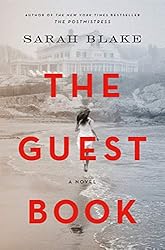
The Guest Book
Sarah Blake, 2019
Flatiron Books
448 pp.
ISBN-13: 9781250244239
Summary
A novel about past mistakes and betrayals that ripple throughout generations, The Guest Book examines not just a privileged American family, but a privileged America. It is a literary triumph.
The Guest Book follows three generations of a powerful American family, a family that “used to run the world.”
And when the novel begins in 1935, they still do. Kitty and Ogden Milton appear to have everything—perfect children, good looks, a love everyone envies.
But after a tragedy befalls them, Ogden tries to bring Kitty back to life by purchasing an island in Maine. That island, and its house, come to define and burnish the Milton family, year after year after year. And it is there that Kitty issues a refusal that will haunt her till the day she dies.
In 1959 a young Jewish man, Len Levy, will get a job in Ogden’s bank and earn the admiration of Ogden and one of his daughters, but the scorn of everyone else. Len’s best friend, Reg Pauling, has always been the only black man in the room—at Harvard, at work, and finally at the Miltons’ island in Maine.
An island that, at the dawn of the twenty-first century, this last generation doesn’t have the money to keep.
When Kitty’s granddaughter hears that she and her cousins might be forced to sell it, and when her husband brings back disturbing evidence about her grandfather’s past, she realizes she is on the verge of finally understanding the silences that seemed to hover just below the surface of her family all her life.
An ambitious novel that weaves the American past with its present, Sarah Blake's The Guest Book looks at the racism and power that has been systemically embedded in the U.S. for generations. (From the publisher.)
Author Bio
• Birth—December 10, 1960
• Where—New York, New York, USA
• Education—B.A., Yale University; M.A., San Francisco State University; Ph.D., New York University
• Currently—lives in Washington, DC
Born in New York City, Sarah Blake has a BA from Yale University and a PhD in English and American Literature from New York University. She is the author of a chapbook of poems, Full Turn (Pennywhistle Press, 1989); an artist book, Runaway Girls (Hand Made Press, 1997) in collaboration with the artist, Robin Kahn; and two novels. Her first novel, Grange House, (Picador, 2000) was named a "New and Noteworthy" paperback in August, 2001 by the New York Times. Her second novel, The Postmistress, was by Amy Einhorn Books/Putnam in February 2010. Her essays and reviews have appeared in Good Housekeeping, US News and World Reports, the Chicago Tribune and elsewhere.
Sarah taught high school and college English for many years in Colorado and New York. She has taught fiction workshops at the Fine Arts Works Center in Provincetown, MA, The Writer's Center in Bethesda, MD, the University of Maryland, and George Washington University. She lives in Washington, DC.
Extras
From a 2009 Barnes & Noble interview:
• In the three summers while I was in college, I tried out three different lives in my summer jobs—full immersion: intern at an Art Auction house in NYC; kitchen girl at a dude ranch in Montana; jewelry store clerk in a tiny shop on an island off the coast of Sicily. I took the immersion a little too close to heart for my mother—after the second summer, in my incarnation as a cowgirl, I announced I was thinking about quitting college, marrying the cowboy I was dating there, and becoming a rancher. How could I not? The cowboy left me love letters hidden in the horn of my saddle.
• I am a big gardener and re-arranger of furniture. The two are inextricably related, in my mind, to my writing. When I can't figure out a scene, or when I'm stumped as to why a character makes a certain choice—I go out and dig, and plot and plan and rearrange. In the winter, handily, there are similar chances to plot and plan and rearrange inside the house. When I get an idea in my head about how a room might look, I am completely obsessed with trying it out, right then and there. One night I was certain that the problem with our living room was the rug and that the answer to the problem lay upstairs on the third floor in my son's bedroom. Never mind that it was eleven o'clock and he was fast asleep, and the bed he slept in lay squarely on top of the rug. I jimmied and lifted and snatched the rug out from under the sleeping child, hauled it down the three flights, and then lifted and lowered and hauled the furniture around down in the living room. By the time my husband came home at midnight, I had just finished rolling the rug out in the living room. We both stared at it. It was completely and totally wrong.
• I come from a big family of singers—around the campfire, in a cappella groups in school, in the back of the car—and I love to sing, love to hear singing. Similarly, I grew up listening to grown ups talking at dinner, extending dinner late into the night, all of us ranged around a big table in the house my grandparents bought in the "30s in Maine. My idea of happiness is just that: many faces, many generations, much discussion, candles and talk while the dishes shift in the sink.
• I love fog. I love rain. I love the moment right after a play ends—the second of pure silence when everyone in the theatre, actors and audience, are joined—before the clapping starts and the actors bow and we pick up our lives again.
• When asked what book most influenced her life as a writer, here is her response:
There are all the books I read curled up on a couch in summer childhood—all the "Little House" books, The Secret Garden, The Little Princess, The Wolves of Willoughby Chase, A Wrinkle in Time—that gave me worlds right there where I sat, while the hot wind of New Haven drifted over the window sill. That feeling of reading worlds, of diving down below the surface of my own life made me a reader, an irredeemable bookworm.
But it was To the Lighthouse by Virginia Woolf that made me want to become a writer. I read her sentences—all the beauty and the longing in them—and I simply wanted to write them myself. The way her characters thought and moved, the light and sound she captured of a summer day—all this I wanted to make mine. She showed me how to capture what she calls "moments of being"—clear, resonant times in our lives of pure beauty, caught just as they vanish.
(Author bio and interview from Barnes & Noble.)
Book Reviews
Blake can write with the dramatic heft of Arthur Miller…The Guest Book is monumental in a way that few novels dare attempt.
Washington Post
There are glimmers of To the Lighthouse in Blake’s lyrical and questing new novel.
BBC
An American epic in the truest sense…Blake humanely but grippingly explores the heart of a country whose past is based in prejudice.
Entertainment Weekly
[A] powerful family saga… Blake has a particular knack for dialogue; she knows exactly how to reveal the hidden depths of the characters both through what is said and what is unsaid. The result is potent and mesmerizing.
Publishers Weekly
(Starred review) Breathtaking…Blake saturates each scene with sensuous and emotional vibrancy while astutely illuminating sensitive moral quandaries. Blake deftly interrogates the many shades of prejudice and ‘the ordinary, everyday wickedness of turning away.’ Blake’s brilliant and ravishing novel promises to hit big.
Booklist
(Starred review) The story of the Miltons engages not just with history and politics, but with the poetry of the physical world. This novel sets out to be more than a juicy family saga―it aims to depict the moral evolution of a part of American society. Its convincing characters and muscular narrative succeed on both counts.
Kirkus Reviews
Discussion Questions
1. Evie teaches her students that…
[H]istory is sometimes made by heroes, but it is also always made by us. We, the people, who stumble around, who block or help the hero out of loyalty, stubbornness, faith, or fear. Those who wall up—and those who break through walls. The people at the edge of the photographs. The people watching—the crowd. You.
Do you agree with her? How do the characters in this novel shape history? And whose history do they shape?
2. Central to Paul’s academic work is the idea that "there is the crime and there is the silence." How does that statement echo throughout the novel, specifically in his and Evie’s conversations about the stumble stones in Germany? How is that silence a kind of willed forgetting? Do you think Ogden was right to not divest from Nazi Germany and try to work within the regime? Was this a version of silence that Paul is criticizing? What kinds of silences do we reproduce in our lives in this country now?
3. Evie reflects at one point:
The jobs had been gotten, the beds made, the dishes washed, the children sprouted. The wheel had stopped and now what? Where, for instance, was the story of a middle-aged orphan with the gray streak in her hair, the historian who had rustled thirteenth-century women’s lives out of fugitive pages who believed more than most that there was no such thing as the certainty of a plot in the story of a life, in fact who taught this to students year in and year out, and yet who found herself lately longing above all else for just that? Longing, against reason, for some kind of clear direction, for the promise of a pattern. For the relief, she pulled against the shoulder strap of her satchel, the unbearable relief of an omniscient narrator.
What does she mean? What is the significance of the author’s choice to make Evie middle-aged?
4. During her trip to America, Elsa tells Mrs. Lowell:
Forgive me… but it is a mistake to think news happens somewhere else. To others. The news is always about you. You must simply fit yourself in it. You must see how—you must be vigilant.
Do you agree? How does her warning resonate for each generation of Miltons? Do you think the author is consciously echoing Evie with what she tells her students (question #1) in referencing "you"? And if so,what does the author suggest about collective responsibility?
5. On the porch later that evening, after Kitty says no to Elsa, Kitty is maddened by Elsa’s reading of her refusal. "For god’s sake," she says, "it’s not so simple." And Elsa replies, "But it is. It’s very simple. It always is." Is Kitty’s refusal simple? How might Neddy’s death have shaped her thoughts? Does it let her off the hook in terms of Elsa’s request?
6. Evie says of her parents’ generation that they seem to have "inherited their days rather than chosen them, made do with what they had, and so they peopled the rooms rather than lived in them, ghosting their own lives." Is that a fair assessment? Discuss the similarities and differences between the various generations of Miltons in this novel in relation to what they have been given.
7. At Evelyn’s engagement, Ogden toasts:
Behind every successful man is a good woman… Or so the saying goes. But I suggest a good woman is the reason men put up walls and gardens, churches. The reason men build at all. At the center of every successful man is a good woman.
How do you read this in light of Evie’s thesis about the anchoress? Discuss the gender dynamics at play in the different marriages in this novel.
8. Watching Moss on the night of the party, Reg thinks:
Moss sang his heart on his sleeve, as if all the gates of the world would open with him, believing that they could, with all his heart. But here on the island, the care with which Reg was being handled, the pronounced attention was merely the opposite face of the face that gave the hard stare, or the push between the ribs, or the whip. Both faces turned to the black man as though to a wall that had to be climbed or knocked down—and always with the infinitesimal moment of wariness that slid immediately into anger or polite regard.
How does Reg’s point of view here counter and complicate Moss’s optimistic belief that he can write a song that unites all Americans? What is Reg seeing? Do you think the Miltons ever come to see what he sees?
9. Moss describes to Reg the experience of seeing A Raisin in the Sun: "It was the first time I’d ever seen my own story on the stage… To see something, to want it that bad. To want and want and know that it’s impossible—it’s impossible." What do you think about Moss, a privileged white man, making a claim like that regarding a seminal play about the experience of African Americans?
10. Paul tells Evie, "There is no story until we’re dead, and then our children tell it. We are just living. Your mother was living. Stop looking for what’s not there. Nothing happened—life happened. Reality is not a story." Do you agree? What does Paul’s view suggest about how much we can ever truly know our family members? How does Paul’s statement complicate Evie’s view of history? Given that we know there was a story beneath the story of Joan’s life, a story that Evie couldn’t see, what does this suggest about the relation between truth and reality? What does that suggest about the act of novel writing?
11. What does Crockett’s Island represent for each generation of Miltons? Discuss the pros and cons of Evie’s generation fighting to keep the island or let it go. In what ways can a place both bind and define us? And how does the story we tell about ourselves connect to that place? Does your family have a place with a similar kind of significance?
12. At the end of the novel, before he says goodbye, Reg asks Evie what she will do with the island now that she knows its more complicated truths, and when she says, "I don’t know," he answers, "That’s a start." What do you think he means by that? What has started? What is the novel asking about the relation between knowledge of the past and responsibility to one another in the present? How does Reg’s response ask us to think about what we do once we see the full story (or history) of a place? In light of Elsa’s words in the beginning (question#4), perhaps it’s not so simple, but is it hopeful?
(Questions issued by the publisher.)
top of page (summary)

The Guest List
Lucy Foley, 2020
HarperCollins
320 pp.
ISBN-13: 9780062868930
Summary
A wedding celebration turns dark and deadly in this deliciously wicked and atmospheric thriller reminiscent of Agatha Christie from the New York Times bestselling author of The Hunting Party.
The bride – The plus one – The best man – The wedding planner – The bridesmaid – The body
On an island off the coast of Ireland, guests gather to celebrate two people joining their lives together as one.
— The groom: handsome and charming, a rising television star.
— The bride: smart and ambitious, a magazine publisher.
It’s a wedding for a magazine, or for a celebrity: the designer dress, the remote location, the luxe party favors, the boutique whiskey. The cell phone service may be spotty and the waves may be rough, but every detail has been expertly planned and will be expertly executed.
But perfection is for plans, and people are all too human.
As the champagne is popped and the festivities begin, resentments and petty jealousies begin to mingle with the reminiscences and well wishes. The groomsmen begin the drinking game from their school days. The bridesmaid not-so-accidentally ruins her dress. The bride’s oldest (male) friend gives an uncomfortably caring toast.
And then someone turns up dead. Who didn’t wish the happy couple well? And perhaps more important, why? (From the publisher.)
Author Bio
• Birth—1985
• Where—London, England, UK
• Education—Durham University; University College London
• Currently—lives in London, England
Lucy Foley is a British novelist, born and still living in London. She is best known for her works of historical fiction, but she also published two murder mysteries, The Hunting Party (2019) and The Guest List (2020).
After studying English Literature at Durham University in Northeast England and University College London, Foley worked for several years as a fiction editor in the publishing industry, before leaving to write full-time. The Hunting Party was inspired by a particularly remote spot in Scotland that fired her imagination.
Foley's historical novels—The Book of Lost and Found (2015), The Invitation (2016) and Last Letter from Istanbul (2018)—have been translated into sixteen languages. Her journalism has appeared in ES Magazine, Sunday Times Style, Grazia and more. (Adapted from Amazon.)
Book Reviews
Evoking the great Agatha Christie classics. Lucy Foley’s clever, taut new novel,… takes us to a creepy island off the coast of Ireland…. Foley builds her suspense slowly and creepily, deploying an array of narrators bristling with personal secrets…. Pay close attention to seemingly throwaway details about the characters’ pasts. They are all clues.
New York Times Book Review
[E]ntertaining if uneven ... Foley defers disclosing the murder victim’s identity until quite late, but she undercuts the suspense with obvious indications of who it is.… [Still,] readers seeking thrills will find plenty.
Publishers Weekly
(Starred review) Foley outdoes herself again with this page-turning thriller…. Only a handful of thriller writers can accomplish what Foley does here: weave a complex plot from the perspectives of eight characters plus an omniscient narrator without causing confusion. —Adriana Delgado, West Palm Beach, FL
Library Journal
At times the story threatens to overwhelm itself with a bit too much ominous darkness and "anxious distraction," but fans of the genre will enjoy the proceedings, imagining just how good that sumptuous wedding cake might have tasted.
Booklist
Discussion Questions
We'll add publisher questions if and when they're available; in the meantime, please use our GENERIC MYSTERY QUESTIONS to start a discussion for THE GUEST LIST… then take off on your own:
GENERIC DISCUSSION QUESTIONS
Mystery / Crime / Suspense Thrillers
1. Talk about the characters, both good and bad. Describe their personalities and motivations. Are they fully developed and emotionally complex? Or are they flat, one-dimensional heroes and villains?
2. What do you know...and when do you know it? At what point in the book do you begin to piece together what happened?
3. Good crime writers embed hidden clues in plain sight, slipping them in casually, almost in passing. Did you pick them out, or were you...clueless? Once you've finished the book, go back to locate the clues hidden in plain sight. How skillful was the author in burying them?
4. Good crime writers also tease us with red-herrings—false clues—to purposely lead readers astray? Does your author try to throw you off track? If so, were you tripped up?
5. Talk about the twists & turns—those surprising plot developments that throw everything you think you've figured out into disarray.
- Do they enhance the story, add complexity, and build suspense?
- Are they plausible or implausible?
- Do they feel forced and gratuitous—inserted merely to extend the story?
6. Does the author ratchet up the suspense? Did you find yourself anxious—quickly turning pages to learn what happened? A what point does the suspense start to build? Where does it climax...then perhaps start rising again?
7. A good ending is essential in any mystery or crime thriller: it should ease up on tension, answer questions, and tidy up loose ends. Does the ending accomplish those goals?
- Is the conclusion probable or believable?
- Is it organic, growing out of clues previously laid out by the author (see Question 3)?
- Or does the ending come out of the blue, feeling forced or tacked-on?
- Perhaps it's too predictable.
- Can you envision a different or better ending?
8. Are there certain passages in the book—ideas, descriptions, or dialogue—that you found interesting or revealing...or that somehow struck you? What lines, if any, made you stop and think?
9. Overall, does the book satisfy? Does it live up to the standards of a good crime story or suspense thriller? Why or why not?
(Generic Mystery Questions by LitLovers. Please feel free to use them, online or off, with attribution. Thanks.)


The Guest Room
Chris Bohjalian, 2016
Knopf Doubleday
336 pp.
ISBN-13: 9780385538893
Summary
The spellbinding tale of a party gone horribly wrong: two men lie dead in a suburban living room, two women are on the run from police, and a marriage is ripping apart at the seams.
When Kristin Chapman agrees to let her husband, Richard, host his brother’s bachelor party, she expects a certain amount of debauchery. She brings their young daughter to Manhattan for the evening, leaving her Westchester home to the men and their hired entertainment.
What she does not expect is this: bacchanalian drunkenness, her husband sharing a dangerously intimate moment in the guest room, and two women stabbing and killing their Russian bodyguards before driving off into the night.
In the aftermath, Kristin and Richard’s life rapidly spirals into nightmare. The police throw them out of their home, now a crime scene, Richard’s investment banking firm puts him on indefinite leave, and Kristin is unsure if she can forgive her husband for the moment he shared with a dark-haired girl in the guest room.
But the dark-haired girl, Alexandra, faces a much graver danger. In one breathless, violent night, she is free, running to escape the police who will arrest her and the gangsters who will kill her in a heartbeat. A captivating, chilling story about shame and scandal, The Guest Room is a riveting novel from one of our greatest storytellers. (From the publisher.)
Author Bio
• Birth—1960
• Where—White Plains, New York, USA
• Education—Amherst College
• Awards—Anahid Literary Award, 2000; New England Book Award, 2002
• Currently—lives in Lincoln, Vermont
Christopher Aram Bohjalian, who goes by the pen name Chris Bohjalian, is an American novelist. Bohjalian is the author of nearly 20 novels, including New York Times bestsellers Midwives, Secrets of Eden, The Law of Similars, Before You Know Kindness, The Double Bind, Skeletons at the Feast, and The Night Strangers.
Bohjalian is the son of Aram Bohjalian, who was a senior vice president of the New York advertising agency Romann & Tannenholz. Chris Bohjalian graduated summa cum laude from Amherst College, where he was a member of the Phi Beta Kappa Society. In the mid-1980s, he worked as an account representative for J. Walter Thompson advertising agency in New York.
He and his wife lived in a co-op in Brooklyn until March 1986, when the two were riding in a taxicab in which the driver refused to let them out of the car for 45 minutes, ignoring all traffic lights and stop signs. Around midnight, the driver dropped them off at a near-deserted street in front of a crack house, where the police were conducting a raid and Bohjalian and his wife were forced to drop to the ground for their protection. The incident prompted the couple to move from Brooklyn; Bohjalian said, "After it was all over, we just thought, "Why do we live here?" A few days later, the couple read an ad in The New York Times referencing the "People's Republic of Vermont," and in 1987 the couple moved to Lincoln, Vermont.
Early career
After buying their house, Bohjalian began writing weekly columns for local newspaper and magazine about living in the small town, which had a population of about 975 residents. The Concord Monitor said of Bohjalian during this period, "his immersion in community life and family, Vermont-style, has allowed him to develop into a novelist with an ear and empathy for the common man." Bohjalian continued the column for about 12 years, writing about such topics as his own daily life, fatherhood and the transformation of America. The column has run in the Burlington Free Press since 1992. Bohjalian has also written for such magazines as Cosmopolitan, Reader's Digest and the Boston Globe Sunday Magazine.
Bohjalian's first novel, A Killing in the Real World, was released in 1988. Almost two decades after it was released, Bohjalian said of the book, "It was a train wreck. I hadn't figured things out yet." His third novel, Past the Bleachers, was released in 1992 and adapted as a Hallmark Channel television movie in 1995.
In 1998, Bohjalian wrote his fifth book, Midwives, a novel focusing on rural Vermont midwife Sibyl Danforth, who becomes embroiled in a legal battle after one of her patients died following an emergency Caesarean section. The novel was critically acclaimed and was selected by Oprah Winfrey as the October 1998 selection of her Oprah's Book Club, which helped push the book to great financial success. It became a New York Times and USA Today bestseller. Victoria Blewer has often described her husband as having "a crush" on the Sybil Danforth character. In 2001, the novel was adapted into a Lifetime Movie Network television film starring Sissy Spacek in the lead role. Spacek said the Danforth character appealed to her because "the heart of the story is my character's inner struggle with self-doubt, the solo road you travel when you have a secret."
Later career
Bohjalian followed Midwives with the 1999 novel The Law of Similars, about a widower attorney suffering from nameless anxieties who starts dating a woman who practices alternative medicine. The novel was inspired by Bohjalian's real-life visit to a homeopath in an attempt to cure frequent colds he was catching from his daughter's day care center. Bohjalian said of the visit, "I don't think I imagined there was a novel in homeopathy, however, until I met the homeopath and she explained to me the protocols of healing. There was a poetry to the language that a patient doesn't hear when visiting a conventional doctor." The protagonist, a father, is based in part on Bohjalian himself, and his four-year-old daughter is based largely on Bohjalian's daughter, who was three when he was writing the book., Liz Rosenberg of The New York Times said the novel shared many similarities with Midwives but that it paled in comparison; Rosenberg said, "Unlike its predecessor, it fails to take advantage of Bohjalian's great gift for creating thoughtful fiction featuring characters in whom the reader sustains a lively interest." Megan Harlan of The Boston Phoenix described it as "formulaic fiction" and said Bohjalian focused too much on creating a complex plot and not enough of complex characterizations. The Law of Similars, like Midwives, made the New York Times bestsellers list.
He won the New England Book Award in 2002, and in 2007 released "The Double Bind," a novel based on Fitzgerald's The Great Gatsby.
In 2008, Bohjalian released Skeletons at the Feast, a love story set in the last six months of World War II in Poland and Germany. The novel was inspired by an unpublished diary written by German citizen Eva Henatsch from 1920 to 1945. The diary was given to Bohjalian in 1998 by Henatsch's grandson Gerd Krahn, a friend of Bohjalian, who had a daughter in the same kindergarten class as Bohjalian's daughter. Bohjalian was particularly fascinated by Henatsch's account of her family's trek west ahead of the Soviet Army, but he was not inspired to write a novel from it until 2006, when he read Armageddon: The Battle for Germany, Max Hastings' history of the final years of World War II. Bohjalian was struck not only by how often Henatsch's story mirrored real-life experiences, but also the common "moments of idiosyncratic human connection" found in both. Skeletons of the Feast was considered a departure for Bohjalian because it was not only set outside of Vermont, but set in a particular historical moment.
His 2010 novel, Secrets of Eden, was also a critical success, receiving starred reviews from three of the four trade journals (Booklist, Library Journal, and Publishers Weekly), as well as many newspapers and magazines. It debuted at # 6 on The New York Times bestseller list.
His next novel, The Night Strangers, published in 2011, represents yet another departure for Bohjalian. The is both a gothic ghost story and a taut psychological thriller.
He has written a weekly column for Gannett's Burlington Free Press since February 1992 called "Idyll Banter." His 1,000th column appeared in May 2011.
Personal comments
In a 2003 Barnes & Noble interview, Bohjalian offered up these personal comments:
I was the heaviest child, by far, in my second-grade class. My mother had to buy my pants for me at a store called the "Husky Boys Shop," and still she had to hem the cuffs up around my knees. I hope this experience, traumatizing as it was, made me at least marginally more sensitive to people around me.
I have a friend with Down syndrome, a teenage boy who is capable of remembering the librettos from entire musicals the first or second time he hears them. The two of us belt them out together whenever we're driving anywhere in a car.I am a pretty avid bicyclist. The other day I was biking alone on a thin path in the woods near Franconia Notch, New Hampshire, and suddenly before me I saw three bears. At first I saw only two, and initially I thought they were cats. Then I thought they were dogs. Finally, just as I was approaching them and they started to scurry off the path and into the thick brush, I understood they were bears. Bear cubs, to be precise. Which is exactly when their mother, no more than five or six feet to my left, reared up on her hind legs, her very furry paws and very sharp claws raised above her head in a gesture that an optimist might consider a wave and guy on a bike might consider something a tad more threatening. Because she was standing on a slight incline, I was eye level with her stomach—an eventual destination that seemed frighteningly plausible. I have never biked so fast in my life in the woods. I may never have biked so fast in my life on a paved road.
I do have hobbies—I garden and bike, for example—but there's nothing in the world that gives me even a fraction of the pleasure that I derive from hanging around with my wife and daughter.
He lives with his wife and daughter in Lincoln, Vermont, where he is active in the local church and the Vermont theater community—always off-stage, never on.
Writing style
Bohjalian novels often focus on a specific issue, such as homelessness, animal rights and environmentalism, and tend to be character-driven, revolving around complex and flawed protagonists and secondary characters. Bohjalian uses characteristics from his real life in his writings; in particular, many of his novels take place in fictional Vermont towns, and the names of real New Hampshire towns are often used throughout his stories. Bohjalian said, "Writers can talk with agonizing hubris about finding their voices, but for me, it was in Vermont that I discovered issues, things that matter to me." His novels also tend to center around ordinary people facing extraordinarily difficult situations resulting from unforeseen circumstances, often triggered by other parties. (From Wikipedia.)
Book Reviews
In his latest novel, Bohjalian stacks the deck against his well-to-do main character, Richard Chapman, who holds a bachelor party in his Bronxville home for his younger brother.... It is to the author’s credit that he takes [the] situation and makes it somewhat credible. Juxtaposed against the upper-class setting is Alexandra’s own account of being sold into slavery, which deserves a less sudsy book of its own.
Publishers Weekly
[A]nother fresh and different novel from the New York Times best-selling Bohjalian.... [A] tale of escalating suspense.
Library Journal
Gripping…. Venturing into crime-thriller territory familiar to fans of Harlan Coben, Bohjalian’s page-turner about an average Joe caught up in sordid events beyond his control resonates with chilling plausibility.
Booklist
[T]he plot thickens with blackmail threats, Internet defamation, employment discrimination, and marital meltdown, as Richard compounds his original error with even more implausible lapses in judgment. Character development takes a back seat in this expose of human trafficking, and Bohjalian's treatment often wavers between prurience and polemic.
Kirkus Reviews
Discussion Questions
1. When Anahit is forced to become Alexandra, what happens to her sense of self? How is she able to secretly retain many aspects of her true identity—particularly her sense of humor and her intellect? How does she navigate the multitude of cultures beyond her Armenian homeland? How would you fare in her situation?
2. If you were Kristin, how would you have reacted to Richard’s story? If you were Nicole, would you have broken off the engagement to Philip?
3. If the bachelor party had featured strippers or prostitutes who had freely chosen their line of work, would you call the debauchery harmless? Is a career in the sex trade ever freely chosen?
4. Discuss the psychological tactics Alexandra’s captors use against her. Is there anything she and her beloved grandmother could have done to see through Vasily’s promises?
5. How will Melissa be affected by the aftermath of her uncle’s party? How will these memories shape her understanding of a woman’s role in the world, and the nature of suffering?
6. Is Spencer simply motivated by money, or does he also crave power? How much does he have in common with Kirill and Pavel?
7. At the end of chapter 5, Alexandra says she never had faith in hatred, like Sonja did. What accounts for the differences between Sonja and Alexandra? What is the source of Alexandra’s resilience and her inability to become “good at hatred”?
8. Are most of the men you know similar to Richard, or are they more like his brother, Philip? Are Alexandra’s images from The Bachelor totally unrealistic?
9. How were you affected by the story Alexandra tells Richard about the crates of Barbie dolls? How do her memories of the dolls compare to Melissa and Kristin’s visit to FAO Schwarz?
10. As Alexandra and Richard struggled to be free of their separate turmoil, what outcomes were you envisioning for them? How did the ending compare to your predictions?
11. How did The Guest Room enhance your experience of other novels by Chris Bohjalian? What’s special about the worlds he brings to life in his storylines?
12. Although it’s a work of fiction, The Guest Room opens our eyes to the tragic reality of human trafficking. How can a novel spur change? How is a novelist’s approach different from that of journalists?
13. What should we teach our daughters and sons about sexuality and exploitation? Does sex appeal make a woman powerful, or does it make her vulnerable?
(Questions issued by the publisher.)


Gulp: Adventures on the Alimentary Canal
Mary Roach, 2013
W.W. Norton & Co.
352 pp.
ISBN-13: 9780393348743
Summary
The irresistible, ever-curious, and always best-selling Mary Roach returns with a new adventure to the invisible realm we carry around inside. “America’s funniest science writer” (Washington Post) takes us down the hatch on an unforgettable tour.
The alimentary canal is classic Mary Roach terrain: the questions explored in Gulp are as taboo, in their way, as the cadavers in Stiff and every bit as surreal as the universe of zero gravity explored in Packing for Mars.
Why is crunchy food so appealing? Why is it so hard to find words for flavors and smells? Why doesn’t the stomach digest itself? How much can you eat before your stomach bursts? Can constipation kill you? Did it kill Elvis? In Gulp we meet scientists who tackle the questions no one else thinks of—or has the courage to ask. We go on location to a pet-food taste-test lab, a fecal transplant, and into a live stomach to observe the fate of a meal.
With Roach at our side, we travel the world, meeting murderers and mad scientists, Eskimos and exorcists (who have occasionally administered holy water rectally), rabbis and terrorists—who, it turns out, for practical reasons do not conceal bombs in their digestive tracts. Like all of Roach’s books, Gulp is as much about human beings as it is about human bodies. (From the publisher.)
Author Bio
• Birth—March 20, 1959
• Raised—Etna, New Hampshire, USA
• Education—B.A., Weslyan University
• Awards—see below
• Currently—lives in Oakland, California
Mary Roach is an American author, specializing in popular science. To date, she has published five books: Stiff: The Curious Lives of Human Cadavers (2003), Spook: Science Tackles the Afterlife (2005) (published in some markets as Six Feet Over: Adventures in the Afterlife), Bonk: The Curious Coupling of Science and Sex (2008), Packing for Mars: The Curious Science of Life in the Void (2010), and Gulp: Adventures on the Alimentary Canal (2013).
Roach was raised in Etna, New Hampshire. She received a bachelor's degree in psychology from Wesleyan University in 1981. After college, Roach moved to San Francisco, California and spent a few years working as a freelance copy editor. She worked as a columnist and also worked in public relations for a brief time. Her writing career began while working part-time at the San Francisco Zoological Society, producing press releases on topics such as elephant wart surgery. On her days off from the SFZS, she wrote freelance articles for the San Francisco Chronicle's Sunday Magazine.
From 1996 to 2005 Roach was part of The Grotto, a San Francisco-based project and community of working writers and filmmakers. It was in this community that Roach would get the push she needed to break into book writing. While being interviewed by Alex C. Telander of BookBanter, Roach answers the question of how she got started on her first book:
A few of us every year [from The Grotto] would make predictions for other people, where they'll be in a year. So someone made the prediction that, "Mary will have a book contract." I forgot about it and when October came around I thought, I have three months to pull together a book proposal and have a book contract. This is what literally lit the fire under my butt.
Early career
In 1986, she sold a humor piece about the IRS to the San Francisco Chronicle. That piece led to a number of humorous, first-person essays and feature articles for such publications as Vogue, GQ, The New York Times Magazine, Discover Magazine, National Geographic, Outside Magazine, and Wired. She has also written articles for Salon.com and tech-gadget reviews for Inc.com. An article by Roach, entitled "The C word: Dead man driving," was published in the Journal of Clinical Anatomy. Roach has had monthly columns in Reader's Digest (“My Planet”) and Sports Illustrated for Women (“The Slightly Wider World of Sports”).
Besides being a best selling author, Roach is involved in many other projects on the side. Roach reviews books for The New York Times and was the guest editor of the Best American Science and Nature Writing's 2011 edition. She also serves as a member of the Mars Institute's Advisory Board and was recently asked to join the Usage Panel of the American Heritage Dictionary.
Personal life
Roach has an office in downtown Oakland and lives in the Glenview neighborhood of Oakland with her husband Ed Rachles, an illustrator and graphic designer. She also has two step-daughters.
While Roach has often been quoted saying that she does not have much free time between writing books, she is very fond of backpacking and travel. The latter she has been able to do a great deal of while doing research for her articles and books. Roach has visited all seven continents twice. She has been to Antarctica a few times as part of the National Science Foundation's Polar Program. In 1997, she visited Antarctica to write an article for Discover Magazine on meteorite hunting with meteorite hunter Ralph Harvey.
Recognition
In 1995, Roach's article "How to Win at Germ Warfare" was a National Magazine Award Finalist. In the article, Roach conducts an interview with microbiologist Chuck Gerba of the University of Arizona who describes a scientific study where bacteria and virus particles become aerosolized upon flushing a toilet: "Upon flushing, as many as 28,000 virus particles and 660,000 bacteria [are] jettisoned from the bowl."
In 1996, her article on earthquake-proof, bamboo houses, "The Bamboo Solution", took the American Engineering Societies' Engineering Journalism Award in the general interest magazine category. In this article the reader learns from Jules Janssen, a civil engineer, that bamboo is "stronger than wood, brick, and concrete...A short, straight column of bamboo with a top surface area of 10 square centimeters could support an 11,000-pound elephant."
Stiff: The Curious Lives of Human Cadavers was a New York Times Bestseller, a 2003 Barnes & Noble Discover Great New Writers pick, and one of Entertainment Weekly's Best Books of 2003. Stiff also won the Amazon.com Editor's Choice award in 2003, was voted as a Borders Original Voices book, and was the winner of the Elle Reader's Prize. The book has been translated into 17 languages, including Hungarian (Hullamerev) and Lithuanian (Negyveilai).[6] Stiff was also selected for Washington State University's Common Reading Program in 2008-09.
Roach's column "My Planet" (Reader's Digest) was runner-up in the humor category of the 2005 National Press Club awards. Roach's second book, Spook: Science Tackles the Afterlife, was the recipient of the Elle Reader's Prize in October 2005. Spook was also listed as a New York Times Notable Books pick in 2005, as well as a New York Times Bestseller. In 2008, Roach's book, Bonk: The Curious Coupling of Science and Sex, was chosen as the New York Times Book Review Editor's Choice, it was in The Boston Globe's Top 5 Science Books, and it was listed as a bestseller in several other publications.
In 2011, Roach's book, Packing for Mars: The Curious Science of Life in the Void, was chosen as the book of the year for the 7th annual One City One Book: San Francisco Reads literary event program. Packing for Mars was also 6th on the New York Times Best Seller list.[22]
In 2012, Roach was the recipient of the Harvard Secular Society's Rushdie Award for her outstanding lifetime achievement in cultural humanism. The same year, she received a Special Citation in Scientific inquiry from Maximum Fun.
Style
The common theme throughout all of Roach's books is a literary treatment of the human body. Roach says of her publication history,
My books are all [about the human body], Spook is a little bit of departure because it's more about the soul rather than the flesh and blood body, but most of my books are about human bodies in unusual circumstances.
When asked by Peter Sagal, of NPR, specifically how she picks her topics, she replied, "Well, its got to have a little science, it's got to have a little history, a little humor—and something gross."
While Roach does not possess a science degree, she attempts to take complex ideas and turn them into something that the average reader can understand. She takes the reader with her through the steps of her research, from learning about the material to getting to know the people who study it, as she described in a public dialog with Adam Savage:
Make no mistake, good science writing is medicine. It is a cure for ignorance and fallacy. Good science writing peels away the blindness, generates wonder, and brings the open palm to the forehead: "Oh! Now I get it!"
Regarding her skepticism about the world around her, Roach states in her book Spook,
Flawed as it is, science remains the most solid god I've got. And so I've decided to turn to it, to see what it had to say on the topic of life after death. Because I know what religion says, and it perplexes me. It doesn't deliver a single, coherent, scientifically sensible or provable scenario… Science seemed the better bet. (Author bio from Wikipedia.)
Book Reviews
Gulp is far and away her funniest and most sparkling book, bringing Ms. Roach's love of weird science to material that could not have more everyday relevance. Having graduated from corpses (Stiff), the afterlife (Spook) and sex (Bonk, full of stunts featuring Ms. Roach as guinea pig), she takes on a subject wholly mainstream. She explores it with unalloyed merriment. And she is fearless about the embarrassment that usually accompanies it…Never has Ms. Roach's affinity for the comedic and bizarre been put to better use.
Janet Maslin - New York Times
Gulp is an absolute delight…[Roach is] a very good writer who understands that her job is, above all, to entertain. Every paragraph is a pleasure to read, even if that paragraph is about a partially decomposed gazelle entombed in the body of a python…In the wrong hands, a book on digestion would be rendered tedious by a need to cover every aspect of the subject to some degree. But Roach follows her interests, not a checklist…you'll come away from this well-researched book with enough weird digestive trivia to make you the most interesting guest at a certain kind of cocktail party.
Amy Stewart - Washington Post
[A] merry foray into the digestive sciences…. Inexorably draws the reader along with peristaltic waves of history and vividly described science.
Brian Switek - Wall Street Journal
One of my top criteria for pronouncing a book worthwhile is the number of times you snort helplessly with laughter and say, “Wow! Did you know that..." before your long-suffering spouse throws a book at you from across the room. My personal spouse says that, in this department, "Gulp takes the cake.”
Adam Woog - Seattle Times
Never before has the process of eating been so very interesting…. After digesting her book, you can’t help but think about what that really means.
Micki Myers - Pittsburgh Post-Gazette
In the case of [Roach's] newest, some may hesitate to follow—it’s about the human digestive system, and it’s as gross as one might expect. But it’s also enthralling. From mouth to gut to butt, Roach is unflinching as she charts every crevice and quirk of the alimentary canal.... Roach’s approach is grounded in science, but the virtuosic author rarely resists a pun, and it’s clear she revels in giving readers a thrill—even if it is a queasy one.
Publishers Weekly
(Starred review.) For all her irreverence, Roach marvels over the fine-tuned workings and "wisdom" of the human body, and readers will delight in her exuberant energy, audacity, and wit.
Booklist
As she investigates these questions, Roach encounters many an eccentric scientist who has worked tirelessly to unlock the mysteries of saliva, gastrointestinal gases, and mastication. As she recounts her adventures in tasting centers and laboratories, she aims not to disgust readers, but to inspire curiosity—even awe—for the most intimate functions of the human body. Verdict: ...this book will entertain readers, challenge their cultural taboos, and simultaneously teach them new lessons in digestive biology. —Talea Anderson, Ellensburg, WA
Library Journal
Throughout her sojourn down the gastrointestinal tract, science writer Roach enlists her abundant assets of intelligence and humor while dissecting this messy and astounding part of the human body.... She also fleshes out just what constitutes the "ick factor" in this tale of ingestion, digestion and elimination. Roach's abundant footnotes serve as entertaining detours throughout this edifying excursion.... [T]he author entertains with this incredible journey into the netherworld of the human body. A touchy topic illuminated with wit and rigor, packed with all the stinky details.
Kirkus Reviews
Discussion Questions
Use our LitLovers Book Club Resources; they can help with discussions for any book:
• How to Discuss a Book (helpful discussion tips)
• Generic Discussion Questions—Fiction and Nonfiction
• Read-Think-Talk (a guided reading chart)
We'll add specific questions if and when they're made available by the publisher.
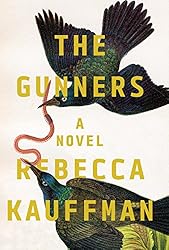
The Gunners
Rebecca Kauffman, 2018
Counterpoint Press
224 pp.
ISBN-13: 9781619029897
Summary
Mikey Callahan, a thirty-year-old suffering from the clouded vision of macular degeneration, struggles to establish human connections. Even his emotional life is a blur.
As the novel begins, Mikey is reconnecting with "The Gunners," his group of childhood friends, after one of their members has committed suicide. Sally had distanced herself from all of them before ending her life, and she died harboring secrets about the group and its individuals.
Mikey especially needs to confront dark secrets about his own past and his father. How much of this darkness accounts for the emotional stupor Mikey is suffering from as he reaches his maturity?
And can The Gunners, prompted by Sally’s death, find their way to a new day? The core of this adventure, made by Mikey, Alice, Lynn, Jimmy, and Sam, becomes a search for the core of truth, friendship, and forgiveness.
A quietly startling, beautiful book, The Gunners engages us with vividly unforgettable characters, and advances Rebecca Kauffman’s place as one of the most important young writers of her generation. (From the publisher.)
Author Bio
• Birth—N/A
• Where—rural Northeastern Ohio, USA
• Education—B.A., Manhattan School of Music; M.F.A., New York University
• Currently—lives in Harrisonburg, Virginia
Rebecca Kauffman is originally from rural northeastern Ohio. She received her B.A. in Classical Violin Performance from the Manhattan School of Music, but as an inherently shy person she decided a career in music was not for her. After graduating, Kauffman stayed in New York City working in public relations. After a few years, she moved to Buffalo, New York, where she worked in a restaurant and taught music.
In her spare time Kaufmann turned to writing, something she had loved in her childhood—penning small books with help from her mother, who illustrated and laminated the finished product. As a young adult, she immersed herself again in fiction and realized she had found her calling.
Kauffman sent the first 30 pages of a novel she was working to New York University in the hopes of being accepted into its creative writing program. Although the manuscript was later trashed—"total garbage" as she referred to it in an NPR interview—her application was accepted, and she attained an M.F.A.
Kauffman's debut novel, Another Place You've Never Been, was published in 2016. Two years later came The Gunners, a book placed on many "must read," "eagerly awaited," and "a best book of 2018" lists. She published The House on Fripp Island in 2020.
She currently lives in the Shenandoah Valley of Virginia. (From various online sources, including WMRA Public Radio.)
Book Reviews
Unusually for a literary novelist, Kauffman has no fear of overt feeling. When she explores an emotion, she does it with absolute candor. Her characters announce their grief and affection and rage in a way that few others do.… If it's rare for a contemporary literary novelist to address emotion so bluntly, it's even rarer if that novelist is female.… The brilliance of The Gunners is that it helps you. Kauffman teaches you the right way to read her prose.… Another thing literary novelists don't often let themselves do is write novels with morals, or messages, but The Gunners has one. It's clear, though not easy: Accept your emotions. Feel them bluntly, plainly. Allow yourself to flinch.
NPR Books
Novels about friendships are the new fad but trust me when I tell you that this one is truly superlative. A gracefully endearing story which delves deeply into the nature of childhood friendship while also shining a light on chronic illness and LGTBQ rights.
Chicago Review of Books
In the beautifully wrought The Gunners , life ends not with a whimper, but with a bang.… This engrossing book's suspense lies not just in what will happen, but in what already has.… Kauffman is interested in the muddiness of love—how it can be selfish and desperate, even cruel.… When it comes to love, Kauffman suggests, we're equal parts predator and prey.
Oprah Magazine
A vivid, layered novel.… Endearing and intimate, Kauffman steers clear of veering into cliche, reviving a well-worn premise into something new and exciting.
Harper's Bazaar
This story examines how the secrets held and harbored by friends, and the defining relationships of childhood and adolescence, never fully leave us (1 of the Best Books of 2018, So Far).
Esquire
A riveting portrayal of the joys and mysteries of growing up, and of friendship itself.
People
A moving novel.… Each character comes to terms with their dark past, and uncertain futures—like an intimate hangout session, dashed with suspense and few extra layers of emotional beauty. You'll find yourself thinking of Freaks and Geeks, The Big Chill, and maybe all those friends you've been meaning to text (The Must List).
Entertainment Weekly
This gorgeous story of loss and friendship follows a group of childhood best friends when they reunite as adults to grapple with a friend’s suicide.… Weaving back and forth through the past and present, this tender story explores the secrets we carry from the past (1 of the Best Books of 2018, So Far).
Real Simple
(Starred review) [P]erceptive, funny, and endearing…, this remarkable novel is just as satisfying and provides readers with an entire cast of characters who will feel like old friends upon finishing.
Publishers Weekly
Neither dark nor despairing, this work admirably expresses the satisfying comfort derived from… long-term friendships even as it evokes sadness about the losses and challenges that come with transitioning to adulthood. A successful… effort
Library Journal
A little bit like The Big Chill , Kauffman’s quiet and deep second novel reconciles the responsibilities we carry and the secrets we keep with the outsize pleasure of being known and loved by a chosen family.
Booklist
[V]ivid and compelling characters struggling with what is in some ways the most universal dilemma: how to grow up.… Kauffman lays bare the lessons of youth and truth. A layered and loving bildungsroman of friendship.
Kirkus Reviews
Discussion Questions
We'll add publisher questions if and when they're available; in the meantime, use our LitLovers talking points to help start a discussion for THE GUNNERS … then take off on your own:
1. Rebecca Kauffman has said that "Mikey is the heart and soul of the book." How would you describe him, and what makes him central to the novel?
2. Follow-up to Question 1: How do the novel's other characters differ from Mikey's natural kindness? How do their various personalities serve as foils to Mikey? Do you have a favorite and/or least favorite Gunner? If so, who … and why?
3. Each childhood home of the Gunners was different: Mikey's was quiet and somber, while Alice's household was loud and chaotic. How do the family environments shape each of the Gunners—as children and, now, as adults?
4. The Gunners tell their stories, offering personal histories of the arc of their lives. In what ways have they changed (if at all) from children to adults? Also, consider the group dynamics: has the way in which the members relate to one another, or to the group as a whole, changed from when they were children? Do they behave differently toward one another as adults?
5. Do you have a group of childhood friends that still gathers on occasion (or perhaps frequently)? If so, what has held you together over the years? Have the internal dynamics of your group changed or remained the same?
6. The core of Questions 4 & 5—and of the novel itself—is this: are people are capable of change? If your answer is "yes," are the changes on the surface … or deep down? If you answer is "not really," why not? Mikey and Alice discuss that very question. What are their thoughts?
7. Another question underlying The Gunners is whether we alter our behavior to suit the people around us. What do you think?
8. Alice likes to be in charge. Is that because she simply has a need to be in control; or does she want to pull people out of their self-protective shells? In other words, is her desire for control selfish or beneficient? Whatever your answer, how does her controlling instinct affect others, in particular, Mikey?
9. Alice quotes her dying grandmother: "Sure death's a little scary but life is the real bitch." Care to comment on that?
10. Mikey wonders near the novel's end whether "having a dear friend, and being a dear friend, might be almost as good as being a good man." What do you think? What does being a "good" person actually mean?
11. The group names itself after the mailbox of the abandoned house where they meet—and Kauffman uses it as the book's title. Are there other meanings the title might refer to, figuratively or symbolically?
(Questions by LitLovers. Please feel free to use them, online and off, with attribution. Thanks.)


Gutenberg's Apprentice
Alix Christie, 2014
HarperCollins
416 pp.
ISBN-13: 9780062336019
Summary
An enthralling literary debut that evokes one of the most momentous events in history, the birth of printing in medieval Germany—a story of invention, intrigue, and betrayal.
Youthful, ambitious Peter Schoeffer is on the verge of professional success as a scribe in Paris when his foster father, the wealthy merchant and bookseller Johann Fust, summons him home to corruption- riddled, feud-plagued Mainz to meet "a most amazing man."
Johann Gutenberg, a driven and caustic inventor, has devised a revolutionary—and, to some, blasphemous—method of bookmaking: a machine he calls a printing press. Fust is financing Gutenberg's workshop, and he orders Peter to become Gutenberg's apprentice. Resentful at having to abandon a prestigious career as a scribe, Peter begins his education in the "darkest art."
As his skill grows, so too does his admiration for Gutenberg and his dedication to their daring venture: printing copies of the Holy Bible. But when outside forces align against them, Peter finds himself torn between two father figures—the generous Fust and the brilliant, mercurial Gutenberg, who inspires Peter to achieve his own mastery.
Caught between the genius and the merchant, the old ways and the new, Peter and the men he admires must work together to prevail against overwhelming obstacles in a battle that will change history...and irrevocably transform them all. (From the publisher.)
Author Bio
• Birth—June, 1958
• Where—Redwood, California, USA
• Raised—California, Montana, and British Columbia, Canada
• Education—B.A., Vassar College; M.A., University of California, Berkeley; M.F.A.,
Saint Mary's College of California
• Currently—lives in London, England, UK
Alix Christie is an author, journalist, and letterpress printer. She learned the craft as an apprentice to two master California printers and owns and operates a 1910 Chandler & Price letterpress. She holds a master of fine arts degree from Saint Mary's College of California and currently lives in London, where she reviews books and arts for the Economist. Gutenberg's Apprentice is her first novel. (From the publisher.)
In her words:
I was born in the Silicon Valley while it was still orchards, and grew up in California, Montana, and British Columbia. A move to New York state to attend Vassar College, where I was a Phi Beta Kappa philosophy major, led to Manhattan and a stint in advertising copywriting. I returned home to pursue a masters degree in journalism at the University of California and have been a peripatetic reporter and writer ever since.
My articles and commentary have appeared in the Washington Post, International Herald Tribune, The Economist, The Guardian, Salon and the San Francisco Chronicle, among other publications. I am the former editor of the Foreign Service of the San Francisco Chronicle, a network of freelance foreign correspondents.
While raising two children in the 1990s I earned a Masters of Fine Arts in fiction from St. Mary’s College of California. My debut novel, Gutenberg's Apprentice, is forthcoming this fall. An earlier unpublished work was a semi-finalist in the 2008 Amazon Breakthrough Novel contest, and my short stories have appeared in Southwest Review, Other Voices, and For Sale, Baby Shoes, Never Worn: Six Words, Six Stories, Six Writers, a limited letterpress edition from Foolscap Press.
(From the author's website.)
Book Reviews
(Starred review.)Christie’s fiction debut descriptions of technical processes and medieval society are enthralling; the romance and personal melodrama are less compelling. At her best, she demonstrates a printer’s precision and a dogged researcher’s diligence in her painstakingly meticulous account of quattrocento innovation, technology, politics, art, and commerce
Publishers Weekly
Christie's slow-paced debut is rich in historical detail. Although the writing can be overblown, the story of the birth of the printing press is fascinating. Readers who enjoy historical fiction such as Tracy Chevalier's Remarkable Creatures will enjoy this admirable outing. —Terry Lucas, Rogers Memorial Lib., Southampton, NY
Library Journal
(Starred review.) Gorgeously written...dramatizes the creation of the Gutenberg Bible in a story that devotees of book history and authentic historical fiction will relish...An inspiring tale of ambition, camaraderie, betrayal, and cultural transformation based on actual events and people, this wonderful novel fully inhabits its age.
Booklist
(Starred review.) Christie masterfully depicts the time and energy required to print the first Bibles...against a catastrophic backdrop of plague, the fall of Constantinople, the violent superstitions of the peasantry, and a vested intelligentsia.... [T]he narrative is given texture through intermittent chapters in which Schoeffer...relates his story to Trithemius, abbot of Sponheim. A bravura debut.
Kirkus Reviews
Discussion Questions
1. The novel begins with Peter Schoeffer telling the story to a writer. In what ways are verbal and written storytelling similar or different?
2. What does Peter retain and lose in his shift from artisan scribe to printmaking engineer?
3. Considering Peter’s initial conflict between the scribe’s art and the printing press, what’s the relationship between art and technology?
4. A central issue in Mainz is the ancient one between homo faber—the man who makes things—and he who sells or trades what others make. What is the conflict here? How might it continue in contemporary culture? Examine the irony of craftsmen making by hand something that would "replace the hand of man."
5. Peter admits late in his life that the printing press never brought "the liberation that it promised" by lifting man "from bigotry and want and greed." How might it have done this? What forces kept it from happening?
6. In what ways does Peter’s experience and identity as an orphan affect his life and relationships?
7. Hermann Rosenberg, a vicar, argues that the printing press could secure knowledge with a standardized text and avoid cultural disorder. In what parts of culture might such a lack of variation be problematic?
8. How do the many references to the biblical stories woven throughout add to the novel? Which seem the most powerful or poignant?
9. Peter thinks one of Gutenberg’s brilliant abilities is "to see a thing—a person too—in pieces." What might this mean? What are its costs?
10. Peter also describes Gutenberg as "beholden to no group…nor…any other man. He stood outside, alone, a solitary soul." How did such disconnection serve or hinder him? To what degree might such behavior be a necessary precondition for brilliance or innovative thinking? or something like this…)
11. When Peter first sees the print from metal letters he carved, "it all changed." What is the nature of such a "spark"?
12. Gutenberg makes harsh statements about the value of women, referring to Eve, Pandora, and Magdalene. Consider the two women in Peter’s life, Grede and Anna Pinzler. How are they powerful, valuable women?
13. What constituted Peter’s "unexpected joy" working with the various craftsmen in the secret workshop?
14. What qualities in Gutenberg caused him to risk the failure of the printing press itself? Were these qualities necessary and unavoidable for him?
15. As the workshop falls apart Peter realizes that the work there had a series of technical rites and rituals and prayer-like vocabulary that bound the workers together. How does this occur? What’s the nature of rites and rituals that they can have this effect even in a secular activity?
16. In what ways is our contemporary shift from print to digital media similar to or different from the shift from hand-written to mechanically printed text?
(Questions issued by the publisher.)

Hag-Seed (Hogarth Shakespeare Series)
Margaret Atwood, 2016
Crown/Archetype
320 pp.
ISBN-13: 9780804141291
Summary
William Shakespeare's The Tempest retold as Hag-Seed
Felix is at the top of his game as Artistic Director of the Makeshiweg Theatre Festival. His productions have amazed and confounded. Now he's staging a Tempest like no other: not only will it boost his reputation, it will heal emotional wounds.
Or that was the plan. Instead, after an act of unforeseen treachery, Felix is living in exile in a backwoods hovel, haunted by memories of his beloved lost daughter, Miranda. And also brewing revenge.
After twelve years, revenge finally arrives in the shape of a theatre course at a nearby prison. Here, Felix and his inmate actors will put on his Tempest and snare the traitors who destroyed him. It's magic! But will it remake Felix as his enemies fall?
Margaret Atwood’s novel take on Shakespeare’s play of enchantment, retribution, and second chances leads us on an interactive, illusion-ridden journey filled with new surprises and wonders of its own. (From the publisher.)
Author Bio
• Birth—November 18, 1939
• Where—Ottawa, Ontario, Canada
• Education—B.A., University of Toronto; M.A. Radcliffe; Ph.D., Harvard University
• Awards—Governor General's Award; Booker Prize; Giller Award
• Currently—lives in Toronto, Canada
Margaret Eleanor Atwood, is a Canadian poet, novelist, literary critic, essayist, and environmental activist. She is among the most-honoured authors of fiction in recent history.
She is a winner of the Arthur C. Clarke Award and Prince of Asturias Award for Literature, has been shortlisted for the Booker Prize five times, winning once, and has been a finalist for the Governor General's Award several times, winning twice. She is also a founder of the Writers' Trust of Canada, a non-profit literary organization that seeks to encourage Canada's writing community.
Early life
Born in Ottawa, Ontario, Canada, Atwood is the second of three children of Margaret Dorothy (nee Killam), a former dietitian and nutritionist, and Carl Edmund Atwood, an entomologist. Due to her father’s ongoing research in forest entomology, Atwood spent much of her childhood in the backwoods of Northern Quebec and traveling back and forth between Ottawa, Sault Ste. Marie, and Toronto. She did not attend school full-time until she was in grade 8. She became a voracious reader of literature, Dell pocketbook mysteries, Grimm's Fairy Tales, Canadian animal stories, and comic books. She attended Leaside High School in Leaside, Toronto, and graduated in 1957.
Atwood began writing at the age of six and realized she wanted to write professionally when she was 16. In 1957, she began studying at Victoria College in the University of Toronto, where she published poems and articles in Acta Victoriana, the college literary journal. Her professors included Jay Macpherson and Northrop Frye. She graduated in 1961 with a Bachelor of Arts in English (honours) and a minor in philosophy and French.
In late 1961, after winning the E.J. Pratt Medal for her privately printed book of poems, Double Persephone, she began graduate studies at Harvard's Radcliffe College with a Woodrow Wilson fellowship. She obtained a master's degree (MA) from Radcliffe in 1962 and pursued further graduate studies at Harvard University for two years but did not finish her dissertation, "The English Metaphysical Romance." She has taught at the University of British Columbia (1965), Sir George Williams University in Montreal (1967–68), the University of Alberta (1969–70), York University in Toronto (1971–72), the University of Alabama in Tuscaloosa (1985), where she was visiting M.F.A. Chair, and New York University, where she was Berg Professor of English.
Personal life
In 1968, Atwood married Jim Polk; they were divorced in 1973. She formed a relationship with fellow novelist Graeme Gibson soon after and moved to a farm near Alliston, Ontario, north of Toronto, where their daughter was born in 1976. The family returned to Toronto in 1980.
Other genres
While she is best known for her work as a novelist, she has also published fifteen books of poetry. Many of her poems have been inspired by myths and fairy tales, which have been interests of hers from an early age. Atwood has published short stories in Tamarack Review, Alphabet, Harper's, CBC Anthology, Ms., Saturday Night, and many other magazines. She has also published four collections of stories and three collections of unclassifiable short prose works.
Atwood has also produced several children's books, including Princess Prunella and the Purple Peanut (1995) and Rude Ramsay and the Roaring Radishes (2003)—delicious alliterative delights that introduce a wealth of new vocabulary to young readers
Speculative fiction vs. sci-fic
The Handmaid's Tale received the first Arthur C. Clarke Award in 1987. The award is given for the best science fiction novel that was first published in the United Kingdom during the previous year. It was also nominated for the 1986 Nebula Award, and the 1987 Prometheus Award, both science fiction awards.
Atwood was at one time offended at the suggestion that The Handmaid's Tale or Oryx and Crake were science fiction, insisting to the UK's Guardian that they were speculative fiction instead: "Science fiction has monsters and spaceships; speculative fiction could really happen." She told the Book of the Month Club: "Oryx and Crake is a speculative fiction, not a science fiction proper. It contains no intergalactic space travel, no teleportation, no Martians."
She clarified her meaning on the difference between speculative and science fiction, admitting that others use the terms interchangeably: "For me, the science fiction label belongs on books with things in them that we can't yet do.... [S]peculative fiction means a work that employs the means already to hand and that takes place on Planet Earth." She said that science fiction narratives give a writer the ability to explore themes in ways that realistic fiction cannot.
Environmentalism
Although Atwood's politics are commonly described as being left-wing, she has indicated in interviews that she considers herself a Red Tory in the historical sense of the term. Atwood, along with her partner Graeme Gibson, is a member of the Green Party of Canada (GPC) and has strong views on environmental issues. She and Gibson are the joint honorary presidents of the Rare Bird Club within BirdLife International. She has been chair of the Writers' Union of Canada and president of PEN Canada, and is currently a vice president of PEN International. In a Globe and Mail editorial, she urged Canadians to vote for any other party to stop a Conservative majority.
During the debate in 1987 over a free trade agreement between Canada and the United States, Atwood spoke out against the deal, and wrote an essay opposing the agreement.
Atwood celebrated her 70th birthday at a gala dinner at Laurentian University in Sudbury, Ontario, marking the final stop of her international tour to promote The Year of the Flood. She stated that she had chosen to attend the event because the city has been home to one of Canada's most ambitious environmental reclamation programs: "When people ask if there's hope (for the environment), I say, if Sudbury can do it, so can you. Having been a symbol of desolation, it's become a symbol of hope." (Adapted from Wikipedia. Retrieved 9/17/2013.)
Book Reviews
(Starred review.) Atwood’s canny remix offers multiple pleasures: seeing the inmates’ takes on their characters, watching Felix make use of the limited resources the prison affords..., and marveling at the ways she changes, updates, and parallels the play’s magic, grief, vengeance, and showmanship.
Publishers Weekly
(Starred review.) Among the offerings so far in the "Hogarth Shakespeare" series, modern retellings of the plays, Atwood's is distinctive for integrating a juicily conceived rehearsal and performance of the work in question, The Tempest.... [I]nventive, heartfelt.... Highly recommended. —Barbara Hoffert
Library Journal
[D]espite [a] clever construction and a few genuinely moving moments...the bulk of the novel can feel like...a high school English class. The inmate-actors seem more like puppets than people;...this novel rarely pulls off true theater’s magic of transforming glitter confetti into fairy dust.
Kirkus Reviews
Discussion Questions
We'll add publisher questions if and when they're available; in the meantime, use these LitLovers talking points to start a discussion for Hag-Seed...then take off on your own:
1. First things first: read the Bard's original play, The Tempest, so you can identify the numerous parallels that Margaret Atwood builds into her homage.
2. In the original Tempest, Prospero was a magician, and a stage impresario of sorts: he "directs" a storm to strand his rivals on the island. He also stages artifice by arranging a play within a play and manipulating Ferdinand to fall in love with Miranda. In Atwood's version, how does Felix parallel the "role" of Prospero? How is he, as an impresario, similar to Prospero? How does he differ?
3. What is the root cause of Felix's almost maniacal revenge?
4. How do Felix and his inmate-actors work together to shap the play and further Felix's plot? Talk about the way in which the director and cast make use of the scant resources offered by the prison.
5. Critics have long referred to The Tempest as "self-referential," that within the play Shakespeare sometimes winks at the audience. He revels in the power of the playwright and actors to create a false reality that reflects and enlarges the true reality of his audience. In what way is Hag-Seed self-referential?
6. What do you think of the ending? Some find it a little too neat and others over-the-top. What do yo think?
(Questions by LitLovers. Please feel free to use them, online or off, with attribution. Thanks.)


Half Broke Horses
Jeannette Walls, 2009
Simon & Schuster
288 pp.
ISBN-13: 9781416586296
Summary
"Those old cows knew trouble was coming before we did." So begins the story of Lily Casey Smith, in Jeannette Walls's magnificent, true-life novel based on her no-nonsense, resourceful, hard working, and spectacularly compelling grandmother. By age six, Lily was helping her father break horses. At fifteen, she left home to teach in a frontier town — riding five hundred miles on her pony, all alone, to get to her job. She learned to drive a car ("I loved cars even more than I loved horses. They didn't need to be fed if they weren't working, and they didn't leave big piles of manure all over the place") and fly a plane, and, with her husband, ran a vast ranch in Arizona. She raised two children, one of whom is Jeannette's memorable mother, Rosemary Smith Walls, unforgettably portrayed in The Glass Castle.
Lily survived tornadoes, droughts, floods, the Great Depression, and the most heartbreaking personal tragedy. She bristled at prejudice of all kinds — against women, Native Americans, and anyone else who didn't fit the mold. Half Broke Horsesis Laura Ingalls Wilder for adults, as riveting and dramatic as Isak Dinesen's Out of Africa or Beryl Markham's West with the Night. It will transfix readers everywhere. (From the publisher.)
Author Bio
• Birth—April 21, 1960
• Where—Phoenix, Arizona, USA
• Education—B.A., Barnard College
• Currently—lives in New York City and Long Island
For two decades, Jeannette Walls hid her roots. A regular contributor to MSNBC.com, she lives in New York and Long Island and is married to the writer John Taylor. (From the publisher.)
More
Her own words:
When I sat down to write The Glass Castle, there was no doubt in my mind that once the truth about me was out I would lose all my friends and my job. So far, the reaction has been the opposite. I'm just stunned. I think I've shortchanged people and their capacity for compassion. The whole experience has changed my outlook on the world. My brother and I are closer. My sister Lori and I have discussed things we'd never before talked about. I'm back in touch with people I knew in West Virginia whom I hadn't spoken to since I left. My mother wants to correct something in the book: She wants everyone to know that she's an excellent driver.
When I was growing up, I always loved animals. But it was a part of myself that I'd let go dormant as an adult. Writing The Glass Castle, I was reminded of how important animals had always been to me, and that love was reawakened. Not long ago, I rescued two racing greyhounds, Emma and Leopold, and I'm irrationally devoted to them.
When asked in a 2005 Barnes & Noble interview which book influenced her career as a writer, here is her response:
A Tree Grows in Brooklyn by Betty Smith [is the book that influenced me the most].... It had a powerful effect on my view of the world and first made me realize how much of an emotional wallop — and comfort — a book could deliver. I read it when I was 11 or 12 and was stunned that a character created 50 years earlier seemed so similar to me. She loved her father even though he was a hopeless drunk, she lived in a rough neighborhood but found beauty in it, and she was determined to make something of her life.
If [I] had a book club, [we] would it be reading...Gilead by Marilynne Robinson. I find books that have a moral and spiritual center, that speak to what is really important and lasting, hugely appealing.
Books are my very favorite gift to give. If you give a book to someone and they really respond to it, you feel you've actually changed their life in some way. I recently gave my father-in-law both volumes of William Manchester's biography of Churchill — and we had long, animated conversations about him and history and the psychology and greatness. If a book really moves me, I'll sometimes buy several copies for friends and give them out even if there's no occasion. I bought The Lovely Bones for four or five people. If someone's not much of a reader, I try to find a book that speaks to one of their passions. Whenever I'm reading a book I enjoy, I always develop a mental list of the people I want to share it with. I love it when people reciprocate; when they call me up and tell me they're reading a great book and can't wait for me to read it. That's how I heard about Gilead.
I write on a 19th-century oak table, in front of a window overlooking a wisteria-covered arbor.... [W]hen I wrote The Glass Castle, I wrote it entirely on the weekends, getting to my desk by 7:30 or 8:00 a.m. and continuing until 6:00 or 7:00 p.m. I wrote the first draft in about six weeks — but then I spent three or four years rewriting it. My husband, John Taylor, who is also a writer, observed all this approvingly and quoted John Fowles, who said that a book should be like a child: conceived in passion and reared with care.
I've been a journalist for almost 20 years and wrote one nonfiction book about the history of the tabloid press. But writing The Glass Castle was an entirely different experience. I was writing about myself and about intensely personal — and potentially embarrassing — experiences. Over the last 25 years, I wrote several versions of this memoir — sometimes pounding out 220 pages in a single weekend — but I always threw out the pages. Once I tried to fictionalize it, but that didn't work either. It took me this long to figure out how to tell the story. (From a 2005 Barnes & Noble interview.)
Book Reviews
[Jennette Walls] has managed to make her second book almost as inviting as her first, even though its upright heroine is never as startling as Ms. Walls's parents were... Ms. Walls's readers...know that when Rex and Rosemary become the parents of a "Little Critter" named Jeannette at the end of Half Broke Horses, a pretty doggone good storyteller is born.
Janet Maslin - New York Times
[Laura Ingalls] Wilder's stories have acquired such mythic power…that it can be easy to forget how many American families shared similar histories, each withtheir own touchstones of calamity, endurance and hard-won reward. With convincing, unprettified narration, Walls weaves her own ancestor into this collective rough-and-tumble heritage.
Liesl Schillinger - New York Times Book Review
For the first 10 years of her life, Lily Casey Smith, the narrator of this "true-life novel" by her granddaughter, Walls, lived in a dirt dugout in west Texas. Walls, whose mega-selling memoir, The Glass Castle, recalled her own upbringing, writes in what she recalls as Lily's plainspoken voice, whose recital provides plenty of drama and suspense as she ricochets from one challenge to another. Having been educated in fits and starts because of her parents' penury, Lily becomes a teacher at age 15 in a remote frontier town she reaches after a solo 28-day ride. Marriage to a bigamist almost saps her spirit, but later she weds a rancher with whom she shares two children and a strain of plucky resilience. (They sell bootleg liquor during Prohibition, hiding the bottles under a baby's crib.) Lily is a spirited heroine, fiercely outspoken against hypocrisy and prejudice, a rodeo rider and fearless breaker of horses, and a ruthless poker player. Assailed by flash floods, tornadoes and droughts, Lily never gets far from hardscrabble drudgery in several states—New Mexico, Arizona, Illinois—but hers is one of those heartwarming stories about indomitable women that will always find an audience
Publishers Weekly
No one familiar with Walls's affecting memoir, The Glass Castle, will be surprised by her subtitle here: Walls is a careful observer who can give true-life stories the rush and immediacy of the best fiction. Here she novelizes the life of her grandmother, giving herself just the latitude she needs to create a great story. Lily Casey Smith is one astonishing woman, tough enough to trot her pony across several hundred miles of desert to her first job when she's only a teenager. After a brief stint in Chicago and marriage to a flim-flam man, she's back in the West, teaching again and eventually remarrying, helping her fine new husband at the gas station, raising her children, and running hooch if she must to make ends meet during the Depression. Her story is at once simple and utterly remarkable, for this is one remarkable woman—a half-broke horse herself who's clearly passed on her best traits to her granddaughter. Verdict: Told in a natural, offhand voice that is utterly enthralling, this is essential reading for anyone who loves good fiction—or any work about the American West. —Barbara Hoffert
Library Journal
After a fascinating memoir about her vagabond parents (The Glass Castle, 2005), Walls turns her sights on her maternal grandmother Lily Casey Smith, who died when Walls was eight. Because she uses a first-person narrative voice to capture Lily's scrappy voice and imaginatively fills in some of the missing details of Lily's life, Walls calls the work "A True-Life Novel," but it follows the straightforward linear pathof biography. Lily's father, whose speech impediment belies his native intelligence, is an eccentric who once spent three years in prison for murder, idolizes Billy the Kid and believes child's play is a waste of time. Lily's childhood on ranches in west Texas and New Mexico is an idyll filled with chores like breaking horses. She wins academic honors at the Catholic boarding school she attends until her father spends her tuition money to buy some dogs. A scrapper, Lily overcomes every setback. Although she has no high-school degree, during World War I's teacher shortage she temporarily lands the teaching jobs she loves. When the jobs evaporate, she moves to Chicago, where she marries a salesman who turns out to be a thieving bigamist, "a crumb bum" as Lily calls him. At 27, she starts college in Arizona where she meets and marries Jim Smith, whose no-nonsense smarts match Lily's. When money gets scarce, Lily, now a teacher and mother of two, supplements the family income by selling bootleg liquor. Jim lands a job managing a 100,000-acre cattle ranch and builds a dam that allows the ranch to survive a terrible drought. When the ranch is sold, the Smiths move to Phoenix, where they live in unaccustomed comfort. But city life does not suit them and they head back to rural Arizona. Lily's relationship with her equally headstrong but less practical daughter Rosemary—who grows up to be Wall's mother—becomes increasingly prickly. To the end Lily is one tough bird. Like her grandmother, Walls knows how to tell a story with love and grit.
Kirkus Reviews
Discussion Questions
1. Jeannette Walls has said that she tried writing this book in the third person but that it didn’t work for her. Do you think you are closer to Lily because you get her story in her own voice? Did you “see” Lily Casey Smith as real? What is your response to the first person voice of the book?
2. When Lily’s father dies, she and Rosemary drive his body from Tucson back to the ranch in West Texas. Rosemary is embarrassed to be seen driving with a corpse and ducks down in the car when they stop at a red light (pg. 198). “Life’s too short, honey,” Lily tells Rosemary, “to worry what other people think of you.” What does Lily’s reaction to this behavior show about her character? Does she give much credence to what other people think of her? What effect do you think her mother’s attitude had on Rosemary?
3. Following Helen’s suicide, Lily says, “When people kill themselves, they think they’re ending the pain, but all they're doing is passing it on to those they leave behind” (pg. 113). Do you agree with this statement?
4. Lily seems willing to sacrifice everything to defend her principles and the rights of others. On more than one occasion, she is fired from a teaching position for refusing to back down from what she believes in. Do you applaud Lily’s moral conviction in these instances? Or did you hope that Lily would learn to compromise?
5. Lily has high expectations for her children, from sending them off to boarding school despite their protests to enforcing strict rules for keeping animals as pets. When Rosemary falls in love with a wild horse and asks her mother if she can keep it, Lily replies, “The last thing we need around here is another half-broke horse” (pg. 190). How might this statement apply to Lily’s children as well? Are Lily’s expectations of her children particularly high or rather a reflection of the times? Why do you think this phrase was chosen as the title of the book?
6. When a group of Brooklyn ladies visits the ranch, Rosemary and Lily take them for a car ride they’ll never forget. Lily concludes their encounter by saying, “You ride, you got to know how to fall, and you drive, you got to know how to crash” (pg. 175). How does this statement apply to Lily’s life as a whole? What does she mean by knowing “how to fall”?
7. Discuss Lily’s husband Jim. How does his personality complement her strong nature?
8. While attempting to prevent the ranch from flooding, Lily tells Rosemary, “Do the best you can...That's all anyone can do.” Her instructions are echoed by Jim's declaration: “We did a good job—good as we could” (pg. 152). Why do you think Lily and Jim have both adopted this philosophy? To which other instances in their lives are they likely to have applied this rationale?
9. Lily comes off as tough and resilient, but there are moments in this book of vast heartbreak, where you see her façadecrack. How does the author handle the death of Lily’s friend in Chicago? Her first husband’s duplicity? Her sister’s suicide? Her suspicions of her husband Jim?
10. Walls calls Half Broke Horses a “true life novel.” In her author’s note, she explains why. Do you agree with this label? What do you think of the “true life” genre?
11. “Helen’s beauty, as far as I was concerned, had been a curse, and I resolved that I would never tell Rosemary she was beautiful” (pg. 119). Examine Lily’s relationship with her daughter, Rosemary, and, in The Glass Castle, Rosemary’s relationship with Jeannette. How does each generation try to compensate for the one before? How does each mother try to avoid the mistakes or pain imposed upon her by her own mother?
If you've also read The Glass Castle...
1. In Half Broke Horses, Lily’s father decides to bring her home from school so that he can use her tuition money to breed dogs. This instance of selfishness bears a close resemblance to Rex Walls’s behavior in The Glass Castlewhen he takes the money Jeannette’s sister has been saving to escape Welch, WV, and goes on a drinking binge. Over and over these men disappoint their children, and yet they are forgiven. Talk about the lack of bitterness in both of these books. How do the children rationalize their parents’ behavior?
2. “There was a big difference between needing things and wanting things—though a lot of people had trouble telling the two apart—and at the ranch, I could see, we’d have pretty much everything we’d need but precious little else” (pg. 134–5). How might this description refer to Lily’s life as a whole? What effect did growing up without much have on Rosemary Walls, whom we learn more about in The Glass Castle?
3. Both The Glass Castle and Half Broke Horses open with a climactic event from the main character’s childhood that has left a memorable impression on her. Compare each event and the narrators’ descriptions of the events. How do these retellingsset the stage for what’s to come? Why do you think Walls chose to use them as the openings of both books?
(Questions issued by publisher.)


Half of a Yellow Sun
Chimamanda Ngozi Adichie, 2006
Knopf Doubleday
528 pp.
ISBN-13: 9781400095209
Summary
Winner, Orange Prize for Fiction
With her award-winning debut novel, Purple Hibiscus, Chimamanda Ngozi Adichie was heralded by the Washington Post Book World as the “21st century daughter” of Chinua Achebe. Now, in her masterly, haunting new novel, she recreates a seminal moment in modern African history: Biafra’s impassioned struggle to establish an independent republic in Nigeria during the 1960s.
With the effortless grace of a natural storyteller, Adichie weaves together the lives of five characters caught up in the extraordinary tumult of the decade. Fifteen-year-old Ugwu is houseboy to Odenigbo, a university professor who sends him to school, and in whose living room Ugwu hears voices full of revolutionary zeal. Odenigbo’s beautiful mistress, Olanna, a sociology teacher, is running away from her parents’ world of wealth and excess; Kainene, her urbane twin, is taking over their father’s business; and Kainene’s English lover, Richard, forms a bridge between their two worlds. As we follow these intertwined lives through a military coup, the Biafran secession and the subsequent war, Adichie brilliantly evokes the promise, and intimately, the devastating disappointments that marked this time and place.
Epic, ambitious and triumphantly realized, Half of a Yellow Sun is a more powerful, dramatic and intensely emotional picture of modern Africa than any we have had before. (From the publisher.)
Author Bio
• Birth—September 15, 1977
• Where—Enugu, Enugu State, Nigeria
• Education—B.A., Eastern Connecticut State University; M.A.,
(creative writing) Johns Hopkins University; M.A. (African
Studies), Yale University
• Awards—Orange Prize; Best First Book Award from the
Commonwealth Writers' Prize; O.Henry Prize
• Currently—divides her time between the US and Nigeri
Chimamanda Ngozi Adichie is a Nigerian writer. She is Igbo, one of the largest and most influential ethnic groups in Nigeria. Adichie has been called "the most prominent" of a "procession of critically acclaimed young anglophone authors" that have succeeded "in attracting a new generation of readers to African literature."
Education
Born in the town of Enugu, she grew up in the university town of Nsukka in southeastern Nigeria, where the University of Nigeria is situated. While she was growing up, her father was a professor of statistics at the university, and her mother was the university registrar.
Adichie studied medicine and pharmacy at the University of Nigeria for a year and a half. During this period, she edited The Compass, a magazine run by the university's Catholic medical students. At the age of 19, Adichie left Nigeria and moved to the United States for college. After studying communications and political science at Drexel University in Philadelphia, she transferred to Eastern Connecticut State University (ECSU) to live closer to her sister, who had a medical practice in Coventry. She received a bachelor's degree from ECSU, where she graduated summa cum laude in 2001.
In 2003, she completed a master's degree in creative writing at Johns Hopkins University. In 2008, she received a Master of Arts in African studies from Yale University.
Adichie was a Hodder fellow at Princeton University during the 2005-2006 academic year. In 2008 she was awarded a MacArthur Fellowship. She has also been awarded a 2011-2012 fellowship by the Radcliffe Institute for Advanced Study, Harvard University.
Adichie, who is married, divides her time between Nigeria, where she teaches writing workshops, and the United States.
Writing career
Writing
In 1997 Adichie published Decisions, a collection of poems, and in 1998, a play For Love of Biafra. She was shortlisted in 2002 for the Caine Prize[ for her short story "You in America."
In 2003, her story "That Harmattan Morning" was selected as joint winner of the BBC Short Story Awards, and she won the O. Henry prize for "The American Embassy." She also won the David T. Wong International Short Story Prize 2002/2003 (PEN Center Award), for "Half of a Yellow Sun."
Her first novel, Purple Hibiscus (2003), received wide critical acclaim; it was shortlisted for the Orange Prize for Fiction (2004) and was awarded the Commonwealth Writers' Prize for Best First Book (2005). Her second novel, Half of a Yellow Sun, named after the flag of the short-lived nation of Biafra, is set before and during the Biafran War. It was awarded the 2007 Orange Prize for Fiction.
Her third book, The Thing Around Your Neck (2009), is a collection of short stories. In 2010 she was listed among the authors of The New Yorker′s "20 Under 40" Fiction Issue. Adichie's story "Ceiling" was included in the 2011 edition of The Best American Short Stories. Her third novel Americanah was published in 2013. (From Wikipedia. Retrieved 2/22/2013.)
Book Reviews
[In] Chimamanda Ngozi Adichie’s instantly enthralling second novel...[I]t doesn’t take long for Ms. Adichie to weave [her] characters into a finely wrought, inescapable web. In a major leap forward from her impressive debut novel, Purple Hibiscus, she expands expertly and inexorably on early scenes. And the many-faceted Half of a Yellow Sun soon develops a panoramic span. Taking its title from an emblem on the flag of Biafra, the book sustains an intimate focus and an epic backdrop as Biafra secedes from Nigeria and genocidal hell breaks loose.... Half of a Yellow Sun is not a conventional war story.... It is a story whose characters live in a changing wartime atmosphere, doing their best to keep that atmosphere at bay. And while the ravages of the Biafran war are well known, they do not manifest themselves in predictable or one-note ways here.
Janet Maslin - New York Times
Ingenious.... [With] searching insight, compassion and an unexpected yet utterly appropriate touch of wit, Adichie has created an extraordinary book.
Los Angeles Times
Based loosely on political events in nineteen-sixties Nigeria, this novel focusses on two wealthy Igbo sisters, Olanna and Kainene, who drift apart as the newly independent nation struggles to remain unified. Olanna falls for an imperious academic whose political convictions mask his personal weaknesses; meanwhile, Kainene becomes involved with a shy, studious British expat. After a series of massacres targeting the Igbo people, the carefully genteel world of the two couples disintegrates. Adichie indicts the outside world for its indifference and probes the arrogance and ignorance that perpetuated the conflict. Yet this is no polemic. The characters and landscape are vividly painted, and details are often used to heartbreaking effect: soldiers, waiting to be armed, clutch sticks carved into the shape of rifles; an Igbo mother, in flight from a massacre, carries her daughter's severed head, the hair lovingly braided.
The New Yorker
(Starred review) When the Igbo people of eastern Nigeria seceded in 1967 to form the independent nation of Biafra, a bloody, crippling three-year civil war followed. That period in African history is captured with haunting intimacy in this artful page-turner from Nigerian novelist Adichie (Purple Hibiscus). Adichie tells her profoundly gripping story primarily through the eyes and lives of Ugwu, a 13-year-old peasant houseboy who survives conscription into the raggedy Biafran army, and twin sisters Olanna and Kainene, who are from a wealthy and well-connected family. Tumultuous politics power the plot, and several sections are harrowing, particularly passages depicting the savage butchering of Olanna and Kainene's relatives. But this dramatic, intelligent epic has its lush and sultry side as well: rebellious Olanna is the mistress of Odenigbo, a university professor brimming with anticolonial zeal; business-minded Kainene takes as her lover fair-haired, blue-eyed Richard, a British expatriate come to Nigeria to write a book about Igbo-Ukwu art—and whose relationship with Kainene nearly ruptures when he spends one drunken night with Olanna. This is a transcendent novel of many descriptive triumphs, most notably its depiction of the impact of war's brutalities on peasants and intellectuals alike. It's a searing history lesson in fictional form, intensely evocative and immensely absorbing.
Publishers Weekly
Adichie surpasses her award-winning debut, Purple Hibiscus (2003), with a magnificent novel in which the dreams and tragedies of 1960s Nigeria are filtered through the minds and experiences of stupendously compelling characters.... [She] has masterminded a commanding, sensitive epic about a vicious civil war that, for all its particular nightmares, parallels every war predicated by prejudice and stoked by outside powers hungry for oil and influence. —Donna Seaman
Booklist
Discussion Questions
1. Ugwu is only thirteen when he begins working as a houseboy for Odenigbo, but he is one of the most intelligent and observant characters in the novel. How well does Ugwu manage the transition from village life to the intellectual and privileged world of his employers? How does his presence throughout affect the reader’s experience of the story?
2. About her attraction to Odenigbo, Olanna thinks, “The intensity had not abated after two years, nor had her awe at his self-assured eccentricities and his fierce moralities” [p. 36]. What is attractive about Odenigbo? How does Adichie poke fun at certain aspects of his character? How does the war change him?
3. Adichie touches very lightly on a connection between the Holocaust and the Biafran situation [p. 62]; why does she not stress this parallel more strongly? Why are the Igbo massacred by the Hausa? What tribal resentments and rivalries are expressed in the Nigerian-Biafran war? In what ways does the novel make clear that these rivalries have been intensified by British interference?
4. Consider the conversation between Olanna and Kainene on pp. 130-131. What are the sources of the distance and distrust between the two sisters, and how is the rift finally overcome? What is the effect of the disappearance of Kainene on the ending of the story?
5. Discuss the ways in which Adichie reveals the differences in social class among her characters. What are the different cultural assumptions—about themselves and others—made by educated Africans like Odenigbo, nouveau riche Africans like Olanna’s parents, uneducated Africans like Odenigbo’s mother, and British expatriates like Richard’s ex-girlfriend Susan?
6. Excerpts from a book called The World Was Silent When We Died appear on pp. 103, 146, 195, 256, 296, 324, 470, and 541. Who is writing this book? What does it tell us? Why is it inserted into the story in parts?
7. Adichie breaks the chronological sequence of her story so that she can delay the revelation that Baby is not Olanna’s child and that Olanna had a brief liaison with Richard. What are the effects of this delay, and of these revelations, on your reading experience?
8. Susan Grenville-Pitts is a stereotype of the colonial occupier with her assertion that “It’s quite extraordinaryÉ how these people can’t control their hatred of each other.... Civilization teaches you control” [p. 194]. Richard, on the other hand, wants to be African, learns to speak Igbo, and says “we” when he speaks of Biafra. What sort of person is Richard? How do you explain his desires?
9. Adichie makes a point of displaying Olanna’s middle-class frame of mind: she is disgusted at the cockroach eggs in her cousins’ house reluctant to let Baby mix with village children because they have lice, and so on. How is her privileged outlook changed by the war?
10. The poet Okeoma, in praise of the new Biafra, wrote, “If the sun refuses to rise, we will make it rise” [p. 219]. Does Adichie seem to represent the Biafran secession as a doomed exercise in political naivete — or as a desperate bid for survival on the part of a besieged ethnic group? Given the history of Nigeria and Britain’s support during the war, is the defeat of Biafra a foregone conclusion?
11. The sisters’ relationship is damaged further when Olanna seduces Richard [p. 293]. Why does Olanna do this? If she is taking revenge upon Odenigbo for his infidelity, why does she choose Richard? What does Kainene mean when she bitterly calls Olanna “the good one” [p. 318]?
12. How does being witnesses to violent death change people in the story—Olanna, Kainene, Odenigbo, Ugwu? How does Adichie handle descriptions of scenes of violence, death, and famine?
13. What goes through Ugwu’s mind as he participates in the rape of the bar girl [p. 457]? How does he feel about it later, when he learns that his sister was also gang-raped [pp. 497, 526]?
14. The novel is structured in part around two love stories, between Olanna and Odenigbo and between Kainene and Richard. It is “really a story of love,” Adichie has said (Financial Times, September 9, 2006). How does Adichie handle romantic and sexual love? Why are these love plots so important to a novel about a war?
15. The story begins as Ugwu’s aunty describes to Ugwu his new employer: “Master was a little crazy; he had spent too many years reading books overseas, talked to himself in his office, did not always return greetings, and had too much hair” [p. 3]. It ends with Ugwu’s dedication of his book: “For Master, my good man” [p. 541]. Consider how Ugwu’s relation to his master has changed throughout the course of the story.
16. How is it fitting that Ugwu, and not Richard, should be the one who writes the story of the war and his people?
17. In a recent interview Adichie said, “My family tells me that I must be old. This is a book I had to write because it’s my way of looking at this history that defines me and making sense of it.” (She recently turned twenty-nine, and based parts of the story on her family’s experiences during that time and also on a great deal of reading.) “I didn’t want to just write about events,” Adichie said. “I wanted to put a human face on them” (New York Times, September 23, 2006). Why is it remarkable that a woman so young could write a novel of this scope and depth?
(Questions issued by publisher.)
top of page (summary)


Half-Blood Blues
Esi Edugyan, 2011
Picador : Macmillan
336 pp.
ISBN-13: 9781250012708
Summary
Berlin, 1939. The Hot Time Swingers, a popular jazz band, has been forbidden to play by the Nazis. Their young trumpet-player Hieronymus Falk, declared a musical genius by none other than Louis Armstrong, is arrested in a Paris cafe. He is never heard from again. He was twenty years old, a German citizen. And he was black.
Berlin, 1952. Falk is a jazz legend. Hot Time Swingers band members Sid Griffiths and Chip Jones, both African Americans from Baltimore, have appeared in a documentary about Falk. When they are invited to attend the film’s premier, Sid’s role in Falk’s fate will be questioned and the two old musicians set off on a surprising and strange journey.
From the smoky bars of pre-war Berlin to the salons of Paris, Sid leads the reader through a fascinating, little-known world as he describes the friendships, love affairs and treacheries that led to Falk’s incarceration in Sachsenhausen. Half-Blood Blues is a story about music and race, love and loyalty, and the sacrifices we ask of ourselves, and demand of others, in the name of art. (From the publisher.)
Author Bio
• Birth—1977 or 1978
• Where—Calgary, Alberta, Canada
• Education—University of Victoria; Johns Hopkins University
• Awards—Giller Prize; Anisfield-Wolf Book Award
• Currently—lives in Victoria, British Columbia
Esi Edugyan is a Canadian novelist, born and raised in Calgary, Alberta, to Ghanaian immigrant parents. She studied creative writing at the University of Victoria and Johns Hopkins University before publishing her debut novel, The Second Life of Samuel Tyne, in 2004.
Despite favourable reviews for her first novel, Edugyan had difficulty securing a publisher for her second fiction manuscript. She spent some time as a writer-in-residence in Stuttgart, Germany, which inspired her to write another novel, Half-Blood Blues, about a mixed-race jazz musician in World War II-era Europe who is abducted by the Nazis as a "Rhineland Bastard."
Published in 2011, Half-Blood Blues was shortlisted for that year's Man Booker Prize, Scotiabank Giller Prize, Rogers Writers' Trust Fiction Prize, and Governor General's Award for English language fiction. She was one of two Canadian writers, alongside Patrick deWitt, to make all four award lists in 2011. On November 8, 2011 she won the Giller Prize. Again, alongside deWitt, Half-Blood Blues was also shortlisted for the 2012 Walter Scott Prize for historical fiction. In April 2012, Half-Blood Blues also won an Anisfield-Wolf Book Award.
In 2018, Edugyan released Washington Black, which was long-listed for that year's Man Booker Prize.
Edugyan lives in Victoria, British Columbia, and is married to novelist and poet Steven Price. (From Wikipedia.)
Book Reviews
The novel is narrated by…Sid Griffiths, who…speaks with a black Baltimorean accent, punctuated with a hint of German slang, and even if his voice sounds a little off…it doesn't get in the way of Edugyan's nimble storytelling. She tempers the plot's Casablanca-style melodrama…with healthy doses of quotidian banter, admirably capturing the bickering camaraderie of the young musicians.
Andrew Haig Martin - New York Times Book Review
Unforgettable…Brilliantly conceived, gorgeously executed. It’s a work that promises to lead black literature in a whole new direction.
Globe and Mail (Toronto)
Destined to win a wide audience… Deftly paced in incident and tone, moving from scenes of snappy dialogue, in which band members squabble and banter humorously, to tense, atmospheric passages of description…Edugyan makes fresh tracks in this richly-imagined story.… Half-Blood Blues itself represent a kind of flowering—that of a gifted storyteller
Toronto Star
A superbly atmospheric prologue kick-starts a thrilling story about truth and betrayal… [A] brilliantly fast-moving novel.
Times (London)
Shines with knowledge, emotional insight, and historical revisionism…Truly extraordinary in its evocation of time and place, its shimmering jazz vernacular, its pitch-perfect male banter and its period slang.
Independent (London)
(Starred review.) Edugyan’s second novel, shortlisted for the 2011 Man Booker Prize, pays a mournful tribute to the Hot-Time Swingers, a once-legendary six-piece German-American multiracial jazz ensemble gigging in Berlin on the eve of WWII. When the pianist is picked up by the Gestapo, the remaining members flee to Paris with forged passports to meet Louis Armstrong in hopes of cutting a record. After the German occupation of Paris, “the Boots” arrest Hieronymous (“Hiero”) Falk, the band’s 20-year-old-genius Afro-German trumpet player, leaving the band with one half-finished record, one shattered love affair, and one too many secrets. The story of the band’s demise and partial resurrection, as seen through the eyes of Sid Griffiths—the upright bass player—unfolds in richly scripted vignettes alternating between 1939/1940 (when Hiero disappears) and 1992 (when Sid and Chip Jones, the percussionist, revisit Berlin for a Hieronymous Falk festival and walk down memory lane). By the book’s end, readers will have pieced together most of the truth behind Sid’s biased recounting of events, but nothing will prepare them for the disclosure of an ultimate betrayal. While the rarely explored subject adds to the book’s allure, what stands out most is its cadenced narration and slangy dialogue, as conversations, both spoken and unspoken, snap, sizzle, and slide off the page. Sid’s motivation can feel obscure, but his lessons learned are hard-won all the same.
Publishers Weekly
(Starred review.) Canadian Edugyan’s second novel jumps between Berlin and Paris in 1939–40 and Berlin in 1992 to tell the story of a German American jazz band and its star trumpeter, Hieronymous Falk.... That narrow moment in time when the freewheeling decadence of Weimar Germany gave way to jackbooted tyranny has been the subject of much fine fiction, but Edugyan is the first to overlay it with jazz history. It makes a sublime marriage. —Bill Ott
Booklist
In Edugyan's second novel...some jazz musicians find their music and lives endangered in Nazi Germany and occupied Paris. Paris 1940. Nazis everywhere. The musicians are huddled in a shabby apartment. One of them, without papers, goes out on a reckless search for milk. Bam! He's arrested and deported to a German camp. Edugyan (a Canadian of Ghanaian descent) has incorporated the novel's climax in this taut opening.... A memorable evocation of the defiant thrill of jazz at a terrible time.
Kirkus Reviews
Discussion Questions
1. To what end does the novel take the reader back and forth in time and place, from Berlin to Paris in the 1930s and 40s and Europe in the 1990s? How does this affect the reader?
2. Delilah is a major female character in an otherwise largely male populated novel. How does she push against the gender relations in the novel, and how does her romantic involvement with the other characters affect the reader’s sense of her character? Would you describe her as an early feminist?
3. Do you think that Sid, the narrator, is at the heart of Half Blood Blues? Whose novel is this?
4. Half-Blood Blues explores, among other things, the jazz era of the 1930s. In what ways does jazz affect the novel’s structure, the voice of its characters, the tone of the book?
5. One reviewer criticized the novel on the grounds that the Afro-German experience has been sidelined. How does telling Hiero’s story from the point-of-view of a different character affect it? What are the moral implications of doing so?
(Questions issued by publisher.)


Ham: Slices of a Life (Essays and Stories)
Sam Harris, 2014
Gallery Books
304 pp.
ISBN-13: 9781476733418
Summary
ham (noun) [hæm]
1 the hind leg of a hog, salted, smoked, and cured
2 second son of Noah
3 somebody who performs in an exaggerated showy style
—always hamming it up
Just when you thought you knew everything about ham, you discover that ham is also:
4 a reason to laugh about everyday life, and 5 an irresistible collection of humorous essays from a man who was born to entertain us.
In sixteen brilliantly observed true stories, Sam Harris emerges as a natural humorist in league with David Sedaris, Chelsea Handler, Carrie Fisher, and Steve Martin, but with a voice uniquely his own. Praised by the Chicago Sun-Times for his "manic, witty commentary," and with a storytelling talent the New York Times calls "New Yorker– worthy," he puts a comedic spin on full-disclosure episodes from his own colorful life.
What better place to find painfully funny material than in growing up gay, gifted, and ambitious in the heart of the Bible belt? And that’s just the first cut: From partying to parenting, from Sunday school to getting sober, these slices of Ham will have you laughing and wiping away salty tears in equal measure with their universal and down-to-earth appeal. After all, there’s a little ham in all of us. (From the publisher.)
Author Bio
• Birth—June 4, 1961
• Where—Sand Springs, Oklahoma, USA
• Education—attended University of California-Los Angeles
• Currently—lives in Los Angeles, California
Samuel Kent Harris is an American pop and musical theatre recording artist, as well as a television, stage and film actor. In 2014 he published a collection of stories and essays entitled Ham: Slices of a Life.
Early years
Born in Oklahoma, Sam left home at the age of 15 to pursue a career, performing in regional and repertory theatre. He finished high school through correspondence courses and then attended UCLA in Los Angeles. Winning the Frank Sinatra Pop Singing Award—and praised by Sinatra himself ("This kid's got it!")—gave Harris the encouragement he needed to leave school.
For two years, according to his website, he "played every dump and dive in LA for a measly $25 a set," eventually soloing in Out of Control. Singing "God Bless the Child" in a straitjacket, he caught the attention of talent scouts for Star Search, which was scheduled for its first season in 1983.
Singing
On Star Search, with 25 million viewers tuning in week after week, Sam won the first season's grand prize. He became famous for his winning rendition of "Over the Rainbow," which has since become his signature song. His win on Star Search led to a contract with Motown Records, where his first single, "Sugar Don't Bite," became a Top 40 hit, reaching #36 on the Billboard Hot 100 chart in 1984.
Today, he is a multi-million selling recording artist with nine studio albums to his credit. He can also be heard on numerous concert, guest artist and cast recordings. He has toured extensively in concert and has played to sold-out audiences at major venues including New York's Carnegie Hall, Los Angeles' Universal Amphitheater and London's West End.
He has appeared with the Boston Pops Symphony Orchestra, at the White House and has sung on a variety of television specials and live productions. In 2008, he released a new single, "War on War," which became an internet phenom with music videos made by the general public. The song became a part of his album, "Free," released that summer. The single "Change Is On The Way" was written to support the Obama campaign and was heard on numerous television shows and behind internet videos around the time of the election. In 2010, Sam wrote and released "My Reclamation," which has become the anthem for marriage equality.
Stage
On Broadway, he received a Drama Desk nomination for his role in the Tommy Tune directed revival of Grease, and a Drama League Award as well as Tony, Outer Critic's Circle and Drama Desk Award nominations for his work in Cy Coleman's Tony nominated musical The Life. He's also appeared on Broadway in Mel Brooks' Tony Award winning musical The Producers, in the national tour of Joseph and the Amazing Technicolor Dreamcoat, and in the musicals Jesus Christ Superstar, Cabaret, Hair, and Pippin. He also starred in the self-penned shows Hardcopy, Different Hats, Revival and the critically acclaimed SAM. Harris' most recent theatrical outing was the film-to-musical adaptation of The First Wives Club seen in a limited run at San Diego's The Old Globe Theatre in the summer of 2009.
Films
Harris has appeared in three feature films to date: In the Weeds (2000, as Jonathan), the documentary Little Man (2005, as himself) and Elena Undone (2010, as Tyler).
Television
Harris co-created the television series Down to Earth (1984, which ran for 4 years and 104 episodes). He was a series regular on The Class (2006-2007 - Perry Pearl). Harris is also credited on Rules of Engagement, (Jackie, recurring, 2009), The Wayne Brady Show (2003 - Actor, 1 episode) and the Michael Jackson: 30th Anniversary Celebration (2001, music supervisor). He has also appeared on numerous talk shows including The Rosie O'Donnell Show (1997 and 2000 - 3 episodes), The Tonight Show with Jay Leno (1994 - 1 episode), Brunch as a co-host (2006 - 1 episode), The Oprah Winfrey Show (1997 and 2001 - two episodes), Dr. Phil's 500th episode (2005), The View (2007 - 1 episode), The Tyra Banks Show (2010), The Dr. Drew Show (2011).
Personal life
Harris and Danny Jacobsen, a director and presentation coach for numerous blue-chip companies and also a film producer, have been together since 1994. They adopted a son, Cooper Atticus Harris-Jacobsen, in 2008. The couple married on November 1, 2008. (Adapted from the author's website and Wikipedia. Retrieved 1/24/2014.)
Book Reviews
The essays in Ham are both rip-roaringly funny and sentimental, drawing natural (and justified) comparisons to David Sedaris and David Rakoff.
Esquire
Reading singer-actor Harris’s essays is like having your smartest gay BFF propped up on your pillow sipping cosmos, regaling you with gossip and his keen wit.
People
[V]ividly crafted series of essays.... Harris, the first-season champion of Star Search in 1983, explores his youth in Sand Springs, Okla.; he felt he was “odd and bizarre and deviant,” an unathletic kid whose father, the high school band leader, was embarrassed by but resigned to Harris’s obsession with theater... “Liver” is the most hilarious piece of this charmingly candid collection.
Publishers Weekly
It turns out that the pop singer has the writing chops to tell a good tale, but be prepared for a slew of name-dropping.... There's melancholy aplenty, but most of the stories are uplifted by Harris' quirky sense of humor.... Entertaining and occasionally moving tales from the wilds of showbiz.
Kirkus Reviews
Discussion Questions
Use our LitLovers Book Club Resources; they can help with discussions for any book:
• How to Discuss a Book (helpful discussion tips)
• Generic Discussion Questions—Fiction and Nonfiction
• Read-Think-Talk (a guided reading chart)
(We'll add specific questions if and when they're made available by the publisher.)

The Hamilton Affair
Elizabeth Cobbs, 2016
Arcade Publishing
433 pp.
ISBN-13: 9781628728552
Summary
Set against the dramatic backdrop of the American Revolution, and featuring a cast of legendary characters, The Hamilton Affair tells the sweeping, tumultuous, true story of Alexander Hamilton and Elizabeth Schuyler, from passionate and tender beginnings of their romance to his fateful duel on the banks of the Hudson River.
Hamilton was a bastard and orphan, raised in the Caribbean and desperate for legitimacy, who became one of the American Revolution's most dashing — and improbable — heroes. Admired by George Washington, scorned by Thomas Jefferson, Hamilton was a lightning rod: the most controversial leader of the new nation.
Elizabeth was the wealthy, beautiful, adventurous daughter of the respectable Schuyler clan — and a pioneering advocate for women. Together, the unlikely couple braved the dangers of war, the perils of seduction, the anguish of infidelity, and the scourge of partisanship that menaced their family and the country itself.
With flawless writing, brilliantly drawn characters, and epic scope, The Hamilton Affair tells a story of love forged in revolution and tested by the bitter strife of young America, and will take its place among the greatest novels of American history ever written. (From the publisher.)
Author Bio
• Birth—July 28, 1956
• Where—Gardena, California, USA
• Education—B.A., University of California-San Diego; Ph.D., Stanford University
• Awards—(see below)
• Currently—teaches history at Texas A&M University
Elizabeth Cobbs holds the Melbern Glasscock Chair in American History at Texas A&M University and is a research fellow at Stanford's Hoover Institution. She is a historian, commentator, and author of seven books, including two novels, a textbook, and three non-fiction works. She is also credited as screenwriter on the film adaptation of her book American Umpire.
Background
Cobbs was born in Gardena, California, and began her writing career at the age of 15, serving as a community organizer and publications coordinator for the Center for Women's Studies and Services in Southern California. During this period, she founded and headed several innovative projects for adults and young people. In recognition for her efforts, she earned the international John D. Rockefeller Youth Award in 1979 — at the age of 23 — for exceptional service to humanity.
Cobbs studied literature at the University of California, San Diego and graduated Summa Cum Laude in 1983. She earned her M.A. and PhD in American History from Stanford University in 1988. While at Stanford, she won the David Potter Award for Outstanding History Graduate Student. Following graduation, she won the Allan Nevins Prize from the Society of American Historians for best dissertation on U.S. history.
She taught nine years at the University of San Diego, becoming chair of the History Department, and then accepted the Dwight E. Stanford Chair in of American Foreign Relations at San Diego State University.She has been a Fulbright scholar in Ireland and a Fellow at the Woodrow Wilson International Center for Scholars in Washington D.C.
In 2008, Dr. Cobbs served on the jury for the Pulitzer Prize in History, and from 1999 to 2006, she served two terms on the Historical Advisory Committee of the US State Department from, advising the government on the declassification of top secret documents and transparency in government.
Books and publications
Dr. Cobbs has published over 40 articles in newspapers and magazines in the United States such as The Jerusalem Post, Chicago Tribune, New York Times, Reuters, China Daily News, National Public Radio, Washington Independent, San Diego Union Tribune and several other distinguished publications, including several pieces for The New York Times. Her first nonfiction book, The Rich Neighbor Policy (1988, 1992), won the Allan Nevins Prize from the Society of American Historians (as a dissertation) and later the Bernath Prize from the Society for Historians of American Foreign Relations (as a published book).
She has since published six more books about American history and politics, winning four literary prizes: two for nonfiction and two for fiction. She also wrote and co-produced the PBS documentary American Umpire which is based on her book of the same name. It explores America's foreign policy "grand strategy" for the next 50 years.
Books
1992 - The Rich Neighbor Policy: Rockefeller and Kaiser in Brazil
1998 - All You Need Is Love: The Peace Corps and the Spirit of the 1960s
2002 - Major Problems in History, Vol. II (co-editor)
2011 - Broken Promises: A Novel of the Civil War
2013 - American Umpire
2016 - The Hamilton Affair
2017 - Hello Girls: America's First Women Soldiers
Awards
2009 - San Diego Book Award
2009 - Director's Mention, Langum Prize in American Historical Fiction
1993 - Stuart Bernath Book Prize, Society for Historians of American Foreign Relations
1989 - Allan Nevins Prize, Society of American Historians (for Ph.D. dissertation)
(Author bio adapted from Wikipedia. Retrieved 10/27/2017.)
Book Reviews
Historic scholarship and creative music have suddenly turned Alexander Hamilton into one of the hottest of the nation's Founding Fathers. The Hamilton Affair promises to turn up the heat even further. Elizabeth Cobbs' superb novel about the many lives and perils of Hamilton and his wife Eliza adds delights and insights that are as fascinating as they are fun. Think of it as a terrific companion to all things Hamilton.
Jim Lehrer - Formerly of PBS News Hour
Cobbs' novel presents a thoroughly researched portrait of the Hamiltons that makes you feel like you are in the room where it happened. It's a bouquet to obsessed [fans], but this well-written novel is enough to keep the lay reader satisfied, too.
Miami Herald
Author and historian Elizabeth Cobbs' fictionalized spin on the life of the founding pops and his better half, Eliza Schulyer, is a juicy answer to Ron Chernow's Alexander Hamilton.
Cosmopolitan
[A] captivating historical novel from cover to cover, vividly recreating Hamilton's dramatic and inspirational life story. Highly recommended for both public library collections and personal or book club reading lists, The Hamilton Affair is all but impossible to put down.
Midwest Book Review
Cobbs's depiction of Hamilton will endear him in the hearts of readers and shed light on one of the most misunderstood figures in American history and the woman who shared his life.
Publishers Weekly
(Starred review.) [L]ove so deep it was able to survive betrayal and a devastatingly public scandal.… Hamilton's true story is so fantastical, it is amazing that it has taken this long to transform his life and times into a national sensation.
Booklist
Cobbs's depiction of Hamilton will endear him in the hearts of readers and shed light on one of the most misunderstood figures in American history and the woman who shared his life without catchy tunes.
Kirkus Reviews
Discussion Questions
I. Discuss the ways in which Alexander Hamilton was a successful man. In what ways was he also a failure? Which were more important to America or to his family?
2. Alexander says only "honor" had an older claim to his heart than Eliza. Why was that? What else drove him, besides love and honor?
3. Elizabeth Schuyler did not believe the rumors of her husband’s infidelity. Why? Was she naive? Were there other factors?
4. Whom did Alexander deceive more: his wife or himself?
5. If honor is key to Alexander’s motivations, what are the keys to Eliza’s character? How did they shape her actions?
6. How and why did Eliza come to accept her husband’s failings? Was she a feminist, or is that too modern a label?
7. Why did Alexander Hamilton cheat on his wife? Is there any evidence that Eliza’s behavior played some part in the distance that came between them?
8. Alexander Hamilton resigned as Secretary of the Treasury at the height of his powers? Why? Was it consistent with his character?
9. Is Alexander Hamilton tragic or triumphant in the novel? What about Eliza?
10. The Hamilton family was devastated by political partisanship. Are there parallels in our own time? What are the differences, and why?
11. What role does Ajax Manly play in the story? What does the reader learn about Alexander and Eliza through him?
12. Was Ajax Manly foolish for loving a slave? Is it believable that the first slave he loved was unwilling to run to freedom?
13. Alexander Hamilton, John Jay, John Laurens, the Marquis de Lafayette, and Aaron Burr all endorsed abolition to some degree. George Washington freed his slaves upon his death. Why did so many other Americans not challenge the institution, including Thomas Jefferson, James Madison, and Eliza’s own family? Is it possible they did not think slavery was wrong?
14. What roles do Native Americans play in the book? Are they essential or peripheral to the story?
15. Parts of this story are well known, others less familiar. What surprised you? What techniques did the author use to create suspense about events like the infamous duel?
16. The book alternates between two points of view: Alexander’s and Eliza’s. What did Eliza perceive about Alexander that he might not have understood about himself — and vice versa?
17. How does fatherhood shape Hamilton’s life? What were the effects of not having a father? Was he a good one or a bad one?
18. Alexander Hamilton was a critic of dueling, yet accepted Burr’s challenge. Why? Did he betray his family by doing so?
19. The book is from the Hamiltons’ perspective. Who are the anti-heroes? Are they fairly portrayed?
20. Does the book change or confirm your view of America’s founders?
(Questions issued by publishers.)

Lin-Manuel Miranda, 2016
Grand Central Publishing
288 pp.
ISBN-13: 9781455539741
Summary
Winner, 2016 Pulitizer Prize (Drama)
Lin-Manuel Miranda's groundbreaking musical Hamilton is as revolutionary as its subject, the poor kid from the Caribbean who fought the British, defended the Constitution, and helped to found the United States.
Fusing hip-hop, pop, R&B, and the best traditions of theater, this once-in-a-generation show broadens the sound of Broadway, reveals the storytelling power of rap, and claims our country's origins for a diverse new generation.
Hamilton: The Revolution gives readers an unprecedented view of both revolutions, from the only two writers able to provide it. Miranda, along with Jeremy McCarter, a cultural critic and theater artist who was involved in the project from its earliest stages—"since before this was even a show," according to Miranda—traces its development from an improbable performance at the White House to its landmark opening night on Broadway six years later.
In addition, Miranda has written more than 200 funny, revealing footnotes for his award-winning libretto, the full text of which is published here.
Their account features photos by the renowned Frank Ockenfels and veteran Broadway photographer, Joan Marcus; exclusive looks at notebooks and emails; interviews with Questlove, Stephen Sondheim, leading political commentators, and more than 50 people involved with the production; and multiple appearances by President Obama himself.
The book does more than tell the surprising story of how a Broadway musical became a national phenomenon: It demonstrates that America has always been renewed by the brash upstarts and brilliant outsiders, the men and women who don't throw away their shot. (From the publisher.)
Author Bio
• Birth— January 16, 1980
• Where—New York City, New York, USA
• Education—B.A., Weslyan University
• Awards—Pulitizer Prize for Drama (more below)
• Currently—lives in New York City
Lin-Manuel Miranda is an American actor, playwright, composer, rapper, and writer, best known for creating and starring in the Broadway musical Hamilton, which won the Pulitzer Prize for Drama, the Grammy for Best Musical Theater Album, 16 Emmy Awards, including Best Musical, among othes. For his performance in the lead role of Alexander Hamilton, Miranda received the 2016 Drama League Distinguished Performance Award.
Prior to Hamilton, Miranda wrote the music and lyrics for the 2008 musical In the Heights, which earned him numerous accolades, including the 2008 Tony Award for Best Original Score and the 2009 Grammy Award for Best Musical Theater Album. Miranda's performance in the show's lead role of Usnavi also earned him a nomination for the Tony Award for Best Actor in a Musical, and the show won Best Musical.
Backgrond
Miranda was born in the Upper Manhattan neighborhood of Washington Heights, the son of Luz Towns, a clinical psychologist, and Luis A. Miranda, Jr., a Democratic Party consultant who advised New York City mayor Ed Koch. Miranda has one older sister, Luz, who is the CFO of the MirRam Group.
He grew up in the Latino neighborhood of Inwood but would spend a month every year in his grandparents' home town, Vega Alta, in Puerto Rico. He is of mostly Puerto Rican descent, and his mother's ancestors also include an interracial couple who, from the early 1800s, spent their entire married life outrunning slavery.
The name "Lin-Manuel" was inspired by a poem about the Vietnam War, Nana Roja Para Mi Hijo Lin Manuel, by the Puerto Rican writer Jose Manuel Torres Santiago.
Growing up, Lin helped create campaign jingles, including one used for Eliot Spitzer's 2006 New York gubernatorial campaign. After graduating from Hunter College Elementary and High Schools, Miranda received his B.A. from Wesleyan University in 2002.
During his time there, he co-founded a hip hop comedy troupe called Freestyle Love Supreme. He wrote the earliest draft of In the Heights in 1999, his sophomore year of college. After the show was accepted by Second Stage, Wesleyan's student theater company, Miranda worked on adding "freestyle rap…and salsa numbers." It played for a week in April, 1999. He wrote and directed several other musicals at Wesleyan, all the while acting in other productions, ranging from musicals to Shakespeare.
Personal life
In 2010, Miranda married a high school friend, Vanessa Adriana Nadal. At their reception, Miranda, along with the bridal party, presented a group rendition of "To Life" from Fiddler on the Roof. The video, posted on YouTube, has been viewed more than five million times. Nadal is a litigation associate at the global law firm Jones Day. The couple's son was born in 2014.
In 2015, Miranda was honored as a recipient of the both the MacArthur "Genius" Award and an honorary doctorate from his alma mater, Wesleyan. In 2016, the University of Pennsylvania awarded him an honorary Doctorate of the Arts; he also gave that year's commencement speech.
Hamilton
Miranda read Ron Chernow's biography of Alexander Hamilton while on vacation in 2008. Inspired, he decided to write a rap about Hamilton, revising it countless times in order to capture Alexander Hamilton's intellect. Almost a year later, in 2009, he performed "My Shot" at the White House Evening of Poetry, Music, and the Spoken Word (he was accompanied by Alex Lacamoire). By 2012, Miranda was performing an extended set piece of Hamilton's life, which was referred to as the Hamilton Mixtape. The New York Times called it "an obvious game changer."
The musical, an off-shoot of the Hamilton Mixtape, premiered Off-Broadway at The Public Theater in January 2015. Miranda wrote both book and score and starred in the title role. The show received highly positive reviews, and its engagement was sold out. Seven months later, it began previews on Broadway and opened in August of 2015. On its first night of Broadway previews, over 700 people lined up for lottery tickets, and the show won rave reviews.
On July 9, 2016, Miranda played his final performance in Hamilton, and his role was taken over by previous understudy, Javier Muñoz. Miranda vowed to return to the show in the near future.
Other
Miranda contributed music for the film Star Wars: The Force Awakens for the scene in Maz Kanata's Cantina, an homage to the classic Mos Eisley Cantina scene and song by legendary Star Wars composer John Williams.
On January 24, 2016, Miranda performed the role of Loud Hailer in the Broadway production of Les Misérables, fulfilling his childhood dream of being in the show, as it was the first production he ever saw on Broadway.
On March 15, 2016, a portion of the cast of Hamilton performed at the White House and hosted workshops, and afterwards, in the Rose Garden Miranda performed freestyle rap from prompts held up by President Obama.
On April 24, 2016, Miranda performed on the show Last Week Tonight with John Oliver in the tenth episode of its third season. The segment explained the debt crisis in Puerto Rico and, at the end, featured Miranda performing an emotional rap about allowing the island to restructure its debt. (Adapted from Wikipedia. Retrieved 3/1/2017.)
Book Reviews
For those who may not get into the theater for a while, if ever, Hamilton: The Revolution, a lavishly illustrated new companion book, can help ease the pain. Its yellowed, rough-edged pages are redolent of the founding era.
John Williams - New York Times Book Review
With its back and forth between narrative and song, the [book] is structured like a conventional musical.… It’s a mediated representation that tries to get fans as close as they can get to the immediate experience of the audience member. And it does so through the medium of the moment, print.… Miranda’s annotations bring us into all stages of his writing process.… If you want to know what kind of legacy a Broadway musical is claiming, look at its book.
Sunny Stalter-Pace - Wall Street Journal
[The] backstage “making-of” book. Hamilton: The Revolution is the kind of colorful, big-format souvenir peddled with show posters and cast recordings, and it’s a cinch to delight buffs who can’t get enough of writer-composer-star Lin-Manuel Miranda’s history-as-hip-hop phenomenon. But like the dizzyingly dense show it chronicles — Hamilton, we are told, has nearly 24,000 words, more than many Shakespeare plays — it’s unusually inquisitive and smart.
Ron Pressley - Washington Post
No one could tell Hamilton's story more comprehensively than the man who conceived it, and for that reason Revolution is a must-read for admirers — whether you've scored a ticket or not.
Elysa Gardner - USA Today
Miranda [is] the composer, lyricist, and star of Broadway's…Hamilton, the trailblazing, diverse-cast, hip hop-crazy musical…a Tony favorite.… Here, having told the story of Alexander Hamilton, Miranda tells the story of Hamilton.
Library Journal
This glorious, oversize testament to the uplifting, gorgeous, diverse, multiple Tony Award—winning musical Hamilton is a must-have for initiated and new listeners alike. —Sarah Hill, Lake Land College, Mattoon, IL
School Library Journal
Discussion Questions
Use our LitLovers Book Club Resources; they can help with discussions for any book:
• How to Discuss a Book (helpful discussion tips)
• Generic Discussion Questions—Fiction and Nonfiction
• Read-Think-Talk (a guided reading chart)
(We'll add specific questions if and when they're made available by the publisher.)
top of page (summary)


The Tragedy of Hamlet, Prince of Denmark
William Shakespeare, 1603 (First Quarto)
W.W. Norton & Co.
150 pp. (plus commentary)
ISBN-13: 9780393929584
Summary
In this quintessential Shakespearean tragedy, a young prince's halting pursuit of revenge for the murder of his father unfolds in a series of highly charged confrontations that have held audiences spellbound for nearly four centuries.
Those fateful exchanges, and the anguished soliloquies that precede and follow them, probe depths of human feeling rarely sounded in any art. His father is dead. Has his mother married the killer? A ghost cries out for vengeance, but has the Prince who hears the cry gone mad? A kingdom hangs in the balance, but who can be trusted? Family, politics, blood lust, betrayal, mystery, friendship and love—each plays a role in Shakespeare's great tragedy, Hamlet. (From the publisher.)
Author Bio
• Birth—April 26, 1564 (baptism)
• Where—Stratford-upon-Avon, Warwickshire, England, UK
• Death—April 23, 1616
• Where—Stratford-upon-Avon, Warwickshire, England, UK
• Education—Kings New School (grammar school)
William Shakespeare was an English poet and playwright, widely regarded as the greatest writer in the English language and the world's pre-eminent dramatist. He is often called England's national poet and the "Bard of Avon." His surviving works, including some collaborations, consist of about 38 plays,[nb 3] 154 sonnets, two long narrative poems, and several other poems. His plays have been translated into every major living language and are performed more often than those of any other playwright.
Shakespeare was born and brought up in Stratford-upon-Avon. At the age of 18, he married Anne Hathaway, with whom he had three children: Susanna, and twins Hamnet and Judith. Between 1585 and 1592, he began a successful career in London as an actor, writer, and part owner of a playing company called the Lord Chamberlain's Men, later known as the King's Men. He appears to have retired to Stratford around 1613 at age 49, where he died three years later. Few records of Shakespeare's private life survive, and there has been considerable speculation about such matters as his physical appearance, sexuality, religious beliefs, and whether the works attributed to him were written by others. (See Earl of Oxford theory.)
Shakespeare produced most of his known work between 1589 and 1613. His early plays were mainly comedies and histories, genres he raised to the peak of sophistication and artistry by the end of the 16th century. He then wrote mainly tragedies until about 1608, including Hamlet, King Lear, Othello, and Macbeth, considered some of the finest works in the English language. In his last phase, he wrote tragicomedies, also known as romances, and collaborated with other playwrights.
Many of his plays were published in editions of varying quality and accuracy during his lifetime. In 1623, two of his former theatrical colleagues published the First Folio, a collected edition of his dramatic works that included all but two of the plays now recognised as Shakespeare's.
Shakespeare was a respected poet and playwright in his own day, but his reputation did not rise to its present heights until the 19th century. The Romantics, in particular, acclaimed Shakespeare's genius, and the Victorians worshipped Shakespeare with a reverence that George Bernard Shaw called "bardolatry." In the 20th century, his work was repeatedly adopted and rediscovered by new movements in scholarship and performance. His plays remain highly popular today and are constantly studied, performed, and reinterpreted in diverse cultural and political contexts throughout the world.
Early years
William Shakespeare was the son of John Shakespeare, an alderman and a successful glover originally from Snitterfield, and Mary Arden, the daughter of an affluent landowning farmer. He was born in Stratford-upon-Avon and baptised there on 26 April 1564. His actual birthdate remains unknown, but is traditionally observed on 23 April, St George's Day. This date, which can be traced back to an 18th-century scholar's mistake, has proved appealing to biographers, since Shakespeare died 23 April 1616. He was the third child of eight and the eldest surviving son.
Although no attendance records for the period survive, most biographers agree that Shakespeare was probably educated at the King's New School in Stratford, a free school chartered in 1553, about a quarter-mile from his home. Grammar schools varied in quality during the Elizabethan era, but the grammar curriculum was standardised by royal decree throughout England, and the school would have provided an intensive education in Latin grammar based upon Latin classical authors.
At the age of 18, Shakespeare married the 26-year-old Anne Hathaway. The consistory court of the Diocese of Worcester issued a marriage licence on November 27, 1582. The next day two of Hathaway's neighbours posted bonds guaranteeing that no lawful claims impeded the marriage. The ceremony may have been arranged in some haste, since the Worcester chancellor allowed the marriage banns to be read once instead of the usual three times, and six months after the marriage Anne gave birth to a daughter, Susanna, baptised May 26, 1583. Twins, son Hamnet and daughter Judith, followed almost two years later and were baptised February 2, 1585. Hamnet died of unknown causes at the age of 11 and was buried 11 August 1596.
After the birth of the twins, Shakespeare left few historical traces until he is mentioned as part of the London theatre scene in 1592, and scholars refer to the years between 1585 and 1592 as Shakespeare's "lost years." Biographers attempting to account for this period have reported many apocryphal stories. Nicholas Rowe, Shakespeare’s first biographer, recounted a Stratford legend that Shakespeare fled the town for London to escape prosecution for deer poaching in the estate of local squire Thomas Lucy. Shakespeare is also supposed to have taken his revenge on Lucy by writing a scurrilous ballad about him. Another 18th-century story has Shakespeare starting his theatrical career minding the horses of theatre patrons in London. John Aubrey reported that Shakespeare had been a country schoolmaster. Some 20th-century scholars have suggested that Shakespeare may have been employed as a schoolmaster by Alexander Hoghton of Lancashire, a Catholic landowner who named a certain "William Shakeshafte" in his will. Little evidence substantiates such stories other than hearsay collected after his death, and Shakeshafte was a common name in the Lancashire area.
Early career
It is not known exactly when Shakespeare began writing, but contemporary allusions and records of performances show that several of his plays were on the London stage by 1592. He was well enough known in London by then to be attacked in print by the playwright Robert Greene in his Groats-Worth of Wit:
[T]here is an upstart Crow, beautified with our feathers, that with his Tiger's heart wrapped in a Player's hide, supposes he is as well able to bombast out a blank verse as the best of you: and being an absolute Johannes factotum, is in his own conceit the only Shake-scene in a country.
Scholars differ on the exact meaning of these words, but most agree that Greene is accusing Shakespeare of reaching above his rank in trying to match university-educated writers such as Christopher Marlowe, Thomas Nashe and Greene himself (the "university wits"). The italicised phrase parodying the line "Oh, tiger's heart wrapped in a woman's hide" from Shakespeare's Henry VI, Part 3, along with the pun "Shake-scene", identifies Shakespeare as Greene's target. Here Johannes Factotum—"Jack of all trades"— means a second-rate tinkerer with the work of others, rather than the more common "universal genius."
Greene's attack is the earliest surviving mention of Shakespeare’s career in the theatre. Biographers suggest that his career may have begun any time from the mid-1580s to just before Greene's remarks. From 1594, Shakespeare's plays were performed by only the Lord Chamberlain's Men, a company owned by a group of players, including Shakespeare, that soon became the leading playing company in London. After the death of Queen Elizabeth in 1603, the company was awarded a royal patent by the new king, James I, and changed its name to the King's Men.
In 1599, a partnership of company members built their own theatre on the south bank of the River Thames, which they called the Globe. In 1608, the partnership also took over the Blackfriars indoor theatre. Records of Shakespeare's property purchases and investments indicate that the company made him a wealthy man. In 1597, he bought the second-largest house in Stratford, New Place, and in 1605, he invested in a share of the parish tithes in Stratford.
Some of Shakespeare's plays were published in quarto editions from 1594. By 1598, his name had become a selling point and began to appear on the title pages. Shakespeare continued to act in his own and other plays after his success as a playwright. The 1616 edition of Ben Jonson's Works names him on the cast lists for Every Man in His Humour (1598) and Sejanus His Fall (1603). The absence of his name from the 1605 cast list for Jonson’s Volpone is taken by some scholars as a sign that his acting career was nearing its end. The First Folio of 1623, however, lists Shakespeare as one of "the Principal Actors in all these Plays," some of which were first staged after Volpone, although we cannot know for certain which roles he played. In 1610, John Davies of Hereford wrote that "good Will" played "kingly" roles. In 1709, Rowe passed down a tradition that Shakespeare played the ghost of Hamlet's father. Later traditions maintain that he also played Adam in As You Like It and the Chorus in Henry V, though scholars doubt the sources of the information.
Shakespeare divided his time between London and Stratford during his career. In 1596, the year before he bought New Place as his family home in Stratford, Shakespeare was living in the parish of St. Helen's, Bishopsgate, north of the River Thames. He moved across the river to Southwark by 1599, the year his company constructed the Globe Theatre there. By 1604, he had moved north of the river again, to an area north of St Paul's Cathedral with many fine houses. There he rented rooms from a French Huguenot named Christopher Mountjoy, a maker of ladies' wigs and other headgear.
Later years and death
Rowe was the first biographer to pass down the tradition that Shakespeare retired to Stratford some years before his death;[48] but retirement from all work was uncommon at that time,[49] and Shakespeare continued to visit London. In 1612, Shakespeare was called as a witness in Bellott v. Mountjoy, a court case concerning the marriage settlement of Mountjoy's daughter, Mary.[50] In March 1613 he bought a gatehouse in the former Blackfriars priory; and from November 1614 he was in London for several weeks with his son-in-law, John Hall.
After 1606–1607, Shakespeare wrote fewer plays, and none are attributed to him after 1613. His last three plays were collaborations, probably with John Fletcher, who succeeded him as the house playwright for the King’s Men.
Shakespeare died on 23 April 1616 and was survived by his wife and two daughters. Susanna had married a physician, John Hall, in 1607, and Judith had married Thomas Quiney, a vintner, two months before Shakespeare’s death.
In his will, Shakespeare left the bulk of his large estate to his elder daughter Susanna. The terms instructed that she pass it down intact to "the first son of her body." The Quineys had three children, all of whom died without marrying. The Halls had one child, Elizabeth, who married twice but died without children in 1670, ending Shakespeare’s direct line. Shakespeare's will scarcely mentions his wife, Anne, who was probably entitled to one third of his estate automatically. He did make a point, however, of leaving her "my second best bed," a bequest that has led to much speculation. Some scholars see the bequest as an insult to Anne, whereas others believe that the second-best bed would have been the matrimonial bed and therefore rich in significance.
Shakespeare was buried in the chancel of the Holy Trinity Church two days after his death. The epitaph carved into the stone slab covering his grave includes a curse against moving his bones, which was carefully avoided during restoration of the church in 2008:
Good frend for Iesvs sake forbeare, (Good friend, for Jesus' sake forbear)
To digg the dvst encloased heare. (To dig the dust enclosed here.)
Bleste be ye man yt spares thes stones, (Blessed be the man that spares these stones,)
And cvrst be he yt moves my bones. (And cursed be he that moves my bones.)
Sometime before 1623, a funerary monument was erected in his memory on the north wall, with a half-effigy of him in the act of writing. Its plaque compares him to Nestor, Socrates, and Virgil.[69] In 1623, in conjunction with the publication of the First Folio, the Droeshout engraving was published.
Shakespeare has been commemorated in many statues and memorials around the world, including funeral monuments in Southwark Cathedral and Poets' Corner in Westminster Abbey. (From Wikipedia. See the entire article.)
Book Reviews
(Classic works have few, if any, mainstream press reviews online. See Amazon and Barnes & Noble for helpful reader reviews.)
Hamlet is a difficult read, no getting around it. Yet it's the most thrilling drama in all of Shakespeare—some believe in all of literature. It is the story of a prince robbed of a father and of his rightful seat on the throne of Denmark. Love, revenge, betrayal, intrigue at home and abroad—and the most brilliantly complex character in all of literature—comprise the story. Add some of the most dazzling language ever written...and there you have Shakespeare's Hamlet.
Briefly told, Hamlet's father, the king of Denmark is dead. The king's brother Claudius has seized the crown and married the widowed Queen Gertrude—all done with such unseemly haste that "the funeral bak'd meats did coldly furnish forth the wedding tables." To make matters worse, Denmark is under threat of invasion from Norway. Read more...
LitLovers Reviews (Sept. 2012)
Discussion Questions
Use our LitLovers Book Club Resources; they can help with discussions for any book:
• How to Discuss a Book (helpful discussion tips)
• Generic Discussion Questions—Fiction and Nonfiction
• Read-Think-Talk (a guided reading chart)
Also consider these LitLovers talking points to help get a discussion started for Hamlet:
1. In what way does the opening scene of Hamlet set the tone for the play that follows? What atmosphere is established? Why are the sentries on guard so jittery?
2. In the court scene (II.ii), is Claudius genuine in his wish to keep Hamlet at court? He permits Laertes to return to France, yet he refuses to grant similar permission to Hamlet. Why would Claudius wish to keep Hamlet near? To please Gertrude? Or for some other reason?
3. What is Gertrude's role in all this? Was her marriage to Claudius unduly hasty? Might she have married him for reasons of state—to maintain stability in the passage of power? Or were her actions less noble?
4. Read aloud Hamlet's famous speech, "O that this too too solid flesh would melt (I.ii.129-159). Trace Hamlet's mood and the way in which it changes during the speech. What is the reason for Hamlet's distress? Note also the mythical allusions...what do they signifiy?
5. Opinions differ as to Polonius. How do you see him—as a garrulous fool, an overbearing albeit wise father, an opportunist with an eye to the main chance, a valuable advisor to the king, or an obsequious courtier?
6. Follow-up to Question 5: Read aloud Polonius's advice to his son as Laertes takes leave for France, taking special note of some of the phrases that have since become common aphorisms.
7. Follow-up to Question 5 & 6: Does Polonius live up to his own advice? What do you think of the fact that he hires a spy to keep an eye on Laertes (II.i)? Keep in mind the clever way in which this scene foreshadows the other spy scenes (II.ii and III.iv).
8. Does the old king's ghost, or spirit, truly appear to Hamlet? Or is it a psychological delusion—borne of wish fulfillment, anxiety, or despair?
9. Follow-up to Question 8: If, in deed, the king's ghost is real...is it a demon bent on evil? Or is the ghost a restless spirit requiring revenge for his murder before he can attain peace? Hamlet, himself, is unsure. Scholars debate, as well. Where do you stand?
10. Follow-up to Questions 8 & 9: Hamlet is commanded to avenge his father's death. How does he accept the charge from his father? Trace the changes in his emotional reactions during the scene that follows...ending with "The time is out of joint. O cursed spite, that ever I was born to set it right" (I.v.187).
11. Follow-up to Questions 8, 9 & 10: Initially hell-bent on revenge, Hamlet prevaricates. This is one of the central riddles of the play, which has intrigued readers and scholars for 400 years. Why do you think Hamlet waffles in fulfilling his promise to the ghost? What does it suggest about his nature? Does Hamlet have justification to delay?
12. Some modern readers overlay a Freudian Oedipal interpretation on Hamlet's relationship to his mother (see Mel Gibson's 1990 film version, which makes this approach blatantly obvious)—though certainly there is a wide divergence of opinion on the subject. What do you think—is Hamlet in love with his mother? At the very least, would you say he has an unhealthy obsession with her sex life? Yet it is also said that Hamlet is well justified in resenting his mother's physical display of fondness for her second husband—especially in that her affections come so soon after her first husband's death. What do you think?
13. One of the other central issues readers and scholars have pondered for centuries is whether or not Hamlet is mad. Is his "madness" a feint, as he tells Horatio (I.v.170-172)? Or does he slowly descend into true madness? What do you think...and why does he pretend to be insane, for what purpose (I.v.170-71)?
14. Consider Claudius, a fascinating character in his own right. Might he be viewed as a decisive ruler, perhaps wiser and steadier in dire times than a young, untested prince? (Consider the court scene in which Claudius dispatches his envoys to Norway [I.ii.33]). Or is Claudius an out and out villain?
15. Read aloud the "To be or not to be" speech—arguably the most famous lines in all of English literature. What is going on in Hamlet's mind? What is his meditation about. Trace the development of his thought and shift in mood as the speech progresses.
16. Talk about Hamlet and Ophelia. What is the nature of their relationship? Why do both Laertes and Polonius* instruct Ophelia to maintain her distance from Hamlet (I.iii.5-44 and 88-135)? What about Hamlet's treatment of her during the spy scene? Why does he tell her to "get thee to a nunnery" (III.i.90-153)? (In Shakespeare's time, a "nunnery" is both a monastery and a joking reference to a brothel.) Is Hamlet's anger toward her justified? Is she a passive or an active agent in the court's intrigue?
17. After Hamlet kills Polonius, Ophelia descends into madness. We see her pitiable state in the flower scene before her death (IV.v.145). Read the scene aloud and do some research into the language of plants in Renaissance England. What are the symbolic meanings behind the flowers that Ophelia presents to Claudius, Gertrude and Laertes? What is being said?
18. Follow-up to Question 16: Is Hamlet a misogynist? Or is his anger toward Ophelia a spill-over from his disppointment at his mother's hasty marriage? A particularly good version of the confrontation between the two is Kenneth Brannagh's Hamlet and Kate Winslet's Ophelia in the 1996 film version.
19. Follow-up to question 14: Toward the end of Hamlet's "Mousetrap" play, Claudius rushes out, clearly perturbed (III.ii.273). Why? Does it confirm his guilt? Hamlet later finds him at prayer. Read aloud Claudius's speech (III.iii.36-72 and 96-98)—what is he saying? What are your feelings about Claudius at this point? And why does Hamlet not take his revenge then and there?
20. Why do Rosencrantz and Guildenstern betray Hamlet? Are they willing or unwitting accomplices? What about Hamlet's switching the letters on the way to England? Are his actions fair or just? Was there any alternative?
21. Hamlet returns to Denmark after pirates have rescued him from the ship to England. He meets Horatio in the graveyard and holds up the most famous Hamlet icon of all—the skull of Ulric. Once again, Hamlet meditates on human mortality. What does he say about the passage of life and our inexorable movement toward death (V.i.189-223)?
22. Immediately following his Ulric speech, Hamlet sees the funeral cortege for Ophelia. Talk about his response to her death. Had he, in fact, loved her? Does he have a right to claim grief at her death? Laertes certainly thinks not.
23. Shakespeare creates a contrast between two sons, both set on avenging their fathers' deaths. One is resolute while one seems anything but. Talk about the difference between the two young men. Are we to admire Laertes over Hamlet because of his doggedness in pursuing his goal? Or are there flaws in Laertes's character, as well?
24. At what point...and why...does Hamlet seem to accept that he will die? What does he mean when he says to Horatio before the duel with Laertes, "there is special providence in the fall of a sparrow" (V.ii.223-224)?
25. What purpose, as a character, does Horatio serve in this drama? He initiates little or no action: what is he there for?
26. Pay particular attention to the word "remember" in this play—where it's used, how it's used, and how often it's used. In what way is Hamlet about remembrance...and why is remembrance so important?
27. In all, what do you think of Prince Hamlet? How would you describe him? Does he deserve our sympathy...or do you find him petulant and exasperating? Does he change or mature by the play's end? Most important, why has he endured as literature's most brilliant character?
28. Have some fun...go through the play and point out all the famous lines you find—the aphorisms in Polonius's advice to Laertes, the famous "sweets to the sweet" line, and the many others you've heard all your life. It's shocking, isn't it?, how familiar these phrases are to us. You could even play a game to see who comes up with the most? Or place the phrases on pieces of paper and have club members draw them, one by one, and tell who uttered the phrase...and when. Even more important, ask yourselves WHY these lines remain so firmly embedded in the English language—even after 400 years.
* Note how Polonius indulges in extended metaphors in his warning to Ophelia about Hamlet (I.iii.103-135)...but then seems to get tripped up in his own words...e.g., "tender," "burning" and financal language (i.e, brokers and "bawds" for bonds, et al).
(Questions by LitLovers. Please feel free to use them, online or off, with attribution. Thanks.)

Hamnet
Maggie O'Farrell, 2020
Knopf Doubleday
320 pp.
ISBN-13: 9780525657606
Summary
England, 1580: The Black Death creeps across the land, an ever-present threat, infecting the healthy, the sick, the old and the young, alike. The end of days is near, but life always goes on.
A young Latin tutor—penniless and bullied by a violent father—falls in love with an extraordinary, eccentric young woman.
Agnes is a wild creature who walks her family’s land with a falcon on her glove and is known throughout the countryside for her unusual gifts as a healer, understanding plants and potions better than she does people.
Once she settles with her husband on Henley Street in Stratford-upon-Avon she becomes a fiercely protective mother and a steadfast, centrifugal force in the life of her young husband, whose career on the London stage is taking off when his beloved young son succumbs to sudden fever.
A luminous portrait of a marriage, a shattering evocation of a family ravaged by grief and loss, and a tender and unforgettable re-imagining of a boy whose life has been all but forgotten, and whose name was given to one of the most celebrated plays of all time, Hamnet is mesmerizing, seductive, impossible to put down—a magnificent leap forward from one of our most gifted novelists. (From the publisher.)
Author Bio
• Birth—1972
• Where—Coleraine, Northern Ireland, UK
• Raised—Wales and Scotland, UK
• Education—Cambridge University
• Awards—Costa Award; Betty Trask Award; Somerset Maugham Award
• Currently—lives in London, England
Maggie O'Farrell is a British author of contemporary fiction, who was once featured in Waterstones' 25 Authors for the Future. It is possible to identify several common themes in her novels—the relationship between sisters is one, another is loss and the psychological impact of those losses on the lives of her characters.
The Vanishing Act Esme Lennox was published in 2007. In 2010 O'Farrell won the Costa novel award for The Hand That First Held Mine. Her 2013 novel, Instructions for a Heatwave, also received wide acclaim.
Maggie was born in Ireland and grew up in Wales and Scotland. At the age of eight she missed a year of school due to a viral infection, an event that is echoed in The Distance Between Us. Maggie worked as a journalist, both in Hong Kong and as the Deputy Literary Editor of The Independent on Sunday. She has also taught creative writing.
She is married to the novelist William Sutcliffe, whom she met at Cambridge. They live in Hampstead Heath, London, with their two children. (From Wikipedia.)
Book Reviews
Hamnet is an exploration of marriage and grief written… of a life that is at once extremely famous and profoundly obscure.… It is O'Farrell's extended speculation on how Hamnet's death might have fueled the creation of one of his father's greatest plays…. [O'Farrell] has a melodic relationship to language. There is a poetic cadence to her writing and a lushness in her descriptions of the natural world.
Geraldine Brooks - New York Times Book Review
Miraculous… brilliant.… A novel told with the urgency of a whispered prayer—or curse…. [T]hrough the alchemy of her own vision, [O'Farrell] has created a moving story about the way loss viciously recalibrates a marriage.… A richly drawn and intimate portrait of 16th-century English life set against the arrival of one devastating death
Ron Charles - Washington Post
Magnificent and searing…. A family saga… bursting with life, touched by magic, and anchored in affection.…[H]ere is a novel that matches him with a woman overwhelmingly more than worthy.… I nearly drowned at the end of this book…. It would be wise to keep some tissues handy…. So gorgeously written that it transports you from our own plague time right into another and makes you glad to be there.
Boston Globe
All too timely…inspired…. [An] exceptional historical novel.
New Yorker
A tour de force…. Although more than 400 years have unspooled since Hamnet Shakespeare's death, the story O'Farrell weaves in this moving novel is timeless and ever-relevant.… O'Farrell brilliantly turns to historical fiction to confront a parent's worst nightmare: the death of a child.… Fierce emotions and lyrical prose are what we've come to expect of O'Farrell. But with this historical novel she has expanded her repertoire….
NPR
(Starred review) [A]n outstanding masterpiece…. The book is filled with astonishing, timely passages, such as the plague’s journey to Stratford via a monkey’s flea from Alexandria. This is historical fiction at its best.
Publishers Weekly
(Starred review) This striking, painfully lovely novel captures the very nature of grief.
Booklist
(Starred review) [O'Farrell's] gifts for full-bodied characterization and sensitive rendering of intricate family bonds are on full display.… A gripping drama of the conflict between love and destiny.
Kirkus Reviews
Discussion Questions
We'll add publisher questions if and when they're available; in the meantime, use our LitLovers talking points to help start a discussion for HAMNET ... then take off on your own:
1. Talk about the way in which Maggie O'Farrell's novel speculates that 11-year-old Hamnet's death may have sparked the creation of one of Shakespeare's greatest tragedies.
2. How would you describe Agnes—what kind of a character is she? To the towns people she is almost a celebrity, a creature of near myth. In what way?
3. How does the author imagine Agnes and Will coming together, first as lovers, then as husband and wife? Consider Shakespeare's first view of Agnes. How would you describe their marriage?
4. Agnes is the novel's center. Why do you think Shakespeare goes unnamed, referred to instead as "her husband," "the father," and the "Latin tutor."
5. In what ways is this novel about grief, our all too human responses to it, the damages it causes, and the long arm of its persistence. O'Farrell writes at the onset of her novel, "This moment is the absent mother's: the boy, the empty house, the deserted yard, the unheard cry.… It will lie at her very core, for the rest of her life."
6. (Follow-up to Question 5) Talk about the way Agnes responds when she sees the version of her son's name on the Hamlet London playbill. Consider, too, Agnes's thoughts when, as an audience member, she sees her husband play the role of the ghost: It is, she thinks, "what any father would wish to do, to exchange his child’s suffering for his own."
7. O'Farrell gives us detailed, lyrical depictions of everyday life in Warwickshire. What struck you most about her portrayal of Elizabethan English life? Were the descriptions overlong, or did you feel they breathed life into the novel?
8. In The Merchant of Venice, Twelfth Night, and As You Like It, Shakespeare plays with gender-fluidity, showing a close affinity between males and females. How does O'Farrell incorporate that tendency in her novel Hamnet, especially between the twins and even Shakespeare's first sight of Agnes?
9. Hamnet was published in 2020, a year of global pandemic. In the middle of her novel, O'Farrell transports us to the Mediterranean Sea, where readers are given a horrific lesson in 16th-century epidemiology. How does the spread of the Bubonic Plague 400 years earlier parallel our own recent experiences with Covid-19?
(Questions by LitLovers. Please feel free to use them, online and off, with attribution. Thanks.)
The Hand That First Held Mine
Maggie O'Farrell, 2010
Houghton Mifflin Harcourt
368 pp.
ISBN-13: 9780547423180
Summary
Lexie Sinclair cannot stay. Enclosed within her parents’ genteel country lawn, she yearns for more.
She makes her way to the city, and meets a magazine editor, Innes, a man unlike any she has ever imagined. He introduces her to the thrilling world of bohemian postwar London, and she learns to be a reporter, to know art and artists, to live her life fully and with a deep love at the center of it.
Lexie creates many lives—all of them unconventional. And when she finds herself pregnant by a man wholly unsuitable for marriage or fatherhood, she doesn’t hesitate for a minute to have the baby on her own.
Later, in present-day London, a young painter named Elina dizzily navigates the first weeks of motherhood. Her boyfriend, Ted, traumatized by nearly losing her in labor, begins to recover lost memories. He cannot place them.
But as they become more disconcerting and return more frequently, we discover that something connects these two stories—these two women—something that becomes all the more heartbreaking and beautiful as they all hurtle toward its revelation.
A stunning portrait of motherhood and the artist’s life in all their terror and glory, Maggie O’Farrell’s newest novel is a gorgeous inquiry into the ways we make and unmake our lives, who we know ourselves to be, and how even our most accidental legacies connect us. (From the publisher.)
Author Bio
• Birth—1972
• Where—Coleraine, Northern Ireland, UK
• Raised—Wales and Scotland, UK
• Education—Cambridge University
• Awards—Costa Award; Betty Trask Award; Somerset Maugham Award
• Currently—lives in London, England
Maggie O'Farrell is a British author of contemporary fiction, who was once featured in Waterstones' 25 Authors for the Future. It is possible to identify several common themes in her novels—the relationship between sisters is one, another is loss and the psychological impact of those losses on the lives of her characters.
The Vanishing Act Esme Lennox was published in 2007. In 2010 O'Farrell won the Costa novel award for The Hand That First Held Mine. Her 2013 novel, Instructions for a Heatwave, also received wide acclaim.
Maggie was born in Ireland and grew up in Wales and Scotland. At the age of eight she missed a year of school due to a viral infection, an event that is echoed in The Distance Between Us. Maggie worked as a journalist, both in Hong Kong and as the Deputy Literary Editor of The Independent on Sunday. She has also taught creative writing.
She is married to the novelist William Sutcliffe, whom she met at Cambridge. They live in Hampstead Heath, London, with their two children. (From Wikipedia.)
Book Reviews
[M]esmerizing, enormously satisfying.... In viscerally poetic prose, O'Farrell captures "the utter loneliness" of motherhood and "the constant undertow of maternal anxiety".... The Hand That First Held Mine evokes Shirley Hazzard's 1980 masterpiece, The Transit of Venus,...an uncommonly gripping and moving read.
Heller McAlpine - Washington Post
O’Farrell (The Vanishing Act of Esme Lennox) interweaves two seemingly unconnected stories—that of Lexie Sinclair, living in post-WWII London, and Elina Vilkuna, a denizen of present-day London. Lexie is a rebellious 21-year-old, and when she meets handsome and sophisticated Innes Kent, she realizes he’s the one who can help her find the adventure and excitement she craves. Their affair coincides with her moving up in the ranks at the magazine he edits, but a tragedy changes Lexie’s life forever. Fifty-odd years later, Elina, a painter, faces her own struggles: she recently had a son with her boyfriend, Ted, and, after a rough child-birth, Ted and Elina struggle to recalibrate their relationship as it evolves into parenthood. While O’Farrell brings Lexie to life, she does not achieve the same with Elina and Ted, who come across as just another bland couple facing the challenges of having a child. The two plots are, naturally, connected, but the contemporary plot doesn’t really get moving until too late in the book. If the contemporary storyline was developed half as well as the historical plot, this would be a wonderful book. As it is, it feels lighter than it should.
Publishers Weekly
Lexie Sinclair moves from the Cornwall area to post-World War II London and begins a thrilling new life under the tutelage of her lover, Innes Kent, an editor and art collector. Even the eventual knowledge that he is legally married doesn't alter her allegiance to him, and she becomes the mother of his son, as well as a respected art critic. In between chapters about Lexie and Innes, readers meet contemporary London artist Elina, who lives with her boyfriend Ted. They have just had a son together, and Elina, who almost died in childbirth, is housebound during her recovery. Growing into his new role as a father, Ted suffers confusing flashbacks about his own childhood. Gradually, a trail of connection between these two nontraditional families is revealed. Devious acts have been committed, darkly affecting these innocent, decent, and well-developed characters. Verdict: O'Farrell brings to mind Sue Miller but with a British and darker flavor; her sure hand for psychological suspense (The Vanishing Act of Esme Lennox) continues to be most impressive. —Keddy Ann Outlaw, formerly with Harris Cty. P.L., Houston
Library Journal
Discussion Questions
1. Discuss the “firsts” referred to in the title. How were Lexie’s beliefs about love and life transformed by Innes? Is there a “first” in your past who changed the course of your life?
2. How did your impressions of Elina and Ted change throughout the novel? What assumptions did you make after reading their opening scene?
3. Describe the different faces of love presented in The Hand That First Held Mine. Which lovers experienced equal affection? Which relationship appealed to you the most?
4. Did you believe Innes’s claim that Gloria had been unfaithful to him, and that Margot was not his biological daughter?
5. Discuss the paintings that became Lexie’s final connection to Innes. What value did they have to Lexie, and to Innes? What value did Margot place on them? What motivated collectors to assign a high financial value to them?
6. How do Elina and Ted each emerge from their periods of instability? To what degree is deception (including self-deception) at the root of their anguish?
7. Discuss the various types of mothering portrayed in the novel. Do Gloria, Margot, Lexie, and Elina share any common ground in their expectations of motherhood? As an artist, did Elina approach motherhood with a different perspective?
8. When Lexie struggles in the waters off the Dorset coast, she can think only of Theo and imagines the milestones he will experience. How did motherhood change her? How did she blend motherhood with her career? What made her a great, if unconventional, mother?
9. What portraits of the world do Lexie and Elina create in their careers? What talents do artists and art critics share?
10. How do the men in Lexie’s life compare to each other? What enabled her to find peace and trust with Robert?
(Questions issued by publisher.)
top of page (summary)
Summary | Author | Book Reviews | Discussion Questions
The Handbook for Lightning Strike Survivors
Michele Young-Stone, 2010
Crown Publishing
384 pp.
ISBN-13: 9780307464484
In Brief
When lightning strikes, lives are changed.
BECCA
On a sunny day in Chapel Hill, North Carolina, eight-year-old Becca Burke was struck by lightning. No one believed her—not her philandering father or her drunk, love-sick mother—not even when her watch kept losing time and a spooky halo of light appeared overhead in photographs. Becca was struck again when she was sixteen. She survived, but over time she would learn that outsmarting lightning was the least of her concerns.
BUCKLEY
In rural Arkansas, Buckley R. Pitank’s world seemed plagued by disaster. Ashamed but protective of his obese mother, fearful of his scathing grandmother, and always running from bullies (including his pseudo-evangelical stepfather), he needed a miracle to set him free. At thirteen years old, Buckley witnessed a lightning strike that would change everything.
Now an art student in New York City, Becca Burke is a gifted but tortured painter who strives to recapture the intensity of her lightning-strike memories on canvas. On the night of her first gallery opening, a stranger appears and is captivated by her art. Who is this odd young man with whom she shares a mysterious connection?
When Buckley and Becca finally meet, neither is prepared for the charge of emotions—or for the perilous event that will bring them even closer to one another, and to the families they’ve been running from for as long as they can remember.
Crackling with atmosphere and eccentric characters, The Handbook for Lightning Strike Survivors explores the magic of nature and the power of redemption in a novel as beautiful and unpredictable as lightning itself. (From the publisher.)
top of page
About the Author
Michele Young-Stone earned her MFA in fiction writing from Virginia Commonwealth University. Once, many years ago, she was struck by lightning in her driveway. She survived. (From the publisher.)
top of page
Critics Say . . .
[N]othing in this novel is predictable, which is one of many reasons that it’s a delight. Young-Stone has written an exceptionally rich and sure-handed debut, full of complex characters, brilliantly described.... [H]er style certainly has an electric immediacy.
Boston Globe
A cast of good and bad characters and the interplay of human aspirations and chance. As with Dickens, life is a battle of survival here as well as a journey of understanding.... [Young-Stone] does not turn away from the harsh disappointments of modern life in America. In fact, she is at her best as an explorer of the ways in which we sometimes fail our children and burden them with traumas that blight their adult lives. Still, her storytelling also leaves room for forgiveness, reconciliation, friendship and love.
Richmond Times-Dispatch
Damaged people inhabit this debut novel: people who have been struck by lightning as well as those who have lost loved ones from death, divorce, drinking, or duplicity. Young-Stone tells parallel stories that hurdle storm after storm headlong into one another. One follows the bullied Buckley R. Pitank, who watches as his beloved mother's life is buffeted by her mean-spirited mother and a fraud of an evangelical preacher. Just when she escapes and finds love, and Buckley sees the possibility of happiness, she is fatally struck by lightning. The other is the story of Becca Burke, a lightning strike survivor whose drunk mother and philandering father have a hard time believing that she has been repeatedly hit by lightning. As Buckley and Becca grow up, Buckley writes The Handbook for Lightning Strike Survivors, excerpts of which begin each chapter, and Becca becomes a painter. What happens when they do finally meet is inevitable. Young-Stone is a very fine writer who has created a host of endearing losers—young, old, literate, and simple, all full of longing. What she does best is portray the incredulousness of the unlucky.
Publishers Weekly
(Starred review.) Becca Burke was eight years old the first time lightning struck her down. Her dad didn't believe it, and her mom was drunk. Buckley Pitank's life, on the other hand, was finally looking up when his mom's head was opened by a lightning bolt out of a clear blue sky. Unknown to each other, Becca and Buckley spend the next 20-some years coming to grips with the aftermath of these incidents. Lonely, disaffected, and estranged from family, they each live out their lives along two separate story lines, taking readers from North Carolina, to the shores of Texas, to the art world of New York City, before they inevitably cross paths through the clever conceit of the handbook in the title. Each character in this startlingly mature debut novel, from Becca's self-absorbed father and self-destructive mother to Buckley's evangelical stepdad, is complicated, nuanced, and sympathetic. Young-Stone's writing style is crystal clear and shot through with lightning-like flashes of description so vivid that readers might think that they are watching a movie. Verdict: It's not often that this reviewer regrets a book's ending, but that's what happened here. The sense of melancholy, tempered by the resilience and heart of the characters, makes this ripe for Oprah or fans of Elizabeth Berg or Anne Tyler. The author's web site says she has another novel in the hopper. Two thumbs up. —Sally Bissell, Lee Cty. Lib. Syst. Fort Myers, FL
Library Journal
(Starred review.) Becca and Buckley’s parallel stories, as well as curiosity about how their paths finally converge, will keep the pages turning, while the complex, colorful characters, and the deep bonds that form between them in spite of and even because of the tragedies they survive, will live on in readers’ minds long after they reach the end of this powerful, beautiful novel. —Kristine Huntley
Booklist
top of page
Book Club Discussion Questions
1. How important was Becca’s friendship to Carrie? Do you fault Carrie for believing Mike’s story over Becca’s, or did Carrie have just cause to blame Becca?
2. Did you feel that Mary Burke was an empathetic character? Could you forgive her flaws after learning about her relationship with her own father?
3. Rowan Burke’s philandering played a significant role in the early part of the novel. How did his behavior later impact Becca’s relationships with men?
4. What significance did the Book of Job play in the novel? Who might be considered a Job figure and why?
5. When the author refers to “this god” and “that god,” how are these gods different from Buckley’s understanding of God?
6. Considering that Becca once saw roses in pork rinds, how did her father affect her view of the world? How did she regain a more idealistic view of the world?
7. Why do you think certain chapters like St. Patrick’s Day were written in the present tense? What might be the significance?
8. Do you think Rowan Burke got what was coming to him? Do you think Becca should give him a second chance? Why or why not?
9. Mary Wickle Burke thinks, It’s never too late. Do you agree or disagree with this statement? Explain.
10. In what ways does Buckley change while in Galveston? What might be the reasons for these changes?
11. In what ways does Becca change while in New York? Discuss her transformation from art student to pharmacy clerk.
12. After going to dinner with her father in New York, Becca goes to Tripp’s apartment and discovers, “…I can’t feel anything.” What is the significance of being numb? What do you think she finally comes to understand?
13. What is the significance of The Thin Man? How did the shooting death of Carmine Damici and Buckley’s subsequent actions change Buckley’s future/destiny?
14. There are multiple turning points in The Handbook for Lightning Strike Survivors. Discuss how each of the following events affected the character for good or ill.
* Bo’s death
* Claire’s suicide attempt
* Patty-Cake’s appearance at Barnacle Bob’s
* Abigail’s death
* Buckley’s friendship with Mia
* Buckley lying to the police
15. The relationships between parents and children play major roles in the novel. Discuss the relationships between the two main characters and their parents. In what ways was Rowan an absent father? Do you think Mary was an absent mother? What about Edna and Winter? Through Mary, Becca and Buckley, the novel expresses that blaming one’s parents won’t solve a person’s problems. Instead, the resentment creates more problems. Discuss this message. How difficult is it to let go of blame?
16. Throughout the novel, the narrator occasionally draws attention to herself. For example, the narrator states:
If you’ve never seen the ocean, board a plane, train, bus or car and go, now, today. If you’ve seen the ocean and walked a sandy beach or rocky cliff, you’ll be familiar with the ocean’s powers, how it washes things away;…
What do you think about this technique? What purpose might it serve?
17. In what ways were Becca and Buckley similar? In what ways were they different? How did they function as foils for each other, and do you think that they managed to save the other? How?
18. How did The Handbook excerpts contribute to each character’s story and their joint story? Were there any excerpts in particular that resonated with you? Discuss their importance.
19. If you had to designate one main character for this book, who would it be, Becca or Buckley? Why?
20. One major theme in the novel is that whether we believe in God or not, we as human beings are connected, having the ability to save one another. The Handbook for Lightning Strike Survivors is an epic novel taking place in multiple locations and spanning decades. How did the book’s epic nature contribute or detract from this particular theme of connectedness?
21. Another theme is salvation through art. Where throughout the book was this particular theme present? Discuss Colin’s work with the children’s art from Terezin and Anya in relationship to this theme.
22. Since completing the novel, the author has been “struck” by the number of people, just like her, who have been affected by lightning. Do you know of anyone who’s been a lightning strike victim? Discuss how actual victims’ stories you’re familiar with compare to Becca and Buckley’s experiences.
(Questions issued by publisher.)
top of page


Summary
Jodi Picoult, 2008
Simon & Schuster
480 pp.
ISBN-13: 9780743296427
Every expectant parent will tell you that they don't want a perfect baby, just a healthy one. Charlotte and Sean O'Keefe would have asked for a healthy baby, too, if they'd been given the choice. Instead, their lives are made up of sleepless nights, mounting bills, the pitying stares of "luckier" parents, and maybe worst of all, the what-ifs.
What if their child had been born healthy? But it's all worth it because Willow is, well, funny as it seems, perfect. She's smart as a whip, on her way to being as pretty as her mother, kind, brave, and for a five-year-old an unexpectedly deep source of wisdom. Willow is Willow, in sickness and in health.
Everything changes, though, after a series of events forces Charlotte and her husband to confront the most serious what-ifs of all. What if Charlotte should have known earlier of Willow's illness? What if things could have been different? What if their beloved Willow had never been born? To do Willow justice, Charlotte must ask herself these questions and one more. What constitutes a valuable life?
Emotionally riveting and profoundly moving, Handle with Care brings us into the heart of a family bound by an incredible burden, a desperate will to keep their ties from breaking, and, ultimately, a powerful capacity for love. Written with the grace and wisdom she's become famous for, beloved #1 New York Times bestselling author Jodi Picoult offers us an unforgettable novel about the fragility of life and the lengths we will go to protect it. (From the publisher.)
Author Bio
• Birth—May 19, 1966
• Where—Nesconset (Long Island), New York, USA
• Education—B.A., Princeton University; M.Ed., Harvard University
• Currently—lives in Hanover, New Hampshire
Jodi Lynn Picoult is an American author. She was awarded the New England Bookseller Award for fiction in 2003. Picoult currently has approximately 14 million copies of her books in print worldwide.
Early life and education
Picoult was born and raised in Nesconset on Long Island in New York State; when she was 13, her family moved to New Hampshire. Even as a child, Picoult had a penchant for writing stories: she wrote her first story— "The Lobster Which Misunderstood"—when she was five.
While still in college—she studied writing at Princeton University—Picoult published two short stories in Seventeen magazine. To pay the bills, after graduation she worked at a variety of jobs, including copy writing and editing textbooks; she even taught eighth-grade English and attained a Masters in Education from Harvard University.
In 1989, Picoult married Timothy Warren Van Leer, whom she met in college, and while pregnant with their first child, wrote her first book. Song of the Humpbacked Whale, her literary debut, came out in 1992. Two more children followed, as did a string of bestseller novels. All told, Picoult has more than 20 books to her name.
Writing
At an earlier time in her life, Picoult believed the tranquility of family life in small-town New England offered little fodder for writing; the truly interesting stuff of fiction happened elsewhere. Ironically, it is small-town life that has ended up providing the settings for Picoult's novels. Within the cozy surroundings of family and friends, Picoult weaves complex webs of relationships that strain, even tear apart, under stress. She excels at portraying ordinary people who find themselves in extraordinary circumstances. Disoriented by some accident of chance, they stumble, whirl, and attempt to regain a footing in what was once their calm, ordered world.
Nor has Picoult ever shied from tackling difficult, controversial issues: school shooting, domestic violence, sexual abuse, teen suicide, and racism. She approaches painful topics with sympathy—and her characters with respect—while shining a light on individual struggles. Her legions of readers have loved and rewarded her for that compassion—and her novels have been consistent bestsellers.
Personal life
Picoult and her husband Timothy live in Hanover, New Hampshire. They have three children and a handful of pets. (Adapted from a 2003 Barnes and Noble interview and from Wikipedia. Retrieved 9/28/2016.)
Book Reviews
It's well written, it's conscientiously researched and, most important, it presents a character who is a child instead of a disability personified.... Handle With Care is a great read, with strong characters, an exciting lawsuit to pull you along and really good use of the medical context. Picoult does a terrific job of evoking [osteogenesis imperfecta] and its peculiarities—from the likelihood that parents might be accused of child abuse (because of fractures that don't quite "make sense") to the incessant push and pull of wanting a child to experience kindergarten friendships, Disney World and ice skating, while worrying constantly that another fragile bone will break.
Perri Klass - Washington Post
Picoult, a master of the domestic landscape, creates a dramatic page turner, relentlessly driving home what doctors tell Charlotte at Willow’s birth: “You can’t live a life without impact. (Four stars.)
People
Perennial bestseller Picoult (Change of Heart) delivers another engrossing family drama, spiced with her trademark blend of medicine, law and love. Charlotte and Sean O'Keefe's daughter, Willow, was born with brittle bone disease, a condition that requires Charlotte to act as full-time caregiver and has strained their emotional and financial limits. Willow's teenaged half-sister, Amelia, suffers as well, overshadowed by Willow's needs and lost in her own adolescent turmoil. When Charlotte decides to sue for wrongful birth in order to obtain a settlement to ensure Willow's future, the already strained family begins to implode. Not only is the defendant Charlotte's longtime friend, but the case requires Charlotte and Sean to claim that had they known of Willow's condition, they would have terminated the pregnancy, a statement that strikes at the core of their faith and family. Picoult individualizes the alternating voices of the narrators more believably than she has previously, and weaves in subplots to underscore the themes of hope, regret, identity and family, leading up to her signature closing twists.
Publishers Weekly
Fans of popular author Picoult won't be disappointed with her newest novel, which offers a glimpse into the life of a family whose daughter is born with a severe medical condition that could have been prevented, but at what cost? Sean and Charlotte O'Keefe's magical world is turned upside down when daughter Willow is born with brittle bone disease, a disease so severe that Charlotte is forced into the role of caretaker for Willow and emotionally abandoning older daughter Amelia. It's only when Charlotte decides to sue for wrongful death that the family begins to unravel—even if the reason for the lawsuit is for Willow's future. In order to win the lawsuit, Willow's parents have to claim that they would have aborted her if they had known about her condition, a claim that is so abhorrent that it literally fractures the family. Picoult's novels are like Russian nesting dolls, with each plot unveiling a subplot, leading to an ending that readers never see coming. Highly recommended for all public libraries.
Library Journal
Picoult has carved an impressive niche in the topical family drama genre, tackling medical ethics, faith, and the law in her sixteenth novel.... In her customary fashion, Picoult probes these sensitive issues with empathy and compassion. —Deborah Donovan
Booklist
Told through multiple points of view, this suspenseful story explores questions of medical ethics and personal choice, pinpointing the fragile and delicate fault lines that span out from personal tragedy and disability.
Kirkus Reviews
Book Club Discussion Questions
1. Charlotte and Sean are faced with a very difficult decision when presented with the option of suing for wrongful birth. How did you feel about the lawsuit? The matter is complicated in many aspects, but especially because of Charlotte’s close friendship with Piper, her ob-gyn. How might the O’Keefes have considered and entered into the lawsuit if they had not had a personal relationship with Piper? Would your own reaction to it have changed?
2. During the filming of a day in Willow’s life, Charlotte purposely asks Willow’s physical therapist to try some exercises that she knows Willow isn’t ready for yet, and Willow begins to cry in pain. Charlotte rushes to her daughter’s side, blaming the physical therapist, and when she asks if they got that on film, Marin—Charlotte’s lawyer—is angry at Charlotte for exploiting her daughter. Do you agree with Marin that Charlotte exploits Willow? Charlotte believes she is doing everything out of love for Willow, to win the case that will get her the care she needs, but does this take it too far? Where can we draw the line?
3. Breaking is a theme in Handle with Care: bones break, hearts break, friendships break, families break. Consider examples from the book and discuss why you think certain breaks can or cannot be mended. Is there anything in the book that represents the unbreakable?
4. The author inserts recipes throughout the book that highlight certain baking techniques, such as tempering, blind baking, and weeping. How do these recipes provide further insight into the story and into Charlotte’s character in particular?
5. Throughout the story, the question is raised of what it means to be a mother. For Charlotte, it means doing anything in her power to provide the best life for Willow, but at the same time, her other daughter’s suffering goes unnoticed as she develops bulimia and begins cutting herself. For Marin, the question of what it means to be a mother addresses the issues of her adoption. Is a mother someone who gives birth to you and gives you away, or the woman who raises you? Discuss the different ideas about mothering that the author presents in this book. At what moments do certain characters fail or succeed at being a mother?
6. The term wrongful birth suggests that some people never should have been born. If abortion had been legal when Marin was conceived, she likely would not have been born. Willow’s severe disability, had Charlotte known about it early enough, could have been cause for abortion. How do we determine what kind of life is worth living? Who has the right to say whether a pregnancy should be brought to term?
7. Discuss the roles that honesty and deception play in this novel. How do the characters lie to themselves? To each other? Is it sometimes better not to know the truth?
8. Charlotte is confident that the potential end of her lawsuit will justify the means, but Sean can’t handle the idea that the means may leave Willow thinking she is unloved or unwanted. Clearly, they both love their daughter, but express it in drastically different ways. What do each of their approaches say about love? Do Charlotte’s actions speak louder than Sean’s words?
9. What message does the trial verdict send? Do you agree with the jury’s decision?
10. How do you think Amelia’s testimony affects the outcome of the case?
11. We follow Marin through the search for her birth mother, and what she eventually finds out about the circumstances surrounding her conception are truly devastating to her. Why do you think she thanks her birth mother for this information? Discuss Marin’s reaction to what she learns.
12. Why do you think the O’Keefes never cash their $8 million check? How do you feel about what they end up doing with it?
13. How do you feel about the ending? Why do you think the author chose to write it this way?
(Questions issued by the publisher.)
top of page (summary)
Handling Sin
Michael Malone, 1983
Sourcebooks
622 pp.
ISBN-13: 9781402239335
Summary
Michael Malone’s Handling Sin is a comic novel whose depths are almost deceptively hidden by a happy-go-lucky exterior. Beneath the improbable story—which concerns a respectable man who must pursue his elderly father on a humiliating wild-goose chase across the American South—is a tale that encompasses complex issues such as racism, the claims of family, and the extent to which "respectability" is a virtue. Readers will laugh at the goings-on in Malone’s whimsical universe, but they may also see in them a reflection of the world they experience every day.
The theme of family in Handling Sin is sure to start many conversations. On the one hand, Malone is a master at portraying the uncomfortable comedy that results when a family contains more than a few eccentrics, and his hero, North Carolina insurance salesman Raleigh Hayes, must put up with an almost endless assortment of relatives who are decidedly not, by his middle-of-the-road standards, normal.
But as Hayes digs deeper into his family's history, he finds that what he’s been quick to judge is far from simple, and his attitudes about family raise issues of real significance, such as identity and race in the modern South, and the conflicts between compassion for others and the need to care for oneself. Raleigh's journey into his family history becomes multilayered and in turn will provoke many to think about the funny and serious sides of every family.
Book clubs may particularly enjoy sharing their ideas about the literary influences behind this almost epic-sized tall tale. The strange quest on which Raleigh finds himself borrows liberally from such masterpieces as Don Quixote and Tom Jones. Readers of John Kennedy Toole’s modern classic, A Confederacy of Dunces, will also spot many of the citizens of that nation among Malone’s southern eccentrics and hopeless cases.
It’s almost impossible to exhaust the hunt for these literary connections in Malone's highly sophisticated novel; and while Handling Sin is too much fun to feel like work, reading group members will discover just how "heavy" the themes in this lighthearted book can become. (From the publisher.)
Author Bio
• Birth—N/A
• Where—Durham, North Carolina, USA
• Education—B.A., Syracuse University; Ph.D., Harvard
University
• Awards—O. Henry Award; Edgar Award; Emmy Award
• Currently—lives in Hillsborough, North Carolina
Michael Malone is a novelist as well as the author of short stories, works of nonfiction, several plays, and daytime television drama. He was born in the Piedmont region of North Carolina and his distinctive Southern voice permeates his books, which he describes as "centered in the comedy of the shared communion among very diverse groups of people who are bound together by place and the past."
Michael's writing has been compared to Miguel De Cervantes, Charles Dickens and Henry Fielding. He is the recipient of The O. Henry Award for "Fast Love," the Edgar for "Red Clay" and an Emmy as head writer of ABC-TV's One Life to Live.
Michael lives in Hillsborough, North Carolina with his wife, Maureen, whom he met while they were working toward their doctoral degrees at Harvard University. (From the publisher.)
More
Michael Malone is an American author and television writer, best known for his work on the ABC Daytime drama One Life to Live, his best-selling works of fiction Handling Sin (1983) and Foolscap (1991), as well as the murder mystery First Lady (2001).
Malone was head writer for One Life to Live from 1991 to 1996 and garnered critical acclaim for his storylines, which included a tale involving the tight bond between an ostracized homosexual teenager and a preacher, the creation of villain/rapist Todd Manning and the character's gang rape of Marty Saybrooke, as well as the subsequent rape trial.
One Life to Live was averaging 5 million viewers when Malone left in 1996. His next soap opera writing job was with Another World in 1997. He returned to write One Life to Live from 2003 to 2004.
While writing One Life to Live, Malone wrote a novel called The Killing Club, which was tied into the show. For months, viewers watched character Marcie Walsh (Kathy Brier) write the book. The book was published in February 2005 with the authors listed as Marcie Walsh and Michael Malone. To explain this, Marcie said she took the book to "Professor Malone" at Llanview University, who helped her re-write it. After Malone's departure from the show, Dena Higley continued this storyline, as a copycat killer murdered characters on the show exactly as had occurred in the book. In its first week of publication The Killing Club went to #16 on the New York Times bestseller list for Hardback Fiction, and later to #11. (From Wikipedia.)
Book Reviews
Demonstrating a spirited grasp of the genre, Malone (Dingley Falls) has written a "romance novel'' in the original sense: a long tale of chivalrous heroes and extraordinary events. This madcap book bubbles with a frenzy from the first pages, an initially disconcerting pace that rarely allows the reader to catch a breath. With a wink to Cervantes and Dickensas well as the Marx Brothersthe narrative recounts the two-week odyssey of Raleigh Whittier Hayes, an upstanding citizen of Thermopylae, N.C., and Mingo Sheffield, his Sancho Panza. They encounter a bizarre cast of characters during their adventures, including Raleigh's criminal half-brother Gates, his prison buddy Weeper Berg, and aging jazzman Toutant Kingstree. Their quest, to unfairly simplify it, is to recapture Hayes's ailing father, who has escaped from the hospital with a young black woman, and who has left Raleigh a strange set of tasks to fulfill before a planned rendezvous in New Orleans. While tantalized by the promise of a secret treasure at the end of the journey, Hayes uncovers family secrets and Raleigh is granted a large measure of self-enlightenment. This is a highly refreshing tale in which Malone has managed to make the bizarre hilariously credible
Publishers Weekly
With braggadocio, Malone says in his acknowledgments that he expects a major movie company to buy Handling Sin. And his novel's scenario does seem designed to outdo Cannonball Run, Peyton Place and, at times, Porky's. It stars Raleigh W. Hayes, Baptist Church stalwart, Civitan regular, staid insurance agent, who miraculously metamorphoses overnight into Bruce Lee/Rocky/Rambo as he totes a pistol, battles the KKK and the other gangsters, poses as an FBI agent, and shades of Mickey Spillaine, has sensuous women swooning as he travels from Thermopylae, N.C. to New Orleans with excessively contrived adventures. This episodic novel panders with explicit sexual encounters, manipulated incidents/coincidences, and flagrant reliance on deus ex machina. But, alas, there is little reading pleasure in it. —Glenn O. Carey, English Dept., Eastern Kentucky Univ., Richmond
Library Journal
Michael Malone’s Handling Sin is a comic novel whose depths are almost deceptively hidden by a happy-go-lucky exterior. Beneath the improbable story — which concerns a respectable man who must pursue his elderly father on a humiliating wild-goose chase across the American South — is a tale that encompasses complex issues such as racism, the claims of family, and the extent to which "respectability" is a virtue. Readers will laugh at the goings-on in Malone’s whimsical universe, but they may also see in them a reflection of the world they experience every day. The theme of family in Handling Sin is sure to start many conversations. On the one hand, Malone is a master at portraying the uncomfortable comedy that results when a family contains more than a few eccentrics, and his hero, North Carolina insurance salesman Raleigh Hayes, must put up with an almost endless assortment of relatives who are decidedly not, by his middle-of-the-road standards, normal. But as Hayes digs deeper into his family's history, he finds that what he’s been quick to judge is far from simple, and his attitudes about family raise issues of real significance, such as identity and race in the modern South, and the conflicts between compassion for others and the need to care for oneself. Raleigh's journey into his family history becomes multilayered and in turn will provoke many to think about the funny and serious sides of every family. Book clubs may particularly enjoy sharing their ideas about the literary influences behind this almost epic-sized tall tale. The strange quest on which Raleigh finds himself borrows liberally from such masterpieces as Don Quixote and Tom Jones. Readers of John Kennedy Toole’s modern classic, A Confederacy of Dunces, will also spot many of the citizens of that nation among Malone’s southern eccentrics and hopeless cases. It’s almost impossible to exhaust the hunt for these literary connections in Malone's highly sophisticated novel; and while Handling Sin is too much fun to feel like work, reading group members will discover just how "heavy" the themes in this lighthearted book can become. —Bill Tipper
Barnes & Noble
Discussion Questions
1. At the beginning of the novel, on the Ides of March, Raleigh Hayes receives the following fortune in a Chinese cookie: "You will go completely to pieces by the end of the month." In what ways does the fortune come true, and in what ways does it not?
2. Aristotle has famously said, "Character is action." Characters will act in certain believable ways because of their established natures. How does the character of Raleigh Hayes lead to his response to the situations in which he finds himself? What qualities in his personality make Raleigh's father feel he needs to be sent on the journey he takes?
3. The first section of the novel is called "The Quest." Earley Hayes is sending his son on a quest for certain objects, but the quest is really to teach Raleigh what lessons about life and faith?
3. The objects Raleigh must "find" and bring to New Orleans (the gun, the bust, the Bible, Jubal himself, etc.) are all connected to the Hayes family past: How?
4. Why do you think that Earley set up such an elaborate journey for Raleigh instead of just coming out and telling him what he wanted him to do and why?
5. Raleigh's journey takes place during Lent and climaxes on Maundy Thursday (the gathering in New Orleans), Good Friday (when Earley dies), and Easter (when Earley is "buried"). How is this significant?
6. The author has said that characters often insist on following their own destinies. For example, he did not originally plan for Mingo to accompany Raleigh on his journey. How do you think Raleigh's trip would have been different if Mingo had not joined him?
7. It has been said there are really only two stories. In one, a stranger comes to town (as Mr. Darcy does in Pride and Prejudice); in the other, somebody leaves home, as Dorothy does in The Wonderful Wizard of Oz. Which is true of Handling Sin? Does the novel contain both elements?
8. Images and characters of a religious nature show up often in Handling Sin. One of the most important of these has to do with Earley's position as a former minister. Would you consider the Hayes family to be religious? In what other ways do the doctrines and rituals of Christianity play a central role in the novel?
9. The name of the novel is Handling Sin. Why? What does Earley want his son to learn by going into the world and handling sin there (becoming engaged in the clutter of life, accepting his own imperfections, and forgiving those of others)? What are some examples of how Raleigh's journey leads him to participate in the seven "sins" (lust, anger, etc.)?
10. There are seven chapters in the book that are meditations, taking Raleigh back to memories of his childhood. These chapters are named for the seven sacraments: Baptism ("How Raleigh Received His Name"), Confirmation ("How Raleigh Was Confirmed in His View of the World"), and so on. Talk about the purpose of these chapters.
11. In the memory chapters, there are two central figures (both women, both intellectual and moral "guides" to the young Raleigh). One is Flonnie Rogers, the family maid; one is Raleigh's aunt Victoria. Early in the novel, Raleigh turns to Victoria Hayes to be a kindred soul, a reliable ally amidst a madcap family. In what ways is Raleigh wrong about his picture of Victoria? What do they both learn?
12. Flonnie and Victoria have long kept a deep and dark family secret (that Victoria and Jubal Rogers had a child). Raleigh's journey is to unravel that secret. What does the discovery of "Billie" do to the characters in the novel?
13. Discuss the similarities and differences caused by race between Victoria Hayes and Flonnie Rogers. From where did they draw their strengths, and how did these strengths affect the courses of their lives, for better or for worse? How have Flonnie and Victoria's attitudes about life informed Raleigh's own?
14. Handling Sin has been compared to the great picaresque novels like Don Quixote and Tom Jones. It shares many qualities (and even narrative scenes) with the cherished comic epics on which it is modeled, yet it is set in the modern American South. In what ways does the novel mix elements of old and new narrative styles to make the story realistic and contemporary, yet fantastical and classic?
15. Race and religion are two of the major themes of Handling Sin. How do these issues interact? What do you think the novel is trying to say about the complicated histories of Southern communities?
16. Gates Hayes, Raleigh's free-spirited brother, is one of the novel's most engaging characters. Do you know anyone like Gates? Why are these people so engaging despite their irresponsibility?
17. The cover description refers to Mingo (the novel's Sancho Panza to Raleigh's Quixote) as Raleigh's "irrepressibly loyal friend." Would Raleigh agree with this description at the beginning of the novel? At the end? Is it possible for two people so different to truly be friends? How does Raleigh learn to appreciate Mingo's human gifts?
18. Through the course of Handling Sin, Raleigh begins to better understand his own family-in the beginning of the novel, he seems to be contemptuous of his Hayes relatives and to know little about what's going on with his wife, Aura (who's running for mayor), or his twin daughters, Caroline and Holly. How many different types of families does Raleigh come to have in Handling Sin? How do Raleigh's changing attitudes toward the Hayes family reflect real-life family relations?
19. How would you describe Raleigh and Aura's relationship? Does Aura's activist work disturb Raleigh as much as you would expect? Why do you think this is so?
20. Willa Cather said, "Let your fiction grow out of the land beneath your feet." Michael Malone is a Southerner and his novels are almost always set in the Piedmont region of North Carolina, where he grew up. How is this Southernness manifested in Handling Sin?
21. The novel travels southward through very specific Southern cities (Charleston, Atlanta, Montgomery) on its way to New Orleans. What are some of the reasons for these choices?
22. Handling Sin is filled with hilarious and quirky characters. Besides the main characters, who was your favorite person in the novel? How did this supporting character affect the outcome of the story?
23. What do you think of the contents of the Civil War treasure chest? What treasure did Raleigh receive at the end of his journey?
24. How would you summarize the spiritual "message" of Handling Sin?
(Questions issued by publisher.)
top of page (summary)

The Handmaid's Tale
Margaret Atwood, 1986
Anchor Books
545 pp.
ISBN-13: 9780385490818
Summary
In the world of the near future, who will control women's bodies?
Offred is a Handmaid in the Republic of Gilead. She may leave the home of the Commander and his wife once a day to walk to food markets whose signs are now pictures instead of words because women are no longer allowed to read.
She must lie on her back once a month and pray that the Commander makes her pregnant, because in an age of declining births, Offred and the other Handmaids are only valued if their ovaries are viable.
Offred can remember the days before, when she lived and made love with her husband Luke; when she played with and protected her daughter; when she had a job, money of her own, and access to knowledge. But all of that is gone now.
Funny, unexpected, horrifying, and altogether convincing, The Handmaid's Tale is at once scathing satire, dire warning, and tour de force. (From the publisher.)
Author Bio
• Birth—November 18, 1939
• Where—Ottawa, Ontario, Canada
• Education—B.A., University of Toronto; M.A. Radcliffe; Ph.D., Harvard University
• Awards—Governor General's Award; Booker Prize; Giller Award
• Currently—lives in Toronto, Canada
Margaret Eleanor Atwood, is a Canadian poet, novelist, literary critic, essayist, and environmental activist. She is among the most-honoured authors of fiction in recent history. She is a winner of the Arthur C. Clarke Award and Prince of Asturias Award for Literature, has been shortlisted for the Booker Prize five times, winning once, and has been a finalist for the Governor General's Award several times, winning twice. She is also a founder of the Writers' Trust of Canada, a non-profit literary organization that seeks to encourage Canada's writing community.
Early life
Born in Ottawa, Ontario, Canada, Atwood is the second of three children of Margaret Dorothy (nee Killam), a former dietitian and nutritionist, and Carl Edmund Atwood, an entomologist. Due to her father’s ongoing research in forest entomology, Atwood spent much of her childhood in the backwoods of Northern Quebec and traveling back and forth between Ottawa, Sault Ste. Marie, and Toronto. She did not attend school full-time until she was in grade 8. She became a voracious reader of literature, Dell pocketbook mysteries, Grimm's Fairy Tales, Canadian animal stories, and comic books. She attended Leaside High School in Leaside, Toronto, and graduated in 1957.
Atwood began writing at the age of six and realized she wanted to write professionally when she was 16. In 1957, she began studying at Victoria College in the University of Toronto, where she published poems and articles in Acta Victoriana, the college literary journal. Her professors included Jay Macpherson and Northrop Frye. She graduated in 1961 with a Bachelor of Arts in English (honours) and a minor in philosophy and French.
In late 1961, after winning the E.J. Pratt Medal for her privately printed book of poems, Double Persephone, she began graduate studies at Harvard's Radcliffe College with a Woodrow Wilson fellowship. She obtained a master's degree (MA) from Radcliffe in 1962 and pursued further graduate studies at Harvard University for two years but did not finish her dissertation, “The English Metaphysical Romance." She has taught at the University of British Columbia (1965), Sir George Williams University in Montreal (1967–68), the University of Alberta (1969–70), York University in Toronto (1971–72), the University of Alabama in Tuscaloosa (1985), where she was visiting M.F.A. Chair, and New York University, where she was Berg Professor of English.
Personal life
In 1968, Atwood married Jim Polk; they were divorced in 1973. She formed a relationship with fellow novelist Graeme Gibson soon after and moved to a farm near Alliston, Ontario, north of Toronto, where their daughter was born in 1976. The family returned to Toronto in 1980.
Other genres
While she is best known for her work as a novelist, she has also published fifteen books of poetry. Many of her poems have been inspired by myths and fairy tales, which have been interests of hers from an early age. Atwood has published short stories in Tamarack Review, Alphabet, Harper's, CBC Anthology, Ms., Saturday Night, and many other magazines. She has also published four collections of stories and three collections of unclassifiable short prose works.
Atwood has also produced several children's books, including Princess Prunella and the Purple Peanut (1995) and Rude Ramsay and the Roaring Radishes (2003)—delicious alliterative delights that introduce a wealth of new vocabulary to young readers
Speculative fiction vs. sci-fic
The Handmaid's Tale received the first Arthur C. Clarke Award in 1987. The award is given for the best science fiction novel that was first published in the United Kingdom during the previous year. It was also nominated for the 1986 Nebula Award, and the 1987 Prometheus Award, both science fiction awards.
Atwood was at one time offended at the suggestion that The Handmaid's Tale or Oryx and Crake were science fiction, insisting to the UK's Guardian that they were speculative fiction instead: "Science fiction has monsters and spaceships; speculative fiction could really happen." She told the Book of the Month Club: "Oryx and Crake is a speculative fiction, not a science fiction proper. It contains no intergalactic space travel, no teleportation, no Martians."
She clarified her meaning on the difference between speculative and science fiction, admitting that others use the terms interchangeably: "For me, the science fiction label belongs on books with things in them that we can't yet do.... [S]peculative fiction means a work that employs the means already to hand and that takes place on Planet Earth." She said that science fiction narratives give a writer the ability to explore themes in ways that realistic fiction cannot.
Environmentalism
Although Atwood's politics are commonly described as being left-wing, she has indicated in interviews that she considers herself a Red Tory in the historical sense of the term. Atwood, along with her partner Graeme Gibson, is a member of the Green Party of Canada (GPC) and has strong views on environmental issues. She and Gibson are the joint honorary presidents of the Rare Bird Club within BirdLife International. She has been chair of the Writers' Union of Canada and president of PEN Canada, and is currently a vice president of PEN International. In a Globe and Mail editorial, she urged Canadians to vote for any other party to stop a Conservative majority.
During the debate in 1987 over a free trade agreement between Canada and the United States, Atwood spoke out against the deal, and wrote an essay opposing the agreement.
Atwood celebrated her 70th birthday at a gala dinner at Laurentian University in Sudbury, Ontario, marking the final stop of her international tour to promote The Year of the Flood. She stated that she had chosen to attend the event because the city has been home to one of Canada's most ambitious environmental reclamation programs: "When people ask if there's hope (for the environment), I say, if Sudbury can do it, so can you. Having been a symbol of desolation, it's become a symbol of hope." (Adapted from Wikipedia. Retrieved 9/17/2013.)
Book Reviews
It's a bleak world that Margaret Atwood opens up for us in her new novel, The Handmaid's Tale—how bleak and even terrifying we will not fully realize until the story's final pages. But the sensibility through which we view this world is infinitely rich and abundant. And that's why Miss Atwood has succeeded with her anti-Utopian novel where most practitioners of this Orwellian genre have tended to fail. What usually works against this genre of fiction... is that what makes the imagined society narrow and oppressive also serves to limit the work in which it is described. This can also be said of The Handmaid's Tale; among other things, it is a political tract deploring nuclear energy, environmental waste, and antifeminist attitudes. But it so much more than that—a taut thriller, a psychological study, a play on words. It has a sense of humor about itself, as well as an ambivalence toward even its worst villains, who aren't revealed as such until the very end. Best of all, it holds out the possibility of redemption.
Christopher Lehmann-Haupt - New York Times
A novel that brilliantly illuminates some of the darker interconnections between politics and sex.... Just as the world of Orwell's 1984 gripped our imaginations, so will the world of Atwood's handmaid!
Washington Post Book World
Atwood takes many trends which exist today and stretches them to their logical and chilling conclusions.... An excellent novel about the directions our lives are taking. Read it while it's still allowed!
Houston Chronicle
In a startling departure from her previous novels (Lady Oracle, Surfacing), respected Canadian poet and novelist Atwood presents here a fable of the near future. In the Republic of Gilead, formerly the United States, far-right Schlafly/Falwell-type ideals have been carried to extremes in the monotheocratic government. The resulting society is a feminist's nightmare: women are strictly controlled, unable to have jobs or money and assigned to various classes: the chaste, childless Wives; the housekeeping Marthas; and the reproductive Handmaids, who turn their offspring over to the "morally fit" Wives. The tale is told by Offred (read: "of Fred"), a Handmaid who recalls the past and tells how the chilling society came to be. This powerful, memorable novel is highly recommended for most libraries. —Ann H. Fisher, Radford P.L., VA
Library Journal
(Film version.) In this Orwellian dramatization, religion becomes a tool of repression and social control to force women into the roles of stay-at-home wives, domestic staff, prostitutes, or surrogate mothers. They have no rights to their bodies or property and are completely dependent upon men. Those women who have had at least one child find themselves forced into the role of breeding machine, producing children for childless couples. References to 20th-century issues abound, including Agent Orange, abortion, women's rights, and escape attempts to Canada. At least 14 different readers make it easy for the listener to distinguish among the various characters. Despite sound effects and some indistinguishable white noise, there are a few spots with dead air. This program will be of interest to Atwood fans and those interested in futuristic tales. Recommended for public and academic libraries. —Laurie Selwyn, Grayson Cty. Law Lib., Sherman, TX
Library Journal
Discussion Questions
1. The novel begins with three epigraphs. What are their functions?
2. In Gilead, women are categorized as wives, handmaids, Marthas, or Aunts, but Moira refuses to fit into a niche. Offred says she was like an elevator with open sides who made them dizzy; she was their fantasy. Trace Moira's role throughout the tale to determine what she symbolizes.
3. Aunt Lydia, Janine, and Offred's mother also represent more than themselves. What do each of their characters connote? What do the style and color of their clothes symbolize?
4. At one level, The Handmaid's Tale is about the writing process. Atwood cleverly weaves this sub-plot into a major focus with remarks by Offred such as "Context is all, " and "I've filled it out for her," "I made that up," and "I wish this story were different." Does Offred's habit of talking about the process of storytelling make it easier or more difficult for you to suspend disbelief?
5. A palimpsest is a medieval parchment that scribes attempted to scrape clean and use again, though they were unable to obliterate all traces of the original. How does the new republic of Gilead's social order often resemble a palimpsest?
6. The Commander in the novel says you can't cheat nature. How do characters find ways to follow their natural instincts?
7. Why is the Bible under lock and key in Gilead?
8. Babies are referred to as "a keeper, "unbabies, " "shredders." What other real or fictional worlds do these terms suggest?
9. Atwood's title brings to mind titles from Chaucer's The Canterbury Tales. Why might Atwood have wanted you to make that connection?
10. What do you feel the "Historical Notes" at the book's end add to the reading of this novel? What does the book's last line mean to you?
(Questions issued by publisher.)
top of page (summary)


The Hangman's Daughter
Oliver Potzsch, 2008 (Lee Chadeayne, trans., 2010)
Amazon Crossing; Houghton Mifflin Harcourt
448 pp.
ISBN-13: 9780547745015
Summary
Magdalena, the clever and headstrong daughter of Bavarian hangman Jakob Kuisl, lives with her father outside the village walls and is destined to be married off to another hangman’s son—except that the town physician’s son is hopelessly in love with her. And her father’s wisdom and empathy are as unusual as his despised profession.
It is 1659, the Thirty Years’ War has finally ended, and there hasn’t been a witchcraft mania in decades. But now, a drowning and gruesomely injured boy, tattooed with the mark of a witch, is pulled from a river and the villagers suspect the local midwife, Martha Stechlin.
Jakob Kuisl is charged with extracting a confession from her and torturing her until he gets one. Convinced she is innocent, he, Magdalena, and her would-be suitor to race against the clock to find the true killer. Approaching Walpurgisnacht, when witches are believed to dance in the forest and mate with the devil, another tattooed orphan is found dead and the town becomes frenzied.
More than one person has spotted what looks like the devil—a man with a hand made only of bones. The hangman, his daughter, and the doctor’s son face a terrifying and very real enemy.
Taking us back in history to a place where autopsies were blasphemous, coffee was an exotic drink, dried toads were the recommended remedy for the plague, and the devil was as real as anything, The Hangman’s Daughter brings to cinematic life the sights, sounds, and smells of seventeenth-century Bavaria, telling the engrossing story of a compassionate hangman who will live on in readers’ imaginations long after they’ve put down the novel. (From the publisher.)
Author Bio
Oliver Potzsch , born in 1970, has worked for years as a scriptwriter for Bavarian television. He is a descendant of one of Bavaria's leading dynasties of executioners. Pötzsch lives in Munich with his family.
Lee Chadeayne is a former classical musician and college professor. He was one of the charter members of the American Literary Translators Association and is editor-in-chief of ALTA News. (From the publisher.)
Book Reviews
This work seamlessly merges brutality and compassion, and its elegant plot, appealing characters and satisfying conclusion will keep the reader wide awake and turning pages well into the night.
Shelf Awareness
Readers who like a plot-driven story with identifiable heroes and villains will be drawn to this ambitious novel. And unlike some stories in the genre, The Hangman’s Daughter only gets better as the climax approaches — an exciting duel between the hangman and his nemesis. It truly delivers the thing so many of us look for in our novels: entertainment.
BookPage
The translator has done very well by the author; both setting and characters are vividly drawn, making for a compelling read . . . Based on the author's research into his own family history, this novel offers a rare glimpse into a less commonly seen historical setting. If you liked Umberto Eco's The Name of the Rose, give this a try.
Library Journal
[Pötzsch's] novel reads quite vividly.... Based on the author’s family history, this excellent story brings 17th-century Bavaria alive with all its fears, superstitions and politics. Jacob Kuisl is not your ordinary hangman, and readers will root for him and his search for the truth. There’s enough 'unreality' in the evil of superstitions that this novel may appeal to fantasy readers, and the twists and turns of the plot will appeal to mystery fans.
School Library Journal
[A] romantic theme to this fast-paced thriller. When an orphan is found dead with a mysterious sign etched in his skin....[t]he complexity of the mystery is matched by the layering of sensory and social detail that firmly sets this historical fiction in a seventeenth century Bavarian village, revealing the stresses of family relationships and the complex interactions of authority in the village and the general willingness to accept a supernatural explanation rather than scientific and logical reasoning. —Elisabeth Greenberg
Children's Literature
Discussion Questions
1. Why do the orphans refuse to tell the townspeople what they witnessed? How does this mistrust shape their fate? Do you think they made the right choice?
2. What do you think of Sophie and her actions?
3. The man referred to as “the devil” compares himself to Jacob Kuisl: “You’re like myself…Killing, that’s our business…we’re…more alike than you’d think” (p. 379). Explain why you agree or disagree with this. Discuss the similarities and differences between the two.
4. How does the town of Schongau function as a character in the story?
5. Many of the book’s central characters are real historical figures. Does knowing this affect the way you read the novel?
6. Were you surprised to discover the identity of “Moneybags?” Who had you suspected? Do you think justice was served?
7. Why do you think Oliver Pötzsch chose the title The Hangman’s Daughter?
8. Jakob Kuisl’s “holy of holies” is a “small study filled to the ceiling with dusty files and old books about what an executioner is and does” (p. 433). What would your holy of holies contain?
9. At twelve Jakob Kuisl vows: “Never would he follow in his father’s footsteps; never in his life would he become a hangman” (p. 12). Discuss what you think happens later in life to change his mind.
10. Jakob Kuisl is described as “An angel with a huge sword. An avenging angel” (p. 163). Discuss why the hangman is both respected and feared? Do you think that regardless of his profession, he is an honorable man?
11. How do you think the Schongau witch trials differ from the more familiar Salem witch trials?
12. “Jakob Kuisl, too, knew all about potions and was suspected of sorcery. But he was a man. And he was the executioner” (p. 48). Why are these important distinctions? Both Jakob and Martha are viewed as outsiders in their community, but discuss some of the differences between the executioner and the midwife.
13. “If you want to know who is responsible for anything, ask who benefits from it” (p. 127). Did Johann Lechner’s handling of events hinder or help the investigation? Why does he think the Landgrave should be convinced the witch controversy has been contained? Do you think his actions are based solely on greed or for the welfare of Schongau?
14. Is holding one person responsible, whether guilty or not, justified if it saves a community? Where else have you seen a situation like this?
(Questions issued by publisher.)


The Happiest People in the World: A Novel
Brock Clarke, 2014
Algonquin Books of Chapel Hill
352 pp.
ISBN-13: 9781616201111
Summary
Take the format of a spy thriller, shape it around real-life incidents involving international terrorism, leaven it with dark, dry humor, toss in a love rectangle, give everybody a gun, and let everything play out in the outer reaches of upstate New York—there you have an idea of Brock Clarke’s new novel, The Happiest People in the World.
Who are “the happiest people in the world”? Theoretically, it’s all the people who live in Denmark, the country that gave the world Hans Christian Andersen fairy tales and the open-face sandwich. But Denmark is also where some political cartoonists got into very unhappy trouble when they attempted to depict Muhammad in their drawings, which prompted protests, arson, and even assassination attempts.
Imagine, then, that one of those cartoonists, given protection through the CIA, is relocated to a small town in upstate New York where he is given a job as a high school guidance counselor. Once there, he manages to fall in love with the wife of the high school principal, who himself is trying to get over the effects of a misguided love affair with the very CIA agent who sent the cartoonist to him. Imagine also that virtually every other person in this tiny town is a CIA operative.
The result is a darkly funny tale of paranoia and the all-American obsession with security and the conspiracies that threaten it, written in a tone that is simultaneously filled with wonder and anger in almost equal parts. (From the publisher.)
Author Bio
• Birth—ca. 1968 (?)
• Where—Springfield, Massachusetts, USA
• Education—B.A., Dickinson College
• Awards—Mary McCarthy Prize for Fiction
• Currently—lives in Portland, Maine
Brock Clarke is the author of several books of fiction, most recently the novels The Happiest People in the World (2014), Exley (2010—a Kirkus Book of the Year, finalist for the Maine Book Award, and longlisted for the IMPAC Dublin Literary Award), and An Arsonist’s Guide to Writers’ Homes in New England (2008—American Library Associate Notable Book of the Year, New York Times Book Review Editor’s Choice pick). His books have been reprinted in a dozen international editions, and have been awarded the Mary McCarthy Prize for Fiction, the Prairie Schooner Book Series Prize, a National Endowment for Arts Fellowship, and an Ohio Council for the Arts Fellowship, among others.
Clarke’s individual stories and essays have appeared in the New York Times Magazine, Boston Globe, Virginia Quarterly Review, One Story, The Believer, Georgia Review, New England Review, and Southern Review and have appeared in the annual Pushcart Prize and New Stories from the South anthologies and on NPR’s Selected Shorts.
He lives in Portland and teaches creative writing at Bowdoin College and in University of Tampa’s low residency MFA program. (Adaptd from the author's website.)
Book Reviews
[Clarke knows] how to get a novel off to a snorting good start.... The Happiest People in the World begins with a raucous bar scene featuring party streamers, smoke, prone bodies, spilled fluids and a stuffed moose with a surveillance camera in its left eye.... [Clarke has] success in dreaming up oddball originals that have instant appeal.
Janet Maslin - New York Times
Brock Clarke…has never shied away from the ridiculous plot twist or the implausible personality quirk. And this new book is packed with them: Indeed, it is built almost entirely out of them. There is essentially nothing in it that, removed from context, makes any sense. Not that you would want it to…The Happiest People in the World is built for speed, not comfort. You have to lower yourself into it and let it carry you away. It's like what might have come to be had the Coen brothers collaborated with the Three Stooges: an energetic exercise in the incompatible mediums of dark humor and slapstick, in which nobody ever really knows what the hell is going on, the reader included—only that it hurts. Which is to say that the book is also emotional, sometimes very sweetly so. Clarke's work can be seen as a continuing investigation into American haplessness; his characters are forever powerless against their own worst impulses, and against the vicissitudes of fate
J. Robert Lennon - New York Times Book Review
[A] dark and funny satire.... The ridiculous confusion of infidelities, secret identities and double-crosses that plays out reflects the absurdity of any country obsessed with spying on its own people.
Wall Street Journal
Clarke may be playing with fire here, but he’s wearing so many oven mitts that the humor feels ham-fisted and lukewarm.... Which is a shame because The Happiest People in the World contains amusing elements—about marriage, small towns, Danes and spies—but they’re weighed down in the corpulent body of this novel.
Ron Charles - Washington Post
A zany and fast-paced book that explores the myriad ways people of all nations make themselves and others unhappy.... Clarke's comedy is complex and packed with big ideas, but also wonderful sentences.... This book is a goofball, but a goofball with an edge; its humor and quirkiness are not ends in themselves, but doors that Clarke uses to open the view out onto a bigger vista: the span of America, unto itself, and in relation to the world.
Chicago Tribune - Printers Row
A literary first: a book that feels like the love child of Saul Bellow and Hogan’s Heroes, full of authorial cartwheels of comedy and profundity.
GQ
(Starred review.) [A] whiz-bang spy satire bundled in an edgy tale of redemption. Impulsive cartoonist Jens Baedrup leaves his wife and home in Denmark with the help of love-lorn CIA spy Locs (aka Lorraine).... Clarke dazzles with a dizzying study in extremes, cruising at warp speed between bleak and optimistic, laugh-out-loud funny and unbearable sadness. His comedy of errors is impossible to put down.
Publishers Weekly
Discussion Questions
Use our LitLovers Book Club Resources; they can help with discussions for any book:
• How to Discuss a Book (helpful discussion tips)
• Generic Discussion Questions—Fiction and Nonfiction
• Read-Think-Talk (a guided reading chart)
(We'll add specific questions if and when they're made available by the publisher.)
Summary | Author | Book Reviews | Discussion Questions
Happiness Sold Separately
Lolly Winston, 2006
Grand Central Publishing
296 pp.
ISBN-13: 9780446699396
In Brief
Elinor Mackey has always done the right things in the right order-college, law school, career, marriage—but now everything's going wrong. After two painful years of trying, Elinor has learned that she can't have children. All the doctors can tell her is that it's probably because of her age. As she turns forty, she withdraws into an interior world of heartbreak.
Elinor's loving husband, Ted, a successful podiatrist, has always done the right thing, too. Then he meets the wrong woman at the wrong time, and does the wrong thing. Ted's lover, Gina—a beautiful and kindhearted nutritionist—always eats the right thing, but is unlucky in love and always falls for the wrong men. Soon Ted has to fight to make everything right again.
Can Elinor and Ted's marriage be saved? The answer is alarmingly fresh and unexpected as New York Times bestselling author Lolly Winston introduces us to characters as memorable as those of Anne Tyler and Nick Hornby, but who are indelibly all her own. (From the publisher.)
top of page
About the Author
• Birth—November 15, 1961
• Where—Hartford, Connecticut, USA
• Education—B.A., Bard College; M.F.A., Sarah Lawrence
College
• Currently—lives in Northern California
With stints in journalism and public relations, plus an M.F.A. in fiction writing from Sarah Lawrence College, Lolly Winston was an experienced writer before she penned her first novel. Still, her initial goal wasn't to write a bestseller — it was just to finish the manuscript. "Really, I just had the personal goal of finishing a novel before I turned forty," said Winston in an interview on her publisher's Web site. "Even if it was collecting dust in a drawer somewhere when I was on my death bed, I just wanted it to be finished."
The year before she turned forty, Winston took a hiatus from her other writing to complete Good Grief, the wry and touching story of a young woman coping with the death of her husband. Far from collecting dust in a drawer, Winston's novel flew off the shelves. It was chosen as a No. 1 Booksense pick and received a starred review in Publishers Weekly, where the reviewer wrote: "Throughout this heartbreaking, gorgeous look at loss, Winston imbues her heroine and her narrative with the kind of grace, bitter humor and rapier-sharp realness that will dig deep into a reader's heart and refuse to let go."
Good Grief renders the mourning process with such intimacy and accuracy that readers may wonder whether Winston herself is a widow. She isn't, but she did lose both her parents while she was still a young woman. "My father died when I was 29 and four years later my mother died," she explained on her publisher's Web site. "The day that my dad died I went out and bought a bathmat and a new lamp. Grief didn't hit me for a while. I even found myself resenting the mourners at our house. How could they accept his death so readily? I found grief like charging something on a credit card — you pay later, with interest. Months after my father's death I started breaking down. I remember sitting at my desk at work one day, unable to pick up my pencil."
After her depression began to subside, Winston realized she wanted to write about what grief was really like—including "the messy, quirky aspects of grief." Accordingly, the heroine of Good Grief sleeps in her late husband's shirts, eats Oreos by the package and drives her car through the closed garage door. She also struggles to keep living and moving forward, even though she can't at first imagine what her future will be like.
The result is a blend of pathos and humor that rings true for many readers. "Refreshingly, Winston has removed the sap factor that often makes these tales of lost love as gooey as Vermont maple syrup or as saccharine as an artificially sweetened Nicholas Sparks novel," noted a reviewer for USA Today.
In an essay on her publisher's Web site, Winston writes about "finding the comedy in tragedy":
I've always loved novels that are funny and sad at the same time. The Bell Jar, Lolita. If you go back and re-read those books, you rediscover their humor with surprise. Suicidal depression, funny? Pedophilia, funny? Somehow, yes. This seems to be where poignancy comes from — in finding the irony and humor in the worst things that happen to us in life.
Extras
From a 2005 Barnes & Noble interview:
• My first job out of college, with a major in English, was as a breakfast cook at a Sheraton in Durham, North Carolina. You don't ever want to get burned with hot grits.
• I was the world's worst waitress—I spilled entrees, broke corks, mixed up orders. I was demoted, and that's how I wound up working in the kitchen and working various cooking jobs throughout college and grad school. This is an autobiographical part of Good Grief.
• When I was in my early 20s, I went to Hawaii for eight days and stayed for eight years. I learned to boogie board and dance the hula and barbecue in the wind without using any lighter fluid. My 20s were basically one long summer. Then I had to come home from camp and grow up and face the real world.
• My three cats are my writing companions. I cut and file my cats' nails, brush their teeth, and write songs for them. "Life's not too shi#*^, when you're a kitty!" I'm embarrassed to admit that I've become a crazy cat lady.
• When asked what book most influenced her career as a writer, here's her response:
Flannery O'Connor. I began reading her short stories when I was 15—around the time I started writing fiction. My first short story attempts were poor Flannery O'Connor imitations. (You can't write southern gothic fiction if you're from Hartford, Connecticut.) I think O'Connor is one of the best descriptive writers. I also like how she puts characters in extreme situations that serve to reveal their true natures. The way she blends horrifying and humorous details in the same story is brilliant.
(Author bio from Barnes & Noble .)
top of page
Critics Say . . .
Lolly Winston's warmhearted second novel is a natural crowd-pleaser that deserves critical respect as well. She tackles difficult subjects—infidelity, infertility, a failing marriage and a troubled kid—with honesty and empathy for her floundering protagonists. Her plain-spoken prose and a not-too-gritty resolution should make this a book-group favorite. But Winston doesn't court popular appeal with easy laughs or shallow reassurances; her characters feel genuine sorrow and suffer real damage.
Wendy Smith - Washington Post
A tender, wry, beautifully crafted story about a marriage in trouble.... Winston narrates the novel from several points of view, and in the process makes all of her characters sympathetic. Their voices are real and thoroughly human. There's nothing easy about this story. It's complicated, messy, and unpredictable—like real life.
Boston Globe
Winston is not afraid to show us at our worst and make us laugh, and her compassionate insight into the ways we screw up—and heal ourselves—makes Happiness Sold Separately quite a bargain.
Miami Herald
The marriage of Ted and Elinor Mackey, a yuppie podiatrist-lawyer couple in their early-40s living in Northern California, is pushed to the brink when Elinor learns that Ted is having an affair with his trainer, Gina Ellison. Elinor's reaction—pity—surprises her. Winston adroitly makes it clear that Ted's affair is a symptom: infertility problems have caused years of emotional turmoil. And Gina's no bimbo: she has a loving but difficult relationship with Ted, complicated further by her young son, Toby, and his immediate attachment to Ted as a stable father figure. When Elinor confronts Ted and Gina, Ted quickly ends the affair; neither is sure if infidelity or infertility should end their marriage. During their separation, Elinor takes a sabbatical from her law firm and casually dates Noah Orch, a hunky but dull arborist. Ted haphazardly resumes his relationship with Gina. As he realizes that his connection to her is more than an escape from a bad marriage, all concerned have decisions to make. Winston has a real feel for the push and pull of a marriage in crisis, and delivers it in a brisk, funny, no-nonsense style that still comes off as respectful of the material.
Publishers Weekly
(Starred review.) At the beginning of the story, the listener is prepared for another saga of quirky but charming troubles in the lives of a successful professional couple who seem to have made all the right choices for a nearly perfect life. This couple's troubles are not charming at all, as it turns out, but overwhelming and truly heartbreaking. Elinor, nearing 40 and unable to have a baby, and her husband, Ted, have become entangled in the fertility treatment machine that includes temperature-taking, long waits in clinics, consultations, and hope held out and then dashed. Ted is especially perplexed by this frustrating, fruitless process but willing to lend his support to help his wife with her dreams. At his gym, Ted falls for a beautiful but complicated young woman with a long history of falling for the wrong guy at the wrong time. She has a geeky, needy eight-year-old son who latches onto Ted when he offers his services as a tutor. Winston, skilled at revealing layers of conflicting, strong emotion and behavior, is definitely a writer to watch. Highly recommended for public libraries.
Barbara Valle - Library Journal
(Starred review.) A deceptively breezy, thoughtful look at the emotional complexities of a childless suburban California marriage. Lawyer Elinor Mackey's discovery that husband Ted, a podiatrist, is having an affair with his gym trainer, Gina, just scratches the surface of troublesome issues in the Mackeys' relationship. Forty-year-old Elinor has been trying to have a baby, enduring exhausting hormone injections and a miscarriage; Ted has stood by her stoically, even tenderly, though their sex life is shot. Immersed in her work as a top-notch international employee-relations lawyer in Silicon Valley, Elinor is addicted to writing lists and sorting the laundry, leaving little room for romance or even dinner with her husband. Ted wonders why she's no fun anymore and readily succumbs to Gina's seduction. Winston doesn't wrestle much with the moral questions raised by a middle-aged man falling for his trainer, nor does she offer any facile condemnation of one party or the other, delighting instead in complicating the plot at every turn. Just as the Mackeys separate and seem to be making headway in therapy, Gina's emotionally needy ten-year-old son Toby (and who knew she had a son?) decides that Ted is going to be the father figure in his life. Ted begins to tutor Toby, perhaps out of guilt, and then starts sleeping with Gina again. She remains wary, having been damaged and left vulnerable by various men in her life. Ted's initial feeling for her morphs from pity into (possibly) real love, while Elinor, more emotionally detached, attracts the local tree surgeon as well as the young man who comes to clean her house. And yet Ted loves El and only wants to be with her (doesn't he?). Pregnancy—at last—cannot save this doomed marriage, as Elinor laments, "It's not about having a baby, it's about having a family." The author allows her characters to seethe, stumble and emerge fully human. Winston (Good Grief, 2004) skillfully comes into her own with this brave second novel.
Kirkus Reviews
top of page
Book Club Discussion Questions
1. The story is told from multiple points of view. Did you find that reading each character's point of view allowed you to understand their "side" of the story better? Once you got inside a new character's head, were there things you learned about them that made them more sympathetic to you?
2. At one point, Ted seems to be in love with two women at the same time. Do you think this is possible for some people? Do you think he is in love with Elinor, or does he just love her? Can we go from one to the other and then back again?
3. While Elinor didn't put off getting pregnant, she spent many years of her life focusing on her career, and perhaps that's why she married later in life. Do you think that women who make personal sacrifices for corporate America tend to regret it more so than men?
4. How does Toby complicate the story for each of the characters? What does Ted get from his relationship with Toby and Gina that he doesn't seem to feel he gets from his marriage?
5. If Elinor hadn't miscarried, do you think she and Ted definitely would have stayed together forever?
6. Is it possible to have an amicable divorce? If so, do you think Ted and Elinor would have had one?
7. Is it ever forgivable to have an extramarital affair? If so, do you think Ted's affair was, or ever would be forgivable to Elinor? Was it understandable to you, as a reader?
8. Which of the characters did you find most sympathetic at the beginning of the novel? At the end?
9. What do you think happens after the last page of the novel? What would you do, if you were Elinor? What if you were Gina?
10. What is the significance of the tree in the yard? Does it have symbolic value?
(Questions issued by publisher.)
top of page

Happy People Read and Drink Coffee
Agnes Martin-Lugand, 2014 (trans., Sandra Smith, 2016)
Hachette Book Group
256 pp.
ISBN-13: 9781602863163
Summary
The international phenomenon described as Under the Tuscan Sun set in Ireland, about a recent widow who moves to the Irish coast and begins a tumultuous but ultimately healing relationship with her neighbor, a brooding Irish photographer. Also out now: the bestselling sequel, Don't Worry, Life is Easy.
Diane seems to have the perfect life. She is a wife, mother, and the owner of Happy People Read and Drink Coffee, a cozy literary café in Paris. But when she suddenly loses her husband and daughter in a car accident, the world as she knows it disappears.
One year later, Diane moves to a small town on the Irish coast, determined to heal by rebuilding her life alone-until she meets Edward, a handsome and moody photographer, and falls into a surprising and tumultuous romance.
But will it last when Diane leaves Ireland for good? At once heartbreaking and uplifting, Diane's story is deeply felt, reminding us that love remembered is love enduring. (From the publisher.)
Author Bio
After six years as a clinical psychologist, Agnes Martin-Lugand now devotes herself to writing full-time. She is also the author of Happiness Slips Through My Fingers and the sequel to Happy People Read and Drink Coffee (2014) — Don't Worry, Life Is Easy (2015). (From the publisher.)
Book Reviews
Agnes Martin-Lugand has…the gift of making us love a charming yet flawed heroine.
Elle (France)
A heartbreaking story of love and loss that will twist readers up in knots.… Essential for any foreign literature or women's fiction collection.
Library Journal
Think of every cliched rom-com starring a beautiful woman who falls in love with a brooding man, and you can predict which beat will be hit next in the endlessly derivative Happy People Read And Drink Coffee.
Aux/AV
Martin-Lugand's sparse but emotionally forceful style, aided by Smith's translation from the original French, catches the sweeter moments between two people embittered by loss.
Kirkus
Discussion Questions
The below questions were graciously submitted to LitLovers by Shelley Holley, M.L.S of the Southington (Conn.) Library. Thank you, Shelley!
1. What did you think of the book?
2. Did you think the title was misleading?
3. What do you think of Diane and Felix’s relationship, do you think he does too much for her?
4. Are Diane’s parents realistic about wanting her to return their home?
5. Was Diane’s decision to go to Ireland a good idea?
6. What do you think about Jack and Abby relationship with Edward?
7. How did you like the way the author described Mulranny, did it make you want to visit?
8. Do you think Diane’s feelings for Edward are real or just a way to get over her loss?
9. Is Diane’s return to Paris smart or should she have stayed in Ireland?
10. Do you think she can be happy again back in Paris?
(Questions by Shelley Holley, M.L.S. at the Southington, Conn., Library. Please feel free to use them, online and off, with attribution to both Shelley and LitLovers. Thanks.)


Hard Choices
Hillary Clinton, 2014
Scribner
656 pp.
ISBN-13: 9781476751443
Summary
Hillary Rodham Clinton’s inside account of the crises, choices, and challenges she faced during her four years as America’s 67th Secretary of State, and how those experiences drive her view of the future.
“All of us face hard choices in our lives,” Hillary Rodham Clinton writes at the start of this personal chronicle of years at the center of world events. “Life is about making such choices. Our choices and how we handle them shape the people we become.”
In the aftermath of her 2008 presidential run, she expected to return to representing New York in the United States Senate. To her surprise, her former rival for the Democratic Party nomination, newly elected President Barack Obama, asked her to serve in his administration as Secretary of State. This memoir is the story of the four extraordinary and historic years that followed, and the hard choices that she and her colleagues confronted.
Secretary Clinton and President Obama had to decide how to repair fractured alliances, wind down two wars, and address a global financial crisis. They faced a rising competitor in China, growing threats from Iran and North Korea, and revolutions across the Middle East. Along the way, they grappled with some of the toughest dilemmas of US foreign policy, especially the decision to send Americans into harm’s way, from Afghanistan to Libya to the hunt for Osama bin Laden.
By the end of her tenure, Secretary Clinton had visited 112 countries, traveled nearly one million miles, and gained a truly global perspective on many of the major trends reshaping the landscape of the twenty-first century, from economic inequality to climate change to revolutions in energy, communications, and health.
Drawing on conversations with numerous leaders and experts, Secretary Clinton offers her views on what it will take for the United States to compete and thrive in an interdependent world. She makes a passionate case for human rights and the full participation in society of women, youth, and LGBT people. An astute eyewitness to decades of social change, she distinguishes the trendlines from the headlines and describes the progress occurring throughout the world, day after day.
Secretary Clinton’s descriptions of diplomatic conversations at the highest levels offer readers a master class in international relations, as does her analysis of how we can best use “smart power” to deliver security and prosperity in a rapidly changing world—one in which America remains the indispensable nation. (From the publisher.)
Author Bio
• Birth—October 26, 1947
• Where—Chicago, Illinois, USA
• Education— B.A., Wellesley College; J.D., Yale University
• Currently—lives in New York, New York, and Washington, DC
Hillary Diane Rodham Clinton is a former United States Secretary of State, U.S. Senator, and First Lady of the United States. From 2009 to 2013, she was the 67th Secretary of State, serving under President Barack Obama. She previously represented New York in the U.S. Senate (2001 to 2009). Before that, as the wife of President Bill Clinton, she was First Lady from 1993 to 2001. In the 2008 election, Clinton was a leading candidate for the Democratic presidential nomination.
A native of Illinois, Hillary Rodham was the first student commencement speaker at Wellesley College in 1969 and earned a J.D. from Yale Law School in 1973. After a brief stint as a Congressional legal counsel, she moved to Arkansas and married Bill Clinton in 1975. Rodham cofounded the Arkansas Advocates for Children and Families in 1977. In 1978, she became the first female chair of the Legal Services Corporation, and in 1979 the first female partner at Rose Law Firm.
The National Law Journal twice listed her as one of the hundred most influential lawyers in America. As First Lady of Arkansas from 1979 to 1981 and 1983 to 1992 with husband Bill as Governor, she led a task force that reformed Arkansas's education system. During that time, she was on the board of Wal-Mart and several other corporations.
In 1994, as First Lady of the United States, her major initiative, the Clinton health care plan, failed to gain approval from the U.S. Congress. However, in 1997 and 1999, Clinton played a leading role in advocating the creation of the State Children's Health Insurance Program, the Adoption and Safe Families Act, and the Foster Care Independence Act.
Her years as First Lady drew a polarized response from the American public. The only First Lady to have been subpoenaed, she testified before a federal grand jury in 1996 regarding the Whitewater controversy, but was never charged with wrongdoing in this or several other investigations during the Clinton presidency. Her marriage also endured the Lewinsky scandal in 1998.
After moving to the State of New York, Clinton was elected that state's first female Senator; she is the only First Lady ever to have run for public office. Following the September 11, 2001 terrorist attacks, she supported military action in Afghanistan and the Iraq War Resolution, but subsequently objected to the George W. Bush administration's conduct of the war in Iraq and continued to oppose most of its domestic policies. Clinton was reelected to the Senate in 2006.
Running in the 2008 Democratic presidential primaries, Hillary Clinton won far more primaries and delegates than any other female candidate in American history, but narrowly lost the nomination to U.S. Senator Barack Obama, who went on to win the national election.
Obama nominated Clinton to be Secretary of State, and she was confirmed by the Senate in January 2009. She was at the forefront of the U.S. response to the Arab Spring, including advocating for the U.S. military intervention in Libya. As Secretary of State, she took responsibility for security lapses related to the 2012 Benghazi attack, which resulted in the deaths of American consulate personnel, but defended her personal actions in regard to the matter.
Clinton visited more countries than any other Secretary of State. She viewed "smart power" as the strategy for asserting U.S. leadership and values, by combining military power with diplomacy and American capabilities in economics, technology, and other areas. She encouraged empowerment of women everywhere, and used social media to communicate the U.S. message abroad. (From Wikipedia. Retrieved 6/15/2014.)
Book Reviews
A subtle, finely calibrated work….Hard Choices is a statesmanlike document…with succinct and often shrewd appraisals of the complex web of political, economic and historical forces in play around the world, and the difficulties American leaders face in balancing strategic concerns with ‘core values.’ The tone is calm and measured, with occasional humorous asides, like describing an offer by Vladimir V. Putin, the Russian leader, to take Bill Clinton along on a polar-bear tagging expedition.
Michiko Kakutani - New York Times
Clinton has opted for a safe and unchallenging volume, full of bromides and talking points.
To its credit, Clinton’s memoir is serious, sober and substantive. What it is not is revealing. Taking the reader along on her journey representing the United States as President Obama’s top diplomat, she provides a sophisticated analysis of many of the world’s most complicated hot spots, but no analysis of one of the world’s most complicated political figures. We learn about the progress of Botswana and the challenges facing the Democratic Republic of Congo, but we learn little about Hillary Clinton.... Much as we may yearn for her to pull back the mask after more than two decades on the national stage, that’s hardly a practical expectation for someone with the Oval Office still on her to-do list.
Peter Baker - New York Times Book Review
[A] clear and at times riveting account of Hillary Rodham Clinton’s four years as secretary of state…. The book bolsters her reputation as a strong “representational” diplomat who carried the flag to 112 countries. But the meaty middle of Hard Choices does something more than chronicle the frequent-flier miles: It provides evidence that Clinton displayed good judgment as secretary of state and understood some important issues earlier than her boss, President Obama…..[O]nce Clinton gets rolling, she does what’s most valuable in this kind of memoir, which is to take readers inside her meetings—sketching portraits of the world leaders with whom she did business….. Perhaps the most revelatory passages in the book involve the secret diplomacy that led to the November 2013 interim nuclear agreement with Iran.
David Ignatius - Washington Post
Hard Choices is a richly detailed and compelling chronicle of Clinton's role in the foreign initiatives and crises that defined the first term of the Obama administration — the pivot to Asia, the Afghanistan surge of 2009, the ‘reset’ with Russia, the Arab Spring, the ‘wicked problem’ of Syria — told from the point of view of a policy wonk… it's also mercifully free of the bromides that mar most campaign biographies. The book teems with small, entertaining details about her interactions with foreign leaders.
Los Angeles Times
If this memoir of diplomatic service lacks the preening self-regard of Henry Kissinger’s and the technocratic certainty of Dean Acheson’s, it has all the requisite evenhandedness: Readers have the sense that there’s not a sentence in it that hasn’t been vetted, measured and adjusted for maximal blandness.... Unsurprising but perfectly competent.
Kirkus Reviews
Discussion Questions
Use our LitLovers Book Club Resources; they can help with discussions for any book:
• How to Discuss a Book (helpful discussion tips)
• Generic Discussion Questions—Fiction and Nonfiction
• Read-Think-Talk (a guided reading chart)
(We'll add specific questions if and when they're made available by the publisher.)
top of page (summary)